US3975430A - Process for the preparation of alkylsulphonate compounds - Google Patents
Process for the preparation of alkylsulphonate compounds Download PDFInfo
- Publication number
- US3975430A US3975430A US05/551,609 US55160975A US3975430A US 3975430 A US3975430 A US 3975430A US 55160975 A US55160975 A US 55160975A US 3975430 A US3975430 A US 3975430A
- Authority
- US
- United States
- Prior art keywords
- reaction
- olefine
- olefines
- bisulphite
- sup
- Prior art date
- Legal status (The legal status is an assumption and is not a legal conclusion. Google has not performed a legal analysis and makes no representation as to the accuracy of the status listed.)
- Expired - Lifetime
Links
- 238000000034 method Methods 0.000 title claims description 27
- 230000008569 process Effects 0.000 title claims description 23
- 150000001875 compounds Chemical class 0.000 title description 4
- 238000002360 preparation method Methods 0.000 title description 3
- LSNNMFCWUKXFEE-UHFFFAOYSA-M Bisulfite Chemical compound OS([O-])=O LSNNMFCWUKXFEE-UHFFFAOYSA-M 0.000 claims abstract description 22
- XLYOFNOQVPJJNP-UHFFFAOYSA-N water Substances O XLYOFNOQVPJJNP-UHFFFAOYSA-N 0.000 claims abstract description 13
- 239000002904 solvent Substances 0.000 claims abstract description 12
- 229910052783 alkali metal Inorganic materials 0.000 claims abstract description 7
- 150000001340 alkali metals Chemical class 0.000 claims abstract description 7
- 239000003599 detergent Substances 0.000 claims abstract description 6
- QVGXLLKOCUKJST-UHFFFAOYSA-N atomic oxygen Chemical compound [O] QVGXLLKOCUKJST-UHFFFAOYSA-N 0.000 claims abstract description 5
- 238000009835 boiling Methods 0.000 claims abstract description 5
- 229910052760 oxygen Inorganic materials 0.000 claims abstract description 5
- 239000001301 oxygen Substances 0.000 claims abstract description 5
- 125000004432 carbon atom Chemical group C* 0.000 claims abstract description 3
- 239000011877 solvent mixture Substances 0.000 claims abstract 5
- 239000007788 liquid Substances 0.000 claims abstract 2
- KFZMGEQAYNKOFK-UHFFFAOYSA-N Isopropanol Chemical compound CC(C)O KFZMGEQAYNKOFK-UHFFFAOYSA-N 0.000 claims description 18
- NUJOXMJBOLGQSY-UHFFFAOYSA-N manganese dioxide Chemical compound O=[Mn]=O NUJOXMJBOLGQSY-UHFFFAOYSA-N 0.000 claims description 12
- -1 alkyl sulphonate Chemical compound 0.000 claims description 6
- 229910052751 metal Inorganic materials 0.000 claims description 4
- 239000002184 metal Substances 0.000 claims description 4
- 229910016764 Mn3 O4 Inorganic materials 0.000 claims description 3
- 239000003513 alkali Substances 0.000 claims description 3
- 238000011065 in-situ storage Methods 0.000 claims description 3
- 230000006872 improvement Effects 0.000 claims description 2
- 238000004519 manufacturing process Methods 0.000 claims 1
- 239000011572 manganese Substances 0.000 abstract description 5
- LFQSCWFLJHTTHZ-UHFFFAOYSA-N Ethanol Chemical compound CCO LFQSCWFLJHTTHZ-UHFFFAOYSA-N 0.000 abstract description 4
- 150000003839 salts Chemical class 0.000 abstract description 4
- 229910052748 manganese Inorganic materials 0.000 abstract description 3
- PWHULOQIROXLJO-UHFFFAOYSA-N Manganese Chemical compound [Mn] PWHULOQIROXLJO-UHFFFAOYSA-N 0.000 abstract 1
- 238000006243 chemical reaction Methods 0.000 description 38
- 239000000047 product Substances 0.000 description 21
- 229910004809 Na2 SO4 Inorganic materials 0.000 description 15
- HEMHJVSKTPXQMS-UHFFFAOYSA-M Sodium hydroxide Chemical compound [OH-].[Na+] HEMHJVSKTPXQMS-UHFFFAOYSA-M 0.000 description 12
- 239000000203 mixture Substances 0.000 description 12
- 239000003054 catalyst Substances 0.000 description 10
- IJGRMHOSHXDMSA-UHFFFAOYSA-N Atomic nitrogen Chemical compound N#N IJGRMHOSHXDMSA-UHFFFAOYSA-N 0.000 description 6
- OFBQJSOFQDEBGM-UHFFFAOYSA-N Pentane Chemical compound CCCCC OFBQJSOFQDEBGM-UHFFFAOYSA-N 0.000 description 6
- 230000035484 reaction time Effects 0.000 description 6
- 239000011521 glass Substances 0.000 description 5
- DGAQECJNVWCQMB-PUAWFVPOSA-M Ilexoside XXIX Chemical compound C[C@@H]1CC[C@@]2(CC[C@@]3(C(=CC[C@H]4[C@]3(CC[C@@H]5[C@@]4(CC[C@@H](C5(C)C)OS(=O)(=O)[O-])C)C)[C@@H]2[C@]1(C)O)C)C(=O)O[C@H]6[C@@H]([C@H]([C@@H]([C@H](O6)CO)O)O)O.[Na+] DGAQECJNVWCQMB-PUAWFVPOSA-M 0.000 description 4
- 150000001336 alkenes Chemical class 0.000 description 4
- XEEYBQQBJWHFJM-UHFFFAOYSA-N iron Substances [Fe] XEEYBQQBJWHFJM-UHFFFAOYSA-N 0.000 description 4
- 239000011734 sodium Substances 0.000 description 4
- 229910052708 sodium Inorganic materials 0.000 description 4
- 229910052723 transition metal Inorganic materials 0.000 description 4
- DWAQJAXMDSEUJJ-UHFFFAOYSA-M Sodium bisulfite Chemical compound [Na+].OS([O-])=O DWAQJAXMDSEUJJ-UHFFFAOYSA-M 0.000 description 3
- QAOWNCQODCNURD-UHFFFAOYSA-L Sulfate Chemical compound [O-]S([O-])(=O)=O QAOWNCQODCNURD-UHFFFAOYSA-L 0.000 description 3
- 238000007259 addition reaction Methods 0.000 description 3
- 230000008901 benefit Effects 0.000 description 3
- 230000015572 biosynthetic process Effects 0.000 description 3
- 238000006555 catalytic reaction Methods 0.000 description 3
- 230000007423 decrease Effects 0.000 description 3
- 229910052757 nitrogen Inorganic materials 0.000 description 3
- 230000003647 oxidation Effects 0.000 description 3
- 238000007254 oxidation reaction Methods 0.000 description 3
- 150000002978 peroxides Chemical class 0.000 description 3
- 229910021653 sulphate ion Inorganic materials 0.000 description 3
- 238000005406 washing Methods 0.000 description 3
- 239000004215 Carbon black (E152) Substances 0.000 description 2
- 241001558496 Talpa caeca Species 0.000 description 2
- 239000004809 Teflon Substances 0.000 description 2
- 229920006362 Teflon® Polymers 0.000 description 2
- 230000009471 action Effects 0.000 description 2
- 238000004458 analytical method Methods 0.000 description 2
- 230000005587 bubbling Effects 0.000 description 2
- 239000003153 chemical reaction reagent Substances 0.000 description 2
- 230000008034 disappearance Effects 0.000 description 2
- 239000012153 distilled water Substances 0.000 description 2
- 239000004744 fabric Substances 0.000 description 2
- 238000001914 filtration Methods 0.000 description 2
- 239000012467 final product Substances 0.000 description 2
- 229930195733 hydrocarbon Natural products 0.000 description 2
- 150000002430 hydrocarbons Chemical class 0.000 description 2
- 229910052742 iron Inorganic materials 0.000 description 2
- 238000005259 measurement Methods 0.000 description 2
- 150000002823 nitrates Chemical class 0.000 description 2
- JRZJOMJEPLMPRA-UHFFFAOYSA-N olefin Natural products CCCCCCCC=C JRZJOMJEPLMPRA-UHFFFAOYSA-N 0.000 description 2
- 238000006213 oxygenation reaction Methods 0.000 description 2
- 239000000843 powder Substances 0.000 description 2
- 238000000746 purification Methods 0.000 description 2
- 230000009257 reactivity Effects 0.000 description 2
- 238000000926 separation method Methods 0.000 description 2
- 239000007787 solid Substances 0.000 description 2
- 238000004448 titration Methods 0.000 description 2
- 150000003624 transition metals Chemical class 0.000 description 2
- 229910017344 Fe2 O3 Inorganic materials 0.000 description 1
- 241000220317 Rosa Species 0.000 description 1
- 229910021607 Silver chloride Inorganic materials 0.000 description 1
- 239000013543 active substance Substances 0.000 description 1
- 125000000217 alkyl group Chemical group 0.000 description 1
- 229910052782 aluminium Inorganic materials 0.000 description 1
- XAGFODPZIPBFFR-UHFFFAOYSA-N aluminium Chemical compound [Al] XAGFODPZIPBFFR-UHFFFAOYSA-N 0.000 description 1
- JXLHNMVSKXFWAO-UHFFFAOYSA-N azane;7-fluoro-2,1,3-benzoxadiazole-4-sulfonic acid Chemical compound N.OS(=O)(=O)C1=CC=C(F)C2=NON=C12 JXLHNMVSKXFWAO-UHFFFAOYSA-N 0.000 description 1
- 239000006227 byproduct Substances 0.000 description 1
- 239000007795 chemical reaction product Substances 0.000 description 1
- 229910052802 copper Inorganic materials 0.000 description 1
- 239000010949 copper Substances 0.000 description 1
- 230000003247 decreasing effect Effects 0.000 description 1
- NFQGSTRMYAMVTB-UHFFFAOYSA-L disodium;dodecane-1,2-disulfonate Chemical compound [Na+].[Na+].CCCCCCCCCCC(S([O-])(=O)=O)CS([O-])(=O)=O NFQGSTRMYAMVTB-UHFFFAOYSA-L 0.000 description 1
- 229940075933 dithionate Drugs 0.000 description 1
- 230000000694 effects Effects 0.000 description 1
- 238000004453 electron probe microanalysis Methods 0.000 description 1
- 230000001804 emulsifying effect Effects 0.000 description 1
- UFZOPKFMKMAWLU-UHFFFAOYSA-N ethoxy(methyl)phosphinic acid Chemical compound CCOP(C)(O)=O UFZOPKFMKMAWLU-UHFFFAOYSA-N 0.000 description 1
- 238000001704 evaporation Methods 0.000 description 1
- 230000008020 evaporation Effects 0.000 description 1
- 230000002349 favourable effect Effects 0.000 description 1
- 239000011790 ferrous sulphate Substances 0.000 description 1
- 235000003891 ferrous sulphate Nutrition 0.000 description 1
- 238000001640 fractional crystallisation Methods 0.000 description 1
- 239000007789 gas Substances 0.000 description 1
- 238000010438 heat treatment Methods 0.000 description 1
- 229910052739 hydrogen Inorganic materials 0.000 description 1
- ZVGXQDFGWWVJQV-UHFFFAOYSA-N hypochlorous acid;4-methylaniline Chemical compound ClO.CC1=CC=C(N)C=C1 ZVGXQDFGWWVJQV-UHFFFAOYSA-N 0.000 description 1
- 239000012535 impurity Substances 0.000 description 1
- 229910052500 inorganic mineral Inorganic materials 0.000 description 1
- UQSXHKLRYXJYBZ-UHFFFAOYSA-N iron oxide Inorganic materials [Fe]=O UQSXHKLRYXJYBZ-UHFFFAOYSA-N 0.000 description 1
- BAUYGSIQEAFULO-UHFFFAOYSA-L iron(2+) sulfate (anhydrous) Chemical compound [Fe+2].[O-]S([O-])(=O)=O BAUYGSIQEAFULO-UHFFFAOYSA-L 0.000 description 1
- 229910000359 iron(II) sulfate Inorganic materials 0.000 description 1
- 239000007791 liquid phase Substances 0.000 description 1
- AMWRITDGCCNYAT-UHFFFAOYSA-L manganese oxide Inorganic materials [Mn].O[Mn]=O.O[Mn]=O AMWRITDGCCNYAT-UHFFFAOYSA-L 0.000 description 1
- PPNAOCWZXJOHFK-UHFFFAOYSA-N manganese(2+);oxygen(2-) Chemical class [O-2].[Mn+2] PPNAOCWZXJOHFK-UHFFFAOYSA-N 0.000 description 1
- 150000002739 metals Chemical class 0.000 description 1
- 239000000693 micelle Substances 0.000 description 1
- 239000011707 mineral Substances 0.000 description 1
- 235000010755 mineral Nutrition 0.000 description 1
- 239000003921 oil Substances 0.000 description 1
- 235000019198 oils Nutrition 0.000 description 1
- 239000004006 olive oil Substances 0.000 description 1
- 235000008390 olive oil Nutrition 0.000 description 1
- 230000001590 oxidative effect Effects 0.000 description 1
- 230000003071 parasitic effect Effects 0.000 description 1
- 229910052573 porcelain Inorganic materials 0.000 description 1
- 230000000063 preceeding effect Effects 0.000 description 1
- 230000005855 radiation Effects 0.000 description 1
- 239000011541 reaction mixture Substances 0.000 description 1
- 230000000630 rising effect Effects 0.000 description 1
- 238000010517 secondary reaction Methods 0.000 description 1
- HKZLPVFGJNLROG-UHFFFAOYSA-M silver monochloride Chemical compound [Cl-].[Ag+] HKZLPVFGJNLROG-UHFFFAOYSA-M 0.000 description 1
- WBHQBSYUUJJSRZ-UHFFFAOYSA-M sodium bisulfate Chemical compound [Na+].OS([O-])(=O)=O WBHQBSYUUJJSRZ-UHFFFAOYSA-M 0.000 description 1
- 235000010267 sodium hydrogen sulphite Nutrition 0.000 description 1
- 239000004289 sodium hydrogen sulphite Substances 0.000 description 1
- 239000012265 solid product Substances 0.000 description 1
- 229910001220 stainless steel Inorganic materials 0.000 description 1
- 239000010935 stainless steel Substances 0.000 description 1
- 238000003756 stirring Methods 0.000 description 1
- 239000000126 substance Substances 0.000 description 1
- 229910052717 sulfur Inorganic materials 0.000 description 1
- 150000003467 sulfuric acid derivatives Chemical class 0.000 description 1
- 238000003786 synthesis reaction Methods 0.000 description 1
- 231100000331 toxic Toxicity 0.000 description 1
- 230000002588 toxic effect Effects 0.000 description 1
- 229920002554 vinyl polymer Polymers 0.000 description 1
Images
Classifications
-
- C—CHEMISTRY; METALLURGY
- C07—ORGANIC CHEMISTRY
- C07C—ACYCLIC OR CARBOCYCLIC COMPOUNDS
- C07C303/00—Preparation of esters or amides of sulfuric acids; Preparation of sulfonic acids or of their esters, halides, anhydrides or amides
- C07C303/02—Preparation of esters or amides of sulfuric acids; Preparation of sulfonic acids or of their esters, halides, anhydrides or amides of sulfonic acids or halides thereof
- C07C303/20—Preparation of esters or amides of sulfuric acids; Preparation of sulfonic acids or of their esters, halides, anhydrides or amides of sulfonic acids or halides thereof by addition of sulfurous acid or salts thereof to compounds having carbon-to-carbon multiple bonds
Definitions
- the present invention relates to the preparation of alkali metal alkylsulphonates, useful as detergents, by adding alkali metal bisulphites to vinyl double bonds.
- the invention provides an improvement in the process of adding bisulphite to primary olefines by means of a fast reaction system, either batch on continuous, which is started by air and transition metal salts.
- a long chain alkylsulphonate can be produced through a continuous or "batch" system, at practically quantitative yields and average reaction times lower than 1 hour, generally equal to 40 minutes, by adding bisulphite to primary olephines having from 10 to 20 carbon atoms, the addition reaction starting in the presence of salts or oxides of transition metals belonging to the 1st, 7th and 8th groups, such as Fe, Mn, Cu, Co, and the like through a redox system which may be schematized in the following way:
- Me is the transition metal
- a process is presented for the preparation of alkali metal-sulphonates from C 10 -C 20 olefines in a solvent constituted by water and alcohol, preferably isopropyl alcohol.
- the various components are so proportioned that a suitable excess of olefine (molar ratio NaHSO 3 /olefines lower than 1 and preferably equal to 0.8 so as to effect the total conversion of the introduced bisulphite), a solvent/olefines ratio by weight ranging between 6/1 and 3/1 and an alcohol/water ratio by weight ranging between 1.2 and 2.5, preferably equal to 1.9, are maintained.
- a suitable excess of olefine molar ratio NaHSO 3 /olefines lower than 1 and preferably equal to 0.8 so as to effect the total conversion of the introduced bisulphite
- a solvent/olefines ratio by weight ranging between 6/1 and 3/1
- an alcohol/water ratio by weight ranging between 1.2 and 2.5, preferably equal to 1.9
- the temperature is kept below the boiling temperature of water and, for this purpose, use may be made of an appropriate pressure to keep the system in the liquid phase; when alcohol and water give rise to azeotropic mixtures, it is possible to operate just at the values thereof; when use was made of isopropyl alcohol, we worked at about 80°C which is just the boiling temperature of the water-alcohol mixture.
- the metal promoter is used in amounts of about 10 - 3 moles/liter and an air or oxygen flow is contemporaneously sent so that a flow is maintained at to about 0.8 l/h per liter calculated as oxygen.
- the pH is preferably kept at about 6, but the reaction advantageously proceeds at a pH of from 8.5 to 2.
- Bisulphite may be formed in situ from SO 2 and alkalies.
- the olefine compound employed may belong to any series of alpha-olefines comprised in the C 10 -C 20 range and may contain also a fraction of internal olefines.
- the starting olefine compounds do not need any prior treatment, owing to the fact the same reaction rate is shown by raw olefines, olefines free from peroxides distilled on FeSO 4 , olefines distilled on bisulphite, olefines recovered from the addition reactions themselves.
- inventive results are not due to starting actions from peroxides present either in the olefines or in the solvent, as the examples will emphasize, wherein we performed the inventive process on olefine fractions and solvents made free from peroxide compounds of any type through boiling and distilling on ferrous sulphate and sodium bisulphite.
- the employed promoters are transition metal salts or oxides, preferably iron and manganese oxides (Fe 2 O 3 , MnO 2 , Mn 3 O 4 ); the concentrations range between 10 - 2 and 10 - 4 M, preferably 10 - 3 ; particularly remarkable advantages are obtained by using MnO 2 , because it is soluble in bisulphite solutions and can be quantitatively recovered by filtration in the form of Mn 3 O 4 when, at reaction end, the solution is neutralized under a slight air stream.
- transition metal salts or oxides preferably iron and manganese oxides (Fe 2 O 3 , MnO 2 , Mn 3 O 4 )
- concentrations range between 10 - 2 and 10 - 4 M, preferably 10 - 3 ; particularly remarkable advantages are obtained by using MnO 2 , because it is soluble in bisulphite solutions and can be quantitatively recovered by filtration in the form of Mn 3 O 4 when, at reaction end, the solution is neutralized under a slight air stream.
- the recovered catalyst is still active and therefore can be again utilized.
- the dry alkylsulphonate contains the catalyst in an amount lower than 5 ppm.
- IPA 2-propanol
- the IPA/H 2 O ratio is very important both as to the reaction kinetics and in order to level at the most the reactivity of the olefines belonging to one fraction.
- the best IPA/H 2 O ratio is at about 3.5/1.5 by volume and allows a good solubility of the olefines without making the bisulphite insoluble.
- reaction by-products such as Na 2 SO 4
- the pH control is not unrestrictive provided that it is kept below 8.5; at higher values the reaction stops.
- the reactions are carried out up to total conversions of bisulphite; the control is performed by means of iodometric titrations during the reaction; pH is continuously controlled by means of a glass electrode coupled with an Ag/AgCl one.
- the solution is neutralized by NaOH, the catalyst is separated by filtering and the residual olefine is extracted with pentane or steam distilled.
- the residual hydro-alcoholic solution is evaporated and the solid is dried under vacuum at 100°C. The operation may be carried out in only one stage in spray-dry, sulphonate as a white solid, the solvent and the unreacted olefine recycle being obtained.
- the products are in the form of non hygroscopic white powders and do not need a further purification.
- the Na 2 SO 4 content is less than 5% by weight and is the only inorganic impurity present.
- the yield on a C 15 - C 18 olefine fraction is very high, at average reaction times of about 40 minutes: a value thereof which is not very good but however is easily achievable, is of the order of magnitude of 0.9 mole/h/liter.
- the inventive process has moreover the following positive aspects:
- the sulphate compounds do not exceed 5% by weight:
- reaction absolutely unrestrictive pH value, provided that it is lower than 8.5; the reaction may be also carried out at pH lower than 5, without any decrease of kinetics and selectivity, provided that the operations are carried out at 80°C;
- the products obtained by the above described process are white are not hygroscopic and have a very good detergent power and contemporaneously are not toxic and totally biodegradable.
- the process which is the subject of the present invention, makes it possible to obtain products having a solubility higher than the one of the primary linear alkan-sulphonates, because of the presence of more soluble sodium 1,2 alkan-disulphonates, which furthermore significantly act on the critical micelle concentration, as shown by an experimental test of detergency and surface active tension carried out by us.
- the process makes it possible to balance the monosulphonate-disulphonate ratio through the control of all operating conditions and particularly to pH.
- the hydroalcoholic solution was evaporated on a porcelain dish and the solid product was further dried under vacuum at 100°C.
- Example 1 was repeated but the solvent consisted of 200 cc of H 2 O and 300 cc of IPA.
- the reaction time was 1 hour 15 minutes, and the recovered olefine was 31 g having the following composition:
- the obtained product contained 5% by weight of Na 2 SO 4 and was 67 g.
- Example 1 was repeated but the solvent consisted of 150 cc of H 2 O and 350 cc of IPA.
- reaction time 40 minutes and the recovered olefine was 30 g having the following composition:
- the dry product weighed 70 g and had a Na 2 SO 4 content equal to 3.8% by weight.
- the reaction time was 40 minutes and pH rose during the reaction to 8.5.
- the product weighed 65 g having a Na 2 SO 4 content equal to 4.5% by weight.
- Example 1 was repeated but the temperature was kept at 60°C. We did not buffer: starting pH was 4.7, but during the reaction lowered to 1.9 and the reaction rate remarkably decreased; after 3 hours 40 minutes a product was obtained containing 90% by weight of Na 2 SO 4 .
- Example 3 was repeated but use was made of the olefine recovered from foregoing reactions having the composition:
- the employed catalyst was recovered from preceding tests.
- the reaction time was 40 minutes, and 65 g of a product were obtained having a Na 2 SO 4 content equal to 4.3% by weight.
- the recovered olefine was 85 g.
- the productivity was 0.24 mole/h/1 calculated on the average molecular weight of the product as monosulphonate.
- Example 7 was repeated but the reaction mixture was added by 100 mg of MnO 2 (1.2 .sup.. 10 - 3 moles).
- pH was kept at about 4.5 by bubbling SO 2 as soon as it was rising.
- This product is entirely soluble in water, even if cool.
- Detergency The inventive products were examined as to detergent property. The detergency measurements were carried out through a method modified with respect to the one described by Harris, Brown “J. Am. Oil Chemists Society” vol. 27 pag. 564-70 (1950). Use was made of a standard cloth, of the 101 type from Swits EMPA, which was soiled with olive-oil and cinchona-ink.
- the degree of whiteness was measured from the reflectance by means of an ELREPHO apparatus provided with a "TRISTIMULUS" green filter.
- R nl average reflectance of the un-washed piece
- R b average reflectance of the undirty white piece.
Landscapes
- Chemical & Material Sciences (AREA)
- Organic Chemistry (AREA)
- Organic Low-Molecular-Weight Compounds And Preparation Thereof (AREA)
Abstract
Long chain alkyl sulphonates, adapted for use as detergents, are prepared by adding alkali metal bisulphite to a stoichiometric excess of alpha-olefines having from 10 to 20 carbon atoms, in a liquid solvent mixture of alcohol and water having a weight ratio in the range from 1.2 to 2.5, in the presence of oxygen and an oxide or salt of manganese at a temperature not in excess of the boiling point of the solvent mixture, and a pH in the range of 8.5 to 2, wherein the ratio of solvent to olefines is between 6/1 and 2/1.
Description
This is a continuation of application Ser. No. 471,707, filed May 20, 1974, now abandoned, which was a continuation of application Ser. No. 369,244, filed June 12, 1973, now abandoned.
The present invention relates to the preparation of alkali metal alkylsulphonates, useful as detergents, by adding alkali metal bisulphites to vinyl double bonds.
More particularly the invention provides an improvement in the process of adding bisulphite to primary olefines by means of a fast reaction system, either batch on continuous, which is started by air and transition metal salts.
Bisulphite addition reactions have been successfully used for producing many alkylsulphonates starting from olefins. Air or other gases containing oxygen, and also peroxide compounds, have been usually employed to start the reaction.
However, it has been found that, when any conventional process started by air is employed for producing an alkylsuphonate from primary olefines, particularly those of higher molecular weight, together with an alkali metal bisulphite, the reaction is very slow and therefore needs very long times for obtaining suitable yields.
For instance the process disclosed in U.S. Pat. No. 2,653,973 requires about from 16 to 40 hours for obtaining reasonable yields of sodium alkylsulphonate. Other known processes started by air need times of a similar order of magnitude.
Some other processes (such as the ones described in German patent 1,098,936, French patent 1,222,105 and U.S. Pat. No. 3,084,186) claim the use of peroxide compounds as promoters: even if remarkable advantages from a kinetic point of view are shown, such processes are not convenient from an economical point of view because of the cost of the promoter. Two recent processes claim the use, as promoters, of nitrates (see for instance "Hydrocarbon Processing" May 1970, page 140) or of peroxides obtainable through a prior oxygenation "in situ" of the olefin itself ("Hydrocarbon Processing" April 1971, page 163).
Both processes have good reaction kinetics, but also have remarkable drawbacks: using nitrates give rise to alkyl-sulphonates containing nitrogen in an amount of about 1 g per alkyl chain: the prior oxygenation of olefins gives rise to recycle products, which are no longer reactive with respect to bisulphite.
Other processes claiming the use of gamma or U.V. radiations do not give good yields and show technological difficulties (French patent 1,453,398 and U.S. Pat. No. 3,450,749).
In any event the secondary reaction of direct oxidation of bisulphite to sodium bisulphate gives rise to a final product very rich in mineral salts, which entails the purification of the final product, besides reagent loss, by means of fractional crystallizations.
We have found that a long chain alkylsulphonate can be produced through a continuous or "batch" system, at practically quantitative yields and average reaction times lower than 1 hour, generally equal to 40 minutes, by adding bisulphite to primary olephines having from 10 to 20 carbon atoms, the addition reaction starting in the presence of salts or oxides of transition metals belonging to the 1st, 7th and 8th groups, such as Fe, Mn, Cu, Co, and the like through a redox system which may be schematized in the following way:
       Me.sup..sup.+n + SO.sub.3 .sup.= → Me.sup..sup.+(n.sup.-1)
       + SO.sub.3.sup.-
       Me.sup..sup.+(n.sup.-1) + 1/4 O.sub.2 → Me.sup..sup.+n +
       1/2 O.sup.=
wherein Me is the transition metal;
or
Me.sup.+.sup.n + 2 SO.sub.3 .sup.= → Me.sup.+.sup.(n.sup.-2) + 2
SO.sub.3 .sup.-
Me.sup..sup.+(n.sup.-2) + 1/2 O.sub.2 → Me.sup..sup.+n + O.sup.=
The teachings of the specific scientific papers show these metals strongly catalyze the oxidation of bisulphite to alkaline sulphate and dithionate.
We have surprisingly found that, if the reaction is carried out under suitable reaction conditions, i.e. reagents ratio, solvents type and ratio, temperature and pH, a system is provided which reduces the secondary parasitic reaction of termination to very low levels and, particularly, the formation of inorganic salts.
More particularly, according to the invention, a process is presented for the preparation of alkali metal-sulphonates from C10 -C20 olefines in a solvent constituted by water and alcohol, preferably isopropyl alcohol.
The various components are so proportioned that a suitable excess of olefine (molar ratio NaHSO3 /olefines lower than 1 and preferably equal to 0.8 so as to effect the total conversion of the introduced bisulphite), a solvent/olefines ratio by weight ranging between 6/1 and 3/1 and an alcohol/water ratio by weight ranging between 1.2 and 2.5, preferably equal to 1.9, are maintained.
During the reaction the temperature is kept below the boiling temperature of water and, for this purpose, use may be made of an appropriate pressure to keep the system in the liquid phase; when alcohol and water give rise to azeotropic mixtures, it is possible to operate just at the values thereof; when use was made of isopropyl alcohol, we worked at about 80°C which is just the boiling temperature of the water-alcohol mixture.
Therefore use may also be made of temperatures from 20°C to 90°C. The metal promoter is used in amounts of about 10- 3 moles/liter and an air or oxygen flow is contemporaneously sent so that a flow is maintained at to about 0.8 l/h per liter calculated as oxygen. The pH is preferably kept at about 6, but the reaction advantageously proceeds at a pH of from 8.5 to 2.
During the reaction an efficient stirring is maintained in order to allow the emulsifying of the olefine. Bisulphite may be formed in situ from SO2 and alkalies.
The olefine compound employed may belong to any series of alpha-olefines comprised in the C10 -C20 range and may contain also a fraction of internal olefines.
The starting olefine compounds do not need any prior treatment, owing to the fact the same reaction rate is shown by raw olefines, olefines free from peroxides distilled on FeSO4, olefines distilled on bisulphite, olefines recovered from the addition reactions themselves.
Therefore it is clear that the inventive results are not due to starting actions from peroxides present either in the olefines or in the solvent, as the examples will emphasize, wherein we performed the inventive process on olefine fractions and solvents made free from peroxide compounds of any type through boiling and distilling on ferrous sulphate and sodium bisulphite.
The employed promoters are transition metal salts or oxides, preferably iron and manganese oxides (Fe2 O3, MnO2, Mn3 O4); the concentrations range between 10- 2 and 10- 4 M, preferably 10- 3 ; particularly remarkable advantages are obtained by using MnO2, because it is soluble in bisulphite solutions and can be quantitatively recovered by filtration in the form of Mn3 O4 when, at reaction end, the solution is neutralized under a slight air stream.
The recovered catalyst is still active and therefore can be again utilized. The dry alkylsulphonate contains the catalyst in an amount lower than 5 ppm.
2-propanol (IPA) was the best solvent tested, probably because of the good solvent power with respect to the olefin together with the total miscibility with water.
The IPA/H2 O ratio is very important both as to the reaction kinetics and in order to level at the most the reactivity of the olefines belonging to one fraction.
The best IPA/H2 O ratio is at about 3.5/1.5 by volume and allows a good solubility of the olefines without making the bisulphite insoluble.
The formation of reaction by-products such as Na2 SO4 is very low: the Na2 SO4 content of the dry reaction products is lower than 5% by weight: the preceeding processes never specified the sulphate content, but we experimentally verified that it ranges between 15 and 45 % in the claimed processes. The pH control is not unrestrictive provided that it is kept below 8.5; at higher values the reaction stops. The reaction temperature is very important when related to pH; at 80°C the reaction runs out in a favourable way as to kinetics and to selectivity also at pH< 8.5 to pH=2; at lower temperatures it is necessary to work in the pH range 5.5 - 8.5; in fact at pH<5.5 at T = 60°C only Na2 SO4 is formed and reaction kinetics are very slow.
The reactions are carried out up to total conversions of bisulphite; the control is performed by means of iodometric titrations during the reaction; pH is continuously controlled by means of a glass electrode coupled with an Ag/AgCl one.
At reaction end the solution is neutralized by NaOH, the catalyst is separated by filtering and the residual olefine is extracted with pentane or steam distilled. The residual hydro-alcoholic solution is evaporated and the solid is dried under vacuum at 100°C. The operation may be carried out in only one stage in spray-dry, sulphonate as a white solid, the solvent and the unreacted olefine recycle being obtained.
The products are in the form of non hygroscopic white powders and do not need a further purification.
The Na2 SO4 content is less than 5% by weight and is the only inorganic impurity present.
The yield on a C15 - C18 olefine fraction is very high, at average reaction times of about 40 minutes: a value thereof which is not very good but however is easily achievable, is of the order of magnitude of 0.9 mole/h/liter. The inventive process has moreover the following positive aspects:
A. low Na2 SO4 content: using the metal catalysis makes the reaction particularly fast, and therefore decreases the chances for the occurrence of slower reactions, such as the oxidation of bisulphite to sulphate. The sulphate compounds do not exceed 5% by weight:
B. the employment of low air flows, made possible from the fast kinetics, related to a high propagation rate, which decrease the secundary oxidative processes further on account of bisulphite;
C. absolutely unrestrictive pH value, provided that it is lower than 8.5; the reaction may be also carried out at pH lower than 5, without any decrease of kinetics and selectivity, provided that the operations are carried out at 80°C;
D. reactivity of raw, recycled or purified olefines which warrant the catalysis chemistry; im other words it is possible to establish that the reactions is not caused by extraneous substances present in the olefine.
E. catalyst which can be completely recovered and recycled, and also the excess of olefine.
F. chance of obtaining, under appropriate conditions, mixtures of disulphonates and monosulphonates. This is an advantage from three points of view: firstly it allows also the synthesis of the disulphonates besides monosulphonates, secondly the disulphonates are to be preferred because of their solubility with respect to monosuphonates, and then the mixtures of the two compounds may be simply balanced with respect to two components so as to obtain the optimum of properties.
The products obtained by the above described process are white are not hygroscopic and have a very good detergent power and contemporaneously are not toxic and totally biodegradable. Moreover the process, which is the subject of the present invention, makes it possible to obtain products having a solubility higher than the one of the primary linear alkan-sulphonates, because of the presence of more soluble sodium 1,2 alkan-disulphonates, which furthermore significantly act on the critical micelle concentration, as shown by an experimental test of detergency and surface active tension carried out by us. The process makes it possible to balance the monosulphonate-disulphonate ratio through the control of all operating conditions and particularly to pH.
From this point of view a peculiar action is given particularly when the catalysis is performed by means of Fe and Mn as in the hereinafter reported examples.
Use was made of a glass reactor provided with a stirrer and a Teflon antisloshing baffle, a glass electrode, an air bubbling device, a charging funnel and a reboiling condenser: wherein were dissolved 30 g of Na2 S2 O5 (corresponding to 0.3 mole of NaHSO3) in 250 cc of H2 O and 250 cc of IPA; 100 cc (77 g = 0.3 mole) of a C15 -C18 olefine fraction were added having the following composition by weight of alpha-olefines: C15 = 25.04%; C16 = 25.04%; C17 = 20.67%; C18 = 11.68% the difference to 100 consisting of internal olefines.
It was buffered at ph = 6 by 2N NaOH.
The whole was heated under nitrogen to 80°C by means of a heating cover: 50 mg of MnO2 (0.6×10- 3 mole) were added and air was begun to flow (1.5 l/h), and the disappearance of bisulphite was monitored iodometrically.
During the reaction pH rose, to 8 - 8.5.
After 1 hour 30 minutes the reaction was over: the solution was hot filtered so as to separate the catalyst and the solution was extracted with four fractions consisting of 80 cc of pentane.
The hydroalcoholic solution was evaporated on a porcelain dish and the solid product was further dried under vacuum at 100°C.
65 g were obtained consisting of a non hygroscopic white powder whose Na2 SO4 content is 5.7% by weight.
From the evaporation of pentane was recovered the olefine excess (35 g) whose composition was
C15 = 21.78%; C16 = 24.56%; C17 = 25.54%; C18 = 11.88%.
The difference being between the natural weight percentages of the olefines C15 and C18, expressed as Δ was 11.5%.
Example 1 was repeated but the solvent consisted of 200 cc of H2 O and 300 cc of IPA.
The reaction time was 1 hour 15 minutes, and the recovered olefine was 31 g having the following composition:
C15 = 21.33%; C16 = 24.36%; C17 = 25.40%; C18 = 11.83%. Δ was 10%.
The obtained product contained 5% by weight of Na2 SO4 and was 67 g.
Example 1 was repeated but the solvent consisted of 150 cc of H2 O and 350 cc of IPA.
The reaction time was 40 minutes and the recovered olefine was 30 g having the following composition:
C15 = 23.30%; C16 = 24.58%; C17 = 24.16%; C18 = 11.10%. Δ = 5.5%.
The dry product weighed 70 g and had a Na2 SO4 content equal to 3.8% by weight.
Example 3 was repeated, but the solution was not buffered at the beginning (pH starting = 4.7).
The reaction time was 40 minutes and pH rose during the reaction to 8.5.
The recovered olefine was 34 g and Δ = 7%.
The product weighed 65 g having a Na2 SO4 content equal to 4.5% by weight.
Example 1 was repeated but the temperature was kept at 60°C. We did not buffer: starting pH was 4.7, but during the reaction lowered to 1.9 and the reaction rate remarkably decreased; after 3 hours 40 minutes a product was obtained containing 90% by weight of Na2 SO4.
Example 3 was repeated but use was made of the olefine recovered from foregoing reactions having the composition:
C15 = 22.67%; C16 = 24.12%; C17 = 20.87%; C18 = 12.70%.
Also the employed catalyst was recovered from preceding tests. The reaction time was 40 minutes, and 65 g of a product were obtained having a Na2 SO4 content equal to 4.3% by weight.
The recovered olefine was 34 g at a Δ =4%.
Use was made of a glass reactor provided with a stirrer and a Teflon antisloshing baffle and equipped according to example 1; therein were dissolved 60 g of Na2 S2 O5 (0.6 mole) in 150 cc of H2 0 and 350 cc of IPA; 200 cc were added (150 g) of olefine fraction C15 - C18 and the whole was buffered at a starting pH equal to 5.5.
We heated at 80°C under nitrogen and, when the mixture was at this temperature, air was begun to flow (3 1/h).,
The bisulphite disappearance was followed iodometrically: pH was pratically constant and the reaction was over in 2 hours 15 minutes. The separation of the product according to the procedure of example 1 gave rise to 125 g of dry product having a Na2 SO4 content equal to 13.7% by weight.
The recovered olefine was 85 g.
The productivity was 0.24 mole/h/1 calculated on the average molecular weight of the product as monosulphonate.
Example 7 was repeated but the reaction mixture was added by 100 mg of MnO2 (1.2 .sup.. 10- 3 moles).
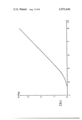
During the reaction the pH rose to 8.5. The reaction was over in 45 minutes; after having filtered the catalyst, the excess of olefine and the product were separated; 62 g of recovered olefine were obtained, and also 158 g of dry product at a Na2 SO4 content equal to 4.3% by weight. Now the productivity rose to 0.9 mole/h/1, calculated as in example 7. The following examples show the possibility of modifying the monosulphonate/disulphonate ratio through controlling pH at the temperature of 80°C. The graph (FIG. 1) was obtained from a series of experimental tests carried out on C12 olefine at different controlled pH; the mono/disulphonate ratio R = M/D was deduced from the C,H,S analyses and compared with the one obtained from titrations of the mixture by means of p-toluidine chlorohydrate.
The two values agreed well with each other.
The following two examples show two bound cases among the performed tests.
In the same apparatus as the preceding examples were dissolved 30 g of Na2 S2 O5 (0.3 mole) in 150 cc of H2 O and 350 cc of IPA; 100 cc (75 g = 0.45 mole) of C12 alpha-olefine and 50 mg (0.6 .sup.. 10- 3 mole) of MnO2 were added: the whole was heated under N2 up to 80°C and then air was flowed (flow = 1.5 1/h).
pH was kept at about 4.5 by bubbling SO2 as soon as it was rising.
The reaction was over in 40 minutes. Now pH was brought to 9 by NaOH, the catalyst was filtered and the products were separated.
50 g of olefine and 55 g of dry product containing 5.6% by weight of Na2 SO4 were recovered. From the analysis the product resulted almost entirely consisting of sodium 1,2-dodecandisulphonate.
This product is entirely soluble in water, even if cool.
The procedure of example 9 was followed but pH was kept at about 6.8 by NaOH.
The reaction was over in 45 minutes and the separation of the products gave 31 g of recovered olefine and 70 g of dry product containing 3.2% by weight of Na2 SO4, having the following approximate compositions: sodium - monalkansulphonate = 210 m.moles, sodium alkandisulphonate-1,2 = 40 m.moles.
Detergency: The inventive products were examined as to detergent property. The detergency measurements were carried out through a method modified with respect to the one described by Harris, Brown "J. Am. Oil Chemists Society" vol. 27 pag. 564-70 (1950). Use was made of a standard cloth, of the 101 type from Swits EMPA, which was soiled with olive-oil and cinchona-ink.
The washing of the pieces was carried out in a LAUNDER-O-METER (Atlas) apparatus; a glass pot was filled with 210 ml of a solution of the detergent in distilled water, at pH=10, 8 cloth pieces 6 × 4 cm and 10 small stainless steel spheres; the washing was carried out at 50°C for 1 hour while the apparatus was rotating (40 rounds/min).
Every test was doubly realized (2 pots) on 16 pieces as total, and at three different concentrations of active substance (1.2 g/l; 0.69 g/l; 0.3 g/l). After the washing the pieces were rinsed in distilled water, squeezed between two sheets of filter paper, extended on an aluminum sheet and dried at 65°C in an airy oven.
The degree of whiteness was measured from the reflectance by means of an ELREPHO apparatus provided with a "TRISTIMULUS" green filter.
The examinations were performed on both sides of each piece and the detergency was obtained from the reflectance by means of the following expression: ##EQU1## wherein RL = average reflectance of the washed piece;
Rnl = average reflectance of the un-washed piece;
Rb = average reflectance of the undirty white piece.
Measurements carried out according to the above method on the sample of example 8 (with catalyst) and on the sample of example 7 (without catalyst) gave the following results
                 1.2 g/l  0.6 g/l  0.3 g/l
C.sub.15 -C.sub.18 (with Mn) D% =
                 48.2     50.8     46.3
C.sub.15 -C.sub.18 (without Mn) D% =
Claims (4)
1. Process for the production of a long chain alkyl sulphonate, adapted for use as a detergent, by reacting an alkali metal bisulphite with one or more alpha-olefines having from 10 to 20 carbon atoms, wherein the improvement comprises contacting the alkali metal bisulphite with a stoichiometric excess of said alpha-olefine or alpha-olefines in a liquid solvent mixture of isopropyl alcohol and water in the presence of oxygen and a metal promoter selected from the group consisting of MnO2 and Mn3 O4, at a temperature below the boiling point of water, and at a pH from 8.5 to 2, the isopropyl alcohol/water ratio in said solvent mixture being between 1.2 and 2.5 by weight, and the solvent/olefine ratio being between 6/1 and 3/1 by weight.
2. Process according to claim 1, wherein the alkali metal bisulphite/olefine molar ratio is 0.8.
3. Process according to claim 1, wherein the isopropyl alcohol/water weight ratio in said solvent mixture is 1.9.
4. Process according to claim 1, wherein said bisulphite is prepared in situ by reacting SO2 and alkali.
Priority Applications (1)
| Application Number | Priority Date | Filing Date | Title |
|---|---|---|---|
| US05/551,609 US3975430A (en) | 1972-06-21 | 1975-02-21 | Process for the preparation of alkylsulphonate compounds |
Applications Claiming Priority (4)
| Application Number | Priority Date | Filing Date | Title |
|---|---|---|---|
| IT25984/72A IT956743B (en) | 1972-06-21 | 1972-06-21 | PROCEDURE FOR THE PREPARATION OF ALKYLSULPHONATED COMPOUNDS |
| IT25984/72 | 1972-06-21 | ||
| US47170774A | 1974-05-20 | 1974-05-20 | |
| US05/551,609 US3975430A (en) | 1972-06-21 | 1975-02-21 | Process for the preparation of alkylsulphonate compounds |
Related Parent Applications (1)
| Application Number | Title | Priority Date | Filing Date |
|---|---|---|---|
| US47170774A Continuation | 1972-06-21 | 1974-05-20 |
Publications (1)
| Publication Number | Publication Date |
|---|---|
| US3975430A true US3975430A (en) | 1976-08-17 |
Family
ID=27273432
Family Applications (1)
| Application Number | Title | Priority Date | Filing Date |
|---|---|---|---|
| US05/551,609 Expired - Lifetime US3975430A (en) | 1972-06-21 | 1975-02-21 | Process for the preparation of alkylsulphonate compounds |
Country Status (1)
| Country | Link |
|---|---|
| US (1) | US3975430A (en) |
Cited By (1)
| Publication number | Priority date | Publication date | Assignee | Title |
|---|---|---|---|---|
| US4087457A (en) * | 1976-11-22 | 1978-05-02 | Continental Oil Company | Air initiation for detergent range pendant or internal olefin sulfitation |
Citations (5)
| Publication number | Priority date | Publication date | Assignee | Title |
|---|---|---|---|---|
| US3275681A (en) * | 1963-05-20 | 1966-09-27 | Little Inc A | Catalytic system for the addition of bisulfites to olefins |
| US3306931A (en) * | 1965-02-17 | 1967-02-28 | Chevron Res | Production of alkali metal alkyl sulfonates |
| US3644499A (en) * | 1968-12-17 | 1972-02-22 | Gulf Research Development Co | Process for preparing detergent sulfonates |
| US3706791A (en) * | 1970-03-18 | 1972-12-19 | Robinette Research Lab Inc | Surface active sulfonates and process of preparing same by the reaction of alpha olefins and bisulfite |
| US3729507A (en) * | 1970-08-10 | 1973-04-24 | Marathon Oil Co | Purification of alkane sulfonate products |
-
1975
- 1975-02-21 US US05/551,609 patent/US3975430A/en not_active Expired - Lifetime
Patent Citations (5)
| Publication number | Priority date | Publication date | Assignee | Title |
|---|---|---|---|---|
| US3275681A (en) * | 1963-05-20 | 1966-09-27 | Little Inc A | Catalytic system for the addition of bisulfites to olefins |
| US3306931A (en) * | 1965-02-17 | 1967-02-28 | Chevron Res | Production of alkali metal alkyl sulfonates |
| US3644499A (en) * | 1968-12-17 | 1972-02-22 | Gulf Research Development Co | Process for preparing detergent sulfonates |
| US3706791A (en) * | 1970-03-18 | 1972-12-19 | Robinette Research Lab Inc | Surface active sulfonates and process of preparing same by the reaction of alpha olefins and bisulfite |
| US3729507A (en) * | 1970-08-10 | 1973-04-24 | Marathon Oil Co | Purification of alkane sulfonate products |
Non-Patent Citations (3)
| Title |
|---|
| Berry et al., J. Amer. Chem. Soc., 73, 5195, (1951). * |
| Kharasch et al., J. Org. Chem., 3, 175, (1938). * |
| Sully, J. Chem. Soc., 1498, (1950). * |
Cited By (1)
| Publication number | Priority date | Publication date | Assignee | Title |
|---|---|---|---|---|
| US4087457A (en) * | 1976-11-22 | 1978-05-02 | Continental Oil Company | Air initiation for detergent range pendant or internal olefin sulfitation |
Similar Documents
| Publication | Publication Date | Title |
|---|---|---|
| AU614859B2 (en) | A process for the preparation of internal olefin sulphonates | |
| US3953362A (en) | Molybdenum salt catalysts and methods of preparing them | |
| CA1181098A (en) | Hydroxylation of olefins | |
| WO1983002773A1 (en) | Process for preparing dialkyl trisulfides | |
| US5117032A (en) | Process for making glycerol ether sulfates | |
| Huang et al. | Studies on deiodo-sulfination. Part I. Studies on the deiodo-sulfination of perfluoroalkyl iodides | |
| JPS636056B2 (en) | ||
| US3376333A (en) | Sulfuric acid esters of linear secondary alcohol ethoxylates and salts thereof and method of producing same | |
| US3975430A (en) | Process for the preparation of alkylsulphonate compounds | |
| EP0011311A2 (en) | Alkyl glyceryl ether sulfate salts, process for their preparation and composition of matter containing them | |
| WO2009058654A1 (en) | Process for producing secondary alcohol alkoxy sulfates | |
| US4294717A (en) | Compositions containing an alkali metal mono- or polyalkylarylsulfonate and the corresponding hydroperoxide, process for their preparation and detergent compositions containing them | |
| US4410709A (en) | Sulfobetaines | |
| CN112624948B (en) | Method for synthesizing peroxycarboxylic acid alkyl ester by using titanium-silicon molecular sieve composite catalyst | |
| EP0324958B1 (en) | Process for making alkyl arsine compounds | |
| FR2457714A1 (en) | PROCESS FOR THE PREPARATION OF ZIRCONIA-SILICA XEROGELS, THE XEROGELS THUS PREPARED AND PROCESS USING THE SAME | |
| CN112661686A (en) | Method for producing peroxycarboxylic acid alkyl ester based on titanium silicalite molecular sieve composite catalyst | |
| CA1208661A (en) | Process for the preparation of tertiary-butyl hydroperoxide | |
| JPS5920245A (en) | Preparation of tricyclo(5.2.1.02,6)decane-2-carboxylic acid | |
| US4070396A (en) | Sulfite ion catalysis of bisulfite addition to higher molecular weight detergent range olefins | |
| US3743673A (en) | Single step sulfoxidation process | |
| US4156101A (en) | Low molecular weight tert.-alcohols | |
| CA1090830A (en) | Method of obtaining primary alcohols with straight chains from c.sub.4hydrocarbon cuts | |
| US5608107A (en) | Preparation of alkoxyalkanoic acids | |
| EP0225091B1 (en) | Peroxydicarbonate containing non-conjugate type unsaturated bond |