US3963523A - Method of manufacturing semiconductor devices - Google Patents
Method of manufacturing semiconductor devices Download PDFInfo
- Publication number
- US3963523A US3963523A US05/536,240 US53624074A US3963523A US 3963523 A US3963523 A US 3963523A US 53624074 A US53624074 A US 53624074A US 3963523 A US3963523 A US 3963523A
- Authority
- US
- United States
- Prior art keywords
- silicon substrate
- platinum
- layer
- heat treatment
- plated
- Prior art date
- Legal status (The legal status is an assumption and is not a legal conclusion. Google has not performed a legal analysis and makes no representation as to the accuracy of the status listed.)
- Expired - Lifetime
Links
Images


Classifications
-
- H—ELECTRICITY
- H10—SEMICONDUCTOR DEVICES; ELECTRIC SOLID-STATE DEVICES NOT OTHERWISE PROVIDED FOR
- H10P—GENERIC PROCESSES OR APPARATUS FOR THE MANUFACTURE OR TREATMENT OF DEVICES COVERED BY CLASS H10
- H10P95/00—Generic processes or apparatus for manufacture or treatments not covered by the other groups of this subclass
-
- H—ELECTRICITY
- H10—SEMICONDUCTOR DEVICES; ELECTRIC SOLID-STATE DEVICES NOT OTHERWISE PROVIDED FOR
- H10D—INORGANIC ELECTRIC SEMICONDUCTOR DEVICES
- H10D99/00—Subject matter not provided for in other groups of this subclass
-
- H—ELECTRICITY
- H10—SEMICONDUCTOR DEVICES; ELECTRIC SOLID-STATE DEVICES NOT OTHERWISE PROVIDED FOR
- H10P—GENERIC PROCESSES OR APPARATUS FOR THE MANUFACTURE OR TREATMENT OF DEVICES COVERED BY CLASS H10
- H10P14/00—Formation of materials, e.g. in the shape of layers or pillars
- H10P14/40—Formation of materials, e.g. in the shape of layers or pillars of conductive or resistive materials
- H10P14/46—Formation of materials, e.g. in the shape of layers or pillars of conductive or resistive materials using a liquid
Definitions
- the present invention relates to a method of manufacturing semiconductor devices and more particularly to a method of preliminary processing for the nickel plating which improves the formation of a plated layer of nickel in a semiconductor device and which improves the characteristics of the semiconductor device.
- the electroless nickel plating is a chemical plating and therefore various considerations have been given to the preliminary processing for the electroless nickel plating and also to the surface treatment in order to increase the adhesion strength of a nickel layer to a semiconductor substrate (silicon substrate) or the adhesion strength of a nickel layer with external lead wires.
- the present invention is intended to overcome the foregoing deficiency involved in the prior art methods of producing ohmic contact electrodes by the electroless nickel plating process, and it is an object of the present invention to provide a method of preliminary processing which increases the adhesion strength of a plated layer of nickel on the surface of a silicon substrate for a semiconductor device and which improves the switching characteristic of the resultant semiconductor device.
- a aqueous solution containing for example chloroplatinic acid and hydrofluoric acid to deposit a coating of platinum on the surface of the silicon substrate and thereafter the silicon substrate is subjected to a baking process in an inert atmosphere.
- a method of manufacturing a semiconductor device comprising the steps of depositing a coating of platinum at least on one surface of a silicon substrate having at least one PN junction formed therein, thereafter plating a layer of nickel on the platinum coated silicon substrate, and subjecting the plated nickel layer to a heat treatment at a temperature sufficient to cause the platinum to diffuse into the silicon substrate.
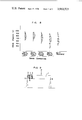
- FIGS. 1 through 6 are diagrams showing a series of steps for manufacturing a silicon diode according to a method of this invention.
- FIG. 7 is a graph showing relationship between Qs and platinum coatings having various thicknesses.
- FIG. 8 is a graph showing relationship between baking temperatures and break strength.
- FIG. 9 is a diagram showing a method of measuring the break strength.
- an N-type silicon substrate 1 is prepared first as shown in FIG. 1.
- N-type impurity e.g., phosphorus is diffused into the silicon substrate 1.
- This diffusion treatment results in the formation of N + diffused regions 2 and 3 in the silicon substrate 1.
- silicon dioxide coatings 4 and 5 are also formed on the surfaces of the silicon substrate 1 (FIG. 2).
- One of the N + diffused regions formed in the silicon substrate is then removed for example by a lapping treatment so that one of the two surfaces of the N region 1 is exposed (FIG. 3) and a P-type impurity, e.g., boron is diffused from this exposed surface into the substrate.
- a P-type impurity e.g., boron
- FIG. 4 shows the structure obtained after the diffusion of the P-type impurity, with numeral 6 indicating a P + diffused region and numeral 7 indicating a silicon dioxide coating produced during the formation of the P + diffused region 6.
- a P +NN + silicon diode is produced in the silicon substrate.
- the P + diffused region 6 and N + diffused region 3 serve respectively as a foundation layer on which an electrode is to be formed.
- the silicon dioxide coatings on the silicon substrate having the P +NN + diode built therein in the above-described manner are removed entirely and the silicon substrate is then dipped for a short period of time (3 to 5 minutes) into an aqueous solution containing chloroplatinic acid and hydrofluoric acid.
- the platinum element separated from the chloroplatinic acid by the reducing reaction of the hydrofluoric acid is deposited on the surfaces of the silicon substrate from which the silicon dioxide has been removed by the same hydrofluoric acid, thereby forming a platinum coating having a thickness of 0.1 to 0.4 ⁇ on the surfaces of the silicon substrate.
- the silicon substrate is subjected to rinsing and drying processes and then the silicon substrate is subjected to a heat treatment for about 5 to 10 minutes in an inert atmosphere at a temperature in the order of 700°C.
- FIG. 5 shows the silicon substrate after the heat treatment and numerals 8 and 9 indicate the platinum coatings.
- nickel layers 10 and 11 are formed on the surfaces of the silicon substrate by a known type of electroless nickel plating process (FIG. 6).
- the plated nickel layers are subjected to a treatment which bakes the plated nickel layers on the silicon substrate and this heat treatment is effected by heating the nickel layers in an inert atmosphere at a temperature of 800° to 900°C.
- the platinum coatings on the silicon substrate are caused to act to improve the adhesion between the plated nickel layers and the silicon substrate and simultaneously the diffusion of platinum element into the silicon substrate takes place.
- the platinum element diffused in the silicon substrate acts as a lifetime killer of the carriers.
- the heating time ranges from 10 to 60 minutes.
- the platinum coating has a thickness of 0.1 to 0.4 ⁇ and the heat treatment for baking the plated nickel is effected at a temperature of 800° to 900°C. These ranges are very important to produce a semiconductor device according to the present invention.
- FIG. 7 the changes of the stored charge (Qs) with the thicknesses of the platinum coating are shown.
- an example A shows results when the platinum is not coated.
- An example B shows results when the thicknesses of the platinum coating are so thin that they cannot be seen with the naked eye.
- Table 1 shows relationships between the thickness of the platinum coating and concentrations of the aqueous solution containing chloroplatinic acid and hydrofluoric acid with respect to the examples C, D and E:
- the thickness of the platinum coating is preferably about 0.1 to 0.4 ⁇ .
- FIG. 8 showing the relationship between baking temperatures of the plated nickel layer and the break strength of the baked nickel layer. It is possible to determine bonding strength of the plated nickel layer by measuring the break strength in a manner described hereunder with reference to FIG. 9.
- numeral 1 designates a laminated body 1, 2 solder layer, 3 silicon substrates, 4 nickel layers, and 5 supporting points.
- the arrow P represents the direction of pressure.
- FIG. 8 shows the results of the measurements.
- the lot having the Pt layer and subjected to 850°C heat treatment has a larger absolute value of break strength than those for other lots and smaller extent of distribution of the break strength in a lot.
- the average break strength is slightly smaller than that for baking at a temperature of 850°C, this value is satisfactory for practical use.
- the baking is effected above 900°C, the resolution of Pt into the Si layer progresses and the resolved Pt layer does not remain on the silicon surface, resulting in poor bonding force. Therefore the upper limit of the baking temperature is practically 900° C.
- the killer effect given by the baking treatment above 900°C is too strong, that is, the diffusion of platinum into silicon is too much, resulting in production of the diode having a switching speed which is too fast, a decreased withstand voltage and an increased voltage drop in the forward direction.
- the bonding force when the baking is effected at 750°C.
- the characteristics of the bonding force are substantially equal between the baking temperature range of 750° to 850°C.
- the killer effect cannot be expected if the baking is effected below 800°C, since the diffusion of platinum into the silicon substrate is too little to give the killer effect to the semiconductor device of the present invention. This fact has been confirmed by another experiment.
- the lower limit of the baking temperature is 800°C.
- the thickness of the platinum coating is preferably 0.1 to 0.4 ⁇ and the baking temperature is 800° to 900°C.
- the platinum coatings placed between the plated nickel layers and the silicon substrate not only act to increase the adhesion strength therebetween, but also serve as a diffusion source so that the platinum element diffuses into the silicon substrate during the heat treatment of the plated nickel layers and act as a lifetime killer of the carriers.
Landscapes
- Chemically Coating (AREA)
Abstract
A method of manufacturing semiconductor devices is provided which comprises the steps of depositing a coating of platinum on the surface of a silicon substrate prior to the formation of a plated nickel layer thereon, plating a layer of nickel on the silicon substrate coated with platinum, and then subjecting the structure to the process of heat treatment to thereby cause the platinum to diffuse into the silicon substrate, whereby the platinum acts to increase the adhesion strength of the plated nickel layer on the silicon substrate and further the platinum element diffused into the silicon substrate serves as a lifetime killer of carriers to thereby improve the switching characteristic of the semiconductor device.
Description
This is a continuation-in-part application of prior application Ser. No. 354,520 filed Apr. 26, 1973, now abandoned.
1. Field of the Invention
The present invention relates to a method of manufacturing semiconductor devices and more particularly to a method of preliminary processing for the nickel plating which improves the formation of a plated layer of nickel in a semiconductor device and which improves the characteristics of the semiconductor device.
2. Description of the Prior Art
In the production of ohmic contact electrodes for semiconductor devices, e.g., silicon semiconductor devices, the production of electrodes by the process of nickel plating has heretofore been used frequently and particularly the production of electrodes by the process of electroless nickel plating has been resorted to in many cases.
As is well known in the art, the electroless nickel plating is a chemical plating and therefore various considerations have been given to the preliminary processing for the electroless nickel plating and also to the surface treatment in order to increase the adhesion strength of a nickel layer to a semiconductor substrate (silicon substrate) or the adhesion strength of a nickel layer with external lead wires.
In fact, however, even with such considerations the results obtained have not been completely satisfactory.
The present invention is intended to overcome the foregoing deficiency involved in the prior art methods of producing ohmic contact electrodes by the electroless nickel plating process, and it is an object of the present invention to provide a method of preliminary processing which increases the adhesion strength of a plated layer of nickel on the surface of a silicon substrate for a semiconductor device and which improves the switching characteristic of the resultant semiconductor device.
It is another object of the present invention to provide a method of manufacturing semiconductor devices in which prior to the plating with nickel of a silicon substrate having a PN junction formed therein, the silicon substrate is dipped for a predetermined time in a aqueous solution containing for example chloroplatinic acid and hydrofluoric acid to deposit a coating of platinum on the surface of the silicon substrate and thereafter the silicon substrate is subjected to a baking process in an inert atmosphere.
The use of these processing steps in the present invention is a very great advantage, since the thin coating of platinum thus deposited on the silicon substrate acts to increase the adhesion strength to the silicon substrate of a plated nickel layer formed by the next step and moreover the high temperature heat treatment performed for baking the plated nickel layer causes the platinum element to diffuse into the silicon substrate and act as a lifetime killer of the carriers to thereby improve the switching characteristic of the semiconductor device.
In accordance with the present invention, there is provided a method of manufacturing a semiconductor device comprising the steps of depositing a coating of platinum at least on one surface of a silicon substrate having at least one PN junction formed therein, thereafter plating a layer of nickel on the platinum coated silicon substrate, and subjecting the plated nickel layer to a heat treatment at a temperature sufficient to cause the platinum to diffuse into the silicon substrate.
Other objects, features and advantages of the invention will become apparent from the following detailed description when taken in conjunction with the accompanying drawings.
FIGS. 1 through 6 are diagrams showing a series of steps for manufacturing a silicon diode according to a method of this invention.
FIG. 7 is a graph showing relationship between Qs and platinum coatings having various thicknesses.
FIG. 8 is a graph showing relationship between baking temperatures and break strength.
FIG. 9 is a diagram showing a method of measuring the break strength.
A preferred embodiment of the method according to the present invention will now be explained for illustrative purposes with reference to FIGS. 1 through 6.
Referring to the drawings showing a series of steps for manufacturing a silicon diode, an N-type silicon substrate 1 is prepared first as shown in FIG. 1.
Thereafter, N-type impurity, e.g., phosphorus is diffused into the silicon substrate 1. This diffusion treatment results in the formation of N+ diffused regions 2 and 3 in the silicon substrate 1. During this diffusion treatment, silicon dioxide coatings 4 and 5 are also formed on the surfaces of the silicon substrate 1 (FIG. 2).
One of the N+ diffused regions formed in the silicon substrate is then removed for example by a lapping treatment so that one of the two surfaces of the N region 1 is exposed (FIG. 3) and a P-type impurity, e.g., boron is diffused from this exposed surface into the substrate.
FIG. 4 shows the structure obtained after the diffusion of the P-type impurity, with numeral 6 indicating a P+ diffused region and numeral 7 indicating a silicon dioxide coating produced during the formation of the P+ diffused region 6.
As the result of these steps, a P+NN + silicon diode is produced in the silicon substrate. In other words, in this P+NN + structure the P+ diffused region 6 and N+ diffused region 3 serve respectively as a foundation layer on which an electrode is to be formed.
The silicon dioxide coatings on the silicon substrate having the P+NN + diode built therein in the above-described manner are removed entirely and the silicon substrate is then dipped for a short period of time (3 to 5 minutes) into an aqueous solution containing chloroplatinic acid and hydrofluoric acid.
When the silicon substrate is dipped in this aqueous solution, the platinum element separated from the chloroplatinic acid by the reducing reaction of the hydrofluoric acid is deposited on the surfaces of the silicon substrate from which the silicon dioxide has been removed by the same hydrofluoric acid, thereby forming a platinum coating having a thickness of 0.1 to 0.4 μ on the surfaces of the silicon substrate.
After the formation of the platinum coatings, the silicon substrate is subjected to rinsing and drying processes and then the silicon substrate is subjected to a heat treatment for about 5 to 10 minutes in an inert atmosphere at a temperature in the order of 700°C. FIG. 5 shows the silicon substrate after the heat treatment and numerals 8 and 9 indicate the platinum coatings.
Thereafter, nickel layers 10 and 11 are formed on the surfaces of the silicon substrate by a known type of electroless nickel plating process (FIG. 6).
The thus plated nickel layers are not entirely satisfactory from the aspect of their adhesive property in relation to the silicon substrate and therefore their contact resistance cannot be said to be sufficiently low.
For this reason, the plated nickel layers are subjected to a treatment which bakes the plated nickel layers on the silicon substrate and this heat treatment is effected by heating the nickel layers in an inert atmosphere at a temperature of 800° to 900°C.
By this heating treatment, the platinum coatings on the silicon substrate are caused to act to improve the adhesion between the plated nickel layers and the silicon substrate and simultaneously the diffusion of platinum element into the silicon substrate takes place. In other words, the platinum element diffused in the silicon substrate acts as a lifetime killer of the carriers.
In order that the platinum on the silicon substrate may act as above described, it is desirable that the heating time ranges from 10 to 60 minutes.
By going through these steps, the production of a semiconductor device portion according to the present invention is completed.
As mentioned above, the platinum coating has a thickness of 0.1 to 0.4 μ and the heat treatment for baking the plated nickel is effected at a temperature of 800° to 900°C. These ranges are very important to produce a semiconductor device according to the present invention.
Referring now to FIG. 7, the changes of the stored charge (Qs) with the thicknesses of the platinum coating are shown. In the figure, an example A shows results when the platinum is not coated. An example B shows results when the thicknesses of the platinum coating are so thin that they cannot be seen with the naked eye. The following Table 1 shows relationships between the thickness of the platinum coating and concentrations of the aqueous solution containing chloroplatinic acid and hydrofluoric acid with respect to the examples C, D and E:
              Table 1
______________________________________
Concentration of     Thickness of the
the aqueous solution platinum coating
______________________________________
C      1/3 Dilution      0.13 - 0.22 μ
D      Standard Concentration
                         0.20 - 0.30 μ
E      3 Times Concentration
                         0.29 - 0.40 μ
______________________________________
As understood from FIG. 7, there is no killer effect in the example A. In the example B, it is recognized that a small quantity of platinum is diffused into the silicon substrate because Qs is slightly smaller than in the example A. The thickness of platinum coating is increased as the concentration of aqueous solution increases. In the examples C, D, E and F, there are raised sufficient killer effect and it is substantially saturated in the examples E and F. Therefore, it is uneconomical to use a further concentrated aqueous solution from the standpoint of manufacturing cost. As a result, the thickness of the platinum coating is preferably about 0.1 to 0.4 μ.
Now refer to FIG. 8 showing the relationship between baking temperatures of the plated nickel layer and the break strength of the baked nickel layer. It is possible to determine bonding strength of the plated nickel layer by measuring the break strength in a manner described hereunder with reference to FIG. 9. In FIG. 9, numeral 1 designates a laminated body 1, 2 solder layer, 3 silicon substrates, 4 nickel layers, and 5 supporting points. The arrow P represents the direction of pressure.
In order to determine the plating strength between Si-Ni, 20 pieces of rectifier elements having silicon substrate size of 0.9 × 0.9 mm square were laminated through solder to bond together, to which a pressure was applied from the sides thereof, as shown in FIG. 9 to determine the force required to break the laminated assembly; that is, the break strength of the laminated assembly. Since it is considered that the strength of the solder layer is stronger than that of the Ni layer, it is possible to determine the bonding strength of the Ni plated layer to the silicon substrate by measuring the breaking strength.
FIG. 8 shows the results of the measurements.
It is seen from FIG. 8 that the lot having the Pt layer and subjected to 850°C heat treatment has a larger absolute value of break strength than those for other lots and smaller extent of distribution of the break strength in a lot. At the baking temperature of 900°C, although the average break strength is slightly smaller than that for baking at a temperature of 850°C, this value is satisfactory for practical use. When the baking is effected above 900°C, the resolution of Pt into the Si layer progresses and the resolved Pt layer does not remain on the silicon surface, resulting in poor bonding force. Therefore the upper limit of the baking temperature is practically 900° C. Furthermore, it has been confirmed by another experiment that the killer effect given by the baking treatment above 900°C is too strong, that is, the diffusion of platinum into silicon is too much, resulting in production of the diode having a switching speed which is too fast, a decreased withstand voltage and an increased voltage drop in the forward direction.
Good results are obtained with respect to the bonding force when the baking is effected at 750°C. The characteristics of the bonding force are substantially equal between the baking temperature range of 750° to 850°C. However, the killer effect cannot be expected if the baking is effected below 800°C, since the diffusion of platinum into the silicon substrate is too little to give the killer effect to the semiconductor device of the present invention. This fact has been confirmed by another experiment. Thus, the lower limit of the baking temperature is 800°C.
According to the above consideration, the thickness of the platinum coating is preferably 0.1 to 0.4 μ and the baking temperature is 800° to 900°C.
It will thus be seen from the foregoing description that according to the method of this invention, the platinum coatings placed between the plated nickel layers and the silicon substrate not only act to increase the adhesion strength therebetween, but also serve as a diffusion source so that the platinum element diffuses into the silicon substrate during the heat treatment of the plated nickel layers and act as a lifetime killer of the carriers.
Accordingly, in a semiconductor device manufactured according to the present invention, excellent contact is ensured between the electrodes and the substrate and moreover the switching characteristic of the semiconductor device is improved.
While the present invention has been described as applied to the manufacture of a silicon diode, the present invention may of course be applied to the manufacture of other semiconductor devices as well.
Claims (4)
1. A method of manufacturing a semiconductor device comprising the steps of depositing a coating of platinum having a thickness of 0.1 to 0.4 μ on at least one surface of a silicon substrate having at least one PN junction formed therein, subjecting said substrate to a first heat treatment for increasing the adhesion strength of the plated platinum layer to the silicon substrate, plating a layer of nickel on said silicon substrate coated with platinum, and then subjecting said plated nickel layer to a second heat treatment at a temperature of 800° to 900°C to cause said platinum to diffuse into said silicon substrate.
2. A manufacturing method according to claim 1, wherein said step for depositing a platinum coating consists of dipping said silicon substrate into an aqueous solution containing chloroplatinic acid and hydrofluoric acid.
3. A manufacturing method according to claim 1, wherein said first heat treatment step for said plated platinum layer is performed for 5 to 10 minutes in an inert atmosphere at a temperature of about 700°C.
4. A manufacturing method according to claim 1, wherein said second heat treatment step for said plated nickel is performed for 10 to 60 minutes in an inert atmosphere.
Priority Applications (1)
| Application Number | Priority Date | Filing Date | Title |
|---|---|---|---|
| US05/536,240 US3963523A (en) | 1973-04-26 | 1974-12-24 | Method of manufacturing semiconductor devices |
Applications Claiming Priority (2)
| Application Number | Priority Date | Filing Date | Title |
|---|---|---|---|
| US35452073A | 1973-04-26 | 1973-04-26 | |
| US05/536,240 US3963523A (en) | 1973-04-26 | 1974-12-24 | Method of manufacturing semiconductor devices |
Related Parent Applications (1)
| Application Number | Title | Priority Date | Filing Date |
|---|---|---|---|
| US35452073A Continuation-In-Part | 1973-04-26 | 1973-04-26 |
Publications (1)
| Publication Number | Publication Date |
|---|---|
| US3963523A true US3963523A (en) | 1976-06-15 |
Family
ID=26998437
Family Applications (1)
| Application Number | Title | Priority Date | Filing Date |
|---|---|---|---|
| US05/536,240 Expired - Lifetime US3963523A (en) | 1973-04-26 | 1974-12-24 | Method of manufacturing semiconductor devices |
Country Status (1)
| Country | Link |
|---|---|
| US (1) | US3963523A (en) |
Cited By (9)
| Publication number | Priority date | Publication date | Assignee | Title |
|---|---|---|---|---|
| US4297393A (en) * | 1980-02-28 | 1981-10-27 | Rca Corporation | Method of applying thin metal deposits to a substrate |
| US4329774A (en) * | 1978-07-04 | 1982-05-18 | Thomson-Csf | Silicon resistor having a very low temperature coefficient |
| US4391658A (en) * | 1980-12-12 | 1983-07-05 | Tokyo Shibaura Denki Kabushiki Kaisha | Method for manufacturing semiconductor substrate |
| US4925812A (en) * | 1989-09-21 | 1990-05-15 | International Rectifier Corporation | Platinum diffusion process |
| GB2265636A (en) * | 1989-09-21 | 1993-10-06 | Int Rectifier Corp | Platinum diffusion process |
| AT399419B (en) * | 1989-09-21 | 1995-05-26 | Int Rectifier Corp | Method for introducing platinum atoms into a silicon wafer for the purpose of reducing the minority carrier lifetime |
| US20040055895A1 (en) * | 1999-10-28 | 2004-03-25 | Semitool, Inc. | Platinum alloy using electrochemical deposition |
| US20050230262A1 (en) * | 2004-04-20 | 2005-10-20 | Semitool, Inc. | Electrochemical methods for the formation of protective features on metallized features |
| US20120228634A1 (en) * | 2011-03-07 | 2012-09-13 | Fuji Electric Co., Ltd. | Combined semiconductor device |
Citations (5)
| Publication number | Priority date | Publication date | Assignee | Title |
|---|---|---|---|---|
| US3337779A (en) * | 1962-12-17 | 1967-08-22 | Tektronix Inc | Snap-off diode containing recombination impurities |
| US3356543A (en) * | 1964-12-07 | 1967-12-05 | Rca Corp | Method of decreasing the minority carrier lifetime by diffusion |
| US3360695A (en) * | 1965-08-02 | 1967-12-26 | Sprague Electric Co | Induced region semiconductor device |
| US3640783A (en) * | 1969-08-11 | 1972-02-08 | Trw Semiconductors Inc | Semiconductor devices with diffused platinum |
| US3711325A (en) * | 1968-12-13 | 1973-01-16 | Texas Instruments Inc | Activation process for electroless nickel plating |
-
1974
- 1974-12-24 US US05/536,240 patent/US3963523A/en not_active Expired - Lifetime
Patent Citations (5)
| Publication number | Priority date | Publication date | Assignee | Title |
|---|---|---|---|---|
| US3337779A (en) * | 1962-12-17 | 1967-08-22 | Tektronix Inc | Snap-off diode containing recombination impurities |
| US3356543A (en) * | 1964-12-07 | 1967-12-05 | Rca Corp | Method of decreasing the minority carrier lifetime by diffusion |
| US3360695A (en) * | 1965-08-02 | 1967-12-26 | Sprague Electric Co | Induced region semiconductor device |
| US3711325A (en) * | 1968-12-13 | 1973-01-16 | Texas Instruments Inc | Activation process for electroless nickel plating |
| US3640783A (en) * | 1969-08-11 | 1972-02-08 | Trw Semiconductors Inc | Semiconductor devices with diffused platinum |
Cited By (15)
| Publication number | Priority date | Publication date | Assignee | Title |
|---|---|---|---|---|
| US4329774A (en) * | 1978-07-04 | 1982-05-18 | Thomson-Csf | Silicon resistor having a very low temperature coefficient |
| US4297393A (en) * | 1980-02-28 | 1981-10-27 | Rca Corporation | Method of applying thin metal deposits to a substrate |
| US4391658A (en) * | 1980-12-12 | 1983-07-05 | Tokyo Shibaura Denki Kabushiki Kaisha | Method for manufacturing semiconductor substrate |
| GB2265636A (en) * | 1989-09-21 | 1993-10-06 | Int Rectifier Corp | Platinum diffusion process |
| GB2236119A (en) * | 1989-09-21 | 1991-03-27 | Int Rectifier Corp | Platinum diffusion process |
| DE4029826A1 (en) * | 1989-09-21 | 1991-04-04 | Int Rectifier Corp | PLATINUM DIFFUSION METHOD FOR A SEMICONDUCTOR BODY |
| US4925812A (en) * | 1989-09-21 | 1990-05-15 | International Rectifier Corporation | Platinum diffusion process |
| GB2265636B (en) * | 1989-09-21 | 1994-05-18 | Int Rectifier Corp | Platinum diffusion process |
| GB2236119B (en) * | 1989-09-21 | 1994-05-25 | Int Rectifier Corp | Platinum diffusion process |
| AT399419B (en) * | 1989-09-21 | 1995-05-26 | Int Rectifier Corp | Method for introducing platinum atoms into a silicon wafer for the purpose of reducing the minority carrier lifetime |
| US20040055895A1 (en) * | 1999-10-28 | 2004-03-25 | Semitool, Inc. | Platinum alloy using electrochemical deposition |
| US20050000818A1 (en) * | 1999-10-28 | 2005-01-06 | Semitool, Inc. | Method, chemistry, and apparatus for noble metal electroplating on a microelectronic workpiece |
| US7300562B2 (en) | 1999-10-28 | 2007-11-27 | Semitool, Inc. | Platinum alloy using electrochemical deposition |
| US20050230262A1 (en) * | 2004-04-20 | 2005-10-20 | Semitool, Inc. | Electrochemical methods for the formation of protective features on metallized features |
| US20120228634A1 (en) * | 2011-03-07 | 2012-09-13 | Fuji Electric Co., Ltd. | Combined semiconductor device |
Similar Documents
| Publication | Publication Date | Title |
|---|---|---|
| US3640806A (en) | Semiconductor device and method of producing the same | |
| Sullivan et al. | Electroless nickel plating for making ohmic contacts to silicon | |
| US2842831A (en) | Manufacture of semiconductor devices | |
| US4005472A (en) | Method for gold plating of metallic layers on semiconductive devices | |
| US6692981B2 (en) | Method of manufacturing a solar cell | |
| US3963523A (en) | Method of manufacturing semiconductor devices | |
| US4153907A (en) | Photovoltaic cell with junction-free essentially-linear connections to its contacts | |
| US3013955A (en) | Method of transistor manufacture | |
| US4609565A (en) | Method of fabricating solar cells | |
| US3939047A (en) | Method for fabricating electrode structure for a semiconductor device having a shallow junction | |
| US3212160A (en) | Method of manufacturing semiconductive devices | |
| JPS5932055B2 (en) | Method for manufacturing a semiconductor device having contacts | |
| US3209450A (en) | Method of fabricating semiconductor contacts | |
| JPH06209115A (en) | Solder part forming method of solar cell | |
| JPH02275624A (en) | Ohmic electrode and its forming method | |
| US3579375A (en) | Method of making ohmic contact to semiconductor devices | |
| US4198262A (en) | Solar cell manufacture | |
| US3686539A (en) | Gallium arsenide semiconductor device with improved ohmic electrode | |
| US3434885A (en) | Method of making electrical contact on silicon solar cell and resultant product | |
| CA1273602A (en) | Method of fabricating solar cells | |
| US3457467A (en) | Heterojunction solar cell with shorted substrate | |
| US3949120A (en) | Method of making high speed silicon switching diodes | |
| US3063129A (en) | Transistor | |
| US3254389A (en) | Method of making a ceramic supported semiconductor device | |
| JP3340648B2 (en) | Method for forming electrode of semiconductor device |