US3940494A - Liquid ruminant feed supplement - Google Patents
Liquid ruminant feed supplement Download PDFInfo
- Publication number
- US3940494A US3940494A US05/492,830 US49283074A US3940494A US 3940494 A US3940494 A US 3940494A US 49283074 A US49283074 A US 49283074A US 3940494 A US3940494 A US 3940494A
- Authority
- US
- United States
- Prior art keywords
- urea
- water
- weight
- feed supplement
- solids
- Prior art date
- Legal status (The legal status is an assumption and is not a legal conclusion. Google has not performed a legal analysis and makes no representation as to the accuracy of the status listed.)
- Expired - Lifetime
Links
- 239000006052 feed supplement Substances 0.000 title claims abstract description 20
- 239000007788 liquid Substances 0.000 title claims description 21
- 241000282849 Ruminantia Species 0.000 title description 17
- XLYOFNOQVPJJNP-UHFFFAOYSA-N water Substances O XLYOFNOQVPJJNP-UHFFFAOYSA-N 0.000 claims abstract description 38
- XSQUKJJJFZCRTK-UHFFFAOYSA-N Urea Chemical compound NC(N)=O XSQUKJJJFZCRTK-UHFFFAOYSA-N 0.000 claims abstract description 35
- 239000004202 carbamide Substances 0.000 claims abstract description 35
- 239000007787 solid Substances 0.000 claims abstract description 25
- 239000004254 Ammonium phosphate Substances 0.000 claims abstract description 17
- 235000019289 ammonium phosphates Nutrition 0.000 claims abstract description 17
- 229910000148 ammonium phosphate Inorganic materials 0.000 claims abstract description 15
- MNNHAPBLZZVQHP-UHFFFAOYSA-N diammonium hydrogen phosphate Chemical compound [NH4+].[NH4+].OP([O-])([O-])=O MNNHAPBLZZVQHP-UHFFFAOYSA-N 0.000 claims abstract description 15
- 235000013379 molasses Nutrition 0.000 claims abstract description 15
- 239000000203 mixture Substances 0.000 claims description 41
- 238000002425 crystallisation Methods 0.000 claims description 27
- 230000008025 crystallization Effects 0.000 claims description 27
- 241001465754 Metazoa Species 0.000 claims description 7
- 239000013589 supplement Substances 0.000 claims description 7
- QGZKDVFQNNGYKY-UHFFFAOYSA-N Ammonia Chemical compound N QGZKDVFQNNGYKY-UHFFFAOYSA-N 0.000 claims description 4
- 239000000470 constituent Substances 0.000 claims description 4
- 238000010586 diagram Methods 0.000 claims description 3
- 238000005086 pumping Methods 0.000 claims description 3
- HKFXIAYXXUVGPX-UHFFFAOYSA-N triazanium urea phosphate Chemical compound [NH4+].[NH4+].[NH4+].NC(N)=O.[O-]P([O-])([O-])=O HKFXIAYXXUVGPX-UHFFFAOYSA-N 0.000 claims description 2
- 235000013877 carbamide Nutrition 0.000 abstract 1
- 239000000243 solution Substances 0.000 description 22
- 102000004169 proteins and genes Human genes 0.000 description 10
- 108090000623 proteins and genes Proteins 0.000 description 10
- 239000000463 material Substances 0.000 description 6
- QJGQUHMNIGDVPM-UHFFFAOYSA-N nitrogen group Chemical group [N] QJGQUHMNIGDVPM-UHFFFAOYSA-N 0.000 description 6
- 239000004114 Ammonium polyphosphate Substances 0.000 description 5
- 229920001276 ammonium polyphosphate Polymers 0.000 description 5
- IJGRMHOSHXDMSA-UHFFFAOYSA-N Atomic nitrogen Chemical compound N#N IJGRMHOSHXDMSA-UHFFFAOYSA-N 0.000 description 4
- 150000003863 ammonium salts Chemical class 0.000 description 4
- 239000008365 aqueous carrier Substances 0.000 description 4
- 239000007864 aqueous solution Substances 0.000 description 4
- 230000015556 catabolic process Effects 0.000 description 4
- 229910019142 PO4 Inorganic materials 0.000 description 3
- 239000000654 additive Substances 0.000 description 3
- ZRIUUUJAJJNDSS-UHFFFAOYSA-N ammonium phosphates Chemical compound [NH4+].[NH4+].[NH4+].[O-]P([O-])([O-])=O ZRIUUUJAJJNDSS-UHFFFAOYSA-N 0.000 description 3
- 235000019826 ammonium polyphosphate Nutrition 0.000 description 3
- NBIIXXVUZAFLBC-UHFFFAOYSA-K phosphate Chemical compound [O-]P([O-])([O-])=O NBIIXXVUZAFLBC-UHFFFAOYSA-K 0.000 description 3
- 239000010452 phosphate Substances 0.000 description 3
- 235000021317 phosphate Nutrition 0.000 description 3
- 210000001519 tissue Anatomy 0.000 description 3
- PCTMTFRHKVHKIS-BMFZQQSSSA-N (1s,3r,4e,6e,8e,10e,12e,14e,16e,18s,19r,20r,21s,25r,27r,30r,31r,33s,35r,37s,38r)-3-[(2r,3s,4s,5s,6r)-4-amino-3,5-dihydroxy-6-methyloxan-2-yl]oxy-19,25,27,30,31,33,35,37-octahydroxy-18,20,21-trimethyl-23-oxo-22,39-dioxabicyclo[33.3.1]nonatriaconta-4,6,8,10 Chemical compound C1C=C2C[C@@H](OS(O)(=O)=O)CC[C@]2(C)[C@@H]2[C@@H]1[C@@H]1CC[C@H]([C@H](C)CCCC(C)C)[C@@]1(C)CC2.O[C@H]1[C@@H](N)[C@H](O)[C@@H](C)O[C@H]1O[C@H]1/C=C/C=C/C=C/C=C/C=C/C=C/C=C/[C@H](C)[C@@H](O)[C@@H](C)[C@H](C)OC(=O)C[C@H](O)C[C@H](O)CC[C@@H](O)[C@H](O)C[C@H](O)C[C@](O)(C[C@H](O)[C@H]2C(O)=O)O[C@H]2C1 PCTMTFRHKVHKIS-BMFZQQSSSA-N 0.000 description 2
- 150000001875 compounds Chemical class 0.000 description 2
- 230000003247 decreasing effect Effects 0.000 description 2
- 230000000694 effects Effects 0.000 description 2
- 244000005700 microbiome Species 0.000 description 2
- 229910052757 nitrogen Inorganic materials 0.000 description 2
- 239000002904 solvent Substances 0.000 description 2
- WTHDKMILWLGDKL-UHFFFAOYSA-N urea;hydrate Chemical compound O.NC(N)=O WTHDKMILWLGDKL-UHFFFAOYSA-N 0.000 description 2
- 239000011782 vitamin Substances 0.000 description 2
- 229940088594 vitamin Drugs 0.000 description 2
- 229930003231 vitamin Natural products 0.000 description 2
- 235000013343 vitamin Nutrition 0.000 description 2
- 235000016068 Berberis vulgaris Nutrition 0.000 description 1
- 241000335053 Beta vulgaris Species 0.000 description 1
- 241000283690 Bos taurus Species 0.000 description 1
- UXVMQQNJUSDDNG-UHFFFAOYSA-L Calcium chloride Chemical compound [Cl-].[Cl-].[Ca+2] UXVMQQNJUSDDNG-UHFFFAOYSA-L 0.000 description 1
- 241000283707 Capra Species 0.000 description 1
- 241001494479 Pecora Species 0.000 description 1
- 206010037660 Pyrexia Diseases 0.000 description 1
- 240000000111 Saccharum officinarum Species 0.000 description 1
- 235000007201 Saccharum officinarum Nutrition 0.000 description 1
- 240000008042 Zea mays Species 0.000 description 1
- 235000005824 Zea mays ssp. parviglumis Nutrition 0.000 description 1
- 235000002017 Zea mays subsp mays Nutrition 0.000 description 1
- 230000002378 acidificating effect Effects 0.000 description 1
- 229910021529 ammonia Inorganic materials 0.000 description 1
- 239000006172 buffering agent Substances 0.000 description 1
- 239000001110 calcium chloride Substances 0.000 description 1
- 229910001628 calcium chloride Inorganic materials 0.000 description 1
- 235000014633 carbohydrates Nutrition 0.000 description 1
- 150000001720 carbohydrates Chemical class 0.000 description 1
- 235000020971 citrus fruits Nutrition 0.000 description 1
- 235000005822 corn Nutrition 0.000 description 1
- 230000007797 corrosion Effects 0.000 description 1
- 238000005260 corrosion Methods 0.000 description 1
- 239000013078 crystal Substances 0.000 description 1
- 235000013325 dietary fiber Nutrition 0.000 description 1
- 239000003337 fertilizer Substances 0.000 description 1
- 239000012530 fluid Substances 0.000 description 1
- 239000005556 hormone Substances 0.000 description 1
- 229940088597 hormone Drugs 0.000 description 1
- 238000011065 in-situ storage Methods 0.000 description 1
- 239000004615 ingredient Substances 0.000 description 1
- 229910052500 inorganic mineral Inorganic materials 0.000 description 1
- 244000144972 livestock Species 0.000 description 1
- 238000004519 manufacturing process Methods 0.000 description 1
- 235000013372 meat Nutrition 0.000 description 1
- 244000005706 microflora Species 0.000 description 1
- 235000013336 milk Nutrition 0.000 description 1
- 239000008267 milk Substances 0.000 description 1
- 210000004080 milk Anatomy 0.000 description 1
- 239000011707 mineral Substances 0.000 description 1
- 230000004048 modification Effects 0.000 description 1
- 238000012986 modification Methods 0.000 description 1
- 210000003205 muscle Anatomy 0.000 description 1
- 210000000653 nervous system Anatomy 0.000 description 1
- 230000003472 neutralizing effect Effects 0.000 description 1
- 229910017464 nitrogen compound Inorganic materials 0.000 description 1
- -1 nitrogenous compound Chemical class 0.000 description 1
- 235000006180 nutrition needs Nutrition 0.000 description 1
- 235000011007 phosphoric acid Nutrition 0.000 description 1
- 150000003016 phosphoric acids Chemical class 0.000 description 1
- 239000000047 product Substances 0.000 description 1
- 229940116540 protein supplement Drugs 0.000 description 1
- 235000005974 protein supplement Nutrition 0.000 description 1
- 210000004767 rumen Anatomy 0.000 description 1
- 239000000021 stimulant Substances 0.000 description 1
- 210000002784 stomach Anatomy 0.000 description 1
- 238000003860 storage Methods 0.000 description 1
- 239000000126 substance Substances 0.000 description 1
- 210000001835 viscera Anatomy 0.000 description 1
- 210000002268 wool Anatomy 0.000 description 1
Images

Classifications
-
- A—HUMAN NECESSITIES
- A23—FOODS OR FOODSTUFFS; TREATMENT THEREOF, NOT COVERED BY OTHER CLASSES
- A23K—FODDER
- A23K50/00—Feeding-stuffs specially adapted for particular animals
- A23K50/10—Feeding-stuffs specially adapted for particular animals for ruminants
- A23K50/15—Feeding-stuffs specially adapted for particular animals for ruminants containing substances which are metabolically converted to proteins, e.g. ammonium salts or urea
Definitions
- This invention relates to liquid ruminant feed supplement compositions.
- this invention relates to liquid supplement constituents which increase the utilization of non-protein-nitrogen compounds, convertible into organismal protein by ruminant animals.
- this invention relates to a liquid ruminant feed supplement composition characterized by low crystallization temperatures.
- non-protein nitrogenous compounds may be substituted for some of the protein in rations for ruminants.
- Some of the non-protein nitrogenous compounds which have been found to have high protein replacement values are urea and various ammonium salts.
- Urea and the ammonium salts are economical and cost less than bona fide protein feed.
- These nitrogenous compounds when introduced to the rumen or pouch of an animal stimulate the microorganism present therein.
- Microorganisms in the stomach of the animal utilize the urea or ammonium salts to create protein.
- Protein is an essential constituent of all living cells, for the body tissues of all animals, muscle, internal organs, nervous systems, and external tissues are made up largely of protein materials. Animal life, accordingly, requires protein for growth, for replacement of body tissues and fluids and for the production of such animal products as milk, meat, and wool.
- solutions containing a high content of urea have been shipped in heated containers or containers maintaining temperatures above the ambient in order to prevent crystallization. Such shipment involves higher transportation costs than materials which are liquid at ambient temperatures.
- the liquid supplement is preferably not too viscous, does not crystallize, and is substantially immune to extremes of temperatures.
- Urea in commercial form is crystalline, and it does not dissolve readily, especially at lower temperature ranges. Crystallization problems with urea and the various ammonium salts utilized as high protein supplements for ruminant animals continue to exist at relatively low ambient temperatures. The end use of the aforementioned supplement necessarily requires a solution wherein the supplements can be homogeneously dispersed with other feedstocks, for example, vitamins, roughage, and the like.
- An object of this invention is to provide nitrogenous ruminant feed supplement compositions which can be maintained in a stable solution form over a period of time at relatively low ambient temperatures.
- Another object of this invention is to provide liquid ruminant feed supplement compositions characterized by relatively low crystallization temperatures.
- nitrogenous compound solutions which have been found suitable for specialized applications in the chemical and fertilizer industries make excellent feed supplements for ruminants such as cattle, sheep, goats, and the like.
- These nitrogenous compounds constitute a class of aqueous, urea-ammonium polyphosphate solutions which can be readily shipped and stored in a liquid state due to their low crystallization temperatures.
- Ammonium polyphosphate is commonly supplied as a solution, 10-34-0 being commonly used. This solution is defined as an aqueous solution consisting of water and ammonium polyphosphate such as to have 10 weight percent nitrogen (N) and 34 weight percent P 2 O 5 .
- the 10-34-0 has 58.05 weight percent solids and 41.95 weight percent water. Wherever 10-34-0 is mentioned, this composition is meant. Calculations on dry basis are also included.
- the liquid ruminant feed supplement compositions of this invention utilize aqueous carriers selected from water and/or water-molasses blends. These solutions are characterized by crystallization temperatures below about 40°F. Many of these solutions are limited due to high viscosities at temperatures above the crystallization temperature. The solutions of this invention have acceptable viscosities below about 50,000 centipoises.
- the aforementioned class of solutions is characterized by a pH of between about 6 and about 7 with the urea content acting as a buffering agent.
- Solutions only slightly outside the indicated ranges of proportions have crystallization temperatures well above 40°F and, hence, cannot be shipped or stored as liquids whenever the temperature falls below this temperature. Solutions which could provide lower crystallization temperatures contain too little urea to provide the desired balance as required by ruminant animal nutritional demands.
- the urea reduces the viscosity of the aqueous carrier utilized, thus alleviating problems resulting from, for example, molasses which can become highly viscous and difficult to handle under cool temperatures.
- the aqueous molasses blends also function as solvents for the urea, thus sharply decreasing the crystallization temperatures.
- This invention therefore resides in a composition consisting essentially of 24.2 to 35.0 weight percent dry urea, 26.6 to 38.6 weight percent molasses solids, 8.6 to 15.8 weight percent ammonium phosphate solids, and 25.4 to 27.9 weight percent water, said composition being characterized as having a temperature of crystallization less than +36°F, and a viscosity that is sufficiently low for pumping the mixture at some temperatures less than about +36°F.
- the invention resides in a composition consisting essentially of 22.1 to 46.4 parts by weight ammonium phosphate solids per 100 parts by weight of dry urea, and 126 to 174 parts by weight water per 100 parts by weight dry urea, said composition being characterized as having a temperature of crystallization less than about +40°F and which remains liquid at temperatures as low as +32°F and some of which remain liquid at temperatures as low as +14°F.
- the words "consisting of” as used herein are intended to exclude any larger amount of additives (such as CaCl 2 ) or any additives which would destroy the desired properties. However, trace amounts of additives such as vitamins, hormones, minerals and stimulants for the growth of microflora can be present.
- the compositions may be applied to various solid feed materials or fed directly as a liquid to the ruminant.
- the amount of water in the urea solution as well as the amount of water in the ammonium phosphate salt must be taken into consideration.
- the amount of water has a considerable effect upon crystallization temperatures of the aforementioned solutions at the lower temperatures. For example, an increase from about 25 to 28 weight percent total water lowers the crystallization temperature from about 32°F to about 9°F under the approximate ratio by weight of from 1:0.80 urea to 10-34-0 composition.
- compositions of the aforementioned liquid ruminant feed supplement solutions contain the proper proportions of nitrogenous materials and can be readily transported in a tank car due to the aforementioned low crystallization temperatures for on site applications and mixing with carbohydrates and bulk feeds. The absence of acidic materials in the compositions greatly reduces corrosion of the storage vessels used.
- Various other urea feed supplement solutions have been made having compositions outside the above-defined range. These heretofore utilized compositions also have crystallization temperatures ranging far above the limitations set forth hereinabove and as exhibited by the composition of the present invention.
- ammonium phosphate solids is used herein to designate the solids in the 10-34-0 or other ammonium phosphate solutions which are employed.
- ammoniated phosphate solutions can be used which will supply the ammonium phosphate solids in the proper range of concentrations, such as, for example, 10-34-0, 11-37-0, solid ammonium phosphates or the ammonium phosphates can be prepared in situ by neutralizing phosphoric acids with ammonia.
- 11-37-0 Is defined as an aqueous solution consisting of water and ammonium phosphate such as to comprise 11 weight percent nitrogen (N) and 37 weight percent P 2 O 5 .
- Table I discloses seven example compositions of our invention wherein a portion of the aqueous carrier is comprised of 87.7° Brix molasses, for example, about 33 to 50 percent by weight. As can be seen from Table I, crystallization temperatures and viscosity limitations having temperatures below 40°F are characteristic of all seven compositions.
- Table I is constructed on the basis of materials generally available commercially, i.e., 10-34-0 is a commonly available aqueous solution of ammonium polyphosphate, Brix molasses, a water-thinned molasses.
- Table IA shows a breakdown of solids versus water considering the various sources given above.
- Table II illustrates five compositions according to the compositions of our invention, all of which are characterized by crystallization temperatures of 40°F or below.
- the compositions of Table II use only water as the aqueous carrier and fully illustrate the preferred range of dry weight ratio, urea-to-ammonium polyphosphate compound to added water.
- Table IIA shows a breakdown of solids versus water based on the sources shown in Table II.
- compositions of matter containing suitable urea-ammonium polysuperphosphate aqueous solution balance for use as a liquid ruminant feed supplement are characterized by low crystallization temperatures and can be shipped without requiring heated or insulated cars.
- the compositions of the invention can be readily transported and handled using standard pumping systems.
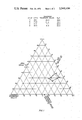
- the critical ranges of the liquid ruminant feed supplement are shown in the trilinear diagrams of FIGS. 1 and 2.
- the feed supplement consisting essentially of water, urea and ammonium phosphate, has to have a composition of these three ingredients laying within the area defined by the quadrangle ABCD, a polygon having four corners defined by the weight percentages of urea, ammonium phosphate and water as follows:
- This area is shown in FIG. 1.
- the lines A-D and B-C are actually crystallization temperature isotherms, A-D corresponding to a crystallization temperature of 32°F and B-C to one of 9°F; these isotherms are not quite straight; however the straight lines shown constitute a very good approximation, which is believed to be sufficient for the purpose of defining this invention.
Landscapes
- Life Sciences & Earth Sciences (AREA)
- Chemical & Material Sciences (AREA)
- Polymers & Plastics (AREA)
- Animal Husbandry (AREA)
- Birds (AREA)
- Zoology (AREA)
- Engineering & Computer Science (AREA)
- Food Science & Technology (AREA)
- Feed For Specific Animals (AREA)
- Fodder In General (AREA)
Abstract
A feed supplement consisting essentially of 100 parts by weight of dry urea, 22.1 to 46.4 parts by weight of ammonium phosphate solids and 126 to 174 parts by weight of water. In a further embodiment a feed supplement consisting essentially of urea, ammonium phosphate, molasses and water is disclosed.
Description
This is a continuation-in-part of our application Ser. No. 295,828, filed Oct. 10, 1972, which in turn is a continuation-in-part of application Ser. No. 102,885, filed Dec. 30, 1970, both now abandoned.
This invention relates to liquid ruminant feed supplement compositions. In another aspect, this invention relates to liquid supplement constituents which increase the utilization of non-protein-nitrogen compounds, convertible into organismal protein by ruminant animals. In yet another aspect, this invention relates to a liquid ruminant feed supplement composition characterized by low crystallization temperatures.
It has been recognized that non-protein nitrogenous compounds may be substituted for some of the protein in rations for ruminants. Some of the non-protein nitrogenous compounds which have been found to have high protein replacement values are urea and various ammonium salts. The addition of these compounds to livestock feed has been practiced for some time. Urea and the ammonium salts are economical and cost less than bona fide protein feed. These nitrogenous compounds when introduced to the rumen or pouch of an animal stimulate the microorganism present therein. Microorganisms in the stomach of the animal utilize the urea or ammonium salts to create protein. Protein is an essential constituent of all living cells, for the body tissues of all animals, muscle, internal organs, nervous systems, and external tissues are made up largely of protein materials. Animal life, accordingly, requires protein for growth, for replacement of body tissues and fluids and for the production of such animal products as milk, meat, and wool.
Heretofore, solutions containing a high content of urea have been shipped in heated containers or containers maintaining temperatures above the ambient in order to prevent crystallization. Such shipment involves higher transportation costs than materials which are liquid at ambient temperatures. As it may be some time between the mixing of a liquid supplement and its being made available to the ruminant, the liquid supplement is preferably not too viscous, does not crystallize, and is substantially immune to extremes of temperatures.
Urea in commercial form is crystalline, and it does not dissolve readily, especially at lower temperature ranges. Crystallization problems with urea and the various ammonium salts utilized as high protein supplements for ruminant animals continue to exist at relatively low ambient temperatures. The end use of the aforementioned supplement necessarily requires a solution wherein the supplements can be homogeneously dispersed with other feedstocks, for example, vitamins, roughage, and the like.
An object of this invention is to provide nitrogenous ruminant feed supplement compositions which can be maintained in a stable solution form over a period of time at relatively low ambient temperatures. Another object of this invention is to provide liquid ruminant feed supplement compositions characterized by relatively low crystallization temperatures. Other objects and advantages of this invention will become apparent to a person skilled in the art from the following detailed description of the invention, the appended claims and the drawing which shows two trilinear diagrams of the composition of the feed supplement.
We have discovered that certain nitrogenous compound solutions which have been found suitable for specialized applications in the chemical and fertilizer industries make excellent feed supplements for ruminants such as cattle, sheep, goats, and the like. These nitrogenous compounds constitute a class of aqueous, urea-ammonium polyphosphate solutions which can be readily shipped and stored in a liquid state due to their low crystallization temperatures. Ammonium polyphosphate is commonly supplied as a solution, 10-34-0 being commonly used. This solution is defined as an aqueous solution consisting of water and ammonium polyphosphate such as to have 10 weight percent nitrogen (N) and 34 weight percent P2 O5. The 10-34-0 has 58.05 weight percent solids and 41.95 weight percent water. Wherever 10-34-0 is mentioned, this composition is meant. Calculations on dry basis are also included.
The liquid ruminant feed supplement compositions of this invention utilize aqueous carriers selected from water and/or water-molasses blends. These solutions are characterized by crystallization temperatures below about 40°F. Many of these solutions are limited due to high viscosities at temperatures above the crystallization temperature. The solutions of this invention have acceptable viscosities below about 50,000 centipoises. The aforementioned class of solutions is characterized by a pH of between about 6 and about 7 with the urea content acting as a buffering agent.
Solutions only slightly outside the indicated ranges of proportions have crystallization temperatures well above 40°F and, hence, cannot be shipped or stored as liquids whenever the temperature falls below this temperature. Solutions which could provide lower crystallization temperatures contain too little urea to provide the desired balance as required by ruminant animal nutritional demands. Within the range of compositions of this invention, the urea reduces the viscosity of the aqueous carrier utilized, thus alleviating problems resulting from, for example, molasses which can become highly viscous and difficult to handle under cool temperatures. Apparently, the aqueous molasses blends also function as solvents for the urea, thus sharply decreasing the crystallization temperatures.
This invention therefore resides in a composition consisting essentially of 24.2 to 35.0 weight percent dry urea, 26.6 to 38.6 weight percent molasses solids, 8.6 to 15.8 weight percent ammonium phosphate solids, and 25.4 to 27.9 weight percent water, said composition being characterized as having a temperature of crystallization less than +36°F, and a viscosity that is sufficiently low for pumping the mixture at some temperatures less than about +36°F. In another embodiment, the invention resides in a composition consisting essentially of 22.1 to 46.4 parts by weight ammonium phosphate solids per 100 parts by weight of dry urea, and 126 to 174 parts by weight water per 100 parts by weight dry urea, said composition being characterized as having a temperature of crystallization less than about +40°F and which remains liquid at temperatures as low as +32°F and some of which remain liquid at temperatures as low as +14°F. The words "consisting of" as used herein are intended to exclude any larger amount of additives (such as CaCl2) or any additives which would destroy the desired properties. However, trace amounts of additives such as vitamins, hormones, minerals and stimulants for the growth of microflora can be present. The compositions may be applied to various solid feed materials or fed directly as a liquid to the ruminant.
Molasses derived from, for example, sugar cane, beets, citrus fruits, or corn, as those skilled in the art will understand, can also be admixed with the foregoing solutions displacing a portion of water thereof. In determining the amount of water present in the liquid ruminant feed supplement composition, the amount of water in the urea solution as well as the amount of water in the ammonium phosphate salt must be taken into consideration. The amount of water has a considerable effect upon crystallization temperatures of the aforementioned solutions at the lower temperatures. For example, an increase from about 25 to 28 weight percent total water lowers the crystallization temperature from about 32°F to about 9°F under the approximate ratio by weight of from 1:0.80 urea to 10-34-0 composition. Substituting molasses for a portion of the water has in effect improved the crystallization temperatures within the limits of the present invention. Apparently, the molasses also functions as a solvent for the urea, thus decreasing the crystallization temperature. Compositions of the aforementioned liquid ruminant feed supplement solutions contain the proper proportions of nitrogenous materials and can be readily transported in a tank car due to the aforementioned low crystallization temperatures for on site applications and mixing with carbohydrates and bulk feeds. The absence of acidic materials in the compositions greatly reduces corrosion of the storage vessels used. Various other urea feed supplement solutions have been made having compositions outside the above-defined range. These heretofore utilized compositions also have crystallization temperatures ranging far above the limitations set forth hereinabove and as exhibited by the composition of the present invention.
The term ammonium phosphate solids is used herein to designate the solids in the 10-34-0 or other ammonium phosphate solutions which are employed. In general, ammoniated phosphate solutions can be used which will supply the ammonium phosphate solids in the proper range of concentrations, such as, for example, 10-34-0, 11-37-0, solid ammonium phosphates or the ammonium phosphates can be prepared in situ by neutralizing phosphoric acids with ammonia. 11-37-0 Is defined as an aqueous solution consisting of water and ammonium phosphate such as to comprise 11 weight percent nitrogen (N) and 37 weight percent P2 O5.
The following Tables I and II further illustrate and define our invention as hereinabove descussed. Table I discloses seven example compositions of our invention wherein a portion of the aqueous carrier is comprised of 87.7° Brix molasses, for example, about 33 to 50 percent by weight. As can be seen from Table I, crystallization temperatures and viscosity limitations having temperatures below 40°F are characteristic of all seven compositions.
Table I is constructed on the basis of materials generally available commercially, i.e., 10-34-0 is a commonly available aqueous solution of ammonium polyphosphate, Brix molasses, a water-thinned molasses.
Table IA shows a breakdown of solids versus water considering the various sources given above.
Table II illustrates five compositions according to the compositions of our invention, all of which are characterized by crystallization temperatures of 40°F or below. The compositions of Table II use only water as the aqueous carrier and fully illustrate the preferred range of dry weight ratio, urea-to-ammonium polyphosphate compound to added water. Table IIA shows a breakdown of solids versus water based on the sources shown in Table II.
                                  TABLE I
__________________________________________________________________________
                                         °F High
          Added 87.7°   °F at which
                                         Viscosity
Run
   Dry
      Urea
          Water Brix
                   Molasses
                        10-34-0
                               Crystals Formed
                                         Limit.sup.(3)
g     Wt. %
          g Wt. %
                g  Wt. %
                        g  Wt. %
__________________________________________________________________________
1  15 28.8
          5  9.6
                20 38.5 12 23.1
                               None at -5
                                         -5
3  15 26.3
          5  8.8
                25 43.9 12 21.0
                               None at +1
                                         +1
4  15 24.2
          5  8.1
                30 48.3 12 19.4
                               None at -25
                                         -25
6  15 27.3
          5  9.1
                20 36.3 15 27.3
                               None at +9
                                         +9
2  21 35.0
          7 11.7
                20 33.3 12 20.0
                               None at +26
                                         +26
5  15 30.0
          5 10.0
                20 40.0 10 20.0
                               None at +36
                                         +36
7  15 31.9
          5 10.6
                20 42.6  7 14.9
                                 33      --
__________________________________________________________________________
 .sup.(3) High viscosity limit is considered to be a mixture viscosity
 greater than that at which the mixture can be pumped.
                                  TABLE IA
__________________________________________________________________________
Solids and Water Breakdown
              87.7° Brix.sup.(1)
                       10-34-0 Solution.sup.(2)
Urea Solution Molasses Phosphate
No.
   Dry Urea
         Water
              Solids
                   H.sub.2 O
                       Solids
                             H.sub.2 O
                                   Total Water
__________________________________________________________________________
1  28.8  9.6  30.8 7.7 13.4  9.7   27.0
3  26.3  8.8  35.1 8.8 12.2  8.8   26.4
4  24.2  8.1  38.6 9.7 11.3  8.1   25.9
6  27.3  9.1  29.0 7.3 15.8  11.5  27.9
2  35.0  11.7 26.6 6.7 11.6  8.4   26.8
5  30.0  10.0 32.0 8.0 11.6  8.4   26.4
7  31.9  10.6 34.1 8.5  8.6  6.3   25.4
__________________________________________________________________________
 .sup.(1) 87.7° Brix molasses is 20% water
 .sup.(2) 10-34-0 is 58.05 wt. % solids and 41.95 wt. % H.sub.2 O?
 All values in Table IA are weight percents.
              TABLE II
______________________________________
Parts by Weight        Crystallization
Run                       Added  Temperature
No.   Urea     10-34-0    Water  °F
______________________________________
1     100      38         110    40
2     100      38         120    30
3     100      50         110    17
4     100      50         120    14
5     100      80         140    32
______________________________________
              TABLE IIA
______________________________________
Solids and Water Breakdown
Run
No.    Urea (dry) Phosphate Solids
                                 Total Water
______________________________________
1      100        22.1           126
2      100        22.1           136
3      100        29.0           131
4      100        29.0           141
5      100        46.4           174
10-34-0 is 58.05 wt. % solids and 41.95 wt. % H.sub.2 O.
______________________________________
It is evident from the above examples that we have provided useful compositions of matter containing suitable urea-ammonium polysuperphosphate aqueous solution balance for use as a liquid ruminant feed supplement. The aforementioned supplement is characterized by low crystallization temperatures and can be shipped without requiring heated or insulated cars. Thus, the compositions of the invention can be readily transported and handled using standard pumping systems.
A study of the tables shows that where molasses is utilized, the composition is limited by either the temperature of crystallization of the composition or the viscosity of the composition which sharply increases to a value at which the mixture is not pumpable at very slight temperature changes to a lower temperature.
For a still better understanding of this invention the critical ranges of the liquid ruminant feed supplement are shown in the trilinear diagrams of FIGS. 1 and 2. The feed supplement, consisting essentially of water, urea and ammonium phosphate, has to have a composition of these three ingredients laying within the area defined by the quadrangle ABCD, a polygon having four corners defined by the weight percentages of urea, ammonium phosphate and water as follows:
               Ammonium
Urea           Phosphate Solids
                               Water
______________________________________
A       28.0       25.4            46.6
B       23.5       21.2            55.3
C       31.0       7.0             62.0
D       38.3       8.4             53.3
______________________________________
This area is shown in FIG. 1.
The values above have been calculated from the points defining the area of compositions for a feed supplement made from urea, 10-34 -0 and water. Since 10-34-0 contains 41.95 weight percent of water and 58.05 weight percent of ammonium phosphate solids, the quadrangle shown in FIG. 2 has a shape different from the area shown in FIG. 1, which is independent of the ammonium phosphate composition. The four corners ABCD of the polygon shown in FIG. 2 are defined by the weight percentages of urea, 10-34-0 and additional water as follows:
Urea          10-34-0     Additional Water
______________________________________
A       28.0      43.8        28.2
B       23.5      36.6        39.9
C       31.0      12.0        57.0
D       38.3      14.5        47.2
______________________________________
The lines A-D and B-C are actually crystallization temperature isotherms, A-D corresponding to a crystallization temperature of 32°F and B-C to one of 9°F; these isotherms are not quite straight; however the straight lines shown constitute a very good approximation, which is believed to be sufficient for the purpose of defining this invention.
Reasonable variations and modifications, which will be apparent to those skilled in the art, can be made in this invention without departing from the spirit and scope thereof.
Claims (3)
1. A composition of matter consisting essentially of urea, ammonium phosphate and water, the weight percentages of the constituents being such as to fall within the polygon of four corners ABC and D drawn in a trilinear diagram defined by the weight percentages of the constituents as follows and as shown in FIG. 1:
               Ammonium
Urea           Phosphate Solids
                               Water
______________________________________
A       28.0       25.4            46.6
B       23.5       21.2            55.3
C       31.0       7               62.0
D       38.3       8.4              53.3.
______________________________________
2. Liquid animal feed supplement consisting essentially of:
urea, 22.1 to 46.4 parts by weight ammonium phosphate solids per 100 parts by weight urea and 126 to 174 parts by weight of water per 100 parts by weight of urea, the urea being calculated as urea in the water free state, said supplement having a crystallization temperature less than about 40°F.
3. Liquid animal feed supplement consisting essentially of:
24.2 to 35.0 weight percent of urea calculated as urea in the water free state, 26.6 to 38.6 weight percent molasses solids, 8.6 to 15.8 weight percent ammonium phosphate solids, and 25.4 to 27.9 weight percent of water, said liquid feed supplement having a temperature of crystallization less than +36°F. and a viscosity that is sufficiently low for pumping the mixture at temperatures less than about 36°F.
Priority Applications (1)
| Application Number | Priority Date | Filing Date | Title |
|---|---|---|---|
| US05/492,830 US3940494A (en) | 1972-10-10 | 1974-07-29 | Liquid ruminant feed supplement |
Applications Claiming Priority (2)
| Application Number | Priority Date | Filing Date | Title |
|---|---|---|---|
| US29582872A | 1972-10-10 | 1972-10-10 | |
| US05/492,830 US3940494A (en) | 1972-10-10 | 1974-07-29 | Liquid ruminant feed supplement |
Related Parent Applications (1)
| Application Number | Title | Priority Date | Filing Date |
|---|---|---|---|
| US29582872A Continuation-In-Part | 1972-10-10 | 1972-10-10 |
Publications (1)
| Publication Number | Publication Date |
|---|---|
| US3940494A true US3940494A (en) | 1976-02-24 |
Family
ID=26969358
Family Applications (1)
| Application Number | Title | Priority Date | Filing Date |
|---|---|---|---|
| US05/492,830 Expired - Lifetime US3940494A (en) | 1972-10-10 | 1974-07-29 | Liquid ruminant feed supplement |
Country Status (1)
| Country | Link |
|---|---|
| US (1) | US3940494A (en) |
Cited By (1)
| Publication number | Priority date | Publication date | Assignee | Title |
|---|---|---|---|---|
| US4267197A (en) * | 1978-06-21 | 1981-05-12 | Pacific Kenyon Corporation | Animal feed supplement as a thixotropic stable suspension |
Citations (1)
| Publication number | Priority date | Publication date | Assignee | Title |
|---|---|---|---|---|
| US3523798A (en) * | 1967-09-13 | 1970-08-11 | Ralph L Kail | Liquid feed supplement for ruminants and method of preparation |
-
1974
- 1974-07-29 US US05/492,830 patent/US3940494A/en not_active Expired - Lifetime
Patent Citations (1)
| Publication number | Priority date | Publication date | Assignee | Title |
|---|---|---|---|---|
| US3523798A (en) * | 1967-09-13 | 1970-08-11 | Ralph L Kail | Liquid feed supplement for ruminants and method of preparation |
Cited By (1)
| Publication number | Priority date | Publication date | Assignee | Title |
|---|---|---|---|---|
| US4267197A (en) * | 1978-06-21 | 1981-05-12 | Pacific Kenyon Corporation | Animal feed supplement as a thixotropic stable suspension |
Similar Documents
| Publication | Publication Date | Title |
|---|---|---|
| US4234608A (en) | Process of manufacturing feed blocks and products thereof | |
| US4729896A (en) | Buffered animal feed supplement block | |
| US3420672A (en) | Stable emulsion animal feed containing molasses and method of producing same | |
| US4888185A (en) | Animal feed supplement suspension | |
| US5217740A (en) | High moisture ration | |
| US3794740A (en) | Ruminant direct feeding suspension supplement | |
| DK145215B (en) | FOOD CONSERVANT | |
| US3669676A (en) | Feed intake limiting composition for cattle | |
| WO1980000401A1 (en) | Animal feed supplement package | |
| US4994282A (en) | Solid animal feed supplement and method for its production | |
| CA1132835A (en) | Milk substitutes | |
| US4600586A (en) | Livestock feed lot adaptation composition and method | |
| US3962484A (en) | Method for preparing liquid feed supplements containing calcium chloride | |
| US4798727A (en) | Solid animal feed supplement and method for its production | |
| US3413118A (en) | Livestock feed and the method of making same | |
| US4219572A (en) | Suspension stabilization of MgO in liquid feed supplements using xanthan gum | |
| US2760866A (en) | Feeding ration product | |
| US3523798A (en) | Liquid feed supplement for ruminants and method of preparation | |
| US3940494A (en) | Liquid ruminant feed supplement | |
| US4804546A (en) | Stable fat suspension feed supplement | |
| US3753722A (en) | Animal feed supplement | |
| US3325289A (en) | Fluid sugar residues containing watersoluble alkali metal polyphosphate and processes | |
| US5252346A (en) | Animal feed supplement | |
| US6162442A (en) | Use of aqueous L-Tryptophan and/or L-Threonine salt solutions | |
| US3248224A (en) | Liquid ruminant supplement |