US3882295A - Tactile feedback switch mechanism - Google Patents
Tactile feedback switch mechanism Download PDFInfo
- Publication number
- US3882295A US3882295A US403372A US40337273A US3882295A US 3882295 A US3882295 A US 3882295A US 403372 A US403372 A US 403372A US 40337273 A US40337273 A US 40337273A US 3882295 A US3882295 A US 3882295A
- Authority
- US
- United States
- Prior art keywords
- cam follower
- switch
- cam
- plunger
- carrier
- Prior art date
- Legal status (The legal status is an assumption and is not a legal conclusion. Google has not performed a legal analysis and makes no representation as to the accuracy of the status listed.)
- Expired - Lifetime
Links
- 230000007246 mechanism Effects 0.000 title claims abstract description 16
- 230000000994 depressogenic effect Effects 0.000 claims description 9
- 238000013479 data entry Methods 0.000 abstract description 2
- 238000006073 displacement reaction Methods 0.000 description 16
- 230000008713 feedback mechanism Effects 0.000 description 5
- 230000005291 magnetic effect Effects 0.000 description 4
- 230000000694 effects Effects 0.000 description 2
- 241000237519 Bivalvia Species 0.000 description 1
- 230000005355 Hall effect Effects 0.000 description 1
- 235000020639 clam Nutrition 0.000 description 1
- 230000007797 corrosion Effects 0.000 description 1
- 238000005260 corrosion Methods 0.000 description 1
- 230000000881 depressing effect Effects 0.000 description 1
- 238000010586 diagram Methods 0.000 description 1
- 230000003993 interaction Effects 0.000 description 1
- 230000004048 modification Effects 0.000 description 1
- 238000012986 modification Methods 0.000 description 1
Images

Classifications
-
- H—ELECTRICITY
- H01—ELECTRIC ELEMENTS
- H01H—ELECTRIC SWITCHES; RELAYS; SELECTORS; EMERGENCY PROTECTIVE DEVICES
- H01H13/00—Switches having rectilinearly-movable operating part or parts adapted for pushing or pulling in one direction only, e.g. push-button switch
- H01H13/50—Switches having rectilinearly-movable operating part or parts adapted for pushing or pulling in one direction only, e.g. push-button switch having a single operating member
Definitions
- ABSTRACT [22] Filed: 1973 A feedback switch. mechanism for :a manually oper- [21] o ated, nonmechanical switch for keyboards, and the like, is provided through use of a spring-loaded cam follower carrier that has a cam follower which follows [52] Clww 200/159 340/365 R; 197/98 a cam surface that is integrally formed on the plunger [51] Int. Cl.
- the UNITED STATES PATENTS cam follower carrier is preferably a one-piece plastic 3,375,340 3/1968 Wright 200/160 member.
- Nonmechanical switches for use in keyboards. and the like, are being utilized to an increasingly extent in modern electronics systems.
- mechanical switches tend to become unreliable after a large number of operations, due to corrosion and pitting of the contacts and to other mechanical failures.
- mechanical switches there is always the problem of contact bounce which creates noise signals that can interfere with the proper operation of the associated device.
- a number of types of switches including electronic, magnetic, and Halleffect devices have been designed to provide a nonmechanical electrical switching action.
- One such device, with which the present invention may be employed, is shown in US. Pat. No. 3,638,221 issued in the name of Victor M. Bernin on Jan.
- a saturable magnetic core and a pair of permanent magnets are employed.
- the permanent magnets are attached to a keystem that is depressed by the operator. which changes the state of magnetic saturation of the magnetic core, thereby determining whether or not an output signal will be produced.
- an object of the present invention to provide a spring-loaded cam follower which is integrally formed on a cam follower carrier and is actuated by a cam that is integrally formed on theactuator of a manually operated, nonmechanical switch, wherein actuation of the actuator causes a force build-up and re lease which simulates mechanicalswitch actuation to the operator.
- the feedback mechanism comprises a three-dimensional cam integrally formed on the plunger of the switch, and a cam follower carrier which is removably secured to the housing of the switch and is biased by a spring that is inserted in a cavity in the housing so that the cam follower carrier is movable along a first axis and wherein the cam follower carrier has a resilient arm that carries the cam follower so that the cam follower is movable along a second axis as the plunger is released from its fully depressed position.
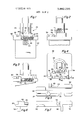
- FIG. I is a side view of the tactile feedback switch of the present invention with a partial cross-sectional showing the carrier bias spring and the plunger return spring with the plunger in its undepressed position;
- FIG. 2 is an end view of the switch with the plunger in its undepressed position
- FIG. 3 is a partial side view, which is similar to the showing of FIG. 1, but with the plunger depressed almost to the breakaway point;
- FIG. 4 is a top view showing the tactile feedback mechanism in place on the switch housing
- FIG. 5 is a top view of the cam follower carrier removed from the switch housing
- FIG. 6 is an end view of the cam follower carrier
- FIG. 7 is a side view of the cam follower carrier
- FIG. 8 is a plan view of the cam portion of the switch 7 plunger
- FIG. 9 is a side elevation of the cam portion of the plunger.
- FIG. 10 is a force vs. displacement diagram for the plunger of the switch.
- the tactile feedback switch mechanism of the present invention is applicable to manually operated, nonmechanical keyboard switches, and other types of switches, which require that stimuli be presented to the operator so that he is assured thatactuation of the switch has actually occurred.
- the stimuli that is presented to the operator includes both mechanical "feel and noise.
- "Feel” is accomplished by means of a cam on the plunger of the switch and a cam follower on a spring-loaded cam follower carrier. The loaded spring is selected to control the force buildup and force release which occurs upon depression of the switch plunger. Noise is provided by the striking of the cam follower on a portion of the housing after the breakaway point is passed.
- the present invention is a relatively inexpensive addition to a nonmechanical switch, since it adds only two new components to the switch and requires modification of only the plunger and the housing of the switch.
- the two new components that are added area plastic one-piece camfollower carrier and a coiled bias spring for the carrier.
- the plunger of the switch which is preferably made of plastic, must be designed to include an integral cam
- the housing which is also perferably made of plastic, includes a cavity that receives the coiled bias spring, a stop means for the cam follower carrier and retaining tabs for the carrier.
- the mechanism has versatility since the force vs. displacement characteristic of the plunger can be predetermined by preselection of the appropriate coiled bias spring and/or cam configurationfln addition, the mechanism is advantageous because of its linear return characteristic, which results from the fact that the return of the plunger to its initial position after full depression is governed almost entirely by the spring characteristics of the plunger return spring.
- a nonmechanical switch is shown generally by the reference numeral 20 in FIG. 1.
- This switch may be of the type shown in the previously mentioned U.S. Pat. No. 3,638,221, but the particular type of switch mechanism that is employed is not of importance with respect to the present invention.
- the switch mechanism itself is housed in the housing 22 and it is actuated by depressing the plunger 24.
- the housing 22 and the plunger 24 are preferably formed of plastic.
- the tactile feedback mechanism of the present invention requires the addition of only two new parts to the nonmechanical switch mechanism of the switch 20.
- One of these parts is a one-piece cam follower carrier, preferably molded of plastic, that is formed as shown in FIG. 5.
- the other part is the coiled bias spring 28 for the cam follower carrier 26.
- the cam follower carrier 26 has a front wing 30 and a rear wing 32 which slides under the front and rear retaining tabs 34 and 36, respectively, so that the rear end 38 of the cam follower 26 abuts against the stop member 40 that is integrally formed on the switch housing 22.
- the cam follower 26 is removable from the switch housing 22 by the application of pressure on the cam follower carrier 26 so as to displace it to the right, as shown in FIG. 4 and by lifting it up when the notch 43 reaches the tabs 34.
- the plunger 24 carries the integrally molded cam 42. When the plunger is in an undepressed position, as shown in FIG. 1, the end 38 of the cam follower carrier 26 is in abutment with the stop member 40.
- the cam follower carrier 26 has a resilient arm 44 which is integrally formed on the front 30 so that it is supported in cantilever fashion and extends towards the rear wing 32.
- a cam follower 46 is integrally formed on the end of the arm' 44, which is preferably of a generally circular cross-sectional shape. With the plunger 24 undepressed, the cam follower 46 rests in the cam slot 48, as shown in FIG. 8, at its lower most position 50.
- a tongue 52 Extending from the bottom of the cam follower carrier 26 is a tongue 52.
- the tongue 52 is utilized to receive one end of the coiled spring 28, the other end of which engages the righthand wall 56 of the generally rectangular shaped cavity 58 that is formed in the upper portion of the housing 22.
- the longitudinal axis of the coiled bias spring 28 lies along a line substantially parallel to the longitudinal axis of the elongated cam follower carrier.
- the left side of the cavity 58 is provided with a notch 60 of narrower dimensions than the remainder of the cavity 58 for receiving the cam follower carrier 26 when the plunger 24 is not depressed.
- the return spring 62 for the plunger 24 is inserted to abut the plunger wall 64 at its upper end and a portion of the housing or the switch mechanism at its lower end.
- FIG. 8 shows an enlarged view of the cam section 42, which is integrally formed on the plunger 24. Interaction between the cam 42 and the cam follower 46 and between the cam follower carrier 26 and the bias spring 28 determines the force build-up and release characteristics of the switch during depression of the plunger 24 to the breakaway point 66 of the cam 42.
- the return spring 62 for the plunger 24 substantially determines by itself the return characteristics of the switch once the breakaway point 66 has been reached.
- the cam follower 42 With the plunger 24 in its undepressed position. as shown in FIG. 1, the cam follower 42 is initially at its lower most point 50 on the cam 42. This point corresponds to the origin of the force vs. displacement curve of FIG. 10. A small amount of force is initially required to produce any displacement at all due to frictional resistance and the initial loading effect of the return spring 62. The force required to overcome the initial loading is represented by line 68 in FIG. 10. As the force is increased and the plunger 24 is depressed, the cam follower 46 moves relative to the cam 42 so that it rides in the groove 48 of the cam 42 to the point 70. Up to the point 70 the coiled bias spring 28 has not been compressed.
- cam follower 46 When the cam follower 46 is delivered past the breakaway point 66 by further depression of the plunger 24, the cam follower 46 is abruptly delivered to the left to the point 76. This is due to the force release effect of the spring 28 acting upon the cam follower carrier 26. When the cam follower carrier 26 is delivered to the point 76, the left end 38 of the carrier strikes the stop member 40 on the housing thereby providing actuation noise that may be heard by the operator.
- the force vs. displacement curve of FIG. 10 shows that once the breakaway point 66 has been passed the force release of the spring 28 reduces the amount of force necessary to maintain the plunger 24 at its same level along its vertical axis of displacement.
- the minimum amount of force that is necessary to accomplish this is represented by the line in FIG. 10. This amount of force is not sufficient to completely bottom the plunger, which occurs when the cam follower 46 is delivered along the base level to the point 82, since the return spring 62 for the plunger 24 is also compressed slightly as the plunger is delivered beyond the breakaway point 66.
- the minimum amount of force required to deliver the plunger to its bottom displacement is represented by the line 84.
- the bottom displacement position is represented by the line 86. Actuation of the switch normally occurs in the vicinity of the breakaway point 66 before the plunger 24 is bottomed.
- the cam follower 46 After the cam follower carrier 26 has been returned to its left most position along its horizontal axis of displacement, the cam follower 46 must be returned to its initial point 50. To accomplish this, the cam 42 has a sloped ramp section 86 which has a rear edge 88 that is further removed from the base level 90 than is the front edge 92. The cam follower 46 not delivered from the point 76 to the point 50 traverses the ramp section 86 and then passes over the flat portion 94 and finally goes over the dropoff into the cavity 96 where upon it returns to its initial point 50 upon return of the plunger to its undepressed position.
- the arm 44 flexes in and out along an axis of displacement that is substantially normal to the vertical axis of displacement of the plunger 24, and also to the horizontal axis of displacement of the cam follower 26, as represented in FIG. 4 by the arrows that are placed adjacent to the cam follower 46.
- the arrows adjacent to the plunger 24 in-FlG. 1 represent the notch of the plunger 24 along the vertical axis, while the arrows adjacent to the cam follower carrier 26 in FlG. 3 represent the horizontal movement of the cam follower.
- a manually operated electrical switch comprising a switching mechanism, a housing comprising a cavity and first and second pairs of retaining tabs, a plunger depressable along a first axis and comprising a cam, a return spring for said plunger, a unitary cam follower carrier comprising first and second spaced apart wing members, said first pair of retaining tabs being constructed to overlap said first wing member and said second pair of retaining tabs being constructed to overlap said second wing member, said cam follower carrier being displaceable with respect to said housing along a second axis that is substantially normal to said first axis and comprising a tongue which projects into said housing cavity and a resilient arm having a cam follower thereon, a coiled bias spring positioned in said cavity between said tongue and a wall of said cavity for biasing said cam carrier follower to an initial position and said cam carrier to a first point, said resilient arm being displaceable along a third axis that is substantially normal to both said first axis and second axis with said cam follow
- a switch as set forth in claim 5 wherein said second portion of said cam comprises a ramp which slopes upwardly from said second point to a flat portion which then drops off rapidly to a cavity defining said first point.
Landscapes
- Push-Button Switches (AREA)
- Input From Keyboards Or The Like (AREA)
Abstract
A feedback switch mechanism for a manually operated, nonmechanical switch for keyboards, and the like, is provided through use of a spring-loaded cam follower carrier that has a cam follower which follows a cam surface that is integrally formed on the plunger of the switch. Upon depression of the plunger, a force build-up and release occurs due to the action of a bias spring on the cam follower carrier which simulates the actuation of a mechanical switch so that the operator is assured that a data entry has been completed. The cam follower carrier is preferably a one-piece plastic member.
Description
. United States Patent 1191 Madland [45] May 6, 1975 TACTILE FEEDBACK SWITCH 3.757.068 9/1973 Muschim'. 200/159 R MECHANISM 3,767,022, .l0/l973 Olson ZOO/I59 R X [75] Inventor: gfg g f fi Madland Mount Primary Examiner-Robert K. Schaefer p Assistant Examiner-William J. Smith [731 Assignee; Illinois Tool Works Inc., Chicago,
Ill. 57] ABSTRACT [22] Filed: 1973 A feedback switch. mechanism for :a manually oper- [21] o ated, nonmechanical switch for keyboards, and the like, is provided through use of a spring-loaded cam follower carrier that has a cam follower which follows [52] Clww 200/159 340/365 R; 197/98 a cam surface that is integrally formed on the plunger [51] Int. Cl. H0lh 13/52 f the switch U d ression of the plunger; 21 force [58] F'eld Search 200/159 R 160; 197/98; build-up and release occurs due to the action of a bias 340/3 65 spring on the cam follower carrier which simulates the 7 actuation of a mechanical switch so that the'operator [56] References and is assured that a data entry has been completed, The UNITED STATES PATENTS cam follower carrier is preferably a one-piece plastic 3,375,340 3/1968 Wright 200/160 member. 7 3,387,184 6/1968 Angold 3,542,988 11/1970 Baldasare....., 200/153 J x 6 clams 10 Drawing f 24 F 4,52 A/ZO 38 7/ 7 PATENIEUMAY 61975 3.882295 sum U10F2 52 Fig 6 30 Fig 7 52-U 32 PATENIEDHAY 81975 3,882,295
+ Fig.9 9
Fig. 8
MS/A I z I i I g i FORCE DISPLACEMENT Fig. /0
TACTILE FEEDBACK SWITCH MECHANISM BACKGROUND OF THE INVENTION Nonmechanical switches for use in keyboards. and the like, are being utilized to an increasingly extent in modern electronics systems. One of the major reasons for this is that mechanical switches tend to become unreliable after a large number of operations, due to corrosion and pitting of the contacts and to other mechanical failures. In addition, with mechanical switches there is always the problem of contact bounce which creates noise signals that can interfere with the proper operation of the associated device. A number of types of switches including electronic, magnetic, and Halleffect devices have been designed to provide a nonmechanical electrical switching action. One such device, with which the present invention may be employed, is shown in US. Pat. No. 3,638,221 issued in the name of Victor M. Bernin on Jan. 25, 1972, and assigned to the assignee of the present invention. In the switch of this patent, a saturable magnetic core and a pair of permanent magnets are employed. The permanent magnets are attached to a keystem that is depressed by the operator. which changes the state of magnetic saturation of the magnetic core, thereby determining whether or not an output signal will be produced.
While several of the nonmechanical switches, which have been developed, perform in a satisfactorily manner in many applications, they tend to be viewed unfavorably for many other applications because of the fact that the operator has no positive indication when a switch has been operated. This is due to the lack of noise or feel" in these switches resulting from the fact that no substantial mechanical action has taken place. Consequently, even though a nonmechanical, manually operated switch may be extremely reliable in itself, the increase of operator error that results during the use of the switches tends to restrict their wide scale application.
It is, therefore, an object of the present invention to provide a spring-loaded cam follower which is integrally formed on a cam follower carrier and is actuated by a cam that is integrally formed on theactuator of a manually operated, nonmechanical switch, wherein actuation of the actuator causes a force build-up and re lease which simulates mechanicalswitch actuation to the operator.-
It is an additional object of the present invention to provide a tactile feedback mechanism for keyboard switches, and the like, which require such provisions in order to reduce operator error, wherein the feedback mechanism comprises a three-dimensional cam integrally formed on the plunger of the switch, and a cam follower carrier which is removably secured to the housing of the switch and is biased by a spring that is inserted in a cavity in the housing so that the cam follower carrier is movable along a first axis and wherein the cam follower carrier has a resilient arm that carries the cam follower so that the cam follower is movable along a second axis as the plunger is released from its fully depressed position.
It is a further object of the present invention to provide a tactile feedback mechanism which may be secured to the housing of a manually operated, nonmechanical switch comprising a cam integrally formed on the plunger of the switch, a cam follower carrier, and a coiled spring inserted in a cavity in the housing for resiliently biasing the cam follower carrier along an axis of displacement normal to the axis of displacement of the plunger wherein the force vs. displacement characteristics of the switch during depression of the plunger may be predetermined by selection of the coiled spring and/or cam configuration that is used.
DESCRIPTION OF THE DRAWINGS The present invention is shown in the following drawings in which:
FIG. I is a side view of the tactile feedback switch of the present invention with a partial cross-sectional showing the carrier bias spring and the plunger return spring with the plunger in its undepressed position;
FIG. 2 is an end view of the switch with the plunger in its undepressed position;
FIG. 3 is a partial side view, which is similar to the showing of FIG. 1, but with the plunger depressed almost to the breakaway point;
FIG. 4 is a top view showing the tactile feedback mechanism in place on the switch housing;
FIG. 5 is a top view of the cam follower carrier removed from the switch housing;
FIG. 6 is an end view of the cam follower carrier;
FIG. 7 is a side view of the cam follower carrier;
FIG. 8 is a plan view of the cam portion of the switch 7 plunger;
FIG. 9 is a side elevation of the cam portion of the plunger; and
FIG. 10 is a force vs. displacement diagram for the plunger of the switch.
TECHNICAL DESCRIPTION OF THE INVENTION The tactile feedback switch mechanism of the present invention is applicable to manually operated, nonmechanical keyboard switches, and other types of switches, which require that stimuli be presented to the operator so that he is assured thatactuation of the switch has actually occurred. The stimuli that is presented to the operator includes both mechanical "feel and noise. "Feel" is accomplished by means of a cam on the plunger of the switch and a cam follower on a spring-loaded cam follower carrier. The loaded spring is selected to control the force buildup and force release which occurs upon depression of the switch plunger. Noise is provided by the striking of the cam follower on a portion of the housing after the breakaway point is passed.
The present invention is a relatively inexpensive addition to a nonmechanical switch, since it adds only two new components to the switch and requires modification of only the plunger and the housing of the switch. The two new components that are added area plastic one-piece camfollower carrier and a coiled bias spring for the carrier. The plunger of the switch, which is preferably made of plastic, must be designed to include an integral cam, and the housing, which is also perferably made of plastic, includes a cavity that receives the coiled bias spring, a stop means for the cam follower carrier and retaining tabs for the carrier.
In addition to the relatively low cost of the mechanism of the present invention and its simplicity of design, the mechanism has versatility since the force vs. displacement characteristic of the plunger can be predetermined by preselection of the appropriate coiled bias spring and/or cam configurationfln addition, the mechanism is advantageous because of its linear return characteristic, which results from the fact that the return of the plunger to its initial position after full depression is governed almost entirely by the spring characteristics of the plunger return spring.
A nonmechanical switch is shown generally by the reference numeral 20 in FIG. 1. This switch may be of the type shown in the previously mentioned U.S. Pat. No. 3,638,221, but the particular type of switch mechanism that is employed is not of importance with respect to the present invention. The switch mechanism itself is housed in the housing 22 and it is actuated by depressing the plunger 24. The housing 22 and the plunger 24 are preferably formed of plastic. The tactile feedback mechanism of the present invention requires the addition of only two new parts to the nonmechanical switch mechanism of the switch 20. One of these parts is a one-piece cam follower carrier, preferably molded of plastic, that is formed as shown in FIG. 5. The other part is the coiled bias spring 28 for the cam follower carrier 26. The cam follower carrier 26 has a front wing 30 and a rear wing 32 which slides under the front and rear retaining tabs 34 and 36, respectively, so that the rear end 38 of the cam follower 26 abuts against the stop member 40 that is integrally formed on the switch housing 22. The cam follower 26 is removable from the switch housing 22 by the application of pressure on the cam follower carrier 26 so as to displace it to the right, as shown in FIG. 4 and by lifting it up when the notch 43 reaches the tabs 34. The plunger 24 carries the integrally molded cam 42. When the plunger is in an undepressed position, as shown in FIG. 1, the end 38 of the cam follower carrier 26 is in abutment with the stop member 40. The cam follower carrier 26 has a resilient arm 44 which is integrally formed on the front 30 so that it is supported in cantilever fashion and extends towards the rear wing 32. A cam follower 46 is integrally formed on the end of the arm' 44, which is preferably of a generally circular cross-sectional shape. With the plunger 24 undepressed, the cam follower 46 rests in the cam slot 48, as shown in FIG. 8, at its lower most position 50.
Extending from the bottom of the cam follower carrier 26 is a tongue 52. The tongue 52 is utilized to receive one end of the coiled spring 28, the other end of which engages the righthand wall 56 of the generally rectangular shaped cavity 58 that is formed in the upper portion of the housing 22. The longitudinal axis of the coiled bias spring 28 lies along a line substantially parallel to the longitudinal axis of the elongated cam follower carrier. The left side of the cavity 58 is provided with a notch 60 of narrower dimensions than the remainder of the cavity 58 for receiving the cam follower carrier 26 when the plunger 24 is not depressed. The return spring 62 for the plunger 24 is inserted to abut the plunger wall 64 at its upper end and a portion of the housing or the switch mechanism at its lower end.
Operation of the switch mechanism of the present invention can best be understood by reference to FIGS. 8, 9 and 10. FIG. 8 shows an enlarged view of the cam section 42, which is integrally formed on the plunger 24. Interaction between the cam 42 and the cam follower 46 and between the cam follower carrier 26 and the bias spring 28 determines the force build-up and release characteristics of the switch during depression of the plunger 24 to the breakaway point 66 of the cam 42. The return spring 62 for the plunger 24 substantially determines by itself the return characteristics of the switch once the breakaway point 66 has been reached.
With the plunger 24 in its undepressed position. as shown in FIG. 1, the cam follower 42 is initially at its lower most point 50 on the cam 42. This point corresponds to the origin of the force vs. displacement curve of FIG. 10. A small amount of force is initially required to produce any displacement at all due to frictional resistance and the initial loading effect of the return spring 62. The force required to overcome the initial loading is represented by line 68 in FIG. 10. As the force is increased and the plunger 24 is depressed, the cam follower 46 moves relative to the cam 42 so that it rides in the groove 48 of the cam 42 to the point 70. Up to the point 70 the coiled bias spring 28 has not been compressed. As depression of the plunger continues, the cam follower 46 moves relative to the cam 42 so that it travels along the inclined wall 72. At this time, the cam follower carrier 26 is forced to the left, as shown in FIG. 7, by the bias spring 28 until the cam follower 46 reaches the breakaway point 66. The position of the plunger 24 and the cam follower carrier 26 at the breakaway point 66 is shown in FIG. 3. The amount of force needed to depress the plunger 24 during this segment of travel continually increases as a function of the spring characteristic of the bias spring 28, as represented by the line 74 in FIG. 10.
When the cam follower 46 is delivered past the breakaway point 66 by further depression of the plunger 24, the cam follower 46 is abruptly delivered to the left to the point 76. This is due to the force release effect of the spring 28 acting upon the cam follower carrier 26. When the cam follower carrier 26 is delivered to the point 76, the left end 38 of the carrier strikes the stop member 40 on the housing thereby providing actuation noise that may be heard by the operator.
The force vs. displacement curve of FIG. 10 shows that once the breakaway point 66 has been passed the force release of the spring 28 reduces the amount of force necessary to maintain the plunger 24 at its same level along its vertical axis of displacement. The minimum amount of force that is necessary to accomplish this is represented by the line in FIG. 10. This amount of force is not sufficient to completely bottom the plunger, which occurs when the cam follower 46 is delivered along the base level to the point 82, since the return spring 62 for the plunger 24 is also compressed slightly as the plunger is delivered beyond the breakaway point 66. The minimum amount of force required to deliver the plunger to its bottom displacement is represented by the line 84. The bottom displacement position is represented by the line 86. Actuation of the switch normally occurs in the vicinity of the breakaway point 66 before the plunger 24 is bottomed.
After the cam follower carrier 26 has been returned to its left most position along its horizontal axis of displacement, the cam follower 46 must be returned to its initial point 50. To accomplish this, the cam 42 has a sloped ramp section 86 which has a rear edge 88 that is further removed from the base level 90 than is the front edge 92. The cam follower 46 not delivered from the point 76 to the point 50 traverses the ramp section 86 and then passes over the flat portion 94 and finally goes over the dropoff into the cavity 96 where upon it returns to its initial point 50 upon return of the plunger to its undepressed position. The arm 44, during this time, flexes in and out along an axis of displacement that is substantially normal to the vertical axis of displacement of the plunger 24, and also to the horizontal axis of displacement of the cam follower 26, as represented in FIG. 4 by the arrows that are placed adjacent to the cam follower 46. The arrows adjacent to the plunger 24 in-FlG. 1 represent the notch of the plunger 24 along the vertical axis, while the arrows adjacent to the cam follower carrier 26 in FlG. 3 represent the horizontal movement of the cam follower. Upon return of the plunger 24 to its undepressed position, the return force on it is controlled substantially entirely by the return spring 62, as represented by the line 98 in FIG. 10.
While the present invention has been described by references to a specific embodiment, other embodiments and versions within the scope of the present invention will be apparent to those skilled in the art.
What is claimed is:
l. A manually operated electrical switch comprising a switching mechanism, a housing comprising a cavity and first and second pairs of retaining tabs, a plunger depressable along a first axis and comprising a cam, a return spring for said plunger, a unitary cam follower carrier comprising first and second spaced apart wing members, said first pair of retaining tabs being constructed to overlap said first wing member and said second pair of retaining tabs being constructed to overlap said second wing member, said cam follower carrier being displaceable with respect to said housing along a second axis that is substantially normal to said first axis and comprising a tongue which projects into said housing cavity and a resilient arm having a cam follower thereon, a coiled bias spring positioned in said cavity between said tongue and a wall of said cavity for biasing said cam carrier follower to an initial position and said cam carrier to a first point, said resilient arm being displaceable along a third axis that is substantially normal to both said first axis and second axis with said cam follower being in engagement with a first portion of said cam as said plunger is depressed to a breakaway point, said cam follower carrier being directed along said second axis against the force of said bias spring as said plunger is depressed beyond said breakaway point so that said cam follower is abruptly driven to a second point, said cam follower carrier being returned substantially to its initial position along said second axis as said plunger completes its return to its undepressed position aided by the force of said return spring with said cam follower completing its return to said first point over a second portion of said cam as a result of a deflection of said resilient arm along said third axis.
2. A switch as set forth in claim 1 wherein said resilient arm is supported in cantilever fashion.
3. A switch as set forth in claim 1 wherein said housing comprises a stop means and said cam follower carrier is driven against said stop means when said cam follower is driven to said second point so as to provide a noise indication of the operation of the switch.
4. A switch as set forth in claim 3 wherein said resilient arm is supported in cantilever fashion.
5. A switch as set forth in claim 4 wherein said resilient arm is supported from said first wing member and the portion of said cam follower carrier which strikes said stop means is adjacent said second wing member.
6. A switch as set forth in claim 5 wherein said second portion of said cam comprises a ramp which slopes upwardly from said second point to a flat portion which then drops off rapidly to a cavity defining said first point.
Claims (6)
1. A manually operated electrical switch comprising a switching mechanism, a housing coMprising a cavity and first and second pairs of retaining tabs, a plunger depressable along a first axis and comprising a cam, a return spring for said plunger, a unitary cam follower carrier comprising first and second spaced apart wing members, said first pair of retaining tabs being constructed to overlap said first wing member and said second pair of retaining tabs being constructed to overlap said second wing member, said cam follower carrier being displaceable with respect to said housing along a second axis that is substantially normal to said first axis and comprising a tongue which projects into said housing cavity and a resilient arm having a cam follower thereon, a coiled bias spring positioned in said cavity between said tongue and a wall of said cavity for biasing said cam carrier follower to an initial position and said cam carrier to a first point, said resilient arm being displaceable along a third axis that is substantially normal to both said first axis and second axis with said cam follower being in engagement with a first portion of said cam as said plunger is depressed to a breakaway point, said cam follower carrier being directed along said second axis against the force of said bias spring as said plunger is depressed beyond said breakaway point so that said cam follower is abruptly driven to a second point, said cam follower carrier being returned substantially to its initial position along said second axis as said plunger completes its return to its undepressed position aided by the force of said return spring with said cam follower completing its return to said first point over a second portion of said cam as a result of a deflection of said resilient arm along said third axis.
2. A switch as set forth in claim 1 wherein said resilient arm is supported in cantilever fashion.
3. A switch as set forth in claim 1 wherein said housing comprises a stop means and said cam follower carrier is driven against said stop means when said cam follower is driven to said second point so as to provide a noise indication of the operation of the switch.
4. A switch as set forth in claim 3 wherein said resilient arm is supported in cantilever fashion.
5. A switch as set forth in claim 4 wherein said resilient arm is supported from said first wing member and the portion of said cam follower carrier which strikes said stop means is adjacent said second wing member.
6. A switch as set forth in claim 5 wherein said second portion of said cam comprises a ramp which slopes upwardly from said second point to a flat portion which then drops off rapidly to a cavity defining said first point.
Priority Applications (10)
| Application Number | Priority Date | Filing Date | Title |
|---|---|---|---|
| US403372A US3882295A (en) | 1973-10-04 | 1973-10-04 | Tactile feedback switch mechanism |
| CA209,252A CA1004263A (en) | 1973-10-04 | 1974-09-16 | Tactile feedback switch mechanism |
| GB4230874A GB1437148A (en) | 1973-10-04 | 1974-09-30 | Tactile feedback switch mechanism spiro-compou |
| DE19742447003 DE2447003A1 (en) | 1973-10-04 | 1974-10-02 | SWITCH FOR FEEDBACK |
| FR7433195A FR2246907A1 (en) | 1973-10-04 | 1974-10-02 | |
| AU73898/74A AU467799B2 (en) | 1973-10-04 | 1974-10-02 | Tactile feedback switch mechanism |
| NL7413063A NL7413063A (en) | 1973-10-04 | 1974-10-03 | SWITCH. |
| BR8193/74A BR7408193D0 (en) | 1973-10-04 | 1974-10-03 | MANUALLY OPERATED ELECTRIC SWITCH |
| SE7412446A SE7412446L (en) | 1973-10-04 | 1974-10-03 | |
| JP49114002A JPS5064777A (en) | 1973-10-04 | 1974-10-04 |
Applications Claiming Priority (1)
| Application Number | Priority Date | Filing Date | Title |
|---|---|---|---|
| US403372A US3882295A (en) | 1973-10-04 | 1973-10-04 | Tactile feedback switch mechanism |
Publications (1)
| Publication Number | Publication Date |
|---|---|
| US3882295A true US3882295A (en) | 1975-05-06 |
Family
ID=23595522
Family Applications (1)
| Application Number | Title | Priority Date | Filing Date |
|---|---|---|---|
| US403372A Expired - Lifetime US3882295A (en) | 1973-10-04 | 1973-10-04 | Tactile feedback switch mechanism |
Country Status (10)
| Country | Link |
|---|---|
| US (1) | US3882295A (en) |
| JP (1) | JPS5064777A (en) |
| AU (1) | AU467799B2 (en) |
| BR (1) | BR7408193D0 (en) |
| CA (1) | CA1004263A (en) |
| DE (1) | DE2447003A1 (en) |
| FR (1) | FR2246907A1 (en) |
| GB (1) | GB1437148A (en) |
| NL (1) | NL7413063A (en) |
| SE (1) | SE7412446L (en) |
Cited By (5)
| Publication number | Priority date | Publication date | Assignee | Title |
|---|---|---|---|---|
| US4071719A (en) * | 1976-07-22 | 1978-01-31 | Illinois Tool Works Inc. | Keyboard switch assembly having actuator interlocking keyboard shift and shift lock and release mechanism |
| US4188136A (en) * | 1978-01-19 | 1980-02-12 | Cherry Electrical Prod's. Corp. | Keyboard switch actuator and locking assembly |
| US4249053A (en) * | 1978-10-05 | 1981-02-03 | Alps Electric Co., Ltd. | Push button switch |
| US4292517A (en) * | 1979-09-14 | 1981-09-29 | Burroughs Corporation | Photo-optical keyboard providing tactile feel |
| US20050077163A1 (en) * | 2003-10-14 | 2005-04-14 | Adams Jason O. | Switch assembly |
Families Citing this family (3)
| Publication number | Priority date | Publication date | Assignee | Title |
|---|---|---|---|---|
| US4475142A (en) * | 1982-02-16 | 1984-10-02 | Becton Dickinson And Company | Low profile keyboard switch |
| DE8309913U1 (en) * | 1983-04-05 | 1985-03-28 | Dr. Eugen Sasse GmbH Bauelemente für die Elektronik, 8540 Schwabach | Keyboard keys, in particular for telephone keypad apparatus |
| US4733035A (en) * | 1986-01-28 | 1988-03-22 | Nihon Kaiheiki Industrial Co., Ltd. | Switch with device for preventing erroneous operation |
Citations (5)
| Publication number | Priority date | Publication date | Assignee | Title |
|---|---|---|---|---|
| US3375340A (en) * | 1967-02-09 | 1968-03-26 | Honeywell Inc | Momentary actuating arrangement |
| US3387184A (en) * | 1965-01-08 | 1968-06-04 | Plessey Co Ltd | Electric ignition devices |
| US3542988A (en) * | 1968-12-18 | 1970-11-24 | Capitol Machine & Switch Co Th | Electrical switch mechanism with radio frequency shielding |
| US3757068A (en) * | 1971-04-15 | 1973-09-04 | Hewlett Packard Co | Sms keyboard actuating mechanism with particular feel and contact mechani |
| US3767022A (en) * | 1970-04-24 | 1973-10-23 | Singer Co | Return spring key stem boot |
-
1973
- 1973-10-04 US US403372A patent/US3882295A/en not_active Expired - Lifetime
-
1974
- 1974-09-16 CA CA209,252A patent/CA1004263A/en not_active Expired
- 1974-09-30 GB GB4230874A patent/GB1437148A/en not_active Expired
- 1974-10-02 DE DE19742447003 patent/DE2447003A1/en active Pending
- 1974-10-02 FR FR7433195A patent/FR2246907A1/fr not_active Withdrawn
- 1974-10-02 AU AU73898/74A patent/AU467799B2/en not_active Expired
- 1974-10-03 SE SE7412446A patent/SE7412446L/xx unknown
- 1974-10-03 NL NL7413063A patent/NL7413063A/en unknown
- 1974-10-03 BR BR8193/74A patent/BR7408193D0/en unknown
- 1974-10-04 JP JP49114002A patent/JPS5064777A/ja active Pending
Patent Citations (5)
| Publication number | Priority date | Publication date | Assignee | Title |
|---|---|---|---|---|
| US3387184A (en) * | 1965-01-08 | 1968-06-04 | Plessey Co Ltd | Electric ignition devices |
| US3375340A (en) * | 1967-02-09 | 1968-03-26 | Honeywell Inc | Momentary actuating arrangement |
| US3542988A (en) * | 1968-12-18 | 1970-11-24 | Capitol Machine & Switch Co Th | Electrical switch mechanism with radio frequency shielding |
| US3767022A (en) * | 1970-04-24 | 1973-10-23 | Singer Co | Return spring key stem boot |
| US3757068A (en) * | 1971-04-15 | 1973-09-04 | Hewlett Packard Co | Sms keyboard actuating mechanism with particular feel and contact mechani |
Cited By (8)
| Publication number | Priority date | Publication date | Assignee | Title |
|---|---|---|---|---|
| US4071719A (en) * | 1976-07-22 | 1978-01-31 | Illinois Tool Works Inc. | Keyboard switch assembly having actuator interlocking keyboard shift and shift lock and release mechanism |
| FR2358986A1 (en) * | 1976-07-22 | 1978-02-17 | Illinois Tool Works | KEYPAD |
| US4188136A (en) * | 1978-01-19 | 1980-02-12 | Cherry Electrical Prod's. Corp. | Keyboard switch actuator and locking assembly |
| US4249053A (en) * | 1978-10-05 | 1981-02-03 | Alps Electric Co., Ltd. | Push button switch |
| US4292517A (en) * | 1979-09-14 | 1981-09-29 | Burroughs Corporation | Photo-optical keyboard providing tactile feel |
| US20050077163A1 (en) * | 2003-10-14 | 2005-04-14 | Adams Jason O. | Switch assembly |
| WO2005038842A3 (en) * | 2003-10-14 | 2005-07-14 | Lutron Electronics Co | Switch assembly |
| US7105763B2 (en) | 2003-10-14 | 2006-09-12 | Lutron Electronics Co., Inc. | Switch assembly |
Also Published As
| Publication number | Publication date |
|---|---|
| FR2246907A1 (en) | 1975-05-02 |
| AU7389874A (en) | 1975-12-11 |
| JPS5064777A (en) | 1975-06-02 |
| BR7408193D0 (en) | 1975-06-03 |
| SE7412446L (en) | 1975-04-07 |
| DE2447003A1 (en) | 1975-04-24 |
| GB1437148A (en) | 1976-05-26 |
| CA1004263A (en) | 1977-01-25 |
| AU467799B2 (en) | 1975-12-11 |
| NL7413063A (en) | 1975-04-08 |
Similar Documents
| Publication | Publication Date | Title |
|---|---|---|
| US3749872A (en) | Switch mounted on printed circuit board | |
| US3707609A (en) | Diaphragm pushbutton switch array for keyboards | |
| US5057657A (en) | Electrical switch actuator mechanism | |
| US3917917A (en) | Keyboard pushbutton switch assembly having multilayer contact and circuit structure | |
| US4017700A (en) | Modular printed circuit board mountable push-button switch with tactile feedback | |
| US4090229A (en) | Capacitive key for keyboard | |
| US3916150A (en) | Data machine keyboard assembly with elongated key cap for actuating an electric switch | |
| GB1082902A (en) | Keyboard switch | |
| US3962556A (en) | Keyboard with versatile switch support structures | |
| US3506795A (en) | Electrical switch device | |
| CA1088603A (en) | Cam actuated multiple contact spring push button switch | |
| US4365903A (en) | Lockable key with luminescent display for office typewriters and teleprinters | |
| US4613737A (en) | Low profile pushbutton switch with tactile feedback | |
| US4480937A (en) | Breakaway leafspring actuated keyswitch apparatus | |
| US3494550A (en) | Universal keyboard | |
| US4034177A (en) | Plunger-actuated, lost motion switch with tactile feedback | |
| US3707611A (en) | Coding keyboard and electrical switch therefor | |
| US3337702A (en) | Non-defeat double snap-acting switch with oscillating contact | |
| US3783205A (en) | Keyboard switch matrix assembly with improved guide means for reducing transfer of bounding motion to movable conductor | |
| US3842229A (en) | Keyboard pushbutton switch | |
| US3863182A (en) | Magnetically operated electrical switch | |
| US4268814A (en) | Solid state keyboard | |
| US4405845A (en) | Push-button switch | |
| US3683144A (en) | Non-snap-acting switch devices with s-shaped contact spring blade | |
| US3770923A (en) | Alternate-action switch actuator with pawl stop plate also providing a guide for stroke-control means |