US3530316A - Electric power methods and apparatus - Google Patents
Electric power methods and apparatus Download PDFInfo
- Publication number
- US3530316A US3530316A US709742A US3530316DA US3530316A US 3530316 A US3530316 A US 3530316A US 709742 A US709742 A US 709742A US 3530316D A US3530316D A US 3530316DA US 3530316 A US3530316 A US 3530316A
- Authority
- US
- United States
- Prior art keywords
- electric current
- current
- radioactive
- radioactive material
- conductor
- Prior art date
- Legal status (The legal status is an assumption and is not a legal conclusion. Google has not performed a legal analysis and makes no representation as to the accuracy of the status listed.)
- Expired - Lifetime
Links
- 238000000034 method Methods 0.000 title description 11
- 239000012857 radioactive material Substances 0.000 description 31
- 230000002285 radioactive effect Effects 0.000 description 22
- 239000004020 conductor Substances 0.000 description 18
- 230000005672 electromagnetic field Effects 0.000 description 7
- 230000005611 electricity Effects 0.000 description 5
- 229910052751 metal Inorganic materials 0.000 description 4
- 239000002184 metal Substances 0.000 description 4
- 230000003321 amplification Effects 0.000 description 3
- 230000004907 flux Effects 0.000 description 3
- 238000003199 nucleic acid amplification method Methods 0.000 description 3
- 230000005855 radiation Effects 0.000 description 3
- RYGMFSIKBFXOCR-UHFFFAOYSA-N Copper Chemical compound [Cu] RYGMFSIKBFXOCR-UHFFFAOYSA-N 0.000 description 2
- CIOAGBVUUVVLOB-NJFSPNSNSA-N Strontium-90 Chemical compound [90Sr] CIOAGBVUUVVLOB-NJFSPNSNSA-N 0.000 description 2
- 239000000463 material Substances 0.000 description 2
- 229910052802 copper Inorganic materials 0.000 description 1
- 239000010949 copper Substances 0.000 description 1
- 230000000694 effects Effects 0.000 description 1
- 238000010438 heat treatment Methods 0.000 description 1
- 238000004519 manufacturing process Methods 0.000 description 1
- 239000002245 particle Substances 0.000 description 1
- 229910052712 strontium Inorganic materials 0.000 description 1
- CIOAGBVUUVVLOB-UHFFFAOYSA-N strontium atom Chemical compound [Sr] CIOAGBVUUVVLOB-UHFFFAOYSA-N 0.000 description 1
- 230000001131 transforming effect Effects 0.000 description 1
Images
Classifications
-
- H—ELECTRICITY
- H02—GENERATION; CONVERSION OR DISTRIBUTION OF ELECTRIC POWER
- H02N—ELECTRIC MACHINES NOT OTHERWISE PROVIDED FOR
- H02N11/00—Generators or motors not provided for elsewhere; Alleged perpetua mobilia obtained by electric or magnetic means
- H02N11/002—Generators
-
- H—ELECTRICITY
- H03—ELECTRONIC CIRCUITRY
- H03F—AMPLIFIERS
- H03F99/00—Subject matter not provided for in other groups of this subclass
Definitions
- This invention relates primarily to methods of producing and amplifying electric current and apparatus therefor, employing radioactive materials. More specifically, this invention relates to a method of using radioactive emissions to product an electric current by means of an electromagnetic field.
- the invention contemplates passing electric current through a conductor exposed to radioactive emissions.
- the theory is that the current will be increased as it passes through the exposed conductor in that it will be comprised of the original current, the radioactive emissions collected by the conductor as electricity, and further by the induced electric current created by the various radioactive emissions cutting through the flux lines of the magnetic field produced by the original current in the conductor.
- the invention contemplates the use of a primary electric current to produce a magnetic field about a conductor, and the conductor being exposed to radioactive emissions, whereby current induced in the conductor is comprised essentially (according to the theory of the invention) of the radioactive emissions (electrons for example) collected by the conductor and the induced electric current created by the radioactive emissions cutting through the flux lines of the magnetic field.
- a primary electric current to produce a magnetic field about a conductor, and the conductor being exposed to radioactive emissions
- current induced in the conductor is comprised essentially (according to the theory of the invention) of the radioactive emissions (electrons for example) collected by the conductor and the induced electric current created by the radioactive emissions cutting through the flux lines of the magnetic field.
- Another basis of the present invention relates to the principle of movement of radioactive emissions in electromagnetic fields.
- an electromagnetic field is produced within a mass of radioactive material, the emissions from which are affected by the magnetic field in such a manner as to produce an electric current.
- this invention has application in any field in which electricity may be 3,533,315 Patented Sept. 22, 1970 used, employing a motor, embodying radioactive material or in existing electrical systems with radioactive material added to amplify the electric current available.
- the primary object of this invention to provide a method of amplifying or enlarging existing electrical energy or current, and to further provide a novel electrical power system, utilizing radioactive emissions or radiations.
- Another object of this invention is to provide a method and system of enlarging or amplifying electric current by employing a metal conductor and a source of radioactive emissions in association with each other.
- Another object is to provide and improve electrical power supply systems which may be relatively lightweight and small in size and, therefore, adaptable for advantageous use, for example, in high altitude apparatus and craft.
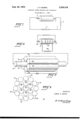
- FIG. 1 schematically illustrates a circuit embodying the basic principle of this invention
- FIG. 2 is a perspective of another embodiment of the invention.
- FIGS. 3 and 4 illustrate still further embodiments, as will be described.
- a circuit is shown comprised of a copper cannister 1 filled with radioactive strontium 90.
- Conductive contacts 2 of the same material as the cannister extend from opposite ends thereof and are conductively connected with a suitable electric conductor such as copper wire 3.
- a source of electrical energy 4 which, in this embodiment is-preferably a battery, supplies current to cannister 1, where it is conducted through the cannister and subjected to the radiation of strontium contained in the cannister, resulting in amplification of the battery supplied current. Current thus passing through the cannister and being amplified is then transmitted through conductor 3 to a load 5.
- the radioactive material in cannister 1 is preferably strontium 90, but may be any radioactive emitter, emitting alpha, beta, gamma or otherwise designated particles or waves, including neutrons, protons, etc., and/ or any combination thereof.
- the radioactive material contained in cannister 1 may be heated from an external source or from the heat of nuclear radiation of the radioactive material itself, to increase the amplifying effect on the current in the circuit described in FIG. 1, but such heating is not necessary or essential to the current amplification system described in connection with FIG, 1.
- Current passing through the conductive cannister is enhanced by the emissions from the radioactive material in either case resulting in a current in excess of that produced by the battery and the radioactive material indirectly.
- this invention relates to the amplification of electric current by the emission of radioactive material through or about which current is caused to flow, and also the enhancement of electric discharge by causing an electric current to flow through the radioactive material.
- an electric current can be made to pass through a radioactive material, and broadly speaking, the present invention is intended to encompass any such invention in which electric current supplied by radioactive material is combined with electric current from the separate source as described in FIG. 1.
- the separate source may provide either direct or alternating current.
- a mass of radioactive material is surrounded by or contained within an electrical conductive container similar to cannister 1 of FIG. 1, and this body of radioactive material is enclosed by a coil which produces a magnetic field within the radioactive material When an electric current is passed through the coil by means of source 25.
- the theory of operation is that the magnetic field causes the charged radioactive emissions to move in response to the polarity of the magnetic field, thus creating a flow of charged articles or electric current; at the same time the radioactive emissions cut through the lines of the magnetic flux producing additional electric charge or current.
- the electric current is collected by connectors 30 at opposite ends of the electricity conducting container 1.
- radioactive material in a mass such as a rod 40 has one or more electrically conducting metal rods 50 located adjacent thereto, preferably a sufiicient number to surround rod 40 as shown in the drawing. Electricity passed through metal rods 50 either as direct or atgruating current produces an electromagnetic field within the radioactive material which affects its emissions to produce an electric current. This induced electric current from the radioactive emissions is then collected by conectors on each end of the radioactive rod-shaped material.
- FIG. 4 another example of a similar production of electric current from radioactive emissions is illustrated.
- a number of radioactive rods 60 in this example numbering six, are surrounded by metal rods 70 through which eelctric current is caused to flow in either a direct or alternating manner.
- the resulting electromagnetic fields affect the radioactive emissions in such a manner as to set up an induced electric current which is greater than that produced without radioactivity; this electric current is utilized by connecting wires to the ends of the radioactive rods.
- a method of amplifying electric current in a conductor in a circuit, said conductor containing radioactive material comprising the step of producing a magnetic field by passing an electric current through said conductor.
- Apparatus for amplifying electric current comprising a conductive container, radioactive material in said container, means for connecting said container to a sup ply of electric current by which said electric current is transmitted through said radioactive material, and means for collecting and transmitting said current from said conductive container after said current has passed through and has been amplified by said radioactive material.
- a coil is adapted to couple said container to a supply of electric current and is disposed about said body of radioactive material and adapted to produce an electromagnetic field therein, said coil and supply of electric current being a separate circuit, and said container being connected by suitable connectors to a work load.
- Apparatus comprisinge a plurality of contiguous rod-shaped members at least one of which has electric conductive properties and is comprised of radioactive material, and at least one other of which has electric conductive properties and is connected to a source of electric current, whereby an electromagnetic field is produced therein, and means connected to said radioactive member for collecting and transmitting said secondary current therefrom.
Landscapes
- Engineering & Computer Science (AREA)
- Power Engineering (AREA)
- Shielding Devices Or Components To Electric Or Magnetic Fields (AREA)
Description
Sept. 22, 1970 J. o. BURKE 3,530,316
ELECTRIC POWER METHODS AND APPARATUS Filed March 1, 1968 INVENTOR JAMES 0' EUR KE 25f Mime/nu ATTORNE United States Patent 3,530,316 ELECTRIC POWER METHODS AND APPARATUS James O. Burke, 4705 Rolfe Road, Richmond, Va. 23226 Continuation-impart of application Ser. No. 381,754, July 10, 1964. This application Mar. 1, 1968, Ser.
Int. (:1. H03f 21/00 US. Cl. 310-3 6 Claims ABSTRACT OF THE DISCLOSURE A method and apparatus for producing and/or amplifying electric current utilizing radioactive material. Current from a suitable source is passed through a conductor in contact with or under the influence of radioactive material to produce a current of higher magnitude than the input current. The current may be conducted by a conductive can containing radioactive material, metallic rods surrounding or dispersed within radioactive material or by a coil disposed around the radioactive material.
BACKGROUND OF THE INVENTION This is a continuation-in-part of application Ser. No. 381,754, filed July 10, 1964, now Pat. No. 3,409,820. This invention relates primarily to methods of producing and amplifying electric current and apparatus therefor, employing radioactive materials. More specifically, this invention relates to a method of using radioactive emissions to product an electric current by means of an electromagnetic field.
In its preferred form, the invention contemplates passing electric current through a conductor exposed to radioactive emissions. The theory is that the current will be increased as it passes through the exposed conductor in that it will be comprised of the original current, the radioactive emissions collected by the conductor as electricity, and further by the induced electric current created by the various radioactive emissions cutting through the flux lines of the magnetic field produced by the original current in the conductor.
In its other embodiments, the invention contemplates the use of a primary electric current to produce a magnetic field about a conductor, and the conductor being exposed to radioactive emissions, whereby current induced in the conductor is comprised essentially (according to the theory of the invention) of the radioactive emissions (electrons for example) collected by the conductor and the induced electric current created by the radioactive emissions cutting through the flux lines of the magnetic field. Such a system has high practical value in atomic powered craft such as submarines, airplanes, space ships, automobiles and the like. In automobiles and submarines, for example, technological advances in batteries have produced smaller, more powerful batteries occupying less valuable space; however, there still is a definite need to reduce the size and weight power sources such as this to a minimum. The present invention fulfills such a need by utilizing radioactive material in the main power plant to amplify current from one or more batteries and thus reduce the original battery Weight and volume requirements.
Another basis of the present invention relates to the principle of movement of radioactive emissions in electromagnetic fields. By the use of electricity an electromagnetic field is produced within a mass of radioactive material, the emissions from which are affected by the magnetic field in such a manner as to produce an electric current.
Thus, by employing the basic principle, this invention has application in any field in which electricity may be 3,533,315 Patented Sept. 22, 1970 used, employing a motor, embodying radioactive material or in existing electrical systems with radioactive material added to amplify the electric current available.
SUMMARY OF THE INVENTION It is, therefore, the primary object of this invention to provide a method of amplifying or enlarging existing electrical energy or current, and to further provide a novel electrical power system, utilizing radioactive emissions or radiations.
Another object of this invention is to provide a method and system of enlarging or amplifying electric current by employing a metal conductor and a source of radioactive emissions in association with each other.
Another object is to provide and improve electrical power supply systems which may be relatively lightweight and small in size and, therefore, adaptable for advantageous use, for example, in high altitude apparatus and craft.
Other objects and advantages of the present invention will become apparent to those skilled in this art from the following description of the best mode of carrying out this invention and examples thereof, made in connection with the accompanying drawing wherein:
FIG. 1 schematically illustrates a circuit embodying the basic principle of this invention;
FIG. 2 is a perspective of another embodiment of the invention;
FIGS. 3 and 4 illustrate still further embodiments, as will be described.
Referring to schematic FIGS. 1, wherein the best mode of carrying out the present invention is illustrated, a circuit is shown comprised of a copper cannister 1 filled with radioactive strontium 90. Conductive contacts 2 of the same material as the cannister extend from opposite ends thereof and are conductively connected with a suitable electric conductor such as copper wire 3. A source of electrical energy 4 which, in this embodiment is-preferably a battery, supplies current to cannister 1, where it is conducted through the cannister and subjected to the radiation of strontium contained in the cannister, resulting in amplification of the battery supplied current. Current thus passing through the cannister and being amplified is then transmitted through conductor 3 to a load 5.
The radioactive material in cannister 1 is preferably strontium 90, but may be any radioactive emitter, emitting alpha, beta, gamma or otherwise designated particles or waves, including neutrons, protons, etc., and/ or any combination thereof.
The radioactive material contained in cannister 1 may be heated from an external source or from the heat of nuclear radiation of the radioactive material itself, to increase the amplifying effect on the current in the circuit described in FIG. 1, but such heating is not necessary or essential to the current amplification system described in connection with FIG, 1. Current passing through the conductive cannister is enhanced by the emissions from the radioactive material in either case resulting in a current in excess of that produced by the battery and the radioactive material indirectly.
From the description of FIG. 1, it can be seen that this invention relates to the amplification of electric current by the emission of radioactive material through or about which current is caused to flow, and also the enhancement of electric discharge by causing an electric current to flow through the radioactive material. There are many possible physical arrangements whereby an electric current can be made to pass through a radioactive material, and broadly speaking, the present invention is intended to encompass any such invention in which electric current supplied by radioactive material is combined with electric current from the separate source as described in FIG. 1. The separate source may provide either direct or alternating current.
In the embodiment of FIG. 2, a mass of radioactive material is surrounded by or contained within an electrical conductive container similar to cannister 1 of FIG. 1, and this body of radioactive material is enclosed by a coil which produces a magnetic field within the radioactive material When an electric current is passed through the coil by means of source 25. The theory of operation is that the magnetic field causes the charged radioactive emissions to move in response to the polarity of the magnetic field, thus creating a flow of charged articles or electric current; at the same time the radioactive emissions cut through the lines of the magnetic flux producing additional electric charge or current. The electric current is collected by connectors 30 at opposite ends of the electricity conducting container 1.
In FIG. 3, radioactive material in a mass such as a rod 40 has one or more electrically conducting metal rods 50 located adjacent thereto, preferably a sufiicient number to surround rod 40 as shown in the drawing. Electricity passed through metal rods 50 either as direct or atlernating current produces an electromagnetic field within the radioactive material which affects its emissions to produce an electric current. This induced electric current from the radioactive emissions is then collected by conectors on each end of the radioactive rod-shaped material.
In FIG. 4, another example of a similar production of electric current from radioactive emissions is illustrated. A number of radioactive rods 60, in this example numbering six, are surrounded by metal rods 70 through which eelctric current is caused to flow in either a direct or alternating manner. The resulting electromagnetic fields affect the radioactive emissions in such a manner as to set up an induced electric current which is greater than that produced without radioactivity; this electric current is utilized by connecting wires to the ends of the radioactive rods.
The invention may be embodied in other specific forms without departing from the spirit or essential characteristics thereof. The present embodiments are, therefore, to be considered in all respects as illustrative and not restrictive, the scope of the invention being indicated by the appended claims rather than by the foregoing description, and all changes which come within the meaning and range of equivalency of the claims are therefore to be embraced therein.
What is claimed is:
1. A method of amplifying electric current in a conductor in a circuit, said conductor containing radioactive material comprising the step of producing a magnetic field by passing an electric current through said conductor.
2. The method of transforming an electric current of low magnitude to a higher magnitude comprising the step of transmitting electric current from a source thereof through a metallic electrical conductor, said conductor being exposed to radioactive emissions.
3. The method as claimed in claim 2 wherein said conductor transmitting the electric current is comprised of radioactive material.
4. Apparatus for amplifying electric current comprising a conductive container, radioactive material in said container, means for connecting said container to a sup ply of electric current by which said electric current is transmitted through said radioactive material, and means for collecting and transmitting said current from said conductive container after said current has passed through and has been amplified by said radioactive material.
5. Apparatus as claimed in claim 4 wherein a coil is adapted to couple said container to a supply of electric current and is disposed about said body of radioactive material and adapted to produce an electromagnetic field therein, said coil and supply of electric current being a separate circuit, and said container being connected by suitable connectors to a work load.
6. Apparatus comprisinge a plurality of contiguous rod-shaped members at least one of which has electric conductive properties and is comprised of radioactive material, and at least one other of which has electric conductive properties and is connected to a source of electric current, whereby an electromagnetic field is produced therein, and means connected to said radioactive member for collecting and transmitting said secondary current therefrom.
References Cited UNITED STATES PATENTS 2,817,776 12/1957 Cohen 3l03 RODNEY D. BENNETT, 111., Primary Examiner B. L. RIBANDO, Assistant Examiner
Applications Claiming Priority (1)
| Application Number | Priority Date | Filing Date | Title |
|---|---|---|---|
| US70974268A | 1968-03-01 | 1968-03-01 |
Publications (1)
| Publication Number | Publication Date |
|---|---|
| US3530316A true US3530316A (en) | 1970-09-22 |
Family
ID=24851153
Family Applications (1)
| Application Number | Title | Priority Date | Filing Date |
|---|---|---|---|
| US709742A Expired - Lifetime US3530316A (en) | 1968-03-01 | 1968-03-01 | Electric power methods and apparatus |
Country Status (1)
| Country | Link |
|---|---|
| US (1) | US3530316A (en) |
Cited By (3)
| Publication number | Priority date | Publication date | Assignee | Title |
|---|---|---|---|---|
| US4835433A (en) * | 1986-04-23 | 1989-05-30 | Nucell, Inc. | Apparatus for direct conversion of radioactive decay energy to electrical energy |
| US20030076005A1 (en) * | 2001-07-10 | 2003-04-24 | Moreland John W. | Methods and apparatus to enhance electric currents |
| US11749419B2 (en) | 2021-11-11 | 2023-09-05 | Stargena, Inc. | High performance power sources integrating an ion media and radiation |
Citations (1)
| Publication number | Priority date | Publication date | Assignee | Title |
|---|---|---|---|---|
| US2817776A (en) * | 1952-10-01 | 1957-12-24 | Martin J Cohen | Ionization type voltage charging device |
-
1968
- 1968-03-01 US US709742A patent/US3530316A/en not_active Expired - Lifetime
Patent Citations (1)
| Publication number | Priority date | Publication date | Assignee | Title |
|---|---|---|---|---|
| US2817776A (en) * | 1952-10-01 | 1957-12-24 | Martin J Cohen | Ionization type voltage charging device |
Cited By (4)
| Publication number | Priority date | Publication date | Assignee | Title |
|---|---|---|---|---|
| US4835433A (en) * | 1986-04-23 | 1989-05-30 | Nucell, Inc. | Apparatus for direct conversion of radioactive decay energy to electrical energy |
| US20030076005A1 (en) * | 2001-07-10 | 2003-04-24 | Moreland John W. | Methods and apparatus to enhance electric currents |
| US11749419B2 (en) | 2021-11-11 | 2023-09-05 | Stargena, Inc. | High performance power sources integrating an ion media and radiation |
| US12322520B2 (en) | 2021-11-11 | 2025-06-03 | Stargena, Inc. | High performance power sources integrating an ion media and radiation |
Similar Documents
| Publication | Publication Date | Title |
|---|---|---|
| US4835433A (en) | Apparatus for direct conversion of radioactive decay energy to electrical energy | |
| US2847585A (en) | Radiation responsive voltage sources | |
| US2517120A (en) | Method of and means for collecting electrical energy of nuclear reactions | |
| US2552050A (en) | Method of and means for generating electrical energy | |
| Kivelson et al. | Magnetospheres of the Galilean satellites | |
| GB965122A (en) | Charged-particle beam interceptor | |
| US3530316A (en) | Electric power methods and apparatus | |
| GB1077516A (en) | The generation and/or acceleration of plasma | |
| US3409820A (en) | Electric power apparatus | |
| GB1151247A (en) | Nuclear Battery | |
| US2817776A (en) | Ionization type voltage charging device | |
| AU597644B2 (en) | Apparatus for direct conversion of radioactive decay energy to electrical energy | |
| US2651730A (en) | Method of and apparatus for utilizing radioactive materials for generating electrical energy | |
| Stein | Infrared emission by circumstellar dust | |
| US3290522A (en) | Nuclear emission electrical generator | |
| GB927770A (en) | Methods of and apparatus for generating electrical energy | |
| US3299299A (en) | Apparatus for generating electrical energy by the application of heat | |
| US4631447A (en) | IREB converter to AC pulses | |
| US2859361A (en) | Method and means for collecting electrical energy of nuclear reactions | |
| US20030076005A1 (en) | Methods and apparatus to enhance electric currents | |
| Samokhin | Influence of an electric field on the motion of charged particles in an inhomogeneous magnetic field(Two dimensional motion of charged particles in electromagnetic field, noting magnitude of forbidden band as function of particle energy) | |
| Wolfe et al. | The acceleration of dust grains by supernovae | |
| Hobart | A cosmological derivation of Planck's constant | |
| US3441756A (en) | Electrical devices | |
| HOFFMAN | Radioactive ultrafine particles for MHD power generation(Self-charging of temperature independent radioactive ultrafine particles for MHD power generation) |