US3336173A - Method of high frequency welding a polyethylene normally not susceptible to high frequency welding - Google Patents
Method of high frequency welding a polyethylene normally not susceptible to high frequency welding Download PDFInfo
- Publication number
- US3336173A US3336173A US478947A US47894765A US3336173A US 3336173 A US3336173 A US 3336173A US 478947 A US478947 A US 478947A US 47894765 A US47894765 A US 47894765A US 3336173 A US3336173 A US 3336173A
- Authority
- US
- United States
- Prior art keywords
- high frequency
- parts
- welding
- weight
- frequency welding
- Prior art date
- Legal status (The legal status is an assumption and is not a legal conclusion. Google has not performed a legal analysis and makes no representation as to the accuracy of the status listed.)
- Expired - Lifetime
Links
- 238000000034 method Methods 0.000 title claims description 25
- -1 polyethylene Polymers 0.000 title claims description 21
- 239000004698 Polyethylene Substances 0.000 title claims description 8
- 229920000573 polyethylene Polymers 0.000 title claims description 8
- 238000003466 welding Methods 0.000 title description 25
- 229920005672 polyolefin resin Polymers 0.000 claims description 25
- 239000004744 fabric Substances 0.000 claims description 18
- 229920001169 thermoplastic Polymers 0.000 claims description 15
- 239000004416 thermosoftening plastic Substances 0.000 claims description 15
- 239000004743 Polypropylene Substances 0.000 claims description 14
- 229920001155 polypropylene Polymers 0.000 claims description 14
- 229920000642 polymer Polymers 0.000 claims description 8
- 238000002156 mixing Methods 0.000 claims description 3
- 125000005521 carbonamide group Chemical group 0.000 description 17
- 239000004957 Zytel Substances 0.000 description 11
- 229920006102 Zytel® Polymers 0.000 description 11
- 238000000465 moulding Methods 0.000 description 11
- 229920006122 polyamide resin Polymers 0.000 description 11
- 239000000203 mixture Substances 0.000 description 10
- 238000009740 moulding (composite fabrication) Methods 0.000 description 9
- 229920005989 resin Polymers 0.000 description 9
- 239000011347 resin Substances 0.000 description 9
- 125000004432 carbon atom Chemical group C* 0.000 description 7
- 238000001125 extrusion Methods 0.000 description 7
- 239000012815 thermoplastic material Substances 0.000 description 7
- 229920002292 Nylon 6 Polymers 0.000 description 6
- 239000000126 substance Substances 0.000 description 6
- 239000004753 textile Substances 0.000 description 6
- 239000004952 Polyamide Substances 0.000 description 5
- 229920002647 polyamide Polymers 0.000 description 5
- 239000000843 powder Substances 0.000 description 5
- 239000004677 Nylon Substances 0.000 description 4
- NAQMVNRVTILPCV-UHFFFAOYSA-N hexane-1,6-diamine Chemical compound NCCCCCCN NAQMVNRVTILPCV-UHFFFAOYSA-N 0.000 description 4
- 239000000463 material Substances 0.000 description 4
- 229920001778 nylon Polymers 0.000 description 4
- JBKVHLHDHHXQEQ-UHFFFAOYSA-N epsilon-caprolactam Chemical compound O=C1CCCCCN1 JBKVHLHDHHXQEQ-UHFFFAOYSA-N 0.000 description 3
- 239000000835 fiber Substances 0.000 description 3
- 238000010438 heat treatment Methods 0.000 description 3
- 239000000155 melt Substances 0.000 description 3
- 229920013716 polyethylene resin Polymers 0.000 description 3
- 238000009987 spinning Methods 0.000 description 3
- 238000009941 weaving Methods 0.000 description 3
- WNLRTRBMVRJNCN-UHFFFAOYSA-N adipic acid Chemical compound OC(=O)CCCCC(O)=O WNLRTRBMVRJNCN-UHFFFAOYSA-N 0.000 description 2
- 239000001361 adipic acid Substances 0.000 description 2
- 150000001875 compounds Chemical class 0.000 description 2
- YWJUZWOHLHBWQY-UHFFFAOYSA-N decanedioic acid;hexane-1,6-diamine Chemical compound NCCCCCCN.OC(=O)CCCCCCCCC(O)=O YWJUZWOHLHBWQY-UHFFFAOYSA-N 0.000 description 2
- 238000007789 sealing Methods 0.000 description 2
- CXMXRPHRNRROMY-UHFFFAOYSA-N sebacic acid Chemical compound OC(=O)CCCCCCCCC(O)=O CXMXRPHRNRROMY-UHFFFAOYSA-N 0.000 description 2
- 238000009958 sewing Methods 0.000 description 2
- XLYOFNOQVPJJNP-UHFFFAOYSA-N water Substances O XLYOFNOQVPJJNP-UHFFFAOYSA-N 0.000 description 2
- 239000002759 woven fabric Substances 0.000 description 2
- 229920003260 Plaskon Polymers 0.000 description 1
- 235000011037 adipic acid Nutrition 0.000 description 1
- 230000015572 biosynthetic process Effects 0.000 description 1
- 238000009835 boiling Methods 0.000 description 1
- 238000009954 braiding Methods 0.000 description 1
- IAQRGUVFOMOMEM-UHFFFAOYSA-N but-2-ene Chemical compound CC=CC IAQRGUVFOMOMEM-UHFFFAOYSA-N 0.000 description 1
- 239000010432 diamond Substances 0.000 description 1
- 230000005684 electric field Effects 0.000 description 1
- 239000011888 foil Substances 0.000 description 1
- 238000009940 knitting Methods 0.000 description 1
- 238000012986 modification Methods 0.000 description 1
- 230000004048 modification Effects 0.000 description 1
- 239000004745 nonwoven fabric Substances 0.000 description 1
- 229920003023 plastic Polymers 0.000 description 1
- 239000004033 plastic Substances 0.000 description 1
- 229920001225 polyester resin Polymers 0.000 description 1
- 239000004645 polyester resin Substances 0.000 description 1
- 229920000098 polyolefin Polymers 0.000 description 1
- 239000007787 solid Substances 0.000 description 1
- 229920002397 thermoplastic olefin Polymers 0.000 description 1
Images
Classifications
-
- B—PERFORMING OPERATIONS; TRANSPORTING
- B29—WORKING OF PLASTICS; WORKING OF SUBSTANCES IN A PLASTIC STATE IN GENERAL
- B29C—SHAPING OR JOINING OF PLASTICS; SHAPING OF MATERIAL IN A PLASTIC STATE, NOT OTHERWISE PROVIDED FOR; AFTER-TREATMENT OF THE SHAPED PRODUCTS, e.g. REPAIRING
- B29C66/00—General aspects of processes or apparatus for joining preformed parts
- B29C66/70—General aspects of processes or apparatus for joining preformed parts characterised by the composition, physical properties or the structure of the material of the parts to be joined; Joining with non-plastics material
- B29C66/71—General aspects of processes or apparatus for joining preformed parts characterised by the composition, physical properties or the structure of the material of the parts to be joined; Joining with non-plastics material characterised by the composition of the plastics material of the parts to be joined
-
- B—PERFORMING OPERATIONS; TRANSPORTING
- B29—WORKING OF PLASTICS; WORKING OF SUBSTANCES IN A PLASTIC STATE IN GENERAL
- B29C—SHAPING OR JOINING OF PLASTICS; SHAPING OF MATERIAL IN A PLASTIC STATE, NOT OTHERWISE PROVIDED FOR; AFTER-TREATMENT OF THE SHAPED PRODUCTS, e.g. REPAIRING
- B29C65/00—Joining or sealing of preformed parts, e.g. welding of plastics materials; Apparatus therefor
- B29C65/02—Joining or sealing of preformed parts, e.g. welding of plastics materials; Apparatus therefor by heating, with or without pressure
- B29C65/04—Dielectric heating, e.g. high-frequency welding, i.e. radio frequency welding of plastic materials having dielectric properties, e.g. PVC
-
- B—PERFORMING OPERATIONS; TRANSPORTING
- B29—WORKING OF PLASTICS; WORKING OF SUBSTANCES IN A PLASTIC STATE IN GENERAL
- B29C—SHAPING OR JOINING OF PLASTICS; SHAPING OF MATERIAL IN A PLASTIC STATE, NOT OTHERWISE PROVIDED FOR; AFTER-TREATMENT OF THE SHAPED PRODUCTS, e.g. REPAIRING
- B29C65/00—Joining or sealing of preformed parts, e.g. welding of plastics materials; Apparatus therefor
- B29C65/02—Joining or sealing of preformed parts, e.g. welding of plastics materials; Apparatus therefor by heating, with or without pressure
- B29C65/34—Joining or sealing of preformed parts, e.g. welding of plastics materials; Apparatus therefor by heating, with or without pressure using heated elements which remain in the joint, e.g. "verlorenes Schweisselement"
- B29C65/3404—Joining or sealing of preformed parts, e.g. welding of plastics materials; Apparatus therefor by heating, with or without pressure using heated elements which remain in the joint, e.g. "verlorenes Schweisselement" characterised by the type of heated elements which remain in the joint
- B29C65/3436—Joining or sealing of preformed parts, e.g. welding of plastics materials; Apparatus therefor by heating, with or without pressure using heated elements which remain in the joint, e.g. "verlorenes Schweisselement" characterised by the type of heated elements which remain in the joint comprising independent continuous fibre-reinforcements
-
- B—PERFORMING OPERATIONS; TRANSPORTING
- B29—WORKING OF PLASTICS; WORKING OF SUBSTANCES IN A PLASTIC STATE IN GENERAL
- B29C—SHAPING OR JOINING OF PLASTICS; SHAPING OF MATERIAL IN A PLASTIC STATE, NOT OTHERWISE PROVIDED FOR; AFTER-TREATMENT OF THE SHAPED PRODUCTS, e.g. REPAIRING
- B29C65/00—Joining or sealing of preformed parts, e.g. welding of plastics materials; Apparatus therefor
- B29C65/02—Joining or sealing of preformed parts, e.g. welding of plastics materials; Apparatus therefor by heating, with or without pressure
- B29C65/34—Joining or sealing of preformed parts, e.g. welding of plastics materials; Apparatus therefor by heating, with or without pressure using heated elements which remain in the joint, e.g. "verlorenes Schweisselement"
- B29C65/3472—Joining or sealing of preformed parts, e.g. welding of plastics materials; Apparatus therefor by heating, with or without pressure using heated elements which remain in the joint, e.g. "verlorenes Schweisselement" characterised by the composition of the heated elements which remain in the joint
- B29C65/3484—Joining or sealing of preformed parts, e.g. welding of plastics materials; Apparatus therefor by heating, with or without pressure using heated elements which remain in the joint, e.g. "verlorenes Schweisselement" characterised by the composition of the heated elements which remain in the joint being non-metallic
- B29C65/3492—Joining or sealing of preformed parts, e.g. welding of plastics materials; Apparatus therefor by heating, with or without pressure using heated elements which remain in the joint, e.g. "verlorenes Schweisselement" characterised by the composition of the heated elements which remain in the joint being non-metallic being carbon
-
- B—PERFORMING OPERATIONS; TRANSPORTING
- B29—WORKING OF PLASTICS; WORKING OF SUBSTANCES IN A PLASTIC STATE IN GENERAL
- B29C—SHAPING OR JOINING OF PLASTICS; SHAPING OF MATERIAL IN A PLASTIC STATE, NOT OTHERWISE PROVIDED FOR; AFTER-TREATMENT OF THE SHAPED PRODUCTS, e.g. REPAIRING
- B29C66/00—General aspects of processes or apparatus for joining preformed parts
- B29C66/01—General aspects dealing with the joint area or with the area to be joined
- B29C66/05—Particular design of joint configurations
- B29C66/10—Particular design of joint configurations particular design of the joint cross-sections
- B29C66/11—Joint cross-sections comprising a single joint-segment, i.e. one of the parts to be joined comprising a single joint-segment in the joint cross-section
- B29C66/112—Single lapped joints
- B29C66/1122—Single lap to lap joints, i.e. overlap joints
-
- B—PERFORMING OPERATIONS; TRANSPORTING
- B29—WORKING OF PLASTICS; WORKING OF SUBSTANCES IN A PLASTIC STATE IN GENERAL
- B29C—SHAPING OR JOINING OF PLASTICS; SHAPING OF MATERIAL IN A PLASTIC STATE, NOT OTHERWISE PROVIDED FOR; AFTER-TREATMENT OF THE SHAPED PRODUCTS, e.g. REPAIRING
- B29C66/00—General aspects of processes or apparatus for joining preformed parts
- B29C66/01—General aspects dealing with the joint area or with the area to be joined
- B29C66/05—Particular design of joint configurations
- B29C66/10—Particular design of joint configurations particular design of the joint cross-sections
- B29C66/14—Particular design of joint configurations particular design of the joint cross-sections the joint having the same thickness as the thickness of the parts to be joined
-
- B—PERFORMING OPERATIONS; TRANSPORTING
- B29—WORKING OF PLASTICS; WORKING OF SUBSTANCES IN A PLASTIC STATE IN GENERAL
- B29C—SHAPING OR JOINING OF PLASTICS; SHAPING OF MATERIAL IN A PLASTIC STATE, NOT OTHERWISE PROVIDED FOR; AFTER-TREATMENT OF THE SHAPED PRODUCTS, e.g. REPAIRING
- B29C66/00—General aspects of processes or apparatus for joining preformed parts
- B29C66/40—General aspects of joining substantially flat articles, e.g. plates, sheets or web-like materials; Making flat seams in tubular or hollow articles; Joining single elements to substantially flat surfaces
- B29C66/41—Joining substantially flat articles ; Making flat seams in tubular or hollow articles
- B29C66/43—Joining a relatively small portion of the surface of said articles
-
- B—PERFORMING OPERATIONS; TRANSPORTING
- B29—WORKING OF PLASTICS; WORKING OF SUBSTANCES IN A PLASTIC STATE IN GENERAL
- B29C—SHAPING OR JOINING OF PLASTICS; SHAPING OF MATERIAL IN A PLASTIC STATE, NOT OTHERWISE PROVIDED FOR; AFTER-TREATMENT OF THE SHAPED PRODUCTS, e.g. REPAIRING
- B29C66/00—General aspects of processes or apparatus for joining preformed parts
- B29C66/69—General aspects of joining filaments
-
- B—PERFORMING OPERATIONS; TRANSPORTING
- B29—WORKING OF PLASTICS; WORKING OF SUBSTANCES IN A PLASTIC STATE IN GENERAL
- B29C—SHAPING OR JOINING OF PLASTICS; SHAPING OF MATERIAL IN A PLASTIC STATE, NOT OTHERWISE PROVIDED FOR; AFTER-TREATMENT OF THE SHAPED PRODUCTS, e.g. REPAIRING
- B29C66/00—General aspects of processes or apparatus for joining preformed parts
- B29C66/70—General aspects of processes or apparatus for joining preformed parts characterised by the composition, physical properties or the structure of the material of the parts to be joined; Joining with non-plastics material
- B29C66/72—General aspects of processes or apparatus for joining preformed parts characterised by the composition, physical properties or the structure of the material of the parts to be joined; Joining with non-plastics material characterised by the structure of the material of the parts to be joined
- B29C66/729—Textile or other fibrous material made from plastics
-
- B—PERFORMING OPERATIONS; TRANSPORTING
- B29—WORKING OF PLASTICS; WORKING OF SUBSTANCES IN A PLASTIC STATE IN GENERAL
- B29K—INDEXING SCHEME ASSOCIATED WITH SUBCLASSES B29B, B29C OR B29D, RELATING TO MOULDING MATERIALS OR TO MATERIALS FOR MOULDS, REINFORCEMENTS, FILLERS OR PREFORMED PARTS, e.g. INSERTS
- B29K2023/00—Use of polyalkenes or derivatives thereof as moulding material
- B29K2023/04—Polymers of ethylene
- B29K2023/06—PE, i.e. polyethylene
-
- B—PERFORMING OPERATIONS; TRANSPORTING
- B29—WORKING OF PLASTICS; WORKING OF SUBSTANCES IN A PLASTIC STATE IN GENERAL
- B29K—INDEXING SCHEME ASSOCIATED WITH SUBCLASSES B29B, B29C OR B29D, RELATING TO MOULDING MATERIALS OR TO MATERIALS FOR MOULDS, REINFORCEMENTS, FILLERS OR PREFORMED PARTS, e.g. INSERTS
- B29K2023/00—Use of polyalkenes or derivatives thereof as moulding material
- B29K2023/10—Polymers of propylene
- B29K2023/12—PP, i.e. polypropylene
-
- B—PERFORMING OPERATIONS; TRANSPORTING
- B29—WORKING OF PLASTICS; WORKING OF SUBSTANCES IN A PLASTIC STATE IN GENERAL
- B29K—INDEXING SCHEME ASSOCIATED WITH SUBCLASSES B29B, B29C OR B29D, RELATING TO MOULDING MATERIALS OR TO MATERIALS FOR MOULDS, REINFORCEMENTS, FILLERS OR PREFORMED PARTS, e.g. INSERTS
- B29K2023/00—Use of polyalkenes or derivatives thereof as moulding material
- B29K2023/16—EPM, i.e. ethylene-propylene copolymers; EPDM, i.e. ethylene-propylene-diene copolymers; EPT, i.e. ethylene-propylene terpolymers
-
- B—PERFORMING OPERATIONS; TRANSPORTING
- B29—WORKING OF PLASTICS; WORKING OF SUBSTANCES IN A PLASTIC STATE IN GENERAL
- B29K—INDEXING SCHEME ASSOCIATED WITH SUBCLASSES B29B, B29C OR B29D, RELATING TO MOULDING MATERIALS OR TO MATERIALS FOR MOULDS, REINFORCEMENTS, FILLERS OR PREFORMED PARTS, e.g. INSERTS
- B29K2077/00—Use of PA, i.e. polyamides, e.g. polyesteramides or derivatives thereof, as moulding material
-
- B—PERFORMING OPERATIONS; TRANSPORTING
- B29—WORKING OF PLASTICS; WORKING OF SUBSTANCES IN A PLASTIC STATE IN GENERAL
- B29K—INDEXING SCHEME ASSOCIATED WITH SUBCLASSES B29B, B29C OR B29D, RELATING TO MOULDING MATERIALS OR TO MATERIALS FOR MOULDS, REINFORCEMENTS, FILLERS OR PREFORMED PARTS, e.g. INSERTS
- B29K2105/00—Condition, form or state of moulded material or of the material to be shaped
- B29K2105/0088—Blends of polymers
-
- B—PERFORMING OPERATIONS; TRANSPORTING
- B29—WORKING OF PLASTICS; WORKING OF SUBSTANCES IN A PLASTIC STATE IN GENERAL
- B29K—INDEXING SCHEME ASSOCIATED WITH SUBCLASSES B29B, B29C OR B29D, RELATING TO MOULDING MATERIALS OR TO MATERIALS FOR MOULDS, REINFORCEMENTS, FILLERS OR PREFORMED PARTS, e.g. INSERTS
- B29K2105/00—Condition, form or state of moulded material or of the material to be shaped
- B29K2105/25—Solid
- B29K2105/253—Preform
- B29K2105/256—Sheets, plates, blanks or films
-
- B—PERFORMING OPERATIONS; TRANSPORTING
- B29—WORKING OF PLASTICS; WORKING OF SUBSTANCES IN A PLASTIC STATE IN GENERAL
- B29K—INDEXING SCHEME ASSOCIATED WITH SUBCLASSES B29B, B29C OR B29D, RELATING TO MOULDING MATERIALS OR TO MATERIALS FOR MOULDS, REINFORCEMENTS, FILLERS OR PREFORMED PARTS, e.g. INSERTS
- B29K2105/00—Condition, form or state of moulded material or of the material to be shaped
- B29K2105/25—Solid
- B29K2105/253—Preform
- B29K2105/258—Tubular
Definitions
- the present invention relates to electronically heat- -sealable thermoplastic materials capable of being welded by high frequency currents and to methods of making the same, and, more specifically, is concerned with electronically heat-sealable synthetic thermoplastic polyolefin resin fibers and filaments and to methods of making the same.
- thermoplastic materials should be capable of being electronically welded or sealed. However, it has been found that certain thermoplastic materials simply do not respond to the action of high frequency currents and cannot be electronically welded.
- One of the most outstanding members of such a group of nonresponsive thermoplastic materials is the synthetic polyolefin resins, notably polypropylene and polyethylene resins.
- such synthetic polyolefin resins may be made electronically heat-scalable and capable of being welded by high frequency currents by incorporating in such resins, prior to their extrusion or molding, a long chain synthetic polyamideresim and then extruding or forming the polyolefin-polyamide resin into a desired shape or configuration in which the polyolefin and polyamide resins are substantially homogeneously and uniformly distributed.
- polyethylene either branched chain or linear, either high, medium or low density, commonly identified by the chemical formula ⁇ CH CH polypropylene, preferably isotatic commonly identified by the chemical formula ⁇ CH CH(CH )-l poly-l-butene, commonly identified by the chemical formula ⁇ CH CH(C H poly-2- butene, common identified by the chemical formula CH(CH )CH(CH )iandpolyisobutylene, commonly identified by the chemical formula ⁇ CH C(CH
- nylon-6/ 6 hexamethylene-diamine-adipic acid
- nylon-6/10 hexamethylene-diamine-sebacic ac d
- Such'polyolefin and polyamide resins are preferably used in the form of dry powdered molding or extrusion compounds. In such form, they are very easily dry blended in any required proportions by weight and fed to the extrusion, spinning, or other molding device, and formed into articles having the desired shape or configuration.
- the proportions by weight of the polyolefin resin and the polyamide resin may be varied within relatively wide limits. As little as about 5% by weight of polyamide resin added to by weight of polyolefin resin has been found to exert a desirable effect on the dielectric properties ofthe resulting material. Up to 50% by weight or more'of the polyamide resin may be incorporated with the polyolefin resin whereby the dielectric properties of the resulting product improve correspondingly. More polyamide resin may be incorporated in the polyolefin resin but such tends to change the basic properties of the resulting product. Within the more commercial aspects of the present invention, however, from about 10% to about 30% by weight of the polyamide resin has been found preferable.
- the uniformly blended mixture of polyamide resin and polyolefin resin is fed in conventional manner to the desired extrusion, spinning or molding apparatus and is formed thereat into shaped articles at conventional molding temperatures and pressures.
- the temperature of the melt leaving the extrusion or spinning device should be from about 400 F. (204 C.) up to as high as about 575 F. (302 C.), with the more commercial range extending from about 470 F. (243 C.) to about 550 F. (288 C.).
- the particular temperature employed will depend upon the particular nature of the polyamide and polyolefin used, their relative proportions by weight, the shape, thickness and configuration of the extruded or spun product, etc.
- the principles of the present invention may be applied-to polyamide-polyolefinresins in the form of foils, films, strips, ribbons, sheets, rods, tubes, or products of any desiredshape or configuration.
- the continuous filaments of the present invention may be used, per se, or they may be twisted or otherwise combined with other continuous filaments, strands or yarns, either heat-scalable or not, and then used in such twisted or combined form, as desired.
- the continuous filaments of polyamide-polyolefin resins need not be used in continuous filament form but may be cut into staple fiber having any desired staple length.
- Such fibers may be used in the formation of non-woven fabrics and synthetic felts, for example, or may be spun into yarn and then fabricated into woven, knitted, braided and the like textile articles having the desired high frequency heat-scalable properties.
- Typical of such fabrics are: seat covers for automobiles; body cloth and upholstery; welting for such seat covers and other upholstery; handbag, shoe and hat fabrics; and any other fabric wherein cutting and sewing a seam is required.
- high frequency heating is used very loosely in the industry and is applied to many forms of heating, operating at merely a few hundred cycles per second, for example. Such a term should not be construed that broadly. In order to define the term high frequency as used herein, it is to be stated that such is intended to cover a range of from about 8 megacycles per second to about 200 megacycles per second, and preferably from about megacycles per second to about 100 megacycles per second.
- the particular high-frequency welding equipment which is used in the application of the present invention may be selected from a large group of generators presently known to industry. Generally speaking, oscillators of the valve type are preferred.
- the high frequency welder may be portable or stationary, depending upon its application and use, and may be hand-operated or pedal-operated, as desired. It may be continuous, such as a roller-type welder, or it may be discontinuous or intermittent, such as a reciprocating bar welder. A heated platen has been found to improve the bond.
- suitable machines is presently known to industry. The precise type and form of apparatus used will be determined by the needs and requirements of the particular situation involved.
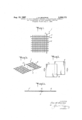
- FIGURE 1 depicts a fabric made in accordance with this invention and FIG. 1b shows two ends of the fabric of FIG. 1 joined by a common bond in accordance with the technique of the instant invention.
- FIG. 2 shows still another embodiment of this invention, joined by a common bond and FIG. 2b is a crossseotional view taken along 4-4 of FIG. 2.
- FIG. 1 shows an enlarged section of fabric 1 composed of filaments 2 which are in turn constructed of monofilaments of filaments 3 of polyester resin and monofilament 4 of a polyamide-polyolefin resin in accordance with the teaching of this invention.
- Sections of fabric 1 are shown joined in FIG. 1b along the bond zone 10 and specifically by the bond 11.
- the bond area 10 is shown as a solid or in film form since the area 10 has been welded by high frequency currents whereby molecular friction has resulted in a generation of sutficient heat in the polyamide resin to cause the monofilaments to become thermoplastic and the application of pressure along the area 10 effected the resultant bond.
- both fabrics 5 and 6 are constructed of monofilaments of polyamide-polypropylene resin.
- the two are joined along area 8 by the electronic heat sealing technique of this invention and as shown in FIG. 2b, which is a cross-section taken along 4-4 of FIG. 2, the bond 9 has resulted.
- Example I 800 grams of a nylon molding powder sold by DuPont under the trademark Zytel 63 (a methanoland ethanolsoluble polyamide copolymer) is dry blended with 3200 grams of an isotactic polypropylene resin.
- the substantially homogeneous, uniform dry blend is fed to the hopper of a single-screw extruder and heated to a temperature of about 500 F.
- the essentially homogeneous, molten mixture is extruded as an oval uniform filament under a pressure of about 600 lbs. per square inch gauge.
- the monofilament is then quenched in cool water at room temperature and then stretched about 500% in boiling water (212 F.) in order to increase its tensile strength.
- the resulting oval monofilament has a major diameter of 19 mils (0.019 inch) and a minor diameter of 6 mils (0.006 inch).
- a plurality of the oval monofilaments is then placed on a warp beam and formed into a warp sheet in a loom.
- Bobbins wound with the oval monofilament are used in shuttles to supply the filling strands.
- a plain weave fabric is then woven by conventional weaving methods. The resulting fabric has 50 ends per inch in the warp direction and 32 ends per inch in the filling direction.
- This woven fabric is then electronically welded under pressure to another woven fabric in an applique design of spaced diamonds by means of a conventional high frequency sealing and heating apparatus. A satisfactory bond is obtained between the two fabrics and normal efforts to separate the two prove unsuccessful.
- Example II The procedures of Example I are followed substantially as set forth therein with the exception that 600 grams of the nylon Zytel 63 molding powder is blended with 3400 grams of the isotactic polypropylene resin. The results are comparable to the results obtained in Example I.
- Example III The procedures of Example I are followed substantially as set forth therein with the exception that 1200 grams of the nylon Zytel 63 molding powder is blended with 1800 grams of the isotactic polypropylene resin. The results are comparable to the results obtained in Example I.
- Example IV Exam-pie V The procedures of Example I are followed substantially as set forth therein with the exception that DuPont Zytel 31 is used to replace the Zytel 63.
- Zytel 31 is a lower melting-point polyamide nylon-6/ 10 molding powder having greater moisture resistance than Zytel 101. The results are comparable to the results obtained in Example I.
- Example VI The procedures of Example I are followed substantially as set forth therein with the exception that DuPont Zytel 42 is used to replace the Zytel 63.
- Zytel 42 is a high-melt-viscosity polyamide nylon-6/ 6 molding powder.
- the melt temperature is about 520 F.
- the re sults are comparable to the results obtained in Example 1.
- Example VII The procedures of Example I are followed substantially as set forth therein with the exception that Allied Chemical Plaskon Nylon 8205 is used to replace the Zytel 63. Plaskon 8205 is a high-melt-viscosity polyamide nylon-6 molding compound. The results are comparable to the results obtained in Example I.
- a method of electronically welding a textile fabric which comprises: blending from about 95 parts to about 50 parts by weight of a heat-scalable thermoplastic synthetic polyolefin resin selected from the group consisting of polypropylene and polyethylene and from about 5 parts to about 50* parts by weight of a fiber-forming synthetic polymeric carbonamide which contains recurring carbonamide groups as an integral part of the main polymer chain separated by at least two carbon atoms; forming the blend into filaments, weaving a textile fabric from said filaments; and electronically welding the woven textile fabric by means of a high frequency current having a frequency in the range of from about 8 megacycles per second to about 200 megacycles per second.
- a method of electronically welding a heat-scalable thermoplastic synthetic polyolefin resin normally not susceptible to electronic welding which comprises: blending from about 95 parts to about 50 parts by weight of a heat-seala-ble thermoplastic synthetic polyolefin resin selected from the group consisting of polypropylene and polyethylene and from about 5 parts to about 50 parts by weight of a fiber-forming synthetic polymeric carbonamide which contains recurring carbonamide groups as an integral part of the main polymer chain separated by at least two carbon atoms; forming the blend into a shaped article; and electronically welding the shaped article by means of a high frequency current having a frequency in the range of from about 8 megacycles per second to about 200 megacycles per second.
- a method of electronically welding a heat-scalable thermoplastic synthetic polyolefin resin normally not susceptible to electronic welding which comprises: exposing a shaped article formed from a blend of from about 95 parts to about 50 parts by weight of a heatsealable thermoplastic synthetic polyolefin resin selected from the group consisting of polypropylene and polyethylene and from about 5 parts to about 50 parts by weight of a fiber-forming synthetic polymeric car-bonamide which contains recurring carbonamide groups as an integral part of the main polymer chain separated by at least two carbon atoms to a high frequency current having a frequency in the range of from about 8 megacycles per second to about 200 megacycles per second; and electronically welding said shaped article.
- a heatsealable thermoplastic synthetic polyolefin resin selected from the group consisting of polypropylene and polyethylene and from about 5 parts to about 50 parts by weight of a fiber-forming synthetic polymeric car-bonamide which contains recurring carbonamide groups as an integral part of the main polymer chain separated by at least two carbon atoms to
- a method as defined in claim 3 wherein the fiberforming synthetic polymeric carbonamide is derived from heXamethylene diamine and adipic acid.
- a method of electronically welding a heat-scalable thermoplastic synthetic polyethylene resin normally not susceptible to electronic welding which comprises: exposing a shaped article formed from a blend of from about 95 parts to about 50 parts by Weight of a heatsealable thermoplastic synthetic polyethylene resin and from about 5 parts to about 50 parts by weight of a fiberforming synthetic polymeric carbonamide which contains recurring carbonamide groups as an integral part of the main polymer chain separated by at least two carbon atoms to a high frequency current having a frequency in the range of from about 8 megacycles per second to about 200 megacycles per second; and electronically welding said shaped article.
- a method of electronically welding a heat-sealable thermoplastic synthetic polypropylene resin normally not susceptible to electronic welding which comprises: exposing a shaped article formed from a blend of from about 95 parts to about 50* parts by weight of a heat-sealable thermoplastic synthetic polypropylene resin and from about 5 parts to about 50 parts by weight of a fiber-form ing synthetic polymeric carbonamide which contains recurring carbonamide groups as an integral part of the main polymer chain separated by at least two car-bon atoms to a high frequency current having a frequency in the range of from about 8 megacycles per second to about 20 megacycles per second; and electronically welding said shaped article.
- a method of electronically welding a heat-scalable thermoplastic synthetic polyolefin resin normally not susceptible to electronic welding which comprises: exposing a shaped article formed from a blend of from about parts to about 70 parts by weight of a heatsealable thermoplastic synthetic polyolefin resin selected from the group consisting of polypropylene and polyethylone and from about 10 parts to about 30 parts by weight of a fiber-forming synthetic polymeric carbonamide which contains recurring carbonamide groups as an integral part of the main polymer chain separated by at least two carbon atoms to a high frequency current having a frequency in the range of from about 8 megacycles per second to about 200 megacycles per second; and electronically welding said shaped article.
- a heatsealable thermoplastic synthetic polyolefin resin selected from the group consisting of polypropylene and polyethylone and from about 10 parts to about 30 parts by weight of a fiber-forming synthetic polymeric carbonamide which contains recurring carbonamide groups as an integral part of the main polymer chain separated by at least two carbon atoms
- a method of electronically welding a heat-sealable thermoplastic synthetic polyolefin resin normally not susceptible to electronic welding which comprises: exposing a shaped article formed from a blend of from about parts to about 50 parts by weight of a heat-sealable thermoplastic synthetic polyolefin resin selected from the group consisting of polypropylene and polyethylene and from about 5 parts to about 50 parts by weight of a fiber-forming synthetic polymeric carbonamide which contains recurring carbonamide groups as an integral part of the main polymer chain separated by at least two carbon atoms to a high frequency current having a frequency in the range of from about 10 megacycles per second to about megacycles per second; and electronically welding said shaped article.
Landscapes
- Engineering & Computer Science (AREA)
- Mechanical Engineering (AREA)
- Textile Engineering (AREA)
- Lining Or Joining Of Plastics Or The Like (AREA)
Description
g-' 5. 96 J. M. RENFROE 3,336,173
METHOD OF- HIGHFREQUENCY WELDING A POLYETHYLENE NORMALLY NOT SUSCEPTIBLE TO HIGH FREQUENCY WELDING Original Filed July 8, 1960 INVENTOR.
as MPE/VF/ME ATTORNEY United States Patent This is a division of application Ser. No. 282,590 filed May 23, 1963, now Patent No. 3,249,129 which in turn is a division of Ser. No. 41,474 filed July 8, 1960, now
abandoned.
The present invention relates to electronically heat- -sealable thermoplastic materials capable of being welded by high frequency currents and to methods of making the same, and, more specifically, is concerned with electronically heat-sealable synthetic thermoplastic polyolefin resin fibers and filaments and to methods of making the same.
In the textile, plastics and related industries, it is often desired to bond or adhere two or more fabrics or other sheet-like materials together into a single integral product. Sewing machines are most popularly used for such a purpose and have been used for many years to stitch or sew materials together. More recently, it has been found preferable, in the case of thermoplastic materials which can be rendered soft and tacky by the application of heat, to use electronic welding techniques and place the thermoplastic materials in a high frequency electrical field whereby the resulting molecular friction or hysteresis results in generation of heat within the thermoplastic materials themselves and they consequently become soft and tacky. The application of pressure to the materials While they are in the tacky state then causes them to bond and adhere together.
Theoretically, all thermoplastic materials should be capable of being electronically welded or sealed. However, it has been found that certain thermoplastic materials simply do not respond to the action of high frequency currents and cannot be electronically welded. One of the most outstanding members of such a group of nonresponsive thermoplastic materials is the synthetic polyolefin resins, notably polypropylene and polyethylene resins.
It has now been discovered that such synthetic polyolefin resins may be made electronically heat-scalable and capable of being welded by high frequency currents by incorporating in such resins, prior to their extrusion or molding, a long chain synthetic polyamideresim and then extruding or forming the polyolefin-polyamide resin into a desired shape or configuration in which the polyolefin and polyamide resins are substantially homogeneously and uniformly distributed.
As representative examples of the polyolefin resins which are concerned here, there may be cited polyethylene, either branched chain or linear, either high, medium or low density, commonly identified by the chemical formula {CH CH polypropylene, preferably isotatic commonly identified by the chemical formula {CH CH(CH )-l poly-l-butene, commonly identified by the chemical formula {CH CH(C H poly-2- butene, common identified by the chemical formula CH(CH )CH(CH )iandpolyisobutylene, commonly identified by the chemical formula {CH C(CH As representative examples of the-long chain sythetic polyamide resins which are concerned here, there may be cited nylon-6/ 6 (hexamethylene-diamine-adipic acid); nylon-6/10 (hexamethylene-diamine-sebacic ac d); ny-
3,336,173 Patented Aug. 15, 1967 Ion-6 (polycaprolactam); methanoland ethanol-soluble polyamide copolymer; or other substituted polyamides, notably the alkoxy-substituted polyamides.
Such'polyolefin and polyamide resins are preferably used in the form of dry powdered molding or extrusion compounds. In such form, they are very easily dry blended in any required proportions by weight and fed to the extrusion, spinning, or other molding device, and formed into articles having the desired shape or configuration.
, The proportions by weight of the polyolefin resin and the polyamide resin may be varied within relatively wide limits. As little as about 5% by weight of polyamide resin added to by weight of polyolefin resin has been found to exert a desirable effect on the dielectric properties ofthe resulting material. Up to 50% by weight or more'of the polyamide resin may be incorporated with the polyolefin resin whereby the dielectric properties of the resulting product improve correspondingly. More polyamide resin may be incorporated in the polyolefin resin but such tends to change the basic properties of the resulting product. Within the more commercial aspects of the present invention, however, from about 10% to about 30% by weight of the polyamide resin has been found preferable.
The uniformly blended mixture of polyamide resin and polyolefin resin is fed in conventional manner to the desired extrusion, spinning or molding apparatus and is formed thereat into shaped articles at conventional molding temperatures and pressures. The temperature of the melt leaving the extrusion or spinning device should be from about 400 F. (204 C.) up to as high as about 575 F. (302 C.), with the more commercial range extending from about 470 F. (243 C.) to about 550 F. (288 C.). The particular temperature employed will depend upon the particular nature of the polyamide and polyolefin used, their relative proportions by weight, the shape, thickness and configuration of the extruded or spun product, etc.
With regard to the pressures employed during extrusion processing, such will depend to a large extent upon the nature. and the proportions of the resins in the melt. From about 500 lbs. per square inch up to about 6000 lbs. per square inch has been'found to be suitable approximate'melt pressures at the die, with the more commercial range extending from about 800 lbs. per square inch to about 2500 lbs. per square inch.
The present invention will be further described with particular reference to the extrusion of continuous filaments of polyamide-polyolefin resins. This, however, is merely illustrative and is not to be construed as limitative of the broader aspects of the present invention. For
example, the principles of the present invention may be applied-to polyamide-polyolefinresins in the form of foils, films, strips, ribbons, sheets, rods, tubes, or products of any desiredshape or configuration.
Also, the present invention will be further described with regard to a particular use of such continuous filaments of polyamide-polyolefin resins, namely, their weaving into fabrics. Such, again, is primarily illustrative and is not to be construed as limitative of the broader aspects of the present invention which are applicableto other fabricated products made by other textile processes such as knitting, braiding, and the like. 1
The continuous filaments of the present invention may be used, per se, or they may be twisted or otherwise combined with other continuous filaments, strands or yarns, either heat-scalable or not, and then used in such twisted or combined form, as desired.
It is also to be observed that the continuous filaments of polyamide-polyolefin resins need not be used in continuous filament form but may be cut into staple fiber having any desired staple length. Such fibers may be used in the formation of non-woven fabrics and synthetic felts, for example, or may be spun into yarn and then fabricated into woven, knitted, braided and the like textile articles having the desired high frequency heat-scalable properties. Typical of such fabrics are: seat covers for automobiles; body cloth and upholstery; welting for such seat covers and other upholstery; handbag, shoe and hat fabrics; and any other fabric wherein cutting and sewing a seam is required.
The term high frequency heating is used very loosely in the industry and is applied to many forms of heating, operating at merely a few hundred cycles per second, for example. Such a term should not be construed that broadly. In order to define the term high frequency as used herein, it is to be stated that such is intended to cover a range of from about 8 megacycles per second to about 200 megacycles per second, and preferably from about megacycles per second to about 100 megacycles per second.
The particular high-frequency welding equipment which is used in the application of the present invention may be selected from a large group of generators presently known to industry. Generally speaking, oscillators of the valve type are preferred. The high frequency welder may be portable or stationary, depending upon its application and use, and may be hand-operated or pedal-operated, as desired. It may be continuous, such as a roller-type welder, or it may be discontinuous or intermittent, such as a reciprocating bar welder. A heated platen has been found to improve the bond. A wide variety of suitable machines is presently known to industry. The precise type and form of apparatus used will be determined by the needs and requirements of the particular situation involved.
This invention will be more fully understood by reference to the following detailed description and the accompanying drawings wherein:
FIGURE 1 depicts a fabric made in accordance with this invention and FIG. 1b shows two ends of the fabric of FIG. 1 joined by a common bond in accordance with the technique of the instant invention.
FIG. 2 shows still another embodiment of this invention, joined by a common bond and FIG. 2b is a crossseotional view taken along 4-4 of FIG. 2.
More particularly, FIG. 1 shows an enlarged section of fabric 1 composed of filaments 2 which are in turn constructed of monofilaments of filaments 3 of polyester resin and monofilament 4 of a polyamide-polyolefin resin in accordance with the teaching of this invention. Sections of fabric 1 are shown joined in FIG. 1b along the bond zone 10 and specifically by the bond 11. The bond area 10 is shown as a solid or in film form since the area 10 has been welded by high frequency currents whereby molecular friction has resulted in a generation of sutficient heat in the polyamide resin to cause the monofilaments to become thermoplastic and the application of pressure along the area 10 effected the resultant bond.
In FIG. 2 both fabrics 5 and 6 are constructed of monofilaments of polyamide-polypropylene resin. The two are joined along area 8 by the electronic heat sealing technique of this invention and as shown in FIG. 2b, which is a cross-section taken along 4-4 of FIG. 2, the bond 9 has resulted.
The invention will be further illustrated in greater detail by the following specific examples. It should be understood, however, that although these examples may describe in particular detail some of the more specific features of the invention, they are given primarily for purposes of illustration and the invention in its broader aspects is not to be construed as limited thereto.
Example I 800 grams of a nylon molding powder sold by DuPont under the trademark Zytel 63 (a methanoland ethanolsoluble polyamide copolymer) is dry blended with 3200 grams of an isotactic polypropylene resin. The substantially homogeneous, uniform dry blend is fed to the hopper of a single-screw extruder and heated to a temperature of about 500 F. The essentially homogeneous, molten mixture is extruded as an oval uniform filament under a pressure of about 600 lbs. per square inch gauge. The monofilament is then quenched in cool water at room temperature and then stretched about 500% in boiling water (212 F.) in order to increase its tensile strength. The resulting oval monofilament has a major diameter of 19 mils (0.019 inch) and a minor diameter of 6 mils (0.006 inch).
A plurality of the oval monofilaments is then placed on a warp beam and formed into a warp sheet in a loom. Bobbins wound with the oval monofilament are used in shuttles to supply the filling strands. A plain weave fabric is then woven by conventional weaving methods. The resulting fabric has 50 ends per inch in the warp direction and 32 ends per inch in the filling direction.
This woven fabric is then electronically welded under pressure to another woven fabric in an applique design of spaced diamonds by means of a conventional high frequency sealing and heating apparatus. A satisfactory bond is obtained between the two fabrics and normal efforts to separate the two prove unsuccessful.
Example II The procedures of Example I are followed substantially as set forth therein with the exception that 600 grams of the nylon Zytel 63 molding powder is blended with 3400 grams of the isotactic polypropylene resin. The results are comparable to the results obtained in Example I.
Example III The procedures of Example I are followed substantially as set forth therein with the exception that 1200 grams of the nylon Zytel 63 molding powder is blended with 1800 grams of the isotactic polypropylene resin. The results are comparable to the results obtained in Example I.
Example IV Exam-pie V The procedures of Example I are followed substantially as set forth therein with the exception that DuPont Zytel 31 is used to replace the Zytel 63. Zytel 31 is a lower melting-point polyamide nylon-6/ 10 molding powder having greater moisture resistance than Zytel 101. The results are comparable to the results obtained in Example I.
Example VI The procedures of Example I are followed substantially as set forth therein with the exception that DuPont Zytel 42 is used to replace the Zytel 63. Zytel 42 is a high-melt-viscosity polyamide nylon-6/ 6 molding powder. The melt temperature is about 520 F. The re sults are comparable to the results obtained in Example 1.
Example VII The procedures of Example I are followed substantially as set forth therein with the exception that Allied Chemical Plaskon Nylon 8205 is used to replace the Zytel 63. Plaskon 8205 is a high-melt-viscosity polyamide nylon-6 molding compound. The results are comparable to the results obtained in Example I.
Although several specific examples of the inventive concept have been described, the same should not be construed as limited thereby nor to the specific features mentioned therein but to include various other equivalent features as set forth in the claims appended hereto. It is understood that any suitable changes, modifications and variations may be made without departing from the spirit and scope of the invention.
What is claimed is:
1. A method of electronically welding a textile fabric which comprises: blending from about 95 parts to about 50 parts by weight of a heat-scalable thermoplastic synthetic polyolefin resin selected from the group consisting of polypropylene and polyethylene and from about 5 parts to about 50* parts by weight of a fiber-forming synthetic polymeric carbonamide which contains recurring carbonamide groups as an integral part of the main polymer chain separated by at least two carbon atoms; forming the blend into filaments, weaving a textile fabric from said filaments; and electronically welding the woven textile fabric by means of a high frequency current having a frequency in the range of from about 8 megacycles per second to about 200 megacycles per second.
2. A method of electronically welding a heat-scalable thermoplastic synthetic polyolefin resin normally not susceptible to electronic welding which comprises: blending from about 95 parts to about 50 parts by weight of a heat-seala-ble thermoplastic synthetic polyolefin resin selected from the group consisting of polypropylene and polyethylene and from about 5 parts to about 50 parts by weight of a fiber-forming synthetic polymeric carbonamide which contains recurring carbonamide groups as an integral part of the main polymer chain separated by at least two carbon atoms; forming the blend into a shaped article; and electronically welding the shaped article by means of a high frequency current having a frequency in the range of from about 8 megacycles per second to about 200 megacycles per second.
3. A method of electronically welding a heat-scalable thermoplastic synthetic polyolefin resin normally not susceptible to electronic welding which comprises: exposing a shaped article formed from a blend of from about 95 parts to about 50 parts by weight of a heatsealable thermoplastic synthetic polyolefin resin selected from the group consisting of polypropylene and polyethylene and from about 5 parts to about 50 parts by weight of a fiber-forming synthetic polymeric car-bonamide which contains recurring carbonamide groups as an integral part of the main polymer chain separated by at least two carbon atoms to a high frequency current having a frequency in the range of from about 8 megacycles per second to about 200 megacycles per second; and electronically welding said shaped article.
4. A method as defined in claim 3 wherein the fiberforming synthetic polymeric carbonamide is derived from heXamethylene diamine and adipic acid.
5. A method as defined in claim 3 wherein the fiberforming synthetic polymeric carbonamide is derived from hexamethylene diamine and sebacic acid.
6. A method as defined in claim 3 wherein the fiberforming synthetic polymeric carbonamide is caprolactam.
7. A method of electronically welding a heat-scalable thermoplastic synthetic polyethylene resin normally not susceptible to electronic welding which comprises: exposing a shaped article formed from a blend of from about 95 parts to about 50 parts by Weight of a heatsealable thermoplastic synthetic polyethylene resin and from about 5 parts to about 50 parts by weight of a fiberforming synthetic polymeric carbonamide which contains recurring carbonamide groups as an integral part of the main polymer chain separated by at least two carbon atoms to a high frequency current having a frequency in the range of from about 8 megacycles per second to about 200 megacycles per second; and electronically welding said shaped article.
8. A method of electronically welding a heat-sealable thermoplastic synthetic polypropylene resin normally not susceptible to electronic welding which comprises: exposing a shaped article formed from a blend of from about 95 parts to about 50* parts by weight of a heat-sealable thermoplastic synthetic polypropylene resin and from about 5 parts to about 50 parts by weight of a fiber-form ing synthetic polymeric carbonamide which contains recurring carbonamide groups as an integral part of the main polymer chain separated by at least two car-bon atoms to a high frequency current having a frequency in the range of from about 8 megacycles per second to about 20 megacycles per second; and electronically welding said shaped article.
9. A method of electronically welding a heat-scalable thermoplastic synthetic polyolefin resin normally not susceptible to electronic welding which comprises: exposing a shaped article formed from a blend of from about parts to about 70 parts by weight of a heatsealable thermoplastic synthetic polyolefin resin selected from the group consisting of polypropylene and polyethylone and from about 10 parts to about 30 parts by weight of a fiber-forming synthetic polymeric carbonamide which contains recurring carbonamide groups as an integral part of the main polymer chain separated by at least two carbon atoms to a high frequency current having a frequency in the range of from about 8 megacycles per second to about 200 megacycles per second; and electronically welding said shaped article.
10. A method of electronically welding a heat-sealable thermoplastic synthetic polyolefin resin normally not susceptible to electronic welding which comprises: exposing a shaped article formed from a blend of from about parts to about 50 parts by weight of a heat-sealable thermoplastic synthetic polyolefin resin selected from the group consisting of polypropylene and polyethylene and from about 5 parts to about 50 parts by weight of a fiber-forming synthetic polymeric carbonamide which contains recurring carbonamide groups as an integral part of the main polymer chain separated by at least two carbon atoms to a high frequency current having a frequency in the range of from about 10 megacycles per second to about megacycles per second; and electronically welding said shaped article.
No references cited.
EARL M. BERGERT, Primary Examiner. D. J. DRUMMOND, Assistant Examiner.
Claims (1)
1. A METHOD OF ELECTRONICALLY WELDING A TEXILE FABRIC WHICH COMPRISES: BLENDING FROM ABOUT 95 PARTS TO ABOUT 50 PARTS BY WEIGHT OF A HEAT-SEALABLE THERMOPLASTIC SYNTHETIC POLYOLEFIN RESIN SELECTED FROM THE GROUP CONSISTING OF POLYPROPYLENE AND POLYETHYLENE AND FROM ABOUT 5 PARTS TO ABOUT 50 PARTS BY WEIGHT OF A FIBER-FORMNG SYNTHETIC POLYMERIC CARBONAMIDE WHICH CONTAINS RECURRING CARBONAMIDE GROUPS AS AN INTEGRAL PART OF THE MAIN POLYMER
Priority Applications (1)
| Application Number | Priority Date | Filing Date | Title |
|---|---|---|---|
| US478947A US3336173A (en) | 1965-08-11 | 1965-08-11 | Method of high frequency welding a polyethylene normally not susceptible to high frequency welding |
Applications Claiming Priority (1)
| Application Number | Priority Date | Filing Date | Title |
|---|---|---|---|
| US478947A US3336173A (en) | 1965-08-11 | 1965-08-11 | Method of high frequency welding a polyethylene normally not susceptible to high frequency welding |
Publications (1)
| Publication Number | Publication Date |
|---|---|
| US3336173A true US3336173A (en) | 1967-08-15 |
Family
ID=23902044
Family Applications (1)
| Application Number | Title | Priority Date | Filing Date |
|---|---|---|---|
| US478947A Expired - Lifetime US3336173A (en) | 1965-08-11 | 1965-08-11 | Method of high frequency welding a polyethylene normally not susceptible to high frequency welding |
Country Status (1)
| Country | Link |
|---|---|
| US (1) | US3336173A (en) |
Cited By (19)
| Publication number | Priority date | Publication date | Assignee | Title |
|---|---|---|---|---|
| US3457739A (en) * | 1966-03-14 | 1969-07-29 | Minnesota Mining & Mfg | Bonding of fabric with adhesive thread |
| US3468736A (en) * | 1965-04-02 | 1969-09-23 | Bakelite Xylonite Ltd | Bonding shaped structures for artificial plastics |
| US3535184A (en) * | 1967-07-12 | 1970-10-20 | Avisun Corp | Method of bonding overlapping pieces of oriented plastic having low power factor losses |
| US3555231A (en) * | 1968-03-13 | 1971-01-12 | Michel Laurentie | Process for welding butyl rubber |
| US3619319A (en) * | 1967-07-05 | 1971-11-09 | Alkor Werk Karl Lissman Kg | Method of making a composite reinforced synthetic resin sheet material |
| US4070217A (en) * | 1975-01-16 | 1978-01-24 | The Fiberwoven Corporation | Method of making electric blanket shell |
| US4276109A (en) * | 1977-02-21 | 1981-06-30 | Ingo Siewert | Process for high frequency heat sealing of textile sheet members |
| US4338150A (en) * | 1979-10-24 | 1982-07-06 | The British Petroleum Company Limited | Method for making articles by radio frequency welding |
| US5172456A (en) * | 1990-12-12 | 1992-12-22 | Talon, Inc. | Zipper with fusible woven yarn |
| EP0540842A1 (en) * | 1991-09-13 | 1993-05-12 | PCD-Polymere Gesellschaft m.b.H. | Process for HF-welding of articles made of polyolefins, polyamides and compatibilisers |
| EP0688821A3 (en) * | 1994-06-20 | 1997-02-26 | Montell North America Inc | Polyolefin compositions suitable for sheets and films which are sealable by radio-frequency |
| US5627223A (en) * | 1992-09-01 | 1997-05-06 | Solvay (Soci et e Anonyme) | Polymeric compositions for the production of high-frequency-weldable articles, master mixture for the preparation of these compositions and articles produced from the latter |
| US6326084B1 (en) | 1997-05-16 | 2001-12-04 | Advanced Elastomer Systems, L.P. | Method for high frequency welding of non-popular thermoplastic elastomers |
| US20030125441A1 (en) * | 2001-10-26 | 2003-07-03 | Marc Vathauer | Mineral-reinforced impact-resistant modified polycarbonate blends |
| US20040077791A1 (en) * | 2002-10-17 | 2004-04-22 | Issum Ernst Van | High-frequency welding of non-polar thermoplastic rubbers |
| WO2013096711A1 (en) | 2011-12-21 | 2013-06-27 | Dow Global Technologies Llc | High frequency weldable polyolefin compositions including polar polymers |
| WO2013096705A1 (en) | 2011-12-21 | 2013-06-27 | Dow Global Technologies Llc | High frequency weldable polyolefin compositions containing zeolites |
| WO2016054242A1 (en) | 2014-10-02 | 2016-04-07 | Dow Global Technologies Llc | High frequency weldable ethylene-based polymer compositions with good flame retardancy |
| EP4190858A1 (en) | 2021-12-03 | 2023-06-07 | Borealis AG | High frequency weldable polyolefin composition |
-
1965
- 1965-08-11 US US478947A patent/US3336173A/en not_active Expired - Lifetime
Non-Patent Citations (1)
| Title |
|---|
| None * |
Cited By (25)
| Publication number | Priority date | Publication date | Assignee | Title |
|---|---|---|---|---|
| US3468736A (en) * | 1965-04-02 | 1969-09-23 | Bakelite Xylonite Ltd | Bonding shaped structures for artificial plastics |
| US3457739A (en) * | 1966-03-14 | 1969-07-29 | Minnesota Mining & Mfg | Bonding of fabric with adhesive thread |
| US3619319A (en) * | 1967-07-05 | 1971-11-09 | Alkor Werk Karl Lissman Kg | Method of making a composite reinforced synthetic resin sheet material |
| US3535184A (en) * | 1967-07-12 | 1970-10-20 | Avisun Corp | Method of bonding overlapping pieces of oriented plastic having low power factor losses |
| US3555231A (en) * | 1968-03-13 | 1971-01-12 | Michel Laurentie | Process for welding butyl rubber |
| US4070217A (en) * | 1975-01-16 | 1978-01-24 | The Fiberwoven Corporation | Method of making electric blanket shell |
| US4276109A (en) * | 1977-02-21 | 1981-06-30 | Ingo Siewert | Process for high frequency heat sealing of textile sheet members |
| US4338150A (en) * | 1979-10-24 | 1982-07-06 | The British Petroleum Company Limited | Method for making articles by radio frequency welding |
| US5172456A (en) * | 1990-12-12 | 1992-12-22 | Talon, Inc. | Zipper with fusible woven yarn |
| EP0540842A1 (en) * | 1991-09-13 | 1993-05-12 | PCD-Polymere Gesellschaft m.b.H. | Process for HF-welding of articles made of polyolefins, polyamides and compatibilisers |
| US5627223A (en) * | 1992-09-01 | 1997-05-06 | Solvay (Soci et e Anonyme) | Polymeric compositions for the production of high-frequency-weldable articles, master mixture for the preparation of these compositions and articles produced from the latter |
| EP0688821A3 (en) * | 1994-06-20 | 1997-02-26 | Montell North America Inc | Polyolefin compositions suitable for sheets and films which are sealable by radio-frequency |
| US6326084B1 (en) | 1997-05-16 | 2001-12-04 | Advanced Elastomer Systems, L.P. | Method for high frequency welding of non-popular thermoplastic elastomers |
| US20030125441A1 (en) * | 2001-10-26 | 2003-07-03 | Marc Vathauer | Mineral-reinforced impact-resistant modified polycarbonate blends |
| US20040077791A1 (en) * | 2002-10-17 | 2004-04-22 | Issum Ernst Van | High-frequency welding of non-polar thermoplastic rubbers |
| US6825277B2 (en) | 2002-10-17 | 2004-11-30 | Advanced Elastomer Systems, L.P. | High-frequency welding of non-polar thermoplastic rubbers |
| WO2013096711A1 (en) | 2011-12-21 | 2013-06-27 | Dow Global Technologies Llc | High frequency weldable polyolefin compositions including polar polymers |
| WO2013096705A1 (en) | 2011-12-21 | 2013-06-27 | Dow Global Technologies Llc | High frequency weldable polyolefin compositions containing zeolites |
| US9617399B2 (en) | 2011-12-21 | 2017-04-11 | Dow Global Technologies Llc | High frequency weldable polyolefin compositions containing zeolites |
| EP3438185A2 (en) | 2011-12-21 | 2019-02-06 | Dow Global Technologies, LLC | High frequency weldable polyolefin compositions including polar polymers |
| WO2016054242A1 (en) | 2014-10-02 | 2016-04-07 | Dow Global Technologies Llc | High frequency weldable ethylene-based polymer compositions with good flame retardancy |
| US10221304B2 (en) | 2014-10-02 | 2019-03-05 | Dow Global Technologies Llc | High frequency weldable ethylene-based polymer compositions with good flame retardancy |
| EP4190858A1 (en) | 2021-12-03 | 2023-06-07 | Borealis AG | High frequency weldable polyolefin composition |
| WO2023099323A1 (en) | 2021-12-03 | 2023-06-08 | Borealis Ag | High frequency weldable polyolefin composition |
| EP4194500A1 (en) | 2021-12-03 | 2023-06-14 | Borealis AG | High frequency weldable polyolefin composition |
Similar Documents
| Publication | Publication Date | Title |
|---|---|---|
| US5380477A (en) | Process of making fiber reinforced laminates | |
| US3620892A (en) | Dimensionally stable articles and method of making same | |
| US3249129A (en) | Heat-sealable materials | |
| EP1559815B1 (en) | Conductive yarn, method of manufacture and use thereof | |
| US4310594A (en) | Composite sheet structure | |
| US3616160A (en) | Dimensionally stable nonwoven web and method of manufacturing same | |
| US3398220A (en) | Process for converting a web of synthetic material into bulk yarns | |
| US3837943A (en) | Method of producing compound fabrics | |
| US3549470A (en) | Fibrillated yarn carpet backing | |
| US4610916A (en) | Monofilaments, and fabrics thereof | |
| US4806407A (en) | Monofilaments, fabrics thereof and related process | |
| JPH08284035A (en) | Composite yarn and parmanently deformable textile material prepared of it,its preparation and its use | |
| EP0292186B1 (en) | Novel monofilaments, process for the preparation thereof and fabrics thereof | |
| EP2391749B1 (en) | High performance fibers | |
| US3673295A (en) | Process for shaping textile articles using fluid thermoforming techniques | |
| US3594448A (en) | Filament comprising a polymer blend of polyester and polyamide containing a sterically hindered phenolic compound | |
| US3127306A (en) | Stretch type fabrics having temporary stability | |
| JPH09170148A (en) | Giogrid consisting of two component fiber of polyethylene terephthalate and polyolefin and its preparation | |
| CN1041411A (en) | Polyester/polypropylene blend flat filament and carpet backing fabric thereof | |
| US4251588A (en) | Hollow monofilaments in paper-making belts | |
| US3874965A (en) | Fibrillated yarn carpet backing | |
| US4801492A (en) | Novel monofilaments and fabrics thereof | |
| US3174451A (en) | Pile article of backing, cushioning and pile yarn layers | |
| JPH01314748A (en) | Fabric and production thereof | |
| EP0630735A2 (en) | Reinforcing composite items with composite thermoplastic staple fibers |