US3027466A - Semi-conductor diode current limiting device - Google Patents
Semi-conductor diode current limiting device Download PDFInfo
- Publication number
- US3027466A US3027466A US735651A US73565158A US3027466A US 3027466 A US3027466 A US 3027466A US 735651 A US735651 A US 735651A US 73565158 A US73565158 A US 73565158A US 3027466 A US3027466 A US 3027466A
- Authority
- US
- United States
- Prior art keywords
- current
- diode
- voltage
- circuit
- impedance
- Prior art date
- Legal status (The legal status is an assumption and is not a legal conclusion. Google has not performed a legal analysis and makes no representation as to the accuracy of the status listed.)
- Expired - Lifetime
Links
- 230000000670 limiting effect Effects 0.000 title description 36
- 239000004065 semiconductor Substances 0.000 title description 6
- XUIMIQQOPSSXEZ-UHFFFAOYSA-N Silicon Chemical compound [Si] XUIMIQQOPSSXEZ-UHFFFAOYSA-N 0.000 description 13
- 229910052710 silicon Inorganic materials 0.000 description 13
- 239000010703 silicon Substances 0.000 description 13
- 229910052732 germanium Inorganic materials 0.000 description 6
- GNPVGFCGXDBREM-UHFFFAOYSA-N germanium atom Chemical compound [Ge] GNPVGFCGXDBREM-UHFFFAOYSA-N 0.000 description 6
- 230000008859 change Effects 0.000 description 3
- 230000007423 decrease Effects 0.000 description 3
- 230000001681 protective effect Effects 0.000 description 3
- 230000002829 reductive effect Effects 0.000 description 3
- 230000008901 benefit Effects 0.000 description 2
- 238000007599 discharging Methods 0.000 description 2
- 230000002441 reversible effect Effects 0.000 description 2
- 230000035945 sensitivity Effects 0.000 description 2
- 241001233242 Lontra Species 0.000 description 1
- 238000010277 constant-current charging Methods 0.000 description 1
- 230000003247 decreasing effect Effects 0.000 description 1
- 230000000694 effects Effects 0.000 description 1
- 238000001914 filtration Methods 0.000 description 1
- 238000012986 modification Methods 0.000 description 1
- 230000004048 modification Effects 0.000 description 1
- 230000009467 reduction Effects 0.000 description 1
- 238000004804 winding Methods 0.000 description 1
Images




Classifications
-
- H—ELECTRICITY
- H02—GENERATION; CONVERSION OR DISTRIBUTION OF ELECTRIC POWER
- H02H—EMERGENCY PROTECTIVE CIRCUIT ARRANGEMENTS
- H02H9/00—Emergency protective circuit arrangements for limiting excess current or voltage without disconnection
- H02H9/02—Emergency protective circuit arrangements for limiting excess current or voltage without disconnection responsive to excess current
Definitions
- This invention relates to current limiting devices and is primarily concerned with the protection of delicate current sensing apparatus, such as sensitive null meters or the sensitive error signal sensing amplifiers used in servo systems, against overloads and consequent burn out.
- the ideal protective device would otter no resistance, or very little resistance, to current flow to the protected apparatus at low applied voltage, so as to preserve the sensitivity of the apparatus to weak signals, and would act automatically at higher applied voltages to limit the current to the protected apparatus to a safe value.
- the current limiting devices described herein utilize the peculiar properties of semiconductive diodes to approach this ideal.
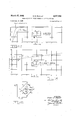
- FIG. 1 illustrates the characteristic of a diode having low incremental impedance at zero voltage, such as a germanium diode
- FIG. 2 is a current limiter employing diodes having characteristics as shown in FIG. 1,
- FIG. 3 shows the characteristic of the limiter of FIG. 2
- FIG. 4 shows a limiter employing series diodes of the type illustrated in FIG. 1 and shunt diodes of the type illustrated in FIG. 5,
- FIG. 5 illustrates the characteristic of a diode having high incremental impedance at zero voltage, such as a silicon diode,
- FIG. 6 illustrates the characteristic of FIG. 4,
- FIGS, 7, 8 and 9 illustrate the principles involved in a current limiter having an adjustable threshold and using diodes of either the type shown in FIG. 1 or in FIG. 5,
- FIG. 10 is a limiter circuit employing the principles of FIGS. 7, 8 and 9,
- FIG. 11 is the overall characteristic of the limiter in FIG. 10,
- FIGS. 12a and 12b illustrate the operation of FIG. 10,
- FIGS. 13 and 14 are measured charcteristics of limiters of the type shown in FIG. 10,
- FIG. 15 illustrates a current limiter requiring a smaller biasing voltage then the limiter of FIG. 10,
- FIG. 16 is the characteristic of the limiter in FIG. 15,
- FIGS. 17 and 18 illustrate alternating current biasing in circuits of the type shown in FIGS. 10 and 15.
- FIGS. 19 and 2() illustrate limiters of the type shown in FIGS. 10 and 15 used as phase detectors
- FIG. 21 illustrates the phase characteristics of the circuits of FIGS. 19 and 20,
- FIGS. 22 and 23 illustrate the uses of the circuits of FIGS. 2, 10 and 15 in the generation of rectangular waves
- FIGS. 24, 25 and 26 illustrates modifications of FIG. 22 or FIG. 23 to produce triangular waves, step functions sharp pulses, respectively,
- FIG. 27 illustrates waveforms for the circuits of FIGS.
- FIG. 28 illustrates the use of circuits as shown in FIGS. 2, 10 and 15 for ripple filtering
- FIGS. 29 and 30 illustrate the use of the limiting circuits of FIGS. 2, 10 and 15 in producing constant current sources
- 7 FIG. 31 illustrates the characteristic of the circuits of FIGS. 29 and 30.
- FIG. 1 shows the EI characteristic of a typical junction type germanium diode such as the General Electric IN93.
- the impedance of the diode at 25 C. is seen to be relatively low in the vicinity of zero current, as indicated by the steepness of the characteristic, and to increase abruptly to a relatively high value at about .1 volt and 23 microamperes.
- this change in impedance occurs at between .1 and .2 volts and 708() microamperes.
- the points are representative and can be expected to vary somewhat from sample to sample.
- T'Wo diodes having characteristics of the type shown in FIG. 1 may be connected in oppositely poled series relationship to form a simple current limiting device, as shown in FIG. 2.
- a current limiter having terminals 1 and 2 and consisting of oppositely poled germanium diodes 3 and 4 is connected in series with coil M, which, for example, may be the coil of a null meter or the input coil of a magnetic amplifier, and serves to protect the coil against excessive current flow in either direction.
- coil M which, for example, may be the coil of a null meter or the input coil of a magnetic amplifier, and serves to protect the coil against excessive current flow in either direction.
- the characteristic of the circuit of FIG. 2 is as shown in FIG. 3.
- diode 3 offers a constant relatively low impedance for all values of e.
- Diode 4 offers a similar relatively low impedance for values of 2 below the value, varying with temperature, that brings the diode voltage to the point of inflection on the diode characteristic.
- the current flow is in the opposite direction the roles of diodes 3 and 4 are reversed.
- the combined impedance of diodes 3 and 4 is relatively low and is less than the impedance of coil M, so that the sensitivity of the protected apparatus to small voltages is not greatly reduced by the current limiting device.
- the greatly increased impedance of diode 3 or 4 presents any appreciable further increase in current through the coil M.
- This type of protective device is simple and can be installed within the case of a meter, thereby permit ting a sensitive meter to be used in circuits where overloading is likely to occur without the danger of meter burn out.
- the protection afforded by the above described device is not independent of temperature, which may possibly result in inadeqaute protection being pro-' vided at higher temperatures.
- the arrangement of FIG. 4 is intended to alleviate this difiiculty through the use of a pair of oppositely poled silicon diodes 5 and 6 in shunt to coil M.
- the EI characteristic of a typical point contact silicon diode, such as the Hughes No. 6002 is shown in FIG. 5 and is substantially independent of temperature.
- the diode has a very high impedance, substantially an open circuit, in the back direction and also a high impedance in the forward direction up to a voltage between .3 and .5 volt where there is a sharp inflection of the curve representing an abrupt drop in impedance to a relatively low value.
- I as seen in FIG. 6 increases as 2 increases up to a value e at which the volttage across the coil M and the silicon diodes is somewhere between .4 and .5 volt and the impedance of the forward connected diode starts changing to its lower value. At this point the diode begins to conduct so that the total current I divides between coil M and the shunting diode.
- FIG. 5 illustrates the principles underlying the design of this circuit.
- silicon diode 7 is connected in series with a source of direct voltage E and a resistance R.
- a source 8 of low internal impedance relative to R and providing a variable direct voltage a is connected across the diode.
- I I -I
- This current begins to limit as e enters the region of flexu're of the I curve. Below this region the diode has a very high impedance, as indicated by the flatness of the I curve, and the value of I is determined principally by R which, as stated above, is assumed to be much greater than the internal impedance of source 8.
- R which, as stated above, is assumed to be much greater than the internal impedance of source 8.
- the internal impedance of source 8 is assumed to be substantially zero so that for values of 2 below the flexure region.
- FIG. 9 the shape of the e-I characteristic of FIG. 9 is very similar to that of the E-I characteristic of silicon shown in FIG. 5. Also, if the point E is considered the origin, the characteristic is very similar to that of germanium shown in FIG. 1.
- E By using a second diode 8 and duplicating the circuit of FIG. 7, as shown in FIG. 10, E, can eifectively be made the origin with respect to an applied voltage e of either polarity. Therefore, the circuit between terminals 1 and 2 acts as a current limiting device for coil M and, as shown in FIG. 11, has a characteristic which is similar to the characteristic of the circuit of FIG. 2.
- FIGS. 12a and 12b illustrate the operation of the circuit of FIG. 10.
- the current 1 travels through diode 7 in the forward direction and through diode 8 in the backward direction, the impedance of the diodes being very low relative to R for voltages in the vicinity of E as indicated in FIG. 9 by the steepness of the characteristic at this point.
- the diode presents substantially an open circuit to the I 4 current so that it must flow through the battery and R, as shown in FIG. 12b, and is limited to the value permitted by the magnitude of this resistance. Due to the symmetry of the circuit, reversing the polarity of a merely interchanges the roles of diodes 7 and 8.
- FIGS. 8 and 9 show the effectiveness of the circuit of FIG. 10 as a current limiter increases as R increases.
- a relatively large R is required for eiiective limiting, as indicated by a low value of slope for that part of the e-I curve corresponding to values of e below the fiexure region.
- FIGS. 13 and 14 show the measured characteristics of the circuit of FIG. 10 for two values of R with the values of E required to produce limiting in the 30-35 microampere region.
- FIG. 13 and 14 show the measured characteristics of the circuit of FIG. 10 for two values of R with the values of E required to produce limiting in the 30-35 microampere region.
- FIGS. 13 and 14 for effective limiting at currents of 30 microamperes or greater relatively high values of E are required, which may be undesirable where 7 batteries are used to supply the potential.
- Diodes D and D may be of germanium or silicon, but are preferably the latter in order to take advantage of the relative independence of temperature exhibited by the silicon diode characteristic.
- the voltages E bias diodes D and D in their conductive regions at a voltage at which the incremental impedance is low.
- This biasing voltage across the diode terminals may be designated E and may have, for silicon, a value of .51 volt, for example, giving a diode current of about 35 microamperes as seen in FIG. 5.
- the value of R is determined by the relationship As e increases above zero, assuming the polarity shown,
- the resulting source current I flows through D M' and D in succession.
- the current takes this path because the incremental impedance of D and D at E (FIG. 5) is much less than R and therefore substantiallynone of I flows through resistors 10 and 12.
- 'Ihe current 1 flows through D in opposition to I and therefore re prises the total forward current flow through this diode and the voltage across it.
- E would be that value of e for which the voltage across the diode is reduced to about .48 volt.
- the current at which the circuit of FIG. 15 limits is equal to the quiescent current 1 Since this current is determined by E and R in accordance with the relation E-E R the limiting value can be varied by appropriate changes in E or R. For limiting in the range of 30-80 micro amperes with a low value of E, the values of R are relatively low and the circuit, when in the limiting state, does not present as high an impedance to the source of e as is presented by the circuit of FIG. 10. However, by increasing E and R in proportion any desired circuit impedance may be obtained for any given limiting current.
- E is nearly a constant quantity as may be seen in FIG. 5 where over a current range of l0-80 microamperes it varies less than .1 volt. As in FIG. 10, the small current drain permits the life of the batteries supplying E to approximate their shelf life. E can, of course, be obtained from a conventional DC. power supply if desired.
- FIGS. 17 and 18 It is not necessary that the circuits of FIGS. and be biased with direct current. voltages may be used as shown in FIGS. 17 and 18. In FIG. 18, the phasing of the transformer secondary windings must be as indicated and the secondary voltages must be equal. The operation is similar to the direct current biased condition except that a pulsing rather than a continuous direct current passes through coil M.
- the signal e in the above case may be alternating as well as direct provided it has the same frequency as E; and provided there is a fixed phase diflerence, preferably 0 to 180, between e and E.
- the smallest alternating voltages may be measured since the diodes are forced into conduction by the biasing voltage once in each cycle and while conductive the smallest departure of e from zero can cause a current flow through M. It is therefore not necessary for the signal being measured to provide the initial voltage required to cause diode conduction. It is evident that changing the phase relation between e and E by 180 reverses the direction of current flow through M.
- the circuit may therefore be used as a phase sensitive rectifier in servo systems in which the error signal is an alternating voltage having one of two opposite phases depending upon the direction of the error.
- e would represent the error signal and E would supply the reference phase.
- a reversal in phase of e indicating a change in the direction or sign of the error, results in a change in direction of the direct current in coil M which may be the input to a sensitive servo control system.
- the limiting action of the circuit protects coil M against high values of the error signal e. Where the above 0180 relationship between the two applied alternating voltages is not maintained,
- the output polarity is still indicative of phase relation, in this case indicating the direction of departure of one voltage from a quadrature relation to the other.
- FIGS. 17 and 18 also may be used to give a direct current indication of the phase relation between two alternating voltages of the same frequency which is substantially independent of therelative magnitudes of the two alternating voltages.
- FIGS. 19 and 20 illustrate such use of the circuits of FIGS. 17 and 18, respectively. Referring to FIG. 19, this circuit compares the phase of e with that of E which may he considered the reference phase, and produces a positive potential at terminal 13 when the phase difference is in the range 090 and a negative potential when in the range -180, the potential being zero at 90. The characteristic is illustrated in FIG. 21. E corresponds to the biasing voltage E of FIG. 10 and is selected in accordance with the maximum voltage desired at terminal 13.
- the signal e must have suflicient magnitude in this case to drive the circuit into its limiting range.
- 2 must exceed the magnitude required at phase angles 0 or to reduce the potential across the diode where it opposes the biasing potential sufficiently to drive that diode into its high impedance range. If the diodes are biased at about the point indicated in FIG. 5 the required minimum potential reduction would be about .1 volt or slightly more.
- the operating principle of the circuit of FIG. 19 is no different from that of the circuit of FIG. 10. If the phase difference between e and E is 0 these two voltages have the same phase at diode 7 and opposite phases at diode 8. Therefore, on the positive half-cycles of E diode 7 has a low impedance and diode 8 a very high impedance so that current flows from the secondary of transformer 14 through diode 7, the secondary of transformer 15, resistor 16 and resistor 17 causing terminal '13 to be positive rela tive to ground. If the phase difference is 180 the two voltages are in phase on diode 8 and of opposite phase on diode 7.
- FIGS. 22-31 illustrate examples of various additional uses to which the limiting and constant current characteristics of the circuits of FIGS. 2, and may be put.
- FIG. 22 illustrates a circuit having input terminals 18-19 and output terminals 20-21, and containing a current limiting circuit 22 of either the type shown in FIG. 2 or the type shown in FIG. 10.
- FIG. 23 illustrates similar circuit containing a limiter 22 of the type shown in FIG. 15 and having corresponding reference terminals. With an alternating voltage asshown at (1) in FIG. 27 applied to input terminals 18-19 of either circuit, the maximum amplitude of this voltage being much greater than the voltageE illustrated in FIGS. 3, 11 and 16, at which limiting occurs, various waveforms may be generated.
- the impedance between terminals 20-21 is a resistance, as in FIGS. 22 and 23, a substantially rectangular alternating wave as shown at (2) in FIG. 27 is produced.
- the impedance is a condenser, as shown in FIG. 24, the resulting constant current charging and discharging of this condenser produces a linear triangular alternating voltage at terminals 20-21 as shown at 3 in FIG. 27.
- the rectifier prevents the condenser from discharging so that the resulting direct voltage at terminals 20-21, increases by one step for each cycle of the applied alternating voltage as shown at 4) in FIG. 27.
- the circuit of FIG. 26 is substituted in FIGS. 22 and 23, a substantiallyrectangular wave of current flows through the primary of the transformer producing sharp voltage pulses at the secondary terminals 20- 21, as shown at (5) in FIG. 27.
- FIGS. 22 and 23 are capable of acting as a ripple filter for a direct voltage applied to input ter- .minals 18-19. Such a voltage is illustrated at (1) in FIG. 28. If its minimum amplitude always exceeds E the voltage at which limiting occurs, the output voltage is ripple free as shown at (2).
- Limiting circuits of the type described in FIGS. 2, 10 and 15 may also be used as a constant direct current source fora variableimpedance load, as illustrated in FIGS. 29 and 30.
- the operating characteristic is shown in FIG. 31.
- E -IR is greater thanE the voltage at which the limiting actions of circuits 22 and 22' become elfec'tive
- the current I remains-constant.
- ourrent limiters ofthe type shown in FIGS. 10 and 15 are terminals a and d and a like source of voltage and a like impedance connected between terminals b and c, said voltage sources being poled to send equal biasing U currents through said diodes in the forward direction, I
- said diodes being of the type having a high impedance in the reverse direction and also in the forward direction up to a predetermined'forward voltage at which the irnpedance changes sharply to a low value.
- a current limiting device for connection between a two-terminal source of current and a two-terminal load for abruptly limiting the current flow through said load at a predetermined value, said device comprising a diode P connected between one of the source terminals and one of the load terminals, a like diode connected between the other source terminal and the other load terminal, said diodes having like poles connected to said load terminals, a source of voltage and an impedance connected in series between said one current source terminal and said other load terminal, a source of voltage and an impedance connected in series between said other current source terminal and said one load terminal, said impedances having equal values and said voltage sources having equal voltages poled to send current through said diodes in the forward direction, said diodes being of the type having a high impedance in the reverse direction and also in the forward direction up to a predetermined forward voltage at which the impedance changes sharply to a low value.
Landscapes
- Engineering & Computer Science (AREA)
- Power Engineering (AREA)
- Amplifiers (AREA)
Description
SEMI-CONDUCTOR DIODE CURRENT LIMITING DEVICE Filed May 15, 1958 March 27, 1962 R. R. ROALEF 6 Sheets-Sheet l o s M INVENTOR. 4 0315?? I. 0446/ WW SEMI-CONDUCTOR DIODE CURRENT LIMITING DEVICE Filed May 15, 1958 March 27, 1962 R. R. ROALEF 6 SheetsSheet 3 I Z M m I M IIMI/IIJQ l u a 7 I INVENTOR. Fl
IPJBLPT A ,9
BY W770 l/Vf Y March 27, 1962 RR. ROALEF 3,027,466
SEMI-CONDUCTOR DIODE CURRENT LIMITING DEVICE Filed May 15, 1958 6 Sheets-Sheet 5 INVENTOR. l ,eaear .e ,e #4:; By W #7708! March 27, 1962 R. R. ROALEF 3,027,466
SEMI-CONDUCTOR DIODE CURRENT LIMITING DEVICE Filed May 15, 1958 e Sheets-Sheet 6 n a 1 iii 5 o o 1 m w w 13/ II I ll 1 5 2 United States Patent 3,027,466 SEMI-CONDUCTOR DIODE CURRENT LIMITING DEVICE Robert R. Roalef, 321 Keniiworth Ave., Dayton 5, Ohio Filed May 15, 1958, Ser. No. 735,651 2 Claims. (Cl. 307-885) (Granted under Title 35, U.S. Code (1952), sec. 266) The invention described herein may be manufactured and used by or for the United States Government for governmental purposes without the payment to me of any royalty thereon.
This invention relates to current limiting devices and is primarily concerned with the protection of delicate current sensing apparatus, such as sensitive null meters or the sensitive error signal sensing amplifiers used in servo systems, against overloads and consequent burn out.
The ideal protective device would otter no resistance, or very little resistance, to current flow to the protected apparatus at low applied voltage, so as to preserve the sensitivity of the apparatus to weak signals, and would act automatically at higher applied voltages to limit the current to the protected apparatus to a safe value. The current limiting devices described herein utilize the peculiar properties of semiconductive diodes to approach this ideal.
Although intended primarily as protective devices the properties of the current limiting networks disclosed may be utilized in other ways, several of which will be described.
A more detailed description of the invention will be given with reference to the specific embodiments thereof shown in the accompanying drawings in which FIG. 1 illustrates the characteristic of a diode having low incremental impedance at zero voltage, such as a germanium diode,
FIG. 2 is a current limiter employing diodes having characteristics as shown in FIG. 1,
FIG. 3 shows the characteristic of the limiter of FIG. 2,
FIG. 4 shows a limiter employing series diodes of the type illustrated in FIG. 1 and shunt diodes of the type illustrated in FIG. 5,
FIG. 5 illustrates the characteristic of a diode having high incremental impedance at zero voltage, such as a silicon diode,
FIG. 6 illustrates the characteristic of FIG. 4,
FIGS, 7, 8 and 9 illustrate the principles involved in a current limiter having an adjustable threshold and using diodes of either the type shown in FIG. 1 or in FIG. 5,
FIG. 10 is a limiter circuit employing the principles of FIGS. 7, 8 and 9,
FIG. 11 is the overall characteristic of the limiter in FIG. 10,
FIGS. 12a and 12b illustrate the operation of FIG. 10,
FIGS. 13 and 14 are measured charcteristics of limiters of the type shown in FIG. 10,
FIG. 15 illustrates a current limiter requiring a smaller biasing voltage then the limiter of FIG. 10,
FIG. 16 is the characteristic of the limiter in FIG. 15,
FIGS. 17 and 18 illustrate alternating current biasing in circuits of the type shown in FIGS. 10 and 15.
FIGS. 19 and 2() illustrate limiters of the type shown in FIGS. 10 and 15 used as phase detectors,
FIG. 21 illustrates the phase characteristics of the circuits of FIGS. 19 and 20,
FIGS. 22 and 23 illustrate the uses of the circuits of FIGS. 2, 10 and 15 in the generation of rectangular waves,
FIGS. 24, 25 and 26 illustrates modifications of FIG. 22 or FIG. 23 to produce triangular waves, step functions sharp pulses, respectively,
ice
2 FIG. 27 illustrates waveforms for the circuits of FIGS.
FIG. 28 illustrates the use of circuits as shown in FIGS. 2, 10 and 15 for ripple filtering,
FIGS. 29 and 30 illustrate the use of the limiting circuits of FIGS. 2, 10 and 15 in producing constant current sources, and 7 FIG. 31 illustrates the characteristic of the circuits of FIGS. 29 and 30.
FIG. 1 shows the EI characteristic of a typical junction type germanium diode such as the General Electric IN93. For current flow in the back direction, the impedance of the diode at 25 C. is seen to be relatively low in the vicinity of zero current, as indicated by the steepness of the characteristic, and to increase abruptly to a relatively high value at about .1 volt and 23 microamperes. At 40 C. this change in impedance occurs at between .1 and .2 volts and 708() microamperes. The points are representative and can be expected to vary somewhat from sample to sample.
T'Wo diodes having characteristics of the type shown in FIG. 1 may be connected in oppositely poled series relationship to form a simple current limiting device, as shown in FIG. 2. Here a current limiter having terminals 1 and 2 and consisting of oppositely poled germanium diodes 3 and 4 is connected in series with coil M, which, for example, may be the coil of a null meter or the input coil of a magnetic amplifier, and serves to protect the coil against excessive current flow in either direction. The characteristic of the circuit of FIG. 2 is as shown in FIG. 3. For current flow in the direction shown, diode 3 offers a constant relatively low impedance for all values of e. Diode 4 offers a similar relatively low impedance for values of 2 below the value, varying with temperature, that brings the diode voltage to the point of inflection on the diode characteristic. When the current flow is in the opposite direction the roles of diodes 3 and 4 are reversed. For small values of e, therefore, the combined impedance of diodes 3 and 4 is relatively low and is less than the impedance of coil M, so that the sensitivity of the protected apparatus to small voltages is not greatly reduced by the current limiting device. For higher values of 2, above that at which inflection occurs, the greatly increased impedance of diode 3 or 4 presents any appreciable further increase in current through the coil M. This type of protective device is simple and can be installed within the case of a meter, thereby permit ting a sensitive meter to be used in circuits where overloading is likely to occur without the danger of meter burn out.
As indicated, the protection afforded by the above described device is not independent of temperature, which may possibly result in inadeqaute protection being pro-' vided at higher temperatures. The arrangement of FIG. 4 is intended to alleviate this difiiculty through the use of a pair of oppositely poled silicon diodes 5 and 6 in shunt to coil M. The EI characteristic of a typical point contact silicon diode, such as the Hughes No. 6002, is shown in FIG. 5 and is substantially independent of temperature. It is seen that the diode has a very high impedance, substantially an open circuit, in the back direction and also a high impedance in the forward direction up to a voltage between .3 and .5 volt where there is a sharp inflection of the curve representing an abrupt drop in impedance to a relatively low value. In the arrangement of FIG. 4, therefore, I as seen in FIG. 6, increases as 2 increases up to a value e at which the volttage across the coil M and the silicon diodes is somewhere between .4 and .5 volt and the impedance of the forward connected diode starts changing to its lower value. At this point the diode begins to conduct so that the total current I divides between coil M and the shunting diode. The effect of this is to limit further increases in voltage across the coil and in I as shown in FIG. 6. Sincev the silicon diode charcteristics are'substantialy unaffected by temperature changes, the shunting diodes protect the coil against the increased current permitted by the germanium diodes at the higher temperatures.
Because of the fact that silicon'diodes require a forward voltage of about .5 volt to produce an abrupt fall in impedance, as shownin FIG. 5, these diodes are not suitable for use in a simple limiting circuit of the type shown in FIG. 2.. However, by the use of a direct biasing volage in circuit with a pair of silicon diodes, it is possible to construct a limiting circuit having a characteristic similar to the circuit of FIG. 2 and providing the advantage that, as a result of using silicon diodes, the limiter characteristic is substantially independent of temperature. FIGS. 7-12 illustrate the principles underlying the design of this circuit.
Referring to FIG. 7, silicon diode 7 is connected in series with a source of direct voltage E and a resistance R. A source 8 of low internal impedance relative to R and providing a variable direct voltage a is connected across the diode. It is apparent that I =I -I FIG. 8 shows the manner in which I i and their algebraic difference I vary with e. As e decreases from a value above E which is the voltage that would exist across the diode if source 8 were removed, I increases and I decreases, becoming equal and reducing I to zero at e=E At this point I =I =I where is referred to as the quiescent current. As e decreases below E I reverses its direction and flows into source 8. This current begins to limit as e enters the region of flexu're of the I curve. Below this region the diode has a very high impedance, as indicated by the flatness of the I curve, and the value of I is determined principally by R which, as stated above, is assumed to be much greater than the internal impedance of source 8. In FIG. 8 the internal impedance of source 8 is assumed to be substantially zero so that for values of 2 below the flexure region. The resistance presented by the circuit to source 8 at e=E is very low as indicated by the steepness of the e-I characteristic at this point. By increasing R to a relatively high value and then increasing E as required to reestablish the same value of I the limiting action of the circuit for current flow into source 8 can be improved, as indicated in FIG. 9 where that part of the I curve below the flexure region is much flatter than in FIG. 8.
It will be seen that the shape of the e-I characteristic of FIG. 9 is very similar to that of the E-I characteristic of silicon shown in FIG. 5. Also, if the point E is considered the origin, the characteristic is very similar to that of germanium shown in FIG. 1. By using a second diode 8 and duplicating the circuit of FIG. 7, as shown in FIG. 10, E, can eifectively be made the origin with respect to an applied voltage e of either polarity. Therefore, the circuit between terminals 1 and 2 acts as a current limiting device for coil M and, as shown in FIG. 11, has a characteristic which is similar to the characteristic of the circuit of FIG. 2. FIGS. 12a and 12b illustrate the operation of the circuit of FIG. 10. For small values of e, of the polarity shown, the current 1 travels through diode 7 in the forward direction and through diode 8 in the backward direction, the impedance of the diodes being very low relative to R for voltages in the vicinity of E as indicated in FIG. 9 by the steepness of the characteristic at this point. For values of e causing the voltage across diode 8, as measured from E in FIG. 9, to go beyond the flexute region of its characteristic, the diode presents substantially an open circuit to the I 4 current so that it must flow through the battery and R, as shown in FIG. 12b, and is limited to the value permitted by the magnitude of this resistance. Due to the symmetry of the circuit, reversing the polarity of a merely interchanges the roles of diodes 7 and 8.
As may be seen by a comparison of FIGS. 8 and 9, the effectiveness of the circuit of FIG. 10 as a current limiter increases as R increases. For eiiective limiting, as indicated by a low value of slope for that part of the e-I curve corresponding to values of e below the fiexure region, a relatively large R is required. FIGS. 13 and 14 show the measured characteristics of the circuit of FIG. 10 for two values of R with the values of E required to produce limiting in the 30-35 microampere region. FIG. 13 shows the effec't of the coil M or load resistance on one of the characteristics for low values of en It is apparent that limiting takes place when the current reaches a value equal to the quiescent current I which is directly related to E/R and, for large values of R, is substantially equal to E/R, as seen in FIGS. 8 and 9. Therefore, for any given value of R, the limiting point can be controlled by changing E. For quiescent currents in the microampere range, as would occur when protecting a very sensitive meter element, it is feasible to use small batteries to supply the voltage E since at this low current drain the battery life can be expected to approximate shelf life. The voltage E can of course be obtained from a conventional DC. power supply instead of a battery where complete portability is not required.
As seen from FIGS. 13 and 14, for effective limiting at currents of 30 microamperes or greater relatively high values of E are required, which may be undesirable where 7 batteries are used to supply the potential. The circuit of FIG. 15 provides absolute limitation of the current through coil M over a wide range without requiring high direct biasing voltages. Considering this circuit further and assuming e=(), battery 9 causes a circulating current I to flow in the loop circuit consisting of battery 9, resistor 10, diode D and coil M. Similarly, battery 11 causes a circulating current I to flow in the loop circuit consisting of battery 11, resistor 12, diode D and coil M. If the sources 9 and 11 provide equal voltages E, if resistors 10 and 12 have equal values R and if the diodm D and D are matched, then I =I and, since the two currents flow in opposite directions through coil M, the current 1 is Zero. Diodes D and D may be of germanium or silicon, but are preferably the latter in order to take advantage of the relative independence of temperature exhibited by the silicon diode characteristic.
The voltages E bias diodes D and D in their conductive regions at a voltage at which the incremental impedance is low. This biasing voltage across the diode terminals may be designated E and may have, for silicon, a value of .51 volt, for example, giving a diode current of about 35 microamperes as seen in FIG. 5. The value of R is determined by the relationship As e increases above zero, assuming the polarity shown,
the resulting source current I flows through D M' and D in succession. The current takes this path because the incremental impedance of D and D at E (FIG. 5) is much less than R and therefore substantiallynone of I flows through resistors 10 and 12. 'Ihe current 1 flows through D in opposition to I and therefore re duces the total forward current flow through this diode and the voltage across it. For valuesof e from zero up to a certain value E the voltage across D is' such that its 1 incremental impedance is low. For the diode of FIG. 5, E would be that value of e for which the voltage across the diode is reduced to about .48 volt. Over this range of e, I =I As e increases above E the incremental impedance of D begins to increase, as indicated by the decreasing slope of the characteristic in FIG. 5, and increases rapidly until the potential across the diode is reduced to about .3 volt at which point D represents substantially an open circuit. As the impedance of D increases an increasing portion of the increment in I flows through resistor 12 until eventually any significant further increase in the current through D and therefore through M, is impossible. Since the current through D; equals log-1M, when this current becomes zero 1 =I so that the current in coil M positively limits at a value equal to the quiescent current. As 2 increases still further I remains constant at the quiescent value while I continues 'to increase at a rate determined by R. This is illustrated in FIG. 16. Due to the symmetry of the circuit, reversing the polarity of e simply interchanges the roles of D and D and reverses the direction of I As stated above, the current at which the circuit of FIG. 15 limits is equal to the quiescent current 1 Since this current is determined by E and R in accordance with the relation E-E R the limiting value can be varied by appropriate changes in E or R. For limiting in the range of 30-80 micro amperes with a low value of E, the values of R are relatively low and the circuit, when in the limiting state, does not present as high an impedance to the source of e as is presented by the circuit of FIG. 10. However, by increasing E and R in proportion any desired circuit impedance may be obtained for any given limiting current. E is nearly a constant quantity as may be seen in FIG. 5 where over a current range of l0-80 microamperes it varies less than .1 volt. As in FIG. 10, the small current drain permits the life of the batteries supplying E to approximate their shelf life. E can, of course, be obtained from a conventional DC. power supply if desired.
It isnot necessary that the circuits of FIGS. and be biased with direct current. voltages may be used as shown in FIGS. 17 and 18. In FIG. 18, the phasing of the transformer secondary windings must be as indicated and the secondary voltages must be equal. The operation is similar to the direct current biased condition except that a pulsing rather than a continuous direct current passes through coil M.
The signal e in the above case may be alternating as well as direct provided it has the same frequency as E; and provided there is a fixed phase diflerence, preferably 0 to 180, between e and E The smallest alternating voltages may be measured since the diodes are forced into conduction by the biasing voltage once in each cycle and while conductive the smallest departure of e from zero can cause a current flow through M. It is therefore not necessary for the signal being measured to provide the initial voltage required to cause diode conduction. It is evident that changing the phase relation between e and E by 180 reverses the direction of current flow through M. The circuit may therefore be used as a phase sensitive rectifier in servo systems in which the error signal is an alternating voltage having one of two opposite phases depending upon the direction of the error. In this application, e would represent the error signal and E would supply the reference phase. A reversal in phase of e, indicating a change in the direction or sign of the error, results in a change in direction of the direct current in coil M which may be the input to a sensitive servo control system. In this case also, the limiting action of the circuit protects coil M against high values of the error signal e. Where the above 0180 relationship between the two applied alternating voltages is not maintained,
Alternating biasing nitude; however, the output polarity is still indicative of phase relation, in this case indicating the direction of departure of one voltage from a quadrature relation to the other.
The circuits of FIGS. 17 and 18 also may be used to give a direct current indication of the phase relation between two alternating voltages of the same frequency which is substantially independent of therelative magnitudes of the two alternating voltages. FIGS. 19 and 20 illustrate such use of the circuits of FIGS. 17 and 18, respectively. Referring to FIG. 19, this circuit compares the phase of e with that of E which may he considered the reference phase, and produces a positive potential at terminal 13 when the phase difference is in the range 090 and a negative potential when in the range -180, the potential being zero at 90. The characteristic is illustrated in FIG. 21. E corresponds to the biasing voltage E of FIG. 10 and is selected in accordance with the maximum voltage desired at terminal 13. The signal e must have suflicient magnitude in this case to drive the circuit into its limiting range. In other words, 2 must exceed the magnitude required at phase angles 0 or to reduce the potential across the diode where it opposes the biasing potential sufficiently to drive that diode into its high impedance range. If the diodes are biased at about the point indicated in FIG. 5 the required minimum potential reduction would be about .1 volt or slightly more.
The operating principle of the circuit of FIG. 19 is no different from that of the circuit of FIG. 10. If the phase difference between e and E is 0 these two voltages have the same phase at diode 7 and opposite phases at diode 8. Therefore, on the positive half-cycles of E diode 7 has a low impedance and diode 8 a very high impedance so that current flows from the secondary of transformer 14 through diode 7, the secondary of transformer 15, resistor 16 and resistor 17 causing terminal '13 to be positive rela tive to ground. If the phase difference is 180 the two voltages are in phase on diode 8 and of opposite phase on diode 7. Consequently the previous conditions are reversed with current flowing from the secondary of transformer 14 upward through resistor 17,and thence through diode 8, the secondary of transformer 15 and resistor 18, causing terminal 13 to be negative. When the phase difference is 90", equal currents flow in opposite directions through resistor 17 during each positive half-cycle of E so that the net current and the voltage at terminal 13 are zero. As in FIG. 10, the limiting action of the circuit, resulting from the high value of R, makes the voltage at terminal 13 substantially independent of the magnitude of e When operated under the conditions specified above for FIG. 19, the circuit of FIG. 20 operates to produce the same result, the basic operating principle being the same as for FIG. 15. When e and E have a phase difierence of zero, the two voltages at D due to e and E have the same phase whereas the two voltages at D have opposite phases. D therefore has a very high impedance, provided e exceeds the minimum value specified above as required, and the current from transformer 14 flows through D and then divides, part flowing through resistor 17 and D to the extent required to cancel the opposite flow through D due to transformer 15", and the remainder flowing through the secondary of transformer 15" and resistor 12. Terminal 13 is therefore positive. If the phase difference is 180, conditions are exactly reversed so that current flows upward through resistor 17 toward terminal 13 with the result that this terminal is negative. When the phase diiference is 90", equal currents flow in opposite directions through resistor 17 during each positive half-cycle of E with the result that the net current and the voltage of terminal 13 are zero. Since the current through resistor 17 can never exceed the quiescent current through D or D resulting from the biasing voltages from transformers 15' and 15", the potential at terminal :13 is independent of the magnitude of e in the range above the specified minimum. The maximum voltage at terminal 13 can be adjusted by changing R or the equal secondary voltages of transformers 15' and 15". v
FIGS. 22-31 illustrate examples of various additional uses to which the limiting and constant current characteristics of the circuits of FIGS. 2, and may be put. FIG. 22 illustrates a circuit having input terminals 18-19 and output terminals 20-21, and containing a current limiting circuit 22 of either the type shown in FIG. 2 or the type shown in FIG. 10. FIG. 23 illustrates similar circuit containing a limiter 22 of the type shown in FIG. 15 and having corresponding reference terminals. With an alternating voltage asshown at (1) in FIG. 27 applied to input terminals 18-19 of either circuit, the maximum amplitude of this voltage being much greater than the voltageE illustrated in FIGS. 3, 11 and 16, at which limiting occurs, various waveforms may be generated. If'the impedance between terminals 20-21 is a resistance, as in FIGS. 22 and 23, a substantially rectangular alternating wave as shown at (2) in FIG. 27 is produced. If the impedance is a condenser, as shown in FIG. 24, the resulting constant current charging and discharging of this condenser produces a linear triangular alternating voltage at terminals 20-21 as shown at 3 in FIG. 27. If the circuit of FIG. 25 is substituted in FIGS. 22 and 23, the rectifier prevents the condenser from discharging so that the resulting direct voltage at terminals 20-21, increases by one step for each cycle of the applied alternating voltage as shown at 4) in FIG. 27. Finally, if the circuit of FIG. 26 is substituted in FIGS. 22 and 23, a substantiallyrectangular wave of current flows through the primary of the transformer producing sharp voltage pulses at the secondary terminals 20- 21, as shown at (5) in FIG. 27.
The circuits of FIGS. 22 and 23 are capable of acting as a ripple filter for a direct voltage applied to input ter- .minals 18-19. Such a voltage is illustrated at (1) in FIG. 28. If its minimum amplitude always exceeds E the voltage at which limiting occurs, the output voltage is ripple free as shown at (2).
Limiting circuits of the type described in FIGS. 2, 10 and 15 may also be used as a constant direct current source fora variableimpedance load, as illustrated in FIGS. 29 and 30. The operating characteristic is shown in FIG. 31. For any value of R the impedance of the load, forwhich E -IR is greater thanE the voltage at which the limiting actions of circuits 22 and 22' become elfec'tive, the current I remains-constant. If ourrent limiters ofthe type shown in FIGS. 10 and 15 are terminals a and d and a like source of voltage and a like impedance connected between terminals b and c, said voltage sources being poled to send equal biasing U currents through said diodes in the forward direction, I
said diodes being of the type having a high impedance in the reverse direction and also in the forward direction up to a predetermined'forward voltage at which the irnpedance changes sharply to a low value.
2. A current limiting device for connection between a two-terminal source of current and a two-terminal load for abruptly limiting the current flow through said load at a predetermined value, said device comprising a diode P connected between one of the source terminals and one of the load terminals, a like diode connected between the other source terminal and the other load terminal, said diodes having like poles connected to said load terminals, a source of voltage and an impedance connected in series between said one current source terminal and said other load terminal, a source of voltage and an impedance connected in series between said other current source terminal and said one load terminal, said impedances having equal values and said voltage sources having equal voltages poled to send current through said diodes in the forward direction, said diodes being of the type having a high impedance in the reverse direction and also in the forward direction up to a predetermined forward voltage at which the impedance changes sharply to a low value.
References Cited in the file of this patent UNITED STATES PATENTS 1,883,613 Devol Oct. 18, 1932 2,122,748 Mayer July 5, 1938 2,782,307 Sivers et al. Feb. 19, 1957 2,829,282 Hughes Apr. 1, 1958 2,841,719 Radcliffe h July 1, 1958 2,843,745 Smith July 15, 1958 2,854,651 Kircher Sept. 30, 1958
Priority Applications (2)
| Application Number | Priority Date | Filing Date | Title |
|---|---|---|---|
| US735651A US3027466A (en) | 1958-05-15 | 1958-05-15 | Semi-conductor diode current limiting device |
| US155512A US3122654A (en) | 1958-05-15 | 1961-11-28 | Current limiting device |
Applications Claiming Priority (1)
| Application Number | Priority Date | Filing Date | Title |
|---|---|---|---|
| US735651A US3027466A (en) | 1958-05-15 | 1958-05-15 | Semi-conductor diode current limiting device |
Publications (1)
| Publication Number | Publication Date |
|---|---|
| US3027466A true US3027466A (en) | 1962-03-27 |
Family
ID=24956644
Family Applications (1)
| Application Number | Title | Priority Date | Filing Date |
|---|---|---|---|
| US735651A Expired - Lifetime US3027466A (en) | 1958-05-15 | 1958-05-15 | Semi-conductor diode current limiting device |
Country Status (1)
| Country | Link |
|---|---|
| US (1) | US3027466A (en) |
Cited By (7)
| Publication number | Priority date | Publication date | Assignee | Title |
|---|---|---|---|---|
| US3148322A (en) * | 1961-03-13 | 1964-09-08 | Mallory & Co Inc P R | Rechargeable battery with means to prevent overcharging |
| US3200346A (en) * | 1962-08-21 | 1965-08-10 | Adage Inc | Overload protection circuit for high impedance amplifiers |
| US3278850A (en) * | 1962-03-27 | 1966-10-11 | Nippon Electric Co | Attenuation control arrangement for wave transmission system |
| US4217503A (en) * | 1977-06-30 | 1980-08-12 | Societe Anonyme Dite: La Telephonie Industrielle et Commerciale-Telic | Current limiter |
| US4438474A (en) | 1982-05-12 | 1984-03-20 | Westinghouse Electric Corp. | Current limiter and VAR generator utilizing a superconducting coil |
| US4594630A (en) * | 1980-06-02 | 1986-06-10 | Electric Power Research Institute, Inc. | Emission controlled current limiter for use in electric power transmission and distribution |
| US4933646A (en) * | 1989-03-27 | 1990-06-12 | Rca Licensing Corporation | Field effect transistor limiter circuitry |
Citations (7)
| Publication number | Priority date | Publication date | Assignee | Title |
|---|---|---|---|---|
| US1883613A (en) * | 1931-09-05 | 1932-10-18 | Union Switch & Signal Co | Voltage regulating apparatus |
| US2122748A (en) * | 1935-02-27 | 1938-07-05 | Siemens Ag | Four-pole device containing nonlinear resistors |
| US2782307A (en) * | 1950-10-12 | 1957-02-19 | Ericsson Telefon Ab L M | Electronic switching device for use in radio systems and multi-channel telephone systems employing successive pulses |
| US2829282A (en) * | 1956-05-17 | 1958-04-01 | Itt | Pulse generator |
| US2841719A (en) * | 1955-01-26 | 1958-07-01 | Itt | Diode gate and its control circuit |
| US2843745A (en) * | 1956-05-11 | 1958-07-15 | Bell Telephone Labor Inc | Tone generator |
| US2854651A (en) * | 1953-06-30 | 1958-09-30 | Bell Telephone Labor Inc | Diode circuits |
-
1958
- 1958-05-15 US US735651A patent/US3027466A/en not_active Expired - Lifetime
Patent Citations (7)
| Publication number | Priority date | Publication date | Assignee | Title |
|---|---|---|---|---|
| US1883613A (en) * | 1931-09-05 | 1932-10-18 | Union Switch & Signal Co | Voltage regulating apparatus |
| US2122748A (en) * | 1935-02-27 | 1938-07-05 | Siemens Ag | Four-pole device containing nonlinear resistors |
| US2782307A (en) * | 1950-10-12 | 1957-02-19 | Ericsson Telefon Ab L M | Electronic switching device for use in radio systems and multi-channel telephone systems employing successive pulses |
| US2854651A (en) * | 1953-06-30 | 1958-09-30 | Bell Telephone Labor Inc | Diode circuits |
| US2841719A (en) * | 1955-01-26 | 1958-07-01 | Itt | Diode gate and its control circuit |
| US2843745A (en) * | 1956-05-11 | 1958-07-15 | Bell Telephone Labor Inc | Tone generator |
| US2829282A (en) * | 1956-05-17 | 1958-04-01 | Itt | Pulse generator |
Cited By (8)
| Publication number | Priority date | Publication date | Assignee | Title |
|---|---|---|---|---|
| US3148322A (en) * | 1961-03-13 | 1964-09-08 | Mallory & Co Inc P R | Rechargeable battery with means to prevent overcharging |
| US3278850A (en) * | 1962-03-27 | 1966-10-11 | Nippon Electric Co | Attenuation control arrangement for wave transmission system |
| US3200346A (en) * | 1962-08-21 | 1965-08-10 | Adage Inc | Overload protection circuit for high impedance amplifiers |
| US4217503A (en) * | 1977-06-30 | 1980-08-12 | Societe Anonyme Dite: La Telephonie Industrielle et Commerciale-Telic | Current limiter |
| US4594630A (en) * | 1980-06-02 | 1986-06-10 | Electric Power Research Institute, Inc. | Emission controlled current limiter for use in electric power transmission and distribution |
| US4438474A (en) | 1982-05-12 | 1984-03-20 | Westinghouse Electric Corp. | Current limiter and VAR generator utilizing a superconducting coil |
| US4933646A (en) * | 1989-03-27 | 1990-06-12 | Rca Licensing Corporation | Field effect transistor limiter circuitry |
| AU630173B2 (en) * | 1989-03-27 | 1992-10-22 | Rca Licensing Corporation | Field effect transistor limiter circuitry |
Similar Documents
| Publication | Publication Date | Title |
|---|---|---|
| US3151288A (en) | Field control circuit for multiple phase alternators | |
| US2464639A (en) | Magnetic amplifier | |
| US3233161A (en) | Saturable reactor and transistor bridge voltage control apparatus | |
| US3196255A (en) | Electrical proportional control system | |
| US3027466A (en) | Semi-conductor diode current limiting device | |
| US3025414A (en) | Discriminator circuit to provide an output representative of the amplitude and polarity of two input signals | |
| US3684172A (en) | Thermocouple temperature control system | |
| US3069558A (en) | Frequency sensitive control circuit | |
| US2816260A (en) | Regulated d. c. power supply | |
| US2957993A (en) | Control circuits for series connected semiconductors | |
| US3296498A (en) | Voltage sensing relay system | |
| US3152451A (en) | Control system | |
| US3488573A (en) | Overload protection for thermally sensitive load device | |
| US3122694A (en) | Current limiter utilizing a small ohmic resistance in series with the load | |
| US3586829A (en) | On-off heater control | |
| US2922109A (en) | Electric phase discriminator | |
| US2981888A (en) | Electrical current measuring system | |
| US3122654A (en) | Current limiting device | |
| US2472980A (en) | Measuring system and saturable reactor for use therein | |
| US2727999A (en) | Phase sensitive demodulators | |
| US2911597A (en) | Modulation system | |
| US3307042A (en) | Switching device | |
| US2848563A (en) | Dielectric amplifier | |
| US2691130A (en) | Bridge control circuits | |
| GB1178934A (en) | Electronic Storage Circuits |