US2354725A - Manufacture of composite lumber and article therefor - Google Patents
Manufacture of composite lumber and article therefor Download PDFInfo
- Publication number
- US2354725A US2354725A US263823A US26382339A US2354725A US 2354725 A US2354725 A US 2354725A US 263823 A US263823 A US 263823A US 26382339 A US26382339 A US 26382339A US 2354725 A US2354725 A US 2354725A
- Authority
- US
- United States
- Prior art keywords
- core
- lumber
- face
- kerfed
- door
- Prior art date
- Legal status (The legal status is an assumption and is not a legal conclusion. Google has not performed a legal analysis and makes no representation as to the accuracy of the status listed.)
- Expired - Lifetime
Links
- 239000002131 composite material Substances 0.000 title description 17
- 238000004519 manufacturing process Methods 0.000 title description 6
- 239000000463 material Substances 0.000 description 19
- 239000002023 wood Substances 0.000 description 15
- 239000010410 layer Substances 0.000 description 12
- 239000002344 surface layer Substances 0.000 description 9
- 230000003014 reinforcing effect Effects 0.000 description 7
- 238000009408 flooring Methods 0.000 description 6
- 239000000853 adhesive Substances 0.000 description 4
- 230000001070 adhesive effect Effects 0.000 description 4
- 230000006835 compression Effects 0.000 description 4
- 238000007906 compression Methods 0.000 description 4
- 230000007547 defect Effects 0.000 description 4
- 230000004048 modification Effects 0.000 description 4
- 238000012986 modification Methods 0.000 description 4
- 239000002699 waste material Substances 0.000 description 4
- 230000000694 effects Effects 0.000 description 3
- 230000001788 irregular Effects 0.000 description 3
- 239000007787 solid Substances 0.000 description 3
- 238000005520 cutting process Methods 0.000 description 2
- 230000000266 injurious effect Effects 0.000 description 2
- 230000002787 reinforcement Effects 0.000 description 2
- 239000012779 reinforcing material Substances 0.000 description 2
- 239000011435 rock Substances 0.000 description 2
- 241000894007 species Species 0.000 description 2
- 241000218652 Larix Species 0.000 description 1
- 235000005590 Larix decidua Nutrition 0.000 description 1
- 230000002745 absorbent Effects 0.000 description 1
- 239000002250 absorbent Substances 0.000 description 1
- 238000004026 adhesive bonding Methods 0.000 description 1
- 230000004075 alteration Effects 0.000 description 1
- 230000000712 assembly Effects 0.000 description 1
- 238000000429 assembly Methods 0.000 description 1
- 238000005452 bending Methods 0.000 description 1
- 230000015572 biosynthetic process Effects 0.000 description 1
- 239000004568 cement Substances 0.000 description 1
- 230000000295 complement effect Effects 0.000 description 1
- 239000012792 core layer Substances 0.000 description 1
- 239000003292 glue Substances 0.000 description 1
- 238000000034 method Methods 0.000 description 1
- 230000036961 partial effect Effects 0.000 description 1
- 239000011120 plywood Substances 0.000 description 1
- 238000003825 pressing Methods 0.000 description 1
- 230000002829 reductive effect Effects 0.000 description 1
- 238000009877 rendering Methods 0.000 description 1
- 230000000717 retained effect Effects 0.000 description 1
- 239000011343 solid material Substances 0.000 description 1
- 238000005728 strengthening Methods 0.000 description 1
- 238000011282 treatment Methods 0.000 description 1
- 230000003313 weakening effect Effects 0.000 description 1
- 230000037303 wrinkles Effects 0.000 description 1
Images


Classifications
-
- E—FIXED CONSTRUCTIONS
- E04—BUILDING
- E04C—STRUCTURAL ELEMENTS; BUILDING MATERIALS
- E04C2/00—Building elements of relatively thin form for the construction of parts of buildings, e.g. sheet materials, slabs, or panels
- E04C2/02—Building elements of relatively thin form for the construction of parts of buildings, e.g. sheet materials, slabs, or panels characterised by specified materials
- E04C2/10—Building elements of relatively thin form for the construction of parts of buildings, e.g. sheet materials, slabs, or panels characterised by specified materials of wood, fibres, chips, vegetable stems, or the like; of plastics; of foamed products
- E04C2/12—Building elements of relatively thin form for the construction of parts of buildings, e.g. sheet materials, slabs, or panels characterised by specified materials of wood, fibres, chips, vegetable stems, or the like; of plastics; of foamed products of solid wood
-
- Y—GENERAL TAGGING OF NEW TECHNOLOGICAL DEVELOPMENTS; GENERAL TAGGING OF CROSS-SECTIONAL TECHNOLOGIES SPANNING OVER SEVERAL SECTIONS OF THE IPC; TECHNICAL SUBJECTS COVERED BY FORMER USPC CROSS-REFERENCE ART COLLECTIONS [XRACs] AND DIGESTS
- Y10—TECHNICAL SUBJECTS COVERED BY FORMER USPC
- Y10T—TECHNICAL SUBJECTS COVERED BY FORMER US CLASSIFICATION
- Y10T428/00—Stock material or miscellaneous articles
- Y10T428/23—Sheet including cover or casing
- Y10T428/239—Complete cover or casing
Definitions
- the present invention relates to lumber and tobodies made therefrom. 1
- the present invention aims to provide cores which may be made from low-grade, inexpensive wood which may have irregular grain or knots or both.
- An object of the invention isto kerf or scarf lengths of lumber from both faces toward but not to or past the mid-plane of lumber, in suit- Another object of the invention .isto make a lighter weight door, the scarflng removing as much as 15% of the weight of the core.
- Another object of the invention is to make a door or lumber which is less injurious to tools.
- Another object of the invention is to make a door,- lumber or article which will not warp.
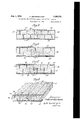
- Fig. 1 represents a piece of lumber with a kerfed core and surface reinforcements, particularly illustrating a filled knot-hole in the core;
- Figs. 2 to 7, inclusive represent a piece of lumber generally similar to that in Fig. 1, showing variations in the arrangements of the kerflng cuts.
- Fig. 8 represents a composite flooring board involving a wide kerfed core board carrying narrow high grade flooring strips as the surfacing bridge.
- Fig. 9 represents a modification of the invention in which the bridging material isprovided by squares of tile.
- Fig. 1Q represents a flush-type door in which an assembled solid core of stiles and rails has kerflng lines, the solid core being faced with suitable high grade veneer.
- Fig. 11 is an end view of the door of Fig. 10.
- a further object of the invention is to face such scarfed lumber on one or both faces with a veneer or ply having the desired surface qualities, to form newlumber or new bodies.
- Another object of the invention is to make doors or other articles having so scarfed cores whereby a better door may be made at less expense.
- Another object is to make products which can help utilize the large .supply of low grade lumber available.
- Fig. 12 represents a panel type door made in a standard way from composite stiles and rails embodying kerfed cores.
- Fig. 13 is an end view of the door of Fig. 12.
- the bridge is in character a reinforcing mem-
- the bridging is supplied by veneers or plies or other rigid sheet material at both surfaces, permanently united to the scarfed faces, as in doors. Where wood is used, resawn lumber has a tendency to shrink or expand.
- plywood veneer may be used having one or more plies with grain running across one or more other is used it is preferably treated to waterproof it or to render it less absorbent of moisture, whereby changes in atmospheric moisture do not lead to shrinkage or expansion orwarping of the bridge.
- Layer It is shown cut away .to disclose how inferior-lumber may be readily utilized.
- the hole designated I6 is such as may be an original knot-hole, or
- the plug I'I becomes united to the layers l5 and I4.
- the plug l6 preferably presents a face flush with the kerfed faces of the core, but it may be'thinner-than the core.
- the layers It and ii if solid material, are preferablytreated in known ways to minimize aba door is faced with treated resawn lumber, thereis maintained an approximate equality of tension on both sides, preventing curving .or cup-. ping of the door. Thesanie holds true for a The invention is particularly valuable for use of low grade lumber. Where a knot-hole is present it may ⁇ ; gored. Preferably it' may be T e plug need notnt tightly,
- the plug Provides backing forlthebridg'ing layer.
- the plug is preferably cemented to the bridging layer along with the kerfed surface ofthe core, so that theplug will not rattle if it is loosely fitted into the knot-hole. Where twisted and irregular grain is present, the kerfs effect a break in the tension along such irregularities, from pulling the core into warping.
- the kerfs are preferably left open to provide air channels through which there is more readily acquired a uniformity of moisture content in the core. This uniformity is another factor lessening the tendency of moisture differentials to effect warping.
- the invention may be modified greatly according to the particular use of a piece embodying it.
- Door stiles for example, in standard doors, have their inner edges horizontally reinforced by dowels projecting inwardly from the door rails. Therefore, it may be desirable in a doorstile core to have one type of kerf at one edge and another type at the other edge, and a different arrangement in the middle.
- Figs. 1 to 7 arrangements useful as door I stiles are disclosed.
- core l0 which is kerfed in a uniform pattern the same on both faces. These consist of one set of parallel uniformly spaced kerfs II from one face, to a. terminal plane well past the-mid-plane.
- a similar set i2 is found on the other side with each llrglarf equally spaced from the two adjacent kerfs direct line of continuity in the core, of value as a reference for comparison with other forms.
- Numerals I4 and I5 represent thin layers of high
- the dotted line i3 merely represents the grade lumber for surface appearance, and for 75 sorbing and yielding of moisture, thus rendering them less likely to warp per se.
- the adhesive employed is preferably awaterproof one, as commonly used in high grade lumber assemblies.
- Fig. 2 the arrangementof Fig. 1 is modified.
- Core has kerfs II on one face and kerfs 22 on These sets of kerfs terminate approximately at the same intermediate plane, preferably the mid-plane.
- the dotted line v23 indicates the line of continuity, being only slightly wavy. Bridging layers It and, are shown asin Fig.1. r
- Fig. 31s a further modification in which the arrangement brings the line of continuity alternately to each face of core 26.
- the continuity line is shown at 21 beingformed by two adjacent kerfs 28 from the top-shown face, then two adjacent kerfs 29 from the otherface, then repeating like 28 and 29.
- are shown.
- Fig, 7 represents the idea of combination of one or more set schemes.
- the core 54 has bridging surface layers 55 and 58. Each face of the core has kerfs.
- the invention is not limited to the forms illustrated.
- a flooring board may be formed wherein there is a core and one or more high grade bridging members .on one surface of the core with or without a low grade cheap bridging surface on the bottom.
- core 85 has tongue 88 and groove 81 permitting such core to be matched in floor formation in a regular way. It has kerfs designated generally as 88. Surface flooring boards are made narrow to minimize warping, expansion and shrlnkage. Kerfed boards like the cores herein described lack these bad tendencies, so that a floor base of matched cores like core 85 will not warp, or e'xhibit shrinkage.
- a wide core board may he used and several widths of surface flooring 58 be carried thereby, united preferably by adhesive 10. These are shown with abutting edges H.
- An edge 12 may project at either edge of the core, preferably at the grooved edge, leaving a complementary receiving space 13 at the other edge.
- a bottom bridging layer 14 is shown.
- the surface layers may be treated as described.
- Fig. 9 represents a sheathing or a flooring board of core 15 nailed to a sub-floor or stud or joist 18 by nails TI.
- the core has tongue 18, roove 18, and suitable kerfs 80.
- One face of the core is bridged by a surfacing layer of lumber or the like 8
- might even be tile or adjacent blocks of earthen tile adhesively united to the core.
- a space 82 may thus be provided for tile cement.
- an ordinary carpenter may tile a wall or floor by the carpenter's installing methods.
- Figs. 8 and 9 the cores are-preferably kerfed as shown (type of Fig. 5). Other forms may be used.
- the form shown is preferred because the core has tongue and groove. Such boards in matching are forced edgewise by strong blows into tight fitting position. The mid-web provided by the preferred form takes this force and assures that the core is not compressed relatively to the bridges, whereby the union between core and surface layer maybe broken. Where tongue and groove are omitted, any form may be used. Likewise, if the tongue and groove are so constructed as to preclude the use of a disturbing force in matching, any form may be used.
- the present invention provides a composite lumber or body'comprising a wooden core or core assembly kerfed with multiple cuts along the grain from each face into. the core.
- the core board is not materially weakened along its length or thickness, .but only along its width. It becomes more flexible. The undesirable warping, expansion and shrinkage takes, place across the grain, so the kerfs eliminate these disadvantages.
- the resulting weakening is compensated for by the bridging material, whether it be lumber, artificial wall board, or tile, so long as it is sufliciently rigid and stifito prevent flexing of the core when applied to at least one face of the core to reinforce the weakened core.
- the strength characteristics required depend described, but where there is only one face bridged, the bridging material cannot unduly stretch or be compressed by pressure normally received from the core.
- the preferred form of core for door stiles is one so kerfed that the zone of continuity thereof is planar, as illustrated in Fig. .5. Therein the zone 48 is preferably made thin.
- Fig. 5 exhibits three solid spaced webs I5, 48 and N.
- the middle web provides a practical amount of rigidity against unequal shrinkage of face veneers. It has an important function in making such a stile into doors, when the parts are assembled in door clamps. This assembling produces tremendous pressures from dowels entering stiles. which pressures tend to squeeze the stile edgewise. Too weak a core, as in Fig. 1, having too weak a veneer, easily wrinkles in such operations. But where the midweb 48 is present, this may be made to take posite body is excellent for walls, ceilings, floors and the like where only one surface is exposed.
- the bridging material may be selected from a wide range of materials to give the desired exposed surface. Inexpensive or low grade materials may be used on the concealed side. But where the kerfed core is bridged onv both faces, a composite lumber is provided for .many uses where ordinary lumber may be used with two exposed faces. An example of such use is doors, as described below.
- a flush type of door having a core built of kerfed lumber, comprising stiles and 88, kerfed at 81. Adjacent rails 88, also kerfed at 88 have their ends abutting the inside edges of stiles 85 and 88.
- This core assembly is bridged on both sides at 88 and 8
- the door of Fig. 10 is built up as a composite body and involves a composite'core. Such a door utilizes low grade cheap lumber and production is not limited by the quantity of waste salvage available.
- the core may be built of low-grade lumber before kerflng it, and the assembled core may be run through a machine to kerf it.
- the whole core may be kerfed lengthwise and crosswise to assure the lengthwise kerfing of all the lengths of lumber in the core. lengths longitudinally, but the veneer compensates for this.
- the kerfs in horizontal and vertical directions in Fig. 10 accomplished after assembling unkerfed rails and stiles, need not cross, and may be limited to lengthwise kerflng of the pieces of lumber shown.
- Fig. 12 a panel type door is shown built up of composite lumber of the present invention, such as the forms shown in Figs. 1 to 7.
- Composite kerfed-core stiles 8d and 85 have doweled to them, composite kerfed-core top rail 88, bottom rail 81 and lock rail 88.
- Panels 88 complete the door.
- Such a door embodies lower-cost lumber, and the poorer qualities thereof are overcome by the kerfing.
- a door is obtained which is practically as strong as a door of high grade. integral lumber, and ispractically free from danger of warping, or alteration.
- the kerfs are exposed at the door ends, and afford channels whereby all the core This may weaken the lumber arrives more quickly to a uniform moisture content.
- els 93 ar'eshown uniting the cores of rails and stiles. Especially in the door of Fig. 10, these are employed-on the cores'by pressing the parts together to insert the dowels, prior to applying the overall veneers 90 and 9
- the midweb is the only element in the stile to resist this assembling compression.
- Figs. 1 to 7 there are shown pieces of. composite lumber in which the surface veneer is one piece at each face, and the core is one piece from edge-to-edge.
- Fig. 8 there is a departure whereby there are several narrow strips over a single wider core. The Joint between these strips parallels the length of the core.
- Fig. 9 there are joints in the surface material which are crosswise of the length of the core.
- Fig. 10 the door shows numerous kerfed cores side-by-side under a surface ply covering a large'number'of cores.
- one or more kerfed cores may be used together in a single piece.
- a wide piece of lumber may be made by laying kerfed cores edgewise, to constitute a multiple or composite core, and treating the same with one or more pieces of reinforcing material in accordance with this invention.
- a door comprising an assembly of wooden stiles and rails between said stiles, said rails and stiles being kerfed from each face by multiple cuts along the grain into the wood in staggered relation from face to face whereby the kerfed piece is continuous to provide a planar midweb from edge to edge and rendered after kerfing more flexible on bending lines along the grain, and a single sheet of reinforcing surfacing material on each face of said assembly, said material being secured to each kerfed face to provide a bridge across each kerf opening into the face, whereby to strengthen the elements of said assembly, said rails being doweled into the side edges of the stiles with dowels entering into the said midwebs.
- a door comprising at least two spaced wooden stiles kerfed by multiple cuts along the grain from each face into the wood in staggered relation from face to face whereby there remains con necting wood as a planar midweb from edge to edge of the stile, and a bridging reinforcing sheet secured to each face of each kerfed stile and to each kerfed face at each side of a kerf opening into said face, said midwebs providing edgewise resistance to compression forces on the interior of the stile.
- a composite board comprising a wooden board kerfed from both faces by multiple cuts staggered from face to face along the grain providing a connecting planar midweb of wood from edge to edge of the board. and reinforcing sheet- 12 and 13, dowlike surfacing material in one or more pieces on one face of said kerfed board and secured thereto on both sides of a kerf covered by said material.
- each coremember saidmaterial being secured to each kerfed face to provide a bridge across each kerf opening into the face.
- a door comprising an assembly of wooden stiles and rails between said stiles, said rails and stiles being kerfed from each face by multiple cuts along the grain into the wood whereby the kerfed piece has a planar midweb which is continuous from edge to edge, none of said kerfs being opposite each other, and all of said kerfs extending to a depth suificient to leave a thin planar unkerfed section of the kerfed piece from edge to edge, and reinforcing surfacing material on each face of said assembly, said material being secured to each kerfed face to provide a bridge across each kerf opening into the face, whereby to strengthen the elements of said assembly.
- a door comprising an assembly of wooden members providing stiles and rails, each of said members comprising a core member kerfed from each face by multiple cuts along the grain into the wood whereby the kerfed piece is continuous in a single plane from edge to edge, none of said kerfs being opposite each other, and all of said kerfs extending to a depth suflicient to leave a thin planar unkerfed section of the kerfed piece from edge to edge, and reinforcing material on each face of each core member, said material being secured to each kerfed face to provide a bridge across each kerf opening into the face.
- a board-like structure comprising a wooden core board kerfed along its length from both faces inwardly by a plurality of parallel kerfs extending 1 to a depth providing a planar midweb of the material intermediate the faces of the board from edge to edge of the board, no kerf on one side being opposite a kerf from the other side, and facing material secured to at least one of the kerfed faces, whereby the mid-web gives crosswise strength to the structure, and whereby the offset kerfs and the facing cooperate in imparting resistance to flexure.
- a door comprising a single piece of composite lumber, the latter consisting of a woden core and a reinforcing sheet secured to each face of the core, the core consisting of an assembly of pieces of wood with the grain of each piece running in one of two right-angular directions, there being at least two pieces providing parallel stiles at opposite edges of the door with the grain of the stile members parallel to the length, and of rail members extending between said stiles with ends abutting the inside edges of the stiles with grain running lengthwise of the rails, each core-forming stile and rail being kerfed by multiple cuts along the grain from each face into the wood in staggered relation from face to face, whereby there remains in each a planar midweb from edge to edge, the reinforcing sheets being secured to the core at each side of each kerf as a. bridging reinforcement, the said midwebs providing for compressional resistance at the junction of rails and stiles on the interior of both.
Landscapes
- Engineering & Computer Science (AREA)
- Life Sciences & Earth Sciences (AREA)
- Wood Science & Technology (AREA)
- Architecture (AREA)
- Civil Engineering (AREA)
- Structural Engineering (AREA)
- Securing Of Glass Panes Or The Like (AREA)
Description
Aug. 1, 1944. F. WEYERHAEUSER 2,354,725
MANUFACTURE 0F COMPOSITE LUMBER, AND ARTICLE THEREFOR Filed March 24, .1959 3 Sheets-Sheet l .fi??? Z07" 12762 42787? Zfeyeraezzser t/fzfwvfqy u 1944- F. WEYERHAEUSER 2,354,725
MANUFACTURE OF COMPOSITE LUMBER, AND ARTICLE THEREFOR Filed March 24, 1939 3 Sheets-Sheet 2 flay? for 1944 F. WEYERHAEUSER 2,354,725 v MANUFACTURE OF COMPOSITE LUMBER AND ARTICLE THEREFOR Filed March 24, 1959 s Sheets-Sheetfi I Ala-5L 4; 5a!!! Fig fl? 77 76 m ma nag. 1, i94
assure MANUFACTURE oroourosrra Lm'maa maarrcaarmsroa.
Frederick Weyerhaeuscr, St. Paul, Minn, as-
signor to Rock Island Sash and Door Works. Rock Island, 11L, a'ool'poratlon of Illinois Application ll larch s4, mo, Serial No. zoaazs 8 Claims. (Cl. 20-91) The present invention relates to lumber and tobodies made therefrom. 1
Common defects of low-grade lumber are knots, irregular grain and the tendency to warp. Certain uses to which products from lumber are put require a surface appearance free from knots and other defects and an ability to retain nat-- ural shape without warping. The warping tendency varies with the grain structure, the moisture content and species. 1
It is common practice to cut the 'requiredclear pieces from lumber, leaving the knots and a certain amount of residual clear lumber as waste. Certain products made from wood require relatively large clear pieces which must be cut from lumber relatively free of defects, and consequent-' ly costly.
It is further common practice to salvage as much of the waste as possible in the form of small blocks, which are cut to size and glued together to form a core, to the faces of which are glued clear-faced veneers or thin layers of lum ber of the species and quality required for appearance. This practice has the advantage not only of salvaging waste but of producing" a core free from continuous grain stresses and, hence, from warping. This practice is limited to the quantity of material available fromsalvage, as the cost of cutting, assembling and gluing the small piecesgenerally precludes the useof material of value. This practice requires the use of a quantity of glue in the core,,which is injurious to tools used if subsequent fittin'g of hardware or remanufac'ture is required. o
The present invention aims to provide cores which may be made from low-grade, inexpensive wood which may have irregular grain or knots or both.
An object of the invention isto kerf or scarf lengths of lumber from both faces toward but not to or past the mid-plane of lumber, in suit- Another object of the invention .isto make a lighter weight door, the scarflng removing as much as 15% of the weight of the core.
Another object of the invention is to make a door or lumber which is less injurious to tools.
Another object of the invention is to make a door,- lumber or article which will not warp.
Various other and ancillary objects and advantages of the invention will become apparent from the following description and explanation of the invention, as set forth in connection with the accompanying drawings, in which:
Fig. 1 represents a piece of lumber with a kerfed core and surface reinforcements, particularly illustrating a filled knot-hole in the core;
Figs. 2 to 7, inclusive, represent a piece of lumber generally similar to that in Fig. 1, showing variations in the arrangements of the kerflng cuts.
Fig. 8 represents a composite flooring board involving a wide kerfed core board carrying narrow high grade flooring strips as the surfacing bridge.
Fig. 9 represents a modification of the invention in which the bridging material isprovided by squares of tile.
Fig. 1Q representsa flush-type door in which an assembled solid core of stiles and rails has kerflng lines, the solid core being faced with suitable high grade veneer.
' Fig. 11 is an end view of the door of Fig. 10.
ably spaced and arranged parallel lines longitudinally ofthe grain, whileproviding a planar midweb of unkerfed original wood.
A further object of the invention is to face such scarfed lumber on one or both faces with a veneer or ply having the desired surface qualities, to form newlumber or new bodies.
Another object of the invention is to make doors or other articles having so scarfed cores whereby a better door may be made at less expense. V
Another object is to make products which can help utilize the large .supply of low grade lumber available. V
Fig. 12 represents a panel type door made in a standard way from composite stiles and rails embodying kerfed cores.
Fig. 13 is an end view of the door of Fig. 12. v
-The idea is to weaken a "board so that the strength lengthwise of the grain is retained. and full continuity of the cross grain (and hence some of the strength across-the grain) is lost. Thus a board becomes flexible under a force which would not flex the unkerfed board. A planar midweb or a non-planar zone of wood may run through a kerfed board from edge to edge. The character of this zone is determined by the kerf lines.v As the board flexes the openings of the kerfs at the board faces open or close. By bridging across these openings the flexing is practically prevented. This bridging structure operates with considerable leverage upon the wood of said zone to prevent flexing from any residual tendencies of the board to warp. Where the bridging is only on one face, the bridge must be strong in compression or tension or both across a gap, according to the direction in which the board may flex. :Where it is bridged on both plies. Where resawn lumber piece of lumber.
. l edyith'iat ue an 'eed be] only a partial closure) 11' v and thus. prevent them faces, bridges either weak or strong in tension and respectively either strong or weak in compression will lessen flexing in either direction. The bridge is in character a reinforcing mem- In the preferred forms of the invention, the bridging is supplied by veneers or plies or other rigid sheet material at both surfaces, permanently united to the scarfed faces, as in doors. Where wood is used, resawn lumber has a tendency to shrink or expand. To avoid this, plywood veneer may be used having one or more plies with grain running across one or more other is used it is preferably treated to waterproof it or to render it less absorbent of moisture, whereby changes in atmospheric moisture do not lead to shrinkage or expansion orwarping of the bridge. Thus where bridging and strengthening the core. Layer It is shown cut away .to disclose how inferior-lumber may be readily utilized. The hole designated I6 is such as may be an original knot-hole, or
a hole formed in cutting out a knot, or enlarging a knot-hole to a standard-sized defect. In
. plying adhesive l8 and is at the interfaces of the layers [5 and M the plug I'I becomes united to the layers l5 and I4. The plug l6 preferably presents a face flush with the kerfed faces of the core, but it may be'thinner-than the core. The layers It and ii, if solid material, are preferablytreated in known ways to minimize aba door is faced with treated resawn lumber, thereis maintained an approximate equality of tension on both sides, preventing curving .or cup-. ping of the door. Thesanie holds true for a The invention is particularly valuable for use of low grade lumber. Where a knot-hole is present it may}; gored. Preferably it' may be T e plug need notnt tightly,
. i the samefthicknessfais ,tliekerfedboardfitself: Thus the plug Provides backing forlthebridg'ing layer. The plug is preferably cemented to the bridging layer along with the kerfed surface ofthe core, so that theplug will not rattle if it is loosely fitted into the knot-hole. Where twisted and irregular grain is present, the kerfs effect a break in the tension along such irregularities, from pulling the core into warping.
The kerfs are preferably left open to provide air channels through which there is more readily acquired a uniformity of moisture content in the core. This uniformity is another factor lessening the tendency of moisture differentials to effect warping.
In the accompanying drawings I-show various forms of synthetic lumber and bodies which may have kerfed cores. These are primarily to show variations in the cores. While some have two bridging layers, and others have one, it is to be understood that any core shown may have one or more on one or on both faces, and that r the specific illustration is no limitation to the illustrated use of a particular core.
The invention may be modified greatly according to the particular use of a piece embodying it. Door stiles, for example, in standard doors, have their inner edges horizontally reinforced by dowels projecting inwardly from the door rails. Therefore, it may be desirable in a doorstile core to have one type of kerf at one edge and another type at the other edge, and a different arrangement in the middle.
the other face.
In Figs. 1 to 7 arrangements useful as door I stiles are disclosed. In Fig. 1, there is core l0 which is kerfed in a uniform pattern the same on both faces. These consist of one set of parallel uniformly spaced kerfs II from one face, to a. terminal plane well past the-mid-plane. A similar set i2 is found on the other side with each llrglarf equally spaced from the two adjacent kerfs direct line of continuity in the core, of value as a reference for comparison with other forms. Numerals I4 and I5 represent thin layers of high The dotted line i3 merely represents the grade lumber for surface appearance, and for 75 sorbing and yielding of moisture, thus rendering them less likely to warp per se. These treatments are costly, and to provide a unitary stile of high grade lumber and treat it, is far more expensive. By the present invention only the surface layers need be so treated, and the core, being rendered non-warping. may take up and give off moisture freely. In fact the vents provided by the kerfs induce this action. The adhesive employed is preferably awaterproof one, as commonly used in high grade lumber assemblies.
In Fig. 2 the arrangementof Fig. 1 is modified. Core has kerfs II on one face and kerfs 22 on These sets of kerfs terminate approximately at the same intermediate plane, preferably the mid-plane. The dotted line v23 indicates the line of continuity, being only slightly wavy. Bridging layers It and, are shown asin Fig.1. r
Fig. 31s, a further modification in which the arrangement brings the line of continuity alternately to each face of core 26. The continuity line is shown at 21 beingformed by two adjacent kerfs 28 from the top-shown face, then two adjacent kerfs 29 from the otherface, then repeating like 28 and 29. Surface layers 30 and 3| are shown.
In Fig. 4, the arrangement is much like that I in Fig. 3, but] the continuity line 32 is removed inwardly from the surfaces of core 33. The
' at the mid-plane of core 4|. Two like sets of kerfs 42 and 43 extend to this zone. Surface layers 44 and 45 are shown. These with the continuity zone 40, provide three parallel strength-giving elements. In other words the core per se is reduced in warping tendencies to those of a very thin board like the zone 40, but even this tendency is minimized by the bridging effect of the surface layers.
In Fig. 6, the continuity line 41 zig-zags about the line of the mid-plane of core 48, by appropriate kerfs 49 from one face and kerfs 50 from the other. Surface layers 5| and 52 are indicated.
' Fig, 7 represents the idea of combination of one or more set schemes. The core 54 has bridging surface layers 55 and 58. Each face of the core has kerfs. The set of kerfs 51 and the set 58, define straight-line ends for the dotted line The invention is not limited to the forms illustrated. A flooring board may be formed wherein there is a core and one or more high grade bridging members .on one surface of the core with or without a low grade cheap bridging surface on the bottom. In Fig. 8 core 85 has tongue 88 and groove 81 permitting such core to be matched in floor formation in a regular way. It has kerfs designated generally as 88. Surface flooring boards are made narrow to minimize warping, expansion and shrlnkage. Kerfed boards like the cores herein described lack these bad tendencies, so that a floor base of matched cores like core 85 will not warp, or e'xhibit shrinkage.
It forms an excellent sub-floor board on which the usual thin narrow floor boards may be placed in advance. However, because of the improved properties of each core, a wide core board may he used and several widths of surface flooring 58 be carried thereby, united preferably by adhesive 10. These are shown with abutting edges H. An edge 12 may project at either edge of the core, preferably at the grooved edge, leaving a complementary receiving space 13 at the other edge. A bottom bridging layer 14 is shown. The surface layers may be treated as described.
Fig. 9 represents a sheathing or a flooring board of core 15 nailed to a sub-floor or stud or joist 18 by nails TI. The core has tongue 18, roove 18, and suitable kerfs 80. One face of the core is bridged by a surfacing layer of lumber or the like 8|, of width approximately the same as the core. This surface layer 8| might even be tile or adjacent blocks of earthen tile adhesively united to the core. A space 82 may thus be provided for tile cement. With this structure an ordinary carpenter may tile a wall or floor by the carpenter's installing methods.
In Figs. 8 and 9 the cores are-preferably kerfed as shown (type of Fig. 5). Other forms may be used. The form shown is preferred because the core has tongue and groove. Such boards in matching are forced edgewise by strong blows into tight fitting position. The mid-web provided by the preferred form takes this force and assures that the core is not compressed relatively to the bridges, whereby the union between core and surface layer maybe broken. Where tongue and groove are omitted, any form may be used. Likewise, if the tongue and groove are so constructed as to preclude the use of a disturbing force in matching, any form may be used.
The present invention provides a composite lumber or body'comprising a wooden core or core assembly kerfed with multiple cuts along the grain from each face into. the core. The core board is not materially weakened along its length or thickness, .but only along its width. It becomes more flexible. The undesirable warping, expansion and shrinkage takes, place across the grain, so the kerfs eliminate these disadvantages. The resulting weakening is compensated for by the bridging material, whether it be lumber, artificial wall board, or tile, so long as it is sufliciently rigid and stifito prevent flexing of the core when applied to at least one face of the core to reinforce the weakened core.
The strength characteristics required, depend described, but where there is only one face bridged, the bridging material cannot unduly stretch or be compressed by pressure normally received from the core. The preferred form of core for door stiles is one so kerfed that the zone of continuity thereof is planar, as illustrated in Fig. .5. Therein the zone 48 is preferably made thin.
The form of Fig. 5 exhibits three solid spaced webs I5, 48 and N. The middle web provides a practical amount of rigidity against unequal shrinkage of face veneers. It has an important function in making such a stile into doors, when the parts are assembled in door clamps. This assembling produces tremendous pressures from dowels entering stiles. which pressures tend to squeeze the stile edgewise. Too weak a core, as in Fig. 1, having too weak a veneer, easily wrinkles in such operations. But where the midweb 48 is present, this may be made to take posite body is excellent for walls, ceilings, floors and the like where only one surface is exposed.
The bridging material may be selected from a wide range of materials to give the desired exposed surface. Inexpensive or low grade materials may be used on the concealed side. But where the kerfed core is bridged onv both faces, a composite lumber is provided for .many uses where ordinary lumber may be used with two exposed faces. An example of such use is doors, as described below.
In Fig. 10 a flush type of door is shown having a core built of kerfed lumber, comprising stiles and 88, kerfed at 81. Adjacent rails 88, also kerfed at 88 have their ends abutting the inside edges of stiles 85 and 88. This core assembly is bridged on both sides at 88 and 8| with 3- ply veneer wood having a cross-grain mid-ply using adhesive 82, preferably of a waterproof type. The door of Fig. 10 is built up as a composite body and involves a composite'core. Such a door utilizes low grade cheap lumber and production is not limited by the quantity of waste salvage available. It is also to be understood that the core may be built of low-grade lumber before kerflng it, and the assembled core may be run through a machine to kerf it. The whole core may be kerfed lengthwise and crosswise to assure the lengthwise kerfing of all the lengths of lumber in the core. lengths longitudinally, but the veneer compensates for this. If desired the kerfs in horizontal and vertical directions in Fig. 10, accomplished after assembling unkerfed rails and stiles, need not cross, and may be limited to lengthwise kerflng of the pieces of lumber shown.
In Fig. 12a panel type door is shown built up of composite lumber of the present invention, such as the forms shown in Figs. 1 to 7. Composite kerfed-core stiles 8d and 85 have doweled to them, composite kerfed-core top rail 88, bottom rail 81 and lock rail 88. Panels 88 complete the door. Such a door embodies lower-cost lumber, and the poorer qualities thereof are overcome by the kerfing. As a result a door is obtained which is practically as strong as a door of high grade. integral lumber, and ispractically free from danger of warping, or alteration. The kerfs are exposed at the door ends, and afford channels whereby all the core This may weaken the lumber arrives more quickly to a uniform moisture content.
It is noted that in Figs. 11, els 93 ar'eshown uniting the cores of rails and stiles. Especially in the door of Fig. 10, these are employed-on the cores'by pressing the parts together to insert the dowels, prior to applying the overall veneers 90 and 9|. Thus, the midweb is the only element in the stile to resist this assembling compression.
Numerous modifications are permitted, which are not illustrated in the drawings. The drawings. and description will suggest such changes tothose skilled in the art,-and the necessity or opportunityto use forms different from those illustrated willzalead tosuchmodifications;
Fora'examplerin Figs. 1 to 7 there are shown pieces of. composite lumber in which the surface veneer is one piece at each face, and the core is one piece from edge-to-edge. In Fig. 8, there is a departure whereby there are several narrow strips over a single wider core. The Joint between these strips parallels the length of the core. But in Fig. 9, there are joints in the surface material which are crosswise of the length of the core. In Fig. 10, the door shows numerous kerfed cores side-by-side under a surface ply covering a large'number'of cores.
It is therefore-to be understood that in the broadest aspects of the invention, one or more kerfed cores, or one or more pieces of surface ply, or both, may be used together in a single piece. Thus a wide piece of lumber may be made by laying kerfed cores edgewise, to constitute a multiple or composite core, and treating the same with one or more pieces of reinforcing material in accordance with this invention.
In the accompanying claims these and numerous other modifications and embodiments not specifically illustrated or described, are contemplated as falling within the scope of the invention defined by said claims.
' I claim:
1. A door comprising an assembly of wooden stiles and rails between said stiles, said rails and stiles being kerfed from each face by multiple cuts along the grain into the wood in staggered relation from face to face whereby the kerfed piece is continuous to provide a planar midweb from edge to edge and rendered after kerfing more flexible on bending lines along the grain, and a single sheet of reinforcing surfacing material on each face of said assembly, said material being secured to each kerfed face to provide a bridge across each kerf opening into the face, whereby to strengthen the elements of said assembly, said rails being doweled into the side edges of the stiles with dowels entering into the said midwebs.
2. A door comprising at least two spaced wooden stiles kerfed by multiple cuts along the grain from each face into the wood in staggered relation from face to face whereby there remains con necting wood as a planar midweb from edge to edge of the stile, and a bridging reinforcing sheet secured to each face of each kerfed stile and to each kerfed face at each side of a kerf opening into said face, said midwebs providing edgewise resistance to compression forces on the interior of the stile.
3. A composite board comprising a wooden board kerfed from both faces by multiple cuts staggered from face to face along the grain providing a connecting planar midweb of wood from edge to edge of the board. and reinforcing sheet- 12 and 13, dowlike surfacing material in one or more pieces on one face of said kerfed board and secured thereto on both sides of a kerf covered by said material.
terial on each face of each coremember, saidmaterial being secured to each kerfed face to provide a bridge across each kerf opening into the face.
5: A door comprising an assembly of wooden stiles and rails between said stiles, said rails and stiles being kerfed from each face by multiple cuts along the grain into the wood whereby the kerfed piece has a planar midweb which is continuous from edge to edge, none of said kerfs being opposite each other, and all of said kerfs extending to a depth suificient to leave a thin planar unkerfed section of the kerfed piece from edge to edge, and reinforcing surfacing material on each face of said assembly, said material being secured to each kerfed face to provide a bridge across each kerf opening into the face, whereby to strengthen the elements of said assembly.
6. A door comprising an assembly of wooden members providing stiles and rails, each of said members comprising a core member kerfed from each face by multiple cuts along the grain into the wood whereby the kerfed piece is continuous in a single plane from edge to edge, none of said kerfs being opposite each other, and all of said kerfs extending to a depth suflicient to leave a thin planar unkerfed section of the kerfed piece from edge to edge, and reinforcing material on each face of each core member, said material being secured to each kerfed face to provide a bridge across each kerf opening into the face.
'7. A board-like structure comprising a wooden core board kerfed along its length from both faces inwardly by a plurality of parallel kerfs extending 1 to a depth providing a planar midweb of the material intermediate the faces of the board from edge to edge of the board, no kerf on one side being opposite a kerf from the other side, and facing material secured to at least one of the kerfed faces, whereby the mid-web gives crosswise strength to the structure, and whereby the offset kerfs and the facing cooperate in imparting resistance to flexure.
8. A door comprising a single piece of composite lumber, the latter consisting of a woden core and a reinforcing sheet secured to each face of the core, the core consisting of an assembly of pieces of wood with the grain of each piece running in one of two right-angular directions, there being at least two pieces providing parallel stiles at opposite edges of the door with the grain of the stile members parallel to the length, and of rail members extending between said stiles with ends abutting the inside edges of the stiles with grain running lengthwise of the rails, each core-forming stile and rail being kerfed by multiple cuts along the grain from each face into the wood in staggered relation from face to face, whereby there remains in each a planar midweb from edge to edge, the reinforcing sheets being secured to the core at each side of each kerf as a. bridging reinforcement, the said midwebs providing for compressional resistance at the junction of rails and stiles on the interior of both.
FREDERICK WEYERHAEUSER.
Priority Applications (1)
| Application Number | Priority Date | Filing Date | Title |
|---|---|---|---|
| US263823A US2354725A (en) | 1939-03-24 | 1939-03-24 | Manufacture of composite lumber and article therefor |
Applications Claiming Priority (1)
| Application Number | Priority Date | Filing Date | Title |
|---|---|---|---|
| US263823A US2354725A (en) | 1939-03-24 | 1939-03-24 | Manufacture of composite lumber and article therefor |
Publications (1)
| Publication Number | Publication Date |
|---|---|
| US2354725A true US2354725A (en) | 1944-08-01 |
Family
ID=23003371
Family Applications (1)
| Application Number | Title | Priority Date | Filing Date |
|---|---|---|---|
| US263823A Expired - Lifetime US2354725A (en) | 1939-03-24 | 1939-03-24 | Manufacture of composite lumber and article therefor |
Country Status (1)
| Country | Link |
|---|---|
| US (1) | US2354725A (en) |
Cited By (17)
| Publication number | Priority date | Publication date | Assignee | Title |
|---|---|---|---|---|
| US2593050A (en) * | 1952-01-24 | 1952-04-15 | Owens Illinois Glass Co | Composite fire door |
| US2732598A (en) * | 1956-01-31 | Wood panel constructiony | ||
| US2760240A (en) * | 1950-05-26 | 1956-08-28 | Haskelite Mfg Corp | Hollow panel construction |
| US2782468A (en) * | 1954-09-01 | 1957-02-26 | Georgia Pacific Plywood Compan | Grooved plywood panel |
| US2825674A (en) * | 1953-04-02 | 1958-03-04 | Prase Werner | Method of producing boards of pressed composition material |
| US3003205A (en) * | 1957-07-10 | 1961-10-10 | Ronald G Frashour | Composite bevel siding and method for its fabrication |
| WO2001021397A1 (en) * | 1999-09-17 | 2001-03-29 | Pan-O-Starr Inc. | Composite wood component with lesser grade quality wood filler core |
| US20050006003A1 (en) * | 2001-10-26 | 2005-01-13 | Kuniharu Yokoo | Laminated composite wooden material and method of manufacturing material |
| US20050069674A1 (en) * | 2003-09-26 | 2005-03-31 | Chia-Ming Chang | Deform-proof composite board |
| US20050100727A1 (en) * | 2003-09-29 | 2005-05-12 | Fuji Photo Film Co., Ltd. | Laminated structure formed of thin plates |
| US20050109248A1 (en) * | 2003-05-07 | 2005-05-26 | Schmitt Paul G. | Waffled wood core skateboard |
| US20060096214A1 (en) * | 2002-09-10 | 2006-05-11 | Herbert Groschup | Construction system for erecting buildings |
| US20070227090A1 (en) * | 2004-04-06 | 2007-10-04 | Rejean Plante | Flexible Insulation Membrane With Flat Overlapping Joints and Method of Installing the Same |
| WO2011000120A3 (en) * | 2009-06-30 | 2011-07-14 | Gisler Holzbau | Wooden structural element |
| EP2677091A4 (en) * | 2011-02-18 | 2017-05-17 | Kenichi Sato | Board panel |
| RU194045U1 (en) * | 2019-07-12 | 2019-11-26 | Общество с ограниченной ответственностью «ТимберРусХим» | Parquet engineering module |
| EP4528045A1 (en) * | 2023-09-21 | 2025-03-26 | ARTHeco Group GmbH | Clt plate and clt panels constructed therefrom |
-
1939
- 1939-03-24 US US263823A patent/US2354725A/en not_active Expired - Lifetime
Cited By (22)
| Publication number | Priority date | Publication date | Assignee | Title |
|---|---|---|---|---|
| US2732598A (en) * | 1956-01-31 | Wood panel constructiony | ||
| US2760240A (en) * | 1950-05-26 | 1956-08-28 | Haskelite Mfg Corp | Hollow panel construction |
| US2593050A (en) * | 1952-01-24 | 1952-04-15 | Owens Illinois Glass Co | Composite fire door |
| US2825674A (en) * | 1953-04-02 | 1958-03-04 | Prase Werner | Method of producing boards of pressed composition material |
| US2782468A (en) * | 1954-09-01 | 1957-02-26 | Georgia Pacific Plywood Compan | Grooved plywood panel |
| US3003205A (en) * | 1957-07-10 | 1961-10-10 | Ronald G Frashour | Composite bevel siding and method for its fabrication |
| WO2001021397A1 (en) * | 1999-09-17 | 2001-03-29 | Pan-O-Starr Inc. | Composite wood component with lesser grade quality wood filler core |
| US20050006003A1 (en) * | 2001-10-26 | 2005-01-13 | Kuniharu Yokoo | Laminated composite wooden material and method of manufacturing material |
| US7338701B2 (en) * | 2001-10-26 | 2008-03-04 | Uniwood Corporation | Laminated composite wooden material and method of manufacturing material |
| US20060096214A1 (en) * | 2002-09-10 | 2006-05-11 | Herbert Groschup | Construction system for erecting buildings |
| US20050109248A1 (en) * | 2003-05-07 | 2005-05-26 | Schmitt Paul G. | Waffled wood core skateboard |
| US7736722B2 (en) * | 2003-05-07 | 2010-06-15 | Schmitt Paul G | Waffled wood core skateboard |
| US20050069674A1 (en) * | 2003-09-26 | 2005-03-31 | Chia-Ming Chang | Deform-proof composite board |
| US20050100727A1 (en) * | 2003-09-29 | 2005-05-12 | Fuji Photo Film Co., Ltd. | Laminated structure formed of thin plates |
| US7332209B2 (en) * | 2003-09-29 | 2008-02-19 | Fujifilm Corporation | Laminated structure formed of thin plates |
| US20070227090A1 (en) * | 2004-04-06 | 2007-10-04 | Rejean Plante | Flexible Insulation Membrane With Flat Overlapping Joints and Method of Installing the Same |
| US7827751B2 (en) * | 2004-04-06 | 2010-11-09 | Rejean Plante | Moisture barrier underlayment with intermediate layer to accommodate expansion and contraction |
| US20110091678A1 (en) * | 2004-04-06 | 2011-04-21 | Rejean Plante | Moisture barrier underlayment with intermediate layer to accommodate expansion and contraction |
| WO2011000120A3 (en) * | 2009-06-30 | 2011-07-14 | Gisler Holzbau | Wooden structural element |
| EP2677091A4 (en) * | 2011-02-18 | 2017-05-17 | Kenichi Sato | Board panel |
| RU194045U1 (en) * | 2019-07-12 | 2019-11-26 | Общество с ограниченной ответственностью «ТимберРусХим» | Parquet engineering module |
| EP4528045A1 (en) * | 2023-09-21 | 2025-03-26 | ARTHeco Group GmbH | Clt plate and clt panels constructed therefrom |
Similar Documents
| Publication | Publication Date | Title |
|---|---|---|
| US2354725A (en) | Manufacture of composite lumber and article therefor | |
| US1790178A (en) | Fibre board and its manufacture | |
| US2018712A (en) | Lumber and article made therefrom | |
| US2894292A (en) | Combination sub-floor and top floor | |
| US2809908A (en) | Construction panel | |
| US3084403A (en) | Roll-wall | |
| US2245047A (en) | Brick simulating siding panel | |
| US3234074A (en) | Composite wooden panel | |
| US3687773A (en) | Method of making a flooring unit | |
| US2390087A (en) | Sheathing unit | |
| US2703443A (en) | Composite door construction and method of making the same | |
| US3260027A (en) | Building board or the like | |
| US2232762A (en) | Composite panel board | |
| US3168763A (en) | Solid core door | |
| US2569831A (en) | Method of making bevelled siding | |
| US1649842A (en) | Parquetry and flooring | |
| US2587985A (en) | Wall and method of making it | |
| US2266746A (en) | Wall structure | |
| US2302962A (en) | Plywood | |
| EP0236283A2 (en) | A manufactured product for flooring, made up of wood elements having fibre pattern orthogonal to the viewable face and assembled with a plywood support | |
| US2181530A (en) | Joint sealing strip | |
| US2068098A (en) | Fastening panels that shrink | |
| US1672099A (en) | Edge-covered board | |
| US2253667A (en) | Plywood wallboard | |
| US1102036A (en) | Parquet flooring or paneling and method of making the same. |