US2318272A - Method of producing linoleum products - Google Patents
Method of producing linoleum products Download PDFInfo
- Publication number
- US2318272A US2318272A US407928A US40792841A US2318272A US 2318272 A US2318272 A US 2318272A US 407928 A US407928 A US 407928A US 40792841 A US40792841 A US 40792841A US 2318272 A US2318272 A US 2318272A
- Authority
- US
- United States
- Prior art keywords
- web
- felt
- linoleum
- face
- layer
- Prior art date
- Legal status (The legal status is an assumption and is not a legal conclusion. Google has not performed a legal analysis and makes no representation as to the accuracy of the status listed.)
- Expired - Lifetime
Links
- 238000000034 method Methods 0.000 title description 28
- 239000000463 material Substances 0.000 description 55
- 239000000203 mixture Substances 0.000 description 44
- 238000003490 calendering Methods 0.000 description 42
- 229920006395 saturated elastomer Polymers 0.000 description 24
- 238000002844 melting Methods 0.000 description 8
- 230000008018 melting Effects 0.000 description 8
- 230000015572 biosynthetic process Effects 0.000 description 7
- 239000007789 gas Substances 0.000 description 5
- 230000007246 mechanism Effects 0.000 description 4
- 230000035515 penetration Effects 0.000 description 3
- 239000003973 paint Substances 0.000 description 2
- 239000011148 porous material Substances 0.000 description 2
- 230000008569 process Effects 0.000 description 2
- 238000009738 saturating Methods 0.000 description 2
- 238000007789 sealing Methods 0.000 description 2
- 241001249586 Catla Species 0.000 description 1
- 208000027418 Wounds and injury Diseases 0.000 description 1
- 239000010426 asphalt Substances 0.000 description 1
- 239000011248 coating agent Substances 0.000 description 1
- 238000000576 coating method Methods 0.000 description 1
- 230000000295 complement effect Effects 0.000 description 1
- 239000002131 composite material Substances 0.000 description 1
- 238000010276 construction Methods 0.000 description 1
- 239000007799 cork Substances 0.000 description 1
- 230000006378 damage Effects 0.000 description 1
- 230000003247 decreasing effect Effects 0.000 description 1
- 229920001971 elastomer Polymers 0.000 description 1
- 239000004744 fabric Substances 0.000 description 1
- 239000000835 fiber Substances 0.000 description 1
- 230000004907 flux Effects 0.000 description 1
- 208000014674 injury Diseases 0.000 description 1
- 238000010030 laminating Methods 0.000 description 1
- 238000012986 modification Methods 0.000 description 1
- 230000004048 modification Effects 0.000 description 1
- 230000035699 permeability Effects 0.000 description 1
- 239000002759 woven fabric Substances 0.000 description 1
Images
Classifications
-
- D—TEXTILES; PAPER
- D06—TREATMENT OF TEXTILES OR THE LIKE; LAUNDERING; FLEXIBLE MATERIALS NOT OTHERWISE PROVIDED FOR
- D06N—WALL, FLOOR, OR LIKE COVERING MATERIALS, e.g. LINOLEUM, OILCLOTH, ARTIFICIAL LEATHER, ROOFING FELT, CONSISTING OF A FIBROUS WEB COATED WITH A LAYER OF MACROMOLECULAR MATERIAL; FLEXIBLE SHEET MATERIAL NOT OTHERWISE PROVIDED FOR
- D06N7/00—Flexible sheet materials not otherwise provided for, e.g. textile threads, filaments, yarns or tow, glued on macromolecular material
- D06N7/0005—Floor covering on textile basis comprising a fibrous substrate being coated with at least one layer of a polymer on the top surface
- D06N7/0039—Floor covering on textile basis comprising a fibrous substrate being coated with at least one layer of a polymer on the top surface characterised by the physical or chemical aspects of the layers
- D06N7/0057—Layers obtained by sintering or glueing the granules together
Definitions
- Patented May 4, 1943 METHOD OF PRODUGING LINOLEUM PRODUCTS William C. Weigle, Philadelphia, and James W.
- Kemmler Elkins Park, Pa., assignors to Sloane- Blabon, Trenton, N.
- This invention relates to linoleurn products adapted for use as floor coverings and the like and particularly to methods for producing such products wherein a linoleum composition is calendered directly onto a web of backing material formed of felt and containing a bituminous saturant or the like.
- Our invention is particularly .adapted for use ⁇ in producing productsof the type shown anddescribedzinthe copending application of William C. Weigle, Serial No. 351,756, filed August '7,1 1940, wherein door coverings are provided with acush- .inning layer which renders the product yieldable A:under foot and greatly simplies the operations :required in laying the material.
- Athe cushioning material preferred is readily splitlso 'that after it has been secured Vto a iioor it may beremoved without injury to the Wear resisting surface and may be relaid in another location 'if desired.
- ⁇ 'Ihe,mi-vantages of the present :invention ima-y 55 be attained by the selection of particular types of felt or by the use of particular methods .or equipment whereby the surface of the backing material to which the li-noleum ycomposition is applied is yieldably supported during the calendering operation. In this way .the .strains to which the material is .subjected are relieved ⁇ and tearing or breaking of the web is reduced .or eliminated altogether.
- the present invention further contemplates the use of a web of backing material which is of a semi-porous nature Whereby those gases which are entrapped or formed during the calendering operation are permitted to escape through the pores in the backing material and the formation of blisters vin the finished product is reducedor eliminated.
- the web of backing material consists of felt .having Va bituminous or other saturant applied to .only one face thereof whereas Vthe opposite face of the web is dry or substantially unsaturated.
- This web is passed between the .calender rolls with the unsaturated ⁇ layer or face ythereof adjacent ⁇ the rst calender roll and serving as a ⁇ cushioning means which relieves the .strains and tension applied to the material during the calendering operation.
- the backing material is formed from webs of saturated and unsaturated ,felt which have been laminated together .and passed rbetween the calender rolls with the saturated layer in position to receive the .linoleum Composition ⁇ and supported by the cushioning layer of unsaturated felt.
- the composite web preferably is of .a .semi-porous type which will permit gases entrapped orformed during the calender-ing operation to passth-rough the pores thereof and thus escape preventing .the
- the backing material . is inthe form of a web of felt having a saturantdistributed ⁇ formly Vthroughout the Iweb butV jinsufcient in amount to l.prevent such Penetration of .gases through the web as fto prevent the formation :0f
- One ,of the ⁇ objects olour :invention is to :provide gauge.
- novel methods for producing linoleum products such as floor coverings and the like wherein the backing is formed of felt or other similar material containing a saturant.
- Another object of our invention is to provide novel methods whereby linoleum compositions may be calendered directly onto a web of felt containing a saturant such as a bituminous material.
- Another object of our invention is to provide novel methods for producing linoleum products which are of a yieldable character and embodying a layer of cushioning material.
- a further object of our invention is to produce a new type of linoleumiloor covering in which a linoleum composition is carried by a layer of backing material of a semi-porous nature.
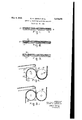
- Fig. 1 is a vertical sectional view through one typical form of product produced in accordance with our invention.
- Fig. 2 is a vertical sectional view of an alternative product produced in accordance with our invention.
- Fig. 3 is a vertical sectional view of a further alternative type of product produced in accordance with our invention.
- Fig. 4 is a diagrammatic illustration of typical mechanism adapted for use in the practice of our invention.
- Fig. 5 is a diagrammatic illustration showing an alternative type of mechanism adapted for use in the practice of our invention.
- Fig. -1 The form of product illustrated in Fig. -1 is of a preferred type described and claimed in the copending application referred to above.
- This product embodies a backing material which includes a lower cushioning layer 2 and an upper saturated layer 4 whereas a layer of Wear resisting linoleum composition 6 is applied to the upper exposed face -of the saturated layer 4 of the backing material.
- the backing material is in the form of a semi-saturated unitary web or felt in which the saturant is applied only to the upper face of the felt while the lower faceof the felt is dry or unsaturated.
- Fig.- 2 The product illustrated in Fig.- 2 is similar to that of Fig. 1 but is in the form of a laminated web including an upper sheet of saturated felt 8 bonded to lower sheet I0 of dry felt.
- the linoleum composition I2 is applied to the upper face of the saturated layer 8 of the laminated web of the backing material.
- a pair of calender rolls I4 and I6 are mounted for rotation about Iparallel horizontal axes I8 and 20 and are spaced apart at the fpinch 22 a distance sufficient to produce a finished product having the desired thickness or
- the backing material indicated generally at 24 is passedV over the first calender roll I4 with the unsaturated face 26 thereof in engagement with the surface of the first calender roll so as to serve as a cushion support for the saturated face 2,8 Aof the web.
- the saturated face 2,318,272 Y I i of the web is exposed toward the second or complementary calender roll I6 whereby the linoleum composition is applied thereto as the web passes between the pinch of the calender and on beneath and about the second calender roll.
- the linoleum composition is supplied to the space between the calender rolls I4 and I6 by a conveyor or other suitable means indicated at 29 and is calendered directly onto the saturated face 28 of the web.
- the calender rolls and the linoleum composition are both heated to temperatures which in most instances are well above the melting point of the saturant carried by the web of backing material.
- a saturant of a bituminous nature and having a melting point in the neighborhood of F. to 155 F. as determined by the .ball and ring method and a penetration of 16 to 18 at 77 F. we prefer to have the calender rolls and linoleum composition maintained at a temperature of about 230 F. to 240 F.
- saturants having a higher melting point and a rubbery or elastic consistency Such saturants frequently have a melting point of F.
- the temperature of the calendering rolls and of the linoleum composition is then usually somewhat higher and may be around 250 F., or more. In any event, by maintaining the calendering rolls and composition at temperatures considerably above the melting point of the saturant during the calendering operation the saturant is caused to flux and blend with the linoleum composition thus securing more perfect bonding of the linoleum composition to the backing material than has Ibeen possible heretofore.
- backing material of a semi-porous nature, that is to say, material which is not so dense or so nonporous as to preclude the escape of gases therethrough and prevent the formation of blisters during the calendering operations.
- Tests upon various types and weights of felt were made to determine the degree of porosity which is required-for satisfactory calendering practice in accordance with our invention. These tests were carried out in a manner similar to that used in making the standard porosity tests for dry felt using apparatus known as a Densorneter and manufactured by Gurley Co.
- the material to be tested was subjected to a pressure difference of 11/2 pounds per square inch on opposite sides of the felt and the time required forl the passage of 400 cc. of air through one square inch of the felt was determined. In the case of a typical 60 point felt having saturant applied to one face only and the opposite face dry, the time required for passage of the air therethrough was 2 minutes and 40 seconds.
- the porosity of the felt is notably decreased when the usual back coating or sealing coat of paint is applied to saturated felts and in general it is found that if the porosity, when geiser/2 tested as described above, is more than about four minutes the formation of blisters in the calendered product becomes so objectionable as to render the process commercially impractical.
- the product illustrated in Fig. 3 diifers from that of Figs. 1 and 2 in that it does not include any cushioning layer but simply embodies a layer of backing material h-aving a layer of linoleum composition 32 carried thereby.
- the backing inaterial 3U is uniformly impregnated with a saturant but is of a semi-porous nature and like that of products of Figs. 1 and 2, has a permeability of from about 2%/2 to 3 minutes as measured by the above described test.
- the rst calender roll 34 is provided with a layer or blanket 36 of cushioning material such as rubber, cork composition or other material which serves to yieldably support the backing material during the calendering operation.
- the backing material is passed into engagement with the yieldable surface of the rst calendering roll 34 so that it is cushioned as it passes between the calendering rolls and during the calendering operation.
- the web then passes about the second calender roll 38 which may be of the usual type employed in calendering composition onto backing material.
- the calendering rolls and linoleum composition are heated as when using the mechanism of Fig. 4.
- the steps employed in controlling the operations and curing the product in any of the forms of our invention are substantially the same as those employed when calendering linoleum compositions onto burlap or other conventional materials in the prior art.
- the saturant carrying face of the backing may be provided with a sealing coat of paint such as that generally employed on felt heretofore, and any suitable type of linoleum composition may be used in carrying out the methods of our invention.
- Our invention is also adapted for use in forming linoleum products having various thickness or gauge and has been found to be particularly useful in producing thin gauges of material, as low as 1.78 millimeters in thickness, although it is equally applicable for use in producing heavier products. It is also possible to use various weights of felt and to employ any suitable type of saturant adapted to form an adequate bond with the linoleum composition employed.
- the method of producing linoleum floor coverings and the like embodying backing material which is substantially inelastic comprises the step of cushioning said backing material while calendering a linoleum composition onto one face thereof.
- the method of producing linoleum floor coverings and the like embodying a substantially inelastic layer of material containing a bituminous saturant which comprises the steps of yieldably supporting said layer as it is passed between the rolls of a calender, and feeding a, linoleum composition to said rolls and into contact with said la'yer whereby said composition is calendered onto the face of said layer while strains due to the calendering operation and which tend to break or tear the layer are relieved.
- the method of producing linoleum floor coverings and the likev which comprises the steps of passingra layer of backing material and a layer of cushioning material together between calenderi-ng rolls and calendering a linoleum composition onto the face of said layer of backing material.
- the method of producing linoleum floor coverings and the like which comprises the steps of passing a layer of saturated felt and a layer of cushioning material together between calendering rolls and calendering a linoleum composition onto one face of said layer of saturated felt.
- the method of producing linoleum floor coverings and the like which comprises the steps of passing a layer of saturated felt and a layer of unsaturated felt together between calendering rolls and calendering a linoleum composition onto one face of said layer of saturated felt.
- the method of producing linoleum iloor coverings and the like which comprises the steps of forming a web of felt, impregnating one face only of the felt with a bituminous composition, while leaving the opposite face of the web unsaturated, passing the Web between calendering rolls with the unsaturated face thereof in contact with the lrst calender roll and calendering a linoleum composition onto the impregnated face of the web as the web passes between the rolls.
- 'Ihe method of producing linoleum floor coverings and the like which comprises the steps of laminating a layer of unsaturated felt onto one face of a layer of felt which is saturated with a bituminous composition, passing the laminated web between calender rolls with the unsaturated face in contact with the rst calender roll and calendering linoleum onto the saturated face of the laminated web.
- the method of producing linoleum floor coverings and the like which comprises the steps of applying a bituminous saturant to one face of a web of felt, passing the web between calender rolls heated to a temperature above the melting point of the bituminous saturant with said web positioned so that the unsaturated face of the web is adjacent the iirst calender roll and calendering a linoleum composition onto the impregnated face of the web as it passes between said rolls.
- the method of producing linoleum floor coverings and the like which comprises the steps of incompletely saturating a web of felt with a bituminous saturant, passing the web between calender rolls and calendering a, linoleum composition onto one face of the web as it passes between said rolls.
- Y 12 The method of producing a yieldable floor covering embodying a layer of cushioning material and a layer of wear resisting material, which comprises the steps of forming a web of material embodying a cushioning face and a. backing face, passing said web between calender rolls with Vthe cushioning face in contact with the rst calender roll and feeding a linoleum composition into the space between said rolls so that it will be calendered onto the backing face of said web.
- the method of producing a yieldable oor covering embodying a layer of cushioning material and a layer of wear resisting material which comprises the steps of forming a web of material embodying a cushioning face and a sen'ii-pormsv asphalt impregnated face, passing said web between calender rolls with the cushioning face in contact with the rstv calender roll and feeding a linoleum composition into the space between said rolis so that it will be calendered onto the impregnated face of said web.
- the method of producing linoleum oor coverings and the like comprising the steps of forming an ncompletely saturated and semi-porous web of felt and calendering a linoleum composition onto one face of said web.
Landscapes
- Engineering & Computer Science (AREA)
- Textile Engineering (AREA)
- Synthetic Leather, Interior Materials Or Flexible Sheet Materials (AREA)
Description
Maly 4, 1943.
W. C. WEIGLE ETAL METHOD OF PRODUCING LINOLEUM PRODUCTS INVENTORS C. WE/GLE. JAMES W. KEMMLER.
w/L/AM m Jpn?. A TTORNEY.
Patented May 4, 1943 METHOD OF PRODUGING LINOLEUM PRODUCTS William C. Weigle, Philadelphia, and James W.
Kemmler, Elkins Park, Pa., assignors to Sloane- Blabon, Trenton, N.
Jersey a. corporation of New Application August 22, 1941, Serial No. 407,928
14 Claims. (Cl. 154-25) This invention relates to linoleurn products adapted for use as floor coverings and the like and particularly to methods for producing such products wherein a linoleum composition is calendered directly onto a web of backing material formed of felt and containing a bituminous saturant or the like.
It has been usual practice heretofore :to calender linoleum compositions onto burlap backing or other exible and stretchable fabrics but so far as We are aware no one has 4successfully calendered linoleum compositions onto backing material formed of saturated felt. All previous attempts to calender linoleum compositions onto saturated felt have resulted in tearing vor breaking of the web due to the unyelding and inelastic nature of the backing and its inherent inability to withstand the tension and strains tow-nich the vmaterial is subjected dur-ing the ca-lendering operations. The use of strong felts containing a high percentage of vrag fiber and the use of heavily saturated sheets have been equally 1ineffective in resisting such strains and Yovercoming these objections. It is also found that when the backing is dense or non porous the gases-entrapped or formed in the linoleum material-cr adjacent the face of the backing material during the calendering operation form blisters in the nished product, presumably because tliegases `cannot `escapethrough the backing material.
In accordance with our invention these objections to methods of the prior art are overcome and linoleum compositions are calendered direct- 'ly onto felt or similar backing material containing a bituminous saturant.
Our invention is particularly .adapted for use `in producing productsof the type shown anddescribedzinthe copending application of William C. Weigle, Serial No. 351,756, filed August '7,1 1940, wherein door coverings are provided with acush- .inning layer which renders the product yieldable A:under foot and greatly simplies the operations :required in laying the material. `Moreover, Athe cushioning material preferred is readily splitlso 'that after it has been secured Vto a iioor it may beremoved without injury to the Wear resisting surface and may be relaid in another location 'if desired.
While the methods of the present invention are .particularly adapted for use `in the vmannfacture of products embodying .a .layer .of cushioning material they may also be used vin produc'- ing :floor coverings in which no :cushioning :mate- ;,rial is employed. i
`'Ihe,mi-vantages of the present :invention ima-y 55 be attained by the selection of particular types of felt or by the use of particular methods .or equipment whereby the surface of the backing material to which the li-noleum ycomposition is applied is yieldably supported during the calendering operation. In this way .the .strains to which the material is .subjected are relieved `and tearing or breaking of the web is reduced .or eliminated altogether. 'I'.he present invention further contemplates the use of a web of backing material which is of a semi-porous nature Whereby those gases which are entrapped or formed during the calendering operation are permitted to escape through the pores in the backing material and the formation of blisters vin the finished product is reducedor eliminated.
In one embodiment ci our invention the web of backing material consists of felt .having Va bituminous or other saturant applied to .only one face thereof whereas Vthe opposite face of the web is dry or substantially unsaturated. This web is passed between the .calender rolls with the unsaturated `layer or face ythereof adjacent `the rst calender roll and serving as a `cushioning means which relieves the .strains and tension applied to the material during the calendering operation. .In an alternative form of .our invention the backing material is formed from webs of saturated and unsaturated ,felt which have been laminated together .and passed rbetween the calender rolls with the saturated layer in position to receive the .linoleum Composition `and supported by the cushioning layer of unsaturated felt. When using either a laminated yor a semi- .saturated Atype of 'felt .as a backing material the composite web preferably is of .a .semi-porous type which will permit gases entrapped orformed during the calender-ing operation to passth-rough the pores thereof and thus escape preventing .the
formation of blisters between ifthelinoleum Acornposition and the Web .of backing material.
In a further .alternative embodiment fof our .invention the backing material .is inthe form of a web of felt having a saturantdistributed `formly Vthroughout the Iweb butV jinsufcient in amount to l.prevent such Penetration of .gases through the web as fto prevent the formation :0f
blisters when `rthe lin-oleum :compositicn'is catla endered onto the face thereof. Whenfusing `.this
type 4of felt the rst `calender -roll is 'provided'. v
with a yieldable .surface or :cushioning blanket which serves :to .relieve f-the :strains placed :upon the .materiaLand :prevents tearing of Vthe web dur- :ing 'the calenderingOperatiOn.
One ,of the `objects olour :invention is to :provide gauge.
novel methods for producing linoleum products such as floor coverings and the like wherein the backing is formed of felt or other similar material containing a saturant.
Another object of our invention is to provide novel methods whereby linoleum compositions may be calendered directly onto a web of felt containing a saturant such as a bituminous material.
Another object of our invention is to provide novel methods for producing linoleum products which are of a yieldable character and embodying a layer of cushioning material.
A further object of our invention is to produce a new type of linoleumiloor covering in which a linoleum composition is carried by a layer of backing material of a semi-porous nature.
These and other objects and features of our invention will appear from the following description thereof in which reference is made to the accompanying drawing.
In the drawing:
Fig. 1 is a vertical sectional view through one typical form of product produced in accordance with our invention.
Fig. 2 is a vertical sectional view of an alternative product produced in accordance with our invention.
Fig. 3 is a vertical sectional view of a further alternative type of product produced in accordance with our invention.
Fig. 4 is a diagrammatic illustration of typical mechanism adapted for use in the practice of our invention; and
Fig. 5 is a diagrammatic illustration showing an alternative type of mechanism adapted for use in the practice of our invention.
The form of product illustrated in Fig. -1 is of a preferred type described and claimed in the copending application referred to above. This product embodies a backing material which includes a lower cushioning layer 2 and an upper saturated layer 4 whereas a layer of Wear resisting linoleum composition 6 is applied to the upper exposed face -of the saturated layer 4 of the backing material. The backing material is in the form of a semi-saturated unitary web or felt in which the saturant is applied only to the upper face of the felt while the lower faceof the felt is dry or unsaturated.
The product illustrated in Fig.- 2 is similar to that of Fig. 1 but is in the form of a laminated web including an upper sheet of saturated felt 8 bonded to lower sheet I0 of dry felt. The linoleum composition I2 is applied to the upper face of the saturated layer 8 of the laminated web of the backing material.
In forming either of the products illustrated in Figs. 1 and 2 in accordance with our invention it is possible to use conventional equipment such as that heretofore used in calendering linoleum compositions onto a backing formed of burlap or other woven fabric. Equipment of this type is illustrated diagrammatically in Fig. 4 wherein a pair of calender rolls I4 and I6 are mounted for rotation about Iparallel horizontal axes I8 and 20 and are spaced apart at the fpinch 22 a distance sufficient to produce a finished product having the desired thickness or The backing material indicated generally at 24 is passedV over the first calender roll I4 with the unsaturated face 26 thereof in engagement with the surface of the first calender roll so as to serve as a cushion support for the saturated face 2,8 Aof the web. The saturated face 2,318,272 Y I i of the web is exposed toward the second or complementary calender roll I6 whereby the linoleum composition is applied thereto as the web passes between the pinch of the calender and on beneath and about the second calender roll. The linoleum composition is supplied to the space between the calender rolls I4 and I6 by a conveyor or other suitable means indicated at 29 and is calendered directly onto the saturated face 28 of the web.
In -carrying out the process the calender rolls and the linoleum composition are both heated to temperatures which in most instances are well above the melting point of the saturant carried by the web of backing material. Thus, for example, when using a saturant of a bituminous nature and having a melting point in the neighborhood of F. to 155 F. as determined by the .ball and ring method and a penetration of 16 to 18 at 77 F. we prefer to have the calender rolls and linoleum composition maintained at a temperature of about 230 F. to 240 F. However, for some purposes it is preferable to use saturants having a higher melting point and a rubbery or elastic consistency. Such saturants frequently have a melting point of F. to 180 F. and a penetration of from 35 to 40 at '77 F. The temperature of the calendering rolls and of the linoleum composition is then usually somewhat higher and may be around 250 F., or more. In any event, by maintaining the calendering rolls and composition at temperatures considerably above the melting point of the saturant during the calendering operation the saturant is caused to flux and blend with the linoleum composition thus securing more perfect bonding of the linoleum composition to the backing material than has Ibeen possible heretofore.
In order to avoid the formation of blisters by the trapping of gases between the linoleum composition and the backing it is desirable to employ backing material of a semi-porous nature, that is to say, material which is not so dense or so nonporous as to preclude the escape of gases therethrough and prevent the formation of blisters during the calendering operations.
Tests upon various types and weights of felt were made to determine the degree of porosity which is required-for satisfactory calendering practice in accordance with our invention. These tests were carried out in a manner similar to that used in making the standard porosity tests for dry felt using apparatus known as a Densorneter and manufactured by Gurley Co. The material to be tested was subjected to a pressure difference of 11/2 pounds per square inch on opposite sides of the felt and the time required forl the passage of 400 cc. of air through one square inch of the felt was determined. In the case of a typical 60 point felt having saturant applied to one face only and the opposite face dry, the time required for passage of the air therethrough was 2 minutes and 40 seconds. A typical 40 point felt incompletely but uniformly saturated required 3 minutes and 9 seconds. Felts of this character are found to calender satisfactorily without the formation of blisters. However, when the felt'is further saturated or is much thicker the time required for the passage of air through the felt is longer and ranges from 4 to 6 minutes. Such felts almost invariably exhibit objectionable blistering. The porosity of the felt is notably decreased when the usual back coating or sealing coat of paint is applied to saturated felts and in general it is found that if the porosity, when geiser/2 tested as described above, is more than about four minutes the formation of blisters in the calendered product becomes so objectionable as to render the process commercially impractical.
, The product illustrated in Fig. 3 diifers from that of Figs. 1 and 2 in that it does not include any cushioning layer but simply embodies a layer of backing material h-aving a layer of linoleum composition 32 carried thereby. The backing inaterial 3U is uniformly impregnated with a saturant but is of a semi-porous nature and like that of products of Figs. 1 and 2, has a permeability of from about 2%/2 to 3 minutes as measured by the above described test.
In forming products of this character or any other products embodying a layer of backing material which does not embody a layer of cushioning material we prefer to employ mechanism of the type illustrated diagrammatically in Fig. 5. In this construction the rst calender roll 34 is provided with a layer or blanket 36 of cushioning material such as rubber, cork composition or other material which serves to yieldably support the backing material during the calendering operation.
The backing material is passed into engagement with the yieldable surface of the rst calendering roll 34 so that it is cushioned as it passes between the calendering rolls and during the calendering operation. The web then passes about the second calender roll 38 which may be of the usual type employed in calendering composition onto backing material. The calendering rolls and linoleum composition are heated as when using the mechanism of Fig. 4.
The steps employed in controlling the operations and curing the product in any of the forms of our invention are substantially the same as those employed when calendering linoleum compositions onto burlap or other conventional materials in the prior art. Similarly the saturant carrying face of the backing may be provided with a sealing coat of paint such as that generally employed on felt heretofore, and any suitable type of linoleum composition may be used in carrying out the methods of our invention.
Our invention is also adapted for use in forming linoleum products having various thickness or gauge and has been found to be particularly useful in producing thin gauges of material, as low as 1.78 millimeters in thickness, although it is equally applicable for use in producing heavier products. It is also possible to use various weights of felt and to employ any suitable type of saturant adapted to form an adequate bond with the linoleum composition employed.
In view thereof it will be apparent that our invention is of broad application and is capable of many modifications and changes within the scope of the following claims.
We claim:
1. The method of producing linoleum floor coverings and the like embodying backing material which is substantially inelastic which comprises the step of cushioning said backing material while calendering a linoleum composition onto one face thereof.
2. The method of producing linoleum floor coverings and the like embodying a substantially inelastic sheet of impregnated felt which comprises the step of cushioning said sheet of felt While calendering a linoleum composition onto one face thereof.
3. The method of producing linoleum floor coverings and the like embodying a substantially inelastic layer of material containing a bituminous saturant which comprises the steps of yieldably supporting said layer as it is passed between the rolls of a calender, and feeding a, linoleum composition to said rolls and into contact with said la'yer whereby said composition is calendered onto the face of said layer while strains due to the calendering operation and which tend to break or tear the layer are relieved.
4. The method of producing linoleum floor coverings and the likevwhich comprises the steps of passingra layer of backing material and a layer of cushioning material together between calenderi-ng rolls and calendering a linoleum composition onto the face of said layer of backing material.
5. The method of producing linoleum floor coverings and the like which comprises the steps of passing a layer of saturated felt and a layer of cushioning material together between calendering rolls and calendering a linoleum composition onto one face of said layer of saturated felt.
6. The method of producing linoleum floor coverings and the like which comprises the steps of passing a layer of saturated felt and a layer of unsaturated felt together between calendering rolls and calendering a linoleum composition onto one face of said layer of saturated felt.
7. The method of producing linoleum iloor coverings and the like which comprises the steps of forming a web of felt, impregnating one face only of the felt with a bituminous composition, while leaving the opposite face of the web unsaturated, passing the Web between calendering rolls with the unsaturated face thereof in contact with the lrst calender roll and calendering a linoleum composition onto the impregnated face of the web as the web passes between the rolls.
8. 'Ihe method of producing linoleum floor coverings and the like which comprises the steps of laminating a layer of unsaturated felt onto one face of a layer of felt which is saturated with a bituminous composition, passing the laminated web between calender rolls with the unsaturated face in contact with the rst calender roll and calendering linoleum onto the saturated face of the laminated web.
9. The method of producing linoleum floor coverings and the like which comprises the steps of applying a bituminous saturant to one face of a web of felt, passing the web between calender rolls heated to a temperature above the melting point of the bituminous saturant with said web positioned so that the unsaturated face of the web is adjacent the iirst calender roll and calendering a linoleum composition onto the impregnated face of the web as it passes between said rolls.
10. The method of producing linoleum floor coverings and the like which comprises the steps of incompletely saturating a web of felt with a bituminous saturant, passing the web between calender rolls and calendering a, linoleum composition onto one face of the web as it passes between said rolls.
11. The method of producing linoleum oor coverings and the like which comprises the steps of incompletely saturating a web of felt with a bituminous saturant, passing the web between calender rolls heated to a temperature above the melting point of bituminous saturant and calendering a linoleum composition heated to a temperature above the melting point of the bituminous saturant onto the one face of the web as it passes between said rolls.
13. The method of producing a yieldable oor covering embodying a layer of cushioning material and a layer of wear resisting material which comprises the steps of forming a web of material embodying a cushioning face and a sen'ii-pormsv asphalt impregnated face, passing said web between calender rolls with the cushioning face in contact with the rstv calender roll and feeding a linoleum composition into the space between said rolis so that it will be calendered onto the impregnated face of said web.
14. The method of producing linoleum oor coverings and the like comprising the steps of forming an ncompletely saturated and semi-porous web of felt and calendering a linoleum composition onto one face of said web.
WILLIAM C. WEIGLE. JAMES W. KEMMLER.
Priority Applications (1)
| Application Number | Priority Date | Filing Date | Title |
|---|---|---|---|
| US407928A US2318272A (en) | 1941-08-22 | 1941-08-22 | Method of producing linoleum products |
Applications Claiming Priority (1)
| Application Number | Priority Date | Filing Date | Title |
|---|---|---|---|
| US407928A US2318272A (en) | 1941-08-22 | 1941-08-22 | Method of producing linoleum products |
Publications (1)
| Publication Number | Publication Date |
|---|---|
| US2318272A true US2318272A (en) | 1943-05-04 |
Family
ID=23614132
Family Applications (1)
| Application Number | Title | Priority Date | Filing Date |
|---|---|---|---|
| US407928A Expired - Lifetime US2318272A (en) | 1941-08-22 | 1941-08-22 | Method of producing linoleum products |
Country Status (1)
| Country | Link |
|---|---|
| US (1) | US2318272A (en) |
Cited By (6)
| Publication number | Priority date | Publication date | Assignee | Title |
|---|---|---|---|---|
| US2519410A (en) * | 1944-11-30 | 1950-08-22 | Armstrong Cork Co | Hard surface floor and wall covering |
| US2631643A (en) * | 1948-06-07 | 1953-03-17 | Schueler Engineering Co | Apparatus and process of producing decorative floor covering |
| US3148076A (en) * | 1958-03-13 | 1964-09-08 | Armstrong Cork Co | Method of consolidating sheet material |
| US3376187A (en) * | 1962-12-26 | 1968-04-02 | Armstrong Cork Co | Method of forming a decorative surface covering and article formed thereby |
| US3385722A (en) * | 1963-08-23 | 1968-05-28 | Congoleum Nairn Inc | Process for producing a thermoplastic composition surface covering |
| US3536557A (en) * | 1967-07-14 | 1970-10-27 | Allen Ind | Method of making a composite contoured sound insulating panel |
-
1941
- 1941-08-22 US US407928A patent/US2318272A/en not_active Expired - Lifetime
Cited By (6)
| Publication number | Priority date | Publication date | Assignee | Title |
|---|---|---|---|---|
| US2519410A (en) * | 1944-11-30 | 1950-08-22 | Armstrong Cork Co | Hard surface floor and wall covering |
| US2631643A (en) * | 1948-06-07 | 1953-03-17 | Schueler Engineering Co | Apparatus and process of producing decorative floor covering |
| US3148076A (en) * | 1958-03-13 | 1964-09-08 | Armstrong Cork Co | Method of consolidating sheet material |
| US3376187A (en) * | 1962-12-26 | 1968-04-02 | Armstrong Cork Co | Method of forming a decorative surface covering and article formed thereby |
| US3385722A (en) * | 1963-08-23 | 1968-05-28 | Congoleum Nairn Inc | Process for producing a thermoplastic composition surface covering |
| US3536557A (en) * | 1967-07-14 | 1970-10-27 | Allen Ind | Method of making a composite contoured sound insulating panel |
Similar Documents
| Publication | Publication Date | Title |
|---|---|---|
| US4138521A (en) | Flooring materials | |
| US3728182A (en) | Method of preparing resin-backed tufted carpet tiles | |
| US2543101A (en) | Composite fibrous products and method of making them | |
| RU2264490C2 (en) | Plastic floor coating and a method for manufacture thereof | |
| US3360415A (en) | Foam product and process | |
| US3239365A (en) | Resilient decorative surface covering and method of making same | |
| EP0270605A1 (en) | Surface covering product and process therefor | |
| US3257252A (en) | Method of making a decorative surface covering | |
| US3560284A (en) | Method of making foam-backed tufted carpet | |
| US4185133A (en) | Process for saturating a fiber mat of open structure | |
| US2816852A (en) | Floor covering | |
| US4618530A (en) | Process for the preparation of a composite mat | |
| US2823156A (en) | Vinyl coated knit fabric | |
| US2318272A (en) | Method of producing linoleum products | |
| US4003777A (en) | Method of forming a laminated structure | |
| US2358204A (en) | Method of making pile fabrics | |
| US3698973A (en) | Method of preparing a solid resin back carpet tile | |
| US3179551A (en) | Surface-covering cushion and method for making the same | |
| US3310422A (en) | Smooth wear-resistant resilient floor covering and method of making same | |
| US2867263A (en) | Method of applying patterns to vinyl floor coverings | |
| US4983443A (en) | Embossed and wiped decorative surface coverings | |
| US2926100A (en) | Method of producing decorative sheet material | |
| US4122224A (en) | Wall and floor coverings | |
| US3669779A (en) | Production of pile fabrics | |
| US2950502A (en) | Process of imparting smoothness to the surface of a thermoplastic sheet |