US2184193A - Battery charge responsive means - Google Patents
Battery charge responsive means Download PDFInfo
- Publication number
- US2184193A US2184193A US49098A US4909835A US2184193A US 2184193 A US2184193 A US 2184193A US 49098 A US49098 A US 49098A US 4909835 A US4909835 A US 4909835A US 2184193 A US2184193 A US 2184193A
- Authority
- US
- United States
- Prior art keywords
- battery
- armature
- voltage
- switch
- meter
- Prior art date
- Legal status (The legal status is an assumption and is not a legal conclusion. Google has not performed a legal analysis and makes no representation as to the accuracy of the status listed.)
- Expired - Lifetime
Links
- 238000010276 construction Methods 0.000 description 8
- 238000000034 method Methods 0.000 description 6
- 230000008859 change Effects 0.000 description 4
- 238000009434 installation Methods 0.000 description 3
- 238000004804 winding Methods 0.000 description 3
- 230000009471 action Effects 0.000 description 2
- 238000010961 commercial manufacture process Methods 0.000 description 1
- 230000003111 delayed effect Effects 0.000 description 1
- 230000000994 depressogenic effect Effects 0.000 description 1
- 238000010586 diagram Methods 0.000 description 1
- 210000005069 ears Anatomy 0.000 description 1
- 238000010438 heat treatment Methods 0.000 description 1
- 239000000463 material Substances 0.000 description 1
- 230000007246 mechanism Effects 0.000 description 1
- 230000000737 periodic effect Effects 0.000 description 1
- 230000000135 prohibitive effect Effects 0.000 description 1
- 230000009467 reduction Effects 0.000 description 1
- 230000004044 response Effects 0.000 description 1
- 239000007858 starting material Substances 0.000 description 1
Images

Classifications
-
- G—PHYSICS
- G01—MEASURING; TESTING
- G01R—MEASURING ELECTRIC VARIABLES; MEASURING MAGNETIC VARIABLES
- G01R31/00—Arrangements for testing electric properties; Arrangements for locating electric faults; Arrangements for electrical testing characterised by what is being tested not provided for elsewhere
- G01R31/36—Arrangements for testing, measuring or monitoring the electrical condition of accumulators or electric batteries, e.g. capacity or state of charge [SoC]
- G01R31/3644—Constructional arrangements
- G01R31/3646—Constructional arrangements for indicating electrical conditions or variables, e.g. visual or audible indicators
Definitions
- the object of my invention is to provide a new method of ascertaining the condition of charge in batteries, especially the battery used in a motor vehicle for operating the electric starter.
- a further object of my invention is to provide a unique instrument which will, at all times, register the approximate degree of charge in a vehicle battery.
- a vehicle operator could ascertain the condition of his battery, the ordinary hydrometer or other battery testing equipment not usually being available or their use understood by the average driver.
- My improved apparatus is preferably incorporated into the vehicle, the indicator thereof being positioned upon the instrument panel of the car, and its operation being entirely automatic so that the operator need only look at the indicator at any time to ascertain the charge in the battery.
- the device has the general appearance of a conventional ammeter; however, its operation is entirely independent of the rate at which the battery is being charged, the device indicating only the amount of available energy remaining in the battery at any time.
- the conventional ammeter registers only the rate at which the battery is being charged or discharged, but gives no indication whatever of the amount of energy present at any time in the battery. For this reason, many cars are being operated with batteries only partially charged, even though the vehicle generator is charging the battery at an apparently adequate rate.
- a reduction in available battery energy may be caused by a number of conditions, such as the increased use of accessories, i. e., radio, heating fans, lights, etc., or by a partially worn out battery.
- Increasing the generator charging rate will usually compensate for the first of these conditions but will not correct a faulty battery. For this reason the ammeter of a car only indicates whether or not the generator is functioning properly and does not register the amount of energy remaining in the battery.
- my device provides a warning indication to the operator before the amount of energy in his battery is reduced to the point where it will not start the car. The operator may therefore have the car inspected and the fault corrected before the battery is discharged to the point where its failure will seriously inconvenience him.
- a further feature of my device is that, by its use, overcharging of the battery can be avoided without encountering the danger of, at some time, having a dead battery.
- the output of the generator may be increased until the battery is about ninety per cent charged and then the output lowered to maintain this condition. If extraordinary conditions are encountered, such as excessive night driving, the battery charge will gradually lower, but the operator will be apprised of this condition as it proceeds so that he may again increase the generator output long before the danger point has been reached.
- the generator charge was usually adjusted to keep the battery charged under all conditions, and consequently the battery was being overcharged most of the time. A material lengthening of the life of the battery may, therefore, be expected by the use of this device.
- My improved device operates upon the well known principle that the ampere hour capacity of a storage battery may be determined by measuring the battery voltage under an appreciable load. The voltage under such conditions gives a true indication of the battery charge. Numerous battery meters have been produced which operate on this principle; however, such meters draw a large amount of current from the battery and are not suitable for use by the average motorist. Furthermore, such a meter gives no indication except when the load is being applied, so that this type of meter cannot be connected continuously. The meter would, therefore, be of little or no value if installed upon the instrument board of a car.
- my improved meter records the battery voltage during the period that the starting motor is cranking the engine.
- the battery is, therefore, working under a load of about 300 amperes when the voltage is registered.
- Means are provided for taking this reading during the first fraction of a second that the starting is connected, or before the starting motor has started to rotate.
- the variable current consumption of the starting motor due to temperature changes and other conditions, does not affect the voltage reading for this reason.
- the indicator on the meter remains fixed between successive operations of the starting motor; however, the reading is corrected for any change in battery condition at each suo- 50 cessive operation of the starting motor switch.
- the inertia of the voltmeter indicator is negatived so that the indicator will only be required to move upon each application through a distance corresponding to any change in voltage which has occurred between the successive applications. This change is usually very slight, so that a very accurate indication is obtained even though a heavy voltmeter armature is used and the reading is taken in only a fraction of a second.
- my invention consists in the several steps comprising my improved method together with the arrangement, construction and combination of the various parts of my improved device, as described in the specification, claimed in my claims and illustrated in the accompanying drawings, in which:
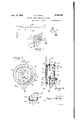
- Figure 1 shows a wiring diagram of the combination of vehicle battery, switch, starting motor and meter.
- Figure 2 shows a detailed plan view of my improved meter, adapted for installation upon a vehicle instrument panel.
- Figure 3 shows a vertical central sectional view through the meter shown in Figure 2.
- Figure 4 shows a sectional view, taken on the line 4-4 of Figure 2.
- Figure 5 shows a sectional view, taken on the line 5-5 of Figure 3.
- Figure 6 shows a plan view of the backing plate of my meter, the several parts of the device being mounted in position upon this backing plate.
- Figure '7 shows a sectional view, taken on the line 1-4 of Figure 6.
- Figure 8 is a diagrammatic view illustrating the position of the various parts when the starting motor of the vehicle is idle.
- Figure 9 is a diagrammatic view illustrating the position of the several parts of the device an instant after the starting motor switch has been depressed.
- Figure 10 is a diagrammatic view illustrating the position of the several parts of the meter when the starting motor is in operation.
- Figure 11 is a diagrammatic view showing an alternate construction which may be employed if desired.
- Figure 12 is a diagrammatic View, illustrating still another alternate construction which may be used in place of the preferred device shown in Figures 1 through 10.
- I have used the reference numeral I3 to indicate a conventional vehicle storage battery, the positive terminal of which is grounded and the negative terminal of which is connected by means of a cable I5 to one terminal of a starting motor switch I4.
- the other terminal of thisstarting motor switch is connected to a starting motor I6 by means of another cable I'I.
- the device functions in the usual manner in that when the switch I4 is closed the starting motor is energized to crank the engine of the vehicle.
- the aforementioned apparatus comprises the conventional starting motor installation, so that this equipment per se forms no part of this invention, except insofar as it combines with the meter, about to be described, to produce a new result.
- a lead I8 extends from the starting motor side of the switch I4, preferably to the instrument panel of the car, and forms the sole wire connection between my meter and the battery system.
- the meter proper comprises a voltmeter energizing coil I9, one terminal of which is fixedly connected to the lead I8 while the other terminal is grounded.
- a solenoid 20 likewise has one terminal fixedly connected to the lead I8, the other terminal being grounded.
- the coil I9 and armature 2I are of a conventional type and show only one form of volt indicating apparatus which is suitable for use herein. Other types of volt indicating apparatus may be used, as it is only essential that the voltage impressed upon the coil I9 proportionately actuates some indicating device.
- This type of armature is to be recommended for the reason that a frictional resistance is applied to the armature which normally retains it so that it cannot move either in or out of the coil I 9 except when the resistance is released.
- ] functions to momentarily release the frictional resistance from the armature 2I for a fraction of a second at the instant the switch I4 is closed, so that the armature 2I will respond to the battery voltage during this short interval. At this instant the motor forms a dead short across the battery. No appreciable back E. M. F. is built up in the motor until the armature is rotating.
- FIG. 2 I have shown a commercial form of my invention which is adapted for installation upon a vehicle instrument board, which board is shown by dotted lines 22.
- the meter is enclosed in a housing which comprises a bezel 23, mounted in a ring 24, the bezel being held in place by a gasket 25 and retaining ring 26.
- a plate 21 is mounted in back of the bezel 23, this plate having an aperture 28 therein, through which the scale upon a dial 29 is visible.
- a casing 30 is adapted to house the working parts of the instrument, the bezel and its retaining members being secured thereto by a plurality of turned down ears 3 I, as shown in Figure 4..
- a pair of arms 32 project radially from the casing 30, which arms co-act with suitable studs which extend rearwardly from the instrument panel, the bezel of the instrument being alone visible through a suitable opening in the panel.
- the armature ii is rotatably mounted upon a pin 35, which pin is secured in position. by means of a spring clip (it with one end of the pin projecting through the plate 33.
- a hair spring Si is secured to the inner end or" the pin 35 while the other end of this spring is secured to the armature 2E.
- the tension on the hair spring El can thereby be adjusted by turning the pin 35 and thus vary the movement of the armature in response to a given voltage in the coil E9.
- the armature 2! has an arcuate periphery against which a friction pad 38 is adapted to bear.
- the pad 38 is mounted upon the intermediate portion of an arm 3%, one end of this arm being pivoted at iil while the free end thereof extends to position directly over the solenoid Ml.
- the solenoid 2E2 is mounted in a vertical position and is secured to the plate 33 by means of a bracket ll.
- the free end of the arm 35! does not bear again t the solenoid as a spring 42 resiliently urg s this arm at all times to position where the pad bears against the armature 2 l.
- a plunger 13 is reciprolifi, the plunger being substantially the same length as the solenoid, so that when the solenoid is energized the plunger will be drawn up to position where its upper end is substantially aligns with the upper end of the solenoid.
- the solenoid 221 is provided with a. casing 641 which forms a magnetic path for the field produced thereby, while the bracket il is so formed that, in its inoperative position, the plunger rests upon the bracket with its upper end substantially aligned with the middle portion of the solenoid.
- the dial. 29 is secured to the bracket ll directly over the solenoid casing M, this dial being suitably call brated so that a pointer 45 which is fixed to the armature 25 will be visible in relation to this scale through the aperture 28.
- Figure 8 shows the position of the plunger 63 and arm when the starting motor is not being operated, the car either being driven or being idle. It will be noted that the plunger 13 is in its lower-most position and that the arm 39 frictionally engages the armature 2i and prevents movement or the armature by the spring :32. At the instant the starting motor switch is closed the plunger E3 is drawn upwardly into the solenoid it. An important result of this initial engagement is that the inertia of the plunger carries it upwardly beyond the upper end of the solenoid so that it strikes against the free end of the arm thereby raising this arm against the resistance of the spring 42 and releasing the frictional engagement of the pad 38 from the armature 2i.
- Both the solenoid Ell and the coil l9 are energized at the same time so that the armature 2i will move to a position corresponding to the voltage of the battery during the momentary released period.
- the plunger 433 immediately returns to the position shown in Figure 10 so that the arm 39 again engages the armature 2i and prevents further movement of the armature, irrespective of subsequent Variations in voltage impressed upon the coil I9.
- the plunger 43 is held in the position shown in Figure 10 until the starting motor switch I9 is released, at which time it drops back to the position shown in Figure 8 without, of course, contacting with the arm 39.
- the hair spring 3'! is so tensioned that the armature 2! just starts to move when a voltage is impressed upon the coil [9 which is just sufficient to crank the car under the severest conditions.
- the hair spring is also designed so that a voltage of approximately 5% volts, when a 5 Volt storage battery is being used, will cause the armature 2! to be drawn into the coil l9 sufiiciently that the pointer 45 willbe aligned with the top of the scale on the dial 29.
- the meter will register a voltage of from approximately 3 volts to 5 /2 volts.
- the driver simply presses the starting switch l9, which automatically operates the meter to indicate the battery charge. No change in reading is obtained during the normal running of the car, and such is not essential, as during this period the battery is usually being charged. However, should the battery energy be reduced while driving, then the next time the starting motor is operated the meter will register a lower voltage. If this condition is not corrected, each succeeding start of the engine will cause the meter to indicate still lower voltages until the pointer reaches the bottom of the scale. This point indicates minimum charge in the battery that will, under all conditions, start the car.
- the coil l9 and solenoid 29 are energized so that the plunger M" is drawn upwardly, the cam 49 swinging the arm 59 upwardly against the force of the spring :32 by means of its abutment with the detent M. This causes the pad 33 to be disengaged from the armature 2
- the cam 49 rides over the detent 5% when the member 50 bears against the stop 52, at which time the spring 42 forces the member 50 downwardly to again engage the armature 2
- the spring 48 urges the plunger 41 downwardly, the cam 49 riding over the detent 5
- a storage battery means for connecting a substantial load across said battery, and a delayed indicating means responsive to battery voltage only after said load has been applied for a small increment of time for operating in accordance with the condition of said battery.
- an electric battery a switch, a motor electrically connected to said battery through said switch, a movable voltage responsive device, means for electrically connecting said voltage responsive device to said battery to operate in accordance with the voltage of the battery only when said switch is closed, means for normally preventing movement of said device from any one of a plurality of its positions, and means for releasing said preventing means during the initial portion of the period when said switch is closed, to thereby allow said device to freely operate in accordance with the battery voltage only during said initial period that said motor is connected.
- a storage battery a switch, a starting motor electrically connected across said battery through said switch, a voltage responsive device electrically connected across said battery only when said switch is closed, a voltage actuated armature in said device, means for normally frictionally retaining said armature in any one of a plurality of its positions against the maximum torque which causes the device to operate, and means for releasing said retaining means only during the initial portion of the period when said switch is closed so as to allow said armature to operate in accordance with the battery voltage only during said initial period, whereby the voltage in accordance with which the position of the device is determined at any time will be the voltage of said battery during the initial period when it last operated said starting motor.
- an electric battery means for connecting a load across said battery, a voltage responsive device, means connecting said voltage responsive device across said battery during the entire period that said load is connected, means for holding said device inoperative against the torque caused by said battery, and means for momentarily releasing said holding means during the initial portion of the period that said load is applied, for the purpose described.
Landscapes
- Physics & Mathematics (AREA)
- General Physics & Mathematics (AREA)
- Instrument Panels (AREA)
Description
E. c. M R E 2,184,193
BATTERY CHARGE RESPONSIVE MEANS Filed Nov. 9, 1935 2 Sheets-Sheet l INVENTOR.
C W3 W14 ATTORNEY.
, 1939. c MCRAE 2,184,193
BATTERY CHARGE RESPONSIVE MEANS Filed No'v.'9, 1935 2 Sheets-Sheet 2 39 o y m '90 mu 1 Q Eu 6. V 9 J 46 INVENTOR.
W a M7736? ATTORNEY.
Patented Dec. 19, 1939 erenr oFFicE BATTERY CHARGE RE SPONSIVE MEANS 6 Claims.
A combination including this invention is described in my application Serial No. 75,682.
The object of my invention is to provide a new method of ascertaining the condition of charge in batteries, especially the battery used in a motor vehicle for operating the electric starter.
A further object of my invention is to provide a unique instrument which will, at all times, register the approximate degree of charge in a vehicle battery. Heretofore, there hasbeen no convenient method whereby a vehicle operator could ascertain the condition of his battery, the ordinary hydrometer or other battery testing equipment not usually being available or their use understood by the average driver.
My improved apparatus is preferably incorporated into the vehicle, the indicator thereof being positioned upon the instrument panel of the car, and its operation being entirely automatic so that the operator need only look at the indicator at any time to ascertain the charge in the battery. I
The device has the general appearance of a conventional ammeter; however, its operation is entirely independent of the rate at which the battery is being charged, the device indicating only the amount of available energy remaining in the battery at any time. The conventional ammeter registers only the rate at which the battery is being charged or discharged, but gives no indication whatever of the amount of energy present at any time in the battery. For this reason, many cars are being operated with batteries only partially charged, even though the vehicle generator is charging the battery at an apparently adequate rate.
A reduction in available battery energy may be caused by a number of conditions, such as the increased use of accessories, i. e., radio, heating fans, lights, etc., or by a partially worn out battery. Increasing the generator charging rate will usually compensate for the first of these conditions but will not correct a faulty battery. For this reason the ammeter of a car only indicates whether or not the generator is functioning properly and does not register the amount of energy remaining in the battery.
An important function of my device is that it provides a warning indication to the operator before the amount of energy in his battery is reduced to the point where it will not start the car. The operator may therefore have the car inspected and the fault corrected before the battery is discharged to the point where its failure will seriously inconvenience him.
A further feature of my device is that, by its use, overcharging of the battery can be avoided without encountering the danger of, at some time, having a dead battery. The output of the generator may be increased until the battery is about ninety per cent charged and then the output lowered to maintain this condition. If extraordinary conditions are encountered, such as excessive night driving, the battery charge will gradually lower, but the operator will be apprised of this condition as it proceeds so that he may again increase the generator output long before the danger point has been reached. Heretofore, the generator charge was usually adjusted to keep the battery charged under all conditions, and consequently the battery was being overcharged most of the time. A material lengthening of the life of the battery may, therefore, be expected by the use of this device.
My improved device operates upon the well known principle that the ampere hour capacity of a storage battery may be determined by measuring the battery voltage under an appreciable load. The voltage under such conditions gives a true indication of the battery charge. Numerous battery meters have been produced which operate on this principle; however, such meters draw a large amount of current from the battery and are not suitable for use by the average motorist. Furthermore, such a meter gives no indication except when the load is being applied, so that this type of meter cannot be connected continuously. The meter would, therefore, be of little or no value if installed upon the instrument board of a car.
Briefly, my improved meter records the battery voltage during the period that the starting motor is cranking the engine. The battery is, therefore, working under a load of about 300 amperes when the voltage is registered. Means are provided for taking this reading during the first fraction of a second that the starting is connected, or before the starting motor has started to rotate. The variable current consumption of the starting motor, due to temperature changes and other conditions, does not affect the voltage reading for this reason. The indicator on the meter remains fixed between successive operations of the starting motor; however, the reading is corrected for any change in battery condition at each suo- 50 cessive operation of the starting motor switch.
A very close approximation to a truly correct reading is, therefore, obtained at all times.
The above mentioned procedure is the preferred method; however, it may be permissible,
under some conditions, to take the voltage reading at any time that the starting motor is being operated. Furthermore, it may be found desirable to periodically load the battery by means other than the starting motor while taking the voltage reading. The unique steps of my invention are believed to be the periodic loading of the battery while simultaneously obtaining voltage readings, and maintaining these readings between successive applications of the load. Thus, the inertia of the voltmeter indicator is negatived so that the indicator will only be required to move upon each application through a distance corresponding to any change in voltage which has occurred between the successive applications. This change is usually very slight, so that a very accurate indication is obtained even though a heavy voltmeter armature is used and the reading is taken in only a fraction of a second.
Under certain conditions and with a very light and sensitive armature, it may, however, be found desirable to maintain the voltage reading only a portion of the period between applications of the load.
With these and other objects in view, my invention consists in the several steps comprising my improved method together with the arrangement, construction and combination of the various parts of my improved device, as described in the specification, claimed in my claims and illustrated in the accompanying drawings, in which:
Figure 1 shows a wiring diagram of the combination of vehicle battery, switch, starting motor and meter.
Figure 2 shows a detailed plan view of my improved meter, adapted for installation upon a vehicle instrument panel.
Figure 3 shows a vertical central sectional view through the meter shown in Figure 2.
Figure 4 shows a sectional view, taken on the line 4-4 of Figure 2.
Figure 5 shows a sectional view, taken on the line 5-5 of Figure 3.
Figure 6 shows a plan view of the backing plate of my meter, the several parts of the device being mounted in position upon this backing plate.
Figure '7 shows a sectional view, taken on the line 1-4 of Figure 6.
Figure 8 is a diagrammatic view illustrating the position of the various parts when the starting motor of the vehicle is idle.
Figure 9 is a diagrammatic view illustrating the position of the several parts of the device an instant after the starting motor switch has been depressed.
Figure 10 is a diagrammatic view illustrating the position of the several parts of the meter when the starting motor is in operation.
Figure 11 is a diagrammatic view showing an alternate construction which may be employed if desired, and
Figure 12 is a diagrammatic View, illustrating still another alternate construction which may be used in place of the preferred device shown in Figures 1 through 10.
Referring to Figure 1 of the accompanying drawings, I have used the reference numeral I3 to indicate a conventional vehicle storage battery, the positive terminal of which is grounded and the negative terminal of which is connected by means of a cable I5 to one terminal of a starting motor switch I4. The other terminal of thisstarting motor switch is connected to a starting motor I6 by means of another cable I'I. The device functions in the usual manner in that when the switch I4 is closed the starting motor is energized to crank the engine of the vehicle.
The aforementioned apparatus comprises the conventional starting motor installation, so that this equipment per se forms no part of this invention, except insofar as it combines with the meter, about to be described, to produce a new result.
A lead I8 extends from the starting motor side of the switch I4, preferably to the instrument panel of the car, and forms the sole wire connection between my meter and the battery system. The meter proper comprises a voltmeter energizing coil I9, one terminal of which is fixedly connected to the lead I8 while the other terminal is grounded. A solenoid 20 likewise has one terminal fixedly connected to the lead I8, the other terminal being grounded. Thus, at all times when the switch I4 is closed, both coils I9 and 20 will be energized by the battery. A voltmeter armature 2I is pivotally mounted so as to be acted upon by the coil I9, this armature being spring resisted whereby variations in battery voltage will draw the armature proportionally into the coil I9. The coil I9 and armature 2I are of a conventional type and show only one form of volt indicating apparatus which is suitable for use herein. Other types of volt indicating apparatus may be used, as it is only essential that the voltage impressed upon the coil I9 proportionately actuates some indicating device.
This type of armature is to be recommended for the reason that a frictional resistance is applied to the armature which normally retains it so that it cannot move either in or out of the coil I 9 except when the resistance is released. The solenoid 2|] functions to momentarily release the frictional resistance from the armature 2I for a fraction of a second at the instant the switch I4 is closed, so that the armature 2I will respond to the battery voltage during this short interval. At this instant the motor forms a dead short across the battery. No appreciable back E. M. F. is built up in the motor until the armature is rotating. For this reason a nearly constant load is applied to the battery at the instant of engagement of the starting motor, irrespective of the current consumption of the motor after it engages the engine to crank same. It is therefore desirable that the voltage reading of the battery be taken at this instant, so that the variable current consumption required in cranking will not vary the voltage reading.
Referring to Figures 2 and 3 of the drawings, I have shown a commercial form of my invention which is adapted for installation upon a vehicle instrument board, which board is shown by dotted lines 22. The meter is enclosed in a housing which comprises a bezel 23, mounted in a ring 24, the bezel being held in place by a gasket 25 and retaining ring 26. A plate 21 is mounted in back of the bezel 23, this plate having an aperture 28 therein, through which the scale upon a dial 29 is visible. A casing 30 is adapted to house the working parts of the instrument, the bezel and its retaining members being secured thereto by a plurality of turned down ears 3 I, as shown in Figure 4.. A pair of arms 32 project radially from the casing 30, which arms co-act with suitable studs which extend rearwardly from the instrument panel, the bezel of the instrument being alone visible through a suitable opening in the panel.
It will be noted from Figures 3 and 5 that the relatively'large circular opening is provided cally mounted within the solenoid in the rear face of the casing 313, and that a plate 33 is secured over this opening by means of a pair of screws 3 In the form of device here shown, all of the working mechanism is mounted upon the plate 33 so that it may be conveniently installed in the casing 3%.
From Figures 5 through '7 it will be noted that the armature ii is rotatably mounted upon a pin 35, which pin is secured in position. by means of a spring clip (it with one end of the pin projecting through the plate 33. One end of a hair spring Si is secured to the inner end or" the pin 35 while the other end of this spring is secured to the armature 2E. The tension on the hair spring El can thereby be adjusted by turning the pin 35 and thus vary the movement of the armature in response to a given voltage in the coil E9.
The armature 2! has an arcuate periphery against which a friction pad 38 is adapted to bear. The pad 38 is mounted upon the intermediate portion of an arm 3%, one end of this arm being pivoted at iil while the free end thereof extends to position directly over the solenoid Ml. In the device shown, the solenoid 2E2 is mounted in a vertical position and is secured to the plate 33 by means of a bracket ll. The free end of the arm 35! does not bear again t the solenoid as a spring 42 resiliently urg s this arm at all times to position where the pad bears against the armature 2 l. A plunger 13 is reciprolifi, the plunger being substantially the same length as the solenoid, so that when the solenoid is energized the plunger will be drawn up to position where its upper end is substantially aligns with the upper end of the solenoid. The solenoid 221 is provided with a. casing 641 which forms a magnetic path for the field produced thereby, while the bracket il is so formed that, in its inoperative position, the plunger rests upon the bracket with its upper end substantially aligned with the middle portion of the solenoid. The dial. 29 is secured to the bracket ll directly over the solenoid casing M, this dial being suitably call brated so that a pointer 45 which is fixed to the armature 25 will be visible in relation to this scale through the aperture 28.
The operation of the device is illustrated in Figures 8, 9 and 10. Figure 8 shows the position of the plunger 63 and arm when the starting motor is not being operated, the car either being driven or being idle. It will be noted that the plunger 13 is in its lower-most position and that the arm 39 frictionally engages the armature 2i and prevents movement or the armature by the spring :32. At the instant the starting motor switch is closed the plunger E3 is drawn upwardly into the solenoid it. An important result of this initial engagement is that the inertia of the plunger carries it upwardly beyond the upper end of the solenoid so that it strikes against the free end of the arm thereby raising this arm against the resistance of the spring 42 and releasing the frictional engagement of the pad 38 from the armature 2i. Both the solenoid Ell and the coil l9 are energized at the same time so that the armature 2i will move to a position corresponding to the voltage of the battery during the momentary released period. The plunger 433 immediately returns to the position shown in Figure 10 so that the arm 39 again engages the armature 2i and prevents further movement of the armature, irrespective of subsequent Variations in voltage impressed upon the coil I9. The plunger 43 is held in the position shown in Figure 10 until the starting motor switch I9 is released, at which time it drops back to the position shown in Figure 8 without, of course, contacting with the arm 39.
The hair spring 3'! is so tensioned that the armature 2! just starts to move when a voltage is impressed upon the coil [9 which is just sufficient to crank the car under the severest conditions. The hair spring is also designed so that a voltage of approximately 5% volts, when a 5 Volt storage battery is being used, will cause the armature 2! to be drawn into the coil l9 sufiiciently that the pointer 45 willbe aligned with the top of the scale on the dial 29. Thus, for the average car the meter will register a voltage of from approximately 3 volts to 5 /2 volts.
To operate the device, the driver simply presses the starting switch l9, which automatically operates the meter to indicate the battery charge. No change in reading is obtained during the normal running of the car, and such is not essential, as during this period the battery is usually being charged. However, should the battery energy be reduced while driving, then the next time the starting motor is operated the meter will register a lower voltage. If this condition is not corrected, each succeeding start of the engine will cause the meter to indicate still lower voltages until the pointer reaches the bottom of the scale. This point indicates minimum charge in the battery that will, under all conditions, start the car.
It will be apparent that a battery does not on dinarily lose its charge between any two successive starts of the engine, and that on the contrary most failures are gradual, occurring over a period of weeks. Consequently, if the operator only occasionally glances at the meter he will be warned in' ample time should the charge in the battery be receding near the minimum required. He is thus given the opportunity to have the trouble remedied before he is inconvenienced by having the battery incapable of starting the car.
Referring to Figure 11, I have shown an alternate construction wherein the arcuate edge of the armature 2| is serrated, as at 46, and wherein the friction pad 38 is dispensed with and a knife edge is formed on the arm 39 which coacts with the serrations 46 to thereby positively hold the armature 21 in any one of its positions.
In Figure 12, I have shown still another alternate construction wherein the inertia of the plunger 43 is dispensed with in intermittently op-- erating the arm 39, the intermittent operation being accomplished by cam action. In this construction a solenoid plunger M is provided, which is resiliently urged by a spring 48 to the position shown in Figure 12, the plunger having an extension 53 thereon. A cam 49 is formed on this extension. The arm 39 is substituted by a member 50 which has a spring urged detent 5i reciprocally mounted in its free end, which detent is urged against the extension 53. A stop 52 is provided, which limits the pivotal movement of the member 50. In operation, the coil l9 and solenoid 29 are energized so that the plunger M" is drawn upwardly, the cam 49 swinging the arm 59 upwardly against the force of the spring :32 by means of its abutment with the detent M. This causes the pad 33 to be disengaged from the armature 2|. As the plunger 41 is drawn upwardly, the cam 49 rides over the detent 5% when the member 50 bears against the stop 52, at which time the spring 42 forces the member 50 downwardly to again engage the armature 2|. This action occurs in a fraction of a second so that the armature 2i operates in a manner similar to preferred construction previously described. When the starting motor switch is released, the spring 48 urges the plunger 41 downwardly, the cam 49 riding over the detent 5|, but of course at this time urging the member 50 into engagement with the armature 2|.
Among the many advantages arising from the use of my improved meter, it may be well to mention that the current drawn by this device is negligible, the windings being energized only when the starting motor is in operation. Furthermore, due to the short intervals during which the windings l9 and 20 are operated, these windings may be materially overloaded. Such a construction would not be desirable in a conventional voltmeter, because the several amperes of current drawn by the meter would cause an appreciable error in the voltage reading when used on many classes of batteries. The foregoing has been mentioned to bring out that in the commercial manufacture of the device, extreme accuracy is not a requisite and that delicate parts are not necessory, sufficient current being available to operate the armature even when the latter has an appreciable weight. The meter registers at all times but the coils therein are only intermittently energized, so that a current consumption which would be prohibitive in other voltmeters may be safely used herein.
Some changes may be made in my improved method and in the arrangement and combination of the various parts of my device without departing from the spirit of my invention, and it is my intention to cover by my claims such changes as may reasonably be included within the scope thereof. I claim as my invention:
1. In combination, a storage battery, means for connecting a substantial load across said battery, and means responsive only to battery voltage momentarily after application of the load for operating in accordance with the condition of said battery.
2. In combination, a storage battery, means for connecting a substantial load across said battery, and a delayed indicating means responsive to battery voltage only after said load has been applied for a small increment of time for operating in accordance with the condition of said battery.
3. In combination, an electric battery, a switch, a load which is constant in starting and variable thereafter connected across said battery through said switch, a voltage responsive means electrically connected across said battery through said switch, means for normally retaining said voltage responsive means in a plurality of its positions, and means actuated simultaneously with the closing of said switch for releasing said retaining means only during the initial portion of said closed period so that said voltage responsive means is allowed to operate in accordance with the voltage of said battery only during the initial period that said load is being applied.
4. In combination, an electric battery, a switch, a motor electrically connected to said battery through said switch, a movable voltage responsive device, means for electrically connecting said voltage responsive device to said battery to operate in accordance with the voltage of the battery only when said switch is closed, means for normally preventing movement of said device from any one of a plurality of its positions, and means for releasing said preventing means during the initial portion of the period when said switch is closed, to thereby allow said device to freely operate in accordance with the battery voltage only during said initial period that said motor is connected.
5. In combination, a storage battery, a switch, a starting motor electrically connected across said battery through said switch, a voltage responsive device electrically connected across said battery only when said switch is closed, a voltage actuated armature in said device, means for normally frictionally retaining said armature in any one of a plurality of its positions against the maximum torque which causes the device to operate, and means for releasing said retaining means only during the initial portion of the period when said switch is closed so as to allow said armature to operate in accordance with the battery voltage only during said initial period, whereby the voltage in accordance with which the position of the device is determined at any time will be the voltage of said battery during the initial period when it last operated said starting motor.
6. In combination, an electric battery, means for connecting a load across said battery, a voltage responsive device, means connecting said voltage responsive device across said battery during the entire period that said load is connected, means for holding said device inoperative against the torque caused by said battery, and means for momentarily releasing said holding means during the initial portion of the period that said load is applied, for the purpose described.
EDWIN C. MoRAE.
Priority Applications (1)
| Application Number | Priority Date | Filing Date | Title |
|---|---|---|---|
| US49098A US2184193A (en) | 1935-11-09 | 1935-11-09 | Battery charge responsive means |
Applications Claiming Priority (1)
| Application Number | Priority Date | Filing Date | Title |
|---|---|---|---|
| US49098A US2184193A (en) | 1935-11-09 | 1935-11-09 | Battery charge responsive means |
Publications (1)
| Publication Number | Publication Date |
|---|---|
| US2184193A true US2184193A (en) | 1939-12-19 |
Family
ID=21958031
Family Applications (1)
| Application Number | Title | Priority Date | Filing Date |
|---|---|---|---|
| US49098A Expired - Lifetime US2184193A (en) | 1935-11-09 | 1935-11-09 | Battery charge responsive means |
Country Status (1)
| Country | Link |
|---|---|
| US (1) | US2184193A (en) |
-
1935
- 1935-11-09 US US49098A patent/US2184193A/en not_active Expired - Lifetime
Similar Documents
| Publication | Publication Date | Title |
|---|---|---|
| US4665370A (en) | Method and apparatus for monitoring and indicating the condition of a battery and the related circuitry | |
| US5818333A (en) | Device for warning of vehicle battery deterioration | |
| US8386199B2 (en) | Battery monitoring algorithms for vehicles | |
| US5444378A (en) | Battery state of charge monitor | |
| US5280232A (en) | Method and apparatus for voltage regulation depending on battery charge | |
| TW416161B (en) | Battery charge indicator | |
| US20090027056A1 (en) | Battery performance monitor | |
| US3673588A (en) | Voltage regulator indicating circuit for undervoltage, normal voltage and overvoltage conditions | |
| JPS62180284A (en) | On-vehicle battery diagnosing device | |
| EP1604341B1 (en) | In-use determining the near-end-of-life state of a combustion engine battery | |
| CN109941151B (en) | Parking air conditioner and service life early warning method and system of vehicle battery | |
| US6646561B1 (en) | Method and device for in-use detecting low cranking strength of a combustion engine battery during engine starting | |
| US7015822B2 (en) | Battery capacity and usage system | |
| FR2627593A1 (en) | APPARATUS FOR DIAGNOSING A BATTERY MOUNTED ON A VEHICLE | |
| US4275351A (en) | Arrangement for monitoring batteries | |
| US2756410A (en) | Liquid level warning device | |
| US3681753A (en) | Electronic fuel level warning device | |
| FR2529020A1 (en) | DEVICE FOR THE DIAGNOSIS OF A VEHICLE BATTERY | |
| US2632793A (en) | Battery tester | |
| US3125718A (en) | Coefficient | |
| GB2377833A (en) | Monitoring battery performance during operation | |
| US3142797A (en) | Test apparatus for automobile generators, alternators and voltage regulators | |
| JPH05226006A (en) | Apparatus for detection of state of battery especially mounted on car | |
| CN207366712U (en) | A kind of Led indicator types automobile storage battery health detector | |
| US2951199A (en) | Battery testing |