US2145267A - Sensitive control system - Google Patents
Sensitive control system Download PDFInfo
- Publication number
- US2145267A US2145267A US753320A US75332034A US2145267A US 2145267 A US2145267 A US 2145267A US 753320 A US753320 A US 753320A US 75332034 A US75332034 A US 75332034A US 2145267 A US2145267 A US 2145267A
- Authority
- US
- United States
- Prior art keywords
- contacts
- contact
- tongue
- movement
- thermostatic
- Prior art date
- Legal status (The legal status is an assumption and is not a legal conclusion. Google has not performed a legal analysis and makes no representation as to the accuracy of the status listed.)
- Expired - Lifetime
Links
- 230000001105 regulatory effect Effects 0.000 description 7
- 238000010438 heat treatment Methods 0.000 description 6
- 239000004020 conductor Substances 0.000 description 3
- 238000010276 construction Methods 0.000 description 3
- 238000001816 cooling Methods 0.000 description 3
- 230000007246 mechanism Effects 0.000 description 3
- 230000000750 progressive effect Effects 0.000 description 3
- 230000004044 response Effects 0.000 description 3
- 230000009471 action Effects 0.000 description 2
- 230000008859 change Effects 0.000 description 2
- 230000001276 controlling effect Effects 0.000 description 2
- 238000009413 insulation Methods 0.000 description 2
- 239000002184 metal Substances 0.000 description 2
- 230000004048 modification Effects 0.000 description 2
- 238000012986 modification Methods 0.000 description 2
- 238000004804 winding Methods 0.000 description 2
- 210000003298 dental enamel Anatomy 0.000 description 1
- 238000010586 diagram Methods 0.000 description 1
- 230000006698 induction Effects 0.000 description 1
- 239000000463 material Substances 0.000 description 1
- 239000010445 mica Substances 0.000 description 1
- 229910052618 mica group Inorganic materials 0.000 description 1
- 230000007935 neutral effect Effects 0.000 description 1
- 230000002441 reversible effect Effects 0.000 description 1
- 230000035945 sensitivity Effects 0.000 description 1
Images

Classifications
-
- G—PHYSICS
- G05—CONTROLLING; REGULATING
- G05D—SYSTEMS FOR CONTROLLING OR REGULATING NON-ELECTRIC VARIABLES
- G05D23/00—Control of temperature
- G05D23/19—Control of temperature characterised by the use of electric means
- G05D23/275—Control of temperature characterised by the use of electric means with sensing element expanding, contracting, or fusing in response to changes of temperature
- G05D23/27535—Details of the sensing element
- G05D23/2754—Details of the sensing element using bimetallic element
Definitions
- This invention relates to sensitive control instruments such as are used in conjunction with temperature regulating systems and the like.
- control is normally efiected by relative movement between coacting contacts while the latter are in engagement with each other.
- the general object of the invention is to in- 3 crease the sensitivity of control instruments in systems of the above character through the provision of a novel means which operates to relieve the friction at the engaging contact surfaces and which is simple and inexpensive in construction I and automatic and durable in its operation.
- a more detailed object is to provide a control instrument of the above character in which the coacting contact members are moved intermittently out of engaging relation by alternately heating and cooling a thermostatic member arranged to move the contact members relative to each other in a direction transverse to the movement produced by the sensitive control element with which the members are associated.
- the invention also resides in the novel character of the means for effecting heating and cooling of the thermostatic member above mentioned.
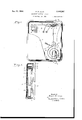
- FIG. 1 is a front elevational view of a thermostat embodying the features of the present invention, a portion of the thermostat casing being broken away. 7
- Fig. 2 is a sectional view taken along the line 2-2 of Fig. 1.
- Fig. 3 is a schematic view and wiring diagram of a temperature regulating system in which the invention may be utilized.
- the invention is embodied in a thermostat generally designated by the numeral 5 'and utilized to control a system by which the movement of a regulating device such as a by-pass damper 6 for varying the effectiveness of a heater '1 is governed in accordance with temperature changes detected by the thermostat.
- the sensitive control element of the thermostat comprises the usual coil 8 of bimetallic material disposed within a casing 9 and having one end secured to a lever ID to adjust the control point of the thermostat as desired. Projecting from the other end of the element 8 is an elongated member or tongue II, the end I2 of which constitutes an electrical contact which moves laterally back and forth varying distances according to the prevailing temperature of the air to which the element 8 is exposed.
- the contacts I3 are mounted for movement into and out of engaging relation with respect to the contact I2.
- the insulating member I4 which may comprise a wrap-- ping of mica, is mounted on the free end of a bar I5 of thermostatic metal extending across the end of the tongue I I and secured at its other end to a bracket I6 on the rear wall of the casing 9.
- the contacts I3 constitute parts of a length of enameled resistance wire I! coiled around the member I4 and a similar member l8 spaced therefrom with sections of the adjacent turns of the wire disposed closely adjacent each other on the member I4. .
- the contacts I3 are formed by removing the enamel insulation along the side of the coil I1 facing the tongue contact I2.
- the member I8 is mounted on a second bar I 9 of thermostatic metal also secured to the bracket I 6. Two thermostatic strips are used for the purpose of increasing the amount of resistance between the adjacent contacts I3 without causing undue heating or necessitating the use of impractically fine wire.
- the bar I 9 there may be several turns of the wire for each of the contacts I3.
- the bars, I 5 and III are so arranged relative to the tongue that at normal temperatures the contacts I3 will be pressed against the contact I2 with suflicient pressure to complete an electric circuit through the engaged contacts. But when the bars are heated to a temperature slightly above the maximum temperature at which engagement of the contacts I2 and I3 occurs,
- thermostatic elements I5 and I9 are provided for heating the thermostatic elements I5 and I9 whenever the tongue contact is in engagement with any one of the contacts I3.
- this means is formed by the resistance coil I'I operating in conjunction with a control system of the so-called potentiometer type forming the subject matter of a co-pending application by George Forrest Drake, Serial No. 720,- 835, filed April 16, 1934, and operating to control the direction and extent of operation of a reversible electric motor 20 geared to a shaft 2
- the motor is of the shaded pole induction type having a main winding 22 constantly energized from a source 23 of alternating current and a rotor 26 adapted to rotate in one direction or another according to which of two pairs of shading coils 24 and 25 is short-circuited to produce shifting of the magnetic field around the rotor recess.
- the coils 24 and 25 are arranged in parallel circuits including limit switches 21 and 2B which are open in opposite limit positions of the damper, and switches 29 and 30 closed by movement of an arm 3I between two limit positions in which the respective switches are closed.
- is carried by the movable armature of a relay 32 which preferably comprises an electric motor constructed similar to the motor 2! with the arm 3
- the relay has a constantly energized main winding 34, and the direction of movement of the arm 3I is controlled by shading coils 35 and 36 which constitute the sources of current for the two parallel circuits of the potentiometer system.
- Each of these circuits includes a part of the resistance coil I! and a part of a resistance element 31 engaged by a wiper arm 38 fast on the damper operating shaft 2I. Both of the circuits include a common conductor 39 which extends from the tongue I I of the thermostat 5 to the wiper arm 38.
- Opposite ends of the resistance coil I! are. joined by conductors 40 and II to the shading coils 35 and 36, the other terminals of which are connected by conductors 42 and 43 to the opposite ends of the resistance element 31.
- a control system of the class described comprising, in combination, a regulating device, a
- a control system of the class described comprising, in combination, a sensitive instrument having engageable contacts movable relative to each other in response to changes in a condition to be controlled, a device for regulating said 0011- dition, a power operator for imparting progressive movements in opposite directions to said device,
- an electric potentiometer system controlled by I said instrument and controlling said operator, and electrical means deriving energy from said potentiometer system and operating periodically and independently of the condition of said instrument to move said contacts out of engaging relation.
- a control system of the class described comprising, in combination, a sensitive instrument having engageable contacts movable relative to each other in response to changes in a condition to be controlled, a device for regulating said condition, a power operator for imparting progressive movements in opposite directions to said device, an electric system controlled by said instrument and governing the operation of said operator to determine the direction and extent of movement of said device thereby, a thermostatic member adapted when heated to move said contacts out of engaging relation, and an electric heater for said member energized from said system.
- a control system of the class described comprising. in combination, a sensitive instrument having engageable contacts movable relative to each other in response to changes in a condition to be controlled, a device for regulating said condition, a power operator for imparting progressive movements in opposite directions to said device, an electric potentiometer system controlled 'by said instrument, a thermostatic member adapted when heated to move said contacts out or engaging relation, and an electric resistance constituting an element of said system and acting to heat said member.
- a control system the combination of a member having a contact thereon, a second member having two spaced contacts adapted for engagement with said first mentioned contact, a sensitive control element for effecting relative movement between said members in the direction of spacing of said second contacts, means supporting one of said members for movement in.
- thermostatic element adapted when heated to move said members away from each other, and means for heating said thermostatic element during the engagement of said first contact with either of the other contacts whereby to disengage the members and permit freedom or relative movement therebetween by said sensitive element.
- a control of the character described having, in combination, a contact member, a sensitive control element for moving said member in opposite directions, a second contact member engageable therewith elongated in the direction of movement of said first mentioned member and engageable with the first member in diflerent positions of the latter, and mechanism set in operation as an incident to engagement of said members and operating after the lapse of a time interval to move the members relative to each other out of engaging relation.
- a control of the class described having, in combination, a contact member, a sensitive control element for moving said member, a second contact member elongated in the direction of movement of said first mentioned member by said element so as to be engageable therewith in difierent positional relations, a thermostatic element arranged to move said second member into and out of engaging relation with respect to said first member, and means operating automatically to efi'ect alternate heating and cooling of said thermostatic element.
- a control of the class described having, in combination, a contact member, a sensitive control element having an elongated transversely movable tongue carrying said member, a second contact member, one of said members being elongated in the direction of movement of said tongue, means supporting said element and said second contact member for relative movement in a direction longitudinally of said tongue and also transversely oi said elongated contact member whereby to cause the contact pressure to be transmitted to said tongue in a direction endwise thereof, and mechanism operating independently o! the condition of said element to move the members into and out of engagement intermittently,
Landscapes
- Physics & Mathematics (AREA)
- General Physics & Mathematics (AREA)
- Engineering & Computer Science (AREA)
- Automation & Control Theory (AREA)
- Control Of Resistance Heating (AREA)
Description
E. D. LILJA Jan. 31, 1939.
am Iu 2 m 0 N T W m r T V MJ M N Jan. 31, 1939. D, LILJA 2,145,267
SENSITIVE CONTROL SYSTEM Filed Nov. 16, 1934 2 Sheets-Sheet 2 INVENTOR Edgar D. Lilia Y W Rd;
ATTORNEYS Patented Jan. 3l, 1939 UNITED STATES PATENT OFFICE Edgar D. Lilia, Rockford, Ill., assignor, by mesne assignments, to Barber-Colman Company, Rockford, 111., a corporation of Illinois Application November 16, 1934, Serial No. 753,326
8 Claims.
This invention relates to sensitive control instruments such as are used in conjunction with temperature regulating systems and the like.
More particularly the invention relates to those systems in which the control is normally efiected by relative movement between coacting contacts while the latter are in engagement with each other.
The general object of the invention is to in- 3 crease the sensitivity of control instruments in systems of the above character through the provision of a novel means which operates to relieve the friction at the engaging contact surfaces and which is simple and inexpensive in construction I and automatic and durable in its operation.
A more detailed object is to provide a control instrument of the above character in which the coacting contact members are moved intermittently out of engaging relation by alternately heating and cooling a thermostatic member arranged to move the contact members relative to each other in a direction transverse to the movement produced by the sensitive control element with which the members are associated.
The invention also resides in the novel character of the means for effecting heating and cooling of the thermostatic member above mentioned.
Other objects and advantages of the invention will become apparent from the following detailed description taken in connection with the accompanying drawings, in which Figure 1 is a front elevational view of a thermostat embodying the features of the present invention, a portion of the thermostat casing being broken away. 7
Fig. 2 is a sectional view taken along the line 2-2 of Fig. 1.
Fig. 3 is a schematic view and wiring diagram of a temperature regulating system in which the invention may be utilized.
While the invention is susceptible of various modifications and alternative constructions, I have shown in the drawings and will herein describe in detail the preferred embodiment, but it is to be understood that I do not thereby intend to limit the invention to the specific form disclosed, but intend to cover all modifications and alternative constructions falling within the spirit and scope of the invention as expressed in the appended claims.
For purposes of illustration, the invention is embodied in a thermostat generally designated by the numeral 5 'and utilized to control a system by which the movement of a regulating device such as a by-pass damper 6 for varying the effectiveness of a heater '1 is governed in accordance with temperature changes detected by the thermostat. The sensitive control element of the thermostat comprises the usual coil 8 of bimetallic material disposed within a casing 9 and having one end secured to a lever ID to adjust the control point of the thermostat as desired. Projecting from the other end of the element 8 is an elongated member or tongue II, the end I2 of which constitutes an electrical contact which moves laterally back and forth varying distances according to the prevailing temperature of the air to which the element 8 is exposed.
Cooperating with the contact I2 to form an electric circuit cont-rolling mechanism are a plurality of contacts I3 separated from each other by insulation and closely spaced along an insulating member I 4 in the direction of movement of the contact I2. In accordance with the present invention, the contacts I3 are mounted for movement into and out of engaging relation with respect to the contact I2. To this end, the insulating member I4, which may comprise a wrap-- ping of mica, is mounted on the free end of a bar I5 of thermostatic metal extending across the end of the tongue I I and secured at its other end to a bracket I6 on the rear wall of the casing 9.
In the present instance, the contacts I3 constitute parts of a length of enameled resistance wire I! coiled around the member I4 and a similar member l8 spaced therefrom with sections of the adjacent turns of the wire disposed closely adjacent each other on the member I4. .The contacts I3 are formed by removing the enamel insulation along the side of the coil I1 facing the tongue contact I2. To maintain the shape of the coil, the member I8 is mounted on a second bar I 9 of thermostatic metal also secured to the bracket I 6. Two thermostatic strips are used for the purpose of increasing the amount of resistance between the adjacent contacts I3 without causing undue heating or necessitating the use of impractically fine wire. Thus, on the bar I 9, there may be several turns of the wire for each of the contacts I3.
The bars, I 5 and III are so arranged relative to the tongue that at normal temperatures the contacts I3 will be pressed against the contact I2 with suflicient pressure to complete an electric circuit through the engaged contacts. But when the bars are heated to a temperature slightly above the maximum temperature at which engagement of the contacts I2 and I3 occurs,
they will warp and carry the contacts I3 out of engagement with the tongue contact I2. With the contacts thus disengaged, the tongue is free to move under the action of the sensitive element 8, and since friction between the engaging contacts is thus eliminated, the tongue contact will, when freed, assume a definite position for a given temperature of the thermostatic element 8.
To cause intermittent engagement of the contacts I2 and I3, automatically acting means is provided for heating the thermostatic elements I5 and I9 whenever the tongue contact is in engagement with any one of the contacts I3. In the present instance, this means is formed by the resistance coil I'I operating in conjunction with a control system of the so-called potentiometer type forming the subject matter of a co-pending application by George Forrest Drake, Serial No. 720,- 835, filed April 16, 1934, and operating to control the direction and extent of operation of a reversible electric motor 20 geared to a shaft 2| from which the damper 6 is operated. Preferably, the motor is of the shaded pole induction type having a main winding 22 constantly energized from a source 23 of alternating current and a rotor 26 adapted to rotate in one direction or another according to which of two pairs of shading coils 24 and 25 is short-circuited to produce shifting of the magnetic field around the rotor recess. The coils 24 and 25 are arranged in parallel circuits including limit switches 21 and 2B which are open in opposite limit positions of the damper, and switches 29 and 30 closed by movement of an arm 3I between two limit positions in which the respective switches are closed.
The switch arm 3| is carried by the movable armature of a relay 32 which preferably comprises an electric motor constructed similar to the motor 2!! with the arm 3| fast on the motorshaft 33. The relay has a constantly energized main winding 34, and the direction of movement of the arm 3I is controlled by shading coils 35 and 36 which constitute the sources of current for the two parallel circuits of the potentiometer system. Each of these circuits includes a part of the resistance coil I! and a part of a resistance element 31 engaged by a wiper arm 38 fast on the damper operating shaft 2I. Both of the circuits include a common conductor 39 which extends from the tongue I I of the thermostat 5 to the wiper arm 38. Opposite ends of the resistance coil I! are. joined by conductors 40 and II to the shading coils 35 and 36, the other terminals of which are connected by conductors 42 and 43 to the opposite ends of the resistance element 31.
With the circuit arrangement above described, it will be observed that when the tongue contact I2 is in engagement with any one of the contacts I3, the two circuits through the shading coils 35 and 36 will be closed, the switch arm 3| being moved in a direction determined by the shading coils exerting the predominating shading efiect, that is, the coils which are in the circuit of lower resistance. When the resistances of the two circuits are balanced, the arm 3| will be disposed in the neutral position shown as by means of a spring (not shown), the motor 20 then being idle and the damper 6 being held against movement. Now if the tongue II moves into engagement with a different contact I3, the resistance balance will be destroyed resulting in closure of the relay switches which will cause movement of the damper in a direction such as to change the rate of heat delivery and compensate for the change in temperature which produced the tongue movement. The motor 20 continues in operation until a balance has abain been established in the potentiometer system. In this way, the damper follows the movements of the thermostatic tongue.
Whenever the coil I1 is energized by the voltages induced in the relay shading coils, as it will be whenever the tongue contact I2 engages one of the contacts I3, the bimetallic elements I5 and I9 will be heated. This results in a warping oi the elements in a direction to carry the contacts I3 out of engaging relation with respect to the contact I2, the disengagement occurring after a temperature rise of a few degrees. Such deenergization of the coil I'I results in interruption of both of the circuits through the shading coils 35 and 36 whereupon the heater coil and the thermostatic elements I5 and I9 cool allowing the contacts I3 to be moved back into engagement with the tongue contact for a repetition of the cycle. In this way, the contacts I2 and I3 are disengaged intermittently, and during such disengagement the tongue II is free to move under the action of the sensitive thermostatic element 8.
I claim as my invention:
1. A control system of the class described comprising, in combination, a regulating device, a
adapted when heated thereby to a predetermined ,3
temperature to move said contacts out of engaging relation.
2. A control system of the class described comprising, in combination, a sensitive instrument having engageable contacts movable relative to each other in response to changes in a condition to be controlled, a device for regulating said 0011- dition, a power operator for imparting progressive movements in opposite directions to said device,
an electric potentiometer system controlled by I said instrument and controlling said operator, and electrical means deriving energy from said potentiometer system and operating periodically and independently of the condition of said instrument to move said contacts out of engaging relation.
3. A control system of the class described comprising, in combination, a sensitive instrument having engageable contacts movable relative to each other in response to changes in a condition to be controlled, a device for regulating said condition, a power operator for imparting progressive movements in opposite directions to said device, an electric system controlled by said instrument and governing the operation of said operator to determine the direction and extent of movement of said device thereby, a thermostatic member adapted when heated to move said contacts out of engaging relation, and an electric heater for said member energized from said system.
4. A control system of the class described comprising. in combination, a sensitive instrument having engageable contacts movable relative to each other in response to changes in a condition to be controlled, a device for regulating said condition, a power operator for imparting progressive movements in opposite directions to said device, an electric potentiometer system controlled 'by said instrument, a thermostatic member adapted when heated to move said contacts out or engaging relation, and an electric resistance constituting an element of said system and acting to heat said member.
5. In a control system, the combination of a member having a contact thereon, a second member having two spaced contacts adapted for engagement with said first mentioned contact, a sensitive control element for effecting relative movement between said members in the direction of spacing of said second contacts, means supporting one of said members for movement in.
a direction transversely of the path of said relative movement to carry said contacts into and out of engaging relation including a thermostatic element adapted when heated to move said members away from each other, and means for heating said thermostatic element during the engagement of said first contact with either of the other contacts whereby to disengage the members and permit freedom or relative movement therebetween by said sensitive element.
6. A control of the character described having, in combination, a contact member, a sensitive control element for moving said member in opposite directions, a second contact member engageable therewith elongated in the direction of movement of said first mentioned member and engageable with the first member in diflerent positions of the latter, and mechanism set in operation as an incident to engagement of said members and operating after the lapse of a time interval to move the members relative to each other out of engaging relation.
7. A control of the class described having, in combination, a contact member, a sensitive control element for moving said member, a second contact member elongated in the direction of movement of said first mentioned member by said element so as to be engageable therewith in difierent positional relations, a thermostatic element arranged to move said second member into and out of engaging relation with respect to said first member, and means operating automatically to efi'ect alternate heating and cooling of said thermostatic element.
8. A control of the class described having, in combination, a contact member, a sensitive control element having an elongated transversely movable tongue carrying said member, a second contact member, one of said members being elongated in the direction of movement of said tongue, means supporting said element and said second contact member for relative movement in a direction longitudinally of said tongue and also transversely oi said elongated contact member whereby to cause the contact pressure to be transmitted to said tongue in a direction endwise thereof, and mechanism operating independently o! the condition of said element to move the members into and out of engagement intermittently,
IDGAR D. LII-J4-
Priority Applications (1)
| Application Number | Priority Date | Filing Date | Title |
|---|---|---|---|
| US753320A US2145267A (en) | 1934-11-16 | 1934-11-16 | Sensitive control system |
Applications Claiming Priority (1)
| Application Number | Priority Date | Filing Date | Title |
|---|---|---|---|
| US753320A US2145267A (en) | 1934-11-16 | 1934-11-16 | Sensitive control system |
Publications (1)
| Publication Number | Publication Date |
|---|---|
| US2145267A true US2145267A (en) | 1939-01-31 |
Family
ID=25030137
Family Applications (1)
| Application Number | Title | Priority Date | Filing Date |
|---|---|---|---|
| US753320A Expired - Lifetime US2145267A (en) | 1934-11-16 | 1934-11-16 | Sensitive control system |
Country Status (1)
| Country | Link |
|---|---|
| US (1) | US2145267A (en) |
-
1934
- 1934-11-16 US US753320A patent/US2145267A/en not_active Expired - Lifetime
Similar Documents
| Publication | Publication Date | Title |
|---|---|---|
| US2510040A (en) | Electric blanket control | |
| US2425998A (en) | Thermostat control mechanism for heating systems | |
| US2163297A (en) | Thermostat remote control | |
| US2262341A (en) | System for controlling the flow of heating mediums | |
| US2209768A (en) | Thermostat | |
| US2366387A (en) | Modulating condition responsive switch | |
| US2301708A (en) | Temperature control system | |
| US2382073A (en) | Thermostat control circuit | |
| US2365709A (en) | Condition control | |
| US2806119A (en) | Oven heating system | |
| US2402240A (en) | Compensating stokes simes | |
| US2236282A (en) | Controller | |
| US2023114A (en) | Range control system | |
| US2545390A (en) | Electrical control system | |
| US2313079A (en) | Condition control | |
| US1867380A (en) | Thermal switch | |
| US1954365A (en) | Temperature control for heaters | |
| US2260838A (en) | Timing device | |
| US2620469A (en) | Temperature responsive variable reactance | |
| US2266250A (en) | Water heating system | |
| US2208762A (en) | Load compensated control system | |
| US2870965A (en) | Compensated anticipating thermostat | |
| US3624579A (en) | Anticipating thermostat | |
| US2016805A (en) | Automatic heat regulating system | |
| US1184430A (en) | Temperature-control mechanism. |