US20220144797A1 - 20-hete formation inhibitors - Google Patents
20-hete formation inhibitors Download PDFInfo
- Publication number
- US20220144797A1 US20220144797A1 US17/429,289 US202017429289A US2022144797A1 US 20220144797 A1 US20220144797 A1 US 20220144797A1 US 202017429289 A US202017429289 A US 202017429289A US 2022144797 A1 US2022144797 A1 US 2022144797A1
- Authority
- US
- United States
- Prior art keywords
- optionally substituted
- substituted
- alkyl
- cycloalkyl
- compound
- Prior art date
- Legal status (The legal status is an assumption and is not a legal conclusion. Google has not performed a legal analysis and makes no representation as to the accuracy of the status listed.)
- Granted
Links
- 0 *N1CCC([Y]C)CC1 Chemical compound *N1CCC([Y]C)CC1 0.000 description 35
- SHQHRDPILKDALG-UHFFFAOYSA-N CC.CC(C)c1ccccc1 Chemical compound CC.CC(C)c1ccccc1 SHQHRDPILKDALG-UHFFFAOYSA-N 0.000 description 12
- WABHXOJFPBXOSX-UHFFFAOYSA-N CC.CC.CC(C)C.CC(C)C.c1ccncc1.c1cncnc1 Chemical compound CC.CC.CC(C)C.CC(C)C.c1ccncc1.c1cncnc1 WABHXOJFPBXOSX-UHFFFAOYSA-N 0.000 description 6
- MTGFXAIINBHCMS-UHFFFAOYSA-N Clc1ccc(CC2CCN(c3cn[nH]c3)CC2)cc1 Chemical compound Clc1ccc(CC2CCN(c3cn[nH]c3)CC2)cc1 MTGFXAIINBHCMS-UHFFFAOYSA-N 0.000 description 6
- KQXOYFMYOLJNOB-UHFFFAOYSA-N O=C1CCCN1c1ccc(C2CCN(c3cn[nH]c3)CC2)cc1 Chemical compound O=C1CCCN1c1ccc(C2CCN(c3cn[nH]c3)CC2)cc1 KQXOYFMYOLJNOB-UHFFFAOYSA-N 0.000 description 6
- MZIOKVCMIAVGFV-UHFFFAOYSA-N Cc1cccc(C2CCN(c3cn[nH]c3)CC2)c1 Chemical compound Cc1cccc(C2CCN(c3cn[nH]c3)CC2)c1 MZIOKVCMIAVGFV-UHFFFAOYSA-N 0.000 description 5
- VWIGZQKXBLPDAA-UHFFFAOYSA-N C1=NCC(N2CCC(Oc3ccccc3)CC2)=C1 Chemical compound C1=NCC(N2CCC(Oc3ccccc3)CC2)=C1 VWIGZQKXBLPDAA-UHFFFAOYSA-N 0.000 description 3
- XBOUTSNNZFTFAS-UHFFFAOYSA-N C1=NCC(N2CCC(Sc3ccccc3)CC2)=C1 Chemical compound C1=NCC(N2CCC(Sc3ccccc3)CC2)=C1 XBOUTSNNZFTFAS-UHFFFAOYSA-N 0.000 description 3
- XGYRDJAFVPRREN-UHFFFAOYSA-N CC(=O)N(C)c1ccc(C2CCN(C3=CC=NC3)CC2)cc1 Chemical compound CC(=O)N(C)c1ccc(C2CCN(C3=CC=NC3)CC2)cc1 XGYRDJAFVPRREN-UHFFFAOYSA-N 0.000 description 3
- ISXALSGGJBWCOL-UHFFFAOYSA-N CC(=O)N(C)c1ccc(C2CCN(c3ccn[nH]3)CC2)c(F)c1 Chemical compound CC(=O)N(C)c1ccc(C2CCN(c3ccn[nH]3)CC2)c(F)c1 ISXALSGGJBWCOL-UHFFFAOYSA-N 0.000 description 3
- WJJOPLGZSFJALR-UHFFFAOYSA-N CC(=O)N(C)c1ccc(C2CCN(c3cn[nH]c3)CC2)c(F)c1 Chemical compound CC(=O)N(C)c1ccc(C2CCN(c3cn[nH]c3)CC2)c(F)c1 WJJOPLGZSFJALR-UHFFFAOYSA-N 0.000 description 3
- QITWKYLNZIHWSM-UHFFFAOYSA-N CC(=O)N(C)c1ccc(C2CCN(c3cn[nH]c3)CC2)cc1 Chemical compound CC(=O)N(C)c1ccc(C2CCN(c3cn[nH]c3)CC2)cc1 QITWKYLNZIHWSM-UHFFFAOYSA-N 0.000 description 3
- FKVJWLYUERVJBP-UHFFFAOYSA-N CC(=O)N(C)c1ccc(C2CCN(c3cn[nH]c3)CC2)cn1 Chemical compound CC(=O)N(C)c1ccc(C2CCN(c3cn[nH]c3)CC2)cn1 FKVJWLYUERVJBP-UHFFFAOYSA-N 0.000 description 3
- VEODCZRTMVEBCU-UHFFFAOYSA-N CC(=O)Nc1ccc(C2CCN(C3=CC=NC3)CC2)cc1 Chemical compound CC(=O)Nc1ccc(C2CCN(C3=CC=NC3)CC2)cc1 VEODCZRTMVEBCU-UHFFFAOYSA-N 0.000 description 3
- WOPGIPWNTUHTNK-UHFFFAOYSA-N CC(=O)Nc1ccc(C2CCN(c3cn[nH]c3)CC2)cc1 Chemical compound CC(=O)Nc1ccc(C2CCN(c3cn[nH]c3)CC2)cc1 WOPGIPWNTUHTNK-UHFFFAOYSA-N 0.000 description 3
- HRSBVQKKIMZYIJ-UHFFFAOYSA-N CC(Nc1ccc(C2CCN(c3cn[nH]c3)CC2)cc1)C(F)(F)F Chemical compound CC(Nc1ccc(C2CCN(c3cn[nH]c3)CC2)cc1)C(F)(F)F HRSBVQKKIMZYIJ-UHFFFAOYSA-N 0.000 description 3
- KKKICECACXPIBI-UHFFFAOYSA-N CC.CC(C)C.c1ccncc1 Chemical compound CC.CC(C)C.c1ccncc1 KKKICECACXPIBI-UHFFFAOYSA-N 0.000 description 3
- DHMGHKWDLPURFH-UHFFFAOYSA-N CC1=NCC(N2CCC(c3ccccc3)CC2)=C1 Chemical compound CC1=NCC(N2CCC(c3ccccc3)CC2)=C1 DHMGHKWDLPURFH-UHFFFAOYSA-N 0.000 description 3
- PJTCBKNEJCBTEU-UHFFFAOYSA-N CCS(=O)(=O)c1ccc(C2CCN(c3ccn[nH]3)CC2)cc1 Chemical compound CCS(=O)(=O)c1ccc(C2CCN(c3ccn[nH]3)CC2)cc1 PJTCBKNEJCBTEU-UHFFFAOYSA-N 0.000 description 3
- SNYWMNLHVJXPNC-UHFFFAOYSA-N CCS(=O)(=O)c1ccc(C2CCN(c3cn[nH]c3)CC2)cc1 Chemical compound CCS(=O)(=O)c1ccc(C2CCN(c3cn[nH]c3)CC2)cc1 SNYWMNLHVJXPNC-UHFFFAOYSA-N 0.000 description 3
- AMGIFFWLLDOTRQ-UHFFFAOYSA-N COC(=O)c1ccc(C2CCN(c3cn[nH]c3)CC2)cc1 Chemical compound COC(=O)c1ccc(C2CCN(c3cn[nH]c3)CC2)cc1 AMGIFFWLLDOTRQ-UHFFFAOYSA-N 0.000 description 3
- BFMZNSXIELHSOZ-UHFFFAOYSA-N COC(=O)c1cccc(C2CCN(C3=CC=NC3)CC2)c1 Chemical compound COC(=O)c1cccc(C2CCN(C3=CC=NC3)CC2)c1 BFMZNSXIELHSOZ-UHFFFAOYSA-N 0.000 description 3
- AKKKPXKDXZQNAH-UHFFFAOYSA-N COC(=O)c1cccc(C2CCN(c3cn[nH]c3)CC2)c1 Chemical compound COC(=O)c1cccc(C2CCN(c3cn[nH]c3)CC2)c1 AKKKPXKDXZQNAH-UHFFFAOYSA-N 0.000 description 3
- FCZIDROUMWETPZ-UHFFFAOYSA-N COCc1ccc(C2CCN(C3=CC=NC3)CC2)cc1 Chemical compound COCc1ccc(C2CCN(C3=CC=NC3)CC2)cc1 FCZIDROUMWETPZ-UHFFFAOYSA-N 0.000 description 3
- OXCHCIIXCRHZQL-UHFFFAOYSA-N COCc1ccc(C2CCN(c3cn[nH]c3)CC2)cc1 Chemical compound COCc1ccc(C2CCN(c3cn[nH]c3)CC2)cc1 OXCHCIIXCRHZQL-UHFFFAOYSA-N 0.000 description 3
- WZGJJPKEMYXZAR-UHFFFAOYSA-N COc1cc(C2CCN(C3=CC=NC3)CC2)ccc1F Chemical compound COc1cc(C2CCN(C3=CC=NC3)CC2)ccc1F WZGJJPKEMYXZAR-UHFFFAOYSA-N 0.000 description 3
- FUMJYVCSHCNSLB-UHFFFAOYSA-N COc1cc(C2CCN(C3=CC=NC3)CC2)ccn1 Chemical compound COc1cc(C2CCN(C3=CC=NC3)CC2)ccn1 FUMJYVCSHCNSLB-UHFFFAOYSA-N 0.000 description 3
- ZUOWWXUAQGTNGJ-UHFFFAOYSA-N COc1cc(C2CCN(c3cn[nH]c3)CC2)ccc1F Chemical compound COc1cc(C2CCN(c3cn[nH]c3)CC2)ccc1F ZUOWWXUAQGTNGJ-UHFFFAOYSA-N 0.000 description 3
- ZHWTXFYGOUUIEJ-UHFFFAOYSA-N COc1cc(C2CCN(c3cn[nH]c3)CC2)ccn1 Chemical compound COc1cc(C2CCN(c3cn[nH]c3)CC2)ccn1 ZHWTXFYGOUUIEJ-UHFFFAOYSA-N 0.000 description 3
- NGDLEYOFLUQPPN-UHFFFAOYSA-N COc1cc(CC2CCN(c3ccn[nH]3)CC2)ccn1 Chemical compound COc1cc(CC2CCN(c3ccn[nH]3)CC2)ccn1 NGDLEYOFLUQPPN-UHFFFAOYSA-N 0.000 description 3
- LWGCUKKGLQXALO-UHFFFAOYSA-N COc1cc(CC2CCN(c3cn[nH]c3)CC2)ccn1 Chemical compound COc1cc(CC2CCN(c3cn[nH]c3)CC2)ccn1 LWGCUKKGLQXALO-UHFFFAOYSA-N 0.000 description 3
- VJLDFMNTFPZWEQ-UHFFFAOYSA-N COc1cc(F)cc(C2CCN(C3=CC=NC3)CC2)c1 Chemical compound COc1cc(F)cc(C2CCN(C3=CC=NC3)CC2)c1 VJLDFMNTFPZWEQ-UHFFFAOYSA-N 0.000 description 3
- CDVQXIYVYXXPHU-UHFFFAOYSA-N COc1cc(F)cc(C2CCN(c3cn[nH]c3)CC2)c1 Chemical compound COc1cc(F)cc(C2CCN(c3cn[nH]c3)CC2)c1 CDVQXIYVYXXPHU-UHFFFAOYSA-N 0.000 description 3
- UXIIJOIXFPNFLR-UHFFFAOYSA-N COc1ccc(C2CCN(C3=CC=NC3)CC2)cc1 Chemical compound COc1ccc(C2CCN(C3=CC=NC3)CC2)cc1 UXIIJOIXFPNFLR-UHFFFAOYSA-N 0.000 description 3
- SOVFDBAOPSXOBS-UHFFFAOYSA-N COc1ccc(C2CCN(C3=CC=NC3)CC2)cn1 Chemical compound COc1ccc(C2CCN(C3=CC=NC3)CC2)cn1 SOVFDBAOPSXOBS-UHFFFAOYSA-N 0.000 description 3
- WZURZYHQWUMHGS-UHFFFAOYSA-N COc1ccc(C2CCN(c3ccn[nH]3)CC2)c(Cl)c1 Chemical compound COc1ccc(C2CCN(c3ccn[nH]3)CC2)c(Cl)c1 WZURZYHQWUMHGS-UHFFFAOYSA-N 0.000 description 3
- GFINTNOMADZVQX-UHFFFAOYSA-N COc1ccc(C2CCN(c3ccn[nH]3)CC2)cc1Cl Chemical compound COc1ccc(C2CCN(c3ccn[nH]3)CC2)cc1Cl GFINTNOMADZVQX-UHFFFAOYSA-N 0.000 description 3
- VATMLQYYJKPGHQ-UHFFFAOYSA-N COc1ccc(C2CCN(c3cn[nH]c3)CC2)c(Cl)c1 Chemical compound COc1ccc(C2CCN(c3cn[nH]c3)CC2)c(Cl)c1 VATMLQYYJKPGHQ-UHFFFAOYSA-N 0.000 description 3
- VRFXCPJKLOKYNF-UHFFFAOYSA-N COc1ccc(C2CCN(c3cn[nH]c3)CC2)c(F)c1 Chemical compound COc1ccc(C2CCN(c3cn[nH]c3)CC2)c(F)c1 VRFXCPJKLOKYNF-UHFFFAOYSA-N 0.000 description 3
- HIDIBYXQULDVQA-UHFFFAOYSA-N COc1ccc(C2CCN(c3cn[nH]c3)CC2)cc1 Chemical compound COc1ccc(C2CCN(c3cn[nH]c3)CC2)cc1 HIDIBYXQULDVQA-UHFFFAOYSA-N 0.000 description 3
- WDIXSZFIUUHMGB-UHFFFAOYSA-N COc1ccc(C2CCN(c3cn[nH]c3)CC2)cc1Cl Chemical compound COc1ccc(C2CCN(c3cn[nH]c3)CC2)cc1Cl WDIXSZFIUUHMGB-UHFFFAOYSA-N 0.000 description 3
- JCNJCPQYYCFWGM-UHFFFAOYSA-N COc1ccc(C2CCN(c3cn[nH]c3)CC2)cc1F Chemical compound COc1ccc(C2CCN(c3cn[nH]c3)CC2)cc1F JCNJCPQYYCFWGM-UHFFFAOYSA-N 0.000 description 3
- JOGAHMFAAUTUKU-UHFFFAOYSA-N COc1ccc(C2CCN(c3cn[nH]c3)CC2)cn1 Chemical compound COc1ccc(C2CCN(c3cn[nH]c3)CC2)cn1 JOGAHMFAAUTUKU-UHFFFAOYSA-N 0.000 description 3
- OYSRUORFBPTPIN-UHFFFAOYSA-N COc1ccc(CC2CCN(c3ccn[nH]3)CC2)cc1 Chemical compound COc1ccc(CC2CCN(c3ccn[nH]3)CC2)cc1 OYSRUORFBPTPIN-UHFFFAOYSA-N 0.000 description 3
- GVPSVHINUUIJTH-UHFFFAOYSA-N COc1ccc(CC2CCN(c3cn[nH]c3)CC2)cc1 Chemical compound COc1ccc(CC2CCN(c3cn[nH]c3)CC2)cc1 GVPSVHINUUIJTH-UHFFFAOYSA-N 0.000 description 3
- RJMCORFAPVPDRE-UHFFFAOYSA-N COc1ccc(SC2CCN(c3ccn[nH]3)CC2)cc1 Chemical compound COc1ccc(SC2CCN(c3ccn[nH]3)CC2)cc1 RJMCORFAPVPDRE-UHFFFAOYSA-N 0.000 description 3
- UQKWTGFAKLSWQC-UHFFFAOYSA-N COc1cccc(CC2CCN(c3cn[nH]c3)CC2)c1 Chemical compound COc1cccc(CC2CCN(c3cn[nH]c3)CC2)c1 UQKWTGFAKLSWQC-UHFFFAOYSA-N 0.000 description 3
- SJYPNLUGLILSPP-UHFFFAOYSA-N COc1cccc(SC2CCN(c3cn[nH]c3)CC2)c1 Chemical compound COc1cccc(SC2CCN(c3cn[nH]c3)CC2)c1 SJYPNLUGLILSPP-UHFFFAOYSA-N 0.000 description 3
- GTZLCEHXXDJBMC-UHFFFAOYSA-N COc1ccccc1C1CCN(C2=CC=NC2)CC1 Chemical compound COc1ccccc1C1CCN(C2=CC=NC2)CC1 GTZLCEHXXDJBMC-UHFFFAOYSA-N 0.000 description 3
- WJRCOAGITQZBGV-UHFFFAOYSA-N COc1ccccc1C1CCN(c2cn[nH]c2)CC1 Chemical compound COc1ccccc1C1CCN(c2cn[nH]c2)CC1 WJRCOAGITQZBGV-UHFFFAOYSA-N 0.000 description 3
- RACMGJIBCMGDDM-UHFFFAOYSA-N COc1cncc(C2CCN(c3cn[nH]c3)CC2)c1 Chemical compound COc1cncc(C2CCN(c3cn[nH]c3)CC2)c1 RACMGJIBCMGDDM-UHFFFAOYSA-N 0.000 description 3
- PRBUMNNMOUMPRW-UHFFFAOYSA-N CS(=O)(=O)Cc1ccc(C2CCN(c3cn[nH]c3)CC2)cc1 Chemical compound CS(=O)(=O)Cc1ccc(C2CCN(c3cn[nH]c3)CC2)cc1 PRBUMNNMOUMPRW-UHFFFAOYSA-N 0.000 description 3
- HQDHBYPSCVZLHB-UHFFFAOYSA-N CS(=O)(=O)Nc1ccc(C2CCN(c3cn[nH]c3)CC2)cc1 Chemical compound CS(=O)(=O)Nc1ccc(C2CCN(c3cn[nH]c3)CC2)cc1 HQDHBYPSCVZLHB-UHFFFAOYSA-N 0.000 description 3
- HQIPCZCYHGUONG-HNNXBMFYSA-N C[C@@H](c1ccc(C2CCN(c3cn[nH]c3)CC2)cc1)N1CCCC1=O Chemical compound C[C@@H](c1ccc(C2CCN(c3cn[nH]c3)CC2)cc1)N1CCCC1=O HQIPCZCYHGUONG-HNNXBMFYSA-N 0.000 description 3
- HQIPCZCYHGUONG-OAHLLOKOSA-N C[C@H](c1ccc(C2CCN(c3cn[nH]c3)CC2)cc1)N1CCCC1=O Chemical compound C[C@H](c1ccc(C2CCN(c3cn[nH]c3)CC2)cc1)N1CCCC1=O HQIPCZCYHGUONG-OAHLLOKOSA-N 0.000 description 3
- UEMXKEOWOKCGGN-UHFFFAOYSA-N Cc1ccc(C2CCN(C3=CC=NC3)CC2)cc1 Chemical compound Cc1ccc(C2CCN(C3=CC=NC3)CC2)cc1 UEMXKEOWOKCGGN-UHFFFAOYSA-N 0.000 description 3
- CKPAOFHDHYLQKM-UHFFFAOYSA-N Cc1ccc(C2CCN(c3cn[nH]c3)CC2)cc1 Chemical compound Cc1ccc(C2CCN(c3cn[nH]c3)CC2)cc1 CKPAOFHDHYLQKM-UHFFFAOYSA-N 0.000 description 3
- NVLMQGDQJNNJIT-UHFFFAOYSA-N Cc1ccc(CC2CCN(c3cn[nH]c3)CC2)cc1 Chemical compound Cc1ccc(CC2CCN(c3cn[nH]c3)CC2)cc1 NVLMQGDQJNNJIT-UHFFFAOYSA-N 0.000 description 3
- UEZRSJROOGRSPZ-UHFFFAOYSA-N Cc1cccc(C2CCN(C3=CC=NC3)CC2)c1 Chemical compound Cc1cccc(C2CCN(C3=CC=NC3)CC2)c1 UEZRSJROOGRSPZ-UHFFFAOYSA-N 0.000 description 3
- WVSYUARNBQGMFR-UHFFFAOYSA-N Cc1cccc(CC2CCN(c3ccn[nH]3)CC2)c1 Chemical compound Cc1cccc(CC2CCN(c3ccn[nH]3)CC2)c1 WVSYUARNBQGMFR-UHFFFAOYSA-N 0.000 description 3
- UPJGJLCESUIANW-UHFFFAOYSA-N Cc1cccc(CC2CCN(c3cn[nH]c3)CC2)c1 Chemical compound Cc1cccc(CC2CCN(c3cn[nH]c3)CC2)c1 UPJGJLCESUIANW-UHFFFAOYSA-N 0.000 description 3
- QMPOINUNZKDIGB-UHFFFAOYSA-N Cc1ccccc1C1CCN(C2=CC=NC2)CC1 Chemical compound Cc1ccccc1C1CCN(C2=CC=NC2)CC1 QMPOINUNZKDIGB-UHFFFAOYSA-N 0.000 description 3
- ZFBVDTLUFXUSCO-UHFFFAOYSA-N Cc1ccccc1C1CCN(c2cn[nH]c2)CC1 Chemical compound Cc1ccccc1C1CCN(c2cn[nH]c2)CC1 ZFBVDTLUFXUSCO-UHFFFAOYSA-N 0.000 description 3
- UEIHPYFQHDKFDF-UHFFFAOYSA-N Cc1n[nH]cc1N1CCC(c2ccccc2)CC1 Chemical compound Cc1n[nH]cc1N1CCC(c2ccccc2)CC1 UEIHPYFQHDKFDF-UHFFFAOYSA-N 0.000 description 3
- QKICLXHDZGYZHW-UHFFFAOYSA-N Clc1ccc(C2CCN(c3cn[nH]c3)CC2)cc1 Chemical compound Clc1ccc(C2CCN(c3cn[nH]c3)CC2)cc1 QKICLXHDZGYZHW-UHFFFAOYSA-N 0.000 description 3
- GAQFEXDUXAKCJZ-UHFFFAOYSA-N Clc1cccc(C2CCN(c3cn[nH]c3)CC2)c1 Chemical compound Clc1cccc(C2CCN(c3cn[nH]c3)CC2)c1 GAQFEXDUXAKCJZ-UHFFFAOYSA-N 0.000 description 3
- FXLGLSHLSMOYJJ-UHFFFAOYSA-N Clc1cccc(CC2CCN(c3ccn[nH]3)CC2)c1 Chemical compound Clc1cccc(CC2CCN(c3ccn[nH]3)CC2)c1 FXLGLSHLSMOYJJ-UHFFFAOYSA-N 0.000 description 3
- QWEAQHZBYWDYSL-UHFFFAOYSA-N Clc1cccc(CC2CCN(c3cn[nH]c3)CC2)c1 Chemical compound Clc1cccc(CC2CCN(c3cn[nH]c3)CC2)c1 QWEAQHZBYWDYSL-UHFFFAOYSA-N 0.000 description 3
- GCCLVUYLCNRGHF-UHFFFAOYSA-N Fc1cc(C2CCN(c3cn[nH]c3)CC2)ccc1N1CCOCC1 Chemical compound Fc1cc(C2CCN(c3cn[nH]c3)CC2)ccc1N1CCOCC1 GCCLVUYLCNRGHF-UHFFFAOYSA-N 0.000 description 3
- XDHATYGVQLUTAU-UHFFFAOYSA-N Fc1cc(N2CCOCC2)ccc1C1CCN(c2cn[nH]c2)CC1 Chemical compound Fc1cc(N2CCOCC2)ccc1C1CCN(c2cn[nH]c2)CC1 XDHATYGVQLUTAU-UHFFFAOYSA-N 0.000 description 3
- AAGJDJRKKRJXJO-UHFFFAOYSA-N Fc1ccc(C2CCN(C3=CC=NC3)CC2)cc1 Chemical compound Fc1ccc(C2CCN(C3=CC=NC3)CC2)cc1 AAGJDJRKKRJXJO-UHFFFAOYSA-N 0.000 description 3
- QGWVYQZXGFJLKL-UHFFFAOYSA-N Fc1ccc(C2CCN(c3cn[nH]c3)CC2)cc1 Chemical compound Fc1ccc(C2CCN(c3cn[nH]c3)CC2)cc1 QGWVYQZXGFJLKL-UHFFFAOYSA-N 0.000 description 3
- IOKAOQKDHNFEPW-UHFFFAOYSA-N Fc1ccc(SC2CCN(c3cn[nH]c3)CC2)cc1 Chemical compound Fc1ccc(SC2CCN(c3cn[nH]c3)CC2)cc1 IOKAOQKDHNFEPW-UHFFFAOYSA-N 0.000 description 3
- QLPYUNCDLWHLLV-UHFFFAOYSA-N Fc1cccc(C2CCN(c3cn[nH]c3)CC2)c1 Chemical compound Fc1cccc(C2CCN(c3cn[nH]c3)CC2)c1 QLPYUNCDLWHLLV-UHFFFAOYSA-N 0.000 description 3
- RNXFEEFEGFRWRP-UHFFFAOYSA-N Fc1ccccc1C1CCN(C2=CC=NC2)CC1 Chemical compound Fc1ccccc1C1CCN(C2=CC=NC2)CC1 RNXFEEFEGFRWRP-UHFFFAOYSA-N 0.000 description 3
- WGHPAOSRNXRMII-UHFFFAOYSA-N Fc1ccccc1C1CCN(c2cn[nH]c2)CC1 Chemical compound Fc1ccccc1C1CCN(c2cn[nH]c2)CC1 WGHPAOSRNXRMII-UHFFFAOYSA-N 0.000 description 3
- NIISMRMUDIVZLG-UHFFFAOYSA-N Fc1ccccc1SC1CCN(c2cn[nH]c2)CC1 Chemical compound Fc1ccccc1SC1CCN(c2cn[nH]c2)CC1 NIISMRMUDIVZLG-UHFFFAOYSA-N 0.000 description 3
- JUTXCUGPMXLQTJ-UHFFFAOYSA-N Nc1ccc(C2CCN(c3cn[nH]c3)CC2)cc1 Chemical compound Nc1ccc(C2CCN(c3cn[nH]c3)CC2)cc1 JUTXCUGPMXLQTJ-UHFFFAOYSA-N 0.000 description 3
- PLSLQMVANGZMIV-UHFFFAOYSA-N O=C(c1ccc(C2CCN(C3=CC=NC3)CC2)cc1)N1CCCC1 Chemical compound O=C(c1ccc(C2CCN(C3=CC=NC3)CC2)cc1)N1CCCC1 PLSLQMVANGZMIV-UHFFFAOYSA-N 0.000 description 3
- PBCHEYCIICIBRI-UHFFFAOYSA-N O=C(c1ccc(C2CCN(c3cn[nH]c3)CC2)c(F)c1)N1CCCC1 Chemical compound O=C(c1ccc(C2CCN(c3cn[nH]c3)CC2)c(F)c1)N1CCCC1 PBCHEYCIICIBRI-UHFFFAOYSA-N 0.000 description 3
- WKTYTWONTZIDCX-UHFFFAOYSA-N O=C(c1ccc(C2CCN(c3cn[nH]c3)CC2)cc1)N1CCCC1 Chemical compound O=C(c1ccc(C2CCN(c3cn[nH]c3)CC2)cc1)N1CCCC1 WKTYTWONTZIDCX-UHFFFAOYSA-N 0.000 description 3
- DJGCDCIDKGBJRS-UHFFFAOYSA-N O=C1CCCN1Cc1ccc(C2CCN(C3=CC=NC3)CC2)cc1 Chemical compound O=C1CCCN1Cc1ccc(C2CCN(C3=CC=NC3)CC2)cc1 DJGCDCIDKGBJRS-UHFFFAOYSA-N 0.000 description 3
- MPBGOFUOQGHDDA-UHFFFAOYSA-N O=C1CCCN1Cc1ccc(C2CCN(c3ccn[nH]3)CC2)cc1F Chemical compound O=C1CCCN1Cc1ccc(C2CCN(c3ccn[nH]3)CC2)cc1F MPBGOFUOQGHDDA-UHFFFAOYSA-N 0.000 description 3
- VZDSKCMMSVYDEA-UHFFFAOYSA-N O=C1CCCN1Cc1ccc(C2CCN(c3cn[nH]c3)CC2)c(F)c1 Chemical compound O=C1CCCN1Cc1ccc(C2CCN(c3cn[nH]c3)CC2)c(F)c1 VZDSKCMMSVYDEA-UHFFFAOYSA-N 0.000 description 3
- RLTAZVHOKWJQPP-UHFFFAOYSA-N O=C1CCCN1Cc1ccc(C2CCN(c3cn[nH]c3)CC2)cc1 Chemical compound O=C1CCCN1Cc1ccc(C2CCN(c3cn[nH]c3)CC2)cc1 RLTAZVHOKWJQPP-UHFFFAOYSA-N 0.000 description 3
- SBLOQNWECUZWTA-UHFFFAOYSA-N O=C1CCCN1Cc1ccc(C2CCN(c3cn[nH]c3)CC2)cc1Cl Chemical compound O=C1CCCN1Cc1ccc(C2CCN(c3cn[nH]c3)CC2)cc1Cl SBLOQNWECUZWTA-UHFFFAOYSA-N 0.000 description 3
- ZDDVEBWVMMJOAV-UHFFFAOYSA-N O=C1CCCN1Cc1ccc(C2CCN(c3cn[nH]c3)CC2)cc1F Chemical compound O=C1CCCN1Cc1ccc(C2CCN(c3cn[nH]c3)CC2)cc1F ZDDVEBWVMMJOAV-UHFFFAOYSA-N 0.000 description 3
- ZMGBKQVJUCLLEZ-UHFFFAOYSA-N O=C1CCCN1c1ccc(C2CCN(c3ccn[nH]3)CC2)cc1 Chemical compound O=C1CCCN1c1ccc(C2CCN(c3ccn[nH]3)CC2)cc1 ZMGBKQVJUCLLEZ-UHFFFAOYSA-N 0.000 description 3
- XZIISOQCINYVHA-UHFFFAOYSA-N O=C1CCCN1c1ccc(C2CCN(c3cn[nH]c3)CC2)c(F)c1 Chemical compound O=C1CCCN1c1ccc(C2CCN(c3cn[nH]c3)CC2)c(F)c1 XZIISOQCINYVHA-UHFFFAOYSA-N 0.000 description 3
- JSMBEAQPXAJROV-UHFFFAOYSA-N O=C1CCCN1c1ccc(CC2CCN(c3cn[nH]c3)CC2)cc1 Chemical compound O=C1CCCN1c1ccc(CC2CCN(c3cn[nH]c3)CC2)cc1 JSMBEAQPXAJROV-UHFFFAOYSA-N 0.000 description 3
- GOZQSBGBHJLKAV-UHFFFAOYSA-N O=C1COCCN1c1ccc(C2CCN(c3cn[nH]c3)CC2)cc1 Chemical compound O=C1COCCN1c1ccc(C2CCN(c3cn[nH]c3)CC2)cc1 GOZQSBGBHJLKAV-UHFFFAOYSA-N 0.000 description 3
- VCZZISRAHQQPDQ-UHFFFAOYSA-N O=S(=O)(Nc1ccc(C2CCN(c3cn[nH]c3)CC2)cc1)C1CC1 Chemical compound O=S(=O)(Nc1ccc(C2CCN(c3cn[nH]c3)CC2)cc1)C1CC1 VCZZISRAHQQPDQ-UHFFFAOYSA-N 0.000 description 3
- FFAWDWNCPKCQKZ-UHFFFAOYSA-N O=S(=O)(c1ccc(C2CCN(c3cc[nH]n3)CC2)cc1)N1CCCC1 Chemical compound O=S(=O)(c1ccc(C2CCN(c3cc[nH]n3)CC2)cc1)N1CCCC1 FFAWDWNCPKCQKZ-UHFFFAOYSA-N 0.000 description 3
- ZTINZTGNNWFTIT-UHFFFAOYSA-N O=S(=O)(c1ccc(C2CCN(c3cn[nH]c3)CC2)cc1)N1CCCC1 Chemical compound O=S(=O)(c1ccc(C2CCN(c3cn[nH]c3)CC2)cc1)N1CCCC1 ZTINZTGNNWFTIT-UHFFFAOYSA-N 0.000 description 3
- KCVOLGYKJBKBQY-UHFFFAOYSA-N O=S(=O)(c1ccccc1)C1CCN(C2=CC=NC2)CC1 Chemical compound O=S(=O)(c1ccccc1)C1CCN(C2=CC=NC2)CC1 KCVOLGYKJBKBQY-UHFFFAOYSA-N 0.000 description 3
- QCRDRKONJLBIHM-UHFFFAOYSA-N O=S(=O)(c1ccccc1)C1CCN(c2cn[nH]c2)CC1 Chemical compound O=S(=O)(c1ccccc1)C1CCN(c2cn[nH]c2)CC1 QCRDRKONJLBIHM-UHFFFAOYSA-N 0.000 description 3
- URCLAJPIADJCSM-UHFFFAOYSA-N O=S1(=O)CCN(c2ccc(C3CCN(c4cn[nH]c4)CC3)cc2)CC1 Chemical compound O=S1(=O)CCN(c2ccc(C3CCN(c4cn[nH]c4)CC3)cc2)CC1 URCLAJPIADJCSM-UHFFFAOYSA-N 0.000 description 3
- CMWKDTQWDKDDIS-UHFFFAOYSA-N O=S1(=O)CCc2cc(C3CCN(c4cn[nH]c4)CC3)ccc21 Chemical compound O=S1(=O)CCc2cc(C3CCN(c4cn[nH]c4)CC3)ccc21 CMWKDTQWDKDDIS-UHFFFAOYSA-N 0.000 description 3
- POVKZYFVHVFLIG-UHFFFAOYSA-N O=S1(=O)Cc2ccc(C3CCN(c4cn[nH]c4)CC3)cc2C1 Chemical compound O=S1(=O)Cc2ccc(C3CCN(c4cn[nH]c4)CC3)cc2C1 POVKZYFVHVFLIG-UHFFFAOYSA-N 0.000 description 3
- ZEVFHWCEPDOMQX-UHFFFAOYSA-N O=[N+]([O-])c1ccc(C2CCN(c3ccn[nH]3)CC2)cc1 Chemical compound O=[N+]([O-])c1ccc(C2CCN(c3ccn[nH]3)CC2)cc1 ZEVFHWCEPDOMQX-UHFFFAOYSA-N 0.000 description 3
- JUEMXMUGZYTTHO-UHFFFAOYSA-N c1cc(C2CCN(c3cn[nH]c3)CC2)ccc1CN1CCOCC1 Chemical compound c1cc(C2CCN(c3cn[nH]c3)CC2)ccc1CN1CCOCC1 JUEMXMUGZYTTHO-UHFFFAOYSA-N 0.000 description 3
- CVNHAEPLERLMJD-UHFFFAOYSA-N c1cc(N2CCOCC2)ccc1C1CCN(c2cn[nH]c2)CC1 Chemical compound c1cc(N2CCOCC2)ccc1C1CCN(c2cn[nH]c2)CC1 CVNHAEPLERLMJD-UHFFFAOYSA-N 0.000 description 3
- DQHAWNPEOFQFGN-UHFFFAOYSA-N c1ccc(C2CCN(c3ccn[nH]3)CC2)cc1 Chemical compound c1ccc(C2CCN(c3ccn[nH]3)CC2)cc1 DQHAWNPEOFQFGN-UHFFFAOYSA-N 0.000 description 3
- BXSJTPNCCTWJEP-UHFFFAOYSA-N c1ccc(C2CCN(c3cn[nH]c3)CC2)cc1 Chemical compound c1ccc(C2CCN(c3cn[nH]c3)CC2)cc1 BXSJTPNCCTWJEP-UHFFFAOYSA-N 0.000 description 3
- SSLNSYKOJDIUPY-UHFFFAOYSA-N c1ccc(CC2CCN(c3cn[nH]c3)CC2)cc1 Chemical compound c1ccc(CC2CCN(c3cn[nH]c3)CC2)cc1 SSLNSYKOJDIUPY-UHFFFAOYSA-N 0.000 description 3
- QBOMVRRHNROTCF-UHFFFAOYSA-N c1ccc(N2CCN(c3cn[nH]c3)CC2)cc1 Chemical compound c1ccc(N2CCN(c3cn[nH]c3)CC2)cc1 QBOMVRRHNROTCF-UHFFFAOYSA-N 0.000 description 3
- KHXVMRZWDPRRJZ-UHFFFAOYSA-N c1ccc(OC2CCN(c3cn[nH]c3)CC2)cc1 Chemical compound c1ccc(OC2CCN(c3cn[nH]c3)CC2)cc1 KHXVMRZWDPRRJZ-UHFFFAOYSA-N 0.000 description 3
- ABCGJFDNGWLBDU-UHFFFAOYSA-N c1ccc(SC2CCN(c3cn[nH]c3)CC2)cc1 Chemical compound c1ccc(SC2CCN(c3cn[nH]c3)CC2)cc1 ABCGJFDNGWLBDU-UHFFFAOYSA-N 0.000 description 3
- LSLQSIXKPIMGQT-UHFFFAOYSA-N c1cnc(C2CCN(c3ccn[nH]3)CC2)nc1 Chemical compound c1cnc(C2CCN(c3ccn[nH]3)CC2)nc1 LSLQSIXKPIMGQT-UHFFFAOYSA-N 0.000 description 3
- KEPUOHADPLUNFQ-UHFFFAOYSA-N c1cnc(C2CCN(c3cn[nH]c3)CC2)nc1 Chemical compound c1cnc(C2CCN(c3cn[nH]c3)CC2)nc1 KEPUOHADPLUNFQ-UHFFFAOYSA-N 0.000 description 3
- KQNNWFDLWJAFFH-UHFFFAOYSA-N c1cnc(N2CCN(c3cn[nH]c3)CC2)nc1 Chemical compound c1cnc(N2CCN(c3cn[nH]c3)CC2)nc1 KQNNWFDLWJAFFH-UHFFFAOYSA-N 0.000 description 3
- ZIRQXQINSFMQOK-UHFFFAOYSA-N c1cnc(SC2CCN(c3cn[nH]c3)CC2)nc1 Chemical compound c1cnc(SC2CCN(c3cn[nH]c3)CC2)nc1 ZIRQXQINSFMQOK-UHFFFAOYSA-N 0.000 description 3
- YPPSKWRNMRBQKE-UHFFFAOYSA-N COC(=O)c1ccc(C2CCN(C3=CC=NC3)CC2)cc1 Chemical compound COC(=O)c1ccc(C2CCN(C3=CC=NC3)CC2)cc1 YPPSKWRNMRBQKE-UHFFFAOYSA-N 0.000 description 2
- MIFRXSYRVIMXAV-UHFFFAOYSA-N COc1ccc(C2CCN(c3ccn[nH]3)CC2)c(F)c1 Chemical compound COc1ccc(C2CCN(c3ccn[nH]3)CC2)c(F)c1 MIFRXSYRVIMXAV-UHFFFAOYSA-N 0.000 description 2
- ZAAXMYZBHZZAMZ-UHFFFAOYSA-N COc1ccc(C2CCN(c3ccn[nH]3)CC2)cc1F Chemical compound COc1ccc(C2CCN(c3ccn[nH]3)CC2)cc1F ZAAXMYZBHZZAMZ-UHFFFAOYSA-N 0.000 description 2
- BLZHYGVNFZADNZ-UHFFFAOYSA-N COc1ccc(SC2CCN(c3cn[nH]c3)CC2)cc1 Chemical compound COc1ccc(SC2CCN(c3cn[nH]c3)CC2)cc1 BLZHYGVNFZADNZ-UHFFFAOYSA-N 0.000 description 2
- YIIPMACCJKWMME-UHFFFAOYSA-N COc1cncc(C2CCN(C3=CC=NC3)CC2)c1 Chemical compound COc1cncc(C2CCN(C3=CC=NC3)CC2)c1 YIIPMACCJKWMME-UHFFFAOYSA-N 0.000 description 2
- VKMIOHOVJBKDDU-UHFFFAOYSA-N Cc1ccc(N2CCN(c3cn[nH]c3)CC2)cc1 Chemical compound Cc1ccc(N2CCN(c3cn[nH]c3)CC2)cc1 VKMIOHOVJBKDDU-UHFFFAOYSA-N 0.000 description 2
- GCFZDBGQXFBQFS-UHFFFAOYSA-N Cc1cccc(C2CCN(c3ccn[nH]3)CC2)c1 Chemical compound Cc1cccc(C2CCN(c3ccn[nH]3)CC2)c1 GCFZDBGQXFBQFS-UHFFFAOYSA-N 0.000 description 2
- LWDNBJYPDMENAH-UHFFFAOYSA-N Cc1ccnc(C2CCN(c3ccn[nH]3)CC2)c1 Chemical compound Cc1ccnc(C2CCN(c3ccn[nH]3)CC2)c1 LWDNBJYPDMENAH-UHFFFAOYSA-N 0.000 description 2
- JSURKXMLJJXGIE-UHFFFAOYSA-N Cc1ccnc(C2CCN(c3cn[nH]c3)CC2)c1 Chemical compound Cc1ccnc(C2CCN(c3cn[nH]c3)CC2)c1 JSURKXMLJJXGIE-UHFFFAOYSA-N 0.000 description 2
- XXCRZJIJJSHTFD-UHFFFAOYSA-N Cc1cncc(C2CCN(c3ccn[nH]3)CC2)c1 Chemical compound Cc1cncc(C2CCN(c3ccn[nH]3)CC2)c1 XXCRZJIJJSHTFD-UHFFFAOYSA-N 0.000 description 2
- WFNUQJPUXCHYEW-UHFFFAOYSA-N Clc1ccc(C2CCN(C3=CC=NC3)CC2)cc1 Chemical compound Clc1ccc(C2CCN(C3=CC=NC3)CC2)cc1 WFNUQJPUXCHYEW-UHFFFAOYSA-N 0.000 description 2
- SJLCJGHPBBMXFV-UHFFFAOYSA-N FC(F)(F)c1ccnc(C2CCN(c3cn[nH]c3)CC2)c1 Chemical compound FC(F)(F)c1ccnc(C2CCN(c3cn[nH]c3)CC2)c1 SJLCJGHPBBMXFV-UHFFFAOYSA-N 0.000 description 2
- OENQEYRYSHTQGK-UHFFFAOYSA-N FC(F)(F)c1cncc(C2CCN(c3cn[nH]c3)CC2)c1 Chemical compound FC(F)(F)c1cncc(C2CCN(c3cn[nH]c3)CC2)c1 OENQEYRYSHTQGK-UHFFFAOYSA-N 0.000 description 2
- XHPQAYPNOARDHT-UHFFFAOYSA-N Fc1cccc(C2CCN(c3ccn[nH]3)CC2)c1 Chemical compound Fc1cccc(C2CCN(c3ccn[nH]3)CC2)c1 XHPQAYPNOARDHT-UHFFFAOYSA-N 0.000 description 2
- KDOCPKCHAXMAFM-UHFFFAOYSA-N O=C(c1ccc(C2CCN(C3=CC=NC3)CC2)c(F)c1)N1CCCC1 Chemical compound O=C(c1ccc(C2CCN(C3=CC=NC3)CC2)c(F)c1)N1CCCC1 KDOCPKCHAXMAFM-UHFFFAOYSA-N 0.000 description 2
- JLYQZYLUUKQHQY-UHFFFAOYSA-N O=S1(=O)CCc2cc(C3CCN(C4=CC=NC4)CC3)ccc21 Chemical compound O=S1(=O)CCc2cc(C3CCN(C4=CC=NC4)CC3)ccc21 JLYQZYLUUKQHQY-UHFFFAOYSA-N 0.000 description 2
- NSJQQSNHOWREDB-UHFFFAOYSA-N O=[N+](O)c1ccc(C2CCN(c3cn[nH]c3)CC2)cc1 Chemical compound O=[N+](O)c1ccc(C2CCN(c3cn[nH]c3)CC2)cc1 NSJQQSNHOWREDB-UHFFFAOYSA-N 0.000 description 2
- XDQQURXQAZKJTD-UHFFFAOYSA-N c1ccc(N2CCN(c3ccn[nH]3)CC2)cc1 Chemical compound c1ccc(N2CCN(c3ccn[nH]3)CC2)cc1 XDQQURXQAZKJTD-UHFFFAOYSA-N 0.000 description 2
- OTYCHMIQYHQCID-UHFFFAOYSA-N C1=CN=C(N2CCC(Cc3ccccc3)CC2)C1 Chemical compound C1=CN=C(N2CCC(Cc3ccccc3)CC2)C1 OTYCHMIQYHQCID-UHFFFAOYSA-N 0.000 description 1
- RSZZYFSHVXFJDH-UHFFFAOYSA-N C1=NCC(N2CCC(Cc3ccccc3)CC2)=C1 Chemical compound C1=NCC(N2CCC(Cc3ccccc3)CC2)=C1 RSZZYFSHVXFJDH-UHFFFAOYSA-N 0.000 description 1
- JWPLTTGJGVEIPF-UHFFFAOYSA-N C1=NCC(N2CCC(Cc3ccccc3)CC2)=C1.CC(=O)N(C)c1ccc(C2CCN(c3cn[nH]c3)CC2)cn1.COC(=O)c1ccc(C2CCN(C3=CC=NC3)CC2)cc1.COC(=O)c1ccc(C2CCN(c3cn[nH]c3)CC2)cc1.Cc1ccc(N2CCN(c3cn[nH]c3)CC2)cc1.Cc1cccc(C2CCN(c3ccn[nH]3)CC2)c1.Cc1cccc(C2CCN(c3cn[nH]c3)CC2)c1.c1ccc(C2CCN(c3cn[nH]c3)CC2)cc1.c1ccc(CC2CCN(c3cn[nH]c3)CC2)cc1.c1ccc(N2CCN(c3cn[nH]c3)CC2)cc1.c1ccc(OC2CCN(c3cn[nH]c3)CC2)cc1.c1cnc(C2CCN(c3ccn[nH]3)CC2)nc1.c1cnc(C2CCN(c3cn[nH]c3)CC2)nc1.c1cnc(N2CCN(c3cn[nH]c3)CC2)nc1 Chemical compound C1=NCC(N2CCC(Cc3ccccc3)CC2)=C1.CC(=O)N(C)c1ccc(C2CCN(c3cn[nH]c3)CC2)cn1.COC(=O)c1ccc(C2CCN(C3=CC=NC3)CC2)cc1.COC(=O)c1ccc(C2CCN(c3cn[nH]c3)CC2)cc1.Cc1ccc(N2CCN(c3cn[nH]c3)CC2)cc1.Cc1cccc(C2CCN(c3ccn[nH]3)CC2)c1.Cc1cccc(C2CCN(c3cn[nH]c3)CC2)c1.c1ccc(C2CCN(c3cn[nH]c3)CC2)cc1.c1ccc(CC2CCN(c3cn[nH]c3)CC2)cc1.c1ccc(N2CCN(c3cn[nH]c3)CC2)cc1.c1ccc(OC2CCN(c3cn[nH]c3)CC2)cc1.c1cnc(C2CCN(c3ccn[nH]3)CC2)nc1.c1cnc(C2CCN(c3cn[nH]c3)CC2)nc1.c1cnc(N2CCN(c3cn[nH]c3)CC2)nc1 JWPLTTGJGVEIPF-UHFFFAOYSA-N 0.000 description 1
- XPCUCASFDUCREA-UHFFFAOYSA-N C1=NCC(N2CCC(Oc3ccccc3)CC2)=C1.CCS(=O)(=O)c1ccc(C2CCN(c3cn[nH]c3)CC2)cc1.COC(=O)c1cccc(C2CCN(C3=CC=NC3)CC2)c1.COC(=O)c1cccc(C2CCN(c3cn[nH]c3)CC2)c1.COc1ccc(C2CCN(c3ccn[nH]3)CC2)c(F)c1.COc1ccc(C2CCN(c3cn[nH]c3)CC2)c(F)c1.COc1cccc(CC2CCN(c3cn[nH]c3)CC2)c1.Fc1cccc(C2CCN(c3ccn[nH]3)CC2)c1.Fc1cccc(C2CCN(c3cn[nH]c3)CC2)c1.Fc1ccccc1C1CCN(C2=CC=NC2)CC1.Fc1ccccc1C1CCN(c2cn[nH]c2)CC1.c1ccc(C2CCN(c3ccn[nH]3)CC2)cc1.c1ccc(N2CCN(c3ccn[nH]3)CC2)cc1 Chemical compound C1=NCC(N2CCC(Oc3ccccc3)CC2)=C1.CCS(=O)(=O)c1ccc(C2CCN(c3cn[nH]c3)CC2)cc1.COC(=O)c1cccc(C2CCN(C3=CC=NC3)CC2)c1.COC(=O)c1cccc(C2CCN(c3cn[nH]c3)CC2)c1.COc1ccc(C2CCN(c3ccn[nH]3)CC2)c(F)c1.COc1ccc(C2CCN(c3cn[nH]c3)CC2)c(F)c1.COc1cccc(CC2CCN(c3cn[nH]c3)CC2)c1.Fc1cccc(C2CCN(c3ccn[nH]3)CC2)c1.Fc1cccc(C2CCN(c3cn[nH]c3)CC2)c1.Fc1ccccc1C1CCN(C2=CC=NC2)CC1.Fc1ccccc1C1CCN(c2cn[nH]c2)CC1.c1ccc(C2CCN(c3ccn[nH]3)CC2)cc1.c1ccc(N2CCN(c3ccn[nH]3)CC2)cc1 XPCUCASFDUCREA-UHFFFAOYSA-N 0.000 description 1
- KTGAQIVWTKHXAJ-UHFFFAOYSA-N C1=NCC(N2CCC(Sc3ccccc3)CC2)=C1.CC1=NCC(N2CCC(c3ccccc3)CC2)=C1.COc1ccc(C2CCN(C3=CC=NC3)CC2)cn1.COc1ccc(C2CCN(c3ccn[nH]3)CC2)cc1F.COc1ccc(C2CCN(c3cn[nH]c3)CC2)cc1F.COc1ccc(C2CCN(c3cn[nH]c3)CC2)cn1.Cc1cccc(C2CCN(C3=CC=NC3)CC2)c1.Cc1cccc(C2CCN(c3cn[nH]c3)CC2)c1.Cc1ccccc1C1CCN(C2=CC=NC2)CC1.Cc1ccccc1C1CCN(c2cn[nH]c2)CC1.Cc1n[nH]cc1N1CCC(c2ccccc2)CC1.O=S(=O)(c1ccccc1)C1CCN(C2=CC=NC2)CC1.O=S(=O)(c1ccccc1)C1CCN(c2cn[nH]c2)CC1.c1ccc(SC2CCN(c3cn[nH]c3)CC2)cc1 Chemical compound C1=NCC(N2CCC(Sc3ccccc3)CC2)=C1.CC1=NCC(N2CCC(c3ccccc3)CC2)=C1.COc1ccc(C2CCN(C3=CC=NC3)CC2)cn1.COc1ccc(C2CCN(c3ccn[nH]3)CC2)cc1F.COc1ccc(C2CCN(c3cn[nH]c3)CC2)cc1F.COc1ccc(C2CCN(c3cn[nH]c3)CC2)cn1.Cc1cccc(C2CCN(C3=CC=NC3)CC2)c1.Cc1cccc(C2CCN(c3cn[nH]c3)CC2)c1.Cc1ccccc1C1CCN(C2=CC=NC2)CC1.Cc1ccccc1C1CCN(c2cn[nH]c2)CC1.Cc1n[nH]cc1N1CCC(c2ccccc2)CC1.O=S(=O)(c1ccccc1)C1CCN(C2=CC=NC2)CC1.O=S(=O)(c1ccccc1)C1CCN(c2cn[nH]c2)CC1.c1ccc(SC2CCN(c3cn[nH]c3)CC2)cc1 KTGAQIVWTKHXAJ-UHFFFAOYSA-N 0.000 description 1
- DJQMASPAOCXOFU-UHFFFAOYSA-N C1=NCC(N2CCN(c3ccccc3)CC2)=C1 Chemical compound C1=NCC(N2CCN(c3ccccc3)CC2)=C1 DJQMASPAOCXOFU-UHFFFAOYSA-N 0.000 description 1
- DHXLBEVBTDIODW-UHFFFAOYSA-N CC(=O)N(C)c1ccc(Br)c(C)c1 Chemical compound CC(=O)N(C)c1ccc(Br)c(C)c1 DHXLBEVBTDIODW-UHFFFAOYSA-N 0.000 description 1
- WUUJROQYGAQGIG-UHFFFAOYSA-N CC(=O)N(C)c1ccc(C2=CCN(C(=O)OC(C)(C)C)CC2)c(F)c1 Chemical compound CC(=O)N(C)c1ccc(C2=CCN(C(=O)OC(C)(C)C)CC2)c(F)c1 WUUJROQYGAQGIG-UHFFFAOYSA-N 0.000 description 1
- WOGKTWVCXLFBMT-UHFFFAOYSA-N CC(=O)N(C)c1ccc(C2=CCN(C(=O)OC(C)(C)C)CC2)cc1 Chemical compound CC(=O)N(C)c1ccc(C2=CCN(C(=O)OC(C)(C)C)CC2)cc1 WOGKTWVCXLFBMT-UHFFFAOYSA-N 0.000 description 1
- XAFIJLOUJHAENL-UHFFFAOYSA-N CC(=O)N(C)c1ccc(C2CCN(C3=CC=NC3)CC2)cc1.CC(=O)N(C)c1ccc(C2CCN(c3cn[nH]c3)CC2)cc1.CC(=O)Nc1ccc(C2CCN(C3=CC=NC3)CC2)cc1.CC(=O)Nc1ccc(C2CCN(c3cn[nH]c3)CC2)cc1.COCc1ccc(C2CCN(C3=CC=NC3)CC2)cc1.COCc1ccc(C2CCN(c3cn[nH]c3)CC2)cc1.COc1cc(C2CCN(C3=CC=NC3)CC2)ccn1.COc1cc(C2CCN(c3cn[nH]c3)CC2)ccn1.COc1ccc(C2CCN(c3ccn[nH]3)CC2)cc1.COc1ccc(C2CCN(c3cn[nH]c3)CC2)cc1.COc1ccccc1C1CCN(C2=CC=NC2)CC1.COc1ccccc1C1CCN(c2cn[nH]c2)CC1.Cc1ccc(C2CCN(C3=CC=NC3)CC2)cc1.Cc1ccc(C2CCN(c3cn[nH]c3)CC2)cc1.Fc1ccc(C2CCN(C3=CC=NC3)CC2)cc1.Fc1ccc(C2CCN(c3cn[nH]c3)CC2)cc1 Chemical compound CC(=O)N(C)c1ccc(C2CCN(C3=CC=NC3)CC2)cc1.CC(=O)N(C)c1ccc(C2CCN(c3cn[nH]c3)CC2)cc1.CC(=O)Nc1ccc(C2CCN(C3=CC=NC3)CC2)cc1.CC(=O)Nc1ccc(C2CCN(c3cn[nH]c3)CC2)cc1.COCc1ccc(C2CCN(C3=CC=NC3)CC2)cc1.COCc1ccc(C2CCN(c3cn[nH]c3)CC2)cc1.COc1cc(C2CCN(C3=CC=NC3)CC2)ccn1.COc1cc(C2CCN(c3cn[nH]c3)CC2)ccn1.COc1ccc(C2CCN(c3ccn[nH]3)CC2)cc1.COc1ccc(C2CCN(c3cn[nH]c3)CC2)cc1.COc1ccccc1C1CCN(C2=CC=NC2)CC1.COc1ccccc1C1CCN(c2cn[nH]c2)CC1.Cc1ccc(C2CCN(C3=CC=NC3)CC2)cc1.Cc1ccc(C2CCN(c3cn[nH]c3)CC2)cc1.Fc1ccc(C2CCN(C3=CC=NC3)CC2)cc1.Fc1ccc(C2CCN(c3cn[nH]c3)CC2)cc1 XAFIJLOUJHAENL-UHFFFAOYSA-N 0.000 description 1
- PSZYVWVHMVNEIX-UHFFFAOYSA-N CC(=O)N(C)c1ccc(C2CCN(c3ccn[nH]3)CC2)c(F)c1.COc1cc(C2CCN(C3=CC=NC3)CC2)ccc1F.COc1cc(C2CCN(c3cn[nH]c3)CC2)ccc1F.COc1cc(F)cc(C2CCN(C3=CC=NC3)CC2)c1.COc1cc(F)cc(C2CCN(c3cn[nH]c3)CC2)c1.COc1ccc(CC2CCN(c3ccn[nH]3)CC2)cc1.COc1ccc(SC2CCN(c3cn[nH]c3)CC2)cc1.COc1cccc(SC2CCN(c3cn[nH]c3)CC2)c1.O=C(c1ccc(C2CCN(C3=CC=NC3)CC2)cc1)N1CCCC1.O=C(c1ccc(C2CCN(c3cn[nH]c3)CC2)c(F)c1)N1CCCC1.O=C(c1ccc(C2CCN(c3cn[nH]c3)CC2)cc1)N1CCCC1 Chemical compound CC(=O)N(C)c1ccc(C2CCN(c3ccn[nH]3)CC2)c(F)c1.COc1cc(C2CCN(C3=CC=NC3)CC2)ccc1F.COc1cc(C2CCN(c3cn[nH]c3)CC2)ccc1F.COc1cc(F)cc(C2CCN(C3=CC=NC3)CC2)c1.COc1cc(F)cc(C2CCN(c3cn[nH]c3)CC2)c1.COc1ccc(CC2CCN(c3ccn[nH]3)CC2)cc1.COc1ccc(SC2CCN(c3cn[nH]c3)CC2)cc1.COc1cccc(SC2CCN(c3cn[nH]c3)CC2)c1.O=C(c1ccc(C2CCN(C3=CC=NC3)CC2)cc1)N1CCCC1.O=C(c1ccc(C2CCN(c3cn[nH]c3)CC2)c(F)c1)N1CCCC1.O=C(c1ccc(C2CCN(c3cn[nH]c3)CC2)cc1)N1CCCC1 PSZYVWVHMVNEIX-UHFFFAOYSA-N 0.000 description 1
- UJLRFGABDUIJIF-UHFFFAOYSA-N CC(=O)N(C)c1ccc(C2CCN(c3cn[nH]c3)CC2)c(F)c1.CCS(=O)(=O)c1ccc(C2CCN(c3ccn[nH]3)CC2)cc1.COc1ccc(C2CCN(c3ccn[nH]3)CC2)c(Cl)c1.COc1ccc(C2CCN(c3ccn[nH]3)CC2)cc1Cl.COc1ccc(C2CCN(c3cn[nH]c3)CC2)c(Cl)c1.COc1ccc(C2CCN(c3cn[nH]c3)CC2)cc1Cl.COc1ccc(SC2CCN(c3ccn[nH]3)CC2)cc1.COc1cncc(C2CCN(C3=CC=NC3)CC2)c1.COc1cncc(C2CCN(c3cn[nH]c3)CC2)c1.Clc1ccc(C2CCN(C3=CC=NC3)CC2)cc1.Clc1ccc(C2CCN(c3cn[nH]c3)CC2)cc1.Clc1cccc(C2CCN(c3cn[nH]c3)CC2)c1.Fc1ccc(SC2CCN(c3cn[nH]c3)CC2)cc1 Chemical compound CC(=O)N(C)c1ccc(C2CCN(c3cn[nH]c3)CC2)c(F)c1.CCS(=O)(=O)c1ccc(C2CCN(c3ccn[nH]3)CC2)cc1.COc1ccc(C2CCN(c3ccn[nH]3)CC2)c(Cl)c1.COc1ccc(C2CCN(c3ccn[nH]3)CC2)cc1Cl.COc1ccc(C2CCN(c3cn[nH]c3)CC2)c(Cl)c1.COc1ccc(C2CCN(c3cn[nH]c3)CC2)cc1Cl.COc1ccc(SC2CCN(c3ccn[nH]3)CC2)cc1.COc1cncc(C2CCN(C3=CC=NC3)CC2)c1.COc1cncc(C2CCN(c3cn[nH]c3)CC2)c1.Clc1ccc(C2CCN(C3=CC=NC3)CC2)cc1.Clc1ccc(C2CCN(c3cn[nH]c3)CC2)cc1.Clc1cccc(C2CCN(c3cn[nH]c3)CC2)c1.Fc1ccc(SC2CCN(c3cn[nH]c3)CC2)cc1 UJLRFGABDUIJIF-UHFFFAOYSA-N 0.000 description 1
- MKTOSYSQWVYCJP-UHFFFAOYSA-N CC(=O)N(C)c1ccc(C2CCNCC2)c(F)c1 Chemical compound CC(=O)N(C)c1ccc(C2CCNCC2)c(F)c1 MKTOSYSQWVYCJP-UHFFFAOYSA-N 0.000 description 1
- QGMKCWRAEYIDNZ-UHFFFAOYSA-N CC(=O)N(C)c1ccc(C2CCNCC2)cc1 Chemical compound CC(=O)N(C)c1ccc(C2CCNCC2)cc1 QGMKCWRAEYIDNZ-UHFFFAOYSA-N 0.000 description 1
- JFJGSNBAKCACKT-UHFFFAOYSA-N CC(=O)N(C)c1ccc(C2CCNCC2)cn1 Chemical compound CC(=O)N(C)c1ccc(C2CCNCC2)cn1 JFJGSNBAKCACKT-UHFFFAOYSA-N 0.000 description 1
- KXASPXWESDBNBP-UHFFFAOYSA-N CC(=O)Nc1ccc(C2=CCN(C(=O)OC(C)(C)C)CC2)cc1 Chemical compound CC(=O)Nc1ccc(C2=CCN(C(=O)OC(C)(C)C)CC2)cc1 KXASPXWESDBNBP-UHFFFAOYSA-N 0.000 description 1
- LDISXGMBVDCVHC-UHFFFAOYSA-N CC(=O)Nc1ccc(C2CCNCC2)cc1 Chemical compound CC(=O)Nc1ccc(C2CCNCC2)cc1 LDISXGMBVDCVHC-UHFFFAOYSA-N 0.000 description 1
- YKGRRJHDXLVAOW-UHFFFAOYSA-N CC(C)(C)OC(=O)N1CC=C(c2cc(C(F)(F)F)ccn2)CC1 Chemical compound CC(C)(C)OC(=O)N1CC=C(c2cc(C(F)(F)F)ccn2)CC1 YKGRRJHDXLVAOW-UHFFFAOYSA-N 0.000 description 1
- QRHPKXXUDRKTJF-UHFFFAOYSA-N CC(C)(C)OC(=O)N1CC=C(c2ccc(C(=O)N3CCCC3)cc2)CC1 Chemical compound CC(C)(C)OC(=O)N1CC=C(c2ccc(C(=O)N3CCCC3)cc2)CC1 QRHPKXXUDRKTJF-UHFFFAOYSA-N 0.000 description 1
- IUEBQXMJYNUWJJ-UHFFFAOYSA-N CC(C)(C)OC(=O)N1CC=C(c2ccc(C(=O)N3CCCC3)cc2F)CC1 Chemical compound CC(C)(C)OC(=O)N1CC=C(c2ccc(C(=O)N3CCCC3)cc2F)CC1 IUEBQXMJYNUWJJ-UHFFFAOYSA-N 0.000 description 1
- XCNKJOJMQGRFIL-UHFFFAOYSA-N CC(C)(C)OC(=O)N1CC=C(c2ccc(CN3CCCC3=O)c(Cl)c2)CC1 Chemical compound CC(C)(C)OC(=O)N1CC=C(c2ccc(CN3CCCC3=O)c(Cl)c2)CC1 XCNKJOJMQGRFIL-UHFFFAOYSA-N 0.000 description 1
- CXLMWDJVHCXDOC-UHFFFAOYSA-N CC(C)(C)OC(=O)N1CC=C(c2ccc(CN3CCCC3=O)c(F)c2)CC1 Chemical compound CC(C)(C)OC(=O)N1CC=C(c2ccc(CN3CCCC3=O)c(F)c2)CC1 CXLMWDJVHCXDOC-UHFFFAOYSA-N 0.000 description 1
- YOQCFMMPCUXSFY-UHFFFAOYSA-N CC(C)(C)OC(=O)N1CC=C(c2ccc(CN3CCCC3=O)cc2)CC1 Chemical compound CC(C)(C)OC(=O)N1CC=C(c2ccc(CN3CCCC3=O)cc2)CC1 YOQCFMMPCUXSFY-UHFFFAOYSA-N 0.000 description 1
- NYWCBTPYEXMTEB-UHFFFAOYSA-N CC(C)(C)OC(=O)N1CC=C(c2ccc(CN3CCCC3=O)cc2F)CC1 Chemical compound CC(C)(C)OC(=O)N1CC=C(c2ccc(CN3CCCC3=O)cc2F)CC1 NYWCBTPYEXMTEB-UHFFFAOYSA-N 0.000 description 1
- DLFGKGNVXIGCPV-UHFFFAOYSA-N CC(C)(C)OC(=O)N1CC=C(c2ccc(CN3CCOCC3)cc2)CC1 Chemical compound CC(C)(C)OC(=O)N1CC=C(c2ccc(CN3CCOCC3)cc2)CC1 DLFGKGNVXIGCPV-UHFFFAOYSA-N 0.000 description 1
- LJSPQTFEPSWPCG-UHFFFAOYSA-N CC(C)(C)OC(=O)N1CC=C(c2ccc(CS(C)(=O)=O)cc2)CC1 Chemical compound CC(C)(C)OC(=O)N1CC=C(c2ccc(CS(C)(=O)=O)cc2)CC1 LJSPQTFEPSWPCG-UHFFFAOYSA-N 0.000 description 1
- WGVNXGZMMOTHEG-UHFFFAOYSA-N CC(C)(C)OC(=O)N1CC=C(c2ccc(Cl)cc2)CC1 Chemical compound CC(C)(C)OC(=O)N1CC=C(c2ccc(Cl)cc2)CC1 WGVNXGZMMOTHEG-UHFFFAOYSA-N 0.000 description 1
- WNDRLQIDFMWOSR-UHFFFAOYSA-N CC(C)(C)OC(=O)N1CC=C(c2ccc(N3CCCC3=O)cc2)CC1 Chemical compound CC(C)(C)OC(=O)N1CC=C(c2ccc(N3CCCC3=O)cc2)CC1 WNDRLQIDFMWOSR-UHFFFAOYSA-N 0.000 description 1
- GQQKWAMWANIFIL-UHFFFAOYSA-N CC(C)(C)OC(=O)N1CC=C(c2ccc(N3CCCC3=O)cc2F)CC1 Chemical compound CC(C)(C)OC(=O)N1CC=C(c2ccc(N3CCCC3=O)cc2F)CC1 GQQKWAMWANIFIL-UHFFFAOYSA-N 0.000 description 1
- WBIFMDYAASHJJG-UHFFFAOYSA-N CC(C)(C)OC(=O)N1CC=C(c2ccc(N3CCOCC3)c(F)c2)CC1 Chemical compound CC(C)(C)OC(=O)N1CC=C(c2ccc(N3CCOCC3)c(F)c2)CC1 WBIFMDYAASHJJG-UHFFFAOYSA-N 0.000 description 1
- JMOGZIWUSBTOSS-UHFFFAOYSA-N CC(C)(C)OC(=O)N1CC=C(c2ccc(N3CCOCC3)cc2)CC1 Chemical compound CC(C)(C)OC(=O)N1CC=C(c2ccc(N3CCOCC3)cc2)CC1 JMOGZIWUSBTOSS-UHFFFAOYSA-N 0.000 description 1
- QWVAAZFXKGJBAW-UHFFFAOYSA-N CC(C)(C)OC(=O)N1CC=C(c2ccc(N3CCOCC3)cc2F)CC1 Chemical compound CC(C)(C)OC(=O)N1CC=C(c2ccc(N3CCOCC3)cc2F)CC1 QWVAAZFXKGJBAW-UHFFFAOYSA-N 0.000 description 1
- FPWAOIVAFWQALZ-UHFFFAOYSA-N CC(C)(C)OC(=O)N1CC=C(c2ccc(N3CCOCC3=O)cc2)CC1 Chemical compound CC(C)(C)OC(=O)N1CC=C(c2ccc(N3CCOCC3=O)cc2)CC1 FPWAOIVAFWQALZ-UHFFFAOYSA-N 0.000 description 1
- RBJNUWQTGZNLEC-UHFFFAOYSA-N CC(C)(C)OC(=O)N1CC=C(c2ccc(N3CCS(=O)(=O)CC3)cc2)CC1 Chemical compound CC(C)(C)OC(=O)N1CC=C(c2ccc(N3CCS(=O)(=O)CC3)cc2)CC1 RBJNUWQTGZNLEC-UHFFFAOYSA-N 0.000 description 1
- QZUSNEBVDARLQG-UHFFFAOYSA-N CC(C)(C)OC(=O)N1CC=C(c2ccc(S(=O)(=O)N3CCCC3)cc2)CC1 Chemical compound CC(C)(C)OC(=O)N1CC=C(c2ccc(S(=O)(=O)N3CCCC3)cc2)CC1 QZUSNEBVDARLQG-UHFFFAOYSA-N 0.000 description 1
- PSMPZLUJGSPPNV-UHFFFAOYSA-N CC(C)(C)OC(=O)N1CC=C(c2ccc([N+](=O)[O-])nc2)CC1 Chemical compound CC(C)(C)OC(=O)N1CC=C(c2ccc([N+](=O)[O-])nc2)CC1 PSMPZLUJGSPPNV-UHFFFAOYSA-N 0.000 description 1
- CWKAZPNDRRVMEX-UHFFFAOYSA-N CC(C)(C)OC(=O)N1CC=C(c2ccc3c(c2)CCS3(=O)=O)CC1 Chemical compound CC(C)(C)OC(=O)N1CC=C(c2ccc3c(c2)CCS3(=O)=O)CC1 CWKAZPNDRRVMEX-UHFFFAOYSA-N 0.000 description 1
- KTRHAZNWMGTWON-UHFFFAOYSA-N CC(C)(C)OC(=O)N1CC=C(c2ccc3c(c2)CS(=O)(=O)C3)CC1 Chemical compound CC(C)(C)OC(=O)N1CC=C(c2ccc3c(c2)CS(=O)(=O)C3)CC1 KTRHAZNWMGTWON-UHFFFAOYSA-N 0.000 description 1
- YNWCNANCSRFWBY-UHFFFAOYSA-N CC(C)(C)OC(=O)N1CC=C(c2ccccc2F)CC1 Chemical compound CC(C)(C)OC(=O)N1CC=C(c2ccccc2F)CC1 YNWCNANCSRFWBY-UHFFFAOYSA-N 0.000 description 1
- GZGFREUSKLGXJG-UHFFFAOYSA-N CC(C)(C)OC(=O)N1CC=C(c2cncc(C(F)(F)F)c2)CC1 Chemical compound CC(C)(C)OC(=O)N1CC=C(c2cncc(C(F)(F)F)c2)CC1 GZGFREUSKLGXJG-UHFFFAOYSA-N 0.000 description 1
- UDXYSITZZMTXMH-UHFFFAOYSA-N CC(C)(C)OC(=O)N1CC=C(c2ncccn2)CC1 Chemical compound CC(C)(C)OC(=O)N1CC=C(c2ncccn2)CC1 UDXYSITZZMTXMH-UHFFFAOYSA-N 0.000 description 1
- BVMJVJBCLGHIPY-UHFFFAOYSA-N CC(C)C1(C(C)C)CC1 Chemical compound CC(C)C1(C(C)C)CC1 BVMJVJBCLGHIPY-UHFFFAOYSA-N 0.000 description 1
- GCAYZUSDLCJJAW-UHFFFAOYSA-N CC(C)Nc1ccc(Br)cc1 Chemical compound CC(C)Nc1ccc(Br)cc1 GCAYZUSDLCJJAW-UHFFFAOYSA-N 0.000 description 1
- YPUYVOCTXAMJLG-UHFFFAOYSA-N CC(Cc1ccc(C2=CCN(C(=O)OC(C)(C)C)CC2)cc1)C(F)(F)F Chemical compound CC(Cc1ccc(C2=CCN(C(=O)OC(C)(C)C)CC2)cc1)C(F)(F)F YPUYVOCTXAMJLG-UHFFFAOYSA-N 0.000 description 1
- LNDPUQLYMTWKON-UHFFFAOYSA-N CC(Cc1ccc(C2CCNCC2)cc1)C(F)(F)F Chemical compound CC(Cc1ccc(C2CCNCC2)cc1)C(F)(F)F LNDPUQLYMTWKON-UHFFFAOYSA-N 0.000 description 1
- GNJSJZXQACJJEQ-UHFFFAOYSA-N CC(Nc1ccc(C2CCN(c3cn[nH]c3)CC2)cc1)C(F)(F)F.COc1cc(CC2CCN(c3ccn[nH]3)CC2)ccn1.COc1cc(CC2CCN(c3cn[nH]c3)CC2)ccn1.Cc1cccc(CC2CCN(c3ccn[nH]3)CC2)c1.Cc1cccc(CC2CCN(c3cn[nH]c3)CC2)c1.Clc1ccc(CC2CCN(c3cn[nH]c3)CC2)cc1.FC(F)(F)c1cncc(C2CCN(c3ccn[nH]3)CC2)c1.FC(F)(F)c1cncc(C2CCN(c3cn[nH]c3)CC2)c1.O=C1CCCN1c1ccc(C2CCN(c3ccn[nH]3)CC2)cc1.O=C1CCCN1c1ccc(C2CCN(c3cn[nH]c3)CC2)cc1.O=S(=O)(c1ccc(C2CCN(c3cc[nH]n3)CC2)cc1)N1CCCC1.O=S1(=O)CCc2cc(C3CCN(c4cn[nH]c4)CC3)ccc21 Chemical compound CC(Nc1ccc(C2CCN(c3cn[nH]c3)CC2)cc1)C(F)(F)F.COc1cc(CC2CCN(c3ccn[nH]3)CC2)ccn1.COc1cc(CC2CCN(c3cn[nH]c3)CC2)ccn1.Cc1cccc(CC2CCN(c3ccn[nH]3)CC2)c1.Cc1cccc(CC2CCN(c3cn[nH]c3)CC2)c1.Clc1ccc(CC2CCN(c3cn[nH]c3)CC2)cc1.FC(F)(F)c1cncc(C2CCN(c3ccn[nH]3)CC2)c1.FC(F)(F)c1cncc(C2CCN(c3cn[nH]c3)CC2)c1.O=C1CCCN1c1ccc(C2CCN(c3ccn[nH]3)CC2)cc1.O=C1CCCN1c1ccc(C2CCN(c3cn[nH]c3)CC2)cc1.O=S(=O)(c1ccc(C2CCN(c3cc[nH]n3)CC2)cc1)N1CCCC1.O=S1(=O)CCc2cc(C3CCN(c4cn[nH]c4)CC3)ccc21 GNJSJZXQACJJEQ-UHFFFAOYSA-N 0.000 description 1
- CESMZQPGOQFNDD-UHFFFAOYSA-N CC.CC(C)CN1CCCC1=O Chemical compound CC.CC(C)CN1CCCC1=O CESMZQPGOQFNDD-UHFFFAOYSA-N 0.000 description 1
- NIPWBSSIMXWUBS-UHFFFAOYSA-N CC.CC.CC.CC(C)C.CC(C)C.CC(C)c1ccccc1.c1ccncc1.c1cncnc1 Chemical compound CC.CC.CC.CC(C)C.CC(C)C.CC(C)c1ccccc1.c1ccncc1.c1cncnc1 NIPWBSSIMXWUBS-UHFFFAOYSA-N 0.000 description 1
- XUTVYIBVBKBHHN-ZKWNWVNESA-N CCCCCC/C=C\C/C=C\C/C=C\C/C=C\CCCC(=O)O Chemical compound CCCCCC/C=C\C/C=C\C/C=C\C/C=C\CCCC(=O)O XUTVYIBVBKBHHN-ZKWNWVNESA-N 0.000 description 1
- YWVTTZQXGXBROO-UHFFFAOYSA-N CCS(=O)(=O)c1ccc(C2=CCN(C(=O)OC(C)(C)C)CC2)cc1 Chemical compound CCS(=O)(=O)c1ccc(C2=CCN(C(=O)OC(C)(C)C)CC2)cc1 YWVTTZQXGXBROO-UHFFFAOYSA-N 0.000 description 1
- JESHNGUKVFXBAG-UHFFFAOYSA-N CCS(=O)(=O)c1ccc(C2CCNCC2)cc1 Chemical compound CCS(=O)(=O)c1ccc(C2CCNCC2)cc1 JESHNGUKVFXBAG-UHFFFAOYSA-N 0.000 description 1
- IKHZXAPHQWPGTQ-UHFFFAOYSA-N CN(c1ccc(C2=CCN(C(=O)OC(C)(C)C)CC2)cc1)N1CCCC1=O Chemical compound CN(c1ccc(C2=CCN(C(=O)OC(C)(C)C)CC2)cc1)N1CCCC1=O IKHZXAPHQWPGTQ-UHFFFAOYSA-N 0.000 description 1
- VYDBZSOTMANXOD-UHFFFAOYSA-N COC(=O)c1ccc(C2=CCN(C(=O)OC(C)(C)C)CC2)cc1 Chemical compound COC(=O)c1ccc(C2=CCN(C(=O)OC(C)(C)C)CC2)cc1 VYDBZSOTMANXOD-UHFFFAOYSA-N 0.000 description 1
- LTBSNMMLQJIZDS-UHFFFAOYSA-N COC(=O)c1ccc(C2CCN(c3ccn[nH]3)CC2)cc1 Chemical compound COC(=O)c1ccc(C2CCN(c3ccn[nH]3)CC2)cc1 LTBSNMMLQJIZDS-UHFFFAOYSA-N 0.000 description 1
- GKSBLGJAXZOORS-UHFFFAOYSA-N COC(=O)c1ccc(C2CCNCC2)cc1 Chemical compound COC(=O)c1ccc(C2CCNCC2)cc1 GKSBLGJAXZOORS-UHFFFAOYSA-N 0.000 description 1
- DMAAKZXHUASLOA-UHFFFAOYSA-N COC(=O)c1cccc(C2=CCN(C(=O)OC(C)(C)C)CC2)c1 Chemical compound COC(=O)c1cccc(C2=CCN(C(=O)OC(C)(C)C)CC2)c1 DMAAKZXHUASLOA-UHFFFAOYSA-N 0.000 description 1
- BOXQVEQTPQDDIT-UHFFFAOYSA-N COC(=O)c1cccc(C2CCNCC2)c1 Chemical compound COC(=O)c1cccc(C2CCNCC2)c1 BOXQVEQTPQDDIT-UHFFFAOYSA-N 0.000 description 1
- KILWELVJBVTTHL-UHFFFAOYSA-N COCc1ccc(C2=CCN(C(=O)OC(C)(C)C)CC2)cc1 Chemical compound COCc1ccc(C2=CCN(C(=O)OC(C)(C)C)CC2)cc1 KILWELVJBVTTHL-UHFFFAOYSA-N 0.000 description 1
- OIURCEOJFUNUPT-UHFFFAOYSA-N COCc1ccc(C2CCNCC2)cc1 Chemical compound COCc1ccc(C2CCNCC2)cc1 OIURCEOJFUNUPT-UHFFFAOYSA-N 0.000 description 1
- IKPCAQGEJHWOSS-UHFFFAOYSA-N COc1cc(C2=CCN(C(=O)OC(C)(C)C)CC2)ccc1F Chemical compound COc1cc(C2=CCN(C(=O)OC(C)(C)C)CC2)ccc1F IKPCAQGEJHWOSS-UHFFFAOYSA-N 0.000 description 1
- YOJKYQOEWUCPJR-UHFFFAOYSA-N COc1cc(C2=CCN(C(=O)OC(C)(C)C)CC2)ccn1 Chemical compound COc1cc(C2=CCN(C(=O)OC(C)(C)C)CC2)ccn1 YOJKYQOEWUCPJR-UHFFFAOYSA-N 0.000 description 1
- UQGFGBRPSQSVAA-UHFFFAOYSA-N COc1cc(C2CCNCC2)ccc1F Chemical compound COc1cc(C2CCNCC2)ccc1F UQGFGBRPSQSVAA-UHFFFAOYSA-N 0.000 description 1
- KXVOFNLUAQZKIF-UHFFFAOYSA-N COc1cc(C2CCNCC2)ccn1 Chemical compound COc1cc(C2CCNCC2)ccn1 KXVOFNLUAQZKIF-UHFFFAOYSA-N 0.000 description 1
- SHUQVRFRKUEQAQ-UHFFFAOYSA-N COc1cc(CC2CCNCC2)ccn1 Chemical compound COc1cc(CC2CCNCC2)ccn1 SHUQVRFRKUEQAQ-UHFFFAOYSA-N 0.000 description 1
- CYMOVMCVUKDYOF-UHFFFAOYSA-N COc1cc(F)cc(C2=CCN(C(=O)OC(C)(C)C)CC2)c1 Chemical compound COc1cc(F)cc(C2=CCN(C(=O)OC(C)(C)C)CC2)c1 CYMOVMCVUKDYOF-UHFFFAOYSA-N 0.000 description 1
- FKVHRCWZPOABKV-UHFFFAOYSA-N COc1cc(F)cc(C2CCNCC2)c1 Chemical compound COc1cc(F)cc(C2CCNCC2)c1 FKVHRCWZPOABKV-UHFFFAOYSA-N 0.000 description 1
- NPKGEJMZDSPQRH-UHFFFAOYSA-N COc1ccc(C2=CCN(C(=O)OC(C)(C)C)CC2)c(Cl)c1 Chemical compound COc1ccc(C2=CCN(C(=O)OC(C)(C)C)CC2)c(Cl)c1 NPKGEJMZDSPQRH-UHFFFAOYSA-N 0.000 description 1
- FDEHBUJDFRFYMF-UHFFFAOYSA-N COc1ccc(C2=CCN(C(=O)OC(C)(C)C)CC2)c(F)c1 Chemical compound COc1ccc(C2=CCN(C(=O)OC(C)(C)C)CC2)c(F)c1 FDEHBUJDFRFYMF-UHFFFAOYSA-N 0.000 description 1
- UQLPOLQMHUJFTO-UHFFFAOYSA-N COc1ccc(C2=CCN(C(=O)OC(C)(C)C)CC2)cc1 Chemical compound COc1ccc(C2=CCN(C(=O)OC(C)(C)C)CC2)cc1 UQLPOLQMHUJFTO-UHFFFAOYSA-N 0.000 description 1
- IWMFLFQJWXEMST-UHFFFAOYSA-N COc1ccc(C2=CCN(C(=O)OC(C)(C)C)CC2)cc1Cl Chemical compound COc1ccc(C2=CCN(C(=O)OC(C)(C)C)CC2)cc1Cl IWMFLFQJWXEMST-UHFFFAOYSA-N 0.000 description 1
- HECDBBNAPNCHLX-UHFFFAOYSA-N COc1ccc(C2=CCN(C(=O)OC(C)(C)C)CC2)cc1F Chemical compound COc1ccc(C2=CCN(C(=O)OC(C)(C)C)CC2)cc1F HECDBBNAPNCHLX-UHFFFAOYSA-N 0.000 description 1
- WEWWMLIOCHESNB-UHFFFAOYSA-N COc1ccc(C2=CCN(C(=O)OC(C)(C)C)CC2)cn1 Chemical compound COc1ccc(C2=CCN(C(=O)OC(C)(C)C)CC2)cn1 WEWWMLIOCHESNB-UHFFFAOYSA-N 0.000 description 1
- PLHMJSOECXCADU-UHFFFAOYSA-N COc1ccc(C2CCN(C3=CC=NC3)CC2)c(F)c1 Chemical compound COc1ccc(C2CCN(C3=CC=NC3)CC2)c(F)c1 PLHMJSOECXCADU-UHFFFAOYSA-N 0.000 description 1
- CSCRXHRUIQYGRZ-UHFFFAOYSA-N COc1ccc(C2CCN(C3=CC=NC3)CC2)cc1F Chemical compound COc1ccc(C2CCN(C3=CC=NC3)CC2)cc1F CSCRXHRUIQYGRZ-UHFFFAOYSA-N 0.000 description 1
- BMQIIMFLLQXZKP-UHFFFAOYSA-N COc1ccc(C2CCNCC2)c(Cl)c1 Chemical compound COc1ccc(C2CCNCC2)c(Cl)c1 BMQIIMFLLQXZKP-UHFFFAOYSA-N 0.000 description 1
- VYXQKHNNOMKRCM-UHFFFAOYSA-N COc1ccc(C2CCNCC2)c(F)c1 Chemical compound COc1ccc(C2CCNCC2)c(F)c1 VYXQKHNNOMKRCM-UHFFFAOYSA-N 0.000 description 1
- VCRQRAYQLAPLJH-UHFFFAOYSA-N COc1ccc(C2CCNCC2)cc1 Chemical compound COc1ccc(C2CCNCC2)cc1 VCRQRAYQLAPLJH-UHFFFAOYSA-N 0.000 description 1
- NZCJPALSVONQQA-UHFFFAOYSA-N COc1ccc(C2CCNCC2)cc1Cl Chemical compound COc1ccc(C2CCNCC2)cc1Cl NZCJPALSVONQQA-UHFFFAOYSA-N 0.000 description 1
- BPAXMNWAPCZSNH-UHFFFAOYSA-N COc1ccc(C2CCNCC2)cc1F Chemical compound COc1ccc(C2CCNCC2)cc1F BPAXMNWAPCZSNH-UHFFFAOYSA-N 0.000 description 1
- ASNQLHHAVFULOP-UHFFFAOYSA-N COc1ccc(C2CCNCC2)cn1 Chemical compound COc1ccc(C2CCNCC2)cn1 ASNQLHHAVFULOP-UHFFFAOYSA-N 0.000 description 1
- LSHXBCDFCZQGKG-KCMNWAJBSA-N COc1ccc(CC2CCN(c3cn[nH]c3)CC2)cc1.C[C@@H](c1ccc(C2CCN(c3cn[nH]c3)CC2)cc1)N1CCCC1=O.C[C@H](c1ccc(C2CCN(c3cn[nH]c3)CC2)cc1)N1CCCC1=O.Fc1cc(C2CCN(c3cn[nH]c3)CC2)ccc1N1CCOCC1.Fc1cc(N2CCOCC2)ccc1C1CCN(c2cn[nH]c2)CC1.O=C1CCCN1Cc1ccc(C2CCN(c3cn[nH]c3)CC2)c(F)c1.O=C1CCCN1Cc1ccc(C2CCN(c3cn[nH]c3)CC2)cc1Cl.O=C1CCCN1c1ccc(C2CCN(c3cn[nH]c3)CC2)cc1.O=C1COCCN1c1ccc(C2CCN(c3cn[nH]c3)CC2)cc1.c1cc(C2CCN(c3cn[nH]c3)CC2)ccc1CN1CCOCC1.c1cc(N2CCOCC2)ccc1C1CCN(c2cn[nH]c2)CC1 Chemical compound COc1ccc(CC2CCN(c3cn[nH]c3)CC2)cc1.C[C@@H](c1ccc(C2CCN(c3cn[nH]c3)CC2)cc1)N1CCCC1=O.C[C@H](c1ccc(C2CCN(c3cn[nH]c3)CC2)cc1)N1CCCC1=O.Fc1cc(C2CCN(c3cn[nH]c3)CC2)ccc1N1CCOCC1.Fc1cc(N2CCOCC2)ccc1C1CCN(c2cn[nH]c2)CC1.O=C1CCCN1Cc1ccc(C2CCN(c3cn[nH]c3)CC2)c(F)c1.O=C1CCCN1Cc1ccc(C2CCN(c3cn[nH]c3)CC2)cc1Cl.O=C1CCCN1c1ccc(C2CCN(c3cn[nH]c3)CC2)cc1.O=C1COCCN1c1ccc(C2CCN(c3cn[nH]c3)CC2)cc1.c1cc(C2CCN(c3cn[nH]c3)CC2)ccc1CN1CCOCC1.c1cc(N2CCOCC2)ccc1C1CCN(c2cn[nH]c2)CC1 LSHXBCDFCZQGKG-KCMNWAJBSA-N 0.000 description 1
- IOJWDECCLAMXIO-UHFFFAOYSA-N COc1ccc(N2CCN(c3cn[nH]c3)CC2)cc1 Chemical compound COc1ccc(N2CCN(c3cn[nH]c3)CC2)cc1 IOJWDECCLAMXIO-UHFFFAOYSA-N 0.000 description 1
- WCSUZKQRCZBQHS-UHFFFAOYSA-N COc1ccc(SC2CCNCC2)cc1 Chemical compound COc1ccc(SC2CCNCC2)cc1 WCSUZKQRCZBQHS-UHFFFAOYSA-N 0.000 description 1
- JZNVZEQGENBYSX-UHFFFAOYSA-N COc1cccc(C2=CCN(C(=O)OC(C)(C)C)CC2)c1 Chemical compound COc1cccc(C2=CCN(C(=O)OC(C)(C)C)CC2)c1 JZNVZEQGENBYSX-UHFFFAOYSA-N 0.000 description 1
- OOFLQCKVDTWFOD-UHFFFAOYSA-N COc1cccc(C2CCN(c3ccn[nH]3)CC2)c1 Chemical compound COc1cccc(C2CCN(c3ccn[nH]3)CC2)c1 OOFLQCKVDTWFOD-UHFFFAOYSA-N 0.000 description 1
- MOOXNEBYULWPFP-UHFFFAOYSA-N COc1cccc(C2CCN(c3cn[nH]c3)CC2)c1 Chemical compound COc1cccc(C2CCN(c3cn[nH]c3)CC2)c1 MOOXNEBYULWPFP-UHFFFAOYSA-N 0.000 description 1
- NONQCMNVMIGQEE-UHFFFAOYSA-N COc1cccc(C2CCNCC2)c1 Chemical compound COc1cccc(C2CCNCC2)c1 NONQCMNVMIGQEE-UHFFFAOYSA-N 0.000 description 1
- HDCHZZYCAGBBLM-UHFFFAOYSA-N COc1cccc(SC2CCNCC2)c1 Chemical compound COc1cccc(SC2CCNCC2)c1 HDCHZZYCAGBBLM-UHFFFAOYSA-N 0.000 description 1
- NJPBHMRRFYXOAE-UHFFFAOYSA-N COc1ccccc1C1=CCN(C(=O)OC(C)(C)C)CC1 Chemical compound COc1ccccc1C1=CCN(C(=O)OC(C)(C)C)CC1 NJPBHMRRFYXOAE-UHFFFAOYSA-N 0.000 description 1
- SRAVSVBVHDLLPO-UHFFFAOYSA-N COc1ccccc1C1CCNCC1 Chemical compound COc1ccccc1C1CCNCC1 SRAVSVBVHDLLPO-UHFFFAOYSA-N 0.000 description 1
- JFVUUWWIQWLEOS-UHFFFAOYSA-N COc1cncc(C2=CCN(C(=O)OC(C)(C)C)CC2)c1 Chemical compound COc1cncc(C2=CCN(C(=O)OC(C)(C)C)CC2)c1 JFVUUWWIQWLEOS-UHFFFAOYSA-N 0.000 description 1
- KGNFHYSBFFUSGW-UHFFFAOYSA-N COc1cncc(C2CCN(c3ccn[nH]3)CC2)c1 Chemical compound COc1cncc(C2CCN(c3ccn[nH]3)CC2)c1 KGNFHYSBFFUSGW-UHFFFAOYSA-N 0.000 description 1
- NOGJRQYCFPMIOJ-UHFFFAOYSA-N COc1cncc(C2CCNCC2)c1 Chemical compound COc1cncc(C2CCNCC2)c1 NOGJRQYCFPMIOJ-UHFFFAOYSA-N 0.000 description 1
- SJFOYYZBZAHTGH-UHFFFAOYSA-N CS(=O)(=O)Cc1ccc(C2CCN(c3cn[nH]c3)CC2)cc1.Clc1cccc(CC2CCN(c3ccn[nH]3)CC2)c1.Clc1cccc(CC2CCN(c3cn[nH]c3)CC2)c1.FC(F)(F)c1ccnc(C2CCN(c3ccn[nH]3)CC2)c1.FC(F)(F)c1ccnc(C2CCN(c3cn[nH]c3)CC2)c1.Fc1ccccc1SC1CCN(c2cn[nH]c2)CC1.O=C(c1ccc(C2CCN(C3=CC=NC3)CC2)c(F)c1)N1CCCC1.O=C1CCCN1Cc1ccc(C2CCN(C3=CC=NC3)CC2)cc1.O=C1CCCN1Cc1ccc(C2CCN(c3cn[nH]c3)CC2)cc1.O=S(=O)(c1ccc(C2CCN(c3cn[nH]c3)CC2)cc1)N1CCCC1.c1cnc(SC2CCN(c3cn[nH]c3)CC2)nc1 Chemical compound CS(=O)(=O)Cc1ccc(C2CCN(c3cn[nH]c3)CC2)cc1.Clc1cccc(CC2CCN(c3ccn[nH]3)CC2)c1.Clc1cccc(CC2CCN(c3cn[nH]c3)CC2)c1.FC(F)(F)c1ccnc(C2CCN(c3ccn[nH]3)CC2)c1.FC(F)(F)c1ccnc(C2CCN(c3cn[nH]c3)CC2)c1.Fc1ccccc1SC1CCN(c2cn[nH]c2)CC1.O=C(c1ccc(C2CCN(C3=CC=NC3)CC2)c(F)c1)N1CCCC1.O=C1CCCN1Cc1ccc(C2CCN(C3=CC=NC3)CC2)cc1.O=C1CCCN1Cc1ccc(C2CCN(c3cn[nH]c3)CC2)cc1.O=S(=O)(c1ccc(C2CCN(c3cn[nH]c3)CC2)cc1)N1CCCC1.c1cnc(SC2CCN(c3cn[nH]c3)CC2)nc1 SJFOYYZBZAHTGH-UHFFFAOYSA-N 0.000 description 1
- VYPFYOFWTIQEQJ-UHFFFAOYSA-N CS(=O)(=O)Cc1ccc(C2CCNCC2)cc1 Chemical compound CS(=O)(=O)Cc1ccc(C2CCNCC2)cc1 VYPFYOFWTIQEQJ-UHFFFAOYSA-N 0.000 description 1
- XVDJUHZKPLKRJU-UHFFFAOYSA-N CS(=O)(=O)Nc1ccc(C2CCN(c3cn[nH]c3)CC2)cc1.Cc1ccc(CC2CCN(c3cn[nH]c3)CC2)cc1.Clc1ccc(CC2CCN(c3cn[nH]c3)CC2)cc1.Nc1ccc(C2CCN(c3cn[nH]c3)CC2)cc1.O=C1CCCN1Cc1ccc(C2CCN(c3ccn[nH]3)CC2)cc1F.O=C1CCCN1Cc1ccc(C2CCN(c3cn[nH]c3)CC2)cc1F.O=C1CCCN1c1ccc(CC2CCN(c3cn[nH]c3)CC2)cc1.O=S(=O)(Nc1ccc(C2CCN(c3cn[nH]c3)CC2)cc1)C1CC1.O=S1(=O)CCc2cc(C3CCN(C4=CC=NC4)CC3)ccc21.O=S1(=O)Cc2ccc(C3CCN(c4cn[nH]c4)CC3)cc2C1.O=[N+](O)c1ccc(C2CCN(c3cn[nH]c3)CC2)cc1.O=[N+]([O-])c1ccc(C2CCN(c3ccn[nH]3)CC2)cc1.[H]Cl Chemical compound CS(=O)(=O)Nc1ccc(C2CCN(c3cn[nH]c3)CC2)cc1.Cc1ccc(CC2CCN(c3cn[nH]c3)CC2)cc1.Clc1ccc(CC2CCN(c3cn[nH]c3)CC2)cc1.Nc1ccc(C2CCN(c3cn[nH]c3)CC2)cc1.O=C1CCCN1Cc1ccc(C2CCN(c3ccn[nH]3)CC2)cc1F.O=C1CCCN1Cc1ccc(C2CCN(c3cn[nH]c3)CC2)cc1F.O=C1CCCN1c1ccc(CC2CCN(c3cn[nH]c3)CC2)cc1.O=S(=O)(Nc1ccc(C2CCN(c3cn[nH]c3)CC2)cc1)C1CC1.O=S1(=O)CCc2cc(C3CCN(C4=CC=NC4)CC3)ccc21.O=S1(=O)Cc2ccc(C3CCN(c4cn[nH]c4)CC3)cc2C1.O=[N+](O)c1ccc(C2CCN(c3cn[nH]c3)CC2)cc1.O=[N+]([O-])c1ccc(C2CCN(c3ccn[nH]3)CC2)cc1.[H]Cl XVDJUHZKPLKRJU-UHFFFAOYSA-N 0.000 description 1
- ZCVMQAFOUPWYEA-VIFPVBQESA-N C[C@@H](c1ccc(Br)cc1)N1CCCC1=O Chemical compound C[C@@H](c1ccc(Br)cc1)N1CCCC1=O ZCVMQAFOUPWYEA-VIFPVBQESA-N 0.000 description 1
- JMLSQEGCDCPNKZ-ZDUSSCGKSA-N C[C@@H](c1ccc(C2CCNCC2)cc1)N1CCCC1=O Chemical compound C[C@@H](c1ccc(C2CCNCC2)cc1)N1CCCC1=O JMLSQEGCDCPNKZ-ZDUSSCGKSA-N 0.000 description 1
- ZCVMQAFOUPWYEA-SECBINFHSA-N C[C@H](c1ccc(Br)cc1)N1CCCC1=O Chemical compound C[C@H](c1ccc(Br)cc1)N1CCCC1=O ZCVMQAFOUPWYEA-SECBINFHSA-N 0.000 description 1
- UDEKHBNVYCDBDL-MRXNPFEDSA-N C[C@H](c1ccc(C2=CCN(C(=O)OC(C)(C)C)CC2)cc1)N1CCCC1=O Chemical compound C[C@H](c1ccc(C2=CCN(C(=O)OC(C)(C)C)CC2)cc1)N1CCCC1=O UDEKHBNVYCDBDL-MRXNPFEDSA-N 0.000 description 1
- JMLSQEGCDCPNKZ-CYBMUJFWSA-N C[C@H](c1ccc(C2CCNCC2)cc1)N1CCCC1=O Chemical compound C[C@H](c1ccc(C2CCNCC2)cc1)N1CCCC1=O JMLSQEGCDCPNKZ-CYBMUJFWSA-N 0.000 description 1
- KQXKBQMZZYAWIZ-UHFFFAOYSA-N Cc1cc(I)nn1C1CCCCO1 Chemical compound Cc1cc(I)nn1C1CCCCO1 KQXKBQMZZYAWIZ-UHFFFAOYSA-N 0.000 description 1
- FNUWLHDYRPWTEQ-UHFFFAOYSA-N Cc1ccc(C2=CCN(C(=O)OC(C)(C)C)CC2)cc1 Chemical compound Cc1ccc(C2=CCN(C(=O)OC(C)(C)C)CC2)cc1 FNUWLHDYRPWTEQ-UHFFFAOYSA-N 0.000 description 1
- UWILYNPREMNRTF-UHFFFAOYSA-N Cc1ccc(C2CCNCC2)cc1 Chemical compound Cc1ccc(C2CCNCC2)cc1 UWILYNPREMNRTF-UHFFFAOYSA-N 0.000 description 1
- WOOPTEWYQWYUGW-UHFFFAOYSA-N Cc1ccc(CC2CCNCC2)cc1 Chemical compound Cc1ccc(CC2CCNCC2)cc1 WOOPTEWYQWYUGW-UHFFFAOYSA-N 0.000 description 1
- OQAWDPPHJLBLDO-UHFFFAOYSA-N Cc1ccc(SC2CCN(c3cn[nH]c3)CC2)cc1 Chemical compound Cc1ccc(SC2CCN(c3cn[nH]c3)CC2)cc1 OQAWDPPHJLBLDO-UHFFFAOYSA-N 0.000 description 1
- FIFVRCFSUAZQGZ-UHFFFAOYSA-N Cc1cccc(C2=CCN(C(=O)OC(C)(C)C)CC2)c1 Chemical compound Cc1cccc(C2=CCN(C(=O)OC(C)(C)C)CC2)c1 FIFVRCFSUAZQGZ-UHFFFAOYSA-N 0.000 description 1
- JSJOAQXQUOPHDJ-UHFFFAOYSA-N Cc1cccc(C2CCNCC2)c1 Chemical compound Cc1cccc(C2CCNCC2)c1 JSJOAQXQUOPHDJ-UHFFFAOYSA-N 0.000 description 1
- RIMFOUPCWRHPHG-UHFFFAOYSA-N Cc1cccc(CC2CCNCC2)c1 Chemical compound Cc1cccc(CC2CCNCC2)c1 RIMFOUPCWRHPHG-UHFFFAOYSA-N 0.000 description 1
- NIURGZNWCDKTJN-UHFFFAOYSA-N Cc1ccccc1C1=CCN(C(=O)OC(C)(C)C)CC1 Chemical compound Cc1ccccc1C1=CCN(C(=O)OC(C)(C)C)CC1 NIURGZNWCDKTJN-UHFFFAOYSA-N 0.000 description 1
- ICRCMOXGEJQDSX-UHFFFAOYSA-N Cc1ccccc1C1CCNCC1 Chemical compound Cc1ccccc1C1CCNCC1 ICRCMOXGEJQDSX-UHFFFAOYSA-N 0.000 description 1
- JUDGRJNWPIBDMA-UHFFFAOYSA-N Cc1cncc(C2CCN(c3cn[nH]c3)CC2)c1 Chemical compound Cc1cncc(C2CCN(c3cn[nH]c3)CC2)c1 JUDGRJNWPIBDMA-UHFFFAOYSA-N 0.000 description 1
- IXQVUKFCFDZQHN-UHFFFAOYSA-N Cc1nn(C2CCCCO2)cc1I Chemical compound Cc1nn(C2CCCCO2)cc1I IXQVUKFCFDZQHN-UHFFFAOYSA-N 0.000 description 1
- VPESQEWIPDEGSY-UHFFFAOYSA-N Cl.Clc1ccc(CC2CCNCC2)cc1 Chemical compound Cl.Clc1ccc(CC2CCNCC2)cc1 VPESQEWIPDEGSY-UHFFFAOYSA-N 0.000 description 1
- KHOAPMSIYPUYQZ-UHFFFAOYSA-N Clc1ccc(C2CCN(c3ccn[nH]3)CC2)cc1 Chemical compound Clc1ccc(C2CCN(c3ccn[nH]3)CC2)cc1 KHOAPMSIYPUYQZ-UHFFFAOYSA-N 0.000 description 1
- VKQHTSSNSJIMAL-UHFFFAOYSA-N Clc1ccc(C2CCNCC2)cc1 Chemical compound Clc1ccc(C2CCNCC2)cc1 VKQHTSSNSJIMAL-UHFFFAOYSA-N 0.000 description 1
- FFPMAJARBVPCGS-UHFFFAOYSA-N Clc1ccccc1CC1CCNCC1 Chemical compound Clc1ccccc1CC1CCNCC1 FFPMAJARBVPCGS-UHFFFAOYSA-N 0.000 description 1
- RBIYWEFSGVPLEG-UHFFFAOYSA-N Cn1cc(N2CCC(Cc3ccccc3)CC2)cn1.Cn1cc(N2CCC(c3ccncc3)CC2)cn1 Chemical compound Cn1cc(N2CCC(Cc3ccccc3)CC2)cn1.Cn1cc(N2CCC(c3ccncc3)CC2)cn1 RBIYWEFSGVPLEG-UHFFFAOYSA-N 0.000 description 1
- LMGYDMBCNALAJW-UHFFFAOYSA-N FC(F)(F)c1ccnc(C2CCNCC2)c1 Chemical compound FC(F)(F)c1ccnc(C2CCNCC2)c1 LMGYDMBCNALAJW-UHFFFAOYSA-N 0.000 description 1
- FULPDSXSDUZBSR-UHFFFAOYSA-N FC(F)(F)c1cncc(C2CCN(c3ccn[nH]3)CC2)c1 Chemical compound FC(F)(F)c1cncc(C2CCN(c3ccn[nH]3)CC2)c1 FULPDSXSDUZBSR-UHFFFAOYSA-N 0.000 description 1
- BIBXEJZOXHSVAA-UHFFFAOYSA-N FC(F)(F)c1cncc(C2CCNCC2)c1 Chemical compound FC(F)(F)c1cncc(C2CCNCC2)c1 BIBXEJZOXHSVAA-UHFFFAOYSA-N 0.000 description 1
- VNYXNEQXBSUWOL-UHFFFAOYSA-N Fc1cc(C2CCNCC2)ccc1N1CCOCC1 Chemical compound Fc1cc(C2CCNCC2)ccc1N1CCOCC1 VNYXNEQXBSUWOL-UHFFFAOYSA-N 0.000 description 1
- NORVAOQBPQSXOO-UHFFFAOYSA-N Fc1cc(N2CCOCC2)ccc1C1CCNCC1 Chemical compound Fc1cc(N2CCOCC2)ccc1C1CCNCC1 NORVAOQBPQSXOO-UHFFFAOYSA-N 0.000 description 1
- OZONPSQNTUHWGJ-UHFFFAOYSA-N Fc1ccc(SC2CCNCC2)cc1 Chemical compound Fc1ccc(SC2CCNCC2)cc1 OZONPSQNTUHWGJ-UHFFFAOYSA-N 0.000 description 1
- DUBJXOWTTVDYFC-UHFFFAOYSA-N Fc1cccc(C2CCN(C3=CC=NC3)CC2)c1 Chemical compound Fc1cccc(C2CCN(C3=CC=NC3)CC2)c1 DUBJXOWTTVDYFC-UHFFFAOYSA-N 0.000 description 1
- LHGZYFMLKMITDK-UHFFFAOYSA-N Fc1ccccc1C1CCNCC1 Chemical compound Fc1ccccc1C1CCNCC1 LHGZYFMLKMITDK-UHFFFAOYSA-N 0.000 description 1
- FAOSGDCIAGYKBQ-UHFFFAOYSA-N Fc1ccccc1SC1CCNCC1 Chemical compound Fc1ccccc1SC1CCNCC1 FAOSGDCIAGYKBQ-UHFFFAOYSA-N 0.000 description 1
- XHBYURSURJVCBA-UHFFFAOYSA-N Ic1ccn(C2CCCCO2)n1 Chemical compound Ic1ccn(C2CCCCO2)n1 XHBYURSURJVCBA-UHFFFAOYSA-N 0.000 description 1
- XOMUJCQTYLHICW-UHFFFAOYSA-N Ic1cnn(C2CCCCO2)c1 Chemical compound Ic1cnn(C2CCCCO2)c1 XOMUJCQTYLHICW-UHFFFAOYSA-N 0.000 description 1
- AUZRFYSGXUWWTL-UHFFFAOYSA-N O=C(c1ccc(Br)c(F)c1)N1CCCC1 Chemical compound O=C(c1ccc(Br)c(F)c1)N1CCCC1 AUZRFYSGXUWWTL-UHFFFAOYSA-N 0.000 description 1
- HVTDUODOHGNXMJ-UHFFFAOYSA-N O=C(c1ccc(Br)cc1)N1CCCC1 Chemical compound O=C(c1ccc(Br)cc1)N1CCCC1 HVTDUODOHGNXMJ-UHFFFAOYSA-N 0.000 description 1
- XABWKLWHQCJVHY-UHFFFAOYSA-N O=C(c1ccc(C2CCN(c3ccn[nH]3)CC2)c(F)c1)N1CCCC1 Chemical compound O=C(c1ccc(C2CCN(c3ccn[nH]3)CC2)c(F)c1)N1CCCC1 XABWKLWHQCJVHY-UHFFFAOYSA-N 0.000 description 1
- ZBDJKNOAGVCBDB-UHFFFAOYSA-N O=C(c1ccc(C2CCNCC2)c(F)c1)N1CCCC1 Chemical compound O=C(c1ccc(C2CCNCC2)c(F)c1)N1CCCC1 ZBDJKNOAGVCBDB-UHFFFAOYSA-N 0.000 description 1
- OSYXEVAWRSVQRY-UHFFFAOYSA-N O=C(c1ccc(C2CCNCC2)cc1)N1CCCC1 Chemical compound O=C(c1ccc(C2CCNCC2)cc1)N1CCCC1 OSYXEVAWRSVQRY-UHFFFAOYSA-N 0.000 description 1
- DEIPLPIMYGHAAF-UHFFFAOYSA-N O=C1CCCN1Cc1ccc(Br)c(F)c1 Chemical compound O=C1CCCN1Cc1ccc(Br)c(F)c1 DEIPLPIMYGHAAF-UHFFFAOYSA-N 0.000 description 1
- XHILZRONKPMVRX-UHFFFAOYSA-N O=C1CCCN1Cc1ccc(Br)cc1 Chemical compound O=C1CCCN1Cc1ccc(Br)cc1 XHILZRONKPMVRX-UHFFFAOYSA-N 0.000 description 1
- NAGJKEJYNGVMSP-UHFFFAOYSA-N O=C1CCCN1Cc1ccc(Br)cc1Cl Chemical compound O=C1CCCN1Cc1ccc(Br)cc1Cl NAGJKEJYNGVMSP-UHFFFAOYSA-N 0.000 description 1
- JLYWAWOGOPGZRJ-UHFFFAOYSA-N O=C1CCCN1Cc1ccc(Br)cc1F Chemical compound O=C1CCCN1Cc1ccc(Br)cc1F JLYWAWOGOPGZRJ-UHFFFAOYSA-N 0.000 description 1
- RJYSWESWXXEVTE-UHFFFAOYSA-N O=C1CCCN1Cc1ccc(C2CCNCC2)c(F)c1 Chemical compound O=C1CCCN1Cc1ccc(C2CCNCC2)c(F)c1 RJYSWESWXXEVTE-UHFFFAOYSA-N 0.000 description 1
- LPFPLCYSOVOLET-UHFFFAOYSA-N O=C1CCCN1Cc1ccc(C2CCNCC2)cc1 Chemical compound O=C1CCCN1Cc1ccc(C2CCNCC2)cc1 LPFPLCYSOVOLET-UHFFFAOYSA-N 0.000 description 1
- BWVAIBLCXCMKIY-UHFFFAOYSA-N O=C1CCCN1Cc1ccc(C2CCNCC2)cc1Cl Chemical compound O=C1CCCN1Cc1ccc(C2CCNCC2)cc1Cl BWVAIBLCXCMKIY-UHFFFAOYSA-N 0.000 description 1
- FNHSDOUSAHXLDE-UHFFFAOYSA-N O=C1CCCN1Cc1ccc(C2CCNCC2)cc1F Chemical compound O=C1CCCN1Cc1ccc(C2CCNCC2)cc1F FNHSDOUSAHXLDE-UHFFFAOYSA-N 0.000 description 1
- AFDHVMQGXHHQRJ-UHFFFAOYSA-N O=C1CCCN1c1ccc(Br)c(F)c1 Chemical compound O=C1CCCN1c1ccc(Br)c(F)c1 AFDHVMQGXHHQRJ-UHFFFAOYSA-N 0.000 description 1
- LHCRJIAYRHBBSX-UHFFFAOYSA-N O=C1CCCN1c1ccc(C2CCN(c3cn[nH]c3)CC2)c(F)c1.O=S1(=O)CCN(c2ccc(C3CCN(c4cn[nH]c4)CC3)cc2)CC1 Chemical compound O=C1CCCN1c1ccc(C2CCN(c3cn[nH]c3)CC2)c(F)c1.O=S1(=O)CCN(c2ccc(C3CCN(c4cn[nH]c4)CC3)cc2)CC1 LHCRJIAYRHBBSX-UHFFFAOYSA-N 0.000 description 1
- ZDZFIEVYDRCZJU-UHFFFAOYSA-N O=C1CCCN1c1ccc(C2CCNCC2)c(F)c1 Chemical compound O=C1CCCN1c1ccc(C2CCNCC2)c(F)c1 ZDZFIEVYDRCZJU-UHFFFAOYSA-N 0.000 description 1
- QBFAPJYDPPRUDI-UHFFFAOYSA-N O=C1CCCN1c1ccc(C2CCNCC2)cc1 Chemical compound O=C1CCCN1c1ccc(C2CCNCC2)cc1 QBFAPJYDPPRUDI-UHFFFAOYSA-N 0.000 description 1
- MDWJPQIGSMVIGK-UHFFFAOYSA-N O=C1CCCN1c1ccc(CC2CCNCC2)cc1 Chemical compound O=C1CCCN1c1ccc(CC2CCNCC2)cc1 MDWJPQIGSMVIGK-UHFFFAOYSA-N 0.000 description 1
- XAEPJIYIKSRZCL-UHFFFAOYSA-N O=C1COCCN1c1ccc(C2CCNCC2)cc1 Chemical compound O=C1COCCN1c1ccc(C2CCNCC2)cc1 XAEPJIYIKSRZCL-UHFFFAOYSA-N 0.000 description 1
- JMOJWOSNSJXQMT-UHFFFAOYSA-N O=S(=O)(c1ccc(Br)cc1)N1CCCC1 Chemical compound O=S(=O)(c1ccc(Br)cc1)N1CCCC1 JMOJWOSNSJXQMT-UHFFFAOYSA-N 0.000 description 1
- LMJDCEWJKQWMCQ-UHFFFAOYSA-N O=S(=O)(c1ccc(C2CCNCC2)cc1)N1CCCC1 Chemical compound O=S(=O)(c1ccc(C2CCNCC2)cc1)N1CCCC1 LMJDCEWJKQWMCQ-UHFFFAOYSA-N 0.000 description 1
- QIERKXCDYBKZON-UHFFFAOYSA-N O=S1(=O)CCN(c2ccc(C3CCNCC3)cc2)CC1 Chemical compound O=S1(=O)CCN(c2ccc(C3CCNCC3)cc2)CC1 QIERKXCDYBKZON-UHFFFAOYSA-N 0.000 description 1
- MNWPIGZDBXJGCE-UHFFFAOYSA-N O=S1(=O)CCc2cc(Br)ccc21 Chemical compound O=S1(=O)CCc2cc(Br)ccc21 MNWPIGZDBXJGCE-UHFFFAOYSA-N 0.000 description 1
- RSSCVXAHYLRRBC-UHFFFAOYSA-N O=S1(=O)CCc2cc(C3CCN(c4ccn[nH]4)CC3)ccc21 Chemical compound O=S1(=O)CCc2cc(C3CCN(c4ccn[nH]4)CC3)ccc21 RSSCVXAHYLRRBC-UHFFFAOYSA-N 0.000 description 1
- FSYALZWNCWCFKA-UHFFFAOYSA-N O=S1(=O)CCc2cc(C3CCNCC3)ccc21 Chemical compound O=S1(=O)CCc2cc(C3CCNCC3)ccc21 FSYALZWNCWCFKA-UHFFFAOYSA-N 0.000 description 1
- OICXMAMKSFAFPT-UHFFFAOYSA-N O=S1(=O)Cc2ccc(C3CCNCC3)cc2C1 Chemical compound O=S1(=O)Cc2ccc(C3CCNCC3)cc2C1 OICXMAMKSFAFPT-UHFFFAOYSA-N 0.000 description 1
- UJPLYQHXNQWLJF-UHFFFAOYSA-N O=[N+]([O-])c1ccc(C2CCN(c3cn[nH]c3)CC2)cc1 Chemical compound O=[N+]([O-])c1ccc(C2CCN(c3cn[nH]c3)CC2)cc1 UJPLYQHXNQWLJF-UHFFFAOYSA-N 0.000 description 1
- JYLRXTVCCLVFCQ-UHFFFAOYSA-N c1cc(C2CCNCC2)ccc1CN1CCOCC1 Chemical compound c1cc(C2CCNCC2)ccc1CN1CCOCC1 JYLRXTVCCLVFCQ-UHFFFAOYSA-N 0.000 description 1
- VTQBEFDXLXTVOC-UHFFFAOYSA-N c1cc(N2CCOCC2)ccc1C1CCNCC1 Chemical compound c1cc(N2CCOCC2)ccc1C1CCNCC1 VTQBEFDXLXTVOC-UHFFFAOYSA-N 0.000 description 1
- BQYWRTDWOXLHLZ-UHFFFAOYSA-N c1ccc(CC2CCN(c3ccn[nH]3)CC2)cc1 Chemical compound c1ccc(CC2CCN(c3ccn[nH]3)CC2)cc1 BQYWRTDWOXLHLZ-UHFFFAOYSA-N 0.000 description 1
- OLYYSYUUMYTBLJ-UHFFFAOYSA-N c1cnc(C2CCNCC2)nc1 Chemical compound c1cnc(C2CCNCC2)nc1 OLYYSYUUMYTBLJ-UHFFFAOYSA-N 0.000 description 1
- MGLOWCUNKUKPTL-UHFFFAOYSA-N c1cnc(SC2CCNCC2)nc1 Chemical compound c1cnc(SC2CCNCC2)nc1 MGLOWCUNKUKPTL-UHFFFAOYSA-N 0.000 description 1
Classifications
-
- A—HUMAN NECESSITIES
- A61—MEDICAL OR VETERINARY SCIENCE; HYGIENE
- A61P—SPECIFIC THERAPEUTIC ACTIVITY OF CHEMICAL COMPOUNDS OR MEDICINAL PREPARATIONS
- A61P9/00—Drugs for disorders of the cardiovascular system
-
- C—CHEMISTRY; METALLURGY
- C07—ORGANIC CHEMISTRY
- C07D—HETEROCYCLIC COMPOUNDS
- C07D231/00—Heterocyclic compounds containing 1,2-diazole or hydrogenated 1,2-diazole rings
- C07D231/02—Heterocyclic compounds containing 1,2-diazole or hydrogenated 1,2-diazole rings not condensed with other rings
- C07D231/10—Heterocyclic compounds containing 1,2-diazole or hydrogenated 1,2-diazole rings not condensed with other rings having two or three double bonds between ring members or between ring members and non-ring members
- C07D231/14—Heterocyclic compounds containing 1,2-diazole or hydrogenated 1,2-diazole rings not condensed with other rings having two or three double bonds between ring members or between ring members and non-ring members with hetero atoms or with carbon atoms having three bonds to hetero atoms with at the most one bond to halogen, e.g. ester or nitrile radicals, directly attached to ring carbon atoms
- C07D231/38—Nitrogen atoms
-
- C—CHEMISTRY; METALLURGY
- C07—ORGANIC CHEMISTRY
- C07D—HETEROCYCLIC COMPOUNDS
- C07D401/00—Heterocyclic compounds containing two or more hetero rings, having nitrogen atoms as the only ring hetero atoms, at least one ring being a six-membered ring with only one nitrogen atom
- C07D401/02—Heterocyclic compounds containing two or more hetero rings, having nitrogen atoms as the only ring hetero atoms, at least one ring being a six-membered ring with only one nitrogen atom containing two hetero rings
- C07D401/04—Heterocyclic compounds containing two or more hetero rings, having nitrogen atoms as the only ring hetero atoms, at least one ring being a six-membered ring with only one nitrogen atom containing two hetero rings directly linked by a ring-member-to-ring-member bond
-
- C—CHEMISTRY; METALLURGY
- C07—ORGANIC CHEMISTRY
- C07D—HETEROCYCLIC COMPOUNDS
- C07D401/00—Heterocyclic compounds containing two or more hetero rings, having nitrogen atoms as the only ring hetero atoms, at least one ring being a six-membered ring with only one nitrogen atom
- C07D401/14—Heterocyclic compounds containing two or more hetero rings, having nitrogen atoms as the only ring hetero atoms, at least one ring being a six-membered ring with only one nitrogen atom containing three or more hetero rings
-
- C—CHEMISTRY; METALLURGY
- C07—ORGANIC CHEMISTRY
- C07D—HETEROCYCLIC COMPOUNDS
- C07D403/00—Heterocyclic compounds containing two or more hetero rings, having nitrogen atoms as the only ring hetero atoms, not provided for by group C07D401/00
- C07D403/02—Heterocyclic compounds containing two or more hetero rings, having nitrogen atoms as the only ring hetero atoms, not provided for by group C07D401/00 containing two hetero rings
- C07D403/12—Heterocyclic compounds containing two or more hetero rings, having nitrogen atoms as the only ring hetero atoms, not provided for by group C07D401/00 containing two hetero rings linked by a chain containing hetero atoms as chain links
-
- C—CHEMISTRY; METALLURGY
- C07—ORGANIC CHEMISTRY
- C07D—HETEROCYCLIC COMPOUNDS
- C07D409/00—Heterocyclic compounds containing two or more hetero rings, at least one ring having sulfur atoms as the only ring hetero atoms
- C07D409/14—Heterocyclic compounds containing two or more hetero rings, at least one ring having sulfur atoms as the only ring hetero atoms containing three or more hetero rings
-
- C—CHEMISTRY; METALLURGY
- C07—ORGANIC CHEMISTRY
- C07D—HETEROCYCLIC COMPOUNDS
- C07D413/00—Heterocyclic compounds containing two or more hetero rings, at least one ring having nitrogen and oxygen atoms as the only ring hetero atoms
- C07D413/14—Heterocyclic compounds containing two or more hetero rings, at least one ring having nitrogen and oxygen atoms as the only ring hetero atoms containing three or more hetero rings
-
- C—CHEMISTRY; METALLURGY
- C07—ORGANIC CHEMISTRY
- C07D—HETEROCYCLIC COMPOUNDS
- C07D417/00—Heterocyclic compounds containing two or more hetero rings, at least one ring having nitrogen and sulfur atoms as the only ring hetero atoms, not provided for by group C07D415/00
- C07D417/14—Heterocyclic compounds containing two or more hetero rings, at least one ring having nitrogen and sulfur atoms as the only ring hetero atoms, not provided for by group C07D415/00 containing three or more hetero rings
Definitions
- the current disclosure pertains to a new series of drug-like 20-HETE formation (CYP4) inhibitors.
- Cytochrome P450 (CYP) enzymes produce mono-oxygenated metabolites of arachidonic acid (AA) that are highly vasoactive and are critical regulators of microvascular tone. Specifically, the terminal hydroxylation of AA to form 20-hydroxyeicosatetraenoic acid (20-HETE) is catalyzed by the CYP4 family of enzymes.
- 20-HETE is a potent vasoconstrictive eicosanoid and is involved in brain microvascular autoregulation (Edson et al., Current Topics in Medicinal Chemistry 2013, 13, 1429 and references therein; Elshenaway et al., Pharmaceutics, 2017, 9, 9 and references therein)
- Studies have shown that 20-HETE synthesis is increased after ischemic events and inhibitors of 20-HETE synthesis protect neurons and prevent cerebral blood flow impairment, brain edema, and blood-brain barrier (BBB) dysfunction after injury.
- BBB blood-brain barrier
- 20-HETE formation is also implicated in proliferation of renal epithelial cells and has potential in treating polycystic kidney disease (PKD).
- PPD polycystic kidney disease
- 20-HETE formation is involved in the increased proliferation of renal epithelial cells in polycystic kidney disease (PKD) and inhibition of 20-HETE formation led to reduction of cyst formation and improvement in markers of kidney function in animal models of PKD (Elshenaway et al. (2017)).
- PFD polycystic kidney disease
- CYP4 small molecule 20-HETE formation
- An object of this disclosure is to provide such compounds, their compositions and methods of use.
- This disclosure provides novel compounds that are able to potently inhibit CYP4 and 20-HETE formation.
- Data on selected compounds from this series show that the series can provide compounds with excellent physicochemical properties, potency, solubility, high microsomal stability and/or high BBB penetration potential.
- the present disclosure includes a compound of formula I:
- X is optionally substituted aryl or optionally substituted heteroaryl
- Y is a bond, O, S, S ⁇ O, SO 2 , or an optionally substituted methylene
- Z is N or CH
- R 1 is an optionally substituted pyrazolyl.
- R 1 is optionally substituted pyrazol-5-yl, optionally substituted pyrazol-4-yl, or optionally substituted pyrazol-3-yl.
- R 1 is optionally methyl substituted pyrazol-5-yl, optionally methyl substituted pyrazol-4-yl, or optionally methyl substituted pyrazol-3-yl.
- Y is a bond.
- X is optionally substituted phenyl, optionally substituted pyridinyl, or optionally substituted pyrimidinyl.
- X is:
- each R 2 is independently selected from a group consisting of H, optionally substituted C 1 -C 6 alkyl, optionally substituted C 3 -C 6 cycloalkyl, optionally substituted heterocyclyl, C 1 -C 6 alkoxy, halo, —SR 3 , —S(O)R 3 , —CH 2 OR 3 , —(CH 2 )nS(O)R 3 , —(CH 2 )nS(O) 2 R 3 , —SO 2 R 3 , —CO 2 R 3 , —SO 2 NHR 4 , —(CH 2 )n-OR 4 , —OR 4 , —CO 2 R 4 , —NR 5 R 6 , —NR 5 C(O)R 6 , —(CH 2 )n-NR 5 C(O)R 6 , —CH(CH 3 )—NR 5 C(O)R 6 , —CONR 5 R 6 , —N(R 5 )S
- R 3 is an optionally substituted C 1 -C 6 alkyl or an optionally substituted C 3 -C 6 cycloalkyl or an optionally substituted alkylene forming a 4, 5 or 6-member ring with the aromatic carbon atom adjacent to the location of the R 2 substituent;
- R 4 is H, optionally substituted C 1 -C 6 alkyl, optionally substituted C 3 -C 6 cycloalkyl, optionally substituted tetrahydrofuranyl, optionally substituted piperidinyl, optionally substituted pyrrolidinyl, optionally substituted azetidinyl, or optionally substituted oxetanyl;
- R 5 and R 6 are each independently H, optionally substituted C 1 -C 6 alkyl, or optionally substituted C 3 -C 6 cycloalkyl; or R 5 and R 6 and the atoms to which they are attached, together form an optionally substituted 4 to 6 membered ring;
- A, B and C are —(C(R 2′ ) 2 ) 1-2 — where in R 2′ is H or F and one of A, B and C is O or SO 2 ;
- n and p are each independently 1, 2, or 3.
- R 1 is
- Q is N or CH
- L is N, CH or CCH 3 , provided that L is not N when Q is N, and L is not CH or CCH 3 when Q is CH;
- M is H or CH 3 .
- each R 2 is independently selected from a group consisting of H, F, Cl, optionally substituted C 1 -C 6 alkyl, optionally substituted C 3 -C 6 cycloalkyl, optionally substituted heterocyclyl, —SR 3 , —S(O)R 3 , —SO 2 R 3 , —SO 2 NHR 4 , —OR 4 , —(CH 2 )n-OR 4 , —CO 2 R 4 , —NR 5 R 6 , —NR 5 C(O)R 6 , —CONR 5 R 6 , —N(R 5 )SO 2 R 6 , and —SO 2 NR 5 R 6 ;
- R 3 is optionally substituted C 1 -C 6 alkyl or optionally substituted C 3 -C 6 cycloalkyl;
- R 4 is H, optionally substituted C 1 -C 6 alkyl, optionally substituted C 3 -C 6 cycloalkyl, optionally substituted tertahydrofuranyl, optionally substituted piperidinyl, optionally substituted pyrrolidinyl, optionally substituted azetidinyl, or optionally substituted oxetanyl;
- R 5 and R 6 are each independently H, optionally substituted C 1 -C 6 alkyl, or optionally substituted C 3 -C 6 cycloalkyl; or R 5 and R 6 and the atoms to which they are attached, together form an optionally substituted 4 to 6 membered ring;
- Y is O
- Q is N or CH
- L is N, CH or CCH 3 , provided that L is not N when Q is N, and L is not CH or CCH 3 when Q is CH;
- M is H or CH 3 ;
- n and p are each independently 1, 2, or 3.
- each R 2 is independently selected from a group consisting of H, optionally substituted C 1 -C 6 alkyl, optionally substituted C 3 -C 6 cycloalkyl, optionally substituted heterocyclyl, C 1 -C 6 alkoxy, halo, —SR 3 , —S(O)R 3 , —CH 2 OR 3 , —(CH 2 )nS(O)R 3 , —(CH 2 )nS(O) 2 R 3 , —SO 2 R 3 , —CO 2 R 3 , —SO 2 NHR 4 , —(CH 2 )n-OR 4 , —OR 4 , —CO 2 R 4 , —NR 5 R 6 , —NR 5 C(O)R 6 , —(CH 2 )n-NR 5 C(O)R 6 , —CH(CH 3 )—NR 5 C(O)R 6 , —CONR 5 R 6 , —N(R 5 )S
- R 3 is an optionally substituted C 1 -C 6 alkyl or an optionally substituted C 3 -C 6 cycloalkyl or an optionally substituted alkylene forming a 4, 5 or 6-member ring with the aromatic carbon atom adjacent to the location of the R 2 substituent;
- R 4 is H, optionally substituted C 1 -C 6 alkyl, optionally substituted C 3 -C 6 cycloalkyl, optionally substituted tertahydrofuranyl, optionally substituted piperidinyl, optionally substituted pyrrolidinyl, optionally substituted azetidinyl, or optionally substituted oxetanyl;
- R 5 and R 6 are each independently H, optionally substituted C 1 -C 6 alkyl, or optionally substituted C 3 -C 6 cycloalkyl; or R 5 and R 6 and the atoms to which they are attached, together form an optionally substituted 4 to 6 membered ring;
- Y is S, S ⁇ O, or SO 2 ;
- Q is N or CH
- L is N, CH or CCH 3 , provided that L is not N when Q is N, and L is not CH or CCH 3 when Q is CH;
- M is H or CH 3 ;
- n and p are each independently 1, 2, or 3.
- each R 2 is independently selected from a group consisting of H, optionally substituted C 1 -C 6 alkyl, optionally substituted C 3 -C 6 cycloalkyl, optionally substituted heterocyclyl, C 1 -C 6 alkoxy, halo, —SR 3 , —S(O)R 3 , —CH 2 OR 3 , —(CH 2 )nS(O)R 3 , —(CH 2 )nS(O) 2 R 3 , —SO 2 R 3 , —CO 2 R 3 , —SO 2 NHR 4 , —(CH 2 )n-OR 4 , —OR 4 , —CO 2 R 4 , —NR 5 R 6 , —NR 5 C(O)R 6 , —(CH 2 )n-NR 5 C(O)R 6 , —CH(CH 3 )—NR 5 C(O)R 6 , —CONR 5 R 6 , —N(R 5 )S
- R 3 is an optionally substituted C 1 -C 6 alkyl or an optionally substituted C 3 -C 6 cycloalkyl or an optionally substituted alkylene forming a 4, 5 or 6-member ring with the aromatic carbon atom adjacent to the location of the R 2 substituent;
- R 4 is H, optionally substituted C 1 -C 6 alkyl, optionally substituted C 3 -C 6 cycloalkyl, optionally substituted tertahydrofuranyl, optionally substituted piperidinyl, optionally substituted pyrrolidinyl, optionally substituted azetidinyl, or optionally substituted oxetanyl;
- R 5 and R 6 are each independently H, optionally substituted C 1 -C 6 alkyl, or optionally substituted C 3 -C 6 cycloalkyl; or R 5 and R 6 and the atoms to which they are attached, together form an optionally substituted 4 to 6 membered ring;
- Y is CH 2 ;
- Q is N or CH
- L is N, CH or CCH 3 , provided that L is not N when Q is N, and L is not CH or CCH 3 when Q is CH;
- M is H or CH 3 ;
- n and p are each independently 1, 2, or 3.
- R 2 is selected from a group consisting of H, F, Cl, optionally substituted C 1 -C 6 alkyl, optionally substituted C 3 -C 6 cycloalkyl, optionally substituted heterocyclyl, —OR 4 , —(CH 2 )n-OR 4 , —CO 2 R 4 , —NR 5 R 6 , —NR 5 C(O)R 6 , —CONR 5 R 6 , and —N(R 5 )SO 2 R 6 ;
- R 4 is H, optionally substituted C 1 -C 6 alkyl, optionally substituted C 3 -C 6 cycloalkyl, optionally substituted tertahydrofuranyl, optionally substituted piperidinyl, optionally substituted pyrrolidinyl, optionally substituted azetidinyl, or optionally substituted oxetanyl;
- R 5 and R 6 are each independently H, optionally substituted C 1 -C 6 alkyl, or optionally substituted C 3 -C 6 cycloalkyl; or R 5 and R 6 and the atoms to which they are attached, together form an optionally substituted 4 to 6 membered ring;
- Y is a bond or CH 2 ;
- Q is N or CH
- L is N, CH or CCH 3 , provided that L is not N when Q is N, and L is not CH or CCH 3 when Q is CH;
- M is H or CH 3 ;
- n and p are each independently 1, 2, or 3.
- each R 2 is independently selected from a group consisting of H, optionally substituted C 1 -C 6 alkyl, optionally substituted C 3 -C 6 cycloalkyl, optionally substituted heterocyclyl, C 1 -C 6 alkoxy, halo, —SR 3 , —S(O)R 3 , —CH 2 OR 3 , —(CH 2 )nS(O)R 3 , —(CH 2 )nS(O) 2 R 3 , —SO 2 R 3 , —CO 2 R 3 , —SO 2 NHR 4 , —(CH 2 )n-OR 4 , —OR 4 , —CO 2 R 4 , —NR 5 R 6 , —NR 5 C(O)R 6 , —(CH 2 )n-NR 5 C(O)R 6 , —CH(CH 3 )—NR 5 C(O)R 6 , —CONR 5 R 6 , —N(R 5 )S
- R 3 is an optionally substituted C 1 -C 6 alkyl or an optionally substituted C 3 -C 6 cycloalkyl or an optionally substituted alkylene forming a 4, 5 or 6-member ring with the aromatic carbon atom adjacent to the location of the R 2 substituent;
- R 4 is H, optionally substituted C 1 -C 6 alkyl, optionally substituted C 3 -C 6 cycloalkyl, optionally substituted tertahydrofuranyl, optionally substituted piperidinyl, optionally substituted pyrrolidinyl, optionally substituted azetidinyl, or optionally substituted oxetanyl;
- R 5 and R 6 are each independently H, optionally substituted C 1 -C 6 alkyl, or optionally substituted C 3 -C 6 cycloalkyl; or R 5 and R 6 and the atoms to which they are attached, together form an optionally substituted 4 to 6 membered ring;
- Y is a bond or CH 2 ;
- Q is N or CH
- L is N, CH or CCH 3 , provided that L is not N when Q is N, and L is not CH or CCH 3 when Q is CH;
- M is H or CH 3 ;
- n and p are each independently 1, 2, or 3.
- R 2 is selected from a group consisting of H, F, Cl, optionally substituted C 1 -C 6 alkyl, optionally substituted C 3 -C 6 cycloalkyl, optionally substituted heterocyclyl, —OR 4 , —(CH 2 )n-OR 4 , —CO 2 R 4 , —NR 5 R 6 , —NR 5 C(O)R 6 , and —CONR 5 R 6 ;
- R 4 is H, optionally substituted C 1 -C 6 alkyl, optionally substituted C 3 -C 6 cycloalkyl, optionally substituted tertahydrofuranyl, optionally substituted piperidinyl, optionally substituted pyrrolidinyl, optionally substituted azetidinyl, or optionally substituted oxetanyl;
- R 5 and R 6 are each independently H, optionally substituted C 1 -C 6 alkyl, or optionally substituted C 3 -C 6 cycloalkyl; or R 5 and R 6 and the atoms to which they are attached, together form an optionally substituted 4 to 6 membered ring;
- Y is a bond or CH 2 ;
- Z is CH or N
- Q is N or CH
- L is N, CH or CCH 3 , provided that L is not N when Q is N, and L is not CH or CCH 3 when Q is CH;
- M is H or CH 3 ;
- n and p are each independently is 1, 2, or 3.
- each R 2 is independently selected from a group consisting of H, optionally substituted C 1 -C 6 alkyl, optionally substituted C 3 -C 6 cycloalkyl, optionally substituted heterocyclyl, C 1 -C 6 alkoxy, halo, —SR 3 , —S(O)R 3 , —CH 2 OR 3 , —(CH 2 )nS(O)R 3 , —(CH 2 )nS(O) 2 R 3 , —SO 2 R 3 , —CO 2 R 3 , —SO 2 NHR 4 , —(CH 2 )n-OR 4 , —OR 4 , —CO 2 R 4 , —NR 5 R 6 , —NR 5 C(O)R 6 , —(CH 2 )n-NR 5 C(O)R 6 , —CH(CH 3 )—NR 5 C(O)R 6 , —CONR 5 R 6 , —N(R 5 )S
- R 3 is an optionally substituted C 1 -C 6 alkyl or an optionally substituted C 3 -C 6 cycloalkyl or an optionally substituted alkylene forming a 4, 5 or 6-member ring with the aromatic carbon atom adjacent to the location of the R 2 substituent;
- R 4 is H, optionally substituted C 1 -C 6 alkyl, optionally substituted C 3 -C 6 cycloalkyl, optionally substituted tertahydrofuranyl, optionally substituted piperidinyl, optionally substituted pyrrolidinyl, optionally substituted azetidinyl, or optionally substituted oxetanyl;
- R 5 and R 6 are each independently H, optionally substituted C 1 -C 6 alkyl, or optionally substituted C 3 -C 6 cycloalkyl; or R 5 and R 6 and the atoms to which they are attached, together form an optionally substituted 4 to 6 membered ring;
- Y is S
- Q is N or CH
- L is N, CH or CCH 3 , provided that L is not N when Q is N, and L is not CH or CCH 3 when Q is CH;
- M is H or CH 3 ;
- n and p are each independently 1, 2, or 3.
- Z is CH.
- the compound is selected from the compounds listed in Table 1 below, or a pharmaceutically acceptable salt or solvate thereof:
- the present disclosure includes a method of inhibiting the biosynthesis of 20-hydroxyeicosatetraenoic acid (20-HETE) in a subject in need thereof, the method comprising administering to the subject a therapeutically effective amount of a compound of any embodiment herein, or a pharmaceutically acceptable salt or solvate thereof.
- the present disclosure includes a method of inhibiting CYP4, the method comprising contacting CYP4 with a compound of any embodiment herein, or a pharmaceutically acceptable salt or solvate thereof.
- the contacting is in vitro.
- the contacting is in vivo in a subject in need.
- the present disclosure provides a method of preventing cerebral blood flow impairment in a subject experiencing or having experienced an ischemic event, the method comprising administering to the subject a therapeutically effective amount of a compound of any embodiment herein, or a pharmaceutically acceptable salt or solvate thereof.
- the present disclosure provides a method of producing neuroprotection and decreased brain damage by preventing cerebral microvascular blood flow impairment and anti-oxidant mechanisms in a subject experiencing or having experienced an ischemic event, comprising administering to the subject a therapeutically effective amount of o a compound of any embodiment herein, or a pharmaceutically acceptable salt or solvate thereof.
- the ischemic event can comprise trauma, focal ischemia (TFI), subarachnoid hemorrhage (SAH), vasoconstriction, thrombosis, embolism, cardiac arrest, stroke, aneurysm, hypertension, sickle cell disease, application of g-forces, arteriovenous malformation, peripheral artery occlusive disease, central nervous system (CNS) depressant overdose, or a combination thereof.
- the present disclosure provides a method of reducing the size or stop the growth of kidney cysts in polycystic kidney disease (PKD) by preventing 20-HETE formation and 20-HETE driven renal epithelial cell proliferation in a subject suffering from PKD comprising administering a therapeutically and/or pharmacologically effective amount of the compound of any of the embodiments herein, or pharmaceutically acceptable salt thereof.
- PPD polycystic kidney disease
- PKD is of the autosomal dominant or recessive type.
- the subject is a human.
- the present disclosure includes a compound of formula I:
- X is optionally substituted aryl or optionally substituted heteroaryl or optionally substituted hetercycle
- Y is a bond, O, S, S ⁇ O, SO 2 , or an optionally substituted methylene
- Z is N or CH
- R 1 is an optionally substituted pyrazolyl.
- R 1 is optionally substituted pyrazol-5-yl, optionally substituted pyrazol-4-yl, or optionally substituted pyrazol-3-yl. In one embodiment, R 1 is optionally methyl substituted pyrazol-5-yl, optionally methyl substituted pyrazol-4-yl, or optionally methyl substituted pyrazol-3-yl.
- Y is a bond. In one embodiment, Y is a O. In one embodiment, Y is a S. In one embodiment, Y is a SO 2 . In one embodiment Y is S ⁇ O. In one embodiment, Y is an optionally substituted methylene. In one embodiment, Y is a methylene. In one embodiment, Y is a methylene substituted with an alkyl, such as methyl. In one embodiment, Y is a methylene substituted with an alkyl, and the alkyl is (R) or (S).
- X is optionally substituted phenyl, optionally substituted pyridinyl, or optionally substituted pyrimidinyl. In one embodiment, X is optionally substituted phenyl. In one embodiment, X is optionally substituted pyridinyl. In one embodiment, X is optionally substituted pyrimidinyl. In one embodiment, X is phenyl, pyridinyl, or pyrimidinyl. In one embodiment, X is phenyl. In one embodiment, X is pyridinyl. In one embodiment, X is pyrimidinyl.
- Z is N. In one embodiment, Z is CH.
- X is:
- each R 2 is independently selected from a group consisting of H, optionally substituted C 1 -C 6 alkyl, optionally substituted C 3 -C 6 cycloalkyl, optionally substituted heterocyclyl, C 1 -C 6 alkoxy, halo, —SR 3 , —S(O)R 3 , —CH 2 OR 3 , —(CH 2 )nS(O)R 3 , —(CH 2 )nS(O) 2 R 3 , —SO 2 R 3 , —CO 2 R 3 , —SO 2 NHR 4 , —(CH 2 )n-OR 4 , —OR 4 , —CO 2 R 4 , —NR 5 R 6 , —NR 5 C(O)R 6 , —(CH 2 )n-NR 5 C(O)R 6 , —CH(CH 3 )—NR 5 C(O)R 6 , —CONR 5 R 6 , —N(R 5 )S
- R 3 is an optionally substituted C 1 -C 6 alkyl or an optionally substituted C 3 -C 6 cycloalkyl or an optionally substituted alkylene forming a 4, 5 or 6-member ring with the aromatic carbon atom adjacent to the location of the R 2 substituent;
- R 4 is H, optionally substituted C 1 -C 6 alkyl, optionally substituted C 3 -C 6 cycloalkyl, optionally substituted tertahydrofuranyl, optionally substituted piperidinyl, optionally substituted pyrrolidinyl, optionally substituted azetidinyl, or optionally substituted oxetanyl;
- R 5 and R 6 are each independently H, optionally substituted C 1 -C 6 alkyl, or optionally substituted C 3 -C 6 cycloalkyl; or R 5 and R 6 and the atoms to which they are attached, together form an optionally substituted 4 to 6 membered ring;
- n and p are each independently 1, 2, or 3.
- X is:
- A, B and C are —(C(R 2′ ) 2 ) 1-2 — where in R 2′ is H or F and one of A, B and C is O or SO 2 .
- B is O or SO 2 .
- B is O or SO 2 and A and C are each CH 2 .
- R 2 is selected from H, halo, and optionally substituted C 1 -C 6 alkyl.
- X is:
- R 2x is:
- R′ is H, F, or alkyl and Y′ is a bond or an optionally substituted alkylene.
- Y′ is a methylene.
- Y′ is a methylene substituted with an alkyl, such as methyl.
- Y′ is a methylene substituted with an alkyl, and the alkyl is (R) or (S).
- X is:
- R 1 is N-(2-aminoethyl)-2-aminoethyl-N-(2-aminoethyl)-2-aminoethyl-N-(2-aminoethyl)-2-aminoethyl-N-(2-aminoethyl)-2-aminoethyl-N-(2-aminoethyl)-2-aminoethyl
- Q is N or CH
- L is N, CH or CCH 3 , provided that L is not N when Q is N, and L is not CH or CCH 3 when Q is CH;
- M is H or CH 3 .
- X is
- each R 2 is independently selected from a group consisting of H, optionally substituted C 1 -C 6 alkyl, optionally substituted C 3 -C 6 cycloalkyl, optionally substituted heterocyclyl, C 1 -C 6 alkoxy, halo, —SR 3 , —S(O)R 3 , —CH 2 OR 3 , —(CH 2 )nS(O)R 3 , —(CH 2 )nS(O) 2 R 3 , —SO 2 R 3 , —CO 2 R 3 , —SO 2 NHR 4 , —(CH 2 )n-OR 4 , —OR 4 , —CO 2 R 4 , —NR 5 R 6 , —NR 5 C(O)R 6 , —(CH 2 )n-NR 5 C(O)R 6 , —CH(CH 3 )—NR 5 C(O)R 6 , —CONR 5 R 6 , —N(R 5 )S
- R 3 is an optionally substituted C 1 -C 6 alkyl or an optionally substituted C 3 -C 6 cycloalkyl or an optionally substituted alkylene forming a 4, 5 or 6-member ring with the aromatic carbon atom adjacent to the location of the R 2 substituent;
- R 3 is optionally substituted C 1 -C 6 alkyl or optionally substituted C 3 -C 6 cycloalkyl;
- R 4 is H, optionally substituted C 1 -C 6 alkyl, optionally substituted C 3 -C 6 cycloalkyl, optionally substituted tertahydrofuranyl, optionally substituted piperidinyl, optionally substituted pyrrolidinyl, optionally substituted azetidinyl, or optionally substituted oxetanyl;
- R 5 and R 6 are each independently H, optionally substituted C 1 -C 6 alkyl, or optionally substituted C 3 -C 6 cycloalkyl; or R 5 and R 6 and the atoms to which they are attached, together form a 4 to 6 membered ring;
- Y is O
- Q is N or CH
- L is N, CH or CCH 3 , provided that L is not N when Q is N, and L is not CH or CCH3 when Q is CH;
- M is H or CH 3 ;
- n and p are each independently 1, 2, or 3.
- X is
- each R 2 is independently selected from a group consisting of H, optionally substituted C 1 -C 6 alkyl, optionally substituted C 3 -C 6 cycloalkyl, optionally substituted heterocyclyl, C 1 -C 6 alkoxy, halo, —SR 3 , —S(O)R 3 , —CH 2 OR 3 , —(CH 2 )nS(O)R 3 , —(CH 2 )nS(O) 2 R 3 , —SO 2 R 3 , —CO 2 R 3 , —SO 2 NHR 4 , —(CH 2 )n-OR 4 , —OR 4 , —CO 2 R 4 , —NR 5 R 6 , —NR 5 C(O)R 6 , —(CH 2 )n-NR 5 C(O)R 6 , —CH(CH 3 )—NR 5 C(O)R 6 , —CONR 5 R 6 , —N(R 5 )S
- R 3 is an optionally substituted C 1 -C 6 alkyl or an optionally substituted C 3 -C 6 cycloalkyl or an optionally substituted alkylene forming a 4, 5 or 6-member ring with the aromatic carbon atom adjacent to the location of the R 2 substituent;
- R 4 is H, optionally substituted C 1 -C 6 alkyl, optionally substituted C 3 -C 6 cycloalkyl, optionally substituted tertahydrofuranyl, optionally substituted piperidinyl, optionally substituted pyrrolidinyl, optionally substituted azetidinyl, or optionally substituted oxetanyl;
- R 5 and R 6 are each independently H, optionally substituted C 1 -C 6 alkyl, or optionally substituted C 3 -C 6 cycloalkyl; or R 5 and R 6 and the atoms to which they are attached, together form an optionally substituted 4 to 6 membered ring;
- Y is S, S ⁇ O, or SO 2 ;
- Q is N or CH
- L is N, CH or CCH 3 , provided that L is not N when Q is N, and L is not CH or CCH3 when Q is CH;
- M is H or CH 3 ;
- n and p are each independently 1, 2, or 3.
- X is
- each R 2 is independently selected from a group consisting of H, optionally substituted C 1 -C 6 alkyl, optionally substituted C 3 -C 6 cycloalkyl, optionally substituted heterocyclyl, C 1 -C 6 alkoxy, halo, —SR 3 , —S(O)R 3 , —CH 2 OR 3 , —(CH 2 )nS(O)R 3 , —(CH 2 )nS(O) 2 R 3 , —SO 2 R 3 , —CO 2 R 3 , —SO 2 NHR 4 , —(CH 2 )n-OR 4 , —OR 4 , —CO 2 R 4 , —NR 5 R 6 , —NR 5 C(O)R 6 , —(CH 2 )n-NR 5 C(O)R 6 , —CH(CH 3 )—NR 5 C(O)R 6 , —CONR 5 R 6 , —N(R 5 )S
- R 3 is an optionally substituted C 1 -C 6 alkyl or an optionally substituted C 3 -C 6 cycloalkyl or an optionally substituted alkylene forming a 4, 5 or 6-member ring with the aromatic carbon atom adjacent to the location of the R 2 substituent;
- R 3 is an optionally substituted C 1 -C 6 alkyl or an optionally substituted C 3 -C 6 cycloalkyl
- R 4 is H, optionally substituted C 1 -C 6 alkyl, optionally substituted C 3 -C 6 cycloalkyl, optionally substituted tertahydrofuranyl, optionally substituted piperidinyl, optionally substituted pyrrolidinyl, optionally substituted azetidinyl, or optionally substituted oxetanyl;
- R 5 and R 6 are each independently H, optionally substituted C 1 -C 6 alkyl, or optionally substituted C 3 -C 6 cycloalkyl; or R 5 and R 6 and the atoms to which they are attached, together form an optionally substituted 4 to 6 membered ring;
- Y is CH 2 ;
- Q is N or CH
- L is N, CH or CCH 3 , provided that L is not N when Q is N, and L is not CH or CCH 3 when Q is CH;
- M is H or CH 3 ;
- n and p are each independently 1, 2, or 3.
- X is
- R 2 is selected from a group consisting of H, F, Cl, optionally substituted C 1 -C 6 alkyl, optionally substituted C 3 -C 6 cycloalkyl, optionally substituted heterocyclyl, —OR 4 , —(CH 2 )n-OR 4 , —CO 2 R 4 , —NR 5 R 6 , —NR 5 C(O)R 6 , —CONR 5 R 6 , and —N(R 5 )SO 2 R 6 ;
- R 4 is H, optionally substituted C 1 -C 6 alkyl, optionally substituted C 3 -C 6 cycloalkyl, optionally substituted tertahydrofuranyl, optionally substituted piperidinyl, optionally substituted pyrrolidinyl, optionally substituted azetidinyl, or optionally substituted oxetanyl;
- R 5 and R 6 are each independently H, optionally substituted C 1 -C 6 alkyl, or optionally substituted C 3 -C 6 cycloalkyl; or R 5 and R 6 and the atoms to which they are attached, together form an optionally substituted 4 to 6 membered ring;
- Y is a bond or CH 2 ;
- Q is N or CH
- L is N, CH or CCH 3 , provided that L is not N when Q is N, and L is not CH or CCH 3 when Q is CH;
- M is H or CH 3 ;
- n and p are each independently 1, 2, or 3.
- X is
- each R 2 is independently selected from a group consisting of H, optionally substituted C 1 -C 6 alkyl, optionally substituted C 3 -C 6 cycloalkyl, optionally substituted heterocyclyl, C 1 -C 6 alkoxy, halo, —SR 3 , —S(O)R 3 , —CH 2 OR 3 , —(CH 2 )nS(O)R 3 , —(CH 2 )nS(O) 2 R 3 , —SO 2 R 3 , —CO 2 R 3 , —SO 2 NHR 4 , —(CH 2 )n-OR 4 , —OR 4 , —CO 2 R 4 , —NR 5 R 6 , —NR 5 C(O)R 6 , —(CH 2 )n-NR 5 C(O)R 6 , —CH(CH 3 )—NR 5 C(O)R 6 , —CONR 5 R 6 , —N(R 5 )S
- R 3 is an optionally substituted C 1 -C 6 alkyl or an optionally substituted C 3 -C 6 cycloalkyl or an optionally substituted alkylene forming a 4, 5 or 6-member ring with the aromatic carbon atom adjacent to the location of the R 2 substituent;
- R 4 is H, optionally substituted C 1 -C 6 alkyl, optionally substituted C 3 -C 6 cycloalkyl, optionally substituted tertahydrofuranyl, optionally substituted piperidinyl, optionally substituted pyrrolidinyl, optionally substituted azetidinyl, or optionally substituted oxetanyl;
- R 5 and R 6 are each independently H, optionally substituted C 1 -C 6 alkyl, or optionally substituted C 3 -C 6 cycloalkyl; or R 5 and R 6 and the atoms to which they are attached, together form an optionally substituted 4 to 6 membered ring;
- Y is a bond or CH 2 ;
- Q is N or CH
- L is N, CH or CCH 3 , provided that L is not N when Q is N, and L is not CH or CCH 3 when Q is CH;
- M is H or CH 3 ;
- n and p are each independently 1, 2, or 3.
- X is
- R 2 is selected from a group consisting of H, F, Cl, optionally substituted C 1 -C 6 alkyl, optionally substituted C 3 -C 6 cycloalkyl, optionally substituted heterocyclyl, —OR 4 , —(CH 2 )n-OR 4 , —CO 2 R 4 , —NR 5 R 6 , —NR 5 C(O)R 6 , and —CONR 5 R 6 ;
- R 4 is H, optionally substituted C 1 -C 6 alkyl, optionally substituted C 3 -C 6 cycloalkyl, optionally substituted tertahydrofuranyl, optionally substituted piperidinyl, optionally substituted pyrrolidinyl, optionally substituted azetidinyl, or optionally substituted oxetanyl;
- R 5 and R 6 are each independently H, optionally substituted C 1 -C 6 alkyl, or optionally substituted C 3 -C 6 cycloalkyl; or R 5 and R 6 and the atoms to which they are attached, together form a 4 to 6 membered ring;
- Y is a bond or CH 2 ;
- Z is CH or N
- Q is N or CH
- L is N, CH or CCH 3 , provided that L is not N when Q is N, and L is not CH or CCH 3 when Q is CH;
- M is H or CH 3 ;
- n and p are each independently 1, 2, or 3.
- each R 2 is independently selected from a group consisting of H, optionally substituted C 1 -C 6 alkyl, optionally substituted C 3 -C 6 cycloalkyl, optionally substituted heterocyclyl, C 1 -C 6 alkoxy, halo, —SR 3 , —S(O)R 3 , —CH 2 OR 3 , —(CH 2 )nS(O)R 3 , —(CH 2 )nS(O) 2 R 3 , —SO 2 R 3 , —CO 2 R 3 , —SO 2 NHR 4 , —(CH 2 )n-OR 4 , —OR 4 , —CO 2 R 4 , —NR 5 R 6 , —NR 5 C(O)R 6 , —(CH 2 )n-NR 5 C(O)R 6 , —CH(CH 3 )—NR 5 C(O)R 6 , —CONR 5 R 6 , —N(R 5 )S
- R 3 is an optionally substituted C 1 -C 6 alkyl or an optionally substituted C 3 -C 6 cycloalkyl or an optionally substituted alkylene forming a 4, 5 or 6-member ring with the aromatic carbon atom adjacent to the location of the R 2 substituent;
- R 4 is H, optionally substituted C 1 -C 6 alkyl, optionally substituted C 3 -C 6 cycloalkyl, optionally substituted tertahydrofuranyl, optionally substituted piperidinyl, optionally substituted pyrrolidinyl, optionally substituted azetidinyl, or optionally substituted oxetanyl;
- R 5 and R 6 are each independently H, optionally substituted C 1 -C 6 alkyl, or optionally substituted C 3 -C 6 cycloalkyl; or R 5 and R 6 and the atoms to which they are attached, together form an optionally substituted 4 to 6 membered ring;
- Y is S
- Q is N or CH
- L is N, CH or CCH 3 , provided that L is not N when Q is N, and L is not CH or CCH 3 when Q is CH;
- M is H or CH 3 ;
- n and p are each independently 1, 2, or 3.
- R 2 is optionally substituted heterocyclyl, for example, optionally substituted heterocyclyl selected from morpholino, thiomorpholine oxide, and thiomopholine dioxide.
- the present disclosure includes a compound, or a pharmaceutically acceptable salt or solvate thereof, wherein the compound is selected from a group consisting of:
- the compound is not
- the present disclosure includes a method of inhibiting the biosynthesis of 20-hydroxyeicosatetraenoic acid (20-HETE) in a subject in need thereof, the method comprising administering to the subject a therapeutically effective amount of a compound of any embodiment herein, or a pharmaceutically acceptable salt or solvate thereof.
- the present disclosure includes a method of inhibiting CYP4, the method comprising contacting CYP4 with a compound of any embodiment herein, or a pharmaceutically acceptable salt or solvate thereof.
- the contacting is in vitro.
- the contacting is in vivo in a subject in need.
- the present disclosure provides a method of preventing cerebral blood flow impairment in a subject experiencing or having experienced an ischemic event, the method comprising administering to the subject a therapeutically effective amount of a compound of any embodiment herein, or a pharmaceutically acceptable salt or solvate thereof.
- the present disclosure provides a method of treating polycystic kidney disease (PKD) in a subject suffering from autosomal dominant polysistic kidney disease (ADPKD) or autosomal recessive polysistic disease (ARPKD), the method comprising of administering to the subject a therapeutically effective amount of a compound of any embodiment herein, or a pharmaceutically acceptable salt or solvate thereof.
- PPD polycystic kidney disease
- ADPKD autosomal dominant polysistic kidney disease
- ARPKD autosomal recessive polysistic disease
- the ischemic event comprises, trauma, focal ischemia (TFI), subarachnoid hemorrhage (SAH), vasoconstriction, thrombosis, embolism, cardiac arrest, stroke, aneurysm, hypertension, sickle cell disease, application of g-forces, arteriovenous malformation, peripheral artery occlusive disease, central nervous system (CNS) depressant overdose, or a combination thereof.
- One aspect provides for use of the compound or a pharmaceutically acceptable salt or solvate thereof of any embodiment herein, or the pharmaceutical composition herein, for use in the manufacture of a medicament for inhibiting the biosynthesis of 20-hydroxyeicosatetraenoic acid (20-HETE) in a subject in need thereof.
- 20-HETE 20-hydroxyeicosatetraenoic acid
- One aspect provides for use of the compound or a pharmaceutically acceptable salt or solvate thereof of any embodiment herein, or the pharmaceutical composition herein, for use in the manufacture of a medicament for inhibiting CYP4.
- the subject is a human. In some embodiments, the subject is a human, canine, feline, primate, aves, reptile, or murine.
- Administration may be accomplished through various modes of delivery, and encompass any pharmaceutically acceptable method of administration.
- Preferred methods of delivery include systemic and localized delivery.
- routes of administration include but are not limited to, oral, intra-arterial, intrathecal, intraspinal, intramuscular, intraperitoneal, intranasal, and inhalation routes.
- compounds of the present disclosure may be administered for therapy by any suitable route, including without limitation, oral, rectal, nasal, topical (including transdermal, aerosol, buccal and sublingual), vaginal, parenteral (including subcutaneous, intravenous, intramuscular, and intradermal), intrathecal, and pulmonary.
- the compound, or a pharmaceutically acceptable salt or solvate thereof is administered orally.
- the compound, or a pharmaceutically acceptable salt or solvate thereof is administered through an injection.
- the preferred route will, of course, vary with the condition and age of the recipient, the particular syndrome being treated, and the specific combination of drugs employed.
- “Therapeutically effective amount” can be empirically determined and will vary with the particular condition being treated, the subject, and the efficacy and toxicity of each of the active agents contained in the composition. The actual dose to be administered will vary depending upon the age, weight, and general condition of the subject as well as the severity of the condition being treated and the judgment of the health care professional.
- Therapeutically effective amounts can be determined by those skilled in the art and will be adjusted to the requirements of each particular case. Generally, a therapeutically effective amount of the compound, or pharmaceutically acceptable salt or solvate thereof, will range from a total daily dosage of about 0.1 mg/day-about 4,000 mg/day, about 0.1 mg/day to about 720 mg/day, about 60-about 600 mg/day, or about 100-about 480 mg/day, or more preferably, in an amount between about 1-about 240 mg/day, about 30-about 240 mg/day, about 30-about 200 mg/day, about 30-about 120 mg/day, about 1-about 120 mg/day, about 50-about 150 mg/day, about 60-about 150 mg/day, about 60-about 120 mg/day, or about 60-about 100 mg/day, administered as either a single dosage or as multiple dosages.
- the therapeutically effective amount of the compound, or pharmaceutically acceptable salt or solvate thereof is from about 30-200 mg/day, administered as either a single dosage or as multiple dosages.
- multiple dosages include two, three, or four doses per day. In some embodiments, multiple dosages include two or three doses per day.
- the dosage amounts of the compound, or pharmaceutically acceptable salt or solvate thereof includes dosages greater than about 20 mg BID or TID. In some embodiments, the dosage amount of the compound, or pharmaceutically acceptable salt or solvate thereof, is greater than about 0.1 mg/day, about 1 mg/day, about 5 mg/day, about 10 mg/day, about 30 mg/day, about 60 mg/day, about 80 mg/day, about 90 mg/day, about 120 mg/day, about 150 mg/day, about 180 mg/day, about 210 mg/day, about 240 mg/day, about 270 mg/day, about 300 mg/day, about 360 mg/day, about 400 mg/day, about 440 mg/day, about 480 mg/day, about 520 mg/day, about 580 mg/day, about 600 mg/day, about 620 mg/day, about 640 mg/day, about 680 mg/day, and about 720 mg/day or more.
- the therapeutically effective amount of the compound, or pharmaceutically acceptable salt or solvate thereof is at least about 30 mg/day, at least about 40 mg/day, at least about 50 mg/day, at least about 60 mg/day, at least about 70 mg/day, at least about 80 mg/day, at least about 90 mg/day, at least about 100 mg/day, at least about 110 mg/day, at least about 120 mg/day, at least about 130 mg/day, at least about 140 mg/day, at least about 150 mg/day, at least about 160 mg/day, at least about 170 mg/day, at least about 180 mg/day, at least about 190 mg/day, at least about 200 mg/day, at least about 225 mg/day, at least about 250 mg/day, at least about 275 mg/day, at least about 300 mg/day, at least about 325 mg/day, at least about 350 mg/day, at least about 375 mg/day, at least about 400 mg/day, at least about 425 mg/day, at least about 450 mg
- the therapeutically effective amount of the compound, or a pharmaceutically acceptable salt of solvate thereof is about 30 mg/day, about 40 mg/day, about 50 mg/day, about 60 mg/day, about 70 mg/day, about 80 mg/day, about 90 mg/day, about 100 mg/day, about 110 mg/day, about 120 mg/day, about 130 mg/day, about 140 mg/day, about 150 mg/day, about 160 mg/day, about 170 mg/day, about 180 mg/day, about 190 mg/day, about 200 mg/day, about 225 mg/day, about 250 mg/day, about 275 mg/day, about 300 mg/day, about 325 mg/day, about 350 mg/day, about 375 mg/day, about 400 mg/day, about 425 mg/day, about 450 mg/day, about 475 mg/day, about 500 mg/day, about 525 mg/day, about 550 mg/day, about 575 mg/day, about 600 mg/day, about 625 mg/day, about 650 mg/
- administration can be one, two, three, or four times daily for a time course of one day to several days, weeks, months, and even years, and may even be for the life of the subject.
- Illustrative dosing regimens will last a period of at least about a week, from about 1-4 weeks, from about 1-8 weeks, from 1-12 weeks, from 1-16 weeks, from 1-20 weeks, from 1-24 weeks, from 1-36 weeks, from 1-48 weeks, from 1-52 weeks, from 1-60 weeks, from 1-72 weeks, from 1-84 weeks, from 1-96 weeks, from 1 week to 1 year, from 1 week to 2 years, from 1 week to 3 years, from 1 week to 4 years, from 1 week to 5 years, or longer.
- a dosing regimen is for a period of at least about 12, 24, 36, 48, 60, 72, 84, or 96 weeks. In some embodiments, a dosing regimen is for a period of about 12, 24, 36, 48, 60, 72, 84, or 96 weeks. In some embodiments, a dosing regimen is for a period of at least about 1 year, 2 years, 3 years, 4 years, or 5 years. In some embodiments, a dosing regimen is for a period of about 1 year, 2 years, 3 years, 4 years, or 5 years, or longer.
- a unit dose of any given composition of the disclosure or active agent can be administered in a variety of dosing schedules, depending on the judgment of the clinician, needs of the patient, and so forth.
- the specific dosing schedule will be known by those of ordinary skill in the art or can be determined experimentally using routine methods.
- Exemplary dosing schedules include, without limitation, administration five times a day, four times a day, three times a day, twice daily, once daily, every other day, three times weekly, twice weekly, once weekly, twice monthly, once monthly, and so forth.
- the present disclosure includes a pharmaceutical composition
- a pharmaceutical composition comprising a compound or a pharmaceutically acceptable salt of solvate thereof, according to any embodiment herein and a pharmaceutically acceptable excipient.
- the composition comprises a therapeutically effective amount of the compound or a pharmaceutically acceptable salt of solvate thereof.
- Pharmaceutical compositions of the disclosure may be formulated as described below.
- the active agents described herein such as the compound of formula I, or a pharmaceutically acceptable salt or solvate thereof, may be administered in a formulation which may optionally contain one or more additional components as described below.
- composition comprising, consisting essentially of, or consisting of a therapeutically effective amount of the compound of formula I, or a pharmaceutically acceptable salt or solvate thereof, and at least one pharmaceutically acceptable excipient and/or carrier.
- the composition further comprises a neuroprotectant drug and/or a drug used to treat temporary focal ischemia (TFI), cardiac arrest (CA) and/or subarachnoid hemorrhage (SAH).
- compositions of the disclosure may further comprise one or more pharmaceutically acceptable excipients or carriers.
- excipients include, without limitation, polyethylene glycol (PEG), PEG 400, (2-Hydroxypropyl)- ⁇ -cyclodextrin, hydrogenated castor oil (HCO), cremophors, carbohydrates, starches (e.g., corn starch), inorganic salts, antimicrobial agents, antioxidants, binders/fillers, surfactants, lubricants (e.g., calcium or magnesium stearate), glidants such as talc, disintegrants, diluents, buffers, acids, bases, film coats, combinations thereof, and the like.
- PEG polyethylene glycol
- PEG 400 (2-Hydroxypropyl)- ⁇ -cyclodextrin
- HCO hydrogenated castor oil
- cremophors carb, starches (e.g., corn starch), inorganic salts, antimicrobial agents, antioxidants,
- a composition of the disclosure may include one or more carbohydrates such as a sugar, a derivatized sugar such as an alditol, aldonic acid, an esterified sugar, and/or a sugar polymer.
- Specific carbohydrate excipients include, for example: monosaccharides, such as fructose, maltose, galactose, glucose, D-mannose, sorbose, and the like; disaccharides, such as lactose, sucrose, trehalose, cellobiose, and the like; polysaccharides, such as raffinose, melezitose, maltodextrins, dextrans, starches, and the like; and alditols, such as mannitol, xylitol, maltitol, lactitol, xylitol, sorbitol (glucitol), pyranosyl sorbitol, myoinositol, and the
- compositions of the disclosure are potato and corn-based starches such as sodium starch glycolate and directly compressible modified starch.
- excipients include inorganic salt or buffers such as citric acid, sodium chloride, potassium chloride, sodium sulfate, potassium nitrate, sodium phosphate monobasic, sodium phosphate dibasic, and combinations thereof.
- a composition of the disclosure may also contain one or more antioxidants.
- Antioxidants are used to prevent oxidation, thereby preventing the deterioration of the drug(s) or other components of the preparation.
- Suitable antioxidants for use in the present disclosure include, for example, ascorbyl palmitate, butylated hydroxyanisole, butylated hydroxytoluene, hypophosphorous acid, monothioglycerol, propyl gallate, sodium bisulfite, sodium formaldehyde sulfoxylate, sodium metabisulfite, and combinations thereof.
- Additional exemplary excipients include surfactants such as polysorbates, e.g., “Tween 20” and “Tween 80,” and pluronics such as F68 and F88 (both of which are available from BASF, Mount Olive, N.J.), sorbitan esters, lipids (e.g., phospholipids such as lecithin and other phosphatidylcholines, and phosphatidylethanolamines), fatty acids and fatty esters, steroids such as cholesterol, and chelating agents, such as EDTA, zinc and other such suitable cations.
- surfactants such as polysorbates, e.g., “Tween 20” and “Tween 80,” and pluronics such as F68 and F88 (both of which are available from BASF, Mount Olive, N.J.), sorbitan esters, lipids (e.g., phospholipids such as lecithin and other phosphatidylcholines, and phosphatidylethanol
- composition of the disclosure may optionally include one or more acids or bases.
- acids that can be used include those acids selected from the group consisting of hydrochloric acid, acetic acid, phosphoric acid, citric acid, malic acid, lactic acid, formic acid, trichloroacetic acid, nitric acid, perchloric acid, phosphoric acid, sulfuric acid, fumaric acid, and combinations thereof.
- Non-limiting examples of suitable bases include, without limitation, bases selected from the group consisting of sodium hydroxide, sodium acetate, ammonium hydroxide, potassium hydroxide, ammonium acetate, potassium acetate, sodium phosphate, potassium phosphate, sodium citrate, sodium formate, sodium sulfate, potassium sulfate, potassium fumarate, and combinations thereof.
- the amount of any individual excipient in the composition will vary depending on the role of the excipient, the dosage requirements of the active agent components, and particular needs of the composition. Typically, the optimal amount of any individual excipient is determined through routine experimentation, i.e., by preparing compositions containing varying amounts of the excipient (ranging from low to high), examining the stability and other parameters, and then determining the range at which optimal performance is attained with no significant adverse effects.
- the excipient will be present in the composition in an amount of about 1% to about 99% by weight, preferably from about 5% to about 98% by weight, more preferably from about 15% to about 95% by weight of the excipient.
- the amount of excipient present in the composition of the disclosure is selected from the following: at least about 2%, 5%, 10%, 15%, 20%, 25%, 30%, 35%, 40%, 45%, 50%, 55%, 60%, 65%, 70%, 75%, 80%, 85%, 90%, or even 95% by weight.
- a formulation (or kit) in accordance with the disclosure may contain, in addition to the compound of the disclosure or a pharmaceutically acceptable salt or solvate thereof, optionally, one or more additional active agents.
- the one or more active agents possesses a mechanism of action different from that of the compound of the disclosure or a pharmaceutically acceptable salt or solvate thereof.
- Such active ingredients can be found listed in the FDA's Orange Book, Goodman & Gilman The Pharmacological Basis of Therapeutics, J. Griffith Hardman, L. L. Limbird, A. Gilman, 11th Ed., 2005, The Merck Manual, 18th edition, 2007, and The Merck Manual of Medical Information 2003.
- compositions of the disclosure are formulated in order to improve stability and extend the half-life of the compound of the disclosure or a pharmaceutically acceptable salt or solvate thereof.
- the compound, or a pharmaceutically acceptable salt of solvate thereof may be delivered in a controlled or extended-release formulation.
- Controlled or extended-release formulations are prepared by incorporating the compound of the disclosure or a pharmaceutically acceptable salt or solvate thereof, into a carrier or vehicle such as liposomes, nonresorbable impermeable polymers such as ethylenevinyl acetate copolymers and Hytrel® copolymers, swellable polymers such as hydrogels, or resorbable polymers such as collagen and certain polyacids or polyesters such as those used to make resorbable sutures. Additionally, the compound, or a pharmaceutically acceptable salt of solvate thereof can be encapsulated, adsorbed to, or associated with, particulate carriers.
- particulate carriers include those derived from polymethyl methacrylate polymers, as well as microparticles derived from poly(lactides) and poly(lactide-co-glycolides), known as PLG. See, e.g., Jeffery et al., Pharm. Res. (1993) 10:362-368; and McGee et al., J. Microencap. (1996).
- Extended release polymers suitable for this purpose include hydrophobic polymers such as cellulose ethers.
- suitable cellulose ethers include ethyl cellulose, cellulose acetate and the like; polyvinyl esters such as polyvinyl acetate, polyacrylic acid esters, methacrylic and acrylate polymers (pH-independent types); high molecular weight polyvinyl alcohols and waxes such as fatty acids and glycerides, methacrylic acid ester neutral polymers, polyvinyl alcohol-maleic anhydride copolymers and the like; ethylacrylate-methylmethacrylate copolymers; aminoalkyl methacrylate copolymers; and mixtures thereof.
- compositions described herein encompass all types of formulations, and in particular, those that are suited for systemic or intrathecal administration.
- Oral dosage forms include tablets, lozenges, capsules, syrups, oral suspensions, emulsions, granules, microbeads, and pellets.
- the oral dosage form is a tablet, capsule, granule, or microbead dosage form.
- the oral dosage form is a tablet.
- the tablet is an extended release tablet.
- the oral dosage form is a capsule.
- the capsule is an extended release capsule.
- the oral dosage form is in a liquid dosage form.
- the oral dosage form is an extended release formulation.
- Alternative formulations include aerosols, transdermal patches, gels, creams, ointments, suppositories, powders or lyophilates that can be reconstituted, as well as liquids.
- suitable diluents for reconstituting solid compositions include bacteriostatic water for injection, dextrose 5% in water, phosphate-buffered saline, Ringer's solution, saline, sterile water, deionized water, and combinations thereof.
- liquid pharmaceutical compositions solutions and suspensions are envisioned.
- the compound, or a pharmaceutically acceptable salt of solvate thereof, or the composition of the disclosure is one suited for oral administration.
- tablets can be made by compression or molding, optionally with one or more accessory ingredients or additives.
- Compressed tablets are prepared, for example, by compressing in a suitable tableting machine, the active ingredients in a free-flowing form such as a powder or granules, optionally mixed with a binder (e.g., povidone, gelatin, hydroxypropylmethyl cellulose), lubricant, inert diluent, preservative, disintegrant (e.g., sodium starch glycolate, cross-linked povidone, cross-linked sodium carboxymethyl cellulose) and/or surface-active or dispersing agent.
- a binder e.g., povidone, gelatin, hydroxypropylmethyl cellulose
- lubricant e.g., inert diluent
- preservative e.g., sodium starch glycolate, cross-linked povidone, cross-linked sodium carboxymethyl cellulose
- disintegrant e.g., sodium starch glycolate
- Molded tablets are made, for example, by molding in a suitable tableting machine, a mixture of powdered compounds moistened with an inert liquid diluent.
- the tablets may optionally be coated or scored and may be formulated so as to provide slow or controlled release of the active ingredients, using, for example, hydroxypropylmethyl cellulose in varying proportions to provide the desired release profile.
- Tablets may optionally be provided with a coating, such as a thin film, sugar coating, or an enteric coating to provide release in parts of the gut other than the stomach. Processes, equipment, and toll manufacturers for tablet and capsule making are well-known in the art.
- Formulations for topical administration in the mouth include lozenges comprising the active ingredients, generally in a flavored base such as sucrose and acacia or tragacanth and pastilles comprising the active ingredients in an inert base such as gelatin and glycerin or sucrose and acacia.
- a pharmaceutical composition for topical administration may also be formulated as an ointment, cream, suspension, lotion, powder, solution, paste, gel, spray, aerosol or oil.
- the formulation may be in the form of a patch (e.g., a transdermal patch) or a dressing such as a bandage or adhesive plaster impregnated with active ingredients and optionally one or more excipients or diluents.
- Topical formulations may additionally include a compound that enhances absorption or penetration of the ingredients through the skin or other affected areas, such as dimethylsulfoxidem bisabolol, oleic acid, isopropyl myristate, and D-limonene, to name a few.
- the oily phase is constituted from known ingredients in a known manner. While this phase may comprise merely an emulsifier (otherwise known as an emulgent), it desirably comprises a mixture of at least one emulsifier with a fat and/or an oil. Preferably, a hydrophilic emulsifier is included together with a lipophilic emulsifier that acts as a stabilizer. Together, the emulsifier(s) with or without stabilizer(s) make up the so-called emulsifying wax, and the wax together with the oil and/or fat make up the so-called emulsifying ointment base which forms the oily dispersed phase of cream formulations.
- Illustrative emulgents and emulsion stabilizers include Tween 60, Span 80, cetostearyl alcohol, myristyl alcohol, glyceryl monostearate and sodium lauryl sulfate.
- Formulations for rectal administration are typically in the form of a suppository with a suitable base comprising, for example, cocoa butter or a salicylate.
- Formulations suitable for vaginal administration generally take the form of a suppository, tampon, cream, gel, paste, foam or spray.
- Formulations suitable for nasal administration include a coarse powder having a particle size, for example, in the range of about 20 to about 500 microns. Such a formulation is typically administered by rapid inhalation through the nasal passage, e.g., from a container of the powder held in proximity to the nose.
- a formulation for nasal delivery may be in the form of a liquid, e.g., a nasal spray or nasal drops.
- Aerosolizable formulations for inhalation may be in dry powder form (e.g., suitable for administration by a dry powder inhaler), or, alternatively, may be in liquid form, e.g., for use in a nebulizer.
- Nebulizers for delivering an aerosolized solution include the AERx® (Aradigm), the Ultravent® (Mallinkrodt), and the Acorn II® (Marquest Medical Products).
- a composition of the disclosure may also be delivered using a pressurized, metered dose inhaler (MDI), e.g., the Ventolin® metered dose inhaler, containing a solution or suspension of a combination of drugs as described herein in a pharmaceutically inert liquid propellant, e.g., a chlorofluorocarbon or fluorocarbon.
- MDI pressurized, metered dose inhaler
- a pharmaceutically inert liquid propellant e.g., a chlorofluorocarbon or fluorocarbon.
- Formulations suitable for parenteral administration include aqueous and non-aqueous isotonic sterile solutions suitable for injection, as well as aqueous and non-aqueous sterile suspensions.
- Parenteral formulations of the disclosure are optionally contained in unit-dose or multi-dose sealed containers, for example, ampoules and vials, and may be stored in a freeze-dried (lyophilized) condition requiring only the addition of the sterile liquid carrier, for example, water for injections, immediately prior to use.
- sterile liquid carrier for example, water for injections
- Extemporaneous injection solutions and suspensions may be prepared from sterile powders, granules and tablets of the types previously described.
- a formulation of the disclosure may also be an extended release formulation, such that each of the drug components is released or absorbed slowly over time, when compared to a non-sustained release formulation.
- Sustained release formulations may employ pro-drug forms of the active agent, delayed-release drug delivery systems such as liposomes or polymer matrices, hydrogels, or covalent attachment of a polymer such as polyethylene glycol to the active agent.
- formulations of the disclosure may optionally include other agents conventional in the pharmaceutical arts and particular type of formulation being employed, for example, for oral administration forms, the composition for oral administration may also include additional agents as sweeteners, thickeners or flavoring agents.
- kits containing at least one composition of the disclosure, compound (or pharmaceutically acceptable salt or solvate thereof) of the disclosure, accompanied by instructions for use.
- the kit comprises the compound, or a pharmaceutically acceptable salt of solvate thereof along with instructions for use.
- the compound, or a pharmaceutically acceptable salt of solvate thereof may be packaged in any manner suitable for administration, so long as the packaging, when considered along with the instructions for administration, clearly indicates the manner in which drug component is to be administered.
- kits comprising the compound, or a pharmaceutically acceptable salt of solvate thereof
- the kit may be organized by any appropriate time period, such as by day.
- a representative kit may comprise unit dosages of each of the compound of the disclosure or a pharmaceutically acceptable salt or solvate thereof. If the drug is to be administered twice daily, then the kit may contain, corresponding to Day 1, two rows of unit dosage forms of the compound, or a pharmaceutically acceptable salt of solvate thereof along with instructions for the timing of administration.
- the packaging may be in any form commonly employed for the packaging of pharmaceuticals, and may utilize any of a number of features such as different colors, wrapping, tamper-resistant packaging, blister packs, dessicants, and the like.
- composition or agent refers to a nontoxic but sufficient amount of the composition or agent to provide the desired response.
- amount required will vary from subject to subject, depending on the species, age, and general condition of the subject, the severity of the condition being treated, the particular drug or drugs employed, mode of administration, and the like.
- An appropriate “effective” amount in any individual case may be determined by one of ordinary skill in the art using routine experimentation, based upon the information provided herein.
- a cell includes a plurality of cells, including mixtures thereof.
- compositions and methods are intended to mean that the compounds, compositions and methods include the recited elements, but not exclude others.
- Consisting essentially of when used to define compounds, compositions and methods, shall mean excluding other elements of any essential significance to the combination. Thus, a composition consisting essentially of the elements as defined herein would not exclude trace contaminants, e.g., from the isolation and purification method and pharmaceutically acceptable carriers, preservatives, and the like. “Consisting of” shall mean excluding more than trace elements of other ingredients. Embodiments defined by each of these transition terms are within the scope of this technology.
- “Pharmaceutically acceptable excipient or carrier” refers to an excipient that may optionally be included in the compositions of the disclosure and that causes no significant adverse toxicological effects to the patient.
- substantially or “essentially” means nearly totally or completely, for instance, 95% or greater of some given quantity. In some embodiments, “substantially” or “essentially” means 95%, 96%, 97%, 98%, 99%, 99.5%, or 99.9%.
- 20-HETE or “20-Hydroxyeicosatetraenoic acid” is a compound represented by the formula:
- “Optionally substituted” refers to a group selected from that group and a substituted form of that group.
- a “substituted” group refers to that group substituted with any substituent described or defined below.
- substituents are selected from, for example, CF 3 , OCF 3 , halo, haloaryl, alkoxy, aryloxy, haloalkoxy, dihydroxy, aminohydroxy, carboxy, amido, sulfoxy, sulfonyl, haloaryloxy, aryl, benzyl, benzyloxy, heteroaryl, nitrile, C 1 -C 6 alkyl, C 1 -C 6 alkenyl, C 1 -C 6 alkynyl, C 3 -C 6 cycloalkyl, C 1 -C 6 haloalkyl, C 1 -C 6 haloalkenyl, C 1 -C 6 haloalkynyl, C 3 -C 6
- Alkyl refers to monovalent saturated aliphatic hydrocarbyl groups having from 1 to 10 carbon atoms and preferably 1 to 6 carbon atoms. This term includes, by way of example, linear and branched hydrocarbyl groups such as methyl (CH 3 —), ethyl (CH 3 CH 2 —), n-propyl (CH 3 CH 2 CH 2 —), isopropyl ((CH 3 ) 2 CH—), n-butyl (CH 3 CH 2 CH 2 CH 2 —), isobutyl ((CH 3 ) 2 CHCH 2 —), sec-butyl ((CH 3 )(CH 3 CH 2 )CH—), t-butyl ((CH 3 ) 3 C—), n-pentyl (CH 3 CH 2 CH 2 CH 2 CH 2 —), and neopentyl ((CH 3 ) 3 CCH 2 —).
- a Cx-Cy alkyl will be understood to have from x to y carbons.
- Alkenyl refers to monovalent straight or branched hydrocarbyl groups having from 2 to 6 carbon atoms and preferably 2 to 4 carbon atoms and having at least 1 and preferably from 1 to 2 sites of vinyl (>C ⁇ C ⁇ ) unsaturation. Such groups are exemplified, for example, by vinyl, allyl, and but-3-en-1-yl. Included within this term are the cis and trans isomers or mixtures of these isomers.
- Alkynyl refers to straight or branched monovalent hydrocarbyl groups having from 2 to 6 carbon atoms and preferably 2 to 3 carbon atoms and having at least 1 and preferably from 1 to 2 sites of acetylenic (—C ⁇ C—) unsaturation. Examples of such alkynyl groups include acetylenyl (—C ⁇ CH), and propargyl (—CH 2 C ⁇ CH).
- Substituted alkyl refers to an alkyl group having from 1 to 5, preferably 1 to 3, or more preferably 1 to 2 substituents selected from the group consisting of alkoxy, substituted alkoxy, acyl, acylamino, acyloxy, amino, substituted amino, aminocarbonyl, aminothiocarbonyl, aminocarbonylamino, aminothiocarbonylamino, aminocarbonyloxy, aminosulfonyl, aminosulfonyloxy, aminosulfonylamino, amidino, aryl, substituted aryl, aryloxy, substituted aryloxy, arylthio, substituted arylthio, carboxyl, carboxyl ester, (carboxyl ester)amino, (carboxyl ester)oxy, cyano, cycloalkyl, substituted cycloalkyl, cycloalkyloxy, substituted cycloalkyloxy, cycloalkylthio,
- Substituted alkenyl refers to alkenyl groups having from 1 to 3 substituents, and preferably 1 to 2 substituents, selected from the group consisting of alkoxy, substituted alkoxy, acyl, acylamino, acyloxy, amino, substituted amino, aminocarbonyl, aminothiocarbonyl, aminocarbonylamino, aminothiocarbonylamino, aminocarbonyloxy, aminosulfonyl, aminosulfonyloxy, aminosulfonylamino, amidino, aryl, substituted aryl, aryloxy, substituted aryloxy, arylthio, substituted arylthio, carboxyl, carboxyl ester, (carboxyl ester)amino, (carboxyl ester)oxy, cyano, cycloalkyl, substituted cycloalkyl, cycloalkyloxy, substituted cycloalkyloxy, cycloalkylthio,
- Substituted alkynyl refers to alkynyl groups having from 1 to 3 substituents, and preferably 1 to 2 substituents, selected from the group consisting of alkoxy, substituted alkoxy, acyl, acylamino, acyloxy, amino, substituted amino, aminocarbonyl, aminothiocarbonyl, aminocarbonylamino, aminothiocarbonylamino, aminocarbonyloxy, aminosulfonyl, aminosulfonyloxy, aminosulfonylamino, amidino, aryl, substituted aryl, aryloxy, substituted aryloxy, arylthio, substituted arylthio, carboxyl, carboxyl ester, (carboxyl ester)amino, (carboxyl ester)oxy, cyano, cycloalkyl, substituted cycloalkyl, cycloalkyloxy, substituted cycloalkyloxy, cycloalkyloxy
- Alkylene refers to divalent saturated aliphatic hydrocarbyl groups preferably having from 1 to 6 and more preferably 1 to 3 carbon atoms that are either straight-chained or branched. This term is exemplified by groups such as methylene (—CH 2 —), ethylene (—CH 2 CH 2 —), n-propylene (—CH 2 CH 2 CH 2 —), iso-propylene (—CH 2 CH(CH 3 )— or —CH(CH 3 )CH 2 —), butylene (—CH 2 CH 2 CH 2 CH 2 —), isobutylene (—CH 2 CH(CH 3 )CH 2 —), sec-butylene (—CH 2 CH 2 (CH 3 )CH—), and the like.
- alkenylene and “alkynylene” refer to an alkylene moiety containing respective 1 or 2 carbon-carbon double bonds or a carbon-carbon triple bond.
- Substituted alkylene refers to an alkylene group having from 1 to 3 hydrogens replaced with substituents selected from the group consisting of alkyl, substituted alkyl, alkoxy, substituted alkoxy, acyl, acylamino, acyloxy, amino, substituted amino, aminoacyl, aryl, substituted aryl, aryloxy, substituted aryloxy, cyano, halogen, hydroxyl, nitro, carboxyl, carboxyl ester, cycloalkyl, substituted cycloalkyl, heteroaryl, substituted heteroaryl, heterocyclic, substituted heterocyclic, and oxo wherein said substituents are defined herein.
- the alkylene has 1 to 2 of the aforementioned groups, or having from 1-3 carbon atoms replaced with —O—, —S—, or —NR Q — moieties where R Q is H or C 1 -C 6 alkyl. It is to be noted that when the alkylene is substituted by an oxo group, 2 hydrogens attached to the same carbon of the alkylene group are replaced by “ ⁇ O”. “Substituted alkenylene” and “substituted alkynylene” refer to alkenylene and substituted alkynylene moieties substituted with substituents as described for substituted alkylene.
- a “protecting group” or “P 2 ” intends any protecting group suitable for alcohol(s) and amine(s) and which are well known in the art.
- Non-limiting examples include 2,2,2-trichloroethyl carbonate (Troc), 2-methoxyethoxymethyl ether (MEM), 2-naphthylmethyl ether (Nap), 4-methoxybenzyl ether (PMB), acetate (Ac), benzoate (Bz), benzyl ether (Bn), benzyloxymethyl acetal (BOM), benzyloxymethyl acetal (BOM), methoxymethyl acetal (MOM), methoxypropyl acetal (MOP), methyl ether, tetrahydropyranyl acetal (THP), triethylsilyl ether (TES), triisopropylsilyl ether (TIPS), trimethylsilyl ether (TMS), tert-Butyldi
- suitable protecting groups include acetonide, benzaldehyde acetal or carbonate and others. These protecting groups and others are well known to the skilled artisan, as evidenced by Green et al: Greene's Protective Groups in Organic Synthesis, Fourth Edition Author(s): Peter G. M. Wuts and Theodora W. Greene First published: 10 Apr. 2006, Copyright ⁇ 2007 John Wiley & Sons, Inc, the disclosure of which is incorporated by reference.
- Deprotection intend removal of the protecting group by any conventional means known to the skilled artisan or present in Green et al. It will be readily apparent that the conditions for deprotecting depend upon which protecting group is used.
- Alkoxy refers to the group —O-alkyl wherein alkyl is defined herein. Alkoxy includes, by way of example, methoxy, ethoxy, n-propoxy, isopropoxy, n-butoxy, t-butoxy, sec-butoxy, and n-pentoxy.
- Substituted alkoxy refers to the group —O-(substituted alkyl) wherein substituted alkyl is defined herein.
- “Acyl” refers to the groups H—C(O)—, alkyl-C(O)—, substituted alkyl-C(O)—, alkenyl-C(O)—, substituted alkenyl-C(O)—, alkynyl-C(O)—, substituted alkynyl-C(O)—, cycloalkyl-C(O)—, substituted cycloalkyl-C(O)—, cycloalkenyl-C(O)—, substituted cycloalkenyl-C(O)—, aryl-C(O)—, substituted aryl-C(O)—, heteroaryl-C(O)—, substituted heteroaryl-C(O)—, heterocyclic-C(O)—, and substituted heterocyclic-C(O)—, wherein alkyl, substituted alkyl, alkenyl, substituted alkenyl, alkynyl, substituted alkynyl,
- “Acylamino” refers to the groups —NR 46 C(O)R 47 wherein R 46 and R 47 are each independently, hydrogen, alkyl, substituted alkyl, alkylene, substituted alkylene, cycloalkyl, substituted cycloalkyl, cycloalkenyl, substituted cycloalkenyl, alkenyl, substituted alkenyl, alkynyl, substituted alkynyl, aryl, substituted aryl, heteroaryl, substituted heteroaryl, heterocyclic, substituted heterocyclic, and wherein R 46 and R 47 are optionally joined, together to form a heterocyclic or substituted heterocyclic group, provided that R 46 and R 47 are both not hydrogen, and wherein alkyl, substituted alkyl, alkylene, substituted alkylene, alkenyl, substituted alkenyl, alkynyl, substituted alkynyl, cycloalkyl, substituted cycloalkyl, cycl
- “Acyloxy” refers to the groups alkyl-C(O)O—, substituted alkyl-C(O)O—, alkenyl-C(O)O—, substituted alkenyl-C(O)O—, alkynyl-C(O)O—, substituted alkynyl-C(O)O—, aryl-C(O)O—, substituted aryl-C(O)O—, cycloalkyl-C(O)O—, substituted cycloalkyl-C(O)O—, cycloalkenyl-C(O)O—, substituted cycloalkenyl-C(O)O—, heteroaryl-C(O)O—, substituted heteroaryl-C(O)O—, heterocyclic-C(O)O—, and substituted heterocyclic-C(O)O— wherein alkyl, substituted alkyl, alkenyl, substituted alkenyl, alkynyl,
- Amino refers to the group —NH 2 .
- “Substituted amino” refers to the group —NR 48 R 49 where R 48 and R 49 are independently selected from the group consisting of hydrogen, alkyl, substituted alkyl, alkenyl, substituted alkenyl, alkynyl, substituted alkynyl, aryl, substituted aryl, cycloalkyl, substituted cycloalkyl, cycloalkenyl, substituted cycloalkenyl, heteroaryl, substituted heteroaryl, heterocyclic, substituted heterocyclic, —SO 2 -alkyl, —SO 2 -substituted alkyl, —SO 2 — alkenyl, —SO 2 -substituted alkenyl, —SO 2 -cycloalkyl, —SO 2 -substituted cycloalkyl, —SO 2 — cycloalkenyl, —SO 2 -substituted cylcoalkenyl,
- R 48 is hydrogen and R 49 is alkyl
- the substituted amino group is sometimes referred to herein as alkylamino.
- R 48 and R 49 are alkyl
- the substituted amino group is sometimes referred to herein as dialkylamino.
- a monosubstituted amino it is meant that either R 48 or R 49 is hydrogen but not both.
- a disubstituted amino it is meant that neither R 48 nor R 49 are hydrogen.
- Aminocarbonyl refers to the group —C(O)NR 50 R 51 where R 50 and R 51 are independently selected from the group consisting of hydrogen, alkyl, substituted alkyl, alkenyl, substituted alkenyl, alkynyl, substituted alkynyl, aryl, substituted aryl, cycloalkyl, substituted cycloalkyl, cycloalkenyl, substituted cycloalkenyl, heteroaryl, substituted heteroaryl, heterocyclic, and substituted heterocyclic and where R 50 and R 51 are optionally joined together with the nitrogen bound thereto to form a heterocyclic or substituted heterocyclic group, and wherein alkyl, substituted alkyl, alkenyl, substituted alkenyl, alkynyl, substituted alkynyl, cycloalkyl, substituted cycloalkyl, cycloalkenyl, substituted cycloalkenyl, aryl, substituted aryl
- Aminothiocarbonyl refers to the group —C(S)NR 50 R 51 where R 50 and R 51 are independently selected from the group consisting of hydrogen, alkyl, substituted alkyl, alkenyl, substituted alkenyl, alkynyl, substituted alkynyl, aryl, substituted aryl, cycloalkyl, substituted cycloalkyl, cycloalkenyl, substituted cycloalkenyl, heteroaryl, substituted heteroaryl, heterocyclic, and substituted heterocyclic and where R 50 and R 51 are optionally joined together with the nitrogen bound thereto to form a heterocyclic or substituted heterocyclic group, and wherein alkyl, substituted alkyl, alkenyl, substituted alkenyl, alkynyl, substituted alkynyl, cycloalkyl, substituted cycloalkyl, cycloalkenyl, substituted cycloalkenyl, aryl, substituted substituted
- Aminocarbonylamino refers to the group —NR 47 C(O)NR 50 R 51 where R 47 is hydrogen or alkyl and R 50 and R 51 are independently selected from the group consisting of hydrogen, alkyl, substituted alkyl, alkenyl, substituted alkenyl, alkynyl, substituted alkynyl, aryl, substituted aryl, cycloalkyl, substituted cycloalkyl, cycloalkenyl, substituted cycloalkenyl, heteroaryl, substituted heteroaryl, heterocyclic, and substituted heterocyclic, and where R 50 and R 51 are optionally joined together with the nitrogen bound thereto to form a heterocyclic or substituted heterocyclic group, and wherein alkyl, substituted alkyl, alkenyl, substituted alkenyl, alkynyl, substituted alkynyl, cycloalkyl, substituted cycloalkyl, cycloalkenyl, substituted cyclo
- Aminothiocarbonylamino refers to the group —NR 47 C(S)NR 50 R 51 where R 47 is hydrogen or alkyl and R 50 and R 51 are independently selected from the group consisting of hydrogen, alkyl, substituted alkyl, alkenyl, substituted alkenyl, alkynyl, substituted alkynyl, aryl, substituted aryl, cycloalkyl, substituted cycloalkyl, cycloalkenyl, substituted cycloalkenyl, heteroaryl, substituted heteroaryl, heterocyclic, and substituted heterocyclic and where R 50 and R 51 are optionally joined together with the nitrogen bound thereto to form a heterocyclic or substituted heterocyclic group, and wherein alkyl, substituted alkyl, alkenyl, substituted alkenyl, alkynyl, substituted alkynyl, cycloalkyl, substituted cycloalkyl, cycloalkenyl, substituted cyclo
- Aminocarbonyloxy refers to the group —O—C(O)NR 50 R 51 where R 50 and R 51 are independently selected from the group consisting of hydrogen, alkyl, substituted alkyl, alkenyl, substituted alkenyl, alkynyl, substituted alkynyl, aryl, substituted aryl, cycloalkyl, substituted cycloalkyl, cycloalkenyl, substituted cycloalkenyl, heteroaryl, substituted heteroaryl, heterocyclic, and substituted heterocyclic and where R 50 and R 51 are optionally joined together with the nitrogen bound thereto to form a heterocyclic or substituted heterocyclic group, and wherein alkyl, substituted alkyl, alkenyl, substituted alkenyl, alkynyl, substituted alkynyl, cycloalkyl, substituted cycloalkyl, cycloalkenyl, substituted cycloalkenyl, aryl, substituted
- Aminosulfonyl refers to the group —SO 2 NR 50 R 51 where R 50 and R 51 are independently selected from the group consisting of hydrogen, alkyl, substituted alkyl, alkenyl, substituted alkenyl, alkynyl, substituted alkynyl, aryl, substituted aryl, cycloalkyl, substituted cycloalkyl, cycloalkenyl, substituted cycloalkenyl, heteroaryl, substituted heteroaryl, heterocyclic, and substituted heterocyclic and where R 50 and R 51 are optionally joined together with the nitrogen bound thereto to form a heterocyclic or substituted heterocyclic group, and wherein alkyl, substituted alkyl, alkenyl, substituted alkenyl, alkynyl, substituted alkynyl, cycloalkyl, substituted cycloalkyl, cycloalkenyl, substituted cycloalkenyl, aryl, substituted substituted
- Aminosulfonyloxy refers to the group —O—SO 2 NR 50 R 51 where R 50 and R 51 are independently selected from the group consisting of hydrogen, alkyl, substituted alkyl, alkenyl, substituted alkenyl, alkynyl, substituted alkynyl, aryl, substituted aryl, cycloalkyl, substituted cycloalkyl, cycloalkenyl, substituted cycloalkenyl, heteroaryl, substituted heteroaryl, heterocyclic, and substituted heterocyclic and where R 50 and R 51 are optionally joined together with the nitrogen bound thereto to form a heterocyclic or substituted heterocyclic group, and wherein alkyl, substituted alkyl, alkenyl, substituted alkenyl, alkynyl, substituted alkynyl, cycloalkyl, substituted cycloalkyl, cycloalkenyl, substituted cycloalkenyl, aryl,
- Aminosulfonylamino refers to the group —NR 47 SO 2 NR 50 R 51 where R 47 is hydrogen or alkyl and R 50 and R 51 are independently selected from the group consisting of hydrogen, alkyl, substituted alkyl, alkenyl, substituted alkenyl, alkynyl, substituted alkynyl, aryl, substituted aryl, cycloalkyl, substituted cycloalkyl, cycloalkenyl, substituted cycloalkenyl, heteroaryl, substituted heteroaryl, heterocyclic, and substituted heterocyclic and where R 50 and R 51 are optionally joined together with the nitrogen bound thereto to form a heterocyclic or substituted heterocyclic group, and wherein alkyl, substituted alkyl, alkenyl, substituted alkenyl, alkynyl, substituted alkynyl, cycloalkyl, substituted cycloalkyl, cycloalkenyl, substituted cyclo
- “Amidino” refers to the group —C( ⁇ NR 52 )NR 50 R 51 where R 50 , R 51 , and R 52 are independently selected from the group consisting of hydrogen, alkyl, substituted alkyl, alkenyl, substituted alkenyl, alkynyl, substituted alkynyl, aryl, substituted aryl, cycloalkyl, substituted cycloalkyl, cycloalkenyl, substituted cycloalkenyl, heteroaryl, substituted heteroaryl, heterocyclic, and substituted heterocyclic and where R 50 and R 51 are optionally joined together with the nitrogen bound thereto to form a heterocyclic or substituted heterocyclic group, and wherein alkyl, substituted alkyl, alkenyl, substituted alkenyl, alkynyl, substituted alkynyl, cycloalkyl, substituted cycloalkyl, cycloalkenyl, substituted cycloalkenyl,
- Aryl or “Ar” refers to a monovalent aromatic carbocyclic group of from 6 to 14 carbon atoms having a single ring (e.g., phenyl) or multiple condensed rings (e.g., naphthyl or anthryl) which condensed rings may or may not be aromatic (e.g., 2-benzoxazolinone, 2H-1,4-benzoxazin-3(4H)-one-7-yl, and the like) provided that the point of attachment is at an aromatic carbon atom.
- Preferred aryl groups include phenyl and naphthyl.
- Substituted aryl refers to aryl groups which are substituted with 1 to 5, preferably 1 to 3, or more preferably 1 to 2 substituents selected from the group consisting of alkyl, substituted alkyl, alkenyl, substituted alkenyl, alkynyl, substituted alkynyl, alkoxy, substituted alkoxy, acyl, acylamino, acyloxy, amino, substituted amino, aminocarbonyl, aminothiocarbonyl, aminocarbonylamino, aminothiocarbonylamino, aminocarbonyloxy, aminosulfonyl, aminosulfonyloxy, aminosulfonylamino, amidino, aryl, substituted aryl, aryloxy, substituted aryloxy, arylthio, substituted arylthio, carboxyl, carboxyl ester, (carboxyl ester)amino, (carboxyl ester)oxy, cyano, cycloal
- Aryloxy refers to the group —O-aryl, where aryl is as defined herein, that includes, by way of example, phenoxy and naphthoxy.
- Substituted aryloxy refers to the group —O-(substituted aryl) where substituted aryl is as defined herein.
- Arylthio refers to the group —S-aryl, where aryl is as defined herein.
- Substituted arylthio refers to the group —S-(substituted aryl), where substituted aryl is as defined herein.
- Carbonyl refers to the divalent group —C(O)— which is equivalent to —C( ⁇ O)—.
- Carboxyl or “carboxy” refers to —COOH or salts thereof.
- Carboxyl ester or “carboxy ester” refers to the groups —C(O)O-alkyl, —C(O)O— substituted alkyl, —C(O)O-alkenyl, —C(O)O-substituted alkenyl, —C(O)O-alkynyl, —C(O)O— substituted alkynyl, —C(O)O-aryl, —C(O)O-substituted aryl, —C(O)O-cycloalkyl, —C(O)O— substituted cycloalkyl, —C(O)O-cycloalkenyl, —C(O)O-substituted cycloalkenyl, —C(O)O— heteroaryl, —C(O)O-substituted heteroaryl, —C(O)O-heterocyclic, and —C(O)O-
- (Carboxyl ester)amino refers to the group —NR 47 C(O)O-alkyl, —NR 47 C(O)O— substituted alkyl, —NR 47 C(O)O-alkenyl, —NR 47 C(O)O-substituted alkenyl, —NR 47 C(O)O— alkynyl, —NR 47 C(O)O-substituted alkynyl, —NR 47 C(O)O-aryl, —NR 47 C(O)O-substituted aryl, —NR 47 C(O)O-cycloalkyl, —NR 47 C(O)O-substituted cycloalkyl, —NR 47 C(O)O-cycloalkenyl, —NR 47 C(O)O-substituted cycloalkenyl, —NR 47 C(O)O-heteroaryl, —NR 47 C(O)O
- (Carboxyl ester)oxy refers to the group —O—C(O)O-alkyl, —O—C(O)O-substituted alkyl, —O—C(O)O-alkenyl, —O—C(O)O-substituted alkenyl, —O—C(O)O-alkynyl, —O—C(O)O— substituted alkynyl, —O—C(O)O-aryl, —O—C(O)O-substituted aryl, —O—C(O)O-cycloalkyl, —O—C(O)O-substituted cycloalkyl, —O—C(O)O-cycloalkenyl, —O—C(O)O-substituted cycloalkenyl, —O—C(O)O-heteroaryl, —O—C(O)O-substi
- An animal, subject or patient for diagnosis, treatment, or administration of the compounds if the disclosure thereto refers to an animal such as a mammal, or a human, ovine, bovine, feline, canine, equine, simian, etc.
- Non-human animals subject to diagnosis, treatment, or administration thereto of compounds of the disclosure include, for example, simians, murine, such as, rat, mice, canine, leporid, livestock, sport animals, and pets.
- composition intends an active agent, such as a compound as disclosed herein and a carrier, inert or active.
- the carrier can be, without limitation, solid such as a bead or resin, or liquid, such as phosphate buffered saline.
- Administration or treatment in “combination” refers to administering two agents such that their pharmacological effects are manifest at the same time. Combination does not require administration at the same time or substantially the same time, although combination can include such administrations.
- Cyano refers to the group —CN.
- Cycloalkyl refers to cyclic alkyl groups of from 3 to 10 carbon atoms having single or multiple cyclic rings including fused, bridged, and spiro ring systems.
- the fused ring can be an aryl ring provided that the non-aryl part is joined to the rest of the molecule.
- suitable cycloalkyl groups include, for instance, adamantyl, cyclopropyl, cyclobutyl, cyclopentyl, and cyclooctyl.
- Cycloalkenyl refers to non-aromatic cyclic alkyl groups of from 3 to 10 carbon atoms having single or multiple cyclic rings and having at least one >C ⁇ C ⁇ ring unsaturation and preferably from 1 to 2 sites of >C ⁇ C ⁇ ring unsaturation.
- Substituted cycloalkyl and “substituted cycloalkenyl” refers to a cycloalkyl or cycloalkenyl group having from 1 to 5 or preferably 1 to 3 substituents selected from the group consisting of oxo, thioxo, alkyl, substituted alkyl, alkenyl, substituted alkenyl, alkynyl, substituted alkynyl, alkoxy, substituted alkoxy, acyl, acylamino, acyloxy, amino, substituted amino, aminocarbonyl, aminothiocarbonyl, aminocarbonylamino, aminothiocarbonylamino, aminocarbonyloxy, aminosulfonyl, aminosulfonyloxy, aminosulfonylamino, amidino, aryl, substituted aryl, aryloxy, substituted aryloxy, arylthio, substituted arylthio, carboxyl, carboxyl,
- Cycloalkyloxy refers to —O-cycloalkyl.
- Substituted cycloalkyloxy refers to —O-(substituted cycloalkyl).
- Cycloalkylthio refers to —S-cycloalkyl.
- Substituted cycloalkylthio refers to —S-(substituted cycloalkyl).
- Cycloalkenyloxy refers to —O-cycloalkenyl.
- Substituted cycloalkenyloxy refers to —O-(substituted cycloalkenyl).
- Cycloalkenylthio refers to —S-cycloalkenyl.
- Substituted cycloalkenylthio refers to —S-(substituted cycloalkenyl).
- “Substituted guanidino” refers to —NR 53 C( ⁇ NR 53 )N(R 53 ) 2 where each R 53 is independently selected from the group consisting of hydrogen, alkyl, substituted alkyl, aryl, substituted aryl, heteroaryl, substituted heteroaryl, cycloalkyl, substituted cycloalkyl, heterocyclic, and substituted heterocyclic and two R 53 groups attached to a common guanidino nitrogen atom are optionally joined together with the nitrogen bound thereto to form a heterocyclic or substituted heterocyclic group, provided that at least one R 53 is not hydrogen, and wherein said substituents are as defined herein.
- Halo or “halogen” refers to fluoro, chloro, bromo and iodo.
- “Hydroxy” or “hydroxyl” refers to the group —OH.
- Heteroaryl refers to an aromatic group of from 1 to 10 carbon atoms and 1 to 4 heteroatoms selected from the group consisting of oxygen, nitrogen and sulfur within the ring.
- Such heteroaryl groups can have a single ring (e.g., pyridinyl or furyl) or multiple condensed rings (e.g., indolizinyl or benzothienyl) wherein the condensed rings may or may not be aromatic and/or contain a heteroatom provided that the point of attachment is through an atom of the aromatic heteroaryl group.
- the nitrogen and/or the sulfur ring atom(s) of the heteroaryl group are optionally oxidized to provide for the N-oxide (N ⁇ O), sulfinyl, or sulfonyl moieties.
- N ⁇ O N-oxide
- Certain non-limiting examples include pyridinyl, pyrrolyl, indolyl, thiophenyl, oxazolyl, thiazolyl, pyrazolyl, pyrazinyl, pyridazinyl, pyrimidinyl and furanyl.
- Substituted heteroaryl refers to heteroaryl groups that are substituted with from 1 to 5, preferably 1 to 3, or more preferably 1 to 2 substituents selected from the group consisting of the same group of substituents defined for substituted aryl.
- Heteroaryloxy refers to —O-heteroaryl.
- Substituted heteroaryloxy refers to the group —O-(substituted heteroaryl).
- Heteroarylthio refers to the group —S-heteroaryl.
- Substituted heteroarylthio refers to the group —S-(substituted heteroaryl).
- Heterocycle or “heterocyclic” or “heterocycloalkyl” or “heterocyclyl” refers to a saturated or partially saturated, but not aromatic, group having from 1 to 10 ring carbon atoms and from 1 to 4 ring heteroatoms selected from the group consisting of nitrogen, sulfur, or oxygen. Heterocycle encompasses single ring or multiple condensed rings, including fused bridged and spiro ring systems. In fused ring systems, one or more the rings can be cycloalkyl, aryl, or heteroaryl provided that the point of attachment is through a non-aromatic ring. In one embodiment, the nitrogen and/or sulfur atom(s) of the heterocyclic group are optionally oxidized to provide for the N-oxide, sulfinyl, or sulfonyl moieties.
- Substituted heterocyclic or “substituted heterocycloalkyl” or “substituted heterocyclyl” refers to heterocyclyl groups that are substituted with from 1 to 5 or preferably 1 to 3 of the same substituents as defined for substituted cycloalkyl.
- Heterocyclyloxy refers to the group —O-heterocycyl.
- Substituted heterocyclyloxy refers to the group —O-(substituted heterocycyl).
- Heterocyclylthio refers to the group —S-heterocycyl.
- Substituted heterocyclylthio refers to the group —S-(substituted heterocycyl).
- heterocycle and heteroaryls include, but are not limited to, azetidine, pyrrole, furan, thiophene, imidazole, pyrazole, pyridine, pyrazine, pyrimidine, pyridazine, indolizine, isoindole, indole, dihydroindole, indazole, purine, quinolizine, isoquinoline, quinoline, phthalazine, naphthylpyridine, quinoxaline, quinazoline, cinnoline, pteridine, carbazole, carboline, phenanthridine, acridine, phenanthroline, isothiazole, phenazine, isoxazole, phenoxazine, phenothiazine, imidazolidine, imidazoline, piperidine, piperazine, indoline, phthalimide, 1,2,3,4-tetrahydrois
- Niro refers to the group —NO 2 .
- Oxo refers to the atom ( ⁇ O).
- Phenylene refers to a divalent aryl ring, where the ring contains 6 carbon atoms.
- Substituted phenylene refers to phenylenes which are substituted with 1 to 4, preferably 1 to 3, or more preferably 1 to 2 substituents selected from the group consisting of alkyl, substituted alkyl, alkenyl, substituted alkenyl, alkynyl, substituted alkynyl, alkoxy, substituted alkoxy, acyl, acylamino, acyloxy, amino, substituted amino, aminocarbonyl, aminothiocarbonyl, aminocarbonylamino, aminothiocarbonylamino, aminocarbonyloxy, aminosulfonyl, aminosulfonyloxy, aminosulfonylamino, amidino, aryl, substituted aryl, aryloxy, substituted aryloxy, arylthio, substituted arylthio, carboxyl, carboxyl ester, (carboxyl ester)amino, (carboxyl ester)oxy, cyano, cyclo
- “Spirocycloalkyl” and “spiro ring systems” refers to divalent cyclic groups from 3 to 10 carbon atoms having a cycloalkyl or heterocycloalkyl ring with a spiro union (the union formed by a single atom which is the only common member of the rings) as exemplified by the following structure:
- “Sulfonyl” refers to the divalent group —S(O)2-.
- “Substituted sulfonyl” refers to the group —SO 2 -alkyl, —SO 2 -substituted alkyl, —SO 2 — alkenyl, —SO 2 -substituted alkenyl, —SO 2 -cycloalkyl, —SO 2 -substituted cycloalkyl, —SO 2 — cycloalkenyl, —SO 2 -substituted cylcoalkenyl, —SO 2 -aryl, —SO 2 -substituted aryl, —SO 2 — heteroaryl, —SO 2 -substituted heteroaryl, —SO 2 -heterocyclic, —SO 2 -substituted heterocyclic, wherein alkyl, substituted alkyl, alkenyl, substituted alkenyl, alkynyl, substituted alkynyl, cycloal
- “Substituted sulfonyloxy” refers to the group —OSO 2 -alkyl, —OSO 2 -substituted alkyl, —OSO 2 -alkenyl, —OSO 2 -substituted alkenyl, —OSO 2 -cycloalkyl, —OSO 2 -substituted cycloalkyl, —OSO 2 -cycloalkenyl, —OSO 2 -substituted cylcoalkenyl, —OSO 2 -aryl, —OSO 2 -substituted aryl, —OSO 2 -heteroaryl, —OSO 2 -substituted heteroaryl, —OSO 2 -heterocyclic, —OSO 2 -substituted heterocyclic, wherein alkyl, substituted alkyl, alkenyl, substituted alkenyl, alky
- “Thioacyl” refers to the groups H—C(S)—, alkyl-C(S)—, substituted alkyl-C(S)—, alkenyl-C(S)—, substituted alkenyl-C(S)—, alkynyl-C(S)—, substituted alkynyl-C(S)—, cycloalkyl-C(S)—, substituted cycloalkyl-C(S)—, cycloalkenyl-C(S)—, substituted cycloalkenyl-C(S)—, aryl-C(S)—, substituted aryl-C(S)—, heteroaryl-C(S)—, substituted heteroaryl-C(S)—, heterocyclic-C(S)—, and substituted heterocyclic-C(S)—, wherein alkyl, substituted alkyl, alkenyl, substituted alkenyl, alkynyl, substituted alkynyl
- Thiol refers to the group —SH.
- Thiocarbonyl refers to the divalent group —C(S)— which is equivalent to —C( ⁇ S)—.
- Thioxo refers to the atom ( ⁇ S).
- Alkylthio refers to the group —S-alkyl wherein alkyl is as defined herein.
- Substituted alkylthio refers to the group —S-(substituted alkyl) wherein substituted alkyl is as defined herein.
- “Pharmaceutically acceptable salt” refers to salts of a compound, which salts are suitable for pharmaceutical use and are derived from a variety of organic and inorganic counter ions well known in the art and include, when the compound contains an acidic functionality, by way of example only, sodium, potassium, calcium, magnesium, ammonium, and tetraalkylammonium; and when the molecule contains a basic functionality, salts of organic or inorganic acids, such as hydrochloride, hydrobromide, tartrate, mesylate, acetate, maleate, and oxalate (see Stahl and Wermuth, eds., “Handbook of Pharmaceutically Acceptable Salts,” (2002), Verlag Helvetica Chimica Acta, Zürich, Switzerland), for a discussion of pharmaceutical salts, their selection, preparation, and use.
- an acidic functionality by way of example only, sodium, potassium, calcium, magnesium, ammonium, and tetraalkylammonium
- salts of organic or inorganic acids such
- Active molecule or “active agent” as described herein includes any agent, drug, compound, composition of matter or mixture which provides some pharmacologic, often beneficial, effect that can be demonstrated in vivo or in vitro. This includes foods, food supplements, nutrients, nutraceuticals, drugs, vaccines, antibodies, vitamins, and other beneficial agents. As used herein, the terms further include any physiologically or pharmacologically active substance that produces a localized or systemic effect in a patient. In specific embodiments, the active molecule or active agent includes the compound of formula I, or a pharmaceutically acceptable salt or solvate thereof.
- substantially or “essentially” means nearly totally or completely, for instance, 95% or greater of some given quantity. In some embodiments, “substantially” or “essentially” means 95%, 96%, 97%, 98%, 99%, 99.5%, or 99.9%.
- pharmaceutically acceptable salts are those salts that retain substantially one or more of the desired pharmacological activities of the parent compound and which are suitable for in vivo administration.
- Pharmaceutically acceptable salts include acid addition salts formed with inorganic acids or organic acids.
- Inorganic acids suitable for forming pharmaceutically acceptable acid addition salts include, by way of example and not limitation, hydrohalide acids (e.g., hydrochloric acid, hydrobromic acid, hydroiodic acid, etc.), sulfuric acid, nitric acid, phosphoric acid, and the like.
- Organic acids suitable for forming pharmaceutically acceptable acid addition salts include, by way of example and not limitation, acetic acid, trifluoroacetic acid, propionic acid, hexanoic acid, cyclopentanepropionic acid, glycolic acid, oxalic acid, pyruvic acid, lactic acid, malonic acid, succinic acid, malic acid, maleic acid, fumaric acid, tartaric acid, citric acid, palmitic acid, benzoic acid, 3-(4-hydroxybenzoyl) benzoic acid, cinnamic acid, mandelic acid, alkylsulfonic acids (e.g., methanesulfonic acid, ethanesulfonic acid, 1,2-ethane-disulfonic acid, 2-hydroxyethanesulfonic acid, etc.), arylsulfonic acids (e.g., benzenesulfonic acid, 4-chlorobenzenesulfonic acid, 2-naphthalenes
- Pharmaceutically acceptable salts also include salts formed when an acidic proton present in the parent compound is either replaced by a metal ion (e.g., an alkali metal ion, an alkaline earth metal ion, or an aluminum ion) or by an ammonium ion (e.g., an ammonium ion derived from an organic base, such as, ethanolamine, diethanolamine, triethanolamine, morpholine, piperidine, dimethylamine, diethylamine, triethylamine, and ammonia).
- a metal ion e.g., an alkali metal ion, an alkaline earth metal ion, or an aluminum ion
- an ammonium ion e.g., an ammonium ion derived from an organic base, such as, ethanolamine, diethanolamine, triethanolamine, morpholine, piperidine, dimethylamine, diethylamine, triethylamine, and ammonia.
- a solvate of a compound is a solid-form of a compound that crystallizes with less than one, one or more than one molecules of a solvent inside in the crystal lattice.
- solvents that can be used to create solvates, such as pharmaceutically acceptable solvates, include, but are not limited to, water, C1-C6 alcohols (such as methanol, ethanol, isopropanol, butanol, and can be optionally substituted) in general, tetrahydrofuran, acetone, ethylene glycol, propylene glycol, acetic acid, formic acid, and solvent mixtures thereof.
- Other such biocompatible solvents which may aid in making a pharmaceutically acceptable solvate are well known in the art.
- solvate can be referred to as a hydrate.
- one molecule of a compound can form a solvate with from 0.1 to 5 molecules of a solvent, such as 0.5 molecules of a solvent (hemisolvate, such as hemihydrate), one molecule of a solvent (monosolvate, such as monohydrate) and 2 molecules of a solvent (disolvate, such as dihydrate).
- an “effective amount” or “therapeutically effective amount” is an amount sufficient to effect beneficial or desired results.
- An effective amount can be administered in one or more administrations, applications or dosages and is determined by the system in which the drug or compound is delivered, e.g., an effective amount for in vitro purposes is not the same as an effective amount for in vivo purposes.
- the delivery and “effective amount” is dependent on a number of variables including the time period for which the individual dosage unit is to be used, the bioavailability of the therapeutic agent, the route of administration, etc.
- treating or “treatment” of a disease in a patient refers to (1) preventing the symptoms or disease from occurring in an animal that is predisposed or does not yet display symptoms of the disease; (2) inhibiting the disease or arresting its development; or (3) ameliorating or causing regression of the disease or the symptoms of the disease.
- treatment is an approach for obtaining beneficial or desired results, including clinical results.
- beneficial or desired results can include one or more, but are not limited to, alleviation or amelioration of one or more symptoms, diminishment of extent of a condition (including a disease), stabilized (i.e., not worsening) state of a condition (including disease), delay or slowing of condition (including disease), progression, amelioration or palliation of the condition (including disease), states and remission (whether partial or total), whether detectable or undetectable.
- the term “contacting” intends bringing the reagents into close proximity with each other so that a chemical or biochemical reaction can occur among the reagents.
- the term intends admixing the components, either in a reaction vessel or on a plate or dish. In another aspect, it intends in vivo administration to a subject.
- binding or “binds” as used herein are meant to include interactions between molecules that may be covalent or non-covalent which, in one embodiment, can be detected using, for example, a hybridization assay.
- the terms are also meant to include “binding” interactions between molecules. Interactions may be, for example, protein-protein, antibody-protein, protein-nucleic acid, protein-small molecule or small molecule-nucleic acid in nature. This binding can result in the formation of a “complex” comprising the interacting molecules.
- a “complex” refers to the binding of two or more molecules held together by covalent or non-covalent bonds, interactions or forces.
- THF is tetrahydrofuran
- DMF is N,N-dimethylformamide
- DMA is N,N-dimethylacetamide
- NMP is N-methylpyrolidone
- DMSO is dimethylsulfoxide
- DCM is dichloromethane
- DME is dimethoxyethane, MeOH is methanol
- EtOH is ethanol
- TFA is 1,1,1-trifluoroacetatic acid
- HOBT is 1-hydroxybenzotriazole
- PyBroP is bromotripyrrolidinophosphonium hexafluorophosphate
- (11) EDCI is 1-[3-(dimethylamino)propyl]-3-ethylcarbodiimide hydrochloride
- HATU is 1-[Bis(dimethylamino)methylene]-1H-1,2,3-triazolo[4,5-b]pyridinium 3-oxid
- the compounds of the general structure IV can be prepared via the coupling of a suitable N-protected iodopyrazole, or a suitable N-protected bromopyrazole, of the structure II (scheme 1) with a desired 4-substituted piperidine of the general structure Ia or Ib or a piperazine of the general structure Ic under appropriate Ullman or Buckwald/Hardwick coupling conditions to afford the intermediate coupling product III.
- This coupling depending on the pyrazole halogen substituent and functionality present in Ia, Ib or Ic may be effected via appropriate transition metal catalyst/ligand systems in a suitable solvent and in the presence of a base under conditions available in the literature and known to the persons skilled in the art.
- the coupling could be effected under conditions seen in Kwong et al., Org. Lett., 2002, 4, 581; Zhang et al., J. Org. Chem., 2005, 70, 5164; Jiang et al., J. Org. Chem., 2007, 72, 672; Yang et al., J.
- Desired compounds IV can be obtained by deprotection of intermediates III, under a variety of conditions that depend on the protecting group used and the functionality present in the molecule, via methods known in the literature and to the people skilled in the art.
- Desirable piperidines of the general structure Ia, where X is aryl or heteroaryl, Y is a bond, and Z is CH are commercially available or can easily be synthesized in a variety of methods known to persons skilled in the art.
- piperidines of the type Ia, where X is aryl or heteroaryl, Y is a bond and Z is CH may be prepared as seen in Eastwood, P. R., Tetrahedron Lett. 2000, 41, 3705; Pasternak et al., Bioorg. Med. Chem. Letters, 2008, 18, 944; Sakhteman et al., Bioorg. Med. Chem., 2009, 17, 6908; Kamei et al., Bior. Med.
- Piperidines of the general structure Ib, where X is aryl/heteroaryl; Y is O and Z is CH, are commercially available or they can easily be synthesized in a variety of methods available in the literature and known to persons skilled in the art.
- piperidines of the general structure Ib where X is aryl/heteroaryl; Y is O and Z is CH, can be prepared as seen in Lawrence et al., WO 2001/077101 A1; Aisaoui et al., WO 2003/048154 A1; Boettcher et al., WO 2008/119741; Eriksson, A., WO 2002/074767; Oberboersch et al., WO 2008/040492; Bodil van Niel et al., WO 2015/177325; Bischoff et al., WO 2009/117676; Liang et al., Molecules, 2014, 19, 6163; Liu, G., ACS Med. Chem. Letters, 2012, 3, 997; Carroll et al., WO 2013/179024 or another suitable method or combination of conditions/methods available in the literature and known to persons skilled in the art.
- Piperidines of the general structure Ib, where X is aryl/heteroaryl, Y is S and Z is CH are commercially available or they can easily be synthesized in a variety of methods described in the literature.
- piperidines of the general structure Ib, where X is aryl or heteroaryl, Y is S, and Z is CH may be prepared as seen in Knutsen et al., Bior. Med. Chem. Letters, 1993, 12, 2661; Fletcher et al., J. Med. Chem., 2002, 45, 492-503; Nagase et al., J. Med Chem, 2009, 52, 4111; Zak et al., Bioorg. Med. Chem.
- Piperidines of the general structure Ib where X is aryl or heteroaryl Y is SO or SO 2 and Z is CH are commercially available or they can be prepared by methods available in the literature and known to those skilled in the art.
- such piperidines may be prepared from suitable N-protected thio-piperidines of the general structure Ib, where X is aryl/heteroaryl, Y is S and Z is CH, via oxidation of the sulfur atom and then N-deprotection via a variety of methods available in the literature and known to the persons skilled in the art.
- piperidines of the general structure Ib where X is aryl/heteroaryl, Y is SO or SO 2 , and Z is CH may be prepared as seen in Imamura et al., J. Med. Chem., 2006, 49, 2784; Fletcher et al., J. Med. Chem., 2002, 45, 492; Bacani, G., WO 2014/121055; Bair et al., WO 2013/127267; Bromidge et al. WO 2016/001341; Nagase et al., J. Med Chem., 2009, 52, 4111; Nagase et al., WO 2009/038021; Zak et al., Bioorg.
- Piperidines of the general structure Ib where X is aryl/heteroaryl, Y is CH 2 and Z is CH are commercially available or they can be prepared in a variety of methods available in the literature and known to persons skilled in the art. For instance, such piperidines may be prepared as seen in Imamura et al., J. Med. Chem., 2006, 49, 2784; Imamura et al., WO 2001/025200; Ting et al., Bior. Med. Chem. Letters, 2005, 15, 1375; Chun et al., WO 2010/051245; Liu et al., ACS Med. Chem.
- Piperazines of the general structure Ic, where X is aryl/heteroaryl, Y is a bond and Z is N are commercially available or can be prepared in a number of methods described in the literature.
- such piperazines may be prepared as seen in Jpn. Kokai Tokkyo Koho, 57042679; Yong, F. et al. Tetrahedron Lett. 2013, 54, 5332; Jaisinghani, H. et al. Syn. Comm. 1998, 28, 1175; Wodtke, R. et al. J. Med. Chem. J. Med. Chem 2018, 61, 4528; Yoshihara, K. et al. PCT Int. Appl.
- Piperazines of the general structure Ic, where X is aryl/heteroaryl, Y is CH 2 and Z is N are commercially available or can be prepared in a number of methods described in the literature.
- such piperazines may be prepared as seen in Hoveyda, H. et al. Bioorg. Med. Chem. Letters, 2011, 21, 1991; Webster, S. et al. Bioorg. Med. Chem. Lett. 2007, 17, 2838; Bavetsias, V. et al. J. Med. Chem. 2012, 5, 8721 or other suitable method or combination of conditions/methods available in the literature and known to persons skilled in the art. These disclosures are hereby incorporated by reference.
- Pyrazoles of the general structure II, where R 1 is H or alkyl or fluoro and P a suitable protecting group can be prepared via the N protection of the corresponding unprotected pyrazoles.
- THP, trityl, SEM, Methoxybenzyl or other protecting group that will not interfere with the coupling conditions or its deprotection will not unwantedly affect existing functionality may be used.
- Methods for introducing and removing THP, trityl, SEM or other suitable groups can be seen in Green, T; Wuts, P. Protective Groups in Organic Synthesis, 2 nd edition, Willey Interscience, 1991, the disclosure of which is incorporated by reference, or other literature available to persons skilled in the art.
- Unprotected pyrazoles of the general structure II (schemel), where R 1 is H or F, or R 1 is methyl are commercially available. They also may be prepared via either direct synthesis and/or functionalization of an unprotected pyrazole or via the functionalization of a transiently protected pyrazole substrate followed by deprotection via methods and procedures available in the literature and known to persons skilled in the art. For example, such pyrazoles may be synthesized as seen in Reimlinger et al. Chemische Berichte, 1961, 94, 1036; Sakamoto, T. et al. Heterocycles 1992, 33, 813; Rodriguez-Franco, I. et al. Tet. Lett.
- Desired iodopyrazole (1 eq) in CH 2 Cl 2 was treated with dihydropyran (1.1 eq) and a p-toluolosulfonic acid monohydrate (0.1 eq) at room temperature. Reaction mixture was allowed to stir until consumption of starting material was seen on TLC and then it was partitioned between CH 2 Cl 2 and aq. saturated Na 2 CO 3 solution. Aqueous layer was extracted with CH 2 Cl 2 (X3) and combined organic layer was dried over Na 2 SO 4 and concentrated to a crude residue that was chromatographed with silica gel column to afford the desired THP-protected iodopyrazole.
- THP protection of commercially available 3-iodo-1H-pyrazole was carried out according to general method 1.
- the crude product was chromatographed using a 0-30% EtOAc in hexanes.
- the desired compound was isolated as a colorless viscous syrup (77% yield).
- Structure of the THP-protected product has been tentatively assigned as 3-iodo-1-(tetrahydro-2H-pyran-2-yl)-1H-pyrazole.
- THP protection of commercially available 4-iodo-3-methyl-1H-pyrazole was carried out according to general method 1. Crude product was chromatographed using a 0-30% EtOAc in hexanes. Desired compound was isolated as a colorless viscous syrup (72% yield). Structure of the THP-protected product has been tentatively assigned as 4-iodo-3-methyl-1-(tetrahydro-2H-pyran-2-yl)-1H-pyrazole.
- reaction mixture was quenched with 1M aq. HCl.
- 2N aq. NaHCO 3 solution pH 9
- the mixture was extracted with EtOAc (3 ⁇ 50 mL) and combined organic layer was dried over Na 2 SO 4 filtered and evaporated.
- the residue was chromatographed on a silica gel column with 0-80% EtOAc in hexanes gradient to afford the product as white solid (800 mg, 46% yield).
- N-Boc protected 4-aryl-3,6-dihydropyridines were prepared in the general fashion described by Eastwood (Tetrahedron Letters, 2000, 41(19), 3705-3708), this is hereby incorporated by reference, from commercially available tert-butyl 4-(4,4,5,5-tetramethyl-1,3,2-dioxaborolan-2-yl)-3,6-dihydropyridine-1(2H)-carboxylate (1 eq) and a desired arylbromide (1 eq) using PdCl 2 dppf as catalyst (0.05 eq), K 2 CO 3 (3 eq) as base and DMF or dioxane or dioxane/H 2 O as solvent.
- the compound was prepared from commercially available tert-butyl 4-(4,4,5,5-tetramethyl-1,3,2-dioxaborolan-2-yl)-3,6-dihydropyridine-1(2H)-carboxylate and 4-(4-bromophenyl)morpholin-3-one according to general procedure 2 using dioxane/H 2 O (5:1) as solvent.
- the crude residue was purified with silica gel column and 0-50% EtOAc in CH 2 Cl 2 as eluent to afford the product as an off-white solid.
- This intermediate (340 mg, 1.06 mmol) was then dissolved in in DMF (5 mL) and treated with NaH (60% dispersion, 64 mg, 1.59 mmol) and MeI (180 mg, 80 ⁇ L, 1.28 mmol). The reaction mixture stirred until consumption of the limited reagent (as indicated by TLC) and then partitioned between CH 2 Cl 2 and water. The water layer was extracted with CH 2 Cl 2 ( ⁇ 3) and the combined organic layer was dried over Na 2 SO 4 , filtered and evaporated.
Landscapes
- Chemical & Material Sciences (AREA)
- Organic Chemistry (AREA)
- Health & Medical Sciences (AREA)
- Engineering & Computer Science (AREA)
- Bioinformatics & Cheminformatics (AREA)
- Cardiology (AREA)
- Heart & Thoracic Surgery (AREA)
- Chemical Kinetics & Catalysis (AREA)
- General Chemical & Material Sciences (AREA)
- Medicinal Chemistry (AREA)
- Nuclear Medicine, Radiotherapy & Molecular Imaging (AREA)
- Pharmacology & Pharmacy (AREA)
- Life Sciences & Earth Sciences (AREA)
- Animal Behavior & Ethology (AREA)
- General Health & Medical Sciences (AREA)
- Public Health (AREA)
- Veterinary Medicine (AREA)
- Pharmaceuticals Containing Other Organic And Inorganic Compounds (AREA)
Abstract
Description
- This application claims priority to U.S. Provisional Patent Application No. 62/803,398 filed Feb. 8, 2019, which is incorporated herein by reference in its entirety.
- This disclosure was made with government support under Grant Nos. NS107785, GM108340, RR023461, and TR001857 awarded by the NIH. The government has certain rights in the invention.
- The current disclosure pertains to a new series of drug-like 20-HETE formation (CYP4) inhibitors.
- Cytochrome P450 (CYP) enzymes produce mono-oxygenated metabolites of arachidonic acid (AA) that are highly vasoactive and are critical regulators of microvascular tone. Specifically, the terminal hydroxylation of AA to form 20-hydroxyeicosatetraenoic acid (20-HETE) is catalyzed by the CYP4 family of enzymes. In vivo and in vitro studies have demonstrated that 20-HETE is a potent vasoconstrictive eicosanoid and is involved in brain microvascular autoregulation (Edson et al., Current Topics in Medicinal Chemistry 2013, 13, 1429 and references therein; Elshenaway et al., Pharmaceutics, 2017, 9, 9 and references therein) Studies have shown that 20-HETE synthesis is increased after ischemic events and inhibitors of 20-HETE synthesis protect neurons and prevent cerebral blood flow impairment, brain edema, and blood-brain barrier (BBB) dysfunction after injury. For instance, inhibition of 20-HETE formation is neuroprotective in animal models of temporary focal ischemia (TFI), cardiac arrest (CA), stroke and subarachnoid hemorrhage (SAH) (see Edson et al. (2013); Elshenaway et al. (2017). Clinical studies have also demonstrated that 20-HETE is found in human cerebrospinal fluid (CSF) and that high 20-HETE CSF levels are associated with higher mortality and poor outcomes in aneurysmal subarachnoid hemorrhage (aSAH) patients (see Crago et al., Stroke, 2011, 42, 1872; Donelly et al., J Cereb Blood Flow Metab., 2015, 35, 1515). 20-HETE formation is also implicated in proliferation of renal epithelial cells and has potential in treating polycystic kidney disease (PKD). 20-HETE formation is involved in the increased proliferation of renal epithelial cells in polycystic kidney disease (PKD) and inhibition of 20-HETE formation led to reduction of cyst formation and improvement in markers of kidney function in animal models of PKD (Elshenaway et al. (2017)). There is a need for small molecule 20-HETE formation (CYP4) inhibitors with good stability and appropriate blood brain barrier penetration ability and other physicochemical properties for treating post-injury hypoperfusion and secondary neuronal injury after CA or other ischemic events or for the treatment of PKD. An object of this disclosure is to provide such compounds, their compositions and methods of use.
- This disclosure provides novel compounds that are able to potently inhibit CYP4 and 20-HETE formation. Data on selected compounds from this series show that the series can provide compounds with excellent physicochemical properties, potency, solubility, high microsomal stability and/or high BBB penetration potential.
- In one aspect, the present disclosure includes a compound of formula I:
-

- or a pharmaceutically acceptable salt or solvate thereof, wherein: X is optionally substituted aryl or optionally substituted heteroaryl; Y is a bond, O, S, S═O, SO2, or an optionally substituted methylene; Z is N or CH; and R1 is an optionally substituted pyrazolyl.
- In another aspect, for the compound of formula I, or a pharmaceutically acceptable salt or solvate thereof, R1 is optionally substituted pyrazol-5-yl, optionally substituted pyrazol-4-yl, or optionally substituted pyrazol-3-yl.
- In another aspect, for the compound of formula I, or a pharmaceutically acceptable salt or solvate thereof, R1 is optionally methyl substituted pyrazol-5-yl, optionally methyl substituted pyrazol-4-yl, or optionally methyl substituted pyrazol-3-yl.
- In another aspect, for the compound of formula I, or a pharmaceutically acceptable salt or solvate thereof, Y is a bond.
- In another aspect, for the compound of formula I, or a pharmaceutically acceptable salt or solvate thereof, X is optionally substituted phenyl, optionally substituted pyridinyl, or optionally substituted pyrimidinyl.
- In another aspect, for the compound of formula I, or a pharmaceutically acceptable salt or solvate thereof, X is:
-

- wherein:
- each R2 is independently selected from a group consisting of H, optionally substituted C1-C6 alkyl, optionally substituted C3-C6 cycloalkyl, optionally substituted heterocyclyl, C1-C6 alkoxy, halo, —SR3, —S(O)R3, —CH2OR3, —(CH2)nS(O)R3, —(CH2)nS(O)2R3, —SO2R3, —CO2R3, —SO2NHR4, —(CH2)n-OR4, —OR4, —CO2R4, —NR5R6, —NR5C(O)R6, —(CH2)n-NR5C(O)R6, —CH(CH3)—NR5C(O)R6, —CONR5R6, —N(R5)S(O)2R6, —N(R5)(CH2)nS(O)R6, —N(R5)(CH2)nS(O)2R6, —SO2NR5R6, and —NR4C(O)R3;
- R3 is an optionally substituted C1-C6 alkyl or an optionally substituted C3-C6 cycloalkyl or an optionally substituted alkylene forming a 4, 5 or 6-member ring with the aromatic carbon atom adjacent to the location of the R2 substituent;
- R4 is H, optionally substituted C1-C6 alkyl, optionally substituted C3-C6 cycloalkyl, optionally substituted tetrahydrofuranyl, optionally substituted piperidinyl, optionally substituted pyrrolidinyl, optionally substituted azetidinyl, or optionally substituted oxetanyl;
- R5 and R6 are each independently H, optionally substituted C1-C6 alkyl, or optionally substituted C3-C6 cycloalkyl; or R5 and R6 and the atoms to which they are attached, together form an optionally substituted 4 to 6 membered ring;
- A, B and C are —(C(R2′)2)1-2— where in R2′ is H or F and one of A, B and C is O or SO2;
- Y is a bond;
- Z is CH; and
- n and p are each independently 1, 2, or 3.
- In another aspect, for the compound of the prior paragraph, or a pharmaceutically acceptable salt or solvate thereof, R1 is
-

- wherein
- Q is N or CH;
- L is N, CH or CCH3, provided that L is not N when Q is N, and L is not CH or CCH3 when Q is CH; and
- M is H or CH3.
- In another aspect, for the compound of formula I, or a pharmaceutically acceptable salt or solvate thereof,
-

-

- and wherein:
- each R2 is independently selected from a group consisting of H, F, Cl, optionally substituted C1-C6 alkyl, optionally substituted C3-C6 cycloalkyl, optionally substituted heterocyclyl, —SR3, —S(O)R3, —SO2R3, —SO2NHR4, —OR4, —(CH2)n-OR4, —CO2R4, —NR5R6, —NR5C(O)R6, —CONR5R6, —N(R5)SO2R6, and —SO2NR5R6;
- R3 is optionally substituted C1-C6 alkyl or optionally substituted C3-C6 cycloalkyl;
- R4 is H, optionally substituted C1-C6 alkyl, optionally substituted C3-C6 cycloalkyl, optionally substituted tertahydrofuranyl, optionally substituted piperidinyl, optionally substituted pyrrolidinyl, optionally substituted azetidinyl, or optionally substituted oxetanyl;
- R5 and R6 are each independently H, optionally substituted C1-C6 alkyl, or optionally substituted C3-C6 cycloalkyl; or R5 and R6 and the atoms to which they are attached, together form an optionally substituted 4 to 6 membered ring;
- Y is O;
- Z is CH;
- Q is N or CH;
- L is N, CH or CCH3, provided that L is not N when Q is N, and L is not CH or CCH3 when Q is CH;
- M is H or CH3; and
- n and p are each independently 1, 2, or 3.
- In another aspect, for the compound of formula I, or a pharmaceutically acceptable salt or solvate thereof,
-

-

- and wherein:
- each R2 is independently selected from a group consisting of H, optionally substituted C1-C6 alkyl, optionally substituted C3-C6 cycloalkyl, optionally substituted heterocyclyl, C1-C6 alkoxy, halo, —SR3, —S(O)R3, —CH2OR3, —(CH2)nS(O)R3, —(CH2)nS(O)2R3, —SO2R3, —CO2R3, —SO2NHR4, —(CH2)n-OR4, —OR4, —CO2R4, —NR5R6, —NR5C(O)R6, —(CH2)n-NR5C(O)R6, —CH(CH3)—NR5C(O)R6, —CONR5R6, —N(R5)S(O)2R6, —N(R5)(CH2)nS(O)R6, —N(R5)(CH2)nS(O)2R6, —SO2NR5R6, and —NR4C(O)R3;
- R3 is an optionally substituted C1-C6 alkyl or an optionally substituted C3-C6 cycloalkyl or an optionally substituted alkylene forming a 4, 5 or 6-member ring with the aromatic carbon atom adjacent to the location of the R2 substituent;
- R4 is H, optionally substituted C1-C6 alkyl, optionally substituted C3-C6 cycloalkyl, optionally substituted tertahydrofuranyl, optionally substituted piperidinyl, optionally substituted pyrrolidinyl, optionally substituted azetidinyl, or optionally substituted oxetanyl;
- R5 and R6 are each independently H, optionally substituted C1-C6 alkyl, or optionally substituted C3-C6 cycloalkyl; or R5 and R6 and the atoms to which they are attached, together form an optionally substituted 4 to 6 membered ring;
- Y is S, S═O, or SO2;
- Z is CH;
- Q is N or CH;
- L is N, CH or CCH3, provided that L is not N when Q is N, and L is not CH or CCH3 when Q is CH;
- M is H or CH3; and
- n and p are each independently 1, 2, or 3.
- In another aspect, for the compound of formula I, or a pharmaceutically acceptable salt or solvate thereof,
-

-

- and wherein:
- each R2 is independently selected from a group consisting of H, optionally substituted C1-C6 alkyl, optionally substituted C3-C6 cycloalkyl, optionally substituted heterocyclyl, C1-C6 alkoxy, halo, —SR3, —S(O)R3, —CH2OR3, —(CH2)nS(O)R3, —(CH2)nS(O)2R3, —SO2R3, —CO2R3, —SO2NHR4, —(CH2)n-OR4, —OR4, —CO2R4, —NR5R6, —NR5C(O)R6, —(CH2)n-NR5C(O)R6, —CH(CH3)—NR5C(O)R6, —CONR5R6, —N(R5)S(O)2R6, —N(R5)(CH2)nS(O)R6, —N(R5)(CH2)nS(O)2R6, —SO2NR5R6, and —NR4C(O)R3;
- R3 is an optionally substituted C1-C6 alkyl or an optionally substituted C3-C6 cycloalkyl or an optionally substituted alkylene forming a 4, 5 or 6-member ring with the aromatic carbon atom adjacent to the location of the R2 substituent;
- R4 is H, optionally substituted C1-C6 alkyl, optionally substituted C3-C6 cycloalkyl, optionally substituted tertahydrofuranyl, optionally substituted piperidinyl, optionally substituted pyrrolidinyl, optionally substituted azetidinyl, or optionally substituted oxetanyl;
- R5 and R6 are each independently H, optionally substituted C1-C6 alkyl, or optionally substituted C3-C6 cycloalkyl; or R5 and R6 and the atoms to which they are attached, together form an optionally substituted 4 to 6 membered ring;
- Y is CH2;
- Z is CH;
- Q is N or CH;
- L is N, CH or CCH3, provided that L is not N when Q is N, and L is not CH or CCH3 when Q is CH;
- M is H or CH3; and
- n and p are each independently 1, 2, or 3.
- In another aspect, for the compound of formula I, or a pharmaceutically acceptable salt or solvate thereof,
-

-

- and wherein:
- R2 is selected from a group consisting of H, F, Cl, optionally substituted C1-C6 alkyl, optionally substituted C3-C6 cycloalkyl, optionally substituted heterocyclyl, —OR4, —(CH2)n-OR4, —CO2R4, —NR5R6, —NR5C(O)R6, —CONR5R6, and —N(R5)SO2R6;
- R4 is H, optionally substituted C1-C6 alkyl, optionally substituted C3-C6 cycloalkyl, optionally substituted tertahydrofuranyl, optionally substituted piperidinyl, optionally substituted pyrrolidinyl, optionally substituted azetidinyl, or optionally substituted oxetanyl;
- R5 and R6 are each independently H, optionally substituted C1-C6 alkyl, or optionally substituted C3-C6 cycloalkyl; or R5 and R6 and the atoms to which they are attached, together form an optionally substituted 4 to 6 membered ring;
- Y is a bond or CH2;
- Z is CH;
- Q is N or CH;
- L is N, CH or CCH3, provided that L is not N when Q is N, and L is not CH or CCH3 when Q is CH;
- M is H or CH3; and
- n and p are each independently 1, 2, or 3.
- In another aspect, for the compound of formula I, or a pharmaceutically acceptable salt or solvate thereof,
-

-

- and wherein:
- each R2 is independently selected from a group consisting of H, optionally substituted C1-C6 alkyl, optionally substituted C3-C6 cycloalkyl, optionally substituted heterocyclyl, C1-C6 alkoxy, halo, —SR3, —S(O)R3, —CH2OR3, —(CH2)nS(O)R3, —(CH2)nS(O)2R3, —SO2R3, —CO2R3, —SO2NHR4, —(CH2)n-OR4, —OR4, —CO2R4, —NR5R6, —NR5C(O)R6, —(CH2)n-NR5C(O)R6, —CH(CH3)—NR5C(O)R6, —CONR5R6, —N(R5)S(O)2R6, —N(R5)(CH2)nS(O)R6, —N(R5)(CH2)nS(O)2R6, —SO2NR5R6, and —NR4C(O)R3;
- R3 is an optionally substituted C1-C6 alkyl or an optionally substituted C3-C6 cycloalkyl or an optionally substituted alkylene forming a 4, 5 or 6-member ring with the aromatic carbon atom adjacent to the location of the R2 substituent;
- R4 is H, optionally substituted C1-C6 alkyl, optionally substituted C3-C6 cycloalkyl, optionally substituted tertahydrofuranyl, optionally substituted piperidinyl, optionally substituted pyrrolidinyl, optionally substituted azetidinyl, or optionally substituted oxetanyl;
- R5 and R6 are each independently H, optionally substituted C1-C6 alkyl, or optionally substituted C3-C6 cycloalkyl; or R5 and R6 and the atoms to which they are attached, together form an optionally substituted 4 to 6 membered ring;
- Y is a bond or CH2;
- Z is N;
- Q is N or CH;
- L is N, CH or CCH3, provided that L is not N when Q is N, and L is not CH or CCH3 when Q is CH;
- M is H or CH3; and
- n and p are each independently 1, 2, or 3.
- In another aspect, for the compound of formula I, or a pharmaceutically acceptable salt or solvate thereof,
-

-

- and wherein:
- R2 is selected from a group consisting of H, F, Cl, optionally substituted C1-C6 alkyl, optionally substituted C3-C6 cycloalkyl, optionally substituted heterocyclyl, —OR4, —(CH2)n-OR4, —CO2R4, —NR5R6, —NR5C(O)R6, and —CONR5R6;
- R4 is H, optionally substituted C1-C6 alkyl, optionally substituted C3-C6 cycloalkyl, optionally substituted tertahydrofuranyl, optionally substituted piperidinyl, optionally substituted pyrrolidinyl, optionally substituted azetidinyl, or optionally substituted oxetanyl;
- R5 and R6 are each independently H, optionally substituted C1-C6 alkyl, or optionally substituted C3-C6 cycloalkyl; or R5 and R6 and the atoms to which they are attached, together form an optionally substituted 4 to 6 membered ring;
- Y is a bond or CH2;
- Z is CH or N;
- Q is N or CH;
- L is N, CH or CCH3, provided that L is not N when Q is N, and L is not CH or CCH3 when Q is CH;
- M is H or CH3; and
- n and p are each independently is 1, 2, or 3.
- In another aspect, for the compound of formula I, or a pharmaceutically acceptable salt or solvate thereof,
-

-

- and wherein:
- each R2 is independently selected from a group consisting of H, optionally substituted C1-C6 alkyl, optionally substituted C3-C6 cycloalkyl, optionally substituted heterocyclyl, C1-C6 alkoxy, halo, —SR3, —S(O)R3, —CH2OR3, —(CH2)nS(O)R3, —(CH2)nS(O)2R3, —SO2R3, —CO2R3, —SO2NHR4, —(CH2)n-OR4, —OR4, —CO2R4, —NR5R6, —NR5C(O)R6, —(CH2)n-NR5C(O)R6, —CH(CH3)—NR5C(O)R6, —CONR5R6, —N(R5)S(O)2R6, —N(R5)(CH2)nS(O)R6, —N(R5)(CH2)nS(O)2R6, —SO2NR5R6, and —NR4C(O)R3;
- R3 is an optionally substituted C1-C6 alkyl or an optionally substituted C3-C6 cycloalkyl or an optionally substituted alkylene forming a 4, 5 or 6-member ring with the aromatic carbon atom adjacent to the location of the R2 substituent;
- R4 is H, optionally substituted C1-C6 alkyl, optionally substituted C3-C6 cycloalkyl, optionally substituted tertahydrofuranyl, optionally substituted piperidinyl, optionally substituted pyrrolidinyl, optionally substituted azetidinyl, or optionally substituted oxetanyl;
- R5 and R6 are each independently H, optionally substituted C1-C6 alkyl, or optionally substituted C3-C6 cycloalkyl; or R5 and R6 and the atoms to which they are attached, together form an optionally substituted 4 to 6 membered ring;
- Y is S;
- Z is CH;
- Q is N or CH;
- L is N, CH or CCH3, provided that L is not N when Q is N, and L is not CH or CCH3 when Q is CH;
- M is H or CH3; and
- n and p are each independently 1, 2, or 3.
- In another aspect, for the compound of formula I, or a pharmaceutically acceptable salt or solvate thereof, Z is CH.
- In another aspect of the disclosure, the compound is selected from the compounds listed in Table 1 below, or a pharmaceutically acceptable salt or solvate thereof:
-
TABLE 1 


- In another aspect, the present disclosure includes a method of inhibiting the biosynthesis of 20-hydroxyeicosatetraenoic acid (20-HETE) in a subject in need thereof, the method comprising administering to the subject a therapeutically effective amount of a compound of any embodiment herein, or a pharmaceutically acceptable salt or solvate thereof.
- In another aspect, the present disclosure includes a method of inhibiting CYP4, the method comprising contacting CYP4 with a compound of any embodiment herein, or a pharmaceutically acceptable salt or solvate thereof. In another aspect, the contacting is in vitro. In yet another aspect, the contacting is in vivo in a subject in need.
- In another aspect, the present disclosure provides a method of preventing cerebral blood flow impairment in a subject experiencing or having experienced an ischemic event, the method comprising administering to the subject a therapeutically effective amount of a compound of any embodiment herein, or a pharmaceutically acceptable salt or solvate thereof.
- In another aspect, the present disclosure provides a method of producing neuroprotection and decreased brain damage by preventing cerebral microvascular blood flow impairment and anti-oxidant mechanisms in a subject experiencing or having experienced an ischemic event, comprising administering to the subject a therapeutically effective amount of o a compound of any embodiment herein, or a pharmaceutically acceptable salt or solvate thereof. Further, in yet another aspect, the ischemic event can comprise trauma, focal ischemia (TFI), subarachnoid hemorrhage (SAH), vasoconstriction, thrombosis, embolism, cardiac arrest, stroke, aneurysm, hypertension, sickle cell disease, application of g-forces, arteriovenous malformation, peripheral artery occlusive disease, central nervous system (CNS) depressant overdose, or a combination thereof.
- In another aspect, the present disclosure provides a method of reducing the size or stop the growth of kidney cysts in polycystic kidney disease (PKD) by preventing 20-HETE formation and 20-HETE driven renal epithelial cell proliferation in a subject suffering from PKD comprising administering a therapeutically and/or pharmacologically effective amount of the compound of any of the embodiments herein, or pharmaceutically acceptable salt thereof. In another aspect, PKD is of the autosomal dominant or recessive type. In a further aspect, the subject is a human.
- Both the foregoing summary and the following detailed description are exemplary and explanatory. They are intended to provide further details, but are not to be construed as limiting. Other objects, advantages, and novel features will be readily apparent to those skilled in the art from the following detailed description.
- In one aspect, the present disclosure includes a compound of formula I:
-

- or a pharmaceutically acceptable salt or solvate thereof, wherein:
- X is optionally substituted aryl or optionally substituted heteroaryl or optionally substituted hetercycle;
- Y is a bond, O, S, S═O, SO2, or an optionally substituted methylene;
- Z is N or CH; and
- R1 is an optionally substituted pyrazolyl.
- In one embodiment, R1 is optionally substituted pyrazol-5-yl, optionally substituted pyrazol-4-yl, or optionally substituted pyrazol-3-yl. In one embodiment, R1 is optionally methyl substituted pyrazol-5-yl, optionally methyl substituted pyrazol-4-yl, or optionally methyl substituted pyrazol-3-yl.
- In one embodiment, Y is a bond. In one embodiment, Y is a O. In one embodiment, Y is a S. In one embodiment, Y is a SO2. In one embodiment Y is S═O. In one embodiment, Y is an optionally substituted methylene. In one embodiment, Y is a methylene. In one embodiment, Y is a methylene substituted with an alkyl, such as methyl. In one embodiment, Y is a methylene substituted with an alkyl, and the alkyl is (R) or (S).
- In one embodiment, X is optionally substituted phenyl, optionally substituted pyridinyl, or optionally substituted pyrimidinyl. In one embodiment, X is optionally substituted phenyl. In one embodiment, X is optionally substituted pyridinyl. In one embodiment, X is optionally substituted pyrimidinyl. In one embodiment, X is phenyl, pyridinyl, or pyrimidinyl. In one embodiment, X is phenyl. In one embodiment, X is pyridinyl. In one embodiment, X is pyrimidinyl.
- In one embodiment, Z is N. In one embodiment, Z is CH.
- In one embodiment, X is:
-

- wherein:
- each R2 is independently selected from a group consisting of H, optionally substituted C1-C6 alkyl, optionally substituted C3-C6 cycloalkyl, optionally substituted heterocyclyl, C1-C6 alkoxy, halo, —SR3, —S(O)R3, —CH2OR3, —(CH2)nS(O)R3, —(CH2)nS(O)2R3, —SO2R3, —CO2R3, —SO2NHR4, —(CH2)n-OR4, —OR4, —CO2R4, —NR5R6, —NR5C(O)R6, —(CH2)n-NR5C(O)R6, —CH(CH3)—NR5C(O)R6, —CONR5R6, —N(R5)S(O)2R6, —N(R5)(CH2)nS(O)R6, —N(R5)(CH2)nS(O)2R6, —SO2NR5R6, and —NR4C(O)R3;
- R3 is an optionally substituted C1-C6 alkyl or an optionally substituted C3-C6 cycloalkyl or an optionally substituted alkylene forming a 4, 5 or 6-member ring with the aromatic carbon atom adjacent to the location of the R2 substituent;
- R4 is H, optionally substituted C1-C6 alkyl, optionally substituted C3-C6 cycloalkyl, optionally substituted tertahydrofuranyl, optionally substituted piperidinyl, optionally substituted pyrrolidinyl, optionally substituted azetidinyl, or optionally substituted oxetanyl;
- R5 and R6 are each independently H, optionally substituted C1-C6 alkyl, or optionally substituted C3-C6 cycloalkyl; or R5 and R6 and the atoms to which they are attached, together form an optionally substituted 4 to 6 membered ring;
- Y is a bond;
- Z is CH; and
- n and p are each independently 1, 2, or 3.
- In some embodiments, X is:
-

- such as
-

- such as
-

- wherein A, B and C are —(C(R2′)2)1-2— where in R2′ is H or F and one of A, B and C is O or SO2. In some embodiments, B is O or SO2. In some embodiments, B is O or SO2 and A and C are each CH2. In some embodiments, R2 is selected from H, halo, and optionally substituted C1-C6 alkyl.
- In some embodiments, X is:
-

- wherein
-

- where R′ is H, F, or alkyl and Y′ is a bond or an optionally substituted alkylene. In one embodiment, Y′ is a methylene. In one embodiment, Y′ is a methylene substituted with an alkyl, such as methyl. In one embodiment, Y′ is a methylene substituted with an alkyl, and the alkyl is (R) or (S). In some embodiments, X is:
-

- In one embodiment, R1 is
-

- wherein:
- Q is N or CH;
- L is N, CH or CCH3, provided that L is not N when Q is N, and L is not CH or CCH3 when Q is CH; and
- M is H or CH3.
- In one embodiment, X is
-

-

- and wherein:
- each R2 is independently selected from a group consisting of H, optionally substituted C1-C6 alkyl, optionally substituted C3-C6 cycloalkyl, optionally substituted heterocyclyl, C1-C6 alkoxy, halo, —SR3, —S(O)R3, —CH2OR3, —(CH2)nS(O)R3, —(CH2)nS(O)2R3, —SO2R3, —CO2R3, —SO2NHR4, —(CH2)n-OR4, —OR4, —CO2R4, —NR5R6, —NR5C(O)R6, —(CH2)n-NR5C(O)R6, —CH(CH3)—NR5C(O)R6, —CONR5R6, —N(R5)S(O)2R6, —N(R5)(CH2)nS(O)R6, —N(R5)(CH2)nS(O)2R6, —SO2NR5R6, and —NR4C(O)R3;
- R3 is an optionally substituted C1-C6 alkyl or an optionally substituted C3-C6 cycloalkyl or an optionally substituted alkylene forming a 4, 5 or 6-member ring with the aromatic carbon atom adjacent to the location of the R2 substituent;
- R3 is optionally substituted C1-C6 alkyl or optionally substituted C3-C6 cycloalkyl;
- R4 is H, optionally substituted C1-C6 alkyl, optionally substituted C3-C6 cycloalkyl, optionally substituted tertahydrofuranyl, optionally substituted piperidinyl, optionally substituted pyrrolidinyl, optionally substituted azetidinyl, or optionally substituted oxetanyl;
- R5 and R6 are each independently H, optionally substituted C1-C6 alkyl, or optionally substituted C3-C6 cycloalkyl; or R5 and R6 and the atoms to which they are attached, together form a 4 to 6 membered ring;
- Y is O;
- Z is CH;
- Q is N or CH;
- L is N, CH or CCH3, provided that L is not N when Q is N, and L is not CH or CCH3 when Q is CH;
- M is H or CH3; and
- n and p are each independently 1, 2, or 3.
- In one embodiment, X is
-

-

- and wherein:
- each R2 is independently selected from a group consisting of H, optionally substituted C1-C6 alkyl, optionally substituted C3-C6 cycloalkyl, optionally substituted heterocyclyl, C1-C6 alkoxy, halo, —SR3, —S(O)R3, —CH2OR3, —(CH2)nS(O)R3, —(CH2)nS(O)2R3, —SO2R3, —CO2R3, —SO2NHR4, —(CH2)n-OR4, —OR4, —CO2R4, —NR5R6, —NR5C(O)R6, —(CH2)n-NR5C(O)R6, —CH(CH3)—NR5C(O)R6, —CONR5R6, —N(R5)S(O)2R6, —N(R5)(CH2)nS(O)R6, —N(R5)(CH2)nS(O)2R6, —SO2NR5R6, and —NR4C(O)R3;
- R3 is an optionally substituted C1-C6 alkyl or an optionally substituted C3-C6 cycloalkyl or an optionally substituted alkylene forming a 4, 5 or 6-member ring with the aromatic carbon atom adjacent to the location of the R2 substituent;
- R4 is H, optionally substituted C1-C6 alkyl, optionally substituted C3-C6 cycloalkyl, optionally substituted tertahydrofuranyl, optionally substituted piperidinyl, optionally substituted pyrrolidinyl, optionally substituted azetidinyl, or optionally substituted oxetanyl;
- R5 and R6 are each independently H, optionally substituted C1-C6 alkyl, or optionally substituted C3-C6 cycloalkyl; or R5 and R6 and the atoms to which they are attached, together form an optionally substituted 4 to 6 membered ring;
- Y is S, S═O, or SO2;
- Z is CH;
- Q is N or CH;
- L is N, CH or CCH3, provided that L is not N when Q is N, and L is not CH or CCH3 when Q is CH;
- M is H or CH3; and
- n and p are each independently 1, 2, or 3.
- In one embodiment, X is
-

-

- and wherein:
- each R2 is independently selected from a group consisting of H, optionally substituted C1-C6 alkyl, optionally substituted C3-C6 cycloalkyl, optionally substituted heterocyclyl, C1-C6 alkoxy, halo, —SR3, —S(O)R3, —CH2OR3, —(CH2)nS(O)R3, —(CH2)nS(O)2R3, —SO2R3, —CO2R3, —SO2NHR4, —(CH2)n-OR4, —OR4, —CO2R4, —NR5R6, —NR5C(O)R6, —(CH2)n-NR5C(O)R6, —CH(CH3)—NR5C(O)R6, —CONR5R6, —N(R5)S(O)2R6, —N(R5)(CH2)nS(O)R6, —N(R5)(CH2)nS(O)2R6, —SO2NR5R6, and —NR4C(O)R3;
- R3 is an optionally substituted C1-C6 alkyl or an optionally substituted C3-C6 cycloalkyl or an optionally substituted alkylene forming a 4, 5 or 6-member ring with the aromatic carbon atom adjacent to the location of the R2 substituent;
- R3 is an optionally substituted C1-C6 alkyl or an optionally substituted C3-C6 cycloalkyl;
- R4 is H, optionally substituted C1-C6 alkyl, optionally substituted C3-C6 cycloalkyl, optionally substituted tertahydrofuranyl, optionally substituted piperidinyl, optionally substituted pyrrolidinyl, optionally substituted azetidinyl, or optionally substituted oxetanyl;
- R5 and R6 are each independently H, optionally substituted C1-C6 alkyl, or optionally substituted C3-C6 cycloalkyl; or R5 and R6 and the atoms to which they are attached, together form an optionally substituted 4 to 6 membered ring;
- Y is CH2;
- Z is CH;
- Q is N or CH;
- L is N, CH or CCH3, provided that L is not N when Q is N, and L is not CH or CCH3 when Q is CH;
- M is H or CH3; and
- n and p are each independently 1, 2, or 3.
- In one embodiment, X is
-

-

- and wherein:
- R2 is selected from a group consisting of H, F, Cl, optionally substituted C1-C6 alkyl, optionally substituted C3-C6 cycloalkyl, optionally substituted heterocyclyl, —OR4, —(CH2)n-OR4, —CO2R4, —NR5R6, —NR5C(O)R6, —CONR5R6, and —N(R5)SO2R6;
- R4 is H, optionally substituted C1-C6 alkyl, optionally substituted C3-C6 cycloalkyl, optionally substituted tertahydrofuranyl, optionally substituted piperidinyl, optionally substituted pyrrolidinyl, optionally substituted azetidinyl, or optionally substituted oxetanyl;
- R5 and R6 are each independently H, optionally substituted C1-C6 alkyl, or optionally substituted C3-C6 cycloalkyl; or R5 and R6 and the atoms to which they are attached, together form an optionally substituted 4 to 6 membered ring;
- Y is a bond or CH2;
- Z is CH;
- Q is N or CH;
- L is N, CH or CCH3, provided that L is not N when Q is N, and L is not CH or CCH3 when Q is CH;
- M is H or CH3; and
- n and p are each independently 1, 2, or 3.
- In one embodiment, X is
-

-

- and wherein:
- each R2 is independently selected from a group consisting of H, optionally substituted C1-C6 alkyl, optionally substituted C3-C6 cycloalkyl, optionally substituted heterocyclyl, C1-C6 alkoxy, halo, —SR3, —S(O)R3, —CH2OR3, —(CH2)nS(O)R3, —(CH2)nS(O)2R3, —SO2R3, —CO2R3, —SO2NHR4, —(CH2)n-OR4, —OR4, —CO2R4, —NR5R6, —NR5C(O)R6, —(CH2)n-NR5C(O)R6, —CH(CH3)—NR5C(O)R6, —CONR5R6, —N(R5)S(O)2R6, —N(R5)(CH2)nS(O)R6, —N(R5)(CH2)nS(O)2R6, —SO2NR5R6, and —NR4C(O)R3;
- R3 is an optionally substituted C1-C6 alkyl or an optionally substituted C3-C6 cycloalkyl or an optionally substituted alkylene forming a 4, 5 or 6-member ring with the aromatic carbon atom adjacent to the location of the R2 substituent;
- R4 is H, optionally substituted C1-C6 alkyl, optionally substituted C3-C6 cycloalkyl, optionally substituted tertahydrofuranyl, optionally substituted piperidinyl, optionally substituted pyrrolidinyl, optionally substituted azetidinyl, or optionally substituted oxetanyl;
- R5 and R6 are each independently H, optionally substituted C1-C6 alkyl, or optionally substituted C3-C6 cycloalkyl; or R5 and R6 and the atoms to which they are attached, together form an optionally substituted 4 to 6 membered ring;
- Y is a bond or CH2;
- Z is N;
- Q is N or CH;
- L is N, CH or CCH3, provided that L is not N when Q is N, and L is not CH or CCH3 when Q is CH;
- M is H or CH3; and
- n and p are each independently 1, 2, or 3.
- In one embodiment, X is
-

-

- and wherein:
- R2 is selected from a group consisting of H, F, Cl, optionally substituted C1-C6 alkyl, optionally substituted C3-C6 cycloalkyl, optionally substituted heterocyclyl, —OR4, —(CH2)n-OR4, —CO2R4, —NR5R6, —NR5C(O)R6, and —CONR5R6;
- R4 is H, optionally substituted C1-C6 alkyl, optionally substituted C3-C6 cycloalkyl, optionally substituted tertahydrofuranyl, optionally substituted piperidinyl, optionally substituted pyrrolidinyl, optionally substituted azetidinyl, or optionally substituted oxetanyl;
- R5 and R6 are each independently H, optionally substituted C1-C6 alkyl, or optionally substituted C3-C6 cycloalkyl; or R5 and R6 and the atoms to which they are attached, together form a 4 to 6 membered ring;
- Y is a bond or CH2;
- Z is CH or N;
- Q is N or CH;
- L is N, CH or CCH3, provided that L is not N when Q is N, and L is not CH or CCH3 when Q is CH;
- M is H or CH3; and
- n and p are each independently 1, 2, or 3.
- In one embodiment X is
-

-

- and wherein:
- each R2 is independently selected from a group consisting of H, optionally substituted C1-C6 alkyl, optionally substituted C3-C6 cycloalkyl, optionally substituted heterocyclyl, C1-C6 alkoxy, halo, —SR3, —S(O)R3, —CH2OR3, —(CH2)nS(O)R3, —(CH2)nS(O)2R3, —SO2R3, —CO2R3, —SO2NHR4, —(CH2)n-OR4, —OR4, —CO2R4, —NR5R6, —NR5C(O)R6, —(CH2)n-NR5C(O)R6, —CH(CH3)—NR5C(O)R6, —CONR5R6, —N(R5)S(O)2R6, —N(R5)(CH2)nS(O)R6, —N(R5)(CH2)nS(O)2R6, —SO2NR5R6, and —NR4C(O)R3;
- R3 is an optionally substituted C1-C6 alkyl or an optionally substituted C3-C6 cycloalkyl or an optionally substituted alkylene forming a 4, 5 or 6-member ring with the aromatic carbon atom adjacent to the location of the R2 substituent;
- R4 is H, optionally substituted C1-C6 alkyl, optionally substituted C3-C6 cycloalkyl, optionally substituted tertahydrofuranyl, optionally substituted piperidinyl, optionally substituted pyrrolidinyl, optionally substituted azetidinyl, or optionally substituted oxetanyl;
- R5 and R6 are each independently H, optionally substituted C1-C6 alkyl, or optionally substituted C3-C6 cycloalkyl; or R5 and R6 and the atoms to which they are attached, together form an optionally substituted 4 to 6 membered ring;
- Y is S;
- Z is CH;
- Q is N or CH;
- L is N, CH or CCH3, provided that L is not N when Q is N, and L is not CH or CCH3 when Q is CH;
- M is H or CH3; and
- n and p are each independently 1, 2, or 3.
- In some embodiments, R2 is optionally substituted heterocyclyl, for example, optionally substituted heterocyclyl selected from morpholino, thiomorpholine oxide, and thiomopholine dioxide.
- In one aspect, the present disclosure includes a compound, or a pharmaceutically acceptable salt or solvate thereof, wherein the compound is selected from a group consisting of:
-
TABLE 2 


- In some embodiments, the compound is not
-

- or a pharmaceutically acceptable salt or solvate thereof.
- In another aspect, the present disclosure includes a method of inhibiting the biosynthesis of 20-hydroxyeicosatetraenoic acid (20-HETE) in a subject in need thereof, the method comprising administering to the subject a therapeutically effective amount of a compound of any embodiment herein, or a pharmaceutically acceptable salt or solvate thereof.
- In another aspect, the present disclosure includes a method of inhibiting CYP4, the method comprising contacting CYP4 with a compound of any embodiment herein, or a pharmaceutically acceptable salt or solvate thereof. In some embodiments, the contacting is in vitro. In some embodiments, the contacting is in vivo in a subject in need.
- In another aspect, the present disclosure provides a method of preventing cerebral blood flow impairment in a subject experiencing or having experienced an ischemic event, the method comprising administering to the subject a therapeutically effective amount of a compound of any embodiment herein, or a pharmaceutically acceptable salt or solvate thereof.
- In another aspect, the present disclosure provides a method of treating polycystic kidney disease (PKD) in a subject suffering from autosomal dominant polysistic kidney disease (ADPKD) or autosomal recessive polysistic disease (ARPKD), the method comprising of administering to the subject a therapeutically effective amount of a compound of any embodiment herein, or a pharmaceutically acceptable salt or solvate thereof.
- In some embodiments, the ischemic event comprises, trauma, focal ischemia (TFI), subarachnoid hemorrhage (SAH), vasoconstriction, thrombosis, embolism, cardiac arrest, stroke, aneurysm, hypertension, sickle cell disease, application of g-forces, arteriovenous malformation, peripheral artery occlusive disease, central nervous system (CNS) depressant overdose, or a combination thereof.
- One aspect provides for use of the compound or a pharmaceutically acceptable salt or solvate thereof of any embodiment herein, or the pharmaceutical composition herein, for use in the manufacture of a medicament for inhibiting the biosynthesis of 20-hydroxyeicosatetraenoic acid (20-HETE) in a subject in need thereof.
- One aspect provides for use of the compound or a pharmaceutically acceptable salt or solvate thereof of any embodiment herein, or the pharmaceutical composition herein, for use in the manufacture of a medicament for inhibiting CYP4.
- In some embodiments, the subject is a human. In some embodiments, the subject is a human, canine, feline, primate, aves, reptile, or murine.
- Administration may be accomplished through various modes of delivery, and encompass any pharmaceutically acceptable method of administration. Preferred methods of delivery include systemic and localized delivery. Such routes of administration include but are not limited to, oral, intra-arterial, intrathecal, intraspinal, intramuscular, intraperitoneal, intranasal, and inhalation routes.
- More particularly, compounds of the present disclosure may be administered for therapy by any suitable route, including without limitation, oral, rectal, nasal, topical (including transdermal, aerosol, buccal and sublingual), vaginal, parenteral (including subcutaneous, intravenous, intramuscular, and intradermal), intrathecal, and pulmonary. In some embodiments, the compound, or a pharmaceutically acceptable salt or solvate thereof, is administered orally. In some embodiments, the compound, or a pharmaceutically acceptable salt or solvate thereof, is administered through an injection. The preferred route will, of course, vary with the condition and age of the recipient, the particular syndrome being treated, and the specific combination of drugs employed.
- “Therapeutically effective amount” can be empirically determined and will vary with the particular condition being treated, the subject, and the efficacy and toxicity of each of the active agents contained in the composition. The actual dose to be administered will vary depending upon the age, weight, and general condition of the subject as well as the severity of the condition being treated and the judgment of the health care professional.
- Therapeutically effective amounts can be determined by those skilled in the art and will be adjusted to the requirements of each particular case. Generally, a therapeutically effective amount of the compound, or pharmaceutically acceptable salt or solvate thereof, will range from a total daily dosage of about 0.1 mg/day-about 4,000 mg/day, about 0.1 mg/day to about 720 mg/day, about 60-about 600 mg/day, or about 100-about 480 mg/day, or more preferably, in an amount between about 1-about 240 mg/day, about 30-about 240 mg/day, about 30-about 200 mg/day, about 30-about 120 mg/day, about 1-about 120 mg/day, about 50-about 150 mg/day, about 60-about 150 mg/day, about 60-about 120 mg/day, or about 60-about 100 mg/day, administered as either a single dosage or as multiple dosages. In some embodiments, the therapeutically effective amount of the compound, or pharmaceutically acceptable salt or solvate thereof, is from about 30-200 mg/day, administered as either a single dosage or as multiple dosages. In some embodiments, multiple dosages include two, three, or four doses per day. In some embodiments, multiple dosages include two or three doses per day.
- In some embodiments, the dosage amounts of the compound, or pharmaceutically acceptable salt or solvate thereof, includes dosages greater than about 20 mg BID or TID. In some embodiments, the dosage amount of the compound, or pharmaceutically acceptable salt or solvate thereof, is greater than about 0.1 mg/day, about 1 mg/day, about 5 mg/day, about 10 mg/day, about 30 mg/day, about 60 mg/day, about 80 mg/day, about 90 mg/day, about 120 mg/day, about 150 mg/day, about 180 mg/day, about 210 mg/day, about 240 mg/day, about 270 mg/day, about 300 mg/day, about 360 mg/day, about 400 mg/day, about 440 mg/day, about 480 mg/day, about 520 mg/day, about 580 mg/day, about 600 mg/day, about 620 mg/day, about 640 mg/day, about 680 mg/day, and about 720 mg/day or more.
- In some embodiments, the therapeutically effective amount of the compound, or pharmaceutically acceptable salt or solvate thereof, is at least about 30 mg/day, at least about 40 mg/day, at least about 50 mg/day, at least about 60 mg/day, at least about 70 mg/day, at least about 80 mg/day, at least about 90 mg/day, at least about 100 mg/day, at least about 110 mg/day, at least about 120 mg/day, at least about 130 mg/day, at least about 140 mg/day, at least about 150 mg/day, at least about 160 mg/day, at least about 170 mg/day, at least about 180 mg/day, at least about 190 mg/day, at least about 200 mg/day, at least about 225 mg/day, at least about 250 mg/day, at least about 275 mg/day, at least about 300 mg/day, at least about 325 mg/day, at least about 350 mg/day, at least about 375 mg/day, at least about 400 mg/day, at least about 425 mg/day, at least about 450 mg/day, at least about 475 mg/day, at least about 500 mg/day, at least about 525 mg/day, at least about 550 mg/day, at least about 575 mg/day, at least about 600 mg/day, at least about 625 mg/day, at least about 650 mg/day, at least about 675 mg/day, at least about 700 mg/day, or at least about 720 mg/day. In some embodiments, the therapeutically effective amount of the compound, or a pharmaceutically acceptable salt of solvate thereof is at least about 30 mg/day, at least about 60 mg/day, at least about 80 mg/day, or at least about 100 mg/day.
- In some embodiments, the therapeutically effective amount of the compound, or a pharmaceutically acceptable salt of solvate thereof is about 30 mg/day, about 40 mg/day, about 50 mg/day, about 60 mg/day, about 70 mg/day, about 80 mg/day, about 90 mg/day, about 100 mg/day, about 110 mg/day, about 120 mg/day, about 130 mg/day, about 140 mg/day, about 150 mg/day, about 160 mg/day, about 170 mg/day, about 180 mg/day, about 190 mg/day, about 200 mg/day, about 225 mg/day, about 250 mg/day, about 275 mg/day, about 300 mg/day, about 325 mg/day, about 350 mg/day, about 375 mg/day, about 400 mg/day, about 425 mg/day, about 450 mg/day, about 475 mg/day, about 500 mg/day, about 525 mg/day, about 550 mg/day, about 575 mg/day, about 600 mg/day, about 625 mg/day, about 650 mg/day, about 675 mg/day, about 700 mg/day, or about 720 mg/day. In some embodiments, the therapeutically effective amount of the compound, or a pharmaceutically acceptable salt of solvate thereof is about 30 mg/day, about 60 mg/day, about 80 mg/day, or about 100 mg/day.
- Depending upon the dosage amount and precise condition to be treated, administration can be one, two, three, or four times daily for a time course of one day to several days, weeks, months, and even years, and may even be for the life of the subject. Illustrative dosing regimens will last a period of at least about a week, from about 1-4 weeks, from about 1-8 weeks, from 1-12 weeks, from 1-16 weeks, from 1-20 weeks, from 1-24 weeks, from 1-36 weeks, from 1-48 weeks, from 1-52 weeks, from 1-60 weeks, from 1-72 weeks, from 1-84 weeks, from 1-96 weeks, from 1 week to 1 year, from 1 week to 2 years, from 1 week to 3 years, from 1 week to 4 years, from 1 week to 5 years, or longer. In some embodiments, a dosing regimen is for a period of at least about 12, 24, 36, 48, 60, 72, 84, or 96 weeks. In some embodiments, a dosing regimen is for a period of about 12, 24, 36, 48, 60, 72, 84, or 96 weeks. In some embodiments, a dosing regimen is for a period of at least about 1 year, 2 years, 3 years, 4 years, or 5 years. In some embodiments, a dosing regimen is for a period of about 1 year, 2 years, 3 years, 4 years, or 5 years, or longer.
- Practically speaking, a unit dose of any given composition of the disclosure or active agent can be administered in a variety of dosing schedules, depending on the judgment of the clinician, needs of the patient, and so forth. The specific dosing schedule will be known by those of ordinary skill in the art or can be determined experimentally using routine methods. Exemplary dosing schedules include, without limitation, administration five times a day, four times a day, three times a day, twice daily, once daily, every other day, three times weekly, twice weekly, once weekly, twice monthly, once monthly, and so forth.
- In another aspect, the present disclosure includes a pharmaceutical composition comprising a compound or a pharmaceutically acceptable salt of solvate thereof, according to any embodiment herein and a pharmaceutically acceptable excipient. In one embodiment the composition comprises a therapeutically effective amount of the compound or a pharmaceutically acceptable salt of solvate thereof. Pharmaceutical compositions of the disclosure may be formulated as described below.
- The active agents described herein, such as the compound of formula I, or a pharmaceutically acceptable salt or solvate thereof, may be administered in a formulation which may optionally contain one or more additional components as described below.
- In one aspect provided herein is a composition comprising, consisting essentially of, or consisting of a therapeutically effective amount of the compound of formula I, or a pharmaceutically acceptable salt or solvate thereof, and at least one pharmaceutically acceptable excipient and/or carrier. In some embodiments, the composition further comprises a neuroprotectant drug and/or a drug used to treat temporary focal ischemia (TFI), cardiac arrest (CA) and/or subarachnoid hemorrhage (SAH).
- A. Excipients/Carriers
- The compositions of the disclosure may further comprise one or more pharmaceutically acceptable excipients or carriers. Exemplary excipients include, without limitation, polyethylene glycol (PEG), PEG 400, (2-Hydroxypropyl)-β-cyclodextrin, hydrogenated castor oil (HCO), cremophors, carbohydrates, starches (e.g., corn starch), inorganic salts, antimicrobial agents, antioxidants, binders/fillers, surfactants, lubricants (e.g., calcium or magnesium stearate), glidants such as talc, disintegrants, diluents, buffers, acids, bases, film coats, combinations thereof, and the like.
- A composition of the disclosure may include one or more carbohydrates such as a sugar, a derivatized sugar such as an alditol, aldonic acid, an esterified sugar, and/or a sugar polymer. Specific carbohydrate excipients include, for example: monosaccharides, such as fructose, maltose, galactose, glucose, D-mannose, sorbose, and the like; disaccharides, such as lactose, sucrose, trehalose, cellobiose, and the like; polysaccharides, such as raffinose, melezitose, maltodextrins, dextrans, starches, and the like; and alditols, such as mannitol, xylitol, maltitol, lactitol, xylitol, sorbitol (glucitol), pyranosyl sorbitol, myoinositol, and the like.
- Also suitable for use in the compositions of the disclosure are potato and corn-based starches such as sodium starch glycolate and directly compressible modified starch.
- Further representative excipients include inorganic salt or buffers such as citric acid, sodium chloride, potassium chloride, sodium sulfate, potassium nitrate, sodium phosphate monobasic, sodium phosphate dibasic, and combinations thereof.
- A composition of the disclosure may also contain one or more antioxidants. Antioxidants are used to prevent oxidation, thereby preventing the deterioration of the drug(s) or other components of the preparation. Suitable antioxidants for use in the present disclosure include, for example, ascorbyl palmitate, butylated hydroxyanisole, butylated hydroxytoluene, hypophosphorous acid, monothioglycerol, propyl gallate, sodium bisulfite, sodium formaldehyde sulfoxylate, sodium metabisulfite, and combinations thereof.
- Additional exemplary excipients include surfactants such as polysorbates, e.g., “Tween 20” and “Tween 80,” and pluronics such as F68 and F88 (both of which are available from BASF, Mount Olive, N.J.), sorbitan esters, lipids (e.g., phospholipids such as lecithin and other phosphatidylcholines, and phosphatidylethanolamines), fatty acids and fatty esters, steroids such as cholesterol, and chelating agents, such as EDTA, zinc and other such suitable cations.
- Further, a composition of the disclosure may optionally include one or more acids or bases. Non-limiting examples of acids that can be used include those acids selected from the group consisting of hydrochloric acid, acetic acid, phosphoric acid, citric acid, malic acid, lactic acid, formic acid, trichloroacetic acid, nitric acid, perchloric acid, phosphoric acid, sulfuric acid, fumaric acid, and combinations thereof. Non-limiting examples of suitable bases include, without limitation, bases selected from the group consisting of sodium hydroxide, sodium acetate, ammonium hydroxide, potassium hydroxide, ammonium acetate, potassium acetate, sodium phosphate, potassium phosphate, sodium citrate, sodium formate, sodium sulfate, potassium sulfate, potassium fumarate, and combinations thereof.
- The amount of any individual excipient in the composition will vary depending on the role of the excipient, the dosage requirements of the active agent components, and particular needs of the composition. Typically, the optimal amount of any individual excipient is determined through routine experimentation, i.e., by preparing compositions containing varying amounts of the excipient (ranging from low to high), examining the stability and other parameters, and then determining the range at which optimal performance is attained with no significant adverse effects.
- Generally, however, the excipient will be present in the composition in an amount of about 1% to about 99% by weight, preferably from about 5% to about 98% by weight, more preferably from about 15% to about 95% by weight of the excipient. In general, the amount of excipient present in the composition of the disclosure is selected from the following: at least about 2%, 5%, 10%, 15%, 20%, 25%, 30%, 35%, 40%, 45%, 50%, 55%, 60%, 65%, 70%, 75%, 80%, 85%, 90%, or even 95% by weight.
- These foregoing pharmaceutical excipients along with other excipients are described in “Remington: The Science & Practice of Pharmacy”, 19th ed., Williams & Williams, (1995), the “Physician's Desk Reference”, 52.sup.nd ed., Medical Economics, Montvale, N.J. (1998), and Kibbe, A. H., Handbook of Pharmaceutical Excipients, 3.sup.rd Edition, American Pharmaceutical Association, Washington, D.C., 2000.
- B. Other Actives
- A formulation (or kit) in accordance with the disclosure may contain, in addition to the compound of the disclosure or a pharmaceutically acceptable salt or solvate thereof, optionally, one or more additional active agents. In some embodiments, the one or more active agents possesses a mechanism of action different from that of the compound of the disclosure or a pharmaceutically acceptable salt or solvate thereof. Such active ingredients can be found listed in the FDA's Orange Book, Goodman & Gilman The Pharmacological Basis of Therapeutics, J. Griffith Hardman, L. L. Limbird, A. Gilman, 11th Ed., 2005, The Merck Manual, 18th edition, 2007, and The Merck Manual of Medical Information 2003.
- C. Sustained Delivery Formulations
- In some embodiments, the compositions of the disclosure are formulated in order to improve stability and extend the half-life of the compound of the disclosure or a pharmaceutically acceptable salt or solvate thereof. For example, the compound, or a pharmaceutically acceptable salt of solvate thereof may be delivered in a controlled or extended-release formulation. Controlled or extended-release formulations are prepared by incorporating the compound of the disclosure or a pharmaceutically acceptable salt or solvate thereof, into a carrier or vehicle such as liposomes, nonresorbable impermeable polymers such as ethylenevinyl acetate copolymers and Hytrel® copolymers, swellable polymers such as hydrogels, or resorbable polymers such as collagen and certain polyacids or polyesters such as those used to make resorbable sutures. Additionally, the compound, or a pharmaceutically acceptable salt of solvate thereof can be encapsulated, adsorbed to, or associated with, particulate carriers. Examples of particulate carriers include those derived from polymethyl methacrylate polymers, as well as microparticles derived from poly(lactides) and poly(lactide-co-glycolides), known as PLG. See, e.g., Jeffery et al., Pharm. Res. (1993) 10:362-368; and McGee et al., J. Microencap. (1996).
- Extended release polymers suitable for this purpose are known in the art and include hydrophobic polymers such as cellulose ethers. Non-limiting examples of suitable cellulose ethers include ethyl cellulose, cellulose acetate and the like; polyvinyl esters such as polyvinyl acetate, polyacrylic acid esters, methacrylic and acrylate polymers (pH-independent types); high molecular weight polyvinyl alcohols and waxes such as fatty acids and glycerides, methacrylic acid ester neutral polymers, polyvinyl alcohol-maleic anhydride copolymers and the like; ethylacrylate-methylmethacrylate copolymers; aminoalkyl methacrylate copolymers; and mixtures thereof.
- D. Delivery Forms
- The compositions described herein encompass all types of formulations, and in particular, those that are suited for systemic or intrathecal administration. Oral dosage forms include tablets, lozenges, capsules, syrups, oral suspensions, emulsions, granules, microbeads, and pellets. In some embodiments, the oral dosage form is a tablet, capsule, granule, or microbead dosage form. In some embodiments, the oral dosage form is a tablet. In some embodiments, the tablet is an extended release tablet. In some embodiments, the oral dosage form is a capsule. In some embodiments, the capsule is an extended release capsule. In some embodiments, the oral dosage form is in a liquid dosage form. In some embodiments, the oral dosage form is an extended release formulation.
- Alternative formulations include aerosols, transdermal patches, gels, creams, ointments, suppositories, powders or lyophilates that can be reconstituted, as well as liquids. Examples of suitable diluents for reconstituting solid compositions, e.g., prior to injection, include bacteriostatic water for injection, dextrose 5% in water, phosphate-buffered saline, Ringer's solution, saline, sterile water, deionized water, and combinations thereof. With respect to liquid pharmaceutical compositions, solutions and suspensions are envisioned. Preferably, the compound, or a pharmaceutically acceptable salt of solvate thereof, or the composition of the disclosure is one suited for oral administration.
- For oral delivery formulations, tablets can be made by compression or molding, optionally with one or more accessory ingredients or additives. Compressed tablets are prepared, for example, by compressing in a suitable tableting machine, the active ingredients in a free-flowing form such as a powder or granules, optionally mixed with a binder (e.g., povidone, gelatin, hydroxypropylmethyl cellulose), lubricant, inert diluent, preservative, disintegrant (e.g., sodium starch glycolate, cross-linked povidone, cross-linked sodium carboxymethyl cellulose) and/or surface-active or dispersing agent.
- Molded tablets are made, for example, by molding in a suitable tableting machine, a mixture of powdered compounds moistened with an inert liquid diluent. The tablets may optionally be coated or scored and may be formulated so as to provide slow or controlled release of the active ingredients, using, for example, hydroxypropylmethyl cellulose in varying proportions to provide the desired release profile. Tablets may optionally be provided with a coating, such as a thin film, sugar coating, or an enteric coating to provide release in parts of the gut other than the stomach. Processes, equipment, and toll manufacturers for tablet and capsule making are well-known in the art.
- Formulations for topical administration in the mouth include lozenges comprising the active ingredients, generally in a flavored base such as sucrose and acacia or tragacanth and pastilles comprising the active ingredients in an inert base such as gelatin and glycerin or sucrose and acacia.
- A pharmaceutical composition for topical administration may also be formulated as an ointment, cream, suspension, lotion, powder, solution, paste, gel, spray, aerosol or oil.
- Alternatively, the formulation may be in the form of a patch (e.g., a transdermal patch) or a dressing such as a bandage or adhesive plaster impregnated with active ingredients and optionally one or more excipients or diluents. Topical formulations may additionally include a compound that enhances absorption or penetration of the ingredients through the skin or other affected areas, such as dimethylsulfoxidem bisabolol, oleic acid, isopropyl myristate, and D-limonene, to name a few.
- For emulsions, the oily phase is constituted from known ingredients in a known manner. While this phase may comprise merely an emulsifier (otherwise known as an emulgent), it desirably comprises a mixture of at least one emulsifier with a fat and/or an oil. Preferably, a hydrophilic emulsifier is included together with a lipophilic emulsifier that acts as a stabilizer. Together, the emulsifier(s) with or without stabilizer(s) make up the so-called emulsifying wax, and the wax together with the oil and/or fat make up the so-called emulsifying ointment base which forms the oily dispersed phase of cream formulations. Illustrative emulgents and emulsion stabilizers include Tween 60, Span 80, cetostearyl alcohol, myristyl alcohol, glyceryl monostearate and sodium lauryl sulfate.
- Formulations for rectal administration are typically in the form of a suppository with a suitable base comprising, for example, cocoa butter or a salicylate.
- Formulations suitable for vaginal administration generally take the form of a suppository, tampon, cream, gel, paste, foam or spray.
- Formulations suitable for nasal administration, wherein the carrier is a solid, include a coarse powder having a particle size, for example, in the range of about 20 to about 500 microns. Such a formulation is typically administered by rapid inhalation through the nasal passage, e.g., from a container of the powder held in proximity to the nose. Alternatively, a formulation for nasal delivery may be in the form of a liquid, e.g., a nasal spray or nasal drops.
- Aerosolizable formulations for inhalation may be in dry powder form (e.g., suitable for administration by a dry powder inhaler), or, alternatively, may be in liquid form, e.g., for use in a nebulizer. Nebulizers for delivering an aerosolized solution include the AERx® (Aradigm), the Ultravent® (Mallinkrodt), and the Acorn II® (Marquest Medical Products). A composition of the disclosure may also be delivered using a pressurized, metered dose inhaler (MDI), e.g., the Ventolin® metered dose inhaler, containing a solution or suspension of a combination of drugs as described herein in a pharmaceutically inert liquid propellant, e.g., a chlorofluorocarbon or fluorocarbon.
- Formulations suitable for parenteral administration include aqueous and non-aqueous isotonic sterile solutions suitable for injection, as well as aqueous and non-aqueous sterile suspensions.
- Parenteral formulations of the disclosure are optionally contained in unit-dose or multi-dose sealed containers, for example, ampoules and vials, and may be stored in a freeze-dried (lyophilized) condition requiring only the addition of the sterile liquid carrier, for example, water for injections, immediately prior to use. Extemporaneous injection solutions and suspensions may be prepared from sterile powders, granules and tablets of the types previously described.
- A formulation of the disclosure may also be an extended release formulation, such that each of the drug components is released or absorbed slowly over time, when compared to a non-sustained release formulation. Sustained release formulations may employ pro-drug forms of the active agent, delayed-release drug delivery systems such as liposomes or polymer matrices, hydrogels, or covalent attachment of a polymer such as polyethylene glycol to the active agent.
- In addition to the ingredients particularly mentioned above, the formulations of the disclosure may optionally include other agents conventional in the pharmaceutical arts and particular type of formulation being employed, for example, for oral administration forms, the composition for oral administration may also include additional agents as sweeteners, thickeners or flavoring agents.
- E. Kits
- Also provided herein is a kit containing at least one composition of the disclosure, compound (or pharmaceutically acceptable salt or solvate thereof) of the disclosure, accompanied by instructions for use.
- For example, in instances in which each of the drugs themselves are administered as individual or separate dosage forms, the kit comprises the compound, or a pharmaceutically acceptable salt of solvate thereof along with instructions for use. The compound, or a pharmaceutically acceptable salt of solvate thereof may be packaged in any manner suitable for administration, so long as the packaging, when considered along with the instructions for administration, clearly indicates the manner in which drug component is to be administered.
- For example, in an illustrative kit comprising the compound, or a pharmaceutically acceptable salt of solvate thereof the kit may be organized by any appropriate time period, such as by day. As an example, for Day 1, a representative kit may comprise unit dosages of each of the compound of the disclosure or a pharmaceutically acceptable salt or solvate thereof. If the drug is to be administered twice daily, then the kit may contain, corresponding to Day 1, two rows of unit dosage forms of the compound, or a pharmaceutically acceptable salt of solvate thereof along with instructions for the timing of administration. Various embodiments according to the above may be readily envisioned, and would of course depend upon the corresponding dosage form, recommended dosage, intended subject population, and the like. The packaging may be in any form commonly employed for the packaging of pharmaceuticals, and may utilize any of a number of features such as different colors, wrapping, tamper-resistant packaging, blister packs, dessicants, and the like.
- It is to be understood that while the disclosure has been described in conjunction with preferred specific embodiments, the foregoing description as well as the examples that follow are intended to illustrate and not limit the scope of the disclosure. Other aspects, advantages and modifications within the scope of the disclosure will be apparent to those skilled in the art to which the disclosure pertains.
- All references mentioned in this application, including any patents, published patent applications, books, handbooks, journal publications, or the FDA Orange Book are hereby incorporated by reference herein, in their entirety.
- The following examples are given for the purpose of illustrating various embodiments of the disclosure and are not meant to limit the present disclosure in any fashion. One skilled in the art will appreciate readily that the present disclosure is well adapted to carry out the objects and obtain the ends and advantages mentioned, as well as those objects, ends and advantages inherent herein. The present examples, along with the methods described herein are presently representative of embodiments and are exemplary, and are not intended as limitations on the scope of the disclosure. Changes therein and other uses which are encompassed within the spirit of the disclosure as defined by the scope of the claims will occur to those skilled in the art.
- The terms “pharmacologically effective amount” or “therapeutically effective amount” of a composition or agent, as provided herein, refer to a nontoxic but sufficient amount of the composition or agent to provide the desired response. The exact amount required will vary from subject to subject, depending on the species, age, and general condition of the subject, the severity of the condition being treated, the particular drug or drugs employed, mode of administration, and the like. An appropriate “effective” amount in any individual case may be determined by one of ordinary skill in the art using routine experimentation, based upon the information provided herein.
- As used in the specification and claims, the singular form “a,” “an,” and “the” include plural references unless the context clearly dictates otherwise. For example, the term “a cell” includes a plurality of cells, including mixtures thereof.
- As used herein, the term “comprising” is intended to mean that the compounds, compositions and methods include the recited elements, but not exclude others. “Consisting essentially of” when used to define compounds, compositions and methods, shall mean excluding other elements of any essential significance to the combination. Thus, a composition consisting essentially of the elements as defined herein would not exclude trace contaminants, e.g., from the isolation and purification method and pharmaceutically acceptable carriers, preservatives, and the like. “Consisting of” shall mean excluding more than trace elements of other ingredients. Embodiments defined by each of these transition terms are within the scope of this technology.
- All numerical designations, e.g., pH, temperature, time, concentration, and molecular weight, including ranges, are approximations which are varied (+) or (−) by increments of 1, 5, or 10%. It is to be understood, although not always explicitly stated that all numerical designations are preceded by the term “about.” It also is to be understood, although not always explicitly stated, that the reagents described herein are merely exemplary and that equivalents of such are known in the art.
- The term “about” will be understood by persons of ordinary skill in the art and will vary to some extent depending upon the context in which it is used. If there are uses of the term which are not clear to persons of ordinary skill in the art given the context in which it is used, “about” will mean up to plus or minus 10% of the particular term. For example, in some embodiments, it will mean plus or minus 5% of the particular term. Certain ranges are presented herein with numerical values being preceded by the term “about.” The term “about” is used herein to provide literal support for the exact number that it precedes, as well as a number that is near to or approximately the number that the term precedes. In determining whether a number is near to or approximately a specifically recited number, the near or approximating unrecited number may be a number, which, in the context in which it is presented, provides the substantial equivalent of the specifically recited number.
- “Optional” or “optionally” means that the subsequently described circumstance may or may not occur, so that the description includes instances where the circumstance occurs and instances where it does not.
- “Pharmaceutically acceptable excipient or carrier” refers to an excipient that may optionally be included in the compositions of the disclosure and that causes no significant adverse toxicological effects to the patient.
- “Substantially” or “essentially” means nearly totally or completely, for instance, 95% or greater of some given quantity. In some embodiments, “substantially” or “essentially” means 95%, 96%, 97%, 98%, 99%, 99.5%, or 99.9%.
- “20-HETE” or “20-Hydroxyeicosatetraenoic acid” is a compound represented by the formula:
-

- “Optionally substituted” refers to a group selected from that group and a substituted form of that group. A “substituted” group, refers to that group substituted with any substituent described or defined below. In one embodiment, substituents are selected from, for example, CF3, OCF3, halo, haloaryl, alkoxy, aryloxy, haloalkoxy, dihydroxy, aminohydroxy, carboxy, amido, sulfoxy, sulfonyl, haloaryloxy, aryl, benzyl, benzyloxy, heteroaryl, nitrile, C1-C6 alkyl, C1-C6 alkenyl, C1-C6 alkynyl, C3-C6 cycloalkyl, C1-C6 haloalkyl, C1-C6 haloalkenyl, C1-C6 haloalkynyl, C3-C6 halocycloalkyl, C6-C10 aryl, C3-C8 cycloalkyl, C2-C10 heterocyclyl, C1-C10 heteroaryl, —N3, nitro, —CO2H or a C1-C6 alkyl ester thereof, any of the functional groups described or defined below, or combinations thereof.
- “Alkyl” refers to monovalent saturated aliphatic hydrocarbyl groups having from 1 to 10 carbon atoms and preferably 1 to 6 carbon atoms. This term includes, by way of example, linear and branched hydrocarbyl groups such as methyl (CH3—), ethyl (CH3CH2—), n-propyl (CH3CH2CH2—), isopropyl ((CH3)2CH—), n-butyl (CH3CH2CH2CH2—), isobutyl ((CH3)2CHCH2—), sec-butyl ((CH3)(CH3CH2)CH—), t-butyl ((CH3)3C—), n-pentyl (CH3CH2CH2CH2CH2—), and neopentyl ((CH3)3CCH2—). A Cx-Cy alkyl will be understood to have from x to y carbons.
- “Alkenyl” refers to monovalent straight or branched hydrocarbyl groups having from 2 to 6 carbon atoms and preferably 2 to 4 carbon atoms and having at least 1 and preferably from 1 to 2 sites of vinyl (>C═C<) unsaturation. Such groups are exemplified, for example, by vinyl, allyl, and but-3-en-1-yl. Included within this term are the cis and trans isomers or mixtures of these isomers.
- “Alkynyl” refers to straight or branched monovalent hydrocarbyl groups having from 2 to 6 carbon atoms and preferably 2 to 3 carbon atoms and having at least 1 and preferably from 1 to 2 sites of acetylenic (—C≡C—) unsaturation. Examples of such alkynyl groups include acetylenyl (—C≡CH), and propargyl (—CH2C≡CH).
- “Substituted alkyl” refers to an alkyl group having from 1 to 5, preferably 1 to 3, or more preferably 1 to 2 substituents selected from the group consisting of alkoxy, substituted alkoxy, acyl, acylamino, acyloxy, amino, substituted amino, aminocarbonyl, aminothiocarbonyl, aminocarbonylamino, aminothiocarbonylamino, aminocarbonyloxy, aminosulfonyl, aminosulfonyloxy, aminosulfonylamino, amidino, aryl, substituted aryl, aryloxy, substituted aryloxy, arylthio, substituted arylthio, carboxyl, carboxyl ester, (carboxyl ester)amino, (carboxyl ester)oxy, cyano, cycloalkyl, substituted cycloalkyl, cycloalkyloxy, substituted cycloalkyloxy, cycloalkylthio, substituted cycloalkylthio, cycloalkenyl, substituted cycloalkenyl, cycloalkenyloxy, substituted cycloalkenyloxy, cycloalkenylthio, substituted cycloalkenylthio, guanidino, substituted guanidino, halo, hydroxy, heteroaryl, substituted heteroaryl, heteroaryloxy, substituted heteroaryloxy, heteroarylthio, substituted heteroarylthio, heterocyclic, substituted heterocyclic, heterocyclyloxy, substituted heterocyclyloxy, heterocyclylthio, substituted heterocyclylthio, nitro, SO3H, substituted sulfonyl, substituted sulfonyloxy, thioacyl, thiol, alkylthio, and substituted alkylthio, wherein said substituents are as defined herein.
- “Substituted alkenyl” refers to alkenyl groups having from 1 to 3 substituents, and preferably 1 to 2 substituents, selected from the group consisting of alkoxy, substituted alkoxy, acyl, acylamino, acyloxy, amino, substituted amino, aminocarbonyl, aminothiocarbonyl, aminocarbonylamino, aminothiocarbonylamino, aminocarbonyloxy, aminosulfonyl, aminosulfonyloxy, aminosulfonylamino, amidino, aryl, substituted aryl, aryloxy, substituted aryloxy, arylthio, substituted arylthio, carboxyl, carboxyl ester, (carboxyl ester)amino, (carboxyl ester)oxy, cyano, cycloalkyl, substituted cycloalkyl, cycloalkyloxy, substituted cycloalkyloxy, cycloalkylthio, substituted cycloalkylthio, cycloalkenyl, substituted cycloalkenyl, cycloalkenyloxy, substituted cycloalkenyloxy, cycloalkenylthio, substituted cycloalkenylthio, guanidino, substituted guanidino, halo, hydroxyl, heteroaryl, substituted heteroaryl, heteroaryloxy, substituted heteroaryloxy, heteroarylthio, substituted heteroarylthio, heterocyclic, substituted heterocyclic, heterocyclyloxy, substituted heterocyclyloxy, heterocyclylthio, substituted heterocyclylthio, nitro, SO3H, substituted sulfonyl, substituted sulfonyloxy, thioacyl, thiol, alkylthio, and substituted alkylthio, wherein said substituents are as defined herein and with the proviso that any hydroxyl or thiol substitution is not attached to a vinyl (unsaturated) carbon atom.
- “Substituted alkynyl” refers to alkynyl groups having from 1 to 3 substituents, and preferably 1 to 2 substituents, selected from the group consisting of alkoxy, substituted alkoxy, acyl, acylamino, acyloxy, amino, substituted amino, aminocarbonyl, aminothiocarbonyl, aminocarbonylamino, aminothiocarbonylamino, aminocarbonyloxy, aminosulfonyl, aminosulfonyloxy, aminosulfonylamino, amidino, aryl, substituted aryl, aryloxy, substituted aryloxy, arylthio, substituted arylthio, carboxyl, carboxyl ester, (carboxyl ester)amino, (carboxyl ester)oxy, cyano, cycloalkyl, substituted cycloalkyl, cycloalkyloxy, substituted cycloalkyloxy, cycloalkylthio, substituted cycloalkylthio, cycloalkenyl, substituted cycloalkenyl, cycloalkenyloxy, substituted cycloalkenyloxy, cycloalkenylthio, substituted cycloalkenylthio, guanidino, substituted guanidino, halo, hydroxy, heteroaryl, substituted heteroaryl, heteroaryloxy, substituted heteroaryloxy, heteroarylthio, substituted heteroarylthio, heterocyclic, substituted heterocyclic, heterocyclyloxy, substituted heterocyclyloxy, heterocyclylthio, substituted heterocyclylthio, nitro, SO3H, substituted sulfonyl, substituted sulfonyloxy, thioacyl, thiol, alkylthio, and substituted alkylthio, wherein said substituents are as defined herein and with the proviso that any hydroxyl or thiol substitution is not attached to an acetylenic carbon atom.
- “Alkylene” refers to divalent saturated aliphatic hydrocarbyl groups preferably having from 1 to 6 and more preferably 1 to 3 carbon atoms that are either straight-chained or branched. This term is exemplified by groups such as methylene (—CH2—), ethylene (—CH2CH2—), n-propylene (—CH2CH2CH2—), iso-propylene (—CH2CH(CH3)— or —CH(CH3)CH2—), butylene (—CH2CH2CH2CH2—), isobutylene (—CH2CH(CH3)CH2—), sec-butylene (—CH2CH2(CH3)CH—), and the like. Similarly, “alkenylene” and “alkynylene” refer to an alkylene moiety containing respective 1 or 2 carbon-carbon double bonds or a carbon-carbon triple bond.
- “Substituted alkylene” refers to an alkylene group having from 1 to 3 hydrogens replaced with substituents selected from the group consisting of alkyl, substituted alkyl, alkoxy, substituted alkoxy, acyl, acylamino, acyloxy, amino, substituted amino, aminoacyl, aryl, substituted aryl, aryloxy, substituted aryloxy, cyano, halogen, hydroxyl, nitro, carboxyl, carboxyl ester, cycloalkyl, substituted cycloalkyl, heteroaryl, substituted heteroaryl, heterocyclic, substituted heterocyclic, and oxo wherein said substituents are defined herein. In some embodiments, the alkylene has 1 to 2 of the aforementioned groups, or having from 1-3 carbon atoms replaced with —O—, —S—, or —NRQ— moieties where RQ is H or C1-C6 alkyl. It is to be noted that when the alkylene is substituted by an oxo group, 2 hydrogens attached to the same carbon of the alkylene group are replaced by “═O”. “Substituted alkenylene” and “substituted alkynylene” refer to alkenylene and substituted alkynylene moieties substituted with substituents as described for substituted alkylene.
- A “protecting group” or “P2” (wherein z is an integer) intends any protecting group suitable for alcohol(s) and amine(s) and which are well known in the art. Non-limiting examples include 2,2,2-trichloroethyl carbonate (Troc), 2-methoxyethoxymethyl ether (MEM), 2-naphthylmethyl ether (Nap), 4-methoxybenzyl ether (PMB), acetate (Ac), benzoate (Bz), benzyl ether (Bn), benzyloxymethyl acetal (BOM), benzyloxymethyl acetal (BOM), methoxymethyl acetal (MOM), methoxypropyl acetal (MOP), methyl ether, tetrahydropyranyl acetal (THP), triethylsilyl ether (TES), triisopropylsilyl ether (TIPS), trimethylsilyl ether (TMS), tert-Butyldimethylsilyl ether (TBS, TBDMS), or tert-butyldiphenylsilyl ether (TBDPS). In the case of a 1,2 diol or 1,2 aminoalcohols suitable protecting groups include acetonide, benzaldehyde acetal or carbonate and others. These protecting groups and others are well known to the skilled artisan, as evidenced by Green et al: Greene's Protective Groups in Organic Synthesis, Fourth Edition Author(s): Peter G. M. Wuts and Theodora W. Greene First published: 10 Apr. 2006, Copyright © 2007 John Wiley & Sons, Inc, the disclosure of which is incorporated by reference.
- “Deprotection,” “deprotecting,” and the like, intend removal of the protecting group by any conventional means known to the skilled artisan or present in Green et al. It will be readily apparent that the conditions for deprotecting depend upon which protecting group is used.
- “Alkoxy” refers to the group —O-alkyl wherein alkyl is defined herein. Alkoxy includes, by way of example, methoxy, ethoxy, n-propoxy, isopropoxy, n-butoxy, t-butoxy, sec-butoxy, and n-pentoxy.
- “Substituted alkoxy” refers to the group —O-(substituted alkyl) wherein substituted alkyl is defined herein.
- “Acyl” refers to the groups H—C(O)—, alkyl-C(O)—, substituted alkyl-C(O)—, alkenyl-C(O)—, substituted alkenyl-C(O)—, alkynyl-C(O)—, substituted alkynyl-C(O)—, cycloalkyl-C(O)—, substituted cycloalkyl-C(O)—, cycloalkenyl-C(O)—, substituted cycloalkenyl-C(O)—, aryl-C(O)—, substituted aryl-C(O)—, heteroaryl-C(O)—, substituted heteroaryl-C(O)—, heterocyclic-C(O)—, and substituted heterocyclic-C(O)—, wherein alkyl, substituted alkyl, alkenyl, substituted alkenyl, alkynyl, substituted alkynyl, cycloalkyl, substituted cycloalkyl, cycloalkenyl, substituted cycloalkenyl, aryl, substituted aryl, heteroaryl, substituted heteroaryl, heterocyclic, and substituted heterocyclic are as defined herein. Acyl includes the “acetyl” group CH3C(O)—.
- “Acylamino” refers to the groups —NR46C(O)R47 wherein R46 and R47 are each independently, hydrogen, alkyl, substituted alkyl, alkylene, substituted alkylene, cycloalkyl, substituted cycloalkyl, cycloalkenyl, substituted cycloalkenyl, alkenyl, substituted alkenyl, alkynyl, substituted alkynyl, aryl, substituted aryl, heteroaryl, substituted heteroaryl, heterocyclic, substituted heterocyclic, and wherein R46 and R47 are optionally joined, together to form a heterocyclic or substituted heterocyclic group, provided that R46 and R47 are both not hydrogen, and wherein alkyl, substituted alkyl, alkylene, substituted alkylene, alkenyl, substituted alkenyl, alkynyl, substituted alkynyl, cycloalkyl, substituted cycloalkyl, cycloalkenyl, substituted cycloalkenyl, aryl, substituted aryl, heteroaryl, substituted heteroaryl, heterocyclic, and substituted heterocyclic are as defined herein.
- “Acyloxy” refers to the groups alkyl-C(O)O—, substituted alkyl-C(O)O—, alkenyl-C(O)O—, substituted alkenyl-C(O)O—, alkynyl-C(O)O—, substituted alkynyl-C(O)O—, aryl-C(O)O—, substituted aryl-C(O)O—, cycloalkyl-C(O)O—, substituted cycloalkyl-C(O)O—, cycloalkenyl-C(O)O—, substituted cycloalkenyl-C(O)O—, heteroaryl-C(O)O—, substituted heteroaryl-C(O)O—, heterocyclic-C(O)O—, and substituted heterocyclic-C(O)O— wherein alkyl, substituted alkyl, alkenyl, substituted alkenyl, alkynyl, substituted alkynyl, cycloalkyl, substituted cycloalkyl, cycloalkenyl, substituted cycloalkenyl, aryl, substituted aryl, heteroaryl, substituted heteroaryl, heterocyclic, and substituted heterocyclic are as defined herein.
- “Amino” refers to the group —NH2.
- “Substituted amino” refers to the group —NR48R49 where R48 and R49 are independently selected from the group consisting of hydrogen, alkyl, substituted alkyl, alkenyl, substituted alkenyl, alkynyl, substituted alkynyl, aryl, substituted aryl, cycloalkyl, substituted cycloalkyl, cycloalkenyl, substituted cycloalkenyl, heteroaryl, substituted heteroaryl, heterocyclic, substituted heterocyclic, —SO2-alkyl, —SO2-substituted alkyl, —SO2— alkenyl, —SO2-substituted alkenyl, —SO2-cycloalkyl, —SO2-substituted cycloalkyl, —SO2— cycloalkenyl, —SO2-substituted cylcoalkenyl, —SO2-aryl, —SO2-substituted aryl, —SO2— heteroaryl, —SO2-substituted heteroaryl, —SO2-heterocyclic, and —SO2-substituted heterocyclic and wherein R48 and R49 are optionally joined, together with the nitrogen bound thereto to form a heterocyclic or substituted heterocyclic group, provided that R48 and R49 are both not hydrogen, and wherein alkyl, substituted alkyl, alkenyl, substituted alkenyl, alkynyl, substituted alkynyl, cycloalkyl, substituted cycloalkyl, cycloalkenyl, substituted cycloalkenyl, aryl, substituted aryl, heteroaryl, substituted heteroaryl, heterocyclic, and substituted heterocyclic are as defined herein. When R48 is hydrogen and R49 is alkyl, the substituted amino group is sometimes referred to herein as alkylamino. When R48 and R49 are alkyl, the substituted amino group is sometimes referred to herein as dialkylamino. When referring to a monosubstituted amino, it is meant that either R48 or R49 is hydrogen but not both. When referring to a disubstituted amino, it is meant that neither R48 nor R49 are hydrogen.
- “Aminocarbonyl” refers to the group —C(O)NR50R51 where R50 and R51 are independently selected from the group consisting of hydrogen, alkyl, substituted alkyl, alkenyl, substituted alkenyl, alkynyl, substituted alkynyl, aryl, substituted aryl, cycloalkyl, substituted cycloalkyl, cycloalkenyl, substituted cycloalkenyl, heteroaryl, substituted heteroaryl, heterocyclic, and substituted heterocyclic and where R50 and R51 are optionally joined together with the nitrogen bound thereto to form a heterocyclic or substituted heterocyclic group, and wherein alkyl, substituted alkyl, alkenyl, substituted alkenyl, alkynyl, substituted alkynyl, cycloalkyl, substituted cycloalkyl, cycloalkenyl, substituted cycloalkenyl, aryl, substituted aryl, heteroaryl, substituted heteroaryl, heterocyclic, and substituted heterocyclic are as defined herein.
- “Aminothiocarbonyl” refers to the group —C(S)NR50R51 where R50 and R51 are independently selected from the group consisting of hydrogen, alkyl, substituted alkyl, alkenyl, substituted alkenyl, alkynyl, substituted alkynyl, aryl, substituted aryl, cycloalkyl, substituted cycloalkyl, cycloalkenyl, substituted cycloalkenyl, heteroaryl, substituted heteroaryl, heterocyclic, and substituted heterocyclic and where R50 and R51 are optionally joined together with the nitrogen bound thereto to form a heterocyclic or substituted heterocyclic group, and wherein alkyl, substituted alkyl, alkenyl, substituted alkenyl, alkynyl, substituted alkynyl, cycloalkyl, substituted cycloalkyl, cycloalkenyl, substituted cycloalkenyl, aryl, substituted aryl, heteroaryl, substituted heteroaryl, heterocyclic, and substituted heterocyclic are as defined herein.
- “Aminocarbonylamino” refers to the group —NR47C(O)NR50R51 where R47 is hydrogen or alkyl and R50 and R51 are independently selected from the group consisting of hydrogen, alkyl, substituted alkyl, alkenyl, substituted alkenyl, alkynyl, substituted alkynyl, aryl, substituted aryl, cycloalkyl, substituted cycloalkyl, cycloalkenyl, substituted cycloalkenyl, heteroaryl, substituted heteroaryl, heterocyclic, and substituted heterocyclic, and where R50 and R51 are optionally joined together with the nitrogen bound thereto to form a heterocyclic or substituted heterocyclic group, and wherein alkyl, substituted alkyl, alkenyl, substituted alkenyl, alkynyl, substituted alkynyl, cycloalkyl, substituted cycloalkyl, cycloalkenyl, substituted cycloalkenyl, aryl, substituted aryl, heteroaryl, substituted heteroaryl, heterocyclic, and substituted heterocyclic are as defined herein.
- “Aminothiocarbonylamino” refers to the group —NR47C(S)NR50R51 where R47 is hydrogen or alkyl and R50 and R51 are independently selected from the group consisting of hydrogen, alkyl, substituted alkyl, alkenyl, substituted alkenyl, alkynyl, substituted alkynyl, aryl, substituted aryl, cycloalkyl, substituted cycloalkyl, cycloalkenyl, substituted cycloalkenyl, heteroaryl, substituted heteroaryl, heterocyclic, and substituted heterocyclic and where R50 and R51 are optionally joined together with the nitrogen bound thereto to form a heterocyclic or substituted heterocyclic group, and wherein alkyl, substituted alkyl, alkenyl, substituted alkenyl, alkynyl, substituted alkynyl, cycloalkyl, substituted cycloalkyl, cycloalkenyl, substituted cycloalkenyl, aryl, substituted aryl, heteroaryl, substituted heteroaryl, heterocyclic, and substituted heterocyclic are as defined herein.
- “Aminocarbonyloxy” refers to the group —O—C(O)NR50R51 where R50 and R51 are independently selected from the group consisting of hydrogen, alkyl, substituted alkyl, alkenyl, substituted alkenyl, alkynyl, substituted alkynyl, aryl, substituted aryl, cycloalkyl, substituted cycloalkyl, cycloalkenyl, substituted cycloalkenyl, heteroaryl, substituted heteroaryl, heterocyclic, and substituted heterocyclic and where R50 and R51 are optionally joined together with the nitrogen bound thereto to form a heterocyclic or substituted heterocyclic group, and wherein alkyl, substituted alkyl, alkenyl, substituted alkenyl, alkynyl, substituted alkynyl, cycloalkyl, substituted cycloalkyl, cycloalkenyl, substituted cycloalkenyl, aryl, substituted aryl, heteroaryl, substituted heteroaryl, heterocyclic, and substituted heterocyclic are as defined herein.
- “Aminosulfonyl” refers to the group —SO2NR50R51 where R50 and R51 are independently selected from the group consisting of hydrogen, alkyl, substituted alkyl, alkenyl, substituted alkenyl, alkynyl, substituted alkynyl, aryl, substituted aryl, cycloalkyl, substituted cycloalkyl, cycloalkenyl, substituted cycloalkenyl, heteroaryl, substituted heteroaryl, heterocyclic, and substituted heterocyclic and where R50 and R51 are optionally joined together with the nitrogen bound thereto to form a heterocyclic or substituted heterocyclic group, and wherein alkyl, substituted alkyl, alkenyl, substituted alkenyl, alkynyl, substituted alkynyl, cycloalkyl, substituted cycloalkyl, cycloalkenyl, substituted cycloalkenyl, aryl, substituted aryl, heteroaryl, substituted heteroaryl, heterocyclic, and substituted heterocyclic are as defined herein.
- “Aminosulfonyloxy” refers to the group —O—SO2NR50R51 where R50 and R51 are independently selected from the group consisting of hydrogen, alkyl, substituted alkyl, alkenyl, substituted alkenyl, alkynyl, substituted alkynyl, aryl, substituted aryl, cycloalkyl, substituted cycloalkyl, cycloalkenyl, substituted cycloalkenyl, heteroaryl, substituted heteroaryl, heterocyclic, and substituted heterocyclic and where R50 and R51 are optionally joined together with the nitrogen bound thereto to form a heterocyclic or substituted heterocyclic group, and wherein alkyl, substituted alkyl, alkenyl, substituted alkenyl, alkynyl, substituted alkynyl, cycloalkyl, substituted cycloalkyl, cycloalkenyl, substituted cycloalkenyl, aryl, substituted aryl, heteroaryl, substituted heteroaryl, heterocyclic, and substituted heterocyclic are as defined herein.
- “Aminosulfonylamino” refers to the group —NR47SO2NR50R51 where R47 is hydrogen or alkyl and R50 and R51 are independently selected from the group consisting of hydrogen, alkyl, substituted alkyl, alkenyl, substituted alkenyl, alkynyl, substituted alkynyl, aryl, substituted aryl, cycloalkyl, substituted cycloalkyl, cycloalkenyl, substituted cycloalkenyl, heteroaryl, substituted heteroaryl, heterocyclic, and substituted heterocyclic and where R50 and R51 are optionally joined together with the nitrogen bound thereto to form a heterocyclic or substituted heterocyclic group, and wherein alkyl, substituted alkyl, alkenyl, substituted alkenyl, alkynyl, substituted alkynyl, cycloalkyl, substituted cycloalkyl, cycloalkenyl, substituted cycloalkenyl, aryl, substituted aryl, heteroaryl, substituted heteroaryl, heterocyclic, and substituted heterocyclic are as defined herein.
- “Amidino” refers to the group —C(═NR52)NR50R51 where R50, R51, and R52 are independently selected from the group consisting of hydrogen, alkyl, substituted alkyl, alkenyl, substituted alkenyl, alkynyl, substituted alkynyl, aryl, substituted aryl, cycloalkyl, substituted cycloalkyl, cycloalkenyl, substituted cycloalkenyl, heteroaryl, substituted heteroaryl, heterocyclic, and substituted heterocyclic and where R50 and R51 are optionally joined together with the nitrogen bound thereto to form a heterocyclic or substituted heterocyclic group, and wherein alkyl, substituted alkyl, alkenyl, substituted alkenyl, alkynyl, substituted alkynyl, cycloalkyl, substituted cycloalkyl, cycloalkenyl, substituted cycloalkenyl, aryl, substituted aryl, heteroaryl, substituted heteroaryl, heterocyclic, and substituted heterocyclic are as defined herein.
- “Aryl” or “Ar” refers to a monovalent aromatic carbocyclic group of from 6 to 14 carbon atoms having a single ring (e.g., phenyl) or multiple condensed rings (e.g., naphthyl or anthryl) which condensed rings may or may not be aromatic (e.g., 2-benzoxazolinone, 2H-1,4-benzoxazin-3(4H)-one-7-yl, and the like) provided that the point of attachment is at an aromatic carbon atom. Preferred aryl groups include phenyl and naphthyl.
- “Substituted aryl” refers to aryl groups which are substituted with 1 to 5, preferably 1 to 3, or more preferably 1 to 2 substituents selected from the group consisting of alkyl, substituted alkyl, alkenyl, substituted alkenyl, alkynyl, substituted alkynyl, alkoxy, substituted alkoxy, acyl, acylamino, acyloxy, amino, substituted amino, aminocarbonyl, aminothiocarbonyl, aminocarbonylamino, aminothiocarbonylamino, aminocarbonyloxy, aminosulfonyl, aminosulfonyloxy, aminosulfonylamino, amidino, aryl, substituted aryl, aryloxy, substituted aryloxy, arylthio, substituted arylthio, carboxyl, carboxyl ester, (carboxyl ester)amino, (carboxyl ester)oxy, cyano, cycloalkyl, substituted cycloalkyl, cycloalkyloxy, substituted cycloalkyloxy, cycloalkylthio, substituted cycloalkylthio, cycloalkenyl, substituted cycloalkenyl, cycloalkenyloxy, substituted cycloalkenyloxy, cycloalkenylthio, substituted cycloalkenylthio, guanidino, substituted guanidino, halo, hydroxy, heteroaryl, substituted heteroaryl, heteroaryloxy, substituted heteroaryloxy, heteroarylthio, substituted heteroarylthio, heterocyclic, substituted heterocyclic, heterocyclyloxy, substituted heterocyclyloxy, heterocyclylthio, substituted heterocyclylthio, nitro, SO3H, substituted sulfonyl, substituted sulfonyloxy, thioacyl, thiol, alkylthio, and substituted alkylthio, wherein said substituents are as defined herein.
- “Aryloxy” refers to the group —O-aryl, where aryl is as defined herein, that includes, by way of example, phenoxy and naphthoxy.
- “Substituted aryloxy” refers to the group —O-(substituted aryl) where substituted aryl is as defined herein.
- “Arylthio” refers to the group —S-aryl, where aryl is as defined herein.
- “Substituted arylthio” refers to the group —S-(substituted aryl), where substituted aryl is as defined herein.
- “Azide” refers to the group —N═N⊕=N⊖.
- “Carbonyl” refers to the divalent group —C(O)— which is equivalent to —C(═O)—.
- “Carboxyl” or “carboxy” refers to —COOH or salts thereof.
- “Carboxyl ester” or “carboxy ester” refers to the groups —C(O)O-alkyl, —C(O)O— substituted alkyl, —C(O)O-alkenyl, —C(O)O-substituted alkenyl, —C(O)O-alkynyl, —C(O)O— substituted alkynyl, —C(O)O-aryl, —C(O)O-substituted aryl, —C(O)O-cycloalkyl, —C(O)O— substituted cycloalkyl, —C(O)O-cycloalkenyl, —C(O)O-substituted cycloalkenyl, —C(O)O— heteroaryl, —C(O)O-substituted heteroaryl, —C(O)O-heterocyclic, and —C(O)O-substituted heterocyclic wherein alkyl, substituted alkyl, alkenyl, substituted alkenyl, alkynyl, substituted alkynyl, cycloalkyl, substituted cycloalkyl, cycloalkenyl, substituted cycloalkenyl, aryl, substituted aryl, heteroaryl, substituted heteroaryl, heterocyclic, and substituted heterocyclic are as defined herein.
- “(Carboxyl ester)amino” refers to the group —NR47C(O)O-alkyl, —NR47C(O)O— substituted alkyl, —NR47C(O)O-alkenyl, —NR47C(O)O-substituted alkenyl, —NR47C(O)O— alkynyl, —NR47C(O)O-substituted alkynyl, —NR47C(O)O-aryl, —NR47C(O)O-substituted aryl, —NR47C(O)O-cycloalkyl, —NR47C(O)O-substituted cycloalkyl, —NR47C(O)O-cycloalkenyl, —NR47C(O)O-substituted cycloalkenyl, —NR47C(O)O-heteroaryl, —NR47C(O)O-substituted heteroaryl, —NR47C(O)O-heterocyclic, and —NR47C(O)O-substituted heterocyclic wherein R47 is alkyl or hydrogen, and wherein alkyl, substituted alkyl, alkenyl, substituted alkenyl, alkynyl, substituted alkynyl, cycloalkyl, substituted cycloalkyl, cycloalkenyl, substituted cycloalkenyl, aryl, substituted aryl, heteroaryl, substituted heteroaryl, heterocyclic, and substituted heterocyclic are as defined herein.
- “(Carboxyl ester)oxy” refers to the group —O—C(O)O-alkyl, —O—C(O)O-substituted alkyl, —O—C(O)O-alkenyl, —O—C(O)O-substituted alkenyl, —O—C(O)O-alkynyl, —O—C(O)O— substituted alkynyl, —O—C(O)O-aryl, —O—C(O)O-substituted aryl, —O—C(O)O-cycloalkyl, —O—C(O)O-substituted cycloalkyl, —O—C(O)O-cycloalkenyl, —O—C(O)O-substituted cycloalkenyl, —O—C(O)O-heteroaryl, —O—C(O)O-substituted heteroaryl, —O—C(O)O-heterocyclic, and —O—C(O)O-substituted heterocyclic wherein alkyl, substituted alkyl, alkenyl, substituted alkenyl, alkynyl, substituted alkynyl, cycloalkyl, substituted cycloalkyl, cycloalkenyl, substituted cycloalkenyl, aryl, substituted aryl, heteroaryl, substituted heteroaryl, heterocyclic, and substituted heterocyclic are as defined herein.
- An animal, subject or patient for diagnosis, treatment, or administration of the compounds if the disclosure thereto, refers to an animal such as a mammal, or a human, ovine, bovine, feline, canine, equine, simian, etc. Non-human animals subject to diagnosis, treatment, or administration thereto of compounds of the disclosure include, for example, simians, murine, such as, rat, mice, canine, leporid, livestock, sport animals, and pets.
- A “composition” “pharmaceutical composition” as used herein, intends an active agent, such as a compound as disclosed herein and a carrier, inert or active. The carrier can be, without limitation, solid such as a bead or resin, or liquid, such as phosphate buffered saline.
- Administration or treatment in “combination” refers to administering two agents such that their pharmacological effects are manifest at the same time. Combination does not require administration at the same time or substantially the same time, although combination can include such administrations.
- “Cyano” refers to the group —CN.
- “Cycloalkyl” refers to cyclic alkyl groups of from 3 to 10 carbon atoms having single or multiple cyclic rings including fused, bridged, and spiro ring systems. The fused ring can be an aryl ring provided that the non-aryl part is joined to the rest of the molecule. Examples of suitable cycloalkyl groups include, for instance, adamantyl, cyclopropyl, cyclobutyl, cyclopentyl, and cyclooctyl.
- “Cycloalkenyl” refers to non-aromatic cyclic alkyl groups of from 3 to 10 carbon atoms having single or multiple cyclic rings and having at least one >C═C<ring unsaturation and preferably from 1 to 2 sites of >C═C<ring unsaturation.
- “Substituted cycloalkyl” and “substituted cycloalkenyl” refers to a cycloalkyl or cycloalkenyl group having from 1 to 5 or preferably 1 to 3 substituents selected from the group consisting of oxo, thioxo, alkyl, substituted alkyl, alkenyl, substituted alkenyl, alkynyl, substituted alkynyl, alkoxy, substituted alkoxy, acyl, acylamino, acyloxy, amino, substituted amino, aminocarbonyl, aminothiocarbonyl, aminocarbonylamino, aminothiocarbonylamino, aminocarbonyloxy, aminosulfonyl, aminosulfonyloxy, aminosulfonylamino, amidino, aryl, substituted aryl, aryloxy, substituted aryloxy, arylthio, substituted arylthio, carboxyl, carboxyl ester, (carboxyl ester)amino, (carboxyl ester)oxy, cyano, cycloalkyl, substituted cycloalkyl, cycloalkyloxy, substituted cycloalkyloxy, cycloalkylthio, substituted cycloalkylthio, cycloalkenyl, substituted cycloalkenyl, cycloalkenyloxy, substituted cycloalkenyloxy, cycloalkenylthio, substituted cycloalkenylthio, guanidino, substituted guanidino, halo, hydroxy, heteroaryl, substituted heteroaryl, heteroaryloxy, substituted heteroaryloxy, heteroarylthio, substituted heteroarylthio, heterocyclic, substituted heterocyclic, heterocyclyloxy, substituted heterocyclyloxy, heterocyclylthio, substituted heterocyclylthio, nitro, SO3H, substituted sulfonyl, substituted sulfonyloxy, thioacyl, thiol, alkylthio, and substituted alkylthio, wherein said substituents are as defined herein.
- “Cycloalkyloxy” refers to —O-cycloalkyl.
- “Substituted cycloalkyloxy” refers to —O-(substituted cycloalkyl).
- “Cycloalkylthio” refers to —S-cycloalkyl.
- “Substituted cycloalkylthio” refers to —S-(substituted cycloalkyl).
- “Cycloalkenyloxy” refers to —O-cycloalkenyl.
- “Substituted cycloalkenyloxy” refers to —O-(substituted cycloalkenyl).
- “Cycloalkenylthio” refers to —S-cycloalkenyl.
- “Substituted cycloalkenylthio” refers to —S-(substituted cycloalkenyl).
- “Guanidino” refers to the group —NHC(═NH)NH2.
- “Substituted guanidino” refers to —NR53C(═NR53)N(R53)2 where each R53 is independently selected from the group consisting of hydrogen, alkyl, substituted alkyl, aryl, substituted aryl, heteroaryl, substituted heteroaryl, cycloalkyl, substituted cycloalkyl, heterocyclic, and substituted heterocyclic and two R53 groups attached to a common guanidino nitrogen atom are optionally joined together with the nitrogen bound thereto to form a heterocyclic or substituted heterocyclic group, provided that at least one R53 is not hydrogen, and wherein said substituents are as defined herein.
- “Halo” or “halogen” refers to fluoro, chloro, bromo and iodo.
- “Hydroxy” or “hydroxyl” refers to the group —OH.
- “Heteroaryl” refers to an aromatic group of from 1 to 10 carbon atoms and 1 to 4 heteroatoms selected from the group consisting of oxygen, nitrogen and sulfur within the ring. Such heteroaryl groups can have a single ring (e.g., pyridinyl or furyl) or multiple condensed rings (e.g., indolizinyl or benzothienyl) wherein the condensed rings may or may not be aromatic and/or contain a heteroatom provided that the point of attachment is through an atom of the aromatic heteroaryl group. In one embodiment, the nitrogen and/or the sulfur ring atom(s) of the heteroaryl group are optionally oxidized to provide for the N-oxide (N→O), sulfinyl, or sulfonyl moieties. Certain non-limiting examples include pyridinyl, pyrrolyl, indolyl, thiophenyl, oxazolyl, thiazolyl, pyrazolyl, pyrazinyl, pyridazinyl, pyrimidinyl and furanyl.
- “Substituted heteroaryl” refers to heteroaryl groups that are substituted with from 1 to 5, preferably 1 to 3, or more preferably 1 to 2 substituents selected from the group consisting of the same group of substituents defined for substituted aryl.
- “Heteroaryloxy” refers to —O-heteroaryl.
- “Substituted heteroaryloxy” refers to the group —O-(substituted heteroaryl).
- “Heteroarylthio” refers to the group —S-heteroaryl.
- “Substituted heteroarylthio” refers to the group —S-(substituted heteroaryl).
- “Heterocycle” or “heterocyclic” or “heterocycloalkyl” or “heterocyclyl” refers to a saturated or partially saturated, but not aromatic, group having from 1 to 10 ring carbon atoms and from 1 to 4 ring heteroatoms selected from the group consisting of nitrogen, sulfur, or oxygen. Heterocycle encompasses single ring or multiple condensed rings, including fused bridged and spiro ring systems. In fused ring systems, one or more the rings can be cycloalkyl, aryl, or heteroaryl provided that the point of attachment is through a non-aromatic ring. In one embodiment, the nitrogen and/or sulfur atom(s) of the heterocyclic group are optionally oxidized to provide for the N-oxide, sulfinyl, or sulfonyl moieties.
- “Substituted heterocyclic” or “substituted heterocycloalkyl” or “substituted heterocyclyl” refers to heterocyclyl groups that are substituted with from 1 to 5 or preferably 1 to 3 of the same substituents as defined for substituted cycloalkyl.
- “Heterocyclyloxy” refers to the group —O-heterocycyl.
- “Substituted heterocyclyloxy” refers to the group —O-(substituted heterocycyl).
- “Heterocyclylthio” refers to the group —S-heterocycyl.
- “Substituted heterocyclylthio” refers to the group —S-(substituted heterocycyl).
- Examples of heterocycle and heteroaryls include, but are not limited to, azetidine, pyrrole, furan, thiophene, imidazole, pyrazole, pyridine, pyrazine, pyrimidine, pyridazine, indolizine, isoindole, indole, dihydroindole, indazole, purine, quinolizine, isoquinoline, quinoline, phthalazine, naphthylpyridine, quinoxaline, quinazoline, cinnoline, pteridine, carbazole, carboline, phenanthridine, acridine, phenanthroline, isothiazole, phenazine, isoxazole, phenoxazine, phenothiazine, imidazolidine, imidazoline, piperidine, piperazine, indoline, phthalimide, 1,2,3,4-tetrahydroisoquinoline, 4,5,6,7-tetrahydrobenzo[b]thiophene, thiazole, thiazolidine, thiophene, benzo[b]thiophene, morpholinyl, thiomorpholinyl (also referred to as thiamorpholinyl), 1,1-dioxothiomorpholinyl, piperidinyl, pyrrolidine, and tetrahydrofuranyl.
- “Nitro” refers to the group —NO2.
- “Oxo” refers to the atom (═O).
- Phenylene refers to a divalent aryl ring, where the ring contains 6 carbon atoms.
- Substituted phenylene refers to phenylenes which are substituted with 1 to 4, preferably 1 to 3, or more preferably 1 to 2 substituents selected from the group consisting of alkyl, substituted alkyl, alkenyl, substituted alkenyl, alkynyl, substituted alkynyl, alkoxy, substituted alkoxy, acyl, acylamino, acyloxy, amino, substituted amino, aminocarbonyl, aminothiocarbonyl, aminocarbonylamino, aminothiocarbonylamino, aminocarbonyloxy, aminosulfonyl, aminosulfonyloxy, aminosulfonylamino, amidino, aryl, substituted aryl, aryloxy, substituted aryloxy, arylthio, substituted arylthio, carboxyl, carboxyl ester, (carboxyl ester)amino, (carboxyl ester)oxy, cyano, cycloalkyl, substituted cycloalkyl, cycloalkyloxy, substituted cycloalkyloxy, cycloalkylthio, substituted cycloalkylthio, cycloalkenyl, substituted cycloalkenyl, cycloalkenyloxy, substituted cycloalkenyloxy, cycloalkenylthio, substituted cycloalkenylthio, guanidino, substituted guanidino, halo, hydroxy, heteroaryl, substituted heteroaryl, heteroaryloxy, substituted heteroaryloxy, heteroarylthio, substituted heteroarylthio, heterocyclic, substituted heterocyclic, heterocyclyloxy, substituted heterocyclyloxy, heterocyclylthio, substituted heterocyclylthio, nitro, SO3H, substituted sulfonyl, substituted sulfonyloxy, thioacyl, thiol, alkylthio, and substituted alkylthio, wherein said substituents are as defined herein.
- “Spirocycloalkyl” and “spiro ring systems” refers to divalent cyclic groups from 3 to 10 carbon atoms having a cycloalkyl or heterocycloalkyl ring with a spiro union (the union formed by a single atom which is the only common member of the rings) as exemplified by the following structure:
-

- “Sulfonyl” refers to the divalent group —S(O)2-.
- “Substituted sulfonyl” refers to the group —SO2-alkyl, —SO2-substituted alkyl, —SO2— alkenyl, —SO2-substituted alkenyl, —SO2-cycloalkyl, —SO2-substituted cycloalkyl, —SO2— cycloalkenyl, —SO2-substituted cylcoalkenyl, —SO2-aryl, —SO2-substituted aryl, —SO2— heteroaryl, —SO2-substituted heteroaryl, —SO2-heterocyclic, —SO2-substituted heterocyclic, wherein alkyl, substituted alkyl, alkenyl, substituted alkenyl, alkynyl, substituted alkynyl, cycloalkyl, substituted cycloalkyl, cycloalkenyl, substituted cycloalkenyl, aryl, substituted aryl, heteroaryl, substituted heteroaryl, heterocyclic, and substituted heterocyclic are as defined herein. Substituted sulfonyl includes groups such as methyl-SO2—, phenyl-SO2—, and 4-methylphenyl-SO2—.
- “Substituted sulfonyloxy” refers to the group —OSO2-alkyl, —OSO2-substituted alkyl, —OSO2-alkenyl, —OSO2-substituted alkenyl, —OSO2-cycloalkyl, —OSO2-substituted cycloalkyl, —OSO2-cycloalkenyl, —OSO2-substituted cylcoalkenyl, —OSO2-aryl, —OSO2-substituted aryl, —OSO2-heteroaryl, —OSO2-substituted heteroaryl, —OSO2-heterocyclic, —OSO2-substituted heterocyclic, wherein alkyl, substituted alkyl, alkenyl, substituted alkenyl, alkynyl, substituted alkynyl, cycloalkyl, substituted cycloalkyl, cycloalkenyl, substituted cycloalkenyl, aryl, substituted aryl, heteroaryl, substituted heteroaryl, heterocyclic, and substituted heterocyclic are as defined herein.
- “Thioacyl” refers to the groups H—C(S)—, alkyl-C(S)—, substituted alkyl-C(S)—, alkenyl-C(S)—, substituted alkenyl-C(S)—, alkynyl-C(S)—, substituted alkynyl-C(S)—, cycloalkyl-C(S)—, substituted cycloalkyl-C(S)—, cycloalkenyl-C(S)—, substituted cycloalkenyl-C(S)—, aryl-C(S)—, substituted aryl-C(S)—, heteroaryl-C(S)—, substituted heteroaryl-C(S)—, heterocyclic-C(S)—, and substituted heterocyclic-C(S)—, wherein alkyl, substituted alkyl, alkenyl, substituted alkenyl, alkynyl, substituted alkynyl, cycloalkyl, substituted cycloalkyl, cycloalkenyl, substituted cycloalkenyl, aryl, substituted aryl, heteroaryl, substituted heteroaryl, heterocyclic, and substituted heterocyclic are as defined herein.
- “Thiol” refers to the group —SH.
- “Thiocarbonyl” refers to the divalent group —C(S)— which is equivalent to —C(═S)—.
- “Thioxo” refers to the atom (═S).
- “Alkylthio” refers to the group —S-alkyl wherein alkyl is as defined herein.
- “Substituted alkylthio” refers to the group —S-(substituted alkyl) wherein substituted alkyl is as defined herein.
- “Pharmaceutically acceptable salt” refers to salts of a compound, which salts are suitable for pharmaceutical use and are derived from a variety of organic and inorganic counter ions well known in the art and include, when the compound contains an acidic functionality, by way of example only, sodium, potassium, calcium, magnesium, ammonium, and tetraalkylammonium; and when the molecule contains a basic functionality, salts of organic or inorganic acids, such as hydrochloride, hydrobromide, tartrate, mesylate, acetate, maleate, and oxalate (see Stahl and Wermuth, eds., “Handbook of Pharmaceutically Acceptable Salts,” (2002), Verlag Helvetica Chimica Acta, Zürich, Switzerland), for a discussion of pharmaceutical salts, their selection, preparation, and use.
- “Active molecule” or “active agent” as described herein includes any agent, drug, compound, composition of matter or mixture which provides some pharmacologic, often beneficial, effect that can be demonstrated in vivo or in vitro. This includes foods, food supplements, nutrients, nutraceuticals, drugs, vaccines, antibodies, vitamins, and other beneficial agents. As used herein, the terms further include any physiologically or pharmacologically active substance that produces a localized or systemic effect in a patient. In specific embodiments, the active molecule or active agent includes the compound of formula I, or a pharmaceutically acceptable salt or solvate thereof.
- “Substantially” or “essentially” means nearly totally or completely, for instance, 95% or greater of some given quantity. In some embodiments, “substantially” or “essentially” means 95%, 96%, 97%, 98%, 99%, 99.5%, or 99.9%.
- Generally, pharmaceutically acceptable salts are those salts that retain substantially one or more of the desired pharmacological activities of the parent compound and which are suitable for in vivo administration. Pharmaceutically acceptable salts include acid addition salts formed with inorganic acids or organic acids. Inorganic acids suitable for forming pharmaceutically acceptable acid addition salts include, by way of example and not limitation, hydrohalide acids (e.g., hydrochloric acid, hydrobromic acid, hydroiodic acid, etc.), sulfuric acid, nitric acid, phosphoric acid, and the like.
- Organic acids suitable for forming pharmaceutically acceptable acid addition salts include, by way of example and not limitation, acetic acid, trifluoroacetic acid, propionic acid, hexanoic acid, cyclopentanepropionic acid, glycolic acid, oxalic acid, pyruvic acid, lactic acid, malonic acid, succinic acid, malic acid, maleic acid, fumaric acid, tartaric acid, citric acid, palmitic acid, benzoic acid, 3-(4-hydroxybenzoyl) benzoic acid, cinnamic acid, mandelic acid, alkylsulfonic acids (e.g., methanesulfonic acid, ethanesulfonic acid, 1,2-ethane-disulfonic acid, 2-hydroxyethanesulfonic acid, etc.), arylsulfonic acids (e.g., benzenesulfonic acid, 4-chlorobenzenesulfonic acid, 2-naphthalenesulfonic acid, 4-toluenesulfonic acid, camphorsulfonic acid, etc.), glutamic acid, hydroxynaphthoic acid, salicylic acid, stearic acid, muconic acid, and the like.
- Pharmaceutically acceptable salts also include salts formed when an acidic proton present in the parent compound is either replaced by a metal ion (e.g., an alkali metal ion, an alkaline earth metal ion, or an aluminum ion) or by an ammonium ion (e.g., an ammonium ion derived from an organic base, such as, ethanolamine, diethanolamine, triethanolamine, morpholine, piperidine, dimethylamine, diethylamine, triethylamine, and ammonia).
- A solvate of a compound is a solid-form of a compound that crystallizes with less than one, one or more than one molecules of a solvent inside in the crystal lattice. A few examples of solvents that can be used to create solvates, such as pharmaceutically acceptable solvates, include, but are not limited to, water, C1-C6 alcohols (such as methanol, ethanol, isopropanol, butanol, and can be optionally substituted) in general, tetrahydrofuran, acetone, ethylene glycol, propylene glycol, acetic acid, formic acid, and solvent mixtures thereof. Other such biocompatible solvents which may aid in making a pharmaceutically acceptable solvate are well known in the art. Additionally, various organic and inorganic acids and bases can be added to create a desired solvate. Such acids and bases are known in the art. When the solvent is water, the solvate can be referred to as a hydrate. In some embodiments, one molecule of a compound can form a solvate with from 0.1 to 5 molecules of a solvent, such as 0.5 molecules of a solvent (hemisolvate, such as hemihydrate), one molecule of a solvent (monosolvate, such as monohydrate) and 2 molecules of a solvent (disolvate, such as dihydrate).
- An “effective amount” or “therapeutically effective amount” is an amount sufficient to effect beneficial or desired results. An effective amount can be administered in one or more administrations, applications or dosages and is determined by the system in which the drug or compound is delivered, e.g., an effective amount for in vitro purposes is not the same as an effective amount for in vivo purposes. For in vivo purposes, the delivery and “effective amount” is dependent on a number of variables including the time period for which the individual dosage unit is to be used, the bioavailability of the therapeutic agent, the route of administration, etc. It is understood, however, that specific dose levels of the therapeutic agents disclosed herein for any particular subject depends upon a variety of factors including the activity of the specific compound employed, bioavailability of the compound, the route of administration, the age of the animal and its body weight, general health, sex, the diet of the animal, the time of administration, the rate of excretion, the drug combination, and the severity of the particular disorder being treated and form of administration. In general, one will desire to administer an amount of the compound that is effective to achieve a serum level commensurate with the concentrations found to be effective in vivo. These considerations, as well as effective formulations and administration procedures are well known in the art and are described in standard textbooks.
- As used herein, “treating” or “treatment” of a disease in a patient refers to (1) preventing the symptoms or disease from occurring in an animal that is predisposed or does not yet display symptoms of the disease; (2) inhibiting the disease or arresting its development; or (3) ameliorating or causing regression of the disease or the symptoms of the disease. As understood in the art, “treatment” is an approach for obtaining beneficial or desired results, including clinical results. For the purposes of this technology, beneficial or desired results can include one or more, but are not limited to, alleviation or amelioration of one or more symptoms, diminishment of extent of a condition (including a disease), stabilized (i.e., not worsening) state of a condition (including disease), delay or slowing of condition (including disease), progression, amelioration or palliation of the condition (including disease), states and remission (whether partial or total), whether detectable or undetectable.
- As used herein, the term “contacting” intends bringing the reagents into close proximity with each other so that a chemical or biochemical reaction can occur among the reagents. In one aspect, the term intends admixing the components, either in a reaction vessel or on a plate or dish. In another aspect, it intends in vivo administration to a subject.
- The term “binding” or “binds” as used herein are meant to include interactions between molecules that may be covalent or non-covalent which, in one embodiment, can be detected using, for example, a hybridization assay. The terms are also meant to include “binding” interactions between molecules. Interactions may be, for example, protein-protein, antibody-protein, protein-nucleic acid, protein-small molecule or small molecule-nucleic acid in nature. This binding can result in the formation of a “complex” comprising the interacting molecules. A “complex” refers to the binding of two or more molecules held together by covalent or non-covalent bonds, interactions or forces.
- Abbreviations as used herein: (1) THF is tetrahydrofuran; (2) DMF is N,N-dimethylformamide; (3) DMA is N,N-dimethylacetamide; (4) NMP is N-methylpyrolidone DMSO is dimethylsulfoxide; (5) DCM is dichloromethane; (6) DME is dimethoxyethane, MeOH is methanol; (7) EtOH is ethanol; (8) TFA is 1,1,1-trifluoroacetatic acid; (9) HOBT is 1-hydroxybenzotriazole, (10) PyBroP is bromotripyrrolidinophosphonium hexafluorophosphate; (11) EDCI is 1-[3-(dimethylamino)propyl]-3-ethylcarbodiimide hydrochloride; (12) HATU is 1-[Bis(dimethylamino)methylene]-1H-1,2,3-triazolo[4,5-b]pyridinium 3-oxid hexafluorophosphate; (13) DCC is N,N′-dicyclohexylcarbodiimide; (14) Boc is tert-butyloxy carbonyl; (15) Cbz is carboxybenzyl; (16) DIPEA is diisopropylethylamine; (17) Boc is tert-butyloxycarbonyl; (18) NBS is N-bromosuccinimde; (19) NIS is N-iodosuccinimide; (20) NCS is N-chlorosuccinimide; (21) DMAP is N,N-dimethylamino-pyridine; (22) DEAD is diethyl azodicarboxylate; (23) Brine is saturated aqueous sodium chloride solution; (24) TLC is thin layer chromatography; (25) HR-MS is high resolution mass spectrometry; (26) NMR is nuclear magnetic resonance spectroscopy; (27) LC-MS is liquid chromatographic mass spectrometry,
- RT is room or ambient temperature; (28) ESI is electron spray ionization mass spectrometry; (29) HLM is Human Liver Microsomes; (30) 20-HETE is 20-hydroxyeicosatetraenoic acid; (31) AA is arachidonic acid; (32) 8,9-EET is 8, 9-epoxyeicosatrienoic acid; (33) 11,12-EET is 11,12-epoxyeicosatrienoic acid; (34) 14,15-EET is 14,15-epoxyeicosatrienoic acid; (35) 5,6-DiHET is 5,6-dihydroxyeicosatrienoic acid; (36) 8,9-DiHET is 8,9-dihydroxyeicosatrienoic acid; (37) 11,12-DiHET is 11,12-dihydroxyeicosatrienoic acid; (38) 14,15-DiHET is 14,15-dihydroxyeicosatrienoic acid; (39) THP is tetrahydropyranyl; (40)Trityl is triphenylmethyl DHP is 3,4 dihydro-2H-pyran; and (41) SEM is 2-(Trimethylsilyl)ethoxymethyl.
- Compounds disclosed herein may be prepared by commercially available starting materials and via synthetic techniques and procedures known to those skilled in the art. Outlined below in scheme 1 is a general reaction scheme suitable for preparing the compounds of the general structure IV that are disclosed in the present disclosure. Further exemplification for the synthesis of disclosed compounds may be found in the specific examples listed below.
- In general, the compounds of the general structure IV (see scheme 1), can be prepared via the coupling of a suitable N-protected iodopyrazole, or a suitable N-protected bromopyrazole, of the structure II (scheme 1) with a desired 4-substituted piperidine of the general structure Ia or Ib or a piperazine of the general structure Ic under appropriate Ullman or Buckwald/Hardwick coupling conditions to afford the intermediate coupling product III. This coupling, depending on the pyrazole halogen substituent and functionality present in Ia, Ib or Ic may be effected via appropriate transition metal catalyst/ligand systems in a suitable solvent and in the presence of a base under conditions available in the literature and known to the persons skilled in the art.
- For example, the coupling could be effected under conditions seen in Kwong et al., Org. Lett., 2002, 4, 581; Zhang et al., J. Org. Chem., 2005, 70, 5164; Jiang et al., J. Org. Chem., 2007, 72, 672; Yang et al., J. Organometallic Chem., 1999, 576, 125; Alen et al., WO 2012/158413; Voss et al., WO 2015/022073; Bartels et al., WO 2017/97728; Albrecht et al., WO 2016/138114; Lohou et al., Synthesis, 2011, 16, 2651; Ioanidis et al., US 2016/0185785 A1; Basha et al., US2005/65178 A1 or other applicable conditions known to the persons skilled in the art. These disclosures are hereby incorporated by reference.
- Desired compounds IV (scheme 1) can be obtained by deprotection of intermediates III, under a variety of conditions that depend on the protecting group used and the functionality present in the molecule, via methods known in the literature and to the people skilled in the art.
-

- Desirable piperidines of the general structure Ia, where X is aryl or heteroaryl, Y is a bond, and Z is CH are commercially available or can easily be synthesized in a variety of methods known to persons skilled in the art. For example, piperidines of the type Ia, where X is aryl or heteroaryl, Y is a bond and Z is CH may be prepared as seen in Eastwood, P. R., Tetrahedron Lett. 2000, 41, 3705; Pasternak et al., Bioorg. Med. Chem. Letters, 2008, 18, 944; Sakhteman et al., Bioorg. Med. Chem., 2009, 17, 6908; Kamei et al., Bior. Med. Chem. Letters, 2005, 15, 2990; Cox et al., ACS Med. Chem. Letters, 2017, 8, 49; Adams et al., WO 2016/001876; Yoshihara et al., WO 2012/124696; Allwood et al., J. Org. Chem., 2014, 79, 328; Conway, R., Bioorg. Med. Chem. Letters, 2012, 2560; Oslob et al., WO 2014/008197 or other suitable methods or combination of conditions/methods available in the literature and known to persons skilled in the art. These disclosures are hereby incorporated by reference.
- Piperidines of the general structure Ib, where X is aryl/heteroaryl; Y is O and Z is CH, are commercially available or they can easily be synthesized in a variety of methods available in the literature and known to persons skilled in the art. For example, piperidines of the general structure Ib, where X is aryl/heteroaryl; Y is O and Z is CH, can be prepared as seen in Lawrence et al., WO 2001/077101 A1; Aisaoui et al., WO 2003/048154 A1; Boettcher et al., WO 2008/119741; Eriksson, A., WO 2002/074767; Oberboersch et al., WO 2008/040492; Bodil van Niel et al., WO 2015/177325; Bischoff et al., WO 2009/117676; Liang et al., Molecules, 2014, 19, 6163; Liu, G., ACS Med. Chem. Letters, 2012, 3, 997; Carroll et al., WO 2013/179024 or another suitable method or combination of conditions/methods available in the literature and known to persons skilled in the art. These disclosures are hereby incorporated by reference.
- Piperidines of the general structure Ib, where X is aryl/heteroaryl, Y is S and Z is CH are commercially available or they can easily be synthesized in a variety of methods described in the literature. For example, piperidines of the general structure Ib, where X is aryl or heteroaryl, Y is S, and Z is CH may be prepared as seen in Knutsen et al., Bior. Med. Chem. Letters, 1993, 12, 2661; Fletcher et al., J. Med. Chem., 2002, 45, 492-503; Nagase et al., J. Med Chem, 2009, 52, 4111; Zak et al., Bioorg. Med. Chem. Letters, 2015, 25, 529; Nagase et al., WO 2009/038021; Shima et al., WO 2002/055541; Bacani, G., WO 2014/121055; Choi, J., WO 2000/9061131; Chassaing et al., WO 2016/005577; Bair et al., WO 2013/127267; Bromidge et al., WO 2016/001341 or another suitable method or combination of conditions/methods available in the literature and known to persons skilled in the art. These disclosures are hereby incorporated by reference.
- Piperidines of the general structure Ib, where X is aryl or heteroaryl Y is SO or SO2 and Z is CH are commercially available or they can be prepared by methods available in the literature and known to those skilled in the art. For example, such piperidines may be prepared from suitable N-protected thio-piperidines of the general structure Ib, where X is aryl/heteroaryl, Y is S and Z is CH, via oxidation of the sulfur atom and then N-deprotection via a variety of methods available in the literature and known to the persons skilled in the art. For example, piperidines of the general structure Ib, where X is aryl/heteroaryl, Y is SO or SO2, and Z is CH may be prepared as seen in Imamura et al., J. Med. Chem., 2006, 49, 2784; Fletcher et al., J. Med. Chem., 2002, 45, 492; Bacani, G., WO 2014/121055; Bair et al., WO 2013/127267; Bromidge et al. WO 2016/001341; Nagase et al., J. Med Chem., 2009, 52, 4111; Nagase et al., WO 2009/038021; Zak et al., Bioorg. Med. Chem. Letters, 2015, 25, 529; Muhlhausen et al., Nucl. Med. Biology, 2010, 37, 605; Thakur et al., Tetrahedron Asymmetry, 2003, 14, 407 or other suitable combination of conditions/methods available in the literature and known to the persons skilled in the art. These disclosures are hereby incorporated by reference.
- Piperidines of the general structure Ib where X is aryl/heteroaryl, Y is CH2 and Z is CH are commercially available or they can be prepared in a variety of methods available in the literature and known to persons skilled in the art. For instance, such piperidines may be prepared as seen in Imamura et al., J. Med. Chem., 2006, 49, 2784; Imamura et al., WO 2001/025200; Ting et al., Bior. Med. Chem. Letters, 2005, 15, 1375; Chun et al., WO 2010/051245; Liu et al., ACS Med. Chem. Letters, 2012, 3, 997; Carroll et al., WO 2013/179024; Pandey et al., WO 2017/147328; Adjabebeng, G, WO 2009/076140; DiFranco et al., Synthesis, 45, 2949; Charvin et al., J. Med. Chem., 2017, 60, 8515 or other suitable combination of conditions/methods available in the literature and known to the persons skilled in the art. These disclosures are hereby incorporated by reference.
- Piperazines of the general structure Ic, where X is aryl/heteroaryl, Y is a bond and Z is N are commercially available or can be prepared in a number of methods described in the literature. For example, such piperazines may be prepared as seen in Jpn. Kokai Tokkyo Koho, 57042679; Yong, F. et al. Tetrahedron Lett. 2013, 54, 5332; Jaisinghani, H. et al. Syn. Comm. 1998, 28, 1175; Wodtke, R. et al. J. Med. Chem. J. Med. Chem 2018, 61, 4528; Yoshihara, K. et al. PCT Int. Appl. 2012124696; Duncton, M. et al. Tet. Lett. 2006, 47, 2549; Reilly, S. et al. Org. Lett. 2016, 18, 5272; Pennell, A. et al. PCT Int. Appl. 2003105853 or other suitable method or combination of conditions/methods available in the literature and known to persons skilled in the art. These disclosures are hereby incorporated by reference.
- Piperazines of the general structure Ic, where X is aryl/heteroaryl, Y is CH2 and Z is N are commercially available or can be prepared in a number of methods described in the literature. For example, such piperazines may be prepared as seen in Hoveyda, H. et al. Bioorg. Med. Chem. Letters, 2011, 21, 1991; Webster, S. et al. Bioorg. Med. Chem. Lett. 2007, 17, 2838; Bavetsias, V. et al. J. Med. Chem. 2012, 5, 8721 or other suitable method or combination of conditions/methods available in the literature and known to persons skilled in the art. These disclosures are hereby incorporated by reference.
- Pyrazoles of the general structure II, where R1 is H or alkyl or fluoro and P a suitable protecting group, can be prepared via the N protection of the corresponding unprotected pyrazoles. THP, trityl, SEM, Methoxybenzyl or other protecting group that will not interfere with the coupling conditions or its deprotection will not unwantedly affect existing functionality may be used. Methods for introducing and removing THP, trityl, SEM or other suitable groups can be seen in Green, T; Wuts, P. Protective Groups in Organic Synthesis, 2nd edition, Willey Interscience, 1991, the disclosure of which is incorporated by reference, or other literature available to persons skilled in the art.
- Unprotected pyrazoles of the general structure II (schemel), where R1 is H or F, or R1 is methyl are commercially available. They also may be prepared via either direct synthesis and/or functionalization of an unprotected pyrazole or via the functionalization of a transiently protected pyrazole substrate followed by deprotection via methods and procedures available in the literature and known to persons skilled in the art. For example, such pyrazoles may be synthesized as seen in Reimlinger et al. Chemische Berichte, 1961, 94, 1036; Sakamoto, T. et al. Heterocycles 1992, 33, 813; Rodriguez-Franco, I. et al. Tet. Lett. 2001, 42, 863; Knorr, Chem. Berichte 1904, 37, 3051; Easton, N. U.S. Pat. No. 2,992,163; Moslin, R. et al. PCT Int. Appl. 201474661; Nicholaou. K. et al. ChemMedChem 2015, 10, 1974; Lahm, G. Bioorg. Med. Chem. Letters 2007, 17, 6274; Miethchen, R. et al. J. Prakt. Chem. 1989, 331, 799; Elguero, J. et al. Bulletin de la Societe Chimique de France, 1966, 2832; Alcalde et al. Anales de Quimica (1968-1979), 1974, 70, 959; Hanamoto, T. et al. Tetrahedron, 2007, 63, 5062; Levchenko, V. et al. J. Org. Chem. 2018, 83, 3265-3274 or other suitable method or combination of conditions/methods available in the literature and known to persons skilled in the art. These disclosures are incorporated by reference.
- Desired iodopyrazole (1 eq) in CH2Cl2 was treated with dihydropyran (1.1 eq) and a p-toluolosulfonic acid monohydrate (0.1 eq) at room temperature. Reaction mixture was allowed to stir until consumption of starting material was seen on TLC and then it was partitioned between CH2Cl2 and aq. saturated Na2CO3 solution. Aqueous layer was extracted with CH2Cl2 (X3) and combined organic layer was dried over Na2SO4 and concentrated to a crude residue that was chromatographed with silica gel column to afford the desired THP-protected iodopyrazole.
-

- Prepared from commercially available 4-iodo-1H-pyrazole according to general procedure 1. The crude product was chromatographed using a 0-20% EtOAc in hexanes. The desired compound was isolated as a colorless viscous syrup (80% yield). 1H NMR (600 MHz, CDCl3) δ 1.59-1.71 (m, 3H), 1.99-2.11 (m, 3H), 3.65-3.71 (m, 1H), 4.01-4.05 (m, 1H), 5.37 (dd, J=8.4, 3.6 Hz, 1H), 7.54 (s, 1H), 7.66 (s, 1H).
-

- THP protection of commercially available 3-iodo-1H-pyrazole was carried out according to general method 1. The crude product was chromatographed using a 0-30% EtOAc in hexanes. The desired compound was isolated as a colorless viscous syrup (77% yield). Structure of the THP-protected product has been tentatively assigned as 3-iodo-1-(tetrahydro-2H-pyran-2-yl)-1H-pyrazole. 1H NMR (600 MHz, CDCl3) δ 1.53-1.62 (m, 1H), 1.62-1.72 (m, 2H), 1.99-2.12 (m, 3H), 3.65-3.72 (m, 1H), 4.05-4.10 (m, 1H), 5.36 (dd, J=9.0, 3.0 Hz, 1H), 6.45 (d, J=2.4 Hz, 1H), 7.43 (d, J=2.4 Hz, 1H).
-

- THP protection of commercially available 4-iodo-3-methyl-1H-pyrazole was carried out according to general method 1. Crude product was chromatographed using a 0-30% EtOAc in hexanes. Desired compound was isolated as a colorless viscous syrup (72% yield). Structure of the THP-protected product has been tentatively assigned as 4-iodo-3-methyl-1-(tetrahydro-2H-pyran-2-yl)-1H-pyrazole. 1H NMR (400 MHz, CDCl3) δ 1.58-1.72 (m, 3H), 1.97-2.11 (m, 3H), 2.25 (s, 3H), 3.67 (apparent td, J=11.2, 2.8 Hz, 1H), 4.01-4.09 (m, 1H), 5.27 (dd, J=9.6, 2.8 Hz 1H), 7.57 (s, 1H).
-

- THP protection of commercially available 3-iodo-5-methyl-1H-pyrazole was carried out according to general method 1. Crude product was chromatographed using a 0-30% EtOAc in hexanes. Desired compound was isolated as a pale yellow syrup (99% yield). Structure of the THP-protected product has been tentatively assigned as 3-iodo-5-methyl-1terahydro-2H-pyranyl)-1H-pyrazole 1H NMR (400 MHz, CDCl3) δ 1.53-1.75 (m, 3H), 1.89-1.98 (m, 1H), 2.06-2.13 (m, 1H), 2.32 (s, 3H), 2.38-2.48 (m, 1H), 3.62 (distorted td, J=11.2, 2.8 Hz, 1H), 3.98-4.04 (m, 1H), 5.21 (dd, J=10.0, 2.8 Hz, 1H), 6.19 (s, 1H).
-

- 4-Bromo-3-fluoroaniline (2.00 g, 10.5 mmol) in CH2Cl2 (5 mL) was treated with Et3N (3.20 g, 4.32 mL, 31.5 mmol) and then acetic anhydride (1.30 g, 12.6 mmol). The reaction mixture was stirred at room temperature until TLC indicated that the limiting reagent was consumed. Followed partition between CH2Cl2 and aq. saturated Na2CO3. The organic layer was then dried over Na2SO4, filtered and concentrated to a solid residue that was dissolved in CH2Cl2. This solution was treated with excess of hexanes to precipitate the corresponding intermediate acetanilide as an off white solid. This solid, after drying, was dissolved in DMF under argon. Followed addition of NaH, as 60% dispersion in mineral oil, (590 mg. 14.8 mmol) in portions. Then followed slow (dropwise) addition of MeI (1.69 g, 11.9 mmol, and 0.74 mL). The reaction mixture was stirred for 4.5 hr and then partitioned between EtOAc and water. Aq. layer was extracted with CH2Cl2 and the combined organic layer was dried over Na2SO4, filtered and concentrated. The residue was chromatographed with silica gel column and 0-40% EtOAC in CH2Cl2 gradient to afford the product as a white solid (2.0 g, 77% yield). 1H NMR (600 MHz, CDCl3) δ 1.91 (bs, 3H), 3.24 (bs, 3H), 6.91 (bd, J=8.4 Hz, 1H), 7.00 (bd, J=7.8 Hz, 1H), 7.60 (t, J=7.8 Hz, 1H)
-

- Commercially available (R)-(+)-1-(4-bromophenyl) ethylamine (1.2 g, 5.95 mmol) in THF (20 mL) was treated with Et3N (0.60 g, 5.95 mmol, and 0.81 mL). Followed slow addition of 4-chlorobutyryl chloride (0.84 g, 5.95 mmol) at 0° C. The reaction mixture was stirred for 30 min and then partitioned between CH2Cl2 and aq. saturated NH4Cl. Aq. layer was extracted twice more with CH2Cl2 and the combined organic layer was dried over Na2SO4, filtered and concentrated to afford the corresponding (R)-chlorobutanamide intermediate. This intermediate without further purification was then dissolved in dry THF. Followed addition of NaH, as 60% dispersion in mineral oil, (290 mg 7.25 mmol) in portions under argon. The mixture stirred at room temperature under argon for 50 min and then the reaction vessel was sealed and the mixture was heated to 55° C. for 7 hrs. Reaction mixture was then cooled and partitioned between CH2Cl2 and aq. saturated NH4Cl. The aqueous layer was extracted with CH2Cl2 (×3) and combined organic layer was dried over Na2SO4, filtered and concentrated. The residue was chromatographed on a silica gel column with 0-80% EtOAc in hexane to afford the product as colorless oil (1.48 g, 93% yield). 1H NMR (600 MHz, CDCl3) δ 1.50 (d, J=7.2 Hz, 3H), 1.70-1.94 (m, 1H), 1.94-2.03 (m, 1H), 2.35-2.46 (m, 2H), 2.96 (ddd, J=14.4, 9.0, 5.4 Hz, 1H), 5.45 (q, J=7.2 Hz, 1H), 3.31 (ddd, J=15.0, 8.4, 6.0 Hz, 1H), 7.17 (d, J=7.8 Hz, 2H), 7.45 (d, J=8.4 Hz, 2H).
-

- Commercially available (S)-1-(4-bromophenyl)ethan-1-amine (1.22 g, 6.09 mmol) in dry THF was treated with Et3N (620 mg, 0.84 mL, 6.09 mmol). Followed slow addition of 4-chlorobutyryl chloride (860 mg, 0.68 mL, 6.09 mmol) at 0° C. The reaction mixture was then stirred for 30 min at room temperature and partitioned between CH2Cl2 and aq. saturated NH4Cl. Aq. layer was extracted with CH2Cl2 (×3) and the combined organic layer was dried over Na2SO4, filtered and concentrated to afford the corresponding (S)-chlorobutanamide intermediate. This intermediate, without further purification, was dissolved in dry THF. Followed addition of NaH, as 60% dispersion in mineral oil, (300 mg 7.46 mmol) in portions under argon. The mixture stirred at room temperature under argon for 2.5 hr and then partitioned between CH2Cl2 and aq. saturated NH4Cl. The aqueous layer was extracted with CH2Cl2 (×3) and combined organic layer was dried over Na2SO4, filtered and concentrated. The residue was chromatographed on a silica gel column with 0-80% EtOAc in hexanes to afford the product as colorless oil (1.52 g, 93% yield). 1H NMR (600 MHz, CDCl3) δ 1.49 (d, J=7.2 Hz, 3H), 1.86-1.95 (m, 1H), 1.95-2.03 (m, 1H), 2.36-2.47 (m, 2H), 2.96 (ddd, J=14.4, 9.0, 5.4 Hz, 1H), 3.31 (ddd, J=15.0 Hz, 8.4 Hz, 6.0 Hz, 1H), 5.45 (q, J=7.2 Hz, 1H), 7.17 (d, J=8.4 Hz, 2H), 7.46 (d, J=8.4 Hz, 2H).
-

- To a solution of 4-bromobenzoic acid (2.0 g, 9.95 mmol) in THF (12 mL) was added DMAP (121 mg, 0.99 mmol) and then EDCI.HCl (2.5 g, 12.93 mmol). The reaction mixture was stirred for 15 min. Then, pyrrolidine (708 mg, 0.830 mL, 9.95 mmol) was added and the reaction mixture and allowed to stir at room temperature for overnight. The reaction mixture was then diluted with water and extracted with EtOAc (3×50 mL). The combined organic layer was dried over Na2SO4, filtered and evaporated. The residue was chromatographed on a silica gel column with 0-80% EtOAc in hexanes gradient to afford the product as a white solid (2.1 g, 83% yield). 1HNMR (400 MHz, CDCl3) δ 7.53 (d, J=8.4 Hz, 2H), 7.39 (d, J=8.4 Hz, 2H), 3.62-3.40 (m, 4H), 1.93-1.90 (m, 4H).
-

- To a solution of 4-bromo-3-fluorobenzoic acid (1.5 g, 6.84 mmol) in THF (15 mL), was added DMAP (83 mg, 0.68 mmol) and then EDCI.HCl (1.7 g, 8.90 mmol). The reaction mixture was stirred for 15 min. Then, pyrrolidine (535 mg, 0.627 mL, 7.53 mmol) was added and the reaction mixture was allowed to stir at room temperature for overnight. The reaction mixture was then diluted with water and extracted with EtOAc (3×50 mL). The combined organic layer was dried over Na2SO4 filtered and evaporated. The residue was chromatographed on a silica gel column with 0-80% EtOAc in hexanes to afford the product as white solid (1.4 g, 75% yield). 1HNMR (400 MHz, CDCl3) δ 7.60 (t, J=6.5 Hz, 1H), 7.31 (dd, J=9.0, 2.0 Hz, 1H), 7.21 (dd, J=8.0, 1.5 Hz, 1H) 3.64 (s, 2H), 3.43 (s, 2H), 1.97-1.93 (m, 4H).
-

- To a solution of pyrrolidine (278 mg, 0.326 mL, 3.92 mmol) and Et3N (396 mg, 0.545 mL, 3.92 mmol) in CH2Cl2, at 0° C. was added 4-bromobenzenesulfonyl chloride (1 g, 3.92 mmol) was added to the reaction mixture and the mixture was stirred and slowly allowed to warm up to rt by itself. After stirring overnight, this reaction mixture was diluted with water and extracted with EtOAc (3×50 mL). The combined organic layer was dried over Na2SO4, filtered and evaporated. The residue was chromatographed on a silica gel column with 0-80% EtOAc in hexanes gradient to afford the product as white solid (950 mg, 84% yield). 1HNMR (500 MHz, CDCl3) δ 7.64-7.59 (m, 4H), 3.18-3.15 (m, 4H), 1.72-1.69 (m, 4H).
-

- To a solution of 5-bromobenzo[b]thiophene (1.5 g, 7.04 mmol) in CH2Cl2, was added mCPBA (3.03 g, 17.60 mmol). The mixture was stirred at room temperature for overnight. Followed addition of 1N aq Na2SO3 solution and stirred at RT for 20 min. Then the reaction mixture was extracted with CH2Cl2 (3×50 mL). The combined organic layer was washed with 2N aqueous NaHCO3 solution, dried over Na2SO4 filtered and concentrated. The crude product (1.1 g, 4.45 mmol) obtained from this operation was dissolved in EtOH and treated with NaBH4 (259 mg, 6.73 mmol). The mixture was stirred at RT for overnight. The reaction mixture was quenched with 1M aq. HCl. Followed evaporation of the volatiles to a residue that was then treated with 2N aq. NaHCO3 solution (pH 9). The mixture was extracted with EtOAc (3×50 mL) and combined organic layer was dried over Na2SO4 filtered and evaporated. The residue was chromatographed on a silica gel column with 0-80% EtOAc in hexanes gradient to afford the product as white solid (800 mg, 46% yield). 1HNMR (300 MHz, DMSO-d6) δ 7.84 (d, J=2.1 Hz, 1H), 7.72-7.71 (m, 2H), 3.64-3.59 (m, 2H), 3.38-3.34 (m, 2H).
-

- To a solution of 4-bromoaniline (2.0 g, 11.62 mmol) in toluene, was added commercially available 2-bromo-3,3,3-trifluoroprop-1-ene (2.44 g, 13.95 mmol). Then added Pd2(dba)3 (532 mg, 0.58 mmol), dppf (966 mg, 1.74 mmol), and subsequently Cs2CO3 (13.95 mmol) under Argon. The mixture was then sealed and stirred at 110° C. for overnight. The reaction mixture was cooled and partioned between EtOAc and water. Aqueous layer was extracted with EtOAc (3×50 mL) and then the combined organic layer was dried over Na2SO4, filtered and concentrated. The residue was chromatographed on silica gel using 0-10% EtOAc in Hexanes as gradient. The intermediate (Z)—N-(4-bromophenyl)-1,1,1-trifluoropropan-2-imine obtained from this operation (1 g, 3.75 mmol) was treated with 2M LiAlH4 in THF (214 mg, 2.81 mL 5.6 mmol) in dry THF at 0° C. The mixture was slowly allowed to reach room temperature and stirred for 2 hours. The reaction mixture was then quenched with 1M aq. HCl and stirred for 20 min. The reaction mixture pH was then adjusted to 9 using K2CO3 aqueous solution. Followed extraction with EtOAc (3×50 mL). The combined organic layer was dried over Na2SO4, filtered and evaporated. The residue was chromatographed on a silica gel column with 0-80% EtOAc in hexanes gradient to afford the product as white solid (875 mg, 43% yield). 1HNMR (600 MHz, CDCl3) δ 7.23-7.20 (m, 2H), 6.48 (d, J=9.0 Hz, 2H), 3.93-3.88 (m, 1H), 3.54-3.53 (m, 1H), 1.33 (d, J=6.6 Hz, 3H).
-

- To a solution of pyrrolidin-2-one (400 mg, 4.7 mmol) in DMF, followed addition of NaH, as 60% dispersion in mineral oil (283 mg, 7.05 mmol) in portions under argon and stirred for 30 min. Then, commercially available 1-bromo-4-(bromomethyl)benzene (1.3 g, 5.17 mmol) was added to the reaction mixture at 0° C. and allowed to stir at room temperature for overnight. The reaction mixture was diluted with water and extracted with EtOAc. Combined organic layer was then dried over Na2SO4 filtered and concentrated. The residue was chromatographed on a silica gel column with 0-80% EtOAc in hexane to afford the product as white solid (820 mg, 82% yield). 1HNMR (600 MHz, CDCl3) δ 7.38 (d, J=8.4 Hz, 2H), 7.05 (d, J=8.4 Hz, 2H), 4.32 (s, 2H), 3.18 (t, J=6.6 Hz, 2H), 2.37 (t, J=7.8 Hz, 2H), 1.95-1.91 (m, 2H).
-

- To a solution of pyrrolidin-2-one (1 g, 11.76 mmol) in DMF, followed addition of NaH, as 60% dispersion in mineral oil (566 mg, 14.11 mmol) in portions under argon and stirred for 30 min. Then, commercially available 4-bromo-1-(bromomethyl)-2-fluorobenzene (1.5 g, 11.76 mmol) was added to the reaction mixture at 0° C. The mixture was allowed warm up at room temperature and stir overnight. The reaction mixture was diluted with water and then extracted with EtOAc. Combined organic layer was dried over Na2SO4, filtered and evaporated and the residue was chromatographed on a silica gel column with 0-80% EtOAc in hexanes to afford the product as white solid (2.61 g, 82% yield). 1HNMR (600 MHz, CDCl3) δ 7.23-7.19 (m, 2H), 7.14 (t, J=8.4 Hz, 1H), 4.42 (s, 2H), 3.27 (t, J=7.2 Hz, 2H), 2.37 (t, J=8.4 Hz, 2H), 1.99-1.94 (m, 2H).
-

- A solution of pyrrolidin-2-one (300 mg, 3.5 mmol) in DMF, was treated with NaH, as 60% dispersion in mineral oil (169 mg, 4.23 mmol), in portions under argon and stirred for 30 min. Then, commercially available 1-bromo-4-(bromomethyl)-2-chlorobenzene (1 g, 3.5 mmol) was added to the reaction mixture at 0° C. and the mixture was allowed warm up to rt and stir overnight. The mixture was then diluted with water and extracted with EtOAc. Combined organic layer was back extracted with cold water, dried over Na2SO4 filtered and concentrated. The residue was chromatographed on a silica gel column with 0-80% EtOAc in hexanes to afford the product as white solid (530 mg, 52% yield). 1HNMR (600 MHz, CDCl3) δ 7.51 (d, J=1.8 Hz, 1H), 7.34 (d, J=7.8 Hz, 1H), 7.13 (d, J=8.4 Hz, 1H), 4.52 (s, 2H), 3.29 (t, J=7.2 Hz, 2H), 2.42 (t, J=7.8 Hz, 2H), 2.03-1.99 (m, 2H).
-

- To the solution of pyrrolidin-2-one (1 g, 11.76 mmol) in DMF, followed addition of NaH, as 60% dispersion in mineral oil (566 mg, 14.11 mmol) in portions under argon and stirred for 30 min. Then, commercially available 1-bromo-4-(bromomethyl)-2-fluorobenzene (3.1 g, 11.76 mmol) was added to the reaction mixture at 0° C. The mixture was allowed to warm up to rt and stirred overnight. Followed dilution with water and then extraction with EtOAc. The combined organic layer was back extracted with cold water, dried over Na2SO4 filtered and concentrated. The residue was chromatographed with a silica gel column with 0-80% EtOAc in hexanes gradient to afford the product as white solid (1.9 g, 60% yield). 1HNMR (600 MHz, CDCl3) δ 7.45 (d, J=1.8 Hz, 1H), 6.97 (d, J=7.8 Hz, 1H), 6.87 (d, J=8.4 Hz, 1H), 4.36 (s, 2H), 3.23 (t, J=7.2 Hz, 2H), 2.40 (t, J=7.8 Hz, 2H), 2.01-1.95 (m, 2H).
-

- Commercially available 4-bromo-3-fluoroaniline (1.5 g, 7.894 mmol) in THF was treated with Et3N (798 mg, 1.1 mL, 7.89 mmol). Followed slow addition of 4-chlorobutyryl chloride (1.3 g, 1.68 mL, 7.89 mmol) at 0° C. The reaction mixture was then stirred for 30 min at room temperature and partitioned between CH2Cl2 and aq. saturated NH4Cl. Aq. layer was extracted with CH2Cl2 (×3) and the combined organic layer was dried over Na2SO4, filtered and concentrated to afford the corresponding N-(4-bromo-3-fluorophenyl)-3-chloropropanamide (3.2 g, 10.86 mmol). This intermediate, without further purification, was dissolved in dry THF. Followed addition of NaH, as 60% dispersion in mineral oil, (651 mg, 16.29 mmol) in portions under argon. The mixture stirred at room temperature under argon for 2.5 hr and then partitioned between CH2Cl2 and aq. saturated NH4Cl. The aqueous layer was extracted with CH2Cl2 (×3) and combined organic layer was dried over Na2SO4, filtered and concentrated. The residue was chromatographed on a silica gel column with 0-80% EtOAc in hexanes to afford the product as white solid (1.83 g, 90% yield). 1H NMR (400 MHz, CDCl3) δ 7.63 (dd, J=11.2, 2.4 Hz, 1H), 7.49 (t, J=8.4 Hz, 1H), 7.25 (dd, J=8.0, 2.0 Hz, 1H), 3.82 (t, J=6.8 Hz, 2H), 2.61 (t, J=8.0 Hz, 2H), 2.21-2.13 (m, 2H).
- N-Boc protected 4-aryl-3,6-dihydropyridines were prepared in the general fashion described by Eastwood (Tetrahedron Letters, 2000, 41(19), 3705-3708), this is hereby incorporated by reference, from commercially available tert-butyl 4-(4,4,5,5-tetramethyl-1,3,2-dioxaborolan-2-yl)-3,6-dihydropyridine-1(2H)-carboxylate (1 eq) and a desired arylbromide (1 eq) using PdCl2 dppf as catalyst (0.05 eq), K2CO3 (3 eq) as base and DMF or dioxane or dioxane/H2O as solvent.
-

- Prepared via the coupling of commercially available 4-bromoanisole and tert-butyl 4-(4,4,5,5-tetramethyl-1,3,2-dioxaborolan-2-yl)-3,6-dihydropyridine-1(2H)-carboxylate according to general procedure 2 and DMF as solvent. Crude coupling product was purified with silica gel column and 0-50% EtOAc in hexanes gradient to afford tert-butyl 4-(4-methoxyphenyl)-3,6-dihydropyridine-1(2H)-carboxylate as a white solid (50% yield). 1H NMR (400 MHz, CDCl3) δ 1.49 (s, 9H), 2.50 (apparent bs, 2H), 3.62 (apparent t, J=6.0 Hz, 2H), 3.81 (s, 3H), 4.03-4.08 (m, 2H), 5.93 (s, 1H), 6.88 (d, J=6.8 Hz, 2H), 7.31 (d, J=6.8 Hz, 2H).
-

- Prepared via the coupling of commercially available 3-bromoanisidine and tert-butyl 4-(4,4,5,5-tetramethyl-1,3,2-dioxaborolan-2-yl)-3,6-dihydropyridine-1(2H)-carboxylate according to general procedure 2 using DMF as solvent. Crude coupling product was purified with silica gel column and 0-10% EtOAc in hexanes gradient to afford tert-butyl 4-(3-methoxyphenyl)-3,6-dihydropyridine-1(2H)-carboxylate (78% yield). 1H NMR (400 MHz, CDCl3) δ 1.48 (s, 9H), 2.51 (apparent bs, 2H), 3.63 (apparent distorted t, J=5.6 Hz, 2H), 3.82 (s, 3H), 4.04-4.08 (m, 2H), 6.03 (bs, 1H), 6.80 (dd, J=8.0, 2.0 Hz, 1H), 6.90 (apparent t, J=2.0 Hz, 1H), 6.96 (apparent d, J=8.0 Hz, 1H), 7.25-7.28 (m, 1H).
-

- Prepared using commercially available 2-chloropyrimidine and tert-butyl 4-(4,4,5,5-tetramethyl-1,3,2-dioxaborolan-2-yl)-3,6-dihydropyridine-1(2H)-carboxylate according to general procedure 2 using dioxane/H2O (10/1 ratio) as solvent. Crude coupling product was chromatographed with silica gel column and 0-40% EtOAc in hexanes to afford the desired tert-butyl 4-(pyrimidin-2-yl)-3,6-dihydropyridine-1(2H)-carboxylate (88% yield). 1H NMR (400 MHz, CDCl3) δ 1.52 (s, 9H), 2.75 (apparent bs, 2H), 3.67 (t, J=4.8 Hz, 2H), 4.20 (apparent broad-based d, J=2.4 Hz, 2H), 7.14 (t, J=4.8 Hz, 1H), 7.23 (bs, 1H), 8.72 (d, J=4.8 Hz, 2H).
-

- Prepared from commercially available methyl 4-bromobenzoate and tert-butyl 4-(4,4,5,5-tetramethyl-1,3,2-dioxaborolan-2-yl)-3,6-dihydropyridine-1(2H)-carboxylate according to general procedure 2 using DMF as solvent. Crude coupling product was purified with silica gel column and 0-15% EtOAc in Hexanes as elution system to afford desired tert-butyl 4-(4-(methoxycarbonyl)phenyl)-3,6-dihydropyridine-1(2H)-carboxylate (67% yield). 1H NMR (400 MHz, CDCl3) δ 1.52 (s, 9H), 2.57 (apparent bs, 2H), 3.67 (t, J=5.2 Hz, 2H), 3.94 (s, 3H), 4.13 (apparent bs, 2H), 6.19 (bs, 1H), 7.45 (d, J=8.4 Hz, 2H), 8.01 (d, J=8.4 Hz, 2H).
-

- Prepared from commercially available 5-bromo-2-nitropyridine and tert-butyl 4-(4,4,5,5-tetramethyl-1,3,2-dioxaborolan-2-yl)-3,6-dihydropyridine-1(2H)-carboxylate according to general procedure 2 using dioxane as solvent. Crude coupling product was purified with silica gel column and 0-25% EtOAc in hexanes gradient to afford tert-butyl 6-nitro-3′,6′-dihydro-[3,4′-bipyridine]-1′(2′H)-carboxylate as a white/off-white solid (73% yield). 1H NMR (400 MHz, CDCl3) δ 1.50 (s, 9H), 2.57 (apparent bs, 2H), 3.69 (t, J=5.6 Hz, 2H), 4.16 (apparent broad based d, J=2.4 Hz, 2H), 6.33 (bs, 1H), 7.94 (dd, J=8.4, 2.4 Hz, 1H), 8.24 (d, J=8.4 Hz, 1H), 8.64 (d, J=2.0 Hz, 1H).
-

- Compound was prepared from commercially available 4-bromo-2-methoxypyridine and tert-butyl 4-(4,4,5,5-tetramethyl-1,3,2-dioxaborolan-2-yl)-3,6-dihydropyridine-1(2H)-carboxylate according to general procedure 2 using dioxane as solvent. Crude coupling product was purified with silica gel column and 0-50% EtOAc in hexanes to afford, tert-butyl 2′-methoxy-3,6-dihydro-[4,4′-bipyridine]-1(2H)-carboxylate, as a light yellow viscous oil (71% yield). 1H NMR (400 MHz, CDCl3) δ 1.49 (s, 9H), 2.47 (apparent bs, 2H), 3.63 (t, J=5.6 Hz, 1H), 3.94 (s, 3H), 4.08-4.15 (m, 1H), 6.23 (bs, 1H), 6.68 (apparent s, 1H), 6.88 (dd, J=5.2, 1.6 Hz), 8.10 (dd, J=5.6, 0.8 Hz, 1H).
-

- Synthesized from commercially available 2-bromoanisole and tert-butyl 4-(4,4,5,5-tetramethyl-1,3,2-dioxaborolan-2-yl)-3,6-dihydropyridine-1(2H)-carboxylate according to general procedure 2. Crude coupling product was chromatographed with silica gel column and 0-100% EtOAc in hex gradient to afford tert-butyl 4-(2-methoxyphenyl)-3,6-dihydropyridine-1(2H)-carboxylate as colorless liquid (72% yield). 1H NMR (400 MHz, CDCl3) δ 1.49 (s, 9H), 2.5 (apparent bs, 2H), 3.59 (apparent t, 2H), 3.81 (s, 3H), 4.04 (s, 2H), 5.75 (s, 1H), 6.85-6.96 (m, 2H), 7.14 (dd, J=7.6, 1.6 Hz, 1H), 7.22-7.26 (m, 1H).
-

- Compound was prepared from commercially available 4-bromotoluene and tert-butyl 4-(4,4,5,5-tetramethyl-1,3,2-dioxaborolan-2-yl)-3,6-dihydropyridine-1(2H)-carboxylate according to general procedure 2 using DMF as solvent. The crude residue was chromatographed with silica gel column using 0-50% EtOAc in hexane gradient to afford the product, tert-butyl 4-(p-tolyl)-3,6-dihydropyridine-1(2H)-carboxylate, as a colorless oil (80% yield). 1H NMR (400 MHz, CDCl3) δ 1.49 (s, 9H), 2.34 (apparent s, 3H), 2.51 (apparent bs, 2H), 3.63 (apparent t, 2H), 4.06 (apparent s, 2H), 5.99 (s, 1H), 7.14 (d, J=7.6 Hz, 2H), 7.27 (d, J=7.6 Hz, 2H).
-

- Compound was prepared from 1-bromo-4-(methoxymethyl)benzene (prepared as in Rengan, K. et al. J. Chem. Soc. Perkin Trans. I, 1991, 987, incorporated herein by reference) and commercially available tert-butyl 4-(4,4,5,5-tetramethyl-1,3,2-dioxaborolan-2-yl)-3,6-dihydropyridine-1(2H)-carboxylate according to general procedure 2 using DMF as solvent. The crude residue was chromatographed with silica gel column using 0-40% EtOAc in hexane gradient to afford the product, tert-butyl 4-(4-(methoxymethyl)phenyl)-3,6-dihydropyridine-1(2H)-carboxylate, as a pale liquid (88% yield). 1H NMR—(400 MHz, CDCl3) δ 1.49 (s, 9H), 2.49-2.54 (broad m, 2H), 3.39 (s, 3H), 3.63 (apparent t, J=5.6 Hz, 2H), 4.07 (dd, J=5.6, 2.4 Hz, 2H), 4.45 (s, 2H), 6.04 (apparent bs, 1H), 7.30 (d, J=8.4 Hz, 2H), 7.36 (d, J=8.4 Hz, 2H).
-

- Compound was prepared from N-(4-bromophenyl)-N-methylacetamide (prepared as in Shimma, N. et al. WO2008018426, the disclosure is hereby incorporated by reference) and commercially available tert-butyl 4-(4,4,5,5-tetramethyl-1,3,2-dioxaborolan-2-yl)-3,6-dihydropyridine-1(2H)-carboxylate following general procedure 2 using DMF as solvent. The crude residue was chromatographed with silica gel and 0-100% EtOAc in hexanes gradient to afford the product, tert-butyl 4-(4-(N-methylacetamido)phenyl)-3,6-dihydropyridine-1(2H)-carboxylate, as a pale yellow solid (82% yield). 1H NMR (400 MHz, CDCl3) δ 1.49 (s, 9H), 1.88 (s, 3H), 2.53 (bs, 2H), 3.26 (s, 3H), 3.66 (apparent distorted t, J=4.8 Hz, 2H), 4.09 (bs, 2H), 6.08 (bs, 1H), 7.15 (d, J=7.6 Hz, 2H), 7.41 (d, J=8.4 Hz, 2H).
-

- Compound was synthesized from 4-bromoacetanilide (prepared as in Shimma, N. et al. WO2008018426, the disclosure is hereby incorporated by reference) and commercially available tert-butyl 4-(4,4,5,5-tetramethyl-1,3,2-dioxaborolan-2-yl)-3,6-dihydropyridine-1(2H)-carboxylate following general procedure 2 using DMF as solvent. The crude residue was chromatographed with a silica gel column and 0-100% EtOAc in hexanes gradient to afford the product, tert-butyl 4-(4-acetamidophenyl)-3,6-dihydropyridine-1(2H)-carboxylate, as a pale-yellow solid (77% yield). 1H NMR (400 MHz, CDCl3) δ 1.49 (s, 9H), 2.18 (s, 3H), 2.49 (apparent bs, 2H), 3.62 (apparent t, J=5.6 Hz, 2H), 4.01-4.08 (m, 2H), 5.99 (bs, 1H), 7.23 (bs, 1H), 7.32 (d, J=8.8 Hz, 2H), 7.46 (d, J=8.8 Hz, 2H).
-

- Synthesized from commercially available 5-bromo-2-methoxypyridine and tert-butyl 4-(4,4,5,5-tetramethyl-1,3,2-dioxaborolan-2-yl)-3,6-dihydropyridine-1(2H)-carboxylate according to general procedure 2 using DMF as solvent. Crude residue was purified with column chromatography and 0-20% EtOAc in CH2Cl2 gradient to afford the product as a pale liquid. 1H NMR (400 MHz, CDCl3) δ 1.48 (s, 9H), 2.48 (apparent bs, 2H), 3.63 (apparent t, J=6.0 Hz, 2H), 3.94 (s, 3H), 4.05-4.08 (m, 2H), 5.95 (bs, 1H), 6.71 (dd, J=8.4, 0.4 Hz, 1H), 7.59 (dd, J=8.8, 2.8 Hz, 1H), 8.16 (d, J=2.0 Hz, 1H).
-

- Compound was prepared from commercially available 3-bromotoluene and tert-butyl 4-(4,4,5,5-tetramethyl-1,3,2-dioxaborolan-2-yl)-3,6-dihydropyridine-1(2H)-carboxylate following general procedure 2 using DMF as solvent. The crude residue was chromatographed using silica gel column and 0-35% EtOAc in hexanes gradient to afford the product, tert-butyl 4-(m-tolyl)-3,6-dihydropyridine-1(2H)-carboxylate, as a colorless liquid (68% yield). 1H NMR (400 MHz, CDCl3) δ 1.49 (s, 9H), 2.36 (s, 3H), 2.52 (apparent bs, 2H), 3.63 (apparent t, J=5.6 Hz, 2H), 4.07 (apparent s, 2H), 6.01 (bs, 1H), 7.07 (d, J=7.2 Hz, 1H), 7.15-7.25 (m, 3H).
-

- Compound was prepared from commercially available 2-bromotoluene and tert-butyl 4-(4,4,5,5-tetramethyl-1,3,2-dioxaborolan-2-yl)-3,6-dihydropyridine-1(2H)-carboxylate following general procedure 2 using DMF as solvent. The crude residue was chromatographed with silica gel column and 0-20% EtOAc in hexanes gradient to afford the product, tert-butyl 4-(o-tolyl)-3,6-dihydropyridine-1(2H)-carboxylate, as a clear liquid (70% yield). 1H NMR (400 MHz, CDCl3) δ 1.50 (s, 9H), 2.79 (s, 3H), 2.31-2.38 (m, 2H), 3.62 (t, J=5.6 Hz, 2H), 4.03 (dd, J=6.0, 2.8 Hz, 2H), 5.55 (apparent bs, 1H), 7.04-7.09 (m, 1H), 7.13-7.19 (m, 3H).
-

- Compound was prepared from commercially available 4-bromo-2-fluoro-1-methoxybenzene and tert-butyl 4-(4,4,5,5-tetramethyl-1,3,2-dioxaborolan-2-yl)-3,6-dihydropyridine-1(2H)-carboxylate following general procedure 2 using DMF as solvent. The crude residue was chromatographed using silica gel column and 0-15% EtOAc in hexanes gradient to afford the product as a colorless liquid (52% yield). 1H NMR (400 MHz, CDCl3) δ 1.48 (s, 9H), 2.46 (s, 2H), 3.62 (t, J=5.6, 2H), 3.89 (s, 3H), 4.04-4.07 (m, 2H), 5.96 (bs, 2H), 6.91 (apparent t, J=8.8 Hz, 1H), 7.06-7.14 (m, 2H).
-

- Compound was prepared from commercially available 4-bromo-3-fluoro-1-methoxybenzene and tert-butyl 4-(4,4,5,5-tetramethyl-1,3,2-dioxaborolan-2-yl)-3,6-dihydropyridine-1(2H)-carboxylate following general procedure 2 using dioxane/H2O (10:1) as solvent. The crude residue was chromatographed using silica gel column and 0-10% EtOAc in hexanes gradient to afford the product as a colorless liquid (89% yield). 1H NMR (400 MHz, CDCl3) δ 1.49 (s, 9H), 2.48 (apparent bs, 2H), 3.60 (t, J=5.6, 2H), 3.80 (s, 3H), 4.04-4.06 (m, 2H), 5.86 (bs, 1H), 6.60 (dd, J=12.8, 2.4 Hz, 1H), 6.66 (dd, J=8.0, 2.4 Hz, 1H), 7.15 (apparent t, J=8.4, 1H).
-

- Compound was prepared from commercially available 2-fluoro-bromobenzene and tert-butyl 4-(4,4,5,5-tetramethyl-1,3,2-dioxaborolan-2-yl)-3,6-dihydropyridine-1(2H)-carboxylate following general procedure 2 using dioxane/H2O (10:1) as solvent. The crude residue was chromatographed using silica gel column and 0-30% EtOAc in hexanes gradient to afford the product, tert-butyl 4-(2-fluorophenyl)-3,6-dihydropyridine-1(2H)-carboxylate, as a white solid (94% yield). 1H NMR (400 MHz, CDCl3) δ 1.50 (s, 9H), 2.51 (apparent bs, 2H), 3.62 (t, J=5.6, 2H), 4.05-4.09 (m, 2H), 5.93 (bs, 1H), 7.00-7.07 (m, 1H), 7.07-7.13 (m, 1H), 7.19-7.26 (m, 2H).
-

- Prepared from commercially available methyl 3-bromobenzoate and tert-butyl 4-(4,4,5,5-tetramethyl-1,3,2-dioxaborolan-2-yl)-3,6-dihydropyridine-1(2H)-carboxylate according to general procedure 2 using DMF as solvent. Crude coupling product was purified with silica gel column and 0-100% EtOAc in hexaness gradient to afford tert-butyl 4-(3-(methoxycarbonyl)phenyl)-3,6-dihydropyridine-1(2H)-carboxylate as a viscous liquid (86% yield). 1H NMR (400 MHz, CDCl3) δ 1.49 (s, 9H), 2.55 (apparent bs, 2H), 3.65 (t, J=6.0 Hz, 2H), 3.92 (s, 3H), 4.09 (apparent bs, 2H), 6.11 (bs 1H), 7.40 (distorted t, J=7.6 Hz, 1H), 7.56 (d, J=7.6 Hz, 1H), 7.92 (d, J=7.6 Hz, 1H), 8.05 (bs, 1H).
-

- Compound was synthesized from commercially available tert-butyl 4-(4,4,5,5-tetramethyl-1,3,2-dioxaborolan-2-yl)-3,6-dihydropyridine-1(2H)-carboxylate and 1-bromo-4-(ethylsulfonyl)benzene (prepared according to Semple, G. et al. Bioorg. Med. Chem. Letters, 2012, 22(1), 71-75, incorporated herein by reference) according to the general procedure 2 using DMF as solvent. The crude residue was chromatographed using silica gel column and 0-100% Hex:EtOAC) to afford the product as a white solid (94%). 1H NMR (400 MHz, CDCl3) δ 1.28 (t, J=7.6 Hz, 3H), 1.49 (s, 9H), 2.54 (apparent bs, 2H), 3.11 (q, J=7.6 Hz, 2H), 3.66 (t, J=5.6 Hz, 2H), 4.11-4.13 (m, 2H), 6.20 (bs, 1H), 7.54 (d, J=8.4 Hz, 2H), 7.85 (d, J=6.8 Hz, 2H).
-

- Compound was prepared from commercially available tert-butyl 4-(4,4,5,5-tetramethyl-1,3,2-dioxaborolan-2-yl)-3,6-dihydropyridine-1(2H)-carboxylate and 3-bromo-5-methoxypyridine according to general procedure 2 using DMF as solvent. The crude residue was chromatographed using silica gel column and 0-100% EtOAc in hexanes gradient to afford the product as a pale yellow-brown viscous liquid (95% yield). 1H NMR (400 MHz, CDCl3) δ 1.49 (s, 9H), 2.51 (apparent bs, 2H), 3.66 (t, J=5.2 Hz, 2H), 3.92 (s, 3H), 4.11 (apparent bs 2H), 6.17 (bs, 1H), 7.31 (bs, 1H), 8.20 (bs, 1H), 8.29 (bs, 1H).
-

- Compound was synthesized from commercially available 4-chloro-bromobenzene and tert-butyl 4-(4,4,5,5-tetramethyl-1,3,2-dioxaborolan-2-yl)-3,6-dihydropyridine-1(2H)-carboxylate according to general procedure 2 using dioxane/H2O (10:1) as solvent. The crude residue was purified by silica gel column chromatography and 0-20% EtOAc in hexanes gradient to afford the product as pale colorless syrup (86% yield). 1H NMR (400 MHz, CDCl3) δ 1.49 (s, 9H), 2.48 (apparent bs, 2H), 3.63 (t, J=5.6 Hz, 2H), 4.04-4.08 (m, 2H), 6.02 (bs, 1H), 7.30 (s, 4H).
-

- Compound was synthesized from commercially available 4-bromo-2-chloro-1-methoxybenzene and tert-butyl 4-(4,4,5,5-tetramethyl-1,3,2-dioxaborolan-2-yl)-3,6-dihydropyridine-1(2H)-carboxylate according to general procedure 2 using dioxane/H2O (10:1) as solvent. The crude residue was purified by silica gel column chromatography and 0-10% EtOAc in hexanes gradient to afford the product as colorless syrup. (78% yield). 1H NMR (400 MHz, CDCl3) δ 1.49 (s, 9H), 2.46 (apparent bs, 2H), 3.62 (t, J=5.6, 2H), 3.90 (s, 3H), 4.04-4.07 (m, 2H), 5.96 (bs, 1H), 6.89 (d, J=8.4 Hz, 1H), 7.23 (dd, J=8.4, 2.4, 1H), 7.39 (d, J=2.4 Hz, 1H).
-

- Compound was synthesized from commercially available 4-bromo-3-chloro-1-methoxybenzene and tert-butyl 4-(4,4,5,5-tetramethyl-1,3,2-dioxaborolan-2-yl)-3,6-dihydropyridine-1(2H)-carboxylate according to general procedure 2 using dioxane/H2O (10:1). The residue was purified by silica gel column chromatography and 0-10% EtOAc in hexanes gradient to afford the product as yellowish syrup. (68% yield). 1H NMR (400 MHz, CDCl3) δ 1.50 (s, 9H), 2.41 (bs, 2H), 3.60-3.62 (m, 2H), 3.79 (s, 3H), 4.03 (bs, 2H), 5.62 (bs, 1H), 6.77 (dd, J=8.8, 2.8 Hz, 1H), 6.91 (d, J=2.8 Hz, 1H), 7.08 (d, J=8.4 Hz, 1H).
-

- Compound was synthesized from commercially available tert-butyl 4-(4,4,5,5-tetramethyl-1,3,2-dioxaborolan-2-yl)-3,6-dihydropyridine-1(2H)-carboxylate and N-(4-bromo-3-fluorophenyl)-N-methylacetamide according to general procedure 2 using dioxane/H2O (10/1) as solvent. The crude residue was purified by silica gel column chromatography and 0-50% EtOAc in hexanes gradient to afford the product as yellowish solid (88% yield). 1H NMR (600 MHz, CDCl3) δ 1.51 (s, 9H), 1.93 (s, 3H), 2.52 (bs, 2H), 3.27 (s, 3H), 3.64 (bs, 2H), 4.10 (bs, 2H), 5.99 (bs, 1H), 6.92 (d, J=11.4 Hz, 1H), 6.97 (d, J=7.8 Hz, 1H), 7.29-7.31 (m, 1H).
-

- Compound was synthesized from commercially available tert-butyl 4-(4,4,5,5-tetramethyl-1,3,2-dioxaborolan-2-yl)-3,6-dihydropyridine-1(2H)-carboxylate and 1-bromo-3-fluoro-5-methoxybenzene according to general procedure 2 using dioxane/H2O (10:1) as solvent. The crude residue was purified by silica gel column chromatography and 0-20% EtOAc in hexanes gradient to afford the product as yellowish liquid. (88% yield). 1H NMR (600 MHz, CDCl3) δ 1.48 (s, 9H), 2.47 (bs, 2H), 3.62 (bs, 2H), 3.80 (s, 3H), 4.06 (bs, 2H), 6.02 (apparent s, 1H), 6.51 (apparent dt, J=4.2, 2.4 Hz, 1H), 6.66-8.68 (m, 2H).
-

- Compound was synthesized from commercially available 4-bromo-1-fluoro-2-methoxybenzene and tert-butyl 4-(4,4,5,5-tetramethyl-1,3,2-dioxaborolan-2-yl)-3,6-dihydropyridine-1(2H)-carboxylate according to general procedure 2 using dioxane/H2O (10:1) as solvent. The crude residue was purified by silica gel column chromatography and 0-15% EtOAc in hexanes gradient to afford the product as white solid. (88% yield). 1H NMR (600 MHz, CDCl3) δ 1.49 (s, 1H), 2.49 (bs, 2H), 3.63 (t, J=5.4 Hz, 2H), 3.90 (s, 3H), 4.06 (bs, 2H), 5.96 (bs, 1H), 6.86-6.89 (m, 1H), 6.95 (dd, J=8.4, 2.4 Hz, 1H), 7.00-7.04 (m, 1H).
-

- Compound was synthesized from (4-bromophenyl)(pyrrolidin-1-yl)methanone and commercially available tert-butyl 4-(4,4,5,5-tetramethyl-1,3,2-dioxaborolan-2-yl)-3,6-dihydropyridine-1(2H)-carboxylate according to general procedure 2 using dioxane/H2O (5:1) as solvent. The crude residue was purified by silica gel column chromatography and 0-100% EtOAc in hexanes gradient to afford the product as white solid. (65% yield). 1HNMR (600 MHz, CDCl3) δ 7.52 (d, J=6.0 Hz, 2H), 7.41 (d, J=6.0 Hz, 2H), 6.11 (bs, 1H), 4.16-4.13 (m, 2H), 3.66 (bs, 4H), 3.50-3.47 (m, 2H), 2.55 (bs, 2H), 1.98-1.91 (m, 4H), 1.51 (s, 9H).
-

- Compound was synthesized from (4-bromo-3-fluorophenyl)(pyrrolidin-1-yl)methanone and commercially available tert-butyl 4-(4,4,5,5-tetramethyl-1,3,2-dioxaborolan-2-yl)-3,6-dihydropyridine-1(2H)-carboxylate according to general procedure 2 using dioxane/H2O (4:1) as solvent. The crude residue was purified by silica gel column chromatography and 0-100% EtOAc in hexanes gradient to afford the product as white solid. (77% yield). 1HNMR (500 MHz, CDCl3) δ 7.27-7.26 (m, 2H), 7.21 (d, JC-F=11.5 Hz, 1H), 5.97 (bs, 1H), 4.07 (d, J=2.0 Hz, 2H), 3.63-3.61 (m, 4H), 3.45 (s, 2H), 2.50 (s, 2H), 1.96-1.89 (m, 4H), 1.49 (s, 9H).
-

- Compound was synthesized from 1-(4-bromobenzyl)pyrrolidin-2-one and commercially available tert-butyl 4-(4,4,5,5-tetramethyl-1,3,2-dioxaborolan-2-yl)-3,6-dihydropyridine-1(2H)-carboxylate according to general procedure 2 using dioxane/water (6:1) as solvent. The crude residue was purified by silica gel column chromatography and 0-100% EtOAc in hexanes gradient to afford the product as transparent liquid (78% yield). 1HNMR (600 MHz, CDCl3) δ 7.33 (d, J=8.4 Hz, 2H), 7.19 (d, J=8.4 Hz, 2H), 6.02 (bs, 1H), 4.43 (s, 2H), 4.06 (d, J=2.4 Hz, 2H), 3.62 (t, J=5.4 Hz, 2H), 3.25 (t, J=7.2 Hz, 2H), 2.50 (bs, 2H), 2.44 (t, J=8.4 Hz, 2H), 2.01-1.96 (m, 2H), 1.48 (s, 9H).
-

- Compound was synthesized from 1-((4-bromophenyl)sulfonyl)pyrrolidine and commercially available tert-butyl 4-(4,4,5,5-tetramethyl-1,3,2-dioxaborolan-2-yl)-3,6-dihydropyridine-1(2H)-carboxylate according to general procedure 2 using dioxane/H2O (4:1) as solvent. The crude residue was purified by silica gel column chromatography and 0-100% EtOAc in hexanes gradient to afford the product as white solid. (67% yield). 1HNMR (500 MHz, CDCl3) δ 7.76 (d, J=8.5 Hz, 2H), 7.47 (d, J=8.5 Hz, 2H), 6.15 (bs, 1H), 4.08 (d, J=2.5 Hz, 2H), 3.63 (t, J=5.5 Hz, 2H), 3.23-3.21 (m, 4H), 2.51 (bs, 2H), 1.75-1.72 (m, 4H), 1.47 (s, 9H).
-

- Compound was synthesized from commercially available 2-chloro-4-(trifluoromethyl)pyridine and tert-butyl 4-(4,4,5,5-tetramethyl-1,3,2-dioxaborolan-2-yl)-3,6-dihydropyridine-1(2H)-carboxylate according to general procedure 2 using dioxane/water (4:1) as solvent. The crude residue was purified by silica gel column chromatography and 0-100% EtOAc in hexaness gradient to afford the product as white solid. (73% yield). 1HNMR (600 MHz, CDCl3) δ 8.71 (d, J=4.8 Hz, 1H), 7.54 (s, 1H), 7.34 (d, J=4.8 Hz, 1H), 6.70 (bs, 1H), 4.14 (s, 2H), 3.64 (s, 2H), 2.64 (d, J=1.2 Hz, 2H), 1.47 (s, 9H).
-

- Compound was synthesized from commercially available 1-bromo-4-((methylsulfonyl)methyl)benzene and tert-butyl 4-(4,4,5,5-tetramethyl-1,3,2-dioxaborolan-2-yl)-3,6-dihydropyridine-1(2H)-carboxylate according to general procedure 2 using dioxane/water (3:1) as solvent. The crude residue was purified by silica gel column chromatography and 0-100% EtOAc in hexanes gradient to afford the product as transparent liquid. (78% yield). 1HNMR (600 MHz, CDCl3) δ 7.37 (d, J=8.4 Hz, 2H), 7.33 (d, J=8.4 Hz, 2H), 6.04 (bs, 1H), 4.20 (s, 2H), 4.05 (s, 2H), 3.60 (t, J=5.4 Hz, 2H), 2.72 (s, 3H), 2.48 (bs, 2H), 1.45 (s, 9H).
-

- Compound was synthesized from commercially available 3-bromo-5-(trifluoromethyl)pyridine and tert-butyl 4-(4,4,5,5-tetramethyl-1,3,2-dioxaborolan-2-yl)-3,6-dihydropyridine-1(2H)-carboxylate according to general procedure 2 using dioxane/H2O (4:1) as solvent. The crude residue was purified by silica gel column chromatography and 0-100% EtOAc in hexanes gradient to afford the product as white solid. (69% yield). 1HNMR (600 MHz, CDCl3) δ 8.83-8.77 (m, 2H), 7.86 (s, 1H), 6.21 (bs, 1H), 4.14 (s, 2H), 3.68 (t, J=5.4 Hz, 2H), 2.56 (s, 2H), 1.50 (s, 9H).
-

- Compound was synthesized from 5-bromo-2,3-dihydrobenzo[b]thiophene 1,1-dioxide and commercially available tert-butyl 4-(4,4,5,5-tetramethyl-1,3,2-dioxaborolan-2-yl)-3,6-dihydropyridine-1(2H)-carboxylate according to general procedure 2 using dioxane/H2O (3:1) as solvent. The crude residue was purified by silica gel column chromatography and 0-100% EtOAc in hexanes gradient to afford the product as transparent liquid. (77% yield). 1HNMR (300 MHz, CD3OD) δ 7.65 (d, J=8.1 Hz, 1H), 7.41 (d, J=8.4 Hz, 1H), 7.29 (s, 1H), 6.10 (bs, 1H), 4.06 (distorted q, J=2.7 Hz, 2H), 3.61 (t, J=5.7 Hz, 2H), 3.50-3.44 (m, 2H), 3.38-3.32 (m, 2H), 2.48 (bs, 2H), 1.46 (s, 9H).
-

- Compound was synthesized from 4-bromo-N-(1,1,1-trifluoropropan-2-yl)aniline and commercially available tert-butyl 4-(4,4,5,5-tetramethyl-1,3,2-dioxaborolan-2-yl)-3,6-dihydropyridine-1(2H)-carboxylate according to general procedure 2 using dioxane/H2O (5:1) as solvent. The crude residue was purified by silica gel column chromatography and 0-100% EtOAc in hexanes gradient to afford the product as yellow liquid. (66% yield). 1HNMR (300 MHz, CDCl3) δ 7.20 (d, J=9.0 Hz, 2H), 6.60 (d, J=8.7 Hz, 2H), 5.87 (bs, 1H), 4.04-3.97 (m, 3H), 3.58 (t, J=5.7 Hz, 2H), 2.44 (m, 2H), 1.45 (s, 9H), 1.37 (d, J=6.6 Hz, 3H).
-

- Compound was synthesized from commercially available 5-bromo-1,3-dihydrobenzo[c]thiophene 2,2-dioxide and tert-butyl 4-(4,4,5,5-tetramethyl-1,3,2-dioxaborolan-2-yl)-3,6-dihydropyridine-1(2H)-carboxylate according to general procedure 2 using dioxane/H2O (5:1) as solvent. The crude residue was purified by silica gel column chromatography and 0-100% EtOAc in hexanes gradient to afford the product as transparent liquid (62% yield). 1HNMR (600 MHz, CDCl3) δ 7.33 (d, J=7.8 Hz, 1H), 7.24 (d, J=7.2 Hz, 2H), 6.01 (bs, 1H), 4.32 (d, J=3.6 Hz, 4H), 4.04 (s, 2H), 3.59 (t, J=5.4 Hz, 2H), 2.45 (bs, 2H), 1.45 (s, 9H).
-

- Compound was synthesized from 1-(4-bromo-2-fluorobenzyl)pyrrolidin-2-one and commercially available tert-butyl 4-(4,4,5,5-tetramethyl-1,3,2-dioxaborolan-2-yl)-3,6-dihydropyridine-1(2H)-carboxylate according to general procedure 2 using dioxane/H2O (5:1) as solvent. The crude residue was purified by silica gel column chromatography and 0-100% EtOAc in hexanes gradient to afford the product as gummy liquid (86% yield). 1HNMR (600 MHz, CDCl3) δ 7.21-7.20 (m, 1H), 7.08 (d, J=7.8 Hz, 1H), 7.03-7.01 (m, 1H), 6.02 (bs, 1H), 4.47 (s, 2H), 4.04 (s, 2H), 3.59 (s, 2H), 3.28 (t, J=7.2 Hz, 2H), 2.44 (bs, 2H), 2.38 (t, J=4.8 Hz, 2H), 1.99-1.94 (m, 2H), 1.45 (s, 9H).
-

- Compound was synthesized from 1-(4-bromo-2-chlorobenzyl)pyrrolidin-2-one and commercially available tert-butyl 4-(4,4,5,5-tetramethyl-1,3,2-dioxaborolan-2-yl)-3,6-dihydropyridine-1(2H)-carboxylate according to general procedure 2 using dioxane/H2O (5:1) as solvent. The crude residue was purified by silica gel column chromatography and 0-100% EtOAc in hexanes gradient to afford the product as transparent liquid (58% yield). 1HNMR (300 MHz, CDCl3) δ 7.34 (s, 1H), 7.23-7.21 (m, 2H), 6.03 (bs, 1H), 4.56 (s, 2H), 4.04 (q, J=2.7 Hz, 2H), 3.60 (t, J=5.7 Hz, 2H), 3.29 (t, J=6.9 Hz, 2H), 2.45-2.39 (m, 4H), 2.04-1.94 (m, 2H), 1.46 (s, 9H).
-

- Compound was synthesized from 1-(4-bromo-3-fluorobenzyl)pyrrolidin-2-one (SHM-II-11-01) and commercially available tert-butyl 4-(4,4,5,5-tetramethyl-1,3,2-dioxaborolan-2-yl)-3,6-dihydropyridine-1(2H)-carboxylate according to general procedure 2 using dioxane/H2O (5:1) as solvent. The crude residue was purified by silica gel column chromatography and 0-100% EtOAc in hexanes gradient to afford the product as transparent liquid (90% yield). 1HNMR (300 MHz, CDCl3) δ 7.15 (t, J=7.8 Hz, 1H), 6.95-6.86 (m, 2H), 5.88 (bs, 1H), 4.37 (s, 2H), 4.01 (q, J=2.7 Hz, 2H), 3.56 (t, J=5.7 Hz, 2H), 3.24 (t, J=7.2 Hz, 2H), 2.43-2.38 (m, 4H), 2.02-1.92 (m, 2H), 1.45 (s, 9H).
-

- Compound was prepared from commercially available tert-butyl 4-(4,4,5,5-tetramethyl-1,3,2-dioxaborolan-2-yl)-3,6-dihydropyridine-1(2H)-carboxylate and 4-(4-bromophenyl)morpholine according to general procedure 2 using dioxane/water (5:1 ratio) as solvent. The crude residue was chromatographed with silica gel column and 0-30% EtOAc in hexanes gradient to afford the product (49% yield). 1H NMR (600 MHz, CDCl3) δ 1.48 (s, 9H), 2.49 (apparent s, 2H), 3.16 (t, J=4.8 Hz, 4H), 3.62 (apparent s, 2H), 3.86 (t, J=4.8 Hz, 4H), 4.05 (apparent s, 2H), 5.94 (bs, 1H), 6.88 (d, J=8.4 Hz, 2H), 7.31 (d, J=9.0 Hz, 2H).
-

- Compounds was synthesized from commercially available 4-(4-bromobenzyl)morpholine and tert-butyl 4-(4,4,5,5-tetramethyl-1,3,2-dioxaborolan-2-yl)-3,6-dihydropyridine-1(2H)-carboxylate according to general procedure 2 using dioxane/H2O (5:1) as solvent. The crude residue was purified by silica gel column chromatography and 0-100% EtOAc in hexanes gradient to afford the product as transparent yellow liquid (61% yield). 1H NMR (300 MHz, CDCl3) δ 7.31-7.23 (m, 4H), 6.0 (s, 1H), 7.03 (q, J=2.7 Hz, 2H), 3.67 (d, J=4.8 Hz, 4H), 3.60 (t, J=5.7 Hz, 2H), 3.40 (s, 2H), 2.49 (bs, 2H), 2.41 (t, J=4.5 Hz, 4H), 1.46 (s, 9H).
-

- The compound was prepared from commercially available tert-butyl 4-(4,4,5,5-tetramethyl-1,3,2-dioxaborolan-2-yl)-3,6-dihydropyridine-1(2H)-carboxylate and 4-(4-bromophenyl)morpholin-3-one according to general procedure 2 using dioxane/H2O (5:1) as solvent. The crude residue was purified with silica gel column and 0-50% EtOAc in CH2Cl2 as eluent to afford the product as an off-white solid. 1H NMR (600 MHz, CDCl3) δ 1.49 (s, 9H), 2.51 (bs, 2H), 3.63 (apparent bs, 2H), 3.77 (apparent t, J=4.8 Hz, 2H), 4.03 (distorted t, J=4.8 Hz, 2H), 4.07 (s, 2H), 4.35 (s, 2H), 6.02 (bs, 1H), 7.30 (d, J=8.4 Hz, 2H), 7.41 (d, J=8.4 Hz, 2H).
-

- Compound was prepared according to general procedure 2 from commercially available tert-butyl 4-(4,4,5,5-tetramethyl-1,3,2-dioxaborolan-2-yl)-3,6-dihydropyridine-1(2H)-carboxylate and 4-(4-Bromo-2-fluorophenyl)morpholine using dioxane/H2O (5:1) as solvent. The crude reaction product was purified with a silica gel column and 0-30% EtOAc in hexanes as elution gradient to afford the product as a white/off-white solid (85% yield). 1H NMR (600 MHz, CDCl3) δ 1.49 (s, 9H), 2.46 (bs, 2H), 3.09 (apparent t, J=4.8 Hz, 4H), 3.62 (apparent bs, 2H), 3.87 (apparent t, J=4.2 Hz, 4H), 4.06 (bs, 2H), 5.98 (bs, 1H), 6.89 (t, J=8.4 Hz), 7.05-7.12 (m, 2H).
-

- Compound was synthesized from commercially available 4-(4-bromo-3-fluorophenyl)morpholine and tert-butyl 4-(4,4,5,5-tetramethyl-1,3,2-dioxaborolan-2-yl)-3,6-dihydropyridine-1(2H)-carboxylate according to general procedure 2 using dioxane/H2O (5:1) as solvent. The crude residue was purified by silica gel column chromatography and 0-100% EtOAc in hexanes gradient to afford the product as transparent liquid. (86% yield). 1H NMR (300 MHz, CDCl3) δ 7.11 (t, J=8.7 Hz, 1H), 6.63-6.51 (m, 2H), 5.85 (s, 1H), 3.83 (t, J=4.5 Hz, 4H), 3.69 (t, J=6.3 Hz, 1H), 3.58 (t, J=5.7 Hz, 2H), 3.13 (t, J=5.1 Hz, 4H), 2.44-2.40 (m, 3H), 1.46 (s, 9H).
-

- Compound was prepared from commercially available tert-butyl 4-(4,4,5,5-tetramethyl-1,3,2-dioxaborolan-2-yl)-3,6-dihydropyridine-1(2H)-carboxylate and (S)-1-(1-(4-bromophenyl)ethyl)pyrrolidin-2-one according to general procedure 2 using dioxane/H2O (5:1) as solvent. The crude residue was purified with 0-40% EtOAc in CH2Cl2 to afford the product as pale yellow very viscous syrup (72% yield). 1H NMR (600 MHz, CDCl3) δ 1.49 (s, 9H), 1.86-1.94 (m, 1H), 1.94-2.02 (m, 1H), 2.36-2.48 (m, 2H), 2.51 (bs, 2H), 2.98 (ddd, J=14.4, 9.0, 5.4 Hz, 1H), 3.32 (ddd, J=15.0, 9.0, 6.0 Hz, 1H), 3.63 (apparent bs, 2H), 4.07 (bs, 2H), 5.48 (q, J=7.2 Hz, 1H), 7.26 (d, J=8.4 Hz, 2H), 7.34 (d, J=7.8 Hz, 2H).
-

- Compound was prepared from commercially available tert-butyl 4-(4,4,5,5-tetramethyl-1,3,2-dioxaborolan-2-yl)-3,6-dihydropyridine-1(2H)-carboxylate and (R)-1-(1-(4-bromophenyl)ethyl)pyrrolidin-2-one according to general procedure 2 using dioxane/H2O (5:1) as solvent. The crude residue was purified with 0-40% EtOAc in CH2Cl2 to afford the product as pale yellow very viscous sirup (34% yield). 1H NMR (600 MHz, CDCl3) δ 1.49 (s, 9H), 1.51 (d, J=6.6 Hz, 2H), 1.86-1.94 (m, 1H), 1.94-2.02 (m, 1H), 2.35-2.47 (m, 2H), 2.51 (bs, 2H), 2.98 (ddd, J=13.8, 8.4, 4.8 Hz, 1H), 3.32 (ddd, J=15.6, 9.0, 6.6 Hz, 1H), 3.63 (apparent bs, 2H), 4.07 (bs, 2H), 5.49 (q, J=7.2 Hz, 1H), 6.03 (bs, 1H), 7.26 (d, J=8.4 Hz, 2H), 7.34 (d, J=7.8 Hz, 2H).
-
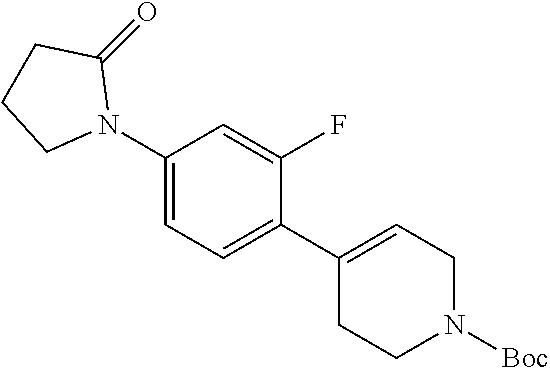
- Compound was synthesized from 1-(4-bromo-3-fluorophenyl)pyrrolidin-2-one and commercially available tert-butyl 4-(4,4,5,5-tetramethyl-1,3,2-dioxaborolan-2-yl)-3,6-dihydropyridine-1(2H)-carboxylate according to general procedure 2 using dioxane/H2O (6:1) as solvent. The crude residue was purified with silica gel column chromatography and 0-100% EtOAc in hexanes gradient to afford the product as transparent liquid. (71% yield). 1HNMR (300 MHz, CDCl3) δ 7.50 (dd, J=13.5 Hz, 2.1 Hz, 1H), 7.35-7.31 (m, 1H), 7.23 (t, J=8.7 Hz, 1H), 5.94 (bs, 1H), 4.08 (q, J=3.0 Hz, 2H), 3.85 (t, J=7.2 Hz, 2H), 3.62 (t, J=5.7 Hz, 2H), 2.63 (t, J=7.8 Hz, 2H), 2.50 (bs, 2H), 2.23-2.13 (m, 2H), 1.50 (s, 9H).
-

- Compound was synthesized from commercially available 4-(4-bromophenyl)thiomorpholine 1,1-dioxide and tert-butyl 4-(4,4,5,5-tetramethyl-1,3,2-dioxaborolan-2-yl)-3,6-dihydropyridine-1(2H)-carboxylate according to general procedure 2 using dioxane/H2O (6:1) as solvent. The crude residue was purified by silica gel column chromatography and 0-100% EtOAc in hexanes gradient to afford the product as transparent liquid. (46% yield). 1H NMR (300 MHz, CDCl3) δ 7.31 (d, J=6.9 Hz, 2H), 6.86 (d, J=6.9 Hz, 2H), 5.95 (s, 1H), 4.04 (distorted q, J=2.7 Hz, 2H), 3.85 (t, J=5.1 Hz, 4H), 3.61 (t, J=5.7 Hz, 2H), 3.09 (t, J=5.1 Hz, 4H), 2.47 (bs, 2H), 1.47 (s, 9H).
-

- Compound was synthesized from commercially available 1-(4-bromophenyl)pyrrolidin-2-one and tert-butyl 4-(4,4,5,5-tetramethyl-1,3,2-dioxaborolan-2-yl)-3,6-dihydropyridine-1(2H)-carboxylate according to general procedure 2 using dioxane/H2O (5:1) as solvent. The crude residue was purified by silica gel column chromatography and 0-100% EtOAc in hexanes gradient to afford the product as transparent liquid (67% yield). 1HNMR (300 MHz, CDCl3) δ 7.56 (d, J=8.7 Hz, 2H), 7.35 (d, J=9.0 Hz, 2H), 6.00 (bs, 1H), 4.05 (distorted q, J=3.0 Hz, 2H), 3.85 (dt, J=6.9, 3.9 Hz, 2H), 3.61 (t, J=5.7 Hz, 2H), 2.60 (t, J=7.8 Hz, 2H), 2.49 (bs, 2H), 2.21-2.11 (m, 2H), 1.48 (s, 9H).
- A slurry of NBoc-4-aryl/heteroaryl-3.6-dihydrpyridine of interest and Pd/C (0.1 eq) or PtO2 (0.05 eq) in EtOH was hydrogenated at atmospheric pressure until consumption of starting material was judged to be complete by LCMS or TLC. The solids were then filtered and washed with EtOH and EtOAc or 10% MeOH in CH2Cl2. The combined organic layer was then concentrated to afford the corresponding N-Boc-protected 4-aryl/heteroaryl piperidine reduced intermediate which was purified, if needed, with silica gel column chromatography. This intermediate was then dissolved in 4 N HCl in dioxane at room temperature and stirred until TLC indicated that Boc deprotection was complete. Volatiles were evaporated and the resulting residue was partitioned between CH2Cl2 and aq. saturated Na2CO3. The aqueous layer was extracted with CH2Cl2 until no UV absorbance was detected in the organic layer and then the combined organic layer was dried over Na2SO4 and concentrated to afford the corresponding 4-aryl-piperidine of interest.
-

- Prepared from tert-butyl 4-(3-methoxyphenyl)-3,6-dihydropyridine-1(2H)-carboxylate according to the general procedure 3 using 3% Pd/C as hydrogenation catalyst (66% yield). 1H NMR (400 MHz, CDCl3) δ 1.71 (apparent qd, J=12.4, 2.8 Hz, 2H), 1.87 (apparent d, J=12.8 Hz, 2H), 2.50 (bs, 1H), 2.63 (tt, J=12.0, 3.6 Hz), 2.78 (apparent t, J=11.2, 2H), 3.24 (apparent d, J=11.2 Hz, 2H), 3.82 (s, 3H), 6.73-6.88 (m, 3H), 7.25 (t, J=8.0 Hz, 1H).
-

- Prepared from tert-butyl 4-(pyrimidin-2-yl)-3,6-dihydropyridine-1(2H)-carboxylate according to the general procedure 3 using 3% Pd/C as hydrogenation catalyst. Intermediate hydrogenation product was purified with silica gel column and 0-100% EtOAc gradient prior to addition of 4N HCl. Desired product was isolated as an off-white light brown solid (73% yield) 1H NMR (400 MHz, CDCl3) δ 1.81 (apparent qd, J=12.0, 4.0 Hz, 2H), 2.01 (apparent disorted d, J=12.8 Hz, 2H), 2.68 (bs, 1H), 2.79 (td, J=12.4, 2.0 Hz, 2 Hz), 3.02 (tt, J=11.6, 3.6 Hz, 1H), 3.22 (apparent distorted d, J=12.4 Hz, 2H), 7.12 (t, J=5.2 Hz, 1H), 8.68 (d, J=4.8 Hz, 2H).
-

- Prepared from tert-butyl 4-(4-(methoxycarbonyl)phenyl)-3,6-dihydropyridine-1(2H)-carboxylate according to the general procedure 3 using 3% Pd/C as hydrogenation catalyst. Isolated as a white solid (96% yield). 1H NMR (400 MHz, CDCl3) δ 1.64 (apparent qd, J=12.8, 4.0 Hz, 2H), 1.83 (apparent d, J=12.4 Hz, 2H), 2.63-2.79 (m, 3H), 3.19 (apparent d, J=12.0 Hz, 2H), 3.89 (s, 3H), 7.28 (d, J=8.4 Hz, 2H), 7.97 (d, J=8.4 Hz, 2H).
-

- A mixture of tert-butyl 6-nitro-3′,6′-dihydro-[3,4′-bipyridine]-1′(2′H)-carboxylate (550 mg, 1.80 mmol), 3% Pd/C (320 mg, 0.09 mmol) in 10 mL of EtOH and 3 mL of EtOAc was hydrogenated at 1 atm of pressure for 3 h. The reaction mixture was then filtered through a pad of celite and the solids washed with EtOH and EtOAc (1:1 mixture) until no UV was detected in the washings. The combined organic layer was evaporated to a light-brown solid. This solid was then dissolved in CH2Cl2 (13 mL) and then treated with Et3N (0.5 mL, 3.60 mmol) and then acetic anhydride (0.20 mL, 2.16 mmol). The reaction mixture was stirred until consumption of limiting reagent (as suggested by TLC) and partitioned between CH2Cl2 and water. The water layer was extracted with CH2Cl2 (×3) and the combined organic layer was dried over Na2SO4 filtered and concentrated. Silica gel column with 0-50% EtOAC in hexanes gradient yielded the corresponding intermediate tert-butyl 4-(6-acetamidopyridin-3-yl)piperidine-1-carboxylate, as an off-white solid (340 mg, 59% yield). 1H NMR (400 MHz, CDCl3) δ 1.51 (s, 9H), 1.56-1.69 (m, 2H), 1.83 (apparent d, J=12.8 Hz, 2H), 2.22 (s, 3H), 2.67 (tt, J=12.0, 3.6 Hz, 1H), 2.82 (t, J=11.2 Hz, 2H), 4.28 (bs, 2H), 7.56 (dd, J=8.8, 2.4 Hz, 1H), 7.91 (s, 1H), 8.13-8.16 (m, 2H).
- This intermediate (340 mg, 1.06 mmol) was then dissolved in in DMF (5 mL) and treated with NaH (60% dispersion, 64 mg, 1.59 mmol) and MeI (180 mg, 80 μL, 1.28 mmol). The reaction mixture stirred until consumption of the limited reagent (as indicated by TLC) and then partitioned between CH2Cl2 and water. The water layer was extracted with CH2Cl2 (×3) and the combined organic layer was dried over Na2SO4, filtered and evaporated. The residue was chromatographed with silica gel column and 0-100% gradient to afford the corresponding N-methylated derivative, tert-butyl 4-(6-(N-methylacetamido)pyridin-3-yl)piperidine-1-carboxylate, as a white solid (330 mg, 93% yield). 1H NMR (400 MHz, CDCl3) δ 1.48 (s, 9H), 1.49-1.68 (m, 2H), 1.83 (apparent d, J=12.8 Hz, 2H), 2.07 (bs, 3H), 2.71 (tt, J=12.0, 3.2 Hz, 1H), 2.82 (apparent t, J=12.0 Hz), 3.36 (s, 3H), 4.27 (bs, 2H), 7.24 (bs, 1H), 7.56 (dd, J=8.4, 2.4 Hz, 1H), 8.33 (d, J=2 Hz, 1H).
- This N-methylated intermediate was then deprotected using 4N HCl in dioxane as described in general procedure 3 to afford the desired compound, N-methyl-N-(5-(piperidin-4-yl)pyridin-2-yl)acetamide, as light brown solid (93% yield). 1H NMR (400 MHz, CDCl3) δ 1.67 (qd, J=12.8, 4.4 Hz, 2H), 1.87 (apparent d, J=13.6 Hz, 2H), 2.09 (s, 3H), 2.70 (tt, J=12.4, 4.0 Hz, 1H), 2.79 (td, J=12.0, 2.4 Hz, 2H), 3.23 (apparent d, J=12.4 Hz, 2H), 3.38 (s, 3H), 7.23 (bs, 1H), 7.62 (dd, J=8.0, 2.4 Hz, 1H), 8.37 (d, J=2.0 Hz, 1H).
-

- Synthesized from tert-butyl 2′-methoxy-3,6-dihydro-[4,4′-bipyridine]-1(2H)-carboxylate according to general procedure III using 10% Pd/C as hydrogenation catalyst. Isolated as a honey-like sirup (93% yield). 1H NMR (400 MHz, CDCl3) δ 1.64 (qd, J=12.0, 4.0 Hz, 2H), 1.83 (apparent d, J=12.4 Hz, 2H), 2.39 (bs, 1H), 2.58 (tt, J=12.0, 4.0 Hz, 1H), 2.74 (apparent td, J=12.4, 2.4 Hz, 2H), 3.19-3.24 (m, 2H), 3.92 (s, 3H), 6.58 (apparent d, J=0.4 Hz, 1H), 6.74 (dd, J=5.6, 0.8 Hz, 1H), 8.07 (d, J=5.2 Hz, 1H).
-

- Prepared from tert-butyl 4-(4-methoxyphenyl)-3,6-dihydropyridine-1(2H)-carboxylate according to general procedure 3 using 3% Pd/C as hydrogenation catalyst. Isolated as a thick sirup (76% yield) 1H NMR (400 MHz, CDCl3) δ 1.61 (qd, J=12.4 Hz, 4.0 Hz, 2H), 1.81 (apparent d, J=13.6 Hz, 2H), 2.56 (tt, J=12.4, 3.6 Hz, 1H), 2.73 (td, J=12.4, 2.4 Hz, 2H), 3.18 (apparent d, J=12.0 Hz, 2H), 3.79 (s, 3H), 6.85 (d, J=8.4 Hz, 2H), 7.14 (d, J=8.8 Hz, 2H).
-

- Synthesized from tert-butyl 4-(2-methoxyphenyl)-3,6-dihydropyridine-1(2H)-carboxylate following general procedure 3 using 10% Pd/C as hydrogenation catalyst (66% yield). 1H NMR (400 MHz, DMSO-d6) δ 1.47 (qd J=12.0, 3.6 Hz, 2H), 1.61 (apparent d, J=12.0 Hz, 2H), 2.60 (apparent td, J=12.0, 1.6 Hz, 2H), 2.90-3.03 (m, 3H), 3.77 (s, 3H), 6.86-6.96 (m, 2H), 7.12-7.20 (m, 2H).
-

- Synthesized from tert-butyl 4-(p-tolyl)-3,6-dihydropyridine-1(2H)-carboxylate following general procedure 3 using 10% Pd/C as hydrogenation catalyst. Isolated as a colorless/pale liquid (78% yield). 1H NMR (400 MHz, CDCl3) δ 1.75 (qt, J=12.4, 4.4 Hz, 2H), 1.86 (apparent d, J=12.0 Hz, 2H), 2.32 (s, 3H), 2.61 (tt, J=12.0, 4.0 Hz, 1H), 2.79 (td, J=12.4, 2.8 Hz, 2H), 3.31 (apparent d, J=12.4 Hz, 2H), 4.77 (bs, 1H), 7.12 (s, 4H).
-

- Synthesized from tert-butyl 4-(4-(methoxymethyl)phenyl)-3,6-dihydropyridine-1(2H)-carboxylate by following the general procedure 3 using 10% Pd/C as hydrogenation catalyst. Isolated as a pale solid (89% yield). 1H NMR (400 MHz, CDCl3) δ 1.72 (apparent qd, J=12.4, 3.6 Hz, 2H), 1.86 (apparent d, J=12.4 Hz), 2.59-2.69 (m, 1H), 2.78 (apparent td, J=12.4, 2.0 Hz, 2H), 3.26 (apparent d, J=12.0 Hz, 2H), 3.39 (s, 3H), 4.24 (s, 2H), 7.20 (distorted d, J=8.0 Hz, 2H), 7.28 (distorted d, J=8.0 Hz, 2H).
-

- Synthesized from tert-butyl 4-(4-(N-methylacetamido)phenyl)-3,6-dihydropyridine-1(2H)-carboxylate by following the general procedure 3 using 10% Pd/C as hydrogenation catalyst. Isolated as a pale yellow oil (62% yield). 1H NMR (400 MHz, CDCl3) δ 1.59-1.73 (m, 2H), 1.83-1.91 (s merged with apparent d, 5H), 2.67 (tt, J=12.0, 4 Hz, 1H), 2.78 (td, J=12.0, 2.4 Hz, 2H), 3.23 (apparent d, J=11.6 Hz, 2H), 3.27 (s, 3H), 7.10 (d, J=8.4 Hz, 2H), 7.25 (d, J=8.4 Hz, 2H).
-

- Synthesized from tert-butyl 4-(4-acetamidophenyl)-3,6-dihydropyridine-1(2H)-carboxylate following the general procedure 3 using 10% Pd/C as hydrogenation catalyst. Isolated as a pale yellow solid (73% yield). 1H NMR (400 MHz, CDCl3) δ 1.54-1.66 (m, 2H), 1.80 (distorted apparent d, J=12.8 Hz, 2H), 2.16 (s, 3H), 2.54-2.63 (m, 1H), 2.73 (apparent td, J=13.6, 2.0 Hz J=2H), 3.18 (apparent d, 2H), 7.13 (s, 1H), 7.17 (d, J=8.0 Hz, 2H), 7.41 (d, J=8.4 Hz, 2H).
-

- Synthesized from tert-butyl 6-methoxy-3′,6′-dihydro-[3,4′-bipyridine]-1′(2′H)-carboxylate following general procedure 3 using 3% Pd/C as hydrogenation catalyst. Isolated as pale-yellow solid (52% yield). 1H NMR (400 MHz, CDCl3) δ 1.61 (qd, J=12.4, 4.0 Hz, 2H), 1.79 (apparent d, J=13.6 Hz, 2H), 2.57 (tt, J=12.0 Hz, 4.0 Hz, 1H), 2.74 (td, J=12.4 Hz, 2.4 Hz, 2H), 3.18-3.21 (apparent d, 2H), 3.91 (s, 3H), 6.69 (d, J=8.4 Hz, 1H), 7.43 (dd, J=8.4 Hz, 2.4 Hz, 1H), 8.05 (d, J=2.4 Hz, 1H).
-

- Synthesized from tert-butyl 4-(m-tolyl)-3,6-dihydropyridine-1(2H)-carboxylate following general procedure 3 using 10% Pd/C as hydrogenation catalyst. Isolated as a pale-yellow liquid (83% yield). 1H NMR (400 MHz, CDCl3) δ 1.67 (qd, J=12.4, 3.6 Hz, 2H), 1.83 (apparent d, J=12.8 Hz, 2H), 2.33 (s, 3H), 2.60 (tt, J=12.0 Hz, 3.6 Hz, 1H), 2.78 (td, J=12.4 Hz, 2.4 Hz, 2H), 3.22 (apparent d, J=12.0 Hz, 2H), 6.99-7.05 (m, 3H), 7.19 (t, J=7.2 Hz, 1H).
-

- Synthesized from tert-butyl 4-(o-tolyl)-3,6-dihydropyridine-1(2H)-carboxylate, following the general procedure 3 using 10% Pd/C as hydrogenation catalyst. Isolated as a pale-yellow liquid (85% yield). 1H NMR (400 MHz, CDCl3) δ 1.65 (apparent qd, J=12.8, 4.0 Hz, 2H), 1.76 (apparent d, J=13.2 Hz, 2H), 2.35 (s, 3H), 2.78 (td, J=12.0, 2.4 Hz, 3H), 3.21 (apparent d, J=12.0 Hz, 2H), 7.06-7.25 (m, 4H).
-

- Synthesized from tert-butyl 4-(3-fluoro-4-methoxyphenyl)-3,6-dihydropyridine-1(2H)-carboxylate following general procedure 3 using 3% Pd/C as catalyst. The product was isolated as a colorless liquid (75% yield). 1H NMR (400 MHz, CDCl3) δ 1.51-1.63 (m, 4H), 1.77-1.84 (m, 2H), 2.55 (apparent tt, J=12.0, 3.6 Hz, 1H), 2.72 (apparent td, J=12.0, 2.4 Hz, 2H), 3.15-3.20 (m, 2H), 3.87 (s, 3H), 6.85-6.97 (m, 3H).
-

- Prepared from tert-butyl 4-(2-fluoro-4-methoxyphenyl)-3,6-dihydropyridine-1(2H)-carboxylate according to general procedure 3 using 3% Pd/C as hydrogenation catalyst. The product was isolated as colorless liquid (59% yield). 1H NMR (400 MHz, CDCl3) δ 1.62 (qd, J=12.4, 4.0 Hz, 2H), 1.74-1.81 (m, 2H), 2.75 (td, J=12.4, 2.8 Hz, 2H), 2.90 (tt, J1=12.4, 3.6 Hz, 1H), 3.15-3.19 (m, 2H), 3.77 (s, 3H), 6.58 (dd, J=12.0, 2.4 Hz, 1H), 6.65 (apparent dd, J=8.8, 2.4 Hz, 1H), 7.13 (t, J=8.8 Hz, 1H).
-

- Synthesized from tert-butyl 4-(2-fluorophenyl)-3,6-dihydropyridine-1(2H)-carboxylate according to general procedure 3 using 3% Pd/C as hydrogenation catalyst. The product was isolated as pale, light yellow syrup (78% yield). 1H NMR (400 MHz, CDCl3) δ 1.66 (qd, J=12.4, 4.0 Hz, 2H), 1.78-1.85 (m, 2H), 2.78 (td, J=12.0, 2.4 Hz, 2H), 2.99 (tt, J1=12.0, 3.6 MHz, 1H), 3.16-3.22 (m, 2H), 6.97-7.04 (m, 1H), 7.07-7.12 (m, 1H), 7.13-7.20 (m, 1H), 7.21-7.26 (m, 1H).
-

- Synthesized from tert-butyl 4-(3-(methoxycarbonyl)phenyl)-3,6-dihydropyridine-1(2H)-carboxylate by following general procedure 3 using 10% Pd/C as hydrogenation catalyst. Isolated as a light yellow viscous liquid (80% yield). 1H NMR (400 MHz, dmso-d6) δ 1.50 (apparent qd, J=12.4, 3.6 Hz, 2H), 1.69 (apparent d, J=12.0 Hz, 2H), 2.58 (td, J=12.0, 1.6 Hz, 2H), 2.63-2.71 (m, 1H), 3.02 (apparent d, J=12.0 Hz, 2H), 3.84 (s, 3H), 7.43-7.47 (distorted t, J=7.6 Hz, 1H), 7.52 (distorted d, J=7.6 Hz, 1H), 7.77-7.80 (m, 2H).
-

- Prepared from tert-butyl 4-(4-(ethylsulfonyl)phenyl)-3,6-dihydropyridine-1(2H)-carboxylate according to general procedure 3 using 10% Pd/C as hydrogenation catalyst. The product was isolated as an off white solid (75% yield). 1H NMR (400 MHz, CDCl3) δ 1.28 (t, J=7.6 Hz, 3H), 1.78 (qd, J=12.4, 4.0 Hz, 2H), 1.89 (apparent d, J=12.0 Hz, 2H), 2.72-2.85 (m, 3H), 3.11 (q, J=7.6 Hz, 2H), 3.27-3.33 (m, 2H), 7.42 (d, J=8.4 Hz, 2H), 7.83 (d, J=8.4 Hz, 2H).
-

- Prepared from tert-butyl 5-methoxy-3′,6′-dihydro-[3,4′-bipyridine]-1′(2′H)-carboxylate according to general procedure 3 3 using 10% Pd/C as hydrogenation catalyst. The product was isolated as light brown-yellow viscus oil (42% yield). 1H NMR (400 MHz, DMSO-d6) δ 1.53 (apparent qd, J=11.6, 2.8 Hz, 2H), 1.68 (apparent d, J=11.2 Hz, 2H), 2.54-2.73 (m, 3H), 3.02 (apparent d, J=11.6 Hz, 2H), 3.81 (3, 3H), 7.20 (s, 1H), 8.06 (s, 1H), 8.11 (s, 1H).
-

- Synthesized from tert-butyl 4-(4-chlorophenyl)-3,6-dihydropyridine-1(2H)-carboxylate according to general procedure 3 using PtO2 as hydrogenation catalyst. The reduced N-Boc-protected piperidine intermediate was purified by silica gel column chromatography and 0-20% Et2O in hexanes gradient before deprotection by treatment with 4N HCl. The product was obtained as colorless syrup (53% yield). 1H NMR (400 MHz, CDCl3) δ 1.55-1.68 (m, 2H), 1.78-1.90 (bs overlapping with apparent d, J=9.2 Hz, 3H), 2.59 (tt, J=12.0, 3.6 Hz, 1H), 2.74 (apparent t, J=12.0 Hz, 2H), 3.20 (apparent broad based d, J=11.6 Hz, 2H), 7.13 (d, J=8.4 Hz, 2H), 7.27 (d, J=8.8 Hz, 2H).
-

- Synthesized from tert-butyl 4-(3-chloro-4-methoxyphenyl)-3,6-dihydropyridine-1(2H)-carboxylate according to general procedure 3 using PtO2 as hydrogenation catalyst. The reduced N-Boc-protected piperidine intermediate was purified by silica gel column chromatography and 0-20% Et2O in hexanes gradient before deprotection with by treatment with 4N HCl. The product was obtained as colorless very viscous syrup/waxy solid (48% yield). 1H NMR (400 MHz, CDCl3) δ 1.50-1.62 (m, 2H), 1.80 (apparent d, J=13.6 Hz, 2H), 2.54 (tt, J=12.0, 3.6 Hz, 1H), 2.72 (td, J=12.0, 2.4 Hz, 2H), 3.15-3.19 (m, 2H), 3.88 (s, 3H), 6.86 (d, J=8.4 Hz, 1H), 7.07 (ddd, J=8.4, 2.4, 0.4 Hz, 1H), 7.22 (d, J=2.4 Hz, 1H).
-

- Synthesized from tert-butyl 4-(2-chloro-4-methoxyphenyl)-3,6-dihydropyridine-1(2H)-carboxylate according to general procedure 3 using PtO2 as hydrogenation catalyst. The reduced N-Boc-protected piperidine intermediate was purified by silica gel column chromatography and 0-20% Et2O in hexanes gradient before deprotection by 4N HCl treatment. The product was obtained as yellowish very viscous syrup/waxy solid (40% yield). 1H NMR (600 MHz, CDCl3) δ 1.52-1.61 (m, 4H), 1.83 (apparent d, J=11.4 Hz, 2H), 2.79 (td, J=12.0, 2.4 Hz, 2H), 3.20 (d, J=11.4 Hz, 1H), 3.79 (s, 3H), 6.82 (dd, J=8.4, 2.4 Hz, 1H), 6.92 (d, J=3.0 Hz, 1H), 7.20 (d, J=9.0 Hz, 1H).
-

- Prepared from tert-butyl 4-(2-fluoro-4-(N-methylacetamido)phenyl)-3,6-dihydropyridine-1(2H)-carboxylate according to general procedure 3 using 10% Pd/C as hydrogenation catalyst. The product was isolated as yellowish waxy solid syrup (96% yield). 1H NMR (600 MHz, CDCl3) δ 1.69 (qd, J=12.0, 4.2 Hz, 2H), 1.84 (apparent d, J=10.8 Hz, 2H), 1.91 (s, 3H), 2.80 (td, J=12.0, 2.4 Hz, 2H), 2.97-3.03 (m, 1H), 3.21-3.24 (m, 2H), 3.25 (s, 3H)), 6.88 (d, J=10.2 Hz, 1H), 6.95 (d, J=7.8 Hz, 1H), 7.26-7.31 (m, 1H).
-

- Prepared from tert-butyl 4-(3-fluoro-5-methoxyphenyl)-3,6-dihydropyridine-1(2H)-carboxylate according to general procedure 3 using 10% Pd/C as hydrogenation catalyst. The reduced N-Boc-protected piperidine intermediate was purified by silica gel column chromatography and 0-20% EtOAc in hexanes gradient before deprotection with 4N HCl treatment. The product was isolated as yellowish waxy solid (67% yield). 1H NMR (300 MHz, CDCl3) δ 1.65 (qd, J=12.6 Hz, 3.6 Hz, 2H), 1.85 (apparent distorted d, J=12.0 Hz, 2H), 2.34 (bs, 1H), 2.60 (tt, J=18.0, 3.9 Hz, 1H), 2.76 (apparent t, J=11.7 Hz, 2H), 3.23 (apparent d, J=12.0 Hz, 2H), 3.80 (s, 3H), 6.45-6.58 (m, 3H).
-

- Prepared from tert-butyl 4-(4-fluoro-3-methoxyphenyl)-3,6-dihydropyridine-1(2H)-carboxylate according to general procedure 3 using 10% Pd/C as hydrogenation catalyst. The product was isolated as a yellowish very viscous sirup/waxy solid (58% yield). 1H NMR (300 MHz, CDCl3) δ 1.59 (qd, J=11.7, 3.9 Hz, 2H), 1.78 (apparent broad d, J=12.3 Hz, 2H), 2.42 (bs, 1H), 2.52 (tt, J=12.0, 3.6 Hz, 1H), 2.69 (td, J=12.0, 2.1 Hz, 2H), 3.16 (apparent d, J=11.7 Hz, 2H), 3.81 (s, 3H), 6.63-6.69 (m, 1H), 6.76 (dd, J=8.1, 2.1 Hz, 1H), 6.92 (dd, J=11.4, 9.6 Hz, 1H).
-

- Prepared from tert-butyl 4-(4-(pyrrolidine-1-carbonyl)phenyl)-3,6-dihydropyridine-1(2H)-carboxylate according to general procedure 3 using 10% Pd/C as hydrogenation catalyst. The reduced N-Boc-protected piperidine intermediate was purified by silica gel column chromatography and 0-10% EtOAc in hexanes gradient. The product was isolated as a white solid (47% yield). 1HNMR (600 MHz, CDCl3) δ 7.39 (d, J=8.4 Hz, 2H), 7.16 (d, J=8.4 Hz, 2H), 3.57 (t, J=6.6 Hz, 2H), 3.38 (t, J=6.6 Hz, 2H), 3.14-3.12 (m, 2H), 2.68 (dt, J=12.6, 2.4 Hz, 1H), 2.57 (tt, J=12.0, 3.6 Hz, 1H), 1.91-1.86 (m, 3H), 1.81-1.74 (m, 4H), 1.61-1.54 (m, 2H).
-

- Prepared from tert-butyl 4-(2-fluoro-4-(pyrrolidine-1-carbonyl)phenyl)-3,6-dihydropyridine-1(2H)-carboxylate according to general procedure 3 using 10% Pd/C as hydrogenation catalyst. The product was isolated as a white solid (73% yield). 1HNMR (600 MHz, CDCl3) δ 7.51-7.21 (m, 2H), 7.18 (d, J=7.2 Hz, 1H), 3.66 (t, J=6.6 Hz, 2H), 3.47 (t, J=6.6 Hz, 2H), 3.25-3.23 (m, 2H), 3.03 (tt, J=12.6, 2.4 Hz, 1H), 2.81 (dt, J=12.0, 2.4 Hz, 1H), 2.10 (s, 1H), 2.0-1.96 (m, 2H), 1.93-1.88 (m, 2H), 1.85-1.83 (m, 2H), 1.76-1.69 (m, 2H).
-

- Prepared from tert-butyl 4-(4-((2-oxopyrrolidin-1-yl)methyl)phenyl)-3,6-dihydropyridine-1(2H)-carboxylate according to general procedure 3 using 10% Pd/C as hydrogenation catalyst. The product was isolated as a white solid (72% yield). 1HNMR (600 MHz, CDCl3) δ 7.15 (s, 4H), 4.39 (s, 2H), 3.24 (t, J=7.2 Hz, 2H), 3.19-3.17 (m, 2H), 2.72 (td, J=12.0, 2.4 Hz, 2H), 2.59 (tt, J=9.0, 3.6 Hz, 1H), 1.99-1.94 (m, 4H), 1.81-1.79 (m, 2H), 1.66-1.59 (m, 2H).
-

- Prepared from tert-butyl 4-(4-(pyrrolidin-1-ylsulfonyl)phenyl)-3,6-dihydropyridine-1(2H)-carboxylate according to general procedure 3 using 10% Pd/C as hydrogenation catalyst. The product was isolated as a white solid (93% yield). 1HNMR (500 MHz, CDCl3) δ 7.73 (d, J=8.5 Hz, 2H), 7.33 (d, J=8.5 Hz, 2H), 3.23-3.19 (m, 6H), 2.76-2.64 (m, 3H), 2.19 (s, 1H), 1.83-1.81 (m, 2H), 1.74-1.72 (m, 4H), 1.69-1.61 (m, 2H).
-

- Prepared from tert-butyl 4-(trifluoromethyl)-3′,6′-dihydro-[2,4′-bipyridine]-1′(2′H)-carboxylate according to general procedure 3 using 10% Pd/C as hydrogenation catalyst. The product was isolated as a white solid (60% yield). 1HNMR (600 MHz, CDCl3) δ 8.69 (d, J=4.8 Hz, 1H), 7.37 (s, 1H), 7.32 (d, J=4.8 Hz, 1H), 3.22-3.20 (m, 2H), 2.91 (tt, J=12.0, 3.6 Hz, 1H), 2.76 (dt, J=12.0, 2.4 Hz, 2H), 1.94-1.92 (m, 2H), 1.74-1.67 (m, 2H), 1.62 (bs, 1H).
-

- Prepared from tert-butyl 4-(4-((methylsulfonyl)methyl)phenyl)-3,6-dihydropyridine-1(2H)-carboxylate according to general procedure 3 using 10% Pd/C as hydrogenation catalyst. The product was isolated as a white solid (83% yield). 1HNMR (600 MHz, CD3OD) δ 7.40 (d, J=7.8 Hz, 2H), 7.31 (d, J=7.8 Hz, 2H), 4.40 (s, 2H), 3.17-3.15 (m, 2H), 2.86 (s, 3H), 2.77-2.69 (m, 3H), 1.85-1.83 (m, 2H), 1.72-1.65 (m, 2H).
-

- Prepared from tert-butyl 5-(trifluoromethyl)-3′,6′-dihydro-[3,4′-bipyridine]-1′(2′H)-carboxylate according to general procedure 3 using 10% Pd/C as hydrogenation catalyst. The product was isolated as a white solid (72% yield). 1HNMR (600 MHz, CDCl3) δ 8.76 (d, J=1.2 Hz, 1H), 8.71 (d, J=1.8 Hz, 1H), 7.79 (s, 1H), 3.29-3.27 (m, 2H), 2.83-2.76 (m, 3H), 2.24 (bs, 1-NH), 1.91-1.89 (m, 2H), 1.76-1.69 (m, 2H).
-

- Prepared from tert-butyl 4-(4-(2-oxopyrrolidin-1-yl)phenyl)-3,6-dihydropyridine-1(2H)-carboxylate according to general procedure 3 using 10% Pd/C as hydrogenation catalyst. The product was isolated as a white solid (76% yield). 1HNMR (600 MHz, CDCl3) δ 7.48 (d, J=8.4 Hz, 2H), 7.18 (d, J=8.4 Hz, 2H), 3.85-3.79 (m, 2H), 3.14 (d, J=12.0 Hz, 2H), 2.70 (dt, J=12.6, 2.4 Hz, 1H), 2.59-2.54 (m, 3H), 2.14-2.09 (m, 2H), 1.78-1.76 (m, 2H), 1.61-1.53 (m, 3H).
-

- Prepared from tert-butyl 4-(1,1-dioxido-2,3-dihydrobenzo[b]thiophen-5-yl)-3,6-dihydropyridine-1(2H)-carboxylate according to general procedure 3 using 10% Pd/C as hydrogenation catalyst. The product was isolated as a white solid (79% yield). 1HNMR (300 MHz, CD3OD) δ 7.69 (d, J=8.1 Hz, 1H), 7.48-7.45 (s, 2H), 3.58-3.51 (m, 4H), 3.43-3.39 (m, 2H), 3.18-3.01 (m, 3H), 2.15-2.11 (m, 2H), 2.01-1.87 (m, 2H).
-

- Prepared from tert-butyl 4-(4-((1,1,1-trifluoropropan-2-yl)amino)phenyl)-3,6-dihydropyridine-1(2H)-carboxylate according to general procedure 3. The product was isolated as a white solid (72% yield). 1HNMR (300 MHz, CDCl3) δ 7.03 (d, J=8.7 Hz, 2H), 6.59 (d, J=8.4 Hz, 2H), 3.99-3.92 (m, 1H), 3.46 (d, J=9.0 Hz, 1H), 3.18-3.14 (m, 2H), 2.70 (td, J=12.0, 2.4 Hz, 2H), 2.49 (dt, J=12.0, 3.6 Hz, 1H), 1.80-1.75 (m, 2H), 1.64-1.51 (m, 2H), 1.35 (d, J=6.9 Hz, 3H).
-

- Prepared from tert-butyl 4-(2,2-dioxido-1,3-dihydrobenzo[c]thiophen-5-yl)-3,6-dihydropyridine-1(2H)-carboxylate according to general procedure 3 using 10% Pd/C as hydrogenation catalyst. The product was isolated as a white solid (96% yield). 1HNMR (300 MHz, CDCl3) δ 7.25-7.15 (m, 3H), 4.33 (d, J=3.3 Hz, 4H), 3.23-3.18 (m, 2H), 2.78-2.56 (m, 3H), 1.82-1.79 (m, 3H), 1.69-1.56 (m, 2H).
-

- Prepared from tert-butyl 4-(3-fluoro-4-((2-oxopyrrolidin-1-yl)methyl)phenyl)-3,6-dihydropyridine-1(2H)-carboxylate) according to general procedure 3 using 10% Pd/C as hydrogenation catalyst. The product was isolated as a white solid (79% yield). 1HNMR (600 MHz, CDCl3) δ 7.18 (t, J=7.8 Hz, 1H), 6.94 (d, J=7.8 Hz, 1H), 6.89-6.87 (m, 1H), 4.45 (s, 2H), 3.67 (s, 1H), 3.17-3.15 (m, 2H), 2.70 (dt, J=12.6, 2.4 Hz, 2H), 2.57 (td, J=12.6, 3.6 Hz, 1H), 2.39 (t, J=8.4 Hz, 2H), 1.99-1.94 (m, 2H), 1.80-1.78 (m, 3H), 1.60-1.56 (m, 2H).
-

- Prepared from tert-butyl 4-(3-chloro-4-((2-oxopyrrolidin-1-yl)methyl)phenyl)-3,6-dihydropyridine-1(2H)-carboxylate according to general procedure 3 using 10% Pd/C as hydrogenation catalyst. The product was isolated as white solid (63% yield). 1HNMR (600 MHz, CDCl3) δ 7.19-7.16 (m, 2H), 7.06-7.05 (m, 1H), 4.53 (s, 2H), 3.28 (t, J=7.2 Hz, 2H), 3.16-3.14 (m, 2H), 2.2.69 (dt, J=12.0 Hz, 1.8 Hz, 2H), 2.58 (tt, J=12.0, 3.0 Hz, 1H), 2.41 (t, J=8.4 Hz, 2H), 2.01-1.97 (m, 2H), 1.78-1.66 (m, 3H), 1.59-1.55 (m, 2H).
-

- Prepared from tert-butyl 4-(2-fluoro-4-((2-oxopyrrolidin-1-yl)methyl)phenyl)-3,6-dihydropyridine-1(2H)-carboxylate according to general procedure 3 using 10% Pd/C as hydrogenation catalyst. The product was isolated as white solid (65% yield). 1HNMR (300 MHz, CDCl3) δ 7.20-7.17 (m, 1H), 6.99-6.88 (m, 2H), 4.39 (s, 2H), 3.58-3.54 (m, 2H), 3.25 (t, J=6.9 Hz, 2H), 3.07-2.97 (m, 3H), 2.43 (t, J=7.8 Hz, 2H), 2.18-1.88 (m, 6H).
-

- Prepared from tert-butyl 4-(4-morpholinophenyl)-3,6-dihydropyridine-1(2H)-carboxylate according to general procedure 3 using 10% Pd/C as hydrogenation catalyst. The product was isolated as white solid (70% yield). 1HNMR (600 MHz, CDCl3) δ 1.61 (apparent qd, J=12.6, 3.6 Hz, 2H), 1.81 (bd, J=13.2 Hz, 2H), 2.55 (tt, J=12.0, 3.6 Hz, 1H), 2.73 (td, J=12.0, 1.8 Hz, 2H), 3.13 (apparent t, J=4.8 Hz, 4H), 3.18 (d, J=12.0 Hz, 2H), 3.85 (apparent t, J=4.8 Hz, 4H), 6.87 (d, J=9.0 Hz, 2H), 7.14 (d, J=8.4 Hz, 2H).
-

- Prepared from tert-butyl 4-(4-(morpholinomethyl)phenyl)-3,6-dihydropyridine-1(2H)-carboxylate according to general procedure 3 using 10% Pd/C as hydrogenation catalyst. The product was isolated as viscous liquid (24% yield). 1H NMR (300 MHz, CDCl3) δ 7.21 (d, J=6.0 Hz, 2H), 7.13 (d, J=8.1 Hz, 2H), 3.67 (t, J=4.5 Hz, 4H), 3.43 (s, 2H), 3.17-3.13 (m, 2H), 2.70 (td, J=12.0 Hz, 2.1 Hz, 2H), 2.56 (tt, J=8.7 Hz, 3.6 Hz, 1H), 2.4 (t, J=4.5 Hz, 4H), 1.81-1.77 (m, 2H), 1.65-1.54 (m, 3H).
-

- Prepared from tert-butyl 4-(4-(3-oxomorpholino)phenyl)-3,6-dihydropyridine-1(2H)-carboxylate according to general procedure 3 using 10% Pd/C as hydrogenation catalyst. The product was isolated as an off-white solid (79% yield). 1HNMR (600 MHz, CDCl3) δ 1.57-1.66 (m, 2H), 1.82 (apparent d, J=13.2 Hz), 2.62 (tt, J=12.0, 3.6 Hz, 1H), 2.73 (td, J=12.6, 2.4 Hz, 2H), 3.18 (apparent d, J=12.0 Hz, 2H), 3.75 (apparent t, J=5.4 Hz, 2H), 4.02 (apparent t, J=5.4 Hz, 2H), 4.34 (s, 2H), 7.23-7.28 (m, 4H).
-

- Prepared from tert-butyl 4-(3-fluoro-4-morpholinophenyl)-3,6-dihydropyridine-1(2H)-carboxylate according to general procedure 3 using 10% Pd/C as hydrogenation catalyst. The product was isolated as a white solid (68% yield). 1HNMR (600 MHz, CDCl3) δ 1.58 (apparent qd, J=12.6, 3.6 Hz, 2H), 1.80 (apparent d, J=13.2 Hz, 2H), 2.55 (tt, J=12.0, 3.6 Hz, 1H), 2.73 (td, J=12.0, 1.8 Hz, 2H). 3.06 (apparent t, J=4.8 Hz, 4H), 3.18 (apparent d, J=12.0 Hz, 2H), 3.86 (apparent t, J=4.8 Hz, 4H), 6.85-6.94 (m, 3H).
-

- Prepared from tert-butyl 4-(2-fluoro-4-morpholinophenyl)-3,6-dihydropyridine-1(2H)-carboxylate according to general procedure 3 using 10% Pd/C as hydrogenation catalyst. The product was isolated as white solid (37% yield). 1H NMR (300 MHz, CDCl3) δ 7.13-7.06 (m, 1H), 6.61 (dd, J=8.1 Hz, 2.8 Hz 1H), 6.55-6.50 (m, 1H), 4.26 (s, 1H), 3.81 (t, J=4.8 Hz, 4H), 3.28-3.24 (m, 1H), 3.09 (t, J=5.1 Hz, 4H), 2.96-2.75 (m, 3H), 1.83-1.68 (m, 4H).
-

- Prepared from tert-butyl (S)-4-(4-(1-(2-oxopyrrolidin-1-yl)ethyl)phenyl)-3,6-dihydropyridine-1(2H)-carboxylate according to general procedure 3 using 10% Pd/C as hydrogenation catalyst. The product was isolated as an off-white solid (81% yield). 1H NMR (600 MHz, CDCl3) δ 1.49 (d, J=7.2 Hz, 1.65 (apparent qt, J=12.6, 3.0 Hz, 2H), 1.82 (apparent d, J=12.6 Hz, 2H), 1.86-1.93 (m, 1H), 1.93-2.01 (m, 1H), 2.25 (bs, 1H), 2.35-2.47 (m, 2H), 2.75 (td, J=12.0, 1.8 Hz, 2H), 3.00 (ddd, J=14.4, 8.4, 5.4 Hz, 1H), 3.21 (apparent d, J=12.0 Hz, 2H), 3.31 (ddd, J=15.0, 9.0, 6.0 Hz, 1H), 5.47 (q, J=7.2 Hz, 1H), 7.18 (distorted d, J=8.4 Hz, 2H), 7.23 (distorted d, J=8.4 Hz, 2H).
-

- Prepared from tert-butyl (R)-4-(4-(1-(2-oxopyrrolidin-1-yl)ethyl)phenyl)-3,6-dihydropyridine-1(2H)-carboxylate according to general procedure 3 using 10% Pd/C as hydrogenation catalyst. The product was isolated as an off-white solid (75% yield). 1H NMR (600 MHz, CDCl3) δ 1.52 (d, J=7.2 Hz, 3H), 1.68 (apparent qt, J=12.6, 3.0 Hz, 2H), 1.84 (apparent d, J=12.6 Hz, 2H), 1.90-1.94 (m, 1H), 1.94-2.03 (m, 1H), 2.21 (bs, 1H), 2.37-2.48 (m, 2H), 2.63 (tt, J=12.0, 3.6 Hz, 1H), 2.77 (td, J=12.6, 2.4 Hz, 2H), 3.02 (ddd, J=14.4, 9.0, 5.4 Hz, 1H), 3.23 (apparent bd, J=12.0 Hz, 2H), 3.34 (ddd, J=15.0, 9.0, 6.0 Hz), 5.48 (q, J=7.2 Hz, 1H), 7.20 (distorted d, J=8.4 Hz, 2H), 7.25 (distorted d, J=8.4 Hz, 2H).
-

- Prepared from tert-butyl 4-(2-fluoro-4-(2-oxopyrrolidin-1-yl)phenyl)-3,6-dihydropyridine-1(2H)-carboxylate according to general procedure 3 using 10% Pd/C as hydrogenation catalyst. The product was isolated as white solid (70% yield). 1HNMR (400 MHz, CDCl3) δ 7.43 (dd, J=12.4, 2.0 Hz, 1H), 7.26-7.17 (m, 2H), 3.80 (t, J=6.8 Hz, 2H), 3.16-3.13 (m, 2H), 2.92 (tt, J=12.4, 8.4 Hz, 1H), 2.74 (dt, J=12.4, 2.4 Hz, 2H), 2.58 (t, J=8.0 Hz, 2H), 2.17-2.09 (m, 2H), 1.78-1.74 (m, 2H), 1.65-1.56 (m, 3H).
-

- Prepared from tert-butyl 4-(4-(1,1-dioxidothiomorpholino)phenyl)-3,6-dihydropyridine-1(2H)-carboxylate according to general procedure 3 using 10% Pd/C as hydrogenation catalyst. The product was isolated as white solid (72% yield). 1H NMR (300 MHz, CDCl3) δ 7.12 (d, J=8.4 Hz, 2H), 6.84 (d, J=8.4 Hz, 2H), 3.78 (t, J=7.2 Hz, 4H), 3.18-3.14 (m, 2H), 3.09 (t, J=8.0 Hz, 4H), 2.70 (dt, J=12.3, 2.7 Hz, 2H), 2.53 (tt, J=12.3, 3.6 Hz, 1H), 1.80-1.75 (m, 2H), 1.64-1.52 (m, 2H).
- A mixture of a desired aryl/heteroaryl thiol (1.1 eq.) and K2CO3 (1.1 eq) in DMF was treated at room temperature with tert-butyl 4-((methylsulfonyl)oxy)piperidine-1-carboxylate (1 eq), prepared according to De Crescezo, G. et al. WO 2000046221 A1 and Iyobe, A. et al. Chem. Pharm. Bull. 2001, 49(7) 822, disclosures incorporated here in by reference. The reaction vessel was then sealed, warmed up to 70° C. and stirred until TLC indicated consumption of the limiting reagent. The mixture was then cooled and partitioned between CH2Cl2 and water. The aq. layer was extracted with CH2Cl2 and combined organic layer was dried over Na2SO4, filtered and evaporated. The residue was chromatographed with silica gel column to afford the corresponding intermediate N-Boc protected 4-thioaryl/4-thio heteroaryl piperidine. This intermediate was then treated with 4 N HCl in dioxane at room temperature and stirred until TLC indicated consumption of the starting material. Followed evaporation of the volatiles and partition of the residue between aq. saturated Na2CO3 and CH2Cl2. The aq. layer was extracted with CH2Cl2 and the combined organic layer was dried over Na2SO4, filtered and concentrated to afford the corresponding 4-thioary/4-thioheteroaryl piperidine of interest.
-

- Prepared from commercially available 4-methoxybenzenethiol according to general procedure 4. The crude intermediate N-Boc-4-((4-methoxy-phenyl)thio)piperidine was purified with silica gel column and 0-50% EtOAc in hexanes gradient prior to treatment/deprotection with 4N HCl in dioxane. The desired compound, 4-((4-methoxy-phenyl)thio)piperidine, was isolated as a white solid (49% yield). 1H NMR (600 MHz, CDCl3) δ 1.43-1.51 (m, 2H), 1.85-1.95 (m, 3H), 2.58-2.63 (m, 2H), 2.98 (tt, J=10.8, 3.6 Hz, 1H), 3.09 (dt, J=13.2, 3.6 Hz, 2H), 3.79 (s, 3H), 6.84 (apparent d, J=9.0 Hz, 2H), 7.39 (apparent d, J=8.4 Hz, 2H).
-

- Prepared according to general procedure 4 from commercially available 4-fluorobenzenethiol. The crude intermediate N-Boc-4-((4-fluorophenyl)thio)piperidine was purified with silica gel column and 0-25% EtOAc in hexanes prior to treatment/deprotection with 4N HCl in dioxane. The desired compound, 4-((4-fluorophenyl)thio)piperdine, was isolated as colorless viscous oil (58% yield). 1H NMR (600 MHz, CDCl3) δ 1.47-1.55 (m, 2H), 1.93 (apparent dd, J=13.2, 3.0 Hz, 2H), 2.19 (bs, 1H), 2.61-2.67 (m, 2H), 3.07 (tt, J=6.6, 4.2 Hz, 1H), 3.12 (dt, J=13.2, 3.6 Hz, 2H), 7.00 (apparent t, J=9.0 Hz, 2H), 7.40-7.43 (m, 2H).
-

- Prepared from commercially available 3-methoxybenzenethiol according to general procedure 4. The crude intermediate N-Boc-4-((3-methoxyphenyl)thio)piperidine was purified with silica gel column and 0-30% EtOAc in hexanes gradient prior to treatment/deprotection with 4N HCl in dioxane. The desired compound, 4-((3-methoxyphenyl)thio)piperidine, was isolated as light yellow oil (50% yield). 1H NMR (600 MHz, CDCl3) δ 1.49-1.56 (m, 2H), 1.97 (apparent dd, J=13.8, 3.6 Hz, 2H), 2.65 (ddd, J=13.2, 10.8, 2.4 Hz, 2H), 3.11 (dt, J=13.2, 3.6 Hz, 2H), 3.20 (tt, J=10.8, 3.6 Hz, 1H), 6.78 (ddd, J=7.8, 2.4, 0.6 Hz), 6.95-6.96 (m, 1H), 6.99 (ddd, J=7.8, 1.8, 1.2 Hz, 1H), 7.21 (apparent t, J=7.8 Hz, 1H).
-

- Prepared from commercially available pyrimidine-2-thiol according to general procedure 4. The crude intermediate N-Boc-2-(piperidin-4-ylthio)pyrimidine was purified with silica gel column and 0-100% EtOAc in hexanes gradient prior to treatment/deprotection with 4N HCl in dioxane. The desired compound, 2-(piperidin-4-ylthio)pyrimidine, was isolated as pale yellow viscous sirup (40% yield). 1H NMR (600 MHz, CDCl3) δ 1.62-1.70 (m, 2H), 2.10-2.15 (m, 2H), 2.79 (ddd, J=13.2, 10.8, 3.0 Hz, 2H), 3.12 (dt, J=13.2, 3.6 Hz, 2H), 3.86-3.92 (m, 2H), 6.93 (t, J=4.8 Hz, 1H), 8.50 (d, J=4.8 Hz, 2H).
-

- Prepared from commercially available 2-fluorobenzenethiol according to general procedure 4. The crude intermediate N-Boc-4-((2-fluorophenyl)thio)piperidine, was purified with silica gel column and 0-25% EtOAc in hexanes gradient prior to treatment/deprotection with 4N HCl in dioxane. The desired compound, 4-((2-fluorophenyl)thio)piperidine, was obtained as clear, pale yellow, sirup (35% yield). 1H NMR (300 MHz, CD3OD) δ 1.46-1.60 (m, 2H), 1.89-1.97 (m, 2H), 2.64 (ddd, J=13.8, 11.1, 2.7 Hz, 2H), 3.07 (dt, J=13.2, 3.9 Hz, 2H), 3.25-3.30 (m, 1H), 7.10-7.19 (m, 2H), 7.31-7.39 (m, 1H), 7.51 (apparent td, J=7.2, 1.8 Hz).
- To commercially available tert-butyl 4-methylenepiperidine-1-carboxylate (1 mmol) was added 9-BBN (1.1 mmol, 0.5 M in THF). The mixture was refluxed for 2.5 hours under inert atmosphere then cooled and transfer slowly (under inert atmosphere) to a mixture of a desired arylbromide (1.1 mmol), K2CO3 (3 mmol) and PdCl2(dppf) (0.04 mmol) in dioxane:water (2:1). The resulting mixture was stirred for 48 h at 90° C., then cooled to room temperature, quenched with 1N NaOH and extracted with EtOAc (3×30 mL). The combined organic layer was dried over Na2SO4 filtered and concentrated to a residue that was chromatographed on a silica gel column using 0-50% EtOAc in hexanes to afford the corresponding N-Boc-4-(benzyl/heterobenzyl)piperidine. This intermediate was then treated with 4 N HCl in dioxane at room temperature until TLC indicated consumption of the starting material. Followed evaporation of the volatiles and partition of the residue between aq. saturated K2CO3 and CH2Cl2. The aq. layer was extracted with either EtOAc or CH2Cl2 or 10% MeOH in CH2Cl2 and the combined organic layer was dried over Na2SO4, filtered and concentrated to afford the corresponding 4-(benzyl/heterobenzyl)piperidine of interest.
-

- Prepared from commercially available 1-bromo-3-chlorobenzene and tert-butyl 4-methylenepiperidine-1-carboxylate according to general procedure 5. The product was isolated as a transparent liquid (23% yield). 1HNMR (600 MHz, CD3OD) δ 7.30 (t, J=7.8 Hz, 1H), 7.26-7.20 (m, 2H), 7.15 (d, J=7.8 Hz, 1H), 3.39-3.36 (m, 2H), 2.98-2.94 (m, 2H), 2.64 (d, J=7.2 Hz, 2H), 1.96-1.85 (m, 3H), 1.47-1.40 (m, 2H).
-

- Prepared from commercially available 1-bromo-4-chlorobenzene and tert-butyl 4-methylenepiperidine-1-carboxylate according to general procedure 5. The piperidine product was characterized as the HCl salt (39% yield). 1HNMR (600 MHz, CD3OD) δ 7.31 (d, J=8.4 Hz, 2H), 7.20 (d, J=7.8 Hz, 2H), 3.39-3.37 (m, 2H), 2.98-2.93 (m, 2H), 2.62 (d, J=6.6 Hz, 2H), 1.95-1.86 (m, 3H), 1.47-1.40 (m, 2H).
-

- Prepared from commercially available 1-bromo-3-methylbenzene and tert-butyl 4-methylenepiperidine-1-carboxylate according to the general procedure 5. The product was isolated as a transparent liquid (57% yield). 1HNMR (600 MHz, CDCl3) δ 7.16-7.13 (m, 1H), 7.00-6.97 (m, 1H), 6.94-6.92 (m, 2H), 3.08-3.06 (m, 2H), 2.55 (td, J=12.0, 1.8 Hz, 2H), 2.47 (d, J=6.6 Hz, 2H), 2.32 (s, 3H), 1.65-1.57 (m, 3H), 1.27-1.16 (m, 2H).
-

- Prepared from commercially available 4-bromo-2-methoxypyridine and tert-butyl 4-methylenepiperidine-1-carboxylate according to general procedure 5. The product was isolated as a white solid (55% yield). 1HNMR (300 MHz, DMSO-d6) δ 8.02 (d, J=5.4 Hz, 1H), 6.82 (dd, J=5.4, 1.5 Hz, 1H), 6.64 (d, J=0.6 Hz, 1H), 3.89 (s, 3H), 3.22-3.06 (m, 2H), 2.62 (td, J=12.6, 2.7 Hz, 2H), 2.56 (d, J=7.2 Hz, 2H), 1.87-1.73 (m, 1H) 1.68 (apparent d, J=13.5, 2H), 1.26 (qd, J=12.3, 3.9 Hz, 2H).
-

- Prepared from commercially available tert-butyl 4-methylenepiperidine-1-carboxylate and commercially available 1-(4-bromophenyl)pyrrolidin-2-one according to the general procedure 5. The product was isolated as a viscous liquid (41% yield). 1HNMR (300 MHz, CDCl3) δ 7.47 (d, J=8.4 Hz, 2H), 7.11 (d, J=8.4 Hz, 2H), 3.82 (t, J=7.0 Hz, 2H), 3.02-2.98 (m, 2H), 2.61-2.52 (m, 2H), 2.51-2.46 (m, 3H), 2.12 (m, 2H), 1.62-1.51 (m, 4H), 1.18-1.04 (m, 2H).
-

- Prepared from commercially available tert-butyl 4-methylenepiperidine-1-carboxylate and 1-bromo-4-methylbenzene according to the general procedure 5. The product was isolated as transparent liquid (49% yield). 1HNMR (600 MHz, CDCl3) δ 7.06 (d, J=7.8 Hz, 2H), 7.01 (d, J=8.4 Hz, 2H), 3.02-3.00 (m, 2H), 2.53-2.46 (m, 4H), 2.30 (s, 3H), 1.62-1.53 (m, 4H), 1.15-1.08 (m, 2H).
- A mixture of the desired substituted piperidine or substituted piperazine (2 eq), desired THP-protected iodopyrazole (1 eq) and K2CO3 (3-5 eq) in DMSO was treated with CuI (0.2 eq) and proline (0.4 eq) and then heated at 95-100° C. until TLC indicated consumption of the limiting reagent. The reaction mixture was then cooled and partitioned between EtOAc and aq saturated NH4Cl or dilute aqueous ammonia. The aq. layer was extracted with CH2Cl2 until no UV absorption in the organic extract. The combined organic layer was dried over Na2SO4 and evaporated to the crude THP-protected coupling product that was chromatographed with silica gel column. The THP-protected coupling intermediate obtained after column purification was then dissolved in 4N HCl in dioxane at room temperature and stirred until TLC indicated consumption of the starting material. Evaporation of volatiles and partitioning of the resulting residue between CH2Cl2 or EtOAC and aq. saturated Na2CO3 or direct addition of EtOAc to the dioxane mixture and then addition of aq saturated Na2CO3 to pH 10-11 in aq layer followed. The aqueous layer was extracted with EtOAc or CH2Cl2 until no UV absorption in the organic extract. The combined organic layer was then dried over Na2SO4, evaporated to afford the crude THP deprotection product that was purified via silica gel column.
-

- Synthesized from the coupling of THP-protected 4-iodo-pyrazole with commercially available 4-phenylpiperidine according to the general procedure 6. The crude THP-protected coupling intermediate was chromatographed with silica gel column and 0-60% EtOAc in hexanes gradient. The crude THP deprotection product was chromatographed with silica gel column and 0-100% EtOAc in CHCl3 gradient to afford the product as a white solid (32% yield). 1H NMR (400 MHz, CDCl3) δ 2.0-2.02 (m, 4H), 2.55-2.72 (m, 3H), 3.49-3.53 (m, 2H), 7.18-7.35 (m, 7H), 9.68 (bs, 1H).
-

- Synthesized from THP-protected 3-iodo-pyrazole and commercially available 4-benzylpiperidine according to the general procedure 6. The crude THP-protected coupling intermediate was chromatographed with silica gel column and 0-70% EtOAc in hexanes gradient. The product, 4-benzyl-1-(1H-pyrazol-5-yl)piperidine, was isolated as a semisolid after purification of the crude THP deprotection product with silica gel column and 0-100% EtOAc in CH2Cl2 (33% yield). 1H NMR (400 MHz, CDCl3) δ 1.37-1.46 (m, 2H), 1.61-1.76 (m, 3H), 2.57 (d, J=6.8 Hz, 2H), 2.67 (td, J=12.4, 2.8 Hz, 2H), 3.65-3.72 (m, 2H), 5.74 (d, J=2.0 Hz, 1H), 7.10-7.23 (m, 3H), 7.27-7.32 (m, 2H), 7.38 (d, J=2.4 Hz).
-

- Synthesized from THP-protected 4-iodo-pyrazole and commercially available 4-benzylpiperidine according to the general procedure 6. The crude THP protected coupling intermediate was chromatographed with silica gel column and 0-70% EtOAc in hexanes gradient. The desired product, 4-benzyl-1-(1H-pyrazol-4-yl)piperidine, was isolated as an off white solid after purification of the crude THP deprotection product with silica gel column and 0-100% EtOAc in CH2Cl2 and a precipitation of the chromatographed product out of CH2Cl2 with excess of hexanes 1H NMR (400 MHz, CDCl3) δ 1.45 (apparent qd, J=11.6, 4.0 Hz, 2H), 1.58-1.67 (m, 1H), 1.73 (apparent d, J=13.2 Hz, 2H), 2.50 (td, J=11.6, 2.4 Hz, 2H), 2.59 (d, J=7.2 Hz, 2H), 3.31-3.36 (m, 2H), 7.13-7.24 (m, 5H), 7.27-7.32 (m, 2H).
-

- Synthesized from THP-protected 4-iodo-pyrazole and commercially available 2-(1-piperazinyl)pyrimidine as described in the general procedure 6. The crude THP-protected coupling intermediate was chromatographed with silica gel column and 0-100% EtOAc in hexanes gradient. The desired product 2-(4-(1H-pyrazol-4-yl)piperazin-1-yl)pyrimidine, was isolated as white solid after purification of the crude THP deprotection product with silica gel column and 0-5% MeOH in EtOAc and a precipitation of the chromatographed product out of CH2Cl2 with excess of hexanes (10% yield). 1H NMR (400 MHz, DMSO-d6) δ 2.89 (t, J=5.2 Hz, 4H), 3.83 (t, J=5.2 Hz, 4H), 6.63 (t, J=4.8 Hz, 1H), 7.29 (s, 2H), 8.36 (d, J=4.8 Hz), 12.30 (bs, 1H).
-

- Synthesized from THP-protected 4-iodo-pyrazole and commercially available 1-phenylpiperazine according to general procedure 6. The crude THP-protected intermediate was chromatographed with silica gel column and 0-60% EtOAc in hexanes gradient. The desired product 1-phenyl-4-(1H-pyrazol-4-yl)piperazine, was isolated as an off-white solid after purification of the crude THP deprotection product with silica gel column with 0-2.5% MeOH in EtOAc and a precipitation of the chromatographed product out of CH2Cl2 with excess of hexanes (18% yield). 1H NMR (400 MHz, CDCl3) δ 3.11-3.16 (m, 4H), 3.31-3.36 (m, 4H), 6.89 (apparent t, J=7.6 Hz, 1H), 6.98 (d, J=8.0 Hz, 2H), 7.26-7.32 (m, 5H).
-

- Synthesized from THP-protected 4-iodo-pyrazole and commercially available 1-(4-methoxyphenyl)piperazine according to general procedure 6. The crude THP-protected coupling intermediate was chromatographed with column and 0-80% EtOAc in hexanes. The desired product 1-(4-methoxyphenyl)-4-(1H-pyrazol-4-yl)piperazine was isolated as a white solid after purification of the crude THP deprotection product with silica gel column and 0-5% MeOH in EtOAc in hexanes gradient and a precipitation of the chromatographed product out of CH2Cl2 with excess of hexanes (8% yield). 1H NMR (400 MHz, CDCl3) δ 3.10-3.15 (m, 4H), 3.20-3.26 (m, 4H), 3.78 (s, 3H), 6.85 (d, J=9.2 Hz), 6.95 (d, J=8.8 Hz, 2H), 7.29 (bs, 2H).
-

- Synthesized from THP-protected 3-iodo-pyrazole and 4-(3-methoxyphenyl)piperidine according to general procedure 6. The crude THP-protected coupling intermediate was chromatographed with column and 0-30% EtOAc in hexanes. The desired product, 4-(3-methoxyphenyl)-1-(1H-pyrazol-5-yl)piperidine, was isolated as an off-white solid after purification of the THP deprotection product with 0-100% EtOAc in hexanes gradient and a precipitation of the chromatographed product out of CH2Cl2 with excess of hexanes. 1H NMR (400 MHz, CDCl3) δ 1.82-1.97 (m, 4H), 2.59-2.68 (m, 1H), 2.85 (apparent td, J=11.6, 3.2 Hz, 2H), 3.81 (s, 3H), 3.85 (apparent d, J=12.4 Hz, 2H), 5.80 (d, 1H), 6.66-6.77 (m, 1H), 6.79-6.82 (m, 1H), 6.83-6.87 (m, 1H), 7.24 (apparent t, J=8.0 Hz, 1H), 7.42 (d, J=2.4 Hz, 1H).
-

- Synthesized from THP-protected 4-iodo-pyrazole and 4-(3-methoxyphenyl)piperidine according to general procedure 6. The crude THP-protected coupling intermediate was chromatographed with column and 0-40% EtOAc in hexanes. The desired product, 4-(3-methoxyphenyl)-1-(1H-pyrazol-4-yl)piperidine, was isolated as an off-white solid after purification of the THP deprotection product with 0-100% EtOAc in hexanes gradient and a precipitation of the chromatographed product out of CH2Cl2 with excess of hexaness. 1H NMR (400 MHz, CDCl3) δ 1.93-2.07 (m, 4H), 2.56-2.66 (m, 1H), 2.73 (apparent td, J=12.0, 3.6 Hz, 2H), 3.52 (apparent d, J=11.6 Hz, 2H), 3.81 (s, 3H), 6.75-6.79 (m, 1H), 6.80-6.82 (m, 1H), 6.85 (apparent d, J=7.6 Hz, 1H), 7.25 (apparent t, J=8 Hz, 1H), 7.35 (bs, 2H).
-

- Synthesized from THP-protected 3-iodo-pyrazole and 2-(piperidin-4-yl)pyrimidine according to general procedure 6. The crude THP-protected coupling intermediate was chromatographed with silica gel column and 0-100% EtOAc in hexanes gradient. The desired product, 2-(1-(1H-pyrazol-5-yl)piperidin-4-yl)pyrimidine, was isolated as an off-white solid after purification of the THP deprotection product with silica gel column and 0-10% MeOH in EtOAc and a precipitation of the chromatographed product out of CH2Cl2 with excess of hexanes (39% yield). 1H NMR (400 MHz, CDCl3) δ 2.00-2.17 (m, 4H), 2.92 (td, J=12.0, 2.8 Hz, 2H), 3.03 (apparent tt, J=11.6, 4.0 Hz, 1H), 3.83-3.89 (m, 2H), 5.80 (d, J=2.0 Hz, 1H), 7.14 (t, J=4.8 Hz, 1H), 7.41 (d, J=2.4 Hz, 1H), 8.70 (d, J=5.2 Hz, 2H).
-

- Synthesized from THP-protected 4-iodo-pyrazole and 2-(piperidin-4-yl)pyrimidine according to general procedure 6. The crude THP-protected coupling intermediate was chromatographed with column and 0-100% EtOAc in hexanes gradient. The desired product, 2-(1-(1H-pyrazol-4-yl)piperidin-4-yl)pyrimidine, was isolated as an off-white solid after purification of the THP deprotection product with silica gel column and 0-10% MeOH in EtOAc and a precipitation of the chromatographed product out of CH2Cl2 with excess of hexanes (28% yield). 1H NMR (400 MHz, CDCl3) δ 2.06-2.17 (m, 4H), 2.76 (apparent td, J=11.6, 3.6 Hz, 2H), 2.95-3.10 (m, 1H), 3.45-3.53 (m, 2H), 7.15 (t, J=4.8 Hz, 1H), 7.29 (s, 2H), 8.70 (d, J=4.8 Hz, 2H).
-

- Synthesized from THP-protected 3-iodo-pyrazole and methyl 4-(piperidin-4-yl)benzoate according to general procedure 6. The crude THP-protected coupling intermediate was chromatographed with column and 0-70% EtOAc in hexanes gradient. The desired product, methyl 4-(1-(1H-pyrazol-5-yl)piperidin-4-yl)benzoate, was isolated as a white solid after purification of the THP deprotection product with silica gel column and 0-100% EtOAc in hexanes gradient and a precipitation of the chromatographed product out of CH2Cl2 with excess of hexanes (20% yield). 1H NMR (400 MHz, CDCl3) δ 1.83-1.97 (m, 4H), 2.67-2.77 (m, 1H), 2.86 (apparent td, 2H), 3.85-3.93 (s and m overlapping, 5H), 5.81 (d, J=1.2 Hz, 1H), 7.31 (d, J=8.4 Hz, 2H), 7.42 (d, J=2.4 Hz, 1H), 7.98 (d, J=8.0 Hz, 2H), 9.11 (bs, 1H).
-

- Synthesized from THP-protected 4-iodo-pyrazole and methyl 4-(piperidin-4-yl)benzoate according to general procedure 6. The crude THP-protected intermediate was chromatographed with column and 0-90% EtOAc in hexanes gradient. The desired product, methyl 4-(1-(1H-pyrazol-4-yl)piperidin-4-yl)benzoate, was isolated as a white solid after purification of the THP deprotection product with silica gel column and 0-5% MeOH in EtOAc gradient and a precipitation of the chromatographed product out of CH2Cl2 with excess of hexanes. 1H NMR (400 MHz, DMSO-d6) δ 1.78-1.89 (m, 4H), 2.50-2.68 (m, 2H), 2.68-2.75 (m, 1H), 3.45 (apparent d, J=10.0 Hz, 2H), 3.85 (s, 3H), 7.28 (s, 2H), 7.45 (d, J=8.0 Hz, 2H), 7.91 (d, J=8.0 Hz, 2H), 12.26 (bs, 1H).
-

- Synthesized from THP-protected 4-iodo-pyrazole and N-methyl-N-(5-(piperidin-4-yl)pyridin-2-yl)acetamide according to general procedure IV. The crude THP-protected intermediate was chromatographed with column and 0-10% MeOH in EtOAc gradient and then 0-30% EtOH in hexanes gradient. The desired product, N-(5-(1-(1H-pyrazol-4-yl)piperidin-4-yl)pyridin-2-yl)-N-methylacetamide, was isolated as a white solid after purification of the THP deprotection product with silica gel column and 0-5% MeOH in EtOAc gradient and a precipitation of the chromatographed product out of CH2Cl2 with excess of hexanes (27% yield). 1H NMR (400 MHz, DMSO-d6) δ 1.80-1.87 (m, 4H), 2.00 (s, 3H), 2.50-2.58 (m, 2H), 2.65-2.75 (m, 1H), 3.25 (s, 3H), 3.42-3.48 (m, 2H), 7.27 (s, 1H), 7.30 (s, 1H), 7.43 (d, J=8.4 Hz, 1H), 7.81 (dd, J=8.4, 2.4 Hz, 1H), 8.41 (d, J=2.4 Hz, 2H), 12.29 (s, 1H).
-

- Synthesized according to general procedure 6 from THP-protected 4-iodo-1-pyrazole and 4-phenoxypiperidine (prepared as described in Hudskins, R. L. et al. Biorg. Med. Chem. Lett 2014, 24 (5), 1303-1306, incorporated herein by reference). The crude THP-protected coupling intermediate was chromatographed with column and 0-100% EtOAc in hexanes gradient. The desired product, 4-phenoxy-1-(1H-pyrazol-4-yl)piperidine, was isolated as an off-white solid after purification of the THP deprotection product with silica gel column and 0-5% MeOH in EtOAc gradient and a precipitation of the chromatographed product out of CH2Cl2 with excess of hexanes (11% yield). 1H NMR (400 MHz, DMSO-d6) δ 1.67-1.78 (m, 2H), 1.96-2.06 (m, 2H), 2.71-2.78 (distorted t, 2H), 3.15-3.22 (m, 2H), 4.45-4.51 (m, 1H), 6.91 (t, J=7.2 Hz, 1H), 6.96 (d, J=8.0 Hz, 2H), 7.23-7.31 (m, 4H), 12.26 (bs, 1H).
-

- Synthesized from THP-protected 4-iodo-pyrazole and 2-methoxy-4-(piperidin-4-yl)pyridine according to general procedure 6. The crude THP-protected intermediate was chromatographed with column and 0-100% EtOAc in hexanes gradient. The desired product, 4-(1-(1H-pyrazol-4-yl)piperidin-4-yl)-2-methoxypyridine, was isolated as an off-white solid after purification of the THP deprotection product with silica gel column and 0-5% MeOH in EtOAc gradient and a precipitation of the chromatographed product out of CH2Cl2 with excess of hexanes (45% yield). 1H NMR (400 MHz, CDCl3) δ 1.83-1.95 (m, 4H), 2.52-2.61 (m, 1H), 2.64-2.71 (m, 2H), 3.45-3.51 (m, 2H), 3.93 (s, 3H), 6.61-6.62 (m, 1H), 6.77 (dd, J=5.2, 1.2 Hz, 1H), 7.27 (s, 2H), 8.09 (d, J=5.2 Hz, 1H), 9.73 (bs, 1H).
-

- Synthesized from THP-protected 3-iodo-pyrazole and 2-methoxy-4-(piperidin-4-yl)pyridine according to general procedure 6. The crude THP-protected coupling intermediate was chromatographed with column and 0-70% EtOAc in hexanes gradient. The desired product, 4-(1-(1H-pyrazol-5-yl)piperidin-4-yl)-2-methoxypyridine, was isolated as an off-white solid after purification of the THP deprotection product with silica gel column and 0-100% EtOAc in hexanes gradient and a precipitation of the chromatographed product out of CH2Cl2 with excess of hexanes (13% yield). 1H NMR (400 MHz, CDCl3) δ 1.78-1.95 (m, 4H), 2.62 (tt, J=12.0, 4.0 Hz, 1H), 2.89 (td, J=12.0, 2.8 Hz, 2H), 3.87 (apparent d, J=12.8 Hz, 2H), 3.93 (s, 3H), 5.78 (s, 1H), 6.61 (s, 1H), 6.76 (d, J=5.2 Hz, 1H), 7.44 (s, 1H), 8.08 (d, J=5.6, 1H).
-

- Synthesized from THP-protected 4-iodo-pyrazole and commercially available 4-(4-fluorophenyl)piperidine according to the general procedure 6. The crude THP-protected intermediate was chromatographed with column and 0-70% EtOAc in hexanes gradient. The desired product, 4-(4-fluorophenyl)-1-(1H-pyrazol-4-yl)piperidine, was isolated as a white solid after purification of the THP deprotection product with silica gel column and 0-100% EtOAc in CH2Cl2 gradient and a precipitation of the chromatographed product out of CH2Cl2 with excess of hexanes (18% yield). 1H NMR (400 MHz, CDCl3) δ 1.84-1.93 (m, 4H), 2.54-2.64 (m, 1H), 2.64-2.72 (m, 2H), 3.46-3.51 (m, 2), 6.97-7.04 (m, 2H), 7.17-7.23 (m, 2H), 7.29 (s, 2H), 9.76 (bs, 1H).
-

- Synthesized from THP-protected 3-iodo-pyrazole and commercially available 4-(4-fluorophenyl)piperidine according to general procedure 6. The crude THP-protected coupling intermediate was chromatographed with column and 0-45% EtOAc in hexanes gradient. The desired product, 4-(4-fluorophenyl)-1-(1H-pyrazol-5-yl)piperidine, was isolated as a white solid after purification of the THP deprotection product with silica gel column and 0-100% EtOAc in CH2Cl2 gradient and a precipitation of the chromatographed product out of CH2Cl2 with excess of hexanes (10% yield). 1H NMR (400 MHz, CDCl3) δ 1.78-1.93 (m, 4H), 2.64 (tt, J=12.0, 4.0 Hz, 1H), 2.84 (td, J=12.0, 3.2 Hz, 2H), 3.86 (apparent d, J=12.0 Hz, 2H), 5.80 (d, J=2.4 Hz, 1H), 6.96-7.03 (m, 2H), 7.17-7.30 (m, 2H), 7.42 (d, J=2.4 Hz, 1H), 9.20 (bs, 1H).
-

- Synthesized from THP-protected 3-iodo-pyrazole and 4-(4-methoxyphenyl)piperidine according to general procedure 6. The crude THP-protected coupling intermediate was chromatographed with column and 0-50% EtOAc in hexanes gradient. The desired product, 4-(4-methoxyphenyl)-1-(1H-pyrazol-5-yl)piperidine, was isolated as white solid after purification of the THP deprotection product with silica gel column and 0-100% EtOAc in hexanes gradient (21% yield). 1H NMR (400 MHz, CDCl3) δ 1.78-1.95 (m, 4H), 2.56-2.66 (m, 1H), 2.85 (apparent t, J=12.0 Hz, 2H), 3.80 (s, 3H), 3.85 (apparent d, J=11.6 Hz, 2H), 5.80 (s, 1H), 6.86 (d, J=7.6 Hz, 2H), 7.17 (d, J=7.2 Hz, 2H), 7.42 (s, 1H).
-

- Synthesized from THP-protected 4-iodo-pyrazole and 4-(4-methoxyphenyl)piperidine according to general procedure 6. The crude THP-protected coupling intermediate was chromatographed with column and 0-100% EtOAc in hexanes gradient. The desired product, 4-(4-methoxyphenyl)-1-(1H-pyrazol-4-yl)piperidine, was isolated as off-white solid after purification of the THP deprotection product with silica gel column and 0-100% EtOAc in CH2Cl2 gradient (15% yield). 1H NMR (400 MHz, CDCl3) δ 1.86-1.96 (m, 4H), 2.50-2.62 (m, 1H), 2.63-2.73 (m, 2H), 3.48 (apparent d, J=11.6 Hz, 2H), 3.80 (s, 3H), 6.87 (d, J=8.8 Hz, 2H), 7.17 (d, J=8.4 Hz, 2H), 7.29 (s, 2H).
-

- Synthesized from THP-protected 3-iodo-pyrazole and 4-(2-methoxyphenyl)piperidine according to general procedure 6. The crude THP-protected coupling intermediate was chromatographed with column and 0-100% EtOAc in hexanes gradient. The desired product 4-(2-methoxyphenyl)-1-(1H-pyrazol-5-yl)piperidine, was isolated as off-white solid after purification of the THP deprotection product with silica gel column and 0-100% EtOAc in hexanes gradient (20% Yield). 1H NMR (400 MHz, DMSO-d6) δ 1.67-1.82 (m, 4H), 2.60-2.71 (apparent t, J=9.6 Hz, 2H), 2.90-3.05 (m, 1H), 3.70-3.85 (m, 5H), 5.70 (s, 1H), 6.85-6.99 (m, 2H), 7.15-7.20 (m, 2H), 7.44 (s, 1H), 11.76 (s, 1H).
-

- Synthesized from THP-protected 4-iodo-pyrazole and 4-(2-methoxyphenyl)piperidine according to general procedure 6. The crude THP-protected coupling intermediate was chromatographed with column and 0-100% EtOAc in hexanes gradient. The desired product, 4-(2-methoxyphenyl)-1-(1H-pyrazol-4-yl)piperidine, was isolated as off-white solid after purification of the THP deprotection product with silica gel column and 0-100% EtOAc in hexanes gradient (11% yield). 1H NMR (400 MHz, CDCl3) δ 1.85-1.95 (m, 4H), 2.65-2.77 (m, 2H), 2.99-3.11 (m, 1H), 3.44-3.51 (m, 2H), 3.84 (s, 3H), 6.88 (d, J=8.4 Hz, 1H), 6.95 (apparent t, J=7.6 Hz, 1H), 7.16-7.25 (m, 2H), 7.28 (s, 2H).
-

- Synthesized from THP-protected 3-iodo-pyrazole and 4-(p-tolyl)piperidine according to general procedure 6. The crude THP-protected coupling intermediate was chromatographed with column and 0-50% EtOAc in hexanes gradient. The desired product, 1-(1H-pyrazol-5-yl)-4-(p-tolyl)piperidine, was isolated as off-white solid after purification of the THP deprotection product with silica gel column and 0-100% EtOAc in hexanes gradient (7% yield). 1H NMR (400 MHz, DMSO-d6) δ 1.62-1.81 (m, 4H), 2.26 (s, 3H), 2.57 (tt, J=12.0, 3.6 Hz, 1H), 2.62-2.72 (apparent td, 2H), 3.74 (apparent bd, J=11.6 Hz, 2H), 5.71 (s, 1H), 7.09 (d, J=8.0 Hz, 2H), 7.13 (d, J=8.0 Hz, 2H), 7.44 (s, 1H), 11.76 (bs, 1H).
-

- Synthesized from THP-protected 4-iodo-pyrazole and 4-(p-tolyl)piperidine according to general procedure 6. The crude THP-protected coupling intermediate was chromatographed with column and 0-50% EtOAc in hexanes gradient. The desired product, 1-(1H-pyrazol-4-yl)-4-(p-tolyl)piperidine, was isolated as an off-white solid after purification of the THP deprotection product with silica gel column and 0-100% EtOAc in hexanes gradient (10% yield). 1H NMR (400 MHz, CDCl3) δ 1.88-1.97 (m, 2H), 2.33 (s, 3H), 2.51-2.63 (m, 1H), 2.63-2.73 (m, 2H), 3.45-3.52 (m, 2H), 7.10-7.19 (apparent s, 4H), 7.28 (s, 2H).
-

- Synthesized from THP-protected 3-iodo-pyrazole and 4-(4-(methoxymethyl)phenyl)piperidine according to general procedure 6. The crude THP-protected coupling intermediate was chromatographed with column and 0-100% EtOAc in hexanes gradient. The desired product, 4-(4-(methoxymethyl)phenyl)-1-(1H-pyrazol-5-yl)piperidine, was isolated as an off-white fluffy solid after purification of the THP deprotection product with silica gel column and 0-100% EtOAc in hexanes gradient (13% yield). 1H NMR (400 MHz, DMSO-d6) δ 1.65-1.84 (m, 4H), 2.58-2.73 (m, 3H), 3.27 (s, 3H), 3.75 (apparent d, J=11.2 Hz, 2H), 4.36 (s, 2H), 5.71 (s, 1H), 7.24 (s, 4H), 7.44 (s, 1H), 11.78 (bs, 1H).
-

- Synthesized from THP-protected 4-iodo-pyrazole and 4-(4-(methoxymethyl)phenyl)piperidine according to general procedure 6. The crude THP-protected coupling intermediate was chromatographed with column and 0-100% EtOAc in hexanes gradient. The desired product, 4-(4-(methoxymethyl)phenyl)-1-(1H-pyrazol-4-yl)piperidine, was obtained as an off-white solid after purification of the THP deprotection product with silica gel column and 0-100% EtOAc in hexanes gradient (6% yield). 1H NMR (400 MHz, DMSO-d6) δ 1.71-1.81 (m, 4H), 2.50-2.63 (m, 3H), 3.27 (s, 3H), 3.42 (apparent d, J=11.6 Hz, 2H), 4.36 (s, 2H), 7.24-7.27 (s overlapping, 6H), 12.23 (bs, 1H).
-

- Synthesized from THP-protected 3-iodo-pyrazole and N-methyl-N-(4-(piperidin-4-yl)phenyl)acetamide according to general procedure 6. The crude THP-protected coupling intermediate was chromatographed with column and 0-10% MeOH in CH2Cl2 gradient. The desired product, N-(4-(1-(1H-pyrazol-5-yl)piperidin-4-yl)phenyl)-N-methylacetamide, was obtained as a white solid after purification of the THP deprotection product with silica gel column and 0-10% EtOH in DCM gradient (8% yield). 1H NMR (400 MHz, CDCl3) δ 1.80-1.98 (m, 7H), 2.64-2.74 (m, 1H), 2.86 (apparent td, J=12.0, 2.4 Hz, 2H), 3.25 (s, 3H), 3.87 (apparent d, J=12.8 Hz, 2H), 5.81 (s, 1H), 7.12 (d, J=8.0 Hz, 2H), 7.28 (d, J=8.4 Hz, 2H), 7.43 (s, 1H).
-

- Synthesized from THP-protected 4-iodo-pyrazole and N-methyl-N-(4-(piperidin-4-yl)phenyl)acetamide according to general procedure 6. The crude THP-protected coupling intermediate was chromatographed with column and 0-10% EtOH in CH2Cl2 gradient. The desired product, N-(4-(1-(1H-pyrazol-4-yl)piperidin-4-yl)phenyl)-N-methylacetamide, was obtained as an off-white solid after purification of the THP deprotection product with silica gel column and 0-20% EtOH in CH2Cl2 (10% yield). 1H NMR (400 MHz, CDCl3) δ 1.90 (s, 3H), 1.95-2.11 (m, 4H), 2.63-2.83 (m, 3H), 3.28 (s, 3H), 3.56 (apparent d, J=11.6 Hz, 2H), 7.14 (d, J=8.0 Hz, 2H), 7.32 (d, J=8.0 Hz, 2H), 7.40 (s, 2H). 1HNMR (400 MHz, DMSO-d6) δ 1.70-1.90 (s and m overlaping, 7H), 2.53-2.67 (m, 3H), 3.12 (s, 3H), 3.43 (apparent d, J=11.8 Hz, 2H); 7.22-7.27 (s overlapping with d, 4H), 7.33-7.35 (d, J=7.2 Hz, 2H), 12.21 (bs, 1H).
-

- Synthesized from THP-protected 3-iodo-pyrazole and N-(4-(piperidin-4-yl)phenyl)acetamide according to general procedure 6. The crude THP-protected coupling intermediate was chromatographed with column and 0-10% EtOH in CH2Cl2 gradient. The desired product, N-(4-(1-(1H-pyrazol-5-yl)piperidin-4-yl)phenyl)acetamide, was obtained as an off-white solid after purification of the THP deprotection product with silica gel column and 0-10% EtOH in CH2Cl2 gradient (8% yield). 1H NMR (400 MHz, CD3OD) δ 1.78-1.91 (m, 4H), 2.10 (s, 3H), 2.59-2.68 (m, 1H), 2.82 (td, J=12.0 Hz, 3.6 Hz, 2H), 3.79 (apparent d, J=12.4 Hz, 2H), 5.81 (d, J=2.4 Hz, 1H), 7.20 (d, J=8.4 Hz, 2H), 7.43-7.49 (m, 3H).
-

- Synthesized from THP-protected 4-iodo-pyrazole and N-(4-(piperidin-4-yl)phenyl)acetamide according to general procedure 6. The crude THP-protected coupling intermediate was chromatographed with column and 0-10% MeOH in CH2Cl2 gradient. The desired product, N-(4-(1-(1H-pyrazol-4-yl)piperidin-4-yl)phenyl)acetamide, was obtained as an off-white solid after purification of the THP deprotection product with silica gel column and 0-10% MeOH in CH2Cl2 gradient (18% yield). 1H NMR (400 MHz, CDCl3) δ 1.86-1.96 (m, 4H), 2.18 (s, 3H), 2.52-2.64 (m, 1H), 2.64-2.73 (m, 2H), 3.48 (apparent d, J=10.8 Hz, 2H), 7.09 (s, 1H), 7.20 (d, J=8.0 Hz, 2H), 7.27 (s, 2H), 7.43 (d, J=8.0 Hz, 2H).
-

- Synthesized from THP-protected 3-iodo-pyrazole and 2-methoxy-5-(piperidin-4-yl)pyridine according to general procedure 6. The crude THP-protected coupling intermediate was chromatographed with column and 0-100% EtOAc in hexanes gradient. The desired product, 5-(1-(1H-pyrazol-5-yl)piperidin-4-yl)-2-methoxypyridine, was obtained as an off-white solid after purification of the THP deprotection product with silica gel column and 0-100% EtOAc in hexanes gradient (9% yield). 1H NMR (400 MHz, CDCl3) δ 1.76-1.93 (m, 4H), 2.56-2.66 (m, 1H), 2.81-2.88 (m, 2H), 3.86 (apparent d, J=12.0 Hz, 2H), 3.92 (s, 3H), 5.80 (s, 1H), 6.70 (d, J=8.4 Hz, 1H), 7.42 (s, 1H), 7.46 (dd, J=8.8, 2.4 Hz, 2H), 8.04 (d, 1H).
-

- Synthesized from THP-protected 4-iodo-pyrazole and 2-methoxy-5-(piperidin-4-yl)pyridine according to general procedure 6. The crude THP-protected coupling intermediate was chromatographed with column and 0-100% EtOAc in CH2Cl2 gradient. The desired product, 5-(1-(1H-pyrazol-4-yl)piperidin-4-yl)-2-methoxypyridine, was obtained as an off-white solid after purification of the THP deprotection product with silica gel column and 0-15% MeOH in CH2Cl2 gradient (12% yield). 1H NMR (400 MHz, CDCl3) δ 1.70-1.93 (m, 4H), 2.52-2.62 (m, 1H), 2.63-2.73 (m, 2H), 3.46-3.52 (m, 2H), 3.92 (s, 3H), 6.71 (d, J=8.8 Hz, 1H), 7.28 (bs, 2H), 7.47 (dd, J=8.4 Hz, 2.4 Hz, 8.05 (d, J=2.0 Hz, 1H).
-

- Synthesized from THP-protected 3-iodo-pyrazole and 4-(m-tolyl)piperidine according to general procedure 6. The crude THP-protected coupling intermediate was chromatographed with silica gel column and 0-50% EtOAc in hexanes gradient. The desired product, 1-(1H-pyrazol-5-yl)-4-(m-tolyl)piperidine, was obtained as an oil after purification of the crude THP deprotection product with silica gel column and 0-70% EtOAc in hexanes gradient (20% yield). 1H NMR (400 MHz, CDCl3) δ 1.83-1.93 (m, 4H), 2.34 (s, 3H), 2.57-2.67 (m, 1H), 2.87 (apparent t, J=11.6 Hz, 2H), 3.86 (apparent d, J=12.4 Hz, 2H), 5.79 (s, 1H), 7.00-7.09 (m, 3H), 7.17-7.25 (m, 1H), 7.42 (s, 1H).
-

- Synthesized from THP-protected 4-iodo-pyrazole and 4-(m-tolyl)piperidine according to general procedure 6. The crude THP-protected coupling intermediate was chromatographed with silica gel column and 0-70% EtOAc in hexanes gradient. The desired product, 1-(1H-pyrazol-4-yl)-4-(m-tolyl)piperidine, was obtained as an off-white solid after purification of the crude THP deprotection product with silica gel column and 0-10% MeOH in CH2Cl2 gradient (7% yield). 1H NMR (400 MHz, CDCl3) δ 1.88-2.00 (m, 4H), 2.35 (s, 3H), 2.51-2.63 (m, 1H), 2.64-2.73 (m, 2H), 3.45-3.52 (m, 2H), 7.01-7.08 (m, 3H), 7.22 (t, J=7.2 Hz, 1H), 7.28 (s, 2H).
-

- Synthesized from THP-protected 3-iodo-pyrazole and 4-(o-tolyl)piperidine according to general procedure 6. The crude THP-protected intermediate was chromatographed with silica gel column and 0-60% EtOAc in hexanes gradient. The desired product 1-(1H-pyrazol-5-yl)-4-(o-tolyl)piperidine was isolated as an oil after purification of the crude THP deprotection product with silica gel column and 0-50% EtOAc in CH2Cl2 (8% yield). 1H NMR (400 MHz, CDCl3) δ 1.82-1.93 (m, 4H), 2.38 (s, 3H), 2.82-2.92 (m, 3H), 3.88 (apparent d, J=12.4 Hz, 2H), 5.82 (s, 1H), 7.07-7.28 (m, 4H), 7.43 (s, 1H).
-

- Synthesized from THP-protected 4-iodo-pyrazole and 4-(o-tolyl)piperidine according to general procedure 6. The crude THP-protected coupling intermediate was chromatographed with silica gel column and 0-100% EtOAc in hexanes gradient. The desired product, 1-(1H-pyrazol-4-yl)-4-(o-tolyl)piperidine, was isolated as an off-white solid after purification of the crude THP deprotection product with silica gel column and 0-100% EtOAc in hexanes gradient (8% yield). 1H NMR (400 MHz, CDCl3) δ 1.82-2.01 (m, 4H), 2.36 (s, 3H), 2.71 (td, J=11.6, 2.4 Hz), 2.76-2.87 (m, 1H), 3.51 (apparent d, J=11.2 Hz, 2H), 7.08-7.24 (m, 4H), 7.28 (s, 2H).
-

- Synthesized from THP-protected 4-iodo-3-methyl-pyrazole and commercially available 4-phenylpiperidine according to the general procedure 6. The crude THP-protected coupling intermediate was chromatographed with silica gel column and 0-100% EtOAc in hexanes gradient. The desired product, 1-(3-methyl-1H-pyrazol-4-yl)-4-phenylpiperidine, was isolated as an off-white solid after purification of the crude THP deprotection product with silica gel column and 0-100% EtOAc in hexanes gradient (15% yield). 1H NMR (400 MHz, DMSO-d6) δ 1.76-1.83 (m, 4H), 2.12 (s, 3H), 2.53-2.62 (m, 3H), 3.17 (apparent d, J=11.2 Hz, 2H), 7.15-7.22 (m, 1H), 7.27-7.35 (m, 5H), 12.03 (bs, 1H).
-

- Synthesized from THP-protected 3-iodo-5-methyl-pyrazole and commercially available 4-phenylpiperidine according to the general procedure 6. The crude THP-protected coupling intermediate was chromatographed with silica gel column and 0-50% EtOAc in hexanes gradient. The desired product, 1-(5-methyl-1H-pyrazol-5-yl)-4-phenylpiperidine, was isolated as an off-white solid after silica gel column chromatography with 0-100% EtOAc in hexanes and a precipitation out of CH2Cl2 with excess of hexanes (27% yield). 1H NMR (400 MHz, DMSO-d6) δ 1.64-1.82 (m, 4H), 2.12 (s, 3H), 2.55-2.68 (m, 3H), 3.7 (apparent d, J=11.2 Hz, 2H), 5.47 (s, 1H), 7.17-7.20 (m, 1H), 7.24-7.31 (m, 4H), 11.43 (bs, 1H).
-

- Synthesized according to the general procedure 6 from THP-protected 3-iodo-pyrazole and 4-(phenylthio)piperidine (prepared according to general procedure 4 using benzenethiol as the arylthiol of choice). The crude THP-protected coupling intermediate was chromatographed with silica gel column and 0-50% EtOAc in hexanes gradient. The desired product, 4-(phenylthio)-1-(1H-pyrazol-5-yl)piperidine, was isolated as an oil after purification of the crude THP deprotection product with silica gel column and 0-100% EtOAc in hexanes gradient (15% yield). 1H NMR (400 MHz, DMSO-d6) δ 1.50-1.59 (m, 2H), 1.93 (apparent d, J=11.2 Hz, 2H), 2.76 (apparent t, 2H), 3.34-3.42 (m, 1H), 3.56 (apparent d, J=12.0 Hz, 2H), 5.68 (s, 1H), 7.25 (apparent distorted t, J=7.2 Hz, 1H), 7.35 (apparent t, J=7.2 Hz, 2H), 7.39-7.46 (m, 3H), 11.76 (bs, 1H).
-

- Synthesized according to the general procedure 6 from THP-protected 4-iodo-pyrazole and 4-(phenylthio)piperidine (prepared according to general procedure 4 using benzenethiol as the arylthiol of choice). The crude THP-protected coupling intermediate was chromatographed with silica gel column and 0-50% EtOAc in hexanes gradient. The desired product, 4-(phenylthio)-1-(1H-pyrazol-4-yl)piperidine, was isolated as off-white solid after purification of the crude THP deprotection product with silica gel column and 0-100% EtOAc in hexanes gradient (23% yield). 1H NMR (400 MHz, DMSO-d6) 1.54-1.65 (m, 2H), 1.92-1.98 (m, 2H), 2.59 (apparent t, J=9.6 Hz, 2H), 3.23-3.38 (m, 3H), 7.22-7.28 (s overlapping with m, 3H), 7.30-7.37 (m, 2H), 7.40-7.42 (m, 2H), 12.29 (bs, 1H).
-

- Synthesized according to the general procedure 6 from THP-protected 3-iodo-pyrazole and 4 (phenylsulfonyl)piperidine (prepared from tert-butyl 4-(phenylthio)piperidine-1-carboxylate, Buchanan, J. L. et al. WO2010022055, the disclosure hereby incorporated by reference, via an mCPBA oxidation and then Boc deprotection with 4N HCl). The crude THP-protected coupling intermediate was chromatographed with silica gel column and 0-100% EtOAc in hexanes gradient. The desired product, 4-(phenylsulfonyl)-1-(1H-pyrazol-5-yl)piperidine, was isolated as off-white solid after purification of the crude THP deprotection product with silica gel column and 0-100% EtOAc in hexanes (22% yield). 1H NMR (400 MHz, CDCl3) δ 1.83 (qd, 12.4, 4.4 Hz, 2H), 2.09 (apparent d, J=13.2 Hz, 2H), 2.72 (td, J=12.4 Hz, 2.4 Hz, 2H), 3.05 (tt, J=12.4 Hz, 3.2 Hz, 1H), 3.86 (apparent d, J=12.4 Hz, 2H), 5.72 (d, J=2.4 Hz, 1H), 7.39 (d, J=2.8 Hz, 1H), 7.58 (distorted t, J=7.2 Hz, 2H), 7.64-7.68 (m, 1H), 7.90 (apparent d, J=7.2 Hz, 2H).
-

- Synthesized according to the general procedure 6 from THP-protected 4-iodo-pyrazole and 4-(phenylsulfonyl)piperidine (prepared from tert-butyl 4-(phenylthio)piperidine-1-carboxylate, Buchanan, J. L. et al. WO2010022055, the disclosure hereby incorporated by reference, via an mCPBA oxidation and then Boc deprotection with 4N HCl). The crude THP-protected coupling intermediate was chromatographed with silica gel column and 0-100% EtOAc in hexanes. The desired product, 4-(phenylsulfonyl)-1-(1H-pyrazol-4-yl)piperidine, was isolated as off-white solid after purification of the crude THP deprotection product with silica gel column and 0-100% EtOAc in hexanes and a precipitation out of CH2Cl2 with excess of hexanes (5% yield). 1H NMR (400 MHz, CDCl3) δ 1.80-1.93 (m, 2H), 2.09 (apparent d, J=18.8 Hz, 2H), 2.49-2.58 (m, 2H), 2.99 (apparent tt, J=12.4 Hz, 2.8 Hz, 1H), 3.43 (apparent d, J=11.6 Hz, 2H), 7.20 (s, 2H), 7.55-7.62 (distorted t, J=7.6 Hz, 2H), 7.68 (distorted t, J=7.6 Hz, 1H), 7.89 (d, J=8.0 Hz, 2H).
-

- Synthesized from THP-protected 3-iodo-pyrazole and 4-(3-fluoro-4-methoxyphenyl)piperidine according to the general procedure 6. The crude THP-protected coupling intermediate was chromatographed with silica gel column and 0-30% EtOAc in hexanes gradient. The desired product, 4-(3-fluoro-4-methoxyphenyl)-1-(1H-pyrazol-5-yl)piperidine, was isolated as an off-white solid after purification of the crude THP deprotection product with silica gel column and 0-100% EtOAc in hexanes (19% yield). 1H NMR (400 MHz, CDCl3) δ 1.81 (qd, J=12.0, 4.0 Hz, 2H), 1.91 (distorted apparent d, J=12.8, 2H), 2.58 (tt, J=11.6, 4.0 Hz, 1H), 2.83 (td, J=12.4, 2.8 Hz, 2H), 3.82-3.88 (s overlap with d, 5H), 5.79 (d, J=2.4, 1H), 6.85-7.01 (m, 3H), 7.41 (d, J=2.4, 1H).
-

- Synthesized from THP-protected 4′-iodo-pyrazole and 4-(3-fluoro-4-methoxyphenyl)piperidine according to the general procedure 6. The crude THP protected coupling intermediate was chromatographed with silica gel column and 0-60% EtOAc in hexanes. The desired product, 4-(3-fluoro-4-methoxyphenyl)-1-(1H-pyrazol-4-yl)piperidine, was isolated as off-white solid after purification of the crude THP deprotection product with silica gel column and 0-10% MeOH in CH2Cl2 (14% yield). 1H NMR (400 MHz, CDCl3) δ 1.83-1.94 (m, 4H), 2.50-2.59 (m, 1H), 2.66 (apparent td, J=11.6, 4.0 Hz, 2H), 3.45-3.50 (m, 2H), 3.88 (s, 3H), 6.87-7.00 (m, 3H), 7.27 (s, 2H), 9.71 (bs, 1H). 1H NMR (400 MHz, DMSO-d6) δ 1.66-1.82 (m, 4H), 2.49-2.59 (m, 3H), 3.40 (apparent d, J=11.6, 2H), 3.80 (s, 3H), 7.01-7.15 (m, 3H), 7.25 (s, 2H), 12.24 (s, 1H).
-

- Synthesized from THP-protected 4-iodo-pyrazole and commercially available 4-(3-methoxybenzyl)piperidine according to the general procedure 6. The crude THP-protected coupling intermediate was chromatographed with silica gel column and 0-100% EtOAc in hexanes gradient. The desired product, 4-(3-methoxybenzyl)-1-(1H-pyrazol-4-yl)piperidine, was isolated as off-white solid after purification of the crude THP deprotection product with silica gel column and 0-10% MeOH in EtOAc (15% yield). 1H NMR (400 MHz, CDCl3) δ 1.45 (qd, J=12.0, 4.0 Hz, 2H), 1.60-1.67 (m, 1H), 1.73 (apparent d, J=12.8 Hz, 2H), 2.50 (td, J=11.6, 2.4 Hz, 2H), 2.55 (d, J=7.2 Hz, 2H), 3.31-3.36 (m, 2H), 3.81 (s, 3H), 6.71-6.79 (m, 3H), 7.18-7.23 (m, 3H), 9.65 (bs, 1H).
-

- Synthesized from THP-protected 3-iodo-pyrazole and 4-(2-fluoro-4-methoxyphenyl)piperidine according to the general procedure 6. The crude THP-protected coupling intermediate was chromatographed with silica gel column and 0-100% EtOAc in hexanes gradient. The desired product, 4-(2-fluoro-4-methoxyphenyl)-1-(1H-pyrazol-5-yl)piperidine, was isolated as an off-white solid after purification of the crude THP deprotection product with silica gel column and 0-100% EtOAc in hexanes gradient (9% yield). 1H NMR (400 MHz, DMSO-d6) δ 1.71-1.81 (m, 4H), 2.45-2.73 (m, 2H), 2.79-2.86 (m, 1H), 3.73-3.80 (s overlapping with d, 5H), 5.71 (d, J=2.4 Hz, 1H), 6.72-6.80 (m, 2H), 7.23 (t, J=8.8 Hz, 1H), 7.46 (d, J=2.0 Hz, 1H), 11.86 (bs, 1H).
-

- Synthesized from THP-protected 4-iodo-pyrazole and 4-(2-fluoro-4-methoxyphenyl)piperidine according to the general procedure 6. The crude THP-protected coupling intermediate was chromatographed with silica gel column and 0-100% EtOAc in hexanes gradient. The desired product, 4-(2-fluoro-4-methoxyphenyl)-1-(1H-pyrazol-4-yl)piperidine, was isolated as off-white solid after purification of the crude THP deprotection product with silica gel column and 0-100% EtOAc in hexanes gradient (17% yield). 1H NMR (400 MHz, CDCl3) δ 1.86-1.98 (m, 4H), 2.64-2.74 (m, 2H), 2.84-2.93 (m, 1H), 3.48 (apparent d, J=11.6 Hz, 2H), 3.78 (s, 3H), 6.61 (dd, J=12.4, 2.4 Hz, 1H), 6.67 (dd, J=8.8, 2.4 Hz, 1H), 7.15 (t, J=8.4 Hz, 1H), 7.27 (s, 2H) 9.74 (bs, 1H).
-

- Synthesized from THP-protected 3-iodo-pyrazole and commercially available 4-(3-fluorophenyl)piperidine according to the general procedure 6. The crude THP-protected coupling intermediate was chromatographed with silica gel column and 0-100% EtOAc in hexanes gradient. The product, 4-(3-fluorophenyl)-1-(1H-pyrazol-5-yl)piperidine, was isolated as off-white solid after purification of the crude THP deprotection product with silica gel column and 0-100% EtOAc in hexanes gradient (27% yield). 1H NMR (400 MHz, CDCl3) δ 1.80-1.97 (m, 4H), 2.66 (tt, J=12.0, 4.0 Hz, 1H), 2.86 (td, J=12.0, 2.8 Hz, 2H), 3.87 (apparent d, J=12.4 Hz, 2H), 5.79 (d, J=2.4 Hz, 1H), 6.86-6.97 (m, 2H), 7.02 (d, J=7.6 Hz, 1H), 7.23-7.30 (m, 1H), 7.42 (d, J=2.4, 1H).
-

- Synthesized from THP-protected 4-iodo-pyrazole and commercially available 4-(3-fluorophenyl)piperidine according to the general procedure 6. The crude THP-protected coupling intermediate was chromatographed with silica gel column and 0-100% EtOAc in hexanes gradient. The product, 4-(3-fluorophenyl)-1-(1H-pyrazol-4-yl)piperidine, was isolated as off-white solid after purification of the crude THP deprotection product with silica gel column and 0-100% EtOAc in hexanes gradient (22% yield). 1H NMR (400 MHz, CDCl3) δ 1.92-2.03 (m, 4H), 2.58-2.67 (m, 1H), 2.67-2.76 (m, 2H), 3.51 (apparent d, J=12.0 Hz, 2H), 6.80-6.98 (m, 2H), 7.03 (d, J=7.6 Hz, 1H), 7.25-7.31 (m, 1H), 7.32 (s, 2H).
-

- Synthesized from THP-protected 3-iodo-pyrazole and 4-(2-fluorophenyl)piperidine according to the general procedure 6. The crude THP-protected coupling intermediate was chromatographed with silica gel column and 0-100% EtOAc in hexanes gradient. The desired product, 4-(2-fluorophenyl)-1-(1H-pyrazol-5-yl)piperidine, was isolated as white solid after purification of the crude THP deprotection product with 0-100% EtOAc in hexanes gradient (13% yield). 1H NMR (400 MHz, DMSO-d6) δ 1.75-1.82 (m, 4H), 2.66-2.72 (m, 2H), 2.87-2.97 (m, 1H), 3.77 (d, J=12.0 Hz, 2H), 5.72 (s, 1H), 7.11-7.19 (m, 2H), 7.23-7.30 (m, 1H), 7.31-7.38 (m, 1H), 7.45 (s, 1H), 11.78 (s, 1H).
-

- Synthesized from THP-protected 4-iodo-pyrazole and 4-(2-fluorophenyl)piperidine according to the general procedure 6. The crude THP-protected coupling intermediate was chromatographed with column and 0-100% EtOAc in hexanes. The desired product, 4-(2-fluorophenyl)-1-(1H-pyrazol-4-yl)piperidine, was isolated as off-white solid after purification of the crude THP deprotection product with silica gel column and 0-100% EtOAc gradient (13% yield). 1H NMR (400 MHz, CDCl3) δ 1.90-2.05 (m, 4H), 2.74 (td, J=11.6, 2.8 Hz, 2H), 2.99 (apparent tt J=12.0, 4.0 Hz, 1H), 3.51 (d, J=11.6 Hz, 2H), 7.00-7.06 (m, 1H), 7.09-7.14 (m, 1H), 7.16-7.23 (m, 1H), 7.27-7.32 (m and s overlapping, 3H).
-

- Synthesized from THP-protected 4-iodo-pyrazole and 4-(4-(ethylsulfonyl)phenyl)piperidine according to the general procedure 6. The crude THP-protected coupling intermediate was chromatographed with silica gel column and 0-100% EtOAc in DCM gradient. The desired product, 4-(4-(ethylsulfonyl)phenyl)-1-(1H-pyrazol-4-yl)piperidine, was isolated as off-white/beige solid after purification of the crude THP deprotection product with silica gel column and 0-5% MeOH in CH2Cl2 gradient and a precipitation out of CH2Cl2 with excess of hexanes (14% yield). 1H NMR (400 MHz, CD3CN) δ 1.17 (t, J=7.2 Hz, 3H), 1.85-1.91 (m, 4H), 2.59-2.65 (m, 2H), 2.72-2.80 (m, 1H), 3.13 (q, J=7.2 Hz, 2H), 3.45-3.52 (m, 2H), 7.22 (s, 2H), 7.53 (apparent d, J=8.0 Hz, 2H), 7.80 (apparent d, J=8.4 Hz, 2H), 10.57 (bs, 1H).
-

- Synthesized from THP-protected 3-iodo-pyrazole and commercially available 1-phenylpiperazine according to the general procedure 6. The crude THP-protected coupling intermediate was chromatographed with silica gel column and 0-100% EtOAc in hexanes gradient. The desired product, 1-phenyl-4-(1H-pyrazol-5-yl)piperazine, was isolated as off-white solid after purification of the crude THP deprotection product with silica gel column and 0-100% EtOAc in CH2Cl2 (37% yield). 1H NMR (600 MHz CDCl3) δ 3.31-3.33 (m, 4H), 3.39-3.41 (m, 4H), 5.83 (s, 1H), 6.89 (t, J=7.2 Hz, 1H), 6.99 (d, J=8.4 Hz, 2H), 7.29 (t, J=7.2 Hz, 2H), 7.43 (s, 1H).
-

- Synthesized from THP-protected 3-iodo-pyrazole and commercially available 4-phenylpiperidine according to the general procedure 6. The crude THP-protected coupling intermediate was chromatographed with silica gel column and 0-50% EtOAc in hexanes gradient. The desired product, 4-phenyl-1-(1H-pyrazol-5-yl)piperidine, was isolated as white solid after purification of the crude THP deprotection product with silica gel column and 0-100% EtOAc in CH2Cl2 (13% yield). 1H NMR (600 MHz CDCl3) δ 1.86-1.95 (m, 4H), 2.65 (apparent tt, J=12.0, 4.2 Hz, 1H), 2.86 (td, J=12.0, 3.0 Hz, 2H), 3.86 (apparent d, J=12.0 Hz, 2H), 5.81 (s, 1H), 7.20-7.23 (m, 2H), 7.29-7.33 (m, 2H), 7.42 (s, 1H).
-

- Synthesized according to general method 6 from THP-protected 3-iodo-pyrazole and 4-phenoxypiperidine (prepared as in Hudskins, R. L. et al. Biorg. Med. Chem. Lett 2014, 24 (5), 1303-1306, incorporated herein by reference). The crude THP-protected coupling intermediate was chromatographed with silica gel column and 0-100% EtOAc in hexanes gradient. The desired product, 4-phenoxy-1-(1H-pyrazol-5-yl)piperidine, was isolated after purification of the crude THP deprotection product with silica gel column and 0-100% EtOAc in hexanes gradient. 1H NMR (600 MHz, CDCl3) δ 1.91-1.93 (m, 2H), 2.05-2.11 (m, 2H), 3.09-3.12 (m, 2H), 3.56-3.59 (m, 2H), 4.40-4.50 (m, 1H), 5.78 (s, 1H), 6.90-6.96 (m, 3H), 7.23-7.30 (m, 2H), 7.40 (s, 1H).
-

- Synthesized from THP-protected 3-iodo-pyrazole and methyl 3-(piperidin-4-yl)benzoate according to general method 6. The crude THP-protected coupling intermediate was chromatographed with column and 0-100% EtOAc in hexanes gradient. The desired product, methyl 3-(1-(1H-pyrazol-5-yl)piperidin-4-yl)benzoate, was isolated as off-white solid after silica gel column chromatography with 0-100% Hex in EtOAC gradient (23% yield). 1H NMR (400 MHz, DMSO-d6) δ 1.66-1.78 (m, 2H), 1.83 (apparent d, J=11.2 Hz, 2H), 2.67-2.79 (m, 3H), 3.77 (apparent d, J=11.2 Hz, 2H), 3.85 (s, 3H), 5.72 (s, 1H), 7.44-7.49 (m, 2H), 7.57 (d, J=7.6 Hz, 1H), 7.78-7.84 (m, 2H), 11.80 (bs, 1H).
-

- Synthesized from THP-protected 4-iodo-pyrazole and methyl 3-(piperidin-4-yl)benzoate according to the general procedure 6. The crude THP-protected coupling intermediate was chromatographed with column and 0-100% EtOAc in hexanes gradient. The desired product, methyl 3-(1-(1H-pyrazol-4-yl)piperidin-4-yl)benzoate, was isolated as an off-white solid after purification of the THP deprotection product with 0-100% EtOAc in CH2Cl2 and a precipitation out of CH2Cl2 with excess of hexanes (23% yield). 1H NMR (400 MHz, DMSO-d6) δ 1.73-1.85 (m, 4H), 2.54-2.60 (m, 2H), 2.67-2.72 (m, 1H), 3.44 (apparent d, J=10.0 Hz, 2H), 3.85 (s, 3H), 7.24-7.29 (m, 2H), 7.47 (apparent t, J=7.6 Hz, 1H), 7.57-7.60 (m, 1H), 7.79-7.86 (m, 2H), 12.28 (bs, 1H).
-

- Synthesized from THP-protected 3-iodo-pyrazole and 4-(4-(ethylsulfonyl)phenyl)piperidine according to the general procedure 6. The crude THP-protected coupling intermediate was chromatographed with column and 0-100% EtOAc in hexanes gradient. The desired product, 4-(4-(ethylsulfonyl)phenyl)-1-(1H-pyrazol-5-yl)piperidine, was isolated as an off-white solid after purification of the THP deprotection product with 0-5% MeOH in CH2Cl2 and a precipitation out of CH2Cl2 with excess of hexanes (25% yield). 1H NMR (400 MHz, CD3CN) δ 1.16 (t, J=7.2, 3H), 1.73-1.88 (m, 4H), 2.73-2.85 (m, 3H), 3.13 (q, 7.6 Hz, 2H), 3.81-3.84 (m, 2H), 5.74 (d, J=2.4 Hz, 1H), 7.40 (d, J=2.4 Hz, 1H), 7.52 (d, J=8.0 Hz, 2H), 7.81 (d, J=8.0 Hz, 2H).
-

- Synthesized from THP-protected 4-iodo-pyrazole and 3-methoxy-5-(piperidin-4-yl)pyridine according to the general procedure 6. The crude THP-protected coupling intermediate was chromatographed with silica gel column and 0-10% MeOH in EtOAc. The desired product, 3-(1-(1H-pyrazol-4-yl)piperidin-4-yl)-5-methoxypyridine, was isolated as off-white/beige solid after purification of the THP deprotection product with silica gel column and 0-10% MeOH in CH2Cl2 and a precipitation out of CH2Cl2 with excess of hexanes (18% yield). 1H NMR (400 MHz, CD3OD) δ 1.91-1.98 (m, 4H), 2.69-2.73 (m, 3H), 3.52 (apparent d, J=11.2 Hz, 2H), 3.89 (s, 3H), 7.33 (bs, 1H), 7.37 (bs, 2H), 8.07-8.09 (m, 2H).
-

- Synthesized from THP-protected 3-iodo-pyrazole and 3-methoxy-5-(piperidin-4-yl)pyridine according to the general procedure 6. The crude THP-protected coupling intermediate was chromatographed with silica gel column and 0-5% MeOH in EtOAc gradient. The desired product, 3-(1-(1H-pyrazol-5-yl)piperidin-4-yl)-5-methoxypyridine, was isolated as off-white/beige solid after purification of the THP deprotection product with silica gel column and 0-10% MeOH in CH2Cl2 and a precipitation out of CH2Cl2 with excess of hexanes (25% yield). 1H NMR (600 MHz, DMSO-d6) δ 1.70-1.90 (m 4H), 2.66-2.68 (m, 3H), 3.70-3.90 (m, 5H), 5.72 (s, 1H), 7.25-7.30 (m, 1H), 7.45 (s, 1H), 8.12-8.14 (m, 2H), 11.78 (bs, 1H).
-

- Compound was prepared from THP-protected 4-iodo-pyrazole and commercially available 4-(3-chlorophenyl)piperidine according to the general procedure 6. The crude THP-protected coupling intermediate was chromatographed with silica gel column and 0-5% MeOH in EtOAc gradient. The desired product, 4-(3-chlorophenyl)-1-(1H-pyrazol-4-yl)piperidine, was isolated as off-white/beige solid after purification of the THP deprotection product with silica gel column and 0-10% MeOH in CH2Cl2 and a precipitation out of CH2Cl2 with excess of hexanes (8% yield). 1HNMR (500 MHz, CD3OD) δ 7.38 (s, 2H), 7.32-7.29 (m, 2H), 7.23-7.21 (m, 2H), 3.54-3.51 (m, 2H), 2.72-2.65 (m, 3H), 1.95-1.88 (m, 4H).
-

- Compound was synthesized from THP-protected 3-iodo-pyrazole and 4-(4-chloro-phenyl)-piperidine according to the general procedure 6. The crude THP-protected coupling intermediate was chromatographed with silica gel column and 0-40% EtOAc in hexanes gradient. The desired product, 4-(4-chlorophenyl)-1-(1H-pyrazol-3-yl)piperidine, was isolated as an off-white solid after purification of the THP deprotection product with silica gel column chromatography and 0-100% EtOAc in hexanes gradient (18% yield). 1H NMR (400 MHz, CDCl3) δ 1.77-1.93 (m, 4H), 2.63 (apparent tt, J=11.6 Hz, 4.0 Hz, 1H), 2.83 (td, J=12.4 Hz, 3.6 Hz, 2H), 3.83-3.89 (m, 2H), 5.80 (d, J=2.4 Hz, 1H), 7.18 (apparent d, J=8.4 Hz, 2H), 7.28 (apparent d, J=8.4 Hz, 2H), 7.42 (d, J=2.4 Hz, 1H).
-

- Compound was synthesized from THP-protected 4-iodo-pyrazole and 4-(4-chloro-phenyl)-piperidine according to the general procedure 6. The crude THP-protected coupling intermediate was chromatographed with silica gel column and 0-60% EtOAc in hexanes gradient. The product, 4-(4-chlorophenyl)-1-(1H-pyrazol-4-yl)piperidine, was isolated as an off-white solid after purification of the crude THP deprotection product with silica gel column and 0-100% EtOAc in hexanes gradient (23% yield). 1H NMR (400 MHz, CDCl3) δ 1.86-1.93 (m, 4H), 2.53-2.63 (m, 1H), 2.63-2.72 (m, 2H), 3.45-3.51 (m, 2H), 7.18 (apparent d, J=8.0 Hz, 2H), 7.28 (apparent d, J=8.4 Hz, 2H); 1H NMR (400 MHz, DMSO-d6) δ 1.68-1.82 (m, 4H), 2.50-2.57 (m, 2H), 2.57-2.64 (m, 1H), 3.42 (apparent d, J=11.6 Hz, 2H), 7.26 (s, 2H), 7.29-7.37 (m, 4H), 12.24 (s, 1H).
-

- Compound was synthesized from THP-protected 4-iodo-1H-pyrazole and 4-(3-chloro-4-methoxyphenyl)piperidine according to the general procedure 6. The crude THP-protected coupling intermediate was chromatographed with silica gel column and 0-35% EtOAc in hexanes gradient. The product, 4-(3-chloro-4-methoxyphenyl)-1-(1H-pyrazol-4-yl)piperidine, was isolated as a as white solid after purification of the crude THP deprotection product with silica gel column chromatography and 0-100% EtOAc in hexanes gradient (16% yield). 1H NMR (600 MHz, CD3OD) δ 1.80-1.91 (m, 4H), 2.58 (apparent tt, J=12.0, 3.6 Hz, 1H), 2.66 (td, J=12.0, 2.4 Hz, 2H), 3.49 (apparent d, J=11.4 Hz, 2H), 3.85 (s, 3H), 7.00 (d, J=8.4 Hz, 1H), 7.16 (dd, J=12.0, 1.8 Hz, 1H), 7.26 (d, J=2.4 Hz, 1H), 7.37 (s, 2H); H NMR (600 MHz, CDCl3) δ 1.86-1.92 (m, 4H), 2.51-2.57 (m, 1H), 2.67 (td, J=10.8, 4.2 Hz, 2H), 3.48 (d, J=11.4 Hz, 1H), 3.89 (s, 3H), 6.89 (d, J=8.4 Hz, 1H), 7.10 (dd, J=8.4, 2.4 Hz, 2H).
-

- Compound was synthesized from THP-protected 4-iodo-pyrazole and 4-(2-chloro-4-methoxyphenyl)piperidine according to the general procedure 6. The crude THP-protected coupling intermediate was chromatographed with silica gel column and 0-35% EtOAc in hexanes. The product, 4-(2-chloro-4-methoxyphenyl)-1-(1H-pyrazol-4-yl)piperidine was isolated as a white solid after purification of the crude THP deprotection product with silica gel column chromatography and 0-100% EtOAc in hexanes gradient (13% yield). 1H NMR (300 MHz, DMSO-d6) δ 1.73-1.79 (m, 4H), 2.54-2.59 (m, 2H), 2.87-2.97 (m, 1H), 3.45 (apparent d, J=11.7 Hz, 2H), 3.76 (s, 3H), 6.92 (dd, J=8.7, 2.7 Hz, 1H), 7.02 (d, J=2.7, 1H), 7.28 (s, 2H), 7.32 (d, J=8.7 Hz, 1H), 12.14 (bs, 1H).
-

- Compound was synthesized from THP-protected 3-iodo-pyrazole and 4-(2-chloro-4-methoxyphenyl)piperidine according to the general procedure 6. The crude THP-protected coupling intermediate was chromatographed with silica gel column and 0-30% EtOAc in hexanes. The product, 4-(2-chloro-4-methoxyphenyl)-1-(1H-pyrazol-3-yl)piperidine was isolated as a white solid after purification of the crude THP deprotection product with silica gel column chromatography and 0-100% EtOAc in hexanes gradient (16% yield). 1H NMR (600 MHz, CDCl3) δ 1.81 (apparent qd, J=12.0 Hz, 3.6 Hz, 2H), 1.92-1.94 (m, 2H), 3.11 (tt, J=12.0 Hz, 3.6, 1H), 2.90 (td, J=12.0 Hz, 2.4, 2H), 3.80 (s, 3H), 3.86-3.90 (m, 2H), 5.82 (s, 1H), 6.82 (dd, J=9.0 Hz, 3.0 Hz, 1H), 6.94 (d, J=2.4 Hz, 1H), 7.20 (d, J=8.4 Hz, 1H), 7.43 (d, J=2.4 Hz, 1H), 9.25 (bs, 1H).
-

- Compound was prepared from THP-protected 3-iodo-pyrazole and 4-(3-chloro-4-methoxyphenyl)piperidine according to the general procedure 6. The crude THP-protected coupling intermediate was chromatographed with silica gel column and 0-40% EtOAc in hexanes gradient. The product, 4-(3-chloro-4-methoxyphenyl)-1-(1H-pyrazol-5-yl)piperidine, was isolated as a white solid after purification of the crude THP deprotection product with silica gel column chromatography and 0-100% EtOAc in hexanes gradient (18% yield). 1H NMR (600 MHz, CDCl3) δ 1.82 (apparent qd, J=11.4, 4.2 Hz, 2H), 1.90 (apparent distorted d, J=13.2 Hz, 2H), 2.59 (tt, J=12.6, 3.6 Hz, 1H), 2.83 (td, J=12.0, 3.0 Hz, 2H), 3.83-3.86 (m, 2H), 3.89 (s, 3H), 5.80 (d, J=1.8 Hz, 1H), 6.88 (d, J=9.0 Hz, 1H), 7.10 (dd, J=8.4, 2.4 Hz, 1H), 7.25 (d, J=2.4 Hz, 1H), 7.42 (d, J=2.4 Hz, 1H).
-

- Compound was prepared from THP-protected 3-iodo-pyrazole and 4-((4-methoxy-phenyl)thio)piperidine according to general procedure 6. The crude THP-protected coupling intermediate was chromatographed with silica gel column and 0-100% EtOAc in hexanes gradient. The crude THP deprotection product was chromatographed with 0-100% EtOAc in hexanes to afford the desired product, 4-((4-methoxyphenyl)thio)-1-(1H-pyrazol-3-yl)piperidine, as a white/off-white solid (22% yield). 1H NMR (600 MHz, CDCl3) δ 1.67-1.74 (m, 2H), 1.80-2.05 (m, 2H), 2.81 (ddd, J=13.8, 9.6, 3.0 Hz, 2H), 3.02 (tt, J=10.8, 3.6, 1H), 3.68 (apparent dt, J=13.2, 3.6 Hz, 2H), 3.81 (s, 3H), 5.73 (broad d, J=1.8 Hz, 1H), 6.85 (apparent d, J=8.4, 2H), 7.38 (broad d, J=2.4 Hz, 1H), 7.42 (apparent d, J=8.4, 2H).
-

- Compound was prepared from THP-protected 4-iodo-pyrazole and N-(3-fluoro-4-(piperidin-4-yl)phenyl)-N-methylacetamide according to the general procedure 6. The THP-protected intermediate was purified with silica gel column chromatography and 0-100% EtOAc in hexanes gradient. The desired product, N-(4-(1-(1H-pyrazol-4-yl)piperidin-4-yl)-3-fluorophenyl)-N-methylacetamide, was obtained as a white solid after purification of the crude THP deprotection product with silica gel column chromatography and 0-5% MeOH in CH2Cl2 gradient (9% yield). 1H NMR (600 MHz, CD3OD) δ 1.88-2.01 (m overlap with s, 7H), 2.72-2.76 (m, 2H), 3.00-3.04 (m, 1H), 3.23 (s, 3H), 3.54 (d, J=11.4 Hz, 2H), 7.12 (apparent d, J=9.0 Hz, 2H), 7.40-7.45 (m overlap with s, 3H).
-

- Compound was prepared from THP-protected 4-iodo-pyrazole and 4-((4-fluorophenyl)thio)piperdine according to general procedure 6. The THP-protected intermediate was purified with silica gel column chromatography and 0-65% EtOAc in hexanes gradient. The desired product, 4-((4-fluorophenyl)thio)-1-(1H-pyrazol-4-yl)piperidine, was isolated as an off-white solid after purification of the crude THP deprotection product with silica gel column chromatography and 0-100% EtOAc in hexanes gradient (11% yield). 1H NMR (500 MHz, DMSO-d6) 1.53-1.62 (m, 2H), 1.89-1.93 (m, 2H), 3.21-3.28 (m, 3H), 7.17-7.20 (m, 4H), 7.48 (apparent dd, J=8.5, 5.5 Hz, 2H), 12.25 (bs, 1H).
-

- Compound was prepared from THP-protected 3-iodo-pyrazole and N-(3-fluoro-4-(piperidin-4-yl)phenyl)-N-methylacetamide according to the general procedure 6. The THP-protected intermediate was purified with silica gel column chromatography and 0-100% EtOAc in hexanes gradient. The desired product, N-(4-(1-(1H-pyrazol-3-yl)piperidin-4-yl)-3-fluorophenyl)-N-methylacetamide, was obtained as a white solid after purification of the crude THP deprotection product with 0-100% EtOAc in hexanes gradient (22% yield). 1H NMR (300 MHz, DMSO-d6) δ 1.78-1.83 (m, 7H), 2.66-2.77 (m, 2H), 2.88-2.99 (m, 1H), 3.16 (s, 3H), 3.78 (apparent d, J=12.3 Hz, 2H), 5.73 (d, J=2.1 Hz, 1H), 7.16 (apparent d, J=7.8 Hz, 1H), 7.26 (apparent d, J=11.7 Hz, 1H), 7.41 (apparent t, J=8.4 Hz, 1H), 7.47 (d, J=1.8 Hz, 1H), 11.81 (bs, 1H).
-

- Compound was prepared from THP-protected 4-iodo-pyrazole and 4-(3-fluoro-5-methoxyphenyl)piperidine according to general procedure 6. The THP-protected intermediate was purified with silica gel column chromatography and 0-45%. EtOAc in hexanes gradient. The desired product, 4-(3-fluoro-5-methoxyphenyl)-1-(1H-pyrazol-4-yl)piperidine was isolated as an off-white solid after purification of the crude THP-deprotection product with silica gel column chromatography and 0-100% EtOAc in hexaness gradient (23% yield). 1H NMR (300 MHz, CDCl3) δ 1.91-2.03 (m, 4H), 2.53-2.64 (m, 1H), 2.67-2.76 (m, 2H), 3.47-3.54 (m, 2H), 3.80 (s, 3H), 6.48 (dt, J=10.5, 2.4 Hz, 1H), 6.54-6.61 (m, 2H), 7.33 (s, 2H).
-

- Compound was prepared from THP-protected 3-iodo-pyrazole and 4-(3-fluoro-5-methoxyphenyl)piperidine according to general procedure 6. The THP-protected coupling intermediate was purified with silica gel column chromatography and 0-35% EtOAc in hexanes gradient. The desired product, 4-(3-Fluoro-5-methoxyphenyl)-1-(1H-pyrazol-5-yl)piperidine, was isolated as an off white/tan solid after purification of the crude THP-deprotection product with silica gel column chromatography and 0-100% EtOAc in hexanes gradient (38% yield). 1H NMR (300 MHz, CDCl3) δ 1.76-1.95 (m, 4H), 2.62 (apparent tt, J=11.7, 3.9 Hz, 1H), 2.87 (td, J=12.4, 3.0 Hz, 2H), 3.78 (s, 3H), 3.83-3.89 (m, 2H), 5.78 (d, J=2.4 Hz, 1H), 6.47 (apparent dt, J=10.5, 2.4 Hz, 1H), 6.53-6.59 (m, 2H), 6.84 (bs, 1H), 7.43 (d, J=2.4 Hz, 1H).
-

- Compound was prepared from THP-protected 3-iodo-pyrazole and 4-(4-fluoro-3-methoxyphenyl)piperidine according to general procedure 6. The THP-protected intermediate was purified with silica gel column chromatography and 0-50% EtOAc in hexanes gradient. The desired product, (4-fluoro-3-methoxyphenyl)-1-(1H-pyrazol-5-yl)piperidine, was isolated as a white solid after purification of the crude THP deprotection product with 0-100% EtOAc in hexanes gradient (24% yield). 1H NMR (300 MHz, DMSO-d6) δ 1.66-1.83 (m, 4H), 2.57-2.72 (m, 3H), 3.76 (apparent d, J=12.0 Hz, 2H), 3.84 (s, 3H), 5.72 (d, J=2.4 Hz, 1H), 6.78-6.84 (m, 1H), 7.04-7.14 (m, 2H), 7.45 (d, J=2.1 Hz, 1H), 11.79 (bs, 1H).
-

- Compound was prepared from THP-protected 4-iodo-pyrazole and 4-(4-fluoro-3-methoxyphenyl)piperidine according to general procedure 6. The THP-protected intermediate was purified with silica gel column chromatography and 0-50% EtOAc in hexanes gradient. The desired product, 4-(4-fluoro-3-methoxyphenyl)-1-(1H-pyrazol-4-yl)piperidine, was isolated as a white solid after purification of the crude THP deprotection product with 0-10% MeOH in CH2Cl2 (29% yield). 1H NMR (300 MHz, CDCl3) δ 1.90-2.02 (m, 4H), 2.53-2.63 (m, 1H), 2.66-2.75 (m, 2H), 3.47-3.52 (m, 2H), 3.89 (s, 3H), 6.73-6.79 (m, 1H), 6.84 (dd, J=8.4 Hz, 2.1 Hz, 1H), 7.01 (dd, J=11.1, 8.1 Hz, 1H), 7.31 (s, 2H).
-

- Compound was prepared from THP-protected 4-iodo-pyrazole and 4-((3-methoxyphenyl)thio)piperidine according to general procedure 6. The THP-protected intermediate was purified with silica gel column chromatography and 0-100% EtOAc in hexanes gradient. The desired product, 4-((3-methoxyphenyl)thio)-1-(1H-pyrazol-4-yl)piperidine, was isolated as a white solid after purification of the crude THP deprotection product with 0-100% EtOAc in CH2Cl2 gradient (32% yield). 1H NMR (600 MHz, CDCl3) δ 1.76-1.85 (m, 2H), 2.05-2.10 (m, 2H), 2.69 (ddd, J=13.2, 11.4, 3.0 Hz, 2H), 3.20 (tt, J=10.2, 3.6 Hz, 1H), 3.33 (dt, J=12.2, 4.0 Hz, 2H), 3.81 (s, 3H), 6.79 (ddd, J=8.4, 3.0, 1.2 Hz, 1H), 6.97 (apparent dd, J=2.4, 1.8 Hz 1H), 7.00-7.03 (m, 1H), 7.20-7.24 (m, 3H).
-

- Compound was prepared from THP protected 4-iodo-pyrazole and (4-(piperidin-4-yl)phenyl)(pyrrolidin-1-yl)methanone according to general procedure 6. The THP-protected intermediate was purified with silica gel column chromatography and 0-100% EtOAc in hexanes gradient. The desired product, (4-(1-(1H-pyrazol-4-yl)piperidin-4-yl)phenyl)(pyrrolidin-1-yl)methanone, was isolated as a white/off-white solid after purification of the crude THP deprotection product with silica gel column and 0-12% CH2Cl2 in CH3OH gradient (8% yield). 1HNMR (400 MHz, CD3OD) δ 7.44 (distorted d, J=8.4 Hz, 2H), 7.33 (distorted t, J=3.2 Hz, 4H), 3.55 (t, J=6.8 Hz, 2H), 3.49-3.42 (m, 4H), 2.69-2.62 (m, 3H), 1.97-1.84 (m, 8H).
-

- Compound was prepared from THP-protected 3-iodo-pyrazole and (4-(piperidin-4-yl)phenyl)(pyrrolidin-1-yl)methanone according to general procedure 6. The THP-protected intermediate was purified with silica gel column chromatography and 0-100% EtOAc in hexanes gradient. The desired product, (4-(1-(1H-pyrazol-5-yl)piperidin-4-yl)phenyl)(pyrrolidin-1-yl)methanone, was isolated as a white solid after purification of the crude THP deprotection product with silica gel column and 0-12% CH2Cl2 in CH3OH gradient (23% yield). 1HNMR (400 MHz, CD3OD) δ 7.50-7.47 (m, 3H), 7.37 (d, J=8.0 Hz, 2H), 5.84 (bs, 1H), 3.83 (d, J=9.0 Hz, 2H), 3.60 (t, J=7.0 Hz, 2H), 3.49 (t, J=6.5 Hz, 2H), 2.84 (dt, J=11.5, 2.0 Hz, 2H), 2.75 (tt, J=11.5, 4.5 Hz, 1H), 2.02-1.98 (m, 2H), 1.94-1.86 (m, 6H).
-

- Compound was prepared from THP-protected 3-iodo-pyrazole and commercially available 4-(4-methoxybenzyl)piperidine according to general procedure 6. The THP-protected intermediate was purified with silica gel column chromatography and 0-100% EtOAc in hexanes gradient. The desired product, 4-(4-methoxybenzyl)-1-(1H-pyrazol-5-yl)piperidine, was isolated as a gummy colorless solid after silica gel column purification of the crude THP deprotection product with 0-100% EtOAc in CH2Cl2 gradient (10% yield). 1HNMR (400 MHz, CD3OD) δ 7.42 (s, 1H), 7.09 (d, J=8.4 Hz, 2H), 6.84 (d, J=8.4 Hz, 2H), 5.75 (bs, 1H), 3.78 (s, 3H), 3.64 (d, J=12.0 Hz, 2H), 2.63 (t, J=11.2.0 Hz, 2H), 2.52 (d, J=6.8 Hz, 2H), 1.72-1.61 (m, 3H), 1.40-1.31 (m, 2H).
-

- Compound was prepared from THP-protected 4-iodo-pyrazole and 4-((4-methoxyphenyl)thio)piperidine according to general procedure 6. The THP-protected intermediate was purified with silica gel column chromatography and 0-100% EtOAc in hexanes gradient. The desired product, 4-((4-methoxyphenyl)thio)-1-(1H-pyrazol-4-yl)piperidine, was isolated as a white/off-white solid after silica gel column purification of the crude THP deprotection product with 0-100% EtOAc in CH2Cl2 gradient (15% yield). 1HNMR (600 MHz, DMSO-d6) δ 12.25 (s, 1-NH), 7.41-7.39 (m, 2H), 7.23-7.19 (m, 2H), 6.94 (d, J=9.0 Hz, 2H), 3.76 (s, 3H), 3.27-3.23 (m, 2H), 3.08 (tt, J=10.8, 4.2 Hz, 1H), 2.54-2.53 (m, 2H), 1.89-1.86 (m, 2H), 1.58-1.52 (m, 2H).
-

- Compound was prepared from THP-protected 4-iodo-pyrazole and (3-fluoro-4-(piperidin-4-yl)phenyl)(pyrrolidin-1-yl)methanone according to general procedure 6. The THP-protected intermediate was purified with silica gel column chromatography and 0-100% EtOAc in hexanes gradient. The desired product, (4-(1-(1H-pyrazol-4-yl)piperidin-4-yl)-3-fluorophenyl)(pyrrolidin-1-yl)methanone, was isolated as a white/off-white solid after purification of the crude THP deprotection product with silica gel column and 0-15% CH2Cl2 in MeOH gradient (10% yield). 1HNMR (500 MHz, DMSO-d6) δ 12.28 (s, 1H), 7.43 (t, J=7.5 Hz, 1H), 7.34-7.25 (m, 4H), 3.47-3.39 (m, 6H), 2.90 (tt, J=11.5, 3.5 Hz, 1H), 2.55 (td, J=12.0, 2.5 Hz, 2H), 1.87-1.78 (m, 8H).
-

- Compound was prepared from THP-protected 3-iodo-pyrazole and (3-fluoro-4-(piperidin-4-yl)phenyl)(pyrrolidin-1-yl)methanone according to general procedure 6. The THP-protected intermediate was purified with silica gel column chromatography and 0-100% EtOAc in hexanes gradient. The desired product, (4-(1-(1H-pyrazol-3-yl)piperidin-4-yl)-3-fluorophenyl)(pyrrolidin-1-yl)methanone, was isolated as a white/off-white solid after silica gel column purification of the crude THP deprotection product with 0-15% CH2Cl2 in MeOH gradient (7% yield). 1HNMR (600 MHz, CD3OD) δ 7.48-7.42 (m, 2H), 7.34 (dd, J=7.8 Hz, 1.2 Hz, 1H), 7.27 (d, J=10.8 Hz, 2.4 Hz, 1H), 5.86 (bs, 1H), 3.85 (bs, 2H), 3.60 (t, J=7.2 Hz, 2H), 3.50 (t, J=6.6 Hz, 2H), 3.10-3.05 (m, 1H), 2.86 (t, J=9.6 Hz, 2H), 2.03-1.99 (m, 2H), 1.96-1.91 (m, 6H).
-

- Compound was prepared from THP-protected 4-iodo-pyrazole and 1-(4-(piperidin-4-yl)benzyl)pyrrolidin-2-one according to general procedure 6. The THP-protected intermediate was purified with silica gel column chromatography and 0-100% EtOAc in hexanes gradient. The desired product, 1-(4-(1-(1H-pyrazol-4-yl)piperidin-4-yl)benzyl)pyrrolidin-2-one, was isolated as a white/off-white solid after silica gel column purification of the crude THP deprotection product using 0-15% CH2Cl2 in MeOH gradient (25% yield): 1HNMR (600 MHz, CD3OD) δ 7.39 (s, 2H), 7.28 (d, J=8.4 Hz, 2H), 7.22 (d, J=8.4 Hz, 2H), 4.44 (s, 2H), 3.54-3.52 (m, 2H), 3.37-3.34 (m, 2H), 2.72-2.65 (m, 3H), 2.46 (t, J=7.8 Hz, 2H), 2.06-2.01 (m, 2H), 1.93-1.88 (m, 4H).
-

- Compound was prepared from THP-protected 3-iodo-pyrazole and 1-(4-(piperidin-4-yl)benzyl)pyrrolidin-2-one according to general procedure 6. The THP-protected intermediate was purified with silica gel column chromatography and 0-100% EtOAc in hexanes gradient. The desired product, 1-(4-(1-(1H-pyrazol-5-yl)piperidin-4-yl)benzyl)pyrrolidin-2-one, was isolated as a white/off-white solid after silica gel column purification of the crude THP deprotection product using 0-15% CH2Cl2 in MeOH gradient (26% yield): 1HNMR (500 MHz, CD3OD) δ 7.46 (s, 1H), 7.26 (d, J=8.0 Hz, 2H), 7.21 (d, J=8.5 Hz, 2H), 5.82 (bs, 1H), 4.44 (s, 2H), 3.81 (d, J=11.0 Hz, 2H), 3.36-3.35 (m, 2H), 2.83 (td, J=12.0 Hz, 3.0 Hz, 2H), 2.71-2.65 (m, 1H), 2.45 (t, J=8.0 Hz, 2H), 2.06-2.00 (m, 2H), 1.90-1.81 (m, 4H).
-

- Compound was prepared from THP-protected 4-iodo-pyrazole and 4-(4-(pyrrolidin-1-ylsulfonyl)phenyl)piperidine according to general procedure 6. The THP-protected intermediate was purified with silica gel column chromatography and 0-100% EtOAc in hexanes gradient. The desired product, 1-(1H-pyrazol-4-yl)-4-(4-(pyrrolidin-1-ylsulfonyl)phenyl)piperidine, was isolated as a white/off-white solid after silica gel column purification of the crude THP deprotection product using 0-15% CH2Cl2 in MeOH gradient (8% yield): 1HNMR (600 MHz, CD3OD) δ 7.81-7.79 (m, 2H), 7.54 (d, J=8.4 Hz, 2H), 7.39 (s, 2H), 3.56-3.54 (m, 2H), 3.26-3.23 (m, 4H), 2.82-2.78 (m, 1H), 2.73 (td, J=11.5, 3.6 Hz, 2H), 1.98-1.92 (m, 4H), 1.78-1.75 (m, 4H).
-

- Compound was prepared from THP-protected 4-iodo-pyrazole and 2-(piperidin-4-yl)-4-(trifluoromethyl)pyridine according to general procedure 6. The THP-protected intermediate was purified with silica gel column chromatography and 0-100% EtOAc in hexanes gradient. The desired product, 2-(1-(1H-pyrazol-4-yl)piperidin-4-yl)-4-(trifluoromethyl)pyridine, was isolated after purification of the crude THP deprotection product with 0-15% CH2Cl2 in MeOH gradient as a white/off-white solid (16% yield): 1HNMR (600 MHz, DMSO-d6) δ 12.28 (s, 1-NH), 8.81 (d, J=5.4 Hz, 1H), 7.70 (s, 1H), 7.61 (d, J=5.4 Hz, 1H), 7.30-7.26 (m, 2H), 3.46-3.42 (m, 2H), 2.95-2.90 (m, 1H), 2.59-2.54 (m, 2H), 1.94-1.90 (m, 4H).
-

- Compound was prepared from THP-protected 3-iodo-pyrazole and 2-(piperidin-4-yl)-4-(trifluoromethyl)pyridine according to general procedure 6. The THP-protected intermediate was purified with silica gel column chromatography and 0-100% EtOAc in hexanes gradient. The desired product, 2-(1-(1H-pyrazol-5-yl)piperidin-4-yl)-4-(trifluoromethyl)pyridine, was isolated after purification of the crude THP deprotection product with 0-15% CH2Cl2 in MeOH gradient as a white/off-white solid (22% yield): 1HNMR (600 MHz, DMSO-d6) δ 11.77 (s, 1H), 8.80 (d, J=4.8 Hz, 1H), 7.69 (s, 1H), 7.60 (dd, J=4.8, 1.2 Hz, 1H), 7.49 (s, 1H), 5.75 (bs, 1H), 3.78 (s, 2H), 2.97 (tt, J=11.4, 4.2 Hz, 1H), 2.72 (t, J=10.8 Hz, 2H), 1.91-1.83 (m, 4H).
-

- Compound was prepared from THP-protected 4-iodo-pyrazole and 2-(piperidin-4-ylthio)pyrimidine according to general procedure 6. The THP-protected intermediate was purified with silica gel column chromatography and 0-100% EtOAc in hexanes. The desired product, 2-((1-(1H-pyrazol-4-yl)piperidin-4-yl)thio)pyrimidine, was isolated as off-white solid after silica gel column purification of the THP deprotection product with 0-10% MeOH in CH2Cl2 (28% yield). 1H NMR (500 MHz, DMSO-d6) δ 1.71-1.80 (m, 2H), 2.10-2.14 (m, 2H), 2.67 (m, 2H), 3.25 (dt, J=12.0, 4.0 Hz, 2H), 3.77-3.84 (m, 1H), 7.21 (t, J=5.0 Hz, 1H), 7.25 (bs, 2H), 8.64 (d, J=5.0 Hz, 2H), 12.28 (bs, 1H).
-

- Compound was prepared from THP-protected 4-iodo-pyrazole and 4-(4-((methylsulfonyl)methyl)phenyl)piperidine according to general procedure 6. The THP-protected intermediate was purified with silica gel column chromatography and 0-100% EtOAc in hexanes gradient. The desired product, 4-(4-((methylsulfonyl)methyl)phenyl)-1-(1H-pyrazol-4-yl)piperidine, was isolated after purification of the crude THP deprotection product with 0-100% EtOAc in CH2Cl2 gradient as a white/off-white solid (12% yield): 1HNMR (400 MHz, DMSO-d6) δ 12.27 (s, 1H), 7.35-7.27 (m, 6H), 4.44 (s, 2H), 3.45-3.42 (m, 2H), 2.90 (s, 3H), 2.64-2.55 (m, 3H), 1.82-1.74 (m, 4H).
-

- Compound was prepared from THP-protected 4-iodo-pyrazole and 4-(3-chlorobenzyl)piperidine according to general procedure 6. The THP-protected intermediate was purified with silica gel column chromatography and 0-100% EtOAc in hexanes gradient. The desired product, 4-(3-chlorobenzyl)-1-(1H-pyrazol-4-yl)piperidine, was isolated after purification of the crude THP deprotection product with 0-100% EtOAc in CH2Cl2 gradient to afford the product as a white/off-white solid (17% yield). 1HNMR (600 MHz, DMSO-d6) δ 12.21 (s, 1H), 7.34-7.31 (m, 1H), 7.28-7.25 (m, 2H), 7.20-7.16 (m, 3H), 3.29-3.27 (m, 2H), 2.54 (d, J=7.2 Hz, 2H), 2.37-2.34 (m, 2H), 1.59-1.57 (m, 3H), 1.34-1.27 (m, 2H).
-

- Compound was prepared from THP-protected 3-iodo-pyrazole and 4-(3-chlorobenzyl)piperidine according to general procedure 6. The THP-protected intermediate was purified with silica gel column chromatography and 0-100% EtOAc in hexanes gradient. The desired product, 4-(3-chlorobenzyl)-1-(1H-pyrazol-5-yl)piperidine, was isolated after purification of the crude THP deprotection product with 0-100% EtOAc in CH2Cl2 gradient as a white solid (15% yield). 1HNMR (600 MHz, DMSO-d6) δ 12.21 (s, 1H), 7.34-7.31 (m, 1H), 7.28-7.25 (m, 2H), 7.20-7.16 (m, 3H), 3.29-3.27 (m, 2H), 2.54 (d, J=7.2 Hz, 2H), 2.37-2.34 (m, 2H), 1.59-1.57 (m, 3H), 1.34-1.27 (m, 2H).
-

- Compound was prepared from THP-protected 4-iodo-pyrazole and 4-((2-fluorophenyl)thio)piperidine according to general procedure 6. The THP-protected intermediate was purified with silica gel column chromatography and 0-100% EtOAc in hexanes. The desired compound, 4-((2-fluorophenyl)thio)-1-(1H-pyrazol-4-yl)piperidine was isolated as an off-white solid after purification of the THP deprotection product with 0-9% MeOH in CH2Cl2 (18% yield). 1H NMR (500 MHz, DMSO-d6) δ 1.55-1.64 (m, 2H), 1.90-1.94 (m, 2H), 2.58 (apparent td, J=13.0, 2.5 Hz, 2H), 3.25 (apparent dt, J=12.5, 3.0 Hz, 2H), 7.18-7.29 (m, 4H), 7.32-7.39 (m, 1H), 7.54 (td, J=7.5, 1.5 Hz, 1H), 12.25 (bs, 1H).
-

- Compound was prepared from THP-protected 4-iodo-pyrazole and 4-(4-chlorobenzyl)piperidine according to general procedure 6. The THP-protected intermediate was purified with silica gel column chromatography and 0-100% EtOAc in hexanes gradient. The desired product, 4-(4-chlorobenzyl)-1-(1H-pyrazol-4-yl)piperidine, was isolated after purification of the crude THP deprotection product with 0-100% EtOAc in CH2Cl2 gradient as a white solid (20% yield): 1HNMR (400 MHz, DMSO-d6) δ 12.22 (s, 1H), 7.33 (d, J=8.4 Hz, 2H), 7.22-7.19 (m, 4H), 3.28-3.25 (m, 2H), 2.53-2.52 (m, 2H), 2.34 (t, J=10.4 Hz, 2H), 1.59-1.52 (m, 3H), 1.33-1.24 (m, 2H).
-

- Compound was prepared from THP-protected 4-iodo-pyrazole and 4-(3-methylbenzyl)piperidine according to general procedure 6. The THP-protected intermediate was purified with silica gel column chromatography and 0-100% EtOAc in hexanes gradient. The desired product, 4-(3-methylbenzyl)-1-(1H-pyrazol-4-yl)piperidine, was isolated as a white solid after purification of the crude THP deprotection product with 0-100% EtOAc in CH2Cl2 gradient (29% yield). 1HNMR (500 MHz, DMSO-d6) δ 12.21 (s, 1H), 7.19-7.15 (m, 3H), 7.00-6.95 (m, 3H), 3.28-3.25 (m, 2H), 2.49-2.48 (m, 2H), 2.34 (td, J=11.5, 2.0 Hz, 2H), 2.28 (s, 3H), 1.61-1.53 (m, 3H), 1.33-1.26 (m, 2H).
-

- Compound was prepared from THP-protected 4-iodo-pyrazole and 3-(piperidin-4-yl)-5-(trifluoromethyl)pyridine according to general procedure 6. The THP-protected intermediate was purified with silica gel column chromatography and 0-100% EtOAc in hexanes gradient. The desired product, 3-(1-(1H-pyrazol-4-yl)piperidin-4-yl)-5-(trifluoromethyl) pyridine, was isolated as a white solid after purification of the crude THP deprotection product with 0-100% EtOAc in CH2Cl2 gradient (24% yield). 1HNMR (300 MHz, DMSO-d6) δ 12.29 (s, 1-NH), 8.84 (dd, J=8.7, 1.8 Hz, 2H), 8.12 (s, 1H), 7.30-7.26 (m, 2H), 3.47-3.43 (m, 2H), 2.86-2.76 (m, 1H), 2.58-2.53 (m, 2H), 1.95-1.85 (m, 4H).
-

- Compound was prepared from THP-protected 3-iodo-pyrazole and 4-(4-(pyrrolidin-1-ylsulfonyl)phenyl)piperidine according to general procedure 6. The THP-protected intermediate was purified with silica gel column chromatography and 0-100% EtOAc in hexanes gradient. The desired product, 1-(1H-pyrazol-5-yl)-4-(4-(pyrrolidin-1-ylsulfonyl)phenyl)piperidine, was isolated as a white solid after purification of the crude THP deprotection product with 0-100% EtOAc in CH2Cl2 gradient to afford the product as a white solid (10% yield): 1HNMR (300 MHz, CDCl3) δ 7.36-7.29 (m, 2H), 7.68 (d, J=8.4 Hz, 3H), 5.71 (d, J=2.4 Hz, 1H), 3.83-3.79 (m, 2H), 3.19-3.14 (m, 4H), 2.80 (td, J=11.7 Hz, 3.6 Hz, 2H), 2.72-2.61 (m, 1H), 1.89-1.78 (m, 4H), 1.71-1.66 (m, 4H).
-

- Compound was prepared from THP-protected 3-iodo-pyrazole and 4-(3-methylbenzyl)piperidine according to general procedure 6. The THP-protected intermediate was purified with silica gel column chromatography and 0-100% EtOAc in hexanes gradient. The desired product 4-(3-methylbenzyl)-1-(1H-pyrazol-5-yl)piperidine, was isolated after purification of the crude THP deprotection product with 0-100% EtOAc in CH2Cl2 gradient as a white solid (12% yield): 1HNMR (300 MHz, DMSO-d6) δ 11.73 (s, 1H), 7.41 (s, 1H), 7.19-7.14 (m, 1H), 7.00-6.95 (m, 3H), 5.64 (br, 1H), 3.61-3.57 (m, 2H), 2.54-2.47 (m, 4H), 2.28 (s, 3H), 1.61-1.57 (m, 3H), 1.30-1.18 (m, 2H).
-

- Compound was prepared from THP-protected 4-iodo-pyrazole and 2-methoxy-4-(piperidin-4-ylmethyl)pyridine according to general procedure 6. The THP-protected intermediate was purified with silica gel column chromatography and 0-100% EtOAc in hexanes gradient. The desired product, 4-((1-(1H-pyrazol-4-yl)piperidin-4-yl)methyl)-2-methoxypyridine, was isolated as a transparent liquid after the purification of the crude THP deprotection product with 0-100% EtOAc in CH2Cl2 gradient to afford the product as a white solid (36% yield): 1HNMR (300 MHz, CDCl3) δ 8.04 (d, J=5.4 Hz, 1H), 7.31 (s, 2H), 6.67 (dd, J=5.1 Hz, 1.2 Hz, 1H), 6.53 (s, 1H), 3.91 (s, 3H), 3.38-3.34 (m, 2H), 2.61-2.51 (m, 4H), 1.75-1.55 (m, 5H).
-

- Compound was prepared from THP-protected 3-iodo-pyrazole and 2-methoxy-4-(piperidin-4-ylmethyl)pyridine according to general procedure 6. The THP-protected intermediate was purified with silica gel column chromatography and 0-100% EtOAc in hexanes gradient. The desired product, 4-((1-(1H-pyrazol-5-yl)piperidin-4-yl)methyl)-2-methoxypyridine, was isolated as a white solid after the purification of the crude THP deprotection product with 0-100% EtOAc in CH2Cl2 gradient (10% yield). 1HNMR (300 MHz, CDCl3) δ 8.04 (d, J=5.4 Hz, 1H), 7.36 (d, J=2.4 Hz, 1H), 6.68 (dd, J=5.1 Hz, 1.2 Hz, 1H), 6.53 (s, 1H), 5.71 (d, J=2.4 Hz, 1H), 3.91 (s, 3H), 3.70-3.66 (m, 2H), 2.66 (td, J=12.3 Hz, 2.1 Hz, 2H), 2.50 (d, J=6.6 Hz, 2H), 1.74-1.63 (m, 3H), 1.44-1.30 (m, 2H).
-

- Compound was prepared from THP-protected 4-iodo-pyrazole and 1-(4-(piperidin-4-yl)phenyl)pyrrolidin-2-one according to general procedure 6. The THP-protected intermediate was purified with silica gel column chromatography and 0-100% EtOAc in hexanes gradient. The desired product 1-(4-(1-(1H-pyrazol-4-yl)piperidin-4-yl)phenyl)pyrrolidin-2-one, was isolated as a white solid after the purification of the crude THP deprotection product with 0-15% MeOH in CH2Cl2 gradient (15% yield): 1HNMR (600 MHz, DMSO-d6) δ 12.26 (s, 1-NH), 7.56 (d, J=9.0 Hz, 2H), 7.26 (d, J=8.4 Hz, 4H), 3.81 (t, J=7.2 Hz, 2H), 3.43-3.41 (m, 2H), 3.30-3.28 (m, 1H), 2.58-2.53 (m, 2H), 2.48-2.47 (m, 2H), 2.07-2.02 (m, 2H), 1.78-1.72 (m, 4H).
-

- Compound was prepared from THP-protected 3-iodo-pyrazole and 1-(4-(piperidin-4-yl)phenyl)pyrrolidin-2-one according to general procedure 6. The THP-protected intermediate was purified with silica gel column chromatography and 0-100% EtOAc in hexanes gradient. The desired product, 1-(4-(1-(1H-pyrazol-5-yl)piperidin-4-yl)phenyl)pyrrolidin-2-one, was isolated after purification of the crude THP deprotection product with 0-15% MeOH in CH2Cl2 gradient as a white solid (7% yield). 1HNMR (300 MHz, DMSO-d6) δ 11.78 (s, 1-NH), 7.56 (d, J=8.4 Hz, 2H), 7.45 (d, J=1.8 Hz, 1H), 7.26 (d, J=8.7 Hz, 2H), 5.71 (d, J=2.1 Hz, 1H), 3.83-3.73 (m, 4H), 2.72-2.57 (m, 3H), 2.48-2.45 (m, 2H), 2.10-2.00 (m, 2H), 1.81-1.68 (m, 4H).
-

- Compound was prepared from THP-protected 4-iodo-pyrazole and 5-(piperidin-4-yl)-2,3-dihydrobenzo[b]thiophene 1,1-dioxide according to general procedure 6. The THP-protected intermediate was purified with silica gel column chromatography and 0-100% EtOAc in hexanes. The desired product, 1-(4-(1-(1H-pyrazol-3-yl)piperidin-4-yl)phenyl)pyrrolidin-2-one, was isolated after the purification of the crude THP deprotection product with 0-15% MeOH in gradient t as a white solid (13% yield): 1HNMR (300 MHz, CDCl3) δ 7.66 (d, J=8.1 Hz, 1H), 7.40 (s, 2H), 7.32 (d, J=8.4 Hz, 1H), 7.24 (s, 1H), 3.55-3.52 (m, 2H), 3.50-3.44 (m, 2H), 3.38-3.32 (m, 2H), 2.83-2.67 (m, 3H), 2.10-2.06 (m, 2H), 1.94-1.90 (m, 2H).
-

- Compound was prepared from THP-protected 3-iodo-pyrazole and 3-(piperidin-4-yl)-5-(trifluoromethyl)pyridine according to general procedure 6. The THP-protected intermediate was purified with silica gel column chromatography and 0-100% EtOAc in hexanes gradient. The desired product, 3-(1-(1H-pyrazol-5-yl)piperidin-4-yl)-5-(trifluoromethyl)pyridine, was isolated after the purification of the crude THP deprotection product using 0-15% MeOH in CH2Cl2 gradient as a white solid (36% yield). 1HNMR (300 MHz, DMSO-d6) δ 11.79 (s, 1-NH), 8.83 (dd, J=6.0 Hz, 1.2 Hz, 2H), 8.10 (s, 1H), 7.47 (s, 1H), 5.74 (s, 1H), 3.80-3.76 (s, 2H), 2.91-2.80 (m, 1H), 2.69 (td, J=11.7 Hz, 3.3 Hz, 2H), 1.88-1.79 (m, 4H).
-

- Compound was prepared from THP-protected 4-iodo-pyrazole and 4-(piperidin-4-yl)-N-(1,1,1-trifluoropropan-2-yl)aniline according to general procedure 6. The THP-protected intermediate was purified with silica gel column chromatography and 0-100% EtOAc in hexanes gradient. The desired product 4-(1-(1H-pyrazol-4-yl)piperidin-4-yl)-N-(1,1,1-trifluoropropan-2-yl)aniline, was isolated after the purification of the crude THP deprotection product using 0-15% MeOH in CH2Cl2 gradient as a white solid (8% yield): 1HNMR (300 MHz, DMSO-d6) δ 12.25 (s, 1-NH), 7.25 (s, 2H), 6.99 (d, J=8.4 Hz, 2H), 6.66 (d, J=8.4 Hz, 2H), 5.76 (d, J=9.0 Hz, 1H), 4.29-4.19 (m, 1H), 3.42-3.38 (m, 2H), 2.48-2.38 (m, 3H), 1.74-1.62 (m, 4H), 1.28 (d, J=6.9 Hz, 3H).
-

- Compound was prepared from THP-protected 4-iodo-pyrazole and commercially available 4-(4-nitrophenyl)piperidine according to general procedure 6. The THP-protected intermediate was purified with silica gel column chromatography and 0-100% EtOAc in hexanes gradient. This intermediate was then hydrogenated at atmospheric pressure using 10% Pd/C (0.1 eq) in ethanol. When starting material deemed consumed by TLC the catalyst was filtered off and washed with 10% MeOH in CH2Cl2. Combined organic layer was evaporated to afford the crude reduced product that was treated with 4N HCl as described in general procedure 6. The desired product 4-(1-(1H-pyrazol-4-yl)piperidin-4-yl)aniline, was isolated as a white solid after purification of the THP-deprotection product with silica gel column and 0-100% EtOAc in hexanes gradient (10% yield). 1HNMR (600 MHz, DMSO-d6) δ 12.22 (s, 1-NH), 7.24 (s, 2H), 6.90 (d, J=8.4 Hz, 2H), 6.50 (d, J=8.4 Hz, 2H), 4.89 (s, 2H), 3.40-3.38 (m, 2H), 2.48-2.46 (m, 2H), 2.37 (tt, J=11.4, 4.2 Hz, 1H), 1.73-1.66 (m, 4H).
-

- Compound was prepared from THP-protected 3-iodo-pyrazole and 5-(piperidin-4-yl)-2,3-dihydrobenzo[b]thiophene 1,1-dioxide according to general procedure 6. The THP-protected intermediate was purified with silica gel column chromatography and 0-100% EtOAc in hexanes gradient. The desired product 5-(1-(1H-pyrazol-5-yl)piperidin-4-yl)-2,3-dihydrobenzo[b]thiophene 1,1-dioxide, was isolated as a white solid after silica gel column purification of the crude THP deprotection product using 0-15% MeOH in CH2Cl2 gradient (8% yield). 1HNMR (300 MHz, DMSO-d6) δ 11.79 (s, 1-NH), 7.65 (d, J=8.4 Hz, 1H), 7.44-7.42 (m, 3H), 5.73 (s, 1H), 3.79-3.75 (m, 2H), 3.57 (t, J=6.6 Hz, 2H), 3.32 (d, J=6.6 Hz, 2H), 2.77-2.66 (m, 3H), 1.84-1.69 (m, 4H).
-

- Compound was prepared from THP-protected 4-iodo-pyrazole and 1-(4-(piperidin-4-ylmethyl)phenyl)pyrrolidin-2-one according to general procedure 6. The THP-protected intermediate was purified with silica gel column chromatography and 0-100% EtOAc in hexanes gradient. The desired product, 1-(4-((1-(1H-pyrazol-4-yl)piperidin-4-yl)methyl)phenyl)pyrrolidin-2-one, was isolated as a white solid after silica gel column purification of the crude THP deprotection product using 0-15% MeOH in CH2Cl2 gradient (5% yield). 1HNMR (300 MHz, DMSO-d6) δ 12.21 (s, 1-NH), 7.55 (d, J=8.7 Hz, 2H), 7.17 (d, J=8.4 Hz, 4H), 3.81 (t, J=6.9 Hz, 2H), 3.29-3.25 (m, 2H), 2.49-2.45 (m, 4H), 2.33 (dt, J=11.7 Hz, 2.1 Hz, 2H), 2.10-2.00 (m, 2H), 1.61-1.51 (m, 3H), 1.34-1.23 (m, 2H).
-

- Compound was prepared from THP-protected 4-iodo-pyrazole and 5-(piperidin-4-yl)-1,3-dihydrobenzo[c]thiophene 2,2-dioxide according to general procedure 6. The THP-protected intermediate was purified with silica gel column chromatography and 0-100% EtOAc in hexanes gradient. The desired product, 5-(1-(1H-pyrazol-4-yl)piperidin-4-yl)-1,3-dihydrobenzo[c]thiophene 2,2-dioxide, was isolated as a white solid after silica gel column purification of the crude THP deprotection product using a 0-15% MeOH in CH2Cl2 gradient (6% yield). 1HNMR (300 MHz, DMSO-d6) δ 12.21 (s, 1-NH), 7.26-7.20 (m, 5H), 4.38 (d, J=6.0 Hz, 4H), 3.38-3.35 (m, 2H), 2.56-2.47 (m, 3H), 1.75-1.64 (m, 4H).
-

- Compound was prepared from THP-protected 4-iodo-pyrazole and 1-(2-fluoro-4-(piperidin-4-yl)benzyl)pyrrolidin-2-one according to general procedure 6. The THP-protected intermediate was purified with silica gel column chromatography and 0-100% EtOAc in hexanes gradient. The desired product, 1-(4-(1-(1H-pyrazol-4-yl)piperidin-4-yl)-2-fluorobenzyl)pyrrolidin-2-one, was isolated as a white solid after silica gel column purification of the crude THP deprotection product using a 0-15% MeOH in CH2Cl2 gradient (10% yield) 1HNMR (300 MHz, CDCl3) δ 7.31 (s, 2H), 7.19-7.17 (m, 1H), 6.98-6.88 (m, 2H), 4.45 (s, 2H), 3.49-3.44 (m, 2H), 3.29 (t, J=6.9 Hz, 3H), 2.74-2.54 (m, 3H), 2.38 (t, J=8.1 Hz, 2H), 2.01-1.88 (m, 6H).
-

- Compound was prepared from THP-protected 3-iodo-pyrazole and 1-(2-fluoro-4-(piperidin-4-yl)benzyl)pyrrolidin-2-one according to general procedure 6. The THP-protected intermediate was purified with silica gel column chromatography and 0-100% EtOAc in hexanes gradient. The desired product, 1-(4-(1-(1H-pyrazol-3-yl)piperidin-4-yl)-2-fluorobenzyl)pyrrolidin-2-one, was isolated as a white solid after silica gel column purification of the crude THP deprotection product using 0-15% MeOH in CH2Cl2 gradient (12% yield): 1HNMR (300 MHz, CDCl3) δ 7.40 (s, 1H), 7.22-7.17 (m, 1H), 6.98-6.88 (m, 2H), 5.76 (s, 1H), 4.46 (s, 2H), 3.86-3.82 (m, 2H), 3.29 (t, J=6.9 Hz, 2H), 2.87-2.79 (m, 2H), 2.62 (tt, J=11.7, 4.2 Hz, 1H), 2.42-2.37 (m, 2H), 2.0-1.77 9m, 6H).
-

- Compound was prepared from THP-protected 4-iodo-pyrazole and commercially available 4-(4-nitrophenyl)piperidine according to general procedure 6. The THP-protected intermediate was purified with silica gel column chromatography and 0-100% EtOAc in hexanes gradient. The desired product, 4-(4-nitrophenyl)-1-(1H-pyrazol-4-yl)piperidine, was isolated as a white solid after the purification of the crude THP deprotection product with silica gel column using 0-15% MeOH in CH2Cl2 gradient (16% yield): 1HNMR (300 MHz, DMSO-d6) δ 12.19 (s, 1-NH), 8.10 (d, J=8.7 Hz, 2H), 7.51 (d, J=7.2 Hz, 2H), 7.21 (s, 2H), 3.40-3.36 (m, 2H), 2.73-2.66 (m, 1H), 2.53-2.45 (m, 2H), 1.79-1.68 (m, 4H).
-

- Compound was prepared from THP-protected 3-iodo-pyrazole and commercially available 4-(4-nitrophenyl)piperidine according to general procedure 6. The THP-protected intermediate was purified with silica gel column chromatography and 0-100% EtOAc in hexanes gradient. The desired product 4-(4-nitrophenyl)-1-(1H-pyrazol-5-yl)piperidine, was isolated as a white solid after silica gel column purification of the crude THP deprotection product using 0-15% MeOH in CH2Cl2 gradient (17% yield): 1HNMR (300 MHz, DMSO-d6) δ 11.70 (s, 1-NH), 8.12-8.08 (m, 2H), 7.50 (d, J=8.7 Hz, 2H), 7.42 (s, 1H), 5.69 (s, 1H), 3.74-3.70 (m, 2H), 2.77-2.59 (m, 3H), 1.78-1.61 (m, 4H).
-

- THP-protected 4-iodo-pyrazole and commercially available 4-(4-nitrophenyl)piperidine were coupled according to general procedure 6. The resulting THP-protected coupling intermediate was purified with silica gel column chromatography and 0-100% EtOAc in hexanes gradient. This THP protected intermediate was then reduced using 10% Pd/C (0.1 eq) in ethanol and hydrogen gas at atmospheric pressure. When reduction deemed complete by TLC the catalyst was removed and washed with 10% MeOH in DCM and the combined organic layer was concentrated. The residue was sulfonylated in DCM with CH3SO2Cl (1.2 eq) in the presence of Et3N as base (1.2 eq). Upon consumption of the starting material the reaction mixture was partitioned between DCM and water. The organic layer was dried over Na2SO4 filtered and concentrated and the reside was purified with silica gel column using EtOAc in hexanes as eluent. This intermediate obtained from this purification was then stirred with 50% KOH aq. solution in THF/H2O (1:1) overnight. Then the mixture was neutralized with 1N HCl aq. to pH 6. Water was added and the mixture extracted with 10% MeOH in DCM. Organic layer was dried over Na2SO4, filtered and concentrated to a residue that was treated with 4N HCl in dioxane as described in general procedure 6. The desired product, N-(4-(1-(1H-pyrazol-4-yl)piperidin-4-yl)phenyl)methanesulfonamide, was isolated as a white solid after silica gel column purification of the crude THP deprotection product with 0-15% MeOH in CH2Cl2 gradient (7% yield). 1HNMR (300 MHz, DMSO-d6) δ 12.18 (s, 1-NH), 9.52 (s, 1-NH), 7.18-7.06 (m, 4H), 7.08-7. 06 (m, 2H), 3.36-3.32 (m, 2H), 2.87 (s, 3H), 2.52-2.44 (m, 3H), 1.72-1.60 (m, 4H).
-

- THP-protected 4-iodo-pyrazole and commercially available 4-(4-nitrophenyl)piperidine were coupled according to general procedure 6. The THP-protected intermediate was purified with silica gel column chromatography and 0-100% EtOAc in hexanes gradient. This intermediate was then reduced using ethanol, 10% Pd/C (0.1 eq) and H2 gas at atm pressure. When reaction deemed complete by TLC the catalyst was removed, washed with 10% MeOH in DCM and the combined organic layer was evaporated to a residue that was sulfonylated with cyclopropanesulfonyl chloride (1.1 eq) in CH2Cl2 and in the presence of Et3N (1.1 eq) as base. When sulfonylation deemed complete by TLC the mixture was diluted with water and extracted with CH2Cl2. Combined organic layer was dried over Na2SO4 filtered and concentrated and the residue was treated with 4 N HCl in dioxane as described in general procedure 6. The desired product N-(4-(1-(1H-pyrazol-4-yl)piperidin-4-yl)phenyl)methanesulfonamide, was isolated as a white solid after purification of the crude THP deprotection product with silica gel column and 0-15% MeOH in CH2Cl2 gradient (18% yield). 1H NMR (300 MHz, DMSO-d6) δ 12.19 (s, 1-NH), 9.51 (s, 1-NH), 7.20-7.08 (m, 6H), 3.36-3.32 (m, 2H), 2.54-2.47 (m, 4H), 1.72-1.61 (m, 4H), 0.84 (d, J=6.3 Hz, 4H).
-

- 4-(4-Chlorobenzyl)-1-(1H-pyrazol-4-yl)piperidine (prepared from THP-protected 4-iodopyrazole and 4-(4-chlorobenzyl)piperidine according to general procedure 6, 1 eq) in dioxane was treated with 1.2 eq of 4N HCl in dioxane and stirred overnight. The volatiles were then evaporated and the resulting solid residue was washed with CH2Cl2 and dried to afford the product as a white solid (46% yield). 1H NMR (300 MHz, CD3OD) δ 8.04 (s, 2H), 7.32 (dd, J=6.8 Hz, 2.1 Hz, 2H), 7.23 (dd, J=4.8 Hz, 2.1 Hz, 2H), 3.82-3.78 (m, 2H), 3.51 (dt, J=12.6 Hz, 2.7 Hz, 2H), 2.69 (d, J=6.9 Hz, 2H), 2.08-1.99 (m, 3H), 1.80-1.67 (m, 2H).
-

- Compound was prepared from THP-protected 4-iodo-pyrazole and 4-(4-methylbenzyl)piperidine according to general procedure 6. The THP-protected intermediate was purified with silica gel column chromatography and 0-100% EtOAc in hexanes gradient. The desired product 4-(4-methylbenzyl)-1-(1H-pyrazol-4-yl)piperidine, was isolated as a white solid after silica gel column purification of the crude THP deprotection product using 0-15% MeOH in CH2Cl2 gradient (12% yield). 1HNMR (300 MHz, DMSO-d6) δ 12.20 (s, 1-NH), 7.18 (s, 2H), 7.10-7.04 (m, 4H), 3.28-3.24 (m, 2H), 2.49-2.47 (m, 2H), 2.37-2.26 (m, 5H), 1.56-1.47 (m, 3H), 1.34-1.21 (m, 2H).
-

- Compound was prepared from THP-protected 4-iodo-pyrazole and 1-(2-chloro-4-(piperidin-4-yl)benzyl)pyrrolidin-2-one according to general procedure 6. The THP-protected intermediate was purified with silica gel column chromatography and 0-100% EtOAc in hexanes gradient. The desired product 1-(4-(1-(1H-pyrazol-4-yl)piperidin-4-yl)-2-chlorobenzyl)pyrrolidin-2-one, was isolated as a white solid after silica gel column purification of the crude THP deprotection product using 0-15% MeOH in CH2Cl2 gradient (3% yield). 1HNMR (300 MHz, DMSO-d6) δ 12.27 (s, 1H), 7.36 (d, J=1.5 Hz, 1H), 7.28-7.25 (m, 3H), 7.19 (d, J=7.8 Hz, 1H), 4.42 (s, 2H), 3.44-3.40 (m, 2H), 3.26 (t, J=6.2 Hz, 2H), 2.66-2.54 (m, 3H), 2.30 (t, J=7.8 Hz, 2H), 2.00-1.90 (m, 2H), 1.81-1.73 (m, 4H).
-

- Compound was prepared from THP-protected 4-iodo-pyrazole and 1-(3-fluoro-4-(piperidin-4-yl)benzyl)pyrrolidin-2-one according to general procedure 6. The THP-protected intermediate was purified with silica gel column chromatography and 0-100% EtOAc in hexanes gradient. The desired product 1-(4-(1-(1H-pyrazol-4-yl)piperidin-4-yl)-3-fluorobenzyl)pyrrolidin-2-one, was isolated as a white solid after silica gel column purification of the crude THP deprotection product using 0-15% MeOH in CH2Cl2 (18% yield): 1HNMR (400 MHz, CD3OD) δ 7.27 (s, 2H), 7.22 (t, J=7.6 Hz, 1H), 6.96 (dd, J=8.0 Hz, 1.2 Hz, 1H), 6.87 (d, JH-F=11.2 Hz, 1H), 4.33 (s, 2H), 3.43-3.40 (m, 2H), 3.26 (d, J=6.8 Hz, 2H), 2.86 (tt, J=12.0, 4.0 Hz, 1H), 2.59 (td, J=11.6, 3.2 Hz, 2H), 2.35 (t, J=7.6 Hz, 2H), 1.96-1.77 (m, 6H).
-

- 1-(4-(1-(1H-Pyrazol-4-yl)piperidin-4-yl)phenyl)pyrrolidin-2-one (prepared from THP protected 4-iodopyrazole and 1-(4-(piperidin-4-yl)phenyl)pyrrolidin-2-one according to general procedure 6, 1 eq) in dioxane was treated with 4N HCl in dioxane (1.2 eq) and the mixture was stirred overnight. The volatiles were then evaporated and the residue was washed with CH2Cl2 several times and then dried to afford the product as a white solid. 1HNMR (300 MHz, DMSO-d6) δ 8.09 (s, 2H), 7.62 (t, J=8.7 Hz, 2H), 7.27 (t, J=8.7 Hz, 2H), 3.85-3.72 (m, 4H), 3.55-3.48 (m, 2H), 2.97-2.89 (m, 1H), 2.49-2.46 (m, 2H), 2.26-2.22 (m, 2H), 2.11-2.01 (m, 4H).
-

- Compound was prepared from THP-protected 4-iodo-pyrazole and 4-(4-(piperidin-4-yl)phenyl)morpholine according to general procedure 6. The THP-protected intermediate was purified with silica gel column chromatography and 0-100% EtOAc in hexanes gradient. The desired product 4-(4-(1-(1H-pyrazol-4-yl)piperidin-4-yl)phenyl)morpholine, was isolated as a white solid after silica gel column purification of the crude THP deprotection product using 0-15% MeOH in CH2Cl2 gradient (5% yield): 1HNMR (300 MHz, DMSO-d6) δ 12.25 (s, 1-NH), 7.25 (s, 2H), 7.12 (t, J=8.4 Hz, 2H), 6.87 (t, J=8.7 Hz, 2H), 3.73 (t, J=4.5 Hz, 4H), 3.43-3.39 (m, 2H), 3.05 (t, J=4.8 Hz, 4H), 2.55-2.43 (m, 3H), 1.78-1.65 (m, 4H).
-

- Compound was prepared from THP-protected 4-iodo-pyrazole and 4-(4-(piperidin-4-yl)benzyl)morpholine according to general procedure 6. The THP-protected intermediate was purified with silica gel column chromatography and 0-100% EtOAc in hexanes gradient. The desired product 4-(4-(1-(1H-pyrazol-4-yl)piperidin-4-yl)benzyl)morpholine, was isolated as a white solid after silica gel column purification of the crude THP deprotection product using 0-15% MeOH in CH2Cl2 gradient (6% yield): 1H NMR (300 MHz, DMSO-d6) δ 12.26 (s, 1H), 7.27-7.23 (m, 6H), 3.56 (t, J=9 Hz, 4H), 3.44-3.42 (m, 4H), 2.56-2.53 (m, 3H), 2.33 (t, J=8.4 Hz, 4H), 1.80-1.67 (m, 4H).
-

- Compound was prepared from THP-protected 4-iodo-pyrazole and 4-(4-(piperidin-4-yl)phenyl)morpholin-3-one according to general procedure 6. The THP-protected intermediate was purified with silica gel column chromatography and 0-100% EtOAc in hexanes gradient. The desired product 4-(4-(1-(1H-pyrazol-4-yl)piperidin-4-yl)phenyl)morpholin-3-one, was isolated as a white solid after silica gel column purification of the crude THP deprotection product using 0-15% MeOH in CH2Cl2 gradient (4% yield) 1H NMR (300 MHz, DMSO-d6) δ 12.19 (s, 1H), 7.24-7.19 (m, 6H), 4.12 (s, 2H), 3.91-3.87 (m, 2H), 3.65-3.62 (m, 2H), 3.38-3.34 (m, 2H), 2.58-2.46 (m, 3H), 1.76-1.65 (m, 4H).
-

- Compound was prepared from THP-protected 4-iodo-pyrazole and 4-(2-fluoro-4-(piperidin-4-yl)phenyl)morpholine according to general procedure 6. The THP-protected intermediate was purified with silica gel column chromatography and 0-100% EtOAc in hexanes gradient. The desired product 4-(4-(1-(1H-pyrazol-4-yl)piperidin-4-yl)-2-fluorophenyl)morpholine, was isolated as a white solid after silica gel column purification of the crude THP deprotection product using 0-15% MeOH in CH2Cl2 gradient (8% yield). 1H NMR (600 MHz, CDCl3) δ 7.29 (bs, 2H), 6.94-6.90 (m, 2H), 6.86 (t, J=4.2 Hz, 1H), 3.84 (t, J=4.2 Hz, 4H), 3.47-3.45 (m, 2H), 3.03 (t, J=4.8 Hz, 4H), 2.69-2.66 (m, 2H), 2.55-2.51 (m, 1H), 1.93-1.88 (m, 4H).
-

- Compound was prepared from THP-protected 4-iodo-pyrazole and 4-(3-fluoro-4-(piperidin-4-yl)phenyl)morpholine according to general procedure 6. The THP-protected intermediate was purified with silica gel column chromatography and 0-100% EtOAc in hexanes gradient. The desired product, 4-(4-(1-(1H-pyrazol-4-yl)piperidin-4-yl)-3-fluorophenyl)morpholine, was isolated as a white solid after silica gel column purification of the crude THP deprotection product using 0-15% MeOH in CH2Cl2 gradient (4% yield): 1H NMR (400 MHz, DMSO-d6) δ 12.26 (s, 1H), 7.26 (d, J=9.2 Hz, 2H), 7.17 (t, J=8.8 Hz, 1H), 6.74-6.70 (m, 2H), 3.72 (t, J=4.4 Hz, 4H), 3.43-3.40 (m, 2H), 3.09 (t, J=4.8 Hz, 4H), 2.77-2.71 (m, 1H), 2.55-2.54 (m, 2H), 1.83-1.71 (m, 4H).
-

- Compound was prepared from THP-protected 4-iodo-pyrazole and (R)-1-(1-(4-(piperidin-4-yl)phenyl)ethyl)pyrrolidin-2-one according to general procedure 6. The THP-protected intermediate was purified with silica gel column chromatography and 0-100% EtOAc in hexanes gradient. The desired product (R)-1-(1-(4-(1-(1H-pyrazol-4-yl)piperidin-4-yl)phenyl)ethyl)pyrrolidin-2-one, was isolated as a white solid after silica gel column purification of the crude THP deprotection product using 0-15% MeOH in CH2Cl2 gradient (16% yield). 1H NMR (300 MHz, DMSO-d6): δ 12.18 (bs, 1H), 7.19-7.11 (m, 6H), 5.13 (q, J=7.5 Hz, 1H), 3.37-3.28 (m, 3H), 2.93-2.85 (m, 2H), 2.55-2.47 (m, 2H), 2.21-2.16 (m, 2H), 1.86-1.77 (m, 2H), 1.74-1.66 (m, 4H), 1.36 (d, J=7.2 Hz, 3H).
-

- Compound was prepared from THP-protected 4-iodo-pyrazole and (S)-1-(1-(4-(piperidin-4-yl)phenyl)ethyl)pyrrolidin-2-one according to general procedure 6. The THP-protected intermediate was purified with silica gel column chromatography and 0-100% EtOAc in hexanes gradient. The desired product (S)-1-(1-(4-(1-(1H-pyrazol-4-yl)piperidin-4-yl)phenyl)ethyl)pyrrolidin-2-one, was isolated as a white solid after silica gel column purification of the crude THP deprotection product using 0-15% MeOH in CH2Cl2 gradient (26% yield): 1H NMR (300 MHz, DMSO-d6): δ 12.26 (bs, 1H), 7.26-7.19 (m, 6H), 5.21 (q, J=7.2 Hz, 1H), 3.44-3.35 (m, 3H), 3.00-2.93 (m, 1H), 2.59-2.55 (m, 3H), 2.29-2.23 (m, 2H), 1.92-1.85 (m, 2H), 1.85-1.73 (m, 4H), 1.44 (d, J=7.2 Hz, 3H).
-

- Synthesized according to general procedure 6 from THP-protected 4-iodopyrazole and commercially available 4-(4-methoxybenzyl)piperidine. The crude THP protected coupling intermediate was chromatographed with 0-80% EtOAc in hexanes. The product 4-[(4-methoxyphenyl)methyl]-1-(1H-pyrazol-4-yl)piperidine was isolated as an off-white solid after silica gel column purification of the crude THP-deprotected product with 0-10% MeOH in EtOAc gradient and a precipitation out of CH2Cl2 with excess of hexanes (24% yield). 1H NMR (600 MHz, CD3OD) δ 1.40 (qd, J=12.6, 3.6 Hz, 2H), 1.54-1.65 (m, 1H), 1.72 (apparent d, J=13.2 Hz, 2H), 2.49 (td, J=12.0, 1.8 Hz, 2H), 2.52 (d, J=7.2 Hz, 2H), 3.36 (apparent d, J=11.4 Hz, 2H), 3.78 (s, 3H), 6.84 (d, J=8.4 Hz, 2H), 7.87 (d, J=8.4 Hz, 2H), 7.32 (s, 2H).
-

- Compound was prepared from THP-protected 4-iodo-pyrazole and 1-(3-fluoro-4-(piperidin-4-yl)phenyl)pyrrolidin-2-one according to general procedure 6. The THP-protected intermediate was purified with silica gel column chromatography and 0-100% EtOAc in hexanes gradient. The desired product 1-(4-(1-(1H-pyrazol-4-yl)piperidin-4-yl)-3-fluorophenyl)pyrrolidin-2-one, was isolated as a white solid after silica gel column purification of the crude THP deprotection product with 0-15% MeOH in CH2Cl2 gradient (13% yield): 1H NMR (300 MHz, DMSO-d6) δ 12.27 (s, 1-NH), 7.64-7.59 (m, 1H), 7.37-7.32 (m, 2H), 7.26 (d, JC-F=9.9 Hz, 2H), 3.82 (t, J=6.9 Hz, 2H), 3.45-3.41 (m, 2H), 2.87-2.80 (m, 1H), 2.58-2.48 (m, 4H), 2.10-2.00 (m, 2H), 1.89-1.74 (m, 4H).
-

- Compound was prepared from THP-protected 4-iodo-pyrazole and 4-(4-(piperidin-4-yl)phenyl)thiomorpholine 1,1-dioxide according to general procedure 6. The THP-protected intermediate was purified with silica gel column chromatography and 0-100% EtOAc in hexanes gradient. The desired product 4-(4-(1-(1H-pyrazol-4-yl)piperidin-4-yl)phenyl)thiomorpholine 1,1-dioxide, was isolated as a white solid after silica gel column purification of the crude THP deprotection product with 0-15% MeOH in CH2Cl2 gradient (13% yield). 1HNMR (300 MHz, DMSO-d6) δ 12.25 (s, 1-NH), 7.25 (d, J=5.7 Hz, 2H), 7.15 (t, J=8.1 Hz, 2H), 6.96 (t, J=8.4 Hz, 2H), 3.72 (bs, 4H), 3.43-3.39 (m, 2H), 3.11 (bs, 4H), 2.50 (m, 3H), 1.76-1.71 (m, 4H).
- Inhibition of 20-HETE Formation Determination at 250 or 500 nM
- To screen the inhibitory effects against 20-HETE formation, compounds were screened in HLM, RLM, RKM and rCYP4F2 microsomal incubations. Compounds dissolved in either 100% methanol or 100% DMSO to yield 10 mM stock solution. Microsomal incubations containing HLM, RLM, RKM (300 μg/ml) or rCYP4F2 (25 pmol/mL), AA (100 M), NADPH (1 mM) treated with test compounds at various concentrations (500 nM or 250 nM) in a 1 ml total volume in incubation buffer (0.12 M potassium phosphate buffer containing 5 mM magnesium chloride). Reaction was started by adding NADPH to the incubates and was carried out at 37° C. in a shaking water bath for 20 min. Reaction was stopped by placing tubes on ice, followed by adding 125 μl 20-HETE-d6 as internal standard to each sample. Microsomal incubations were extracted with 3 ml ethyl ether twice, dried down under nitrogen gas and reconstituted in 125 μl 80:20 methanol:deionized H2O for analysis. 20-HETE formation was quantified using a validated UPLC-MS/MS assay and normalized by vehicle group. Each compound had three replications (n=3). Vehicle group was used as control to calculate percentage of 20-HETE formation rate. HET0016 (250 nM) was used as positive control. Incubates without NADPH group served as the negative control. An Acquity ultra performance LC autosampler (Waters, Milford, Mass.) was used to isolate 20-HETE on an UPLC BEH C18, 1.7 μm (2.1×100 mm) reversed-phase column (Waters, Milford, Mass.) protected by a guard column (2.1×5 mm; Waters, Milford, Mass.) of the same packing material. Column temperature was maintained at 55° C. Mobile phases consisted of 0.005% acetic acid, 5% acetonitrile in deionized water (A) and 0.005% acetic acid in acetonitrile (B). The flow rate for mobile phases is 0.5 ml/min. The initial mixture of mobile phase was 65:35 of A and B. Mobile phase B increased at 0.4 minutes after injection from 35% to 70% in a linear gradient over 4 minutes, and again increased to 95% over 0.5 minutes where it remained for 0.3 minutes. This was followed by a linear return to initial conditions over 0.1 minutes with a 1.5 minute pre-equilibration period prior to the next sample run. Total run time was 6.4 minutes for each injection. Injection volumes were 7.5 μl. Mass spectrometric analysis was carried out using a TSQ Quantum Ultra (Thermo Fisher Scientific, San Jose, Calif.) triple quadrupole mass spectrometer using heated electrospray ionization (HESI). Mass spectrometer was operated in negative selective reaction monitoring (SRM) mode with unit resolutions at both Q1 and Q3 set at 0.70 Da full width at half maximum. Scan time was set at 0.01 s and collision gas pressure was 1.3 mTorr. Quantitation of 20-HETE by SRM was performed by monitoring the m/z. Analytical data was acquired and analyzed using Xcaliber 3.0 data system (ThermoFinnigan, San Jose, Calif.).
- IC50 Determinations
- Microsomal incubations contained HLM, RLM (300 μg/ml), AA (100 μM), NADPH (1 mM) and test compounds at 12 concentrations (0.1 nM-50 μM) in a 1 ml total volume in microsomal incubation buffer (0.12 M potassium phosphate buffer containing 5 mM magnesium chloride). Reaction was started by adding NADPH to the incubates and was carried out at 37° C. in a shaking water bath for 20 min. Reaction was stopped by placing tubes on ice, followed by adding 12.5 μl 20-HETE-d6 as internal standard to each sample. Microsomal incubations were extracted with 3 ml ethyl ether twice, dried down under nitrogen gas and reconstituted in 125 μl 80:20 methanol:deionized H2O for analysis. 20-HETE formation was quantified using the validated UPLC-MS/MS assay described above and normalized by vehicle group. HET0016 (250 nM) was used as positive control. Incubates without NADPH group served as the negative control. IC50 was determined by fitting the dose-response curve using Graphpad Prism nonlinear regression.
- Determination of Selectivity of Compounds for 20-HETE Formation Inhibition Vs EETs and DiHETs
- Selectivity of compounds for inhibition of 20-HETE formation vs inhibition of formation of 8,9-, 11,12-, 14,15-EET and 5,6-, 8,9-, 11,12-, 14,15-DiHETs was assessed via the simultaneous monitor of formation of 20-HETE and those metabolites under the UPLC-MS/MS assay conditions described above using HLM incubations and the same 12 test compound concentrations (0.1 nM-50 mM) used for the IC50 determination experiments. At each of the 12 concentrations, the selectivity of 20-HETE inhibition over the other metabolites was compared. Epoxygenase activity was assessed by the sum of EETs and DiHETEs as percentage of control.
- BBB penetration potential assessment data in Table 1 was obtained as follows. MDR1-MDCK cell monolayers were grown to confluence on collagen-coated, microporous membranes in 12-well assay plates. Atenolol, propranolol and digoxin were used as control to assess plate quality. The permeability assay buffer was Hanks' balanced salt solution containing 10 mM HEPES and 15 mM glucose at a pH of 7.4. The buffer in the receiver chamber also contained 1% bovine serum albumin. The dosing solution concentration was 5 μM of test article in the assay buffer. Cell monolayers were dosed on the apical side (A-to-B) or basolateral side (B-to-A) and incubated at 37° C. with 5% CO2 in a humidified incubator. Samples were taken from the donor and receiver chambers at 120 minutes. Each determination was performed in duplicate the flux of lucifer yellow was also measured post-experimentally for each monolayer to ensure no damage was inflicted to the cell monolayers during the flux period. All samples were assayed by LC-MS/MS using electrospray ionization using a PE SCIEX API 4000 spectrometer and total run time of 1 min. Analytical method/conditions were: Liquid Chromatography Column: Waters ACQUITY UPLC BEH Phenyl 30×2.1 mm, 1.7 m; M.P. Buffer: 25 mM ammonium formate buffer, pH 3.5; Aqueous Reservoir (A): 90% water, 10% buffer; Organic Reservoir (B): 90% acetonitrile, 10% buffer; Flow Rate: 0.7 mL/minute; gradient program: 99% A (t=0 min), 1% A (t=0.65 min), 1% A (t=0.75 min), 99% A (t=0.8 min), 99% A (t=1 min); 5 μL injection volume
- The apparent permeability (Papp) and percent recovery were calculated as follows:
-
P app=(dC r /dt)×V r/(A×C A) (1) -
Percent Recovery=100×((V r ×C r final)+(V d ×C d final))/(V d ×C N) (2) - wherein:
- dCr/dt is the slope of the cumulative concentration in the receiver compartment versus time in μMs−1;
- Vr is the volume of the receiver compartment in cm3;
- Vd is the volume of the donor compartment in cm3;
- A is the area of the insert (1.13 cm2 for 12-well);
- CA is the average of the nominal dosing concentration and the measured 120 minute donor concentration in μM;
- CN is the nominal concentration of the dosing solution in μM;
- Cr final is the cumulative receiver concentration in μM at the end of the incubation period;
- Cd final is the concentration of the donor in μM at the end of the incubation period. Efflux ratio (ER) is defined as Papp (B-to-A)/Papp (A-to-B)
- Interpretation
- Brain Penetration Potential Classification:
- Papp (A-to-B)≥3.0 and ER<3.0: High
- Papp (A-to-B)≥3.0 and 10>ER≥3.0: Moderate
- Papp (A-to-B)≥3.0 and ER≥10, or Papp (A-to-B)<3.0 Low
- HLM stability determinations shown in Table 3 were obtained as follows. Microsomal incubates contained HLM (500 μg/ml), test compounds (1 μM) and NADPH (1.3 mM) in a 1 ml total volume of microsomal incubation buffer (0.12 M potassium phosphate buffer containing 5 mM magnesium chloride). Reaction was started by adding NADPH to the incubates and was carried out at 37° C. in a shaking water bath for 60 min. At 0, 15, 30, 45, 60 min, a 50 μl aliquot of incubates was taken out and reaction was stopped by adding aliquot into 200 μl ice-cold acetonitrile. After centrifugation at 14000×g for 5 min, 200 μl supernatant was taken out for UPLC-MS/MS analysis as described above. Values at 0 min were used as corresponding control for test compounds. Varapamil, metoprolol, and warfarin, categorized as fast, moderate and slow metabolism, were used as positive control. Incubates without NADPH group served as negative control.
- Solubility determinations shown in Table 3 were obtained turbidometrically and in a manner similar to the one described in Perez et al., J. Biomol. Screen, 2015, 20(2), 254-64. The method requires small volumes of 100× stock concentration drug solution to be prepared in DMSO 0, 0.23, 0.47, 0.94, 1.88, 3.75, 7.5, 15.0, 30.0 and 50.0 mM. The stock drug concentrations are then diluted 1:100 added into triplicate wells containing PBS in a clear bottom 384 well microtiter to achieve final testing concentrations of 0, 2.3, 4.7, 9.4, 18.8, 37.5, 75, 150, 300, 600 μM in 1% DMSO. The plate is allowed to equilibrate with constant shaking for 2 hours at room temperature. The plate is then placed in a SpectroMax V plate reader to measure absorbance at 620 nm. Increase in absorbance is evident in test wells which precipitation of the compound is evident. The plot of OD620 vs. drug concentration is used to calculate the maximum solubility limit as determined by a statistically significant increase in absorbance above the background levels.
-
TABLE 3 BBB penetration potential Human Potency Data Stability MDCK MDCK HLM % HLM % IC50 rCYP4F2 rCYP4F2 EETs HLM A-B B-A Compound inh. @ inh. @ (uM) % inh. @ % inh. @ Inhibition % @ 10−6 10−6 # 250 nM 500 nM HLM 250 nM 500 nM (nM) 30 min cm/s cm/s 1 64.29 78.80 0.19 78.50 >10,000 100 2 59.90 0.15 47.60 >50,000 61 3 77.30 0.05 77.00 >25,000 85 62.00 60.00 4 0.00 0.00 5 24.50 2.60 6 31.80 6.10 7 51.70 0.19 6.50 2.6% @ 50,000 8 62.70 0.17 48.90 >50,000 9 0.00 0.00 10 0.00 0.00 11 0.00 66.50 12 0.00 63.70 13 29.00 1.00 14 53.00 0.22 60.00 97 15 39.00 54.00 16 27.00 28.00 17 80.00 83.00 18 66.00 70.00 19 72.30 0.14 41.40 >25,000 89 20 73.10 0.07 67.70 3.1%@ 50,000 92 32.00 25.70 21 8.80 2.00 22 0.00 0.00 23 67.40 0.11 70.80 61 24 73.80 0.08 79.90 92 25 56.40 0.28 67.80 100 26 71.70 0.20 81.70 100 27 20.00 14.00 28 75.00 0.10 58.00 18.40 40.20 29 60.00 0.17 55.00 30 86.00 0.05 95.00 0 31 35.00 44.00 32 59.00 0.13 67.00 33 72.00 0.18 69.00 34 80.00 0.11 86.00 60.10 48.60 35 20.00 20.00 36 46.00 0.65 61.00 37 0.00 31.90 38 0.00 22.30 39 6.00 22.70 40 65.80 0.10 75.90 82 41 32.00 0.00 42 5.00 28.00 43 82.00 79.00 44 85.00 0.05 86.00 100 45 71.00 73.00 46 78.00 88.00 47 82.00 0.08 88.00 100 48 67.00 63.00 49 80.00 90.00 50 47.00 69.00 51 77.00 94.00 52 84.10 0.08 74.80 100 53 14.90 3.90 54 31.60 47.40 0.44 53.60 >50,000 91 55 12.11 0.00 56 0.00 11.40 57 0.00 41.20 58 67.40 0.11 70.60 97 59 63.30 0.19 73.70 98 60 3.70 38.40 100 61 77.5 81.3 62 60.0 45 63 74.3 73.8 64 88 72 46.4 34.8 65 57.00 35 66 36 58 67 83.2 90.86 68 48 70.9 69 85.6 57.9 22.3 44.4 70 84.8 80.5 71 82 52.2 72 77 77 73 61 54.7 74 55 32 75 61.10 74.50 76 84 71 77 84.4 55 78 83.6 31 79 60 62 80 86 90 81 83.1 0.0474 66 82 75 36 83 91.6 0.0542 96.2 >50 91 5.16 41.6 84 79.4 80.3 85 81.3 64 86 37.9 49.4 87 15.6 7.4 88 39.8 26.4 89 34.8 72.9 90 67 70.3 91 40.4 39.1 92 77.3 87.1 93 93.03 0.017 97.02 50% @ 10 μM 85 44.3 40 94 61.3 60.3 95 42.8 26.3 96 63.10 16.40 97 35.30 22.90 98 37.20 25.00 99 17.70 0.00 100 76.1 0.054 81.2 >50 95 22.20 46.90 101 79.00 80.00 33.80 46.70 102 36.50 27.90 103 0.00 0.00 104 86.1 78.00 50.40 48.90 105 77.30 78.00 106 0.00 0.00 107 78.90 82.30 108 90.00 83.00 109 90.30 86.00 10.80 77.50 110 80.4 84.1 111 43.5 60.10 112 21.90 41.30 113 30.5 67.6 114 68.7 87.4 115 85.50 84.20 116 86.40 89.30 77.40 70.30 117 118 119 120 121 122 123 124 125 126 127 128 129 -
TABLE 4 Rat Potency Data RKM % RKM % RLM % RLM % RLM Compound inh. @ inh. @ inh. @ inh. @ IC50 Solubility_ug/ Max Solub # 250 nM 500 nM 250 nM 500 nM (uM) mL (uM) 1 18.00 27.40 28.00 121 2 0.00 0.00 oil 3 0.00 2.40 122.00 505 4 0.00 0.00 5 0.00 0.00 6 1.20 0.00 7 0.00 42.30 127.00 494 8 0.00 45.50 29.00 111 9 0.00 0.00 10 0.00 0.00 11 1.60 3.60 12 6.40 18.30 13 27.00 3.00 14 0.00 15 27.00 16.00 16 0.00 29.00 17 25.00 57.00 18 0.00 41.00 19 0.00 31.80 27.30 106 20 4.90 25.90 9.00 35 21 0.00 22 0.00 23 0.00 40.10 166.2 24 16.30 20.60 85.4 25 21.30 63.90 235.3 26 27.80 99.40 366.4 27 0.00 8.00 179.00 >600 28 43.00 52.00 179.00 >600 29 7.00 38.00 170.60 >600 30 40.00 37.00 137.00 481.8 31 9.00 0.00 155.00 >600 32 25.00 0.00 101.00 391 33 16.00 12.00 oil 34 36.00 44.00 144.80 >600 35 4.00 0.00 oil 36 4.00 0.00 752 37 0.00 38 0.00 39 0.00 40 7.80 24.80 95.5 41 0.00 0.00 107.60 369.2 42 0.00 0.00 43 31.00 17.00 44 21.00 42.00 0.34 45 0.00 24.00 46 0.00 47.00 47 0.00 63.00 48 8.00 0.00 49 28.00 31.00 50 18.00 16.00 51 26.00 53.00 52 13.40 78.00 244.1 53 8.20 4.30 54 0.00 12.00 137.00 >600 55 0.00 0.00 56 0.00 57 43.10 58 0.00 125.70 393.6 59 64.40 155.00 >600 60 0.00 61 61.00 121 62 0.00 42.4 63 10.30 13.3 64 49.00 19.5 65 0.00 18.7 66 0.00 133 67 30.20 204.9 68 0 69 27.70 304 70 35.70 109 71 25.00 >600 72 11.00 234 73 0.00 164 74 0.00 201 75 0.00 127 76 0.00 77 13.80 78 0.00 79 4.00 80 42.00 89 81 19.30 353 82 2.00 83 49.60 0.72 >600 84 42.70 >600 85 0.00 86 18.10 87 2.70 88 0.00 89 0.00 324.3 90 20.80 91 0.00 92 0.00 93 64.30 0.12 117 94 13.50 95 15.40 96 0.00 97 0.00 98 5.00 99 0.00 100 42.90 0.57 74 101 48.70 158 102 0.00 103 0.00 104 36.00 31 105 17.00 106 0.00 107 63.60 216 108 41.70 187 109 62.70 >600 110 63.60 421 111 22.30 112 20.30 113 14.30 114 36.70 74 115 74.30 74 116 59.60 71 117 118 443 119 63 120 121 122.3 122 247.2 123 85.5 124 26.6 125 >600 126 >600 127 151 128 129 * * * - In one embodiment, one or more compounds ofany disclosure of Table 3, or a pharmaceutically acceptable salt or solvate thereof, is excluded from the compound of formula I.
- The entire disclosure of each disclosure tabulated in Table 4 is hereby incorporated by reference.
-
TABLE 5 Hoechst Schering Agrevo Gmbh; JP 07-506347 A 1995 Hoechst Schering Agrevo Gmbh; U.S. Pat. No. 5,571,815 A1 1995 Hoechst Schering Agrevo Gmbh; WO 9319050 A1 1995 Hoechst Schering Agrevo Gmbh; JP 05-502446 A 1997 Hoechst Schering Agrevo Gmbh; U.S. Pat. No. 5,723,450 A 1997 Hoechst Schering Agrevo Gmbh; WO 9507891 A1 1997 Nippon Soda Co Ltd; WO 20050953801 A1 2005 Abdelhamid, I; Heterocycles 2007, 71, 2627 Abdelhamid, I; Synthesis 2010, 1107 Abdelhamid, I; Synlett 2008, 10, 625 Abdelhamid, I; Synthesis (Stuttg) 2010, 1107 Abdelhamid, I; Synlett 2009, 625 Abdelhamid, I; Tetrahedron 2009, 65, 10069 Agrawal, A; Chem Mater 1993, 5, 633 Al-Mousawi, S; Current 2011, 3503 Andriushchenko, A; J Heterocycl Chem 2011, 48, 365 Anwar, H; ARKIVOC 2009, 1, 198 ASTRAZENECA AB; WO 2009081197 A1 2009 Behbehani, H; ARKIVOC 2010, 2, 267 Bhaskar, G; Eur J Med Chem 2012, 51, 79 BRADBURY ROBERT HUGH; WO 2009081197 A1 2009 Burgi, H; Structure Correlation 1994, 2, 730 Chebanov, V; Azaheterocycles Based on a, b-Unsaturated Carhonyls 2008 Chebanov, V; Chem Heterocycl Compd 2004, 40, 475 Chebanov, V; J Comb Chem 2006, 8, 427 Chebanov, V; Org Lett 2007, 9, 1691 Chebanov, V; J Org Chem 2008, 73, 5110 Chebanov, V; Tetrahedron 2007, 63, 1229 Chebanov, V; Top Heterocycl Chem 2010, 23, 41 Chebanov, V; Ultrason Sonochem 2012, 19, 707 Chen, H; J Comb Chem 2010, 12, 571 Chung, H; J Nat Prod 2001, 64, 1579 Chen, Y; J Med Chem 2001, 44, 2374 Debnath, K; RSC Adv 2015, 5, 31866 Desenko, S; Chem Heterocycl Compd 1990, 26, 839 Desenko, S; Chem Heterocycl Compd 1993, 29, 406 Drizin, I; Bioorg Med Chem Lett 2002, 12, 1481 D?mling, A; Chem Rev 2012, 112, 3083 El Ella, D; Bioorg Med Chem 2008, 16, 2391 El-Sayed, O; Boll Chim Farm 2003, 143, 227 Elnagdi, M; Adv Heterocycl Chem 2009, 97, 1 El-Sayed, O; Boll Chim Farm 2004, 143, 227 Elguero, J; Targets Heterocycl Syst 2002, 6, 52 Elmaati, T; J Heterocycl Chem 2004, 41, 109 Elnagdi, M; Comprehensive Heterocyclic Chemistry II 1996, 7, 431 Eloff, J; Planta Med 1998, 64, 711 Gakhar, G; Drug Dev Res 2008, 69, 526 Galliford, C; Angew Chem Int Ed 2007, 46, 8748 Genin Michael James; WO 2009012125 A1 2009 Ghotekar, B; J Heterocycl Chem 2009, 46, 708 Ghozlan, S; J Heterocycl Chem 2005, 42, 1185 Ghozlan, S; Arch Pharm 2015, 348, 113 Ghozlan, S; J Heterocycl Chem 2007, 44, 105 Ghozlan, S; J Chem Res 2004, 789 Ghozlan, S; Tetrahedron 2015, 71, 1413 Ghorab, M; Arzneimittelforschung 2008, 58, 35 Ghorab, M; Med Chem Res 2010, 20, 388 Ghorab, M; Phosphorus Sulfur Silicon Relat Elem 2007, 183, 90 Ghorab, M; Phosphorus Sulfur Silicon Relat Elem 2008, 183, 2891 Ghorab, M; Phosphorus Sulfur Silicon Relat Elem 2008, 183, 2906 Ghorab, M; Phosphorus Sulfur Silicon Relat Elem 2008, 183, 2918 Ghorab, M; Phosphorus Sulfur Silicon Relat Elem 2008, 183, 2929 Ghozlan, S; Arch Pharm (Weinheim) 2015, 348, 113 Ghozlan, S; Arkivoc 2009, 2009, 302 Ghozlan, S; J Heterocycl Chem 2005, 42, 1185 Ghozlan, S; Curr Org Chem 2011, 15, 3098 Ghozlan, S; J Heterocycl Chem 2007, 44, 105 Ghozlan, S; J Heterocycl Chem, 10.1002/jhet.2341. 2015 Ghozlan, S; Tetrahedron 2015, 71, 1413 Giuseppe, D; Trends Heterocycl Chem 1991, 2, 97 Hennig, L; J Prakt Chem 1990, 332, 351 IRM LLC; WO 2012087520 A1 2012 Henry, R; J Am Chem Soc 1954, 76, 923 IRM LLC; WO 2012087521 A1 2012 Ho, J; Helv Chim Acta 2008, 91, 958 Hao, W; ACS CatA1 2013, 3, 2501 Hoepping, A; Bioorg Med Chem 2008, 16, 1184 Jadidi, K; Tetrahedron 2009, 65, 2005 Jegou, G; Macromolecules 2001, 34, 7926 Joshi, K; J Fluorine Chem 1989, 42, 149 Jenekhe, S; Macromolecules 2001, 34, 7315 Kang, S; Synthesis 2013, 45, 2593 Jenekhe, S; Science 1998, 279, 1903 Kinzel Olaf; WO 2013007387 A1 2013 Jenekhe, S; Science 1999, 283, 372 Kumar, M; Tetrahedron Lett 2012, 53, 4604 Jiang, B; Eur J Org Chem 2011, 3026 Li, X; J Org Chem 2015, 80, 1841 Maguire, M; J Med Chem 1994, 37, 2129 Lilly Co., Eli; WO 2009012125 A1 2009 Lipson, V; Chem Heterocycl Compd 2003, 39, 1041 Lipson, V; Russ J Org Chem 2005, 41, 114 Miyaoka, H; Tetrahedron Lett 1998, 39, 6503 Maguire, M; J Med Chem 1994, 37, 2129 Mondal, A; ACS Comb Sci 2015, 17, 404 Moukha-chafiq, O; Nucleosides Nucleotides 2003, 22, 967 Muravyova, E; Synthesis 2009, 1375 Muravyova, E; Tetrahedron 2011, 67, 9389 Mustazza, C; J Heterocycl Chem 2001, 38, 1119 Nagahara, K; J Heterocycl Chem 1994, 31, 239 Neurogen Corp; WO 0248152 A2 2002 Neurogen Corp; EP 1347982 A2 2002 Neurogen Corp; US 2003036652 A1 2002 Phenex Pharmaceuticals AG; WO 2013007387 A1 2013 Radl, S; J Heterocycl Chem 2010, 47, 276 Reddy, K; Indian J Chem Sect B: Org Chem Incl Med Chem 1992, 31, 163 Reddy, K; Indian J Chem Sect B: Org Chem Incl Med Chem 1993, 32, 586 Riyadh, S; Heterocycles 2008, 75, 1849 Sadek, K; Beilstein J Org Chem 2012, 8, 18 Roma, G; Eur J Med Chem 2000, 35, 1021 Sakhno, Y; Mol Diversity 2010, 14, 5231 Sedash, Y; RSC Adv 2012, 2, 6719 Sheldrick, G; Acta Crystallogr, Sect A 2008, 64, 112 Singh, S; Bioorg Med Chem Lett 2004, 14, 499 Terrett, N; Bioorg Med Chem Lett 1996, 6, 1819 Tian, Y; PloS One 2012, 7, e49306 Woodward, R; J Am Chem Soc 1951, 73, 4057 Tully David C; WO 2012087520 A1 2012 Zefirov, N; J Phys Org Chem 1990, 3, 147 Tully David C; WO 2012087521 A1 2012 Zhu, S; Synth Commun 2009, 39, 1355 Vinogradov, V; Khim-Farm Zh 1994, 28, 37 Bayer Ag; JP 02-111773 A 1990 Wang, S; Tetrahedron 2011, 67, 9417 Bayer Ag; EP 0355599 A1 1990 Wawer, I; J Pharm Biomed Anal 2005, 38, 865 Bayer Ag; U.S. Pat. No. 4,985,063 A 1990 Glaxo Group Ltd; WO 2005014578 A1 2005 Hoechst Schering Agrevo Gmbh; JP 07-506347 A 1995 Hoechst Schering Agrevo Gmbh; U.S. Pat. No. 5,571,815 A1 1995 Hoechst Schering Agrevo Gmbh; WO 9319050 A1 1995 Hoechst Schering Agrevo Gmbh; JP 05-502446 A 1997 Hoechst Schering Agrevo Gmbh; U.S. Pat. No. 5,723,450 A 1997 Hoechst Schering Agrevo Gmbh; WO 9507891 A1 1997 Nippon Soda Co Ltd; WO 2005095380 A1 2005 Nippon Soda Co Ltd; WO 2005095380 A1 2005 Richter Gedeon Vegyeszeti Gyar Rt; GB 2102801 A 1983 Richter Gedeon Vegyeszeti Gyar Rt; DE 3226921 A1 1983 Richter Gedeon Vegyeszeti Gyar Rt; U.S. Pat. No. 4,451,473 A 1983 Richter Gedeon Vegyeszeti Gyar Rt; JP 58-049383 A 1983 Zenaca Ltd; WO 1998022462 A1 2001 Zenaca Ltd; JP 2001506989 A 2001 Zenaca Ltd; WO 1998025924 A1 2001 Zenaca Ltd; U.S. Pat. No. 5,912,254 A 2001 Zenaca Ltd; JP 2001504476 A 2001 Zenaca Ltd; U.S. Pat. No. 5,968,947 A 2001 Haque, T; Bioorganic & Medicinal Chemistry Letters, 10.1016/J.BMCL.2009.08.077 2009, 19, 5872 Novartis Ag; WO 2008110611 A1 2008 Pfizer; WO 2009144555 A1 2009 Pfizer; OA 13029 A 2006 Pfizer Ltd; WO 2004037809 A1 2004 Yu, G; Journal of Medicinal Chemistry, 10.1021/JM070035A 2007, 50, 1078 U.S. Pat. No. 4,178,449 A U.S. Pat. No. 4,281,000 A Hoechst Schering Agrevo Gmbh; JP 07-506347 A 1995 Hoechst Schering Agrevo Gmbh; U.S. Pat. No. 5,571,815 A1 1995 Hoechst Schering Agrevo Gmbh; WO 9319050 A1 1995 Hoechst Schering Agrevo Gmbh; JP 05-502446 A 1997 Hoechst Schering Agrevo Gmbh; U.S. Pat. No. 5,723,450 A 1997 Hoechst Schering Agrevo Gmbh; WO 9507891 A1 1997 Nippon Soda Co Ltd; WO 2005095380 A1 2005 Abdulmalik, O; Acta Cryst 2011, D67, 920 Ackermann; US 20050096337 A1 2005 Abraham; US 20010046997 A1 2001 Adhikary, P; Experientia 1978, 34, 804 Ackermann; U.S. Pat. No. 6,242,644 B1 2001 Ahlem; US 20030060425 A1 2003 DE 2238628 1973 U.S. Pat. No. 3,926,999 A WO 2005087766 2005 DE 2238734 1973 U.S. Pat. No. 3,944,551 A WO 2005096337 2005 FR 2217016 1974 U.S. Pat. No. 3,988,348 A WO 2006003923 2006 GB 1409865 1975 U.S. Pat. No. 4,421,753 A WO 2006011469 2006 EP 10063 1980 WO 199611902 1996 WO 2006065204 2006 DE 2853765 1980 DE 4442050 1996 WO 2006088173 2006 DE 2904829 1980 WO 199744306 1997 WO 2006103463 2006 GB 1593417 1981 WO 0078748 A1 WO 2006106711 2006 EP 0054924 1982 WO 0107432 A2 WO 2006116764 2006 JP 57145844 1982 WO 2004011436 A1 JP 2006342115 2006 JP 59029667 1984 WO 2004035569 A2 WO 2007003962 2007 DE 226590 1985 WO 2004089947 A2 WO 2007009389 2007 DE 3503435 1985 WO 2005070430 A1 WO 2007017267 2007 IL 64573 1985 WO 9506047 A1 WO 2007047204 2007 DE 3431004 1986 WO 199808818 1998 WO 2007049675 2007 JP 61040236 1986 WO 199821199 1998 WO 2007061923 2007 EP 236140 1987 WO 199943672 1999 WO 2007084914 2007 DE 3704223 1987 WO 199947529 1999 WO 2007117180 2007 EP 0268989 1988 WO 199959978 1999 CN 101113148 2008 EP 0637586 1988 WO 199962908 1999 WO 2008013414 2008 DE 258226 1988 WO 9929694 1999 WO 2008016132 2008 EP 278686 1988 WO 9948490 1999 WO 2008029200 2008 EP 291916 1988 WO 0012121 2000 WO 2008041118 2008 JP 63230687 1988 WO 0026202 2000 WO 2008051532 2008 JP 63258463 1988 WO 2000035858 2000 WO 2008066145 2008 JP 01190688 1989 WO 2000040564 2000 WO 2008080391 2008 EP 0348155 1989 WO 2000075145 2000 WO 2008081096 2008 EP 303465 1989 WO 200071123 A1 2000 WO 2008101682 2008 EP 336369 1989 WO 0132596 2001 WO 2008116620 2008 EP 0365328 1990 WO 2001000612 2001 WO 2009001214 2008 EP 0401517 1990 WO 2001019823 2001 FR 2909379 2008 DE 276479 1990 WO 2001023383 2001 WO 2009050183 2009 DE 276480 1990 WO 2001036375 2001 WO 2009125606 2009 DE 3931954 1990 WO 2001057006 2001 WO 2009128537 2009 WO 199119697 1991 WO 2001057044 2001 WO 2009130560 2009 EP 453210 1991 WO 2001062705 2001 WO 2009136889 2009 EP 462800 1991 WO 2001070663 2001 WO 2009146555 2009 WO 199202503 1992 WO 2002000622 2002 JP 2009203230 2009 EP 481802 1992 WO 2002012235 2002 EP 2123637 2009 EP 0352944 A1 1990 WO 2002024635 2002 CA 2720096 2009 EP 0659745 A1 1995 WO 2002024679 2002 WO 2010031589 2010 WO 2006061147 2006 WO 2002051849 2002 WO 2010056631 2010 EP 498380 1992 WO 2002053547 2002 WO 2010129055 2010 EP 0528337 1993 JP 2002523469 2002 EP 2149545 2010 EP 0542372 1993 JP 2002528537 2002 CN 102116772 2011 WO 199317013 1993 WO 2003051366 2003 WO 2011033045 2011 EP 567133 1993 WO 2003053368 2003 WO 2011136459 2011 JP 06041118 1994 JP 2003075970 2003 EP 2305625 2011 WO 199401406 1994 WO 2003101959 2003 WO 2012138981 2012 DE 4318550 1994 JP 2003513060 2003 WO 2012141228 2012 DE 2261351 A1 WO 2004014899 2004 WO 2013052803 2013 EP 0632036 1995 WO 2004018430 2004 WO 2013102142 2013 EP 0640609 1995 WO 2004024705 2004 WO 2013102145 2013 JP 07025882 1995 WO 2004050030 2004 WO 2013102145 2013 WO 199514015 1995 WO 2004056727 2004 WO 2013102145 2013 WO 199521854 1995 WO 2004058790 2004 WO 2014150256 2014 EP 0747393 1996 WO 2004087075 2004 WO 2014150258 2014 U.S. Pat. No. 4,178,449 A WO 2004111031 2004 WO 2014150261 2014 U.S. Pat. No. 4,281,000 A WO 2005047249 2005 WO 2014150268 2014 U.S. Pat. No. 3,534,058 A WO 2005074513 2005 WO 2014150276 2014 U.S. Pat. No. 3,839,336 A WO 2005077932 2005 WO 2014150289 2014 U.S. Pat. No. 3,920,693 A WO 2005086951 2005 WO 2015031284 2015 WO 2015031285 2015 Abdulmalik et al, “Sickle cell disease: current therapeutic approaches,” Expert Opinion Ther Patents, 15(11): 1497-1506 (2005) 2005 Abraham et al, “Vanillin, a potential agent for the treatment of sickle cell anemia,” Blood, 77(6): 1334-1341 (1991) 1991 Adhikary et al, “A new antisickling agent: In vitro studies of its effect on S/S erythrocytes and on hemoglobin S,” Experientia, 34(6): 804-806 (1978) 1978 Babu, et al. Regioselective synthesis and structural elucidation of 1,4-disubstituted 1,2,3- triazole derivatives using 1D and 2D NMR spectral techniques. Magn. Reson. Chem., 49: 824-829. doi: 10.1002/mrc.2820 Bacsa et al, “Novel products from Baylis-Hillman reactions of salicylaldehydes,” South African Journal of Chemistry, 51(1): 47-54 (1998) 1998 Ballerini et al, High pressure Diels-Alder approach to hydroxy-substituted 6a-cyano- tetahydro-6Hbenzo[c]chromen-6-ones: A route to D6-Cis-Cannabidiol, J Org Chem, 74(11): 4511-4317 (2009) 2009 Ballet et al, “Novel selective human melanocortin-3 receptor ligands: Use of the 4-amino- 1,2,4,5-tetrahydro-2-benzazepin-3-one (Aba) scaffold,” Bioorganic & Medicinal Chemistry Letters, 17(9): 2492-2498 (2007) 2007 Barnes “COPD: is there light at the end of the tunnel?” Current Opinion in Pharmacology, 2004, 4: 263-272 2004 Barnes, et al, “Prospects for new drugs for chronic obstructive pulmonary disease.” The Lancet, 2004, 364, 985-996 2004 Baxter et al, “Reductive aminations of carbonyl compounds with borohydride and borane reducing agents,” Organic Reactions (Hoboken, NJ, United States), 59, including pp 1-57 and 660-727, 125 pages (2002) 2002 Beaumont et al, Design of ester prodrugs to enhance oral absorption of poorly permeable compounds: challenges to the discovery scientist Curr Drug Metab 2003, 4: 461-85 2003 Beddell, “Substituted benzaldehydes designed to increase the oxygen affinity of human haemoglobin and inhibit the sickling of sickle erythrocytes,” Br J Pharmac, 82: 397-407 (1984)1984 Beena et al, “Synthesis and antibacterial activity evaluation of metronidazole-triazole conjugates,” Bioorg Med Chem Lett, 19(5): 1396-1398 (2009) 2009 Berge et al, “Pharmaceutical Salts,” Journal of Pharmaceutical Science, 66: 1-19 (1977) 1977 Bernstein Crystals in Supramolecular Chemistry ACA Transactions 2004; 39: 1-14 2004 Bernstein Polymorphism in Molecular Crystals Clarendon Press, Oxford 2002 115-118, 272 2002 Bode et al, “Novel synthesis and x-ray crystal structure of a coumarin derivative,” South African Journal of Chemistry, 45(1): 25-27 (1992) 1992 Bonaventura, et al, “Molecular Controls of the Oxygenation and Redox Reactions of Hemoglobin.” Antioxidants & Redox Signaling, 18(17), 2013, 2298-2313 2013 Bradbury et al, “New nonpeptide angiotensin II receptor antagonists”, Journal of Medicinal Chemistry, 1993, vol 36, pp 1245-1254 1993 Braga, et al Making crystals from crystals: a green route to crystal engineering and polymorphism Chem Commun (Camb) Aug. 7, 2005; (29): 3635-45 Epub Jun. 15, 2005 2005 Britton et al, “Structure-activity relationships of a series of benzothiophene-derived NPY Y1 antagonists: optimization of the C-2 side chain.” Bioorganic & Medicinal Chemistry Letters 9(3): 475-480 (1999) 1999 Brown et al, “1,2-Dihydroisoquinolines-III Dimerization,” Tetrahedron, 22(8): 2437-2443 (1966) 1966 CAS Registry No 1039841-20-7; entry dated Aug. 10, 2008 2008 CAS Registry No 1096911-11-3; entry dated Jan. 28, 2009 2009 CAS Registry 1153166-41-6; entry dated Jun. 7, 2009 2009 CAS Registry No 1153961-01-3; entry dated Jun. 8, 2009 2009 CAS Registry No 1184809-65-1; entry dated Sep. 15, 2009 2009 CAS Registry No 1303782-57-1; entry dated Jun. 1, 2011 2011 CAS Registry No 1306264-96-9; entry dated Jun. 5, 2011 2011 CAS Registry No 631858-40-7; entry dated Dec. 29, 2003 2003 CMU Pharmaceutical polymorphism, internet p 1-3 (2002) printout Apr. 3, 2008 2002 Caira Crystalline Polymorphism of Organic Compounds Topics in Current Chemistry, Springer, Berlin, DE 1998; 198: 163-208 1998 Chemical Abstract Registry No <collkey context = “embedded” form = “n-2-1” fkey = “y” coll = “registry”> 1142191-55-6, Indexed in the Registry File on STN CAS Online May 4, 2009, 1 page (2009) 2009 Cherian et al, “Structure-activity relationships of antitubercula nitro imidazoles 3, exploration of the linker and lipophilic tail of ((S)-2-nitro-6,7-dihydro-5H-imidazol[2,1b] [1,3]oxazin-6- yl)-(4-trifluoromethoxy-benzyl)amine (6-Amino PA-824),” J Med Ch 2011 Ciganek, “The catalyzed alpha-hydroxyalkylation and alpha-aminoalkylation of activated olefins (the Morita- Baylis-Hillman reaction,” Organic Reactions (Hoboken, NJ, United States), 51: 201-267 and 342-350, 76 pages (1997) 1997 Concise Encyclopedia Chemistry, NY: Walter de Gruyter, 1993, 872-873 1993 Congreve et al Application of Fragment Screening by X-ray Crstallography to the Discovery of Aminopyridimes as Inhibitors of Beta-Secretase J Med Chem 50: 1124-1132 (2007) 2007 Cos et al, “Structure-activity relationship and classification of flavonoids as inhibitors of xanthineoxidease and superoxide scavengers.” J Nat Prod. 61: 71-76 (1998) 1998 Database Espacenet, Bibliographic data: CN102952062 (A), Li et al, “Substituted- benzoheterocycle derivatives, preparation, and application for preparation of antiviral or antineoplastic drugs,” XP002726578 retrieved from STN Database accession No 2013: 36677 2013 Database Pubchem Compound Dec. 4, 2011 XP 003033770 (11 pages) 2011 DATABASE PUBCHEM 4 Dec. 2011 Database accession no. 54009805 DATABASE PUBCHEM 19 Aug. 2012 Database accession no. 58443281 Davidovich, et al Detection of polymorphism by powder x-ray diffraction: interference by preferred orientation Am Pharm Rev 2004; 10, 12, 14, 16, 100 2004 Dean Analytical Chemistry Handbook University of Tennesse, Knoxville McGraw-Hill, Inc 1995; 10.24-10.26 1995 Deem “Red Blood Cells and Hemoglobin in Hypoxic Pulmonary Vasoconstriction” Advances in experimental medicine and biology, (2006) 588, 217-231 2006 Desai et al Preparation of N-[ro-(4-aryl-1-piperazinyl)ethyl/propyl]-3-hydroxyphthalimidines Indian Journal of Chemistry 39: 455-457 (2000) 2000 Desideri et al, “Guanylhydrazones of 3-substituted 2-pyridinecarboxaldehyde and of (2- substituted 3-pyridinyloxy) acetaldehyde as prostanoid biosynthesis and platelet aggregation inhibitors”, European Journal of Medicinal Chemistry, Editions Scientifique E 1991 Di Stilo, et al New 1,4-dihydropyridines conjugated to furoxanyl moieties, endowed with both nitric oxide-like and calcium channel antagonist vasodilator activities J Med Chem 41: 5393-5401 (1998) 1998 Ding et al, “Crystal structure of bis(m3-oxo)-bis[m2-2-(2-formylphenoxy)acetato-O,O′]- bis[m2-2-(2-formylphenoxy)acetato-O,O′]-octakis(n-butyl)tetratin(IV), Sn4O2(C9H7O4)4(C4H9)8,” Zeitschrift fuer Kristallographie-New Crystal Structures, 226(1): 31-32 (2011 2011 Doelker English translation of Ann Pharm Fr, 2002, 60: 161-176, pp 1-39 2002 Doelker, English translation of S.T.P, Pratiques (1999), 9(5), 399-409, pp 1033 1999 Einfalt, et al Methods of amorphization and investigation of the amorphous state Acta Pharm 2013; 63: 305-334 2013 Elwahy, “Synthesis of new benzo-substituted macrocyclic ligands containing quinoxaline subunits,” Tetrahedron, 56(6): 897-907 (2000) 2000 Epsztajn et al, “Application of organolithium”, Tetrahedron, Elsevier Science Publishers, Amsterdam, NL, 1991, vol 47, No 9, pp 1697-1706 1991 Gadaginamath et al, “Synthesis and antibacterial activity of novel 1-butyl-2-phenoxy/2- phenylthio/2-aminomethyl-5-methoxyindole derivatives,” Polish Journal of Chemistry, 71(7): 923-928 (1997) 1997 Gao et al, “A novel one-pot three-step synthesis of 2-(1-benzofuran-2-yl)quinoline-3- carboxylic acid derivatives,” Journal of the Brazilian Chemical Society, 21(5): 806-812 (2010) 2010 Ghate et al, “Synthesis of vanillin ethers from 4-(bromomethyl) coumarins as anti- inflammatory agents,” European Journal of Medicinal Chemistry, 38(3): 297-302 (2003) 2003 Gibson et al, “Novel small molecule bradykinin B2 receptor antagonists”, Journal of Medicinal Chemistry, 2009, vol 52, pp 4370-4379 2009 Glasson et al Metal Template Synthesis of a Tripodal Tris(bipyridyl) Receptor that Encapsulates a Proton and an Iron (ii) Centre in a Pseudo Cage Aust J Chem 65: 1371-1376 (2 2012 Grashey, “The nitro group as a 1,3-dipole in cycloadditions,” Angewandte Chemie, 74: 155 (1962) 1962 Guillaumel, et al. Synthetic routes to 2-(2-benzofuranyl)benzoic acids and their cyclization into benz[6]indeno[2,1-d]furan-10-ones. Journal of Heterocyclic Chemistry, 1990; 27: 1047- 1051. doi: 10.1002/jhet.5570270444 1990 Guillory (in Brittain ed.) Polymorphism in Pharmaceutical Solids NY, Marcel Dekker, Inc 1999; 1-2: 183-226 1999 Gunter et al, “Structural control of co-receptor binding in porphyrin-bipyridinium supramolecular assemblies,” Journal of the Chemical Society, Perkin Transactions 1: Organic and Bio-Organic Chemistry, (1: 1945-1958 (1998) 1998 Hanmantgad et al, “Synthesis and pharmacological properties of some 4-(2′- benzo[b]furanyl)coumarins,” Indian Journal of Chemistry, Section B: Organic Chemistry Including Medicinal Chemistry, 25B(7): 779-781 (1986) 1986 He et al, “Prodrugs of phosphonates, phosphinates, and phosphates”, Prodrugs: Challenges and Rewards, Part 2, edited by Stella et al, pp 223-264 (2007) 2007 Heimbach et al, “2.2.1: Over-coming poor aqueous solubility of drugs for oral delivery,” from Prodrugs: Challenges and Rewards, Part I, New York NY, Singer: AAPS Press, pp 157- 215 (2 2007 Heimbach et al, “Enzyme-mediated precipitation of parent drugs from their phosphate prodrugs,” International Journal of Pharmaceutics 261: 81-92 (2002) 2002 Heimgartner et al, “Stereoselective synthesis of swainsonines from pyridines”, Tetrahedron, Elsevier Science Publishers, Amsterdam, NL, 2005, vol 61, No 3, pp 643-655 2005 Hoffman, et al 3-Hydroxy-3-methyglutaryl-coenzyme A Reductase Inhibitors, 2 Structural Modification of 7-(Substituted aryl)-3,5-dihydroxy-6-heptenoic Acids and Their Lactone Derivatives Journal of Medical Chemistry 29(2): 159-169 (1986) 1986 Hong et al, “Potential Anticancer Agents VI: 5-Substituted Pyrimidine-6-Carboxaldehydes”, Journal of Pharmaceutical Sciences, American Pharmaceutical Association, Washington, US, 1970, vol 59, No 11, pp 1637-1645 1970 Huckauf, et al, “Oxygen Affinity of Haemoglobin and Red Cell Acid-Base Status in Patients with Severe Chronic Obstructive Lung Disease” Bull Europe Physiopath Resp, 1976, 12, 129-142 1976 Ito et at, “A medium-term rat liver bioassay for rapid in vivo detection of carcinogenic potential of chemicals,” Cancer Science, 94(1): 3-8 (2003) 2003 non; Ivanisevic, et al Uses of x-ray powder diffraction in the pharmaceutical industry Pharm Sci Encycl 2010; 1-42 2010 Jain, et al, “Polymorphism in Pharmacy”, Indian Drugs, 1986, 23(6) 315-329 1986 Jarvest et al, “Discovery and optimisation of potent, selective, ethanolamine inhibitors of bacterial phenylalanyl tRNA synthetase,” Bioorganic & Medicinal Chemistry Letters, 15(9): 2305-2309 (2005) 2005 Karche et al, “Electronic effects in migratory groups [1,4]- versus [1,2]-rearrangement in rhodium carbenoid generated bicyclic oxonium ylides,” Journal of Organic Chemistry, 66(19): 6323-6332 (2001) 2001 Katritzky et al, “Synthesis of 3-hydroxymethyl-2,3-dihydrobenzofurans and 3- hydroxymethylbenzofurans,” ARKIVOC (Gainesville, FL, United States), (6): 49-61 (2003) 2003 Kaye et al “DABCO-catalyzed reactions of salicylaldehydes with acrylate derivatives,” Synthetic Communications: An International Journal for Rapid Communication of Synthetic Organic Chemistry, 26(11): 2085-97 (1996) 1996 Kaye et al, “Does the DABCO-catalysed reaction of 2-hydroxybenzaldehydes with methyl acrylate follow a Baylis-Hillman pathway?,” Organic & Biomolecular Chemistry, 1(7): 1133- 1138 (2003) 2003 Keidan, et al Effect of BW12C on oxygen affinity of hemogoblin in sickle-cell disease The Lancet 1986; 327(8485): 831-834 1986 Kessar et al, “An interesting application of photocyclisation in aporhoeadane alkaloid synthesis”, Tetrahedron Letters, 28(44): 5323-5326 (1987) 1987 Kessar et al, “Synthesis of isoindolobenzazepines via photocyclization of N-(2- formylphenethyl)phthalimide derivatives,” Indian Journal of Chemistry, 30B(11): 999-1005 (1991) 1991 Kirk-Othermer Encyclopedia of Chemical Technology 2002; 8: 95-147 2002 Kise et al, “Electroreductive intramolecular coupling of phthalimides with aromatic aldehydes: application to the synthesis of lennoxamine,” Journal of Organic Chemistry, 76(23): 9856-9860 (2011) 2011 Klis, et al Halogen-lithium exchange versus deprotonation: synthesis of diboromic acids derived from arylbenzyl ethers Tetrahedron Letters, 48(7): 1169-1173 (2007) 2007 Kratochvil Chapter 8 Solid Forms of Pharmaceutical Molecues J Sestak et al (eds.), Glassy, Amorphous and Nano-Crystalline Materials Hot Topics in Thermal Analysis and Calorimetry 8, 2011, pp 129-140 2011 Krow, Grant R, “Chapter 3, The Baeyer-Villiger oxidation of ketones and aldehydes,” Organic Reactions, 43: 251-353 and 775-808 (1993) 1993 Lakkannavar et al, “4-[2′-Benzylideneanilino aryloxymethyl] coumarins E and Z isomers,” Indian Journal of Heterocyclic Chemistry, 4(4): 303-304 (1995) 1995 Lin et al Synthesis and anticancer activity of benzyloxybenzaldehyde derivatives against HL- 60 cells Bioorganic & Medicinal Chemistry 13(5), 1537-1544 (2005) 2005 Lin et al, “Potential Antitumor Agents.8 Derivatives of 3- and 5-Benzyloxy-2-formylpyridine Thiosemicarbazone”, Journal of Medicinal Chemistry, American Chemical Society, US, 1972, vol 15, No 6, pp 615-618 1972 Liu et al, “Synthesis of Double-Armed Benzo-15-crown-5 and Their Complexation Thermodynamics with A1kali Cations,” Journal of Inclusion Phenomena and Macrocyclic Chemistry. 52(3-4): 229-235 (2005) 2005 Luan, et al OPS-Mode model of multiplexing neuroprotective effects of drugs and experimental-theoretic study of new 1,3-rasagiline derivatives potentially useful in neurodegenerative diseases Bioorganic & Medicinal Chemistry 2013; 21: 1870-1879 2013 Mahoney et al, “Functionalization of Csp3-H bond-Sc(OTf)3-catalyzed domino 1,5-hydride shift/cyclization/Friedel-Crafts acylation reaction of benzylidene Meldrum's acids,” Tetrahedron Letters, 50(33): 4706-4709 (2009) 2009 Majhi et al, “An efficient synthesis of novel dibenzo-fused nine-membered oxacycles using a sequential Baylis-Hillman reaction and radical cyclization,” Synthesis, (1): 94-100 (2008) 2008 Manna et al, Synthesis and beta-adrenoreceptor blocking activity of [[3-(alkylamine)-2- hydroxypropyl]oximino]pyridines and 0[3-(alkylamine)-2-hydroxypropyl]methylpyridine ketone oximes derivatives, IL FARMACO, 1996, vol 51, No 8, 9, pp 579-587 1996 Mantyla et al, Synthesis, in vitro evaluation and antileishmanial activity of water-soluble prodrugs of buparvaquone J Med Chem 2004, 47: 188-195 2004 Marchetti et al, “Synthesis and biological evaluation of 5-substituted O4-alkylpyrimidines as CDK2 inhibitors,” Org Biomol Chem, 8: 2397-2407 (2010) 2010 McKay et al, “7,11,15,28-Tetrakis[(2-formylphenoxy)-methyl]-1,21,23,25-tetramethyl- resorcin[4]arene cavitand ethyl acetate clathrate at 173 K,” Acta Crystallographica, Section E: Structure Reports Online, E65(4): o692-o693 (2009) 2009 McKay et al, “Microwave-assisted synthesis of a new series of resorcin[4]arene cavitand- capped porphyrin capsules,” Organic & Biomolecular Chemistry, 7(19): 3958-3968 (2009) 2009 Merlino et al, “Development of second generation amidinohydrazones, thio- and semicarbazones as Trypanosoma cruzi-inhibitors bearing benzofuroxan and benzimidazole 1,3-dioxide core scaffolds,” Med Chem Commun, 1(3): 216-228 (2010) 2010 Mesguiche et al, “4-Alkoxy-2,6-diaminopyrimidine derivatives: inhibitors of cyclin dependent kinases 1 and 2,” Bioorganic & Medicinal Chemistry Letters, 13: 217-222 (2003) 2003 Mitra et al, “Synthesis and biological evaluation of dibenz[b,f][1,5]oxazocine derivatives for agonist activity at k-opioid receptor,” European Journal of Medicinal Chemistry, 46(5): 1713- 1720 (2011) 2011 Mulwad et al, “Synthesis and antimicrobial activity of [6′-methyl-4′-methoxy-2-oxo-2H-[1]- benzopyran)-2″,4″-dihydro-[1″,2″,4″]-triazol-3″-one and 3″-phenylthiazolidin-4″-one- phenoxymethyl derivatives of dipyranoquinoline,” Pharmaceutical Chemistry 2011 Muzaffar, et al, “Polymorphism and Drug Availability: a Review” J of Pharm (Lahore), 1979, 1(1), 59-66 1979 Nagy et al, Selective coupling of methotrexate to peptide hormone carriers through a y- carboxamide linkage of its glutamic acid moiety: Benzotriazol-1- yloxytris(dimethylamino)phosphonium hexafluorophosphate activation in salt coupling Proc Natl AcadSci USA 1993 Neelima et al, “A novel annelation reaction: synthesis of 6H-[1]benzopyrano[4,3- b]quinolines,” Chemistry & Industry (London, United Kingdom), (4): 141-2 (1986) 1986 Nnamani et al, “Pyridyl derivatives of benzaldehyde as potential antisickling agents”, Chemistry & Biodiversity, 5: 1762-1769 (2008) 2008 Nogrady, Medicinal Chemistry A BioChemical Approach, Oxford University Press, New York, pp 388-392 (1985) 1985 Nonoyama et al, “Cyclometallation of 2-(2-pyridyl)benzo[b]furan and 1-(2-pyridyl and 2- pyrimidyl)indole with palladium(II) and rhodium(III) Structures of unexpectedly formed nitro palladium(II) complexes,” Polyhedron, 18: 533-543 (1999) 1999 Notice of A1lowance dated Dec. 19, 2014 for U.S Appl No 13/730,730 11 pages 2014 Nyerges et al, “Synthesis of indazole N-oxides via the 1,7-electrocyclization of azomethine ylides.” Tetrahedron Letters, 42(30): 5081-5083 (2001) 2001 Nyerges et al, “Synthesis of indazole-N-oxides via the 1,7-electrocyclization of azomethine ylides,” Tetrahedron, 60(44): 9937-9944 (2004) 2004 OECD SIDS, “Potassium Hydroxide, SIDS Initial Assessment Report for SIAM 13, CAS No 1310-58-3,” UNEP Publications, pp 1-96 (2 2002 Otsuka, et al, “Effect of Polymorphic Forms of Bulk Powders on Pharmaceutical Properties of Carbamazepine Granules.” Chem Pharm Bull, 47(6) 852-856 (1999) 1999 O'Reilly et al, “Metal-phenoxyalkanoic acid interactions XXV The crystal structures of (2- formyl-6-methoxyphenoxy)acetic acid and its zinc(II) complex and the lithium, zinc(II) and cadmium(II) complexes of (2-chlorophenoxy)acetic acid,” Australian Journal 1987 Patani, et al Bioisosterism: A Rational Approach in Drug Design J Chem Rev 1996, 96(8), pp 3147-3176 1996 Perez et al, “Preparation of new 1,2-disubstituted ferrocenyl stibine derivatives containing ether/thioether pendant arm from a quaternary ferrocenyl ammonium salt,” Polyhedron, 28(14): 3115-3119 (2009) 2009 Perkins et al, “Manganese(II), iron(II), cobalt(II), and copper(II) complexes of an extended inherently chiral trisbipyridyl cage,” Proceedings of the national Academy of Sciences of the United States of America, 103(3): 532-537 (2006) 2006 Potapov, et al A convenient synthesis of heterocyclic compounds containing 11-oxo- 6,11,12,13-tetrahydrodibenzo[b,g][1,5]oxazonine fragment Mendeleev Communications 2009; 19: 287-289 2009 Prohens, et al Polymorphism in pharmaceutical industry The Pharmacist Apr. 1, 2007; 373: 58-68 (in Spanish with English abstract) 2007 Pubchem CID 54009805, create date: Dec. 4, 2011, 3 pages, (2011) 2011 Pubchem CID 54883281, create date: Jan. 24, 2012, 3 pages, (2012) 2012 Remington's Pharmaceutical Sciences, 17th Edition, A Gennaro editor, Easton Pennsylvania Table of Contents (1985) 1985 Rodriguez-Spong, et al General principles of pharmaceutical solid polymorphism: a supramolecular perspective Adv Drug Deliv Rev Feb. 23, 2004; 56(3): 241-74 2004 Rolan et al, “The pharmacokinetics, tolerability and pharmacodynamics of tucaresol (589C80; 4[2-formyl-3-hydroxyphenoxymethyl] benzoic acid), a potential anti-sickling agent, following oral administration to healthy subjects”, Br J Clin Pharmacol, 35(4): 41 1993 Rooseboom et al, Enzyme-catalyzed activation of anticancer prodrugs Pharmacol Rev 2004, 56: 53-102 2004 Ruchirawat et al, “A novel synthesis of aporhoeadanes,” Tetrahedron Letters, 25(32): 3485- 3488 (1984) 1984 Safo, et al structural basis for the potent antisickling effect of a novel class of five-membered heterocyclic aldehydic compounds J Med Chem Sep. 9, 2004; 47(19): 4665-76 2004 Sahakitpichan et al, “A practical and highly efficient synthesis of lennoxamine and related isoindolobenzazepines,” Tetrahedron, 60(19): 4169-4172 (2004) 2004 Sahm et al, “Synthesis of 2-arylbenzofurans,” Justus Liebigs Annalen der Chemie, (4): 523- 38, includes English language abstract, (1974) 1974 Sainsbury et al, “1,2-Dihydroisoquinolines IV Acylation,” Tetrahedron, 22(8): 2445-2452 (1966) 1966 Sarodnick et al, “Quinoxalines XV Convenient synthesis and structural study of pyrazolo[1,5-a]quinoxalines,” Journal of Organic Chemistry, 74(3): 1282-1287 (2009) 2009 Schudel, et al Uber die Chemie des Vitamins E Helvatica Chimica Acta 1963; 66: 636-649 1963 Seddon Pseudopolymorph: A Polemic The QUILL Centre, The Queen's University of Belfast, United Kingdom Jul. 26, 2004 2 pages 2004 Shetty et al Palladium catalyzed alpha-arylation of methyl isobutyrate and isobutyronitrile: an efficient synthesis of 2,5-disubstituted benzyl alcohol and amine intermediates Tetrahedron Letters, 47: 8021-8024 (2006) 2006 Siddiqui et al, “The presence of substitutents on the aryl moiety of the aryl phosphoramidate derivatives of d4T enhances anti-HIV efficacy in cell culture: a structure-activity relationship,” J Med Chem, 42: 393-399 (1999) 1999 Silva et al, “Advances in proddrug design,” Mini-Rev Med Chem, 5(10): 893-914, 2005 2005 Singh et al, “Reductive-cyclization-mediated synthesis of fused polycyclic quinolines from Baylis-Hillman adducts of acrylonitrile: scope and limitations,” European Journal of Organic Chemistry, (20): 3454-3466 (2009) 2009 Singhal, et al, “Drug Polymorphism and Dosage Form Design: a Practical Perspective” Advanced Drug Delivery reviews 56, p 335-347 (2004) 2004 Sobolev et al, Effect of acyl chain length and branching on the enantioselectivity of Candida rugosa lipase in the kinetic resolution of 4-(2-difluoromethoxyphenyI)-substituted 1,4- dihydropyridine 3,5-diesters J Org Chem 2002, 67: 401-410 2002 Srivastava et al, “Synthesis and biological evaluation of 4-substituted tetrazolo[4,5- a]quinolines and 2,3- disubstituted quinoline derivatives,” Indian Journal of Chemistry, Section B: Organic Chemistry Including Medicinal Chemistry, 28B(7): 562-573 (1989) 1989 Starke et al, “Quinoxalines Part 13: Synthesis and mass spectrometric study of aryloxymethylquinoxalines and benzo[b]furylquinoxalines,” Tetrahedron, 60(29): 6063-6078 (2 2004 Stetinova, et al Synthesis and Properties of 4-Alkylamino methyl and 4-Alkoxymethyl Derivatives of 5-Methyl-2-Furancarboxylic Acid Collection Czechosloval Chem Commun 1986; 51: 2186-2192 1986 Swann et al, “Rates of reductive elimination of substituted nitrophenols from the (indo1-3- yl)methyl position of indolequinones,” Journal of the Chemical Society, Perkin Transactions 2, (8): 1340-1345 (2001) 2001 Table of Compounds, each of which can be found either in Table 1 of U.S. Pat. No. 9,018,210 or Table 1 of U.S. Pat. No. 9,012,450 Taday, et al, “Using Terahertz Pulse Spectroscopy to Study the Crystalline Structure of a Drug: A Case Study of the Polymorphs of Ranitidine Hydrochloride.” J of Pharm Sci, 92(4), 2003, 831-838 2003 Testa et al, Hydrolysis in Drug and Prodrug Metabolism, June 2003, Wiley-VCH, Zurich, 419- 534 2003 Tome, A.C, “13.13, Product class 13: 1,2,3-triazoles,” Science of Synthesis: Houben-Weyl Methods of Molecular Transformations, Georg Thieme Verlag publishers, Stuttgart, Germany, pp 415-601, (2003) 2003 U.S Appl No 13/815,735, filed Mar. 15, 2013, Xu 2013 U.S Appl No 13/815,776, filed Mar. 15, 2103, Xu U.S Appl No 13/815,810, filed Mar. 15, 2013, Metcalf 2013 U.S Appl No 13/815,810, filed Mar. 15, 2013, Metcalf et al 2013 U.S Appl No 13/815,872, filed Mar. 15, 2013, Metcalf 2013 U.S Appl No 13/815,874, filed Mar. 15, 2013, Harris 2013 U.S Appl No 14/010,455, filed Aug. 26, 2013, Harris 2013 U.S Appl No 14/207,289, filed Mar. 12, 2014, Li 2014 U.S Appl No 61/581,053, filed Dec. 28, 2011, Metcalf et al 2011 U.S Appl No 61/661,320, filed Jun. 18, 2012, Metcalf et al 2012 U.S Pharmacopia #23, national Formulary #18, 1995, 1843-1844 1995 Van Rompaey et al, “A versatile synthesis of 2-substituted 4-amino-1,2,4,5-tetrahydro-2- benzazepine-3-ones,” Tetrahedron, 59(24): 4421-4432 (2003) 2003 Van Rompaey et al, “Synthesis and evaluation of the b-turn properties of 4-amino-1,2,4,5- tetrahydro-2-benzazepin-3-ones and of their spirocyclic derivative,” European Journal of Organic Chemistry, (13): 2899-2911 (2006) 2006 Vicente et al, “Carbopalladation of maleate and fumarate esters and 1,1-dimethylallene with ortho-substituted aryl palladium complexes,” Organometallics, 29(2): 409-416 (2010) 2010 Vichinsky “Emerging ‘A’ therapies in hemoglobinopathies: agonists, antagonists, antioxidants, and arginine.” Hematology 2012, 271-275 2012 Vippagunta, et al Crystalline Solids Advanced Drug Delivery Reviews 2001; 48: 3-26 2001 Wang et al, “Studies of benzothiophene template as potent factor IXa (FIXa) inhibitors in thrombosis,” Journal of Medicinal Chemistry, 53(4): 1465-1472 (2010) 2010 Warshawsky et al, “The synthesis of aminobenzazepinones as anti-phenylalanine dipeptide mimics and their use in NEP inhibition,” Bioorganic & Medicinal Chemistry Letters, 6(8): 957-962 (1 1996 Wendt et al, “Synthesis and SAR of 2-aryl pyrido[2,3-d]pyrimidines as potent mGlu5 receptor antagonists,” Bioorganic & Medicinal Chemistry Letters, 17: 5396-5399 (2007) 2007 Wermuth, Camille G, “Molecular Variations Based on Isosteric Replacements”, The Practice of Medicinal Chemistry, 1996, pp 203-232 1996 Yan et al, “Synthesis, crystal structure and antibacterial activity of di-n-butyltin carboxylate,” Huaxue Tongbao, 70(4): 313-316, includes English language abstract, (2007) 2007 Yan et al, “Synthesis, crystal structure and antibacterial activity of di-n-butyltin di-2-(2- formylphenoxy)acetic ester,” Yingyong Huaxue, 24(6): 660-664, includes English language abstract, (2007) 2007 Yang, et al structural requirement of chalcones for the inhibitory activity of interleukin-5 Bioorg Med Chem 2007, 15(1), 99 104-111 2007 Yoon et al, “The chirality conversion reagent for amino acids based on salicyl aldehyde,” Bull Korean Chem Soc, 33(5): 1715-18 (2012) 2012 Zhang et al, “DFT study on RuII-catalyzed cyclization of terminal alkynals to cycloalkenes,” International Journal of Quantum Chemistry, 109(4): 679-687 (2009) 2009 Zhang, et al Current prodrug strategies for improving oral absorption of nucleoside analogues Asian Journal of Pharmaceutical Sciences April 2014; 9(2): 65-74 2014 Zhu et al, “Isoquinoline-pyridine-based protein kinase B/Akt antagonists: SAR and in vivo antitumor activity”, Bioorganic & Medicinal Chemistry Letters, Pergamon, Amsterdam, NL, 2006, vol 16, No 12, pp 3150-3155 2006 Zwaagstra et at, “Synthesis and structure-activity relationships of carboxylated chalcones: a novel series of Cys-LT1 (LTD4) Receptor Antagonists”, Journal of Medicinal Chemistry, 40(7): 1075-1089 (1997) 1997 ASTRAZENECA AB; US 20100311748 A1 2010 Abdel-Rahman, R; Pharmazie 1994, 49, 729 Bakale; U.S. Pat. No. 6,627,646 B2 2003 Aggarwal, V; Synthesis 1982, 214 Binder; U.S. Pat. No. 5,679,678 A 1997 Ansel, J; Tetrahedron Lett 2002, 43, 8319 Blout; U.S. Pat. No. 3,236,893 A 1966 Atlan, V; Synlett 2000, 489 Breault; U.S. Pat. No. 5,994,353 A 1999 Baiani; U.S. Pat No. 5,202,243 A 1993 Bridger; US 20040209921 A1 2004 Buettelmann; US 20090143371 A1 2009 BUETTELMANN, B; US 20090143371 A1 2009 BUETTELMANN BERND; US 20090143371 A1 2009 Braibante, M; Synthesis 2003, 1160 Dakin; US 20100311748 A1 2010 Castro; US 20080114167 A1 2008 DAKIN, L; US 20100311748 A1 2010 Cen; US 20130045251 A1 2013 Dodd, D; Tetrahedron Lett 2004, 45, 4265 Chauhan, S; Synthesis 1975, 798 Dodd, D; Tetrahedron Lett 2004, 45, 4265 Coispeau, G; Bull Soc Chim Fr 1970, 2717 Diakur; US 20040186077 A1 2004 Cooper, C; PCT WO 18346 A1 2002 Dufu; US 20160303099 A1 2016 39Chen; U.S. Pat. No. 5,185,251 A 1993 Dunkel; US 20130190375 A1 2013 Chen; U.S. Pat. No. 5,760,232 A 1998 Embury; US 20040072796 A1 2004 Chen; US 20090163512 A1 2009 Endo; US 20120245344 A1 2012 Elguero, J; Bull Soc Chim Fr 1973, 3401 Elguero, J; Comprehensive Heterocyclic Chemistry 1984, 5, 167 Elguero, J; Comprehensive Heterocyclic Chemistry II 1996, 3, 1 Ellis; U.S. Pat. No. 5,965,572 A 1999 Greenwald; U.S. Pat. No. 6,608,076 B1 2003 Firestone; US 20020147138 A1 2002 Hague; US 20060094761 A1 2006 Gapalasamy; U.S. Pat. No. 7,411,083 B2 2008 Harris; US 20140275181 A1 2014 Gillespie; US 20090023709 A1 2009 Harris; US 20150057251 A1 2015 Gless; US 20130072472 A1 2013 Harris; US 20160024127 A1 2016 Greenwald; U.S. Pat. No. 5,840,900 A 1998 Harris; U.S. Pat. No. 9,604,999 B2 2017 Greenwald; U.S. Pat. No. 5,880,131 A 1999 Hernandez; US 20100210651 A1 2010 Greenwald; U.S. Pat. No. 5,965,566 A 1999 Hoehn; U.S. Pat. No. 4,062,858 A 1977 Greenwald; U.S. Pat. No. 6,011,042 A 2000 Hoffmann; U.S. Pat. No. 6,593,472 B2 2003 Greenwald; U.S. Pat. No. 6,111,107 A 2000 HOFFMANN, T; U.S. Pat. No. 6,593,472 B2 2003 Greenwald; U.S. Pat. No. 6,127,355 A 2000 Huang, Y; Org Lett 2000, 2, 2833 Greenwald; U.S. pat. No. 6,194,580 B1 2001 Ila, H; J Organomet Chem 2001, 624, 34 Ila, H; Progress in Heterocyclic Chemistry, Chapter 1 2001, 13, 1 Imogai; US 20070213323 A1 2007 Junjappa, H; Tetrahedron 1990, 46, 5423 Jensen-Korte; U.S. Pat. No. 4,803,215 A 1989 Kashima, C; Synthesis 1994, Kost, A; Advances in Heterocyclic Chemistry 1966, 6, 347 Kumar, A; Synthesis 1980, 748 Kneen; U.S. Pat. No. 4,410,537 A 1983 Kneen; U.S. Pat. No. 4,535,183 A 1985 KOBAYASHI HIDEKI; WO 2013187462 A1 2013 Lai; U.S. Pat. No. 6,355,661 B1 2002 Metcalf; US 20130190316 A1 2013 Lai; US 20030022923 A1 2003 Metcalf; US 20140274961 A1 2014 Lee; US 20030165714 A1 2003 44Metcalf; US 20140275152 A1 2014 Lee, K; Tetrahedron Lett 2003, 44, 6737 Metcalf; US 20150344472 A1 2015 Li; US 20030187026 A1 2003 Metcalf; US 20150344483 A1 2015 Li; US 20030199511 A1 2003 Metcalf; U.S. Pat. No. 9,012,450 B2 2015 Li; US 20150259296 A1 2015 Metcalf; U.S. Pat. No. 9,018,210 B2 2015 Li; US 20160031865 A1 2016 Metcalf; US 20160039801 A1 2016 Li; US 20160031904 A1 2016 Metcalf; US 20160206604 A1 2016 Li; US 20160207904 A1 2016 Metcalf; US 20160206614 A1 2016 Li; US 20160346263 A1 2016 Metcalf; US 20160332984 A1 2016 Li; U.S. Pat. No. 9,447,071 B2 2016 Metcalf; U.S. Pat. No. 9,248,199 B2 2016 Lizos; US 20100204235 A1 2010 Metcalf; U.S. Pat. No. 9,422,279 B2 2016 Mahata, P; J Org Chem 2003, 68, 3966 Metcalf; US 20170107199 A1 2017 Martinez; U.S. Pat. No. 5,681,567 A 1997 Metcalf; US 20170174654 A1 2017 Martinez; U.S. Pat. No. 6,153,655 A 2000 Michael, A; WO 2004002490 A 2004 Martinez; U.S. Pat. No. 6,395,266 B1 2002 Mitchell; US 20050085484 A1 2005 Metcalf; US 20130190315 A1 2013 Mossman; US 20030190333 A1 2003 Moreno-Manas, M; Synthesis 1999, 157 Moutouh-de Parseval; US 20050143420 A1 2005 Murray, W; Synthesis 1991, 18 Nudelman; U.S. Pat. No. 6,239,176 B1 2001 Nandi, S; Tetrahedron 2004, 60, 3663 Ohashi; US 20120220569 A1 2012 Nicolau; US 20020142995 A1 2002 Palacios, F; Tetrahedron 1996, 52, 4123 Panda, K; J Org Chem 2003, 68, 3498 Peruncheralathan, S; Tetrahedron 2004, 60, 3457 Purkayastha, M; Synthesis 1989, 21 Shroff; U.S. Pat. No. 4,478,834 A 1984 Quick; US 20070293698 A1 2007 Sinha; US 20140271591 A1 2014 Ramos; US 20170157101 A1 2017 Sinha; US 20160038474 A1 2016 Rahman, A; Synthesis 1984, 247 Spivey, A; J Org Chem 2000, 65, 5253 Robinson, M; Tetrahedron 1987, 43, 4043 Stewart; U.S. Pat. No. 6,232,320 B1 2001 Riley; U.S. Pat. No. 6,214,817 B1 2001 Tang, J; Bioorg Med Chem Lett 2003, 13, 2985 Sakya, S; Tetrahedron Lett 2003, 44, 7629 Takabe; U.S. Pat. No. 5,403,816 A 1995 Safo; U.S. Pat. No. 7,160,910 B2 2007 Tarur; US 20050159605 A1 2005 Satyanarayana, J; Synthesis 1991, 889 Thomas, D; WO 02056882 A 2002 Schenone, S; Il Farmaco 1995, 50, 179 Voiante; U.S. Pat. No. 5,290,941 A 1994 Seehra; U.S. Pat. No. 6,630,496 B1 2003 van Gestel, J; WO 2004011436 A 2004 Schroth, W; Synthesis 1982, 199 Wang; US 20030073712 A1 2003 Schiemann kai; wo 2012028243 a1 2012 Warshawsky; US 20020095035 A1 2002 Wommack, J; Journal OF Medicinal CHEMISTRY 1971, 12, 1218 Xu; US 20140275176 A1 2014 EP 0659745 A1 1995 Xu; US 20150133430 A1 2015 WO 2006061147 2006 Xu; U.S. Pat. No. 8,952,171 B2 2015 Jensen-Korte; U.S. Pat. No. 4,803,215 A 1989 Xu; US 20160083343 A1 2016 Neurogen Corp; WO 0248152 A2 2002 Xu; US 20160152602 A1 2016 Neurogen Corp; EP 1347982 A2 2002 Xu; U.S. Pat. No. 9,458,139 B2 2016 Neurogen Corp; US 2003036652 A1 2002 Xu; U.S. Pat. No. 9,776,960 B2 2017 Abbaszade, I; J Biol Chem 1999, 274, 23443 Yamaguchi; US 20090312315 A1 2009 Adams; U.S. Pat. No. 5,559,137 A 1996 Yee; US 20150141465 A1 2015 Adams; U.S. Pat. No. 5,658,903 A 1997 EP 0352944 A1 1990 Adams; U.S. Pat. No. 5,739,143 A 1998 Adams; U.S. Pat. No. 5,998,425 A 1999 Adams, J; Bioorganic & Medicinal Chemistry Letters 1998, 8, 3111 Addex Pharm S A; EP 1765795 A2 2005 Addex Pharm S A; JP 2008502674 A 2005 Addex Pharm S A; WO 2005123703 A2 2005 Addex Pharm S A; US 20090124625 A1 2005 Aggarwal, R; Beilstein J Org Chem 2011, 7, 179 Aggarwal, V; Synthesis 1982, 214 Allen; US Patent Appl No 10/254,445 2002 Anantanarayan; U.S. Pat. No. 6,514,977 B1 2003 Allen; US Patent Appl No 10/406,150 2003 Anantanarayan; U.S. Pat. No. 6,525,059 B1 2003 Anantanarayan; U.S. Pat. No. 6,423,713 B1 2002 Anantanarayan; US Appl No 09/083,670 2000 Anatanarayan; US Patent Appl No 09/512,696 2001 Anantanarayan, A; WO 9852937 A 1998 Anantanarayan, A; WO 9852940 A 1998 Anderson, E; J Med Chem 1964, 7, 259 EP 0115640 A2 1983 WO 9725048 A1 1997 WO 0018758 A1 WO 8300330 1983 WO 9732583 A1 1997 WO 0170729 A1 EP 0352944 A1 1990 WO 9735855 A1 1997 WO 03037888 A1 EP 0418845 A1 1991 WO 9735856 A1 1997 EP 0319817 A2 DE 295374 A5 1991 WO 9747618 A1 1997 EP 1052252 A1 JP 04-145081 1992 EP 0846686 A1 1998 EP 1136483 A1 EP 0515041 A2 1992 EP 0846687 A1 1998 EP 1454908 A1 WO 9219615 1992 WO 9807425 A1 1998 DE 19927072 A1 JP 05-17470 1993 WO 9816230 A1 1998 DE 19930927 A1 JP 05-345772 1993 WO 9825619 A1 1998 DE 2261351 A1 EP 0531901 A2 1993 WO 9852937 A3 1998 U.S. Pat. No. 3,534,058 A WO 9323384 1993 WO 9852937 A2 1998 U.S. Pat. No. 3,647,351 A WO 9419350 1994 WO 9852940 A1 1998 U.S. Pat. No. 3,839,336 A EP 0659745 A1 1995 WO 9852941 A1 1998 U.S. Pat. No. 3,920,693 A WO 9506036 1995 WO 9857966 A1 1998 U.S. Pat. No. 3,926,999 A WO 9507271 1995 WO 9857968 A1 1998 U.S. Pat. No. 3,944,551 A WO 9514684 1995 WO 9901130 A1 1999 U.S. Pat. No. 3,988,348 A WO 9522545 A1 1995 WO 9901131 A1 1999 DE 4008049 A1 WO 9531451 1995 WO 9901136 A1 1999 U.S. Pat. No. 4,178,449 A JP 08-183787 1996 WO 9901452 A1 1999 U.S. Pat. No. 4,281,000 A WO 9603385 A1 1996 WO 9917776 A1 1999 U.S. Pat. No. 4,421,753 A WO 9621452 A1 1996 WO 9932121 A1 1999 U.S. Pat. No. 4,745,652 A WO 9621654 A1 1996 WO 9958523 1999 U.S. Pat. No. 5,344,464 A WO 9640143 A1 1996 WO 9961426 A1 1999 U.S. Pat. No. 5,430,159 A WO 9701551 1997 WO 0031072 2000 U.S. Pat. No. 5,865,855 A WO 9723479 A1 1997 WO 2006061147 2006 WO 9323384 A1 WO 9725046 A1 1997 EP 0008079 A1 WO 9514684 A1 WO 9725047 A1 1997 EP 0011843 A2 WO 9801434 A1 WO 9838175 A1 WO 2004085408 A1 Chemical Abstracts, 13th Chemical Substance Index, Book 51 1992-1996, 546 Anwar, H; ARKIVOC 2009, 1, 198 Augustin, M; J Prakt Chem 1979, 321, 205 Badger, A; Arthritis & Rheumatism 2000, 43, 175 Bakhite, E; Phosphorus Sulfur Silicon Rel Elem 2000, 157, 107 Barbachyn; WO 9507271 1995 Beiler; U.S. Pat. No. 4,000,281 A 1976 Barun, O; Tetrahedron Lett 1999, 40, 3797 Benson; U S Patent Appl No 10/456,933 2003 Bauer, V; J Med Chem 1968, 11, 981 Bhat, L; Tetrahedron 1992, 48, 10377 Bayer A-G; U.S. Pat. No. 4,803,215 A 1989 Boehm, J; Exp Opin Ther Patents 2000, 10, 25 Bayer A-G; EP 0659745 A 1995 Brickner; U.S. Pat. No. 5,652,238 1997 Brickner, S; Journal of Medicinal Chemistry 1996, 39, 673 Bristol-Myers Squibb Co; EP 0918051 A 1999 Brittelli; U.S. Pat. No. 4,977,173 1990 Bursavich, M; Bioorg Med Chem Lett, in press 2007, 17 Carlson; U.S. Pat. No. 4,948,801 1990 Carlson; U.S. Pat. No. 5,254,577 1993 Carotti, A; J Med Chem 2007, 50, 5364 Carty, T; Curr Opin Anti-Inflamm Immunomod Invest Drugs 1999, 1, 89 Catalan, J; J Am Chem Soc 1992, 114, 5039 Chauhan, S; Synthesis 1975, 798 Cativiela, C; J Heterocycl Chem 1988, 25, 851 Chauhan, S; Tetrahedron 1976, 32, 1779 Chauhan, S; Synthesis 1974, 880 Chebanov, V; J Org Chem 2008, 73, 5110 Cheng, H; PCT Int Appl 2001 Cherney, R; Bioorg Med Chem Lett 2003, 13, 1297 Dannhardt, G; Arch Pharm 1988, 321, 17 Deng, X; Org Lett 2008, 10, 1307 Dannhardt, G; Curr Med Chem 2000, 7, 1101 Dickore, K; Ger Offen 1986 Das, J; Bioorg Med Chem Lett 2010, 20, 6886 Dodd, D; Tetrahedron Lett 2004, 45, 4265 Deng, X; J Org Chem 2008, 73, 2412 Dolzhenko, A; Heterocycles 2008, 75, 1575 Dorlars, A; Angew Chem 1975, 87, 693 Dorlars, A; Angew Chem Int Ed Engl 1975, 14, 665 Elguero, J; Comprehensive Heterocyclic Chemistry II 1996, 3, 1 Elguero, J; Targets in Heterocyclic Systems 2002, 52 Elmaati, T; J Heterocycl Chem 2004, 41, 109 Elnagdi, M; Comprehensive Heterocyclic Chemistry II 1996, 7, 431 Elnagdi, M; Comprehensive Heterocyclic Chemistry III 2008, 10, 599 Ewen, J; J Am Chem Soc 2001, 123, 4763 Flores, M; U.S. Pat. No. 2,989,538 1961 Fischer, U; Helv Chim Acta 1980, 63, 1719 Fossa, P; Bioorg Med Chem 2003, 11, 4749 Fujisawa Pharmaceutical Co; EP 0531901 A 1993 Fustero, S; J Org Chem 2008, 73, 3523 Gallagher, T; Bioorganic & Medicinal Chemistry 1997, 5, 49 Gehring, R; Ger Offen 1986 Goto; U.S. Pat. No. 5,589,439 A 1996 Gerstenberger, B; Org Lett 2009, 11, 2097 Graneto, M; J Med Chem 2007, 50, 5712 Glasson, S; Arthritis Rheum 2004, 50, 2547 Gueremy; U.S. Pat. No. 3,984,431 A 1976 Hans Schwarzkopf Gmbh; WO 9801418 A 1998 Hans Schwarzkopf Gmbh; WO 9801434 A 1998 Hansen, M; Tetrahedron: Asymmetry 1996, 7, 2515 Hanson, G; Exp Opin Ther Patents 1997, 7, 729 Heinrich Timo; US 20070099933 A1 2007 Heller, S; Org Lett 2006, 8, 2675 Henkel Kgaa; EP 0195363 A 1986 Henkel Kgaa; EP 0008079 A 1980 Henkel Kgaa; EP 0256468 A 1988 Henkel Kgaa; DE 2934329 A 1981 Henry, J; Drugs of the Future 1999, 24, 1345 Hoepping, A; Bioorg Med Chem 2008, 16, 1184 Hoffmann la Roche & Co Ag F; EP 1349839 A1 2002 Hoffmann la Roche & Co Ag F; EP 1349839 B1 2002 Hoffmann la Roche & Co Ag F; EP 1349839 B8 2002 Hoffmann la Roche & Co Ag F; US 20020128263 A1 2002 Hoffmann la Roche & Co Ag F; WO 2002046166 A1 2002 Hoffmann la Roche & Co Ag F; US 20030208082 A1 2002 Hoffmann la Roche & Co Ag F; US 20030225070 A1 2002 Hoffmann la Roche & Co Ag F; JP 2004520292 A 2002 Hoffmann la Roche & Co Ag F; US 20050131043 A1 2002 Hoffmann la Roche & Co Ag F; JP 2008169206 A 2002 Hoffmann la Roche & Co Ag F; JP 4077317 B2 2002 Hoffmann la Roche & Co Ag F; U.S. Pat. No. 6,706,707 B2 2002 Hoffmann la Roche & Co Ag F; U.S. Pat. No. 6,927,232 B2 2002 Hoffmann la Roche & Co Ag F; U.S. Pat. No. 6,972,299 B2 2002 Hoffmann la Roche & Co Ag F; US 20090054490 A1 2009 Hoffmann la Roche & Co Ag F; WO 2009024491 A1 2009 Hoffmann la Roche & Co Ag F; TW 200924764 A 2009 Huisgen; U.S. Pat. No. 3,254,093 A 1966 Hutchinson; U.S. Pat. No. 5,547,950 1996 Ila, H; Progress in Heterocyclic Chemistry 2001, 1 Isakson; U.S. Pat. No. 5,756,529 A 1998 Kawano, T; Tetrahedron Lett 2005, 46, 1233 Jachak, M; J Heterocycl Chem 2008, 45, 1221 Khan, M; J Heterocyclic Chem 1983, 20, 277 Jensen-Korte; U.S. Pat. No. 4,803,215 A 1989 Kuettel. S; J Med Chem 2007, 50, 5833 Junjappa, H; Tetrahedron 1990, 46, 5423 Kumar, A; Synthesis 1980, 748 Karatsu, T; Bull Chem Soc Jpn 2003, 76, 1227 Kumar, S; Tetrahedron 2007, 63, 10067 Lamberth, C; Heterocycles 2007, 71, 1467 Laszlo, S; Bioorganic & Medicinal Chemistry Letters 1998, 8, 2689 Lau, C; Bioorg Med Chem Lett 1999, 9, 3187 Leblanc, Y; Bioorg Med Chem Lett 1999, 9, 2207 Lee; U.S. Pat. No. 5,486,534 A 1996 Lee, L; J Heterocycl Chem 1990, 27, 243 Lee, K; Tetrahedron Lett 2003, 44, 6737 Lee, L; J Heterocyclic Chem 1990, 27, 243 Levy, R; Antiepileptic Drugs, Third Ed 1989 Levy, R; Pharmac Weekblad, Sc Ed 1992, 14, 132 Li, C; Bioorg Med Chem Lett 1999, 9, 3181 Liebscher, J; J Prakt Chem 1983, 325, 689 Li, Z; Heteroatom, Chem 1998, 9, 317 Lilly Co Eli; EP 0846687 A 1998 Liu, R; Curr Med Chem - Anti-Inflam Anti-Allergy Agents 2005, 4, 251 Liverton, N; J Med Chem 1999, 42, 2180 Maeda, H; Chem Commun 2007, 1136 Loev, B; U.S. Pat. No. 2,969,374 1961 Mahata, P; J Org Chem 2003, 68, 3966 Mandal, S; J Chem Soc Perkin Trans 1 1999, 2639 Martin, R; Angew Chem 2006, 118, 7237 Masa, S; WO 9855454 A2 1998 Martin, R; Angew Chem Int Ed 2006, 45, 7079 Mashraqui, S; J Chem Res Synop 1999, 492 Matasi, J; Bioorg Med Chem Lett 2005, 15, 1333 Matsuo; U.S. Pat. No. 5,134,142 A 1992 May And Baker Ltd; EP 0352944 A 1990 McDonald, E; Curr Top Med Chem 2006, 6, 1193 Merz Pharma Gmbh & Co Kgaa de; WO 20100063487 A1 2010 Mihelich; U.S. Pat. No. 5,972,972 A 1999 Mishra, N; J Org Chem 2007, 72, 1246 Moerck, R; J Chem Soc, Chem Commun 1974, 782 Molina, P; J Org Chem 1988, 53, 4654 Mukherjee, R; Coord Chem Rev 2000, 203, 151 Murray; U.S. Pat. No. 5,051,518 A 1991 Nugiel, D; J Med Chem 2001, 44, 1334 Nandi, G; J Org Chem 2010, 75, 7785 Nugiel, D; J Med Chem 2002, 45, 5224 Nandi, G; J Org Chem 2011, 76, 8009 Oku Teruo; WO 9419350 A 1994 Naraian; U.S. Pat. No. 6,617,324 B1 2003 Panda, K; Synlett 2004, 449 Neunhoeffer, H; Ger Offen 1994 Penning, T; J Med Chem 1997, 40, 1347 Penning, T; J Med Chem 1997, 40, 1347 Peruncheralathan, S; J Org Chem 2005, 70, 10030 Peruncheralathan, S; J Org Chem 2005, 70, 9644 Pfizer Ltd; EP 0846686 A 1998 Potts, K; J Am Chem Soc 1981, 103, 3585 Popova, A; Chemical Abstracts 1983 Purkayastha, M; Synthesis 1989, 20 Rastogi, R; J Chem Soc, Perkin Trans 1 1978, 549 Reddy, G; Org Prep Proced Int 2004, 36, 494 Ried, W; Chem Ber 1988, 121, 805 Rose, D; U.S. Pat. No. 4,314,809 A 1982 Rose, D; U.S. Pat. No. 4,629,466 A 1986 Rose, D; U.S. Pat. No. 4,371,370 A 1983 Roy, A; Org Lett 2001, 3, 229 Rundfeldt, C; to be published in Epilepsy Res 1998 Ryckebusch, A; J Med Chem 2008, 51, 3617 Sachse, A; Synthesis 2008, 800 Sakya, S; Bioorg Med Chem Lett 2007, 17, 1067 Salituro, F; Current Medicinal Chemistry 1999, 807 Samuel, R; Tetrahedron Lett 2007, 48, 8376 Sanol Arznei Schwarz Gmbh; WO 2006072430 A1 2006 Searle & Co; WO 9603385 A 1996 Singh, G; Synthesis 1982, 693 Searle & Co; WO 9852941 A 1998 Singh, O; J Org Chemd 2009, 74, 3141 Singh, P; J Org Chem 2009, 74, 5496 Smithkline Beecham Corp; WO 9531451 A 1995 Stanovnik, B; Chem Rev 2004, 104, 2433 Sterling Drug Inc; DD 295374 A 1991 Stanton, H; Nature 2005, 434, 648 Surmont, R; J Org Chem 2011, 76, 4105 Sutharchanadevi, M; Comprehensive Heterocyclic Chemistry II 1996, 6, 221 Svenstrup, N; J Org Chem 1999, 64, 2814 Takeda Chemical Industries Ltd; EP 1136477 A1 2001 Takeda Chemical Industries Ltd; EP 1411052 A1 2004 Takeda Chemical Industries Ltd; EP 1481679 A1 2004 Tao, Z; Bioorg Med Chem Lett 2007, 17, 5944 Tao, Z; Tetrahedron Lett 2005, 46, 7615 Tang, J; Bioorg Med Chem Lett 2003, 13, 2985 Teng, M; J Med Chem 2007, 50, 5253 Terrett, N; Bioorg Med Chem Lett 1996, 6, 1819 The Cambridge Crystallographic Data Centre; www.ccdc.cam.au.uk/data_request/cif Thomas, A; Tetrahedron Lett 1989, 30, 3093 Tominaga, Y; Chem Pharm Bull 1984, 32, 2910 Tominaga, Y; Chem Pharm Bull 1985, 33, 962 Tominaga, Y; Yakugaku Zasshi 1980, 100, 699 Tominaga, Y; Yakugaku Zasshi 1984, 104, 127 Trofimenko, S; Polyhedron 2004, 23, 197 Tseng, C; Bioorg Med Chem 2008, 16, 3153 Uehara, F; WO 03027080 A 2003 Ward, M; Coord Chem Rev 2001, 222, 251 Uehara, F; WO 03037888 A 2003 Warjeet, S; Steroids 2002, 67, 203 Unangst, P; J Med Chem 1994, 37, 322 Weinges, A; Ger Offen 1996 Unverferth, K; J Med Chem 1998, 41, 63 Wella Ag; EP 1052252 A 2000 Usui, T; Bioorg Med Chem Lett 2008, 18, 285 Wieland, H; Nat Rev Drug Disc 2005, 4, 331 Verma, R; Tetrahedron 2011, 67, 584 Willy, B; Org Lett 2011, 13, 2082 Vishwakarma, J; Ind J Chem 1985, 24B, 466 Wu, X; Chem Eur J 2010, 16, 12104 Vishwakarma, J; Ind J Chem 1985, 24B, 472 Wu, Y; J Heterocycl Chem 2005, 42, 609 Walworth, B; DE 2260485 1973 Xiang, J; Bioorg Med Chem Lett 2006, 16, 311 Wang; U.S. Pat. No. 4,801,600 1989 Yadav, A; Synlett 2008, 2674 Wang; U.S. Pat. No. 4,921,869 1990 Yao, W; Bioorg Med Chem Lett 2001, 12, 101 Wang, K; Org Lett 2008, 10, 1691 Yao, W; J Med Chem 2001, 44, 3347 Yet, L; Comprehensive Heterocyclic Chemistry III 2008, 4, 1 Yue, E; Biorg Med Chem Lett 2004, 14, 343 Yue, E; J Med Chem 2002, 45, 5233 Zheng-Nian, H; Chemical Abstracts 1996, 546 Zheng-Nian, H; Chinese Chemical Letters 1994, 5, 31 Albert; US 20090215801 A9 2009 DATABASE REGISTRY [Online] Chemical ABSTRACTS SERVICE, COLUMBUS, OHIO, US; “3-Pyridinccarbonitrile, 6-[4-[1-(1,1-dimethylethyl)-4,5-dihydro-4-oxo-1H- pyrazolo[3,4-d]pyrimidin-6-yl]-1-piperazin yl]-”,XP002698968, Database accession no. 1293654-00-8 DATABASE REGISTRY [Online] CHEMICAL ABSTRACTS SERVICE, COLUMBUS, OHIO, US; 17 Apr. 2011(2011 Apr. 17), “4H-Pyrazolo[3,4-d]pyrimidin-4-one,1,5-dihydro-1- methyl-6-[4-(4-methyl-2-thiazolyl)-1-piperazinyl]”, XP002698965, Database accession no. 1280926-39-3 DATABASE REGISTRY [Online] CHEMICAL ABSTRACTS SERVICE, COLUMBUS, OHIO, US; 20 May 2011(2011 May 20), “4H-Pyrazolo[3,4-d]pyrimidin-4-one,1-(1,1- dimethylethyl)-1,5-dihydro-6-(4-phenyl-1-piperidinyl)-”, XP002698966, Database accession no. 1297853-78-1 DATABASE REGISTRY [Online] CHEMICAL ABSTRACTS SERVICE, COLUMBUS, OHIO, US; 22 May 2011(2011 May 22), “4H-Pyrazolo[3,4-d]pyrimidin-4-one,1-(1,1- dimethylethyl)-6-[4-(4-fluorophenyl)-1-piperazinyl]-1,5-dihydro-”, XP002698967, Database accession no. 1298294-CELL PATHWAYS INC; U.S. Pat. No. 6,200,980 B1 2001 Cao; US 20050038010 A1 2005 CELL PATHWAYS INC; U.S. Pat. No. 6,200,980 B1 2001 Chiang; WO 2010068863 A2 2010 Glasky; US 20020040031 A1 2002 Karlberg, T; Journal Of Medicinal Chemistry, 10.1021/jm100249w 2010, 53, 5352 Li; PNAS 2002, 99, 5567 Spohr; U.S. Pat. No. 6,096,753 A 2000 Liu; U.S. Pat. No. 7,429,594 B2 2008 Spohr; U.S. Pat. No. 6,420,385 B1 2002 Shua-Haim; US 20090192142 A1 2009 Spohr; U.S. Pat. No. 6,649,604 B2 2003 Spohr; U.S. Pat. No. 6,649,604 B2 2003 Tan theresa may, C; Journal Of Combinatorial Chemistry, 10.1021/CC060084T 2007, 9, 210 Wahlberg, E; Nature Biotechnology, DOI: 10.1038/NBT.2121 2012, 30, 283 Walker; WO 8900423 A1 1989 Walker; U.S. Pat. No. 4,910,204 A 1990 Wang; Current Topics in Medicinal Chemistry 2009, 9, 724 American Cyanamid Co; EP 1021413 A1 1999 American Cyanamid Co; NO 2000001755 A 1999 American Cyanamid Co; CA 2303449 A 1999 American Cyanamid Co; BR 9812727 A 1999 American Cyanamid Co; AU 9869685 A 1999 American Cyanamid Co; WO 9918076 A1 1999 American Cyanamid Co; US 20010025047 A 2001 American Cyanamid Co; US 20010046989 A 2001 American Cyanamid Co; U.S. Pat. No. 6,228,869 B1 2001 American Cyanamid Co; U.S. Pat. No. 6,498,167 B2 2001 American Cyanamid Co; U.S. Pat. No. 6,548,524 B2 2001 Aventis Pharmaceuticals Products Inc; WO 0190101 A1 2001 Aventis Pharmaceuticals Products Inc; EP 1296972 A1 2001 Aventis Pharmaceuticals Products Inc; BR 2001011206 A 2001 Aventis Pharmaceuticals Products Inc; NO 2002005601 A 2001 Bartroli, J; Journal of Medicinal Chemistry 1998, 41, 1855 Bayer CropScience A-G; CN 101663261 A 2008 Bayer CropScience A-G; WO 2008128711 A1 2008 Bayer CropScience A-G; JP 2008266230 A 2008 Bayer CropScience A-G; KR 20100016562 A 2008 Bayer CropScience A-G; EP 2148853 A1 2008 Beecham Group Ltd; CA 1093551 A 1980 Beecham Group Ltd; AU 508264 B 1980 Beecham Group Ltd; PL 110458 B1 1980 Beecham Group Ltd; JP 52-077081 A 1980 Beecham Group Ltd; PL 110478 B1 1980 Beecham Group Ltd; JP 53-121789 A 1980 Beecham Group Ltd; GB 1568962 A 1980 Beecham Group Ltd; CH 629209 A 1980 Beecham Group Ltd; GB 1579362 A 1980 Beecham Group Ltd; AU 7419164 A 1980 Beecham Group Ltd; FR 2329279 A1 1980 Beecham Group Ltd; FI 7603112 A 1980 Beecham Group Ltd; FR 2383950 A1 1980 Beecham Group Ltd; NO 7603695 A 1980 Beecham Group Ltd; DE 2811483 A1 1980 Beecham Group Ltd; DK 7604927 A 1980 Beecham Group Ltd; AT 350725 B 1980 Beecham Group Ltd; AT 7608009 A 1980 Beecham Group Ltd; AT 356813 B 1980 Beecham Group Ltd; NL 7612073 A 1980 Beecham Group Ltd; U.S. Pat. No. 4,166,817 A 1980 Beecham Group Ltd; SE 7612082 A 1980 Beecham Group Ltd; ES 462782 A1 1980 Beecham Group Ltd; AT 7802859 A 1980 Beecham Group Ltd; IL 50797 A 1980 Beecham Group Ltd; BE 847698 A1 1980 Checchi, S; Gazzetta Chimica Italiana 1956, 86, 631 Checchi, S; Gazzetta Chimica Italiana 1957, 87, 597 Du Pont Merck Pharmaceutical Co; JP 2002503207 A 1997 Du Pont Merck Pharmaceutical Co; EP 960104 A1 1997 Du Pont Merck Pharmaceutical Co; WO 9738984 A1 1997 E I du Pont de Nemours and Co; CN 101426769 A 2007 E I du Pont de Nemours and Co; WO 2007123853 A2 2007 Elworthy, T; Journal of Medicinal Chemistry 1997, 40, 2674 F Hoffmann-La Roche A-G; JP 2001514163 A 1999 F Hoffmann-La Roche A-G; U.S. Pat. No. 6,455,50 B1 1999 F Hoffmann-La Roche A-G; BR 9811988 A 1999 F Hoffmann-La Roche A-G; WO 9910313 A1 1999 F Hoffmann-La Roche A-G; EP 1005445 A1 2001 F Hoffmann-La Roche A-G; NO 2000000841 A 2001 F Hoffmann-La Roche A-G; JP 2001514162 A 2001 F Hoffmann-La Roche A-G; CA 2301377 A 2001 F Hoffmann-La Roche A-G; NZ 502813 A 2001 F Hoffmann-La Roche A-G; U.S. Pat. No. 6,229,011 B1 2001 F Hoffmann-La Roche A-G; AU 739511 B 2001 F Hoffmann-La Roche A-G; BR 9811730 A 2001 F Hoffmann-La Roche A-G; AU 9892620 A 2001 F Hoffmann-La Roche A-G; WO 9910312 A1 2001 Glaxo Group Ltd; EP 1802307 A1 2006 J Uriach & Cia S A; ES 2112774 A1 1999 Glaxo Group Ltd; WO 2006040192 A1 2006 J Uriach & Cia S A; ES 2112774 Bl 1999 Glaxo Group Ltd; US 20080045506 A1 2006 J Uriach & Cia S A; CA 2201478 A 1999 Glaxo Group Ltd; JP 2008516922 A 2006 J Uriach & Cia S A; U.S. Pat. No. 5,888,941 A 1999 Heinrich Timo; US 20070099933 A1 2007 J Uriach & Cia S A; EP 783502 A1 1999 J Uriach & Cia S A; JP 10-507205 A 1999 J Uriach & Cia S A; BR 9606546 A 1999 J Uriach & Cia S A; ES 2107376 A1 1999 J Uriach & Cia S A; AU 9667889 A 1999 J Uriach & Cia S A; ES 2107376 B1 1999 J Uriach & Cia S A; NO 9701471 A 1999 J Uriach & Cia S A; WO 9705131 A1 1999 Janssen Pharmaceutica N V; CN 1036569 A 1990 Janssen Pharmaceutica N V; JP 23678 A 1990 Janssen Pharmaceutica N V; EP 331232 A2 1990 Janssen Pharmaceutica N V; U.S. Pat. No. 4,931,444 A 1990 Lederle Japan Ltd; JP 07-267960 A 1995 Merck Patent Gmbh; WO 0228820 A1 2002 Levin. J; US 20020132826 A 2002 Merck Patent Gmbh; AU 2001089891 A 2002 Masa, S; WO 9855454 A2 1998 Merck Patent Gmbh; FR 2815030A1 2002 Millennium Pharmaceuticals Inc; WO 200753498 A1 2007 Mustazza, C; Journal of Heterocyclic Chemistry 2001, 38, 1119 Nissan Chemical Industries Ltd; JP 2001302666 A 2001 Novinson, T; Journal of Medicinal Chemistry 1977, 20, 296 Pfizer Products Inc; WO 02024613 A2 2002 Pfizer Products Inc; US 20020137961 A 2002 Pfizer Products Inc; WO 02024613 A3 2002 Pfizer Products Inc; U.S. Pat. No. 6,541,473 B2 2002 Pola Chemical Industries Inc; JP 02-275882 A 1991 Pola Chemical Industries Inc; CN 1041943 A 1991 Pola Chemical Industries Inc; CA 1330079 A 1991 Pola Chemical Industries Inc; ES 2088882 T3 1991 Pola Chemical Industries Inc; EP 369145 A2 1991 Pola Chemical Industries Inc; U.S. Pat. No. 4,992,442 A 1991 Sanol Arznei Schwarz Gmbh; WO 2006072430 A1 2006 Smithkline Beecham Corp; EP 1067894 A2 1999 Smithkline Beecham Corp; JP 2002515411 A 1999 Smithkline Beecham Corp; CA 2332531 A 1999 Smithkline Beecham Corp; U.S. Pat. No. 6,518,267 B1 1999 Smithkline Beecham Corp; WO 9959526 A2 1999 Smithkline Beecham Corp; WO 9959526 A3 1999 Takamizawa, A; Chemical & Pharmaceutical Bulletin 1968, 16, 2195 Takeda Chemical Industries Ltd; EP 1136477 A1 2001 Takeda Chemical Industries Ltd; EP 1411052 A1 2004 Takeda Chemical Industries Ltd; EP 1481679 A1 2004 TorreyPines Therapeutics Inc; WO 2008137102 A2 2008 Yoshitomi Pharmaceutical Industries Ltd; U.S. Pat. No. 4,918,074 A 1990 Yoshitomi Pharmaceutical Industries Ltd; JP 60-193990 A 1990 Yoshitomi Pharmaceutical Industries Ltd; JP 60-246387 A 1990 Yoshitomi Pharmaceutical Industries Ltd; JP 62-077387 A 1990 Yoshitomi Pharmaceutical Industries Ltd; JP 62-270584 A 1990 Yoshitomi Pharmaceutical Industries Ltd; JP 05-194401 A 1995 Yoshitomi Pharmaceutical Industries Ltd; JP 06-041080 A 1995 Yoshitomi Pharmaceutical Industries Ltd; CA 2117096 C 1995 Yoshitomi Pharmaceutical Industries Ltd; ES 2148179 T3 1995 Yoshitomi Pharmaceutical Industries Ltd; U.S. Pat. No. 5,478,838 A 1995 Yoshitomi Pharmaceutical Industries Ltd; EP 641781 A1 1995 Yoshitomi Pharmaceutical Industries Ltd; WO 9305021 A1 1995 Abbaszade, I; J Biol Chem 1999. 274, 23443 EP 0659745 A1 1995 EP 0352944 A1 1990 WO 2006061147 2006 Bursavich, M; Bioorg Med Chem Lett, in press 2007, 17 Cherney, R; Bioorg Med Chem Lett 2003, 13, 1297 Glasson, S; Arthritis Rheum 2004, 50, 2547 Hansen, M; Tetrahedron: Asymmetry 1996, 7, 2515 Jensen-Korte; U.S. Pat. No. 4,803,215 A 1989 Lee, L; J Heterocycl Chem 1990, 27, 243 Liu, R; Curr Med Chem - Anti-Inflam Anti-Allergy Agents 2005, 4, 251 Stanton, H; Nature 2005, 434, 648 Xiang, J; Bioorg Med Chem Lett 2006, 16, 311 Unangst, P; J Med Chem 1994, 37, 322 Yao, W; Bioorg Med Chem Lett 2001, 12, 101 Wieland, H; Nat Rev Drug Disc 2005, 4, 331 Yao, W; J Med Chem 2001, 44, 3347 U.S. Pat. No. 4,562,189 1985 WO970981 WO2011139107 U.S. Pat. No. 4,576,943 1986 U.S. Pat. No. 9,981,939 WO201200110 U.S. Pat. No. 4,826,866A WO2007040280 WO2012015024 U.S. Pat. No. 54,576,943 WO2010104194 WO2013102145 U.S. Pat. No. 5,736,545 WO2011016559 US20140275152 WO2014150276 WO2018053588 Indian J. Chem. Section B Vol 34B(6), Pages 521-4 1995 WO0132164A1 WO0236108A2 JP2001354656A WO0168610A1 WO03022821A1 JP2004010513A WO0196309A1 WO201714927Al WO2004024677A1 WO02088071A1 JP2001354658A JP2004143099A JP2004262890A-2 Masakazu Sato Biorg Med Chem Lett 2001 Toshio Nakamura 2004 Biorg Med Chem Lett 3 Toshio Nakamura J Med Cehm 2003 Toshio Nakamura 2004 Biorg Med Chem Lett-2 Toshio Nakamura 2004 Bior Med Chem Lett - While certain embodiments have been illustrated and described, it should be understood that changes and modifications can be made therein in accordance with ordinary skill in the art without departing from the technology in its broader aspects as defined in the following claims.
- The embodiments, illustratively described herein may suitably be practiced in the absence of any element or elements, limitation or limitations, not specifically disclosed herein. Thus, for example, the terms “comprising,” “including,” “containing,” etc. shall be read expansively and without limitation. Additionally, the terms and expressions employed herein have been used as terms of description and not of limitation, and there is no intention in the use of such terms and expressions of excluding any equivalents of the features shown and described or portions thereof, but it is recognized that various modifications are possible within the scope of the claimed technology. Additionally, the phrase “consisting essentially of” will be understood to include those elements specifically recited and those additional elements that do not materially affect the basic and novel characteristics of the claimed technology. The phrase “consisting of” excludes any element not specified.
- The present disclosure is not to be limited in terms of the particular embodiments described in this application. Many modifications and variations can be made without departing from its spirit and scope, as will be apparent to those skilled in the art. Functionally equivalent methods and compositions within the scope of the disclosure, in addition to those enumerated herein, will be apparent to those skilled in the art from the foregoing descriptions. Such modifications and variations are intended to fall within the scope of the appended claims. The present disclosure is to be limited only by the terms of the appended claims, along with the full scope of equivalents to which such claims are entitled. It is to be understood that this disclosure is not limited to particular methods, reagents, compounds compositions or biological systems, which can of course vary. It is also to be understood that the terminology used herein is for the purpose of describing particular embodiments only, and is not intended to be limiting.
- In addition, where features or aspects of the disclosure are described in terms of Markush groups, those skilled in the art will recognize that the disclosure is also thereby described in terms of any individual member or subgroup of members of the Markush group.
- As will be understood by one skilled in the art, for any and all purposes, particularly in terms of providing a written description, all ranges disclosed herein also encompass any and all possible subranges and combinations of subranges thereof. Any listed range can be easily recognized as sufficiently describing and enabling the same range being broken down into at least equal halves, thirds, quarters, fifths, tenths, etc. As a non-limiting example, each range discussed herein can be readily broken down into a lower third, middle third and upper third, etc. As will also be understood by one skilled in the art all language such as “up to,” “at least,” “greater than,” “less than,” and the like, include the number recited and refer to ranges which can be subsequently broken down into subranges as discussed above. Finally, as will be understood by one skilled in the art, a range includes each individual member.
- All publications, patent applications, issued patents, and other documents referred to in this specification are herein incorporated by reference as if each individual publication, patent application, issued patent, or other document was specifically and individually indicated to be incorporated by reference in its entirety. Definitions that are contained in text incorporated by reference are excluded to the extent that they contradict definitions in this disclosure.
- Other embodiments are set forth in the following claims.
Claims (25)


Priority Applications (1)
| Application Number | Priority Date | Filing Date | Title |
|---|---|---|---|
| US17/429,289 US12479816B2 (en) | 2019-02-08 | 2020-02-07 | 20-HETE formation inhibitors |
Applications Claiming Priority (3)
| Application Number | Priority Date | Filing Date | Title |
|---|---|---|---|
| US201962803398P | 2019-02-08 | 2019-02-08 | |
| PCT/US2020/017170 WO2020163689A1 (en) | 2019-02-08 | 2020-02-07 | 20-hete formation inhibitors |
| US17/429,289 US12479816B2 (en) | 2019-02-08 | 2020-02-07 | 20-HETE formation inhibitors |
Publications (2)
| Publication Number | Publication Date |
|---|---|
| US20220144797A1 true US20220144797A1 (en) | 2022-05-12 |
| US12479816B2 US12479816B2 (en) | 2025-11-25 |
Family
ID=71947313
Family Applications (1)
| Application Number | Title | Priority Date | Filing Date |
|---|---|---|---|
| US17/429,289 Active 2042-12-28 US12479816B2 (en) | 2019-02-08 | 2020-02-07 | 20-HETE formation inhibitors |
Country Status (2)
| Country | Link |
|---|---|
| US (1) | US12479816B2 (en) |
| WO (1) | WO2020163689A1 (en) |
Families Citing this family (6)
| Publication number | Priority date | Publication date | Assignee | Title |
|---|---|---|---|---|
| CN117320721A (en) * | 2021-02-12 | 2023-12-29 | 纽约哥伦比亚大学董事会 | Novel compounds containing a new class of thyroxine transporter ligands for the treatment of common age-related comorbidities |
| JP7820560B2 (en) * | 2022-03-31 | 2026-02-25 | 廣州必貝特醫藥股▲ふん▼有限公司 | 1,4-Diheterocyclyl-substituted aromatic or heteroaromatic ring compounds and uses thereof |
| EP4506344A4 (en) | 2022-03-31 | 2026-04-22 | Bebetter Med Inc | 1,4-DIHETEROCYCLICALLY SUBSTITUTED AROMATIC RING OR AROMATIC HETEROCYCLICAL COMPOUND AND USE THEREOF |
| EP4638422A1 (en) * | 2022-12-23 | 2025-10-29 | F. Hoffmann-La Roche AG | Proccesses for the preparation of an nlrp3 inhibitor |
| WO2026037255A1 (en) * | 2024-08-10 | 2026-02-19 | 杭州英创医药科技有限公司 | Compound as 20-hete generation inhibitor |
| TW202611036A (en) * | 2024-09-12 | 2026-03-16 | 大陸商浙江海正藥業股份有限公司 | Substituted bicyclic derivative, preparation method therefor, and use thereof |
Citations (2)
| Publication number | Priority date | Publication date | Assignee | Title |
|---|---|---|---|---|
| US20170066763A1 (en) * | 2015-09-02 | 2017-03-09 | Nimbus Lakshmi, Inc. | Tyk2 inhibitors and uses thereof |
| WO2017144633A1 (en) * | 2016-02-25 | 2017-08-31 | Asceneuron S. A. | Glycosidase inhibitors |
Family Cites Families (203)
| Publication number | Priority date | Publication date | Assignee | Title |
|---|---|---|---|---|
| US2992163A (en) | 1955-11-07 | 1961-07-11 | Lilly Co Eli | Use of 4-chloro-1, 2-pyrazole for controlling epileptic seizures |
| NL105917C (en) | 1956-02-13 | 1900-01-01 | ||
| US2969374A (en) | 1959-11-06 | 1961-01-24 | Smith Kline French Lab | Pyrazoloindenone azines |
| US2989538A (en) | 1960-02-10 | 1961-06-20 | Smith Kline French Lab | Process for preparing pyrazoloindenone hydrazones |
| DE1261124B (en) | 1961-09-22 | 1968-02-15 | Hoechst Ag | Process for the preparation of pyrazoles |
| DE1218116B (en) | 1963-04-19 | 1966-06-02 | Schwarzkopf Fa Hans | Preparations for coloring living hair |
| US3534058A (en) | 1968-02-27 | 1970-10-13 | American Home Prod | Sulfonylpyrazoles |
| US4008049A (en) | 1970-07-09 | 1977-02-15 | Dart Industries Inc. | Apparatus for controlling operational parameters in polymerization equipment |
| DE2110568A1 (en) | 1971-03-05 | 1972-09-07 | Merck Patent Gmbh | New N-acyl- (piperazinoalkyl) -pyrazoles |
| BE787580A (en) | 1971-08-13 | 1973-02-14 | Hoechst Ag | FURANNE DERIVATIVE PREPARATION PROCESS |
| BE787576A (en) | 1971-08-13 | 1973-02-14 | Hoechst Ag | BENZOFURANE DERIVATIVES AND THEIR USE AS OPTICAL BLASTERS |
| BE793955A (en) | 1972-01-15 | 1973-07-12 | Merck Patent Gmbh | ARYLPIPERAZINES AND THEIR PREPARATION PROCESS |
| US3984431A (en) | 1972-03-15 | 1976-10-05 | Claude Gueremy | Derivatives of pyrazole-5-acetic acid |
| GB1407552A (en) | 1973-04-02 | 1975-09-24 | Science Union & Cie | Disubstituted piperazines processes for their preparation and pharmaceutical compositions containing them |
| US3920693A (en) | 1974-01-05 | 1975-11-18 | Basf Ag | Production of 3-aminopyrazoles |
| US3988348A (en) | 1975-03-14 | 1976-10-26 | American Cyanamid Company | 3, OR 5-Aminopyrazolium salts |
| US4062858A (en) | 1976-12-22 | 1977-12-13 | E. R. Squibb & Sons, Inc. | Derivatives of 5,6-dihydrobenzo[5,6]cyclohepta[1,2-b]pyrazolo[4,3-e]pyridin-11(1H)-ones and 11(1H)-imines |
| GB1579362A (en) | 1977-03-16 | 1980-11-19 | Beecham Group Ltd | 6-(a-heterocyclylcarbonyl amino-acetamido)-penicillins and compositions containing them |
| US4178449A (en) | 1978-04-17 | 1979-12-11 | American Cyanamid Company | Pyrazolo[1,5-a]pyrimidines and imidazo-[1,5-a]pyrimidines |
| DE2834605A1 (en) | 1978-08-07 | 1980-02-28 | Henkel Kgaa | NEW BIS-AMINOPYRIDINES, THEIR PRODUCTION AND USE AS COMPONENTS IN OXIDATION HAIR COLORS AND THEIR HAIR COLORING AGENTS CONTAINING THEM |
| FI69752C (en) | 1978-12-02 | 1986-05-26 | Henkel Kgaa | HAORFAERGNINGSMEDEL |
| DE2853765A1 (en) | 1978-12-13 | 1980-06-26 | Bayer Ag | METHOD FOR PRODUCING BENZIMIDAZOLYLBENZOFURANES |
| DE2904829A1 (en) | 1979-02-08 | 1980-08-14 | Bayer Ag | METHOD FOR PRODUCING BENZIMIDAZOLYLBENZOFURANE |
| IT1133025B (en) | 1979-06-29 | 1986-07-09 | Wellcome Found | NEW ETHERS FOR PHARMACEUTICAL USE AND PROCEDURE FOR THEIR PREPARATION |
| US4281000A (en) | 1979-07-09 | 1981-07-28 | American Cyanamid Company | Substituted pyrazolo (1,5-a)pyrimidines and their use as anxiolytic agents |
| DE3011191A1 (en) | 1980-03-22 | 1981-10-01 | Henkel KGaA, 4000 Düsseldorf | NEW COUPLER COMPONENTS FOR OXIDATION HAIR COLORS, THEIR PRODUCTION AND USE AND THEIR HAIR COLORING CONTAINERS |
| IL64573A (en) | 1980-12-18 | 1985-04-30 | Wellcome Found | Derivatives of formylphenoxyalkanoic acids and formylphenoxymethylbenzoic acids,their preparation and pharmaceutical formulations containing them |
| HU184960B (en) | 1981-07-20 | 1984-11-28 | Richter Gedeon Vegyeszet | Process for preparing new derivatives of 3,7-diazabicyclo/3.3.1/ nonane |
| US4421753A (en) | 1982-01-15 | 1983-12-20 | American Cyanamid Company | 1-(5-Amino-4H-1,2,4-triazol-3-yl)-4-substituted-piperazines |
| DE3235615A1 (en) | 1982-09-25 | 1984-03-29 | Henkel KGaA, 4000 Düsseldorf | HAIR DYE |
| US4478834A (en) | 1983-02-11 | 1984-10-23 | Usv Pharmaceutical Corporation | Dihydropyridines and their use in the treatment of asthma |
| GB8402740D0 (en) | 1984-02-02 | 1984-03-07 | Scras | Furo-(3 4-c)-pyridine derivatives |
| US4918074A (en) | 1984-03-12 | 1990-04-17 | Yoshitomi Pharmaceutical Industries, Ltd. | Polyazaheterocycle compounds |
| US4562189A (en) | 1984-10-09 | 1985-12-31 | American Cyanamid Company | Pyrazolylpiperazines |
| US4576943A (en) | 1984-10-09 | 1986-03-18 | American Cyanamid Company | Pyrazolo[1,5-a]pyrimidines |
| DE3510040A1 (en) | 1985-03-20 | 1986-09-25 | Henkel KGaA, 4000 Düsseldorf | HAIR DYE |
| DE3545036A1 (en) | 1985-12-19 | 1987-09-10 | Bayer Ag | 5-HETEROCYCLYL-1-ARYL-PYRAZOLE |
| DE3627922A1 (en) | 1986-08-18 | 1988-03-03 | Henkel Kgaa | NEW TETRAAMINOPYRIMIDINE DERIVATIVES AND THEIR USE IN HAIR COLORING AGENTS |
| US5051518A (en) | 1987-05-29 | 1991-09-24 | Ortho Pharmaceutical Corporation | Pharmacologically active 2- and 3-substituted (1',5'-diaryl-3-pyrazolyl)-N-hydroxypropanamides |
| WO1989000423A1 (en) | 1987-07-09 | 1989-01-26 | Pfizer Inc. | 2-amino-5-hydroxy-4-pyrimidones |
| US4921869A (en) | 1987-10-09 | 1990-05-01 | E. I. Du Pont De Nemours And Company | Aminomethyl oxooxazolidinyl cycloalkylbenzene derivatives useful as antibacterial agents |
| US4801600A (en) | 1987-10-09 | 1989-01-31 | E. I. Du Pont De Nemours And Company | Aminomethyl oxooxazolidinyl cycloalkylbenzene derivatives useful as antibacterial agents |
| US4977173A (en) | 1987-10-21 | 1990-12-11 | E. I. Du Pont De Nemours And Company | Aminomethyl oxooxazolidinyl ethenylbenzene derivatives useful as antibacterial agents |
| US4826866A (en) | 1987-11-02 | 1989-05-02 | A. H. Robins Company, Incorporated | 3-amino-5-methyl-1H-pyrazole-4-carboxylic acids and esters thereof as anticonvulsants, muscle relaxants and anxiolytics |
| CA1331757C (en) | 1988-02-29 | 1994-08-30 | Janssen Pharmaceutica Naamloze Vennootschap | 5-lipoxygenase inhibiting 4-(4-phenyl-1-piperazinyl)phenols |
| US4910204A (en) | 1988-06-28 | 1990-03-20 | Pfizer Inc. | 2-amino-5-hydroxy-4-pyrimidones |
| GB8816915D0 (en) | 1988-07-15 | 1988-08-17 | May & Baker Ltd | New compositions of matter |
| US5254577A (en) | 1988-07-29 | 1993-10-19 | The Du Pont Merck Pharmaceutical Company | Aminomethyloxooxazolidinyl arylbenzene derivatives useful as antibacterial agents |
| US4948801A (en) | 1988-07-29 | 1990-08-14 | E. I. Du Pont De Nemours And Company | Aminomethyloxooxazolidinyl arylbenzene derivatives useful as antibacterial agents |
| US4985063A (en) | 1988-08-20 | 1991-01-15 | Bayer Aktiengesellschaft | 3-aryl-pyrrolidine-2,4-diones |
| US5344464A (en) | 1988-09-08 | 1994-09-06 | L'oreal | Oxidation dye composition containing at least one double base in combination with at least one single base and dyeing process making use of it |
| CA1330079C (en) | 1988-10-13 | 1994-06-07 | Michihiko Tsujitani | Pyrrolo (3,2-e)pyrazolo(1,5-a)pyrimidine derivative and medicine comprising the same |
| JP3181580B2 (en) | 1989-03-02 | 2001-07-03 | ローベルト ボッシュ ゲゼルシャフト ミット ベシュレンクテル ハフツング | Eccentric grinding equipment |
| PH27357A (en) | 1989-09-22 | 1993-06-21 | Fujisawa Pharmaceutical Co | Pyrazole derivatives and pharmaceutical compositions comprising the same |
| US5185251A (en) | 1991-06-07 | 1993-02-09 | Merck & Co., Inc. | Microbial transformation of a substituted pyridinone using actinoplanacete sp. MA 6559 |
| ES2148179T3 (en) | 1991-09-06 | 2000-10-16 | Yoshitomi Pharmaceutical | COMPOUND OF 4-AMINO (RENT) CICLOHEXAN-1-CARBOXAMIDE AND USE OF THE SAME. |
| US5356897A (en) | 1991-09-09 | 1994-10-18 | Fujisawa Pharmaceutical Co., Ltd. | 3-(heteroaryl)-pyrazololi[1,5-a]pyrimidines |
| US5202243A (en) | 1991-10-04 | 1993-04-13 | Merck & Co., Inc. | Method of hydroxylating 3-[2-(benzoxazol-2-yl)ethyl]-5-ethyl-6-methyl-2-(1H)-pyridinone by incubation with liver slices |
| DE4208254A1 (en) | 1992-03-14 | 1993-09-16 | Hoechst Ag | SUBSTITUTED PYRIMIDINE, METHOD FOR THE PRODUCTION THEREOF AND THEIR USE AS A PEST CONTROL AND FUNGICIDE |
| US5290941A (en) | 1992-10-14 | 1994-03-01 | Merck & Co., Inc. | Facile condensation of methylbenzoxazoles with aromatic aldehydes |
| DE4234886A1 (en) | 1992-10-16 | 1994-04-21 | Wella Ag | New N-phenylaminopyrazole derivatives and agents and processes for coloring hair |
| MY115155A (en) | 1993-09-09 | 2003-04-30 | Upjohn Co | Substituted oxazine and thiazine oxazolidinone antimicrobials. |
| DE4331179A1 (en) | 1993-09-14 | 1995-03-16 | Hoechst Schering Agrevo Gmbh | Substituted pyridines, processes for their preparation and their use as pesticides and fungicides |
| US5840900A (en) | 1993-10-20 | 1998-11-24 | Enzon, Inc. | High molecular weight polymer-based prodrugs |
| US5965566A (en) | 1993-10-20 | 1999-10-12 | Enzon, Inc. | High molecular weight polymer-based prodrugs |
| US5880131A (en) | 1993-10-20 | 1999-03-09 | Enzon, Inc. | High molecular weight polymer-based prodrugs |
| US5605976A (en) | 1995-05-15 | 1997-02-25 | Enzon, Inc. | Method of preparing polyalkylene oxide carboxylic acids |
| NZ274966A (en) | 1993-11-22 | 1998-01-26 | Upjohn Co | Substituted-hydroxyacetyl piperazine phenyl oxazolidinone derivatives, use in pharmaceutical compositions |
| EP0658559A1 (en) | 1993-12-14 | 1995-06-21 | Chemisch Pharmazeutische Forschungsgesellschaft m.b.H. | Thienothiazin derivatives, process for their preparation and their use as 5-dipoxygenase and cyclooxygenase inhibitors |
| DE4343832A1 (en) | 1993-12-22 | 1995-06-29 | Bayer Ag | Substituted 1-arylpyrazoles |
| US5559137A (en) | 1994-05-16 | 1996-09-24 | Smithkline Beecham Corp. | Compounds |
| US5486534A (en) | 1994-07-21 | 1996-01-23 | G. D. Searle & Co. | 3,4-substituted pyrazoles for the treatment of inflammation |
| JPH0899975A (en) | 1994-08-05 | 1996-04-16 | Nippon Bayeragrochem Kk | 5-membered heterocyclic-substituted tetrazolinone derivative and herbicide |
| IL118544A (en) | 1995-06-07 | 2001-08-08 | Smithkline Beecham Corp | Imidazole derivatives, process for their preparation and pharmaceutical compositions comprising them |
| US6200980B1 (en) | 1995-06-07 | 2001-03-13 | Cell Pathways, Inc. | Method of treating a patient having precancerous lesions with phenyl purinone derivatives |
| US5739143A (en) | 1995-06-07 | 1998-04-14 | Smithkline Beecham Corporation | Imidazole compounds and compositions |
| TW434240B (en) | 1995-06-20 | 2001-05-16 | Zeneca Ltd | Aromatic compounds, preparation thereof and pharmaceutical composition comprising same |
| US5756529A (en) | 1995-09-29 | 1998-05-26 | G.D. Searle & Co. | Substituted pyrazolyl benzenesulfonamides for use in veterinary therapies |
| MY116093A (en) | 1996-02-26 | 2003-11-28 | Upjohn Co | Azolyl piperazinyl phenyl oxazolidinone antimicrobials |
| ATE211738T1 (en) | 1996-07-03 | 2002-01-15 | Schwarzkopf Gmbh Hans | PIPERAZINE DERIVATIVES AND OXIDATION DYES |
| EP0970041A1 (en) | 1996-07-03 | 2000-01-12 | Hans Schwarzkopf GmbH & Co. KG | New diaminoalkane and oxidation dyeing agent |
| US6630496B1 (en) | 1996-08-26 | 2003-10-07 | Genetics Institute Llc | Inhibitors of phospholipase enzymes |
| US6228869B1 (en) | 1996-10-16 | 2001-05-08 | American Cyanamid Company | Ortho-sulfonamido bicyclic hydroxamic acids as matrix metalloproteinase and TACE inhibitors |
| US6548524B2 (en) | 1996-10-16 | 2003-04-15 | American Cyanamid Company | Preparation and use of ortho-sulfonamido bicyclic heteroaryl hydroxamic acids as matrix metalloproteinase and TACE inhibitors |
| US5965572A (en) | 1996-10-28 | 1999-10-12 | The United States Of America As Respresented By The Secretary Of The Army | Methods for treating antibiotic-resistant infections |
| GB9623944D0 (en) | 1996-11-15 | 1997-01-08 | Zeneca Ltd | Bicyclic amine derivatives |
| TW370451B (en) | 1996-11-26 | 1999-09-21 | Zeneca Ltd | Bicyclic amine derivatives |
| ID18983A (en) | 1996-12-04 | 1998-05-28 | Lilly Co Eli | PIRAZOLA AS AN NON-PANCREAS PHOSPHOLIPASE SECRETARY SECRESSION IN HUMAN |
| US6096753A (en) | 1996-12-05 | 2000-08-01 | Amgen Inc. | Substituted pyrimidinone and pyridone compounds and methods of use |
| US6043389A (en) | 1997-03-11 | 2000-03-28 | Mor Research Applications, Ltd. | Hydroxy and ether-containing oxyalkylene esters and uses thereof |
| NZ501112A (en) | 1997-05-22 | 2002-10-25 | G | Substituted pyrazoles as p38 kinase inhibitors |
| US6514977B1 (en) | 1997-05-22 | 2003-02-04 | G.D. Searle & Company | Substituted pyrazoles as p38 kinase inhibitors |
| US5760232A (en) | 1997-06-16 | 1998-06-02 | Schering Corporation | Synthesis of intermediates useful in preparing bromo-substituted tricyclic compounds |
| US6214817B1 (en) | 1997-06-20 | 2001-04-10 | Monsanto Company | Substituted pyridino pentaazamacrocyle complexes having superoxide dismutase activity |
| DE19730412C1 (en) | 1997-07-16 | 1998-12-03 | Wella Ag | New bispyrazolaza compounds, processes for their preparation and hair dyes containing these compounds |
| US6229011B1 (en) | 1997-08-22 | 2001-05-08 | Hoffman-La Roche Inc. | N-aroylphenylalanine derivative VCAM-1 inhibitors |
| US6403816B1 (en) | 1997-09-30 | 2002-06-11 | Dabur Research Foundation | Betulinic acid derivatives having antiangiogenic activity, processes for producing such derivatives and their use for treating tumor associated angiogenesis |
| CN1138760C (en) | 1997-10-06 | 2004-02-18 | 惠氏控股公司 | Preparation and use of ortho-sulfonamido bicyclic heteroaryl hydroxamic acids as matrix metalloproteinase and TACE inhibitors |
| US6011042A (en) | 1997-10-10 | 2000-01-04 | Enzon, Inc. | Acyl polymeric derivatives of aromatic hydroxyl-containing compounds |
| US6111107A (en) | 1997-11-20 | 2000-08-29 | Enzon, Inc. | High yield method for stereoselective acylation of tertiary alcohols |
| US5865854A (en) | 1997-11-21 | 1999-02-02 | Bristol-Myers Squibb Company | BIS-(2-4-diaminophenoxy) benzenes and their use as coupling components in oxidative hair coloring compositions and methods |
| US6214879B1 (en) | 1998-03-24 | 2001-04-10 | Virginia Commonwealth University | Allosteric inhibitors of pyruvate kinase |
| US6153655A (en) | 1998-04-17 | 2000-11-28 | Enzon, Inc. | Terminally-branched polymeric linkers and polymeric conjugates containing the same |
| DZ2796A1 (en) | 1998-05-21 | 2003-12-01 | Smithkline Beecham Corp | New bis-aminomethyl-carbonyl compounds, process for their preparation and pharmaceutical compositions containing them. |
| US6232320B1 (en) | 1998-06-04 | 2001-05-15 | Abbott Laboratories | Cell adhesion-inhibiting antiinflammatory compounds |
| US20030060425A1 (en) | 1998-11-24 | 2003-03-27 | Ahlem Clarence N. | Immune modulation method using steroid compounds |
| PT1136477E (en) | 1998-12-04 | 2004-08-31 | Takeda Chemical Industries Ltd | BENZOFURAN DERIVATIVES PROCESS FOR THEIR PREPARATION AND ITS UTILIZATIONS |
| CN1245381C (en) | 1998-12-14 | 2006-03-15 | 弗·哈夫曼-拉罗切有限公司 | Phenylglycine derivatives |
| US6544980B2 (en) | 1998-12-31 | 2003-04-08 | Aventis Pharmaceuticals Inc. | N-carboxymethyl substituted benzolactams as inhibitors of matrix metalloproteinase |
| US6251927B1 (en) | 1999-04-20 | 2001-06-26 | Medinox, Inc. | Methods for treatment of sickle cell anemia |
| MXPA01011502A (en) | 1999-05-14 | 2003-08-20 | Boehringer Ingelheim Pharma | Enzyme-activated anti-tumor prodrug compounds. |
| DZ3347A1 (en) | 2000-05-22 | 2001-11-29 | Aventis Pharma Inc | ARYLMETHYLAMINE DERIVATIVES FOR THEIR USE AS TRYPTASE INHIBITORS |
| US20020040031A1 (en) | 2000-07-07 | 2002-04-04 | Glasky Michelle S. | Methods for prevention of accumulation of amyloid beta peptide in the central nervous system |
| PT1303490E (en) | 2000-07-14 | 2008-09-04 | Hoffmann La Roche | N-oxides as nk1 receptor antagonist prodrugs of 4-phenyl-pyridine derivatives |
| WO2002009723A2 (en) | 2000-08-01 | 2002-02-07 | Gmp Companies, Inc. | Ammonium salts of hemoglobin allosteric effectors, and uses thereof |
| DZ3398A1 (en) | 2000-08-31 | 2002-03-07 | Pfizer Prod Inc | PYRAZOLE DERIVATIVES AND THEIR USE AS KINASE PROTEIN INHIBITORS |
| JP3950046B2 (en) | 2000-09-21 | 2007-07-25 | ファイザー・プロダクツ・インク | Resorcinol derivative |
| NZ525917A (en) | 2000-12-04 | 2005-11-25 | F | Phenylethenyl or phenylethinyl derivatives as glutamate receptor antagonists and their use in treating mGLuR5 receptor mediated disorders |
| JP2004520299A (en) | 2000-12-12 | 2004-07-08 | ニューロジェン・コーポレーション | Spiro [isobenzofuran-1,4'-piperidin] -3-ones and 3H-spiroisobenzofuran-1,4'-piperidines |
| GB0101577D0 (en) | 2001-01-22 | 2001-03-07 | Smithkline Beecham Plc | Compounds |
| US20030022923A1 (en) | 2001-03-01 | 2003-01-30 | Medinox, Inc. | Methods for treatment of sickle cell anemia |
| US7208495B2 (en) | 2001-07-05 | 2007-04-24 | Takeda Pharmaceutical Company Limited | Benzo-fused 5-membered hetrocycle compounds, process for preparation of the same, and use thereof |
| US6627646B2 (en) | 2001-07-17 | 2003-09-30 | Sepracor Inc. | Norastemizole polymorphs |
| WO2003009807A2 (en) | 2001-07-23 | 2003-02-06 | Galileo Laboratories, Inc. | Cytoprotective compounds, pharmaceutical and cosmetic formulations, and methods |
| KR100467313B1 (en) | 2001-11-22 | 2005-01-24 | 한국전자통신연구원 | Red organic electroluminescent compounds, method for synthesizing the same and electroluminescent devices |
| US20030187026A1 (en) | 2001-12-13 | 2003-10-02 | Qun Li | Kinase inhibitors |
| US20030190333A1 (en) | 2002-02-04 | 2003-10-09 | Corixa Corporation | Immunostimulant compositions comprising aminoalkyl glucosaminide phosphates and saponins |
| KR101011657B1 (en) | 2002-03-01 | 2011-01-28 | 다케다 야쿠힌 고교 가부시키가이샤 | Antidepressants |
| AU2003230985A1 (en) | 2002-04-18 | 2003-11-03 | Stephen H. Embury | Method and composition for preventing pain in sickle cell patients |
| US6608076B1 (en) | 2002-05-16 | 2003-08-19 | Enzon, Inc. | Camptothecin derivatives and polymeric conjugates thereof |
| MXPA04011470A (en) | 2002-05-21 | 2005-02-14 | Amgen Inc | Substituted heterocyclic compounds and methods of use. |
| AR040336A1 (en) | 2002-06-26 | 2005-03-30 | Glaxo Group Ltd | PIPERIDINE COMPOUND, USE OF THE SAME FOR THE MANUFACTURE OF A MEDICINAL PRODUCT, PHARMACEUTICAL COMPOSITION THAT INCLUDES IT AND PROCEDURE TO PREPARE SUCH COMPOUND |
| SI1527050T1 (en) | 2002-07-25 | 2010-08-31 | Janssen Pharmaceutica Nv | Quinoline derivatives and their use as mycobacterial inhibitors |
| GB0224919D0 (en) | 2002-10-25 | 2002-12-04 | Pfizer Ltd | Triazole compounds useful in therapy |
| ATE527238T1 (en) | 2002-12-04 | 2011-10-15 | Univ Virginia Commonwealth | AGENT AGAINST SICKLE CELL ANEMIA |
| US20040186077A1 (en) | 2003-03-17 | 2004-09-23 | Medicure International Inc. | Novel heteroaryl phosphonates as cardioprotective agents |
| CA2520259A1 (en) | 2003-04-11 | 2004-10-28 | Anormed Inc. | Cxcr4 chemokine receptor binding compounds |
| FR2854158B1 (en) | 2003-04-25 | 2006-11-17 | Sanofi Synthelabo | 2-ACYLAMINO-4-PHENYLETHIAZOLE DERIVATIVES, THEIR PREPARATION AND THEIR THERAPEUTIC USE |
| DE10326939A1 (en) | 2003-06-16 | 2005-01-05 | Merck Patent Gmbh | Indole derivatives |
| WO2005014578A1 (en) | 2003-08-08 | 2005-02-17 | Glaxo Group Limited | Phenylsulfonyl compounds as antipsychotic agents |
| WO2005019220A2 (en) | 2003-08-11 | 2005-03-03 | Cellular Genomics Inc. | Substituted imidazo[1,2-a]pyrazines as modulators of kinase activity |
| AU2004267096B2 (en) | 2003-08-20 | 2008-10-02 | Amgen Inc. | Substituted pyrimdinone derivatives and methods of use |
| US20050065178A1 (en) | 2003-09-19 | 2005-03-24 | Anwer Basha | Substituted diazabicycloakane derivatives |
| US7411083B2 (en) | 2003-09-25 | 2008-08-12 | Wyeth | Substituted acetic acid derivatives |
| RU2374230C2 (en) | 2003-11-05 | 2009-11-27 | Ф.Хоффманн-Ля Рош Аг | Phenyl derivatives as ppar agonists |
| BRPI0417186A (en) | 2003-12-02 | 2007-03-06 | Celgene Corp | method of treating an individual having a hemoglobinopathy or anemia, modulating the differentiation of a cd34 + stem cell or precursor into an erythroid lineage, and, pharmaceutical composition |
| US7378439B2 (en) | 2004-01-20 | 2008-05-27 | Usv, Ltd. | Process for the preparation of 4-(2-dipropylaminoethyl)-1,3-dihydro-2H-indol-2-one hydrochloride |
| WO2005095380A1 (en) | 2004-03-31 | 2005-10-13 | Nippon Soda Co., Ltd. | Cyclic amine compound and pest control agent |
| CA2563752A1 (en) | 2004-04-22 | 2005-11-03 | Allos Therapeutics, Inc. | Compositions of allosteric hemoglobin modifiers and methods of making the same |
| GB0413605D0 (en) | 2004-06-17 | 2004-07-21 | Addex Pharmaceuticals Sa | Novel compounds |
| GB0420722D0 (en) | 2004-09-17 | 2004-10-20 | Addex Pharmaceuticals Sa | Novel allosteric modulators |
| US20080045506A1 (en) | 2004-10-15 | 2008-02-21 | Glaxo Group Limited | Pyrrolidine Derivatives as Histamine Receptors Ligands |
| CA2585165A1 (en) | 2004-10-28 | 2006-05-18 | Medicure International Inc. | Dual antiplatelet/anticoagulant pyridoxine analogs |
| CN101175729B (en) | 2004-12-07 | 2011-06-01 | 梅瑞尔有限公司 | 1-phenyl-3-piperazine-pyrazoles and pesticidal compositions of matter thereof |
| DE102005025989A1 (en) | 2005-06-07 | 2007-01-11 | Bayer Cropscience Ag | carboxamides |
| WO2007058580A1 (en) | 2005-11-15 | 2007-05-24 | Astrazeneca Ab | Novel 2-aminopyrimidinone derivatives and their use |
| CA2660031A1 (en) | 2006-07-05 | 2008-01-10 | Pfizer Products Inc. | Pyrazole derivatives as cytochrome p450 inhibitors |
| TWI389895B (en) | 2006-08-21 | 2013-03-21 | Infinity Discovery Inc | Compounds and methods for inhibiting the interaction of bcl proteins with binding partners |
| WO2008034011A2 (en) | 2006-09-13 | 2008-03-20 | Mcw Research Foundation, Inc. | Methods of modulating cell proliferation and cyst formation in polycystic kidney and liver diseases |
| US8536168B2 (en) | 2007-03-15 | 2013-09-17 | Novartis Ag | Benzyl and pyridinyl derivatives as modulators of the hedgehog signaling pathway |
| JP2008266230A (en) | 2007-04-23 | 2008-11-06 | Bayer Cropscience Ag | Insecticidal arylpyrrolidines |
| TW200906823A (en) | 2007-07-16 | 2009-02-16 | Lilly Co Eli | Compounds and methods for modulating FXR |
| AU2008277783B2 (en) | 2007-07-17 | 2012-09-20 | F. Hoffmann-La Roche Ag | Inhibitors of 11beta-hydroxysteroid dehydrogenase |
| KR101150581B1 (en) | 2007-07-26 | 2012-06-11 | 노파르티스 아게 | Organic compounds |
| WO2009024491A1 (en) | 2007-08-20 | 2009-02-26 | F. Hoffmann-La Roche Ag | Use of mglur5 antagonists for the treatment of gerd |
| TW200918521A (en) | 2007-08-31 | 2009-05-01 | Astrazeneca Ab | Heterocyclic amides and methods of use thereof |
| JP5301557B2 (en) | 2007-12-04 | 2013-09-25 | エフ.ホフマン−ラ ロシュ アーゲー | Isoxazolo-pyridine derivatives |
| US7776875B2 (en) | 2007-12-19 | 2010-08-17 | Hoffman-La Roche Inc. | Spiroindolinone derivatives |
| CN101952286A (en) | 2007-12-21 | 2011-01-19 | 阿斯利康(瑞典)有限公司 | Bicyclic derivatives for use in the treatment of androgen receptor associated conditions |
| US8633245B2 (en) | 2008-04-11 | 2014-01-21 | Institute Of Medicinal Molecular Design, Inc. | PAI-1 inhibitor |
| EP2297164A1 (en) | 2008-05-28 | 2011-03-23 | Pfizer Inc. | Pyrazolospiroketone acetyl-coa carboxylase inhibitors |
| FR2941698B1 (en) | 2009-01-30 | 2012-07-27 | France Etat | METHOD FOR IDENTIFYING MICROORGANISM, WITHOUT PRIORI AND IDENTIFICATION KIT |
| TW201033201A (en) | 2009-02-19 | 2010-09-16 | Hoffmann La Roche | Isoxazole-isoxazole and isoxazole-isothiazole derivatives |
| EP2471789B9 (en) | 2009-08-26 | 2015-03-25 | Takeda Pharmaceutical Company Limited | Fused heterocyclic ring derivative and use thereof |
| EP2474540A4 (en) | 2009-08-31 | 2013-03-13 | Nippon Chemiphar Co | Gpr119 agonist |
| CN102232949A (en) | 2010-04-27 | 2011-11-09 | 孙远 | Drug dissolution increasing composition and preparation method thereof |
| JP6039559B2 (en) | 2010-09-02 | 2016-12-07 | メルク パテント ゲゼルシャフト ミット ベシュレンクテル ハフツングMerck Patent Gesellschaft mit beschraenkter Haftung | Pyrazolopyridinone derivatives as LPA receptor antagonists |
| JP2014500319A (en) | 2010-12-20 | 2014-01-09 | アイアールエム・リミテッド・ライアビリティ・カンパニー | Compositions and methods for modulating farnesoid X receptor |
| WO2012087520A1 (en) | 2010-12-20 | 2012-06-28 | Irm Llc | Compositions and methods for modulating farnesoid x receptors |
| EP2545964A1 (en) | 2011-07-13 | 2013-01-16 | Phenex Pharmaceuticals AG | Novel FXR (NR1H4) binding and activity modulating compounds |
| US9040520B2 (en) | 2011-09-15 | 2015-05-26 | Demerx, Inc. | Noribogaine salt ansolvates |
| US9012450B2 (en) | 2011-12-28 | 2015-04-21 | Global Blood Therapeutics, Inc. | Substituted heteroaryl aldehyde compounds and methods for their use in increasing tissue oxygenation |
| PL2797416T3 (en) | 2011-12-28 | 2017-12-29 | Global Blood Therapeutics, Inc. | Substituted benzaldehyde compounds and methods for their use in increasing tissue oxygenation |
| ES2563861T3 (en) | 2012-06-14 | 2016-03-16 | Daiichi Sankyo Company, Limited | Piperidinylpyrazolopyridine derivative |
| US20140274961A1 (en) | 2013-03-15 | 2014-09-18 | Global Blood Therapeutics, Inc. | Compounds and uses thereof for the modulation of hemoglobin |
| US9422279B2 (en) | 2013-03-15 | 2016-08-23 | Global Blood Therapeutics, Inc. | Compounds and uses thereof for the modulation of hemoglobin |
| US9802900B2 (en) | 2013-03-15 | 2017-10-31 | Global Blood Therapeutics, Inc. | Bicyclic heteroaryl compounds and uses thereof for the modulation of hemoglobin |
| JP6426694B2 (en) | 2013-03-15 | 2018-11-21 | グローバル ブラッド セラピューティクス インコーポレイテッド | Compounds for the modification of hemoglobin and their use |
| WO2014145040A1 (en) | 2013-03-15 | 2014-09-18 | Global Blood Therapeutics, Inc. | Substituted aldehyde compounds and methods for their use in increasing tissue oxygenation |
| US20140271591A1 (en) | 2013-03-15 | 2014-09-18 | Global Blood Therapeutics, Inc. | Compositions and methods for the modulation of hemoglobin (s) |
| US8952171B2 (en) | 2013-03-15 | 2015-02-10 | Global Blood Therapeutics, Inc. | Compounds and uses thereof for the modulation of hemoglobin |
| US9604999B2 (en) | 2013-03-15 | 2017-03-28 | Global Blood Therapeutics, Inc. | Compounds and uses thereof for the modulation of hemoglobin |
| US9458139B2 (en) | 2013-03-15 | 2016-10-04 | Global Blood Therapeutics, Inc. | Compounds and uses thereof for the modulation of hemoglobin |
| US10266551B2 (en) | 2013-03-15 | 2019-04-23 | Global Blood Therapeutics, Inc. | Compounds and uses thereof for the modulation of hemoglobin |
| US20150057251A1 (en) | 2013-08-26 | 2015-02-26 | Global Blood Therapeutics, Inc. | Compounds and uses thereof for the modulation of hemoglobin |
| WO2015031284A1 (en) | 2013-08-26 | 2015-03-05 | Global Blood Therapeutics, Inc. | Formulations comprising wetting agents and compounds for the modulation of hemoglobin (s) |
| US20160207904A1 (en) | 2013-08-27 | 2016-07-21 | Global Blood Therapeutics, Inc. | Crystalline 2-hydroxy-6-((2-(1-isopropyl-1h-pyrazol-5-yl)pyridin-3-yl)methoxy)benzaldehyde ansolvate salts |
| US20150141465A1 (en) | 2013-11-18 | 2015-05-21 | Global Blood Therapeutics, Inc. | Compounds and uses thereof for the modulation of hemoglobin |
| US9248199B2 (en) | 2014-01-29 | 2016-02-02 | Global Blood Therapeutics, Inc. | 1:1 adducts of sickle hemoglobin |
| AP2016009261A0 (en) | 2014-02-07 | 2016-06-30 | Global Blood Therapeutics Inc | Crystalline polymorphs of the free base of 2-hydroxy-6-((2-(1-isopropyl-1h-pyrazol-5-yl)pyridin-3-yl)methoxy)benzaldehyde |
| TWI698436B (en) | 2014-12-30 | 2020-07-11 | 美商佛瑪治療公司 | Pyrrolo and pyrazolopyrimidines as ubiquitin-specific protease 7 inhibitors |
| MA41841A (en) | 2015-03-30 | 2018-02-06 | Global Blood Therapeutics Inc | ALDEHYDE COMPOUNDS FOR THE TREATMENT OF PULMONARY FIBROSIS, HYPOXIA, AND AUTOIMMUNE AND CONNECTIVE TISSUE DISEASES |
| PL3383392T3 (en) | 2015-12-04 | 2025-11-17 | Global Blood Therapeutics, Inc. | Dosing regimens for 2-hydroxy-6-((2-(1-isopropyl-1h-pyrazol-5-yl)pyridin-3-yl)methoxy)benzaldehyde |
-
2020
- 2020-02-07 US US17/429,289 patent/US12479816B2/en active Active
- 2020-02-07 WO PCT/US2020/017170 patent/WO2020163689A1/en not_active Ceased
Patent Citations (2)
| Publication number | Priority date | Publication date | Assignee | Title |
|---|---|---|---|---|
| US20170066763A1 (en) * | 2015-09-02 | 2017-03-09 | Nimbus Lakshmi, Inc. | Tyk2 inhibitors and uses thereof |
| WO2017144633A1 (en) * | 2016-02-25 | 2017-08-31 | Asceneuron S. A. | Glycosidase inhibitors |
Also Published As
| Publication number | Publication date |
|---|---|
| US12479816B2 (en) | 2025-11-25 |
| WO2020163689A1 (en) | 2020-08-13 |
Similar Documents
| Publication | Publication Date | Title |
|---|---|---|
| US12479816B2 (en) | 20-HETE formation inhibitors | |
| US10966967B2 (en) | Aryl dihydropyridinones and piperidinone MGAT2 inhibitors | |
| US7122557B2 (en) | Sulfonyl-amidino-containing and tetrahydropyrimidino-containing compounds as factor Xa inhibitors | |
| US10815239B2 (en) | Compounds useful as inhibitors of ATR kinase | |
| US20230002397A1 (en) | Small molecule degraders of helios and metods of use | |
| US8962610B2 (en) | Fused heterocyclic compounds as ion channel modulators | |
| US7199149B2 (en) | Monocyclic and bicyclic lactams as factor Xa inhibitors | |
| ES2443127T3 (en) | New tricyclic derivatives or pharmaceutically acceptable salts thereof, their manufacturing process and pharmaceutical compositions containing them | |
| US20120135997A1 (en) | Pharmaceutical composition comprising a lactam or benzenesulfonamide compound | |
| US20050119266A1 (en) | Pyrrolidine and piperidine derivatives as factor Xa inhibitors | |
| NZ617987A (en) | Fused heterocyclic compounds as sodium channel modulators | |
| TW201722920A (en) | Novel Apelin receptor agonist and method of use | |
| US12522601B2 (en) | 1,3,4-oxadiazole derivative compounds as histone deacetylase 6 inhibitor, and the pharmaceutical composition comprising the same | |
| CA2831356A1 (en) | Imidazo [1,2-a]pyridine_compounds for use in therapy | |
| US20170283381A1 (en) | Dihydropyridinone mgat2 inhibitors | |
| EP3114120A1 (en) | Tetrazolone-substituted dihydropyridinone mgat2 inhibitors | |
| JP2021500334A (en) | Amine-substituted heterocyclic compounds as EHMT2 inhibitors, salts thereof, and methods for synthesizing them. | |
| US9974778B2 (en) | Substituted pyridinones as MGAT2 inhibitors | |
| US20250122185A1 (en) | Compositions and methods comprising substituted n-(2-chloro-6-methylphenyl)-2-((6-(6-membered heterocycloalkyl)-2-methylpyrimidin-4-yl)amino)thiazole-5-carboxamide analogues | |
| US20200270237A1 (en) | New alkoxyamino compounds for treating pain and pain related conditions | |
| US20200010482A1 (en) | Inhibitors of beta secretase | |
| KR20190126346A (en) | Inhibitors of beta secretase | |
| HK40005135A (en) | Pyrazole derivatives, compositions and therapeutic use thereof |
Legal Events
| Date | Code | Title | Description |
|---|---|---|---|
| FEPP | Fee payment procedure |
Free format text: ENTITY STATUS SET TO UNDISCOUNTED (ORIGINAL EVENT CODE: BIG.); ENTITY STATUS OF PATENT OWNER: SMALL ENTITY |
|
| FEPP | Fee payment procedure |
Free format text: ENTITY STATUS SET TO SMALL (ORIGINAL EVENT CODE: SMAL); ENTITY STATUS OF PATENT OWNER: SMALL ENTITY |
|
| STPP | Information on status: patent application and granting procedure in general |
Free format text: DOCKETED NEW CASE - READY FOR EXAMINATION |
|
| AS | Assignment |
Owner name: UNIVERSITY OF PITTSBURGH - OF THE COMMONWEALTH SYSTEM OF HIGHER EDUCATION, PENNSYLVANIA Free format text: ASSIGNMENT OF ASSIGNORS INTEREST;ASSIGNORS:MCDERMOTT, LEE APOSTLE;KOES, DAVID;POLOYAC, SAMUEL M.;AND OTHERS;SIGNING DATES FROM 20211111 TO 20220517;REEL/FRAME:064415/0835 |
|
| STPP | Information on status: patent application and granting procedure in general |
Free format text: NON FINAL ACTION MAILED |
|
| STPP | Information on status: patent application and granting procedure in general |
Free format text: RESPONSE TO NON-FINAL OFFICE ACTION ENTERED AND FORWARDED TO EXAMINER |
|
| STPP | Information on status: patent application and granting procedure in general |
Free format text: NON FINAL ACTION MAILED |
|
| STPP | Information on status: patent application and granting procedure in general |
Free format text: RESPONSE TO NON-FINAL OFFICE ACTION ENTERED AND FORWARDED TO EXAMINER |
|
| STPP | Information on status: patent application and granting procedure in general |
Free format text: NOTICE OF ALLOWANCE MAILED -- APPLICATION RECEIVED IN OFFICE OF PUBLICATIONS |
|
| STPP | Information on status: patent application and granting procedure in general |
Free format text: PUBLICATIONS -- ISSUE FEE PAYMENT RECEIVED |
|
| STPP | Information on status: patent application and granting procedure in general |
Free format text: PUBLICATIONS -- ISSUE FEE PAYMENT VERIFIED |
|
| STCF | Information on status: patent grant |
Free format text: PATENTED CASE |