US20200069656A1 - Methods of Using Substituted Pyrazole and Pyrazole Compounds and for Treatment of Hyperproliferative Diseases - Google Patents
Methods of Using Substituted Pyrazole and Pyrazole Compounds and for Treatment of Hyperproliferative Diseases Download PDFInfo
- Publication number
- US20200069656A1 US20200069656A1 US16/465,137 US201716465137A US2020069656A1 US 20200069656 A1 US20200069656 A1 US 20200069656A1 US 201716465137 A US201716465137 A US 201716465137A US 2020069656 A1 US2020069656 A1 US 2020069656A1
- Authority
- US
- United States
- Prior art keywords
- methyl
- pyrazole
- isopropylthio
- thiazol
- carboxylic acid
- Prior art date
- Legal status (The legal status is an assumption and is not a legal conclusion. Google has not performed a legal analysis and makes no representation as to the accuracy of the status listed.)
- Granted
Links
- 238000000034 method Methods 0.000 title claims abstract description 84
- 208000037265 diseases, disorders, signs and symptoms Diseases 0.000 title claims abstract description 51
- 230000003463 hyperproliferative effect Effects 0.000 title claims abstract description 18
- 201000010099 disease Diseases 0.000 title description 24
- 238000011282 treatment Methods 0.000 title description 13
- NOIXNOMHHWGUTG-UHFFFAOYSA-N 2-[[4-[4-pyridin-4-yl-1-(2,2,2-trifluoroethyl)pyrazol-3-yl]phenoxy]methyl]quinoline Chemical compound C=1C=C(OCC=2N=C3C=CC=CC3=CC=2)C=CC=1C1=NN(CC(F)(F)F)C=C1C1=CC=NC=C1 NOIXNOMHHWGUTG-UHFFFAOYSA-N 0.000 title 1
- 150000003217 pyrazoles Chemical class 0.000 title 1
- 150000001875 compounds Chemical class 0.000 claims abstract description 263
- 206010028980 Neoplasm Diseases 0.000 claims abstract description 110
- 201000011510 cancer Diseases 0.000 claims abstract description 87
- RWSXRVCMGQZWBV-WDSKDSINSA-N glutathione Chemical compound OC(=O)[C@@H](N)CCC(=O)N[C@@H](CS)C(=O)NCC(O)=O RWSXRVCMGQZWBV-WDSKDSINSA-N 0.000 claims abstract description 32
- 108010024636 Glutathione Proteins 0.000 claims abstract description 16
- 229960003180 glutathione Drugs 0.000 claims abstract description 16
- 230000002401 inhibitory effect Effects 0.000 claims abstract description 15
- 230000015572 biosynthetic process Effects 0.000 claims abstract description 13
- 238000003786 synthesis reaction Methods 0.000 claims abstract description 12
- IJGRMHOSHXDMSA-UHFFFAOYSA-N Atomic nitrogen Chemical compound N#N IJGRMHOSHXDMSA-UHFFFAOYSA-N 0.000 claims description 131
- -1 amino, thio Chemical group 0.000 claims description 111
- 210000004027 cell Anatomy 0.000 claims description 86
- 229910052757 nitrogen Inorganic materials 0.000 claims description 70
- 125000006273 (C1-C3) alkyl group Chemical group 0.000 claims description 67
- 125000003709 fluoroalkyl group Chemical group 0.000 claims description 43
- 125000001072 heteroaryl group Chemical group 0.000 claims description 37
- 125000000592 heterocycloalkyl group Chemical group 0.000 claims description 33
- 125000000753 cycloalkyl group Chemical group 0.000 claims description 32
- 125000003342 alkenyl group Chemical group 0.000 claims description 30
- 125000003118 aryl group Chemical group 0.000 claims description 28
- 229910052739 hydrogen Inorganic materials 0.000 claims description 28
- 239000001257 hydrogen Substances 0.000 claims description 27
- 208000035475 disorder Diseases 0.000 claims description 26
- 229910052760 oxygen Inorganic materials 0.000 claims description 26
- 125000001997 phenyl group Chemical group [H]C1=C([H])C([H])=C(*)C([H])=C1[H] 0.000 claims description 25
- 206010025323 Lymphomas Diseases 0.000 claims description 24
- 125000000304 alkynyl group Chemical group 0.000 claims description 22
- 150000003839 salts Chemical class 0.000 claims description 22
- 125000001424 substituent group Chemical group 0.000 claims description 22
- 125000004178 (C1-C4) alkyl group Chemical class 0.000 claims description 21
- 229910052717 sulfur Chemical group 0.000 claims description 21
- 125000000547 substituted alkyl group Chemical group 0.000 claims description 20
- 206010012818 diffuse large B-cell lymphoma Diseases 0.000 claims description 19
- 229910052736 halogen Inorganic materials 0.000 claims description 18
- 150000002367 halogens Chemical class 0.000 claims description 18
- 125000005842 heteroatom Chemical group 0.000 claims description 17
- 239000001301 oxygen Chemical group 0.000 claims description 16
- 150000001204 N-oxides Chemical class 0.000 claims description 15
- QVGXLLKOCUKJST-UHFFFAOYSA-N atomic oxygen Chemical group [O] QVGXLLKOCUKJST-UHFFFAOYSA-N 0.000 claims description 15
- 210000003169 central nervous system Anatomy 0.000 claims description 14
- 125000004093 cyano group Chemical group *C#N 0.000 claims description 14
- 125000004435 hydrogen atom Chemical group [H]* 0.000 claims description 13
- 125000002496 methyl group Chemical group [H]C([H])([H])* 0.000 claims description 13
- 239000012453 solvate Substances 0.000 claims description 13
- 125000004209 (C1-C8) alkyl group Chemical group 0.000 claims description 12
- 208000031261 Acute myeloid leukaemia Diseases 0.000 claims description 12
- 208000033755 Neutrophilic Chronic Leukemia Diseases 0.000 claims description 12
- 201000010902 chronic myelomonocytic leukemia Diseases 0.000 claims description 12
- 201000010903 chronic neutrophilic leukemia Diseases 0.000 claims description 12
- 208000026876 intravascular large B-cell lymphoma Diseases 0.000 claims description 12
- 206010061902 Pancreatic neoplasm Diseases 0.000 claims description 11
- NINIDFKCEFEMDL-UHFFFAOYSA-N Sulfur Chemical group [S] NINIDFKCEFEMDL-UHFFFAOYSA-N 0.000 claims description 11
- 125000000217 alkyl group Chemical group 0.000 claims description 11
- QJGQUHMNIGDVPM-UHFFFAOYSA-N nitrogen group Chemical group [N] QJGQUHMNIGDVPM-UHFFFAOYSA-N 0.000 claims description 11
- 239000011593 sulfur Chemical group 0.000 claims description 11
- 125000002947 alkylene group Chemical group 0.000 claims description 10
- 208000015486 malignant pancreatic neoplasm Diseases 0.000 claims description 10
- 201000005962 mycosis fungoides Diseases 0.000 claims description 10
- 201000002528 pancreatic cancer Diseases 0.000 claims description 10
- 208000008443 pancreatic carcinoma Diseases 0.000 claims description 10
- HCMJWOGOISXSDL-UHFFFAOYSA-N (2-isothiocyanato-1-phenylethyl)benzene Chemical compound C=1C=CC=CC=1C(CN=C=S)C1=CC=CC=C1 HCMJWOGOISXSDL-UHFFFAOYSA-N 0.000 claims description 9
- SPXQGJRTQRWZCG-UHFFFAOYSA-N 4-[3,5-bis(trifluoromethyl)phenyl]-2-[4-(3,4-dichlorophenyl)-5-propan-2-ylsulfanyl-1,3-thiazol-2-yl]-5-methylpyrazole-3-carboxylic acid Chemical compound FC(C=1C=C(C=C(C=1)C(F)(F)F)C=1C(=NN(C=1C(=O)O)C=1SC(=C(N=1)C1=CC(=C(C=C1)Cl)Cl)SC(C)C)C)(F)F SPXQGJRTQRWZCG-UHFFFAOYSA-N 0.000 claims description 9
- 208000011691 Burkitt lymphomas Diseases 0.000 claims description 9
- 206010009944 Colon cancer Diseases 0.000 claims description 9
- UFHFLCQGNIYNRP-UHFFFAOYSA-N Hydrogen Chemical compound [H][H] UFHFLCQGNIYNRP-UHFFFAOYSA-N 0.000 claims description 9
- 125000004650 C1-C8 alkynyl group Chemical group 0.000 claims description 8
- 201000007224 Myeloproliferative neoplasm Diseases 0.000 claims description 8
- 208000000102 Squamous Cell Carcinoma of Head and Neck Diseases 0.000 claims description 8
- 125000004450 alkenylene group Chemical group 0.000 claims description 8
- 125000004419 alkynylene group Chemical group 0.000 claims description 8
- 230000006907 apoptotic process Effects 0.000 claims description 8
- 230000006369 cell cycle progression Effects 0.000 claims description 8
- 229910052731 fluorine Inorganic materials 0.000 claims description 8
- 201000000459 head and neck squamous cell carcinoma Diseases 0.000 claims description 8
- 206010041823 squamous cell carcinoma Diseases 0.000 claims description 8
- 208000031671 Large B-Cell Diffuse Lymphoma Diseases 0.000 claims description 7
- 206010058467 Lung neoplasm malignant Diseases 0.000 claims description 7
- 239000011737 fluorine Substances 0.000 claims description 7
- 230000001939 inductive effect Effects 0.000 claims description 7
- 201000005202 lung cancer Diseases 0.000 claims description 7
- 208000020816 lung neoplasm Diseases 0.000 claims description 7
- GBUOPKAGDIQVTN-UHFFFAOYSA-N 4-(2,6-dimethylpyridin-4-yl)-5-methyl-2-[4-(2-phenylethynyl)-5-propan-2-ylsulfanyl-1,3-thiazol-2-yl]pyrazole-3-carboxylic acid Chemical compound CC1=NC(=CC(=C1)C=1C(=NN(C=1C(=O)O)C=1SC(=C(N=1)C#CC1=CC=CC=C1)SC(C)C)C)C GBUOPKAGDIQVTN-UHFFFAOYSA-N 0.000 claims description 6
- 208000024893 Acute lymphoblastic leukemia Diseases 0.000 claims description 6
- 208000004736 B-Cell Leukemia Diseases 0.000 claims description 6
- 208000010839 B-cell chronic lymphocytic leukemia Diseases 0.000 claims description 6
- 208000003950 B-cell lymphoma Diseases 0.000 claims description 6
- 208000032791 BCR-ABL1 positive chronic myelogenous leukemia Diseases 0.000 claims description 6
- 206010018338 Glioma Diseases 0.000 claims description 6
- 208000017604 Hodgkin disease Diseases 0.000 claims description 6
- 208000021519 Hodgkin lymphoma Diseases 0.000 claims description 6
- 208000010747 Hodgkins lymphoma Diseases 0.000 claims description 6
- 208000006404 Large Granular Lymphocytic Leukemia Diseases 0.000 claims description 6
- 208000025205 Mantle-Cell Lymphoma Diseases 0.000 claims description 6
- 208000034578 Multiple myelomas Diseases 0.000 claims description 6
- 208000033776 Myeloid Acute Leukemia Diseases 0.000 claims description 6
- 208000015914 Non-Hodgkin lymphomas Diseases 0.000 claims description 6
- 206010035226 Plasma cell myeloma Diseases 0.000 claims description 6
- 208000033759 Prolymphocytic T-Cell Leukemia Diseases 0.000 claims description 6
- 208000031673 T-Cell Cutaneous Lymphoma Diseases 0.000 claims description 6
- 206010042971 T-cell lymphoma Diseases 0.000 claims description 6
- 208000027585 T-cell non-Hodgkin lymphoma Diseases 0.000 claims description 6
- 208000026651 T-cell prolymphocytic leukemia Diseases 0.000 claims description 6
- 208000016025 Waldenstroem macroglobulinemia Diseases 0.000 claims description 6
- 208000033559 Waldenström macroglobulinemia Diseases 0.000 claims description 6
- 208000017733 acquired polycythemia vera Diseases 0.000 claims description 6
- 208000036677 acute biphenotypic leukemia Diseases 0.000 claims description 6
- 230000001154 acute effect Effects 0.000 claims description 6
- 208000015230 aggressive NK-cell leukemia Diseases 0.000 claims description 6
- 201000007241 cutaneous T cell lymphoma Diseases 0.000 claims description 6
- 125000002887 hydroxy group Chemical group [H]O* 0.000 claims description 6
- 208000032839 leukemia Diseases 0.000 claims description 6
- 208000012987 lip and oral cavity carcinoma Diseases 0.000 claims description 6
- 208000010626 plasma cell neoplasm Diseases 0.000 claims description 6
- 208000037244 polycythemia vera Diseases 0.000 claims description 6
- 208000025638 primary cutaneous T-cell non-Hodgkin lymphoma Diseases 0.000 claims description 6
- 125000002023 trifluoromethyl group Chemical group FC(F)(F)* 0.000 claims description 6
- 239000000460 chlorine Substances 0.000 claims description 5
- 208000029742 colonic neoplasm Diseases 0.000 claims description 5
- 231100000433 cytotoxic Toxicity 0.000 claims description 5
- 230000001472 cytotoxic effect Effects 0.000 claims description 5
- 210000002784 stomach Anatomy 0.000 claims description 5
- ZCVPQQUCFNXFNZ-UHFFFAOYSA-N 2-[4-(3,4-dichlorophenyl)-5-propan-2-ylsulfanyl-1,3-thiazol-2-yl]-4-(2,6-dimethylpyridin-4-yl)-5-methylpyrazole-3-carboxylic acid Chemical compound ClC=1C=C(C=CC=1Cl)C=1N=C(SC=1SC(C)C)N1N=C(C(=C1C(=O)O)C1=CC(=NC(=C1)C)C)C ZCVPQQUCFNXFNZ-UHFFFAOYSA-N 0.000 claims description 4
- ZYHABNFDFIHEFJ-UHFFFAOYSA-N 2-[4-(3,4-dichlorophenyl)-5-propan-2-ylsulfanyl-1,3-thiazol-2-yl]-5-methyl-4-[3-methyl-5-(oxetan-3-yloxy)phenyl]pyrazole-3-carboxylic acid Chemical compound ClC=1C=C(C=CC=1Cl)C=1N=C(SC=1SC(C)C)N1N=C(C(=C1C(=O)O)C1=CC(=CC(=C1)OC1COC1)C)C ZYHABNFDFIHEFJ-UHFFFAOYSA-N 0.000 claims description 4
- DKEAWIWYEVCZRI-UHFFFAOYSA-N 2-[4-(3,4-dichlorophenyl)-5-propan-2-ylsulfanyl-1,3-thiazol-2-yl]-5-methyl-4-phenylpyrazole-3-carboxylic acid Chemical compound ClC=1C=C(C=CC=1Cl)C=1N=C(SC=1SC(C)C)N1N=C(C(=C1C(=O)O)C1=CC=CC=C1)C DKEAWIWYEVCZRI-UHFFFAOYSA-N 0.000 claims description 4
- JQSPKELXHMTKCP-UHFFFAOYSA-N 2-[5-butan-2-ylsulfanyl-4-(3,4-dichlorophenyl)-1,3-thiazol-2-yl]-4-(2,6-dimethylpyridin-4-yl)-5-methylpyrazole-3-carboxylic acid Chemical compound C(C)(CC)SC1=C(N=C(S1)N1N=C(C(=C1C(=O)O)C1=CC(=NC(=C1)C)C)C)C1=CC(=C(C=C1)Cl)Cl JQSPKELXHMTKCP-UHFFFAOYSA-N 0.000 claims description 4
- DZTHEKLICLBHOS-UHFFFAOYSA-N 4-(1-benzofuran-2-yl)-2-[4-(3,4-dichlorophenyl)-5-propan-2-ylsulfanyl-1,3-thiazol-2-yl]-5-methylpyrazole-3-carboxylic acid Chemical compound O1C(=CC2=C1C=CC=C2)C=1C(=NN(C=1C(=O)O)C=1SC(=C(N=1)C1=CC(=C(C=C1)Cl)Cl)SC(C)C)C DZTHEKLICLBHOS-UHFFFAOYSA-N 0.000 claims description 4
- GGQMECZUGFSNLO-UHFFFAOYSA-N 4-(2,6-dimethylpyridin-4-yl)-2-[4-(3-methoxyphenyl)-5-propan-2-ylsulfanyl-1,3-thiazol-2-yl]-5-methylpyrazole-3-carboxylic acid Chemical compound CC1=NC(=CC(=C1)C=1C(=NN(C=1C(=O)O)C=1SC(=C(N=1)C1=CC(=CC=C1)OC)SC(C)C)C)C GGQMECZUGFSNLO-UHFFFAOYSA-N 0.000 claims description 4
- JDHFXUABCVDJAQ-UHFFFAOYSA-N 4-(2,6-dimethylpyridin-4-yl)-5-methyl-2-(4-phenyl-5-propan-2-ylsulfanyl-1,3-thiazol-2-yl)pyrazole-3-carboxylic acid Chemical compound CC1=NC(=CC(=C1)C=1C(=NN(C=1C(=O)O)C=1SC(=C(N=1)C1=CC=CC=C1)SC(C)C)C)C JDHFXUABCVDJAQ-UHFFFAOYSA-N 0.000 claims description 4
- MOKJTKYOFMWHRV-UHFFFAOYSA-N 4-(2,6-dimethylpyridin-4-yl)-5-methyl-2-[4-(3-methylphenyl)-5-propan-2-ylsulfanyl-1,3-thiazol-2-yl]pyrazole-3-carboxylic acid Chemical compound CC1=NC(=CC(=C1)C=1C(=NN(C=1C(=O)O)C=1SC(=C(N=1)C=1C=C(C=CC=1)C)SC(C)C)C)C MOKJTKYOFMWHRV-UHFFFAOYSA-N 0.000 claims description 4
- YXBTXYDDJZMSJF-UHFFFAOYSA-N 4-(3-cyano-5-methylphenyl)-2-[4-(3,4-dichlorophenyl)-5-propan-2-ylsulfanyl-1,3-thiazol-2-yl]-5-methylpyrazole-3-carboxylic acid Chemical compound C(#N)C=1C=C(C=C(C=1)C)C=1C(=NN(C=1C(=O)O)C=1SC(=C(N=1)C1=CC(=C(C=C1)Cl)Cl)SC(C)C)C YXBTXYDDJZMSJF-UHFFFAOYSA-N 0.000 claims description 4
- 206010073360 Appendix cancer Diseases 0.000 claims description 4
- 206010003571 Astrocytoma Diseases 0.000 claims description 4
- 206010005949 Bone cancer Diseases 0.000 claims description 4
- 208000018084 Bone neoplasm Diseases 0.000 claims description 4
- ZAMOUSCENKQFHK-UHFFFAOYSA-N Chlorine atom Chemical compound [Cl] ZAMOUSCENKQFHK-UHFFFAOYSA-N 0.000 claims description 4
- 206010014967 Ependymoma Diseases 0.000 claims description 4
- 208000006168 Ewing Sarcoma Diseases 0.000 claims description 4
- 206010051066 Gastrointestinal stromal tumour Diseases 0.000 claims description 4
- 208000009164 Islet Cell Adenoma Diseases 0.000 claims description 4
- 206010023825 Laryngeal cancer Diseases 0.000 claims description 4
- 208000006644 Malignant Fibrous Histiocytoma Diseases 0.000 claims description 4
- 206010073059 Malignant neoplasm of unknown primary site Diseases 0.000 claims description 4
- 208000003445 Mouth Neoplasms Diseases 0.000 claims description 4
- 201000003793 Myelodysplastic syndrome Diseases 0.000 claims description 4
- 208000001894 Nasopharyngeal Neoplasms Diseases 0.000 claims description 4
- 206010061306 Nasopharyngeal cancer Diseases 0.000 claims description 4
- 208000034176 Neoplasms, Germ Cell and Embryonal Diseases 0.000 claims description 4
- 208000015634 Rectal Neoplasms Diseases 0.000 claims description 4
- 201000000582 Retinoblastoma Diseases 0.000 claims description 4
- 206010039491 Sarcoma Diseases 0.000 claims description 4
- 208000021712 Soft tissue sarcoma Diseases 0.000 claims description 4
- 208000015778 Undifferentiated pleomorphic sarcoma Diseases 0.000 claims description 4
- 208000021780 appendiceal neoplasm Diseases 0.000 claims description 4
- 230000002490 cerebral effect Effects 0.000 claims description 4
- 229910052801 chlorine Inorganic materials 0.000 claims description 4
- 208000006990 cholangiocarcinoma Diseases 0.000 claims description 4
- 210000001072 colon Anatomy 0.000 claims description 4
- 125000001495 ethyl group Chemical group [H]C([H])([H])C([H])([H])* 0.000 claims description 4
- 230000002496 gastric effect Effects 0.000 claims description 4
- 201000011243 gastrointestinal stromal tumor Diseases 0.000 claims description 4
- 208000003884 gestational trophoblastic disease Diseases 0.000 claims description 4
- 201000010536 head and neck cancer Diseases 0.000 claims description 4
- 208000014829 head and neck neoplasm Diseases 0.000 claims description 4
- 206010023841 laryngeal neoplasm Diseases 0.000 claims description 4
- 201000006462 myelodysplastic/myeloproliferative neoplasm Diseases 0.000 claims description 4
- 208000002154 non-small cell lung carcinoma Diseases 0.000 claims description 4
- 201000008968 osteosarcoma Diseases 0.000 claims description 4
- 208000022102 pancreatic neuroendocrine neoplasm Diseases 0.000 claims description 4
- 208000021010 pancreatic neuroendocrine tumor Diseases 0.000 claims description 4
- 206010038038 rectal cancer Diseases 0.000 claims description 4
- 201000001275 rectum cancer Diseases 0.000 claims description 4
- 201000002314 small intestine cancer Diseases 0.000 claims description 4
- 208000008732 thymoma Diseases 0.000 claims description 4
- 208000029729 tumor suppressor gene on chromosome 11 Diseases 0.000 claims description 4
- QZFYRPYHSUVUET-UHFFFAOYSA-N 2-[4-(3,4-dichlorophenyl)-5-propan-2-ylsulfanyl-1,3-thiazol-2-yl]-4-(3,5-difluorophenyl)-5-methylpyrazole-3-carboxylic acid Chemical compound ClC=1C=C(C=CC=1Cl)C=1N=C(SC=1SC(C)C)N1N=C(C(=C1C(=O)O)C1=CC(=CC(=C1)F)F)C QZFYRPYHSUVUET-UHFFFAOYSA-N 0.000 claims description 3
- DVYCFNZMSKHLDX-UHFFFAOYSA-N 2-[4-(3,4-dichlorophenyl)-5-propan-2-ylsulfanyl-1,3-thiazol-2-yl]-5-methyl-4-(3-propan-2-ylphenyl)pyrazole-3-carboxylic acid Chemical compound ClC=1C=C(C=CC=1Cl)C=1N=C(SC=1SC(C)C)N1N=C(C(=C1C(=O)O)C1=CC(=CC=C1)C(C)C)C DVYCFNZMSKHLDX-UHFFFAOYSA-N 0.000 claims description 3
- CZYWMFFLRQDAET-UHFFFAOYSA-N 2-[4-(3,4-dichlorophenyl)-5-propan-2-ylsulfanyl-1,3-thiazol-2-yl]-5-methyl-4-[3-(trifluoromethyl)phenyl]pyrazole-3-carboxylic acid Chemical compound ClC=1C=C(C=CC=1Cl)C=1N=C(SC=1SC(C)C)N1N=C(C(=C1C(=O)O)C1=CC(=CC=C1)C(F)(F)F)C CZYWMFFLRQDAET-UHFFFAOYSA-N 0.000 claims description 3
- YOTBRZLOECNIQH-UHFFFAOYSA-N 2-[4-(3,4-dichlorophenyl)-5-propan-2-ylsulfanyl-1,3-thiazol-2-yl]-5-methyl-4-pyridin-4-ylpyrazole-3-carboxylic acid Chemical compound ClC=1C=C(C=CC=1Cl)C=1N=C(SC=1SC(C)C)N1N=C(C(=C1C(=O)O)C1=CC=NC=C1)C YOTBRZLOECNIQH-UHFFFAOYSA-N 0.000 claims description 3
- ZFNWONWIYDABIQ-UHFFFAOYSA-N 2-[4-(5-chloro-2-fluorophenyl)-5-propan-2-ylsulfanyl-1,3-thiazol-2-yl]-4-(2,6-dimethylpyridin-4-yl)-5-methylpyrazole-3-carboxylic acid Chemical compound ClC=1C=CC(=C(C=1)C=1N=C(SC=1SC(C)C)N1N=C(C(=C1C(=O)O)C1=CC(=NC(=C1)C)C)C)F ZFNWONWIYDABIQ-UHFFFAOYSA-N 0.000 claims description 3
- ZLXXVGPIBXWJKU-UHFFFAOYSA-N 2-[4-(5-chloro-2-fluorophenyl)-5-propan-2-ylsulfanyl-1,3-thiazol-2-yl]-4-(3,5-dichlorophenyl)-5-methylpyrazole-3-carboxylic acid Chemical compound ClC=1C=CC(=C(C=1)C=1N=C(SC=1SC(C)C)N1N=C(C(=C1C(=O)O)C1=CC(=CC(=C1)Cl)Cl)C)F ZLXXVGPIBXWJKU-UHFFFAOYSA-N 0.000 claims description 3
- VUCMGZNEECFOJJ-UHFFFAOYSA-N 2-[5-butan-2-ylsulfanyl-4-(3,4-dichlorophenyl)-1,3-thiazol-2-yl]-4-(3,5-dichlorophenyl)-5-methylpyrazole-3-carboxylic acid Chemical compound C(C)(CC)SC1=C(N=C(S1)N1N=C(C(=C1C(=O)O)C1=CC(=CC(=C1)Cl)Cl)C)C1=CC(=C(C=C1)Cl)Cl VUCMGZNEECFOJJ-UHFFFAOYSA-N 0.000 claims description 3
- ZXYDGNNHJKHMSN-UHFFFAOYSA-N 4-(3-chloro-2-methylphenyl)-2-[4-(3,4-dichlorophenyl)-5-propan-2-ylsulfanyl-1,3-thiazol-2-yl]-5-methylpyrazole-3-carboxylic acid Chemical compound ClC=1C(=C(C=CC=1)C=1C(=NN(C=1C(=O)O)C=1SC(=C(N=1)C1=CC(=C(C=C1)Cl)Cl)SC(C)C)C)C ZXYDGNNHJKHMSN-UHFFFAOYSA-N 0.000 claims description 3
- 125000003178 carboxy group Chemical group [H]OC(*)=O 0.000 claims description 3
- 210000004072 lung Anatomy 0.000 claims description 3
- 125000001436 propyl group Chemical group [H]C([*])([H])C([H])([H])C([H])([H])[H] 0.000 claims description 3
- SMVNDYKPVGNTMG-UHFFFAOYSA-N 2-[4-(2,4-dichlorophenyl)-5-propan-2-ylsulfanyl-1,3-thiazol-2-yl]-4-(2,6-dimethylpyridin-4-yl)-5-methylpyrazole-3-carboxylic acid Chemical compound ClC1=C(C=CC(=C1)Cl)C=1N=C(SC=1SC(C)C)N1N=C(C(=C1C(=O)O)C1=CC(=NC(=C1)C)C)C SMVNDYKPVGNTMG-UHFFFAOYSA-N 0.000 claims description 2
- XIGCXLSBFVRWDE-UHFFFAOYSA-N 2-[4-(2,4-dichlorophenyl)-5-propan-2-ylsulfanyl-1,3-thiazol-2-yl]-4-(3-fluorophenyl)-5-methylpyrazole-3-carboxylic acid Chemical compound ClC1=C(C=CC(=C1)Cl)C=1N=C(SC=1SC(C)C)N1N=C(C(=C1C(=O)O)C1=CC(=CC=C1)F)C XIGCXLSBFVRWDE-UHFFFAOYSA-N 0.000 claims description 2
- UWWPBPYFPFUZNU-UHFFFAOYSA-N 2-[4-(2,5-dichlorophenyl)-5-propan-2-ylsulfanyl-1,3-thiazol-2-yl]-4-(2,6-dimethylpyridin-4-yl)-5-methylpyrazole-3-carboxylic acid Chemical compound CC(C)Sc1sc(nc1-c1cc(Cl)ccc1Cl)-n1nc(C)c(c1C(O)=O)-c1cc(C)nc(C)c1 UWWPBPYFPFUZNU-UHFFFAOYSA-N 0.000 claims description 2
- UUAJPPARMBFYKL-UHFFFAOYSA-N 2-[4-(2-chlorophenyl)-5-propan-2-ylsulfanyl-1,3-thiazol-2-yl]-4-(2,6-dimethylpyridin-4-yl)-5-methylpyrazole-3-carboxylic acid Chemical compound ClC1=C(C=CC=C1)C=1N=C(SC=1SC(C)C)N1N=C(C(=C1C(=O)O)C1=CC(=NC(=C1)C)C)C UUAJPPARMBFYKL-UHFFFAOYSA-N 0.000 claims description 2
- CBNYCWOEWOSDBK-UHFFFAOYSA-N 2-[4-(3,4-dichlorophenyl)-5-(2-methylpropyl)-1,3-thiazol-2-yl]-5-methyl-4-(1-methylpyrazol-4-yl)pyrazole-3-carboxylic acid Chemical compound ClC=1C=C(C=CC=1Cl)C=1N=C(SC=1CC(C)C)N1N=C(C(=C1C(=O)O)C=1C=NN(C=1)C)C CBNYCWOEWOSDBK-UHFFFAOYSA-N 0.000 claims description 2
- QLZDTLQLJMOVLI-UHFFFAOYSA-N 2-[4-(3,4-dichlorophenyl)-5-propan-2-yloxy-1,3-thiazol-2-yl]-4-(3-fluorophenyl)-5-methylpyrazole-3-carboxylic acid Chemical compound ClC=1C=C(C=CC=1Cl)C=1N=C(SC=1OC(C)C)N1N=C(C(=C1C(=O)O)C1=CC(=CC=C1)F)C QLZDTLQLJMOVLI-UHFFFAOYSA-N 0.000 claims description 2
- HHCQAZUTXGRAFY-UHFFFAOYSA-N 2-[4-(3,4-dichlorophenyl)-5-propan-2-ylsulfanyl-1,3-thiazol-2-yl]-4-(1-ethylpyrazol-4-yl)-5-methylpyrazole-3-carboxylic acid Chemical compound ClC=1C=C(C=CC=1Cl)C=1N=C(SC=1SC(C)C)N1N=C(C(=C1C(=O)O)C1=CN(N=C1)CC)C HHCQAZUTXGRAFY-UHFFFAOYSA-N 0.000 claims description 2
- IMGNRWQYNVJIDK-UHFFFAOYSA-N 2-[4-(3,4-dichlorophenyl)-5-propan-2-ylsulfanyl-1,3-thiazol-2-yl]-4-(1H-indol-7-yl)-5-methylpyrazole-3-carboxylic acid Chemical compound ClC=1C=C(C=CC=1Cl)C=1N=C(SC=1SC(C)C)N1N=C(C(=C1C(=O)O)C=1C=CC=C2C=CNC=12)C IMGNRWQYNVJIDK-UHFFFAOYSA-N 0.000 claims description 2
- OKVHIASOHQGVLL-UHFFFAOYSA-N 2-[4-(3,4-dichlorophenyl)-5-propan-2-ylsulfanyl-1,3-thiazol-2-yl]-4-(2-fluoropyridin-4-yl)-5-methylpyrazole-3-carboxylic acid Chemical compound CC(C)Sc1sc(nc1-c1ccc(Cl)c(Cl)c1)-n1nc(C)c(c1C(O)=O)-c1ccnc(F)c1 OKVHIASOHQGVLL-UHFFFAOYSA-N 0.000 claims description 2
- IUQPURIMGKNDDY-UHFFFAOYSA-N 2-[4-(3,4-dichlorophenyl)-5-propan-2-ylsulfanyl-1,3-thiazol-2-yl]-4-(2-methoxy-5-methylphenyl)-5-methylpyrazole-3-carboxylic acid Chemical compound COc1ccc(C)cc1-c1c(C)nn(-c2nc(c(SC(C)C)s2)-c2ccc(Cl)c(Cl)c2)c1C(O)=O IUQPURIMGKNDDY-UHFFFAOYSA-N 0.000 claims description 2
- KUWLKOPHYVOZFA-UHFFFAOYSA-N 2-[4-(3,4-dichlorophenyl)-5-propan-2-ylsulfanyl-1,3-thiazol-2-yl]-4-(2-methoxy-6-methylpyridin-4-yl)-5-methylpyrazole-3-carboxylic acid Chemical compound ClC=1C=C(C=CC=1Cl)C=1N=C(SC=1SC(C)C)N1N=C(C(=C1C(=O)O)C1=CC(=NC(=C1)C)OC)C KUWLKOPHYVOZFA-UHFFFAOYSA-N 0.000 claims description 2
- BOXGSELGBAFMAK-UHFFFAOYSA-N 2-[4-(3,4-dichlorophenyl)-5-propan-2-ylsulfanyl-1,3-thiazol-2-yl]-4-(2-methoxypyridin-4-yl)-5-methylpyrazole-3-carboxylic acid Chemical compound COc1cc(ccn1)-c1c(C)nn(-c2nc(c(SC(C)C)s2)-c2ccc(Cl)c(Cl)c2)c1C(O)=O BOXGSELGBAFMAK-UHFFFAOYSA-N 0.000 claims description 2
- FRQQCYFOYWIVFT-UHFFFAOYSA-N 2-[4-(3,4-dichlorophenyl)-5-propan-2-ylsulfanyl-1,3-thiazol-2-yl]-4-(3,5-dimethylphenyl)-5-methylpyrazole-3-carboxylic acid Chemical compound ClC=1C=C(C=CC=1Cl)C=1N=C(SC=1SC(C)C)N1N=C(C(=C1C(=O)O)C1=CC(=CC(=C1)C)C)C FRQQCYFOYWIVFT-UHFFFAOYSA-N 0.000 claims description 2
- KHYKGZXPXYLAFL-UHFFFAOYSA-N 2-[4-(3,4-dichlorophenyl)-5-propan-2-ylsulfanyl-1,3-thiazol-2-yl]-4-(3-fluoro-5-hydroxyphenyl)-5-methylpyrazole-3-carboxylic acid Chemical compound ClC=1C=C(C=CC=1Cl)C=1N=C(SC=1SC(C)C)N1N=C(C(=C1C(=O)O)C1=CC(=CC(=C1)O)F)C KHYKGZXPXYLAFL-UHFFFAOYSA-N 0.000 claims description 2
- HEOPVJMANAIOLC-UHFFFAOYSA-N 2-[4-(3,4-dichlorophenyl)-5-propan-2-ylsulfanyl-1,3-thiazol-2-yl]-4-(3-fluoro-5-methoxyphenyl)-5-methylpyrazole-3-carboxylic acid Chemical compound ClC=1C=C(C=CC=1Cl)C=1N=C(SC=1SC(C)C)N1N=C(C(=C1C(=O)O)C1=CC(=CC(=C1)OC)F)C HEOPVJMANAIOLC-UHFFFAOYSA-N 0.000 claims description 2
- GHVGRKSEXVZNGF-UHFFFAOYSA-N 2-[4-(3,4-dichlorophenyl)-5-propan-2-ylsulfanyl-1,3-thiazol-2-yl]-4-(3-fluorophenyl)-5-methylpyrazole-3-carboxylic acid Chemical compound ClC=1C=C(C=CC=1Cl)C=1N=C(SC=1SC(C)C)N1N=C(C(=C1C(=O)O)C1=CC(=CC=C1)F)C GHVGRKSEXVZNGF-UHFFFAOYSA-N 0.000 claims description 2
- UWTBIFKQUHBOEJ-UHFFFAOYSA-N 2-[4-(3,4-dichlorophenyl)-5-propan-2-ylsulfanyl-1,3-thiazol-2-yl]-4-(3-fluorophenyl)-5-propan-2-ylpyrazole-3-carboxylic acid Chemical compound ClC=1C=C(C=CC=1Cl)C=1N=C(SC=1SC(C)C)N1N=C(C(=C1C(=O)O)C1=CC(=CC=C1)F)C(C)C UWTBIFKQUHBOEJ-UHFFFAOYSA-N 0.000 claims description 2
- SLXGLIYUQYJCNL-UHFFFAOYSA-N 2-[4-(3,4-dichlorophenyl)-5-propan-2-ylsulfanyl-1,3-thiazol-2-yl]-4-(3-imidazol-1-yl-5-methylphenyl)-5-methylpyrazole-3-carboxylic acid Chemical compound N1(C=NC=C1)C=1C=C(C=C(C=1)C)C=1C(=NN(C=1C(=O)O)C=1SC(=C(N=1)C1=CC(=C(C=C1)Cl)Cl)SC(C)C)C SLXGLIYUQYJCNL-UHFFFAOYSA-N 0.000 claims description 2
- CKORRDOCFKEBTI-UHFFFAOYSA-N 2-[4-(3,4-dichlorophenyl)-5-propan-2-ylsulfanyl-1,3-thiazol-2-yl]-4-(3-methoxy-5-methylphenyl)-5-methylpyrazole-3-carboxylic acid Chemical compound ClC=1C=C(C=CC=1Cl)C=1N=C(SC=1SC(C)C)N1N=C(C(=C1C(=O)O)C1=CC(=CC(=C1)C)OC)C CKORRDOCFKEBTI-UHFFFAOYSA-N 0.000 claims description 2
- HJDIKUMLROUTKZ-UHFFFAOYSA-N 2-[4-(3,4-dichlorophenyl)-5-propan-2-ylsulfanyl-1,3-thiazol-2-yl]-4-(3-methoxyphenyl)-5-methylpyrazole-3-carboxylic acid Chemical compound ClC=1C=C(C=CC=1Cl)C=1N=C(SC=1SC(C)C)N1N=C(C(=C1C(=O)O)C1=CC(=CC=C1)OC)C HJDIKUMLROUTKZ-UHFFFAOYSA-N 0.000 claims description 2
- ZUXHJDXGIOUGGZ-UHFFFAOYSA-N 2-[4-(3,4-dichlorophenyl)-5-propan-2-ylsulfanyl-1,3-thiazol-2-yl]-4-[3-(dimethylamino)-5-methylphenyl]-5-methylpyrazole-3-carboxylic acid Chemical compound ClC=1C=C(C=CC=1Cl)C=1N=C(SC=1SC(C)C)N1N=C(C(=C1C(=O)O)C1=CC(=CC(=C1)C)N(C)C)C ZUXHJDXGIOUGGZ-UHFFFAOYSA-N 0.000 claims description 2
- WLWCAAXRVDQGJH-UHFFFAOYSA-N 2-[4-(3,4-dichlorophenyl)-5-propan-2-ylsulfanyl-1,3-thiazol-2-yl]-4-[3-(methoxymethyl)phenyl]-5-methylpyrazole-3-carboxylic acid Chemical compound ClC=1C=C(C=CC=1Cl)C=1N=C(SC=1SC(C)C)N1N=C(C(=C1C(=O)O)C1=CC(=CC=C1)COC)C WLWCAAXRVDQGJH-UHFFFAOYSA-N 0.000 claims description 2
- NKBKGZJISGHNPB-UHFFFAOYSA-N 2-[4-(3,4-dichlorophenyl)-5-propan-2-ylsulfanyl-1,3-thiazol-2-yl]-4-[3-fluoro-5-(oxetan-3-yloxy)phenyl]-5-methylpyrazole-3-carboxylic acid Chemical compound ClC=1C=C(C=CC=1Cl)C=1N=C(SC=1SC(C)C)N1N=C(C(=C1C(=O)O)C1=CC(=CC(=C1)OC1COC1)F)C NKBKGZJISGHNPB-UHFFFAOYSA-N 0.000 claims description 2
- UZNQVSSGSASJAF-UHFFFAOYSA-N 2-[4-(3,4-dichlorophenyl)-5-propan-2-ylsulfanyl-1,3-thiazol-2-yl]-4-[3-methoxy-5-(trifluoromethyl)phenyl]-5-methylpyrazole-3-carboxylic acid Chemical compound ClC=1C=C(C=CC=1Cl)C=1N=C(SC=1SC(C)C)N1N=C(C(=C1C(=O)O)C1=CC(=CC(=C1)C(F)(F)F)OC)C UZNQVSSGSASJAF-UHFFFAOYSA-N 0.000 claims description 2
- TXYJFSSQZMISLF-UHFFFAOYSA-N 2-[4-(3,4-dichlorophenyl)-5-propan-2-ylsulfanyl-1,3-thiazol-2-yl]-4-imidazo[1,2-a]pyridin-3-yl-5-methylpyrazole-3-carboxylic acid Chemical compound ClC=1C=C(C=CC=1Cl)C=1N=C(SC=1SC(C)C)N1N=C(C(=C1C(=O)O)C1=CN=C2N1C=CC=C2)C TXYJFSSQZMISLF-UHFFFAOYSA-N 0.000 claims description 2
- XSQZPLDAGRTMDC-UHFFFAOYSA-N 2-[4-(3,4-dichlorophenyl)-5-propan-2-ylsulfanyl-1,3-thiazol-2-yl]-5-methyl-4-(1,2-thiazol-4-yl)pyrazole-3-carboxylic acid Chemical compound ClC=1C=C(C=CC=1Cl)C=1N=C(SC=1SC(C)C)N1N=C(C(=C1C(=O)O)C=1C=NSC=1)C XSQZPLDAGRTMDC-UHFFFAOYSA-N 0.000 claims description 2
- BWZUQNHFWBSMAB-UHFFFAOYSA-N 2-[4-(3,4-dichlorophenyl)-5-propan-2-ylsulfanyl-1,3-thiazol-2-yl]-5-methyl-4-(1-methylindol-7-yl)pyrazole-3-carboxylic acid Chemical compound ClC=1C=C(C=CC=1Cl)C=1N=C(SC=1SC(C)C)N1N=C(C(=C1C(=O)O)C=1C=CC=C2C=CN(C=12)C)C BWZUQNHFWBSMAB-UHFFFAOYSA-N 0.000 claims description 2
- DDRZSAYZFVOIHA-UHFFFAOYSA-N 2-[4-(3,4-dichlorophenyl)-5-propan-2-ylsulfanyl-1,3-thiazol-2-yl]-5-methyl-4-(1-methylpyrazol-4-yl)pyrazole-3-carboxylic acid Chemical compound CC(C)Sc1sc(nc1-c1ccc(Cl)c(Cl)c1)-n1nc(C)c(-c2cnn(C)c2)c1C(O)=O DDRZSAYZFVOIHA-UHFFFAOYSA-N 0.000 claims description 2
- TXUUSLFWGCBLFM-UHFFFAOYSA-N 2-[4-(3,4-dichlorophenyl)-5-propan-2-ylsulfanyl-1,3-thiazol-2-yl]-5-methyl-4-(2-methyl-6-morpholin-4-ylpyridin-4-yl)pyrazole-3-carboxylic acid Chemical compound ClC=1C=C(C=CC=1Cl)C=1N=C(SC=1SC(C)C)N1N=C(C(=C1C(=O)O)C1=CC(=NC(=C1)N1CCOCC1)C)C TXUUSLFWGCBLFM-UHFFFAOYSA-N 0.000 claims description 2
- OOANXQQUPKQTTJ-UHFFFAOYSA-N 2-[4-(3,4-dichlorophenyl)-5-propan-2-ylsulfanyl-1,3-thiazol-2-yl]-5-methyl-4-(2-methylphenyl)pyrazole-3-carboxylic acid Chemical compound ClC=1C=C(C=CC=1Cl)C=1N=C(SC=1SC(C)C)N1N=C(C(=C1C(=O)O)C1=C(C=CC=C1)C)C OOANXQQUPKQTTJ-UHFFFAOYSA-N 0.000 claims description 2
- FAOQQBHJTOANOY-UHFFFAOYSA-N 2-[4-(3,4-dichlorophenyl)-5-propan-2-ylsulfanyl-1,3-thiazol-2-yl]-5-methyl-4-(2-methylpyridin-4-yl)pyrazole-3-carboxylic acid Chemical compound ClC=1C=C(C=CC=1Cl)C=1N=C(SC=1SC(C)C)N1N=C(C(=C1C(=O)O)C1=CC(=NC=C1)C)C FAOQQBHJTOANOY-UHFFFAOYSA-N 0.000 claims description 2
- LYQKAZZHUBBREW-UHFFFAOYSA-N 2-[4-(3,4-dichlorophenyl)-5-propan-2-ylsulfanyl-1,3-thiazol-2-yl]-5-methyl-4-(3-methyl-1,2-thiazol-5-yl)pyrazole-3-carboxylic acid Chemical compound ClC=1C=C(C=CC=1Cl)C=1N=C(SC=1SC(C)C)N1N=C(C(=C1C(=O)O)C1=CC(=NS1)C)C LYQKAZZHUBBREW-UHFFFAOYSA-N 0.000 claims description 2
- HXIAHOSYXKRDKO-UHFFFAOYSA-N 2-[4-(3,4-dichlorophenyl)-5-propan-2-ylsulfanyl-1,3-thiazol-2-yl]-5-methyl-4-(3-methyl-5-propan-2-yloxyphenyl)pyrazole-3-carboxylic acid Chemical compound ClC=1C=C(C=CC=1Cl)C=1N=C(SC=1SC(C)C)N1N=C(C(=C1C(=O)O)C1=CC(=CC(=C1)C)OC(C)C)C HXIAHOSYXKRDKO-UHFFFAOYSA-N 0.000 claims description 2
- NMGNNTDQDGNCMF-UHFFFAOYSA-N 2-[4-(3,4-dichlorophenyl)-5-propan-2-ylsulfanyl-1,3-thiazol-2-yl]-5-methyl-4-(3-methylphenyl)pyrazole-3-carboxylic acid Chemical compound ClC=1C=C(C=CC=1Cl)C=1N=C(SC=1SC(C)C)N1N=C(C(=C1C(=O)O)C=1C=C(C=CC=1)C)C NMGNNTDQDGNCMF-UHFFFAOYSA-N 0.000 claims description 2
- YADNNXVQXLFPNK-UHFFFAOYSA-N 2-[4-(3,4-dichlorophenyl)-5-propan-2-ylsulfanyl-1,3-thiazol-2-yl]-5-methyl-4-(3-nitrophenyl)pyrazole-3-carboxylic acid Chemical compound ClC=1C=C(C=CC=1Cl)C=1N=C(SC=1SC(C)C)N1N=C(C(=C1C(=O)O)C1=CC(=CC=C1)[N+](=O)[O-])C YADNNXVQXLFPNK-UHFFFAOYSA-N 0.000 claims description 2
- NDRHKZQYOCRMNO-UHFFFAOYSA-N 2-[4-(3,4-dichlorophenyl)-5-propan-2-ylsulfanyl-1,3-thiazol-2-yl]-5-methyl-4-[2-(trifluoromethyl)phenyl]pyrazole-3-carboxylic acid Chemical compound CC(C)Sc1sc(nc1-c1ccc(Cl)c(Cl)c1)-n1nc(C)c(c1C(O)=O)-c1ccccc1C(F)(F)F NDRHKZQYOCRMNO-UHFFFAOYSA-N 0.000 claims description 2
- CJPBBCPHXNTNRY-UHFFFAOYSA-N 2-[4-(3-chloro-4-methylphenyl)-5-propan-2-ylsulfanyl-1,3-thiazol-2-yl]-4-(3-fluorophenyl)-5-methylpyrazole-3-carboxylic acid Chemical compound ClC=1C=C(C=CC=1C)C=1N=C(SC=1SC(C)C)N1N=C(C(=C1C(=O)O)C1=CC(=CC=C1)F)C CJPBBCPHXNTNRY-UHFFFAOYSA-N 0.000 claims description 2
- QEBDTYQMHBKWFD-UHFFFAOYSA-N 2-[4-(3-chlorophenyl)-5-propan-2-ylsulfanyl-1,3-thiazol-2-yl]-4-(2,6-dimethylpyridin-4-yl)-5-methylpyrazole-3-carboxylic acid Chemical compound ClC=1C=C(C=CC=1)C=1N=C(SC=1SC(C)C)N1N=C(C(=C1C(=O)O)C1=CC(=NC(=C1)C)C)C QEBDTYQMHBKWFD-UHFFFAOYSA-N 0.000 claims description 2
- SMFOVGUUZLFUAR-UHFFFAOYSA-N 2-[4-(3-chlorophenyl)-5-propan-2-ylsulfanyl-1,3-thiazol-2-yl]-4-(3-fluorophenyl)-5-methylpyrazole-3-carboxylic acid Chemical compound ClC=1C=C(C=CC=1)C=1N=C(SC=1SC(C)C)N1N=C(C(=C1C(=O)O)C1=CC(=CC=C1)F)C SMFOVGUUZLFUAR-UHFFFAOYSA-N 0.000 claims description 2
- UPTHXPRMQXSQOZ-UHFFFAOYSA-N 2-[4-(3-fluoro-4-methylphenyl)-5-propan-2-ylsulfanyl-1,3-thiazol-2-yl]-4-(3-fluorophenyl)-5-methylpyrazole-3-carboxylic acid Chemical compound CC(C)Sc1sc(nc1-c1ccc(C)c(F)c1)-n1nc(C)c(c1C(O)=O)-c1cccc(F)c1 UPTHXPRMQXSQOZ-UHFFFAOYSA-N 0.000 claims description 2
- LDLCABFBODCIAY-UHFFFAOYSA-N 2-[4-(4-chloro-2,6-dimethylphenyl)-5-propan-2-ylsulfanyl-1,3-thiazol-2-yl]-4-(3-fluorophenyl)-5-methylpyrazole-3-carboxylic acid Chemical compound ClC1=CC(=C(C(=C1)C)C=1N=C(SC=1SC(C)C)N1N=C(C(=C1C(=O)O)C1=CC(=CC=C1)F)C)C LDLCABFBODCIAY-UHFFFAOYSA-N 0.000 claims description 2
- UAIBGLFUKRZFOL-UHFFFAOYSA-N 2-[4-(4-chloro-2-methoxyphenyl)-5-propan-2-ylsulfanyl-1,3-thiazol-2-yl]-4-(2,6-dimethylpyridin-4-yl)-5-methylpyrazole-3-carboxylic acid Chemical compound ClC1=CC(=C(C=C1)C=1N=C(SC=1SC(C)C)N1N=C(C(=C1C(=O)O)C1=CC(=NC(=C1)C)C)C)OC UAIBGLFUKRZFOL-UHFFFAOYSA-N 0.000 claims description 2
- APERRSOLTNTBAT-UHFFFAOYSA-N 2-[4-(4-chloro-2-methoxyphenyl)-5-propan-2-ylsulfanyl-1,3-thiazol-2-yl]-4-(3-fluorophenyl)-5-methylpyrazole-3-carboxylic acid Chemical compound COc1cc(Cl)ccc1-c1nc(sc1SC(C)C)-n1nc(C)c(c1C(O)=O)-c1cccc(F)c1 APERRSOLTNTBAT-UHFFFAOYSA-N 0.000 claims description 2
- ZZRFJOXPLSEOKX-UHFFFAOYSA-N 2-[4-(4-chloro-2-methylphenyl)-5-propan-2-ylsulfanyl-1,3-thiazol-2-yl]-4-(3-fluorophenyl)-5-methylpyrazole-3-carboxylic acid Chemical compound CC(C)Sc1sc(nc1-c1ccc(Cl)cc1C)-n1nc(C)c(c1C(O)=O)-c1cccc(F)c1 ZZRFJOXPLSEOKX-UHFFFAOYSA-N 0.000 claims description 2
- ORSQSKGGBCEGMI-UHFFFAOYSA-N 2-[4-(4-chloro-3,5-difluorophenyl)-5-propan-2-ylsulfanyl-1,3-thiazol-2-yl]-4-(3-fluorophenyl)-5-methylpyrazole-3-carboxylic acid Chemical compound ClC1=C(C=C(C=C1F)C=1N=C(SC=1SC(C)C)N1N=C(C(=C1C(=O)O)C1=CC(=CC=C1)F)C)F ORSQSKGGBCEGMI-UHFFFAOYSA-N 0.000 claims description 2
- HFIQXKIONITWLB-UHFFFAOYSA-N 2-[4-(4-chloro-3-cyanophenyl)-5-propan-2-ylsulfanyl-1,3-thiazol-2-yl]-4-(3-fluorophenyl)-5-methylpyrazole-3-carboxylic acid Chemical compound ClC1=C(C=C(C=C1)C=1N=C(SC=1SC(C)C)N1N=C(C(=C1C(=O)O)C1=CC(=CC=C1)F)C)C#N HFIQXKIONITWLB-UHFFFAOYSA-N 0.000 claims description 2
- CPPCVBKYOCIASF-UHFFFAOYSA-N 2-[4-(4-chloro-3-methoxyphenyl)-5-propan-2-ylsulfanyl-1,3-thiazol-2-yl]-4-(2,6-dimethylpyridin-4-yl)-5-methylpyrazole-3-carboxylic acid Chemical compound ClC1=C(C=C(C=C1)C=1N=C(SC=1SC(C)C)N1N=C(C(=C1C(=O)O)C1=CC(=NC(=C1)C)C)C)OC CPPCVBKYOCIASF-UHFFFAOYSA-N 0.000 claims description 2
- VCRMCFNBVQTSME-UHFFFAOYSA-N 2-[4-(4-chloro-3-methoxyphenyl)-5-propan-2-ylsulfanyl-1,3-thiazol-2-yl]-4-(3-fluorophenyl)-5-methylpyrazole-3-carboxylic acid Chemical compound ClC1=C(C=C(C=C1)C=1N=C(SC=1SC(C)C)N1N=C(C(=C1C(=O)O)C1=CC(=CC=C1)F)C)OC VCRMCFNBVQTSME-UHFFFAOYSA-N 0.000 claims description 2
- SDKJDOIQFOZQQE-UHFFFAOYSA-N 2-[4-(4-chloro-3-methylphenyl)-5-propan-2-ylsulfanyl-1,3-thiazol-2-yl]-4-(2,6-dimethylpyridin-4-yl)-5-methylpyrazole-3-carboxylic acid Chemical compound ClC1=C(C=C(C=C1)C=1N=C(SC=1SC(C)C)N1N=C(C(=C1C(=O)O)C1=CC(=NC(=C1)C)C)C)C SDKJDOIQFOZQQE-UHFFFAOYSA-N 0.000 claims description 2
- SRXLJVVLZGIGPV-UHFFFAOYSA-N 2-[4-(4-chloro-3-methylphenyl)-5-propan-2-ylsulfanyl-1,3-thiazol-2-yl]-4-(3-fluorophenyl)-5-methylpyrazole-3-carboxylic acid Chemical compound ClC1=C(C=C(C=C1)C=1N=C(SC=1SC(C)C)N1N=C(C(=C1C(=O)O)C1=CC(=CC=C1)F)C)C SRXLJVVLZGIGPV-UHFFFAOYSA-N 0.000 claims description 2
- IAOXDIRRAYYABX-UHFFFAOYSA-N 2-[4-(4-chlorophenyl)-5-propan-2-ylsulfanyl-1,3-thiazol-2-yl]-4-(2,6-dimethylpyridin-4-yl)-5-methylpyrazole-3-carboxylic acid Chemical compound ClC1=CC=C(C=C1)C=1N=C(SC=1SC(C)C)N1N=C(C(=C1C(=O)O)C1=CC(=NC(=C1)C)C)C IAOXDIRRAYYABX-UHFFFAOYSA-N 0.000 claims description 2
- PTKVAGYCDFWYNI-UHFFFAOYSA-N 2-[4-(4-chlorophenyl)-5-propan-2-ylsulfanyl-1,3-thiazol-2-yl]-4-(3-fluorophenyl)-5-methylpyrazole-3-carboxylic acid Chemical compound ClC1=CC=C(C=C1)C=1N=C(SC=1SC(C)C)N1N=C(C(=C1C(=O)O)C1=CC(=CC=C1)F)C PTKVAGYCDFWYNI-UHFFFAOYSA-N 0.000 claims description 2
- YSMZHPPXKHMYMV-UHFFFAOYSA-N 2-[4-(4-cyano-3-methylphenyl)-5-propan-2-ylsulfanyl-1,3-thiazol-2-yl]-4-(3-fluorophenyl)-5-methylpyrazole-3-carboxylic acid Chemical compound CC(C)Sc1sc(nc1-c1ccc(C#N)c(C)c1)-n1nc(C)c(c1C(O)=O)-c1cccc(F)c1 YSMZHPPXKHMYMV-UHFFFAOYSA-N 0.000 claims description 2
- KDSZWLSDLLFKBY-UHFFFAOYSA-N 2-[4-(4-cyanophenyl)-5-propan-2-ylsulfanyl-1,3-thiazol-2-yl]-4-(3-fluorophenyl)-5-methylpyrazole-3-carboxylic acid Chemical compound C(#N)C1=CC=C(C=C1)C=1N=C(SC=1SC(C)C)N1N=C(C(=C1C(=O)O)C1=CC(=CC=C1)F)C KDSZWLSDLLFKBY-UHFFFAOYSA-N 0.000 claims description 2
- GSIPKLJPLASQCB-UHFFFAOYSA-N 2-[4-(4-ethylphenyl)-5-propan-2-ylsulfanyl-1,3-thiazol-2-yl]-4-(3-fluorophenyl)-5-methylpyrazole-3-carboxylic acid Chemical compound C(C)C1=CC=C(C=C1)C=1N=C(SC=1SC(C)C)N1N=C(C(=C1C(=O)O)C1=CC(=CC=C1)F)C GSIPKLJPLASQCB-UHFFFAOYSA-N 0.000 claims description 2
- JWPWCLVSIQTBHN-UHFFFAOYSA-N 2-[4-(cyclohexen-1-yl)-5-propan-2-ylsulfanyl-1,3-thiazol-2-yl]-4-(3-fluorophenyl)-5-methylpyrazole-3-carboxylic acid Chemical compound C1(=CCCCC1)C=1N=C(SC=1SC(C)C)N1N=C(C(=C1C(=O)O)C1=CC(=CC=C1)F)C JWPWCLVSIQTBHN-UHFFFAOYSA-N 0.000 claims description 2
- PMYHLBILMVFUPH-UHFFFAOYSA-N 2-[4-[2-amino-4-(trifluoromethyl)phenyl]-5-propan-2-ylsulfanyl-1,3-thiazol-2-yl]-4-(3-fluorophenyl)-5-methylpyrazole-3-carboxylic acid Chemical compound NC1=C(C=CC(=C1)C(F)(F)F)C=1N=C(SC=1SC(C)C)N1N=C(C(=C1C(=O)O)C1=CC(=CC=C1)F)C PMYHLBILMVFUPH-UHFFFAOYSA-N 0.000 claims description 2
- ZSZPDRBEGJCYEF-UHFFFAOYSA-N 2-[4-[4-(1,1-difluoroethyl)phenyl]-5-propan-2-ylsulfanyl-1,3-thiazol-2-yl]-4-(3-fluorophenyl)-5-methylpyrazole-3-carboxylic acid Chemical compound CC(C)Sc1sc(nc1-c1ccc(cc1)C(C)(F)F)-n1nc(C)c(c1C(O)=O)-c1cccc(F)c1 ZSZPDRBEGJCYEF-UHFFFAOYSA-N 0.000 claims description 2
- JOIKSTXYOXVAMT-UHFFFAOYSA-N 2-[4-[4-(difluoromethyl)phenyl]-5-propan-2-ylsulfanyl-1,3-thiazol-2-yl]-4-(3-fluorophenyl)-5-methylpyrazole-3-carboxylic acid Chemical compound CC(C)Sc1sc(nc1-c1ccc(cc1)C(F)F)-n1nc(C)c(c1C(O)=O)-c1cccc(F)c1 JOIKSTXYOXVAMT-UHFFFAOYSA-N 0.000 claims description 2
- ADCXEMMTLMBPKD-UHFFFAOYSA-N 4-(1,3-benzodioxol-5-yl)-2-[4-(3,4-dichlorophenyl)-5-propan-2-ylsulfanyl-1,3-thiazol-2-yl]-5-methylpyrazole-3-carboxylic acid Chemical compound O1COC2=C1C=CC(=C2)C=1C(=NN(C=1C(=O)O)C=1SC(=C(N=1)C1=CC(=C(C=C1)Cl)Cl)SC(C)C)C ADCXEMMTLMBPKD-UHFFFAOYSA-N 0.000 claims description 2
- QLLYRQZOCSEFIF-UHFFFAOYSA-N 4-(2,6-dimethylpyridin-4-yl)-2-[4-(2-methoxyphenyl)-5-propan-2-ylsulfanyl-1,3-thiazol-2-yl]-5-methylpyrazole-3-carboxylic acid Chemical compound COc1ccccc1-c1nc(sc1SC(C)C)-n1nc(C)c(c1C(O)=O)-c1cc(C)nc(C)c1 QLLYRQZOCSEFIF-UHFFFAOYSA-N 0.000 claims description 2
- UVMDQXFLRAXSHM-UHFFFAOYSA-N 4-(2,6-dimethylpyridin-4-yl)-2-[4-(4-fluorophenyl)-5-propan-2-ylsulfanyl-1,3-thiazol-2-yl]-5-methylpyrazole-3-carboxylic acid Chemical compound CC(C)Sc1sc(nc1-c1ccc(F)cc1)-n1nc(C)c(c1C(O)=O)-c1cc(C)nc(C)c1 UVMDQXFLRAXSHM-UHFFFAOYSA-N 0.000 claims description 2
- LQHPVOVCRXWRIZ-UHFFFAOYSA-N 4-(2,6-dimethylpyridin-4-yl)-5-methyl-2-[4-(2-methylphenyl)-5-propan-2-ylsulfanyl-1,3-thiazol-2-yl]pyrazole-3-carboxylic acid Chemical compound CC(C)Sc1sc(nc1-c1ccccc1C)-n1nc(C)c(c1C(O)=O)-c1cc(C)nc(C)c1 LQHPVOVCRXWRIZ-UHFFFAOYSA-N 0.000 claims description 2
- KUNBHHGAFAIHBJ-UHFFFAOYSA-N 4-(2,6-dimethylpyridin-4-yl)-5-methyl-2-[4-(4-methylphenyl)-5-propan-2-ylsulfanyl-1,3-thiazol-2-yl]pyrazole-3-carboxylic acid Chemical compound CC(C)Sc1sc(nc1-c1ccc(C)cc1)-n1nc(C)c(c1C(O)=O)-c1cc(C)nc(C)c1 KUNBHHGAFAIHBJ-UHFFFAOYSA-N 0.000 claims description 2
- LJRJNGCNARWYBW-UHFFFAOYSA-N 4-(2,6-dimethylpyridin-4-yl)-5-methyl-2-[5-propan-2-ylsulfanyl-4-[4-(trifluoromethyl)phenyl]-1,3-thiazol-2-yl]pyrazole-3-carboxylic acid Chemical compound CC1=NC(=CC(=C1)C=1C(=NN(C=1C(=O)O)C=1SC(=C(N=1)C1=CC=C(C=C1)C(F)(F)F)SC(C)C)C)C LJRJNGCNARWYBW-UHFFFAOYSA-N 0.000 claims description 2
- WCFJEFYTTOAEAO-UHFFFAOYSA-N 4-(3,4-difluorophenyl)-5-methyl-2-[5-propan-2-ylsulfanyl-4-[4-(trifluoromethyl)phenyl]-1,3-thiazol-2-yl]pyrazole-3-carboxylic acid Chemical compound CC(C)Sc1sc(nc1-c1ccc(cc1)C(F)(F)F)-n1nc(C)c(c1C(O)=O)-c1ccc(F)c(F)c1 WCFJEFYTTOAEAO-UHFFFAOYSA-N 0.000 claims description 2
- YHBFECVIZKHLOV-UHFFFAOYSA-N 4-(3,5-dichlorophenyl)-2-[4-(3,4-dichlorophenyl)-5-propan-2-ylsulfanyl-1,3-thiazol-2-yl]-5-methylpyrazole-3-carboxylic acid Chemical compound ClC=1C=C(C=C(C=1)Cl)C=1C(=NN(C=1C(=O)O)C=1SC(=C(N=1)C1=CC(=C(C=C1)Cl)Cl)SC(C)C)C YHBFECVIZKHLOV-UHFFFAOYSA-N 0.000 claims description 2
- AKRHBYATBBQGSH-UHFFFAOYSA-N 4-(3,5-dichlorophenyl)-2-[4-(3,5-dichlorophenyl)-5-propan-2-ylsulfanyl-1,3-thiazol-2-yl]-5-methylpyrazole-3-carboxylic acid Chemical compound ClC=1C=C(C=C(C=1)Cl)C=1C(=NN(C=1C(=O)O)C=1SC(=C(N=1)C1=CC(=CC(=C1)Cl)Cl)SC(C)C)C AKRHBYATBBQGSH-UHFFFAOYSA-N 0.000 claims description 2
- HGZJTAWHZNZYKL-UHFFFAOYSA-N 4-(3,5-dichlorophenyl)-5-methyl-2-[5-propan-2-ylsulfanyl-4-[4-(trifluoromethyl)phenyl]-1,3-thiazol-2-yl]pyrazole-3-carboxylic acid Chemical compound ClC=1C=C(C=C(C=1)Cl)C=1C(=NN(C=1C(=O)O)C=1SC(=C(N=1)C1=CC=C(C=C1)C(F)(F)F)SC(C)C)C HGZJTAWHZNZYKL-UHFFFAOYSA-N 0.000 claims description 2
- CECDCHBVADXEHN-UHFFFAOYSA-N 4-(3-benzyl-5-methyl-1,2-oxazol-4-yl)-2-[4-(3,4-dichlorophenyl)-5-propan-2-ylsulfanyl-1,3-thiazol-2-yl]-5-methylpyrazole-3-carboxylic acid Chemical compound C(C1=CC=CC=C1)C1=NOC(=C1C=1C(=NN(C=1C(=O)O)C=1SC(=C(N=1)C1=CC(=C(C=C1)Cl)Cl)SC(C)C)C)C CECDCHBVADXEHN-UHFFFAOYSA-N 0.000 claims description 2
- UVEWCMUGFFKEGI-UHFFFAOYSA-N 4-(3-chloro-5-fluorophenyl)-2-[4-(3,4-dichlorophenyl)-5-propan-2-ylsulfanyl-1,3-thiazol-2-yl]-5-methylpyrazole-3-carboxylic acid Chemical compound ClC=1C=C(C=C(C=1)F)C=1C(=NN(C=1C(=O)O)C=1SC(=C(N=1)C1=CC(=C(C=C1)Cl)Cl)SC(C)C)C UVEWCMUGFFKEGI-UHFFFAOYSA-N 0.000 claims description 2
- HZCSNNDPVJENCU-UHFFFAOYSA-N 4-(3-chloro-5-methoxyphenyl)-2-[4-(3,4-dichlorophenyl)-5-propan-2-ylsulfanyl-1,3-thiazol-2-yl]-5-methylpyrazole-3-carboxylic acid Chemical compound ClC=1C=C(C=C(C=1)OC)C=1C(=NN(C=1C(=O)O)C=1SC(=C(N=1)C1=CC(=C(C=C1)Cl)Cl)SC(C)C)C HZCSNNDPVJENCU-UHFFFAOYSA-N 0.000 claims description 2
- AGZCDYPFUZKGRO-UHFFFAOYSA-N 4-(3-chloro-5-methoxyphenyl)-5-methyl-2-[5-propan-2-ylsulfanyl-4-[4-(trifluoromethyl)phenyl]-1,3-thiazol-2-yl]pyrazole-3-carboxylic acid Chemical compound ClC=1C=C(C=C(C=1)OC)C=1C(=NN(C=1C(=O)O)C=1SC(=C(N=1)C1=CC=C(C=C1)C(F)(F)F)SC(C)C)C AGZCDYPFUZKGRO-UHFFFAOYSA-N 0.000 claims description 2
- HWCGIOBYFXKCLR-UHFFFAOYSA-N 4-(3-chloro-5-methylphenyl)-2-[4-(3,4-dichlorophenyl)-5-propan-2-ylsulfanyl-1,3-thiazol-2-yl]-5-methylpyrazole-3-carboxylic acid Chemical compound ClC=1C=C(C=C(C=1)C)C=1C(=NN(C=1C(=O)O)C=1SC(=C(N=1)C1=CC(=C(C=C1)Cl)Cl)SC(C)C)C HWCGIOBYFXKCLR-UHFFFAOYSA-N 0.000 claims description 2
- DDHXDZIUPLUIJN-UHFFFAOYSA-N 4-(3-chloro-5-propan-2-yloxyphenyl)-2-[4-(3,4-dichlorophenyl)-5-propan-2-ylsulfanyl-1,3-thiazol-2-yl]-5-methylpyrazole-3-carboxylic acid Chemical compound ClC=1C=C(C=C(C=1)OC(C)C)C=1C(=NN(C=1C(=O)O)C=1SC(=C(N=1)C1=CC(=C(C=C1)Cl)Cl)SC(C)C)C DDHXDZIUPLUIJN-UHFFFAOYSA-N 0.000 claims description 2
- VHQGALFAMVLQLA-UHFFFAOYSA-N 4-(3-chlorophenyl)-2-[4-(3,4-dichlorophenyl)-5-propan-2-ylsulfanyl-1,3-thiazol-2-yl]-5-methylpyrazole-3-carboxylic acid Chemical compound ClC=1C=C(C=CC=1)C=1C(=NN(C=1C(=O)O)C=1SC(=C(N=1)C1=CC(=C(C=C1)Cl)Cl)SC(C)C)C VHQGALFAMVLQLA-UHFFFAOYSA-N 0.000 claims description 2
- XTXXRIMNXMIIEE-UHFFFAOYSA-N 4-(3-cyano-5-methoxyphenyl)-2-[4-(3,4-dichlorophenyl)-5-propan-2-ylsulfanyl-1,3-thiazol-2-yl]-5-methylpyrazole-3-carboxylic acid Chemical compound C(#N)C=1C=C(C=C(C=1)OC)C=1C(=NN(C=1C(=O)O)C=1SC(=C(N=1)C1=CC(=C(C=C1)Cl)Cl)SC(C)C)C XTXXRIMNXMIIEE-UHFFFAOYSA-N 0.000 claims description 2
- GEBIACHNTAMPIG-UHFFFAOYSA-N 4-(3-fluorophenyl)-2-[4-(4-fluorophenyl)-5-propan-2-ylsulfanyl-1,3-thiazol-2-yl]-5-methylpyrazole-3-carboxylic acid Chemical compound FC=1C=C(C=CC=1)C=1C(=NN(C=1C(=O)O)C=1SC(=C(N=1)C1=CC=C(C=C1)F)SC(C)C)C GEBIACHNTAMPIG-UHFFFAOYSA-N 0.000 claims description 2
- BMXYRXJERBXSLF-UHFFFAOYSA-N 4-(3-fluorophenyl)-5-methyl-2-[4-[2-methyl-4-(trifluoromethoxy)phenyl]-5-propan-2-ylsulfanyl-1,3-thiazol-2-yl]pyrazole-3-carboxylic acid Chemical compound FC=1C=C(C=CC=1)C=1C(=NN(C=1C(=O)O)C=1SC(=C(N=1)C1=C(C=C(C=C1)OC(F)(F)F)C)SC(C)C)C BMXYRXJERBXSLF-UHFFFAOYSA-N 0.000 claims description 2
- MDMHLVQMOMDXDC-UHFFFAOYSA-N 4-(3-fluorophenyl)-5-methyl-2-[4-[2-methyl-4-(trifluoromethyl)phenyl]-5-propan-2-ylsulfanyl-1,3-thiazol-2-yl]pyrazole-3-carboxylic acid Chemical compound CC(C)Sc1sc(nc1-c1ccc(cc1C)C(F)(F)F)-n1nc(C)c(c1C(O)=O)-c1cccc(F)c1 MDMHLVQMOMDXDC-UHFFFAOYSA-N 0.000 claims description 2
- XGDBUGMDSRKBNQ-UHFFFAOYSA-N 4-(3-fluorophenyl)-5-methyl-2-[5-(propan-2-ylamino)-4-[4-(trifluoromethyl)phenyl]-1,3-thiazol-2-yl]pyrazole-3-carboxylic acid Chemical compound CC(C)Nc1sc(nc1-c1ccc(cc1)C(F)(F)F)-n1nc(C)c(c1C(O)=O)-c1cccc(F)c1 XGDBUGMDSRKBNQ-UHFFFAOYSA-N 0.000 claims description 2
- CZDYAUBEINGBFB-UHFFFAOYSA-N 4-(3-fluorophenyl)-5-methyl-2-[5-propan-2-ylsulfanyl-4-[2-(trifluoromethyl)pyrimidin-5-yl]-1,3-thiazol-2-yl]pyrazole-3-carboxylic acid Chemical compound FC=1C=C(C=CC=1)C=1C(=NN(C=1C(=O)O)C=1SC(=C(N=1)C=1C=NC(=NC=1)C(F)(F)F)SC(C)C)C CZDYAUBEINGBFB-UHFFFAOYSA-N 0.000 claims description 2
- QRYIRPDCNYIDNR-UHFFFAOYSA-N 4-(3-fluorophenyl)-5-methyl-2-[5-propan-2-ylsulfanyl-4-[3-(trifluoromethyl)phenyl]-1,3-thiazol-2-yl]pyrazole-3-carboxylic acid Chemical compound CC(C)Sc1sc(nc1-c1cccc(c1)C(F)(F)F)-n1nc(C)c(c1C(O)=O)-c1cccc(F)c1 QRYIRPDCNYIDNR-UHFFFAOYSA-N 0.000 claims description 2
- MLOGPPXSMZEAKY-UHFFFAOYSA-N 4-(3-fluorophenyl)-5-methyl-2-[5-propan-2-ylsulfanyl-4-[4-(2,2,2-trifluoroethyl)phenyl]-1,3-thiazol-2-yl]pyrazole-3-carboxylic acid Chemical compound CC(C)Sc1sc(nc1-c1ccc(CC(F)(F)F)cc1)-n1nc(C)c(c1C(O)=O)-c1cccc(F)c1 MLOGPPXSMZEAKY-UHFFFAOYSA-N 0.000 claims description 2
- GSNFPWJBJXXVOS-UHFFFAOYSA-N 4-(3-fluorophenyl)-5-methyl-2-[5-propan-2-ylsulfanyl-4-[4-(trifluoromethoxy)phenyl]-1,3-thiazol-2-yl]pyrazole-3-carboxylic acid Chemical compound FC=1C=C(C=CC=1)C=1C(=NN(C=1C(=O)O)C=1SC(=C(N=1)C1=CC=C(C=C1)OC(F)(F)F)SC(C)C)C GSNFPWJBJXXVOS-UHFFFAOYSA-N 0.000 claims description 2
- CSKLESTWCMVVHO-UHFFFAOYSA-N 4-(3-fluorophenyl)-5-methyl-2-[5-propan-2-ylsulfanyl-4-[4-(trifluoromethyl)phenyl]-1,3-thiazol-2-yl]pyrazole-3-carboxylic acid Chemical compound FC=1C=C(C=CC=1)C=1C(=NN(C=1C(=O)O)C=1SC(=C(N=1)C1=CC=C(C=C1)C(F)(F)F)SC(C)C)C CSKLESTWCMVVHO-UHFFFAOYSA-N 0.000 claims description 2
- PDLSEKVRFZWELZ-UHFFFAOYSA-N 4-(3-fluorophenyl)-5-methyl-2-[5-propan-2-ylsulfanyl-4-[6-(trifluoromethyl)pyridin-3-yl]-1,3-thiazol-2-yl]pyrazole-3-carboxylic acid Chemical compound FC=1C=C(C=CC=1)C=1C(=NN(C=1C(=O)O)C=1SC(=C(N=1)C=1C=NC(=CC=1)C(F)(F)F)SC(C)C)C PDLSEKVRFZWELZ-UHFFFAOYSA-N 0.000 claims description 2
- CQQNXQACOPFDDK-UHFFFAOYSA-N 4-(4-fluoro-3,5-dimethylphenyl)-5-methyl-2-[5-propan-2-ylsulfanyl-4-[4-(trifluoromethyl)phenyl]-1,3-thiazol-2-yl]pyrazole-3-carboxylic acid Chemical compound CC(C)Sc1sc(nc1-c1ccc(cc1)C(F)(F)F)-n1nc(C)c(c1C(O)=O)-c1cc(C)c(F)c(C)c1 CQQNXQACOPFDDK-UHFFFAOYSA-N 0.000 claims description 2
- COHDOOWSZNXKMR-UHFFFAOYSA-N 4-(4-fluoro-3-methoxyphenyl)-5-methyl-2-[5-propan-2-ylsulfanyl-4-[4-(trifluoromethyl)phenyl]-1,3-thiazol-2-yl]pyrazole-3-carboxylic acid Chemical compound COc1cc(ccc1F)-c1c(C)nn(-c2nc(c(SC(C)C)s2)-c2ccc(cc2)C(F)(F)F)c1C(O)=O COHDOOWSZNXKMR-UHFFFAOYSA-N 0.000 claims description 2
- HQPGIDYZTWGHPO-UHFFFAOYSA-N 4-(4-fluoro-3-methylphenyl)-5-methyl-2-[5-propan-2-ylsulfanyl-4-[4-(trifluoromethyl)phenyl]-1,3-thiazol-2-yl]pyrazole-3-carboxylic acid Chemical compound FC1=C(C=C(C=C1)C=1C(=NN(C=1C(=O)O)C=1SC(=C(N=1)C1=CC=C(C=C1)C(F)(F)F)SC(C)C)C)C HQPGIDYZTWGHPO-UHFFFAOYSA-N 0.000 claims description 2
- PFUVUIKPNUDZPW-UHFFFAOYSA-N 4-(4-fluorophenyl)-5-methyl-2-[5-propan-2-ylsulfanyl-4-[4-(trifluoromethyl)phenyl]-1,3-thiazol-2-yl]pyrazole-3-carboxylic acid Chemical compound CC(C)Sc1sc(nc1-c1ccc(cc1)C(F)(F)F)-n1nc(C)c(c1C(O)=O)-c1ccc(F)cc1 PFUVUIKPNUDZPW-UHFFFAOYSA-N 0.000 claims description 2
- WWNUVUUICLZWNY-UHFFFAOYSA-N 4-[2-(azetidin-1-yl)-6-methylpyridin-4-yl]-2-[4-(3,4-dichlorophenyl)-5-propan-2-ylsulfanyl-1,3-thiazol-2-yl]-5-methylpyrazole-3-carboxylic acid Chemical compound CC(C)Sc1sc(nc1-c1ccc(Cl)c(Cl)c1)-n1nc(C)c(c1C(O)=O)-c1cc(C)nc(c1)N1CCC1 WWNUVUUICLZWNY-UHFFFAOYSA-N 0.000 claims description 2
- KZSMQEYSHVBZKW-UHFFFAOYSA-N 4-[3-chloro-5-(2-methoxyethoxy)phenyl]-2-[4-(3,4-dichlorophenyl)-5-propan-2-ylsulfanyl-1,3-thiazol-2-yl]-5-methylpyrazole-3-carboxylic acid Chemical compound ClC=1C=C(C=C(C=1)OCCOC)C=1C(=NN(C=1C(=O)O)C=1SC(=C(N=1)C1=CC(=C(C=C1)Cl)Cl)SC(C)C)C KZSMQEYSHVBZKW-UHFFFAOYSA-N 0.000 claims description 2
- QDERFYINTAKVBB-UHFFFAOYSA-N 4-[3-cyano-5-(trifluoromethyl)phenyl]-2-[4-(3,4-dichlorophenyl)-5-propan-2-ylsulfanyl-1,3-thiazol-2-yl]-5-methylpyrazole-3-carboxylic acid Chemical compound C(#N)C=1C=C(C=C(C=1)C(F)(F)F)C=1C(=NN(C=1C(=O)O)C=1SC(=C(N=1)C1=CC(=C(C=C1)Cl)Cl)SC(C)C)C QDERFYINTAKVBB-UHFFFAOYSA-N 0.000 claims description 2
- 208000030507 AIDS Diseases 0.000 claims description 2
- 208000002008 AIDS-Related Lymphoma Diseases 0.000 claims description 2
- 208000006468 Adrenal Cortex Neoplasms Diseases 0.000 claims description 2
- 206010061424 Anal cancer Diseases 0.000 claims description 2
- 208000007860 Anus Neoplasms Diseases 0.000 claims description 2
- 206010060971 Astrocytoma malignant Diseases 0.000 claims description 2
- 201000008271 Atypical teratoid rhabdoid tumor Diseases 0.000 claims description 2
- 206010004146 Basal cell carcinoma Diseases 0.000 claims description 2
- 206010004593 Bile duct cancer Diseases 0.000 claims description 2
- 206010005003 Bladder cancer Diseases 0.000 claims description 2
- 208000003174 Brain Neoplasms Diseases 0.000 claims description 2
- 206010006143 Brain stem glioma Diseases 0.000 claims description 2
- 206010006187 Breast cancer Diseases 0.000 claims description 2
- 208000026310 Breast neoplasm Diseases 0.000 claims description 2
- 206010007279 Carcinoid tumour of the gastrointestinal tract Diseases 0.000 claims description 2
- 201000009030 Carcinoma Diseases 0.000 claims description 2
- 206010007953 Central nervous system lymphoma Diseases 0.000 claims description 2
- 206010008342 Cervix carcinoma Diseases 0.000 claims description 2
- 208000005243 Chondrosarcoma Diseases 0.000 claims description 2
- 208000009798 Craniopharyngioma Diseases 0.000 claims description 2
- 208000008743 Desmoplastic Small Round Cell Tumor Diseases 0.000 claims description 2
- 206010064581 Desmoplastic small round cell tumour Diseases 0.000 claims description 2
- 206010014733 Endometrial cancer Diseases 0.000 claims description 2
- 206010014759 Endometrial neoplasm Diseases 0.000 claims description 2
- 208000000461 Esophageal Neoplasms Diseases 0.000 claims description 2
- 208000017259 Extragonadal germ cell tumor Diseases 0.000 claims description 2
- 201000001342 Fallopian tube cancer Diseases 0.000 claims description 2
- 208000013452 Fallopian tube neoplasm Diseases 0.000 claims description 2
- 208000022072 Gallbladder Neoplasms Diseases 0.000 claims description 2
- 208000021309 Germ cell tumor Diseases 0.000 claims description 2
- 208000032612 Glial tumor Diseases 0.000 claims description 2
- 201000010915 Glioblastoma multiforme Diseases 0.000 claims description 2
- 208000002125 Hemangioendothelioma Diseases 0.000 claims description 2
- 206010021042 Hypopharyngeal cancer Diseases 0.000 claims description 2
- 206010056305 Hypopharyngeal neoplasm Diseases 0.000 claims description 2
- 206010061252 Intraocular melanoma Diseases 0.000 claims description 2
- 208000007766 Kaposi sarcoma Diseases 0.000 claims description 2
- 208000008839 Kidney Neoplasms Diseases 0.000 claims description 2
- 201000005099 Langerhans cell histiocytosis Diseases 0.000 claims description 2
- 206010023849 Laryngeal papilloma Diseases 0.000 claims description 2
- 206010061523 Lip and/or oral cavity cancer Diseases 0.000 claims description 2
- 206010025312 Lymphoma AIDS related Diseases 0.000 claims description 2
- 208000004059 Male Breast Neoplasms Diseases 0.000 claims description 2
- 208000032271 Malignant tumor of penis Diseases 0.000 claims description 2
- 208000000172 Medulloblastoma Diseases 0.000 claims description 2
- 208000002030 Merkel cell carcinoma Diseases 0.000 claims description 2
- 206010027406 Mesothelioma Diseases 0.000 claims description 2
- QLDAMYPDANIFDH-UHFFFAOYSA-N N-(2-aminoethyl)-4-[3,5-bis(trifluoromethyl)phenyl]-2-[4-(3,4-dichlorophenyl)-5-propan-2-ylsulfanyl-1,3-thiazol-2-yl]-N,5-dimethylpyrazole-3-carboxamide Chemical compound NCCN(C(=O)C1=C(C(=NN1C=1SC(=C(N=1)C1=CC(=C(C=C1)Cl)Cl)SC(C)C)C)C1=CC(=CC(=C1)C(F)(F)F)C(F)(F)F)C QLDAMYPDANIFDH-UHFFFAOYSA-N 0.000 claims description 2
- 206010029260 Neuroblastoma Diseases 0.000 claims description 2
- 206010029266 Neuroendocrine carcinoma of the skin Diseases 0.000 claims description 2
- 206010030155 Oesophageal carcinoma Diseases 0.000 claims description 2
- 208000000160 Olfactory Esthesioneuroblastoma Diseases 0.000 claims description 2
- 201000010133 Oligodendroglioma Diseases 0.000 claims description 2
- 206010031096 Oropharyngeal cancer Diseases 0.000 claims description 2
- 206010057444 Oropharyngeal neoplasm Diseases 0.000 claims description 2
- 206010033128 Ovarian cancer Diseases 0.000 claims description 2
- 206010061535 Ovarian neoplasm Diseases 0.000 claims description 2
- 206010061332 Paraganglion neoplasm Diseases 0.000 claims description 2
- 208000000821 Parathyroid Neoplasms Diseases 0.000 claims description 2
- 208000002471 Penile Neoplasms Diseases 0.000 claims description 2
- 206010034299 Penile cancer Diseases 0.000 claims description 2
- 208000009565 Pharyngeal Neoplasms Diseases 0.000 claims description 2
- 206010034811 Pharyngeal cancer Diseases 0.000 claims description 2
- 208000007913 Pituitary Neoplasms Diseases 0.000 claims description 2
- 201000008199 Pleuropulmonary blastoma Diseases 0.000 claims description 2
- 208000026149 Primary peritoneal carcinoma Diseases 0.000 claims description 2
- 206010060862 Prostate cancer Diseases 0.000 claims description 2
- 208000000236 Prostatic Neoplasms Diseases 0.000 claims description 2
- 206010038389 Renal cancer Diseases 0.000 claims description 2
- 208000004337 Salivary Gland Neoplasms Diseases 0.000 claims description 2
- 206010061934 Salivary gland cancer Diseases 0.000 claims description 2
- 208000009359 Sezary Syndrome Diseases 0.000 claims description 2
- 208000021388 Sezary disease Diseases 0.000 claims description 2
- 208000000453 Skin Neoplasms Diseases 0.000 claims description 2
- 206010041067 Small cell lung cancer Diseases 0.000 claims description 2
- 208000024313 Testicular Neoplasms Diseases 0.000 claims description 2
- 206010057644 Testis cancer Diseases 0.000 claims description 2
- 206010043515 Throat cancer Diseases 0.000 claims description 2
- 201000009365 Thymic carcinoma Diseases 0.000 claims description 2
- 208000024770 Thyroid neoplasm Diseases 0.000 claims description 2
- 206010044407 Transitional cell cancer of the renal pelvis and ureter Diseases 0.000 claims description 2
- 206010046431 Urethral cancer Diseases 0.000 claims description 2
- 206010046458 Urethral neoplasms Diseases 0.000 claims description 2
- 208000007097 Urinary Bladder Neoplasms Diseases 0.000 claims description 2
- 208000006105 Uterine Cervical Neoplasms Diseases 0.000 claims description 2
- 208000002495 Uterine Neoplasms Diseases 0.000 claims description 2
- 201000005969 Uveal melanoma Diseases 0.000 claims description 2
- 206010047741 Vulval cancer Diseases 0.000 claims description 2
- 208000004354 Vulvar Neoplasms Diseases 0.000 claims description 2
- 208000008383 Wilms tumor Diseases 0.000 claims description 2
- OIZBAXXMKHGQPB-UHFFFAOYSA-N [4-(aminomethyl)piperidin-1-yl]-[2-[4-(3,4-dichlorophenyl)-5-propan-2-ylsulfanyl-1,3-thiazol-2-yl]-5-methyl-4-(2-methylphenyl)pyrazol-3-yl]methanone Chemical compound NCC1CCN(CC1)C(=O)C1=C(C(=NN1C=1SC(=C(N=1)C1=CC(=C(C=C1)Cl)Cl)SC(C)C)C)C1=C(C=CC=C1)C OIZBAXXMKHGQPB-UHFFFAOYSA-N 0.000 claims description 2
- XUISQVPDUNMFRC-UHFFFAOYSA-N [4-(aminomethyl)piperidin-1-yl]-[4-[3,5-bis(trifluoromethyl)phenyl]-2-[4-(3,4-dichlorophenyl)-5-propan-2-ylsulfanyl-1,3-thiazol-2-yl]-5-methylpyrazol-3-yl]methanone Chemical compound NCC1CCN(CC1)C(=O)C1=C(C(=NN1C=1SC(=C(N=1)C1=CC(=C(C=C1)Cl)Cl)SC(C)C)C)C1=CC(=CC(=C1)C(F)(F)F)C(F)(F)F XUISQVPDUNMFRC-UHFFFAOYSA-N 0.000 claims description 2
- 201000002454 adrenal cortex cancer Diseases 0.000 claims description 2
- 208000020990 adrenal cortex carcinoma Diseases 0.000 claims description 2
- 208000007128 adrenocortical carcinoma Diseases 0.000 claims description 2
- 201000011165 anus cancer Diseases 0.000 claims description 2
- 208000026900 bile duct neoplasm Diseases 0.000 claims description 2
- 125000000484 butyl group Chemical group [H]C([*])([H])C([H])([H])C([H])([H])C([H])([H])[H] 0.000 claims description 2
- 208000002458 carcinoid tumor Diseases 0.000 claims description 2
- 230000000747 cardiac effect Effects 0.000 claims description 2
- 201000007335 cerebellar astrocytoma Diseases 0.000 claims description 2
- 208000030239 cerebral astrocytoma Diseases 0.000 claims description 2
- 201000010881 cervical cancer Diseases 0.000 claims description 2
- 208000011654 childhood malignant neoplasm Diseases 0.000 claims description 2
- 208000017763 cutaneous neuroendocrine carcinoma Diseases 0.000 claims description 2
- 208000028715 ductal breast carcinoma in situ Diseases 0.000 claims description 2
- 208000014616 embryonal neoplasm Diseases 0.000 claims description 2
- 201000004101 esophageal cancer Diseases 0.000 claims description 2
- 208000032099 esthesioneuroblastoma Diseases 0.000 claims description 2
- 208000024519 eye neoplasm Diseases 0.000 claims description 2
- 201000010175 gallbladder cancer Diseases 0.000 claims description 2
- 208000005017 glioblastoma Diseases 0.000 claims description 2
- 201000009277 hairy cell leukemia Diseases 0.000 claims description 2
- 208000029824 high grade glioma Diseases 0.000 claims description 2
- 201000008298 histiocytosis Diseases 0.000 claims description 2
- 201000006866 hypopharynx cancer Diseases 0.000 claims description 2
- 230000002267 hypothalamic effect Effects 0.000 claims description 2
- 201000008893 intraocular retinoblastoma Diseases 0.000 claims description 2
- 201000010982 kidney cancer Diseases 0.000 claims description 2
- 210000001821 langerhans cell Anatomy 0.000 claims description 2
- 208000009000 laryngeal papillomatosis Diseases 0.000 claims description 2
- 210000004185 liver Anatomy 0.000 claims description 2
- 201000007270 liver cancer Diseases 0.000 claims description 2
- 208000014018 liver neoplasm Diseases 0.000 claims description 2
- 208000026807 lung carcinoid tumor Diseases 0.000 claims description 2
- 201000005296 lung carcinoma Diseases 0.000 claims description 2
- 201000003175 male breast cancer Diseases 0.000 claims description 2
- 208000010907 male breast carcinoma Diseases 0.000 claims description 2
- 208000030883 malignant astrocytoma Diseases 0.000 claims description 2
- 201000011614 malignant glioma Diseases 0.000 claims description 2
- 208000025854 malignant tumor of adrenal cortex Diseases 0.000 claims description 2
- 208000026045 malignant tumor of parathyroid gland Diseases 0.000 claims description 2
- 201000001441 melanoma Diseases 0.000 claims description 2
- 206010027191 meningioma Diseases 0.000 claims description 2
- 125000006578 monocyclic heterocycloalkyl group Chemical group 0.000 claims description 2
- 206010051747 multiple endocrine neoplasia Diseases 0.000 claims description 2
- 208000018795 nasal cavity and paranasal sinus carcinoma Diseases 0.000 claims description 2
- 201000008026 nephroblastoma Diseases 0.000 claims description 2
- 201000008106 ocular cancer Diseases 0.000 claims description 2
- 201000002575 ocular melanoma Diseases 0.000 claims description 2
- 201000006958 oropharynx cancer Diseases 0.000 claims description 2
- 208000007312 paraganglioma Diseases 0.000 claims description 2
- 125000001147 pentyl group Chemical group C(CCCC)* 0.000 claims description 2
- 208000028591 pheochromocytoma Diseases 0.000 claims description 2
- 208000010916 pituitary tumor Diseases 0.000 claims description 2
- 208000016800 primary central nervous system lymphoma Diseases 0.000 claims description 2
- 208000030859 renal pelvis/ureter urothelial carcinoma Diseases 0.000 claims description 2
- 201000009410 rhabdomyosarcoma Diseases 0.000 claims description 2
- 201000000849 skin cancer Diseases 0.000 claims description 2
- 208000000587 small cell lung carcinoma Diseases 0.000 claims description 2
- 201000008205 supratentorial primitive neuroectodermal tumor Diseases 0.000 claims description 2
- 201000003120 testicular cancer Diseases 0.000 claims description 2
- 201000002510 thyroid cancer Diseases 0.000 claims description 2
- 201000005112 urinary bladder cancer Diseases 0.000 claims description 2
- 206010046766 uterine cancer Diseases 0.000 claims description 2
- 208000037965 uterine sarcoma Diseases 0.000 claims description 2
- 206010046885 vaginal cancer Diseases 0.000 claims description 2
- 208000013139 vaginal neoplasm Diseases 0.000 claims description 2
- 201000011531 vascular cancer Diseases 0.000 claims description 2
- 206010055031 vascular neoplasm Diseases 0.000 claims description 2
- 210000000239 visual pathway Anatomy 0.000 claims description 2
- 230000004400 visual pathway Effects 0.000 claims description 2
- 201000005102 vulva cancer Diseases 0.000 claims description 2
- 125000006699 (C1-C3) hydroxyalkyl group Chemical group 0.000 claims 13
- 125000006697 (C1-C3) aminoalkyl group Chemical group 0.000 claims 7
- 125000004001 thioalkyl group Chemical group 0.000 claims 7
- 125000006274 (C1-C3)alkoxy group Chemical group 0.000 claims 5
- IYABWNGZIDDRAK-UHFFFAOYSA-N allene Chemical group C=C=C IYABWNGZIDDRAK-UHFFFAOYSA-N 0.000 claims 3
- JMSSKKSXILTFLK-UHFFFAOYSA-N 2-[4-(3,4-dichlorophenyl)-5-propan-2-ylsulfanyl-1,3-thiazol-2-yl]-4-(3-fluoro-5-methylphenyl)-5-methylpyrazole-3-carboxylic acid Chemical compound ClC=1C=C(C=CC=1Cl)C=1N=C(SC=1SC(C)C)N1N=C(C(=C1C(=O)O)C1=CC(=CC(=C1)C)F)C JMSSKKSXILTFLK-UHFFFAOYSA-N 0.000 claims 1
- VVOBMFBSUFCBTG-UHFFFAOYSA-N 2-[4-(4-chloro-3,5-difluorophenyl)-5-propan-2-ylsulfanyl-1,3-thiazol-2-yl]-4-(2,6-dimethylpyridin-4-yl)-5-methylpyrazole-3-carboxylic acid Chemical compound ClC1=C(C=C(C=C1F)C=1N=C(SC=1SC(C)C)N1N=C(C(=C1C(=O)O)C1=CC(=NC(=C1)C)C)C)F VVOBMFBSUFCBTG-UHFFFAOYSA-N 0.000 claims 1
- GLSFDKZUDNHHFD-UHFFFAOYSA-N 4-(3-fluorophenyl)-5-methyl-2-[4-[4-(pentafluoro-lambda6-sulfanyl)phenyl]-5-propan-2-ylsulfanyl-1,3-thiazol-2-yl]pyrazole-3-carboxylic acid Chemical compound CC(C)Sc1sc(nc1-c1ccc(cc1)S(F)(F)(F)(F)F)-n1nc(C)c(c1C(O)=O)-c1cccc(F)c1 GLSFDKZUDNHHFD-UHFFFAOYSA-N 0.000 claims 1
- PXGOKWXKJXAPGV-UHFFFAOYSA-N Fluorine Chemical compound FF PXGOKWXKJXAPGV-UHFFFAOYSA-N 0.000 claims 1
- 150000001336 alkenes Chemical class 0.000 claims 1
- 150000001345 alkine derivatives Chemical class 0.000 claims 1
- 230000022131 cell cycle Effects 0.000 abstract description 11
- 101150105104 Kras gene Proteins 0.000 abstract description 10
- 239000003814 drug Substances 0.000 abstract description 8
- IAZDPXIOMUYVGZ-UHFFFAOYSA-N Dimethylsulphoxide Chemical compound CS(C)=O IAZDPXIOMUYVGZ-UHFFFAOYSA-N 0.000 description 858
- ZWTYUDFYRAHEEY-UHFFFAOYSA-N [3-(2,6-dichlorobenzoyl)oxyphenyl]boronic acid Chemical compound OB(O)C1=CC=CC(OC(=O)C=2C(=CC=CC=2Cl)Cl)=C1 ZWTYUDFYRAHEEY-UHFFFAOYSA-N 0.000 description 772
- 238000005160 1H NMR spectroscopy Methods 0.000 description 308
- 239000000243 solution Substances 0.000 description 182
- XEKOWRVHYACXOJ-UHFFFAOYSA-N Ethyl acetate Chemical compound CCOC(C)=O XEKOWRVHYACXOJ-UHFFFAOYSA-N 0.000 description 145
- OKKJLVBELUTLKV-UHFFFAOYSA-N Methanol Chemical compound OC OKKJLVBELUTLKV-UHFFFAOYSA-N 0.000 description 132
- XLYOFNOQVPJJNP-UHFFFAOYSA-N water Substances O XLYOFNOQVPJJNP-UHFFFAOYSA-N 0.000 description 126
- VLKZOEOYAKHREP-UHFFFAOYSA-N n-Hexane Chemical class CCCCCC VLKZOEOYAKHREP-UHFFFAOYSA-N 0.000 description 101
- 239000012043 crude product Substances 0.000 description 74
- 239000011541 reaction mixture Substances 0.000 description 71
- 235000019439 ethyl acetate Nutrition 0.000 description 70
- 239000007787 solid Substances 0.000 description 67
- WEVYAHXRMPXWCK-UHFFFAOYSA-N Acetonitrile Chemical compound CC#N WEVYAHXRMPXWCK-UHFFFAOYSA-N 0.000 description 66
- 239000000203 mixture Substances 0.000 description 66
- CDBYLPFSWZWCQE-UHFFFAOYSA-L Sodium Carbonate Chemical compound [Na+].[Na+].[O-]C([O-])=O CDBYLPFSWZWCQE-UHFFFAOYSA-L 0.000 description 59
- 238000006243 chemical reaction Methods 0.000 description 50
- 238000003818 flash chromatography Methods 0.000 description 50
- 239000012044 organic layer Substances 0.000 description 47
- PMZURENOXWZQFD-UHFFFAOYSA-L Sodium Sulfate Chemical compound [Na+].[Na+].[O-]S([O-])(=O)=O PMZURENOXWZQFD-UHFFFAOYSA-L 0.000 description 46
- 229910002092 carbon dioxide Inorganic materials 0.000 description 46
- 229910052938 sodium sulfate Inorganic materials 0.000 description 46
- 239000003921 oil Substances 0.000 description 42
- 235000019198 oils Nutrition 0.000 description 42
- VYPSYNLAJGMNEJ-UHFFFAOYSA-N Silicium dioxide Chemical compound O=[Si]=O VYPSYNLAJGMNEJ-UHFFFAOYSA-N 0.000 description 41
- WMFOQBRAJBCJND-UHFFFAOYSA-M Lithium hydroxide Chemical compound [Li+].[OH-] WMFOQBRAJBCJND-UHFFFAOYSA-M 0.000 description 40
- 239000000047 product Substances 0.000 description 39
- 239000000741 silica gel Substances 0.000 description 39
- 229910002027 silica gel Inorganic materials 0.000 description 39
- 239000011521 glass Substances 0.000 description 35
- RYHBNJHYFVUHQT-UHFFFAOYSA-N 1,4-Dioxane Chemical compound C1COCCO1 RYHBNJHYFVUHQT-UHFFFAOYSA-N 0.000 description 34
- 238000000589 high-performance liquid chromatography-mass spectrometry Methods 0.000 description 34
- VEXZGXHMUGYJMC-UHFFFAOYSA-N Hydrochloric acid Chemical compound Cl VEXZGXHMUGYJMC-UHFFFAOYSA-N 0.000 description 33
- HEMHJVSKTPXQMS-UHFFFAOYSA-M Sodium hydroxide Chemical compound [OH-].[Na+] HEMHJVSKTPXQMS-UHFFFAOYSA-M 0.000 description 30
- 229910000029 sodium carbonate Inorganic materials 0.000 description 29
- NFHFRUOZVGFOOS-UHFFFAOYSA-N Pd(PPh3)4 Substances [Pd].C1=CC=CC=C1P(C=1C=CC=CC=1)C1=CC=CC=C1.C1=CC=CC=C1P(C=1C=CC=CC=1)C1=CC=CC=C1.C1=CC=CC=C1P(C=1C=CC=CC=1)C1=CC=CC=C1.C1=CC=CC=C1P(C=1C=CC=CC=1)C1=CC=CC=C1 NFHFRUOZVGFOOS-UHFFFAOYSA-N 0.000 description 28
- YMWUJEATGCHHMB-UHFFFAOYSA-N Dichloromethane Chemical compound ClCCl YMWUJEATGCHHMB-UHFFFAOYSA-N 0.000 description 27
- 238000004108 freeze drying Methods 0.000 description 27
- 230000005855 radiation Effects 0.000 description 27
- 235000011152 sodium sulphate Nutrition 0.000 description 27
- 230000002829 reductive effect Effects 0.000 description 26
- 229910001873 dinitrogen Inorganic materials 0.000 description 23
- 238000003760 magnetic stirring Methods 0.000 description 23
- 239000003054 catalyst Substances 0.000 description 22
- OKKJLVBELUTLKV-VMNATFBRSA-N methanol-d1 Chemical compound [2H]OC OKKJLVBELUTLKV-VMNATFBRSA-N 0.000 description 20
- 239000007832 Na2SO4 Substances 0.000 description 19
- 239000008194 pharmaceutical composition Substances 0.000 description 16
- 239000000546 pharmaceutical excipient Substances 0.000 description 16
- RAXXELZNTBOGNW-UHFFFAOYSA-N imidazole Natural products C1=CNC=N1 RAXXELZNTBOGNW-UHFFFAOYSA-N 0.000 description 15
- 238000012856 packing Methods 0.000 description 15
- RTZKZFJDLAIYFH-UHFFFAOYSA-N Diethyl ether Chemical compound CCOCC RTZKZFJDLAIYFH-UHFFFAOYSA-N 0.000 description 14
- JGFZNNIVVJXRND-UHFFFAOYSA-N N,N-Diisopropylethylamine (DIPEA) Chemical compound CCN(C(C)C)C(C)C JGFZNNIVVJXRND-UHFFFAOYSA-N 0.000 description 14
- 239000012267 brine Substances 0.000 description 14
- GOGQEVOSGSHBEU-UHFFFAOYSA-N methyl 4-bromo-2-[4-(3,4-dichlorophenyl)-5-propan-2-ylsulfanyl-1,3-thiazol-2-yl]-5-methylpyrazole-3-carboxylate Chemical compound BrC=1C(=NN(C=1C(=O)OC)C=1SC(=C(N=1)C1=CC(=C(C=C1)Cl)Cl)SC(C)C)C GOGQEVOSGSHBEU-UHFFFAOYSA-N 0.000 description 14
- BWHMMNNQKKPAPP-UHFFFAOYSA-L potassium carbonate Chemical compound [K+].[K+].[O-]C([O-])=O BWHMMNNQKKPAPP-UHFFFAOYSA-L 0.000 description 14
- 230000002441 reversible effect Effects 0.000 description 14
- HPALAKNZSZLMCH-UHFFFAOYSA-M sodium;chloride;hydrate Chemical compound O.[Na+].[Cl-] HPALAKNZSZLMCH-UHFFFAOYSA-M 0.000 description 14
- 239000010410 layer Substances 0.000 description 13
- HEDRZPFGACZZDS-MICDWDOJSA-N Trichloro(2H)methane Chemical compound [2H]C(Cl)(Cl)Cl HEDRZPFGACZZDS-MICDWDOJSA-N 0.000 description 12
- 102000016914 ras Proteins Human genes 0.000 description 12
- 239000002904 solvent Substances 0.000 description 12
- 239000004480 active ingredient Substances 0.000 description 11
- 125000004122 cyclic group Chemical group 0.000 description 11
- 108010014186 ras Proteins Proteins 0.000 description 11
- 238000002360 preparation method Methods 0.000 description 10
- 150000003254 radicals Chemical class 0.000 description 10
- DLEDOFVPSDKWEF-UHFFFAOYSA-N lithium butane Chemical compound [Li+].CCC[CH2-] DLEDOFVPSDKWEF-UHFFFAOYSA-N 0.000 description 9
- 238000011068 loading method Methods 0.000 description 9
- MZRVEZGGRBJDDB-UHFFFAOYSA-N n-Butyllithium Substances [Li]CCCC MZRVEZGGRBJDDB-UHFFFAOYSA-N 0.000 description 9
- 125000003226 pyrazolyl group Chemical group 0.000 description 9
- 239000003826 tablet Substances 0.000 description 9
- JUJWROOIHBZHMG-UHFFFAOYSA-N Pyridine Chemical compound C1=CC=NC=C1 JUJWROOIHBZHMG-UHFFFAOYSA-N 0.000 description 8
- 238000004587 chromatography analysis Methods 0.000 description 8
- 239000003085 diluting agent Substances 0.000 description 8
- 125000004076 pyridyl group Chemical group 0.000 description 8
- 238000010992 reflux Methods 0.000 description 8
- 102100030708 GTPase KRas Human genes 0.000 description 7
- 239000007821 HATU Substances 0.000 description 7
- 101000584612 Homo sapiens GTPase KRas Proteins 0.000 description 7
- 125000004429 atom Chemical group 0.000 description 7
- 229910052799 carbon Inorganic materials 0.000 description 7
- 239000002552 dosage form Substances 0.000 description 7
- 235000019000 fluorine Nutrition 0.000 description 7
- 238000009472 formulation Methods 0.000 description 7
- 201000005787 hematologic cancer Diseases 0.000 description 7
- 208000024200 hematopoietic and lymphoid system neoplasm Diseases 0.000 description 7
- 230000002503 metabolic effect Effects 0.000 description 7
- WGHNTAIAYWABNC-UHFFFAOYSA-N methyl 4-bromo-2-(4-bromo-5-propan-2-ylsulfanyl-1,3-thiazol-2-yl)-5-methylpyrazole-3-carboxylate Chemical compound BrC=1C(=NN(C=1C(=O)OC)C=1SC(=C(N=1)Br)SC(C)C)C WGHNTAIAYWABNC-UHFFFAOYSA-N 0.000 description 7
- KDLHZDBZIXYQEI-UHFFFAOYSA-N palladium Substances [Pd] KDLHZDBZIXYQEI-UHFFFAOYSA-N 0.000 description 7
- 229910000027 potassium carbonate Inorganic materials 0.000 description 7
- FCEHBMOGCRZNNI-UHFFFAOYSA-N 1-benzothiophene Chemical compound C1=CC=C2SC=CC2=C1 FCEHBMOGCRZNNI-UHFFFAOYSA-N 0.000 description 6
- JXEUOUPAFZUCNG-UHFFFAOYSA-N 2-chloro-4-(3,4-dichlorophenyl)-1,3-thiazole Chemical compound S1C(Cl)=NC(C=2C=C(Cl)C(Cl)=CC=2)=C1 JXEUOUPAFZUCNG-UHFFFAOYSA-N 0.000 description 6
- WKBOTKDWSSQWDR-UHFFFAOYSA-N Bromine atom Chemical compound [Br] WKBOTKDWSSQWDR-UHFFFAOYSA-N 0.000 description 6
- AZPUSFJDSCCFLL-UHFFFAOYSA-N CON=C(C(=O)OC)C(C(C)=O)CC1=C(C=CC=C1)[N+](=O)[O-] Chemical compound CON=C(C(=O)OC)C(C(C)=O)CC1=C(C=CC=C1)[N+](=O)[O-] AZPUSFJDSCCFLL-UHFFFAOYSA-N 0.000 description 6
- KZBUYRJDOAKODT-UHFFFAOYSA-N Chlorine Chemical compound ClCl KZBUYRJDOAKODT-UHFFFAOYSA-N 0.000 description 6
- YLQBMQCUIZJEEH-UHFFFAOYSA-N Furan Chemical compound C=1C=COC=1 YLQBMQCUIZJEEH-UHFFFAOYSA-N 0.000 description 6
- WQZGKKKJIJFFOK-GASJEMHNSA-N Glucose Natural products OC[C@H]1OC(O)[C@H](O)[C@@H](O)[C@@H]1O WQZGKKKJIJFFOK-GASJEMHNSA-N 0.000 description 6
- SIKJAQJRHWYJAI-UHFFFAOYSA-N Indole Chemical compound C1=CC=C2NC=CC2=C1 SIKJAQJRHWYJAI-UHFFFAOYSA-N 0.000 description 6
- ZDXPYRJPNDTMRX-VKHMYHEASA-N L-glutamine Chemical compound OC(=O)[C@@H](N)CCC(N)=O ZDXPYRJPNDTMRX-VKHMYHEASA-N 0.000 description 6
- 229910019065 NaOH 1 M Inorganic materials 0.000 description 6
- KYQCOXFCLRTKLS-UHFFFAOYSA-N Pyrazine Chemical compound C1=CN=CC=N1 KYQCOXFCLRTKLS-UHFFFAOYSA-N 0.000 description 6
- YTPLMLYBLZKORZ-UHFFFAOYSA-N Thiophene Chemical compound C=1C=CSC=1 YTPLMLYBLZKORZ-UHFFFAOYSA-N 0.000 description 6
- BIVUUOPIAYRCAP-UHFFFAOYSA-N aminoazanium;chloride Chemical compound Cl.NN BIVUUOPIAYRCAP-UHFFFAOYSA-N 0.000 description 6
- 239000007864 aqueous solution Substances 0.000 description 6
- GDTBXPJZTBHREO-UHFFFAOYSA-N bromine Substances BrBr GDTBXPJZTBHREO-UHFFFAOYSA-N 0.000 description 6
- 229910052794 bromium Inorganic materials 0.000 description 6
- 230000004663 cell proliferation Effects 0.000 description 6
- 239000003937 drug carrier Substances 0.000 description 6
- 230000000694 effects Effects 0.000 description 6
- 150000002148 esters Chemical class 0.000 description 6
- 238000002474 experimental method Methods 0.000 description 6
- 239000000796 flavoring agent Substances 0.000 description 6
- 125000002541 furyl group Chemical group 0.000 description 6
- 239000008103 glucose Substances 0.000 description 6
- ZDXPYRJPNDTMRX-UHFFFAOYSA-N glutamine Natural products OC(=O)C(N)CCC(N)=O ZDXPYRJPNDTMRX-UHFFFAOYSA-N 0.000 description 6
- 150000002431 hydrogen Chemical group 0.000 description 6
- 125000002883 imidazolyl group Chemical group 0.000 description 6
- 239000000463 material Substances 0.000 description 6
- 230000004060 metabolic process Effects 0.000 description 6
- 230000007170 pathology Effects 0.000 description 6
- 239000000843 powder Substances 0.000 description 6
- 125000000714 pyrimidinyl group Chemical group 0.000 description 6
- 229920006395 saturated elastomer Polymers 0.000 description 6
- 239000000725 suspension Substances 0.000 description 6
- 239000003765 sweetening agent Substances 0.000 description 6
- 125000000335 thiazolyl group Chemical group 0.000 description 6
- 125000001544 thienyl group Chemical group 0.000 description 6
- SOHMVIRPBXLCHY-UHFFFAOYSA-N 1-[4-bromo-2-[4-(3,4-dichlorophenyl)-5-propan-2-ylsulfanyl-1,3-thiazol-2-yl]-5-methylpyrazol-3-yl]ethanone Chemical compound BrC=1C(=NN(C=1C(C)=O)C=1SC(=C(N=1)C1=CC(=C(C=C1)Cl)Cl)SC(C)C)C SOHMVIRPBXLCHY-UHFFFAOYSA-N 0.000 description 5
- XYNDKPYVNTVDAH-UHFFFAOYSA-N 2,6-dimethyl-4-(4,4,5,5-tetramethyl-1,3,2-dioxaborolan-2-yl)pyridine Chemical compound CC1=NC(C)=CC(B2OC(C)(C)C(C)(C)O2)=C1 XYNDKPYVNTVDAH-UHFFFAOYSA-N 0.000 description 5
- NLXLAEXVIDQMFP-UHFFFAOYSA-N Ammonia chloride Chemical compound [NH4+].[Cl-] NLXLAEXVIDQMFP-UHFFFAOYSA-N 0.000 description 5
- OKTJSMMVPCPJKN-UHFFFAOYSA-N Carbon Chemical compound [C] OKTJSMMVPCPJKN-UHFFFAOYSA-N 0.000 description 5
- 208000001333 Colorectal Neoplasms Diseases 0.000 description 5
- 230000010190 G1 phase Effects 0.000 description 5
- 108700020796 Oncogene Proteins 0.000 description 5
- 235000019502 Orange oil Nutrition 0.000 description 5
- WTKZEGDFNFYCGP-UHFFFAOYSA-N Pyrazole Chemical compound C=1C=NNC=1 WTKZEGDFNFYCGP-UHFFFAOYSA-N 0.000 description 5
- 239000000872 buffer Substances 0.000 description 5
- 239000012230 colorless oil Substances 0.000 description 5
- 239000007859 condensation product Substances 0.000 description 5
- 235000014113 dietary fatty acids Nutrition 0.000 description 5
- 239000000194 fatty acid Substances 0.000 description 5
- 229930195729 fatty acid Natural products 0.000 description 5
- 150000004665 fatty acids Chemical class 0.000 description 5
- 235000003599 food sweetener Nutrition 0.000 description 5
- 125000000842 isoxazolyl group Chemical group 0.000 description 5
- 239000007788 liquid Substances 0.000 description 5
- 239000010502 orange oil Substances 0.000 description 5
- 239000012071 phase Substances 0.000 description 5
- 239000003755 preservative agent Substances 0.000 description 5
- 125000000168 pyrrolyl group Chemical group 0.000 description 5
- 239000000126 substance Substances 0.000 description 5
- 238000012360 testing method Methods 0.000 description 5
- 230000001225 therapeutic effect Effects 0.000 description 5
- 125000004568 thiomorpholinyl group Chemical group 0.000 description 5
- DKYRKAIKWFHQHM-UHFFFAOYSA-N (3,5-dichlorophenyl)boronic acid Chemical compound OB(O)C1=CC(Cl)=CC(Cl)=C1 DKYRKAIKWFHQHM-UHFFFAOYSA-N 0.000 description 4
- HXIXRXBUZCUVAA-UHFFFAOYSA-N 2-[4-(3,4-dichlorophenyl)-5-propylsulfanyl-1,3-thiazol-2-yl]-4-[[2-(methanesulfonamido)phenyl]methyl]-5-methylpyrazole-3-carboxylic acid Chemical compound ClC=1C=C(C=CC=1Cl)C=1N=C(SC=1SCCC)N1N=C(C(=C1C(=O)O)CC1=C(C=CC=C1)NS(=O)(=O)C)C HXIXRXBUZCUVAA-UHFFFAOYSA-N 0.000 description 4
- VTYYLEPIZMXCLO-UHFFFAOYSA-L Calcium carbonate Chemical compound [Ca+2].[O-]C([O-])=O VTYYLEPIZMXCLO-UHFFFAOYSA-L 0.000 description 4
- LFQSCWFLJHTTHZ-UHFFFAOYSA-N Ethanol Chemical compound CCO LFQSCWFLJHTTHZ-UHFFFAOYSA-N 0.000 description 4
- IAYPIBMASNFSPL-UHFFFAOYSA-N Ethylene oxide Chemical compound C1CO1 IAYPIBMASNFSPL-UHFFFAOYSA-N 0.000 description 4
- YCKRFDGAMUMZLT-UHFFFAOYSA-N Fluorine atom Chemical compound [F] YCKRFDGAMUMZLT-UHFFFAOYSA-N 0.000 description 4
- 230000035519 G0 Phase Effects 0.000 description 4
- CSNNHWWHGAXBCP-UHFFFAOYSA-L Magnesium sulfate Chemical compound [Mg+2].[O-][S+2]([O-])([O-])[O-] CSNNHWWHGAXBCP-UHFFFAOYSA-L 0.000 description 4
- 241000124008 Mammalia Species 0.000 description 4
- UIIMBOGNXHQVGW-UHFFFAOYSA-M Sodium bicarbonate Chemical compound [Na+].OC([O-])=O UIIMBOGNXHQVGW-UHFFFAOYSA-M 0.000 description 4
- 239000002253 acid Substances 0.000 description 4
- 239000007900 aqueous suspension Substances 0.000 description 4
- 125000001164 benzothiazolyl group Chemical group S1C(=NC2=C1C=CC=C2)* 0.000 description 4
- 230000010261 cell growth Effects 0.000 description 4
- 239000003795 chemical substances by application Substances 0.000 description 4
- 239000003086 colorant Substances 0.000 description 4
- 239000002270 dispersing agent Substances 0.000 description 4
- 229940079593 drug Drugs 0.000 description 4
- 125000001153 fluoro group Chemical group F* 0.000 description 4
- 235000013355 food flavoring agent Nutrition 0.000 description 4
- BXWNKGSJHAJOGX-UHFFFAOYSA-N hexadecan-1-ol Chemical compound CCCCCCCCCCCCCCCCO BXWNKGSJHAJOGX-UHFFFAOYSA-N 0.000 description 4
- 125000001041 indolyl group Chemical group 0.000 description 4
- 230000000155 isotopic effect Effects 0.000 description 4
- 238000004519 manufacturing process Methods 0.000 description 4
- RUMLRAGXJFRSHK-UHFFFAOYSA-N methyl 2-[4-(3,4-dichlorophenyl)-5-propan-2-ylsulfanyl-1,3-thiazol-2-yl]-4-formyl-5-methylpyrazole-3-carboxylate Chemical compound ClC=1C=C(C=CC=1Cl)C=1N=C(SC=1SC(C)C)N1N=C(C(=C1C(=O)OC)C=O)C RUMLRAGXJFRSHK-UHFFFAOYSA-N 0.000 description 4
- 125000006574 non-aromatic ring group Chemical group 0.000 description 4
- 231100000252 nontoxic Toxicity 0.000 description 4
- 230000003000 nontoxic effect Effects 0.000 description 4
- 235000015097 nutrients Nutrition 0.000 description 4
- 125000002971 oxazolyl group Chemical group 0.000 description 4
- 230000036961 partial effect Effects 0.000 description 4
- 230000037361 pathway Effects 0.000 description 4
- HXITXNWTGFUOAU-UHFFFAOYSA-N phenylboronic acid Chemical compound OB(O)C1=CC=CC=C1 HXITXNWTGFUOAU-UHFFFAOYSA-N 0.000 description 4
- 125000006239 protecting group Chemical group 0.000 description 4
- UMJSCPRVCHMLSP-UHFFFAOYSA-N pyridine Natural products COC1=CC=CN=C1 UMJSCPRVCHMLSP-UHFFFAOYSA-N 0.000 description 4
- 238000010791 quenching Methods 0.000 description 4
- 238000000926 separation method Methods 0.000 description 4
- GEHJYWRUCIMESM-UHFFFAOYSA-L sodium sulfite Chemical compound [Na+].[Na+].[O-]S([O-])=O GEHJYWRUCIMESM-UHFFFAOYSA-L 0.000 description 4
- 239000000375 suspending agent Substances 0.000 description 4
- 208000024891 symptom Diseases 0.000 description 4
- 239000003981 vehicle Substances 0.000 description 4
- 239000000080 wetting agent Substances 0.000 description 4
- FTNJQNQLEGKTGD-UHFFFAOYSA-N 1,3-benzodioxole Chemical compound C1=CC=C2OCOC2=C1 FTNJQNQLEGKTGD-UHFFFAOYSA-N 0.000 description 3
- HYZJCKYKOHLVJF-UHFFFAOYSA-N 1H-benzimidazole Chemical compound C1=CC=C2NC=NC2=C1 HYZJCKYKOHLVJF-UHFFFAOYSA-N 0.000 description 3
- AMFYRKOUWBAGHV-UHFFFAOYSA-N 1h-pyrazolo[4,3-b]pyridine Chemical compound C1=CN=C2C=NNC2=C1 AMFYRKOUWBAGHV-UHFFFAOYSA-N 0.000 description 3
- FTQXWYBRAYQEDN-UHFFFAOYSA-N 2-[4-(3,4-dichlorophenyl)-5-propan-2-ylsulfanyl-1,3-thiazol-2-yl]-4-(1,3-dimethylpyrazol-4-yl)-5-methylpyrazole-3-carboxylic acid Chemical compound ClC=1C=C(C=CC=1Cl)C=1N=C(SC=1SC(C)C)N1N=C(C(=C1C(=O)O)C1=CN(N=C1C)C)C FTQXWYBRAYQEDN-UHFFFAOYSA-N 0.000 description 3
- WZSIZQBEXCGFBO-UHFFFAOYSA-N 2-[4-(3,4-dichlorophenyl)-5-propan-2-ylsulfanyl-1,3-thiazol-2-yl]-4-(2,5-dimethylpyrazol-3-yl)-5-methylpyrazole-3-carboxylic acid Chemical compound ClC=1C=C(C=CC=1Cl)C=1N=C(SC=1SC(C)C)N1N=C(C(=C1C(=O)O)C=1N(N=C(C=1)C)C)C WZSIZQBEXCGFBO-UHFFFAOYSA-N 0.000 description 3
- ZJHVRFRZPWXUSP-UHFFFAOYSA-N 2-[4-(3,4-dichlorophenyl)-5-propan-2-ylsulfanyl-1,3-thiazol-2-yl]-4-(2-ethoxypyridin-3-yl)-5-methylpyrazole-3-carboxylic acid Chemical compound ClC=1C=C(C=CC=1Cl)C=1N=C(SC=1SC(C)C)N1N=C(C(=C1C(=O)O)C=1C(=NC=CC=1)OCC)C ZJHVRFRZPWXUSP-UHFFFAOYSA-N 0.000 description 3
- GSKKJMCYXJFCIM-UHFFFAOYSA-N 2-[4-(3,4-dichlorophenyl)-5-propan-2-ylsulfanyl-1,3-thiazol-2-yl]-4-[hydroxy(phenyl)methyl]-5-methylpyrazole-3-carboxylic acid Chemical compound ClC=1C=C(C=CC=1Cl)C=1N=C(SC=1SC(C)C)N1N=C(C(=C1C(=O)O)C(C1=CC=CC=C1)O)C GSKKJMCYXJFCIM-UHFFFAOYSA-N 0.000 description 3
- BNVZTDSUULFFHN-UHFFFAOYSA-N 2-[4-(3,4-dichlorophenyl)-5-propan-2-ylsulfanyl-1,3-thiazol-2-yl]-5-methyl-4-([1,2,4]triazolo[4,3-a]pyridin-3-yl)pyrazole-3-carboxylic acid Chemical compound N=1N=C(N2C=1C=CC=C2)C=1C(=NN(C=1C(=O)O)C=1SC(=C(N=1)C1=CC(=C(C=C1)Cl)Cl)SC(C)C)C BNVZTDSUULFFHN-UHFFFAOYSA-N 0.000 description 3
- IRMDSVOXTWCHSR-UHFFFAOYSA-N 2-[4-(3,4-dichlorophenyl)-5-propan-2-ylsulfanyl-1,3-thiazol-2-yl]-5-methyl-4-pyrimidin-5-ylpyrazole-3-carboxylic acid Chemical compound ClC=1C=C(C=CC=1Cl)C=1N=C(SC=1SC(C)C)N1N=C(C(=C1C(=O)O)C=1C=NC=NC=1)C IRMDSVOXTWCHSR-UHFFFAOYSA-N 0.000 description 3
- MAUOUQYHEUAZQW-UHFFFAOYSA-N 2-[4-(3,4-dichlorophenyl)-5-propan-2-ylsulfanyl-1,3-thiazol-2-yl]-5-methylpyrazole-3-carboxylic acid Chemical compound ClC=1C=C(C=CC=1Cl)C=1N=C(SC=1SC(C)C)N1N=C(C=C1C(=O)O)C MAUOUQYHEUAZQW-UHFFFAOYSA-N 0.000 description 3
- DIXZHIXNBFQRDR-UHFFFAOYSA-N 4-(3,5-dichlorophenyl)-2-[4-(3,5-dimethyl-1,2-oxazol-4-yl)-5-propan-2-ylsulfanyl-1,3-thiazol-2-yl]-5-methylpyrazole-3-carboxylic acid Chemical compound ClC=1C=C(C=C(C=1)Cl)C=1C(=NN(C=1C(=O)O)C=1SC(=C(N=1)C=1C(=NOC=1C)C)SC(C)C)C DIXZHIXNBFQRDR-UHFFFAOYSA-N 0.000 description 3
- CMESLHPIQDIEGL-UHFFFAOYSA-N 4-(3,5-dichlorophenyl)-5-methyl-2-[4-(1-methylpyrazol-4-yl)-5-propan-2-ylsulfanyl-1,3-thiazol-2-yl]pyrazole-3-carboxylic acid Chemical compound ClC=1C=C(C=C(C=1)Cl)C=1C(=NN(C=1C(=O)O)C=1SC(=C(N=1)C=1C=NN(C=1)C)SC(C)C)C CMESLHPIQDIEGL-UHFFFAOYSA-N 0.000 description 3
- GAMYYCRTACQSBR-UHFFFAOYSA-N 4-azabenzimidazole Chemical compound C1=CC=C2NC=NC2=N1 GAMYYCRTACQSBR-UHFFFAOYSA-N 0.000 description 3
- VTRFAYHJKSKHGY-UHFFFAOYSA-N 4-bromo-2,6-dimethylpyridine Chemical compound CC1=CC(Br)=CC(C)=N1 VTRFAYHJKSKHGY-UHFFFAOYSA-N 0.000 description 3
- CSCPPACGZOOCGX-UHFFFAOYSA-N Acetone Chemical compound CC(C)=O CSCPPACGZOOCGX-UHFFFAOYSA-N 0.000 description 3
- OQNRYRVEBGLMSU-UHFFFAOYSA-N ClC=1C=C(C=CC=1Cl)C=1N=C(SC=1SC(C)C)N1N=C(C(=C1C(=O)OC)B(O)O)C Chemical compound ClC=1C=C(C=CC=1Cl)C=1N=C(SC=1SC(C)C)N1N=C(C(=C1C(=O)OC)B(O)O)C OQNRYRVEBGLMSU-UHFFFAOYSA-N 0.000 description 3
- PEDCQBHIVMGVHV-UHFFFAOYSA-N Glycerine Chemical compound OCC(O)CO PEDCQBHIVMGVHV-UHFFFAOYSA-N 0.000 description 3
- SGPNKGRVDKDLTP-UHFFFAOYSA-N N-[2-[[5-[4-(aminomethyl)piperidine-1-carbonyl]-1-[4-(3,4-dichlorophenyl)-5-propylsulfanyl-1,3-thiazol-2-yl]-3-methylpyrazol-4-yl]methyl]phenyl]methanesulfonamide Chemical compound NCC1CCN(CC1)C(=O)C1=C(C(=NN1C=1SC(=C(N=1)C1=CC(=C(C=C1)Cl)Cl)SCCC)C)CC1=C(C=CC=C1)NS(=O)(=O)C SGPNKGRVDKDLTP-UHFFFAOYSA-N 0.000 description 3
- PCNDJXKNXGMECE-UHFFFAOYSA-N Phenazine Natural products C1=CC=CC2=NC3=CC=CC=C3N=C21 PCNDJXKNXGMECE-UHFFFAOYSA-N 0.000 description 3
- DNIAPMSPPWPWGF-UHFFFAOYSA-N Propylene glycol Chemical compound CC(O)CO DNIAPMSPPWPWGF-UHFFFAOYSA-N 0.000 description 3
- ZMANZCXQSJIPKH-UHFFFAOYSA-N Triethylamine Chemical compound CCN(CC)CC ZMANZCXQSJIPKH-UHFFFAOYSA-N 0.000 description 3
- MOPSMBABTXRVNE-UHFFFAOYSA-N [4-(3,4-dichlorophenyl)-5-propan-2-ylsulfanyl-1,3-thiazol-2-yl]hydrazine Chemical compound ClC=1C=C(C=CC=1Cl)C=1N=C(SC=1SC(C)C)NN MOPSMBABTXRVNE-UHFFFAOYSA-N 0.000 description 3
- 150000007513 acids Chemical class 0.000 description 3
- RFRXIWQYSOIBDI-UHFFFAOYSA-N benzarone Chemical compound CCC=1OC2=CC=CC=C2C=1C(=O)C1=CC=C(O)C=C1 RFRXIWQYSOIBDI-UHFFFAOYSA-N 0.000 description 3
- 125000003785 benzimidazolyl group Chemical group N1=C(NC2=C1C=CC=C2)* 0.000 description 3
- WQZGKKKJIJFFOK-VFUOTHLCSA-N beta-D-glucose Chemical compound OC[C@H]1O[C@@H](O)[C@H](O)[C@@H](O)[C@@H]1O WQZGKKKJIJFFOK-VFUOTHLCSA-N 0.000 description 3
- 230000033228 biological regulation Effects 0.000 description 3
- 125000004432 carbon atom Chemical group C* 0.000 description 3
- OGEBRHQLRGFBNV-RZDIXWSQSA-N chembl2036808 Chemical compound C12=NC(NCCCC)=NC=C2C(C=2C=CC(F)=CC=2)=NN1C[C@H]1CC[C@H](N)CC1 OGEBRHQLRGFBNV-RZDIXWSQSA-N 0.000 description 3
- 238000011161 development Methods 0.000 description 3
- 230000018109 developmental process Effects 0.000 description 3
- 239000000839 emulsion Substances 0.000 description 3
- 230000034659 glycolysis Effects 0.000 description 3
- 239000003102 growth factor Substances 0.000 description 3
- 125000005843 halogen group Chemical group 0.000 description 3
- 125000003453 indazolyl group Chemical group N1N=C(C2=C1C=CC=C2)* 0.000 description 3
- PZOUSPYUWWUPPK-UHFFFAOYSA-N indole Natural products CC1=CC=CC2=C1C=CN2 PZOUSPYUWWUPPK-UHFFFAOYSA-N 0.000 description 3
- RKJUIXBNRJVNHR-UHFFFAOYSA-N indolenine Natural products C1=CC=C2CC=NC2=C1 RKJUIXBNRJVNHR-UHFFFAOYSA-N 0.000 description 3
- 125000001449 isopropyl group Chemical group [H]C([H])([H])C([H])(*)C([H])([H])[H] 0.000 description 3
- ZLTPDFXIESTBQG-UHFFFAOYSA-N isothiazole Chemical compound C=1C=NSC=1 ZLTPDFXIESTBQG-UHFFFAOYSA-N 0.000 description 3
- 125000001786 isothiazolyl group Chemical group 0.000 description 3
- CTAPFRYPJLPFDF-UHFFFAOYSA-N isoxazole Chemical compound C=1C=NOC=1 CTAPFRYPJLPFDF-UHFFFAOYSA-N 0.000 description 3
- 239000002609 medium Substances 0.000 description 3
- LVWZTYCIRDMTEY-UHFFFAOYSA-N metamizole Chemical compound O=C1C(N(CS(O)(=O)=O)C)=C(C)N(C)N1C1=CC=CC=C1 LVWZTYCIRDMTEY-UHFFFAOYSA-N 0.000 description 3
- JCQKUVDBWSNAHV-UHFFFAOYSA-N methyl 2-(4-bromo-5-propan-2-ylsulfanyl-1,3-thiazol-2-yl)-5-methylpyrazole-3-carboxylate Chemical compound BrC=1N=C(SC=1SC(C)C)N1N=C(C=C1C(=O)OC)C JCQKUVDBWSNAHV-UHFFFAOYSA-N 0.000 description 3
- JCOXVOVBFKLJSQ-UHFFFAOYSA-N methyl 2-[4-(3,4-dichlorophenyl)-5-ethylsulfanyl-1,3-thiazol-2-yl]-5-methyl-4-[(2-nitrophenyl)methyl]pyrazole-3-carboxylate Chemical compound ClC=1C=C(C=CC=1Cl)C=1N=C(SC=1SCC)N1N=C(C(=C1C(=O)OC)CC1=C(C=CC=C1)[N+](=O)[O-])C JCOXVOVBFKLJSQ-UHFFFAOYSA-N 0.000 description 3
- IMBCUDWQXJPFFU-UHFFFAOYSA-N methyl 2-[4-(3,4-dichlorophenyl)-5-propan-2-ylsulfanyl-1,3-thiazol-2-yl]-5-methylpyrazole-3-carboxylate Chemical compound ClC=1C=C(C=CC=1Cl)C=1N=C(SC=1SC(C)C)N1N=C(C=C1C(=O)OC)C IMBCUDWQXJPFFU-UHFFFAOYSA-N 0.000 description 3
- FXJWKBXZBSCNKY-UHFFFAOYSA-N methyl 2-[5-butan-2-ylsulfanyl-4-(3,4-dichlorophenyl)-1,3-thiazol-2-yl]-4-(2,6-dimethylpyridin-4-yl)-5-methylpyrazole-3-carboxylate Chemical compound C(C)(CC)SC1=C(N=C(S1)N1N=C(C(=C1C(=O)OC)C1=CC(=NC(=C1)C)C)C)C1=CC(=C(C=C1)Cl)Cl FXJWKBXZBSCNKY-UHFFFAOYSA-N 0.000 description 3
- MAGIWMNZKZNOJX-UHFFFAOYSA-N methyl 2-[5-butan-2-ylsulfanyl-4-(3,4-dichlorophenyl)-1,3-thiazol-2-yl]-4-(3,5-dichlorophenyl)-5-methylpyrazole-3-carboxylate Chemical compound C(C)(CC)SC1=C(N=C(S1)N1N=C(C(=C1C(=O)OC)C1=CC(=CC(=C1)Cl)Cl)C)C1=CC(=C(C=C1)Cl)Cl MAGIWMNZKZNOJX-UHFFFAOYSA-N 0.000 description 3
- AHLBSYOIGVUFSL-UHFFFAOYSA-N methyl 2-[5-butylsulfanyl-4-(3,4-dichlorophenyl)-1,3-thiazol-2-yl]-5-methyl-4-[(2-nitrophenyl)methyl]pyrazole-3-carboxylate Chemical compound C(CCC)SC1=C(N=C(S1)N1N=C(C(=C1C(=O)OC)CC1=C(C=CC=C1)[N+](=O)[O-])C)C1=CC(=C(C=C1)Cl)Cl AHLBSYOIGVUFSL-UHFFFAOYSA-N 0.000 description 3
- SEJKMGXZLRJYKA-UHFFFAOYSA-N methyl 4-bromo-2-[4-(5-chloro-2-fluorophenyl)-5-propan-2-ylsulfanyl-1,3-thiazol-2-yl]-5-methylpyrazole-3-carboxylate Chemical compound BrC=1C(=NN(C=1C(=O)OC)C=1SC(=C(N=1)C1=C(C=CC(=C1)Cl)F)SC(C)C)C SEJKMGXZLRJYKA-UHFFFAOYSA-N 0.000 description 3
- KYGBJRIYQCEUDV-UHFFFAOYSA-N methyl 4-bromo-2-[5-butan-2-ylsulfanyl-4-(3,4-dichlorophenyl)-1,3-thiazol-2-yl]-5-methylpyrazole-3-carboxylate Chemical compound BrC=1C(=NN(C=1C(=O)OC)C=1SC(=C(N=1)C1=CC(=C(C=C1)Cl)Cl)SC(C)CC)C KYGBJRIYQCEUDV-UHFFFAOYSA-N 0.000 description 3
- 210000003470 mitochondria Anatomy 0.000 description 3
- 125000002757 morpholinyl group Chemical group 0.000 description 3
- 230000035772 mutation Effects 0.000 description 3
- 125000002347 octyl group Chemical group [H]C([*])([H])C([H])([H])C([H])([H])C([H])([H])C([H])([H])C([H])([H])C([H])([H])C([H])([H])[H] 0.000 description 3
- 239000006187 pill Substances 0.000 description 3
- 125000004193 piperazinyl group Chemical group 0.000 description 3
- 125000003386 piperidinyl group Chemical group 0.000 description 3
- 108090000765 processed proteins & peptides Proteins 0.000 description 3
- 238000000746 purification Methods 0.000 description 3
- 125000003373 pyrazinyl group Chemical group 0.000 description 3
- 125000000719 pyrrolidinyl group Chemical group 0.000 description 3
- 125000002943 quinolinyl group Chemical group N1=C(C=CC2=CC=CC=C12)* 0.000 description 3
- 230000008672 reprogramming Effects 0.000 description 3
- 230000004044 response Effects 0.000 description 3
- 238000004366 reverse phase liquid chromatography Methods 0.000 description 3
- 239000012047 saturated solution Substances 0.000 description 3
- 125000005958 tetrahydrothienyl group Chemical group 0.000 description 3
- VLLMWSRANPNYQX-UHFFFAOYSA-N thiadiazole Chemical compound C1=CSN=N1.C1=CSN=N1 VLLMWSRANPNYQX-UHFFFAOYSA-N 0.000 description 3
- 125000001113 thiadiazolyl group Chemical group 0.000 description 3
- 229930192474 thiophene Natural products 0.000 description 3
- OVCXRBARSPBVMC-UHFFFAOYSA-N triazolopyridine Chemical compound C=1N2C(C(C)C)=NN=C2C=CC=1C=1OC=NC=1C1=CC=C(F)C=C1 OVCXRBARSPBVMC-UHFFFAOYSA-N 0.000 description 3
- 230000005740 tumor formation Effects 0.000 description 3
- PUPZLCDOIYMWBV-UHFFFAOYSA-N (+/-)-1,3-Butanediol Chemical compound CC(O)CCO PUPZLCDOIYMWBV-UHFFFAOYSA-N 0.000 description 2
- KAAHYYXTPCRKIT-UHFFFAOYSA-N (4-bromo-5-propan-2-ylsulfanyl-1,3-thiazol-2-yl)hydrazine Chemical compound BrC=1N=C(SC=1SC(C)C)NN KAAHYYXTPCRKIT-UHFFFAOYSA-N 0.000 description 2
- ZORQXIQZAOLNGE-UHFFFAOYSA-N 1,1-difluorocyclohexane Chemical compound FC1(F)CCCCC1 ZORQXIQZAOLNGE-UHFFFAOYSA-N 0.000 description 2
- VBICKXHEKHSIBG-UHFFFAOYSA-N 1-monostearoylglycerol Chemical compound CCCCCCCCCCCCCCCCCC(=O)OCC(O)CO VBICKXHEKHSIBG-UHFFFAOYSA-N 0.000 description 2
- IIZPXYDJLKNOIY-JXPKJXOSSA-N 1-palmitoyl-2-arachidonoyl-sn-glycero-3-phosphocholine Chemical compound CCCCCCCCCCCCCCCC(=O)OC[C@H](COP([O-])(=O)OCC[N+](C)(C)C)OC(=O)CCC\C=C/C\C=C/C\C=C/C\C=C/CCCCC IIZPXYDJLKNOIY-JXPKJXOSSA-N 0.000 description 2
- GVXNCVCHVDIPLL-UHFFFAOYSA-N 2-[4-(3,4-dichlorophenyl)-5-ethylsulfanyl-1,3-thiazol-2-yl]-5-methyl-4-[(2-nitrophenyl)methyl]pyrazole-3-carboxylic acid Chemical compound ClC=1C=C(C=CC=1Cl)C=1N=C(SC=1SCC)N1N=C(C(=C1C(=O)O)CC1=C(C=CC=C1)[N+](=O)[O-])C GVXNCVCHVDIPLL-UHFFFAOYSA-N 0.000 description 2
- XSMQLSUSNQTVDI-UHFFFAOYSA-N 2-[4-(3,4-dichlorophenyl)-5-propan-2-ylsulfanyl-1,3-thiazol-2-yl]-4-imidazo[1,2-a]pyridin-6-yl-5-methylpyrazole-3-carboxylic acid Chemical compound ClC=1C=C(C=CC=1Cl)C=1N=C(SC=1SC(C)C)N1N=C(C(=C1C(=O)O)C=1C=CC=2N(C=1)C=CN=2)C XSMQLSUSNQTVDI-UHFFFAOYSA-N 0.000 description 2
- RHBGHYKYOAJEJN-UHFFFAOYSA-N 2-[4-(3,4-dichlorophenyl)-5-propan-2-ylsulfanyl-1,3-thiazol-2-yl]-5-methyl-4-[(2-nitrophenyl)methyl]pyrazole-3-carboxylic acid Chemical compound ClC=1C=C(C=CC=1Cl)C=1N=C(SC=1SC(C)C)N1N=C(C(=C1C(=O)O)CC1=C(C=CC=C1)[N+](=O)[O-])C RHBGHYKYOAJEJN-UHFFFAOYSA-N 0.000 description 2
- WOYNMHCUEOKFQF-UHFFFAOYSA-N 2-[4-(3,4-dichlorophenyl)-5-propan-2-ylsulfanyl-1,3-thiazol-2-yl]-5-methyl-4-[4-(trifluoromethyl)phenyl]pyrazole-3-carboxylic acid Chemical compound ClC=1C=C(C=CC=1Cl)C=1N=C(SC=1SC(C)C)N1N=C(C(=C1C(=O)O)C1=CC=C(C=C1)C(F)(F)F)C WOYNMHCUEOKFQF-UHFFFAOYSA-N 0.000 description 2
- GLHVEXREDGAVAX-UHFFFAOYSA-N 2-[4-(3,4-dichlorophenyl)-5-propan-2-ylsulfanyl-1,3-thiazol-2-yl]-5-methyl-4-pyrazin-2-ylpyrazole-3-carboxylic acid Chemical compound ClC=1C=C(C=CC=1Cl)C=1N=C(SC=1SC(C)C)N1N=C(C(=C1C(=O)O)C1=NC=CN=C1)C GLHVEXREDGAVAX-UHFFFAOYSA-N 0.000 description 2
- DQQSQMRGWBLSSH-UHFFFAOYSA-N 2-[5-butylsulfanyl-4-(3,4-dichlorophenyl)-1,3-thiazol-2-yl]-5-methyl-4-[(2-nitrophenyl)methyl]pyrazole-3-carboxylic acid Chemical compound C(CCC)SC1=C(N=C(S1)N1N=C(C(=C1C(=O)O)CC1=C(C=CC=C1)[N+](=O)[O-])C)C1=CC(=C(C=C1)Cl)Cl DQQSQMRGWBLSSH-UHFFFAOYSA-N 0.000 description 2
- HJYNYTUUXSZFHD-UHFFFAOYSA-N 2-[5-cyclohexylsulfanyl-4-(3,4-dichlorophenyl)-1,3-thiazol-2-yl]-5-methyl-4-[(2-nitrophenyl)methyl]pyrazole-3-carboxylic acid Chemical compound C1(CCCCC1)SC1=C(N=C(S1)N1N=C(C(=C1C(=O)O)CC1=C(C=CC=C1)[N+](=O)[O-])C)C1=CC(=C(C=C1)Cl)Cl HJYNYTUUXSZFHD-UHFFFAOYSA-N 0.000 description 2
- PAKFHEFMTRCFAU-UHFFFAOYSA-N 2-bromo-1-(3,4-dichlorophenyl)ethanone Chemical compound ClC1=CC=C(C(=O)CBr)C=C1Cl PAKFHEFMTRCFAU-UHFFFAOYSA-N 0.000 description 2
- GZFAOCBFUUXRPK-UHFFFAOYSA-N 2-chloro-4-(3,4-dichlorophenyl)-5-ethylsulfanyl-1,3-thiazole Chemical compound ClC=1SC(=C(N=1)C1=CC(=C(C=C1)Cl)Cl)SCC GZFAOCBFUUXRPK-UHFFFAOYSA-N 0.000 description 2
- IZHVBANLECCAGF-UHFFFAOYSA-N 2-hydroxy-3-(octadecanoyloxy)propyl octadecanoate Chemical compound CCCCCCCCCCCCCCCCCC(=O)OCC(O)COC(=O)CCCCCCCCCCCCCCCCC IZHVBANLECCAGF-UHFFFAOYSA-N 0.000 description 2
- AZVLSXUCJINWMZ-UHFFFAOYSA-N 4-(1H-benzimidazol-2-yl)-2-[4-(3,4-dichlorophenyl)-5-propan-2-ylsulfanyl-1,3-thiazol-2-yl]-5-methylpyrazole-3-carboxylic acid Chemical compound N1C(=NC2=C1C=CC=C2)C=1C(=NN(C=1C(=O)O)C=1SC(=C(N=1)C1=CC(=C(C=C1)Cl)Cl)SC(C)C)C AZVLSXUCJINWMZ-UHFFFAOYSA-N 0.000 description 2
- IUYGEMYNGXWGNW-UHFFFAOYSA-N 4-(5-cyanopyridin-3-yl)-2-[4-(3,4-dichlorophenyl)-5-propan-2-ylsulfanyl-1,3-thiazol-2-yl]-5-methylpyrazole-3-carboxylic acid Chemical compound C(#N)C=1C=C(C=NC=1)C=1C(=NN(C=1C(=O)O)C=1SC(=C(N=1)C1=CC(=C(C=C1)Cl)Cl)SC(C)C)C IUYGEMYNGXWGNW-UHFFFAOYSA-N 0.000 description 2
- RLFLJMOPFCNOFI-UHFFFAOYSA-N 4-[3,5-bis(trifluoromethyl)phenyl]-2-[4-(3,4-dichlorophenyl)-5-propan-2-ylsulfanyl-1,3-thiazol-2-yl]-5-methyl-N-(2H-tetrazol-5-yl)pyrazole-3-carboxamide Chemical compound FC(C=1C=C(C=C(C=1)C(F)(F)F)C=1C(=NN(C=1C(=O)NC1=NN=NN1)C=1SC(=C(N=1)C1=CC(=C(C=C1)Cl)Cl)SC(C)C)C)(F)F RLFLJMOPFCNOFI-UHFFFAOYSA-N 0.000 description 2
- SEFUATXBIDIHIG-UHFFFAOYSA-N 4-[3,5-bis(trifluoromethyl)phenyl]-2-[4-(3,4-dichlorophenyl)-5-propan-2-ylsulfanyl-1,3-thiazol-2-yl]-5-methyl-N-(pyridin-2-ylmethyl)pyrazole-3-carboxamide Chemical compound FC(C=1C=C(C=C(C=1)C(F)(F)F)C=1C(=NN(C=1C(=O)NCC1=NC=CC=C1)C=1SC(=C(N=1)C1=CC(=C(C=C1)Cl)Cl)SC(C)C)C)(F)F SEFUATXBIDIHIG-UHFFFAOYSA-N 0.000 description 2
- YPOPOSCHIMBRSP-UHFFFAOYSA-N 4-[3,5-bis(trifluoromethyl)phenyl]-2-[4-(3,4-dichlorophenyl)-5-propan-2-ylsulfanyl-1,3-thiazol-2-yl]-5-methylpyrazole-3-carboxamide Chemical compound FC(C=1C=C(C=C(C=1)C(F)(F)F)C=1C(=NN(C=1C(=O)N)C=1SC(=C(N=1)C1=CC(=C(C=C1)Cl)Cl)SC(C)C)C)(F)F YPOPOSCHIMBRSP-UHFFFAOYSA-N 0.000 description 2
- KXFSCKORYBNZFI-UHFFFAOYSA-N 4-[3,5-bis(trifluoromethyl)phenyl]-2-[4-(3,4-dichlorophenyl)-5-propan-2-ylsulfanyl-1,3-thiazol-2-yl]-N,5-dimethyl-N-[5-(trifluoromethyl)-1,3,4-thiadiazol-2-yl]pyrazole-3-carboxamide Chemical compound FC(C=1C=C(C=C(C=1)C(F)(F)F)C=1C(=NN(C=1C(=O)N(C=1SC(=NN=1)C(F)(F)F)C)C=1SC(=C(N=1)C1=CC(=C(C=C1)Cl)Cl)SC(C)C)C)(F)F KXFSCKORYBNZFI-UHFFFAOYSA-N 0.000 description 2
- NWGAOOYLLAKCQP-UHFFFAOYSA-N 4-[3,5-bis(trifluoromethyl)phenyl]-2-[4-(3,4-dichlorophenyl)-5-propan-2-ylsulfanyl-1,3-thiazol-2-yl]-N-(2-hydroxyethyl)-N,5-dimethylpyrazole-3-carboxamide Chemical compound FC(C=1C=C(C=C(C=1)C(F)(F)F)C=1C(=NN(C=1C(=O)N(C)CCO)C=1SC(=C(N=1)C1=CC(=C(C=C1)Cl)Cl)SC(C)C)C)(F)F NWGAOOYLLAKCQP-UHFFFAOYSA-N 0.000 description 2
- GAZFZFLWBTZRAI-UHFFFAOYSA-N 4-bromo-2-[4-(3,4-dichlorophenyl)-5-propan-2-ylsulfanyl-1,3-thiazol-2-yl]-5-methylpyrazole-3-carboxylic acid Chemical compound BrC=1C(=NN(C=1C(=O)O)C=1SC(=C(N=1)C1=CC(=C(C=C1)Cl)Cl)SC(C)C)C GAZFZFLWBTZRAI-UHFFFAOYSA-N 0.000 description 2
- ZZPPLNHMEQXAFZ-UHFFFAOYSA-N 4-bromo-2-chloro-5-propan-2-ylsulfanyl-1,3-thiazole Chemical compound BrC=1N=C(SC=1SC(C)C)Cl ZZPPLNHMEQXAFZ-UHFFFAOYSA-N 0.000 description 2
- 244000215068 Acacia senegal Species 0.000 description 2
- 235000006491 Acacia senegal Nutrition 0.000 description 2
- 208000010507 Adenocarcinoma of Lung Diseases 0.000 description 2
- QGZKDVFQNNGYKY-UHFFFAOYSA-N Ammonia Chemical compound N QGZKDVFQNNGYKY-UHFFFAOYSA-N 0.000 description 2
- CIWBSHSKHKDKBQ-JLAZNSOCSA-N Ascorbic acid Chemical compound OC[C@H](O)[C@H]1OC(=O)C(O)=C1O CIWBSHSKHKDKBQ-JLAZNSOCSA-N 0.000 description 2
- 241000416162 Astragalus gummifer Species 0.000 description 2
- CURLTUGMZLYLDI-UHFFFAOYSA-N Carbon dioxide Chemical compound O=C=O CURLTUGMZLYLDI-UHFFFAOYSA-N 0.000 description 2
- AHLAORFFSHIWMN-UHFFFAOYSA-N ClC=1C=C(C=CC=1Cl)C=1N=C(SC=1SCCC)N1N=C(C(=C1C(=O)N1CCC(CC1)CNC(OC(C)(C)C)=O)CC1=C(C=CC=C1)NS(=O)(=O)C)C Chemical compound ClC=1C=C(C=CC=1Cl)C=1N=C(SC=1SCCC)N1N=C(C(=C1C(=O)N1CCC(CC1)CNC(OC(C)(C)C)=O)CC1=C(C=CC=C1)NS(=O)(=O)C)C AHLAORFFSHIWMN-UHFFFAOYSA-N 0.000 description 2
- 102000016736 Cyclin Human genes 0.000 description 2
- 108050006400 Cyclin Proteins 0.000 description 2
- 108010058546 Cyclin D1 Proteins 0.000 description 2
- 102000006311 Cyclin D1 Human genes 0.000 description 2
- 108010016777 Cyclin-Dependent Kinase Inhibitor p27 Proteins 0.000 description 2
- 102000000577 Cyclin-Dependent Kinase Inhibitor p27 Human genes 0.000 description 2
- YZCKVEUIGOORGS-OUBTZVSYSA-N Deuterium Chemical compound [2H] YZCKVEUIGOORGS-OUBTZVSYSA-N 0.000 description 2
- CETBSQOFQKLHHZ-UHFFFAOYSA-N Diethyl disulfide Chemical compound CCSSCC CETBSQOFQKLHHZ-UHFFFAOYSA-N 0.000 description 2
- LZAZXBXPKRULLB-UHFFFAOYSA-N Diisopropyl disulfide Chemical compound CC(C)SSC(C)C LZAZXBXPKRULLB-UHFFFAOYSA-N 0.000 description 2
- UEXCJVNBTNXOEH-UHFFFAOYSA-N Ethynylbenzene Chemical group C#CC1=CC=CC=C1 UEXCJVNBTNXOEH-UHFFFAOYSA-N 0.000 description 2
- 101710113436 GTPase KRas Proteins 0.000 description 2
- 229920000084 Gum arabic Polymers 0.000 description 2
- PWKSKIMOESPYIA-BYPYZUCNSA-N L-N-acetyl-Cysteine Chemical compound CC(=O)N[C@@H](CS)C(O)=O PWKSKIMOESPYIA-BYPYZUCNSA-N 0.000 description 2
- MJVAVZPDRWSRRC-UHFFFAOYSA-N Menadione Chemical compound C1=CC=C2C(=O)C(C)=CC(=O)C2=C1 MJVAVZPDRWSRRC-UHFFFAOYSA-N 0.000 description 2
- 241001465754 Metazoa Species 0.000 description 2
- 102000043276 Oncogene Human genes 0.000 description 2
- ZCQWOFVYLHDMMC-UHFFFAOYSA-N Oxazole Chemical compound C1=COC=N1 ZCQWOFVYLHDMMC-UHFFFAOYSA-N 0.000 description 2
- 108091000080 Phosphotransferase Proteins 0.000 description 2
- CZPWVGJYEJSRLH-UHFFFAOYSA-N Pyrimidine Chemical compound C1=CN=CN=C1 CZPWVGJYEJSRLH-UHFFFAOYSA-N 0.000 description 2
- LCTONWCANYUPML-UHFFFAOYSA-M Pyruvate Chemical compound CC(=O)C([O-])=O LCTONWCANYUPML-UHFFFAOYSA-M 0.000 description 2
- CZMRCDWAGMRECN-UGDNZRGBSA-N Sucrose Chemical compound O[C@H]1[C@H](O)[C@@H](CO)O[C@@]1(CO)O[C@@H]1[C@H](O)[C@@H](O)[C@H](O)[C@@H](CO)O1 CZMRCDWAGMRECN-UGDNZRGBSA-N 0.000 description 2
- 229930006000 Sucrose Natural products 0.000 description 2
- 229920001615 Tragacanth Polymers 0.000 description 2
- YZCKVEUIGOORGS-NJFSPNSNSA-N Tritium Chemical compound [3H] YZCKVEUIGOORGS-NJFSPNSNSA-N 0.000 description 2
- QODYBSUBPQGRIG-UHFFFAOYSA-N [4-(3,4-dichlorophenyl)-1,3-thiazol-2-yl]hydrazine Chemical compound S1C(NN)=NC(C=2C=C(Cl)C(Cl)=CC=2)=C1 QODYBSUBPQGRIG-UHFFFAOYSA-N 0.000 description 2
- ZUWPIXGMJSFNTN-UHFFFAOYSA-N [4-[3,5-bis(trifluoromethyl)phenyl]-2-[4-(3,4-dichlorophenyl)-5-propan-2-ylsulfanyl-1,3-thiazol-2-yl]-5-methylpyrazol-3-yl]-[3-(diethylamino)pyrrolidin-1-yl]methanone Chemical compound FC(C=1C=C(C=C(C=1)C(F)(F)F)C=1C(=NN(C=1C(=O)N1CC(CC1)N(CC)CC)C=1SC(=C(N=1)C1=CC(=C(C=C1)Cl)Cl)SC(C)C)C)(F)F ZUWPIXGMJSFNTN-UHFFFAOYSA-N 0.000 description 2
- 235000010489 acacia gum Nutrition 0.000 description 2
- 229960004308 acetylcysteine Drugs 0.000 description 2
- 239000011149 active material Substances 0.000 description 2
- 150000001299 aldehydes Chemical class 0.000 description 2
- 125000003545 alkoxy group Chemical group 0.000 description 2
- 238000004458 analytical method Methods 0.000 description 2
- 239000003963 antioxidant agent Substances 0.000 description 2
- 230000003078 antioxidant effect Effects 0.000 description 2
- 235000006708 antioxidants Nutrition 0.000 description 2
- 125000002029 aromatic hydrocarbon group Chemical group 0.000 description 2
- 125000003710 aryl alkyl group Chemical group 0.000 description 2
- 125000003725 azepanyl group Chemical group 0.000 description 2
- 125000002393 azetidinyl group Chemical group 0.000 description 2
- 230000008901 benefit Effects 0.000 description 2
- 125000002047 benzodioxolyl group Chemical group O1OC(C2=C1C=CC=C2)* 0.000 description 2
- 125000000499 benzofuranyl group Chemical group O1C(=CC2=C1C=CC=C2)* 0.000 description 2
- 125000004196 benzothienyl group Chemical group S1C(=CC2=C1C=CC=C2)* 0.000 description 2
- 125000004600 benzothiopyranyl group Chemical group S1C(C=CC2=C1C=CC=C2)* 0.000 description 2
- 230000004071 biological effect Effects 0.000 description 2
- 230000037396 body weight Effects 0.000 description 2
- 229910000019 calcium carbonate Inorganic materials 0.000 description 2
- 235000010216 calcium carbonate Nutrition 0.000 description 2
- 239000001506 calcium phosphate Substances 0.000 description 2
- 229910000389 calcium phosphate Inorganic materials 0.000 description 2
- 235000011010 calcium phosphates Nutrition 0.000 description 2
- 239000002775 capsule Substances 0.000 description 2
- 125000002837 carbocyclic group Chemical group 0.000 description 2
- 239000011203 carbon fibre reinforced carbon Substances 0.000 description 2
- 150000001732 carboxylic acid derivatives Chemical class 0.000 description 2
- 230000001413 cellular effect Effects 0.000 description 2
- 230000019522 cellular metabolic process Effects 0.000 description 2
- 229960000541 cetyl alcohol Drugs 0.000 description 2
- 238000012512 characterization method Methods 0.000 description 2
- 239000003153 chemical reaction reagent Substances 0.000 description 2
- 238000002512 chemotherapy Methods 0.000 description 2
- 238000000576 coating method Methods 0.000 description 2
- 239000002875 cyclin dependent kinase inhibitor Substances 0.000 description 2
- 229940043378 cyclin-dependent kinase inhibitor Drugs 0.000 description 2
- 125000001995 cyclobutyl group Chemical group [H]C1([H])C([H])([H])C([H])(*)C1([H])[H] 0.000 description 2
- 125000000113 cyclohexyl group Chemical group [H]C1([H])C([H])([H])C([H])([H])C([H])(*)C([H])([H])C1([H])[H] 0.000 description 2
- 125000001511 cyclopentyl group Chemical group [H]C1([H])C([H])([H])C([H])([H])C([H])(*)C1([H])[H] 0.000 description 2
- 125000001559 cyclopropyl group Chemical group [H]C1([H])C([H])([H])C1([H])* 0.000 description 2
- 230000003247 decreasing effect Effects 0.000 description 2
- 229910052805 deuterium Inorganic materials 0.000 description 2
- 125000001028 difluoromethyl group Chemical group [H]C(F)(F)* 0.000 description 2
- 230000037149 energy metabolism Effects 0.000 description 2
- 239000012055 enteric layer Substances 0.000 description 2
- 125000004216 fluoromethyl group Chemical group [H]C([H])(F)* 0.000 description 2
- 239000007903 gelatin capsule Substances 0.000 description 2
- 239000008187 granular material Substances 0.000 description 2
- 230000012010 growth Effects 0.000 description 2
- 125000000623 heterocyclic group Chemical group 0.000 description 2
- FBPFZTCFMRRESA-UHFFFAOYSA-N hexane-1,2,3,4,5,6-hexol Chemical compound OCC(O)C(O)C(O)C(O)CO FBPFZTCFMRRESA-UHFFFAOYSA-N 0.000 description 2
- 230000013632 homeostatic process Effects 0.000 description 2
- 150000004677 hydrates Chemical class 0.000 description 2
- 125000004857 imidazopyridinyl group Chemical group N1C(=NC2=C1C=CC=N2)* 0.000 description 2
- 125000005945 imidazopyridyl group Chemical group 0.000 description 2
- 238000000338 in vitro Methods 0.000 description 2
- 238000001727 in vivo Methods 0.000 description 2
- 239000000787 lecithin Substances 0.000 description 2
- 235000010445 lecithin Nutrition 0.000 description 2
- 229940067606 lecithin Drugs 0.000 description 2
- 230000000670 limiting effect Effects 0.000 description 2
- 229940057995 liquid paraffin Drugs 0.000 description 2
- 239000007937 lozenge Substances 0.000 description 2
- HQKMJHAJHXVSDF-UHFFFAOYSA-L magnesium stearate Chemical compound [Mg+2].CCCCCCCCCCCCCCCCCC([O-])=O.CCCCCCCCCCCCCCCCCC([O-])=O HQKMJHAJHXVSDF-UHFFFAOYSA-L 0.000 description 2
- 229910052943 magnesium sulfate Inorganic materials 0.000 description 2
- 230000007246 mechanism Effects 0.000 description 2
- 230000037353 metabolic pathway Effects 0.000 description 2
- BDAGIHXWWSANSR-UHFFFAOYSA-N methanoic acid Natural products OC=O BDAGIHXWWSANSR-UHFFFAOYSA-N 0.000 description 2
- VFUIDNWCLDZDTR-UHFFFAOYSA-N methyl 2-[4-(3,4-dichlorophenyl)-1,3-thiazol-2-yl]-5-methyl-4-[(2-nitrophenyl)methyl]pyrazole-3-carboxylate Chemical compound ClC=1C=C(C=CC=1Cl)C=1N=C(SC=1)N1N=C(C(=C1C(=O)OC)CC1=C(C=CC=C1)[N+](=O)[O-])C VFUIDNWCLDZDTR-UHFFFAOYSA-N 0.000 description 2
- MKLSLSHAIWQYMW-UHFFFAOYSA-N methyl 2-[4-(3,4-dichlorophenyl)-5-propan-2-ylsulfanyl-1,3-thiazol-2-yl]-4-(1,3-dimethylpyrazol-4-yl)-5-methylpyrazole-3-carboxylate Chemical compound ClC=1C=C(C=CC=1Cl)C=1N=C(SC=1SC(C)C)N1N=C(C(=C1C(=O)OC)C1=CN(N=C1C)C)C MKLSLSHAIWQYMW-UHFFFAOYSA-N 0.000 description 2
- APIBYVHVMUCHCW-UHFFFAOYSA-N methyl 2-[4-(3,4-dichlorophenyl)-5-propan-2-ylsulfanyl-1,3-thiazol-2-yl]-4-(2,5-dimethylpyrazol-3-yl)-5-methylpyrazole-3-carboxylate Chemical compound ClC=1C=C(C=CC=1Cl)C=1N=C(SC=1SC(C)C)N1N=C(C(=C1C(=O)OC)C=1N(N=C(C=1)C)C)C APIBYVHVMUCHCW-UHFFFAOYSA-N 0.000 description 2
- JFQWCTDZSUXENQ-UHFFFAOYSA-N methyl 2-[4-(3,4-dichlorophenyl)-5-propan-2-ylsulfanyl-1,3-thiazol-2-yl]-4-(2-ethoxypyridin-3-yl)-5-methylpyrazole-3-carboxylate Chemical compound ClC=1C=C(C=CC=1Cl)C=1N=C(SC=1SC(C)C)N1N=C(C(=C1C(=O)OC)C=1C(=NC=CC=1)OCC)C JFQWCTDZSUXENQ-UHFFFAOYSA-N 0.000 description 2
- FCQUTKBLFXGPNN-UHFFFAOYSA-N methyl 2-[4-(3,4-dichlorophenyl)-5-propan-2-ylsulfanyl-1,3-thiazol-2-yl]-4-[hydroxy(phenyl)methyl]-5-methylpyrazole-3-carboxylate Chemical compound ClC=1C=C(C=CC=1Cl)C=1N=C(SC=1SC(C)C)N1N=C(C(=C1C(=O)OC)C(C1=CC=CC=C1)O)C FCQUTKBLFXGPNN-UHFFFAOYSA-N 0.000 description 2
- KXFDTSFDEWCARL-UHFFFAOYSA-N methyl 2-[4-(3,4-dichlorophenyl)-5-propan-2-ylsulfanyl-1,3-thiazol-2-yl]-5-methyl-4-([1,2,4]triazolo[4,3-a]pyridin-3-yl)pyrazole-3-carboxylate Chemical compound N=1N=C(N2C=1C=CC=C2)C=1C(=NN(C=1C(=O)OC)C=1SC(=C(N=1)C1=CC(=C(C=C1)Cl)Cl)SC(C)C)C KXFDTSFDEWCARL-UHFFFAOYSA-N 0.000 description 2
- NKVFWPWXSZPBPT-UHFFFAOYSA-N methyl 2-[4-(3,4-dichlorophenyl)-5-propan-2-ylsulfanyl-1,3-thiazol-2-yl]-5-methyl-4-phenylpyrazole-3-carboxylate Chemical compound ClC=1C=C(C=CC=1Cl)C=1N=C(SC=1SC(C)C)N1N=C(C(=C1C(=O)OC)C1=CC=CC=C1)C NKVFWPWXSZPBPT-UHFFFAOYSA-N 0.000 description 2
- YWIMTCGIFJUVBZ-UHFFFAOYSA-N methyl 2-[4-(3,4-dichlorophenyl)-5-propylsulfanyl-1,3-thiazol-2-yl]-4-[[2-(methanesulfonamido)phenyl]methyl]-5-methylpyrazole-3-carboxylate Chemical compound ClC=1C=C(C=CC=1Cl)C=1N=C(SC=1SCCC)N1N=C(C(=C1C(=O)OC)CC1=C(C=CC=C1)NS(=O)(=O)C)C YWIMTCGIFJUVBZ-UHFFFAOYSA-N 0.000 description 2
- ZMUQIQNQGXPVCP-UHFFFAOYSA-N methyl 2-[4-(3,4-dichlorophenyl)-5-propylsulfanyl-1,3-thiazol-2-yl]-5-methyl-4-[(2-nitrophenyl)methyl]pyrazole-3-carboxylate Chemical compound ClC=1C=C(C=CC=1Cl)C=1N=C(SC=1SCCC)N1N=C(C(=C1C(=O)OC)CC1=C(C=CC=C1)[N+](=O)[O-])C ZMUQIQNQGXPVCP-UHFFFAOYSA-N 0.000 description 2
- OCMMILXLVYIKAV-UHFFFAOYSA-N methyl 2-[4-(5-chloro-2-fluorophenyl)-5-propan-2-ylsulfanyl-1,3-thiazol-2-yl]-5-methylpyrazole-3-carboxylate Chemical compound ClC=1C=CC(=C(C=1)C=1N=C(SC=1SC(C)C)N1N=C(C=C1C(=O)OC)C)F OCMMILXLVYIKAV-UHFFFAOYSA-N 0.000 description 2
- FUVOOVXPGLIROC-UHFFFAOYSA-N methyl 2-[5-butan-2-ylsulfanyl-4-(3,4-dichlorophenyl)-1,3-thiazol-2-yl]-5-methylpyrazole-3-carboxylate Chemical compound C(C)(CC)SC1=C(N=C(S1)N1N=C(C=C1C(=O)OC)C)C1=CC(=C(C=C1)Cl)Cl FUVOOVXPGLIROC-UHFFFAOYSA-N 0.000 description 2
- ZVZXNCOCDRJNRA-UHFFFAOYSA-N methyl 2-[5-cyclohexylsulfanyl-4-(3,4-dichlorophenyl)-1,3-thiazol-2-yl]-5-methyl-4-[(2-nitrophenyl)methyl]pyrazole-3-carboxylate Chemical compound C1(CCCCC1)SC1=C(N=C(S1)N1N=C(C(=C1C(=O)OC)CC1=C(C=CC=C1)[N+](=O)[O-])C)C1=CC(=C(C=C1)Cl)Cl ZVZXNCOCDRJNRA-UHFFFAOYSA-N 0.000 description 2
- PJVFWRWEINDOKY-UHFFFAOYSA-N methyl 2-methoxyimino-4-oxopentanoate Chemical compound CON=C(CC(C)=O)C(=O)OC PJVFWRWEINDOKY-UHFFFAOYSA-N 0.000 description 2
- GSAWNWSBZIJKAS-UHFFFAOYSA-N methyl 4-(1H-benzimidazol-2-yl)-2-[4-(3,4-dichlorophenyl)-5-propan-2-ylsulfanyl-1,3-thiazol-2-yl]-5-methylpyrazole-3-carboxylate Chemical compound N1C(=NC2=C1C=CC=C2)C=1C(=NN(C=1C(=O)OC)C=1SC(=C(N=1)C1=CC(=C(C=C1)Cl)Cl)SC(C)C)C GSAWNWSBZIJKAS-UHFFFAOYSA-N 0.000 description 2
- ZJHHUMNZUAHZTL-UHFFFAOYSA-N methyl 4-(2,6-dimethylpyridin-4-yl)-2-[4-(3-methoxyphenyl)-5-propan-2-ylsulfanyl-1,3-thiazol-2-yl]-5-methylpyrazole-3-carboxylate Chemical compound CC1=NC(=CC(=C1)C=1C(=NN(C=1C(=O)OC)C=1SC(=C(N=1)C1=CC(=CC=C1)OC)SC(C)C)C)C ZJHHUMNZUAHZTL-UHFFFAOYSA-N 0.000 description 2
- BBVYAQVNSCZZNM-UHFFFAOYSA-N methyl 4-(2,6-dimethylpyridin-4-yl)-5-methyl-2-(4-phenyl-5-propan-2-ylsulfanyl-1,3-thiazol-2-yl)pyrazole-3-carboxylate Chemical compound CC1=NC(=CC(=C1)C=1C(=NN(C=1C(=O)OC)C=1SC(=C(N=1)C1=CC=CC=C1)SC(C)C)C)C BBVYAQVNSCZZNM-UHFFFAOYSA-N 0.000 description 2
- JYQKMSLLHRLWPJ-UHFFFAOYSA-N methyl 4-(2,6-dimethylpyridin-4-yl)-5-methyl-2-[4-(3-methylphenyl)-5-propan-2-ylsulfanyl-1,3-thiazol-2-yl]pyrazole-3-carboxylate Chemical compound CC1=NC(=CC(=C1)C=1C(=NN(C=1C(=O)OC)C=1SC(=C(N=1)C=1C=C(C=CC=1)C)SC(C)C)C)C JYQKMSLLHRLWPJ-UHFFFAOYSA-N 0.000 description 2
- QFNVHOXQKVZENZ-UHFFFAOYSA-N methyl 4-(3-cyano-5-methylphenyl)-2-[4-(3,4-dichlorophenyl)-5-propan-2-ylsulfanyl-1,3-thiazol-2-yl]-5-methylpyrazole-3-carboxylate Chemical compound C(#N)C=1C=C(C=C(C=1)C)C=1C(=NN(C=1C(=O)OC)C=1SC(=C(N=1)C1=CC(=C(C=C1)Cl)Cl)SC(C)C)C QFNVHOXQKVZENZ-UHFFFAOYSA-N 0.000 description 2
- MGSFNDPRMIARKW-UHFFFAOYSA-N methyl 4-[(2-aminophenyl)methyl]-2-[4-(3,4-dichlorophenyl)-5-propylsulfanyl-1,3-thiazol-2-yl]-5-methylpyrazole-3-carboxylate Chemical compound NC1=C(CC=2C(=NN(C=2C(=O)OC)C=2SC(=C(N=2)C2=CC(=C(C=C2)Cl)Cl)SCCC)C)C=CC=C1 MGSFNDPRMIARKW-UHFFFAOYSA-N 0.000 description 2
- ZZFVLDNIFGXNHU-UHFFFAOYSA-N methyl 4-bromo-2-[4-(3,5-dimethyl-1,2-oxazol-4-yl)-5-propan-2-ylsulfanyl-1,3-thiazol-2-yl]-5-methylpyrazole-3-carboxylate Chemical compound BrC=1C(=NN(C=1C(=O)OC)C=1SC(=C(N=1)C=1C(=NOC=1C)C)SC(C)C)C ZZFVLDNIFGXNHU-UHFFFAOYSA-N 0.000 description 2
- SLERBGLUNPGWQT-UHFFFAOYSA-N methyl 4-bromo-2-[4-(3-methoxyphenyl)-5-propan-2-ylsulfanyl-1,3-thiazol-2-yl]-5-methylpyrazole-3-carboxylate Chemical compound BrC=1C(=NN(C=1C(=O)OC)C=1SC(=C(N=1)C1=CC(=CC=C1)OC)SC(C)C)C SLERBGLUNPGWQT-UHFFFAOYSA-N 0.000 description 2
- SFMMHTYXQLJNFU-UHFFFAOYSA-N methyl 4-bromo-5-methyl-2-(4-phenyl-5-propan-2-ylsulfanyl-1,3-thiazol-2-yl)pyrazole-3-carboxylate Chemical compound BrC=1C(=NN(C=1C(=O)OC)C=1SC(=C(N=1)C1=CC=CC=C1)SC(C)C)C SFMMHTYXQLJNFU-UHFFFAOYSA-N 0.000 description 2
- ANPVFAZVHDUWMX-UHFFFAOYSA-N methyl 4-bromo-5-methyl-2-[4-(1-methylpyrazol-4-yl)-5-propan-2-ylsulfanyl-1,3-thiazol-2-yl]pyrazole-3-carboxylate Chemical compound BrC=1C(=NN(C=1C(=O)OC)C=1SC(=C(N=1)C=1C=NN(C=1)C)SC(C)C)C ANPVFAZVHDUWMX-UHFFFAOYSA-N 0.000 description 2
- TXIVUXHUNRNMSG-UHFFFAOYSA-N methyl 4-bromo-5-methyl-2-[4-(2-phenylethynyl)-5-propan-2-ylsulfanyl-1,3-thiazol-2-yl]pyrazole-3-carboxylate Chemical compound BrC=1C(=NN(C=1C(=O)OC)C=1SC(=C(N=1)C#CC1=CC=CC=C1)SC(C)C)C TXIVUXHUNRNMSG-UHFFFAOYSA-N 0.000 description 2
- IIASYEJXHQPLRF-UHFFFAOYSA-N methyl 4-bromo-5-methyl-2-[4-(3-methylphenyl)-5-propan-2-ylsulfanyl-1,3-thiazol-2-yl]pyrazole-3-carboxylate Chemical compound BrC=1C(=NN(C=1C(=O)OC)C=1SC(=C(N=1)C=1C=C(C=CC=1)C)SC(C)C)C IIASYEJXHQPLRF-UHFFFAOYSA-N 0.000 description 2
- TZIHFWKZFHZASV-UHFFFAOYSA-N methyl formate Chemical compound COC=O TZIHFWKZFHZASV-UHFFFAOYSA-N 0.000 description 2
- 125000001570 methylene group Chemical group [H]C([H])([*:1])[*:2] 0.000 description 2
- 239000002480 mineral oil Substances 0.000 description 2
- 235000010446 mineral oil Nutrition 0.000 description 2
- 239000001788 mono and diglycerides of fatty acids Substances 0.000 description 2
- 125000001624 naphthyl group Chemical group 0.000 description 2
- 239000012299 nitrogen atmosphere Substances 0.000 description 2
- 239000000346 nonvolatile oil Substances 0.000 description 2
- 239000004006 olive oil Substances 0.000 description 2
- 235000008390 olive oil Nutrition 0.000 description 2
- 231100000590 oncogenic Toxicity 0.000 description 2
- 230000002246 oncogenic effect Effects 0.000 description 2
- 125000001715 oxadiazolyl group Chemical group 0.000 description 2
- 125000006340 pentafluoro ethyl group Chemical group FC(F)(F)C(F)(F)* 0.000 description 2
- 239000008177 pharmaceutical agent Substances 0.000 description 2
- 229940124531 pharmaceutical excipient Drugs 0.000 description 2
- ANRQGKOBLBYXFM-UHFFFAOYSA-M phenylmagnesium bromide Chemical compound Br[Mg]C1=CC=CC=C1 ANRQGKOBLBYXFM-UHFFFAOYSA-M 0.000 description 2
- 102000020233 phosphotransferase Human genes 0.000 description 2
- BASFCYQUMIYNBI-UHFFFAOYSA-N platinum Chemical compound [Pt] BASFCYQUMIYNBI-UHFFFAOYSA-N 0.000 description 2
- 230000008569 process Effects 0.000 description 2
- QELSKZZBTMNZEB-UHFFFAOYSA-N propylparaben Chemical compound CCCOC(=O)C1=CC=C(O)C=C1 QELSKZZBTMNZEB-UHFFFAOYSA-N 0.000 description 2
- 108090000623 proteins and genes Proteins 0.000 description 2
- 125000002098 pyridazinyl group Chemical group 0.000 description 2
- 230000002285 radioactive effect Effects 0.000 description 2
- 230000001105 regulatory effect Effects 0.000 description 2
- 230000011664 signaling Effects 0.000 description 2
- 229910000030 sodium bicarbonate Inorganic materials 0.000 description 2
- 239000001593 sorbitan monooleate Substances 0.000 description 2
- 235000011069 sorbitan monooleate Nutrition 0.000 description 2
- 229940035049 sorbitan monooleate Drugs 0.000 description 2
- 239000005720 sucrose Substances 0.000 description 2
- 239000006188 syrup Substances 0.000 description 2
- 235000020357 syrup Nutrition 0.000 description 2
- 125000003718 tetrahydrofuranyl group Chemical group 0.000 description 2
- 125000001412 tetrahydropyranyl group Chemical group 0.000 description 2
- 125000003831 tetrazolyl group Chemical group 0.000 description 2
- 210000001519 tissue Anatomy 0.000 description 2
- 150000003852 triazoles Chemical class 0.000 description 2
- 125000001425 triazolyl group Chemical group 0.000 description 2
- QORWJWZARLRLPR-UHFFFAOYSA-H tricalcium bis(phosphate) Chemical compound [Ca+2].[Ca+2].[Ca+2].[O-]P([O-])([O-])=O.[O-]P([O-])([O-])=O QORWJWZARLRLPR-UHFFFAOYSA-H 0.000 description 2
- RIOQSEWOXXDEQQ-UHFFFAOYSA-N triphenylphosphine Chemical compound C1=CC=CC=C1P(C=1C=CC=CC=1)C1=CC=CC=C1 RIOQSEWOXXDEQQ-UHFFFAOYSA-N 0.000 description 2
- NHDIQVFFNDKAQU-UHFFFAOYSA-N tripropan-2-yl borate Chemical compound CC(C)OB(OC(C)C)OC(C)C NHDIQVFFNDKAQU-UHFFFAOYSA-N 0.000 description 2
- 229910052722 tritium Inorganic materials 0.000 description 2
- 210000004881 tumor cell Anatomy 0.000 description 2
- 229930195735 unsaturated hydrocarbon Natural products 0.000 description 2
- 235000015112 vegetable and seed oil Nutrition 0.000 description 2
- 239000008158 vegetable oil Substances 0.000 description 2
- UAOUIVVJBYDFKD-XKCDOFEDSA-N (1R,9R,10S,11R,12R,15S,18S,21R)-10,11,21-trihydroxy-8,8-dimethyl-14-methylidene-4-(prop-2-enylamino)-20-oxa-5-thia-3-azahexacyclo[9.7.2.112,15.01,9.02,6.012,18]henicosa-2(6),3-dien-13-one Chemical compound C([C@@H]1[C@@H](O)[C@@]23C(C1=C)=O)C[C@H]2[C@]12C(N=C(NCC=C)S4)=C4CC(C)(C)[C@H]1[C@H](O)[C@]3(O)OC2 UAOUIVVJBYDFKD-XKCDOFEDSA-N 0.000 description 1
- AOSZTAHDEDLTLQ-AZKQZHLXSA-N (1S,2S,4R,8S,9S,11S,12R,13S,19S)-6-[(3-chlorophenyl)methyl]-12,19-difluoro-11-hydroxy-8-(2-hydroxyacetyl)-9,13-dimethyl-6-azapentacyclo[10.8.0.02,9.04,8.013,18]icosa-14,17-dien-16-one Chemical compound C([C@@H]1C[C@H]2[C@H]3[C@]([C@]4(C=CC(=O)C=C4[C@@H](F)C3)C)(F)[C@@H](O)C[C@@]2([C@@]1(C1)C(=O)CO)C)N1CC1=CC=CC(Cl)=C1 AOSZTAHDEDLTLQ-AZKQZHLXSA-N 0.000 description 1
- ABJSOROVZZKJGI-OCYUSGCXSA-N (1r,2r,4r)-2-(4-bromophenyl)-n-[(4-chlorophenyl)-(2-fluoropyridin-4-yl)methyl]-4-morpholin-4-ylcyclohexane-1-carboxamide Chemical compound C1=NC(F)=CC(C(NC(=O)[C@H]2[C@@H](C[C@@H](CC2)N2CCOCC2)C=2C=CC(Br)=CC=2)C=2C=CC(Cl)=CC=2)=C1 ABJSOROVZZKJGI-OCYUSGCXSA-N 0.000 description 1
- SZUVGFMDDVSKSI-WIFOCOSTSA-N (1s,2s,3s,5r)-1-(carboxymethyl)-3,5-bis[(4-phenoxyphenyl)methyl-propylcarbamoyl]cyclopentane-1,2-dicarboxylic acid Chemical compound O=C([C@@H]1[C@@H]([C@](CC(O)=O)([C@H](C(=O)N(CCC)CC=2C=CC(OC=3C=CC=CC=3)=CC=2)C1)C(O)=O)C(O)=O)N(CCC)CC(C=C1)=CC=C1OC1=CC=CC=C1 SZUVGFMDDVSKSI-WIFOCOSTSA-N 0.000 description 1
- ALGDKINLACWIRM-UHFFFAOYSA-N (2,6-dimethylpyridin-4-yl)boronic acid Chemical compound CC1=CC(B(O)O)=CC(C)=N1 ALGDKINLACWIRM-UHFFFAOYSA-N 0.000 description 1
- FXUMKSCYKPOZOO-UHFFFAOYSA-N (2-ethoxypyridin-3-yl)boronic acid Chemical compound CCOC1=NC=CC=C1B(O)O FXUMKSCYKPOZOO-UHFFFAOYSA-N 0.000 description 1
- GHYOCDFICYLMRF-UTIIJYGPSA-N (2S,3R)-N-[(2S)-3-(cyclopenten-1-yl)-1-[(2R)-2-methyloxiran-2-yl]-1-oxopropan-2-yl]-3-hydroxy-3-(4-methoxyphenyl)-2-[[(2S)-2-[(2-morpholin-4-ylacetyl)amino]propanoyl]amino]propanamide Chemical compound C1(=CCCC1)C[C@@H](C(=O)[C@@]1(OC1)C)NC([C@H]([C@@H](C1=CC=C(C=C1)OC)O)NC([C@H](C)NC(CN1CCOCC1)=O)=O)=O GHYOCDFICYLMRF-UTIIJYGPSA-N 0.000 description 1
- GCTFTMWXZFLTRR-GFCCVEGCSA-N (2r)-2-amino-n-[3-(difluoromethoxy)-4-(1,3-oxazol-5-yl)phenyl]-4-methylpentanamide Chemical compound FC(F)OC1=CC(NC(=O)[C@H](N)CC(C)C)=CC=C1C1=CN=CO1 GCTFTMWXZFLTRR-GFCCVEGCSA-N 0.000 description 1
- IUSARDYWEPUTPN-OZBXUNDUSA-N (2r)-n-[(2s,3r)-4-[[(4s)-6-(2,2-dimethylpropyl)spiro[3,4-dihydropyrano[2,3-b]pyridine-2,1'-cyclobutane]-4-yl]amino]-3-hydroxy-1-[3-(1,3-thiazol-2-yl)phenyl]butan-2-yl]-2-methoxypropanamide Chemical compound C([C@H](NC(=O)[C@@H](C)OC)[C@H](O)CN[C@@H]1C2=CC(CC(C)(C)C)=CN=C2OC2(CCC2)C1)C(C=1)=CC=CC=1C1=NC=CS1 IUSARDYWEPUTPN-OZBXUNDUSA-N 0.000 description 1
- VIJSPAIQWVPKQZ-BLECARSGSA-N (2s)-2-[[(2s)-2-[[(2s)-2-[[(2s)-2-[[(2s)-2-[[(2s)-2-acetamido-5-(diaminomethylideneamino)pentanoyl]amino]-4-methylpentanoyl]amino]-4,4-dimethylpentanoyl]amino]-4-methylpentanoyl]amino]propanoyl]amino]-5-(diaminomethylideneamino)pentanoic acid Chemical compound NC(=N)NCCC[C@@H](C(O)=O)NC(=O)[C@H](C)NC(=O)[C@H](CC(C)C)NC(=O)[C@H](CC(C)(C)C)NC(=O)[C@H](CC(C)C)NC(=O)[C@H](CCCNC(N)=N)NC(C)=O VIJSPAIQWVPKQZ-BLECARSGSA-N 0.000 description 1
- ITOFPJRDSCGOSA-KZLRUDJFSA-N (2s)-2-[[(4r)-4-[(3r,5r,8r,9s,10s,13r,14s,17r)-3-hydroxy-10,13-dimethyl-2,3,4,5,6,7,8,9,11,12,14,15,16,17-tetradecahydro-1h-cyclopenta[a]phenanthren-17-yl]pentanoyl]amino]-3-(1h-indol-3-yl)propanoic acid Chemical compound C([C@H]1CC2)[C@H](O)CC[C@]1(C)[C@@H](CC[C@]13C)[C@@H]2[C@@H]3CC[C@@H]1[C@H](C)CCC(=O)N[C@H](C(O)=O)CC1=CNC2=CC=CC=C12 ITOFPJRDSCGOSA-KZLRUDJFSA-N 0.000 description 1
- WWTBZEKOSBFBEM-SPWPXUSOSA-N (2s)-2-[[2-benzyl-3-[hydroxy-[(1r)-2-phenyl-1-(phenylmethoxycarbonylamino)ethyl]phosphoryl]propanoyl]amino]-3-(1h-indol-3-yl)propanoic acid Chemical compound N([C@@H](CC=1C2=CC=CC=C2NC=1)C(=O)O)C(=O)C(CP(O)(=O)[C@H](CC=1C=CC=CC=1)NC(=O)OCC=1C=CC=CC=1)CC1=CC=CC=C1 WWTBZEKOSBFBEM-SPWPXUSOSA-N 0.000 description 1
- QWQBQRYFWNIDOC-UHFFFAOYSA-N (3,5-difluorophenyl)boronic acid Chemical compound OB(O)C1=CC(F)=CC(F)=C1 QWQBQRYFWNIDOC-UHFFFAOYSA-N 0.000 description 1
- DIIFZCPZIRQDIJ-UHFFFAOYSA-N (3,5-dimethyl-1,2-oxazol-4-yl)boronic acid Chemical compound CC1=NOC(C)=C1B(O)O DIIFZCPZIRQDIJ-UHFFFAOYSA-N 0.000 description 1
- KYCNFLXMOJWIKM-UHFFFAOYSA-N (3-aminoazetidin-1-yl)-[4-[3,5-bis(trifluoromethyl)phenyl]-2-[4-(3,4-dichlorophenyl)-5-propan-2-ylsulfanyl-1,3-thiazol-2-yl]-5-methylpyrazol-3-yl]methanone Chemical compound CC(C)Sc1sc(nc1-c1ccc(Cl)c(Cl)c1)-n1nc(C)c(c1C(=O)N1CC(N)C1)-c1cc(cc(c1)C(F)(F)F)C(F)(F)F KYCNFLXMOJWIKM-UHFFFAOYSA-N 0.000 description 1
- BJPNVVXTUYMJPN-UHFFFAOYSA-N (3-chloro-2-methylphenyl)boronic acid Chemical compound CC1=C(Cl)C=CC=C1B(O)O BJPNVVXTUYMJPN-UHFFFAOYSA-N 0.000 description 1
- NLLGFYPSWCMUIV-UHFFFAOYSA-N (3-methoxyphenyl)boronic acid Chemical compound COC1=CC=CC(B(O)O)=C1 NLLGFYPSWCMUIV-UHFFFAOYSA-N 0.000 description 1
- BJQCPCFFYBKRLM-UHFFFAOYSA-N (3-methylphenyl)boronic acid Chemical compound CC1=CC=CC(B(O)O)=C1 BJQCPCFFYBKRLM-UHFFFAOYSA-N 0.000 description 1
- QSWLFBMVIGQONC-UHFFFAOYSA-N (3-propan-2-ylphenyl)boronic acid Chemical compound CC(C)C1=CC=CC(B(O)O)=C1 QSWLFBMVIGQONC-UHFFFAOYSA-N 0.000 description 1
- FNHHVPPSBFQMEL-KQHDFZBMSA-N (3S)-5-N-[(1S,5R)-3-hydroxy-6-bicyclo[3.1.0]hexanyl]-7-N,3-dimethyl-3-phenyl-2H-1-benzofuran-5,7-dicarboxamide Chemical compound CNC(=O)c1cc(cc2c1OC[C@@]2(C)c1ccccc1)C(=O)NC1[C@H]2CC(O)C[C@@H]12 FNHHVPPSBFQMEL-KQHDFZBMSA-N 0.000 description 1
- IWZSHWBGHQBIML-ZGGLMWTQSA-N (3S,8S,10R,13S,14S,17S)-17-isoquinolin-7-yl-N,N,10,13-tetramethyl-2,3,4,7,8,9,11,12,14,15,16,17-dodecahydro-1H-cyclopenta[a]phenanthren-3-amine Chemical compound CN(C)[C@H]1CC[C@]2(C)C3CC[C@@]4(C)[C@@H](CC[C@@H]4c4ccc5ccncc5c4)[C@@H]3CC=C2C1 IWZSHWBGHQBIML-ZGGLMWTQSA-N 0.000 description 1
- OOKAZRDERJMRCJ-KOUAFAAESA-N (3r)-7-[(1s,2s,4ar,6s,8s)-2,6-dimethyl-8-[(2s)-2-methylbutanoyl]oxy-1,2,4a,5,6,7,8,8a-octahydronaphthalen-1-yl]-3-hydroxy-5-oxoheptanoic acid Chemical compound C1=C[C@H](C)[C@H](CCC(=O)C[C@@H](O)CC(O)=O)C2[C@@H](OC(=O)[C@@H](C)CC)C[C@@H](C)C[C@@H]21 OOKAZRDERJMRCJ-KOUAFAAESA-N 0.000 description 1
- 125000004169 (C1-C6) alkyl group Chemical group 0.000 description 1
- WRIDQFICGBMAFQ-UHFFFAOYSA-N (E)-8-Octadecenoic acid Natural products CCCCCCCCCC=CCCCCCCC(O)=O WRIDQFICGBMAFQ-UHFFFAOYSA-N 0.000 description 1
- DEVSOMFAQLZNKR-RJRFIUFISA-N (z)-3-[3-[3,5-bis(trifluoromethyl)phenyl]-1,2,4-triazol-1-yl]-n'-pyrazin-2-ylprop-2-enehydrazide Chemical compound FC(F)(F)C1=CC(C(F)(F)F)=CC(C2=NN(\C=C/C(=O)NNC=3N=CC=NC=3)C=N2)=C1 DEVSOMFAQLZNKR-RJRFIUFISA-N 0.000 description 1
- KZPYGQFFRCFCPP-UHFFFAOYSA-N 1,1'-bis(diphenylphosphino)ferrocene Chemical compound [Fe+2].C1=CC=C[C-]1P(C=1C=CC=CC=1)C1=CC=CC=C1.C1=CC=C[C-]1P(C=1C=CC=CC=1)C1=CC=CC=C1 KZPYGQFFRCFCPP-UHFFFAOYSA-N 0.000 description 1
- FBNAMBTYMSWTIB-UHFFFAOYSA-N 1,3-dimethyl-4-(4,4,5,5-tetramethyl-1,3,2-dioxaborolan-2-yl)pyrazole Chemical compound CC1=NN(C)C=C1B1OC(C)(C)C(C)(C)O1 FBNAMBTYMSWTIB-UHFFFAOYSA-N 0.000 description 1
- WZHOBXRNVCZJGB-UHFFFAOYSA-N 1,3-dimethyl-5-(4,4,5,5-tetramethyl-1,3,2-dioxaborolan-2-yl)pyrazole Chemical compound CN1N=C(C)C=C1B1OC(C)(C)C(C)(C)O1 WZHOBXRNVCZJGB-UHFFFAOYSA-N 0.000 description 1
- AZQWKYJCGOJGHM-UHFFFAOYSA-N 1,4-benzoquinone Chemical compound O=C1C=CC(=O)C=C1 AZQWKYJCGOJGHM-UHFFFAOYSA-N 0.000 description 1
- MHSLDASSAFCCDO-UHFFFAOYSA-N 1-(5-tert-butyl-2-methylpyrazol-3-yl)-3-(4-pyridin-4-yloxyphenyl)urea Chemical compound CN1N=C(C(C)(C)C)C=C1NC(=O)NC(C=C1)=CC=C1OC1=CC=NC=C1 MHSLDASSAFCCDO-UHFFFAOYSA-N 0.000 description 1
- HXBMIQJOSHZCFX-UHFFFAOYSA-N 1-(bromomethyl)-2-nitrobenzene Chemical compound [O-][N+](=O)C1=CC=CC=C1CBr HXBMIQJOSHZCFX-UHFFFAOYSA-N 0.000 description 1
- ONBQEOIKXPHGMB-VBSBHUPXSA-N 1-[2-[(2s,3r,4s,5r)-3,4-dihydroxy-5-(hydroxymethyl)oxolan-2-yl]oxy-4,6-dihydroxyphenyl]-3-(4-hydroxyphenyl)propan-1-one Chemical compound O[C@@H]1[C@H](O)[C@@H](CO)O[C@H]1OC1=CC(O)=CC(O)=C1C(=O)CCC1=CC=C(O)C=C1 ONBQEOIKXPHGMB-VBSBHUPXSA-N 0.000 description 1
- UNILWMWFPHPYOR-KXEYIPSPSA-M 1-[6-[2-[3-[3-[3-[2-[2-[3-[[2-[2-[[(2r)-1-[[2-[[(2r)-1-[3-[2-[2-[3-[[2-(2-amino-2-oxoethoxy)acetyl]amino]propoxy]ethoxy]ethoxy]propylamino]-3-hydroxy-1-oxopropan-2-yl]amino]-2-oxoethyl]amino]-3-[(2r)-2,3-di(hexadecanoyloxy)propyl]sulfanyl-1-oxopropan-2-yl Chemical compound O=C1C(SCCC(=O)NCCCOCCOCCOCCCNC(=O)COCC(=O)N[C@@H](CSC[C@@H](COC(=O)CCCCCCCCCCCCCCC)OC(=O)CCCCCCCCCCCCCCC)C(=O)NCC(=O)N[C@H](CO)C(=O)NCCCOCCOCCOCCCNC(=O)COCC(N)=O)CC(=O)N1CCNC(=O)CCCCCN\1C2=CC=C(S([O-])(=O)=O)C=C2CC/1=C/C=C/C=C/C1=[N+](CC)C2=CC=C(S([O-])(=O)=O)C=C2C1 UNILWMWFPHPYOR-KXEYIPSPSA-M 0.000 description 1
- PKRRNTJIHGOMRC-UHFFFAOYSA-N 1-benzofuran-2-ylboronic acid Chemical compound C1=CC=C2OC(B(O)O)=CC2=C1 PKRRNTJIHGOMRC-UHFFFAOYSA-N 0.000 description 1
- 125000004972 1-butynyl group Chemical group [H]C([H])([H])C([H])([H])C#C* 0.000 description 1
- IXPNQXFRVYWDDI-UHFFFAOYSA-N 1-methyl-2,4-dioxo-1,3-diazinane-5-carboximidamide Chemical compound CN1CC(C(N)=N)C(=O)NC1=O IXPNQXFRVYWDDI-UHFFFAOYSA-N 0.000 description 1
- UCNGGGYMLHAMJG-UHFFFAOYSA-N 1-methyl-4-(4,4,5,5-tetramethyl-1,3,2-dioxaborolan-2-yl)pyrazole Chemical compound C1=NN(C)C=C1B1OC(C)(C)C(C)(C)O1 UCNGGGYMLHAMJG-UHFFFAOYSA-N 0.000 description 1
- 125000001637 1-naphthyl group Chemical group [H]C1=C([H])C([H])=C2C(*)=C([H])C([H])=C([H])C2=C1[H] 0.000 description 1
- 125000000530 1-propynyl group Chemical group [H]C([H])([H])C#C* 0.000 description 1
- YBYIRNPNPLQARY-UHFFFAOYSA-N 1H-indene Chemical group C1=CC=C2CC=CC2=C1 YBYIRNPNPLQARY-UHFFFAOYSA-N 0.000 description 1
- KOPFEFZSAMLEHK-UHFFFAOYSA-N 1h-pyrazole-5-carboxylic acid Chemical compound OC(=O)C=1C=CNN=1 KOPFEFZSAMLEHK-UHFFFAOYSA-N 0.000 description 1
- 125000004206 2,2,2-trifluoroethyl group Chemical group [H]C([H])(*)C(F)(F)F 0.000 description 1
- FQMZXMVHHKXGTM-UHFFFAOYSA-N 2-(1-adamantyl)-n-[2-[2-(2-hydroxyethylamino)ethylamino]quinolin-5-yl]acetamide Chemical compound C1C(C2)CC(C3)CC2CC13CC(=O)NC1=CC=CC2=NC(NCCNCCO)=CC=C21 FQMZXMVHHKXGTM-UHFFFAOYSA-N 0.000 description 1
- VCUXVXLUOHDHKK-UHFFFAOYSA-N 2-(2-aminopyrimidin-4-yl)-4-(2-chloro-4-methoxyphenyl)-1,3-thiazole-5-carboxamide Chemical compound ClC1=CC(OC)=CC=C1C1=C(C(N)=O)SC(C=2N=C(N)N=CC=2)=N1 VCUXVXLUOHDHKK-UHFFFAOYSA-N 0.000 description 1
- GRARQDVUZIBPSK-UHFFFAOYSA-N 2-(4-benzyl-5-propan-2-ylsulfanyl-1,3-thiazol-2-yl)-4-(2,6-dimethylpyridin-4-yl)-5-methylpyrazole-3-carboxylic acid Chemical compound CC(C)Sc1sc(nc1Cc1ccccc1)-n1nc(C)c(c1C(O)=O)-c1cc(C)nc(C)c1 GRARQDVUZIBPSK-UHFFFAOYSA-N 0.000 description 1
- QTWKINKGAHTPFJ-UHFFFAOYSA-N 2-(butan-2-yldisulfanyl)butane Chemical compound CCC(C)SSC(C)CC QTWKINKGAHTPFJ-UHFFFAOYSA-N 0.000 description 1
- WOXFMYVTSLAQMO-UHFFFAOYSA-N 2-Pyridinemethanamine Chemical compound NCC1=CC=CC=N1 WOXFMYVTSLAQMO-UHFFFAOYSA-N 0.000 description 1
- NOAUQEDTMWBIPH-UHFFFAOYSA-N 2-[4-(1,5-dimethyl-6-oxopyridin-3-yl)-5-propan-2-ylsulfanyl-1,3-thiazol-2-yl]-4-(3-fluorophenyl)-5-methylpyrazole-3-carboxylic acid Chemical compound CN1C=C(C=C(C1=O)C)C=1N=C(SC=1SC(C)C)N1N=C(C(=C1C(=O)O)C1=CC(=CC=C1)F)C NOAUQEDTMWBIPH-UHFFFAOYSA-N 0.000 description 1
- ROWKJAIHSSRAAB-UHFFFAOYSA-N 2-[4-(1-benzofuran-2-yl)-5-propan-2-ylsulfanyl-1,3-thiazol-2-yl]-4-(3-fluorophenyl)-5-methylpyrazole-3-carboxylic acid Chemical compound O1C(=CC2=C1C=CC=C2)C=1N=C(SC=1SC(C)C)N1N=C(C(=C1C(=O)O)C1=CC(=CC=C1)F)C ROWKJAIHSSRAAB-UHFFFAOYSA-N 0.000 description 1
- JCZKTMVPOKESLJ-UHFFFAOYSA-N 2-[4-(1-benzofuran-3-yl)-5-propan-2-ylsulfanyl-1,3-thiazol-2-yl]-4-(3-fluorophenyl)-5-methylpyrazole-3-carboxylic acid Chemical compound O1C=C(C2=C1C=CC=C2)C=1N=C(SC=1SC(C)C)N1N=C(C(=C1C(=O)O)C1=CC(=CC=C1)F)C JCZKTMVPOKESLJ-UHFFFAOYSA-N 0.000 description 1
- DAGKNEHTYSRRKR-UHFFFAOYSA-N 2-[4-(2,5-dimethylpyrazol-3-yl)-5-propan-2-ylsulfanyl-1,3-thiazol-2-yl]-4-(3-fluorophenyl)-5-methylpyrazole-3-carboxylic acid Chemical compound CC(C)Sc1sc(nc1-c1cc(C)nn1C)-n1nc(C)c(c1C(O)=O)-c1cccc(F)c1 DAGKNEHTYSRRKR-UHFFFAOYSA-N 0.000 description 1
- JBEKYUBGXZLICQ-UHFFFAOYSA-N 2-[4-(2,6-dimethylpyridin-4-yl)-3,5-dimethylpyrazol-1-yl]-5-propan-2-ylsulfanyl-4-[4-(trifluoromethyl)phenyl]-1,3-thiazole Chemical compound CC(C)Sc1sc(nc1-c1ccc(cc1)C(F)(F)F)-n1nc(C)c(c1C)-c1cc(C)nc(C)c1 JBEKYUBGXZLICQ-UHFFFAOYSA-N 0.000 description 1
- YPLVPCMOJJJSTQ-UHFFFAOYSA-N 2-[4-(2-cyanophenyl)-5-propan-2-ylsulfanyl-1,3-thiazol-2-yl]-4-(3-fluorophenyl)-5-methylpyrazole-3-carboxylic acid Chemical compound C(#N)C1=C(C=CC=C1)C=1N=C(SC=1SC(C)C)N1N=C(C(=C1C(=O)O)C1=CC(=CC=C1)F)C YPLVPCMOJJJSTQ-UHFFFAOYSA-N 0.000 description 1
- JIZGTFFFQGGRHP-UHFFFAOYSA-N 2-[4-(2-cyclopropylethynyl)-5-propan-2-ylsulfanyl-1,3-thiazol-2-yl]-4-(3-fluorophenyl)-5-methylpyrazole-3-carboxylic acid Chemical compound CC(C)Sc1sc(nc1C#CC1CC1)-n1nc(C)c(c1C(O)=O)-c1cccc(F)c1 JIZGTFFFQGGRHP-UHFFFAOYSA-N 0.000 description 1
- RFOMCZHSYCDKHG-UHFFFAOYSA-N 2-[4-(3,4-dichlorophenyl)-1,3-thiazol-2-yl]-4-[[2-(methanesulfonamido)phenyl]methyl]-5-methylpyrazole-3-carboxylic acid Chemical compound ClC=1C=C(C=CC=1Cl)C=1N=C(SC=1)N1N=C(C(=C1C(=O)O)CC1=C(C=CC=C1)NS(=O)(=O)C)C RFOMCZHSYCDKHG-UHFFFAOYSA-N 0.000 description 1
- KUDPBVSUEQSCBL-UHFFFAOYSA-N 2-[4-(3,4-dichlorophenyl)-1,3-thiazol-2-yl]-5-methyl-4-[(2-nitrophenyl)methyl]pyrazole-3-carboxylic acid Chemical compound ClC=1C=C(C=CC=1Cl)C=1N=C(SC=1)N1N=C(C(=C1C(=O)O)CC1=C(C=CC=C1)[N+](=O)[O-])C KUDPBVSUEQSCBL-UHFFFAOYSA-N 0.000 description 1
- FALPMYLYEHFHCI-UHFFFAOYSA-N 2-[4-(3,4-dichlorophenyl)-5-(3-methylbutylsulfanyl)-1,3-thiazol-2-yl]-5-methyl-4-[(2-nitrophenyl)methyl]pyrazole-3-carboxylic acid Chemical compound ClC=1C=C(C=CC=1Cl)C=1N=C(SC=1SCCC(C)C)N1N=C(C(=C1C(=O)O)CC1=C(C=CC=C1)[N+](=O)[O-])C FALPMYLYEHFHCI-UHFFFAOYSA-N 0.000 description 1
- HWXYPWMAHVCBJM-UHFFFAOYSA-N 2-[4-(3,4-dichlorophenyl)-5-fluoro-1,3-thiazol-2-yl]-4-(3-fluorophenyl)-5-methylpyrazole-3-carboxylic acid Chemical compound ClC=1C=C(C=CC=1Cl)C=1N=C(SC=1F)N1N=C(C(=C1C(=O)O)C1=CC(=CC=C1)F)C HWXYPWMAHVCBJM-UHFFFAOYSA-N 0.000 description 1
- PEXDFOCCNCOBRU-UHFFFAOYSA-N 2-[4-(3,4-dichlorophenyl)-5-methylsulfanyl-1,3-thiazol-2-yl]-5-methyl-4-[(2-nitrophenyl)methyl]pyrazole-3-carboxylic acid Chemical compound CSc1sc(nc1-c1ccc(Cl)c(Cl)c1)-n1nc(C)c(Cc2ccccc2[N+]([O-])=O)c1C(O)=O PEXDFOCCNCOBRU-UHFFFAOYSA-N 0.000 description 1
- PBRDGBTWDZRCOW-UHFFFAOYSA-N 2-[4-(3,4-dichlorophenyl)-5-propan-2-ylsulfanyl-1,3-thiazol-2-yl]-4-(1,5-dimethyl-6-oxopyridin-3-yl)-5-methylpyrazole-3-carboxylic acid Chemical compound ClC=1C=C(C=CC=1Cl)C=1N=C(SC=1SC(C)C)N1N=C(C(=C1C(=O)O)C1=CN(C(C(=C1)C)=O)C)C PBRDGBTWDZRCOW-UHFFFAOYSA-N 0.000 description 1
- SMWZZSCNDZZXQM-UHFFFAOYSA-N 2-[4-(3,4-dichlorophenyl)-5-propan-2-ylsulfanyl-1,3-thiazol-2-yl]-4-(1H-imidazol-2-yl)-5-methylpyrazole-3-carboxylic acid Chemical compound CC(C)Sc1sc(nc1-c1ccc(Cl)c(Cl)c1)-n1nc(C)c(-c2ncc[nH]2)c1C(O)=O SMWZZSCNDZZXQM-UHFFFAOYSA-N 0.000 description 1
- YSLVJDDDJUQQGD-UHFFFAOYSA-N 2-[4-(3,4-dichlorophenyl)-5-propan-2-ylsulfanyl-1,3-thiazol-2-yl]-4-(1H-indol-3-yl)-5-methylpyrazole-3-carboxylic acid Chemical compound CC(C)Sc1sc(nc1-c1ccc(Cl)c(Cl)c1)-n1nc(C)c(-c2c[nH]c3ccccc23)c1C(O)=O YSLVJDDDJUQQGD-UHFFFAOYSA-N 0.000 description 1
- ZYEBESUKWSHESQ-UHFFFAOYSA-N 2-[4-(3,4-dichlorophenyl)-5-propan-2-ylsulfanyl-1,3-thiazol-2-yl]-4-(1H-indol-6-yl)-5-methylpyrazole-3-carboxylic acid Chemical compound CC(C)Sc1sc(nc1-c1ccc(Cl)c(Cl)c1)-n1nc(C)c(c1C(O)=O)-c1ccc2cc[nH]c2c1 ZYEBESUKWSHESQ-UHFFFAOYSA-N 0.000 description 1
- RAUHSDFGZIRUAC-UHFFFAOYSA-N 2-[4-(3,4-dichlorophenyl)-5-propan-2-ylsulfanyl-1,3-thiazol-2-yl]-4-(2-methoxyphenyl)-5-methylpyrazole-3-carboxylic acid Chemical compound COc1ccccc1-c1c(C)nn(-c2nc(c(SC(C)C)s2)-c2ccc(Cl)c(Cl)c2)c1C(O)=O RAUHSDFGZIRUAC-UHFFFAOYSA-N 0.000 description 1
- BSEVELVVEZCQES-UHFFFAOYSA-N 2-[4-(3,4-dichlorophenyl)-5-propan-2-ylsulfanyl-1,3-thiazol-2-yl]-4-(3,5-dimethyl-1,2-oxazol-4-yl)-5-methylpyrazole-3-carboxylic acid Chemical compound CC(C)Sc1sc(nc1-c1ccc(Cl)c(Cl)c1)-n1nc(C)c(-c2c(C)noc2C)c1C(O)=O BSEVELVVEZCQES-UHFFFAOYSA-N 0.000 description 1
- WWCTVUJERAYOQC-UHFFFAOYSA-N 2-[4-(3,4-dichlorophenyl)-5-propan-2-ylsulfanyl-1,3-thiazol-2-yl]-4-(3-hydroxy-5-methylphenyl)-5-methylpyrazole-3-carboxylic acid Chemical compound ClC=1C=C(C=CC=1Cl)C=1N=C(SC=1SC(C)C)N1N=C(C(=C1C(=O)O)C1=CC(=CC(=C1)C)O)C WWCTVUJERAYOQC-UHFFFAOYSA-N 0.000 description 1
- VCEIHLJHLFKSBZ-UHFFFAOYSA-N 2-[4-(3,4-dichlorophenyl)-5-propan-2-ylsulfanyl-1,3-thiazol-2-yl]-4-(4,6-dimethylpyrimidin-2-yl)-5-methylpyrazole-3-carboxylic acid Chemical compound ClC=1C=C(C=CC=1Cl)C=1N=C(SC=1SC(C)C)N1N=C(C(=C1C(=O)O)C1=NC(=CC(=N1)C)C)C VCEIHLJHLFKSBZ-UHFFFAOYSA-N 0.000 description 1
- UZRUYXNBGCPHKM-UHFFFAOYSA-N 2-[4-(3,4-dichlorophenyl)-5-propan-2-ylsulfanyl-1,3-thiazol-2-yl]-4-(4-methoxyphenyl)-5-methylpyrazole-3-carboxylic acid Chemical compound COc1ccc(cc1)-c1c(C)nn(-c2nc(c(SC(C)C)s2)-c2ccc(Cl)c(Cl)c2)c1C(O)=O UZRUYXNBGCPHKM-UHFFFAOYSA-N 0.000 description 1
- HYNNHZKBBVGYED-UHFFFAOYSA-N 2-[4-(3,4-dichlorophenyl)-5-propan-2-ylsulfanyl-1,3-thiazol-2-yl]-4-(4-methoxypyrimidin-2-yl)-5-methylpyrazole-3-carboxylic acid Chemical compound ClC=1C=C(C=CC=1Cl)C=1N=C(SC=1SC(C)C)N1N=C(C(=C1C(=O)O)C1=NC=CC(=N1)OC)C HYNNHZKBBVGYED-UHFFFAOYSA-N 0.000 description 1
- NOLUBXJNJJXNEA-UHFFFAOYSA-N 2-[4-(3,4-dichlorophenyl)-5-propan-2-ylsulfanyl-1,3-thiazol-2-yl]-4-(5-methoxypyridin-3-yl)-5-methylpyrazole-3-carboxylic acid Chemical compound ClC=1C=C(C=CC=1Cl)C=1N=C(SC=1SC(C)C)N1N=C(C(=C1C(=O)O)C=1C=NC=C(C=1)OC)C NOLUBXJNJJXNEA-UHFFFAOYSA-N 0.000 description 1
- WZLOODZZJVIIJE-UHFFFAOYSA-N 2-[4-(3,4-dichlorophenyl)-5-propan-2-ylsulfanyl-1,3-thiazol-2-yl]-4-[1-(2-methoxyethyl)pyrazol-4-yl]-5-methylpyrazole-3-carboxylic acid Chemical compound ClC=1C=C(C=CC=1Cl)C=1N=C(SC=1SC(C)C)N1N=C(C(=C1C(=O)O)C1=CN(N=C1)CCOC)C WZLOODZZJVIIJE-UHFFFAOYSA-N 0.000 description 1
- CRQNIAVUIHMPOW-UHFFFAOYSA-N 2-[4-(3,4-dichlorophenyl)-5-propan-2-ylsulfanyl-1,3-thiazol-2-yl]-4-[2-(2-methoxyethoxy)-6-methylpyridin-4-yl]-5-methylpyrazole-3-carboxylic acid Chemical compound ClC=1C=C(C=CC=1Cl)C=1N=C(SC=1SC(C)C)N1N=C(C(=C1C(=O)O)C1=CC(=NC(=C1)C)OCCOC)C CRQNIAVUIHMPOW-UHFFFAOYSA-N 0.000 description 1
- WZMRXKKRAKRMLX-UHFFFAOYSA-N 2-[4-(3,4-dichlorophenyl)-5-propan-2-ylsulfanyl-1,3-thiazol-2-yl]-4-[3-(hydroxymethyl)-5-methyl-1,2-oxazol-4-yl]-5-methylpyrazole-3-carboxylic acid Chemical compound CC(C)Sc1sc(nc1-c1ccc(Cl)c(Cl)c1)-n1nc(C)c(-c2c(C)onc2CO)c1C(O)=O WZMRXKKRAKRMLX-UHFFFAOYSA-N 0.000 description 1
- KQUGRTGWCAZPHE-UHFFFAOYSA-N 2-[4-(3,4-dichlorophenyl)-5-propan-2-ylsulfanyl-1,3-thiazol-2-yl]-4-[3-(hydroxymethyl)phenyl]-5-methylpyrazole-3-carboxylic acid Chemical compound CC(C)Sc1sc(nc1-c1ccc(Cl)c(Cl)c1)-n1nc(C)c(c1C(O)=O)-c1cccc(CO)c1 KQUGRTGWCAZPHE-UHFFFAOYSA-N 0.000 description 1
- PVOPHPGZHRNLFY-UHFFFAOYSA-N 2-[4-(3,4-dichlorophenyl)-5-propan-2-ylsulfanyl-1,3-thiazol-2-yl]-4-[3-(methanesulfonamido)phenyl]-5-methylpyrazole-3-carboxylic acid Chemical compound CC(C)Sc1sc(nc1-c1ccc(Cl)c(Cl)c1)-n1nc(C)c(c1C(O)=O)-c1cccc(NS(C)(=O)=O)c1 PVOPHPGZHRNLFY-UHFFFAOYSA-N 0.000 description 1
- FXYLOVCJVYAFFU-UHFFFAOYSA-N 2-[4-(3,4-dichlorophenyl)-5-propan-2-ylsulfanyl-1,3-thiazol-2-yl]-4-[3-(methoxymethyl)-5-methyl-1,2-oxazol-4-yl]-5-methylpyrazole-3-carboxylic acid Chemical compound COCc1noc(C)c1-c1c(C)nn(-c2nc(c(SC(C)C)s2)-c2ccc(Cl)c(Cl)c2)c1C(O)=O FXYLOVCJVYAFFU-UHFFFAOYSA-N 0.000 description 1
- LPCCCTKLINIWAJ-UHFFFAOYSA-N 2-[4-(3,4-dichlorophenyl)-5-propan-2-ylsulfanyl-1,3-thiazol-2-yl]-4-[3-[(dimethylamino)methyl]phenyl]-5-methylpyrazole-3-carboxylic acid Chemical compound CC(C)Sc1sc(nc1-c1ccc(Cl)c(Cl)c1)-n1nc(C)c(c1C(O)=O)-c1cccc(CN(C)C)c1 LPCCCTKLINIWAJ-UHFFFAOYSA-N 0.000 description 1
- CIFOXLJQSLUULJ-UHFFFAOYSA-N 2-[4-(3,4-dichlorophenyl)-5-propan-2-ylsulfanyl-1,3-thiazol-2-yl]-4-[4-(hydroxymethyl)phenyl]-5-methylpyrazole-3-carboxylic acid Chemical compound CC(C)Sc1sc(nc1-c1ccc(Cl)c(Cl)c1)-n1nc(C)c(c1C(O)=O)-c1ccc(CO)cc1 CIFOXLJQSLUULJ-UHFFFAOYSA-N 0.000 description 1
- AGFGYHIBJXKBQM-UHFFFAOYSA-N 2-[4-(3,4-dichlorophenyl)-5-propan-2-ylsulfanyl-1,3-thiazol-2-yl]-4-[4-(methanesulfonamido)phenyl]-5-methylpyrazole-3-carboxylic acid Chemical compound CC(C)Sc1sc(nc1-c1ccc(Cl)c(Cl)c1)-n1nc(C)c(c1C(O)=O)-c1ccc(NS(C)(=O)=O)cc1 AGFGYHIBJXKBQM-UHFFFAOYSA-N 0.000 description 1
- GMWLURWQEODNAW-UHFFFAOYSA-N 2-[4-(3,4-dichlorophenyl)-5-propan-2-ylsulfanyl-1,3-thiazol-2-yl]-4-[[2-(methanesulfonamido)phenyl]methyl]-5-methylpyrazole-3-carboxylic acid Chemical compound CC(C)Sc1sc(nc1-c1ccc(Cl)c(Cl)c1)-n1nc(C)c(Cc2ccccc2NS(C)(=O)=O)c1C(O)=O GMWLURWQEODNAW-UHFFFAOYSA-N 0.000 description 1
- BCLIUOTVGBQKPC-UHFFFAOYSA-N 2-[4-(3,4-dichlorophenyl)-5-propan-2-ylsulfanyl-1,3-thiazol-2-yl]-5-methyl-4-(1-methyl-2-oxopyridin-4-yl)pyrazole-3-carboxylic acid Chemical compound ClC=1C=C(C=CC=1Cl)C=1N=C(SC=1SC(C)C)N1N=C(C(=C1C(=O)O)C1=CC(N(C=C1)C)=O)C BCLIUOTVGBQKPC-UHFFFAOYSA-N 0.000 description 1
- ZFUGCLYPQIEWIQ-UHFFFAOYSA-N 2-[4-(3,4-dichlorophenyl)-5-propan-2-ylsulfanyl-1,3-thiazol-2-yl]-5-methyl-4-(1-methylbenzimidazol-2-yl)pyrazole-3-carboxylic acid Chemical compound CC(C)Sc1sc(nc1-c1ccc(Cl)c(Cl)c1)-n1nc(C)c(-c2nc3ccccc3n2C)c1C(O)=O ZFUGCLYPQIEWIQ-UHFFFAOYSA-N 0.000 description 1
- XNWJIQSWKDXBFO-UHFFFAOYSA-N 2-[4-(3,4-dichlorophenyl)-5-propan-2-ylsulfanyl-1,3-thiazol-2-yl]-5-methyl-4-(1H-pyrazol-4-yl)pyrazole-3-carboxylic acid Chemical compound ClC=1C=C(C=CC=1Cl)C=1N=C(SC=1SC(C)C)N1N=C(C(=C1C(=O)O)C1=CNN=C1)C XNWJIQSWKDXBFO-UHFFFAOYSA-N 0.000 description 1
- HUDGHKUNUOHSFB-UHFFFAOYSA-N 2-[4-(3,4-dichlorophenyl)-5-propan-2-ylsulfanyl-1,3-thiazol-2-yl]-5-methyl-4-(4-methylphenyl)pyrazole-3-carboxylic acid Chemical compound CC(C)Sc1sc(nc1-c1ccc(Cl)c(Cl)c1)-n1nc(C)c(c1C(O)=O)-c1ccc(C)cc1 HUDGHKUNUOHSFB-UHFFFAOYSA-N 0.000 description 1
- XMDBLGXZZHYRKC-UHFFFAOYSA-N 2-[4-(3,4-dichlorophenyl)-5-propan-2-ylsulfanyl-1,3-thiazol-2-yl]-5-methyl-4-(5-methyl-1,3,4-thiadiazol-2-yl)pyrazole-3-carboxylic acid Chemical compound ClC=1C=C(C=CC=1Cl)C=1N=C(SC=1SC(C)C)N1N=C(C(=C1C(=O)O)C=1SC(=NN=1)C)C XMDBLGXZZHYRKC-UHFFFAOYSA-N 0.000 description 1
- GTOCEXWQUSFVGR-UHFFFAOYSA-N 2-[4-(3,4-dichlorophenyl)-5-propan-2-ylsulfanyl-1,3-thiazol-2-yl]-5-methyl-4-[1-(2-methylpropyl)pyrazol-4-yl]pyrazole-3-carboxylic acid Chemical compound ClC=1C=C(C=CC=1Cl)C=1N=C(SC=1SC(C)C)N1N=C(C(=C1C(=O)O)C1=CN(N=C1)CC(C)C)C GTOCEXWQUSFVGR-UHFFFAOYSA-N 0.000 description 1
- CMRNNUOMLDOYLV-UHFFFAOYSA-N 2-[4-(3,4-dichlorophenyl)-5-propan-2-ylsulfanyl-1,3-thiazol-2-yl]-5-methyl-4-[2-(methylamino)pyridin-4-yl]pyrazole-3-carboxylic acid Chemical compound CNc1cc(ccn1)-c1c(C)nn(-c2nc(c(SC(C)C)s2)-c2ccc(Cl)c(Cl)c2)c1C(O)=O CMRNNUOMLDOYLV-UHFFFAOYSA-N 0.000 description 1
- VEMPMFUYQOPCSU-GOSISDBHSA-N 2-[4-(3,4-dichlorophenyl)-5-propan-2-ylsulfanyl-1,3-thiazol-2-yl]-5-methyl-4-[2-methyl-6-[(3R)-oxolan-3-yl]oxypyridin-4-yl]pyrazole-3-carboxylic acid Chemical compound ClC=1C=C(C=CC=1Cl)C=1N=C(SC=1SC(C)C)N1N=C(C(=C1C(=O)O)C1=CC(=NC(=C1)O[C@H]1COCC1)C)C VEMPMFUYQOPCSU-GOSISDBHSA-N 0.000 description 1
- VEMPMFUYQOPCSU-SFHVURJKSA-N 2-[4-(3,4-dichlorophenyl)-5-propan-2-ylsulfanyl-1,3-thiazol-2-yl]-5-methyl-4-[2-methyl-6-[(3S)-oxolan-3-yl]oxypyridin-4-yl]pyrazole-3-carboxylic acid Chemical compound CC(C)Sc1sc(nc1-c1ccc(Cl)c(Cl)c1)-n1nc(C)c(c1C(O)=O)-c1cc(C)nc(O[C@H]2CCOC2)c1 VEMPMFUYQOPCSU-SFHVURJKSA-N 0.000 description 1
- ZEIRLEKXRFQDNH-UHFFFAOYSA-N 2-[4-(3,4-dichlorophenyl)-5-propan-2-ylsulfanyl-1,3-thiazol-2-yl]-5-methyl-4-pyrazolo[1,5-a]pyridin-3-ylpyrazole-3-carboxylic acid Chemical compound CC(C)Sc1sc(nc1-c1ccc(Cl)c(Cl)c1)-n1nc(C)c(-c2cnn3ccccc23)c1C(O)=O ZEIRLEKXRFQDNH-UHFFFAOYSA-N 0.000 description 1
- PSSOCDAUKBVBCU-UHFFFAOYSA-N 2-[4-(3,4-dichlorophenyl)-5-propan-2-ylsulfanyl-1,3-thiazol-2-yl]-5-methyl-4-pyrazolo[1,5-a]pyrimidin-3-ylpyrazole-3-carboxylic acid Chemical compound ClC=1C=C(C=CC=1Cl)C=1N=C(SC=1SC(C)C)N1N=C(C(=C1C(=O)O)C=1C=NN2C=1N=CC=C2)C PSSOCDAUKBVBCU-UHFFFAOYSA-N 0.000 description 1
- IGBQLNJDAUKXHU-UHFFFAOYSA-N 2-[4-(3,4-dichlorophenyl)-5-propan-2-ylsulfanyl-1,3-thiazol-2-yl]-5-methyl-4-pyridin-3-ylpyrazole-3-carboxylic acid Chemical compound CC(C)Sc1sc(nc1-c1ccc(Cl)c(Cl)c1)-n1nc(C)c(c1C(O)=O)-c1cccnc1 IGBQLNJDAUKXHU-UHFFFAOYSA-N 0.000 description 1
- DTODNZCFHDWJHA-UHFFFAOYSA-N 2-[4-(3,4-dichlorophenyl)-5-propan-2-ylsulfanyl-1,3-thiazol-2-yl]-N-(2-methoxyethyl)-5-methyl-4-(3-methylphenyl)pyrazole-3-carboxamide Chemical compound ClC=1C=C(C=CC=1Cl)C=1N=C(SC=1SC(C)C)N1N=C(C(=C1C(=O)NCCOC)C=1C=C(C=CC=1)C)C DTODNZCFHDWJHA-UHFFFAOYSA-N 0.000 description 1
- YODGRPVMOPXDHQ-UHFFFAOYSA-N 2-[4-(3,4-dichlorophenyl)-5-propan-2-ylsulfinyl-1,3-thiazol-2-yl]-5-methyl-4-[(2-nitrophenyl)methyl]pyrazole-3-carboxylic acid Chemical compound CC(C)S(=O)c1sc(nc1-c1ccc(Cl)c(Cl)c1)-n1nc(C)c(Cc2ccccc2[N+]([O-])=O)c1C(O)=O YODGRPVMOPXDHQ-UHFFFAOYSA-N 0.000 description 1
- NJBHUIGRERBCTQ-UHFFFAOYSA-N 2-[4-(3,4-dichlorophenyl)-5-propan-2-ylsulfonyl-1,3-thiazol-2-yl]-5-methyl-4-(1-methylpyrazol-4-yl)pyrazole-3-carboxylic acid Chemical compound CC(C)S(=O)(=O)c1sc(nc1-c1ccc(Cl)c(Cl)c1)-n1nc(C)c(-c2cnn(C)c2)c1C(O)=O NJBHUIGRERBCTQ-UHFFFAOYSA-N 0.000 description 1
- POOUHXZBHFGCJP-UHFFFAOYSA-N 2-[4-(3,4-dichlorophenyl)-5-propan-2-ylsulfonyl-1,3-thiazol-2-yl]-5-methyl-4-[(2-nitrophenyl)methyl]pyrazole-3-carboxylic acid Chemical compound CC(C)S(=O)(=O)c1sc(nc1-c1ccc(Cl)c(Cl)c1)-n1nc(C)c(Cc2ccccc2[N+]([O-])=O)c1C(O)=O POOUHXZBHFGCJP-UHFFFAOYSA-N 0.000 description 1
- XVLCXMOLINJRPR-UHFFFAOYSA-N 2-[4-(3,4-dichlorophenyl)-5-propylsulfanyl-1,3-thiazol-2-yl]-5-methyl-4-[(2-nitrophenyl)methyl]pyrazole-3-carboxylic acid Chemical compound ClC=1C=C(C=CC=1Cl)C=1N=C(SC=1SCCC)N1N=C(C(=C1C(=O)O)CC1=C(C=CC=C1)[N+](=O)[O-])C XVLCXMOLINJRPR-UHFFFAOYSA-N 0.000 description 1
- BDQKDQHAWYXBPH-UHFFFAOYSA-N 2-[4-(3-fluorophenyl)-5-propan-2-ylsulfanyl-1,3-thiazol-2-yl]-4-(1H-indol-4-yl)-5-methylpyrazole-3-carboxylic acid Chemical compound CC(C)Sc1sc(nc1-c1cccc(F)c1)-n1nc(C)c(c1C(O)=O)-c1cccc2[nH]ccc12 BDQKDQHAWYXBPH-UHFFFAOYSA-N 0.000 description 1
- ZJLFIFZKZXJTIW-UHFFFAOYSA-N 2-[4-(3-methoxyphenyl)-5-propan-2-ylsulfanyl-1,3-thiazol-2-yl]-5-methyl-4-[(2-nitrophenyl)methyl]pyrazole-3-carboxylic acid Chemical compound C(C)(C)SC1=C(N=C(S1)N1N=C(C(=C1C(=O)O)CC1=C(C=CC=C1)[N+](=O)[O-])C)C1=CC(=CC=C1)OC ZJLFIFZKZXJTIW-UHFFFAOYSA-N 0.000 description 1
- QKQVPPXAHQNESG-UHFFFAOYSA-N 2-[4-(4-fluoro-3-methoxyphenyl)-5-propan-2-ylsulfanyl-1,3-thiazol-2-yl]-4-(3-fluorophenyl)-5-methylpyrazole-3-carboxylic acid Chemical compound FC1=C(C=C(C=C1)C=1N=C(SC=1SC(C)C)N1N=C(C(=C1C(=O)O)C1=CC(=CC=C1)F)C)OC QKQVPPXAHQNESG-UHFFFAOYSA-N 0.000 description 1
- GJKXXTLZLMMUDN-UHFFFAOYSA-N 2-[4-(5-cyanopyridin-3-yl)-5-propan-2-ylsulfanyl-1,3-thiazol-2-yl]-4-(3-fluorophenyl)-5-methylpyrazole-3-carboxylic acid Chemical compound CC(C)Sc1sc(nc1-c1cncc(c1)C#N)-n1nc(C)c(c1C(O)=O)-c1cccc(F)c1 GJKXXTLZLMMUDN-UHFFFAOYSA-N 0.000 description 1
- CGKZQEYUQHBUJS-UHFFFAOYSA-N 2-[4-(cyclopenten-1-yl)-5-propan-2-ylsulfanyl-1,3-thiazol-2-yl]-4-(3-fluorophenyl)-5-methylpyrazole-3-carboxylic acid Chemical compound C1(=CCCC1)C=1N=C(SC=1SC(C)C)N1N=C(C(=C1C(=O)O)C1=CC(=CC=C1)F)C CGKZQEYUQHBUJS-UHFFFAOYSA-N 0.000 description 1
- QLIJYPLNVMJMFJ-UHFFFAOYSA-N 2-[4-[2-chloro-5-(trifluoromethoxy)phenyl]-5-propan-2-ylsulfanyl-1,3-thiazol-2-yl]-4-(3-fluorophenyl)-5-methylpyrazole-3-carboxylic acid Chemical compound CC(C)Sc1sc(nc1-c1cc(OC(F)(F)F)ccc1Cl)-n1nc(C)c(c1C(O)=O)-c1cccc(F)c1 QLIJYPLNVMJMFJ-UHFFFAOYSA-N 0.000 description 1
- WPDNASVPISYKQN-UHFFFAOYSA-N 2-[4-[4-(dimethylcarbamoyl)phenyl]-5-propan-2-ylsulfanyl-1,3-thiazol-2-yl]-4-(3-fluorophenyl)-5-methylpyrazole-3-carboxylic acid Chemical compound CN(C(=O)C1=CC=C(C=C1)C=1N=C(SC=1SC(C)C)N1N=C(C(=C1C(=O)O)C1=CC(=CC=C1)F)C)C WPDNASVPISYKQN-UHFFFAOYSA-N 0.000 description 1
- ICVPLYYMPUXQQH-UHFFFAOYSA-N 2-[4-[4-chloro-3-(ethylcarbamoyl)phenyl]-5-propan-2-ylsulfanyl-1,3-thiazol-2-yl]-4-(3-fluorophenyl)-5-methylpyrazole-3-carboxylic acid Chemical compound ClC1=C(C=C(C=C1)C=1N=C(SC=1SC(C)C)N1N=C(C(=C1C(=O)O)C1=CC(=CC=C1)F)C)C(NCC)=O ICVPLYYMPUXQQH-UHFFFAOYSA-N 0.000 description 1
- DWVDCAJIUVSLMU-UHFFFAOYSA-N 2-[5-butan-2-ylsulfanyl-4-(3,4-dichlorophenyl)-1,3-thiazol-2-yl]-5-methyl-4-[(2-nitrophenyl)methyl]pyrazole-3-carboxylic acid Chemical compound CCC(C)Sc1sc(nc1-c1ccc(Cl)c(Cl)c1)-n1nc(C)c(Cc2ccccc2[N+]([O-])=O)c1C(O)=O DWVDCAJIUVSLMU-UHFFFAOYSA-N 0.000 description 1
- YSUIQYOGTINQIN-UZFYAQMZSA-N 2-amino-9-[(1S,6R,8R,9S,10R,15R,17R,18R)-8-(6-aminopurin-9-yl)-9,18-difluoro-3,12-dihydroxy-3,12-bis(sulfanylidene)-2,4,7,11,13,16-hexaoxa-3lambda5,12lambda5-diphosphatricyclo[13.2.1.06,10]octadecan-17-yl]-1H-purin-6-one Chemical compound NC1=NC2=C(N=CN2[C@@H]2O[C@@H]3COP(S)(=O)O[C@@H]4[C@@H](COP(S)(=O)O[C@@H]2[C@@H]3F)O[C@H]([C@H]4F)N2C=NC3=C2N=CN=C3N)C(=O)N1 YSUIQYOGTINQIN-UZFYAQMZSA-N 0.000 description 1
- TVTJUIAKQFIXCE-HUKYDQBMSA-N 2-amino-9-[(2R,3S,4S,5R)-4-fluoro-3-hydroxy-5-(hydroxymethyl)oxolan-2-yl]-7-prop-2-ynyl-1H-purine-6,8-dione Chemical compound NC=1NC(C=2N(C(N(C=2N=1)[C@@H]1O[C@@H]([C@H]([C@H]1O)F)CO)=O)CC#C)=O TVTJUIAKQFIXCE-HUKYDQBMSA-N 0.000 description 1
- NPRYCHLHHVWLQZ-TURQNECASA-N 2-amino-9-[(2R,3S,4S,5R)-4-fluoro-3-hydroxy-5-(hydroxymethyl)oxolan-2-yl]-7-prop-2-ynylpurin-8-one Chemical compound NC1=NC=C2N(C(N(C2=N1)[C@@H]1O[C@@H]([C@H]([C@H]1O)F)CO)=O)CC#C NPRYCHLHHVWLQZ-TURQNECASA-N 0.000 description 1
- WGFCNCNTGOFBBF-UHFFFAOYSA-N 2-bromopyrazine Chemical compound BrC1=CN=CC=N1 WGFCNCNTGOFBBF-UHFFFAOYSA-N 0.000 description 1
- VSZUNEUDIRQUFD-UHFFFAOYSA-N 2-chloro-4-(3,4-dichlorophenyl)-5-methylsulfanyl-1,3-thiazole Chemical compound ClC=1SC(=C(N=1)C1=CC(=C(C=C1)Cl)Cl)SC VSZUNEUDIRQUFD-UHFFFAOYSA-N 0.000 description 1
- DYDHHZKMBKRPMU-UHFFFAOYSA-N 2-chloro-4-(3,4-dichlorophenyl)-5-propylsulfanyl-1,3-thiazole Chemical compound ClC=1SC(=C(N=1)C1=CC(=C(C=C1)Cl)Cl)SCCC DYDHHZKMBKRPMU-UHFFFAOYSA-N 0.000 description 1
- CPBWNDHNZQKEHP-UHFFFAOYSA-N 2-chloro-5-cyclohexylsulfanyl-4-(3,4-dichlorophenyl)-1,3-thiazole Chemical compound ClC=1SC(=C(N=1)C1=CC(=C(C=C1)Cl)Cl)SC1CCCCC1 CPBWNDHNZQKEHP-UHFFFAOYSA-N 0.000 description 1
- MGHXSDXCZSBYLE-UHFFFAOYSA-N 2-chloro-5-propan-2-ylsulfanyl-1,3-thiazole Chemical compound ClC=1SC(=CN=1)SC(C)C MGHXSDXCZSBYLE-UHFFFAOYSA-N 0.000 description 1
- KLEYVGWAORGTIT-UHFFFAOYSA-N 2-chlorothiazole Chemical compound ClC1=NC=CS1 KLEYVGWAORGTIT-UHFFFAOYSA-N 0.000 description 1
- 125000006022 2-methyl-2-propenyl group Chemical group 0.000 description 1
- 125000001622 2-naphthyl group Chemical group [H]C1=C([H])C([H])=C2C([H])=C(*)C([H])=C([H])C2=C1[H] 0.000 description 1
- 125000003903 2-propenyl group Chemical group [H]C([*])([H])C([H])=C([H])[H] 0.000 description 1
- 125000001494 2-propynyl group Chemical group [H]C#CC([H])([H])* 0.000 description 1
- LQJBNNIYVWPHFW-UHFFFAOYSA-N 20:1omega9c fatty acid Natural products CCCCCCCCCCC=CCCCCCCCC(O)=O LQJBNNIYVWPHFW-UHFFFAOYSA-N 0.000 description 1
- JVSMPWHQUPKRNV-UHFFFAOYSA-N 2h-tetrazol-5-amine;hydrate Chemical compound O.NC=1N=NNN=1 JVSMPWHQUPKRNV-UHFFFAOYSA-N 0.000 description 1
- 125000004189 3,4-dichlorophenyl group Chemical group [H]C1=C([H])C(Cl)=C(Cl)C([H])=C1* 0.000 description 1
- QBWKPGNFQQJGFY-QLFBSQMISA-N 3-[(1r)-1-[(2r,6s)-2,6-dimethylmorpholin-4-yl]ethyl]-n-[6-methyl-3-(1h-pyrazol-4-yl)imidazo[1,2-a]pyrazin-8-yl]-1,2-thiazol-5-amine Chemical compound N1([C@H](C)C2=NSC(NC=3C4=NC=C(N4C=C(C)N=3)C3=CNN=C3)=C2)C[C@H](C)O[C@H](C)C1 QBWKPGNFQQJGFY-QLFBSQMISA-N 0.000 description 1
- JRGGBJGKQMUYOK-UHFFFAOYSA-N 3-bromo-5-methylbenzonitrile Chemical compound CC1=CC(Br)=CC(C#N)=C1 JRGGBJGKQMUYOK-UHFFFAOYSA-N 0.000 description 1
- 125000004975 3-butenyl group Chemical group C(CC=C)* 0.000 description 1
- 125000000474 3-butynyl group Chemical group [H]C#CC([H])([H])C([H])([H])* 0.000 description 1
- YPYGFECUFVDWKB-UHFFFAOYSA-N 4-(1h-pyrazol-4-yl)-1h-pyrazole Chemical compound C1=NNC=C1C1=CNN=C1 YPYGFECUFVDWKB-UHFFFAOYSA-N 0.000 description 1
- AFQXRNDMIMXCPC-UHFFFAOYSA-N 4-(2,6-dimethylpyridin-4-yl)-2-[4-(4-methoxyphenyl)-5-propan-2-ylsulfanyl-1,3-thiazol-2-yl]-5-methylpyrazole-3-carboxylic acid Chemical compound COc1ccc(cc1)-c1nc(sc1SC(C)C)-n1nc(C)c(c1C(O)=O)-c1cc(C)nc(C)c1 AFQXRNDMIMXCPC-UHFFFAOYSA-N 0.000 description 1
- AENDHTKVUZVCGR-UHFFFAOYSA-N 4-(2-chlorophenyl)-2-[4-(3,4-dichlorophenyl)-5-propan-2-ylsulfanyl-1,3-thiazol-2-yl]-5-methylpyrazole-3-carboxylic acid Chemical compound CC(C)Sc1sc(nc1-c1ccc(Cl)c(Cl)c1)-n1nc(C)c(c1C(O)=O)-c1ccccc1Cl AENDHTKVUZVCGR-UHFFFAOYSA-N 0.000 description 1
- FSOYSGLRUGDQDG-UHFFFAOYSA-N 4-(3,4-dichlorophenyl)-2-[4-(1H-indol-7-yl)-3-methylpyrazol-1-yl]-5-propan-2-ylsulfanyl-1,3-thiazole Chemical compound CC(C)Sc1sc(nc1-c1ccc(Cl)c(Cl)c1)-n1cc(c(C)n1)-c1cccc2cc[nH]c12 FSOYSGLRUGDQDG-UHFFFAOYSA-N 0.000 description 1
- FPFPTPFXSLWTSJ-UHFFFAOYSA-N 4-(3,4-dichlorophenyl)-5-propan-2-ylsulfanyl-2-pyrazol-1-yl-1,3-thiazole Chemical compound ClC=1C=C(C=CC=1Cl)C=1N=C(SC=1SC(C)C)N1N=CC=C1 FPFPTPFXSLWTSJ-UHFFFAOYSA-N 0.000 description 1
- SZDQTUYZIHKQNG-UHFFFAOYSA-N 4-(3,5-dichlorophenyl)-2-(4-imidazo[1,2-a]pyridin-6-yl-5-propan-2-ylsulfanyl-1,3-thiazol-2-yl)-5-methylpyrazole-3-carboxylic acid Chemical compound ClC=1C=C(C=C(C=1)Cl)C=1C(=NN(C=1C(=O)O)C=1SC(=C(N=1)C=1C=CC=2N(C=1)C=CN=2)SC(C)C)C SZDQTUYZIHKQNG-UHFFFAOYSA-N 0.000 description 1
- RZMTURMKQKQTPV-UHFFFAOYSA-N 4-(3,5-dichlorophenyl)-5-methyl-2-(5-propan-2-ylsulfanyl-4-pyridin-3-yl-1,3-thiazol-2-yl)pyrazole-3-carboxylic acid Chemical compound ClC=1C=C(C=C(C=1)Cl)C=1C(=NN(C=1C(=O)O)C=1SC(=C(N=1)C=1C=NC=CC=1)SC(C)C)C RZMTURMKQKQTPV-UHFFFAOYSA-N 0.000 description 1
- IZCLSWLUQVPKDB-UHFFFAOYSA-N 4-(3,5-dichlorophenyl)-5-methyl-2-(5-propan-2-ylsulfanyl-4-pyridin-4-yl-1,3-thiazol-2-yl)pyrazole-3-carboxylic acid Chemical compound ClC=1C=C(C=C(C=1)Cl)C=1C(=NN(C=1C(=O)O)C=1SC(=C(N=1)C1=CC=NC=C1)SC(C)C)C IZCLSWLUQVPKDB-UHFFFAOYSA-N 0.000 description 1
- ZSOGAVVEDTUOLM-UHFFFAOYSA-N 4-(3-amino-5-methylphenyl)-2-[4-(3,4-dichlorophenyl)-5-propan-2-ylsulfanyl-1,3-thiazol-2-yl]-5-methylpyrazole-3-carboxylic acid Chemical compound NC=1C=C(C=C(C=1)C)C=1C(=NN(C=1C(=O)O)C=1SC(=C(N=1)C1=CC(=C(C=C1)Cl)Cl)SC(C)C)C ZSOGAVVEDTUOLM-UHFFFAOYSA-N 0.000 description 1
- PHDDVGFWCAHBLI-UHFFFAOYSA-N 4-(3-chloro-5-hydroxyphenyl)-2-[4-(3,4-dichlorophenyl)-5-propan-2-ylsulfanyl-1,3-thiazol-2-yl]-5-methylpyrazole-3-carboxylic acid Chemical compound ClC=1C=C(C=C(C=1)O)C=1C(=NN(C=1C(=O)O)C=1SC(=C(N=1)C1=CC(=C(C=C1)Cl)Cl)SC(C)C)C PHDDVGFWCAHBLI-UHFFFAOYSA-N 0.000 description 1
- ZZHGJRLMSHTOID-UHFFFAOYSA-N 4-(3-chloro-5-methoxyphenyl)-5-methyl-2-(4-phenyl-5-propan-2-ylsulfanyl-1,3-thiazol-2-yl)pyrazole-3-carboxylic acid Chemical compound ClC=1C=C(C=C(C=1)OC)C=1C(=NN(C=1C(=O)O)C=1SC(=C(N=1)C1=CC=CC=C1)SC(C)C)C ZZHGJRLMSHTOID-UHFFFAOYSA-N 0.000 description 1
- UPZRZIIECZAVRZ-UHFFFAOYSA-N 4-(3-fluorophenyl)-2-[4-(1H-indol-4-yl)-5-propan-2-ylsulfanyl-1,3-thiazol-2-yl]-5-methylpyrazole-3-carboxylic acid Chemical compound CC(C)Sc1sc(nc1-c1cccc2[nH]ccc12)-n1nc(C)c(c1C(O)=O)-c1cccc(F)c1 UPZRZIIECZAVRZ-UHFFFAOYSA-N 0.000 description 1
- HAMQWCAPAPVSHF-UHFFFAOYSA-N 4-(3-fluorophenyl)-2-[4-(1H-indol-5-yl)-5-propan-2-ylsulfanyl-1,3-thiazol-2-yl]-5-methylpyrazole-3-carboxylic acid Chemical compound CC(C)Sc1sc(nc1-c1ccc2[nH]ccc2c1)-n1nc(C)c(c1C(O)=O)-c1cccc(F)c1 HAMQWCAPAPVSHF-UHFFFAOYSA-N 0.000 description 1
- PTQKNXFCSPKCSJ-UHFFFAOYSA-N 4-(3-fluorophenyl)-2-[4-(3-fluorophenyl)-5-propan-2-ylsulfanyl-1,3-thiazol-2-yl]-5-methylpyrazole-3-carboxylic acid Chemical compound FC=1C=C(C=CC=1)C=1C(=NN(C=1C(=O)O)C=1SC(=C(N=1)C1=CC(=CC=C1)F)SC(C)C)C PTQKNXFCSPKCSJ-UHFFFAOYSA-N 0.000 description 1
- LJDBULUBFCYDIC-UHFFFAOYSA-N 4-(3-fluorophenyl)-2-[4-(4-methoxyphenyl)-5-propan-2-ylsulfanyl-1,3-thiazol-2-yl]-5-methylpyrazole-3-carboxylic acid Chemical compound FC=1C=C(C=CC=1)C=1C(=NN(C=1C(=O)O)C=1SC(=C(N=1)C1=CC=C(C=C1)OC)SC(C)C)C LJDBULUBFCYDIC-UHFFFAOYSA-N 0.000 description 1
- WPGKCFWTBCKSBL-UHFFFAOYSA-N 4-(3-fluorophenyl)-2-[4-(5-fluoropyridin-3-yl)-5-propan-2-ylsulfanyl-1,3-thiazol-2-yl]-5-methylpyrazole-3-carboxylic acid Chemical compound FC=1C=C(C=CC=1)C=1C(=NN(C=1C(=O)O)C=1SC(=C(N=1)C=1C=NC=C(C=1)F)SC(C)C)C WPGKCFWTBCKSBL-UHFFFAOYSA-N 0.000 description 1
- BKERHSQEIPQBPR-UHFFFAOYSA-N 4-(3-fluorophenyl)-2-[4-[4-(2-methoxyethylcarbamoyl)phenyl]-5-propan-2-ylsulfanyl-1,3-thiazol-2-yl]-5-methylpyrazole-3-carboxylic acid Chemical compound FC=1C=C(C=CC=1)C=1C(=NN(C=1C(=O)O)C=1SC(=C(N=1)C1=CC=C(C=C1)C(NCCOC)=O)SC(C)C)C BKERHSQEIPQBPR-UHFFFAOYSA-N 0.000 description 1
- ZQPHEIORKWOJDL-UHFFFAOYSA-N 4-(3-fluorophenyl)-5-methyl-2-(4-phenyl-5-propan-2-ylsulfanyl-1,3-thiazol-2-yl)pyrazole-3-carboxylic acid Chemical compound CC(C)Sc1sc(nc1-c1ccccc1)-n1nc(C)c(c1C(O)=O)-c1cccc(F)c1 ZQPHEIORKWOJDL-UHFFFAOYSA-N 0.000 description 1
- JJWDZEXJXQTQMU-UHFFFAOYSA-N 4-(3-fluorophenyl)-5-methyl-2-(5-propan-2-ylsulfanyl-4-pyrimidin-5-yl-1,3-thiazol-2-yl)pyrazole-3-carboxylic acid Chemical compound FC=1C=C(C=CC=1)C=1C(=NN(C=1C(=O)O)C=1SC(=C(N=1)C=1C=NC=NC=1)SC(C)C)C JJWDZEXJXQTQMU-UHFFFAOYSA-N 0.000 description 1
- OTDNZOBVLFHQIT-UHFFFAOYSA-N 4-(3-fluorophenyl)-5-methyl-2-[4-(4-methylsulfonylphenyl)-5-propan-2-ylsulfanyl-1,3-thiazol-2-yl]pyrazole-3-carboxylic acid Chemical compound FC=1C=C(C=CC=1)C=1C(=NN(C=1C(=O)O)C=1SC(=C(N=1)C1=CC=C(C=C1)S(=O)(=O)C)SC(C)C)C OTDNZOBVLFHQIT-UHFFFAOYSA-N 0.000 description 1
- RGZSPIGFWIPTBA-UHFFFAOYSA-N 4-(3-fluorophenyl)-5-methyl-2-[4-[4-(trifluoromethyl)phenyl]-1,3-thiazol-2-yl]pyrazole-3-carboxylic acid Chemical compound Cc1nn(-c2nc(cs2)-c2ccc(cc2)C(F)(F)F)c(C(O)=O)c1-c1cccc(F)c1 RGZSPIGFWIPTBA-UHFFFAOYSA-N 0.000 description 1
- FMHNBTKLMIOMFW-UHFFFAOYSA-N 4-(3-fluorophenyl)-5-methyl-2-[5-propan-2-ylsulfanyl-4-[1-(2,2,2-trifluoroethyl)pyrazol-4-yl]-1,3-thiazol-2-yl]pyrazole-3-carboxylic acid Chemical compound FC=1C=C(C=CC=1)C=1C(=NN(C=1C(=O)O)C=1SC(=C(N=1)C=1C=NN(C=1)CC(F)(F)F)SC(C)C)C FMHNBTKLMIOMFW-UHFFFAOYSA-N 0.000 description 1
- YVGHAXQJAUYQMP-UHFFFAOYSA-N 4-(3-fluorophenyl)-5-methyl-2-[5-propan-2-ylsulfanyl-4-[2-(trifluoromethyl)phenyl]-1,3-thiazol-2-yl]pyrazole-3-carboxylic acid Chemical compound CC(C)Sc1sc(nc1-c1ccccc1C(F)(F)F)-n1nc(C)c(c1C(O)=O)-c1cccc(F)c1 YVGHAXQJAUYQMP-UHFFFAOYSA-N 0.000 description 1
- IQWLUTBGTQWWRQ-UHFFFAOYSA-N 4-(3-fluorophenyl)-5-methyl-2-[5-propan-2-ylsulfanyl-4-[2-[4-(trifluoromethyl)phenyl]ethynyl]-1,3-thiazol-2-yl]pyrazole-3-carboxylic acid Chemical compound CC(C)Sc1sc(nc1C#Cc1ccc(cc1)C(F)(F)F)-n1nc(C)c(c1C(O)=O)-c1cccc(F)c1 IQWLUTBGTQWWRQ-UHFFFAOYSA-N 0.000 description 1
- SUCBTCNLOGPBJT-UHFFFAOYSA-N 4-(3-fluorophenyl)-5-methyl-2-[5-propan-2-ylsulfanyl-4-[4-(trifluoromethyl)phenyl]-1,3-thiazol-2-yl]-N-propylsulfonylpyrazole-3-carboxamide Chemical compound CCCS(=O)(=O)NC(=O)c1c(c(C)nn1-c1nc(c(SC(C)C)s1)-c1ccc(cc1)C(F)(F)F)-c1cccc(F)c1 SUCBTCNLOGPBJT-UHFFFAOYSA-N 0.000 description 1
- UMHGEDUTBGXZAN-UHFFFAOYSA-N 4-(3-fluorophenyl)-5-methyl-2-[5-propan-2-ylsulfanyl-4-[5-(trifluoromethyl)pyrimidin-2-yl]-1,3-thiazol-2-yl]pyrazole-3-carboxylic acid Chemical compound FC=1C=C(C=CC=1)C=1C(=NN(C=1C(=O)O)C=1SC(=C(N=1)C1=NC=C(C=N1)C(F)(F)F)SC(C)C)C UMHGEDUTBGXZAN-UHFFFAOYSA-N 0.000 description 1
- IYLDRJUEJLXASM-UHFFFAOYSA-N 4-(3-fluorophenyl)-N-(2-methoxyethyl)-5-methyl-2-[5-propan-2-ylsulfanyl-4-[4-(trifluoromethyl)phenyl]-1,3-thiazol-2-yl]pyrazole-3-carboxamide Chemical compound COCCNC(=O)c1c(c(C)nn1-c1nc(c(SC(C)C)s1)-c1ccc(cc1)C(F)(F)F)-c1cccc(F)c1 IYLDRJUEJLXASM-UHFFFAOYSA-N 0.000 description 1
- IYNHFFAOCNUHNF-UHFFFAOYSA-N 4-(3-fluorophenyl)-N-(2-methoxyethyl)-N,5-dimethyl-2-[5-propan-2-ylsulfanyl-4-[4-(trifluoromethyl)phenyl]-1,3-thiazol-2-yl]pyrazole-3-carboxamide Chemical compound COCCN(C)C(=O)c1c(c(C)nn1-c1nc(c(SC(C)C)s1)-c1ccc(cc1)C(F)(F)F)-c1cccc(F)c1 IYNHFFAOCNUHNF-UHFFFAOYSA-N 0.000 description 1
- ARAPAQQMVXGSCE-UHFFFAOYSA-N 4-(3-fluorophenyl)-N-methoxy-5-methyl-2-[5-propan-2-ylsulfanyl-4-[4-(trifluoromethyl)phenyl]-1,3-thiazol-2-yl]pyrazole-3-carboxamide Chemical compound FC=1C=C(C=CC=1)C=1C(=NN(C=1C(=O)NOC)C=1SC(=C(N=1)C1=CC=C(C=C1)C(F)(F)F)SC(C)C)C ARAPAQQMVXGSCE-UHFFFAOYSA-N 0.000 description 1
- OSWFIVFLDKOXQC-UHFFFAOYSA-N 4-(3-methoxyphenyl)aniline Chemical compound COC1=CC=CC(C=2C=CC(N)=CC=2)=C1 OSWFIVFLDKOXQC-UHFFFAOYSA-N 0.000 description 1
- FWUDFVACFNSXDA-UHFFFAOYSA-N 4-(4-acetamidophenyl)-2-[4-(3,4-dichlorophenyl)-5-propan-2-ylsulfanyl-1,3-thiazol-2-yl]-5-methylpyrazole-3-carboxylic acid Chemical compound CC(C)Sc1sc(nc1-c1ccc(Cl)c(Cl)c1)-n1nc(C)c(c1C(O)=O)-c1ccc(NC(C)=O)cc1 FWUDFVACFNSXDA-UHFFFAOYSA-N 0.000 description 1
- NPPJLFZNGOBJHY-UHFFFAOYSA-N 4-(4-aminophenyl)-2-[4-(3,4-dichlorophenyl)-5-propan-2-ylsulfanyl-1,3-thiazol-2-yl]-5-methylpyrazole-3-carboxylic acid Chemical compound NC1=CC=C(C=C1)C=1C(=NN(C=1C(=O)O)C=1SC(=C(N=1)C1=CC(=C(C=C1)Cl)Cl)SC(C)C)C NPPJLFZNGOBJHY-UHFFFAOYSA-N 0.000 description 1
- LTQHZDWRLACDRH-UHFFFAOYSA-N 4-(4-chlorophenyl)-2-[4-(3,4-dichlorophenyl)-5-propan-2-ylsulfanyl-1,3-thiazol-2-yl]-5-methylpyrazole-3-carboxylic acid Chemical compound CC(C)Sc1sc(nc1-c1ccc(Cl)c(Cl)c1)-n1nc(C)c(c1C(O)=O)-c1ccc(Cl)cc1 LTQHZDWRLACDRH-UHFFFAOYSA-N 0.000 description 1
- HMFLZQRJNRRHSW-UHFFFAOYSA-N 4-[3,5-bis(trifluoromethyl)phenyl]-2-[4-(3,4-dichlorophenyl)-5-propan-2-ylsulfanyl-1,3-thiazol-2-yl]-5-methyl-N-methylsulfonylpyrazole-3-carboxamide Chemical compound FC(C=1C=C(C=C(C=1)C(F)(F)F)C=1C(=NN(C=1C(=O)NS(=O)(=O)C)C=1SC(=C(N=1)C1=CC(=C(C=C1)Cl)Cl)SC(C)C)C)(F)F HMFLZQRJNRRHSW-UHFFFAOYSA-N 0.000 description 1
- VYQHJFFXRUQLFN-UHFFFAOYSA-N 4-[3,5-bis(trifluoromethyl)phenyl]-2-[4-(3,4-dichlorophenyl)-5-propan-2-ylsulfanyl-1,3-thiazol-2-yl]-N,N,5-trimethylpyrazole-3-carboxamide Chemical compound FC(C=1C=C(C=C(C=1)C(F)(F)F)C=1C(=NN(C=1C(=O)N(C)C)C=1SC(=C(N=1)C1=CC(=C(C=C1)Cl)Cl)SC(C)C)C)(F)F VYQHJFFXRUQLFN-UHFFFAOYSA-N 0.000 description 1
- CZNHTBFQFSUNLX-UHFFFAOYSA-N 4-[3-(aminomethyl)phenyl]-2-[4-(3,4-dichlorophenyl)-5-propan-2-ylsulfanyl-1,3-thiazol-2-yl]-5-methylpyrazole-3-carboxylic acid Chemical compound CC(C)Sc1sc(nc1-c1ccc(Cl)c(Cl)c1)-n1nc(C)c(c1C(O)=O)-c1cccc(CN)c1 CZNHTBFQFSUNLX-UHFFFAOYSA-N 0.000 description 1
- KFUMLVIUYCQPEO-UHFFFAOYSA-N 4-[[2-(methanesulfonamido)phenyl]methyl]-2-[4-(3-methoxyphenyl)-5-propan-2-ylsulfanyl-1,3-thiazol-2-yl]-5-methylpyrazole-3-carboxylic acid Chemical compound COc1cccc(c1)-c1nc(sc1SC(C)C)-n1nc(C)c(Cc2ccccc2NS(C)(=O)=O)c1C(O)=O KFUMLVIUYCQPEO-UHFFFAOYSA-N 0.000 description 1
- SPMBLJBMVQRLIB-UHFFFAOYSA-N 4-bromo-2-[4-[6-(3-fluorophenyl)pyridin-3-yl]-5-propan-2-ylsulfanyl-1,3-thiazol-2-yl]-5-methylpyrazole-3-carboxylic acid Chemical compound BrC=1C(=NN(C=1C(=O)O)C=1SC(=C(N=1)C=1C=NC(=CC=1)C1=CC(=CC=C1)F)SC(C)C)C SPMBLJBMVQRLIB-UHFFFAOYSA-N 0.000 description 1
- DJAKCEWDBXVTNT-UHFFFAOYSA-N 4-cyclopropyl-2-(4-cyclopropyl-5-propan-2-ylsulfanyl-1,3-thiazol-2-yl)-5-methylpyrazole-3-carboxylic acid Chemical compound C1(CC1)C=1C(=NN(C=1C(=O)O)C=1SC(=C(N=1)C1CC1)SC(C)C)C DJAKCEWDBXVTNT-UHFFFAOYSA-N 0.000 description 1
- OTLUKUCHFQGALL-UHFFFAOYSA-N 4-cyclopropyl-2-[4-(3,4-dichlorophenyl)-5-propan-2-ylsulfanyl-1,3-thiazol-2-yl]-5-methylpyrazole-3-carboxylic acid Chemical compound C1(CC1)C=1C(=NN(C=1C(=O)O)C=1SC(=C(N=1)C1=CC(=C(C=C1)Cl)Cl)SC(C)C)C OTLUKUCHFQGALL-UHFFFAOYSA-N 0.000 description 1
- 125000004199 4-trifluoromethylphenyl group Chemical group [H]C1=C([H])C(=C([H])C([H])=C1*)C(F)(F)F 0.000 description 1
- BOIKCRIMIQAFQJ-UHFFFAOYSA-N 5-(4,4,5,5-tetramethyl-1,3,2-dioxaborolan-2-yl)pyridine-3-carbonitrile Chemical compound O1C(C)(C)C(C)(C)OB1C1=CN=CC(C#N)=C1 BOIKCRIMIQAFQJ-UHFFFAOYSA-N 0.000 description 1
- MHJCZWYHLKZQLY-UHFFFAOYSA-N 5-butan-2-ylsulfanyl-2-chloro-4-(3,4-dichlorophenyl)-1,3-thiazole Chemical compound C(C)(CC)SC1=C(N=C(S1)Cl)C1=CC(=C(C=C1)Cl)Cl MHJCZWYHLKZQLY-UHFFFAOYSA-N 0.000 description 1
- XFJBGINZIMNZBW-CRAIPNDOSA-N 5-chloro-2-[4-[(1r,2s)-2-[2-(5-methylsulfonylpyridin-2-yl)oxyethyl]cyclopropyl]piperidin-1-yl]pyrimidine Chemical compound N1=CC(S(=O)(=O)C)=CC=C1OCC[C@H]1[C@@H](C2CCN(CC2)C=2N=CC(Cl)=CN=2)C1 XFJBGINZIMNZBW-CRAIPNDOSA-N 0.000 description 1
- 125000006043 5-hexenyl group Chemical group 0.000 description 1
- ZTAMWGNUFWHFAG-UHFFFAOYSA-N 5-methyl-4-(1-methylpyrazol-4-yl)-2-(4-phenyl-5-propan-2-ylsulfanyl-1,3-thiazol-2-yl)pyrazole-3-carboxylic acid Chemical compound CC(C)Sc1sc(nc1-c1ccccc1)-n1nc(C)c(-c2cnn(C)c2)c1C(O)=O ZTAMWGNUFWHFAG-UHFFFAOYSA-N 0.000 description 1
- ZCYVEMRRCGMTRW-UHFFFAOYSA-N 7553-56-2 Chemical compound [I] ZCYVEMRRCGMTRW-UHFFFAOYSA-N 0.000 description 1
- HBAQYPYDRFILMT-UHFFFAOYSA-N 8-[3-(1-cyclopropylpyrazol-4-yl)-1H-pyrazolo[4,3-d]pyrimidin-5-yl]-3-methyl-3,8-diazabicyclo[3.2.1]octan-2-one Chemical class C1(CC1)N1N=CC(=C1)C1=NNC2=C1N=C(N=C2)N1C2C(N(CC1CC2)C)=O HBAQYPYDRFILMT-UHFFFAOYSA-N 0.000 description 1
- QSBYPNXLFMSGKH-UHFFFAOYSA-N 9-Heptadecensaeure Natural products CCCCCCCC=CCCCCCCCC(O)=O QSBYPNXLFMSGKH-UHFFFAOYSA-N 0.000 description 1
- GUBGYTABKSRVRQ-XLOQQCSPSA-N Alpha-Lactose Chemical compound O[C@@H]1[C@@H](O)[C@@H](O)[C@@H](CO)O[C@H]1O[C@@H]1[C@@H](CO)O[C@H](O)[C@H](O)[C@H]1O GUBGYTABKSRVRQ-XLOQQCSPSA-N 0.000 description 1
- 239000005995 Aluminium silicate Substances 0.000 description 1
- QGZKDVFQNNGYKY-UHFFFAOYSA-O Ammonium Chemical compound [NH4+] QGZKDVFQNNGYKY-UHFFFAOYSA-O 0.000 description 1
- 235000003911 Arachis Nutrition 0.000 description 1
- 244000105624 Arachis hypogaea Species 0.000 description 1
- 241000283690 Bos taurus Species 0.000 description 1
- COVZYZSDYWQREU-UHFFFAOYSA-N Busulfan Chemical compound CS(=O)(=O)OCCCCOS(C)(=O)=O COVZYZSDYWQREU-UHFFFAOYSA-N 0.000 description 1
- WESHFFYESATFDW-UHFFFAOYSA-N C(C)(=O)C1=C(C(=NN1C=1SC(=C(N=1)C1=CC(=C(C=C1)Cl)Cl)SC(C)C)C)B(O)O Chemical compound C(C)(=O)C1=C(C(=NN1C=1SC(=C(N=1)C1=CC(=C(C=C1)Cl)Cl)SC(C)C)C)B(O)O WESHFFYESATFDW-UHFFFAOYSA-N 0.000 description 1
- 229940126074 CDK kinase inhibitor Drugs 0.000 description 1
- 108091007914 CDKs Proteins 0.000 description 1
- PKMUHQIDVVOXHQ-HXUWFJFHSA-N C[C@H](C1=CC(C2=CC=C(CNC3CCCC3)S2)=CC=C1)NC(C1=C(C)C=CC(NC2CNC2)=C1)=O Chemical compound C[C@H](C1=CC(C2=CC=C(CNC3CCCC3)S2)=CC=C1)NC(C1=C(C)C=CC(NC2CNC2)=C1)=O PKMUHQIDVVOXHQ-HXUWFJFHSA-N 0.000 description 1
- 101100356682 Caenorhabditis elegans rho-1 gene Proteins 0.000 description 1
- OYPRJOBELJOOCE-UHFFFAOYSA-N Calcium Chemical compound [Ca] OYPRJOBELJOOCE-UHFFFAOYSA-N 0.000 description 1
- 241000282472 Canis lupus familiaris Species 0.000 description 1
- 108010078791 Carrier Proteins Proteins 0.000 description 1
- 229940126657 Compound 17 Drugs 0.000 description 1
- 229940126639 Compound 33 Drugs 0.000 description 1
- 229920002261 Corn starch Polymers 0.000 description 1
- 102100034770 Cyclin-dependent kinase inhibitor 3 Human genes 0.000 description 1
- 108090000266 Cyclin-dependent kinases Proteins 0.000 description 1
- 102000003903 Cyclin-dependent kinases Human genes 0.000 description 1
- FBPFZTCFMRRESA-FSIIMWSLSA-N D-Glucitol Natural products OC[C@H](O)[C@H](O)[C@@H](O)[C@H](O)CO FBPFZTCFMRRESA-FSIIMWSLSA-N 0.000 description 1
- FBPFZTCFMRRESA-JGWLITMVSA-N D-glucitol Chemical compound OC[C@H](O)[C@@H](O)[C@H](O)[C@H](O)CO FBPFZTCFMRRESA-JGWLITMVSA-N 0.000 description 1
- CUDSBWGCGSUXDB-UHFFFAOYSA-N Dibutyl disulfide Chemical compound CCCCSSCCCC CUDSBWGCGSUXDB-UHFFFAOYSA-N 0.000 description 1
- ODHAQPXNQDBHSH-UHFFFAOYSA-N Dicyclohexyl disulfide Chemical compound C1CCCCC1SSC1CCCCC1 ODHAQPXNQDBHSH-UHFFFAOYSA-N 0.000 description 1
- 241000283086 Equidae Species 0.000 description 1
- VGGSQFUCUMXWEO-UHFFFAOYSA-N Ethene Chemical compound C=C VGGSQFUCUMXWEO-UHFFFAOYSA-N 0.000 description 1
- 239000005977 Ethylene Substances 0.000 description 1
- 241000282326 Felis catus Species 0.000 description 1
- 230000005526 G1 to G0 transition Effects 0.000 description 1
- 230000010337 G2 phase Effects 0.000 description 1
- 108010010803 Gelatin Proteins 0.000 description 1
- 102000058063 Glucose Transporter Type 1 Human genes 0.000 description 1
- 235000010469 Glycine max Nutrition 0.000 description 1
- 244000068988 Glycine max Species 0.000 description 1
- 241000282412 Homo Species 0.000 description 1
- 101000945639 Homo sapiens Cyclin-dependent kinase inhibitor 3 Proteins 0.000 description 1
- DGAQECJNVWCQMB-PUAWFVPOSA-M Ilexoside XXIX Chemical compound C[C@@H]1CC[C@@]2(CC[C@@]3(C(=CC[C@H]4[C@]3(CC[C@@H]5[C@@]4(CC[C@@H](C5(C)C)OS(=O)(=O)[O-])C)C)[C@@H]2[C@]1(C)O)C)C(=O)O[C@H]6[C@@H]([C@H]([C@@H]([C@H](O6)CO)O)O)O.[Na+] DGAQECJNVWCQMB-PUAWFVPOSA-M 0.000 description 1
- 206010069755 K-ras gene mutation Diseases 0.000 description 1
- GUBGYTABKSRVRQ-QKKXKWKRSA-N Lactose Natural products OC[C@H]1O[C@@H](O[C@H]2[C@H](O)[C@@H](O)C(O)O[C@@H]2CO)[C@H](O)[C@@H](O)[C@H]1O GUBGYTABKSRVRQ-QKKXKWKRSA-N 0.000 description 1
- 240000007472 Leucaena leucocephala Species 0.000 description 1
- 235000010643 Leucaena leucocephala Nutrition 0.000 description 1
- 108091054455 MAP kinase family Proteins 0.000 description 1
- 102000043136 MAP kinase family Human genes 0.000 description 1
- 206010027476 Metastases Diseases 0.000 description 1
- 241000699670 Mus sp. Species 0.000 description 1
- LVDRREOUMKACNJ-BKMJKUGQSA-N N-[(2R,3S)-2-(4-chlorophenyl)-1-(1,4-dimethyl-2-oxoquinolin-7-yl)-6-oxopiperidin-3-yl]-2-methylpropane-1-sulfonamide Chemical compound CC(C)CS(=O)(=O)N[C@H]1CCC(=O)N([C@@H]1c1ccc(Cl)cc1)c1ccc2c(C)cc(=O)n(C)c2c1 LVDRREOUMKACNJ-BKMJKUGQSA-N 0.000 description 1
- FHOGMPBKWWXNPA-UHFFFAOYSA-N N-[2-[2-[2-(2-azidoethoxy)ethoxy]ethoxy]ethyl]-4-(3-fluorophenyl)-5-methyl-2-[5-propan-2-ylsulfanyl-4-[4-(trifluoromethyl)phenyl]-1,3-thiazol-2-yl]pyrazole-3-carboxamide Chemical compound CC(C)Sc1sc(nc1-c1ccc(cc1)C(F)(F)F)-n1nc(C)c(c1C(=O)NCCOCCOCCOCCN=[N+]=[N-])-c1cccc(F)c1 FHOGMPBKWWXNPA-UHFFFAOYSA-N 0.000 description 1
- OPKOKAMJFNKNAS-UHFFFAOYSA-N N-methylethanolamine Chemical compound CNCCO OPKOKAMJFNKNAS-UHFFFAOYSA-N 0.000 description 1
- 239000005642 Oleic acid Substances 0.000 description 1
- ZQPPMHVWECSIRJ-UHFFFAOYSA-N Oleic acid Natural products CCCCCCCCC=CCCCCCCCC(O)=O ZQPPMHVWECSIRJ-UHFFFAOYSA-N 0.000 description 1
- 241000283973 Oryctolagus cuniculus Species 0.000 description 1
- 229910002666 PdCl2 Inorganic materials 0.000 description 1
- 235000019483 Peanut oil Nutrition 0.000 description 1
- 241001494479 Pecora Species 0.000 description 1
- 102000010780 Platelet-Derived Growth Factor Human genes 0.000 description 1
- 108010038512 Platelet-Derived Growth Factor Proteins 0.000 description 1
- 229920003171 Poly (ethylene oxide) Polymers 0.000 description 1
- 239000004698 Polyethylene Substances 0.000 description 1
- ZLMJMSJWJFRBEC-UHFFFAOYSA-N Potassium Chemical compound [K] ZLMJMSJWJFRBEC-UHFFFAOYSA-N 0.000 description 1
- 241000288906 Primates Species 0.000 description 1
- YZCKVEUIGOORGS-IGMARMGPSA-N Protium Chemical compound [1H] YZCKVEUIGOORGS-IGMARMGPSA-N 0.000 description 1
- 241000720974 Protium Species 0.000 description 1
- 101150111584 RHOA gene Proteins 0.000 description 1
- 241000700159 Rattus Species 0.000 description 1
- 241000283984 Rodentia Species 0.000 description 1
- 230000018199 S phase Effects 0.000 description 1
- 108091006296 SLC2A1 Proteins 0.000 description 1
- 229920001800 Shellac Polymers 0.000 description 1
- PNUZDKCDAWUEGK-CYZMBNFOSA-N Sitafloxacin Chemical compound C([C@H]1N)N(C=2C(=C3C(C(C(C(O)=O)=CN3[C@H]3[C@H](C3)F)=O)=CC=2F)Cl)CC11CC1 PNUZDKCDAWUEGK-CYZMBNFOSA-N 0.000 description 1
- FAPWRFPIFSIZLT-UHFFFAOYSA-M Sodium chloride Chemical compound [Na+].[Cl-] FAPWRFPIFSIZLT-UHFFFAOYSA-M 0.000 description 1
- 229920002472 Starch Polymers 0.000 description 1
- 235000021355 Stearic acid Nutrition 0.000 description 1
- 241000282898 Sus scrofa Species 0.000 description 1
- LNUFLCYMSVYYNW-ZPJMAFJPSA-N [(2r,3r,4s,5r,6r)-2-[(2r,3r,4s,5r,6r)-6-[(2r,3r,4s,5r,6r)-6-[(2r,3r,4s,5r,6r)-6-[[(3s,5s,8r,9s,10s,13r,14s,17r)-10,13-dimethyl-17-[(2r)-6-methylheptan-2-yl]-2,3,4,5,6,7,8,9,11,12,14,15,16,17-tetradecahydro-1h-cyclopenta[a]phenanthren-3-yl]oxy]-4,5-disulfo Chemical compound O([C@@H]1[C@@H](COS(O)(=O)=O)O[C@@H]([C@@H]([C@H]1OS(O)(=O)=O)OS(O)(=O)=O)O[C@@H]1[C@@H](COS(O)(=O)=O)O[C@@H]([C@@H]([C@H]1OS(O)(=O)=O)OS(O)(=O)=O)O[C@@H]1[C@@H](COS(O)(=O)=O)O[C@H]([C@@H]([C@H]1OS(O)(=O)=O)OS(O)(=O)=O)O[C@@H]1C[C@@H]2CC[C@H]3[C@@H]4CC[C@@H]([C@]4(CC[C@@H]3[C@@]2(C)CC1)C)[C@H](C)CCCC(C)C)[C@H]1O[C@H](COS(O)(=O)=O)[C@@H](OS(O)(=O)=O)[C@H](OS(O)(=O)=O)[C@H]1OS(O)(=O)=O LNUFLCYMSVYYNW-ZPJMAFJPSA-N 0.000 description 1
- WERKSKAQRVDLDW-ANOHMWSOSA-N [(2s,3r,4r,5r)-2,3,4,5,6-pentahydroxyhexyl] (z)-octadec-9-enoate Chemical compound CCCCCCCC\C=C/CCCCCCCC(=O)OC[C@H](O)[C@@H](O)[C@H](O)[C@H](O)CO WERKSKAQRVDLDW-ANOHMWSOSA-N 0.000 description 1
- UYJZWYUCKPXQEW-UHFFFAOYSA-N [2-(3,4-dichlorophenyl)-2-oxoethyl] thiocyanate Chemical compound ClC1=CC=C(C(=O)CSC#N)C=C1Cl UYJZWYUCKPXQEW-UHFFFAOYSA-N 0.000 description 1
- BPTABBGLHGBJQR-UHFFFAOYSA-N [3,5-bis(trifluoromethyl)phenyl]boronic acid Chemical compound OB(O)C1=CC(C(F)(F)F)=CC(C(F)(F)F)=C1 BPTABBGLHGBJQR-UHFFFAOYSA-N 0.000 description 1
- HGTDLKXUWVKLQX-UHFFFAOYSA-N [3-(hydroxymethyl)phenyl]boronic acid Chemical compound OCC1=CC=CC(B(O)O)=C1 HGTDLKXUWVKLQX-UHFFFAOYSA-N 0.000 description 1
- WOAORAPRPVIATR-UHFFFAOYSA-N [3-(trifluoromethyl)phenyl]boronic acid Chemical compound OB(O)C1=CC=CC(C(F)(F)F)=C1 WOAORAPRPVIATR-UHFFFAOYSA-N 0.000 description 1
- VMXWOFQBPBBTQR-UHFFFAOYSA-N [4-(3,4-dichlorophenyl)-5-ethylsulfanyl-1,3-thiazol-2-yl]hydrazine Chemical compound ClC=1C=C(C=CC=1Cl)C=1N=C(SC=1SCC)NN VMXWOFQBPBBTQR-UHFFFAOYSA-N 0.000 description 1
- ALMFIOZYDASRRC-UHFFFAOYSA-N [4-(trifluoromethyl)phenyl]boronic acid Chemical compound OB(O)C1=CC=C(C(F)(F)F)C=C1 ALMFIOZYDASRRC-UHFFFAOYSA-N 0.000 description 1
- TXEPASFKYCLCSI-UHFFFAOYSA-N [4-[3,5-bis(trifluoromethyl)phenyl]-2-[4-(3,4-dichlorophenyl)-5-propan-2-ylsulfanyl-1,3-thiazol-2-yl]-5-methylpyrazol-3-yl]-[4-(hydroxymethyl)piperidin-1-yl]methanone Chemical compound FC(C=1C=C(C=C(C=1)C(F)(F)F)C=1C(=NN(C=1C(=O)N1CCC(CC1)CO)C=1SC(=C(N=1)C1=CC(=C(C=C1)Cl)Cl)SC(C)C)C)(F)F TXEPASFKYCLCSI-UHFFFAOYSA-N 0.000 description 1
- YEQKNFWDLQVYLX-UHFFFAOYSA-N [4-[3,5-bis(trifluoromethyl)phenyl]-2-[4-(3,4-dichlorophenyl)-5-propan-2-ylsulfanyl-1,3-thiazol-2-yl]-5-methylpyrazol-3-yl]-morpholin-4-ylmethanone Chemical compound FC(C=1C=C(C=C(C=1)C(F)(F)F)C=1C(=NN(C=1C(=O)N1CCOCC1)C=1SC(=C(N=1)C1=CC(=C(C=C1)Cl)Cl)SC(C)C)C)(F)F YEQKNFWDLQVYLX-UHFFFAOYSA-N 0.000 description 1
- WREOTYWODABZMH-DTZQCDIJSA-N [[(2r,3s,4r,5r)-3,4-dihydroxy-5-[2-oxo-4-(2-phenylethoxyamino)pyrimidin-1-yl]oxolan-2-yl]methoxy-hydroxyphosphoryl] phosphono hydrogen phosphate Chemical compound O[C@@H]1[C@H](O)[C@@H](COP(O)(=O)OP(O)(=O)OP(O)(O)=O)O[C@H]1N(C=C\1)C(=O)NC/1=N\OCCC1=CC=CC=C1 WREOTYWODABZMH-DTZQCDIJSA-N 0.000 description 1
- ZBIKORITPGTTGI-UHFFFAOYSA-N [acetyloxy(phenyl)-$l^{3}-iodanyl] acetate Chemical compound CC(=O)OI(OC(C)=O)C1=CC=CC=C1 ZBIKORITPGTTGI-UHFFFAOYSA-N 0.000 description 1
- 238000010521 absorption reaction Methods 0.000 description 1
- DPXJVFZANSGRMM-UHFFFAOYSA-N acetic acid;2,3,4,5,6-pentahydroxyhexanal;sodium Chemical compound [Na].CC(O)=O.OCC(O)C(O)C(O)C(O)C=O DPXJVFZANSGRMM-UHFFFAOYSA-N 0.000 description 1
- 229940081735 acetylcellulose Drugs 0.000 description 1
- 230000009471 action Effects 0.000 description 1
- 239000002671 adjuvant Substances 0.000 description 1
- 125000003158 alcohol group Chemical group 0.000 description 1
- 235000010443 alginic acid Nutrition 0.000 description 1
- 239000000783 alginic acid Substances 0.000 description 1
- 229920000615 alginic acid Polymers 0.000 description 1
- 229960001126 alginic acid Drugs 0.000 description 1
- 150000004781 alginic acids Chemical class 0.000 description 1
- PNEYBMLMFCGWSK-UHFFFAOYSA-N aluminium oxide Inorganic materials [O-2].[O-2].[O-2].[Al+3].[Al+3] PNEYBMLMFCGWSK-UHFFFAOYSA-N 0.000 description 1
- 235000012211 aluminium silicate Nutrition 0.000 description 1
- 229910021529 ammonia Inorganic materials 0.000 description 1
- 235000019270 ammonium chloride Nutrition 0.000 description 1
- 150000003863 ammonium salts Chemical class 0.000 description 1
- 230000001195 anabolic effect Effects 0.000 description 1
- 150000008064 anhydrides Chemical class 0.000 description 1
- 210000004102 animal cell Anatomy 0.000 description 1
- 238000010171 animal model Methods 0.000 description 1
- 230000003042 antagnostic effect Effects 0.000 description 1
- 230000001093 anti-cancer Effects 0.000 description 1
- 229940121363 anti-inflammatory agent Drugs 0.000 description 1
- 239000002260 anti-inflammatory agent Substances 0.000 description 1
- 230000006851 antioxidant defense Effects 0.000 description 1
- 239000003443 antiviral agent Substances 0.000 description 1
- 230000009925 apoptotic mechanism Effects 0.000 description 1
- 239000008365 aqueous carrier Substances 0.000 description 1
- 150000004945 aromatic hydrocarbons Chemical group 0.000 description 1
- 125000000732 arylene group Chemical group 0.000 description 1
- 235000010323 ascorbic acid Nutrition 0.000 description 1
- 229960005070 ascorbic acid Drugs 0.000 description 1
- 239000011668 ascorbic acid Substances 0.000 description 1
- XRWSZZJLZRKHHD-WVWIJVSJSA-N asunaprevir Chemical compound O=C([C@@H]1C[C@H](CN1C(=O)[C@@H](NC(=O)OC(C)(C)C)C(C)(C)C)OC1=NC=C(C2=CC=C(Cl)C=C21)OC)N[C@]1(C(=O)NS(=O)(=O)C2CC2)C[C@H]1C=C XRWSZZJLZRKHHD-WVWIJVSJSA-N 0.000 description 1
- 238000011914 asymmetric synthesis Methods 0.000 description 1
- 235000013871 bee wax Nutrition 0.000 description 1
- 239000012166 beeswax Substances 0.000 description 1
- WPYMKLBDIGXBTP-UHFFFAOYSA-N benzoic acid group Chemical group C(C1=CC=CC=C1)(=O)O WPYMKLBDIGXBTP-UHFFFAOYSA-N 0.000 description 1
- 125000004619 benzopyranyl group Chemical group O1C(C=CC2=C1C=CC=C2)* 0.000 description 1
- 125000004622 benzoxazinyl group Chemical group O1NC(=CC2=C1C=CC=C2)* 0.000 description 1
- 125000004541 benzoxazolyl group Chemical group O1C(=NC2=C1C=CC=C2)* 0.000 description 1
- KGNDCEVUMONOKF-UGPLYTSKSA-N benzyl n-[(2r)-1-[(2s,4r)-2-[[(2s)-6-amino-1-(1,3-benzoxazol-2-yl)-1,1-dihydroxyhexan-2-yl]carbamoyl]-4-[(4-methylphenyl)methoxy]pyrrolidin-1-yl]-1-oxo-4-phenylbutan-2-yl]carbamate Chemical compound C1=CC(C)=CC=C1CO[C@H]1CN(C(=O)[C@@H](CCC=2C=CC=CC=2)NC(=O)OCC=2C=CC=CC=2)[C@H](C(=O)N[C@@H](CCCCN)C(O)(O)C=2OC3=CC=CC=C3N=2)C1 KGNDCEVUMONOKF-UGPLYTSKSA-N 0.000 description 1
- 125000002619 bicyclic group Chemical group 0.000 description 1
- 239000011230 binding agent Substances 0.000 description 1
- IPWKHHSGDUIRAH-UHFFFAOYSA-N bis(pinacolato)diboron Chemical compound O1C(C)(C)C(C)(C)OB1B1OC(C)(C)C(C)(C)O1 IPWKHHSGDUIRAH-UHFFFAOYSA-N 0.000 description 1
- 238000006664 bond formation reaction Methods 0.000 description 1
- 210000000481 breast Anatomy 0.000 description 1
- 230000005587 bubbling Effects 0.000 description 1
- 239000007853 buffer solution Substances 0.000 description 1
- 239000006172 buffering agent Substances 0.000 description 1
- 239000011575 calcium Substances 0.000 description 1
- 229910052791 calcium Inorganic materials 0.000 description 1
- 230000005907 cancer growth Effects 0.000 description 1
- 150000001721 carbon Chemical class 0.000 description 1
- 239000001569 carbon dioxide Substances 0.000 description 1
- 125000002915 carbonyl group Chemical group [*:2]C([*:1])=O 0.000 description 1
- 239000001768 carboxy methyl cellulose Substances 0.000 description 1
- 239000000969 carrier Substances 0.000 description 1
- 230000015556 catabolic process Effects 0.000 description 1
- 238000004113 cell culture Methods 0.000 description 1
- 230000032823 cell division Effects 0.000 description 1
- 230000008668 cellular reprogramming Effects 0.000 description 1
- 229920002301 cellulose acetate Polymers 0.000 description 1
- 230000000973 chemotherapeutic effect Effects 0.000 description 1
- 125000003016 chromanyl group Chemical group O1C(CCC2=CC=CC=C12)* 0.000 description 1
- 125000004617 chromonyl group Chemical group O1C(=CC(C2=CC=CC=C12)=O)* 0.000 description 1
- 229940110456 cocoa butter Drugs 0.000 description 1
- 235000019868 cocoa butter Nutrition 0.000 description 1
- 239000003240 coconut oil Substances 0.000 description 1
- 235000019864 coconut oil Nutrition 0.000 description 1
- 229940125904 compound 1 Drugs 0.000 description 1
- 229940125797 compound 12 Drugs 0.000 description 1
- 229940126543 compound 14 Drugs 0.000 description 1
- 229940125758 compound 15 Drugs 0.000 description 1
- 229940126142 compound 16 Drugs 0.000 description 1
- 229940125810 compound 20 Drugs 0.000 description 1
- 229940126208 compound 22 Drugs 0.000 description 1
- 229940125833 compound 23 Drugs 0.000 description 1
- 229940125961 compound 24 Drugs 0.000 description 1
- 229940125846 compound 25 Drugs 0.000 description 1
- 229940125851 compound 27 Drugs 0.000 description 1
- 229940126214 compound 3 Drugs 0.000 description 1
- 229940125807 compound 37 Drugs 0.000 description 1
- 229940126540 compound 41 Drugs 0.000 description 1
- 229940125898 compound 5 Drugs 0.000 description 1
- 229940126545 compound 53 Drugs 0.000 description 1
- 229940125900 compound 59 Drugs 0.000 description 1
- 229940126179 compound 72 Drugs 0.000 description 1
- 238000007796 conventional method Methods 0.000 description 1
- GBRBMTNGQBKBQE-UHFFFAOYSA-L copper;diiodide Chemical compound I[Cu]I GBRBMTNGQBKBQE-UHFFFAOYSA-L 0.000 description 1
- 239000008120 corn starch Substances 0.000 description 1
- 238000002425 crystallisation Methods 0.000 description 1
- 230000008025 crystallization Effects 0.000 description 1
- 230000001351 cycling effect Effects 0.000 description 1
- 125000000392 cycloalkenyl group Chemical group 0.000 description 1
- 125000000596 cyclohexenyl group Chemical group C1(=CCCCC1)* 0.000 description 1
- 125000002433 cyclopentenyl group Chemical group C1(=CCCC1)* 0.000 description 1
- 210000000172 cytosol Anatomy 0.000 description 1
- 238000006731 degradation reaction Methods 0.000 description 1
- 230000003111 delayed effect Effects 0.000 description 1
- 230000001419 dependent effect Effects 0.000 description 1
- 230000002074 deregulated effect Effects 0.000 description 1
- 230000018514 detection of nutrient Effects 0.000 description 1
- 238000001784 detoxification Methods 0.000 description 1
- 125000004188 dichlorophenyl group Chemical group 0.000 description 1
- 125000004852 dihydrofuranyl group Chemical group O1C(CC=C1)* 0.000 description 1
- 125000005046 dihydronaphthyl group Chemical group 0.000 description 1
- 125000005043 dihydropyranyl group Chemical group O1C(CCC=C1)* 0.000 description 1
- 125000005051 dihydropyrazinyl group Chemical group N1(CC=NC=C1)* 0.000 description 1
- 125000005052 dihydropyrazolyl group Chemical group N1(NCC=C1)* 0.000 description 1
- 125000004655 dihydropyridinyl group Chemical group N1(CC=CC=C1)* 0.000 description 1
- 125000005053 dihydropyrimidinyl group Chemical group N1(CN=CC=C1)* 0.000 description 1
- 125000005054 dihydropyrrolyl group Chemical group [H]C1=C([H])C([H])([H])C([H])([H])N1* 0.000 description 1
- 231100000673 dose–response relationship Toxicity 0.000 description 1
- 210000001198 duodenum Anatomy 0.000 description 1
- 239000003974 emollient agent Substances 0.000 description 1
- 239000003995 emulsifying agent Substances 0.000 description 1
- 239000003623 enhancer Substances 0.000 description 1
- BJXYHBKEQFQVES-NWDGAFQWSA-N enpatoran Chemical compound N[C@H]1CN(C[C@H](C1)C(F)(F)F)C1=C2C=CC=NC2=C(C=C1)C#N BJXYHBKEQFQVES-NWDGAFQWSA-N 0.000 description 1
- 239000002702 enteric coating Substances 0.000 description 1
- HLNNQMSVLMGYGX-UHFFFAOYSA-N ethyl 2-methoxyimino-4-oxooctanoate Chemical compound CCCCC(=O)CC(=NOC)C(=O)OCC HLNNQMSVLMGYGX-UHFFFAOYSA-N 0.000 description 1
- GWNFQAKCJYEJEW-UHFFFAOYSA-N ethyl 3-[8-[[4-methyl-5-[(3-methyl-4-oxophthalazin-1-yl)methyl]-1,2,4-triazol-3-yl]sulfanyl]octanoylamino]benzoate Chemical compound CCOC(=O)C1=CC(NC(=O)CCCCCCCSC2=NN=C(CC3=NN(C)C(=O)C4=CC=CC=C34)N2C)=CC=C1 GWNFQAKCJYEJEW-UHFFFAOYSA-N 0.000 description 1
- 238000000605 extraction Methods 0.000 description 1
- 239000000706 filtrate Substances 0.000 description 1
- 238000000684 flow cytometry Methods 0.000 description 1
- 125000003983 fluorenyl group Chemical group C1(=CC=CC=2C3=CC=CC=C3CC12)* 0.000 description 1
- 235000019253 formic acid Nutrition 0.000 description 1
- 239000000446 fuel Substances 0.000 description 1
- 230000006870 function Effects 0.000 description 1
- 210000001035 gastrointestinal tract Anatomy 0.000 description 1
- 229920000159 gelatin Polymers 0.000 description 1
- 239000008273 gelatin Substances 0.000 description 1
- 235000019322 gelatine Nutrition 0.000 description 1
- 235000011852 gelatine desserts Nutrition 0.000 description 1
- 230000007946 glucose deprivation Effects 0.000 description 1
- 230000004153 glucose metabolism Effects 0.000 description 1
- 230000006377 glucose transport Effects 0.000 description 1
- 230000004190 glucose uptake Effects 0.000 description 1
- 229940074045 glyceryl distearate Drugs 0.000 description 1
- 229940075507 glyceryl monostearate Drugs 0.000 description 1
- 239000007902 hard capsule Substances 0.000 description 1
- 230000036541 health Effects 0.000 description 1
- 230000003862 health status Effects 0.000 description 1
- 125000004366 heterocycloalkenyl group Chemical group 0.000 description 1
- 125000004051 hexyl group Chemical group [H]C([H])([H])C([H])([H])C([H])([H])C([H])([H])C([H])([H])C([H])([H])* 0.000 description 1
- 238000004128 high performance liquid chromatography Methods 0.000 description 1
- 239000008240 homogeneous mixture Substances 0.000 description 1
- BRWIZMBXBAOCCF-UHFFFAOYSA-N hydrazinecarbothioamide Chemical compound NNC(N)=S BRWIZMBXBAOCCF-UHFFFAOYSA-N 0.000 description 1
- RCCPEORTSYDPMB-UHFFFAOYSA-N hydroxy benzenecarboximidothioate Chemical compound OSC(=N)C1=CC=CC=C1 RCCPEORTSYDPMB-UHFFFAOYSA-N 0.000 description 1
- IPJIKGJKMCILGV-UHFFFAOYSA-N imidazo[1,2-a]pyridin-6-ylboronic acid Chemical compound C1=C(B(O)O)C=CC2=NC=CN21 IPJIKGJKMCILGV-UHFFFAOYSA-N 0.000 description 1
- 239000003018 immunosuppressive agent Substances 0.000 description 1
- 238000010874 in vitro model Methods 0.000 description 1
- 125000003392 indanyl group Chemical group C1(CCC2=CC=CC=C12)* 0.000 description 1
- 125000003454 indenyl group Chemical group C1(C=CC2=CC=CC=C12)* 0.000 description 1
- 125000003387 indolinyl group Chemical group N1(CCC2=CC=CC=C12)* 0.000 description 1
- 125000003406 indolizinyl group Chemical group C=1(C=CN2C=CC=CC12)* 0.000 description 1
- 230000006698 induction Effects 0.000 description 1
- 239000003701 inert diluent Substances 0.000 description 1
- 238000001802 infusion Methods 0.000 description 1
- 239000003112 inhibitor Substances 0.000 description 1
- 229940102223 injectable solution Drugs 0.000 description 1
- 229940102213 injectable suspension Drugs 0.000 description 1
- 238000002347 injection Methods 0.000 description 1
- 239000007924 injection Substances 0.000 description 1
- 230000010354 integration Effects 0.000 description 1
- 230000003834 intracellular effect Effects 0.000 description 1
- 238000007918 intramuscular administration Methods 0.000 description 1
- 238000007913 intrathecal administration Methods 0.000 description 1
- 238000001990 intravenous administration Methods 0.000 description 1
- 229910052740 iodine Inorganic materials 0.000 description 1
- 239000011630 iodine Substances 0.000 description 1
- 238000004255 ion exchange chromatography Methods 0.000 description 1
- 125000005990 isobenzothienyl group Chemical group 0.000 description 1
- 125000000959 isobutyl group Chemical group [H]C([H])([H])C([H])(C([H])([H])[H])C([H])([H])* 0.000 description 1
- 125000003384 isochromanyl group Chemical group C1(OCCC2=CC=CC=C12)* 0.000 description 1
- 125000004594 isoindolinyl group Chemical group C1(NCC2=CC=CC=C12)* 0.000 description 1
- 125000000904 isoindolyl group Chemical group C=1(NC=C2C=CC=CC12)* 0.000 description 1
- QXJSBBXBKPUZAA-UHFFFAOYSA-N isooleic acid Natural products CCCCCCCC=CCCCCCCCCC(O)=O QXJSBBXBKPUZAA-UHFFFAOYSA-N 0.000 description 1
- 125000003253 isopropoxy group Chemical group [H]C([H])([H])C([H])(O*)C([H])([H])[H] 0.000 description 1
- 125000005956 isoquinolyl group Chemical group 0.000 description 1
- NLYAJNPCOHFWQQ-UHFFFAOYSA-N kaolin Chemical compound O.O.O=[Al]O[Si](=O)O[Si](=O)O[Al]=O NLYAJNPCOHFWQQ-UHFFFAOYSA-N 0.000 description 1
- 239000008101 lactose Substances 0.000 description 1
- 125000005647 linker group Chemical group 0.000 description 1
- 150000002632 lipids Chemical class 0.000 description 1
- 238000004811 liquid chromatography Methods 0.000 description 1
- 238000004895 liquid chromatography mass spectrometry Methods 0.000 description 1
- RENRQMCACQEWFC-UGKGYDQZSA-N lnp023 Chemical compound C1([C@H]2N(CC=3C=4C=CNC=4C(C)=CC=3OC)CC[C@@H](C2)OCC)=CC=C(C(O)=O)C=C1 RENRQMCACQEWFC-UGKGYDQZSA-N 0.000 description 1
- 239000003589 local anesthetic agent Substances 0.000 description 1
- 229960005015 local anesthetics Drugs 0.000 description 1
- 230000004807 localization Effects 0.000 description 1
- 239000000314 lubricant Substances 0.000 description 1
- 201000005249 lung adenocarcinoma Diseases 0.000 description 1
- 229920002521 macromolecule Polymers 0.000 description 1
- 235000019359 magnesium stearate Nutrition 0.000 description 1
- 210000004962 mammalian cell Anatomy 0.000 description 1
- 108020004999 messenger RNA Proteins 0.000 description 1
- 230000009401 metastasis Effects 0.000 description 1
- QARBMVPHQWIHKH-UHFFFAOYSA-N methanesulfonyl chloride Chemical compound CS(Cl)(=O)=O QARBMVPHQWIHKH-UHFFFAOYSA-N 0.000 description 1
- OMHOEQINEXASKE-UHFFFAOYSA-N methyl 2,4-dioxopentanoate Chemical compound COC(=O)C(=O)CC(C)=O OMHOEQINEXASKE-UHFFFAOYSA-N 0.000 description 1
- MGDQXFAZUXINNM-UHFFFAOYSA-N methyl 2-[4-(3,4-dichlorophenyl)-1,3-thiazol-2-yl]-4-[[2-(methanesulfonamido)phenyl]methyl]-5-methylpyrazole-3-carboxylate Chemical compound COC(=O)c1c(Cc2ccccc2NS(C)(=O)=O)c(C)nn1-c1nc(cs1)-c1ccc(Cl)c(Cl)c1 MGDQXFAZUXINNM-UHFFFAOYSA-N 0.000 description 1
- XDYUGVNSSGALFR-UHFFFAOYSA-N methyl 2-[4-(3,4-dichlorophenyl)-5-propan-2-ylsulfanyl-1,3-thiazol-2-yl]-5-methyl-4-[(2-nitrophenyl)methyl]pyrazole-3-carboxylate Chemical compound ClC=1C=C(C=CC=1Cl)C=1N=C(SC=1SC(C)C)N1N=C(C(=C1C(=O)OC)CC1=C(C=CC=C1)[N+](=O)[O-])C XDYUGVNSSGALFR-UHFFFAOYSA-N 0.000 description 1
- MGIYCRUAYQQSNL-UHFFFAOYSA-N methyl 2-bromo-4-methoxybenzoate Chemical compound COC(=O)C1=CC=C(OC)C=C1Br MGIYCRUAYQQSNL-UHFFFAOYSA-N 0.000 description 1
- 229920000609 methyl cellulose Polymers 0.000 description 1
- 239000001923 methylcellulose Substances 0.000 description 1
- 230000011278 mitosis Effects 0.000 description 1
- 238000002156 mixing Methods 0.000 description 1
- 239000002808 molecular sieve Substances 0.000 description 1
- 125000002950 monocyclic group Chemical group 0.000 description 1
- 150000002772 monosaccharides Chemical class 0.000 description 1
- XHOADYKJSBCVBJ-UHFFFAOYSA-N n,n-diethylpyrrolidin-3-amine Chemical compound CCN(CC)C1CCNC1 XHOADYKJSBCVBJ-UHFFFAOYSA-N 0.000 description 1
- YCJZWBZJSYLMPB-UHFFFAOYSA-N n-(2-chloropyrimidin-4-yl)-2,5-dimethyl-1-phenylimidazole-4-carboxamide Chemical compound CC=1N(C=2C=CC=CC=2)C(C)=NC=1C(=O)NC1=CC=NC(Cl)=N1 YCJZWBZJSYLMPB-UHFFFAOYSA-N 0.000 description 1
- UANSQQFYKHHDJM-KRWDZBQOSA-N n-[(3r)-1-azabicyclo[2.2.2]octan-3-yl]naphthalene-1-carboxamide Chemical compound C1=CC=C2C(C(N[C@@H]3C4CCN(CC4)C3)=O)=CC=CC2=C1 UANSQQFYKHHDJM-KRWDZBQOSA-N 0.000 description 1
- PBDNOFLCGXVKLF-UHFFFAOYSA-N n-methoxyhydroxylamine;hydrochloride Chemical compound Cl.CONO PBDNOFLCGXVKLF-UHFFFAOYSA-N 0.000 description 1
- ARAFQFMXQDBEPU-UHFFFAOYSA-N n-methyl-5-(trifluoromethyl)-1,3,4-thiadiazol-2-amine Chemical compound CNC1=NN=C(C(F)(F)F)S1 ARAFQFMXQDBEPU-UHFFFAOYSA-N 0.000 description 1
- 125000004593 naphthyridinyl group Chemical group N1=C(C=CC2=CC=CN=C12)* 0.000 description 1
- IOMMMLWIABWRKL-WUTDNEBXSA-N nazartinib Chemical compound C1N(C(=O)/C=C/CN(C)C)CCCC[C@H]1N1C2=C(Cl)C=CC=C2N=C1NC(=O)C1=CC=NC(C)=C1 IOMMMLWIABWRKL-WUTDNEBXSA-N 0.000 description 1
- 230000017074 necrotic cell death Effects 0.000 description 1
- 231100000344 non-irritating Toxicity 0.000 description 1
- UMRZSTCPUPJPOJ-KNVOCYPGSA-N norbornane Chemical compound C1C[C@H]2CC[C@@H]1C2 UMRZSTCPUPJPOJ-KNVOCYPGSA-N 0.000 description 1
- 108020004707 nucleic acids Proteins 0.000 description 1
- 102000039446 nucleic acids Human genes 0.000 description 1
- 150000007523 nucleic acids Chemical class 0.000 description 1
- GYCKQBWUSACYIF-UHFFFAOYSA-N o-hydroxybenzoic acid ethyl ester Natural products CCOC(=O)C1=CC=CC=C1O GYCKQBWUSACYIF-UHFFFAOYSA-N 0.000 description 1
- QIQXTHQIDYTFRH-UHFFFAOYSA-N octadecanoic acid Chemical compound CCCCCCCCCCCCCCCCCC(O)=O QIQXTHQIDYTFRH-UHFFFAOYSA-N 0.000 description 1
- OQCDKBAXFALNLD-UHFFFAOYSA-N octadecanoic acid Natural products CCCCCCCC(C)CCCCCCCCC(O)=O OQCDKBAXFALNLD-UHFFFAOYSA-N 0.000 description 1
- ZQPPMHVWECSIRJ-KTKRTIGZSA-N oleic acid Chemical compound CCCCCCCC\C=C/CCCCCCCC(O)=O ZQPPMHVWECSIRJ-KTKRTIGZSA-N 0.000 description 1
- 230000006712 oncogenic signaling pathway Effects 0.000 description 1
- 238000011275 oncology therapy Methods 0.000 description 1
- 230000003647 oxidation Effects 0.000 description 1
- 238000007254 oxidation reaction Methods 0.000 description 1
- PIBWKRNGBLPSSY-UHFFFAOYSA-L palladium(II) chloride Chemical compound Cl[Pd]Cl PIBWKRNGBLPSSY-UHFFFAOYSA-L 0.000 description 1
- 239000012188 paraffin wax Substances 0.000 description 1
- 238000007911 parenteral administration Methods 0.000 description 1
- 239000000312 peanut oil Substances 0.000 description 1
- 125000005010 perfluoroalkyl group Chemical group 0.000 description 1
- 230000026731 phosphorylation Effects 0.000 description 1
- 238000006366 phosphorylation reaction Methods 0.000 description 1
- 125000004592 phthalazinyl group Chemical group C1(=NN=CC2=CC=CC=C12)* 0.000 description 1
- 229910052697 platinum Inorganic materials 0.000 description 1
- 230000004983 pleiotropic effect Effects 0.000 description 1
- 229920000573 polyethylene Polymers 0.000 description 1
- 229920001223 polyethylene glycol Polymers 0.000 description 1
- 239000000244 polyoxyethylene sorbitan monooleate Substances 0.000 description 1
- 235000010482 polyoxyethylene sorbitan monooleate Nutrition 0.000 description 1
- 229920000053 polysorbate 80 Polymers 0.000 description 1
- 239000001267 polyvinylpyrrolidone Substances 0.000 description 1
- 235000013855 polyvinylpyrrolidone Nutrition 0.000 description 1
- 229920000036 polyvinylpyrrolidone Polymers 0.000 description 1
- 239000011591 potassium Substances 0.000 description 1
- 229910052700 potassium Inorganic materials 0.000 description 1
- SCVFZCLFOSHCOH-UHFFFAOYSA-M potassium acetate Chemical compound [K+].CC([O-])=O SCVFZCLFOSHCOH-UHFFFAOYSA-M 0.000 description 1
- 235000011181 potassium carbonates Nutrition 0.000 description 1
- ZNNZYHKDIALBAK-UHFFFAOYSA-M potassium thiocyanate Chemical compound [K+].[S-]C#N ZNNZYHKDIALBAK-UHFFFAOYSA-M 0.000 description 1
- 229940116357 potassium thiocyanate Drugs 0.000 description 1
- 239000002244 precipitate Substances 0.000 description 1
- 238000012746 preparative thin layer chromatography Methods 0.000 description 1
- 230000002335 preservative effect Effects 0.000 description 1
- 102000004196 processed proteins & peptides Human genes 0.000 description 1
- 230000035755 proliferation Effects 0.000 description 1
- 230000009696 proliferative response Effects 0.000 description 1
- 230000002035 prolonged effect Effects 0.000 description 1
- 230000000069 prophylactic effect Effects 0.000 description 1
- 238000011321 prophylaxis Methods 0.000 description 1
- 210000002307 prostate Anatomy 0.000 description 1
- 235000018102 proteins Nutrition 0.000 description 1
- 102000004169 proteins and genes Human genes 0.000 description 1
- 125000001042 pteridinyl group Chemical group N1=C(N=CC2=NC=CN=C12)* 0.000 description 1
- 125000000561 purinyl group Chemical group N1=C(N=C2N=CNC2=C1)* 0.000 description 1
- NWELCUKYUCBVKK-UHFFFAOYSA-N pyridin-2-ylhydrazine Chemical compound NNC1=CC=CC=N1 NWELCUKYUCBVKK-UHFFFAOYSA-N 0.000 description 1
- 125000005494 pyridonyl group Chemical group 0.000 description 1
- HZFPPBMKGYINDF-UHFFFAOYSA-N pyrimidin-5-ylboronic acid Chemical compound OB(O)C1=CN=CN=C1 HZFPPBMKGYINDF-UHFFFAOYSA-N 0.000 description 1
- 125000001422 pyrrolinyl group Chemical group 0.000 description 1
- 125000002294 quinazolinyl group Chemical group N1=C(N=CC2=CC=CC=C12)* 0.000 description 1
- 125000004620 quinolinyl-N-oxide group Chemical group 0.000 description 1
- 125000001567 quinoxalinyl group Chemical group N1=C(C=NC2=CC=CC=C12)* 0.000 description 1
- 125000004621 quinuclidinyl group Chemical group N12C(CC(CC1)CC2)* 0.000 description 1
- 238000001959 radiotherapy Methods 0.000 description 1
- 108700042226 ras Genes Proteins 0.000 description 1
- 210000000664 rectum Anatomy 0.000 description 1
- 230000009467 reduction Effects 0.000 description 1
- 230000022983 regulation of cell cycle Effects 0.000 description 1
- 230000020129 regulation of cell death Effects 0.000 description 1
- 239000011347 resin Substances 0.000 description 1
- 229920005989 resin Polymers 0.000 description 1
- 230000004043 responsiveness Effects 0.000 description 1
- CVHZOJJKTDOEJC-UHFFFAOYSA-N saccharin Chemical compound C1=CC=C2C(=O)NS(=O)(=O)C2=C1 CVHZOJJKTDOEJC-UHFFFAOYSA-N 0.000 description 1
- 229940081974 saccharin Drugs 0.000 description 1
- 235000019204 saccharin Nutrition 0.000 description 1
- 239000000901 saccharin and its Na,K and Ca salt Substances 0.000 description 1
- 229930195734 saturated hydrocarbon Natural products 0.000 description 1
- 125000002914 sec-butyl group Chemical group [H]C([H])([H])C([H])([H])C([H])(*)C([H])([H])[H] 0.000 description 1
- 210000002966 serum Anatomy 0.000 description 1
- 239000008159 sesame oil Substances 0.000 description 1
- 235000011803 sesame oil Nutrition 0.000 description 1
- 239000004208 shellac Substances 0.000 description 1
- ZLGIYFNHBLSMPS-ATJNOEHPSA-N shellac Chemical compound OCCCCCC(O)C(O)CCCCCCCC(O)=O.C1C23[C@H](C(O)=O)CCC2[C@](C)(CO)[C@@H]1C(C(O)=O)=C[C@@H]3O ZLGIYFNHBLSMPS-ATJNOEHPSA-N 0.000 description 1
- 229940113147 shellac Drugs 0.000 description 1
- 235000013874 shellac Nutrition 0.000 description 1
- 230000019491 signal transduction Effects 0.000 description 1
- 239000011734 sodium Substances 0.000 description 1
- 229910052708 sodium Inorganic materials 0.000 description 1
- 235000010413 sodium alginate Nutrition 0.000 description 1
- 239000000661 sodium alginate Substances 0.000 description 1
- 229940005550 sodium alginate Drugs 0.000 description 1
- URGAHOPLAPQHLN-UHFFFAOYSA-N sodium aluminosilicate Chemical compound [Na+].[Al+3].[O-][Si]([O-])=O.[O-][Si]([O-])=O URGAHOPLAPQHLN-UHFFFAOYSA-N 0.000 description 1
- 229910001467 sodium calcium phosphate Inorganic materials 0.000 description 1
- 235000017550 sodium carbonate Nutrition 0.000 description 1
- 235000019812 sodium carboxymethyl cellulose Nutrition 0.000 description 1
- 229920001027 sodium carboxymethylcellulose Polymers 0.000 description 1
- 239000001488 sodium phosphate Substances 0.000 description 1
- AKHNMLFCWUSKQB-UHFFFAOYSA-L sodium thiosulfate Chemical compound [Na+].[Na+].[O-]S([O-])(=O)=S AKHNMLFCWUSKQB-UHFFFAOYSA-L 0.000 description 1
- 239000007901 soft capsule Substances 0.000 description 1
- 239000008247 solid mixture Substances 0.000 description 1
- 239000000600 sorbitol Substances 0.000 description 1
- 239000007921 spray Substances 0.000 description 1
- 108700026239 src Genes Proteins 0.000 description 1
- 239000003381 stabilizer Substances 0.000 description 1
- 239000008107 starch Substances 0.000 description 1
- 235000019698 starch Nutrition 0.000 description 1
- 239000008117 stearic acid Substances 0.000 description 1
- 230000001954 sterilising effect Effects 0.000 description 1
- 238000004659 sterilization and disinfection Methods 0.000 description 1
- 230000004936 stimulating effect Effects 0.000 description 1
- 238000007920 subcutaneous administration Methods 0.000 description 1
- 239000000829 suppository Substances 0.000 description 1
- 238000001356 surgical procedure Methods 0.000 description 1
- 230000004083 survival effect Effects 0.000 description 1
- 230000002459 sustained effect Effects 0.000 description 1
- 230000002194 synthesizing effect Effects 0.000 description 1
- 238000009121 systemic therapy Methods 0.000 description 1
- 239000000454 talc Substances 0.000 description 1
- 235000012222 talc Nutrition 0.000 description 1
- 229910052623 talc Inorganic materials 0.000 description 1
- 125000000999 tert-butyl group Chemical group [H]C([H])([H])C(*)(C([H])([H])[H])C([H])([H])[H] 0.000 description 1
- 125000003039 tetrahydroisoquinolinyl group Chemical group C1(NCCC2=CC=CC=C12)* 0.000 description 1
- 125000001712 tetrahydronaphthyl group Chemical group C1(CCCC2=CC=CC=C12)* 0.000 description 1
- 125000005329 tetralinyl group Chemical group C1(CCCC2=CC=CC=C12)* 0.000 description 1
- 238000002560 therapeutic procedure Methods 0.000 description 1
- 239000002562 thickening agent Substances 0.000 description 1
- 238000004809 thin layer chromatography Methods 0.000 description 1
- 125000004306 triazinyl group Chemical group 0.000 description 1
- 125000004205 trifluoroethyl group Chemical group [H]C([H])(*)C(F)(F)F 0.000 description 1
- RYFMWSXOAZQYPI-UHFFFAOYSA-K trisodium phosphate Chemical compound [Na+].[Na+].[Na+].[O-]P([O-])([O-])=O RYFMWSXOAZQYPI-UHFFFAOYSA-K 0.000 description 1
- 230000004614 tumor growth Effects 0.000 description 1
- 230000034512 ubiquitination Effects 0.000 description 1
- 238000010798 ubiquitination Methods 0.000 description 1
- 229960005486 vaccine Drugs 0.000 description 1
- 229910052720 vanadium Inorganic materials 0.000 description 1
- LEONUFNNVUYDNQ-UHFFFAOYSA-N vanadium atom Chemical compound [V] LEONUFNNVUYDNQ-UHFFFAOYSA-N 0.000 description 1
- 125000000391 vinyl group Chemical group [H]C([*])=C([H])[H] 0.000 description 1
- 235000012711 vitamin K3 Nutrition 0.000 description 1
- 239000011652 vitamin K3 Substances 0.000 description 1
- 229940041603 vitamin k 3 Drugs 0.000 description 1
Images


Classifications
-
- A—HUMAN NECESSITIES
- A61—MEDICAL OR VETERINARY SCIENCE; HYGIENE
- A61K—PREPARATIONS FOR MEDICAL, DENTAL OR TOILETRY PURPOSES
- A61K31/00—Medicinal preparations containing organic active ingredients
- A61K31/33—Heterocyclic compounds
- A61K31/395—Heterocyclic compounds having nitrogen as a ring hetero atom, e.g. guanethidine or rifamycins
- A61K31/41—Heterocyclic compounds having nitrogen as a ring hetero atom, e.g. guanethidine or rifamycins having five-membered rings with two or more ring hetero atoms, at least one of which being nitrogen, e.g. tetrazole
- A61K31/425—Thiazoles
- A61K31/427—Thiazoles not condensed and containing further heterocyclic rings
-
- A—HUMAN NECESSITIES
- A61—MEDICAL OR VETERINARY SCIENCE; HYGIENE
- A61K—PREPARATIONS FOR MEDICAL, DENTAL OR TOILETRY PURPOSES
- A61K31/00—Medicinal preparations containing organic active ingredients
- A61K31/33—Heterocyclic compounds
- A61K31/395—Heterocyclic compounds having nitrogen as a ring hetero atom, e.g. guanethidine or rifamycins
- A61K31/435—Heterocyclic compounds having nitrogen as a ring hetero atom, e.g. guanethidine or rifamycins having six-membered rings with one nitrogen as the only ring hetero atom
- A61K31/4353—Heterocyclic compounds having nitrogen as a ring hetero atom, e.g. guanethidine or rifamycins having six-membered rings with one nitrogen as the only ring hetero atom ortho- or peri-condensed with heterocyclic ring systems
- A61K31/437—Heterocyclic compounds having nitrogen as a ring hetero atom, e.g. guanethidine or rifamycins having six-membered rings with one nitrogen as the only ring hetero atom ortho- or peri-condensed with heterocyclic ring systems the heterocyclic ring system containing a five-membered ring having nitrogen as a ring hetero atom, e.g. indolizine, beta-carboline
-
- A—HUMAN NECESSITIES
- A61—MEDICAL OR VETERINARY SCIENCE; HYGIENE
- A61K—PREPARATIONS FOR MEDICAL, DENTAL OR TOILETRY PURPOSES
- A61K31/00—Medicinal preparations containing organic active ingredients
- A61K31/33—Heterocyclic compounds
- A61K31/395—Heterocyclic compounds having nitrogen as a ring hetero atom, e.g. guanethidine or rifamycins
- A61K31/435—Heterocyclic compounds having nitrogen as a ring hetero atom, e.g. guanethidine or rifamycins having six-membered rings with one nitrogen as the only ring hetero atom
- A61K31/44—Non condensed pyridines; Hydrogenated derivatives thereof
- A61K31/4427—Non condensed pyridines; Hydrogenated derivatives thereof containing further heterocyclic ring systems
- A61K31/4439—Non condensed pyridines; Hydrogenated derivatives thereof containing further heterocyclic ring systems containing a five-membered ring with nitrogen as a ring hetero atom, e.g. omeprazole
-
- A—HUMAN NECESSITIES
- A61—MEDICAL OR VETERINARY SCIENCE; HYGIENE
- A61K—PREPARATIONS FOR MEDICAL, DENTAL OR TOILETRY PURPOSES
- A61K31/00—Medicinal preparations containing organic active ingredients
- A61K31/33—Heterocyclic compounds
- A61K31/395—Heterocyclic compounds having nitrogen as a ring hetero atom, e.g. guanethidine or rifamycins
- A61K31/435—Heterocyclic compounds having nitrogen as a ring hetero atom, e.g. guanethidine or rifamycins having six-membered rings with one nitrogen as the only ring hetero atom
- A61K31/44—Non condensed pyridines; Hydrogenated derivatives thereof
- A61K31/445—Non condensed piperidines, e.g. piperocaine
- A61K31/4523—Non condensed piperidines, e.g. piperocaine containing further heterocyclic ring systems
- A61K31/454—Non condensed piperidines, e.g. piperocaine containing further heterocyclic ring systems containing a five-membered ring with nitrogen as a ring hetero atom, e.g. pimozide, domperidone
-
- A—HUMAN NECESSITIES
- A61—MEDICAL OR VETERINARY SCIENCE; HYGIENE
- A61K—PREPARATIONS FOR MEDICAL, DENTAL OR TOILETRY PURPOSES
- A61K31/00—Medicinal preparations containing organic active ingredients
- A61K31/33—Heterocyclic compounds
- A61K31/395—Heterocyclic compounds having nitrogen as a ring hetero atom, e.g. guanethidine or rifamycins
- A61K31/495—Heterocyclic compounds having nitrogen as a ring hetero atom, e.g. guanethidine or rifamycins having six-membered rings with two or more nitrogen atoms as the only ring heteroatoms, e.g. piperazine or tetrazines
- A61K31/505—Pyrimidines; Hydrogenated pyrimidines, e.g. trimethoprim
- A61K31/506—Pyrimidines; Hydrogenated pyrimidines, e.g. trimethoprim not condensed and containing further heterocyclic rings
-
- A—HUMAN NECESSITIES
- A61—MEDICAL OR VETERINARY SCIENCE; HYGIENE
- A61K—PREPARATIONS FOR MEDICAL, DENTAL OR TOILETRY PURPOSES
- A61K31/00—Medicinal preparations containing organic active ingredients
- A61K31/33—Heterocyclic compounds
- A61K31/395—Heterocyclic compounds having nitrogen as a ring hetero atom, e.g. guanethidine or rifamycins
- A61K31/495—Heterocyclic compounds having nitrogen as a ring hetero atom, e.g. guanethidine or rifamycins having six-membered rings with two or more nitrogen atoms as the only ring heteroatoms, e.g. piperazine or tetrazines
- A61K31/505—Pyrimidines; Hydrogenated pyrimidines, e.g. trimethoprim
- A61K31/519—Pyrimidines; Hydrogenated pyrimidines, e.g. trimethoprim ortho- or peri-condensed with heterocyclic rings
-
- A—HUMAN NECESSITIES
- A61—MEDICAL OR VETERINARY SCIENCE; HYGIENE
- A61K—PREPARATIONS FOR MEDICAL, DENTAL OR TOILETRY PURPOSES
- A61K31/00—Medicinal preparations containing organic active ingredients
- A61K31/33—Heterocyclic compounds
- A61K31/395—Heterocyclic compounds having nitrogen as a ring hetero atom, e.g. guanethidine or rifamycins
- A61K31/535—Heterocyclic compounds having nitrogen as a ring hetero atom, e.g. guanethidine or rifamycins having six-membered rings with at least one nitrogen and one oxygen as the ring hetero atoms, e.g. 1,2-oxazines
- A61K31/5375—1,4-Oxazines, e.g. morpholine
- A61K31/5377—1,4-Oxazines, e.g. morpholine not condensed and containing further heterocyclic rings, e.g. timolol
-
- A—HUMAN NECESSITIES
- A61—MEDICAL OR VETERINARY SCIENCE; HYGIENE
- A61P—SPECIFIC THERAPEUTIC ACTIVITY OF CHEMICAL COMPOUNDS OR MEDICINAL PREPARATIONS
- A61P35/00—Antineoplastic agents
Definitions
- This disclosure relates to the field of compounds, pharmaceutical compositions comprising them, and methods of using the compounds and compositions. This disclosure relates more particularly to methods for using certain compounds for the treatment of hyperproliferative disorders such as cancer.
- Cancer an uncontrolled proliferation of cells, is a multifactorial disease characterized by tumor formation, growth, and in some instances, metastasis. In the United States this year, over 1.5 million people will be diagnosed with cancer, and more than 500,000 people will die from cancer. Overall it is estimated that at least one in three people will develop some form of cancer during their lifetime. There are more than 200 different histopathological types of cancer, with breast, lung, colorectal, and prostate accounting for over half of all new cases in the U.S. Current cancer therapies vary depending upon the localization and stage of the cancer but generally include a combination of surgery, systemic therapy, radiation therapy, and chemotherapy. Despite the effort that has been devoted to the development of anti-cancer strategies, many of them remain unefficacious for specific cancers.
- the uncontrolled cell proliferation that represents the essence of cancer involves not only deregulated control of cell proliferation but also corresponding adjustments of energy metabolism in order to fuel cell growth and division.
- the reprogramming of cell metabolism is emerging as an important molecular hallmark of cancer cells. Under aerobic conditions, normal cells process glucose, first to pyruvate via glycolysis in the cytosol and thereafter to carbon dioxide in the mitochondria; under anaerobic conditions, glycolysis is favored and relatively little pyruvate is dispatched to the oxygen-consuming mitochondria. When growth factors and nutrients are abundant, oncogenic signaling pathways direct enhanced metabolism leading to increased synthesis of macromolecules such as lipids, proteins and nucleic acids. The net effect is the support of cell growth and proliferation.
- Cancer cells can reprogram their glucose metabolism, and thus their energy production, by limiting their energy metabolism largely to glycolysis, which was seen by early biochemists as primitive and inefficient.
- the metabolic signatures of cancer cells are not passive responses to damaged mitochondria, but result from oncogene-directed metabolic reprogramming required to support anabolic growth.
- Oncogene mutations that allow for increased and more efficient utilization of scarce nutrients present unique targets in treatment of cancer.
- the disclosure provides a method for treating a hyperproliferative disorder such as cancer in a subject in need thereof.
- the method includes administering to the subject an effective amount of a compound as described herein.
- the disclosure provides compounds as described herein for use in treating hyperproliferative disorders such as cancer.
- the disclosure provides the use of a compound as described herein for the preparation of a medicament for the treatment of a hyperproliferative disorder such as cancer.
- the hyperproliferative disorder is a hematopoietic cancer. In certain alternative embodiments of the disclosure, the hyperproliferative disorder is a solid tumor.
- the hyperproliferative disorder is a cancer (e.g., a solid tumor such as a colorectal cancer, a lung cancer or a pancreatic cancer) having a mutant KRAS gene, e.g., a heterozygous mutant KRAS gene.
- a cancer e.g., a solid tumor such as a colorectal cancer, a lung cancer or a pancreatic cancer
- a mutant KRAS gene e.g., a heterozygous mutant KRAS gene.
- Another aspect of the disclosure provides a method for inhibiting cell cycle progression in a cancer cell.
- the method includes contacting the cancer cell with an effective amount of a compound as described herein.
- the cancer cell is a hematopoietic cancer cell.
- the cancer cell is a cancer cell of a solid tumor (e.g., a pancreatic cancer, a lung cancer, or a colorectal cancer).
- the cancer cell has a heterozygous mutant KRAS gene.
- Cell cycle progression can be inhibited, for example, at the G0/G1 phase.
- Another aspect of the disclosure provides a method for inducing apoptosis of a cancer cell.
- the method includes contacting the cancer cell with an effective amount of a compound as described herein.
- the cancer cell is a hematopoietic cancer cell.
- Another aspect of the disclosure provides a method for inducing cytotoxic effect of a cancer cell.
- the method includes contacting the cancer cell with an effective amount of a compound as described herein.
- the cancer cell is a hematopoietic cancer cell.
- the cancer cell is a cancer cell of a solid tumor (e.g., a pancreatic cancer, a lung cancer, or a colorectal cancer).
- the cancer cell has a heterozygous mutant KRAS gene.
- Another aspect of the disclosure provides a method for inhibiting glutathione synthesis in a cancer cell.
- the method includes contacting the cancer cell with an effective amount of a compound as described herein.
- the cancer cell is a hematopoietic cancer cell.
- the cancer cell is a cancer cell of a solid tumor (e.g., a pancreatic cancer, a lung cancer, or a colorectal cancer).
- the cancer cell has a heterozygous mutant KRAS gene.
- the compound used in the methods, compounds and uses described herein is a compound of any of the structural formulae (I) below:
- FIG. 1 is a bar graph showing responsiveness of cell lines to treatment with a test compound of the disclosure with respect to KRAS genotype and KRAS zygosity of the cell lines.
- FIG. 2 is a graph showing glutathione levels in three cell lines (BJAB, HCT116, and NHFL) following treatment with the test compound.
- BJAB is represented by dark gray (bottom) line
- HCT116 is represented by black (middle) line
- NHFL is represented by light gray (top) line.
- FIG. 3 is a pair of bar graphs demonstrating reduction in glutathione levels in HCT-116 cells after treatment with the test compound (top) and menadione treatment (bottom), both in the presence and absence of N-acetyl cysteine (NAC).
- NAC N-acetyl cysteine
- FIG. 4A is a set of graphs representing flow cytometry data collected from a representative cell cycle experiments in HCT116 cells after treatment with the test compound.
- FIG. 4B is a bar representation of the data in FIG. 4A as the percentage of cells in each phase of the cell cycle.
- the disclosure provides methods, compounds and uses for treating a variety of hyperproliferative disorders using a compound as described herein.
- the compound can be defined generically as with respect to any of formulae (Ia), (Ib), (Ic) and (Id) above, or in various subgenera compounds in which the structural formula (I), X 1 , X 2 , Z 1 , Z 2 , the ring system denoted by “a”, R Y , R 1 , L 1 , L 2 , Q, L 3 , R 3 , L 4 , R 4 , L 5 , and R 5 are optionally independently selected from the groups (Ia) et seq., (1a) et seq., (2a) et seq., (3a) et seq., (4a) et seq., (5a) et seq., (6a) et seq., (7a) et seq., (8a) et seq., (9a)
- the compound has one of the following structural formulae:
- R Y is H, —C 1 -C 3 alkyl or —C 1 -C 3 fluoroalkyl.
- each RX A and RX B is hydrogen.
- R 1 is selected from one of the following groups (Ia)-(Ie):
- L 1 is selected from one of the following groups (2a)-(2c)
- L 2 is selected from one of the following groups (3a)-(3c)
- Q is selected from one of the following groups (4a)-(4d)
- L 3 is selected from one of the following groups (5a)-(5c)
- R 3 is selected from one of the following groups (6a)-(6k)
- R 4 is selected from one of the following groups (7a)-(7d)
- L 4 is selected from one of the following groups (8a)-(8b)
- L 5 is selected from one of the following groups (9a)-(9b)
- R 5 is selected from one of the following groups (21o)-(21q)
- X 1 is selected from one of the following groups (11a)-(11i)
- each optionally substituted alkyl, alkenyl and alkynyl of X 1 (including those of R XA and R XB ) is unsubstituted or fluorinated.
- each optionally substituted alkyl, alkenyl and alkynyl of X 1 (including those of R XA and R XB ) is unsubstituted.
- each RX A and RX B is hydrogen.
- X 2 is selected from one of the following groups (12a)-(12i)
- Z 1 is selected from one of the following groups (13a)-(13c)
- Z 2 is selected from one of the following groups (14a)-(14c)
- each optionally substituted alkylene, alkenylene, and alkynylene recited in any one of the preceding embodiments is unsubstituted.
- each optionally substituted alkylene, alkenylene, and alkynylene recited in any one of the preceding embodiments is unsubstituted or fluorinated.
- each optionally substituted alkyl, alkenyl, and alkynyl recited in any one of preceding embodiments is unsubstituted.
- each optionally substituted alkyl, alkenyl, and alkynyl recited in any one of preceding embodiments is unsubstituted.
- each cycloalkyl recited in any one of the preceding embodiments is a 3-7 membered monocyclic cycloalkyl.
- each cycloalkyl recited in any one of the preceding embodiments is a cyclopropyl, a cyclobutyl, a cyclopentyl, a cyclopentenyl, a cyclohexyl or a cyclohexenyl.
- each heterocycloalkyl recited in any one of the preceding embodiments is a 4-7 membered monocyclic heterocycloalkyl having 1-2 heteroatoms selected from O, S and N.
- each heterocycloalkyl recited in any one of the preceding embodiments is a pyrrolidinyl, a tetrahydrofuranyl, a tetrahydrothienyl, a piperidinyl, a piperazinyl, a morpholinyl, a thiomorpholinyl, a tetrahydro-2H-pyranyl, or a tetrahydro-2H-thiopyranyl.
- each heteroaryl is a 5-6 membered monocyclic heteroaryl having 1-3 heteroatoms selected from O, S and N.
- each heteroaryl is a furanyl, a thienyl, a pyrrolyl, a pyrazolyl, an imidazolyl, an oxazolyl or a thiazolyl.
- each aryl is phenyl.
- R 5 is substituted with 1, 2 or 3 substituents selected from halogen (e.g., chloro- or fluoro-) and fluorinated C 1 -C 3 alkyl (e.g., trifluoromethyl, difluoromethyl, fluoromethyl, pentafluoroethyl, trifluoroethyl).
- halogen e.g., chloro- or fluoro-
- fluorinated C 1 -C 3 alkyl e.g., trifluoromethyl, difluoromethyl, fluoromethyl, pentafluoroethyl, trifluoroethyl.
- R 5 is phenyl substituted (e.g., 3-substituted, 4-substituted, 3,4-disubstituted, 2,4-disubstituted, or 2,5-disubstituted) with one or two substitutents selected from trifluoromethyl, fluorine and chlorine.
- R 5 can be dichlorophenyl, e.g., 3,4-dichlorophenyl, or trifluoromethylphenyl, e.g., 4-trifluoromethylphenyl.
- the compound is one of the compounds of the compound table below, optionally provided as a pharmaceutically-acceptable salt or N-oxide, and/or a solvate or hydrate.
- BJAB cell proliferation data is presented in the table; “A” indicates a measured EC 50 less than or equal to 1 ⁇ M; “B” indicates a measured EC 50 greater than 1 ⁇ M and less than or equal to 5 ⁇ M; “C” indicates a measured EC 50 greater than 5 ⁇ M and less than or equal to 10 ⁇ M; “D” indicates a measured EC 50 greater than 10 ⁇ M and less than or equal to 25 ⁇ M; “E” indicates a measured EC 50 greater than 25 ⁇ M and less than or equal to 50 ⁇ M; “F” indicates a measured EC 50 greater than 50 ⁇ M and less than or equal to 100 ⁇ M; “G” indicates that in the experiments performed there was no measured EC 50 less than or equal to 80 ⁇ M; “H” indicates that in the experiments performed there was no measured EC 50
- the compounds described herein may in certain embodiments contain one or more asymmetric carbon atoms, so that the compounds can exist in different stereoisomeric forms. These compounds can be, for example, racemates, chiral non-racemic or diastereomers. In these situations, the single enantiomers, i.e., optically active forms, can be obtained by asymmetric synthesis or by resolution of the racemates.
- Resolution of the racemates can be accomplished, for example, by conventional methods such as crystallization in the presence of a resolving agent; chromatography, using, for example a chiral hPLC column; or derivatizing the racemic mixture with a resolving reagent to generate diastereomers, separating the diastereomers via chromatography, and removing the resolving agent to generate the original compound in enantiomerically enriched form. Any of the above procedures can be repeated to increase the enantiomeric purity of a compound.
- the compound is not one of compounds 1-187 of the table above.
- the compound is in the form of an N-oxide. But in certain embodiments as described above, the compound is not in the form of an N-oxide.
- the compound is in the form of a pharmaceutically-acceptable salt of a compound or N-oxide as described herein.
- a pharmaceutically-acceptable salt of a compound or N-oxide as described herein.
- the person of ordinary skill in the art will appreciate that a variety of pharmaceutically-acceptable salts may be provided, as described in additional detail below.
- the person of ordinary skill in the art will appreciate that the phrase “optionally in the form of a pharmaceutically acceptable salt or N-oxide, or a solvate or hydrate” includes compounds in the form of a pharmaceutically acceptable salt of an N-oxide. But in certain embodiments as described above, the compound is not in the form of a pharmaceutically acceptable salt.
- a compound is in the form of a solvate (e.g., a hydrate) of a compound, N-oxide or salt as described herein.
- a solvate e.g., a hydrate
- a variety of solvates and/or hydrates may be formed.
- the phrase “optionally in the form of a pharmaceutically acceptable salt or N-oxide, or a solvate or hydrate” includes compounds in the form of solvates and hydrates of base compounds, pharmaceutically acceptable salts and N-oxides as described above. But in certain embodiments as described above, the compound is not in the form of a solvate or hydrate.
- a compound in the methods, compounds and uses described herein, can usefully be provided in the form of a pharmaceutical composition comprising a compound, N-oxide, salt, solvate or hydrate according to any one of the preceding aspects or embodiments described herein, together with a pharmaceutically acceptable excipient, diluent, or carrier.
- the pharmaceutical composition can be, for example, in the form of a tablet, a capsule, or a parenteral formulation, but the person of ordinary skill in the art will appreciate that the compound can be provided in a wide variety of pharmaceutical compositions.
- Oncogenic Ras stimulates both glucose uptake via enhanced expression of GLUT1, and utilization of glucose by anabolic pathways and conversion into glutathione, a key cellular antioxidant. Ras also regulates glutamine metabolism, specifically directing glucose and glutamine carbon into pathways that support biosynthesis, redox homeostasis and ultimately cell survival and growth.
- Ras has also been described to have effects on progression of the cell along the cell cycle. Specifically, Ras has been implicated as having a role in the transit across the restriction point in early G1 and again in G2. Ras activity at the G1 restriction point is particularly important as this event is the key integration point for growth factor signaling that commits the cell to further division or entry into the G0 or quiescent phase. Ras coordinates growth factor signaling to regulate levels of cyclins, cyclin dependent kinases and antagonistic cyclin dependent kinase inhibitors.
- KRAS Ras-related oncogenes
- KRAS also known as k-Ras or V-Ki-ras2 Kirsten rat sarcoma viral oncogene homolog
- KRAS has also been shown to have direct effects on cellular metabolism. The outcome is a global rewiring of the metabolic circuits.
- KRAS has been noted to have pleiotropic effects on glucose utilization, glutathione synthesis, and redox balance and glutamine metabolism.
- Glutathione an ubiquitous intracellular peptide, has diverse functions including modulation of cell proliferation, detoxification, and antioxidant defense (Lu, Shelly C., Mol Aspects Med. 2009; 30 (1-2): 42-59).
- Increased glutathione levels have been associated with an early proliferative response (for example, stimulating cells to shift from G0 to G1 phase of the cell cycle), and are essential for the cell to enter the S phase (Id.). Glutathione has also been implicated in the regulation of cell death, likely modulating both apoptosis and necrosis (Id.). In addition, increased leves of glutathione have been reported in many tumors and have been implicated to confer drug and/or radiation resistance and impede chemotherapy (Id.). Thus, inhibitors of glutathione synthesis present unique chemotherapeutic targets.
- a method for treating a hyperproliferative disorder in a subject in need thereof includes administering to the subject an effective amount of a compound as described herein.
- a compound as described herein is provided for use in the treatment of hyperproliferative disorder.
- Other embodiments of the disclosure provide a compound as described herein for the preparation of a medicament for the treatment of a hyperproliferative disorder.
- the hyperproliferative disorder can be, for example, a cancer.
- Another embodiment of the disclosure provides a method for inhibiting cell cycle progression in a cancer cell, the method comprising contacting the cancer cell with an effective amount of a compound as described herein. In certain such embodiments, the cell cycle progression is inhibited at the G0/G1 phase.
- Inhibiting cell cycle progression at the G0/G1 phase can in certain embodiments induce apoptosis of a cancer cell.
- another embodiment of the disclosure provides a method for inducing apoptosis in a cancer cell, such as a hematopoietic cancer cell. The method includes contacting the cancer cell with an effective amount of a compound as described herein.
- apoptosis may not be necessary for there to be an important therapeutic effect.
- the compounds described herein can, in certain embodiments, induce a cytotoxic effect on a cancer cell (e.g., through the apoptotic mechanism described above, or through an alternative mechanism). Accordingly, another embodiment of the disclosure provides a method for inducing a cytotoxic effect on a cancer cell. The method includes contacting the cancer cell with an effective amount of a compound as described herein.
- Another embodiment of the disclosure provides a method for inhibiting glutathione synthesis in a cancer cell.
- the method includes contacting the cancer cell with an effective amount of a compound as described herein.
- the cancer is a hematopoietic cancer.
- the cancer is a solid tumor.
- the cancer is a lymphoma (e.g., Burkitt's lymphoma, Hodgkin's lymphoma, non-Hodgkin's lymphoma, hairy cell lymphoma, mantle cell lymphoma, T-cell lymphoma, cutaneous T-cell lymphoma, B-cell lymphoma, diffuse large B-cell lymphoma, double-hit lymphoma, Waldenstrom macroglobulinemia, primary central nervous System (CNS) lymphoma, and intravascular large B-cell lymphoma (ILBCL)).
- a lymphoma e.g., Burkitt's lymphoma, Hodgkin's lymphoma, non-Hodgkin's lymphoma, hairy cell lymphoma, mantle cell lymphoma, T-cell lymphoma, cutaneous T-cell lymphoma, B-cell lymphoma, diffuse large B-cell lymphoma, double-hit lymph
- the cancer is a leukemia (e.g., acute lymphoblastic leukemia (ALL), acute myeloid leukemia (AML), acute myeloblastic leukemia, chronic lymphocytic leukemia (CLL), chronic myelogenous leukemia (CML), chronic neutrophilic leukemia (CNL), chronic myelomonocytic leukaemia (CMML), aggressive NK-cell leukemia, acute biphenotypic leukaemia, and polycythemia vera), acute and chronic T-cell and B-cell leukemia).
- ALL acute lymphoblastic leukemia
- AML acute myeloid leukemia
- CLL chronic lymphocytic leukemia
- CML chronic myelogenous leukemia
- CML chronic neutrophilic leukemia
- CML chronic myelomonocytic leukaemia
- aggressive NK-cell leukemia acute biphenotypic leukaemia, and polycythemia vera
- the cancer is selected from appendix cancer, bone cancer (e.g., Ewing sarcoma, osteosarcoma and malignant fibrous histiocytoma), bronchial tumors, carcinoma of unknown primary, chronic myeloproliferative neoplasms, colon and rectal cancer, head and neck cancer (including head and neck squamous cell carcinoma (HNSCC)), leukemia (e.g., acute lymphoblastic leukemia (ALL), acute myeloid leukemia (AML), acute myeloblastic leukemia, chronic lymphocytic leukemia (CLL), chronic myelogenous leukemia (CML), chronic neutrophilic leukemia (CNL), chronic myelomonocytic leukaemia (CMML
- appendix cancer e.g., Ewing sarcoma, osteosarcoma and malignant fibrous histiocytoma
- bronchial tumors e.g., carcinoma of unknown primary, chronic myelop
- the cancer is selected from adrenocortical carcinoma, adrenal cortex cancer, AIDS-related cancers (e.g., as Kaposi sarcoma, AIDS-related lymphoma, Burkitt lymphoma, and primary CNS lymphoma), anal cancer, appendix cancer, astrocytomas (e.g., childhood cerebellar or cerebral), bile duct cancer (e.g., cholangiocarcinoma), bladder cancer, bone cancer (e.g., Ewing sarcoma, osteosarcoma and malignant fibrous histiocytoma), brain tumors (e.g., glioblastoma multiforme, cerebellar astrocytoma, cerebral astrocytoma/malignant glioma, ependymoma, medulloblastoma, oligodendroglioma, supratentorial primitive neuroectodermal tumor
- astrocytomas e.g., childhood cerebellar
- the cancer is a solid tumor.
- the solid tumor can be in various embodiments, for example, a lung cancer, a colorectal cancer, or a pancreatic cancer.
- the cancer is diffuse large B-cell lymphoma.
- the data provided herein demonstrates that the compounds are especially effective against cancers having a heterozygous mutant KRAS gene.
- KRAS mutations are found in >90% of pancreatic cancers, 50% of colon cancers and 25% of lung adenocarcinomas. Accordingly, in certain embodiments of the methods, compound and uses as otherwise described herein, the cancer has a mutant KRAS gene, e.g., a heterozygous mutant.
- the cancer or hyperproliferative disorder is not Burkitt lymphoma.
- a bivalent linking moiety can be “alkyl,” in which case those skilled in the art will understand the alkyl to be a divalent radical (e.g., —CH 2 —CH 2 —), which is equivalent to the term “alkylene.”
- alkyl a divalent radical
- aryl a divalent moiety
- All atoms are understood to have their normal number of valences for bond formation (i.e., 4 for carbon, 3 for N, 2 for O, and 2, 4, or 6 for S, depending on the oxidation state of the S).
- Nitrogens in the presently disclosed compounds can be hypervalent, e.g., an N-oxide or tetrasubstituted ammonium salt.
- a moiety may be defined, for example, as —B-(A) a , wherein a is 0 or 1. In such instances, when a is 0 the moiety is —B and when a is 1 the moiety is —B-A.
- alkyl includes a saturated hydrocarbon having a designed number of carbon atoms, such as 1 to 10 carbons (i.e., inclusive of 1 and 10), 1 to 8 carbons, 1 to 6 carbons, 1 to 3 carbons, or 1, 2, 3, 4, 5 or 6.
- Alkyl group may be straight or branched and depending on context, may be a monovalent radical or a divalent radical (i.e., an alkylene group).
- the moiety “—(C 1 -C 6 alkyl)-O—” signifies connection of an oxygen through an alkylene bridge having from 1 to 6 carbons and C 1 -C 3 alkyl represents methyl, ethyl, and propyl moieties.
- alkyl include, for example, methyl, ethyl, propyl, isopropyl, butyl, iso-, sec- and tert-butyl, pentyl, and hexyl.
- alkoxy represents an alkyl group of indicated number of carbon atoms attached to the parent molecular moiety through an oxygen bridge.
- alkoxy include, for example, methoxy, ethoxy, propoxy, and isopropoxy.
- alkenyl as used herein, unsaturated hydrocarbon containing from 2 to 10 carbons (i.e., inclusive of 2 and 10), 2 to 8 carbons, 2 to 6 carbons, or 2, 3, 4, 5 or 6, unless otherwise specified, and containing at least one carbon-carbon double bond.
- Alkenyl group may be straight or branched and depending on context, may be a monovalent radical or a divalent radical (i.e., an alkenylene group).
- the moiety “—(C 2 -C 6 alkenyl)-O-” signifies connection of an oxygen through an alkenylene bridge having from 2 to 6 carbons.
- alkenyl include, but are not limited to, ethenyl, 2-propenyl, 2-methyl-2-propenyl, 3-butenyl, 4-pentenyl, 5-hexenyl, 2-heptenyl, 2-methyl-1-heptenyl, 3-decenyl, and 3,7-dimethylocta-2,6-dienyl.
- alkynyl as used herein, unsaturated hydrocarbon containing from 2 to 10 carbons (i.e., inclusive of 2 and 10), 2 to 8 carbons, 2 to 6 carbons, or 2, 3, 4, 5 or 6 unless otherwise specified, and containing at least one carbon-carbon triple bond.
- Alkynyl group may be straight or branched and depending on context, may be a monovalent radical or a divalent radical (i.e., an alkynylene group).
- the moiety “—(C 2 -C 6 alkynyl)-O-” signifies connection of an oxygen through an alkynylene bridge having from 2 to 6 carbons.
- Representative examples of alkynyl include, but are not limited to, acetylenyl, 1-propynyl, 2-propynyl, 3-butynyl, 2-pentynyl, and 1-butynyl.
- aryl represents an aromatic ring system having a single ring (e.g., phenyl) which is optionally fused to other aromatic hydrocarbon rings or non-aromatic hydrocarbon or heterocycle rings.
- Aryl includes ring systems having multiple condensed rings and in which at least one is carbocyclic and aromatic, (e.g., 1,2,3,4-tetrahydronaphthyl, naphthyl).
- aryl groups include phenyl, 1-naphthyl, 2-naphthyl, indanyl, indenyl, dihydronaphthyl, fluorenyl, tetralinyl, and 6,7,8,9-tetrahydro-5H-benzo[a]cycloheptenyl.
- “Aryl” also includes ring systems having a first carbocyclic, aromatic ring fused to a nonaromatic heterocycle, for example, 1H-2,3-dihydrobenzofuranyl and tetrahydroisoquinolinyl.
- the aryl groups herein are unsubstituted or, when specified as “optionally substituted”, can unless stated otherwise be substituted in one or more substitutable positions with various groups as indicated.
- halogen or “halo” indicate fluorine, chlorine, bromine, and iodine. In certain embodiments of each and every embodiment as otherwise described herein, the term “halogen” or “halo” refers to fluorine or chlorine. In certain embodiments of each and every embodiment described herein, the term “halogen” or “halo” refers to fluorine.
- fluoroalkyl indicates an alkyl group (i.e., as otherwise described herein) that is substituted with at least one fluorine. “Fluoroalkyl” includes alkyl groups substituted with multiple fluorines, such as perfluoroalkyl groups.
- fluoroalkyl groups include fluoromethyl, difluoromethyl, trifluoromethyl, pentafluoroethyl, 2,2,2-trifluoroethyl, 1,1,1,3,3,3-hexafluoroprop-2-yl and 2,2,3,3,3-pentafluoroprop-1-yl.
- heteroaryl refers to an aromatic ring system containing at least one aromatic heteroatom selected from nitrogen, oxygen and sulfur in an aromatic ring. Most commonly, the heteroaryl groups will have 1, 2, 3, or 4 heteroatoms.
- the heteroaryl may be fused to one or more non-aromatic rings, for example, cycloalkyl or heterocycloalkyl rings, wherein the cycloalkyl and heterocycloalkyl rings are described herein.
- the heteroaryl group is bonded to the remainder of the structure through an atom in a heteroaryl group aromatic ring.
- the heteroaryl group is bonded to the remainder of the structure through a non-aromatic ring atom.
- heteroaryl groups include, for example, pyridyl, pyrimidinyl, quinolinyl, benzothienyl, indolyl, indolinyl, pyridazinyl, pyrazinyl, isoindolyl, isoquinolyl, quinazolinyl, quinoxalinyl, phthalazinyl, imidazolyl, isoxazolyl, pyrazolyl, oxazolyl, thiazolyl, indolizinyl, indazolyl, benzothiazolyl, benzimidazolyl, benzofuranyl, furanyl, thienyl, pyrrolyl, oxadiazolyl, thiadiazolyl, benzo[1,4]oxazinyl, triazolyl, tetrazolyl, isothiazolyl, naphthyridinyl, isochromanyl, chromanyl, iso
- Preferred heteroaryl groups include pyridyl, pyrimidyl, quinolinyl, indolyl, pyrrolyl, furanyl, thienyl and imidazolyl, pyrazolyl, indazolyl, thiazolyl and benzothiazolyl.
- each heteroaryl is selected from pyridyl, pyrimidinyl, pyridazinyl, pyrazinyl, imidazolyl, isoxazolyl, pyrazolyl, oxazolyl, thiazolyl, furanyl, thienyl, pyrrolyl, oxadiazolyl, thiadiazolyl, triazolyl, tetrazolyl, isothiazolyl, pyridinyl-N-oxide, pyrrolyl N-oxide, pyrimidinyl N-oxide, pyridazinyl N-oxide, pyrazinyl N-oxide, imidazolyl N-oxide, isoxazolyl N-oxide, oxazolyl N-oxide, thiazolyl N-oxide, pyrrolyl N-oxide, oxadiazolyl N-oxide, thiadiazolyl N-oxid
- Preferred heteroaryl groups include pyridyl, pyrimidyl, quinolinyl, indolyl, pyrrolyl, furanyl, thienyl, imidazolyl, pyrazolyl, indazolyl, thiazolyl and benzothiazolyl.
- the heteroaryl groups herein are unsubstituted or, when specified as “optionally substituted”, can unless stated otherwise be substituted in one or more substitutable positions with various groups, as indicated.
- heterocycloalkyl refers to a non-aromatic ring or ring system containing at least one heteroatom that is preferably selected from nitrogen, oxygen and sulfur, wherein said heteroatom is in a non-aromatic ring.
- the heterocycloalkyl may have 1, 2, 3 or 4 heteroatoms.
- the heterocycloalkyl may be saturated (i.e., a heterocycloalkyl) or partially unsaturated (i.e., a heterocycloalkenyl).
- Heterocycloalkyl includes monocyclic groups of three to eight annular atoms as well as bicyclic and polycyclic ring systems, including bridged and fused systems, wherein each ring includes three to eight annular atoms.
- the heterocycloalkyl ring is optionally fused to other heterocycloalkyl rings and/or non-aromatic hydrocarbon rings.
- the heterocycloalkyl groups have from 3 to 7 members in a single ring.
- heterocycloalkyl groups have 5 or 6 members in a single ring.
- the heterocycloalkyl groups have 3, 4, 5, 6 or 7 members in a single ring.
- heterocycloalkyl groups include, for example, azabicyclo[2.2.2]octyl (in each case also “quinuclidinyl” or a quinuclidine derivative), azabicyclo[3.2.1]octyl, 2,5-diazabicyclo[2.2.1]heptyl, morpholinyl, thiomorpholinyl, thiomorpholinyl S-oxide, thiomorpholinyl S,S-dioxide, 2-oxazolidonyl, piperazinyl, homopiperazinyl, piperazinonyl, pyrrolidinyl, azepanyl, azetidinyl, pyrrolinyl, tetrahydropyranyl, piperidinyl, tetrahydrofuranyl, tetrahydrothienyl, 3,4-dihydroisoquinolin-2 (1H)-yl, isoindolindionyl,
- heterocycloalkyl groups include morpholinyl, 3,4-dihydroisoquinolin-2 (1H)-yl, tetrahydropyranyl, piperidinyl, aza-bicyclo[2.2.2]octyl, ⁇ -butyrolactonyl (i.e., an oxo-substituted tetrahydrofuranyl), ⁇ -butryolactamyl (i.e., an oxo-substituted pyrrolidine), pyrrolidinyl, piperazinyl, azepanyl, azetidinyl, thiomorpholinyl, thiomorpholinyl S,S-dioxide, 2-oxazolidonyl, imidazolidonyl, isoindolindionyl, piperazinonyl.
- the heterocycloalkyl groups herein are unsubstituted or, when specified as “optionally substituted
- cycloalkyl refers to a non-aromatic carbocyclic ring or ring system, which may be saturated (i.e., a cycloalkyl) or partially unsaturated (i.e., a cycloalkenyl).
- the cycloalkyl ring optionally fused to or otherwise attached (e.g., bridged systems) to other cycloalkyl rings.
- Certain examples of cycloalkyl groups present in the disclosed compounds have from 3 to 7 members in a single ring, such as having 5 or 6 members in a single ring. In some embodiments, the cycloalkyl groups have 3, 4, 5, 6 or 7 members in a single ring.
- cycloalkyl groups include, for example, cyclohexyl, cyclopentyl, cyclobutyl, cyclopropyl, tetrahydronaphthyl and bicyclo[2.2.1]heptane.
- the cycloalkyl groups herein are unsubstituted or, when specified as “optionally substituted”, may be substituted in one or more substitutable positions with various groups, as indicated.
- ring system encompasses monocycles, as well as fused and/or bridged polycycles.
- oxo means a doubly bonded oxygen, sometimes designated as ⁇ O or for example in describing a carbonyl “C(O)” may be used to show an oxo substituted carbon.
- substituted when used to modify a specified group or radical, means that one or more hydrogen atoms of the specified group or radical are each, independently of one another, replaced with the same or different substituent groups as defined below, unless specified otherwise.
- pharmaceutically acceptable salt refers to both pharmaceutically acceptable acid and base addition salts and solvates.
- Such pharmaceutically acceptable salts include salts of acids such as hydrochloric, phosphoric, hydrobromic, sulfuric, sulfinic, formic, toluenesulfonic, methanesulfonic, nitric, benzoic, citric, tartaric, maleic, hydroiodic, alkanoic such as acetic, HOOC—(CH 2 ) n —COOH where n is 0-4, and the like.
- Non-toxic pharmaceutical base addition salts include salts of bases such as sodium, potassium, calcium, ammonium, and the like. Those skilled in the art will recognize a wide variety of non-toxic pharmaceutically acceptable addition salts.
- isotopes includes those atoms having the same atomic number but different mass numbers.
- certain atoms, such as hydrogen occur in different isotopic forms.
- hydrogen includes three isotopic forms, protium, deuterium and tritium.
- certain compounds can be enriched at a given position with a particular isotope of the atom at that position.
- compounds having a fluorine atom may be synthesized in a form enriched in the radioactive fluorine isotope 18 F.
- compounds may be enriched in the heavy isotopes of hydrogen: deuterium and tritium; and similarly can be enriched in a radioactive isotope of carbon, such as 13 C.
- isotopic variant compounds undergo different metabolic pathways and can be useful, for example, in studying the ubiquitination pathway and its role in disease.
- the compound has substantially the same isotopic character as naturally-occurring materials.
- an ex vivo cell can be part of a tissue sample excised from an organism such as a mammal.
- an in vitro cell can be a cell in a cell culture.
- an in vivo cell is a cell living in an organism such as a mammal.
- the terms “individual,” “patient,” or “subject” are used interchangeably, refers to any animal, including mammals, preferably mice, rats, other rodents, rabbits, dogs, cats, swine, cattle, sheep, horses, or primates, and most preferably humans.
- terapéuticaally effective amount refers to the amount of active compound or pharmaceutical agent that elicits the biological or medicinal response that is being sought in a tissue, system, animal, individual or human by a researcher, veterinarian, medical doctor or other clinician.
- an effective amount can be an amount suitable for an amount suitable for an amount suitable for an amount suitable for an amount suitable for an amount suitable for
- treatment means (i) ameliorating the referenced disease state, condition, or disorder (or a symptom thereof), such as, for example, ameliorating a disease, condition or disorder in an individual who is experiencing or displaying the pathology or symptomatology of the disease, condition or disorder (i.e., reversing or improving the pathology and/or symptomatology) such as decreasing the severity of disease or symptom thereof, or inhibiting the progression of disease; or (ii) eliciting the referenced biological effect (e.g., inducing apoptosis, or inhibiting glutathione synthesis).
- ameliorating the referenced disease state, condition, or disorder or a symptom thereof
- ameliorating a disease, condition or disorder in an individual who is experiencing or displaying the pathology or symptomatology of the disease, condition or disorder i.e., reversing or improving the pathology and/or symptomatology
- the referenced biological effect e.g., inducing apoptosis, or inhibiting glutathione
- the compounds of the disclosure can be administered, for example, orally, topically, parenterally, by inhalation or spray or rectally in dosage unit formulations containing one or more pharmaceutically acceptable carriers, diluents or excipients.
- parenteral as used herein includes percutaneous, subcutaneous, intravascular (e.g., intravenous), intramuscular, or intrathecal injection or infusion techniques and the like.
- a medicament including a compound of the disclosure can be provided in any appropriate of the formulations and dosage forms as described herein.
- compositions can be made using the presently disclosed compounds.
- a pharmaceutical composition includes a pharmaceutically acceptable carrier, diluent or excipient, and compound as described above with reference to any one of structural formulae.
- one or more compounds of the disclosure may be present in association with one or more pharmaceutically acceptable carriers, diluents or excipients, and, if desired, other active ingredients.
- the pharmaceutical compositions containing compounds of the disclosure may be in a form suitable for oral use, for example, as tablets, troches, lozenges, aqueous or oily suspensions, dispersible powders or granules, emulsion, hard or soft capsules, or syrups or elixirs.
- compositions intended for oral use can be prepared according to any suitable method for the manufacture of pharmaceutical compositions and such compositions may contain one or more agents selected from the group consisting of sweetening agents, flavoring agents, coloring agents and preservative agents in order to provide pharmaceutically elegant and palatable preparations.
- Tablets contain the active ingredient in admixture with non-toxic pharmaceutically acceptable excipients that are suitable for the manufacture of tablets.
- excipients can be for example, inert diluents, such as calcium carbonate, sodium carbonate, lactose, calcium phosphate or sodium phosphate; granulating and disintegrating agents, for example, corn starch, or alginic acid; binding agents, for example starch, gelatin or acacia, and lubricating agents, for example magnesium stearate, stearic acid or talc.
- the tablets can be uncoated or they can be coated by known techniques. In some cases such coatings can be prepared by suitable techniques to delay disintegration and absorption in the gastrointestinal tract and thereby provide a sustained action over a longer period.
- a time delay material such as glyceryl monostearate or glyceryl distearate can be employed.
- Formulations for oral use can also be presented as hard gelatin capsules, wherein the active ingredient is mixed with an inert solid diluent, for example, calcium carbonate, calcium phosphate or kaolin, or as soft gelatin capsules wherein the active ingredient is mixed with water or an oil medium, for example peanut oil, liquid paraffin or olive oil.
- an inert solid diluent for example, calcium carbonate, calcium phosphate or kaolin
- water or an oil medium for example peanut oil, liquid paraffin or olive oil.
- Formulations for oral use can also be presented as lozenges.
- Aqueous suspensions contain the active materials in admixture with excipients suitable for the manufacture of aqueous suspensions.
- excipients can be suspending agents, for example sodium carboxymethylcellulose, methylcellulose, hydropropylmethylcellulose, sodium alginate, polyvinylpyrrolidone, gum tragacanth and gum acacia; dispersing or wetting agents such as a naturally-occurring phosphatide, for example, lecithin, or condensation products of an alkylene oxide with fatty acids, for example polyoxyethylene stearate, or condensation products of ethylene oxide with long chain aliphatic alcohols, for example heptadecaethyleneoxycetanol, or condensation products of ethylene oxide with partial esters derived from fatty acids and a hexitol such as polyoxyethylene sorbitol monooleate, or condensation products of ethylene oxide with partial esters derived from fatty acids and hexitol anhydrides, for example polyethylene sorbitan monoole
- the aqueous suspensions may also contain one or more preservatives, for example ethyl, or n-propyl p-hydroxybenzoate, one or more coloring agents, one or more flavoring agents, and one or more sweetening agents, such as sucrose or saccharin.
- preservatives for example ethyl, or n-propyl p-hydroxybenzoate
- coloring agents for example ethyl, or n-propyl p-hydroxybenzoate
- flavoring agents for example ethyl, or n-propyl p-hydroxybenzoate
- sweetening agents such as sucrose or saccharin.
- Oily suspensions can be formulated by suspending the active ingredients in a vegetable oil, for example arachis oil, olive oil, sesame oil or coconut oil, or in a mineral oil such as liquid paraffin.
- the oily suspensions may contain a thickening agent, for example beeswax, hard paraffin or cetyl alcohol.
- Sweetening agents and flavoring agents may be added to provide palatable oral preparations. These compositions may be preserved by the addition of an anti-oxidant such as ascorbic acid.
- Dispersible powders and granules suitable for preparation of an aqueous suspension by the addition of water provide the active ingredient in admixture with a dispersing or wetting agent, suspending agent and one or more preservatives.
- a dispersing or wetting agent e.g., glycerol, glycerol, glycerol, glycerol, glycerol, glycerol, glycerin, glycerin, glycerin, glycerin, glycerin, sorbitol, sorbitol, sorbitol, sorbitol, sorbitol, sorbitol, sorbitol, sorbitol, sorbitol, sorbitol, glycerol, glycerol, glycerol, glycerol, glycerol, glycerol, glycerol, glycerol, glycerol
- compositions can also be in the form of oil-in-water emulsions.
- the oily phase can be a vegetable oil or a mineral oil or mixtures of these.
- Suitable emulsifying agents can be naturally-occurring gums, for example gum acacia or gum tragacanth, naturally-occurring phosphatides, for example soy bean, lecithin, and esters or partial esters derived from fatty acids and hexitol, anhydrides, for example sorbitan monooleate, and condensation products of the said partial esters with ethylene oxide, for example polyoxyethylene sorbitan monooleate.
- the emulsions can also contain sweetening and flavoring agents.
- the pharmaceutically acceptable carrier, diluent, or excipient is not water.
- the water comprises less than 50% of the composition.
- compositions comprising less than 50% water have at least 1%, 2%, 3%, 4% or 5% water.
- the water content is present in the composition in a trace amount.
- the pharmaceutically acceptable carrier, diluent, or excipient is not alcohol.
- the alcohol comprises less than 50% of the composition.
- compositions comprising less than 50% alcohol have at least 1%, 2%, 3%, 4% or 5% alcohol.
- the alcohol content is present in the composition in a trace amount.
- Syrups and elixirs can be formulated with sweetening agents, for example glycerol, propylene glycol, sorbitol, glucose or sucrose. Such formulations can also contain a demulcent, a preservative, flavoring, and coloring agents.
- the pharmaceutical compositions can be in the form of a sterile injectable aqueous or oleaginous suspension. This suspension can be formulated according to the known art using those suitable dispersing or wetting agents and suspending agents that have been mentioned above.
- the sterile injectable preparation can also be a sterile injectable solution or suspension in a non-toxic parentally acceptable diluent or solvent, for example as a solution in 1,3-butanediol.
- Suitable vehicles and solvents that can be employed are water, Ringer's solution and isotonic sodium chloride solution.
- sterile, fixed oils can be employed as a solvent or suspending medium.
- any bland fixed oil can be employed including synthetic mono- or diglycerides.
- fatty acids such as oleic acid find use in the preparation of injectables.
- compositions can also be administered in the form of suppositories, e.g., for rectal administration of the drug.
- suppositories e.g., for rectal administration of the drug.
- These compositions can be prepared by mixing the compound with a suitable non-irritating excipient that is solid at ordinary temperatures but liquid at the rectal temperature and will therefore melt in the rectum to release the drug.
- suitable non-irritating excipient include cocoa butter and polyethylene glycols.
- Compounds of the disclosure can also be administered parenterally in a sterile medium.
- the drug depending on the vehicle and concentration used, can either be suspended or dissolved in the vehicle.
- adjuvants such as local anesthetics, preservatives and buffering agents can be dissolved in the vehicle.
- compositions can be formulated in a unit dosage form of the active ingredient.
- unit dosage forms refers to physically discrete units suitable as unitary dosages for human subjects and other mammals, each unit containing a predetermined quantity of active material calculated to produce the desired therapeutic effect, in association with a suitable pharmaceutical excipient.
- the active compound can be effective over a wide dosage range and is generally administered in a pharmaceutically effective amount. It will be understood, however, that the amount of the compound actually administered will usually be determined by a physician, according to the relevant circumstances, including the condition to be treated, the chosen route of administration, the actual compound administered, the age, weight, and response of the individual patient, the severity of the patient's symptoms, and the like.
- the principal active ingredient is mixed with a pharmaceutical excipient to form a solid preformulation composition containing a homogeneous mixture of a compound described herein.
- a solid preformulation composition containing a homogeneous mixture of a compound described herein.
- the active ingredient is typically dispersed evenly throughout the composition so that the composition can be readily subdivided into equally effective unit dosage forms such as tablets, pills and capsules.
- This solid preformulation is then subdivided into unit dosage forms of the type described above containing from, for example, 0.1 to about 500 mg of the active ingredient of a compound described herein.
- the tablets or pills can be coated or otherwise compounded to provide a dosage form affording the advantage of prolonged action.
- the tablet or pill can comprise an inner dosage and an outer dosage component, the latter being in the form of an envelope over the former.
- the two components can be separated by an enteric layer which serves to resist disintegration in the stomach and permit the inner component to pass intact into the duodenum or to be delayed in release.
- enteric layers or coatings such materials including a number of polymeric acids and mixtures of polymeric acids with such materials as shellac, cetyl alcohol, and cellulose acetate.
- compositions can be administered to a patient already suffering from a disease in an amount sufficient to cure or at least partially arrest the symptoms of the disease and its complications. Effective doses will depend on the disease condition being treated as well as by the judgment of the attending clinician depending upon factors such as the severity of the disease, the age, weight and general condition of the patient, and the like.
- compositions administered to a patient can be in the form of pharmaceutical compositions described above. These compositions can be sterilized by conventional sterilization techniques, or may be sterile filtered. Aqueous solutions can be packaged for use as is, or lyophilized, the lyophilized preparation being combined with a sterile aqueous carrier prior to administration.
- the pH of the compound preparations typically will be between 3 and 11, more preferably from 5 to 9 and most preferably from 7 to 8. It will be understood that use of certain of the foregoing excipients, carriers, or stabilizers will result in the formation of pharmaceutical salts.
- the therapeutic dosage of the compounds can vary according to, for example, the particular use for which the treatment is made, the manner of administration of the compound, the health and condition of the patient, and the judgment of the prescribing physician.
- the proportion or concentration of a compound described herein in a pharmaceutical composition can vary depending upon a number of factors including dosage, chemical characteristics (e.g., hydrophobicity), and the route of administration.
- the compounds described herein can be provided in an aqueous physiological buffer solution containing about 0.1 to about 10% w/v of the compound for parenteral administration. Some typical dose ranges are from about 1 pg/kg to about 1 g/kg of body weight per day.
- the dose range is from about 0.01 mg/kg to about 100 mg/kg of body weight per day.
- the dosage is likely to depend on such variables as the type and extent of progression of the disease or disorder, the overall health status of the particular patient, the relative biological efficacy of the compound selected, formulation of the excipient, and its route of administration. Effective doses can be extrapolated from dose-response curves derived from in vitro or animal model test systems.
- the compounds described herein can also be formulated in combination with one or more additional active ingredients which can include any pharmaceutical agent such as anti-viral agents, vaccines, antibodies, immune enhancers, immune suppressants, anti-inflammatory agents and the like.
- Compounds as described herein can be purified by any of the means known in the art, including chromatographic means, such as HPLC, preparative thin layer chromatography, flash column chromatography and ion exchange chromatography. Any suitable stationary phase can be used, including normal and reversed phases as well as ionic resins. Most typically the disclosed compounds are purified via silica gel and/or alumina chromatography. See, e.g., Introduction to Modern Liquid Chromatography, 2nd Edition, ed. L. R. Snyder and J. J. Kirkland, John Wiley and Sons, 1979; and Thin Layer Chromatography, ed E. Stahl, Springer-Verlag, New York, 1969.
- any of the processes for preparation of the subject compounds it may be necessary and/or desirable to protect sensitive or reactive groups on any of the molecules concerned. This may be achieved by means of conventional protecting groups as described in standard works, such as J. F. W. McOmie, “Protective Groups in Organic Chemistry,” Plenum Press, London and New York 1973, in T. W. Greene and P. G. M. Wuts, “Protective Groups in Organic Synthesis,” Third edition, Wiley, New York 1999, in “The Peptides”; Volume 3 (editors: E. Gross and J. Meienhofer), Academic Press, London and New York 1981, in “Methoden der organischen Chemie,” Houben-Weyl, 4.sup.th edition, Vol.
- Compounds suitable for use in the presently disclosed pharmaceutical compositions include compounds of Table 1, above.
- a variety of exemplary syntheses are provided below; the person of ordinary skill in the art will adapt the procedures described herein and/or other procedures familiar to the person of ordinary skill in the art, to make the compounds described herein.
- Methyl 2-(methoxyimino)-3-(2-nitrobenzyl)-4-oxopentanoate (60.0 mg, 0.19 mmol) was dissolved in MeOH (2 mL) and 4-(3,4-dichlorophenyl)-2-hydrazinylthiazole (56.0 mg, 0.21 mmol) was added followed by HCl 12 N (32 ⁇ L, 0.39 mmol) dropwise. The reaction mixture was heated to reflux overnight.
- Methyl 2-(methoxyimino)-3-(2-nitrobenzyl)-4-oxopentanoate (60.0 mg, 0.19 mmol) was dissolved in MeOH (2 mL), 4-(3,4-dichlorophenyl)-2-hydrazinyl-5-(isopropylthio)thiazole (65.0 mg, 0.19 mmol) was added and then HCl 12 N (65 ⁇ L, 0.78 mmol) was added dropwise to the reaction mixture. The reaction mixture was heated to reflux overnight.
- Methyl 2-(methoxyimino)-3-(2-nitrobenzyl)-4-oxopentanoate (38.0 mg, 0.12 mmol) was dissolved in MeOH (2 mL).5-(butylthio)-4-(3,4-dichlorophenyl)-2-hydrazinylthiazole (134.0 mg, 0.40 mmol) was added and then HCl 12 N (41 ⁇ L, 0.49 mmol) was added dropwise to the reaction mixture. The reaction mixture was heated to reflux overnight.
- Methyl 1-(4-(3,4-dichlorophenyl)-5-(propylthio)thiazol-2-yl)-3-methyl-4-(2-(methylsulfonamido)benzyl)-1H-pyrazole-5-carboxylate (86.0 mg, 0.14 mmol) was diluted with THF/MeOH (1 mL, 1:1). A solution of NaOH 1 M (3.30 mL, 3.30 mmol) was added and the reaction was stirred 5 h at rt.
- reaction mixture was acidified with HCl 3M and the crude product was concentrated under vacuum and was purified by reverse flash chromatography (C18, using a gradient 0 to 100% MeCN in H 2 O) and afforded the title compound (39.7 mg, 0.07 mmol, 47%) as white solid after lyophilization.
- the product was purified using a semi prep HPLC-MS (column X-Bridge 30 ⁇ 50, eluted with 50-70% MeCN/NH 4 CO 2 H 10 mM, pH 3.8/Flow 45 ml/min/11 min), resulting in the title compound (4.2 mg, 0.02 mmol, 30%) as white solid after lyophilization.
- the mixture was extracted with DCM (3 ⁇ 250 mL), the combined organic layers were washed with an aqueous saturated solution of NaHCO 3 (300 mL) and brine (300 mL), dried with sodium sulfate, filtered and evaporated under reduced pressure.
- the crude product was purified by flash chromatography (dry packing) using a solution of DCM in Hexanes (10 to 20%). The title compound was obtained as viscous brown oil (8.85 g, 20.0 mmol, 61%).
- the crude product was purified by reverse chromatography on C-18 column with a solution of MeCN in water (containing 10 mM of NH 4 CO 2 H) (50 to 70%). The product was lyophilized and afforded the title compound (28 mg, 0.055 mmol, 58%) as a pale yellow powder.
- the crude product was purified by reverse chromatography on C-18 column using a solution of MeCN in water (containing 10 mM of NH 4 CO 2 H) (20 to 100%). The product was lyophilized and afforded the title compound (3.9 mg, 0.0091 mmol, 19%) as a white powder.
- Nitrogen gas was bubbled through a solution of dioxane/water (2 mL, 4:1) and then the solution was added to the microwave vial, followed by the addition of the catalyst Pd(PPh 3 ) 4 (11.0 mg, 0.01 mmol).
- the vial was capped and placed in an oil bath at 85° C. for 16 h.
- NaOH 1 M (0.19 mL, 0.19 mmol) was added and the reaction mixture was stirred 6 h at 50° C.
- the reaction mixture was acidified with HCl 3M and the product crashed out. The solid was triturated in EtOAc/water and was then filtered.
- the product was purified using a semi prep HPLC-MS (column X-Bridge 30 ⁇ 50, eluted with 40-60% MeCN/NH 4 CO 2 H 10 mM, pH 3.8/Flow 45 ml/min/11 min), resulting in the title compound (11.0 mg, 0.02 mmol, 21%) as white solid after lyophilization.
- Nitrogen gas was bubbled through a solution of dioxane/water (2 mL, 4:1) and then the solution was added to the microwave vial, followed by the addition of the catalyst Pd(PPh 3 ) 4 (5.5 mg, 0.01 mmol).
- the vial was capped and placed in an oil bath at 85° C. for 16 h.
- the crude product was purified by flash chromatography on silica gel using a solution of EtOAc in hexanes (0 to 20% gradient) and afforded the title compound (20.0 mg, 0.04 mmol, 80%) as white solid.
- the product was purified using a semi prep HPLC-MS (column X-Bridge 30 ⁇ 50, eluted with 60-80% MeCN/NH 4 CO 2 H 10 mM, pH 3.8/Flow 45 ml/min/11 min), resulting in the title compound (5.0 mg, 0.01 mmol, 26%) as yellow solid after lyophilization.
- DIPEA (184 ⁇ L, 1.06 mmol) was added to a solution of hydrazine hydrochloride (72.0 mg, 1.06 mmol) and 2-chloro-5-(cyclohexylthio)-4-(3,4-dichlorophenyl)thiazole (200 mg, 0.53 mmol) to NMP (2 mL) in a glass microwave vial.
- the vials were sealed and were heated to 150° C. for 2 h with microwave radiation.
- the product was purified by reverse flash chromatography (C18, using a gradient 20 to 100% MeCN in H 2 O) and afforded the title compound (153 mg, 0.41 mmol, 77%) as light orange oil.
- Methyl 2-(methoxyimino)-3-(2-nitrobenzyl)-4-oxopentanoate (100.0 mg, 0.32 mmol) was dissolved in MeOH (4 mL).5-(cyclohexylthio)-4-(3,4-dichlorophenyl)-2-hydrazinylthiazole (146.0 mg, 0.39 mmol) was added and then HCl 12 N (108 ⁇ L, 1.30 mmol) was added dropwise to the reaction mixture. The reaction mixture was heated to reflux overnight.
- reaction mixture was acidified with HCl 3M and the crude product was concentrated under vacuum and was then extracted with EtOAc (3 ⁇ ), the combined organic layers were dried over Na 2 SO 4 , filtered and concentrated under vacuum, resulting in the title compound (116 mg, 0.19 mmol, 89%) as off-white solid after lyophilization.
- Nitrogen gas was bubbled through a solution of dioxane/water (2 mL, 4:1) and then the solution was added to the microwave vial, followed by the addition of the catalyst Pd(PPh 3 ) 4 (11.6 mg, 0.01 mmol).
- the vial was capped and placed in an oil bath at 85° C. for 16 h.
- LiOH (21.0 mg, 0.50 mmol) was added to the reaction mixture and stirred under microwave radiation at 120° C. for 10 min.
- the product was purified using a semi prep HPLC-MS (column X-Bridge 30 ⁇ 50, eluted with 60-80% MeCN/NH 4 CO 2 H 10 mM, pH 3.8/Flow 45 ml/min/11 min), resulting in the title compound (3.0 mg, 0.006 mmol, 6%) as yellow solid after lyophilization.
- Nitrogen gas was bubbled through a solution of dioxane/water (2 mL, 4:1) and then the solution was added to the microwave vial, followed by the addition of Pd(PPh 3 ) 4 (9.20 mg, 0.01 mmol).
- the vial was capped and placed in an oil bath at 85° C. for 16 h.
- LiOH (16.6 mg, 0.40 mmol) was added to the reaction mixture and stirred under microwave radiation at 120° C. for 10 min.
- the product was purified using a semi prep HPLC-MS (column X-Bridge 30 ⁇ 50, eluted with 35-55% MeCN/NH 4 CO 2 H 10 mM, pH 3.8/Flow 45 ml/min/11 min), resulting in the title compound (14.0 mg, 0.03 mmol, 26%) as white solid after lyophilization.
- Nitrogen gas was bubbled through a solution of dioxane/water (2 mL, 4:1) and then the solution was added to the microwave vial, followed by the addition of the catalyst Pd(PPh 3 ) 4 (8.8 mg, 0.01 mmol).
- the vial was capped and placed in an oil bath at 85° C. for 16 h.
- LiOH (16.0 mg, 0.38 mmol) was added to the reaction mixture and stirred under microwave radiation at 120° C. for 10 min.
- the product was purified using a semi prep HPLC-MS (column X-Bridge 30 ⁇ 50, eluted with 55-75% MeCN/NH 4 CO 2 H 10 mM, pH 3.8/Flow 45 ml/min/11 min), resulting in the title compound (15.0 mg, 0.027 mmol, 29%) as yellow solid after lyophilization.
- DIPEA 64 ⁇ L, 0.37 mmol
- hydrazine hydrochloride 13.0 mg, 0.18 mmol
- 4-bromo-2-chloro-5-(isopropylthio)thiazole 50.0 mg, 0.18 mmol
- NMP 2 mL
- Methyl 2-(methoxyimino)-3-(2-nitrobenzyl)-4-oxopentanoate (4.00 g, 23.1 mmol) was dissolved in MeOH (115 mL).4-bromo-2-hydrazinyl-5-(isopropylthio)thiazole (6.19 g, 23.1 mmol) was added and then HCl 12 N (7.70 mL, 92.4 mmol) was added dropwise to the reaction mixture. The reaction mixture was heated to reflux overnight.
- the crude product was concentrated under vacuum and was purified by flash chromatography on silica gel (dry packing) using a solution of EtOAc in hexanes (5 to 20% gradient) and was purified a second time by flash chromatography on silica gel (dry packing) using a solution of DCM in hexanes (10 to 50% gradient) and afforded the title compound (1.89 g, 5.02 mmol, 22%) as orange oil.
- the vial was capped and placed in an oil bath at 90° C. for 16 h.
- the solvent was evaporated under vacuum and the crude product was purified by flash chromatography on silica gel (dry packing) using a solution of EtOAc in hexanes/DCM 9:1 (0 to 5% gradient) and afforded the title compound (135 mg, 0.317 mmol, 80%) as yellow oil.
- Nitrogen gas was bubbled through a solution of dioxane/water (2 mL, 4:1) and then the solution was added to the microwave vial, followed by the addition of the catalyst Pd(PPh 3 ) 4 (4.8 mg, 0.004 mmol).
- the vial was capped and placed in an oil bath at 85° C. for 16 h.
- LiOH (8.8 mg, 0.21 mmol) was added to the reaction mixture and stirred under microwave radiation at 120° C. for 10 min.
- the product was purified using a semi prep HPLC-MS (column X-Bridge 30 ⁇ 50, eluted with 60-80% MeCN/NH 4 CO 2 H 10 mM, pH 3.8/Flow 45 ml/min/11 min), resulting in the title compound (4.58 mg, 0.008 mmol, 15%) as yellow solid after lyophilization.
- Nitrogen gas was bubbled through a solution of dioxane/water (2 mL, 4:1) and then the solution was added to the microwave vial, followed by the addition of the catalyst Pd(PPh 3 ) 4 (11.6 mg, 0.01 mmol).
- the vial was capped and placed in an oil bath at 85° C. for 16 h.
- LiOH (21.0 mg, 0.50 mmol) was added to the reaction mixture and stirred under microwave radiation at 120° C. for 10 min.
- the product was purified using a semi prep HPLC-MS (column X-Bridge 30 ⁇ 50, eluted with 30-50% MeCN/NH 4 CO 2 H 10 mM, pH 3.8/Flow 45 ml/min/11 min), resulting in the title compound (4.70 mg, 0.009 mmol, 7%) as white solid after lyophilization.
- Nitrogen gas was bubbled through a solution of dioxane/water (2 mL, 4:1) and then the solution was added to the microwave vial, followed by the addition of the catalyst Pd(PPh 3 ) 4 (5.5 mg, 0.005 mmol).
- the vial was capped and placed in an oil bath at 85° C. for 16 h.
- LiOH (9.9 mg, 0.24 mmol) was added to the reaction mixture and stirred under microwave radiation at 120° C. for 10 min.
- the product was purified using a semi prep HPLC-MS (column X-Bridge 30 ⁇ 50, eluted with 50-70% MeCN/NH 4 CO 2 H 10 mM, pH 3.8/Flow 45 ml/min/11 min), resulting in the title compound (8.33 mg, 0.016 mmol, 26%) as white solid after lyophilization.
- Nitrogen gas was bubbled through a solution of dioxane/water (2 mL, 4:1) and then the solution was added to the microwave vial, followed by the addition of the catalyst Pd(PPh 3 ) 4 (9.4 mg, 0.01 mmol).
- the vial was capped and placed in an oil bath at 85° C. for 16 h.
- LiOH (17.0 mg, 0.40 mmol) was added to the reaction mixture and stirred under microwave radiation at 120° C. for 10 min.
- the product was purified using a semi prep HPLC-MS (column X-Bridge 30 ⁇ 50, eluted with 45-55% MeCN/NH 4 CO 2 H 10 mM, pH 3.8/Flow 45 ml/min/11 min), resulting in the title compound (6.73 mg, 0.013 mmol, 13%) as white solid after lyophilization.
- Methyl 2-(methoxyimino)-4-oxopentanoate (1.64 g, 9.45 mmol) was dissolved in MeOH (95 mL).5-(sec-butylthio)-4-(3,4-dichlorophenyl)-2-hydrazinylthiazole (3.29 g, 9.45 mmol) was added and then HCl 12 N (3.15 mL, 37.8 mmol) was added dropwise to the reaction mixture. The reaction mixture was heated to reflux overnight. The crude product was concentrated under vacuum and was purified by flash chromatography (dry packing) using a solution of DCM in Hexanes (10 to 20% gradient). This afforded the title compound (1.42 g, 3.11 mmol, 33%) as green oil.
- the vial was capped and placed in an oil bath at 90° C. for 16 h.
- the solvent was evaporated under vacuum and the crude product was purified by flash chromatography on silica gel using a solution of DCM in hexanes (25 to 100% gradient) and afforded the title compound (65.8 mg, 0.136 mmol, 81%) as brown oil.
- the vial was capped and placed in an oil bath at 90° C. for 16 h.
- the solvent was evaporated under vacuum and the crude product was purified by flash chromatography on silica gel (wet loading) using a solution of DCM in hexanes (25 to 100% gradient) and afforded the title compound (77.0 mg, 0.170 mmol, 100%) as brown oil.
- the vial was capped and placed in an oil bath at 90° C. for 16 h.
- the solvent was evaporated under vacuum and the crude product was purified by flash chromatography on silica gel (wet loading) using a solution of DCM in hexanes (10 to 50% gradient) and afforded the title compound (79.6 mg, 0.171 mmol, 100%) as brown oil.
- Nitrogen gas was bubbled through a solution of dioxane/water (2 mL, 4:1) and then the solution was added to the microwave vial, followed by the addition of the catalyst Pd(PPh 3 ) 4 (18.2 mg, 0.016 mmol).
- the vial was capped and placed in an oil bath at 85° C. for 16 h.
- LiOH 33.0 mg, 0.787 mmol was added to the reaction mixture and stirred under microwave radiation at 120° C. for 10 min.
- the product was purified using a semi prep HPLC-MS (column X-Bridge 30 ⁇ 50, eluted with 30-50% MeCN/NH 4 CO 2 H 10 mM, pH 3.8/Flow 45 ml/min/11 min), resulting in the title compound (1.17 mg, 0.002 mmol, 2%) as white solid after lyophilization.
- n-BuLi (0.92 mL, 5.8 mmol, 2.5 M in hexane) was added during 45 minutes using a push serynge to a solution of methyl 4-bromo-1-(4-(3,4-dichlorophenyl)-5-(isopropylthio)thiazol-2-yl)-3-methyl-1H-pyrazole-5-carboxylate (1.00 g, 1.92 mmol), and methyl formate (0.59 mL, 9.6 mmol) in THF (19.2 mL) at ⁇ 78° C. The reaction mixture was stirred at that temperature for 1 hour.
- Phenylmagnesium bromide (0.12 mL, 0.037 mmol, 0.3 M in THF) was added slowly to a solution of methyl 1-(4-(3,4-dichlorophenyl)-5-(isopropylthio)thiazol-2-yl)-4-formyl-3-methyl-1H-pyrazole-5-carboxylate (15 mg, 0.032 mmol) in THF (0.32 mL) at r.t. The reaction mixture was stirred for two hours. Another portion of phenylmagnesium bromide (0.21 mL, 0.064 mmol, 0.3 M in THF) was added and the reaction mixture was stirred for 18 hours.
- Methyl 1-(4-(3,4-dichlorophenyl)-5-(isopropylthio)thiazol-2-yl)-4-(hydroxy(phenyl)methyl)-3-methyl-1H-pyrazole-5-carboxylate (9.0 mg, 0.016 mmol) was diluted in a 1:1 solution of THF and MeOH (0.16 mL). 1 M NaOH (0.033 mL, 0.033 mmol) was added and the reaction mixture was stirred for 18 hours at room temperature. 1 N HCl (1 mL) was added, followed by water (5 mL) and the mixture was extracted with EtOAc (3 ⁇ 5 mL). The combined organic layers were dried with sodium sulfate, filtered and evaporated under reduced pressure.
- the crude product was purified by semi-prep HPLC-MS (column X-Bridge 30 ⁇ 50) using a solution of MeCN in water (containing 10 mM of NH 4 CO 2 H) (55 to 75%). The product was lyophilized and afforded the title compound (1.7 mg, 0.0032 mmol, 19%) as a white solid.
- Methyl 1-(4-(3,4-dichlorophenyl)-5-(isopropylthio)thiazol-2-yl)-4-formyl-3-methyl-1H-pyrazole-5-carboxylate (45 mg, 0.10 mmol) was dissolved in MeOH (1.2 mL, containing enough DCM to dissolved the aldehyde).
- O-Phenyldiamine (11 mg, 0.10 mmol) and benzoquinone (13 mg, 0.12 mmol) were added and the reaction mixture was heated at 65° C. for 18 hours. The solvent was evaporated.
- the crude product was purified by flash chromatography on silica gel (dry packing) using ethyl acetate in hexanes and afforded the title compound (18 mg, 0.032 mmol, 32%) as a white solid.
- Compound 75 4-(3,5-bis(trifluoromethyl)phenyl)-1-(4-(3,4-dichlorophenyl)-5-(isopropylthio)thiazol-2-yl)-3-methyl-N-(pyridin-2-ylmethyl)-1H-pyrazole-5-carboxamide
- HATU (12 mg, 0.030 mmol) was added to a solution of 4-(3,5-bis(trifluoromethyl)phenyl)-1-(4-(3,4-dichlorophenyl)-5-(isopropylthio)thiazol-2-yl)-3-methyl-1H-pyrazole-5-carboxylic acid (15 mg, 0.023 mmol), pyridin-2-ylmethanamine (3.0 mg, 0.028 mmol) and DIEPA (8.2 ⁇ L, 0.047 mmol) in DMF (0.33 mL). The reaction was stirred at rt for three days.
- the reaction was dissolved up to 0.5 mL with DMSO and it was purified by semi-prep HPLC-MS (column X-Bridge 30 ⁇ 50) using a solution of MeCN in water (containing 10 mM of NH 4 CO 2 H) (70 to 90%). The product was lyophilized and afforded the title compound (4.2 mg, 0.0057 mmol, 25%) as a white solid.
- HATU (12 mg, 0.030 mmol) was added to a solution of 4-(3,5-bis(trifluoromethyl)phenyl)-1-(4-(3,4-dichlorophenyl)-5-(isopropylthio)thiazol-2-yl)-3-methyl-1H-pyrazole-5-carboxylic acid (15 mg, 0.023 mmol), 2-(methylamino)ethanol (2.1 mg, 0.028 mmol) and DIEPA (8.2 ⁇ L, 0.047 mmol) in DMF (0.33 mL). The reaction was stirred at rt for three days.
- the reaction was dissolved up to 0.5 mL with DMSO and it was purified by semi-prep HPLC-MS (column X-Bridge 30 ⁇ 50) using a solution of MeCN in water (containing 10 mM of NH 4 CO 2 H) (70 to 90%). The product was lyophilized and afforded the title compound (5.1 mg, 0.0073 mmol, 31%) as a white solid.
- HATU (12 mg, 0.030 mmol) was added to a solution of 4-(3,5-bis(trifluoromethyl)phenyl)-1-(4-(3,4-dichlorophenyl)-5-(isopropylthio)thiazol-2-yl)-3-methyl-1H-pyrazole-5-carboxylic acid (15 mg, 0.023 mmol), N-methyl-5-(trifluoromethyl)-1,3,4-thiadiazol-2-amine (5.1 mg, 0.028 mmol) and DIEPA (8.2 ⁇ L, 0.047 mmol) in DMF (0.33 mL). The reaction was stirred at rt for three days.
- the reaction was dissolved up to 0.5 mL with DMSO and it was purified by semi-prep HPLC-MS (column X-Bridge 30 ⁇ 50) using a solution of MeCN in water (containing 10 mM of NH 4 CO 2 H) (75 to 95%).
- the product was lyophilized and afforded the title compound (5.9 mg, 0.0073 mmol, 31%) as a white solid.
- HATU (12 mg, 0.030 mmol) was added to a solution of 4-(3,5-bis(trifluoromethyl)phenyl)-1-(4-(3,4-dichlorophenyl)-5-(isopropylthio)thiazol-2-yl)-3-methyl-1H-pyrazole-5-carboxylic acid (15 mg, 0.023 mmol), N,N-diethylpyrrolidin-3-amine (4.0 mg, 0.028 mmol) and DIEPA (8.2 ⁇ L, 0.047 mmol) in DMF (0.33 mL). The reaction was stirred at rt for three days.
- the reaction was dissolved up to 0.5 mL with DMSO and it was purified by semi-prep HPLC-MS (column X-Bridge 30 ⁇ 50) using a solution of MeCN in water (containing 10 mM of NH 4 CO 2 H) (70 to 90%). The product was lyophilized and afforded the title compound (4.2 mg, 0.0055 mmol, 24%) as a white solid.
- the crude product was purified by reverse chromatography on C-18 column using a solution of MeCN in water (containing 10 mM of NH 4 CO 2 H) (50 to 100%). The product was lyophilized and afforded the title compound (7.8 mg, 0.014 mmol, 37%) as a white solid.
- HATU (12 mg, 0.030 mmol) was added to a solution of 4-(3,5-bis(trifluoromethyl)phenyl)-1-(4-(3,4-dichlorophenyl)-5-(isopropylthio)thiazol-2-yl)-3-methyl-1H-pyrazole-5-carboxylic acid (15 mg, 0.023 mmol), 1H-tetrazol-5-amine monohydrate (2.9 mg, 0.028 mmol) and DIEPA (8.2 ⁇ L, 0.047 mmol) in DMF (0.33 mL). The reaction was stirred at rt for three days. More HATU (12 mg, 0.030 mmol) was added and the reaction was stirred at rt for 18 hours.
- the reaction was dissolved up to 0.5 mL with DMSO and it was purified by semi-prep HPLC-MS (column X-Bridge 30 ⁇ 50) using a solution of MeCN in water (containing 10 mM of NH 4 CO 2 H) (70 to 90%). The product was lyophilized and afforded the title compound (1.0 mg, 0.0014 mmol, 6%) as a white solid.
- the organic phase was washed with brine, SiO 2 was added to the organic phase and solvents were evaporated.
- the crude product on SiO 2 was purified on ISCO using a SiO 2 column employing a 0-100% ethyl acetate in hexanes gradient to obtain the title compound (0.57 g, 3.29 mmol, 57.9%) as colorless oil.
- the crude product was purified by semi-prep HPLC-MS (column X-Bridge 30 ⁇ 50) using a solution of MeCN in water (containing 10 mM of NH 4 CO 2 H) (65 to 85%). The product was lyophilized and afforded the title compound (7.3 mg, 0.013 mmol, 24%) as a white solid.
- the hydrazine HCl salt (91.0 mg, 1.33 mmol), the 2-chloro-5-(isopropylthio)-4-(3-methoxyphenyl)thiazole (200 mg, 0.667 mmol) and DIPEA (233 ⁇ L, 1.33 mmol) were dissolved in NMP (2.2 mL) in a microwave vial. The vial was heated with microwave radiation to 150° C. for 2 h. The crude product was purified by reverse flash chromatography (C18, using a gradient 10 to 75% MeCN in H 2 O) and afforded the title compound (119 mg, 0.403 mmol, 60%) as a grey solid.
- the reaction mixture was heated at 85° C. for 16 hours. Diluted with EtOAc washed with water and brine. Dried MgSO 4 , filtered and concentrated in vacuo. The product was purified by flash chromatography (dry packing) on silica gel using a gradient 0 to 30% EtOAc in hexanes and afforded the title compound (24.4 mg, 0.05 mmol, 47%) as a yellow oil.
- the crude product was dissolved in dioxane (0.5 mL) and treated with 4 N HCl (200 ⁇ L) and stirred at r.t overnight. Evaporated in vacuo.
- the crude product was purified by semi-prep HPLC-MS (column X-Bridge 30 ⁇ 50, eluted with 60-80% MeCN/NH 4 CO 2 H 10 mM, pH 3.8/Flow 45 ml/min/10 min) and afforded the title compound (4.6 mg, 0.007 mmol, 39%) as an off-white solid after lyophilization.
- Compound 140 4-(3,5-bis(trifluoromethyl)phenyl)-1-(4-(3,4-dichlorophenyl)-5-(isopropylthio)thiazol-2-yl)-N,N,3-trimethyl-1H-pyrazole-5-carboxamide
- reaction mixture was quenched with sat NH4Cl and allowed to warm to r.t. Diluted with EtOAc and washed with water and brine. Dried MgSO 4 , filtered and concentrated in vacuo.
- the product was purified by flash chromatography (dry packing) on silica gel using a gradient 0 to 10% EtOAc in hexanes and afforded the title compound (815 mg, 2.42 mmol, 32%) as a yellow oil.
- the 1-(2-chloro-4-(3,4-dichlorophenyl)thiazol-5-yl)-2-methylpropan-1-ol (500 mg, 1.49 mmol) was dissolved in DCM (15 mL) and treated with triethylsilane (710 ⁇ L, 4.46 mmol) followed by TFA (34 ⁇ L, 0.45 mmol). The reaction mixture was stirred at r.t. for 1.5 h. More triethylsilane (1.2 mL, 7.43 mmol) followed by TFA (1.6 mL, 21 mmol) were added and stirring was continued overnight. The reaction mixture was evaporated in vacuo. The residue was treated with sat NaHCO 3 and extracted with EtOAc. The organic layer was washed with brine, dried MgSO 4 , filtered and concentrated in vacuo and afforded the title compound (382 mg, 1.19 mmol, 80%) which was used without further purification.
- the hydrazine HCl salt (163 mg, 2.38 mmol), the 2-chloro-4-(3,4-dichlorophenyl)-5-isobutylthiazole (382 mg, 1.19 mmol) and DIPEA (416 ⁇ L, 2.38 mmol) were dissolved in NMP (4.0 mL) in a microwave vial. The vial was heated with microwave radiation to 150° C. for 2 h. Add more hydrazine HCl salt (163 mg, 2.38 mmol) and DIPEA (416 ⁇ L, 2.38 mmol) and heating with microwave radiation to 150° C. was continued for another hour. The reaction mixture was diluted with Et 2 O and washed with water and brine.
- the reaction mixture was heated at 85° C. for 16 hours. Add LiOH (1.8 mg, 0.075 mmol) and stirred in the microwave at 110° C. for 10 min. Evaporated in vacuo.
- the crude product was purified by semi-prep HPLC-MS (column X-Bridge 30 ⁇ 50, eluted with 50-70% MeCN/NH 4 CO 2 H 10 mM, pH 3.8/Flow 45 ml/min/10 min) and afforded the title compound (2.0 mg, 0.004 mmol, 28%) as a white solid after lyophilization.
- the reaction mixture was heated at 85° C. for 16 hours. Add LiOH (12 mg, 0.48 mmol) and the reaction mixture was stirred in the microwave at 110° C. for 10 min. Evaporated in vacuo.
- the crude product was purified by semi-prep HPLC-MS (column X-Bridge 30 ⁇ 50, eluted with 65-85% MeCN/NH 4 CO 2 H 10 mM, pH 3.8/Flow 45 ml/min/10 min) and afforded the title compound (16 mg, 0.028 mmol, 29%) as a yellow solid after lyophilization.
- the reaction mixture was heated at 85° C. for 16 hours. Add LiOH (12 mg, 0.48 mmol) and the reaction mixture was stirred in the microwave at 110° C. for 10 min. Evaporated in vacuo.
- the crude product was purified by semi-prep HPLC-MS (column X-Bridge 30 ⁇ 50, eluted with 65-85% MeCN/NH 4 CO 2 H 10 mM, pH 3.8/Flow 45 ml/min/10 min) and afforded the title compound (15 mg, 0.024 mmol, 25%) as a yellow solid after lyophilization.
- Compound 150 4-(3,5-dichlorophenyl)-1-(4-(3,5-dichlorophenyl)-5-(isopropylthio)thiazol-2-yl)-3-methyl-1H-pyrazole-5-carboxylic Acid
- the reaction mixture was heated at 85° C. for 16 hours.
- the solvent was evaporated under vacuum and the crude product was purified by flash chromatography (dry packing) on silica gel using a gradient 10 to 40% EtOAc in hexanes and afforded the title compound (23 mg, 0.044 mmol, 53%) as a yellow oil.
- the reaction mixture was heated at 85° C. for 16 hours.
- the solvent was evaporated under vacuum and the crude product was purified by flash chromatography (dry packing) on silica gel using a gradient 10 to 40% EtOAc in hexanes and afforded the title compound (15 mg, 0.028 mmol, 15%) as a yellow oil.
- the reaction mixture was heated at 85° C. for 16 hours.
- the solvent was evaporated under vacuum and the crude product was purified by flash chromatography (dry packing) on silica gel using a gradient 10 to 40% EtOAc in hexanes and afforded the title compound (54 mg, 0.11 mmol, 60%) as a yellow oil.
- the vial was capped and placed in an oil bath at 90° C. for 16 h.
- the solvent was evaporated under vacuum and the crude product was purified by flash chromatography (dry packing) on silica gel using a gradient 0 to 10% EtOAc in hexanes and afforded the title compound (91 mg, 0.17 mmol, 79%) as a yellow oil.
- the reaction mixture was heated at 85° C. for 16 hours.
- the solvent was evaporated under vacuum and the crude product was purified by flash chromatography (dry packing) on silica gel using a gradient 10 to 40% EtOAc in hexanes and afforded the title compound (58 mg, 0.11 mmol, 61%) as a yellow oil.
- the crude product was purified by reverse chromatography on C-18 column using a solution of MeCN in water (containing 10 mM of ammonium formate) (30 to 70%). The product was lyophilysed to give the title compound (11 mg, 0.022 mmol, 65%) as a pale yellow solid.
- methyl 4-cyclopropyl-1-(4-cyclopropyl-5-(isopropylthio)thiazol-2-yl)-3-methyl-1H-pyrazole-5-carboxylate (60.6 mg, 0.161 mmol) was diluted with THF/MeOH (2 mL, 1:1).
- a solution of NaOH 1 M (321 ⁇ L, 0.321 mmol) was added and the reaction was stirred 16 h at rt.
- the reaction mixture was acidified with HCl 1 M and the crude product was concentrated under vacuum.
- the product was purified using a semi prep HPLC-MS (column X-Bridge 30 ⁇ 50, eluted with 25-45% MeCN/NH 4 CO 3 H 10 mM, pH 3.8/Flow 45 ml/min/11 min), resulting in the title compound (15.0 mg, 0.041 mmol, 26%) as white solid after lyophilisation.
- Nitrogene was passed through a solution of toluene/H 2 O (2/1) and this solution (2.0 mL) was then added to a mixture of the methyl 4-bromo-1-(4-(3,4-dichlorophenyl)-5-(isopropylthio)thiazol-2-yl)-3-methyl-1H-pyrazole-5-carboxylate (50 mg, 0.096 mmol), potassium cyclopropyltrifluoroborate (43 mg, 0.29 mmol) and Cs 2 CO 3 (94 mg, 0.29 mmol) followed by the addition of the ligand butyldi-1-adamantylphosphine (3 mg, 0.01 mmol) and the catalyst Pd(OAc) 2 (1 mg, 0.005 mmol).
- Nitrogen gas was bubbled through a solution of dioxane/water (2 mL, 4:1) and then the solution was added to the microwave vial, followed by the addition of the catalyst Pd(PPh 3 ) 4 (6.2 mg, 0.0054 mmol).
- the vial was capped and placed in an oil bath at 85° C. for 16 h.
- LiOH 6.3 mg, 0.27 mmol was added to the reaction mixture and stirred under microwave radiation at 110° C. for 30 min.
- Nitrogen gas was bubbled through a solution of dioxane/water (2 mL, 4:1) and then the solution was added to the microwave vial, followed by the addition of the catalyst Pd(PPh 3 ) 4 (13 mg, 0.011 mmol).
- the vial was capped and placed in an oil bath at 85° C. for 16 h.
- LiOH 13 mg, 0.56 mmol was added to the reaction mixture and stirred under microwave radiation at 110° C. for 15 min.
- Nitrogen gas was bubbled through a solution of dioxane/water (2 mL, 4:1) and then the solution was added to the microwave vial, followed by the addition of the catalyst Pd(PPh 3 ) 4 (12 mg, 0.010 mmol).
- the vial was capped and placed in an oil bath at 85° C. for 16 h.
- LiOH (12 mg, 0.52 mmol) was added to the reaction mixture and stirred under microwave radiation at 110° C. for 15 min.
- Nitrogen gas was bubbled through a solution of dioxane/water (2 mL, 4:1) and then the solution was added to the microwave vial, followed by the addition of the catalyst Pd(PPh 3 ) 4 (9.24 mg, 0.008 mmol).
- the vial was capped and placed in an oil bath at 85° C. for 16 h.
- LiOH (16.8 mg, 0.400 mmol) was added to the reaction mixture and stirred under microwave radiation at 100° C. for 10 min.
- the product was purified using a semi prep HPLC-MS (column X-Bridge 30 ⁇ 50, eluted with 40-60% MeCN/NH 4 CO 2 H 10 mM, pH 3.8/Flow 45 ml/min/11 min), resulting in the title compound (5.65 mg, 0.011 mmol, 13%) as white solid after lyophilisation.
Landscapes
- Health & Medical Sciences (AREA)
- Veterinary Medicine (AREA)
- Chemical & Material Sciences (AREA)
- Medicinal Chemistry (AREA)
- Pharmacology & Pharmacy (AREA)
- Life Sciences & Earth Sciences (AREA)
- Animal Behavior & Ethology (AREA)
- General Health & Medical Sciences (AREA)
- Public Health (AREA)
- Epidemiology (AREA)
- Chemical Kinetics & Catalysis (AREA)
- General Chemical & Material Sciences (AREA)
- Nuclear Medicine, Radiotherapy & Molecular Imaging (AREA)
- Organic Chemistry (AREA)
- Pharmaceuticals Containing Other Organic And Inorganic Compounds (AREA)
- Plural Heterocyclic Compounds (AREA)
- Nitrogen Condensed Heterocyclic Rings (AREA)
Abstract

Description
- This application claims the benefit of priority of U.S. Provisional Patent Application No. 62/428,274, filed Nov. 30, 2016, which is hereby incorporated herein by reference in its entirety.
- This disclosure relates to the field of compounds, pharmaceutical compositions comprising them, and methods of using the compounds and compositions. This disclosure relates more particularly to methods for using certain compounds for the treatment of hyperproliferative disorders such as cancer.
- Cancer, an uncontrolled proliferation of cells, is a multifactorial disease characterized by tumor formation, growth, and in some instances, metastasis. In the United States this year, over 1.5 million people will be diagnosed with cancer, and more than 500,000 people will die from cancer. Overall it is estimated that at least one in three people will develop some form of cancer during their lifetime. There are more than 200 different histopathological types of cancer, with breast, lung, colorectal, and prostate accounting for over half of all new cases in the U.S. Current cancer therapies vary depending upon the localization and stage of the cancer but generally include a combination of surgery, systemic therapy, radiation therapy, and chemotherapy. Despite the effort that has been devoted to the development of anti-cancer strategies, many of them remain unefficacious for specific cancers.
- The uncontrolled cell proliferation that represents the essence of cancer involves not only deregulated control of cell proliferation but also corresponding adjustments of energy metabolism in order to fuel cell growth and division. The reprogramming of cell metabolism is emerging as an important molecular hallmark of cancer cells. Under aerobic conditions, normal cells process glucose, first to pyruvate via glycolysis in the cytosol and thereafter to carbon dioxide in the mitochondria; under anaerobic conditions, glycolysis is favored and relatively little pyruvate is dispatched to the oxygen-consuming mitochondria. When growth factors and nutrients are abundant, oncogenic signaling pathways direct enhanced metabolism leading to increased synthesis of macromolecules such as lipids, proteins and nucleic acids. The net effect is the support of cell growth and proliferation. During tumor formation, however, a harsh, anoxic, nutrient deprived environment exists that challenges the cell and its ability to maintain metabolic homeostasis. Cancer cells can reprogram their glucose metabolism, and thus their energy production, by limiting their energy metabolism largely to glycolysis, which was seen by early biochemists as primitive and inefficient. Despite these early beliefs, the metabolic signatures of cancer cells are not passive responses to damaged mitochondria, but result from oncogene-directed metabolic reprogramming required to support anabolic growth. Oncogene mutations that allow for increased and more efficient utilization of scarce nutrients present unique targets in treatment of cancer.
- In one aspect, the disclosure provides a method for treating a hyperproliferative disorder such as cancer in a subject in need thereof. The method includes administering to the subject an effective amount of a compound as described herein.
- In another aspect, the disclosure provides compounds as described herein for use in treating hyperproliferative disorders such as cancer.
- In another aspect, the disclosure provides the use of a compound as described herein for the preparation of a medicament for the treatment of a hyperproliferative disorder such as cancer.
- In certain embodiments of the various aspects of the disclosure, the hyperproliferative disorder is a hematopoietic cancer. In certain alternative embodiments of the disclosure, the hyperproliferative disorder is a solid tumor.
- In certain embodiments of the various aspects of the disclosure, the hyperproliferative disorder is a cancer (e.g., a solid tumor such as a colorectal cancer, a lung cancer or a pancreatic cancer) having a mutant KRAS gene, e.g., a heterozygous mutant KRAS gene.
- Another aspect of the disclosure provides a method for inhibiting cell cycle progression in a cancer cell. The method includes contacting the cancer cell with an effective amount of a compound as described herein. In certain such embodiments, the cancer cell is a hematopoietic cancer cell. In other such embodiments, the cancer cell is a cancer cell of a solid tumor (e.g., a pancreatic cancer, a lung cancer, or a colorectal cancer). In certain such embodiments, the cancer cell has a heterozygous mutant KRAS gene. Cell cycle progression can be inhibited, for example, at the G0/G1 phase.
- Another aspect of the disclosure provides a method for inducing apoptosis of a cancer cell. The method includes contacting the cancer cell with an effective amount of a compound as described herein. In certain such embodiments, the cancer cell is a hematopoietic cancer cell.
- Another aspect of the disclosure provides a method for inducing cytotoxic effect of a cancer cell. The method includes contacting the cancer cell with an effective amount of a compound as described herein. In certain such embodiments, the cancer cell is a hematopoietic cancer cell. In other such embodiments, the cancer cell is a cancer cell of a solid tumor (e.g., a pancreatic cancer, a lung cancer, or a colorectal cancer). In certain such embodiments, the cancer cell has a heterozygous mutant KRAS gene.
- Another aspect of the disclosure provides a method for inhibiting glutathione synthesis in a cancer cell. The method includes contacting the cancer cell with an effective amount of a compound as described herein. In certain such embodiments, the cancer cell is a hematopoietic cancer cell. In other such embodiments, the cancer cell is a cancer cell of a solid tumor (e.g., a pancreatic cancer, a lung cancer, or a colorectal cancer). In certain such embodiments, the cancer cell has a heterozygous mutant KRAS gene.
- In certain embodiments, the compound used in the methods, compounds and uses described herein is a compound of any of the structural formulae (I) below:
-

- in which formula (Ia) the ring system denoted by “a” is heteroaromatic,
-

- in which formula (Ib) the ring system denoted by “a” is heteroaromatic,
-

- optionally in the form of a pharmaceutically acceptable salt or N-oxide, and/or a solvate or hydrate, wherein
-
- L1 is selected from the group consisting of a bond, —C(O)—, —S—, —S(O)1-2—, —O—, —NR6—, —C(O)NR6—, —NR6C(O)—, —C(S)NR6—, —NR6C(S)—, —C(O)O—, —OC(O)—, —C(O)S—, —SC(O)—, —C(S)O—, —OC(S)—, —C(S)S—, —SC(S)—, —S(O)1-2O—, —OS(O)1-2—, —S(O)1-2NR6— and —NR6S(O)1-2—;
- R1 is selected from the group consisting of hydrogen,
- C1-C8 alkyl, C1-C8 alkenyl and C1-C8 alkynyl, each unsubstituted or fluorinated, cycloalkyl and heterocycloalkyl, each optionally substituted with 1-2 R1E, and aryl and heteroaryl, each optionally substituted with 1-5 R1E, in which
- each R1E is independently selected from oxo, optionally-substituted C1-C4 alkyl, C1-C4 fluoroalkyl, halogen, —CN, SF5, —N3, —C(O)R1F, —SR1F, —S(O)1-2R1F, —OR1F, —NR1GR1F and —C(O)R1F;
- each R1F is independently selected from H, C1-C3 alkyl and C1-C3 fluoroalkyl and
- each R1G is independently selected from H and C1-C3 alkyl, or L1 and R1 are absent;
- C1-C8 alkyl, C1-C8 alkenyl and C1-C8 alkynyl, each unsubstituted or fluorinated, cycloalkyl and heterocycloalkyl, each optionally substituted with 1-2 R1E, and aryl and heteroaryl, each optionally substituted with 1-5 R1E, in which
- L2 is selected from the group consisting of a bond, —CH2—, —CH(CH3)— or —CH2CH2—;
- Q is selected from the group consisting of H, —CH2OH, —C(O)OH, —C(O)OR2A, —C(O)NR2BR2A, —C(O)NR2BS(O)2R2A, —C(O)NR2BS(O)2NR2BR2A, —C(O) R2A, —S(O)2OH, —P(O)(OH)2, —C(OH)(CF3)2, S(O)2R2A, —N(R2B)S(O)2R2A, —S(O)2NR2BR2A, —C(O)NHOH, —C(O)NH—O(C1-C3 alkyl), and —CO(NH)CN, in which
- each R2A is independently selected from H and C1-C3 alkyl, and
- each R2B is independently selected from H and C1-C3 alkyl;
- L3 is a bond, —C(O)—, —S—, —S(O)1-2—, —O—, —NR6—, —CH2—, —CH(CH3)(OH)— or —CH(OH)—;
- R3 is aryl or heteroaryl each (i) optionally substituted with a single substituent selected from -L3C-(aryl optionally substituted with 1-5 R3D), -L3C-(heteroaryl optionally substituted with 1-5 R3D), -L3C-(cycloalkyl optionally substituted with 1-5 R3E), -L3C-(heterocycloalkyl optionally substituted with 1-5 R3E) and (ii) optionally substituted with 1-5 R3E,
- in which
- each L3C is a bond, methylene,
- ethylene, —C(O)—, —S—, —S(O)1-2—, —O— or —NR3G_;
- each R3D is independently selected from optionally-substituted C1-C4 alkyl, C1-C4 fluoroalkyl, halogen, —CN, SF5, —N3, —C(O)R3F, —SR3F, —S(O)1-2R3F, —OR3F, —NR3GR3F, —C(O)R3F, —C(O)NR3GR3F, —NR3GC(O)R3F, —C(S)NR3GR3F, —NR3GC(S)R3F, —C(O)OR3F, —OC(O)R3F, —C(O)SR3F, —SC(O)R3F, —C(S)OR3F, —OC(S)R3F, —C(S)SR3F, —SC(S)R3F, —S(O)1-2OR3F, —OS(O)1-2R3F, —S(O)1-2NR3GR3F and —NR3GS(O)1-2R3F;
- each R3E is independently selected from oxo, optionally-substituted C1-C4 alkyl, C1-C4 fluoroalkyl, halogen, —CN, SF5, —N3, —C(O)R3F, —SR3F, —S(O)1-2R3F, —OR3F, —NR3GR3F, —C(O)R3F, —C(O)NR3GR3F, —NR3GC(O)R3F, —C(S)NR3GR3F, —NR3GC(S) R3F, —C(O)OR3F, —OC(O) R3F, —C(O)SR3F, —SC(O)R3F, —C(S)OR3F, —OC(S)R3F, —C(S)SR3F, —SC(S)R3F, —S(O)1-2OR3F, —OS(O)1-2R3F, —S(O)1-2NR3GR3F, —NR3GS(O)1-2R3F;
- each R3F is independently selected from H, C1-C3 alkyl and C1-C3 fluoroalkyl and
- each R3G is independently selected from H and C1-C3 alkyl, C1-C3 fluoroalkyl;
- each L3C is a bond, methylene,
- in which
- L4 is is selected from the group consisting of a bond, —C(O)—, —S—, —S(O)1-2—, —O—, —NR6—, —C(O)NR6—, —NR6C(O)—, —C(S)NR6—, —NR6C(S)—, —C(O)O—, —OC(O)—, —C(O)S—, —SC(O)—, —C(S)O—, —OC(S)—, —C(S)S—, —SC(S)—, —S(O)1-2O—, —OS(O)1-2—, —S(O)1-2NR6— and —NR6S(O)1-2—,
- R4 is selected from the group consisting of hydrogen, optionally substituted C1-C8 alkyl, optionally-substituted C1-C8 alkenyl and optionally substituted C1-C8 alkynyl;
- L5 is a bond, —C(O)—, —S—, —S(O)1-2—, —O—, —NR6—, —CH2CH2—, —CH═CH—, —C≡C—, —CH2—, —CH(CH3)(OH)— or —CH(OH)—;
- R5 is aryl, heteroaryl, cycloalkyl or heterocycloalkyl, each optionally substituted with 1-5 R5E,
- in which
- each R5E is independently selected from oxo, optionally-substituted C1-C4 alkyl, C1-C4 fluoroalkyl, halogen, —CN, —SF5, —N3, —C(O)R5F, —S5F, —S(O)1-2R5F, —OR5F, —NR5GR5F, —C(O)R5F, —C(O)NR5GR5F, —NR5GC(O)R5F, —C(S)NR5GR5F, —NR1GC(S)R5F, —C(O)OR5F, —OC(O)R5F, —C(O)S5F, —SC(O)R5F, —C(S)OR5F, —OC(S)R5F, —C(S)SR5F, —SC(S)R5F, —S(O)1-2OR5F, —OS(O)1-2R5F, —S(O)1-2NR5GR5F and —NR5GS(O)I2R5F;
- each R5F is independently selected from H, C1-C3 alkyl and C1-C3 fluoroalkyl and
- each R5G is independently selected from H and C1-C3 alkyl;
- in which
- RY is selected from the group consisting of hydrogen, C1-C3 alkyl and C1-C3 fluoroalkyl;
- X1 is selected from the group consisting of CRXA, S, O, NRXB and N and
- X2 is selected from the group consisting of CRXA, S, O, NRXB and N in which
- each RXA is independently selected from the group consisting of hydrogen, C1-C4 alkyl and C1-C4 fluoroalkyl; and
- each RXB is independently selected from the group consisting of hydrogen, C1-C4 alkyl and C1-C4 fluoroalkyl, C1-C4 alkyl-C(O)—, C1-C4 alkyl-S(O)1-2—;
- Z1 and Z2 are independently selected from C and N;
wherein - when Z1 is N and is bound in the ring system denoted by “a” by a double bond, L1 and R1 are absent;
- each R6 is selected from the group consisting of hydrogen, C1-C3 alkyl and —C(O)(C1-C3 alkyl);
- each optionally substituted alkyl, alkenyl and alkynyl is unsubstituted, fluorinated or substituted with one or two hydroxyl groups;
- each cycloalkyl has 3-10 ring carbons and is unsaturated or partially unsaturated, and optionally includes one or two fused cycloalkyl rings, each fused ring having 3-8 ring members;
- each heterocylcloalkyl has 3-10 ring members and 1-3 heteroatoms independently selected from nitrogen, oxygen and sulfur and is unsaturated or partially unsaturated, and optionally includes one or two fused cycloalkyl rings, each having 3-8 ring members;
- each aryl is a phenyl or a naphthyl, and optionally includes one or two fused cycloalkyl or heterocycloalkyl rings, each fused cycloalkyl or heterocycloalkyl ring having 4-8 ring members;
- each heteroaryl is a 5-6 membered monocyclic heteroaryl ring having 1-4 heteroatoms independently selected from nitrogen, oxygen and sulfur or a 8-10 membered bicyclic heteroaryl having 1-5 heteroatoms independently selected from nitrogen, oxygen or sulfur, and optionally includes one or two fused cycloalkyl or heterocycloalkyl rings, each fused cycloalkyl or heterocycloalkyl ring having 4-8 ring members.
In certain such embodiments, each and every optionally substituted alkyl, alkylene, alkenyl, alkenylene, alkynyl and alkynylene is unsubstituted or fluorinated. For example, in certain such embodiments, each and every optionally substituted alkyl, alkylene, alkenyl, alkenylene, alkynyl and alkynylene is unsubstituted.
- Other aspects and embodiments of the disclosure are evident in view of the detailed description provided herein.
- All publications referenced herein are hereby incorporated herein by reference in their entirety to the extent they are not inconsistent with the specific disclosure provided herein.
-
FIG. 1 is a bar graph showing responsiveness of cell lines to treatment with a test compound of the disclosure with respect to KRAS genotype and KRAS zygosity of the cell lines. -
FIG. 2 is a graph showing glutathione levels in three cell lines (BJAB, HCT116, and NHFL) following treatment with the test compound. BJAB is represented by dark gray (bottom) line, HCT116 is represented by black (middle) line, and NHFL is represented by light gray (top) line. -
FIG. 3 is a pair of bar graphs demonstrating reduction in glutathione levels in HCT-116 cells after treatment with the test compound (top) and menadione treatment (bottom), both in the presence and absence of N-acetyl cysteine (NAC). -
FIG. 4A is a set of graphs representing flow cytometry data collected from a representative cell cycle experiments in HCT116 cells after treatment with the test compound.FIG. 4B is a bar representation of the data inFIG. 4A as the percentage of cells in each phase of the cell cycle. - In one aspect, the disclosure provides methods, compounds and uses for treating a variety of hyperproliferative disorders using a compound as described herein. The compound can be defined generically as with respect to any of formulae (Ia), (Ib), (Ic) and (Id) above, or in various subgenera compounds in which the structural formula (I), X1, X2, Z1, Z2, the ring system denoted by “a”, RY, R1, L1, L2, Q, L3, R3, L4, R4, L5, and R5 are optionally independently selected from the groups (Ia) et seq., (1a) et seq., (2a) et seq., (3a) et seq., (4a) et seq., (5a) et seq., (6a) et seq., (7a) et seq., (8a) et seq., (9a) et seq., (10a) et seq., (11a) et seq., (12a) et seq., (13a) et seq. and (14a) et seq. defined hereinbelow (e.g., wherein the compound is of structural formula (I) as defined in any combination of the embodiments below):
- In certain embodiments of the compounds as otherwise described herein, the compound has one of the following structural formulae:
-
- (Ia);
- (Ib);
- (Ic);
- (Id);
- (Ie), in which (Ie) is formula (Ia) with the ring system denoted by “a” being oxazole, imidazole, pyrazole or triazole (e.g., in one of the following configurations:
-

-
- (If), in which (If) is formula (Ib) with the ring system denoted by “a” being oxazole, imidazole, pyrazole, or triazole (e.g., in one of the following configurations:
-

- In certain embodiments, when the compound has of one of formulae (Ia), (Ic), (Ie) or (If) as described above, RY is H, —C1-C3 alkyl or —C1-C3 fluoroalkyl. In certain embodiments, when the compound has one of formulae (Ia) or (Ib), each RXA and RXB is hydrogen.
- In certain embodiments of the compounds as otherwise described herein, R1 is selected from one of the following groups (Ia)-(Ie):
-
- (1a) R1 is selected from the group consisting of hydrogen, optionally substituted C1-C8 alkyl and cycloalkyl optionally substituted with 1-5 R1E;
- (1b) R1 is hydrogen;
- (1c) R1 is optionally substituted C1-C8 alkyl;
- (1d) R1 is unsubstituted C1-C8 alkyl or fluorinated C1-C8 alkyl;
- (1e) R1 is unsubstituted cycloalkyl.
In certain such embodiments, each optionally substituted alkyl of R1 (including those of R1E) is unsubstituted or fluorinated. For example, in certain such embodiments each optionally substituted alkyl, alkenyl and alkynyl of R1 (including those of R1E) is unsubstituted.
- In certain embodiments of the compounds as otherwise described herein, L1 is selected from one of the following groups (2a)-(2c)
-
- (2a) L1 is a bond, —S—, —S(O)— or —S(O)2—;
- (2b) L1 is selected from a bond, —CH2—, —CH(CH3)—, —CH2CH2—, —C(O)—, —S—, —S(O)1-2—, —O—, and —NR6—;
- (2c) L1 is —O— or —S—.
- In certain embodiments of the compounds as otherwise described herein, L2 is selected from one of the following groups (3a)-(3c)
-
- (3a) L2 is —CH2—, —CH(CH3)— or —CH2CH2—;
- (3b) L2 is a bond;
- (3c) L2 is a bond or —CH2—.
- In certain embodiments of the compounds as otherwise described herein, Q is selected from one of the following groups (4a)-(4d)
-
- (4a) Q is selected from the group consisting of —CH2OH, —C(O)OH, —C(O)OR2A, —C(O) NR2BR2A, —C(O)NR2BS(O)2R2A, —C(O)NR2BS(O)2NR2BR2A, —C(O) R2A, —S(O)2OH, —P(O)(OH)2, —C(OH)(CF3)2, S(O)2R2A, —N(R2B)S(O)2R2A, —S(O)2NR2BR2A, —C(O)NH—O(C1-C3 alkyl), —C(O)NHOH and —CO(NH)CN;
- (4b) Q is selected from the group consisting of —CH2OH, —C(O)OH, —C(O)OR2A, —C(O) NR2BR2A, —C(O)NR2BS(O)2R2A, —C(O)NR2BS(O)2NR2BR2A, —C(O) R2A, —S(O)2OH, —P(O)(OH)2.
- (4c) Q is —CH2OH, —C(O)OH or —C(O)OR2A; (4d) Q is —COOH.
- In certain embodiments of the compounds as otherwise described herein, L3 is selected from one of the following groups (5a)-(5c)
-
- (5a) L3 is a bond, —C(O)—, —S—, —S(O)1-2—, —O—, —NR6—, —CH2—, —CH(CH3)(OH)— or —CH(OH)—;
- (5b) L3 is a bond;
- (5c) L3 is a bond, —CH2—, —CH(CH3)(OH)— or —CH(OH)—.
- In certain embodiments of the compounds as otherwise described herein, R3 is selected from one of the following groups (6a)-(6k)
-
- (6a) R3 is aryl (e.g., phenyl) or heteroaryl (e.g., monocyclic heteroaryl) each (i) optionally substituted with a single substituent selected from -L3C-(aryl optionally substituted with 1-5 R3D), -L3C-(heteroaryl optionally substituted with 1-5 R3D), -L3C-(cycloalkyl optionally substituted with 1-5 R3E), -L3C-(heterocycloalkyl optionally substituted with 1-5 R3E) and (ii) optionally substituted with 1-5 R3E;
- (6b) R3 is aryl (e.g., a phenyl, a benzodioxole, or a dihydro-1H-isoquinoline) optionally substituted with 1-5 R3E;
- (6c) R3 is aryl (e.g., a phenyl, a benzodioxole, or a dihydro-1H-isoquinoline) (i) substituted with a single substituent selected from -L3C-(aryl optionally substituted with 1-5 R3D), -L3C-(heteroaryl optionally substituted with 1-5 R3D), -L3C-(cycloalkyl optionally substituted with 1-5 R3E), -L3C-(heterocycloalkyl optionally substituted with 1-5 R3E) and (ii) optionally substituted with 1-5 R3E;
- (6d) R3 is aryl (e.g., a phenyl, a benzodioxole, or a dihydro-1H-isoquinoline) (i) substituted with a single substituent selected from -L3C-(phenyl optionally substituted with 1-5 R3D), -L3C-(monocyclic heteroaryl optionally substituted with 1-5 R3D), -L3C-(monocyclic cycloalkyl optionally substituted with 1-5 R3E), -L3C-(monocyclic heterocycloalkyl optionally substituted with 1-5 R3E) and (ii) optionally substituted with 1-5 R3E;
- (6e) R3 is as defined in (6a)-(6d), wherein the aryl is not substituted with any R3E;
- (6f) R3 is heteroaryl (e.g., an isothiazole, a pyridone, a thiadiazole, a pyrazine, a pyrazolopyrimidine, a pyrazolopyridine, an imidazole, a benzofuran, an indole, an imidazopyridine, a pyridine, a pyrazole, an isoxazole, a triazolopyridine, a benzimidazole, a thiophene, a benzothiophene, a furan or a pyrimidine) optionally substituted with 1-5 R3E;
- (6g) R3 is heteroaryl (e.g., an isothiazole, a pyridone, a thiadiazole, a pyrazine, a pyrazolopyrimidine, a pyrazolopyridine, an imidazole, a benzofuran, an indole, an imidazopyridine, a pyridine, a pyrazole, an isoxazole, a triazolopyridine, a benzimidazole, a thiophene, a benzothiophene, a furan or a pyrimidine) (i) substituted with a single substituent selected from -L3C-(aryl optionally substituted with 1-5 R3D), -L3C-(heteroaryl optionally substituted with 1-5 R3D), -L3C-(cycloalkyl optionally substituted with 1-5 R3E), -L3C-(heterocycloalkyl optionally substituted with 1-5 R3E) and (ii) optionally substituted with 1-5 R3E;
- (6h) R3 is heteroaryl (e.g., an isothiazole, a pyridone, a thiadiazole, a pyrazine, a pyrazolopyrimidine, a pyrazolopyridine, an imidazole, a benzofuran, an indole, an imidazopyridine, a pyridine, a pyrazole, an isoxazole, a triazolopyridine, a benzimidazole, a thiophene, a benzothiophene, a furan or a pyrimidine) (i) substituted with a single substituent selected from -L3C-(phenyl optionally substituted with 1-5 R3D), -L3C-(monocyclic heteroaryl optionally substituted with 1-5 R3D), -L3C-(monocyclic cycloalkyl optionally substituted with 1-5 R3E), -L3C-(monocyclic heterocycloalkyl optionally substituted with 1-5 R3E) and (ii) optionally substituted with 1-5 R3E;
- (6i) R3 is as defined in (6f)-(6h), wherein the heteroaryl is not substituted with any R3E;
- (6j) R3 is selected from the group consisting of: phenyl, benzodioxolyl, dihydro-1H-isoquinolinyl, imidazolyl, oxazolyl, isoxazolyl, isothiazolyl, thiazolyl, pyridinyl, and pyrazinyl, pyridonyl, thiadiazolyl, pyrazolopyrimidinyl, pyrazolopyridinyl, benzofuranyl, indolyl, imidazopyridinyl, pyrazolyl, triazolopyridinyl, benzimidazolyl, a benzimidazolyl, a thienyl, a benzothienyl, a furanyl and pyrimidinyl, each (i) optionally substituted with a single substituent selected from -L3C-(aryl optionally substituted with 1-5 R3D), -L3C-(heteroaryl optionally substituted with 1-5 R3D), -L3C-(cycloalkyl optionally substituted with 1-5 R3E), -L3C-(heterocycloalkyl optionally substituted with 1-5 R3E) and (ii) optionally substituted with 1-5 R3E.
- (6k) R3 is selected from the group consisting of phenyl and monocyclic heteroaryl (e.g., pyridyl, pyrazolyl), optionally substituted with 1-5 R3E.
In certain such embodiments, each optionally substituted alkyl, alkenyl and alkynyl of R3 (including those of R3D and R3E) is unsubstituted or fluorinated. For example, in certain such embodiments each optionally substituted alkyl, alkenyl and alkynyl of R3 (including those of R3D and R3E) is unsubstituted. In certain such embodiments, L3C is methylene or —O—.
- In certain embodiments of the compounds as otherwise described herein, R4 is selected from one of the following groups (7a)-(7d)
-
- (7a) R4 is hydrogen;
- (7b) R4 is optionally substituted C1-C8 alkyl, optionally-substituted C1-C8 alkenyl or optionally substituted C1-C8 alkynyl;
- (7c) R4 is hydrogen or unsubstituted C1-C6 alkyl;
- (7d) R4 is unsubstituted C1-C3 alkyl.
In certain such embodiments, each optionally substituted alkyl, alkenyl and alkynyl of R4 is unsubstituted or fluorinated. For example, in certain such embodiments each optionally substituted alkyl, alkenyl and alkynyl of R4 is unsubstituted.
- In certain embodiments of the compounds as otherwise described herein, L4 is selected from one of the following groups (8a)-(8b)
-
- (8a) L4 is selected from a bond, —C(O)—, —S—, —S(O)1-2—, —O—, and —NR6—;
- (8b) L4 is a bond.
- In certain embodiments of the compounds as otherwise described herein, L5 is selected from one of the following groups (9a)-(9b)
-
- (9a) L5 is a bond, —C(O)—, —S—, —S(O)1-2—, —O—, —NR6—, —CH2CH2—, —CH2—, —CH(CH3)(OH)— or —CH(OH)—;
- (9b) L5 is a bond.
- In certain embodiments of the compounds as otherwise described herein, R5 is selected from one of the following groups (21o)-(21q)
-
- (10a) R5 is aryl (e.g., phenyl) or heteroaryl (e.g., an isoxazolyl, a pyridyl, an imidazopyridyl, a pyrazolyl), each optionally substituted with 1-5 R5E;
- (10b) R5 is phenyl optionally substituted with 1-5 R5E;
- (10c) R5 is selected from the group consisting of phenyl, isoxazolyl, pyridyl, imidazopyridyl, and pyrazolyl, each optionally substituted with 1-5 R5E.
In certain such embodiments, each optionally substituted alkyl, alkenyl and alkynyl of R5 (including those of R5D and R5E) is unsubstituted or fluorinated. For example, in certain such embodiments each optionally substituted alkyl, alkenyl and alkynyl of R5 (including those of R5D and R5E) is unsubstituted.
- In certain embodiments of the compounds as otherwise described herein, X1 is selected from one of the following groups (11a)-(11i)
-
- (11a) X1 is selected from the group consisting of CRXA, S, O, N and NRXB;
- (11b) X1 is selected from the group consisting of S, O, N and NRXB;
- (11c) X1 is O;
- (11d) X1 is S;
- (11e) X1 is N or NRXB;
- (11f) X1 is N or NRXB, wherein NRXB is hydrogen or optionally substituted C1-C4 alkyl;
- (11g) X1 is N;
- (11h) X1 is CRXA;
- (11i) X1 is CRXA, wherein RXA is hydrogen or optionally substituted C1-C4 alkyl;
- In certain such embodiments, each optionally substituted alkyl, alkenyl and alkynyl of X1 (including those of RXA and RXB) is unsubstituted or fluorinated. For example, in certain such embodiments each optionally substituted alkyl, alkenyl and alkynyl of X1 (including those of RXA and RXB) is unsubstituted. In certain embodiments each RXA and RXB is hydrogen.
- In certain embodiments of the compounds as otherwise described herein, X2 is selected from one of the following groups (12a)-(12i)
-
- (12a) X2 is selected from the group consisting of CRXA, S, O, N and NRXB;
- (12b) X2 is selected from the group consisting of S, O, N and NRXB;
- (12c) X2 is O;
- (12d) X2 is S;
- (12e) X2 is selected from N and NRXB;
- (12f) X2 is selected from N and NRXB, wherein NRXB is hydrogen or optionally substituted C1-C4 alkyl;
- (12g) X2 is N;
- (12h) X2 is CRXA;
- (12i) X2 is CRXA, wherein RXA is hydrogen or optionally substituted C1-C4 alkyl.
In certain such embodiments, each optionally substituted alkyl, alkenyl and alkynyl of X2 (including those of RXA and RXB) is unsubstituted or fluorinated. For example, in certain such embodiments each optionally substituted alkyl, alkenyl and alkynyl of X2 (including those of RXA and RXB) is unsubstituted. In certain embodiments each RXA and RXB is hydrogen.
- In certain embodiments of the compounds as otherwise described herein, Z1 is selected from one of the following groups (13a)-(13c)
-
- (13a) Z1 is selected from C and N;
- (13b) Z1 is C;
- (13c) Z1 is N.
- In certain embodiments of the compounds as otherwise described herein, Z2 is selected from one of the following groups (14a)-(14c)
-
- (14a) Z2 is selected from C and N;
- (14b) Z2 is C;
- (14c) Z2 is N.
- Various particular embodiments nos. 1-1024 of compounds for use in the methods, compounds and uses of the disclosure include compounds of formula (I), each as defined in each of the following rows (or a pharmaceutically acceptable salt or N-oxide thereof, or a solvate or hydrate thereof), wherein each entry is a group number as defined above:
-
I L1 R1 L2 Q L3 R3 L4 R4 L5 R5 1 (Ia)-(Id) (1a) (2a) (3c) (4a) (5b) (6a) (7a), (7b) (8a) (9a) (10a) 2 (Ia)-(Id) (1a) (2a) (3c) (4a) (5b) (6a) (7a), (7b) (8a) (9a) (10c) 3 (Ia)-(Id) (1a) (2a) (3c) (4a) (5b) (6a) (7a), (7b) (8a) (9b) (10a) 4 (Ia)-(Id) (1a) (2a) (3c) (4a) (5b) (6a) (7a), (7b) (8a) (9b) (10c) 5 (Ia)-(Id) (1a) (2a) (3c) (4a) (5b) (6a) (7d) (8a) (9a) (10a) 6 (Ia)-(Id) (1a) (2a) (3c) (4a) (5b) (6a) (7d) (8a) (9a) (10c) 7 (Ia)-(Id) (1a) (2a) (3c) (4a) (5b) (6a) (7d) (8a) (9b) (10a) 8 (Ia)-(Id) (1a) (2a) (3c) (4a) (5b) (6a) (7d) (8a) (9b) (10c) 9 (Ia)-(Id) (1a) (2a) (3c) (4a) (5b) (6k) (7a), (7b) (8a) (9a) (10a) 10 (Ia)-(Id) (1a) (2a) (3c) (4a) (5b) (6k) (7a), (7b) (8a) (9a) (10c) 11 (Ia)-(Id) (1a) (2a) (3c) (4a) (5b) (6k) (7a), (7b) (8a) (9b) (10a) 12 (Ia)-(Id) (1a) (2a) (3c) (4a) (5b) (6k) (7a), (7b) (8a) (9b) (10c) 13 (Ia)-(Id) (1a) (2a) (3c) (4a) (5b) (6k) (7d) (8a) (9a) (10a) 14 (Ia)-(Id) (1a) (2a) (3c) (4a) (5b) (6k) (7d) (8a) (9a) (10c) 15 (Ia)-(Id) (1a) (2a) (3c) (4a) (5b) (6k) (7d) (8a) (9b) (10a) 16 (Ia)-(Id) (1a) (2a) (3c) (4a) (5b) (6k) (7d) (8a) (9b) (10c) 17 (Ia)-(Id) (1a) (2a) (3c) (4a) (5a) (6a) (7a), (7b) (8a) (9a) (10a) 18 (Ia)-(Id) (1a) (2a) (3c) (4a) (5a) (6a) (7a), (7b) (8a) (9a) (10c) 19 (Ia)-(Id) (1a) (2a) (3c) (4a) (5a) (6a) (7a), (7b) (8a) (9b) (10a) 20 (Ia)-(Id) (1a) (2a) (3c) (4a) (5a) (6a) (7a), (7b) (8a) (9b) (10c) 21 (Ia)-(Id) (1a) (2a) (3c) (4a) (5a) (6a) (7d) (8a) (9a) (10a) 22 (Ia)-(Id) (1a) (2a) (3c) (4a) (5a) (6a) (7d) (8a) (9a) (10c) 23 (Ia)-(Id) (1a) (2a) (3c) (4a) (5a) (6a) (7d) (8a) (9b) (10a) 24 (Ia)-(Id) (1a) (2a) (3c) (4a) (5a) (6a) (7d) (8a) (9b) (10c) 25 (Ia)-(Id) (1a) (2a) (3c) (4a) (5a) (6k) (7a), (7b) (8a) (9a) (10a) 26 (Ia)-(Id) (1a) (2a) (3c) (4a) (5a) (6k) (7a), (7b) (8a) (9a) (10c) 27 (Ia)-(Id) (1a) (2a) (3c) (4a) (5a) (6k) (7a), (7b) (8a) (9b) (10a) 28 (Ia)-(Id) (1a) (2a) (3c) (4a) (5a) (6k) (7a), (7b) (8a) (9b) (10c) 29 (Ia)-(Id) (1a) (2a) (3c) (4a) (5a) (6k) (7d) (8a) (9a) (10a) 30 (Ia)-(Id) (1a) (2a) (3c) (4a) (5a) (6k) (7d) (8a) (9a) (10c) 31 (Ia)-(Id) (1a) (2a) (3c) (4a) (5a) (6k) (7d) (8a) (9b) (10a) 32 (Ia)-(Id) (1a) (2a) (3c) (4a) (5a) (6k) (7d) (8a) (9b) (10c) 33 (Ia)-(Id) (1a) (2a) (3c) (4d) (5b) (6a) (7a), (7b) (8a) (9a) (10a) 34 (Ia)-(Id) (1a) (2a) (3c) (4d) (5b) (6a) (7a), (7b) (8a) (9a) (10c) 35 (Ia)-(Id) (1a) (2a) (3c) (4d) (5b) (6a) (7a), (7b) (8a) (9b) (10a) 36 (Ia)-(Id) (1a) (2a) (3c) (4d) (5b) (6a) (7a), (7b) (8a) (9b) (10c) 37 (Ia)-(Id) (1a) (2a) (3c) (4d) (5b) (6a) (7d) (8a) (9a) (10a) 38 (Ia)-(Id) (1a) (2a) (3c) (4d) (5b) (6a) (7d) (8a) (9a) (10c) 39 (Ia)-(Id) (1a) (2a) (3c) (4d) (5b) (6a) (7d) (8a) (9b) (10a) 40 (Ia)-(Id) (1a) (2a) (3c) (4d) (5b) (6a) (7d) (8a) (9b) (10c) 41 (Ia)-(Id) (1a) (2a) (3c) (4d) (5b) (6k) (7a), (7b) (8a) (9a) (10a) 42 (Ia)-(Id) (1a) (2a) (3c) (4d) (5b) (6k) (7a), (7b) (8a) (9a) (10c) 43 (Ia)-(Id) (1a) (2a) (3c) (4d) (5b) (6k) (7a), (7b) (8a) (9b) (10a) 44 (Ia)-(Id) (1a) (2a) (3c) (4d) (5b) (6k) (7a), (7b) (8a) (9b) (10c) 45 (Ia)-(Id) (1a) (2a) (3c) (4d) (5b) (6k) (7d) (8a) (9a) (10a) 46 (Ia)-(Id) (1a) (2a) (3c) (4d) (5b) (6k) (7d) (8a) (9a) (10c) 47 (Ia)-(Id) (1a) (2a) (3c) (4d) (5b) (6k) (7d) (8a) (9b) (10a) 48 (Ia)-(Id) (1a) (2a) (3c) (4d) (5b) (6k) (7d) (8a) (9b) (10c) 49 (Ia)-(Id) (1a) (2a) (3c) (4d) (5a) (6a) (7a), (7b) (8a) (9a) (10a) 50 (Ia)-(Id) (1a) (2a) (3c) (4d) (5a) (6a) (7a), (7b) (8a) (9a) (10c) 51 (Ia)-(Id) (1a) (2a) (3c) (4d) (5a) (6a) (7a), (7b) (8a) (9b) (10a) 52 (Ia)-(Id) (1a) (2a) (3c) (4d) (5a) (6a) (7a), (7b) (8a) (9b) (10c) 53 (Ia)-(Id) (1a) (2a) (3c) (4d) (5a) (6a) (7d) (8a) (9a) (10a) 54 (Ia)-(Id) (1a) (2a) (3c) (4d) (5a) (6a) (7d) (8a) (9a) (10c) 55 (Ia)-(Id) (1a) (2a) (3c) (4d) (5a) (6a) (7d) (8a) (9b) (10a) 56 (Ia)-(Id) (1a) (2a) (3c) (4d) (5a) (6a) (7d) (8a) (9b) (10c) 57 (Ia)-(Id) (1a) (2a) (3c) (4d) (5a) (6k) (7a), (7b) (8a) (9a) (10a) 58 (Ia)-(Id) (1a) (2a) (3c) (4d) (5a) (6k) (7a), (7b) (8a) (9a) (10c) 59 (Ia)-(Id) (1a) (2a) (3c) (4d) (5a) (6k) (7a), (7b) (8a) (9b) (10a) 60 (Ia)-(Id) (1a) (2a) (3c) (4d) (5a) (6k) (7a), (7b) (8a) (9b) (10c) 61 (Ia)-(Id) (1a) (2a) (3c) (4d) (5a) (6k) (7d) (8a) (9a) (10a) 62 (Ia)-(Id) (1a) (2a) (3c) (4d) (5a) (6k) (7d) (8a) (9a) (10c) 63 (Ia)-(Id) (1a) (2a) (3c) (4d) (5a) (6k) (7d) (8a) (9b) (10a) 64 (Ia)-(Id) (1a) (2a) (3c) (4d) (5a) (6k) (7d) (8a) (9b) (10c) 65 (Ia)-(Id) (1a) (2a) (3b) (4a) (5b) (6a) (7a), (7b) (8a) (9a) (10a) 66 (Ia)-(Id) (1a) (2a) (3b) (4a) (5b) (6a) (7a), (7b) (8a) (9a) (10c) 67 (Ia)-(Id) (1a) (2a) (3b) (4a) (5b) (6a) (7a), (7b) (8a) (9b) (10a) 68 (Ia)-(Id) (1a) (2a) (3b) (4a) (5b) (6a) (7a), (7b) (8a) (9b) (10c) 69 (Ia)-(Id) (1a) (2a) (3b) (4a) (5b) (6a) (7d) (8a) (9a) (10a) 70 (Ia)-(Id) (1a) (2a) (3b) (4a) (5b) (6a) (7d) (8a) (9a) (10c) 71 (Ia)-(Id) (1a) (2a) (3b) (4a) (5b) (6a) (7d) (8a) (9b) (10a) 72 (Ia)-(Id) (1a) (2a) (3b) (4a) (5b) (6a) (7d) (8a) (9b) (10c) 73 (Ia)-(Id) (1a) (2a) (3b) (4a) (5b) (6k) (7a), (7b) (8a) (9a) (10a) 74 (Ia)-(Id) (1a) (2a) (3b) (4a) (5b) (6k) (7a), (7b) (8a) (9a) (10c) 75 (Ia)-(Id) (1a) (2a) (3b) (4a) (5b) (6k) (7a), (7b) (8a) (9b) (10a) 76 (Ia)-(Id) (1a) (2a) (3b) (4a) (5b) (6k) (7a), (7b) (8a) (9b) (10c) 77 (Ia)-(Id) (1a) (2a) (3b) (4a) (5b) (6k) (7d) (8a) (9a) (10a) 78 (Ia)-(Id) (1a) (2a) (3b) (4a) (5b) (6k) (7d) (8a) (9a) (10c) 79 (Ia)-(Id) (1a) (2a) (3b) (4a) (5b) (6k) (7d) (8a) (9b) (10a) 80 (Ia)-(Id) (1a) (2a) (3b) (4a) (5b) (6k) (7d) (8a) (9b) (10c) 81 (Ia)-(Id) (1a) (2a) (3b) (4a) (5a) (6a) (7a), (7b) (8a) (9a) (10a) 82 (Ia)-(Id) (1a) (2a) (3b) (4a) (5a) (6a) (7a), (7b) (8a) (9a) (10c) 83 (Ia)-(Id) (1a) (2a) (3b) (4a) (5a) (6a) (7a), (7b) (8a) (9b) (10a) 84 (Ia)-(Id) (1a) (2a) (3b) (4a) (5a) (6a) (7a), (7b) (8a) (9b) (10c) 85 (Ia)-(Id) (1a) (2a) (3b) (4a) (5a) (6a) (7d) (8a) (9a) (10a) 86 (Ia)-(Id) (1a) (2a) (3b) (4a) (5a) (6a) (7d) (8a) (9a) (10c) 87 (Ia)-(Id) (1a) (2a) (3b) (4a) (5a) (6a) (7d) (8a) (9b) (10a) 88 (Ia)-(Id) (1a) (2a) (3b) (4a) (5a) (6a) (7d) (8a) (9b) (10c) 89 (Ia)-(Id) (1a) (2a) (3b) (4a) (5a) (6k) (7a), (7b) (8a) (9a) (10a) 90 (Ia)-(Id) (1a) (2a) (3b) (4a) (5a) (6k) (7a), (7b) (8a) (9a) (10c) 91 (Ia)-(Id) (1a) (2a) (3b) (4a) (5a) (6k) (7a), (7b) (8a) (9b) (10a) 92 (Ia)-(Id) (1a) (2a) (3b) (4a) (5a) (6k) (7a), (7b) (8a) (9b) (10c) 93 (Ia)-(Id) (1a) (2a) (3b) (4a) (5a) (6k) (7d) (8a) (9a) (10a) 94 (Ia)-(Id) (1a) (2a) (3b) (4a) (5a) (6k) (7d) (8a) (9a) (10c) 95 (Ia)-(Id) (1a) (2a) (3b) (4a) (5a) (6k) (7d) (8a) (9b) (10a) 96 (Ia)-(Id) (1a) (2a) (3b) (4a) (5a) (6k) (7d) (8a) (9b) (10c) 97 (Ia)-(Id) (1a) (2a) (3b) (4d) (5b) (6a) (7a), (7b) (8a) (9a) (10a) 98 (Ia)-(Id) (1a) (2a) (3b) (4d) (5b) (6a) (7a), (7b) (8a) (9a) (10c) 99 (Ia)-(Id) (1a) (2a) (3b) (4d) (5b) (6a) (7a), (7b) (8a) (9b) (10a) 100 (Ia)-(Id) (1a) (2a) (3b) (4d) (5b) (6a) (7a), (7b) (8a) (9b) (10c) 101 (Ia)-(Id) (1a) (2a) (3b) (4d) (5b) (6a) (7d) (8a) (9a) (10a) 102 (Ia)-(Id) (1a) (2a) (3b) (4d) (5b) (6a) (7d) (8a) (9a) (10c) 103 (Ia)-(Id) (1a) (2a) (3b) (4d) (5b) (6a) (7d) (8a) (9b) (10a) 104 (Ia)-(Id) (1a) (2a) (3b) (4d) (5b) (6a) (7d) (8a) (9b) (10c) 105 (Ia)-(Id) (1a) (2a) (3b) (4d) (5b) (6k) (7a), (7b) (8a) (9a) (10a) 106 (Ia)-(Id) (1a) (2a) (3b) (4d) (5b) (6k) (7a), (7b) (8a) (9a) (10c) 107 (Ia)-(Id) (1a) (2a) (3b) (4d) (5b) (6k) (7a), (7b) (8a) (9b) (10a) 108 (Ia)-(Id) (1a) (2a) (3b) (4d) (5b) (6k) (7a), (7b) (8a) (9b) (10c) 109 (Ia)-(Id) (1a) (2a) (3b) (4d) (5b) (6k) (7d) (8a) (9a) (10a) 110 (Ia)-(Id) (1a) (2a) (3b) (4d) (5b) (6k) (7d) (8a) (9a) (10c) 111 (Ia)-(Id) (1a) (2a) (3b) (4d) (5b) (6k) (7d) (8a) (9b) (10a) 112 (Ia)-(Id) (1a) (2a) (3b) (4d) (5b) (6k) (7d) (8a) (9b) (10c) 113 (Ia)-(Id) (1a) (2a) (3b) (4d) (5a) (6a) (7a), (7b) (8a) (9a) (10a) 114 (Ia)-(Id) (1a) (2a) (3b) (4d) (5a) (6a) (7a), (7b) (8a) (9a) (10c) 115 (Ia)-(Id) (1a) (2a) (3b) (4d) (5a) (6a) (7a), (7b) (8a) (9b) (10a) 116 (Ia)-(Id) (1a) (2a) (3b) (4d) (5a) (6a) (7a), (7b) (8a) (9b) (10c) 117 (Ia)-(Id) (1a) (2a) (3b) (4d) (5a) (6a) (7d) (8a) (9a) (10a) 118 (Ia)-(Id) (1a) (2a) (3b) (4d) (5a) (6a) (7d) (8a) (9a) (10c) 119 (Ia)-(Id) (1a) (2a) (3b) (4d) (5a) (6a) (7d) (8a) (9b) (10a) 120 (Ia)-(Id) (1a) (2a) (3b) (4d) (5a) (6a) (7d) (8a) (9b) (10c) 121 (Ia)-(Id) (1a) (2a) (3b) (4d) (5a) (6k) (7a), (7b) (8a) (9a) (10a) 122 (Ia)-(Id) (1a) (2a) (3b) (4d) (5a) (6k) (7a), (7b) (8a) (9a) (10c) 123 (Ia)-(Id) (1a) (2a) (3b) (4d) (5a) (6k) (7a), (7b) (8a) (9b) (10a) 124 (Ia)-(Id) (1a) (2a) (3b) (4d) (5a) (6k) (7a), (7b) (8a) (9b) (10c) 125 (Ia)-(Id) (1a) (2a) (3b) (4d) (5a) (6k) (7d) (8a) (9a) (10a) 126 (Ia)-(Id) (1a) (2a) (3b) (4d) (5a) (6k) (7d) (8a) (9a) (10c) 127 (Ia)-(Id) (1a) (2a) (3b) (4d) (5a) (6k) (7d) (8a) (9b) (10a) 128 (Ia)-(Id) (1a) (2a) (3b) (4d) (5a) (6k) (7d) (8a) (9b) (10c) 129 (Ia)-(Id) (1a) (2b) (3c) (4a) (5b) (6a) (7a), (7b) (8a) (9a) (10a) 130 (Ia)-(Id) (1a) (2b) (3c) (4a) (5b) (6a) (7a), (7b) (8a) (9a) (10c) 131 (Ia)-(Id) (1a) (2b) (3c) (4a) (5b) (6a) (7a), (7b) (8a) (9b) (10a) 132 (Ia)-(Id) (1a) (2b) (3c) (4a) (5b) (6a) (7a), (7b) (8a) (9b) (10c) 133 (Ia)-(Id) (1a) (2b) (3c) (4a) (5b) (6a) (7d) (8a) (9a) (10a) 134 (Ia)-(Id) (1a) (2b) (3c) (4a) (5b) (6a) (7d) (8a) (9a) (10c) 135 (Ia)-(Id) (1a) (2b) (3c) (4a) (5b) (6a) (7d) (8a) (9b) (10a) 136 (Ia)-(Id) (1a) (2b) (3c) (4a) (5b) (6a) (7d) (8a) (9b) (10c) 137 (Ia)-(Id) (1a) (2b) (3c) (4a) (5b) (6k) (7a), (7b) (8a) (9a) (10a) 138 (Ia)-(Id) (1a) (2b) (3c) (4a) (5b) (6k) (7a), (7b) (8a) (9a) (10c) 139 (Ia)-(Id) (1a) (2b) (3c) (4a) (5b) (6k) (7a), (7b) (8a) (9b) (10a) 140 (Ia)-(Id) (1a) (2b) (3c) (4a) (5b) (6k) (7a), (7b) (8a) (9b) (10c) 141 (Ia)-(Id) (1a) (2b) (3c) (4a) (5b) (6k) (7d) (8a) (9a) (10a) 142 (Ia)-(Id) (1a) (2b) (3c) (4a) (5b) (6k) (7d) (8a) (9a) (10c) 143 (Ia)-(Id) (1a) (2b) (3c) (4a) (5b) (6k) (7d) (8a) (9b) (10a) 144 (Ia)-(Id) (1a) (2b) (3c) (4a) (5b) (6k) (7d) (8a) (9b) (10c) 145 (Ia)-(Id) (1a) (2b) (3c) (4a) (5a) (6a) (7a), (7b) (8a) (9a) (10a) 146 (Ia)-(Id) (1a) (2b) (3c) (4a) (5a) (6a) (7a), (7b) (8a) (9a) (10c) 147 (Ia)-(Id) (1a) (2b) (3c) (4a) (5a) (6a) (7a), (7b) (8a) (9b) (10a) 148 (Ia)-(Id) (1a) (2b) (3c) (4a) (5a) (6a) (7a), (7b) (8a) (9b) (10c) 149 (Ia)-(Id) (1a) (2b) (3c) (4a) (5a) (6a) (7d) (8a) (9a) (10a) 150 (Ia)-(Id) (1a) (2b) (3c) (4a) (5a) (6a) (7d) (8a) (9a) (10c) 151 (Ia)-(Id) (1a) (2b) (3c) (4a) (5a) (6a) (7d) (8a) (9b) (10a) 152 (Ia)-(Id) (1a) (2b) (3c) (4a) (5a) (6a) (7d) (8a) (9b) (10c) 153 (Ia)-(Id) (1a) (2b) (3c) (4a) (5a) (6k) (7a), (7b) (8a) (9a) (10a) 154 (Ia)-(Id) (1a) (2b) (3c) (4a) (5a) (6k) (7a), (7b) (8a) (9a) (10c) 155 (Ia)-(Id) (1a) (2b) (3c) (4a) (5a) (6k) (7a), (7b) (8a) (9b) (10a) 156 (Ia)-(Id) (1a) (2b) (3c) (4a) (5a) (6k) (7a), (7b) (8a) (9b) (10c) 157 (Ia)-(Id) (1a) (2b) (3c) (4a) (5a) (6k) (7d) (8a) (9a) (10a) 158 (Ia)-(Id) (1a) (2b) (3c) (4a) (5a) (6k) (7d) (8a) (9a) (10c) 159 (Ia)-(Id) (1a) (2b) (3c) (4a) (5a) (6k) (7d) (8a) (9b) (10a) 160 (Ia)-(Id) (1a) (2b) (3c) (4a) (5a) (6k) (7d) (8a) (9b) (10c) 161 (Ia)-(Id) (1a) (2b) (3c) (4d) (5b) (6a) (7a), (7b) (8a) (9a) (10a) 162 (Ia)-(Id) (1a) (2b) (3c) (4d) (5b) (6a) (7a), (7b) (8a) (9a) (10c) 163 (Ia)-(Id) (1a) (2b) (3c) (4d) (5b) (6a) (7a), (7b) (8a) (9b) (10a) 164 (Ia)-(Id) (1a) (2b) (3c) (4d) (5b) (6a) (7a), (7b) (8a) (9b) (10c) 165 (Ia)-(Id) (1a) (2b) (3c) (4d) (5b) (6a) (7d) (8a) (9a) (10a) 166 (Ia)-(Id) (1a) (2b) (3c) (4d) (5b) (6a) (7d) (8a) (9a) (10c) 167 (Ia)-(Id) (1a) (2b) (3c) (4d) (5b) (6a) (7d) (8a) (9b) (10a) 168 (Ia)-(Id) (1a) (2b) (3c) (4d) (5b) (6a) (7d) (8a) (9b) (10c) 169 (Ia)-(Id) (1a) (2b) (3c) (4d) (5b) (6k) (7a), (7b) (8a) (9a) (10a) 170 (Ia)-(Id) (1a) (2b) (3c) (4d) (5b) (6k) (7a), (7b) (8a) (9a) (10c) 171 (Ia)-(Id) (1a) (2b) (3c) (4d) (5b) (6k) (7a), (7b) (8a) (9b) (10a) 172 (Ia)-(Id) (1a) (2b) (3c) (4d) (5b) (6k) (7a), (7b) (8a) (9b) (10c) 173 (Ia)-(Id) (1a) (2b) (3c) (4d) (5b) (6k) (7d) (8a) (9a) (10a) 174 (Ia)-(Id) (1a) (2b) (3c) (4d) (5b) (6k) (7d) (8a) (9a) (10c) 175 (Ia)-(Id) (1a) (2b) (3c) (4d) (5b) (6k) (7d) (8a) (9b) (10a) 176 (Ia)-(Id) (1a) (2b) (3c) (4d) (5b) (6k) (7d) (8a) (9b) (10c) 177 (Ia)-(Id) (1a) (2b) (3c) (4d) (5a) (6a) (7a), (7b) (8a) (9a) (10a) 178 (Ia)-(Id) (1a) (2b) (3c) (4d) (5a) (6a) (7a), (7b) (8a) (9a) (10c) 179 (Ia)-(Id) (1a) (2b) (3c) (4d) (5a) (6a) (7a), (7b) (8a) (9b) (10a) 180 (Ia)-(Id) (1a) (2b) (3c) (4d) (5a) (6a) (7a), (7b) (8a) (9b) (10c) 181 (Ia)-(Id) (1a) (2b) (3c) (4d) (5a) (6a) (7d) (8a) (9a) (10a) 182 (Ia)-(Id) (1a) (2b) (3c) (4d) (5a) (6a) (7d) (8a) (9a) (10c) 183 (Ia)-(Id) (1a) (2b) (3c) (4d) (5a) (6a) (7d) (8a) (9b) (10a) 184 (Ia)-(Id) (1a) (2b) (3c) (4d) (5a) (6a) (7d) (8a) (9b) (10c) 185 (Ia)-(Id) (1a) (2b) (3c) (4d) (5a) (6k) (7a), (7b) (8a) (9a) (10a) 186 (Ia)-(Id) (1a) (2b) (3c) (4d) (5a) (6k) (7a), (7b) (8a) (9a) (10c) 187 (Ia)-(Id) (1a) (2b) (3c) (4d) (5a) (6k) (7a), (7b) (8a) (9b) (10a) 188 (Ia)-(Id) (1a) (2b) (3c) (4d) (5a) (6k) (7a), (7b) (8a) (9b) (10c) 189 (Ia)-(Id) (1a) (2b) (3c) (4d) (5a) (6k) (7d) (8a) (9a) (10a) 190 (Ia)-(Id) (1a) (2b) (3c) (4d) (5a) (6k) (7d) (8a) (9a) (10c) 191 (Ia)-(Id) (1a) (2b) (3c) (4d) (5a) (6k) (7d) (8a) (9b) (10a) 192 (Ia)-(Id) (1a) (2b) (3c) (4d) (5a) (6k) (7d) (8a) (9b) (10c) 193 (Ia)-(Id) (1a) (2b) (3b) (4a) (5b) (6a) (7a), (7b) (8a) (9a) (10a) 194 (Ia)-(Id) (1a) (2b) (3b) (4a) (5b) (6a) (7a), (7b) (8a) (9a) (10c) 195 (Ia)-(Id) (1a) (2b) (3b) (4a) (5b) (6a) (7a), (7b) (8a) (9b) (10a) 196 (Ia)-(Id) (1a) (2b) (3b) (4a) (5b) (6a) (7a), (7b) (8a) (9b) (10c) 197 (Ia)-(Id) (1a) (2b) (3b) (4a) (5b) (6a) (7d) (8a) (9a) (10a) 198 (Ia)-(Id) (1a) (2b) (3b) (4a) (5b) (6a) (7d) (8a) (9a) (10c) 199 (Ia)-(Id) (1a) (2b) (3b) (4a) (5b) (6a) (7d) (8a) (9b) (10a) 200 (Ia)-(Id) (1a) (2b) (3b) (4a) (5b) (6a) (7d) (8a) (9b) (10c) 201 (Ia)-(Id) (1a) (2b) (3b) (4a) (5b) (6k) (7a), (7b) (8a) (9a) (10a) 202 (Ia)-(Id) (1a) (2b) (3b) (4a) (5b) (6k) (7a), (7b) (8a) (9a) (10c) 203 (Ia)-(Id) (1a) (2b) (3b) (4a) (5b) (6k) (7a), (7b) (8a) (9b) (10a) 204 (Ia)-(Id) (1a) (2b) (3b) (4a) (5b) (6k) (7a), (7b) (8a) (9b) (10c) 205 (Ia)-(Id) (1a) (2b) (3b) (4a) (5b) (6k) (7d) (8a) (9a) (10a) 206 (Ia)-(Id) (1a) (2b) (3b) (4a) (5b) (6k) (7d) (8a) (9a) (10c) 207 (Ia)-(Id) (1a) (2b) (3b) (4a) (5b) (6k) (7d) (8a) (9b) (10a) 208 (Ia)-(Id) (1a) (2b) (3b) (4a) (5b) (6k) (7d) (8a) (9b) (10c) 209 (Ia)-(Id) (1a) (2b) (3b) (4a) (5a) (6a) (7a), (7b) (8a) (9a) (10a) 210 (Ia)-(Id) (1a) (2b) (3b) (4a) (5a) (6a) (7a), (7b) (8a) (9a) (10c) 211 (Ia)-(Id) (1a) (2b) (3b) (4a) (5a) (6a) (7a), (7b) (8a) (9b) (10a) 212 (Ia)-(Id) (1a) (2b) (3b) (4a) (5a) (6a) (7a), (7b) (8a) (9b) (10c) 213 (Ia)-(Id) (1a) (2b) (3b) (4a) (5a) (6a) (7d) (8a) (9a) (10a) 214 (Ia)-(Id) (1a) (2b) (3b) (4a) (5a) (6a) (7d) (8a) (9a) (10c) 215 (Ia)-(Id) (1a) (2b) (3b) (4a) (5a) (6a) (7d) (8a) (9b) (10a) 216 (Ia)-(Id) (1a) (2b) (3b) (4a) (5a) (6a) (7d) (8a) (9b) (10c) 217 (Ia)-(Id) (1a) (2b) (3b) (4a) (5a) (6k) (7a), (7b) (8a) (9a) (10a) 218 (Ia)-(Id) (1a) (2b) (3b) (4a) (5a) (6k) (7a), (7b) (8a) (9a) (10c) 219 (Ia)-(Id) (1a) (2b) (3b) (4a) (5a) (6k) (7a), (7b) (8a) (9b) (10a) 220 (Ia)-(Id) (1a) (2b) (3b) (4a) (5a) (6k) (7a), (7b) (8a) (9b) (10c) 221 (Ia)-(Id) (1a) (2b) (3b) (4a) (5a) (6k) (7d) (8a) (9a) (10a) 222 (Ia)-(Id) (1a) (2b) (3b) (4a) (5a) (6k) (7d) (8a) (9a) (10c) 223 (Ia)-(Id) (1a) (2b) (3b) (4a) (5a) (6k) (7d) (8a) (9b) (10a) 224 (Ia)-(Id) (1a) (2b) (3b) (4a) (5a) (6k) (7d) (8a) (9b) (10c) 225 (Ia)-(Id) (1a) (2b) (3b) (4d) (5b) (6a) (7a), (7b) (8a) (9a) (10a) 226 (Ia)-(Id) (1a) (2b) (3b) (4d) (5b) (6a) (7a), (7b) (8a) (9a) (10c) 227 (Ia)-(Id) (1a) (2b) (3b) (4d) (5b) (6a) (7a), (7b) (8a) (9b) (10a) 228 (Ia)-(Id) (1a) (2b) (3b) (4d) (5b) (6a) (7a), (7b) (8a) (9b) (10c) 229 (Ia)-(Id) (1a) (2b) (3b) (4d) (5b) (6a) (7d) (8a) (9a) (10a) 230 (Ia)-(Id) (1a) (2b) (3b) (4d) (5b) (6a) (7d) (8a) (9a) (10c) 231 (Ia)-(Id) (1a) (2b) (3b) (4d) (5b) (6a) (7d) (8a) (9b) (10a) 232 (Ia)-(Id) (1a) (2b) (3b) (4d) (5b) (6a) (7d) (8a) (9b) (10c) 233 (Ia)-(Id) (1a) (2b) (3b) (4d) (5b) (6k) (7a), (7b) (8a) (9a) (10a) 234 (Ia)-(Id) (1a) (2b) (3b) (4d) (5b) (6k) (7a), (7b) (8a) (9a) (10c) 235 (Ia)-(Id) (1a) (2b) (3b) (4d) (5b) (6k) (7a), (7b) (8a) (9b) (10a) 236 (Ia)-(Id) (1a) (2b) (3b) (4d) (5b) (6k) (7a), (7b) (8a) (9b) (10c) 237 (Ia)-(Id) (1a) (2b) (3b) (4d) (5b) (6k) (7d) (8a) (9a) (10a) 238 (Ia)-(Id) (1a) (2b) (3b) (4d) (5b) (6k) (7d) (8a) (9a) (10c) 239 (Ia)-(Id) (1a) (2b) (3b) (4d) (5b) (6k) (7d) (8a) (9b) (10a) 240 (Ia)-(Id) (1a) (2b) (3b) (4d) (5b) (6k) (7d) (8a) (9b) (10c) 241 (Ia)-(Id) (1a) (2b) (3b) (4d) (5a) (6a) (7a), (7b) (8a) (9a) (10a) 242 (Ia)-(Id) (1a) (2b) (3b) (4d) (5a) (6a) (7a), (7b) (8a) (9a) (10c) 243 (Ia)-(Id) (1a) (2b) (3b) (4d) (5a) (6a) (7a), (7b) (8a) (9b) (10a) 244 (Ia)-(Id) (1a) (2b) (3b) (4d) (5a) (6a) (7a), (7b) (8a) (9b) (10c) 245 (Ia)-(Id) (1a) (2b) (3b) (4d) (5a) (6a) (7d) (8a) (9a) (10a) 246 (Ia)-(Id) (1a) (2b) (3b) (4d) (5a) (6a) (7d) (8a) (9a) (10c) 247 (Ia)-(Id) (1a) (2b) (3b) (4d) (5a) (6a) (7d) (8a) (9b) (10a) 248 (Ia)-(Id) (1a) (2b) (3b) (4d) (5a) (6a) (7d) (8a) (9b) (10c) 249 (Ia)-(Id) (1a) (2b) (3b) (4d) (5a) (6k) (7a), (7b) (8a) (9a) (10a) 250 (Ia)-(Id) (1a) (2b) (3b) (4d) (5a) (6k) (7a), (7b) (8a) (9a) (10c) 251 (Ia)-(Id) (1a) (2b) (3b) (4d) (5a) (6k) (7a), (7b) (8a) (9b) (10a) 252 (Ia)-(Id) (1a) (2b) (3b) (4d) (5a) (6k) (7a), (7b) (8a) (9b) (10c) 253 (Ia)-(Id) (1a) (2b) (3b) (4d) (5a) (6k) (7d) (8a) (9a) (10a) 254 (Ia)-(Id) (1a) (2b) (3b) (4d) (5a) (6k) (7d) (8a) (9a) (10c) 255 (Ia)-(Id) (1a) (2b) (3b) (4d) (5a) (6k) (7d) (8a) (9b) (10a) 256 (Ia)-(Id) (1a) (2b) (3b) (4d) (5a) (6k) (7d) (8a) (9b) (10c) 257 (Ia)-(Id) (1d) (2a) (3c) (4a) (5b) (6a) (7a), (7b) (8a) (9a) (10a) 258 (Ia)-(Id) (1d) (2a) (3c) (4a) (5b) (6a) (7a), (7b) (8a) (9a) (10c) 259 (Ia)-(Id) (1d) (2a) (3c) (4a) (5b) (6a) (7a), (7b) (8a) (9b) (10a) 260 (Ia)-(Id) (1d) (2a) (3c) (4a) (5b) (6a) (7a), (7b) (8a) (9b) (10c) 261 (Ia)-(Id) (1d) (2a) (3c) (4a) (5b) (6a) (7d) (8a) (9a) (10a) 262 (Ia)-(Id) (1d) (2a) (3c) (4a) (5b) (6a) (7d) (8a) (9a) (10c) 263 (Ia)-(Id) (1d) (2a) (3c) (4a) (5b) (6a) (7d) (8a) (9b) (10a) 264 (Ia)-(Id) (1d) (2a) (3c) (4a) (5b) (6a) (7d) (8a) (9b) (10c) 265 (Ia)-(Id) (1d) (2a) (3c) (4a) (5b) (6k) (7a), (7b) (8a) (9a) (10a) 266 (Ia)-(Id) (1d) (2a) (3c) (4a) (5b) (6k) (7a), (7b) (8a) (9a) (10c) 267 (Ia)-(Id) (1d) (2a) (3c) (4a) (5b) (6k) (7a), (7b) (8a) (9b) (10a) 268 (Ia)-(Id) (1d) (2a) (3c) (4a) (5b) (6k) (7a), (7b) (8a) (9b) (10c) 269 (Ia)-(Id) (1d) (2a) (3c) (4a) (5b) (6k) (7d) (8a) (9a) (10a) 270 (Ia)-(Id) (1d) (2a) (3c) (4a) (5b) (6k) (7d) (8a) (9a) (10c) 271 (Ia)-(Id) (1d) (2a) (3c) (4a) (5b) (6k) (7d) (8a) (9b) (10a) 272 (Ia)-(Id) (1d) (2a) (3c) (4a) (5b) (6k) (7d) (8a) (9b) (10c) 273 (Ia)-(Id) (1d) (2a) (3c) (4a) (5a) (6a) (7a), (7b) (8a) (9a) (10a) 274 (Ia)-(Id) (1d) (2a) (3c) (4a) (5a) (6a) (7a), (7b) (8a) (9a) (10c) 275 (Ia)-(Id) (1d) (2a) (3c) (4a) (5a) (6a) (7a), (7b) (8a) (9b) (10a) 276 (Ia)-(Id) (1d) (2a) (3c) (4a) (5a) (6a) (7a), (7b) (8a) (9b) (10c) 277 (Ia)-(Id) (1d) (2a) (3c) (4a) (5a) (6a) (7d) (8a) (9a) (10a) 278 (Ia)-(Id) (1d) (2a) (3c) (4a) (5a) (6a) (7d) (8a) (9a) (10c) 279 (Ia)-(Id) (1d) (2a) (3c) (4a) (5a) (6a) (7d) (8a) (9b) (10a) 280 (Ia)-(Id) (1d) (2a) (3c) (4a) (5a) (6a) (7d) (8a) (9b) (10c) 281 (Ia)-(Id) (1d) (2a) (3c) (4a) (5a) (6k) (7a), (7b) (8a) (9a) (10a) 282 (Ia)-(Id) (1d) (2a) (3c) (4a) (5a) (6k) (7a), (7b) (8a) (9a) (10c) 283 (Ia)-(Id) (1d) (2a) (3c) (4a) (5a) (6k) (7a), (7b) (8a) (9b) (10a) 284 (Ia)-(Id) (1d) (2a) (3c) (4a) (5a) (6k) (7a), (7b) (8a) (9b) (10c) 285 (Ia)-(Id) (1d) (2a) (3c) (4a) (5a) (6k) (7d) (8a) (9a) (10a) 286 (Ia)-(Id) (1d) (2a) (3c) (4a) (5a) (6k) (7d) (8a) (9a) (10c) 287 (Ia)-(Id) (1d) (2a) (3c) (4a) (5a) (6k) (7d) (8a) (9b) (10a) 288 (Ia)-(Id) (1d) (2a) (3c) (4a) (5a) (6k) (7d) (8a) (9b) (10c) 289 (Ia)-(Id) (1d) (2a) (3c) (4d) (5b) (6a) (7a), (7b) (8a) (9a) (10a) 290 (Ia)-(Id) (1d) (2a) (3c) (4d) (5b) (6a) (7a), (7b) (8a) (9a) (10c) 291 (Ia)-(Id) (1d) (2a) (3c) (4d) (5b) (6a) (7a), (7b) (8a) (9b) (10a) 292 (Ia)-(Id) (1d) (2a) (3c) (4d) (5b) (6a) (7a), (7b) (8a) (9b) (10c) 293 (Ia)-(Id) (1d) (2a) (3c) (4d) (5b) (6a) (7d) (8a) (9a) (10a) 294 (Ia)-(Id) (1d) (2a) (3c) (4d) (5b) (6a) (7d) (8a) (9a) (10c) 295 (Ia)-(Id) (1d) (2a) (3c) (4d) (5b) (6a) (7d) (8a) (9b) (10a) 296 (Ia)-(Id) (1d) (2a) (3c) (4d) (5b) (6a) (7d) (8a) (9b) (10c) 297 (Ia)-(Id) (1d) (2a) (3c) (4d) (5b) (6k) (7a), (7b) (8a) (9a) (10a) 298 (Ia)-(Id) (1d) (2a) (3c) (4d) (5b) (6k) (7a), (7b) (8a) (9a) (10c) 299 (Ia)-(Id) (1d) (2a) (3c) (4d) (5b) (6k) (7a), (7b) (8a) (9b) (10a) 300 (Ia)-(Id) (1d) (2a) (3c) (4d) (5b) (6k) (7a), (7b) (8a) (9b) (10c) 301 (Ia)-(Id) (1d) (2a) (3c) (4d) (5b) (6k) (7d) (8a) (9a) (10a) 302 (Ia)-(Id) (1d) (2a) (3c) (4d) (5b) (6k) (7d) (8a) (9a) (10c) 303 (Ia)-(Id) (1d) (2a) (3c) (4d) (5b) (6k) (7d) (8a) (9b) (10a) 304 (Ia)-(Id) (1d) (2a) (3c) (4d) (5b) (6k) (7d) (8a) (9b) (10c) 305 (Ia)-(Id) (1d) (2a) (3c) (4d) (5a) (6a) (7a), (7b) (8a) (9a) (10a) 306 (Ia)-(Id) (1d) (2a) (3c) (4d) (5a) (6a) (7a), (7b) (8a) (9a) (10c) 307 (Ia)-(Id) (1d) (2a) (3c) (4d) (5a) (6a) (7a), (7b) (8a) (9b) (10a) 308 (Ia)-(Id) (1d) (2a) (3c) (4d) (5a) (6a) (7a), (7b) (8a) (9b) (10c) 309 (Ia)-(Id) (1d) (2a) (3c) (4d) (5a) (6a) (7d) (8a) (9a) (10a) 310 (Ia)-(Id) (1d) (2a) (3c) (4d) (5a) (6a) (7d) (8a) (9a) (10c) 311 (Ia)-(Id) (1d) (2a) (3c) (4d) (5a) (6a) (7d) (8a) (9b) (10a) 312 (Ia)-(Id) (1d) (2a) (3c) (4d) (5a) (6a) (7d) (8a) (9b) (10c) 313 (Ia)-(Id) (1d) (2a) (3c) (4d) (5a) (6k) (7a), (7b) (8a) (9a) (10a) 314 (Ia)-(Id) (1d) (2a) (3c) (4d) (5a) (6k) (7a), (7b) (8a) (9a) (10c) 315 (Ia)-(Id) (1d) (2a) (3c) (4d) (5a) (6k) (7a), (7b) (8a) (9b) (10a) 316 (Ia)-(Id) (1d) (2a) (3c) (4d) (5a) (6k) (7a), (7b) (8a) (9b) (10c) 317 (Ia)-(Id) (1d) (2a) (3c) (4d) (5a) (6k) (7d) (8a) (9a) (10a) 318 (Ia)-(Id) (1d) (2a) (3c) (4d) (5a) (6k) (7d) (8a) (9a) (10c) 319 (Ia)-(Id) (1d) (2a) (3c) (4d) (5a) (6k) (7d) (8a) (9b) (10a) 320 (Ia)-(Id) (1d) (2a) (3c) (4d) (5a) (6k) (7d) (8a) (9b) (10c) 321 (Ia)-(Id) (1d) (2a) (3b) (4a) (5b) (6a) (7a), (7b) (8a) (9a) (10a) 322 (Ia)-(Id) (1d) (2a) (3b) (4a) (5b) (6a) (7a), (7b) (8a) (9a) (10c) 323 (Ia)-(Id) (1d) (2a) (3b) (4a) (5b) (6a) (7a), (7b) (8a) (9b) (10a) 324 (Ia)-(Id) (1d) (2a) (3b) (4a) (5b) (6a) (7a), (7b) (8a) (9b) (10c) 325 (Ia)-(Id) (1d) (2a) (3b) (4a) (5b) (6a) (7d) (8a) (9a) (10a) 326 (Ia)-(Id) (1d) (2a) (3b) (4a) (5b) (6a) (7d) (8a) (9a) (10c) 327 (Ia)-(Id) (1d) (2a) (3b) (4a) (5b) (6a) (7d) (8a) (9b) (10a) 328 (Ia)-(Id) (1d) (2a) (3b) (4a) (5b) (6a) (7d) (8a) (9b) (10c) 329 (Ia)-(Id) (1d) (2a) (3b) (4a) (5b) (6k) (7a), (7b) (8a) (9a) (10a) 330 (Ia)-(Id) (1d) (2a) (3b) (4a) (5b) (6k) (7a), (7b) (8a) (9a) (10c) 331 (Ia)-(Id) (1d) (2a) (3b) (4a) (5b) (6k) (7a),(7b) (8a) (9b) (10a) 332 (Ia)-(Id) (1d) (2a) (3b) (4a) (5b) (6k) (7a),(7b) (8a) (9b) (10c) 333 (Ia)-(Id) (1d) (2a) (3b) (4a) (5b) (6k) (7d) (8a) (9a) (10a) 334 (Ia)-(Id) (1d) (2a) (3b) (4a) (5b) (6k) (7d) (8a) (9a) (10c) 335 (Ia)-(Id) (1d) (2a) (3b) (4a) (5b) (6k) (7d) (8a) (9b) (10a) 336 (Ia)-(Id) (1d) (2a) (3b) (4a) (5b) (6k) (7d) (8a) (9b) (10c) 337 (Ia)-(Id) (1d) (2a) (3b) (4a) (5a) (6a) (7a), (7b) (8a) (9a) (10a) 338 (Ia)-(Id) (1d) (2a) (3b) (4a) (5a) (6a) (7a), (7b) (8a) (9a) (10c) 339 (Ia)-(Id) (1d) (2a) (3b) (4a) (5a) (6a) (7a), (7b) (8a) (9b) (10a) 340 (Ia)-(Id) (1d) (2a) (3b) (4a) (5a) (6a) (7a), (7b) (8a) (9b) (10c) 341 (Ia)-(Id) (1d) (2a) (3b) (4a) (5a) (6a) (7d) (8a) (9a) (10a) 342 (Ia)-(Id) (1d) (2a) (3b) (4a) (5a) (6a) (7d) (8a) (9a) (10c) 343 (Ia)-(Id) (1d) (2a) (3b) (4a) (5a) (6a) (7d) (8a) (9b) (10a) 344 (Ia)-(Id) (1d) (2a) (3b) (4a) (5a) (6a) (7d) (8a) (9b) (10c) 345 (Ia)-(Id) (1d) (2a) (3b) (4a) (5a) (6k) (7a), (7b) (8a) (9a) (10a) 346 (Ia)-(Id) (1d) (2a) (3b) (4a) (5a) (6k) (7a), (7b) (8a) (9a) (10c) 347 (Ia)-(Id) (1d) (2a) (3b) (4a) (5a) (6k) (7a), (7b) (8a) (9b) (10a) 348 (Ia)-(Id) (1d) (2a) (3b) (4a) (5a) (6k) (7a), (7b) (8a) (9b) (10c) 349 (Ia)-(Id) (1d) (2a) (3b) (4a) (5a) (6k) (7d) (8a) (9a) (10a) 350 (Ia)-(Id) (1d) (2a) (3b) (4a) (5a) (6k) (7d) (8a) (9a) (10c) 351 (Ia)-(Id) (1d) (2a) (3b) (4a) (5a) (6k) (7d) (8a) (9b) (10a) 352 (Ia)-(Id) (1d) (2a) (3b) (4a) (5a) (6k) (7d) (8a) (9b) (10c) 353 (Ia)-(Id) (1d) (2a) (3b) (4d) (5b) (6a) (7a), (7b) (8a) (9a) (10a) 354 (Ia)-(Id) (1d) (2a) (3b) (4d) (5b) (6a) (7a), (7b) (8a) (9a) (10c) 355 (Ia)-(Id) (1d) (2a) (3b) (4d) (5b) (6a) (7a), (7b) (8a) (9b) (10a) 356 (Ia)-(Id) (1d) (2a) (3b) (4d) (5b) (6a) (7a), (7b) (8a) (9b) (10c) 357 (Ia)-(Id) (1d) (2a) (3b) (4d) (5b) (6a) (7d) (8a) (9a) (10a) 358 (Ia)-(Id) (1d) (2a) (3b) (4d) (5b) (6a) (7d) (8a) (9a) (10c) 359 (Ia)-(Id) (1d) (2a) (3b) (4d) (5b) (6a) (7d) (8a) (9b) (10a) 360 (Ia)-(Id) (1d) (2a) (3b) (4d) (5b) (6a) (7d) (8a) (9b) (10c) 361 (Ia)-(Id) (1d) (2a) (3b) (4d) (5b) (6k) (7a), (7b) (8a) (9a) (10a) 362 (Ia)-(Id) (1d) (2a) (3b) (4d) (5b) (6k) (7a), (7b) (8a) (9a) (10c) 363 (Ia)-(Id) (1d) (2a) (3b) (4d) (5b) (6k) (7a), (7b) (8a) (9b) (10a) 364 (Ia)-(Id) (1d) (2a) (3b) (4d) (5b) (6k) (7a), (7b) (8a) (9b) (10c) 365 (Ia)-(Id) (1d) (2a) (3b) (4d) (5b) (6k) (7d) (8a) (9a) (10a) 366 (Ia)-(Id) (1d) (2a) (3b) (4d) (5b) (6k) (7d) (8a) (9a) (10c) 367 (Ia)-(Id) (1d) (2a) (3b) (4d) (5b) (6k) (7d) (8a) (9b) (10a) 368 (Ia)-(Id) (1d) (2a) (3b) (4d) (5b) (6k) (7d) (8a) (9b) (10c) 369 (Ia)-(Id) (1d) (2a) (3b) (4d) (5a) (6a) (7a), (7b) (8a) (9a) (10a) 370 (Ia)-(Id) (1d) (2a) (3b) (4d) (5a) (6a) (7a), (7b) (8a) (9a) (10c) 371 (Ia)-(Id) (1d) (2a) (3b) (4d) (5a) (6a) (7a), (7b) (8a) (9b) (10a) 372 (Ia)-(Id) (1d) (2a) (3b) (4d) (5a) (6a) (7a), (7b) (8a) (9b) (10c) 373 (Ia)-(Id) (1d) (2a) (3b) (4d) (5a) (6a) (7d) (8a) (9a) (10a) 374 (Ia)-(Id) (1d) (2a) (3b) (4d) (5a) (6a) (7d) (8a) (9a) (10c) 375 (Ia)-(Id) (1d) (2a) (3b) (4d) (5a) (6a) (7d) (8a) (9b) (10a) 376 (Ia)-(Id) (1d) (2a) (3b) (4d) (5a) (6a) (7d) (8a) (9b) (10c) 377 (Ia)-(Id) (1d) (2a) (3b) (4d) (5a) (6k) (7a), (7b) (8a) (9a) (10a) 378 (Ia)-(Id) (1d) (2a) (3b) (4d) (5a) (6k) (7a), (7b) (8a) (9a) (10c) 379 (Ia)-(Id) (1d) (2a) (3b) (4d) (5a) (6k) (7a), (7b) (8a) (9b) (10a) 380 (Ia)-(Id) (1d) (2a) (3b) (4d) (5a) (6k) (7a), (7b) (8a) (9b) (10c) 381 (Ia)-(Id) (1d) (2a) (3b) (4d) (5a) (6k) (7d) (8a) (9a) (10a) 382 (Ia)-(Id) (1d) (2a) (3b) (4d) (5a) (6k) (7d) (8a) (9a) (10c) 383 (Ia)-(Id) (1d) (2a) (3b) (4d) (5a) (6k) (7d) (8a) (9b) (10a) 384 (Ia)-(Id) (1d) (2a) (3b) (4d) (5a) (6k) (7d) (8a) (9b) (10c) 385 (Ia)-(Id) (1d) (2b) (3c) (4a) (5b) (6a) (7a), (7b) (8a) (9a) (10a) 386 (Ia)-(Id) (1d) (2b) (3c) (4a) (5b) (6a) (7a), (7b) (8a) (9a) (10c) 387 (Ia)-(Id) (1d) (2b) (3c) (4a) (5b) (6a) (7a), (7b) (8a) (9b) (10a) 388 (Ia)-(Id) (1d) (2b) (3c) (4a) (5b) (6a) (7a), (7b) (8a) (9b) (10c) 389 (Ia)-(Id) (1d) (2b) (3c) (4a) (5b) (6a) (7d) (8a) (9a) (10a) 390 (Ia)-(Id) (1d) (2b) (3c) (4a) (5b) (6a) (7d) (8a) (9a) (10c) 391 (Ia)-(Id) (1d) (2b) (3c) (4a) (5b) (6a) (7d) (8a) (9b) (10a) 392 (Ia)-(Id) (1d) (2b) (3c) (4a) (5b) (6a) (7d) (8a) (9b) (10c) 393 (Ia)-(Id) (1d) (2b) (3c) (4a) (5b) (6k) (7a), (7b) (8a) (9a) (10a) 394 (Ia)-(Id) (1d) (2b) (3c) (4a) (5b) (6k) (7a), (7b) (8a) (9a) (10c) 395 (Ia)-(Id) (1d) (2b) (3c) (4a) (5b) (6k) (7a), (7b) (8a) (9b) (10a) 396 (Ia)-(Id) (1d) (2b) (3c) (4a) (5b) (6k) (7a), (7b) (8a) (9b) (10c) 397 (Ia)-(Id) (1d) (2b) (3c) (4a) (5b) (6k) (7d) (8a) (9a) (10a) 398 (Ia)-(Id) (1d) (2b) (3c) (4a) (5b) (6k) (7d) (8a) (9a) (10c) 399 (Ia)-(Id) (1d) (2b) (3c) (4a) (5b) (6k) (7d) (8a) (9b) (10a) 400 (Ia)-(Id) (1d) (2b) (3c) (4a) (5b) (6k) (7d) (8a) (9b) (10c) 401 (Ia)-(Id) (1d) (2b) (3c) (4a) (5a) (6a) (7a), (7b) (8a) (9a) (10a) 402 (Ia)-(Id) (1d) (2b) (3c) (4a) (5a) (6a) (7a), (7b) (8a) (9a) (10c) 403 (Ia)-(Id) (1d) (2b) (3c) (4a) (5a) (6a) (7a), (7b) (8a) (9b) (10a) 404 (Ia)-(Id) (1d) (2b) (3c) (4a) (5a) (6a) (7a), (7b) (8a) (9b) (10c) 405 (Ia)-(Id) (1d) (2b) (3c) (4a) (5a) (6a) (7d) (8a) (9a) (10a) 406 (Ia)-(Id) (1d) (2b) (3c) (4a) (5a) (6a) (7d) (8a) (9a) (10c) 407 (Ia)-(Id) (1d) (2b) (3c) (4a) (5a) (6a) (7d) (8a) (9b) (10a) 408 (Ia)-(Id) (1d) (2b) (3c) (4a) (5a) (6a) (7d) (8a) (9b) (10c) 409 (Ia)-(Id) (1d) (2b) (3c) (4a) (5a) (6k) (7a), (7b) (8a) (9a) (10a) 410 (Ia)-(Id) (1d) (2b) (3c) (4a) (5a) (6k) (7a), (7b) (8a) (9a) (10c) 411 (Ia)-(Id) (1d) (2b) (3c) (4a) (5a) (6k) (7a), (7b) (8a) (9b) (10a) 412 (Ia)-(Id) (1d) (2b) (3c) (4a) (5a) (6k) (7a), (7b) (8a) (9b) (10c) 413 (Ia)-(Id) (1d) (2b) (3c) (4a) (5a) (6k) (7d) (8a) (9a) (10a) 414 (Ia)-(Id) (1d) (2b) (3c) (4a) (5a) (6k) (7d) (8a) (9a) (10c) 415 (Ia)-(Id) (1d) (2b) (3c) (4a) (5a) (6k) (7d) (8a) (9b) (10a) 416 (Ia)-(Id) (1d) (2b) (3c) (4a) (5a) (6k) (7d) (8a) (9b) (10c) 417 (Ia)-(Id) (1d) (2b) (3c) (4d) (5b) (6a) (7a), (7b) (8a) (9a) (10a) 418 (Ia)-(Id) (1d) (2b) (3c) (4d) (5b) (6a) (7a), (7b) (8a) (9a) (10c) 419 (Ia)-(Id) (1d) (2b) (3c) (4d) (5b) (6a) (7a), (7b) (8a) (9b) (10a) 420 (Ia)-(Id) (1d) (2b) (3c) (4d) (5b) (6a) (7a), (7b) (8a) (9b) (10c) 421 (Ia)-(Id) (1d) (2b) (3c) (4d) (5b) (6a) (7d) (8a) (9a) (10a) 422 (Ia)-(Id) (1d) (2b) (3c) (4d) (5b) (6a) (7d) (8a) (9a) (10c) 423 (Ia)-(Id) (1d) (2b) (3c) (4d) (5b) (6a) (7d) (8a) (9b) (10a) 424 (Ia)-(Id) (1d) (2b) (3c) (4d) (5b) (6a) (7d) (8a) (9b) (10c) 425 (Ia)-(Id) (1d) (2b) (3c) (4d) (5b) (6k) (7a), (7b) (8a) (9a) (10a) 426 (Ia)-(Id) (1d) (2b) (3c) (4d) (5b) (6k) (7a), (7b) (8a) (9a) (10c) 427 (Ia)-(Id) (1d) (2b) (3c) (4d) (5b) (6k) (7a), (7b) (8a) (9b) (10a) 428 (Ia)-(Id) (1d) (2b) (3c) (4d) (5b) (6k) (7a), (7b) (8a) (9b) (10c) 429 (Ia)-(Id) (1d) (2b) (3c) (4d) (5b) (6k) (7d) (8a) (9a) (10a) 430 (Ia)-(Id) (1d) (2b) (3c) (4d) (5b) (6k) (7d) (8a) (9a) (10c) 431 (Ia)-(Id) (1d) (2b) (3c) (4d) (5b) (6k) (7d) (8a) (9b) (10a) 432 (Ia)-(Id) (1d) (2b) (3c) (4d) (5b) (6k) (7d) (8a) (9b) (10c) 433 (Ia)-(Id) (1d) (2b) (3c) (4d) (5a) (6a) (7a), (7b) (8a) (9a) (10a) 434 (Ia)-(Id) (1d) (2b) (3c) (4d) (5a) (6a) (7a), (7b) (8a) (9a) (10c) 435 (Ia)-(Id) (1d) (2b) (3c) (4d) (5a) (6a) (7a), (7b) (8a) (9b) (10a) 436 (Ia)-(Id) (1d) (2b) (3c) (4d) (5a) (6a) (7a), (7b) (8a) (9b) (10c) 437 (Ia)-(Id) (1d) (2b) (3c) (4d) (5a) (6a) (7d) (8a) (9a) (10a) 438 (Ia)-(Id) (1d) (2b) (3c) (4d) (5a) (6a) (7d) (8a) (9a) (10c) 439 (Ia)-(Id) (1d) (2b) (3c) (4d) (5a) (6a) (7d) (8a) (9b) (10a) 440 (Ia)-(Id) (1d) (2b) (3c) (4d) (5a) (6a) (7d) (8a) (9b) (10c) 441 (Ia)-(Id) (1d) (2b) (3c) (4d) (5a) (6k) (7a), (7b) (8a) (9a) (10a) 442 (Ia)-(Id) (1d) (2b) (3c) (4d) (5a) (6k) (7a), (7b) (8a) (9a) (10c) 443 (Ia)-(Id) (1d) (2b) (3c) (4d) (5a) (6k) (7a), (7b) (8a) (9b) (10a) 444 (Ia)-(Id) (1d) (2b) (3c) (4d) (5a) (6k) (7a), (7b) (8a) (9b) (10c) 445 (Ia)-(Id) (1d) (2b) (3c) (4d) (5a) (6k) (7d) (8a) (9a) (10a) 446 (Ia)-(Id) (1d) (2b) (3c) (4d) (5a) (6k) (7d) (8a) (9a) (10c) 447 (Ia)-(Id) (1d) (2b) (3c) (4d) (5a) (6k) (7d) (8a) (9b) (10a) 448 (Ia)-(Id) (1d) (2b) (3c) (4d) (5a) (6k) (7d) (8a) (9b) (10c) 449 (Ia)-(Id) (1d) (2b) (3b) (4a) (5b) (6a) (7a), (7b) (8a) (9a) (10a) 450 (Ia)-(Id) (1d) (2b) (3b) (4a) (5b) (6a) (7a), (7b) (8a) (9a) (10c) 451 (Ia)-(Id) (1d) (2b) (3b) (4a) (5b) (6a) (7a), (7b) (8a) (9b) (10a) 452 (Ia)-(Id) (1d) (2b) (3b) (4a) (5b) (6a) (7a), (7b) (8a) (9b) (10c) 453 (Ia)-(Id) (1d) (2b) (3b) (4a) (5b) (6a) (7d) (8a) (9a) (10a) 454 (Ia)-(Id) (1d) (2b) (3b) (4a) (5b) (6a) (7d) (8a) (9a) (10c) 455 (Ia)-(Id) (1d) (2b) (3b) (4a) (5b) (6a) (7d) (8a) (9b) (10a) 456 (Ia)-(Id) (1d) (2b) (3b) (4a) (5b) (6a) (7d) (8a) (9b) (10c) 457 (Ia)-(Id) (1d) (2b) (3b) (4a) (5b) (6k) (7a), (7b) (8a) (9a) (10a) 458 (Ia)-(Id) (1d) (2b) (3b) (4a) (5b) (6k) (7a), (7b) (8a) (9a) (10c) 459 (Ia)-(Id) (1d) (2b) (3b) (4a) (5b) (6k) (7a), (7b) (8a) (9b) (10a) 460 (Ia)-(Id) (1d) (2b) (3b) (4a) (5b) (6k) (7a), (7b) (8a) (9b) (10c) 461 (Ia)-(Id) (1d) (2b) (3b) (4a) (5b) (6k) (7d) (8a) (9a) (10a) 462 (Ia)-(Id) (1d) (2b) (3b) (4a) (5b) (6k) (7d) (8a) (9a) (10c) 463 (Ia)-(Id) (1d) (2b) (3b) (4a) (5b) (6k) (7d) (8a) (9b) (10a) 464 (Ia)-(Id) (1d) (2b) (3b) (4a) (5b) (6k) (7d) (8a) (9b) (10c) 465 (Ia)-(Id) (1d) (2b) (3b) (4a) (5a) (6a) (7a), (7b) (8a) (9a) (10a) 466 (Ia)-(Id) (1d) (2b) (3b) (4a) (5a) (6a) (7a), (7b) (8a) (9a) (10c) 467 (Ia)-(Id) (1d) (2b) (3b) (4a) (5a) (6a) (7a), (7b) (8a) (9b) (10a) 468 (Ia)-(Id) (1d) (2b) (3b) (4a) (5a) (6a) (7a), (7b) (8a) (9b) (10c) 469 (Ia)-(Id) (1d) (2b) (3b) (4a) (5a) (6a) (7d) (8a) (9a) (10a) 470 (Ia)-(Id) (1d) (2b) (3b) (4a) (5a) (6a) (7d) (8a) (9a) (10c) 471 (Ia)-(Id) (1d) (2b) (3b) (4a) (5a) (6a) (7d) (8a) (9b) (10a) 472 (Ia)-(Id) (1d) (2b) (3b) (4a) (5a) (6a) (7d) (8a) (9b) (10c) 473 (Ia)-(Id) (1d) (2b) (3b) (4a) (5a) (6k) (7a), (7b) (8a) (9a) (10a) 474 (Ia)-(Id) (1d) (2b) (3b) (4a) (5a) (6k) (7a), (7b) (8a) (9a) (10c) 475 (Ia)-(Id) (1d) (2b) (3b) (4a) (5a) (6k) (7a), (7b) (8a) (9b) (10a) 476 (Ia)-(Id) (1d) (2b) (3b) (4a) (5a) (6k) (7a), (7b) (8a) (9b) (10c) 477 (Ia)-(Id) (1d) (2b) (3b) (4a) (5a) (6k) (7d) (8a) (9a) (10a) 478 (Ia)-(Id) (1d) (2b) (3b) (4a) (5a) (6k) (7d) (8a) (9a) (10c) 479 (Ia)-(Id) (1d) (2b) (3b) (4a) (5a) (6k) (7d) (8a) (9b) (10a) 480 (Ia)-(Id) (1d) (2b) (3b) (4a) (5a) (6k) (7d) (8a) (9b) (10c) 481 (Ia)-(Id) (1d) (2b) (3b) (4d) (5b) (6a) (7a), (7b) (8a) (9a) (10a) 482 (Ia)-(Id) (1d) (2b) (3b) (4d) (5b) (6a) (7a), (7b) (8a) (9a) (10c) 483 (Ia)-(Id) (1d) (2b) (3b) (4d) (5b) (6a) (7a), (7b) (8a) (9b) (10a) 484 (Ia)-(Id) (1d) (2b) (3b) (4d) (5b) (6a) (7a), (7b) (8a) (9b) (10c) 485 (Ia)-(Id) (1d) (2b) (3b) (4d) (5b) (6a) (7d) (8a) (9a) (10a) 486 (Ia)-(Id) (1d) (2b) (3b) (4d) (5b) (6a) (7d) (8a) (9a) (10c) 487 (Ia)-(Id) (1d) (2b) (3b) (4d) (5b) (6a) (7d) (8a) (9b) (10a) 488 (Ia)-(Id) (1d) (2b) (3b) (4d) (5b) (6a) (7d) (8a) (9b) (10c) 489 (Ia)-(Id) (1d) (2b) (3b) (4d) (5b) (6k) (7a), (7b) (8a) (9a) (10a) 490 (Ia)-(Id) (1d) (2b) (3b) (4d) (5b) (6k) (7a), (7b) (8a) (9a) (10c) 491 (Ia)-(Id) (1d) (2b) (3b) (4d) (5b) (6k) (7a), (7b) (8a) (9b) (10a) 492 (Ia)-(Id) (1d) (2b) (3b) (4d) (5b) (6k) (7a), (7b) (8a) (9b) (10c) 493 (Ia)-(Id) (1d) (2b) (3b) (4d) (5b) (6k) (7d) (8a) (9a) (10a) 494 (Ia)-(Id) (1d) (2b) (3b) (4d) (5b) (6k) (7d) (8a) (9a) (10c) 495 (Ia)-(Id) (1d) (2b) (3b) (4d) (5b) (6k) (7d) (8a) (9b) (10a) 496 (Ia)-(Id) (1d) (2b) (3b) (4d) (5b) (6k) (7d) (8a) (9b) (10c) 497 (Ia)-(Id) (1d) (2b) (3b) (4d) (5a) (6a) (7a), (7b) (8a) (9a) (10a) 498 (Ia)-(Id) (1d) (2b) (3b) (4d) (5a) (6a) (7a), (7b) (8a) (9a) (10c) 499 (Ia)-(Id) (1d) (2b) (3b) (4d) (5a) (6a) (7a), (7b) (8a) (9b) (10a) 500 (Ia)-(Id) (1d) (2b) (3b) (4d) (5a) (6a) (7a), (7b) (8a) (9b) (10c) 501 (Ia)-(Id) (1d) (2b) (3b) (4d) (5a) (6a) (7d) (8a) (9a) (10a) 502 (Ia)-(Id) (1d) (2b) (3b) (4d) (5a) (6a) (7d) (8a) (9a) (10c) 503 (Ia)-(Id) (1d) (2b) (3b) (4d) (5a) (6a) (7d) (8a) (9b) (10a) 504 (Ia)-(Id) (1d) (2b) (3b) (4d) (5a) (6a) (7d) (8a) (9b) (10c) 505 (Ia)-(Id) (1d) (2b) (3b) (4d) (5a) (6k) (7a), (7b) (8a) (9a) (10a) 506 (Ia)-(Id) (1d) (2b) (3b) (4d) (5a) (6k) (7a), (7b) (8a) (9a) (10c) 507 (Ia)-(Id) (1d) (2b) (3b) (4d) (5a) (6k) (7a),(7b) (8a) (9b) (10a) 508 (Ia)-(Id) (1d) (2b) (3b) (4d) (5a) (6k) (7a),(7b) (8a) (9b) (10c) 509 (Ia)-(Id) (1d) (2b) (3b) (4d) (5a) (6k) (7d) (8a) (9a) (10a) 510 (Ia)-(Id) (1d) (2b) (3b) (4d) (5a) (6k) (7d) (8a) (9a) (10c) 511 (Ia)-(Id) (1d) (2b) (3b) (4d) (5a) (6k) (7d) (8a) (9b) (10a) 512 (Ia)-(Id) (1d) (2b) (3b) (4d) (5a) (6k) (7d) (8a) (9b) (10c) 513 (Id) (1a) (2a) (3c) (4a) (5b) (6a) (7a), (7b) (8a) (9a) (10a) 514 (Id) (1a) (2a) (3c) (4a) (5b) (6a) (7a), (7b) (8a) (9a) (10c) 515 (Id) (1a) (2a) (3c) (4a) (5b) (6a) (7a), (7b) (8a) (9b) (10a) 516 (Id) (1a) (2a) (3c) (4a) (5b) (6a) (7a), (7b) (8a) (9b) (10c) 517 (Id) (1a) (2a) (3c) (4a) (5b) (6a) (7d) (8a) (9a) (10a) 518 (Id) (1a) (2a) (3c) (4a) (5b) (6a) (7d) (8a) (9a) (10c) 519 (Id) (1a) (2a) (3c) (4a) (5b) (6a) (7d) (8a) (9b) (10a) 520 (Id) (1a) (2a) (3c) (4a) (5b) (6a) (7d) (8a) (9b) (10c) 521 (Id) (1a) (2a) (3c) (4a) (5b) (6k) (7a), (7b) (8a) (9a) (10a) 522 (Id) (1a) (2a) (3c) (4a) (5b) (6k) (7a), (7b) (8a) (9a) (10c) 523 (Id) (1a) (2a) (3c) (4a) (5b) (6k) (7a), (7b) (8a) (9b) (10a) 524 (Id) (1a) (2a) (3c) (4a) (5b) (6k) (7a), (7b) (8a) (9b) (10c) 525 (Id) (1a) (2a) (3c) (4a) (5b) (6k) (7d) (8a) (9a) (10a) 526 (Id) (1a) (2a) (3c) (4a) (5b) (6k) (7d) (8a) (9a) (10c) 527 (Id) (1a) (2a) (3c) (4a) (5b) (6k) (7d) (8a) (9b) (10a) 528 (Id) (1a) (2a) (3c) (4a) (5b) (6k) (7d) (8a) (9b) (10c) 529 (Id) (1a) (2a) (3c) (4a) (5a) (6a) (7a), (7b) (8a) (9a) (10a) 530 (Id) (1a) (2a) (3c) (4a) (5a) (6a) (7a), (7b) (8a) (9a) (10c) 531 (Id) (1a) (2a) (3c) (4a) (5a) (6a) (7a), (7b) (8a) (9b) (10a) 532 (Id) (1a) (2a) (3c) (4a) (5a) (6a) (7a), (7b) (8a) (9b) (10c) 533 (Id) (1a) (2a) (3c) (4a) (5a) (6a) (7d) (8a) (9a) (10a) 534 (Id) (1a) (2a) (3c) (4a) (5a) (6a) (7d) (8a) (9a) (10c) 535 (Id) (1a) (2a) (3c) (4a) (5a) (6a) (7d) (8a) (9b) (10a) 536 (Id) (1a) (2a) (3c) (4a) (5a) (6a) (7d) (8a) (9b) (10c) 537 (Id) (1a) (2a) (3c) (4a) (5a) (6k) (7a), (7b) (8a) (9a) (10a) 538 (Id) (1a) (2a) (3c) (4a) (5a) (6k) (7a), (7b) (8a) (9a) (10c) 539 (Id) (1a) (2a) (3c) (4a) (5a) (6k) (7a), (7b) (8a) (9b) (10a) 540 (Id) (1a) (2a) (3c) (4a) (5a) (6k) (7a), (7b) (8a) (9b) (10c) 541 (Id) (1a) (2a) (3c) (4a) (5a) (6k) (7d) (8a) (9a) (10a) 542 (Id) (1a) (2a) (3c) (4a) (5a) (6k) (7d) (8a) (9a) (10c) 543 (Id) (1a) (2a) (3c) (4a) (5a) (6k) (7d) (8a) (9b) (10a) 544 (Id) (1a) (2a) (3c) (4a) (5a) (6k) (7d) (8a) (9b) (10c) 545 (Id) (1a) (2a) (3c) (4d) (5b) (6a) (7a), (7b) (8a) (9a) (10a) 546 (Id) (1a) (2a) (3c) (4d) (5b) (6a) (7a), (7b) (8a) (9a) (10c) 547 (Id) (1a) (2a) (3c) (4d) (5b) (6a) (7a), (7b) (8a) (9b) (10a) 548 (Id) (1a) (2a) (3c) (4d) (5b) (6a) (7a), (7b) (8a) (9b) (10c) 549 (Id) (1a) (2a) (3c) (4d) (5b) (6a) (7d) (8a) (9a) (10a) 550 (Id) (1a) (2a) (3c) (4d) (5b) (6a) (7d) (8a) (9a) (10c) 551 (Id) (1a) (2a) (3c) (4d) (5b) (6a) (7d) (8a) (9b) (10a) 552 (Id) da) (2a) (3c) (4d) (5b) (6a) (7d) (8a) (9b) (10c) 553 (Id) (1a) (2a) (3c) (4d) (5b) (6k) (7a), (7b) (8a) (9a) (10a) 554 (Id) (1a) (2a) (3c) (4d) (5b) (6k) (7a), (7b) (8a) (9a) (10c) 555 (Id) (1a) (2a) (3c) (4d) (5b) (6k) (7a), (7b) (8a) (9b) (10a) 556 (Id) (1a) (2a) (3c) (4d) (5b) (6k) (7a), (7b) (8a) (9b) (10c) 557 (Id) (1a) (2a) (3c) (4d) (5b) (6k) (7d) (8a) (9a) (10a) 558 (Id) (1a) (2a) (3c) (4d) (5b) (6k) (7d) (8a) (9a) (10c) 559 (Id) (1a) (2a) (3c) (4d) (5b) (6k) (7d) (8a) (9b) (10a) 560 (Id) (1a) (2a) (3c) (4d) (5b) (6k) (7d) (8a) (9b) (10c) 561 (Id) (1a) (2a) (3c) (4d) (5a) (6a) (7a), (7b) (8a) (9a) (10a) 562 (Id) (1a) (2a) (3c) (4d) (5a) (6a) (7a), (7b) (8a) (9a) (10c) 563 (Id) (1a) (2a) (3c) (4d) (5a) (6a) (7a), (7b) (8a) (9b) (10a) 564 (Id) (1a) (2a) (3c) (4d) (5a) (6a) (7a), (7b) (8a) (9b) (10c) 565 (Id) (1a) (2a) (3c) (4d) (5a) (6a) (7d) (8a) (9a) (10a) 566 (Id) (1a) (2a) (3c) (4d) (5a) (6a) (7d) (8a) (9a) (10c) 567 (Id) (1a) (2a) (3c) (4d) (5a) (6a) (7d) (8a) (9b) (10a) 568 (Id) (1a) (2a) (3c) (4d) (5a) (6a) (7d) (8a) (9b) (10c) 569 (Id) (1a) (2a) (3c) (4d) (5a) (6k) (7a), (7b) (8a) (9a) (10a) 570 (Id) (1a) (2a) (3c) (4d) (5a) (6k) (7a), (7b) (8a) (9a) (10c) 571 (Id) (1a) (2a) (3c) (4d) (5a) (6k) (7a), (7b) (8a) (9b) (10a) 572 (Id) (1a) (2a) (3c) (4d) (5a) (6k) (7a), (7b) (8a) (9b) (10c) 573 (Id) (1a) (2a) (3c) (4d) (5a) (6k) (7d) (8a) (9a) (10a) 574 (Id) (1a) (2a) (3c) (4d) (5a) (6k) (7d) (8a) (9a) (10c) 575 (Id) (1a) (2a) (3c) (4d) (5a) (6k) (7d) (8a) (9b) (10a) 576 (Id) (1a) (2a) (3c) (4d) (5a) (6k) (7d) (8a) (9b) (10c) 577 (Id) (1a) (2a) (3b) (4a) (5b) (6a) (7a), (7b) (8a) (9a) (10a) 578 (Id) (1a) (2a) (3b) (4a) (5b) (6a) (7a), (7b) (8a) (9a) (10c) 579 (Id) (1a) (2a) (3b) (4a) (5b) (6a) (7a), (7b) (8a) (9b) (10a) 580 (Id) (1a) (2a) (3b) (4a) (5b) (6a) (7a), (7b) (8a) (9b) (10c) 581 (Id) (1a) (2a) (3b) (4a) (5b) (6a) (7d) (8a) (9a) (10a) 582 (Id) (1a) (2a) (3b) (4a) (5b) (6a) (7d) (8a) (9a) (10c) 583 (Id) (1a) (2a) (3b) (4a) (5b) (6a) (7d) (8a) (9b) (10a) 584 (Id) (1a) (2a) (3b) (4a) (5b) (6a) (7d) (8a) (9b) (10c) 585 (Id) (1a) (2a) (3b) (4a) (5b) (6k) (7a), (7b) (8a) (9a) (10a) 586 (Id) (1a) (2a) (3b) (4a) (5b) (6k) (7a), (7b) (8a) (9a) (10c) 587 (Id) (1a) (2a) (3b) (4a) (5b) (6k) (7a), (7b) (8a) (9b) (10a) 588 (Id) (1a) (2a) (3b) (4a) (5b) (6k) (7a), (7b) (8a) (9b) (10c) 589 (Id) (1a) (2a) (3b) (4a) (5b) (6k) (7d) (8a) (9a) (10a) 590 (Id) (1a) (2a) (3b) (4a) (5b) (6k) (7d) (8a) (9a) (10c) 591 (Id) (1a) (2a) (3b) (4a) (5b) (6k) (7d) (8a) (9b) (10a) 592 (Id) (1a) (2a) (3b) (4a) (5b) (6k) (7d) (8a) (9b) (10c) 593 (Id) (1a) (2a) (3b) (4a) (5a) (6a) (7a), (7b) (8a) (9a) (10a) 594 (Id) (1a) (2a) (3b) (4a) (5a) (6a) (7a), (7b) (8a) (9a) (10c) 595 (Id) (1a) (2a) (3b) (4a) (5a) (6a) (7a),(7b) (8a) (9b) (10a) 596 (Id) (1a) (2a) (3b) (4a) (5a) (6a) (7a),(7b) (8a) (9b) (10c) 597 (Id) (1a) (2a) (3b) (4a) (5a) (6a) (7d) (8a) (9a) (10a) 598 (Id) (1a) (2a) (3b) (4a) (5a) (6a) (7d) (8a) (9a) (10c) 599 (Id) (1a) (2a) (3b) (4a) (5a) (6a) (7d) (8a) (9b) (10a) 600 (Id) (1a) (2a) (3b) (4a) (5a) (6a) (7d) (8a) (9b) (10c) 601 (Id) (1a) (2a) (3b) (4a) (5a) (6k) (7a), (7b) (8a) (9a) (10a) 602 (Id) (1a) (2a) (3b) (4a) (5a) (6k) (7a), (7b) (8a) (9a) (10c) 603 (Id) (1a) (2a) (3b) (4a) (5a) (6k) (7a), (7b) (8a) (9b) (10a) 604 (Id) (1a) (2a) (3b) (4a) (5a) (6k) (7a), (7b) (8a) (9b) (10c) 605 (Id) (1a) (2a) (3b) (4a) (5a) (6k) (7d) (8a) (9a) (10a) 606 (Id) (1a) (2a) (3b) (4a) (5a) (6k) (7d) (8a) (9a) (10c) 607 (Id) (1a) (2a) (3b) (4a) (5a) (6k) (7d) (8a) (9b) (10a) 608 (Id) (1a) (2a) (3b) (4a) (5a) (6k) (7d) (8a) (9b) (10c) 609 (Id) (1a) (2a) (3b) (4d) (5b) (6a) (7a), (7b) (8a) (9a) (10a) 610 (Id) (1a) (2a) (3b) (4d) (5b) (6a) (7a), (7b) (8a) (9a) (10c) 611 (Id) (1a) (2a) (3b) (4d) (5b) (6a) (7a), (7b) (8a) (9b) (10a) 612 (Id) (1a) (2a) (3b) (4d) (5b) (6a) (7a), (7b) (8a) (9b) (10c) 613 (Id) (1a) (2a) (3b) (4d) (5b) (6a) (7d) (8a) (9a) (10a) 614 (Id) (1a) (2a) (3b) (4d) (5b) (6a) (7d) (8a) (9a) (10c) 615 (Id) (1a) (2a) (3b) (4d) (5b) (6a) (7d) (8a) (9b) (10a) 616 (Id) (1a) (2a) (3b) (4d) (5b) (6a) (7d) (8a) (9b) (10c) 617 (Id) (1a) (2a) (3b) (4d) (5b) (6k) (7a), (7b) (8a) (9a) (10a) 618 (Id) (1a) (2a) (3b) (4d) (5b) (6k) (7a), (7b) (8a) (9a) (10c) 619 (Id) (1a) (2a) (3b) (4d) (5b) (6k) (7a), (7b) (8a) (9b) (10a) 620 (Id) (1a) (2a) (3b) (4d) (5b) (6k) (7a), (7b) (8a) (9b) (10c) 621 (Id) (1a) (2a) (3b) (4d) (5b) (6k) (7d) (8a) (9a) (10a) 622 (Id) (1a) (2a) (3b) (4d) (5b) (6k) (7d) (8a) (9a) (10c) 623 (Id) (1a) (2a) (3b) (4d) (5b) (6k) (7d) (8a) (9b) (10a) 624 (Id) (1a) (2a) (3b) (4d) (5b) (6k) (7d) (8a) (9b) (10c) 625 (Id) (1a) (2a) (3b) (4d) (5a) (6a) (7a), (7b) (8a) (9a) (10a) 626 (Id) (1a) (2a) (3b) (4d) (5a) (6a) (7a), (7b) (8a) (9a) (10c) 627 (Id) (1a) (2a) (3b) (4d) (5a) (6a) (7a), (7b) (8a) (9b) (10a) 628 (Id) (1a) (2a) (3b) (4d) (5a) (6a) (7a), (7b) (8a) (9b) (10c) 629 (Id) (1a) (2a) (3b) (4d) (5a) (6a) (7d) (8a) (9a) (10a) 630 (Id) (1a) (2a) (3b) (4d) (5a) (6a) (7d) (8a) (9a) (10c) 631 (Id) (1a) (2a) (3b) (4d) (5a) (6a) (7d) (8a) (9b) (10a) 632 (Id) (1a) (2a) (3b) (4d) (5a) (6a) (7d) (8a) (9b) (10c) 633 (Id) (1a) (2a) (3b) (4d) (5a) (6k) (7a), (7b) (8a) (9a) (10a) 634 (Id) (1a) (2a) (3b) (4d) (5a) (6k) (7a), (7b) (8a) (9a) (10c) 635 (Id) (1a) (2a) (3b) (4d) (5a) (6k) (7a), (7b) (8a) (9b) (10a) 636 (Id) (1a) (2a) (3b) (4d) (5a) (6k) (7a), (7b) (8a) (9b) (10c) 637 (Id) (1a) (2a) (3b) (4d) (5a) (6k) (7d) (8a) (9a) (10a) 638 (Id) (1a) (2a) (3b) (4d) (5a) (6k) (7d) (8a) (9a) (10c) 639 (Id) (1a) (2a) (3b) (4d) (5a) (6k) (7d) (8a) (9b) (10a) 640 (Id) (1a) (2a) (3b) (4d) (5a) (6k) (7d) (8a) (9b) (10c) 641 (Id) (1a) (2b) (3c) (4a) (5b) (6a) (7a), (7b) (8a) (9a) (10a) 642 (Id) (1a) (2b) (3c) (4a) (5b) (6a) (7a), (7b) (8a) (9a) (10c) 643 (Id) (1a) (2b) (3c) (4a) (5b) (6a) (7a), (7b) (8a) (9b) (10a) 644 (Id) (1a) (2b) (3c) (4a) (5b) (6a) (7a), (7b) (8a) (9b) (10c) 645 (Id) (1a) (2b) (3c) (4a) (5b) (6a) (7d) (8a) (9a) (10a) 646 (Id) (1a) (2b) (3c) (4a) (5b) (6a) (7d) (8a) (9a) (10c) 647 (Id) (1a) (2b) (3c) (4a) (5b) (6a) (7d) (8a) (9b) (10a) 648 (Id) (1a) (2b) (3c) (4a) (5b) (6a) (7d) (8a) (9b) (10c) 649 (Id) (1a) (2b) (3c) (4a) (5b) (6k) (7a), (7b) (8a) (9a) (10a) 650 (Id) (1a) (2b) (3c) (4a) (5b) (6k) (7a), (7b) (8a) (9a) (10c) 651 (Id) (1a) (2b) (3c) (4a) (5b) (6k) (7a), (7b) (8a) (9b) (10a) 652 (Id) (1a) (2b) (3c) (4a) (5b) (6k) (7a), (7b) (8a) (9b) (10c) 653 (Id) (1a) (2b) (3c) (4a) (5b) (6k) (7d) (8a) (9a) (10a) 654 (Id) (1a) (2b) (3c) (4a) (5b) (6k) (7d) (8a) (9a) (10c) 655 (Id) (1a) (2b) (3c) (4a) (5b) (6k) (7d) (8a) (9b) (10a) 656 (Id) (1a) (2b) (3c) (4a) (5b) (6k) (7d) (8a) (9b) (10c) 657 (Id) (1a) (2b) (3c) (4a) (5a) (6a) (7a), (7b) (8a) (9a) (10a) 658 (Id) (1a) (2b) (3c) (4a) (5a) (6a) (7a), (7b) (8a) (9a) (10c) 659 (Id) (1a) (2b) (3c) (4a) (5a) (6a) (7a), (7b) (8a) (9b) (10a) 660 (Id) (1a) (2b) (3c) (4a) (5a) (6a) (7a), (7b) (8a) (9b) (10c) 661 (Id) (1a) (2b) (3c) (4a) (5a) (6a) (7d) (8a) (9a) (10a) 662 (Id) (1a) (2b) (3c) (4a) (5a) (6a) (7d) (8a) (9a) (10c) 663 (Id) (1a) (2b) (3c) (4a) (5a) (6a) (7d) (8a) (9b) (10a) 664 (Id) (1a) (2b) (3c) (4a) (5a) (6a) (7d) (8a) (9b) (10c) 665 (Id) (1a) (2b) (3c) (4a) (5a) (6k) (7a), (7b) (8a) (9a) (10a) 666 (Id) (1a) (2b) (3c) (4a) (5a) (6k) (7a), (7b) (8a) (9a) (10c) 667 (Id) (1a) (2b) (3c) (4a) (5a) (6k) (7a), (7b) (8a) (9b) (10a) 668 (Id) (1a) (2b) (3c) (4a) (5a) (6k) (7a), (7b) (8a) (9b) (10c) 669 (Id) (1a) (2b) (3c) (4a) (5a) (6k) (7d) (8a) (9a) (10a) 670 (Id) (1a) (2b) (3c) (4a) (5a) (6k) (7d) (8a) (9a) (10c) 671 (Id) (1a) (2b) (3c) (4a) (5a) (6k) (7d) (8a) (9b) (10a) 672 (Id) (1a) (2b) (3c) (4a) (5a) (6k) (7d) (8a) (9b) (10c) 673 (Id) (1a) (2b) (3c) (4d) (5b) (6a) (7a), (7b) (8a) (9a) (10a) 674 (Id) (1a) (2b) (3c) (4d) (5b) (6a) (7a), (7b) (8a) (9a) (10c) 675 (Id) (1a) (2b) (3c) (4d) (5b) (6a) (7a), (7b) (8a) (9b) (10a) 676 (Id) (1a) (2b) (3c) (4d) (5b) (6a) (7a), (7b) (8a) (9b) (10c) 677 (Id) (1a) (2b) (3c) (4d) (5b) (6a) (7d) (8a) (9a) (10a) 678 (Id) (1a) (2b) (3c) (4d) (5b) (6a) (7d) (8a) (9a) (10c) 679 (Id) (1a) (2b) (3c) (4d) (5b) (6a) (7d) (8a) (9b) (10a) 680 (Id) (1a) (2b) (3c) (4d) (5b) (6a) (7d) (8a) (9b) (10c) 681 (Id) (1a) (2b) (3c) (4d) (5b) (6k) (7a), (7b) (8a) (9a) (10a) 682 (Id) (1a) (2b) (3c) (4d) (5b) (6k) (7a), (7b) (8a) (9a) (10c) 683 (Id) (1a) (2b) (3c) (4d) (5b) (6k) (7a), (7b) (8a) (9b) (10a) 684 (Id) (1a) (2b) (3c) (4d) (5b) (6k) (7a), (7b) (8a) (9b) (10c) 685 (Id) (1a) (2b) (3c) (4d) (5b) (6k) (7d) (8a) (9a) (10a) 686 (Id) (1a) (2b) (3c) (4d) (5b) (6k) (7d) (8a) (9a) (10c) 687 (Id) (1a) (2b) (3c) (4d) (5b) (6k) (7d) (8a) (9b) (10a) 688 (Id) (1a) (2b) (3c) (4d) (5b) (6k) (7d) (8a) (9b) (10c) 689 (Id) (1a) (2b) (3c) (4d) (5a) (6a) (7a), (7b) (8a) (9a) (10a) 690 (Id) (1a) (2b) (3c) (4d) (5a) (6a) (7a), (7b) (8a) (9a) (10c) 691 (Id) (1a) (2b) (3c) (4d) (5a) (6a) (7a), (7b) (8a) (9b) (10a) 692 (Id) (1a) (2b) (3c) (4d) (5a) (6a) (7a), (7b) (8a) (9b) (10c) 693 (Id) (1a) (2b) (3c) (4d) (5a) (6a) (7d) (8a) (9a) (10a) 694 (Id) (1a) (2b) (3c) (4d) (5a) (6a) (7d) (8a) (9a) (10c) 695 (Id) (1a) (2b) (3c) (4d) (5a) (6a) (7d) (8a) (9b) (10a) 696 (Id) (1a) (2b) (3c) (4d) (5a) (6a) (7d) (8a) (9b) (10c) 697 (Id) (1a) (2b) (3c) (4d) (5a) (6k) (7a), (7b) (8a) (9a) (10a) 698 (Id) (1a) (2b) (3c) (4d) (5a) (6k) (7a), (7b) (8a) (9a) (10c) 699 (Id) (1a) (2b) (3c) (4d) (5a) (6k) (7a), (7b) (8a) (9b) (10a) 700 (Id) (1a) (2b) (3c) (4d) (5a) (6k) (7a), (7b) (8a) (9b) (10c) 701 (Id) (1a) (2b) (3c) (4d) (5a) (6k) (7d) (8a) (9a) (10a) 702 (Id) (1a) (2b) (3c) (4d) (5a) (6k) (7d) (8a) (9a) (10c) 703 (Id) (1a) (2b) (3c) (4d) (5a) (6k) (7d) (8a) (9b) (10a) 704 (Id) (1a) (2b) (3c) (4d) (5a) (6k) (7d) (8a) (9b) (10c) 705 (Id) (1a) (2b) (3b) (4a) (5b) (6a) (7a), (7b) (8a) (9a) (10a) 706 (Id) (1a) (2b) (3b) (4a) (5b) (6a) (7a), (7b) (8a) (9a) (10c) 707 (Id) (1a) (2b) (3b) (4a) (5b) (6a) (7a), (7b) (8a) (9b) (10a) 708 (Id) (1a) (2b) (3b) (4a) (5b) (6a) (7a), (7b) (8a) (9b) (10c) 709 (Id) (1a) (2b) (3b) (4a) (5b) (6a) (7d) (8a) (9a) (10a) 710 (Id) (1a) (2b) (3b) (4a) (5b) (6a) (7d) (8a) (9a) (10c) 711 (Id) (1a) (2b) (3b) (4a) (5b) (6a) (7d) (8a) (9b) (10a) 712 (Id) (1a) (2b) (3b) (4a) (5b) (6a) (7d) (8a) (9b) (10c) 713 (Id) (1a) (2b) (3b) (4a) (5b) (6k) (7a), (7b) (8a) (9a) (10a) 714 (Id) (1a) (2b) (3b) (4a) (5b) (6k) (7a), (7b) (8a) (9a) (10c) 715 (Id) (1a) (2b) (3b) (4a) (5b) (6k) (7a), (7b) (8a) (9b) (10a) 716 (Id) (1a) (2b) (3b) (4a) (5b) (6k) (7a), (7b) (8a) (9b) (10c) 717 (Id) (1a) (2b) (3b) (4a) (5b) (6k) (7d) (8a) (9a) (10a) 718 (Id) (1a) (2b) (3b) (4a) (5b) (6k) (7d) (8a) (9a) (10c) 719 (Id) (1a) (2b) (3b) (4a) (5b) (6k) (7d) (8a) (9b) (10a) 720 (Id) (1a) (2b) (3b) (4a) (5b) (6k) (7d) (8a) (9b) (10c) 721 (Id) (1a) (2b) (3b) (4a) (5a) (6a) (7a), (7b) (8a) (9a) (10a) 722 (Id) (1a) (2b) (3b) (4a) (5a) (6a) (7a), (7b) (8a) (9a) (10c) 723 (Id) (1a) (2b) (3b) (4a) (5a) (6a) (7a), (7b) (8a) (9b) (10a) 724 (Id) (1a) (2b) (3b) (4a) (5a) (6a) (7a), (7b) (8a) (9b) (10c) 725 (Id) (1a) (2b) (3b) (4a) (5a) (6a) (7d) (8a) (9a) (10a) 726 (Id) (1a) (2b) (3b) (4a) (5a) (6a) (7d) (8a) (9a) (10c) 727 (Id) (1a) (2b) (3b) (4a) (5a) (6a) (7d) (8a) (9b) (10a) 728 (Id) (1a) (2b) (3b) (4a) (5a) (6a) (7d) (8a) (9b) (10c) 729 (Id) (1a) (2b) (3b) (4a) (5a) (6k) (7a), (7b) (8a) (9a) (10a) 730 (Id) (1a) (2b) (3b) (4a) (5a) (6k) (7a), (7b) (8a) (9a) (10c) 731 (Id) (1a) (2b) (3b) (4a) (5a) (6k) (7a), (7b) (8a) (9b) (10a) 732 (Id) (1a) (2b) (3b) (4a) (5a) (6k) (7a), (7b) (8a) (9b) (10c) 733 (Id) (1a) (2b) (3b) (4a) (5a) (6k) (7d) (8a) (9a) (10a) 734 (Id) (1a) (2b) (3b) (4a) (5a) (6k) (7d) (8a) (9a) (10c) 735 (Id) (1a) (2b) (3b) (4a) (5a) (6k) (7d) (8a) (9b) (10a) 736 (Id) (1a) (2b) (3b) (4a) (5a) (6k) (7d) (8a) (9b) (10c) 737 (Id) (1a) (2b) (3b) (4d) (5b) (6a) (7a), (7b) (8a) (9a) (10a) 738 (Id) (1a) (2b) (3b) (4d) (5b) (6a) (7a), (7b) (8a) (9a) (10c) 739 (Id) (1a) (2b) (3b) (4d) (5b) (6a) (7a), (7b) (8a) (9b) (10a) 740 (Id) (1a) (2b) (3b) (4d) (5b) (6a) (7a), (7b) (8a) (9b) (10c) 741 (Id) (1a) (2b) (3b) (4d) (5b) (6a) (7d) (8a) (9a) (10a) 742 (Id) (1a) (2b) (3b) (4d) (5b) (6a) (7d) (8a) (9a) (10c) 743 (Id) (1a) (2b) (3b) (4d) (5b) (6a) (7d) (8a) (9b) (10a) 744 (Id) (1a) (2b) (3b) (4d) (5b) (6a) (7d) (8a) (9b) (10c) 745 (Id) (1a) (2b) (3b) (4d) (5b) (6k) (7a), (7b) (8a) (9a) (10a) 746 (Id) (1a) (2b) (3b) (4d) (5b) (6k) (7a), (7b) (8a) (9a) (10c) 747 (Id) (1a) (2b) (3b) (4d) (5b) (6k) (7a), (7b) (8a) (9b) (10a) 748 (Id) (1a) (2b) (3b) (4d) (5b) (6k) (7a), (7b) (8a) (9b) (10c) 749 (Id) (1a) (2b) (3b) (4d) (5b) (6k) (7d) (8a) (9a) (10a) 750 (Id) (1a) (2b) (3b) (4d) (5b) (6k) (7d) (8a) (9a) (10c) 751 (Id) (1a) (2b) (3b) (4d) (5b) (6k) (7d) (8a) (9b) (10a) 752 (Id) (1a) (2b) (3b) (4d) (5b) (6k) (7d) (8a) (9b) (10c) 753 (Id) (1a) (2b) (3b) (4d) (5a) (6a) (7a), (7b) (8a) (9a) (10a) 754 (Id) (1a) (2b) (3b) (4d) (5a) (6a) (7a), (7b) (8a) (9a) (10c) 755 (Id) (1a) (2b) (3b) (4d) (5a) (6a) (7a), (7b) (8a) (9b) (10a) 756 (Id) (1a) (2b) (3b) (4d) (5a) (6a) (7a), (7b) (8a) (9b) (10c) 757 (Id) (1a) (2b) (3b) (4d) (5a) (6a) (7d) (8a) (9a) (10a) 758 (Id) (1a) (2b) (3b) (4d) (5a) (6a) (7d) (8a) (9a) (10c) 759 (Id) (1a) (2b) (3b) (4d) (5a) (6a) (7d) (8a) (9b) (10a) 760 (Id) (1a) (2b) (3b) (4d) (5a) (6a) (7d) (8a) (9b) (10c) 761 (Id) (1a) (2b) (3b) (4d) (5a) (6k) (7a), (7b) (8a) (9a) (10a) 762 (Id) (1a) (2b) (3b) (4d) (5a) (6k) (7a), (7b) (8a) (9a) (10c) 763 (Id) (1a) (2b) (3b) (4d) (5a) (6k) (7a), (7b) (8a) (9b) (10a) 764 (Id) (1a) (2b) (3b) (4d) (5a) (6k) (7a), (7b) (8a) (9b) (10c) 765 (Id) (1a) (2b) (3b) (4d) (5a) (6k) (7d) (8a) (9a) (10a) 766 (Id) (1a) (2b) (3b) (4d) (5a) (6k) (7d) (8a) (9a) (10c) 767 (Id) (1a) (2b) (3b) (4d) (5a) (6k) (7d) (8a) (9b) (10a) 768 (Id) (1a) (2b) (3b) (4d) (5a) (6k) (7d) (8a) (9b) (10c) 769 (Id) (1d) (2a) (3c) (4a) (5b) (6a) (7a), (7b) (8a) (9a) (10a) 770 (Id) (1d) (2a) (3c) (4a) (5b) (6a) (7a), (7b) (8a) (9a) (10c) 771 (Id) (1d) (2a) (3c) (4a) (5b) (6a) (7a), (7b) (8a) (9b) (10a) 772 (Id) (1d) (2a) (3c) (4a) (5b) (6a) (7a), (7b) (8a) (9b) (10c) 773 (Id) (1d) (2a) (3c) (4a) (5b) (6a) (7d) (8a) (9a) (10a) 774 (Id) (1d) (2a) (3c) (4a) (5b) (6a) (7d) (8a) (9a) (10c) 775 (Id) (1d) (2a) (3c) (4a) (5b) (6a) (7d) (8a) (9b) (10a) 776 (Id) (1d) (2a) (3c) (4a) (5b) (6a) (7d) (8a) (9b) (10c) 777 (Id) (1d) (2a) (3c) (4a) (5b) (6k) (7a), (7b) (8a) (9a) (10a) 778 (Id) (1d) (2a) (3c) (4a) (5b) (6k) (7a), (7b) (8a) (9a) (10c) 779 (Id) (1d) (2a) (3c) (4a) (5b) (6k) (7a), (7b) (8a) (9b) (10a) 780 (Id) (1d) (2a) (3c) (4a) (5b) (6k) (7a), (7b) (8a) (9b) (10c) 781 (Id) (1d) (2a) (3c) (4a) (5b) (6k) (7d) (8a) (9a) (10a) 782 (Id) (1d) (2a) (3c) (4a) (5b) (6k) (7d) (8a) (9a) (10c) 783 (Id) (1d) (2a) (3c) (4a) (5b) (6k) (7d) (8a) (9b) (10a) 784 (Id) (1d) (2a) (3c) (4a) (5b) (6k) (7d) (8a) (9b) (10c) 785 (Id) (1d) (2a) (3c) (4a) (5a) (6a) (7a), (7b) (8a) (9a) (10a) 786 (Id) (1d) (2a) (3c) (4a) (5a) (6a) (7a), (7b) (8a) (9a) (10c) 787 (Id) (1d) (2a) (3c) (4a) (5a) (6a) (7a), (7b) (8a) (9b) (10a) 788 (Id) (1d) (2a) (3c) (4a) (5a) (6a) (7a), (7b) (8a) (9b) (10c) 789 (Id) (1d) (2a) (3c) (4a) (5a) (6a) (7d) (8a) (9a) (10a) 790 (Id) (1d) (2a) (3c) (4a) (5a) (6a) (7d) (8a) (9a) (10c) 791 (Id) (1d) (2a) (3c) (4a) (5a) (6a) (7d) (8a) (9b) (10a) 792 (Id) (1d) (2a) (3c) (4a) (5a) (6a) (7d) (8a) (9b) (10c) 793 (Id) (1d) (2a) (3c) (4a) (5a) (6k) (7a), (7b) (8a) (9a) (10a) 794 (Id) (1d) (2a) (3c) (4a) (5a) (6k) (7a), (7b) (8a) (9a) (10c) 795 (Id) (1d) (2a) (3c) (4a) (5a) (6k) (7a), (7b) (8a) (9b) (10a) 796 (Id) (1d) (2a) (3c) (4a) (5a) (6k) (7a), (7b) (8a) (9b) (10c) 797 (Id) (1d) (2a) (3c) (4a) (5a) (6k) (7d) (8a) (9a) (10a) 798 (Id) (1d) (2a) (3c) (4a) (5a) (6k) (7d) (8a) (9a) (10c) 799 (Id) (1d) (2a) (3c) (4a) (5a) (6k) (7d) (8a) (9b) (10a) 800 (Id) (1d) (2a) (3c) (4a) (5a) (6k) (7d) (8a) (9b) (10c) 801 (Id) (1d) (2a) (3c) (4d) (5b) (6a) (7a), (7b) (8a) (9a) (10a) 802 (Id) (1d) (2a) (3c) (4d) (5b) (6a) (7a), (7b) (8a) (9a) (10c) 803 (Id) (1d) (2a) (3c) (4d) (5b) (6a) (7a), (7b) (8a) (9b) (10a) 804 (Id) (1d) (2a) (3c) (4d) (5b) (6a) (7a), (7b) (8a) (9b) (10c) 805 (Id) (1d) (2a) (3c) (4d) (5b) (6a) (7d) (8a) (9a) (10a) 806 (Id) (1d) (2a) (3c) (4d) (5b) (6a) (7d) (8a) (9a) (10c) 807 (Id) (1d) (2a) (3c) (4d) (5b) (6a) (7d) (8a) (9b) (10a) 808 (Id) (1d) (2a) (3c) (4d) (5b) (6a) (7d) (8a) (9b) (10c) 809 (Id) (1d) (2a) (3c) (4d) (5b) (6k) (7a), (7b) (8a) (9a) (10a) 810 (Id) (1d) (2a) (3c) (4d) (5b) (6k) (7a), (7b) (8a) (9a) (10c) 811 (Id) (1d) (2a) (3c) (4d) (5b) (6k) (7a), (7b) (8a) (9b) (10a) 812 (Id) (1d) (2a) (3c) (4d) (5b) (6k) (7a), (7b) (8a) (9b) (10c) 813 (Id) (1d) (2a) (3c) (4d) (5b) (6k) (7d) (8a) (9a) (10a) 814 (Id) (1d) (2a) (3c) (4d) (5b) (6k) (7d) (8a) (9a) (10c) 815 (Id) (1d) (2a) (3c) (4d) (5b) (6k) (7d) (8a) (9b) (10a) 816 (Id) (1d) (2a) (3c) (4d) (5b) (6k) (7d) (8a) (9b) (10c) 817 (Id) (1d) (2a) (3c) (4d) (5a) (6a) (7a), (7b) (8a) (9a) (10a) 818 (Id) (1d) (2a) (3c) (4d) (5a) (6a) (7a), (7b) (8a) (9a) (10c) 819 (Id) (1d) (2a) (3c) (4d) (5a) (6a) (7a), (7b) (8a) (9b) (10a) 820 (Id) (1d) (2a) (3c) (4d) (5a) (6a) (7a), (7b) (8a) (9b) (10c) 821 (Id) (1d) (2a) (3c) (4d) (5a) (6a) (7d) (8a) (9a) (10a) 822 (Id) (1d) (2a) (3c) (4d) (5a) (6a) (7d) (8a) (9a) (10c) 823 (Id) (1d) (2a) (3c) (4d) (5a) (6a) (7d) (8a) (9b) (10a) 824 (Id) (1d) (2a) (3c) (4d) (5a) (6a) (7d) (8a) (9b) (10c) 825 (Id) (1d) (2a) (3c) (4d) (5a) (6k) (7a), (7b) (8a) (9a) (10a) 826 (Id) (1d) (2a) (3c) (4d) (5a) (6k) (7a), (7b) (8a) (9a) (10c) 827 (Id) (1d) (2a) (3c) (4d) (5a) (6k) (7a), (7b) (8a) (9b) (10a) 828 (Id) (1d) (2a) (3c) (4d) (5a) (6k) (7a), (7b) (8a) (9b) (10c) 829 (Id) (1d) (2a) (3c) (4d) (5a) (6k) (7d) (8a) (9a) (10a) 830 (Id) (1d) (2a) (3c) (4d) (5a) (6k) (7d) (8a) (9a) (10c) 831 (Id) (1d) (2a) (3c) (4d) (5a) (6k) (7d) (8a) (9b) (10a) 832 (Id) (1d) (2a) (3c) (4d) (5a) (6k) (7d) (8a) (9b) (10c) 833 (Id) (1d) (2a) (3b) (4a) (5b) (6a) (7a), (7b) (8a) (9a) (10a) 834 (Id) (1d) (2a) (3b) (4a) (5b) (6a) (7a), (7b) (8a) (9a) (10c) 835 (Id) (1d) (2a) (3b) (4a) (5b) (6a) (7a), (7b) (8a) (9b) (10a) 836 (Id) (1d) (2a) (3b) (4a) (5b) (6a) (7a), (7b) (8a) (9b) (10c) 837 (Id) (1d) (2a) (3b) (4a) (5b) (6a) (7d) (8a) (9a) (10a) 838 (Id) (1d) (2a) (3b) (4a) (5b) (6a) (7d) (8a) (9a) (10c) 839 (Id) (1d) (2a) (3b) (4a) (5b) (6a) (7d) (8a) (9b) (10a) 840 (Id) (1d) (2a) (3b) (4a) (5b) (6a) (7d) (8a) (9b) (10c) 841 (Id) (1d) (2a) (3b) (4a) (5b) (6k) (7a), (7b) (8a) (9a) (10a) 842 (Id) (1d) (2a) (3b) (4a) (5b) (6k) (7a), (7b) (8a) (9a) (10c) 843 (Id) (1d) (2a) (3b) (4a) (5b) (6k) (7a), (7b) (8a) (9b) (10a) 844 (Id) (1d) (2a) (3b) (4a) (5b) (6k) (7a), (7b) (8a) (9b) (10c) 845 (Id) (1d) (2a) (3b) (4a) (5b) (6k) (7d) (8a) (9a) (10a) 846 (Id) (1d) (2a) (3b) (4a) (5b) (6k) (7d) (8a) (9a) (10c) 847 (Id) (1d) (2a) (3b) (4a) (5b) (6k) (7d) (8a) (9b) (10a) 848 (Id) (1d) (2a) (3b) (4a) (5b) (6k) (7d) (8a) (9b) (10c) 849 (Id) (1d) (2a) (3b) (4a) (5a) (6a) (7a), (7b) (8a) (9a) (10a) 850 (Id) (1d) (2a) (3b) (4a) (5a) (6a) (7a), (7b) (8a) (9a) (10c) 851 (Id) (1d) (2a) (3b) (4a) (5a) (6a) (7a), (7b) (8a) (9b) (10a) 852 (Id) (1d) (2a) (3b) (4a) (5a) (6a) (7a), (7b) (8a) (9b) (10c) 853 (Id) (1d) (2a) (3b) (4a) (5a) (6a) (7d) (8a) (9a) (10a) 854 (Id) (1d) (2a) (3b) (4a) (5a) (6a) (7d) (8a) (9a) (10c) 855 (Id) (1d) (2a) (3b) (4a) (5a) (6a) (7d) (8a) (9b) (10a) 856 (Id) (1d) (2a) (3b) (4a) (5a) (6a) (7d) (8a) (9b) (10c) 857 (Id) (1d) (2a) (3b) (4a) (5a) (6k) (7a), (7b) (8a) (9a) (10a) 858 (Id) (1d) (2a) (3b) (4a) (5a) (6k) (7a), (7b) (8a) (9a) (10c) 859 (Id) (1d) (2a) (3b) (4a) (5a) (6k) (7a),(7b) (8a) (9b) (10a) 860 (Id) (1d) (2a) (3b) (4a) (5a) (6k) (7a),(7b) (8a) (9b) (10c) 861 (Id) (1d) (2a) (3b) (4a) (5a) (6k) (7d) (8a) (9a) (10a) 862 (Id) (1d) (2a) (3b) (4a) (5a) (6k) (7d) (8a) (9a) (10c) 863 (Id) (1d) (2a) (3b) (4a) (5a) (6k) (7d) (8a) (9b) (10a) 864 (Id) (1d) (2a) (3b) (4a) (5a) (6k) (7d) (8a) (9b) (10c) 865 (Id) (1d) (2a) (3b) (4d) (5b) (6a) (7a), (7b) (8a) (9a) (10a) 866 (Id) (1d) (2a) (3b) (4d) (5b) (6a) (7a), (7b) (8a) (9a) (10c) 867 (Id) (1d) (2a) (3b) (4d) (5b) (6a) (7a), (7b) (8a) (9b) (10a) 868 (Id) (1d) (2a) (3b) (4d) (5b) (6a) (7a), (7b) (8a) (9b) (10c) 869 (Id) (1d) (2a) (3b) (4d) (5b) (6a) (7d) (8a) (9a) (10a) 870 (Id) (1d) (2a) (3b) (4d) (5b) (6a) (7d) (8a) (9a) (10c) 871 (Id) (1d) (2a) (3b) (4d) (5b) (6a) (7d) (8a) (9b) (10a) 872 (Id) (1d) (2a) (3b) (4d) (5b) (6a) (7d) (8a) (9b) (10c) 873 (Id) (1d) (2a) (3b) (4d) (5b) (6k) (7a), (7b) (8a) (9a) (10a) 874 (Id) (1d) (2a) (3b) (4d) (5b) (6k) (7a), (7b) (8a) (9a) (10c) 875 (Id) (1d) (2a) (3b) (4d) (5b) (6k) (7a), (7b) (8a) (9b) (10a) 876 (Id) (1d) (2a) (3b) (4d) (5b) (6k) (7a), (7b) (8a) (9b) (10c) 877 (Id) (1d) (2a) (3b) (4d) (5b) (6k) (7d) (8a) (9a) (10a) 878 (Id) (1d) (2a) (3b) (4d) (5b) (6k) (7d) (8a) (9a) (10c) 879 (Id) (1d) (2a) (3b) (4d) (5b) (6k) (7d) (8a) (9b) (10a) 880 (Id) (1d) (2a) (3b) (4d) (5b) (6k) (7d) (8a) (9b) (10c) 881 (Id) (1d) (2a) (3b) (4d) (5a) (6a) (7a), (7b) (8a) (9a) (10a) 882 (Id) (1d) (2a) (3b) (4d) (5a) (6a) (7a), (7b) (8a) (9a) (10c) 883 (Id) (1d) (2a) (3b) (4d) (5a) (6a) (7a), (7b) (8a) (9b) (10a) 884 (Id) (1d) (2a) (3b) (4d) (5a) (6a) (7a), (7b) (8a) (9b) (10c) 885 (Id) (1d) (2a) (3b) (4d) (5a) (6a) (7d) (8a) (9a) (10a) 886 (Id) (1d) (2a) (3b) (4d) (5a) (6a) (7d) (8a) (9a) (10c) 887 (Id) (1d) (2a) (3b) (4d) (5a) (6a) (7d) (8a) (9b) (10a) 888 (Id) (1d) (2a) (3b) (4d) (5a) (6a) (7d) (8a) (9b) (10c) 889 (Id) (1d) (2a) (3b) (4d) (5a) (6k) (7a), (7b) (8a) (9a) (10a) 890 (Id) (1d) (2a) (3b) (4d) (5a) (6k) (7a), (7b) (8a) (9a) (10c) 891 (Id) (1d) (2a) (3b) (4d) (5a) (6k) (7a), (7b) (8a) (9b) (10a) 892 (Id) (1d) (2a) (3b) (4d) (5a) (6k) (7a), (7b) (8a) (9b) (10c) 893 (Id) (1d) (2a) (3b) (4d) (5a) (6k) (7d) (8a) (9a) (10a) 894 (Id) (1d) (2a) (3b) (4d) (5a) (6k) (7d) (8a) (9a) (10c) 895 (Id) (1d) (2a) (3b) (4d) (5a) (6k) (7d) (8a) (9b) (10a) 896 (Id) (1d) (2a) (3b) (4d) (5a) (6k) (7d) (8a) (9b) (10c) 897 (Id) (1d) (2b) (3c) (4a) (5b) (6a) (7a), (7b) (8a) (9a) (10a) 898 (Id) (1d) (2b) (3c) (4a) (5b) (6a) (7a), (7b) (8a) (9a) (10c) 899 (Id) (1d) (2b) (3c) (4a) (5b) (6a) (7a), (7b) (8a) (9b) (10a) 900 (Id) (1d) (2b) (3c) (4a) (5b) (6a) (7a), (7b) (8a) (9b) (10c) 901 (Id) (1d) (2b) (3c) (4a) (5b) (6a) (7d) (8a) (9a) (10a) 902 (Id) (1d) (2b) (3c) (4a) (5b) (6a) (7d) (8a) (9a) (10c) 903 (Id) (1d) (2b) (3c) (4a) (5b) (6a) (7d) (8a) (9b) (10a) 904 (Id) (1d) (2b) (3c) (4a) (5b) (6a) (7d) (8a) (9b) (10c) 905 (Id) (1d) (2b) (3c) (4a) (5b) (6k) (7a), (7b) (8a) (9a) (10a) 906 (Id) (1d) (2b) (3c) (4a) (5b) (6k) (7a), (7b) (8a) (9a) (10c) 907 (Id) (1d) (2b) (3c) (4a) (5b) (6k) (7a), (7b) (8a) (9b) (10a) 908 (Id) (1d) (2b) (3c) (4a) (5b) (6k) (7a), (7b) (8a) (9b) (10c) 909 (Id) (1d) (2b) (3c) (4a) (5b) (6k) (7d) (8a) (9a) (10a) 910 (Id) (1d) (2b) (3c) (4a) (5b) (6k) (7d) (8a) (9a) (10c) 911 (Id) (1d) (2b) (3c) (4a) (5b) (6k) (7d) (8a) (9b) (10a) 912 (Id) (1d) (2b) (3c) (4a) (5b) (6k) (7d) (8a) (9b) (10c) 913 (Id) (1d) (2b) (3c) (4a) (5a) (6a) (7a), (7b) (8a) (9a) (10a) 914 (Id) (1d) (2b) (3c) (4a) (5a) (6a) (7a), (7b) (8a) (9a) (10c) 915 (Id) (1d) (2b) (3c) (4a) (5a) (6a) (7a), (7b) (8a) (9b) (10a) 916 (Id) (1d) (2b) (3c) (4a) (5a) (6a) (7a), (7b) (8a) (9b) (10c) 917 (Id) (1d) (2b) (3c) (4a) (5a) (6a) (7d) (8a) (9a) (10a) 918 (Id) (1d) (2b) (3c) (4a) (5a) (6a) (7d) (8a) (9a) (10c) 919 (Id) (1d) (2b) (3c) (4a) (5a) (6a) (7d) (8a) (9b) (10a) 920 (Id) (1d) (2b) (3c) (4a) (5a) (6a) (7d) (8a) (9b) (10c) 921 (Id) (1d) (2b) (3c) (4a) (5a) (6k) (7a), (7b) (8a) (9a) (10a) 922 (Id) (1d) (2b) (3c) (4a) (5a) (6k) (7a), (7b) (8a) (9a) (10c) 923 (Id) (1d) (2b) (3c) (4a) (5a) (6k) (7a), (7b) (8a) (9b) (10a) 924 (Id) (1d) (2b) (3c) (4a) (5a) (6k) (7a), (7b) (8a) (9b) (10c) 925 (Id) (1d) (2b) (3c) (4a) (5a) (6k) (7d) (8a) (9a) (10a) 926 (Id) (1d) (2b) (3c) (4a) (5a) (6k) (7d) (8a) (9a) (10c) 927 (Id) (1d) (2b) (3c) (4a) (5a) (6k) (7d) (8a) (9b) (10a) 928 (Id) (1d) (2b) (3c) (4a) (5a) (6k) (7d) (8a) (9b) (10c) 929 (Id) (1d) (2b) (3c) (4d) (5b) (6a) (7a), (7b) (8a) (9a) (10a) 930 (Id) (1d) (2b) (3c) (4d) (5b) (6a) (7a), (7b) (8a) (9a) (10c) 931 (Id) (1d) (2b) (3c) (4d) (5b) (6a) (7a), (7b) (8a) (9b) (10a) 932 (Id) (1d) (2b) (3c) (4d) (5b) (6a) (7a), (7b) (8a) (9b) (10c) 933 (Id) (1d) (2b) (3c) (4d) (5b) (6a) (7d) (8a) (9a) (10a) 934 (Id) (1d) (2b) (3c) (4d) (5b) (6a) (7d) (8a) (9a) (10c) 935 (Id) (1d) (2b) (3c) (4d) (5b) (6a) (7d) (8a) (9b) (10a) 936 (Id) (1d) (2b) (3c) (4d) (5b) (6a) (7d) (8a) (9b) (10c) 937 (Id) (1d) (2b) (3c) (4d) (5b) (6k) (7a), (7b) (8a) (9a) (10a) 938 (Id) (1d) (2b) (3c) (4d) (5b) (6k) (7a), (7b) (8a) (9a) (10c) 939 (Id) (1d) (2b) (3c) (4d) (5b) (6k) (7a), (7b) (8a) (9b) (10a) 940 (Id) (1d) (2b) (3c) (4d) (5b) (6k) (7a), (7b) (8a) (9b) (10c) 941 (Id) (1d) (2b) (3c) (4d) (5b) (6k) (7d) (8a) (9a) (10a) 942 (Id) (1d) (2b) (3c) (4d) (5b) (6k) (7d) (8a) (9a) (10c) 943 (Id) (1d) (2b) (3c) (4d) (5b) (6k) (7d) (8a) (9b) (10a) 944 (Id) (1d) (2b) (3c) (4d) (5b) (6k) (7d) (8a) (9b) (10c) 945 (Id) (1d) (2b) (3c) (4d) (5a) (6a) (7a), (7b) (8a) (9a) (10a) 946 (Id) (1d) (2b) (3c) (4d) (5a) (6a) (7a), (7b) (8a) (9a) (10c) 947 (Id) (1d) (2b) (3c) (4d) (5a) (6a) (7a), (7b) (8a) (9b) (10a) 948 (Id) (1d) (2b) (3c) (4d) (5a) (6a) (7a), (7b) (8a) (9b) (10c) 949 (Id) (1d) (2b) (3c) (4d) (5a) (6a) (7d) (8a) (9a) (10a) 950 (Id) (1d) (2b) (3c) (4d) (5a) (6a) (7d) (8a) (9a) (10c) 951 (Id) (1d) (2b) (3c) (4d) (5a) (6a) (7d) (8a) (9b) (10a) 952 (Id) (1d) (2b) (3c) (4d) (5a) (6a) (7d) (8a) (9b) (10c) 953 (Id) (1d) (2b) (3c) (4d) (5a) (6k) (7a), (7b) (8a) (9a) (10a) 954 (Id) (1d) (2b) (3c) (4d) (5a) (6k) (7a), (7b) (8a) (9a) (10c) 955 (Id) (1d) (2b) (3c) (4d) (5a) (6k) (7a), (7b) (8a) (9b) (10a) 956 (Id) (1d) (2b) (3c) (4d) (5a) (6k) (7a), (7b) (8a) (9b) (10c) 957 (Id) (1d) (2b) (3c) (4d) (5a) (6k) (7d) (8a) (9a) (10a) 958 (Id) (1d) (2b) (3c) (4d) (5a) (6k) (7d) (8a) (9a) (10c) 959 (Id) (1d) (2b) (3c) (4d) (5a) (6k) (7d) (8a) (9b) (10a) 960 (Id) (1d) (2b) (3c) (4d) (5a) (6k) (7d) (8a) (9b) (10c) 961 (Id) (1d) (2b) (3b) (4a) (5b) (6a) (7a), (7b) (8a) (9a) (10a) 962 (Id) (1d) (2b) (3b) (4a) (5b) (6a) (7a), (7b) (8a) (9a) (10c) 963 (Id) (1d) (2b) (3b) (4a) (5b) (6a) (7a), (7b) (8a) (9b) (10a) 964 (Id) (1d) (2b) (3b) (4a) (5b) (6a) (7a), (7b) (8a) (9b) (10c) 965 (Id) (1d) (2b) (3b) (4a) (5b) (6a) (7d) (8a) (9a) (10a) 966 (Id) (1d) (2b) (3b) (4a) (5b) (6a) (7d) (8a) (9a) (10c) 967 (Id) (1d) (2b) (3b) (4a) (5b) (6a) (7d) (8a) (9b) (10a) 968 (Id) (1d) (2b) (3b) (4a) (5b) (6a) (7d) (8a) (9b) (10c) 969 (Id) (1d) (2b) (3b) (4a) (5b) (6k) (7a), (7b) (8a) (9a) (10a) 970 (Id) (1d) (2b) (3b) (4a) (5b) (6k) (7a), (7b) (8a) (9a) (10c) 971 (Id) (1d) (2b) (3b) (4a) (5b) (6k) (7a), (7b) (8a) (9b) (10a) 972 (Id) (1d) (2b) (3b) (4a) (5b) (6k) (7a), (7b) (8a) (9b) (10c) 973 (Id) (1d) (2b) (3b) (4a) (5b) (6k) (7d) (8a) (9a) (10a) 974 (Id) (1d) (2b) (3b) (4a) (5b) (6k) (7d) (8a) (9a) (10c) 975 (Id) (1d) (2b) (3b) (4a) (5b) (6k) (7d) (8a) (9b) (10a) 976 (Id) (1d) (2b) (3b) (4a) (5b) (6k) (7d) (8a) (9b) (10c) 977 (Id) (1d) (2b) (3b) (4a) (5a) (6a) (7a), (7b) (8a) (9a) (10a) 978 (Id) (1d) (2b) (3b) (4a) (5a) (6a) (7a), (7b) (8a) (9a) (10c) 979 (Id) (1d) (2b) (3b) (4a) (5a) (6a) (7a), (7b) (8a) (9b) (10a) 980 (Id) (1d) (2b) (3b) (4a) (5a) (6a) (7a), (7b) (8a) (9b) (10c) 981 (Id) (1d) (2b) (3b) (4a) (5a) (6a) (7d) (8a) (9a) (10a) 982 (Id) (1d) (2b) (3b) (4a) (5a) (6a) (7d) (8a) (9a) (10c) 983 (Id) (1d) (2b) (3b) (4a) (5a) (6a) (7d) (8a) (9b) (10a) 984 (Id) (1d) (2b) (3b) (4a) (5a) (6a) (7d) (8a) (9b) (10c) 985 (Id) (1d) (2b) (3b) (4a) (5a) (6k) (7a), (7b) (8a) (9a) (10a) 986 (Id) (1d) (2b) (3b) (4a) (5a) (6k) (7a), (7b) (8a) (9a) (10c) 987 (Id) (1d) (2b) (3b) (4a) (5a) (6k) (7a), (7b) (8a) (9b) (10a) 988 (Id) (1d) (2b) (3b) (4a) (5a) (6k) (7a), (7b) (8a) (9b) (10c) 989 (Id) (1d) (2b) (3b) (4a) (5a) (6k) (7d) (8a) (9a) (10a) 990 (Id) (1d) (2b) (3b) (4a) (5a) (6k) (7d) (8a) (9a) (10c) 991 (Id) (1d) (2b) (3b) (4a) (5a) (6k) (7d) (8a) (9b) (10a) 992 (Id) (1d) (2b) (3b) (4a) (5a) (6k) (7d) (8a) (9b) (10c) 993 (Id) (1d) (2b) (3b) (4d) (5b) (6a) (7a), (7b) (8a) (9a) (10a) 994 (Id) (1d) (2b) (3b) (4d) (5b) (6a) (7a), (7b) (8a) (9a) (10c) 995 (Id) (1d) (2b) (3b) (4d) (5b) (6a) (7a), (7b) (8a) (9b) (10a) 996 (Id) (1d) (2b) (3b) (4d) (5b) (6a) (7a), (7b) (8a) (9b) (10c) 997 (Id) (1d) (2b) (3b) (4d) (5b) (6a) (7d) (8a) (9a) (10a) 998 (Id) (1d) (2b) (3b) (4d) (5b) (6a) (7d) (8a) (9a) (10c) 999 (Id) (1d) (2b) (3b) (4d) (5b) (6a) (7d) (8a) (9b) (10a) 1000 (Id) (1d) (2b) (3b) (4d) (5b) (6a) (7d) (8a) (9b) (10c) 1001 (Id) (1d) (2b) (3b) (4d) (5b) (6k) (7a), (7b) (8a) (9a) (10a) 1002 (Id) (1d) (2b) (3b) (4d) (5b) (6k) (7a), (7b) (8a) (9a) (10c) 1003 (Id) (1d) (2b) (3b) (4d) (5b) (6k) (7a), (7b) (8a) (9b) (10a) 1004 (Id) (1d) (2b) (3b) (4d) (5b) (6k) (7a), (7b) (8a) (9b) (10c) 1005 (Id) (1d) (2b) (3b) (4d) (5b) (6k) (7d) (8a) (9a) (10a) 1006 (Id) (1d) (2b) (3b) (4d) (5b) (6k) (7d) (8a) (9a) (10c) 1007 (Id) (1d) (2b) (3b) (4d) (5b) (6k) (7d) (8a) (9b) (10a) 1008 (Id) (1d) (2b) (3b) (4d) (5b) (6k) (7d) (8a) (9b) (10c) 1009 (Id) (1d) (2b) (3b) (4d) (5a) (6a) (7a), (7b) (8a) (9a) (10a) 1010 (Id) (1d) (2b) (3b) (4d) (5a) (6a) (7a), (7b) (8a) (9a) (10c) 1011 (Id) (1d) (2b) (3b) (4d) (5a) (6a) (7a), (7b) (8a) (9b) (10a) 1012 (Id) (1d) (2b) (3b) (4d) (5a) (6a) (7a), (7b) (8a) (9b) (10c) 1013 (Id) (1d) (2b) (3b) (4d) (5a) (6a) (7d) (8a) (9a) (10a) 1014 (Id) (1d) (2b) (3b) (4d) (5a) (6a) (7d) (8a) (9a) (10c) 1015 (Id) (1d) (2b) (3b) (4d) (5a) (6a) (7d) (8a) (9b) (10a) 1016 (Id) (1d) (2b) (3b) (4d) (5a) (6a) (7d) (8a) (9b) (10c) 1017 (Id) (1d) (2b) (3b) (4d) (5a) (6k) (7a), (7b) (8a) (9a) (10a) 1018 (Id) (1d) (2b) (3b) (4d) (5a) (6k) (7a), (7b) (8a) (9a) (10c) 1019 (Id) (1d) (2b) (3b) (4d) (5a) (6k) (7a), (7b) (8a) (9b) (10a) 1020 (Id) (1d) (2b) (3b) (4d) (5a) (6k) (7a), (7b) (8a) (9b) (10c) 1021 (Id) (1d) (2b) (3b) (4d) (5a) (6k) (7d) (8a) (9a) (10a) 1022 (Id) (1d) (2b) (3b) (4d) (5a) (6k) (7d) (8a) (9a) (10c) 1023 (Id) (1d) (2b) (3b) (4d) (5a) (6k) (7d) (8a) (9b) (10a) 1024 (Id) (1d) (2b) (3b) (4d) (5a) (6k) (7d) (8a) (9b) (10c) - In certain additional embodiments, including any of the embodiments described with reference to formulae (I) and (Ia)-(If) and embodiments 1-1024 above, each optionally substituted alkylene, alkenylene, and alkynylene recited in any one of the preceding embodiments is unsubstituted. In alternative additional embodiments, including any of the embodiments described with reference to formulae (I)-(Io) and embodiments 1-1292 above, each optionally substituted alkylene, alkenylene, and alkynylene recited in any one of the preceding embodiments is unsubstituted or fluorinated.
- In certain additional embodiments, including any of the embodiments described with reference to formulae (I) and (Ia)-(If) and embodiments 1-1024 above and any embodiment described in the paragraph immediately above, each optionally substituted alkyl, alkenyl, and alkynyl recited in any one of preceding embodiments is unsubstituted. In alternative additional embodiments, including any of the embodiments described with reference to formulae (I)-(Io) and embodiments 1-1292 above and any embodiment described in the paragraph immediately above, each optionally substituted alkyl, alkenyl, and alkynyl recited in any one of preceding embodiments is unsubstituted.
- In certain additional embodiments, including any of the embodiments described with reference to formulae (I) and (Ia)-(If) and embodiments 1-1024 above and any embodiment described in the two paragraphs immediately above, each cycloalkyl recited in any one of the preceding embodiments is a 3-7 membered monocyclic cycloalkyl. For example, in certain particular embodiments, including any of the embodiments described with reference to formulae (I) and (Ia)-(If) and embodiments 1-1024 above and any embodiment described in the two paragraphs immediately above, each cycloalkyl recited in any one of the preceding embodiments is a cyclopropyl, a cyclobutyl, a cyclopentyl, a cyclopentenyl, a cyclohexyl or a cyclohexenyl.
- In certain additional embodiments, including any of the embodiments described with reference to formulae (I) and (Ia)-(If) and embodiments 1-1024 above and any embodiment described in the three paragraphs immediately above, each heterocycloalkyl recited in any one of the preceding embodiments is a 4-7 membered monocyclic heterocycloalkyl having 1-2 heteroatoms selected from O, S and N. For example, in certain particular embodiments, including any of the embodiments described with reference to formulae (I) and (Ia)-(If) and embodiments 1-1024 above and any embodiment described in the three paragraphs immediately above, each heterocycloalkyl recited in any one of the preceding embodiments is a pyrrolidinyl, a tetrahydrofuranyl, a tetrahydrothienyl, a piperidinyl, a piperazinyl, a morpholinyl, a thiomorpholinyl, a tetrahydro-2H-pyranyl, or a tetrahydro-2H-thiopyranyl.
- In certain additional embodiments, including any of the embodiments described with reference to formulae (I) and (Ia)-(If) and embodiments 1-1024 above and any embodiment described in the four paragraphs immediately above, each heteroaryl is a 5-6 membered monocyclic heteroaryl having 1-3 heteroatoms selected from O, S and N. For example, in certain particular embodiments, including any of the embodiments described with reference to formulae (I) and (Ia)-(If) and embodiments 1-1024 above and any embodiment described in the four paragraphs immediately above, each heteroaryl is a furanyl, a thienyl, a pyrrolyl, a pyrazolyl, an imidazolyl, an oxazolyl or a thiazolyl.
- In certain additional embodiments, including any of the embodiments described with reference to formulae (I) and (Ia)-(If) and embodiments 1-1024 above and any embodiment described in the four paragraphs immediately above, each aryl is phenyl.
- In certain additional embodiments as described above, including any of the embodiments described with reference to formulae (I) and (Ia)-(If) and embodiments 1-1024 above and any embodiment described in the five paragraphs immediately above, R5 is substituted with 1, 2 or 3 substituents selected from halogen (e.g., chloro- or fluoro-) and fluorinated C1-C3 alkyl (e.g., trifluoromethyl, difluoromethyl, fluoromethyl, pentafluoroethyl, trifluoroethyl). For example, in certain embodiment as described above, R5 is phenyl substituted (e.g., 3-substituted, 4-substituted, 3,4-disubstituted, 2,4-disubstituted, or 2,5-disubstituted) with one or two substitutents selected from trifluoromethyl, fluorine and chlorine. For example, in particular embodiments, R5 can be dichlorophenyl, e.g., 3,4-dichlorophenyl, or trifluoromethylphenyl, e.g., 4-trifluoromethylphenyl.
- In certain embodiments, the compound is one of the compounds of the compound table below, optionally provided as a pharmaceutically-acceptable salt or N-oxide, and/or a solvate or hydrate. BJAB cell proliferation data is presented in the table; “A” indicates a measured EC50 less than or equal to 1 μM; “B” indicates a measured EC50 greater than 1 μM and less than or equal to 5 μM; “C” indicates a measured EC50 greater than 5 μM and less than or equal to 10 μM; “D” indicates a measured EC50 greater than 10 μM and less than or equal to 25 μM; “E” indicates a measured EC50 greater than 25 μM and less than or equal to 50 μM; “F” indicates a measured EC50 greater than 50 μM and less than or equal to 100 μM; “G” indicates that in the experiments performed there was no measured EC50 less than or equal to 80 μM; “H” indicates that in the experiments performed there was no measured EC50 less than or equal to 50 μM; “I” indicates that in the experiments performed there was no measured EC50 less than or equal to 40 μM; “J” indicates that in the experiments performed there was no measured EC50 less than or equal to 25 μM; and “K” indicates that in the experiments performed there was no measured EC50 less than or equal to 20 μM. Characterization data for the compounds are also provided.
-
Ex. Structure Name EC50 Characterization 1 
methyl 1-(4-(3,4- dichlorophenyl)thiazol- 2-yl)-3-methyl-4-(2- nitrobenzyl)-1H- pyrazole-5-carboxylate H 1H NMR (500 MHz, DMSO) δ 8.19 (s, 1H), 8.08 (d, J = 2.0 Hz, 1H), 8.02 (dd, J = 8.1, 1.1 Hz, 1H), 7.82 (dd, J = 8.4, 2.0 Hz, 1H), 7.73 (d, J = 8.4 Hz, 1H), 7.69 (td, J = 7.6, 1.2 Hz, 1H), 7.57-7.51 (m, 1H), 7.33 (d, J = 7.5 Hz, 1H), 4.24 (s, 2H), 3.68 (s, 3H), 2.14 (s, 3H); MS (m/z): 503.12 [M + 1]+. 2 
1-(4-(3,4- dichlorophenyl)thiazol- 2-yl)-3-methyl-4-(2- nitrobenzyl)-1H- pyrazole-5-carboxylic acid H 1H NMR (500 MHz, DMSO) δ 8.20 (s, 1H), 8.13 (d, J = 2.1 Hz, 1H), 7.99 (dd, J = 8.1, 1.1 Hz, 1H), 7.89 (dd, J = 8.4, 2.1 Hz, 1H), 7.72 (d, J = 8.4 Hz, 1H), 7.65 (td, J = 7.7, 1.2 Hz, 1H), 7.50 (t, J = 7.2 Hz, 1H), 7.24 (d, J = 7.6 Hz, 1H), 4.24 (s, 2H), 2.06 (s, 3H); MS (m/z): 489.1 [M + 1]+ 3 
methyl 1-(4-(3,4- dichlorophenyl)-5- (ethylthio)thiazol-2-yl)- 3-methyl-4-(2- nitrobenzyl)-1H- pyrazole-5-carboxylate G 1H NMR (500 MHz, DMSO) δ 8.06 (d, J = 2.1 Hz, 1H), 8.02 (dd, J = 8.1, 1.3 Hz, 1H), 7.91 (dd, J = 8.5, 2.1 Hz, 1H), 7.77 (d, J = 8.5 Hz, 1H), 7.68 (td, J = 7.6, 1.3 Hz, 1H), 7.57-7.50 (m, 1H), 7.33 (d, J = 6.9 Hz, 1H), 4.23 (s, 2H), 3.64 (s, 3H), 2.97 (q, J = 7.3 Hz, 2H), 2.15 (s, 3H), 1.21 (t, J = 7.3 Hz, 3H); MS (m/z): 563.0 [M + 1]+ 4 
1-(4-(3,4- dichlorophenyl)-5- (ethylthio)thiazol-2-yl)- 3-methyl-4-(2- nitrobenzyl)-1H- pyrazole-5-carboxylic acid F 1H NMR (500 MHz, DMSO) δ 8.11 (d, J = 2.1 Hz, 1H), 7.99 (dd, J = 8.1, 1.2 Hz, 1H), 7.94 (dd, J = 8.5, 2.1 Hz, 1H), 7.76 (d, J = 8.5 Hz, 1H), 7.64 (dt, J = 7.7, 3.8 Hz, 1H), 7.50 (t, J = 7.8 Hz, 1H), 7.23 (d, J = 7.8 Hz, 1H), 4.23 (s, 2H), 2.97 (q, J = 7.3 Hz, 2H), 2.06 (s, 3H), 1.21 (t, J = 7.3 Hz, 3H); MS (m/z): 549.1 [M + 1]+ 5 
methyl 1-(4-(3,4- dichlorophenyl)-5- (isopropylthio)thiazol-2- yl)-3-methyl-4-(2- nitrobenzyl)-1H- pyrazole-5-carboxylate G 1H NMR (500 MHz, DMSO) δ 8.10 (d, J = 2.1 Hz, 1H), 8.02 (dd, J = 8.2, 1.2 Hz, 1H),7.96 (dd, J = 8.5, 2.1 Hz, 1H), 7.77 (d, J = 8.5 Hz, 1H), 7.72-7.64 (m, 1H), 7.54 (t, J = 7.2 Hz, 1H), 7.33 (d, J = 7.1 Hz, 1H), 4.23 (s, 2H), 3.64 (s, 3H), 3.38-3.34 (m, 1H), 2.15 (s, 3H), 1.22 (d, J = 6.7 Hz, 6H); MS (m/z): 577.1 [M + 1]+ 6 
1-(4-(3,4- dichlorophenyl)-5- (isopropylthio)thiazol-2- yl)-3-methyl-4-(2- nitrobenzyl)-1H- pyrazole-5-carboxylic acid E 1H NMR (500 MHz, DMSO) δ 8.16 (d, J = 2.1 Hz, 1H), 8.02-7.96 (m, 2H), 7.76 (dd, J = 8.5, 2.1 Hz, 1H), 7.64 (t, J = 7.6 Hz, 1H), 7.50 (t, J = 7.2 Hz, 1H), 7.23 (d, J = 7.5 Hz, 1H), 4.23 (s, 2H), 3.37-3.34 (m, 1H), 2.06 (s, 3H), 1.23 (d, J = 6.7 Hz, 6H); MS (m/z): 563.09 [M + 1]+ 7 
methyl 1-(4-(3,4- dichlorophenyl)thiazol- 2-yl)-3-methyl-4-(2- (methylsulfonamido) benzyl)-1H-pyrazole-5- carboxylate G 1H NMR (500 MHz, DMSO) δ 8.19 (s, 1H), 8.10 (d, J = 2.0 Hz, 1H), 7.85 (dd, J = 8.4, 2.1 Hz, 1H), 7.75 (d, J = 8.4 Hz, 1H), 7.33 (dd, J = 7.9, 1.2 Hz, 1H), 7.24 (t, J = 6.9 Hz, 1H), 7.14 (t, J = 7.2 Hz, 1H), 6.93 (d, J = 6.7 Hz, 1H), 4.02 (s, 2H), 3.77 (s, 3H), 2.96 (s, 3H), 2.09 (s, 3H); MS (m/z): 551.1 [M + 1]+ 8 
1-(4-(3,4- dichlorophenyl)thiazol- 2-yl)-3-methyl-4-(2- (methylsulfonamido) benzyl)-1H-pyrazole-5- carboxylic acid G 1H NMR (500 MHz, DMSO) δ 14.01 (s, 1H), 9.41 (s, 1H), 8.20 (s, 1H), 8.15 (d, J = 2.0 Hz, 1H), 7.90 (dd, J = 8.4, 2.1 Hz, 1H), 7.73 (d, J = 8.4 Hz, 1H), 7.40- 7.34 (m, 1H), 7.25 (td, J = 7.8, 1.4 Hz, 1H), 7.21-7.15 (m, 1H), 6.98 (s, 1H), 4.05 (s, 2H), 2.96 (s, 3H), 2.03 (s, 3H); MS (m/z): 537.1 [M + 1]+ 9 
methyl 1-(4-(3,4- dichlorophenyl)-5- (propylthio)thiazol-2- yl)-3-methyl-4-(2- nitrobenzyl)-1H- pyrazole-5-carboxylate G 1H NMR (500 MHz, CDCl3) δ 8.14 (d, J = 2.1 Hz, 1H), 7.99 (dd, J = 8.2, 1.3 Hz, 1H), 7.92 (dd, J = 8.4, 2.1 Hz, 1H), 7.52 (td, J = 7.6, 1.3 Hz, 1H), 7.49-7.45 (m, 1H), 7.43-7.38 (m, 1H), 7.22 (d, J = 7.8 Hz, 1H), 4.28 (s, 2H), 3.75 (s, 3H), 2.81 (t, J = 10.0 Hz, 2H), 2.18 (s, 3H), 1.63 (sex, J = 10.0 Hz, 2H), 0.96 (t, J = 7.3 Hz, 3H); MS (m/z): 577.1 [M + 1]+ 10 
1-(4-(3,4- dichlorophenyl)-5- (propylthio)thiazol-2- yl)-3-methyl-4-(2- nitrobenzyl)-1H- pyrazole-5-carboxylic acid E 1H NMR (500 MHz, DMSO) δ 8.13 (d, J = 2.1 Hz, 1H), 7.99 (dd, J = 8.1, 1.2 Hz, 1H), 7.93 (dd, J = 8.5, 2.1 Hz, 1H), 7.76 (d, J = 8.5 Hz, 1H), 7.64 (td, J = 7.6, 1.3 Hz, 1H), 7.54-7.48 (m, 1H), 7.23 (dd, J = 7.8, 0.7 Hz, 1H), 4.23 (s, 2H), 2.93 (t, J = 7.1 Hz, 2H), 2.06 (s, 3H), 1.61-1.50 (m, 2H), 0.90 (t, J = 7.3 Hz, 3H); MS (m/z): 563.1 [M + 1]+ 11 
methyl 1-(5-(butylthio)- 4-(3,4- dichlorophenyl)thiazol- 2-yl)-3-methyl-4-(2- nitrobenzyl)-1H- pyrazole-5-carboxylate G 1H NMR (500 MHz, DMSO) δ 8.07 (d, J = 2.1 Hz, 1H), 8.02 (dd, J = 8.2, 1.3 Hz, 1H), 7.90 (dd, J = 8.5, 2.1 Hz, 1H), 7.77 (d, J = 8.5 Hz, 1H), 7.68 (td, J = 7.6, 1.4 Hz, 1H), 7.57- 7.51 (m, 1H), 7.33 (dd, J = 7.8, 1.0 Hz, 1H), 4.23 (s, 2H), 3.64 (s, 3H), 2.95 (t, J = 7.2 Hz, 2H), 2.15 (s, 3H), 1.51 (dt, J = 14.7, 7.3 Hz, 2H), 1.31 (dq, J = 14.5, 7.4 Hz, 2H), 0.80 (t, J = 7.4 Hz, 3H); MS (m/z): 591.1 [M + 1]+ 12 
1-(5-(butylthio)-4-(3,4- dichlorophenyl)thiazol- 2-yl)-3-methyl-4-(2- nitrobenzyl)-1H- pyrazole-5-carboxylic acid G 1H NMR (500 MHz, CDCl3) δ 8.04 (d, J = 1.7 Hz, 1H), 7.97 (d, J = 7.9 Hz, 1H), 7.68 (dd, J = 8.6, 1.6 Hz, 1H), 7.55 (d, J = 8.3 Hz, 1H), 7.44 (t, J = 8.1 Hz, 1H), 7.36 (t, J = 7.6 Hz, 1H), 7.05 (d, J = 7.7 Hz, 1H), 4.66 (s, 2H), 2.87 (t, J = 7.3 Hz, 2H), 2.17 (s, 3H), 1.60 (dt, J = 14.9, 7.5 Hz, 2H), 1.39 (dq, J = 14.5, 7.3 Hz, 2H), 0.88 (t, J = 7.4 Hz, 3H); MS (m/z): 577.2 [M + 1]+ 13 
1-(4-(3,4- dichlorophenyl)-5- (propylthio)thiazol-2- yl)-3-methyl-4-(2- (methylsulfonamido) benzyl)-1H-pyrazole-5- carboxylic acid E 1H NMR (500 MHz, DMSO) δ 14.06 (s, 1H), 9.29 (s, 1H), 8.15 (d, J = 2.1 Hz, 1H), 7.95 (dd, J = 8.5, 2.1 Hz, 1H), 7.78 (d, J = 8.5 Hz, 1H), 7.36 (d, J = 7.8 Hz, 1H), 7.25 (t, J = 7.6 Hz, 1H), 7.18 (t, J = 7.5 Hz, 1H), 6.90 (d, J = 7.3 Hz, 1H), 4.05 (s, 2H), 3.01 (s, 3H), 2.94 (t, J = 7.1 Hz, 2H), 2.02 (s, 3H), 1.62-1.52 (m, 2H), 0.90 (t, J = 7.3 Hz, 3H); MS (m/z): 613.1 [M + 1]+ 14 
N-(2-((5-(4- (aminomethyl) piperidine- 1-carbonyl)-1-(4- (3,4-dichlorophenyl)- 5-(propylthio) thiazol-2-yl)-3- methyl-1H-pyrazol- 4-yl)methyl)phenyl) methanesulfonamide D 1H NMR Mixture of 2 rotamers 1:1 (500 MHz, MeOD) δ 8.55 (s, 3H), 8.16 (d, J = 2.1 Hz, 1H),8.11 (d, J = 2.0 Hz, 1H), 8.05 (dd, J = 8.5, 2.1 Hz, 1H), 7.95 (dd, J = 8.4, 2.1 Hz, 1H), 7.64-7.57 (m, 2H), 7.39-7.32 (m, 2H), 7.31-7.19 (m, 4H), 7.19-7.09 (m, 2H), 4.64 (d, J = 13.2 Hz, 2H), 4.53 (d, J = 13.4 Hz, 2H), 4.03 (s, 2H), 3.98 (s, 2H), 3.49-3.41 (m, 1H), 3.40-3.34 (m, 1H), 3.02 (s, 3H), 3.00 (s, 3H), 2.95-2.79 (m, 4H), 2.79-2.72 (m, 1H), 2.58 (dd, J = 36.5, 24.3 Hz, 4H), 2.25 (d, J = 4.2 Hz, 3H), 2.20 (s, 3H), 2.03 (s, 1H), 1.81 (d, J = 11.8 Hz, 1H), 1.68-1.52 (m, 4H), 1.46 (t, J = 15.3 Hz, 3H), 1.29 (s, 1H), 1.12 (d, J = 12.7 Hz, 1H), 1.00-0.91 (m, 6H), 0.84-0.59 (m, 2H); MS (m/z): 709.0 [M + 1]+ 15 
4-bromo-1-(4-(3,4- dichlorophenyl)-5- (isopropylthio)thiazol-2- yl)-3-methyl-1H- pyrazole-5-carboxylic acid D 1H NMR (500 MHz, DMSO) δ 8.18 (d, J = 2.1 Hz, 1H), 7.99 (dd, J = 8.5, 2.1 Hz, 1H), 7.74 (d, J = 8.5 Hz, 1H), 2.25 (s, 3H), 1.22 (d, J = 6.7 Hz, 6H). Note: isopropyl CH is overlapping with water signal; MS (m/z): 505.7 [M + H]+ 16 
1-(4-(3,4- dichlorophenyl)-5- (isopropylthio)thiazol-2- yl)-3-methyl-1H- pyrazole-5-carboxylic acid F 1H NMR (500 MHz, DMSO) δ 8.19 (d, J = 2.1 Hz, 1H), 8.02 (dd, J = 8.5, 2.1 Hz, 1H), 7.81 (d, J = 8.5 Hz, 1H), 6.91 (s, 1H), 3.39 (sept, J = 6.7 Hz, 1H), 2.33 (s, 3H), 1.27 (d, J = 6.7 Hz, 6H); MS (m/z): 426.0 [M − H]− 17 
1-(4-(3,4- dichlorophenyl)-5- (isopropylthio)thiazol-2- yl)-4-(imidazo[1,2- a]pyridin-6-yl)-3- methyl-1H-pyrazole-5- carboxylic acid D 1H NMR (500 MHz, DMSO) δ 8.70 (s, 1H), 8.21 (d, J = 2.1 Hz, 1H), 8.06-7.99 (m, 2H), 7.76 (d, J = 8.5 Hz, 1H), 7.64 (d, J = 9.5 Hz, 2H), 7.34 (d, J = 9.0 Hz, 1H), 3.42-3.29 (m, 1H), 2.33 (s, 3H), 1.24 (d, J = 6.7 Hz, 6H); MS (m/z): 544.0 [M + 1]+ 18 
1-(4-(3,4- dichlorophenyl)-5- (isopropylthio)thiazol-2- yl)-3-methyl-4-phenyl- 1H-pyrazole-5- carboxylic acid B 1H NMR (500 MHz, DMSO) δ 8.23 (d, J = 2.0 Hz, 1H), 8.04 (dd, J = 8.5, 2.0 Hz, 1H), 7.73 (d, J = 8.5 Hz, 1H), 7.55- 7.29 (m, 5H), 7.12 (br s, 1H), 3.42-3.29 (m, 1H), 2.29 (s, 3H), 1.24 (d, J = 6.7 Hz, 5H); MS (m/z): 504.5 [M + 1]+ 19 
1-(5-(cyclohexylthio)-4- (3,4- dichlorophenyl)thiazol- 2-yl)-3-methyl-4-(2- nitrobenzyl)-1H- pyrazole-5-carboxylic acid D 1H NMR (500 MHz, DMSO) δ 8.16 (d, J = 2.1 Hz, 1H), 8.03-7.95 (m, 2H), 7.75 (d, J = 8.5 Hz, 1H), 7.64 (dd, J = 11.4, 3.8 Hz, 1H), 7.51 (t, J = 7.7 Hz, 1H), 7.22 (d, J = 7.5 Hz, 1H), 4.24 (s, 2H), 3.17-3.09 (m, 1H), 2.07 (s, 3H), 1.95- 1.81 (m, 2H), 1.65 (dd, J = 9.2, 3.8 Hz, 2H), 1.50 (dd, J = 7.6, 3.1 Hz, 1H), 1.38-1.10 (m, 5H); MS (m/z): 603.5 [M + 1]+ 20 
4-(benzofuran-2-yl)-1- (4-(3,4-dichlorophenyl)- 5-(isopropylthio)thiazol- 2-yl)-3-methyl-1H- pyrazole-5-carboxylic acid C 1H NMR (500 MHz, DMSO) δ 8.25 (d, J = 1.9 Hz, 1H), 8.06 (dd, J = 8.5, 2.0 Hz, 1H), 7.82-7.73 (m, 1H), 7.68 (d, J = 7.2 Hz, 1H), 7.56 (d, J = 8.3 Hz, 1H), 7.30 (dt, J = 22.9, 7.2 Hz, 2H), 7.17 (s, 1H), 3.42-3.29 (m, 1H), 2.54 (s, 3H), 1.24 (d, J = 6.7 Hz, 6H); MS (m/z): 544.0 [M + 1]+ 21 
1-(4-(3,4- dichlorophenyl)-5- (isopropylthio)thiazol-2- yl)-4-(2-fluoropyridin-4- yl)-3-methyl-1H- pyrazole-5-carboxylic acid C 1H NMR (500 MHz, DMSO) δ 8.28 (s, 1H), 8.22 (d, J = 5.5 Hz, 1H), 8.09 (dd, J = 8.4, 1.6 Hz, 1H), 7.76 (d, J = 8.5 Hz, 1H), 7.58 (d, J = 5.4 Hz, 1H), 7.41 (s, 1H), 2.37 (s, 3H), 1.24 (d, J = 6.7 Hz, 6H); MS (m/z): 523.0 [M + 1]+ 22 
2-(4-(3,4- dichlorophenyl)-5- (isopropylthio)thiazol-2- yl)-2′,5,5′-trimethyl-4,4′- bi(2H-pyrazole)-3- carboxylic acid D 1H NMR (500 MHz, DMSO) δ 8.19 (d, J = 2.0 Hz, 1H), 8.00 (dd, J = 8.5, 2.0 Hz, 1H), 7.73 (d, J = 8.5 Hz, 1H), 7.66 (s, 1H), 3.79 (s, 3H), 2.14 (s, 3H), 2.06 (s, 3H), 1.23 (d, J = 6.7 Hz, 6H); MS (m/z): 522.2 [M + 1]+ 23 
1-(4-(3,4- dichlorophenyl)-5- (isopropylthio)thiazol-2- yl)-4-(2,6- dimethylpyridin-4-yl)-3- methyl-1H-pyrazole-5- carboxylic acid A 1H NMR (500 MHz, DMSO) δ 8.20 (d, J = 2.1 Hz, 1H), 8.02 (dd, J = 8.5, 2.1 Hz, 1H), 7.76 (d, J = 8.5 Hz, 1H), 7.16 (s, 2H), 2.47 (s, 6H), 2.33 (s, 3H), 1.24 (d, J = 6.7 Hz, 6H); MS 533.0 [M + 1]+ 24 
1-(4-(3,4- dichlorophenyl)-5- (isopropylthio)thiazol-2- yl)-4-(3,5- difluorophenyl)-3- methyl-1H-pyrazole-5- carboxylic acid B 1H NMR (500 MHz, DMSO) δ 8.21 (d, J = 2.0 Hz, 1H), 8.02 (dd, J = 8.5, 2.1 Hz, 1H), 7.75 (d, J = 8.5 Hz, 1H), 7.33-7.20 (m, J = 19.2, 8.0 Hz, 3H), 3.42-3.29 (m, 1H), 2.32 (s, 3H), 1.24 (d, J = 6.7 Hz, 6H); MS (m/z): 541.9 [M + 1]+ 25 
1-(4-(5-chloro-2- fluorophenyl)-5- (isopropylthio)thiazol-2- yl)-4-(3,5- dichlorophenyl)-3- methyl-1H-pyrazole-5- carboxylic acid B 1H NMR (500 MHz, DMSO) δ 7.66-7.49 (m, 5H), 7.42 (t, J = 9.1 Hz, 2H), 3.42- 3.29 (m, 1H), 2.30 (s, 3H), 1.16 (d, J = 6.7 Hz, 6H); MS (m/z): 558.0 [M + 1]+ 26 
1-(4-(5-chloro-2- fluorophenyl)-5- (isopropylthio)thiazol-2- yl)-4-(2,6- dimethylpyridin-4-yl)-3- methyl-1H-pyrazole-5- carboxylic acid C 1H NMR (500 MHz, DMSO) δ 14.26 (s, 1H), 7.60 (ddd, J = 8.8, 4.3, 2.8 Hz, 1H), 7.54 (dd, J = 6.1, 2.7 Hz, 1H), 7.42 (t, J = 9.1 Hz, 1H), 7.13 (s, 2H), 3.28-3.19 (m, J = 13.3, 6.6 Hz, 2H), 2.45 (s, 6H), 2.32 (s, 3H), 1.16 (d, J = 6.7 Hz, 6H); MS (m/z): 517.1 [M + 1]+ 27 
4-(3,5-dichlorophenyl)- 1-(4-(3,5- dimethylisoxazol-4-yl)- 5-(isopropylthio)thiazol- 2-yl)-3-methyl-1H- pyrazole-5-carboxylic acid J 1H NMR (500 MHz, DMSO) δ 14.33 (s, 1H), 7.64 (s, 1H), 7.53 (s, 2H), 3.27- 3.16 (m, J = 13.1, 6.4 Hz, 1H), 2.38 (s, 3H), 2.31 (s, 3H), 2.19 (s, 3H), 1.14 (d, J = 6.7 Hz, 6H); MS (m/z): 524.9 [M + 1]+. 28 
4-(3,5-dichlorophenyl)- 1-(5-(isopropylthio)-4- (1-methyl-1H-pyrazol- 4-yl)thiazol-2-yl)-3- methyl-1H-pyrazole-5- carboxylic acid J 1H NMR (500 MHz, DMSO) δ 14.36 (s, 1H), 8.28 (s, 1H), 7.98 (s, 1H), 7.65 (s, 1H), 7.54 (d, J = 1.4 Hz, 2H), 3.90 (s, 3H), 3.42-3.29 (m, 1H), 2.30 (s, 3H), 1.28 (d, J = 6.7 Hz, 6H); MS (m/z): 508.4 [M + 1]+ 29 
4-(3,5-dichlorophenyl)- 1-(5-(isopropylthio)-4- (pyridin-4-yl)thiazol-2- yl)-3-methyl-1H- pyrazole-5-carboxylic acid J 1H NMR (500 MHz, DMSO) δ 8.68 (d, J = 6.1 Hz, 2H), 8.03 (d, J = 6.1 Hz, 2H), 7.63 (d, J = 1.6 Hz, 2H), 7.52 (s, 1H), 3.42-3.29 (m, 1H), 2.30 (s, 3H), 1.25 (d, J = 6.7 Hz, 6H); MS (m/z): 505.0 [M + 1]+ 30 
4-(3,5-dichlorophenyl)- 1-(5-(isopropylthio)-4- (pyridin-3-yl)thiazol-2- yl)-3-methyl-1H- pyrazole-5-carboxylic acid J 1H NMR (500 MHz, DMSO) δ 9.14 (d, J = 1.7 Hz, 1H), 8.61 (dd, J = 4.8, 1.6 Hz, 1H), 8.43- 8.32 (m, 1H), 7.65 (s, 1H), 7.59-7.47 (m, 3H), 3.42-3.29 (m, 1H), 2.31 (s, 3H), 1.23 (d, J = 6.7 Hz, 6H); MS (m/z): 505.0 [M + 1]+ 31 
4-(3,5-dichlorophenyl)- 1-(4-(imidazo[1,2- a]pyridin-6-yl)-5- (isopropylthio)thiazol-2- yl)-3-methyl-1H- pyrazole-5-carboxylic acid J 1H NMR (500 MHz, DMSO) δ 9.11 (s, 1H), 8.07 (s, 1H), 7.90 (d, J = 9.4 Hz, 1H), 7.68-7.52 (m, 5H), 3.42-3.29 (m, 1H), 2.31 (s, 3H), 1.23 (d, J = 6.7 Hz, 6H); MS (m/z): 505.0 [M + 1]+ 32a 
methyl 1-(5-(sec- butylthio)-4-(3,4- dichlorophenyl)thiazol- 2-yl)-4-(3,5- dichlorophenyl)-3- methyl-1H-pyrazole-5- carboxylate J 1H NMR (500 MHz, DMSO) δ 8.16 (d, J = 2.1 Hz, 1H), 7.98 (dd, J = 8.5, 2.1 Hz, 1H), 7.82 (d, J = 8.5 Hz, 1H), 7.72 (t, J = 1.9 Hz, 1H), 7.51 (d, J = 1.9 Hz, 1H), 3.82 (s, 3H), 3.22-3.14 (m, 1H), 2.34 (s, 3H), 1.63-1.45 (m, 2H), 1.22 (d, J = 6.8 Hz, 3H), 0.91 (t, J = 7.3 Hz, 3H); MS (m/z): 602.0 [M + 1]+ 32b 
1-(5-(sec-butylthio)-4- (3,4- dichlorophenyl)thiazol- 2-yl)-4-(3,5- dichlorophenyl)-3- methyl-1H-pyrazole-5- carboxylic acid B 1H NMR (500 MHz, DMSO) δ 8.23 (d, J = 1.9 Hz, 1H), 8.01 (dd, J = 8.5, 1.8 Hz, 1H), 7.77 (d, J = 8.5 Hz, 1H), 7.65 (s, 1H), 7.59-7.52 (m, J = 7.3 Hz, 2H), 3.21-3.09 (m, 1H), 2.31 (s, 3H), 1.64- 1.44 (m, 2H), 1.21 (d, J = 6.7 Hz, 3H), 0.90 (t, J = 7.4 Hz, 3H); MS (m/z): 588.0 [M + 1]+ 33a 
methyl 1-(5-(sec- butylthio)-4-(3,4- dichlorophenyl)thiazol- 2-yl)-4-(2,6- dimethylpyridin-4-yl)-3- methyl-1H-pyrazole-5- carboxylate J 1H NMR (500 MHz, DMSO) δ 8.15 (d, J = 2.1 Hz, 1H), 7.98 (dd, J = 8.5, 2.1 Hz, 1H), 7.81 (d, J = 8.5 Hz, 1H), 7.07 (s, 2H), 3.84 (s, 3H), 3.23- 3.11 (m, 1H), 2.47 (s, 5H), 2.36 (s, 3H), 1.61-1.47 (m, 2H), 1.22 (d, J = 6.8 Hz, 3H), 0.90 (t, J = 7.4 Hz, 3H). MS (m/z): MH+ = 563.0 [M + 1]+ 33b 
1-(5-(sec-butylthio)-4- (3,4- dichlorophenyl)thiazol- 2-yl)-4-(2,6- dimethylpyridin-4-yl)-3- methyl-1H-pyrazole-5- carboxylic acid A 1H NMR (500 MHz, DMSO) δ 8.22 (d, J = 2.1 Hz, 1H), 8.01 (dd, J = 8.5, 2.1 Hz, 1H), 7.76 (d, J = 8.5 Hz, 1H), 7.15 (s, 2H), 3.21-3.12 (m, J = 13.2, 6.6 Hz, 1H), 2.47 (s, 6H), 2.33 (s, 3H), 1.63- 1.43 (m, 2H), 1.21 (d, J = 6.8 Hz, 3H), 0.90 (t, J = 7.4 Hz, 3H); MS (m/z): 547.1 [M + 1]+ 34 
4-(2,6-dimethylpyridin- 4-yl)-1-(5- (isopropylthio)-4-(2- methoxyphenyl)thiazol- 2-yl)-3-methyl-1H- pyrazole-5-carboxylic acid C 1H NMR (500 MHz, DMSO) δ 7.45-7.39 (m, 1H), 7.26 (dd, J = 7.5, 1.7 Hz, 1H), 7.13-7.08 (m, 2H), 7.05-6.98 (m, 1H), 3.75 (s, 3H), 3.24- 3.10 (m, 1H), 2.45 (s, 6H), 2.31 (s, 3H), 1.14 (d, J = 6.7 Hz, 6H); MS (m/z): 495.1 [M + 1]+ 35 
4-(2,6-dimethylpyridin- 4-yl)-1-(5- (isopropylthio)-4-(3- methoxyphenyl)thiazol- 2-yl)-3-methyl-1H- pyrazole-5-carboxylic acid B 1H NMR (500 MHz, DMSO) δ 8.04-7.92 (m, 1H), 7.14 (s, 1H), 7.05-6.97 (m, 1H), 3.82 (s, 1H), 3.32-3.19 (m, 7H), 2.46 (s, 2H), 2.32 (s, 1H), 1.23 (d, J = 6.7 Hz, 2H); MS (m/z): 495.2 [M + 1]+ 36 
4-(2,6-dimethylpyridin- 4-yl)-1-(5- (isopropylthio)-4-(4- methoxyphenyl)thiazol- 2-yl)-3-methyl-1H- pyrazole-5-carboxylic acid D 1H NMR (500 MHz, DMSO) δ 7.66-7.58 (m, 1H), 7.39 (t, J = 8.0 Hz, 1H), 7.15 (s, 2H), 6.99 (dd, J = 7.4, 2.6 Hz, 1H), 3.81 (s, 3H), 3.38- 3.31 (m, 1H), 2.46 (s, 6H), 2.33 (s, 3H), 1.24 (d, J = 6.7 Hz, 6H); MS (m/z): 495.2 [M + 1]+ 37 
4-(2,6-dimethylpyridin- 4-yl)-1-(5- (isopropylthio)-4- phenylthiazol-2-yl)-3- methyl-1H-pyrazole-5- carboxylic acid C 1H NMR (500 MHz, DMSO) δ 8.03-7.94 (m, 2H), 7.52-7.45 (m, 2H), 7.45-7.39 (m, J = 9.5, 4.3 Hz, 1H), 7.14 (s, 2H), 3.40-3.30 (m, 1H), 2.47 (s, 6H), 2.33 (s, 3H), 1.23 (d, J = 6.7 Hz, 6H); MS (m/z): 465.2 [M + 1]+ 38 
1-(4-(3,4- dichlorophenyl)-5- (isopropylthio)thiazol-2- yl)-4-(3- (hydroxymethyl)-5- methylisoxazol-4-yl)-3- methyl-1H-pyrazole-5- carboxylic acid H 1H NMR (500 MHz, DMSO) δ 8.18 (d, J = 2.1 Hz, 1H), 8.00 (dd, J = 8.5, 2.1 Hz, 1H), 7.76 (d, J = 8.5 Hz, 1H), 4.36 (s, 2H), 3.42-3.29 (m, 1H), 2.28 (s, 3H), 2.10 (s, 3H), 1.24 (d, J = 6.7 Hz, 6H); MS (m/z): 539.3 [M + 1]+ 39 
1-(4-(3,4- dichlorophenyl)-5- (isopropylthio)thiazol-2- yl)-4-(3- (methoxymethyl)-5- methylisoxazol-4-yl)-3- methyl-1H-pyrazole-5- carboxylic acid D 1H NMR (500 MHz, DMSO) δ 8.18 (d, J = 2.1 Hz, 1H), 7.99 (dd, J = 8.5, 2.1 Hz, 1H), 7.75 (d, J = 8.5 Hz, 1H), 4.42 (d, J = 12.6 Hz, 1H), 4.35 (d, J = 12.7 Hz, 1H), 3.42-3.29 (m, 1H), 3.15 (s, 3H), 2.30 (s, 3H), 2.11 (s, 3H), 1.23 (d, J = 6.7 Hz, 6H); MS (m/z): 553.3 [M + 1]+ 40 
4-(2,6-dimethylpyridin- 4-yl)-1-(5- (isopropylthio)-4-p- tolylthiazol-2-yl)-3- methyl-1H-pyrazole-5- carboxylic acid B 1H NMR (500 MHz, DMSO) δ 7.91 (d, J = 8.2 Hz, 2H), 7.28 (d, J = 8.0 Hz, 2H), 7.14 (s, 1H), 3.36-3.26 (m, 1H), 2.46 (s, 6H), 2.36 (s, 3H), 2.33 (s, 3H), 1.22 (d, J = 6.7 Hz, 6H); MS (m/z): 479.1 [M + 1]+. 41 
4-(2,6-dimethylpyridin- 4-yl)-1-(5- (isopropylthio)-4-m- tolylthiazol-2-yl)-3- methyl-1H-pyrazole-5- carboxylic acid C 1H NMR (500 MHz, DMSO) δ 7.80 (d, J = 6.3 Hz, 2H), 7.40-7.32 (m, 1H), 7.23 (d, J = 7.6 Hz, 1H), 7.16 (s, 2H), 3.38-3.25 (m, 1H), 2.45 (s, 6H), 2.37 (s, 3H), 2.32 (s, 3H), 1.23 (d, J = 6.7 Hz, 6H); MS (m/z): 479.2 [M + 1]+ 42 
4-(2,6-dimethylpyridin- 4-yl)-1-(5- (isopropylthio)-4-o- tolylthiazol-2-yl)-3- methyl-1H-pyrazole-5- carboxylic acid B 1H NMR (500 MHz, Acetone) δ 7.40- 7.22 (m, 5H), 7.14 (s, 2H), 2.47 (s, 6H), 2.34 (s, 3H), 2.27 (s, 3H), 2.08-2.06 (m, 1H), 1.19 (d, J = 6.7 Hz, 6H); MS (m/z): 479.2 [M + 1]+. 43 
4-(2,6-dimethylpyridin- 4-yl)-1-(5- (isopropylthio)-4- (phenylethynyl)thiazol- 2-yl)-3-methyl-1H- pyrazole-5-carboxylic acid C 1H NMR (500 MHz, MeOD) δ 7.57-7.49 (m, 2H), 7.42-7.38 (m, 3H), 7.36 (s, 2H), 3.49-3.39 (m, 1H), 2.55 (s, 6H), 2.38 (s, 3H), 1.38 (d, J = 6.7 Hz, 6H); MS (m/z): 489.3 [M + 1]+ 44 
1-(4-(3,4- dichlorophenyl)-5- (isopropylthio)thiazol-2- yl)-3-methyl-4-(pyridin- 3-yl)-1H-pyrazole-5- carboxylic acid D 1H NMR (500 MHz, DMSO) δ 8.71-8.68 (m, 1H), 8.58-8.54 (m, 1H), 8.23-8.20 (m, 1H), 8.03 (d, J = 8.1 Hz, 1H), 7.92 (d, J = 7.8 Hz, 1H), 7.77 (d, J = 8.5 Hz, 1H), 7.50- 7.46 (m, 1H), 2.51 (m, 1H), 2.30 (s, 3H), 1.24 (d, J = 6.7 Hz, 6H); MS (m/z): 505.0 [M + H]+. 45 
1-(4-(3,4- dichlorophenyl)-5- (methylthio)thiazol-2- yl)-3-methyl-4-(2- nitrobenzyl)-1H- pyrazole-5-carboxylic acid E 1H NMR (500 MHz, DMSO) δ 8.06 (d, J = 2.1 Hz, 1H), 8.00 (dd, J = 8.1, 1.3 Hz, 1H), 7.88 (dd, J = 8.5, 2.1 Hz, 1H), 7.77 (d, J = 8.5 Hz, 1H), 7.65 (td, J = 7.6, 1.3 Hz, 1H), 7.54-7.49 (m, 1H), 7.22 (d, J = 6.8 Hz, 1H), 4.25 (s, 2H), 2.60 (s, 3H), 2.07 (s, 3H); MS (m/z): 533.0 [M + H]+ 46 
1-(4-(3,4- dichlorophenyl)-5- (isopropylthio)thiazol-2- yl)-4-(3- (hydroxymethyl)phenyl)- 3-methyl-1H-pyrazole- 5-carboxylic acid D 1H NMR (500 MHz, DMSO) δ 8.21 (s, 1H), 8.03 (d, J = 9.8 Hz, 1H), 7.77 (d, J = 8.5 Hz, 1H), 7.44-7.39 (m, 2H), 7.36-7.31 (m, 2H), 5.25 (s (br), 1H), 4.54 (d, J = 5.3 Hz, 2H), 2.53-2.50 (m, 1H), 2.29 (s, 3H), 1.24 (d, J = 6.7 Hz, 6H); MS (m/z): 533.9 [M + H]+ 47 
1-(4-(3,4- dichlorophenyl)-5- (isopropylthio)thiazol-2- yl)-3-methyl-4-(pyridin- 4-yl)-1H-pyrazole-5- carboxylic acid C 1H NMR (500 MHz, DMSO) δ 8.65-8.58 (m, 2H), 8.23 (s, 1H), 8.04 (d, J = 8.2 Hz, 1H), 7.77 (d, J = 8.5 Hz, 1H), 7.57-7.50 (m, 2H), 2.53-2.50 (m, 1H), 2.35 (s, 3H), 1.24 (d, J = 6.7 Hz, 6H); MS (m/z): 504.9 [M + H]+ 48 
4-(3- (aminomethyl)phenyl)- 1-(4-(3,4- dichlorophenyl)-5- (isopropylthio)thiazol-2- yl)-3-methyl-1H- pyrazole-5-carboxylic acid E 1H NMR (500 MHz, DMSO) δ 8.30 (d, J = 2.1 Hz, 1H), 8.18 (s, 1H), 8.12 (dd, J = 8.5, 2.1 Hz, 1H), 7.75 (d, J = 8.5 Hz, 1H), 7.62-7.59 (m, 2H), 7.41 (t, J = 7.7, 1H), 7.34 (d, J = 7.7 Hz, 1H), 3.99 (s, 2H), 2.51 (hept, J = 6.7 Hz, 1H), 2.28 (s, 3H), 1.24 (d, J = 6.7 Hz, 6H); MS (m/z): 533.1 [M + H]+ 49 
1-(4-(3,4- dichlorophenyl)-5- (isopropylthio)thiazol-2- yl)-4-(4- (hydroxymethyl)phenyl)- 3-methyl-1H-pyrazole- 5-carboxylic acid H 1H NMR (500 MHz, DMSO) δ 8.20 (d, J = 2.1 Hz, 1H), 8.01 (dd, J = 8.6, 2.1 Hz, 1H), 7.77 (d, J = 8.5 Hz, 1H), 7.42-7.40 (m, 4H), 5.23 (t, J = 5.7 Hz, 1H), 4.54 (d, J = 5.7 Hz, 2H), 2.51 (hept, J = 6.7 Hz, 1H) 2.30 (s, 3H), 1.24 (d, J = 6.7 Hz, 6H); MS (m/z): 534.2 [M + H]+ 50 
1-(4-(3,4- dichlorophenyl)-5- (isopropylthio)thiazol-2- yl)-3-methyl-4-(2- (trifluoromethyl)phenyl)- 1H-pyrazole-5- carboxylic acid C 1H NMR (500 MHz, DMSO) δ 8.16 (d, J = 2.1 Hz, 1H), 7.98 (dd, J = 8.5, 2.1 Hz, 1H), 7.86 (d, J = 7.8 Hz, 1H), 7.76 (d, J = 8.5 Hz, 1H), 7.76 (t, J = 7.7 Hz, 1H), 7.66 (t, J = 7.7 Hz, 1H), 7.45 (d, J = 7.6 Hz, 1H), 3.35 (hept, J = 6.7 Hz, 1H), 2.01 (s, 3H), 1.24 (d, J = 6.7 Hz, 3H), 1.24 (d, J = 6.7 Hz, 3H); MS (m/z): 571.9 [M + H]+ 51 
1-(4-(3,4- dichlorophenyl)-5- (isopropylthio)thiazol-2- yl)-3-methyl-4-(3- (trifluoromethyl)phenyl)- 1H-pyrazole-5- carboxylic acid B 1H NMR (500 MHz, DMSO) δ 8.21 (d, J = 2.0 Hz, 1H), 8.03 (dd, J = 8.4, 2.0 Hz, 1H), 7.84 (s, 1H), 7.80 (d, J = 7.5 Hz, 1H), 7.78-7.74 (m, 1H), 7.76 (d, J = 8.5 Hz, 1H), 7.71 (t, J = 7.5 Hz, 1H), 3.35 (hept, J = 6.7 Hz, 1H), 2.32 (s, 3H), 1.24 (d, J = 6.7 Hz, 6H); MS (m/z): 571.8 [M + H]+ 52 
1-(4-(3,4- dichlorophenyl)-5- (isopropylthio)thiazol-2- yl)-3-methyl-4-(4- (trifluoromethyl)phenyl)- 1H-pyrazole-5- carboxylic acid D 1H NMR (500 MHz, DMSO) δ 8.20 (d, J = 2.0 Hz, 1H), 8.01 (dd, J = 8.5, 2.0 Hz, 1H), 7.83 (d, J = 8.0 Hz, 2H), 7.77 (d, J = 8.5 Hz, 1H), 7.71 (d, J = 8.0 Hz, 2H), 3.35 (hept, J = 6.7 Hz, 1H), 2.32 (s, 3H), 1.24 (d, J = 6.7 Hz, 6H); MS (m/z): 571.8 [M + H]+ 53 
1-(4-(3,4- dichlorophenyl)-5- (isopropylthio)thiazol-2- yl)-4-(hydroxy (phenyl)methyl)- 3-methyl-1H- pyrazole-5-carboxylic acid H 1H NMR (500 MHz, DMSO) δ 8.18 (d, J = 2.1 Hz, 1H), 8.01 (dd, J = 8.5, 2.1 Hz, 1H), 7.75 (d, J = 8.5 Hz, 1H), 7.41 (d, J = 7.1 Hz, 2H), 7.28 (t, J = 7.7 Hz, 2H), 7.18 (d, J = 7.5 Hz, 1H), 5.67-5.63 (m, 1H), 2.51 (hept, 1H, J = 7.1 Hz), 2.11 (s, 3H), 1.22 (d, J = 7.1 Hz, 6H); MS (m/z): 533.8 [M + H]+ 54 
1-(4-(3,4- dichlorophenyl)-5- (isopropylsulfinyl) thiazol-2-yl)-3-methyl- 4-(2-nitrobenzyl)-1H- pyrazole-5-carboxylic acid E 1H NMR (500 MHz, DMSO) δ 7.98 (d, J = 8.0 Hz, 1H), 7.92 (d, J = 1.7 Hz, 1H), 7.80 (d, J = 8.4 Hz, 1H), 7.70 (dd, J = 6.7, 1.7 Hz, 1H), 7.63 (t, J = 7.1 Hz, 1H), 7.49 (t, J = 7.9 Hz, 1H), 7.26 (d, J = 8.0 Hz, 1H), 4.21 (s, 2H), 3.29 (hept, J = 6.7 Hz, 1H), 2.04 (s, 3H), 1.25 (d, J = 6.7 Hz, 3H), 1.17 (d, J = 6.7 Hz, 3H); MS (m/z): 579.0 [M + H]+ 55 
1-(4-(3,4- dichlorophenyl)-5- (isopropylsulfonyl) thiazol- 2-yl)-3-methyl-4-(2- nitrobenzyl)-1H- pyrazole-5-carboxylic acid D 1H NMR (500 MHz, DMSO) δ 8.02 (t, J = 1.2 Hz, 1H), 7.99 (d, J = 8.2 Hz, 1H), 7.79 (d, J = 1.1 Hz, 2H), 7.63 (t, J = 7.0 Hz, 1H), 7.49 (t, J = 7.5 Hz, 1H), 7.24 (d, J = 6.9 Hz, 1H), 4.21 (s, 2H), 3.38 (hept, J = 6.8 Hz, 1H), 2.05 (s, 3H), 1.17 (d, J = 6.8 Hz, 6H); MS (m/z): 595.0 [M + H]+ 56 
4-([1,2,4]triazolo[4,3- a]pyridin-3-yl)-1-(4- (3,4-dichlorophenyl)-5- (isopropylthio)thiazol-2- yl)-3-methyl-1H- pyrazole-5-carboxylic acid H 1H NMR (500 MHz, DMSO) δ 8.34 (d, J = 7.0 Hz, 1H), 8.19 (d, J = 2.1 Hz, 1H), 8.02 (dd, J = 8.5, 2.1 Hz, 1H), 7.86 (d, J = 9.3 Hz, 1H), 7.78 (d, J = 8.5 Hz, 1H), 7.45 (dd, J = 9.3, 6.9 Hz, 1H), 7.01 (t, J = 6.9 Hz, 1H), 3.39 (hept, J = 6.7 Hz, 1H), 2.25 (s, 2H), 1.26 (d, J = 6.7 Hz, 6H); MS (m/z): 545.0 [M + H]+ 57 
1-(4-(3,4- dichlorophenyl)-5- (isopropylthio)thiazol-2- yl)-4-(3,5- dimethylisoxazol-4-yl)- 3-methyl-1H-pyrazole- 5-carboxylic acid D 1H NMR (500 MHz, DMSO) δ 8.18 (d, J = 2.0 Hz, 1H), 8.00 (dd, J = 8.5, 2.0 Hz, 1H), 7.76 (d, J = 8.5 Hz, 1H), 2.51 (hept, J = 6.7 Hz, 1H), 2.28 (s, 3H), 2.12 (s, 3H), 2.09 (s, 3H), 1.23 (d, J = 6.7 Hz, 6H); MS (m/z): 523.0 [M + H]+ 58 
4-(1H- benzo[d]imidazol-2-yl)- 1-(4-(3,4- dichlorophenyl)-5- (isopropylthio)thiazol-2- yl)-3-methyl-1H- pyrazole-5-carboxylic acid E 1H NMR (500 MHz, DMSO) δ 8.19 (d, J = 2.1 Hz, 1H), 8.01 (dd, J = 8.5, 2.1 Hz, 1H), 7.79 (d, J = 8.5 Hz, 1H), 7.68-7.64 (m, 2H), 7.28-7.24 (m, 2H), 3.42-3.29 (m, 1H), 2.60 (s, 3H), 1.25 (d, J = 6.7 Hz, 6H).; MS (m/z): 544.1 [M + H]+ 59 
4-(3-chloro-2- methylphenyl)-1-(4- (3,4-dichlorophenyl)-5- (isopropylthio)thiazol-2- yl)-3-methyl-1H- pyrazole-5-carboxylic acid C 1H NMR (500 MHz, DMSO) δ 8.18 (d, J = 1.9 Hz, 1H), 7.99 (dd, J = 8.4, 2.0 Hz, 1H), 7.76 (d, J = 8.5 Hz, 1H), 7.49 (d, J = 8.2 Hz, 1H), 7.28 (t, J = 7.8 Hz, 1H), 7.18 (d, J = 6.7 Hz, 1H), 3.42-3.29 (m, 1H), 2.17 (s, 3H), 2.06 (s, 3H), 1.24 (d, J = 6.7 Hz, 6H).; MS (m/z): 551.9 [M + H]+ 60 
4-(3,5- bis(trifluoromethyl) phenyl)-1-(4-(3,4- dichlorophenyl)-5- (isopropylthio)thiazol-2- yl)-3-methyl-1H- pyrazole-5-carboxylic acid B 1H NMR (500 MHz, DMSO) δ 8.19-8.16 (m, 4H), .02 (dd, J = 8.5, 2.1 Hz, 1H), 7.77 (d, J = 8.5 Hz, 1H), 3.42-3.29 (m, 1H), 2.33 (s, 3H), 1.24 (d, J = 6.7 Hz, 6H); MS (m/z): 639.9 [M + H]+ 61 
1-(4-(3,4- dichlorophenyl)-5- (isopropylthio)thiazol-2- yl)-4-(3- isopropylphenyl)-3- methyl-1H-pyrazole-5- carboxylic acid B 1H NMR (500 MHz, DMSO) δ 8.22 (d, J = 1.9 Hz, 1H), 8.03 (dd, J = 8.5, 2.0 Hz, 1H), 7.75 (d, J = 8.5 Hz, 1H), 7.39-7.34 (m, 2H), 7.30-7.24 (m, 2H), 3.42-3.29 (m, 1H), 2.92 (hept, J = 6.8 Hz, 1H), 2.31 (s, 3H), 1.24 (d, J = 6.8 Hz, 6H), 1.23 (d, J = 6.8 Hz, 3H); MS (m/z): 546.0 [M + H]+ 62 
1-(4-(3,4- dichlorophenyl)-5- (isopropylthio)thiazol-2- yl)-4-(2-methoxy-5- methylphenyl)-3- methyl-1H-pyrazole-5- carboxylic acid C 1H NMR (500 MHz, DMSO) δ 8.19 (s, 1H), 8.02 (d, J = 8.5 Hz, 1H), 7.76 (d, J = 8.5 Hz, 1H), 7.17 (d, J = 8.3 Hz 1H), 7.09 (s, 1H), 6.98 (d, J = 8.3 Hz, 1H), 3.71 (s, 3H), 3.42-3.29 (m, 1H), 2.26 (s, 3H), 2.12 (s, 3H), 1.24 (d, J = 6.7 Hz, 6H); MS (m/z): 548.1 [M + H]+ 63 
1-(4-(3,4- dichlorophenyl)-5- (isopropylthio)thiazol-2- yl)-4-(1H-imidazol-2- yl)-3-methyl-1H- pyrazole-5-carboxylic acid D 1H NMR (500 MHz, DMSO) δ 8.18 (d, J = 2.1 Hz, 1H), 8.01 (dd, J = 8.6, 2.1 Hz, 1H), 7.78 (d, J = 8.4 Hz, 1H), 7.32- 7.28 (m, 2H), 3.42- 3.29 (m, 1H), 2.55 (s, 3H), 1.25 (d, J = 6.7 Hz, 6H).; MS (m/z): 493.9 [M + H]+ 64 
1-(4-(3,4- dichlorophenyl)-5- (isopropylthio)thiazol-2- yl)-3-methyl-4- (pyrazolo[1,5-a]pyridin- 3-yl)-1H-pyrazole-5- carboxylic acid D 1H NMR (500 MHz, DMSO) δ 8.73 (d, J = 7.0 Hz, 1H), 8.21 (s, 1H), 8.12 (s, 1H), 8.03 (d, J = 8.5 Hz, 1H), 7.76 (d, J = 8.5 Hz, 1H), 7.66-7.61 (m, 1H), 7.28 (t, J = 7.2 Hz, 1H), 6.96 (t, J = 6.8 Hz, 1H), 3.42-3.29 (m, 1H), 2.24 (s, 3H), 1.24 (d, J = 6.7 Hz, 6H).; MS (m/z): 544.0 [M + H]+ 65 
1-(4-(3,4- dichlorophenyl)-5- (isopropylthio)thiazol-2- yl)-3-methyl-4- (pyrazolo[1,5- a]pyrimidin-3-yl)-1H- pyrazole-5-carboxylic acid E 1H NMR (500 MHz, DMSO) δ 9.18 (d, J = 7.0 Hz, 1H), 8.62 (d, J = 2.4 Hz, 1H), 8.37 (s, 1H), 8.20 (s, 1H), 8.03 (d, J = 8.0 Hz, 1H), 7.76 (d, J = 8.5 Hz, 1H), 7.12 (dd, J = 7.0, 4.0 Hz, 1H), 3.42-3.29 (m, 1H), 2.33 (s, 3H), 1.25 (d, J = 6.7 Hz, 6H).; MS (m/z): 545.0 [M + H]+ 66 
2-(4-(3,4- dichlorophenyl)-5- (isopropylthio)thiazol-2- yl)-2′,5-dimethyl-4,4′- bi(2H-pyrazole)-3- carboxylic acid C 1H NMR (500 MHz, DMSO) δ 8.20 (d, J = 2.1 Hz, 1H), 8.02 (dd, J = 8.5, 2.1 Hz, 1H), 7.96 (s, 1H), 7.76 (d, J = 8.5 Hz, 1H), 7.65 (s, 1H), 3.89 (s, 3H), 3.40- 3.32 (m, 1H), 2.35 (s, 3H), 1.23 (d, J = 6.7 Hz, 6H). MS (m/z): 507.9 [M + 1]+ 67 
2-(4-(3,4- dichlorophenyl)-5- (isopropylsulfonyl) thiazol- 2-yl)-2′,5-dimethyl- 4,4′-bi(2H-pyrazole)-3- carboxylic acid E 1H NMR (500 MHz, DMSO) δ 8.04 (s, 1H), 7.97 (s, 1H), 7.84-7.77 (m, 2H), 7.67 (s, 1H), 3.88 (s, 3H), 3.42-3.29 (m, 1H), 2.36 (s, 3H), 1.17 (d, J = 6.8 Hz, 6H).; MS (m/z): 539.9 [M + H]+ 68 
1-(4-(3,4- dichlorophenyl)-5- (isopropylthio)thiazol-2- yl)-3-methyl-4-(1- methyl-1H- benzo[d]imidazol-2-yl)- 1H-pyrazole-5- carboxylic acid H 1H NMR (500 MHz, DMSO) δ 8.18 (d, J = 2.0 Hz, 1H), 8.00 (dd, J = 8.5, 2.0 Hz, 1H), 7.77 (d, J = 8.5 Hz, 1H), 7.70 (d, J = 7.9 Hz, 1H), 7.63 (d, J = 8.1 Hz, 1H), 7.33 (t, J = 7.6 Hz, 1H), 7.28 (t, J = 7.5 Hz, 1H), 3.73 (s, 3H), 3.33 (1H, below water signal), 2.27 (s, 3H), 1.25 (d, J = 6.7 Hz, 6H); MS (m/z): 558.0 [M + H]+ 69 
4-(5-cyanopyridin-3-yl)- 1-(4-(3,4- dichlorophenyl)-5- (isopropylthio)thiazol-2- yl)-3-methyl-1H- pyrazole-5-carboxylic acid D 1H NMR (500 MHz, DMSO) δ 8.97 (d, J = 1.7 Hz, 1H), 8.89 (d, J = 2.1 Hz, 1H), 8.41 (t, J = 2.0 Hz, 1H), 8.12 (d, J = 2.0 Hz, 1H), 7.94 (dd, J = 8.5, 2.0 Hz, 1H), 7.70 (d, J = 8.5 Hz, 1H), 3.33 (1H, below water signal), 2.26 (s, 3H), 1.17 (d, J = 6.7 Hz, 6H); MS (m/z): 530.0 [M + H]+ 70 
1-(4-(3,4- dichlorophenyl)-5- (isopropylthio)thiazol-2- yl)-4-(2-ethoxypyridin- 3-yl)-3-methyl-1H- pyrazole-5-carboxylic acid D 1H NMR (500 MHz, DMSO) δ 8.21-8.16 (m, 2H), 8.00 (dd, J = 8.5, 2.0 Hz, 1H), 7.76 (d, J = 8.5 Hz, 1H), 7.73 (dd, J = 7.3, 1.7 Hz, 1H), 7.07 (dd, J = 7.3, 5.0 Hz, 1H), 4.33 (q, J = 7.0 Hz, 2H), 3.33 (1H, below water signal), 2.19 (s, 3H), 1.28 (t, J = 7.0 Hz, 3H), 1.24 (d, J = 6.7 Hz, 6H); MS (m/z): 549.0 [M + H]+ 71 
2′-(4-(3,4- dichlorophenyl)-5- (isopropylthio)thiazol-2- yl)-2,5,5′-trimethyl-3,4′- bi(2H-pyrazole)-3′- carboxylic acid D 1H NMR (500 MHz, DMSO) δ 8.19 (s, 1H), 8.04-7.98 (m, 1H), 7.78 (d, J = 8.6 Hz, 1H), 6.11 (s, 1H), 3.61 (s, 3H), 3.35 (hept, J = 6.6 Hz, 1H), 2.18 (s, 3H), 2.15 (s, 3H), 1.24 (d, J = 6.6 Hz, 6H); MS (m/z): 522.0 [M + H]+ 72 
1-(4-(3,4- dichlorophenyl)-5- (isopropylthio)thiazol-2- yl)-3-methyl-4- (pyrimidin-5-yl)-1H- pyrazole-5-carboxylic acid D 1H NMR (500 MHz, DMSO) δ 9.13 (s, 1H), 8.98 (s, 2H), 8.24 (d, J = 2.0 Hz, 1H), 8.05 (dd, J = 8.5, 2.0 Hz, 1H), 7.76 (d, J = 8.5 Hz, 1H), 3.34 (hept, J = 6.7 Hz, 1H), 2.32 (s, 3H), 1.24 (d, J = 6.7 Hz, 6H); MS (m/z): 505.9 [M + H]+. 73 
4-(3,5- bis(trifluoromethyl) phenyl)-1-(4-(3,4- dichlorophenyl)-5- (isopropylthio)thiazol-2- yl)-3-methyl-1H- pyrazole-5- carboxamide I 1H NMR (500 MHz, DMSO) δ 8.39 (s, 1H), 8.24 (d, J = 2.1 Hz, 1H), 8.19 (s, 1H), 8.17 (s (br), 2H), 8.04 (dd, J = 8.5, 2.1 Hz, 1H), 7.76 (d, J = 8.5 Hz, 1H), 3.38 (hept, J = 6.7 Hz, 1H), 2.36 (s, 3H), 1.25 (d, J = 6.7 Hz, 6H); MS (m/z): 639.2 [M + H]+ 74 
1-(4-(3,4- dichlorophenyl)-5- (isopropylthio)thiazol-2- yl)-4-(4,6- dimethylpyrimidin-2-yl)- 3-methyl-1H-pyrazole- 5-carboxylic acid E 1H NMR (500 MHz, DMSO) δ 8.32 (d, J = 1.9 Hz, 1H), 8.16 (dd, J = 8.5, 1.9 Hz, 1H), 7.74 (d, J = 8.5 Hz, 1H), 7.01 (s, 1H), 3.33 (1H, below water signal), 2.46 (s, 3H), 2.39 (s, 6H), 1.24 (d, J = 6.7 Hz, 6H); MS (m/z): 534.2 [M + H]+ 75 
4-(3,5- bis(trifluoromethyl) phenyl)-1-(4-(3,4- dichlorophenyl)-5- (isopropylthio)thiazol-2- yl)-3-methyl-N-(pyridin- 2-ylmethyl)-1H- pyrazole-5- carboxamide I 1H NMR (500 MHz, DMSO) δ 9.62 (t, J = 5.9 Hz, 1H), 8.37 (d, J = 4.2 Hz, 1H), 8.17 (s, 1H), 8.14 (d, J = 2.1 Hz, 1H), 8.13 (s, 2H), 8.04 (dd, J = 8.5, 2.1 Hz, 1H), 7.75 (d, J = 8.5 Hz, 1H), 7.35 (td, J = 7.7, 1.8 Hz, 1H), 7.15 (dd, J = 7.2, 5.1 Hz, 1H), 6.95 (d, J = 7.8 Hz, 1H), 4.52 (d, J = 5.9 Hz, 2H), 3.38 (hept, J = 6.7 Hz, 1H), 2.37 (s, 3H), 1.25 (d, J = 6.7 Hz, 6H); MS (m/z): 730.1 [M + H] 76 
4-(3,5- bis(trifluoromethyl) phenyl)-1-(4-(3,4- dichlorophenyl)-5- (isopropylthio)thiazol-2- yl)-N-(2-hydroxyethyl)- N,3-dimethyl-1H- pyrazole-5- carboxamide I 1H NMR (500 MHz, DMSO) (mixture of rotamers) δ 8.18- 8.13 (m, 3H), 8.07 (s, 1H), 8.09 and 7.79 (dd, J = 8.5, 4.1 Hz, 1H, rotamers), (4.67 (t, J = 5.4 Hz) and 4.56 (t, J = 4.8 Hz), 1H, rotamers), 3.88-3.82 (m, 0.5H, one rotamer), 3.52- 3.33 (m, 2.5H), 3.25- 3.06 (m, 3H), 3.02 and 2.83 (s, 3H, rotamers), 2.41 and 2.40 (s, 3H, rotamers), 1.26 (d, J = 6.6 Hz, 6H); MS (m/z): 697.2 [M + H]+ 77 
4-(3,5- bis(trifluoromethyl) phenyl)-1-(4-(3,4- dichlorophenyl)-5- (isopropylthio)thiazol-2- yl)-N,3-dimethyl-N-(5- (trifluoromethyl)-1,3,4- thiadiazol-2-yl)-1H- pyrazole-5- carboxamide I 1H NMR (500 MHz, DMSO) δ 8.20 (s, 1H), 8.11 (s, 2H), 7.78 (dd, J = 8.5, 2.1 Hz, 1H), 7.52 (d, J = 2.0 Hz, 1H), 7.51 (d, J = 8.5 Hz, 1H), 3.57 (s, 3H), 3.37 (hept, J = 6.7 Hz, 1H), 2.43 (s, 3H), 1.23 (d, J = 6.7 Hz, 6H); MS (m/z): 805.1 [M + H]+ 78 
(4-(3,5- bis(trifluoromethyl) phenyl)-1-(4-(3,4- dichlorophenyl)-5- (isopropylthio)thiazol-2- yl)-3-methyl-1H- pyrazol-5-yl)(3- (diethylamino)pyrrolidin- 1-yl)methanone I 1H NMR (500 MHz, DMSO) 8.18 (s, 1H), 8.15-8.04 (m, 4H), 7.83-7.75 (m, 1H), 3.80-2.62 (m, 4H), 3.39 and 3.38 (hept, 1H, J = 6.7 hz, rotamers), 2.45-1.83 (m, 9H), 1.70-1.43 (m, 1H), 1.26 and 1.25 (d, 6H, J = 6.7 Hz, rotamers), 0.85- 0.77 (m, 3H), 0.74- 0.63 (m, 3H); MS (m/z): 764.5 [M + H]+ 79 
1-(4-(3,4- dichlorophenyl)-5- (isopropylthio)thiazol-2- yl)-3-methyl-4-(pyrazin- 2-yl)-1H-pyrazole-5- carboxylic acid D 1H NMR (500 MHz, DMSO) δ 8.97 (s, 1H), 8.71 (s, 1H), 8.58 (s, 1H), 8.23 (d, J = 1.9 Hz, 1H), 8.04 (dd, J = 8.4, 2.0 Hz, 1H), 7.76 (d, J = 8.5 Hz, 1H), 3.36 (hept, J = 6.7 Hz, 1H), 2.47 (s, 3H), 1.24 (d, J = 6.7 Hz, 6H); MS (m/z): 505.9 [M + H]+ 80 
4-(3-cyano-5- methylphenyl)-1-(4- (3,4-dichlorophenyl)-5- (isopropylthio)thiazol-2- yl)-3-methyl-1H- pyrazole-5-carboxylic acid B 1H NMR (500 MHz, DMSO) δ 8.19 (d, J = 2.0 Hz, 1H), 8.02 (dd, J = 8.5, 2.0 Hz, 1H), 7.76 (d, J = 8.5 Hz, 1H), 7.73 (s, 1H), 7.70 (s, 1H), 7.63 (s, 1H), 3.36 (hept, J = 6.7 Hz, 1H), 2.40 (s, 3H), 2.30 (s, 3H), 1.24 (d, J = 6.7 Hz, 6H); MS (m/z): 543.0 [M + H]+ 81 
4-(3,5- bis(trifluoromethyl) phenyl)-1-(4-(3,4- dichlorophenyl)-5- (isopropylthio)thiazol-2- yl)-3-methyl-N-(1H- tetrazol-5-yl)-1H- pyrazole-5- carboxamide I 1H NMR (500 MHz, DMSO) δ 8.20-8.16 (m, 3H), 7.90-7.74 (m, 2H), 7.49 (d, J = 8.4 Hz, 1H), 3.38 (hept, J = 6.7 Hz, 1H), 2.41 (s, 3H), 1.26 (d, J = 6.7 Hz, 6H); MS (m/z): 707.0 [M + H]+ 82 
1-(4-(3,4- dichlorophenyl)-5- (isopropylthio)thiazol-2- yl)-3-methyl-4-(5- methyl-1,3,4-thiadiazol- 2-yl)-1H-pyrazole-5- carboxylic acid I 1H NMR (500 MHz, DMSO) δ 8.21 (d, J = 2.1 Hz, 1H), 8.03 (dd, J = 8.5, 2.1 Hz, 1H), 7.77 (d, J = 8.5 Hz, 1H), 3.36 (hept, J = 6.7 Hz, 1H), 2.76 (s, 3H), 2.51 (s, 3H), 1.24 (d, J = 6.7 Hz, 6H); MS (m/z): 525.9 [M + H]+ 83 
4-(3-cyano-5- methoxyphenyl)-1-(4- (3,4-dichlorophenyl)-5- (isopropylthio)thiazol-2- yl)-3-methyl-1H- pyrazole-5-carboxylic acid C 1H NMR (500 MHz, DMSO) δ 8.21 (d, J = 1.9 Hz, 1H), 8.02 (dd, J = 8.5, 1.9 Hz, 1H), 7.76 (d, J = 8.5 Hz, 1H), 7.52 (s, 1H), 7.46 (s, 1H), 7.40 (s, 1H), 3.85 (s, 3H), 3.36 (hept, J = 6.7 Hz, 1H), 2.32 (s, 3H), 1.24 (d, J = 6.7 Hz, 6H); MS (m/z): 559.0 [M + H]+ 84 
4-(3-cyano-5- (trifluoromethyl) phenyl)-1-(4-(3,4- dichlorophenyl)-5- (isopropylthio)thiazol-2- yl)-3-methyl-1H- pyrazole-5-carboxylic acid B 1H NMR (500 MHz, DMSO)δ 8.35-8.30 (m, 2H), 8.28-8.22 (m, 2H), 8.08-8.04 (m, 1H), 7.77 (d, J = 8.4 Hz, 1H), 3.35 (hept, J = 6.5 Hz, 1H), 2.34 (s, 3H), 1.25 (d, J = 6.7 Hz, 6H); MS (m/z): 596.9 [M + H]+ 85 
1-(4-(3,4- dichlorophenyl)-5- (isopropylthio)thiazol-2- yl)-4-(3- (methoxymethyl) phenyl)-3-methyl-1H- pyrazole-5-carboxylic acid C 1H NMR (500 MHz, DMSO) δ 8.25 (s, 1H), 8.06 (d, J = 8.2 Hz, 1H), 7.74 (d, J = 8.5 Hz, 1H), 7.46-7.37 (m, 3H), 7.30-7.25 (m, 1H), 7.10 (s (br), 2H), 4.44 (s, 3H), 3.33 (hept, J = 6.7 Hz, 1H), 2.28 (s, 3H), 1.24 (d, J = 6.7 Hz, 6H); MS (m/z): 548.1 [M + H]+ 86 
4-(3-benzyl-5- methylisoxazol-4-yl)-1- (4-(3,4-dichlorophenyl)- 5-(isopropylthio)thiazol- 2-yl)-3-methyl-1H- pyrazole-5-carboxylic acid B 1H NMR (500 MHz, DMSO) δ 8.19 (d, J = 2.0 Hz, 1H), 8.00 (dd, J = 8.5, 2.1 Hz, 1H), 7.76 (d, J = 8.5 Hz, 1H), 7.22-7.12 (m, 3H), 7.01-6.97 (m, 2H), 3.97-3.84 (ABquartet, 2H), 3.35 (hept, J = 6.7 Hz, 1H), 2.25 (s, 3H), 1.70 (s, 3H), 1.24 (d, J = 6.7 Hz, 6H); MS (m/z): 599.1 [M + H]+ 87 
1-(4-(3,4- dichlorophenyl)-5- (isopropylthio)thiazol-2- yl)-4-(3- ((dimethylamino)methyl) phenyl)-3-methyl-1H- pyrazole-5-carboxylic acid J 1H NMR (500 MHz, DMSO) δ 8.26 (d, J = 2.1 Hz, 1H), 8.08 (dd, J = 8.4, 2.1 Hz, 1H), 7.75 (d, J = 8.5 Hz, 1H), 7.55-7.53 (m, 2H), 7.41 (t, J = 7.7 Hz, 1H), 7.31 (d, J = 7.7 Hz, 1H), 3.89 (s, 2H), 3.33 (hept, J = 6.7 Hz, 1H), 2.28 (s, 3H), 1.24 (d, J = 6.7 Hz, 6H); MS (m/z): 561.1 [M + H]+ 88 
(1-(4-(3,4- dichlorophenyl)-5- (isopropylthio)thiazol-2- yl)-3-methyl-4-phenyl- 1H-pyrazol-5-yl)MeOH J 1H NMR (500 MHz, DMSO) δ 8.29 (d, J = 2.1 Hz, 1H), 8.07 (dd, J = 8.5, 2.1 Hz, 1H), 7.79 (d, J = 8.5 Hz, 1H), 7.54-7.47 (m, 4H), 7.45-7.40 (m, 1H), 5.21 (t, J = 5.7 Hz, 1H), 4.86 (d, J = 5.7 Hz, 2H), 3.35 (hept, J = 6.7 Hz, 1H), 2.28 (s, 3H), 1.25 (d, J = 6.7 Hz, 6H); MS (m/z): 490.0 [M + H]+ 89 
4-(benzo[d][1,3]dioxol- 5-yl)-1-(4-(3,4- dichlorophenyl)-5- (isopropylthio)thiazol-2- yl)-3-methyl-1H- pyrazole-5-carboxylic acid C 1H NMR (500 MHz, DMSO) δ 14.23 (s, 1H), 8.20 (d, J = 2.1 Hz, 1H), 8.01 (dd, J = 8.5, 2.1 Hz, 1H), 7.75 (d, J = 8.5 Hz, 1H), 7.05-6.99 (m, 2H), 6.92 (dd, J = 8.0, 1.7 Hz,1H), 6.07 (s, 2H), 3.33 (hept, J = 6.7 Hz, 1H), 2.28 (s, 3H), 1.23 (d, J = 6.7 Hz, 6H); MS (m/z): 547.9 [M + H]+ 90 
1-(4-(3,4- dichlorophenyl)-5- (isopropylthio)thiazol-2- yl)-4-(4- methoxypyrimidin-2-yl)- 3-methyl-1H-pyrazole- 5-carboxylic acid J 1H NMR (500 MHz, DMSO) δ 8.53 (s, 1H), 8.27 (s, 1H), 8.06 (d, J = 7.9 Hz, 1H), 7.76 (d, J = 8.4 Hz, 1H), 6.78 (s, 1H), 3.96 (s, 3H), 3.34 (hept, J = 6.7 Hz, 1H), 2.61 (s, 3H), 1.25 (d, J = 6.7 Hz, 6H); MS (m/z): 536.0 [M + H]+ 91 
1-(4-(3,4- dichlorophenyl)-5- (isopropylthio)thiazol-2- yl)-4-(isothiazol-4-yl)-3- methyl-1H-pyrazole-5- carboxylic acid C 1H NMR (500 MHz, DMSO) δ 9.14 (s, 1H), 8.84 (s, 1H), 8.24 (d, J = 2.1 Hz, 1H), 8.05 (dd, J = 8.5, 2.1 Hz, 1H), 7.73 (d, J = 8.5 Hz, 1H), 3.33 (hept, J = 6.7 Hz, 1H), 2.35 (s, 3H), 1.23 (d, J = 6.7 Hz, 6H); MS (m/z): 510.9 [M + H]+ 92 
1-(4-(3,4- dichlorophenyl)-5- (isopropylthio)thiazol-2- yl)-3-methyl-4-(3- methylisothiazol-5-yl)- 1H-pyrazole-5- carboxylic acid B 1H NMR (500 MHz, DMSO) δ 8.22 (d, J = 2.1 Hz, 1H), 8.04 (dd, J = 8.5, 2.1 Hz, 1H), 7.76 (d, J = 8.5 Hz, 1H), 7.40 (s, 1H), 3.35 (hept, J = 6.7 Hz, 1H), 2.45 (s, 3H), 2.41 (s, 3H), 1.24 (d, J = 6.7 Hz, 6H); MS (m/z): 524.9 [M + H]+ 93 
1-(4-(3,4- dichlorophenyl)-5- (isopropylthio)thiazol-2- yl)-3-methyl-4-(1- methyl-2-oxo-1,2- dihydropyridin-4-yl)-1H- pyrazole-5-carboxylic acid J 1H NMR (500 MHz, DMSO) δ 8.25 (s, 1H), 8.06 (d, J = 6.9 Hz, 1H), 7.74 (d, J = 8.5 Hz, 1H), 7.68 (d, J = 6.7 Hz, 1H), 6.49 (s, 1H), 6.49- 6.45 (m, 1H), 3.33 (hept, J = 6.7 Hz, 1H), 3.42 (s, 3H), 2.31 (s, 3H), 1.23 (d, J = 6.7 Hz, 6H); MS (m/z): 535.0 [M + H]+ 94 
1-(4-(3,4- dichlorophenyl)-5- (isopropylthio)thiazol-2- yl)-4-(1,5-dimethyl-6- oxo-1,6-dihydropyridin- 3-yl)-3-methyl-1H- pyrazole-5-carboxylic acid J 1H NMR (500 MHz, DMSO) δ 8.19 (d, J = 2.1 Hz, 1H), 8.01 (dd, J = 8.5, 2.1 Hz, 1H), 7.75 (d, J = 8.5 Hz, 1H), 7.71 (d, J = 2.2 Hz, 1H), 7.41- 7.39 (m, 1H), 3.48 (s, 3H), 3.35 (hept, J = 6.7 Hz, 1H), 2.28 (s, 3H), 2.03 (s, 3H), 1.23 (d, J = 6.7 Hz, 6H); MS (m/z): 549.0 [M + H]+ 95 
1-(4-(3,4- dichlorophenyl)-5- (isopropylthio)thiazol-2- yl)-4-(3-fluoro-5- methylphenyl)-3- methyl-1H-pyrazole-5- carboxylic acid B 1H NMR (500 MHz, DMSO) δ 8.21 (d, J = 2.0 Hz, 1H), 8.02 (dd, J = 8.5, 2.0 Hz, 1H), 7.75 (d, J = 8.5 Hz, 1H), 7.13 (s, 1H), 7.11 (d, J = 9.9 Hz, 1H), 7.07 (d, J = 9.7 Hz, 1H), 3.35 (hept, J = 6.7 Hz, 1H), 2.36 (s, 3H), 2.31 (s, 3H), 1.24 (d, J = 6.7 Hz, 6H); MS (m/z): 536.0 [M + H]+ 96 
1-(4-(3,4- dichlorophenyl)-5- (isopropylthio)thiazol-2- yl)-4-(3-hydroxy-5- methylphenyl)-3- methyl-1H-pyrazole-5- carboxylic acid J 1H NMR (500 MHz, DMSO) δ 8.24 (s, 1H), 8.06 (d, J = 8.8 Hz, 1H), 7.75 (d, J = 8.5 Hz, 1H), 6.72 (s, 1H), 6.69 (s, 1H), 6.55 (s, 1H), 3.33 (hept, J = 6.7 Hz, 1H), 2.26 (s, 3H), 2.24 (s, 3H), 1.23 (d, J = 6.7 Hz, 6H); MS (m/z): 533.9 [M + H]+ 97 
1-(4-(3,4- dichlorophenyl)-5- (isopropylthio)thiazol-2- yl)-4-(3-isopropoxy-5- methylphenyl)-3- methyl-1H-pyrazole-5- carboxylic acid B 1H NMR (500 MHz, DMSO) δ 8.23 (s, 1H), 8.04 (d, J = 8.3 Hz, 1H), 7.75 (d, J = 8.3 Hz, 1H), 6.84-6.79 (m, 2H), 6.74 (s, 1H), 4.60 (hept, J = 6.0 Hz, 1H), 2.30 (s, 3H), 2.30 (s, 3H), 1.28 (d, J = 6.0 Hz, 6H), 1.24 (d, J = 6.7 Hz, 6H); MS (m/z): 576.2 [M + H]+ 98 
1-(4-(3,4- dichlorophenyl)-5- (isopropylthio)thiazol-2- yl)-3-methyl-4-(3- methyl-5-(oxetan-3- yloxy)phenyl)-1H- pyrazole-5-carboxylic acid B 1H NMR (500 MHz, DMSO) δ 8.22 (s, 1H), 8.03 (d, J = 7.0 Hz, 1H), 7.76 (d, J = 8.6 Hz, 1H), 6.91 (s, 1H), 6.68-6.62 (m, 2H), 5.27 (q, J = 5.1 Hz 1H) 4.94 (t, J = 6.9 Hz, 1H), 4.56 (dd, J = 7.6, 5.1 Hz, 2H), 3.36 (hept, J = 6.7 Hz, 1H), 2.32 (s, 3H), 2.30 (s, 3H), 1.25 (d, J = 6.7 Hz, 6H); MS (m/z): 590.2 [M + H]+ 99 
1-(4-(3,4- dichlorophenyl)-5- (isopropylthio)thiazol-2- yl)-4-(3- (dimethylamino)-5- methylphenyl)-3- methyl-1H-pyrazole-5- carboxylic acid C 1H NMR (500 MHz, DMSO) δ 8.14 (d, J = 2.0 Hz, 1H), 7.95 (dd, J = 8.5, 2.1 Hz, 1H), 7.70 (d, J = 8.5 Hz, 1H), 6.52- 6.49 (m, 2H), 6.48 (s, 1H), 3.29 (hept, J = 6.7 Hz, 1H), 2.83 (s, 6H), 2.24 (s, 3H), 2.21 (s, 3H), 1.17 (d, J = 6.7 Hz, 6H); MS (m/z): 561.0 [M + H]+ 100 
4-(3-(1H-imidazol-1-yl)- 5-methylphenyl)-1-(4- (3,4-dichlorophenyl)-5- (isopropylthio)thiazol-2- yl)-3-methyl-1H- pyrazole-5-carboxylic acid B 1H NMR (500 MHz, DMSO) δ 8.19 (s, 1H), 8.14 (d, J = 2.1 Hz, 1H), 7.96 (dd, J = 8.5, 2.1 Hz, 1H), 7.70-7.67 (m, 2H), 7.48 (m, 1H), 7.46 (m, 1H), 7.20 (s, 1H), 7.06 (s, 1H), 3.29 (hept, J = 6.7 Hz, 1H), 2.35 (s, 3H), 2.27 (s, 3H), 1.18 (d, J = 6.7 Hz, 6H); MS (m/z): 584.1 [M + H]+ 101 
4-(2-(azetidin-1-yl)-6- methylpyridin-4-yl)-1- (4-(3,4-dichlorophenyl)- 5-(isopropylthio)thiazol- 2-yl)-3-methyl-1H- pyrazole-5-carboxylic acid B 1H NMR (500 MHz, DMSO) δ 8.30 (d, J = 2.1 Hz, 1H), 8.12 (dd, J = 8.5, 2.1 Hz, 1H), 7.74 (d, J = 8.5 Hz, 1H), 6.70 (s, 1H), 6.40 (s, 1H), 3.42-3.29 (m, 1H), 3.89 (t, J = 7.4 Hz, 4H), 2.33-2.27 (m, 2H), 2.29 (s, 3H), 2.28 (s, 3H), 1.23 (d, J = 6.7 Hz, 6H); MS (m/z): 574.1 [M + H]+ 102 
1-(4-(3,4- dichlorophenyl)-5- (isopropylthio)thiazol-2- yl)-3-methyl-4-(2- methyl-6- morpholinopyridin-4- yl)-1H-pyrazole-5- carboxylic acid C 1H NMR (500 MHz, DMSO) δ 8.21 (d, J = 1.9 Hz, 1H), 8.03 (dd, J = 8.5, 2.0 Hz, 1H), 7.76 (d, J = 8.5 Hz, 1H), 6.66 (s, 1H), 6.64 (s, 1H), 3.72-3.68 (m, 4H), 3.48-3.43 (m, 4H), 3.36 (hept, J = 6.7 Hz, 1H), 2.35 (s, 3H), 2.33 (s, 3H), 1.24 (d, J = 6.7 Hz, 6H); MS (m/z): 604.0 [M + H]+ 103 
1-(5-(isopropylthio)-4- (3- methoxyphenyl)thiazol- 2-yl)-3-methyl-4-(2- nitrobenzyl)-1H- pyrazole-5-carboxylic acid G 1H NMR (500 MHz, DMSO) δ 13.96 (s, 1H), 8.00 (dd, J = 8.1, 1.2 Hz, 1H), 7.65 (td, J = 7.6, 1.3 Hz, 1H), 7.58-7.48 (m, 2H), 7.38 (t, J = 8.0 Hz, 1H), 7.22 (d, J = 6.9 Hz, 1H), 6.99 (ddd, J = 8.3, 2.6, 0.9 Hz, 1H), 4.24 (s, 2H), 3.80 (s, 3H), 3.36-3.28 (m, 1H), 2.08 (s, 3H), 1.23 (d, J = 6.7 Hz, 6H). MS (m/z): 525.1 [M + 1]+ 104 
1-(4-(3,4- dichlorophenyl)-5- (isopentylthio)thiazol-2- yl)-3-methyl-4-(2- nitrobenzyl)-1H- pyrazole-5-carboxylic acid E 1H NMR (500 MHz, DMSO) δ 8.13 (d, J = 2.1 Hz, 1H), 7.99 (dd, J = 8.1, 1.3 Hz, 1H), 7.92 (dd, J = 8.5, 2.1 Hz, 1H), 7.75 (d, J = 8.5 Hz, 1H), 7.64 (td, J = 7.6, 1.3 Hz, 1H), 7.53-7.47 (m, 1H), 7.23 (m, 1H), 4.22 (s, 2H), 2.97-2.91 (m, 2H), 2.05 (s, 3H), 1.64-1.56 (m, 1H), 1.45-1.39 (m, 2H), 0.81 (d, J = 6.6 Hz, 6H). MS (m/z): 591.0 [M + 1]+ 105 
1-(5-(isopropylthio)-4- (3- methoxyphenyl)thiazol- 2-yl)-3-methyl-4-(2- (methylsulfonamido) benzyl)-1H-pyrazole-5- carboxylic acid G 1H NMR (500 MHz, DMSO) δ 8.20 (br s, 1H), 7.61-7.55 (m, 2H), 7.45 (dd, J = 8.1, 1.1 Hz, 1H), 7.41 (d, J = 6.2 Hz, 1H), 7.37 (t, J = 8.2 Hz, 1H), 7.22-7.14 (m, 1H), 7.07 (td, J = 7.4, 1.3 Hz, 1H), 6.98-6.93 (m, 1H), 3.95 (s, 2H), 3.80 (s, 3H), 2.55 (s, 3H), 2.05 (s, 3H), 1.22 (d, J = 6.7 Hz, 6H). MS (m/z): 573.1 [M + 1]+ 106 
1-(5-(sec-butylthio)-4- (3,4- dichlorophenyl)thiazol- 2-yl)-3-methyl-4-(2- nitrobenzyl)-1H- pyrazole-5-carboxylic acid D 1H NMR (500 MHz, DMSO) δ 8.25 (d, J = 2.0 Hz, 1H), 8.03 (dd, J = 8.5, 2.1 Hz, 1H), 7.95-7.91 (m, 1H), 7.75 (d, J = 8.5 Hz, 1H), 7.59 (t, J = 7.0 Hz, 1H), 7.44 (t, J = 7.5 Hz, 1H), 7.29 (d, J = 7.7 Hz, 1H), 4.14 (s, 2H), 3.12- 3.06 (m, 1H), 1.93 (s, 3H), 1.60-1.45 (m, 2H), 1.21 (d, J = 6.8 Hz, 3H), 0.90 (t, J = 7.4 Hz, 3H). MS (m/z): 577.0 [M + 1]+ 107 
1-(4-(3,4- dichlorophenyl)-5- (isopropylthio)thiazol-2- yl)-4-(1H-indol-6-yl)-3- methyl-1H-pyrazole-5- carboxylic acid E 1H NMR (500 MHz, DMSO) δ 11.20 (s, 1H), 8.24 (d, J = 2.0 Hz, 1H), 8.04 (dd, J = 8.5, 2.0 Hz, 1H), 7.73 (d, J = 8.5 Hz, 1H), 7.58 (d, J = 8.2 Hz, 1H), 7.53 (s, 1H), 7.41-7.34 (m, 1H), 7.10 (dd, J = 8.2, 1.5 Hz, 1H), 6.46-6.44 (m, 1H), 3.38-3.32 (m, 1H), 2.31 (s, 3H), 1.24 (d, J = 6.7 Hz, 6H). MS (m/z): 543.0 [M + 1]+ 108 
1-(4-(3,4- dichlorophenyl)-5- (isopropylthio)thiazol-2- yl)-3-methyl-4-(3- nitrophenyl)-1H- pyrazole-5-carboxylic acid C 1H NMR (500 MHz, DMSO) δ 8.36 (s, 1H), 8.24-8.20 (m, 2H), 8.04 (dd, J = 8.5, 2.0 Hz, 1H), 7.99-7.95 (m, 1H), 7.79-7.73 (m, 2H), 3.43-3.31 (m, 1H), 2.33 (s, 3H), 1.24 (d, J = 6.7 Hz, 6H). MS (m/z): 549.1 [M + 1]+ 109 
2-(4-(3,4- dichlorophenyl)-5- (isopropylthio)thiazol-2- yl)-5-methyl-4,4′-bi(2H- pyrazole)-3-carboxylic acid E 1H NMR (500 MHz, DMSO) δ 8.24 (d, J = 1.8 Hz, 1H), 8.05 (dd, J = 8.5, 1.8 Hz, 1H), 7.91-7.80 (m, 2H), 7.74 (d, J = 8.5 Hz, 1H), 2.55-2.51 (m, 1H), 2.35 (s, 3H), 1.23 (d, J = 6.7 Hz, 6H). MS (m/z): 493.9 [M + 1]+ 110 
1-(4-(3,4- dichlorophenyl)-5- (isopropylthio)thiazol-2- yl)-4-(1H-indol-3-yl)-3- methyl-1H-pyrazole-5- carboxylic acid D 1H NMR (500 MHz, DMSO) δ 11.33 (s, 1H), 8.24 (s, 1H), 8.05 (m, 1H), 7.74 (d, J = 8.5 Hz, 1H), 7.48 (d, J = 8.1 Hz, 1H), 7.43 (m, 2H), 7.12 (t, J = 7.4 Hz, 1H), 7.02 (t, J = 7.4 Hz, 1H), 3.46-3.25 (m,1H), 2.22 (s, 3H), 1.24 (d, J = 6.7 Hz, 6H). MS (m/z): 543.0 [M + 1]+ 111 
4-(2-chlorophenyl)-1- (4-(3,4-dichlorophenyl)- 5-(isopropylthio)thiazol- 2-yl)-3-methyl-1H- pyrazole-5-carboxylic acid D 1H NMR (500 MHz, DMSO) δ 8.18 (d, J = 2.1 Hz, 1H), 7.99 (dd, J = 8.5, 2.1 Hz, 1H), 7.76 (d, J = 8.5 Hz, 1H), 7.60 (d, J = 7.2 Hz, 1H), 7.49- 7.39 (m, 3H), 3.42- 3.29 (m, 1H), 2.12 (s, 3H), 1.24 (d, J = 6.7 Hz, 6H). MS (m/z): 537.9 [M + 1]+ 112 
4-(3-chlorophenyl)-1- (4-(3,4-dichlorophenyl)- 5-(isopropylthio)thiazol- 2-yl)-3-methyl-1H- pyrazole-5-carboxylic acid B 1H NMR (500 MHz, DMSO) δ 8.20 (d, J = 2.1 Hz, 1H), 8.02 (dd, J = 8.5, 2.1 Hz, 1H), 7.75 (d, J = 8.5 Hz, 1H), 7.57-7.53 (m, 1H), 7.52-7.42 (m, 3H), 3.39-3.25 (m, 1H), 2.31 (s, 3H), 1.24 (d, J = 6.7 Hz, 6H). MS (m/z): 538.0 [M + 1]+ 113 
4-(4-chlorophenyl)-1- (4-(3,4-dichlorophenyl)- 5-(isopropylthio)thiazol- 2-yl)-3-methyl-1H- pyrazole-5-carboxylic acid D 1H NMR (500 MHz, DMSO) δ 8.21 (d, J = 2.1 Hz, 1H), 8.02 (dd, J = 8.5, 2.1 Hz, 1H), 7.74 (d, J = 8.5 Hz, 1H), 7.54-7.48 (m, 4H), 3.39-3.28 (m, 1H), 2.29 (s, 3H), 1.24 (d, J = 6.7 Hz, 6H). MS (m/z): 538.0 [M + 1]+ 114 
1-(4-(3,4- dichlorophenyl)-5- (isopropylthio)thiazol-2- yl)-4-(2- methoxyphenyl)-3- methyl-1H-pyrazole-5- carboxylic acid D 1H NMR (500 MHz, DMSO) δ 8.20 (d, J = 1.9 Hz, 1H), 8.01 (dd, J = 8.5, 2.0 Hz, 1H), 7.74 (d, J = 8.5 Hz, 1H), 7.40-7.34 (m, 1H), 7.32-7.27 (m, 1H), 7.10 (d, J = 8.3 Hz, 1H), 7.00 (t, J = 7.4 Hz, 1H), 3.75 (s, 3H), 3.40- 3.30 (m, 1H), 2.13 (s, 3H), 1.24 (d, J = 6.7 Hz, 6H). MS (m/z): 534.1 [M + 1]+ 115 
1-(4-(3,4- dichlorophenyl)-5- (isopropylthio)thiazol-2- yl)-4-(3- methoxyphenyl)-3- methyl-1H-pyrazole-5- carboxylic acid B 1H NMR (500 MHz, DMSO) δ 8.22 (d, J = 1.9 Hz, 1H), 8.03 (dd, J = 8.5, 1.9 Hz, 1H), 7.74 (d, J = 8.5 Hz, 1H), 7.36 (t, J = 8.0 Hz, 1H), 7.09- 7.03 (m, 2H), 6.94 (d, J = 8.0 Hz, 1H), 3.78 (s, 3H), 3.42- 3.29 (m, 1H), 2.29 (s, 3H), 1.24 (d, J = 6.7 Hz, 6H). MS (m/z): 534.1 [M + 1]+ 116 
1-(4-(3,4- dichlorophenyl)-5- (isopropylthio)thiazol-2- yl)-4-(4- methoxyphenyl)-3- methyl-1H-pyrazole-5- carboxylic acid D 1H NMR (500 MHz, DMSO) δ 8.22 (d, J = 2.1 Hz, 1H), 8.02 (dd, J = 8.5, 2.1 Hz, 1H), 7.72 (d, J = 8.5 Hz, 1H), 7.43- 7.38 (m, 2H), 7.03- 6.98 (m, 2H), 3.79 (s, 3H), 3.48-3.24 (m, 1H), 2.27 (s, 3H), 1.23 (d, J = 6.7 Hz, 6H). MS (m/z): 534.1 [M + 1]+ 117 
1-(4-(3,4- dichlorophenyl)-5- (isopropylthio)thiazol-2- yl)-3-methyl-4-o-tolyl- 1H-pyrazole-5- carboxylic acid C 1H NMR (500 MHz, DMSO) δ 8.19 (d, J = 2.0 Hz, 1H), 8.00 (dd, J = 8.5, 2.0 Hz, 1H), 7.74 (d, J = 8.5 Hz, 1H), 7.34-7.28 (m, 2H), 7.27-7.20 (m, 1H), 7.18-7.15 (m, 1H), 3.40-3.28 (m, 1H), 2.14 (s, 3H), 2.04 (s, 3H), 1.24 (d, J = 6.7 Hz, 6H). MS (m/z): 518.1 [M + 1]+ 118 
1-(4-(3,4- dichlorophenyl)-5- (isopropylthio)thiazol-2- yl)-3-methyl-4-m-tolyl- 1H-pyrazole-5- carboxylic acid B 1H NMR (500 MHz, DMSO) δ 8.22 (d, J = 2.0 Hz, 1H), 8.03 (dd, J = 8.5, 2.0 Hz, 1H), 7.73 (d, J = 8.5 Hz, 1H), 7.35-7.23 (m, 3H), 7.18 (d, J = 7.2 Hz, 1H), 3.42- 3.28 (m, 1H), 2.36 (s, 3H), 2.29 (s, 3H), 1.24 (d, J = 6.7 Hz, 6H). MS (m/z): 518.1 [M + 1]+ 119 
1-(4-(3,4- dichlorophenyl)-5- (isopropylthio)thiazol-2- yl)-3-methyl-4-p-tolyl- 1H-pyrazole-5- carboxylic acid D 1H NMR (500 MHz, DMSO) δ 8.22 (d, J = 2.0 Hz, 1H), 8.03 (dd, J = 8.5, 2.0 Hz, 1H), 7.73 (d, J = 8.5 Hz, 1H), 7.36 (d, J = 8.0 Hz, 2H), 7.25 (d, J = 8.0 Hz, 2H), 3.43-3.24 (m, 1H), 2.34 (s, 3H), 2.28 (s, 3H), 1.23 (d, J = 6.7 Hz, 6H). MS (m/z): 518.1 [M + 1]+ 120 
4-(4-acetamidophenyl)- 1-(4-(3,4- dichlorophenyl)-5- (isopropylthio)thiazol-2- yl)-3-methyl-1H- pyrazole-5-carboxylic acid H 1H NMR (500 MHz, DMSO) δ 10.05 (s, 1H), 8.21 (d, J = 2.0 Hz, 1H), 8.02 (dd, J = 8.5, 2.0 Hz, 1H), 7.74 (d, J = 8.5 Hz, 1H), 7.64 (d, J = 8.5 Hz, 2H), 7.39 (d, J = 8.5 Hz, 2H), 3.42-3.28 (m, 1H), 2.28 (s, 3H), 2.06 (s, 3H), 1.24 (d, J = 6.7 Hz, 6H). MS (m/z): 561.0 [M + 1]+. 121 
1-(4-(3,4- dichlorophenyl)-5- (isopropylthio)thiazol-2- yl)-3-methyl-4-(2- (methylsulfonamido) benzyl)-1H-pyrazole-5- carboxylic acid H 1H NMR (500 MHz, MeOD) δ 8.38 (d, J = 2.0 Hz, 1H), 8.25-8.19 (s, 1H), 8.11 (dd, J = 8.5, 2.0 Hz, 1H), 7.59 (d, J = 8.5 Hz, 1H), 7.53 (d, J = 6.9 Hz, 1H), 7.32 (d, J = 7.7 Hz, 1H), 7.26 (t, J = 7.7 Hz, 1H), 7.17 (t, J = 6.9 Hz, 1H), 4.12 (s, 2H), 3.32-3.25 (m, 1H), 2.76 (s, 3H), 2.09 (s, 3H), 1.30 (d, J = 6.7 Hz, 6H). MS (m/z): 611.1 [M + 1]+ 122 
1-(4-(3,4- dichlorophenyl)-5- (isopropylthio)thiazol-2- yl)-4-(2-(N,N- dimethylsulfamoylamino) benzyl)-3-methyl-1H- pyrazole-5-carboxylic acid D 1H NMR (500 MHz, DMSO) δ 8.17 (d, J = 2.1 Hz, 1H), 8.00 (dd, J = 8.5, 2.1 Hz, 1H), 7.77 (d, J = 8.5 Hz, 1H), 7.38 (d, J = 7.2 Hz, 1H), 7.24-7.20 (m, 1H), 7.18-7.08 (m, 1H), 6.93- 6.85 (bs, 1H), 4.06 (s, 2H), 3.42- 3.24 (m,1H), 2.74 (s, 6H), 2.02 (s, 3H), 1.23 (d, J = 6.7 Hz, 6H). MS (m/z): 640.2 [M + 1]+. 123 
4-(4-aminophenyl)-1- (4-(3,4-dichlorophenyl)- 5-(isopropylthio)thiazol- 2-yl)-3-methyl-1H- pyrazole-5-carboxylic acid E 1H NMR (500 MHz, MeOD) δ 8.44 (s, 1H), 8.19 (s, 1H), 8.17-8.13 (m, 1H), 7.58 (d, J = 8.5 Hz, 1H), 7.31 (d, J = 8.5 Hz, 2H), 6.81 (d, J = 8.5 Hz, 2H), 3.31- 3.23 (m, 1H), 2.32 (s, 2H), 1.30 (d, J = 6.7 Hz, 6H). MS (m/z): 519.0 [M + 1]+. 124 
1-(4-(3,4- dichlorophenyl)-5- (isopropylthio)thiazol-2- yl)-3-methyl-4-(4- (methylsulfonamido) phenyl)-1H-pyrazole-5- carboxylic acid H 1H NMR (500 MHz, DMSO) δ 9.85 (bs, 1H), 8.23 (d, J = 1.7 Hz, 1H), 8.04 (dd, J = 8.5, 1.7 Hz, 1H), 7.73 (d, J = 8.5 Hz, 1H), 7.47 (d, J = 8.4 Hz, 2H), 7.25 (d, J = 8.4 Hz, 2H), 7.09 (bs, 1H), 3.41- 3.26 (m, 1H), 3.04 (s, 3H), 2.28 (s, 3H), 1.23 (d, J = 6.7 Hz, 6H). MS (m/z): 597.0 [M + 1]+ 125 
1-(4-(3,4- dichlorophenyl)-5- (isopropylthio)thiazol-2- yl)-3-methyl-4-(3- (methylsulfonamido) phenyl)-1H-pyrazole-5- carboxylic acid H 1H NMR (500 MHz, DMSO) δ 9.85 (s, 1H), 8.23 (s, 1H), 8.03 (dd, J = 8.5, 1.9 Hz, 1H), 7.74 (d, J = 8.5 Hz, 1H), 7.43- 7.33 (m, 2H), 7.24 (d, J = 7.5 Hz, 1H), 7.15 (d, J = 7.9 Hz, 1H), 3.41-3.25 (m, 1H), 3.05 (s, 3H), 2.29 (s, 3H), 1.24 (d, J = 6.7 Hz, 6H). MS (m/z): 597.0 [M + 1]+. 126 
2-(4-(3,4- dichlorophenyl)-5- (isopropylthio)thiazol-2- yl)-2′-(2-methoxyethyl)- 5-methyl-4,4′-bi(2H- pyrazole)-3-carboxylic acid D 1H NMR (500 MHz, MeOD) δ 8.40 (d, J = 2.1 Hz, 1H), 8.12 (dd, J = 8.5, 2.1 Hz, 1H), 7.93 (d, J = 0.6 Hz, 1H), 7.78 (d, J = 0.6 Hz, 1H), 7.57 (d, J = 8.5 Hz, 1H), 4.33 (t, J = 5.3 Hz, 2H), 3.76 (t, J = 5.3 Hz, 2H), 3.33 (s, 3H), 3.30-3.23 (m, 1H), 2.39 (s, 3H), 1.28 (d, J = 6.7 Hz, 6H). MS (m/z): 552.0 [M + 1]+. 127 
1-(4-(3,4- dichlorophenyl)-5- (isopropylthio)thiazol-2- yl)-4-(1H-indol-7-yl)-3- methyl-1H-pyrazole-5- carboxylic acid C 1H NMR (500 MHz, DMSO) δ 8.27 (s, 1H), 8.08 (d, J = 8.0 Hz, 1H), 7.76 (d, J = 8.5 Hz, 1H), 7.59- 7.50 (m, 1H), 7.31 (t, J = 2.8 Hz, 1H), 7.17-6.98 (m, 3H), 6.48 (dd, J = 2.8, 1.7 Hz, 1H), 3.41-3.30 (m, 1H), 2.14 (s, 3H), 1.25 (d, J = 6.7 Hz, 6H). MS (m/z): 543.0 [M + 1]+. 128 
2-(4-(1H-indol-7-yl)-3- methyl-1H-pyrazol-1- yl)-4-(3,4- dichlorophenyl)-5- (isopropylthio)thiazole D 1H NMR (500 MHz, DMSO) δ 11.02 (s, 1H), 8.78 (s, 1H), 8.34 (d, J = 2.1 Hz, 1H), 8.14 (dd, J = 8.5, 2.1 Hz, 1H), 7.78 (d, J = 8.5 Hz, 1H), 7.58 (d, J = 7.5 Hz, 1H), 7.35 (t, J = 2.8 Hz, 1H), 7.19- 7.02 (m, 2H), 6.53 (dd, J = 3.0, 1.8 Hz, 1H), 3.42-3.31 (m, 1H), 2.30 (s, 3H), 1.24 (d, J = 6.7 Hz, 6H). MS (m/z): 499.1 [M + 1]+ 129 
2-(4-(3,4- dichlorophenyl)-5- (isopropylthio)thiazol-2- yl)-2′-ethyl-5-methyl- 4,4′-bi(2H-pyrazole)-3- carboxylic acid C 1H NMR (500 MHz, DMSO) δ 8.20 (d, J = 2.1 Hz, 1H), 8.04-7.99 (m, 2H), 7.76 (d, J = 8.5 Hz, 1H), 7.66 (d, J = 0.7 Hz, 1H), 4.18 (q, J = 7.3 Hz, 2H), 3.40-3.29 (m, 1H), 2.36 (s, 3H), 1.40 (t, J = 7.3 Hz, 3H), 1.23 (d, J = 6.7 Hz, 6H). MS (m/z): 522.0 [M + 1]+ 130 
1-(4-(3,4- dichlorophenyl)-5- (isopropylthio)thiazol-2- yl)-N-(2-methoxyethyl)- 3-methyl-4-m-tolyl-1H- pyrazole-5- carboxamide H 1H NMR (500 MHz, DMSO) δ 8.99 (t, J = 5.5 Hz, 1H), 8.17 (d, J = 2.1 Hz, 1H), 8.09 (dd, J = 8.5, 2.1 Hz, 1H), 7.79 (d, J = 8.5 Hz, 1H), 7.33 (t, J = 7.5 Hz, 1H), 7.30-7.25 (m, 2H), 7.19 (d, J = 7.5 Hz, 1H), 3.40-3.33 (m, 4H), 3.33-3.30 (m, 1H), 3.10 (s, 3H), 2.35 (s, 3H), 2.32 (s, 3H), 1.21 (d, J = 6.7 Hz, 6H). MS (m/z): 575.1 [M + 1]+. 131 
(4- (aminomethyl)piperidin- 1-yl)(1-(4-(3,4- dichlorophenyl)-5- (isopropylthio)thiazol-2- yl)-3-methyl-4-o-tolyl- 1H-pyrazol-5- yl)methanone B 1H NMR (500 MHz, DMSO) Complex mixture of rotamers; MS (m/z): 614.2 [M + 1]+ 132 
1-(4-(3,4- dichlorophenyl)-5- (isopropylthio)thiazol-2- yl)-4-(5- methoxypyridin-3-yl)-3- methyl-1H-pyrazole-5- carboxylic acid D 1H NMR (500 MHz, DMSO) δ 8.30 (s, 1H), 8.28 (s, 1H), 8.21 (s, 1H), 8.02 (d, J = 8.5 Hz, 1H), 7.76 (d, J = 8.5 Hz, 1H), 7.52 (s, 1H), 3.87 (s, 3H), 3.50- 3.21 (m, 1H), 2.34 (s, 3H), 1.24 d, J = 6.7 Hz, 6H). MS (m/z): 535.0 [M + 1]+. 133 
2-(4-(3,4- dichlorophenyl)-5- (isopropylthio)thiazol-2- yl)-2′-isobutyl-5-methyl- 4,4′-bi(2H-pyrazole)-3- carboxylic acid D 1H NMR (500 MHz, DMSO) δ 8.13 (d, J = 2.0 Hz, 1H), 7.95 (dd, J = 8.5, 2.0 Hz, 1H), 7.91 (s, 1H), 7.70 (d, J = 8.5 Hz, 1H), 7.61 (s, 1H), 3.90 (d, J = 7.2 Hz, 2H), 3.32-3.20 (m, 1H), 2.29 (s, 3H), 2.12-1.99 (m, 1H), 1.17 (d, J = 6.7 Hz, 6H), 0.79 (d, J = 6.7 Hz, 6H). MS (m/z): 550.0 [M + 1]+ 134 
1-(4-(3,4- dichlorophenyl)-5- (isopropylthio)thiazol-2- yl)-3-methyl-4-(2- (methylamino)pyridin- 4-yl)-1H-pyrazole-5- carboxylic acid D 1H NMR (500 MHz, DMSO) δ 8.24 (s, 1H), 8.08-8.03 (m, 1H), 7.99-7.96 (m, 1H), 7.75 (d, J = 8.5 Hz, 1H), 6.67-6.51 (m, 3H), 3.37-3.26 (m, 1H), 2.77 (d, J = 4.6 Hz, 3H), 2.30 (s, 3H), 1.23 (d, J = 6.7 Hz, 6H). MS (m/z): 533.9 [M + 1]+ 135 
1-(4-(3,4- dichlorophenyl)-5- (isopropylthio)thiazol-2- yl)-1′- (dimethylcarbamoyl)-3- methyl-1H,l′H-[4,4′- bipyrazole]-5- carboxylic acid E 1H NMR (500 MHz, DMSO) δ 8.39 (d, J = 0.8 Hz, 1H), 8.25 (s, 1H), 8.09-8.03 (m, 2H), 7.75 (d, J = 8.5 Hz, 1H), 3.34- 3.28 (m, 1H), 3.14 (s, 6H), 2.35 (s, 3H), 1.23 (d, J = 6.7 Hz, 6H). MS (m/z): 565.1 [M + 1]+ 136 
(4- (aminomethyl)piperidin- 1-yl)(4-(3,5- bis(trifluoromethyl) phenyl)-1-(4-(3,4- dichlorophenyl)-5- (isopropylthio)thiazol-2- yl)-3-methyl-1H- pyrazol-5- yl)methanone B 1H NMR (500 MHz, DMSO) δ 8.20 (s, 1H), 8.14 (d, J = 2.0 Hz, 1H), 8.10-8.06 (m, 2H), 8.04 (s, 1H), 7.81 (d, 8.5 Hz, 1H), 4.57-4.48 (m, 1H), 3.59-3.48 (m, 1H), 3.41-3.31 (m, 1H), 3.03-2.90 (m, 1H), 2.77-2.59 (m, 2H), 2.41 (s, 3H), 2.26-2.17 (m, 1H), 2.15-1.96 (m, 1H), 1.89-1.79 (m, 1H), 1.66-1.50 (m, 1H), 1.48-1.30 (m, 2H), 1.27-1.5 (m, 6H), 0.76-0.60 (m,1H), 0.28-0.15 (m 1H). MS (m/z): 738.0 [M + 1]+ 137 
N-(2-aminoethyl)-4- (3,5- bis(trifluoromethyl) phenyl)-1-(4-(3,4- dichlorophenyl)-5- (isopropylthio)thiazol-2- yl)-N,3-dimethyl-1H- pyrazole-5- carboxamide B 1H NMR (500 MHz, DMSO) δ 8.18 (s, 0.5H), 8.16 (s, 0.5H), 8.15 (d, J = 2.1 Hz, 0.5H), 8.13 (s, 1H), 8.12 (d, J = 2.1 Hz, 0.5H), 8.10 (dd, J = 2.1, 8.5 Hz, 0.5H), 8.08 (s, 1H), 8.03 (dd, J = 2.1, 8.5 Hz, 0.5H), 7.80 (d, J = 8.5 Hz, 0.5H), 7.79 (d, J = 8.5 Hz, 0.5H), 3.77-3.68 (m, 0.5H), 3.43-3.34 (m, 1.5H), 3.14-2.99 (m, 2H), 2.98 (s, 1.5H), 2.80 (s, 1.5H), 2.66- 2.57 (m, 1.5H), 2.47- 2.27 (m, 1.5H), 2.41 (s, 3H), 1.27-1.23 (m, 6H). MS (m/z): 696.2 [M + 1]+ 138 
(3-aminoazetidin-1- yl)(4-(3,5- bis(trifluoromethyl) phenyl)-1-(4-(3,4- dichlorophenyl)-5- (isopropylthio)thiazol-2- yl)-3-methyl-1H- pyrazol-5- yl)methanone D 1H NMR (500 MHz, DMSO) δ 9.65 (d, J = 7.4 Hz, 1H), 8.24 (s, 1H), 8.17 (s, 1H), 8.14 (s, 2H), 8.10 (d, J = 2.0 Hz, 1H), 8.02 (dd, J = 2.0, 8.5 Hz, 1H), 7.80 (d, J = 8.5 Hz, 1H), 4.70-4.58 (m, 1H), 3.61-3.53 (m, 2H), 3.43-3.28 (m, 3H), 2.38 (s, 3H), 1.24 (d, J = 6.7 Hz, 6H). MS (m/z): 694.2 [M + 1]+ 139 
(4-(3,5- bis(trifluoromethyl) phenyl)-1-(4-(3,4- dichlorophenyl)-5- (isopropylthio)thiazol-2- yl)-3-methyl-1H- pyrazol-5- yl)(morpholino) methanone D 1H NMR (500 MHz, DMSO) δ 8.22 (s, 1H), 8.13 (d, J = 2.1 Hz, 1H), 8.08 (s, 2H), 8.04 (dd, J = 8.5, 2.1 Hz, 1H), 7.82 (d, J = 8.5 Hz, 1H), 3.84-3.77 (m, 1H), 3.73-3.66 (m, 1H), 3.48-3.44 (m, 1H), 3.42-3.36 (m, 1H), 3.35-3.19 (m, 4H), 3.04-2.96 (m, 1H), 2.40 (s, 3H), 1.27-1.23 (m, 6H). MS (m/z): 709.1 [M + 1]+ 140 
4-(3,5- bis(trifluoromethyl) phenyl)-1-(4-(3,4- dichlorophenyl)-5- (isopropylthio)thiazol-2- yl)-N,N,3-trimethyl-1H- pyrazole-5- carboxamide I 1H NMR (500 MHz, DMSO) δ 8.17 (s, 1H), 8.14 (d, J = 2.1 Hz, 1H), 8.09-8.06 (m, 3H), 7.81 (d, J = 8.5 Hz, 1H), 3.43-3.34 (m, 1H), 2.99 (s, 3H), 2.80 (s, 3H), 2.42 (s, 3H), 1.26 (d, J = 6.7 Hz, 6H). MS (m/z): 667.1 [M + 1]+ 141 
(4-(3,5- bis(trifluoromethyl) phenyl)-1-(4-(3,4- dichlorophenyl)-5- (isopropylthio)thiazol-2- yl)-3-methyl-1H- pyrazol-5-yl)(4- (hydroxymethyl) piperidin-1-yl)methanone I 1H NMR (500 MHz, DMSO) δ 8.19 (s, 1H), 8.14 (d, J = 2.0 Hz, 1H), 8.10-8.05 (m, 2H), 8.03 (s, 1H), 7.81 (d, J = 8.5 Hz, 1H), 4.58-4.51 (m, 1H), 4.49-4.43 (m, 1H), 4.11-4.06 (m, 1H), 3.56-3.50 (m, 1H), 3.42-3.34 (m, 1H), 3.07-2.93 (m, 2H), 2.76-2.64 (m, 1H), 2.41 (s, 3H), 1.82-1.74 (m, 1H), 1.63-1.44 (m, 2H), 1.27-1.24 (m, 6H), 0.78-0.65 (m, 1H), 0.31-0.17 (m, 1H). MS (m/z): 737.1 [M + 1]+ 142 
1-(4-(3,4- dichlorophenyl)-5- isobutylthiazol-2-yl)- 1′,3-dimethyl-1H,1′H- [4,4′-bipyrazole]-5- carboxylic acid B 1H NMR (500 MHz, DMSO) δ 7.94 (s, 1H), 7.79 (d, J = 2.0 Hz, 1H), 7.74 (d, J = 8.4 Hz, 1H), 7.64 (s, 1H), 7.60 (dd, J = 8.4, 2.0 Hz, 1H), 3.88 (s, 3H), 2.84 (d, J = 7.1 Hz, 2H), 2.34 (s, 3H), 1.93- 1.82 (m, 1H), 0.93 (d, J = 6.6 Hz, 6H). MS (m/z): 490.0 [M + 1]+ 143 
1-(4-(3,4- dichlorophenyl)-5- (isopropylthio)thiazol-2- yl)-4-(3,5- dimethylphenyl)-3- methyl-1H-pyrazole-5- carboxylic acid B 1H NMR (500 MHz, DMSO) δ 8.17 (s, 1H), 8.03-7.96 (m, 1H), 7.68 (d, J = 8.4 Hz, 1H), 7.02 (s, 2H), 6.90 (s, 1H), 3.30-3.25 (m, 1H), 2.23 (s, 6H), 2.20 (s, 3H), 1.17 (d, J = 6.7 Hz, 6H). MS (m/z): 532.1 [M + 1]+. 144 
4-(3,5-dichlorophenyl)- 1-(4-(3,4- dichlorophenyl)-5- (isopropylthio)thiazol-2- yl)-3-methyl-1H- pyrazole-5-carboxylic acid A 1H NMR (500 MHz, DMSO) δ 8.19 (d, J = 2.1 Hz, 1H), 8.01 (dd, J = 8.5, 2.1 Hz, 1H), 777 (d, J = 8.5 Hz, 1H), 7.68-7.65 (m, 1H), 7.54 (d, J = 1.9 Hz, 2H), 3.42- 3.32 (m, 1H), 2.31 (s, 3H), 1.24 (d, J = 6.7 Hz, 6H). MS (m/z): 571.8 [M + 1]+ 145 
4-(3-chloro-5- methoxyphenyl)-1-(4- (3,4-dichlorophenyl)-5- (isopropylthio)thiazol-2- yl)-3-methyl-1H- pyrazole-5-carboxylic acid B 1H NMR (500 MHz, DMSO) δ 8.23 (d, J = 1.7 Hz, 1H), 8.04 (dd, J = 8.4, 1.7 Hz, 1H), 7.73 (d, J = 8.4 Hz, 1H), 7.13 (s, 1H), 7.05 (s, 1H), 7.02 (s, 1H), 3.80 (s, 3H), 3.38-3.32 (m, 1H), 2.30 (s, 3H), 1.23 (d, J = 6.7 Hz, 6H). MS (m/z): 568.0 [M + 1]+ 146 
1-(4-(3,4- dichlorophenyl)-5- (isopropylthio)thiazol-2- yl)-4-(3-methoxy-5- (trifluoromethyl)phenyl)- 3-methyl-1H-pyrazole- 5-carboxylic acid B 1H NMR (500 MHz, DMSO) δ 8.20 (d, J = 2.1 Hz, 1H), 8.02 (dd, J = 8.5, 2.1 Hz, 1H), 7.76 (d, J = 8.5 Hz, 1H), 7.38 (s, 1H), 7.35 (s, 1H), 7.28 (s, 1H), 3.88 (s, 3H), 3.40-3.32 (m, 1H), 2.33 (s, 3H), 1.24 (d, J = 6.7 Hz, 6H). MS (m/z): 601.9 [M + 1]+ 147 
4-(3-chloro-5- methylphenyl)-1-(4- (3,4-dichlorophenyl)-5- (isopropylthio)thiazol-2- yl)-3-methyl-1H- pyrazole-5-carboxylic acid A 1H NMR (500 MHz, DMSO) δ 8.20 (d, J = 2.1 Hz, 1H), 8.02 (dd, J = 8.5, 2.1 Hz, 1H), 7.76 (d, J = 8.5 Hz, 1H), 7.32 (s, 1H), 7.30 (s, 1H), 7.25 (s, 1H), 3.41- 3.31 (m, 1H), 2.36 (s, 3H), 2.30 (s, 3H), 1.24 (d, J = 6.7 Hz, 6H). MS (m/z): 552.0 [M + 1]+. 148 
4-(3,5- bis(trifluoromethyl) phenyl)-1-(4-(3,4- dichlorophenyl)-5- (isopropylthio)thiazol-2- yl)-3-methyl-N- (methylsulfonyl)-1H- pyrazole-5- carboxamide I 1H NMR (500 MHz, DMSO) δ 8.26 (s, 1H), 8.18 (s, 2H), 8.15-8.06 (m, 2H), 7.70 (d, J = 8.5 Hz, 1H), 7.33-7.28 (m, 1H), 3.43-3.31 (m, 1H), 2.92 (bs, 3H), 2.37 (s, 3H), 1.24 (d, J = 6.7 Hz, 6H). MS (m/z): 717.1 [M + 1]+. 149 
1-(4-(3,4- dichlorophenyl)-5- (isopropylthio)thiazol-2- yl)-4-(imidazo[1,2- a]pyridin-3-yl)-3- methyl-1H-pyrazole-5- carboxylic acid C 1H NMR (500 MHz, DMSO) δ 8.25 (d, J = 6.7 Hz, 1H), 8.21 (d, J = 2.0 Hz, 1H), 8.03 (dd, J = 8.5, 2.0 Hz, 1H), 7.77 (d, J = 8.5 Hz, 1H), 7.69 (s, 1H), 7.65 (d, J = 9.1 Hz, 1H), 7.36-7.28 (m, 1H), 6.93 (t, J = 6.8 Hz, 1H), 3.43- 3.33 (m, 1H), 2.16 (s, 3H), 1.25 (d, J = 6.7 Hz, 6H). MS (m/z): 544.1 [M + 1]+ 150 
4-(3,5-dichlorophenyl)- 1-(4-(3,5- dichlorophenyl)-5- (isopropylthio)thiazol-2- yl)-3-methyl-1H- pyrazole-5-carboxylic acid B 1H NMR (500 MHz, DMSO) δ 8.02-8.00 (m, 2H), 7.70-7.68 (m, 1H), 7.65-6.63 (m, 1H), 7.57-7.53 (m, 2H), 3.40-3.33 (m, 1H), 2.30 (s, 3H), 1.24 (d, J = 6.7 Hz, 6H). MS (m/z): 571.9 [M + 1]+. 151 
1-(4-(3,4- dichlorophenyl)-5- (isopropylthio)thiazol-2- yl)-4-(3-fluorophenyl)- 3-methyl-1H-pyrazole- 5-carboxylic acid A,B 1H NMR (500 MHz, DMSO) δ 8.21 (d, J = 2.1 Hz, 1H), 8.02 (dd, J = 8.5, 2.1 Hz, 1H), 7.74 (d, J = 8.5 Hz, 1H), 7.53-7.47 (m, 1H), 7.36-7.30 (m, 2H), 7.25-7.18 (m, 1H), 3.38-3.33 (m, 1H), 2.31 (s, 3H), 1.24 (d, J = 6.7 Hz, 6H). MS (m/z): 522.0 [M + 1]+ 152 
1-(4-(3,4- dichlorophenyl)-5- (isopropylthio)thiazol-2- yl)-4-(3-fluoro-5- hydroxyphenyl)-3- methyl-1H-pyrazole-5- carboxylic acid C 1H NMR (500 MHz, DMSO) δ 10.05 (s, 1H), 8.24 (d, J = 2.1 Hz, 1H), 8.04 (dd, J = 8.5, 2.1 Hz, 1H), 7.73 (d, J = 8.5 Hz, 1H), 7.09 (bs, 1H), 6.80-6.73 (m, 2H), 6.56-6.49 (m, 1H), 3.39-3.31 (m, 1H), 2.28 (s, 3H), 1.23 (d, J = 6.7 Hz, 6H). MS (m/z): 538.0 [M + 1]+ 153 
4-(3-amino-5- methylphenyl)-1-(4- (3,4-dichlorophenyl)-5- (isopropylthio)thiazol-2- yl)-3-methyl-1H- pyrazole-5-carboxylic acid J 1H NMR (500 MHz, DMSO) δ 8.21 (d, J = 1.9 Hz, 1H), 8.03 (dd, J = 8.5, 1.9 Hz, 1H), 7.75 (d, J = 8.5 Hz, 1H), 6.43 (s, 1H), 6.39 (s, 2H), 3.41-3.32 (m, 1H), 2.26 (s, 3H), 2.18 (s, 3H), 1.24 (d, J = 6.7, 6H). MS (m/z): 533.0 [M + 1]+ 154 
4-(3-chloro-5- hydroxyphenyl)-1-(4- (3,4-dichlorophenyl)-5- (isopropylthio)thiazol-2- yl)-3-methyl-1H- pyrazole-5-carboxylic acid D 1H NMR (500 MHz, DMSO) δ 10.06 (s, 1H), 8.26 (d, J = 2.1 Hz, 1H), 8.07 (dd, J = 8.5, 2.1 Hz, 1H), 7.74 (d, J = 8.5 Hz, 1H), 7.15 (bs, 1H), 7.01 (s, 1H), 6.88 (s, 1H), 6.76 (s, 1H), 3.42-3.34 (m, 1H), 2.27 (s, 3H), 1.24 (d, J = 6.7 Hz, 6H). MS (m/z): 554.0 [M + 1]+ 155 
1-(4-(3,4- dichlorophenyl)-5- (isopropylthio)thiazol-2- yl)-3-methyl-4-(1- methyl-1H-indol-7-yl)- 1H-pyrazole-5- carboxylic acid C 1H NMR (500 MHz, DMSO) δ 8.19 (d, J = 2.1 Hz, 1H), 7.99 (dd, J = 8.5, 2.1 Hz, 1H), 7.76 (d, J = 8.5 Hz, 1H), 7.60 (d, J = 7.2 Hz, 1H), 7.28 (d, J = 3.1 Hz, 1H), 7.10-7.03 (m, 1H), 6.91 (dd, J = 7.1, 0.9 Hz, 1H), 6.48 (d, J = 3.1 Hz, 1H), 3.47 (s, 3H), 3.42-3.34 (m, 1H), 2.04 (s, 3H), 1.25 (d, J = 6.7 Hz, 6H). MS (m/z): 557.0 [M + 1]+ 156 
4-(3,4-dichlorophenyl)- 5-(isopropylthio)-2-(1H- pyrazol-1-yl)thiazole J 1H NMR (500 MHz, CDCl3) δ 8.38 (dd, J = 2.6, 0.6 Hz, 1H), 8.24 (d, J = 2.1 Hz, 1H), 8.01 (dd, J = 8.4, 2.1 Hz, 1H), 7.74 (dd, J = 1.7, 0.6 Hz, 1H), 7.50 (d, J = 8.4 Hz, 1H), 6.50 (dd, J = 2.6, 1.7 Hz, 1H), 3.26-3.17 (m, 1H), 1.27 (d, J = 6.7 Hz, 6H). MS (m/z): 369.9 [M + 1]+. 157 
1-(4-(2-chlorophenyl)- 5-(isopropylthio)thiazol- 2-yl)-4-(2,6- dimethylpyridin-4-yl)-3- methyl-1H-pyrazole-5- carboxylic acid B 1H NMR (500 MHz, DMSO) δ 7.59-7.56 (m, 1H), 7.51-7.42 (m, 3H), 7.11 (s, 2H), 3.24-3.17 (m, 1H), 2.45 (s, 6H), 2.32 (s, 3H), 1.15 (d, J = 6.7 Hz, 6H). MS (m/z): 499.3 [M + 1]+. 158 
1-(4-(3-chlorophenyl)- 5-(isopropylthio)thiazol- 2-yl)-4-(2,6- dimethylpyridin-4-yl)-3- methyl-1H-pyrazole-5- carboxylic acid C 1H NMR (500 MHz, DMSO) δ 8.04-7.97 (m, 2H), 7.55-7.46 (m, 2H), 7.16 (s, 2H), 3.38-3.30 (m, 1H), 2.46 (s, 6H), 2.33 (s, 3H), 1.24 (d, J = 6.7 Hz, 6H). MS (m/z): 499.4 [M + 1]+ 159 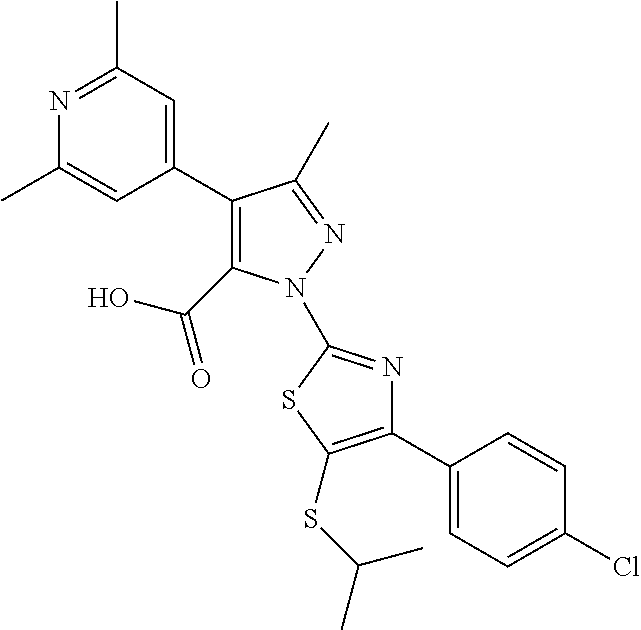
1-(4-(4-chlorophenyl)- 5-(isopropylthio)thiazol- 2-yl)-4-(2,6- dimethylpyridin-4-yl)-3- methyl-1H-pyrazole-5- carboxylic acid A 1H NMR (500 MHz, DMSO) δ 8.06-8.01 (m, 2H), 7.55-7.51 (m, 2H), 7.15 (s, 2H), 3.38-3.29 (m, 1H), 2.45 (s, 6H), 2.32 (s, 3H), 1.23 (d, J = 6.7 Hz, 6H). MS (m/z): 499.4 [M + 1]+ 160 
1-(4-(2,4- dichlorophenyl)-5- (isopropylthio)thiazol-2- yl)-4-(2,6- dimethylpyridin-4-yl)-3- methyl-1H-pyrazole-5- carboxylic acid A 1H NMR (500 MHz, DMSO) δ 7.77 (d, J = 2.1 Hz, 1H), 7.55 (dd, J = 8.3, 2.1 Hz, 1H), 7.49 (d, J = 8.3 Hz, 1H), 7.12 (s, 2H), 3.25-3.16 (m, 1H), 2.44 (s, 6H), 2.31 (s, 3H), 1.15 (d, J = 6.7 Hz, 6H). MS (m/z): 533.4 [M + 1]+ 161 
1-(4-(2,5- dichlorophenyl)-5- (isopropylthio)thiazol-2- yl)-4-(2,6- dimethylpyridin-4-yl)-3- methyl-1H-pyrazole-5- carboxylic acid C 1H NMR (500 MHz, DMSO) δ 7.63 (d, J = 8.5 Hz, 1H), 7.59-7.54 (m, 2H), 7.13 (s, 2H), 3.26- 3.15 (m, 1H), 2.44 (s, 6H), 2.31 (s, 3H), 1.16 (d, J = 6.7 Hz, 6H). MS (m/z): 533.4 [M + 1]+ 162 
4-(2,6-dimethylpyridin- 4-yl)-1-(5- (isopropylthio)-4- (phenylethynyl)thiazol- 2-yl)-3-methyl-1H- pyrazole-5-carboxylic acid C 1H NMR (500 MHz, MeOD) δ 7.57-7.49 (m, 2H), 7.42-7.38 (m, 3H), 7.36 (s, 2H), 3.49-3.39 (m, 1H), 2.55 (s, 6H), 2.38 (s, 3H), 1.38 (d, J = 6.7 Hz, 6H); MS (m/z): 489.3 [M + 1]+. 163 
1-(4-benzyl-5- (isopropylthio)thiazol-2- yl)-4-(2,6- dimethylpyridin-4-yl)-3- methyl-1H-pyrazole-5- carboxylic acid D 1H NMR (500 MHz, DMSO) δ 7.23-7.19 (m, 4H), 7.14-7.10 (m, 1H), 7.05 (s, 2H), 4.01 (s, 2H), 3.12 (dt, J = 13.4, 6.7 Hz, 1H), 2.39 (s, 6H), 2.23 (s, 3H), 1.16 (d, J = 6.7 Hz, 6H). MS (m/z): 479.1 [M + 1]+ 164 
1-(4-(3,4- dichlorophenyl)-5- (isopropylthio)thiazol-2- yl)-4-(3-fluoro-5- methoxyphenyl)-3- methyl-1H-pyrazole-5- carboxylic acid B 1H NMR (500 MHz, DMSO) δ 8.21 (d, J = 1.8 Hz, 1H), 8.03 (dd, J = 8.5, 1.8 Hz, 1H), 7.75 (d, J = 8.5 Hz, 1H), 6.94-6.89 (m, 2H), 6.86 (d, J = 11.5 Hz, 1H), 3.80 (s, 3H), 3.35 (sept, J = 6.7 Hz, 1H), 2.32 (s, 3H), 1.24 (d, J = 6.7 Hz, 6H); MS (m/z): 552.1 [M + 1]+ 165 
1-(4-(3,4- dichlorophenyl)-5- (isopropylthio)thiazol-2- yl)-4-(3-methoxy-5- methylphenyl)-3- methyl-1H-pyrazole-5- carboxylic acid B 1H NMR (500 MHz, DMSO) δ 8.24 (s, 1H), 8.09-8.03 (m, 1H), 7.74 (d, J = 8.5 Hz, 1H), 6.91-6.85 (m, 2H), 6.74 (s, 1H), 3.75 (s, 3H), 3.33 (sept, J = 6.7 Hz, 1H), 2.31 (s, 3H), 2.29 (s, 3H), 1.24 (d, J = 6.7 Hz, 6H); MS (m/z): 548.1 [M + 1]+. 166 
1-(4-(3,4- dichlorophenyl)-5- (isopropylthio)thiazol-2- yl)-4-(2- methoxypyridin-4-yl)-3- methyl-1H-pyrazole-5- carboxylic acid C 1H NMR (500 MHz, DMSO) δ 8.24 (d, J = 5.1 Hz, 1H), 8.20 (d, J = 2.1 Hz, 1H), 8.01 (dd, J = 8.5, 2.1 Hz, 1H), 7.77 (d, J = 8.5 Hz, 1H), 7.08 (d, J = 5.2 Hz, 1H), 6.90 (s, 1H), 3.89 (s, 3H), 3.35 (sept, J = 6.7, 1H), 2.34 (s, 3H), 1.24 (d, J = 6.7 Hz, 6H); MS (m/z): 535.0 [M + 1]+. 167 
1-(4-(3,4- dichlorophenyl)-5- (isopropylthio)thiazol-2- yl)-3-methyl-4-(2- methylpyridin-4-yl)-1H- pyrazole-5-carboxylic acid B 1H NMR (500 MHz, DMSO) δ 8.52 (d, J = 5.2 Hz, 1H), 8.20 (d, J = 2.1 Hz, 1H), 8.01 (dd, J = 8.5, 2.1 Hz, 1H), 7.77 (d, J = 8.5 Hz, 1H), 7.35 (s, 1H), 7.30-7.26 (m, 1H), 3.35 (sept, J = 6.7 Hz, 1H), 2.52 (s, 3H), 2.34 (s, 3H), 1.24 (d, J = 6.7 Hz, 6H); MS (m/z): 519.0 [M + 1]+. 168 
1-(4-(1H-indol-4-yl)-5- (isopropylthio)thiazol-2- yl)-4-(3-fluorophenyl)- 3-methyl-1H-pyrazole- 5-carboxylic acid J 1H NMR (500 MHz, DMSO) δ 11.09 (s, 1H), 7.38 (m, 2H), 7.28-7.23 (m, 4H), 7.11-7.05 (m, 2H), 3.13 (dt, J = 13.4, 6.7 Hz, 1H), 2.24 (s, 3H), 1.06 (d, J = 6.7 Hz, 6H). MS (m/z): 493.1 [M + 1]+. 169 
1-(4-(3-fluorophenyl)-5- (isopropylthio)thiazol-2- yl)-4-(1H-indol-4-yl)-3- methyl-1H-pyrazole-5- carboxylic acid J 1H NMR (500 MHz, DMSO) δ 11.17 (br, 1H), 7.61-7.57 (m, 1H), 7.55-7.50 (m, 1H), 7.46 (d, J = 8.1 Hz, 1H), 7.32 (d, J = 7.5 Hz, 4H), 7.27- 7.21 (m, 1H), 7.19- 7.14 (m, 1H), 3.22 (dt, J = 13.3, 6.7 Hz, 1H), 2.32 (s, 3H), 1.14 (d, J = 6.7 Hz, 6H). MS (m/z): 493.1 [M + 1]+. 170 
1-(4-(1H-indol-5-yl)-5- (isopropylthio)thiazol-2- yl)-4-(3-fluorophenyl)- 3-methyl-1H-pyrazole- 5-carboxylic acid J 1H NMR (500 MHz, DMSO) δ 11.24 (br, 1H), 8.20 (s, 1H), 7.80 (d, J = 8.5 Hz, 1H), 7.52 (dd, J = 13.4, 6.8 Hz, 1H), 7.46 (d, J = 8.5 Hz, 1H), 7.42-7.39 (m, 1H), 7.38-7.30 (m, 2H), 7.27-7.19 (m, 1H), 6.52 (s, 1H), 2.31 (d, J = 12.4 Hz, 3H), 1.22 (t, J = 5.7 Hz, 6H) (CH peak from iso-Pr is overlapped with water peak from DMSO) MS (m/z): 493.1 [M + 1]+. 171 
1-(4- (cyclopropylethynyl)-5- (isopropylthio)thiazol-2- yl)-4-(3-fluorophenyl)- 3-methyl-1H-pyrazole- 5-carboxylic acid J 1H NMR (500 MHz, MeOD) δ 7.40 (td, J = 7.9, 6.0 Hz, 1H), 7.33-7.23 (m, 2H), 7.04 (ddd, J = 8.0, 3.1, 1.3 Hz, 1H), 3.40-3.31 (m, 1H), 2.30 (s, 3H), 1.49 (ddd, J = 10.0, 6.6, 4.2 Hz, 1H), 1.32 (d, J = 6.7 Hz, 6H), 1.00-0.87 (m, 2H), 0.82-0.73 (m, 2H); MS (m/z): 442.1 [M + 1]+. 172 
4-cyclopropyl-1-(4- cyclopropyl-5- (isopropylthio)thiazol-2- yl)-3-methyl-1H- pyrazole-5-carboxylic acid J 1H NMR (500 MHz, MeOD) δ 3.15 (hept, J = 6.7 Hz, 1H), 2.33 (tt, J = 8.2, 4.9 Hz, 1H), 2.28 (s, 3H), 1.65 (tt, J = 8.5, 5.4 Hz, 1H), 1.29 (d, J = 6.7 Hz, 6H), 0.97 (ddd, J = 7.8, 4.9, 2.5 Hz, 2H), 0.94-0.89 (m, 2H), 0.85 (ddd, J = 8.5, 6.2, 4.2 Hz, 2H), 0.71-0.66 (m, 2H); MS (m/z): 364.3 [M + 1]+. 173 
4-cyclopropyl-1-(4-(3,4- dichlorophenyl)-5- (isopropylthio)thiazol-2- yl)-3-methyl-1H- pyrazole-5-carboxylic acid D 1H NMR (500 MHz, DMSO) δ 8.18 (d, J = 2.1 Hz, 1H), 8.00 (dd, J = 8.5, 2.1 Hz, 1H), 7.74 (d, J = 8.5 Hz, 1H), 3.36-3.25 (m, 1H), 2.26 (s, 3H), 1.70-1.63 (m, 1H), 1.22 (d, J = 6.7 Hz, 6H), 0.88-0.79 (m, 2H), 0.69-0.61 (m, 2H). MS (m/z): 468.1 [M + 1]+ 174 
4-(3-chloro-5- isopropoxyphenyl)-1- (4-(3,4-dichlorophenyl)- 5-(isopropylthio)thiazol- 2-yl)-3-methyl-1H- pyrazole-5-carboxylic acid B 1H NMR (500 MHz, DMSO) δ 8.22 (s, 1H), 8.04 (d, J = 8.4 Hz, 1H), 7.74 (d, J = 8.5 Hz, 1H), 7.08 (s, 1H), 6.99 (s, 2H), 4.67 (d, J = 6.0 Hz, 1H), 3.35 (sept, J = 6.7 Hz, 1H), 2.30 (s, 3H), 1.29 (d, J = 6.0 Hz, 6H), 1.24 (d, J = 6.7 Hz, 6H); MS (m/z): 596.0 [M + 1]+. 175 
4-(3-chloro-5-(2- methoxyethoxy) phenyl)-1-(4-(3,4- dichlorophenyl)-5- (isopropylthio)thiazol-2- yl)-3-methyl-1H- pyrazole-5-carboxylic acid B 1H NMR (500 MHz, DMSO) δ 8.24 (s, 1H), 8.06 (d, J = 8.2 Hz, 1H), 7.74 (d, J = 8.5 Hz, 1H), 7.15 (s, 1H), 7.07 (s, 1H), 7.01 (s, 1H), 4.16-4.12 (m, 2H), 3.68-3.65 (m, 2H), 3.35 (sept, J = 6.7 Hz, 1H), 3.31 (s, 3H), 2.30 (s, 3H), 1.23 (d, J = 6.7 Hz, 6H); MS (m/z): 611.9 [M + 1]+ 176 
1-(4-(3-chlorophenyl)- 5-(isopropylthio)thiazol- 2-yl)-4-(3- fluorophenyl)-3-methyl- 1H-pyrazole-5- carboxylic acid C 1H NMR (500 MHz, DMSO) δ 8.04-8.01 (m, 1H), 8.00-7.96 (m, 1H), 7.55-7.46 (m, 3H), 7.39-7.30 (m, 2H), 7.25-7.16 (m, 1H), 3.40-3.29 (m, 1H), 2.31 (s, 3H), 1.23 (d, J = 6.7 Hz, 6H). MS (m/z): 488.1 [M + 1] 177 
1-(4-(4-chlorophenyl)- 5-(isopropylthio)thiazol- 2-yl)-4-(3- fluorophenyl)-3-methyl- 1H-pyrazole-5- carboxylic acid A 1H NMR (500 MHz, DMSO) δ 8.06-8.02 (m, 2H), 7.56-7.47 (m, 3H), 7.37-7.30 (m, 2H), 7.24-7.17 (m, 1H), 3.36-3.27 (m, 1H), 2.31 (s, 3H), 1.23 (d, J = 6.7 Hz, 6H). MS (m/z): 488.1 [M + 1]+. 178 
1-(4-(2,4- dichlorophenyl)-5- (isopropylthio)thiazol-2- yl)-4-(3-fluorophenyl)- 3-methyl-1H-pyrazole- 5-carboxylic acid B 1H NMR (500 MHz, DMSO) δ 7.77 (d, J = 2.1 Hz, 1H), 7.55 (dd, J = 8.3, 2.1 Hz, 1H), 7.52-7.45 (m, 2H), 7.34-7.27 (m, 2H), 7.22-7.15 (m, 1H), 3.25-3.15 (m, 1H), 2.30 (s, 3H), 1.15 (d, J = 6.7 Hz, 6H). MS (m/z): 522.0 [M + 1]+ 179 
4-bromo-1-(4-(6-(3- fluorophenyl)pyridin-3- yl)-5- (isopropylthio)thiazol-2- yl)-3-methyl-1H- pyrazole-5-carboxylic acid E 1H NMR (500 MHz, DMSO) δ 9.29 (d, J = 1.9 Hz, 1H), 8.50 (dd, J = 8.3, 2.3 Hz, 1H), 8.20-8.11 (m, 1H), 8.03 (d, J = 7.9 Hz, 1H), 7.98 (d, J = 10.2 Hz, 1H), 7.57 (dd, J = 14.1, 8.1 Hz, 1H), 7.30 (td, J = 8.4, 2.0 Hz, 1H), 3.37-3.29 (m, 1H), 2.21 (s, 3H), 1.24 (d, J = 6.7 Hz, 6H); MS (m/z): 533.1 [M + 1]+ 180 
(R)-1-(4-(3,4- dichlorophenyl)-5- (isopropylthio)thiazol-2- yl)-3-methyl-4-(2- methyl-6- ((tetrahydrofuran-3- yl)oxy)pyridin-4-yl)-1H- pyrazole-5-carboxylic acid D 1H NMR (500 MHz, DMSO) δ 8.22 (s, 1H), 8.04 (d, J = 8.3 Hz, 1H), 7.76 (d, J = 8.5 Hz, 1H), 6.97 (s, 1H), 6.72 (s, 1H), 5.53-5.48 (m, 1H), 3.93 (dd, J = 10.2, 4.8 Hz, 1H), 3.89- 3.82 (m, 1H), 3.80- 3.73 (m, 2H), 3.35 (hept, J = 6.7 Hz, 1H), 2.41 (s, 3H), 2.33 (s, 3H), 2.29- 2.18 (m, 1H), 2.06- 1.98 (m, 1H), 1.24 (d, J = 6.7 Hz, 6H); MS (m/z): 605.2 [M + 1]+ 181 
1-(4-(3,4- dichlorophenyl)-5- (isopropylthio)thiazol-2- yl)-4-(2-(2- methoxyethoxy)-6- methylpyridin-4-yl)-3- methyl-1H-pyrazole-5- carboxylic acid D 1H NMR (500 MHz, DMSO) δ 8.22 (s, 1H), 8.04 (d, J = 8.4 Hz, 1H), 7.76 (d, J = 8.5 Hz, 1H), 6.96 (s, 1H), 6.72 (s, 1H), 4.40-4.35 (m, 2H), 3.69-3.64 (m, 2H), 3.35 (sept, J = 6.7 Hz, 1H), 2.41 (s, 3H), 2.33 (s, 3H), 1.24 (d, J = 6.7 Hz, 6H); MS (m/z): 592.9 [M + 1]+ 182 
(S)-1-(4-(3,4- dichlorophenyl)-5- (isopropylthio)thiazol-2- yl)-3-methyl-4-(2- methyl-6- ((tetrahydrofuran-3- yl)oxy)pyridin-4-yl)-1H- pyrazole-5-carboxylic acid D 1H NMR (500 MHz, DMSO) δ 8.21 (s, 1H), 8.03 (d, J = 10.5 Hz, 1H), 7.77 (d, J = 8.5 Hz, 1H), 6.96 (s, 1H), 6.69 (s, 1H), 5.55-5.49 (m, 1H), 3.94 (dd, J = 10.2, 4.8 Hz, 1H), 3.90-3.82 (m, 1H), 3.81-3.74 (m, 2H), 3.36 (hept, J = 6.7 Hz, 1H), 2.42 (s, 3H), 2.34 (s, 3H), 2.30-2.20 (m, 1H), 2.06-1.98 (m, 1H), 1.24 (d, J = 6.7 Hz, 6H); MS (m/z): 605.1 [M + 1]+. 183 
1-(4-(cyclohex-1-en-1- yl)-5- (isopropylthio)thiazol-2- yl)-4-(3-fluorophenyl)- 3-methyl-1H-pyrazole- 5-carboxylic acid C 1H NMR (500 MHz, DMSO) δ 7.52 (dd, J = 14.5, 8.1 Hz, 1H), 7.32-7.27 (m, 2H), 7.24 (t, J = 8.5 Hz, 1H), 6.41-6.37 (m, 1H), 3.28 (m, 1H), 2.46-2.41 (m, 2H), 2.29 (s, 3H), 2.21 (ddd, J = 9.8, 6.4, 3.4 Hz, 2H), 1.72-1.65 (m, 2H), 1.63-1.57 (m, 2H), 1.26 (d, J = 6.7 Hz, 6H); MS (m/z): 458.3 [M + 1]+. 184 
1-(4-(cyclopent-1-en-1- yl)-5- (isopropylthio)thiazol-2- yl)-4-(3-fluorophenyl)- 3-methyl-1H-pyrazole- 5-carboxylic acid D 1H NMR (500 MHz, DMSO) δ 7.54-7.47 (m, 1H), 7.31 (t, J = 7.8 Hz, 2H), 7.22 (t, J = 8.2 Hz, 1H), 6.58 (t, J = 2.0 Hz, 1H), 3.30-3.25 (m, 1H), 2.83 (t, J = 6.5 Hz, 2H), 2.49-2.45 (m, 2H), 2.29 (s, 3H), 1.94 (dt, J = 14.6, 7.4 Hz, 2H), 1.27 (d, J = 6.7 Hz, 6H); MS (m/z): 444.3 [M + 1]+ 185 
4-(3-chloro-5- methoxyphenyl)-1-(5- (isopropylthio)-4- phenylthiazol-2-yl)-3- methyl-1H-pyrazole-5- carboxylic acid D 1H NMR (500 MHz, DMSO) δ 8.02 (d, J = 7.5 Hz, 2H), 7.47 (t, J = 7.5 Hz, 2H), 7.40 (t, J = 7.3 Hz, 1H), 7.17-6.96 (m, 3H), 3.80 (s, 3H), 3.35-3.20 (m, 1H), 2.30 (s, 3H), 1.22 (d, J = 6.7 Hz, 6H). MS (m/z): 500.1 [M + 1]+. 186 
4-(3-fluorophenyl)-1-(4- (4-fluorophenyl)-5- (isopropylthio)thiazol-2- yl)-3-methyl-1H- pyrazole-5-carboxylic acid B 1H NMR (500 MHz, DMSO) δ 8.10-8.01 (m, J = 8.7, 5.6 Hz, 2H), 7.59-7.43 (m, J = 6.6 Hz, 1H), 7.42-7.26 (m, J = 8.9 Hz, 4H), 7.25- 7.14 (m, 1H), 3.32- 3.24 (m, 1H), 2.30 (s, 3H), 1.22 (d, J = 6.7 Hz, 6H); MS (m/z): 472.1 [M + 1]+. 187 
4-(3-fluorophenyl)-1-(5- (isopropylthio)-4-(4- methoxyphenyl)thiazol- 2-yl)-3-methyl-1H- pyrazole-5-carboxylic acid D 1H NMR (500 MHz, DMSO) δ 8.00 (s, 2H), 7.54-7.11 (m, 4H), 7.02 (d, J = 8.9 Hz, 2H), 3.81 (s, 3H), 3.37-3.24 (m, 1H), 2.30 (s, 3H), 1.22 (d, J = 6.7 Hz, 6H); MS (m/z): 484.1 [M + 1]+. 188 
4-(3-fluorophenyl)-1-(5- (isopropylthio)-4-(4- (methylsulfonyl)phenyl) thiazol-2-yl)-3-methyl- 1H-pyrazole-5- carboxylic acid I 1H NMR (500 MHz, DMSO) δ 8.24 (d, J = 8.4 Hz, 2H), 8.01 (d, J = 8.6 Hz, 2H), 7.55-7.43 (m, J = 6.9 Hz, 1H), 7.43-7.30 (m, J = 10.8 Hz, 2H), 7.25- 7.13 (m, J = 9.8 Hz, 1H), 3.42-3.35 (m, J = 13.6, 6.9 Hz, 1H), 3.27 (s, 3H), 2.31 (s, 3H), 1.24 (d, J = 6.7 Hz, 6H); MS (m/z): 532.3 [M + 1]+. 189 
1-(4-(4-fluoro-3- methoxyphenyl)-5- (isopropylthio)thiazol-2- yl)-4-(3-fluorophenyl)- 3-methyl-1H-pyrazole- 5-carboxylic acid D 1H NMR (500 MHz, DMSO) δ 7.95-7.86 (m, 1H), 7.73-7.65 (m, 1H), 7.51-7.44 (m, 1H), 7.40-7.27 (m, 2H), 7.22-7.13 (m, 1H), 3.90 (s, 3H), 3.37-3.24 (m, 1H), 2.31 (s, 3H), 1.24 (d, J = 6.7 Hz, 6H); MS (m/z): 502.4 [M + 1]+ 190 
1-(4-(4-chloro-3- methylphenyl)-5- (isopropylthio)thiazol-2- yl)-4-(2,6- dimethylpyridin-4-yl)-3- methyl-1H-pyrazole-5- carboxylic acid B 1H NMR (500 MHz, DMSO) δ 7.94 (d, J = 1.9 Hz, 1H), 7.87 (dd, J = 8.4, 1.9 Hz, 1H), 7.50 (d, J = 8.4 Hz, 1H), 7.16 (s, 2H), 3.34-3.27 (m, 1H), 2.46 (s, 6H), 2.39 (s, 3H), 2.33 (s, 3H), 1.23 (d, J = 6.7 Hz, 6H). MS (m/z): 513.2 [M + 1]+ 191 
1-(4-(4-chloro-3- methylphenyl)-5- (isopropylthio)thiazol-2- yl)-4-(3-fluorophenyl)- 3-methyl-1H-pyrazole- 5-carboxylic acid B 1H NMR (500 MHz, DMSO) δ 7.94 (m, 1H), 7.86 (dd, J = 8.4, 1.9 Hz, 1H), 7.53-7.46 (m, 2H), 7.37-7.30 (m, 2H), 7.25-7.17 (m, 1H), 3.37-3.25 (m, 1H), 2.39 (s, 3H), 2.31 (s, 3H), 1.23 (d, J = 6.7 Hz, 6H). MS (m/z): 502.2 [M + 1]+ 192 
1-(4-(4-chloro-3,5- difluorophenyl)-5- (isopropylthio)thiazol-2- yl)-4-(2,6- dimethylpyridin-4-yl)-3- methyl-1H-pyrazole-5- B 1H NMR (500 MHz, DMSO) δ 7.97 (s, 1H), 7.95 (s, 1H), 7.18 (s, 2H), 3.43- 3.32 (m, 1H), 2.45 (s, 6H), 2.33 (s, 3H), 1.26 (d, J = 6.7 Hz, 6H). MS (m/z): 535.2 [M + 1]+ carboxylic acid 193 
1-(4-(4-chloro-3,5- difluorophenyl)-5- (isopropylthio)thiazol-2- yl)-4-(3-fluorophenyl)- 3-methyl-1H-pyrazole- 5-carboxylic acid B 1H NMR (500 MHz, DMSO) δ 7.97 (s, 1H), 7.95 (s, 1H), 7.52-7.45 (m, 1H), 7.39-7.32 (m, 2H), 7.23-7.16 (m, 1H), 3.44-3.32 (m, 1H), 2.31 (s, 3H), 1.25 (d, J = 6.7 Hz, 6H). MS (m/z): 524.2 [M + 1]+ 194 
1-(4-(4-chloro-3- methoxyphenyl)-5- (isopropylthio)thiazol-2- yl)-4-(2,6- dimethylpyridin-4-yl)-3- methyl-1H-pyrazole-5- carboxylic acid B 1H NMR (500 MHz, DMSO) δ 7.86-7.83 (m, 1H), 7.71 (dd, J = 8.4, 1.8 Hz, 1H), 7.51 (d, J = 8.4 Hz, 1H), 7.16 (s, 2H), 3.91 (s, 3H), 3.43- 3.31 (m, 1H), 2.46 (s, 6H), 2.33 (s, 3H), 1.25 (d, J = 6.7 Hz, 6H). MS (m/z): 529.3 [M + 1]+ 195 
1-(4-(4-chloro-3- methoxyphenyl)-5- (isopropylthio)thiazol-2- yl)-4-(3-fluorophenyl)- 3-methyl-1H-pyrazole- 5-carboxylic acid C 1H NMR (500 MHz, DMSO) δ 7.89-7.85 (m, 1H), 7.73-7.69 (m, 1H), 7.54-7.45 (m, 2H), 7.40-7.31 (m, 2H), 7.24-7.16 (m, 1H), 3.91 (s, 3H), 3.41-3.31 (m, 1H), 2.31 (s, 3H), 1.25 (d, J = 6.7 Hz, 6H). MS (m/z): 518.3 [M + 1]+. 196 
4-(2,6-dimethylpyridin- 4-yl)-1-(5- (isopropylthio)-4-(4- (trifluoromethyl)phenyl) thiazol-2-yl)-3-methyl- 1H-pyrazole-5- carboxylic acid B 1H NMR (500 MHz, DMSO) δ 8.21 (d, J = 8.3 Hz, 2H), 7.83 (d, J = 8.3 Hz, 2H), 7.16 (s, 2H), 3.44- 3.31 (m, 1H), 2.46 (s, 6H), 2.33 (s, 3H), 1.23 (d, J = 6.7 Hz, 6H). MS (m/z): 533.4 [M + 1]+ 197 
4-(3-fluorophenyl)-1-(5- (isopropylthio)-4-(4- (trifluoromethyl)phenyl) thiazol-2-yl)-3-methyl- 1H-pyrazole-5- carboxylic acid A 1H NMR (500 MHz, DMSO) δ 8.21 (d, J = 8.3 Hz, 2H), 7.83 (d, J = 8.3 Hz, 2H), 7.53-7.46 (m, 1H), 7.38-7.31 (m, 2H), 7.25-7.18 (m, 1H), 3.44-3.31 (m, 1H), 2.30 (s, 3H), 1.23 (d, J = 6.7 Hz, 6H). MS (m/z): 522.3 [M + 1]+ 198 
1-(4-(3,4- dichlorophenyl)-5- (isopropylthio)thiazol-2- yl)-3-methyl-4-(3- methyl-5-(oxetan-3- yloxy)phenyl)-1H- pyrazole-5-carboxylic acid B 1H NMR (500 MHz, DMSO) δ 8.22 (d, J = 1.7 Hz, 1H), 8.04 (dd, J = 8.5, 1.8 Hz, 1H), 7.74 (d, J = 8.5 Hz, 1H), 7.17 (s, 1H), 6.89 (s, 2H), 5.33 (d, J = 5.2 Hz, 1H), 4.95 (t, J = 7.0 Hz, 2H), 4.56 (dd, J = 8.0, 4.9 Hz, 2H), 3.35 (hept, J = 6.7 Hz, 1H), 2.30 (s, 3H), 1.24 (d, J = 6.7 Hz, 6H); MS (m/z): 610.0 [M + 1]+ 199 
1-(4-(3,4- dichlorophenyl)-5- (isopropylthio)thiazol-2- yl)-4-(2-methoxy-6- methylpyridin-4-yl)-3- methyl-1H-pyrazole-5- carboxylic acid B 1H NMR (500 MHz, DMSO) δ 8.20 (d, J = 2.0 Hz, 1H), 8.02 (dd, J = 8.5, 2.1 Hz, 1H), 7.78 (d, J = 8.5 Hz, 1H), 6.94 (s, 1H), 6.68 (s, 1H), 3.87 (s, 3H), 3.35 (hept, J = 6.7 Hz, 1H), 2.44 (s, 3H), 2.33 (s, 3H), 1.24 (d, J = 6.7 Hz, 6H); MS (m/z): 549.4 [M + 1]+. 200 
1-(4-(3,4- dichlorophenyl)-5- (isopropylthio)thiazol-2- yl)-4-(3-fluoro-5- (oxetan-3- yloxy)phenyl)-3-methyl- 1H-pyrazole-5- carboxylic acid B 1H NMR (500 MHz, DMSO) δ 8.19 (d, J = 1.9 Hz, 1H), 8.01 (dd, J = 8.5, 2.0 Hz, 1H), 7.77 (d, J = 8.5 Hz, 1H), 6.94 (d, J = 8.8 Hz, 1H), 6.76 (d, J = 10.7 Hz, 1H), 6.71 (s, 1H), 5.33 (quint., J = 5.3 Hz, 1H), 4.94 (t, J = 6.7 Hz, 2H), 4.57 (dd, J = 7.2, 5.0 Hz, 2H), 3.36 (hept, J = 6.7 Hz, 1H), 2.32 (s, 3H), 1.24 (d, J = 6.7 Hz, 6H); MS (m/z): 594.3 [M + 1]+ 201a 
4-(3-fluorophenyl)-1-(4- (3-fluorophenyl)-5- (isopropylthio)thiazol-2- yl)-3-methyl-1H- pyrazole-5-carboxylic acid E 1H NMR (500 MHz, MeOD) δ 8.09-8.04 (m, 1H), 8.02-7.96 (m, 1H), 7.47-7.40 (m, 2H), 7.39-7.35 (m, 1H), 7.34-7.29 (m, 1H), 7.12-7.02 (m, 2H), 3.31-3.24 (m, 1H), 2.35 (s, 3H), 1.29 (d, J = 6.7 Hz, 6H); MS (m/z): 472.4 [M + 1]+. 201b 
1-(4-(benzofuran-2-yl)- 5-(isopropylthio)thiazol- 2-yl)-4-(3- fluorophenyl)-3-methyl- 1H-pyrazole-5- carboxylic acid D 1H NMR (500 MHz, MeOD) δ 7.66 (d, J = 7.7 Hz, 1H), 7.56-7.52 (m, 1H), 7.51 (d, J = 0.9 Hz, 1H), 7.47-7.40 (m, 1H), 7.38 (dt, J = 7.7, 1.2 Hz, 1H), 7.36-7.31 (m, 2H), 7.29-7.23 (m, 1H), 7.10-7.03 (m, 1H), 3.50-3.41 (m, 1H), 2.36 (s, 3H), 1.39 (d, J = 6.7 Hz, 6H); MS (m/z): 494.3 [M + 1]+. 202 
4-(3-fluorophenyl)-1-(5- (isopropylthio)-4- phenylthiazol-2-yl)-3- methyl-1H-pyrazole-5- carboxylic acid D 1H NMR (500 MHz, DMSO) δ 8.01 (d, J = 7.2 Hz, 2H), 7.47 (t, J = 7.5 Hz, 3H), 7.43-7.29 (m, 3H), 7.18 (s, 1H), 3.33 (1H, below water signal), 2.30 (s, 3H), 1.22 (d, J = 6.7 Hz, 6H); MS (m/z): 454.4 [M + 1]+ 203 
1-(5-(isopropylthio)-4- phenylthiazol-2-yl)-1′,3- dimethyl-1H,1′H-[4,4′- bipyrazole]-5- carboxylic acid I 1H NMR (500 MHz, DMSO) δ 8.02-7.97 (m, 2H), 7.95 (s, 1H), 7.64 (d, J = 0.7 Hz, 1H), 7.52-7.45 (m, 2H), 7.44-7.38 (m, 1H), 3.89 (s, 3H), 3.33 (1H, below water signal), 2.35 (s, 3H), 1.22 (d, J = 6.7 Hz, 6H); MS (m/z): 440.4 [M + 1]+. 204 
4-(2,6-dimethylpyridin- 4-yl)-1-(4-(4- fluorophenyl)-5- (isopropylthio)thiazol-2- yl)-3-methyl-1H- pyrazole-5-carboxylic acid B 1H NMR (500 MHz, DMSO) δ 8.09-8.02 (m, 2H), 7.32 (t, J = 8.9 Hz, 2H), 7.14 (s, 2H), 3.33 (1H, below water signal), 2.46 (s, 6H), 2.33 (s, 3H), 1.22 (d, J = 6.7 Hz, 6H); MS (m/z): 483.2 [M + 1]+. 205 
1-(4-(4-chloro-2- methoxyphenyl)-5- (isopropylthio)thiazol-2- yl)-4-(3-fluorophenyl)- 3-methyl-1H-pyrazole- 5-carboxylic acid B 1H NMR (500 MHz, DMSO) δ 7.52-7.42 (m, 1H), 7.36-7.25 (m, 3H), 7.23-7.14 (m, 2H), 7.10 (dd, J = 8.1, 2.0 Hz, 1H), 3.79 (s, 3H), 3.24- 3.12 (m, 1H), 2.29 (s, 3H), 1.14 (d, J = 6.7 Hz, 6H). MS (m/z): 518.1 [M + 1]+ 206 
1-(4-(4-chloro-2- methoxyphenyl)-5- (isopropylthio)thiazol-2- yl)-4-(2,6- dimethylpyridin-4-yl)-3- methyl-1H-pyrazole-5- carboxylic acid B 1H NMR (500 MHz, DMSO) δ 7.28 (d, J = 8.1 Hz, 1H), 7.21 (d, J = 2.0 Hz, 1H), 7.13-7.08 (m, 3H), 3.79 (s, 3H), 3.23- 3.14 (m, 1H), 2.45 (s, 6H), 2.31 (s, 3H), 1.14 (d, J = 6.7 Hz, 6H). MS (m/z): 529.2 [M + 1]+ 207 
1-(4-(3-chloro-4- methylphenyl)-5- (isopropylthio)thiazol-2- yl)-4-(3-fluorophenyl)- 3-methyl-1H-pyrazole- 5-carboxylic acid C 1H NMR (500 MHz, DMSO) δ 14.36 (s, 1H), 8.04 (d, J = 1.6 Hz, 1H), 7.90 (dd, J = 8.0, 1.6 Hz, 1H), 7.54-7.47 (m, 1H), 7.45 (d, J = 8.0 Hz, 1H), 7.37-7.30 (m, 2H), 7.25-7.18 (m, 1H), 3.35-3.30 (m, 1H), 2.37 (s, 3H), 2.30 (s, 3H), 1.23 (d, J = 6.7 Hz, 6H). MS (m/z): 502.1 [M + 1]+ 208 
1-(4-(1,5-dimethyl-6- oxo-1,6-dihydropyridin- 3-yl)-5- (isopropylthio)thiazol-2- yl)-4-(3-fluorophenyl)- 3-methyl-1H-pyrazole- 5-carboxylic acid I 1H NMR (500 MHz, DMSO) δ 8.18-8.11 (m, 1H), 8.04 (bs, 1H), 7.50-7.43 (m, 1H), 7.40-7.32 (m, 2H), 7.21-7.14 (m, 1H), 3.48 (s, 3H), 3.35-3.24 (m, 1H), 2.30 (s, 3H), 2.05 (s, 3H), 1.24 (d, J = 6.7 Hz, 6H). MS (m/z): 499.2 [M + 1]+. 209 
1-(4-(2-chloro-5- (trifluoromethoxy) phenyl)-5- (isopropylthio)thiazol-2- yl)-4-(3-fluorophenyl)- 3-methyl-1H-pyrazole- 5-carboxylic acid D 1H NMR (500 MHz, DMSO) δ 14.10 (s, 1H), 7.76-7.71 (m, 1H), 7.57-7.46 (m, 3H), 7.35-7.26 (m, 2H), 7.26-7.17 (m, 1H), 3.21 (hept, J = 6.7 Hz, 1H), 2.31 (s, 3H), 1.15 (d, J = 6.7 Hz, 6H); MS (m/z): 572.1 [M + 1]+ 210 
1-(4-(5-cyanopyridin-3- yl)-5- (isopropylthio)thiazol-2- yl)-4-(3-fluorophenyl)- 3-methyl-1H-pyrazole- 5-carboxylic acid I 1H NMR (500 MHz, DMSO) δ 9.11 (s, 1H), 8.97 (d, J = 2.0 Hz, 1H), 8.73 (s, 1H), 8.16 (s, 1H), 7.63 (s, 1H), 7.42 (s, 1H), 7.27 (s, 2H), 7.13 (s, 1H), 3.28 (sept, J = 6.7 Hz, 1H), 2.25 (s, 3H), 1.16 (d, J = 6.7 Hz, 6H); MS (m/z): 498.2 [M + 1]+. 211 
1-(4-(1,3-dimethyl-1H- pyrazol-5-yl)-5- (isopropylthio)thiazol-2- yl)-4-(3-fluorophenyl)- 3-methyl-1H-pyrazole- 5-carboxylic acid I 1H NMR (500 MHz, DMSO) δ 7.56-7.50 (m, 1H), 7.33-7.24 (m, 3H), 6.53 (s, 1H), 3.82 (s, 3H), 3.35 (hept, J = 6.7 Hz, 1H), 2.32 (s, 3H), 2.19 (s, 3H), 1.24 (d, J = 6.7 Hz, 6H); MS (m/z): 472.2 [M + 1]+ 212 
4-(3-fluorophenyl)-1-(5- (isopropylthio)-4- (pyrimidin-5-yl)thiazol- 2-yl)-3-methyl-1H- pyrazole-5-carboxylic acid I 1H NMR (500 MHz, DMSO) δ 9.36 (s, 2H), 9.23 (s, 1H), 7.56-7.47 (m, 1H), 7.38-7.31 (m, 2H), 7.26-7.17 (m, 1H), 3.45-3.33 (m, 1H), 2.33 (s, 3H), 1.24 (d, J = 6.7 Hz, 6H). MS (m/z): 456.1 [M + 1]+. 213 
1-(4-(4-cyanophenyl)- 5-(isopropylthio)thiazol- 2-yl)-4-(3- fluorophenyl)-3-methyl- 1H-pyrazole-5- carboxylic acid C 1H NMR (500 MHz, MeOD) δ 8.38-8.34 (m, 2H), 7.81-7.76 (m, 2H), 7.48-7.42 (m, 1H), 7.34-7.30 (m, 1H), 7.29-7.24 (m, 1H), 7.13-7.07 (m, 1H), 3.37-3.26 (m, 1H), 2.34 (s, 3H), 1.28 (d, J = 6.7 Hz, 6H). MS (m/z): 479.1 [M + 1]+ 214 
1-(4-(3-fluoro-4- methylphenyl)-5- (isopropylthio)thiazol-2- yl)-4-(3-fluorophenyl)- 3-methyl-1H-pyrazole- 5-carboxylic acid B 1H NMR (500 MHz, DMSO) δ 7.83-7.80 (m, 1H), 7.77-7.71 (m, 1H), 7.55-7.49 (m, 1H), 7.39 (t, J = 8.1 Hz, 1H), 7.36- 7.29 (m, 2H), 7.27- 7.21 (m, 1H), 3.37- 3.31 (m, 1H), 2.31 (s, 3H), 2.29 (s, 3H), 1.23 (d, J = 6.7 Hz, 6H). MS (m/z): 486.3 [M + 1]+ 215 
1-(4-(2-cyanophenyl)- 5-(isopropylthio)thiazol- 2-yl)-4-(3- fluorophenyl)-3-methyl- 1H-pyrazole-5- carboxylic acid E 1H NMR (500 MHz, DMSO) δ 14.07 (bs, 1H), 7.94-7.89 (m, 1H), 7.79-7.72 (m, 1H), 7.63-7.57 (m, 2H), 7.47-7.39 (m, 1H), 7.30-7.20 (m, 2H), 7.19-7.08 (m, 1H), 3.20-3.09 (m, 1H), 2.25 (s, 3H), 1.05 (d, J = 6.7 Hz, 6H). MS (m/z): 479.0 [M + 1]+ 216 
1-(4-(4-chloro-2- methylphenyl)-5- (isopropylthio)thiazol-2- yl)-4-(3-fluorophenyl)- 3-methyl-1H-pyrazole- 5-carboxylic acid A 1H NMR (500 MHz, DMSO) δ 7.49 (s, 1H), 7.43 (s, 1H), 7.37-7.32 (m, 2H), 7.32-7.17 (m, 3H), 3.18 (hept, J = 6.7 Hz, 1H), 2.30 (s, 3H), 2.23 (s, 3H), 1.14 (d, J = 6.7 Hz, 6H). MS (m/z): 502.1 [M + H]+. 217 
4-(3-fluorophenyl)-1-(5- (isopropylthio)-4-(2- methyl-4- (trifluoromethyl)phenyl) thiazol-2-yl)-3-methyl- 1H-pyrazole-5- carboxylic acid A 1H NMR (500 MHz, DMSO) δ 7.72 (s, 1H), 7.64 (d, J = 8.1 Hz, 1H), 7.55 (d, J = 8.0 Hz, 1H), 7.54-7.47 (m, 1H), 7.33-7.26 (m, 2H), 7.26-7.19 (m, 1H), 3.21 (hept, J = 6.7 Hz, 1H), 2.32 (s, 3H), 2.30 (s, 3H), 1.15 (d, J = 6.7 Hz, 6H); MS (m/z): 536.2 [M + 1]+. 218 
1-(4-(4-chloro-3- cyanophenyl)-5- (isopropylthio)thiazol-2- yl)-4-(3-fluorophenyl)- 3-methyl-1H-pyrazole- 5-carboxylic acid C 1H NMR (500 MHz, CDCl3) δ 8.45 (s, 1H), 8.38 (d, J = 8.2 Hz, 1H), 7.88 (d, J = 8.6 Hz, 1H), 7.52- 7.44 (m, 1H), 7.42- 7.33 (m, 2H), 7.22- 7.14 (m, 1H), 3.35 (hept, J = 6.7 Hz, 1H), 2.31 (s, 3H), 1.23 (d, J = 6.7 Hz, 6H); MS (m/z): 512.9 [M + 1]+ 219 
4-(3,5-dichlorophenyl)- 1-(5-(isopropylthio)-4- (4- (trifluoromethyl)phenyl) thiazol-2-yl)-3-methyl- 1H-pyrazole-5- carboxylic acid A 1H NMR (500 MHz, DMSO) δ 8.20 (d, J = 8.2 Hz, 2H), 7.85 (d, J = 8.2 Hz, 2H), 7.65 (s, 1H), 7.55 (d, J = 1.8 Hz, 2H), 3.41-3.28 (m, 1H), 2.32 (s, 3H), 1.23 (d, J = 6.7 Hz, 6H). MS (m/z): 571.9 [M + 1]+ 220 
4-(3-fluorophenyl)-1-(5- (isopropylthio)-4-(4-((2- methoxyethyl)carbamoyl) phenyl)thiazol-2-yl)- 3-methyl-1H-pyrazole- 5-carboxylic acid I 1H NMR (500 MHz, DMSO) δ 8.60 (t, J = 5.3 Hz, 1H), 8.08 (d, J = 8.4 Hz, 2H), 7.95-7.89 (m, 2H), 7.54-7.47 (m, 1H), 7.40-7.30 (m, 2H), 7.25-7.16 (m, 1H), 3.50-3.41 (m, 4H), 3.36-3.30 (m, 1H), 3.28 (s, 3H), 2.32 (s, 3H), 1.22 (d, J = 6.7 Hz, 6H). MS (m/z): 555.2 [M + 1]+. 221 
1-(4-(4- (dimethylcarbamoyl) phenyl)-5- (isopropylthio)thiazol-2- yl)-4-(3-fluorophenyl)- 3-methyl-1H-pyrazole- 5-carboxylic acid I 1H NMR (500 MHz, DMSO) δ 8.07 (d, J = 8.2 Hz, 2H), 7.53-7.44 (m, 3H), 7.39-7.30 ( m, 2H), 7.24-7.14 (m, 1H), 3.41-3.26 (m, 1H), 3.00 (s, 3H), 2.94 (s, 3H), 2.31 (s, 3H), 1.24 (d, J = 6.7 Hz, 6H). MS (m/z): 525.2 [M + 1]+ 222 
4-(3-chloro-5- methoxyphenyl)-1-(5- (isopropylthio)-4-(4- (trifluoromethyl)phenyl) thiazol-2-yl)-3-methyl- 1H-pyrazole-5- carboxylic acid A 1H NMR (500 MHz, DMSO) δ 8.21 (d, J = 8.3 Hz, 2H), 7.83 (d, J = 8.3 Hz, 2H), 7.12 (s, 1H), 7.04 (s, 2H), 3.81 (s, 3H), 3.40-3.27 (m, 1H), 2.31 (s, 3H), 1.23 (d, J = 6.7 Hz, 6H). MS (m/z): 568.1 [M + 1]+ 222 
4-(3-fluorophenyl)-1-(5- (isopropylthio)-4-(4- (trifluoromethoxy) phenyl)thiazol-2-yl)-3- methyl-1H-pyrazole-5- carboxylic acid B 1H NMR (500 MHz, DMSO) δ 8.11 (d, J = 8.8 Hz, 2H), 7.55-7.45 (m, 3H), 7.36-7.29 (m, 2H), 7.23 (t, J = 8.2 Hz, 1H), 3.34 (hept, J = 6.7 Hz, 1H), 2.31 (s, 3H), 1.23 (d, J = 6.7 Hz, 6H); MS (m/z): 538.0 [M + 1]+ 224 
4-(3-fluorophenyl)-1-(5- (isopropylthio)-4-(2- methyl-4- (trifluoromethoxy) phenyl)thiazol-2-yl)-3- methyl-1H-pyrazole-5- carboxylic acid A 1H NMR (500 MHz, DMSO) δ 7.54-7.48 (m, 1H), 7.45 (d, J = 8.4 Hz, 1H), 7.35 (s, 1H), 7.32-7.20 (m, 4H), 3.20 (hept, J = 6.7 Hz, 1H), 2.31 (s, 3H), 2.25 (s, 3H), 1.15 (d, J = 6.7 Hz, 6H); MS (m/z): 552.1 [M + 1]+ 225 
4-(3-chloro-5- fluorophenyl)-1-(4-(3,4- dichlorophenyl)-5- (isopropylthio)thiazol-2- yl)-3-methyl-1H- pyrazole-5-carboxylic acid A 1H NMR (500 MHz, DMSO) δ 8.20 (d, J = 2.0 Hz, 1H), 8.02 (dd, J = 8.5, 2.1 Hz, 1H), 7.75 (d, J = 8.5 Hz, 1H), 7.48 (d, J = 8.7 Hz, 1H), 7.42 (s, 1H), 7.39-7.33 (m, 1H), 2.32 (s, 3H), 1.24 (d, J = 6.7 Hz, 6H); MS (m/z): 555.8 [M + 1]+ 226 
1-(4-(4-cyano-3- methylphenyl)-5- (isopropylthio)thiazol-2- yl)-4-(3-fluorophenyl)- 3-methyl-1H-pyrazole- 5-carboxylic acid C 1H NMR (500 MHz, DMSO) δ 8.04 (s, 1H), 8.01 (d, J = 8.0 Hz, 1H), 7.86 (d, J = 8.0 Hz, 1H), 7.52-7.44 (m, 1H), 7.40-7.31 (m, 2H), 7.24-7.16 (m, 1H), 3.43-3.29 (m, 1H), 2.54 (s, 3H), 2.31 (s, 3H), 1.24 (d, J = 6.7 Hz, 6H). MS (m/z): 493.1 [M + 1]+ 227 
1-(4-(3,4- dichlorophenyl)-5- fluorothiazol-2-yl)-4-(3- fluorophenyl)-3-methyl- 1H-pyrazole-5- carboxylic acid D 1H NMR (500 MHz, DMSO) δ 7.92 (t, J = 1.1 Hz, 1H), 7.76 (d, J = 1.1 Hz, 2H), 7.48 (dd, J = 14.4, 8.0 Hz, 1H), 7.41-7.30 (m, J = 15.4, 9.1 Hz, 2H), 7.19 (t, J = 7.6 Hz, 1H), 3.33 (1H, below water signal), 2.29 (s, 3H); MS (m/z): 466.9 [M + 1]+. 228 
1-(4-(3,4- dichlorophenyl)-5- (isopropylthio)thiazol-2- yl)-4-(3-fluorophenyl)- 3-isopropyl-1H- pyrazole-5-carboxylic acid B 1H NMR (500 MHz, MeOD) δ 8.45 (d, J = 2.0 Hz, 1H), 8.14 (dd, J = 8.5, 2.1 Hz, 1H), 7.55 (d, J = 8.5 Hz, 1H), 7.45-7.37 (m, 1H), 7.33-7.29 (m, 1H), 7.28-7.22 (m, 1H), 7.06 (td, J = 8.1, 2.1 Hz, 1H), 3.29-3.24 (m, 1H), 3.15-3.09 (m, 1H), 1.32-1.21 (m, 12H); MS (m/z): 552.02 [M + 1]+ 229 
1-(4-(4- (difluoromethyl)phenyl)- 5- (isopropylthio)thiazol-2- yl)-4-(3-fluorophenyl)- 3-methyl-1H-pyrazole- 5-carboxylic acid B 1H NMR (500 MHz, DMSO) δ 8.13 (d, J = 8.2 Hz, 2H), 7.67 (d, J = 8.3 Hz, 2H), 7.53-7.47 (m, 1H), 7.37-7.30 (m, 2H), 7.25-7.20 (m, 1H), 7.09 (t, J = 55.0 Hz, 1H), 3.33 (1H, below water signal), 2.31 (s, 3H), 1.23 (d, J = 6.7 Hz, 6H); MS (m/z): 504.2 [M + 1]+. 230 
1-(4-(3,4- dichlorophenyl)-5- isopropoxythiazol-2-yl)- 4-(3-fluorophenyl)-3- methyl-1H-pyrazole-5- carboxylic acid C 1H NMR (500 MHz,) δ 8.12 (s, 1H), 7.96 (d, J = 8.4 Hz, 1H), 7.73 (d, J = 8.5 Hz, 1H), 7.50 (dd, J = 14.4, 7.6 Hz, 1H), 7.42 (d, J = 10.0 Hz, 1H), 7.38 (d, J = 7.7 Hz, 1H), 7.19 (s, 1H), 4.52 (dt, J = 11.8, 6.0 Hz, 1H), 2.32 (s, 3H), 1.47 (d, J = 6.0 Hz, 6H); MS (m/z): 506.07 [M + 1]+. 231 
1-(4-(4-ethylphenyl)-5- (isopropylthio)thiazol-2- yl)-4-(3-fluorophenyl)- 3-methyl-1H-pyrazole- 5-carboxylic acid B 1H NMR (500 MHz, DMSO) δ 7.93 (d, J = 8.2 Hz, 2H), 7.50 (dd, J = 14.6, 7.7 Hz, 1H), 7.35-7.29 (m, 4H), 7.21 (t, J = 8.8 Hz, 1H), 2.65 (q, J = 7.7 Hz, 2H), 2.31 (s, 3H), 1.22 (dd, J = 8.3, 7.2 Hz, 9H); MS (m/z): 482.18 [M + 1]+ 232 
2-(4-(2,6- dimethylpyridin-4-yl)- 3,5-dimethyl-1H- pyrazol-1-yl)-5- (isopropylthio)-4-(4- (trifluoromethyl)phenyl) thiazole E 1H NMR (500 MHz, CDCl3) δ 8.25 (d, J = 8.2 Hz, 2H), 7.69 (d, J = 8.3 Hz, 2H), 6.89 (s, 2H), 3.25 (h, J = 6.7 Hz, 1H), 2.74 (s, 3H), 2.59 (s, 6H), 2.31 (s, 3H), 1.28 (d, J = 6.7 Hz, 6H). MS (m/z): 503.17 [M + 1]+ 233 
4-(3-fluorophenyl)-1-(4- (5-fluoropyridin-3-yl)-5- (isopropylthio)thiazol-2- yl)-3-methyl-1H- pyrazole-5-carboxylic acid I 1H NMR (500 MHz, DMSO) δ 9.16 (s, 1H), 8.63 (d, J = 2.7 Hz, 1H), 8.28-8.24 (m, 1H), 7.48-7.38 (m, 3H), 7.11 (t, J = 7.9 Hz, 1H), 2.30 (s, 3H), 1.24 (d, J = 6.7 Hz, 6H). MS (m/z): 473.07 [M + 1]+ 234 
1-(4-(benzofuran-3-yl)- 5-(isopropylthio)thiazol- 2-yl)-4-(3- fluorophenyl)-3-methyl- 1H-pyrazole-5- carboxylic acid I MS (m/z): 494.19 [M + 1]+ 235 
4-(3,4-difluorophenyl)- 1-(5-(isopropylthio)-4- (4- (trifluoromethyl)phenyl) thiazol-2-yl)-3-methyl- 1H-pyrazole-5- carboxylic acid A 1H NMR (500 MHz, DMSO) δ 8.25 (d, J = 8.2 Hz, 2H), 7.80 (d, J = 8.3 Hz, 2H), 7.61 (ddd, J = 12.0, 7.9, 1.9 Hz, 1H), 7.46 (dt, J = 10.7, 8.7 Hz, 1H), 7.36 (s, 1H), 2.28 (s, 3H), 1.22 (d, J = 6.7 Hz, 6H); MS (m/z): 540.22 [M + 1]+ 236 
4-(4-fluoro-3- methylphenyl)-1-(5- (isopropylthio)-4-(4- (trifluoromethyl)phenyl) thiazol-2-yl)-3-methyl- 1H-pyrazole-5- carboxylic acid B 1H NMR (500 MHz, DMSO) δ 8.24 (d, J = 8.2 Hz, 2H), 7.78 (d, J = 8.3 Hz, 2H), 7.40 (dd, J = 7.4, 1.5 Hz, 1H), 7.36-7.30 (m, 1H), 7.18-7.12 (m, 1H), 2.25 (s, 3H), 2.25 (s, 3H), 1.21 (d, J = 6.7 Hz, 6H); MS (m/z): 536.26 [M + 1]+ 237 
4-(4-fluorophenyl)-1-(5- (isopropylthio)-4-(4- (trifluoromethyl)phenyl) thiazol-2-yl)-3-methyl- 1H-pyrazole-5- carboxylic acid B 1H NMR (500 MHz, MeOD) δ 8.43 (d, J = 8.1 Hz, 2H), 7.72 (d, J = 8.3 Hz, 2H), 7.59-7.55 (m, 2H), 7.17-7.11 (m, 2H), 2.33 (s, 3H), 1.28 (d, J = 6.7 Hz, 6H); MS (m/z): 522.18 [M + 1]+ 238 
4-(4-fluoro-3- methoxyphenyl)-1-(5- (isopropylthio)-4-(4- (trifluoromethyl)phenyl) thiazol-2-yl)-3-methyl- 1H-pyrazole-5- carboxylic acid B 1H NMR (500 MHz, MeOD) δ 8.45 (d, J = 8.2 Hz, 2H), 7.72 (d, J = 8.3 Hz, 2H), 7.36 (dd, J = 8.3, 2.0 Hz, 1H), 7.16-7.03 (m, 3H), 3.92 (s, 3H), 3.28 (dt, J = 13.3, 6.7 Hz, 1H), 2.35 (s, 3H), 1.29 (d, J = 6.7 Hz, 6H); MS (m/z): 552.14 [M + 1]+ 239 
1-(4-(4-chloro-2,6- dimethylphenyl)-5- (isopropylthio)thiazol-2- yl)-4-(3-fluorophenyl)- 3-methyl-1H-pyrazole- 5-carboxylic acid C 1H NMR (500 MHz, DMSO) δ 7.50 (dd, J = 14.2, 7.7 Hz, 1H), 7.30-7.20 (m, 5H), 3.20 (dt, J = 13.2, 6.6 Hz, 1H), 2.30 (s, 3H), 2.06 (s, 6H), 1.19 (d, J = 6.7 Hz, 6H); MS (m/z): 516.24 [M + 1]+. 240 
1-(4-(4-(1,1- difluoroethyl)phenyl)-5- (isopropylthio)thiazol-2- yl)-4-(3-fluorophenyl)- 3-methyl-1H-pyrazole- 5-carboxylic acid B 1H NMR (500 MHz, DMSO) δ 8.09 (d, J = 8.5 Hz, 2H), 7.66 (d, J = 8.5 Hz, 2H), 7.54-7.49 (m, 1H), 7.32 (t, J = 7.7 Hz, 2H), 7.24 (t, J = 7.9 Hz, 1H), 2.32 (s, 3H), 2.01 (t, J = 18.9 Hz, 3H), 1.23 (d, J = 6.7 Hz, 6H); MS (m/z): 518.22 [M + 1]+. 241 
4-(4-fluoro-3,5- dimethylphenyl)-1-(5- (isopropylthio)-4-(4- (trifluoromethyl)phenyl) thiazol-2-yl)-3-methyl- 1H-pyrazole-5- carboxylic acid A 1H NMR (500 MHz, DMSO) δ 8.21 (d, J = 8.1 Hz, 2H), 7.82 (d, J = 8.3 Hz, 2H), 7.19 (d, J = 6.9 Hz, 2H), 2.28 (s, 3H), 2.25 (s, 3H), 2.25 (s, 3H), 1.24 (d, J = 6.7 Hz, 6H); MS (m/z): 550.18 [M + 1]+ 242 
4-(3-fluorophenyl)-1-(5- (isopropylthio)-4-(2- (trifluoromethyl) pyrimidin- 5-yl)thiazol-2-yl)-3- methyl-1H-pyrazole-5- carboxylic acid C 1H NMR (500 MHz, DMSO) δ 9.60 (s, 2H), 7.51 (dd, J = 15.1, 8.0 Hz, 1H), 7.36 (t, J = 8.8 Hz, 2H), 7.22 (t, J = 8.8 Hz, 1H), 2.33 (s, 3H), 1.27 (d, J = 6.7 Hz, 6H); MS (m/z): 524.25 [M + 1]+ 243 
1-(4-(4-chloro-3- (ethylcarbamoyl) phenyl)-5- (isopropylthio)thiazol-2- yl)-4-(3-fluorophenyl)- 3-methyl-1H-pyrazole- 5-carboxylic acid I 1H NMR (500 MHz, DMSO) δ 8.43 (t, J = 5.6 Hz, 1H), 7.99-7.94 (m, 2H), 7.52 (d, J = 8.4 Hz, 1H), 7.43 (dd, J = 14.6, 7.8 Hz, 1H), 7.26 (t, J = 9.9 Hz, 2H), 2.24 (s, 3H), 1.18 (d, J = 6.7 Hz, 6H), 1.05 (t, J = 7.2 Hz, 3H); MS (m/z): 559.14 [M + 1]+ 244 
1-(4-(2-amino-4- (trifluoromethyl) phenyl)-5- (isopropylthio)thiazol-2- yl)-4-(3-fluorophenyl)- 3-methyl-1H-pyrazole- 5-carboxylic acid B 1H NMR (500 MHz, DMSO) δ 7.52-7.43 (m, 2H), 7.34 (dd, J = 15.6, 9.5 Hz, 2H), 7.21-7.14 (m, 1H), 7.11 (s, 1H), 6.87 (d, J = 8.0 Hz, 1H), 2.30 (s, 3H), 1.16 (d, J = 6.7 Hz, 6H); MS (m/z): 537.23 [M + 1]+ 245 
4-(3-fluorophenyl)-1-(5- (isopropylthio)-4-((4- (trifluoromethyl)phenyl) ethynyl)thiazol-2-yl)-3- methyl-1H-pyrazole-5- carboxylic acid D 1H NMR (500 MHz, DMSO) δ 7.85-7.74 (m, 5H), 7.46 (dd, J = 14.4, 7.7 Hz, 1H), 7.36 (dd, J = 18.1, 9.2 Hz, 2H), 3.49 (dt, J = 13.3, 6.6 Hz, 1H), 2.29 (s, 3H), 1.34 (d, J = 6.7 Hz, 6H); MS (m/z): 546.22 [M + 1]+ 246 
4-(3-fluorophenyl)-1-(5- (isopropylthio)-4-(5- (trifluoromethyl) pyrimidin- 2-yl)thiazol-2-yl)-3- methyl-1H-pyrazole-5- carboxylic acid D 1H NMR (500 MHz, DMSO) δ 9.36 (s, 2H), 7.47 (dd, J = 14.5, 7.6 Hz, 1H), 7.36 (d, J = 9.3 Hz, 1H), 7.33 (d, J = 7.7 Hz, 1H), 7.21-7.15 (m, 1H), 3.57 (dt, J = 13.3, 6.7 Hz, 1H), 2.29 (s, 3H), 1.40 (d, J = 6.6 Hz, 6H); MS (m/z): 524.1 [M + 1]+ 247 
4-(3-fluorophenyl)-3- methyl-1-(4-(4- (trifluoromethyl)phenyl) thiazol-2-yl)-1H- pyrazole-5-carboxylic acid D 1H NMR (500 MHz, DMSO) δ 8.19 (s, 1H), 8.13 (d, J = 8.3 Hz, 2H), 7.81 (d, J = 8.3 Hz, 2H), 7.50 (dd, J = 14.6, 7.2 Hz, 1H), 7.35 (t, J = 9.9 Hz, 2H), 7.21 (t, J = 8.6 Hz, 1H), 2.32 (s, 3H). MS (m/z): 448.1 [M + 1]+ 248 
4-(3-fluorophenyl)-1-(5- (isopropylthio)-4-(4- (trifluoromethyl)phenyl) thiazol-2-yl)-N-(2- methoxyethyl)-N,3- dimethyl-1H-pyrazole- 5-carboxamide K 1H NMR (500 MHz, DMSO) δ 8.19 (d, J = 8.2 Hz, 2H), 8.14 (d, J = 8.2 Hz, 2H), 7.92-7.87 (m, 4H), 7.56-7.49 (m, 2H), 7.36-7.20 (m, 6H), 3.97-3.89 (m, 1H), 3.49-3.42 (m, 1H), 3.41-3.34 (m, 2H), 3.24-3.17 (m, 2H), 3.07 (s, 3H), 3.02 (s, 2H), 2.91 (s, 2H), 2.82 (s, 3H), 2.54- 2.52 (m, 1H), 2.39 (s, 3H), 2.38 (s, 2H), 1.24 (dd, J = 6.6, 2.8 Hz, 11H). MS (m/z): 593.2 [M + 1]+ 249 
N-(2-(2-(2-(2- azidoethoxy)ethoxy) ethoxy)ethyl)-4-(3- fluorophenyl)-1-(5- (isopropylthio)-4-(4- (trifluoromethyl)phenyl) thiazol-2-yl)-3-methyl- 1H-pyrazole-5- carboxamide K 1H NMR (500 MHz, MeOD) δ 8.27 (d, J = 8.2 Hz, 2H), 7.75 (d, J = 8.3 Hz, 2H), 7.47 (td, J = 8.0, 6.1 Hz, 1H), 7.32-7.28 (m, 1H), 7.26-7.20 (m, 1H), 7.16-7.10 (m, 1H), 3.60-3.56 (m, 2H), 3.56-3.50 (m, 4H), 3.50-3.41 (m, 6H), 3.31 (3H, below MeOH signal), 3.30-3.24 (m, 2H), 2.37 (s, 3H), 1.27 (d, J = 6.7 Hz, 6H). MS (m/z): 722.3 [M + 1]+. 250 
4-(3-fluorophenyl)-1-(5- (isopropylthio)-4-(4- (trifluoromethyl)phenyl) thiazol-2-yl)-N-(2- methoxyethyl)-3- methyl-1H-pyrazole-5- carboxamide D 1H NMR (500 MHz, DMSO) δ 9.04 (t, J = 5.6 Hz, 1H), 8.18 (d, J = 8.1 Hz, 2H), 7.88 (d, J = 8.2 Hz, 2H), 7.54- 7.47 (m, 1H), 7.36- 7.28 (m, 2H), 7.25- 7.19 (m, 1H), 3.41- 3.33 (m, 3H), 3.28 (t, J = 5.8 Hz, 2H), 3.05 (s, 3H), 2.35 (s, 3H), 1.23 (d, J = 6.7 Hz, 6H). MS (m/z): 579.1 [M + 1]+ 251 
4-(3-fluorophenyl)-1-(5- (isopropylthio)-4-(4- (trifluoromethyl)phenyl) thiazol-2-yl)-3-methyl- N-(propylsulfonyl)-1H- pyrazole-5- carboxamide K 1H NMR (500 MHz, MeOD) δ 8.37 (d, J = 8.1 Hz, 2H), 7.72 (d, J = 8.3 Hz, 2H), 7.46 (td, J = 8.0, 6.2 Hz, 1H), 7.35-7.31 (m, 1H), 7.30-7.25 (m, 1H), 7.11 (td, J = 8.2, 1.8 Hz, 1H), 3.30-3.20 (m, J = 13.4, 6.7 Hz, 1H), 3.13-3.05 (m, 2H), 2.34 (s, 3H), 1.55- 1.44 (m, 2H), 1.26 (d, J = 6.7 Hz, 6H), 0.73 (t, J = 7.5 Hz, 3H). MS (m/z): 627.1 [M + 1]+ 252 
4-(3-fluorophenyl)-1-(5- (isopropylthio)-4-(2- (trifluoromethyl)phenyl) thiazol-2-yl)-3-methyl- 1H-pyrazole-5- carboxylic acid D 1H NMR (500 MHz, DMSO) δ 13.97 (s, 1H), 7.88-7.83 (m, 1H), 7.80-7.75 (m, 1H), 7.73-7.67 (m, 1H), 7.57-7.42 (m, 2H), 7.36-7.13 (m, 3H), 3.25-3.12 (m, 1H), 2.30 (s, 3H), 1.16 (d, J = 6.7 Hz, 6H). MS (m/z): 522.0 [M + 1]+ 253 
4-(3-fluorophenyl)-1-(5- (isopropylthio)-4-(3- (trifluoromethyl)phenyl) thiazol-2-yl)-3-methyl- 1H-pyrazole-5- carboxylic acid C 1H NMR (500 MHz, DMSO) δ 8.40 (bs, 1H), 8.31-8.25 (m, 1H), 7.81-7.77 (m, 1H), 7.76-7.71 (m, 1H), 7.54-7.46 (m, 1H), 7.39-7.30 (m, 2H), 7.26-7.16 (m, 1H), 3.39-3.28 (m, 1H), 2.32 (s, 3H), 1.24 (d, J = 6.7 Hz, 6H). MS (m/z): 521.9 [M + 1]+ 254 
4-(3-fluorophenyl)-1-(5- (isopropylamino)-4-(4- (trifluoromethyl)phenyl) thiazol-2-yl)-3-methyl- 1H-pyrazole-5- carboxylic acid C 1H NMR (500 MHz, MeOD) δ 8.10 (d, J = 8.4 Hz, 2H), 7.67 (d, J = 8.4 Hz, 2H), 7.49-7.43 (m, 1H), 7.30-7.27 (m, 1H), 7.25-7.21 (m, 1H), 7.15-7.09 (m, 1H), 3.44-3.38 (m, 1H), 2.33 (s, 3H), 1.32 (d, J = 6.3 Hz, 6H). MS (m/z): 505.2 [M + 1]+ 255 
4-(3-fluorophenyl)-1-(5- (isopropylthio)-4-(4- (pentafluoro-λ6- sulfaneyl)phenyl)thiazol- 2-yl)-3-methyl-1H- pyrazole-5-carboxylic acid A 1H NMR (500 MHz, DMSO) δ 8.20 (d, J = 8.8 Hz, 2H), 8.00 (d, J = 8.8 Hz, 2H), 7.53-7.46 (m, 1H), 7.38-7.30 (m, 2H), 7.24-7.16 (m, 1H), 3.45-3.29 (m, 1H), 2.31 (s, 3H), 1.23 (d, J = 6.7 Hz, 6H). MS (m/z): 580.0 [M + 1]+ 256 
4-(3-fluorophenyl)-1-(5- (isopropylthio)-4-(4- (trifluoromethyl)phenyl) thiazol-2-yl)-N- methoxy-3-methyl-1H- pyrazole-5- carboxamide D 1H NMR (500 MHz, DMSO) δ 11.96- 11.82 (bs, 1H), 8.19 (d, J = 8.3 Hz, 2H), 7.86 (d, J = 8.3 Hz, 2H), 7.64-7.45 (m, 1H), 7.37-7.19 (m, 3H), 3.57 (s, 3H), 3.41-3.32 (m, 1H), 2.36 (s, 3H), 1.23 (d, J = 6.7 Hz, 6H). MS (m/z): 551.1 [M + 1]+ 257 
4-(3-fluorophenyl)-1-(5- (isopropylthio)-4-(4- (2,2,2-trifluoroethyl) phenyl)thiazol- 2-yl)-3-methyl-1H- pyrazole-5-carboxylic acid B 1H NMR (500 MHz, DMSO) δ 8.02 (d, J = 8.2 Hz, 2H), 7.50-7.45 (m, 3H), 7.39-7.33 (m, 2H), 7.22-7.16 (m, 1H), 3.71 (q, J = 11.6 Hz, 2H), 2.31 (s, 3H), 1.23 (d, J = 6.7 Hz, 6H). MS (m/z): 536.2 [M + 1]+ 258 
4-(3-fluorophenyl)-1-(5- (isopropylthio)-4-(6- (trifluoromethyl)pyridin- 3-yl)thiazol-2-yl)-3- methyl-1H-pyrazole-5- carboxylic acid B 1H NMR (500 MHz, DMSO) δ 9.32 (d, J = 1.7 Hz, 1H), 8.67 (dd, J = 8.2, 1.8 Hz, 1H), 7.98 (d, J = 8.2 Hz, 1H), 7.49 (q, J = 10.0 Hz, 1H), 7.37- 7.34 (m, 2H), 7.21- 7.18 (m, 1H), 3.40- 3.35 (m, 1H), 2.31 (s, 3H), 1.24 (d, J = 6.7 Hz, 6H). MS (m/z): 523.1 [M + 1]+ 259 
4-(3-fluorophenyl)-1-(5- (isopropylthio)-4-(1- (2,2,2-trifluoroethyl)- 1H-pyrazol-4-yl)thiazol- 2-yl)-3-methyl-1H- pyrazole-5-carboxylic acid D 1H NMR (500 MHz, MeOD) δ 8.51 (s, 1H), 8.39 (s, 1H), 7.43-7.31 (m, 3H), 7.05-7.02 (m, 1H), 4.98 (q, J = 8.6 Hz, 2H), 3.28-3.24 (m, 1H), 2.33 (s, 3H), 1.31 (d, J = 6.7 Hz, 6H). MS (m/z): 526.0 [M + 1]+ - The compounds described herein may in certain embodiments contain one or more asymmetric carbon atoms, so that the compounds can exist in different stereoisomeric forms. These compounds can be, for example, racemates, chiral non-racemic or diastereomers. In these situations, the single enantiomers, i.e., optically active forms, can be obtained by asymmetric synthesis or by resolution of the racemates. Resolution of the racemates can be accomplished, for example, by conventional methods such as crystallization in the presence of a resolving agent; chromatography, using, for example a chiral hPLC column; or derivatizing the racemic mixture with a resolving reagent to generate diastereomers, separating the diastereomers via chromatography, and removing the resolving agent to generate the original compound in enantiomerically enriched form. Any of the above procedures can be repeated to increase the enantiomeric purity of a compound.
- When the compounds described herein contain olefinic double bonds or other centers of geometric asymmetry, and unless otherwise specified, it is intended that the compounds include the cis, trans, Z- and E-configurations. Likewise, all tautomeric forms are also intended to be included.
- In certain embodiments of the methods, compounds and uses as otherwise described herein, the compound is not one of compounds 1-187 of the table above.
- In certain embodiments of the methods, compounds and uses as otherwise described herein, the compound is in the form of an N-oxide. But in certain embodiments as described above, the compound is not in the form of an N-oxide.
- In certain embodiments of the methods, compounds and uses as otherwise described herein, the compound is in the form of a pharmaceutically-acceptable salt of a compound or N-oxide as described herein. The person of ordinary skill in the art will appreciate that a variety of pharmaceutically-acceptable salts may be provided, as described in additional detail below. The person of ordinary skill in the art will appreciate that the phrase “optionally in the form of a pharmaceutically acceptable salt or N-oxide, or a solvate or hydrate” includes compounds in the form of a pharmaceutically acceptable salt of an N-oxide. But in certain embodiments as described above, the compound is not in the form of a pharmaceutically acceptable salt.
- In certain embodiments of the methods, compounds and uses as otherwise described herein, a compound is in the form of a solvate (e.g., a hydrate) of a compound, N-oxide or salt as described herein. The person of ordinary skill in the art will appreciate that a variety of solvates and/or hydrates may be formed. The person of ordinary skill in the art will appreciate that the phrase “optionally in the form of a pharmaceutically acceptable salt or N-oxide, or a solvate or hydrate” includes compounds in the form of solvates and hydrates of base compounds, pharmaceutically acceptable salts and N-oxides as described above. But in certain embodiments as described above, the compound is not in the form of a solvate or hydrate.
- In the methods, compounds and uses described herein, a compound can usefully be provided in the form of a pharmaceutical composition comprising a compound, N-oxide, salt, solvate or hydrate according to any one of the preceding aspects or embodiments described herein, together with a pharmaceutically acceptable excipient, diluent, or carrier. The pharmaceutical composition can be, for example, in the form of a tablet, a capsule, or a parenteral formulation, but the person of ordinary skill in the art will appreciate that the compound can be provided in a wide variety of pharmaceutical compositions.
- As noted above, mutations that allow for increased and more efficient utilization of scarce nutrients are favored during tumor formation. Oncogenic Ras stimulates both glucose uptake via enhanced expression of GLUT1, and utilization of glucose by anabolic pathways and conversion into glutathione, a key cellular antioxidant. Ras also regulates glutamine metabolism, specifically directing glucose and glutamine carbon into pathways that support biosynthesis, redox homeostasis and ultimately cell survival and growth.
- In addition to these effects on cellular metabolism, Ras has also been described to have effects on progression of the cell along the cell cycle. Specifically, Ras has been implicated as having a role in the transit across the restriction point in early G1 and again in G2. Ras activity at the G1 restriction point is particularly important as this event is the key integration point for growth factor signaling that commits the cell to further division or entry into the G0 or quiescent phase. Ras coordinates growth factor signaling to regulate levels of cyclins, cyclin dependent kinases and antagonistic cyclin dependent kinase inhibitors.
- For additional information, see generally Hanahan D, Weinberg R A (2011) Hallmarks of cancer: the next generation. Cell 144(5):646-674; Ward P S, Thompson C B (2012) Metabolic Reprogramming: A Cancer Hallmark Even Warburg Did Not Anticipate. Cancer Cell 21(3):297-308; Prabakaran S (2016) Kras rewires metabolic networks. Sci Signal 9 (418):ec56-ec56; Kerr E M, Gaude E, Turrell F K, Frezza C, Martins C P (2016) Mutant Kras copy number defines metabolic reprogramming and therapeutic susceptibilities. Nature 531(7592):110-113; Flier J S, Mueckler M M, Usher P, Lodish H F (1987) Elevated levels of glucose transport and transporter messenger RNA are induced by ras or src oncogenes. Science 235(4795):1492-1495; Yun J, et al. (2009) Glucose Deprivation Contributes to the Development of KRAS Pathway Mutations in Tumor Cells. Science 325(5947):1555-1559; Son J, et al. (2013) Glutamine supports pancreatic cancer growth through a KRAS-regulated metabolic pathway. Nature 496(7443):101-105; Kim M H, Kim H (2013) Oncogenes and tumor suppressors regulate glutamine metabolism in cancer cells. J Cancer Prev 18(3):221-226; Gaglio D, et al. (2011) Oncogenic K-Ras decouples glucose and glutamine metabolism to support cancer cell growth. Mol Syst Biol 7:523; Hitomi M, Stacey D W (1999) Cellular ras and cyclin D1 are required during different cell cycle periods in cycling NIH 3T3 cells. Mol Cell Biol 19(7):4623-4632; Hitomi M, Stacey D W (2001) Ras-dependent cell cycle commitment during G2 phase. FEBS Lett 490(3):123-131; Foster D A, Yellen P, Xu L, Saqcena M (2010) Regulation of G1 Cell Cycle Progression: Distinguishing the Restriction Point from a Nutrient-Sensing Cell Growth Checkpoint(s). Genes Cancer 1(11):1124-1131; Massagué J (2004) G1 cell-cycle control and cancer. Nature 432(7015):298-306; Pardee A B (1974) A restriction point for control of normal animal cell proliferation. Proc Natl Acad Sci USA 71(4):1286-1290; Martinsson H-S, Starborg M, Erlandsson F, Zetterberg A (2005) Single cell analysis of G1 check points—the relationship between the restriction point and phosphorylation of pRb. Exp Cell Res 305(2):383-391; Larsson O, Zetterberg A (1995) Existence of a commitment program for mitosis in early G1 in tumour cells. Cell Prolif 28(1):33-43; Yen A, Pardee A B (1978) Exponential 3T3 cells escape in mid-G1 from their high serum requirement. Exp Cell Res 116(1):103-113; Novák B, Tyson J J (2004) A model for restriction point control of the mammalian cell cycle. J Theor Biol 230(4):563-579; Weber J D, Hu W, Jefcoat S C, Raben D M, Baldassare J J (1997) Ras-stimulated Extracellular Signal-related
Kinase 1 and RhoA Activities Coordinate Platelet-derived Growth Factor-induced G1 Progression through the Independent Regulation of Cyclin D1 and p27KIP1. J Biol Chem 272(52):32966-32971; Kawada M, et al. (1997) Induction of p27Kip1 degradation and anchorage independence by Ras through the MAP kinase signaling pathway. Oncogene 15(6):629-637; Deng X, Mercer S E, Shah S, Ewton D Z, Friedman E (2004) The cyclin-dependent kinase inhibitor p27Kip1 is stabilized in G(0) by Mirk/dyrk1B kinase. J Biol Chem 279(21):22498-22504; Ladha M H, Lee K Y, Upton T M, Reed M F, Ewen M E (1998) Regulation of exit from quiescence by p27 and cyclin D1-CDK4. Mol Cell Biol 18(11):6605-6615; Fan J, Bertino J R (1997) K-ras modulates the cell cycle via both positive and negative regulatory pathways. Oncogene 14(21):2595-2607. - Ras-related oncogenes, KRAS (also known as k-Ras or V-Ki-ras2 Kirsten rat sarcoma viral oncogene homolog) in particular, have also been shown to have direct effects on cellular metabolism. The outcome is a global rewiring of the metabolic circuits. KRAS has been noted to have pleiotropic effects on glucose utilization, glutathione synthesis, and redox balance and glutamine metabolism. Glutathione, an ubiquitous intracellular peptide, has diverse functions including modulation of cell proliferation, detoxification, and antioxidant defense (Lu, Shelly C., Mol Aspects Med. 2009; 30 (1-2): 42-59). Increased glutathione levels have been associated with an early proliferative response (for example, stimulating cells to shift from G0 to G1 phase of the cell cycle), and are essential for the cell to enter the S phase (Id.). Glutathione has also been implicated in the regulation of cell death, likely modulating both apoptosis and necrosis (Id.). In addition, increased leves of glutathione have been reported in many tumors and have been implicated to confer drug and/or radiation resistance and impede chemotherapy (Id.). Thus, inhibitors of glutathione synthesis present unique chemotherapeutic targets.
- Without intending to be bound by theory, the inventors believe that the compounds described herein are active against cancer cells by arresting the cell cycle at the G0/G1 phase. Accordingly, as suggested above, the compounds described herein can be employed in a variety of methods and uses. For example, in certain embodiments of the disclosure, a method for treating a hyperproliferative disorder in a subject in need thereof includes administering to the subject an effective amount of a compound as described herein. In other embodiments of the disclosure, a compound as described herein is provided for use in the treatment of hyperproliferative disorder. Other embodiments of the disclosure provide a compound as described herein for the preparation of a medicament for the treatment of a hyperproliferative disorder. In each of these embodiments, the hyperproliferative disorder can be, for example, a cancer.
- The inventors have determined that, in certain embodiments, the presently described compounds inhibit the progression of the cell cycle in cancer cells. Accordingly, another embodiment of the disclosure provides a method for inhibiting cell cycle progression in a cancer cell, the method comprising contacting the cancer cell with an effective amount of a compound as described herein. In certain such embodiments, the cell cycle progression is inhibited at the G0/G1 phase.
- Inhibiting cell cycle progression at the G0/G1 phase can in certain embodiments induce apoptosis of a cancer cell. Accordingly, another embodiment of the disclosure provides a method for inducing apoptosis in a cancer cell, such as a hematopoietic cancer cell. The method includes contacting the cancer cell with an effective amount of a compound as described herein. However, in other embodiments, for example, in certain solid tumors, apoptosis may not be necessary for there to be an important therapeutic effect.
- The inventors have determined that the compounds described herein can, in certain embodiments, induce a cytotoxic effect on a cancer cell (e.g., through the apoptotic mechanism described above, or through an alternative mechanism). Accordingly, another embodiment of the disclosure provides a method for inducing a cytotoxic effect on a cancer cell. The method includes contacting the cancer cell with an effective amount of a compound as described herein.
- The inventors have determined that the compounds described herein can, in certain embodiments, inhibit glutathione synthesis in a cancer cell. Accordingly, another embodiment of the disclosure provides a method for inhibiting glutathione synthesis in a cancer cell. The method includes contacting the cancer cell with an effective amount of a compound as described herein.
- The methods, compounds and uses described herein can be employed with respect to a variety of different cancers or with respect to cells of a variety of different types of cancer. For example, in certain embodiments of the methods, compounds and uses as otherwise described herein, the cancer is a hematopoietic cancer. In other embodiments, the cancer is a solid tumor.
- In certain embodiments of the methods, compounds and uses as otherwise described herein, the cancer is a lymphoma (e.g., Burkitt's lymphoma, Hodgkin's lymphoma, non-Hodgkin's lymphoma, hairy cell lymphoma, mantle cell lymphoma, T-cell lymphoma, cutaneous T-cell lymphoma, B-cell lymphoma, diffuse large B-cell lymphoma, double-hit lymphoma, Waldenstrom macroglobulinemia, primary central nervous System (CNS) lymphoma, and intravascular large B-cell lymphoma (ILBCL)). In other such embodiments, the cancer is a leukemia (e.g., acute lymphoblastic leukemia (ALL), acute myeloid leukemia (AML), acute myeloblastic leukemia, chronic lymphocytic leukemia (CLL), chronic myelogenous leukemia (CML), chronic neutrophilic leukemia (CNL), chronic myelomonocytic leukaemia (CMML), aggressive NK-cell leukemia, acute biphenotypic leukaemia, and polycythemia vera), acute and chronic T-cell and B-cell leukemia). In other such embodiments, the cancer is a plasma cell neoplasm (e.g., multiple myeloma).
- However, the person of ordinary skill in the art will appreciate from the disclosure provided herein that the methods, compounds and uses described herein can be employed with a variety of other types of cancer. For example, in certain embodiments of the methods, compounds and uses as otherwise described herein, the cancer is selected from appendix cancer, bone cancer (e.g., Ewing sarcoma, osteosarcoma and malignant fibrous histiocytoma), bronchial tumors, carcinoma of unknown primary, chronic myeloproliferative neoplasms, colon and rectal cancer, head and neck cancer (including head and neck squamous cell carcinoma (HNSCC)), leukemia (e.g., acute lymphoblastic leukemia (ALL), acute myeloid leukemia (AML), acute myeloblastic leukemia, chronic lymphocytic leukemia (CLL), chronic myelogenous leukemia (CML), chronic neutrophilic leukemia (CNL), chronic myelomonocytic leukaemia (CMML), aggressive NK-cell leukemia, acute biphenotypic leukaemia, and polycythemia vera), acute and chronic T-cell and B-cell leukemia), lymphoma (e.g., Burkitt lymphoma, Hodgkin's lymphoma, non-Hodgkin's lymphoma, hairy cell lymphoma, mantle cell lymphoma, T-cell lymphoma, cutaneous T-cell lymphoma, B-cell lymphoma, diffuse large B-cell lymphoma, double-hit lymphoma, Waldenstrom macroglobulinemia, primary central nervous System (CNS) lymphoma, and intravascular large B-cell lymphoma (ILBCL)), plasma cell neoplasms (e.g., multiple myeloma), myelodysplastic syndrome, myelodysplastic/myeloproliferative neoplasms and chronic myeloproliferative neoplasms, pancreatic cancer and pancreatic neuroendocrine tumors (e.g., islet cell tumors), small intestine cancer, soft tissue sarcoma, and squamous cell carcinoma.
- And in other embodiments of the methods, compounds and uses as otherwise described herein, the cancer is selected from adrenocortical carcinoma, adrenal cortex cancer, AIDS-related cancers (e.g., as Kaposi sarcoma, AIDS-related lymphoma, Burkitt lymphoma, and primary CNS lymphoma), anal cancer, appendix cancer, astrocytomas (e.g., childhood cerebellar or cerebral), bile duct cancer (e.g., cholangiocarcinoma), bladder cancer, bone cancer (e.g., Ewing sarcoma, osteosarcoma and malignant fibrous histiocytoma), brain tumors (e.g., glioblastoma multiforme, cerebellar astrocytoma, cerebral astrocytoma/malignant glioma, ependymoma, medulloblastoma, oligodendroglioma, supratentorial primitive neuroectodermal tumors, and visual pathway and hypothalamic glioma), brainstem glioma, breast cancer, bronchial tumors, gastrointestinal carcinoid tumor, carcinoid tumors, carcinoma of unknown primary, cardiac (heart) tumors, central nervous system caner (e.g., atypical teratoid/rhabdoid tumor, embryonal tumors, and germ cell tumors), cervical cancer, childhood cancers, chondrosarcoma, chronic myeloproliferative neoplasms, colon and rectal cancer, craniopharyngioma, desmoplastic small round cell tumor, ductal carcinoma in situ (DCIS), endometrial cancer, ependymoma, epitheliod hemangioendothelioma (EHE), esophageal cancer, esthesioneuroblastoma, extracranial germ cell tumor, extragonadal germ cell tumor, eye cancer (e.g., intraocular melanoma, and retinoblastoma), fallopian tube cancer, gallbladder cancer, gastric (stomach) cancer, gastrointestinal stromal tumors (GIST), gestational trophoblastic disease (GTD), gliomas, hairy cell leukemia, head and neck cancer (e.g., head and neck squamous cell carcinoma (HNSCC)), hepatocellular (liver) cancer, histiocytosis, langerhans cell, hypopharyngeal cancer, kidney cancer, langerhans cell histiocytosis, laryngeal cancer, laryngeal cancer and papillomatosis, leukemia (e.g., acute lymphoblastic leukemia (ALL), acute myeloid leukemia (AML), acute myeloblastic leukemia, chronic lymphocytic leukemia (CLL), chronic myelogenous leukemia (CML), chronic neutrophilic leukemia (CNL), chronic myelomonocytic leukaemia (CMML), aggressive NK-cell leukemia, acute biphenotypic leukaemia, and polycythemia vera), acute and chronic T-cell and B-cell leukemia), lip and oral cavity cancer, liver cancer, lung cancer (e.g., small cell lung cancer, non-small cell lung cancer (NSCLC), lung adenocarcinoma, carcinoma of the lung, and squamous carcinoma of the lung), lung carcinoid tumor, lymphoma (e.g., Burkitt lymphoma, Hodgkin's lymphoma, non-Hodgkin's lymphoma, hairy cell lymphoma, mantle cell lymphoma, T-cell lymphoma, cutaneous T-cell lymphoma, B-cell lymphoma, diffuse large B-cell lymphoma, double-hit lymphoma, Waldenstrom macroglobulinemia, primary central nervous System (CNS) lymphoma, and intravascular large B-cell lymphoma (ILBCL)), male breast cancer, meningiomas, mesothelioma, midline tract carcinoma involving NUT gene, mouth cancer, multiple endocrine neoplasia syndrome, plasma cell neoplasm (e.g., multiple myeloma), mycosis fungoides, myelodysplastic syndrome, myelodysplastic/myeloproliferative neoplasms and chronic myeloproliferative neoplasms, nasal cavity and paranasal sinus cancer, nasopharyngeal cancer (NPC), neuroblastoma, oral cancer, lip and oral cavity cancer and oropharyngeal cancer, ovarian cancer, pancreatic cancer and pancreatic neuroendocrine tumors (e.g., islet cell tumors), paraganglioma, parathyroid cancer, penile cancer, pharyngeal cancer, pheochromocytoma, pituitary tumor, pleuropulmonary blastoma, primary peritoneal cancer, prostate cancer, retinoblastoma, rhabdomyosarcoma, salivary gland cancer, Sezary syndrome, skin cancer (e.g., basal and squamous cell carcinoma, merkel cell carcinoma, and melanoma), small intestine cancer, soft tissue sarcoma, squamous cell carcinoma, stomach (gastric) cancer, testicular cancer, throat cancer, thymoma and thymic carcinoma, thyroid cancer, transitional cell cancer of the renal pelvis and ureter, urethral cancer, uterine cancer and uterine Sarcoma, vaginal cancer, vascular tumors, vulvar cancer, and Wilms tumor.
- For example, in a few particular embodiments of methods, compounds and uses as otherwise described herein, the cancer is a solid tumor. The solid tumor can be in various embodiments, for example, a lung cancer, a colorectal cancer, or a pancreatic cancer.
- In one particular embodiment of the methods, compounds and uses as otherwise described herein, the cancer is diffuse large B-cell lymphoma.
- The data provided herein demonstrates that the compounds are especially effective against cancers having a heterozygous mutant KRAS gene. KRAS mutations are found in >90% of pancreatic cancers, 50% of colon cancers and 25% of lung adenocarcinomas. Accordingly, in certain embodiments of the methods, compound and uses as otherwise described herein, the cancer has a mutant KRAS gene, e.g., a heterozygous mutant.
- However, in certain embodiments of the methods, compounds and uses as otherwise described herein, the cancer or hyperproliferative disorder is not Burkitt lymphoma.
- The person of ordinary skill in the art will determine effective amounts and dosages of the compounds described herein based on this disclosure in view of the current state of the art.
- Terms used herein may be preceded and/or followed by a single dash, “-”, or a double dash, “=”, to indicate the bond order of the bond between the named substituent and its parent moiety; a single dash indicates a single bond and a double dash indicates a double bond or a pair of single bonds in the case of a spiro-substituent. In the absence of a single or double dash it is understood that a single bond is formed between the substituent and its parent moiety; further, substituents are intended to be read “left to right” with reference to the chemical structure referred to unless a dash indicates otherwise. For example, arylalkyl, arylalkyl-, and -alkylaryl indicate the same functionality.
- For simplicity, chemical moieties are defined and referred to throughout primarily as univalent chemical moieties (e.g., alkyl, aryl, etc.). Nevertheless, such terms are also used to convey corresponding multivalent moieties under the appropriate structural circumstances clear to those skilled in the art. For example, while an “alkyl” moiety can refer to a monovalent radical (e.g. CH3—CH2—), in some circumstances a bivalent linking moiety can be “alkyl,” in which case those skilled in the art will understand the alkyl to be a divalent radical (e.g., —CH2—CH2—), which is equivalent to the term “alkylene.” (Similarly, in circumstances in which a divalent moiety is required and is stated as being “aryl,” those skilled in the art will understand that the term “aryl” refers to the corresponding divalent moiety, arylene). All atoms are understood to have their normal number of valences for bond formation (i.e., 4 for carbon, 3 for N, 2 for O, and 2, 4, or 6 for S, depending on the oxidation state of the S). Nitrogens in the presently disclosed compounds can be hypervalent, e.g., an N-oxide or tetrasubstituted ammonium salt. On occasion a moiety may be defined, for example, as —B-(A)a, wherein a is 0 or 1. In such instances, when a is 0 the moiety is —B and when a is 1 the moiety is —B-A.
- As used herein, the term “alkyl” includes a saturated hydrocarbon having a designed number of carbon atoms, such as 1 to 10 carbons (i.e., inclusive of 1 and 10), 1 to 8 carbons, 1 to 6 carbons, 1 to 3 carbons, or 1, 2, 3, 4, 5 or 6. Alkyl group may be straight or branched and depending on context, may be a monovalent radical or a divalent radical (i.e., an alkylene group). For example, the moiety “—(C1-C6alkyl)-O—” signifies connection of an oxygen through an alkylene bridge having from 1 to 6 carbons and C1-C3alkyl represents methyl, ethyl, and propyl moieties. Examples of “alkyl” include, for example, methyl, ethyl, propyl, isopropyl, butyl, iso-, sec- and tert-butyl, pentyl, and hexyl.
- The term “alkoxy” represents an alkyl group of indicated number of carbon atoms attached to the parent molecular moiety through an oxygen bridge. Examples of “alkoxy” include, for example, methoxy, ethoxy, propoxy, and isopropoxy.
- The term “alkenyl” as used herein, unsaturated hydrocarbon containing from 2 to 10 carbons (i.e., inclusive of 2 and 10), 2 to 8 carbons, 2 to 6 carbons, or 2, 3, 4, 5 or 6, unless otherwise specified, and containing at least one carbon-carbon double bond. Alkenyl group may be straight or branched and depending on context, may be a monovalent radical or a divalent radical (i.e., an alkenylene group). For example, the moiety “—(C2-C6 alkenyl)-O-” signifies connection of an oxygen through an alkenylene bridge having from 2 to 6 carbons. Representative examples of alkenyl include, but are not limited to, ethenyl, 2-propenyl, 2-methyl-2-propenyl, 3-butenyl, 4-pentenyl, 5-hexenyl, 2-heptenyl, 2-methyl-1-heptenyl, 3-decenyl, and 3,7-dimethylocta-2,6-dienyl.
- The term “alkynyl” as used herein, unsaturated hydrocarbon containing from 2 to 10 carbons (i.e., inclusive of 2 and 10), 2 to 8 carbons, 2 to 6 carbons, or 2, 3, 4, 5 or 6 unless otherwise specified, and containing at least one carbon-carbon triple bond. Alkynyl group may be straight or branched and depending on context, may be a monovalent radical or a divalent radical (i.e., an alkynylene group). For example, the moiety “—(C2-C6 alkynyl)-O-” signifies connection of an oxygen through an alkynylene bridge having from 2 to 6 carbons. Representative examples of alkynyl include, but are not limited to, acetylenyl, 1-propynyl, 2-propynyl, 3-butynyl, 2-pentynyl, and 1-butynyl.
- The term “aryl” represents an aromatic ring system having a single ring (e.g., phenyl) which is optionally fused to other aromatic hydrocarbon rings or non-aromatic hydrocarbon or heterocycle rings. “Aryl” includes ring systems having multiple condensed rings and in which at least one is carbocyclic and aromatic, (e.g., 1,2,3,4-tetrahydronaphthyl, naphthyl). Examples of aryl groups include phenyl, 1-naphthyl, 2-naphthyl, indanyl, indenyl, dihydronaphthyl, fluorenyl, tetralinyl, and 6,7,8,9-tetrahydro-5H-benzo[a]cycloheptenyl. “Aryl” also includes ring systems having a first carbocyclic, aromatic ring fused to a nonaromatic heterocycle, for example, 1H-2,3-dihydrobenzofuranyl and tetrahydroisoquinolinyl. The aryl groups herein are unsubstituted or, when specified as “optionally substituted”, can unless stated otherwise be substituted in one or more substitutable positions with various groups as indicated.
- The terms “halogen” or “halo” indicate fluorine, chlorine, bromine, and iodine. In certain embodiments of each and every embodiment as otherwise described herein, the term “halogen” or “halo” refers to fluorine or chlorine. In certain embodiments of each and every embodiment described herein, the term “halogen” or “halo” refers to fluorine. The term “fluoroalkyl” indicates an alkyl group (i.e., as otherwise described herein) that is substituted with at least one fluorine. “Fluoroalkyl” includes alkyl groups substituted with multiple fluorines, such as perfluoroalkyl groups. Examples of fluoroalkyl groups include fluoromethyl, difluoromethyl, trifluoromethyl, pentafluoroethyl, 2,2,2-trifluoroethyl, 1,1,1,3,3,3-hexafluoroprop-2-yl and 2,2,3,3,3-pentafluoroprop-1-yl.
- The term “heteroaryl” refers to an aromatic ring system containing at least one aromatic heteroatom selected from nitrogen, oxygen and sulfur in an aromatic ring. Most commonly, the heteroaryl groups will have 1, 2, 3, or 4 heteroatoms. The heteroaryl may be fused to one or more non-aromatic rings, for example, cycloalkyl or heterocycloalkyl rings, wherein the cycloalkyl and heterocycloalkyl rings are described herein. In one embodiment of the present compounds the heteroaryl group is bonded to the remainder of the structure through an atom in a heteroaryl group aromatic ring. In another embodiment, the heteroaryl group is bonded to the remainder of the structure through a non-aromatic ring atom. Examples of heteroaryl groups include, for example, pyridyl, pyrimidinyl, quinolinyl, benzothienyl, indolyl, indolinyl, pyridazinyl, pyrazinyl, isoindolyl, isoquinolyl, quinazolinyl, quinoxalinyl, phthalazinyl, imidazolyl, isoxazolyl, pyrazolyl, oxazolyl, thiazolyl, indolizinyl, indazolyl, benzothiazolyl, benzimidazolyl, benzofuranyl, furanyl, thienyl, pyrrolyl, oxadiazolyl, thiadiazolyl, benzo[1,4]oxazinyl, triazolyl, tetrazolyl, isothiazolyl, naphthyridinyl, isochromanyl, chromanyl, isoindolinyl, isobenzothienyl, benzoxazolyl, pyridopyridinyl, purinyl, benzodioxolyl, triazinyl, pteridinyl, benzothiazolyl, imidazopyridinyl, imidazothiazolyl, benzisoxazinyl, benzoxazinyl, benzopyranyl, benzothiopyranyl, chromonyl, chromanonyl, pyridinyl-N-oxide, isoindolinonyl, benzodioxanyl, benzoxazolinonyl, pyrrolyl N-oxide, pyrimidinyl N-oxide, pyridazinyl N-oxide, pyrazinyl N-oxide, quinolinyl N-oxide, indolyl N-oxide, indolinyl N-oxide, isoquinolyl N-oxide, quinazolinyl N-oxide, quinoxalinyl N-oxide, phthalazinyl N-oxide, imidazolyl N-oxide, isoxazolyl N-oxide, oxazolyl N-oxide, thiazolyl N-oxide, indolizinyl N-oxide, indazolyl N-oxide, benzothiazolyl N-oxide, benzimidazolyl N-oxide, pyrrolyl N-oxide, oxadiazolyl N-oxide, thiadiazolyl N-oxide, triazolyl N-oxide, tetrazolyl N-oxide, benzothiopyranyl S-oxide, benzothiopyranyl S,S-dioxide. Preferred heteroaryl groups include pyridyl, pyrimidyl, quinolinyl, indolyl, pyrrolyl, furanyl, thienyl and imidazolyl, pyrazolyl, indazolyl, thiazolyl and benzothiazolyl. In certain embodiments, each heteroaryl is selected from pyridyl, pyrimidinyl, pyridazinyl, pyrazinyl, imidazolyl, isoxazolyl, pyrazolyl, oxazolyl, thiazolyl, furanyl, thienyl, pyrrolyl, oxadiazolyl, thiadiazolyl, triazolyl, tetrazolyl, isothiazolyl, pyridinyl-N-oxide, pyrrolyl N-oxide, pyrimidinyl N-oxide, pyridazinyl N-oxide, pyrazinyl N-oxide, imidazolyl N-oxide, isoxazolyl N-oxide, oxazolyl N-oxide, thiazolyl N-oxide, pyrrolyl N-oxide, oxadiazolyl N-oxide, thiadiazolyl N-oxide, triazolyl N-oxide, and tetrazolyl N-oxide. Preferred heteroaryl groups include pyridyl, pyrimidyl, quinolinyl, indolyl, pyrrolyl, furanyl, thienyl, imidazolyl, pyrazolyl, indazolyl, thiazolyl and benzothiazolyl. The heteroaryl groups herein are unsubstituted or, when specified as “optionally substituted”, can unless stated otherwise be substituted in one or more substitutable positions with various groups, as indicated.
- The term “heterocycloalkyl” refers to a non-aromatic ring or ring system containing at least one heteroatom that is preferably selected from nitrogen, oxygen and sulfur, wherein said heteroatom is in a non-aromatic ring. The heterocycloalkyl may have 1, 2, 3 or 4 heteroatoms. The heterocycloalkyl may be saturated (i.e., a heterocycloalkyl) or partially unsaturated (i.e., a heterocycloalkenyl). Heterocycloalkyl includes monocyclic groups of three to eight annular atoms as well as bicyclic and polycyclic ring systems, including bridged and fused systems, wherein each ring includes three to eight annular atoms. The heterocycloalkyl ring is optionally fused to other heterocycloalkyl rings and/or non-aromatic hydrocarbon rings. In certain embodiments, the heterocycloalkyl groups have from 3 to 7 members in a single ring. In other embodiments, heterocycloalkyl groups have 5 or 6 members in a single ring. In some embodiments, the heterocycloalkyl groups have 3, 4, 5, 6 or 7 members in a single ring. Examples of heterocycloalkyl groups include, for example, azabicyclo[2.2.2]octyl (in each case also “quinuclidinyl” or a quinuclidine derivative), azabicyclo[3.2.1]octyl, 2,5-diazabicyclo[2.2.1]heptyl, morpholinyl, thiomorpholinyl, thiomorpholinyl S-oxide, thiomorpholinyl S,S-dioxide, 2-oxazolidonyl, piperazinyl, homopiperazinyl, piperazinonyl, pyrrolidinyl, azepanyl, azetidinyl, pyrrolinyl, tetrahydropyranyl, piperidinyl, tetrahydrofuranyl, tetrahydrothienyl, 3,4-dihydroisoquinolin-2 (1H)-yl, isoindolindionyl, homopiperidinyl, homomorpholinyl, homothiomorpholinyl, homothiomorpholinyl S,S-dioxide, oxazolidinonyl, dihydropyrazolyl, dihydropyrrolyl, dihydropyrazinyl, dihydropyridinyl, dihydropyrimidinyl, dihydrofuryl, dihydropyranyl, imidazolidonyl, tetrahydrothienyl S-oxide, tetrahydrothienyl S,S-dioxide and homothiomorpholinyl S-oxide. Especially desirable heterocycloalkyl groups include morpholinyl, 3,4-dihydroisoquinolin-2 (1H)-yl, tetrahydropyranyl, piperidinyl, aza-bicyclo[2.2.2]octyl, γ-butyrolactonyl (i.e., an oxo-substituted tetrahydrofuranyl), γ-butryolactamyl (i.e., an oxo-substituted pyrrolidine), pyrrolidinyl, piperazinyl, azepanyl, azetidinyl, thiomorpholinyl, thiomorpholinyl S,S-dioxide, 2-oxazolidonyl, imidazolidonyl, isoindolindionyl, piperazinonyl. The heterocycloalkyl groups herein are unsubstituted or, when specified as “optionally substituted”, can unless stated otherwise be substituted in one or more substitutable positions with various groups, as indicated.
- The term “cycloalkyl” refers to a non-aromatic carbocyclic ring or ring system, which may be saturated (i.e., a cycloalkyl) or partially unsaturated (i.e., a cycloalkenyl). The cycloalkyl ring optionally fused to or otherwise attached (e.g., bridged systems) to other cycloalkyl rings. Certain examples of cycloalkyl groups present in the disclosed compounds have from 3 to 7 members in a single ring, such as having 5 or 6 members in a single ring. In some embodiments, the cycloalkyl groups have 3, 4, 5, 6 or 7 members in a single ring. Examples of cycloalkyl groups include, for example, cyclohexyl, cyclopentyl, cyclobutyl, cyclopropyl, tetrahydronaphthyl and bicyclo[2.2.1]heptane. The cycloalkyl groups herein are unsubstituted or, when specified as “optionally substituted”, may be substituted in one or more substitutable positions with various groups, as indicated.
- The term “ring system” encompasses monocycles, as well as fused and/or bridged polycycles.
- The term “oxo” means a doubly bonded oxygen, sometimes designated as ═O or for example in describing a carbonyl “C(O)” may be used to show an oxo substituted carbon.
- The term “substituted,” when used to modify a specified group or radical, means that one or more hydrogen atoms of the specified group or radical are each, independently of one another, replaced with the same or different substituent groups as defined below, unless specified otherwise.
- As used herein, the phrase “pharmaceutically acceptable salt” refers to both pharmaceutically acceptable acid and base addition salts and solvates. Such pharmaceutically acceptable salts include salts of acids such as hydrochloric, phosphoric, hydrobromic, sulfuric, sulfinic, formic, toluenesulfonic, methanesulfonic, nitric, benzoic, citric, tartaric, maleic, hydroiodic, alkanoic such as acetic, HOOC—(CH2)n—COOH where n is 0-4, and the like. Non-toxic pharmaceutical base addition salts include salts of bases such as sodium, potassium, calcium, ammonium, and the like. Those skilled in the art will recognize a wide variety of non-toxic pharmaceutically acceptable addition salts.
- One of ordinary skill in the art of medicinal chemistry also will appreciate that the disclosed structures are intended to include isotopically enriched forms of the present compounds. As used herein “isotopes” includes those atoms having the same atomic number but different mass numbers. As is known to those of skill in the art, certain atoms, such as hydrogen occur in different isotopic forms. For example, hydrogen includes three isotopic forms, protium, deuterium and tritium. As will be apparent to those of skill in the art upon consideration of the present compounds, certain compounds can be enriched at a given position with a particular isotope of the atom at that position. For example, compounds having a fluorine atom, may be synthesized in a form enriched in the radioactive fluorine isotope 18F. Similarly, compounds may be enriched in the heavy isotopes of hydrogen: deuterium and tritium; and similarly can be enriched in a radioactive isotope of carbon, such as 13C. Such isotopic variant compounds undergo different metabolic pathways and can be useful, for example, in studying the ubiquitination pathway and its role in disease. Of course, in certain embodiments, the compound has substantially the same isotopic character as naturally-occurring materials.
- As used herein, the term “cell” is meant to refer to a cell that is in vitro, ex vivo or in vivo. In some embodiments, an ex vivo cell can be part of a tissue sample excised from an organism such as a mammal. In some embodiments, an in vitro cell can be a cell in a cell culture. In some embodiments, an in vivo cell is a cell living in an organism such as a mammal.
- As used herein, the terms “individual,” “patient,” or “subject” are used interchangeably, refers to any animal, including mammals, preferably mice, rats, other rodents, rabbits, dogs, cats, swine, cattle, sheep, horses, or primates, and most preferably humans.
- As used herein, the phrase “therapeutically effective amount” or “effective amount” refers to the amount of active compound or pharmaceutical agent that elicits the biological or medicinal response that is being sought in a tissue, system, animal, individual or human by a researcher, veterinarian, medical doctor or other clinician.
- In certain embodiments, an effective amount can be an amount suitable for
-
- (i) inhibiting the progression the disease;
- (ii) prophylactic use for example, preventing or limiting development of a disease, condition or disorder in an individual who may be predisposed or otherwise at risk to the disease, condition or disorder but does not yet experience or display the pathology or symptomatology of the disease;
- (iii) inhibiting the disease; for example, inhibiting a disease, condition or disorder in an individual who is experiencing or displaying the pathology or symptomatology of the disease, condition or disorder;
- (iv) ameliorating the referenced disease state, for example, ameliorating a disease, condition or disorder in an individual who is experiencing or displaying the pathology or symptomatology of the disease, condition or disorder (i.e., reversing or improving the pathology and/or symptomatology) such as decreasing the severity of disease; or
- (v) eliciting the referenced biological effect.
- As used here, the terms “treatment” and “treating” means (i) ameliorating the referenced disease state, condition, or disorder (or a symptom thereof), such as, for example, ameliorating a disease, condition or disorder in an individual who is experiencing or displaying the pathology or symptomatology of the disease, condition or disorder (i.e., reversing or improving the pathology and/or symptomatology) such as decreasing the severity of disease or symptom thereof, or inhibiting the progression of disease; or (ii) eliciting the referenced biological effect (e.g., inducing apoptosis, or inhibiting glutathione synthesis).
- The compounds of the disclosure can be administered, for example, orally, topically, parenterally, by inhalation or spray or rectally in dosage unit formulations containing one or more pharmaceutically acceptable carriers, diluents or excipients. The term parenteral as used herein includes percutaneous, subcutaneous, intravascular (e.g., intravenous), intramuscular, or intrathecal injection or infusion techniques and the like. A medicament including a compound of the disclosure can be provided in any appropriate of the formulations and dosage forms as described herein.
- Pharmaceutical compositions can be made using the presently disclosed compounds. For example, in one embodiment, a pharmaceutical composition includes a pharmaceutically acceptable carrier, diluent or excipient, and compound as described above with reference to any one of structural formulae.
- In the pharmaceutical compositions disclosed herein, one or more compounds of the disclosure may be present in association with one or more pharmaceutically acceptable carriers, diluents or excipients, and, if desired, other active ingredients. The pharmaceutical compositions containing compounds of the disclosure may be in a form suitable for oral use, for example, as tablets, troches, lozenges, aqueous or oily suspensions, dispersible powders or granules, emulsion, hard or soft capsules, or syrups or elixirs.
- Compositions intended for oral use can be prepared according to any suitable method for the manufacture of pharmaceutical compositions and such compositions may contain one or more agents selected from the group consisting of sweetening agents, flavoring agents, coloring agents and preservative agents in order to provide pharmaceutically elegant and palatable preparations. Tablets contain the active ingredient in admixture with non-toxic pharmaceutically acceptable excipients that are suitable for the manufacture of tablets. These excipients can be for example, inert diluents, such as calcium carbonate, sodium carbonate, lactose, calcium phosphate or sodium phosphate; granulating and disintegrating agents, for example, corn starch, or alginic acid; binding agents, for example starch, gelatin or acacia, and lubricating agents, for example magnesium stearate, stearic acid or talc. The tablets can be uncoated or they can be coated by known techniques. In some cases such coatings can be prepared by suitable techniques to delay disintegration and absorption in the gastrointestinal tract and thereby provide a sustained action over a longer period. For example, a time delay material such as glyceryl monostearate or glyceryl distearate can be employed.
- Formulations for oral use can also be presented as hard gelatin capsules, wherein the active ingredient is mixed with an inert solid diluent, for example, calcium carbonate, calcium phosphate or kaolin, or as soft gelatin capsules wherein the active ingredient is mixed with water or an oil medium, for example peanut oil, liquid paraffin or olive oil.
- Formulations for oral use can also be presented as lozenges.
- Aqueous suspensions contain the active materials in admixture with excipients suitable for the manufacture of aqueous suspensions. Such excipients can be suspending agents, for example sodium carboxymethylcellulose, methylcellulose, hydropropylmethylcellulose, sodium alginate, polyvinylpyrrolidone, gum tragacanth and gum acacia; dispersing or wetting agents such as a naturally-occurring phosphatide, for example, lecithin, or condensation products of an alkylene oxide with fatty acids, for example polyoxyethylene stearate, or condensation products of ethylene oxide with long chain aliphatic alcohols, for example heptadecaethyleneoxycetanol, or condensation products of ethylene oxide with partial esters derived from fatty acids and a hexitol such as polyoxyethylene sorbitol monooleate, or condensation products of ethylene oxide with partial esters derived from fatty acids and hexitol anhydrides, for example polyethylene sorbitan monooleate. The aqueous suspensions may also contain one or more preservatives, for example ethyl, or n-propyl p-hydroxybenzoate, one or more coloring agents, one or more flavoring agents, and one or more sweetening agents, such as sucrose or saccharin.
- Oily suspensions can be formulated by suspending the active ingredients in a vegetable oil, for example arachis oil, olive oil, sesame oil or coconut oil, or in a mineral oil such as liquid paraffin. The oily suspensions may contain a thickening agent, for example beeswax, hard paraffin or cetyl alcohol. Sweetening agents and flavoring agents may be added to provide palatable oral preparations. These compositions may be preserved by the addition of an anti-oxidant such as ascorbic acid.
- Dispersible powders and granules suitable for preparation of an aqueous suspension by the addition of water provide the active ingredient in admixture with a dispersing or wetting agent, suspending agent and one or more preservatives. Suitable dispersing or wetting agents or suspending agents are exemplified by those already mentioned above. Additional excipients, for example sweetening, flavoring and coloring agents, can also be present.
- Pharmaceutical compositions can also be in the form of oil-in-water emulsions. The oily phase can be a vegetable oil or a mineral oil or mixtures of these. Suitable emulsifying agents can be naturally-occurring gums, for example gum acacia or gum tragacanth, naturally-occurring phosphatides, for example soy bean, lecithin, and esters or partial esters derived from fatty acids and hexitol, anhydrides, for example sorbitan monooleate, and condensation products of the said partial esters with ethylene oxide, for example polyoxyethylene sorbitan monooleate. The emulsions can also contain sweetening and flavoring agents.
- In some embodiments, the pharmaceutically acceptable carrier, diluent, or excipient is not water. In other embodiments, the water comprises less than 50% of the composition. In some embodiments, compositions comprising less than 50% water have at least 1%, 2%, 3%, 4% or 5% water. In other embodiments, the water content is present in the composition in a trace amount.
- In some embodiments, the pharmaceutically acceptable carrier, diluent, or excipient is not alcohol. In other embodiments, the alcohol comprises less than 50% of the composition. In some embodiments, compositions comprising less than 50% alcohol have at least 1%, 2%, 3%, 4% or 5% alcohol. In other embodiments, the alcohol content is present in the composition in a trace amount.
- Syrups and elixirs can be formulated with sweetening agents, for example glycerol, propylene glycol, sorbitol, glucose or sucrose. Such formulations can also contain a demulcent, a preservative, flavoring, and coloring agents. The pharmaceutical compositions can be in the form of a sterile injectable aqueous or oleaginous suspension. This suspension can be formulated according to the known art using those suitable dispersing or wetting agents and suspending agents that have been mentioned above. The sterile injectable preparation can also be a sterile injectable solution or suspension in a non-toxic parentally acceptable diluent or solvent, for example as a solution in 1,3-butanediol. Among the acceptable vehicles and solvents that can be employed are water, Ringer's solution and isotonic sodium chloride solution. In addition, sterile, fixed oils can be employed as a solvent or suspending medium. For this purpose any bland fixed oil can be employed including synthetic mono- or diglycerides. In addition, fatty acids such as oleic acid find use in the preparation of injectables.
- Compounds of the disclosure can also be administered in the form of suppositories, e.g., for rectal administration of the drug. These compositions can be prepared by mixing the compound with a suitable non-irritating excipient that is solid at ordinary temperatures but liquid at the rectal temperature and will therefore melt in the rectum to release the drug. Such materials include cocoa butter and polyethylene glycols.
- Compounds of the disclosure can also be administered parenterally in a sterile medium. The drug, depending on the vehicle and concentration used, can either be suspended or dissolved in the vehicle. Advantageously, adjuvants such as local anesthetics, preservatives and buffering agents can be dissolved in the vehicle.
- The compositions can be formulated in a unit dosage form of the active ingredient. The term “unit dosage forms” refers to physically discrete units suitable as unitary dosages for human subjects and other mammals, each unit containing a predetermined quantity of active material calculated to produce the desired therapeutic effect, in association with a suitable pharmaceutical excipient.
- The active compound can be effective over a wide dosage range and is generally administered in a pharmaceutically effective amount. It will be understood, however, that the amount of the compound actually administered will usually be determined by a physician, according to the relevant circumstances, including the condition to be treated, the chosen route of administration, the actual compound administered, the age, weight, and response of the individual patient, the severity of the patient's symptoms, and the like.
- For preparing solid compositions such as tablets, the principal active ingredient is mixed with a pharmaceutical excipient to form a solid preformulation composition containing a homogeneous mixture of a compound described herein. When referring to these preformulation compositions as homogeneous, the active ingredient is typically dispersed evenly throughout the composition so that the composition can be readily subdivided into equally effective unit dosage forms such as tablets, pills and capsules. This solid preformulation is then subdivided into unit dosage forms of the type described above containing from, for example, 0.1 to about 500 mg of the active ingredient of a compound described herein.
- The tablets or pills can be coated or otherwise compounded to provide a dosage form affording the advantage of prolonged action. For example, the tablet or pill can comprise an inner dosage and an outer dosage component, the latter being in the form of an envelope over the former. The two components can be separated by an enteric layer which serves to resist disintegration in the stomach and permit the inner component to pass intact into the duodenum or to be delayed in release. A variety of materials can be used for such enteric layers or coatings, such materials including a number of polymeric acids and mixtures of polymeric acids with such materials as shellac, cetyl alcohol, and cellulose acetate.
- The amount of compound or composition administered to a patient will vary depending upon what is being administered, the purpose of the administration, such as prophylaxis or therapy, the state of the patient, the manner of administration, and the like. In therapeutic applications, compositions can be administered to a patient already suffering from a disease in an amount sufficient to cure or at least partially arrest the symptoms of the disease and its complications. Effective doses will depend on the disease condition being treated as well as by the judgment of the attending clinician depending upon factors such as the severity of the disease, the age, weight and general condition of the patient, and the like.
- The compositions administered to a patient can be in the form of pharmaceutical compositions described above. These compositions can be sterilized by conventional sterilization techniques, or may be sterile filtered. Aqueous solutions can be packaged for use as is, or lyophilized, the lyophilized preparation being combined with a sterile aqueous carrier prior to administration. The pH of the compound preparations typically will be between 3 and 11, more preferably from 5 to 9 and most preferably from 7 to 8. It will be understood that use of certain of the foregoing excipients, carriers, or stabilizers will result in the formation of pharmaceutical salts.
- The therapeutic dosage of the compounds can vary according to, for example, the particular use for which the treatment is made, the manner of administration of the compound, the health and condition of the patient, and the judgment of the prescribing physician. The proportion or concentration of a compound described herein in a pharmaceutical composition can vary depending upon a number of factors including dosage, chemical characteristics (e.g., hydrophobicity), and the route of administration. For example, the compounds described herein can be provided in an aqueous physiological buffer solution containing about 0.1 to about 10% w/v of the compound for parenteral administration. Some typical dose ranges are from about 1 pg/kg to about 1 g/kg of body weight per day. In some embodiments, the dose range is from about 0.01 mg/kg to about 100 mg/kg of body weight per day. The dosage is likely to depend on such variables as the type and extent of progression of the disease or disorder, the overall health status of the particular patient, the relative biological efficacy of the compound selected, formulation of the excipient, and its route of administration. Effective doses can be extrapolated from dose-response curves derived from in vitro or animal model test systems.
- The compounds described herein can also be formulated in combination with one or more additional active ingredients which can include any pharmaceutical agent such as anti-viral agents, vaccines, antibodies, immune enhancers, immune suppressants, anti-inflammatory agents and the like.
- The person of ordinary skill in the art will formulate a compound as described into pharmaceutical formulations herein. for example, based on the physicochemical properties of the compound, the amount of the compound needed for a pharmaceutically effective amount, and the desired route of administration.
- Many general references providing commonly known chemical synthetic schemes and conditions useful for synthesizing the disclosed compounds are available (see, e.g., Smith and March, March's Advanced Organic Chemistry: Reactions, Mechanisms, and Structure, Fifth Edition, Wiley-Interscience, 2001; or Vogel, A Textbook of Practical Organic Chemistry, Including Qualitative Organic Analysis, Fourth Edition, New York: Longman, 1978).
- Compounds as described herein can be purified by any of the means known in the art, including chromatographic means, such as HPLC, preparative thin layer chromatography, flash column chromatography and ion exchange chromatography. Any suitable stationary phase can be used, including normal and reversed phases as well as ionic resins. Most typically the disclosed compounds are purified via silica gel and/or alumina chromatography. See, e.g., Introduction to Modern Liquid Chromatography, 2nd Edition, ed. L. R. Snyder and J. J. Kirkland, John Wiley and Sons, 1979; and Thin Layer Chromatography, ed E. Stahl, Springer-Verlag, New York, 1969.
- During any of the processes for preparation of the subject compounds, it may be necessary and/or desirable to protect sensitive or reactive groups on any of the molecules concerned. This may be achieved by means of conventional protecting groups as described in standard works, such as J. F. W. McOmie, “Protective Groups in Organic Chemistry,” Plenum Press, London and New York 1973, in T. W. Greene and P. G. M. Wuts, “Protective Groups in Organic Synthesis,” Third edition, Wiley, New York 1999, in “The Peptides”; Volume 3 (editors: E. Gross and J. Meienhofer), Academic Press, London and New York 1981, in “Methoden der organischen Chemie,” Houben-Weyl, 4.sup.th edition, Vol. 15/I, Georg Thieme Verlag, Stuttgart 1974, in H.-D. Jakubke and H. Jescheit, “Aminosauren, Peptide, Proteine,” Verlag Chemie, Weinheim, Deerfield Beach, and Basel 1982, and/or in Jochen Lehmann, “Chemie der Kohlenhydrate: Monosaccharide and Derivate,” Georg Thieme Verlag, Stuttgart 1974. The protecting groups may be removed at a convenient subsequent stage using methods known from the art.
- The compounds disclosed herein can be made using procedures familiar to the person of ordinary skill in the art in view of the particular preparative procedures described herein. One of skill in the art can adapt the reaction sequences described in examples below to fit the desired target molecule. Of course, in certain situations one of skill in the art will use different reagents to affect one or more of the individual steps or to use protected versions of certain of the substituents. Additionally, one skilled in the art would recognize that compounds of the disclosure can be synthesized using different routes altogether.
- Compounds suitable for use in the presently disclosed pharmaceutical compositions include compounds of Table 1, above. A variety of exemplary syntheses are provided below; the person of ordinary skill in the art will adapt the procedures described herein and/or other procedures familiar to the person of ordinary skill in the art, to make the compounds described herein.
- The following synthetic examples and biochemical data are intended to further illustrate certain embodiments and are not intended to limit the scope of the presently disclosed compounds.
- Methyl acetopyruvate (1.0 g, 6.94 mmol), methoxyhydroxylamine hydrochloride (0.58 g, 6.94 mmol) and molecular sieves (2.5 g) were placed in a flame dried round bottom flask equipped with a nitrogen inlet. Dry DMF (23 mL) was added and the round bottom flask was covered with foil and stirred overnight at room temperature. The reaction mixture was diluted with EtOAc (150 mL) and the organic phase was washed with water (3×50 mL) and brine (1×50 mL), dried with Na2SO4, filtered and concentrated under vacuum to afford the title compound (1.07 g, 6.16 mmol, 89%) as red liquid.
- A mixture of ethyl 2-methoxyimino-4-oxooctanoate (3.38 g, 19.52 mmol), of o-Nitrobenzylbromide (4.22 g, 19.52 mmol), of freshly pulverized anhydrous potassium carbonate (3.24 g, 23.42 mmol), and of dry DMF (54.22 mL) was stirred vigorously for 24 h at rt. The reaction was neutralized with HCl 0.2 M and diluted in EtOAc. The phases were separated, the aqueous layer was extracted with EtOAc (2×200 mL), and then the combined organic layers were dried over Na2SO4, filtered and concentrated under vacuum. The crude product was purified by flash chromatography (dry packing) on silica gel using a solution of EtOAc in hexanes (0 to 20%). The product was then purified by reverse flash chromatography (C18, using a
gradient 20 to 55% MeCN in H2O) and afforded the title compound (2.62 g, 8.50 mmol, 44%) as white solid. - A solution of thiosemicarbazide (2.0 g, 7.46 mmol) and of 3,4-dichlorophenacyl bromide (0.68 g, 7.46 mmol) in dioxane (75 mL) was stirred at room temperature overnight. An aqueous solution of saturated Na2CO3 was added. The reaction mixture was stirred vigorously for 1 h. The reaction mixture was dissolve in Et2O and water was added. The aqueous layer was extracted with Et2O (3×). The combined organic layers were dried over Na2SO4, filtered and concentrated under vacuum. The solid was triturated in Et2O, filtered and washed with Et2O, resulting in the title compound (1.31 g, 5.02 mmol, 67%) as beige solid.
- Methyl 2-(methoxyimino)-3-(2-nitrobenzyl)-4-oxopentanoate (60.0 mg, 0.19 mmol) was dissolved in MeOH (2 mL) and 4-(3,4-dichlorophenyl)-2-hydrazinylthiazole (56.0 mg, 0.21 mmol) was added followed by HCl 12 N (32 μL, 0.39 mmol) dropwise. The reaction mixture was heated to reflux overnight. The crude product was concentrated under vacuum and was purified using a semi prep HPLC-MS (column X-Bridge 30×50, eluted with 70-90% MeCN/NH4CO2H 10 mM, pH 3.8/Flow 45 ml/min/11 min), resulting in the title compound (9.5 mg, 0.02 mmol, 10%) as white solid after lyophilization.
- 1H NMR (500 MHz, DMSO) δ 8.19 (s, 1H), 8.08 (d, J=2.0 Hz, 1H), 8.02 (dd, J=8.1, 1.1 Hz, 1H), 7.82 (dd, J=8.4, 2.0 Hz, 1H), 7.73 (d, J=8.4 Hz, 1H), 7.69 (td, J=7.6, 1.2 Hz, 1H), 7.57-7.51 (m, 1H), 7.33 (d, J=7.5 Hz, 1H), 4.24 (s, 2H), 3.68 (s, 3H), 2.14 (s, 3H); MS (m/z): 503.12 [M+1]+.
- Potassium thiocyanate (7.2 g, 74.6 mmol) was added to a stirred solution of 2-bromo-1-(3,4-dichlorophenyl)ethanone (10 g, 37 mmol) in MeCN (93 mL) at rt. The reaction mixture was heated to reflux (90° C.) for 1 h, then cooled to room temperature and diluted with water (100 mL). The aqueous layer was extracted with EtOAc (3×100 mL) The combined organic layers were washed with brine (300 mL), dried over MgSO4, filtered and concentrated in vacuo to give the title compound, which was used without further purification.
- A mixture of 1-(3,4-dichlorophenyl)-2-thiocyanatoethanone (49.6 g, 0.20 mol) and 4 M HCl in dioxane (302 mL, 1.21 mol) in dioxane (200 mL) was stirred for 16 h at rt. The reaction mixture was concentrated in vacuo and the residue was diluted with sat. aq. NaHCO3 (400 mL) and extracted with EtOAc (3×400 mL). The combined organic layers were washed with brine (500 mL), dried over MgSO4, filtered and concentrated in vacuo and afforded the title compound (45.5 g, 0.17 mol, 85%) as beige solid.
- A 2.5 M solution of n-BuLi in hexanes (2.0 mL, 5.0 mmol) was added to a THF solution (12 mL) of 2-chloro-4-(3,4-dichlorophenyl)thiazole (1.06 g, 4 mmol) at −78° C. The reaction mixture was stirred at the same temperature for 2 h. Diethyl disulfide (0.98 g, 8 mmol) was added to the reaction and after 10 min, an aqueous saturated solution of NH4Cl (25 mL) was added. The reaction mixture was extracted with EtOAc (3×25 mL). The combined organic layers were washed with brine (75 mL), and dried with Na2SO4, filtered and evaporated under reduced pressure. The crude product was purified by flash chromatography (dry packing) on silica gel using a solution of EtOAc in hexanes (5 to 10% gradient) and afforded the title compound (1.27 g, 3.92 mmol, 98%) as red liquid.
- DIPEA (0.32 g, 2.5 mmol) was added to a solution of hydrazine hydrochloride (0.17 g, 2.5 mmol) and 2-chloro-4-(3,4-dichlorophenyl)-5-(ethylthio)thiazole (0.41 g, 1.3 mmol) to NMP (2.5 mL) in a glass microwave vial. The tube was sealed and the reaction was heated to 150° C. for 2 h with microwave radiation. The reaction mixture was diluted with water (10 mL) and extracted with EtOAc (3×10 mL). The combined organic layer were washed with brine (50 mL), and dried with Na2SO4, filtered and evaporated under reduced pressure. The product was purified by reverse flash chromatography (C18, using a
gradient 20 to 70% MeCN in H2O) and afforded the title compound (0.31 g, 0.96 mmol, 76%) as green oil. - Methyl 2-(methoxyimino)-3-(2-nitrobenzyl)-4-oxopentanoate (100.0 mg, 0.32 mmol) was dissolved in MeOH (3 mL). 4-(3,4-dichlorophenyl)-5-(ethylthio)-2-hydrazinylthiazole (104.0 mg, 0.32 mmol) was added and then HCl 12 N (108 μL, 1.30 mmol) was added dropwise to the reaction mixture. The reaction mixture was heated to reflux overnight. The crude product was concentrated under vacuum and was purified using a semi prep HPLC-MS (column X-Bridge 30×50, eluted with 70-90% MeCN/NH4CO2H 10 mM, pH 3.8/Flow 45 ml/min/11 min), resulting in the title compound (100.0 mg, 0.18 mmol, 55%) as white solid after lyophilization.
- 1H NMR (500 MHz, DMSO) δ 8.06 (d, J=2.1 Hz, 1H), 8.02 (dd, J=8.1, 1.3 Hz, 1H), 7.91 (dd, J=8.5, 2.1 Hz, 1H), 7.77 (d, J=8.5 Hz, 1H), 7.68 (td, J=7.6, 1.3 Hz, 1H), 7.57-7.50 (m, 1H), 7.33 (d, J=6.9 Hz, 1H), 4.23 (s, 2H), 3.64 (s, 3H), 2.97 (q, J=7.3 Hz, 2H), 2.15 (s, 3H), 1.21 (t, J=7.3 Hz, 3H); MS (m/z): 563.0 [M+1]+.
- Into a 25 mL round bottom flask, methyl 1-(4-(3,4-dichlorophenyl)-5-(ethylthio)thiazol-2-yl)-3-methyl-4-(2-nitrobenzyl)-1H-pyrazole-5-carboxylate (25 mg, 0.04 mmol) was diluted with THF/MeOH (1 mL, 1:1). A solution of NaOH 1 M (89 μL, 0.09 mmol) was added and the reaction was stirred overnight at rt. The crude product was concentrated under vacuum and was purified using a semi prep HPLC-MS (column X-Bridge 30×50, eluted with 60-80% MeCN/NH4CO2H 10 mM, pH 3.8/Flow 45 ml/min/11 min), resulting in the title compound (15.1 mg, 0.03 mmol, 62%) as white solid after lyophilization.
- 1H NMR (500 MHz, DMSO) δ 8.11 (d, J=2.1 Hz, 1H), 7.99 (dd, J=8.1, 1.2 Hz, 1H), 7.94 (dd, J=8.5, 2.1 Hz, 1H), 7.76 (d, J=8.5 Hz, 1H), 7.64 (dt, J=7.7, 3.8 Hz, 1H), 7.50 (t, J=7.8 Hz, 1H), 7.23 (d, J=7.8 Hz, 1H), 4.23 (s, 2H), 2.97 (q, J=7.3 Hz, 2H), 2.06 (s, 3H), 1.21 (t, J=7.3 Hz, 3H); MS (m/z): 549.1 [M+1]+.
- A 2.5 M solution of n-BuLi in hexanes (37.8 mL, 94.5 mmol) was added to a THF solution (216 mL) of 2-chloro-4-(3,4-dichlorophenyl)thiazole (20.0 g, 75.6 mmol) at −78° C. The reaction mixture was stirred at the same temperature for 30 min. Diisopropyl disulfide (2.3 g, 24.2 mL, 151.2 mmol) was added to the reaction and was stirred at the same temperature for 1.5 h. Water (400 mL) was added to quench the reaction and then Et2O (300 mL). The reaction mixture was transferred into a separation funnel and the layers were separated. The aqueous layer was extracted with Et2O (2×300 mL). The combined organic layers were dried over Na2SO4 and concentrated under vacuum. The crude product was purified by flash chromatography on silica gel (dry packing) using a solution of EtOAc in hexanes (0 to 5% gradient) and afforded the title compound (19.0 g, 56.2 mmol, 74%) as orange oil.
- DIPEA (3.2 mL, 18.2 mmol) was added to a solution of hydrazine hydrochloride (1.2 g, 18.2 mmol) and 2-chloro-4-(3,4-dichlorophenyl)-5-(methylthio)thiazole (3.1 g, 9.1 mmol) to NMP (30 mL) in two glass microwave vial. The vials were sealed and were heated to 150° C. for 2 h with microwave radiation. The reaction mixture was diluted with water (10 mL) and extracted with Et2O. The combined organic layers were washed with brine (3×), and dried over Na2SO4, filtered and concentrated under vacuum. This afforded the title compound (2.9 g, 8.7 mmol, 96%) as green oil.
- Methyl 2-(methoxyimino)-3-(2-nitrobenzyl)-4-oxopentanoate (60.0 mg, 0.19 mmol) was dissolved in MeOH (2 mL), 4-(3,4-dichlorophenyl)-2-hydrazinyl-5-(isopropylthio)thiazole (65.0 mg, 0.19 mmol) was added and then HCl 12 N (65 μL, 0.78 mmol) was added dropwise to the reaction mixture. The reaction mixture was heated to reflux overnight. The crude product was concentrated under vacuum and was purified using a semi prep HPLC-MS (column X-Bridge 30×50, eluted with 70-90% MeCN/NH4CO2H 10 mM, pH 3.8/Flow 45 ml/min/11 min), resulting in the title compound (96.7 mg, 0.17 mmol, 86%) as white solid after lyophilization.
- 1H NMR (500 MHz, DMSO) δ 8.10 (d, J=2.1 Hz, 1H), 8.02 (dd, J=8.2, 1.2 Hz, 1H), 7.96 (dd, J=8.5, 2.1 Hz, 1H), 7.77 (d, J=8.5 Hz, 1H), 7.72-7.64 (m, 1H), 7.54 (t, J=7.2 Hz, 1H), 7.33 (d, J=7.1 Hz, 1H), 4.23 (s, 2H), 3.64 (s, 3H), 3.38-3.34 (m, 1H), 2.15 (s, 3H), 1.22 (d, J=6.7 Hz, 6H); MS (m/z): 577.1 [M+1]+.
- A 2.5 M solution of n-BuLi in hexanes (1.0 mL, 2.5 mmol) was added to a THF solution (6 mL) of 2-chloro-4-(3,4-dichlorophenyl)thiazole (0.53 g, 2.0 mmol) at −78° C. The reaction mixture was stirred at the same temperature for 2 h. Dibutyl disulfide (0.71 g, 4.0 mmol) was added to the reaction and after 10 min, an aqueous saturated solution of NH4Cl (15 mL) was added. The reaction mixture was extracted with EtOAc (3×15 mL). The combined organic layers were washed with brine (50 mL), dried with Na2SO4, filtered and evaporated under reduced pressure. The crude product was purified by flash chromatography (dry packing) on silica gel eluting using a solution of EtOAc in hexanes (5 to 10% gradient) and afforded the title compound (0.68 g, 1.93 mmol, 97%) as red liquid.
- DIPEA (0.29 mL, 1.65 mmol) was added to a solution of hydrazine hydrochloride (0.11 g, 1.7 mmol) and 2-chloro-4-(3,4-dichlorophenyl)-5-(propylthio)thiazole (0.12 g, 0.30 mmol) to NMP (2 mL) in a glass microwave vial. The vials were sealed and were heated to 150° C. for 1 h with microwave radiation. The reaction mixture was diluted with water (5 mL) and extracted with EtOAc. The combined organic layers were washed with brine (3×), and dried over Na2SO4, filtered and concentrated under vacuum. The crude product was purified by flash chromatography on silica gel using a solution of DCM in hexanes (0 to 5% gradient) and afforded the title compound (61.0 mg, 0.18 mmol, 53%) as purple solid.
- Methyl 2-(methoxyimino)-3-(2-nitrobenzyl)-4-oxopentanoate (38.0 mg, 0.12 mmol) was dissolved in MeOH (2 mL).5-(butylthio)-4-(3,4-dichlorophenyl)-2-hydrazinylthiazole (134.0 mg, 0.40 mmol) was added and then HCl 12 N (41 μL, 0.49 mmol) was added dropwise to the reaction mixture. The reaction mixture was heated to reflux overnight. The crude product was concentrated under vacuum and was purified using a semi prep HPLC-MS (column X-Bridge 30×50, eluted with 80-100% MeCN/NH4CO2H 10 mM, pH 3.8/Flow 45 ml/min/11 min), resulting in the title compound (49.0 mg, 0.08 mmol, 67%) as white solid after lyophilization.
- Methyl 1-(5-(butylthio)-4-(3,4-dichlorophenyl)thiazol-2-yl)-3-methyl-4-(2-nitrobenzyl)-1H-pyrazole-5-carboxylate (25.0 mg, 0.04 mmol) was diluted with THF/MeOH (1 mL, 1:1). A solution of NaOH 1 M (85 μL, 0.08 mmol) was added and the reaction was stirred overnight at rt. The crude product was concentrated under vacuum and was purified using a semi prep HPLC-MS (column X-Bridge 30×50, eluted with 70-90% MeCN/NH4CO2H 10 mM, pH 3.8/Flow 45 ml/min/11 min), resulting in the title compound (6.02 mg, 0.01 mmol, 25%) as yellow solid after lyophilization.
- 1H NMR (500 MHz, CDCl3) b 8.04 (d, J=1.7 Hz, 1H), 7.97 (d, J=7.9 Hz, 1H), 7.68 (dd, J=8.6, 1.6 Hz, 1H), 7.55 (d, J=8.3 Hz, 1H), 7.44 (t, J=8.1 Hz, 1H), 7.36 (t, J=7.6 Hz, 1H), 7.05 (d, J=7.7 Hz, 1H), 4.66 (s, 2H), 2.87 (t, J=7.3 Hz, 2H), 2.17 (s, 3H), 1.60 (dt, J=14.9, 7.5 Hz, 2H), 1.39 (dq, J=14.5, 7.3 Hz, 2H), 0.88 (t, J=7.4 Hz, 3H); MS (m/z): 577.2 [M+1]+.
- Methyl 1-(4-(3,4-dichlorophenyl)-5-(propylthio)thiazol-2-yl)-3-methyl-4-(2-nitrobenzyl)-1H-pyrazole-5-carboxylate (79.0 mg, 0.14 mmol) was dissolved in THF/MeOH (4 mL 1:1),
platinum 1% and vanadium 2%, on activated carbon (50-70% wetted powder) Evonik Noblyst® P8078 (187.0 mg, 0.96 mmol) was then added. The flask was put under vacuum until MeOH starts bubbling, and then a hydrogen balloon was inserted. The reaction mixture was stirred overnight. The reaction mixture was filtered through Celite® and washed with MeOH and THF multiple times. The title compound (75.0 mg, 0.14 mmol, 100%) was concentrated under vacuum and used in the next step without further purification. - Methyl 4-(2-aminobenzyl)-1-(4-(3,4-dichlorophenyl)-5-(propylthio)thiazol-2-yl)-3-methyl-1H-pyrazole-5-carboxylate (75.0 mg, 0.14 mmol) was dissolved in dry DCM (1 mL) and pyridine (1.10 mL, 13.7 mmol) was added. MsCl (106 μL, 1.37 mmol) was added and the reaction mixture was stirred overnight under a nitrogen atmosphere. The crude product was concentrated under vacuum, resulting in the title compound (86 mg, 0.14 mmol, 100%).
- Methyl 1-(4-(3,4-dichlorophenyl)-5-(propylthio)thiazol-2-yl)-3-methyl-4-(2-(methylsulfonamido)benzyl)-1H-pyrazole-5-carboxylate (86.0 mg, 0.14 mmol) was diluted with THF/MeOH (1 mL, 1:1). A solution of NaOH 1 M (3.30 mL, 3.30 mmol) was added and the reaction was stirred 5 h at rt. The reaction mixture was acidified with HCl 3M and the crude product was concentrated under vacuum and was purified by reverse flash chromatography (C18, using a
gradient 0 to 100% MeCN in H2O) and afforded the title compound (39.7 mg, 0.07 mmol, 47%) as white solid after lyophilization. - 1H NMR (500 MHz, DMSO) δ 14.06 (s, 1H), 9.29 (s, 1H), 8.15 (d, J=2.1 Hz, 1H), 7.95 (dd, J=8.5, 2.1 Hz, 1H), 7.78 (d, J=8.5 Hz, 1H), 7.36 (d, J=7.8 Hz, 1H), 7.25 (t, J=7.6 Hz, 1H), 7.18 (t, J=7.5 Hz, 1H), 6.90 (d, J=7.3 Hz, 1H), 4.05 (s, 2H), 3.01 (s, 3H), 2.94 (t, J=7.1 Hz, 2H), 2.02 (s, 3H), 1.62-1.52 (m, 2H), 0.90 (t, J=7.3 Hz, 3H); MS (m/z): 613.1 [M+1]+.
- 1-(4-(3,4-dichlorophenyl)-5-(propylthio)thiazol-2-yl)-3-methyl-4-(2-(methylsulfonamido)benzyl)-1H-pyrazole-5-carboxylic acid (27.0 mg, 0.04 mmol) was diluted with DMF (1 mL). DIPEA (16 μL, 0.09 mmol) and HATU (22.0 mg, 0.06 mmol) were added and the reaction mixture was stirred at rt overnight. The reaction mixture was transferred into a separation funnel with EtOAc and water. The layers were separated and the organic layer was washed with water (1×) and brine (3×), dried over Na2SO4 and concentrated under vacuum. The crude product was purified by flash chromatography on silica gel using a solution of EtOAc in hexanes (20 to 60% gradient) and afforded the title compound (18.8 mg, 0.02 mmol, 53%) as colorless oil.
- tert-butyl (1-(1-(4-(3,4-dichlorophenyl)-5-(propylthio)thiazol-2-yl)-3-methyl-4-(2-(methylsulfonamido)benzyl)-1H-pyrazole-5-carbonyl)piperidin-4-yl)methylcarbamate (19 mg, 0.05 mmol) was diluted in dioxane (1 mL) and then HCl in dioxane (0.34 mL, 1.4 mmol) was added. The reaction mixture was stirred at room temperature overnight under a nitrogen atmosphere. The product was purified using a semi prep HPLC-MS (column X-Bridge 30×50, eluted with 50-70% MeCN/NH4CO2H 10 mM, pH 3.8/Flow 45 ml/min/11 min), resulting in the title compound (4.2 mg, 0.02 mmol, 30%) as white solid after lyophilization.
- 1H NMR Mixture of 2 rotamers 1:1 (500 MHz, MeOD) δ 8.55 (s, 3H), 8.16 (d, J=2.1 Hz, 1H), 8.11 (d, J=2.0 Hz, 1H), 8.05 (dd, J=8.5, 2.1 Hz, 1H), 7.95 (dd, J=8.4, 2.1 Hz, 1H), 7.64-7.57 (m, 2H), 7.39-7.32 (m, 2H), 7.31-7.19 (m, 4H), 7.19-7.09 (m, 2H), 4.64 (d, J=13.2 Hz, 2H), 4.53 (d, J=13.4 Hz, 2H), 4.03 (s, 2H), 3.98 (s, 2H), 3.49-3.41 (m, 1H), 3.40-3.34 (m, 1H), 3.02 (s, 3H), 3.00 (s, 3H), 2.95-2.79 (m, 4H), 2.79-2.72 (m, 1H), 2.58 (dd, J=36.5, 24.3 Hz, 4H), 2.25 (d, J=4.2 Hz, 3H), 2.20 (s, 3H), 2.03 (s, 1H), 1.81 (d, J=11.8 Hz, 1H), 1.68-1.52 (m, 4H), 1.46 (t, J=15.3 Hz, 3H), 1.29 (s, 1H), 1.12 (d, J=12.7 Hz, 1H), 1.00-0.91 (m, 6H), 0.84-0.59 (m, 2H); MS (m/z): 709.0 [M+1]+.
- 4-(3,4-dichlorophenyl)-2-hydrazinyl-5-(isopropylthio)thiazole (11.0 g, 32.9 mmol), prepared as in Example 5, was dissolved in methanol (395 mL). Methyl 2-(methoxyimino)-4-oxopentanoate (6.84 g, 39.5 mmol) was added followed by HClconc (11.0 mL, 134 mmol). The reaction mixture was refluxed for 18 hours. Water (300 mL) was added and half the MeOH was evaporated under reduced pressure. The mixture was extracted with DCM (3×250 mL), the combined organic layers were washed with an aqueous saturated solution of NaHCO3 (300 mL) and brine (300 mL), dried with sodium sulfate, filtered and evaporated under reduced pressure. The crude product was purified by flash chromatography (dry packing) using a solution of DCM in Hexanes (10 to 20%). The title compound was obtained as viscous brown oil (8.85 g, 20.0 mmol, 61%).
- A solution of bromine (6.15 mL, 120 mmol) in acetonitrile (51 mL) was added dropwise to a solution of methyl 1-(4-(3,4-dichlorophenyl)-5-(isopropylthio)thiazol-2-yl)-3-methyl-1H-pyrazole-5-carboxylate (8.85 g, 20.0 mmol) in acetonitrile (51 mL) and DCM (51 mL). The reaction was stirred for 5 hours at room temperature. A saturated aqueous solution of Na2SO3 (300 mL) was added at 0° C. and the mixture was extracted with DCM (3×300 mL). The combined organic layers were dried with sodium sulfate, filtered and evaporated under reduced pressure. The crude product was purified by flash chromatography (dry packing) on silica gel using a solution of DCM in hexanes (10 to 20%) and afforded the title compound (7.26 g, 13.9 mmol, 70%) as a white solid.
- Methyl 4-bromo-1-(4-(3,4-dichlorophenyl)-5-(isopropylthio)thiazol-2-yl)-3-methyl-1H-pyrazole-5-carboxylate (50 mg, 0.10 mmol) was diluted in a 1:1 solution of THF and MeOH (1 mL). 1M NaOH (0.19 mL, 0.19 mmol) was added and the reaction was stirred for 18 hours at room temperature. 1N HCl (1 mL) was added, followed by water (5 mL) and the mixture was extracted with EtOAc (3×5 mL). The combined organic layers were dried with sodium sulfate, filtered and evaporated under reduced pressure. The crude product was purified by reverse chromatography on C-18 column with a solution of MeCN in water (containing 10 mM of NH4CO2H) (50 to 70%). The product was lyophilized and afforded the title compound (28 mg, 0.055 mmol, 58%) as a pale yellow powder.
- 1H NMR (500 MHz, DMSO) δ 8.18 (d, J=2.1 Hz, 1H), 7.99 (dd, J=8.5, 2.1 Hz, 1H), 7.74 (d, J=8.5 Hz, 1H), 2.25 (s, 3H), 1.22 (d, J=6.7 Hz, 6H). Note: isopropyl CH is overlapping with water signal; MS (m/z): 505.7 [M+H]+.
- Methyl 1-(4-(3,4-dichlorophenyl)-5-(isopropylthio)thiazol-2-yl)-3-methyl-1H-pyrazole-5-carboxylate (22 mg, 0.049 mmol) was diluted in a 1:1 solution of THF and MeOH (0.49 mL). 1M NaOH (0.098 mL, 0.098 mmol) was added and the reaction was stirred for 18 hours at room temperature. 1N HCl (1 mL) was added, followed by water (5 mL) and the mixture was extracted with EtOAc (3×5 mL). The combined organic layers were dried with sodium sulfate, filtered and evaporated under reduced pressure. The crude product was purified by reverse chromatography on C-18 column using a solution of MeCN in water (containing 10 mM of NH4CO2H) (20 to 100%). The product was lyophilized and afforded the title compound (3.9 mg, 0.0091 mmol, 19%) as a white powder.
- 1H NMR (500 MHz, DMSO) δ 8.19 (d, J=2.1 Hz, 1H), 8.02 (dd, J=8.5, 2.1 Hz, 1H), 7.81 (d, J=8.5 Hz, 1H), 6.91 (s, 1H), 3.39 (sept, J=6.7 Hz, 1H), 2.33 (s, 3H), 1.27 (d, J=6.7 Hz, 6H); MS (m/z): 426.0 [M−H].
- In a 5 mL glass microwave vial equipped with a magnetic stirring bar and nitrogen flow at room temperature was placed the 1-(4-bromo-1-(4-(3,4-dichlorophenyl)-5-(isopropylthio)thiazol-2-yl)-3-methyl-1H-pyrazol-5-yl)ethanone (50.0 mg, 0.10 mmol), imidazo[1,2-a]pyridin-6-ylboronic acid (18.6 mg, 0.12 mmol) and Na2CO3 (50.8 mg, 0.48 mmol), nitrogen and vacuum cycles were performed (2×). Nitrogen gas was bubbled through a solution of dioxane/water (2 mL, 4:1) and then the solution was added to the microwave vial, followed by the addition of the catalyst Pd(PPh3)4 (11.0 mg, 0.01 mmol). The vial was capped and placed in an oil bath at 85° C. for 16 h. NaOH 1 M (0.19 mL, 0.19 mmol) was added and the reaction mixture was stirred 6 h at 50° C. The reaction mixture was acidified with HCl 3M and the product crashed out. The solid was triturated in EtOAc/water and was then filtered. The product was purified using a semi prep HPLC-MS (column X-Bridge 30×50, eluted with 40-60% MeCN/NH4CO2H 10 mM, pH 3.8/Flow 45 ml/min/11 min), resulting in the title compound (11.0 mg, 0.02 mmol, 21%) as white solid after lyophilization.
- 1H NMR (500 MHz, DMSO) δ 8.70 (s, 1H), 8.21 (d, J=2.1 Hz, 1H), 8.06-7.99 (m, 2H), 7.76 (d, J=8.5 Hz, 1H), 7.64 (d, J=9.5 Hz, 2H), 7.34 (d, J=9.0 Hz, 1H), 3.42-3.29 (m, 1H), 2.33 (s, 3H), 1.24 (d, J=6.7 Hz, 6H); MS (m/z): 544.0 [M+1]+.
- In a 5 mL glass microwave vial equipped with a magnetic stirring bar and nitrogen flow at room temperature was placed 1-(4-bromo-1-(4-(3,4-dichlorophenyl)-5-(isopropylthio)thiazol-2-yl)-3-methyl-1H-pyrazol-5-yl)ethanone prepared as in (25.0 mg, 0.05 mmol), phenylboronic acid (7.0 mg, 0.06 mmol) and Na2CO3 (25.4 mg, 0.24 mmol), nitrogen and vacuum cycles were performed (2×). Nitrogen gas was bubbled through a solution of dioxane/water (2 mL, 4:1) and then the solution was added to the microwave vial, followed by the addition of the catalyst Pd(PPh3)4 (5.5 mg, 0.01 mmol). The vial was capped and placed in an oil bath at 85° C. for 16 h. The crude product was purified by flash chromatography on silica gel using a solution of EtOAc in hexanes (0 to 20% gradient) and afforded the title compound (20.0 mg, 0.04 mmol, 80%) as white solid.
- Into a 25 mL round bottom flask, methyl 1-(4-(3,4-dichlorophenyl)-5-(isopropylthio)thiazol-2-yl)-3-methyl-4-phenyl-1H-pyrazole-5-carboxylate (20.0 mg, 0.04 mmol) was diluted with THF/MeOH (1 mL, 1:1). A solution of NaOH 1 M (193 μL, 0.19 mmol) was added and the reaction was stirred 16 h at rt. The reaction mixture was acidified with HCl 3M and the crude product was concentrated under vacuum. The product was purified using a semi prep HPLC-MS (column X-Bridge 30×50, eluted with 60-80% MeCN/NH4CO2H 10 mM, pH 3.8/Flow 45 ml/min/11 min), resulting in the title compound (5.0 mg, 0.01 mmol, 26%) as yellow solid after lyophilization.
- 1H NMR (500 MHz, DMSO) δ 8.23 (d, J=2.0 Hz, 1H), 8.04 (dd, J=8.5, 2.0 Hz, 1H), 7.73 (d, J=8.5 Hz, 1H), 7.55-7.29 (m, 5H), 7.12 (br s, 1H), 3.42-3.29 (m, 1H), 2.29 (s, 3H), 1.24 (d, J=6.7 Hz, 5H); MS (m/z): 504.5 [M+1]+.
- A 2.5 M solution of n-BuLi in hexanes (2.3 mL, 5.67 mmol) was added to a THF solution (13 mL) of 2-chloro-4-(3,4-dichlorophenyl)thiazole prepared as in (1.0 g, 3.78 mmol) at −78° C. The reaction mixture was stirred at the same temperature for 30 min. Dicyclohexyl disulfide (1.89 mL, 7.56 mmol) was added and the reaction was stirred 3 h at the same temperature. Water was added to quench the reaction and the aqueous layer was extracted with EtOAc (3×). The combined organic layers were washed with brine, dried with Na2SO4, filtered and evaporated under reduced pressure. The crude product was purified by flash chromatography (wet loading) on silica gel eluting using a solution of EtOAc in hexanes (5 to 10% gradient) and afforded the title compound (0.85 g, 2.23 mmol, 59%) as bright orange oil.
- DIPEA (184 μL, 1.06 mmol) was added to a solution of hydrazine hydrochloride (72.0 mg, 1.06 mmol) and 2-chloro-5-(cyclohexylthio)-4-(3,4-dichlorophenyl)thiazole (200 mg, 0.53 mmol) to NMP (2 mL) in a glass microwave vial. The vials were sealed and were heated to 150° C. for 2 h with microwave radiation. The product was purified by reverse flash chromatography (C18, using a
gradient 20 to 100% MeCN in H2O) and afforded the title compound (153 mg, 0.41 mmol, 77%) as light orange oil. - Methyl 2-(methoxyimino)-3-(2-nitrobenzyl)-4-oxopentanoate (100.0 mg, 0.32 mmol) was dissolved in MeOH (4 mL).5-(cyclohexylthio)-4-(3,4-dichlorophenyl)-2-hydrazinylthiazole (146.0 mg, 0.39 mmol) was added and then HCl 12 N (108 μL, 1.30 mmol) was added dropwise to the reaction mixture. The reaction mixture was heated to reflux overnight. The crude product was concentrated under vacuum and was purified by flash chromatography on silica gel using a solution of EtOAc in hexanes (5 to 20% gradient) and afforded the title compound (133 mg, 0.22 mmol, 66%) as brown solid.
- Methyl 1-(5-(cyclohexylthio)-4-(3,4-dichlorophenyl)thiazol-2-yl)-3-methyl-4-(2-nitrobenzyl)-1H-pyrazole-5-carboxylate (133 mg, 0.022 mmol) was diluted with THF/MeOH (2 mL, 1:1). A solution of NaOH 1 M (431 μL, 0.43 mmol) was added and the reaction was stirred 16 h at rt. The reaction mixture was acidified with HCl 3M and the crude product was concentrated under vacuum and was then extracted with EtOAc (3×), the combined organic layers were dried over Na2SO4, filtered and concentrated under vacuum, resulting in the title compound (116 mg, 0.19 mmol, 89%) as off-white solid after lyophilization.
- 1H NMR (500 MHz, DMSO) δ 8.16 (d, J=2.1 Hz, 1H), 8.03-7.95 (m, 2H), 7.75 (d, J=8.5 Hz, 1H), 7.64 (dd, J=11.4, 3.8 Hz, 1H), 7.51 (t, J=7.7 Hz, 1H), 7.22 (d, J=7.5 Hz, 1H), 4.24 (s, 2H), 3.17-3.09 (m, 1H), 2.07 (s, 3H), 1.95-1.81 (m, 2H), 1.65 (dd, J=9.2, 3.8 Hz, 2H), 1.50 (dd, J=7.6, 3.1 Hz, 1H), 1.38-1.10 (m, 5H); MS (m/z): 603.5 [M+1]+.
- In a 5 mL glass microwave vial equipped with a magnetic stirring bar and nitrogen flow at room temperature was placed 1-(4-bromo-1-(4-(3,4-dichlorophenyl)-5-(isopropylthio)thiazol-2-yl)-3-methyl-1H-pyrazol-5-yl)ethanone (52 mg, 0.10 mmol), benzofuran-2-ylboronic acid (19.4 mg, 0.12 mmol) and Na2CO3 (53.0 mg, 0.50 mmol), nitrogen and vacuum cycles were performed (2×). Nitrogen gas was bubbled through a solution of dioxane/water (2 mL, 4:1) and then the solution was added to the microwave vial, followed by the addition of the catalyst Pd(PPh3)4 (11.6 mg, 0.01 mmol). The vial was capped and placed in an oil bath at 85° C. for 16 h. LiOH (21.0 mg, 0.50 mmol) was added to the reaction mixture and stirred under microwave radiation at 120° C. for 10 min. The product was purified using a semi prep HPLC-MS (
column X-Bridge 30×50, eluted with 60-80% MeCN/NH4CO2H 10 mM, pH 3.8/Flow 45 ml/min/11 min), resulting in the title compound (3.0 mg, 0.006 mmol, 6%) as yellow solid after lyophilization. - 1H NMR (500 MHz, DMSO) δ 8.25 (d, J=1.9 Hz, 1H), 8.06 (dd, J=8.5, 2.0 Hz, 1H), 7.82-7.73 (m, 1H), 7.68 (d, J=7.2 Hz, 1H), 7.56 (d, J=8.3 Hz, 1H), 7.30 (dt, J=22.9, 7.2 Hz, 2H), 7.17 (s, 1H), 3.42-3.29 (m, 1H), 2.54 (s, 3H), 1.24 (d, J=6.7 Hz, 6H); MS (m/z): 544.0 [M+1]+.
- In a 5 mL glass microwave vial equipped with a magnetic stirring bar and nitrogen flow at room temperature was placed 1-(4-bromo-1-(4-(3,4-dichlorophenyl)-5-(isopropylthio)thiazol-2-yl)-3-methyl-1H-pyrazol-5-yl)ethanone (50.0 mg, 0.096 mmol), 1,3-dimethyl-4-(4,4,5,5-tetramethyl-1,3,2-dioxaborolan-2-yl)-1H-pyrazole (19.8 mg, 0.09 mmol) and Na2CO3 (39.1 mg, 0.37 mmol), nitrogen and vacuum cycles were performed (2×). Nitrogen gas was bubbled through a solution of dioxane/water (2 mL, 4:1) and then the solution was added to the microwave vial, followed by the addition of the catalyst Pd(PPh3)4 (8.5 mg, 0.01 mmol). The vial was capped and placed in an oil bath at 85° C. for 16 h. EtOAc and water were added, the aqueous layer was extracted with EtOAc (3×) and the combined organic layers were dried over Na2SO4, filtered and concentrated under vacuum. The crude product was purified by flash chromatography on silica gel using a solution of EtOAc in hexanes (20 to 100% gradient) and afforded the title compound (20.0 g, 0.037 mmol, 39%) as colorless oil.
- Into a 5 mL glass microwave vial, was placed methyl 2-(4-(3,4-dichlorophenyl)-5-(isopropylthio)thiazol-2-yl)-2′,5,5′-trimethyl-4,4′-bi(2H-pyrazole)-3-carboxylate (20.0 mg, 0.037 mmol) and LiOH (6.0 mg, 0.14 mmol). THF (1.5 mL), MeOH (0.5 mL) and water (3 mL) were added. The vial was heated to 110° C. under microwave radiation for 10 minutes. THF and MeOH were removed under vacuum and the crude product was purified by reverse flash chromatography (C18, using a
gradient 20 to 70% MeCN in H2O with 0.1% FA buffer) to afford the title compound (11.0 mg, 0.02 mmol, 75%) as white solid after lyophilization. - 1H NMR (500 MHz, DMSO) δ 8.19 (d, J=2.0 Hz, 1H), 8.00 (dd, J=8.5, 2.0 Hz, 1H), 7.73 (d, J=8.5 Hz, 1H), 7.66 (s, 1H), 3.79 (s, 3H), 2.14 (s, 3H), 2.06 (s, 3H), 1.23 (d, J=6.7 Hz, 6H); MS (m/z): 522.2 [M+1]+.
- 2.5M in hexane n-BuLi (1.15 mL, 2.88 mmol) was added during 30 minutes (push serynge) to a solution of methyl 4-bromo-1-(4-(3,4-dichlorophenyl)-5-(isopropylthio)thiazol-2-yl)-3-methyl-1H-pyrazole-5-carboxylate (1.00 g, 1.92 mmol) and triisopropylborate (1.33 mL, 5.76 mmol) in THF (19.2 mL) at −78° C. The reaction was stirred at that temperature for 10 minutes. 1N HCl (3 mL) was added and the reaction was stirred at rt for 30 minutes. Water (30 mL) was added and the mixture was extracted with EtOAc (3×20 mL). The combined organic layers were dried with sodium sulfate, filtered and evaporated and afforded the title compound (920 mg, 1.89 mmol, 99%) as a pale yellow solid. The crude product (purity=94% by LCMS) was used without purification.
- In a 5 mL glass microwave vial equipped with a magnetic stirring bar and nitrogen flow at room temperature was placed 5-acetyl-1-(4-(3,4-dichlorophenyl)-5-(isopropylthio)thiazol-2-yl)-3-methyl-1H-pyrazol-4-ylboronic acid (50.0 mg, 0.010 mmol), 4-bromo-2,6-dimethylpyridine (17.7 mg, 0.10 mmol) and Na2CO3 (42.0 mg, 0.40 mmol), nitrogen and vacuum cycles were performed (2×). Nitrogen gas was bubbled through a solution of dioxane/water (2 mL, 4:1) and then the solution was added to the microwave vial, followed by the addition of Pd(PPh3)4 (9.20 mg, 0.01 mmol). The vial was capped and placed in an oil bath at 85° C. for 16 h. LiOH (16.6 mg, 0.40 mmol) was added to the reaction mixture and stirred under microwave radiation at 120° C. for 10 min. The product was purified using a semi prep HPLC-MS (
column X-Bridge 30×50, eluted with 35-55% MeCN/NH4CO2H 10 mM, pH 3.8/Flow 45 ml/min/11 min), resulting in the title compound (14.0 mg, 0.03 mmol, 26%) as white solid after lyophilization. - 1H NMR (500 MHz, DMSO) δ 8.20 (d, J=2.1 Hz, 1H), 8.02 (dd, J=8.5, 2.1 Hz, 1H), 7.76 (d, J=8.5 Hz, 1H), 7.16 (s, 2H), 2.47 (s, 6H), 2.33 (s, 3H), 1.24 (d, J=6.7 Hz, 6H); MS (m/z): 533.0 [M+1]+.
- In a 5 mL glass microwave vial equipped with a magnetic stirring bar and nitrogen flow at room temperature was placed 1-(4-bromo-1-(4-(3,4-dichlorophenyl)-5-(isopropylthio)thiazol-2-yl)-3-methyl-1H-pyrazol-5-yl)ethanone (50.0 mg, 0.096 mmol), 3,5-difluorophenylboronic acid (14.5 mg, 0.09 mmol) and Na2CO3 (40.4 mg, 0.50 mmol), nitrogen and vacuum cycles were performed (2×). Nitrogen gas was bubbled through a solution of dioxane/water (2 mL, 4:1) and then the solution was added to the microwave vial, followed by the addition of the catalyst Pd(PPh3)4 (8.8 mg, 0.01 mmol). The vial was capped and placed in an oil bath at 85° C. for 16 h. LiOH (16.0 mg, 0.38 mmol) was added to the reaction mixture and stirred under microwave radiation at 120° C. for 10 min. The product was purified using a semi prep HPLC-MS (
column X-Bridge 30×50, eluted with 55-75% MeCN/NH4CO2H 10 mM, pH 3.8/Flow 45 ml/min/11 min), resulting in the title compound (15.0 mg, 0.027 mmol, 29%) as yellow solid after lyophilization. - 1H NMR (500 MHz, DMSO) δ 8.21 (d, J=2.0 Hz, 1H), 8.02 (dd, J=8.5, 2.1 Hz, 1H), 7.75 (d, J=8.5 Hz, 1H), 7.33-7.20 (m, J=19.2, 8.0 Hz, 3H), 3.42-3.29 (m, 1H), 2.32 (s, 3H), 1.24 (d, J=6.7 Hz, 6H); MS (m/z): 541.9 [M+1]+.
- A 2.5 M solution of n-BuLi in hexanes (20.5 mL, 51.2 mmol) was added to a THF solution (117 mL) of 2-chlorothiazole (4.9 g, 41.0 mmol) at −78° C. The reaction mixture was stirred at the same temperature for 30 min. Diisopropyl disulfide (13.1 mL, 82.0 mmol) was added to the reaction and was stirred at the same temperature for 1.5 h. Water was added to quench the reaction and then Et2O. The reaction mixture was transferred into a separation funnel and the aqueous layer was extracted with Et2O (3×). The combined organic layers were dried over Na2SO4 and concentrated under vacuum. The crude product was purified by flash chromatography on silica gel (dry packing) using a solution of EtOAc in hexanes (0 to 5% gradient) and afforded the title compound (2.31 g, 11.9 mmol, 29%) as yellow liquid.
- A 2 M solution of bromine (72.7 μL, 1.42 mmol) in DCM was added dropwise to a solution of 2-chloro-5-(isopropylthio)thiazole (250 mg, 1.29 mmol) in DCM. The reaction was stirred for 3 hours at room temperature. A solution of Na2SO3 was added and the aqueous layer was extracted with DCM (3×). The combined organic layers were washed with brine, dried over Na2SO4, filtered and concentrated under vacuum. The crude product was purified by flash chromatography on silica gel using a solution of DCM in hexanes (50 to 100% gradient) and afforded the title compound (271 mg, 0.99 mmol, 77%) as colorless liquid.
- DIPEA (64 μL, 0.37 mmol) was added to a solution of hydrazine hydrochloride (13.0 mg, 0.18 mmol) and 4-bromo-2-chloro-5-(isopropylthio)thiazole (50.0 mg, 0.18 mmol) to NMP (2 mL) in a glass microwave vial. The vial was sealed and was heated to 150° C. for 1 h with microwave radiation. The crude product was purified by reverse flash chromatography (C18, using a
gradient 0 to 40 to 70% MeCN in H2O with 10 mM NH4CO2H buffer) and afforded the title compound (29.0 mg, 0.11 mmol, 59%) as yellow solid after extraction with Et2O and concentration under vacuum. - Methyl 2-(methoxyimino)-3-(2-nitrobenzyl)-4-oxopentanoate (4.00 g, 23.1 mmol) was dissolved in MeOH (115 mL).4-bromo-2-hydrazinyl-5-(isopropylthio)thiazole (6.19 g, 23.1 mmol) was added and then HCl 12 N (7.70 mL, 92.4 mmol) was added dropwise to the reaction mixture. The reaction mixture was heated to reflux overnight. The crude product was concentrated under vacuum and was purified by flash chromatography on silica gel (dry packing) using a solution of EtOAc in hexanes (5 to 20% gradient) and was purified a second time by flash chromatography on silica gel (dry packing) using a solution of DCM in hexanes (10 to 50% gradient) and afforded the title compound (1.89 g, 5.02 mmol, 22%) as orange oil.
- In a 5 mL glass microwave vial equipped with a magnetic stirring bar and nitrogen flow at room temperature was placed methyl 1-(4-bromo-5-(isopropylthio)thiazol-2-yl)-3-methyl-1H-pyrazole-5-carboxylate (150.0 mg, 0.399 mmol), 5-chloro-2-fluorophenylboronic acid (64.2 mg, 0.37 mmol) and K2CO3 (212 mg, 0.50 mmol), nitrogen and vacuum cycles were performed (2×). Nitrogen gas was bubbled through a solution of THF (2 mL) and then the solution was added to the microwave vial, followed by the addition of the catalyst Pd(dtbpf)Cl2 (15.3 mg, 0.03 mmol). The vial was capped and placed in an oil bath at 90° C. for 16 h. The solvent was evaporated under vacuum and the crude product was purified by flash chromatography on silica gel (dry packing) using a solution of EtOAc in hexanes/DCM 9:1 (0 to 5% gradient) and afforded the title compound (135 mg, 0.317 mmol, 80%) as yellow oil.
- A 2 M solution of bromine (790 μL, 1.58 mmol) in MeCN was added dropwise to a solution of methyl 1-(4-(5-chloro-2-fluorophenyl)-5-(isopropylthio)thiazol-2-yl)-3-methyl-1H-pyrazole-5-carboxylate (135 mg, 0.32 mmol) in a solution of DCM/MeCN (2 mL, 1:1). The reaction was stirred for 5 hours at room temperature. A saturated aqueous solution of Na2SO3 was added and the aqueous layer was extracted with EtOAc (3×). The combined organic layers were washed with brine, dried over Na2SO4, filtered and concentrated under vacuum. The crude product was purified by flash chromatography on silica gel (dry packing) using a solution of EtOAc in hexanes (0 to 5% gradient) and afforded the title compound (27.4 mg, 0.05 mmol, 17%) as colorless oil.
- In a 5 mL glass microwave vial equipped with a magnetic stirring bar and nitrogen flow at room temperature was placed methyl 4-bromo-1-(4-(5-chloro-2-fluorophenyl)-5-(isopropylthio)thiazol-2-yl)-3-methyl-1H-pyrazole-5-carboxylate (27.4 mg, 0.054 mmol), the 3,5-dichlorophenylboronic acid (8.0 mg, 0.04 mmol) and Na2CO3 (22.1 mg, 0.21 mmol), nitrogen and vacuum cycles were performed (2×). Nitrogen gas was bubbled through a solution of dioxane/water (2 mL, 4:1) and then the solution was added to the microwave vial, followed by the addition of the catalyst Pd(PPh3)4 (4.8 mg, 0.004 mmol). The vial was capped and placed in an oil bath at 85° C. for 16 h. LiOH (8.8 mg, 0.21 mmol) was added to the reaction mixture and stirred under microwave radiation at 120° C. for 10 min. The product was purified using a semi prep HPLC-MS (column X-Bridge 30×50, eluted with 60-80% MeCN/NH4CO2H 10 mM, pH 3.8/Flow 45 ml/min/11 min), resulting in the title compound (4.58 mg, 0.008 mmol, 15%) as yellow solid after lyophilization.
- 1H NMR (500 MHz, DMSO) δ 7.66-7.49 (m, 5H), 7.42 (t, J=9.1 Hz, 2H), 3.42-3.29 (m, 1H), 2.30 (s, 3H), 1.16 (d, J=6.7 Hz, 6H); MS (m/z): 558.0 [M+1]+.
- A 2.5 M solution of n-BuLi in hexanes (0.26 mL, 0.65 mmol) was added to a THF solution (5 mL) of 4-bromo-2,6-dimethylpyridine (100 mg, 0.54 mmol) and triisopropylborate (149 μL, 0.65 mmol) at −78° C. The reaction mixture was warmed up to rt and stirred for 1 h. 1 N HCl was added and the reaction was stirred at rt for 30 minutes. 1 N NaOH was added to basify and the mixture was extracted with EtOAc (3×). The combined organics were dried with Na2SO4, filtered and concentrated under vacuum, resulting in the title compound (30.0 mg, 0.20 mmol, 37%) as white solid.
- In a 5 mL glass microwave vial equipped with a magnetic stirring bar and nitrogen flow at room temperature was placed methyl 4-bromo-1-(4-(5-chloro-2-fluorophenyl)-5-(isopropylthio)thiazol-2-yl)-3-methyl-1H-pyrazole-5-carboxylate (65.6 mg, 0.130 mmol), 2,6-dimethylpyridin-4-ylboronic acid (15.1 mg, 0.10 mmol) and Na2CO3 (53.0 mg, 0.50 mmol), nitrogen and vacuum cycles were performed (2×). Nitrogen gas was bubbled through a solution of dioxane/water (2 mL, 4:1) and then the solution was added to the microwave vial, followed by the addition of the catalyst Pd(PPh3)4 (11.6 mg, 0.01 mmol). The vial was capped and placed in an oil bath at 85° C. for 16 h. LiOH (21.0 mg, 0.50 mmol) was added to the reaction mixture and stirred under microwave radiation at 120° C. for 10 min. The product was purified using a semi prep HPLC-MS (column X-Bridge 30×50, eluted with 30-50% MeCN/NH4CO2H 10 mM, pH 3.8/Flow 45 ml/min/11 min), resulting in the title compound (4.70 mg, 0.009 mmol, 7%) as white solid after lyophilization.
- 1H NMR (500 MHz, DMSO) δ 14.26 (s, 1H), 7.60 (ddd, J=8.8, 4.3, 2.8 Hz, 1H), 7.54 (dd, J=6.1, 2.7 Hz, 1H), 7.42 (t, J=9.1 Hz, 1H), 7.13 (s, 2H), 3.28-3.19 (m, J=13.3, 6.6 Hz, 2H), 2.45 (s, 6H), 2.32 (s, 3H), 1.16 (d, J=6.7 Hz, 6H); MS (m/z): 517.1 [M+1]+.
- A 2 M solution of bromine (3.32 mL, 6.64 mmol) in MeCN was added dropwise to a solution of methyl 1-(4-bromo-5-(isopropylthio)thiazol-2-yl)-3-methyl-1H-pyrazole-5-carboxylate (500 mg, 1.33 mmol) in a solution of DCM/MeCN (7 mL, 1:1). The reaction was stirred for 5 hours at room temperature. A solution of Na2SO3 was added and the aqueous layer was extracted with Et2O (3×). The combined organic layers were washed with brine, dried over Na2SO4, filtered and concentrated under vacuum. The crude product was purified by flash chromatography on silica gel using a solution of DCM in hexanes (20%) and afforded the title compound (421 mg, 0.93 mmol, 70%) as orange solid.
- In a 5 mL glass microwave vial equipped with a magnetic stirring bar and nitrogen flow at room temperature was placed methyl 4-bromo-1-(4-bromo-5-(isopropylthio)thiazol-2-yl)-3-methyl-1H-pyrazole-5-carboxylate (70.0 mg, 0.154 mmol), 3,5-dimethylisoxazol-4-ylboronic acid (16.7 mg, 0.12 mmol) and K2CO3 (81.8 mg, 0.59 mmol), nitrogen and vacuum cycles were performed (2×). Nitrogen gas was bubbled through a solution of THF (2 mL) and then the solution was added to the microwave vial, followed by the addition of the catalyst Pd(dtbpf)Cl2 (5.9 mg, 0.01 mmol). The vial was capped and placed in an oil bath at 90° C. for 16 h. The solvent was evaporated under vacuum and the crude product was purified by flash chromatography on silica gel (wet loading) using a solution of EtOAc in hexanes (5 to 20% gradient) and afforded the title compound (29.2 mg, 0.062 mmol, 52%) as brown oil.
- In a 5 mL glass microwave vial equipped with a magnetic stirring bar and nitrogen flow at room temperature was placed methyl 4-bromo-1-(4-(3,5-dimethylisoxazol-4-yl)-5-(isopropylthio)thiazol-2-yl)-3-methyl-1H-pyrazole-5-carboxylate (29.0 mg, 0.062 mmol), 3,5-dichlorophenylboronic acid (8.60 mg, 0.06 mmol) and Na2CO3 (25.1 mg, 0.24 mmol), nitrogen and vacuum cycles were performed (2×). Nitrogen gas was bubbled through a solution of dioxane/water (2 mL, 4:1) and then the solution was added to the microwave vial, followed by the addition of the catalyst Pd(PPh3)4 (5.5 mg, 0.005 mmol). The vial was capped and placed in an oil bath at 85° C. for 16 h. LiOH (9.9 mg, 0.24 mmol) was added to the reaction mixture and stirred under microwave radiation at 120° C. for 10 min. The product was purified using a semi prep HPLC-MS (column X-Bridge 30×50, eluted with 50-70% MeCN/NH4CO2H 10 mM, pH 3.8/Flow 45 ml/min/11 min), resulting in the title compound (8.33 mg, 0.016 mmol, 26%) as white solid after lyophilization.
- 1H NMR (500 MHz, DMSO) δ 14.33 (s, 1H), 7.64 (s, 1H), 7.53 (s, 2H), 3.27-3.16 (m, J=13.1, 6.4 Hz, 1H), 2.38 (s, 3H), 2.31 (s, 3H), 2.19 (s, 3H), 1.14 (d, J=6.7 Hz, 6H); MS (m/z): 524.9 [M+1]+.
- In a 5 mL glass microwave vial equipped with a magnetic stirring bar and nitrogen flow at room temperature was placed methyl 4-bromo-1-(4-bromo-5-(isopropylthio)thiazol-2-yl)-3-methyl-1H-pyrazole-5-carboxylate (70.0 mg, 0.154 mmol), 1-methyl-4-(4,4,5,5-tetramethyl-1,3,2-dioxaborolan-2-yl)-1H-pyrazole (24.6 mg, 0.12 mmol) and K2CO3 (81.8 mg, 0.59 mmol), nitrogen and vacuum cycles were performed (2×). Nitrogen gas was bubbled through a solution of THF (2 mL) and then the solution was added to the microwave vial, followed by the addition of the catalyst Pd(dtbpf)Cl2 (5.9 mg, 0.01 mmol). The vial was capped and placed in an oil bath at 90° C. for 16 h. The solvent was evaporated under vacuum and the crude product was purified by flash chromatography on silica gel using a solution of EtOAc in hexanes (5 to 50% gradient) and afforded the title compound (51.0 mg, 0.112 mmol, 94%) as brown oil.
- In a 5 mL glass microwave vial equipped with a magnetic stirring bar and nitrogen flow at room temperature was placed methyl 4-bromo-1-(5-(isopropylthio)-4-(1-methyl-1H-pyrazol-4-yl)thiazol-2-yl)-3-methyl-1H-pyrazole-5-carboxylate (48.0 mg, 0.105 mmol), 3,5-dichlorophenylboronic acid (18.5 mg, 0.10 mmol) and Na2CO3 (42.9 mg, 0.40 mmol), nitrogen and vacuum cycles were performed (2×). Nitrogen gas was bubbled through a solution of dioxane/water (2 mL, 4:1) and then the solution was added to the microwave vial, followed by the addition of the catalyst Pd(PPh3)4 (9.4 mg, 0.01 mmol). The vial was capped and placed in an oil bath at 85° C. for 16 h. LiOH (17.0 mg, 0.40 mmol) was added to the reaction mixture and stirred under microwave radiation at 120° C. for 10 min. The product was purified using a semi prep HPLC-MS (column X-Bridge 30×50, eluted with 45-55% MeCN/NH4CO2H 10 mM, pH 3.8/Flow 45 ml/min/11 min), resulting in the title compound (6.73 mg, 0.013 mmol, 13%) as white solid after lyophilization.
- 1H NMR (500 MHz, DMSO) δ 14.36 (s, 1H), 8.28 (s, 1H), 7.98 (s, 1H), 7.65 (s, 1H), 7.54 (d, J=1.4 Hz, 2H), 3.90 (s, 3H), 3.42-3.29 (m, 1H), 2.30 (s, 3H), 1.28 (d, J=6.7 Hz, 6H); MS (m/z): 508.4 [M+1]+.
- A 2.5 M solution of n-BuLi in hexanes (6.80 mL, 17.0 mmol) was added to a THF solution (38 mL) of 2-chloro-4-(3,4-dichlorophenyl)thiazole (3.00 g, 11.3 mmol) at −78° C. The reaction mixture was stirred at the same temperature for 30 min. Disecbutyl disulfide (4.21 mL, 22.7 mmol) was added and the reaction was stirred at the same temperature for 1.5 h. Water was added to quench the reaction and then Et2O. The reaction mixture was transferred into a separation funnel and the aqueous layer was extracted with Et2O (3×). The combined organic layers were dried over Na2SO4 and concentrated under vacuum. The crude product was purified by flash chromatography on silica gel (dry packing) using a solution of EtOAc in hexanes (0 to 5% gradient) and afforded the title compound (3.32 g, 9.41 mmol, 83%) as light orange oil.
- DIPEA (3.29 mL, 18.8 mmol) was added to a solution of hydrazine hydrochloride (1.29 g, 18.8 mmol) and 5-(sec-butylthio)-2-chloro-4-(3,4-dichlorophenyl)thiazole (3.32 g, 9.41 mmol) to NMP (30 mL) in two glass microwave vials. The vials were sealed and were heated to 150° C. for 2 h with microwave radiation. The reaction mixture was diluted with water (10 mL) and extracted with Et2O. The combined organic layers were washed with brine (3×), and dried over Na2SO4, filtered and concentrated under vacuum. This afforded the title compound (3.29 g, 9.45 mmol, 100%) as brown oil.
- Methyl 2-(methoxyimino)-4-oxopentanoate (1.64 g, 9.45 mmol) was dissolved in MeOH (95 mL).5-(sec-butylthio)-4-(3,4-dichlorophenyl)-2-hydrazinylthiazole (3.29 g, 9.45 mmol) was added and then HCl 12 N (3.15 mL, 37.8 mmol) was added dropwise to the reaction mixture. The reaction mixture was heated to reflux overnight. The crude product was concentrated under vacuum and was purified by flash chromatography (dry packing) using a solution of DCM in Hexanes (10 to 20% gradient). This afforded the title compound (1.42 g, 3.11 mmol, 33%) as green oil.
- A 2 M solution of bromine (7.78 mL, 15.56 mmol) in acetonitrile was added dropwise to a solution of methyl 1-(5-(sec-butylthio)-4-(3,4-dichlorophenyl)thiazol-2-yl)-3-methyl-1H-pyrazole-5-carboxylate (1.42 g, 3.11 mmol) in MeCN/DCM (16 mL, 1:1). The reaction was stirred for 5 hours at room temperature. A saturated aqueous solution of Na2S2O3 was added and the mixture was extracted with EtOAc (3×). The combined organic layers were dried with sodium sulfate, filtered and concentrated under reduced pressure. The crude product was purified by flash chromatography (dry packing) on silica gel using a solution of DCM in hexanes (10 to 50% gradient) and afforded the title compound (1.54 g, 2.88 mmol, 93%) as green solid.
- In a 5 mL glass microwave vial equipped with a magnetic stirring bar and nitrogen flow at room temperature was placed methyl 4-bromo-1-(5-(sec-butylthio)-4-(3,4-dichlorophenyl)thiazol-2-yl)-3-methyl-1H-pyrazole-5-carboxylate (150.0 mg, 0.280 mmol), 3,5-dichlorophenylboronic acid (49.4 mg, 0.26 mmol) and Na2CO3 (114 mg, 1.08 mmol), nitrogen and vacuum cycles were performed (2×). Nitrogen gas was bubbled through a solution of dioxane/water (2 mL, 4:1) and then the solution was added to the microwave vial, followed by the addition of the catalyst Pd(PPh3)4 (24.9 mg, 0.02 mmol). The vial was capped and placed in an oil bath at 85° C. for 16 h. The crude product was concentrated under vacuum and was purified by flash chromatography (wet loading with DCM) on silica gel using a solution of EtOAc in hexanes (2%) and afforded the title compound (121 mg, 0.207 mmol, 74%) as off white solid after lyophilization.
- 1H NMR (500 MHz, DMSO) δ 8.16 (d, J=2.1 Hz, 1H), 7.98 (dd, J=8.5, 2.1 Hz, 1H), 7.82 (d, J=8.5 Hz, 1H), 7.72 (t, J=1.9 Hz, 1H), 7.51 (d, J=1.9 Hz, 1H), 3.82 (s, 3H), 3.22-3.14 (m, 1H), 2.34 (s, 3H), 1.63-1.45 (m, 2H), 1.22 (d, J=6.8 Hz, 3H), 0.91 (t, J=7.3 Hz, 3H); MS (m/z): 602.0 [M+1]+.
- Into a 5 mL glass microwave vial, was placed methyl 1-(5-(sec-butylthio)-4-(3,4-dichlorophenyl)thiazol-2-yl)-4-(3,5-dichlorophenyl)-3-methyl-1H-pyrazole-5-carboxylate (25.0 mg, 0.04 mmol) and LiOH (9.00 mg, 0.21 mmol). THF (1.5 mL), MeOH (0.5 mL) and water (3 mL) were added. The vial was heated to 120° C. under microwave radiation for 10 minutes. THF and MeOH were removed under vacuum and the crude product was purified using a semi prep HPLC-MS (column X-Bridge 30×50, eluted with 60-80% MeCN/NH4CO2H 10 mM, pH 3.8/Flow 45 ml/min/11 min), resulting in the title compound (10.0 mg, 0.017 mmol, 41%) as white solid after lyophilization.
- 1H NMR (500 MHz, DMSO) δ 8.23 (d, J=1.9 Hz, 1H), 8.01 (dd, J=8.5, 1.8 Hz, 1H), 7.77 (d, J=8.5 Hz, 1H), 7.65 (s, 1H), 7.59-7.52 (m, J=7.3 Hz, 2H), 3.21-3.09 (m, 1H), 2.31 (s, 3H), 1.64-1.44 (m, 2H), 1.21 (d, J=6.7 Hz, 3H), 0.90 (t, J=7.4 Hz, 3H); MS (m/z): 588.0 [M+1]+.
- A degassed solution of dioxane (2 mL) was added to a mixture of 4-bromo-2,6-dimethylpyridine (1.00 g, 5.38 mmol), 4,4,4′,4′,5,5,5′,5′-octamethyl-2,2′-bi(1,3,2-dioxaborolane) (1.64 g, 6.45 mmol), PdCl2(dppf) (393 mg, 0.537 mmol) and KOAc (1.58 g, 16.12 mmol). The reaction was heated at 85° C. for 18 hours. The reaction mixture was dissolved in EtOAc and filtered on a pad of Celite®. The filtrate was concentrated under vacuum, resulting in the crude title compound (1.88 g, 8.07 mmol, quantitative yield) as brown solid.
- In a 5 mL glass microwave vial equipped with a magnetic stirring bar and nitrogen flow at room temperature was placed methyl 4-bromo-1-(5-(sec-butylthio)-4-(3,4-dichlorophenyl)thiazol-2-yl)-3-methyl-1H-pyrazole-5-carboxylate (100.0 mg, 0.187 mmol), 2,6-dimethyl-4-(4,4,5,5-tetramethyl-1,3,2-dioxaborolan-2-yl)pyridine (73.8 mg, 0.32 mmol) and Na2CO3 (76.2 mg, 0.72 mmol), nitrogen and vacuum cycles were performed (2×). Nitrogen gas was bubbled through a solution of dioxane/water (2 mL, 4:1) and then the solution was added to the microwave vial, followed by the addition of the catalyst Pd(PPh3)4 (16.6 mg, 0.01 mmol). The vial was capped and placed in an oil bath at 85° C. for 16 h. The crude product was concentrated under vacuum and was purified by flash chromatography (wet loading with DCM) on silica gel eluting using a solution of EtOAc in hexanes (5% to 35% gradient) and afforded the title compound (72.0 mg, 0.128 mmol, 69%) as beige solid after lyophilization.
- Into a 5 mL glass microwave vial, was placed methyl 1-(5-(sec-butylthio)-4-(3,4-dichlorophenyl)thiazol-2-yl)-4-(2,6-dimethylpyridin-4-yl)-3-methyl-1H-pyrazole-5-carboxylate (25.0 mg, 0.04 mmol) and LiOH (9.00 mg, 0.22 mmol). THF (1.5 mL), MeOH (0.5 mL) and water (3 mL) were added. The vial was heated to 120° C. under microwave radiation for 10 minutes. THF and MeOH were removed under vacuum and the crude product was purified by reverse flash chromatography (C18, using a
gradient 5 to 60% to 80% MeCN in H2O with 10 mM NH4CO2H buffer) and afforded the title compound (8.6 mg, 0.016 mmol, 35%) as off white solid after lyophilization. - 1H NMR (500 MHz, DMSO) δ 8.22 (d, J=2.1 Hz, 1H), 8.01 (dd, J=8.5, 2.1 Hz, 1H), 7.76 (d, J=8.5 Hz, 1H), 7.15 (s, 2H), 3.21-3.12 (m, J=13.2, 6.6 Hz, 1H), 2.47 (s, 6H), 2.33 (s, 3H), 1.63-1.43 (m, 2H), 1.21 (d, J=6.8 Hz, 3H), 0.90 (t, J=7.4 Hz, 3H); MS (m/z): 547.1 [M+1]+.
- In a 5 mL glass microwave vial equipped with a magnetic stirring bar and nitrogen flow at room temperature was placed methyl 4-bromo-1-(4-bromo-5-(isopropylthio)thiazol-2-yl)-3-methyl-1H-pyrazole-5-carboxylate (100 mg, 0.220 mmol), 3-methoxyphenylboronic acid (25.7 mg, 0.17 mmol) and K2CO3 (117 mg, 0.85 mmol), nitrogen and vacuum cycles were performed (2×). Nitrogen gas was bubbled through a solution of THF (2 mL) and then the solution was added to the microwave vial, followed by the addition of the catalyst Pd(dtbpf)Cl2 (11.0 mg, 0.02 mmol). The vial was capped and placed in an oil bath at 90° C. for 16 h. The solvent was evaporated under vacuum and the crude product was purified by flash chromatography on silica gel using a solution of DCM in hexanes (25 to 100% gradient) and afforded the title compound (65.8 mg, 0.136 mmol, 81%) as brown oil.
- In a 5 mL glass microwave vial equipped with a magnetic stirring bar and nitrogen flow at room temperature was placed methyl 4-bromo-1-(5-(isopropylthio)-4-(3-methoxyphenyl)thiazol-2-yl)-3-methyl-1H-pyrazole-5-carboxylate (65.8 mg, 0.136 mmol), 2,6-dimethyl-4-(4,4,5,5-tetramethyl-1,3,2-dioxaborolan-2-yl)pyridine (54.0 mg, 0.23 mmol) and Na2CO3 (55.8 mg, 0.53 mmol), nitrogen and vacuum cycles were performed (2×). Nitrogen gas was bubbled through a solution of dioxane/water (2 mL, 4:1) and then the solution was added to the microwave vial, followed by the addition of the catalyst Pd(PPh3)4 (12.2 mg, 0.01 mmol). The vial was capped and placed in an oil bath at 85° C. for 16 h. The reaction mixture was concentrated under vacuum and the crude product was purified by flash chromatography on silica gel using a solution of EtOAc in hexanes (10 to 40% gradient) and afforded the title compound (41.0 mg, 0.081 mmol, 59%) as yellow oil.
- Into a 5 mL glass microwave vial, was placed methyl 4-(2,6-dimethylpyridin-4-yl)-1-(5-(isopropylthio)-4-(3-methoxyphenyl)thiazol-2-yl)-3-methyl-1H-pyrazole-5-carboxylate (41.0 mg, 0.081 mmol) and LiOH (16.9 mg, 0.403 mmol). THF (1.5 mL), MeOH (0.5 mL) and water (3 mL) were added. The vial was heated to 120° C. under microwave radiation for 10 minutes. THF and MeOH were removed under vacuum and the crude product was purified by reverse flash chromatography (C18, using a
gradient 5 to 40% to 60% MeCN in H2O with 10 mM NH4CO2H buffer) and afforded the title compound (26.7 mg, 0.054 mmol, 67%) as yellow solid after lyophilization. - 1H NMR (500 MHz, DMSO) δ 8.04-7.92 (m, 1H), 7.14 (s, 1H), 7.05-6.97 (m, 1H), 3.82 (s, 1H), 3.32-3.19 (m, 7H), 2.46 (s, 2H), 2.32 (s, 1H), 1.23 (d, J=6.7 Hz, 2H); MS (m/z): 495.2 [M+1]+.
- In a 5 mL glass microwave vial equipped with a magnetic stirring bar and nitrogen flow at room temperature was placed the methyl 4-bromo-1-(4-bromo-5-(isopropylthio)thiazol-2-yl)-3-methyl-1H-pyrazole-5-carboxylate (100 mg, 0.220 mmol), the phenylboronic acid (20.6 mg, 0.17 mmol) and K2CO3 (117 mg, 0.85 mmol), nitrogen and vacuum cycles were performed (2×). Nitrogen gas was bubbled through a solution of THF (2 mL) and then the solution was added to the microwave vial, followed by the addition of the catalyst Pd(dtbpf)Cl2 (11.0 mg, 0.02 mmol). The vial was capped and placed in an oil bath at 90° C. for 16 h. The solvent was evaporated under vacuum and the crude product was purified by flash chromatography on silica gel (wet loading) using a solution of DCM in hexanes (25 to 100% gradient) and afforded the title compound (77.0 mg, 0.170 mmol, 100%) as brown oil.
- In a 5 mL glass microwave vial equipped with a magnetic stirring bar and nitrogen flow at room temperature was placed the methyl 4-bromo-1-(5-(isopropylthio)-4-phenylthiazol-2-yl)-3-methyl-1H-pyrazole-5-carboxylate (77.0 mg, 0.170 mmol), the 2,6-dimethyl-4-(4,4,5,5-tetramethyl-1,3,2-dioxaborolan-2-yl)pyridine (67.2 mg, 0.29 mmol) and Na2CO3 (69.5 mg, 0.66 mmol), nitrogen and vacuum cycles were performed (2×). Nitrogen gas was bubbled through a solution of dioxane/water (2 mL, 4:1) and then the solution was added to the microwave vial, followed by the addition of the catalyst Pd(PPh3)4 (15.1 mg, 0.01 mmol). The vial was capped and placed in an oil bath at 85° C. for 16 h. The reaction mixture was concentrated under vacuum and the crude product was purified by flash chromatography on silica gel (wet loading) using a solution of EtOAc in hexanes (10 to 40% gradient) and afforded the title compound (63.0 mg, 0.132 mmol, 77%) as yellow oil.
- Into a 5 mL glass microwave vial was placed the methyl 4-(2,6-dimethylpyridin-4-yl)-1-(5-(isopropylthio)-4-phenylthiazol-2-yl)-3-methyl-1H-pyrazole-5-carboxylate (66.0 mg, 0.138 mmol) and LiOH (28.9 mg, 0.689 mmol). THF (1.5 mL), MeOH (0.5 mL) and water (3 mL) were added. The vial was heated to 120° C. under microwave radiation for 10 minutes. THF and MeOH were removed under vacuum and the crude product was purified by reverse flash chromatography (C18, using a
gradient 5 to 30% to 60% MeCN in H2O with 10 mM NH4CO2H buffer) and afforded the title compound (25.6 mg, 0.055 mmol, 40%) as yellow solid after lyophilization. - 1H NMR (500 MHz, DMSO) δ 8.03-7.94 (m, 2H), 7.52-7.45 (m, 2H), 7.45-7.39 (m, J=9.5, 4.3 Hz, 1H), 7.14 (s, 2H), 3.40-3.30 (m, 1H), 2.47 (s, 6H), 2.33 (s, 3H), 1.23 (d, J=6.7 Hz, 6H); MS (m/z): 465.2 [M+1]+.
- In a 5 mL glass microwave vial equipped with a magnetic stirring bar and nitrogen flow at room temperature was placed the methyl 4-bromo-1-(4-bromo-5-(isopropylthio)thiazol-2-yl)-3-methyl-1H-pyrazole-5-carboxylate (97.9 mg, 0.215 mmol), the m-tolylboronic acid (22.5 mg, 0.17 mmol) and K2CO3 (114 mg, 0.83 mmol), nitrogen and vacuum cycles were performed (2×). Nitrogen gas was bubbled through a solution of THF (2 mL) and then the solution was added to the microwave vial, followed by the addition of the catalyst Pd(dtbpf)Cl2 (10.8 mg, 0.02 mmol). The vial was capped and placed in an oil bath at 90° C. for 16 h. The solvent was evaporated under vacuum and the crude product was purified by flash chromatography on silica gel (wet loading) using a solution of DCM in hexanes (10 to 50% gradient) and afforded the title compound (79.6 mg, 0.171 mmol, 100%) as brown oil.
- In a 5 mL glass microwave vial equipped with a magnetic stirring bar and nitrogen flow at room temperature was placed the methyl 4-bromo-1-(5-(isopropylthio)-4-m-tolylthiazol-2-yl)-3-methyl-1H-pyrazole-5-carboxylate (79.6 mg, 0.171 mmol), the 2,6-dimethyl-4-(4,4,5,5-tetramethyl-1,3,2-dioxaborolan-2-yl)pyridine (67.4 mg, 0.29 mmol) and Na2CO3 (69.6 mg, 0.66 mmol), nitrogen and vacuum cycles were performed (2×). Nitrogen gas was bubbled through a solution of dioxane/water (2 mL, 4:1) and then the solution was added to the microwave vial, followed by the addition of the catalyst Pd(PPh3)4 (15.2 mg, 0.01 mmol). The vial was capped and placed in an oil bath at 85° C. for 16 h. The reaction mixture was concentrated under vacuum and the crude product was purified by flash chromatography on silica gel (wet loading) using a solution of EtOAc in hexanes (10 to 40% gradient) and afforded the title compound (52.8 mg, 0.107 mmol, 63%) as yellow oil.
- Into a 5 mL glass microwave vial was placed the methyl 4-(2,6-dimethylpyridin-4-yl)-1-(5-(isopropylthio)-4-m-tolylthiazol-2-yl)-3-methyl-1H-pyrazole-5-carboxylate (52.8 mg, 0.107 mmol) and LiOH (22.5 mg, 0.536 mmol). THF (1.5 mL), MeOH (0.5 mL) and water (3 mL) were added. The vial was heated to 120° C. under microwave radiation for 10 minutes. THF and MeOH were removed under vacuum and the crude product was purified using a semi prep HPLC-MS (X-Bridge 30×50, eluted with 30-50% MeCN/NH4CO2H 10 mM, pH 3.8/Flow 45 ml/min/11 min), resulting in the title compound (14.7 mg, 0.031 mmol, 19%) as yellow solid after lyophilization.
- 1H NMR (500 MHz, DMSO) δ 7.80 (d, J=6.3 Hz, 2H), 7.40-7.32 (m, 1H), 7.23 (d, J=7.6 Hz, 1H), 7.16 (s, 2H), 3.38-3.25 (m, 1H), 2.45 (s, 6H), 2.37 (s, 3H), 2.32 (s, 3H), 1.23 (d, J=6.7 Hz, 6H); MS (m/z): 479.2 [M+1]+.
- In a 5 mL glass microwave vial equipped with a magnetic stirring bar and nitrogen flow at room temperature was placed the methyl 4-bromo-1-(4-bromo-5-(isopropylthio)thiazol-2-yl)-3-methyl-1H-pyrazole-5-carboxylate (95.0 mg, 0.209 mmol), the phenylacetylene (18.1 mg, 0.18 mmol), the copper iodide (3.10 mg, 0.02 mmol) the catalyst Pd(PPh3)2Cl2 (11.3 mg, 0.02 mmol) and triethylamine (2 mL). Nitrogen gas was bubbled through the reaction mixture for 10 min. The vial was capped and placed in an oil bath at 80° C. for 16 h. The solvent was evaporated under vacuum and the crude product was purified by flash chromatography on silica gel (wet loading) using a solution of DCM in hexanes (10 to 50% gradient) and afforded the title compound (75.0 mg, 0.157 mmol, 98%) as brown oil.
- In a 5 mL glass microwave vial equipped with a magnetic stirring bar and nitrogen flow at room temperature was placed the methyl 4-bromo-1-(5-(isopropylthio)-4-(phenylethynyl)thiazol-2-yl)-3-methyl-1H-pyrazole-5-carboxylate (75.0 mg, 0.157 mmol), the 2,6-dimethyl-4-(4,4,5,5-tetramethyl-1,3,2-dioxaborolan-2-yl)pyridine (80.7 mg, 0.346 mmol) and Na2CO3 (83.4 mg, 0.787 mmol), nitrogen and vacuum cycles were performed (2×). Nitrogen gas was bubbled through a solution of dioxane/water (2 mL, 4:1) and then the solution was added to the microwave vial, followed by the addition of the catalyst Pd(PPh3)4 (18.2 mg, 0.016 mmol). The vial was capped and placed in an oil bath at 85° C. for 16 h. LiOH (33.0 mg, 0.787 mmol) was added to the reaction mixture and stirred under microwave radiation at 120° C. for 10 min. The product was purified using a semi prep HPLC-MS (column X-Bridge 30×50, eluted with 30-50% MeCN/NH4CO2H 10 mM, pH 3.8/Flow 45 ml/min/11 min), resulting in the title compound (1.17 mg, 0.002 mmol, 2%) as white solid after lyophilization.
- 1H NMR (500 MHz, MeOD) δ 7.57-7.49 (m, 2H), 7.42-7.38 (m, 3H), 7.36 (s, 2H), 3.49-3.39 (m, 1H), 2.55 (s, 6H), 2.38 (s, 3H), 1.38 (d, J=6.7 Hz, 6H); MS (m/z): 489.3 [M+1]+.
- A solution of methyl 4-bromo-1-(4-(3,4-dichlorophenyl)-5-(isopropylthio)thiazol-2-yl)-3-methyl-1H-pyrazole-5-carboxylate (50 mg, 0.096 mmol), 3-(Hydroxymethyl)phenylboronic acid (14 mg, 0.12 mmol), Pd(PPh3)4 (11 mg, 0.10 mmol), Na2CO3 (51 mg, 0.48 mmol) in degassed 1,4-dioxane and H2O (4:1, 1.9 mL) was heated at 85° C. for 18 hours. Water (5 mL) was added and the mixture was extracted with EtOAc (3×5 mL). The combined organic layers were dried with sodium sulfate, filtered and evaporated. The crude product (ester) was used directly for the next step. It was diluted in a 1:1 solution of THF and MeOH (1 mL). 1 M NaOH (0.20 mL, 0.20 mmol) was added and the reaction was stirred for 18 hours at room temperature. 1 N HCl (1 mL) was added, followed by water (5 mL) and the mixture was extracted with EtOAc (3×5 mL). The combined organic layers were dried with sodium sulfate, filtered and evaporated under reduced pressure. The crude product was purified by reverse chromatography on C-18 column using a solution of MeCN in water (containing 0.1% of formic acid) (50 to 70%). The product was lyophilized and afforded the title compound (1.9 mg, 0.0038 mmol, 3.7%) as a pale yellow powder.
- 1H NMR (500 MHz, DMSO) δ 8.65-8.58 (m, 2H), 8.23 (s, 1H), 8.04 (d, J=8.2 Hz, 1H), 7.77 (d, J=8.5 Hz, 1H), 7.57-7.50 (m, 2H), 2.53-2.50 (m, 1H), 2.35 (s, 3H), 1.24 (d, J=6.7 Hz, 6H); MS (m/z): 504.9 [M+H]+.
- A solution of methyl 4-bromo-1-(4-(3,4-dichlorophenyl)-5-(isopropylthio)thiazol-2-yl)-3-methyl-1H-pyrazole-5-carboxylate (50 mg, 0.096 mmol), 3-(trifluoromethyl)phenylboronic acid (20 mg, 0.11 mmol), Pd(PPh3)4 (11 mg, 0.10 mmol), Na2CO3 (51 mg, 0.48 mmol) in degassed 1,4-dioxane and H2O (4:1, 1.9 mL) was heated at 85° C. for 18 hours. LiOH (12 mg, 0.48 mmol) was added and the reaction was heated at 90° C. for 15 minutes under microwave radiation. 1 N HCl (1 mL) was added followed by water (5 mL) and the mixture was extracted with EtOAc (3×5 mL). The combined organic layers were dried with sodium sulfate, filtered and evaporated under reduced pressure. The crude product was purified by semi-prep HPLC-MS (column X-Bridge 30×50) using a solution of MeCN in water (containing 10 mM of NH4CO2H) (60 to 80%). The product was lyophilized and afforded the title compound (7.4 mg, 0.013 mmol, 14%) as a white solid.
- 1H NMR (500 MHz, DMSO) δ 8.21 (d, J=2.0 Hz, 1H), 8.03 (dd, J=8.4, 2.0 Hz, 1H), 7.84 (s, 1H), 7.80 (d, J=7.5 Hz, 1H), 7.78-7.74 (m, 1H), 7.76 (d, J=8.5 Hz, 1H), 7.71 (t, J=7.5 Hz, 1H), 3.35 (hept, J=6.7 Hz, 1H), 2.32 (s, 3H), 1.24 (d, J=6.7 Hz, 6H); MS (m/z): 571.8 [M+H]+.
- A solution of methyl 4-bromo-1-(4-(3,4-dichlorophenyl)-5-(isopropylthio)thiazol-2-yl)-3-methyl-1H-pyrazole-5-carboxylate (50 mg, 0.096 mmol), 4-(trifluoromethyl)phenylboronic acid (20 mg, 0.11 mmol), Pd(PPh3)4 (11 mg, 0.10 mmol), Na2CO3 (51 mg, 0.48 mmol) in degassed 1,4-dioxane and H2O (4:1, 1.9 mL) was heated at 85° C. for 18 hours. LiOH (12 mg, 0.48 mmol) was added and the reaction was heated at 90° C. for 15 minutes under microwave radiation. 1 N HCl (1 mL) was added followed by water (5 mL) and the mixture was extracted with EtOAc (3×5 mL). The combined organic layers were dried with sodium sulfate, filtered and evaporated under reduced pressure. The crude product was purified by semi-prep HPLC-MS (column X-Bridge 30×50) using a solution of MeCN in water (containing 10 mM of NH4CO2H) (60 to 80%). The product was lyophilized and afforded the title compound (4.1 mg, 0.0072 mmol, 8%) as a white solid.
- 1H NMR (500 MHz, DMSO) δ 8.20 (d, J=2.0 Hz, 1H), 8.01 (dd, J=8.5, 2.0 Hz, 1H), 7.83 (d, J=8.0 Hz, 2H), 7.77 (d, J=8.5 Hz, 1H), 7.71 (d, J=8.0 Hz, 2H), 3.35 (hept, J=6.7 Hz, 1H), 2.32 (s, 3H), 1.24 (d, J=6.7 Hz, 6H); MS (m/z): 571.8 [M+H]+.
- n-BuLi (0.92 mL, 5.8 mmol, 2.5 M in hexane) was added during 45 minutes using a push serynge to a solution of methyl 4-bromo-1-(4-(3,4-dichlorophenyl)-5-(isopropylthio)thiazol-2-yl)-3-methyl-1H-pyrazole-5-carboxylate (1.00 g, 1.92 mmol), and methyl formate (0.59 mL, 9.6 mmol) in THF (19.2 mL) at −78° C. The reaction mixture was stirred at that temperature for 1 hour. A saturated aqueous solution of ammonium chloride (50 mL) was added and the mixture was extracted with EtOAc (2×50 mL). The combined organic layers were dried with sodium sulfate, filtered and evaporated. The crude product was purified by flash chromatography on silica gel using a solution of ethyl acetate in hexanes (2 to 5%) and afforded the title compound (594 mg, 1.26 mmol, 66%) as a white solid.
- Phenylmagnesium bromide (0.12 mL, 0.037 mmol, 0.3 M in THF) was added slowly to a solution of methyl 1-(4-(3,4-dichlorophenyl)-5-(isopropylthio)thiazol-2-yl)-4-formyl-3-methyl-1H-pyrazole-5-carboxylate (15 mg, 0.032 mmol) in THF (0.32 mL) at r.t. The reaction mixture was stirred for two hours. Another portion of phenylmagnesium bromide (0.21 mL, 0.064 mmol, 0.3 M in THF) was added and the reaction mixture was stirred for 18 hours. An aqueous saturated ammonium chloride solution (5 mL) was added and the mixture was extracted with EtOAc (2×5 mL). The combined organic layers were dried with sodium sulfate, filtered and evaporated. The product was purified by flash chromatography on silica gel using a solution of ethyl acetate in hexanes (5 to 15%) and afforded the title compound (9.0 mg, 0.016 mmol, 52%) as an oil.
- Methyl 1-(4-(3,4-dichlorophenyl)-5-(isopropylthio)thiazol-2-yl)-4-(hydroxy(phenyl)methyl)-3-methyl-1H-pyrazole-5-carboxylate (9.0 mg, 0.016 mmol) was diluted in a 1:1 solution of THF and MeOH (0.16 mL). 1 M NaOH (0.033 mL, 0.033 mmol) was added and the reaction mixture was stirred for 18 hours at room temperature. 1 N HCl (1 mL) was added, followed by water (5 mL) and the mixture was extracted with EtOAc (3×5 mL). The combined organic layers were dried with sodium sulfate, filtered and evaporated under reduced pressure. The crude product was purified by semi-prep HPLC-MS (column X-Bridge 30×50) using a solution of MeCN in water (containing 10 mM of NH4CO2H) (55 to 75%). The product was lyophilized and afforded the title compound (1.7 mg, 0.0032 mmol, 19%) as a white solid.
- 1H NMR (500 MHz, DMSO) δ 8.18 (d, J=2.1 Hz, 1H), 8.01 (dd, J=8.5, 2.1 Hz, 1H), 7.75 (d, J=8.5 Hz, 1H), 7.41 (d, J=7.1 Hz, 2H), 7.28 (t, J=7.7 Hz, 2H), 7.18 (d, J=7.5 Hz, 1H), 5.67-5.63 (m, 1H), 2.51 (hept, 1H, J=7.1 Hz), 2.11 (s, 3H), 1.22 (d, J=7.1 Hz, 6H); MS (m/z): 533.8 [M+H]+.
- A solution of methyl 1-(4-(3,4-dichlorophenyl)-5-(isopropylthio)thiazol-2-yl)-4-formyl-3-methyl-1H-pyrazole-5-carboxylate (42 mg, 0.089 mmol), in MeOH (0.3 mL containing enough DCM to solubilize the aldehyde) is added to 2-hydrazinopyridine (10 mg, 0.089 mmol). The reaction mixture is heated at 70° C. for 2 hours (a precipitate forms). The reaction is cooled down at r.t. and iodobenzene diacetate (35 mg, 0.107 mmol) is added. The reaction mixture is stirred at 70° C. for 2 hours and MeOH was evaporated. The crude was purified by flash chromatography on silica gel using a solution of ethyl acetate in hexane (5 to 100%) and afforded the title compound (8.0 mg, 0.017 mmol, 19%) as a colorless oil.
- Methyl 4-([1,2,4]triazolo[4,3-a]pyridin-3-yl)-1-(4-(3,4-dichlorophenyl)-5-(isopropylthio)thiazol-2-yl)-3-methyl-1H-pyrazole-5-carboxylate (8.5 mg, 0.015 mmol) was diluted in a 1:1 solution of THF and MeOH (0.15 mL). 1 M NaOH (0.030 mL, 0.030 mmol) was added and the reaction mixture was stirred for 18 hours at room temperature. 1 N HCl (1 mL) was added followed by water (5 mL) and the mixture was extracted with EtOAc (3×5 mL). The combined organic layers were dried with sodium sulfate, filtered and evaporated under reduced pressure. The crude product was purified by semi-prep HPLC-MS (column X-Bridge 30×50) using a solution of MeCN in water (containing 10 mM of NH4CO2H) (55 to 75%). The product was lyophilized and afforded the title compound (1.1 mg, 0.0020 mmol, 13%) as a white solid.
- 1H NMR (500 MHz, DMSO) δ 8.34 (d, J=7.0 Hz, 1H), 8.19 (d, J=2.1 Hz, 1H), 8.02 (dd, J=8.5, 2.1 Hz, 1H), 7.86 (d, J=9.3 Hz, 1H), 7.78 (d, J=8.5 Hz, 1H), 7.45 (dd, J=9.3, 6.9 Hz, 1H), 7.01 (t, J=6.9 Hz, 1H), 3.39 (hept, J=6.7 Hz, 1H), 2.25 (s, 2H), 1.26 (d, J=6.7 Hz, 6H); MS (m/z): 545.0 [M+H]+.
- Methyl 1-(4-(3,4-dichlorophenyl)-5-(isopropylthio)thiazol-2-yl)-4-formyl-3-methyl-1H-pyrazole-5-carboxylate (45 mg, 0.10 mmol) was dissolved in MeOH (1.2 mL, containing enough DCM to dissolved the aldehyde). O-Phenyldiamine (11 mg, 0.10 mmol) and benzoquinone (13 mg, 0.12 mmol) were added and the reaction mixture was heated at 65° C. for 18 hours. The solvent was evaporated. The crude product was purified by flash chromatography on silica gel (dry packing) using ethyl acetate in hexanes and afforded the title compound (18 mg, 0.032 mmol, 32%) as a white solid.
- Methyl 4-(1H-benzo[d]imidazol-2-yl)-1-(4-(3,4-dichlorophenyl)-5-(isopropylthio)thiazol-2-yl)-3-methyl-1H-pyrazole-5-carboxylate (18 mg, 0.032 mmol) was diluted in a 1:1 solution of THF and MeOH (0.32 mL). 1 M NaOH (0.064 mL, 0.064 mmol) was added and the reaction was stirred for 5 hours at room temperature. 1 N HCl (0.030 mL) was added, followed by water (5 mL) and the mixture was extracted with EtOAc (3×5 mL). The combined organic layers were dried with sodium sulfate, filtered and evaporated under reduced pressure. The crude product was purified by reverse phase chromatography on C-18 column using a solution of MeCN in water (containing 10 mM of NH4CO2H) (50 to 70%). The product was lyophilized and afforded the title compound (5.4 mg, 0.0010 mmol, 31%) as a white solid.
- 1H NMR (500 MHz, DMSO) δ 8.19 (d, J=2.1 Hz, 1H), 8.01 (dd, J=8.5, 2.1 Hz, 1H), 7.79 (d, J=8.5 Hz, 1H), 7.68-7.64 (m, 2H), 7.28-7.24 (m, 2H), 3.42-3.29 (m, 1H), 2.60 (s, 3H), 1.25 (d, J=6.7 Hz, 6H); MS (m/z): 544.1 [M+H]+.
- A solution of methyl 4-bromo-1-(4-(3,4-dichlorophenyl)-5-(isopropylthio)thiazol-2-yl)-3-methyl-1H-pyrazole-5-carboxylate (50 mg, 0.096 mmol), 3-chloro-2-methylphenylboronic acid (20 mg, 0.11 mmol), Pd(PPh3)4 (11 mg, 0.10 mmol), Na2CO3 (51 mg, 0.48 mmol) in degassed 1,4-dioxane and H2O (4:1, 1.9 mL) was heated at 85° C. for 18 hours. LiOH (12 mg, 0.48 mmol) was added and the reaction was heated at 90° C. for 15 minutes under microwave radiation. 1 N HCl (1 mL) was added followed by water (5 mL) and the mixture was extracted with EtOAc (3×5 mL). The combined organic layers were dried with sodium sulfate, filtered and evaporated under reduced pressure. The crude product was purified by semi-prep HPLC-MS (column X-Bridge 30×50) using a solution of MeCN in water (containing 10 mM of NH4CO2H) (65 to 85%). The product was lyophilized and afforded the title compound (12 mg, 0.021 mmol, 22%) as a pale yellow solid.
- 1H NMR (500 MHz, DMSO) δ 8.18 (d, J=1.9 Hz, 1H), 7.99 (dd, J=8.4, 2.0 Hz, 1H), 7.76 (d, J=8.5 Hz, 1H), 7.49 (d, J=8.2 Hz, 1H), 7.28 (t, J=7.8 Hz, 1H), 7.18 (d, J=6.7 Hz, 1H), 3.42-3.29 (m, 1H), 2.17 (s, 3H), 2.06 (s, 3H), 1.24 (d, J=6.7 Hz, 6H); MS (m/z): 551.9 [M+H]+.
- A solution of methyl 4-bromo-1-(4-(3,4-dichlorophenyl)-5-(isopropylthio)thiazol-2-yl)-3-methyl-1H-pyrazole-5-carboxylate (50 mg, 0.096 mmol), 3,5-bis(trifluoromethyl)phenylboronic acid (30 mg, 0.11 mmol), Pd(PPh3)4 (11 mg, 0.10 mmol), Na2CO3 (51 mg, 0.48 mmol) in degassed 1,4-dioxane and H2O (4:1, 1.9 mL) was heated at 85° C. for 18 hours. LiOH (12 mg, 0.48 mmol) was added and the reaction mixture was heated at 90° C. for 15 minutes under microwave radiation. 1 N HCl (1 mL) was added followed by water (5 mL) and the mixture was extracted with EtOAc (3×5 mL). The combined organic layers were dried with sodium sulfate, filtered and evaporated under reduced pressure. The crude product was purified by semi-prep HPLC-MS (column X-Bridge 30×50) using a solution of MeCN in water (containing 10 mM of NH4CO2H) (65 to 85%). The product was lyophilized and afforded the title compound (20 mg, 0.031 mmol, 32%) as a pale yellow solid.
- 1H NMR (500 MHz, DMSO) δ 8.19-8.16 (m, 4H), 8.02 (dd, J=8.5, 2.1 Hz, 1H), 7.77 (d, J=8.5 Hz, 1H), 3.42-3.29 (m, 1H), 2.33 (s, 3H), 1.24 (d, J=6.7 Hz, 6H); MS (m/z): 639.9 [M+H]+.
- A solution of methyl 4-bromo-1-(4-(3,4-dichlorophenyl)-5-(isopropylthio)thiazol-2-yl)-3-methyl-1H-pyrazole-5-carboxylate (50 mg, 0.096 mmol), 3-isopropylphenylboronic acid (19 mg, 0.11 mmol), Pd(PPh3)4 (11 mg, 0.10 mmol), Na2CO3 (51 mg, 0.48 mmol) in degassed 1,4-dioxane and H2O (4:1, 1.9 mL) was heated at 85° C. for 18 hours. LiOH (12 mg, 0.48 mmol) was added and the reaction mixture was heated at 90° C. for 15 minutes under microwave radiation. 1 N HCl (1 mL) was added, followed by water (5 mL) and the mixture was extracted with EtOAc (3×5 mL). The combined organic layers were dried with sodium sulfate, filtered and evaporated under reduced pressure. The crude product was purified by semi-prep HPLC-MS (column X-Bridge 30×50) using a solution of MeCN in water (containing 10 mM of NH4CO2H) (65 to 85%). The product was lyophilized and afforded the title compound (7.1 mg, 0.013 mmol, 14%) as a pale yellow solid.
- 1H NMR (500 MHz, DMSO) δ 8.22 (d, J=1.9 Hz, 1H), 8.03 (dd, J=8.5, 2.0 Hz, 1H), 7.75 (d, J=8.5 Hz, 1H), 7.39-7.34 (m, 2H), 7.30-7.24 (m, 2H), 3.42-3.29 (m, 1H), 2.92 (hept, J=6.8 Hz, 1H), 2.31 (s, 3H), 1.24 (d, J=6.8 Hz, 6H), 1.23 (d, J=6.8 Hz, 3H); MS (m/z): 546.0 [M+H]+.
- A solution of methyl 4-bromo-1-(4-(3,4-dichlorophenyl)-5-(isopropylthio)thiazol-2-yl)-3-methyl-1H-pyrazole-5-carboxylate (50 mg, 0.096 mmol), 5-cyanopyridin-3-ylboronic acid pinacol ester (27 mg, 0.12 mmol), Pd(PPh3)4 (11 mg, 0.10 mmol), Na2CO3 (51 mg, 0.48 mmol) in degassed 1,4-dioxane and H2O (4:1, 1.9 mL) was heated at 85° C. for 18 hours. 1 N HCl (1 mL) was added followed by water (5 mL) and the mixture was extracted with EtOAc (3×5 mL). The combined organic layers were dried with sodium sulfate, filtered and evaporated under reduced pressure. The crude product was purified by semi-prep HPLC-MS (column X-Bridge 30×50) using a solution of MeCN in water (containing 10 mM of NH4CO2H) (35 to 55%). The product was lyophylised and afforded the title compound (8.6 mg, 0.016 mmol, 17%) as a white solid.
- 1H NMR (500 MHz, DMSO) δ 8.97 (d, J=1.7 Hz, 1H), 8.89 (d, J=2.1 Hz, 1H), 8.41 (t, J=2.0 Hz, 1H), 8.12 (d, J=2.0 Hz, 1H), 7.94 (dd, J=8.5, 2.0 Hz, 1H), 7.70 (d, J=8.5 Hz, 1H), 3.33 (1H, below water signal), 2.26 (s, 3H), 1.17 (d, J=6.7 Hz, 6H); MS (m/z): 530.0 [M+H]+.
- A solution of methyl 4-bromo-1-(4-(3,4-dichlorophenyl)-5-(isopropylthio)thiazol-2-yl)-3-methyl-1H-pyrazole-5-carboxylate (50 mg, 0.096 mmol), 2-ethoxypyridin-3-ylboronic acid (19 mg, 0.12 mmol), Pd(PPh3)4 (11 mg, 0.10 mmol), Na2CO3 (51 mg, 0.48 mmol) in degassed 1,4-dioxane and H2O (4:1, 1.9 mL) was heated at 85° C. for 18 hours. Water (5 mL) was added and the mixture was extracted with EtOAc (3×5 mL). The combined organic layers were dried with sodium sulfate, filtered and evaporated. The crude product was purified by flash chromatography on silica gel using a solution of EtOAc in hexanes (5 to 10%) and afforded the title compound (26 mg, 0.048 mmol, 50%) as a colorless oil.
- methyl 1-(4-(3,4-dichlorophenyl)-5-(isopropylthio)thiazol-2-yl)-4-(2-ethoxypyridin-3-yl)-3-methyl-1H-pyrazole-5-carboxylate (26 mg, 0.046 mmol) was diluted in a 1:1 solution of THF and MeOH (0.46 mL). 1 M NaOH (0.092 mL, 0.092 mmol) was added and the reaction mixture was stirred for 18 hours at room temperature. 1 N HCl (1 mL) was added, followed by water (5 mL) and the mixture was extracted with EtOAc (3×5 mL). The combined organic layers were dried with sodium sulfate, filtered and evaporated under reduced pressure. The crude product was purified by reverse phase chromatography on C-18 column using a solution of MeCN in water (containing 10 mM of NH4CO2H) (50 to 100%). The product was lyophilized and afforded the title compound (9.7 mg, 0.018 mmol, 38%) as a white solid.
- 1H NMR (500 MHz, DMSO) δ 8.21-8.16 (m, 2H), 8.00 (dd, J=8.5, 2.0 Hz, 1H), 7.76 (d, J=8.5 Hz, 1H), 7.73 (dd, J=7.3, 1.7 Hz, 1H), 7.07 (dd, J=7.3, 5.0 Hz, 1H), 4.33 (q, J=7.0 Hz, 2H), 3.33 (1H, below water signal), 2.19 (s, 3H), 1.28 (t, J=7.0 Hz, 3H), 1.24 (d, J=6.7 Hz, 6H); MS (m/z): 549.0 [M+H]+.
- A solution of methyl 4-bromo-1-(4-(3,4-dichlorophenyl)-5-(isopropylthio)thiazol-2-yl)-3-methyl-1H-pyrazole-5-carboxylate (50 mg, 0.096 mmol), 1,3-dimethyl-1H-pyrazol-5-ylboronic acid pinacol ester (26 mg, 0.12 mmol), Pd(PPh3)4 (11 mg, 0.10 mmol), Na2CO3 (51 mg, 0.48 mmol) in degassed 1,4-dioxane and H2O (4:1, 1.9 mL) was heated at 85° C. for 18 hours. Water (5 mL) was added and the mixture was extracted with EtOAc (3×5 mL). The combined organic layers were dried with sodium sulfate, filtered and evaporated. The crude product was purified by flash chromatography on silica gel using a solution of EtOAc in hexanes (5 to 10%) and afforded the title compound (16 mg, 0.030 mmol, 31%) as a pale yellow oil.
- methyl 2′-(4-(3,4-dichlorophenyl)-5-(isopropylthio)thiazol-2-yl)-2,5,5′-trimethyl-3,4′-bi(2H-pyrazole)-3′-carboxylate (16 mg, 0.030 mmol) was diluted in a 1:1 solution of THF and MeOH (0.30 mL). 1 M NaOH (0.060 mL, 0.060 mmol) was added and the reaction mixture was stirred for 18 hours at room temperature. 1 N HCl (1 mL) was added followed by water (5 mL) and the mixture was extracted with EtOAc (3×5 mL). The combined organic layers were dried with sodium sulfate, filtered and evaporated under reduced pressure. The crude product was purified by reverse phase chromatography on C-18 column using a solution of MeCN in water (containing 10 mM of NH4CO2H) (50 to 100%). The product was lyophilized and afforded the title compound (4.5 mg, 0.0086 mmol, 29%) as a white solid.
- 1H NMR (500 MHz, DMSO) δ 8.19 (s, 1H), 8.04-7.98 (m, 1H), 7.78 (d, J=8.6 Hz, 1H), 6.11 (s, 1H), 3.61 (s, 3H), 3.35 (hept, J=6.6 Hz, 1H), 2.18 (s, 3H), 2.15 (s, 3H), 1.24 (d, J=6.6 Hz, 6H); MS (m/z): 522.0 [M+H]+.
- A solution of methyl 4-bromo-1-(4-(3,4-dichlorophenyl)-5-(isopropylthio)thiazol-2-yl)-3-methyl-1H-pyrazole-5-carboxylate (50 mg, 0.096 mmol), pyrimidin-5-ylboronic acid (14 mg, 0.12 mmol), Pd(PPh3)4 (11 mg, 0.10 mmol), Na2CO3 (51 mg, 0.48 mmol) in degassed 1,4-dioxane and H2O (4:1, 1.9 mL) was heated at 85° C. for 18 hours. 1 N HCl (1 mL) was added followed by water (5 mL) and the mixture was extracted with EtOAc (3×5 mL). The combined organic layers were dried with sodium sulfate, filtered and evaporated under reduced pressure. The crude product was purified by semi-prep HPLC-MS (column X-Bridge 30×50) using a solution of MeCN in water (containing 10 mM of NH4CO2H) (35 to 55%). The product was lyophylised and afforded the title compound (8.9 mg, 0.018 mmol, 18%) as a white solid.
- 1H NMR (500 MHz, DMSO) δ 9.13 (s, 1H), 8.98 (s, 2H), 8.24 (d, J=2.0 Hz, 1H), 8.05 (dd, J=8.5, 2.0 Hz, 1H), 7.76 (d, J=8.5 Hz, 1H), 3.34 (hept, J=6.7 Hz, 1H), 2.32 (s, 3H), 1.24 (d, J=6.7 Hz, 6H); MS (m/z): 505.9 [M+H]+.
- To 4-(3,5-bis(trifluoromethyl)phenyl)-1-(4-(3,4-dichlorophenyl)-5-(isopropylthio)thiazol-2-yl)-3-methyl-1H-pyrazole-5-carboxylic acid (16 mg, 0.024 mmol) was added a 7 N solution of ammonia in MeOH (0.5 mL, 3.5 mmol) in a sealed vial. The vial was capped and the reaction mixture was heated at 65° C. for 18 hours. The solvent was evaporated and the crude product was purified by semi-prep HPLC-MS (column X-Bridge 30×50) using a solution of MeCN in water (containing 10 mM of NH4CO2H) (65 to 85%). The product was lyophilized and afforded the title compound (4.6 mg, 0.0072 mmol, 29%) as a white solid.
- 1H NMR (500 MHz, DMSO) δ 8.39 (s, 1H), 8.24 (d, J=2.1 Hz, 1H), 8.19 (s, 1H), 8.17 (s (br), 2H), 8.04 (dd, J=8.5, 2.1 Hz, 1H), 7.76 (d, J=8.5 Hz, 1H), 3.38 (hept, J=6.7 Hz, 1H), 2.36 (s, 3H), 1.25 (d, J=6.7 Hz, 6H); MS (m/z): 639.2 [M+H]+.
- HATU (12 mg, 0.030 mmol) was added to a solution of 4-(3,5-bis(trifluoromethyl)phenyl)-1-(4-(3,4-dichlorophenyl)-5-(isopropylthio)thiazol-2-yl)-3-methyl-1H-pyrazole-5-carboxylic acid (15 mg, 0.023 mmol), pyridin-2-ylmethanamine (3.0 mg, 0.028 mmol) and DIEPA (8.2 μL, 0.047 mmol) in DMF (0.33 mL). The reaction was stirred at rt for three days. The reaction was dissolved up to 0.5 mL with DMSO and it was purified by semi-prep HPLC-MS (column X-Bridge 30×50) using a solution of MeCN in water (containing 10 mM of NH4CO2H) (70 to 90%). The product was lyophilized and afforded the title compound (4.2 mg, 0.0057 mmol, 25%) as a white solid.
- 1H NMR (500 MHz, DMSO) δ 9.62 (t, J=5.9 Hz, 1H), 8.37 (d, J=4.2 Hz, 1H), 8.17 (s, 1H), 8.14 (d, J=2.1 Hz, 1H), 8.13 (s, 2H), 8.04 (dd, J=8.5, 2.1 Hz, 1H), 7.75 (d, J=8.5 Hz, 1H), 7.35 (td, J=7.7, 1.8 Hz, 1H), 7.15 (dd, J=7.2, 5.1 Hz, 1H), 6.95 (d, J=7.8 Hz, 1H), 4.52 (d, J=5.9 Hz, 2H), 3.38 (hept, J=6.7 Hz, 1H), 2.37 (s, 3H), 1.25 (d, J=6.7 Hz, 6H); MS (m/z): 730.1 [M+H]+.
- HATU (12 mg, 0.030 mmol) was added to a solution of 4-(3,5-bis(trifluoromethyl)phenyl)-1-(4-(3,4-dichlorophenyl)-5-(isopropylthio)thiazol-2-yl)-3-methyl-1H-pyrazole-5-carboxylic acid (15 mg, 0.023 mmol), 2-(methylamino)ethanol (2.1 mg, 0.028 mmol) and DIEPA (8.2 μL, 0.047 mmol) in DMF (0.33 mL). The reaction was stirred at rt for three days. The reaction was dissolved up to 0.5 mL with DMSO and it was purified by semi-prep HPLC-MS (column X-Bridge 30×50) using a solution of MeCN in water (containing 10 mM of NH4CO2H) (70 to 90%). The product was lyophilized and afforded the title compound (5.1 mg, 0.0073 mmol, 31%) as a white solid.
- 1H NMR (500 MHz, DMSO) (mixture of rotamers) b 8.18-8.13 (m, 3H), 8.07 (s, 1H), 8.09 and 7.79 (dd, J=8.5, 4.1 Hz, 1H, rotamers), (4.67 (t, J=5.4 Hz) and 4.56 (t, J=4.8 Hz), 1H, rotamers), 3.88-3.82 (m, 0.5H, one rotamer), 3.52-3.33 (m, 2.5H), 3.25-3.06 (m, 3H), 3.02 and 2.83 (s, 3H, rotamers), 2.41 and 2.40 (s, 3H, rotamers), 1.26 (d, J=6.6 Hz, 6H); MS (m/z): 697.2 [M+H]+.
- HATU (12 mg, 0.030 mmol) was added to a solution of 4-(3,5-bis(trifluoromethyl)phenyl)-1-(4-(3,4-dichlorophenyl)-5-(isopropylthio)thiazol-2-yl)-3-methyl-1H-pyrazole-5-carboxylic acid (15 mg, 0.023 mmol), N-methyl-5-(trifluoromethyl)-1,3,4-thiadiazol-2-amine (5.1 mg, 0.028 mmol) and DIEPA (8.2 μL, 0.047 mmol) in DMF (0.33 mL). The reaction was stirred at rt for three days. The reaction was dissolved up to 0.5 mL with DMSO and it was purified by semi-prep HPLC-MS (column X-Bridge 30×50) using a solution of MeCN in water (containing 10 mM of NH4CO2H) (75 to 95%). The product was lyophilized and afforded the title compound (5.9 mg, 0.0073 mmol, 31%) as a white solid.
- 1H NMR (500 MHz, DMSO) δ 8.20 (s, 1H), 8.11 (s, 2H), 7.78 (dd, J=8.5, 2.1 Hz, 1H), 7.52 (d, J=2.0 Hz, 1H), 7.51 (d, J=8.5 Hz, 1H), 3.57 (s, 3H), 3.37 (hept, J=6.7 Hz, 1H), 2.43 (s, 3H), 1.23 (d, J=6.7 Hz, 6H); MS (m/z): 805.1 [M+H]+.
- HATU (12 mg, 0.030 mmol) was added to a solution of 4-(3,5-bis(trifluoromethyl)phenyl)-1-(4-(3,4-dichlorophenyl)-5-(isopropylthio)thiazol-2-yl)-3-methyl-1H-pyrazole-5-carboxylic acid (15 mg, 0.023 mmol), N,N-diethylpyrrolidin-3-amine (4.0 mg, 0.028 mmol) and DIEPA (8.2 μL, 0.047 mmol) in DMF (0.33 mL). The reaction was stirred at rt for three days. The reaction was dissolved up to 0.5 mL with DMSO and it was purified by semi-prep HPLC-MS (column X-Bridge 30×50) using a solution of MeCN in water (containing 10 mM of NH4CO2H) (70 to 90%). The product was lyophilized and afforded the title compound (4.2 mg, 0.0055 mmol, 24%) as a white solid.
- 1H NMR (500 MHz, DMSO) 8.18 (s, 1H), 8.15-8.04 (m, 4H), 7.83-7.75 (m, 1H), 3.80-2.62 (m, 4H), 3.39 and 3.38 (hept, 1H, J=6.7 hz, rotamers), 2.45-1.83 (m, 9H), 1.70-1.43 (m, 1H), 1.26 and 1.25 (d, 6H, J=6.7 Hz, rotamers), 0.85-0.77 (m, 3H), 0.74-0.63 (m, 3H); MS (m/z): 764.5 [M+H]+.
- A solution of 1-(4-(3,4-dichlorophenyl)-5-(isopropylthio)thiazol-2-yl)-5-(methoxycarbonyl)-3-methyl-1H-pyrazol-4-ylboronic acid (50 mg, 0.10 mmol), 2-bromopyrazine (20 mg, 0.12 mmol), Pd(PPh3)4 (12 mg, 0.10 mmol), Na2CO3 (54 mg, 0.51 mmol) in degassed 1,4-dioxane and H2O (4:1, 2.1 mL) was heated at 85° C. for 18 hours. LiOH (12.4 mg, 0.52 mmol) was added and the reaction was heated at 90° C. under microwave radiation for 15 minutes. 1 N HCl (1 mL) was added, followed by water (5 mL) and the mixture was extracted with EtOAc (3×5 mL). The combined organic layers were dried with sodium sulfate, filtered and evaporated under reduced pressure. The crude product was purified by reverse chromatography on C-18 column using a solution of MeCN in water (containing 10 mM of NH4CO2H) (30 to 70%). The product was lyophylised and afforded the title compound (10 mg, 0.020 mmol, 20%) as a pale yellow solid.
- 1H NMR (500 MHz, DMSO) δ 8.97 (s, 1H), 8.71 (s, 1H), 8.58 (s, 1H), 8.23 (d, J=1.9 Hz, 1H), 8.04 (dd, J=8.4, 2.0 Hz, 1H), 7.76 (d, J=8.5 Hz, 1H), 3.36 (hept, J=6.7 Hz, 1H), 2.47 (s, 3H), 1.24 (d, J=6.7 Hz, 6H); MS (m/z): 505.9 [M+H]+.
- A solution of 1-(4-(3,4-dichlorophenyl)-5-(isopropylthio)thiazol-2-yl)-5-(methoxycarbonyl)-3-methyl-1H-pyrazol-4-ylboronic acid (50 mg, 0.10 mmol), 3-bromo-5-methylbenzonitrile (24 mg, 0.12 mmol), Pd(PPh3)4 (12 mg, 0.10 mmol), Na2CO3 (54 mg, 0.51 mmol) in degassed 1,4-dioxane and H2O (4:1, 2.1 mL) was heated at 85° C. for 18 hours. Water (5 mL) was added and the mixture was extracted with EtOAc (3×5 mL). The combined organic layers were dried with sodium sulfate, filtered and evaporated under reduced pressure. The crude product was purified by flash chromatography on silica gel using a solution of ethyl acetate in hexanes (2 to 5%) and afforded the title compound (22 mg, 0.039 mmol, 38%).
- methyl 4-(3-cyano-5-methylphenyl)-1-(4-(3,4-dichlorophenyl)-5-(isopropylthio)thiazol-2-yl)-3-methyl-1H-pyrazole-5-carboxylate (22 mg, 0.039 mmol) was diluted in a 1:1 solution of THF and MeOH (0.39 mL). 1 M NaOH (0.077 mL, 0.077 mmol) was added and the reaction was stirred for 18 hours at room temperature. 1 N HCl (1 mL) was added, followed by water (5 mL) and the mixture was extracted with EtOAc (3×5 mL). The combined organic layers were dried with sodium sulfate, filtered and evaporated under reduced pressure. The crude product was purified by reverse chromatography on C-18 column using a solution of MeCN in water (containing 10 mM of NH4CO2H) (50 to 100%). The product was lyophilized and afforded the title compound (7.8 mg, 0.014 mmol, 37%) as a white solid.
- 1H NMR (500 MHz, DMSO) δ 8.19 (d, J=2.0 Hz, 1H), 8.02 (dd, J=8.5, 2.0 Hz, 1H), 7.76 (d, J=8.5 Hz, 1H), 7.73 (s, 1H), 7.70 (s, 1H), 7.63 (s, 1H), 3.36 (hept, J=6.7 Hz, 1H), 2.40 (s, 3H), 2.30 (s, 3H), 1.24 (d, J=6.7 Hz, 6H); MS (m/z): 543.0 [M+H]+.
- HATU (12 mg, 0.030 mmol) was added to a solution of 4-(3,5-bis(trifluoromethyl)phenyl)-1-(4-(3,4-dichlorophenyl)-5-(isopropylthio)thiazol-2-yl)-3-methyl-1H-pyrazole-5-carboxylic acid (15 mg, 0.023 mmol), 1H-tetrazol-5-amine monohydrate (2.9 mg, 0.028 mmol) and DIEPA (8.2 μL, 0.047 mmol) in DMF (0.33 mL). The reaction was stirred at rt for three days. More HATU (12 mg, 0.030 mmol) was added and the reaction was stirred at rt for 18 hours. The reaction was dissolved up to 0.5 mL with DMSO and it was purified by semi-prep HPLC-MS (column X-Bridge 30×50) using a solution of MeCN in water (containing 10 mM of NH4CO2H) (70 to 90%). The product was lyophilized and afforded the title compound (1.0 mg, 0.0014 mmol, 6%) as a white solid.
- 1H NMR (500 MHz, DMSO) δ 8.20-8.16 (m, 3H), 7.90-7.74 (m, 2H), 7.49 (d, J=8.4 Hz, 1H), 3.38 (hept, J=6.7 Hz, 1H), 2.41 (s, 3H), 1.26 (d, J=6.7 Hz, 6H); MS (m/z): 707.0 [M+H]+.
- A solution of 1-(4-(3,4-dichlorophenyl)-5-(isopropylthio)thiazol-2-yl)-5-(methoxycarbonyl)-3-methyl-1H-pyrazol-4-ylboronic acid (50 mg, 0.10 mmol), 3-bromo-5-(trifluoromethyl)benzonitrile (31 mg, 0.12 mmol), Pd(PPh3)4 (12 mg, 0.10 mmol), Na2CO3 (54 mg, 0.51 mmol) in degassed 1,4-dioxane and H2O (4:1, 2.1 mL) was heated at 85° C. for 18 hours. Water (5 mL) was added and the mixture was extracted with EtOAc (3×5 mL). The combined organic layers were dried with sodium sulfate, filtered and evaporated under reduced pressure. The crude product was purified by flash chromatography on silica gel using a solution of ethyl acetate in hexanes (2 to 10%) and afforded the title compound (23 mg, 0.037 mmol, 36%).
- methyl 4-(3-cyano-5-(trifluoromethyl)phenyl)-1-(4-(3,4-dichlorophenyl)-5-(isopropylthio)thiazol-2-yl)-3-methyl-1H-pyrazole-5-carboxylate (23 mg, 0.037 mmol) was diluted in a 1:1 solution of THF and MeOH (0.37 mL). 1 M NaOH (0.075 mL, 0.075 mmol) was added and the reaction was stirred for 18 hours at room temperature. 1 N HCl (1 mL) was added, followed by water (5 mL) and the mixture was extracted with EtOAc (3×5 mL). The combined organic layers were dried with sodium sulfate, filtered and evaporated under reduced pressure. The crude product was purified by semi-prep HPLC-MS (column X-Bridge 30×50) using a solution of MeCN in water (containing 10 mM of NH4CO2H) (50 to 70%). The product was lyophilized and afforded the title compound (1.5 mg, 0.0025 mmol, 7%) as a pale yellow solid.
- 1H NMR (500 MHz, DMSO) δ 8.35-8.30 (m, 2H), 8.28-8.22 (m, 2H), 8.08-8.04 (m, 1H), 7.77 (d, J=8.4 Hz, 1H), 3.35 (hept, J=6.5 Hz, 1H), 2.34 (s, 3H), 1.25 (d, J=6.7 Hz, 6H); MS (m/z): 596.9 [M+H]+.
- In a flask were added 3-(bromomethyl)-5-methylisoxazole (1 g, 5.68 mmol), phenylboronic acid (0.831 g, 6.82 mmol), sodium carbonate (3.01 g, 28.4 mmol), dioxane (11 ml), water (2.8 ml), then tetrakis(triphenylphosphine)palladium (0) (0.657 g, 0.568 mmol). The mixture was degassed with nitrogen bubbling for 15 minutes then was heated to 85° C. for 16 h. The reaction mixture was cooled to rt, ethyl acetate and water were added. The mixture was transferred in a sep. funnel and the phases were separated. The organic phase was washed with brine, SiO2 was added to the organic phase and solvents were evaporated. The crude product on SiO2 was purified on ISCO using a SiO2 column employing a 0-100% ethyl acetate in hexanes gradient to obtain the title compound (0.57 g, 3.29 mmol, 57.9%) as colorless oil.
- In a flask containing 3-benzyl-5-methylisoxazole (0.28 g, 1.617 mmol) were added TFA (1.6 ml) and N-iodosuccinimide (0.364 g, 1.617 mmol). The mixture was stirred at 25° C. for 1 h. The mixture was diluted with EtOAc and transferred in a sep. funnel, washed with water 2× then aq. sat. NaHCO3, then aq. sat. Na2S2O3, then brine. The organic phase was dried over sodium sulfate, filtered, concentrated to dryness and afforded the title compound (0.48 g, 1.605 mmol, 99%) as a pale yellow solid.
- A solution of 1-(4-(3,4-dichlorophenyl)-5-(isopropylthio)thiazol-2-yl)-5-(methoxycarbonyl)-3-methyl-1H-pyrazol-4-ylboronic acid (50 mg, 0.10 mmol), 3-benzyl-4-iodo-5-methylisoxazole (30 mg, 0.12 mmol), Pd(PPh3)4 (12 mg, 0.10 mmol), Na2CO3 (54 mg, 0.51 mmol) in degassed 1,4-dioxane and H2O (4:1, 2.1 mL) was heated at 85° C. for 18 hours. LiOH (12.4 mg, 0.52 mmol) was added and the reaction was heated at 90° C. under microwave radiation for 15 minutes. 1 N HCl (1 mL) was added, followed by water (5 mL) and the mixture was extracted with EtOAc (3×5 mL). The combined organic layers were dried with sodium sulfate, filtered and evaporated under reduced pressure. The crude product was purified by semi-prep HPLC-MS (column X-Bridge 30×50) using a solution of MeCN in water (containing 10 mM of NH4CO2H) (55 to 75%). The product was lyophylised and afforded the title compound (8.9 mg, 0.015 mmol, 18%) as a pale yellow solid.
- 1H NMR (500 MHz, DMSO) δ 8.19 (d, J=2.0 Hz, 1H), 8.00 (dd, J=8.5, 2.1 Hz, 1H), 7.76 (d, J=8.5 Hz, 1H), 7.22-7.12 (m, 3H), 7.01-6.97 (m, 2H), 3.97-3.84 (ABquartet, 2H), 3.35 (hept, J=6.7 Hz, 1H), 2.25 (s, 3H), 1.70 (s, 3H), 1.24 (d, J=6.7 Hz, 6H); MS (m/z): 599.1 [M+H]+.
- A solution of methyl 4-bromo-1-(4-(3,4-dichlorophenyl)-5-(isopropylthio)thiazol-2-yl)-3-methyl-1H-pyrazole-5-carboxylate (50 mg, 0.096 mmol), benzo[d][1,3]dioxol-5-ylboronic acid (19 mg, 0.12 mmol), Pd(PPh3)4 (11 mg, 0.10 mmol), Na2CO3 (51 mg, 0.48 mmol) in degassed 1,4-dioxane and H2O (4:1, 1.9 mL) was heated at 85° C. for 18 hours. LiOH (12 mg, 0.48 mmol) was added and the reaction was heated at 100° C. 1 h under microwave radiation. 1 N HCl (1 mL) was added, followed by water (5 mL) and the mixture was extracted with EtOAc (3×5 mL). The combined organic layers were dried with sodium sulfate, filtered and evaporated under reduced pressure. The crude product was purified by reverse chromatography on C-18 column using a solution of MeCN in water (containing 10 mM of NH4CO2H) (50 to 100%). The product was lyophilized and afforded the title compound (9.9 mg, 0.0018 mmol, 19%) as a white solid.
- 1H NMR (500 MHz, DMSO) δ 14.23 (s, 1H), 8.20 (d, J=2.1 Hz, 1H), 8.01 (dd, J=8.5, 2.1 Hz, 1H), 7.75 (d, J=8.5 Hz, 1H), 7.05-6.99 (m, 2H), 6.92 (dd, J=8.0, 1.7 Hz, 1H), 6.07 (s, 2H), 3.33 (hept, J=6.7 Hz, 1H), 2.28 (s, 3H), 1.23 (d, J=6.7 Hz, 6H); MS (m/z): 547.9 [M+H]+.
- A solution of 1-(4-(3,4-dichlorophenyl)-5-(isopropylthio)thiazol-2-yl)-5-(methoxycarbonyl)-3-methyl-1H-pyrazol-4-ylboronic acid (50 mg, 0.10 mmol), 5-bromo-3-methylisothiazole (22 mg, 0.12 mmol), Pd(PPh3)4 (12 mg, 0.10 mmol), Na2CO3 (54 mg, 0.51 mmol) in degassed 1,4-dioxane and H2O (4:1, 2.1 mL) was heated at 85° C. for 18 hours. LiOH (12.4 mg, 0.52 mmol) was added and the reaction was heated at 90° C. under microwave radiation for 15 minutes. 1 N HCl (1 mL) was added, followed by water (5 mL) and the mixture was extracted with EtOAc (3×5 mL). The combined organic layers were dried with sodium sulfate, filtered and evaporated under reduced pressure. The crude product was purified by semi-prep HPLC-MS (column X-Bridge 30×50) using a solution of MeCN in water (containing 10 mM of NH4CO2H) (40 to 60%). The product was lyophylised and afforded the title compound (10 mg, 0.019 mmol, 19%) as a pale yellow solid.
- 1H NMR (500 MHz, DMSO) δ 8.22 (d, J=2.1 Hz, 1H), 8.04 (dd, J=8.5, 2.1 Hz, 1H), 7.76 (d, J=8.5 Hz, 1H), 7.40 (s, 1H), 3.35 (hept, J=6.7 Hz, 1H), 2.45 (s, 3H), 2.41 (s, 3H), 1.24 (d, J=6.7 Hz, 6H); MS (m/z): 524.9 [M+H]+.
- A solution of 1-(4-(3,4-dichlorophenyl)-5-(isopropylthio)thiazol-2-yl)-5-(methoxycarbonyl)-3-methyl-1H-pyrazol-4-ylboronic acid (50 mg, 0.10 mmol), 5-bromo-1,3-dimethylpyridin-2 (1H)-one (25 mg, 0.12 mmol), Pd(PPh3)4 (12 mg, 0.10 mmol), Na2CO3 (54 mg, 0.51 mmol) in degassed 1,4-dioxane and H2O (4:1, 2.1 mL) was heated at 85° C. for 18 hours. LiOH (12.4 mg, 0.52 mmol) was added and the reaction was heated at 90° C. under microwave radiation for 45 minutes. 1 N HCl (1 mL) was added, followed by water (5 mL) and the mixture was extracted with EtOAc (3×5 mL). The combined organic layers were dried with sodium sulfate, filtered and evaporated under reduced pressure. The crude product was purified by semi-prep HPLC-MS (column X-Bridge 30×50) using a solution of MeCN in water (containing 10 mM of NH4CO2H) (35 to 55%). The product was lyophylised and afforded the title compound (12 mg, 0.022 mmol, 22%) as a pale yellow solid.
- 1H NMR (500 MHz, DMSO) δ 8.19 (d, J=2.1 Hz, 1H), 8.01 (dd, J=8.5, 2.1 Hz, 1H), 7.75 (d, J=8.5 Hz, 1H), 7.71 (d, J=2.2 Hz, 1H), 7.41-7.39 (m, 1H), 3.48 (s, 3H), 3.35 (hept, J=6.7 Hz, 1H), 2.28 (s, 3H), 2.03 (s, 3H), 1.23 (d, J=6.7 Hz, 6H); MS (m/z): 549.0 [M+H]+.
- A solution of 1-(4-(3,4-dichlorophenyl)-5-(isopropylthio)thiazol-2-yl)-5-(methoxycarbonyl)-3-methyl-1H-pyrazol-4-ylboronic acid (50 mg, 0.10 mmol), 1-bromo-3-fluoro-5-methylbenzene (23 mg, 0.12 mmol), Pd(PPh3)4 (12 mg, 0.10 mmol), Na2CO3 (54 mg, 0.51 mmol) in degassed 1,4-dioxane and H2O (4:1, 2.1 mL) was heated at 85° C. for 18 hours. LiOH (12.4 mg, 0.52 mmol) was added and the reaction was heated at 90° C. under microwave radiation for 45 minutes. 1 N HCl (1 mL) was added, followed by water (5 mL) and the mixture was extracted with EtOAc (3×5 mL). The combined organic layers were dried with sodium sulfate, filtered and evaporated under reduced pressure. The crude product was purified by semi-prep HPLC-MS (column X-Bridge 30×50) using a solution of MeCN in water (containing 10 mM of NH4CO2H) (60 to 80%). The product was lyophylised and afforded the title compound (13 mg, 0.024 mmol, 24%) as a pale yellow solid.
- 1H NMR (500 MHz, DMSO) δ 8.21 (d, J=2.0 Hz, 1H), 8.02 (dd, J=8.5, 2.0 Hz, 1H), 7.75 (d, J=8.5 Hz, 1H), 7.13 (s, 1H), 7.11 (d, J=9.9 Hz, 1H), 7.07 (d, J=9.7 Hz, 1H), 3.35 (hept, J=6.7 Hz, 1H), 2.36 (s, 3H), 2.31 (s, 3H), 1.24 (d, J=6.7 Hz, 6H); MS (m/z): 536.0 [M+H]+.
- 2-iodopropane (136 mg, 0.802 mmol) was added to a mixture of 3-bromo-5-methylphenol (100 mg, 0.535 mmol) and K2CO3 (118 mg, 0.855 mmol) in DMF (0.53 mL). The reaction was stirred at rt for 18 hours. Water (5 mL) and ethyl acetate were added (5 mL). The phases were separated. The organic layer was washed with 1 N NaOH (2×5 mL), dried with sodium sulfate, filtered and evaporated and afforded the title compound (90 mg, 0.39 mmol, 74%) which was used directly.
- A solution of 1-(4-(3,4-dichlorophenyl)-5-(isopropylthio)thiazol-2-yl)-5-(methoxycarbonyl)-3-methyl-1H-pyrazol-4-ylboronic acid (50 mg, 0.10 mmol), 1-bromo-3-isopropoxy-5-methylbenzene (28 mg, 0.12 mmol), Pd(PPh3)4 (12 mg, 0.10 mmol), Na2CO3 (54 mg, 0.51 mmol) in degassed 1,4-dioxane and H2O (4:1, 2.1 mL) was heated at 85° C. for 18 hours. Water (5 mL) was added and the mixture was extracted with EtOAc (3×5 mL). The combined organic layers were dried with sodium sulfate, filtered and evaporated under reduced pressure. The crude product was purified by flash chromatography on silica gel using a solution of ethyl acetate in hexanes (2 to 5%) and afforded the title compound (31 mg, 0.052 mmol, 51%).
- methyl 1-(4-(3,4-dichlorophenyl)-5-(isopropylthio)thiazol-2-yl)-4-(3-isopropoxy-5-methylphenyl)-3-methyl-1H-pyrazole-5-carboxylate (31 mg, 0.052 mmol) was diluted in a 1:1 solution of THF and MeOH (0.52 mL). 1 M NaOH (0.11 mL, 0.11 mmol) was added and the reaction was stirred for 18 hours at room temperature. 1 N HCl (1 mL) was added, followed by water (5 mL) and the mixture was extracted with EtOAc (3×5 mL). The combined organic layers were dried with sodium sulfate, filtered and evaporated under reduced pressure. The crude product was purified by semi-prep HPLC-MS (column X-Bridge 30×50) using a solution of MeCN in water (containing 10 mM of NH4CO2H) (65 to 85%). The product was lyophilized and afforded the title compound (7.3 mg, 0.013 mmol, 24%) as a white solid.
- 1H NMR (500 MHz, DMSO) δ 8.23 (s, 1H), 8.04 (d, J=8.3 Hz, 1H), 7.75 (d, J=8.3 Hz, 1H), 6.84-6.79 (m, 2H), 6.74 (s, 1H), 4.60 (hept, J=6.0 Hz, 1H), 2.30 (s, 3H), 2.30 (s, 3H), 1.28 (d, J=6.0 Hz, 6H), 1.24 (d, J=6.7 Hz, 6H); MS (m/z): 576.2 [M+H]+.
- 3-bromooxetane (110 mg, 0.802 mmol) was added to a mixture of 3-bromo-5-methylphenol (100 mg, 0.535 mmol), KI (133 mg, 0.802 mmol) and K2CO3 (118 mg, 0.855 mmol) in DMF (0.53 mL). The reaction was stirred at 100° C. for 18 hours. Water (5 mL) and ethyl acetate were added (5 mL). The phases were separated. The organic layer was washed with 1 N NaOH (2×5 mL), dried with sodium sulfate, filtered and evaporated and afforded the title compound (98 mg, 0.40 mmol, 75%) which was used directly.
- A solution of 1-(4-(3,4-dichlorophenyl)-5-(isopropylthio)thiazol-2-yl)-5-(methoxycarbonyl)-3-methyl-1H-pyrazol-4-ylboronic acid (50 mg, 0.10 mmol), 3-(3-bromo-5-methylphenoxy)oxetane (30 mg, 0.12 mmol), Pd(PPh3)4 (12 mg, 0.10 mmol), Na2CO3 (54 mg, 0.51 mmol) in degassed 1,4-dioxane and H2O (4:1, 2.1 mL) was heated at 85° C. for 18 hours. Water (5 mL) was added and the mixture was extracted with EtOAc (3×5 mL). The combined organic layers were dried with sodium sulfate, filtered and evaporated under reduced pressure. The crude product was purified by flash chromatography on silica gel using a solution of ethyl acetate in hexanes (10 to 20%) and afforded the title compound (18 mg, 0.029 mmol, 28%).
- methyl 1-(4-(3,4-dichlorophenyl)-5-(isopropylthio)thiazol-2-yl)-3-methyl-4-(3-methyl-5-(oxetan-3-yloxy)phenyl)-1H-pyrazole-5-carboxylate (18 mg, 0.029 mmol) was diluted in a 1:1 solution of THF and MeOH (0.29 mL). 1 M NaOH (0.058 mL, 0.058 mmol) was added and the reaction was stirred for 18 hours at room temperature. 1 N HCl (1 mL) was added, followed by water (5 mL) and the mixture was extracted with EtOAc (3×5 mL). The combined organic layers were dried with sodium sulfate, filtered and evaporated under reduced pressure. The crude product was purified by reverse chromatography on C-18 column using a solution of MeCN in water (containing 10 mM of NH4CO2H) (50 to 100%). The product was lyophilized and afforded the title compound (4.1 mg, 0.0069 mmol, 24%) as a white solid.
- 1H NMR (500 MHz, DMSO) δ 8.22 (s, 1H), 8.03 (d, J=7.0 Hz, 1H), 7.76 (d, J=8.6 Hz, 1H), 6.91 (s, 1H), 6.68-6.62 (m, 2H), 5.27 (q, J=5.1 Hz, 1H), 4.94 (t, J=6.9 Hz, 1H), 4.56 (dd, J=7.6, 5.1 Hz, 2H), 3.36 (hept, J=6.7 Hz, 1H), 2.32 (s, 3H), 2.30 (s, 3H), 1.25 (d, J=6.7 Hz, 6H); MS (m/z): 590.2 [M+H]+.
- A solution of the 3-bromo-5-methylbenzenamine (500 mg, 2.69 mmol), ammonium acetate (207 mg, 2.69 mmol) and water (0.4 mL) in AcOH (1.35 mL) was added during 30 minutes (push serynge) to a solution of formaldehyde (37% w/w in water, 200 μL, 2.69 mmol) and glyoxal (40% w/w in water, 308 μL, 2.69 mmol) in AcOH (1.35 mL) at 70° C. The reaction was stirred at that temperature for 18 hours. The reaction was slowly pored into saturated aqueous sodium bicarbonate. Some water was added and the precipitated solid was filtered. The filtrate was extracted with DCM and the combined organic layers were dried with sodium sulfate, filtered and evaporated and afforded the title compound (378 mg, 1.59 mmol, 59%) as an orange oil.
- A solution of 1-(4-(3,4-dichlorophenyl)-5-(isopropylthio)thiazol-2-yl)-5-(methoxycarbonyl)-3-methyl-1H-pyrazol-4-ylboronic acid (50 mg, 0.10 mmol), 1-(3-bromo-5-methylphenyl)-1H-imidazole (29 mg, 0.12 mmol), Pd(PPh3)4 (12 mg, 0.10 mmol), Na2CO3 (54 mg, 0.51 mmol) in degassed 1,4-dioxane and H2O (4:1, 2.1 mL) was heated at 85° C. for 18 hours. LiOH (12.4 mg, 0.52 mmol) was added and the reaction was heated at 90° C. under microwave radiation for 45 minutes. 1 N HCl (1 mL) was added, followed by water (5 mL) and the mixture was extracted with EtOAc (3×5 mL). The combined organic layers were dried with sodium sulfate, filtered and evaporated under reduced pressure. The crude product was purified by reverse chromatography on C-18 column using a solution of MeCN in water (containing 10 mM of NH4CO2H) (50 to 100%). The product was lyophylised and afforded the title compound (6.6 mg, 0.011 mmol, 11%) as a pale yellow solid.
- 1H NMR (500 MHz, DMSO) δ 8.19 (s, 1H), 8.14 (d, J=2.1 Hz, 1H), 7.96 (dd, J=8.5, 2.1 Hz, 1H), 7.70-7.67 (m, 2H), 7.48 (m, 1H), 7.46 (m, 1H), 7.20 (s, 1H), 7.06 (s, 1H), 3.29 (hept, J=6.7 Hz, 1H), 2.35 (s, 3H), 2.27 (s, 3H), 1.18 (d, J=6.7 Hz, 6H); MS (m/z): 584.1 [M+H]+.
- Tf2O (107 μL, 0.638 mmol) was added slowly to a solution of 4-bromo-6-methylpyridin-2-ol (100 mg, 0.532 mmol) and Et3N (89 μL, 0.64 mmol) in DCM (2.7 mL) at 0° C. The reaction was stirred at that temperature for 10 min. An aqueous saturated solution of NaHCO3 (10 mL) was added and the mixture was extracted with DCM (2×10 mL). The combined organic layers were dried with sodium sulfate, filtered and evaporated. The crude product was purified by flash chromatography using a solution of ethyl acetate in hexanes (5%) and afforded the title compound (139 mg, 0.434 mmol, 82%) as a colorless oil.
- A solution of 4-bromo-6-methylpyridin-2-yl trifluoromethanesulfonate (100 mg, 0.312 mmol), and morpholine (54 mg, 0.63 mmol) in DMSO (2 mL) was heated at 80° C. for 18 hours. Water (10 mL) was added and the reaction was extracted with EtOAc (2×10 mL). The combined organic layers were washed with brine (3×10 mL), dried with sodium sulfate, filtered and evaporated. The crude product (80 mg, 0.312 mmol, quantitative yield) was used without purification.
- A solution of 1-(4-(3,4-dichlorophenyl)-5-(isopropylthio)thiazol-2-yl)-5-(methoxycarbonyl)-3-methyl-1H-pyrazol-4-ylboronic acid (25 mg, 0.051 mmol), 4-(4-bromo-6-methylpyridin-2-yl)morpholine (16 mg, 0.062 mmol), Pd(PPh3)4 (6 mg, 0.005 mmol), Na2CO3 (27 mg, 0.26 mmol) in degassed 1,4-dioxane and H2O (4:1, 1.0 mL) was heated at 85° C. for 18 hours. water (5 mL) was added and the mixture was extracted with EtOAc (3×5 mL). The combined organic layers were dried with sodium sulfate, filtered and evaporated under reduced pressure. The crude product was purified by flash chromatography on silica gel using a solution of ethyl acetate in hexanes (10 to 20%) and afforded the title compound (15 mg, 0.025 mmol, 48%) as a pale orange oil.
- methyl 1-(4-(3,4-dichlorophenyl)-5-(isopropylthio)thiazol-2-yl)-3-methyl-4-(2-methyl-6-morpholinopyridin-4-yl)-1H-pyrazole-5-carboxylate (15 mg, 0.025 mmol) was diluted in a 1:1 solution of THF and MeOH (0.25 mL). 1 M NaOH (0.049 mL, 0.049 mmol) was added and the reaction was stirred for 18 hours at room temperature. 1 N HCl (1 mL) was added, followed by water (5 mL) and the mixture was extracted with EtOAc (3×5 mL). The combined organic layers were dried with sodium sulfate, filtered and evaporated under reduced pressure. The crude product was purified by reverse chromatography on C-18 column using a solution of MeCN in water (containing 10 mM of NH4CO2H) (30 to 70%). The product was lyophilized and afforded the title compound (4.1 mg, 0.0068 mmol, 28%) as a white solid.
- 1H NMR (500 MHz, DMSO) δ 8.21 (d, J=1.9 Hz, 1H), 8.03 (dd, J=8.5, 2.0 Hz, 1H), 7.76 (d, J=8.5 Hz, 1H), 6.66 (s, 1H), 6.64 (s, 1H), 3.72-3.68 (m, 4H), 3.48-3.43 (m, 4H), 3.36 (hept, J=6.7 Hz, 1H), 2.35 (s, 3H), 2.33 (s, 3H), 1.24 (d, J=6.7 Hz, 6H); MS (m/z): 604.0 [M+H]+.
- A mixture of 1-(3-methoxyphenyl)-2-thiocyanatoethanone (4.43 g, 21.4 mmol) and 4 N HCl in dioxane (32 mL, 128 mmol) in dioxane (21 mL) was stirred at room temperature for 20 h. The mixture was concentrated in vacuo and the residue was diluted with EtOAc washed with sat. aq.NaHCO3, brine and dried over MgSO4, filtered and concentrated in vacuo and afforded the title compound (4.80 g, 21.3 mmol, 99%).
- A 2.5 M solution of n-BuLi in hexanes (2.66 mL, 6.65 mmol) was added to a THF (14.8 mL) solution of 2-chloro-4-(3-methoxyphenyl)thiazole (1.00 g, 4.43 mmol) at −78° C. The mixture was stirred at the same temperature for 20 mins. Then diisopropyl disulfide (0.94 mL, 1.42 mmol) was added and the reaction mixture was stirred 30 mins at the same temperature. Water was added to quench the reaction mixture and then extracted with EtOAc. The organic layer was washed with brine, dried with MgSO4, filtered and concentrated under vacuum. The crude product was purified by flash chromatography (dry packing) on silica gel eluted with hexanes and afforded the title compound (685 mg, 2.29 mmol, 52%).
- The hydrazine HCl salt (91.0 mg, 1.33 mmol), the 2-chloro-5-(isopropylthio)-4-(3-methoxyphenyl)thiazole (200 mg, 0.667 mmol) and DIPEA (233 μL, 1.33 mmol) were dissolved in NMP (2.2 mL) in a microwave vial. The vial was heated with microwave radiation to 150° C. for 2 h. The crude product was purified by reverse flash chromatography (C18, using a
gradient 10 to 75% MeCN in H2O) and afforded the title compound (119 mg, 0.403 mmol, 60%) as a grey solid. - To a solution of methyl 2-(methoxyimino)-3-(2-nitrobenzyl)-4-oxopentanoate (92 mg, 0.30 mmol) in MeOH (3.0 mL) was added 2-hydrazinyl-5-(isopropylthio)-4-(3-methoxyphenyl)thiazole (88 mg, 0.30 mmol) followed by dropwise addition of HCl 12 N (99.5 μL, 1.19 mmol). The reaction mixture was heated to reflux overnight. The crude product was concentrated under vacuum. The product was purified by flash chromatography on silica gel using a
gradient 0 to 20% EtOAc in hexanes and afforded the title compound (119 mg, 0.200 mmol, 67%). - To a solution of methyl 1-(5-(isopropylthio)-4-(3-methoxyphenyl)thiazol-2-yl)-3-methyl-4-(2-nitrobenzyl)-1H-pyrazole-5-carboxylate (60 mg, 0.11 mmol) in a 1/1 mixture of MeOH/THF (1 mL) was added 1 N NaOH (223 μL, 0.22 mmol). The reaction mixture was stirred at rt overnight. Quenched to pH 4 with 3 N HCl and the reaction mixture was concentrated under vacuum. The crude product was diluted with DCM and transferred into a separation funnel. The organic layer was washed with water (2×) and brine (2×), dried over Na2SO4 and concentrated under vacuum. The product was lyophilized, resulting in the title compound (54.7 mg, 0.104 mmol, 94%) as a white solid.
- 1H NMR (500 MHz, DMSO) δ 13.96 (s, 1H), 8.00 (dd, J=8.1, 1.2 Hz, 1H), 7.65 (td, J=7.6, 1.3 Hz, 1H), 7.58-7.48 (m, 2H), 7.38 (t, J=8.0 Hz, 1H), 7.22 (d, J=6.9 Hz, 1H), 6.99 (ddd, J=8.3, 2.6, 0.9 Hz, 1H), 4.24 (s, 2H), 3.80 (s, 3H), 3.36-3.28 (m, 1H), 2.08 (s, 3H), 1.23 (d, J=6.7 Hz, 6H). MS (m/z): 525.1 [M+1]+.
- Nitrogen was passed through a solution of dioxane/H2O (4/1) and this solution (2 mL) was then added to a mixture of the methyl 4-bromo-1-(4-(3,4-dichlorophenyl)-5-(isopropylthio)thiazol-2-yl)-3-methyl-1H-pyrazole-5-carboxylate (50.0 mg, 0.096 mmol), 3-nitrophenylboronic acid (19.2 mg, 0.12 mmol) and Na2CO3 (51.0 mg, 0.48 mmol) followed by the addition of the catalyst Pd(PPh3)4 (11.0 mg, 0.01 mmol). The reaction mixture was heated at 85° C. for 16 hours. 1 N NaOH (100 μL, 0.10 mmol) was added and the reaction mixture was stirred at 50° C. for 5 hours. More 1 N NaOH (100 μL, 0.10 mmol) was added and the reaction mixture was stirred at 85° C. overnight. Quenched with 1 N HCl. Diluted with EtOAc washed with water and brine. Dried MgSO4, filtered and concentrated in vacuo. The crude product was purified by reverse flash chromatography (C18, using a
gradient 60 to 80% MeCN in H2O) and afforded the title compound (14.9 mg, 0.03 mmol, 28%) as yellow solid. - 1H NMR (500 MHz, DMSO) δ 8.36 (s, 1H), 8.24-8.20 (m, 2H), 8.04 (dd, J=8.5, 2.0 Hz, 1H), 7.99-7.95 (m, 1H), 7.79-7.73 (m, 2H), 3.43-3.31 (m, 1H), 2.33 (s, 3H), 1.24 (d, J=6.7 Hz, 6H). MS (m/z): 549.1 [M+1]+.
- Nitrogen was passed through a solution of dioxane/H2O (4/1) and this solution (2 mL) was then added to a mixture of the methyl 4-bromo-1-(4-(3,4-dichlorophenyl)-5-(isopropylthio)thiazol-2-yl)-3-methyl-1H-pyrazole-5-carboxylate (50.0 mg, 0.096 mmol), 3-chlorophenylboronic acid (18.0 mg, 0.12 mmol) and Na2CO3 (51.0 mg, 0.48 mmol) followed by the addition of the catalyst Pd(PPh3)4 (11.0 mg, 0.01 mmol). The reaction mixture was heated at 85° C. for 16 hours. LiOH (12.0 mg, 0.48 mmol) was added to the reaction mixture and stirred in the microwave at 90° C. for 10 min. Acidified with 1 N HCl and evaporated in vacuo. The crude product was purified by semi-prep HPLC-MS (column X-Bridge 30×50, eluted with 65-85% MeCN/NH4CO2H 10 mM, pH 3.8/Flow 45 ml/min/10 min) and afforded the title compound (20.3 mg, 0.04 mmol, 39%) as a yellow solid after lyophilization.
- 1H NMR (500 MHz, DMSO) δ 8.20 (d, J=2.1 Hz, 1H), 8.02 (dd, J=8.5, 2.1 Hz, 1H), 7.75 (d, J=8.5 Hz, 1H), 7.57-7.53 (m, 1H), 7.52-7.42 (m, 3H), 3.39-3.25 (m, 1H), 2.31 (s, 3H), 1.24 (d, J=6.7 Hz, 6H). MS (m/z): 538.0 [M+1]+.
- Nitrogen was passed through a solution of dioxane/H2O (4/1) and this solution (2 mL) was then added to a mixture of the methyl 4-bromo-1-(4-(3,4-dichlorophenyl)-5-(isopropylthio)thiazol-2-yl)-3-methyl-1H-pyrazole-5-carboxylate (50.0 mg, 0.096 mmol), 3-methoxyphenylboronic acid (18.2 mg, 0.12 mmol) and Na2CO3 (51.0 mg, 0.48 mmol) followed by the addition of the catalyst Pd(PPh3)4 (11.0 mg, 0.01 mmol). The reaction mixture was heated at 85° C. for 16 hours. LiOH (12.0 mg, 0.48 mmol) was added to the reaction mixture and stirred in the microwave at 90° C. for 25 min. Acidified with 1 N HCl and evaporated in vacuo. The crude product was purified by semi-prep HPLC-MS (column X-Bridge 30×50, eluted with 65-85% MeCN/NH4CO2H 10 mM, pH 3.8/Flow 45 ml/min/10 min) and afforded the title compound (10.6 mg, 0.02 mmol, 21%) as a yellow solid after lyophilization.
- 1H NMR (500 MHz, DMSO) δ 8.22 (d, J=1.9 Hz, 1H), 8.03 (dd, J=8.5, 1.9 Hz, 1H), 7.74 (d, J=8.5 Hz, 1H), 7.36 (t, J=8.0 Hz, 1H), 7.09-7.03 (m, 2H), 6.94 (d, J=8.0 Hz, 1H), 3.78 (s, 3H), 3.42-3.29 (m, 1H), 2.29 (s, 3H), 1.24 (d, J=6.7 Hz, 6H). MS (m/z): 534.1 [M+1]+.
- Nitrogen was passed through a solution of dioxane/H2O (4/1) and this solution (2 mL) was then added to a mixture of the methyl 4-bromo-1-(4-(3,4-dichlorophenyl)-5-(isopropylthio)thiazol-2-yl)-3-methyl-1H-pyrazole-5-carboxylate (50.0 mg, 0.096 mmol), m-tolylboronic acid (16.3 mg, 0.12 mmol) and Na2CO3 (51.0 mg, 0.48 mmol) followed by the addition of the catalyst Pd(PPh3)4 (11.0 mg, 0.01 mmol). The reaction mixture was heated at 85° C. for 16 hours. LiOH (12.0 mg, 0.48 mmol) was added to the reaction mixture and stirred in the microwave at 90° C. for 25 min. Acidified with 1N HCl and evaporated in vacuo. The crude product was purified by semi-prep HPLC-MS (column X-Bridge 30×50, eluted with 65-85% MeCN/NH4CO2H 10 mM, pH 3.8/Flow 45 ml/min/10 min) and afforded the title compound (19.0 mg, 0.04 mmol, 38%) as a yellow solid after lyophilization.
- 1H NMR (500 MHz, DMSO) δ 8.22 (d, J=2.0 Hz, 1H), 8.03 (dd, J=8.5, 2.0 Hz, 1H), 7.73 (d, J=8.5 Hz, 1H), 7.35-7.23 (m, 3H), 7.18 (d, J=7.2 Hz, 1H), 3.42-3.28 (m, 1H), 2.36 (s, 3H), 2.29 (s, 3H), 1.24 (d, J=6.7 Hz, 6H). MS (m/z): 518.1 [M+1]+.
- NaH 60% dispersion in mineral oil (50.0 mg, 1.24 mmol) was suspended in DMF (2 mL) followed by the addition of a solution of 4-(4,4,5,5-tetramethyl-1,3,2-dioxaborolan-2-yl)-1H-pyrazole (200 mg, 1.03 mmol) in DMF (550 μL). The resulting mixture was stirred at r.t. for 1 hour. Iodomethane (132 μL, 1.65 mmol) was added dropwise and stirring was continued for 2 days. Water was added and the reaction mixture was extracted with EtOAc. The organic layer was washed with water and brine. Dried MgSO4, filtered and concentrated in vacuo. The product was purified by flash chromatography (dry packing) on silica gel using a
gradient 0 to 30% EtOAc in hexanes and afforded the title compound (62.7 mg, 0.28 mmol, 27%) as a yellow oil. - Nitrogen was passed through a solution of dioxane/H2O (4/1) and this solution (2.0 mL) was then added to a mixture of the methyl 4-bromo-1-(4-(3,4-dichlorophenyl)-5-(isopropylthio)thiazol-2-yl)-3-methyl-1H-pyrazole-5-carboxylate (50.0 mg, 0.10 mmol), 1-ethyl-4-(4,4,5,5-tetramethyl-1,3,2-dioxaborolan-2-yl)-1H-pyrazole (25.6 mg, 0.12 mmol) and Na2CO3 (51.0 mg, 0.48 mmol) followed by the addition of the catalyst Pd(PPh3)4 (11.0 mg, 0.01 mmol). The reaction mixture was heated at 85° C. for 16 hours. Diluted with EtOAc washed with water and brine. Dried MgSO4, filtered and concentrated in vacuo. The product was purified by flash chromatography (dry packing) on silica gel using a
gradient 0 to 30% EtOAc in hexanes and afforded the title compound (24.4 mg, 0.05 mmol, 47%) as a yellow oil. - methyl 2-(4-(3,4-dichlorophenyl)-5-(isopropylthio)thiazol-2-yl)-2′-ethyl-5-methyl-4,4′-bi(2H-pyrazole)-3-carboxylate (24.0 mg, 0.05 mmol) was dissolved in a mixture of H2O/THF/MeOH (6/3/1) (1 mL) and treated with LiOH (5.0 mg, 0.2 mmol). The reaction mixture was stirred in the microwave at 110° C. for 15 min. Neutralized with 1N HCl and evaporated in vacuo. The crude product was purified by semi-prep HPLC-MS (column X-Bridge 30×50, eluted with 50-70% MeCN/NH4CO2H 10 mM, pH 3.8/Flow 45 ml/min/10 min) and afforded the title compound (13.2 mg, 0.03 mmol, 56%) as a white solid after lyophilization.
- 1H NMR (500 MHz, DMSO) δ 8.20 (d, J=2.1 Hz, 1H), 8.04-7.99 (m, 2H), 7.76 (d, J=8.5 Hz, 1H), 7.66 (d, J=0.7 Hz, 1H), 4.18 (q, J=7.3 Hz, 2H), 3.40-3.29 (m, 1H), 2.36 (s, 3H), 1.40 (t, J=7.3 Hz, 3H), 1.23 (d, J=6.7 Hz, 6H). MS (m/z): 522.0 [M+1]+.
- The 1-(4-(3,4-dichlorophenyl)-5-(isopropylthio)thiazol-2-yl)-3-methyl-4-o-tolyl-1H-pyrazole-5-carboxylic acid (10.0 mg, 0.02 mmol) and tert-butyl piperidin-4-ylmethylcarbamate (5.0 mg, 0.02 mmol) were dissolved in DMF (0.5 mL) and was added HATU (10.0 mg, 0.03 mmol) followed by DIPEA (6.6 μL, 0.04 mmol). The reaction mixture was stirred at r.t. overnight. Diluted with EtOAc washed with water and brine. Dried MgSO4, filtered and concentrated in vacuo. The crude product was dissolved in dioxane (0.5 mL) and treated with 4 N HCl (200 μL) and stirred at r.t overnight. Evaporated in vacuo. The crude product was purified by semi-prep HPLC-MS (column X-Bridge 30×50, eluted with 60-80% MeCN/NH4CO2H 10 mM, pH 3.8/Flow 45 ml/min/10 min) and afforded the title compound (4.6 mg, 0.007 mmol, 39%) as an off-white solid after lyophilization.
- 1H NMR (500 MHz, DMSO) Complex mixture of rotamers; MS (m/z): 614.2 [M+1]+.
- The 4-(3,5-bis(trifluoromethyl)phenyl)-1-(4-(3,4-dichlorophenyl)-5-(isopropylthio)thiazol-2-yl)-3-methyl-1H-pyrazole-5-carboxylic acid (20 mg, 0.031 mmol) and tert-butyl piperidin-4-ylmethylcarbamate (9.0 mg, 0.042 mmol) were dissolved in DMF (0.5 mL) and was added HATU (17 mg, 0.045 mmol) followed by DIPEA (12 μL, 0.068 mmol). The reaction mixture was stirred at r.t. for 1.5 h. Diluted with EtOAc washed with water and brine. Dried MgSO4, filtered and concentrated in vacuo. The crude product was dissolved in dioxane (0.5 mL) and treated with 4 N HCl (200 μL) and stirred at r.t overnight. More 4 N HCl (200 uL) was added and stirring was continued over the week end. Evaporated in vacuo. The crude product was purified by semi-prep HPLC-MS (column X-Bridge 30×50, eluted with 70-90% MeCN/NH4CO2H 10 mM, pH 3.8/Flow 45 ml/min/10 min) and afforded the title compound (4.3 mg, 0.006 mmol, 19%) as a yellow solid after lyophilization.
- 1H NMR (500 MHz, DMSO) δ 8.20 (s, 1H), 8.14 (d, J=2.0 Hz, 1H), 8.10-8.06 (m, 2H), 8.04 (s, 1H), 7.81 (d, 8.5 Hz, 1H), 4.57-4.48 (m, 1H), 3.59-3.48 (m, 1H), 3.41-3.31 (m, 1H), 3.03-2.90 (m, 1H), 2.77-2.59 (m, 2H), 2.41 (s, 3H), 2.26-2.17 (m, 1H), 2.15-1.96 (m, 1H), 1.89-1.79 (m, 1H), 1.66-1.50 (m, 1H), 1.48-1.30 (m, 2H), 1.27-1.5 (m, 6H), 0.76-0.60 (m, 1H), 0.28-0.15 (m 1H). MS (m/z): 738.0 [M+1]+.
- The 4-(3,5-bis(trifluoromethyl)phenyl)-1-(4-(3,4-dichlorophenyl)-5-(isopropylthio)thiazol-2-yl)-3-methyl-1H-pyrazole-5-carboxylic acid (20 mg, 0.031 mmol) and tert-butyl (2-(methylamino)ethyl)carbamate (7.0 mg, 0.042 mmol) were dissolved in DMF (0.5 mL) and was added HATU (17 mg, 0.045 mmol) followed by DIPEA (12 μL, 0.068 mmol). The reaction mixture was stirred overnight. Diluted with EtOAc washed with water and brine. Dried MgSO4, filtered and concentrated in vacuo. The crude product was dissolved in dioxane (0.5 mL) and treated with 4 N HCl (200 μL) and stirred at r.t. for 4 hours. More 4N HCl (200 μL) was added and stirring was continued overnight. Evaporated in vacuo. The crude product was purified by semi-prep HPLC-MS (column X-Bridge 30×50, eluted with 80-100% MeCN/NH4CO2H 10 mM, pH 3.8/Flow 45 ml/min/10 min) and afforded the title compound (5.8 mg, 0.008 mmol, 27%) as a yellow solid after lyophilization.
- 1H NMR (500 MHz, DMSO) δ 8.18 (s, 0.5H), 8.16 (s, 0.5H), 8.15 (d, J=2.1 Hz, 0.5H), 8.13 (s, 1H), 8.12 (d, J=2.1 Hz, 0.5H), 8.10 (dd, J=2.1, 8.5 Hz, 0.5H), 8.08 (s, 1H), 8.03 (dd, J=2.1, 8.5 Hz, 0.5H), 7.80 (d, J=8.5 Hz, 0.5H), 7.79 (d, J=8.5 Hz, 0.5H), 3.77-3.68 (m, 0.5H), 3.43-3.34 (m, 1.5H), 3.14-2.99 (m, 2H), 2.98 (s, 1.5H), 2.80 (s, 1.5H), 2.66-2.57 (m, 1.5H), 2.47-2.27 (m, 1.5H), 2.41 (s, 3H), 1.27-1.23 (m, 6H). MS (m/z): 696.2 [M+1]+.
- The 4-(3,5-bis(trifluoromethyl)phenyl)-1-(4-(3,4-dichlorophenyl)-5-(isopropylthio)thiazol-2-yl)-3-methyl-1H-pyrazole-5-carboxylic acid (20 mg, 0.031 mmol) and morpholine (4.0 mg, 0.042 mmol) were dissolved in DMF (0.5 mL) and was added HATU (17 mg, 0.045 mmol) followed by DIPEA (12 μL, 0.068 mmol). The reaction mixture was stirred overnight. The crude product was purified by semi-prep HPLC-MS (column X-Bridge 30×50, eluted with 80-100% MeCN/NH4CO2H 10 mM, pH 3.8/Flow 45 ml/min/10 min) and afforded the title compound (9.4 mg, 0.013 mmol, 42%) as an off-white solid after lyophilization.
- 1H NMR (500 MHz, DMSO) δ 8.22 (s, 1H), 8.13 (d, J=2.1 Hz, 1H), 8.08 (s, 2H), 8.04 (dd, J=8.5, 2.1 Hz, 1H), 7.82 (d, J=8.5 Hz, 1H), 3.84-3.77 (m, 1H), 3.73-3.66 (m, 1H), 3.48-3.44 (m, 1H), 3.42-3.36 (m, 1H), 3.35-3.19 (m, 4H), 3.04-2.96 (m, 1H), 2.40 (s, 3H), 1.27-1.23 (m, 6H). MS (m/z): 709.1 [M+1]+.
- The 4-(3,5-bis(trifluoromethyl)phenyl)-1-(4-(3,4-dichlorophenyl)-5-(isopropylthio)thiazol-2-yl)-3-methyl-1H-pyrazole-5-carboxylic acid (20 mg, 0.031 mmol) and dimethylamine hydrochloride salt (3.0 mg, 0.042 mmol) were dissolved in DMF (0.5 mL) and was added HATU (17 mg, 0.045 mmol) followed by DIPEA (12 μL, 0.068 mmol). The reaction mixture was stirred overnight. Diluted with EtOAc washed with water and brine. Dried MgSO4, filtered and concentrated in vacuo. The crude product was purified by semi-prep HPLC-MS (column X-Bridge 30×50, eluted with 80-100% MeCN/NH4CO2H 10 mM, pH 3.8/Flow 45 ml/min/10 min) and afforded the title compound (6.9 mg, 0.010 mmol, 33%) as a white solid after lyophilization.
- 1H NMR (500 MHz, DMSO) δ 8.17 (s, 1H), 8.14 (d, J=2.1 Hz, 1H), 8.09-8.06 (m, 3H), 7.81 (d, J=8.5 Hz, 1H), 3.43-3.34 (m, 1H), 2.99 (s, 3H), 2.80 (s, 3H), 2.42 (s, 3H), 1.26 (d, J=6.7 Hz, 6H). MS (m/z): 667.1 [M+1]+.
- The 4-(3,5-bis(trifluoromethyl)phenyl)-1-(4-(3,4-dichlorophenyl)-5-(isopropylthio)thiazol-2-yl)-3-methyl-1H-pyrazole-5-carboxylic acid (20 mg, 0.031 mmol) and piperidin-4-ylMeOH (5.0 mg, 0.042 mmol) were dissolved in DMF (0.5 mL) and was added HATU (17 mg, 0.045 mmol) followed by DIPEA (12 μL, 0.068 mmol). The reaction mixture was stirred overnight. The crude product was purified by semi-prep HPLC-MS (column X-Bridge 30×50, eluted with 80-100% MeCN/NH4CO2H 10 mM, pH 3.8/Flow 45 ml/min/10 min) and afforded the title compound (9.4 mg, 0.013 mmol, 41%) as a white solid after lyophilization.
- 1H NMR (500 MHz, DMSO) δ 8.19 (s, 1H), 8.14 (d, J=2.0 Hz, 1H), 8.10-8.05 (m, 2H), 8.03 (s, 1H), 7.81 (d, J=8.5 Hz, 1H), 4.58-4.51 (m, 1H), 4.49-4.43 (m, 1H), 4.11-4.06 (m, 1H), 3.56-3.50 (m, 1H), 3.42-3.34 (m, 1H), 3.07-2.93 (m, 2H), 2.76-2.64 (m, 1H), 2.41 (s, 3H), 1.82-1.74 (m, 1H), 1.63-1.44 (m, 2H), 1.27-1.24 (m, 6H), 0.78-0.65 (m, 1H), 0.31-0.17 (m, 1H). MS (m/z): 737.1 [M+1]+.
- To a cold −78° C. solution of 2-chloro-4-(3,4-dichlorophenyl)thiazole (2.00 g, 7.56 mmol) and isopropyl aldehyde (966 μL, 10.6 mmol) in THF (40 mL) was added dropwise 2.5M nBuLi (4.8 mL, 12 mmol). The reaction mixture was stirred 2 hours at −78° C. More isopropyl aldehyde (290 μL, 3.18 mmol) and 2.5M nBuLi (1.5 mL, 3.8 mmol) were added and stirring was continued for 1 h. The reaction mixture was quenched with sat NH4Cl and allowed to warm to r.t. Diluted with EtOAc and washed with water and brine. Dried MgSO4, filtered and concentrated in vacuo. The product was purified by flash chromatography (dry packing) on silica gel using a
gradient 0 to 10% EtOAc in hexanes and afforded the title compound (815 mg, 2.42 mmol, 32%) as a yellow oil. - The 1-(2-chloro-4-(3,4-dichlorophenyl)thiazol-5-yl)-2-methylpropan-1-ol (500 mg, 1.49 mmol) was dissolved in DCM (15 mL) and treated with triethylsilane (710 μL, 4.46 mmol) followed by TFA (34 μL, 0.45 mmol). The reaction mixture was stirred at r.t. for 1.5 h. More triethylsilane (1.2 mL, 7.43 mmol) followed by TFA (1.6 mL, 21 mmol) were added and stirring was continued overnight. The reaction mixture was evaporated in vacuo. The residue was treated with sat NaHCO3 and extracted with EtOAc. The organic layer was washed with brine, dried MgSO4, filtered and concentrated in vacuo and afforded the title compound (382 mg, 1.19 mmol, 80%) which was used without further purification.
- The hydrazine HCl salt (163 mg, 2.38 mmol), the 2-chloro-4-(3,4-dichlorophenyl)-5-isobutylthiazole (382 mg, 1.19 mmol) and DIPEA (416 μL, 2.38 mmol) were dissolved in NMP (4.0 mL) in a microwave vial. The vial was heated with microwave radiation to 150° C. for 2 h. Add more hydrazine HCl salt (163 mg, 2.38 mmol) and DIPEA (416 μL, 2.38 mmol) and heating with microwave radiation to 150° C. was continued for another hour. The reaction mixture was diluted with Et2O and washed with water and brine. Dried over MgSO4, filtered and concentrated. The crude product was purified by reverse flash chromatography (C18, using a gradient 60-80% MeCN in H2O) and afforded the title compound (33 mg, 0.10 mmol, 9%) as a yellow oil.
- To a solution of methyl 2-(methoxyimino)-4-oxopentanoate (17 mg, 0.10 mmol) in MeOH (1.0 mL) was added 4-(3,4-dichlorophenyl)-2-hydrazinyl-5-isobutylthiazole (32 mg, 0.10 mmol) followed by dropwise addition of HCl 12N (33 μL, 0.40 mmol). The reaction mixture was heated to reflux overnight. The crude product was concentrated under vacuum. The product was purified by flash chromatography on silica gel using a
gradient 0 to 10% EtOAc in hexanes and afforded the title compound (23 mg, 0.054 mmol, 54%). - A 2 M solution of Br2 in DCM (55 μL, 0.11 mmol) was added to a solution of the methyl 1-(4-(3,4-dichlorophenyl)-5-isobutylthiazol-2-yl)-3-methyl-1H-pyrazole-5-carboxylate (23 mg, 0.054 mmol) in DCM (0.5 mL). The reaction mixture was stirred at r.t. for 1.5 h. Two more increments of 2 M Br2/DCM (55 μL, 0.11 mmol, each) was added prior to stirring overnight. Three more increments of 2 M Br2/DCM (55 μL, 0.11 mmol, each) was added over the day. The reaction mixture was quenched with aq. Na2S2O3 and extracted with EtOAc. The organic layer was washed with water and brine. Dried MgSO4, filtered and concentrated in vacuo. The product was purified by flash chromatography (dry packing) on silica gel using a
gradient 0 to 10% EtOAc in hexanes and afforded the title compound (7.4 mg, 0.015 mmol, 29%) as a yellow oil. - Nitrogen was passed through a solution of dioxane/H2O (4/1) and this solution (2.0 mL) was then added to a mixture of the methyl 4-bromo-1-(4-(3,4-dichlorophenyl)-5-isobutylthiazol-2-yl)-3-methyl-1H-pyrazole-5-carboxylate (7.0 mg, 0.015 mmol), 1-methyl-4-(4,4,5,5-tetramethyl-1,3,2-dioxaborolan-2-yl)-1H-pyrazole (3.7 mg, 0.018 mmol) and Na2CO3 (8.0 mg, 0.075 mmol) followed by the addition of the catalyst Pd(PPh3)4 (2.0 mg, 0.002 mmol). The reaction mixture was heated at 85° C. for 16 hours. Add LiOH (1.8 mg, 0.075 mmol) and stirred in the microwave at 110° C. for 10 min. Evaporated in vacuo. The crude product was purified by semi-prep HPLC-MS (column X-Bridge 30×50, eluted with 50-70% MeCN/NH4CO2H 10 mM, pH 3.8/Flow 45 ml/min/10 min) and afforded the title compound (2.0 mg, 0.004 mmol, 28%) as a white solid after lyophilization.
- 1H NMR (500 MHz, DMSO) δ 7.94 (s, 1H), 7.79 (d, J=2.0 Hz, 1H), 7.74 (d, J=8.4 Hz, 1H), 7.64 (s, 1H), 7.60 (dd, J=8.4, 2.0 Hz, 1H), 3.88 (s, 3H), 2.84 (d, J=7.1 Hz, 2H), 2.34 (s, 3H), 1.93-1.82 (m, 1H), 0.93 (d, J=6.6 Hz, 6H). MS (m/z): 490.0 [M+1]+.
- Nitrogen was passed through a solution of dioxane/H2O (4/1) and this solution (2.0 mL) was then added to a mixture of the methyl 4-bromo-1-(4-(3,4-dichlorophenyl)-5-(isopropylthio)thiazol-2-yl)-3-methyl-1H-pyrazole-5-carboxylate (50 mg, 0.096 mmol), (3,5-dimethylphenyl)boronic acid (17 mg, 0.12 mmol) and Na2CO3 (51 mg, 0.48 mmol) followed by the addition of the catalyst Pd(PPh3)4 (11 mg, 0.010 mmol). The reaction mixture was heated at 85° C. for 16 hours. Diluted with EtOAc washed with water and brine. Dried MgSO4, filtered and concentrated in vacuo. The methyl 1-(4-(3,4-dichlorophenyl)-5-(isopropylthio)thiazol-2-yl)-4-(3,5-dimethylphenyl)-3-methyl-1H-pyrazole-5-carboxylate was purified by flash chromatography (dry packing) on silica gel using a
gradient 0 to 10% EtOAc in hexanes to give the methyl 1-(4-(3,4-dichlorophenyl)-5-(isopropylthio)thiazol-2-yl)-4-(3,5-dimethylphenyl)-3-methyl-1H-pyrazole-5-carboxylate which was used directly for hydrolysis. Dissolved in a mixture of H2O/THF/MeOH (6/3/1) (2.0 mL) and treated with LiOH (12 mg, 0.48 mmol). The reaction mixture was stirred in the microwave at 110° C. for 10 min. Evaporated in vacuo. The crude product was purified by semi-prep HPLC-MS (column X-Bridge 30×50, eluted with 70-90% MeCN/NH4CO2H 10 mM, pH 3.8/Flow 45 ml/min/10 min) and afforded the title compound (1.7 mg, 0.003 mmol, 3%) as a yellow solid after lyophilization. - 1H NMR (500 MHz, DMSO) δ 8.17 (s, 1H), 8.03-7.96 (m, 1H), 7.68 (d, J=8.4 Hz, 1H), 7.02 (s, 2H), 6.90 (s, 1H), 3.30-3.25 (m, 1H), 2.23 (s, 6H), 2.20 (s, 3H), 1.17 (d, J=6.7 Hz, 6H). MS (m/z): 532.1 [M+1]+.
- Nitrogen was passed through a solution of dioxane/H2O (4/1) and this solution (2.0 mL) was then added to a mixture of the methyl 4-bromo-1-(4-(3,4-dichlorophenyl)-5-(isopropylthio)thiazol-2-yl)-3-methyl-1H-pyrazole-5-carboxylate (50 mg, 0.096 mmol), (3,5-dichlorophenyl)boronic acid (23 mg, 0.12 mmol) and Na2CO3 (51 mg, 0.48 mmol) followed by the addition of the catalyst Pd(PPh3)4 (11 mg, 0.010 mmol). The reaction mixture was heated at 85° C. for 16 hours. Add LiOH (12 mg, 0.48 mmol) and the reaction mixture was stirred in the microwave at 110° C. for 10 min. More LiOH (12 mg, 0.48 mmol) was added and stirring in the microwave at 110° C. was continued for 30 min. Evaporated in vacuo. The crude product was purified by semi-prep HPLC-MS (column X-Bridge 30×50, eluted with 65-85% MeCN/NH4CO2H 10 mM, pH 3.8/Flow 45 ml/min/10 min) and afforded the title compound (15 mg, 0.026 mmol, 27%) as a yellow solid after lyophilization.
- 1H NMR (500 MHz, DMSO) δ 8.19 (d, J=2.1 Hz, 1H), 8.01 (dd, J=8.5, 2.1 Hz, 1H), 777 (d, J=8.5 Hz, 1H), 7.68-7.65 (m, 1H), 7.54 (d, J=1.9 Hz, 2H), 3.42-3.32 (m, 1H), 2.31 (s, 3H), 1.24 (d, J=6.7 Hz, 6H). MS (m/z): 571.8 [M+1]+.
- Nitrogen was passed through a solution of dioxane/H2O (4/1) and this solution (2.0 mL) was then added to a mixture of the methyl 4-bromo-1-(4-(3,4-dichlorophenyl)-5-(isopropylthio)thiazol-2-yl)-3-methyl-1H-pyrazole-5-carboxylate (50 mg, 0.096 mmol), 2-(3-chloro-5-methoxyphenyl)-4,4,5,5-tetramethyl-1,3,2-dioxaborolane (32 mg, 0.12 mmol) and Na2CO3 (51 mg, 0.48 mmol) followed by the addition of the catalyst Pd(PPh3)4 (11 mg, 0.010 mmol). The reaction mixture was heated at 85° C. for 16 hours. Add LiOH (12 mg, 0.48 mmol) and the reaction mixture was stirred in the microwave at 110° C. for 10 min. Evaporated in vacuo. The crude product was purified by semi-prep HPLC-MS (column X-Bridge 30×50, eluted with 65-85% MeCN/NH4CO2H 10 mM, pH 3.8/Flow 45 ml/min/10 min) and afforded the title compound (16 mg, 0.028 mmol, 29%) as a yellow solid after lyophilization.
- 1H NMR (500 MHz, DMSO) δ 8.23 (d, J=1.7 Hz, 1H), 8.04 (dd, J=8.4, 1.7 Hz, 1H), 7.73 (d, J=8.4 Hz, 1H), 7.13 (s, 1H), 7.05 (s, 1H), 7.02 (s, 1H), 3.80 (s, 3H), 3.38-3.32 (m, 1H), 2.30 (s, 3H), 1.23 (d, J=6.7 Hz, 6H). MS (m/z): 568.0 [M+1]+.
- Nitrogen was passed through a solution of dioxane/H2O (4/1) and this solution (2.0 mL) was then added to a mixture of the methyl 4-bromo-1-(4-(3,4-dichlorophenyl)-5-(isopropylthio)thiazol-2-yl)-3-methyl-1H-pyrazole-5-carboxylate (50 mg, 0.096 mmol), 2-(3-methoxy-5-(trifluoromethyl)phenyl)-4,4,5,5-tetramethyl-1,3,2-dioxaborolane (36 mg, 0.12 mmol) and Na2CO3 (51 mg, 0.48 mmol) followed by the addition of the catalyst Pd(PPh3)4 (11 mg, 0.010 mmol). The reaction mixture was heated at 85° C. for 16 hours. Add LiOH (12 mg, 0.48 mmol) and the reaction mixture was stirred in the microwave at 110° C. for 10 min. Evaporated in vacuo. The crude product was purified by semi-prep HPLC-MS (column X-Bridge 30×50, eluted with 65-85% MeCN/NH4CO2H 10 mM, pH 3.8/Flow 45 ml/min/10 min) and afforded the title compound (15 mg, 0.024 mmol, 25%) as a yellow solid after lyophilization.
- 1H NMR (500 MHz, DMSO) δ 8.20 (d, J=2.1 Hz, 1H), 8.02 (dd, J=8.5, 2.1 Hz, 1H), 7.76 (d, J=8.5 Hz, 1H), 7.38 (s, 1H), 7.35 (s, 1H), 7.28 (s, 1H), 3.88 (s, 3H), 3.40-3.32 (m, 1H), 2.33 (s, 3H), 1.24 (d, J=6.7 Hz, 6H). MS (m/z): 601.9 [M+1]+.
- Nitrogen was passed through a solution of dioxane/H2O (4/1) and this solution (2.0 mL) was then added to a mixture of the methyl 4-bromo-1-(4-(3,4-dichlorophenyl)-5-(isopropylthio)thiazol-2-yl)-3-methyl-1H-pyrazole-5-carboxylate (50 mg, 0.096 mmol), (3-chloro-5-methylphenyl)boronic acid (20 mg, 0.12 mmol) and Na2CO3 (51 mg, 0.48 mmol) followed by the addition of the catalyst Pd(PPh3)4 (11 mg, 0.010 mmol). The reaction mixture was heated at 85° C. for 16 hours. Add LiOH (12 mg, 0.48 mmol) and the reaction mixture was stirred in the microwave at 110° C. for 10 min. Add more LiOH (12 mg, 0.48 mmol) and stirring in the microwave at 110° C. was continued for 10 min. Evaporated in vacuo. The crude product was purified by semi-prep HPLC-MS (column X-Bridge 30×50, eluted with 70-90% MeCN/NH4CO2H 10 mM, pH 3.8/Flow 45 ml/min/10 min) and afforded the title compound (22 mg, 0.040 mmol, 42%) as a yellow solid after lyophilization.
- 1H NMR (500 MHz, DMSO) δ 8.20 (d, J=2.1 Hz, 1H), 8.02 (dd, J=8.5, 2.1 Hz, 1H), 7.76 (d, J=8.5 Hz, 1H), 7.32 (s, 1H), 7.30 (s, 1H), 7.25 (s, 1H), 3.41-3.31 (m, 1H), 2.36 (s, 3H), 2.30 (s, 3H), 1.24 (d, J=6.7 Hz, 6H). MS (m/z): 552.0 [M+1]+.
- To a suspension of 4-(3,5-bis(trifluoromethyl)phenyl)-1-(4-(3,4-dichlorophenyl)-5-(isopropylthio)thiazol-2-yl)-3-methyl-1H-pyrazole-5-carboxylic acid (43 mg, 0.068 mmol), EDCI hydrochloride salt (20 mg, 0.10 mmol) and DMAP (18 mg, 0.15 mmol) in DCM (0.5 mL) was added methanesulfonamide (9.7 mg, 0.10 mmol). The reaction mixture was stirred at r.t. for 7 hours. More methanesulfonamide (14 mg, 0.15 mmol) was added and stirring was continued overnight. More EDCI hydrochloride salt (10 mg, 0.052 mmol) and methanesulfonamide (9.7 mg, 0.10 mmol) were added and stirring was continued another day. Evaporated in vacuo. The crude product was purified by semi-prep HPLC-MS (column X-Bridge 30×50, eluted with 55-75% MeCN/
AmBicarb 10 mM, pH 10.0/Flow 45 ml/min/10 min) and afforded the title compound (7.1 mg, 0.010 mmol, 15%) as a yellow solid after lyophilization. - 1H NMR (500 MHz, DMSO) δ 8.26 (s, 1H), 8.18 (s, 2H), 8.15-8.06 (m, 2H), 7.70 (d, J=8.5 Hz, 1H), 7.33-7.28 (m, 1H), 3.43-3.31 (m, 1H), 2.92 (bs, 3H), 2.37 (s, 3H), 1.24 (d, J=6.7 Hz, 6H). MS (m/z): 717.1 [M+1]+.
- Nitrogen was passed through a solution of dioxane/H2O (4/1) and this solution (2.0 mL) was then added to a mixture of the methyl 4-bromo-1-(4-(3,4-dichlorophenyl)-5-(isopropylthio)thiazol-2-yl)-3-methyl-1H-pyrazole-5-carboxylate (63 mg, 0.12 mmol), (3,5-dichlorophenyl)boronic acid (28 mg, 0.15 mmol) and Na2CO3 (64 mg, 0.61 mmol) followed by the addition of the catalyst Pd(PPh3)4 (14 mg, 0.012 mmol). The reaction mixture was heated at 85° C. for 16 hours. Add LiOH (15 mg, 0.61 mmol) and the reaction mixture was stirred in the microwave at 110° C. for 10 min. Evaporated in vacuo. The crude product was purified by semi-prep HPLC-MS (column X-Bridge 30×50, eluted with 70-90% MeCN/NH4CO2H 10 mM, pH 3.8/Flow 45 ml/min/10 min) and afforded the title compound (15 mg, 0.026 mmol, 21%) as a yellow solid after lyophilization.
- 1H NMR (500 MHz, DMSO) δ 8.02-8.00 (m, 2H), 7.70-7.68 (m, 1H), 7.65-6.63 (m, 1H), 7.57-7.53 (m, 2H), 3.40-3.33 (m, 1H), 2.30 (s, 3H), 1.24 (d, J=6.7 Hz, 6H). MS (m/z): 571.9 [M+1]+.
- Nitrogen was passed through a solution of dioxane/H2O (4/1) and this solution (2.0 mL) was then added to a mixture of the methyl 4-bromo-1-(4-(3,4-dichlorophenyl)-5-(isopropylthio)thiazol-2-yl)-3-methyl-1H-pyrazole-5-carboxylate (50 mg, 0.096 mmol), (3-fluorophenyl)boronic acid (16 mg, 0.12 mmol) and Na2CO3 (51 mg, 0.48 mmol) followed by the addition of the catalyst Pd(PPh3)4 (11 mg, 0.010 mmol). The reaction mixture was heated at 85° C. for 16 hours. Add LiOH (12 mg, 0.48 mmol) and the reaction mixture was stirred in the microwave at 110° C. for 10 min. Evaporated in vacuo. The crude product was purified by semi-prep HPLC-MS (column X-Bridge 30×50, eluted with 60-80% MeCN/NH4CO2H 10 mM, pH 3.8/Flow 45 ml/min/10 min) and afforded the title compound (19 mg, 0.037 mmol, 38%) as a yellow solid after lyophilization.
- 1H NMR (500 MHz, DMSO) δ 8.21 (d, J=2.1 Hz, 1H), 8.02 (dd, J=8.5, 2.1 Hz, 1H), 7.74 (d, J=8.5 Hz, 1H), 7.53-7.47 (m, 1H), 7.36-7.30 (m, 2H), 7.25-7.18 (m, 1H), 3.38-3.33 (m, 1H), 2.31 (s, 3H), 1.24 (d, J=6.7 Hz, 6H). MS (m/z): 522.0 [M+1]+.
- Nitrogen was passed through a solution of dioxane/H2O (4/1) and this solution (2.0 mL) was then added to a mixture of the (1-(4-(3,4-dichlorophenyl)-5-(isopropylthio)thiazol-2-yl)-5-(methoxycarbonyl)-3-methyl-1H-pyrazol-4-yl)boronic acid (50 mg, 0.10 mmol), 3-bromo-5-fluorophenol (23 mg, 0.12 mmol) and Na2CO3 (55 mg, 0.52 mmol) followed by the addition of the catalyst Pd(PPh3)4 (12 mg, 0.010 mmol). The reaction mixture was heated at 85° C. for 16 hours. Add LiOH (12 mg, 0.51 mmol) and the reaction mixture was stirred in the microwave at 110° C. for 15 min. Evaporated in vacuo. The crude product was purified by semi-prep HPLC-MS (column X-Bridge 30×50, eluted with 55-75% MeCN/NH4CO2H 10 mM, pH 3.8/Flow 45 ml/min/10 min) and afforded the title compound (12 mg, 0.022 mmol, 21%) as a yellow solid after lyophilization.
- 1H NMR (500 MHz, DMSO) δ 10.05 (s, 1H), 8.24 (d, J=2.1 Hz, 1H), 8.04 (dd, J=8.5, 2.1 Hz, 1H), 7.73 (d, J=8.5 Hz, 1H), 7.09 (bs, 1H), 6.80-6.73 (m, 2H), 6.56-6.49 (m, 1H), 3.39-3.31 (m, 1H), 2.28 (s, 3H), 1.23 (d, J=6.7 Hz, 6H). MS (m/z): 538.0 [M+1]+.
- Nitrogen was passed through a solution of dioxane/H2O (4/1) and this solution (2.0 mL) was then added to a mixture of the (1-(4-(3,4-dichlorophenyl)-5-(isopropylthio)thiazol-2-yl)-5-(methoxycarbonyl)-3-methyl-1H-pyrazol-4-yl)boronic acid (50 mg, 0.10 mmol), 3-bromo-5-chlorophenol (25 mg, 0.12 mmol) and Na2CO3 (55 mg, 0.52 mmol) followed by the addition of the catalyst Pd(PPh3)4 (12 mg, 0.010 mmol). The reaction mixture was heated at 85° C. for 16 hours. Diluted with EtOAc washed with water and brine. Dried MgSO4, filtered and concentrated in vacuo. The product was purified by flash chromatography (dry packing) on silica gel using a
gradient 0 to 30% EtOAc in hexanes to give 4-(3-chloro-5-methoxyphenyl)-1-(4-(3,4-dichlorophenyl)-5-(isopropylthio)thiazol-2-yl)-3-methyl-1H-pyrazole-5-carboxylic acidvv (24 mg, 0.042 mmol, 41%) as a yellow oil. Dissolved in a mixture of H2O/THF/MeOH (6/3/1) (2.0 mL) and treated with LiOH (5.0 mg, 0.21 mmol). The reaction mixture was stirred in the microwave at 110° C. for 15 min. Evaporated in vacuo. The crude product was purified by semi-prep HPLC-MS (column X-Bridge 30×50, eluted with 60-80% MeCN/NH4CO2H 10 mM, pH 3.8/Flow 45 ml/min/10 min) and afforded the title compound (8.9 mg, 0.016 mmol, 16%) as a yellow solid after lyophilization. - 1H NMR (500 MHz, DMSO) δ 10.06 (s, 1H), 8.26 (d, J=2.1 Hz, 1H), 8.07 (dd, J=8.5, 2.1 Hz, 1H), 7.74 (d, J=8.5 Hz, 1H), 7.15 (bs, 1H), 7.01 (s, 1H), 6.88 (s, 1H), 6.76 (s, 1H), 3.42-3.34 (m, 1H), 2.27 (s, 3H), 1.24 (d, J=6.7 Hz, 6H). MS (m/z): 554.0 [M+1]+.
- Nitrogen was passed through a solution of dioxane/H2O (4/1) and this solution (2.0 mL) was then added to a mixture of the (1-(4-(3,4-dichlorophenyl)-5-(isopropylthio)thiazol-2-yl)-5-(methoxycarbonyl)-3-methyl-1H-pyrazol-4-yl)boronic acid (50 mg, 0.10 mmol), 7-bromo-1-methyl-1H-indole (25 mg, 0.12 mmol) and Na2CO3 (55 mg, 0.52 mmol) followed by the addition of the catalyst Pd(PPh3)4 (12 mg, 0.010 mmol). The reaction mixture was heated at 85° C. for 16 hours. Add LiOH (12 mg, 0.51 mmol) and the reaction mixture was stirred in the microwave at 110° C. for 30 min. Evaporated in vacuo. The crude product was purified by semi-prep HPLC-MS (column X-Bridge 30×50, eluted with 65-85% MeCN/NH4CO2H 10 mM, pH 3.8/Flow 45 ml/min/10 min) and afforded the title compound (6.7 mg, 0.012 mmol, 12%) as a yellow solid after lyophilization.
- 1H NMR (500 MHz, DMSO) δ 8.19 (d, J=2.1 Hz, 1H), 7.99 (dd, J=8.5, 2.1 Hz, 1H), 7.76 (d, J=8.5 Hz, 1H), 7.60 (d, J=7.2 Hz, 1H), 7.28 (d, J=3.1 Hz, 1H), 7.10-7.03 (m, 1H), 6.91 (dd, J=7.1, 0.9 Hz, 1H), 6.48 (d, J=3.1 Hz, 1H), 3.47 (s, 3H), 3.42-3.34 (m, 1H), 2.04 (s, 3H), 1.25 (d, J=6.7 Hz, 6H). MS (m/z): 557.0 [M+1]+.
- In a 5 mL glass microwave vial equipped with a magnetic stirring bar and nitrogen flow at room temperature was placed the methyl 4-bromo-1-(4-bromo-5-(isopropylthio)thiazol-2-yl)-3-methyl-1H-pyrazole-5-carboxylate (97.9 mg, 0.215 mmol), the (2-chlorophenyl)boronic acid (33.6 mg, 0.215 mmol), K2CO3 (149 mg, 1.08 mmol) and THF (2 mL). Nitrogen was bubbled in the solvent for 10 minutes followed by the addition of the catalyst Pd(dtbpf)Cl2 (10.8 mg, 0.02 mmol). The vial was capped and placed in an oil bath at 90° C. for 16 h. The solvent was evaporated under vacuum and the crude product was purified by flash chromatography (dry packing) on silica gel using a
gradient 0 to 10% EtOAc in hexanes and afforded the title compound (40.5 mg, 0.083 mmol, 38%) as a yellow oil. - Nitrogen was passed through a solution of dioxane/H2O (4/1) and this solution (2.0 mL) was then added to a mixture of the methyl 4-bromo-1-(4-(2-chlorophenyl)-5-(isopropylthio)thiazol-2-yl)-3-methyl-1H-pyrazole-5-carboxylate (41 mg, 0.083 mmol), 2,6-dimethyl-4-(4,4,5,5-tetramethyl-1,3,2-dioxaborolan-2-yl)pyridine (47 mg, 0.20 mmol) and Na2CO3 (44 mg, 0.42 mmol) followed by the addition of the catalyst Pd(PPh3)4 (9.6 mg, 0.008 mmol). The reaction mixture was heated at 85° C. for 16 hours. The solvent was evaporated under vacuum and the crude product was purified by flash chromatography (dry packing) on silica gel using a
gradient 10 to 40% EtOAc in hexanes and afforded the title compound (23 mg, 0.044 mmol, 53%) as a yellow oil. - The methyl 1-(4-(2-chlorophenyl)-5-(isopropylthio)thiazol-2-yl)-4-(2,6-dimethylpyridin-4-yl)-3-methyl-1H-pyrazole-5-carboxylate (23 mg, 0.045 mmol) was dissolved in a mixture of H2O/THF/MeOH (6/3/1) (2.5 mL) and treated with LiOH (5.4 mg, 0.23 mmol). The reaction mixture was stirred in the microwave at 110° C. for 15 min. Evaporated in vacuo. The crude product was purified by semi-prep HPLC-MS (column X-Bridge 30×50, eluted with 40-60% MeCN/NH4CO2H 10 mM, pH 3.8/Flow 45 ml/min/10 min) and afforded the title compound (7.4 mg, 0.015 mmol, 33%) as a white solid after lyophilization.
- 1H NMR (500 MHz, DMSO) δ 7.59-7.56 (m, 1H), 7.51-7.42 (m, 3H), 7.11 (s, 2H), 3.24-3.17 (m, 1H), 2.45 (s, 6H), 2.32 (s, 3H), 1.15 (d, J=6.7 Hz, 6H). MS (m/z): 499.3 [M+1]+.
- In a 5 mL glass microwave vial equipped with a magnetic stirring bar and nitrogen flow at room temperature was placed the methyl 4-bromo-1-(4-bromo-5-(isopropylthio)thiazol-2-yl)-3-methyl-1H-pyrazole-5-carboxylate (97.9 mg, 0.215 mmol), the (3-chlorophenyl)boronic acid (33.6 mg, 0.215 mmol), K2CO3 (149 mg, 1.08 mmol) and THF (2 mL). Nitrogen was bubbled in the solvent for 10 minutes followed by the addition of the catalyst Pd(dtbpf)Cl2 (10.8 mg, 0.02 mmol). The vial was capped and placed in an oil bath at 90° C. for 16 h. The solvent was evaporated under vacuum and the crude product was purified by flash chromatography (dry packing) on silica gel using a
gradient 0 to 10% EtOAc in hexanes and afforded the title compound (91 mg, 0.19 mmol, 85%) as a yellow oil. - Nitrogen was passed through a solution of dioxane/H2O (4/1) and this solution (2.0 mL) was then added to a mixture of the methyl 4-bromo-1-(4-(3-chlorophenyl)-5-(isopropylthio)thiazol-2-yl)-3-methyl-1H-pyrazole-5-carboxylate (91.0 mg, 0.187 mmol), 2,6-dimethyl-4-(4,4,5,5-tetramethyl-1,3,2-dioxaborolan-2-yl)pyridine (105 mg, 0.45 mmol) and Na2CO3 (99 mg, 0.93 mmol) followed by the addition of the catalyst Pd(PPh3)4 (22 mg, 0.019 mmol). The reaction mixture was heated at 85° C. for 16 hours. The solvent was evaporated under vacuum and the crude product was purified by flash chromatography (dry packing) on silica gel using a
gradient 10 to 40% EtOAc in hexanes and afforded the title compound (15 mg, 0.028 mmol, 15%) as a yellow oil. - The methyl 1-(4-(3-chlorophenyl)-5-(isopropylthio)thiazol-2-yl)-4-(2,6-dimethylpyridin-4-yl)-3-methyl-1H-pyrazole-5-carboxylate (15 mg, 0.029 mmol) was dissolved in a mixture of H2O/THF/MeOH (6/3/1) (2.5 mL) and treated with LiOH (3.5 mg, 0.15 mmol). The reaction mixture was stirred in the microwave at 110° C. for 15 min. Evaporated in vacuo. The crude product was purified by semi-prep HPLC-MS (column X-Bridge 30×50, eluted with 40-60% MeCN/NH4CO2H 10 mM, pH 3.8/Flow 45 ml/min/10 min) and afforded the title compound (2.2 mg, 0.004 mmol, 15%) as a yellow solid after lyophilization.
- 1H NMR (500 MHz, DMSO) δ 8.04-7.97 (m, 2H), 7.55-7.46 (m, 2H), 7.16 (s, 2H), 3.38-3.30 (m, 1H), 2.46 (s, 6H), 2.33 (s, 3H), 1.24 (d, J=6.7 Hz, 6H). MS (m/z): 499.4 [M+1]+.
- In a 5 mL glass microwave vial equipped with a magnetic stirring bar and nitrogen flow at room temperature was placed the methyl 4-bromo-1-(4-bromo-5-(isopropylthio)thiazol-2-yl)-3-methyl-1H-pyrazole-5-carboxylate (97.9 mg, 0.215 mmol), the (4-chlorophenyl)boronic acid (33.6 mg, 0.215 mmol), K2CO3 (149 mg, 1.08 mmol) and THF (2 mL). Nitrogen was bubbled in the solvent for 10 minutes followed by the addition of the catalyst Pd(dtbpf)Cl2 (10.8 mg, 0.02 mmol). The vial was capped and placed in an oil bath at 90° C. for 16 h. The solvent was evaporated under vacuum and the crude product was purified by flash chromatography (dry packing) on silica gel using a
gradient 0 to 10% EtOAc in hexanes and afforded the title compound (86 mg, 0.18 mmol, 80%) as a yellow oil. - Nitrogen was passed through a solution of dioxane/H2O (4/1) and this solution (2.0 mL) was then added to a mixture of the methyl 4-bromo-1-(4-(4-chlorophenyl)-5-(isopropylthio)thiazol-2-yl)-3-methyl-1H-pyrazole-5-carboxylate (85.6 mg, 0.176 mmol), 2,6-dimethyl-4-(4,4,5,5-tetramethyl-1,3,2-dioxaborolan-2-yl)pyridine (98 mg, 0.42 mmol) and Na2CO3 (93 mg, 0.88 mmol) followed by the addition of the catalyst Pd(PPh3)4 (20 mg, 0.018 mmol). The reaction mixture was heated at 85° C. for 16 hours. The solvent was evaporated under vacuum and the crude product was purified by flash chromatography (dry packing) on silica gel using a
gradient 10 to 40% EtOAc in hexanes and afforded the title compound (54 mg, 0.11 mmol, 60%) as a yellow oil. - The methyl methyl 1-(4-(4-chlorophenyl)-5-(isopropylthio)thiazol-2-yl)-4-(2,6-dimethylpyridin-4-yl)-3-methyl-1H-pyrazole-5-carboxylate (54 mg, 0.11 mmol) was dissolved in a mixture of H2O/THF/MeOH (6/3/1) (2.5 mL) and treated with LiOH (12.6 mg, 0.525 mmol). The reaction mixture was stirred in the microwave at 110° C. for 15 min. Evaporated in vacuo. The crude product was purified by semi-prep HPLC-MS (column X-Bridge 30×50, eluted with 40-60% MeCN/NH4CO2H 10 mM, pH 3.8/Flow 45 ml/min/10 min) and afforded the title compound (11.5 mg, 0.023 mmol, 22%) as a yellow solid after lyophilization.
- 1H NMR (500 MHz, DMSO) δ 8.06-8.01 (m, 2H), 7.55-7.51 (m, 2H), 7.15 (s, 2H), 3.38-3.29 (m, 1H), 2.45 (s, 6H), 2.32 (s, 3H), 1.23 (d, J=6.7 Hz, 6H). MS (m/z): 499.4 [M+1]+.
- In a 5 mL glass microwave vial equipped with a magnetic stirring bar and nitrogen flow at room temperature was placed the methyl 4-bromo-1-(4-bromo-5-(isopropylthio)thiazol-2-yl)-3-methyl-1H-pyrazole-5-carboxylate (97.9 mg, 0.215 mmol), the (2,4-dichlorophenyl)boronic acid (41 mg, 0.22 mmol), K2CO3 (149 mg, 1.08 mmol) and THF (2 mL). Nitrogen was bubbled in the solvent for 10 minutes followed by the addition of the catalyst Pd(dtbpf)Cl2 (10.8 mg, 0.02 mmol). The vial was capped and placed in an oil bath at 90° C. for 16 h. The solvent was evaporated under vacuum and the crude product was purified by flash chromatography (dry packing) on silica gel using a
gradient 0 to 10% EtOAc in hexanes and afforded the title compound (91 mg, 0.17 mmol, 79%) as a yellow oil. - Nitrogen was passed through a solution of dioxane/H2O (4/1) and this solution (2.0 mL) was then added to a mixture of the methyl 4-bromo-1-(4-(2,4-dichlorophenyl)-5-(isopropylthio)thiazol-2-yl)-3-methyl-1H-pyrazole-5-carboxylate (90.7 mg, 0.174 mmol), 2,6-dimethyl-4-(4,4,5,5-tetramethyl-1,3,2-dioxaborolan-2-yl)pyridine (97 mg, 0.42 mmol) and Na2CO3 (92 mg, 0.87 mmol) followed by the addition of the catalyst Pd(PPh3)4 (20 mg, 0.017 mmol). The reaction mixture was heated at 85° C. for 16 hours. The solvent was evaporated under vacuum and the crude product was purified by flash chromatography (dry packing) on silica gel using a
gradient 10 to 40% EtOAc in hexanes and afforded the title compound (58 mg, 0.11 mmol, 61%) as a yellow oil. - The methyl 1-(4-(2,4-dichlorophenyl)-5-(isopropylthio)thiazol-2-yl)-4-(2,6-dimethylpyridin-4-yl)-3-methyl-1H-pyrazole-5-carboxylate (58 mg, 0.11 mmol) was dissolved in a mixture of H2O/THF/MeOH (6/3/1) (2.5 mL) and treated with LiOH (12.7 mg, 0.530 mmol). The reaction mixture was stirred in the microwave at 110° C. for 15 min. Evaporated in vacuo. The crude product was purified by semi-prep HPLC-MS (column X-Bridge 30×50, eluted with 40-60% MeCN/NH4CO2H 10 mM, pH 3.8/Flow 45 ml/min/10 min) and afforded the title compound (8.9 mg, 0.017 mmol, 16%) as a yellow solid after lyophilization.
- 1H NMR (500 MHz, DMSO) δ 7.77 (d, J=2.1 Hz, 1H), 7.55 (dd, J=8.3, 2.1 Hz, 1H), 7.49 (d, J=8.3 Hz, 1H), 7.12 (s, 2H), 3.25-3.16 (m, 1H), 2.44 (s, 6H), 2.31 (s, 3H), 1.15 (d, J=6.7 Hz, 6H). MS (m/z): 533.4 [M+1]+.
- A solution of 1-(4-(3,4-dichlorophenyl)-5-(isopropylthio)thiazol-2-yl)-5-(methoxycarbonyl)-3-methyl-1H-pyrazol-4-ylboronic acid (41 mg, 0.083 mmol), 1-bromo-3-fluoro-5-methoxybenzene (20 mg, 0.10 mmol), Pd(PPh3)4 (10 mg, 0.0083 mmol), Na2CO3 (44 mg, 0.42 mmol) in degassed 1,4-dioxane and H2O (4:1, 1.7 mL) was heated at 85° C. for 18 hours. LiOH (10 mg, 0.42 mmol) was added and the reaction was heated at 95° C. under microwave radiation for 30 min. 1N HCl (1 mL) was added, followed by water (5 mL) and the mixture was extracted with EtOAc (3×5 mL). The combined organic layers were dried with sodium sulfate, filtered and evaporated under reduced pressure. The crude product was purified by semi-prep HPLC-MS (column X-Bridge 30×50) using a solution of MeCN in water (containing 10 mM of ammonium formate) (60 to 80%). The product was lyophylised to give the title compound (16 mg, 0.028 mmol, 34%) as a pale yellow solid.
- 1H NMR (500 MHz, DMSO) δ 8.21 (d, J=1.8 Hz, 1H), 8.03 (dd, J=8.5, 1.8 Hz, 1H), 7.75 (d, J=8.5 Hz, 1H), 6.94-6.89 (m, 2H), 6.86 (d, J=11.5 Hz, 1H), 3.80 (s, 3H), 3.35 (sept, J=6.7 Hz, 1H), 2.32 (s, 3H), 1.24 (d, J=6.7 Hz, 6H); MS (m/z): 552.1 [M+1]+.
- A solution of 1-(4-(3,4-dichlorophenyl)-5-(isopropylthio)thiazol-2-yl)-5-(methoxycarbonyl)-3-methyl-1H-pyrazol-4-ylboronic acid (41 mg, 0.083 mmol), 1-bromo-3-methoxy-5-methylbenzene (20 mg, 0.10 mmol), Pd(PPh3)4 (10 mg, 0.0083 mmol), Na2CO3 (44 mg, 0.42 mmol) in degassed 1,4-dioxane and H2O (4:1, 1.7 mL) was heated at 85° C. for 18 hours. LiOH (10 mg, 0.42 mmol) was added and the reaction was heated at 95° C. under microwave radiation for 1 h. 1N HCl (1 mL) was added, followed by water (5 mL) and the mixture was extracted with EtOAc (3×5 mL). The combined organic layers were dried with sodium sulfate, filtered and evaporated under reduced pressure. The crude product was purified by semi-prep HPLC-MS (column X-Bridge 30×50) using a solution of MeCN in water (containing 10 mM of ammonium formate) (60 to 80%). The product was lyophylised to give the title compound (1.8 mg, 0.0033 mmol, 7%) as a pale yellow solid.
- 1H NMR (500 MHz, DMSO) δ 8.24 (s, 1H), 8.09-8.03 (m, 1H), 7.74 (d, J=8.5 Hz, 1H), 6.91-6.85 (m, 2H), 6.74 (s, 1H), 3.75 (s, 3H), 3.33 (sept, J=6.7 Hz, 1H), 2.31 (s, 3H), 2.29 (s, 3H), 1.24 (d, J=6.7 Hz, 6H); MS (m/z): 548.1 [M+1]+.
- A solution of 1-(4-(3,4-dichlorophenyl)-5-(isopropylthio)thiazol-2-yl)-5-(methoxycarbonyl)-3-methyl-1H-pyrazol-4-ylboronic acid (41 mg, 0.083 mmol), 4-bromo-2-methylpyridine (17 mg, 0.10 mmol), Pd(PPh3)4 (10 mg, 0.0083 mmol), Na2CO3 (44 mg, 0.42 mmol) in degassed 1,4-dioxane and H2O (4:1, 1.7 mL) was heated at 85° C. for 18 hours. water (5 mL) was added and the mixture was extracted with EtOAc (3×5 mL). The combined organic layers were dried with sodium sulfate, filtered and evaporated under reduced pressure. The crude product was purified by flash chromatography on silica gel using a solution of ethyl acetate in hexanes (10 to 40%) to give the title compound (18 mg, 0.034 mmol, 41%) as a pale yellow solid.
- Methyl 1-(4-(3,4-dichlorophenyl)-5-(isopropylthio)thiazol-2-yl)-3-methyl-4-(2-methylpyridin-4-yl)-1H-pyrazole-5-carboxylate (18 mg, 0.034 mmol) was diluted in a 1:1 solution of THF and MeOH (0.34 mL). 1M NaOH (0.067 mL, 0.067 mmol) was added and the reaction was stirred for 3 days at room temperature. 1N HCl (1 mL) was added, followed by water (5 mL) and the mixture was extracted with EtOAc (3×5 mL). The combined organic layers were dried with sodium sulfate, filtered and evaporated under reduced pressure. The crude product was purified by reverse chromatography on C-18 column using a solution of MeCN in water (containing 10 mM of ammonium formate) (30 to 70%). The product was lyophilysed to give the title compound (11 mg, 0.022 mmol, 65%) as a pale yellow solid.
- 1H NMR (500 MHz, DMSO) δ 8.52 (d, J=5.2 Hz, 1H), 8.20 (d, J=2.1 Hz, 1H), 8.01 (dd, J=8.5, 2.1 Hz, 1H), 7.77 (d, J=8.5 Hz, 1H), 7.35 (s, 1H), 7.30-7.26 (m, 1H), 3.35 (sept, J=6.7 Hz, 1H), 2.52 (s, 3H), 2.34 (s, 3H), 1.24 (d, J=6.7 Hz, 6H); MS (m/z): 519.0 [M+1]+.
- In a 5 mL glass microwave vial equipped with a magnetic stirring bar and nitrogen flow at room temperature was placed methyl 4-bromo-1-(4-bromo-5-(isopropylthio)thiazol-2-yl)-3-methyl-1H-pyrazole-5-carboxylate (100.0 mg, 0.220 mmol), potassium cyclopropyltrifluoroborate (97.5 mg, 0.659 mmol), Cs2CO3 (214 mg, 0.659 mmol), Pd(OAc)2 (4.93 mg, 0.022 mmol) and Butyldi-1-adamantylphosphine (15.8 mg, 0.044 mmol), nitrogen and vacuum cycles were performed (2×). A solution of Toluene/water was added (3 mL, 2:1) and nitrogen gas was bubbled through the reaction mixture for 10 min. The vial was capped and placed in an oil bath at 100° C. for 16 h. EtOAc and water were added and the aqueous layer was extracted with EtOAc (2×), dried over Na2SO4, filtered and concentrated under vacuum. The crude product was purified by flash chromatography on silica gel (wet loading) using a solution of DCM in hexanes (10 to 50% gradient) to give the title compound (60.6 mg, 0.161 mmol, 73%) as yellow oil.
- Into a 25 mL round bottom flask, methyl 4-cyclopropyl-1-(4-cyclopropyl-5-(isopropylthio)thiazol-2-yl)-3-methyl-1H-pyrazole-5-carboxylate (60.6 mg, 0.161 mmol) was diluted with THF/MeOH (2 mL, 1:1). A solution of NaOH 1 M (321 μL, 0.321 mmol) was added and the reaction was stirred 16 h at rt. The reaction mixture was acidified with HCl 1 M and the crude product was concentrated under vacuum. The product was purified using a semi prep HPLC-MS (column X-Bridge 30×50, eluted with 25-45% MeCN/NH4CO3H 10 mM, pH 3.8/Flow 45 ml/min/11 min), resulting in the title compound (15.0 mg, 0.041 mmol, 26%) as white solid after lyophilisation.
- 1H NMR (500 MHz, MeOD) δ 3.15 (hept, J=6.7 Hz, 1H), 2.33 (tt, J=8.2, 4.9 Hz, 1H), 2.28 (s, 3H), 1.65 (tt, J=8.5, 5.4 Hz, 1H), 1.29 (d, J=6.7 Hz, 6H), 0.97 (ddd, J=7.8, 4.9, 2.5 Hz, 2H), 0.94-0.89 (m, 2H), 0.85 (ddd, J=8.5, 6.2, 4.2 Hz, 2H), 0.71-0.66 (m, 2H); MS (m/z): 364.3 [M+1]+.
- Nitrogene was passed through a solution of toluene/H2O (2/1) and this solution (2.0 mL) was then added to a mixture of the methyl 4-bromo-1-(4-(3,4-dichlorophenyl)-5-(isopropylthio)thiazol-2-yl)-3-methyl-1H-pyrazole-5-carboxylate (50 mg, 0.096 mmol), potassium cyclopropyltrifluoroborate (43 mg, 0.29 mmol) and Cs2CO3 (94 mg, 0.29 mmol) followed by the addition of the ligand butyldi-1-adamantylphosphine (3 mg, 0.01 mmol) and the catalyst Pd(OAc)2 (1 mg, 0.005 mmol). The reaction mixture was heated at 90° C. for 16 hours. Diluted with EtOAc washed with water and brine. Dried MgSO4, filtered and concentrated in vacuo. The residue was dissolved in a mixture of H2O/THF/MeOH (6/3/1) (2.0 mL) and treated with LiOH (12 mg, 0.48 mmol). The reaction mixture was stirred in the microwave at 110° C. for 10 min. Evaporated in vacuo. The crude product was purified by semi-prep HPLC-MS (column X-Bridge 30×50, eluted with 60-80% MeCN/NH4CO2H 10 mM, pH 3.8/Flow 45 ml/min/10 min) and afforded the title compound (6.2 mg, 0.013 mmol, 14%) as a yellow solid after lyophilisation.
- 1H NMR (500 MHz, DMSO) δ 8.18 (d, J=2.1 Hz, 1H), 8.00 (dd, J=8.5, 2.1 Hz, 1H), 7.74 (d, J=8.5 Hz, 1H), 3.36-3.25 (m, 1H), 2.26 (s, 3H), 1.70-1.63 (m, 1H), 1.22 (d, J=6.7 Hz, 6H), 0.88-0.79 (m, 2H), 0.69-0.61 (m, 2H). MS (m/z): 468.1 [M+1]+.
- 2-iodopropane (90 μL, 1.5 mmol) was added to a mixture of 3-bromo-5-chlorophenol (200 mg, 0.964 mmol) and potassium carbonate (213 mg, 1.54 mmol) in DMF (1 mL). The reaction mixture was stirred at rt for 18 h. Water and ethyl acetate were added. The phases were separated the organic layer was washed with 1N NaOH (2×), dried with sodium sulfate, filtered and evaporated under reduced pressure to give the title compound (219 mg, 0.878 mmol, 91%).
- A solution of 1-(4-(3,4-dichlorophenyl)-5-(isopropylthio)thiazol-2-yl)-5-(methoxycarbonyl)-3-methyl-1H-pyrazol-4-ylboronic acid (50 mg, 0.10 mmol), 1-bromo-3-chloro-5-isopropoxybenzene (31 mg, 0.12 mmol), Pd(PPh3)4 (12 mg, 0.10 mmol), Na2CO3 (54 mg, 0.51 mmol) in degassed 1,4-dioxane and H2O (4:1, 2.1 mL) was heated at 85° C. for 18 hours. water (5 mL) was added and the mixture was extracted with EtOAc (3×5 mL). The combined organic layers were dried with sodium sulfate, filtered and evaporated under reduced pressure. The crude product was purified by flash chromatography on silica gel using a solution of ethyl acetate in hexanes (2%) to give the title compound (49 mg, 0.080 mmol, 78%) as a pale yellow oil.
- methyl 4-(3-chloro-5-isopropoxyphenyl)-1-(4-(3,4-dichlorophenyl)-5-(isopropylthio)thiazol-2-yl)-3-methyl-1H-pyrazole-5-carboxylate (49 mg, 0.080 mmol) was diluted in a 1:1 solution of THF and MeOH (0.80 mL). 1M NaOH (0.16 mL, 0.16 mmol) was added and the reaction was stirred for 3 days at room temperature. 1N HCl (1 mL) was added, followed by water (5 mL) and the mixture was extracted with EtOAc (3×5 mL). The combined organic layers were dried with sodium sulfate, filtered and evaporated under reduced pressure. The crude product was purified by reverse chromatography on C-18 column using a solution of MeCN in water (containing 10 mM of ammonium formate) (30 to 100%). The product was lyophilysed to give the title compound (10 mg, 0.017 mmol, 21%) as a pale yellow solid.
- 1H NMR (500 MHz, DMSO) δ 8.22 (s, 1H), 8.04 (d, J=8.4 Hz, 1H), 7.74 (d, J=8.5 Hz, 1H), 7.08 (s, 1H), 6.99 (s, 2H), 4.67 (d, J=6.0 Hz, 1H), 3.35 (sept, J-6.7 Hz, 1H), 2.30 (s, 3H), 1.29 (d, J=6.0 Hz, 6H), 1.24 (d, J=6.7 Hz, 6H); MS (m/z): 596.0 [M+1]+.
- 1-bromo-2-methoxyethane (136 μL, 1.45 mmol) was added to a mixture of 3-bromo-5-chlorophenol (200 mg, 0.964 mmol), potassium iodide (240 mg, 1.45 mmol) and potassium carbonate (213 mg, 1.54 mmol) in DMF (1 mL). The reaction mixture was stirred at 100° C. for 18 h. Water and ethyl acetate were added. The phases were separated the organic layer was washed with 1N NaOH (2×), dried with sodium sulfate, filtered and evaporated under reduced pressure to give the title compound (170 mg, 0.67 mmol, 70%).
- A solution of 1-(4-(3,4-dichlorophenyl)-5-(isopropylthio)thiazol-2-yl)-5-(methoxycarbonyl)-3-methyl-1H-pyrazol-4-ylboronic acid (50 mg, 0.10 mmol), 1-bromo-3-chloro-5-(2-methoxyethoxy)benzene (33 mg, 0.12 mmol), Pd(PPh3)4 (12 mg, 0.10 mmol), Na2CO3 (54 mg, 0.51 mmol) in degassed 1,4-dioxane and H2O (4:1, 2.1 mL) was heated at 85° C. for 18 hours. water (5 mL) was added and the mixture was extracted with EtOAc (3×5 mL). The combined organic layers were dried with sodium sulfate, filtered and evaporated under reduced pressure. The crude product was purified by flash chromatography on silica gel using a solution of ethyl acetate in hexanes (10 to 20%) to give the title compound (23 mg, 0.037 mmol, 36%) as a pale yellow oil.
- methyl 4-(3-chloro-5-(2-methoxyethoxy)phenyl)-1-(4-(3,4-dichlorophenyl)-5-(isopropylthio)thiazol-2-yl)-3-methyl-1H-pyrazole-5-carboxylate (23 mg, 0.037 mmol) was diluted in a 1:1 solution of THF and MeOH (0.37 mL). 1M NaOH (0.073 mL, 0.073 mmol) was added and the reaction was stirred for 3 days at room temperature. 1N HCl (1 mL) was added, followed by water (5 mL) and the mixture was extracted with EtOAc (3×5 mL). The combined organic layers were dried with sodium sulfate, filtered and evaporated under reduced pressure. The crude product was purified by reverse chromatography on C-18 column using a solution of MeCN in water (containing 10 mM of ammonium formate) (30 to 70%). The product was lyophilysed to give the title compound (10 mg, 0.016 mmol, 45%) as a pale yellow solid.
- 1H NMR (500 MHz, DMSO) δ 8.24 (s, 1H), 8.06 (d, J=8.2 Hz, 1H), 7.74 (d, J=8.5 Hz, 1H), 7.15 (s, 1H), 7.07 (s, 1H), 7.01 (s, 1H), 4.16-4.12 (m, 2H), 3.68-3.65 (m, 2H), 3.35 (sept, J=6.7 Hz, 1H), 3.31 (s, 3H), 2.30 (s, 3H), 1.23 (d, J=6.7 Hz, 6H); MS (m/z): 611.9 [M+1]+.
- In a 5 mL glass microwave vial equipped with a magnetic stirring bar and nitrogen flow at room temperature was placed methyl 4-bromo-1-(4-bromo-5-(isopropylthio)thiazol-2-yl)-3-methyl-1H-pyrazole-5-carboxylate (97.9 mg, 0.215 mmol), (3-chlorophenyl)boronic acid (33.6 mg, 0.215 mmol) and K2CO3 (149 mg, 1.08 mmol), nitrogen and vacuum cycles were performed (2×). Nitrogen gas was bubbled through a solution of THF (2 mL) and then the solution was added to the microwave vial, followed by the addition of the catalyst Pd(dtbpf)Cl2 (11 mg, 0.017 mmol). The vial was capped and placed in an oil bath at 90° C. for 16 h. The solvent was evaporated under vacuum and the crude product was purified by flash chromatography on silica gel using a solution of EtOAc in hexanes (0 to 10% gradient) and afforded the title compound (26 mg, 0.053 mmol, 24%) as yellow oil.
- In a 5 mL glass microwave vial equipped with a magnetic stirring bar and nitrogen flow at room temperature was placed methyl 4-bromo-1-(4-(3-chlorophenyl)-5-(isopropylthio)thiazol-2-yl)-3-methyl-1H-pyrazole-5-carboxylate (26 mg, 0.053 mmol), (3-fluorophenyl)boronic acid (9.0 mg, 0.064 mmol) and Na2CO3 (28 mg, 0.27 mmol), nitrogen and vacuum cycles were performed (2×). Nitrogen gas was bubbled through a solution of dioxane/water (2 mL, 4:1) and then the solution was added to the microwave vial, followed by the addition of the catalyst Pd(PPh3)4 (6.2 mg, 0.0054 mmol). The vial was capped and placed in an oil bath at 85° C. for 16 h. LiOH (6.3 mg, 0.27 mmol) was added to the reaction mixture and stirred under microwave radiation at 110° C. for 30 min. The solvent was evaporated under vacuum and the product was purified using a semi prep HPLC-MS (column X-Bridge 30×50, eluted with 60-80% MeCN/NH4CO2H 10 mM, pH 3.8/Flow 45 ml/min/10 min), resulting in the title compound (2.8 mg, 0.0057 mmol, 11%) as yellow solid after lyophilization.
- 1H NMR (500 MHz, DMSO) δ 8.04-8.01 (m, 1H), 8.00-7.96 (m, 1H), 7.55-7.46 (m, 3H), 7.39-7.30 (m, 2H), 7.25-7.16 (m, 1H), 3.40-3.29 (m, 1H), 2.31 (s, 3H), 1.23 (d, J=6.7 Hz, 6H). MS (m/z): 488.1 [M+1]+.
- In a 5 mL glass microwave vial equipped with a magnetic stirring bar and nitrogen flow at room temperature was placed methyl 4-bromo-1-(4-bromo-5-(isopropylthio)thiazol-2-yl)-3-methyl-1H-pyrazole-5-carboxylate (97.9 mg, 0.215 mmol), (4-chlorophenyl)boronic acid (33.6 mg, 0.215 mmol) and K2CO3 (149 mg, 1.08 mmol), nitrogen and vacuum cycles were performed (2×). Nitrogen gas was bubbled through a solution of THF (2 mL) and then the solution was added to the microwave vial, followed by the addition of the catalyst Pd(dtbpf)Cl2 (11 mg, 0.017 mmol). The vial was capped and placed in an oil bath at 90° C. for 16 h. The solvent was evaporated under vacuum and the crude product was purified by flash chromatography on silica gel using a solution of EtOAc in hexanes (0 to 10% gradient) and afforded the title compound (54 mg, 0.11 mmol, 50%) as yellow oil.
- In a 5 mL glass microwave vial equipped with a magnetic stirring bar and nitrogen flow at room temperature was placed methyl 4-bromo-1-(4-(4-chlorophenyl)-5-(isopropylthio)thiazol-2-yl)-3-methyl-1H-pyrazole-5-carboxylate (54 mg, 0.11 mmol), (3-fluorophenyl)boronic acid (18 mg, 0.13 mmol) and Na2CO3 (59 mg, 0.55 mmol), nitrogen and vacuum cycles were performed (2×). Nitrogen gas was bubbled through a solution of dioxane/water (2 mL, 4:1) and then the solution was added to the microwave vial, followed by the addition of the catalyst Pd(PPh3)4 (13 mg, 0.011 mmol). The vial was capped and placed in an oil bath at 85° C. for 16 h. LiOH (13 mg, 0.56 mmol) was added to the reaction mixture and stirred under microwave radiation at 110° C. for 15 min. The solvent was evaporated under vacuum and the product was purified using a semi prep HPLC-MS (column X-Bridge 30×50, eluted with 60-80% MeCN/NH4CO2H 10 mM, pH 3.8/Flow 45 ml/min/10 min), resulting in the title compound (8.4 mg, 0.017 mmol, 16%) as yellow solid after lyophilization.
- 1H NMR (500 MHz, DMSO) δ 8.06-8.02 (m, 2H), 7.56-7.47 (m, 3H), 7.37-7.30 (m, 2H), 7.24-7.17 (m, 1H), 3.36-3.27 (m, 1H), 2.31 (s, 3H), 1.23 (d, J=6.7 Hz, 6H). MS (m/z): 488.1 [M+1]+.
- In a 5 mL glass microwave vial equipped with a magnetic stirring bar and nitrogen flow at room temperature was placed methyl 4-bromo-1-(4-bromo-5-(isopropylthio)thiazol-2-yl)-3-methyl-1H-pyrazole-5-carboxylate (97.9 mg, 0.215 mmol), (2,4-dichlorophenyl)boronic acid (41.0 mg, 0.215 mmol) and K2CO3 (149 mg, 1.08 mmol), nitrogen and vacuum cycles were performed (2×). Nitrogen gas was bubbled through a solution of THF (2 mL) and then the solution was added to the microwave vial, followed by the addition of the catalyst Pd(dtbpf)Cl2 (11 mg, 0.017 mmol). The vial was capped and placed in an oil bath at 90° C. for 16 h. The solvent was evaporated under vacuum and the crude product was purified by flash chromatography on silica gel using a solution of EtOAc in hexanes (0 to 10% gradient) and afforded the title compound (54 mg, 0.10 mmol, 47%) as yellow oil.
- In a 5 mL glass microwave vial equipped with a magnetic stirring bar and nitrogen flow at room temperature was placed methyl 4-bromo-1-(4-(2,4-dichlorophenyl)-5-(isopropylthio)thiazol-2-yl)-3-methyl-1H-pyrazole-5-carboxylate (54 mg, 0.10 mmol), (3-fluorophenyl)boronic acid (17 mg, 0.12 mmol) and Na2CO3 (55 mg, 0.51 mmol), nitrogen and vacuum cycles were performed (2×). Nitrogen gas was bubbled through a solution of dioxane/water (2 mL, 4:1) and then the solution was added to the microwave vial, followed by the addition of the catalyst Pd(PPh3)4 (12 mg, 0.010 mmol). The vial was capped and placed in an oil bath at 85° C. for 16 h. LiOH (12 mg, 0.52 mmol) was added to the reaction mixture and stirred under microwave radiation at 110° C. for 15 min. The solvent was evaporated under vacuum and the product was purified using a semi prep HPLC-MS (column X-Bridge 30×50, eluted with 60-80% MeCN/NH4CO2H 10 mM, pH 3.8/Flow 45 ml/min/10 min), resulting in the title compound (8.0 mg, 0.015 mmol, 15%) as yellow solid after lyophilization.
- 1H NMR (500 MHz, DMSO) δ 7.77 (d, J=2.1 Hz, 1H), 7.55 (dd, J=8.3, 2.1 Hz, 1H), 7.52-7.45 (m, 2H), 7.34-7.27 (m, 2H), 7.22-7.15 (m, 1H), 3.25-3.15 (m, 1H), 2.30 (s, 3H), 1.15 (d, J=6.7 Hz, 6H). MS (m/z): 522.0 [M+1]+.
- In a 5 mL glass microwave vial equipped with a magnetic stirring bar and nitrogen flow at room temperature was placed methyl 4-bromo-1-(4-bromo-5-(isopropylthio)thiazol-2-yl)-3-methyl-1H-pyrazole-5-carboxylate (100 mg, 0.220 mmol), (6-chloropyridin-3-yl)boronic acid (34.6 mg, 0.220 mmol) and K2CO3 (152 mg, 1.10 mmol), nitrogen and vacuum cycles were performed (2×). Nitrogen gas was bubbled through a solution of THF (2 mL) and then the solution was added to the microwave vial, followed by the addition of the catalyst Pd(dtbpf)Cl2 (14.3 mg, 0.022 mmol). The vial was capped and placed in an oil bath at 90° C. for 16 h. The solvent was evaporated under vacuum and the crude product was purified by flash chromatography on silica gel (wet loading) using a solution of EtOAc in hexanes (2 to 10% gradient) and afforded the title compound (39.0 mg, 0.080 mmol, 36%) as yellow oil.
- In a 5 mL glass microwave vial equipped with a magnetic stirring bar and nitrogen flow at room temperature was placed methyl 4-bromo-1-(4-(6-chloropyridin-3-yl)-5-(isopropylthio)thiazol-2-yl)-3-methyl-1H-pyrazole-5-carboxylate (39.0 mg, 0.080 mmol), 3-fluorophenylboronic acid (13.4 mg, 0.096 mmol) and Na2CO3 (42.4 mg, 0.4 mmol), nitrogen and vacuum cycles were performed (2×). Nitrogen gas was bubbled through a solution of dioxane/water (2 mL, 4:1) and then the solution was added to the microwave vial, followed by the addition of the catalyst Pd(PPh3)4 (9.24 mg, 0.008 mmol). The vial was capped and placed in an oil bath at 85° C. for 16 h. LiOH (16.8 mg, 0.400 mmol) was added to the reaction mixture and stirred under microwave radiation at 100° C. for 10 min. The product was purified using a semi prep HPLC-MS (column X-Bridge 30×50, eluted with 40-60% MeCN/NH4CO2H 10 mM, pH 3.8/Flow 45 ml/min/11 min), resulting in the title compound (5.65 mg, 0.011 mmol, 13%) as white solid after lyophilisation.
- 1H NMR (500 MHz, DMSO) δ 9.29 (d, J=1.9 Hz, 1H), 8.50 (dd, J=8.3, 2.3 Hz, 1H), 8.20-8.11 (m, 1H), 8.03 (d, J=7.9 Hz, 1H), 7.98 (d, J=10.2 Hz, 1H), 7.57 (dd, J=14.1, 8.1 Hz, 1H), 7.30 (td, J=8.4, 2.0 Hz, 1H), 3.37-3.29 (m, 1H), 2.21 (s, 3H), 1.24 (d, J=6.7 Hz, 6H); MS (m/z): 533.1 [M+1]+.
- 4-hydroxy-6-methylpyridin-2 (1H)-one (500 mg, 4.00 mmol) was mixed with phosphoryl bromide (881 mg, 3.07 mmol) and DMF (1.8 mL) was added. The reaction mixture was heated at 110° C. After 5 min, more DMF (1.8 mL) was added and the reaction was heated at 110° C. for 1 h. The reaction was cooled down and ice cold water was carefully added, followed by solid sodium bicarbonate until pH reached 7. The precipitate was filtered, rinsed with cold water and let dry under air to give the title compound (520 mg, 2.77 mmol, 90%).
- Diisopropyl diazocarboxylate (242 mg, 1.20 mmol) was added to a solution of 4-bromo-6-methylpyridin-2-ol (150 mg, 0.798 mmol), (S)-tetrahydrofuran-3-ol (88 mg, 0.997 mmol) and triphenylphosphine (314 mg, 1.20 mmol) in THF (3.5 mL). The reaction mixture was stirred at r.t. for 18 h. The mixture was concentrated to dryness and purified by flash chromatography on silica gel using a solution of ethyl acetate in hexanes (40%) to give the title compound (44 mg, 0.17 mmol, 21%) as a pale yellow oil.
- A solution of 1-(4-(3,4-dichlorophenyl)-5-(isopropylthio)thiazol-2-yl)-5-(methoxycarbonyl)-3-methyl-1H-pyrazol-4-ylboronic acid (50 mg, 0.10 mmol), (R)-4-bromo-2-methyl-6-((tetrahydrofuran-3-yl)oxy)pyridine (32 mg, 0.12 mmol), Pd(PPh3)4 (12 mg, 0.10 mmol), Na2CO3 (54 mg, 0.51 mmol) in degassed 1,4-dioxane and H2O (4:1, 2.1 mL) was heated at 85° C. for 18 hours. water (5 mL) was added and the mixture was extracted with EtOAc (3×5 mL). The combined organic layers were dried with sodium sulfate, filtered and evaporated under reduced pressure. The crude product was purified by flash chromatography on silica gel using a solution of ethyl acetate in hexanes (10 to 40%) to give the title compound (10 mg, 0.017 mmol, 16%) as a pale yellow oil.
- (R)-methyl 1-(4-(3,4-dichlorophenyl)-5-(isopropylthio)thiazol-2-yl)-3-methyl-4-(2-methyl-6-((tetrahydrofuran-3-yl)oxy)pyridin-4-yl)-1H-pyrazole-5-carboxylate (10 mg, 0.017 mmol) was diluted in a 1:1 solution of THF and MeOH (0.17 mL). 1M NaOH (0.034 mL, 0.034 mmol) was added and the reaction was stirred for 18 h at room temperature. 1N HCl (1 mL) was added, followed by water (5 mL) and the mixture was extracted with EtOAc (3×5 mL). The combined organic layers were dried with sodium sulfate, filtered and evaporated under reduced pressure. The crude product was purified by reverse chromatography on C-18 column using a solution of MeCN in water (containing 10 mM of ammonium formate) (30 to 70%). The product was lyophilysed to give the title compound (1.8 mg, 0.0030 mmol, 18%) as a pale yellow solid.
- 1H NMR (500 MHz, DMSO) δ 8.22 (s, 1H), 8.04 (d, J=8.3 Hz, 1H), 7.76 (d, J=8.5 Hz, 1H), 6.97 (s, 1H), 6.72 (s, 1H), 5.53-5.48 (m, 1H), 3.93 (dd, J=10.2, 4.8 Hz, 1H), 3.89-3.82 (m, 1H), 3.80-3.73 (m, 2H), 3.35 (hept, J=6.7 Hz, 1H), 2.41 (s, 3H), 2.33 (s, 3H), 2.29-2.18 (m, 1H), 2.06-1.98 (m, 1H), 1.24 (d, J=6.7 Hz, 6H); MS (m/z): 605.2 [M+1]+.
- Diisopropyl diazocarboxylate (161 mg, 0.798 mmol) was added to a solution of 4-bromo-6-methylpyridin-2-ol (100 mg, 0.532 mmol), 2-methoxyethanol (52 μL, 0.67 mmol) and triphenylphosphine (209 mg, 0.798 mmol) in THF (2.3 mL). The reaction mixture was stirred at r.t. for 18 h. Some methanol was add and, followed by water. The mixture was extracted with ethyl acetate (3×) and the combined organic layers were dried with sodium sulfate, filtered and evaporated. The crude product was purified by flash chromatography on silica gel using a solution of ethyl acetate in hexanes to give the title compound (82 mg, 0.33 mmol, 63%).
- A solution of 1-(4-(3,4-dichlorophenyl)-5-(isopropylthio)thiazol-2-yl)-5-(methoxycarbonyl)-3-methyl-1H-pyrazol-4-ylboronic acid (50 mg, 0.10 mmol), 4-bromo-2-(2-methoxyethoxy)-6-methylpyridine (30 mg, 0.12 mmol), Pd(PPh3)4 (12 mg, 0.10 mmol), Na2CO3 (54 mg, 0.51 mmol) in degassed 1,4-dioxane and H2O (4:1, 2.1 mL) was heated at 85° C. for 18 hours. water (5 mL) was added and the mixture was extracted with EtOAc (3×5 mL). The combined organic layers were dried with sodium sulfate, filtered and evaporated under reduced pressure. The crude product was purified by flash chromatography on silica gel using a solution of ethyl acetate in hexanes (10 to 50%) to give the title compound (28 mg, 0.046 mmol, 45%) as a pale yellow oil.
- methyl 1-(4-(3,4-dichlorophenyl)-5-(isopropylthio)thiazol-2-yl)-4-(2-(2-methoxyethoxy)-6-methylpyridin-4-yl)-3-methyl-1H-pyrazole-5-carboxylate (28 mg, 0.046 mmol) was diluted in a 1:1 solution of THF and MeOH (0.46 mL). 1M NaOH (0.092 mL, 0.092 mmol) was added and the reaction was stirred for 18 h at room temperature. 1N HCl (1 mL) was added, followed by water (5 mL) and the mixture was extracted with EtOAc (3×5 mL). The combined organic layers were dried with sodium sulfate, filtered and evaporated under reduced pressure. The crude product was purified by semi-prep HPLC-MS (column X-Bridge 30×50) using a solution of MeCN in water (containing 10 mM of ammonium formate) (50 to 70%). The product was lyophilysed to give the title compound (2.8 mg, 0.0047 mmol, 10%) as a pale yellow solid.
- 1H NMR (500 MHz, DMSO) δ 8.22 (s, 1H), 8.04 (d, J=8.4 Hz, 1H), 7.76 (d, J=8.5 Hz, 1H), 6.96 (s, 1H), 6.72 (s, 1H), 4.40-4.35 (m, 2H), 3.69-3.64 (m, 2H), 3.35 (sept, J=6.7 Hz, 1H), 2.41 (s, 3H), 2.33 (s, 3H), 1.24 (d, J=6.7 Hz, 6H); MS (m/z): 592.9 [M+1]+.
- In a 5 mL glass microwave vial equipped with a magnetic stirring bar and nitrogen flow at room temperature was placed methyl 4-bromo-1-(4-bromo-5-(isopropylthio)thiazol-2-yl)-3-methyl-1H-pyrazole-5-carboxylate (100 mg, 0.220 mmol), 2-(cyclohex-1-en-1-yl)-4,4,5,5-tetramethyl-1,3,2-dioxaborolane (45.8 mg, 0.220 mmol) and K2CO3 (152 mg, 1.10 mmol), nitrogen and vacuum cycles were performed (2×). Nitrogen gas was bubbled through a solution of THF (2 mL) and then the solution was added to the microwave vial, followed by the addition of the catalyst Pd(dtbpf)Cl2 (14.3 mg, 0.022 mmol). The vial was capped and placed in an oil bath at 90° C. for 16 h. The solvent was evaporated under vacuum and the crude product was purified by flash chromatography on silica gel (dry packing) using a solution of EtOAc in hexanes (0 to 20% gradient) and afforded the title compound (84.4 mg, 0.185 mmol, 84%) as yellow oil.
- In a 5 mL glass microwave vial equipped with a magnetic stirring bar and nitrogen flow at room temperature was placed methyl 4-bromo-1-(4-(cyclohex-1-en-1-yl)-5-(isopropylthio)thiazol-2-yl)-3-methyl-1H-pyrazole-5-carboxylate (84.4 mg, 0.185 mmol), 3-fluorophenylboronic acid (31.0 mg, 0.22 mmol) and Na2CO3 (97.9 mg, 0.92 mmol), nitrogen and vacuum cycles were performed (2×). Nitrogen gas was bubbled through a solution of dioxane/water (2 mL, 4:1) and then the solution was added to the microwave vial, followed by the addition of the catalyst Pd(PPh3)4 (21.4 mg, 0.02 mmol). The vial was capped and placed in an oil bath at 85° C. for 16 h. The reaction mixture was diluted with EtOAc and transferred into an extraction funnel. The layers were separated and the aqueous layer was extracted with EtOAc (3×). The combined organic layers were dried over Na2SO4, filtered and concentrated under vacuum. Into a 5 mL glass microwave vial, was placed the crude product and LiOH (43.1 mg, 1.80 mmol). THF (1.5 mL), MeOH (0.5 mL) and water (0.5 mL) were added. The vial was heated to 120° C. under microwave radiation for 10 minutes. THF, MeOH and water were removed under vacuum and the crude product was purified using a semi prep HPLC-MS (X-Bridge 30×50, eluted with 55-75% MeCN/NH4CO2H 10 mM, pH 3.8/Flow 45 ml/min/11 min), resulting in the title compound (15.0 mg, 0.033 mmol, 18%) as yellow solid after lyophilisation.
- 1H NMR (500 MHz, DMSO) δ 7.52 (dd, J=14.5, 8.1 Hz, 1H), 7.32-7.27 (m, 2H), 7.24 (t, J=8.5 Hz, 1H), 6.41-6.37 (m, 1H), 3.28 (m, 1H), 2.46-2.41 (m, 2H), 2.29 (s, 3H), 2.21 (ddd, J=9.8, 6.4, 3.4 Hz, 2H), 1.72-1.65 (m, 2H), 1.63-1.57 (m, 2H), 1.26 (d, J=6.7 Hz, 6H); MS (m/z): 458.3 [M+1]+.
- In a 5 mL glass microwave vial equipped with a magnetic stirring bar and nitrogen flow at room temperature was placed methyl 4-bromo-1-(4-bromo-5-(isopropylthio)thiazol-2-yl)-3-methyl-1H-pyrazole-5-carboxylate (200 mg, 0.439 mmol), phenylboronic acid (53.6 mg, 0.439 mmol) and K2CO3 (304 mg, 2.20 mmol), nitrogen and vacuum cycles were performed (2×). Nitrogen gas was bubbled through a solution of THF (2 mL) and then the solution was added to the microwave vial, followed by the addition of the catalyst Pd(dtbpf)Cl2 (28.6 mg, 0.044 mmol). The vial was capped and placed in an oil bath at 90° C. for 16 h. The solvent was evaporated under vacuum and the crude product was purified by flash chromatography on silica gel (wet loading) using a solution of DCM in hexanes (10 to 100% gradient) and afforded the title compound (163 mg, 0.360 mmol, 82%) as brown oil.
- In a 5 mL glass microwave vial equipped with a magnetic stirring bar and nitrogen flow at room temperature was placed methyl 4-bromo-1-(5-(isopropylthio)-4-phenylthiazol-2-yl)-3-methyl-1H-pyrazole-5-carboxylate (54.0 mg, 0.119 mmol), 2-(3-chloro-5-methoxyphenyl)-4,4,5,5-tetramethyl-1,3,2-dioxaborolane (38.5 mg, 0.096 mmol) and Na2CO3 (63.3 mg, 0.597 mmol), nitrogen and vacuum cycles were performed (2×). Nitrogen gas was bubbled through a solution of dioxane/water (2 mL, 4:1) and then the solution was added to the microwave vial, followed by the addition of the catalyst Pd(PPh3)4 (13.8 mg, 0.012 mmol). The vial was capped and placed in an oil bath at 85° C. for 16 h. LiOH (25.0 mg, 0.597 mmol) was added to the reaction mixture and stirred under microwave radiation at 120° C. for 10 min. The product was purified using a semi prep HPLC-MS (column X-Bridge 30×50, eluted with 55-75% MeCN/NH4CO2H 10 mM, pH 3.8/Flow 45 ml/min/11 min), resulting in the title compound (17.15 mg, 0.034 mmol, 29%) as white solid after lyophilisation.
- 1H NMR (500 MHz, DMSO) δ 8.02 (d, J=7.5 Hz, 2H), 7.47 (t, J=7.5 Hz, 2H), 7.40 (t, J=7.3 Hz, 1H), 7.17-6.96 (m, 3H), 3.80 (s, 3H), 3.35-3.20 (m, 1H), 2.30 (s, 3H), 1.22 (d, J=6.7 Hz, 6H). MS (m/z): 500.1 [M+1]+.
- In a 5 mL glass microwave vial equipped with a magnetic stirring bar and nitrogen flow at room temperature was placed methyl 4-bromo-1-(4-bromo-5-(isopropylthio)thiazol-2-yl)-3-methyl-1H-pyrazole-5-carboxylate (100 mg, 0.220 mmol), 4-fluorophenylboronic acid (26.1 mg, 0.220 mmol) and K2CO3 (152 mg, 1.10 mmol), nitrogen and vacuum cycles were performed (2×). Nitrogen gas was bubbled through a solution of THF (2 mL) and then the solution was added to the microwave vial, followed by the addition of the catalyst Pd(dtbpf)Cl2 (14.3 mg, 0.022 mmol). The vial was capped and placed in an oil bath at 90° C. for 16 h. The solvent was evaporated under vacuum and the crude product was purified by flash chromatography on silica gel (dry packing) using a solution of EtOAc in hexanes (1% isochratic) and afforded the title compound (81.3 mg, 0.173 mmol, 79%) as yellow oil.
- In a 5 mL glass microwave vial equipped with a magnetic stirring bar and nitrogen flow at room temperature was placed methyl 4-bromo-1-(4-(4-fluorophenyl)-5-(isopropylthio)thiazol-2-yl)-3-methyl-1H-pyrazole-5-carboxylate (40.0 mg, 0.085 mmol), 3-fluorophenylboronic acid (14.3 mg, 0.102 mmol) and Na2CO3 (45.1 mg, 0.425 mmol), nitrogen and vacuum cycles were performed (2×). Nitrogen gas was bubbled through a solution of dioxane/water (2 mL, 4:1) and then the solution was added to the microwave vial, followed by the addition of the catalyst Pd(PPh3)4 (9.83 mg, 0.009 mmol). The vial was capped and placed in an oil bath at 85° C. for 16 h. LiOH (17.8 mg, 0.425 mmol) was added to the reaction mixture and stirred under microwave radiation at 120° C. for 10 min. The product was purified using a semi prep HPLC-MS (column X-Bridge 30×50, eluted with 55-75% MeCN/NH4CO2H 10 mM, pH 3.8/Flow 45 ml/min/11 min), resulting in the title compound (7.13 mg, 0.015 mmol, 18%) as white solid after lyophilisation.
- 1H NMR (500 MHz, DMSO) δ 8.10-8.01 (m, J=8.7, 5.6 Hz, 2H), 7.59-7.43 (m, J=6.6 Hz, 1H), 7.42-7.26 (m, J=8.9 Hz, 4H), 7.25-7.14 (m, 1H), 3.32-3.24 (m, 1H), 2.30 (s, 3H), 1.22 (d, J=6.7 Hz, 6H); MS (m/z): 472.1 [M+1]+.
- In a 5 mL glass microwave vial equipped with a magnetic stirring bar and nitrogen flow at room temperature was placed methyl 4-bromo-1-(4-bromo-5-(isopropylthio)thiazol-2-yl)-3-methyl-1H-pyrazole-5-carboxylate (100 mg, 0.220 mmol), 4-methoxyphenylboronic acid (28.4 mg, 0.220 mmol) and K2CO3 (152 mg, 1.10 mmol), nitrogen and vacuum cycles were performed (2×). Nitrogen gas was bubbled through a solution of THF (2 mL) and then the solution was added to the microwave vial, followed by the addition of the catalyst Pd(dtbpf)Cl2 (14.3 mg, 0.022 mmol). The vial was capped and placed in an oil bath at 90° C. for 16 h. The solvent was evaporated under vacuum and the crude product was purified by flash chromatography on silica gel (dry packing) using a solution of EtOAc in hexanes (1 to 4% gradient) and afforded the title compound (43.6 mg, 0.090 mmol, 41%) as yellow oil.
- In a 5 mL glass microwave vial equipped with a magnetic stirring bar and nitrogen flow at room temperature was placed methyl 4-bromo-1-(5-(isopropylthio)-4-(4-methoxyphenyl)thiazol-2-yl)-3-methyl-1H-pyrazole-5-carboxylate (43.0 mg, 0.089 mmol), 3-fluorophenylboronic acid (15.0 mg, 0.107 mmol) and Na2CO3 (47.2 mg, 0.446 mmol), nitrogen and vacuum cycles were performed (2×). Nitrogen gas was bubbled through a solution of dioxane/water (2 mL, 4:1) and then the solution was added to the microwave vial, followed by the addition of the catalyst Pd(PPh3)4 (10.3 mg, 0.009 mmol). The vial was capped and placed in an oil bath at 85° C. for 16 h. LiOH (18.7 mg, 0.446 mmol) was added to the reaction mixture and stirred under microwave radiation at 120° C. for 10 min. The product was purified using a semi prep HPLC-MS (column X-Bridge 30×50, eluted with 55-75% MeCN/NH4CO2H 10 mM, pH 3.8/Flow 45 ml/min/11 min), resulting in the title compound (4.07 mg, 0.008 mmol, 9%) as white solid after lyophilisation.
- 1H NMR (500 MHz, DMSO) δ 8.00 (s, 2H), 7.54-7.11 (m, 4H), 7.02 (d, J=8.9 Hz, 2H), 3.81 (s, 3H), 3.37-3.24 (m, 1H), 2.30 (s, 3H), 1.22 (d, J=6.7 Hz, 6H); MS (m/z): 484.1 [M+1]+.
- In a 5 mL glass microwave vial equipped with a magnetic stirring bar and nitrogen flow at room temperature was placed methyl 4-bromo-1-(4-bromo-5-(isopropylthio)thiazol-2-yl)-3-methyl-1H-pyrazole-5-carboxylate (100 mg, 0.220 mmol), 4-methylsulfonylphenylboronic acid (37.4 mg, 0.187 mmol) and K2CO3 (152 mg, 1.10 mmol), nitrogen and vacuum cycles were performed (2×). Nitrogen gas was bubbled through a solution of THF (2 mL) and then the solution was added to the microwave vial, followed by the addition of the catalyst Pd(dtbpf)Cl2 (14.3 mg, 0.022 mmol). The vial was capped and placed in an oil bath at 90° C. for 16 h. The solvent was evaporated under vacuum and the crude product was purified by flash chromatography on silica gel (dry packing) using a solution of EtOAc in hexanes (1 to 5% gradient) and afforded the title compound (34.9 mg, 0.066 mmol, 30%) as yellow oil.
- In a 5 mL glass microwave vial equipped with a magnetic stirring bar and nitrogen flow at room temperature was placed methyl 4-bromo-1-(5-(isopropylthio)-4-(4-(methylsulfonyl)phenyl)thiazol-2-yl)-3-methyl-1H-pyrazole-5-carboxylate (34.9 mg, 0.066 mmol), 3-fluorophenylboronic acid (11.0 mg, 0.079 mmol) and Na2CO3 (34.9 mg, 0.329 mmol), nitrogen and vacuum cycles were performed (2×). Nitrogen gas was bubbled through a solution of dioxane/water (2 mL, 4:1) and then the solution was added to the microwave vial, followed by the addition of the catalyst Pd(PPh3)4 (7.61 mg, 0.007 mmol). The vial was capped and placed in an oil bath at 85° C. for 16 h. LiOH (13.8 mg, 0.329 mmol) was added to the reaction mixture and stirred under microwave radiation at 120° C. for 10 min. The product was purified using a semi prep HPLC-MS (column X-Bridge 30×50, eluted with 30-50% MeCN/NH4CO2H 10 mM, pH 3.8/Flow 45 ml/min/11 min), resulting in the title compound (2.28 mg, 0.004 mmol, 7%) as white solid after lyophilisation.
- 1H NMR (500 MHz, DMSO) δ 8.24 (d, J=8.4 Hz, 2H), 8.01 (d, J=8.6 Hz, 2H), 7.55-7.43 (m, J=6.9 Hz, 1H), 7.43-7.30 (m, J=10.8 Hz, 2H), 7.25-7.13 (m, J=9.8 Hz, 1H), 3.42-3.35 (m, J=13.6, 6.9 Hz, 1H), 3.27 (s, 3H), 2.31 (s, 3H), 1.24 (d, J=6.7 Hz, 6H); MS (m/z): 532.3 [M+1]+.
- In a 5 mL glass microwave vial equipped with a magnetic stirring bar and nitrogen flow at room temperature was placed methyl 4-bromo-1-(4-bromo-5-(isopropylthio)thiazol-2-yl)-3-methyl-1H-pyrazole-5-carboxylate (100 mg, 0.220 mmol), 4-fluoro-3-methoxyphenylboronic acid (31.7 mg, 0.187 mmol) and K2CO3 (152 mg, 1.10 mmol), nitrogen and vacuum cycles were performed (2×). Nitrogen gas was bubbled through a solution of THF (2 mL) and then the solution was added to the microwave vial, followed by the addition of the catalyst Pd(dtbpf)Cl2 (14.3 mg, 0.022 mmol). The vial was capped and placed in an oil bath at 90° C. for 16 h. The solvent was evaporated under vacuum and the crude product was purified by flash chromatography on silica gel (dry packing) using a solution of EtOAc in hexanes (1 to 5% gradient) and afforded the title compound (43.2 mg, 0.086 mmol, 39%) as yellow oil.
- In a 5 mL glass microwave vial equipped with a magnetic stirring bar and nitrogen flow at room temperature was placed methyl 4-bromo-1-(4-(4-fluoro-3-methoxyphenyl)-5-(isopropylthio)thiazol-2-yl)-3-methyl-1H-pyrazole-5-carboxylate (43.2 mg, 0.086 mmol), 3-fluorophenylboronic acid (14.5 mg, 0.104 mmol) and Na2CO3 (45.8 mg, 0.432 mmol), nitrogen and vacuum cycles were performed (2×). Nitrogen gas was bubbled through a solution of dioxane/water (2 mL, 4:1) and then the solution was added to the microwave vial, followed by the addition of the catalyst Pd(PPh3)4 (9.98 mg, 0.009 mmol). The vial was capped and placed in an oil bath at 85° C. for 16 h. LiOH (18.1 mg, 0.432 mmol) was added to the reaction mixture and stirred under microwave radiation at 120° C. for 10 min. The product was purified using a semi prep HPLC-MS (column X-Bridge 30×50, eluted with 55-75% MeCN/NH4CO2H 10 mM, pH 3.8/Flow 45 ml/min/11 min), resulting in the title compound (11.69 mg, 0.023 mmol, 27%) as white solid after lyophilisation.
- 1H NMR (500 MHz, DMSO) δ 7.95-7.86 (m, 1H), 7.73-7.65 (m, 1H), 7.51-7.44 (m, 1H), 7.40-7.27 (m, 2H), 7.22-7.13 (m, 1H), 3.90 (s, 3H), 3.37-3.24 (m, 1H), 2.31 (s, 3H), 1.24 (d, J=6.7 Hz, 6H); MS (m/z): 502.4 [M+1]+.
- In a 5 mL glass microwave vial equipped with a magnetic stirring bar and nitrogen flow at room temperature was placed the methyl 4-bromo-1-(4-bromo-5-(isopropylthio)thiazol-2-yl)-3-methyl-1H-pyrazole-5-carboxylate (100 mg, 0.220 mmol), the (4-chloro-3-methylphenyl)boronic acid (38 mg, 0.20 mmol), K2CO3 (152 mg, 1.10 mmol) and THF (2 mL). Nitrogen was bubbled in the solvent for 10 minutes followed by the addition of the catalyst Pd(dtbpf)Cl2 (11 mg, 0.022 mmol). The vial was capped and placed in an oil bath at 90° C. for 16 h. The solvent was evaporated under vacuum and the crude product was purified by flash chromatography (dry packing) on silica gel using a
gradient 0 to 10% EtOAc in hexanes to give the title compound (90 mg, 0.18 mmol, 78%) as a yellow oil. - Nitrogene was passed through a solution of dioxane/H2O (4/1) and this solution (2.0 mL) was then added to a mixture of the methyl 4-bromo-1-(4-(4-chloro-3-methylphenyl)-5-(isopropylthio)thiazol-2-yl)-3-methyl-1H-pyrazole-5-carboxylate (44 mg, 0.088 mmol), 2,6-dimethyl-4-(4,4,5,5-tetramethyl-1,3,2-dioxaborolan-2-yl)pyridine (49 mg, 0.21 mmol) and Na2CO3 (47 mg, 0.44 mmol) followed by the addition of the catalyst Pd(PPh3)4 (10 mg, 0.0087 mmol). The reaction mixture was heated at 85° C. for 16 hours. The solvent was evaporated under vacuum and the crude product was purified by flash chromatography (dry packing) on silica gel using a
gradient 10 to 40% EtOAc in hexanes to give the title compound (26 mg, 0.049 mmol, 56%) as a yellow oil. - The methyl 1-(4-(4-chloro-3-methylphenyl)-5-(isopropylthio)thiazol-2-yl)-4-(2,6-dimethylpyridin-4-yl)-3-methyl-1H-pyrazole-5-carboxylate (26 mg, 0.049 mmol) was dissolved in a mixture of H2O/THF/MeOH (6/3/1) (2.5 mL) and treated with LiOH (5.9 mg, 0.25 mmol). The reaction mixture was stirred in the microwave at 110° C. for 15 min. Evaporated in vacuo. The crude product was purified by semi-prep HPLC-MS (column X-Bridge 30×50, eluted with 45-65% MeCN/NH4CO2H 10 mM, pH 3.8/Flow 45 ml/min/10 min), and afforded the title compound (4.8 mg, 0.0094 mmol, 19%) as a yellow solid after lyophilisation.
- 1H NMR (500 MHz, DMSO) δ 7.94 (d, J=1.9 Hz, 1H), 7.87 (dd, J=8.4, 1.9 Hz, 1H), 7.50 (d, J=8.4 Hz, 1H), 7.16 (s, 2H), 3.34-3.27 (m, 1H), 2.46 (s, 6H), 2.39 (s, 3H), 2.33 (s, 3H), 1.23 (d, J=6.7 Hz, 6H). MS (m/z): 513.2 [M+1]+.
- Nitrogene was passed through a solution of dioxane/H2O (4/1) and this solution (2.0 mL) was then added to a mixture of the methyl 4-bromo-1-(4-(4-chloro-3-methylphenyl)-5-(isopropylthio)thiazol-2-yl)-3-methyl-1H-pyrazole-5-carboxylate (44 mg, 0.088 mmol), (3-fluorophenyl)boronic acid (15 mg, 0.11 mmol) and Na2CO3 (47 mg, 0.44 mmol) followed by the addition of the catalyst Pd(PPh3)4 (10 mg, 0.0087 mmol). The reaction mixture was heated at 85° C. for 16 hours. The solvent was evaporated under vacuum and the crude product was purified by flash chromatography (dry packing) on silica gel using a
gradient 0 to 10% EtOAc in hexanes to give the title compound (22 mg, 0.042 mmol, 47%) as a yellow oil. - The methyl 1-(4-(4-chloro-3-methylphenyl)-5-(isopropylthio)thiazol-2-yl)-4-(3-fluorophenyl)-3-methyl-1H-pyrazole-5-carboxylate (22 mg, 0.042 mmol) was dissolved in a mixture of H2O/THF/MeOH (6/3/1) (2.5 mL) and treated with LiOH (5.0 mg, 0.21 mmol). The reaction mixture was stirred in the microwave at 110° C. for 15 min. Evaporated in vacuo. The crude product was purified by semi-prep HPLC-MS (column X-Bridge 30×50, eluted with 60-80% MeCN/NH4CO2H 10 mM, pH 3.8/Flow 45 ml/min/10 min), and afforded the title compound (7.3 mg, 0.015 mmol, 35%) as a yellow solid after lyophilisation.
- 1H NMR (500 MHz, DMSO) δ 7.94 (m, 1H), 7.86 (dd, J=8.4, 1.9 Hz, 1H), 7.53-7.46 (m, 2H), 7.37-7.30 (m, 2H), 7.25-7.17 (m, 1H), 3.37-3.25 (m, 1H), 2.39 (s, 3H), 2.31 (s, 3H), 1.23 (d, J=6.7 Hz, 6H). MS (m/z): 502.2 [M+1]+.
- In a 5 mL glass microwave vial equipped with a magnetic stirring bar and nitrogen flow at room temperature was placed the methyl 4-bromo-1-(4-bromo-5-(isopropylthio)thiazol-2-yl)-3-methyl-1H-pyrazole-5-carboxylate (100 mg, 0.220 mmol), the (4-chloro-3,5-difluorophenyl)boronic acid (38 mg, 0.20 mmol), K2CO3 (152 mg, 1.10 mmol) and THF (2 mL). Nitrogen was bubbled in the solvent for 10 minutes followed by the addition of the catalyst Pd(dtbpf)Cl2 (11 mg, 0.022 mmol). The vial was capped and placed in an oil bath at 90° C. for 16 h. The solvent was evaporated under vacuum and the crude product was purified by flash chromatography (dry packing) on silica gel using a
gradient 0 to 10% EtOAc in hexanes to give the title compound (90 mg, 0.17 mmol, 78%) as a yellow oil. - Nitrogene was passed through a solution of dioxane/H2O (4/1) and this solution (2.0 mL) was then added to a mixture of the methyl 4-bromo-1-(4-(4-chloro-3,5-difluorophenyl)-5-(isopropylthio)thiazol-2-yl)-3-methyl-1H-pyrazole-5-carboxylate (44 mg, 0.084 mmol), 2,6-dimethyl-4-(4,4,5,5-tetramethyl-1,3,2-dioxaborolan-2-yl)pyridine (47 mg, 0.20 mmol) and Na2CO3 (45 mg, 0.42 mmol) followed by the addition of the catalyst Pd(PPh3)4 (9.7 mg, 0.0084 mmol). The reaction mixture was heated at 85° C. for 16 hours. The solvent was evaporated under vacuum and the crude product was purified by flash chromatography (dry packing) on silica gel using a
gradient 10 to 40% EtOAc in hexanes to give the title compound (17 mg, 0.031 mmol, 37%) as a yellow oil. - The methyl 1-(4-(4-chloro-3,5-difluorophenyl)-5-(isopropylthio)thiazol-2-yl)-4-(2,6-dimethylpyridin-4-yl)-3-methyl-1H-pyrazole-5-carboxylate (17 mg, 0.031 mmol) was dissolved in a mixture of H2O/THF/MeOH (6/3/1) (2.5 mL) and treated with LiOH (3.7 mg, 0.16 mmol). The reaction mixture was stirred in the microwave at 110° C. for 15 min. Evaporated in vacuo. The crude product was purified by semi-prep HPLC-MS (column X-Bridge 30×50, eluted with 40-60% MeCN/NH4CO2H 10 mM, pH 3.8/Flow 45 ml/min/10 min), and afforded the title compound (3.2 mg, 0.0060 mmol, 19%) as a yellow solid after lyophilisation.
- 1H NMR (500 MHz, DMSO) δ 7.97 (s, 1H), 7.95 (s, 1H), 7.18 (s, 2H), 3.43-3.32 (m, 1H), 2.45 (s, 6H), 2.33 (s, 3H), 1.26 (d, J=6.7 Hz, 6H). MS (m/z): 535.2 [M+1]+.
- Nitrogene was passed through a solution of dioxane/H2O (4/1) and this solution (2.0 mL) was then added to a mixture of the methyl 4-bromo-1-(4-(4-chloro-3,5-difluorophenyl)-5-(isopropylthio)thiazol-2-yl)-3-methyl-1H-pyrazole-5-carboxylate (44 mg, 0.084 mmol), (3-fluorophenyl)boronic acid (14 mg, 0.10 mmol) and Na2CO3 (45 mg, 0.42 mmol) followed by the addition of the catalyst Pd(PPh3)4 (9.7 mg, 0.0084 mmol). The reaction mixture was heated at 85° C. for 16 hours. The solvent was evaporated under vacuum and the crude product was purified by flash chromatography (dry packing) on silica gel using a
gradient 0 to 10% EtOAc in hexanes to give the title compound (16 mg, 0.030 mmol, 36%) as a yellow oil. - The methyl 1-(4-(4-chloro-3,5-difluorophenyl)-5-(isopropylthio)thiazol-2-yl)-4-(3-fluorophenyl)-3-methyl-1H-pyrazole-5-carboxylate (16 mg, 0.030 mmol) was dissolved in a mixture of H2O/THF/MeOH (6/3/1) (2.5 mL) and treated with LiOH (3.6 mg, 0.15 mmol). The reaction mixture was stirred in the microwave at 110° C. for 15 min. Evaporated in vacuo. The crude product was purified by semi-prep HPLC-MS (column X-Bridge 30×50, eluted with 60-80% MeCN/NH4CO2H 10 mM, pH 3.8/Flow 45 ml/min/10 min), and afforded the title compound (5.1 mg, 0.010 mmol, 32%) as a yellow solid after lyophilisation.
- 1H NMR (500 MHz, DMSO) δ 7.97 (s, 1H), 7.95 (s, 1H), 7.52-7.45 (m, 1H), 7.39-7.32 (m, 2H), 7.23-7.16 (m, 1H), 3.44-3.32 (m, 1H), 2.31 (s, 3H), 1.25 (d, J=6.7 Hz, 6H). MS (m/z): 524.2 [M+1]+.
- In a 5 mL glass microwave vial equipped with a magnetic stirring bar and nitrogen flow at room temperature was placed the methyl 4-bromo-1-(4-bromo-5-(isopropylthio)thiazol-2-yl)-3-methyl-1H-pyrazole-5-carboxylate (100 mg, 0.220 mmol), the (4-chloro-3-methoxyphenyl)boronic acid (37 mg, 0.20 mmol), K2CO3 (152 mg, 1.10 mmol) and THF (2 mL). Nitrogen was bubbled in the solvent for 10 minutes followed by the addition of the catalyst Pd(dtbpf)Cl2 (11 mg, 0.022 mmol). The vial was capped and placed in an oil bath at 90° C. for 16 h. The solvent was evaporated under vacuum and the crude product was purified by flash chromatography (dry packing) on silica gel using a
gradient 0 to 10% EtOAc in hexanes to give the title compound (83 mg, 0.16 mmol, 72%) as a yellow oil. - Nitrogene was passed through a solution of dioxane/H2O (4/1) and this solution (2.0 mL) was then added to a mixture of the methyl 4-bromo-1-(4-(4-chloro-3-methoxyphenyl)-5-(isopropylthio)thiazol-2-yl)-3-methyl-1H-pyrazole-5-carboxylate (41 mg, 0.079 mmol), 2,6-dimethyl-4-(4,4,5,5-tetramethyl-1,3,2-dioxaborolan-2-yl)pyridine (44 mg, 0.19 mmol) and Na2CO3 (42 mg, 0.40 mmol) followed by the addition of the catalyst Pd(PPh3)4 (9.2 mg, 0.0080 mmol). The reaction mixture was heated at 85° C. for 16 hours. The solvent was evaporated under vacuum and the crude product was purified by flash chromatography (dry packing) on silica gel using a
gradient 10 to 40% EtOAc in hexanes to give the title compound (20 mg, 0.036 mmol, 36%) as a yellow oil. - The methyl 1-(4-(4-chloro-3-methoxyphenyl)-5-(isopropylthio)thiazol-2-yl)-4-(2,6-dimethylpyridin-4-yl)-3-methyl-1H-pyrazole-5-carboxylate (20 mg, 0.036 mmol) was dissolved in a mixture of H2O/THF/MeOH (6/3/1) (2.5 mL) and treated with LiOH (4.3 mg, 0.18 mmol). The reaction mixture was stirred in the microwave at 110° C. for 15 min. Evaporated in vacuo. The crude product was purified by semi-prep HPLC-MS (column X-Bridge 30×50, eluted with 40-60% MeCN/NH4CO2H 10 mM, pH 3.8/Flow 45 ml/min/10 min), and afforded the title compound (8.5 mg, 0.016 mmol, 44%) as a yellow solid after lyophilisation.
- 1H NMR (500 MHz, DMSO) δ 7.86-7.83 (m, 1H), 7.71 (dd, J=8.4, 1.8 Hz, 1H), 7.51 (d, J=8.4 Hz, 1H), 7.16 (s, 2H), 3.91 (s, 3H), 3.43-3.31 (m, 1H), 2.46 (s, 6H), 2.33 (s, 3H), 1.25 (d, J=6.7 Hz, 6H). MS (m/z): 529.3 [M+1]+.
- Nitrogene was passed through a solution of dioxane/H2O (4/1) and this solution (2.0 mL) was then added to a mixture of the methyl 4-bromo-1-(4-(4-chloro-3-methoxyphenyl)-5-(isopropylthio)thiazol-2-yl)-3-methyl-1H-pyrazole-5-carboxylate (41 mg, 0.079 mmol), (3-fluorophenyl)boronic acid (13 mg, 0.10 mmol) and Na2CO3 (42 mg, 0.40 mmol) followed by the addition of the catalyst Pd(PPh3)4 (9.2 mg, 0.0080 mmol). The reaction mixture was heated at 85° C. for 16 hours. The solvent was evaporated under vacuum and the crude product was purified by flash chromatography (dry packing) on silica gel using a
gradient 0 to 10% EtOAc in hexanes to give the title compound (24 mg, 0.045 mmol, 56%) as a yellow oil. - The methyl 1-(4-(4-chloro-3-methoxyphenyl)-5-(isopropylthio)thiazol-2-yl)-4-(3-fluorophenyl)-3-methyl-1H-pyrazole-5-carboxylate (24 mg, 0.045 mmol) was dissolved in a mixture of H2O/THF/MeOH (6/3/1) (2.5 mL) and treated with LiOH (5.4 mg, 0.23 mmol). The reaction mixture was stirred in the microwave at 110° C. for 15 min. Evaporated in vacuo. The crude product was purified by semi-prep HPLC-MS (column X-Bridge 30×50, eluted with 60-80% MeCN/NH4CO2H 10 mM, pH 3.8/Flow 45 ml/min/10 min), and afforded the title compound (6.7 mg, 0.013 mmol, 29%) as a yellow solid after lyophilisation.
- 1H NMR (500 MHz, DMSO) δ 7.89-7.85 (m, 1H), 7.73-7.69 (m, 1H), 7.54-7.45 (m, 2H), 7.40-7.31 (m, 2H), 7.24-7.16 (m, 1H), 3.91 (s, 3H), 3.41-3.31 (m, 1H), 2.31 (s, 3H), 1.25 (d, J=6.7 Hz, 6H). MS (m/z): 518.3 [M+1]+.
- In a 5 mL glass microwave vial equipped with a magnetic stirring bar and nitrogen flow at room temperature was placed the methyl 4-bromo-1-(4-bromo-5-(isopropylthio)thiazol-2-yl)-3-methyl-1H-pyrazole-5-carboxylate (100 mg, 0.220 mmol), the (4-(trifluoromethyl)phenyl)boronic acid (38 mg, 0.20 mmol), K2CO3 (152 mg, 1.10 mmol) and THF (2 mL). Nitrogen was bubbled in the solvent for 10 minutes followed by the addition of the catalyst Pd(dtbpf)Cl2 (11 mg, 0.022 mmol). The vial was capped and placed in an oil bath at 90° C. for 16 h. The solvent was evaporated under vacuum and the crude product was purified by flash chromatography (dry packing) on silica gel using a
gradient 0 to 10% EtOAc in hexanes to give the title compound (87 mg, 0.17 mmol, 75%) as a yellow oil. - Nitrogene was passed through a solution of dioxane/H2O (4/1) and this solution (2.0 mL) was then added to a mixture of the methyl 4-bromo-1-(5-(isopropylthio)-4-(4-(trifluoromethyl)phenyl)thiazol-2-yl)-3-methyl-1H-pyrazole-5-carboxylate (43 mg, 0.083 mmol), 2,6-dimethyl-4-(4,4,5,5-tetramethyl-1,3,2-dioxaborolan-2-yl)pyridine (46 mg, 0.20 mmol) and Na2CO3 (44 mg, 0.41 mmol) followed by the addition of the catalyst Pd(PPh3)4 (9.5 mg, 0.0082 mmol). The reaction mixture was heated at 85° C. for 16 hours. The solvent was evaporated under vacuum and the crude product was purified by flash chromatography (dry packing) on silica gel using a
gradient 10 to 40% EtOAc in hexanes to give the title compound (25 mg, 0.046 mmol, 56%) as a yellow oil. - The methyl 4-(2,6-dimethylpyridin-4-yl)-1-(5-(isopropylthio)-4-(4-(trifluoromethyl)phenyl)thiazol-2-yl)-3-methyl-1H-pyrazole-5-carboxylate (25 mg, 0.046 mmol) was dissolved in a mixture of H2O/THF/MeOH (6/3/1) (2.5 mL) and treated with LiOH (5.5 mg, 0.23 mmol). The reaction mixture was stirred in the microwave at 110° C. for 15 min. Evaporated in vacuo. The crude product was purified by semi-prep HPLC-MS (column X-Bridge 30×50, eluted with 40-60% MeCN/NH4CO2H 10 mM, pH 3.8/Flow 45 ml/min/10 min), and afforded the title compound (6.3 mg, 0.012 mmol, 26%) as a yellow solid after lyophilisation.
- 1H NMR (500 MHz, DMSO) δ 8.21 (d, J=8.3 Hz, 2H), 7.83 (d, J=8.3 Hz, 2H), 7.16 (s, 2H), 3.44-3.31 (m, 1H), 2.46 (s, 6H), 2.33 (s, 3H), 1.23 (d, J=6.7 Hz, 6H). MS (m/z): 533.4 [M+1]+.
- Nitrogene was passed through a solution of dioxane/H2O (4/1) and this solution (2.0 mL) was then added to a mixture of methyl 4-bromo-1-(5-(isopropylthio)-4-(4-(trifluoromethyl)phenyl)thiazol-2-yl)-3-methyl-1H-pyrazole-5-carboxylate (43 mg, 0.083 mmol), (3-fluorophenyl)boronic acid (14 mg, 0.10 mmol) and Na2CO3 (44 mg, 0.41 mmol) followed by the addition of the catalyst Pd(PPh3)4 (9.5 mg, 0.0082 mmol). The reaction mixture was heated at 85° C. for 16 hours. The solvent was evaporated under vacuum and the crude product was purified by flash chromatography (dry packing) on silica gel using a
gradient 0 to 10% EtOAc in hexanes to give the title compound (30 mg, 0.056 mmol, 68%) as a yellow oil. - The methyl 4-(3-fluorophenyl)-1-(5-(isopropylthio)-4-(4-(trifluoromethyl)phenyl)thiazol-2-yl)-3-methyl-1H-pyrazole-5-carboxylate (30 mg, 0.056 mmol) was dissolved in a mixture of H2O/THF/MeOH (6/3/1) (2.5 mL) and treated with LiOH (6.7 mg, 0.28 mmol). The reaction mixture was stirred in the microwave at 110° C. for 15 min. Evaporated in vacuo. The crude product was purified by semi-prep HPLC-MS (column X-Bridge 30×50, eluted with 60-80% MeCN/NH4CO2H 10 mM, pH 3.8/Flow 45 ml/min/10 min), and afforded the title compound (8.9 mg, 0.017 mmol, 30%) as a yellow solid after lyophilisation.
- 1H NMR (500 MHz, DMSO) δ 8.21 (d, J=8.3 Hz, 2H), 7.83 (d, J=8.3 Hz, 2H), 7.53-7.46 (m, 1H), 7.38-7.31 (m, 2H), 7.25-7.18 (m, 1H), 3.44-3.31 (m, 1H), 2.30 (s, 3H), 1.23 (d, J=6.7 Hz, 6H). MS (m/z): 522.3 [M+1]+.
- Diisopropyl diazocarboxylate (292 mg, 1.45 mmol) was added to a solution of 3-bromo-5-methylphenol (200 mg, 0.964 mmol), oxetan-3-ol (89 mg, 1.2 mmol) and triphenylphosphine (379 mg, 1.45 mmol) in THF (4.2 mL). The reaction mixture was stirred at r.t. for 18 h. Ethyl acetate was added and the mixture was washed with 1N NaOH (3×). The organic layer was dried with sodium sulfate, filtered and evaporated under reduced pressure. The crude product was purified by flash chromatography on silica gel using a solution of ethyl acetate in hexanes (10%) to give the title compound (218 mg, 0.827 mmol, 86%) as a colorless oil.
- A solution of 1-(4-(3,4-dichlorophenyl)-5-(isopropylthio)thiazol-2-yl)-5-(methoxycarbonyl)-3-methyl-1H-pyrazol-4-ylboronic acid (50 mg, 0.10 mmol), 3-(3-bromo-5-methylphenoxy)oxetane (33 mg, 0.12 mmol), Pd(PPh3)4 (12 mg, 0.10 mmol), Na2CO3 (54 mg, 0.51 mmol) in degassed 1,4-dioxane and H2O (4:1, 2.1 mL) was heated at 85° C. for 18 hours. water (5 mL) was added and the mixture was extracted with EtOAc (3×5 mL). The combined organic layers were dried with sodium sulfate, filtered and evaporated under reduced pressure. The crude product was purified by flash chromatography on silica gel using a solution of ethyl acetate in hexanes (2 to 5%) to give the title compound (50 mg, 0.080 mmol, 78%) as a pale yellow oil.
- methyl 1-(4-(3,4-dichlorophenyl)-5-(isopropylthio)thiazol-2-yl)-3-methyl-4-(3-methyl-5-(oxetan-3-yloxy)phenyl)-1H-pyrazole-5-carboxylate (50 mg, 0.080 mmol) was diluted in a 1:1 solution of THF and MeOH (0.8 mL). 1M NaOH (0.16 mL, 0.16 mmol) was added and the reaction was stirred for 18 h at room temperature. 1N HCl (1 mL) was added, followed by water (5 mL) and the mixture was extracted with EtOAc (3×5 mL). The combined organic layers were dried with sodium sulfate, filtered and evaporated under reduced pressure. The crude product was purified semi-prep HPLC-MS (column X-Bridge 30×50) using a solution of MeCN in water (containing 10 mM of ammonium formate) (55 to 75%). The product was lyophilysed to give the title compound (7.3 mg, 0.012 mmol, 15%) as a pale yellow solid.
- 1H NMR (500 MHz, DMSO) δ 8.22 (d, J=1.7 Hz, 1H), 8.04 (dd, J=8.5, 1.8 Hz, 1H), 7.74 (d, J=8.5 Hz, 1H), 7.17 (s, 1H), 6.89 (s, 2H), 5.33 (d, J=5.2 Hz, 1H), 4.95 (t, J=7.0 Hz, 2H), 4.56 (dd, J=8.0, 4.9 Hz, 2H), 3.35 (hept, J=6.7 Hz, 1H), 2.30 (s, 3H), 1.24 (d, J=6.7 Hz, 6H); MS (m/z): 610.0 [M+1]+.
- Diisopropyl diazocarboxylate (323 mg, 1.60 mmol) was added to a solution of 4-bromo-6-methylpyridin-2-ol (200 mg, 1.06 mmol), methanol (54 μL, 1.3 mmol) and triphenylphosphine (419 mg, 1.60 mmol) in THF (4.6 mL). The reaction mixture was stirred at r.t. for 18 h. Ethyl acetate was added and the mixture was washed with 1N NaOH (3×). The organic layer was dried with sodium sulfate, filtered and evaporated under reduced pressure. The crude product was purified by flash chromatography on silica gel using a solution of ethyl acetate in hexanes (5 to 10%) to give the title compound (65 mg, 0.32 mmol, 30%).
- A solution of 1-(4-(3,4-dichlorophenyl)-5-(isopropylthio)thiazol-2-yl)-5-(methoxycarbonyl)-3-methyl-1H-pyrazol-4-ylboronic acid (50 mg, 0.10 mmol), 4-bromo-2-methoxy-6-methylpyridine (25 mg, 0.12 mmol), Pd(PPh3)4 (12 mg, 0.10 mmol), Na2CO3 (54 mg, 0.51 mmol) in degassed 1,4-dioxane and H2O (4:1, 2.1 mL) was heated at 85° C. for 18 hours. water (5 mL) was added and the mixture was extracted with EtOAc (3×5 mL). The combined organic layers were dried with sodium sulfate, filtered and evaporated under reduced pressure. The crude product was purified by flash chromatography on silica gel using a solution of ethyl acetate in hexanes (5%) to give the title compound (27 mg, 0.048 mmol, 47%) as a pale yellow oil.
- methyl 1-(4-(3,4-dichlorophenyl)-5-(isopropylthio)thiazol-2-yl)-4-(2-methoxy-6-methylpyridin-4-yl)-3-methyl-1H-pyrazole-5-carboxylate (27 mg, 0.048 mmol) was diluted in a 1:1 solution of THF and MeOH (0.48 mL). 1M NaOH (0.096 mL, 0.096 mmol) was added and the reaction was stirred for 18 h at room temperature. 1N HCl (1 mL) was added, followed by water (5 mL) and the mixture was extracted with EtOAc (3×5 mL). The combined organic layers were dried with sodium sulfate, filtered and evaporated under reduced pressure. The crude product was purified by semi-prep HPLC-MS (column X-Bridge 30×50) using a solution of MeCN in water (containing 10 mM of ammonium formate) (50 to 70%). The product was lyophilysed to give the title compound (9.3 mg, 0.017 mmol, 35%) as a pale yellow solid.
- 1H NMR (500 MHz, DMSO) δ 8.20 (d, J=2.0 Hz, 1H), 8.02 (dd, J=8.5, 2.1 Hz, 1H), 7.78 (d, J=8.5 Hz, 1H), 6.94 (s, 1H), 6.68 (s, 1H), 3.87 (s, 3H), 3.35 (hept, J=6.7 Hz, 1H), 2.44 (s, 3H), 2.33 (s, 3H), 1.24 (d, J=6.7 Hz, 6H); MS (m/z): 549.4 [M+1]+.
- Diisopropyl diazocarboxylate (318 mg, 1.57 mmol) was added to a solution of 3-bromo-5-fluorophenol (200 mg, 1.05 mmol), oxetan-3-ol (97 mg, 1.3 mmol) and triphenylphosphine (412 mg, 1.57 mmol) in THF (4.6 mL). The reaction mixture was stirred at r.t. for 18 h. Ethyl acetate was added and the mixture was washed with 1N NaOH (3×). The organic layer was dried with sodium sulfate, filtered and evaporated under reduced pressure. The crude product was purified by flash chromatography on silica gel using a solution of ethyl acetate in hexanes (10 to 20%) to give the title compound (186 mg, 0.753 mmol, 72%) as a colorless oil.
- A solution of 1-(4-(3,4-dichlorophenyl)-5-(isopropylthio)thiazol-2-yl)-5-(methoxycarbonyl)-3-methyl-1H-pyrazol-4-ylboronic acid (50 mg, 0.10 mmol), 3-(3-bromo-5-fluorophenoxy)oxetane (30 mg, 0.12 mmol), Pd(PPh3)4 (12 mg, 0.10 mmol), Na2CO3 (54 mg, 0.51 mmol) in degassed 1,4-dioxane and H2O (4:1, 2.1 mL) was heated at 85° C. for 18 hours. water (5 mL) was added and the mixture was extracted with EtOAc (3×5 mL). The combined organic layers were dried with sodium sulfate, filtered and evaporated under reduced pressure. The crude product was purified by flash chromatography on silica gel using a solution of ethyl acetate in hexanes (2 to 20%) to give the title compound (26 mg, 0.043 mmol, 42%) as a pale yellow oil.
- methyl 1-(4-(3,4-dichlorophenyl)-5-(isopropylthio)thiazol-2-yl)-4-(3-fluoro-5-(oxetan-3-yloxy)phenyl)-3-methyl-1H-pyrazole-5-carboxylate (26 mg, 0.043 mmol) was diluted in a 1:1 solution of THF and MeOH (0.43 mL). 1M NaOH (0.086 mL, 0.086 mmol) was added and the reaction was stirred for 18 h at room temperature. 1N HCl (1 mL) was added, followed by water (5 mL) and the mixture was extracted with EtOAc (3×5 mL). The combined organic layers were dried with sodium sulfate, filtered and evaporated under reduced pressure. The crude product was purified by semi-prep HPLC-MS (column X-Bridge 30×50) using a solution of MeCN in water (containing 10 mM of ammonium formate) (50 to 70%). The product was lyophilysed to give the title compound (13 mg, 0.022 mmol, 49%) as a pale yellow solid.
- 1H NMR (500 MHz, DMSO) δ 8.19 (d, J=1.9 Hz, 1H), 8.01 (dd, J=8.5, 2.0 Hz, 1H), 7.77 (d, J=8.5 Hz, 1H), 6.94 (d, J=8.8 Hz, 1H), 6.76 (d, J=10.7 Hz, 1H), 6.71 (s, 1H), 5.33 (quint., J=5.3 Hz, 1H), 4.94 (t, J=6.7 Hz, 2H), 4.57 (dd, J=7.2, 5.0 Hz, 2H), 3.36 (hept, J=6.7 Hz, 1H), 2.32 (s, 3H), 1.24 (d, J=6.7 Hz, 6H); MS (m/z): 594.3 [M+1]+.
- In a 5 mL glass microwave vial equipped with a magnetic stirring bar and nitrogen flow at room temperature was placed methyl 4-bromo-1-(4-bromo-5-(isopropylthio)thiazol-2-yl)-3-methyl-1H-pyrazole-5-carboxylate (200 mg, 0.439 mmol), benzofuran-2-ylboronic acid (66.8 mg, 0.439 mmol) and K2CO3 (304 mg, 2.20 mmol), nitrogen and vacuum cycles were performed (2×). Nitrogen gas was bubbled through a solution of THF (2 mL) and then the solution was added to the microwave vial, followed by the addition of the catalyst Pd(dtbpf)Cl2 (28.6 mg, 0.044 mmol). The vial was capped and placed in an oil bath at 90° C. for 16 h. The solvent was evaporated under vacuum and the crude product was purified by flash chromatography on silica gel (wet loading with DCM) using a solution of DCM in hexanes (10 to 50% gradient) and afforded the title compound and some starting material (43.5 mg, 0.088 mmol, 20%) as yellow oil.
- In a 5 mL glass microwave vial equipped with a magnetic stirring bar and nitrogen flow at room temperature was placed the pyrazoles (43.5 mg, 0.088 mmol), 3-fluorophenylboronic acid (14.8 mg, 0.106 mmol) and Na2CO3 (46.8 mg, 0.441 mmol), nitrogen and vacuum cycles were performed (2×). Nitrogen gas was bubbled through a solution of dioxane/water (2 mL, 4:1) and then the solution was added to the microwave vial, followed by the addition of the catalyst Pd(PPh3)4 (10.2 mg, 0.009 mmol). The vial was capped and placed in an oil bath at 85° C. for 16 h. The crude product was purified by flash chromatography on silica gel (dry packing) using a solution of EtOAc in hexanes (2% isochratic), affording the titles compounds (14.9 mg, 0.029 mmol, 33%) as yellow oil.
- Into a 25 mL round bottom flask, the pyrazoles (14.9 mg, 0.029 mmol) was diluted with THF/MeOH (2 mL, 1:1). A solution of NaOH 1 M (58.6 μL, 0.059 mmol) was added and the reaction was stirred 16 h at rt. The reaction mixture was acidified with HCl 1 M and the crude product was concentrated under vacuum. The product was purified using a semi prep HPLC-MS (column X-Bridge 30×50, eluted with 25-45% MeCN/NH4CO3H 10 mM, pH 3.8/Flow 45 ml/min/11 min), resulting in the title compound A (0.74 mg, 0.001 mmol, 5%) and title compound B (2.39 mg, 0.005 mmol, 17%) as yellow solids after lyophilisation.
- 1H NMR (500 MHz, MeOD) δ 7.66 (d, J=7.7 Hz, 1H), 7.56-7.52 (m, 1H), 7.51 (d, J=0.9 Hz, 1H), 7.47-7.40 (m, 1H), 7.38 (dt, J=7.7, 1.2 Hz, 1H), 7.36-7.31 (m, 2H), 7.29-7.23 (m, 1H), 7.10-7.03 (m, 1H), 3.50-3.41 (m, 1H), 2.36 (s, 3H), 1.39 (d, J=6.7 Hz, 6H); MS (m/z): 494.3 [M+1]+.
- 1H NMR (500 MHz, MeOD) δ 8.09-8.04 (m, 1H), 8.02-7.96 (m, 1H), 7.47-7.40 (m, 2H), 7.39-7.35 (m, 1H), 7.34-7.29 (m, 1H), 7.12-7.02 (m, 2H), 3.31-3.24 (m, 1H), 2.35 (s, 3H), 1.29 (d, J=6.7 Hz, 6H); MS (m/z): 472.4 [M+1]+.
- Nitrogene was passed through a solution of dioxane/H2O (4/1) and this solution (2.0 mL) was then added to a mixture of the methyl 4-bromo-1-(4-(4-chloro-2-methoxyphenyl)-5-(isopropylthio)thiazol-2-yl)-3-methyl-1H-pyrazole-5-carboxylate (41 mg, 0.079 mmol), 2,6-dimethyl-4-(4,4,5,5-tetramethyl-1,3,2-dioxaborolan-2-yl)pyridine (44 mg, 0.19 mmol) and Na2CO3 (42 mg, 0.40 mmol) followed by the addition of the catalyst Pd(PPh3)4 (9.2 mg, 0.0080 mmol). The reaction mixture was heated at 85° C. for 16 hours. The solvent was evaporated under vacuum and the crude product was purified by flash chromatography (dry packing) on silica gel using a
gradient 0 to 40% EtOAc in hexanes to give the title compound (18 mg, 0.034 mmol, 43%) as a yellow oil. - The methyl 1-(4-(4-chloro-2-methoxyphenyl)-5-(isopropylthio)thiazol-2-yl)-4-(2,6-dimethylpyridin-4-yl)-3-methyl-1H-pyrazole-5-carboxylate (18 mg, 0.034 mmol) was dissolved in a mixture of H2O/THF/MeOH (6/3/1) (1.3 mL) and treated with LiOH (4.1 mg, 0.17 mmol). The reaction mixture was stirred in the microwave at 110° C. for 15 min. Evaporated in vacuo. The crude product was purified by semi-prep HPLC-MS (column X-Bridge 30×50, eluted with 45-65% MeCN/NH4CO2H 10 mM, pH 3.8/Flow 45 ml/min/10 min), and afforded the title compound (7.4 mg, 0.014 mmol, 41%) as a yellowish solid after lyophilisation.
- 1H NMR (500 MHz, DMSO) δ 7.28 (d, J=8.1 Hz, 1H), 7.21 (d, J=2.0 Hz, 1H), 7.13-7.08 (m, 3H), 3.79 (s, 3H), 3.23-3.14 (m, 1H), 2.45 (s, 6H), 2.31 (s, 3H), 1.14 (d, J=6.7 Hz, 6H). MS (m/z): 529.2 [M+1]+.
- In a 5 mL glass microwave vial equipped with a magnetic stirring bar and nitrogen flow at room temperature was placed the methyl 4-bromo-1-(4-bromo-5-(isopropylthio)thiazol-2-yl)-3-methyl-1H-pyrazole-5-carboxylate (100 mg, 0.220 mmol), the (3-chloro-4-methylphenyl)boronic acid (38 mg, 0.22 mmol), K2CO3 (152 mg, 1.10 mmol) and THF (2 mL). Nitrogen was bubbled in the solvent for 10 minutes followed by the addition of the catalyst Pd(dtbpf)Cl2 (11 mg, 0.022 mmol). The vial was capped and placed in an oil bath at 90° C. for 16 h. The solvent was evaporated under vacuum and the crude product was purified by flash chromatography (dry packing) on silica gel using a
gradient 0 to 10% EtOAc in hexanes to give the title compound (66 mg, 0.13 mmol, 60%) as a yellow oil. - Nitrogene was passed through a solution of dioxane/H2O (4/1) and this solution (2.0 mL) was then added to a mixture of the methyl 4-bromo-1-(4-(3-chloro-4-methylphenyl)-5-(isopropylthio)thiazol-2-yl)-3-methyl-1H-pyrazole-5-carboxylate (66 mg, 0.13 mmol), (3-fluorophenyl)boronic acid (22 mg, 0.16 mmol) and Na2CO3 (70 mg, 0.66 mmol) followed by the addition of the catalyst Pd(PPh3)4 (15 mg, 0.013 mmol). The reaction mixture was heated at 85° C. for 16 hours. The solvent was evaporated under vacuum and the crude product was purified by flash chromatography (dry packing) on silica gel using a
gradient 0 to 10% EtOAc in hexanes to give the title compound (48 mg, 0.093 mmol, 71%) as a yellow oil. - The methyl 1-(4-(3-chloro-4-methylphenyl)-5-(isopropylthio)thiazol-2-yl)-4-(3-fluorophenyl)-3-methyl-1H-pyrazole-5-carboxylate (48 mg, 0.093 mmol) was dissolved in a mixture of H2O/THF/MeOH (6/3/1) (1.3 mL) and treated with LiOH (11 mg, 0.47 mmol). The reaction mixture was stirred in the microwave at 110° C. for 15 min. Evaporated in vacuo. The crude product was purified by semi-prep HPLC-MS (column X-Bridge 30×50, eluted with 60-80% MeCN/NH4CO2H 10 mM, pH 3.8/Flow 45 ml/min/10 min), and afforded the title compound (14 mg, 0.028 mmol, 30%) as a yellow solid after lyophilisation.
- 1H NMR (500 MHz, DMSO) δ 14.36 (s, 1H), 8.04 (d, J=1.6 Hz, 1H), 7.90 (dd, J=8.0, 1.6 Hz, 1H), 7.54-7.47 (m, 1H), 7.45 (d, J=8.0 Hz, 1H), 7.37-7.30 (m, 2H), 7.25-7.18 (m, 1H), 3.35-3.30 (m, 1H), 2.37 (s, 3H), 2.30 (s, 3H), 1.23 (d, J=6.7 Hz, 6H). MS (m/z): 502.1 [M+1]+.
- Nitrogene was passed through dioxane and this solution (2.0 mL) was then added to a mixture of the 5-bromo-1,3-dimethylpyridin-2 (1H)-one (75 mg, 0.37 mmol), bis(pinacolato)diboron (113 mg, 0.445 mmol) and KOAc (109 mg, 1.11 mmol) followed by the addition of the catalyst PdCl2(dppf).CH2Cl2 (30 mg, 0.037 mmol). The reaction mixture was heated at 85° C. for 16 hours then diluted with EtOAc and and filtered on a pad of Celite®. The filtrate was concentrated under vacuum, resulting in the crude title compound (169 mg, 0.678 mmol, quantitative yield) as brown oil.
- In a 5 mL glass microwave vial equipped with a magnetic stirring bar and nitrogen flow at room temperature was placed the methyl 4-bromo-1-(4-bromo-5-(isopropylthio)thiazol-2-yl)-3-methyl-1H-pyrazole-5-carboxylate (100 mg, 0.220 mmol), the 1,3-dimethyl-5-(4,4,5,5-tetramethyl-1,3,2-dioxaborolan-2-yl)pyridin-2 (1H)-one (110 mg, 0.440 mmol), K2CO3 (152 mg, 1.10 mmol) and THF (2 mL). Nitrogen was bubbled in the solvent for 10 minutes followed by the addition of the catalyst Pd(dtbpf)Cl2 (11 mg, 0.022 mmol). The vial was capped and placed in an oil bath at 90° C. for 16 h. The solvent was evaporated under vacuum and the crude product was purified by flash chromatography (dry packing) on silica gel using a
gradient 0 to 10% EtOAc in hexanes to give the title compound (42 mg, 0.084 mmol, 38%) as a brown oil. - Nitrogene was passed through a solution of dioxane/H2O (4/1) and this solution (2.0 mL) was then added to a mixture of the methyl 4-bromo-1-(4-(1,5-dimethyl-6-oxo-1,6-dihydropyridin-3-yl)-5-(isopropylthio)thiazol-2-yl)-3-methyl-1H-pyrazole-5-carboxylate (42 mg, 0.084 mmol), (3-fluorophenyl)boronic acid (14 mg, 0.10 mmol) and Na2CO3 (44 mg, 0.42 mmol) followed by the addition of the catalyst Pd(PPh3)4 (9.7 mg, 0.0084 mmol). The reaction mixture was heated at 85° C. for 16 hours. The solvent was evaporated under vacuum and the crude product was purified by flash chromatography (dry packing) on silica gel using a
gradient 0 to 40% EtOAc in hexanes to give the title compound (14 mg, 0.027 mmol, 32%) as a yellow oil. - The methyl 1-(4-(1,5-dimethyl-6-oxo-1,6-dihydropyridin-3-yl)-5-(isopropylthio)thiazol-2-yl)-4-(3-fluorophenyl)-3-methyl-1H-pyrazole-5-carboxylate (14 mg, 0.027 mmol) was dissolved in a mixture of H2O/THF/MeOH (6/3/1) (1.3 mL) and treated with LiOH (3.2 mg, 0.14 mmol). The reaction mixture was stirred in the microwave at 110° C. for 15 min. Evaporated in vacuo. The crude product was purified by semi-prep HPLC-MS (column X-Bridge 30×50, eluted with 40-60% MeCN/NH4CO2H 10 mM, pH 3.8/Flow 45 ml/min/10 min), and afforded the title compound (4.9 mg, 0.010 mmol, 36%) as a yellowish solid after lyophilisation.
- 1H NMR (500 MHz, DMSO) δ 8.18-8.11 (m, 1H), 8.04 (bs, 1H), 7.50-7.43 (m, 1H), 7.40-7.32 (m, 2H), 7.21-7.14 (m, 1H), 3.48 (s, 3H), 3.35-3.24 (m, 1H), 2.30 (s, 3H), 2.05 (s, 3H), 1.24 (d, J=6.7 Hz, 6H). MS (m/z): 499.2 [M+1]+.
- In a 5 mL glass microwave vial equipped with a magnetic stirring bar and nitrogen flow at room temperature was placed methyl 4-bromo-1-(4-bromo-5-(isopropylthio)thiazol-2-yl)-3-methyl-1H-pyrazole-5-carboxylate (75 mg, 0.16 mmol), pyrimidin-5-ylboronic acid (20 mg, 0.16 mmol), K2CO3 (114 mg, 0.825 mmol) and THF (2 mL). Nitrogen was bubbled in the solvent for 10 minutes followed by the addition of the catalyst Pd(dtbpf)Cl2 (8.2 mg, 0.026 mmol). The vial was capped and placed in an oil bath at 90° C. for 16 h. The solvent was evaporated under vacuum and the crude product was purified by flash chromatography on silica gel using a solution of EtOAc in hexanes (0 to 30% gradient) and afforded the title compound (36 mg, 0.079 mmol, 48%) as brown oil.
- In a 5 mL glass microwave vial equipped with a magnetic stirring bar and nitrogen flow at room temperature was placed methyl 4-bromo-1-(5-(isopropylthio)-4-(pyrimidin-5-yl)thiazol-2-yl)-3-methyl-1H-pyrazole-5-carboxylate (36 mg, 0.079 mmol), (3-fluorophenyl)boronic acid (13 mg, 0.095 mmol) and Na2CO3 (42 mg, 0.40 mmol). Nitrogen gas was bubbled through a solution of dioxane/water (2 mL, 4:1) and then the solution was added to the microwave vial, followed by the addition of the catalyst Pd(PPh3)4 (9.2 mg, 0.0080 mmol). The vial was capped and placed in an oil bath at 85° C. for 16 h. LiOH (9.5 mg, 0.40 mmol) was added to the reaction mixture and stirred under microwave radiation at 110° C. for 15 min. The solvent was evaporated under vacuum and the product was purified using a semi prep HPLC-MS (column X-Bridge 30×50, eluted with 50-70% MeCN/NH4CO2H 10 mM, pH 3.8/Flow 45 ml/min/10 min), resulting in the title compound (3.2 mg, 0.0070 mmol, 9%) as yellowish solid after lyophilization.
- 1H NMR (500 MHz, DMSO) δ 9.36 (s, 2H), 9.23 (s, 1H), 7.56-7.47 (m, 1H), 7.38-7.31 (m, 2H), 7.26-7.17 (m, 1H), 3.45-3.33 (m, 1H), 2.33 (s, 3H), 1.24 (d, J=6.7 Hz, 6H). MS (m/z): 456.1 [M+1]+.
- Degassed THF (2 mL) was added to a mixture of methyl 4-bromo-1-(4-bromo-5-(isopropylthio)thiazol-2-yl)-3-methyl-1H-pyrazole-5-carboxylate (75.0 mg, 0.165 mmol), (4-chloro-3-cyanophenyl)boronic acid (30 mg, 0.16 mmol), [1,1′-Bis(di-tert-butylphosphino)ferrocene]dichloropalladium(II) (8.2 mg, 0.016 mmol) and potassium carbonate (114 mg, 0.824 mmol). The reaction mixture was heated at 90° C. for 18 hours. Water was added and the mixture was extracted with ethyl acetate (2×). The combined organic layers were dried with sodium sulfate, filtered and evaporated. The crude product was purified by flash chromatography on silica gel using a solution of ethyl acetate in hexanes (2 to 5%) to give the title compound (35 mg, 0.068 mmol, 42%) as a pale orange oil.
- A solution of methyl 4-bromo-1-(4-(4-chloro-3-cyanophenyl)-5-(isopropylthio)thiazol-2-yl)-3-methyl-1H-pyrazole-5-carboxylate (35 mg, 0.068 mmol), (3-fluorophenyl)boronic acid (12 mg, 0.082 mmol), Pd(PPh3)4 (8 mg, 0.007 mmol), Na2CO3 (36 mg, 0.34 mmol) in degassed 1,4-dioxane and H2O (4:1, 1.4 mL) was heated at 85° C. for 18 hours. Water (5 mL) was added and the mixture was extracted with EtOAc (3×5 mL). The combined organic layers were dried with sodium sulfate, filtered and evaporated under reduced pressure. The crude product was purified by flash chromatography on silica gel using a solution of ethyl acetate in hexanes (2 to 5%) to give the title compound (9 mg, 0.017 mmol, 25%) as a colorless oil.
- methyl 1-(4-(4-chloro-3-cyanophenyl)-5-(isopropylthio)thiazol-2-yl)-4-(3-fluorophenyl)-3-methyl-1H-pyrazole-5-carboxylate (9 mg, 0.017 mmol) was diluted in a 1:1 solution of THF and MeOH (0.17 mL). 1M NaOH (0.034 mL, 0.034 mmol) was added and the reaction was stirred for 18 h at room temperature. 1N HCl (1 mL) was added, followed by water (5 mL) and the mixture was extracted with EtOAc (3×5 mL). The combined organic layers were dried with sodium sulfate, filtered and evaporated under reduced pressure. The crude product was purified by semi-prep HPLC-MS (column X-Bridge 30×50) using a solution of MeCN in water (containing 10 mM of ammonium formate) (50 to 70%). The product was lyophylised to give the title compound (3.2 mg, 0.006 mmol, 36%) as an off white solid.
- 1H NMR (500 MHz, CDCl3) b 8.45 (s, 1H), 8.38 (d, J=8.2 Hz, 1H), 7.88 (d, J=8.6 Hz, 1H), 7.52-7.44 (m, 1H), 7.42-7.33 (m, 2H), 7.22-7.14 (m, 1H), 3.35 (hept, J=6.7 Hz, 1H), 2.31 (s, 3H), 1.23 (d, J=6.7 Hz, 6H); MS (m/z): 512.9 [M+1]+.
- In a 5 mL glass microwave vial equipped with a magnetic stirring bar and nitrogen flow at room temperature was methyl 4-bromo-1-(5-(isopropylthio)-4-(4-(trifluoromethyl)phenyl)thiazol-2-yl)-3-methyl-1H-pyrazole-5-carboxylate (52 mg, 0.10 mmol), (3,5-dichlorophenyl)boronic acid (23 mg, 0.12 mmol) and Na2CO3 (53 mg, 0.50 mmol). Nitrogen gas was bubbled through a solution of dioxane/water (2 mL, 4:1) and then the solution was added to the microwave vial, followed by the addition of the catalyst Pd(PPh3)4 (12 mg, 0.010 mmol). The vial was capped and placed in an oil bath at 85° C. for 16 h. LiOH (9.5 mg, 0.40 mmol) was added to the reaction mixture and stirred under microwave radiation at 110° C. for 15 min. The solvent was evaporated under vacuum and the product was purified using a semi prep HPLC-MS (column X-Bridge 30×50, eluted with 65-85% MeCN/NH4CO2H 10 mM, pH 3.8/Flow 45 ml/min/10 min), resulting in the title compound (10 mg, 0.018 mmol, 18%) as yellow solid after lyophilization.
- 1H NMR (500 MHz, DMSO) δ 8.20 (d, J=8.2 Hz, 2H), 7.85 (d, J=8.2 Hz, 2H), 7.65 (s, 1H), 7.55 (d, J=1.8 Hz, 2H), 3.41-3.28 (m, 1H), 2.32 (s, 3H), 1.23 (d, J=6.7 Hz, 6H). MS (m/z): 571.9 [M+1]+.
- In a 5 mL glass microwave vial equipped with a magnetic stirring bar and nitrogen flow at room temperature was placed the methyl 4-bromo-1-(4-bromo-5-(isopropylthio)thiazol-2-yl)-3-methyl-1H-pyrazole-5-carboxylate (125 mg, 0.275 mmol), 4-boronobenzoic acid (46 mg, 0.27 mmol), K2CO3 (190 mg, 1.37 mmol) and THF (2 mL). Nitrogen was bubbled in the solvent for 10 minutes followed by the addition of the catalyst Pd(dtbpf)Cl2 (14 mg, 0.028 mmol). The vial was capped and placed in an oil bath at 90° C. for 16 h. Acidified with aq. HCl and extracted with EtOAc. The organic layer was washed with water and brine. The crude product was purified by flash chromatography (dry packing) on silica gel using a
gradient 50 to 100% EtOAc in hexanes to give the title compound (30 mg, 0.060 mmol, 22%) as a brown solid. - 4-(2-(4-bromo-5-(methoxycarbonyl)-3-methyl-1H-pyrazol-1-yl)-5-(isopropylthio)thiazol-4-yl)benzoic acid (30 mg, 0.060 mmol) and 2-methoxyethanamine (5.4 mg, 0.072 mmol) were dissolved in DMF (1 mL) and treated with HATU (30 mg, 0.079 mmol) followed by DIPEA (16 mg, 0.12 mmol). The reaction mixture was stirred at rt for 16 h. Diluted with EtOAc washed with water and brine. Dried MgSO4, filtered and concentrated in vacuo to give the title compound (43 mg, 0.077 mmol, quantitative yield) as a brown oil.
- Nitrogene was passed through a solution of dioxane/H2O (4/1) and this solution (2.0 mL) was then added to a mixture of methyl 4-bromo-1-(5-(isopropylthio)-4-(4-((2-methoxyethyl)carbamoyl)phenyl)thiazol-2-yl)-3-methyl-1H-pyrazole-5-carboxylate (33 mg, 0.060 mmol), (3-fluorophenyl)boronic acid (10 mg, 0.072 mmol) and Na2CO3 (32 mg, 0.30 mmol) followed by the addition of the catalyst Pd(PPh3)4 (6.9 mg, 0.0060 mmol). The reaction mixture was heated at 85° C. for 16 hours. The solvent was evaporated under vacuum and the crude product was purified by flash chromatography (dry packing) on silica gel using a
gradient 0 to 50% EtOAc in hexanes to give the title compound (10 mg, 0.018 mmol, 30%) as a yellow oil. - The methyl 4-(3-fluorophenyl)-1-(5-(isopropylthio)-4-(4-((2-methoxyethyl)carbamoyl)phenyl)thiazol-2-yl)-3-methyl-1H-pyrazole-5-carboxylate (10 mg, 0.018 mmol) was dissolved in a mixture of H2O/THF/MeOH (6/3/1) (1.3 mL) and treated with LiOH (2.2 mg, 0.090 mmol). The reaction mixture was stirred in the microwave at 110° C. for 15 min. Evaporated in vacuo. The crude product was purified by semi-prep HPLC-MS (column X-Bridge 30×50, eluted with 45-5% MeCN/NH4CO2H 10 mM, pH 3.8/Flow 45 ml/min/10 min), and afforded the title compound (3.1 mg, 0.0056 mmol, 32%) as a yellow solid after lyophilisation.
- 1H NMR (500 MHz, DMSO) δ 8.60 (t, J=5.3 Hz, 1H), 8.08 (d, J=8.4 Hz, 2H), 7.95-7.89 (m, 2H), 7.54-7.47 (m, 1H), 7.40-7.30 (m, 2H), 7.25-7.16 (m, 1H), 3.50-3.41 (m, 4H), 3.36-3.30 (m, 1H), 3.28 (s, 3H), 2.32 (s, 3H), 1.22 (d, J=6.7 Hz, 6H). MS (m/z): 555.2 [M+1]+.
- Degassed THF (2 mL) was added to a mixture of methyl 4-bromo-1-(4-bromo-5-(isopropylthio)thiazol-2-yl)-3-methyl-1H-pyrazole-5-carboxylate (75.0 mg, 0.165 mmol) (4-(trifluoromethoxy)phenyl)boronic acid (34 mg, 0.16 mmol), [1,1′-Bis(di-tert-butylphosphino)ferrocene]dichloropalladium(II) (8.2 mg, 0.016 mmol) and potassium carbonate (114 mg, 0.824 mmol). The reaction mixture was heated at 90° C. for 18 hours. Water was added and the mixture was extracted with ethyl acetate (2×). The combined organic layers were dried with sodium sulfate, filtered and evaporated. The crude product was purified by flash chromatography on silica gel using a solution of ethyl acetate in hexanes (2%) to give the title compound (52 mg, 0.097 mmol, 59%) as a pale orange oil.
- A solution of methyl 4-bromo-1-(5-(isopropylthio)-4-(4-(trifluoromethoxy)phenyl)thiazol-2-yl)-3-methyl-1H-pyrazole-5-carboxylate (52 mg, 0.097 mmol), (3-fluorophenyl)boronic acid (16 mg, 0.12 mmol), Pd(PPh3)4 (11 mg, 0.010 mmol), Na2CO3 (51 mg, 0.48 mmol) in degassed 1,4-dioxane and H2O (4:1, 1.9 mL) was heated at 85° C. for 18 hours. Water (5 mL) was added and the mixture was extracted with EtOAc (3×5 mL). The combined organic layers were dried with sodium sulfate, filtered and evaporated under reduced pressure. The crude product was purified by flash chromatography on silica gel using a solution of ethyl acetate in hexanes (2%) to give the title compound (38 mg, 0.069 mmol, 71%) as a pale orange oil.
- methyl 4-(3-fluorophenyl)-1-(5-(isopropylthio)-4-(4-(trifluoromethoxy)phenyl)thiazol-2-yl)-3-methyl-1H-pyrazole-5-carboxylate (38 mg, 0.069 mmol) was diluted in a 1:1 solution of THF and MeOH (0.69 mL). 1M NaOH (0.138 mL, 0.138 mmol) was added and the reaction was stirred for 18 h at room temperature. 1N HCl (1 mL) was added, followed by water (5 mL) and the mixture was extracted with EtOAc (3×5 mL). The combined organic layers were dried with sodium sulfate, filtered and evaporated under reduced pressure. The crude product was purified by semi-prep HPLC-MS (column X-Bridge 30×50) using a solution of MeCN in water (containing 10 mM of ammonium formate) (55 to 75%). The product was lyophylised to give the title compound (8.4 mg, 0.016 mmol, 23%) as a pale yellow solid.
- 1H NMR (500 MHz, DMSO) δ 8.11 (d, J=8.8 Hz, 2H), 7.55-7.45 (m, 3H), 7.36-7.29 (m, 2H), 7.23 (t, J=8.2 Hz, 1H), 3.34 (hept, J=6.7 Hz, 1H), 2.31 (s, 3H), 1.23 (d, J=6.7 Hz, 6H); MS (m/z): 538.0 [M+1]+.
- Ethyl 5-methyl-2,4-dioxohexanoate (931 mg, 5.00 mmol), methoxyhydroxylamine hydrochloride (439 mg, 5.25 mmol) were dissolved in EtOH/water (11 mL, 1:1). The reaction mixture was stirred 2 h at rt. The reaction mixture was diluted with EtOAc and transferred into an extraction funnel. The layers were separated and the aqueous layer was extracted with EtOAc (2×). The combined organic layers were dried over Na2SO4, filtered and concentrated under vacuum, affording the title compound (1.07 g, 4.97 mmol, 99%) as yellow oil.
- Ethyl 2-(methoxyimino)-5-methyl-4-oxohexanoate (1.07 g, 4.97 mmol) was dissolved in EtOH (50 mL) and 4-(3,4-dichlorophenyl)-2-hydrazinylthiazole (1.67 g, 5.00 mmol) was added followed by HCl 12 N (1.67 mL, 20.0 mmol). The reaction mixture was heated to reflux 3 h. The reaction mixture was concentrated under vacuum and was diluted with EtOAc and transferred into an extraction funnel. The layers were separated and the aqueous layer was extracted with EtOAc (3×). The combined organic layers were dried over Na2SO4, filtered and concentrated under vacuum. The crude product was purified by flash chromatography on silica gel (dry packing) using a solution of DCM in hexanes (0 to 20% gradient), affording the title compound (906 mg, 1.87 mmol, 37%) as yellow oil.
- Bromine (0.621 mL, 12.1 mmol) was added to a solution of ethyl 1-(4-(3,4-dichlorophenyl)-5-(isopropylthio)thiazol-2-yl)-3-isopropyl-1H-pyrazole-5-carboxylate (905 mg, 2.42 mmol) in MeCN/DCM (12 mL, 1:1 mL). The reaction was stirred for 5 hours at room temperature. A saturated aqueous solution of Na2SO3 was added and the reaction mixture was extracted with EtOAc (3×). The combined organic layers were dried with sodium sulfate, filtered and evaporated under reduced pressure. The crude product was purified by flash chromatography (dry packing) on silica gel using a solution of DCM in hexanes (2 to 5%), affording the title compound (593 mg, 1.05 mmol, 43%) as blue oil.
- In a 5 mL glass microwave vial equipped with a magnetic stirring bar and nitrogen flow at room temperature was placed ethyl 4-bromo-1-(4-(3,4-dichlorophenyl)-5-(isopropylthio)thiazol-2-yl)-3-isopropyl-1H-pyrazole-5-carboxylate (50.0 mg, 0.089 mmol), 3-fluorophenylboronic acid (14.9 mg, 0.107 mmol) and Na2CO3 (47.0 mg, 0.444 mmol), nitrogen and vacuum cycles were performed (2×). Nitrogen gas was bubbled through a solution of dioxane/water (2 mL, 4:1) and then the solution was added to the microwave vial, followed by the addition of the catalyst Pd(PPh3)4 (10.3 mg, 0.009 mmol). The vial was capped and placed in an oil bath at 85° C. for 16 h. The crude product was purified by flash chromatography on silica gel (dry packing) using a solution of EtOAc in hexanes (0 to 5% gradient), affording the title compound (51 mg, 0.088 mmol, 99%) as colorless oil.
- Into a 5 mL glass microwave vial, was placed ethyl 1-(4-(3,4-dichlorophenyl)-5-(isopropylthio)thiazol-2-yl)-4-(3-fluorophenyl)-3-isopropyl-1H-pyrazole-5-carboxylate (51.0 mg, 0.088 mmol) and LiOH (18.5 mg, 0.441 mmol). THF (1.5 mL), MeOH (0.5 mL) and water (0.5 mL) were added. The vial was heated to 120° C. under microwave radiation for 10 minutes. THF, MeOH and water were removed under vacuum and the crude product was purified using a semi prep HPLC-MS (X-Bridge 30×50, eluted with 60-80% MeCN/
AmForm 10 mM, pH 3.8/Flow 45 ml/min/11 min), resulting in the title compound (0.4 mg, 0.001 mmol, 1%) as yellow solid after lyophilisation. - 1H NMR (500 MHz, MeOD) δ 8.45 (d, J=2.0 Hz, 1H), 8.14 (dd, J=8.5, 2.1 Hz, 1H), 7.55 (d, J=8.5 Hz, 1H), 7.45-7.37 (m, 1H), 7.33-7.29 (m, 1H), 7.28-7.22 (m, 1H), 7.06 (td, J=8.1, 2.1 Hz, 1H), 3.29-3.24 (m, 1H), 3.15-3.09 (m, 1H), 1.32-1.21 (m, 12H); MS (m/z): 552.02 [M+1]+.
- In a 5 mL glass microwave vial equipped with a magnetic stirring bar at room temperature was placed the methyl 4-bromo-1-(4-bromo-5-(isopropylthio)thiazol-2-yl)-3-methyl-1H-pyrazole-5-carboxylate (50 mg, 0.11 mmol), the 4-ethylphenylboronic acid (16 mg, 0.11 mmol), K2CO3 (75 mg, 0.55 mmol), the catalyst Pd(dtbpf)Cl2 (7 mg, 0.01 mmol) and THF (1 mL). Nitrogen gas was bubbled through the solution and then the vial was capped and stirred in an oil bath at 90° C. After 16 h, the 3-fluorophenylboronic acid (15 mg, 0.11 mmol), Na2CO3 (58 mg, 0.55 mmol), the catalyst Pd(PPh3)4 (13 mg, 0.011 mmol) and water (0.5 mL) were added to the vial. A flow of nitrogen was bubbled through the black mixture for 5 minutes. The vial was capped and stirred in an oil bath at 90° C. After 16 h, LiOH (26 mg, 1.1 mmol) was added to the reaction mixture and stirred under microwave radiation at 110° C. for 30 min. The crude product was purified using a semi prep HPLC-MS (X-Bridge 30×50, eluted with 65-85% MeCN/NH4CO2H 10 mM, pH 3.8/Flow 45 mL/min/11 min), resulting in the title compound (7 mg, 0.01 mmol, 13%) as a yellow solid after lyophilization.
- 1H NMR (500 MHz, DMSO) δ 7.93 (d, J=8.2 Hz, 2H), 7.50 (dd, J=14.6, 7.7 Hz, 1H), 7.35-7.29 (m, 4H), 7.21 (t, J=8.8 Hz, 1H), 2.65 (q, J=7.7 Hz, 2H), 2.31 (s, 3H), 1.22 (dd, J=8.3, 7.2 Hz, 9H); MS (m/z): 482.18 [M+1]+.
- In a 5 mL glass microwave vial equipped with a magnetic stirring bar at room temperature was placed the methyl 4-bromo-1-(4-bromo-5-(isopropylthio)thiazol-2-yl)-3-methyl-1H-pyrazole-5-carboxylate (50 mg, 0.11 mmol), the 5-fluoropyridin-3-ylboronic acid (15 mg, 0.109 mmol), K2CO3 (75 mg, 0.55 mmol), the catalyst Pd(dtbpf)Cl2 (7 mg, 0.01 mmol) and THF (1 mL). Nitrogen gas was bubbled through the solution and then the vial was capped and stirred in an oil bath at 90° C. After 16 h, the 3-fluorophenylboronic acid (15 mg, 0.11 mmol), Na2CO3 (58 mg, 0.55 mmol), the catalyst Pd(PPh3)4 (13 mg, 0.011 mmol) and water (1 mL) were added to the vial. A flow of nitrogen was bubbled through the black mixture for 5 minutes. The vial was capped and stirred in an oil bath at 90° C. After 16 h, LiOH (13 mg, 0.55 mmol) was added to the reaction mixture and stirred under microwave radiation at 110° C. for 30 min. The crude product was purified using a semi prep HPLC-MS (X-Bridge 30×50, eluted with 50-70% MeCN/NH4CO2H 10 mM, pH 3.8/Flow 45 mL/min/11 min), resulting in the title compound (3.3 mg, 0.0070 mmol, 6%) as a yellow solid after lyophilization.
- 1H NMR (500 MHz, DMSO) δ 9.16 (s, 1H), 8.63 (d, J=2.7 Hz, 1H), 8.28-8.24 (m, 1H), 7.48-7.38 (m, 3H), 7.11 (t, J=7.9 Hz, 1H), 2.30 (s, 3H), 1.24 (d, J=6.7 Hz, 6H). MS (m/z): 473.07 [M+1]+.
- In a 5 mL glass microwave vial equipped with a magnetic stirring bar at room temperature was placed the methyl 4-bromo-1-(4-bromo-5-(isopropylthio)thiazol-2-yl)-3-methyl-1H-pyrazole-5-carboxylate (50 mg, 0.11 mmol), the benzofuran-3-ylboronic acid (18 mg, 0.109 mmol), K2CO3 (75 mg, 0.55 mmol), the catalyst Pd(dtbpf)Cl2 (7 mg, 0.01 mmol) and THF (1 mL). Nitrogen gas was bubbled through the solution and then the vial was capped and stirred in an oil bath at 90° C. After 16 h, the 3-fluorophenylboronic acid (15 mg, 0.11 mmol), Na2CO3 (58 mg, 0.55 mmol), the catalyst Pd(PPh3)4 (13 mg, 0.011 mmol) and water (0.5 mL) were added to the vial. A flow of nitrogen was bubbled through the black mixture for 5 minutes. The vial was capped and stirred in an oil bath at 90° C. After 16 h, LiOH (13 mg, 0.55 mmol) was added to the reaction mixture and stirred under microwave radiation at 110° C. for 30 min. NaOH (44 mg, 1.1 mmol) in water (1 mL) was added to the reaction mixture and stirred under microwave radiation at 110° C. for 20 min. The crude product was purified using a semi prep HPLC-MS (X-Bridge 30×50, eluted with 60-80% MeCN/NH4CO2H 10 mM, pH 3.8/Flow 45 mL/min/11 min), resulting in the title compound (0.51 mg, 0.0010 mmol, 1%) as a yellow solid after lyophilization. MS (m/z): 494.19 [M+1]+.
- In a 5 mL glass microwave vial equipped with a magnetic stirring bar and nitrogen flow at room temperature was placed methyl 4-bromo-1-(5-(isopropylthio)-4-(4-(trifluoromethyl)phenyl)thiazol-2-yl)-3-methyl-1H-pyrazole-5-carboxylate (50 mg, 0.096 mmol), (4-fluoro-3-methylphenyl)boronic acid (15 mg, 0.096 mmol) and Na2CO3 (51 mg, 0.48 mmol). Nitrogen gas was bubbled through a solution of dioxane/water (2 mL, 4:1) and then the solution was added to the microwave vial, followed by the addition of the catalyst Pd(PPh3)4 (11 mg, 0.0096 mmol). The vial was capped and placed in an oil bath at 90° C. for 16 h. LiOH (23 mg, 0.96 mmol) was added to the reaction mixture and stirred under microwave radiation at 120° C. for 15 min. The product was purified using a semi prep HPLC-MS (column X-Bridge 30×50, eluted with 60-80% MeCN/NH4CO2H 10 mM, pH 3.8/Flow 45 ml/min/10 min), resulting in the title compound (18 mg, 0.034 mmol, 35%) as yellow solid after lyophilization.
- 1H NMR (500 MHz, DMSO) δ 8.24 (d, J=8.2 Hz, 2H), 7.78 (d, J=8.3 Hz, 2H), 7.40 (dd, J=7.4, 1.5 Hz, 1H), 7.36-7.30 (m, 1H), 7.18-7.12 (m, 1H), 2.25 (s, 3H), 2.25 (s, 3H), 1.21 (d, J=6.7 Hz, 6H); MS (m/z): 536.26 [M+1]+.
- In a microwave vial equipped with a magnetic stirring bar and nitrogen flow at room temperature was placed 2-bromo-5-chloro-1,3-dimethylbenzene (250 mg, 1.14 mmol), pinacol diborane (347 mg, 1.37 mmol), KOAc (335 mg, 3.42 mmol), and the catalyst PdCl2(dppf) (83 mg, 0.11 mmol). Nitrogen gas was bubbled through a solution of dioxane (5.7 mL) and then the solution was added to the reaction mixture. The vial was capped and placed in an oil bath at 85° C. for 18 h. The reaction mixture was and filtered on a pad of Celite® and washed with dioxane. The solvent was evaporated under vacuum and the crude product was purified by flash chromatography on silica gel using a solution of EtOAc in hexanes (1 to 2% gradient) and afforded the title compound (94 mg, 0.35 mmol, 31%) as white solid.
- In a 5 mL glass microwave vial equipped with a magnetic stirring bar and nitrogen flow at room temperature was placed methyl 4-bromo-1-(4-bromo-5-(isopropylthio)thiazol-2-yl)-3-methyl-1H-pyrazole-5-carboxylate (75 mg, 0.16 mmol), 2-(4-chloro-2,6-dimethylphenyl)-4,4,5,5-tetramethyl-1,3,2-dioxaborolane (44 mg, 0.164 mmol) and K2CO3 (113 mg, 0.82 mmol). Nitrogen gas was bubbled through a solution of THF (1.5 mL) and then the solution was added to the microwave vial, followed by the addition of the catalyst Pd(dtbpf)Cl2 (11 mg, 0.017 mmol). The vial was capped and placed in an oil bath at 90° C. for 16 h. The solvent was evaporated under vacuum and the crude product was purified by flash chromatography on silica gel eluted with hexanes and afforded the title compound (80 mg, 0.16 mmol, 95%) as brown oil.
- In a 5 mL glass microwave vial equipped with a magnetic stirring bar and nitrogen flow at room temperature was placed methyl 4-bromo-1-(4-(4-chloro-2,6-dimethylphenyl)-5-(isopropylthio)thiazol-2-yl)-3-methyl-1H-pyrazole-5-carboxylate (84 mg, 0.16 mmol), (3-fluorophenyl)boronic acid (23 mg, 0.16 mmol) and Na2CO3 (87 mg, 0.82 mmol). Nitrogen gas was bubbled through a solution of THF/water (1.5 mL, 4:1) and then the solution was added to the microwave vial, followed by the addition of the catalyst Pd(PPh3)4 (19 mg, 0.016 mmol). The vial was capped and placed in an oil bath at 90° C. for 16 h. LiOH (86 mg, 0.16 mmol) was added to the reaction mixture and stirred under microwave radiation at 110° C. for 15 min. The product was purified using a semi prep HPLC-MS (column X-Bridge 30×50, eluted with 60-80% MeCN/NH4CO2H 10 mM, pH 3.8/Flow 45 ml/min/10 min), resulting in the title compound (14 mg, 0.027 mmol, 17%) as white solid after lyophilization.
- 1H NMR (500 MHz, DMSO) δ 7.50 (dd, J=14.2, 7.7 Hz, 1H), 7.30-7.20 (m, 5H), 3.20 (dt, J=13.2, 6.6 Hz, 1H), 2.30 (s, 3H), 2.06 (s, 6H), 1.19 (d, J=6.7 Hz, 6H); MS (m/z): 516.24 [M+1]+.
- In a microwave vial equipped with a magnetic stirring bar and nitrogen flow at room temperature was placed 5-bromo-2-(trifluoromethyl)pyrimidine (250 mg, 1.10 mmol), pinacol diborane (336 mg, 1.32 mmol), KOAc (324 mg, 3.30 mmol), and the catalyst PdCl2(dppf) (81 mg, 0.11 mmol). Nitrogen gas was bubbled through a solution of dioxane (5.5 mL) and then the solution was added to the reaction mixture. The vial was capped and placed in an oil bath at 85° C. for 18 h. The reaction mixture was and filtered on a pad of Celite® and washed with dioxane. The solvent was evaporated under vacuum and the crude product was purified by flash chromatography on silica gel using a solution of EtOAc in hexanes (1 to 2% gradient) and afforded the title compound (247 mg, 0.901 mmol, 82%) as brown oil.
- In a 5 mL glass microwave vial equipped with a magnetic stirring bar and nitrogen flow at room temperature was placed methyl 4-bromo-1-(4-bromo-5-(isopropylthio)thiazol-2-yl)-3-methyl-1H-pyrazole-5-carboxylate (75 mg, 0.16 mmol), 5-(4,4,5,5-tetramethyl-1,3,2-dioxaborolan-2-yl)-2-(trifluoromethyl)pyrimidine (45 mg, 0.164 mmol) and K2CO3 (113 mg, 0.82 mmol). Nitrogen gas was bubbled through a solution of THF (1.5 mL) and then the solution was added to the microwave vial, followed by the addition of the catalyst Pd(dtbpf)Cl2 (11 mg, 0.017 mmol). The vial was capped and placed in an oil bath at 90° C. After 16 h, was added (3-fluorophenyl)boronic acid (23 mg, 0.16 mmol) and Na2CO3 (87 mg, 0.82 mmol). Nitrogen gas was bubbled through a solution of THF/water (1.5 mL, 4:1) and then the solution was added to the microwave vial, followed by the addition of the catalyst Pd(PPh3)4 (19 mg, 0.016 mmol). The vial was capped and placed in an oil bath at 90° C. for 16 h. LiOH (39 mg, 1.6 mmol) was added to the reaction mixture and stirred under microwave radiation at 110° C. for 15 min. The product was purified using a semi prep HPLC-MS (column X-Bridge 30×50, eluted with 50-70% MeCN/NH4CO2H 10 mM, pH 3.8/Flow 45 ml/min/10 min), resulting in the title compound (9.2 mg, 0.018 mmol, 11%) as beige solid after lyophilization.
- 1H NMR (500 MHz, DMSO) δ 9.60 (s, 2H), 7.51 (dd, J=15.1, 8.0 Hz, 1H), 7.36 (t, J=8.8 Hz, 2H), 7.22 (t, J=8.8 Hz, 1H), 2.33 (s, 3H), 1.27 (d, J=6.7 Hz, 6H); MS (m/z): 524.25 [M+1]+.
- In a 5 mL glass microwave vial equipped with a magnetic stirring bar and nitrogen flow at room temperature was placed methyl 4-bromo-1-(4-bromo-5-(isopropylthio)thiazol-2-yl)-3-methyl-1H-pyrazole-5-carboxylate (75 mg, 0.16 mmol), (4-chloro-3-(ethylcarbamoyl)phenyl)boronic acid (37 mg, 0.16 mmol) and K2CO3 (113 mg, 0.82 mmol). Nitrogen gas was bubbled through a solution of THF (1.5 mL) and then the solution was added to the microwave vial, followed by the addition of the catalyst Pd(dtbpf)Cl2 (11 mg, 0.017 mmol). The vial was capped and placed in an oil bath at 90° C. After 16 h, was added (3-fluorophenyl)boronic acid (23 mg, 0.16 mmol) and Na2CO3 (87 mg, 0.82 mmol). Nitrogen gas was bubbled through a solution of THF/water (1.5 mL, 4:1) and then the solution was added to the microwave vial, followed by the addition of the catalyst Pd(PPh3)4 (19 mg, 0.016 mmol). The vial was capped and placed in an oil bath at 90° C. for 16 h. LiOH (39 mg, 1.6 mmol) was added to the reaction mixture and stirred under microwave radiation at 120° C. for 15 min. The product was purified using a semi prep HPLC-MS (column X-Bridge 30×50, eluted with 50-70% MeCN/NH4CO2H 10 mM, pH 3.8/Flow 45 ml/min/10 min), resulting in the title compound (13 mg, 0.023 mmol, 14%) as beige solid after lyophilization.
- 1H NMR (500 MHz, DMSO) δ 8.43 (t, J=5.6 Hz, 1H), 7.99-7.94 (m, 2H), 7.52 (d, J=8.4 Hz, 1H), 7.43 (dd, J=14.6, 7.8 Hz, 1H), 7.26 (t, J=9.9 Hz, 2H), 2.24 (s, 3H), 1.18 (d, J=6.7 Hz, 6H), 1.05 (t, J=7.2 Hz, 3H); MS (m/z): 559.14 [M+1]+.
- In a 5 mL glass microwave vial equipped with a magnetic stirring bar and nitrogen flow at room temperature was placed methyl 4-bromo-1-(4-bromo-5-(isopropylthio)thiazol-2-yl)-3-methyl-1H-pyrazole-5-carboxylate (75 mg, 0.16 mmol), N-(2-(4,4,5,5-tetramethyl-1,3,2-dioxaborolan-2-yl)-5-(trifluoromethyl)phenyl)acetamide (54 mg, 0.16 mmol) and K2CO3 (113 mg, 0.82 mmol). Nitrogen gas was bubbled through a solution of THF (1.5 mL) and then the solution was added to the microwave vial, followed by the addition of the catalyst Pd(dtbpf)Cl2 (11 mg, 0.017 mmol). The vial was capped and placed in an oil bath at 90° C. After 16 h, was added (3-fluorophenyl)boronic acid (23 mg, 0.16 mmol) and Na2CO3 (87 mg, 0.82 mmol). Nitrogen gas was bubbled through a solution of THF/water (1.5 mL, 4:1) and then the solution was added to the microwave vial, followed by the addition of the catalyst Pd(PPh3)4 (19 mg, 0.016 mmol). The vial was capped and placed in an oil bath at 90° C. for 16 h. LiOH (39 mg, 1.6 mmol) was added to the reaction mixture and stirred under microwave radiation at 120° C. for 15 min. The product was purified using a semi prep HPLC-MS (column X-Bridge 30×50, eluted with 50-70% MeCN/NH4CO2H 10 mM, pH 3.8/Flow 45 ml/min/10 min), resulting in the title compound (7.4 mg, 0.014 mmol, 9%) as beige solid after lyophilization [765] 1H NMR (500 MHz, DMSO) δ 7.52-7.43 (m, 2H), 7.34 (dd, J=15.6, 9.5 Hz, 2H), 7.21-7.14 (m, 1H), 7.11 (s, 1H), 6.87 (d, J=8.0 Hz, 1H), 2.30 (s, 3H), 1.16 (d, J=6.7 Hz, 6H); MS (m/z): 537.23 [M+1]+.
- In a 20 mL glass microwave vial equipped with a magnetic stirring bar and nitrogen flow at room temperature was placed 4-bromo-1-(4-bromo-5-(isopropylthio)thiazol-2-yl)-3-methyl-1H-pyrazole-5-carboxylate (600 mg, 1.32 mmol), zinc cyanide (93 mg, 0.79 mmol), zinc (7.8 mg, 0.12 mmol), Pd2(dba)3 (23 mg, 0.04 mmol) and dppf (44 mg, 0.079 mmol) in DMA (16 mL) was stirred in a microwave oven at 110° C. for 30 min. It was added to a mixture of zinc (7.8 mg, 0.12 mmol), Pd2(dba)3 (23 mg, 0.040 mmol) and dppf (44 mg, 0.079 mmol), which was then heated for 45 min at 110° C. The mixture was cooled to room temperature, then was extracted with Et2O. The organic phase was washed with water (3×), dried with MgSO4, filtered and concentrated. The residue was purified by flash chromatography on silica gel (dry pack) using using a solution of EtOAc in hexanes (0 to 5% gradient) and afforded the title compound (314 mg, 0.78 mmol, 71%) as white solid.
- In a 20 mL glass microwave vial equipped with a magnetic stirring bar and nitrogen flow at room temperature was placed methyl 4-bromo-1-(4-cyano-5-(isopropylthio)thiazol-2-yl)-3-methyl-1H-pyrazole-5-carboxylate (347 mg, 0.87 mmol), boronic acid (182 mg, 1.29 mmol), Na2CO3 (275 mg, 2.59 mmol) and Pd(dtbpf)Cl2 (43 mg, 0.086 mmol) was stirred in dioxane/water 1:1 (17 mL) at 90° C. for 70 min in a microwave reactor. The reaction mixture was diluted with Et2O, washed with water. The aqueous phase was extracted with Et2O (2×), with DCM (1×) and with MeTHF (1×), the organic layer were combined, dried over MgSO4, filtered and concentrated. The residue was purified by flash chromatography on silica gel (dry pack) using using a solution of acetone in hexanes (0 to 3% gradient) and afforded title compound as white solid. The mixed fraction were concentrated and purified by normal flash chromatography on silica gel (dry pack) using using a solution of EtOAc in hexanes (0 to 5% gradient). The pures fractions were combined and afforded title compound (223 mg, 0.54 mmol, 62%) as white solid.
- In a 5 mL glass microwave vial equipped with a magnetic stirring bar and nitrogen flow at 0° C. was placed methyl 1-(4-cyano-5-(isopropylthio)thiazol-2-yl)-4-(3-fluorophenyl)-3-methyl-1H-pyrazole-5-carboxylate (40 mg, 0.096 mmol) in Et2O (1.0 mL) was added a solution of LiHMDS (190 μL, 0.190 mmol). The mixture was stirred at 20° C. for 3 h. The reaction mixture was cooled at 0° C. and a solution of 10% citric acid was added, then the aqueous phase was extracted with Et2O (3×). The combined organic layers were extracted two times with 10% citric acid. The aqueous phase was neutralized with Na2CO3 and extracted three times with Et2O. The combined organic layers were dried over MgSO4, filtrated and concentrated to afford the title compound as beige solid (40 mg. 0.092 mmol, 96%).
- In a 5 mL glass microwave vial equipped with a magnetic stirring bar and nitrogen flow at 0° C. was placed DMF (1.1 mL, 13.8 mmol) and oxalyl chloride (1.17 mL, 13.59 mmol), a white solid was formed after 10 min, and 3,3,3-trifluoropropionic acid (600 μL, 6.79 mmol) was slowly added at the same temperature. After 10 minutes, the reaction was heated at 70° C. for 1 h. The mixture was concentrated under high vacuum for two days and afforded title compound (1.5 g, 6.5 mmol, 95%) as yellow solid.
- In a 5 mL glass microwave vial equipped with a magnetic stirring bar and nitrogen flow at room temperature was placed methyl 1-(4-carbamimidoyl-5-(isopropylthio)thiazol-2-yl)-4-(3-fluorophenyl)-3-methyl-1H-pyrazole-5-carboxylate (42 mg, 0.10 mmol) and (Z)—N-(3-(dimethylamino)-2-(trifluoromethyl)allylidene)-N-methylmethanaminium chloride (34 mg, 0.15 mmol) followed by MeCN (1.0 mL) and Et3N (40 μL, 0.29 mmol). The reaction mixture was stirred 5 min at 20° C. and 16 h at −20° C. The mixture was diluted with Et2O and the organic layer was washed two times with 10% citric acid and one time with saturated NaHCO3, dried with Na2SO4, filtrated and concentrated. The residue was purified by normal flash chromatography on silica gel (dry pack) using using a solution of EtOAc in hexanes (0 to 5% gradient) afford title compound (15.8 mg, 0.029 mmol, 30%) as off-white solid.
- In a 5 mL glass microwave vial equipped with a magnetic stirring bar and nitrogen flow at room temperature was placed methyl 4-(3-fluorophenyl)-1-(5-(isopropylthio)-4-(5-(trifluoromethyl)pyrimidin-2-yl)thiazol-2-yl)-3-methyl-1H-pyrazole-5-carboxylate (15 mg, 0.03 mmol) in THF (0.5 mL), MeOH (0.5 mL) and water (0.5 mL) followed by LiOH (15 mg). The mixture was stirred 45 min at 60° C. The mixture was cooled and concentrated. The residue was purified by reverse phase chromatography (Isco) using a C18 column, eluting with a gradient of 0-100% MeCN/water (10 mM ammonium formate, pH 3.8) to afford title compound (9.8 mg, 0.19 mmol, 67%) as off-white solid.
- 1H NMR (500 MHz, DMSO) δ 9.36 (s, 2H), 7.47 (dd, J=14.5, 7.6 Hz, 1H), 7.36 (d, J=9.3 Hz, 1H), 7.33 (d, J=7.7 Hz, 1H), 7.21-7.15 (m, 1H), 3.57 (dt, J=13.3, 6.7 Hz, 1H), 2.29 (s, 3H), 1.40 (d, J=6.6 Hz, 6H); MS (m/z): 524.1 [M+1]+.
- BJAB cells (DSMZ) were maintained in RPMI 1640 growth medium+10% FBS at 37° C./5% CO2 and used prior to passage 34. Cells were seeded in white Corning Costar 96-well assay plates at 2500 cells/well in 50 μL of medium. Serial dilutions of test compounds were made in cell culture medium/FBS+0.2% DMSO, and transferred to assay plates in a volume of 50 μL (DMSO at 0.1% final). Plates were maintained at 37° C. for approximately 72 hours. The effect of compounds on cell proliferation was evaluated using the Cell Titer Glo reagent (Promega), according to the manufacturer's instructions. Briefly, 100 μL of reagent was added per well, and after a 10 minute incubation luminescence values were determined on a plate reader (Tecan F200PRO). The percent of luminescence signal relative to untreated controls was calculated for each compound concentration, and EC50 values were determined from dose response data by non-linear regression analysis using Prism (GraphPad). Data are shown in the compound table above. The mTor inhibitor Torin1 (Liu, et al. (2010) J. Med. Chem. 53, 7146.) was used as a control. The data are summarized in the compound table provided above.
- Further studies on various test compounds indicated that cell viability decreased in a dose-dependent manner, and that the test compounds induced cell death in a dose-dependent manner 48 hours post-treatment.
- The present inventors have determined that, despite initial data suggesting that they inhibit the initiation of translation of RNA, an important biological effect caused by the compounds as described herein is the inhibition of cell cycle progression, as described by the data provided herein. While not intending to be bound by theory, the present inventors surmise that the compounds disclosed herein disrupt the cell cycle at the G0/G1 phase, preventing a cancer cell from further proliferation.
- The examples below provide four measures of the activity of the compounds of the present disclosure, specifically with respect to one of the particular compounds described herein as having an IC50 value in the “A” range. First is the overall sensitivity of tumor cell lines to the test compound. Second is the role of KRAS genotype on the sensitivity of the cells to the test compound. Third is the effect of the test compound on a key cellular metabolite, glutathione. And fourth is the effect of the test compound on the cell cycle.
- A panel of 96 tumor and 3 normal cell lines were tested for sensitivity to the test compound. The cell lines were cultured in standard media and pipetted into 96-well plates at the required plating densities. The cells were acclimated for 24 hours prior to compound testing. Compound was prepared as a stock of 20 mM in DMSO. To prepare dose response curves compound was serially diluted in DMSO and dispensed into the plate wells using a Tecan D300e digital dispenser. The final DMSO concentration was 0.15%. After 72 hours of incubation cell number was determined using the CellTiter-Glo® (Promega) protocol. In this assay, ATP is measured as a surrogate of cell number. The activity of the compound is determined by comparing untreated cells with treated cells and calculating the % of signal retained. Compound activity is measured as an EC50 of maximum level of efficacy and the two are used to compute an activity area curve.
- Out of the 96 tumor cell lines, 39 tumors (40%) demonstrated a significant response to the test compound (as defined by ability to estimate an IC50; Table 1). Of these, hematopoetic tumors demonstrated a great enrichment of response. More than 89% of all hematopoetic tumors responded to compound, while 28.5% of solid tumors responded in kind.
-
TABLE 1 Summary of tumor responsiveness Number Responsive Responsiveness Tumor type No Yes (%) Hematopoetic 2 17 89 Solid 55 22 28.5 - Data for various of the cell lines are provided in Table 2 below:
-
TABLE 2 Specific tumor responses Max Tumor K- KRAS Computed Activty Inhibition_ Cell Line Tumor Type Category RAS Zyygosity IC50 Area % 143b Solid Sarcoma MUT HET Y 2.00 63.84 786-0 Solid Renal WT HOMO N 1.05 24.32 A204 Solid Sarcoma WT HOMO N 1.37 34.89 A2058 Solid Skin WT HOMO N −0.08 6.18 A2780 Solid Ovarian WT HOMO Y 3.88 70.89 A375 Solid Skin WT HOMO N 1.14 29.08 A498 Solid Renal WT HOMO N 2.29 46.35 A549 Solid Lung MUT HOMO Y 3.92 81.53 A673 Solid Sarcoma WT HOMO Y 2.29 57.68 AU565 Solid Breast WT HOMO Y 2.82 84.45 BT-474 Solid Breast WT HOMO N −.12 −1.00 BT-483 Solid Breast WT HOMO N 0.22 6.13 BxPC-3 Solid Pancreatic WT HOMO N 1.46 30.79 CaCo-2 Solid Colorectal WT HOMO N 0.07 22.11 CAL-27 Solid Head and Neck WT HOMO N −.05 23.28 COLO 205 Solid Colorectal WT HOMO N 2.40 49.77 COLO-824 Solid Breast WT HOMO N −0.06 29.16 Daudi Hematopoetic Hematopoietic WT HOMO Y 4.33 92.47 DOHH-2 Hematopoetic Hematopoietic WT HOMO Y 5.04 100.21 DU-145 Solid Prostate WT HOMO N 1.48 33.20 EFM-19 Solid Breast WT HOMO N 0.51 29.01 FADU Solid Head and Neck WT HOMO N 2.88 49.81 HCC1143 Solid Breast WT HOMO N 0.95 19.79 HCC1187 Solid Breast WT HOMO N 1.38 31.76 HCC1395 Solid Breast WT HOMO N 1.08 33.13 HCC1419 Solid Breast WT HOMO N 0.25 5.82 HCC1500 Solid Breast WT HOMO N 0.82 55.17 HCC1569 Solid Breast WT HOMO N −1.27 26.60 HCC1806 Solid Breast WT HOMO N 1.00 56.75 HCC1937 Solid Breast WT HOMO N 1.12 40.02 HCC1954 Solid Breast WT HOMO N 1.08 21.92 HCC38 Solid Breast WT HOMO N 0.13 9.67 HCT-116 Solid Colorectal MUT HET Y 4.13 86.23 Hep 3B2.1-7 Solid Liver WT HOMO N 1.21 23.73 HepG2 Solid Liver WT HOMO N 0.70 19.20 HL-60 Hematopoetic Hematopoietic WT HOMO Y 2.45 103.55 Hs-445 Hematopoetic Hematopoietic WT HOMO Y 2.76 57.67 HT-1080 Solid Sarcoma WT HOMO Y 3.03 77.72 HT-29 Solid Colorectal WT HOMO N 1.89 46.47 Jurkat Hematopoetic Hematopoietic WT HOMO Y 4.91 94.46 K-562 Hematopoetic Hematopoietic WT HOMO N 0.30 30.94 Kasumi-1 Hematopoetic Hematopoietic WT HOMO Y 2.70 63.46 KHOS/NP Solid Sarcoma NA NA N 1.43 32.83 LoVo Solid Colorectal MUT HET Y 3.70 61.30 Malme-3M Solid Skin WT HOMO N −1.41 29.79 MCF7 Solid Breast WT HOMO Y 2.43 54.45 MDA-MB-157 Solid Breast WT HOMO N 1.77 31.44 MDA-MB-231 Solid Breast MUT HET N 0.92 32.97 MDA-MB-435S Solid Breast WT HOMO N 0.02 32.16 MDA-MB-436 Solid Breast WT HOMO N 1.33 28.79 MDA-MB-453 Solid Breast WT HOMO N 0.83 42.71 MDA-MB-468 Solid Breast WT HOMO Y 2.85 60.30 MFM-223 Solid Breast WT HOMO N 1.12 22.49 MG-63 Solid Sarcoma WT HOMO N 0.59 55.53 MIA PaCa-2 Solid Pancreatic MUT HOMO Y 2.56 53.12 MOLT-4 Hematopoetic Hematopoietic WT HOMO Y 3.12 65.24 MV-4-11 Hematopoetic Hematopoietic WT HOMO Y 2.97 74.31 NALM-6 Hematopoetic Hematopoietic WT HOMO Y 2.95 66.29 NAMALWA Hematopoetic Hematopoietic WT HOMO Y 4.32 88.24 NCI-H1734 Solid Lung MUT HET Y 2.43 62.45 NCI-H2122 Solid Lung MUT HET Y 3.73 71.82 NCI-H2444 Solid Lung MUT HOMO N −0.45 15.70 NCI-H460 Solid Lung MUT HET Y 3.52 64.86 NCI-H929 Hematopoetic Hematopoietic WT HOMO N 1.22 31.23 OCI-LY7 Hematopoetic Hematopoietic NA NA Y 5.40 99.53 OVCAR-3 Solid Ovarian WT HOMO Y 2.44 59.46 PANC-1 Solid Pancreatic MUT HET Y 2.73 60.76 PC-3 Solid Prostate WT HOMO N 0.27 15.52 PC-9 Solid Lung WT HOMO Y 3.37 67.08 Raji Hematopoetic Hematopoietic WT HOMO Y 3.21 80.38 RL95-2 Solid Endometrial WT HOMO N 2.38 45.56 RPMI-2650 Solid Head and Neck WT HOMO N 2.34 45.63 RPMI-8226 Hematopoetic Hematopoietic MUT HET Y 2.94 60.91 SJSA-1 Solid Sarcoma MUT HOMO N 0.46 36.32 SK-BR-3 Solid Breast NA NA N 0.98 70.35 SK-ES-1 Solid Sarcoma WT HOMO N 1.24 33.95 SK-HEP-1 Solid Liver WT HOMO Y 2.72 60.08 SK-MEL-28 Solid Skin WT HOMO N −1.15 8.99 SK-N-AS Solid Neuroblastoma WT HOMO N −0.08 30.60 SK-NEP-1 Solid Renal WT HOMO N 1.22 36.63 SK-OV-3 Solid Ovarian WT HOMO N 0.60 33.48 SU-DHL-10 Hematopoetic Hematopoietic MUT HET Y 5.37 100.83 SU-DHL-4 Hematopoetic Hematopoietic WT HOMO Y 4.08 99.94 SU-DHL-6 Hematopoetic Hematopoietic WT HOMO Y 4.76 100.72 SUM190PT Solid Breast WT HOMO Y 2.69 77.18 SUP-B15 Hematopoetic Hematopoietic WT HOMO Y 4.21 100.03 SW48 Solid Colorectal WT HOMO N 0.06 11.53 SW480 Solid Colorectal MUT HOMO N 0.90 20.83 SW620 Solid Colorectal MUT HOMO N 2.04 47.00 T.Tn Solid Esophagus NA NA Y 2.26 65.75 T47D Solid Breast WT HOMO N 1.41 26.52 TC-71 Solid Sarcoma WT HOMO Y 4.23 80.00 U-118-MG Solid Brain WT HOMO N −0.24 18.15 U-2 OS Solid Sarcoma WT HOMO Y 1.80 55.04 U-87-MG Solid Brain WT HOMO N 0.82 24.25 ZR-75-30 Solid Breast WT HOMO N 1.04 23.13 - Next, the genotype of the KRAS allele for the solid tumor lines was determined. Using the COSMIC database, KRAS genotype and zygosity (homozygous or heterozygous) could be determined for 74 of 77 solid tumor cell lines (Table 3).
-
TABLE 3 Tumor responsiveness with respect to KRAS genotype Number KRAS Responsive Responsiveness genotype N Y (%) MUT 5 9 65 NA 2 1 33 WT 48 12 20
Only 20% of the cell types having the wild-type KRAS allele were responsive to the test compound. In contrast, 65% of the cell types harboring a mutation in the KRAS allele were responsive to the test compound. When the analysis is extended to whether the KRAS allele is homozygous or heterozygous there is a distinct split in the outcome (Table 4). Cell lines bearing a heterozygous mutation in the KRAS allele showed greatest responsiveness. -
TABLE 4 Tumor responsiveness with respect to KRAS zygosity KRAS MUT Responsiveness Number Responsive N Y (%) HET 1 7 87.5 HOMO 4 2 30 NA 0 1 - A final analysis of the role of KRAS on the response to the test compound used pooled data based on compound activity area. Responses of all cell lines were included in the analysis using Tukey's All Pairs HSD test. The data are presented in
FIG. 1 as a plot of activity area by KRAS genotype and KRAS zygosity. The average responsiveness of the test compound in cell lines containing the KRAS mutant heterozygous genotype were significantly higher than corresponding WT cells lines. - Measurement of glutathione levels following treatment using three cell lines: BJAB, HCT116, and normal human lung fibroblasts (NHLF) were maintained in RPMI (Wisent), McCoy's (Wisent) or FGM-2 (Lonza) medium, respectively. For total glutathione measurement, 5000 cells/well (BJAB or HCT116) or 10,000 cells/well (NHLF) were transferred to clear-bottom 96-well assay plates (Thermo Fisher) in a volume of 50 μL. Plates were incubated overnight at 37° C. in 5% CO2, in an unsealed plastic bag with damp paper. Test compound was serially diluted in medium plus 0.4% DMSO, and 50 μL/well of each dilution was transferred to the assay plate. Assay plates were incubated at 37° C. in 5% CO2 in unsealed plastic bag with damp paper for the indicated time. For total glutathione measurement, GSH-Glo™ reagent (Promega) was prepared by diluting provided Luciferin-NT (1:100), Glutathione S-Transferase (1:100), and DTT (1 mM final) to GSH-Glo™ Reaction buffer, and 100 μL was added to assay plates, followed by 30 min incubation at room temperature, and then 100 μL Luciferin Detection Reagent was added. Plates were maintained in the dark at room temperature for 10 min. Luminescence was measured using Tecan Infinite 200Pro.
-
FIG. 2 represents data from a typical experiment showing that the test compound reduced cellular glutathione levels in a dose dependent manner. Cell lines whose growth and survival are sensitive to the test compound (BJAB and HCT116) demonstrate a dose-dependent reduction in cellular glutathione levels while cell lines that are not sensitive (NHLF) fail to change. - To evaluate proliferation (in parallel with glutathione levels measurement), 50 μL/well of cells in the medium described above were added to clear 96-well plates (TPP). At the indicated times, cells were fixed by adding 50 μL cold 50% Trichloroacetic acid (TCA Sigma) and incubated at 4° C. for at least 45 minutes before rinsing with distilled water. A volume of 50 μL/well 0.4% (w/v) Sulforhodamine B (SRB, Sigma) in 1% acetic acid was added to the wells to determine total protein content. Plates were rinsed several times in a large volume of 1% acetic acid, to remove excess dye, then total protein was solubilized in 200
μl 10 mM unbuffered Tris base, agitating for 30 minutes. Absorbance was measured at 560 nm on Tecan Infinite 200Pro. - Effect on Glutathione levels: BJAB and HCT116 cells were maintained in RPMI medium (Wisent) or McCoy's medium (Wisent), respectively. 5000 cells/well were transferred to clear-bottom 96-well assay plates (Thermo Fisher) in a volume of 50 μL. Plates were incubated overnight at 37° C. in 5% CO2, in an unsealed plastic bag with damp paper. Menadione (Sigma) was dissolved in DMSO and diluted in 10% heat inactivated FBS plus culture medium to 20 μM and 5 μM (0.2% DMSO for each). Culture medium was gently aspirated from cells and replaced by 50 μl diluted menadione or 0.2% DMSO for controls. Test compound was diluted to 80 μM (0.2% DMSO) in 10% heat inactivated FBS plus culture medium then diluted further to 5 μM, 1 μM, 0.5 μM and 0.05 μM (in 0.2% DMSO). 50 μL test compound solution was added to each well, with or without menadione. One μL of an N-acetyl cysteine (Sigma) solution at 100 mM in water was added where indicated. Assay plates were incubated for the times indicated at 37° C. 5% CO2 in opened plastic bag with damp paper. Total glutathione levels were determined according to the procedure described above.
- The inclusion of N-acetyl cysteine in the media prevents the reduction of glutathione caused by menadione.
FIG. 3 , top, represents the test compound-mediated reduction in glutathione levels in HCT116 cells. There was no difference in the levels of glutathione in the presence or absence of N-acetyl-cysteine.FIG. 3 , bottom, demonstrates the menadione-mediated reduction in glutathione levels in HCT116 cells. This data suggests that the test compound reduces cellular glutathione in a manner distinct from agents that affect mitochondrial function and induce cellular ROS. Without being bound to particular theory, because N-acetyl cysteine fails to recover glutathione levels, it is believed that the defect in glutathione levels in treated cells is caused by an inability to synthesize glutathione after treatment with the test compound. - HCT116 cells (3×10⁵ cells) grown in McCoy media supplemented with heat inactivated fetal bovine serum were plated in 6-well plates and allowed to adhere overnight. Duplicate samples were prepared by treating cells for 24 hours with serum starvation (0% FBS), 5 μM test compound or DMSO vehicle control. Two hours prior to harvest, replicating DNA was labeled with EdU (5-Ethynyl-2′-deoxyuridine, Thermo Fisher) at 10 μM. Both adherent and floating cells were harvested and fixed in a solution of 4% paraformaldehyde in PBS for 15 minutes at room temperature. Next, cells were permeabilized in a solution of 0.25% v/v triton X-100/0.5% BSA/PBS for 20 minutes at room temperature. This was followed by click reaction with OG488-Azide to detect EdU incorporation as follows: cells were incubated for 30 minutes in a reaction mixture containing 100 mM Tris-HCl pH 7.6, 4 mM CuSO4, 10 μM OG488-azide, and 100 mM ascorbic acid. Excess reagent was removed by repeated washes in 0.5% BSA/PBS wash buffer. Cells were re-suspended in 500 μL of DAPI staining solution (1 μg/mL DAPI and 50 μg/mL RNAse A in PBS).
- Flow cytometry analysis was performed in a LSRII flow cytometer (BD Biosciences) equipped with blue (488 nm), red (633 nm), and violet (405 nm) lasers. OG488 analysis was performed using 488 nm excitation and detection with a 505LP mirror and a 530/30BP filter. DAPI analysis was performed using a 405 nm excitation and detection with a 442/16BP filter. Voltage settings were: FSC=324, SSC=276, OG488=215, DAPI=351. Cell cycle analysis with DAPI was performed using a linear axis scale. Log scale was used for EdU. Data analysis was performed using FCS Express software version 6 (DeNovo Software).
-
FIG. 4A represents flow cytometry data collected from a representative cell cycle experiments in HCT116 cells after treatment with test compound. The data are presented as a dot plot of cell labeling data, with each channel being gated for detection and quantitation.FIG. 4B is bar representation of the data inFIG. 4A as the percentage of cells in each phase of the cell cycle. The data clearly demonstrate the effects of serum starvation on the cells by arresting cells in the G0/G1 phase. The test compound demonstrated a similar distribution of cells in G1, S and G2/M suggesting that the test compound is arresting cells in the G0/G1 phase. - It is understood that the examples and embodiments described herein are for illustrative purposes only and that various modifications or changes in light thereof will be suggested to persons skilled in the art and are to be incorporated within the spirit and purview of this application and scope of the appended claims.
Claims (21)

Priority Applications (1)
| Application Number | Priority Date | Filing Date | Title |
|---|---|---|---|
| US16/465,137 US12150934B2 (en) | 2016-11-30 | 2017-11-29 | Methods of using substituted pyrazole and pyrazole compounds and for treatment of hyperproliferative diseases |
Applications Claiming Priority (3)
| Application Number | Priority Date | Filing Date | Title |
|---|---|---|---|
| US201662428274P | 2016-11-30 | 2016-11-30 | |
| PCT/US2017/063772 WO2018102452A2 (en) | 2016-11-30 | 2017-11-29 | Methods of using substituted pyrazole and pyrazole compounds and for treatment of hyperproliferative diseases |
| US16/465,137 US12150934B2 (en) | 2016-11-30 | 2017-11-29 | Methods of using substituted pyrazole and pyrazole compounds and for treatment of hyperproliferative diseases |
Publications (2)
| Publication Number | Publication Date |
|---|---|
| US20200069656A1 true US20200069656A1 (en) | 2020-03-05 |
| US12150934B2 US12150934B2 (en) | 2024-11-26 |
Family
ID=62242614
Family Applications (1)
| Application Number | Title | Priority Date | Filing Date |
|---|---|---|---|
| US16/465,137 Active 2038-05-10 US12150934B2 (en) | 2016-11-30 | 2017-11-29 | Methods of using substituted pyrazole and pyrazole compounds and for treatment of hyperproliferative diseases |
Country Status (9)
| Country | Link |
|---|---|
| US (1) | US12150934B2 (en) |
| EP (1) | EP3548024A2 (en) |
| JP (1) | JP2020513403A (en) |
| CN (1) | CN110769823A (en) |
| BR (1) | BR112019011035A2 (en) |
| CA (1) | CA3082011A1 (en) |
| IL (1) | IL266931A (en) |
| MX (1) | MX2019006296A (en) |
| WO (1) | WO2018102452A2 (en) |
Families Citing this family (22)
| Publication number | Priority date | Publication date | Assignee | Title |
|---|---|---|---|---|
| ES2863873T3 (en) | 2016-05-18 | 2021-10-11 | Mirati Therapeutics Inc | KRAS G12C inhibitors |
| MX2019006299A (en) * | 2016-11-30 | 2019-11-12 | Bantam Pharmaceutical Llc | SUBSTITUTE PIRAZOLA COMPOUNDS AND METHODS FOR USING THEM FOR THE TREATMENT OF HYPERPROLIFERATIVE DISEASES. |
| US10647715B2 (en) | 2017-11-15 | 2020-05-12 | Mirati Therapeutics, Inc. | KRas G12C inhibitors |
| CA3082579A1 (en) | 2017-11-15 | 2019-05-23 | Mirati Therapeutics, Inc. | Kras g12c inhibitors |
| WO2019217307A1 (en) | 2018-05-07 | 2019-11-14 | Mirati Therapeutics, Inc. | Kras g12c inhibitors |
| CA3112043A1 (en) | 2018-09-10 | 2020-03-19 | Mirati Therapeutics, Inc. | Combination therapies |
| US12208099B2 (en) | 2018-09-10 | 2025-01-28 | Mirati Therapeutics, Inc. | Combination therapies |
| AU2019338207B2 (en) | 2018-09-10 | 2025-01-02 | Mirati Therapeutics, Inc. | Combination therapies |
| SMT202500028T1 (en) | 2018-09-10 | 2025-03-12 | Mirati Therapeutics Inc | Combination therapies |
| US12377101B2 (en) | 2018-12-05 | 2025-08-05 | Mirati Therapeutics, Inc. | Combination therapies |
| WO2020146613A1 (en) | 2019-01-10 | 2020-07-16 | Mirati Therapeutics, Inc. | Kras g12c inhibitors |
| JP2022535228A (en) * | 2019-05-31 | 2022-08-05 | バンタム、ファーマシューティカル、リミテッド、ライアビリティー、カンパニー | Process for the preparation of thiazolylpyrazole carboxylic acids and intermediates therefor |
| CA3142196A1 (en) | 2019-05-31 | 2020-12-03 | Bantam Pharmaceutical, Llc | Crystalline polymorphs of a 1-thiazol-2-yl-pyrazole-5-carboxylic acid derivative |
| CN114615981B (en) | 2019-08-29 | 2024-04-12 | 米拉蒂治疗股份有限公司 | KRAS G12D inhibitors |
| CN114761012B (en) | 2019-09-24 | 2025-03-21 | 米拉蒂治疗股份有限公司 | Combination therapy |
| PH12022551513A1 (en) | 2019-12-20 | 2023-04-24 | Mirati Therapeutics Inc | Sos1 inhibitors |
| US12655160B2 (en) | 2020-08-04 | 2026-06-16 | Mirati Therapeutics, Inc. | KRAS G12D inhibitors |
| EP4210833A4 (en) | 2020-09-11 | 2024-09-11 | Mirati Therapeutics, Inc. | CRYSTALLINE FORMS OF A KRAS-G12C INHIBITOR |
| EP4216951B1 (en) | 2020-09-22 | 2026-04-01 | Mirati Therapeutics, Inc. | Kras g12d inhibitors |
| CN112047878B (en) * | 2020-10-15 | 2022-04-19 | 郑州猫眼农业科技有限公司 | Preparation method of 4-bromo-6-chloropyridine-2-carboxylic acid |
| EP4262807A4 (en) | 2020-12-15 | 2025-04-23 | Mirati Therapeutics, Inc. | Azaquinazoline pan-kras inhibitors |
| WO2022133038A1 (en) | 2020-12-16 | 2022-06-23 | Mirati Therapeutics, Inc. | Tetrahydropyridopyrimidine pan-kras inhibitors |
Family Cites Families (15)
| Publication number | Priority date | Publication date | Assignee | Title |
|---|---|---|---|---|
| IT1301968B1 (en) | 1998-07-30 | 2000-07-20 | Zambon Spa | ERYTHROMYCIN DERIVATIVES FOR ANTIBIOTIC ACTIVITY |
| TR200302047T4 (en) | 1999-12-03 | 2004-01-21 | Pfizer Products Inc. | Heteroaryl phenyl pyrazole compounds as anti-inflammatory / analgesic agents. |
| WO2003084544A2 (en) | 2002-04-04 | 2003-10-16 | Cv Therapeutics, Inc. | Compounds dor increasing abca-1 expression useful for treating coronary artery disease and atherosclerosis |
| EP1613614A2 (en) | 2003-04-03 | 2006-01-11 | Merck & Co., Inc. | Di-aryl substituted pyrazole modulators of metabotropic glutamate receptor-5 |
| CA2522476A1 (en) | 2003-04-18 | 2004-11-04 | Merck & Co., Inc. | Biaryl substituted thiazoles, oxazoles and imidazoles as sodium channel blockers |
| WO2007138110A2 (en) | 2006-06-01 | 2007-12-06 | Devgen N.V. | Compounds that interact with ion channels, in particular with ion channels from the kv family |
| WO2008121861A2 (en) * | 2007-03-28 | 2008-10-09 | Xenon Pharmaceuticals Inc. | Pyrazole and pyrrole compounds useful in treating iron disorders |
| ES2423932T3 (en) | 2007-08-27 | 2013-09-25 | Basf Se | Pyrazole compounds to control invertebrate pests |
| CN102056907B (en) * | 2008-04-04 | 2014-12-31 | 武田药品工业株式会社 | Heterocyclic derivative and use thereof |
| CN102089291B (en) * | 2008-04-28 | 2016-08-17 | 杏林制药株式会社 | Cyclopentylacrylamide Derivatives |
| US9409901B2 (en) | 2012-10-22 | 2016-08-09 | Bantam Pharmaceutical, Llc | Compositions and methods for treating or preventing diseases or disorders associated with misregulated EIF4E |
| WO2015144290A1 (en) | 2014-03-27 | 2015-10-01 | Merck Patent Gmbh | Pyridyl piperidines |
| ES2762947T3 (en) | 2015-04-24 | 2020-05-26 | Syngenta Participations Ag | Polycyclic derivatives with pesticidal activity with sulfur-substituted five-membered heterocyclic rings |
| JP6707630B2 (en) * | 2015-06-01 | 2020-06-10 | バンタム、ファーマシューティカル、リミテッド、ライアビリティー、カンパニーBantam Pharmaceutical, Llc | Substituted pyrazole and pyrrole compounds and methods of using them for inhibiting translation initiation and treating diseases and disorders related thereto |
| MX2019006299A (en) * | 2016-11-30 | 2019-11-12 | Bantam Pharmaceutical Llc | SUBSTITUTE PIRAZOLA COMPOUNDS AND METHODS FOR USING THEM FOR THE TREATMENT OF HYPERPROLIFERATIVE DISEASES. |
-
2017
- 2017-11-29 JP JP2019528867A patent/JP2020513403A/en active Pending
- 2017-11-29 MX MX2019006296A patent/MX2019006296A/en unknown
- 2017-11-29 EP EP17876738.0A patent/EP3548024A2/en not_active Withdrawn
- 2017-11-29 BR BR112019011035A patent/BR112019011035A2/en not_active Application Discontinuation
- 2017-11-29 CN CN201780085008.4A patent/CN110769823A/en active Pending
- 2017-11-29 WO PCT/US2017/063772 patent/WO2018102452A2/en not_active Ceased
- 2017-11-29 US US16/465,137 patent/US12150934B2/en active Active
- 2017-11-29 CA CA3082011A patent/CA3082011A1/en not_active Abandoned
-
2019
- 2019-05-28 IL IL266931A patent/IL266931A/en unknown
Also Published As
| Publication number | Publication date |
|---|---|
| WO2018102452A3 (en) | 2020-07-09 |
| JP2020513403A (en) | 2020-05-14 |
| US12150934B2 (en) | 2024-11-26 |
| WO2018102452A2 (en) | 2018-06-07 |
| BR112019011035A2 (en) | 2019-10-15 |
| CN110769823A (en) | 2020-02-07 |
| MX2019006296A (en) | 2019-11-12 |
| CA3082011A1 (en) | 2018-06-07 |
| IL266931A (en) | 2019-07-31 |
| EP3548024A2 (en) | 2019-10-09 |
Similar Documents
| Publication | Publication Date | Title |
|---|---|---|
| US12150934B2 (en) | Methods of using substituted pyrazole and pyrazole compounds and for treatment of hyperproliferative diseases | |
| US20230076820A1 (en) | Substituted Pyrazole Compounds and Methods of Using Them for Treatment of Hyperproliferative Diseases | |
| US11602526B2 (en) | Substituted pyrazole and pyrrole compounds and methods for using them for inhibition of initiation of translation and treatment of diseases and disorders relating thereto | |
| AU2011251321B2 (en) | Nitrogen-containing heterocyclic compound having kynurenine production inhibitory activity | |
| US9255089B2 (en) | Benzimidazolone derivatives as bromodomain inhibitors | |
| KR102530580B1 (en) | Therapeutic compounds as inhibitors of the orexin-1 receptor | |
| HK1217482A1 (en) | Enzyme modulators and treatments | |
| KR20150112953A (en) | Teatrahydro- and dihydro-isoquinoline prmt5 inhibitors and uses thereof | |
| US20130225581A1 (en) | Nitrogen-containing aromatic heterocyclic derivative | |
| JP2024528729A (en) | SRPK inhibitors | |
| RU2787994C2 (en) | Substituted pyrazole compounds and methods for their use for treatment of hyperproliferative diseases | |
| US20250304600A1 (en) | PHARMACEUTICAL COMPOUNDS AND COMPOSITIONS AS c-KIT KINASE INHIBITORS | |
| US20220298146A1 (en) | Heterocyclic derivative and use thereof |
Legal Events
| Date | Code | Title | Description |
|---|---|---|---|
| FEPP | Fee payment procedure |
Free format text: ENTITY STATUS SET TO UNDISCOUNTED (ORIGINAL EVENT CODE: BIG.); ENTITY STATUS OF PATENT OWNER: SMALL ENTITY |
|
| FEPP | Fee payment procedure |
Free format text: ENTITY STATUS SET TO SMALL (ORIGINAL EVENT CODE: SMAL); ENTITY STATUS OF PATENT OWNER: SMALL ENTITY |
|
| STPP | Information on status: patent application and granting procedure in general |
Free format text: DOCKETED NEW CASE - READY FOR EXAMINATION |
|
| STPP | Information on status: patent application and granting procedure in general |
Free format text: NON FINAL ACTION MAILED |
|
| STPP | Information on status: patent application and granting procedure in general |
Free format text: RESPONSE TO NON-FINAL OFFICE ACTION ENTERED AND FORWARDED TO EXAMINER |
|
| STPP | Information on status: patent application and granting procedure in general |
Free format text: NON FINAL ACTION MAILED |
|
| STPP | Information on status: patent application and granting procedure in general |
Free format text: NON FINAL ACTION MAILED Free format text: RESPONSE TO NON-FINAL OFFICE ACTION ENTERED AND FORWARDED TO EXAMINER |
|
| STPP | Information on status: patent application and granting procedure in general |
Free format text: RESPONSE TO NON-FINAL OFFICE ACTION ENTERED AND FORWARDED TO EXAMINER |
|
| STPP | Information on status: patent application and granting procedure in general |
Free format text: FINAL REJECTION MAILED |
|
| AS | Assignment |
Owner name: BANTAM PHARMACEUTICAL, LLC, NEW YORK Free format text: NUNC PRO TUNC ASSIGNMENT;ASSIGNORS:SIDDIQUI, M. ARSHAD;CIBLAT, STEPHANE;CONSTANTINEAU-FORGET, LEA;AND OTHERS;SIGNING DATES FROM 20181123 TO 20181204;REEL/FRAME:060301/0188 Owner name: BANTAM PHARMACEUTICAL, LLC, NEW YORK Free format text: NUNC PRO TUNC ASSIGNMENT;ASSIGNORS:SHIPPS, GERALD W.;COOPER, ALAN B.;OZA, VIBHA;AND OTHERS;SIGNING DATES FROM 20190802 TO 20190823;REEL/FRAME:060300/0893 |
|
| STPP | Information on status: patent application and granting procedure in general |
Free format text: ADVISORY ACTION MAILED |
|
| STCV | Information on status: appeal procedure |
Free format text: NOTICE OF APPEAL FILED |
|
| ZAAB | Notice of allowance mailed |
Free format text: ORIGINAL CODE: MN/=. |
|
| STCB | Information on status: application discontinuation |
Free format text: ABANDONMENT FOR FAILURE TO CORRECT DRAWINGS/OATH/NONPUB REQUEST |
|
| STPP | Information on status: patent application and granting procedure in general |
Free format text: PUBLICATIONS -- ISSUE FEE PAYMENT VERIFIED |
|
| STPP | Information on status: patent application and granting procedure in general |
Free format text: WITHDRAW FROM ISSUE AWAITING ACTION |
|
| STPP | Information on status: patent application and granting procedure in general |
Free format text: DOCKETED NEW CASE - READY FOR EXAMINATION |
|
| STPP | Information on status: patent application and granting procedure in general |
Free format text: NOTICE OF ALLOWANCE MAILED -- APPLICATION RECEIVED IN OFFICE OF PUBLICATIONS |
|
| ZAAB | Notice of allowance mailed |
Free format text: ORIGINAL CODE: MN/=. |
|
| STPP | Information on status: patent application and granting procedure in general |
Free format text: PUBLICATIONS -- ISSUE FEE PAYMENT VERIFIED |
|
| STCF | Information on status: patent grant |
Free format text: PATENTED CASE |