US20200048240A1 - Acyl sulfonamide nav1.7 inhibitors - Google Patents
Acyl sulfonamide nav1.7 inhibitors Download PDFInfo
- Publication number
- US20200048240A1 US20200048240A1 US16/344,414 US201716344414A US2020048240A1 US 20200048240 A1 US20200048240 A1 US 20200048240A1 US 201716344414 A US201716344414 A US 201716344414A US 2020048240 A1 US2020048240 A1 US 2020048240A1
- Authority
- US
- United States
- Prior art keywords
- benzenesulfonamide
- chloro
- amino
- fluoro
- thiazol
- Prior art date
- Legal status (The legal status is an assumption and is not a legal conclusion. Google has not performed a legal analysis and makes no representation as to the accuracy of the status listed.)
- Granted
Links
- -1 Acyl sulfonamide Chemical class 0.000 title claims description 20
- 229940124777 Nav1.7 inhibitor Drugs 0.000 title 1
- 229940124530 sulfonamide Drugs 0.000 title 1
- 150000001875 compounds Chemical class 0.000 claims abstract description 68
- 238000000034 method Methods 0.000 claims abstract description 55
- 150000003839 salts Chemical class 0.000 claims abstract description 14
- 125000000217 alkyl group Chemical group 0.000 claims description 61
- 125000000753 cycloalkyl group Chemical group 0.000 claims description 29
- 125000001424 substituent group Chemical group 0.000 claims description 14
- 125000003545 alkoxy group Chemical group 0.000 claims description 13
- 125000004438 haloalkoxy group Chemical group 0.000 claims description 9
- 125000001188 haloalkyl group Chemical group 0.000 claims description 9
- 229910052739 hydrogen Inorganic materials 0.000 claims description 9
- 239000001257 hydrogen Substances 0.000 claims description 9
- MTQBZRRUVZFECS-UHFFFAOYSA-N 4-[2-(4-amino-1-phenylcyclohexyl)ethoxy]-5-chloro-2-fluoro-N-(1,2,4-thiadiazol-5-yl)benzenesulfonamide Chemical compound NC1CCC(CC1)(C1=CC=CC=C1)CCOC1=CC(=C(C=C1Cl)S(=O)(=O)NC1=NC=NS1)F MTQBZRRUVZFECS-UHFFFAOYSA-N 0.000 claims description 8
- QINKSEWAAXIZDF-UHFFFAOYSA-N 5-chloro-2-fluoro-4-[[1-(2-methoxyethyl)pyrrolidin-2-yl]methylamino]-N-(1,3-thiazol-2-yl)benzenesulfonamide Chemical compound ClC=1C(=CC(=C(C=1)S(=O)(=O)NC=1SC=CN=1)F)NCC1N(CCC1)CCOC QINKSEWAAXIZDF-UHFFFAOYSA-N 0.000 claims description 8
- 125000004093 cyano group Chemical group *C#N 0.000 claims description 8
- FZJRGTLSZSRPGF-UHFFFAOYSA-N 5-chloro-2-fluoro-4-(2-piperidin-2-ylethylamino)-N-(1,3-thiazol-2-yl)benzenesulfonamide Chemical compound ClC=1C(=CC(=C(C=1)S(=O)(=O)NC=1SC=CN=1)F)NCCC1NCCCC1 FZJRGTLSZSRPGF-UHFFFAOYSA-N 0.000 claims description 7
- RVDMLRAYMNKJCP-UHFFFAOYSA-N 5-chloro-2-fluoro-4-[(4-hydroxycyclohexyl)methylamino]-N-(1,3-thiazol-2-yl)benzenesulfonamide Chemical compound ClC=1C(=CC(=C(C=1)S(=O)(=O)NC=1SC=CN=1)F)NCC1CCC(CC1)O RVDMLRAYMNKJCP-UHFFFAOYSA-N 0.000 claims description 7
- 208000002193 Pain Diseases 0.000 claims description 7
- 125000002496 methyl group Chemical group [H]C([H])([H])* 0.000 claims description 7
- 230000036407 pain Effects 0.000 claims description 7
- XQNPGEXHLFHSFB-UHFFFAOYSA-N 5-chloro-2-fluoro-4-[[1-(pyrrolidin-1-ylmethyl)cyclopropyl]methylamino]-N-(1,3-thiazol-2-yl)benzenesulfonamide Chemical compound ClC=1C(=CC(=C(C=1)S(=O)(=O)NC=1SC=CN=1)F)NCC1(CC1)CN1CCCC1 XQNPGEXHLFHSFB-UHFFFAOYSA-N 0.000 claims description 6
- 239000003937 drug carrier Substances 0.000 claims description 6
- 125000004435 hydrogen atom Chemical group [H]* 0.000 claims description 6
- 125000002887 hydroxy group Chemical group [H]O* 0.000 claims description 6
- 125000002768 hydroxyalkyl group Chemical group 0.000 claims description 6
- 125000003718 tetrahydrofuranyl group Chemical group 0.000 claims description 6
- 125000001412 tetrahydropyranyl group Chemical group 0.000 claims description 6
- XWMXOCYELLGRQF-UHFFFAOYSA-N 4-(3,4,5,6a-tetrahydro-2H-furo[2,3-b]furan-3a-ylmethylamino)-5-chloro-2-fluoro-N-(1,3-thiazol-2-yl)benzenesulfonamide Chemical compound ClC=1C(=CC(=C(C=1)S(=O)(=O)NC=1SC=CN=1)F)NCC12C(OCC1)OCC2 XWMXOCYELLGRQF-UHFFFAOYSA-N 0.000 claims description 5
- NWFVRSYODXBJEM-UHFFFAOYSA-N 4-[2-[4-(4-chloro-3-fluorophenyl)piperidin-4-yl]ethoxy]-2,5-difluoro-N-(1,2,4-thiadiazol-5-yl)benzenesulfonamide Chemical compound ClC1=C(C=C(C=C1)C1(CCNCC1)CCOC1=CC(=C(C=C1F)S(=O)(=O)NC1=NC=NS1)F)F NWFVRSYODXBJEM-UHFFFAOYSA-N 0.000 claims description 5
- DQKUHWQVKPXMEY-UHFFFAOYSA-N 4-[2-[4-(4-chlorophenyl)piperidin-4-yl]ethoxy]-2,5-difluoro-N-(1,2,4-thiadiazol-5-yl)benzenesulfonamide Chemical compound ClC1=CC=C(C=C1)C1(CCNCC1)CCOC1=CC(=C(C=C1F)S(=O)(=O)NC1=NC=NS1)F DQKUHWQVKPXMEY-UHFFFAOYSA-N 0.000 claims description 5
- DSQGKLSGYHOGQL-UHFFFAOYSA-N 4-[[3-(aminomethyl)cyclohexyl]methylamino]-5-chloro-2-fluoro-N-(1,3-thiazol-2-yl)benzenesulfonamide Chemical compound NCC1CC(CCC1)CNC1=CC(=C(C=C1Cl)S(=O)(=O)NC=1SC=CN=1)F DSQGKLSGYHOGQL-UHFFFAOYSA-N 0.000 claims description 5
- WULWKKFTYRGEPE-UHFFFAOYSA-N 4-[[4-amino-1-[(4-chloro-3-fluorophenyl)methyl]cyclohexyl]methoxy]-2,5-difluoro-N-(1,2,4-thiadiazol-5-yl)benzenesulfonamide Chemical compound NC1CCC(CC1)(CC1=CC(=C(C=C1)Cl)F)COC1=CC(=C(C=C1F)S(=O)(=O)NC1=NC=NS1)F WULWKKFTYRGEPE-UHFFFAOYSA-N 0.000 claims description 5
- MVPGAQAVEBEWIU-UHFFFAOYSA-N 5-chloro-2-fluoro-4-(2-pyrrolidin-3-ylethylamino)-N-(1,3-thiazol-2-yl)benzenesulfonamide Chemical compound ClC=1C(=CC(=C(C=1)S(=O)(=O)NC=1SC=CN=1)F)NCCC1CNCC1 MVPGAQAVEBEWIU-UHFFFAOYSA-N 0.000 claims description 5
- IGVXQZZYKDNDIF-UHFFFAOYSA-N 5-chloro-2-fluoro-4-[(3-hydroxycyclohexyl)methylamino]-N-(1,3-thiazol-2-yl)benzenesulfonamide Chemical compound ClC=1C(=CC(=C(C=1)S(=O)(=O)NC=1SC=CN=1)F)NCC1CC(CCC1)O IGVXQZZYKDNDIF-UHFFFAOYSA-N 0.000 claims description 5
- NNUMBWFYBZTMTH-UHFFFAOYSA-N 5-chloro-2-fluoro-4-[(4-morpholin-4-ylcyclohexyl)methylamino]-N-(1,3-thiazol-2-yl)benzenesulfonamide Chemical compound ClC=1C(=CC(=C(C=1)S(=O)(=O)NC=1SC=CN=1)F)NCC1CCC(CC1)N1CCOCC1 NNUMBWFYBZTMTH-UHFFFAOYSA-N 0.000 claims description 5
- URYVYLGECIQBHJ-UHFFFAOYSA-N 5-chloro-2-fluoro-4-[3-(hydroxymethyl)pyrrolidin-1-yl]-N-(1,3-thiazol-2-yl)benzenesulfonamide Chemical compound ClC=1C(=CC(=C(C=1)S(=O)(=O)NC=1SC=CN=1)F)N1CC(CC1)CO URYVYLGECIQBHJ-UHFFFAOYSA-N 0.000 claims description 5
- UBFIYHBGNBZEFS-UHFFFAOYSA-N 5-chloro-2-fluoro-4-[[1-(morpholin-4-ylmethyl)cyclopropyl]methylamino]-N-(1,3-thiazol-2-yl)benzenesulfonamide Chemical compound ClC=1C(=CC(=C(C=1)S(=O)(=O)NC=1SC=CN=1)F)NCC1(CC1)CN1CCOCC1 UBFIYHBGNBZEFS-UHFFFAOYSA-N 0.000 claims description 5
- VQIDKRSFQRYBRI-UHFFFAOYSA-N 5-chloro-4-[[4-(cyclopropylamino)cyclohexyl]methylamino]-2-fluoro-N-(1,3-thiazol-2-yl)benzenesulfonamide Chemical compound ClC=1C(=CC(=C(C=1)S(=O)(=O)NC=1SC=CN=1)F)NCC1CCC(CC1)NC1CC1 VQIDKRSFQRYBRI-UHFFFAOYSA-N 0.000 claims description 5
- ZDZNNPRZXATGFI-UHFFFAOYSA-N 2,5-difluoro-4-[2-(4-hydroxy-1-phenylcyclohexyl)ethoxy]-N-(1,2,4-thiadiazol-5-yl)benzenesulfonamide Chemical compound FC1=C(C=C(C(=C1)OCCC1(CCC(CC1)O)C1=CC=CC=C1)F)S(=O)(=O)NC1=NC=NS1 ZDZNNPRZXATGFI-UHFFFAOYSA-N 0.000 claims description 4
- CABIGZVVAQTBNB-UHFFFAOYSA-N 4-(3,4,4a,5,6,7,8,8a-octahydro-1H-2,7-naphthyridin-2-yl)-5-chloro-2-fluoro-N-(1,3-thiazol-2-yl)benzenesulfonamide Chemical compound ClC=1C(=CC(=C(C=1)S(=O)(=O)NC=1SC=CN=1)F)N1CC2CNCCC2CC1 CABIGZVVAQTBNB-UHFFFAOYSA-N 0.000 claims description 4
- UJNZKASOHZSXKG-UHFFFAOYSA-N 4-(azetidin-3-ylmethylamino)-5-chloro-2-fluoro-N-(1,3-thiazol-2-yl)benzenesulfonamide Chemical compound N1CC(C1)CNC1=CC(=C(C=C1Cl)S(=O)(=O)NC=1SC=CN=1)F UJNZKASOHZSXKG-UHFFFAOYSA-N 0.000 claims description 4
- PESTXEAOHHLOCV-UHFFFAOYSA-N 4-[(3-aminocyclohexyl)amino]-5-chloro-2-fluoro-N-(1,3-thiazol-2-yl)benzenesulfonamide Chemical compound NC1CC(CCC1)NC1=CC(=C(C=C1Cl)S(=O)(=O)NC=1SC=CN=1)F PESTXEAOHHLOCV-UHFFFAOYSA-N 0.000 claims description 4
- BEVAAZUWCBMDBS-UHFFFAOYSA-N 4-[2-(1-aminocyclohexyl)ethylamino]-5-chloro-2-fluoro-N-(1,3-thiazol-2-yl)benzenesulfonamide Chemical compound NC1(CCCCC1)CCNC1=CC(=C(C=C1Cl)S(=O)(=O)NC=1SC=CN=1)F BEVAAZUWCBMDBS-UHFFFAOYSA-N 0.000 claims description 4
- RUFOCWIZLKLQEG-UHFFFAOYSA-N 4-[2-(4-amino-1-phenylcyclohexyl)ethoxy]-2,5-difluoro-N-(1,2,4-thiadiazol-5-yl)benzenesulfonamide Chemical class NC1CCC(CC1)(C1=CC=CC=C1)CCOC1=CC(=C(C=C1F)S(=O)(=O)NC1=NC=NS1)F RUFOCWIZLKLQEG-UHFFFAOYSA-N 0.000 claims description 4
- KRBZMGJRGYZYBD-UHFFFAOYSA-N 4-[2-(azetidin-3-yl)ethylamino]-5-chloro-2-fluoro-N-(1,3-thiazol-2-yl)benzenesulfonamide Chemical compound N1CC(C1)CCNC1=CC(=C(C=C1Cl)S(=O)(=O)NC=1SC=CN=1)F KRBZMGJRGYZYBD-UHFFFAOYSA-N 0.000 claims description 4
- USIAWHSRJOGWQW-UHFFFAOYSA-N 4-[2-[4-amino-1-(4-chlorophenyl)cyclohexyl]ethoxy]-2,5-difluoro-N-(1,2,4-thiadiazol-5-yl)benzenesulfonamide Chemical compound NC1CCC(CC1)(C1=CC=C(C=C1)Cl)CCOC1=CC(=C(C=C1F)S(=O)(=O)NC1=NC=NS1)F USIAWHSRJOGWQW-UHFFFAOYSA-N 0.000 claims description 4
- XCMGHQGOJGFNGR-UHFFFAOYSA-N 4-[[4-(azetidin-1-yl)cyclohexyl]methylamino]-5-chloro-2-fluoro-N-(1,3-thiazol-2-yl)benzenesulfonamide Chemical compound N1(CCC1)C1CCC(CC1)CNC1=CC(=C(C=C1Cl)S(=O)(=O)NC=1SC=CN=1)F XCMGHQGOJGFNGR-UHFFFAOYSA-N 0.000 claims description 4
- LIHVVJGOVIYMEC-UHFFFAOYSA-N 5-chloro-2-fluoro-4-(2-piperidin-3-ylethylamino)-N-(1,3-thiazol-2-yl)benzenesulfonamide Chemical compound ClC=1C(=CC(=C(C=1)S(=O)(=O)NC=1SC=CN=1)F)NCCC1CNCCC1 LIHVVJGOVIYMEC-UHFFFAOYSA-N 0.000 claims description 4
- OEBNFHFNZNQLEZ-UHFFFAOYSA-N 5-chloro-2-fluoro-4-(3-piperidin-4-ylpiperidin-1-yl)-N-(1,3-thiazol-2-yl)benzenesulfonamide Chemical compound N1(CC(CCC1)C1CCNCC1)C1=CC(=C(C=C1Cl)S(=O)(=O)NC=1SC=CN=1)F OEBNFHFNZNQLEZ-UHFFFAOYSA-N 0.000 claims description 4
- GZWLOGSZDRMFEX-UHFFFAOYSA-N 5-chloro-2-fluoro-4-(morpholin-2-ylmethylamino)-N-(1,3-thiazol-2-yl)benzenesulfonamide Chemical compound ClC=1C(=CC(=C(C=1)S(=O)(=O)NC=1SC=CN=1)F)NCC1CNCCO1 GZWLOGSZDRMFEX-UHFFFAOYSA-N 0.000 claims description 4
- NHSFBZYDYMUCPM-UHFFFAOYSA-N 5-chloro-2-fluoro-4-(oxan-2-ylmethylamino)-N-(1,3-thiazol-2-yl)benzenesulfonamide Chemical compound ClC=1C(=CC(=C(C=1)S(=O)(=O)NC=1SC=CN=1)F)NCC1OCCCC1 NHSFBZYDYMUCPM-UHFFFAOYSA-N 0.000 claims description 4
- CUKXCYUCHNHBBC-UHFFFAOYSA-N 5-chloro-2-fluoro-4-(oxan-3-ylmethylamino)-N-(1,3-thiazol-2-yl)benzenesulfonamide Chemical compound ClC=1C(=CC(=C(C=1)S(=O)(=O)NC=1SC=CN=1)F)NCC1COCCC1 CUKXCYUCHNHBBC-UHFFFAOYSA-N 0.000 claims description 4
- CXCZBWCPIJUCFH-UHFFFAOYSA-N 5-chloro-2-fluoro-4-(oxan-4-ylmethylamino)-N-(1,3-thiazol-2-yl)benzenesulfonamide Chemical compound ClC=1C(=CC(=C(C=1)S(=O)(=O)NC=1SC=CN=1)F)NCC1CCOCC1 CXCZBWCPIJUCFH-UHFFFAOYSA-N 0.000 claims description 4
- XPZJAEZVONHCRC-UHFFFAOYSA-N 5-chloro-2-fluoro-4-(oxolan-2-ylmethylamino)-N-(1,3-thiazol-2-yl)benzenesulfonamide Chemical compound ClC=1C(=CC(=C(C=1)S(=O)(=O)NC=1SC=CN=1)F)NCC1OCCC1 XPZJAEZVONHCRC-UHFFFAOYSA-N 0.000 claims description 4
- VZULMCMVHNUHKQ-UHFFFAOYSA-N 5-chloro-2-fluoro-4-(oxolan-3-ylmethylamino)-N-(1,3-thiazol-2-yl)benzenesulfonamide Chemical compound ClC=1C(=CC(=C(C=1)S(=O)(=O)NC=1SC=CN=1)F)NCC1COCC1 VZULMCMVHNUHKQ-UHFFFAOYSA-N 0.000 claims description 4
- KOZQVDNHYNYMCA-UHFFFAOYSA-N 5-chloro-2-fluoro-4-[(1,2,2,6,6-pentamethylpiperidin-4-yl)amino]-N-(1,3-thiazol-2-yl)benzenesulfonamide Chemical compound ClC=1C(=CC(=C(C=1)S(=O)(=O)NC=1SC=CN=1)F)NC1CC(N(C(C1)(C)C)C)(C)C KOZQVDNHYNYMCA-UHFFFAOYSA-N 0.000 claims description 4
- ATEFOZFFQGPDRH-UHFFFAOYSA-N 5-chloro-2-fluoro-4-[2-(1-hydroxycyclopentyl)ethylamino]-N-(1,3-thiazol-2-yl)benzenesulfonamide Chemical compound ClC=1C(=CC(=C(C=1)S(=O)(=O)NC=1SC=CN=1)F)NCCC1(CCCC1)O ATEFOZFFQGPDRH-UHFFFAOYSA-N 0.000 claims description 4
- JCUVCXIBKSSXFO-UHFFFAOYSA-N 5-chloro-2-fluoro-4-[2-(1-hydroxypiperidin-2-yl)ethylamino]-N-(1,3-thiazol-2-yl)benzenesulfonamide Chemical compound ClC=1C(=CC(=C(C=1)S(=O)(=O)NC=1SC=CN=1)F)NCCC1N(CCCC1)O JCUVCXIBKSSXFO-UHFFFAOYSA-N 0.000 claims description 4
- HWTRXDHEJRPGBM-UHFFFAOYSA-N 5-chloro-2-fluoro-4-[2-(1-methylpiperidin-4-yl)ethylamino]-N-(1,3-thiazol-2-yl)benzenesulfonamide Chemical compound ClC=1C(=CC(=C(C=1)S(=O)(=O)NC=1SC=CN=1)F)NCCC1CCN(CC1)C HWTRXDHEJRPGBM-UHFFFAOYSA-N 0.000 claims description 4
- USTPUKPHUQZTTM-UHFFFAOYSA-N 5-chloro-2-fluoro-4-[2-(oxan-3-yl)ethylamino]-N-(1,3-thiazol-2-yl)benzenesulfonamide Chemical compound ClC=1C(=CC(=C(C=1)S(=O)(=O)NC=1SC=CN=1)F)NCCC1COCCC1 USTPUKPHUQZTTM-UHFFFAOYSA-N 0.000 claims description 4
- WPCMGHHEOJLHRM-UHFFFAOYSA-N 5-chloro-2-fluoro-4-[2-(oxan-4-yl)ethylamino]-N-(1,3-thiazol-2-yl)benzenesulfonamide Chemical compound ClC=1C(=CC(=C(C=1)S(=O)(=O)NC=1SC=CN=1)F)NCCC1CCOCC1 WPCMGHHEOJLHRM-UHFFFAOYSA-N 0.000 claims description 4
- WDYWEFSNEAIOIH-UHFFFAOYSA-N 5-chloro-2-fluoro-4-[3-(methoxymethyl)pyrrolidin-1-yl]-N-(1,3-thiazol-2-yl)benzenesulfonamide Chemical compound ClC=1C(=CC(=C(C=1)S(=O)(=O)NC=1SC=CN=1)F)N1CC(CC1)COC WDYWEFSNEAIOIH-UHFFFAOYSA-N 0.000 claims description 4
- SBBAFQFNVBQQLF-SNVBAGLBSA-N 5-chloro-2-fluoro-4-[[(3R)-piperidin-3-yl]methylamino]-N-(1,3-thiazol-2-yl)benzenesulfonamide Chemical compound ClC=1C(=CC(=C(C=1)S(=O)(=O)NC=1SC=CN=1)F)NC[C@H]1CNCCC1 SBBAFQFNVBQQLF-SNVBAGLBSA-N 0.000 claims description 4
- AAPNTUDSSHYMER-UHFFFAOYSA-N 5-chloro-2-fluoro-4-[[4-(4-methylpiperazin-1-yl)cyclohexyl]methylamino]-N-(1,3-thiazol-2-yl)benzenesulfonamide Chemical compound ClC=1C(=CC(=C(C=1)S(=O)(=O)NC=1SC=CN=1)F)NCC1CCC(CC1)N1CCN(CC1)C AAPNTUDSSHYMER-UHFFFAOYSA-N 0.000 claims description 4
- REWJJTAIIGLWNV-UHFFFAOYSA-N 5-chloro-2-fluoro-4-[[4-(methylamino)cyclohexyl]methylamino]-N-(1,3-thiazol-2-yl)benzenesulfonamide Chemical compound ClC=1C(=CC(=C(C=1)S(=O)(=O)NC=1SC=CN=1)F)NCC1CCC(CC1)NC REWJJTAIIGLWNV-UHFFFAOYSA-N 0.000 claims description 4
- FBZQUICLUFAFPQ-UHFFFAOYSA-N 5-chloro-4-(1,4-dioxan-2-ylmethylamino)-2-fluoro-N-(1,3-thiazol-2-yl)benzenesulfonamide Chemical compound O1C(COCC1)CNC1=CC(=C(C=C1Cl)S(=O)(=O)NC=1SC=CN=1)F FBZQUICLUFAFPQ-UHFFFAOYSA-N 0.000 claims description 4
- IRQCHFVTFWRVCS-UHFFFAOYSA-N 5-chloro-4-[2-(1,1-dioxothian-4-yl)ethylamino]-2-fluoro-N-(1,3-thiazol-2-yl)benzenesulfonamide Chemical compound FC1=C(C=C(Cl)C(NCCC2CCS(=O)(=O)CC2)=C1)S(=O)(=O)NC1=NC=CS1 IRQCHFVTFWRVCS-UHFFFAOYSA-N 0.000 claims description 4
- SHXWRXKMQCJJGR-UHFFFAOYSA-N 5-chloro-4-[2-[4-(4-chloro-3-fluorophenyl)piperidin-4-yl]ethoxy]-2-fluoro-N-(1,2,4-thiadiazol-5-yl)benzenesulfonamide Chemical compound ClC=1C(=CC(=C(C=1)S(=O)(=O)NC1=NC=NS1)F)OCCC1(CCNCC1)C1=CC(=C(C=C1)Cl)F SHXWRXKMQCJJGR-UHFFFAOYSA-N 0.000 claims description 4
- MUZHPHMAQMBHCF-UHFFFAOYSA-N 5-chloro-4-[2-[4-(4-chlorophenyl)piperidin-4-yl]ethoxy]-2-fluoro-N-(1,2,4-thiadiazol-5-yl)benzenesulfonamide Chemical compound ClC=1C(=CC(=C(C=1)S(=O)(=O)NC1=NC=NS1)F)OCCC1(CCNCC1)C1=CC=C(C=C1)Cl MUZHPHMAQMBHCF-UHFFFAOYSA-N 0.000 claims description 4
- WWMHKLWVQVAJRG-UHFFFAOYSA-N 5-chloro-4-[[4-(dimethylamino)cyclohexyl]methylamino]-2-fluoro-N-(1,3-thiazol-2-yl)benzenesulfonamide Chemical compound ClC=1C(=CC(=C(C=1)S(=O)(=O)NC=1SC=CN=1)F)NCC1CCC(CC1)N(C)C WWMHKLWVQVAJRG-UHFFFAOYSA-N 0.000 claims description 4
- 125000004183 alkoxy alkyl group Chemical group 0.000 claims description 4
- 125000002393 azetidinyl group Chemical group 0.000 claims description 4
- 125000001495 ethyl group Chemical group [H]C([H])([H])C([H])([H])* 0.000 claims description 4
- 125000002757 morpholinyl group Chemical group 0.000 claims description 4
- 239000008194 pharmaceutical composition Substances 0.000 claims description 4
- 125000001997 phenyl group Chemical group [H]C1=C([H])C([H])=C(*)C([H])=C1[H] 0.000 claims description 4
- 125000004193 piperazinyl group Chemical group 0.000 claims description 4
- 125000003386 piperidinyl group Chemical group 0.000 claims description 4
- 125000000719 pyrrolidinyl group Chemical group 0.000 claims description 4
- 125000001113 thiadiazolyl group Chemical group 0.000 claims description 4
- 125000000335 thiazolyl group Chemical group 0.000 claims description 4
- GVJVTZIRACSJPP-UHFFFAOYSA-N 2,5-difluoro-4-[2-[4-(methylamino)-1-phenylcyclohexyl]ethoxy]-N-(1,2,4-thiadiazol-5-yl)benzenesulfonamide Chemical class FC1=C(C=C(C(=C1)OCCC1(CCC(CC1)NC)C1=CC=CC=C1)F)S(=O)(=O)NC1=NC=NS1 GVJVTZIRACSJPP-UHFFFAOYSA-N 0.000 claims description 3
- MEYXLKXNILUIND-UHFFFAOYSA-N 4-(1,2,3,3a,4,5,6,6a-octahydrocyclopenta[c]pyrrol-4-ylamino)-5-chloro-2-fluoro-N-(1,3-thiazol-2-yl)benzenesulfonamide Chemical compound ClC=1C(=CC(=C(C=1)S(=O)(=O)NC=1SC=CN=1)F)NC1CCC2CNCC21 MEYXLKXNILUIND-UHFFFAOYSA-N 0.000 claims description 3
- GIEGKLLRXQMQOE-UHFFFAOYSA-N 4-[(2-aminocyclopentyl)methylamino]-5-chloro-2-fluoro-N-(1,3-thiazol-2-yl)benzenesulfonamide Chemical compound NC1C(CCC1)CNC1=CC(=C(C=C1Cl)S(=O)(=O)NC=1SC=CN=1)F GIEGKLLRXQMQOE-UHFFFAOYSA-N 0.000 claims description 3
- CXPIPGGBQIZAGU-UHFFFAOYSA-N 4-[(5-amino-2,2,4-trimethylcyclopentyl)methylamino]-5-chloro-2-fluoro-N-(1,3-thiazol-2-yl)benzenesulfonamide Chemical compound NC1C(CC(C1CNC1=CC(=C(C=C1Cl)S(=O)(=O)NC=1SC=CN=1)F)(C)C)C CXPIPGGBQIZAGU-UHFFFAOYSA-N 0.000 claims description 3
- BQTAECKJVLBERZ-UHFFFAOYSA-N 4-[2-(4-aminocyclohexyl)ethoxy]-2,5-difluoro-N-(1,2,4-thiadiazol-5-yl)benzenesulfonamide Chemical compound NC1CCC(CC1)CCOC1=CC(=C(C=C1F)S(=O)(=O)NC1=NC=NS1)F BQTAECKJVLBERZ-UHFFFAOYSA-N 0.000 claims description 3
- HBEHFCQVYTUQRI-UHFFFAOYSA-N 4-[2-[4-(cyclopropylamino)-1-phenylcyclohexyl]ethoxy]-2,5-difluoro-N-(1,2,4-thiadiazol-5-yl)benzenesulfonamide Chemical class C1(CC1)NC1CCC(CC1)(C1=CC=CC=C1)CCOC1=CC(=C(C=C1F)S(=O)(=O)NC1=NC=NS1)F HBEHFCQVYTUQRI-UHFFFAOYSA-N 0.000 claims description 3
- GBUDLUVOLYGHQL-UHFFFAOYSA-N 4-[[1-[(4-chloro-3-fluorophenyl)methyl]-4-(methylamino)cyclohexyl]methoxy]-2,5-difluoro-N-(1,2,4-thiadiazol-5-yl)benzenesulfonamide Chemical compound ClC1=C(C=C(CC2(CCC(CC2)NC)COC2=CC(=C(C=C2F)S(=O)(=O)NC2=NC=NS2)F)C=C1)F GBUDLUVOLYGHQL-UHFFFAOYSA-N 0.000 claims description 3
- WKPWFCICJIJNDA-UHFFFAOYSA-N 5-chloro-2-fluoro-4-(2-piperidin-4-ylethylamino)-N-(1,3-thiazol-2-yl)benzenesulfonamide Chemical compound ClC=1C(=CC(=C(C=1)S(=O)(=O)NC=1SC=CN=1)F)NCCC1CCNCC1 WKPWFCICJIJNDA-UHFFFAOYSA-N 0.000 claims description 3
- JWWCQDPYDSJTKX-UHFFFAOYSA-N 5-chloro-2-fluoro-4-[2-(oxolan-2-yl)ethylamino]-N-(1,3-thiazol-2-yl)benzenesulfonamide Chemical compound ClC=1C(=CC(=C(C=1)S(=O)(=O)NC=1SC=CN=1)F)NCCC1OCCC1 JWWCQDPYDSJTKX-UHFFFAOYSA-N 0.000 claims description 3
- FNDAXQFHRLFJSB-UHFFFAOYSA-N 5-chloro-2-fluoro-4-[3-(oxolan-3-yl)propylamino]-N-(1,3-thiazol-2-yl)benzenesulfonamide Chemical compound ClC=1C(=CC(=C(C=1)S(=O)(=O)NC=1SC=CN=1)F)NCCCC1COCC1 FNDAXQFHRLFJSB-UHFFFAOYSA-N 0.000 claims description 3
- 125000000532 dioxanyl group Chemical group 0.000 claims description 2
- 125000002924 primary amino group Chemical group [H]N([H])* 0.000 claims description 2
- 125000001475 halogen functional group Chemical group 0.000 claims 12
- 239000000203 mixture Substances 0.000 abstract description 44
- XEKOWRVHYACXOJ-UHFFFAOYSA-N Ethyl acetate Chemical compound CCOC(C)=O XEKOWRVHYACXOJ-UHFFFAOYSA-N 0.000 description 152
- IAZDPXIOMUYVGZ-WFGJKAKNSA-N Dimethyl sulfoxide Chemical compound [2H]C([2H])([2H])S(=O)C([2H])([2H])[2H] IAZDPXIOMUYVGZ-WFGJKAKNSA-N 0.000 description 132
- 238000005160 1H NMR spectroscopy Methods 0.000 description 92
- WEVYAHXRMPXWCK-UHFFFAOYSA-N Acetonitrile Chemical compound CC#N WEVYAHXRMPXWCK-UHFFFAOYSA-N 0.000 description 85
- OKKJLVBELUTLKV-UHFFFAOYSA-N Methanol Chemical compound OC OKKJLVBELUTLKV-UHFFFAOYSA-N 0.000 description 84
- 239000000243 solution Substances 0.000 description 72
- WYURNTSHIVDZCO-UHFFFAOYSA-N Tetrahydrofuran Chemical compound C1CCOC1 WYURNTSHIVDZCO-UHFFFAOYSA-N 0.000 description 70
- XLYOFNOQVPJJNP-UHFFFAOYSA-N water Substances O XLYOFNOQVPJJNP-UHFFFAOYSA-N 0.000 description 65
- 239000011541 reaction mixture Substances 0.000 description 64
- 235000019439 ethyl acetate Nutrition 0.000 description 55
- YMWUJEATGCHHMB-UHFFFAOYSA-N Dichloromethane Chemical compound ClCCl YMWUJEATGCHHMB-UHFFFAOYSA-N 0.000 description 47
- VLKZOEOYAKHREP-UHFFFAOYSA-N n-Hexane Chemical class CCCCCC VLKZOEOYAKHREP-UHFFFAOYSA-N 0.000 description 42
- USFZMSVCRYTOJT-UHFFFAOYSA-N Ammonium acetate Chemical compound N.CC(O)=O USFZMSVCRYTOJT-UHFFFAOYSA-N 0.000 description 38
- 239000005695 Ammonium acetate Substances 0.000 description 38
- 229940043376 ammonium acetate Drugs 0.000 description 38
- 235000019257 ammonium acetate Nutrition 0.000 description 38
- 239000012043 crude product Substances 0.000 description 35
- PMZURENOXWZQFD-UHFFFAOYSA-L Sodium Sulfate Chemical compound [Na+].[Na+].[O-]S([O-])(=O)=O PMZURENOXWZQFD-UHFFFAOYSA-L 0.000 description 30
- HEDRZPFGACZZDS-MICDWDOJSA-N Trichloro(2H)methane Chemical compound [2H]C(Cl)(Cl)Cl HEDRZPFGACZZDS-MICDWDOJSA-N 0.000 description 29
- 239000000706 filtrate Substances 0.000 description 28
- 239000012044 organic layer Substances 0.000 description 27
- CSCPPACGZOOCGX-UHFFFAOYSA-N Acetone Chemical compound CC(C)=O CSCPPACGZOOCGX-UHFFFAOYSA-N 0.000 description 24
- RTZKZFJDLAIYFH-UHFFFAOYSA-N Diethyl ether Chemical compound CCOCC RTZKZFJDLAIYFH-UHFFFAOYSA-N 0.000 description 24
- 239000012267 brine Substances 0.000 description 24
- 239000010410 layer Substances 0.000 description 24
- HPALAKNZSZLMCH-UHFFFAOYSA-M sodium;chloride;hydrate Chemical compound O.[Na+].[Cl-] HPALAKNZSZLMCH-UHFFFAOYSA-M 0.000 description 24
- LFQSCWFLJHTTHZ-UHFFFAOYSA-N Ethanol Chemical compound CCO LFQSCWFLJHTTHZ-UHFFFAOYSA-N 0.000 description 23
- 108091006146 Channels Proteins 0.000 description 20
- 210000004027 cell Anatomy 0.000 description 20
- ZMXDDKWLCZADIW-UHFFFAOYSA-N N,N-Dimethylformamide Chemical compound CN(C)C=O ZMXDDKWLCZADIW-UHFFFAOYSA-N 0.000 description 19
- 238000010898 silica gel chromatography Methods 0.000 description 19
- 238000004895 liquid chromatography mass spectrometry Methods 0.000 description 18
- 239000002245 particle Substances 0.000 description 17
- 239000000047 product Substances 0.000 description 17
- 230000008569 process Effects 0.000 description 15
- 238000001023 centrifugal evaporation Methods 0.000 description 14
- 239000013058 crude material Substances 0.000 description 14
- VYPSYNLAJGMNEJ-UHFFFAOYSA-N Silicium dioxide Chemical compound O=[Si]=O VYPSYNLAJGMNEJ-UHFFFAOYSA-N 0.000 description 13
- ZMANZCXQSJIPKH-UHFFFAOYSA-N Triethylamine Chemical compound CCN(CC)CC ZMANZCXQSJIPKH-UHFFFAOYSA-N 0.000 description 13
- 125000005843 halogen group Chemical group 0.000 description 13
- HEMHJVSKTPXQMS-UHFFFAOYSA-M Sodium hydroxide Chemical compound [OH-].[Na+] HEMHJVSKTPXQMS-UHFFFAOYSA-M 0.000 description 12
- IAZDPXIOMUYVGZ-UHFFFAOYSA-N Dimethylsulphoxide Chemical compound CS(C)=O IAZDPXIOMUYVGZ-UHFFFAOYSA-N 0.000 description 11
- DTQVDTLACAAQTR-UHFFFAOYSA-N Trifluoroacetic acid Chemical compound OC(=O)C(F)(F)F DTQVDTLACAAQTR-UHFFFAOYSA-N 0.000 description 11
- 239000000463 material Substances 0.000 description 11
- 239000012230 colorless oil Substances 0.000 description 10
- FAMRKDQNMBBFBR-BQYQJAHWSA-N diethyl azodicarboxylate Substances CCOC(=O)\N=N\C(=O)OCC FAMRKDQNMBBFBR-BQYQJAHWSA-N 0.000 description 9
- 235000019441 ethanol Nutrition 0.000 description 9
- FAMRKDQNMBBFBR-UHFFFAOYSA-N ethyl n-ethoxycarbonyliminocarbamate Chemical compound CCOC(=O)N=NC(=O)OCC FAMRKDQNMBBFBR-UHFFFAOYSA-N 0.000 description 9
- 239000012279 sodium borohydride Substances 0.000 description 9
- 229910000033 sodium borohydride Inorganic materials 0.000 description 9
- 238000012746 preparative thin layer chromatography Methods 0.000 description 8
- 239000000741 silica gel Substances 0.000 description 8
- 229910002027 silica gel Inorganic materials 0.000 description 8
- 229910052938 sodium sulfate Inorganic materials 0.000 description 8
- 235000011152 sodium sulphate Nutrition 0.000 description 8
- 239000002904 solvent Substances 0.000 description 8
- 239000000725 suspension Substances 0.000 description 8
- VEXZGXHMUGYJMC-UHFFFAOYSA-N Hydrochloric acid Chemical compound Cl VEXZGXHMUGYJMC-UHFFFAOYSA-N 0.000 description 7
- 108090000765 processed proteins & peptides Proteins 0.000 description 7
- 239000007787 solid Substances 0.000 description 7
- 238000012360 testing method Methods 0.000 description 7
- PYCCGTAQLSDQEQ-UHFFFAOYSA-N 2,5-difluoro-4-[2-(4-oxo-1-phenylcyclohexyl)ethoxy]-N-(1,2,4-thiadiazol-5-yl)benzenesulfonamide Chemical compound FC1=C(C=C(C(=C1)OCCC1(CCC(CC1)=O)C1=CC=CC=C1)F)S(=O)(=O)NC1=NC=NS1 PYCCGTAQLSDQEQ-UHFFFAOYSA-N 0.000 description 6
- UHOVQNZJYSORNB-UHFFFAOYSA-N Benzene Chemical compound C1=CC=CC=C1 UHOVQNZJYSORNB-UHFFFAOYSA-N 0.000 description 6
- TWRXJAOTZQYOKJ-UHFFFAOYSA-L Magnesium chloride Chemical compound [Mg+2].[Cl-].[Cl-] TWRXJAOTZQYOKJ-UHFFFAOYSA-L 0.000 description 6
- 238000009739 binding Methods 0.000 description 6
- 239000012528 membrane Substances 0.000 description 6
- 239000003921 oil Substances 0.000 description 6
- 125000003118 aryl group Chemical group 0.000 description 5
- 238000006243 chemical reaction Methods 0.000 description 5
- 230000035772 mutation Effects 0.000 description 5
- 238000010992 reflux Methods 0.000 description 5
- 0 *C1=CC([2*])=C(S(=O)(=O)N[1*])C=C1[3*] Chemical compound *C1=CC([2*])=C(S(=O)(=O)N[1*])C=C1[3*] 0.000 description 4
- FMVJFVQDUQSVMG-UHFFFAOYSA-N 2-(8-phenyl-1,4-dioxaspiro[4.5]decan-8-yl)ethanol Chemical compound OCCC1(CCC2(CC1)OCCO2)C1=CC=CC=C1 FMVJFVQDUQSVMG-UHFFFAOYSA-N 0.000 description 4
- JKMHFZQWWAIEOD-UHFFFAOYSA-N 2-[4-(2-hydroxyethyl)piperazin-1-yl]ethanesulfonic acid Chemical compound OCC[NH+]1CCN(CCS([O-])(=O)=O)CC1 JKMHFZQWWAIEOD-UHFFFAOYSA-N 0.000 description 4
- FKGBDYKCOHLSSI-UHFFFAOYSA-N 4-[2-(4-amino-1-methylcyclohexyl)ethoxy]-2,5-difluoro-N-(1,2,4-thiadiazol-5-yl)benzenesulfonamide Chemical compound NC1CCC(CC1)(C)CCOC1=CC(=C(C=C1F)S(=O)(=O)NC1=NC=NS1)F FKGBDYKCOHLSSI-UHFFFAOYSA-N 0.000 description 4
- SXFDDKCQBOGTRN-UHFFFAOYSA-N 4-[[1-[(4-chloro-3-fluorophenyl)methyl]-4-hydroxycyclohexyl]methoxy]-2,5-difluoro-N-(1,2,4-thiadiazol-5-yl)benzenesulfonamide Chemical compound ClC1=C(C=C(CC2(CCC(CC2)O)COC2=CC(=C(C=C2F)S(=O)(=O)NC2=NC=NS2)F)C=C1)F SXFDDKCQBOGTRN-UHFFFAOYSA-N 0.000 description 4
- GBRMQEBAZWXMBN-UHFFFAOYSA-N 4-[[1-[(4-chloro-3-fluorophenyl)methyl]-4-oxocyclohexyl]methoxy]-2,5-difluoro-N-(1,2,4-thiadiazol-5-yl)benzenesulfonamide Chemical compound ClC1=C(C=C(CC2(CCC(CC2)=O)COC2=CC(=C(C=C2F)S(=O)(=O)NC2=NC=NS2)F)C=C1)F GBRMQEBAZWXMBN-UHFFFAOYSA-N 0.000 description 4
- HJKGDCXPISYNCT-UHFFFAOYSA-N 5-chloro-n-[(2,4-dimethoxyphenyl)methyl]-2,4-difluoro-n-(1,3-thiazol-2-yl)benzenesulfonamide Chemical compound COC1=CC(OC)=CC=C1CN(S(=O)(=O)C=1C(=CC(F)=C(Cl)C=1)F)C1=NC=CS1 HJKGDCXPISYNCT-UHFFFAOYSA-N 0.000 description 4
- MHAJPDPJQMAIIY-UHFFFAOYSA-N Hydrogen peroxide Chemical compound OO MHAJPDPJQMAIIY-UHFFFAOYSA-N 0.000 description 4
- 241000699670 Mus sp. Species 0.000 description 4
- PCLIMKBDDGJMGD-UHFFFAOYSA-N N-bromosuccinimide Chemical compound BrN1C(=O)CCC1=O PCLIMKBDDGJMGD-UHFFFAOYSA-N 0.000 description 4
- FAPWRFPIFSIZLT-UHFFFAOYSA-M Sodium chloride Chemical compound [Na+].[Cl-] FAPWRFPIFSIZLT-UHFFFAOYSA-M 0.000 description 4
- 230000027455 binding Effects 0.000 description 4
- FJDQFPXHSGXQBY-UHFFFAOYSA-L caesium carbonate Chemical compound [Cs+].[Cs+].[O-]C([O-])=O FJDQFPXHSGXQBY-UHFFFAOYSA-L 0.000 description 4
- 229910000024 caesium carbonate Inorganic materials 0.000 description 4
- 239000003153 chemical reaction reagent Substances 0.000 description 4
- 239000003814 drug Substances 0.000 description 4
- 230000002779 inactivation Effects 0.000 description 4
- 239000007788 liquid Substances 0.000 description 4
- 239000012280 lithium aluminium hydride Substances 0.000 description 4
- 230000014759 maintenance of location Effects 0.000 description 4
- 210000002569 neuron Anatomy 0.000 description 4
- CTSLXHKWHWQRSH-UHFFFAOYSA-N oxalyl chloride Chemical compound ClC(=O)C(Cl)=O CTSLXHKWHWQRSH-UHFFFAOYSA-N 0.000 description 4
- 102000004196 processed proteins & peptides Human genes 0.000 description 4
- VVWRJUBEIPHGQF-UHFFFAOYSA-N propan-2-yl n-propan-2-yloxycarbonyliminocarbamate Chemical compound CC(C)OC(=O)N=NC(=O)OC(C)C VVWRJUBEIPHGQF-UHFFFAOYSA-N 0.000 description 4
- 108090000623 proteins and genes Proteins 0.000 description 4
- 238000000746 purification Methods 0.000 description 4
- RSIJVJUOQBWMIM-UHFFFAOYSA-L sodium sulfate decahydrate Chemical compound O.O.O.O.O.O.O.O.O.O.[Na+].[Na+].[O-]S([O-])(=O)=O RSIJVJUOQBWMIM-UHFFFAOYSA-L 0.000 description 4
- CFMYXEVWODSLAX-QOZOJKKESA-N tetrodotoxin Chemical compound O([C@@]([C@H]1O)(O)O[C@H]2[C@@]3(O)CO)[C@H]3[C@@H](O)[C@]11[C@H]2[C@@H](O)N=C(N)N1 CFMYXEVWODSLAX-QOZOJKKESA-N 0.000 description 4
- 229950010357 tetrodotoxin Drugs 0.000 description 4
- CFMYXEVWODSLAX-UHFFFAOYSA-N tetrodotoxin Natural products C12C(O)NC(=N)NC2(C2O)C(O)C3C(CO)(O)C1OC2(O)O3 CFMYXEVWODSLAX-UHFFFAOYSA-N 0.000 description 4
- 239000003053 toxin Substances 0.000 description 4
- 231100000765 toxin Toxicity 0.000 description 4
- 108700012359 toxins Proteins 0.000 description 4
- RIOQSEWOXXDEQQ-UHFFFAOYSA-N triphenylphosphine Chemical compound C1=CC=CC=C1P(C=1C=CC=CC=1)C1=CC=CC=C1 RIOQSEWOXXDEQQ-UHFFFAOYSA-N 0.000 description 4
- BZEARXQYZYGUSO-UHFFFAOYSA-N 1-o-tert-butyl 4-o-methyl 4-(4-chlorophenyl)piperidine-1,4-dicarboxylate Chemical compound C=1C=C(Cl)C=CC=1C1(C(=O)OC)CCN(C(=O)OC(C)(C)C)CC1 BZEARXQYZYGUSO-UHFFFAOYSA-N 0.000 description 3
- ZKNDPAXBOVDHRC-UHFFFAOYSA-N 2-(aminomethyl)-4-phenylmethoxy-2-(2-phenylmethoxyethyl)butan-1-ol Chemical compound NCC(CO)(CCOCC1=CC=CC=C1)CCOCC1=CC=CC=C1 ZKNDPAXBOVDHRC-UHFFFAOYSA-N 0.000 description 3
- LUSTZVBYWCPJTM-UHFFFAOYSA-N 2-[1-methyl-4-[(2-methylpropan-2-yl)oxycarbonylamino]cyclohexyl]acetic acid Chemical compound C(C)(C)(C)OC(=O)NC1CCC(CC1)(C)CC(=O)O LUSTZVBYWCPJTM-UHFFFAOYSA-N 0.000 description 3
- LMWWWIUVNFBJTH-UHFFFAOYSA-N 2-[1-methyl-4-[(2-methylpropan-2-yl)oxycarbonylamino]cyclohexyl]propanedioic acid Chemical compound C(C)(C)(C)OC(=O)NC1CCC(CC1)(C)C(C(=O)O)C(=O)O LMWWWIUVNFBJTH-UHFFFAOYSA-N 0.000 description 3
- ZWVWLZJDWPALFQ-UHFFFAOYSA-N 2-[2-(8-phenyl-1,4-dioxaspiro[4.5]decan-8-yl)ethyl]isoindole-1,3-dione Chemical compound O=C1N(CCC2(CCC3(CC2)OCCO3)C2=CC=CC=C2)C(=O)C2=C1C=CC=C2 ZWVWLZJDWPALFQ-UHFFFAOYSA-N 0.000 description 3
- NMVFLNSHUNZLMQ-UHFFFAOYSA-N 2-[4-(4-chloro-3-fluorophenyl)-1-[(2-methylpropan-2-yl)oxycarbonyl]piperidin-4-yl]-2-cyanoacetic acid Chemical compound C1CN(C(=O)OC(C)(C)C)CCC1(C(C#N)C(O)=O)C1=CC=C(Cl)C(F)=C1 NMVFLNSHUNZLMQ-UHFFFAOYSA-N 0.000 description 3
- PEQPQXGQSPWGJY-UHFFFAOYSA-N 3,4,5,6a-tetrahydro-2H-furo[2,3-b]furan-3a-ylmethanamine Chemical compound O1CCC2(C1OCC2)CN PEQPQXGQSPWGJY-UHFFFAOYSA-N 0.000 description 3
- SDEBHRULJVGFGG-UHFFFAOYSA-N 4-(3,4,5,6a-tetrahydro-2H-furo[2,3-b]furan-3a-ylmethylamino)-5-chloro-N-[(2,4-dimethoxyphenyl)methyl]-2-fluoro-N-(1,3-thiazol-2-yl)benzenesulfonamide Chemical compound ClC=1C(=CC(=C(C=1)S(=O)(=O)N(C=1SC=CN=1)CC1=C(C=C(C=C1)OC)OC)F)NCC12C(OCC1)OCC2 SDEBHRULJVGFGG-UHFFFAOYSA-N 0.000 description 3
- IQAWBVYQMHAKFH-UHFFFAOYSA-N 4-[[8-[(4-chloro-3-fluorophenyl)methyl]-1,4-dioxaspiro[4.5]decan-8-yl]methoxy]-N-[(2,4-dimethoxyphenyl)methyl]-2,5-difluoro-N-(1,2,4-thiadiazol-5-yl)benzenesulfonamide Chemical compound COC1=CC(OC)=C(CN(C2=NC=NS2)S(=O)(=O)C2=C(F)C=C(OCC3(CC4=CC(F)=C(Cl)C=C4)CCC4(CC3)OCCO4)C(F)=C2)C=C1 IQAWBVYQMHAKFH-UHFFFAOYSA-N 0.000 description 3
- OCJNALOVLBONTF-UHFFFAOYSA-N 5-chloro-2-fluoro-4-[(4-oxocyclohexyl)methylamino]-N-(1,3-thiazol-2-yl)benzenesulfonamide Chemical compound ClC=1C(=CC(=C(C=1)S(=O)(=O)NC=1SC=CN=1)F)NCC1CCC(CC1)=O OCJNALOVLBONTF-UHFFFAOYSA-N 0.000 description 3
- HFHZBLKUSWLJPD-UHFFFAOYSA-N 5-chloro-2-fluoro-4-[2-(4-oxo-1-phenylcyclohexyl)ethylamino]-N-(1,3-thiazol-2-yl)benzenesulfonamide Chemical compound ClC=1C(=CC(=C(C=1)S(=O)(=O)NC=1SC=CN=1)F)NCCC1(CCC(CC1)=O)C1=CC=CC=C1 HFHZBLKUSWLJPD-UHFFFAOYSA-N 0.000 description 3
- SCDQANPQHZWLDR-UHFFFAOYSA-N 5-chloro-N-[(2,4-dimethoxyphenyl)methyl]-2-fluoro-4-[2-(8-phenyl-1,4-dioxaspiro[4.5]decan-8-yl)ethylamino]-N-(1,3-thiazol-2-yl)benzenesulfonamide Chemical compound COC1=CC(OC)=C(CN(C2=NC=CS2)S(=O)(=O)C2=C(F)C=C(NCCC3(CCC4(CC3)OCCO4)C3=CC=CC=C3)C(Cl)=C2)C=C1 SCDQANPQHZWLDR-UHFFFAOYSA-N 0.000 description 3
- WDFZOJXMASXGTN-UHFFFAOYSA-N 5-chloro-N-[(2,4-dimethoxyphenyl)methyl]-4-(1,4-dioxaspiro[4.5]decan-8-ylmethylamino)-2-fluoro-N-(1,3-thiazol-2-yl)benzenesulfonamide Chemical compound O1CCOC11CCC(CC1)CNC1=CC(=C(C=C1Cl)S(=O)(=O)N(C=1SC=CN=1)CC1=C(C=C(C=C1)OC)OC)F WDFZOJXMASXGTN-UHFFFAOYSA-N 0.000 description 3
- XQFQFLRZPAMIOX-UHFFFAOYSA-N 8-ethenyl-8-phenyl-1,4-dioxaspiro[4.5]decane Chemical compound C=CC1(CCC2(CC1)OCCO2)C1=CC=CC=C1 XQFQFLRZPAMIOX-UHFFFAOYSA-N 0.000 description 3
- QTBSBXVTEAMEQO-UHFFFAOYSA-N Acetic acid Chemical compound CC(O)=O QTBSBXVTEAMEQO-UHFFFAOYSA-N 0.000 description 3
- MWOGZCHTLWOGKT-UHFFFAOYSA-N CC(C)(C)OC(=O)N1CCC(CCO)(CC1)c1ccc(Cl)cc1 Chemical compound CC(C)(C)OC(=O)N1CCC(CCO)(CC1)c1ccc(Cl)cc1 MWOGZCHTLWOGKT-UHFFFAOYSA-N 0.000 description 3
- XCRCTOUJXCIEKJ-UHFFFAOYSA-N CCOC(=O)C1(CC2=CC(F)=C(Cl)C=C2)CCC2(CC1)OCCO2 Chemical compound CCOC(=O)C1(CC2=CC(F)=C(Cl)C=C2)CCC2(CC1)OCCO2 XCRCTOUJXCIEKJ-UHFFFAOYSA-N 0.000 description 3
- ZQJVTZBISYPMFF-UHFFFAOYSA-N COC1=C(CN(S(=O)(=O)C2=CC(=C(OCCC3(CCC(CC3)NC(OC(C)(C)C)=O)C)C=C2F)F)C2=NC=NS2)C=CC(=C1)OC Chemical compound COC1=C(CN(S(=O)(=O)C2=CC(=C(OCCC3(CCC(CC3)NC(OC(C)(C)C)=O)C)C=C2F)F)C2=NC=NS2)C=CC(=C1)OC ZQJVTZBISYPMFF-UHFFFAOYSA-N 0.000 description 3
- 208000006509 Congenital Pain Insensitivity Diseases 0.000 description 3
- QPLDLSVMHZLSFG-UHFFFAOYSA-N Copper oxide Chemical compound [Cu]=O QPLDLSVMHZLSFG-UHFFFAOYSA-N 0.000 description 3
- 239000007995 HEPES buffer Substances 0.000 description 3
- UFHFLCQGNIYNRP-UHFFFAOYSA-N Hydrogen Chemical compound [H][H] UFHFLCQGNIYNRP-UHFFFAOYSA-N 0.000 description 3
- SJRJJKPEHAURKC-UHFFFAOYSA-N N-Methylmorpholine Chemical compound CN1CCOCC1 SJRJJKPEHAURKC-UHFFFAOYSA-N 0.000 description 3
- WUZFXKHGPKHOOW-UHFFFAOYSA-N N-[(2,4-dimethoxyphenyl)methyl]-2,5-difluoro-4-[2-(8-phenyl-1,4-dioxaspiro[4.5]decan-8-yl)ethoxy]-N-(1,2,4-thiadiazol-5-yl)benzenesulfonamide Chemical compound COC1=CC(OC)=C(CN(C2=NC=NS2)S(=O)(=O)C2=C(F)C=C(OCCC3(CCC4(CC3)OCCO4)C3=CC=CC=C3)C(F)=C2)C=C1 WUZFXKHGPKHOOW-UHFFFAOYSA-N 0.000 description 3
- CRGOYACQKNYVME-UHFFFAOYSA-N N-[(2,4-dimethoxyphenyl)methyl]-2,5-difluoro-4-hydroxy-N-(1,2,4-thiadiazol-5-yl)benzenesulfonamide Chemical compound COC1=CC(OC)=CC=C1CN(S(=O)(=O)C=1C(=CC(O)=C(F)C=1)F)C1=NC=NS1 CRGOYACQKNYVME-UHFFFAOYSA-N 0.000 description 3
- ANLVMSBBWJNZSY-UHFFFAOYSA-N NC1CCC(CCNC2=CC(F)=C(S(=O)(=O)NC3=NC=CS3)C=C2Cl)(C2=CC=CC=C2)CC1 Chemical compound NC1CCC(CCNC2=CC(F)=C(S(=O)(=O)NC3=NC=CS3)C=C2Cl)(C2=CC=CC=C2)CC1 ANLVMSBBWJNZSY-UHFFFAOYSA-N 0.000 description 3
- GPWHPAPWDUMHKB-TXEJJXNPSA-N N[C@H]1CC[C@@H](CCNC2=CC(F)=C(S(=O)(=O)NC3=NC=CS3)C=C2Cl)CC1 Chemical compound N[C@H]1CC[C@@H](CCNC2=CC(F)=C(S(=O)(=O)NC3=NC=CS3)C=C2Cl)CC1 GPWHPAPWDUMHKB-TXEJJXNPSA-N 0.000 description 3
- GPWHPAPWDUMHKB-HAQNSBGRSA-N N[C@H]1CC[C@H](CCNC2=CC(F)=C(S(=O)(=O)NC3=NC=CS3)C=C2Cl)CC1 Chemical compound N[C@H]1CC[C@H](CCNC2=CC(F)=C(S(=O)(=O)NC3=NC=CS3)C=C2Cl)CC1 GPWHPAPWDUMHKB-HAQNSBGRSA-N 0.000 description 3
- 208000010261 Small Fiber Neuropathy Diseases 0.000 description 3
- 206010073928 Small fibre neuropathy Diseases 0.000 description 3
- 241001223864 Sphyraena barracuda Species 0.000 description 3
- 101000844259 Thrixopelma pruriens Beta/omega-theraphotoxin-Tp2a Proteins 0.000 description 3
- YXFVVABEGXRONW-UHFFFAOYSA-N Toluene Chemical compound CC1=CC=CC=C1 YXFVVABEGXRONW-UHFFFAOYSA-N 0.000 description 3
- UUZHIOQKVWPPCZ-UHFFFAOYSA-N [8-[(4-chloro-3-fluorophenyl)methyl]-1,4-dioxaspiro[4.5]decan-8-yl]methanol Chemical compound OCC1(CC2=CC(F)=C(Cl)C=C2)CCC2(CC1)OCCO2 UUZHIOQKVWPPCZ-UHFFFAOYSA-N 0.000 description 3
- 208000037738 autosomal recessive channelopathy-associated congenital insensitivity to pain Diseases 0.000 description 3
- 239000003795 chemical substances by application Substances 0.000 description 3
- 238000001816 cooling Methods 0.000 description 3
- 238000001514 detection method Methods 0.000 description 3
- CZBUHWMFIQKLQR-UHFFFAOYSA-N diethyl 2-[1-methyl-4-[(2-methylpropan-2-yl)oxycarbonylamino]cyclohexyl]propanedioate Chemical compound C(C)(C)(C)OC(=O)NC1CCC(CC1)(C)C(C(=O)OCC)C(=O)OCC CZBUHWMFIQKLQR-UHFFFAOYSA-N 0.000 description 3
- XFVIOAXZLLJOLE-UHFFFAOYSA-N diethyl 2-[4-[(2-methylpropan-2-yl)oxycarbonylamino]cyclohexylidene]propanedioate Chemical compound C(C)(C)(C)OC(=O)NC1CCC(CC1)=C(C(=O)OCC)C(=O)OCC XFVIOAXZLLJOLE-UHFFFAOYSA-N 0.000 description 3
- UAOMVDZJSHZZME-UHFFFAOYSA-N diisopropylamine Chemical compound CC(C)NC(C)C UAOMVDZJSHZZME-UHFFFAOYSA-N 0.000 description 3
- 229940079593 drug Drugs 0.000 description 3
- UXXWGBLTOSRBAY-UHFFFAOYSA-N ethyl 1,4-dioxaspiro[4.5]decane-8-carboxylate Chemical compound C1CC(C(=O)OCC)CCC21OCCO2 UXXWGBLTOSRBAY-UHFFFAOYSA-N 0.000 description 3
- GKBUJPUBSPCDGF-UHFFFAOYSA-N ethyl 2-[4-[(2-methylpropan-2-yl)oxycarbonylamino]cyclohexyl]acetate Chemical compound CCOC(=O)CC1CCC(NC(=O)OC(C)(C)C)CC1 GKBUJPUBSPCDGF-UHFFFAOYSA-N 0.000 description 3
- OWZQQJJSDCHVBY-UHFFFAOYSA-N ethyl 2-[4-[(2-methylpropan-2-yl)oxycarbonylamino]cyclohexylidene]acetate Chemical compound C(C)(C)(C)OC(=O)NC1CCC(CC1)=CC(=O)OCC OWZQQJJSDCHVBY-UHFFFAOYSA-N 0.000 description 3
- 239000006260 foam Substances 0.000 description 3
- 208000037584 hereditary sensory and autonomic neuropathy Diseases 0.000 description 3
- 201000000887 hereditary sensory and autonomic neuropathy type 5 Diseases 0.000 description 3
- 239000003112 inhibitor Substances 0.000 description 3
- 230000005764 inhibitory process Effects 0.000 description 3
- 150000002500 ions Chemical class 0.000 description 3
- 238000000670 ligand binding assay Methods 0.000 description 3
- YNESATAKKCNGOF-UHFFFAOYSA-N lithium bis(trimethylsilyl)amide Chemical compound [Li+].C[Si](C)(C)[N-][Si](C)(C)C YNESATAKKCNGOF-UHFFFAOYSA-N 0.000 description 3
- DLEDOFVPSDKWEF-UHFFFAOYSA-N lithium butane Chemical compound [Li+].CCC[CH2-] DLEDOFVPSDKWEF-UHFFFAOYSA-N 0.000 description 3
- 229910001629 magnesium chloride Inorganic materials 0.000 description 3
- JLWGCWNCLNDQPX-UHFFFAOYSA-N methyl 2-cyano-4-phenylmethoxy-2-(2-phenylmethoxyethyl)butanoate Chemical compound C(C1=CC=CC=C1)OCCC(C(=O)OC)(C#N)CCOCC1=CC=CC=C1 JLWGCWNCLNDQPX-UHFFFAOYSA-N 0.000 description 3
- MZRVEZGGRBJDDB-UHFFFAOYSA-N n-Butyllithium Substances [Li]CCCC MZRVEZGGRBJDDB-UHFFFAOYSA-N 0.000 description 3
- IJGRMHOSHXDMSA-UHFFFAOYSA-N nitrogen Substances N#N IJGRMHOSHXDMSA-UHFFFAOYSA-N 0.000 description 3
- 230000037324 pain perception Effects 0.000 description 3
- 208000019865 paroxysmal extreme pain disease Diseases 0.000 description 3
- 239000008188 pellet Substances 0.000 description 3
- 230000003389 potentiating effect Effects 0.000 description 3
- 208000017692 primary erythermalgia Diseases 0.000 description 3
- XOAUGYVLRSCGBG-UHFFFAOYSA-N protx ii Chemical compound O=C1NC(CCC(N)=O)C(=O)NC(CCCCN)C(=O)NC(CC=2C3=CC=CC=C3NC=2)C(=O)NC(CCSC)C(=O)NC(CC=2C3=CC=CC=C3NC=2)C(=O)NC(C(C)O)C(=O)NC(C(NC(CC(O)=O)C(=O)NC(CO)C(=O)NC(CCC(O)=O)C(=O)NC(CCCNC(N)=N)C(=O)NC(CCCCN)C(=O)NC(CSSCC(NC(=O)C(CC=2C3=CC=CC=C3NC=2)NC(=O)C(CC(C)C)NC(=O)C(CCCNC(N)=N)NC2=O)C(=O)NC(CCCCN)C(=O)NC(CCCCN)C(=O)NC(CCCCN)C(=O)NC(CC(C)C)C(=O)NC(CC=3C4=CC=CC=C4NC=3)C(O)=O)C(=O)N3)=O)CSSCC2NC(=O)C(C(C)C)NC(=O)C(CCSC)NC(=O)CNC(=O)C(CCC(O)=O)NC(=O)C3CSSCC1NC(=O)C(N)CC1=CC=C(O)C=C1 XOAUGYVLRSCGBG-UHFFFAOYSA-N 0.000 description 3
- 230000004044 response Effects 0.000 description 3
- BEOOHQFXGBMRKU-UHFFFAOYSA-N sodium cyanoborohydride Chemical compound [Na+].[B-]C#N BEOOHQFXGBMRKU-UHFFFAOYSA-N 0.000 description 3
- ZXQCHHAKXZQXMO-UHFFFAOYSA-N tert-butyl 4-(4-chloro-3-fluorophenyl)-4-(2-hydroxyethyl)piperidine-1-carboxylate Chemical compound ClC1=C(C=C(C=C1)C1(CCN(CC1)C(=O)OC(C)(C)C)CCO)F ZXQCHHAKXZQXMO-UHFFFAOYSA-N 0.000 description 3
- UCYDVVWKGLXUSR-UHFFFAOYSA-N tert-butyl 4-(4-chloro-3-fluorophenyl)-4-(2-oxoethyl)piperidine-1-carboxylate Chemical compound C1CN(C(=O)OC(C)(C)C)CCC1(CC=O)C1=CC=C(Cl)C(F)=C1 UCYDVVWKGLXUSR-UHFFFAOYSA-N 0.000 description 3
- MJPWKBQWBDXVQY-UHFFFAOYSA-N tert-butyl 4-(4-chloro-3-fluorophenyl)-4-(cyanomethyl)piperidine-1-carboxylate Chemical compound C1CN(C(=O)OC(C)(C)C)CCC1(CC#N)C1=CC=C(Cl)C(F)=C1 MJPWKBQWBDXVQY-UHFFFAOYSA-N 0.000 description 3
- JQSAIONWGVZZSC-UHFFFAOYSA-N tert-butyl 4-(4-chloro-3-fluorophenyl)-4-[2-[4-[(2,4-dimethoxyphenyl)methyl-(1,2,4-thiadiazol-5-yl)sulfamoyl]-2,5-difluorophenoxy]ethyl]piperidine-1-carboxylate Chemical compound ClC1=C(C=C(C=C1)C1(CCN(CC1)C(=O)OC(C)(C)C)CCOC1=C(C=C(C(=C1)F)S(N(C1=NC=NS1)CC1=C(C=C(C=C1)OC)OC)(=O)=O)F)F JQSAIONWGVZZSC-UHFFFAOYSA-N 0.000 description 3
- BESFYIPHPMXFJI-UHFFFAOYSA-N tert-butyl 4-(4-chlorophenyl)-4-(hydroxymethyl)piperidine-1-carboxylate Chemical compound C1CN(C(=O)OC(C)(C)C)CCC1(CO)C1=CC=C(Cl)C=C1 BESFYIPHPMXFJI-UHFFFAOYSA-N 0.000 description 3
- OWXMWDIYACHPMF-UHFFFAOYSA-N tert-butyl 4-(4-chlorophenyl)-4-[2-[4-[(2,4-dimethoxyphenyl)methyl-(1,2,4-thiadiazol-5-yl)sulfamoyl]-2,5-difluorophenoxy]ethyl]piperidine-1-carboxylate Chemical compound ClC1=CC=C(C=C1)C1(CCN(CC1)C(=O)OC(C)(C)C)CCOC1=C(C=C(C(=C1)F)S(N(C1=NC=NS1)CC1=C(C=C(C=C1)OC)OC)(=O)=O)F OWXMWDIYACHPMF-UHFFFAOYSA-N 0.000 description 3
- YFDVUNKYSPSHQN-UHFFFAOYSA-N tert-butyl 4-(4-chlorophenyl)-4-ethenylpiperidine-1-carboxylate Chemical compound C1CN(C(=O)OC(C)(C)C)CCC1(C=C)C1=CC=C(Cl)C=C1 YFDVUNKYSPSHQN-UHFFFAOYSA-N 0.000 description 3
- RBLATUSFGYHZNJ-UHFFFAOYSA-N tert-butyl 4-(4-chlorophenyl)-4-formylpiperidine-1-carboxylate Chemical compound C1CN(C(=O)OC(C)(C)C)CCC1(C=O)C1=CC=C(Cl)C=C1 RBLATUSFGYHZNJ-UHFFFAOYSA-N 0.000 description 3
- BXCBWJHYBQYBRB-UHFFFAOYSA-N tert-butyl N-(3,4,5,6a-tetrahydro-2H-furo[2,3-b]furan-3a-ylmethyl)carbamate Chemical compound O1CCC2(C1OCC2)CNC(OC(C)(C)C)=O BXCBWJHYBQYBRB-UHFFFAOYSA-N 0.000 description 3
- BSRADPFCFWESCT-UHFFFAOYSA-N tert-butyl N-[2-(hydroxymethyl)-4-phenylmethoxy-2-(2-phenylmethoxyethyl)butyl]carbamate Chemical compound C(C1=CC=CC=C1)OCCC(CNC(OC(C)(C)C)=O)(CO)CCOCC1=CC=CC=C1 BSRADPFCFWESCT-UHFFFAOYSA-N 0.000 description 3
- MIJSDWSXCOXXJA-UHFFFAOYSA-N tert-butyl N-[2-formyl-4-phenylmethoxy-2-(2-phenylmethoxyethyl)butyl]carbamate Chemical compound C(C1=CC=CC=C1)OCCC(CNC(OC(C)(C)C)=O)(C=O)CCOCC1=CC=CC=C1 MIJSDWSXCOXXJA-UHFFFAOYSA-N 0.000 description 3
- ABDBFKOLDKTOPX-UHFFFAOYSA-N tert-butyl N-[4-(2-hydroxyethyl)-4-methylcyclohexyl]carbamate Chemical compound OCCC1(CCC(CC1)NC(OC(C)(C)C)=O)C ABDBFKOLDKTOPX-UHFFFAOYSA-N 0.000 description 3
- 238000004704 ultra performance liquid chromatography Methods 0.000 description 3
- 239000003643 water by type Substances 0.000 description 3
- KZPYGQFFRCFCPP-UHFFFAOYSA-N 1,1'-bis(diphenylphosphino)ferrocene Chemical compound [Fe+2].C1=CC=C[C-]1P(C=1C=CC=CC=1)C1=CC=CC=C1.C1=CC=C[C-]1P(C=1C=CC=CC=1)C1=CC=CC=C1 KZPYGQFFRCFCPP-UHFFFAOYSA-N 0.000 description 2
- VNMRRTIDEYNZOV-UHFFFAOYSA-N 1-chloro-2-fluoro-4-iodobenzene Chemical compound FC1=CC(I)=CC=C1Cl VNMRRTIDEYNZOV-UHFFFAOYSA-N 0.000 description 2
- MDACYHDIGQEJFV-UHFFFAOYSA-N 2-(8-phenyl-1,4-dioxaspiro[4.5]decan-8-yl)ethanamine Chemical compound NCCC1(CCC2(CC1)OCCO2)C1=CC=CC=C1 MDACYHDIGQEJFV-UHFFFAOYSA-N 0.000 description 2
- VHYFNPMBLIVWCW-UHFFFAOYSA-N 4-Dimethylaminopyridine Chemical compound CN(C)C1=CC=NC=C1 VHYFNPMBLIVWCW-UHFFFAOYSA-N 0.000 description 2
- LFLSATHZMYYIAQ-UHFFFAOYSA-N 4-flourobenzenesulfonamide Chemical class NS(=O)(=O)C1=CC=C(F)C=C1 LFLSATHZMYYIAQ-UHFFFAOYSA-N 0.000 description 2
- NLXLAEXVIDQMFP-UHFFFAOYSA-N Ammonia chloride Chemical class [NH4+].[Cl-] NLXLAEXVIDQMFP-UHFFFAOYSA-N 0.000 description 2
- VAEXCGBNFMVBQC-UHFFFAOYSA-N CC1CCC(CNC2=CC(F)=C(S(=O)(=O)NC3=NC=CS3)C=C2Cl)CC1 Chemical compound CC1CCC(CNC2=CC(F)=C(S(=O)(=O)NC3=NC=CS3)C=C2Cl)CC1 VAEXCGBNFMVBQC-UHFFFAOYSA-N 0.000 description 2
- CURLTUGMZLYLDI-UHFFFAOYSA-N Carbon dioxide Chemical compound O=C=O CURLTUGMZLYLDI-UHFFFAOYSA-N 0.000 description 2
- UMZHGNLZNQWIPB-UHFFFAOYSA-N ClC1=C(C=C(C=C1)C1(CCN(CC1)C(=O)OC(C)(C)C)C(C(=O)OC)C#N)F Chemical compound ClC1=C(C=C(C=C1)C1(CCN(CC1)C(=O)OC(C)(C)C)C(C(=O)OC)C#N)F UMZHGNLZNQWIPB-UHFFFAOYSA-N 0.000 description 2
- 229910021595 Copper(I) iodide Inorganic materials 0.000 description 2
- HTJDQJBWANPRPF-UHFFFAOYSA-N Cyclopropylamine Chemical compound NC1CC1 HTJDQJBWANPRPF-UHFFFAOYSA-N 0.000 description 2
- WQZGKKKJIJFFOK-GASJEMHNSA-N Glucose Natural products OC[C@H]1OC(O)[C@H](O)[C@@H](O)[C@@H]1O WQZGKKKJIJFFOK-GASJEMHNSA-N 0.000 description 2
- DGAQECJNVWCQMB-PUAWFVPOSA-M Ilexoside XXIX Chemical compound C[C@@H]1CC[C@@]2(CC[C@@]3(C(=CC[C@H]4[C@]3(CC[C@@H]5[C@@]4(CC[C@@H](C5(C)C)OS(=O)(=O)[O-])C)C)[C@@H]2[C@]1(C)O)C)C(=O)O[C@H]6[C@@H]([C@H]([C@@H]([C@H](O6)CO)O)O)O.[Na+] DGAQECJNVWCQMB-PUAWFVPOSA-M 0.000 description 2
- 102000004310 Ion Channels Human genes 0.000 description 2
- 108090000862 Ion Channels Proteins 0.000 description 2
- 229910010084 LiAlH4 Inorganic materials 0.000 description 2
- WMFOQBRAJBCJND-UHFFFAOYSA-M Lithium hydroxide Chemical compound [Li+].[OH-] WMFOQBRAJBCJND-UHFFFAOYSA-M 0.000 description 2
- FYYHWMGAXLPEAU-UHFFFAOYSA-N Magnesium Chemical compound [Mg] FYYHWMGAXLPEAU-UHFFFAOYSA-N 0.000 description 2
- CSNNHWWHGAXBCP-UHFFFAOYSA-L Magnesium sulfate Chemical compound [Mg+2].[O-][S+2]([O-])([O-])[O-] CSNNHWWHGAXBCP-UHFFFAOYSA-L 0.000 description 2
- BAVYZALUXZFZLV-UHFFFAOYSA-N Methylamine Chemical compound NC BAVYZALUXZFZLV-UHFFFAOYSA-N 0.000 description 2
- 238000005481 NMR spectroscopy Methods 0.000 description 2
- UDLDRWWTJMCAEM-PHIMTYICSA-N N[C@H]1CC[C@@H](CNC2=CC(F)=C(S(=O)(=O)NC3=NC=CS3)C=C2Cl)CC1 Chemical compound N[C@H]1CC[C@@H](CNC2=CC(F)=C(S(=O)(=O)NC3=NC=CS3)C=C2Cl)CC1 UDLDRWWTJMCAEM-PHIMTYICSA-N 0.000 description 2
- DFEQMISWGAIGSL-AOOOYVTPSA-N N[C@H]1CC[C@@H](CNC2=CC(F)=C(S(=O)(=O)NC3=NC=NS3)C=C2Cl)CC1 Chemical compound N[C@H]1CC[C@@H](CNC2=CC(F)=C(S(=O)(=O)NC3=NC=NS3)C=C2Cl)CC1 DFEQMISWGAIGSL-AOOOYVTPSA-N 0.000 description 2
- UDLDRWWTJMCAEM-XYPYZODXSA-N N[C@H]1CC[C@H](CNC2=CC(F)=C(S(=O)(=O)NC3=NC=CS3)C=C2Cl)CC1 Chemical compound N[C@H]1CC[C@H](CNC2=CC(F)=C(S(=O)(=O)NC3=NC=CS3)C=C2Cl)CC1 UDLDRWWTJMCAEM-XYPYZODXSA-N 0.000 description 2
- 101710138657 Neurotoxin Proteins 0.000 description 2
- BMPXOSBRSFKGPB-UHFFFAOYSA-N O=S(=O)(NC1=NC=NS1)C1=C(F)C=C(NCCC2CCCCN2)C(Cl)=C1 Chemical compound O=S(=O)(NC1=NC=NS1)C1=C(F)C=C(NCCC2CCCCN2)C(Cl)=C1 BMPXOSBRSFKGPB-UHFFFAOYSA-N 0.000 description 2
- GLUUGHFHXGJENI-UHFFFAOYSA-N Piperazine Chemical compound C1CNCCN1 GLUUGHFHXGJENI-UHFFFAOYSA-N 0.000 description 2
- JUJWROOIHBZHMG-UHFFFAOYSA-N Pyridine Chemical compound C1=CC=NC=C1 JUJWROOIHBZHMG-UHFFFAOYSA-N 0.000 description 2
- 241000239226 Scorpiones Species 0.000 description 2
- 229940124639 Selective inhibitor Drugs 0.000 description 2
- UIIMBOGNXHQVGW-UHFFFAOYSA-M Sodium bicarbonate Chemical compound [Na+].OC([O-])=O UIIMBOGNXHQVGW-UHFFFAOYSA-M 0.000 description 2
- 241000239292 Theraphosidae Species 0.000 description 2
- 239000002253 acid Substances 0.000 description 2
- 230000036982 action potential Effects 0.000 description 2
- VREFGVBLTWBCJP-UHFFFAOYSA-N alprazolam Chemical compound C12=CC(Cl)=CC=C2N2C(C)=NN=C2CN=C1C1=CC=CC=C1 VREFGVBLTWBCJP-UHFFFAOYSA-N 0.000 description 2
- 125000004421 aryl sulphonamide group Chemical group 0.000 description 2
- 125000004429 atom Chemical group 0.000 description 2
- 230000008901 benefit Effects 0.000 description 2
- 150000008331 benzenesulfonamides Chemical class 0.000 description 2
- 125000002619 bicyclic group Chemical group 0.000 description 2
- 230000015572 biosynthetic process Effects 0.000 description 2
- UORVGPXVDQYIDP-UHFFFAOYSA-N borane Chemical compound B UORVGPXVDQYIDP-UHFFFAOYSA-N 0.000 description 2
- UWTDFICHZKXYAC-UHFFFAOYSA-N boron;oxolane Chemical compound [B].C1CCOC1 UWTDFICHZKXYAC-UHFFFAOYSA-N 0.000 description 2
- 235000011089 carbon dioxide Nutrition 0.000 description 2
- 210000000170 cell membrane Anatomy 0.000 description 2
- LSXDOTMGLUJQCM-UHFFFAOYSA-M copper(i) iodide Chemical compound I[Cu] LSXDOTMGLUJQCM-UHFFFAOYSA-M 0.000 description 2
- 238000012217 deletion Methods 0.000 description 2
- 230000037430 deletion Effects 0.000 description 2
- 231100000673 dose–response relationship Toxicity 0.000 description 2
- 238000001914 filtration Methods 0.000 description 2
- 239000008103 glucose Substances 0.000 description 2
- 150000002430 hydrocarbons Chemical group 0.000 description 2
- XMBWDFGMSWQBCA-UHFFFAOYSA-N hydrogen iodide Chemical compound I XMBWDFGMSWQBCA-UHFFFAOYSA-N 0.000 description 2
- 230000002102 hyperpolarization Effects 0.000 description 2
- 230000004807 localization Effects 0.000 description 2
- 239000012139 lysis buffer Substances 0.000 description 2
- 238000005259 measurement Methods 0.000 description 2
- 230000028161 membrane depolarization Effects 0.000 description 2
- 125000002950 monocyclic group Chemical group 0.000 description 2
- WHVAGQIOVODUCH-UHFFFAOYSA-N n-[(2,4-dimethoxyphenyl)methyl]-2,4,5-trifluoro-n-(1,2,4-thiadiazol-5-yl)benzenesulfonamide Chemical compound COC1=CC(OC)=CC=C1CN(S(=O)(=O)C=1C(=CC(F)=C(F)C=1)F)C1=NC=NS1 WHVAGQIOVODUCH-UHFFFAOYSA-N 0.000 description 2
- 208000004296 neuralgia Diseases 0.000 description 2
- 208000021722 neuropathic pain Diseases 0.000 description 2
- 239000002581 neurotoxin Substances 0.000 description 2
- 231100000618 neurotoxin Toxicity 0.000 description 2
- 229910052757 nitrogen Inorganic materials 0.000 description 2
- 239000000546 pharmaceutical excipient Substances 0.000 description 2
- 230000000144 pharmacologic effect Effects 0.000 description 2
- 239000011148 porous material Substances 0.000 description 2
- BWHMMNNQKKPAPP-UHFFFAOYSA-L potassium carbonate Chemical compound [K+].[K+].[O-]C([O-])=O BWHMMNNQKKPAPP-UHFFFAOYSA-L 0.000 description 2
- 230000036515 potency Effects 0.000 description 2
- 102000004169 proteins and genes Human genes 0.000 description 2
- 239000002287 radioligand Substances 0.000 description 2
- 239000011734 sodium Substances 0.000 description 2
- 229910052708 sodium Inorganic materials 0.000 description 2
- 239000011780 sodium chloride Substances 0.000 description 2
- 229910000104 sodium hydride Inorganic materials 0.000 description 2
- 239000006228 supernatant Substances 0.000 description 2
- 208000011580 syndromic disease Diseases 0.000 description 2
- 238000003786 synthesis reaction Methods 0.000 description 2
- DYHSDKLCOJIUFX-UHFFFAOYSA-N tert-butoxycarbonyl anhydride Chemical compound CC(C)(C)OC(=O)OC(=O)OC(C)(C)C DYHSDKLCOJIUFX-UHFFFAOYSA-N 0.000 description 2
- FYSWQLWLYPQLMR-UHFFFAOYSA-N tert-butyl 4-(1-cyano-2-ethoxy-2-oxoethylidene)piperidine-1-carboxylate Chemical compound CCOC(=O)C(C#N)=C1CCN(C(=O)OC(C)(C)C)CC1 FYSWQLWLYPQLMR-UHFFFAOYSA-N 0.000 description 2
- WYVFPGFWUKBXPZ-UHFFFAOYSA-N tert-butyl n-(4-oxocyclohexyl)carbamate Chemical compound CC(C)(C)OC(=O)NC1CCC(=O)CC1 WYVFPGFWUKBXPZ-UHFFFAOYSA-N 0.000 description 2
- KTNFSGIXLVLQNK-UHFFFAOYSA-N tert-butyl n-[4-(2-hydroxyethyl)cyclohexyl]carbamate Chemical compound CC(C)(C)OC(=O)NC1CCC(CCO)CC1 KTNFSGIXLVLQNK-UHFFFAOYSA-N 0.000 description 2
- 238000002560 therapeutic procedure Methods 0.000 description 2
- 238000004809 thin layer chromatography Methods 0.000 description 2
- VZCYOOQTPOCHFL-UHFFFAOYSA-N trans-butenedioic acid Natural products OC(=O)C=CC(O)=O VZCYOOQTPOCHFL-UHFFFAOYSA-N 0.000 description 2
- ONDSBJMLAHVLMI-UHFFFAOYSA-N trimethylsilyldiazomethane Chemical compound C[Si](C)(C)[CH-][N+]#N ONDSBJMLAHVLMI-UHFFFAOYSA-N 0.000 description 2
- JIAARYAFYJHUJI-UHFFFAOYSA-L zinc dichloride Chemical compound [Cl-].[Cl-].[Zn+2] JIAARYAFYJHUJI-UHFFFAOYSA-L 0.000 description 2
- NWZSZGALRFJKBT-KNIFDHDWSA-N (2s)-2,6-diaminohexanoic acid;(2s)-2-hydroxybutanedioic acid Chemical compound OC(=O)[C@@H](O)CC(O)=O.NCCCC[C@H](N)C(O)=O NWZSZGALRFJKBT-KNIFDHDWSA-N 0.000 description 1
- OEBYRQFXIBUGSR-UHFFFAOYSA-N 1,4-dioxaspiro[4.5]decan-8-ylmethanamine Chemical compound C1CC(CN)CCC21OCCO2 OEBYRQFXIBUGSR-UHFFFAOYSA-N 0.000 description 1
- YBYIRNPNPLQARY-UHFFFAOYSA-N 1H-indene Natural products C1=CC=C2CC=CC2=C1 YBYIRNPNPLQARY-UHFFFAOYSA-N 0.000 description 1
- LTMRRSWNXVJMBA-UHFFFAOYSA-L 2,2-diethylpropanedioate Chemical compound CCC(CC)(C([O-])=O)C([O-])=O LTMRRSWNXVJMBA-UHFFFAOYSA-L 0.000 description 1
- QKNYBSVHEMOAJP-UHFFFAOYSA-N 2-amino-2-(hydroxymethyl)propane-1,3-diol;hydron;chloride Chemical compound Cl.OCC(N)(CO)CO QKNYBSVHEMOAJP-UHFFFAOYSA-N 0.000 description 1
- FWOHDAGPWDEWIB-UHFFFAOYSA-N 2-bromoethoxymethylbenzene Chemical compound BrCCOCC1=CC=CC=C1 FWOHDAGPWDEWIB-UHFFFAOYSA-N 0.000 description 1
- YOETUEMZNOLGDB-UHFFFAOYSA-N 2-methylpropyl carbonochloridate Chemical compound CC(C)COC(Cl)=O YOETUEMZNOLGDB-UHFFFAOYSA-N 0.000 description 1
- UVPSYFHQUVHQJE-UHFFFAOYSA-N 4-(4-chlorophenyl)-1-[(2-methylpropan-2-yl)oxycarbonyl]piperidine-4-carboxylic acid Chemical compound C1CN(C(=O)OC(C)(C)C)CCC1(C(O)=O)C1=CC=C(Cl)C=C1 UVPSYFHQUVHQJE-UHFFFAOYSA-N 0.000 description 1
- CNUYBEIHDWMLSD-UHFFFAOYSA-N 4-(bromomethyl)-1-chloro-2-fluorobenzene Chemical compound FC1=CC(CBr)=CC=C1Cl CNUYBEIHDWMLSD-UHFFFAOYSA-N 0.000 description 1
- 229960000549 4-dimethylaminophenol Drugs 0.000 description 1
- SJISCEAZUHNOMD-UHFFFAOYSA-N 4-phenylcyclohexan-1-amine Chemical compound C1CC(N)CCC1C1=CC=CC=C1 SJISCEAZUHNOMD-UHFFFAOYSA-N 0.000 description 1
- HBAQYPYDRFILMT-UHFFFAOYSA-N 8-[3-(1-cyclopropylpyrazol-4-yl)-1H-pyrazolo[4,3-d]pyrimidin-5-yl]-3-methyl-3,8-diazabicyclo[3.2.1]octan-2-one Chemical class C1(CC1)N1N=CC(=C1)C1=NNC2=C1N=C(N=C2)N1C2C(N(CC1CC2)C)=O HBAQYPYDRFILMT-UHFFFAOYSA-N 0.000 description 1
- NWJJFBSWKAAPNW-UHFFFAOYSA-N 8-phenyl-1,4-dioxaspiro[4.5]decane-8-carbaldehyde Chemical compound C1CC(C=O)(C=2C=CC=CC=2)CCC21OCCO2 NWJJFBSWKAAPNW-UHFFFAOYSA-N 0.000 description 1
- QTBSBXVTEAMEQO-UHFFFAOYSA-M Acetate Chemical compound CC([O-])=O QTBSBXVTEAMEQO-UHFFFAOYSA-M 0.000 description 1
- QGZKDVFQNNGYKY-UHFFFAOYSA-O Ammonium Chemical compound [NH4+] QGZKDVFQNNGYKY-UHFFFAOYSA-O 0.000 description 1
- 206010002653 Anosmia Diseases 0.000 description 1
- 238000000035 BCA protein assay Methods 0.000 description 1
- ISNYUQWBWALXEY-UHFFFAOYSA-N Batrachotoxin Natural products C=1CC2(C3=CCC4C5(C)CCC(C4)(O)OC53C(O)C3)OCCN(C)CC32C=1C(C)OC(=O)C=1C(C)=CNC=1C ISNYUQWBWALXEY-UHFFFAOYSA-N 0.000 description 1
- CPELXLSAUQHCOX-UHFFFAOYSA-M Bromide Chemical compound [Br-] CPELXLSAUQHCOX-UHFFFAOYSA-M 0.000 description 1
- PTTJAIGZFLFONB-UHFFFAOYSA-N C(#N)C(C(=O)OC)=C1CCN(CC1)C(=O)OC(C)(C)C Chemical compound C(#N)C(C(=O)OC)=C1CCN(CC1)C(=O)OC(C)(C)C PTTJAIGZFLFONB-UHFFFAOYSA-N 0.000 description 1
- KIPWVWXKYZYWIP-UHFFFAOYSA-N C=CC1(C2=CC=C(Cl)C=C2)CCN(C(=O)OC(C)(C)C)CC1.CC(C)(C)OC(=O)N1CCC(C(=O)O)(C2=CC=C(Cl)C=C2)CC1.CC(C)(C)OC(=O)N1CCC(C=O)(C2=CC=C(Cl)C=C2)CC1.CC(C)(C)OC(=O)N1CCC(CCO)(C2=CC=C(Cl)C=C2)CC1.CC(C)(C)OC(=O)N1CCC(CO)(C2=CC=C(Cl)C=C2)CC1.COC(=O)C1(C2=CC=C(Cl)C=C2)CCN(C(=O)OC(C)(C)C)CC1 Chemical compound C=CC1(C2=CC=C(Cl)C=C2)CCN(C(=O)OC(C)(C)C)CC1.CC(C)(C)OC(=O)N1CCC(C(=O)O)(C2=CC=C(Cl)C=C2)CC1.CC(C)(C)OC(=O)N1CCC(C=O)(C2=CC=C(Cl)C=C2)CC1.CC(C)(C)OC(=O)N1CCC(CCO)(C2=CC=C(Cl)C=C2)CC1.CC(C)(C)OC(=O)N1CCC(CO)(C2=CC=C(Cl)C=C2)CC1.COC(=O)C1(C2=CC=C(Cl)C=C2)CCN(C(=O)OC(C)(C)C)CC1 KIPWVWXKYZYWIP-UHFFFAOYSA-N 0.000 description 1
- QFOWZPHNYSXHME-UHFFFAOYSA-N C=CC1(C2=CC=CC=C2)CCC2(CC1)OCCO2.COC1=CC(C)=C(CN(C2=NC=NS2)S(=O)(=O)C2=CC(F)=C(OCCC3(C4=CC=CC=C4)CCC4(CC3)OCCO4)C=C2F)C=C1.O=C1CCC(CCOC2=C(F)C=C(S(=O)(=O)NC3=CC=NS3)C(F)=C2)(C2=CC=CC=C2)CC1.O=CC1(C2=CC=CC=C2)CCC2(CC1)OCCO2.O=S(=O)(NC1=NC=NS1)C1=CC(F)=C(OCCC2(C3=CC=CC=C3)CCC(O)CC2)C=C1F.OCCC1(C2=CC=CC=C2)CCC2(CC1)OCCO2 Chemical compound C=CC1(C2=CC=CC=C2)CCC2(CC1)OCCO2.COC1=CC(C)=C(CN(C2=NC=NS2)S(=O)(=O)C2=CC(F)=C(OCCC3(C4=CC=CC=C4)CCC4(CC3)OCCO4)C=C2F)C=C1.O=C1CCC(CCOC2=C(F)C=C(S(=O)(=O)NC3=CC=NS3)C(F)=C2)(C2=CC=CC=C2)CC1.O=CC1(C2=CC=CC=C2)CCC2(CC1)OCCO2.O=S(=O)(NC1=NC=NS1)C1=CC(F)=C(OCCC2(C3=CC=CC=C3)CCC(O)CC2)C=C1F.OCCC1(C2=CC=CC=C2)CCC2(CC1)OCCO2 QFOWZPHNYSXHME-UHFFFAOYSA-N 0.000 description 1
- CDSQWZRZIGGUCD-UHFFFAOYSA-N CC(C)(C)OC(=O)N1CCC(=O)CC1.CC(C)(C)OC(=O)N1CCC(C2=CC(F)=C(Cl)C=C2)(C(C#N)C(=O)O)CC1.CC(C)(C)OC(=O)N1CCC(CC#N)(C2=CC(F)=C(Cl)C=C2)CC1.CC(C)(C)OC(=O)N1CCC(CC=O)(C2=CC(F)=C(Cl)C=C2)CC1.CC(C)(C)OC(=O)N1CCC(CCO)(C2=CC(F)=C(Cl)C=C2)CC1.CCOC(=O)C(C#N)C1(C2=CC(F)=C(Cl)C=C2)CCN(C(=O)OC(C)(C)C)CC1.[C-]#[N+]C(C(=O)OCC)=C1CCN(C(=O)OC(C)(C)C)CC1 Chemical compound CC(C)(C)OC(=O)N1CCC(=O)CC1.CC(C)(C)OC(=O)N1CCC(C2=CC(F)=C(Cl)C=C2)(C(C#N)C(=O)O)CC1.CC(C)(C)OC(=O)N1CCC(CC#N)(C2=CC(F)=C(Cl)C=C2)CC1.CC(C)(C)OC(=O)N1CCC(CC=O)(C2=CC(F)=C(Cl)C=C2)CC1.CC(C)(C)OC(=O)N1CCC(CCO)(C2=CC(F)=C(Cl)C=C2)CC1.CCOC(=O)C(C#N)C1(C2=CC(F)=C(Cl)C=C2)CCN(C(=O)OC(C)(C)C)CC1.[C-]#[N+]C(C(=O)OCC)=C1CCN(C(=O)OC(C)(C)C)CC1 CDSQWZRZIGGUCD-UHFFFAOYSA-N 0.000 description 1
- WNGGFWPQUWYNGK-UHFFFAOYSA-N CC(C)(C)OC(=O)N1CCC(CCN)CC1.COC1=CC(OC)=C(CN(C2=NC=CS2)S(=O)(=O)C2=C(F)C=C(F)C(Cl)=C2)C=C1.COC1=CC(OC)=C(CN(C2=NC=CS2)S(=O)(=O)C2=C(F)C=C(NCCC3CCN(C(=O)OC(C)(C)C)CC3)C(Cl)=C2)C=C1.O=S(=O)(NC1=NC=CS1)C1=C(F)C=C(NCCC2CCNCC2)C(Cl)=C1 Chemical compound CC(C)(C)OC(=O)N1CCC(CCN)CC1.COC1=CC(OC)=C(CN(C2=NC=CS2)S(=O)(=O)C2=C(F)C=C(F)C(Cl)=C2)C=C1.COC1=CC(OC)=C(CN(C2=NC=CS2)S(=O)(=O)C2=C(F)C=C(NCCC3CCN(C(=O)OC(C)(C)C)CC3)C(Cl)=C2)C=C1.O=S(=O)(NC1=NC=CS1)C1=C(F)C=C(NCCC2CCNCC2)C(Cl)=C1 WNGGFWPQUWYNGK-UHFFFAOYSA-N 0.000 description 1
- MPCMWOIKNSXKOP-UHFFFAOYSA-N CC(C)(C)OC(=O)NC1CCC(=O)CC1.CC(C)(C)OC(=O)NC1CCC(C)(C(C(=O)O)C(=O)O)CC1.CC1(CC(=O)O)CCC(NC(=O)OC(C)(C)C)CC1.CC1(CCO)CCC(NC(=O)OC(C)(C)C)CC1.CC1(CCOC2=C(F)C=C(S(=O)(=O)NC3=NC=NS3)C(F)=C2)CCC(N)CC1.CC1CCC(C)(CCOC2=C(F)C=C(S(=O)(=O)NC3=NC=NS3)C(F)=C2)CC1.CCOC(=O)C(C(=O)OCC)=C1CCC(NC(=O)OC(C)(C)C)CC1.CCOC(=O)C(C(=O)OCC)C1(C)CCC(NC(=O)OC(C)(C)C)CC1 Chemical compound CC(C)(C)OC(=O)NC1CCC(=O)CC1.CC(C)(C)OC(=O)NC1CCC(C)(C(C(=O)O)C(=O)O)CC1.CC1(CC(=O)O)CCC(NC(=O)OC(C)(C)C)CC1.CC1(CCO)CCC(NC(=O)OC(C)(C)C)CC1.CC1(CCOC2=C(F)C=C(S(=O)(=O)NC3=NC=NS3)C(F)=C2)CCC(N)CC1.CC1CCC(C)(CCOC2=C(F)C=C(S(=O)(=O)NC3=NC=NS3)C(F)=C2)CC1.CCOC(=O)C(C(=O)OCC)=C1CCC(NC(=O)OC(C)(C)C)CC1.CCOC(=O)C(C(=O)OCC)C1(C)CCC(NC(=O)OC(C)(C)C)CC1 MPCMWOIKNSXKOP-UHFFFAOYSA-N 0.000 description 1
- XBYWKTJYYFWVCT-CDQQSLNHSA-N CC(C)(C)OC(=O)NC1CCC(=O)CC1.CC(C)(C)OC(=O)NC1CCC(CCO)CC1.CCCC.CCOC(=O)C=C1CCC(NC(=O)OC(C)(C)C)CC1.CCOC(=O)CC1CCC(NC(=O)OC(C)(C)C)CC1.COC1=CC(C)=C(CN(C2=NC=NS2)S(=O)(=O)C2=CC(F)=C(F)C=C2F)C=C1.COC1=CC(C)=C(CN(C2=NC=NS2)S(=O)(=O)C2=CC(F)=C(O)C=C2F)C=C1.COC1=CC(C)=C(CN(C2=NC=NS2)S(=O)(=O)C2=CC(F)=C(OCCC3CCC(C)CC3)C=C2F)C=C1.NC1CCC(CCOC2=C(F)C=C(S(=O)(=O)NC3=NC=NS3)C(F)=C2)CC1 Chemical compound CC(C)(C)OC(=O)NC1CCC(=O)CC1.CC(C)(C)OC(=O)NC1CCC(CCO)CC1.CCCC.CCOC(=O)C=C1CCC(NC(=O)OC(C)(C)C)CC1.CCOC(=O)CC1CCC(NC(=O)OC(C)(C)C)CC1.COC1=CC(C)=C(CN(C2=NC=NS2)S(=O)(=O)C2=CC(F)=C(F)C=C2F)C=C1.COC1=CC(C)=C(CN(C2=NC=NS2)S(=O)(=O)C2=CC(F)=C(O)C=C2F)C=C1.COC1=CC(C)=C(CN(C2=NC=NS2)S(=O)(=O)C2=CC(F)=C(OCCC3CCC(C)CC3)C=C2F)C=C1.NC1CCC(CCOC2=C(F)C=C(S(=O)(=O)NC3=NC=NS3)C(F)=C2)CC1 XBYWKTJYYFWVCT-CDQQSLNHSA-N 0.000 description 1
- IUUCYZFFEXINSK-UHFFFAOYSA-N CC(C)(C)OC(=O)NCC12CCOC1OCC2.CCCBr.CCCC(CC)(CC=O)CCOCC1=CC=CC=C1.CCCC(CC)(CO)CCOCC1=CC=CC=C1.CCCC(CN)(CO)CCOCC1=CC=CC=C1.COC1=CC(OC)=C(CN(C2=NC=CS2)S(=O)(=O)C2=C(F)C=C(NCC34CCOC3OCC4)C(Cl)=C2)C=C1.NCC12CCOC1OCC2.O=S(=O)(NC1=NC=CS1)C1=C(F)C=C(NCC23CCOC2OCC3)C(Cl)=C1.[C-]#[N+]C(CCC)(CCOCC1=CC=CC=C1)C(=O)OC.[C-]#[N+]CC(=O)OC Chemical compound CC(C)(C)OC(=O)NCC12CCOC1OCC2.CCCBr.CCCC(CC)(CC=O)CCOCC1=CC=CC=C1.CCCC(CC)(CO)CCOCC1=CC=CC=C1.CCCC(CN)(CO)CCOCC1=CC=CC=C1.COC1=CC(OC)=C(CN(C2=NC=CS2)S(=O)(=O)C2=C(F)C=C(NCC34CCOC3OCC4)C(Cl)=C2)C=C1.NCC12CCOC1OCC2.O=S(=O)(NC1=NC=CS1)C1=C(F)C=C(NCC23CCOC2OCC3)C(Cl)=C1.[C-]#[N+]C(CCC)(CCOCC1=CC=CC=C1)C(=O)OC.[C-]#[N+]CC(=O)OC IUUCYZFFEXINSK-UHFFFAOYSA-N 0.000 description 1
- OCZXAVHJMRGQIS-UHFFFAOYSA-N CC1CC(C)(C)C(CNC2=CC(F)=C(S(=O)(=O)NC3=NC=CS3)C=C2Cl)C1C Chemical compound CC1CC(C)(C)C(CNC2=CC(F)=C(S(=O)(=O)NC3=NC=CS3)C=C2Cl)C1C OCZXAVHJMRGQIS-UHFFFAOYSA-N 0.000 description 1
- NVLRZOBGNUNNME-UHFFFAOYSA-N CC1CCCC1CNC1=CC(F)=C(S(=O)(=O)NC2=NC=CS2)C=C1Cl Chemical compound CC1CCCC1CNC1=CC(F)=C(S(=O)(=O)NC2=NC=CS2)C=C1Cl NVLRZOBGNUNNME-UHFFFAOYSA-N 0.000 description 1
- SGDSDLJYPBQQQX-UHFFFAOYSA-N CNC1CCC(CCOC2=CC(F)=C(S(=O)(=O)NC3=NC=NS3)C=C2F)(C2=CC=CC=C2)CC1.O=C1CCC(CCOC2=CC(F)=C(S(=O)(=O)NC3=NC=NS3)C=C2F)(C2=CC=CC=C2)CC1 Chemical compound CNC1CCC(CCOC2=CC(F)=C(S(=O)(=O)NC3=NC=NS3)C=C2F)(C2=CC=CC=C2)CC1.O=C1CCC(CCOC2=CC(F)=C(S(=O)(=O)NC3=NC=NS3)C=C2F)(C2=CC=CC=C2)CC1 SGDSDLJYPBQQQX-UHFFFAOYSA-N 0.000 description 1
- UQNDQNTUMPULJH-UHFFFAOYSA-N CNC1CCC(COC2=C(F)C=C(S(=O)(=O)NC3=NC=NS3)C(F)=C2)(CC2=CC=C(Cl)C(F)=C2)CC1.O=C1CCC(COC2=C(F)C=C(S(=O)(=O)NC3=NC=NS3)C(F)=C2)(CC2=CC=C(Cl)C(F)=C2)CC1 Chemical compound CNC1CCC(COC2=C(F)C=C(S(=O)(=O)NC3=NC=NS3)C(F)=C2)(CC2=CC=C(Cl)C(F)=C2)CC1.O=C1CCC(COC2=C(F)C=C(S(=O)(=O)NC3=NC=NS3)C(F)=C2)(CC2=CC=C(Cl)C(F)=C2)CC1 UQNDQNTUMPULJH-UHFFFAOYSA-N 0.000 description 1
- MGHBKTSOHSUVNM-UHFFFAOYSA-N COC(=O)C1(CC2=CC=C(Cl)C(F)=C2)CCC2(CC1)OCCO2.COC(=O)C1CCC(=O)CC1.COC(=O)C1CCC2(CC1)OCCO2.COC1=CC(C)=C(CN(C2=NC=NS2)S(=O)(=O)C2=CC(F)=C(OCC3(CC4=CC=C(Cl)C(F)=C4)CCC4(CC3)OCCO4)C=C2F)C=C1.NC1CCC(COC2=C(F)C=C(S(=O)(=O)NC3=NC=NS3)C(F)=C2)(CC2=CC=C(Cl)C(F)=C2)CC1.O=C1CCC(COC2=C(F)C=C(S(=O)(=O)NC3=NC=NS3)C(F)=C2)(CC2=CC=C(Cl)C(F)=C2)CC1.OCC1(CC2=CC=C(Cl)C(F)=C2)CCC2(CC1)OCCO2 Chemical compound COC(=O)C1(CC2=CC=C(Cl)C(F)=C2)CCC2(CC1)OCCO2.COC(=O)C1CCC(=O)CC1.COC(=O)C1CCC2(CC1)OCCO2.COC1=CC(C)=C(CN(C2=NC=NS2)S(=O)(=O)C2=CC(F)=C(OCC3(CC4=CC=C(Cl)C(F)=C4)CCC4(CC3)OCCO4)C=C2F)C=C1.NC1CCC(COC2=C(F)C=C(S(=O)(=O)NC3=NC=NS3)C(F)=C2)(CC2=CC=C(Cl)C(F)=C2)CC1.O=C1CCC(COC2=C(F)C=C(S(=O)(=O)NC3=NC=NS3)C(F)=C2)(CC2=CC=C(Cl)C(F)=C2)CC1.OCC1(CC2=CC=C(Cl)C(F)=C2)CCC2(CC1)OCCO2 MGHBKTSOHSUVNM-UHFFFAOYSA-N 0.000 description 1
- HWPBMQNCIPOESW-UHFFFAOYSA-N COC1=CC(C)=C(CN(C2=NC=CS2)S(=O)(=O)C2=CC(Cl)=C(NCCC3(C4=CC=CC=C4)CCC4(CC3)OCCO4)C=C2F)C=C1.NCCC1(C2=CC=CC=C2)CCC2(CC1)OCCO2.O=C1C2=C(C=CC=C2)C(=O)N1CCC1(C2=CC=CC=C2)CCC2(CC1)OCCO2.O=C1CCC(CCNC2=C(Cl)C=C(S(=O)(=O)NC3=NC=CS3)C(F)=C2)(C2=CC=CC=C2)CC1.OCCC1(C2=CC=CC=C2)CCC2(CC1)OCCO2 Chemical compound COC1=CC(C)=C(CN(C2=NC=CS2)S(=O)(=O)C2=CC(Cl)=C(NCCC3(C4=CC=CC=C4)CCC4(CC3)OCCO4)C=C2F)C=C1.NCCC1(C2=CC=CC=C2)CCC2(CC1)OCCO2.O=C1C2=C(C=CC=C2)C(=O)N1CCC1(C2=CC=CC=C2)CCC2(CC1)OCCO2.O=C1CCC(CCNC2=C(Cl)C=C(S(=O)(=O)NC3=NC=CS3)C(F)=C2)(C2=CC=CC=C2)CC1.OCCC1(C2=CC=CC=C2)CCC2(CC1)OCCO2 HWPBMQNCIPOESW-UHFFFAOYSA-N 0.000 description 1
- AXAVFHJTFCGCIA-UHFFFAOYSA-N COC1=CC(C)=C(CN(C2=NC=NS2)S(=O)(=O)C2=CC(F)=C(OCCC3(C4=CC(F)=C(Cl)C=C4)CCN(C(=O)OC(C)(C)C)CC3)C=C2F)C=C1.O=S(=O)(NC1=NC=NS1)C1=CC(F)=C(OCCC2(C3=CC(F)=C(Cl)C=C3)CCNCC2)C=C1F Chemical compound COC1=CC(C)=C(CN(C2=NC=NS2)S(=O)(=O)C2=CC(F)=C(OCCC3(C4=CC(F)=C(Cl)C=C4)CCN(C(=O)OC(C)(C)C)CC3)C=C2F)C=C1.O=S(=O)(NC1=NC=NS1)C1=CC(F)=C(OCCC2(C3=CC(F)=C(Cl)C=C3)CCNCC2)C=C1F AXAVFHJTFCGCIA-UHFFFAOYSA-N 0.000 description 1
- CAYJHQNOGBFNSB-UHFFFAOYSA-N COC1=CC(C)=C(CN(C2=NC=NS2)S(=O)(=O)C2=CC(F)=C(OCCC3(C4=CC=C(Cl)C=C4)CCN(C(=O)OC(C)(C)C)CC3)C=C2F)C=C1.O=S(=O)(NC1=NC=NS1)C1=CC(F)=C(OCCC2(C3=CC=C(Cl)C=C3)CCNCC2)C=C1F Chemical compound COC1=CC(C)=C(CN(C2=NC=NS2)S(=O)(=O)C2=CC(F)=C(OCCC3(C4=CC=C(Cl)C=C4)CCN(C(=O)OC(C)(C)C)CC3)C=C2F)C=C1.O=S(=O)(NC1=NC=NS1)C1=CC(F)=C(OCCC2(C3=CC=C(Cl)C=C3)CCNCC2)C=C1F CAYJHQNOGBFNSB-UHFFFAOYSA-N 0.000 description 1
- QOWGXBLBDHTVCF-UHFFFAOYSA-N COC1=CC(OC)=C(CN(C2=NC=CS2)S(=O)(=O)C2=C(F)C=C(F)C(Cl)=C2)C=C1.COC1=CC(OC)=C(CN(C2=NC=CS2)S(=O)(=O)C2=C(F)C=C(NCC3CCC4(CC3)OCCO4)C(Cl)=C2)C=C1.NCC1CCC2(CC1)OCCO2.O=C1CCC(CNC2=CC(F)=C(S(=O)(=O)NC3=NC=CS3)C=C2Cl)CC1.O=S(=O)(NC1=NC=CS1)C1=C(F)C=C(NCC2CCC(NC3CC3)CC2)C(Cl)=C1 Chemical compound COC1=CC(OC)=C(CN(C2=NC=CS2)S(=O)(=O)C2=C(F)C=C(F)C(Cl)=C2)C=C1.COC1=CC(OC)=C(CN(C2=NC=CS2)S(=O)(=O)C2=C(F)C=C(NCC3CCC4(CC3)OCCO4)C(Cl)=C2)C=C1.NCC1CCC2(CC1)OCCO2.O=C1CCC(CNC2=CC(F)=C(S(=O)(=O)NC3=NC=CS3)C=C2Cl)CC1.O=S(=O)(NC1=NC=CS1)C1=C(F)C=C(NCC2CCC(NC3CC3)CC2)C(Cl)=C1 QOWGXBLBDHTVCF-UHFFFAOYSA-N 0.000 description 1
- OYPRJOBELJOOCE-UHFFFAOYSA-N Calcium Chemical compound [Ca] OYPRJOBELJOOCE-UHFFFAOYSA-N 0.000 description 1
- UXVMQQNJUSDDNG-UHFFFAOYSA-L Calcium chloride Chemical compound [Cl-].[Cl-].[Ca+2] UXVMQQNJUSDDNG-UHFFFAOYSA-L 0.000 description 1
- OKTJSMMVPCPJKN-UHFFFAOYSA-N Carbon Chemical compound [C] OKTJSMMVPCPJKN-UHFFFAOYSA-N 0.000 description 1
- 239000004215 Carbon black (E152) Substances 0.000 description 1
- VEXZGXHMUGYJMC-UHFFFAOYSA-M Chloride anion Chemical compound [Cl-] VEXZGXHMUGYJMC-UHFFFAOYSA-M 0.000 description 1
- KRKNYBCHXYNGOX-UHFFFAOYSA-K Citrate Chemical compound [O-]C(=O)CC(O)(CC([O-])=O)C([O-])=O KRKNYBCHXYNGOX-UHFFFAOYSA-K 0.000 description 1
- OKKJLVBELUTLKV-MZCSYVLQSA-N Deuterated methanol Chemical compound [2H]OC([2H])([2H])[2H] OKKJLVBELUTLKV-MZCSYVLQSA-N 0.000 description 1
- YZCKVEUIGOORGS-OUBTZVSYSA-N Deuterium Chemical compound [2H] YZCKVEUIGOORGS-OUBTZVSYSA-N 0.000 description 1
- FEWJPZIEWOKRBE-JCYAYHJZSA-N Dextrotartaric acid Chemical compound OC(=O)[C@H](O)[C@@H](O)C(O)=O FEWJPZIEWOKRBE-JCYAYHJZSA-N 0.000 description 1
- VGGSQFUCUMXWEO-UHFFFAOYSA-N Ethene Chemical compound C=C VGGSQFUCUMXWEO-UHFFFAOYSA-N 0.000 description 1
- 239000005977 Ethylene Substances 0.000 description 1
- 102000010834 Extracellular Matrix Proteins Human genes 0.000 description 1
- 108010037362 Extracellular Matrix Proteins Proteins 0.000 description 1
- VZCYOOQTPOCHFL-OWOJBTEDSA-N Fumaric acid Chemical compound OC(=O)\C=C\C(O)=O VZCYOOQTPOCHFL-OWOJBTEDSA-N 0.000 description 1
- 101000844072 Grammostola rosea Toxin GTx1-15 Proteins 0.000 description 1
- 239000007818 Grignard reagent Substances 0.000 description 1
- 101000654386 Homo sapiens Sodium channel protein type 9 subunit alpha Proteins 0.000 description 1
- 101710179441 Huwentoxin-IV Proteins 0.000 description 1
- CPELXLSAUQHCOX-UHFFFAOYSA-N Hydrogen bromide Chemical compound Br CPELXLSAUQHCOX-UHFFFAOYSA-N 0.000 description 1
- 206010065390 Inflammatory pain Diseases 0.000 description 1
- JVTAAEKCZFNVCJ-UHFFFAOYSA-M Lactate Chemical compound CC(O)C([O-])=O JVTAAEKCZFNVCJ-UHFFFAOYSA-M 0.000 description 1
- WHXSMMKQMYFTQS-UHFFFAOYSA-N Lithium Chemical compound [Li] WHXSMMKQMYFTQS-UHFFFAOYSA-N 0.000 description 1
- AFVFQIVMOAPDHO-UHFFFAOYSA-N Methanesulfonic acid Chemical compound CS(O)(=O)=O AFVFQIVMOAPDHO-UHFFFAOYSA-N 0.000 description 1
- MBBZMMPHUWSWHV-BDVNFPICSA-N N-methylglucamine Chemical compound CNC[C@H](O)[C@@H](O)[C@H](O)[C@H](O)CO MBBZMMPHUWSWHV-BDVNFPICSA-N 0.000 description 1
- 229910002651 NO3 Inorganic materials 0.000 description 1
- 229910020284 Na2SO4.10H2O Inorganic materials 0.000 description 1
- 229910019463 NaV2 Inorganic materials 0.000 description 1
- NHNBFGGVMKEFGY-UHFFFAOYSA-N Nitrate Chemical compound [O-][N+]([O-])=O NHNBFGGVMKEFGY-UHFFFAOYSA-N 0.000 description 1
- CPTBFRLWAQQHJD-UHFFFAOYSA-N O=C1CCC(CCOC2=CC(F)=C(S(=O)(=O)NC3=NC=NS3)C=C2F)(C2=CC=CC=C2)CC1.O=S(=O)(NC1=NC=NS1)C1=C(F)C=C(OCCC2(C3=CC=CC=C3)CCC(NC3CC3)CC2)C(F)=C1 Chemical compound O=C1CCC(CCOC2=CC(F)=C(S(=O)(=O)NC3=NC=NS3)C=C2F)(C2=CC=CC=C2)CC1.O=S(=O)(NC1=NC=NS1)C1=C(F)C=C(OCCC2(C3=CC=CC=C3)CCC(NC3CC3)CC2)C(F)=C1 CPTBFRLWAQQHJD-UHFFFAOYSA-N 0.000 description 1
- QVJSYDRJJZECNV-UHFFFAOYSA-N O=S(=O)(NC1=NC=CS1)C1=C(F)C=C(NC2CCC3CCCC32)C(Cl)=C1 Chemical compound O=S(=O)(NC1=NC=CS1)C1=C(F)C=C(NC2CCC3CCCC32)C(Cl)=C1 QVJSYDRJJZECNV-UHFFFAOYSA-N 0.000 description 1
- PAXZOQYOYOMDDQ-UHFFFAOYSA-N O=S(=O)(NC1=NC=CS1)C1=C(F)C=C(NCCC2CCCC2)C(Cl)=C1 Chemical compound O=S(=O)(NC1=NC=CS1)C1=C(F)C=C(NCCC2CCCC2)C(Cl)=C1 PAXZOQYOYOMDDQ-UHFFFAOYSA-N 0.000 description 1
- IWQVGGNFALPBPU-UHFFFAOYSA-N O=S(=O)(NC1=NC=CS1)C1=C(F)C=C(NCCCC2CCCC2)C(Cl)=C1 Chemical compound O=S(=O)(NC1=NC=CS1)C1=C(F)C=C(NCCCC2CCCC2)C(Cl)=C1 IWQVGGNFALPBPU-UHFFFAOYSA-N 0.000 description 1
- JAOVNYMDKXOVOQ-AOOOYVTPSA-N O=S(=O)(NC1=NC=CS1)C1=C(F)C=C(N[C@H]2CC[C@@H](Cl)CC2)C(Cl)=C1 Chemical compound O=S(=O)(NC1=NC=CS1)C1=C(F)C=C(N[C@H]2CC[C@@H](Cl)CC2)C(Cl)=C1 JAOVNYMDKXOVOQ-AOOOYVTPSA-N 0.000 description 1
- BUBQJUNAIFEFKN-AOOOYVTPSA-N O=S(=O)(NC1=NC=CS1)C1=C(F)C=C(N[C@H]2CC[C@@H](O)CC2)C(Cl)=C1 Chemical compound O=S(=O)(NC1=NC=CS1)C1=C(F)C=C(N[C@H]2CC[C@@H](O)CC2)C(Cl)=C1 BUBQJUNAIFEFKN-AOOOYVTPSA-N 0.000 description 1
- 229910019142 PO4 Inorganic materials 0.000 description 1
- KDLHZDBZIXYQEI-UHFFFAOYSA-N Palladium on carbon Substances [Pd] KDLHZDBZIXYQEI-UHFFFAOYSA-N 0.000 description 1
- 229920002873 Polyethylenimine Polymers 0.000 description 1
- ZLMJMSJWJFRBEC-UHFFFAOYSA-N Potassium Chemical compound [K] ZLMJMSJWJFRBEC-UHFFFAOYSA-N 0.000 description 1
- 229940124158 Protease/peptidase inhibitor Drugs 0.000 description 1
- KEAYESYHFKHZAL-UHFFFAOYSA-N Sodium Chemical compound [Na] KEAYESYHFKHZAL-UHFFFAOYSA-N 0.000 description 1
- 102100031367 Sodium channel protein type 9 subunit alpha Human genes 0.000 description 1
- QAOWNCQODCNURD-UHFFFAOYSA-L Sulfate Chemical compound [O-]S([O-])(=O)=O QAOWNCQODCNURD-UHFFFAOYSA-L 0.000 description 1
- NINIDFKCEFEMDL-UHFFFAOYSA-N Sulfur Chemical group [S] NINIDFKCEFEMDL-UHFFFAOYSA-N 0.000 description 1
- 229910003074 TiCl4 Inorganic materials 0.000 description 1
- YZCKVEUIGOORGS-NJFSPNSNSA-N Tritium Chemical compound [3H] YZCKVEUIGOORGS-NJFSPNSNSA-N 0.000 description 1
- FVECELJHCSPHKY-UHFFFAOYSA-N Veratridine Natural products C1=C(OC)C(OC)=CC=C1C(=O)OC1C2(O)OC34CC5(O)C(CN6C(CCC(C)C6)C6(C)O)C6(O)C(O)CC5(O)C4CCC2C3(C)CC1 FVECELJHCSPHKY-UHFFFAOYSA-N 0.000 description 1
- 208000027418 Wounds and injury Diseases 0.000 description 1
- HCHKCACWOHOZIP-UHFFFAOYSA-N Zinc Chemical compound [Zn] HCHKCACWOHOZIP-UHFFFAOYSA-N 0.000 description 1
- 125000000218 acetic acid group Chemical group C(C)(=O)* 0.000 description 1
- 229950010850 acistrate Drugs 0.000 description 1
- 230000009471 action Effects 0.000 description 1
- 230000004913 activation Effects 0.000 description 1
- 239000004480 active ingredient Substances 0.000 description 1
- 150000001298 alcohols Chemical class 0.000 description 1
- 125000003342 alkenyl group Chemical group 0.000 description 1
- 125000000304 alkynyl group Chemical group 0.000 description 1
- 229910052782 aluminium Inorganic materials 0.000 description 1
- XAGFODPZIPBFFR-UHFFFAOYSA-N aluminium Chemical compound [Al] XAGFODPZIPBFFR-UHFFFAOYSA-N 0.000 description 1
- 150000001412 amines Chemical class 0.000 description 1
- 230000000202 analgesic effect Effects 0.000 description 1
- 229940035676 analgesics Drugs 0.000 description 1
- 238000004458 analytical method Methods 0.000 description 1
- 125000000129 anionic group Chemical group 0.000 description 1
- 235000019558 anosmia Nutrition 0.000 description 1
- 239000000730 antalgic agent Substances 0.000 description 1
- 229940124522 antiretrovirals Drugs 0.000 description 1
- 239000003903 antiretrovirus agent Substances 0.000 description 1
- QVGXLLKOCUKJST-UHFFFAOYSA-N atomic oxygen Chemical group [O] QVGXLLKOCUKJST-UHFFFAOYSA-N 0.000 description 1
- 125000005604 azodicarboxylate group Chemical group 0.000 description 1
- 230000001580 bacterial effect Effects 0.000 description 1
- JUHORIMYRDESRB-UHFFFAOYSA-N benzathine Chemical compound C=1C=CC=CC=1CNCCNCC1=CC=CC=C1 JUHORIMYRDESRB-UHFFFAOYSA-N 0.000 description 1
- SRSXLGNVWSONIS-UHFFFAOYSA-M benzenesulfonate Chemical compound [O-]S(=O)(=O)C1=CC=CC=C1 SRSXLGNVWSONIS-UHFFFAOYSA-M 0.000 description 1
- 239000011230 binding agent Substances 0.000 description 1
- 239000012148 binding buffer Substances 0.000 description 1
- 230000004071 biological effect Effects 0.000 description 1
- 238000010170 biological method Methods 0.000 description 1
- 229910052797 bismuth Inorganic materials 0.000 description 1
- JCXGWMGPZLAOME-UHFFFAOYSA-N bismuth atom Chemical compound [Bi] JCXGWMGPZLAOME-UHFFFAOYSA-N 0.000 description 1
- 230000037396 body weight Effects 0.000 description 1
- 229910000085 borane Inorganic materials 0.000 description 1
- 229930188356 brevetoxin Natural products 0.000 description 1
- 125000001246 bromo group Chemical group Br* 0.000 description 1
- 239000011575 calcium Substances 0.000 description 1
- 229910052791 calcium Inorganic materials 0.000 description 1
- 239000001110 calcium chloride Substances 0.000 description 1
- 235000011148 calcium chloride Nutrition 0.000 description 1
- 229910001628 calcium chloride Inorganic materials 0.000 description 1
- 239000002775 capsule Substances 0.000 description 1
- 229910052799 carbon Inorganic materials 0.000 description 1
- 125000004432 carbon atom Chemical group C* 0.000 description 1
- 239000000969 carrier Substances 0.000 description 1
- 125000002091 cationic group Chemical group 0.000 description 1
- 238000004113 cell culture Methods 0.000 description 1
- 239000006285 cell suspension Substances 0.000 description 1
- WTXGTTBOKVQBGS-ZOTXBKINSA-N chembl1077122 Chemical compound C(/[C@H]1O[C@H]2C[C@H]3O[C@H](CC(=C)C=O)C[C@H](O)[C@]3(C)O[C@@H]2C[C@@H]1O[C@@H]1C2)=C/C[C@@H]1O[C@H]1[C@@]2(C)O[C@]2(C)CC[C@@H]3O[C@@H]4C[C@]5(C)O[C@@H]6C(C)=CC(=O)O[C@H]6C[C@H]5O[C@H]4C[C@@H](C)[C@H]3O[C@H]2C1 WTXGTTBOKVQBGS-ZOTXBKINSA-N 0.000 description 1
- 125000001309 chloro group Chemical group Cl* 0.000 description 1
- OEYIOHPDSNJKLS-UHFFFAOYSA-N choline Chemical compound C[N+](C)(C)CCO OEYIOHPDSNJKLS-UHFFFAOYSA-N 0.000 description 1
- 229960001231 choline Drugs 0.000 description 1
- KRKNYBCHXYNGOX-UHFFFAOYSA-N citric acid Chemical class OC(=O)CC(O)(C(O)=O)CC(O)=O KRKNYBCHXYNGOX-UHFFFAOYSA-N 0.000 description 1
- 238000007796 conventional method Methods 0.000 description 1
- 239000013078 crystal Substances 0.000 description 1
- 210000004292 cytoskeleton Anatomy 0.000 description 1
- 230000006378 damage Effects 0.000 description 1
- 230000006735 deficit Effects 0.000 description 1
- 229910052805 deuterium Inorganic materials 0.000 description 1
- ZBCBWPMODOFKDW-UHFFFAOYSA-N diethanolamine Chemical compound OCCNCCO ZBCBWPMODOFKDW-UHFFFAOYSA-N 0.000 description 1
- HPNMFZURTQLUMO-UHFFFAOYSA-N diethylamine Chemical compound CCNCC HPNMFZURTQLUMO-UHFFFAOYSA-N 0.000 description 1
- 229940043279 diisopropylamine Drugs 0.000 description 1
- 238000010790 dilution Methods 0.000 description 1
- 239000012895 dilution Substances 0.000 description 1
- 238000006073 displacement reaction Methods 0.000 description 1
- 230000000694 effects Effects 0.000 description 1
- 230000007831 electrophysiology Effects 0.000 description 1
- 238000002001 electrophysiology Methods 0.000 description 1
- 201000011384 erythromelalgia Diseases 0.000 description 1
- ZIUSEGSNTOUIPT-UHFFFAOYSA-N ethyl 2-cyanoacetate Chemical compound CCOC(=O)CC#N ZIUSEGSNTOUIPT-UHFFFAOYSA-N 0.000 description 1
- ZXYAWONOWHSQRU-UHFFFAOYSA-N ethyl 4-oxocyclohexanecarboxylate Chemical compound CCOC(=O)C1CCC(=O)CC1 ZXYAWONOWHSQRU-UHFFFAOYSA-N 0.000 description 1
- DEFVIWRASFVYLL-UHFFFAOYSA-N ethylene glycol bis(2-aminoethyl)tetraacetic acid Chemical compound OC(=O)CN(CC(O)=O)CCOCCOCCN(CC(O)=O)CC(O)=O DEFVIWRASFVYLL-UHFFFAOYSA-N 0.000 description 1
- 210000002744 extracellular matrix Anatomy 0.000 description 1
- 125000001153 fluoro group Chemical group F* 0.000 description 1
- 238000009472 formulation Methods 0.000 description 1
- 230000006870 function Effects 0.000 description 1
- 230000002068 genetic effect Effects 0.000 description 1
- 239000011521 glass Substances 0.000 description 1
- 229940050410 gluconate Drugs 0.000 description 1
- 150000004795 grignard reagents Chemical class 0.000 description 1
- 239000001963 growth medium Substances 0.000 description 1
- 125000001072 heteroaryl group Chemical group 0.000 description 1
- 125000005842 heteroatom Chemical group 0.000 description 1
- 239000012456 homogeneous solution Substances 0.000 description 1
- MJMLBAPXMAOKDU-UHFFFAOYSA-N huwentoxin iv Chemical compound C1SSCC(C(NC(CSSCC(NC(=O)C(N)CCC(O)=O)C(=O)NC(CC(C)C)C(=O)NC(CCC(O)=O)C(=O)NC(C(C)CC)C(=O)NC(CC=2C=CC=CC=2)C(=O)NC(CCCCN)C(=O)NC(C)C(=O)N2)C(=O)NC(CCCCN)C(=O)NC(CO)C(=O)NC(CO)C(=O)NC(CCCCN)C(=O)NC(CC(C)C)C(=O)NC(C(=O)N3)C(C)C)=O)NC(=O)C(CCC(N)=O)NC(=O)C(CC(O)=O)NC(=O)C(CC(N)=O)NC(=O)C(CO)NC(=O)C4CCCN4C(=O)C(CC(N)=O)NC(=O)C2CSSCC3C(=O)NC(CO)C(=O)NC(CCCNC(N)=N)C(=O)NC(CCCCN)C(=O)NC(C(C)O)C(=O)NC(CCCNC(N)=N)C(=O)NC(CC=2C3=CC=CC=C3NC=2)C(=O)NC1C(=O)NC(CCCCN)C(=O)NC(C(=O)NC(CCC(N)=O)C(=O)NC(C(C)CC)C(N)=O)CC1=CC=C(O)C=C1 MJMLBAPXMAOKDU-UHFFFAOYSA-N 0.000 description 1
- IKDUDTNKRLTJSI-UHFFFAOYSA-N hydrazine monohydrate Substances O.NN IKDUDTNKRLTJSI-UHFFFAOYSA-N 0.000 description 1
- 229930195733 hydrocarbon Natural products 0.000 description 1
- 230000001771 impaired effect Effects 0.000 description 1
- 125000003392 indanyl group Chemical group C1(CCC2=CC=CC=C12)* 0.000 description 1
- 125000003454 indenyl group Chemical group C1(C=CC2=CC=CC=C12)* 0.000 description 1
- 230000001939 inductive effect Effects 0.000 description 1
- 230000002757 inflammatory effect Effects 0.000 description 1
- 208000014674 injury Diseases 0.000 description 1
- 230000003993 interaction Effects 0.000 description 1
- 230000003834 intracellular effect Effects 0.000 description 1
- 125000002346 iodo group Chemical group I* 0.000 description 1
- 239000003446 ligand Substances 0.000 description 1
- 150000002632 lipids Chemical class 0.000 description 1
- 239000006194 liquid suspension Substances 0.000 description 1
- 229910052744 lithium Inorganic materials 0.000 description 1
- 239000003589 local anesthetic agent Substances 0.000 description 1
- 239000011777 magnesium Substances 0.000 description 1
- 229910052749 magnesium Inorganic materials 0.000 description 1
- 229910052943 magnesium sulfate Inorganic materials 0.000 description 1
- NXPHGHWWQRMDIA-UHFFFAOYSA-M magnesium;carbanide;bromide Chemical compound [CH3-].[Mg+2].[Br-] NXPHGHWWQRMDIA-UHFFFAOYSA-M 0.000 description 1
- VZCYOOQTPOCHFL-UPHRSURJSA-N maleic acid Chemical compound OC(=O)\C=C/C(O)=O VZCYOOQTPOCHFL-UPHRSURJSA-N 0.000 description 1
- 238000004519 manufacturing process Methods 0.000 description 1
- 230000001404 mediated effect Effects 0.000 description 1
- 229960003194 meglumine Drugs 0.000 description 1
- ANGDWNBGPBMQHW-UHFFFAOYSA-N methyl cyanoacetate Chemical compound COC(=O)CC#N ANGDWNBGPBMQHW-UHFFFAOYSA-N 0.000 description 1
- AZFQCTBZOPUVOW-UHFFFAOYSA-N methyl(triphenyl)phosphanium Chemical compound C=1C=CC=CC=1[P+](C=1C=CC=CC=1)(C)C1=CC=CC=C1 AZFQCTBZOPUVOW-UHFFFAOYSA-N 0.000 description 1
- LSEFCHWGJNHZNT-UHFFFAOYSA-M methyl(triphenyl)phosphanium;bromide Chemical compound [Br-].C=1C=CC=CC=1[P+](C=1C=CC=CC=1)(C)C1=CC=CC=C1 LSEFCHWGJNHZNT-UHFFFAOYSA-M 0.000 description 1
- 239000003607 modifier Substances 0.000 description 1
- 230000009149 molecular binding Effects 0.000 description 1
- 238000002703 mutagenesis Methods 0.000 description 1
- 231100000350 mutagenesis Toxicity 0.000 description 1
- PSHKMPUSSFXUIA-UHFFFAOYSA-N n,n-dimethylpyridin-2-amine Chemical compound CN(C)C1=CC=CC=N1 PSHKMPUSSFXUIA-UHFFFAOYSA-N 0.000 description 1
- 125000001624 naphthyl group Chemical group 0.000 description 1
- QJGQUHMNIGDVPM-UHFFFAOYSA-N nitrogen group Chemical group [N] QJGQUHMNIGDVPM-UHFFFAOYSA-N 0.000 description 1
- 230000009871 nonspecific binding Effects 0.000 description 1
- 238000010899 nucleation Methods 0.000 description 1
- 229910052760 oxygen Inorganic materials 0.000 description 1
- 239000001301 oxygen Chemical group 0.000 description 1
- NXJCBFBQEVOTOW-UHFFFAOYSA-L palladium(2+);dihydroxide Chemical compound O[Pd]O NXJCBFBQEVOTOW-UHFFFAOYSA-L 0.000 description 1
- 235000019371 penicillin G benzathine Nutrition 0.000 description 1
- 239000000137 peptide hydrolase inhibitor Substances 0.000 description 1
- 210000005223 peripheral sensory neuron Anatomy 0.000 description 1
- 230000009038 pharmacological inhibition Effects 0.000 description 1
- NBIIXXVUZAFLBC-UHFFFAOYSA-K phosphate Chemical compound [O-]P([O-])([O-])=O NBIIXXVUZAFLBC-UHFFFAOYSA-K 0.000 description 1
- 239000010452 phosphate Substances 0.000 description 1
- XKJCHHZQLQNZHY-UHFFFAOYSA-N phthalimide Chemical compound C1=CC=C2C(=O)NC(=O)C2=C1 XKJCHHZQLQNZHY-UHFFFAOYSA-N 0.000 description 1
- 230000001766 physiological effect Effects 0.000 description 1
- 238000007747 plating Methods 0.000 description 1
- 229920001184 polypeptide Polymers 0.000 description 1
- 239000011591 potassium Substances 0.000 description 1
- 229910052700 potassium Inorganic materials 0.000 description 1
- 229910000027 potassium carbonate Inorganic materials 0.000 description 1
- 239000000843 powder Substances 0.000 description 1
- 239000002244 precipitate Substances 0.000 description 1
- 238000002953 preparative HPLC Methods 0.000 description 1
- 238000000159 protein binding assay Methods 0.000 description 1
- UMJSCPRVCHMLSP-UHFFFAOYSA-N pyridine Natural products COC1=CC=CN=C1 UMJSCPRVCHMLSP-UHFFFAOYSA-N 0.000 description 1
- 238000010791 quenching Methods 0.000 description 1
- 238000006722 reduction reaction Methods 0.000 description 1
- RPQXVSUAYFXFJA-HGRQIUPRSA-N saxitoxin Chemical compound NC(=O)OC[C@@H]1N=C(N)N2CCC(O)(O)[C@@]22N=C(N)N[C@@H]12 RPQXVSUAYFXFJA-HGRQIUPRSA-N 0.000 description 1
- RPQXVSUAYFXFJA-UHFFFAOYSA-N saxitoxin hydrate Natural products NC(=O)OCC1N=C(N)N2CCC(O)(O)C22NC(N)=NC12 RPQXVSUAYFXFJA-UHFFFAOYSA-N 0.000 description 1
- 230000001953 sensory effect Effects 0.000 description 1
- 230000008786 sensory perception of smell Effects 0.000 description 1
- 235000017557 sodium bicarbonate Nutrition 0.000 description 1
- 229910000030 sodium bicarbonate Inorganic materials 0.000 description 1
- 239000012312 sodium hydride Substances 0.000 description 1
- 239000008247 solid mixture Substances 0.000 description 1
- 230000009870 specific binding Effects 0.000 description 1
- 230000002269 spontaneous effect Effects 0.000 description 1
- 239000000126 substance Substances 0.000 description 1
- 239000000758 substrate Substances 0.000 description 1
- KDYFGRWQOYBRFD-UHFFFAOYSA-L succinate(2-) Chemical compound [O-]C(=O)CCC([O-])=O KDYFGRWQOYBRFD-UHFFFAOYSA-L 0.000 description 1
- 229910052717 sulfur Chemical group 0.000 description 1
- 239000011593 sulfur Chemical group 0.000 description 1
- 230000002889 sympathetic effect Effects 0.000 description 1
- 239000006188 syrup Substances 0.000 description 1
- 235000020357 syrup Nutrition 0.000 description 1
- 229940095064 tartrate Drugs 0.000 description 1
- LBQDLHPFISVBRU-UHFFFAOYSA-N tert-butyl 4-(2-aminoethyl)piperidine-1-carboxylate Chemical compound CC(C)(C)OC(=O)N1CCC(CCN)CC1 LBQDLHPFISVBRU-UHFFFAOYSA-N 0.000 description 1
- DGJZBNMVVMESEI-UHFFFAOYSA-N tert-butyl 4-(4-chloro-3-fluorophenyl)-4-(1-cyano-2-ethoxy-2-oxoethyl)piperidine-1-carboxylate Chemical compound C=1C=C(Cl)C(F)=CC=1C1(C(C#N)C(=O)OCC)CCN(C(=O)OC(C)(C)C)CC1 DGJZBNMVVMESEI-UHFFFAOYSA-N 0.000 description 1
- OKADZOZGNAHKHJ-UHFFFAOYSA-N tert-butyl 4-[2-[2-chloro-4-[(2,4-dimethoxyphenyl)methyl-(1,3-thiazol-2-yl)sulfamoyl]-5-fluoroanilino]ethyl]piperidine-1-carboxylate Chemical compound ClC1=C(C=C(C(=C1)S(N(C=1SC=CN=1)CC1=C(C=C(C=C1)OC)OC)(=O)=O)F)NCCC1CCN(CC1)C(=O)OC(C)(C)C OKADZOZGNAHKHJ-UHFFFAOYSA-N 0.000 description 1
- ROUYFJUVMYHXFJ-UHFFFAOYSA-N tert-butyl 4-oxopiperidine-1-carboxylate Chemical compound CC(C)(C)OC(=O)N1CCC(=O)CC1 ROUYFJUVMYHXFJ-UHFFFAOYSA-N 0.000 description 1
- DPKBAXPHAYBPRL-UHFFFAOYSA-M tetrabutylazanium;iodide Chemical compound [I-].CCCC[N+](CCCC)(CCCC)CCCC DPKBAXPHAYBPRL-UHFFFAOYSA-M 0.000 description 1
- YLQBMQCUIZJEEH-UHFFFAOYSA-N tetrahydrofuran Natural products C=1C=COC=1 YLQBMQCUIZJEEH-UHFFFAOYSA-N 0.000 description 1
- 125000001712 tetrahydronaphthyl group Chemical group C1(CCCC2=CC=CC=C12)* 0.000 description 1
- XJDNKRIXUMDJCW-UHFFFAOYSA-J titanium tetrachloride Chemical compound Cl[Ti](Cl)(Cl)Cl XJDNKRIXUMDJCW-UHFFFAOYSA-J 0.000 description 1
- JOXIMZWYDAKGHI-UHFFFAOYSA-N toluene-4-sulfonic acid Chemical compound CC1=CC=C(S(O)(=O)=O)C=C1 JOXIMZWYDAKGHI-UHFFFAOYSA-N 0.000 description 1
- 230000001988 toxicity Effects 0.000 description 1
- 231100000419 toxicity Toxicity 0.000 description 1
- GGUBFICZYGKNTD-UHFFFAOYSA-N triethyl phosphonoacetate Chemical compound CCOC(=O)CP(=O)(OCC)OCC GGUBFICZYGKNTD-UHFFFAOYSA-N 0.000 description 1
- LENZDBCJOHFCAS-UHFFFAOYSA-N tris Chemical compound OCC(N)(CO)CO LENZDBCJOHFCAS-UHFFFAOYSA-N 0.000 description 1
- 229910052722 tritium Inorganic materials 0.000 description 1
- 238000001665 trituration Methods 0.000 description 1
- 229960000281 trometamol Drugs 0.000 description 1
- ISNYUQWBWALXEY-OMIQOYQYSA-N tsg6xhx09r Chemical compound O([C@@H](C)C=1[C@@]23CN(C)CCO[C@]3(C3=CC[C@H]4[C@]5(C)CC[C@@](C4)(O)O[C@@]53[C@H](O)C2)CC=1)C(=O)C=1C(C)=CNC=1C ISNYUQWBWALXEY-OMIQOYQYSA-N 0.000 description 1
- 239000003981 vehicle Substances 0.000 description 1
- 239000002435 venom Substances 0.000 description 1
- 231100000611 venom Toxicity 0.000 description 1
- 210000001048 venom Anatomy 0.000 description 1
- FVECELJHCSPHKY-JLSHOZRYSA-N veratridine Chemical compound C1=C(OC)C(OC)=CC=C1C(=O)O[C@@H]1[C@@]2(O)O[C@]34C[C@@]5(O)[C@H](CN6[C@@H](CC[C@H](C)C6)[C@@]6(C)O)[C@]6(O)[C@@H](O)C[C@@]5(O)[C@@H]4CC[C@H]2[C@]3(C)CC1 FVECELJHCSPHKY-JLSHOZRYSA-N 0.000 description 1
- 239000011534 wash buffer Substances 0.000 description 1
- 239000000080 wetting agent Substances 0.000 description 1
- 239000011701 zinc Substances 0.000 description 1
- 229910052725 zinc Inorganic materials 0.000 description 1
- 239000011592 zinc chloride Substances 0.000 description 1
- 235000005074 zinc chloride Nutrition 0.000 description 1
Classifications
-
- C—CHEMISTRY; METALLURGY
- C07—ORGANIC CHEMISTRY
- C07D—HETEROCYCLIC COMPOUNDS
- C07D417/00—Heterocyclic compounds containing two or more hetero rings, at least one ring having nitrogen and sulfur atoms as the only ring hetero atoms, not provided for by group C07D415/00
- C07D417/02—Heterocyclic compounds containing two or more hetero rings, at least one ring having nitrogen and sulfur atoms as the only ring hetero atoms, not provided for by group C07D415/00 containing two hetero rings
- C07D417/12—Heterocyclic compounds containing two or more hetero rings, at least one ring having nitrogen and sulfur atoms as the only ring hetero atoms, not provided for by group C07D415/00 containing two hetero rings linked by a chain containing hetero atoms as chain links
-
- A—HUMAN NECESSITIES
- A61—MEDICAL OR VETERINARY SCIENCE; HYGIENE
- A61K—PREPARATIONS FOR MEDICAL, DENTAL OR TOILETRY PURPOSES
- A61K31/00—Medicinal preparations containing organic active ingredients
- A61K31/33—Heterocyclic compounds
- A61K31/395—Heterocyclic compounds having nitrogen as a ring hetero atom, e.g. guanethidine or rifamycins
- A61K31/41—Heterocyclic compounds having nitrogen as a ring hetero atom, e.g. guanethidine or rifamycins having five-membered rings with two or more ring hetero atoms, at least one of which being nitrogen, e.g. tetrazole
- A61K31/4164—1,3-Diazoles
- A61K31/4168—1,3-Diazoles having a nitrogen attached in position 2, e.g. clonidine
-
- A—HUMAN NECESSITIES
- A61—MEDICAL OR VETERINARY SCIENCE; HYGIENE
- A61K—PREPARATIONS FOR MEDICAL, DENTAL OR TOILETRY PURPOSES
- A61K31/00—Medicinal preparations containing organic active ingredients
- A61K31/33—Heterocyclic compounds
- A61K31/395—Heterocyclic compounds having nitrogen as a ring hetero atom, e.g. guanethidine or rifamycins
- A61K31/41—Heterocyclic compounds having nitrogen as a ring hetero atom, e.g. guanethidine or rifamycins having five-membered rings with two or more ring hetero atoms, at least one of which being nitrogen, e.g. tetrazole
- A61K31/425—Thiazoles
- A61K31/427—Thiazoles not condensed and containing further heterocyclic rings
-
- A—HUMAN NECESSITIES
- A61—MEDICAL OR VETERINARY SCIENCE; HYGIENE
- A61K—PREPARATIONS FOR MEDICAL, DENTAL OR TOILETRY PURPOSES
- A61K31/00—Medicinal preparations containing organic active ingredients
- A61K31/33—Heterocyclic compounds
- A61K31/395—Heterocyclic compounds having nitrogen as a ring hetero atom, e.g. guanethidine or rifamycins
- A61K31/41—Heterocyclic compounds having nitrogen as a ring hetero atom, e.g. guanethidine or rifamycins having five-membered rings with two or more ring hetero atoms, at least one of which being nitrogen, e.g. tetrazole
- A61K31/433—Thidiazoles
-
- A—HUMAN NECESSITIES
- A61—MEDICAL OR VETERINARY SCIENCE; HYGIENE
- A61K—PREPARATIONS FOR MEDICAL, DENTAL OR TOILETRY PURPOSES
- A61K31/00—Medicinal preparations containing organic active ingredients
- A61K31/33—Heterocyclic compounds
- A61K31/395—Heterocyclic compounds having nitrogen as a ring hetero atom, e.g. guanethidine or rifamycins
- A61K31/435—Heterocyclic compounds having nitrogen as a ring hetero atom, e.g. guanethidine or rifamycins having six-membered rings with one nitrogen as the only ring hetero atom
- A61K31/4353—Heterocyclic compounds having nitrogen as a ring hetero atom, e.g. guanethidine or rifamycins having six-membered rings with one nitrogen as the only ring hetero atom ortho- or peri-condensed with heterocyclic ring systems
- A61K31/4375—Heterocyclic compounds having nitrogen as a ring hetero atom, e.g. guanethidine or rifamycins having six-membered rings with one nitrogen as the only ring hetero atom ortho- or peri-condensed with heterocyclic ring systems the heterocyclic ring system containing a six-membered ring having nitrogen as a ring heteroatom, e.g. quinolizines, naphthyridines, berberine, vincamine
-
- A—HUMAN NECESSITIES
- A61—MEDICAL OR VETERINARY SCIENCE; HYGIENE
- A61K—PREPARATIONS FOR MEDICAL, DENTAL OR TOILETRY PURPOSES
- A61K31/00—Medicinal preparations containing organic active ingredients
- A61K31/33—Heterocyclic compounds
- A61K31/395—Heterocyclic compounds having nitrogen as a ring hetero atom, e.g. guanethidine or rifamycins
- A61K31/435—Heterocyclic compounds having nitrogen as a ring hetero atom, e.g. guanethidine or rifamycins having six-membered rings with one nitrogen as the only ring hetero atom
- A61K31/44—Non condensed pyridines; Hydrogenated derivatives thereof
- A61K31/4427—Non condensed pyridines; Hydrogenated derivatives thereof containing further heterocyclic ring systems
- A61K31/4439—Non condensed pyridines; Hydrogenated derivatives thereof containing further heterocyclic ring systems containing a five-membered ring with nitrogen as a ring hetero atom, e.g. omeprazole
-
- A—HUMAN NECESSITIES
- A61—MEDICAL OR VETERINARY SCIENCE; HYGIENE
- A61K—PREPARATIONS FOR MEDICAL, DENTAL OR TOILETRY PURPOSES
- A61K31/00—Medicinal preparations containing organic active ingredients
- A61K31/33—Heterocyclic compounds
- A61K31/395—Heterocyclic compounds having nitrogen as a ring hetero atom, e.g. guanethidine or rifamycins
- A61K31/535—Heterocyclic compounds having nitrogen as a ring hetero atom, e.g. guanethidine or rifamycins having six-membered rings with at least one nitrogen and one oxygen as the ring hetero atoms, e.g. 1,2-oxazines
- A61K31/5355—Non-condensed oxazines and containing further heterocyclic rings
-
- A—HUMAN NECESSITIES
- A61—MEDICAL OR VETERINARY SCIENCE; HYGIENE
- A61P—SPECIFIC THERAPEUTIC ACTIVITY OF CHEMICAL COMPOUNDS OR MEDICINAL PREPARATIONS
- A61P25/00—Drugs for disorders of the nervous system
-
- A—HUMAN NECESSITIES
- A61—MEDICAL OR VETERINARY SCIENCE; HYGIENE
- A61P—SPECIFIC THERAPEUTIC ACTIVITY OF CHEMICAL COMPOUNDS OR MEDICINAL PREPARATIONS
- A61P25/00—Drugs for disorders of the nervous system
- A61P25/04—Centrally acting analgesics, e.g. opioids
-
- A—HUMAN NECESSITIES
- A61—MEDICAL OR VETERINARY SCIENCE; HYGIENE
- A61P—SPECIFIC THERAPEUTIC ACTIVITY OF CHEMICAL COMPOUNDS OR MEDICINAL PREPARATIONS
- A61P29/00—Non-central analgesic, antipyretic or antiinflammatory agents, e.g. antirheumatic agents; Non-steroidal antiinflammatory drugs [NSAID]
-
- A—HUMAN NECESSITIES
- A61—MEDICAL OR VETERINARY SCIENCE; HYGIENE
- A61P—SPECIFIC THERAPEUTIC ACTIVITY OF CHEMICAL COMPOUNDS OR MEDICINAL PREPARATIONS
- A61P43/00—Drugs for specific purposes, not provided for in groups A61P1/00-A61P41/00
-
- C—CHEMISTRY; METALLURGY
- C07—ORGANIC CHEMISTRY
- C07D—HETEROCYCLIC COMPOUNDS
- C07D277/00—Heterocyclic compounds containing 1,3-thiazole or hydrogenated 1,3-thiazole rings
- C07D277/02—Heterocyclic compounds containing 1,3-thiazole or hydrogenated 1,3-thiazole rings not condensed with other rings
- C07D277/20—Heterocyclic compounds containing 1,3-thiazole or hydrogenated 1,3-thiazole rings not condensed with other rings having two or three double bonds between ring members or between ring members and non-ring members
- C07D277/32—Heterocyclic compounds containing 1,3-thiazole or hydrogenated 1,3-thiazole rings not condensed with other rings having two or three double bonds between ring members or between ring members and non-ring members with hetero atoms or with carbon atoms having three bonds to hetero atoms with at the most one bond to halogen, e.g. ester or nitrile radicals, directly attached to ring carbon atoms
- C07D277/38—Nitrogen atoms
- C07D277/50—Nitrogen atoms bound to hetero atoms
- C07D277/52—Nitrogen atoms bound to hetero atoms to sulfur atoms, e.g. sulfonamides
-
- C—CHEMISTRY; METALLURGY
- C07—ORGANIC CHEMISTRY
- C07D—HETEROCYCLIC COMPOUNDS
- C07D285/00—Heterocyclic compounds containing rings having nitrogen and sulfur atoms as the only ring hetero atoms, not provided for by groups C07D275/00 - C07D283/00
- C07D285/01—Five-membered rings
- C07D285/02—Thiadiazoles; Hydrogenated thiadiazoles
- C07D285/04—Thiadiazoles; Hydrogenated thiadiazoles not condensed with other rings
- C07D285/06—1,2,3-Thiadiazoles; Hydrogenated 1,2,3-thiadiazoles
-
- C—CHEMISTRY; METALLURGY
- C07—ORGANIC CHEMISTRY
- C07D—HETEROCYCLIC COMPOUNDS
- C07D285/00—Heterocyclic compounds containing rings having nitrogen and sulfur atoms as the only ring hetero atoms, not provided for by groups C07D275/00 - C07D283/00
- C07D285/01—Five-membered rings
- C07D285/02—Thiadiazoles; Hydrogenated thiadiazoles
- C07D285/04—Thiadiazoles; Hydrogenated thiadiazoles not condensed with other rings
- C07D285/08—1,2,4-Thiadiazoles; Hydrogenated 1,2,4-thiadiazoles
-
- C—CHEMISTRY; METALLURGY
- C07—ORGANIC CHEMISTRY
- C07D—HETEROCYCLIC COMPOUNDS
- C07D471/00—Heterocyclic compounds containing nitrogen atoms as the only ring hetero atoms in the condensed system, at least one ring being a six-membered ring with one nitrogen atom, not provided for by groups C07D451/00 - C07D463/00
- C07D471/02—Heterocyclic compounds containing nitrogen atoms as the only ring hetero atoms in the condensed system, at least one ring being a six-membered ring with one nitrogen atom, not provided for by groups C07D451/00 - C07D463/00 in which the condensed system contains two hetero rings
- C07D471/04—Ortho-condensed systems
-
- C—CHEMISTRY; METALLURGY
- C07—ORGANIC CHEMISTRY
- C07D—HETEROCYCLIC COMPOUNDS
- C07D493/00—Heterocyclic compounds containing oxygen atoms as the only ring hetero atoms in the condensed system
- C07D493/02—Heterocyclic compounds containing oxygen atoms as the only ring hetero atoms in the condensed system in which the condensed system contains two hetero rings
- C07D493/04—Ortho-condensed systems
Definitions
- Voltage-gated sodium (NaV) channels are responsible for the upstroke of the action potential in most excitable cells, including nerve cells [Hille, B. Ion channels of excitable membranes. (2001), 3 rd ed, Sinauer Associates, Sunderland, Mass.].
- NaV channels open in response to membrane depolarization and generate an inward current that underlies the upstroke of the action potential.
- NaV channels open quickly (within msec) in response to depolarization and then just as rapidly close by a process called inactivation.
- these channels can exist in several different conformations or ‘states’ whose occupancy is governed by membrane voltage.
- NaV channels are composed of a pore-forming alpha subunit responsible for ion conduction and gating [Catterall, W A, J. Physiol. 590(11): 2577-2599, (2012)]. These large single polypeptides (>250 kDa) are organized into four functional domains (DI-DIV), each with 6 transmembrane segments (S1-S6). Each domain can be further subdivided into the voltage-sensor domain (VSD) comprised of segments S1-S4 and the pore domain comprised of segments S5-S6.
- VSD voltage-sensor domain
- NaV channels have associated beta subunits which have a single transmembrane segment and a large extracellular immunoglobin-like region. Beta subunits modulate expression, gating and localization of the alpha subunit and interact with the extracellular matrix and intracellular cytoskeleton [Isom, LL, Neuroscientist, 7(1):42-54, (2001)].
- NaV1.1-NaV1.9 Nine mammalian NaV alpha subunit genes exist. Based on the established nomenclature, they are referred to as NaV1.1-NaV1.9 [Goldin, A L et al., Neuron 28(2): 365-368, (2000)]. In addition to the primary sequences and homology, individual NaV1 family members are characterized by specific gating properties, localization and pharmacology [Catterall, W A, Goldin A L and SG Waxman, Pharmacol. Rev. 57(4):397-409, (2005)]. For example, NaV1.5 is expressed almost exclusively in the heart and is weakly sensitive to the neurotoxin tetrodotoxin (TTX). In contrast, NaV1.7 is mostly expressed in peripheral sensory neurons and is TTX-sensitive. A second sub-family of NaVs channels (NaV2/NaG) also exists [Wantanabe, E et al., J. Neurosci., 20(20):7743-7751, (2000)].
- Sites 1-6 Six neurotoxin receptor sites (Sites 1-6) on NaV channels have been identified (reviewed in [Catterall, W A et al., Toxicon 49(2): 124-141, (2007)]).
- Site 1 binds the pore-blockers tetrodotoxin and saxitoxin and is formed by residues of the pore loops of all four domains [Noda, M et al., FEBS Lett. 259(1):213-216, (1989); Terlau, H et al., FEBS Lett. 293(1-2):93-96, (1991)].
- Site 2 binds lipid soluble toxins like veratridine and batrachotoxin and maps to S6 residues in D1 and DIV [Trainer, V L et al., J. Biol. Chem. 271(19):11261-11267, (1996); Kimura, T et al. FEBS Lett. 465:18-22, (2000)].
- Alpha scorpion toxins bind to Site 3 which includes the S3-S4 loop of DIV [Rogers, J C et al., J. Biol. Chem. 271: 15950-15962, (1996)].
- Site 4 binds beta scorpion toxins and includes the S3-S4 loop of DII [Cestele, S et al., J. Biol.
- Site 5 is where the so-called red-tide toxins like brevetoxin bind and includes the S6 of D1 and S5 of DIV [Trainer, V L et al., Mol. Pharmacol. 40(6):988-994, (1991); Trainer, V L et al., J. Biol. Chem. 269(31): 19904-19909, (1994)].
- Delta-conotoxins bind to Site 6 which includes residues in S4 of DIV [Leipold, E, et al., FEBS Lett 579(18):3881-3884, (2005)].
- ProTx-II binding determinants are primarily in the VSD of DII and DIV whereas the related peptide, Huwentoxin-IV, is thought to interact primarily with the DII VSD [Xiao, Y et al., Mol. Pharmacol. 78(6): 1124-1134, (2010)].
- Extensive structure-activity studies of ProTx-II have yielded peptides with potencies in the picomolar range [Park, J H et al. J. Med. Chem. 57(15): 6623-6631, (2014)].
- the present disclosure relates to compounds of formula I, which inhibit NaV1.7, and include pharmaceutically acceptable salts, compositions comprising such compounds, and methods of using and making such compounds and compositions.
- One aspect of the invention is a compound of formula I
- A is N(R 4 )(R 5 ) or OR 4 ;
- R 1 is thiazolyl or thiadiazolyl and is substituted with 0-2 substituents selected from cyano, halo, alkyl, haloalkyl, alkoxy, and haloalkoxy;
- R 2 is cyano, halo, alkyl, haloalkyl, alkoxy, or haloalkoxy;
- R 3 is cyano, halo, alkyl, haloalkyl, alkoxy, or haloalkoxy;
- R 4 is alkyl, (cycloalkyl)alkyl, or cycloalkyl, and is substituted with 0-2 substituents selected from hydroxyalkyl, alkoxyalkyl, (Ar 1 )alkyl, hydroxy, alkoxy, tetrahydrofuranyl, tetrahydropyranyl, hexahydrofurofuranyl,
- Another aspect of the invention is a compound of formula I where R 1 is thiazolyl or thiadiazolyl.
- Another aspect of the invention is a compound of formula I where R 2 and R 3 are halo.
- R 4 is alkyl, (cycloalkyl)alkyl, or cycloalkyl, and is substituted with 0-2 substituents selected from hydroxyalkyl, alkoxyalkyl, hydroxy, alkoxy, tetrahydrofuranyl, tetrahydropyranyl, and hexahydrofurofuranyl.
- R 4 is (R 6 R 7 N)alkyl, ((R 6 R 7 N)cycloalkyl)alkyl, (((R 6 R 7 N)alkyl)cycloalkyl)alkyl, (R 6 R 7 N)cycloalkyl, or ((R 6 R 7 N)alkyl)cycloalkyl, and is substituted with 0-3 halo or alkyl substituents.
- R 4 is a [1-4.1-4.0-2]bridgedbicyclicamine with 0-3 halo or alkyl substituents.
- Another aspect of the invention is a compound of formula I where A is N(R 4 )(R 5 ).
- Another aspect of the invention is a compound of formula I where A is OR 4 .
- variable substituent including A, R 1 , R 2 , R 3 , R 4 , R 5 , R 6 , R 7 , and Ar 1
- the invention includes combinations of the different aspects.
- Alkyl means a straight or branched alkyl group composed of 1 to 6 carbons.
- Alkenyl means a straight or branched alkyl group composed of 2 to 6 carbons with at least one double bond.
- Alkynyl means a straight or branched alkyl group composed of 2 to 6 carbons with at least one triple bond.
- Cycloalkyl means a monocyclic ring system composed of 3 to 7 carbons. Terms with a hydrocarbon moiety (e.g. alkoxy) include straight and branched isomers for the hydrocarbon portion which are composed of 1 to 6 carbons.
- Halo includes fluoro, chloro, bromo, and iodo.
- Haloalkyl and haloalkoxy include all halogenated isomers from monohalo to perhalo
- Aryl means a monocyclic or bicyclic aromatic ring system having 5 to 12 carbon atoms wherein one or both of the rings are aromatic. Representative examples of aryl groups include, but are not limited to, indanyl, indenyl, naphthyl, phenyl, and tetrahydronaphthyl.
- Heteroaryl means a 5 to 7 membered monocyclic or 8 to 11 membered bicyclic aromatic ring system with 1-5 heteroatoms independently selected from nitrogen, oxygen, and sulfur. Where a bonding attachment location is not specified, the bonding may be attached at any appropriate location as understood by practitioners in the art. Combinations of substituents and bonding patterns are only those that result in stable compounds as understood by practitioners in the art. Parenthetic and multiparenthetic terms are intended to clarify bonding relationships to those skilled in the art. For example, a term such as ((R)alkyl) means an alkyl substituent further substituted with the substituent R.
- the invention includes all pharmaceutically acceptable salt forms of the compounds.
- Pharmaceutically acceptable salts are those in which the counter ions do not contribute significantly to the physiological activity or toxicity of the compounds and as such function as pharmacological equivalents. These salts can be made according to common organic techniques employing commercially available reagents. Some anionic salt forms include acetate, acistrate, besylate, bromide, chloride, citrate, fumarate, glucouronate, hydrobromide, hydrochloride, hydroiodide, iodide, lactate, maleate, mesylate, nitrate, pamoate, phosphate, succinate, sulfate, tartrate, tosylate, and xinofoate.
- Some cationic salt forms include ammonium, aluminum, benzathine, bismuth, calcium, choline, diethylamine, diethanolamine, lithium, magnesium, meglumine, 4-phenylcyclohexylamine, piperazine, potassium, sodium, tromethamine, and zinc.
- the invention includes all stereoisomeric forms of the compounds including enantiomers and diastereomers. Methods of making and separating stereoisomers are known in the art.
- the invention includes all tautomeric forms of the compounds.
- the invention includes atropisomers and rotational isomers.
- the invention is intended to include all isotopes of atoms occurring in the present compounds.
- Isotopes include those atoms having the same atomic number but different mass numbers.
- isotopes of hydrogen include deuterium and tritium.
- Isotopes of carbon include 13 C and 14 C.
- Isotopically-labeled compounds of the invention can generally be prepared by conventional techniques known to those skilled in the art or by processes analogous to those described herein, using an appropriate isotopically-labeled reagent in place of the non-labeled reagent otherwise employed. Such compounds may have a variety of potential uses, for example as standards and reagents in determining biological activity. In the case of stable isotopes, such compounds may have the potential to favorably modify biological, pharmacological, or pharmacokinetic properties.
- PPC Ion Works Barracuda population patch clamp
- NaV1.7 currents were elicited by a voltage clamp protocol designed to bias the NaV1.7 channels to their inactivated state as follows. From holding potential of ⁇ 60 mV cells were briefly hyperpolarized to ⁇ 100 mV for 1.25 sec, then stepped to ⁇ 20 mV for 20 sec to inactivate the channels. This was followed by a relatively brief hyperpolarization to ⁇ 100 mv for 300 ms, then a 20 msec test pulse to ⁇ 20 mV to elicit the NaV1.7 current used to measure the pharmacology of all test compounds. Compounds were incubated for 600 sec between the pre- and post-compound reads.
- the external recording solution used was (in mM) 137 NaCl, 4 KCl, 1 MgCl2, 1.8 CaCl2, 10 Hepes, 10 glucose, pH to 7.4 with NaOH, and the internal solution used was (in mM) 100 K-gluconate, 40KCl, 3.2 MgCl2, 5 EGTA, 10 HEPES pH to 7.2 with KOH.
- the same solutions were used to record NaV1.5 currents, with the following voltage clamp protocol. NaV1.5 currents were elicited by a voltage clamp protocol designed to bias the NaV1.5 channels to their inactivated state as follows.
- HEK 293 cells expressing NaV1.7 and NaV1.5 channels were used (Essen Biosciences, Ann Arbor, Mich.). Cells were cultured in T-175 flasks and passaged every 2 to 3 days at 1:3 to 1:6 seeding density dilutions. Cells were grown to 70% to 90% confluence in a flask and removed from the incubator (37° C., 5% CO2) 1 to 3 days after plating. Growth medium was aspirated from the culture flasks. Cells were gently rinsed with 10 ml of PBS (Catalog number: 14190144, Gibco) to remove residual media.
- PBS Catalog number: 14190144, Gibco
- the cell supernatant was decanted, and the cell pellets were resuspended in 5-6 mL of external solution followed by gentle triturations using a 10 ml pipette, and transferred to a 15 ml conical tube and immediately brought to the IW Barracuda instrument.
- the cell suspension had a final concentration of ⁇ 2 to 3 million cells per ml; this corresponds to 10,000 cells added per well.
- Peak membrane currents were analyzed with IW Barracuda software and exported to Excel for further analysis.
- hNaV1.7 binding affinities were determined with a filtration binding assay using purified membranes from HEK293 cells stably expressing hNaV1.7.
- HEK293 cells from a 10-stack cell culture flask (approximately 10 10 cells) were dissociated, frozen, and stored at ⁇ 80° C. To prepare membranes, the frozen cell pellet was thawed and suspended in 6 ml hypotonic lysis buffer (50 mM HEPES, 0.1% mammalian protease inhibitor cocktail). 1 ml of resuspended cells was added to an additional 6 ml of lysis buffer and homogenized with 30 strokes of a tight pestle in a glass homogenizer.
- hypotonic lysis buffer 50 mM HEPES, 0.1% mammalian protease inhibitor cocktail
- hNaV1.7 HEK cell membranes 50 ⁇ g were incubated with test compounds (eight concentrations, in duplicate) and 0.5 nM [3H] labeled radioligand in a 96 well plate for 24 hours at room temperature on a shaker.
- the total binding reaction volume was 250 ⁇ l, consisting of 200 ⁇ l purified hNaV1.7 HEK cell membranes, 25 ⁇ l test compound, and 25 ⁇ l radioligand.
- Non-specific binding was defined by 20 ⁇ M of a reference hNaV1.7 inhibitor. Binding reactions were terminated by filtration through GF/B filters presoaked in 0.5% polyethyleneamine.
- Another aspect of the invention is a pharmaceutical composition
- a pharmaceutical composition comprising a therapeutically effective amount of a compound of Formula I, or a pharmaceutically acceptable salt thereof, and a pharmaceutically acceptable carrier.
- Another aspect of the invention is a method for treating pain in a patient comprising administering a therapeutically effective amount of a compound of Formula I, or a pharmaceutically acceptable salt thereof, with a pharmaceutically acceptable carrier.
- Another aspect of the invention is the use of a compound of formula I in the manufacture of a medicament for the treatment of pain.
- “Therapeutically effective” means the amount of agent required to provide a meaningful patient benefit as understood by practitioners in the field of pain.
- Patient means a person afflicted with pain and suitable for therapy as understood by practitioners in the field.
- compositions comprised of a therapeutically effective amount of a compound of Formula I or its pharmaceutically acceptable salt and a pharmaceutically acceptable carrier and may contain conventional excipients.
- a therapeutically effective amount is that which is needed to provide a meaningful patient benefit.
- Pharmaceutically acceptable carriers are those conventionally known carriers having acceptable safety profiles.
- Compositions encompass all common solid and liquid forms including capsules, tablets, losenges, and powders as well as liquid suspensions, syrups, elixers, and solutions. Compositions are made using common formulation techniques, and conventional excipients (such as binding and wetting agents) and vehicles (such as water and alcohols) are generally used for compositions. See, for example, Remington's Pharmaceutical Sciences, 17th edition, Mack Publishing Company, Easton, Pa. (1985).
- Solid compositions are normally formulated in dosage units and compositions providing from about 1 to 1000 mg of the active ingredient per dose are preferred. Some examples of dosages are 1 mg, 10 mg, 100 mg, 250 mg, 500 mg, and 1000 mg. Generally, other antiretroviral agents will be present in a unit range similar to agents of that class used clinically. Typically, this is 0.25-1000 mg/unit.
- Liquid compositions are usually in dosage unit ranges. Generally, the liquid composition will be in a unit dosage range of 1-100 mg/mL. Some examples of dosages are 1 mg/mL, 10 mg/mL, 25 mg/mL, 50 mg/mL, and 100 mg/mL.
- the invention encompasses all conventional modes of administration; oral and parenteral methods are preferred.
- the dosing regimen will be similar to other agents used clinically.
- the daily dose will be 1-100 mg/kg body weight daily.
- more compound is required orally and less parenterally.
- the specific dosing regime will be determined by a physician using sound medical judgement.
- the compounds of this invention can be made by various methods known in the art including those of the following schemes and in the specific embodiments section.
- the structure numbering and variable numbering shown in the synthetic schemes are distinct from, and should not be confused with, the structure or variable numbering in the claims or the rest of the specification.
- the variables in the schemes are meant only to illustrate how to make some of the compounds of this invention.
- the disclosure is not limited to the foregoing illustrative examples and the examples should be considered in all respects as illustrative and not restrictive, reference being made to the claims, rather than to the foregoing examples, and all changes which come within the meaning and range of equivalency of the claims are therefore intended to be embraced.
- t R for retention time
- NBS for N-bromosuccinimide
- min for minutes; h for hours
- MeCN or ACN for acetonitrile
- EtOAc for ethyl acetate
- DEAD for diethyl azodicarboxylate
- DIAD diisopropyl azodicarboxylate
- DMSO for dimethylsulfoxide
- LCMS or LC/MS liquid chromatography-mass spectrometry, NMR for nuclear magnetic resonance, TLC for thin layer chromatography, UV for ultraviolet; Rt for retention time.
- Method A Column: Waters Acquity UPLC BEH C18, 2.1 ⁇ 50 mm, 1.7- ⁇ m particles; Mobile Phase A: 5:95 acetonitrile:water with 10 mM ammonium acetate; Mobile Phase B: 95:5 acetonitrile:water with 10 mM ammonium acetate; Temperature: 50° C.; Gradient: 0-100% B over 3 minutes, then a 0.75-minute hold at 100% B; Flow: 1.0 mL/min; Detection: UV at 220 nm.
- Method B Column: Waters Acquity UPLC BEH C18, 2.1 ⁇ 50 mm, 1.7- ⁇ m particles; Mobile Phase A: 5:95 acetonitrile:water with 0.1% trifluoroacetic acid; Mobile Phase B: 95:5 acetonitrile:water with 0.1% trifluoroacetic acid; Temperature: 50° C.; Gradient: 0-100% B over 3 minutes, then a 0.75-minute hold at 100% B; Flow: 1.0 mL/min; Detection: UV at 220 nm.
- Method C Column: Waters Acquity UPLC BEH C18, 2.1 ⁇ 50 mm, 1.7- ⁇ m particles; Mobile Phase A: 5:95 methanol:water with 10 mM ammonium acetate; Mobile Phase B: 95:5 methanol:water with 10 mM ammonium acetate; Temperature: 50° C.; Gradient: 0-100% B over 3 minutes, then a 0.75-minute hold at 100% B; Flow: 1.0 mL/min; Detection: UV at 220 nm.
- Scheme I describes a general synthesis of compounds of formula 1.
- Treatment of 4-fluoro-benzenesulfonamides 2 with an amine of formula B-A(NH 2 ) or an alcohol of formula B-A(OH) in the presence of a base such as lithium bis(trimethylsilyl)amide or potassium carbonate in an appropriate solvent such as DMF or THF can afford 4-substituted benzenesulfonamides 2.
- Compounds of formula 2 can be converted to compounds of formula 1 by treatment with an acid such as trifluoroacetic acid in an appropriate solvent such as dichloromethane.
- Scheme II describes an alternative synthesis of compounds of formula 1.
- Treatment of 4-fluoro-benzenesulfonamides 3 with an alcohol of formula B-A(OH) under Mitsunobo reaction conditions can afford 4-alkoxy substituted benzenesulfonamides 3.
- Typical Mitsunobo conditions include triphenyl phosphine and an azodicarboxylate such as diethyl azodicarboxylate (DEAD) or diisopropyl azodicarboxylate (DIAD) in an appropriate solvent such as THF.
- DEAD diethyl azodicarboxylate
- DIAD diisopropyl azodicarboxylate
- Compounds of formula 2 can be converted to compounds of formula 1 by treatment with an acid such as trifluoroacetic acid in an appropriate solvent such as dichloromethane.
- the mixture was then concentrated in vacuo.
- the crude material was purified via preparative LC/MS with the following conditions: Column: XBridge C18, 19 ⁇ 200 mm, 5- ⁇ m particles; Mobile Phase A: 5:95 acetonitrile:water with 10-mM ammonium acetate; Mobile Phase B: 95:5 acetonitrile:water with 10-mM ammonium acetate; Gradient: 5-45% B over 20 minutes, then a 5-minute hold at 100% B; Flow: 20 mL/min. Fractions containing the desired product were combined and dried via centrifugal evaporation. The yield of the product was 17.8 mg.
- Step A 4-((1,4-dioxaspiro[4.5]decan-8-ylmethyl)amino)-5-chloro-N-(2,4-dimethoxybenzyl)-2-fluoro-N-(thiazol-2-yl)benzenesulfonamide:A suspension of 1,4-dioxaspiro[4.5]decan-8-ylmethanamine (0.43 g, 2.51 mmol), 5-chloro-N-(2,4-dimethoxybenzyl)-2,4-difluoro-N-(thiazol-2-yl)benzenesulfonamide (1.157 g, 2.51 mmol) and cesium carbonate (0.859 g, 2.64 mmol) in DMF (25.1 ml) was stirred at rt for 12 h.
- Step B 5-chloro-2-fluoro-4-(((4-oxocyclohexyl)methyl)amino)-N-(thiazol-2-yl)benzenesulfonamide: A solution of 4-((1,4-dioxaspiro[4.5]decan-8-ylmethyl)amino)-5-chloro-N-(2,4-dimethoxybenzyl)-2-fluoro-N-(thiazol-2-yl)benzenesulfonamide (1.18 g, 1.928 mmol) and HCl (7.71 ml, 7.71 mmol) in acetone (24.10 ml) was heated under reflux for 2 h.
- Step C 5-chloro-4-(((4-(cyclopropylamino)cyclohexyl)methyl)amino)-2-fluoro-N-(thiazol-2-yl)benzenesulfonamide (single isomer): A mixture of 5-chloro-2-fluoro-4-(((4-oxocyclohexyl)methyl)amino)-N-(thiazol-2-yl)benzenesulfonamide (50 mg, 0.120 mmol), cyclopropanamine (83 ⁇ l, 1.196 mmol), sodium cyanoborohydride (30.1 mg, 0.479 mmol) and zinc chloride (1.631 mg, 0.012 mmol) in ethanol (798 ⁇ l) was stirred at rt for 12 h.
- Ethanol was removed in vacuo, and the residue was purified via preparative LC/MS with the following conditions: Column: XBridge C18, 19 ⁇ 200 mm, 5- ⁇ m particles; Mobile Phase A: 5:95 methanol:water with 10-mM ammonium acetate; Mobile Phase B: 95:5 methanol:water with 10-mM ammonium acetate; Gradient: 20-60% B over 27 minutes, then a 5-minute hold at 100% B; Flow: 20 mL/min. Fractions containing the desired product were combined and dried via centrifugal evaporation.
- Step A methyl 4-(benzyloxy)-2-(2-(benzyloxy)ethyl)-2-cyanobutanoate.
- methyl 2-cyanoacetate 0.85 ml, 10.09 mmol
- sodium hydride 0.69 g, 24.22 mmol
- tetrabutylammonium iodide 0.73 g, 1.009 mmol
- ((2-bromoethoxy)methyl)benzene 3.35 ml, 21.19 mmol
- Step B 2-(aminomethyl)-4-(benzyloxy)-2-(2-(benzyloxy)ethyl)butan-1-ol: To a solution of methyl 4-(benzyloxy)-2-(2-(benzyloxy)ethyl)-2-cyanobutanoate (400 mg, 1.09 mmol) THF (5 mL) and ether (5 mL) at rt was added lithium aluminum hydride (83 mg, 2.177 mmol), and the reaction mixture was heated under reflux for 4 h. Sodium sulfate decahydrate was added, and the reaction mixture was stirred at rt for 1 h.
- Step C tert-butyl (4-(benzyloxy)-2-(2-(benzyloxy)ethyl)-2-(hydroxymethyl)butyl)carbamate: To a solution of 2-(aminomethyl)-4-(benzyloxy)-2-(2-(benzyloxy)ethyl)butan-1-ol (830 mg, 0.41 mmol) DCM (5 mL) at rt was added BOC-anhydride (0.617 mL, 2.66 mmol), and the reaction mixture was stirerd at rt for 5 h.
- Step D tert-butyl (4-(benzyloxy)-2-(2-(benzyloxy)ethyl)-2-formylbutyl)carbamate: A solution of oxalyl dichloride (209 ⁇ l, 2.401 mmol) in DCM (5335 ⁇ l) was cooled to ⁇ 78° C.
- Step E tert-butyl ((hexahydrofuro[2,3-b]furan-3a-yl)methyl)carbamate: A suspension of tert-butyl (4-(benzyloxy)-2-(2-(benzyloxy)ethyl)-2-formylbutyl)carbamate (27 mg, 0.061 mmol) and palladium hydroxide on carbon (17.17 mg, 0.122 mmol) in methanol (3057 ⁇ l) was hydrogenated with a hydrogen baloon for 1 h.
- Step F of (hexahydrofuro[2,3-b]furan-3a-yl)methanamine: To a solution of tert-butyl ((hexahydrofuro[2,3-b]furan-3a-yl)methyl)carbamate (15 mg, 0.062 mmol) in DCM (1233 ⁇ l) at rt was added TFA (95 ⁇ l, 1.233 mmol), and the reaction mixture was stirred at rt for 3 h. The solvents were removed to give (hexahydrofuro[2,3-b]furan-3a-yl)methanamine (10 mg, 0.070 mmol, 113% yield) as yellowish oil.
- Step G 5-chloro-N-(2,4-dimethoxybenzyl)-2-fluoro-4-(((hexahydrofuro[2,3-b]furan-3a-yl)methyl)amino)-N-(thiazol-2-yl)benzenesulfonamide: A mixture of (hexahydrofuro[2,3-b]furan-3a-yl)methanamine (9 mg, 0.063 mmol), 5-chloro-N-(2,4-dimethoxybenzyl)-2,4-difluoro-N-(thiazol-2-yl)benzenesulfonamide (31.9 mg, 0.069 mmol) and cesium carbonate (45.1 mg, 0.138 mmol) in DMF (629 ⁇
- Step H 5-chloro-2-fluoro-4-(((hexahydrofuro[2,3-b]furan-3a-yl)methyl)amino)-N-(thiazol-2-yl)benzenesulfonamide: A solution of 5-chloro-N-(2,4-dimethoxybenzyl)-2-fluoro-4-(((hexahydrofuro[2,3-b]furan-3a-yl)methyl)amino)-N-(thiazol-2-yl)benzenesulfonamide (20 mg, 0.034 mmol) and TFA (0.05 mL) in DCM (342 ⁇ l) was stirred at rt for 1 h.
- Step A 1-tert-Butyl 4-methyl 4-(4-chlorophenyl)piperidine-1,4-dicarboxylate: to a solution of 1-(tert-butoxycarbonyl)-4-(4-chlorophenyl)piperidine-4-carboxylic acid (296 mg, 0.871 mmol) in methanol (2904 ⁇ l) at rt was added trimethylsilyl diazomethane (871 ⁇ l, 1.742 mmol), and the reaction mixture was stirred at rt for 30 min. Methanol was removed in vacuo, water was added and the aqueous layer was extracted with ethyl acetate ( ⁇ 3).
- Step B tert-butyl 4-(4-chlorophenyl)-4-(hydroxymethyl)piperidine-1-carboxylate: to a solution of 1-tert-butyl 4-methyl 4-(4-chlorophenyl)piperidine-1,4-dicarboxylate (330 mg, 0.933 mmol) in ether (9326 ⁇ l) at 0° C. was added lithium aluminum hydride (53.1 mg, 1.399 mmol) portionwise, and the reaction mixture was stirred at 0° C. for 3 h. 20 mL ether was added, followed by sodium sulfate decahydrate (451 mg, 1.399 mmol). The reaction mixture was stirred at rt for 3 h and then filtered.
- Step C tert-butyl 4-(4-chlorophenyl)-4-formylpiperidine-1-carboxylate: a solution of oxalyl dichloride (96 ⁇ l, 1.105 mmol) in DCM (2455 ⁇ l) was cooled to ⁇ 78° C. and a solution of DMSO (146 ⁇ l, 2.062 mmol) in DCM (2455 ⁇ l) was added dropwise. The mixture was stirred for 10 min, and a solution of tert-butyl 4-(4-chlorophenyl)-4-(hydroxymethyl)piperidine-1-carboxylate (240 mg, 0.737 mmol) in DCM (2455 ⁇ l) was added dropwise.
- Step D tert-Butyl 4-(4-chlorophenyl)-4-vinylpiperidine-1-carboxylate: to a suspension of methyl(triphenyl)phosphonium (543 mg, 1.956 mmol) in THF (1 mL) at ⁇ 78° C. was added n-BuLi (783 ⁇ l, 1.956 mmol) dropwise, and a orange milky suspension was formed. The reaction mixture was removed, and the mixture was stirred at 0 C for 30 min.
- Step E tert-Butyl 4-(4-chlorophenyl)-4-(2-hydroxyethyl)piperidine-1-carboxylate: to a solution of tert-butyl 4-(4-chlorophenyl)-4-vinylpiperidine-1-carboxylate (100 mg, 0.311 mmol) in THF (777 ⁇ l) at 0° C. was added borane THF complex (621 ⁇ l, 0.621 mmol) and the reaction mixture was stirred at 0° C. for 1 h.
- Step F tert-butyl 4-(4-chlorophenyl)-4-(2-(4-(N-(2,4-dimethoxybenzyl)-N-(1,2,4-thiadiazol-5-yl)sulfamoyl)-2,5-difluorophenoxy)ethyl)piperidine-1-carboxylate: to a solution of tert-butyl 4-(4-chlorophenyl)-4-(2-hydroxyethyl)piperidine-1-carboxylate (184 mg, 0.541 mmol) in THF (2707 ⁇ l) at rt was added LHMDS (704 ⁇ l, 0.704 mmol), and the reaction mixture was stirred at rt for 30 min.
- N-(2,4-dimethoxybenzyl)-2,4,5-trifluoro-N-(1,2,4-thiadiazol-5-yl)benzenesulfonamide (314 mg, 0.704 mmol) was added, and the reaction mixture was stirred at rt for 12 h. Water was added and the aqueous layer was extracted with ethyl acetate ( ⁇ 3). The combined organic layers were washed with brine, dried over anhydrous sodium sulfate, and filtered, and the filtrate was evaporated in vacuo to give the crude product.
- Step G 4-(2-(4-(4-chlorophenyl)piperidin-4-yl)ethoxy)-2,5-difluoro-N-(1,2,4-thiadiazol-5-yl)benzenesulfonamide: a solution of tert-butyl 4-(4-chlorophenyl)-4-(2-(4-(N-(2,4-dimethoxybenzyl)-N-(1,2,4-thiadiazol-5-yl)sulfamoyl)-2,5-difluorophenoxy)ethyl)piperidine-1-carboxylate (37 mg, 0.048 mmol) in TFA (121 ⁇ l) was stirred at rt for 30 min.
- Step A tert-Butyl 4-(1-cyano-2-ethoxy-2-oxoethylidene)piperidine-1-carboxylate: To a solution of the tert-butyl 4-oxopiperidine-1-carboxylate (5 g, 25.09 mmol) in benzene (50 mL) was added ethyl cyanoacetate (2.90 g, 25.6 mmol), ammonium acetate (0.542 g, 7.03 mmol) and acetic acid (1.26 mL), and the reaction mixture was heated under reflux for 8 h.
- reaction mixture was diluted with ethyl acetate (100 ml), washed with water, 10% sodium bicarbonate solution and brine solution, and dried with sodium sulphate and concentrated to give tert-butyl 4-(1-cyano-2-ethoxy-2-oxoethylidene)piperidine-1-carboxylate (7 g, 98%). This material was used directly foe the next step.
- Step B tert-Butyl 4-(4-chloro-3-fluorophenyl)-4-(1-cyano-2-methoxy-2-oxoethyl)piperidine-1-carboxylate: A few drops of 1-chloro-2-fluoro-4-iodobenzene (31.1 g, 121 mmol) in 50 mL of diethyl ether was added to the mixture of magnesium turnings (3.29 g, 136 mmol) and diethyl ether (50 mL) under nitrogen.
- Step C 2-(1-(tert-butoxycarbonyl)-4-(4-chloro-3-fluorophenyl)piperidin-4-yl)-2-cyanoacetic acid: to a solution of tert-butyl 4-(4-chloro-3-fluorophenyl)-4-(1-cyano-2-ethoxy-2-oxoethyl)piperidine-1-carboxylate (12 g, 28.2 mmol) in EtOH (120 mL) was added a solution of NaOH (11.30 g, 282 mmol) in water (50 mL), and the reaction mixture was stirred at rt for 12 h.
- Step D tert-Butyl 4-(4-chloro-3-fluorophenyl)-4-(cyanomethyl)piperidine-1-carboxylate: to a solution of 2-(1-(tert-butoxycarbonyl)-4-(4-chloro-3-fluorophenyl)piperidin-4-yl)-2-cyanoacetic acid (11 g, 27.7 mmol) in acetonitrile (110 mL) was added copper(II) oxide (1.030 g, 12.94 mmol), and the reaction mixture was heated under reflux for 30 min. The reaction mixture was filtered through a pad of Celite, and the filtrate was concentrated in vacuo.
- Step E tert-Butyl 4-(4-chloro-3-fluorophenyl)-4-(2-oxoethyl)piperidine-1-carboxylate: to a solution of tert-butyl 4-(4-chloro-3-fluorophenyl)-4-(cyanomethyl)piperidine-1-carboxylate (6.3 g, 17.86 mmol) in DCM (300 mL) at ⁇ 30° C. was added DIBAL-H (1M in toluene) (44.6 mL, 44.6 mmol) slowly, and the mixture was stirred at the same temperature for 30 min.
- DIBAL-H (1M in toluene
- Step F tert-Butyl 4-(4-chloro-3-fluorophenyl)-4-(2-hydroxyethyl)piperidine-1-carboxylate: to a solution of tert-butyl 4-(4-chloro-3-fluorophenyl)-4-(2-oxoethyl)piperidine-1-carboxylate (3.2 g, 8.99 mmol) in MeOH (32 mL) at 0° C. was added NaBH 4 (0.408 g, 10.79 mmol), and the reaction mixture was stirred at 0° C. for 30 min.
- Step G tert-butyl 4-(4-chloro-3-fluorophenyl)-4-(2-(4-(N-(2,4-dimethoxybenzyl)-N-(1,2,4-thiadiazol-5-yl)sulfamoyl)-2,5-difluorophenoxy)ethyl)piperidine-1-carboxylate: to a solution of tert-butyl 4-(4-chloro-3-fluorophenyl)-4-(2-hydroxyethyl)piperidine-1-carboxylate (130 mg, 0.363 mmol), N-(2,4-dimethoxybenzyl)-2,5-difluoro-4-hydroxy-N-(1,2,4-thiadiazol-5-yl)benzenesulfonamide (177 mg, 0.400 mmol) in THF (2422 ⁇ l) at rt was added DEAD (63.3 ⁇ l, 0.400 mmol), and the reaction mixture was stirred at
- Step H 4-(2-(4-(4-chloro-3-fluorophenyl)piperidin-4-yl)ethoxy)-2,5-difluoro-N-(1,2,4-thiadiazol-5-yl)benzenesulfonamide: to a solution of tert-butyl 4-(4-chloro-3-fluorophenyl)-4-(2-(4-(N-(2,4-dimethoxybenzyl)-N-(1,2,4-thiadiazol-5-yl)sulfamoyl)-2,5 difluorophenoxy)ethyl)piperidine-1-carboxylate (234 mg, 0.299 mmol) in DCM (1992 ⁇ l) at rt was added TFA (230 ⁇ l, 2.99 mmol), and the reaction mixture was stirred at rt for 1 h.
- the crude product was purified by silica gel chromatography eluting with 0-20% % ethyl acetate/hexanes to give 8-phenyl-8-vinyl-1,4-dioxaspiro[4.5]decane (2 g, 53.8% yield).
- Step B 2-(8-Phenyl-1,4-dioxaspiro[4.5]decan-8-yl)ethanol: to a solution of 8-phenyl-8-vinyl-1,4-dioxaspiro[4.5]decane (2 g, 8.19 mmol) in THF (29.2 ml) at rt was added borane THF complex (12.28 ml, 12.28 mmol), and the reaction mixture was stirred at rt for 1 h. Water was added to quench excessive borane 1N sodium hydroxide (13.10 ml, 13.10 mmol) and 37% hydrogen peroxide (33 mL) were added.
- the aqueous layer was extracted with ethyl acetate ( ⁇ 3), and the combined organic layers were washed with brine, dried over anhydrous sodium sulfate, and filtered, and the filtrate was evaporated in vacuo to give the crude product.
- the crude product was purified by silica gel chromatography eluting with 0-40% % ethyl acetate/hexanes to give 2-(8-phenyl-1,4-dioxaspiro[4.5]decan-8-yl)ethanol (1.4 g, 5.34 mmol, 65.2% yield) as a colorless oil.
- Step C N-(2,4-dimethoxybenzyl)-2,5-difluoro-4-(2-(8-phenyl-1,4-dioxaspiro[4.5]decan-8-yl)ethoxy)-N-(1,2,4-thiadiazol-5-yl)benzenesulfonamide: to a solution of 2-(8-phenyl-1,4-dioxaspiro[4.5]decan-8-yl)ethanol (34 mg, 0.130 mmol), N-(2,4-dimethoxybenzyl)-2,5-difluoro-4-hydroxy-N-(1,2,4-thiadiazol-5-yl)benzenesulfonamide (63.2 mg, 0.143 mmol) in THF (864 ⁇ l) at rt was added DEAD (22.57 ⁇ l, 0.143 mmol), and the reaction mixture was stirred at rt for 30 min.
- Step D 2,5-difluoro-4-(2-(4-oxo-1-phenylcyclohexyl)ethoxy)-N-(1,2,4-thiadiazol-5-yl)benzenesulfonamide: to a solution of N-(2,4-dimethoxybenzyl)-2,5-difluoro-4-(2-(8-phenyl-1,4-dioxaspiro[4.5]decan-8-yl)ethoxy)-N-(1,2,4-thiadiazol-5-yl)benzenesulfonamide (23 mg, 0.033 mmol) in acetone (669 ⁇ l) at rt was added 1N HCl (134 ⁇ l, 0.134 mmol), and the reaction mixture was heated at 60° C.
- Step E 2,5-Difluoro-4-(2-(4-hydroxy-1-phenylcyclohexyl)ethoxy)-N-(1,2,4-thiadiazol-5-yl)benzenesulfonamide: to a solution of 2,5-difluoro-4-(2-(4-oxo-1-phenylcyclohexyl)ethoxy)-N-(1,2,4-thiadiazol-5-yl)benzenesulfonamide (10 mg, 0.020 mmol) in methanol (405 ⁇ l) at rt was added sodium borohydride (3.07 mg, 0.081 mmol), and the reaction mixture was stirred at rt for 45 min.
- the crude material was purified via preparative LC/MS with the following conditions: Column: XBridge C18, 19 ⁇ 200 mm, 5- ⁇ m particles; Mobile Phase A: 5:95 acetonitrile:water with 10-mM ammonium acetate; Mobile Phase B: 95:5 acetonitrile:water with 10-mM ammonium acetate; Gradient: 0-40% B over 20 minutes, then a 5-minute hold at 100% B; Flow: 20 mL/min. Fractions containing the desired product were combined and dried via centrifugal evaporation. This process provided Example 49 as a single isomer (1.5 mg).
- Step A 2-(2-(8-phenyl-1,4-dioxaspiro[4.5]decan-8-yl)ethyl)isoindoline-1,3-dione: to a solution of 2-(8-phenyl-1,4-dioxaspiro[4.5]decan-8-yl)ethanol (210 mg, 0.800 mmol), isoindoline-1,3-dione (141 mg, 0.961 mmol) and Ph 3 P (252 mg, 0.961 mmol) in THF (4002 ⁇ l) at rt was added DEAD (152 ⁇ l, 0.961 mmol), and the reaction mixture was stirred at rt for 12 h.
- This product was purified by preparative TLC on silica gel (0.50 mm thickness) eluting with 40% ethyl acetate/hexanes to give 2-(2-(8-phenyl-1,4-dioxaspiro[4.5]decan-8-yl)ethyl)isoindoline-1,3-dione (325 mg, 0.830 mmol, 104% yield) as white foam.
- Step B 2-(8-phenyl-1,4-dioxaspiro[4.5]decan-8-yl)ethanamine: to a solution of 2-(2-(8-phenyl-1,4-dioxaspiro[4.5]decan-8-yl)ethyl)isoindoline-1,3-dione (325 mg, 0.830 mmol) in methanol/THF (1:1) (4151 ⁇ l) at rt was added hydrazine hydrate (604 ⁇ l, 12.45 mmol), and the reaction mixture was stirred at rt for 12 h. White precipitate was formed 2 h after addition. The reaction mixture was filtered through a pad of Celite and the pad was shed with DCM.
- Step D 5-chloro-2-fluoro-4-((2-(4-oxo-1-phenylcyclohexyl)ethyl)amino)-N-(thiazol-2-yl)benzenesulfonamide: a solution of 5-chloro-N-(2,4-dimethoxybenzyl)-2-fluoro-4-((2-(8-phenyl-1,4-dioxaspiro[4.5]decan-8-yl)ethyl)amino)-N-(thiazol-2-yl)benzenesulfonamide (71 mg, 0.101 mmol) and HCl (404 ⁇ l, 0.404 mmol) in acetone (2022 ⁇ l) was heated under reflux for 2 h.
- Step E 4-(2-(4-Amino-1-phenylcyclohexyl)ethoxy)-5-chloro-2-fluoro-N-(1,2,4-thiadiazol-5-yl)benzenesulfonamide: a mixture of 5-chloro-2-fluoro-4-((2-(4-oxo-1-phenylcyclohexyl)ethyl)amino)-N-(thiazol-2-yl)benzenesulfonamide (50 mg, 0.098 mmol), ammonium acetate (76 mg, 0.984 mmol), sodium cyanoborohydride (12.37 mg, 0.197 mmol) and 4A MS in methanol (656 ⁇ l) was stirred at rt for 2 h.
- Step A Diethyl 2-(4-((tert-butoxycarbonyl)amino)cyclohexylidene)malonate: to an ice-cold soln of tert-butyl (4-oxocyclohexyl)carbamate (480 mg, 2.251 mmol) in THF (1 mL) were added dropwise 1.0 M TiCl 4 in DCM (5.63 mL, 5.63 mmol), diethyl malonate (721 mg, 4.50 mmol) and pyridine (1.456 mL, 18.01 mmol), and the mixture was stirred at 0° C. for 30 min and then rt for 4 h.
- Step B Diethyl 2-(4-((tert-butoxycarbonyl)amino)-1-methylcyclohexyl)malonate: to a suspension of copper (I) iodide (190 mg, 0.999 mmol) in THF (4 mL) were added dropwise 3.0 M MeMgBr in THF (0.999 mL, 3.00 mmol) at ⁇ 50° C., and the reaction mixture was warmed up to rt and stirred at rt for 10 min.
- Step C 2-(4-((tert-Butoxycarbonyl)amino)-1-methylcyclohexyl)malonic acid: to a solution of diethyl 2-(4-((tert-butoxycarbonyl)amino)-1-methylcyclohexyl)malonate (350 mg, 0.942 mmol) in THF (4 mL) were added a solution of LiOH (226 mg, 9.42 mmol) in water (1 mL), and 1 mL of MeOH was added to make a homogeneous solution. The mixture was stirred at 55° C. for 18 h and then at 90° C. for 5 h.
- Step D 2-(4-((tert-Butoxycarbonyl)amino)-1-methylcyclohexyl)acetic acid: a solution of the crude 2-(4-((tert-butoxycarbonyl)amino)-1-methylcyclohexyl)malonic acid (236 mg, 0.748 mmol) in DMF (4 mL) was stirred at 100° C. oil bath for 18 h. The mixture was then concentrated in vacuo to give a crude 2-(4-((tert-butoxycarbonyl)amino)-1-methylcyclohexyl)acetic acid (203 mg, 100% yield). This crude material was used for the next step without any purification.
- Step E tert-Butyl (4-(2-hydroxyethyl)-4-methylcyclohexyl)carbamate: to a solution of 2-(4-((tert-butoxycarbonyl)amino)-1-methylcyclohexyl)acetic acid (100 mg, 0.369 mmol) in THF (1.5 mL) was added N-methylmorpholine (0.065 mL, 0.590 mmol) followed by isobutyl chloroformate (0.063 mL, 0.479 mmol) in an ice-salt bath, and the reaction mixture was stirred at 0° C. for 2 h.
- the reaction mixture was filtered, and the filtrate was added to a solution of NaBH 4 (34.9 mg, 0.921 mmol) in 0.5 mL of THF and 0.2 mL of water at 10° C., and the reaction mixture was stirred at rt for 1 h. Water was added, the aqueous layer was extracted with ethyl acetate, and the combined organic layers were dried over sodium sulfate, and concentrated. The residue was purified via silica gel chromatography (Biotage 4 g, hexanes-100% EtOAc) to give tert-butyl (4-(2-hydroxyethyl)-4-methylcyclohexyl)carbamate (65 mg, 69% yield).
- Step F tert-Butyl (4-(2-(4-(N-(2,4-dimethoxybenzyl)-N-(1,2,4-thiadiazol-5-yl)sulfamoyl)-2,5-difluorophenoxy)ethyl)-4-methylcyclohexyl)carbamate: to a solution of tert-butyl (4-(2-hydroxyethyl)-4-methylcyclohexyl)carbamate (25 mg, 0.097 mmol), N-(2,4-dimethoxybenzyl)-2,5-difluoro-4-hydroxy-N-(1,2,4-thiadiazol-5-yl)benzenesulfonamide (51.7 mg, 0.117 mmol) and Ph 3 P (38.2 mg, 0.146 mmol) in THF (0.5 mL) was added DEAD (0.023 mL, 0.146 mmol) at rt,
- Step G 4-(2-(4-amino-1-methylcyclohexyl)ethoxy)-2,5-difluoro-N-(1,2,4-thiadiazol-5-yl)benzenesulfonamide: a solution of tert-butyl (4-(2-(4-(N-(2,4-dimethoxybenzyl)-N-(1,2,4-thiadiazol-5-yl)sulfamoyl)-2,5-difluorophenoxy)ethyl)-4-methylcyclohexyl)carbamate (50 mg, 0.073 mmol) TFA (0.113 mL, 1.465 mmol) in DCM (0.5 mL) was stirred at rt for 3 h.
- Example 58 and Example 59
- Step A Ethyl 2-(4-((tert-butoxycarbonyl)amino)cyclohexylidene)acetate: to a suspension of NaH (0.518 g, 12.94 mmol) in THF (20 mL) was added ethyl 2-(diethoxyphosphoryl)acetate (2.78 g, 12.38 mmol) dropwise at rt. The reaction mixture was stirred at rt for 20 min and the cooled to 0° C., and tert-butyl (4-oxocyclohexyl)carbamate (2.4 g, 11.25 mmol) was added. The reaction mixture was stirred at rt for 1 h, and the THF solution was decanted.
- Step B Ethyl 2-(4-((tert-butoxycarbonyl)amino)cyclohexyl)acetate: a mixture of 10% Pd/C (200 mg, 0.188 mmol) and ethyl 2-(4-((tert-butoxycarbonyl)amino)cyclohexylidene)acetate (1.0 g, 3.53 mmol) in methanol (10 mL) was stirred at rt under hydrogen baloon for 5 h. The reaction mixture was filtered, and the filtrate was concentrated to give ethyl 2-(4-((tert-butoxycarbonyl)amino)cyclohexyl)acetate (1.00 g, 100% yield).
- Step C tert-Butyl (4-(2-hydroxyethyl)cyclohexyl)carbamate: to a solotion of ethyl 2-(4-((tert-butoxycarbonyl)amino)cyclohexyl)acetate (340 mg, 1.19 mmol) in THF (5 mL) was added 2.0 M LAH in THF (0.596 mL, 1.191 mmol) under N2 at ⁇ 40° C. The mixture was allowed to warm up to 10° C. 30 mL of ether was added followed by Na 2 SO 4 .10H 2 O. The mixture was stirred at rt for 1 h, and the solid was removed via filteration.
- Step D N-(2,4-dimethoxybenzyl)-2,5-difluoro-4-hydroxy-N-(1,2,4-thiadiazol-5-yl)benzenesulfonamide: to a solution of N-(2,4-dimethoxybenzyl)-2,4,5-trifluoro-N-(1,2,4-thiadiazol-5-yl)benzenesulfonamide (1 g, 2.245 mmol) and 2-(methylsulfonyl)ethanol (0.419 ml, 4.49 mmol) in DMSO (5.61 ml) at rt was added potassium tert-butoxide (0.630 g, 5.61 mmol), and the reaction mixture was stirred at rt for 1 h.
- Step E tert-Butyl (4-(2-(4-(N-(2,4-dimethoxybenzyl)-N-(1,2,4-thiadiazol-5-yl)sulfamoyl)-2,5-difluorophenoxy)ethyl)cyclohexyl)carbamate: to a solution of tert-butyl (4-(2-hydroxyethyl)cyclohexyl)carbamate (40 mg, 0.164 mmol), N-(2,4-dimethoxybenzyl)-2,5-difluoro-4-hydroxy-N-(1,2,4-thiadiazol-5-yl)benzenesulfonamide (87 mg, 0.197 mmol) and n-Bu 3 Ph (49.9 mg, 0.247 mmol) in THF (1 mL) was added DIAMIDE (42.5 mg, 0.247 mmol) at rt, and the reaction mixture was stirred at rt for 3 h and at 65° C
- Step F 4-(2-(4-Aminocyclohexyl)ethoxy)-2,5-difluoro-N-(1,2,4-thiadiazol-5-yl)benzenesulfonamide: to a solution of tert-butyl (4-(2-(4-(N-(2,4-dimethoxybenzyl)-N-(1,2,4-thiadiazol-5-yl)sulfamoyl)-2,5-difluorophenoxy)ethyl)cyclohexyl)carbamate (95 mg, 0.142 mmol) in DCM (1 mL) were added TFA (0.219 mL, 2.84 mmol) at rt.
- Step A Ethyl 1,4-dioxaspiro[4.5]decane-8-carboxylate.
- a solution of ethyl 4-oxocyclohexanecarboxylate (10 g, 58.8 mmol) and ethylene glyco (16.38 ml, 294 mmol) in benzene (196 ml) in the presence of pTSA (50 mg) was heated at 130° C. with a Dean-Stark trap for 12 h. Water was added and the aqueous layer was extracted with ethyl acetate ( ⁇ 3).
- Step B Ethyl 8-(4-chloro-3-fluorobenzyl)-1,4-dioxaspiro[4.5]decane-8-carboxylate.
- diisopropylamine 5.16 ml, 36.2 mmol
- n-BuLi 1.6 M, 21.88 ml, 35.0 mmol
- Step C (8-(4-chloro-3-fluorobenzyl)-1,4-dioxaspiro[4.5]decan-8-yl)methanol: to a solution of ethyl 8-(4-chloro-3-fluorobenzyl)-1,4-dioxaspiro[4.5]decane-8-carboxylate (1.86 g, 5.21 mmol) in ether (52.1 ml) at 0° C. was added LiAlH 4 (0.198 g, 5.21 mmol) portionwise, and the reaction mixture was stirred at 0° C. for 30 min. Another portion of LiAlH 4 (100 mg) was added, and the reaction mixture was stirred at 0° C.
- Step D 4-((8-(4-chloro-3-fluorobenzyl)-1,4-dioxaspiro[4.5]decan-8-yl)methoxy)-N-(2,4-dimethoxybenzyl)-2,5-difluoro-N-(1,2,4-thiadiazol-5-yl)benzenesulfonamide: to a solution of (8-(4-chloro-3-fluorobenzyl)-1,4-dioxaspiro[4.5]decan-8-yl)methanol (1 g, 3.18 mmol) in THF (15.88 ml) at rt was added LHMDS (4.13 ml, 4.13 mmol), and the reaction mixture was stirred at rt for 30 min.
- N-(2,4-dimethoxybenzyl)-2,4,5-trifluoro-N-(1,2,4-thiadiazol-5-yl)benzenesulfonamide (1.840 g, 4.13 mmol) was added, and the reaction mixture was stirred at rt for 12 h. Water was added and the aqueous layer was extracted with ethyl acetate ( ⁇ 3). The combined organic layers were washed with brine, dried over anhydrous sodium sulfate, and filtered, and the filtrate was evaporated in vacuo to give the crude product.
- Step E 4-((1-(4-chloro-3-fluorobenzyl)-4-oxocyclohexyl)methoxy)-2,5-difluoro-N-(1,2,4-thiadiazol-5-yl)benzenesulfonamide: to a solution of 4-((8-(4-chloro-3-fluorobenzyl)-1,4-dioxaspiro[4.5]decan-8-yl)methoxy)-N-(2,4-dimethoxybenzyl)-2,5-difluoro-N-(1,2,4-thiadiazol-5-yl)benzenesulfonamide (1.67 g, 2.256 mmol) in acetone (45.1 ml) at rt was added HCl (9.02 ml, 9.02 mmol), and the reaction mixture was heated at 60° C.
- Step F 4-((4-amino-1-(4-chloro-3-fluorobenzyl)cyclohexyl)methoxy)-2,5-difluoro-N-(1,2,4-thiadiazol-5-yl)benzenesulfonamide: a solution of 4-((1-(4-chloro-3-fluorobenzyl)-4-oxocyclohexyl)methoxy)-2,5-difluoro-N-(1,2,4-thiadiazol-5-yl)benzenesulfonamide (100 mg, 0.183 mmol), ammonium acetate (141 mg, 1.832 mmol), 4A MS (4 pieces), sodium borohydride (26.5 mg, 0.421 mmol) in methanol (916 ⁇ l) was stirred at rt for 2 h.
- Example 61 The crude material was purified via preparative LC/MS with the following conditions: Column: XBridge C18, 19 ⁇ 200 mm, 5- ⁇ m particles; Mobile Phase A: 5:95 methanol:water with 10-mM ammonium acetate; Mobile Phase B: 95:5 methanol:water with 10-mM ammonium acetate; Gradient: 30-70% B over 30 minutes, then a 5-minute hold at 100% B; Flow: 20 mL/min. Fractions containing the desired product were combined and dried via centrifugal evaporation. This process gave Example 61 (4 mg) and Example 62 (18 mg). Example 61:
- the crude material was purified via preparative LC/MS with the following conditions: Column: XBridge C18, 19 ⁇ 200 mm, 5- ⁇ m particles; Mobile Phase A: 5:95 methanol:water with 10-mM ammonium acetate; Mobile Phase B: 95:5 methanol:water with 10-mM ammonium acetate; Gradient: 35-85% B over 30 minutes, then a 5-minute hold at 100% B; Flow: 20 mL/min. Fractions containing the desired product were combined and dried via centrifugal evaporation.
Landscapes
- Chemical & Material Sciences (AREA)
- Organic Chemistry (AREA)
- Health & Medical Sciences (AREA)
- Pharmacology & Pharmacy (AREA)
- Animal Behavior & Ethology (AREA)
- Veterinary Medicine (AREA)
- Public Health (AREA)
- General Health & Medical Sciences (AREA)
- Life Sciences & Earth Sciences (AREA)
- Medicinal Chemistry (AREA)
- Epidemiology (AREA)
- General Chemical & Material Sciences (AREA)
- Nuclear Medicine, Radiotherapy & Molecular Imaging (AREA)
- Chemical Kinetics & Catalysis (AREA)
- Bioinformatics & Cheminformatics (AREA)
- Engineering & Computer Science (AREA)
- Neurology (AREA)
- Neurosurgery (AREA)
- Biomedical Technology (AREA)
- Pain & Pain Management (AREA)
- Rheumatology (AREA)
- Pharmaceuticals Containing Other Organic And Inorganic Compounds (AREA)
- Nitrogen- Or Sulfur-Containing Heterocyclic Ring Compounds With Rings Of Six Or More Members (AREA)
- Plural Heterocyclic Compounds (AREA)
- Nitrogen Condensed Heterocyclic Rings (AREA)
- Heterocyclic Carbon Compounds Containing A Hetero Ring Having Oxygen Or Sulfur (AREA)
Abstract

Description
- This application claims the priority of U.S. Provisional Application Ser. No. 62/413,555 filed Oct. 27, 2016 which is herein incorporated by reference.
- Voltage-gated sodium (NaV) channels are responsible for the upstroke of the action potential in most excitable cells, including nerve cells [Hille, B. Ion channels of excitable membranes. (2001), 3rd ed, Sinauer Associates, Sunderland, Mass.]. NaV channels open in response to membrane depolarization and generate an inward current that underlies the upstroke of the action potential. In general, NaV channels open quickly (within msec) in response to depolarization and then just as rapidly close by a process called inactivation. Thus, these channels can exist in several different conformations or ‘states’ whose occupancy is governed by membrane voltage.
- NaV channels are composed of a pore-forming alpha subunit responsible for ion conduction and gating [Catterall, W A, J. Physiol. 590(11): 2577-2599, (2012)]. These large single polypeptides (>250 kDa) are organized into four functional domains (DI-DIV), each with 6 transmembrane segments (S1-S6). Each domain can be further subdivided into the voltage-sensor domain (VSD) comprised of segments S1-S4 and the pore domain comprised of segments S5-S6. In addition to the alpha subunit, NaV channels have associated beta subunits which have a single transmembrane segment and a large extracellular immunoglobin-like region. Beta subunits modulate expression, gating and localization of the alpha subunit and interact with the extracellular matrix and intracellular cytoskeleton [Isom, LL, Neuroscientist, 7(1):42-54, (2001)].
- Nine mammalian NaV alpha subunit genes exist. Based on the established nomenclature, they are referred to as NaV1.1-NaV1.9 [Goldin, A L et al., Neuron 28(2): 365-368, (2000)]. In addition to the primary sequences and homology, individual NaV1 family members are characterized by specific gating properties, localization and pharmacology [Catterall, W A, Goldin A L and SG Waxman, Pharmacol. Rev. 57(4):397-409, (2005)]. For example, NaV1.5 is expressed almost exclusively in the heart and is weakly sensitive to the neurotoxin tetrodotoxin (TTX). In contrast, NaV1.7 is mostly expressed in peripheral sensory neurons and is TTX-sensitive. A second sub-family of NaVs channels (NaV2/NaG) also exists [Wantanabe, E et al., J. Neurosci., 20(20):7743-7751, (2000)].
- Several sites of drug action on NaV channels are known, based primarily on mutagenesis studies. For example, local anesthetic molecule binding has been mapped to specific residues on the S6 segment of DI, DIII and DIV [Ragsdale, D S et al. Science 265(5179):1724-1728, (1994); Ragsdale D S et al., Proc. Natl. Acad. Sci. USA 93(17):9270-9275; Yarov-Yarovoy, V et al., J. Biol. Chem. 276(1):20-27, (2001); Yarov-Yarovoy, V et al., J. Biol. Chem. 277(38):35393-35401, (2002)]. Six neurotoxin receptor sites (Sites 1-6) on NaV channels have been identified (reviewed in [Catterall, W A et al., Toxicon 49(2): 124-141, (2007)]). Site 1 binds the pore-blockers tetrodotoxin and saxitoxin and is formed by residues of the pore loops of all four domains [Noda, M et al., FEBS Lett. 259(1):213-216, (1989); Terlau, H et al., FEBS Lett. 293(1-2):93-96, (1991)]. Site 2 binds lipid soluble toxins like veratridine and batrachotoxin and maps to S6 residues in D1 and DIV [Trainer, V L et al., J. Biol. Chem. 271(19):11261-11267, (1996); Kimura, T et al. FEBS Lett. 465:18-22, (2000)]. Alpha scorpion toxins bind to Site 3 which includes the S3-S4 loop of DIV [Rogers, J C et al., J. Biol. Chem. 271: 15950-15962, (1996)]. Site 4 binds beta scorpion toxins and includes the S3-S4 loop of DII [Cestele, S et al., J. Biol. Chem. 282:21332-21344, (1998)]. Site 5 is where the so-called red-tide toxins like brevetoxin bind and includes the S6 of D1 and S5 of DIV [Trainer, V L et al., Mol. Pharmacol. 40(6):988-994, (1991); Trainer, V L et al., J. Biol. Chem. 269(31): 19904-19909, (1994)]. Delta-conotoxins bind to Site 6 which includes residues in S4 of DIV [Leipold, E, et al., FEBS Lett 579(18):3881-3884, (2005)].
- Significant genetic data points to a role ofNaV1.7 (SCN9A) in human pain perception. Most dramatically, rare mutations in SCN9A which result in loss-of-function of NaV1.7 protein cause congenital insensitivity to pain (CIP) in humans [Cox, J J et al., Nature 444(7121): 894-898, (2006); Goldberg, Y P et al., Clin. Genet. 71(4):311-319, (2007); Ahmad, S et al., Hum. Mol. Genet. 16(17): 2114-2121, (2007)]. These patients have normal intelligence but are unable to sense pain, even to stimuli which case significant injury. The only other significant deficit in these patients is anosmia, presumably due to a role ofNaV1.7 in olfaction. Studies in genetically modified mice also point to a key role pfNaV1.7 in pain perception. Deletion of Nav1.7 in both sensory and sympathetic neurons of mice abolishes mechanical, inflammatory and neuropathic pain responses [Minett, M S et al., Nat. Commun. 3:791, (2012)]. Recently, global gene disruption of SCN9A in mice has been reported to recapitulate the CIP phenotype [Gingras, J et al. PLoS One 9(9): e105895, (2014)]. Furthermore, inducible deletion of NaV1.7 in DRGs of adult mice reverses neuropathic pain [Minett, M S et al., Cell Rep. 6(2): 301-312, (2014)], suggesting that pharmacological inhibition of NaV1.7 channels in humans will be analgesic. In addition to the compelling evidence from these loss-of-function studies, spontaneous inherited pain syndromes in humans have been linked to gain-of-function ofNaV1.7. Specifically, three syndromes in humans are linked to mutations in SCN9A: inherited erythromelalgia (IEM) [Yang, Y et al., J. Med. Genet. 41(3): 171-174, (2004)], paroxysmal extreme pain disorder (PEPD) [Fertleman, C R et al., Neuron 52(5):767-774, (2006)] and small fiber neuropathy (SFN) [Faber, C G et al. Ann. Neurol. 71(1): 26-39, (2012)]. In general, mutations in SCN9A linked to IEM result in enhanced channel activation where PEPD mutations result in impaired fast inactivation (reviewed in [Dib-Hajj, S D et al., Nat. Rev. Neurosci. 14(1): 49-62, (2013)]). Mutations linked to SFN alter fast inactivation and/or slow inactivation [Faber, C G et al. Ann. Neurol. 71(1): 26-39, (2012)].
- Given the importance of NaV1.7 in pain perception, considerable effort has been expended to identify selective inhibitors of the channel. Peptides identified from venom are common sources of potent ion channel modifiers. For NaV1.7, the peptide ProTx-II from tarantula was first identified as an inhibitor ofNaV1.8 [Middleton, R E et al. Biochemistry 41(50): 14734-14747, (2002)] and later found to be approximately 100-fold selective for NaV1.7 over other NaV channels [Schmalhofer, W A et al. Mol. Pharmacol. 74(5): 1476-1484, (2008)]. ProTx-II binding determinants are primarily in the VSD of DII and DIV whereas the related peptide, Huwentoxin-IV, is thought to interact primarily with the DII VSD [Xiao, Y et al., Mol. Pharmacol. 78(6): 1124-1134, (2010)]. Extensive structure-activity studies of ProTx-II have yielded peptides with potencies in the picomolar range [Park, J H et al. J. Med. Chem. 57(15): 6623-6631, (2014)]. Structure-based engineering of another tarantula peptide, GpTx-1, has yielded peptides with optimized potency and selectivity [Murry, J K et al., J. Med. Chem. 58(5): 2299-2314, (2015)].
- Efforts to identify small molecular weight inhibitors ofNaV1.7 have been extensive. Numerous NaV1.7 blockers have been reported in the literature (reviewed in [de Lera Ruiz, M and R L Kraus, J. Med. Chem. 58(18) 7093-7118, (2015)]) although most do not have sufficient selectivity over other NaV subtypes. A significant advance came with the discovery of a class of arylsulfonamides with subtype selectivity [McCormack, K et al., Proc. Natl. Acad. Sci. USA, 110(29): E2724-E2732, (2013)]. Some members of the series include molecules that are highly selectivity for NaV1.7. Three residues in the VSD of DIV were identified as conferring potent inhibition by one such molecule, PF-04856264. The recent co-crystal structure of a chimeric channel consisting of a portion of the NaV1.7 DIV VSD grafted onto the bacterial NaV channel NavAb with a related arylsulfonamide bound defines some of the primary interactions between this class of molecules and the NaV1.7 DIV VSD [Ahuja S, et al., Science 350(6267): aac5464, (2015)]. These studies point to the possibility of discovering highly potent and selective inhibitors ofNaV1.7 with properties suitable for use as oral analgesics.
- The present disclosure relates to compounds of formula I, which inhibit NaV1.7, and include pharmaceutically acceptable salts, compositions comprising such compounds, and methods of using and making such compounds and compositions.
- One aspect of the invention is a compound of formula I
-

- where:
A is N(R4)(R5) or OR4;
R1 is thiazolyl or thiadiazolyl and is substituted with 0-2 substituents selected from cyano, halo, alkyl, haloalkyl, alkoxy, and haloalkoxy; and
R2 is cyano, halo, alkyl, haloalkyl, alkoxy, or haloalkoxy;
R3 is cyano, halo, alkyl, haloalkyl, alkoxy, or haloalkoxy;
R4 is alkyl, (cycloalkyl)alkyl, or cycloalkyl, and is substituted with 0-2 substituents selected from hydroxyalkyl, alkoxyalkyl, (Ar1)alkyl, hydroxy, alkoxy, tetrahydrofuranyl, tetrahydropyranyl, hexahydrofurofuranyl, and Ar1;
or R4 is (R6R7N)alkyl, ((R6R7N)cycloalkyl)alkyl, (((R6R7N)alkyl)cycloalkyl)alkyl, (R6R7N)cycloalkyl, ((R6R7N)alkyl)cycloalkyl, or (R6R7N), and is substituted with 0-3 halo or alkyl substituents, and with 0-1 Ar1 or (Ar1)alkyl substituents;
or R4 is a [1-4.1-4.0-2]bridgedbicyclicamine substituted with 0-3 halo or alkyl substituents;
or R4 is (tetrahydrofuranyl)alkyl, (tetrahydropyranyl)alkyl, (dioxanyl)alkyl, (dioxothiopyranyl)alkyl, or (hexahydrofurofuranyl)alkyl;
R5 is hydrogen or alkyl;
or NR4R5 taken together is azetidinyl, pyrrolidinyl, piperidinyl, piperidinonyl, piperazinyl, or morpholinyl, and is substituted with 0-1 NR6R7 substituents and also with 0-5 halo or alkyl substituents;
or NR4R5 taken together is a [1-4.1-4.0-2]bridgedbicyclicdiamine with 0-3 halo or alkyl substituents;
R6 is hydrogen, alkyl, or cycloalkyl;
R7 is hydrogen, alkyl, or cycloalkyl;
or NR6R7 taken together is azetidinyl, pyrrolidinyl, piperidinyl, piperidinonyl, piperazinyl, or morpholinyl, and is substituted with 0-5 halo, hydroxyl, alkyl, hydroxyalkyl, or alkoxyalkyl substituents;
or NR6R7 taken together is oxaazaspirodecanyl; and
Ar1 is phenyl substituted with 0-5 substituents selected from cyano, halo, alkyl, haloalkyl, alkoxy, and haloalkoxy;
or a pharmaceutically acceptable salt thereof. - Another aspect of the invention is a compound of formula I where R1 is thiazolyl or thiadiazolyl.
- Another aspect of the invention is a compound of formula I where R2 and R3 are halo.
- Another aspect of the invention is a compound of formula I where R4 is alkyl, (cycloalkyl)alkyl, or cycloalkyl, and is substituted with 0-2 substituents selected from hydroxyalkyl, alkoxyalkyl, hydroxy, alkoxy, tetrahydrofuranyl, tetrahydropyranyl, and hexahydrofurofuranyl.
- Another aspect of the invention is a compound of formula I where R4 is (R6R7N)alkyl, ((R6R7N)cycloalkyl)alkyl, (((R6R7N)alkyl)cycloalkyl)alkyl, (R6R7N)cycloalkyl, or ((R6R7N)alkyl)cycloalkyl, and is substituted with 0-3 halo or alkyl substituents.
- Another aspect of the invention is a compound of formula I where R4 is a [1-4.1-4.0-2]bridgedbicyclicamine with 0-3 halo or alkyl substituents.
- Another aspect of the invention is a compound of formula I where A is N(R4)(R5).
- Another aspect of the invention is a compound of formula I where A is OR4.
- For a compound of Formula I, the scope of any instance of a variable substituent, including A, R1, R2, R3, R4, R5, R6, R7, and Ar1, can be used independently with the scope of any other instance of a variable substituent. As such, the invention includes combinations of the different aspects.
- Unless specified otherwise, these terms have the following meanings. “Alkyl” means a straight or branched alkyl group composed of 1 to 6 carbons. “Alkenyl” means a straight or branched alkyl group composed of 2 to 6 carbons with at least one double bond. “Alkynyl” means a straight or branched alkyl group composed of 2 to 6 carbons with at least one triple bond. “Cycloalkyl” means a monocyclic ring system composed of 3 to 7 carbons. Terms with a hydrocarbon moiety (e.g. alkoxy) include straight and branched isomers for the hydrocarbon portion which are composed of 1 to 6 carbons. “Halo” includes fluoro, chloro, bromo, and iodo. “Haloalkyl” and “haloalkoxy” include all halogenated isomers from monohalo to perhalo “Aryl” means a monocyclic or bicyclic aromatic ring system having 5 to 12 carbon atoms wherein one or both of the rings are aromatic. Representative examples of aryl groups include, but are not limited to, indanyl, indenyl, naphthyl, phenyl, and tetrahydronaphthyl. “Heteroaryl” means a 5 to 7 membered monocyclic or 8 to 11 membered bicyclic aromatic ring system with 1-5 heteroatoms independently selected from nitrogen, oxygen, and sulfur. Where a bonding attachment location is not specified, the bonding may be attached at any appropriate location as understood by practitioners in the art. Combinations of substituents and bonding patterns are only those that result in stable compounds as understood by practitioners in the art. Parenthetic and multiparenthetic terms are intended to clarify bonding relationships to those skilled in the art. For example, a term such as ((R)alkyl) means an alkyl substituent further substituted with the substituent R.
- The invention includes all pharmaceutically acceptable salt forms of the compounds. Pharmaceutically acceptable salts are those in which the counter ions do not contribute significantly to the physiological activity or toxicity of the compounds and as such function as pharmacological equivalents. These salts can be made according to common organic techniques employing commercially available reagents. Some anionic salt forms include acetate, acistrate, besylate, bromide, chloride, citrate, fumarate, glucouronate, hydrobromide, hydrochloride, hydroiodide, iodide, lactate, maleate, mesylate, nitrate, pamoate, phosphate, succinate, sulfate, tartrate, tosylate, and xinofoate. Some cationic salt forms include ammonium, aluminum, benzathine, bismuth, calcium, choline, diethylamine, diethanolamine, lithium, magnesium, meglumine, 4-phenylcyclohexylamine, piperazine, potassium, sodium, tromethamine, and zinc.
- Some of the compounds of the invention exist in stereoisomeric forms. The invention includes all stereoisomeric forms of the compounds including enantiomers and diastereomers. Methods of making and separating stereoisomers are known in the art. The invention includes all tautomeric forms of the compounds. The invention includes atropisomers and rotational isomers.
- The invention is intended to include all isotopes of atoms occurring in the present compounds. Isotopes include those atoms having the same atomic number but different mass numbers. By way of general example and without limitation, isotopes of hydrogen include deuterium and tritium. Isotopes of carbon include 13C and 14C. Isotopically-labeled compounds of the invention can generally be prepared by conventional techniques known to those skilled in the art or by processes analogous to those described herein, using an appropriate isotopically-labeled reagent in place of the non-labeled reagent otherwise employed. Such compounds may have a variety of potential uses, for example as standards and reagents in determining biological activity. In the case of stable isotopes, such compounds may have the potential to favorably modify biological, pharmacological, or pharmacokinetic properties.
- Automated Electrophysiology:
- Ion Works Barracuda population patch clamp (PPC). PPC measurements were performed using an IonWorks Barracuda instrument (Molecular Devices Corporation, Union City, Calif.) using either PatchPlate™ PPC substrates (Molecular Devices Corporation) with 64 apertures per well. The ability to average currents from 64 recordings from each well greatly improves data consistency and recording success rates in the measurement of NaV1.7 mediated ionic currents. Calculated leak current was digitally subtracted from the total cell NaV1.7 current for each sample point acquired.
- NaV1.7 currents were elicited by a voltage clamp protocol designed to bias the NaV1.7 channels to their inactivated state as follows. From holding potential of −60 mV cells were briefly hyperpolarized to −100 mV for 1.25 sec, then stepped to −20 mV for 20 sec to inactivate the channels. This was followed by a relatively brief hyperpolarization to −100 mv for 300 ms, then a 20 msec test pulse to −20 mV to elicit the NaV1.7 current used to measure the pharmacology of all test compounds. Compounds were incubated for 600 sec between the pre- and post-compound reads. The external recording solution used was (in mM) 137 NaCl, 4 KCl, 1 MgCl2, 1.8 CaCl2, 10 Hepes, 10 glucose, pH to 7.4 with NaOH, and the internal solution used was (in mM) 100 K-gluconate, 40KCl, 3.2 MgCl2, 5 EGTA, 10 HEPES pH to 7.2 with KOH. The same solutions were used to record NaV1.5 currents, with the following voltage clamp protocol. NaV1.5 currents were elicited by a voltage clamp protocol designed to bias the NaV1.5 channels to their inactivated state as follows. From holding potential of −40 mV cells were briefly hyperpolarized to −100 mV for 300 ms, then stepped to −10 mV for 20 sec to inactivate the channels. This was followed by a relatively brief hyperpolarization to −100 mv for 30 ms, then a 20 msec test pulse to −10 mV to elicit the NaV1.5 current used to measure the pharmacology of all test compounds.
- HEK 293 cells expressing NaV1.7 and NaV1.5 channels, were used (Essen Biosciences, Ann Arbor, Mich.). Cells were cultured in T-175 flasks and passaged every 2 to 3 days at 1:3 to 1:6 seeding density dilutions. Cells were grown to 70% to 90% confluence in a flask and removed from the incubator (37° C., 5% CO2) 1 to 3 days after plating. Growth medium was aspirated from the culture flasks. Cells were gently rinsed with 10 ml of PBS (Catalog number: 14190144, Gibco) to remove residual media. Next a total of 2 mL TrypLE (Gibco) solution was added, and the flasks containing cells were sat for 3 min at RT, after which, the cells became visibly rounded and were easily dislodged from the bottom of the flask with a few brief taps on a solid surface. A total of 8 mL of media was added to the flask to inactivate the TrypLE, and the mixture was centrifuged at 910 rpm for 4 min. The cell supernatant was decanted, and the cell pellets were resuspended in 5-6 mL of external solution followed by gentle triturations using a 10 ml pipette, and transferred to a 15 ml conical tube and immediately brought to the IW Barracuda instrument. The cell suspension had a final concentration of ˜2 to 3 million cells per ml; this corresponds to 10,000 cells added per well.
- Peak membrane currents were analyzed with IW Barracuda software and exported to Excel for further analysis. Concentration response curve fitting was performed with BMS in-house software. IC50 values were obtained by fits of the Hill equation to the average percent inhibition data plotted versus compound concentration. Concentration-response curves for all test compounds were fitted to a 4-parameter equation: % of control=100 (1+([drug]/IC50)p)−1, where IC50 is the concentration of drug required to inhibit current by 50% and p is the Hill slope. Results are reported in Table 1 (NaV1.7 Barra IC50 in nM and NaV1.5 Barra IC50 in nM).
- Ligand Binding Assay (LBA):
- hNaV1.7 binding affinities were determined with a filtration binding assay using purified membranes from HEK293 cells stably expressing hNaV1.7. HEK293 cells from a 10-stack cell culture flask (approximately 1010 cells) were dissociated, frozen, and stored at −80° C. To prepare membranes, the frozen cell pellet was thawed and suspended in 6 ml hypotonic lysis buffer (50 mM HEPES, 0.1% mammalian protease inhibitor cocktail). 1 ml of resuspended cells was added to an additional 6 ml of lysis buffer and homogenized with 30 strokes of a tight pestle in a glass homogenizer. Homogenate was centrifuged at 1000×g for 10 minutes at 4° C. and the resulting supernatant was further centrifuged at 38,500×g for 60 minutes at 4° C. The resulting pellet was resuspended in binding buffer (50 mM HEPES, 130 mM NaCl, 5.4 mM KCl, 0.8 mM MgCl2, 5 mM glucose, pH 7.4) and needle homogenized with a 25 gauge needle. Protein concentration was determined with a BCA protein assay. Purified membranes were aliquoted, flash frozen in an ethyl alcohol dry ice bath, and stored at −80° C. To measure displacement of a radiolabeled ligand, 50 μg of purified hNaV1.7 HEK cell membranes were incubated with test compounds (eight concentrations, in duplicate) and 0.5 nM [3H] labeled radioligand in a 96 well plate for 24 hours at room temperature on a shaker. The total binding reaction volume was 250 μl, consisting of 200 μl purified hNaV1.7 HEK cell membranes, 25 μl test compound, and 25 μl radioligand. Non-specific binding was defined by 20 μM of a reference hNaV1.7 inhibitor. Binding reactions were terminated by filtration through GF/B filters presoaked in 0.5% polyethyleneamine. Filters were washed 5 times with 2 ml each of 4° C. wash buffer (50 mM Tris-HCl, pH 7.4 at 4° C.). Bound radioactivity captured on the filters was counted on a liquid scintillation counter. Specific binding, expressed as % inhibition, was fit with Graphpad Prism software to determine binding IC50 values. Results are reported in Table 1 (NaV1.7 LBA IC50 in nM).
-
TABLE 1 NaV1.7 Example Structure IC50 1 
42 nM 2 
12 nM 3 
21 nM 4 
10 nM 5 
70 nM 6 
67 nM 7 
74 nM 8 
181 nM 9 
62 nM 10 
237 nM 11 
127 nM 12 
11 nM 13 
17 nM 14 
138 nM 15 
394 nM 16 
29 nM 17 
9 nM 18 
14 nM 19 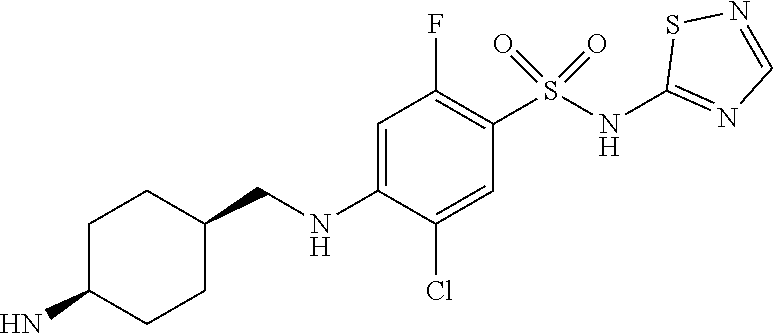
16 nM 20 
7 nM 21 
398 nM 22 
61 nM 23 
16 nM 24 
69 nM 25 
50 nM 26 
27 nM 27 
40 nM 28 
27 nM 29 
74 nM /30 
12 nM 31 
12 nM 32 
28 nM 33 
156 34 
380 35 
101 nM 36 
210 nM 37 
133 nM 38 
189 nM 39 
221 nM 40 
261 nM 41 
108 nM 42 
286 nM 43 
272 nM 44 
124 nM 45 
39 nM 46 
110 nM 47 
33 nM 48 
117 nM 49 
15 nM 50 
473 nM 51 
10 nM 52 
64 nM 53 
105 nM 54 
9 nM 55 
164 nM 56 
78 nM 57 
383 nM 58 
389 nM 59 
8 nM 60 
367 nM 61 
52 nM 62 
55 nM 63 
68 nM 64 
285 nM 65 
98 nM 66 
291 nM 67 
267 nM 68 
138 nM 69 
568 nM 70 
806 nM 71 
120 nM 72 
50 nM 73 
37 nM 74 
151 nM 75 
41 nM 
- The compounds of this invention inhibit NaV1.7. Accordingly, another aspect of the invention is a pharmaceutical composition comprising a therapeutically effective amount of a compound of Formula I, or a pharmaceutically acceptable salt thereof, and a pharmaceutically acceptable carrier.
- Another aspect of the invention is a method for treating pain in a patient comprising administering a therapeutically effective amount of a compound of Formula I, or a pharmaceutically acceptable salt thereof, with a pharmaceutically acceptable carrier.
- Another aspect of the invention is the use of a compound of formula I in the manufacture of a medicament for the treatment of pain.
- “Therapeutically effective” means the amount of agent required to provide a meaningful patient benefit as understood by practitioners in the field of pain.
- “Patient” means a person afflicted with pain and suitable for therapy as understood by practitioners in the field.
- “Treatment,” “therapy,” “regimen,” and related terms are used as understood by practitioners in the field.
- The compounds of this invention are generally given as pharmaceutical compositions comprised of a therapeutically effective amount of a compound of Formula I or its pharmaceutically acceptable salt and a pharmaceutically acceptable carrier and may contain conventional excipients. A therapeutically effective amount is that which is needed to provide a meaningful patient benefit. Pharmaceutically acceptable carriers are those conventionally known carriers having acceptable safety profiles. Compositions encompass all common solid and liquid forms including capsules, tablets, losenges, and powders as well as liquid suspensions, syrups, elixers, and solutions. Compositions are made using common formulation techniques, and conventional excipients (such as binding and wetting agents) and vehicles (such as water and alcohols) are generally used for compositions. See, for example, Remington's Pharmaceutical Sciences, 17th edition, Mack Publishing Company, Easton, Pa. (1985).
- Solid compositions are normally formulated in dosage units and compositions providing from about 1 to 1000 mg of the active ingredient per dose are preferred. Some examples of dosages are 1 mg, 10 mg, 100 mg, 250 mg, 500 mg, and 1000 mg. Generally, other antiretroviral agents will be present in a unit range similar to agents of that class used clinically. Typically, this is 0.25-1000 mg/unit.
- Liquid compositions are usually in dosage unit ranges. Generally, the liquid composition will be in a unit dosage range of 1-100 mg/mL. Some examples of dosages are 1 mg/mL, 10 mg/mL, 25 mg/mL, 50 mg/mL, and 100 mg/mL.
- The invention encompasses all conventional modes of administration; oral and parenteral methods are preferred. Generally, the dosing regimen will be similar to other agents used clinically. Typically, the daily dose will be 1-100 mg/kg body weight daily. Generally, more compound is required orally and less parenterally. The specific dosing regime, however, will be determined by a physician using sound medical judgement.
- The compounds of this invention can be made by various methods known in the art including those of the following schemes and in the specific embodiments section. The structure numbering and variable numbering shown in the synthetic schemes are distinct from, and should not be confused with, the structure or variable numbering in the claims or the rest of the specification. The variables in the schemes are meant only to illustrate how to make some of the compounds of this invention. The disclosure is not limited to the foregoing illustrative examples and the examples should be considered in all respects as illustrative and not restrictive, reference being made to the claims, rather than to the foregoing examples, and all changes which come within the meaning and range of equivalency of the claims are therefore intended to be embraced.
- The abbreviations used in the present application including the illustrative schemes and examples which follow are known to those skilled in the art. Some of the abbreviations used are as follows: THF for tetrahydrofuran; MeOH for methanol; DMF for N,N-dimethylformamide; DCM for dichloromethane; Me for methyl; Ph for phenyl; EtOH for ethanol; TEA or Et3N for triethylamine; Ac for acetyl; dppf for 1,1′-bis(diphenylphosphanyl) ferrocene; DMAP for N,N-dimethylaminopyridine; RT or rt or r.t. for room temperature or retention time (context will dictate); tR for retention time; NBS for N-bromosuccinimide; min for minutes; h for hours; MeCN or ACN for acetonitrile; EtOAc for ethyl acetate; DEAD for diethyl azodicarboxylate; DIAD for diisopropyl azodicarboxylate; DMSO for dimethylsulfoxide; LCMS or LC/MS for liquid chromatography-mass spectrometry, NMR for nuclear magnetic resonance, TLC for thin layer chromatography, UV for ultraviolet; Rt for retention time.
- The analytical LC/MS methods used to provide retention time are:
- Method A: Column: Waters Acquity UPLC BEH C18, 2.1×50 mm, 1.7-μm particles; Mobile Phase A: 5:95 acetonitrile:water with 10 mM ammonium acetate; Mobile Phase B: 95:5 acetonitrile:water with 10 mM ammonium acetate; Temperature: 50° C.; Gradient: 0-100% B over 3 minutes, then a 0.75-minute hold at 100% B; Flow: 1.0 mL/min; Detection: UV at 220 nm.
Method B: Column: Waters Acquity UPLC BEH C18, 2.1×50 mm, 1.7-μm particles; Mobile Phase A: 5:95 acetonitrile:water with 0.1% trifluoroacetic acid; Mobile Phase B: 95:5 acetonitrile:water with 0.1% trifluoroacetic acid; Temperature: 50° C.; Gradient: 0-100% B over 3 minutes, then a 0.75-minute hold at 100% B; Flow: 1.0 mL/min; Detection: UV at 220 nm.
Method C: Column: Waters Acquity UPLC BEH C18, 2.1×50 mm, 1.7-μm particles; Mobile Phase A: 5:95 methanol:water with 10 mM ammonium acetate; Mobile Phase B: 95:5 methanol:water with 10 mM ammonium acetate; Temperature: 50° C.; Gradient: 0-100% B over 3 minutes, then a 0.75-minute hold at 100% B; Flow: 1.0 mL/min; Detection: UV at 220 nm. - Scheme I describes a general synthesis of compounds of formula 1. Treatment of 4-fluoro-benzenesulfonamides 2 with an amine of formula B-A(NH2) or an alcohol of formula B-A(OH) in the presence of a base such as lithium bis(trimethylsilyl)amide or potassium carbonate in an appropriate solvent such as DMF or THF can afford 4-substituted benzenesulfonamides 2. Compounds of formula 2 can be converted to compounds of formula 1 by treatment with an acid such as trifluoroacetic acid in an appropriate solvent such as dichloromethane.
-

- Scheme II describes an alternative synthesis of compounds of formula 1. Treatment of 4-fluoro-benzenesulfonamides 3 with an alcohol of formula B-A(OH) under Mitsunobo reaction conditions can afford 4-alkoxy substituted benzenesulfonamides 3. Typical Mitsunobo conditions include triphenyl phosphine and an azodicarboxylate such as diethyl azodicarboxylate (DEAD) or diisopropyl azodicarboxylate (DIAD) in an appropriate solvent such as THF. Compounds of formula 2 can be converted to compounds of formula 1 by treatment with an acid such as trifluoroacetic acid in an appropriate solvent such as dichloromethane.
-

-

- To a mixture of tert-butyl 4-(2-aminoethyl)piperidine-1-carboxylate (52.9 mg, 0.232 mmol) and 5-chloro-N-(2,4-dimethoxybenzyl)-2,4-difluoro-N-(thiazol-2-yl)benzenesulfonamide (106.7 mg, 0.232 mmol) (Sun et. al., Bioorg. Med. Che. Lett., 2014, 24, 4397-4401) in DMF (2315 μl) was added cesium carbonate (151 mg, 0.463 mmol). The resulting mixture was stirred at rt for 1 h. The mixture was then diluted with EtOAc, washed with water (3×), brine, dried over MgSO4, filtered and concentrated in vacuo to give tert-butyl 4-(2-((2-chloro-4-(N-(2,4-dimethoxybenzyl)-N-(thiazol-2-yl)sulfamoyl)-5-fluorophenyl)amino)ethyl)piperidine-1-carboxylate as a crude which was used in the next step without further purification. The crude product was dissolved in DCM (2 mL), and TFA (400 μl, 5.19 mmol) was added. The resulting mixture was stirred at rt for 15 min. The mixture was then concentrated in vacuo. The crude material was purified via preparative LC/MS with the following conditions: Column: XBridge C18, 19×200 mm, 5-μm particles; Mobile Phase A: 5:95 acetonitrile:water with 10-mM ammonium acetate; Mobile Phase B: 95:5 acetonitrile:water with 10-mM ammonium acetate; Gradient: 5-45% B over 20 minutes, then a 5-minute hold at 100% B; Flow: 20 mL/min. Fractions containing the desired product were combined and dried via centrifugal evaporation. The yield of the product was 17.8 mg. 1H NMR (500 MHz, DMSO-d6) δ 7.55 (d, J=7.3 Hz, 1H), 7.00 (br d, J=3.8 Hz, 1H), 6.57-6.44 (m, 2H), 5.97 (br t, J=5.1 Hz, 1H), 3.24 (br d, J=12.7 Hz, 2H), 3.21-3.14 (m, 2H), 2.83 (td, J=12.6, 2.5 Hz, 2H), 1.85 (br d, J=12.4 Hz, 2H), 1.70-1.54 (m, 1H), 1.49 (q, J=6.9 Hz, 2H), 1.38-1.19 (m, 2H). MS: 418.9 (M+H)+.
- The following compounds were made in a manner analogous to Example 1.
-

- 1H NMR (500 MHz, DMSO-d6) δ 7.56 (d, J=7.3 Hz, 1H), 6.99 (d, J=4.0 Hz, 1H), 6.53 (s, 1H), 6.52-6.49 (m, 1H), 6.07-5.94 (m, 1H), 3.28-3.15 (m, 3H), 2.81-2.64 (m, 1H), 2.57 (s, 1H), 2.55 (s, 2H), 1.86 (br d, J=12.8 Hz, 1H), 1.81-1.70 (m, 2H), 1.63-1.41 (m, 3H), 1.15 (br d, J=9.5 Hz, 1H). MS: 418.9 (M+H)+.
-

- 1H NMR (500 MHz, DMSO-d6) δ 7.85 (s, 1H), 7.54 (d, J=7.0 Hz, 1H), 6.58 (d, J=12.8 Hz, 1H), 6.25 (s, 1H), 3.33-3.17 (m, 1H), 3.03 (br. s., 1H), 2.92-2.79 (m, 1H), 1.97 (d, J=11.7 Hz, 1H), 1.87-1.63 (m, 4H), 1.52 (d, J=13.2 Hz, 1H), 1.43 (d, J=12.5 Hz, 1H), 1.36-1.28 (m, 1H). MS: 420.05 (M+H)+.
-

- 1H NMR (500 MHz, DMSO-d6) δ 7.56 (d, J=7.3 Hz, 1H), 6.98 (d, J=4.0 Hz, 1H), 6.55-6.48 (m, 2H), 6.21 (br t, J=5.1 Hz, 1H), 3.25 (br dd, J=5.9, 3.0 Hz, 3H), 3.09-2.93 (m, 1H), 2.81 (td, J=12.5, 2.8 Hz, 1H), 1.95-1.88 (m, 1H), 1.85-1.77 (m, 1H), 1.77-1.61 (m, 3H), 1.56-1.25 (m, 3H). MS: 419.1 (M+H)+.
-

- 1H NMR (500 MHz, DMSO-d6) δ 7.56 (d, J=7.3 Hz, 1H), 7.10 (d, J=4.0 Hz, 1H), 6.65 (d, J=4.0 Hz, 1H), 6.53 (d, J=12.8 Hz, 1H), 6.10 (br s, 1H), 3.18 (q, J=6.4 Hz, 2H), 3.14-2.99 (m, 2H), 2.47 (s, 3H), 2.43 (br s, 2H), 1.79 (br d, J=13.2 Hz, 2H), 1.51-1.38 (m, 3H), 1.38-1.19 (m, 2H). MS: 433.0 (M+H)+.
-

- 1H NMR (500 MHz, DMSO-d6) δ 7.57 (d, J=7.3 Hz, 1H), 7.10 (d, J=4.0 Hz, 1H), 6.68-6.60 (m, 2H), 6.19-6.04 (m, 1H), 3.84 (d, J=8.4 Hz, 1H), 3.66 (br. s., 1H), 3.32-3.16 (m, 1H), 2.99 (d, J=11.4 Hz, 1H), 2.92-2.74 (m, 2H), 2.58 (d, J=12.1 Hz, 2H). MS: 407.0 (M+H)+.
-

- 1H NMR (500 MHz, DMSO-d6) δ 7.60 (d, J=7.0 Hz, 1H), 7.22 (d, J=4.3 Hz, 1H), 6.81 (d, J=4.6 Hz, 1H), 6.71 (d, J=13.1 Hz, 1H), 6.08 (br. s., 1H), 3.79-3.41 (m, 6H), 3.34-3.22 (m, 4H). MS: 407.9 (M+H)+.
-

- 1H NMR (500 MHz, DMSO-d6) δ 7.58 (d, J=7.3 Hz, 1H), 7.25 (d, J=4.4 Hz, 1H), 6.92 (d, J=13.6 Hz, 1H), 6.81 (d, J=4.8 Hz, 1H), 6.79 (br. s., 1H), 3.63 (t, J=4.6 Hz, 4H), 3.16 (d, J=5.5 Hz, 2H), 2.41 (br. s., 4H), 2.24 (s, 3H), 0.63-0.51 (m, 3H), 0.42-0.26 (m, 3H). MS: 461.1 (M+H)+.
-

- 1H NMR (500 MHz, DMSO-d6) δ 7.57 (d, J=7.0 Hz, 1H), 7.25 (d, J=4.8 Hz, 1H), 6.82 (d, J=4.8 Hz, 1H), 6.66 (d, J=12.8 Hz, 1H), 6.40 (br s, 1H), 3.77-3.67 (m, 2H), 3.18-3.02 (m, 3H), 1.84 (br s, 1H), 1.82-1.75 (m, 1H), 1.62-1.51 (m, 1H), 1.48-1.35 (m, 1H), 1.23 (br d, J=9.9 Hz, 1H). MS: 406.0 (M+H)+.
-

- 1H NMR (500 MHz, DMSO-d6) δ 7.57 (d, J=7.3 Hz, 1H), 7.24 (d, J=4.4 Hz, 1H), 6.82 (d, J=4.4 Hz, 1H), 6.69 (d, J=12.8 Hz, 1H), 6.14 (t, J=6.1 Hz, 1H), 3.87 (br d, J=11.4 Hz, 1H), 3.49-3.30 (m, 1H), 3.27-3.14 (m, 2H), 1.76 (br s, 1H), 1.59 (br d, J=11.7 Hz, 1H), 1.50-1.39 (m, 3H), 1.26-1.16 (m, 1H). MS: 406.0 (M+H)+.
-

- 1H NMR (500 MHz, DMSO-d6) δ 7.57 (d, J=7.3 Hz, 1H), 7.26 (d, J=4.8 Hz, 1H), 6.82 (d, J=4.8 Hz, 1H), 6.68 (d, J=12.8 Hz, 1H), 6.42 (br s, 1H), 3.83 (br dd, J=11.2, 3.1 Hz, 3H), 3.36-3.21 (m, 1H), 3.09 (t, J=6.6 Hz, 2H), 1.87-1.79 (m, 1H), 1.58 (br d, J=11.4 Hz, 2H), 1.23-1.14 (m, 2H). MS: 406.0 (M+H)+.
-

- 1H NMR (400 MHz, DMSO-d6) δ 7.57 (d, J=7.3 Hz, 1H), 7.28 (br. s., 1H), 7.23 (d, J=4.5 Hz, 1H), 6.79 (d, J=4.5 Hz, 1H), 6.70 (d, J=13.1 Hz, 1H), 3.14 (d, J=5.0 Hz, 2H), 2.59 (m, 6H), 1.75 (br. s., 4H), 0.58-0.48 (m, 2H), 0.44-0.36 (m, 2H). MS: 445.0 (M+H)+.
-

- 1H NMR (500 MHz, DMSO-d6) δ 7.56 (d, J=7.3 Hz, 1H), 6.99 (d, J=4.0 Hz, 1H), 6.59-6.48 (m, 2H), 6.07 (br. s., 1H), 3.26-3.15 (m, 2H), 3.12-3.01 (m, 1H), 2.70 (dd, J=11.4, 9.2 Hz, 1H), 2.26-2.08 (m, 2H), 1.72-1.41 (m, 3H). MS: 405.0 (M+H)+.
-
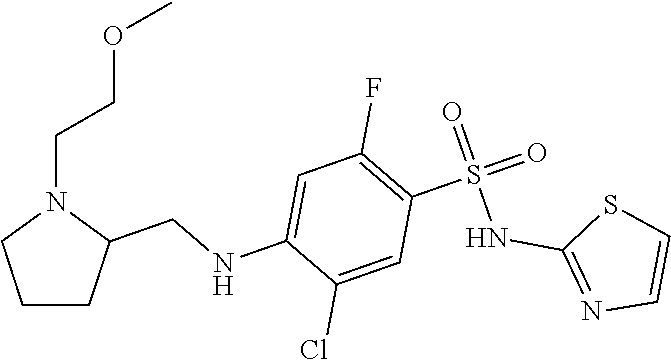
- 1H NMR (400 MHz, DMSO-d6) δ 7.63 (d, J=7.3 Hz, 1H), 7.26 (d, J=4.8 Hz, 1H), 6.87-6.78 (m, 2H), 6.54 (br. s., 1H), 3.86-3.68 (m, 1H), 3.64-3.54 (m, 4H), 3.52-3.43 (m, 3H), 3.24 (s, 3H), 3.19-3.11 (m, 1H), 2.19-2.07 (m, 1H), 2.04-1.82 (m, 2H), 1.79-1.69 (m, 1H). MS: 449.0 (M+H)+.
-

- 1H NMR (400 MHz, DMSO-d6) δ 7.55 (d, J=7.3 Hz, 1H), 6.94 (d, J=4.0 Hz, 1H), 6.58 (d, J=12.8 Hz, 1H), 6.46 (d, J=3.8 Hz, 1H), 6.31-6.19 (m, 1H), 3.99-3.85 (m, 2H), 3.73-3.61 (m, 2H), 3.44-3.20 (m, 4H), 3.08-2.97 (m, 1H). MS: 377.0 (M+H)+.
-

- 1H NMR (500 MHz, DMSO-d6) δ 7.59 (d, J=7.3 Hz, 1H), 7.26 (d, J=4.4 Hz, 1H), 6.83 (d, J=4.4 Hz, 1H), 6.69 (d, J=13.2 Hz, 1H), 6.43 (t, J=5.9 Hz, 1H), 4.11-3.84 (m, 2H), 3.75-3.53 (m, 2H), 3.18 (q, J=6.6 Hz, 2H), 2.83 (dt, J=15.7, 8.1 Hz, 1H), 1.83 (q, J=6.7 Hz, 2H).
-

- 1H NMR (500 MHz, DMSO-d6) δ 7.55 (d, J=7.3 Hz, 1H), 6.97 (d, J=3.7 Hz, 1H), 6.50 (s, 1H), 6.48-6.43 (m, 1H), 5.98 (br s, 1H), 3.20-3.11 (m, 2H), 1.71-1.37 (m, 13H). MS: 433.0 (M+H)+.
-

- 1H NMR (500 MHz, DMSO-d6) δ 7.54 (d, J=7.0 Hz, 1H), 6.96 (d, J=3.7 Hz, 1H), 6.49 (d, J=3.5 Hz, 1H), 6.48-6.41 (m, 1H), 5.89 (br s, 1H), 3.18-3.12 (m, 2H), 2.95-2.88 (m, 1H), 1.93-1.87 (m, 3H), 1.86-1.76 (m, 2H), 1.42 (q, J=6.8 Hz, 2H), 1.31-1.20 (m, 3H), 0.97 (q, J=11.4 Hz, 2H). MS: 433.0 (M+H)+.
-

- 1H NMR (500 MHz, DMSO-d6) δ 7.88 (s, 1H), 7.71 (br s, 2H), 7.52 (d, J=7.3 Hz, 1H), 6.51 (d, J=12.8 Hz, 1H), 6.20 (br t, J=5.5 Hz, 1H), 3.20 (br s, 1H), 3.09 (t, J=6.6 Hz, 2H), 1.76 (br s, 1H), 1.63 (q, J=5.9 Hz, 4H), 1.55-1.41 (m, 4H). MS: 420.0 (M+H)+.
-

- 1H NMR (500 MHz, DMSO-d6) δ 7.54 (d, J=7.3 Hz, 1H), 6.94 (d, J=3.8 Hz, 1H), 6.50-6.41 (m, 2H), 6.03 (br t, J=5.3 Hz, 1H), 3.17-3.12 (m, 1H), 3.11-3.02 (m, 2H), 1.75 (br d, J=6.0 Hz, 1H), 1.65-1.56 (m, 4H), 1.56-1.39 (m, 4H). MS: 419.1 (M+H)+.
-

- 1H NMR (500 MHz, DMSO-d6) δ 7.54 (d, J=7.3 Hz, 1H), 6.97 (d, J=3.7 Hz, 1H), 6.60-6.44 (m, 2H), 6.03 (br. s., 1H), 3.18 (s, 1H), 3.01 (t, J=6.4 Hz, 2H), 2.92 (t, J=11.9 Hz, 1H), 1.98-1.88 (m, 2H), 1.78 (d, J=12.5 Hz, 2H), 1.53 (br. s., 1H), 1.31-1.17 (m, 2H), 1.10-0.83 (m, 2H). MS: 419.1 (M+H)+.
-

- Step A: 4-((1,4-dioxaspiro[4.5]decan-8-ylmethyl)amino)-5-chloro-N-(2,4-dimethoxybenzyl)-2-fluoro-N-(thiazol-2-yl)benzenesulfonamide:A suspension of 1,4-dioxaspiro[4.5]decan-8-ylmethanamine (0.43 g, 2.51 mmol), 5-chloro-N-(2,4-dimethoxybenzyl)-2,4-difluoro-N-(thiazol-2-yl)benzenesulfonamide (1.157 g, 2.51 mmol) and cesium carbonate (0.859 g, 2.64 mmol) in DMF (25.1 ml) was stirred at rt for 12 h. Water was added and the aqueous layer was extracted with ethyl acetate (×3). The combined organic layers were washed with brine, dried over anhydrous sodium sulfate, and filtered, and the filtrate was evaporated in vacuo to give the crude product. The crude product was purified by SGC eluting with 0-40% EtOAc/Hexanes to give 4-((1,4-dioxaspiro[4.5]decan-8-ylmethyl)amino)-5-chloro-N-(2,4-dimethoxybenzyl)-2-fluoro-N-(thiazol-2-yl)benzenesulfonamide (1.18 g, 1.928 mmol, 77% yield) as a white solid. 1H NMR (400 MHz, CHLOROFORM-d) δ 7.74 (d, J=7.1 Hz, 1H), 7.40 (d, J=3.4 Hz, 1H), 7.23 (d, J=8.8 Hz, 1H), 6.97 (d, J=3.4 Hz, 1H), 6.43-6.37 (m, 2H), 6.30 (d, J=12.2 Hz, 1H), 5.21 (s, 2H), 5.05-4.95 (m, 1H), 3.97 (t, J=2.7 Hz, 4H), 3.77 (d, J=1.7 Hz, 6H), 3.08 (t, J=6.2 Hz, 2H), 1.82 (d, J=10.3 Hz, 4H), 1.73-1.49 (m, 4H), 1.45-1.31 (m, 2H). Step B: 5-chloro-2-fluoro-4-(((4-oxocyclohexyl)methyl)amino)-N-(thiazol-2-yl)benzenesulfonamide: A solution of 4-((1,4-dioxaspiro[4.5]decan-8-ylmethyl)amino)-5-chloro-N-(2,4-dimethoxybenzyl)-2-fluoro-N-(thiazol-2-yl)benzenesulfonamide (1.18 g, 1.928 mmol) and HCl (7.71 ml, 7.71 mmol) in acetone (24.10 ml) was heated under reflux for 2 h. Acetone was removed in vacuo, water was added and the aqueous layer was extracted with ethyl acetate (×3). The combined organic layers were washed with brine, dried over anhydrous sodium sulfate, and filtered, and the filtrate was evaporated in vacuo to give 5-chloro-2-fluoro-4-(((4-oxocyclohexyl)methyl)amino)-N-(thiazol-2-yl)benzenesulfonamide (0.88 g) as a white solid. This crude material was used directly for the next step. Step C: 5-chloro-4-(((4-(cyclopropylamino)cyclohexyl)methyl)amino)-2-fluoro-N-(thiazol-2-yl)benzenesulfonamide (single isomer): A mixture of 5-chloro-2-fluoro-4-(((4-oxocyclohexyl)methyl)amino)-N-(thiazol-2-yl)benzenesulfonamide (50 mg, 0.120 mmol), cyclopropanamine (83 μl, 1.196 mmol), sodium cyanoborohydride (30.1 mg, 0.479 mmol) and zinc chloride (1.631 mg, 0.012 mmol) in ethanol (798 μl) was stirred at rt for 12 h. Ethanol was removed in vacuo, and the residue was purified via preparative LC/MS with the following conditions: Column: XBridge C18, 19×200 mm, 5-μm particles; Mobile Phase A: 5:95 methanol:water with 10-mM ammonium acetate; Mobile Phase B: 95:5 methanol:water with 10-mM ammonium acetate; Gradient: 20-60% B over 27 minutes, then a 5-minute hold at 100% B; Flow: 20 mL/min. Fractions containing the desired product were combined and dried via centrifugal evaporation. This process gave 5-chloro-4-(((4-(cyclopropylamino)cyclohexyl)methyl)amino)-2-fluoro-N-(thiazol-2-yl)benzenesulfonamide (single isomer) (4 mg). Rt: 2.35 min (method C). MS: 459.1 (M+H)+.
- The following compounds were made in a manner analogous to Example 22.
-

- Rt: 1.11 min (method A); 1.25 min (method B). MS: 433.1 (M+H)+.
-

- Rt: 1.11 min (method A); 1.23 min (method B). MS: 447.1 (M+H)+.
-

- Rt: 2.03 min (method C). MS: 459.2 (M+H)+.
-

- Rt: 1.13 min (method B). MS: 489.2 (M+H)+.
-

- 1H NMR (500 MHz, DMSO-d6) δ 7.55 (d, J=7.3 Hz, 1H), 7.14 (d, J=4.4 Hz, 1H), 6.69 (d, J=4.4 Hz, 1H), 6.56 (d, J=12.8 Hz, 1H), 6.21 (br. s., 1H), 3.02 (t, J=6.6 Hz, 2H), 2.3-2.7 (m, 9H), 2.23 (s, 3H), 1.78-1.72 (m, 1H), 1.80 (t, J=11.0 Hz, 4H), 1.50 (br. s., 1H), 1.25-1.14 (m, 2H), 1.01-0.87 (m, 2H) MS: 502.2.2 (M+H)+.
- The following compounds were made in a manner analogous to Example 1.
-

- 1H NMR (500 MHz, DMSO-d6) δ 7.66-7.54 (m, 1H), 7.34-7.18 (m, 1H), 6.89-6.64 (m, 2H), 6.04 (d, J=7.7 Hz, 1H), 3.60-3.32 (m, 1H), 3.16 (d, J=13.6 Hz, 1H), 2.13 (d, J=11.0 Hz, 1H), 1.98-1.49 (m, 4H), 1.45-1.10 (m, 3H).
-

- 1H NMR (500 MHz, DMSO-d6) δ 7.57 (d, J=7.3 Hz, 1H), 6.98 (d, J=4.0 Hz, 1H), 6.64-6.45 (m, 2H), 6.16 (br. s., 1H), 3.23 (br. s., 1H), 1.87-1.76 (m, 2H), 1.73-1.61 (m, 2H), 1.60-1.38 (m, 8H), 1.32 (br. s., 1H).
-

- 1H NMR (400 MHz, DMSO-d6) δ 7.78 (d, J=18.1 Hz, 2H), 7.65-7.55 (m, 1H), 7.26 (d, J=4.5 Hz, 1H), 6.83 (d, J=4.5 Hz, 1H), 3.59-3.31 (m, 2H), 3.25-3.15 (m, 1H), 2.93-2.63 (m, 1H), 2.39-1.84 (m, 2H), 1.82-1.54 (m, 1H), 1.36-0.81 (m, 9H). This is a mixture of diastereomers. MS: 447.0 (M+H)+.
-

- 1H NMR (500 MHz, DMSO-d6) δ 7.57 (d, J=7.3 Hz, 1H), 6.99 (d, J=4.0 Hz, 1H), 6.57 (d, J=12.5 Hz, 1H), 6.52 (d, J=4.0 Hz, 1H), 6.11 (br. s., 1H), 3.64-3.46 (m, 1H), 3.19 (t, J=6.6 Hz, 2H), 2.41-2.23 (m, 1H), 2.04-1.85 (m, 1H), 1.82-1.67 (m, 2H), 1.66-1.41 (m, 3H). MS: 405.0 (M+H)+.
-

- 1H NMR (500 MHz, DMSO-d6) δ 7.55 (d, J=7.3 Hz, 1H), 7.01 (d, J=3.7 Hz, 1H), 6.54 (d, J=4.0 Hz, 1H), 6.48 (d, J=12.8 Hz, 1H), 6.01 (br. s., 1H), 3.12-2.92 (m, 2H), 2.71-2.60 (m, 2H), 1.79 (d, J=12.5 Hz, 1H), 1.73 (d, J=9.5 Hz, 3H), 1.67-1.47 (m, 2H), 1.21 (d, J=12.1 Hz, 1H), 0.92-0.77 (m, 2H), 0.61 (q, J=12.0 Hz, 1H). MS: 433.0 (M+H)+.
-

- 1H NMR (500 MHz, DMSO-d6) δ 7.56 (d, J=7.3 Hz, 1H), 7.23 (d, J=4.8 Hz, 1H), 6.79 (d, J=4.4 Hz, 1H), 6.60 (d, J=12.8 Hz, 1H), 6.31 (br s, 1H), 3.74 (br s, 1H), 3.06 (t, J=6.4 Hz, 2H), 1.65-1.53 (m, 3H), 1.43-1.34 (m, 7H). MS: 420.0 (M+H)+.
-

- 1H NMR (500 MHz, DMSO-d6) δ 7.56 (d, J=7.3 Hz, 1H), 7.24 (d, J=4.8 Hz, 1H), 6.81 (d, J=4.8 Hz, 1H), 6.61 (d, J=13.2 Hz, 1H), 6.33 (s, 1H), 3.40 (br s, 2H), 3.02 (t, J=6.4 Hz, 2H), 1.81 (br d, J=11.0 Hz, 2H), 1.69 (br d, J=12.8 Hz, 2H), 1.50 (br s, 1H), 1.13-1.04 (m, 2H), 0.98-0.88 (m, 2H). MS: 420.0 (M+H)+.
-

- 1H NMR (500 MHz, DMSO-d6) δ 7.58 (d, J=7.3 Hz, 1H), 7.26 (d, J=4.8 Hz, 1H), 6.82 (d, J=4.8 Hz, 1H), 6.60-6.52 (m, 2H), 1.77 (t, J=7.0 Hz, 3H), 1.73-1.67 (m, 2H), 1.66-1.56 (m, 3H), 1.56-1.44 (m, 5H). MS: 420.0 (M+H)+.
-

- 1H NMR (500 MHz, DMSO-d6) δ 7.59 (d, J=7.3 Hz, 1H), 7.25 (d, J=4.8 Hz, 1H), 6.82 (d, J=4.8 Hz, 1H), 6.71 (d, J=13.2 Hz, 1H), 5.59 (br d, J=7.3 Hz, 1H), 3.75 (br s, 1H), 1.77-1.67 (m, 2H), 1.64-1.52 (m, 7H). MS: 406.0 (M+H)+.
-

- 1H NMR (500 MHz, DMSO-d6) δ 7.57 (d, J=7.3 Hz, 1H), 7.25 (d, J=4.8 Hz, 1H), 6.82 (d, J=4.4 Hz, 1H), 6.63 (d, J=13.2 Hz, 1H), 6.37-6.32 (m, 1H), 3.77 (t, J=7.7 Hz, 1H), 3.70 (td, J=8.3, 4.8 Hz, 1H), 3.60 (q, J=7.7 Hz, 1H), 3.22-3.15 (m, 2H), 2.13 (dt, J=14.8, 7.5 Hz, 1H), 2.00-1.93 (m, 1H), 1.60-1.48 (m, 2H), 1.45-1.32 (m, 3H). MS: 420.0 (M+H)+.
-

- 1H NMR (500 MHz, DMSO-d6) δ 7.58 (d, J=7.3 Hz, 1H), 7.26 (d, J=4.4 Hz, 1H), 6.83 (d, J=4.8 Hz, 1H), 6.71 (d, J=13.2 Hz, 1H), 6.50 (br s, 1H), 3.76 (td, J=8.0, 5.7 Hz, 1H), 3.70-3.64 (m, 1H), 3.64-3.57 (m, 1H), 3.46 (dd, J=8.6, 5.0 Hz, 1H), 3.17 (br t, J=7.2 Hz, 2H), 2.58-2.53 (m, 1H), 2.58-2.53 (m, 1H), 2.58-2.53 (m, 1H), 1.94 (br dd, J=12.3, 5.7 Hz, 1H), 1.59 (dd, J=12.7, 5.3 Hz, 1H). MS: 392.0 (M+H)+.
-

- 1H NMR (500 MHz, DMSO-d6) δ 7.58 (d, J=7.3 Hz, 1H), 7.26 (d, J=4.8 Hz, 1H), 6.82 (d, J=4.8 Hz, 1H), 6.61 (d, J=13.2 Hz, 1H), 6.41 (t, J=5.7 Hz, 1H), 3.84-3.76 (m, 2H), 3.64-3.59 (m, 1H), 3.25 (quin, J=6.2 Hz, 1H), 2.00-1.94 (m, 1H), 1.86-1.65 (m, 5H), 1.47-1.40 (m, 1H). MS: 406.0 (M+H)+.
-

- 1H NMR (500 MHz, DMSO-d6) δ 7.58 (d, J=7.3 Hz, 1H), 7.26 (d, J=4.8 Hz, 1H), 6.83 (d, J=4.8 Hz, 1H), 6.74 (d, J=13.2 Hz, 1H), 6.19 (t, J=5.5 Hz, 1H), 4.08-3.98 (m, 1H), 3.81-3.72 (m, 1H), 3.67-3.56 (m, 1H), 3.29-3.13 (m, 1H), 2.5 (1H, m), 2.01-1.74 (m, 3H), 1.67-1.53 (m, 1H) MS: 391.95 (M+H)+.
-

- Step A: methyl 4-(benzyloxy)-2-(2-(benzyloxy)ethyl)-2-cyanobutanoate. To a solution of methyl 2-cyanoacetate (0.885 ml, 10.09 mmol) in DMF (20.18 ml) at rt was added sodium hydride (0.969 g, 24.22 mmol), and the reaction mixture was stirred at rt for 15 min. tetrabutylammonium iodide (0.373 g, 1.009 mmol) and ((2-bromoethoxy)methyl)benzene (3.35 ml, 21.19 mmol) were added, and the reaction mixture was stirred at 90° C. for 3 h. Water was added and the aqueous layer was extracted with ether (×3). The combined organic layers were washed with brine, dried over anhydrous sodium sulfate, and filtered, and the filtrate was evaporated in vacuo to give the crude product. The crude product was purified by silica gel chromatography eluting with 0-30% ethyl acetate/hexanes to give methyl 4-(benzyloxy)-2-(2-(benzyloxy)ethyl)-2-cyanobutanoate (2.4 g, 6.53 mmol, 64.7% yield) as a colorless oil. 1H NMR (500 MHz, CHLOROFORM-d) δ 7.41-7.27 (m, 10H), 4.49 (s, 4H), 3.78-3.69 (m, 5H), 3.45 (s, 3H), 2.49-2.40 (m, 2H), 2.06 (dt, J=14.2, 4.7 Hz, 2H). Step B: 2-(aminomethyl)-4-(benzyloxy)-2-(2-(benzyloxy)ethyl)butan-1-ol: To a solution of methyl 4-(benzyloxy)-2-(2-(benzyloxy)ethyl)-2-cyanobutanoate (400 mg, 1.09 mmol) THF (5 mL) and ether (5 mL) at rt was added lithium aluminum hydride (83 mg, 2.177 mmol), and the reaction mixture was heated under reflux for 4 h. Sodium sulfate decahydrate was added, and the reaction mixture was stirred at rt for 1 h. The mixture was filtered, and the filtrate was evaporated in vacuo to give 2-(aminomethyl)-4-(benzyloxy)-2-(2-(benzyloxy)ethyl)butan-1-ol (349 mg, 93%). This material was used directly for the next reaction. Step C: tert-butyl (4-(benzyloxy)-2-(2-(benzyloxy)ethyl)-2-(hydroxymethyl)butyl)carbamate: To a solution of 2-(aminomethyl)-4-(benzyloxy)-2-(2-(benzyloxy)ethyl)butan-1-ol (830 mg, 0.41 mmol) DCM (5 mL) at rt was added BOC-anhydride (0.617 mL, 2.66 mmol), and the reaction mixture was stirerd at rt for 5 h. DCM was removed in vacuo, and the residue was purified by silica gel chromatography eluting with 0-30% EtOAc/Hexanes to give tert-butyl (4-(benzyloxy)-2-(2-(benzyloxy)ethyl)-2-(hydroxymethyl)butyl)carbamate (0.71 g, 66%). 1H NMR (400 MHz, CHLOROFORM-d) δ 7.43-7.20 (m, 10H), 4.48 (s, 4H), 3.66-3.52 (m, 4H), 3.31 (d, J=7.3 Hz, 2H), 3.09 (d, J=6.6 Hz, 2H), 1.73-1.52 (m, 4H), 1.49-1.38 (m, 9H). Step D: tert-butyl (4-(benzyloxy)-2-(2-(benzyloxy)ethyl)-2-formylbutyl)carbamate: A solution of oxalyl dichloride (209 μl, 2.401 mmol) in DCM (5335 μl) was cooled to −78° C. and a solution of DMSO (318 μl, 4.48 mmol) in CH2Cl2 (5335 μl) was added dropwise. The mixture was stirred for 10 min, and a solution of tert-butyl (4-(benzyloxy)-2-(2-(benzyloxy)ethyl)-2-(hydroxymethyl)butyl)carbamate (710 mg, 1.601 mmol) in DCM (5335 μl) was added dropwise. The mixture was stirred for 15 min and then triethylamine (1562 μl, 11.20 mmol) was added. The mixture was stirred for 15 min and allowed to warm to room temperature. The crude product was purified by silica gel chromatography eluting with 0-10% EtOAc/Hexanes to give tert-butyl (4-(benzyloxy)-2-(2-(benzyloxy)ethyl)-2-formylbutyl)carbamate (0.58 g, 1.314 mmol, 82% yield) as a colorless oil. 1H NMR (500 MHz, CHLOROFORM-d) δ 9.54 (s, 1H), 7.41-7.25 (m, 12H), 4.45 (s, 4H), 3.60-3.46 (m, 4H), 1.99-1.80 (m, 4H), 1.49-1.39 (m, 9H). Step E: tert-butyl ((hexahydrofuro[2,3-b]furan-3a-yl)methyl)carbamate: A suspension of tert-butyl (4-(benzyloxy)-2-(2-(benzyloxy)ethyl)-2-formylbutyl)carbamate (27 mg, 0.061 mmol) and palladium hydroxide on carbon (17.17 mg, 0.122 mmol) in methanol (3057 μl) was hydrogenated with a hydrogen baloon for 1 h. The reaction mixture was filtered through a pad of Celite and the filtrate was evaporated in vacuo to give tert-butyl ((hexahydrofuro[2,3-b]furan-3a-yl)methyl)carbamate (15 mg, 0.062 mmol, 101% yield) as a colorless oil. 1H NMR (500 MHz, CHLOROFORM-d) δ 5.34 (s, 1H), 4.06-3.94 (m, 1H), 3.41-3.29 (m, 1H), 2.01 (dt, J=12.6, 8.6 Hz, 1H), 1.88 (ddd, J=12.7, 6.0, 4.0 Hz, 1H), 1.49 (s, 9H). Step F: of (hexahydrofuro[2,3-b]furan-3a-yl)methanamine: To a solution of tert-butyl ((hexahydrofuro[2,3-b]furan-3a-yl)methyl)carbamate (15 mg, 0.062 mmol) in DCM (1233 μl) at rt was added TFA (95 μl, 1.233 mmol), and the reaction mixture was stirred at rt for 3 h. The solvents were removed to give (hexahydrofuro[2,3-b]furan-3a-yl)methanamine (10 mg, 0.070 mmol, 113% yield) as yellowish oil. 1H NMR (500 MHz, METHANOL-d4) δ 5.40 (s, 1H), 4.08-4.00 (m, 4H), 3.20 (s, 2H), 2.13-1.99 (m, 4H). Step G: 5-chloro-N-(2,4-dimethoxybenzyl)-2-fluoro-4-(((hexahydrofuro[2,3-b]furan-3a-yl)methyl)amino)-N-(thiazol-2-yl)benzenesulfonamide: A mixture of (hexahydrofuro[2,3-b]furan-3a-yl)methanamine (9 mg, 0.063 mmol), 5-chloro-N-(2,4-dimethoxybenzyl)-2,4-difluoro-N-(thiazol-2-yl)benzenesulfonamide (31.9 mg, 0.069 mmol) and cesium carbonate (45.1 mg, 0.138 mmol) in DMF (629 μl) was stirred at 65° C. for 12 h. The reaction mixture was filtered, and the crude product was purified by preparative TLC on silica gel eluting with 80% ethyl acetate/hexanes to give 5-chloro-N-(2,4-dimethoxybenzyl)-2-fluoro-4-(((hexahydrofuro[2,3-b]furan-3a-yl)methyl)amino)-N-(thiazol-2-yl)benzenesulfonamide (20 mg, 0.034 mmol, 54.5% yield) as a white foam. 1H NMR (500 MHz, CHLOROFORM-d) δ 7.77 (d, J=6.9 Hz, 1H), 7.40 (d, J=3.5 Hz, 1H), 7.23 (d, J=8.2 Hz, 1H), 6.98 (d, J=3.5 Hz, 1H), 6.43-6.30 (m, 3H), 5.47 (s, 1H), 5.21 (s, 2H), 5.05-4.95 (m, 1H), 4.09 (dd, J=8.8, 5.0 Hz, 4H), 3.82-3.70 (m, 7H), 3.35 (d, J=5.2 Hz, 2H), 2.14-1.98 (m, 4H). Step H: 5-chloro-2-fluoro-4-(((hexahydrofuro[2,3-b]furan-3a-yl)methyl)amino)-N-(thiazol-2-yl)benzenesulfonamide: A solution of 5-chloro-N-(2,4-dimethoxybenzyl)-2-fluoro-4-(((hexahydrofuro[2,3-b]furan-3a-yl)methyl)amino)-N-(thiazol-2-yl)benzenesulfonamide (20 mg, 0.034 mmol) and TFA (0.05 mL) in DCM (342 μl) was stirred at rt for 1 h. The solvents were removed, and residue was purified via preparative LC/MS with the following conditions: Column: XBridge C18, 19×200 mm, 5-μm particles; Mobile Phase A: 5:95 acetonitrile:water with 10-mM ammonium acetate; Mobile Phase B: 95:5 acetonitrile:water with 10-mM ammonium acetate; Gradient: 15-55% B over 15 minutes, then a 5-minute hold at 100% B; Flow: 20 mL/min. Fractions containing the desired product were combined and dried via centrifugal evaporation. This process gave 5-chloro-2-fluoro-4-(((hexahydrofuro[2,3-b]furan-3a-yl)methyl)amino)-N-(thiazol-2-yl)benzenesulfonamide (6 mg). 1H NMR (500 MHz, DMSO-d6) δ 7.59 (d, J=7.3 Hz, 1H), 7.25 (d, J=4.8 Hz, 1H), 6.86-6.82 (m, 2H), 6.87 (s, 1H), 6.25 (s, 1H), 5.40 (s, 1H), 3.82 (t, J=6.8 Hz, 4H), 2.55 (s, 2H), 1.94-1.84 (m, 4H). MS: 434.0 (M+H)+.
- The following compounds were made in a manner analogous to Example 1.
-

- 1H NMR (500 MHz, DMSO-d6) δ 7.59 (d, J=7.3 Hz, 1H), 7.17 (d, J=4.4 Hz, 1H), 6.75-6.59 (m, 2H), 5.65 (br. s., 1H), 3.85-3.67 (m, 1H), 1.86-1.78 (m, 1H), 1.86 (d, J=11.4 Hz, 2H), 1.55 (t, J=11.6 Hz, 2H), 1.20 (d, J=7.7 Hz, 12H). MS: 461.2 (M+H)+.
-

- 1H NMR (500 MHz, DMSO-d6) δ 7.65 (d, J=8.4 Hz, 1H), 6.99 (d, J=3.7 Hz, 1H), 6.75 (d, J=12.8 Hz, 1H), 6.61-6.40 (m, 2H), 3.52 (d, J=10.6 Hz, 1H), 3.08-3.07 (m, 1H), 3.27-3.04 (m, 2H), 3.29-3.00 (m, 2H), 2.83-2.76 (m, 1H), 2.66 (t, J=11.9 Hz, 1H), 2.00-1.93 (m, 1H), 1.86-1.75 (m, 2H), 1.63-1.48 (m, 1H), 1.28-1.17 (m, 1H). MS: 405.00 (M+H)+.
-


- Step A: 1-tert-Butyl 4-methyl 4-(4-chlorophenyl)piperidine-1,4-dicarboxylate: to a solution of 1-(tert-butoxycarbonyl)-4-(4-chlorophenyl)piperidine-4-carboxylic acid (296 mg, 0.871 mmol) in methanol (2904 μl) at rt was added trimethylsilyl diazomethane (871 μl, 1.742 mmol), and the reaction mixture was stirred at rt for 30 min. Methanol was removed in vacuo, water was added and the aqueous layer was extracted with ethyl acetate (×3). The combined organic layers were washed with brine, dried over anhydrous sodium sulfate, and filtered, and the filtrate was evaporated in vacuo to give 1-tert-butyl 4-methyl 4-(4-chlorophenyl)piperidine-1,4-dicarboxylate (335 mg) as a yellow oil. This material was used directly for the reduction reaction. 1H NMR (500 MHz, CHLOROFORM-d) δ 7.35-7.29 (m, 4H), 3.97 (br. s., 2H), 3.69 (s, 3H), 3.02 (br. s., 2H), 2.51 (d, J=13.1 Hz, 2H), 1.83 (br. s., 2H), 1.47 (s, 9H). Step B: tert-butyl 4-(4-chlorophenyl)-4-(hydroxymethyl)piperidine-1-carboxylate: to a solution of 1-tert-butyl 4-methyl 4-(4-chlorophenyl)piperidine-1,4-dicarboxylate (330 mg, 0.933 mmol) in ether (9326 μl) at 0° C. was added lithium aluminum hydride (53.1 mg, 1.399 mmol) portionwise, and the reaction mixture was stirred at 0° C. for 3 h. 20 mL ether was added, followed by sodium sulfate decahydrate (451 mg, 1.399 mmol). The reaction mixture was stirred at rt for 3 h and then filtered. The filtrate was evaporated in vacuo to give tert-butyl 4-(4-chlorophenyl)-4-(hydroxymethyl)piperidine-1-carboxylate (300 mg, 0.921 mmol, 99% yield) as a white foam. 1H NMR (500 MHz, CHLOROFORM-d) δ 7.41-7.36 (m, 2H), 7.33-7.29 (m, 2H), 3.84-3.68 (m, 2H), 3.57 (d, J=5.2 Hz, 2H), 3.14-2.98 (m, 2H), 2.15 (d, J=14.0 Hz, 2H), 1.79 (ddd, J=14.1, 10.2, 4.0 Hz, 2H), 1.51-1.42 (m, 9H). Step C: tert-butyl 4-(4-chlorophenyl)-4-formylpiperidine-1-carboxylate: a solution of oxalyl dichloride (96 μl, 1.105 mmol) in DCM (2455 μl) was cooled to −78° C. and a solution of DMSO (146 μl, 2.062 mmol) in DCM (2455 μl) was added dropwise. The mixture was stirred for 10 min, and a solution of tert-butyl 4-(4-chlorophenyl)-4-(hydroxymethyl)piperidine-1-carboxylate (240 mg, 0.737 mmol) in DCM (2455 μl) was added dropwise. The mixture was stirred for 15 min (2:50 to 3:05 pm), and then triethylamine (719 μl, 5.16 mmol) was added. The mixture was stirred for 15 min and allowed to warm to room temperature. The crude product was purified by silica gel chromatography eluting with 0-30% ethyl acetate/hexanes to give tert-butyl 4-(4-chlorophenyl)-4-formylpiperidine-1-carboxylate (229 mg, 0.707 mmol, 96% yield) as a colorless oil. 1H NMR (500 MHz, CHLOROFORM-d) δ 9.41 (s, 1H), 7.39 (d, J=8.7 Hz, 2H), 7.26-7.20 (m, 2H), 3.88 (br. s., 2H), 3.13 (br. s., 2H), 2.37 (dt, J=13.7, 2.9 Hz, 2H), 1.97 (br. s., 2H), 1.52-1.42 (m, 9H). Step D: tert-Butyl 4-(4-chlorophenyl)-4-vinylpiperidine-1-carboxylate: to a suspension of methyl(triphenyl)phosphonium (543 mg, 1.956 mmol) in THF (1 mL) at −78° C. was added n-BuLi (783 μl, 1.956 mmol) dropwise, and a orange milky suspension was formed. The reaction mixture was removed, and the mixture was stirred at 0 C for 30 min. A solution of tert-butyl 4-(4-chlorophenyl)-4-formylpiperidine-1-carboxylate (181 mg, 0.559 mmol) in THF (1 mL) was added, and the reaction mixture was stirred and the reaction mixture was stirred at rt for 2 h. Water was added and the aqueous layer was extracted with ethyl acetate (×3). The combined organic layers were washed with brine, dried over anhydrous sodium sulfate, and filtered, and the filtrate was evaporated in vacuo to give the crude product. The crude product was purified by silica gel chromatography eluting with 0-25% % ethyl acetate/hexanes to give tert-butyl 4-(4-chlorophenyl)-4-vinylpiperidine-1-carboxylate (100 mg, 0.311 mmol, 55.6% yield) as a colorless oil. 1H NMR (500 MHz, CHLOROFORM-d) δ 7.37-7.21 (m, 4H), 5.82 (dd, J=17.6, 10.8 Hz, 1H), 5.21 (dd, J=10.8, 0.8 Hz, 1H), 4.96 (dd, J=17.5, 0.8 Hz, 1H), 3.55 (br. s., 2H), 3.47-3.35 (m, 2H), 2.11-2.01 (m, 2H), 2.00-1.91 (m, 2H), 1.47 (s, 9H). Step E: tert-Butyl 4-(4-chlorophenyl)-4-(2-hydroxyethyl)piperidine-1-carboxylate: to a solution of tert-butyl 4-(4-chlorophenyl)-4-vinylpiperidine-1-carboxylate (100 mg, 0.311 mmol) in THF (777 μl) at 0° C. was added borane THF complex (621 μl, 0.621 mmol) and the reaction mixture was stirred at 0° C. for 1 h. Hydrogen peroxide (37%, 0.30 mL) and 1N NaOH (1 mL) was added, and the reaction mixture was stirred at rt for 1 h. Water was added and the aqueous layer was extracted with ethyl acetate (×3). The combined organic layers were washed with brine, dried over anhydrous sodium sulfate, and filtered, and the filtrate was evaporated in vacuo to give the crude product. The crude product was purified by preparative TLC on silica gel (0.50 mm thickness) eluting with 50% ethyl acetate/hexanes to give tert-butyl 4-(4-chlorophenyl)-4-(2-hydroxyethyl)piperidine-1-carboxylate (35 mg, 0.103 mmol, 33.1% yield) as a colrless oil. 1H NMR (500 MHz, CHLOROFORM-d) δ 7.38-7.31 (m, 2H), 7.27-7.22 (m, 2H), 3.74-3.61 (m, 2H), 3.40 (t, J=7.2 Hz, 2H), 3.14 (ddd, J=13.4, 9.9, 3.1 Hz, 2H), 2.13 (d, J=14.0 Hz, 2H), 1.88 (t, J=7.2 Hz, 2H), 1.78 (ddd, J=13.8, 9.8, 3.7 Hz, 2H), 1.50-1.42 (m, 9H). Step F: tert-butyl 4-(4-chlorophenyl)-4-(2-(4-(N-(2,4-dimethoxybenzyl)-N-(1,2,4-thiadiazol-5-yl)sulfamoyl)-2,5-difluorophenoxy)ethyl)piperidine-1-carboxylate: to a solution of tert-butyl 4-(4-chlorophenyl)-4-(2-hydroxyethyl)piperidine-1-carboxylate (184 mg, 0.541 mmol) in THF (2707 μl) at rt was added LHMDS (704 μl, 0.704 mmol), and the reaction mixture was stirred at rt for 30 min. N-(2,4-dimethoxybenzyl)-2,4,5-trifluoro-N-(1,2,4-thiadiazol-5-yl)benzenesulfonamide (314 mg, 0.704 mmol) was added, and the reaction mixture was stirred at rt for 12 h. Water was added and the aqueous layer was extracted with ethyl acetate (×3). The combined organic layers were washed with brine, dried over anhydrous sodium sulfate, and filtered, and the filtrate was evaporated in vacuo to give the crude product. The crude product was purified via silica gel chromatography eluting with 0-35% EtOAc/Hexanes to give tert-butyl 4-(4-chlorophenyl)-4-(2-(4-(N-(2,4-dimethoxybenzyl)-N-(1,2,4-thiadiazol-5-yl)sulfamoyl)-2,5-difluorophenoxy)ethyl)piperidine-1-carboxylate (0.3 g, 72%) as a colorless oil. Step G: 4-(2-(4-(4-chlorophenyl)piperidin-4-yl)ethoxy)-2,5-difluoro-N-(1,2,4-thiadiazol-5-yl)benzenesulfonamide: a solution of tert-butyl 4-(4-chlorophenyl)-4-(2-(4-(N-(2,4-dimethoxybenzyl)-N-(1,2,4-thiadiazol-5-yl)sulfamoyl)-2,5-difluorophenoxy)ethyl)piperidine-1-carboxylate (37 mg, 0.048 mmol) in TFA (121 μl) was stirred at rt for 30 min. TFA was removed, and the crude material was purified via preparative LC/MS with the following conditions: Column: XBridge C18, 19×200 mm, 5-μm particles; Mobile Phase A: 5:95 acetonitrile:water with 10-mM ammonium acetate; Mobile Phase B: 95:5 acetonitrile:water with 10-mM ammonium acetate; Gradient: 15-55% B over 15 minutes, then a 5-minute hold at 100% B; Flow: 20 mL/min. Fractions containing the desired product were combined and dried via centrifugal evaporation. This process gave 4-(2-(4-(4-chlorophenyl)piperidin-4-yl)ethoxy)-2,5-difluoro-N-(1,2,4-thiadiazol-5-yl)benzenesulfonamide (18 mg, 72%). 1H NMR (500 MHz, DMSO-d6) δ 7.88 (s, 1H), 7.48-7.34 (m, 5H), 6.97 (dd, J=11.0, 7.0 Hz, 1H), 3.79 (t, J=6.2 Hz, 2H), 3.22 (br. s., 2H), 2.90-2.77 (m, 2H), 2.25 (br. s., 2H), 2.15-1.97 (m, 4H). MS: 515.21 (M+H)+.
- The following compound was made in a manner analogous to Example 44.
-

- 1H NMR (500 MHz, DMSO-d6) δ 7.88 (s, 1H), 7.65 (d, J=7.3 Hz, 1H), 7.43 (s, 4H), 6.97 (d, J=11.7 Hz, 1H), 3.79 (t, J=6.1 Hz, 2H), 3.24 (br. s., 2H), 2.86 (t, J=9.0 Hz, 2H), 2.24 (br. s., 2H), 2.17-2.03 (m, 4H). MS: 531.1 (M+H)+.
-


- Step A: tert-Butyl 4-(1-cyano-2-ethoxy-2-oxoethylidene)piperidine-1-carboxylate: To a solution of the tert-butyl 4-oxopiperidine-1-carboxylate (5 g, 25.09 mmol) in benzene (50 mL) was added ethyl cyanoacetate (2.90 g, 25.6 mmol), ammonium acetate (0.542 g, 7.03 mmol) and acetic acid (1.26 mL), and the reaction mixture was heated under reflux for 8 h. The reaction mixture was diluted with ethyl acetate (100 ml), washed with water, 10% sodium bicarbonate solution and brine solution, and dried with sodium sulphate and concentrated to give tert-butyl 4-(1-cyano-2-ethoxy-2-oxoethylidene)piperidine-1-carboxylate (7 g, 98%). This material was used directly foe the next step. 1H NMR (CDCl3, 300 MHz) δ 4.30 (3H, q, J=7.2 Hz), 3.6 (4H, m), 3.12 (2H, t, J=6.0 Hz), 2.77 (2H, t, J=6.0 Hz), 1.48 (9H, s), and 1.33 (3H, t, J=7.2 Hz). Step B: tert-Butyl 4-(4-chloro-3-fluorophenyl)-4-(1-cyano-2-methoxy-2-oxoethyl)piperidine-1-carboxylate: A few drops of 1-chloro-2-fluoro-4-iodobenzene (31.1 g, 121 mmol) in 50 mL of diethyl ether was added to the mixture of magnesium turnings (3.29 g, 136 mmol) and diethyl ether (50 mL) under nitrogen. After the reaction was initiated, the rest of the 1-chloro-2-fluoro-4-iodobenzene ether solution was added at room temperature, and the reaction mixture was stirred at the same temperature for 1 h. This grignard reagent solution was added slowly to a solution of tert-butyl 4-(1-cyano-2-methoxy-2-oxoethylidene)piperidine-1-carboxylate (10 g, 35.7 mmol) and copper(I) iodide (1.631 g, 8.56 mmol) in THF (200 mL) at 0° C., and the reaction mixture was stirred at 0° C. for 1 h. Saturated ammonium chloride solution (100 ml) was added, and the mixture was diluted with 500 ml of ethyl acetate. The organic layer was washed with the water and brine solution, dried with the sodium sulphate and concentrated. The crude product was purified via silica gel chromatography eluting with 20% of ethyl acetate in pet ether to give tert-butyl 4-(4-chloro-3-fluorophenyl)-4-(1-cyano-2-methoxy-2-oxoethyl)piperidine-1-carboxylate (12 g, 77%). Step C: 2-(1-(tert-butoxycarbonyl)-4-(4-chloro-3-fluorophenyl)piperidin-4-yl)-2-cyanoacetic acid: to a solution of tert-butyl 4-(4-chloro-3-fluorophenyl)-4-(1-cyano-2-ethoxy-2-oxoethyl)piperidine-1-carboxylate (12 g, 28.2 mmol) in EtOH (120 mL) was added a solution of NaOH (11.30 g, 282 mmol) in water (50 mL), and the reaction mixture was stirred at rt for 12 h. Ethanol was removed, and 1.5 N HCl (200 mL) was added until pH 2. The reaction mixture was extracted with ethyl acetate (3×150 mL), and the combined organic layers were washed with brine solution, dried with sodium sulphate and concentrated to give 2-(1-(tert-butoxycarbonyl)-4-(4-chloro-3-fluorophenyl)piperidin-4-yl)-2-cyanoacetic acid (11 g, 94%). This material was used directly for the next step. Step D: tert-Butyl 4-(4-chloro-3-fluorophenyl)-4-(cyanomethyl)piperidine-1-carboxylate: to a solution of 2-(1-(tert-butoxycarbonyl)-4-(4-chloro-3-fluorophenyl)piperidin-4-yl)-2-cyanoacetic acid (11 g, 27.7 mmol) in acetonitrile (110 mL) was added copper(II) oxide (1.030 g, 12.94 mmol), and the reaction mixture was heated under reflux for 30 min. The reaction mixture was filtered through a pad of Celite, and the filtrate was concentrated in vacuo. The crude product was purified via silica gel chromatography eluting with 40% ethyl acetate/Hexans to tert-butyl 4-(4-chloro-3-fluorophenyl)-4-(cyanomethyl)piperidine-1-carboxylate (6.3 g, 63%) as a white solid. 1H NMR (CDCl3, 300 MHz) δ 7.44 (1H, t, J=8.4 Hz), 7.13 (2H, m), 3.74 (2H, m), 3.07 (2H, m), 2.55 (2H, s), 2.26 (2H, m), 1.89 (2H, m), 1.49 (9H, s). Step E: tert-Butyl 4-(4-chloro-3-fluorophenyl)-4-(2-oxoethyl)piperidine-1-carboxylate: to a solution of tert-butyl 4-(4-chloro-3-fluorophenyl)-4-(cyanomethyl)piperidine-1-carboxylate (6.3 g, 17.86 mmol) in DCM (300 mL) at −30° C. was added DIBAL-H (1M in toluene) (44.6 mL, 44.6 mmol) slowly, and the mixture was stirred at the same temperature for 30 min. 1 mL of methanol was added followed by 25 mL of saturated citric acid solution, and the reaction mixture was stirred allowed at room temperature for 15 min. The reaction mixture was filtered through a pad of Celite, and the filtrate was diluted with 50 mL of DCM. The organic layer was washed with brine solution and concentrated in vacuo. The residue was purified via silica gel chromatography eluting with 40% ethyl acetate/Hexanes to give tert-butyl 4-(4-chloro-3-fluorophenyl)-4-(2-oxoethyl)piperidine-1-carboxylate (3.2 g, 47%) as a brown oil. 1H NMR (CDCl3, 300 MHz) δ 9.43 (1H, t, J=2.7 Hz), 7.40 (1H, t, J=8.4 Hz), 7.14 (2H, m), 3.61 (2H, m), 3.25 (2H, m), 2.2 (2H, m), 1.9 (2H, m), 1.43 (9H, s), 1.3 (2H, m), and 0.9 (2H, m). Step F: tert-Butyl 4-(4-chloro-3-fluorophenyl)-4-(2-hydroxyethyl)piperidine-1-carboxylate: to a solution of tert-butyl 4-(4-chloro-3-fluorophenyl)-4-(2-oxoethyl)piperidine-1-carboxylate (3.2 g, 8.99 mmol) in MeOH (32 mL) at 0° C. was added NaBH4 (0.408 g, 10.79 mmol), and the reaction mixture was stirred at 0° C. for 30 min. Water was added, the aqueous layer was extrated with ethyl acetate, and the combined organic layers were washed with brine solution, dried with sodium sulphate and concentrated. The residue was purified via silica gel chromatography eluting with the 40% ethyl acetate/Hexanes to give tert-butyl 4-(4-chloro-3-fluorophenyl)-4-(2-hydroxyethyl)piperidine-1-carboxylate (2.6 g, 79%) as a colorless oil. 1H NMR (CDCl3, 400 MHz) δ 7.37 (1H, t, J=8.0 Hz), 7.10 (2H, m), 3.7 (2H, m), 3.4 (2H, m), 3.1 (2H, m), 1.87 (2H, t, J=7.2 Hz), 1.79 (2H, m), and 1.44 (9H, s). Step G: tert-butyl 4-(4-chloro-3-fluorophenyl)-4-(2-(4-(N-(2,4-dimethoxybenzyl)-N-(1,2,4-thiadiazol-5-yl)sulfamoyl)-2,5-difluorophenoxy)ethyl)piperidine-1-carboxylate: to a solution of tert-butyl 4-(4-chloro-3-fluorophenyl)-4-(2-hydroxyethyl)piperidine-1-carboxylate (130 mg, 0.363 mmol), N-(2,4-dimethoxybenzyl)-2,5-difluoro-4-hydroxy-N-(1,2,4-thiadiazol-5-yl)benzenesulfonamide (177 mg, 0.400 mmol) in THF (2422 μl) at rt was added DEAD (63.3 μl, 0.400 mmol), and the reaction mixture was stirred at rt for 30 min. was added, and the reaction mixture was stirred at rt for 12 h. Water was added and the aqueous layer was extracted with ethyl acetate (×3). The combined organic layers were washed with brine, dried over anhydrous sodium sulfate, and filtered, and the filtrate was evaporated in vacuo to give the crude product. The crude product was purified by preparative TLC on silica gel (0.50 mm thickness) eluting with 50% ethyl acetate/hexanes to give tert-butyl 4-(4-chloro-3-fluorophenyl)-4-(2-(4-(N-(2,4-dimethoxybenzyl)-N-(1,2,4-thiadiazol-5-yl)sulfamoyl)-2,5-difluorophenoxy)ethyl)piperidine-1-carboxylate (234 mg, 0.299 mmol, 82% yield) as a sticky oil. 1H NMR (500 MHz, CHLOROFORM-d) δ 8.25-8.15 (m, 1H), 7.52-7.46 (m, 1H), 7.40 (t, J=8.1 Hz, 1H), 7.20-7.10 (m, 2H), 7.06 (d, J=8.4 Hz, 1H), 6.39-6.32 (m, 2H), 6.24 (d, J=2.3 Hz, 1H), 5.28 (s, 2H), 3.79-3.63 (m, 10H), 3.19 (t, J=10.4 Hz, 2H), 2.20-2.10 (m, 4H), 1.85 (t, J=10.0 Hz, 2H), 1.46 (s, 9H). Step H: 4-(2-(4-(4-chloro-3-fluorophenyl)piperidin-4-yl)ethoxy)-2,5-difluoro-N-(1,2,4-thiadiazol-5-yl)benzenesulfonamide: to a solution of tert-butyl 4-(4-chloro-3-fluorophenyl)-4-(2-(4-(N-(2,4-dimethoxybenzyl)-N-(1,2,4-thiadiazol-5-yl)sulfamoyl)-2,5 difluorophenoxy)ethyl)piperidine-1-carboxylate (234 mg, 0.299 mmol) in DCM (1992 μl) at rt was added TFA (230 μl, 2.99 mmol), and the reaction mixture was stirred at rt for 1 h. The solvents were removed, and the residue was purified via preparative LC/MS with the following conditions: Column: XBridge C18, 19×200 mm, 5-μm particles; Mobile Phase A: 5:95 acetonitrile:water with 10-mM ammonium acetate; Mobile Phase B: 95:5 acetonitrile:water with 10-mM ammonium acetate; Gradient: 15-55% B over 15 minutes, then a 3-minute hold at 100% B; Flow: 20 mL/min. Fractions containing the desired product were combined and dried via centrifugal evaporation. This process gave 4-(2-(4-(4-chloro-3-fluorophenyl)piperidin-4-yl)ethoxy)-2,5-difluoro-N-(1,2,4-thiadiazol-5-yl)benzenesulfonamide (100 mg, 63%). 1H NMR (500 MHz, DMSO-d6) δ 7.88 (s, 1H), 7.63-7.47 (m, 2H), 7.42 (dd, J=10.5, 6.4 Hz, 1H), 7.27 (d, J=8.4 Hz, 1H), 7.01 (dd, J=11.0, 7.0 Hz, 1H), 3.82 (t, J=5.9 Hz, 2H), 3.32 (br. s., 1H), 3.28-3.14 (m, 2H), 2.91-2.81 (m, 2H), 2.25 (br. s., 2H), 2.17-1.93 (m, 4H). MS: 533.1 (M+H)+.
- The following compound was made in a manner analogous to Example 46.
-

- 1H NMR (500 MHz, DMSO-d6) δ 7.88 (s, 1H), 7.64 (d, J=7.3 Hz, 1H), 7.55 (t, J=8.4 Hz, 1H), 7.50 (d, J=11.7 Hz, 1H), 7.26 (d, J=8.1 Hz, 1H), 6.98 (d, J=11.4 Hz, 1H), 3.82 (t, J=5.9 Hz, 2H), 3.23 (br. s., 2H), 2.87 (t, J=9.7 Hz, 2H), 2.25 (br. s., 2H), 2.16-2.03 (m, 4H). MS: 548.9 (M+H)+.
-

- Step A: 8-phenyl-8-vinyl-1,4-dioxaspiro[4.5]decane: to a suspension of methyl triphenylphosphonium bromide (19.04 g, 53.3 mmol) in THF (50.8 mL) at −78° C. was added 2.5 M n-BuLi (21.32 ml, 53.3 mmol) dropwise, and a orange milky suspension was formed. The reaction mixture was stirred at 0° C. for 30 min. A solution of 8-phenyl-1,4-dioxaspiro[4.5]decane-8-carbaldehyde (Wu et. al., Bioorganic and Medicinal Chemistry, 2013, 21 (8), 2217) (3.75 g, 15.23 mmol) in THF (20 mL) was added, and the reaction mixture was stirred at rt for 2 h. Water was added and the aqueous layer was extracted with ethyl acetate (×3). The combined organic layers were washed with brine, dried over anhydrous sodium sulfate, and filtered, and the filtrate was evaporated in vacuo to give the crude product. The crude product was purified by silica gel chromatography eluting with 0-20% % ethyl acetate/hexanes to give 8-phenyl-8-vinyl-1,4-dioxaspiro[4.5]decane (2 g, 53.8% yield). 1H NMR (400 MHz, CHLOROFORM-d) δ 7.42-7.37 (m, 2H), 7.36-7.30 (m, 2H), 7.24-7.18 (m, 1H), 5.87 (dd, J=17.5, 10.6 Hz, 1H), 5.12 (d, J=10.8 Hz, 1H), 4.95 (d, J=17.6 Hz, 1H), 4.11-3.86 (m, 4H), 2.23 (ddd, J=13.3, 9.2, 3.9 Hz, 2H), 2.08-1.96 (m, 2H), 1.83-1.73 (m, 2H), 1.72-1.61 (m, 2H). Step B: 2-(8-Phenyl-1,4-dioxaspiro[4.5]decan-8-yl)ethanol: to a solution of 8-phenyl-8-vinyl-1,4-dioxaspiro[4.5]decane (2 g, 8.19 mmol) in THF (29.2 ml) at rt was added borane THF complex (12.28 ml, 12.28 mmol), and the reaction mixture was stirred at rt for 1 h. Water was added to quench excessive borane 1N sodium hydroxide (13.10 ml, 13.10 mmol) and 37% hydrogen peroxide (33 mL) were added. The aqueous layer was extracted with ethyl acetate (×3), and the combined organic layers were washed with brine, dried over anhydrous sodium sulfate, and filtered, and the filtrate was evaporated in vacuo to give the crude product. The crude product was purified by silica gel chromatography eluting with 0-40% % ethyl acetate/hexanes to give 2-(8-phenyl-1,4-dioxaspiro[4.5]decan-8-yl)ethanol (1.4 g, 5.34 mmol, 65.2% yield) as a colorless oil. 1H NMR (400 MHz, CHLOROFORM-d) δ 7.42-7.32 (m, 4H), 7.26-7.18 (m, 1H), 4.03-3.86 (m, 4H), 3.42 (br. s., 2H), 2.30 (d, J=14.2 Hz, 2H), 1.93-1.80 (m, 4H), 1.76-1.64 (m, 2H), 1.63-1.51 (m, 3H). Step C: N-(2,4-dimethoxybenzyl)-2,5-difluoro-4-(2-(8-phenyl-1,4-dioxaspiro[4.5]decan-8-yl)ethoxy)-N-(1,2,4-thiadiazol-5-yl)benzenesulfonamide: to a solution of 2-(8-phenyl-1,4-dioxaspiro[4.5]decan-8-yl)ethanol (34 mg, 0.130 mmol), N-(2,4-dimethoxybenzyl)-2,5-difluoro-4-hydroxy-N-(1,2,4-thiadiazol-5-yl)benzenesulfonamide (63.2 mg, 0.143 mmol) in THF (864 μl) at rt was added DEAD (22.57 μl, 0.143 mmol), and the reaction mixture was stirred at rt for 30 min. was added, and the reaction mixture was stirred at rt for 12 h. Water was added and the aqueous layer was extracted with ethyl acetate (×3). The combined organic layers were washed with brine, dried over anhydrous sodium sulfate, and filtered, and the filtrate was evaporated in vacuo to give the crude product. The crude product was purified by preparative TLC on silica gel (0.50 mm thickness) eluting with 40% ethyl acetate/hexanes to give N-(2,4-dimethoxybenzyl)-2,5-difluoro-4-(2-(8-phenyl-1,4-dioxaspiro[4.5]decan-8-yl)ethoxy)-N-(1,2,4-thiadiazol-5-yl)benzenesulfonamide (70 mg, 0.102 mmol, 79% yield). 1H NMR (500 MHz, CDCl3) δ 8.18 (s, 1H), 7.46 (dd, J=9.9, 6.4 Hz, 1H), 7.39-7.34 (m, 4H), 7.24 (td, J=5.6, 2.7 Hz, 1H), 7.16 (d, J=8.4 Hz, 1H), 6.37-6.34 (m, 1H), 6.28-6.20 (m, 2H), 5.28 (s, 2H), 4.02-3.88 (m, 4H), 3.79-3.65 (m, 8H), 2.33 (d, J=14.0 Hz, 2H), 2.08 (t, J=7.2 Hz, 2H), 1.97-1.89 (m, 2H), 1.76-1.58 (m, 4H). Step D: 2,5-difluoro-4-(2-(4-oxo-1-phenylcyclohexyl)ethoxy)-N-(1,2,4-thiadiazol-5-yl)benzenesulfonamide: to a solution of N-(2,4-dimethoxybenzyl)-2,5-difluoro-4-(2-(8-phenyl-1,4-dioxaspiro[4.5]decan-8-yl)ethoxy)-N-(1,2,4-thiadiazol-5-yl)benzenesulfonamide (23 mg, 0.033 mmol) in acetone (669 μl) at rt was added 1N HCl (134 μl, 0.134 mmol), and the reaction mixture was heated at 60° C. for 1 h. Acetone was removed, water was added and the aqueous layer was extracted with ethyl acetate (×3). The combined organic layers were washed with brine, dried over anhydrous sodium sulfate, and filtered, and the filtrate was evaporated in vacuo to give the crude product. The crude product was purified by preparative TLC on silica gel (0.50 mm thickness) eluting with 700% acetone/hexanes to give 2,5-difluoro-4-(2-(4-oxo-1-phenylcyclohexyl)ethoxy)-N-(1,2,4-thiadiazol-5-yl)benzenesulfonamide (12 mg, 0.024 mmol, 72.7% yield). 1H NMR (500 MHz, CD3COCD3) δ 7.82 (s, 1H), 7.62-7.51 (m, 3H), 7.42 (t, J=7.8 Hz, 2H), 7.31-7.25 (m, 1H), 6.71 (d, J=7.8 Hz, 1H), 3.93 (t, J=6.9 Hz, 2H), 2.72-2.64 (m, 2H), 2.39-2.12 (m, 8H). MS: 494.2 (M+H)+. Step E: 2,5-Difluoro-4-(2-(4-hydroxy-1-phenylcyclohexyl)ethoxy)-N-(1,2,4-thiadiazol-5-yl)benzenesulfonamide: to a solution of 2,5-difluoro-4-(2-(4-oxo-1-phenylcyclohexyl)ethoxy)-N-(1,2,4-thiadiazol-5-yl)benzenesulfonamide (10 mg, 0.020 mmol) in methanol (405 μl) at rt was added sodium borohydride (3.07 mg, 0.081 mmol), and the reaction mixture was stirred at rt for 45 min. The crude material was purified via preparative LC/MS with the following conditions: Column: XBridge C18, 19×200 mm, 5-μm particles; Mobile Phase A: 5:95 acetonitrile:water with 10-mM ammonium acetate; Mobile Phase B: 95:5 acetonitrile:water with 10-mM ammonium acetate; Gradient: 0-40% B over 20 minutes, then a 5-minute hold at 100% B; Flow: 20 mL/min. Fractions containing the desired product were combined and dried via centrifugal evaporation. This process provided Example 49 as a single isomer (1.5 mg). 1H NMR (500 MHz, DMSO-d6) δ 7.87 (s, 1H), 7.44-7.36 (m, 3H), 7.32 (t, J=7.3 Hz, 2H), 7.23-7.16 (m, 1H), 6.87 (dd, J=11.2, 6.8 Hz, 1H), 3.75 (t, J=6.8 Hz, 2H), 3.50 (br. s., 1H), 3.41-3.26 (m, 2H), 2.12-1.95 (m, 4H), 1.76 (br. s., 2H), 1.52 (br. s., 4H). Rt: 1.47 min (method A). MS: 495.8 (M+H)+.
-

- A mixture of 2,5-difluoro-4-(2-(4-oxo-1-phenylcyclohexyl)ethoxy)-N-(1,2,4-thiadiazol-5-yl)benzenesulfonamide (100 mg, 0.203 mmol), ammonium acetate (156 mg, 2.026 mmol), sodium cyanoborohydride (19.10 mg, 0.304 mmol) and 4A° MS (5 pieces) in methanol (1.4 mL) was stirred at rt for 2 h. The crude material was purified via preparative LC/MS with the following conditions: Column: XBridge C18, 19×mm, 5-μm particles; Mobile Phase A: 5:95 acetonitrile:water with 10-mM ammonium acetate; Mobile Phase B: 95:5 acetonitrile:water with 10-mM ammonium acetate; Gradient: 10-50% B over 20 minutes, then a 5-minute hold at 100% B; Flow: 20 mL/min. Fractions containing the desired product were combined and dried via centrifugal evaporation. This process gave two isomers: Example 50 (20 mg) and Example 49 (6 mg). Example 49:
- 1H NMR (500 MHz, DMSO-d6) δ 7.88 (s, 1H), 7.47-7.37 (m, 3H), 7.34 (t, J=7.5 Hz, 2H), 7.24-7.18 (m, 1H), 6.94 (dd, J=10.6, 6.6 Hz, 1H), 3.75 (t, J=6.6 Hz, 2H), 3.06 (br. s., 1H), 2.17 (br. s., 4H), 1.86-1.57 (m, 6H). Rt: 1.93 min (method C). MS: 495.2 (M+H)+. Example 50: 1H NMR (500 MHz, DMSO-d6) δ 7.96 (s, 1H), 7.87 (s, 1H), 7.49-7.29 (m, 5H), 7.22 (t, J=7.0 Hz, 1H), 6.88 (dd, J=11.2, 6.8 Hz, 1H), 3.79 (t, J=6.8 Hz, 2H), 3.36 (br. s., 2H), 3.11-3.01 (m, 1H), 2.57-2.52 (m, 2H), 1.88 (t, J=6.4 Hz, 2H), 1.76 (d, J=11.7 Hz, 2H), 1.58 (t, J=13.4 Hz, 2H), 1.30-1.14 (m, 2H). Rt: 1.84 min (method C). MS: 495.2 (M+H)+.
- The following compound was made in a manner analogous to Example 50.
-

- 1H NMR (500 MHz, DMSO-d6) δ 7.88 (s, 1H), 7.66 (s, 1H), 7.64 (s, 1H), 7.43-7.38 (m, 2H), 7.34 (t, J=7.7 Hz, 2H), 7.25-7.19 (m, 1H), 6.92 (d, J=11.0 Hz, 1H), 3.52-3.38 (m, 2H), 3.04 (br. s., 1H), 2.29-2.14 (m, 4H), 1.85-1.50 (m, 6H). Rt: 2.51 min (method C). MS: 511.2 (M+H)+.
-

- A solution of methanamine (122 μl, 0.122 mmol) (1M in THF) and 2,5-difluoro-4-(2-(4-oxo-1-phenylcyclohexyl)ethoxy)-N-(1,2,4-thiadiazol-5-yl)benzenesulfonamide (30 mg, 0.061 mmol) in methanol (304 μl) was heated at 65° C. for 1 h. After cooling, sodium borohydride (4.60 mg, 0.122 mmol) was added. The reaction mixture was stirred at rt for 2 h. The crude material was purified via preparative LC/MS with the following conditions: Column: XBridge C18, 19×200 mm, 5-μm particles; Mobile Phase A: 5:95 acetonitrile:water with 10-mM ammonium acetate; Mobile Phase B: 95:5 acetonitrile:water with 10-mM ammonium acetate; Gradient: 10-50% B over 15 minutes, then a 5-minute hold at 100% B; Flow: 20 mL/min. Fractions containing the desired product were combined and dried via centrifugal evaporation. This process gave Example 52 (7 mg) as a single isomer. 1H NMR (500 MHz, DMSO-d6) δ 7.87 (s, 1H), 7.46-7.30 (m, 5H), 7.22 (t, J=7.2 Hz, 1H), 6.94 (dd, J=11.2, 6.8 Hz, 1H), 3.74 (t, J=6.8 Hz, 2H), 3.55 (br. s., 3H), 2.93 (br. s., 1H), 2.25-2.08 (m, 4H), 1.90-1.82 (m, 2H), 1.74-1.55 (m, 4H). Rt: 2.44 min (method C). MS: 509.1 (M+H)+.
-

- A solution of cyclopropanamine (8.42 μl, 0.122 mmol) (1M in THF) and 2,5-difluoro-4-(2-(4-oxo-1-phenylcyclohexyl)ethoxy)-N-(1,2,4-thiadiazol-5-yl)benzenesulfonamide (30 mg, 0.061 mmol) in ethanol (304 μl) was heated at 65° C. for 2 h. After cooling, sodium borohydride (4.60 mg, 0.122 mmol) was added, and the reaction mixture was stirred at rt for 2 h. The crude material was purified via preparative LC/MS with the following conditions: Column: XBridge C18, 19×200 mm, 5-μm particles; Mobile Phase A: 5:95 acetonitrile:water with 10-mM ammonium acetate; Mobile Phase B: 95:5 acetonitrile:water with 10-mM ammonium acetate; Gradient: 10-60% B over 20 minutes, then a 5-minute hold at 100% B; Flow: 20 mL/min. Fractions containing the desired product were combined and dried via centrifugal evaporation. This process gave Example 53 (4 mg) as a single isomer. 1H NMR (500 MHz, DMSO-d6) δ 7.96 (s, 1H), 7.87 (s, 1H), 7.46-7.30 (m, 5H), 7.22 (t, J=7.5 Hz, 1H), 7.00-6.88 (m, 1H), 3.75 (br. s., 2H), 3.39-3.27 (m, 2H), 3.11 (br. s., 1H), 2.66 (br. s., 1H), 2.26-2.10 (m, 4H), 1.95 (br. s., 2H), 1.77-1.53 (m, 4H), 0.73 (d, J=9.5 Hz, 4H). Rt: 1.54 min (method B). MS: 535.0 (M+H)+.
-
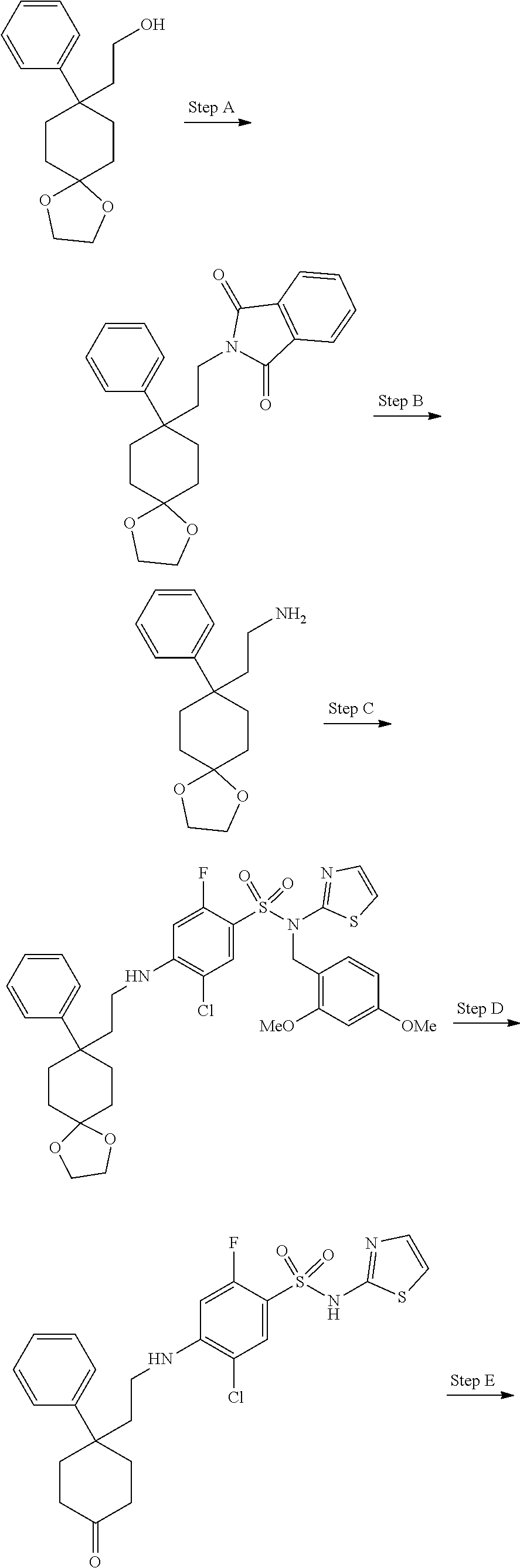

- Step A: 2-(2-(8-phenyl-1,4-dioxaspiro[4.5]decan-8-yl)ethyl)isoindoline-1,3-dione: to a solution of 2-(8-phenyl-1,4-dioxaspiro[4.5]decan-8-yl)ethanol (210 mg, 0.800 mmol), isoindoline-1,3-dione (141 mg, 0.961 mmol) and Ph3P (252 mg, 0.961 mmol) in THF (4002 μl) at rt was added DEAD (152 μl, 0.961 mmol), and the reaction mixture was stirred at rt for 12 h. THF was removed in vacuo, and the crude product was purified by reverse phase preparative HPLC on a Sunfire C18 column (10 μM, 50×300 mm) eluting with 50-100% B (A: 95% eater/5% acetonitrile/10 nM ammonium acetate, B: 5% water/95% acetonitrile/10 mM ammonium acetate) over 30 min to give a product which still contained some DEAD. This product was purified by preparative TLC on silica gel (0.50 mm thickness) eluting with 40% ethyl acetate/hexanes to give 2-(2-(8-phenyl-1,4-dioxaspiro[4.5]decan-8-yl)ethyl)isoindoline-1,3-dione (325 mg, 0.830 mmol, 104% yield) as white foam. 1H NMR (500 MHz, CHLOROFORM-d) δ 7.76-7.72 (m, 2H), 7.66 (dd, J=5.5, 3.1 Hz, 2H), 7.37 (dd, J=8.4, 1.1 Hz, 2H), 7.26 (t, J=7.9 Hz, 2H), 7.08-7.03 (m, 1H), 4.01-3.91 (m, 4H), 3.52-3.35 (m, 2H), 2.31 (d, J=14.0 Hz, 2H), 2.06-1.99 (m, 2H), 1.96-1.85 (m, 2H), 1.76-1.67 (m, 2H), 1.66-1.54 (m, 4H). Step B: 2-(8-phenyl-1,4-dioxaspiro[4.5]decan-8-yl)ethanamine: to a solution of 2-(2-(8-phenyl-1,4-dioxaspiro[4.5]decan-8-yl)ethyl)isoindoline-1,3-dione (325 mg, 0.830 mmol) in methanol/THF (1:1) (4151 μl) at rt was added hydrazine hydrate (604 μl, 12.45 mmol), and the reaction mixture was stirred at rt for 12 h. White precipitate was formed 2 h after addition. The reaction mixture was filtered through a pad of Celite and the pad was shed with DCM. The filtrate was evaporated in vacuo to give an oily material. This material was used directly for the next reaction. Step C: 5-chloro-N-(2,4-dimethoxybenzyl)-2-fluoro-4-((2-(8-phenyl-1,4-dioxaspiro[4.5]decan-8-yl)ethyl)amino)-N-(thiazol-2-yl)benzenesulfonamide: a mixture of 2-(8-phenyl-1,4-dioxaspiro[4.5]decan-8-yl)ethanamine (217 mg, 0.830 mmol), 5-chloro-N-(2,4-dimethoxybenzyl)-2,4-difluoro-N-(thiazol-2-yl)benzenesulfonamide (402 mg, 0.872 mmol) and cesium carbonate (298 mg, 0.913 mmol) in DMF (5535 μl) was stirred at rt for 12 h. Water was added and the aqueous layer was extracted with ethyl acetate (×3). The combined organic layers were washed with brine, dried over anhydrous sodium sulfate, and filtered, and the filtrate was evaporated in vacuo to give the crude product. The crude product was purified by preparative TLC on silica gel (2 mm thickness) eluting with 50% ethyl acetate/hexanes to give 5-chloro-N-(2,4-dimethoxybenzyl)-2-fluoro-4-((2-(8-phenyl-1,4-dioxaspiro[4.5]decan-8-yl)ethyl)amino)-N-(thiazol-2-yl)benzenesulfonamide (71 mg, 0.101 mmol, 12.18% yield). MS: 700.3 (M−H)+. Step D: 5-chloro-2-fluoro-4-((2-(4-oxo-1-phenylcyclohexyl)ethyl)amino)-N-(thiazol-2-yl)benzenesulfonamide: a solution of 5-chloro-N-(2,4-dimethoxybenzyl)-2-fluoro-4-((2-(8-phenyl-1,4-dioxaspiro[4.5]decan-8-yl)ethyl)amino)-N-(thiazol-2-yl)benzenesulfonamide (71 mg, 0.101 mmol) and HCl (404 μl, 0.404 mmol) in acetone (2022 μl) was heated under reflux for 2 h. Water was added and the aqueous layer was extracted with ethyl acetate (×3). The combined organic layers were washed with brine, dried over anhydrous sodium sulfate, and filtered, and the filtrate was evaporated in vacuo to give 5-chloro-2-fluoro-4-((2-(4-oxo-1-phenylcyclohexyl)ethyl)amino)-N-(thiazol-2-yl)benzenesulfonamide (50 mg, 0.098 mmol, 97% yield) as a white solid. This material was used directly for the next reaction. Step E: 4-(2-(4-Amino-1-phenylcyclohexyl)ethoxy)-5-chloro-2-fluoro-N-(1,2,4-thiadiazol-5-yl)benzenesulfonamide: a mixture of 5-chloro-2-fluoro-4-((2-(4-oxo-1-phenylcyclohexyl)ethyl)amino)-N-(thiazol-2-yl)benzenesulfonamide (50 mg, 0.098 mmol), ammonium acetate (76 mg, 0.984 mmol), sodium cyanoborohydride (12.37 mg, 0.197 mmol) and 4A MS in methanol (656 μl) was stirred at rt for 2 h. This reaction mixture was diluted with methanol and then filtered. The crude material was purified via preparative LC/MS with the following conditions: Column: XBridge C18, 19×200 mm, 5-μm particles; Mobile Phase A: 5:95 acetonitrile:water with 10-mM ammonium acetate; Mobile Phase B: 95:5 acetonitrile:water with 10-mM ammonium acetate; Gradient: 8-40% B over 25 minutes, then a 5-minute hold at 100% B; Flow: 20 mL/min. Fractions containing the desired product were combined and dried via centrifugal evaporation. This process gave Example 55 (8 mg) and Example 54 (3 mg). Example 54: 1H NMR (500 MHz, DMSO-d6) δ 7.51 (d, J=7.3 Hz, 1H), 7.44-7.35 (m, 4H), 7.29-7.21 (m, 1H), 7.02 (d, J=4.0 Hz, 1H), 6.55 (d, J=3.7 Hz, 1H), 6.03-5.96 (m, 2H), 3.05 (br. s., 1H), 2.74 (d, J=4.0 Hz, 2H), 2.13 (br. s., 2H), 1.94-1.75 (m, 4H), 1.72-1.58 (m, 4H). Rt: 2.68 min (method C). MS: 509.2 (M+H)+. Example 55: 1H NMR (500 MHz, DMSO-d6) δ 7.51-7.38 (m, 1H), 7.27 (t, J=7.0 Hz, 1H), 6.93 (d, J=4.0 Hz, 1H), 6.45 (d, J=3.7 Hz, 1H), 5.81-5.75 (m, 1H), 5.70 (d, J=12.5 Hz, 1H), 3.06 (br. s., 1H), 2.87-2.78 (m, 2H), 1.77 (d, J=10.6 Hz, 2H), 1.67-1.59 (m, 2H), 1.51 (t, J=12.5 Hz, 2H), 1.22 (d, J=12.8 Hz, 2H). 2.56 min (method C). MS: 509.2 (M+H)+.
-

- Step A: Diethyl 2-(4-((tert-butoxycarbonyl)amino)cyclohexylidene)malonate: to an ice-cold soln of tert-butyl (4-oxocyclohexyl)carbamate (480 mg, 2.251 mmol) in THF (1 mL) were added dropwise 1.0 M TiCl4 in DCM (5.63 mL, 5.63 mmol), diethyl malonate (721 mg, 4.50 mmol) and pyridine (1.456 mL, 18.01 mmol), and the mixture was stirred at 0° C. for 30 min and then rt for 4 h. Water was added and the aqueous layer was extracted with ethyl acetate (×3). The combined organic layers were dried over sodium sulfate, and concentrated. The residue was purified via silica gel chromatography (Biotage 12 g, Hexanes-50% EtOAc) to give diethyl 2-(4-((tert-butoxycarbonyl)amino)cyclohexylidene)malonate (480 mg, 60% yield). 1H NMR (500 MHz, CHLOROFORM-d) δ 4.56-4.42 (m, 1H), 4.23 (q, J=7.2 Hz, 4H), 3.81-3.60 (m, 1H), 2.99 (d, J=14.3 Hz, 2H), 2.20 (ddd, J=14.1, 12.2, 4.3 Hz, 2H), 2.14-2.04 (m, 2H), 1.44 (9H, s), 1.49-1.34 (m, 2H), 1.28 (t, J=7.1 Hz, 6H). Step B: Diethyl 2-(4-((tert-butoxycarbonyl)amino)-1-methylcyclohexyl)malonate: to a suspension of copper (I) iodide (190 mg, 0.999 mmol) in THF (4 mL) were added dropwise 3.0 M MeMgBr in THF (0.999 mL, 3.00 mmol) at −50° C., and the reaction mixture was warmed up to rt and stirred at rt for 10 min. The mixture was cooled back to −50° C., and a solution of diethyl 2-(4-((tert-butoxycarbonyl)amino)cyclohexylidene)malonate (355 mg, 0.999 mmol) in 1 mL of THF was added, and the mixture was allowed to warm up to rt over 2 h, and then stirred at rt for 1 h. Saturated ammonium chloride was added, the aqueous layer was extracted with ethyl acetate, and the combined organic layers were dried over sodium sulfate, and concentrated to give diethyl 2-(4-((tert-butoxycarbonyl)amino)-1-methylcyclohexyl)malonate (350 mg, 0.942 mmol, 94% yield). This material was used directly for the next step. Step C: 2-(4-((tert-Butoxycarbonyl)amino)-1-methylcyclohexyl)malonic acid: to a solution of diethyl 2-(4-((tert-butoxycarbonyl)amino)-1-methylcyclohexyl)malonate (350 mg, 0.942 mmol) in THF (4 mL) were added a solution of LiOH (226 mg, 9.42 mmol) in water (1 mL), and 1 mL of MeOH was added to make a homogeneous solution. The mixture was stirred at 55° C. for 18 h and then at 90° C. for 5 h. 1N HCl was added, the aqueous layer was extracted with ethyl acetate, and the combined organic layers were dried over sodium sulfate, and concentrated to give 2-(4-((tert-butoxycarbonyl)amino)-1-methylcyclohexyl)malonic acid (236 mg, 79% yield). The crude material was used for the next step without any purification. Step D: 2-(4-((tert-Butoxycarbonyl)amino)-1-methylcyclohexyl)acetic acid: a solution of the crude 2-(4-((tert-butoxycarbonyl)amino)-1-methylcyclohexyl)malonic acid (236 mg, 0.748 mmol) in DMF (4 mL) was stirred at 100° C. oil bath for 18 h. The mixture was then concentrated in vacuo to give a crude 2-(4-((tert-butoxycarbonyl)amino)-1-methylcyclohexyl)acetic acid (203 mg, 100% yield). This crude material was used for the next step without any purification. Step E: tert-Butyl (4-(2-hydroxyethyl)-4-methylcyclohexyl)carbamate: to a solution of 2-(4-((tert-butoxycarbonyl)amino)-1-methylcyclohexyl)acetic acid (100 mg, 0.369 mmol) in THF (1.5 mL) was added N-methylmorpholine (0.065 mL, 0.590 mmol) followed by isobutyl chloroformate (0.063 mL, 0.479 mmol) in an ice-salt bath, and the reaction mixture was stirred at 0° C. for 2 h. The reaction mixture was filtered, and the filtrate was added to a solution of NaBH4 (34.9 mg, 0.921 mmol) in 0.5 mL of THF and 0.2 mL of water at 10° C., and the reaction mixture was stirred at rt for 1 h. Water was added, the aqueous layer was extracted with ethyl acetate, and the combined organic layers were dried over sodium sulfate, and concentrated. The residue was purified via silica gel chromatography (Biotage 4 g, hexanes-100% EtOAc) to give tert-butyl (4-(2-hydroxyethyl)-4-methylcyclohexyl)carbamate (65 mg, 69% yield). The material was used as crude for the next step without any purification. Step F: tert-Butyl (4-(2-(4-(N-(2,4-dimethoxybenzyl)-N-(1,2,4-thiadiazol-5-yl)sulfamoyl)-2,5-difluorophenoxy)ethyl)-4-methylcyclohexyl)carbamate: to a solution of tert-butyl (4-(2-hydroxyethyl)-4-methylcyclohexyl)carbamate (25 mg, 0.097 mmol), N-(2,4-dimethoxybenzyl)-2,5-difluoro-4-hydroxy-N-(1,2,4-thiadiazol-5-yl)benzenesulfonamide (51.7 mg, 0.117 mmol) and Ph3P (38.2 mg, 0.146 mmol) in THF (0.5 mL) was added DEAD (0.023 mL, 0.146 mmol) at rt, and the reaction mixture was stirred at rt for 16 h. The solvents were removed, and the residue was purified via silica gel chromatography (Biotage 4 g, hexanes-100% EtOAc) to give tert-butyl (4-(2-(4-(N-(2,4-dimethoxybenzyl)-N-(1,2,4-thiadiazol-5-yl)sulfamoyl)-2,5-difluorophenoxy)ethyl)-4-methylcyclohexyl)carbamate (50 mg, 0.073 mmol, 75% yield). MS: 683.30 (M+H)+. Step G: 4-(2-(4-amino-1-methylcyclohexyl)ethoxy)-2,5-difluoro-N-(1,2,4-thiadiazol-5-yl)benzenesulfonamide: a solution of tert-butyl (4-(2-(4-(N-(2,4-dimethoxybenzyl)-N-(1,2,4-thiadiazol-5-yl)sulfamoyl)-2,5-difluorophenoxy)ethyl)-4-methylcyclohexyl)carbamate (50 mg, 0.073 mmol) TFA (0.113 mL, 1.465 mmol) in DCM (0.5 mL) was stirred at rt for 3 h. DCM was removed, and the crude material was purified via preparative LC/MS with the following conditions: Column: XBridge C18, 19×200 mm, 5-μm particles; Mobile Phase A: 5:95 acetonitrile:water with 10-mM ammonium acetate; Mobile Phase B: 95:5 acetonitrile:water with 10-mM ammonium acetate; Gradient: 5-45% B over 20 minutes, then a 5-minute hold at 100% B; Flow: 20 mL/min. Fractions containing the desired product were combined and dried via centrifugal evaporation. This process gave two isomers of 4-(2-(4-amino-1-methylcyclohexyl)ethoxy)-2,5-difluoro-N-(1,2,4-thiadiazol-5-yl)benzenesulfonamide: Example 56: 1H NMR (500 MHz, DMSO-d6) δ 7.88 (s, 1H), 7.51-7.44 (m, 1H), 7.24 (dd, J=11.2, 7.2 Hz, 1H), 4.14 (t, J=7.0 Hz, 2H), 2.95 (br. s., 1H), 1.82-1.65 (m, 4H), 1.62-1.43 (m, 4H), 1.27-1.09 (m, 2H). MS: 432.9 (M+H)+. Example 57: 1H NMR (500 MHz, DMSO-d6) δ 7.88 (s, 1H), 7.45 (dd, J=10.8, 6.4 Hz, 1H), 7.21 (dd, J=10.8, 6.8 Hz, 1H), 4.15 (t, J=6.8 Hz, 2H), 2.9 (br s, 1H), 1.76-1.61 (m, 4H), 1.55-1.39 (m, 4H), 1.31 (d, J=13.9 Hz, 2H). MS: 432.9 (M+H)+.
- The following compounds were made in a manner analogous to Example 49.
- Example 58: 1H NMR (500 MHz, DMSO-d6) δ 7.87 (s, 1H), 7.47-7.37 (m, 5H), 6.93 (dd, J=11.4, 6.6 Hz, 1H), 3.80 (t, J=6.8 Hz, 2H), 2.85-2.72 (m, 1H), 2.45-2.30 (m, 2H), 1.87 (2H, m), 1.70-1.46 (m, 5H). MS: 528.9 (M+H)+. Example 59: 1H NMR (500 MHz, DMSO-d6) δ 7.96 (s, 1H), 7.87 (s, 1H), 7.50-7.31 (m, 5H), 6.99 (dd, J=11.0, 7.0 Hz, 1H), 3.75 (t, J=6.6 Hz, 2H), 3.01 (br. s., 1H), 2.22-2.07 (m, 4H), 1.84-1.53 (m, 6H). MS: 528.9 (M+H)+.
-

- Step A: Ethyl 2-(4-((tert-butoxycarbonyl)amino)cyclohexylidene)acetate: to a suspension of NaH (0.518 g, 12.94 mmol) in THF (20 mL) was added ethyl 2-(diethoxyphosphoryl)acetate (2.78 g, 12.38 mmol) dropwise at rt. The reaction mixture was stirred at rt for 20 min and the cooled to 0° C., and tert-butyl (4-oxocyclohexyl)carbamate (2.4 g, 11.25 mmol) was added. The reaction mixture was stirred at rt for 1 h, and the THF solution was decanted. The residue was dissolved into 50 mL of water, the aqueous layer was extracted with ether, and the combined organic layers were concentrated. The residue was purified via silica gel chromatography (Biotage 40 g, Hexanes-35% EtOAc) to give ethyl 2-(4-((tert-butoxycarbonyl)amino)cyclohexylidene)acetate (2.8 g, 9.88 mmol, 88% yield). MS: 184.15 (M−Boc+H)+. Step B: Ethyl 2-(4-((tert-butoxycarbonyl)amino)cyclohexyl)acetate: a mixture of 10% Pd/C (200 mg, 0.188 mmol) and ethyl 2-(4-((tert-butoxycarbonyl)amino)cyclohexylidene)acetate (1.0 g, 3.53 mmol) in methanol (10 mL) was stirred at rt under hydrogen baloon for 5 h. The reaction mixture was filtered, and the filtrate was concentrated to give ethyl 2-(4-((tert-butoxycarbonyl)amino)cyclohexyl)acetate (1.00 g, 100% yield). This material was used directly for the next step. Step C: tert-Butyl (4-(2-hydroxyethyl)cyclohexyl)carbamate: to a solotion of ethyl 2-(4-((tert-butoxycarbonyl)amino)cyclohexyl)acetate (340 mg, 1.19 mmol) in THF (5 mL) was added 2.0 M LAH in THF (0.596 mL, 1.191 mmol) under N2 at −40° C. The mixture was allowed to warm up to 10° C. 30 mL of ether was added followed by Na2SO4.10H2O. The mixture was stirred at rt for 1 h, and the solid was removed via filteration. The filtrate was concentrated, and the residue was purified via silica gel chromatography (Biotage 12 g, Hexanes-100% EtOAc) to give tert-butyl (4-(2-hydroxyethyl)cyclohexyl)carbamate (260 mg, 90% yield) as a mixture of two isomers. This material was used directly for the next step. Step D: N-(2,4-dimethoxybenzyl)-2,5-difluoro-4-hydroxy-N-(1,2,4-thiadiazol-5-yl)benzenesulfonamide: to a solution of N-(2,4-dimethoxybenzyl)-2,4,5-trifluoro-N-(1,2,4-thiadiazol-5-yl)benzenesulfonamide (1 g, 2.245 mmol) and 2-(methylsulfonyl)ethanol (0.419 ml, 4.49 mmol) in DMSO (5.61 ml) at rt was added potassium tert-butoxide (0.630 g, 5.61 mmol), and the reaction mixture was stirred at rt for 1 h. 1N Hydrochloric acid (6.73 ml, 6.73 mmol) was added, the aqueous layer was extracted with ethyl acetate (×3), and the combined organic layers were washed with brine, dried over anhydrous sodium sulfate, and filtered, and the filtrate was evaporated in vacuo to give the crude product. The crude product was purified by silica gel chromatography eluting with 0-80% ethyl acetate/hexanes to give N-(2,4-dimethoxybenzyl)-2,5-difluoro-4-hydroxy-N-(1,2,4-thiadiazol-5-yl)benzenesulfonamide (0.68 g, 1.533 mmol, 68.3% yield) as a white solid.
- 1H NMR (400 MHz, CHLOROFORM-d) δ 8.21 (s, 1H), 7.54 (dd, J=9.0, 6.6 Hz, 1H), 7.19 (d, J=8.3 Hz, 1H), 6.74 (dd, J=10.3, 6.6 Hz, 1H), 6.39 (dd, J=8.4, 2.3 Hz, 1H), 6.28 (d, J=2.2 Hz, 1H), 5.33 (s, 2H), 3.78 (s, 3H), 3.74 (s, 3H). Step E: tert-Butyl (4-(2-(4-(N-(2,4-dimethoxybenzyl)-N-(1,2,4-thiadiazol-5-yl)sulfamoyl)-2,5-difluorophenoxy)ethyl)cyclohexyl)carbamate: to a solution of tert-butyl (4-(2-hydroxyethyl)cyclohexyl)carbamate (40 mg, 0.164 mmol), N-(2,4-dimethoxybenzyl)-2,5-difluoro-4-hydroxy-N-(1,2,4-thiadiazol-5-yl)benzenesulfonamide (87 mg, 0.197 mmol) and n-Bu3Ph (49.9 mg, 0.247 mmol) in THF (1 mL) was added DIAMIDE (42.5 mg, 0.247 mmol) at rt, and the reaction mixture was stirred at rt for 3 h and at 65° C. for 1 h. Another premixed solution of n-Bu3Ph (49.9 mg, 0.247 mmol) and DIAMIDE (42.5 mg, 0.247 mmol) in 0.5 mL of THF was added at rt, and reaction mixture was refluxed for 1.5 h. The mixture was concentrated and purified via silica gel chromatography (Biotage 4 g, Hexanes-100% EtOAc) to give tert-butyl (4-(2-(4-(N-(2,4-dimethoxybenzyl)-N-(1,2,4-thiadiazol-5-yl)sulfamoyl)-2,5-difluorophenoxy)ethyl)cyclohexyl)carbamate (95 mg, 86% yield). 1H NMR (500 MHz, CHLOROFORM-d) δ 8.19 (s, 1H), 7.53 (dd, J=9.9, 6.4 Hz, 1H), 7.18 (d, J=8.4 Hz, 1H), 6.66-6.53 (m, 1H), 6.36 (dd, J=8.5, 2.4 Hz, 1H), 6.27 (d, J=2.3 Hz, 1H), 5.30 (s, 2H), 4.07-4.00 (m, 2H), 3.75 (d, J=7.2 Hz, 6H), 3.53-3.24 (m, 1H), 2.11-2.01 (m, 1H), 1.89-1.59 (m, 6H), 1.52-1.43 (m, 9H), 1.34-1.22 (m, 1H), 1.18-1.06 (m, 3H). MS: 669.20 (M+H)+. Step F: 4-(2-(4-Aminocyclohexyl)ethoxy)-2,5-difluoro-N-(1,2,4-thiadiazol-5-yl)benzenesulfonamide: to a solution of tert-butyl (4-(2-(4-(N-(2,4-dimethoxybenzyl)-N-(1,2,4-thiadiazol-5-yl)sulfamoyl)-2,5-difluorophenoxy)ethyl)cyclohexyl)carbamate (95 mg, 0.142 mmol) in DCM (1 mL) were added TFA (0.219 mL, 2.84 mmol) at rt. The mixture was stirred at rt for 4 h and then concentrated in vacuo. The residue was purified by HPLC to give 4-(2-(4-aminocyclohexyl)ethoxy)-2,5-difluoro-N-(1,2,4-thiadiazol-5-yl)benzenesulfonamide (39.6 mg, 66.6% yield). MS: 419.05 (M+H)+.
-

- Step A: Ethyl 1,4-dioxaspiro[4.5]decane-8-carboxylate. A solution of ethyl 4-oxocyclohexanecarboxylate (10 g, 58.8 mmol) and ethylene glyco (16.38 ml, 294 mmol) in benzene (196 ml) in the presence of pTSA (50 mg) was heated at 130° C. with a Dean-Stark trap for 12 h. Water was added and the aqueous layer was extracted with ethyl acetate (×3). The combined organic layers were washed with brine, dried over anhydrous sodium sulfate, and filtered, and the filtrate was evaporated in vacuo to give ethyl 1,4-dioxaspiro[4.5]decane-8-carboxylate (12.2 g, 56.9 mmol, 97% yield) as a colorless oil. 1H NMR (500 MHz, CHLOROFORM-d) δ 4.15 (q, J=7.1 Hz, 1H), 3.96 (s, 2H), 2.40-2.31 (m, 1H), 2.01-1.92 (m, 2H), 1.89-1.76 (m, 4H), 1.63-1.51 (m, 3H), 1.30-1.24 (m, 3H). Step B: Ethyl 8-(4-chloro-3-fluorobenzyl)-1,4-dioxaspiro[4.5]decane-8-carboxylate. To a solution of diisopropylamine (5.16 ml, 36.2 mmol) in THF (78 ml) in an ice bath was added n-BuLi (1.6 M, 21.88 ml, 35.0 mmol), and the reaction mixture was stirred at 0° C. for 20 min. This solution was cooled to −78° C., and ethyl 1,4-dioxaspiro[4.5]decane-8-carboxylate (5 g, 23.34 mmol) was added, and the reaction mixture was warmed up to RT over 30 min. The solution was cooled to −78° C., and 4-(bromomethyl)-1-chloro-2-fluorobenzene (3.69 ml, 27.3 mmol) was added. The reaction mixture was stirred at −78° C. for 1 h, and then warmed up to rt over a period of 15 min. After 10 min RT, water was added and the aqueous layer was extracted with ethyl acetate (×3). The combined organic layers were washed with brine, dried over anhydrous sodium sulfate, and filtered, and the filtrate was evaporated in vacuo to give the crude product. 100 mgs of this crude product was purified by preparative TLC on silica gel (0.50 mm thickness) eluting with 20% ethyl acetate/hexanes to give ethyl 8-(4-chloro-3-fluorobenzyl)-1,4-dioxaspiro[4.5]decane-8-carboxylate (6.8 g, 19.06 mmol, 82% yield) as a colorless oil. 1H NMR (500 MHz, CHLOROFORM-d) δ 7.29-7.26 (m, 1H), 6.86 (dd, J=10.0, 1.9 Hz, 1H), 6.79 (dd, J=8.2, 1.8 Hz, 1H), 4.11 (q, J=7.1 Hz, 2H), 3.94 (s, 4H), 2.80 (s, 2H), 2.17-2.07 (m, 2H), 1.74-1.51 (m, 7H), 1.21 (t, J=7.1 Hz, 3H). Step C: (8-(4-chloro-3-fluorobenzyl)-1,4-dioxaspiro[4.5]decan-8-yl)methanol: to a solution of ethyl 8-(4-chloro-3-fluorobenzyl)-1,4-dioxaspiro[4.5]decane-8-carboxylate (1.86 g, 5.21 mmol) in ether (52.1 ml) at 0° C. was added LiAlH4 (0.198 g, 5.21 mmol) portionwise, and the reaction mixture was stirred at 0° C. for 30 min. Another portion of LiAlH4 (100 mg) was added, and the reaction mixture was stirred at 0° C. for 30 min. Sodium sulfate decahydrate (1 g) was added, and the reaction mixture was stirred at rt for 2 h. The reaction mixture was filtered through a pad of Celite, and the filtrate was evaporated in vacuo to give (8-(4-chloro-3-fluorobenzyl)-1,4-dioxaspiro[4.5]decan-8-yl)methanol (1.6 g, 100%). 1H NMR (500 MHz, CHLOROFORM-d) δ 7.37-7.22 (m, 1H), 7.04 (dd, J=10.3, 1.9 Hz, 1H), 6.95 (dd, J=8.2, 1.4 Hz, 1H), 4.00-3.93 (m, 4H), 3.36 (d, J=4.4 Hz, 2H), 2.69 (s, 2H), 2.19 (s, 2H), 1.78-1.62 (m, 4H), 1.56-1.49 (m, 4H). Step D: 4-((8-(4-chloro-3-fluorobenzyl)-1,4-dioxaspiro[4.5]decan-8-yl)methoxy)-N-(2,4-dimethoxybenzyl)-2,5-difluoro-N-(1,2,4-thiadiazol-5-yl)benzenesulfonamide: to a solution of (8-(4-chloro-3-fluorobenzyl)-1,4-dioxaspiro[4.5]decan-8-yl)methanol (1 g, 3.18 mmol) in THF (15.88 ml) at rt was added LHMDS (4.13 ml, 4.13 mmol), and the reaction mixture was stirred at rt for 30 min. N-(2,4-dimethoxybenzyl)-2,4,5-trifluoro-N-(1,2,4-thiadiazol-5-yl)benzenesulfonamide (1.840 g, 4.13 mmol) was added, and the reaction mixture was stirred at rt for 12 h. Water was added and the aqueous layer was extracted with ethyl acetate (×3). The combined organic layers were washed with brine, dried over anhydrous sodium sulfate, and filtered, and the filtrate was evaporated in vacuo to give the crude product. The crude product was purified by silica gel chromatography eluting with 0-30% EtOAc/Hexanes to give 4-((8-(4-chloro-3-fluorobenzyl)-1,4-dioxaspiro[4.5]decan-8-yl)methoxy)-N-(2,4-dimethoxybenzyl)-2,5-difluoro-N-(1,2,4-thiadiazol-5-yl)benzenesulfonamide (1.7 g, 71%). Step E: 4-((1-(4-chloro-3-fluorobenzyl)-4-oxocyclohexyl)methoxy)-2,5-difluoro-N-(1,2,4-thiadiazol-5-yl)benzenesulfonamide: to a solution of 4-((8-(4-chloro-3-fluorobenzyl)-1,4-dioxaspiro[4.5]decan-8-yl)methoxy)-N-(2,4-dimethoxybenzyl)-2,5-difluoro-N-(1,2,4-thiadiazol-5-yl)benzenesulfonamide (1.67 g, 2.256 mmol) in acetone (45.1 ml) at rt was added HCl (9.02 ml, 9.02 mmol), and the reaction mixture was heated at 60° C. for 1 h. Acetone was removed, water was added and the aqueous layer was extracted with ethyl acetate (×3). The combined organic layers were washed with brine, dried over anhydrous sodium sulfate, and filtered, and the filtrate was evaporated in vacuo to give the crude product. The crude product was purified by silica gel chromatography eluting with 0-60% EtOAc/Hexanes to give 4-((1-(4-chloro-3-fluorobenzyl)-4-oxocyclohexyl)methoxy)-2,5-difluoro-N-(1,2,4-thiadiazol-5-yl)benzenesulfonamide (0.9 g, 73% yield). MS: 546.1 (M+H)+. Step F: 4-((4-amino-1-(4-chloro-3-fluorobenzyl)cyclohexyl)methoxy)-2,5-difluoro-N-(1,2,4-thiadiazol-5-yl)benzenesulfonamide: a solution of 4-((1-(4-chloro-3-fluorobenzyl)-4-oxocyclohexyl)methoxy)-2,5-difluoro-N-(1,2,4-thiadiazol-5-yl)benzenesulfonamide (100 mg, 0.183 mmol), ammonium acetate (141 mg, 1.832 mmol), 4A MS (4 pieces), sodium borohydride (26.5 mg, 0.421 mmol) in methanol (916 μl) was stirred at rt for 2 h. The crude material was purified via preparative LC/MS with the following conditions: Column: XBridge C18, 19×200 mm, 5-μm particles; Mobile Phase A: 5:95 methanol:water with 10-mM ammonium acetate; Mobile Phase B: 95:5 methanol:water with 10-mM ammonium acetate; Gradient: 30-70% B over 30 minutes, then a 5-minute hold at 100% B; Flow: 20 mL/min. Fractions containing the desired product were combined and dried via centrifugal evaporation. This process gave Example 61 (4 mg) and Example 62 (18 mg). Example 61:
- 1H NMR (500 MHz, DMSO-d6) δ 7.89 (s, 1H), 7.49 (t, J=8.1 Hz, 2H), 7.17 (dd, J=10.6, 6.6 Hz, 1H), 7.05 (d, J=10.6 Hz, 1H), 6.91 (d, J=8.1 Hz, 1H), 3.62 (s, 2H), 3.34 (d, J=11.7 Hz, 1H), 3.05 (br. s., 1H), 2.81 (s, 2H), 1.83 (br. s., 2H), 1.76-1.64 (m, 2H), 1.58 (d, J=13.6 Hz, 2H), 1.41-1.32 (m, 2H). Rt: 1.53 min (method A). MS: 546.9 (M+H)+.
- Example 62: 1H NMR (500 MHz, DMSO-d6) δ 7.90 (s, 1H), 7.64 (br. s., 2H), 7.56-7.43 (m, 2H), 7.24 (dd, J=11.2, 6.8 Hz, 1H), 7.11 (d, J=9.9 Hz, 1H), 6.90 (d, J=8.1 Hz, 1H), 3.39-3.30 (m, 2H), 2.97 (br. s., 1H), 2.68 (s, 2H), 1.80-1.64 (m, 4H), 1.49-1.31 (m, 4H). 1.73 min (method A). MS: 546.9 (M+H)+.
-

- A solution o4-((1-(4-chloro-3-fluorobenzyl)-4-oxocyclohexyl)methoxy)-2,5-difluoro-N-(1,2,4-thiadiazol-5-yl)benzenesulfonamide (70 mg, 0.128 mmol), methanamine (256 μl, 0.256 mmol) (1M in THF) and sodium borohydride (9.70 mg, 0.256 mmol) in methanol (641 μl) was heated at 65° C. for 1 h. After cooling, sodium borohydride (9.70 mg, 0.256 mmol) was added. The reaction mixture was stirred at rt for 1 h and the crude material was purified via preparative LC/MS with the following conditions: Column: XBridge C18, 19×200 mm, 5-μm particles; Mobile Phase A: 5:95 methanol:water with 10-mM ammonium acetate; Mobile Phase B: 95:5 methanol:water with 10-mM ammonium acetate; Gradient: 35-75% B over 30 minutes, then a 5-minute hold at 100% B; Flow: 20 mL/min. Fractions containing the desired product were combined and dried via centrifugal evaporation. This process gave Example 63 (7 mg) as a single isomer. 1H NMR (500 MHz, DMSO-d6) δ 7.89 (s, 1H), 7.55-7.42 (m, 2H), 7.17 (dd, J=11.6, 6.8 Hz, 1H), 7.07 (d, J=10.3 Hz, 1H), 6.92 (d, J=7.7 Hz, 1H), 3.63 (s, 2H), 3.34 (d, J=12.8 Hz, 1H), 3.01 (br. s., 1H), 2.81 (s, 2H), 2.61 (3H, s), 1.92 (d, J=9.5 Hz, 2H), 1.78-1.51 (m, 4H), 1.36 (t, J=11.9 Hz, 2H). Rt: 1.49 min (method A). MS: 560.9 (M+H)+.
-

- To a solution of 4-((1-(4-chloro-3-fluorobenzyl)-4-oxocyclohexyl)methoxy)-2,5-difluoro-N-(1,2,4-thiadiazol-5-yl)benzenesulfonamide (33 mg, 0.060 mmol) in methanol (302 μl) at rt was added sodium borohydride (6.86 mg, 0.181 mmol), and the resulting mixture was stirred at rt for 30 min. The crude material was purified via preparative LC/MS with the following conditions: Column: XBridge C18, 19×200 mm, 5-μm particles; Mobile Phase A: 5:95 methanol:water with 10-mM ammonium acetate; Mobile Phase B: 95:5 methanol:water with 10-mM ammonium acetate; Gradient: 35-85% B over 30 minutes, then a 5-minute hold at 100% B; Flow: 20 mL/min. Fractions containing the desired product were combined and dried via centrifugal evaporation. This process gave two isomers of 4-((1-(4-chloro-3-fluorobenzyl)-4-hydroxycyclohexyl)methoxy)-2,5-difluoro-N-(1,2,4-thiadiazol-5-yl)benzenesulfonamide (3 mg) as a single isomer. 1H NMR (500 MHz, DMSO-d6) δ 8.02-7.90 (m, 1H), 7.60-7.38 (m, 2H), 7.19 (dd, J=11.0, 6.6 Hz, 1H), 7.06 (d, J=10.6 Hz, 1H), 6.90 (d, J=8.1 Hz, 1H), 3.64 (s, 2H), 3.52 (br. s., 1H), 3.40 (d, J=11.0 Hz, 2H), 2.77 (s, 2H), 1.64 (br. s., 2H), 1.59-1.45 (m, 4H), 1.34-1.21 (m, 2H). Rt: 1.73 min (method A). MS: 548.1 (M+H)+.
- The following compound was made in a manner analogous to Example 1.
-

- 1H NMR (500 MHz, DMSO-d6) δ 7.58 (d, J=7.3 Hz, 1H), 7.01 (d, J=3.7 Hz, 1H), 6.64 (d, J=12.5 Hz, 1H), 6.54 (d, J=4.0 Hz, 1H), 5.91 (d, J=6.6 Hz, 1H), 3.97-3.83 (m, 1H), 3.17-3.04 (m, 1H), 3.02-2.89 (m, 2H), 2.85-2.76 (m, 1H), 2.72 (dd, J=11.4, 7.0 Hz, 1H), 2.02-1.80 (m, 3H), 1.70 (ddd, J=19.6, 12.7, 7.3 Hz, 1H), 1.52 (dd, J=12.8, 6.6 Hz, 1H). MS: 417.0 (M+H)+.
-

- 1H NMR (500 MHz, DMSO-d6) δ 7.68 (d, J=7.7 Hz, 1H), 6.97 (d, J=4.0 Hz, 1H), 6.94 (d, J=11.4 Hz, 1H), 6.52 (d, J=3.7 Hz, 1H), 3.42 (br. s., 2H), 3.24 (br. s., 2H), 2.91-2.72 (m, 2H), 2.69-2.56 (m, 2H), 2.43-2.27 (m, 2H), 1.90-1.65 (m, 3H), 1.65-0.99 (m, 5H). MS: 459.0 (M+H)+.
-

- 1H NMR (500 MHz, DMSO-d6) δ 7.73 (d, J=7.3 Hz, 1H), 7.30 (d, J=4.4 Hz, 1H), 7.11 (d, J=11.7 Hz, 1H), 6.88 (d, J=4.4 Hz, 1H), 3.35-3.27 (m, 3H), 3.18 (dd, J=12.3, 4.2 Hz, 1H), 3.11-3.03 (m, 2H), 2.87 (d, J=9.5 Hz, 1H), 2.83-2.73 (m, 1H), 2.15 (d, J=10.6 Hz, 1H), 2.10-1.95 (m, 2H), 1.90 (d, J=14.7 Hz, 1H), 1.69 (d, J=15.0 Hz, 1H), 1.52 (d, J=11.0 Hz, 1H). MS: 431.1 (M+H)+.
-

- 1H NMR (400 MHz, DMSO-d6) δ 7.63 (d, J=7.3 Hz, 1H), 7.26 (d, J=4.8 Hz, 1H), 6.87-6.78 (m, 2H), 6.54 (br. s., 1H), 3.86-3.68 (m, 1H), 3.64-3.54 (m, 4H), 3.52-3.43 (m, 3H), 3.24 (s, 3H), 3.19-3.11 (m, 1H), 2.19-2.07 (m, 1H), 2.04-1.82 (m, 2H), 1.79-1.69 (m, 1H). MS: 449.0 (M+H)+.
-

- Rt: 1.56 min (method A); 1.59 min (method B). MS: 406.0 (M+H)+.
-

- MS: 1.22 min (method A) and 1.22 min (method B). 392.0 (M+H)+.
-

- 1H NMR (500 MHz, DMSO-d6) δ 7.57 (d, J=7.3 Hz, 1H), 7.26 (d, J=4.8 Hz, 1H), 6.83 (d, J=4.8 Hz, 1H), 6.61 (d, J=12.8 Hz, 1H), 6.31 (br. s., 1H), 3.82 (dd, J=11.4, 3.3 Hz, 2H), 3.31-3.13 (m, 2H), 2.50 (2H, m), 1.66-1.45 (m, 5H), 1.17 (dd, J=11.6, 3.9 Hz, 2H). MS: 420.0 (M+H)+.
-

- 1H NMR (500 MHz, DMSO-d6) δ 7.57 (d, J=7.3 Hz, 1H), 7.24 (d, J=4.8 Hz, 1H), 6.80 (d, J=4.8 Hz, 1H), 6.60 (d, J=12.8 Hz, 1H), 6.31 (br. s., 1H), 3.85-3.69 (m, 2H), 3.19 (d, J=6.2 Hz, 1H), 3.00 (t, J=10.3 Hz, 1H), 2.50 (2H, m), 1.84 (d, J=12.5 Hz, 1H), 1.62-1.11 (m, 6H). MS: 420.0 (M+H)+.
-

- 1H NMR (500 MHz, DMSO-d6) δ 7.58 (d, J=7.0 Hz, 1H), 7.17 (d, J=4.8 Hz, 1H), 6.78 (d, J=4.8 Hz, 1H), 6.58 (d, J=13.2 Hz, 1H), 6.12 (br. s., 1H), 3.56-3.45 (m, 1H), 3.26-3.17 (m, 2H), 3.13-2.92 (m, 4H), 2.06 (d, J=12.1 Hz, 2H), 1.72-1.50 (m, 5H). MS: 468.0 (M+H)+.
-

- 1H NMR (500 MHz, DMSO-d6) δ 7.57 (d, J=7.3 Hz, 1H), 7.24 (d, J=4.4 Hz, 1H), 6.80 (d, J=4.8 Hz, 1H), 6.63 (d, J=13.2 Hz, 1H), 6.35 (br. s., 1H), 3.13-2.93 (m, 2H), 1.90-1.75 (m, 2H), 1.71-1.57 (m, 3H), 1.22-1.11 (m, 1H), 1.07-0.97 (m, 1H), 0.87-0.70 (m, 2H). MS: 420.0 (M+H)+.
-

- MS: 1.35 min (method A); 1.04 min (method B). 435.0 (M+H)+.
- It will be evident to one skilled in the art that the present disclosure is not limited to the foregoing illustrative examples, and that it can be embodied in other specific forms without departing from the essential attributes thereof. The examples therefore should be considered in all respects as illustrative and not restrictive, reference being made to the appended claims, rather than to the foregoing examples, and all changes which come within the meaning and range of equivalency of the claims are therefore intended to be embraced.
Claims (12)

Priority Applications (1)
| Application Number | Priority Date | Filing Date | Title |
|---|---|---|---|
| US16/344,414 US10836758B2 (en) | 2016-10-27 | 2017-10-26 | Acyl sulfonamide NaV1.7 inhibitors |
Applications Claiming Priority (3)
| Application Number | Priority Date | Filing Date | Title |
|---|---|---|---|
| US201662413555P | 2016-10-27 | 2016-10-27 | |
| US16/344,414 US10836758B2 (en) | 2016-10-27 | 2017-10-26 | Acyl sulfonamide NaV1.7 inhibitors |
| PCT/US2017/058472 WO2018081384A1 (en) | 2016-10-27 | 2017-10-26 | Acyl sulfonamide nav1.7 inhibitors |
Publications (2)
| Publication Number | Publication Date |
|---|---|
| US20200048240A1 true US20200048240A1 (en) | 2020-02-13 |
| US10836758B2 US10836758B2 (en) | 2020-11-17 |
Family
ID=60245256
Family Applications (1)
| Application Number | Title | Priority Date | Filing Date |
|---|---|---|---|
| US16/344,414 Active US10836758B2 (en) | 2016-10-27 | 2017-10-26 | Acyl sulfonamide NaV1.7 inhibitors |
Country Status (8)
| Country | Link |
|---|---|
| US (1) | US10836758B2 (en) |
| EP (1) | EP3532462B1 (en) |
| JP (1) | JP7072569B2 (en) |
| KR (1) | KR102561076B1 (en) |
| CN (1) | CN110088093B (en) |
| ES (1) | ES2897998T3 (en) |
| MA (1) | MA46615A (en) |
| WO (1) | WO2018081384A1 (en) |
Families Citing this family (8)
| Publication number | Priority date | Publication date | Assignee | Title |
|---|---|---|---|---|
| ES2967410T3 (en) * | 2016-12-09 | 2024-04-30 | Xenon Pharmaceuticals Inc | Benzenesulfonamide compounds and their uses in the form of therapeutic agents |
| CN112262142B (en) | 2018-06-13 | 2023-11-14 | 泽农医药公司 | Benzenesulfonamide compounds and their use as therapeutic agents |
| EP3891157A4 (en) | 2018-12-05 | 2022-08-31 | Merck Sharp & Dohme Corp. | 4-AMINO OR 4-ALCOXY SUBSTITUTED ARYL SULFONAMIDE COMPOUNDS HAVING SELECTIVE ACTIVITY IN VOLTAGE-SENSITIVE SODIUM CHANNELS |
| CN111285825B (en) * | 2018-12-10 | 2023-02-17 | 中国科学院上海药物研究所 | A class of derivatives substituted by benzenesulfonamide, its preparation method and use |
| WO2020199683A1 (en) * | 2019-04-04 | 2020-10-08 | 上海海雁医药科技有限公司 | Nitrogen heterocycle substituted sulfonylbenzamide derivative, preparation method therefor and use thereof in medicine |
| WO2020248123A1 (en) | 2019-06-11 | 2020-12-17 | Merck Sharp & Dohme Corp. | Hydroxypyrrolidine-substituted arylsulfonamide compounds with selective activity in voltage-gated sodium channels |
| IL311268A (en) | 2021-09-15 | 2024-05-01 | Richter Gedeon Nyrt | A process for the production of (1R, 4R)-4-disubstituted cyclohexane-1-amines |
| WO2025096637A1 (en) * | 2023-10-31 | 2025-05-08 | Xenon Pharmaceuticals Inc. | Substituted aryl sulfonamides for use as sodium channel inhibitors |
Citations (2)
| Publication number | Priority date | Publication date | Assignee | Title |
|---|---|---|---|---|
| WO2013064983A1 (en) * | 2011-10-31 | 2013-05-10 | Xenon Pharmaceuticals Inc. | Benzenesulfonamide compounds and their use as therapeutic agents |
| US20180362518A1 (en) * | 2015-12-18 | 2018-12-20 | Merck Sharp & Dohme Corp. | DIAMINO-ALKYLAMINO-Linked ARYLSULFONAMIDE COMPOUNDS WITH SELECTIVE ACTIVITY IN VOLTAGE-GATED SODIUM CHANNELS |
Family Cites Families (7)
| Publication number | Priority date | Publication date | Assignee | Title |
|---|---|---|---|---|
| US8916553B2 (en) * | 2010-07-26 | 2014-12-23 | Bristol-Myers Squibb Company | Sulfonamide compounds useful as CYP17 inhibitors |
| US8889741B2 (en) * | 2012-02-09 | 2014-11-18 | Daiichi Sankyo Company, Limited | Cycloalkane derivatives |
| WO2015077905A1 (en) | 2013-11-29 | 2015-06-04 | Merck Sharp & Dohme Corp. | Bicycloamine-substituted-n-benzenesulfonamide compounds with selective activity in voltage-gated sodium channels |
| TW201623264A (en) * | 2014-03-29 | 2016-07-01 | 魯賓有限公司 | Sulfonamide compounds as voltage gated sodium channel modulators |
| TW201718629A (en) * | 2015-09-25 | 2017-06-01 | 韓美藥品股份有限公司 | A protein conjugate comprising multiple physiological polypeptides and an immunoglobulin Fc region |
| GB201518888D0 (en) * | 2015-10-24 | 2015-12-09 | Smiths Medical Int Ltd | Medico-surgical tubes and their manufacture |
| EP3390374B1 (en) | 2015-12-18 | 2020-08-26 | Merck Sharp & Dohme Corp. | Hydroxyalkylamine- and hydroxycycloalkylamine-substituted diamine-arylsulfonamide compounds with selective activity in voltage-gated sodium channels |
-
2017
- 2017-10-26 ES ES17794203T patent/ES2897998T3/en active Active
- 2017-10-26 KR KR1020197014690A patent/KR102561076B1/en active Active
- 2017-10-26 JP JP2019523090A patent/JP7072569B2/en active Active
- 2017-10-26 CN CN201780079199.3A patent/CN110088093B/en active Active
- 2017-10-26 MA MA046615A patent/MA46615A/en unknown
- 2017-10-26 US US16/344,414 patent/US10836758B2/en active Active
- 2017-10-26 EP EP17794203.4A patent/EP3532462B1/en active Active
- 2017-10-26 WO PCT/US2017/058472 patent/WO2018081384A1/en not_active Ceased
Patent Citations (2)
| Publication number | Priority date | Publication date | Assignee | Title |
|---|---|---|---|---|
| WO2013064983A1 (en) * | 2011-10-31 | 2013-05-10 | Xenon Pharmaceuticals Inc. | Benzenesulfonamide compounds and their use as therapeutic agents |
| US20180362518A1 (en) * | 2015-12-18 | 2018-12-20 | Merck Sharp & Dohme Corp. | DIAMINO-ALKYLAMINO-Linked ARYLSULFONAMIDE COMPOUNDS WITH SELECTIVE ACTIVITY IN VOLTAGE-GATED SODIUM CHANNELS |
Also Published As
| Publication number | Publication date |
|---|---|
| ES2897998T3 (en) | 2022-03-03 |
| KR20190067895A (en) | 2019-06-17 |
| CN110088093B (en) | 2023-06-13 |
| US10836758B2 (en) | 2020-11-17 |
| JP2019536764A (en) | 2019-12-19 |
| JP7072569B2 (en) | 2022-05-20 |
| CN110088093A (en) | 2019-08-02 |
| MA46615A (en) | 2019-09-04 |
| EP3532462A1 (en) | 2019-09-04 |
| EP3532462B1 (en) | 2021-10-13 |
| WO2018081384A1 (en) | 2018-05-03 |
| KR102561076B1 (en) | 2023-07-28 |
Similar Documents
| Publication | Publication Date | Title |
|---|---|---|
| US10836758B2 (en) | Acyl sulfonamide NaV1.7 inhibitors | |
| EP3472153B1 (en) | Pyrimidin-2-ylamino-1h-pyrazols as lrrk2 inhibitors for use in the treatment of neurodegenerative disorders | |
| PT2070922E (en) | Azabicyclo(3.1.0) hexane derivatives useful as modulators of dopamine d3 receptors | |
| US10550080B2 (en) | Acyl sulfonamide NaV1.7 inhibitors | |
| JP5841617B2 (en) | (Pyridin-4-yl) benzylamide as an allosteric regulator of alpha 7nAChR | |
| JP6703131B2 (en) | Novel N-[(pyrimidinylamino)propanyl]- and N-[(pyridinylamino)propanyl]aryl carboxamides | |
| JP2014506905A (en) | Novel benzodioxole piperidine compounds | |
| JP2014505715A (en) | Novel benzodioxole piperazine compounds | |
| KR102798432B1 (en) | 5-Oxa-2-azaspiro[3.4]octane derivatives as M4 agonists | |
| JP2014503519A (en) | New benzofuran compounds | |
| JP2010508351A (en) | Triazolopyrimidine derivatives as ADPP2Y12 receptor antagonists | |
| KR20220079921A (en) | 2-azaspiro[3.4]octane derivatives as M4 agonists | |
| US20240059677A1 (en) | Substituted pyrimidine derivatives as nicotinic acetylcholinesterase receptor alpha 6 modulator | |
| RU2820477C1 (en) | 5-oxa-2-azaspiro[3.4]octane derivatives as m4 agonists | |
| EP3442966B1 (en) | Novel n-[(pyrimidinylamino)propanyl]- and n-[(pyridinylamino)propanyl]arylcarboxamides | |
| WO2024108147A1 (en) | Compounds, compositions, and methods | |
| WO2025133915A1 (en) | Compounds which bind to pnpla3i148m and their use to treat liver diseases | |
| WO2022249006A1 (en) | Use of 1,2,4-oxadiazole derivatives as liver x receptor agonists | |
| HK40074923A (en) | Pyrimidin-2-ylamino-1h-pyrazols as lrrk2 inhibitors for use in the treatment of neurodegenerative disorders | |
| EA043797B1 (en) | PYRIMIDINE-2-YLAMINO-1H-PYRAZOLES AS LRRK2 INHIBITORS FOR USE IN THE TREATMENT OF NEURODEGENERATIVE DISEASES | |
| HK40007576B (en) | Pyrimidin-2-ylamino-1h-pyrazols as lrrk2 inhibitors for use in the treatment of neurodegenerative disorders |
Legal Events
| Date | Code | Title | Description |
|---|---|---|---|
| FEPP | Fee payment procedure |
Free format text: ENTITY STATUS SET TO UNDISCOUNTED (ORIGINAL EVENT CODE: BIG.); ENTITY STATUS OF PATENT OWNER: LARGE ENTITY |
|
| STPP | Information on status: patent application and granting procedure in general |
Free format text: DOCKETED NEW CASE - READY FOR EXAMINATION |
|
| STPP | Information on status: patent application and granting procedure in general |
Free format text: NON FINAL ACTION MAILED |
|
| STPP | Information on status: patent application and granting procedure in general |
Free format text: RESPONSE TO NON-FINAL OFFICE ACTION ENTERED AND FORWARDED TO EXAMINER |
|
| STPP | Information on status: patent application and granting procedure in general |
Free format text: PUBLICATIONS -- ISSUE FEE PAYMENT RECEIVED |
|
| STCF | Information on status: patent grant |
Free format text: PATENTED CASE |
|
| MAFP | Maintenance fee payment |
Free format text: PAYMENT OF MAINTENANCE FEE, 4TH YEAR, LARGE ENTITY (ORIGINAL EVENT CODE: M1551); ENTITY STATUS OF PATENT OWNER: LARGE ENTITY Year of fee payment: 4 |