US20200048191A1 - Composition and method for manufacturing device using same - Google Patents
Composition and method for manufacturing device using same Download PDFInfo
- Publication number
- US20200048191A1 US20200048191A1 US16/339,525 US201716339525A US2020048191A1 US 20200048191 A1 US20200048191 A1 US 20200048191A1 US 201716339525 A US201716339525 A US 201716339525A US 2020048191 A1 US2020048191 A1 US 2020048191A1
- Authority
- US
- United States
- Prior art keywords
- group
- substituent
- carbon atoms
- atom
- polymer
- Prior art date
- Legal status (The legal status is an assumption and is not a legal conclusion. Google has not performed a legal analysis and makes no representation as to the accuracy of the status listed.)
- Granted
Links
- 239000000203 mixture Substances 0.000 title claims abstract description 162
- 238000000034 method Methods 0.000 title claims abstract description 82
- 238000004519 manufacturing process Methods 0.000 title claims description 12
- 150000003839 salts Chemical class 0.000 claims abstract description 82
- 238000010894 electron beam technology Methods 0.000 claims abstract description 41
- 125000001424 substituent group Chemical group 0.000 claims description 126
- 125000004432 carbon atom Chemical group C* 0.000 claims description 97
- 150000001875 compounds Chemical class 0.000 claims description 90
- 239000002253 acid Substances 0.000 claims description 88
- 125000003118 aryl group Chemical group 0.000 claims description 84
- 125000000217 alkyl group Chemical group 0.000 claims description 73
- 239000011347 resin Substances 0.000 claims description 38
- 229920005989 resin Polymers 0.000 claims description 38
- 150000001450 anions Chemical class 0.000 claims description 33
- 125000001072 heteroaryl group Chemical group 0.000 claims description 33
- 125000004414 alkyl thio group Chemical group 0.000 claims description 27
- 125000002887 hydroxy group Chemical group [H]O* 0.000 claims description 26
- 229910052717 sulfur Inorganic materials 0.000 claims description 26
- 125000004434 sulfur atom Chemical group 0.000 claims description 26
- 229910052731 fluorine Inorganic materials 0.000 claims description 25
- 229910052799 carbon Inorganic materials 0.000 claims description 24
- XMBWDFGMSWQBCA-UHFFFAOYSA-N hydrogen iodide Chemical group I XMBWDFGMSWQBCA-UHFFFAOYSA-N 0.000 claims description 24
- 125000003342 alkenyl group Chemical group 0.000 claims description 23
- 125000003545 alkoxy group Chemical group 0.000 claims description 23
- 125000004122 cyclic group Chemical group 0.000 claims description 22
- 230000001678 irradiating effect Effects 0.000 claims description 22
- 125000004430 oxygen atom Chemical group O* 0.000 claims description 22
- 125000006165 cyclic alkyl group Chemical group 0.000 claims description 21
- 125000001570 methylene group Chemical group [H]C([H])([*:1])[*:2] 0.000 claims description 21
- 238000009792 diffusion process Methods 0.000 claims description 20
- 125000004435 hydrogen atom Chemical group [H]* 0.000 claims description 20
- 125000004450 alkenylene group Chemical group 0.000 claims description 18
- 125000005163 aryl sulfanyl group Chemical group 0.000 claims description 18
- 229910052757 nitrogen Inorganic materials 0.000 claims description 18
- 125000004433 nitrogen atom Chemical group N* 0.000 claims description 18
- 125000005843 halogen group Chemical group 0.000 claims description 16
- 239000000758 substrate Substances 0.000 claims description 16
- 229910052727 yttrium Inorganic materials 0.000 claims description 16
- 125000003277 amino group Chemical group 0.000 claims description 15
- 125000001153 fluoro group Chemical group F* 0.000 claims description 15
- RWSOTUBLDIXVET-UHFFFAOYSA-O sulfonium group Chemical group [SH3+] RWSOTUBLDIXVET-UHFFFAOYSA-O 0.000 claims description 14
- 125000002915 carbonyl group Chemical group [*:2]C([*:1])=O 0.000 claims description 13
- 125000004093 cyano group Chemical group *C#N 0.000 claims description 13
- 125000005842 heteroatom Chemical group 0.000 claims description 13
- 125000004391 aryl sulfonyl group Chemical group 0.000 claims description 12
- 125000000449 nitro group Chemical group [O-][N+](*)=O 0.000 claims description 12
- 125000004104 aryloxy group Chemical group 0.000 claims description 11
- 125000004448 alkyl carbonyl group Chemical group 0.000 claims description 10
- 125000004644 alkyl sulfinyl group Chemical group 0.000 claims description 10
- 125000004390 alkyl sulfonyl group Chemical group 0.000 claims description 10
- 125000002947 alkylene group Chemical group 0.000 claims description 10
- 125000004419 alkynylene group Chemical group 0.000 claims description 10
- 125000004453 alkoxycarbonyl group Chemical group 0.000 claims description 8
- 125000005529 alkyleneoxy group Chemical group 0.000 claims description 8
- 125000000732 arylene group Chemical group 0.000 claims description 8
- 125000003396 thiol group Chemical group [H]S* 0.000 claims description 8
- 125000005129 aryl carbonyl group Chemical group 0.000 claims description 7
- 125000005161 aryl oxy carbonyl group Chemical group 0.000 claims description 7
- 125000005135 aryl sulfinyl group Chemical group 0.000 claims description 7
- ZCYVEMRRCGMTRW-UHFFFAOYSA-N 7553-56-2 Chemical group [I] ZCYVEMRRCGMTRW-UHFFFAOYSA-N 0.000 claims description 4
- 125000006297 carbonyl amino group Chemical group [H]N([*:2])C([*:1])=O 0.000 claims description 4
- 125000005708 carbonyloxy group Chemical group [*:2]OC([*:1])=O 0.000 claims description 4
- 125000005549 heteroarylene group Chemical group 0.000 claims description 4
- 229910052740 iodine Inorganic materials 0.000 claims description 4
- 238000010438 heat treatment Methods 0.000 claims 2
- 125000000468 ketone group Chemical class 0.000 claims 1
- 230000035945 sensitivity Effects 0.000 abstract description 53
- 238000001459 lithography Methods 0.000 abstract description 8
- 230000008569 process Effects 0.000 abstract description 6
- 230000015572 biosynthetic process Effects 0.000 description 299
- 238000003786 synthesis reaction Methods 0.000 description 298
- 229920000642 polymer Polymers 0.000 description 192
- -1 adamantan-1-yl group Chemical group 0.000 description 142
- YMWUJEATGCHHMB-UHFFFAOYSA-N Dichloromethane Chemical compound ClCCl YMWUJEATGCHHMB-UHFFFAOYSA-N 0.000 description 139
- RWSOTUBLDIXVET-UHFFFAOYSA-N Dihydrogen sulfide Chemical class S RWSOTUBLDIXVET-UHFFFAOYSA-N 0.000 description 127
- XLYOFNOQVPJJNP-UHFFFAOYSA-N water Substances O XLYOFNOQVPJJNP-UHFFFAOYSA-N 0.000 description 66
- 239000000243 solution Substances 0.000 description 56
- OKKJLVBELUTLKV-UHFFFAOYSA-N Methanol Chemical compound OC OKKJLVBELUTLKV-UHFFFAOYSA-N 0.000 description 54
- 230000000052 comparative effect Effects 0.000 description 52
- 238000010521 absorption reaction Methods 0.000 description 45
- LFQSCWFLJHTTHZ-UHFFFAOYSA-N Ethanol Chemical compound CCO LFQSCWFLJHTTHZ-UHFFFAOYSA-N 0.000 description 33
- WYURNTSHIVDZCO-UHFFFAOYSA-N Tetrahydrofuran Chemical compound C1CCOC1 WYURNTSHIVDZCO-UHFFFAOYSA-N 0.000 description 33
- 238000006243 chemical reaction Methods 0.000 description 32
- 239000010408 film Substances 0.000 description 31
- XEKOWRVHYACXOJ-UHFFFAOYSA-N Ethyl acetate Chemical compound CCOC(C)=O XEKOWRVHYACXOJ-UHFFFAOYSA-N 0.000 description 30
- 239000013078 crystal Substances 0.000 description 28
- YXFVVABEGXRONW-UHFFFAOYSA-N Toluene Chemical compound CC1=CC=CC=C1 YXFVVABEGXRONW-UHFFFAOYSA-N 0.000 description 27
- 239000003504 photosensitizing agent Substances 0.000 description 27
- 239000007787 solid Substances 0.000 description 24
- 0 CC.CC.CC.CC.CC.CC.CC.CC.[11*][S+]([12*])CC.[11*][S+]([12*])CC.[15*][Y]C(CC1=CC=CC=C1)(CC1=CC=CC=C1)[Y][16*].[15*][Y]C(CC1=CC=CC=C1)(CC1=CC=CC=C1)[Y][16*].[15*][Y]C1([Y][16*])C2=CC=CC=C2CC2=CC=CC=C21.[15*][Y]C1([Y][16*])C2=CC=CC=C2CC2=CC=CC=C21.[17*][I+]CC.[17*][I+]CC.[CH3-].[CH3-].[CH3-].[CH3-] Chemical compound CC.CC.CC.CC.CC.CC.CC.CC.[11*][S+]([12*])CC.[11*][S+]([12*])CC.[15*][Y]C(CC1=CC=CC=C1)(CC1=CC=CC=C1)[Y][16*].[15*][Y]C(CC1=CC=CC=C1)(CC1=CC=CC=C1)[Y][16*].[15*][Y]C1([Y][16*])C2=CC=CC=C2CC2=CC=CC=C21.[15*][Y]C1([Y][16*])C2=CC=CC=C2CC2=CC=CC=C21.[17*][I+]CC.[17*][I+]CC.[CH3-].[CH3-].[CH3-].[CH3-] 0.000 description 23
- VLKZOEOYAKHREP-UHFFFAOYSA-N n-Hexane Chemical compound CCCCCC VLKZOEOYAKHREP-UHFFFAOYSA-N 0.000 description 21
- 239000002243 precursor Substances 0.000 description 19
- 238000003756 stirring Methods 0.000 description 19
- YLQBMQCUIZJEEH-UHFFFAOYSA-N Furan Chemical compound C=1C=COC=1 YLQBMQCUIZJEEH-UHFFFAOYSA-N 0.000 description 18
- 239000007864 aqueous solution Substances 0.000 description 18
- 125000006239 protecting group Chemical group 0.000 description 18
- 150000001721 carbon Chemical group 0.000 description 17
- 239000012044 organic layer Substances 0.000 description 17
- 150000002576 ketones Chemical class 0.000 description 16
- ZMANZCXQSJIPKH-UHFFFAOYSA-N Triethylamine Chemical compound CCN(CC)CC ZMANZCXQSJIPKH-UHFFFAOYSA-N 0.000 description 15
- 125000002023 trifluoromethyl group Chemical group FC(F)(F)* 0.000 description 15
- 239000000178 monomer Substances 0.000 description 14
- PYOKUURKVVELLB-UHFFFAOYSA-N trimethyl orthoformate Chemical compound COC(OC)OC PYOKUURKVVELLB-UHFFFAOYSA-N 0.000 description 14
- 229940125904 compound 1 Drugs 0.000 description 13
- 238000011156 evaluation Methods 0.000 description 13
- 239000011737 fluorine Substances 0.000 description 13
- RMVRSNDYEFQCLF-UHFFFAOYSA-N thiophenol Chemical compound SC1=CC=CC=C1 RMVRSNDYEFQCLF-UHFFFAOYSA-N 0.000 description 13
- YCKRFDGAMUMZLT-UHFFFAOYSA-N Fluorine atom Chemical compound [F] YCKRFDGAMUMZLT-UHFFFAOYSA-N 0.000 description 12
- 238000010898 silica gel chromatography Methods 0.000 description 12
- ZMXDDKWLCZADIW-UHFFFAOYSA-N N,N-Dimethylformamide Chemical compound CN(C)C=O ZMXDDKWLCZADIW-UHFFFAOYSA-N 0.000 description 11
- 239000003960 organic solvent Substances 0.000 description 11
- 125000001997 phenyl group Chemical group [H]C1=C([H])C([H])=C(*)C([H])=C1[H] 0.000 description 11
- LVTHXRLARFLXNR-UHFFFAOYSA-M potassium;1,1,2,2,3,3,4,4,4-nonafluorobutane-1-sulfonate Chemical compound [K+].[O-]S(=O)(=O)C(F)(F)C(F)(F)C(F)(F)C(F)(F)F LVTHXRLARFLXNR-UHFFFAOYSA-M 0.000 description 11
- 230000002940 repellent Effects 0.000 description 11
- 239000005871 repellent Substances 0.000 description 11
- NLXLAEXVIDQMFP-UHFFFAOYSA-N Ammonia chloride Chemical compound [NH4+].[Cl-] NLXLAEXVIDQMFP-UHFFFAOYSA-N 0.000 description 10
- UIIMBOGNXHQVGW-UHFFFAOYSA-M Sodium bicarbonate Chemical compound [Na+].OC([O-])=O UIIMBOGNXHQVGW-UHFFFAOYSA-M 0.000 description 10
- 238000000576 coating method Methods 0.000 description 10
- 238000001816 cooling Methods 0.000 description 10
- VKCBZFFOXFCYRH-UHFFFAOYSA-N (4-bromophenyl)-(4-phenylsulfanylphenyl)methanone Chemical compound C1=CC=C(C=C1)SC1=CC=C(C(=O)C2=CC=C(Br)C=C2)C=C1 VKCBZFFOXFCYRH-UHFFFAOYSA-N 0.000 description 9
- MVPYXYAHRKWABW-UHFFFAOYSA-N 1-bromo-4-[dimethoxy-(4-phenylsulfanylphenyl)methyl]benzene Chemical compound C1=CC=C(SC2=CC=C(C(OC)(OC)C3=CC=C(Br)C=C3)C=C2)C=C1 MVPYXYAHRKWABW-UHFFFAOYSA-N 0.000 description 9
- WEVYAHXRMPXWCK-UHFFFAOYSA-N Acetonitrile Chemical compound CC#N WEVYAHXRMPXWCK-UHFFFAOYSA-N 0.000 description 9
- UHOVQNZJYSORNB-UHFFFAOYSA-N Benzene Chemical compound C1=CC=CC=C1 UHOVQNZJYSORNB-UHFFFAOYSA-N 0.000 description 9
- 150000008366 benzophenones Chemical class 0.000 description 9
- 239000011248 coating agent Substances 0.000 description 9
- OUXLRWIRUPEKLZ-UHFFFAOYSA-N (4-fluorophenyl)-(4-methylsulfanylphenyl)methanone Chemical compound C1=CC(SC)=CC=C1C(=O)C1=CC=C(F)C=C1 OUXLRWIRUPEKLZ-UHFFFAOYSA-N 0.000 description 8
- CZKLEJHVLCMVQR-UHFFFAOYSA-N 4-fluorobenzoyl chloride Chemical compound FC1=CC=C(C(Cl)=O)C=C1 CZKLEJHVLCMVQR-UHFFFAOYSA-N 0.000 description 8
- PYZKUVJRGPENBD-UHFFFAOYSA-N C1(=CC=C(SC)C=C1)C(=O)C1=CC=C(SC2=CC=CC=C2)C=C1 Chemical compound C1(=CC=C(SC)C=C1)C(=O)C1=CC=C(SC2=CC=CC=C2)C=C1 PYZKUVJRGPENBD-UHFFFAOYSA-N 0.000 description 8
- AFVFQIVMOAPDHO-UHFFFAOYSA-N Methanesulfonic acid Chemical compound CS(O)(=O)=O AFVFQIVMOAPDHO-UHFFFAOYSA-N 0.000 description 8
- 150000001241 acetals Chemical class 0.000 description 8
- 229920001577 copolymer Polymers 0.000 description 8
- 238000010511 deprotection reaction Methods 0.000 description 8
- 239000002245 particle Substances 0.000 description 8
- BWHMMNNQKKPAPP-UHFFFAOYSA-L potassium carbonate Chemical compound [K+].[K+].[O-]C([O-])=O BWHMMNNQKKPAPP-UHFFFAOYSA-L 0.000 description 8
- 150000003384 small molecules Chemical group 0.000 description 8
- 239000012258 stirred mixture Substances 0.000 description 8
- QAOWNCQODCNURD-UHFFFAOYSA-N sulfuric acid Substances OS(O)(=O)=O QAOWNCQODCNURD-UHFFFAOYSA-N 0.000 description 8
- OKTJSMMVPCPJKN-UHFFFAOYSA-N Carbon Chemical group [C] OKTJSMMVPCPJKN-UHFFFAOYSA-N 0.000 description 7
- 206010070834 Sensitisation Diseases 0.000 description 7
- DHKHKXVYLBGOIT-UHFFFAOYSA-N acetaldehyde Diethyl Acetal Natural products CCOC(C)OCC DHKHKXVYLBGOIT-UHFFFAOYSA-N 0.000 description 7
- 238000004132 cross linking Methods 0.000 description 7
- 239000003431 cross linking reagent Substances 0.000 description 7
- 238000011161 development Methods 0.000 description 7
- 125000005027 hydroxyaryl group Chemical group 0.000 description 7
- 125000002496 methyl group Chemical group [H]C([H])([H])* 0.000 description 7
- 230000008313 sensitization Effects 0.000 description 7
- CSCPPACGZOOCGX-UHFFFAOYSA-N Acetone Chemical compound CC(C)=O CSCPPACGZOOCGX-UHFFFAOYSA-N 0.000 description 6
- LYCAIKOWRPUZTN-UHFFFAOYSA-N Ethylene glycol Chemical compound OCCO LYCAIKOWRPUZTN-UHFFFAOYSA-N 0.000 description 6
- VEXZGXHMUGYJMC-UHFFFAOYSA-N Hydrochloric acid Chemical compound Cl VEXZGXHMUGYJMC-UHFFFAOYSA-N 0.000 description 6
- HEMHJVSKTPXQMS-UHFFFAOYSA-M Sodium hydroxide Chemical compound [OH-].[Na+] HEMHJVSKTPXQMS-UHFFFAOYSA-M 0.000 description 6
- 150000001732 carboxylic acid derivatives Chemical class 0.000 description 6
- 230000000694 effects Effects 0.000 description 6
- 230000027756 respiratory electron transport chain Effects 0.000 description 6
- HXJUTPCZVOIRIF-UHFFFAOYSA-N sulfolane Chemical group O=S1(=O)CCCC1 HXJUTPCZVOIRIF-UHFFFAOYSA-N 0.000 description 6
- 150000008053 sultones Chemical group 0.000 description 6
- SNTVXWWPSNJBIP-UHFFFAOYSA-N 1-(6-methoxynaphthalen-2-yl)-3-(4-methylphenyl)prop-2-en-1-one Chemical compound C1=CC2=CC(OC)=CC=C2C=C1C(=O)C=CC1=CC=C(C)C=C1 SNTVXWWPSNJBIP-UHFFFAOYSA-N 0.000 description 5
- PMLBXJKQYSENQH-UHFFFAOYSA-N 2-phenylsulfanylbenzoic acid Chemical compound OC(=O)C1=CC=CC=C1SC1=CC=CC=C1 PMLBXJKQYSENQH-UHFFFAOYSA-N 0.000 description 5
- JJHHIJFTHRNPIK-UHFFFAOYSA-N Diphenyl sulfoxide Chemical compound C=1C=CC=CC=1S(=O)C1=CC=CC=C1 JJHHIJFTHRNPIK-UHFFFAOYSA-N 0.000 description 5
- 239000003377 acid catalyst Substances 0.000 description 5
- 230000009471 action Effects 0.000 description 5
- 230000004913 activation Effects 0.000 description 5
- 235000019270 ammonium chloride Nutrition 0.000 description 5
- 125000006615 aromatic heterocyclic group Chemical group 0.000 description 5
- 125000001995 cyclobutyl group Chemical group [H]C1([H])C([H])([H])C([H])(*)C1([H])[H] 0.000 description 5
- 125000000113 cyclohexyl group Chemical group [H]C1([H])C([H])([H])C([H])([H])C([H])(*)C([H])([H])C1([H])[H] 0.000 description 5
- 125000001511 cyclopentyl group Chemical group [H]C1([H])C([H])([H])C([H])([H])C([H])(*)C1([H])[H] 0.000 description 5
- 125000001559 cyclopropyl group Chemical group [H]C1([H])C([H])([H])C1([H])* 0.000 description 5
- 230000006866 deterioration Effects 0.000 description 5
- VAYGXNSJCAHWJZ-UHFFFAOYSA-N dimethyl sulfate Chemical compound COS(=O)(=O)OC VAYGXNSJCAHWJZ-UHFFFAOYSA-N 0.000 description 5
- 125000001495 ethyl group Chemical group [H]C([H])([H])C([H])([H])* 0.000 description 5
- 125000001449 isopropyl group Chemical group [H]C([H])([H])C([H])(*)C([H])([H])[H] 0.000 description 5
- 150000002596 lactones Chemical group 0.000 description 5
- 125000001624 naphthyl group Chemical group 0.000 description 5
- 125000000843 phenylene group Chemical group C1(=C(C=CC=C1)*)* 0.000 description 5
- 229910000030 sodium bicarbonate Inorganic materials 0.000 description 5
- 235000017557 sodium bicarbonate Nutrition 0.000 description 5
- 150000003457 sulfones Chemical class 0.000 description 5
- 239000004094 surface-active agent Substances 0.000 description 5
- 125000000999 tert-butyl group Chemical group [H]C([H])([H])C(*)(C([H])([H])[H])C([H])([H])[H] 0.000 description 5
- RZCTVKGEQNRWIW-UHFFFAOYSA-N (2,4-dimethoxyphenyl)-(4-iodophenyl)methanone Chemical compound COC1=CC(OC)=CC=C1C(=O)C1=CC=C(I)C=C1 RZCTVKGEQNRWIW-UHFFFAOYSA-N 0.000 description 4
- BPYZYWNMNONJJG-UHFFFAOYSA-N (4-bromophenyl)-[4-(4-methoxyphenyl)phenyl]methanone Chemical compound C1(OC)=CC=C(C2=CC=C(C(=O)C3=CC=C(Br)C=C3)C=C2)C=C1 BPYZYWNMNONJJG-UHFFFAOYSA-N 0.000 description 4
- OWMGMCMEUSIAEI-UHFFFAOYSA-M (4-tert-butylphenyl)-[4-(2,4-dimethoxybenzoyl)phenyl]iodanium 1,1,2,2,3,3,4,4,4-nonafluorobutane-1-sulfonate Chemical compound FC(C(C(C(S(=O)(=O)[O-])(F)F)(F)F)(F)F)(F)F.C(C)(C)(C)C1=CC=C(C=C1)[I+]C1=CC=C(C=C1)C(C1=C(C=C(C=C1)OC)OC)=O OWMGMCMEUSIAEI-UHFFFAOYSA-M 0.000 description 4
- FKTXDTWDCPTPHK-UHFFFAOYSA-N 1,1,1,2,3,3,3-heptafluoropropane Chemical compound FC(F)(F)[C](F)C(F)(F)F FKTXDTWDCPTPHK-UHFFFAOYSA-N 0.000 description 4
- SYQVTMSSESRQLR-UHFFFAOYSA-N 1-bromo-4-[dimethoxy-[4-(4-methoxyphenyl)phenyl]methyl]benzene Chemical compound O(C1=CC=C(C2=CC=C(C(OC)(OC)C3=CC=C(Br)C=C3)C=C2)C=C1)C SYQVTMSSESRQLR-UHFFFAOYSA-N 0.000 description 4
- ARXJGSRGQADJSQ-UHFFFAOYSA-N 1-methoxypropan-2-ol Chemical compound COCC(C)O ARXJGSRGQADJSQ-UHFFFAOYSA-N 0.000 description 4
- JGJQEYFJHPOGJH-UHFFFAOYSA-N 2-phenylsulfanylbenzoyl chloride Chemical compound ClC(=O)C1=CC=CC=C1SC1=CC=CC=C1 JGJQEYFJHPOGJH-UHFFFAOYSA-N 0.000 description 4
- DENKGPBHLYFNGK-UHFFFAOYSA-N 4-bromobenzoyl chloride Chemical compound ClC(=O)C1=CC=C(Br)C=C1 DENKGPBHLYFNGK-UHFFFAOYSA-N 0.000 description 4
- CXRHHXRJSDUNMH-UHFFFAOYSA-M COS(=O)(=O)[O-].C[S+](C1=CC=C(C=C1)C(C1=C(C=CC=C1)SC1=CC=CC=C1)=O)C Chemical compound COS(=O)(=O)[O-].C[S+](C1=CC=C(C=C1)C(C1=C(C=CC=C1)SC1=CC=CC=C1)=O)C CXRHHXRJSDUNMH-UHFFFAOYSA-M 0.000 description 4
- VEXZGXHMUGYJMC-UHFFFAOYSA-M Chloride anion Chemical compound [Cl-] VEXZGXHMUGYJMC-UHFFFAOYSA-M 0.000 description 4
- ZAFNJMIOTHYJRJ-UHFFFAOYSA-N Diisopropyl ether Chemical compound CC(C)OC(C)C ZAFNJMIOTHYJRJ-UHFFFAOYSA-N 0.000 description 4
- SNYMYUPWJJAMHC-UHFFFAOYSA-M FC(C(C(C(S(=O)(=O)[O-])(F)F)(F)F)(F)F)(F)F.COC=1C=C2C=CC(=CC2=CC1)C(=O)C1=CC=C(C=C1)[S+](C)C Chemical compound FC(C(C(C(S(=O)(=O)[O-])(F)F)(F)F)(F)F)(F)F.COC=1C=C2C=CC(=CC2=CC1)C(=O)C1=CC=C(C=C1)[S+](C)C SNYMYUPWJJAMHC-UHFFFAOYSA-M 0.000 description 4
- UFHFLCQGNIYNRP-UHFFFAOYSA-N Hydrogen Chemical compound [H][H] UFHFLCQGNIYNRP-UHFFFAOYSA-N 0.000 description 4
- MHAJPDPJQMAIIY-UHFFFAOYSA-N Hydrogen peroxide Chemical compound OO MHAJPDPJQMAIIY-UHFFFAOYSA-N 0.000 description 4
- LMBQPVVBLYILSY-UHFFFAOYSA-M [4-[4-(4-methoxyphenyl)benzoyl]phenyl]-diphenylsulfanium 1,1,2,2,3,3,4,4,4-nonafluorobutane-1-sulfonate Chemical compound FC(C(C(C(S(=O)(=O)[O-])(F)F)(F)F)(F)F)(F)F.COC1=CC=C(C=C1)C1=CC=C(C=C1)C(=O)C1=CC=C(C=C1)[S+](C1=CC=CC=C1)C1=CC=CC=C1 LMBQPVVBLYILSY-UHFFFAOYSA-M 0.000 description 4
- 125000003282 alkyl amino group Chemical group 0.000 description 4
- VSCWAEJMTAWNJL-UHFFFAOYSA-K aluminium trichloride Chemical compound Cl[Al](Cl)Cl VSCWAEJMTAWNJL-UHFFFAOYSA-K 0.000 description 4
- QARVLSVVCXYDNA-UHFFFAOYSA-N bromobenzene Chemical compound BrC1=CC=CC=C1 QARVLSVVCXYDNA-UHFFFAOYSA-N 0.000 description 4
- 125000003178 carboxy group Chemical group [H]OC(*)=O 0.000 description 4
- 239000012043 crude product Substances 0.000 description 4
- JHIVVAPYMSGYDF-UHFFFAOYSA-N cyclohexanone Chemical compound O=C1CCCCC1 JHIVVAPYMSGYDF-UHFFFAOYSA-N 0.000 description 4
- 238000000354 decomposition reaction Methods 0.000 description 4
- LXAFOFZFFOZQPA-UHFFFAOYSA-M dimethyl-[4-(4-phenylsulfanylbenzoyl)phenyl]sulfanium 1,1,2,2,3,3,4,4,4-nonafluorobutane-1-sulfonate Chemical compound FC(C(C(C(S(=O)(=O)[O-])(F)F)(F)F)(F)F)(F)F.C[S+](C1=CC=C(C=C1)C(C1=CC=C(C=C1)SC1=CC=CC=C1)=O)C LXAFOFZFFOZQPA-UHFFFAOYSA-M 0.000 description 4
- 125000006575 electron-withdrawing group Chemical group 0.000 description 4
- 239000000284 extract Substances 0.000 description 4
- 230000006870 function Effects 0.000 description 4
- 239000001257 hydrogen Substances 0.000 description 4
- 229910052739 hydrogen Inorganic materials 0.000 description 4
- 229940098779 methanesulfonic acid Drugs 0.000 description 4
- BDAGIHXWWSANSR-UHFFFAOYSA-N methanoic acid Natural products OC=O BDAGIHXWWSANSR-UHFFFAOYSA-N 0.000 description 4
- 125000002950 monocyclic group Chemical group 0.000 description 4
- 125000004108 n-butyl group Chemical group [H]C([H])([H])C([H])([H])C([H])([H])C([H])([H])* 0.000 description 4
- 125000004123 n-propyl group Chemical group [H]C([H])([H])C([H])([H])C([H])([H])* 0.000 description 4
- YNPNZTXNASCQKK-UHFFFAOYSA-N phenanthrene Chemical compound C1=CC=C2C3=CC=CC=C3C=CC2=C1 YNPNZTXNASCQKK-UHFFFAOYSA-N 0.000 description 4
- 229910000027 potassium carbonate Inorganic materials 0.000 description 4
- LLHKCFNBLRBOGN-UHFFFAOYSA-N propylene glycol methyl ether acetate Chemical compound COCC(C)OC(C)=O LLHKCFNBLRBOGN-UHFFFAOYSA-N 0.000 description 4
- 238000010992 reflux Methods 0.000 description 4
- 230000001235 sensitizing effect Effects 0.000 description 4
- 238000006467 substitution reaction Methods 0.000 description 4
- 125000001935 tetracenyl group Chemical group C1(=CC=CC2=CC3=CC4=CC=CC=C4C=C3C=C12)* 0.000 description 4
- FYSNRJHAOHDILO-UHFFFAOYSA-N thionyl chloride Chemical compound ClS(Cl)=O FYSNRJHAOHDILO-UHFFFAOYSA-N 0.000 description 4
- WWSALMUABGJRMH-UHFFFAOYSA-N (2,4-dimethoxyphenyl)-(4-fluorophenyl)methanone Chemical compound COC1=CC(OC)=CC=C1C(=O)C1=CC=C(F)C=C1 WWSALMUABGJRMH-UHFFFAOYSA-N 0.000 description 3
- GMBAZLSXAKVIIP-UHFFFAOYSA-N (2,4-dimethoxyphenyl)-(4-propylsulfanylphenyl)methanone Chemical compound O(C1=CC=C(C(OC)=C1)C(=O)C1=CC=C(SCCC)C=C1)C GMBAZLSXAKVIIP-UHFFFAOYSA-N 0.000 description 3
- KZICWBQZUQOUOX-UHFFFAOYSA-N (2-hydroxy-9,9-dimethoxyfluoren-3-yl)-diphenylsulfanium 1,1,2,2,3,3,4,4,4-nonafluorobutane-1-sulfonate Chemical compound FC(C(C(C(S(=O)(=O)[O-])(F)F)(F)F)(F)F)(F)F.OC1=CC=2C(C3=CC=CC=C3C2C=C1[S+](C1=CC=CC=C1)C1=CC=CC=C1)(OC)OC KZICWBQZUQOUOX-UHFFFAOYSA-N 0.000 description 3
- QSUJHKWXLIQKEY-UHFFFAOYSA-N (2-oxooxolan-3-yl) 2-methylprop-2-enoate Chemical compound CC(=C)C(=O)OC1CCOC1=O QSUJHKWXLIQKEY-UHFFFAOYSA-N 0.000 description 3
- KGLKQZAYHRYHMT-UHFFFAOYSA-N (4,7-dimethoxynaphthalen-1-yl)-(4-iodophenyl)methanone Chemical compound O(C1=C2C=CC(OC)=CC2=C(C(=O)C2=CC=C(I)C=C2)C=C1)C KGLKQZAYHRYHMT-UHFFFAOYSA-N 0.000 description 3
- CMNDZBKCRNCQQQ-UHFFFAOYSA-N (4-fluorophenyl)-(6-methoxynaphthalen-2-yl)methanone Chemical compound C1=CC2=CC(OC)=CC=C2C=C1C(=O)C1=CC=C(F)C=C1 CMNDZBKCRNCQQQ-UHFFFAOYSA-N 0.000 description 3
- DMJPEFGHLZRLSY-UHFFFAOYSA-N (6-bromonaphthalen-2-yl)-(4,7-dimethoxynaphthalen-1-yl)methanone Chemical compound O(C1=C2C=CC(OC)=CC2=C(C(=O)C2=CC=C3C(C=CC(Br)=C3)=C2)C=C1)C DMJPEFGHLZRLSY-UHFFFAOYSA-N 0.000 description 3
- OZTMYQGTCBTVDG-UHFFFAOYSA-N (6-bromonaphthalen-2-yl)-(4-methoxyphenyl)methanone Chemical compound COc1ccc(cc1)C(=O)c1ccc2cc(Br)ccc2c1 OZTMYQGTCBTVDG-UHFFFAOYSA-N 0.000 description 3
- DRJIJAXUIKGEJG-UHFFFAOYSA-N (6-methoxynaphthalen-2-yl)-(4-methylsulfanylphenyl)methanone Chemical compound O(C1=CC=C2C=C(C(=O)C3=CC=C(SC)C=C3)C=CC2=C1)C DRJIJAXUIKGEJG-UHFFFAOYSA-N 0.000 description 3
- BWWWZIIYCHVHFO-UHFFFAOYSA-N 1-(6-methoxynaphthalen-2-yl)-3-(4-methylphenyl)prop-2-yn-1-one Chemical compound COC=1C=C2C=CC(=CC2=CC=1)C(C#CC1=CC=C(C=C1)C)=O BWWWZIIYCHVHFO-UHFFFAOYSA-N 0.000 description 3
- QSLYIKITHPHEBP-UHFFFAOYSA-N 1-bromo-4-[4-[dimethoxy(phenyl)methyl]phenyl]sulfanylbenzene Chemical compound C1=CC=CC=C1C(OC)(OC)C1=CC=C(SC2=CC=C(Br)C=C2)C=C1 QSLYIKITHPHEBP-UHFFFAOYSA-N 0.000 description 3
- YEUYZNNBXLMFCW-UHFFFAOYSA-N 1-bromo-4-methylsulfanylbenzene Chemical compound CSC1=CC=C(Br)C=C1 YEUYZNNBXLMFCW-UHFFFAOYSA-N 0.000 description 3
- QRNGSSNOTJNRLX-UHFFFAOYSA-N 1-phenyl-2-(4-phenylsulfanylphenyl)ethane-1,2-dione Chemical compound C=1C=CC=CC=1C(=O)C(=O)C(C=C1)=CC=C1SC1=CC=CC=C1 QRNGSSNOTJNRLX-UHFFFAOYSA-N 0.000 description 3
- BESOQRFWCAJXLE-UHFFFAOYSA-N 2,3-bis(bromomethyl)-1,4-dimethoxybenzene Chemical compound COC1=CC=C(OC)C(CBr)=C1CBr BESOQRFWCAJXLE-UHFFFAOYSA-N 0.000 description 3
- IQTLMZFPGLALMW-UHFFFAOYSA-N 2,3-dibromo-1-(6-methoxynaphthalen-2-yl)-3-(4-methylphenyl)propan-1-one Chemical compound O(C1=CC=C2C=C(C(=O)C(C(Br)C3=CC=C(C)C=C3)Br)C=CC2=C1)C IQTLMZFPGLALMW-UHFFFAOYSA-N 0.000 description 3
- KPPKWNDZLBCYLN-UHFFFAOYSA-N 2-(4-bromophenyl)-2-(4-phenylsulfanylphenyl)-1,3-dioxolane Chemical compound C1=CC=CC(SC2=CC=C(C3(OCCO3)C3=CC=C(Br)C=C3)C=C2)=C1 KPPKWNDZLBCYLN-UHFFFAOYSA-N 0.000 description 3
- GRLBPTPAYQHHHJ-UHFFFAOYSA-N 2-[[4-(4-bromophenoxy)phenyl]-dimethoxymethyl]-6-methoxynaphthalene Chemical compound BrC1=CC=C(OC2=CC=C(C=C2)C(C2=CC3=CC=C(C=C3C=C2)OC)(OC)OC)C=C1 GRLBPTPAYQHHHJ-UHFFFAOYSA-N 0.000 description 3
- SIJHMEIXAAQWIW-UHFFFAOYSA-N 2-bromo-6-[dimethoxy-(4-methoxyphenyl)methyl]naphthalene Chemical compound BrC1=CC=C2C(=C1)C=CC(C(OC)(OC)C1=CC=C(OC)C=C1)=C2 SIJHMEIXAAQWIW-UHFFFAOYSA-N 0.000 description 3
- ABRDOGLIEBQICA-UHFFFAOYSA-N 4-[(6-bromonaphthalen-2-yl)-dimethoxymethyl]-1,6-dimethoxynaphthalene Chemical compound O(C1=C2C=CC(OC)=CC2=C(C(OC)(OC)C2=CC3=CC=C(Br)C=C3C=C2)C=C1)C ABRDOGLIEBQICA-UHFFFAOYSA-N 0.000 description 3
- ZWVUDHHHKJPHKS-UHFFFAOYSA-N 4-[4-[[4-(benzenesulfinyl)phenyl]-dimethoxymethyl]phenyl]sulfanylphenol Chemical compound S(=O)(C1=CC=CC=C1)C1=CC=C(C(OC)(OC)C2=CC=C(SC3=CC=C(O)C=C3)C=C2)C=C1 ZWVUDHHHKJPHKS-UHFFFAOYSA-N 0.000 description 3
- QTBSBXVTEAMEQO-UHFFFAOYSA-N Acetic acid Chemical compound CC(O)=O QTBSBXVTEAMEQO-UHFFFAOYSA-N 0.000 description 3
- GPDAQWWWPJPVBH-UHFFFAOYSA-M FC(C(C(C(S(=O)(=O)[O-])(F)F)(F)F)(F)F)(F)F.CC1=CC=C(C=C1)C#CC(=O)C=1C=C2C=CC(=C(C2=CC1)[S+](C1=CC=CC=C1)C1=CC=CC=C1)OC Chemical compound FC(C(C(C(S(=O)(=O)[O-])(F)F)(F)F)(F)F)(F)F.CC1=CC=C(C=C1)C#CC(=O)C=1C=C2C=CC(=C(C2=CC1)[S+](C1=CC=CC=C1)C1=CC=CC=C1)OC GPDAQWWWPJPVBH-UHFFFAOYSA-M 0.000 description 3
- WXLGUTQDNVIYND-UHFFFAOYSA-N FC(C(C(C(S(=O)(=O)[O-])(F)F)(F)F)(F)F)(F)F.OC1=CC=C(C=C1)C1=CC=C(C=C1)C(=O)C1=CC=C(C=C1)[S+](C1=CC=CC=C1)C1=CC=CC=C1 Chemical compound FC(C(C(C(S(=O)(=O)[O-])(F)F)(F)F)(F)F)(F)F.OC1=CC=C(C=C1)C1=CC=C(C=C1)C(=O)C1=CC=C(C=C1)[S+](C1=CC=CC=C1)C1=CC=CC=C1 WXLGUTQDNVIYND-UHFFFAOYSA-N 0.000 description 3
- XBULXTZTCRNUNX-UHFFFAOYSA-N FC(C(C(C(S(=O)(=O)[O-])(F)F)(F)F)(F)F)(F)F.OC1=CC=C(C=C1)C1=CC=C(C=C1)C(C1=CC=C(C=C1)[S+](C1=CC=CC=C1)C1=CC=CC=C1)(OC)OC Chemical compound FC(C(C(C(S(=O)(=O)[O-])(F)F)(F)F)(F)F)(F)F.OC1=CC=C(C=C1)C1=CC=C(C=C1)C(C1=CC=C(C=C1)[S+](C1=CC=CC=C1)C1=CC=CC=C1)(OC)OC XBULXTZTCRNUNX-UHFFFAOYSA-N 0.000 description 3
- KFZMGEQAYNKOFK-UHFFFAOYSA-N Isopropanol Chemical compound CC(C)O KFZMGEQAYNKOFK-UHFFFAOYSA-N 0.000 description 3
- LGMOTGXGXDDMKP-UHFFFAOYSA-N O(C1=CC=C(SC2=CC=C(C(=O)C3=CC=C(SC)C=C3)C=C2)C=C1)C Chemical compound O(C1=CC=C(SC2=CC=C(C(=O)C3=CC=C(SC)C=C3)C=C2)C=C1)C LGMOTGXGXDDMKP-UHFFFAOYSA-N 0.000 description 3
- 239000004793 Polystyrene Substances 0.000 description 3
- UESPVMYOXKQGMK-UHFFFAOYSA-M [2-methoxy-6-[3-(4-methylphenyl)prop-2-enoyl]naphthalen-1-yl]-diphenylsulfanium 1,1,2,2,3,3,4,4,4-nonafluorobutane-1-sulfonate Chemical compound FC(C(C(C(S(=O)(=O)[O-])(F)F)(F)F)(F)F)(F)F.CC1=CC=C(C=C1)C=CC(=O)C=1C=C2C=CC(=C(C2=CC1)[S+](C1=CC=CC=C1)C1=CC=CC=C1)OC UESPVMYOXKQGMK-UHFFFAOYSA-M 0.000 description 3
- MEKKOVFFKYQYRI-UHFFFAOYSA-N [4-(4-bromophenoxy)phenyl]-(6-methoxynaphthalen-2-yl)methanone Chemical compound O(C1=CC=C2C=C(C(=O)C3=CC=C(OC4=CC=C(Br)C=C4)C=C3)C=CC2=C1)C MEKKOVFFKYQYRI-UHFFFAOYSA-N 0.000 description 3
- CTDVFDKQOOHIRF-UHFFFAOYSA-N [4-(4-bromophenyl)sulfanylphenyl]-phenylmethanone Chemical compound O=C(C1=CC=C(SC2=CC=C(Br)C=C2)C=C1)C1=CC=CC=C1 CTDVFDKQOOHIRF-UHFFFAOYSA-N 0.000 description 3
- AKGHZBNJRGEUJX-UHFFFAOYSA-N [4-(benzenesulfinyl)phenyl]-(4-bromophenyl)methanone Chemical compound S(=O)(C1=CC=CC=C1)C1=CC=C(C(=O)C2=CC=C(Br)C=C2)C=C1 AKGHZBNJRGEUJX-UHFFFAOYSA-N 0.000 description 3
- CNACLUUMJCGBEP-UHFFFAOYSA-N [4-(benzenesulfinyl)phenyl]-[4-(4-hydroxyphenyl)sulfanylphenyl]methanone Chemical compound S(=O)(C1=CC=C(C(=O)C2=CC=C(SC3=CC=C(O)C=C3)C=C2)C=C1)C1=CC=CC=C1 CNACLUUMJCGBEP-UHFFFAOYSA-N 0.000 description 3
- UAGZXDXBRFEYSI-UHFFFAOYSA-M [6-(4-methoxybenzoyl)naphthalen-2-yl]-diphenylsulfanium 1,1,2,2,3,3,4,4,4-nonafluorobutane-1-sulfonate Chemical compound FC(C(C(C(S(=O)(=O)[O-])(F)F)(F)F)(F)F)(F)F.COC1=CC=C(C(=O)C=2C=C3C=CC(=CC3=CC2)[S+](C2=CC=CC=C2)C2=CC=CC=C2)C=C1 UAGZXDXBRFEYSI-UHFFFAOYSA-M 0.000 description 3
- 125000003670 adamantan-2-yl group Chemical group [H]C1([H])C(C2([H])[H])([H])C([H])([H])C3([H])C([*])([H])C1([H])C([H])([H])C2([H])C3([H])[H] 0.000 description 3
- 125000005036 alkoxyphenyl group Chemical group 0.000 description 3
- 125000000304 alkynyl group Chemical group 0.000 description 3
- 125000002029 aromatic hydrocarbon group Chemical group 0.000 description 3
- 125000003710 aryl alkyl group Chemical group 0.000 description 3
- 125000004429 atom Chemical group 0.000 description 3
- 229910052796 boron Inorganic materials 0.000 description 3
- 229940125782 compound 2 Drugs 0.000 description 3
- 230000007423 decrease Effects 0.000 description 3
- 239000012024 dehydrating agents Substances 0.000 description 3
- NGDPCAMPVQYGCW-UHFFFAOYSA-N dibenzothiophene 5-oxide Chemical compound C1=CC=C2S(=O)C3=CC=CC=C3C2=C1 NGDPCAMPVQYGCW-UHFFFAOYSA-N 0.000 description 3
- LTYMSROWYAPPGB-UHFFFAOYSA-N diphenyl sulfide Chemical compound C=1C=CC=CC=1SC1=CC=CC=C1 LTYMSROWYAPPGB-UHFFFAOYSA-N 0.000 description 3
- 238000000609 electron-beam lithography Methods 0.000 description 3
- 125000003700 epoxy group Chemical group 0.000 description 3
- 230000005284 excitation Effects 0.000 description 3
- 238000001914 filtration Methods 0.000 description 3
- 238000005227 gel permeation chromatography Methods 0.000 description 3
- 150000002430 hydrocarbons Chemical group 0.000 description 3
- RAXXELZNTBOGNW-UHFFFAOYSA-N imidazole Natural products C1=CNC=N1 RAXXELZNTBOGNW-UHFFFAOYSA-N 0.000 description 3
- 239000011259 mixed solution Substances 0.000 description 3
- 238000002156 mixing Methods 0.000 description 3
- 230000000379 polymerizing effect Effects 0.000 description 3
- 229920002223 polystyrene Polymers 0.000 description 3
- 238000001953 recrystallisation Methods 0.000 description 3
- 239000011342 resin composition Substances 0.000 description 3
- DPZNOMCNRMUKPS-UHFFFAOYSA-N resorcinol dimethyl ether Natural products COC1=CC=CC(OC)=C1 DPZNOMCNRMUKPS-UHFFFAOYSA-N 0.000 description 3
- 239000002904 solvent Substances 0.000 description 3
- 238000001308 synthesis method Methods 0.000 description 3
- 230000002194 synthesizing effect Effects 0.000 description 3
- SJMYWORNLPSJQO-UHFFFAOYSA-N tert-butyl 2-methylprop-2-enoate Chemical compound CC(=C)C(=O)OC(C)(C)C SJMYWORNLPSJQO-UHFFFAOYSA-N 0.000 description 3
- YTZKOQUCBOVLHL-UHFFFAOYSA-N tert-butylbenzene Chemical compound CC(C)(C)C1=CC=CC=C1 YTZKOQUCBOVLHL-UHFFFAOYSA-N 0.000 description 3
- WGTYBPLFGIVFAS-UHFFFAOYSA-M tetramethylammonium hydroxide Chemical compound [OH-].C[N+](C)(C)C WGTYBPLFGIVFAS-UHFFFAOYSA-M 0.000 description 3
- 150000003555 thioacetals Chemical class 0.000 description 3
- 238000006276 transfer reaction Methods 0.000 description 3
- 125000004665 trialkylsilyl group Chemical group 0.000 description 3
- MEIFVWINIHKENC-UHFFFAOYSA-N (2-iodophenyl)-phenylmethanone Chemical class IC1=CC=CC=C1C(=O)C1=CC=CC=C1 MEIFVWINIHKENC-UHFFFAOYSA-N 0.000 description 2
- PJMXUSNWBKGQEZ-UHFFFAOYSA-N (4-hydroxyphenyl) 2-methylprop-2-enoate Chemical compound CC(=C)C(=O)OC1=CC=C(O)C=C1 PJMXUSNWBKGQEZ-UHFFFAOYSA-N 0.000 description 2
- BCLFPEYLDXPKGF-UHFFFAOYSA-N (4-methylsulfanylphenyl)-(2-phenylsulfanylphenyl)methanone Chemical compound C1=CC(SC2=CC=CC=C2)=C(C(=O)C2=CC=C(SC)C=C2)C=C1 BCLFPEYLDXPKGF-UHFFFAOYSA-N 0.000 description 2
- RBUFUWIWCCOVOS-UHFFFAOYSA-N 1,6-dimethoxynaphthalene Chemical compound COC1=CC=CC2=CC(OC)=CC=C21 RBUFUWIWCCOVOS-UHFFFAOYSA-N 0.000 description 2
- SJJCQDRGABAVBB-UHFFFAOYSA-N 1-hydroxy-2-naphthoic acid Chemical compound C1=CC=CC2=C(O)C(C(=O)O)=CC=C21 SJJCQDRGABAVBB-UHFFFAOYSA-N 0.000 description 2
- YBYIRNPNPLQARY-UHFFFAOYSA-N 1H-indene Chemical compound C1=CC=C2CC=CC2=C1 YBYIRNPNPLQARY-UHFFFAOYSA-N 0.000 description 2
- OIUWXBBWYFYGRX-UHFFFAOYSA-N 2-[(2-methyl-2-adamantyl)methyl]prop-2-enoic acid Chemical compound C1C(C2)CC3CC1C(C)(CC(=C)C(O)=O)C2C3 OIUWXBBWYFYGRX-UHFFFAOYSA-N 0.000 description 2
- AYFJBMBVXWNYLT-UHFFFAOYSA-N 2-bromo-6-methoxynaphthalene Chemical compound C1=C(Br)C=CC2=CC(OC)=CC=C21 AYFJBMBVXWNYLT-UHFFFAOYSA-N 0.000 description 2
- NZCKTGCKFJDGFD-UHFFFAOYSA-N 2-bromobenzoyl chloride Chemical compound ClC(=O)C1=CC=CC=C1Br NZCKTGCKFJDGFD-UHFFFAOYSA-N 0.000 description 2
- FMFHUEMLVAIBFI-UHFFFAOYSA-N 2-phenylethenyl acetate Chemical compound CC(=O)OC=CC1=CC=CC=C1 FMFHUEMLVAIBFI-UHFFFAOYSA-N 0.000 description 2
- ALKYHXVLJMQRLQ-UHFFFAOYSA-N 3-Hydroxy-2-naphthoate Chemical compound C1=CC=C2C=C(O)C(C(=O)O)=CC2=C1 ALKYHXVLJMQRLQ-UHFFFAOYSA-N 0.000 description 2
- SKKHNUKNMQLBTJ-UHFFFAOYSA-N 3-bicyclo[2.2.1]heptanyl 2-methylprop-2-enoate Chemical compound C1CC2C(OC(=O)C(=C)C)CC1C2 SKKHNUKNMQLBTJ-UHFFFAOYSA-N 0.000 description 2
- NHQDETIJWKXCTC-UHFFFAOYSA-N 3-chloroperbenzoic acid Chemical compound OOC(=O)C1=CC=CC(Cl)=C1 NHQDETIJWKXCTC-UHFFFAOYSA-N 0.000 description 2
- OSWFIVFLDKOXQC-UHFFFAOYSA-N 4-(3-methoxyphenyl)aniline Chemical compound COC1=CC=CC(C=2C=CC(N)=CC=2)=C1 OSWFIVFLDKOXQC-UHFFFAOYSA-N 0.000 description 2
- YEJRWHAVMIAJKC-UHFFFAOYSA-N 4-Butyrolactone Chemical compound O=C1CCCO1 YEJRWHAVMIAJKC-UHFFFAOYSA-N 0.000 description 2
- NJAKCIUOTIPYED-UHFFFAOYSA-N 4-iodobenzoyl chloride Chemical compound ClC(=O)C1=CC=C(I)C=C1 NJAKCIUOTIPYED-UHFFFAOYSA-N 0.000 description 2
- NPMCAVBMOTZUPD-UHFFFAOYSA-N 6-bromonaphthalene-2-carboxylic acid Chemical compound C1=C(Br)C=CC2=CC(C(=O)O)=CC=C21 NPMCAVBMOTZUPD-UHFFFAOYSA-N 0.000 description 2
- KDCGOANMDULRCW-UHFFFAOYSA-N 7H-purine Chemical compound N1=CNC2=NC=NC2=C1 KDCGOANMDULRCW-UHFFFAOYSA-N 0.000 description 2
- UJOBWOGCFQCDNV-UHFFFAOYSA-N 9H-carbazole Chemical compound C1=CC=C2C3=CC=CC=C3NC2=C1 UJOBWOGCFQCDNV-UHFFFAOYSA-N 0.000 description 2
- IJGRMHOSHXDMSA-UHFFFAOYSA-N Atomic nitrogen Chemical compound N#N IJGRMHOSHXDMSA-UHFFFAOYSA-N 0.000 description 2
- ZOXJGFHDIHLPTG-UHFFFAOYSA-N Boron Chemical group [B] ZOXJGFHDIHLPTG-UHFFFAOYSA-N 0.000 description 2
- WKBOTKDWSSQWDR-UHFFFAOYSA-N Bromine atom Chemical group [Br] WKBOTKDWSSQWDR-UHFFFAOYSA-N 0.000 description 2
- JPAZNODHZZSUJB-UHFFFAOYSA-M C(C(=C)C)(=O)CCC(C(S(=O)(=O)[O-])(F)F)F.COC(C1=CC=C(C=C1)[S+](C1=CC=CC=C1)C1=CC=CC=C1)(C1=CC=C(C=C1)SC1=CC=CC=C1)OC Chemical compound C(C(=C)C)(=O)CCC(C(S(=O)(=O)[O-])(F)F)F.COC(C1=CC=C(C=C1)[S+](C1=CC=CC=C1)C1=CC=CC=C1)(C1=CC=C(C=C1)SC1=CC=CC=C1)OC JPAZNODHZZSUJB-UHFFFAOYSA-M 0.000 description 2
- FIMVZCGVKXCFLE-UHFFFAOYSA-M C(C1=CC=CC=C1)(=O)[O-].COC(C1=CC=C(C=C1)[S+](C)C)(C1=C(C=CC=C1)SC1=CC=CC=C1)OC Chemical compound C(C1=CC=CC=C1)(=O)[O-].COC(C1=CC=C(C=C1)[S+](C)C)(C1=C(C=CC=C1)SC1=CC=CC=C1)OC FIMVZCGVKXCFLE-UHFFFAOYSA-M 0.000 description 2
- JUAFMPRSNNGKSH-UHFFFAOYSA-M C12(C(=O)CC(CC1)C2(C)C)CS(=O)(=O)[O-].COC(C2=CC=C(C=C2)[S+](C)C)(C2=CC=C(C=C2)SC2=CC=C(C=C2)OC)OC Chemical compound C12(C(=O)CC(CC1)C2(C)C)CS(=O)(=O)[O-].COC(C2=CC=C(C=C2)[S+](C)C)(C2=CC=C(C=C2)SC2=CC=C(C=C2)OC)OC JUAFMPRSNNGKSH-UHFFFAOYSA-M 0.000 description 2
- MYHVEXZVHFXUQS-UHFFFAOYSA-M CC1=CC=C(C=C1)S(=O)(=O)[O-].COC(C1=CC=C(C=C1)[S+](C1=CC=C(C=C1)C)C1=CC=C(C=C1)C)(C1=CC=C(C=C1)SC1=CC=CC=C1)OC Chemical compound CC1=CC=C(C=C1)S(=O)(=O)[O-].COC(C1=CC=C(C=C1)[S+](C1=CC=C(C=C1)C)C1=CC=C(C=C1)C)(C1=CC=C(C=C1)SC1=CC=CC=C1)OC MYHVEXZVHFXUQS-UHFFFAOYSA-M 0.000 description 2
- FSNGGGSMMFDVJU-UHFFFAOYSA-M COC(C1=CC=C(C=C1)[Mg]Br)(C1=CC=C(C=C1)SC1=CC=CC=C1)OC Chemical compound COC(C1=CC=C(C=C1)[Mg]Br)(C1=CC=C(C=C1)SC1=CC=CC=C1)OC FSNGGGSMMFDVJU-UHFFFAOYSA-M 0.000 description 2
- HEDRZPFGACZZDS-UHFFFAOYSA-N Chloroform Chemical compound ClC(Cl)Cl HEDRZPFGACZZDS-UHFFFAOYSA-N 0.000 description 2
- 229910016855 F9SO2 Inorganic materials 0.000 description 2
- FTADGQVFFQYKTK-UHFFFAOYSA-M FC(C(C(C(S(=O)(=O)[O-])(F)F)(F)F)(F)F)(F)F.C(C1=CC=CC=C1)(=O)C(C1=CC=C(C=C1)[S+](C)C)(OC)OC Chemical compound FC(C(C(C(S(=O)(=O)[O-])(F)F)(F)F)(F)F)(F)F.C(C1=CC=CC=C1)(=O)C(C1=CC=C(C=C1)[S+](C)C)(OC)OC FTADGQVFFQYKTK-UHFFFAOYSA-M 0.000 description 2
- RYWNINAXHWUAMC-UHFFFAOYSA-M FC(C(C(C(S(=O)(=O)[O-])(F)F)(F)F)(F)F)(F)F.CC1=CC=C(C=C1)C=CC(OC)(OC)C=1C=C2C=CC(=C(C2=CC1)[S+](C1=CC=CC=C1)C1=CC=CC=C1)OC Chemical compound FC(C(C(C(S(=O)(=O)[O-])(F)F)(F)F)(F)F)(F)F.CC1=CC=C(C=C1)C=CC(OC)(OC)C=1C=C2C=CC(=C(C2=CC1)[S+](C1=CC=CC=C1)C1=CC=CC=C1)OC RYWNINAXHWUAMC-UHFFFAOYSA-M 0.000 description 2
- DCMNIZKMEABHKC-UHFFFAOYSA-M FC(C(C(C(S(=O)(=O)[O-])(F)F)(F)F)(F)F)(F)F.COC(C1=CC=C(C=C1)SC1=CC=C(C=C1)[S+](C1=CC=CC=C1)C1=CC=CC=C1)(C1=CC=CC=C1)OC Chemical compound FC(C(C(C(S(=O)(=O)[O-])(F)F)(F)F)(F)F)(F)F.COC(C1=CC=C(C=C1)SC1=CC=C(C=C1)[S+](C1=CC=CC=C1)C1=CC=CC=C1)(C1=CC=CC=C1)OC DCMNIZKMEABHKC-UHFFFAOYSA-M 0.000 description 2
- 238000005727 Friedel-Crafts reaction Methods 0.000 description 2
- 239000007818 Grignard reagent Substances 0.000 description 2
- SIKJAQJRHWYJAI-UHFFFAOYSA-N Indole Chemical compound C1=CC=C2NC=CC2=C1 SIKJAQJRHWYJAI-UHFFFAOYSA-N 0.000 description 2
- 239000002841 Lewis acid Substances 0.000 description 2
- FYYHWMGAXLPEAU-UHFFFAOYSA-N Magnesium Chemical compound [Mg] FYYHWMGAXLPEAU-UHFFFAOYSA-N 0.000 description 2
- AFVFQIVMOAPDHO-UHFFFAOYSA-M Methanesulfonate Chemical compound CS([O-])(=O)=O AFVFQIVMOAPDHO-UHFFFAOYSA-M 0.000 description 2
- UFWIBTONFRDIAS-UHFFFAOYSA-N Naphthalene Chemical compound C1=CC=CC2=CC=CC=C21 UFWIBTONFRDIAS-UHFFFAOYSA-N 0.000 description 2
- KDLHZDBZIXYQEI-UHFFFAOYSA-N Palladium Chemical compound [Pd] KDLHZDBZIXYQEI-UHFFFAOYSA-N 0.000 description 2
- PCNDJXKNXGMECE-UHFFFAOYSA-N Phenazine Natural products C1=CC=CC2=NC3=CC=CC=C3N=C21 PCNDJXKNXGMECE-UHFFFAOYSA-N 0.000 description 2
- 206010034972 Photosensitivity reaction Diseases 0.000 description 2
- 229920003171 Poly (ethylene oxide) Polymers 0.000 description 2
- KYQCOXFCLRTKLS-UHFFFAOYSA-N Pyrazine Chemical compound C1=CN=CC=N1 KYQCOXFCLRTKLS-UHFFFAOYSA-N 0.000 description 2
- JUJWROOIHBZHMG-UHFFFAOYSA-N Pyridine Chemical compound C1=CC=NC=C1 JUJWROOIHBZHMG-UHFFFAOYSA-N 0.000 description 2
- KAESVJOAVNADME-UHFFFAOYSA-N Pyrrole Chemical compound C=1C=CNC=1 KAESVJOAVNADME-UHFFFAOYSA-N 0.000 description 2
- SMWDFEZZVXVKRB-UHFFFAOYSA-N Quinoline Chemical compound N1=CC=CC2=CC=CC=C21 SMWDFEZZVXVKRB-UHFFFAOYSA-N 0.000 description 2
- XUIMIQQOPSSXEZ-UHFFFAOYSA-N Silicon Chemical compound [Si] XUIMIQQOPSSXEZ-UHFFFAOYSA-N 0.000 description 2
- KKEYFWRCBNTPAC-UHFFFAOYSA-N Terephthalic acid Chemical compound OC(=O)C1=CC=C(C(O)=O)C=C1 KKEYFWRCBNTPAC-UHFFFAOYSA-N 0.000 description 2
- HKCNAHPIAPPNPM-UHFFFAOYSA-N [4-(1-ethoxyethoxy)phenyl] 2-methylprop-2-enoate Chemical compound CCOC(C)OC1=CC=C(OC(=O)C(C)=C)C=C1 HKCNAHPIAPPNPM-UHFFFAOYSA-N 0.000 description 2
- DZBUGLKDJFMEHC-UHFFFAOYSA-N acridine Chemical compound C1=CC=CC2=CC3=CC=CC=C3N=C21 DZBUGLKDJFMEHC-UHFFFAOYSA-N 0.000 description 2
- 150000007933 aliphatic carboxylic acids Chemical class 0.000 description 2
- RDOXTESZEPMUJZ-UHFFFAOYSA-N anisole Chemical compound COC1=CC=CC=C1 RDOXTESZEPMUJZ-UHFFFAOYSA-N 0.000 description 2
- MWPLVEDNUUSJAV-UHFFFAOYSA-N anthracene Chemical compound C1=CC=CC2=CC3=CC=CC=C3C=C21 MWPLVEDNUUSJAV-UHFFFAOYSA-N 0.000 description 2
- CUFNKYGDVFVPHO-UHFFFAOYSA-N azulene Chemical compound C1=CC=CC2=CC=CC2=C1 CUFNKYGDVFVPHO-UHFFFAOYSA-N 0.000 description 2
- 239000002585 base Substances 0.000 description 2
- 229940077388 benzenesulfonate Drugs 0.000 description 2
- WPYMKLBDIGXBTP-UHFFFAOYSA-N benzoic acid Chemical compound OC(=O)C1=CC=CC=C1 WPYMKLBDIGXBTP-UHFFFAOYSA-N 0.000 description 2
- WQAQPCDUOCURKW-UHFFFAOYSA-N butanethiol Chemical compound CCCCS WQAQPCDUOCURKW-UHFFFAOYSA-N 0.000 description 2
- 239000011203 carbon fibre reinforced carbon Substances 0.000 description 2
- 239000003153 chemical reaction reagent Substances 0.000 description 2
- 229910052801 chlorine Inorganic materials 0.000 description 2
- 125000001309 chloro group Chemical group Cl* 0.000 description 2
- MVPPADPHJFYWMZ-UHFFFAOYSA-N chlorobenzene Chemical compound ClC1=CC=CC=C1 MVPPADPHJFYWMZ-UHFFFAOYSA-N 0.000 description 2
- 150000003997 cyclic ketones Chemical class 0.000 description 2
- SWXVUIWOUIDPGS-UHFFFAOYSA-N diacetone alcohol Chemical compound CC(=O)CC(C)(C)O SWXVUIWOUIDPGS-UHFFFAOYSA-N 0.000 description 2
- IYYZUPMFVPLQIF-UHFFFAOYSA-N dibenzothiophene Chemical compound C1=CC=C2C3=CC=CC=C3SC2=C1 IYYZUPMFVPLQIF-UHFFFAOYSA-N 0.000 description 2
- 235000014113 dietary fatty acids Nutrition 0.000 description 2
- DENRZWYUOJLTMF-UHFFFAOYSA-N diethyl sulfate Chemical compound CCOS(=O)(=O)OCC DENRZWYUOJLTMF-UHFFFAOYSA-N 0.000 description 2
- 229940008406 diethyl sulfate Drugs 0.000 description 2
- 150000002012 dioxanes Chemical class 0.000 description 2
- KZTYYGOKRVBIMI-UHFFFAOYSA-N diphenyl sulfone Chemical compound C=1C=CC=CC=1S(=O)(=O)C1=CC=CC=C1 KZTYYGOKRVBIMI-UHFFFAOYSA-N 0.000 description 2
- CGELPKBRNSUQME-UHFFFAOYSA-M diphenyl-[4-[2-(4-phenylsulfanylphenyl)-1,3-dioxolan-2-yl]phenyl]sulfanium 1,1,2,2,3,3,4,4,4-nonafluorobutane-1-sulfonate Chemical compound FC(C(C(C(S(=O)(=O)[O-])(F)F)(F)F)(F)F)(F)F.C1(=CC=CC=C1)[S+](C1=CC=C(C=C1)C1(OCCO1)C1=CC=C(C=C1)SC1=CC=CC=C1)C1=CC=CC=C1 CGELPKBRNSUQME-UHFFFAOYSA-M 0.000 description 2
- FOBPTJZYDGNHLR-UHFFFAOYSA-N diphosphorus Chemical compound P#P FOBPTJZYDGNHLR-UHFFFAOYSA-N 0.000 description 2
- LZCLXQDLBQLTDK-UHFFFAOYSA-N ethyl 2-hydroxypropanoate Chemical compound CCOC(=O)C(C)O LZCLXQDLBQLTDK-UHFFFAOYSA-N 0.000 description 2
- 238000001900 extreme ultraviolet lithography Methods 0.000 description 2
- 239000000194 fatty acid Substances 0.000 description 2
- 229930195729 fatty acid Natural products 0.000 description 2
- RMBPEFMHABBEKP-UHFFFAOYSA-N fluorene Chemical compound C1=CC=C2C3=C[CH]C=CC3=CC2=C1 RMBPEFMHABBEKP-UHFFFAOYSA-N 0.000 description 2
- 235000019253 formic acid Nutrition 0.000 description 2
- 125000000524 functional group Chemical group 0.000 description 2
- 150000004795 grignard reagents Chemical class 0.000 description 2
- CATSNJVOTSVZJV-UHFFFAOYSA-N heptan-2-one Chemical compound CCCCCC(C)=O CATSNJVOTSVZJV-UHFFFAOYSA-N 0.000 description 2
- 239000011229 interlayer Substances 0.000 description 2
- 150000002500 ions Chemical class 0.000 description 2
- MLFHJEHSLIIPHL-UHFFFAOYSA-N isoamyl acetate Chemical compound CC(C)CCOC(C)=O MLFHJEHSLIIPHL-UHFFFAOYSA-N 0.000 description 2
- 125000000959 isobutyl group Chemical group [H]C([H])([H])C([H])(C([H])([H])[H])C([H])([H])* 0.000 description 2
- QQVIHTHCMHWDBS-UHFFFAOYSA-N isophthalic acid Chemical compound OC(=O)C1=CC=CC(C(O)=O)=C1 QQVIHTHCMHWDBS-UHFFFAOYSA-N 0.000 description 2
- AWJUIBRHMBBTKR-UHFFFAOYSA-N isoquinoline Chemical compound C1=NC=CC2=CC=CC=C21 AWJUIBRHMBBTKR-UHFFFAOYSA-N 0.000 description 2
- 150000007517 lewis acids Chemical class 0.000 description 2
- 239000011777 magnesium Substances 0.000 description 2
- 229910052749 magnesium Inorganic materials 0.000 description 2
- RIHHDNYCTKOKAZ-UHFFFAOYSA-M magnesium;methylsulfanylbenzene;bromide Chemical compound [Mg+2].[Br-].CSC1=CC=[C-]C=C1 RIHHDNYCTKOKAZ-UHFFFAOYSA-M 0.000 description 2
- 238000005259 measurement Methods 0.000 description 2
- LULAYUGMBFYYEX-UHFFFAOYSA-N metachloroperbenzoic acid Natural products OC(=O)C1=CC=CC(Cl)=C1 LULAYUGMBFYYEX-UHFFFAOYSA-N 0.000 description 2
- ZQMHJBXHRFJKOT-UHFFFAOYSA-N methyl 2-[(1-methoxy-2-methyl-1-oxopropan-2-yl)diazenyl]-2-methylpropanoate Chemical compound COC(=O)C(C)(C)N=NC(C)(C)C(=O)OC ZQMHJBXHRFJKOT-UHFFFAOYSA-N 0.000 description 2
- NIHNNTQXNPWCJQ-UHFFFAOYSA-N o-biphenylenemethane Natural products C1=CC=C2CC3=CC=CC=C3C2=C1 NIHNNTQXNPWCJQ-UHFFFAOYSA-N 0.000 description 2
- 125000003566 oxetanyl group Chemical group 0.000 description 2
- 125000004043 oxo group Chemical group O=* 0.000 description 2
- FXLOVSHXALFLKQ-UHFFFAOYSA-N p-tolualdehyde Chemical compound CC1=CC=C(C=O)C=C1 FXLOVSHXALFLKQ-UHFFFAOYSA-N 0.000 description 2
- ISWSIDIOOBJBQZ-UHFFFAOYSA-N phenol group Chemical group C1(=CC=CC=C1)O ISWSIDIOOBJBQZ-UHFFFAOYSA-N 0.000 description 2
- 125000004437 phosphorous atom Chemical group 0.000 description 2
- 229910052698 phosphorus Inorganic materials 0.000 description 2
- 238000000206 photolithography Methods 0.000 description 2
- 229920002120 photoresistant polymer Polymers 0.000 description 2
- 230000002165 photosensitisation Effects 0.000 description 2
- 208000017983 photosensitivity disease Diseases 0.000 description 2
- 231100000434 photosensitization Toxicity 0.000 description 2
- XNGIFLGASWRNHJ-UHFFFAOYSA-N phthalic acid Chemical compound OC(=O)C1=CC=CC=C1C(O)=O XNGIFLGASWRNHJ-UHFFFAOYSA-N 0.000 description 2
- 125000005575 polycyclic aromatic hydrocarbon group Chemical group 0.000 description 2
- 125000003367 polycyclic group Chemical group 0.000 description 2
- 238000006116 polymerization reaction Methods 0.000 description 2
- 239000000047 product Substances 0.000 description 2
- SUVIGLJNEAMWEG-UHFFFAOYSA-N propane-1-thiol Chemical compound CCCS SUVIGLJNEAMWEG-UHFFFAOYSA-N 0.000 description 2
- 230000009467 reduction Effects 0.000 description 2
- 229910052710 silicon Inorganic materials 0.000 description 2
- 239000010703 silicon Substances 0.000 description 2
- 125000003808 silyl group Chemical group [H][Si]([H])([H])[*] 0.000 description 2
- 125000003003 spiro group Chemical group 0.000 description 2
- HHVIBTZHLRERCL-UHFFFAOYSA-N sulfonyldimethane Chemical compound CS(C)(=O)=O HHVIBTZHLRERCL-UHFFFAOYSA-N 0.000 description 2
- JOXIMZWYDAKGHI-UHFFFAOYSA-N toluene-4-sulfonic acid Chemical compound CC1=CC=C(S(O)(=O)=O)C=C1 JOXIMZWYDAKGHI-UHFFFAOYSA-N 0.000 description 2
- ABEVIHIQUUXDMS-UHFFFAOYSA-N (2-bromophenyl)-phenylmethanone Chemical class BrC1=CC=CC=C1C(=O)C1=CC=CC=C1 ABEVIHIQUUXDMS-UHFFFAOYSA-N 0.000 description 1
- BEVKFJIYVWUWHU-UHFFFAOYSA-N (4-ethenylnaphthalen-1-yl) acetate Chemical compound C1=CC=C2C(OC(=O)C)=CC=C(C=C)C2=C1 BEVKFJIYVWUWHU-UHFFFAOYSA-N 0.000 description 1
- OGTSHGYHILFRHD-UHFFFAOYSA-N (4-fluorophenyl)-phenylmethanone Chemical compound C1=CC(F)=CC=C1C(=O)C1=CC=CC=C1 OGTSHGYHILFRHD-UHFFFAOYSA-N 0.000 description 1
- RJQCAMAYBXBGGN-UHFFFAOYSA-N (5,5-dioxo-4-oxa-5lambda6-thiatricyclo[4.2.1.03,7]nonan-2-yl) 2-methylprop-2-enoate Chemical compound O1S(=O)(=O)C2CC3C(OC(=O)C(=C)C)C1C2C3 RJQCAMAYBXBGGN-UHFFFAOYSA-N 0.000 description 1
- SKYXLDSRLNRAPS-UHFFFAOYSA-N 1,2,4-trifluoro-5-methoxybenzene Chemical compound COC1=CC(F)=C(F)C=C1F SKYXLDSRLNRAPS-UHFFFAOYSA-N 0.000 description 1
- PAAZPARNPHGIKF-UHFFFAOYSA-N 1,2-dibromoethane Chemical compound BrCCBr PAAZPARNPHGIKF-UHFFFAOYSA-N 0.000 description 1
- YJTKZCDBKVTVBY-UHFFFAOYSA-N 1,3-Diphenylbenzene Chemical group C1=CC=CC=C1C1=CC=CC(C=2C=CC=CC=2)=C1 YJTKZCDBKVTVBY-UHFFFAOYSA-N 0.000 description 1
- FSSPGSAQUIYDCN-UHFFFAOYSA-N 1,3-Propane sultone Chemical compound O=S1(=O)CCCO1 FSSPGSAQUIYDCN-UHFFFAOYSA-N 0.000 description 1
- IEIADDVJUYQKAZ-UHFFFAOYSA-N 1,8-naphthosultone Chemical compound C1=CC(S(=O)(=O)O2)=C3C2=CC=CC3=C1 IEIADDVJUYQKAZ-UHFFFAOYSA-N 0.000 description 1
- QDCKVAZDINMMHO-UHFFFAOYSA-N 1-(4-chlorophenyl)-2-phenylethane-1,2-dione Chemical compound C1=CC(Cl)=CC=C1C(=O)C(=O)C1=CC=CC=C1 QDCKVAZDINMMHO-UHFFFAOYSA-N 0.000 description 1
- GGWCZBGAIGGTDA-UHFFFAOYSA-N 1-(6-methoxynaphthalen-2-yl)ethanone Chemical compound C1=C(C(C)=O)C=CC2=CC(OC)=CC=C21 GGWCZBGAIGGTDA-UHFFFAOYSA-N 0.000 description 1
- HNAGHMKIPMKKBB-UHFFFAOYSA-N 1-benzylpyrrolidine-3-carboxamide Chemical compound C1C(C(=O)N)CCN1CC1=CC=CC=C1 HNAGHMKIPMKKBB-UHFFFAOYSA-N 0.000 description 1
- GRFNSWBVXHLTCI-UHFFFAOYSA-N 1-ethenyl-4-[(2-methylpropan-2-yl)oxy]benzene Chemical compound CC(C)(C)OC1=CC=C(C=C)C=C1 GRFNSWBVXHLTCI-UHFFFAOYSA-N 0.000 description 1
- HVBADOTWUFBZMF-UHFFFAOYSA-N 1-ethoxyethyl 2-methylprop-2-enoate Chemical compound CCOC(C)OC(=O)C(C)=C HVBADOTWUFBZMF-UHFFFAOYSA-N 0.000 description 1
- LIPRQQHINVWJCH-UHFFFAOYSA-N 1-ethoxypropan-2-yl acetate Chemical compound CCOCC(C)OC(C)=O LIPRQQHINVWJCH-UHFFFAOYSA-N 0.000 description 1
- PLVUIVUKKJTSDM-UHFFFAOYSA-N 1-fluoro-4-(4-fluorophenyl)sulfonylbenzene Chemical compound C1=CC(F)=CC=C1S(=O)(=O)C1=CC=C(F)C=C1 PLVUIVUKKJTSDM-UHFFFAOYSA-N 0.000 description 1
- RHDYQUZYHZWTCI-UHFFFAOYSA-N 1-methoxy-4-phenylbenzene Chemical compound C1=CC(OC)=CC=C1C1=CC=CC=C1 RHDYQUZYHZWTCI-UHFFFAOYSA-N 0.000 description 1
- DOVZUKKPYKRVIK-UHFFFAOYSA-N 1-methoxypropan-2-yl propanoate Chemical compound CCC(=O)OC(C)COC DOVZUKKPYKRVIK-UHFFFAOYSA-N 0.000 description 1
- MJWNJEJCQHNDNM-UHFFFAOYSA-N 1-methyl-4-(4-methylphenyl)sulfinylbenzene Chemical compound C1=CC(C)=CC=C1S(=O)C1=CC=C(C)C=C1 MJWNJEJCQHNDNM-UHFFFAOYSA-N 0.000 description 1
- TZMSYXZUNZXBOL-UHFFFAOYSA-N 10H-phenoxazine Chemical compound C1=CC=C2NC3=CC=CC=C3OC2=C1 TZMSYXZUNZXBOL-UHFFFAOYSA-N 0.000 description 1
- VEPOHXYIFQMVHW-XOZOLZJESA-N 2,3-dihydroxybutanedioic acid (2S,3S)-3,4-dimethyl-2-phenylmorpholine Chemical compound OC(C(O)C(O)=O)C(O)=O.C[C@H]1[C@@H](OCCN1C)c1ccccc1 VEPOHXYIFQMVHW-XOZOLZJESA-N 0.000 description 1
- IOHPVZBSOKLVMN-UHFFFAOYSA-N 2-(2-phenylethyl)benzoic acid Chemical compound OC(=O)C1=CC=CC=C1CCC1=CC=CC=C1 IOHPVZBSOKLVMN-UHFFFAOYSA-N 0.000 description 1
- KTUBSSQLHGHKFD-UHFFFAOYSA-N 2-(4-ethenylnaphthalen-1-yl)oxyoxane Chemical compound C12=CC=CC=C2C(C=C)=CC=C1OC1CCCCO1 KTUBSSQLHGHKFD-UHFFFAOYSA-N 0.000 description 1
- LZIPBJBQQPZLOR-UHFFFAOYSA-N 2-(4-methylphenyl)sulfonyloxyethyl 4-methylbenzenesulfonate Chemical compound C1=CC(C)=CC=C1S(=O)(=O)OCCOS(=O)(=O)C1=CC=C(C)C=C1 LZIPBJBQQPZLOR-UHFFFAOYSA-N 0.000 description 1
- CZJVBHWJFDFPSW-UHFFFAOYSA-N 2-[(3-hydroxy-1-adamantyl)methyl]prop-2-enoic acid Chemical compound C1C(C2)CC3CC2(O)CC1(CC(=C)C(=O)O)C3 CZJVBHWJFDFPSW-UHFFFAOYSA-N 0.000 description 1
- XNECRJLMCBHYOM-UHFFFAOYSA-N 2-ethenyl-6-(1-ethoxyethoxy)naphthalene Chemical compound C1=C(C=C)C=CC2=CC(OC(C)OCC)=CC=C21 XNECRJLMCBHYOM-UHFFFAOYSA-N 0.000 description 1
- SVONRAPFKPVNKG-UHFFFAOYSA-N 2-ethoxyethyl acetate Chemical compound CCOCCOC(C)=O SVONRAPFKPVNKG-UHFFFAOYSA-N 0.000 description 1
- GXUBPHMYNSICJC-UHFFFAOYSA-N 2-hydroxyfluoren-9-one Chemical compound C1=CC=C2C(=O)C3=CC(O)=CC=C3C2=C1 GXUBPHMYNSICJC-UHFFFAOYSA-N 0.000 description 1
- 239000001431 2-methylbenzaldehyde Substances 0.000 description 1
- VTWYQAQIXXAXOR-UHFFFAOYSA-N 2-methylsulfonylpropane Chemical compound CC(C)S(C)(=O)=O VTWYQAQIXXAXOR-UHFFFAOYSA-N 0.000 description 1
- UOBYKYZJUGYBDK-UHFFFAOYSA-N 2-naphthoic acid Chemical compound C1=CC=CC2=CC(C(=O)O)=CC=C21 UOBYKYZJUGYBDK-UHFFFAOYSA-N 0.000 description 1
- XLLXMBCBJGATSP-UHFFFAOYSA-N 2-phenylethenol Chemical compound OC=CC1=CC=CC=C1 XLLXMBCBJGATSP-UHFFFAOYSA-N 0.000 description 1
- MGADZUXDNSDTHW-UHFFFAOYSA-N 2H-pyran Chemical compound C1OC=CC=C1 MGADZUXDNSDTHW-UHFFFAOYSA-N 0.000 description 1
- WADSJYLPJPTMLN-UHFFFAOYSA-N 3-(cycloundecen-1-yl)-1,2-diazacycloundec-2-ene Chemical compound C1CCCCCCCCC=C1C1=NNCCCCCCCC1 WADSJYLPJPTMLN-UHFFFAOYSA-N 0.000 description 1
- QJPJQTDYNZXKQF-UHFFFAOYSA-N 4-bromoanisole Chemical compound COC1=CC=C(Br)C=C1 QJPJQTDYNZXKQF-UHFFFAOYSA-N 0.000 description 1
- FTBCOQFMQSTCQQ-UHFFFAOYSA-N 4-bromobenzenethiol Chemical compound SC1=CC=C(Br)C=C1 FTBCOQFMQSTCQQ-UHFFFAOYSA-N 0.000 description 1
- GZFGOTFRPZRKDS-UHFFFAOYSA-N 4-bromophenol Chemical compound OC1=CC=C(Br)C=C1 GZFGOTFRPZRKDS-UHFFFAOYSA-N 0.000 description 1
- NIFAOMSJMGEFTQ-UHFFFAOYSA-N 4-methoxybenzenethiol Chemical compound COC1=CC=C(S)C=C1 NIFAOMSJMGEFTQ-UHFFFAOYSA-N 0.000 description 1
- MIEJPWILCQAQKT-UHFFFAOYSA-N 4-methylsulfanylbenzoyl chloride Chemical compound CSC1=CC=C(C(Cl)=O)C=C1 MIEJPWILCQAQKT-UHFFFAOYSA-N 0.000 description 1
- BXAVKNRWVKUTLY-UHFFFAOYSA-N 4-sulfanylphenol Chemical compound OC1=CC=C(S)C=C1 BXAVKNRWVKUTLY-UHFFFAOYSA-N 0.000 description 1
- KLLQVNFCMHPYGL-UHFFFAOYSA-N 5h-oxathiole 2,2-dioxide Chemical compound O=S1(=O)OCC=C1 KLLQVNFCMHPYGL-UHFFFAOYSA-N 0.000 description 1
- ZHJWDLGEZAGTHG-UHFFFAOYSA-N 6-bromonaphthalene-1-carbonyl chloride Chemical compound BrC=1C=C2C=CC=C(C2=CC=1)C(=O)Cl ZHJWDLGEZAGTHG-UHFFFAOYSA-N 0.000 description 1
- XVZWMPLMWUJTCE-UHFFFAOYSA-N 6-ethenylnaphthalen-2-ol Chemical compound C1=C(C=C)C=CC2=CC(O)=CC=C21 XVZWMPLMWUJTCE-UHFFFAOYSA-N 0.000 description 1
- GJCOSYZMQJWQCA-UHFFFAOYSA-N 9H-xanthene Chemical compound C1=CC=C2CC3=CC=CC=C3OC2=C1 GJCOSYZMQJWQCA-UHFFFAOYSA-N 0.000 description 1
- QTBSBXVTEAMEQO-UHFFFAOYSA-M Acetate Chemical compound CC([O-])=O QTBSBXVTEAMEQO-UHFFFAOYSA-M 0.000 description 1
- DJHGAFSJWGLOIV-UHFFFAOYSA-K Arsenate3- Chemical compound [O-][As]([O-])([O-])=O DJHGAFSJWGLOIV-UHFFFAOYSA-K 0.000 description 1
- 239000005711 Benzoic acid Substances 0.000 description 1
- BVKZGUZCCUSVTD-UHFFFAOYSA-M Bicarbonate Chemical compound OC([O-])=O BVKZGUZCCUSVTD-UHFFFAOYSA-M 0.000 description 1
- OAIWVDFNYBZBCM-UHFFFAOYSA-N BrC1=CC=C(C2(C3=CC=C(SC4=CC=CC=C4)C=C3)OCCO2)C=C1.C1=CC=C(SC2=CC=C(C3(C4=CC=C([S+](C5=CC=CC=C5)C5=CC=CC=C5)C=C4)OCCO3)C=C2)C=C1.[O-]C(=S)(C#CC(F)(F)(F)(F)(F)(F)(F)(F)F)OO Chemical compound BrC1=CC=C(C2(C3=CC=C(SC4=CC=CC=C4)C=C3)OCCO2)C=C1.C1=CC=C(SC2=CC=C(C3(C4=CC=C([S+](C5=CC=CC=C5)C5=CC=CC=C5)C=C4)OCCO3)C=C2)C=C1.[O-]C(=S)(C#CC(F)(F)(F)(F)(F)(F)(F)(F)F)OO OAIWVDFNYBZBCM-UHFFFAOYSA-N 0.000 description 1
- NNJVCVPNUCTVNP-UHFFFAOYSA-N BrC1=CC=C(C2(C3=CC=C(SC4=CC=CC=C4)C=C3)OCCO2)C=C1.O=C(C1=CC=C(Br)C=C1)C1=CC=C(SC2=CC=CC=C2)C=C1 Chemical compound BrC1=CC=C(C2(C3=CC=C(SC4=CC=CC=C4)C=C3)OCCO2)C=C1.O=C(C1=CC=C(Br)C=C1)C1=CC=C(SC2=CC=CC=C2)C=C1 NNJVCVPNUCTVNP-UHFFFAOYSA-N 0.000 description 1
- ULDBMCVAOOORBY-UHFFFAOYSA-N BrC1=CC=CC=C1.O=C(O)C1=C(S)C=CC=C1.O=C(O)C1=C(SC2=CC=CC=C2)C=CC=C1 Chemical compound BrC1=CC=CC=C1.O=C(O)C1=C(S)C=CC=C1.O=C(O)C1=C(SC2=CC=CC=C2)C=CC=C1 ULDBMCVAOOORBY-UHFFFAOYSA-N 0.000 description 1
- GMHGEXDIVWCTBD-UHFFFAOYSA-N C1=CC2=C(C=C1)C1=C/C=C\C=C\1S2.O=S1C2=C(C=CC=C2)C2=C/C=C\C=C\21 Chemical compound C1=CC2=C(C=C1)C1=C/C=C\C=C\1S2.O=S1C2=C(C=CC=C2)C2=C/C=C\C=C\21 GMHGEXDIVWCTBD-UHFFFAOYSA-N 0.000 description 1
- RRPIKUUZKFTEOF-UHFFFAOYSA-N C1=CC=C(SC2=CC=C(C3(C4=CC=C([IH]C5=CC=CC=C5)C=C4)OCCO3)C=C2)C=C1.CCOC(OCC)(C1=CC=C(SC2=CC=CC=C2)C=C1)C1=CC=C([IH]C2=CC=CC=C2)C=C1.COC(OC)(C1=CC=C(SC2=CC=CC=C2)C=C1)C1=CC=C([IH]C2=CC=CC(C)=C2)C=C1.COC(OC)(C1=CC=C(SC2=CC=CC=C2)C=C1)C1=CC=C([IH]C2=CC=CC=C2)C=C1.COC(OC)(C1=CC=C(SC2=CC=CC=C2)C=C1)C1=CC=C([IH]C2=CC=CC=C2)C=C1.COC(OC)(C1=CC=C([IH]C2=CC=CC=C2)C=C1)C1=CC=CC=C1SC1=CC=CC=C1.COC1=CC=C(C2(C3=CC=C([IH]C4=CC=CC=C4)C=C3)OCCCO2)C(OC)=C1.COC1=CC=C(SC2=CC=C(C(OC)(OC)C3=CC=C([IH]C4=CC5=C(C=CC=C5)C=C4)C=C3)C=C2)C=C1 Chemical compound C1=CC=C(SC2=CC=C(C3(C4=CC=C([IH]C5=CC=CC=C5)C=C4)OCCO3)C=C2)C=C1.CCOC(OCC)(C1=CC=C(SC2=CC=CC=C2)C=C1)C1=CC=C([IH]C2=CC=CC=C2)C=C1.COC(OC)(C1=CC=C(SC2=CC=CC=C2)C=C1)C1=CC=C([IH]C2=CC=CC(C)=C2)C=C1.COC(OC)(C1=CC=C(SC2=CC=CC=C2)C=C1)C1=CC=C([IH]C2=CC=CC=C2)C=C1.COC(OC)(C1=CC=C(SC2=CC=CC=C2)C=C1)C1=CC=C([IH]C2=CC=CC=C2)C=C1.COC(OC)(C1=CC=C([IH]C2=CC=CC=C2)C=C1)C1=CC=CC=C1SC1=CC=CC=C1.COC1=CC=C(C2(C3=CC=C([IH]C4=CC=CC=C4)C=C3)OCCCO2)C(OC)=C1.COC1=CC=C(SC2=CC=C(C(OC)(OC)C3=CC=C([IH]C4=CC5=C(C=CC=C5)C=C4)C=C3)C=C2)C=C1 RRPIKUUZKFTEOF-UHFFFAOYSA-N 0.000 description 1
- FHCVKBDZMIYDHC-UHFFFAOYSA-N C1=CC=C(SC2=CC=C(C3(C4=CC=C([IH]C5=CC=CC=C5)C=C4)OCCS3)C=C2)C=C1.C1=CC=C(SC2=CC=C(C3(C4=CC=C([IH]C5=CC=CC=C5)C=C4)OCCS3)C=C2)C=C1.C1=CC=C(SC2=CC=C(C3(C4=CC=C([IH]C5=CC=CC=C5)C=C4)SCCCS3)C=C2)C=C1.CCSC(SCC)(C1=CC=C(SC2=CC=CC=C2)C=C1)C1=CC=C([IH]C2=CC=CC=C2)C=C1.COC(OC)(C1=CC=C(SC2=CC=CC=C2)C=C1)C1=CC=C2[IH]C3=CC=CC=C3C2=C1.COC(OC)(C1=CC=C(SC2=CC=CC=C2)C=C1)C1=CC=C2[IH]C3=CC=CC=C3OC2=C1.COC(OC)(C1=CC=C([IH]C2=CC=CC=C2)C=C1)C1=CC=C2C=C(O)C=CC2=C1.COC1=C/C2=C(C=C(C(OC)(OC)C3=CC=C(OC4=CC=C([IH]C5=CC=CC=C5)C=C4)C=C3)C=C2)/C=C\1 Chemical compound C1=CC=C(SC2=CC=C(C3(C4=CC=C([IH]C5=CC=CC=C5)C=C4)OCCS3)C=C2)C=C1.C1=CC=C(SC2=CC=C(C3(C4=CC=C([IH]C5=CC=CC=C5)C=C4)OCCS3)C=C2)C=C1.C1=CC=C(SC2=CC=C(C3(C4=CC=C([IH]C5=CC=CC=C5)C=C4)SCCCS3)C=C2)C=C1.CCSC(SCC)(C1=CC=C(SC2=CC=CC=C2)C=C1)C1=CC=C([IH]C2=CC=CC=C2)C=C1.COC(OC)(C1=CC=C(SC2=CC=CC=C2)C=C1)C1=CC=C2[IH]C3=CC=CC=C3C2=C1.COC(OC)(C1=CC=C(SC2=CC=CC=C2)C=C1)C1=CC=C2[IH]C3=CC=CC=C3OC2=C1.COC(OC)(C1=CC=C([IH]C2=CC=CC=C2)C=C1)C1=CC=C2C=C(O)C=CC2=C1.COC1=C/C2=C(C=C(C(OC)(OC)C3=CC=C(OC4=CC=C([IH]C5=CC=CC=C5)C=C4)C=C3)C=C2)/C=C\1 FHCVKBDZMIYDHC-UHFFFAOYSA-N 0.000 description 1
- KSXKPKDBQKCQJU-UHFFFAOYSA-N C1=CC=C(SC2=CC=C(C3(C4=CC=C([SH](C5=CC=CC=C5)C5=CC=CC=C5)C=C4)OCCO3)C=C2)C=C1.COC(OC)(C1=CC=C(SC2=CC=C(O)C=C2)C=C1)C1=CC=C([SH](C2=CC=CC=C2)C2=CC=CC=C2)C=C1.COC(OC)(C1=CC=C(SC2=CC=CC=C2)C=C1)C1=CC=C([SH]2C3=CC=CC=C3C(=O)C3=C2C=CC=C3)C=C1.COC(OC)(C1=CC=C(SC2=CC=CC=C2)C=C1)C1=CC=C([SH]2C3=CC=CC=C3NC3=C2C=CC=C3)C=C1.COC(OC)(C1=CC=C(SC2=CC=CC=C2)C=C1)C1=CC=C([SH]2C3=CC=CC=C3OC3=C2C=CC=C3)C=C1.COC(OC)(C1=CC=C(SC2=CC=CC=C2)C=C1)C1=CC=C([SH]2C3=CC=CC=C3SC3=C2C=CC=C3)C=C1 Chemical compound C1=CC=C(SC2=CC=C(C3(C4=CC=C([SH](C5=CC=CC=C5)C5=CC=CC=C5)C=C4)OCCO3)C=C2)C=C1.COC(OC)(C1=CC=C(SC2=CC=C(O)C=C2)C=C1)C1=CC=C([SH](C2=CC=CC=C2)C2=CC=CC=C2)C=C1.COC(OC)(C1=CC=C(SC2=CC=CC=C2)C=C1)C1=CC=C([SH]2C3=CC=CC=C3C(=O)C3=C2C=CC=C3)C=C1.COC(OC)(C1=CC=C(SC2=CC=CC=C2)C=C1)C1=CC=C([SH]2C3=CC=CC=C3NC3=C2C=CC=C3)C=C1.COC(OC)(C1=CC=C(SC2=CC=CC=C2)C=C1)C1=CC=C([SH]2C3=CC=CC=C3OC3=C2C=CC=C3)C=C1.COC(OC)(C1=CC=C(SC2=CC=CC=C2)C=C1)C1=CC=C([SH]2C3=CC=CC=C3SC3=C2C=CC=C3)C=C1 KSXKPKDBQKCQJU-UHFFFAOYSA-N 0.000 description 1
- FJULFHCPYLGUET-UHFFFAOYSA-N C1=CC=C(SC2=CC=C(C3(C4=CC=C([SH](C5=CC=CC=C5)C5=CC=CC=C5)C=C4)OCCS3)C=C2)C=C1.C1=CC=C(SC2=CC=C(C3(C4=CC=C([SH](C5=CC=CC=C5)C5=CC=CC=C5)C=C4)SCCCS3)C=C2)C=C1.C1=CC=C(SC2=CC=C(C3(C4=CC=C([SH]5C6=C(C=CC=C6)C6=C5C=CC=C6)C=C4)OCCS3)C=C2)C=C1.CCOC(SCC)(C1=CC=C([SH](C)C)C=C1)C1=CC=C2/C=C(OC)\C=C/C2=C1.COC1=C/C2=CC=C(C3(C4=CC=C5C=C([SH](C6=CC=CC=C6)C6=CC=CC=C6)C=CC5=C4)SCCCS3)C=C2/C=C\1 Chemical compound C1=CC=C(SC2=CC=C(C3(C4=CC=C([SH](C5=CC=CC=C5)C5=CC=CC=C5)C=C4)OCCS3)C=C2)C=C1.C1=CC=C(SC2=CC=C(C3(C4=CC=C([SH](C5=CC=CC=C5)C5=CC=CC=C5)C=C4)SCCCS3)C=C2)C=C1.C1=CC=C(SC2=CC=C(C3(C4=CC=C([SH]5C6=C(C=CC=C6)C6=C5C=CC=C6)C=C4)OCCS3)C=C2)C=C1.CCOC(SCC)(C1=CC=C([SH](C)C)C=C1)C1=CC=C2/C=C(OC)\C=C/C2=C1.COC1=C/C2=CC=C(C3(C4=CC=C5C=C([SH](C6=CC=CC=C6)C6=CC=CC=C6)C=CC5=C4)SCCCS3)C=C2/C=C\1 FJULFHCPYLGUET-UHFFFAOYSA-N 0.000 description 1
- KMWDJZRXKPZTCZ-UHFFFAOYSA-N C1=CC=C(SC2=CC=CC=C2)C=C1.O=C(C1=CC=C(Br)C=C1)C1=CC=C(SC2=CC=CC=C2)C=C1.O=C(Cl)C1=CC=C(Br)C=C1 Chemical compound C1=CC=C(SC2=CC=CC=C2)C=C1.O=C(C1=CC=C(Br)C=C1)C1=CC=C(SC2=CC=CC=C2)C=C1.O=C(Cl)C1=CC=C(Br)C=C1 KMWDJZRXKPZTCZ-UHFFFAOYSA-N 0.000 description 1
- NXFQKTIYEOAKMR-UHFFFAOYSA-N C1=CC=C([S+]2C3=CC=CC=C3C3=C2C=CC=C3)C=C1.C1=CC=C2C(=C1)OC1=C(C=CC=C1)C21OCCO1.C1=CC=C2C(=C1)SC1=C(C=CC=C1)C21OCCO1.COC(OC)(C1=CC=C(SC)C=C1)C1=CC=C(SC2=CC=CC=C2)C=C1.[O-]C(=S)(C#CC(F)(F)(F)(F)(F)(F)(F)(F)F)OO Chemical compound C1=CC=C([S+]2C3=CC=CC=C3C3=C2C=CC=C3)C=C1.C1=CC=C2C(=C1)OC1=C(C=CC=C1)C21OCCO1.C1=CC=C2C(=C1)SC1=C(C=CC=C1)C21OCCO1.COC(OC)(C1=CC=C(SC)C=C1)C1=CC=C(SC2=CC=CC=C2)C=C1.[O-]C(=S)(C#CC(F)(F)(F)(F)(F)(F)(F)(F)F)OO NXFQKTIYEOAKMR-UHFFFAOYSA-N 0.000 description 1
- OFZLAYAIEDFNQS-UHFFFAOYSA-O C1=CC=C([SH](C2=CC=CC=C2)C2=CC3=C(C=C2)SC2=CC=CC=C2C32OCCO2)C=C1.CCSC(SCC)(C1=CC=C(SC2=CC=CC=C2)C=C1)C1=CC=C([SH](C)C)C=C1.COC1=C([SH](C2=CC=CC=C2)C2=CC=CC=C2)C2=CC=C(C(OC)(OC)C3=CC=C(SC)C=C3)C=C2C=C1.COC1=CC=C2C(=C1)OC1=C(C=C([SH](C3=CC=CC=C3)C3=CC=CC=C3)C(OC)=C1)C21OCCO1.C[SH](C)C1=CC=C(C2(C3=CC=C(SC4=CC=CC=C4)C=C3)OCCS2)C=C1.OC1=CC2=C(C=C1[S+](C1=CC=CC=C1)C1=CC=CC=C1)C1=CC=CC=C1C21OCCO1 Chemical compound C1=CC=C([SH](C2=CC=CC=C2)C2=CC3=C(C=C2)SC2=CC=CC=C2C32OCCO2)C=C1.CCSC(SCC)(C1=CC=C(SC2=CC=CC=C2)C=C1)C1=CC=C([SH](C)C)C=C1.COC1=C([SH](C2=CC=CC=C2)C2=CC=CC=C2)C2=CC=C(C(OC)(OC)C3=CC=C(SC)C=C3)C=C2C=C1.COC1=CC=C2C(=C1)OC1=C(C=C([SH](C3=CC=CC=C3)C3=CC=CC=C3)C(OC)=C1)C21OCCO1.C[SH](C)C1=CC=C(C2(C3=CC=C(SC4=CC=CC=C4)C=C3)OCCS2)C=C1.OC1=CC2=C(C=C1[S+](C1=CC=CC=C1)C1=CC=CC=C1)C1=CC=CC=C1C21OCCO1 OFZLAYAIEDFNQS-UHFFFAOYSA-O 0.000 description 1
- VZWWNRAJNDTSHB-UHFFFAOYSA-N C1=CC=CC=C1.COC1=CC2=C(C(=O)C3=CC=C(I)C=C3)C=CC(OC)=C2C=C1.COC1=CC2=C(C(=O)C3=CC=C([I+]C4=CC=CC=C4)C=C3)C=CC(OC)=C2C=C1.[O-]C(=S)(C#CC(F)(F)(F)(F)(F)(F)(F)(F)F)OO Chemical compound C1=CC=CC=C1.COC1=CC2=C(C(=O)C3=CC=C(I)C=C3)C=CC(OC)=C2C=C1.COC1=CC2=C(C(=O)C3=CC=C([I+]C4=CC=CC=C4)C=C3)C=CC(OC)=C2C=C1.[O-]C(=S)(C#CC(F)(F)(F)(F)(F)(F)(F)(F)F)OO VZWWNRAJNDTSHB-UHFFFAOYSA-N 0.000 description 1
- VCJSSNTVSGTDFU-UHFFFAOYSA-M C=C(C)C(=O)OCCC(F)C(F)(F)S(=O)(=O)[O-].COC(OC)(C1=CC=C(Br)C=C1)C1=CC=C(SC2=CC=CC=C2)C=C1.COC(OC)(C1=CC=C(SC2=CC=CC=C2)C=C1)C1=CC=C([S+](C2=CC=CC=C2)C2=CC=CC=C2)C=C1 Chemical compound C=C(C)C(=O)OCCC(F)C(F)(F)S(=O)(=O)[O-].COC(OC)(C1=CC=C(Br)C=C1)C1=CC=C(SC2=CC=CC=C2)C=C1.COC(OC)(C1=CC=C(SC2=CC=CC=C2)C=C1)C1=CC=C([S+](C2=CC=CC=C2)C2=CC=CC=C2)C=C1 VCJSSNTVSGTDFU-UHFFFAOYSA-M 0.000 description 1
- BVFYLOXYLBPMLZ-UHFFFAOYSA-M C=CC1=CC=C(S(=O)(=O)[O-])C=C1.COC(OC)(C1=CC=C(Br)C=C1)C1=CC=C(SC2=CC=CC=C2)C=C1.COC(OC)(C1=CC=C(SC2=CC=CC=C2)C=C1)C1=CC=C([S+](C2=CC=CC=C2)C2=CC=CC=C2)C=C1 Chemical compound C=CC1=CC=C(S(=O)(=O)[O-])C=C1.COC(OC)(C1=CC=C(Br)C=C1)C1=CC=C(SC2=CC=CC=C2)C=C1.COC(OC)(C1=CC=C(SC2=CC=CC=C2)C=C1)C1=CC=C([S+](C2=CC=CC=C2)C2=CC=CC=C2)C=C1 BVFYLOXYLBPMLZ-UHFFFAOYSA-M 0.000 description 1
- GQEWPNOUGGUOJG-UHFFFAOYSA-N CC(C)(C)C.CC(C)OC1CCCCC1.CC1(C)C2CC3CC(C2)CC1C3.CC1CCCCO1.CCC(C)(C)C.CCC1(C)CCCC1.CCOC(C)C.CCOC(C)C1CCCCC1.CCOC12CC3CC(CC(C3)C1)C2.COC(C)(C)C.COC(C)C Chemical compound CC(C)(C)C.CC(C)OC1CCCCC1.CC1(C)C2CC3CC(C2)CC1C3.CC1CCCCO1.CCC(C)(C)C.CCC1(C)CCCC1.CCOC(C)C.CCOC(C)C1CCCCC1.CCOC12CC3CC(CC(C3)C1)C2.COC(C)(C)C.COC(C)C GQEWPNOUGGUOJG-UHFFFAOYSA-N 0.000 description 1
- BLOWXYKRSCPSGZ-UHFFFAOYSA-N CC(C)(C)C1=CC=CC=C1.COC1=CC(OC)=C(C(=O)C2=CC=C(I)C=C2)C=C1.COC1=CC(OC)=C(C(=O)C2=CC=C([I+]C3=CC=C(C(C)(C)C)C=C3)C=C2)C=C1.[O-]C(=S)(C#CC(F)(F)(F)(F)(F)(F)(F)(F)F)OO Chemical compound CC(C)(C)C1=CC=CC=C1.COC1=CC(OC)=C(C(=O)C2=CC=C(I)C=C2)C=C1.COC1=CC(OC)=C(C(=O)C2=CC=C([I+]C3=CC=C(C(C)(C)C)C=C3)C=C2)C=C1.[O-]C(=S)(C#CC(F)(F)(F)(F)(F)(F)(F)(F)F)OO BLOWXYKRSCPSGZ-UHFFFAOYSA-N 0.000 description 1
- UCINRWQTXBDIOC-UHFFFAOYSA-O CC(C)(C)c(cc1)ccc1[NH2+]c(cc1)ccc1C(c(c(OC)c1)ccc1OC)=O Chemical compound CC(C)(C)c(cc1)ccc1[NH2+]c(cc1)ccc1C(c(c(OC)c1)ccc1OC)=O UCINRWQTXBDIOC-UHFFFAOYSA-O 0.000 description 1
- LWRWPVQGSXUNES-UHFFFAOYSA-N CC(F)(F)C(F)CCOC(=O)C1C2CC3CC1CC(O)(C3)C2.CC(F)(F)C(F)CCOC(=O)C1C2CC3CC1CC(O)(C3)C2.CC[S+](C)C1=CC=C(C(=O)C2=CC=C(SC3=CC=CC=C3)C=C2)C=C1.CC[S+](C)C1=CC=C(C(OC)(OC)C2=CC=C(SC3=CC=CC=C3)C=C2)C=C1 Chemical compound CC(F)(F)C(F)CCOC(=O)C1C2CC3CC1CC(O)(C3)C2.CC(F)(F)C(F)CCOC(=O)C1C2CC3CC1CC(O)(C3)C2.CC[S+](C)C1=CC=C(C(=O)C2=CC=C(SC3=CC=CC=C3)C=C2)C=C1.CC[S+](C)C1=CC=C(C(OC)(OC)C2=CC=C(SC3=CC=CC=C3)C=C2)C=C1 LWRWPVQGSXUNES-UHFFFAOYSA-N 0.000 description 1
- OXDBRRUSKUUNQK-UHFFFAOYSA-N CC(F)(F)C(F)CCOC(=O)C1C2CC3CC1CC(O)(C3)C2.CC[S+](C)C1=CC=C(C(=O)C2=CC=C(SC3=CC=CC=C3)C=C2)C=C1.CSC1=CC=C(C(=O)C2=CC=C(SC3=CC=CC=C3)C=C2)C=C1 Chemical compound CC(F)(F)C(F)CCOC(=O)C1C2CC3CC1CC(O)(C3)C2.CC[S+](C)C1=CC=C(C(=O)C2=CC=C(SC3=CC=CC=C3)C=C2)C=C1.CSC1=CC=C(C(=O)C2=CC=C(SC3=CC=CC=C3)C=C2)C=C1 OXDBRRUSKUUNQK-UHFFFAOYSA-N 0.000 description 1
- CDKZWIXAEVDMKJ-UHFFFAOYSA-N CC1=C([IH]C2=CC=C(C3(C4=CC=C(SC5=CC=CC=C5)C=C4)OCCS3)C=C2)C=CC=C1.CCOC(SCC)(C1=CC=C([IH]C2=CC=CC=C2)C=C1)C1=CC=C2C=C(OC)C=CC2=C1.COC1=C(C2(C3=CC=C4C=C([IH]C5=CC=CC=C5)C=CC4=C3)OCCCS2)C=C2/C=C\C=C/C2=C1.COC1=C/C2=CC=C(C3(C4=CC=C5C=C([IH]C6=CC=CC=C6)C=CC5=C4)SCCCS3)C=C2/C=C\1 Chemical compound CC1=C([IH]C2=CC=C(C3(C4=CC=C(SC5=CC=CC=C5)C=C4)OCCS3)C=C2)C=CC=C1.CCOC(SCC)(C1=CC=C([IH]C2=CC=CC=C2)C=C1)C1=CC=C2C=C(OC)C=CC2=C1.COC1=C(C2(C3=CC=C4C=C([IH]C5=CC=CC=C5)C=CC4=C3)OCCCS2)C=C2/C=C\C=C/C2=C1.COC1=C/C2=CC=C(C3(C4=CC=C5C=C([IH]C6=CC=CC=C6)C=CC5=C4)SCCCS3)C=C2/C=C\1 CDKZWIXAEVDMKJ-UHFFFAOYSA-N 0.000 description 1
- ASSLTTBQUKLHDV-UHFFFAOYSA-N CC1=CC=C(S(=O)(=O)O)C=C1.COC(OC)(C1=CC=C(Br)C=C1)C1=CC=C(SC2=CC=CC=C2)C=C1.COC(OC)(C1=CC=C(SC2=CC=CC=C2)C=C1)C1=CC=C([S+](C2=CC=C(C)C=C2)C2=CC=C(C)C=C2)C=C1 Chemical compound CC1=CC=C(S(=O)(=O)O)C=C1.COC(OC)(C1=CC=C(Br)C=C1)C1=CC=C(SC2=CC=CC=C2)C=C1.COC(OC)(C1=CC=C(SC2=CC=CC=C2)C=C1)C1=CC=C([S+](C2=CC=C(C)C=C2)C2=CC=C(C)C=C2)C=C1 ASSLTTBQUKLHDV-UHFFFAOYSA-N 0.000 description 1
- TZNQFFUNJCVKQI-UHFFFAOYSA-N CC1=CC=C([IH]C2=CC=C(C3(C4=CC=C(SC5=CC=CC=C5)C=C4)OCCOCCO3)C=C2)C=C1.COC(OC)(C1=CC=C(SC2=CC=CC=C2)C=C1)C1=CC=C([IH]C2=C(C)C=CC=C2)C=C1.COC(OC)(C1=CC=CC=C1)C1=CC=C(SC2=CC=C([IH]C3=CC=CC=C3)C=C2)C=C1.COC1=C(C(OC)(OC)C2=CC=C([IH]C3=CC=CC=C3)C=C2)C=C2/C=C\C=C/C2=C1.COC1=C(C(OC)(OC)C2=CC=C3C=C([IH]C4=CC=CC=C4)C=CC3=C2)C=C2/C=C\C=C/C2=C1.COC1=C/C2=CC=C(C(OC)(OC)C3=CC=C([IH]C4=CC=CC=C4)C=C3)C=C2/C=C\1.COC1=C/C2=CC=C(C(OC)(OC)C3=CC=C4C=C([IH]C5=CC=CC=C5)C=CC4=C3)C=C2/C=C\1.OCC1COC(C2=CC=CC=C2)(C2=CC=C(SC3=CC=C([IH]C4=CC=CC=C4)C=C3)C=C2)O1 Chemical compound CC1=CC=C([IH]C2=CC=C(C3(C4=CC=C(SC5=CC=CC=C5)C=C4)OCCOCCO3)C=C2)C=C1.COC(OC)(C1=CC=C(SC2=CC=CC=C2)C=C1)C1=CC=C([IH]C2=C(C)C=CC=C2)C=C1.COC(OC)(C1=CC=CC=C1)C1=CC=C(SC2=CC=C([IH]C3=CC=CC=C3)C=C2)C=C1.COC1=C(C(OC)(OC)C2=CC=C([IH]C3=CC=CC=C3)C=C2)C=C2/C=C\C=C/C2=C1.COC1=C(C(OC)(OC)C2=CC=C3C=C([IH]C4=CC=CC=C4)C=CC3=C2)C=C2/C=C\C=C/C2=C1.COC1=C/C2=CC=C(C(OC)(OC)C3=CC=C([IH]C4=CC=CC=C4)C=C3)C=C2/C=C\1.COC1=C/C2=CC=C(C(OC)(OC)C3=CC=C4C=C([IH]C5=CC=CC=C5)C=CC4=C3)C=C2/C=C\1.OCC1COC(C2=CC=CC=C2)(C2=CC=C(SC3=CC=C([IH]C4=CC=CC=C4)C=C3)C=C2)O1 TZNQFFUNJCVKQI-UHFFFAOYSA-N 0.000 description 1
- ISULVGODJACYRY-UHFFFAOYSA-N CCC(C)(C(=O)OCCC(=O)OC1(C)C2CC3CC(C2)CC1C3)C(F)(F)F.CCC(C)(C)C(=O)OC(C)(C)C.CCC(C)(C)C(=O)OC(C)OCCOC1C2CC3CC(C2)CC1C3.CCC(C)(C)C(=O)OC(OC)C1CCCCC1.CCC(C)(C)C(=O)OC1(C)C2CC3CC(C2)CC1C3.CCC(C)(C)C(=O)OC1CC2CC(C(=O)OC(C)OC3CCCCC3)C1C2.CCC(C)(C)C1=CC(C(C)=O)=C(OCOC)C=C1.CCC(C)(C)OC1=C(OC)C=C(C(C)(C)CC)C=C1.CCC(C)C(=O)OC1(CC)CCCC1.CCC(C)C1=CC(OC(C)(C)C)=C(OC(C)(C)C)C=C1.CCC(C)C1=CC=C(OC(C)(C)C)C=C1.CCC(C)C1=CC=C2C=C(OC(C)(C)C)C=CC2=C1.CCOC(C)OC(=O)C(C)(C)CC.CCOC(C)OC1=CC=C(C(C)CC)C=C1 Chemical compound CCC(C)(C(=O)OCCC(=O)OC1(C)C2CC3CC(C2)CC1C3)C(F)(F)F.CCC(C)(C)C(=O)OC(C)(C)C.CCC(C)(C)C(=O)OC(C)OCCOC1C2CC3CC(C2)CC1C3.CCC(C)(C)C(=O)OC(OC)C1CCCCC1.CCC(C)(C)C(=O)OC1(C)C2CC3CC(C2)CC1C3.CCC(C)(C)C(=O)OC1CC2CC(C(=O)OC(C)OC3CCCCC3)C1C2.CCC(C)(C)C1=CC(C(C)=O)=C(OCOC)C=C1.CCC(C)(C)OC1=C(OC)C=C(C(C)(C)CC)C=C1.CCC(C)C(=O)OC1(CC)CCCC1.CCC(C)C1=CC(OC(C)(C)C)=C(OC(C)(C)C)C=C1.CCC(C)C1=CC=C(OC(C)(C)C)C=C1.CCC(C)C1=CC=C2C=C(OC(C)(C)C)C=CC2=C1.CCOC(C)OC(=O)C(C)(C)CC.CCOC(C)OC1=CC=C(C(C)CC)C=C1 ISULVGODJACYRY-UHFFFAOYSA-N 0.000 description 1
- XNBACAMUHZDWBG-UHFFFAOYSA-A CCC(C)(C)C(=O)NC1=CC=C(S(=O)(=O)[O-])C2=C1C=CC=C2.CCC(C)(C)C(=O)NC1=CC=C(S(=O)(=O)[O-])C=C1.CCC(C)(C)C(=O)NCCCS(=O)(=O)[O-].CCC(C)(C)C(=O)NCCS(=O)(=O)[O-].CCC(C)(C)C(=O)OC(F)(F)S(=O)(=O)[O-].CCC(C)(C)C(=O)OC1=C(F)C(F)=C(S(=O)(=O)[O-])C(F)=C1F.CCC(C)(C)C(=O)OC1=CC=C(S(=O)(=O)[O-])C=C1.CCC(C)(C)C(=O)OCCC(F)C(F)(F)S(=O)(=O)[O-].CCC(C)(C)C(=O)OCCCS(=O)(=O)[O-].CCC(C)(C)C(=O)OCCS(=O)(=O)[O-].CCC(C)(C)C1=CC=C(S(=O)(=O)[O-])C(F)=C1.CCC(C)C1=C(F)C(F)=C(S(=O)(=O)[O-])C(F)=C1F.CCC(C)C1=C(F)C=C(S(=O)(=O)[O-])C=C1F.CCC(C)C1=CC=C(S(=O)(=O)[O-])C=C1 Chemical compound CCC(C)(C)C(=O)NC1=CC=C(S(=O)(=O)[O-])C2=C1C=CC=C2.CCC(C)(C)C(=O)NC1=CC=C(S(=O)(=O)[O-])C=C1.CCC(C)(C)C(=O)NCCCS(=O)(=O)[O-].CCC(C)(C)C(=O)NCCS(=O)(=O)[O-].CCC(C)(C)C(=O)OC(F)(F)S(=O)(=O)[O-].CCC(C)(C)C(=O)OC1=C(F)C(F)=C(S(=O)(=O)[O-])C(F)=C1F.CCC(C)(C)C(=O)OC1=CC=C(S(=O)(=O)[O-])C=C1.CCC(C)(C)C(=O)OCCC(F)C(F)(F)S(=O)(=O)[O-].CCC(C)(C)C(=O)OCCCS(=O)(=O)[O-].CCC(C)(C)C(=O)OCCS(=O)(=O)[O-].CCC(C)(C)C1=CC=C(S(=O)(=O)[O-])C(F)=C1.CCC(C)C1=C(F)C(F)=C(S(=O)(=O)[O-])C(F)=C1F.CCC(C)C1=C(F)C=C(S(=O)(=O)[O-])C=C1F.CCC(C)C1=CC=C(S(=O)(=O)[O-])C=C1 XNBACAMUHZDWBG-UHFFFAOYSA-A 0.000 description 1
- KYWQNLHPCQBGEM-UHFFFAOYSA-N CCC(C)(C)C(=O)OC(C)(C)C.CCC(C)C1=CC=C(O)C=C1 Chemical compound CCC(C)(C)C(=O)OC(C)(C)C.CCC(C)C1=CC=C(O)C=C1 KYWQNLHPCQBGEM-UHFFFAOYSA-N 0.000 description 1
- CIJDWPSAXVOWMB-UHFFFAOYSA-N CCC(C)(C)C(=O)OC(C)(C)C.CCC(C)C1=CC=C(OC(C)=O)C=C1 Chemical compound CCC(C)(C)C(=O)OC(C)(C)C.CCC(C)C1=CC=C(OC(C)=O)C=C1 CIJDWPSAXVOWMB-UHFFFAOYSA-N 0.000 description 1
- JLHYXBQISQGNGL-UHFFFAOYSA-N CCC(C)(C)C(=O)OC1(C)C2CC3CC(C2)CC1C3.CCC(C)(C)C(=O)OC1C2CC3CC(C2)CC1(O)C3.CCC(C)(C)C(=O)OC1CCOC1=O Chemical compound CCC(C)(C)C(=O)OC1(C)C2CC3CC(C2)CC1C3.CCC(C)(C)C(=O)OC1C2CC3CC(C2)CC1(O)C3.CCC(C)(C)C(=O)OC1CCOC1=O JLHYXBQISQGNGL-UHFFFAOYSA-N 0.000 description 1
- OGGAUEJKQWGBGK-UHFFFAOYSA-N CCC(C)(C)C(=O)OC1(C)C2CC3CC(C2)CC1C3.CCC(C)(C)C(=O)OC1C2CC3CC(C2)CC1(O)C3.CCC(C)(C)C(=O)OC1COS(=O)(=O)C1 Chemical compound CCC(C)(C)C(=O)OC1(C)C2CC3CC(C2)CC1C3.CCC(C)(C)C(=O)OC1C2CC3CC(C2)CC1(O)C3.CCC(C)(C)C(=O)OC1COS(=O)(=O)C1 OGGAUEJKQWGBGK-UHFFFAOYSA-N 0.000 description 1
- RFTUZKZRRAQRTG-UHFFFAOYSA-N CCC(C)(C)C(=O)OC12CC3CC(C1)OC(=O)C(C3)C2.CCC(C)(C)C(=O)OC1C2CC3C(=O)OC1C3C2.CCC(C)(C)C(=O)OC1C2CC3C(O2)C1OS3(=O)=O.CCC(C)(C)C(=O)OC1C2CC3C1OS(=O)(=O)C3C2.CCC(C)(C)C(=O)OC1C2OC(=O)C3C2OC1C3C(=O)OC1CC2CCC1C2.CCC(C)(C)C(=O)OC1CC2CC(C(=O)OC3CCOS3(=O)=O)C1C2.CCC(C)(C)C(=O)OC1CC2CC1C1C(=O)OCC21.CCC(C)(C)C(=O)OC1CCOC1=O.CCC(C)(C)C(=O)OC1CCOS1(=O)=O.CCC(C)(C)C(=O)OCC(=O)OC1C2CC3C(O2)C1OS3(=O)=O.CCC(C)(C)C(=O)OCCC(=O)OC1C2CC3C1OS(=O)(=O)C3C2.CCC(C)(C)C(=O)OCCC(=O)OC1CCOC1=O Chemical compound CCC(C)(C)C(=O)OC12CC3CC(C1)OC(=O)C(C3)C2.CCC(C)(C)C(=O)OC1C2CC3C(=O)OC1C3C2.CCC(C)(C)C(=O)OC1C2CC3C(O2)C1OS3(=O)=O.CCC(C)(C)C(=O)OC1C2CC3C1OS(=O)(=O)C3C2.CCC(C)(C)C(=O)OC1C2OC(=O)C3C2OC1C3C(=O)OC1CC2CCC1C2.CCC(C)(C)C(=O)OC1CC2CC(C(=O)OC3CCOS3(=O)=O)C1C2.CCC(C)(C)C(=O)OC1CC2CC1C1C(=O)OCC21.CCC(C)(C)C(=O)OC1CCOC1=O.CCC(C)(C)C(=O)OC1CCOS1(=O)=O.CCC(C)(C)C(=O)OCC(=O)OC1C2CC3C(O2)C1OS3(=O)=O.CCC(C)(C)C(=O)OCCC(=O)OC1C2CC3C1OS(=O)(=O)C3C2.CCC(C)(C)C(=O)OCCC(=O)OC1CCOC1=O RFTUZKZRRAQRTG-UHFFFAOYSA-N 0.000 description 1
- GZDPEGLVYRLBMR-UHFFFAOYSA-N CCC(C)(C)C(=O)OC12CC3CC(CC(O)(C3)C1)C2.CCC(C)(C)C(=O)OC1COS(=O)(=O)C1.CCOC(C)OC(=O)C(C)(C)CC Chemical compound CCC(C)(C)C(=O)OC12CC3CC(CC(O)(C3)C1)C2.CCC(C)(C)C(=O)OC1COS(=O)(=O)C1.CCOC(C)OC(=O)C(C)(C)CC GZDPEGLVYRLBMR-UHFFFAOYSA-N 0.000 description 1
- QCFJORNIZCGJJH-UHFFFAOYSA-M CCC(C)(C)C(=O)OC1=CC=C(O)C=C1.CCC(C)(C)C(=O)OC1C2CC3C(=O)OC1C3C2.CCC(C)(C)C(=O)OCCC(F)C(F)(F)S(=O)(=O)[O-].CCOC(C)OC1=CC=C(OC(=O)C(C)(C)CC)C=C1.COC(OC)(C1=CC=C(SC2=CC=CC=C2)C=C1)C1=CC=C([S+](C2=CC=CC=C2)C2=CC=CC=C2)C=C1 Chemical compound CCC(C)(C)C(=O)OC1=CC=C(O)C=C1.CCC(C)(C)C(=O)OC1C2CC3C(=O)OC1C3C2.CCC(C)(C)C(=O)OCCC(F)C(F)(F)S(=O)(=O)[O-].CCOC(C)OC1=CC=C(OC(=O)C(C)(C)CC)C=C1.COC(OC)(C1=CC=C(SC2=CC=CC=C2)C=C1)C1=CC=C([S+](C2=CC=CC=C2)C2=CC=CC=C2)C=C1 QCFJORNIZCGJJH-UHFFFAOYSA-M 0.000 description 1
- VJLOYYMFYNSTCQ-UHFFFAOYSA-N CCC(C)(C)C(=O)OC1=CC=C(O)C=C1.CCC(C)(C)C(=O)OCC1=C2C=CC=C(O)C2=CC=C1.CCC(C)(C)C1=CC=C(O)C=C1.CCC(C)C1=CC(C(C)=O)=C(O)C=C1.CCC(C)C1=CC(O)=C(O)C=C1.CCC(C)C1=CC(OC)=C(O)C=C1.CCC(C)C1=CC=C(O)C2=C1C=CC=C2.CCC(C)C1=CC=C(O)C=C1.CCC(C)C1=CC=C2/C=C(O)\C=C/C2=C1.CCC(C)C1=CC=CC(O)=C1.CCC(C)C1=CC=CC2=C1C=CC=C2O.CCC(C)C1=CC=CC=C1O Chemical compound CCC(C)(C)C(=O)OC1=CC=C(O)C=C1.CCC(C)(C)C(=O)OCC1=C2C=CC=C(O)C2=CC=C1.CCC(C)(C)C1=CC=C(O)C=C1.CCC(C)C1=CC(C(C)=O)=C(O)C=C1.CCC(C)C1=CC(O)=C(O)C=C1.CCC(C)C1=CC(OC)=C(O)C=C1.CCC(C)C1=CC=C(O)C2=C1C=CC=C2.CCC(C)C1=CC=C(O)C=C1.CCC(C)C1=CC=C2/C=C(O)\C=C/C2=C1.CCC(C)C1=CC=CC(O)=C1.CCC(C)C1=CC=CC2=C1C=CC=C2O.CCC(C)C1=CC=CC=C1O VJLOYYMFYNSTCQ-UHFFFAOYSA-N 0.000 description 1
- LVIIVAXTEKOYKH-UHFFFAOYSA-N CCC(C)(C)C(=O)OC1=CC=C(O)C=C1.CCC(C)(CC(C)(CC(C)(CC(C)(CC(C)(CC(C)(CC(C)(CC(C)(CC(C)(CC(C)(CC(C)(CC(C)(CC(C)(CC(C)(CC(C)(CC(C)(CC(C)(CC(C)(CC(C)(CC(C)(CC(C)(CC(C)(CC(C)(CC(C)(CC(C)(CC(C)(CC(C)(CC(C)(CC(C)(CC(C)(CC(C)(CC(C)(CC(C)(CC(C)(CC(C)(CC(C)(CC(C)(CC(C)(CC(C)(CC(C)(C)C(=O)OC1C2CC3C(=O)OC1C3C2)C(=O)OC1C2CC3C(=O)OC1C3C2)C(=O)OC1C2CC3C(=O)OC1C3C2)C(=O)OC1C2CC3C(=O)OC1C3C2)C(=O)OC1C2CC3C(=O)OC1C3C2)C(=O)OC1C2CC3C(=O)OC1C3C2)C(=O)OC1C2CC3C(=O)OC1C3C2)C(=O)OC1C2CC3C(=O)OC1C3C2)C(=O)OC1C2CC3C(=O)OC1C3C2)C(=O)OC1C2CC3C(=O)OC1C3C2)C(=O)OC1C2CC3C(=O)OC1C3C2)C(=O)OC1C2CC3C(=O)OC1C3C2)C(=O)OC1C2CC3C(=O)OC1C3C2)C(=O)OC1C2CC3C(=O)OC1C3C2)C(=O)OC1C2CC3C(=O)OC1C3C2)C(=O)OC1C2CC3C(=O)OC1C3C2)C(=O)OC1C2CC3C(=O)OC1C3C2)C(=O)OC1C2CC3C(=O)OC1C3C2)C(=O)OC1C2CC3C(=O)OC1C3C2)C(=O)OC1C2CC3C(=O)OC1C3C2)C(=O)OC1C2CC3C(=O)OC1C3C2)C(=O)OC1C2CC3C(=O)OC1C3C2)C(=O)OC1C2CC3C(=O)OC1C3C2)C(=O)OC1C2CC3C(=O)OC1C3C2)C(=O)OC1C2CC3C(=O)OC1C3C2)C(=O)OC1C2CC3C(=O)OC1C3C2)C(=O)OC1C2CC3C(=O)OC1C3C2)C(=O)OC1C2CC3C(=O)OC1C3C2)C(=O)OC1C2CC3C(=O)OC1C3C2)C(=O)OC1C2CC3C(=O)OC1C3C2)C(=O)OC1C2CC3C(=O)OC1C3C2)C(=O)OC1C2CC3C(=O)OC1C3C2)C(=O)OC1C2CC3C(=O)OC1C3C2)C(=O)OC1C2CC3C(=O)OC1C3C2)C(=O)OC1C2CC3C(=O)OC1C3C2)C(=O)OC1C2CC3C(=O)OC1C3C2)C(=O)OC1C2CC3C(=O)OC1C3C2)C(=O)OC1C2CC3C(=O)OC1C3C2)C(=O)OC1C2CC3C(=O)OC1C3C2)C(=O)OC1C2CC3C(=O)OC1C3C2.CCOC(C)OC1=CC=C(OC(=O)C(C)(C)CC)C=C1 Chemical compound CCC(C)(C)C(=O)OC1=CC=C(O)C=C1.CCC(C)(CC(C)(CC(C)(CC(C)(CC(C)(CC(C)(CC(C)(CC(C)(CC(C)(CC(C)(CC(C)(CC(C)(CC(C)(CC(C)(CC(C)(CC(C)(CC(C)(CC(C)(CC(C)(CC(C)(CC(C)(CC(C)(CC(C)(CC(C)(CC(C)(CC(C)(CC(C)(CC(C)(CC(C)(CC(C)(CC(C)(CC(C)(CC(C)(CC(C)(CC(C)(CC(C)(CC(C)(CC(C)(CC(C)(CC(C)(C)C(=O)OC1C2CC3C(=O)OC1C3C2)C(=O)OC1C2CC3C(=O)OC1C3C2)C(=O)OC1C2CC3C(=O)OC1C3C2)C(=O)OC1C2CC3C(=O)OC1C3C2)C(=O)OC1C2CC3C(=O)OC1C3C2)C(=O)OC1C2CC3C(=O)OC1C3C2)C(=O)OC1C2CC3C(=O)OC1C3C2)C(=O)OC1C2CC3C(=O)OC1C3C2)C(=O)OC1C2CC3C(=O)OC1C3C2)C(=O)OC1C2CC3C(=O)OC1C3C2)C(=O)OC1C2CC3C(=O)OC1C3C2)C(=O)OC1C2CC3C(=O)OC1C3C2)C(=O)OC1C2CC3C(=O)OC1C3C2)C(=O)OC1C2CC3C(=O)OC1C3C2)C(=O)OC1C2CC3C(=O)OC1C3C2)C(=O)OC1C2CC3C(=O)OC1C3C2)C(=O)OC1C2CC3C(=O)OC1C3C2)C(=O)OC1C2CC3C(=O)OC1C3C2)C(=O)OC1C2CC3C(=O)OC1C3C2)C(=O)OC1C2CC3C(=O)OC1C3C2)C(=O)OC1C2CC3C(=O)OC1C3C2)C(=O)OC1C2CC3C(=O)OC1C3C2)C(=O)OC1C2CC3C(=O)OC1C3C2)C(=O)OC1C2CC3C(=O)OC1C3C2)C(=O)OC1C2CC3C(=O)OC1C3C2)C(=O)OC1C2CC3C(=O)OC1C3C2)C(=O)OC1C2CC3C(=O)OC1C3C2)C(=O)OC1C2CC3C(=O)OC1C3C2)C(=O)OC1C2CC3C(=O)OC1C3C2)C(=O)OC1C2CC3C(=O)OC1C3C2)C(=O)OC1C2CC3C(=O)OC1C3C2)C(=O)OC1C2CC3C(=O)OC1C3C2)C(=O)OC1C2CC3C(=O)OC1C3C2)C(=O)OC1C2CC3C(=O)OC1C3C2)C(=O)OC1C2CC3C(=O)OC1C3C2)C(=O)OC1C2CC3C(=O)OC1C3C2)C(=O)OC1C2CC3C(=O)OC1C3C2)C(=O)OC1C2CC3C(=O)OC1C3C2)C(=O)OC1C2CC3C(=O)OC1C3C2)C(=O)OC1C2CC3C(=O)OC1C3C2.CCOC(C)OC1=CC=C(OC(=O)C(C)(C)CC)C=C1 LVIIVAXTEKOYKH-UHFFFAOYSA-N 0.000 description 1
- FPGSPLBRBSTIGH-UHFFFAOYSA-N CCC(C)(C)C(=O)OC1C2CC3C(O2)C1CS3(=O)=O.CCC(C)(C)C(=O)OC1C2CC3C1CS(=O)(=O)C3C2.CCC(C)(C)C(=O)OC1CC2CC(C(=O)OC3CCCS3(=O)=O)C1C2.CCC(C)(C)C(=O)OC1CCCS1(=O)=O.CCC(C)(C)C(=O)OCC(=O)OC1C2CC3C(O2)C1CS3(=O)=O.CCC(C)(C)C(=O)OCCC(=O)OC1C2CC3C1CS(=O)(=O)C3C2 Chemical compound CCC(C)(C)C(=O)OC1C2CC3C(O2)C1CS3(=O)=O.CCC(C)(C)C(=O)OC1C2CC3C1CS(=O)(=O)C3C2.CCC(C)(C)C(=O)OC1CC2CC(C(=O)OC3CCCS3(=O)=O)C1C2.CCC(C)(C)C(=O)OC1CCCS1(=O)=O.CCC(C)(C)C(=O)OCC(=O)OC1C2CC3C(O2)C1CS3(=O)=O.CCC(C)(C)C(=O)OCCC(=O)OC1C2CC3C1CS(=O)(=O)C3C2 FPGSPLBRBSTIGH-UHFFFAOYSA-N 0.000 description 1
- DQBATSAUVJILHP-UHFFFAOYSA-N CCC(C)(C)C(=O)OC1C2CC3C1OS(=O)(=O)C3C2.CCC(C)(C)C1=C/C=C2/C=C(O)C=C/C2=C\1.CCOC(C)OC1=CC2=C/C=C(C(C)(C)CC)\C=C\2C=C1 Chemical compound CCC(C)(C)C(=O)OC1C2CC3C1OS(=O)(=O)C3C2.CCC(C)(C)C1=C/C=C2/C=C(O)C=C/C2=C\1.CCOC(C)OC1=CC2=C/C=C(C(C)(C)CC)\C=C\2C=C1 DQBATSAUVJILHP-UHFFFAOYSA-N 0.000 description 1
- LWFCVXLFNYRREH-UHFFFAOYSA-N CCC(C)(C)C(=O)OCC1=C2C=CC=C(OC(C)OC3CC4CCC3C4)C2=CC=C1.CCC(C)(C)C1=CC=CC(OC2CCCCO2)=C1.CCC(C)C1=CC=C(OC(C)OC2C3CC4CC(C3)C(=O)C2C4)C2=C1C=CC=C2.CCOC(C)OC1=CC=C(OC(=O)C(C)(C)CC)C=C1 Chemical compound CCC(C)(C)C(=O)OCC1=C2C=CC=C(OC(C)OC3CC4CCC3C4)C2=CC=C1.CCC(C)(C)C1=CC=CC(OC2CCCCO2)=C1.CCC(C)C1=CC=C(OC(C)OC2C3CC4CC(C3)C(=O)C2C4)C2=C1C=CC=C2.CCOC(C)OC1=CC=C(OC(=O)C(C)(C)CC)C=C1 LWFCVXLFNYRREH-UHFFFAOYSA-N 0.000 description 1
- OFSJEAWTLFMQTH-UHFFFAOYSA-N CCC(C)(C)C(=O)OCCOC1=CC(OC)=CC=C1C(SC)(SC)C1=CC=C(SC2=CC=CC=C2)C=C1.CCC(C)(C)C(=O)OCCOC1=CC(OC)=CC=C1C1(C2=CC=C(SC)C=C2)OCCS1.CCC(C)(C)C(=O)OCCOC1=CC=C(C(OC)(OC)C2=CC=C(SC3=CC=CC=C3)C=C2)C(OC)=C1.CCC(C)(C)C(=O)OCCOC1=CC=C(C2(C3=CC=C(SC)C=C3)OCCO2)C(OC)=C1 Chemical compound CCC(C)(C)C(=O)OCCOC1=CC(OC)=CC=C1C(SC)(SC)C1=CC=C(SC2=CC=CC=C2)C=C1.CCC(C)(C)C(=O)OCCOC1=CC(OC)=CC=C1C1(C2=CC=C(SC)C=C2)OCCS1.CCC(C)(C)C(=O)OCCOC1=CC=C(C(OC)(OC)C2=CC=C(SC3=CC=CC=C3)C=C2)C(OC)=C1.CCC(C)(C)C(=O)OCCOC1=CC=C(C2(C3=CC=C(SC)C=C3)OCCO2)C(OC)=C1 OFSJEAWTLFMQTH-UHFFFAOYSA-N 0.000 description 1
- VMDCVMCHUFOBMM-UHFFFAOYSA-N CCC(C)(C)C(=O)OCCSC1=CC=C(C2(C3=CC=C(OC)C=C3)OCCCO2)C=C1.CCC(C)(C)C(=O)OCCSC1=CC=C(C2(C3=CC=C(OC)C=C3)OCCO2)C=C1.CCC(C)(C)C(=O)OCCSC1=CC=C(C2(C3=CC=C(OC)C=C3)OCCS2)C=C1.CCC(C)(C)C(=O)OCCSC1=CC=C(C2(C3=CC=C(OC)C=C3)SCCCS2)C=C1.CCC(C)(C)C(=O)OCCSC1=CC=C(C2(C3=CC=C(OC)C=C3)SCCS2)C=C1.CCOC(C)(C1=CC=C(SCCOC(=O)C(C)(C)CC)C=C1)C1=C(OC)C=C(OC)C=C1.COC1=CC=C(C2(C3=CC=C(SC)C=C3)SCCS2)C=C1 Chemical compound CCC(C)(C)C(=O)OCCSC1=CC=C(C2(C3=CC=C(OC)C=C3)OCCCO2)C=C1.CCC(C)(C)C(=O)OCCSC1=CC=C(C2(C3=CC=C(OC)C=C3)OCCO2)C=C1.CCC(C)(C)C(=O)OCCSC1=CC=C(C2(C3=CC=C(OC)C=C3)OCCS2)C=C1.CCC(C)(C)C(=O)OCCSC1=CC=C(C2(C3=CC=C(OC)C=C3)SCCCS2)C=C1.CCC(C)(C)C(=O)OCCSC1=CC=C(C2(C3=CC=C(OC)C=C3)SCCS2)C=C1.CCOC(C)(C1=CC=C(SCCOC(=O)C(C)(C)CC)C=C1)C1=C(OC)C=C(OC)C=C1.COC1=CC=C(C2(C3=CC=C(SC)C=C3)SCCS2)C=C1 VMDCVMCHUFOBMM-UHFFFAOYSA-N 0.000 description 1
- AMPMJHVZBZDYFP-UHFFFAOYSA-N CCC(C)(C)C1=CC=C(OC(C)(C)C)C=C1.CCC(C)C1=CC=C(OC(C)=O)C=C1 Chemical compound CCC(C)(C)C1=CC=C(OC(C)(C)C)C=C1.CCC(C)C1=CC=C(OC(C)=O)C=C1 AMPMJHVZBZDYFP-UHFFFAOYSA-N 0.000 description 1
- XVOHUTVCWZSWIT-UHFFFAOYSA-N CCC(C)(C)C1=CC=C(OC2CCCCO2)C2=C1C=CC=C2.CCC(C)C1=CC=C(O)C2=C1C=CC=C2 Chemical compound CCC(C)(C)C1=CC=C(OC2CCCCO2)C2=C1C=CC=C2.CCC(C)C1=CC=C(O)C2=C1C=CC=C2 XVOHUTVCWZSWIT-UHFFFAOYSA-N 0.000 description 1
- GGTZCFLFPCVPCO-UHFFFAOYSA-N CCC(C)(C)C1=CC=C(OC2CCCCO2)C2=C1C=CC=C2.CCC(C)C1=CC=C(OC(C)=O)C2=C1C=CC=C2 Chemical compound CCC(C)(C)C1=CC=C(OC2CCCCO2)C2=C1C=CC=C2.CCC(C)C1=CC=C(OC(C)=O)C2=C1C=CC=C2 GGTZCFLFPCVPCO-UHFFFAOYSA-N 0.000 description 1
- LTXVLKCVIFXYJF-UHFFFAOYSA-N CCC(C)C1=CC=C(O)C=C1.CCC(C)C1=CC=C(OC(C)(C)C)C=C1 Chemical compound CCC(C)C1=CC=C(O)C=C1.CCC(C)C1=CC=C(OC(C)(C)C)C=C1 LTXVLKCVIFXYJF-UHFFFAOYSA-N 0.000 description 1
- MVAAHCFKZCGZEU-UHFFFAOYSA-N CCC(C)C1=CC=C(O)C=C1.CCC(C)C1=CC=C(OC(C)OC2CCCCC2)C=C1 Chemical compound CCC(C)C1=CC=C(O)C=C1.CCC(C)C1=CC=C(OC(C)OC2CCCCC2)C=C1 MVAAHCFKZCGZEU-UHFFFAOYSA-N 0.000 description 1
- LIYDPPQZPMBTMJ-UHFFFAOYSA-N CCC12CCC(CC1=O)C2(C)C.CCC12CCC(CC1=O)C2(C)C.COC1=CC=C(SC2=CC=C(C(=O)C3=CC=C([S+](C)C)C=C3)C=C2)C=C1.COC1=CC=C(SC2=CC=C(C(OC)(OC)C3=CC=C([S+](C)C)C=C3)C=C2)C=C1 Chemical compound CCC12CCC(CC1=O)C2(C)C.CCC12CCC(CC1=O)C2(C)C.COC1=CC=C(SC2=CC=C(C(=O)C3=CC=C([S+](C)C)C=C3)C=C2)C=C1.COC1=CC=C(SC2=CC=C(C(OC)(OC)C3=CC=C([S+](C)C)C=C3)C=C2)C=C1 LIYDPPQZPMBTMJ-UHFFFAOYSA-N 0.000 description 1
- MSUUCSNNSCXWAT-UHFFFAOYSA-N CCC12CCC(CC1=O)C2(C)C.COC1=CC=C(SC2=CC=C(C(=O)C3=CC=C(SC)C=C3)C=C2)C=C1.COC1=CC=C(SC2=CC=C(C(=O)C3=CC=C([S+](C)C)C=C3)C=C2)C=C1 Chemical compound CCC12CCC(CC1=O)C2(C)C.COC1=CC=C(SC2=CC=C(C(=O)C3=CC=C(SC)C=C3)C=C2)C=C1.COC1=CC=C(SC2=CC=C(C(=O)C3=CC=C([S+](C)C)C=C3)C=C2)C=C1 MSUUCSNNSCXWAT-UHFFFAOYSA-N 0.000 description 1
- SPPHTEDDRWMBML-UHFFFAOYSA-N CCCS.CCCSC1=CC=C(C(=O)C2=C(OC)C=C(OC)C=C2)C=C1.COC1=CC(OC)=C(C(=O)C2=CC=C(F)C=C2)C=C1 Chemical compound CCCS.CCCSC1=CC=C(C(=O)C2=C(OC)C=C(OC)C=C2)C=C1.COC1=CC(OC)=C(C(=O)C2=CC=C(F)C=C2)C=C1 SPPHTEDDRWMBML-UHFFFAOYSA-N 0.000 description 1
- SMUXOUKMPIZASM-UHFFFAOYSA-N CCCSC1=CC=C(C(=O)C2=C(OC)C=C(OC)C=C2)C=C1.CCC[S+](CC)C1=CC=C(C(=O)C2=C(OC)C=C(OC)C=C2)C=C1.[O-]C(=S)(C#CC(F)(F)(F)(F)(F)(F)(F)(F)F)OO Chemical compound CCCSC1=CC=C(C(=O)C2=C(OC)C=C(OC)C=C2)C=C1.CCC[S+](CC)C1=CC=C(C(=O)C2=C(OC)C=C(OC)C=C2)C=C1.[O-]C(=S)(C#CC(F)(F)(F)(F)(F)(F)(F)(F)F)OO SMUXOUKMPIZASM-UHFFFAOYSA-N 0.000 description 1
- WTKJRUGUSWNDOL-UHFFFAOYSA-N CCCSC1=CC=C(C(C)(OCC)C2=CC(C)=CC(C)=C2)C=C1.CCOC(OCC)(C1=CC=C(SC)C=C1)C1=CC=C(OC)C(C)=C1OC.COC(OC)(C1=CC=C(SC)C=C1)C1=CC=C(SC2=CC=CC=C2)C=C1.COC1=CC=C(C(OC)(OC)C2=C(SC)C=CC=C2)C(C)=C1.COC1=CC=C(C(OC)(OC)C2=CC=C(SC)C=C2)C(OC)=C1.COC1=CC=C(C(OC)(OC)C2=CC=C(SC)C=C2)C=C1.COC1=CC=C(C(OC)(OC)C2=CC=C(SC3=CC=CC=C3)C=C2)C(OC)=C1.COC1=CC=C(C(OC)(SC)C2=CC=C(SC)C=C2)C(OC)=C1.COC1=CC=CC=C1C(OC)(OC)C1=CC=C(SC)C=C1 Chemical compound CCCSC1=CC=C(C(C)(OCC)C2=CC(C)=CC(C)=C2)C=C1.CCOC(OCC)(C1=CC=C(SC)C=C1)C1=CC=C(OC)C(C)=C1OC.COC(OC)(C1=CC=C(SC)C=C1)C1=CC=C(SC2=CC=CC=C2)C=C1.COC1=CC=C(C(OC)(OC)C2=C(SC)C=CC=C2)C(C)=C1.COC1=CC=C(C(OC)(OC)C2=CC=C(SC)C=C2)C(OC)=C1.COC1=CC=C(C(OC)(OC)C2=CC=C(SC)C=C2)C=C1.COC1=CC=C(C(OC)(OC)C2=CC=C(SC3=CC=CC=C3)C=C2)C(OC)=C1.COC1=CC=C(C(OC)(SC)C2=CC=C(SC)C=C2)C(OC)=C1.COC1=CC=CC=C1C(OC)(OC)C1=CC=C(SC)C=C1 WTKJRUGUSWNDOL-UHFFFAOYSA-N 0.000 description 1
- LCZNTKIZVJIVLL-UHFFFAOYSA-N CCCSC1=CC=C(C(C)(SCC)C2=CC(C)=CC(C)=C2)C=C1.COC1=CC=C(C(OC)(SC)C2=CC=C(SC3=CC=CC=C3)C=C2)C=C1.COC1=CC=C(C(SC)(SC)C2=CC=C(SC)C=C2)C=C1.COC1=CC=C(C2(C3=C(SC)C=CC=C3)OCCO2)C=C1.COC1=CC=C(C2(C3=CC=C(SC)C=C3)OCCO2)C(OC)=C1.COC1=CC=C(C2(C3=CC=C(SC)C=C3)OCCO2)C=C1.COC1=CC=C(C2(C3=CC=C(SC4=CC=CC=C4)C=C3)OCCO2)C=C1.COC1=CC=C(C2=CC=C(C3(C4=CC=C(SC)C=C4)OCCO3)C=C2)C=C1.COC1=CC=CC=C1C1(C2=CC=C(SC)C=C2)OCCO1 Chemical compound CCCSC1=CC=C(C(C)(SCC)C2=CC(C)=CC(C)=C2)C=C1.COC1=CC=C(C(OC)(SC)C2=CC=C(SC3=CC=CC=C3)C=C2)C=C1.COC1=CC=C(C(SC)(SC)C2=CC=C(SC)C=C2)C=C1.COC1=CC=C(C2(C3=C(SC)C=CC=C3)OCCO2)C=C1.COC1=CC=C(C2(C3=CC=C(SC)C=C3)OCCO2)C(OC)=C1.COC1=CC=C(C2(C3=CC=C(SC)C=C3)OCCO2)C=C1.COC1=CC=C(C2(C3=CC=C(SC4=CC=CC=C4)C=C3)OCCO2)C=C1.COC1=CC=C(C2=CC=C(C3(C4=CC=C(SC)C=C4)OCCO3)C=C2)C=C1.COC1=CC=CC=C1C1(C2=CC=C(SC)C=C2)OCCO1 LCZNTKIZVJIVLL-UHFFFAOYSA-N 0.000 description 1
- IPTNEYGMQYVVFG-UHFFFAOYSA-N CCC[S+](CC)C1=CC=C(C(=O)C2=C(OC)C=C(OC)C=C2)C=C1.CCC[S+](CC)C1=CC=C(C(OC)(OC)C2=C(OC)C=C(OC)C=C2)C=C1.[O-]C(=S)(C#CC(F)(F)(F)(F)(F)(F)(F)(F)F)OO.[O-]C(=S)(C#CC(F)(F)(F)(F)(F)(F)(F)(F)F)OO Chemical compound CCC[S+](CC)C1=CC=C(C(=O)C2=C(OC)C=C(OC)C=C2)C=C1.CCC[S+](CC)C1=CC=C(C(OC)(OC)C2=C(OC)C=C(OC)C=C2)C=C1.[O-]C(=S)(C#CC(F)(F)(F)(F)(F)(F)(F)(F)F)OO.[O-]C(=S)(C#CC(F)(F)(F)(F)(F)(F)(F)(F)F)OO IPTNEYGMQYVVFG-UHFFFAOYSA-N 0.000 description 1
- PKFXXJSDXBIEPS-UHFFFAOYSA-N CCC[SH](CC)C1=CC=C(C2(C3=CC=C(OC)C=C3OC)OCCCO2)C=C1.CCOC(OCC)(C1=CC=C(SC2=CC=CC=C2)C=C1)C1=CC=C([SH](C)C)C=C1.CC[SH](C)C1=CC=C(C(OC)(OC)C2=CC=C(SC3=CC=CC=C3)C=C2)C=C1.COC(OC)(C1=CC=C(SC2=CC=CC=C2)C=C1)C1=CC=C([SH](C)C)C=C1.COC(OC)(C1=CC=C(SC2=CC=CC=C2)C=C1)C1=CC=C([SH](C2=CC=CC=C2)C2=CC=CC=C2)C=C1.COC(OC)(C1=CC=C([SH](C)C)C=C1)C1=CC=CC=C1SC1=CC=CC=C1.COC1=CC=C(SC2=CC=C(C(OC)(OC)C3=CC=C([SH](C)C)C=C3)C=C2)C=C1 Chemical compound CCC[SH](CC)C1=CC=C(C2(C3=CC=C(OC)C=C3OC)OCCCO2)C=C1.CCOC(OCC)(C1=CC=C(SC2=CC=CC=C2)C=C1)C1=CC=C([SH](C)C)C=C1.CC[SH](C)C1=CC=C(C(OC)(OC)C2=CC=C(SC3=CC=CC=C3)C=C2)C=C1.COC(OC)(C1=CC=C(SC2=CC=CC=C2)C=C1)C1=CC=C([SH](C)C)C=C1.COC(OC)(C1=CC=C(SC2=CC=CC=C2)C=C1)C1=CC=C([SH](C2=CC=CC=C2)C2=CC=CC=C2)C=C1.COC(OC)(C1=CC=C([SH](C)C)C=C1)C1=CC=CC=C1SC1=CC=CC=C1.COC1=CC=C(SC2=CC=C(C(OC)(OC)C3=CC=C([SH](C)C)C=C3)C=C2)C=C1 PKFXXJSDXBIEPS-UHFFFAOYSA-N 0.000 description 1
- GLTOUICQHGSIIY-XBPDARKQSA-N CCN1C2=CC=C([S+](C3=CC=CC=C3)C3=CC=CC=C3)C=C2C2=CC(C(OC)(OC)C3=CC=C(OC)C=C3)=CC=C21.COC(C#CC1=CC=C([S+](C2=CC=CC=C2)C2=CC=CC=C2)C=C1)(OC)C1=CC=C(SC2=CC=CC=C2)C=C1.COC1=C(C2(C3=CC=C4C=C([SH](C5=CC=CC=C5)C5=CC=CC=C5)C=CC4=C3)OCCCS2)C=C2/C=C\C=C/C2=C1.COC1=C/C2=CC=C(C(/C=C/C3=CC=C([S+](C4=CC=CC=C4)C4=CC=CC=C4)C=C3)(OC)OC)C=C2/C=C\1.COC1=CC=C(C(=O)C(OC)(OC)C2=CC=C([S+](C3=CC=CC=C3)C3=CC=CC=C3)C=C2)C=C1 Chemical compound CCN1C2=CC=C([S+](C3=CC=CC=C3)C3=CC=CC=C3)C=C2C2=CC(C(OC)(OC)C3=CC=C(OC)C=C3)=CC=C21.COC(C#CC1=CC=C([S+](C2=CC=CC=C2)C2=CC=CC=C2)C=C1)(OC)C1=CC=C(SC2=CC=CC=C2)C=C1.COC1=C(C2(C3=CC=C4C=C([SH](C5=CC=CC=C5)C5=CC=CC=C5)C=CC4=C3)OCCCS2)C=C2/C=C\C=C/C2=C1.COC1=C/C2=CC=C(C(/C=C/C3=CC=C([S+](C4=CC=CC=C4)C4=CC=CC=C4)C=C3)(OC)OC)C=C2/C=C\1.COC1=CC=C(C(=O)C(OC)(OC)C2=CC=C([S+](C3=CC=CC=C3)C3=CC=CC=C3)C=C2)C=C1 GLTOUICQHGSIIY-XBPDARKQSA-N 0.000 description 1
- COJCGWUFXASZKK-UHFFFAOYSA-N CCOC(OCC)(C1=CC=C(SC2=CC=CC=C2)C=C1)C1=CC=C([S+](C)C)C=C1.C[S+](C)C1=CC=C(C(=O)C2=CC=C(SC3=CC=CC=C3)C=C2)C=C1.[O-]C(=S)(C#CC(F)(F)(F)(F)(F)(F)(F)(F)F)OO.[O-]C(=S)(C#CC(F)(F)(F)(F)(F)(F)(F)(F)F)OO Chemical compound CCOC(OCC)(C1=CC=C(SC2=CC=CC=C2)C=C1)C1=CC=C([S+](C)C)C=C1.C[S+](C)C1=CC=C(C(=O)C2=CC=C(SC3=CC=CC=C3)C=C2)C=C1.[O-]C(=S)(C#CC(F)(F)(F)(F)(F)(F)(F)(F)F)OO.[O-]C(=S)(C#CC(F)(F)(F)(F)(F)(F)(F)(F)F)OO COJCGWUFXASZKK-UHFFFAOYSA-N 0.000 description 1
- GNDFUJQWODMGNR-UHFFFAOYSA-N CCSC1=CC=C(C(SC)(SC)C2=CC=C(OC)C=C2)C=C1.CCSC1=CC=C(C2(C3=CC=C(C4=CC=C(OC)C=C4)C=C3)OCCCO2)C=C1.CCSC1=CC=C(C2(C3=CC=C(OC)C=C3)OCCCO2)C=C1.CCSC1=CC=C(C2(C3=CC=CC=C3OC)OCCCO2)C=C1.COC1=CC=C(C2(C3=C(SC)C=CC=C3)OCCCO2)C=C1.COC1=CC=C(C2(C3=CC=C(SC)C=C3)OCCCO2)C(OC)=C1.COC1=CC=C(C2(C3=CC=C(SC4=CC=CC=C4)C=C3)OCCCO2)C=C1.COC1=CC=C(C2(C3=CC=C(SC4=CC=CC=C4)C=C3)OCCS2)C(OC)=C1 Chemical compound CCSC1=CC=C(C(SC)(SC)C2=CC=C(OC)C=C2)C=C1.CCSC1=CC=C(C2(C3=CC=C(C4=CC=C(OC)C=C4)C=C3)OCCCO2)C=C1.CCSC1=CC=C(C2(C3=CC=C(OC)C=C3)OCCCO2)C=C1.CCSC1=CC=C(C2(C3=CC=CC=C3OC)OCCCO2)C=C1.COC1=CC=C(C2(C3=C(SC)C=CC=C3)OCCCO2)C=C1.COC1=CC=C(C2(C3=CC=C(SC)C=C3)OCCCO2)C(OC)=C1.COC1=CC=C(C2(C3=CC=C(SC4=CC=CC=C4)C=C3)OCCCO2)C=C1.COC1=CC=C(C2(C3=CC=C(SC4=CC=CC=C4)C=C3)OCCS2)C(OC)=C1 GNDFUJQWODMGNR-UHFFFAOYSA-N 0.000 description 1
- NJZISWCBXRFNHT-UHFFFAOYSA-N CFC1=CC=C(C(=O)Cl)C=C1.COC1=CC2=C(C=C1)C=C(Br)C=C2.COC1=CC2=C(C=C1)C=C(C(=O)C1=CC=C(F)C=C1)C=C2 Chemical compound CFC1=CC=C(C(=O)Cl)C=C1.COC1=CC2=C(C=C1)C=C(Br)C=C2.COC1=CC2=C(C=C1)C=C(C(=O)C1=CC=C(F)C=C1)C=C2 NJZISWCBXRFNHT-UHFFFAOYSA-N 0.000 description 1
- MRMYNBBGRRVHTA-UHFFFAOYSA-N COC(OC)(C(=O)C1=CC=CC=C1)C1=CC=C([S+](C2=CC=CC=C2)C2=CC=CC=C2)C=C1.O=C(C(=O)C1=CC=C([S+](C2=CC=CC=C2)C2=CC=CC=C2)C=C1)C1=CC=CC=C1.[O-]C(=S)(C#CC(F)(F)(F)(F)(F)(F)(F)(F)F)OO.[O-]C(=S)(C#CC(F)(F)(F)(F)(F)(F)(F)(F)F)OO Chemical compound COC(OC)(C(=O)C1=CC=CC=C1)C1=CC=C([S+](C2=CC=CC=C2)C2=CC=CC=C2)C=C1.O=C(C(=O)C1=CC=C([S+](C2=CC=CC=C2)C2=CC=CC=C2)C=C1)C1=CC=CC=C1.[O-]C(=S)(C#CC(F)(F)(F)(F)(F)(F)(F)(F)F)OO.[O-]C(=S)(C#CC(F)(F)(F)(F)(F)(F)(F)(F)F)OO MRMYNBBGRRVHTA-UHFFFAOYSA-N 0.000 description 1
- CXODGUMZDIVISU-UHFFFAOYSA-N COC(OC)(C1=CC=C(Br)C=C1)C1=CC=C(SC2=CC=CC=C2)C=C1.COC(OC)(C1=CC=C(SC2=CC=CC=C2)C=C1)C1=CC=C([S+](C2=CC=CC=C2)C2=CC=CC=C2)C=C1.[O-]C(=S)(C#CC(F)(F)(F)(F)(F)(F)(F)(F)F)OO Chemical compound COC(OC)(C1=CC=C(Br)C=C1)C1=CC=C(SC2=CC=CC=C2)C=C1.COC(OC)(C1=CC=C(SC2=CC=CC=C2)C=C1)C1=CC=C([S+](C2=CC=CC=C2)C2=CC=CC=C2)C=C1.[O-]C(=S)(C#CC(F)(F)(F)(F)(F)(F)(F)(F)F)OO CXODGUMZDIVISU-UHFFFAOYSA-N 0.000 description 1
- USFOGIXYHYKGPH-UHFFFAOYSA-N COC(OC)(C1=CC=C(Br)C=C1)C1=CC=C(SC2=CC=CC=C2)C=C1.COC(OC)(C1=CC=C(SC2=CC=CC=C2)C=C1)C1=CC=C([S+]2C3=CC=CC=C3C3=C2C=CC=C3)C=C1.[O-]C(=S)(C#CC(F)(F)(F)(F)(F)(F)(F)(F)F)OO Chemical compound COC(OC)(C1=CC=C(Br)C=C1)C1=CC=C(SC2=CC=CC=C2)C=C1.COC(OC)(C1=CC=C(SC2=CC=CC=C2)C=C1)C1=CC=C([S+]2C3=CC=CC=C3C3=C2C=CC=C3)C=C1.[O-]C(=S)(C#CC(F)(F)(F)(F)(F)(F)(F)(F)F)OO USFOGIXYHYKGPH-UHFFFAOYSA-N 0.000 description 1
- ROIZDXWWXJRNRU-UHFFFAOYSA-N COC(OC)(C1=CC=C(Br)C=C1)C1=CC=C(SC2=CC=CC=C2)C=C1.O=C(C1=CC=C(Br)C=C1)C1=CC=C(SC2=CC=CC=C2)C=C1 Chemical compound COC(OC)(C1=CC=C(Br)C=C1)C1=CC=C(SC2=CC=CC=C2)C=C1.O=C(C1=CC=C(Br)C=C1)C1=CC=C(SC2=CC=CC=C2)C=C1 ROIZDXWWXJRNRU-UHFFFAOYSA-N 0.000 description 1
- KXSJSPBMWARGCK-UHFFFAOYSA-P COC(OC)(C1=CC=C(C2=CC=C(O)C=C2)C=C1)C1=CC=C([S+](C2=CC=CC=C2)C2=CC=CC=C2)C=C1.O=C(C1=CC=C(C2=CC=C(O)C=C2)C=C1)C1=CC=C([S+](C2=CC=CC=C2)C2=CC=CC=C2)C=C1.[O-]C(=S)(C#CC(F)(F)(F)(F)(F)(F)(F)(F)F)OO.[O-]C(=S)(C#CC(F)(F)(F)(F)(F)(F)(F)(F)F)OO Chemical compound COC(OC)(C1=CC=C(C2=CC=C(O)C=C2)C=C1)C1=CC=C([S+](C2=CC=CC=C2)C2=CC=CC=C2)C=C1.O=C(C1=CC=C(C2=CC=C(O)C=C2)C=C1)C1=CC=C([S+](C2=CC=CC=C2)C2=CC=CC=C2)C=C1.[O-]C(=S)(C#CC(F)(F)(F)(F)(F)(F)(F)(F)F)OO.[O-]C(=S)(C#CC(F)(F)(F)(F)(F)(F)(F)(F)F)OO KXSJSPBMWARGCK-UHFFFAOYSA-P 0.000 description 1
- ZUVPJSBRNWPCIC-UHFFFAOYSA-P COC(OC)(C1=CC=C(O)C=C1)C1=CC2=C(C=C1)C=C([S+](C1=CC=CC=C1)C1=CC=CC=C1)C=C2.O=C(C1=CC=C(O)C=C1)C1=CC2=C(C=C1)C=C([S+](C1=CC=CC=C1)C1=CC=CC=C1)C=C2.[O-]C(=S)(C#CC(F)(F)(F)(F)(F)(F)(F)(F)F)OO.[O-]C(=S)(C#CC(F)(F)(F)(F)(F)(F)(F)(F)F)OO Chemical compound COC(OC)(C1=CC=C(O)C=C1)C1=CC2=C(C=C1)C=C([S+](C1=CC=CC=C1)C1=CC=CC=C1)C=C2.O=C(C1=CC=C(O)C=C1)C1=CC2=C(C=C1)C=C([S+](C1=CC=CC=C1)C1=CC=CC=C1)C=C2.[O-]C(=S)(C#CC(F)(F)(F)(F)(F)(F)(F)(F)F)OO.[O-]C(=S)(C#CC(F)(F)(F)(F)(F)(F)(F)(F)F)OO ZUVPJSBRNWPCIC-UHFFFAOYSA-P 0.000 description 1
- OHTWEZXAZCQJHH-UHFFFAOYSA-N COC(OC)(C1=CC=C(SC)C=C1)C1=CC=C(SC2=CC=CC=C2)C=C1 Chemical compound COC(OC)(C1=CC=C(SC)C=C1)C1=CC=C(SC2=CC=CC=C2)C=C1 OHTWEZXAZCQJHH-UHFFFAOYSA-N 0.000 description 1
- IYSLJFJHWFYNQM-UHFFFAOYSA-O COC(OC)(C1=CC=C(SC2=CC=C(O)C=C2)C=C1)C1=CC=C(S(=O)C2=CC=CC=C2)C=C1.COC(OC)(C1=CC=C(SC2=CC=C(O)C=C2)C=C1)C1=CC=C([S+](C2=CC=CC=C2)C2=CC=CC=C2)C=C1.[O-]C(=S)(C#CC(F)(F)(F)(F)(F)(F)(F)(F)F)OO Chemical compound COC(OC)(C1=CC=C(SC2=CC=C(O)C=C2)C=C1)C1=CC=C(S(=O)C2=CC=CC=C2)C=C1.COC(OC)(C1=CC=C(SC2=CC=C(O)C=C2)C=C1)C1=CC=C([S+](C2=CC=CC=C2)C2=CC=CC=C2)C=C1.[O-]C(=S)(C#CC(F)(F)(F)(F)(F)(F)(F)(F)F)OO IYSLJFJHWFYNQM-UHFFFAOYSA-O 0.000 description 1
- PTUAYQMVFFXGFE-UHFFFAOYSA-N COC(OC)(C1=CC=C(SC2=CC=C(O)C=C2)C=C1)C1=CC=C(S(=O)C2=CC=CC=C2)C=C1.O=C(C1=CC=C(Br)C=C1)C1=CC=C(S(=O)C2=CC=CC=C2)C=C1.O=C(C1=CC=C(SC2=CC=C(O)C=C2)C=C1)C1=CC=C(S(=O)C2=CC=CC=C2)C=C1.O=C(C1=CC=C(SC2=CC=C(O)C=C2)C=C1)C1=CC=C(S(=O)C2=CC=CC=C2)C=C1 Chemical compound COC(OC)(C1=CC=C(SC2=CC=C(O)C=C2)C=C1)C1=CC=C(S(=O)C2=CC=CC=C2)C=C1.O=C(C1=CC=C(Br)C=C1)C1=CC=C(S(=O)C2=CC=CC=C2)C=C1.O=C(C1=CC=C(SC2=CC=C(O)C=C2)C=C1)C1=CC=C(S(=O)C2=CC=CC=C2)C=C1.O=C(C1=CC=C(SC2=CC=C(O)C=C2)C=C1)C1=CC=C(S(=O)C2=CC=CC=C2)C=C1 PTUAYQMVFFXGFE-UHFFFAOYSA-N 0.000 description 1
- OYSAUMHRVKCTOX-UHFFFAOYSA-N COC(OC)(C1=CC=C(SC2=CC=C(O)C=C2)C=C1)C1=CC=C(S(=O)C2=CC=CC=C2)C=C1.O=C(C1=CC=C(SC2=CC=C(O)C=C2)C=C1)C1=CC=C(S(=O)C2=CC=CC=C2)C=C1 Chemical compound COC(OC)(C1=CC=C(SC2=CC=C(O)C=C2)C=C1)C1=CC=C(S(=O)C2=CC=CC=C2)C=C1.O=C(C1=CC=C(SC2=CC=C(O)C=C2)C=C1)C1=CC=C(S(=O)C2=CC=CC=C2)C=C1 OYSAUMHRVKCTOX-UHFFFAOYSA-N 0.000 description 1
- ZOBIOHWJUAUINN-UHFFFAOYSA-N COC(OC)(C1=CC=C(SC2=CC=CC=C2)C=C1)C1=CC=C([S+](C)C)C=C1.C[S+](C)C1=CC=C(C(=O)C2=CC=C(SC3=CC=CC=C3)C=C2)C=C1.[O-]C(=S)(C#CC(F)(F)(F)(F)(F)(F)(F)(F)F)OO.[O-]C(=S)(C#CC(F)(F)(F)(F)(F)(F)(F)(F)F)OO Chemical compound COC(OC)(C1=CC=C(SC2=CC=CC=C2)C=C1)C1=CC=C([S+](C)C)C=C1.C[S+](C)C1=CC=C(C(=O)C2=CC=C(SC3=CC=CC=C3)C=C2)C=C1.[O-]C(=S)(C#CC(F)(F)(F)(F)(F)(F)(F)(F)F)OO.[O-]C(=S)(C#CC(F)(F)(F)(F)(F)(F)(F)(F)F)OO ZOBIOHWJUAUINN-UHFFFAOYSA-N 0.000 description 1
- JBNJTQGEAGYMCU-UHFFFAOYSA-N COC(OC)(C1=CC=C(SC2=CC=CC=C2)C=C1)C1=CC=C([SH](C2=CC=C(C)C=C2)C2=CC=C(C)C=C2)C=C1.COC(OC)(C1=CC=C(SC2=CC=CC=C2)C=C1)C1=CC=C([SH]2C3=C(C=CC=C3)C3=C2C=CC=C3)C=C1.COC(OC)(C1=CC=C(SC2=CC=CC=C2)C=C1)C1=CC=C2C(=C1)C1=CC=CC=C1[SH]2C1=CC=CC=C1.COC(OC)(C1=CC=C(SC2=CC=CC=C2)C=C1)C1=CC=C2C(=C1)OC1=CC=CC=C1[SH]2C1=CC=CC=C1.COC1=C(C(OC)(OC)C2=CC=C([SH](C)C)C=C2)C=C2C=CC=CC2=C1.COC1=CC2=CC=C(C(OC)(OC)C3=CC=C([SH](C)C)C=C3)C=C2C=C1 Chemical compound COC(OC)(C1=CC=C(SC2=CC=CC=C2)C=C1)C1=CC=C([SH](C2=CC=C(C)C=C2)C2=CC=C(C)C=C2)C=C1.COC(OC)(C1=CC=C(SC2=CC=CC=C2)C=C1)C1=CC=C([SH]2C3=C(C=CC=C3)C3=C2C=CC=C3)C=C1.COC(OC)(C1=CC=C(SC2=CC=CC=C2)C=C1)C1=CC=C2C(=C1)C1=CC=CC=C1[SH]2C1=CC=CC=C1.COC(OC)(C1=CC=C(SC2=CC=CC=C2)C=C1)C1=CC=C2C(=C1)OC1=CC=CC=C1[SH]2C1=CC=CC=C1.COC1=C(C(OC)(OC)C2=CC=C([SH](C)C)C=C2)C=C2C=CC=CC2=C1.COC1=CC2=CC=C(C(OC)(OC)C3=CC=C([SH](C)C)C=C3)C=C2C=C1 JBNJTQGEAGYMCU-UHFFFAOYSA-N 0.000 description 1
- UJCGOZOWKFNADJ-UHFFFAOYSA-M COC(OC)(C1=CC=C([S+](C)C)C=C1)C1=C(SC2=CC=CC=C2)C=CC=C1.CS(=O)(=O)O[O-].C[S+](C)C1=CC=C(C(=O)C2=C(SC3=CC=CC=C3)C=CC=C2)C=C1.O=C(O)C1=CC=CC=C1 Chemical compound COC(OC)(C1=CC=C([S+](C)C)C=C1)C1=C(SC2=CC=CC=C2)C=CC=C1.CS(=O)(=O)O[O-].C[S+](C)C1=CC=C(C(=O)C2=C(SC3=CC=CC=C3)C=CC=C2)C=C1.O=C(O)C1=CC=CC=C1 UJCGOZOWKFNADJ-UHFFFAOYSA-M 0.000 description 1
- ZVKUQBIJWBACGE-UHFFFAOYSA-N COC(OC)(C1=CC=CC=C1)C1=CC=C(SC2=CC=C(Br)C=C2)C=C1.COC(OC)(C1=CC=CC=C1)C1=CC=C(SC2=CC=C([S+](C3=CC=CC=C3)C3=CC=CC=C3)C=C2)C=C1.[O-]C(=S)(C#CC(F)(F)(F)(F)(F)(F)(F)(F)F)OO Chemical compound COC(OC)(C1=CC=CC=C1)C1=CC=C(SC2=CC=C(Br)C=C2)C=C1.COC(OC)(C1=CC=CC=C1)C1=CC=C(SC2=CC=C([S+](C3=CC=CC=C3)C3=CC=CC=C3)C=C2)C=C1.[O-]C(=S)(C#CC(F)(F)(F)(F)(F)(F)(F)(F)F)OO ZVKUQBIJWBACGE-UHFFFAOYSA-N 0.000 description 1
- ANGRRLDTFKMVMN-UHFFFAOYSA-N COC(OC)(C1=CC=CC=C1)C1=CC=C(SC2=CC=C(Br)C=C2)C=C1.O=C(C1=CC=CC=C1)C1=CC=C(SC2=CC=C(Br)C=C2)C=C1 Chemical compound COC(OC)(C1=CC=CC=C1)C1=CC=C(SC2=CC=C(Br)C=C2)C=C1.O=C(C1=CC=CC=C1)C1=CC=C(SC2=CC=C(Br)C=C2)C=C1 ANGRRLDTFKMVMN-UHFFFAOYSA-N 0.000 description 1
- ANIQZMVLNOMZBR-UHFFFAOYSA-N COC(OC)(C1=CC=CC=C1)C1=CC=C(SC2=CC=C([SH](C)C)C=C2)C=C1.COC1=C(C(OC)(OC)C2=CC=C3C=C([SH](C4=CC=CC=C4)C4=CC=CC=C4)C=CC3=C2)C=C2C=CC=CC2=C1.COC1=CC2=C(C=C1)C=C(C(OC)(OC)C1=CC=C(OC3=CC=C([SH](C4=CC=CC=C4)C4=CC=CC=C4)C=C3)C=C1)C=C2.COC1=CC2=CC=C(C(OC)(OC)C3=CC=C4C=C([SH](C5=CC=CC=C5)C5=CC=CC=C5)C=CC4=C3)C=C2C=C1.COC1=CC=C(C(OC)(OC)C2=CC=C3C(=C2)C=CC(O)=C3[SH](C2=CC=CC=C2)C2=CC=CC=C2)C=C1.OCC1COC(C2=CC=CC=C2)(C2=CC=C(SC3=CC=C([SH](C4=CC=CC=C4)C4=CC=CC=C4)C=C3)C=C2)O1 Chemical compound COC(OC)(C1=CC=CC=C1)C1=CC=C(SC2=CC=C([SH](C)C)C=C2)C=C1.COC1=C(C(OC)(OC)C2=CC=C3C=C([SH](C4=CC=CC=C4)C4=CC=CC=C4)C=CC3=C2)C=C2C=CC=CC2=C1.COC1=CC2=C(C=C1)C=C(C(OC)(OC)C1=CC=C(OC3=CC=C([SH](C4=CC=CC=C4)C4=CC=CC=C4)C=C3)C=C1)C=C2.COC1=CC2=CC=C(C(OC)(OC)C3=CC=C4C=C([SH](C5=CC=CC=C5)C5=CC=CC=C5)C=CC4=C3)C=C2C=C1.COC1=CC=C(C(OC)(OC)C2=CC=C3C(=C2)C=CC(O)=C3[SH](C2=CC=CC=C2)C2=CC=CC=C2)C=C1.OCC1COC(C2=CC=CC=C2)(C2=CC=C(SC3=CC=C([SH](C4=CC=CC=C4)C4=CC=CC=C4)C=C3)C=C2)O1 ANIQZMVLNOMZBR-UHFFFAOYSA-N 0.000 description 1
- GLVAWBHJZJMXRX-UHFFFAOYSA-N COC(c(cc1)ccc1Sc1ccccc1)(c(cc1)ccc1Br)OCc(cc(cc1)C(c(cc2)ccc2Sc2ccccc2)=O)c1Br Chemical compound COC(c(cc1)ccc1Sc1ccccc1)(c(cc1)ccc1Br)OCc(cc(cc1)C(c(cc2)ccc2Sc2ccccc2)=O)c1Br GLVAWBHJZJMXRX-UHFFFAOYSA-N 0.000 description 1
- GTJKGNJGNFFFKY-UHFFFAOYSA-P COC1(OC)C2=CC=CC=C2C2=C1C=C(O)C([S+](C1=CC=CC=C1)C1=CC=CC=C1)=C2.O=C1C2=CC=CC=C2C2=C1C=C(O)C([S+](C1=CC=CC=C1)C1=CC=CC=C1)=C2.[O-]C(=S)(C#CC(F)(F)(F)(F)(F)(F)(F)(F)F)OO.[O-]C(=S)(C#CC(F)(F)(F)(F)(F)(F)(F)(F)F)OO Chemical compound COC1(OC)C2=CC=CC=C2C2=C1C=C(O)C([S+](C1=CC=CC=C1)C1=CC=CC=C1)=C2.O=C1C2=CC=CC=C2C2=C1C=C(O)C([S+](C1=CC=CC=C1)C1=CC=CC=C1)=C2.[O-]C(=S)(C#CC(F)(F)(F)(F)(F)(F)(F)(F)F)OO.[O-]C(=S)(C#CC(F)(F)(F)(F)(F)(F)(F)(F)F)OO GTJKGNJGNFFFKY-UHFFFAOYSA-P 0.000 description 1
- OCMULCIEIRPGHZ-UHFFFAOYSA-P COC1(OC)C2=CC=CC=C2C2=C1C=C(O)C([S+](C1=CC=CC=C1)C1=CC=CC=C1)=C2.OC1=CC2=C(C=C1[S+](C1=CC=CC=C1)C1=CC=CC=C1)C1=CC=CC=C1C21OCCO1.[O-]C(=S)(C#CC(F)(F)(F)(F)(F)(F)(F)(F)F)OO.[O-]C(=S)(C#CC(F)(F)(F)(F)(F)(F)(F)(F)F)OO Chemical compound COC1(OC)C2=CC=CC=C2C2=C1C=C(O)C([S+](C1=CC=CC=C1)C1=CC=CC=C1)=C2.OC1=CC2=C(C=C1[S+](C1=CC=CC=C1)C1=CC=CC=C1)C1=CC=CC=C1C21OCCO1.[O-]C(=S)(C#CC(F)(F)(F)(F)(F)(F)(F)(F)F)OO.[O-]C(=S)(C#CC(F)(F)(F)(F)(F)(F)(F)(F)F)OO OCMULCIEIRPGHZ-UHFFFAOYSA-P 0.000 description 1
- ZSDFUOLNZOSPDF-AUUAHYPRSA-N COC1=C([S+](C2=CC=CC=C2)C2=CC=CC=C2)C2=C(C=C1)C=C(C(/C=C/C1=CC=C(C)C=C1)(OC)OC)C=C2.COC1=C([S+](C2=CC=CC=C2)C2=CC=CC=C2)C2=C(C=C1)C=C(C(=O)/C=C/C1=CC=C(C)C=C1)C=C2.[O-]C(=S)(C#CC(F)(F)(F)(F)(F)(F)(F)(F)F)OO.[O-]C(=S)(C#CC(F)(F)(F)(F)(F)(F)(F)(F)F)OO Chemical compound COC1=C([S+](C2=CC=CC=C2)C2=CC=CC=C2)C2=C(C=C1)C=C(C(/C=C/C1=CC=C(C)C=C1)(OC)OC)C=C2.COC1=C([S+](C2=CC=CC=C2)C2=CC=CC=C2)C2=C(C=C1)C=C(C(=O)/C=C/C1=CC=C(C)C=C1)C=C2.[O-]C(=S)(C#CC(F)(F)(F)(F)(F)(F)(F)(F)F)OO.[O-]C(=S)(C#CC(F)(F)(F)(F)(F)(F)(F)(F)F)OO ZSDFUOLNZOSPDF-AUUAHYPRSA-N 0.000 description 1
- BDYLWMOWVYJZIV-VLZWVSJQSA-N COC1=C([S+](C2=CC=CC=C2)C2=CC=CC=C2)C2=C(C=C1)C=C(C(=O)/C=C/C1=CC=C(C)C=C1)C=C2.COC1=CC2=C(C=C1)C=C(C(=O)/C=C/C1=CC=C(C)C=C1)C=C2.[O-]C(=S)(C#CC(F)(F)(F)(F)(F)(F)(F)(F)F)OO Chemical compound COC1=C([S+](C2=CC=CC=C2)C2=CC=CC=C2)C2=C(C=C1)C=C(C(=O)/C=C/C1=CC=C(C)C=C1)C=C2.COC1=CC2=C(C=C1)C=C(C(=O)/C=C/C1=CC=C(C)C=C1)C=C2.[O-]C(=S)(C#CC(F)(F)(F)(F)(F)(F)(F)(F)F)OO BDYLWMOWVYJZIV-VLZWVSJQSA-N 0.000 description 1
- GHIZSKLTNZKSKD-UHFFFAOYSA-N COC1=C([S+](C2=CC=CC=C2)C2=CC=CC=C2)C2=C(C=C1)C=C(C(=O)C#CC1=CC=C(C)C=C1)C=C2.COC1=C([S+](C2=CC=CC=C2)C2=CC=CC=C2)C2=C(C=C1)C=C(C(C#CC1=CC=C(C)C=C1)(OC)OC)C=C2.[O-]C(=S)(C#CC(F)(F)(F)(F)(F)(F)(F)(F)F)OO.[O-]C(=S)(C#CC(F)(F)(F)(F)(F)(F)(F)(F)F)OO Chemical compound COC1=C([S+](C2=CC=CC=C2)C2=CC=CC=C2)C2=C(C=C1)C=C(C(=O)C#CC1=CC=C(C)C=C1)C=C2.COC1=C([S+](C2=CC=CC=C2)C2=CC=CC=C2)C2=C(C=C1)C=C(C(C#CC1=CC=C(C)C=C1)(OC)OC)C=C2.[O-]C(=S)(C#CC(F)(F)(F)(F)(F)(F)(F)(F)F)OO.[O-]C(=S)(C#CC(F)(F)(F)(F)(F)(F)(F)(F)F)OO GHIZSKLTNZKSKD-UHFFFAOYSA-N 0.000 description 1
- WCSMSABKHOILFH-UHFFFAOYSA-N COC1=C([S+](C2=CC=CC=C2)C2=CC=CC=C2)C2=C(C=C1)C=C(C(=O)C#CC1=CC=C(C)C=C1)C=C2.COC1=CC2=C(C=C1)C=C(C(=O)C#CC1=CC=C(C)C=C1)C=C2.[O-]C(=S)(C#CC(F)(F)(F)(F)(F)(F)(F)(F)F)OO Chemical compound COC1=C([S+](C2=CC=CC=C2)C2=CC=CC=C2)C2=C(C=C1)C=C(C(=O)C#CC1=CC=C(C)C=C1)C=C2.COC1=CC2=C(C=C1)C=C(C(=O)C#CC1=CC=C(C)C=C1)C=C2.[O-]C(=S)(C#CC(F)(F)(F)(F)(F)(F)(F)(F)F)OO WCSMSABKHOILFH-UHFFFAOYSA-N 0.000 description 1
- HGWYRFXODHDBCA-UHFFFAOYSA-N COC1=C/C2=C(C=C(C(=O)C3=CC=C(SC)C=C3)C=C2)/C=C\1.COC1=C/C2=C(C=C(C(=O)C3=CC=C([S+](C)C)C=C3)C=C2)/C=C\1.[O-]C(=S)(C#CC(F)(F)(F)(F)(F)(F)(F)(F)F)OO Chemical compound COC1=C/C2=C(C=C(C(=O)C3=CC=C(SC)C=C3)C=C2)/C=C\1.COC1=C/C2=C(C=C(C(=O)C3=CC=C([S+](C)C)C=C3)C=C2)/C=C\1.[O-]C(=S)(C#CC(F)(F)(F)(F)(F)(F)(F)(F)F)OO HGWYRFXODHDBCA-UHFFFAOYSA-N 0.000 description 1
- LRCSZCSIMAAOHV-UHFFFAOYSA-N COC1=C2/C=C\C(OC)=C/C2=C(C(=O)C2=CC=C(I)C=C2)C=C1.COC1=CC=C2C(=C1)C=CC=C2OC.O=C(Cl)C1=CC=C(I)C=C1 Chemical compound COC1=C2/C=C\C(OC)=C/C2=C(C(=O)C2=CC=C(I)C=C2)C=C1.COC1=CC=C2C(=C1)C=CC=C2OC.O=C(Cl)C1=CC=C(I)C=C1 LRCSZCSIMAAOHV-UHFFFAOYSA-N 0.000 description 1
- RVGFLRYEGKDVLL-UHFFFAOYSA-N COC1=CC(OC)=C(C(=O)C2=CC=C(F)C=C2)C=C1.COC1=CC=CC(OC)=C1.O=C(Cl)C1=CC=C(F)C=C1 Chemical compound COC1=CC(OC)=C(C(=O)C2=CC=C(F)C=C2)C=C1.COC1=CC=CC(OC)=C1.O=C(Cl)C1=CC=C(F)C=C1 RVGFLRYEGKDVLL-UHFFFAOYSA-N 0.000 description 1
- LFJIEFDNGPXFLH-UHFFFAOYSA-N COC1=CC(OC)=C(C(=O)C2=CC=C(I)C=C2)C=C1.COC1=CC=CC(OC)=C1.O=C(Cl)C1=CC=C(I)C=C1 Chemical compound COC1=CC(OC)=C(C(=O)C2=CC=C(I)C=C2)C=C1.COC1=CC=CC(OC)=C1.O=C(Cl)C1=CC=C(I)C=C1 LFJIEFDNGPXFLH-UHFFFAOYSA-N 0.000 description 1
- HOTSZFWLDJZPCB-UHFFFAOYSA-N COC1=CC(OC)=C(C(=O)C2=CC=C([I+]C3=CC=C(C(C)(C)C)C=C3)C=C2)C=C1.COC1=CC(OC)=C(C(OC)(OC)C2=CC=C([I+]C3=CC=C(C(C)(C)C)C=C3)C=C2)C=C1.[O-]C(=S)(C#CC(F)(F)(F)(F)(F)(F)(F)(F)F)OO.[O-]C(=S)(C#CC(F)(F)(F)(F)(F)(F)(F)(F)F)OO Chemical compound COC1=CC(OC)=C(C(=O)C2=CC=C([I+]C3=CC=C(C(C)(C)C)C=C3)C=C2)C=C1.COC1=CC(OC)=C(C(OC)(OC)C2=CC=C([I+]C3=CC=C(C(C)(C)C)C=C3)C=C2)C=C1.[O-]C(=S)(C#CC(F)(F)(F)(F)(F)(F)(F)(F)F)OO.[O-]C(=S)(C#CC(F)(F)(F)(F)(F)(F)(F)(F)F)OO HOTSZFWLDJZPCB-UHFFFAOYSA-N 0.000 description 1
- BNDSRBOGNVOROM-UHFFFAOYSA-N COC1=CC2=C(C(=O)C3=CC=C([I+]C4=CC=CC=C4)C=C3)C=CC(OC)=C2C=C1.COC1=CC2=C(C(OC)(OC)C3=CC=C([I+]C4=CC=CC=C4)C=C3)C=CC(OC)=C2C=C1.[O-]C(=S)(C#CC(F)(F)(F)(F)(F)(F)(F)(F)F)OO.[O-]C(=S)(C#CC(F)(F)(F)(F)(F)(F)(F)(F)F)OO Chemical compound COC1=CC2=C(C(=O)C3=CC=C([I+]C4=CC=CC=C4)C=C3)C=CC(OC)=C2C=C1.COC1=CC2=C(C(OC)(OC)C3=CC=C([I+]C4=CC=CC=C4)C=C3)C=CC(OC)=C2C=C1.[O-]C(=S)(C#CC(F)(F)(F)(F)(F)(F)(F)(F)F)OO.[O-]C(=S)(C#CC(F)(F)(F)(F)(F)(F)(F)(F)F)OO BNDSRBOGNVOROM-UHFFFAOYSA-N 0.000 description 1
- XFEYYMMNXDQBQW-UHFFFAOYSA-N COC1=CC2=C(C(=O)C3=CC=C4C=C(Br)C=CC4=C3)C=CC(OC)=C2C=C1.COC1=CC2=C(C(OC)(OC)C3=CC=C4C=C(Br)C=CC4=C3)C=CC(OC)=C2C=C1 Chemical compound COC1=CC2=C(C(=O)C3=CC=C4C=C(Br)C=CC4=C3)C=CC(OC)=C2C=C1.COC1=CC2=C(C(OC)(OC)C3=CC=C4C=C(Br)C=CC4=C3)C=CC(OC)=C2C=C1 XFEYYMMNXDQBQW-UHFFFAOYSA-N 0.000 description 1
- VNUNZUCXHKHOCK-UHFFFAOYSA-N COC1=CC2=C(C(=O)C3=CC=C4C=C(Br)C=CC4=C3)C=CC(OC)=C2C=C1.COC1=[C+]C=CC2=CC(OC)=CC=C12.O=C(Cl)C1=CC2=CC=C(Br)C=C2C=C1 Chemical compound COC1=CC2=C(C(=O)C3=CC=C4C=C(Br)C=CC4=C3)C=CC(OC)=C2C=C1.COC1=[C+]C=CC2=CC(OC)=CC=C12.O=C(Cl)C1=CC2=CC=C(Br)C=C2C=C1 VNUNZUCXHKHOCK-UHFFFAOYSA-N 0.000 description 1
- QNUYKGNQTPQJDR-UHFFFAOYSA-N COC1=CC2=C(C(OC)(OC)C3=CC=C4C=C(Br)C=CC4=C3)C=CC(OC)=C2C=C1.COC1=CC2=C(C(OC)(OC)C3=CC=C4C=C([S+](C5=CC=CC=C5)C5=CC=CC=C5)C=CC4=C3)C=CC(OC)=C2C=C1.[O-]C(=S)(C#CC(F)(F)(F)(F)(F)(F)(F)(F)F)OO Chemical compound COC1=CC2=C(C(OC)(OC)C3=CC=C4C=C(Br)C=CC4=C3)C=CC(OC)=C2C=C1.COC1=CC2=C(C(OC)(OC)C3=CC=C4C=C([S+](C5=CC=CC=C5)C5=CC=CC=C5)C=CC4=C3)C=CC(OC)=C2C=C1.[O-]C(=S)(C#CC(F)(F)(F)(F)(F)(F)(F)(F)F)OO QNUYKGNQTPQJDR-UHFFFAOYSA-N 0.000 description 1
- IFSYUZOMZUZXRA-UHFFFAOYSA-N COC1=CC2=C(C=C1)C=C(Br)C=C2.COC1=CC2=C(C=C1)C=C(C(=O)C1=CC=C(SC)C=C1)C=C2.CSC1=CC=C(C(=O)Cl)C=C1 Chemical compound COC1=CC2=C(C=C1)C=C(Br)C=C2.COC1=CC2=C(C=C1)C=C(C(=O)C1=CC=C(SC)C=C1)C=C2.CSC1=CC=C(C(=O)Cl)C=C1 IFSYUZOMZUZXRA-UHFFFAOYSA-N 0.000 description 1
- UTBXCOUSFDQDIT-FLDSLJMSSA-N COC1=CC2=C(C=C1)C=C(C(=O)/C=C/C1=CC=C(C)C=C1)C=C2.COC1=CC2=C(C=C1)C=C(C(=O)C(Br)C(Br)C1=CC=C(C)C=C1)C=C2 Chemical compound COC1=CC2=C(C=C1)C=C(C(=O)/C=C/C1=CC=C(C)C=C1)C=C2.COC1=CC2=C(C=C1)C=C(C(=O)C(Br)C(Br)C1=CC=C(C)C=C1)C=C2 UTBXCOUSFDQDIT-FLDSLJMSSA-N 0.000 description 1
- VZWDPYJPRUVACZ-CURPJKDSSA-N COC1=CC2=C(C=C1)C=C(C(=O)/C=C/C1=CC=C(C)C=C1)C=C2.COC1=CC2=C(C=C1)C=C(C(C)=O)C=C2.[H]C(=O)C1=CC=C(C)C=C1 Chemical compound COC1=CC2=C(C=C1)C=C(C(=O)/C=C/C1=CC=C(C)C=C1)C=C2.COC1=CC2=C(C=C1)C=C(C(C)=O)C=C2.[H]C(=O)C1=CC=C(C)C=C1 VZWDPYJPRUVACZ-CURPJKDSSA-N 0.000 description 1
- NTBSVJSCNQEMJJ-UHFFFAOYSA-N COC1=CC2=C(C=C1)C=C(C(=O)C#CC1=CC=C(C)C=C1)C=C2.COC1=CC2=C(C=C1)C=C(C(=O)C(Br)C(Br)C1=CC=C(C)C=C1)C=C2 Chemical compound COC1=CC2=C(C=C1)C=C(C(=O)C#CC1=CC=C(C)C=C1)C=C2.COC1=CC2=C(C=C1)C=C(C(=O)C(Br)C(Br)C1=CC=C(C)C=C1)C=C2 NTBSVJSCNQEMJJ-UHFFFAOYSA-N 0.000 description 1
- RGMIZUNIMFNWRO-UHFFFAOYSA-N COC1=CC2=C(C=C1)C=C(C(=O)C1=CC=C(F)C=C1)C=C2.COC1=CC2=C(C=C1)C=C(C(=O)C1=CC=C(OC3=CC=C(Br)C=C3)C=C1)C=C2.OC1=CC=C(Br)C=C1 Chemical compound COC1=CC2=C(C=C1)C=C(C(=O)C1=CC=C(F)C=C1)C=C2.COC1=CC2=C(C=C1)C=C(C(=O)C1=CC=C(OC3=CC=C(Br)C=C3)C=C1)C=C2.OC1=CC=C(Br)C=C1 RGMIZUNIMFNWRO-UHFFFAOYSA-N 0.000 description 1
- SXKMMYJQOHKXRN-UHFFFAOYSA-N COC1=CC2=C(C=C1)C=C(C(=O)C1=CC=C(OC3=CC=C(Br)C=C3)C=C1)C=C2.COC1=CC2=C(C=C1)C=C(C(OC)(OC)C1=CC=C(OC3=CC=C(Br)C=C3)C=C1)C=C2 Chemical compound COC1=CC2=C(C=C1)C=C(C(=O)C1=CC=C(OC3=CC=C(Br)C=C3)C=C1)C=C2.COC1=CC2=C(C=C1)C=C(C(OC)(OC)C1=CC=C(OC3=CC=C(Br)C=C3)C=C1)C=C2 SXKMMYJQOHKXRN-UHFFFAOYSA-N 0.000 description 1
- SSHXDIJHAKZJGU-UHFFFAOYSA-N COC1=CC2=C(C=C1)C=C(C(=O)C1=CC=C([S+](C)C)C=C1)C=C2.COC1=CC2=C(C=C1)C=C(C(OC)(OC)C1=CC=C([S+](C)C)C=C1)C=C2.[O-]C(=S)(C#CC(F)(F)(F)(F)(F)(F)(F)(F)F)OO.[O-]C(=S)(C#CC(F)(F)(F)(F)(F)(F)(F)(F)F)OO Chemical compound COC1=CC2=C(C=C1)C=C(C(=O)C1=CC=C([S+](C)C)C=C1)C=C2.COC1=CC2=C(C=C1)C=C(C(OC)(OC)C1=CC=C([S+](C)C)C=C1)C=C2.[O-]C(=S)(C#CC(F)(F)(F)(F)(F)(F)(F)(F)F)OO.[O-]C(=S)(C#CC(F)(F)(F)(F)(F)(F)(F)(F)F)OO SSHXDIJHAKZJGU-UHFFFAOYSA-N 0.000 description 1
- SBAQVWLTLWFWFZ-UHFFFAOYSA-N COC1=CC2=C(C=C1)C=C(C(OC)(OC)C1=CC=C(OC3=CC=C(Br)C=C3)C=C1)C=C2.COC1=CC2=C(C=C1)C=C(C(OC)(OC)C1=CC=C(OC3=CC=C([S+](C4=CC=CC=C4)C4=CC=CC=C4)C=C3)C=C1)C=C2.[O-]C(=S)(C#CC(F)(F)(F)(F)(F)(F)(F)(F)F)OO Chemical compound COC1=CC2=C(C=C1)C=C(C(OC)(OC)C1=CC=C(OC3=CC=C(Br)C=C3)C=C1)C=C2.COC1=CC2=C(C=C1)C=C(C(OC)(OC)C1=CC=C(OC3=CC=C([S+](C4=CC=CC=C4)C4=CC=CC=C4)C=C3)C=C1)C=C2.[O-]C(=S)(C#CC(F)(F)(F)(F)(F)(F)(F)(F)F)OO SBAQVWLTLWFWFZ-UHFFFAOYSA-N 0.000 description 1
- ISOVBPXUMFCEEP-UHFFFAOYSA-N COC1=CC=C(Br)C=C1.CSC1=CC=C(C(=O)C2=C(SC3=CC=CC=C3)C=CC=C2)C=C1.O=C(Cl)C1=C(SC2=CC=CC=C2)C=CC=C1 Chemical compound COC1=CC=C(Br)C=C1.CSC1=CC=C(C(=O)C2=C(SC3=CC=CC=C3)C=CC=C2)C=C1.O=C(Cl)C1=C(SC2=CC=CC=C2)C=CC=C1 ISOVBPXUMFCEEP-UHFFFAOYSA-N 0.000 description 1
- QNVMNRUNNLXAOL-UHFFFAOYSA-N COC1=CC=C(C(=O)C2=CC3=C(C=C2)C=C(Br)C=C3)C=C1.COC1=CC=C(C(OC)(OC)C2=CC3=C(C=C2)C=C(Br)C=C3)C=C1 Chemical compound COC1=CC=C(C(=O)C2=CC3=C(C=C2)C=C(Br)C=C3)C=C1.COC1=CC=C(C(OC)(OC)C2=CC3=C(C=C2)C=C(Br)C=C3)C=C1 QNVMNRUNNLXAOL-UHFFFAOYSA-N 0.000 description 1
- WEKVPYMAZSQTBA-UHFFFAOYSA-N COC1=CC=C(C(=O)C2=CC3=C(C=C2)C=C(Br)C=C3)C=C1.COC1=CC=CC=C1.O=C(Cl)C1=CC2=C(C=C1)C=C(Br)C=C2 Chemical compound COC1=CC=C(C(=O)C2=CC3=C(C=C2)C=C(Br)C=C3)C=C1.COC1=CC=CC=C1.O=C(Cl)C1=CC2=C(C=C1)C=C(Br)C=C2 WEKVPYMAZSQTBA-UHFFFAOYSA-N 0.000 description 1
- TVBKEJWLNUUSLL-UHFFFAOYSA-N COC1=CC=C(C(=O)C2=CC3=C(C=C2)C=C([S+](C2=CC=CC=C2)C2=CC=CC=C2)C=C3)C=C1.COC1=CC=C(C(OC)(OC)C2=CC3=C(C=C2)C=C(Br)C=C3)C=C1.[O-]C(=S)(C#CC(F)(F)(F)(F)(F)(F)(F)(F)F)OO Chemical compound COC1=CC=C(C(=O)C2=CC3=C(C=C2)C=C([S+](C2=CC=CC=C2)C2=CC=CC=C2)C=C3)C=C1.COC1=CC=C(C(OC)(OC)C2=CC3=C(C=C2)C=C(Br)C=C3)C=C1.[O-]C(=S)(C#CC(F)(F)(F)(F)(F)(F)(F)(F)F)OO TVBKEJWLNUUSLL-UHFFFAOYSA-N 0.000 description 1
- JBPAVVRRLSGRIQ-UHFFFAOYSA-O COC1=CC=C(C(=O)C2=CC3=C(C=C2)C=C([S+](C2=CC=CC=C2)C2=CC=CC=C2)C=C3)C=C1.O=C(C1=CC=C(O)C=C1)C1=CC2=C(C=C1)C=C([S+](C1=CC=CC=C1)C1=CC=CC=C1)C=C2.[O-]C(=S)(C#CC(F)(F)(F)(F)(F)(F)(F)(F)F)OO.[O-]C(=S)(C#CC(F)(F)(F)(F)(F)(F)(F)(F)F)OO Chemical compound COC1=CC=C(C(=O)C2=CC3=C(C=C2)C=C([S+](C2=CC=CC=C2)C2=CC=CC=C2)C=C3)C=C1.O=C(C1=CC=C(O)C=C1)C1=CC2=C(C=C1)C=C([S+](C1=CC=CC=C1)C1=CC=CC=C1)C=C2.[O-]C(=S)(C#CC(F)(F)(F)(F)(F)(F)(F)(F)F)OO.[O-]C(=S)(C#CC(F)(F)(F)(F)(F)(F)(F)(F)F)OO JBPAVVRRLSGRIQ-UHFFFAOYSA-O 0.000 description 1
- XPQKTCRVXOSKIX-UHFFFAOYSA-N COC1=CC=C(C2=CC=C(C(=O)C3=CC=C(Br)C=C3)C=C2)C=C1.COC1=CC=C(C2=CC=C(C(OC)(OC)C3=CC=C(Br)C=C3)C=C2)C=C1 Chemical compound COC1=CC=C(C2=CC=C(C(=O)C3=CC=C(Br)C=C3)C=C2)C=C1.COC1=CC=C(C2=CC=C(C(OC)(OC)C3=CC=C(Br)C=C3)C=C2)C=C1 XPQKTCRVXOSKIX-UHFFFAOYSA-N 0.000 description 1
- IGGSBRFWMKVVRB-UHFFFAOYSA-N COC1=CC=C(C2=CC=C(C(=O)C3=CC=C(Br)C=C3)C=C2)C=C1.COC1=CC=C(C2=CC=CC=C2)C=C1.O=C(Cl)C1=CC=C(Br)C=C1 Chemical compound COC1=CC=C(C2=CC=C(C(=O)C3=CC=C(Br)C=C3)C=C2)C=C1.COC1=CC=C(C2=CC=CC=C2)C=C1.O=C(Cl)C1=CC=C(Br)C=C1 IGGSBRFWMKVVRB-UHFFFAOYSA-N 0.000 description 1
- VTRPJXLVBGFVHU-UHFFFAOYSA-N COC1=CC=C(C2=CC=C(C(=O)C3=CC=C([S+](C4=CC=CC=C4)C4=CC=CC=C4)C=C3)C=C2)C=C1.COC1=CC=C(C2=CC=C(C(OC)(OC)C3=CC=C(Br)C=C3)C=C2)C=C1.[O-]C(=S)(C#CC(F)(F)(F)(F)(F)(F)(F)(F)F)OO Chemical compound COC1=CC=C(C2=CC=C(C(=O)C3=CC=C([S+](C4=CC=CC=C4)C4=CC=CC=C4)C=C3)C=C2)C=C1.COC1=CC=C(C2=CC=C(C(OC)(OC)C3=CC=C(Br)C=C3)C=C2)C=C1.[O-]C(=S)(C#CC(F)(F)(F)(F)(F)(F)(F)(F)F)OO VTRPJXLVBGFVHU-UHFFFAOYSA-N 0.000 description 1
- NSLBQYBHKJDNEA-UHFFFAOYSA-O COC1=CC=C(C2=CC=C(C(=O)C3=CC=C([S+](C4=CC=CC=C4)C4=CC=CC=C4)C=C3)C=C2)C=C1.O=C(C1=CC=C(C2=CC=C(O)C=C2)C=C1)C1=CC=C([S+](C2=CC=CC=C2)C2=CC=CC=C2)C=C1.[O-]C(=S)(C#CC(F)(F)(F)(F)(F)(F)(F)(F)F)OO.[O-]C(=S)(C#CC(F)(F)(F)(F)(F)(F)(F)(F)F)OO Chemical compound COC1=CC=C(C2=CC=C(C(=O)C3=CC=C([S+](C4=CC=CC=C4)C4=CC=CC=C4)C=C3)C=C2)C=C1.O=C(C1=CC=C(C2=CC=C(O)C=C2)C=C1)C1=CC=C([S+](C2=CC=CC=C2)C2=CC=CC=C2)C=C1.[O-]C(=S)(C#CC(F)(F)(F)(F)(F)(F)(F)(F)F)OO.[O-]C(=S)(C#CC(F)(F)(F)(F)(F)(F)(F)(F)F)OO NSLBQYBHKJDNEA-UHFFFAOYSA-O 0.000 description 1
- ULJHPRTZNXXRGY-UHFFFAOYSA-N COC1=CC=C(S)C=C1.COC1=CC=C(SC2=CC=C(C(=O)C3=CC=C(SC)C=C3)C=C2)C=C1.CSC1=CC=C(C(=O)C2=CC=C(F)C=C2)C=C1 Chemical compound COC1=CC=C(S)C=C1.COC1=CC=C(SC2=CC=C(C(=O)C3=CC=C(SC)C=C3)C=C2)C=C1.CSC1=CC=C(C(=O)C2=CC=C(F)C=C2)C=C1 ULJHPRTZNXXRGY-UHFFFAOYSA-N 0.000 description 1
- WWVXYKPKRAMYDP-UHFFFAOYSA-N COc1ccc(C(c2ccccc2)=O)c(OC)c1 Chemical compound COc1ccc(C(c2ccccc2)=O)c(OC)c1 WWVXYKPKRAMYDP-UHFFFAOYSA-N 0.000 description 1
- QTNCDTJVTYWHCC-UHFFFAOYSA-M CS(=O)(=O)O[O-].CSC1=CC=C(C(=O)C2=C(SC3=CC=CC=C3)C=CC=C2)C=C1.C[S+](C)C1=CC=C(C(=O)C2=C(SC3=CC=CC=C3)C=CC=C2)C=C1 Chemical compound CS(=O)(=O)O[O-].CSC1=CC=C(C(=O)C2=C(SC3=CC=CC=C3)C=CC=C2)C=C1.C[S+](C)C1=CC=C(C(=O)C2=C(SC3=CC=CC=C3)C=CC=C2)C=C1 QTNCDTJVTYWHCC-UHFFFAOYSA-M 0.000 description 1
- HOFVXCGDLHSGFE-UHFFFAOYSA-N CSC1=CC=C(Br)C=C1.CSC1=CC=C(C(=O)C2=CC=C(F)C=C2)C=C1.O=C(Cl)C1=CC=C(F)C=C1 Chemical compound CSC1=CC=C(Br)C=C1.CSC1=CC=C(C(=O)C2=CC=C(F)C=C2)C=C1.O=C(Cl)C1=CC=C(F)C=C1 HOFVXCGDLHSGFE-UHFFFAOYSA-N 0.000 description 1
- KSVJBAZHZUGAOQ-UHFFFAOYSA-N CSC1=CC=C(C(=O)C2=CC=C(F)C=C2)C=C1.CSC1=CC=C(C(=O)C2=CC=C(SC3=CC=CC=C3)C=C2)C=C1.SC1=CC=CC=C1 Chemical compound CSC1=CC=C(C(=O)C2=CC=C(F)C=C2)C=C1.CSC1=CC=C(C(=O)C2=CC=C(SC3=CC=CC=C3)C=C2)C=C1.SC1=CC=CC=C1 KSVJBAZHZUGAOQ-UHFFFAOYSA-N 0.000 description 1
- YRLOICIFUIQRPR-UHFFFAOYSA-N CSC1=CC=C(C(=O)C2=CC=C(SC3=CC=CC=C3)C=C2)C=C1.C[S+](C)C1=CC=C(C(=O)C2=CC=C(SC3=CC=CC=C3)C=C2)C=C1.[O-]C(=S)(C#CC(F)(F)(F)(F)(F)(F)(F)(F)F)OO Chemical compound CSC1=CC=C(C(=O)C2=CC=C(SC3=CC=CC=C3)C=C2)C=C1.C[S+](C)C1=CC=C(C(=O)C2=CC=C(SC3=CC=CC=C3)C=C2)C=C1.[O-]C(=S)(C#CC(F)(F)(F)(F)(F)(F)(F)(F)F)OO YRLOICIFUIQRPR-UHFFFAOYSA-N 0.000 description 1
- BVKZGUZCCUSVTD-UHFFFAOYSA-L Carbonate Chemical compound [O-]C([O-])=O BVKZGUZCCUSVTD-UHFFFAOYSA-L 0.000 description 1
- SLUSVRHUGNDJIZ-HEHNFIMWSA-N Cc1ccc(/C=C/C(c(cc2)cc(cc3)c2c([S+](c2ccccc2)c2ccccc2)c3OC)=O)cc1 Chemical compound Cc1ccc(/C=C/C(c(cc2)cc(cc3)c2c([S+](c2ccccc2)c2ccccc2)c3OC)=O)cc1 SLUSVRHUGNDJIZ-HEHNFIMWSA-N 0.000 description 1
- VYZAMTAEIAYCRO-UHFFFAOYSA-N Chromium Chemical compound [Cr] VYZAMTAEIAYCRO-UHFFFAOYSA-N 0.000 description 1
- RYGMFSIKBFXOCR-UHFFFAOYSA-N Copper Chemical compound [Cu] RYGMFSIKBFXOCR-UHFFFAOYSA-N 0.000 description 1
- 229910021591 Copper(I) chloride Inorganic materials 0.000 description 1
- YYLLIJHXUHJATK-UHFFFAOYSA-N Cyclohexyl acetate Chemical compound CC(=O)OC1CCCCC1 YYLLIJHXUHJATK-UHFFFAOYSA-N 0.000 description 1
- KMTRUDSVKNLOMY-UHFFFAOYSA-N Ethylene carbonate Chemical compound O=C1OCCO1 KMTRUDSVKNLOMY-UHFFFAOYSA-N 0.000 description 1
- 229910005270 GaF3 Inorganic materials 0.000 description 1
- GYHNNYVSQQEPJS-UHFFFAOYSA-N Gallium Chemical group [Ga] GYHNNYVSQQEPJS-UHFFFAOYSA-N 0.000 description 1
- 238000003747 Grignard reaction Methods 0.000 description 1
- CERQOIWHTDAKMF-UHFFFAOYSA-M Methacrylate Chemical compound CC(=C)C([O-])=O CERQOIWHTDAKMF-UHFFFAOYSA-M 0.000 description 1
- NTIZESTWPVYFNL-UHFFFAOYSA-N Methyl isobutyl ketone Chemical compound CC(C)CC(C)=O NTIZESTWPVYFNL-UHFFFAOYSA-N 0.000 description 1
- UIHCLUNTQKBZGK-UHFFFAOYSA-N Methyl isobutyl ketone Natural products CCC(C)C(C)=O UIHCLUNTQKBZGK-UHFFFAOYSA-N 0.000 description 1
- FXHOOIRPVKKKFG-UHFFFAOYSA-N N,N-Dimethylacetamide Chemical compound CN(C)C(C)=O FXHOOIRPVKKKFG-UHFFFAOYSA-N 0.000 description 1
- SECXISVLQFMRJM-UHFFFAOYSA-N N-Methylpyrrolidone Chemical compound CN1CCCC1=O SECXISVLQFMRJM-UHFFFAOYSA-N 0.000 description 1
- NHNBFGGVMKEFGY-UHFFFAOYSA-N Nitrate Chemical compound [O-][N+]([O-])=O NHNBFGGVMKEFGY-UHFFFAOYSA-N 0.000 description 1
- CTQNGGLPUBDAKN-UHFFFAOYSA-N O-Xylene Chemical compound CC1=CC=CC=C1C CTQNGGLPUBDAKN-UHFFFAOYSA-N 0.000 description 1
- LQCLCIPDJJLVBT-UHFFFAOYSA-N O=C(C(=O)C1=CC=C(Cl)C=C1)C1=CC=CC=C1.O=C(C(=O)C1=CC=C(SC2=CC=CC=C2)C=C1)C1=CC=CC=C1 Chemical compound O=C(C(=O)C1=CC=C(Cl)C=C1)C1=CC=CC=C1.O=C(C(=O)C1=CC=C(SC2=CC=CC=C2)C=C1)C1=CC=CC=C1 LQCLCIPDJJLVBT-UHFFFAOYSA-N 0.000 description 1
- ZOAXBGJTLRHTNP-UHFFFAOYSA-N O=C(C(=O)C1=CC=C(SC2=CC=CC=C2)C=C1)C1=CC=CC=C1.O=C(C(=O)C1=CC=C([S+](C2=CC=CC=C2)C2=CC=CC=C2)C=C1)C1=CC=CC=C1.[O-]C(=S)(C#CC(F)(F)(F)(F)(F)(F)(F)(F)F)OO Chemical compound O=C(C(=O)C1=CC=C(SC2=CC=CC=C2)C=C1)C1=CC=CC=C1.O=C(C(=O)C1=CC=C([S+](C2=CC=CC=C2)C2=CC=CC=C2)C=C1)C1=CC=CC=C1.[O-]C(=S)(C#CC(F)(F)(F)(F)(F)(F)(F)(F)F)OO ZOAXBGJTLRHTNP-UHFFFAOYSA-N 0.000 description 1
- UMWRCTTUNLMRQT-UHFFFAOYSA-N O=C(C1=CC=C(Br)C=C1)C1=CC=C(S(=O)C2=CC=CC=C2)C=C1.O=C(C1=CC=C(Br)C=C1)C1=CC=C(SC2=CC=CC=C2)C=C1 Chemical compound O=C(C1=CC=C(Br)C=C1)C1=CC=C(S(=O)C2=CC=CC=C2)C=C1.O=C(C1=CC=C(Br)C=C1)C1=CC=C(SC2=CC=CC=C2)C=C1 UMWRCTTUNLMRQT-UHFFFAOYSA-N 0.000 description 1
- OWBUTCNFADQPSR-UHFFFAOYSA-N O=C(C1=CC=CC=C1)C1=CC=C(F)C=C1.O=C(C1=CC=CC=C1)C1=CC=C(SC2=CC=C(Br)C=C2)C=C1.SC1=CC=C(Br)C=C1 Chemical compound O=C(C1=CC=CC=C1)C1=CC=C(F)C=C1.O=C(C1=CC=CC=C1)C1=CC=C(SC2=CC=C(Br)C=C2)C=C1.SC1=CC=C(Br)C=C1 OWBUTCNFADQPSR-UHFFFAOYSA-N 0.000 description 1
- UYDITAOFSVDCJT-UHFFFAOYSA-N O=C(Cl)C1=C(SC2=CC=CC=C2)C=CC=C1.O=C(O)C1=C(SC2=CC=CC=C2)C=CC=C1 Chemical compound O=C(Cl)C1=C(SC2=CC=CC=C2)C=CC=C1.O=C(O)C1=C(SC2=CC=CC=C2)C=CC=C1 UYDITAOFSVDCJT-UHFFFAOYSA-N 0.000 description 1
- XNILIQFFQWEDLG-UHFFFAOYSA-N O=C(Cl)C1=CC2=CC=C(Br)C=C2C=C1.O=C(O)C1=CC2=CC=C(Br)C=C2C=C1 Chemical compound O=C(Cl)C1=CC2=CC=C(Br)C=C2C=C1.O=C(O)C1=CC2=CC=C(Br)C=C2C=C1 XNILIQFFQWEDLG-UHFFFAOYSA-N 0.000 description 1
- CZPOKTBIKWSWIP-UHFFFAOYSA-N O=C(c1ccc(cc(cc2)Br)c2c1)Cl Chemical compound O=C(c1ccc(cc(cc2)Br)c2c1)Cl CZPOKTBIKWSWIP-UHFFFAOYSA-N 0.000 description 1
- XSUAEIBVRSUQTP-UHFFFAOYSA-O O=C1C2=CC=CC=C2C2=C1C=C(O)C([S+](C1=CC=CC=C1)C1=CC=CC=C1)=C2.O=C1C2=CC=CC=C2C2=C1C=C(O)C=C2.[O-]C(=S)(C#CC(F)(F)(F)(F)(F)(F)(F)(F)F)OO Chemical compound O=C1C2=CC=CC=C2C2=C1C=C(O)C([S+](C1=CC=CC=C1)C1=CC=CC=C1)=C2.O=C1C2=CC=CC=C2C2=C1C=C(O)C=C2.[O-]C(=S)(C#CC(F)(F)(F)(F)(F)(F)(F)(F)F)OO XSUAEIBVRSUQTP-UHFFFAOYSA-O 0.000 description 1
- FSBIFTBKYFHZAK-UHFFFAOYSA-M OC12CC3(CC(CC(C1)C3)C2)C(=O)OCCC(C(S(=O)(=O)[O-])(F)F)F.C(C)[S+](C)C2=CC=C(C=C2)C(C2=CC=C(C=C2)SC2=CC=CC=C2)=O Chemical compound OC12CC3(CC(CC(C1)C3)C2)C(=O)OCCC(C(S(=O)(=O)[O-])(F)F)F.C(C)[S+](C)C2=CC=C(C=C2)C(C2=CC=C(C=C2)SC2=CC=CC=C2)=O FSBIFTBKYFHZAK-UHFFFAOYSA-M 0.000 description 1
- 229910019142 PO4 Inorganic materials 0.000 description 1
- 239000002202 Polyethylene glycol Substances 0.000 description 1
- 229920001214 Polysorbate 60 Polymers 0.000 description 1
- CZPWVGJYEJSRLH-UHFFFAOYSA-N Pyrimidine Chemical compound C1=CN=CN=C1 CZPWVGJYEJSRLH-UHFFFAOYSA-N 0.000 description 1
- 229910052581 Si3N4 Inorganic materials 0.000 description 1
- QAOWNCQODCNURD-UHFFFAOYSA-L Sulfate Chemical compound [O-]S([O-])(=O)=O QAOWNCQODCNURD-UHFFFAOYSA-L 0.000 description 1
- ZMZDMBWJUHKJPS-UHFFFAOYSA-M Thiocyanate anion Chemical compound [S-]C#N ZMZDMBWJUHKJPS-UHFFFAOYSA-M 0.000 description 1
- RTAQQCXQSZGOHL-UHFFFAOYSA-N Titanium Chemical compound [Ti] RTAQQCXQSZGOHL-UHFFFAOYSA-N 0.000 description 1
- PKZVFOVXYKCBCJ-UHFFFAOYSA-N [2-(1H-indol-4-yloxy)-6-(trifluoromethyl)pyridin-4-yl]methanamine Chemical compound N1C=CC2=C(C=CC=C12)OC1=NC(=CC(=C1)CN)C(F)(F)F PKZVFOVXYKCBCJ-UHFFFAOYSA-N 0.000 description 1
- UGKIKJFPXNOHHA-UHFFFAOYSA-N [5-[4-(aminomethyl)-6-(trifluoromethyl)pyridin-2-yl]oxypyridin-3-yl]-(3-fluoro-4-hydroxypyrrolidin-1-yl)methanone Chemical compound NCC1=CC(=NC(=C1)C(F)(F)F)OC=1C=C(C=NC=1)C(=O)N1CC(C(C1)O)F UGKIKJFPXNOHHA-UHFFFAOYSA-N 0.000 description 1
- 238000002835 absorbance Methods 0.000 description 1
- 125000004036 acetal group Chemical group 0.000 description 1
- 238000010306 acid treatment Methods 0.000 description 1
- NIXOWILDQLNWCW-UHFFFAOYSA-M acrylate group Chemical group C(C=C)(=O)[O-] NIXOWILDQLNWCW-UHFFFAOYSA-M 0.000 description 1
- 125000003647 acryloyl group Chemical group O=C([*])C([H])=C([H])[H] 0.000 description 1
- 125000002252 acyl group Chemical group 0.000 description 1
- 238000005575 aldol reaction Methods 0.000 description 1
- 125000002723 alicyclic group Chemical group 0.000 description 1
- 125000001931 aliphatic group Chemical group 0.000 description 1
- 125000005907 alkyl ester group Chemical group 0.000 description 1
- 150000005215 alkyl ethers Chemical class 0.000 description 1
- 125000005233 alkylalcohol group Chemical group 0.000 description 1
- 239000002168 alkylating agent Substances 0.000 description 1
- 229940100198 alkylating agent Drugs 0.000 description 1
- 229910052782 aluminium Inorganic materials 0.000 description 1
- XAGFODPZIPBFFR-UHFFFAOYSA-N aluminium Chemical compound [Al] XAGFODPZIPBFFR-UHFFFAOYSA-N 0.000 description 1
- 125000003368 amide group Chemical group 0.000 description 1
- 125000005577 anthracene group Chemical group 0.000 description 1
- 150000001454 anthracenes Chemical class 0.000 description 1
- 125000005428 anthryl group Chemical group [H]C1=C([H])C([H])=C2C([H])=C3C(*)=C([H])C([H])=C([H])C3=C([H])C2=C1[H] 0.000 description 1
- 229910052787 antimony Inorganic materials 0.000 description 1
- WATWJIUSRGPENY-UHFFFAOYSA-N antimony atom Chemical group [Sb] WATWJIUSRGPENY-UHFFFAOYSA-N 0.000 description 1
- 150000001491 aromatic compounds Chemical class 0.000 description 1
- 125000001769 aryl amino group Chemical group 0.000 description 1
- 150000001555 benzenes Chemical class 0.000 description 1
- QCHNSJNRFSOCLJ-UHFFFAOYSA-N benzenesulfonylmethylsulfonylbenzene Chemical compound C=1C=CC=CC=1S(=O)(=O)CS(=O)(=O)C1=CC=CC=C1 QCHNSJNRFSOCLJ-UHFFFAOYSA-N 0.000 description 1
- 125000000499 benzofuranyl group Chemical group O1C(=CC2=C1C=CC=C2)* 0.000 description 1
- 235000010233 benzoic acid Nutrition 0.000 description 1
- PASDCCFISLVPSO-UHFFFAOYSA-N benzoyl chloride Chemical compound ClC(=O)C1=CC=CC=C1 PASDCCFISLVPSO-UHFFFAOYSA-N 0.000 description 1
- 125000000051 benzyloxy group Chemical group [H]C1=C([H])C([H])=C(C([H])=C1[H])C([H])([H])O* 0.000 description 1
- 125000006267 biphenyl group Chemical group 0.000 description 1
- 229920001400 block copolymer Polymers 0.000 description 1
- 229940063013 borate ion Drugs 0.000 description 1
- GDTBXPJZTBHREO-UHFFFAOYSA-N bromine Substances BrBr GDTBXPJZTBHREO-UHFFFAOYSA-N 0.000 description 1
- 229910052794 bromium Inorganic materials 0.000 description 1
- OBNCKNCVKJNDBV-UHFFFAOYSA-N butanoic acid ethyl ester Natural products CCCC(=O)OCC OBNCKNCVKJNDBV-UHFFFAOYSA-N 0.000 description 1
- 125000000484 butyl group Chemical group [H]C([*])([H])C([H])([H])C([H])([H])C([H])([H])[H] 0.000 description 1
- MIOPJNTWMNEORI-UHFFFAOYSA-M camphorsulfonate anion Chemical compound C1CC2(CS([O-])(=O)=O)C(=O)CC1C2(C)C MIOPJNTWMNEORI-UHFFFAOYSA-M 0.000 description 1
- MIOPJNTWMNEORI-UHFFFAOYSA-N camphorsulfonic acid Chemical compound C1CC2(CS(O)(=O)=O)C(=O)CC1C2(C)C MIOPJNTWMNEORI-UHFFFAOYSA-N 0.000 description 1
- 239000004202 carbamide Substances 0.000 description 1
- CREMABGTGYGIQB-UHFFFAOYSA-N carbon carbon Chemical compound C.C CREMABGTGYGIQB-UHFFFAOYSA-N 0.000 description 1
- 230000008859 change Effects 0.000 description 1
- 239000000460 chlorine Substances 0.000 description 1
- 229910001914 chlorine tetroxide Inorganic materials 0.000 description 1
- IJOOHPMOJXWVHK-UHFFFAOYSA-N chlorotrimethylsilane Chemical compound C[Si](C)(C)Cl IJOOHPMOJXWVHK-UHFFFAOYSA-N 0.000 description 1
- QZHPTGXQGDFGEN-UHFFFAOYSA-N chromene Chemical compound C1=CC=C2C=C[CH]OC2=C1 QZHPTGXQGDFGEN-UHFFFAOYSA-N 0.000 description 1
- 125000004230 chromenyl group Chemical group O1C(C=CC2=CC=CC=C12)* 0.000 description 1
- 229910052804 chromium Inorganic materials 0.000 description 1
- 239000011651 chromium Substances 0.000 description 1
- 125000002676 chrysenyl group Chemical group C1(=CC=CC=2C3=CC=C4C=CC=CC4=C3C=CC12)* 0.000 description 1
- 239000000470 constituent Substances 0.000 description 1
- 229910052802 copper Inorganic materials 0.000 description 1
- 239000010949 copper Substances 0.000 description 1
- OXBLHERUFWYNTN-UHFFFAOYSA-M copper(I) chloride Chemical compound [Cu]Cl OXBLHERUFWYNTN-UHFFFAOYSA-M 0.000 description 1
- NQFNBCXYXGZSPI-UHFFFAOYSA-L copper;diacetate;dihydrate Chemical compound O.O.[Cu+2].CC([O-])=O.CC([O-])=O NQFNBCXYXGZSPI-UHFFFAOYSA-L 0.000 description 1
- 125000000753 cycloalkyl group Chemical group 0.000 description 1
- 125000004663 dialkyl amino group Chemical group 0.000 description 1
- 125000004986 diarylamino group Chemical group 0.000 description 1
- CSYSRRCOBYEGPI-UHFFFAOYSA-N diazo(sulfonyl)methane Chemical class [N-]=[N+]=C=S(=O)=O CSYSRRCOBYEGPI-UHFFFAOYSA-N 0.000 description 1
- URSLCTBXQMKCFE-UHFFFAOYSA-N dihydrogenborate Chemical compound OB(O)[O-] URSLCTBXQMKCFE-UHFFFAOYSA-N 0.000 description 1
- 238000003618 dip coating Methods 0.000 description 1
- ORPDKMPYOLFUBA-UHFFFAOYSA-M diphenyliodanium;1,1,2,2,3,3,4,4,4-nonafluorobutane-1-sulfonate Chemical compound C=1C=CC=CC=1[I+]C1=CC=CC=C1.[O-]S(=O)(=O)C(F)(F)C(F)(F)C(F)(F)C(F)(F)F ORPDKMPYOLFUBA-UHFFFAOYSA-M 0.000 description 1
- 238000004090 dissolution Methods 0.000 description 1
- 238000009826 distribution Methods 0.000 description 1
- 238000005516 engineering process Methods 0.000 description 1
- 150000002148 esters Chemical group 0.000 description 1
- CCIVGXIOQKPBKL-UHFFFAOYSA-M ethanesulfonate Chemical compound CCS([O-])(=O)=O CCIVGXIOQKPBKL-UHFFFAOYSA-M 0.000 description 1
- 125000001033 ether group Chemical group 0.000 description 1
- 150000002170 ethers Chemical class 0.000 description 1
- BHXIWUJLHYHGSJ-UHFFFAOYSA-N ethyl 3-ethoxypropanoate Chemical compound CCOCCC(=O)OCC BHXIWUJLHYHGSJ-UHFFFAOYSA-N 0.000 description 1
- 229940093499 ethyl acetate Drugs 0.000 description 1
- 229940116333 ethyl lactate Drugs 0.000 description 1
- UVECLJDRPFNRRQ-UHFFFAOYSA-N ethyl trifluoromethanesulfonate Chemical compound CCOS(=O)(=O)C(F)(F)F UVECLJDRPFNRRQ-UHFFFAOYSA-N 0.000 description 1
- 125000004705 ethylthio group Chemical group C(C)S* 0.000 description 1
- 125000003983 fluorenyl group Chemical group C1(=CC=CC=2C3=CC=CC=C3CC12)* 0.000 description 1
- 125000002541 furyl group Chemical group 0.000 description 1
- 229910052733 gallium Inorganic materials 0.000 description 1
- 239000011521 glass Substances 0.000 description 1
- 125000003827 glycol group Chemical group 0.000 description 1
- 229910052736 halogen Inorganic materials 0.000 description 1
- 125000000623 heterocyclic group Chemical group 0.000 description 1
- 229920001519 homopolymer Polymers 0.000 description 1
- 238000007654 immersion Methods 0.000 description 1
- 230000006872 improvement Effects 0.000 description 1
- 125000003427 indacenyl group Chemical group 0.000 description 1
- 125000003454 indenyl group Chemical group C1(C=CC2=CC=CC=C12)* 0.000 description 1
- PZOUSPYUWWUPPK-UHFFFAOYSA-N indole Natural products CC1=CC=CC2=C1C=CN2 PZOUSPYUWWUPPK-UHFFFAOYSA-N 0.000 description 1
- RKJUIXBNRJVNHR-UHFFFAOYSA-N indolenine Natural products C1=CC=C2CC=NC2=C1 RKJUIXBNRJVNHR-UHFFFAOYSA-N 0.000 description 1
- 125000001041 indolyl group Chemical group 0.000 description 1
- 239000003112 inhibitor Substances 0.000 description 1
- 239000003999 initiator Substances 0.000 description 1
- 230000010354 integration Effects 0.000 description 1
- 229940117955 isoamyl acetate Drugs 0.000 description 1
- 125000001977 isobenzofuranyl group Chemical group C=1(OC=C2C=CC=CC12)* 0.000 description 1
- 125000000904 isoindolyl group Chemical group C=1(NC=C2C=CC=CC12)* 0.000 description 1
- 125000001972 isopentyl group Chemical group [H]C([H])([H])C([H])(C([H])([H])[H])C([H])([H])C([H])([H])* 0.000 description 1
- 150000003951 lactams Chemical group 0.000 description 1
- 239000010410 layer Substances 0.000 description 1
- QDLAGTHXVHQKRE-UHFFFAOYSA-N lichenxanthone Natural products COC1=CC(O)=C2C(=O)C3=C(C)C=C(OC)C=C3OC2=C1 QDLAGTHXVHQKRE-UHFFFAOYSA-N 0.000 description 1
- 230000031700 light absorption Effects 0.000 description 1
- 239000007788 liquid Substances 0.000 description 1
- 239000004973 liquid crystal related substance Substances 0.000 description 1
- IWCVDCOJSPWGRW-UHFFFAOYSA-M magnesium;benzene;chloride Chemical compound [Mg+2].[Cl-].C1=CC=[C-]C=C1 IWCVDCOJSPWGRW-UHFFFAOYSA-M 0.000 description 1
- NXPHGHWWQRMDIA-UHFFFAOYSA-M magnesium;carbanide;bromide Chemical compound [CH3-].[Mg+2].[Br-] NXPHGHWWQRMDIA-UHFFFAOYSA-M 0.000 description 1
- 229910052751 metal Inorganic materials 0.000 description 1
- 239000002184 metal Substances 0.000 description 1
- LGRLWUINFJPLSH-UHFFFAOYSA-N methanide Chemical compound [CH3-] LGRLWUINFJPLSH-UHFFFAOYSA-N 0.000 description 1
- UZKWTJUDCOPSNM-UHFFFAOYSA-N methoxybenzene Substances CCCCOC=C UZKWTJUDCOPSNM-UHFFFAOYSA-N 0.000 description 1
- BDJSOPWXYLFTNW-UHFFFAOYSA-N methyl 3-methoxypropanoate Chemical compound COCCC(=O)OC BDJSOPWXYLFTNW-UHFFFAOYSA-N 0.000 description 1
- CZXGXYBOQYQXQD-UHFFFAOYSA-N methyl benzenesulfonate Chemical compound COS(=O)(=O)C1=CC=CC=C1 CZXGXYBOQYQXQD-UHFFFAOYSA-N 0.000 description 1
- 229940043265 methyl isobutyl ketone Drugs 0.000 description 1
- MBABOKRGFJTBAE-UHFFFAOYSA-N methyl methanesulfonate Chemical compound COS(C)(=O)=O MBABOKRGFJTBAE-UHFFFAOYSA-N 0.000 description 1
- JZMJDSHXVKJFKW-UHFFFAOYSA-M methyl sulfate(1-) Chemical compound COS([O-])(=O)=O JZMJDSHXVKJFKW-UHFFFAOYSA-M 0.000 description 1
- 125000002816 methylsulfanyl group Chemical group [H]C([H])([H])S[*] 0.000 description 1
- JCDWETOKTFWTHA-UHFFFAOYSA-N methylsulfonylbenzene Chemical compound CS(=O)(=O)C1=CC=CC=C1 JCDWETOKTFWTHA-UHFFFAOYSA-N 0.000 description 1
- 239000012046 mixed solvent Substances 0.000 description 1
- JESXATFQYMPTNL-UHFFFAOYSA-N mono-hydroxyphenyl-ethylene Natural products OC1=CC=CC=C1C=C JESXATFQYMPTNL-UHFFFAOYSA-N 0.000 description 1
- PSHKMPUSSFXUIA-UHFFFAOYSA-N n,n-dimethylpyridin-2-amine Chemical compound CN(C)C1=CC=CC=N1 PSHKMPUSSFXUIA-UHFFFAOYSA-N 0.000 description 1
- 125000001280 n-hexyl group Chemical group C(CCCCC)* 0.000 description 1
- 125000000740 n-pentyl group Chemical group [H]C([H])([H])C([H])([H])C([H])([H])C([H])([H])C([H])([H])* 0.000 description 1
- 150000002790 naphthalenes Chemical class 0.000 description 1
- 230000007935 neutral effect Effects 0.000 description 1
- 239000012299 nitrogen atmosphere Substances 0.000 description 1
- 239000002736 nonionic surfactant Substances 0.000 description 1
- 238000010534 nucleophilic substitution reaction Methods 0.000 description 1
- 125000002347 octyl group Chemical group [H]C([*])([H])C([H])([H])C([H])([H])C([H])([H])C([H])([H])C([H])([H])C([H])([H])C([H])([H])[H] 0.000 description 1
- 150000002896 organic halogen compounds Chemical class 0.000 description 1
- 125000005375 organosiloxane group Chemical group 0.000 description 1
- 125000001181 organosilyl group Chemical group [SiH3]* 0.000 description 1
- 150000002905 orthoesters Chemical class 0.000 description 1
- MHYFEEDKONKGEB-UHFFFAOYSA-N oxathiane 2,2-dioxide Chemical compound O=S1(=O)CCCCO1 MHYFEEDKONKGEB-UHFFFAOYSA-N 0.000 description 1
- 125000002971 oxazolyl group Chemical group 0.000 description 1
- 239000007800 oxidant agent Substances 0.000 description 1
- 238000004806 packaging method and process Methods 0.000 description 1
- 229910052763 palladium Inorganic materials 0.000 description 1
- 238000000059 patterning Methods 0.000 description 1
- 125000001147 pentyl group Chemical group C(CCCC)* 0.000 description 1
- VLTRZXGMWDSKGL-UHFFFAOYSA-M perchlorate Chemical compound [O-]Cl(=O)(=O)=O VLTRZXGMWDSKGL-UHFFFAOYSA-M 0.000 description 1
- 238000005191 phase separation Methods 0.000 description 1
- 125000001792 phenanthrenyl group Chemical group C1(=CC=CC=2C3=CC=CC=C3C=CC12)* 0.000 description 1
- 125000003356 phenylsulfanyl group Chemical group [*]SC1=C([H])C([H])=C([H])C([H])=C1[H] 0.000 description 1
- 239000010452 phosphate Substances 0.000 description 1
- 229920001223 polyethylene glycol Polymers 0.000 description 1
- 229920002503 polyoxyethylene-polyoxypropylene Polymers 0.000 description 1
- USHAGKDGDHPEEY-UHFFFAOYSA-L potassium persulfate Chemical compound [K+].[K+].[O-]S(=O)(=O)OOS([O-])(=O)=O USHAGKDGDHPEEY-UHFFFAOYSA-L 0.000 description 1
- LPNYRYFBWFDTMA-UHFFFAOYSA-N potassium tert-butoxide Chemical compound [K+].CC(C)(C)[O-] LPNYRYFBWFDTMA-UHFFFAOYSA-N 0.000 description 1
- 230000001737 promoting effect Effects 0.000 description 1
- SWWHCQCMVCPLEQ-UHFFFAOYSA-N propan-2-yl methanesulfonate Chemical compound CC(C)OS(C)(=O)=O SWWHCQCMVCPLEQ-UHFFFAOYSA-N 0.000 description 1
- HUAZGNHGCJGYNP-UHFFFAOYSA-N propyl butyrate Chemical compound CCCOC(=O)CCC HUAZGNHGCJGYNP-UHFFFAOYSA-N 0.000 description 1
- 125000001436 propyl group Chemical group [H]C([*])([H])C([H])([H])C([H])([H])[H] 0.000 description 1
- RUOJZAUFBMNUDX-UHFFFAOYSA-N propylene carbonate Chemical compound CC1COC(=O)O1 RUOJZAUFBMNUDX-UHFFFAOYSA-N 0.000 description 1
- 238000000746 purification Methods 0.000 description 1
- 125000004309 pyranyl group Chemical group O1C(C=CC=C1)* 0.000 description 1
- 125000001725 pyrenyl group Chemical group 0.000 description 1
- UMJSCPRVCHMLSP-UHFFFAOYSA-N pyridine Natural products COC1=CC=CN=C1 UMJSCPRVCHMLSP-UHFFFAOYSA-N 0.000 description 1
- 125000004076 pyridyl group Chemical group 0.000 description 1
- 125000000168 pyrrolyl group Chemical group 0.000 description 1
- 150000003254 radicals Chemical class 0.000 description 1
- 239000011541 reaction mixture Substances 0.000 description 1
- 125000002914 sec-butyl group Chemical group [H]C([H])([H])C([H])([H])C([H])(*)C([H])([H])[H] 0.000 description 1
- 239000004065 semiconductor Substances 0.000 description 1
- 238000004904 shortening Methods 0.000 description 1
- HQVNEWCFYHHQES-UHFFFAOYSA-N silicon nitride Chemical compound N12[Si]34N5[Si]62N3[Si]51N64 HQVNEWCFYHHQES-UHFFFAOYSA-N 0.000 description 1
- 125000004469 siloxy group Chemical group [SiH3]O* 0.000 description 1
- JZRPQBILVJTIRI-UHFFFAOYSA-M sodium 1,1,2-trifluoro-4-(2-methylprop-2-enoyloxy)butane-1-sulfonate Chemical compound C(C(=C)C)(=O)OCCC(C(S(=O)(=O)[O-])(F)F)F.[Na+] JZRPQBILVJTIRI-UHFFFAOYSA-M 0.000 description 1
- NUUWOSODJAINSC-UHFFFAOYSA-M sodium 1,1,2-trifluoro-4-(3-hydroxyadamantane-1-carbonyl)oxybutane-1-sulfonate Chemical compound [Na+].OC12CC3CC(C1)CC(C3)(C2)C(=O)OCCC(F)C(F)(F)S([O-])(=O)=O NUUWOSODJAINSC-UHFFFAOYSA-M 0.000 description 1
- WXMKPNITSTVMEF-UHFFFAOYSA-M sodium benzoate Chemical compound [Na+].[O-]C(=O)C1=CC=CC=C1 WXMKPNITSTVMEF-UHFFFAOYSA-M 0.000 description 1
- 239000004299 sodium benzoate Substances 0.000 description 1
- 235000010234 sodium benzoate Nutrition 0.000 description 1
- AWMAOFAHBPCBHJ-UHFFFAOYSA-M sodium;(7,7-dimethyl-3-oxo-4-bicyclo[2.2.1]heptanyl)methanesulfonate Chemical compound [Na+].C1CC2(CS([O-])(=O)=O)C(=O)CC1C2(C)C AWMAOFAHBPCBHJ-UHFFFAOYSA-M 0.000 description 1
- AATHLPHPRXGBAI-UHFFFAOYSA-M sodium;4-ethenylbenzenesulfonate;hydrate Chemical compound O.[Na+].[O-]S(=O)(=O)C1=CC=C(C=C)C=C1 AATHLPHPRXGBAI-UHFFFAOYSA-M 0.000 description 1
- KVCGISUBCHHTDD-UHFFFAOYSA-M sodium;4-methylbenzenesulfonate Chemical compound [Na+].CC1=CC=C(S([O-])(=O)=O)C=C1 KVCGISUBCHHTDD-UHFFFAOYSA-M 0.000 description 1
- 238000004528 spin coating Methods 0.000 description 1
- 238000005507 spraying Methods 0.000 description 1
- 239000003381 stabilizer Substances 0.000 description 1
- 238000003860 storage Methods 0.000 description 1
- 125000003011 styrenyl group Chemical group [H]\C(*)=C(/[H])C1=C([H])C([H])=C([H])C([H])=C1[H] 0.000 description 1
- 125000000020 sulfo group Chemical group O=S(=O)([*])O[H] 0.000 description 1
- BDHFUVZGWQCTTF-UHFFFAOYSA-M sulfonate Chemical compound [O-]S(=O)=O BDHFUVZGWQCTTF-UHFFFAOYSA-M 0.000 description 1
- 125000000472 sulfonyl group Chemical group *S(*)(=O)=O 0.000 description 1
- 229910052715 tantalum Inorganic materials 0.000 description 1
- GUVRBAGPIYLISA-UHFFFAOYSA-N tantalum atom Chemical compound [Ta] GUVRBAGPIYLISA-UHFFFAOYSA-N 0.000 description 1
- 125000001973 tert-pentyl group Chemical group [H]C([H])([H])C([H])([H])C(*)(C([H])([H])[H])C([H])([H])[H] 0.000 description 1
- 125000001412 tetrahydropyranyl group Chemical group 0.000 description 1
- 125000000335 thiazolyl group Chemical group 0.000 description 1
- 125000001544 thienyl group Chemical group 0.000 description 1
- 239000010409 thin film Substances 0.000 description 1
- 125000001382 thioacetal group Chemical group 0.000 description 1
- NBOMNTLFRHMDEZ-UHFFFAOYSA-N thiosalicylic acid Chemical compound OC(=O)C1=CC=CC=C1S NBOMNTLFRHMDEZ-UHFFFAOYSA-N 0.000 description 1
- YRHRIQCWCFGUEQ-UHFFFAOYSA-N thioxanthen-9-one Chemical class C1=CC=C2C(=O)C3=CC=CC=C3SC2=C1 YRHRIQCWCFGUEQ-UHFFFAOYSA-N 0.000 description 1
- 229910052719 titanium Inorganic materials 0.000 description 1
- 239000010936 titanium Substances 0.000 description 1
- ZDHXKXAHOVTTAH-UHFFFAOYSA-N trichlorosilane Chemical compound Cl[SiH](Cl)Cl ZDHXKXAHOVTTAH-UHFFFAOYSA-N 0.000 description 1
- 239000005052 trichlorosilane Substances 0.000 description 1
- GKASDNZWUGIAMG-UHFFFAOYSA-N triethyl orthoformate Chemical compound CCOC(OCC)OCC GKASDNZWUGIAMG-UHFFFAOYSA-N 0.000 description 1
- ITMCEJHCFYSIIV-UHFFFAOYSA-N triflic acid Chemical compound OS(=O)(=O)C(F)(F)F ITMCEJHCFYSIIV-UHFFFAOYSA-N 0.000 description 1
- UPGBQYFXKAKWQC-UHFFFAOYSA-N trifluoromethylsulfonylbenzene Chemical compound FC(F)(F)S(=O)(=O)C1=CC=CC=C1 UPGBQYFXKAKWQC-UHFFFAOYSA-N 0.000 description 1
- 125000000026 trimethylsilyl group Chemical group [H]C([H])([H])[Si]([*])(C([H])([H])[H])C([H])([H])[H] 0.000 description 1
- 125000002077 trioxo-lambda(7)-bromanyloxy group Chemical group *O[Br](=O)(=O)=O 0.000 description 1
- 125000000391 vinyl group Chemical group [H]C([*])=C([H])[H] 0.000 description 1
- 125000001834 xanthenyl group Chemical group C1=CC=CC=2OC3=CC=CC=C3C(C12)* 0.000 description 1
- 239000008096 xylene Substances 0.000 description 1
Classifications
-
- C—CHEMISTRY; METALLURGY
- C07—ORGANIC CHEMISTRY
- C07C—ACYCLIC OR CARBOCYCLIC COMPOUNDS
- C07C381/00—Compounds containing carbon and sulfur and having functional groups not covered by groups C07C301/00 - C07C337/00
- C07C381/12—Sulfonium compounds
-
- C—CHEMISTRY; METALLURGY
- C07—ORGANIC CHEMISTRY
- C07C—ACYCLIC OR CARBOCYCLIC COMPOUNDS
- C07C43/00—Ethers; Compounds having groups, groups or groups
- C07C43/30—Compounds having groups
- C07C43/315—Compounds having groups containing oxygen atoms singly bound to carbon atoms not being acetal carbon atoms
-
- C—CHEMISTRY; METALLURGY
- C07—ORGANIC CHEMISTRY
- C07D—HETEROCYCLIC COMPOUNDS
- C07D317/00—Heterocyclic compounds containing five-membered rings having two oxygen atoms as the only ring hetero atoms
- C07D317/08—Heterocyclic compounds containing five-membered rings having two oxygen atoms as the only ring hetero atoms having the hetero atoms in positions 1 and 3
- C07D317/10—Heterocyclic compounds containing five-membered rings having two oxygen atoms as the only ring hetero atoms having the hetero atoms in positions 1 and 3 not condensed with other rings
- C07D317/14—Heterocyclic compounds containing five-membered rings having two oxygen atoms as the only ring hetero atoms having the hetero atoms in positions 1 and 3 not condensed with other rings with substituted hydrocarbon radicals attached to ring carbon atoms
- C07D317/18—Radicals substituted by singly bound oxygen or sulfur atoms
- C07D317/22—Radicals substituted by singly bound oxygen or sulfur atoms etherified
-
- C—CHEMISTRY; METALLURGY
- C07—ORGANIC CHEMISTRY
- C07D—HETEROCYCLIC COMPOUNDS
- C07D333/00—Heterocyclic compounds containing five-membered rings having one sulfur atom as the only ring hetero atom
- C07D333/50—Heterocyclic compounds containing five-membered rings having one sulfur atom as the only ring hetero atom condensed with carbocyclic rings or ring systems
- C07D333/76—Dibenzothiophenes
-
- C—CHEMISTRY; METALLURGY
- C09—DYES; PAINTS; POLISHES; NATURAL RESINS; ADHESIVES; COMPOSITIONS NOT OTHERWISE PROVIDED FOR; APPLICATIONS OF MATERIALS NOT OTHERWISE PROVIDED FOR
- C09K—MATERIALS FOR MISCELLANEOUS APPLICATIONS, NOT PROVIDED FOR ELSEWHERE
- C09K3/00—Materials not provided for elsewhere
-
- G—PHYSICS
- G03—PHOTOGRAPHY; CINEMATOGRAPHY; ANALOGOUS TECHNIQUES USING WAVES OTHER THAN OPTICAL WAVES; ELECTROGRAPHY; HOLOGRAPHY
- G03F—PHOTOMECHANICAL PRODUCTION OF TEXTURED OR PATTERNED SURFACES, e.g. FOR PRINTING, FOR PROCESSING OF SEMICONDUCTOR DEVICES; MATERIALS THEREFOR; ORIGINALS THEREFOR; APPARATUS SPECIALLY ADAPTED THEREFOR
- G03F7/00—Photomechanical, e.g. photolithographic, production of textured or patterned surfaces, e.g. printing surfaces; Materials therefor, e.g. comprising photoresists; Apparatus specially adapted therefor
- G03F7/004—Photosensitive materials
- G03F7/0045—Photosensitive materials with organic non-macromolecular light-sensitive compounds not otherwise provided for, e.g. dissolution inhibitors
-
- G—PHYSICS
- G03—PHOTOGRAPHY; CINEMATOGRAPHY; ANALOGOUS TECHNIQUES USING WAVES OTHER THAN OPTICAL WAVES; ELECTROGRAPHY; HOLOGRAPHY
- G03F—PHOTOMECHANICAL PRODUCTION OF TEXTURED OR PATTERNED SURFACES, e.g. FOR PRINTING, FOR PROCESSING OF SEMICONDUCTOR DEVICES; MATERIALS THEREFOR; ORIGINALS THEREFOR; APPARATUS SPECIALLY ADAPTED THEREFOR
- G03F7/00—Photomechanical, e.g. photolithographic, production of textured or patterned surfaces, e.g. printing surfaces; Materials therefor, e.g. comprising photoresists; Apparatus specially adapted therefor
- G03F7/004—Photosensitive materials
- G03F7/039—Macromolecular compounds which are photodegradable, e.g. positive electron resists
- G03F7/0392—Macromolecular compounds which are photodegradable, e.g. positive electron resists the macromolecular compound being present in a chemically amplified positive photoresist composition
- G03F7/0397—Macromolecular compounds which are photodegradable, e.g. positive electron resists the macromolecular compound being present in a chemically amplified positive photoresist composition the macromolecular compound having an alicyclic moiety in a side chain
-
- G—PHYSICS
- G03—PHOTOGRAPHY; CINEMATOGRAPHY; ANALOGOUS TECHNIQUES USING WAVES OTHER THAN OPTICAL WAVES; ELECTROGRAPHY; HOLOGRAPHY
- G03F—PHOTOMECHANICAL PRODUCTION OF TEXTURED OR PATTERNED SURFACES, e.g. FOR PRINTING, FOR PROCESSING OF SEMICONDUCTOR DEVICES; MATERIALS THEREFOR; ORIGINALS THEREFOR; APPARATUS SPECIALLY ADAPTED THEREFOR
- G03F7/00—Photomechanical, e.g. photolithographic, production of textured or patterned surfaces, e.g. printing surfaces; Materials therefor, e.g. comprising photoresists; Apparatus specially adapted therefor
- G03F7/20—Exposure; Apparatus therefor
- G03F7/2022—Multi-step exposure, e.g. hybrid; backside exposure; blanket exposure, e.g. for image reversal; edge exposure, e.g. for edge bead removal; corrective exposure
- G03F7/203—Multi-step exposure, e.g. hybrid; backside exposure; blanket exposure, e.g. for image reversal; edge exposure, e.g. for edge bead removal; corrective exposure comprising an imagewise exposure to electromagnetic radiation or corpuscular radiation
-
- G—PHYSICS
- G03—PHOTOGRAPHY; CINEMATOGRAPHY; ANALOGOUS TECHNIQUES USING WAVES OTHER THAN OPTICAL WAVES; ELECTROGRAPHY; HOLOGRAPHY
- G03F—PHOTOMECHANICAL PRODUCTION OF TEXTURED OR PATTERNED SURFACES, e.g. FOR PRINTING, FOR PROCESSING OF SEMICONDUCTOR DEVICES; MATERIALS THEREFOR; ORIGINALS THEREFOR; APPARATUS SPECIALLY ADAPTED THEREFOR
- G03F7/00—Photomechanical, e.g. photolithographic, production of textured or patterned surfaces, e.g. printing surfaces; Materials therefor, e.g. comprising photoresists; Apparatus specially adapted therefor
- G03F7/26—Processing photosensitive materials; Apparatus therefor
- G03F7/38—Treatment before imagewise removal, e.g. prebaking
-
- G—PHYSICS
- G03—PHOTOGRAPHY; CINEMATOGRAPHY; ANALOGOUS TECHNIQUES USING WAVES OTHER THAN OPTICAL WAVES; ELECTROGRAPHY; HOLOGRAPHY
- G03F—PHOTOMECHANICAL PRODUCTION OF TEXTURED OR PATTERNED SURFACES, e.g. FOR PRINTING, FOR PROCESSING OF SEMICONDUCTOR DEVICES; MATERIALS THEREFOR; ORIGINALS THEREFOR; APPARATUS SPECIALLY ADAPTED THEREFOR
- G03F7/00—Photomechanical, e.g. photolithographic, production of textured or patterned surfaces, e.g. printing surfaces; Materials therefor, e.g. comprising photoresists; Apparatus specially adapted therefor
- G03F7/004—Photosensitive materials
- G03F7/09—Photosensitive materials characterised by structural details, e.g. supports, auxiliary layers
- G03F7/095—Photosensitive materials characterised by structural details, e.g. supports, auxiliary layers having more than one photosensitive layer
Definitions
- An embodiment of the present invention relates to a composition. Another embodiment of the present invention relates to a method of manufacturing a device using the composition.
- a display device such as a liquid crystal display (LCD) and an organic EL display (OLED)
- formation of semiconductor elements are active.
- a display device such as a liquid crystal display (LCD) and an organic EL display (OLED)
- semiconductor elements are active.
- i-line having a wavelength of 365 nm, and light such as h-line (405 nm) and g-line (436 nm) having a longer wavelength than i-line are widely used for the packaging of the electronic component and the electronic product.
- a light having a very short wavelength such as KrF excimer laser (wavelength 248 nm), ArF excimer laser (wavelength 193 nm), extreme ultraviolet (EUV, wavelength 13.5 nm) and an electron beam (EB) tends to be used for exposure. Since the lithography techniques using these short wavelength lights, especially EUV or electron beam, can allow manufacturing by single patterning, a demand for a resist composition having high sensitivity to EUV, the electron beam or the like may further increase in the future.
- Patent Literature 1 A chemically amplified resist is known as a resist composition satisfying such requirements (Patent Literature 1).
- Patent Literature 1 JPH9-90637
- Patent Literature 2 JP5881093
- Patent Literature 3 JP2015-172741
- Non-Patent Literature 1 Proc. of SPIE Vol. 9776 977607
- a onium salt having a specific structure do not have significant absorption in the second active energy ray such as a ultraviolet ray, a visible light or the like, and the onium salt is converted into a ketone derivative having absorption in the second active energy ray by changing its structure by an acid generated by the first active energy ray such as a particle beam, an electromagnetic wave or the like. Then, the inventors completed some aspects of the present invention.
- the acid is generated by irradiation with the second active energy ray with high efficiency by the photoacid generator containing an onium salt in the resist composition, so that it has been found that it has high sensitivity and excellent pattern characteristics such as LWR and the like.
- An embodiment of the present invention for solving the above-problems is an onium salt represented by any one selected from a following general formula (1), a following general formula (2), a following general formula (11), and a following general formula (12).
- each of R 11 and R 12 is any one independently selected from the group consisting of: a linear, branched or cyclic alkyl group which may have a substituent, the alkyl group having 1 to 12 carbon atoms; a linear, branched or cyclic alkenyl group which may have a substituent, the alkenyl group having 1 to 12 carbon atoms; an aryl group which may have a substituent, the aryl group having 6 to 14 carbon atoms; and a heteroaryl group which may have a substituent, the heteroaryl group having 4 to 12 carbon atoms.
- Any two or more of R 11 , R 12 and an aryl group bonded to a sulfonium group may be bonded each other directly with a single bond or through any one selected from the group consisting of an oxygen atom, a sulfur atom, a nitrogen atom-containing group and a methylene group to form a ring structure with a sulfur atom (S + ) bonded to R 11 , R 12 and the aryl group bonded to the sulfonium group.
- At least one methylene group in R 11 and R 12 may be substituted with a divalent hetero atom-containing group.
- R 13 and R 14 is any one independently selected from the group consisting of an alkyl group, a hydroxy group, a mercapto group, an alkoxy group, an alkylcarbonyl group, an arylcarbonyl group, an alkoxycarbonyl group, an aryloxycarbonyl group, an arylsulfanylcarbonyl group, an arylsulfanyl group, an alkylsulfanyl group, an aryl group, a heteroaryl group, an aryloxy group, an alkylsulfinyl group, an arylsulfinyl group, an alkylsulfonyl group, an arylsulfonyl group, an arylsulfonyl group, a (meth)acryloyloxy group, a hydroxy(poly)alkyleneoxy group, an amino group, a cyano group, a nitro group and a halogen atom, wherein R 13 and R 13
- Each of R 15 and R 16 is any one independently selected from the group consisting of: a linear, branched or cyclic alkyl group which may have a substituent, the alkyl group having 1 to 12 carbon atoms; a linear, branched or cyclic alkenyl group which may have a substituent, the alkenyl group having 1 to 12 carbon atoms; an aryl group which may have a substituent, the aryl group having 6 to 14 carbon atoms; and a heteroaryl group which may have a substituent, the heteroaryl group having 4 to 12 carbon atoms.
- R 15 and R 16 may be bonded each other directly with a single bond or through any one selected from the group consisting of an oxygen atom, a sulfur atom and an alkylene group to form a ring structure.
- At least one methylene group in R 15 and R 16 may be substituted with a divalent hetero atom-containing group.
- a quaternary carbon atom directly bonded to two of Y and two aryl groups directly bonded to the quaternary carbon atom form a 5-membered ring structure with a direct bond between the two aryl groups directly bonded to the quaternary carbon atom or a 6-membered ring structure with a bond through one atom.
- L 3 is any one selected from the group consisting of a direct bond, a methylene group, a sulfur atom, a nitrogen atom-containing group, and an oxygen atom.
- L 2 is any one selected from the group consisting of: a direct bond; a branched or cyclic alkylene group having 1 to 12 carbon atoms; an alkenylene group having 1 to 12 carbon atoms; an arylene group having 6 to 14 carbon atoms; a heteroarylene group having 4 to 12 carbon atoms; and a group in which these groups are bonded through an oxygen atom, a sulfur atom or a nitrogen atom-containing group.
- Y is an oxygen atom or a sulfur atom.
- Each of h and i is independently an integer of 1 to 3.
- j is an integer of 0 to 4 when h is 1, 0 to 6 when h is 2, and 0 to 8 when h is 3.
- k is an integer of 0 to 5 when i is 1, 0 to 7 when h is 2, and 0 to 9 when h is 3.
- X ⁇ is a monovalent counter anion.
- each of R 13 to R 16 , L 2 , L 3 , Y, h to k and X ⁇ is independently selected from a same option as each of R 13 to R 16 , L 2 , L 3 , Y, h to k and X ⁇ of the formula (1).
- R 17 is any one selected from the group consisting of an aryl group which may have a substituent and a heteroaryl group which may have a substituent.
- R 17 and an aryl group bonded to an iodonium group may be bonded each other to form a ring structure with an iodine atom bonded to R 17 and the aryl group bonded to the iodonium group.
- each of R 11 to R 16 , L 2 , Y, h to k and X ⁇ is independently selected from a same option as each of R 11 to R 16 , L 2 , Y, h to k and X ⁇ in the formula (1).
- Each of L 4 and L 5 is any one independently selected from the group consisting of a direct bond, an alkenylene group having 2 carbon atoms, an alkynylene group having 2 carbon atoms and a carbonyl group.
- each of R 13 to R 17 , L 2 , Y, h to k and X ⁇ is independently selected from a same option as each of R 13 to R 17 , L 2 , Y, h to k and X ⁇ in the formula (2).
- Each of L 4 and L 5 is any one independently selected from the group consisting of a direct bond, an alkenylene group having 2 carbon atoms, an alkynylene group having 2 carbon atoms and a carbonyl group.
- an embodiment of the present invention is a sulfonium salt represented by a following general formula (6).
- a monocation is described, but a polycation may be used.
- each of R 11 to R 16 , X ⁇ and Y is independently selected from a same option as each of R 11 to R 16 , X ⁇ and Y of the general formula (1).
- R 18 is any one selected from the group consisting of an alkyl group, a hydroxy group, a mercapto group, an alkoxy group, an alkylcarbonyl group, an arylcarbonyl group, an alkoxycarbonyl group, an aryloxycarbonyl group, an arylsulfanylcarbonyl group, an arylsulfanyl group, an alkylsulfanyl group, an aryl group, a heteroaryl group, an aryloxy group, an alkylsulfinyl group, an arylsulfinyl group, an alkylsulfonyl group, an arylsulfonyl group, an arylsulfonyl group, a (meth)acryloyloxy group, a hydroxy(poly)alkyleneoxy group, an amino group, a cyano group, a nitro group and a halogen atom, wherein R 18 preferably has 1 to 12 carbon
- e is an integer of 0 to 4
- f is an integer of 0 to 4
- g is an integer of 0 to 5.
- Another embodiment of the present invention is a photoacid generator (A) containing at least an onium salt represented by any one selected from the general formula (1), the general formula (2), the general formula (11) and the general formula (12).
- the photoacid generator (A) generates an acid by exposure.
- An embodiment of the present invention for solving the above-problems is a composition containing the photoacid generator and an acid reactive compound.
- the composition further contains an acid-diffusion controller.
- the acid reactive compound is a resin (B) whose solubility in a developing solution changes by an acid
- the resin (B) has at least one of units represented by following formulas (3a) to (3d).
- the onium salt contained in the photoacid generator (A) is described as a monocation above, but it may also be a polycation.
- R 1 is any one selected from the group consisting of a hydrogen atom, an alkyl group and a halogenated alkyl group.
- Each of R 2 and R 3 is independently a linear, branched or cyclic alkyl group.
- R 4 is a linear, branched or cyclic alkyl group which may have a substituent.
- R 2 , R 3 and R 4 may be bonded each other directly with a single bond or through any one selected from the group consisting of a methylene group to form a ring structure.
- Each of R 5 and R 6 is any one independently selected from the group consisting of a hydrogen atom, and a linear, branched or cyclic alkyl group.
- R 7 is a linear, branched or cyclic alkyl group which may have a substituent.
- R 5 , R 6 and R 7 may be bonded each other directly with a single bond or through any one selected from the group consisting of a methylene group to form a ring structure.
- L 1 is any one selected from the group consisting of: a direct bond; a carbonyloxy group; a carbonylamino group; a linear, branched or cyclic alkylenecarbonyloxy group which may have a substituent; and a linear, branched or cyclic alkylenecarbonylamino group which may have a substituent.
- Each of R 8 is any one independently selected from the group consisting of an alkyl group, a hydroxy group, an alkoxy group, an alkylcarbonyl group, an alkylsulfanyl group, an alkylsulfinyl group, an alkylsulfonyl group, an amino group, a cyano group, a nitro group and a halogen atom.
- l is an integer of 1 to 2.
- n is an integer of 0 to 4 when l is 1, and an integer of 0 to 6 when l is 2.
- n is an integer of 1 to 5 when l is 1, and an integer of 1 to 7 when l is 2.
- m+n is 1 to 5 when l is 1, and 1 to 7 when l is 2.
- Another embodiment of the present invention is a method of manufacturing a device, including:
- Some embodiments of the present invention provide a composition containing an onium salt, as an acid generator, having high sensitivity and excellent pattern characteristics such as LWR and the like, and the composition is preferably used as a resist composition for a lithography process using a first active energy ray such as a particle beam, an electromagnetic wave or the like, and a second active energy ray such as an ultraviolet ray, a visible light or the like.
- a resist composition which is highly sensitive to the first active energy ray such as the particle beam or the electromagnetic wave, particularly the electron beam, the extreme ultraviolet or the like, and a method of manufacturing a device using the same.
- An onium salt according to an embodiment of the present invention is represented by any one selected from the general formula (1), the general formula (2), the general formula (11) and the general formula (12).
- the photoacid generator hereinafter also referred to as “photoacid generator (A)”, contains at least one of the onium salt.
- the onium salt is a sulfonium salt or an iodonium salt.
- the onium salt according to an embodiment of the present invention has a specific structure such as an acetal, a thioacetal or the like, the onium salt does not have significant absorption in the second active energy ray such as an ultraviolet ray, a visible light or the like.
- the acetal or the thioacetal of the onium salt is deprotected to be converted into a ketone derivative with an acid generated by the first active energy ray such as a particle beam, an electromagnetic wave or the like.
- the ketone derivative has absorption in the first active energy ray and the second active energy ray.
- an acid generation amount in the exposed portion irradiated with the first active energy ray can be increased by irradiating with the second active energy ray.
- each of R 11 and R 12 is preferably any one independently selected from the group consisting of: a linear, branched or cyclic alkyl group which may have a substituent, the alkyl group having 1 to 12 carbon atoms; a linear, branched or cyclic alkenyl group which may have a substituent, the alkenyl group having 1 to 12 carbon atoms; an aryl group which may have a substituent, the aryl group having 6 to 14 carbon atoms; and a heteroaryl group which may have a substituent, the heteroaryl group having 4 to 12 carbon atoms.
- linear, branched or cyclic alkyl group having 1 to 12 carbon atoms for each of R 11 and R 12 include alkyl groups such as a methyl group, an ethyl group, an n-propyl group, an n-butyl group, an isopropyl group, a t-butyl group, a cyclopropyl group, a cyclobutyl group, a cyclopentyl group, a cyclohexyl group, an adamantan-1-yl group, an adamantan-2-yl group, a norbornan-1-yl group, a norbornan-2-yl group and the like.
- its skelton may include, instead of at least one methylene group, any one divalent heteroatom-containing group selected from the group consisting of —O—, —CO—, —COO—, —OCO—, —O—CO—O—, —NHCO—, —CONH—, —NH—CO—O—, —O—CO—NH—, —NH—, —N(R)—, —N(Ar)—, —S—, —SO— and —SO 2 —.
- the sulfur atom (S + ) of the sulfonium group is preferably not bonded directly to the hetero atom-containing group but is bonded to the divalent hydrocarbon group.
- Examples of the alkenyl group of R 11 and R 12 include groups in which at least one carbon-carbon single bond of the alkyl group is replaced with a carbon-carbon double bond.
- aryl group of R 11 and R 12 which may have a substituent, the aryl group having 6 to 14 carbon atoms, include: a monocyclic aromatic hydrocarbon group; a condensed polycyclic aromatic hydrocarbon group in which at least two of the monocyclic aromatic hydrocarbons are condensed; and the like. These aryl groups may have a substituent.
- Examples of the monocyclic aromatic hydrocarbon group include groups having a skeleton such as benzene.
- condensed polycyclic aromatic hydrocarbon group examples include groups having a skeleton such as indene, naphthalene, azulene, anthracene, phenanthrene and the like.
- heteroaryl group of R 11 and R 12 which may have a substituent, the heteroaryl group having 4 to 12 carbon atoms, include groups having, in its skeleton, at least one selected from the group consisting of an oxygen atom, a nitrogen atom and a sulfur atom instead of at least one carbon atom of the aryl group.
- heteroaryl group examples include: a monocyclic aromatic heterocyclic group; and a condensed polycyclic aromatic heterocyclic group in which at least one of the monocyclic aromatic heterocyclic ring is condensed with the aromatic hydrocarbon group, an aliphatic heterocyclic group or the like. These aromatic heterocyclic groups may have a substituent.
- Examples of the monocyclic aromatic heterocyclic group include groups having a skeleton such as furan, pyrrole, imidazole, pyran, pyridine, pyrimidine, pyrazine and the like.
- condensed polycyclic aromatic heterocyclic group examples include groups having a skeleton such as indole, purine, quinoline, isoquinoline, chromene, phenoxazine, xanthene, acridine, phenazine, carbazole and the like.
- Examples of the substituent which each of R 11 and R 12 may have, hereinafter also referred to as “first substituent”, include a hydroxy group, a cyano group, a mercapto group, a carboxy group, a carbonyl group, an alkoxy group (—OR), an acyl group (—COR), an alkoxycarbonyl group (—COOR), an aryl group (—Ar), an aryloxy group (—OAr), an amino group, an alkylamino group (—NHR), a dialkylamino group (—N(R) 2 ), an arylamino group (—NHAr), a diarylamino group (—N(Ar) 2 ), an N-alkyl-N-arylamino group (—NRAr), a phosphino group, a silyl group, a halogen atom, a trialkylsilyl group (—Si—(R) 3 ), a silyl group in which at least
- the first substituent may be a group in which the above group has a polymerizable group such as a (meth)acryloyl group.
- any two or more of R 11 , R 12 and an aryl group bonded to a sulfonium group may be bonded each other directly with a single bond or through any one selected from the group consisting of an oxygen atom, a sulfur atom, a nitrogen atom-containing group and a methylene group to form a ring structure with a sulfur atom (S + ) of a sulfonium group bonded to R 11 , R 12 and the aryl group bonded to the sulfonium group.
- the sulfur atom (S + ) of the sulfonium group is preferably not bonded directly to the hetero atom-containing group but is bonded to the divalent hydrocarbon group.
- the nitrogen atom-containing group examples include a divalent group containing a nitrogen atom such as an aminodiyl group ( ⁇ NH ⁇ ), an alkylaminodiyl group ( ⁇ NR ⁇ ), an arylaminodiyl group ( ⁇ NAr ⁇ ) and the like. R and Ar will be described later.
- the aryl group bonded to the sulfonium group is a moiety indicated by the arrow below.
- R in the first substituent or the like is preferably an alkyl group having 1 or more carbon atoms.
- R is more preferably an alkyl group having 20 or less carbon atoms.
- Specific examples of the alkyl group having 1 or more carbon atoms include: a linear alkyl group such as a methyl group, an ethyl group, an n-propyl group, an n-butyl group, an n-pentyl group, an n-hexyl group, an n-octyl group, an n-decyl group and the like; a branched alkyl group such as an isopropyl group, an isobutyl group, a tert-butyl group, an isopentyl group, a tert-pentyl group, a 2-ethylhexyl group and the like; an alicyclic alkyl group such as a cyclopropyl group, a cyclobuty
- Ar in the first substituent or the like is preferably an aryl group or a heteroaryl group.
- the heteroaryl group is an aryl group having at least one hetero atom in the ring structure.
- Specific examples of Ar preferably include groups having 20 or less carbon atoms such as a phenyl group, a biphenyl group, a terphenyl group, a quaterphenyl group, a naphthyl group, a anthryl group, a phenanthrenyl group, a pentalenyl group, an indenyl group, an indacenyl group, an acenaphthyl group, a fluorenyl group, a heptarenyl group, a naphthacenyl group, a pyrenyl group, a chrysenyl group, a tetracenyl group, a furanyl group, a thienyl group, a pyranyl group
- a number of carbon atoms of R 11 and R 12 is preferably 1 to 20.
- the onium salt according to an embodiment of the present invention may be: a polymer component bonded to a part of a polymer as a unit of a resin, that is, as a unit containing an onium salt structure; or a polymer component contained as a polymer unit.
- the onium salt is the polymer component
- the first substituent may be a main chain of the polymer.
- the number of carbon atoms of R 11 and R 12 excludes a number of carbon atoms of the polymer main chain.
- a weight average molecular weight of the whole polymer component is preferably controlled to be 2000 to 200000.
- the low molecular weight compound is a compound having a weight average molecular weight of less than 2000
- the polymer component is a component having a weight average molecular weight of 2000 or more.
- R 11 and R 12 are preferably the aryl group.
- R 13 and R 14 is independently an alkyl group, a hydroxy group, a mercapto group, an alkoxy group, an alkylcarbonyl group, an arylcarbonyl group, an alkoxycarbonyl group, an aryloxycarbonyl group, an arylsulfanylcarbonyl group, an arylsulfanyl group, an alkylsulfanyl group, an aryl group, a heteroaryl group, an aryloxy group, an alkylsulfinyl group, an arylsulfinyl group, an alkylsulfonyl group, an arylsulfonyl group, an arylsulfonyl group, a (meth)acryloyloxy group, a hydroxy(poly)alkyleneoxy group, an amino group, a cyano group, a nitro group and a halogen atom, wherein R 13 and R 14 preferably have 1 to 12 carbon
- the alkyl group of R 13 and R 14 may be a linear, branched or cyclic, and specific examples thereof include the same alkyl group as R of the first substituent.
- Examples of the aryl group and heteroaryl group of R 13 and R 14 include the same aryl group and heteroaryl group as Ar of the first substituent of R 11 and R 12 .
- Examples of the alkoxy group of R 13 and R 14 include the same alkoxy group (—OR) as the first substituent.
- Examples of the hydroxy(poly)alkyleneoxy group of R 13 and R 14 include a polyethyleneoxy group, a polypropyleneoxy group and the like.
- halogen atoms for R 13 and R 14 include a fluorine atom, a chlorine atom, an iodine atom and the like.
- the alkyl group of R 13 and R 14 may have, instead of at least one methylene group, the same group as the hetero atom-containing group of R 11 and R 12 in its skeleton. However, the alkyl group of R 13 and R 14 preferably does not have a continuous bonding of heteroatoms such as —O—O—, —S—S—, —O—S— and the like.
- Examples of the second substituent which R 13 and R 14 may have include the same substituent as the first substituent.
- a number of carbon atoms of R 13 and R 14 is preferably 1 to 12.
- the number of carbon atoms of R 13 and R 14 excludes a number of the polymer main chain.
- R 14 is preferably the alkyl group.
- examples of R 14 also preferably include an electron donating group such as an aryl group, an alkoxy group, an alkylsulfanyl group, an aryloxy group, an arylsulfanyl group, an amino group, an alkylamino group and the like, wherein R 14 is in the position of ortho or para to the quaternary carbon bonded to an arylene having Y and R 14 . These are preferable from a viewpoint of improving an absorbance at 365 nm.
- R 15 and R 16 are preferably selected from the group consisting of: a linear, branched or cyclic alkyl group which may have a substituent, the alkyl group having 1 to 12 carbon atoms; a linear, branched or cyclic alkenyl group which may have a substituent, the alkenyl group having 1 to 12 carbon atoms; an aryl group which may have a substituent, the aryl group having 6 to 14 carbon atoms; and a heteroaryl group which may have a substituent, the heteroaryl group having 4 to 12 carbon atoms. These are selected from a same option as each of R 11 and R 12 above.
- Examples of the substituent of R 15 and R 16 hereinafter also referred to as “third substituent”, include the same substituent as the first substituent.
- R 15 and R 16 may be bonded each other directly with a single bond or through any one selected from the group consisting of an oxygen atom, a sulfur atom and an alkylene group to form a ring structure.
- R 15 and R 16 are preferably same.
- L 3 is any one selected from the group consisting of a direct bond, a methylene group, a sulfur atom, a nitrogen atom-containing group and an oxygen atom.
- Examples of the nitrogen atom-containing group of L 3 include the same groups as the divalent nitrogen atom-containing group.
- the onium salt has a structure represented by the following formula.
- the onium salt may have a structure represented by the following formula.
- L 2 is preferably any one selected from the group consisting of: a linear, branched or cyclic alkylene group having 1 to 12 carbon atoms; an alkenylene group having 1 to 12 carbon atoms; an arylene group having 6 to 12 carbon atoms; a heteroarylene group having 4 to 12 carbon atoms; and a group in which these groups are bonded through an oxygen atom, a sulfur atom or a nitrogen atom-containing group.
- Examples of each of the alkylene group, the alkenylene group, arylene group and the heteroarylene group of L 2 include groups in which each of the alkyl group, the alkenyl group, the aryl group, and the heteroaryl group of R 11 become divalent.
- the nitrogen atom-containing group of L 2 include the same nitrogen atom-containing group as R 11 .
- each of k and j is preferably 0 to 3, more preferably 0 to 2, independently.
- Each of R 13 to R 16 , X ⁇ , Y, L 2 , L 3 and h to k is any one independently selected from a same option as R 13 to R 16 , X ⁇ , Y, L 2 , L 3 and h to k of the formula (1).
- R 17 is preferably any one selected from the group consisting of: an aryl group which may have a substituent, the aryl group having 6 to 12 carbon atoms; and a heteroaryl group which may have a substituent, the heteroaryl group having 4 to 12 carbon atoms.
- R 17 and an aryl group bonded to an iodonium group may be bonded each other to form a ring structure with an iodine atom bonded to R 17 and the aryl group bonded the iodonium group.
- the aryl group and the heteroaryl group of R 17 are selected from a same option as each of the aryl and heteroaryl groups of R 11 above. Examples of the substituent of R 17 include the same substituent as the first substituent.
- the aryl group bonded to the iodonium group is a moiety indicated by the arrow below.
- a quaternary carbon atom directly bonded to two of Y and two aryl groups directly bonded to the quaternary carbon atom form a 5-membered ring structure with a direct bond between the two aryl groups directly bonded to the quaternary carbon atom, or a 6-membered ring structure with a bond through L 3 .
- Each of R 11 to R 16 , L 2 , Y, h to k and X ⁇ is any one independently selected from a same option as each of R 11 to R 16 , L 2 , Y, h to k and X ⁇ in the formula (1).
- Each of L 4 and L 5 is any one independently selected from the group consisting of a direct bond, an alkenylene group having 2 carbon atoms, an alkynylene group having 2 carbon atoms and a carbonyl group. That is, a quaternary carbon atom directly bonded to two of Y and two aryl groups may be bonded directly, or bonded through the alkenylene group having 2 carbon atoms or the alkynylene group having 2 carbon atoms, but the onium salt has a structure having at least one bond through the alkenylene group having 2 carbon atoms or the alkynylene group having 2 carbon atoms.
- the aryl group bonded to the sulfonium group is a moiety indicated by the arrow below.
- each of R 13 to R 17 , L 2 , Y, h to k and X ⁇ is independently selected from a same option as each of R 13 to R 17 , L 2 , Y, h to k and X ⁇ in the formula (2).
- Each of L 4 and L 5 is any one independently selected from the group consisting of a direct bond, an alkenylene group having 2 carbon atoms, an alkynylene group having 2 carbon atoms and a carbonyl group. That is, a quaternary carbon atom directly bonded to two of Y and the two aryl groups may be bonded directly, or bonded through the alkenylene group having 2 carbon atoms or the alkynylene group having 2 carbon atoms, but the onium salt has a structure having at least one bond through the alkenylene group having 2 carbon atoms or the alkynylene group having 2 carbon atoms.
- the aryl group bonded to the iodonium group is a moiety indicated by the arrow below.
- Y is an oxygen atom or a sulfur atom.
- Each of h and i is independently an integer of 1 to 3.
- j is an integer of 0 to 4 when h is 1, 0 to 6 when h is 2, and 0 to 8 when h is 3.
- k is an integer of 0 to 5 when i is 1, 0 to 7 when h is 2, and 0 to 9 when h is 3.
- the onium salt has a naphthalene ring.
- the naphthalene ring may be bonded to the quaternary carbon bonded to Y at any position of 1- to 8-position.
- the onium salt has at least one of an anthracene ring, a phenanthrene ring and a naphthacene ring.
- the phenanthrene ring and the naphthacene ring may be bonded to the quaternary carbon bonded to Y at any position of 1- to 10-position.
- examples of the onium salt include those having a sulfonium cation and an iodonium cation described below. However, some aspects of the present invention are not limited thereto.
- An embodiment of the present invention is preferably a sulfonium salt represented by a following formula (6).
- each of R 11 to R 16 , X ⁇ and Y is independently selected from a same option as each of R 11 to R 16 , X ⁇ and Y of the general formula (1).
- R 18 is any one selected from the group consisting of an alkyl group, a hydroxy group, a mercapto group, an alkoxy group, an alkylcarbonyl group, an arylcarbonyl group, an alkoxycarbonyl group, an aryloxycarbonyl group, an arylsulfanylcarbonyl group, an arylsulfanyl group, an alkylsulfanyl group, an aryl group, a heteroaryl group, an aryloxy group, an alkylsulfinyl group, an arylsulfinyl group, an alkylsulfonyl group, an arylsulfonyl group, an arylsulfonyl group, a (meth)acryloyloxy group, a hydroxy(poly)alkyleneoxy group, an amino group, a cyano group, a nitro group and a halogen atom, wherein R 18 preferably has 1 to 12 carbon
- e is an integer of 0 to 4
- f is an integer of 0 to 4
- g is an integer of 0 to 5.
- X ⁇ is an anion.
- the anion is not particularly limited, and examples thereof include anions such as a sulfonate anion, a carboxylate anion, an imide anion, a methide anion, a carbanion, a borate anion, a halogen anion, a phosphate anion, an antimonate anion, an arsenate anion and the like.
- examples of the anion preferably include ZA a ⁇ , (Rf) b PF (6 ⁇ b) ⁇ , R 19 c BA (4 ⁇ c) ⁇ , R 19 c GaA (4 ⁇ c) ⁇ , R 20 SO 3 ⁇ , (R 20 SO 2 ) 3 C ⁇ and (R 20 SO 2 ) 2 N ⁇ .
- the anion has two or more Rf, R 19 and R 20 , each of the two of Rf, the two of R 19 and the two of R 20 may be bonded to each other to form a ring.
- Z represents a phosphorus atom, a boron atom or an antimony atom.
- A represents a halogen atom, preferably a fluorine atom.
- P represents a phosphorus atom
- F represents a fluorine atom
- B represents a boron atom
- Ga represents a gallium atom.
- S represents a sulfur atom
- O represents an oxygen atom
- C represents a carbon atom
- N represents a nitrogen atom
- Rf is preferably an alkyl group in which 80 mol % or more of hydrogen atoms are substituted with a fluorine atom, and the alkyl group is preferably an alkyl group having 1 to 8 carbon atoms.
- Examples of an alkyl group to be Rf by fluorine substitution include: a linear alkyl group such as a methyl group, an ethyl group, a propyl group, a butyl group, a pentyl group, an octyl group and the like; a branched alkyl group such as an isopropyl group, an isobutyl group, a sec-butyl group, a tert-butyl group and the like; a cycloalkyl group such as a cyclopropyl group, a cyclobutyl group, a cyclopentyl group, a cyclohexyl group and the like; and the like.
- the proportion of hydrogen atoms of these alkyl groups substituted by the fluorine atom in Rf is preferably 80 mol % or more, more preferably 90 mol % or more, even more preferably 100%, based on a number of moles of hydrogen atoms that the original alkyl group has.
- Rf include CF 3 ⁇ , CF 3 CF 2 ⁇ , (CF 3 ) 2 CF ⁇ , CF 3 CF 2 CF 2 ⁇ , CF 3 CF 2 CF 2 ⁇ , (CF 3 ) 2 CFCF 2 ⁇ , CF 3 CF 2 (CF 3 )CF ⁇ and (CF 3 ) 3 C ⁇ .
- the b number of Rf are mutually independent, and therefore may be the same as or different from each other.
- R 19 represents a phenyl group in which a part of hydrogen atoms is substituted with at least one halogen atom or an electron withdrawing group.
- the halogen atom include a fluorine atom, a chlorine atom, a bromine atom and the like.
- the electron withdrawing group include a trifluoromethyl group, a nitro group, a cyano group and the like. Among them, a phenyl group in which one hydrogen atom is substituted with a fluorine atom or a trifluoromethyl group is preferable.
- the c number of R 19 are mutually independent and may be the same as or different from each other.
- R 20 represents an alkyl group having 1 to 20 carbon atoms and aryl group having 6 to 20 carbon atoms, the alkyl group and the aryl group in which a part or all of hydrogen atoms may be substituted with a fluorine atom.
- the alkyl group may be either linear, branched or cyclic, and the aryl group may be unsubstituted or may have a substituent.
- a represents an integer of 4 to 6.
- b represents an integer of 1 to 5, preferably 2 to 4, and more preferably 2 or 3.
- c represents an integer of 1 to 4, and preferably 4.
- anion represented by ZA a ⁇ examples include anions represented by SbF 6 ⁇ , PF 6 ⁇ , BF 4 ⁇ and the like.
- Examples of the anion represented by (Rf) 6 PF (6 ⁇ b) ⁇ preferably include an anion represented by (CF 3 CF 2 ) 2 PF 4 ⁇ , (CF 3 CF 2 ) 3 PF 3 ⁇ , ((CF 3 ) 2 CF) 2 PF 4 ⁇ , ((CF 3 ) 2 CF) 3 PF 3 ⁇ , (CF 3 CF 2 CF 2 ) 2 PF4 ⁇ , (CF 3 CF 2 CF 2 ) 3 PF 3 ⁇ , ((CF 3 ) 2 CFCF 2 ) 2 PF 4 ⁇ , ((CF 3 ) 2 CFCF 2 ) 3 PF 3 ⁇ , (CF 3 CF 2 CF 2 ) 2 PF 4 ⁇ , ((CF 3 ) 2 CFCF 2 ) 3 PF 3 ⁇ , (CF 3 CF 2 CF 2 CF 2 ) 2 PF 4 ⁇ , (CF 3 CF 2 CF 2 ) 3 PF 3
- Examples of the anion represented by R 19 c BA (4 ⁇ c) ⁇ include (C 6 F 5 ) 4 B ⁇ , ((CF 3 ) 2 C 6 H 3 ) 4 B 31 , (CF 3 C 6 H 4 ) 4 B ⁇ , (C 6 F 5 ) 2 BF 2 ⁇ , C 6 F 5 BF 3 ⁇ , (C 6 H 3 F 2 ) 4 B ⁇ and the like. Among them, anions represented by (C 6 F 5 ) 4 B ⁇ and ((CF 3 ) 2 C 6 H 3 ) 4 B ⁇ are preferable.
- Examples of the anion represented by R 19 c GaA (4 ⁇ c) ⁇ include (C 6 F 5 ) 4 Ga ⁇ , ((CF 3 ) 2 C 6 H 3 ) 4 Ga ⁇ , (CF 3 C 6 H 4 ) 4 Ga ⁇ , (C 6 F 5 ) 2 GaF 2 ⁇ , C 6 F 5 GaF 3 ⁇ , (C 6 H 3 F 2 ) 4 Ga ⁇ and the like. Among them, anions represented by (C 6 F 5 ) 4 Ga ⁇ and ((CF 3 ) 2 C 6 H 3 ) 4 Ga ⁇ are preferable.
- Examples of the anion represented by R 20 SO 3 ⁇ include trifluoromethanesulfonate anion, pentafluoroethanesulfonate anion, heptafluoropropanesulfonate anion, nonafluorobutanesulfonate anion, pentafluorophenylsulfonate anion, p-toluenesulfonate anion, benzenesulfonate anion, camphorsulfonate anion, methanesulfonate anion, ethanesulfonate anion, propanesulfonate anion, butanesulfonate anion and the like.
- trifluoromethanesulfonate anion trifluoromethanesulfonate anion, nonafluorobutanesulfonate anion, methanesulfonate anion, butanesulfonate anion, benzenesulfonate anion and p-toluenesulfonate anion are preferable.
- Examples of the anion represented by (R 20 SO 2 ) 3 C ⁇ include (CF 3 SO 2 ) 3 C ⁇ , (C 2 F 5 SO 2 ) 3 C ⁇ , (C 3 F 7 SO 2 ) 3 C ⁇ , (C 4 F 9 SO 2 ) 3 C ⁇ and the like.
- Examples of the anion represented by (R 20 SO 2 ) 2 N ⁇ include (CF 3 SO 2 ) 2 N ⁇ , (C 2 F 5 SO 2 ) 2 N ⁇ , (C 3 F 7 SO 2 ) 2 N ⁇ , (C 4 F 9 SO 2 ) 2 N ⁇ and the like.
- a cyclic imide in which two moieties corresponding to (R 20 SO 2 ) are bonded to each other to form a ring structure may also be the anion represented by (R 20 SO 2 ) 2 N ⁇ .
- a perhalogenate ion ClO 4 ⁇ , BrO 4 ⁇ and the like
- a halogenated sulfonate ion FSO 3 ⁇ , ClSO 3 ⁇ and the like
- a sulfate ion CH 3 SO 4 ⁇ , CF 3 SO 4 ⁇ , HSO 4 ⁇ and the like
- a carbonate ion HCO 3 ⁇ , CH 3 CO 3 ⁇ and the like
- an aluminate ion AlCl 4 ⁇ , AlF 4 ⁇ and the like
- a hexafluorobismuthate ion BiF 6 ⁇
- a carboxylate ion CH 3 COO ⁇ , CF 3 COO ⁇ , C 6 H 5 COO ⁇ , CH 3 C 6 H 4 COO ⁇ , C 6 F 5 COO 31 , CF 3 C 6 H 4 CO
- These anions may have a substituent, and examples of the substituent include an alkyl group, a hydroxy group, a mercapto group, an alkoxy group, an alkylcarbonyl group, an arylcarbonyl group, an alkoxycarbonyl group, an aryloxycarbonyl group, an arylsulfanylcarbonyl group, an arylsulfanyl group, an alkylsulfanyl group, an aryl group, a heteroaryl group, an aryloxy group, an alkylsulfinyl group, an arylsulfinyl group, an alkylsulfonyl group, an arylsulfonyl group, an arylsulfonyl group, a (meth)acryloyloxy group, a hydroxy(poly)alkyleneoxy group, an amino group, a cyano group, a nitro group, a halogen atom and the like.
- a sulfonate anion and a carboxylate anion are preferable.
- An onium salt according to an embodiment of the present invention may be an acid generator unit-containing resin in which an anion moiety is bonded to a part of a polymer.
- Examples of such an onium salt include a resin in which X ⁇ in the formulas (1), (2), (11) and (12) has a unit represented by a following general formula (5).
- the onium salt is preferably contained in the composition as a unit of the acid generator unit-containing resin, since LWR can be suppressed by suppressing diffusion of acid generated during exposure.
- the unit represented by the general formula (5) may be contained in the resin (B), or may be contained in a resin different from the resin (B).
- R 1 and L 1 are independently selected from a same option as each of R 1 and L 1 in the formula (1).
- Z 1 is any one selected from the group consisting of: a linear or branched alkyl group having 1 to 12 carbon atoms; a linear or branched alkenyl group having 1 to 12 carbon atoms; and an aryl group having 6 to 14 carbon atoms.
- a part or all of hydrogen atoms of the alkyl group, the alkenyl group and the aryl group in Z 1 may be substituted with a fluorine atom. At least one methylene group in these groups may be substituted with a divalent hetero atom-containing group.
- the onium salt according to some embodiments of the present invention has a molar absorption coefficient at 365 nm of preferably less than 1.0 ⁇ 10 5 cm 2 /mol, and more preferably less than 1.0 ⁇ 10 4 cm 2 /mol.
- the ketone derivative converted from the acetal or the thioacetal of the onium salt by deprotection according to some embodiments of the present invention has a molar absorption coefficient at 365 nm of preferably 1.0 ⁇ 10 5 cm 2 /mol or more, and more preferably 1.0 ⁇ 10 6 cm 2 /mol or more.
- the molar absorption coefficient at 365 nm of the ketone derivative is preferably 5 times or more, more preferably 10 times or more, and even more preferably 20 times or more than the molar absorption coefficient of the onium salt according to some embodiments of the present invention.
- the onium salt may be oniumu salts represented by the formula (1), (2), (11) or (12).
- R 14 may be a fluoro group to obtain an alkylsulfanylbenzophenone derivative having any substituent by an aromatic nucleophilic substitution reaction.
- an alkylating agent such as dimethylsulfuric acid or the like is added to obtain a sulfonium salt, and then salt exchange is carried out using a salt having a corresponding anion to obtain a dialkyl-arylsulfonium salt. Thereafter, the desired sulfonium salt is obtained by acetalizing the carbonyl group using an acid catalyst and an alcohol (R 15 OH).
- the sulfonio group moiety of the desired sulfonium salt has an aryl group
- the following method can be used.
- the carbonyl group is acetalized with an acid catalyst and an alcohol (R 15 OH).
- the iodobenzophenone derivative is reacted with an oxidizing agent such as metachloroperbenzoic acid (mCPBA) and the like in the presence of an acid such as trifluoromethanesulfonic acid and the like, and then reacted with an aromatic compound R 17 to obtain an iodonium salt.
- an oxidizing agent such as metachloroperbenzoic acid (mCPBA) and the like in the presence of an acid such as trifluoromethanesulfonic acid and the like
- an aromatic compound R 17 to obtain an iodonium salt.
- the desired iodonium salt is obtained by acetalizing the carbonyl group using an acid catalyst and an alcohol (R 15 OH) and, if necessary, salt exchange is carried out using a salt having a corresponding anion.
- the anion moiety of the onium salt is a polymer component bonded to a part of the polymer
- the following synthesis method can be used.
- salt exchange is carried out using a commercially available or, as required, synthesized sulfonate having polymerizable functional group and the sulfonium salt or iodonium salt to obtain an onium salt (polymerizable onium salt) having the polymerizable functional group in an anion moiety.
- an onium salt polymerizable onium salt having the polymerizable functional group in an anion moiety.
- the desired polymer component can be obtained by copolymerizing the obtained polymerizable onium salt with an acid dissociable compound or the like using a radical initiator, the desired polymer component can be obtained.
- the desired onium salt forms a cyclic structure through L 3
- the following synthesis method can be used.
- some of cyclic ketone derivatives (a) forming a cyclic structure through L 3 are commercially available, and others can be synthesized as required.
- the cyclic ketone derivative and a sulfoxide compound having R 11 group and R 12 group are reacted with a strong acid such as methanesulfonic acid or the like and a dehydrating agent to obtain a sulfonium salt, in the following formula, the sulfonium group is bonded to an aryl group substituted with R 13 , but may be bonded to the aryl group substituted with R 14 .
- the desired sulfonium salt can be obtained by acetalizing the carbonyl group using an acid catalyst and an alcohol (R 15 OH).
- the desired onium salt has L 4 or L 5 having an alkenylene group
- the following synthesis method can be used.
- An acetyl compound (b) having an R 13 group or R 14 group and an aldehyde compound (c) are reacted by an aldol reaction using sodium hydroxide to obtain an unsaturated ketone compound (d).
- the unsaturated ketone compound and a sulfoxide compound having R 11 group and R 12 group are reacted with a strong acid such as methanesulfonic acid or the like and a dehydrating agent to obtain a sulfonium salt, in the following formula, the sulfonium group is bonded to an aryl group substituted with R 13 , but may be bonded to the aryl group substituted with R 14 .
- the desired sulfonium salt can be obtained by acetalizing the carbonyl group using an acid catalyst and an alcohol (R 15 OH).
- An embodiment of the present invention relates to a composition containing the photoacid generator (A) and an acid reactive compound.
- the composition further contains an acid-diffusion controller.
- a content of the photoacid generator in the composition according to an embodiment of the present invention is, with respect to 100 parts by mass of the resist composition component excluding the photoacid generator, preferably 0.1 to 50 parts by mass, more preferably 1 to 30 parts by mass, and even more preferably 3 to 15 parts by mass.
- an organic solvent is not included in 100 parts by mass of the resist composition component.
- the photoacid generator When the photoacid generator is contained in a resin as one unit, that is, when the photoacid generator is a polymer component, the content is based on a mass excluding the polymer main chain.
- the photoacid generator when the photoacid generator is a polymer component and is contained, as a unit of the same polymer, together with at least one unit selected from the group consisting of: a unit represented by following general formulas (4a) to (4b), hereinafter also referred to as “unit C”; and a unit represented by general formulas (3a) to (3d), hereinafter also referred to as “unit B”, the unit acting as the photoacid generator, hereinafter also referred to as “unit A”, is preferably from 0.1 to 40 mol %, more preferably from 1 to 30 mol %, and even more preferably 3 to 20 mol % in all polymer units.
- the photoacid generator may be used solely or in combination of two or more, and may be used in combination with other photoacid generators, regardless of the polymer component and the low molecular weight component.
- photoacid generators other than the photoacid generator containing the onium salt include general-purpose ionic photoacid generators and nonionic photoacid generators.
- the ionic photoacid generators include onium salt compounds such as iodonium salts, sulfonium salts and the like other than those described above.
- the nonionic photoacid generator include N-sulfonyloxyimide compounds, oxime sulfonate compounds, organic halogen compounds, sulfonyldiazomethane compounds and the like.
- the content is preferably 0.1 to 50 parts by mass with respect to 100 parts by mass of the resist composition component excluding the total photoacid generator.
- the acid reactive compound is preferably at least one selected from the group consisting of: a compound having a protecting group to be deprotected by an acid; a compound having a polymerizable group to be polymerized by an acid; and a crosslinking agent exerting a crosslinking action by an acid.
- the compound having a protecting group to be deprotected by an acid is a compound whose solubility in a developing solution changes by forming a polar group due to deprotection of the protecting group by an acid.
- the compound insoluble in an alkaline developing solution, and by deprotection of the protecting group of the compound in the exposed portion by an acid generated from the photoacid generator with exposure, the compound becomes soluble in the alkaline developing solution.
- the acid reactive compound is particularly preferably a resin (B) whose solubility in a developing solution changes by an acid.
- the resin (B) has at least one of the units B represented by the formulas (3a) to (3d) having a protective group to be deprotected by an acid.
- the unit B has the protecting group to be deprotected by an acid, is a unit contained in the resin (B), and is a unit in which the protecting group is deprotected to generate a polar group and the solubility in the developing solution changes.
- the compound insoluble in an alkaline developing solution, and by deprotection of the protecting group of the unit B in an exposed portion by an acid generated from the photoacid generator with exposure, the compound becomes soluble in the alkaline developing solution.
- the alkaline developing solution it is not limited to the alkaline developing solution, and it may be an aqueous neutral developing solution or an organic solvent developing solution. Therefore, when the organic solvent developing solution is used, the compound having a protecting group to be deprotected by an acid is a compound whose solubility in the organic solvent developing solution becomes lower due to generating a polar group by deprotecting the protecting group of the compound in an exposed portion by the acid generated from the photoacid generator with exposure.
- Examples of the polar group include a hydroxy group, a carboxy group, an amino group, a sulfo group and the like. Among them, a polar group having —OH in the structure is preferable, and the hydroxy group or the carboxy group is preferable.
- the protecting group to be deprotected by an acid include: a group forming a tertiary alkyl ester group with a carboxy group; an alkoxyacetal group; a tetrahydropyranyl group; a siloxy group; a benzyloxy group; and the like.
- a compound having the protecting group a compound having a styrene skeleton, a methacrylate or acrylate skeleton to which these protecting groups are bonded is preferably used.
- the resin (B) may be a low molecular weight compound having a protecting group, instead of a polymer component having a unit B having a protecting group to be deprotected by an acid.
- the low molecular weight compound having a protective group has at least one of the units represented by the formulas (3a) to (3d), as the above resin (B).
- R 1 is any one selected from the group consisting of a hydrogen atom, an alkyl group and a halogenated alkyl group.
- alkyl group examples include a methyl group, an ethyl group, an n-propyl group, an n-butyl group, an isopropyl group, a t-butyl group, a cyclopropyl group, a cyclobutyl group, a cyclopentyl group and a cyclohexyl group, and a part of hydrogen atoms in these groups may be substituted with a halogen atom.
- R 1 is preferably the hydrogen atom, the methyl group or a trifluoromethyl group.
- a moiety represented by a following formula (a-1) or (a-2) is the protecting group to be deprotected by an acid, hereinafter also referred to as “acid labile group”, and the solubility in the developing solution changes due to generating a carboxylic acid or phenolic hydroxyl group by decomposition by an acid.
- a broken line in the following formulas (a-1) and (a-2) represents a bonding site with Li or an oxygen atom in the formulas (3a) to (3d).
- R 2 to R 7 in the following formulas (a-1) and (a-2) are preferably selected from a same option as R 2 to R 7 in the general formulas (3a) to (3d).
- each of R 2 and R 3 is independently a linear, branched or cyclic alkyl group.
- alkyl group include a methyl group, an ethyl group, an n-propyl group, an n-butyl group, an isopropyl group, a t-butyl group, a cyclopropyl group, a cyclobutyl group, a cyclopentyl group, a cyclohexyl group, an adamantan-1-yl group, an adamantan-2-yl group, a norbornan-1-yl group, a norbornan-2-yl group and the like.
- R 4 is a linear, branched or cyclic alkyl group which may have a substituent, the alkyl group is selected from a same option as R 2 , and a part of hydrogen atoms in these groups may be substituted with an alkoxy group, an oxo group, an amino group, an alkylamino group and the like.
- R 5 , R 6 and R 7 may be bonded each other directly with a single bond or through a methylene group to form a ring structure.
- each of R 5 and R 6 is independently a hydrogen atom, and a linear or cyclic alkyl group, and the alkyl group is selected from a same option as each of the alkyl group of R 2 .
- R 7 is a linear, branched or cyclic alkyl group which may have a substituent, the alkyl group is selected from a same option as each of the alkyl group of R 2 , and a part of hydrogen atoms in these groups may be substituted with a hydroxyl group, an alkoxy group, an oxo group, an amino group, an alkylamino group and the like.
- R 5 , R 6 and R 7 may be bonded each other directly with a single bond or through a methylene group to form a ring structure.
- R 8 in the general formulas (3c) to (3d) is any one selected from the group consisting of an alkyl group, a hydroxy group, an alkoxy group, an alkylcarbonyl group, an alkylsulfanyl group, an alkylsulfinyl group, an alkylsulfonyl group, an amino group, a cyano group, a nitro group and a halogen atom. These are selected from a same option as R 13 .
- L 1 in the general formulas (3a) to (3d) is any one selected from the group consisting of: a direct bond, a carbonyloxy group; a carbonylamino group; a linear, branched or cyclic alkylenecarbonyloxy group which may have a substituent; and a linear, branched or cyclic alkylenecarbonylamino group which may have a substituent, and the carbonyloxy group or the carbonylamino group is bonded to the acid labile group.
- the compound having a polymerizable group to be polymerized by an acid and/or the crosslinking agent exerting a crosslinking action by an acid may be contained in the composition.
- the compound having a polymerizable group to be polymerized by an acid is a compound whose solubility in a developing solution changes by polymerizing by an acid.
- a compound soluble in an aqueous developing solution is affected and the solubility of the compound in the aqueous developing solution decreases after polymerization.
- Specific examples thereof include compounds having an epoxy group, a vinyloxy group, an oxetanyl group and the like.
- the compound having a polymerizable group to be polymerized by an acid may be a polymerizable low molecular compound or a polymer component having a unit having a polymerizable group.
- the crosslinking agent exerting a crosslinking action by an acid is a crosslinking agent whose solubility in the developing solution changes by crosslinking by an acid. For example, in the case of water-based development, a compound soluble in the aqueous developing solution is affected and the solubility of the compound in the aqueous developing solution decreases after polymerization or crosslinking.
- crosslinking agents having a crosslinkable group such as an epoxy group, a vinyloxy group, a 1-alkoxyamino group, an oxetanyl group and the like.
- a crosslinking agent having a crosslinking action as a compound to be crosslinked with, that is, a compound which reacts with a crosslinking agent and changes solubility in the developing solution, a compound having a phenolic hydroxyl group and the like may be used.
- the compound exerting a crosslinking action by an acid may be a crosslinkable low molecular weight compound or a polymer component having a unit having a crosslinkable group.
- the resin (B) may contain, in addition to at least one of the units B represented by the formulas (3a) to (3d), other units normally used in the resist composition in the polymer component.
- other units include: a unit having at least one skeleton selected from the group consisting of a lactone skeleton, a sultone skeleton, a sulfolane skeleton, a lactam skeleton and the like; a unit having at least one structure selected from the group consisting of an ether structure, an ester structure, an acetal structure, a structure having a hydroxy group and the like; a unit containing a hydroxyaryl group; and the like.
- the resin (B) may contain the unit A.
- the resin (B) may be contained in the composition as a homopolymer containing the unit B or as a copolymer containing the unit B, the unit A and at least one unit C selected from the group consisting of units represented by general formulas (4a) to (4b).
- a content of the unit B in the resin (B) is preferably 3 to 50 mol %, more preferably from 5 to 35 mol %, and even more preferably from 7 to 30 mol %.
- the composition contains a resin (C) having one or more units C represented by the following formulas (4a) to (4b), or the resin (B) further contains the unit C.
- each of R 1 , R 8 and L 1 is independently selected from a same option as each of R 1 , R 8 and L 1 of the formulas (3a) to (3d).
- R 9 is a cyclic group having at least one selected from the group consisting of —C(O)—O—, —SO 2 —and —O—SO 2 —.
- p is an integer of 0 to 4
- q is an integer of 1 to 5.
- Examples of the cyclic group include groups having a lactone skeleton, a sultone skeleton, a sulfolane skeleton or the like.
- the unit C represented by the formulas (4a) to (4b) may be contained in the copolymer containing at least one of the unit A and/or the formulas (3a) to (3d) as the unit B, or may be contained as a unit of other polymers.
- a unit represented by the formula (4a) is a hydroxyaryl group-containing unit, hereinafter also referred to as “unit Cl”, and a unit represented by the formula (4b) is a unit having a lactone skeleton, a sultone skeleton or a sulfolane skeleton, hereinafter also referred to as “unit C2”.
- a polymer having the hydroxyaryl group-containing unit C1 is preferably used since it can be a hydrogen source in decomposition of the photoacid generator, the acid generation efficiency can be improved, and high sensitivity can be obtained. Since the polymer having the hydroxyaryl group-containing unit C1 has a low ionization potential, when an electron beam or extreme ultraviolet (EUV) is used for a first active energy ray described later, a secondary electron is easily generated, so that the acid generation efficiency can be improved and high sensitivity can be obtained.
- EUV extreme ultraviolet
- hydroxyaryl group-containing unit C1 examples include the followings. However, the present invention is not limited thereto.
- a content of the hydroxyaryl group-containing unit C1 in all polymer units is, for a positive resist composition of the water-based development, preferably 3 to 90 mol %, more preferably 5 to 80 mol %, and even more preferably 7 to 70 mol %.
- the content is preferably 60 to 99 mol %, more preferably 70 to 98 mol %, and even more preferably 75 to 98 mol %.
- Examples of the unit C2 having a lactone skeleton, a sultone skeleton or a sulfolane skeleton include the followings. However, the present invention is not limited thereto.
- an acid is generated by ionization by irradiation with the electron beam or the extreme ultraviolet (EUV) as the first active energy ray to contribute to the deprotection reaction of the acetal of the onium salt in some embodiments of the present invention, and more ketone derivatives having absorption for the second active energy ray can be produced. It also contributes to a polarity conversion by a reaction with the resin (B) containing the unit B, so that the solubility of the resin in the developing solution further changes. That is, high sensitivity can be obtained.
- EUV extreme ultraviolet
- the lactone skeleton-containing unit, the sultone skeleton-containing unit, or the sulfolane skeleton-containing unit is contained as the unit C2 in the same polymer together with at least one selected from the group consisting of the unit A and the unit B
- the content of the unit C2 in all polymer units is preferably 3 to 70 mol %, more preferably 5 to 50 mol %, and even more preferably 7 to 40 mol %.
- another compound in addition to the unit A, the unit B and the unit C, another compound may be contained in the resin (B) and/or the resin (C) as a unit of the same polymer.
- the other compound are not particularly limited as long as it is a compound generally used as a resin composition such as ArF lithography, KrF lithography, electron beam lithography, EUV lithography or the like.
- composition according to an embodiment of the present invention may contain a low molecular weight compound containing a sulfone or a sulfonate ester, or a polymer.
- the sulfone or the sulfonate ester is not particularly limited but is preferably one having a linear, branched or cyclic alkyl, or an aryl group. More preferably, a part or all of hydrogen atoms of the alkyl group or the aryl group are substituted with a fluorine atom. Since the compound is contained, the acid is generated by ionization by irradiation with the electron beam or the extreme ultraviolet, so that the sensitivity of the resist can be enhanced.
- a content of the compound containing the sulfone or the sulfonate ester is preferably 0.1 to 50 parts by mass with respect to 100 parts by mass of the resist composition component excluding the total amount of the photoacid generator.
- the compound containing the sulfone or the sulfonate ester include dimethylsulfone, isopropylmethylsulfone, methylphenylsulfone, diphenylsulfone, phenyltrifluoromethylsulfone, bis(4-fluorophenyl)sulfone, bis(phenylsulfonyl)methane, methyl methanesulfonate, isopropyl methanesulfonate, ethyl trifluoromethanesulfonate, methyl benzenesulfonate, 1,3-propane sultone, 1-propene 1,3-sultone, 1,4-butane sultone, 1,2-bis(tosyloxy)ethane, 1,8-naphthosultone and the like. Each of them may be used solely or in combination of two or more.
- composition according to an embodiment of the present invention may contain a fluorine-containing water repellent polymer.
- the fluorine-containing water repellent polymer is not particularly limited, but one usually used in an immersion exposure process, and a proportion of the fluorine atom content is preferably larger than that of the above polymer.
- the fluorine-containing water repellent polymer is localized to the surface of the resist film due to the water repellency of the fluorine-containing water repellent polymer.
- hydrogen atoms in a hydrocarbon group in the fluorine-containing water repellent polymer are fluorinated preferably 25% or more, and more preferably 50% or more.
- a content of the fluorine-containing water repellent polymer in the composition is, with respect to 100 parts by mass of the polymer according to an embodiment of the present invention, not the fluorine-containing water repellent polymer, preferably 0.5 to 10 parts by mass from a viewpoint of improving the hydrophobicity of the resist film.
- the fluorine-containing water repellent polymer may be used solely or in combination of two or more.
- composition according to an embodiment of the present invention may contain a photosensitizer and its precursor.
- photosensitizer and its precursor are referred to as “sensitizer compound” collectively.
- the sensitizer compound is not particularly limited as long as it does not reduce the effect of the onium salt according to some embodiments of the present invention, and examples of the sensitizer compound include a thioxanthone derivative and an acetalized compound thereof, a benzophenone derivative and an acetalized compound thereof, a naphthalene derivative, an anthracene derivative, an alkyl alcohol, an aryl alcohols and the like.
- a photosensitizer precursor represented by the following general formula (7) may be contained.
- a photosensitizer precursor is generated from the photosensitizer precursor by irradiation with the first active energy ray, and then irradiated with the second active energy, so that it is possible to utilize the sensitization reaction occurring between the photosensitizer and the onium salt according to some embodiments of the present invention, and possible to enhance the sensitivity of the resist.
- each of Ar 11 and Ar 12 is independently a phenylene group which may have a substituent;
- R 21 is any one selected from the group consisting of an alkylsulfanyl group, an arylsulfanyl group and an alkylsulfanylphenyl group which may have a substituent;
- W is any one selected from the group consisting of a sulfur atom, an oxygen atom and a direct bond;
- R 22 is an alkyl group or an aryl group which may have a substituent;
- each of Y is independently an oxygen atom or a sulfur atom;
- each of R 23 and R 24 is any one independently selected from the group consisting of a linear, branched or cyclic alkyl group, alkenyl group, alkynyl group and aralkyl group which may have a substituent; and R 23 and R 24 may be bonded each other to form a ring structure with two of Y in the formula.
- Each of Ar 11 and Ar 12 in the above formula (7) is a phenylene group, and may have a substituent other than R 21 or -W-R 22 , hereinafter, substituents of Ar 11 and Ar 12 are referred to as “fourth substituent”. Note that Ar 11 and Ar 12 are preferably not bonded indirectly to form a ring from a viewpoint of synthesis.
- An example of the fourth substituent is an electron donating group.
- the electron-donating group include an alkyl group, an alkenyl group, an alkoxy group, an alkoxyphenyl group, an alkylsulfanyl group, an arylsulfanyl group, an alkylsulfanylphenyl group and the like.
- Another example of the fourth substituent is a long-chain alkoxy group having a polyethylene glycol chain (—(CO 2 H 4 ) n ⁇ ).
- Ar 11 or Ar 12 may have an OH group as the fourth substituent.
- a substitution position such as “para position” of Ar 11 or Ar 12 indicates a position with respect to a group to which a quaternary carbon bonded to two of Y, Ar 11 and Ar 12 in the formula (7) is bonded.
- the substitution position such as “para position” is the position with respect to the group to which the quaternary carbon is bonded, not only according to the fourth substituent but also another group.
- the alkyl group and alkenyl group as the fourth substituent are selected from a same option as the alkyl group and alkenyl group of R 11 in the formula (1).
- the alkoxy group as the fourth substituent is selected from a same option as the alkoxy group (—OR) in the first substituent.
- alkylsulfanyl group, arylsulfanyl group and alkylsulfanylphenyl group as the fourth substituent include a same option as the alkylsulfanyl group, arylsulfanyl group and alkylsulfanylphenyl group of R 21 described later.
- any one methylene group of the alkyl group in the fourth substituent may be substituted with —C( ⁇ O)— group or —O—C( ⁇ O)— group.
- the —C( ⁇ O)— group and the —O—C( ⁇ O)— group are preferably not directly bonded to Ar 11 and Ar 12 .
- the fourth substituent preferably does not have a continuous bonding of heteroatoms such as —O—O—, —S—S— and —S—O—.
- the fourth substituent is the alkoxy group, the alkoxyphenyl group, the alkylsulfanyl group, the arylsulfanyl group or the alkylsulfanylphenyl group
- the fourth substituent is preferably bonded to the ortho position and/or the para position of the phenylene group which is Ar 11 and Ar 12 .
- a number of the substituent is preferably 3 or less.
- R 21 in the formula (7) is any one selected from the group consisting of an alkylsulfanyl group which may have a substituent, an arylsulfanyl group which may have a substituent and an alkylsulfanylphenyl group which may have a substituent.
- the alkylsulfanyl group of R 21 is preferably an alkylsulfanyl group having 1 to 20 carbon atoms such as a methylsulfanyl group, an ethylsulfanyl group, an n-propylsulfanyl group, an n-butylsulfanyl group and the like, and more preferably an alkylsulfanyl group having 1 to 12 carbon atoms.
- arylsulfanyl group of R 21 include a phenylsulfanyl group, a naphthylsulfanyl group and the like.
- alkylsulfanylphenyl group of R 21 include preferably a phenyl group to which an alkylsulfanyl group having 1 to 20 carbon atoms is bonded, such as a methylsulfanylphenyl group, an ethylsulfanylphenyl group, a propylsulfanylphenyl group, a butylsulfanylphenyl group and the like, and more preferably a phenyl group to which an alkylsulfanyl group having 1 to 12 carbon atoms is bonded.
- a substitution position of the alkylsulfanyl group bonded to the phenylene group in R 21 is not particularly limited, but the para position is preferable from a viewpoint of increasing the electron donating property and the molar absorption coefficient at 365 nm.
- R 21 is preferably bonded to the ortho or para position of the phenylene group which is Ar 11 .
- R 22 in the formula (7) is an alkyl group or an aryl group which may have a substituent, and selected from a same options as each of those in the above R 11 .
- R 21 and R 22 in the formula (7) may have a substituent, and the substituent, hereinafter the substituent of R 21 and R 22 is referred to as “fifth substituent”, is not particularly limited, but an electron withdrawing group and the like can be used in addition to the fourth substituent.
- the electron withdrawing group include a nitro group, a sulfonyl group and the like.
- a polymer synthesized by polymerizing R 21 or R 22 into which a polymerizable group is introduced may be used as a polymer to which a sensitizing function is imparted.
- the fifth substituent may have a polymer main chain.
- the polymerizable group include a (meth)acryloyloxy group, an epoxy group, a vinyl group and the like.
- W in the formula (7) is an oxygen atom or a sulfur atom
- W is preferably at the ortho position or para position of Ar 12 .
- W is a direct bond
- W is preferably at the ortho position or para position of Ar 12 .
- a total number of carbon atoms of R 21 in the formula (7) is not particularly limited, but it is preferably 1 to 20 when R 21 has a substituent.
- a total number of carbon atoms of R 22 in the formula (7) is not particularly limited, but it is preferably 1 to 20 when R 22 has a substituent.
- the photosensitizer precursor is a polymer
- a total number of carbon atoms of R 21 and R 22 is preferably 1 to 20, excluding a portion containing the polymer main chain to be the fifth substituent.
- Each of Y is independently an oxygen atom or a sulfur atom.
- Each of R 23 and R 24 is any one independently selected from the group consisting of a linear, branched or cyclic alkyl group, alkenyl group, alkynyl group and aralkyl group which may have a substituent.
- the alkyl group and alkenyl group of R 23 and R 24 are selected from a same option as the alkyl group and alkenyl group of R 11 in the formula (1).
- the alkynyl group of R 23 and R 24 is selected from those in which a part of the alkyl groups of R 23 and R 24 are replaced with a triple bond.
- the aralkyl group of R 23 and R 24 is selected from those in which a part of the hydrogen of the alkyl group of R 23 and R 24 is substituted with an aryl group such as a phenyl group, a naphthyl group or the like.
- R 23 and R 24 in the formula (7) may have a substituent, and the substituent, hereinafter the substituent of R 23 and R 24 is referred to as “the sixth substituent”, is not particularly limited, and examples thereof include an aryl group such as a phenyl group, a naphthyl group and the like in addition to the fifth substituent.
- a total carbon number of R 23 and R 24 in the formula (7) is not particularly limited, and the photosensitizer precursor may be a constituent component of a polymer, but it is preferably 1 to 20 when R 23 or R 24 has a substituent.
- R 23 and R 24 may be bonded each other to form a ring structure with two of Y in the formula. That is, the photosensitizer precursor according to an embodiment of the present invention is represented by a following formula (8).
- —R 25 —R 26 — is preferably —(CH 2 ) n ⁇ , and n is an integer of 2 or more. n is not limited as long as n is 2 or more, but n is preferably 8 or less from a viewpoint of ease of synthesis.
- R 25 and R 26 correspond to those in which R 23 and R 24 in the formula (7) are bonded each other to form a ring.
- R 25 and R 26 may have the same sixth substituent as R 23 and R 24 .
- a polymer synthesized by polymerizing R 23 or R 24 into which a polymerizable group is introduced may be used as a polymer to which a sensitizing function is imparted.
- a total carbon number of R 23 and R 24 is preferably 1 to 20.
- the total number of carbon atoms of R 23 and R 24 is preferably 1 to 20, excluding the portion containing the polymer main chain to be the sixth substituent.
- a photosensitizer precursor after acid treatment that is, the photosensitizer having a carbonyl group formed when the photosensitizer precursor is deprotected with an acid preferably has a molar absorption coefficient at 365 nm of 1.0 ⁇ 10 5 cm 2 /mol or more. A higher molar absorption coefficient at 365 nm is preferred, but 1.0 ⁇ 10 10 cm 2 /mol or less is a realistic value.
- one or more of an alkylsulfanyl group, an arylsulfanyl group, an alkylsulfanylphenyl group, or two or more of an alkoxy group or an aryloxy group are contained in the photosensitizer precursor.
- a molar absorption coefficient is a value measured at 365 nm with UV-VIS absorption photometer using chloroform as a solvent.
- the photosensitizer precursor according to an embodiment of the present invention preferably has 4 or less of groups selected from the group consisting of an alkylsulfanyl group, an arylsulfanyl group, an alkoxyphenyl group, an alkylsulfanylphenyl group, an alkoxy group and an aryloxy group other than —Y—R 23 and —Y—R 24 , or —Y—R 25 —R 26 —Y—.
- Examples of the photosensitizer precursor represented by the formula (7) or (8) include following photosensitizer precursors.
- parenthesized parts represent polymer units.
- the photosensitizer precursor in some embodiments of the present invention is not limited thereto.
- the photosensitizer precursor according to an embodiment of the present invention has a structure represented by a following formula (9), it can be synthesized, for example, by a following method.
- a reagent having -W-R 22 group and a halogenated benzene having R 21 group are reacted by Grignard reaction to obtain a benzophenone derivative, the reagent being one selected from the group consisting of: an alkoxybenzoyl chloride; an alkylbenzoyl chloride; a thioalkoxybenzoyl chloride; a thioalkylbenzoyl chloride; and those in which an alkyl group is an aryl group.
- composition of an embodiment of the present invention may further contain, if necessary, an optional component such as an acid-diffusion controller, a surfactant, an organic carboxylic acid, an organic solvent, a dissolution inhibitor, a stabilizer, a dye, a polymer other than those described above and the like in combination.
- an optional component such as an acid-diffusion controller, a surfactant, an organic carboxylic acid, an organic solvent, a dissolution inhibitor, a stabilizer, a dye, a polymer other than those described above and the like in combination.
- the acid-diffusion controller controls a diffusion of the acid generated from the photoacid generator in the resist film, and has an effect of suppressing an undesirable chemical reaction in an unexposed portion.
- the storage stability of the resulting resist composition and the resolution as a resist is further improved, and the line width change of the resist pattern due to fluctuation of the time elapsed from exposure until development process can be suppressed. Therefore, the resist composition excellent in process stability can be obtained.
- the acid-diffusion controller examples include a compound having one, two or three nitrogen atoms in the same molecule, an amide group-containing compound, a urea compound, a nitrogen-containing heterocyclic compound and the like.
- a photodegradable base to be sensitized by exposure and generates a weak acid may be used.
- the photodegradable base examples include an onium salt compound and an iodonium salt compound which decompose upon exposure to lose acid-diffusion controllability.
- acid-diffusion controller examples include the compounds described in Japanese Patent No.3577743, JP2001-215689, JP2001-166476, JP2008-102383, JP2010-243773, JP2011-37835 and JP2012-173505.
- a content of the acid-diffusion controller is preferably 0.01 to 10 parts by mass, more preferably 0.03 to 5 parts by mass, and even more preferably 0.05 to 3 parts by mass, with respect to 100 parts by mass of the resist composition component.
- the surfactant is preferably used for improving coatability.
- the surfactant include nonionic surfactants such as polyoxyethylene alkyl ethers, polyoxyethylene alkylallyl ethers, polyoxyethylene polyoxypropylene block copolymers, sorbitan fatty acid esters, polyoxyethylene sorbitan fatty acid ester and the like; fluorine-based surfactants; organosiloxane polymers; and the like.
- a content of the surfactant is preferably 0.0001 to 2 parts by mass, and more preferably 0.0005 to 1% by mass with respect to 100 parts by mass of the resist composition component.
- the organic carboxylic acid examples include an aliphatic carboxylic acid, an alicyclic carboxylic acid, an unsaturated aliphatic carboxylic acid, an oxycarboxylic acid, an alkoxycarboxylic acid, a ketocarboxylic acid, a benzoic acid derivative, phthalic acid, terephthalic acid, isophthalic acid, 2-naphthoic acid, 1-hydroxy-2-naphthoic acid, 2-hydroxy-3-naphthoic acid and the like.
- the organic carboxylic acid is preferably the aromatic organic carboxylic acid, particulary benzoic acid, 1-hydroxy-2-naphthoic acid and 2-hydroxy-3-naphthoic acid.
- a content of the organic carboxylic acid is preferably 0.01 to 10 parts by mass, more preferably 0.01 to 5 parts by mass, even more preferably 0.01 to 3 parts by mass with respect to 100 parts by mass of the resist composition component.
- Examples of the organic solvent preferably include ethylene glycol monoethyl ether acetate, cyclohexanone, 2-heptanone, propylene glycol monomethyl ether (PGME), propylene glycol monomethyl ether acetate (PGMEA), propylene glycol monomethyl ether propionate, propylene glycol monoethyl ether acetate, methyl 3-methoxypropionate, ethyl 3-ethoxypropionate, methyl ⁇ -methoxyisobutyrate, ethyl butyrate, propyl butyrate, methyl isobutyl ketone, ethyl acetate, isoamyl acetate, ethyl lactate, toluene, xylene, cyclohexyl acetate, diacetone alcohol, N-methyl pyrrolidone, N,N-dimethylformamide, ⁇ -butyrolactone, N,N-dimethylacetamide, prop
- the resist composition component is preferably dissolved in the organic solvent and dissolved at a solid concentration of 1 to 40% by mass, more preferably 1 to 30% by mass, and even more preferably 3 to 20% by mass.
- a weight average molecular weight of the polymer is preferably 2000 to 200000, more preferably 2000 to 50000, and even more preferably 2000 to 15000.
- a dispersity (molecular weight distribution) (Mw/Mn) of the polymer is preferably 1.0 to 1.7, and more preferably 1.0 to 1.2.
- the weight average molecular weight and the dispersity of the polymer are defined as polystyrene equivalent values by GPC measurement.
- composition according to an embodiment of the present invention is obtained by mixing each component of the composition, and the mixing method is not particularly limited.
- An embodiment of the present invention is a method of manufacturing a device, including: formimg a resist film by, for example, applying the composition to a substrate; irradiating the resist film with a first active energy ray; irradiating a resist film after irradiating the first active energy ray, with a second active energy ray; and obtaining a pattern by developing a resist film after irradiating with the second active energy ray.
- An embodiment of the present invention may be a method of manufacturing a substrate having a pattern before obtaining a singulated chip, including: formimg a resist film with the composition; irradiating with a first active energy ray; irradiating with a second active energy ray; and forming a pattern.
- An embodiment of the present invention may be a method of manufacturing a device, including: forming a coating film on a substrate with the composition; and obtaining an interlayer insulating film by exposure of the coating film with a first active energy ray and a second active energy ray.
- the first active energy ray and the second active energy ray are not particularly limited as long as the onium salts according to some embodiments of the present invention do not have significant absorption in the second active energy ray, but a wavelength of the first active energy ray is preferably shorter than that of the second active energy ray, or an energy of a photon or particle beam of the first active energy ray is preferably higher than that of the second active energy ray.
- each active energy ray is exemplified below, it is not limited to followings as long as the wavelength of the first active energy ray is shorter than the second active energy ray, or the energy of the photon or particle beam of the first active energy ray is higher than that of the second active energy ray.
- the first active energy ray is not particularly limited as long as it can generate an active species such as an acid and the like in the resist film after irradiating the resist film.
- Preferred examples of the first active energy ray include KrF excimer laser, ArF excimer laser, electron beam or extreme ultraviolet (EUV) and the like.
- the second active energy ray may be a light which can generate an active species such as an acid or the like by activation of the ketone derivative formed by deprotecting the acetal or thioacetal moiety of the onium salt according to some embodiments of the present invention.
- the activation of the ketone derivative is achieved by an acid generated in the resist film after irradiation with the first active energy ray.
- UV light within a range of 365 nm (i-line) to 436 nm (g-line) is preferable.
- the substrate is not particularly limited, and a known substrate may be used.
- the substrate include: a substrate made of a metal such as silicon, silicon nitride, titanium, tantalum, palladium, copper, chromium or aluminum; a glass substrate; and the like.
- an active energy ray used for exposure in a photolithography step used for obtaining an interlayer insulating film or the like for making LSI may be preferably UV, KrF excimer laser, ArF excimer laser, electron beam, extreme ultraviolet (EUV) or the like.
- a dose of the first active energy ray varies depending on a kind and blending ratio of each component in the photocurable composition, the film thickness of the coating film and the like, but is preferably 1 J/cm 2 or less, or 1000 pC/cm 2 or less.
- the thickness of the resist film formed from the resist composition is preferably 10 to 200 nm.
- the resist composition is applied to a substrate by a suitable coating method such as spin coating, roll coating, flow coating, dip coating, spray coating, doctor coating or the like, and a thin film is formed by pre-baking at 60 to 150 ° C. for 1 to 20 minutes, and preferably at 80 to 120 ° C. for 1 to 10 minutes.
- the thickness of the coating film is 5 to 200 nm, and preferably 10 to 100 nm.
- 4-Bromothioanisole (8.0 g) is dissolved in tetrahydrofuran (32 g), and a 1 mol/L THF solution (39 ml) of methylmagnesium bromide is added dropwise thereto at 5° C. or lower. After dropwise addition, a mixture is stirred at 35° C. for 30 minutes to obtain a THF solution of 4-methylsulfanylphenylmagnesium bromide.
- 4-Fluorobenzoyl chloride (7.0 g) is dissolved in THF (15 g), the THF solution of 4-methylsulfanylphenylmagnesium bromide is added dropwise thereto at 10° C. or lower, and a mixture is stirred at 25° C. for 1 hour.
- a stirred mixture is phase-separated, washed three times with water, and then methylene chloride is evaporated to obtain a crude crystal.
- Ethyl-[4-(4-phenylsulfanylbenzoyl) phenyl]methylsulfonium-4-(3-hydroxyadamantylcarbonyloxy)-1,1,2-trifluorobutanesulfonate (5.1 g) is obtained in the same procedure as Synthesis Example 3 except that diethyl sulfate is used instead of dimethyl sulfate and sodium 4-(3-hydroxyadamantylcarbonyloxy)-1,1,2-trifluorobutanesulfonate is used instead of potassium nonafluorobutanesulfonate.
- a molar absorption coefficient at 365 nm of the obtained compound is 1.0 ⁇ 10 6 cm 2 /mol or greater.
- a molar absorption coefficient at 365 nm of the obtained compound is 1.0 ⁇ 10 5 cm 2 /mol or smaller, which is one-tenth or smaller in comparison with that of ethylmethyl-[4-(4-phenylsulfanyl-benzoyl) phenyl]sulfonium-4-(3-hydroxyadamantylcarbonyloxy)-1,1,2-trifluorobutanesulfonate obtained in Synthesis Example 6.
- the obtained organic layer is washed three times with water, and then methylene chloride is evaporate to obtain ⁇ 4- ⁇ dimethoxy-[4-(4-methoxyphenylsulfanyl)phenyl]methyl ⁇ phenyl ⁇ dimethylsulfonium-camphorsulfonate (1.0 g).
- a molar absorption coefficient at 365 nm of the obtained compound is 1.0 ⁇ 10 5 cm 2 /mol or smaller, which is one-tenth or smaller in comparison with that of dimethyl- ⁇ 4-[4-(4-methoxyphenylsulfanyl)benzoyl]phenyl ⁇ -sulfonium-camphorsulfonate obtained in Synthesis Example 9.
- phase separation is performed to recover an organic layer
- the organic layer is washed three times with water, and then methylene chloride is evaporated to obtain a crude crystal.
- a molar absorption coefficient at 365 nm of the obtained compound is 1.0 ⁇ 10 5 cm 2 /mol or smaller, which is one-fifth or smaller in comparison with that of dimethyl-[4-(2-phenylsulfanyl-benzoyl) phenyl]sulfonium-methylsulfate obtained in Synthesis Example 14.
- 2,4-Dimethoxy-4′-fluorobenzophenone obtained (5.0 g) in Synthesis Example 16 is dissolved in DMF (30 g), 1-propanethiol (1.6 g) and potassium carbonate (3.2 g) are added thereto, and a mixture is stirred 70° C. for 4 hours. After stirring, pure water (90 g) is added thereto, a mixture is further stirred for 10 minutes, and an organic layer is extracted with toluene (60 g). An extract is washed three times with water, and then toluene is evaporated to obtain a crude product.
- [4-(2, 4-Dimethoxybenzoyl)phenyl]ethyl-n-propylsulfonium-nonaflurobutanesulfonate (5.0 g) is obtained in the same procedure as Synthesis Example 3 except that 2,4-dimethoxy-4′-(n-propylsulfanyl)benzophenone is used instead of 4-methylsulfanyl-4′-phenylsulfanylbenzophenone and diethyl sulfate is used instead of dimethyl sulfate.
- a molar absorption coefficient at 365 nm of the obtained compound is 5.0 ⁇ 10 5 cm 2 /mol or greater.
- a molar absorption coefficient at 365 nm of the obtained compound is 1.0 ⁇ 10 5 cm 2 /mol or smaller, which is one-fifth or smaller in comparison with that of ⁇ 4-(2,4-dimethoxybenzoyl)phenyl ⁇ ethyl-n-propylsulfonium-nonafluorobutanesulfonate obtained in Synthesis Example 18.
- Aluminum chloride (3.0 g) is dissolved in methylene chloride (28 g), and set to 0° C.
- Diphenyl sulfide (4.0 g) is added thereto, and then 4-bromobenzoyl chloride (3.4 g) is dissolved in methylene chloride (6.8 g) to add dropwise thereto over 30 minutes.
- a mixture is stirred at 25° C. for 1 hour, pure water (60 g) is added thereto, a mixture is further stirred for 5 minutes, and then washed twice with toluene (20 g).
- a mixture is phase-separated to obtain an organic layer, and a solvent is evaporated.
- An obtained residue is purified by recrystallization with isopropyl alcohol (30 g) to obtain 4-bromo-4′-phenylsulfanylbenzophenone (5.2 g).
- methylene chloride (40 g) and potassium nonafluorobutanesulfonate (3.1 g) are added thereto, and a mixture is stirred at 25° C. for about 2 hours.
- a stirred mixture is phase-separated, washed three times with water, and then methylene chloride is evaporated to obtain a crude crystal.
- a molar absorption coefficient at 365 nm of the obtained compound is 1.0 ⁇ 10 5 cm 2 /mol or smaller.
- Dibenzothiophene (15 g) is dissolved in formic acid (75 g), and 35% by mass of aqueous solution (8.7 g) of hydrogen peroxide is added dropwise with ice cooling. Then, a mixture is allow to reach room temperature, and stirred for 5 hours. After stirring, pure water (200 g) is added dropwise to a reaction mixture to precipitate a solid. The precipitated solid is filtered, washed three times with pure water (40 g), and then dried to obtain a crude crystal. The crude crystal is recrystallized with acetone (100 g) and ethanol (200 g) to obtain dibenzothiophene-5-oxide (12 g).
- [4-(6-Methoxynaphthalen-2-ylcarbonyl)phenyl]dimethylsulfonium-nonafluorobutanesulfonate (4.5 g) is obtained in the same procedure as Synthesis Example 3 except that (6-methoxynaphthalen-2-yl)-(4-methylsulfanylphenyl)methanone is used instead of 4-methylsulfanyl-4′-phenylsulfanylbenzophenone.
- a molar absorption coefficient at 365 nm of the obtained compound is 1.0 ⁇ 10 6 cm 2 /mol or greater.
- a molar absorption coefficient at 365 nm of the obtained compound is 1.0 ⁇ 10 5 cm 2 /mol or smaller, which is one-tenth or smaller in comparison with that of ⁇ 4-(6-methoxynaphthalen-2-ylcarbonyl)phenyl ⁇ dimethylsulfonium-nonafluorobutanesulfonate obtained in Synthesis Example 29.
- 6-Bromonaphthoyl-2-chloride (10.8 g) is obtained in the same procedure as Synthesis Example 12 except that 6-bromo-2-naphthalenecarboxylic acid is used instead of 2-phenylsulfanylbenzoic acid.
- 4-(4-Bromophenylsulfanyl)benzophenone (5.8 g) is obtained in the same procedure as Synthesis Example 2 except that 4-fluorobenzophenone is used instead of 4-fluoro-4′-methylsulfanylbenzophenone and 4-bromothiophenol is used instead of thiophenol.
- 4-(4-bromophenylsulfanyl)benzophenone is used instead of 4-bromo-4′-phenylsulfanylbenzophenone.
- 2,4-Dimethoxy-4′-iodobenzophenone (5.3 g) is obtained in the same procedure as Synthesis Example 16 except that 4-iodobenzoyl chloride is used instead of 4-fluorobenzoyl chloride.
- 2,4-Dimethoxy-4′-iodobenzophenone (4 g) obtained in Synthesis Example 41 is added to sulfuric acid (16 g), then potassium persulfate (10 g) is added thereto in small portions at 10° C. or lower, and a mixture is stirred for 30 minutes. After stirring, t-butylbenzene (18 g) is added thereto, and a mixture is further stirred at 25° C. for 3 hours. After stirring, pure water (30 g) is added thereto at 10° C. or lower, then methylene chloride (40 g) and potassium nonafluorobutanesulfonate (3.7 g) is added thereto, and a mixture is stirred at 25° C. for about 2 hours.
- a stirred mixture is phase-separated, washed three times with water, and then methylene chloride is evaporated to obtain a crude product.
- a molar absorption coefficient at 365 nm of the obtained compound is 1.0 ⁇ 10 6 cm 2 /mol or greater.
- (4-t-Butylphenyl)[4-[(2,4-dimethoxyphenyl)dimethoxymethyl]phenyl]iodonium-nonafluorobutanesulfonate (1.0 g) is obtained in the same procedure as Synthesis Example 4 except that (4-t-butylphenyl)[4-(2,4-dimethoxybenzoyl)phenyl]iodonium-nonafluorobutanesulfonate is used instead of dimethyl-[4-(4-phenylsulfanyl-benzoyl) phenyl]sulfonium-nonafluorobutanesulfonate.
- a molar absorption coefficient at 365 nm of the obtained compound is 1.0 ⁇ 10 5 cm 2 /mol or smaller, which is one-tenth or smaller in comparison with that of (4-t-butylphenyl)[4-(2,4-dimethoxybenzoyl)phenyl]iodonium-nonafluorobutanesulfonate obtained in Synthesis Example 43.
- a molar absorption coefficient at 365 nm of the obtained compound is 1.0 ⁇ 10 5 cm 2 /mol or smaller, which is one-tenth or smaller in comparison with that of ⁇ 4-(4,7-dimethoxynaphthalen-1-ylcarbonyl)phenyl ⁇ phenyliodonium-nonafluorobutanesulfonate obtained in Synthesis Example 46.
- methylene chloride (40 g) and potassium nonafluorobutanesulfonate (3.4 g) are added thereto, and a mixture is stirred at 25° C. for 2 hours.
- a stirred mixture is phase-separated, washed three times with pure water (20 g), and then methylene chloride is evaporated to obtain a crude crystal.
- 2-Hydroxy-9-fluorenone (1.0 g), diphenyl sulfoxide (1.0 g) and diphosphorus pentaoxide (0.4 g) are added to methanesulfonic acid (6.0 g), and a mixture is stirred with ice cooling. After 18 hours, pure water (20 g) is added dropwise to a reaction solution, and a mixture is washed twice with isopropyl ether (5.0 g). Then, methylene chloride (20 g) and potassium nonafluorobutanesulfonate (1.7 g) are added thereto, and a mixture is stirred at 25° C. for 2 hours.
- a stirred mixture is phase-separated, wash three times with pure water (10 g), and then methylene chloride is evaporated to obtain a crude crystal.
- methylene chloride (20 g) and potassium nonafluorobutanesulfonate (0.7 g) are added thereto, and a mixture is stirred for 2 hours.
- a stirred mixture is phase-separated, washed three times with pure water (10 g), and then methylene chloride is evaporated to obtain a crude crystal.
- ⁇ 6-[3-(4-Methylphenyl)-1,1-dimethoxy-2-propynyl]-2-methoxynaphthalen-1-yl ⁇ diphenylsulfonium-nonafluorobutanesulfonate (0.8 g) is obtained in the same procedure as Synthesis Example 4 except that ⁇ 6-[3-(4-methylphenyl)-1-oxo-2-propynyl]-2-methoxynaphthalen-1-yl ⁇ diphenylsulfonium-nonafluorobutanesulfonate is used instead of dimethyl-[4-(4-phenylsulfanyl)benzoylphenyl]sulfonium-nonafluorobutanesulfonate.
- 4-Bromo-4′-(4-methoxyphenyl)benzophenone (3.0 g) is obtained in the same procedure as Synthesis Example 21 except that 4-bromo-4′-(4-methoxyphenyl)benzophenone is used instead of 4-bromo-4′-phenylsulfanylbenophenone.
- [4-(4′-Methoxybiphenyl-4-carbonyl)phenyl]-diphenylsulfonium-nonafluorobutanesulfonate (4.0 g) is added to acetic acid (40 ml). 48% by mass of aqueous solution (10.2 g) of HBr is added dropwise thereto at 70° C. After dropwise addition, a mixture is stirred at 110° C. for 20 hours. Then, water (150 g) is added thereto, methylene chloride (40 g) is added thereto, and a mixture is stirred. A stirred mixture is phase-separated, washed three times with water, and then methylene chloride is evaporated to obtain a crude crystal.
- [6-(4-Hydroxybenzoyl) naphthalen-2-yl]diphenylsulfonium-nonafluorobutanesulfonate (3.8 g) is obtained in the same procedure as Synthesis Example 70 except that [6-(4-methoxybenzoyl) naphthalen-2-yl]diphenylsulfonium-nonafluorobutanesulfonate is used instead of [4-(4 ′-methoxybiphenyl-4-carbonyl)phenyl-diphenylsulfonium-nonafluorobutanesulfonate.
- Polyhydroxystyrene (8.0 g) with weight-average molecular weight of 8000 and 35% by mass of aqueous solution (0.010 g) of hydrochloric acid are dissolved in dehydrated dioxane (28 g).
- Cyclohexyl vinyl ether (2.73 g) is dissolved in dehydrated dioxane (2.80 g), and a mixture is added dropwise to the solution of polyhydroxystyrene over 30 minutes. After dropwise addition, a mixture is set to 40° C., and stirred for 2 hours. After stirring, a mixture is cooled, and then dimethylaminopyridine (0.014 g) is added thereto.
- Acetoxystyrene (7.0 g), t-butyl methacrylate (3.1 g), butyl mercaptan (0.022 g) and dimethyl-2,2′-azobis(2-methylpropionate) (AIBN) (0.40 g) are dissolved in tetrahydrofuran (THF) (35 g), and a mixture is deoxygenated.
- a deoxygenated mixture is added dropwise over 4 hours to THF (20 g) which is set to reflux temperature under nitrogen flow in advance. After dropwise addition, a mixture is stirred for 2 hours, and then cooled to room temperature.
- a cooled mixture is added dropwise to a mixed solvent of hexane (149 g) and THF (12 g) to precipitate a polymer.
- the precipitated polymer is separated by filtration under reduced pressure to obtain a solid, the solid is washed with hexane (52 g), and then dried under vacuum to obtain Polymer B (10.3 g), represented by the following formula, as a white solid.
- a weight-average molecular weight calculated by polystyrene conversion using a gel permeation chromatography is 9200.
- a monomer ratio of unit of the polymer in the present invention is not limited to the below.
- Polymer B (6.0 g), triethylamine (6.0 g), methanol (6.0 g) and pure water (1.5 g) are dissolved in propylene glycol monomethyl ether (30 g), and a mixture is stirred at reflux temperature for 6 hours. Then, a mixture is cooled to 25° C., and an obtained solution is added dropwise to a mixed liquid of acetone (30 g) and pure water (30 g) to precipitate a polymer. The precipitated polymer is separated by filtration under reduced pressure to obtain a solid, the solid is washed twice with pure water (30 g), and then dried under vacuum to obtain Polymer C (4.3 g), represented by the following formula, as a white solid.
- a weight-average molecular weight calculated by polystyrene conversion using a gel permeation chromatography is 9100.
- a monomer ratio of unit of the polymer in the present invention is not limited to the below.
- ⁇ -Methacryloxy- ⁇ -butyrolactone 5.0 g
- 2-methyladamantane-2-methacrylate 6.0 g
- 3-hydroxyadamantane-1-methacrylate 4.3 g
- dimethyl-2,2′-azobis(2-methylpropionate) (0.51 g)
- PGMEA propylene glycol-1-monomethyl ether acetate
- a deoxygenated mixture is added dropwise over 4 hours to PGMEA (7.5 g) which is heated to 85° C. in advance. A mixture is stirred for 2 hours, and then cooled.
- Polymer D (8.5 g), represented by the following formula, as a compound to react with an acid.
- a monomer ratio of unit of the polymer in the present invention is not limited to the below.
- Polymer E (10.1 g), represented by the following formula, is obtained in the same procedure as Synthesis Example 51 except that p-t-butoxystyrene is used instead of t-butyl methacrylate.
- a monomer ratio of unit of the polymer in the present invention is not limited to the below.
- Polymer F (4.1 g), represented by the following formula, is obtained in the same procedure as Synthesis Example 52 except that Polymer E is used instead of Polymer B.
- a monomer ratio of unit of the polymer in the present invention is not limited to the below.
- Polymer G (8.0 g), represented by the following formula, is obtained in the same procedure as Synthesis Example 53 except that 5-methacryloyloxynorbornane 2,6-lactone (5.5 g), 4-(1-ethoxyethoxy)phenyl methacrylate (6.2 g) and 4-hydroxyphenyl methacrylate (4.4 g) are used as monomers.
- a monomer ratio of unit of the polymer in the present invention is not limited to the below.
- Polymer H (10.5 g), represented by the following formula, is obtained in the same procedure as Synthesis Example 51 except that 1-acetoxy-4-vinylnaphthalene is used instead of acetoxystyrene and 1-(2-tetrahydropyranyloxy)-4-vinylnaphthalene is used instead of t-butyl methacrylate.
- a monomer ratio of unit of the polymer in the present invention is not limited to the below.
- Polymer I (4.3 g), represented by the following formula, is obtained in the same procedure as Synthesis Example 52 except that Polymer H is used instead of Polymer B.
- a ratio of monomer unit of the polymer is not limited to the below.
- Polymer J (8.0 g), represented by the following formula, is obtained in the same procedure as Synthesis Example 53 except that 2-methacryloyloxy-1,3-propanesultone is used instead of ⁇ -methacryloxy- ⁇ -butyrolactone.
- a monomer ratio of unit of the polymer in the present invention is not limited to the below.
- Polymer K (8.2 g), represented by the following formula, is obtained in the same procedure as Synthesis Example 53 except that 2-methacryloyloxy-1,3-propanesultone is used instead of ⁇ -methacryloxy- ⁇ -butyrolactone and 1-ethoxyethyl methacrylate is used instead of 2-methyladamantane-2-methacrylate.
- a monomer ratio of unit of the polymer in the present invention is not limited to the below.
- Polymer L (8.0 g), represented by the following formula, is obtained in the same procedure as Synthesis Example 53 except that 5-methacryloyloxynorbornane 2,6-sultone (7.2 g), 2-(1-ethoxyethoxy)-6-vinylnaphthalene (5.9 g) and 2-hydroxy-6-vinylnaphthalene (3.0 g) are used as polymers.
- a monomer ratio of unit of the polymer in the present invention is not limited to the below.
- Polymer M (7.8 g), represented by the following formula, is obtained in the same procedure as Synthesis Example 53 except that Sulfonium Salt 16 (4.7 g) obtained in Synthesis Example 49, 5-methacryloyloxynorbornane 2,6-lactone (3.9 g), 4-(1-ethoxyethoxy)phenyl methacrylate (4.2 g) and 4-hydroxyphenyl methacrylate (3.2 g) are used as polymers.
- a monomer ratio of unit of the polymer in the present invention is not limited to the below.
- each sample was prepared as follows. To cyclohexanone (3000 mg), any one of resin (500 mg) selected from Polymers A, C and D, each compound (0.036 mmol) appropriately selected solely or plurally from a photoacid generator (PAG) and a sensitizer compound, and an acid-diffusion controller (0.0012 mmol) were added in the ratio, to prepare Sample.
- PAG photoacid generator
- PAG photoacid generator
- Sulfonium Salts 1 to 23 Sulfonium Salt 24 represented below and Iodonium Salts 1 to 2 were used.
- sensitizer compound Sensitizer Compound 1 and Comparative Sensitizer Compounds 1′ to 2′ represented below were used.
- Sensitizer Compound 1 was synthesized as follows. 4-Methylsulfanyl-4′-phenylsulfanylbenzophenone (5.0 g) obtained in Synthesis Example 2, sulfuric acid (47 mg), and trimethyl orthoformate (13.5 g) are dissolved in methanol (12.5 g), and a mixture is stirred at reflux temperature for 3 hours. Then, a mixture is cooled to room temperature, 5% by mass of aqueous solution (50 g) of sodium hydrogen carbonate is added thereto, a mixture is further stirred for 10 minutes, and a precipitated crystal is filtrated. The crystal is recovered, re-dissolved in ethyl acetate (50 g), and a solution is washed with water. Thereafter, ethyl acetate is evaporated to obtain 4-methylsulfanyl-4′-phenylsulfanylbenzophenone dimethyl acetal (3.1 g).
- the resist composition sample 1 is spin-coated on a silicon wafer modified with hexamethylenedisilazane in advance.
- a spin-coated sample is prebaked on a hot plate at 110° C. for 1 minute to obtain a substrate on which a coating film having a thickness of 200 nm forms.
- a line and space pattern of 200 nm is drawn by an electron beam of 30 keV using an electron beam lithography system.
- the entire surface of the substrate is exposed with exposure dose of 500 mJ/cm 2 using a UV exposure system, and then the substrate was heated on a hot plate at 110° C. for 1 minute.
- the substrate is developed with a developing solution, product name: NMD-3, 2.38% by mass of aqueous solution of tetramethylammonium hydroxide, manufactured by Tokyo Ohka Kogyo Co., Ltd., for 1 minute, and then rinsed with pure water to obtain a line and space pattern of 200 nm.
- An irradiation dose of the electron beam at this time is defined as E size [ ⁇ C/cm 2 ], and a sensitivity to the irradiation with the electron beam is evaluated.
- the obtained fine pattern is observed to measure LWR.
- the sensitivity evaluation and LWR measurement are also performed on the other samples in the same procedure as above.
- the sample compositions and results are described in Tables 1 to 3.
- sensitivity and LWR of each sample of Examples 1 to 17 and Comparative Example 2 were calculated as relative values with sensitivity of sample of Comparative Sample 1 being 100 and with LWR of that being 1, and Sulfonium Salt 24 and Comparative Sensitizer Compound 1′ being added to Comparative Sample 1. The smaller a value of sensitivity and LWR, the more effective.
- Example 13 and Example 14 at the time of irradiation with the second active energy ray, an acid is generated by the excitation of the ketone derivative having the absorption in the second active energy ray, and then an acid is generated by photosensitization occurring between the photosensitizer derived from the Sensitizing Compound 1 and Sulfonium Salt 9 or Iodonium Salt 1 having a high electron accepting property at the time of irradiation with the first active energy ray.
- a line and space pattern of 200 nm is obtained by the same operation as in the above example ⁇ Electron Beam Sensitivity Evaluation 1>, except that PEB is performed for 30 seconds on a hot plate at 60 ° C. after the electron beam irradiation.
- An irradiation dose of the electron beam at this time is defined as E size [ ⁇ C/cm 2 ], and a sensitivity when PEB is performed after the irradiation with the electron beam is evaluated.
- the obtained pattern is observed to measure LWR.
- the sample compositions and results are described in Table 4.
- Sensitivity and LWR of each sample were calculated as relative values with sensitivity of sample of Comparative Sample 7 being 100 and with LWR of that being 1, and Sulfonium Salt 24 and Comparative Sensitizer Compound 1′ being added to Comparative Sample 7.
- the sensitivity and LWR of the samples of Example 1 and Comparative Example 1 were calculated as relative values with the ones of Comparative Example 7, and evaluated.
- Examples 33 to 39 which are samples containing the onium salts according to some embodiments of the present invention, the sensitivity is higher and the LWR can be suppressed like the Examples 1 to 32, more than that in Comparative Examples 7 and 8 utilizing the sensitization reaction between molecules.
- Example 33 Example 1 and Comparative Example 1
- PEB after the irradiation with the electron beam diffuses the acid generated by the electron beam as the first active energy ray, more ketone derivatives having absorption in the second active energy ray are generated in the resist film, the sensitivity is improved as compared with Example 1 and Comparative Example 1, which do not have PEB step after the irradiation with the electron beam.
- Example 33 the LWR is somewhat deteriorated as compared with Example 1 due to the effect of acid diffusion by PEB, but since the acid diffusion involving electron transfer does not occur in the acid generation by the irradiation with the second energy ray, the LWR can be suppressed as compared with Comparative Example 1 in which the sensitization reaction is utilized.
- the polymer A has a higher proportion, than the polymer C, of hydroxystyrene and its derivative, which having a lower ionization potential, than the polymer C, and the polymer A has slightly higher secondary electron generation efficiency than the polymer C, so that the acid generation efficiency is improved by the irradiation with the electron beam as the first active energy ray and activation energy of a reactive group to an acid is lower, and the deprotection reaction progresses efficiently. Therefore, comparing Example 35 and Example 39, the sensitivity of Example 35 is higher than that of Example 39.
- a line and space pattern of 200 nm is obtained by the same operation as in the above example ⁇ Electron Beam Sensitivity Evaluation 2>.
- An irradiation dose of the electron beam at this time is defined as E size [ ⁇ C/cm 2 ], and a sensitivity when PEB is performed by the irradiation with the electron beam is evaluated.
- the obtained fine pattern is observed to measure LWR.
- the sample compositions and results are described in Table 5. Sensitivity and LWR of each sample (Examples 40 to 44) were calculated as relative values with sensitivity of sample of Comparative Sample 9 being 100 and with LWR of that being 1, and Sulfonium Salt 24 and Comparative Sensitizer Compound 1′ being added to Comparative Sample 9.
- Examples 40 to 43 which are samples containing the onium salts according to some embodiments of the present invention, the sensivity is higher and the LWR can be suppressed as in Examples 1 to 32 more than Comparative Example 9 utilizing a sensitization reaction between molecules. It is found that even when the onium salt of the present invention is contained in the polymer as in Example 44, the same function as the sample to which the onium salt is added can be obtained, so that the sensitivity is higher than Comparative Example 9 and the LWR can be suppressed.
- Example 42 it is assumed that since the acid reactive compound is an acid dissociable protecting group having low activation energy, the acid generated by the decomposition of the sultone compound after the irradiation with the electron beam as the first active energy ray also contributes to polarity conversion by reaction with the acid reactive compound. Then, the solubility of the resin in the developing solution changes more. Therefore, the sensitivity of Examples 42 is higher than those of Example 41.
- Example 44 Comparing Examples 43 and 44, in Example 44, it is assumed since an anion moiety of the onium salt according to the present invention is copolymerized with a polymer, an acid generated upon irradiation with the electron beam as the first active energy ray and the second active energy ray hardly diffuse, and the LWR can be suppressed more than Example 43.
- a resin composition containing an onium salt can be provided.
- a structure of the onium salt changes to a ketone derivative by an active species generated by irradiation with a first active energy ray such as an electron beam or an extreme ultraviolet, and the ketone derivative generates an active species by irradiation with a second active energy ray.
Landscapes
- Chemical & Material Sciences (AREA)
- Organic Chemistry (AREA)
- Physics & Mathematics (AREA)
- General Physics & Mathematics (AREA)
- Spectroscopy & Molecular Physics (AREA)
- Engineering & Computer Science (AREA)
- Materials Engineering (AREA)
- Electromagnetism (AREA)
- Materials For Photolithography (AREA)
- Exposure And Positioning Against Photoresist Photosensitive Materials (AREA)
- Addition Polymer Or Copolymer, Post-Treatments, Or Chemical Modifications (AREA)
- Organic Low-Molecular-Weight Compounds And Preparation Thereof (AREA)
Abstract
Description
- An embodiment of the present invention relates to a composition. Another embodiment of the present invention relates to a method of manufacturing a device using the composition.
- In recent years, by making full use of a photolithography technique using a photoresist, manufacturing of a display device such as a liquid crystal display (LCD) and an organic EL display (OLED), and formation of semiconductor elements are active. As an active energy ray, i-line having a wavelength of 365 nm, and light such as h-line (405 nm) and g-line (436 nm) having a longer wavelength than i-line are widely used for the packaging of the electronic component and the electronic product.
- Since a device integration has developed, a demand for miniaturization of lithography technology has been increased, a light having a very short wavelength such as KrF excimer laser (wavelength 248 nm), ArF excimer laser (wavelength 193 nm), extreme ultraviolet (EUV, wavelength 13.5 nm) and an electron beam (EB) tends to be used for exposure. Since the lithography techniques using these short wavelength lights, especially EUV or electron beam, can allow manufacturing by single patterning, a demand for a resist composition having high sensitivity to EUV, the electron beam or the like may further increase in the future.
- Due to shortening the wavelength of the exposure light source, it is required for the resist composition to improve the sensitivity to the exposure light source and a resolution property of lithography which can reproduce a pattern of fine size. A chemically amplified resist is known as a resist composition satisfying such requirements (Patent Literature 1).
- However, since conventional chemically amplified resist compositions for EUV, electron beam or the like have low EUV or electron beam absorption, it is difficult to simultaneously satisfy the required characteristics in sensitivity, resolution and pattern performance. Especially, it is difficult to overcome throughput reduction, collapse of resist pattern and deterioration of line width roughness (LWR) of a line pattern. The throughput reduction is caused by low sensitivity due to small absorption. The collapse and deterioration occur as resolution width of resist becomes finer.
- For the above problems, to improve the throughput of EUV or electron beam lithography, a photosensitized chemically amplified resist composition to generate an acid and a sensitizer by lithography using a first active energy ray such as EUV, electron beam or the like, and then to be irradiated with a second active energy ray such as visible light, ultraviolet ray or the like has been proposed (Patent Literature 2 to 3 and Non-Patent Literature 1).
- Patent Literature 1: JPH9-90637
- Patent Literature 2: JP5881093
- Patent Literature 3: JP2015-172741
- Non-Patent Literature 1: Proc. of SPIE Vol. 9776 977607
- When the resist reaction is promoted by the second active energy ray using the photosensitized chemically amplified resist composition utilizing a photosensitizing reaction, due to a photoinduced electron transfer reaction occuring between the sensitizer (electron donor) and the photoacid generator (electron acceptor). Therefore, an acid may be generated by the electron transfer reaction of a few nm in some cases. Even when an acid-diffusion controller is contained in the resist composition, unintended diffusion of the generated acid may cause without reacting with the acid-diffusion controller. As a result, pattern deterioration such as deterioration of LWR may occur. On the other hand, when a large amount of acid-diffusion controller is added to suppress the pattern deterioration, in the process of generating a photosensitizer by the acid generated by the first active energy ray, the amount of photosensitizer produced is less, so that the sensitization reaction hardly occurs. For example, even if it is irradiated with a large amount of energy of 1 J/cm2, only a slight promoting effect of the resist reaction is obtained.
- In view of such circumstances, it is an object according to some aspects of the present invention to provide a photoacid generator and a composition which is excellent in pattern characteristics such as sensitivity and LWR. More specifically, it is an object to provide an onium salt which is most suitable as a photoacid generator used for irradiating with a particle beam or an electromagnetic wave or the like. It is another object to provide a composition containing the onium salt and a specific resin whose solubility in a developing solution changes by an acid. It is another object to provide an onium salt which is most suitable as a photoacid generator used for irradiating with a second active energy ray such as ultraviolet ray, visible light or the like after irradiating with a first active energy ray such as a particle beam, an electromagnetic wave or the like. It is another object to provide a composition containing the onium salt and a specific resin whose solubility in a developing solution changes by an acid. Furthermore, it is an object according to some embodiments of the present invention to provide a photoacid generator containing the onium salt and a composition containing the photoacid generator. It is another object to provide a method of manufacturing a device using the composition.
- As a result of extensive studies to solve the above-mentioned problems, the inventors of the present invention have found that a onium salt having a specific structure do not have significant absorption in the second active energy ray such as a ultraviolet ray, a visible light or the like, and the onium salt is converted into a ketone derivative having absorption in the second active energy ray by changing its structure by an acid generated by the first active energy ray such as a particle beam, an electromagnetic wave or the like. Then, the inventors completed some aspects of the present invention.
- Compared with the resist composition described in Patent Literature 3 that uses the photosensitizing reaction generated between the electron donor and the electron acceptor, the acid is generated by irradiation with the second active energy ray with high efficiency by the photoacid generator containing an onium salt in the resist composition, so that it has been found that it has high sensitivity and excellent pattern characteristics such as LWR and the like.
- An embodiment of the present invention for solving the above-problems is an onium salt represented by any one selected from a following general formula (1), a following general formula (2), a following general formula (11), and a following general formula (12).
-

- In the general formula (1), each of R11 and R12 is any one independently selected from the group consisting of: a linear, branched or cyclic alkyl group which may have a substituent, the alkyl group having 1 to 12 carbon atoms; a linear, branched or cyclic alkenyl group which may have a substituent, the alkenyl group having 1 to 12 carbon atoms; an aryl group which may have a substituent, the aryl group having 6 to 14 carbon atoms; and a heteroaryl group which may have a substituent, the heteroaryl group having 4 to 12 carbon atoms.
- Any two or more of R11, R12 and an aryl group bonded to a sulfonium group may be bonded each other directly with a single bond or through any one selected from the group consisting of an oxygen atom, a sulfur atom, a nitrogen atom-containing group and a methylene group to form a ring structure with a sulfur atom (S+) bonded to R11, R12 and the aryl group bonded to the sulfonium group.
- At least one methylene group in R11 and R12 may be substituted with a divalent hetero atom-containing group.
- Each of R13 and R14 is any one independently selected from the group consisting of an alkyl group, a hydroxy group, a mercapto group, an alkoxy group, an alkylcarbonyl group, an arylcarbonyl group, an alkoxycarbonyl group, an aryloxycarbonyl group, an arylsulfanylcarbonyl group, an arylsulfanyl group, an alkylsulfanyl group, an aryl group, a heteroaryl group, an aryloxy group, an alkylsulfinyl group, an arylsulfinyl group, an alkylsulfonyl group, an arylsulfonyl group, an arylsulfonyl group, a (meth)acryloyloxy group, a hydroxy(poly)alkyleneoxy group, an amino group, a cyano group, a nitro group and a halogen atom, wherein R13 and R14 have 1 to 12 carbon atoms when R13 and R14 has a carbon atom, and these groups may have a substituent.
- Each of R15 and R16 is any one independently selected from the group consisting of: a linear, branched or cyclic alkyl group which may have a substituent, the alkyl group having 1 to 12 carbon atoms; a linear, branched or cyclic alkenyl group which may have a substituent, the alkenyl group having 1 to 12 carbon atoms; an aryl group which may have a substituent, the aryl group having 6 to 14 carbon atoms; and a heteroaryl group which may have a substituent, the heteroaryl group having 4 to 12 carbon atoms.
- R15 and R16 may be bonded each other directly with a single bond or through any one selected from the group consisting of an oxygen atom, a sulfur atom and an alkylene group to form a ring structure.
- At least one methylene group in R15 and R16 may be substituted with a divalent hetero atom-containing group.
- A quaternary carbon atom directly bonded to two of Y and two aryl groups directly bonded to the quaternary carbon atom form a 5-membered ring structure with a direct bond between the two aryl groups directly bonded to the quaternary carbon atom or a 6-membered ring structure with a bond through one atom. L3 is any one selected from the group consisting of a direct bond, a methylene group, a sulfur atom, a nitrogen atom-containing group, and an oxygen atom.
- L2 is any one selected from the group consisting of: a direct bond; a branched or cyclic alkylene group having 1 to 12 carbon atoms; an alkenylene group having 1 to 12 carbon atoms; an arylene group having 6 to 14 carbon atoms; a heteroarylene group having 4 to 12 carbon atoms; and a group in which these groups are bonded through an oxygen atom, a sulfur atom or a nitrogen atom-containing group.
- Y is an oxygen atom or a sulfur atom.
- Each of h and i is independently an integer of 1 to 3.
- j is an integer of 0 to 4 when h is 1, 0 to 6 when h is 2, and 0 to 8 when h is 3.
- k is an integer of 0 to 5 when i is 1, 0 to 7 when h is 2, and 0 to 9 when h is 3.
- X− is a monovalent counter anion.
- In the general formula (2), each of R13 to R16, L2, L3, Y, h to k and X− is independently selected from a same option as each of R13 to R16, L2, L3, Y, h to k and X− of the formula (1).
- R17 is any one selected from the group consisting of an aryl group which may have a substituent and a heteroaryl group which may have a substituent.
- R17 and an aryl group bonded to an iodonium group may be bonded each other to form a ring structure with an iodine atom bonded to R17 and the aryl group bonded to the iodonium group.
- In the general formula (11), each of R11 to R16, L2, Y, h to k and X− is independently selected from a same option as each of R11 to R16, L2, Y, h to k and X− in the formula (1).
- Each of L4 and L5 is any one independently selected from the group consisting of a direct bond, an alkenylene group having 2 carbon atoms, an alkynylene group having 2 carbon atoms and a carbonyl group.
- In the general formula (12), each of R13 to R17, L2, Y, h to k and X− is independently selected from a same option as each of R13 to R17, L2, Y, h to k and X− in the formula (2).
- Each of L4 and L5 is any one independently selected from the group consisting of a direct bond, an alkenylene group having 2 carbon atoms, an alkynylene group having 2 carbon atoms and a carbonyl group.
- Furthermore, an embodiment of the present invention is a sulfonium salt represented by a following general formula (6). In the following, a monocation is described, but a polycation may be used.
-

- In the general formula (6), each of R11 to R16, X− and Y is independently selected from a same option as each of R11 to R16, X− and Y of the general formula (1).
- R18 is any one selected from the group consisting of an alkyl group, a hydroxy group, a mercapto group, an alkoxy group, an alkylcarbonyl group, an arylcarbonyl group, an alkoxycarbonyl group, an aryloxycarbonyl group, an arylsulfanylcarbonyl group, an arylsulfanyl group, an alkylsulfanyl group, an aryl group, a heteroaryl group, an aryloxy group, an alkylsulfinyl group, an arylsulfinyl group, an alkylsulfonyl group, an arylsulfonyl group, an arylsulfonyl group, a (meth)acryloyloxy group, a hydroxy(poly)alkyleneoxy group, an amino group, a cyano group, a nitro group and a halogen atom, wherein R18 preferably has 1 to 12 carbon atoms when R18 has a carbon atom, and these groups may have a substituent.
- e is an integer of 0 to 4, f is an integer of 0 to 4, and g is an integer of 0 to 5.
- Another embodiment of the present invention is a photoacid generator (A) containing at least an onium salt represented by any one selected from the general formula (1), the general formula (2), the general formula (11) and the general formula (12). The photoacid generator (A) generates an acid by exposure.
- An embodiment of the present invention for solving the above-problems is a composition containing the photoacid generator and an acid reactive compound.
- Preferably, the composition further contains an acid-diffusion controller.
- Preferably, the acid reactive compound is a resin (B) whose solubility in a developing solution changes by an acid,
- wherein the resin (B) has at least one of units represented by following formulas (3a) to (3d). The onium salt contained in the photoacid generator (A) is described as a monocation above, but it may also be a polycation.
-

- In the formulas (3a) to (3d), R1 is any one selected from the group consisting of a hydrogen atom, an alkyl group and a halogenated alkyl group.
- Each of R2 and R3 is independently a linear, branched or cyclic alkyl group.
- R4 is a linear, branched or cyclic alkyl group which may have a substituent.
- Two or more of R2, R3 and R4 may be bonded each other directly with a single bond or through any one selected from the group consisting of a methylene group to form a ring structure.
- Each of R5 and R6 is any one independently selected from the group consisting of a hydrogen atom, and a linear, branched or cyclic alkyl group.
- R7 is a linear, branched or cyclic alkyl group which may have a substituent.
- Two or more of R5, R6 and R7 may be bonded each other directly with a single bond or through any one selected from the group consisting of a methylene group to form a ring structure.
- L1 is any one selected from the group consisting of: a direct bond; a carbonyloxy group; a carbonylamino group; a linear, branched or cyclic alkylenecarbonyloxy group which may have a substituent; and a linear, branched or cyclic alkylenecarbonylamino group which may have a substituent.
- Each of R8 is any one independently selected from the group consisting of an alkyl group, a hydroxy group, an alkoxy group, an alkylcarbonyl group, an alkylsulfanyl group, an alkylsulfinyl group, an alkylsulfonyl group, an amino group, a cyano group, a nitro group and a halogen atom.
- l is an integer of 1 to 2.
- m is an integer of 0 to 4 when l is 1, and an integer of 0 to 6 when l is 2.
- n is an integer of 1 to 5 when l is 1, and an integer of 1 to 7 when l is 2.
- m+n is 1 to 5 when l is 1, and 1 to 7 when l is 2.
- Furthermore, another embodiment of the present invention is a method of manufacturing a device, including:
- formimg a resist film by applying the composition to a substrate;
- irradiating the resist film with a first active energy ray;
- irradiating a resist film after iraddiating with the first active energy ray, with a second active energy ray; and
- obtaining a pattern by developing a resist film after irradiating with the second active energy ray.
- Some embodiments of the present invention provide a composition containing an onium salt, as an acid generator, having high sensitivity and excellent pattern characteristics such as LWR and the like, and the composition is preferably used as a resist composition for a lithography process using a first active energy ray such as a particle beam, an electromagnetic wave or the like, and a second active energy ray such as an ultraviolet ray, a visible light or the like. In addition, some embodiments of the present invention provide a resist composition which is highly sensitive to the first active energy ray such as the particle beam or the electromagnetic wave, particularly the electron beam, the extreme ultraviolet or the like, and a method of manufacturing a device using the same.
- Hereinafter, the present invention will be specifically described, but the present invention is not limited thereto.
- An onium salt according to an embodiment of the present invention is represented by any one selected from the general formula (1), the general formula (2), the general formula (11) and the general formula (12). The photoacid generator, hereinafter also referred to as “photoacid generator (A)”, contains at least one of the onium salt. The onium salt is a sulfonium salt or an iodonium salt.
- Since the onium salt according to an embodiment of the present invention has a specific structure such as an acetal, a thioacetal or the like, the onium salt does not have significant absorption in the second active energy ray such as an ultraviolet ray, a visible light or the like. On the other hand, without impairing a function as a photoacid generator, the acetal or the thioacetal of the onium salt is deprotected to be converted into a ketone derivative with an acid generated by the first active energy ray such as a particle beam, an electromagnetic wave or the like. The ketone derivative has absorption in the first active energy ray and the second active energy ray. Since the ketone derivative is generated in an exposed portion irradiated with the first active energy ray in the resist film, further, an acid generation amount in the exposed portion irradiated with the first active energy ray can be increased by irradiating with the second active energy ray.
- In the general formula (1), each of R11 and R12 is preferably any one independently selected from the group consisting of: a linear, branched or cyclic alkyl group which may have a substituent, the alkyl group having 1 to 12 carbon atoms; a linear, branched or cyclic alkenyl group which may have a substituent, the alkenyl group having 1 to 12 carbon atoms; an aryl group which may have a substituent, the aryl group having 6 to 14 carbon atoms; and a heteroaryl group which may have a substituent, the heteroaryl group having 4 to 12 carbon atoms.
- Specific examples of the linear, branched or cyclic alkyl group having 1 to 12 carbon atoms for each of R11 and R12 include alkyl groups such as a methyl group, an ethyl group, an n-propyl group, an n-butyl group, an isopropyl group, a t-butyl group, a cyclopropyl group, a cyclobutyl group, a cyclopentyl group, a cyclohexyl group, an adamantan-1-yl group, an adamantan-2-yl group, a norbornan-1-yl group, a norbornan-2-yl group and the like.
- In the alkyl group of R11 and R12, its skelton may include, instead of at least one methylene group, any one divalent heteroatom-containing group selected from the group consisting of —O—, —CO—, —COO—, —OCO—, —O—CO—O—, —NHCO—, —CONH—, —NH—CO—O—, —O—CO—NH—, —NH—, —N(R)—, —N(Ar)—, —S—, —SO— and —SO2—. However, the sulfur atom (S+) of the sulfonium group is preferably not bonded directly to the hetero atom-containing group but is bonded to the divalent hydrocarbon group. R and Ar will be described later.
- Examples of the alkenyl group of R11 and R12 include groups in which at least one carbon-carbon single bond of the alkyl group is replaced with a carbon-carbon double bond.
- Specific examples of the aryl group of R11 and R12 which may have a substituent, the aryl group having 6 to 14 carbon atoms, include: a monocyclic aromatic hydrocarbon group; a condensed polycyclic aromatic hydrocarbon group in which at least two of the monocyclic aromatic hydrocarbons are condensed; and the like. These aryl groups may have a substituent.
- Examples of the monocyclic aromatic hydrocarbon group include groups having a skeleton such as benzene.
- Examples of the condensed polycyclic aromatic hydrocarbon group include groups having a skeleton such as indene, naphthalene, azulene, anthracene, phenanthrene and the like.
- Examples of the heteroaryl group of R11 and R12 which may have a substituent, the heteroaryl group having 4 to 12 carbon atoms, include groups having, in its skeleton, at least one selected from the group consisting of an oxygen atom, a nitrogen atom and a sulfur atom instead of at least one carbon atom of the aryl group.
- Examples of the heteroaryl group include: a monocyclic aromatic heterocyclic group; and a condensed polycyclic aromatic heterocyclic group in which at least one of the monocyclic aromatic heterocyclic ring is condensed with the aromatic hydrocarbon group, an aliphatic heterocyclic group or the like. These aromatic heterocyclic groups may have a substituent.
- Examples of the monocyclic aromatic heterocyclic group include groups having a skeleton such as furan, pyrrole, imidazole, pyran, pyridine, pyrimidine, pyrazine and the like.
- Examples of the condensed polycyclic aromatic heterocyclic group include groups having a skeleton such as indole, purine, quinoline, isoquinoline, chromene, phenoxazine, xanthene, acridine, phenazine, carbazole and the like.
- Examples of the substituent which each of R11 and R12 may have, hereinafter also referred to as “first substituent”, include a hydroxy group, a cyano group, a mercapto group, a carboxy group, a carbonyl group, an alkoxy group (—OR), an acyl group (—COR), an alkoxycarbonyl group (—COOR), an aryl group (—Ar), an aryloxy group (—OAr), an amino group, an alkylamino group (—NHR), a dialkylamino group (—N(R)2), an arylamino group (—NHAr), a diarylamino group (—N(Ar)2), an N-alkyl-N-arylamino group (—NRAr), a phosphino group, a silyl group, a halogen atom, a trialkylsilyl group (—Si—(R)3), a silyl group in which at least one alkyl group of the trialkylsilyl group is substituted with Ar, an alkylsulfanyl group (—SR), an arylsulfanyl group (—SAr); and the like, but it is not limited thereto. R and Ar will be described later.
- Furthermore, the first substituent may be a group in which the above group has a polymerizable group such as a (meth)acryloyl group.
- Any two or more of R11, R12 and an aryl group bonded to a sulfonium group may be bonded each other directly with a single bond or through any one selected from the group consisting of an oxygen atom, a sulfur atom, a nitrogen atom-containing group and a methylene group to form a ring structure with a sulfur atom (S+) of a sulfonium group bonded to R11, R12 and the aryl group bonded to the sulfonium group. The sulfur atom (S+) of the sulfonium group is preferably not bonded directly to the hetero atom-containing group but is bonded to the divalent hydrocarbon group.
- Examples of “the nitrogen atom-containing group” include a divalent group containing a nitrogen atom such as an aminodiyl group (−NH−), an alkylaminodiyl group (−NR−), an arylaminodiyl group (−NAr−) and the like. R and Ar will be described later.
- In the formula (1), the aryl group bonded to the sulfonium group is a moiety indicated by the arrow below.
-

- R in the first substituent or the like is preferably an alkyl group having 1 or more carbon atoms. In addition, R is more preferably an alkyl group having 20 or less carbon atoms. Specific examples of the alkyl group having 1 or more carbon atoms include: a linear alkyl group such as a methyl group, an ethyl group, an n-propyl group, an n-butyl group, an n-pentyl group, an n-hexyl group, an n-octyl group, an n-decyl group and the like; a branched alkyl group such as an isopropyl group, an isobutyl group, a tert-butyl group, an isopentyl group, a tert-pentyl group, a 2-ethylhexyl group and the like; an alicyclic alkyl group such as a cyclopropyl group, a cyclobutyl group, a cyclopentyl group, a cyclohexyl group, an adamantan-1-yl group, an adamantan-2-yl group, a norbornan-1-yl group, a norbornan-2-yl group and the like; a silyl group-substituted alkyl group in which one hydrogen of these groups is substituted with a trialkylsilyl group such as a trimethylsilyl group, a triethylsilyl group, a dimethylethylsilyl group or the like; an alkyl group in which at least one hydrogen of these groups is substituted with a cyano group, a fluoro group or the like; and the like.
- Ar in the first substituent or the like is preferably an aryl group or a heteroaryl group. The heteroaryl group is an aryl group having at least one hetero atom in the ring structure. Specific examples of Ar preferably include groups having 20 or less carbon atoms such as a phenyl group, a biphenyl group, a terphenyl group, a quaterphenyl group, a naphthyl group, a anthryl group, a phenanthrenyl group, a pentalenyl group, an indenyl group, an indacenyl group, an acenaphthyl group, a fluorenyl group, a heptarenyl group, a naphthacenyl group, a pyrenyl group, a chrysenyl group, a tetracenyl group, a furanyl group, a thienyl group, a pyranyl group, a sulfanyl pyranyl group, a pyrrolyl group, an imidazoyl group, an oxazolyl group, a thiazolyl group, a pyrazoyl group, a pyridyl group, an isobenzofuranyl group, a benzofuranyl group, an isochromenyl group, a chromenyl group, an indolyl group, an isoindolyl group, a benzimidazoyl group, a xanthenyl group, an aquadinyl group, a carbazoyl group and the like.
- When R11 and R12 have the first substituent and the onium salt is a low molecular weight compound, a number of carbon atoms of R11 and R12, including a number of carbon atoms of the first substituent, is preferably 1 to 20.
- The onium salt according to an embodiment of the present invention may be: a polymer component bonded to a part of a polymer as a unit of a resin, that is, as a unit containing an onium salt structure; or a polymer component contained as a polymer unit. When the onium salt is the polymer component, the first substituent may be a main chain of the polymer. When the first substituent of R11 and R12 is the main chain of the polymer, the number of carbon atoms of R11 and R12 excludes a number of carbon atoms of the polymer main chain. When the onium salt according to an embodiment of the present invention is the polymer component, a weight average molecular weight of the whole polymer component is preferably controlled to be 2000 to 200000.
- In the present invention, the low molecular weight compound is a compound having a weight average molecular weight of less than 2000, and the polymer component is a component having a weight average molecular weight of 2000 or more.
- From a viewpoint of improvement of stability, R11 and R12 are preferably the aryl group.
- Each of R13 and R14 is independently an alkyl group, a hydroxy group, a mercapto group, an alkoxy group, an alkylcarbonyl group, an arylcarbonyl group, an alkoxycarbonyl group, an aryloxycarbonyl group, an arylsulfanylcarbonyl group, an arylsulfanyl group, an alkylsulfanyl group, an aryl group, a heteroaryl group, an aryloxy group, an alkylsulfinyl group, an arylsulfinyl group, an alkylsulfonyl group, an arylsulfonyl group, an arylsulfonyl group, a (meth)acryloyloxy group, a hydroxy(poly)alkyleneoxy group, an amino group, a cyano group, a nitro group and a halogen atom, wherein R13 and R14 preferably have 1 to 12 carbon atoms when R13 and R14 have a carbon atom, and these groups may have a substituent, hereinafter also referred to as “second substituent”.
- The alkyl group of R13 and R14 may be a linear, branched or cyclic, and specific examples thereof include the same alkyl group as R of the first substituent. Examples of the aryl group and heteroaryl group of R13 and R14 include the same aryl group and heteroaryl group as Ar of the first substituent of R11 and R12. Examples of the alkoxy group of R13 and R14 include the same alkoxy group (—OR) as the first substituent.
- Examples of the hydroxy(poly)alkyleneoxy group of R13 and R14 include a polyethyleneoxy group, a polypropyleneoxy group and the like.
- Examples of the halogen atom for R 13 and R 14 include a fluorine atom, a chlorine atom, an iodine atom and the like.
- The alkyl group of R13 and R14 may have, instead of at least one methylene group, the same group as the hetero atom-containing group of R11 and R12 in its skeleton. However, the alkyl group of R13 and R14 preferably does not have a continuous bonding of heteroatoms such as —O—O—, —S—S—, —O—S— and the like.
- Examples of the second substituent which R13 and R14 may have include the same substituent as the first substituent.
- When R13 and R14 have the second substituent and the onium salt is a low molecular weight compound, a number of carbon atoms of R13 and R14, including a number of carbon atoms of the second substituent, is preferably 1 to 12.
- When the second substituent of R13 and R14 is a polymer main chain, the number of carbon atoms of R13 and R14 excludes a number of the polymer main chain.
- R14 is preferably the alkyl group. In addition, examples of R14 also preferably include an electron donating group such as an aryl group, an alkoxy group, an alkylsulfanyl group, an aryloxy group, an arylsulfanyl group, an amino group, an alkylamino group and the like, wherein R14 is in the position of ortho or para to the quaternary carbon bonded to an arylene having Y and R14. These are preferable from a viewpoint of improving an absorbance at 365 nm.
- R15 and R16 are preferably selected from the group consisting of: a linear, branched or cyclic alkyl group which may have a substituent, the alkyl group having 1 to 12 carbon atoms; a linear, branched or cyclic alkenyl group which may have a substituent, the alkenyl group having 1 to 12 carbon atoms; an aryl group which may have a substituent, the aryl group having 6 to 14 carbon atoms; and a heteroaryl group which may have a substituent, the heteroaryl group having 4 to 12 carbon atoms. These are selected from a same option as each of R11 and R12 above.
- Examples of the substituent of R15 and R16, hereinafter also referred to as “third substituent”, include the same substituent as the first substituent.
- R15 and R16 may be bonded each other directly with a single bond or through any one selected from the group consisting of an oxygen atom, a sulfur atom and an alkylene group to form a ring structure.
- From a viewpoint of synthesis, R15 and R16 are preferably same.
- A quaternary carbon atom directly bonded to two of Y and two aryl groups directly bonded to the quaternary carbon atom, indicated as Ara and Arb by arrows in the following formula, form a 5-membered ring structure with a direct bond between the two aryl groups directly bonded to the quaternary carbon atom, or a 6-membered ring structure with a bond through one atom.
- L3 is any one selected from the group consisting of a direct bond, a methylene group, a sulfur atom, a nitrogen atom-containing group and an oxygen atom. Examples of the nitrogen atom-containing group of L3 include the same groups as the divalent nitrogen atom-containing group.
-

- Here, when the 5-membered ring structure is formed with a direct bond between the aryl groups, the onium salt has a structure represented by the following formula.
-

- When the 6-membered ring structure with a bond through one atom, for example, the onium salt may have a structure represented by the following formula.
-
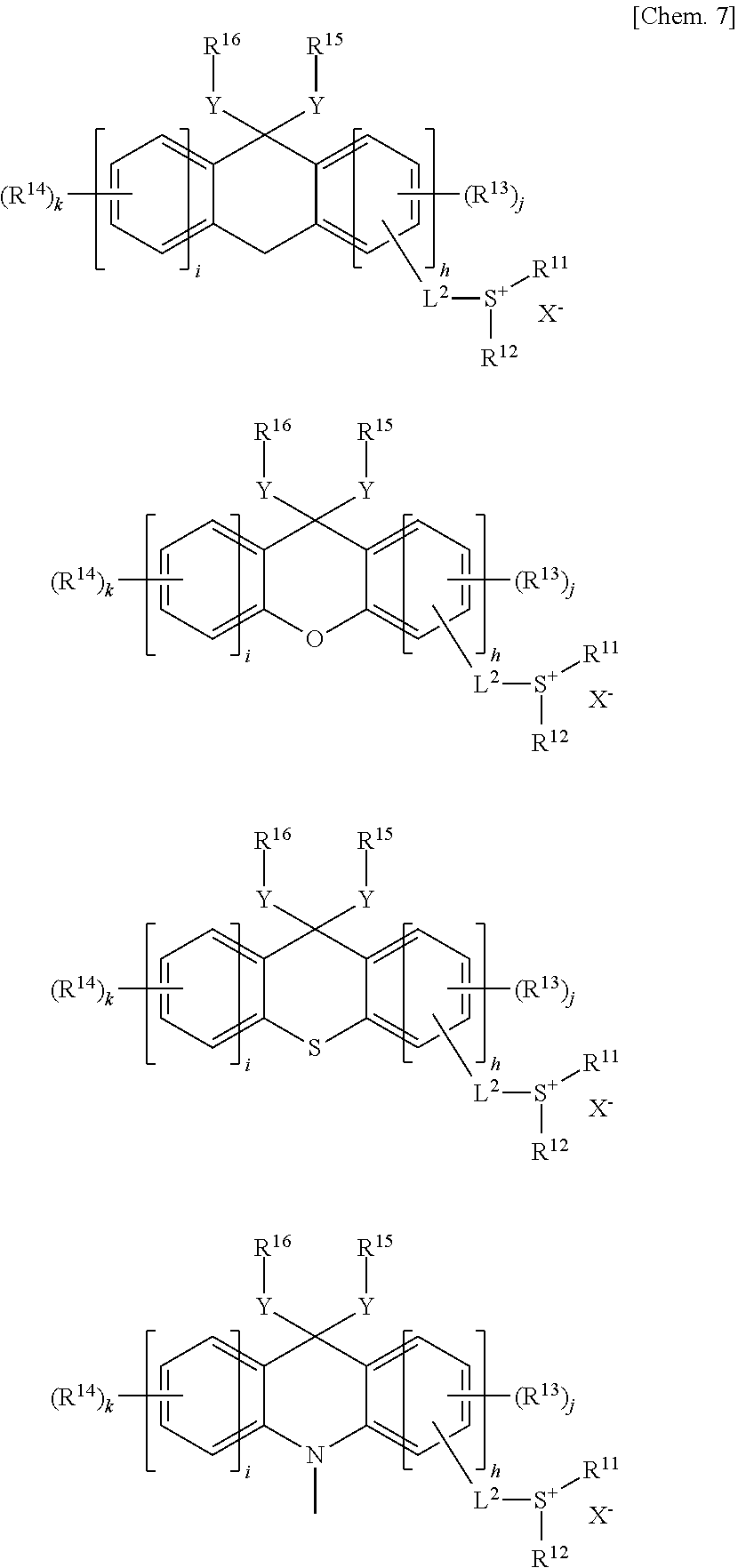
- L2 is preferably any one selected from the group consisting of: a linear, branched or cyclic alkylene group having 1 to 12 carbon atoms; an alkenylene group having 1 to 12 carbon atoms; an arylene group having 6 to 12 carbon atoms; a heteroarylene group having 4 to 12 carbon atoms; and a group in which these groups are bonded through an oxygen atom, a sulfur atom or a nitrogen atom-containing group. Examples of each of the alkylene group, the alkenylene group, arylene group and the heteroarylene group of L2 include groups in which each of the alkyl group, the alkenyl group, the aryl group, and the heteroaryl group of R11 become divalent. Examples of the nitrogen atom-containing group of L2 include the same nitrogen atom-containing group as R11.
- In the above general formula (1), from a viewpoint of ease of synthesis, each of k and j is preferably 0 to 3, more preferably 0 to 2, independently.
- Each of R13 to R16, X− , Y, L2, L3 and h to k is any one independently selected from a same option as R13 to R16, X− , Y, L2, L3 and h to k of the formula (1).
- R17 is preferably any one selected from the group consisting of: an aryl group which may have a substituent, the aryl group having 6 to 12 carbon atoms; and a heteroaryl group which may have a substituent, the heteroaryl group having 4 to 12 carbon atoms. R17 and an aryl group bonded to an iodonium group may be bonded each other to form a ring structure with an iodine atom bonded to R17 and the aryl group bonded the iodonium group. The aryl group and the heteroaryl group of R17 are selected from a same option as each of the aryl and heteroaryl groups of R11 above. Examples of the substituent of R17 include the same substituent as the first substituent.
- In the general formula (2), the aryl group bonded to the iodonium group is a moiety indicated by the arrow below.
-

- A quaternary carbon atom directly bonded to two of Y and two aryl groups directly bonded to the quaternary carbon atom form a 5-membered ring structure with a direct bond between the two aryl groups directly bonded to the quaternary carbon atom, or a 6-membered ring structure with a bond through L3.
- Each of R11 to R16, L2, Y, h to k and X− is any one independently selected from a same option as each of R11 to R16, L2, Y, h to k and X− in the formula (1).
- Each of L4 and L5 is any one independently selected from the group consisting of a direct bond, an alkenylene group having 2 carbon atoms, an alkynylene group having 2 carbon atoms and a carbonyl group. That is, a quaternary carbon atom directly bonded to two of Y and two aryl groups may be bonded directly, or bonded through the alkenylene group having 2 carbon atoms or the alkynylene group having 2 carbon atoms, but the onium salt has a structure having at least one bond through the alkenylene group having 2 carbon atoms or the alkynylene group having 2 carbon atoms.
- In the general formula (11), the aryl group bonded to the sulfonium group is a moiety indicated by the arrow below.
-

- In the general formula (12), each of R13 to R17, L2, Y, h to k and X− is independently selected from a same option as each of R13 to R17, L2, Y, h to k and X− in the formula (2).
- Each of L4 and L5 is any one independently selected from the group consisting of a direct bond, an alkenylene group having 2 carbon atoms, an alkynylene group having 2 carbon atoms and a carbonyl group. That is, a quaternary carbon atom directly bonded to two of Y and the two aryl groups may be bonded directly, or bonded through the alkenylene group having 2 carbon atoms or the alkynylene group having 2 carbon atoms, but the onium salt has a structure having at least one bond through the alkenylene group having 2 carbon atoms or the alkynylene group having 2 carbon atoms.
- In the general formula (12), the aryl group bonded to the iodonium group is a moiety indicated by the arrow below.
-

- In the general formula (1), (2), (11) or (12), Y is an oxygen atom or a sulfur atom.
- Each of h and i is independently an integer of 1 to 3.
- j is an integer of 0 to 4 when h is 1, 0 to 6 when h is 2, and 0 to 8 when h is 3.
- k is an integer of 0 to 5 when i is 1, 0 to 7 when h is 2, and 0 to 9 when h is 3.
- For example, when i and/or h is 2 in the formula (1) or (2), the onium salt has a naphthalene ring. The naphthalene ring may be bonded to the quaternary carbon bonded to Y at any position of 1- to 8-position.
- For example, when i and/or h is 3 in the above formula (1), (2), (11) or (12), the onium salt has at least one of an anthracene ring, a phenanthrene ring and a naphthacene ring. Also in this case, the phenanthrene ring and the naphthacene ring may be bonded to the quaternary carbon bonded to Y at any position of 1- to 10-position.
- In some embodiments of the present invention, examples of the onium salt include those having a sulfonium cation and an iodonium cation described below. However, some aspects of the present invention are not limited thereto.
-


- An embodiment of the present invention is preferably a sulfonium salt represented by a following formula (6).
-

- In the general formula (6), each of R11 to R16, X− and Y is independently selected from a same option as each of R11 to R16, X− and Y of the general formula (1).
- R18 is any one selected from the group consisting of an alkyl group, a hydroxy group, a mercapto group, an alkoxy group, an alkylcarbonyl group, an arylcarbonyl group, an alkoxycarbonyl group, an aryloxycarbonyl group, an arylsulfanylcarbonyl group, an arylsulfanyl group, an alkylsulfanyl group, an aryl group, a heteroaryl group, an aryloxy group, an alkylsulfinyl group, an arylsulfinyl group, an alkylsulfonyl group, an arylsulfonyl group, an arylsulfonyl group, a (meth)acryloyloxy group, a hydroxy(poly)alkyleneoxy group, an amino group, a cyano group, a nitro group and a halogen atom, wherein R18 preferably has 1 to 12 carbon atoms when R18 has a carbon atom, and these groups may have a substituent.
- e is an integer of 0 to 4, f is an integer of 0 to 4, and g is an integer of 0 to 5.
- X− is an anion. The anion is not particularly limited, and examples thereof include anions such as a sulfonate anion, a carboxylate anion, an imide anion, a methide anion, a carbanion, a borate anion, a halogen anion, a phosphate anion, an antimonate anion, an arsenate anion and the like.
- More specifically, examples of the anion preferably include ZAa−, (Rf)bPF(6−b) −, R19 cBA(4−c) −, R19 cGaA(4−c) −, R20SO3 −, (R20SO2)3C− and (R20SO2)2N−. When the anion has two or more Rf, R19 and R20, each of the two of Rf, the two of R19 and the two of R20 may be bonded to each other to form a ring.
- Z represents a phosphorus atom, a boron atom or an antimony atom. A represents a halogen atom, preferably a fluorine atom.
- P represents a phosphorus atom, F represents a fluorine atom, B represents a boron atom, and Ga represents a gallium atom.
- S represents a sulfur atom, O represents an oxygen atom, C represents a carbon atom, and N represents a nitrogen atom.
- Rf is preferably an alkyl group in which 80 mol % or more of hydrogen atoms are substituted with a fluorine atom, and the alkyl group is preferably an alkyl group having 1 to 8 carbon atoms. Examples of an alkyl group to be Rf by fluorine substitution include: a linear alkyl group such as a methyl group, an ethyl group, a propyl group, a butyl group, a pentyl group, an octyl group and the like; a branched alkyl group such as an isopropyl group, an isobutyl group, a sec-butyl group, a tert-butyl group and the like; a cycloalkyl group such as a cyclopropyl group, a cyclobutyl group, a cyclopentyl group, a cyclohexyl group and the like; and the like. The proportion of hydrogen atoms of these alkyl groups substituted by the fluorine atom in Rf is preferably 80 mol % or more, more preferably 90 mol % or more, even more preferably 100%, based on a number of moles of hydrogen atoms that the original alkyl group has.
- Particularly preferred examples of Rf include CF3 −, CF3CF2 −, (CF3)2CF−, CF3CF2CF2 −, CF3CF2CF2CF2 −, (CF3)2CFCF2 −, CF3CF2(CF3)CF− and (CF3)3C−. The b number of Rf are mutually independent, and therefore may be the same as or different from each other.
- R19 represents a phenyl group in which a part of hydrogen atoms is substituted with at least one halogen atom or an electron withdrawing group. Examples of the halogen atom include a fluorine atom, a chlorine atom, a bromine atom and the like. Examples of the electron withdrawing group include a trifluoromethyl group, a nitro group, a cyano group and the like. Among them, a phenyl group in which one hydrogen atom is substituted with a fluorine atom or a trifluoromethyl group is preferable. The c number of R19 are mutually independent and may be the same as or different from each other.
- R20 represents an alkyl group having 1 to 20 carbon atoms and aryl group having 6 to 20 carbon atoms, the alkyl group and the aryl group in which a part or all of hydrogen atoms may be substituted with a fluorine atom. As for R20, the alkyl group may be either linear, branched or cyclic, and the aryl group may be unsubstituted or may have a substituent.
- a represents an integer of 4 to 6. b represents an integer of 1 to 5, preferably 2 to 4, and more preferably 2 or 3. c represents an integer of 1 to 4, and preferably 4.
- Examples of the anion represented by ZAa − include anions represented by SbF6 −, PF6 −, BF4 − and the like.
- Examples of the anion represented by (Rf)6PF(6−b) − preferably include an anion represented by (CF3CF2)2PF4 −, (CF3CF2)3PF3 −, ((CF3)2CF)2PF4 −, ((CF3)2CF)3PF3 −, (CF3CF2CF2)2PF4−, (CF3CF2CF2)3PF3 −, ((CF3)2CFCF2)2PF4 −, ((CF3)2CFCF2)3PF3 −, (CF3CF2CF2CF2)2PF4 −, (CF3CF2CF2CF2)3PF3 − and the like. Among them, anions represented by (CF3CF2)3PF3 −, (CF3CF2CF2)3PF3 −, ((CF3)2CF)3PF3 −, ((CF3)2CF)2PF4 −, ((CF3)2CFCF2)3PF3 − and ((CF3)2CFCF2)2PF4 −.
- Examples of the anion represented by R19 cBA(4−c) − include (C6F5)4B−, ((CF3)2C6H3)4B31 , (CF3C6H4)4B−, (C6F5)2BF2 −, C6F5BF3 −, (C6H3F2)4B− and the like. Among them, anions represented by (C6F5)4B− and ((CF3)2C6H3)4B− are preferable.
- Examples of the anion represented by R19 cGaA(4−c) − include (C6F5)4Ga−, ((CF3)2C6H3)4Ga−, (CF3C6H4)4Ga−, (C6F5)2GaF2 −, C6F5GaF3 −, (C6H3F2)4Ga− and the like. Among them, anions represented by (C6F5)4Ga− and ((CF3)2C6H3)4Ga− are preferable.
- Examples of the anion represented by R20SO3 − include trifluoromethanesulfonate anion, pentafluoroethanesulfonate anion, heptafluoropropanesulfonate anion, nonafluorobutanesulfonate anion, pentafluorophenylsulfonate anion, p-toluenesulfonate anion, benzenesulfonate anion, camphorsulfonate anion, methanesulfonate anion, ethanesulfonate anion, propanesulfonate anion, butanesulfonate anion and the like. Among them, trifluoromethanesulfonate anion, nonafluorobutanesulfonate anion, methanesulfonate anion, butanesulfonate anion, benzenesulfonate anion and p-toluenesulfonate anion are preferable.
- Examples of the anion represented by (R20SO2)3C− include (CF3SO2)3C−, (C2F5SO2)3C−, (C3F7SO2)3C−, (C4F9SO2)3C− and the like.
- Examples of the anion represented by (R20SO2)2N− include (CF3SO2)2N−, (C2F5SO2)2N−, (C3F7SO2)2N−, (C4F9SO2)2N− and the like. A cyclic imide in which two moieties corresponding to (R20SO2) are bonded to each other to form a ring structure may also be the anion represented by (R20SO2)2N−.
- As a monovalent anion, in addition to the above anions, a perhalogenate ion (ClO4 −, BrO4 − and the like), a halogenated sulfonate ion (FSO3 −, ClSO3 − and the like), a sulfate ion (CH3SO4 −, CF3SO4 −, HSO4 − and the like), a carbonate ion (HCO3 −, CH3CO3 − and the like), an aluminate ion (AlCl4 −, AlF4 − and the like), a hexafluorobismuthate ion (BiF6 −), a carboxylate ion (CH3COO−, CF3COO−, C6H5COO−, CH3C6H4COO−, C6F5COO31 , CF3C6H4COO− and the like), an aryl borate ion (B(C6H5)4 −, CH3CH2CH2CH2B(C6H5)3 − and the like), a thiocyanate ion (SCN−), a nitrate ion (NO3 −) and the like may be used.
- These anions may have a substituent, and examples of the substituent include an alkyl group, a hydroxy group, a mercapto group, an alkoxy group, an alkylcarbonyl group, an arylcarbonyl group, an alkoxycarbonyl group, an aryloxycarbonyl group, an arylsulfanylcarbonyl group, an arylsulfanyl group, an alkylsulfanyl group, an aryl group, a heteroaryl group, an aryloxy group, an alkylsulfinyl group, an arylsulfinyl group, an alkylsulfonyl group, an arylsulfonyl group, an arylsulfonyl group, a (meth)acryloyloxy group, a hydroxy(poly)alkyleneoxy group, an amino group, a cyano group, a nitro group, a halogen atom and the like.
- Among these anions, a sulfonate anion and a carboxylate anion are preferable.
- An onium salt according to an embodiment of the present invention, as an embodiment of the photoacid generator (A), may be an acid generator unit-containing resin in which an anion moiety is bonded to a part of a polymer. Examples of such an onium salt include a resin in which X− in the formulas (1), (2), (11) and (12) has a unit represented by a following general formula (5). The onium salt is preferably contained in the composition as a unit of the acid generator unit-containing resin, since LWR can be suppressed by suppressing diffusion of acid generated during exposure.
- The unit represented by the general formula (5) may be contained in the resin (B), or may be contained in a resin different from the resin (B).
-

- Each of R1 and L1 is independently selected from a same option as each of R1 and L1 in the formula (1).
- Z1 is any one selected from the group consisting of: a linear or branched alkyl group having 1 to 12 carbon atoms; a linear or branched alkenyl group having 1 to 12 carbon atoms; and an aryl group having 6 to 14 carbon atoms.
- A part or all of hydrogen atoms of the alkyl group, the alkenyl group and the aryl group in Z1 may be substituted with a fluorine atom. At least one methylene group in these groups may be substituted with a divalent hetero atom-containing group.
- Examples of the anion moiety represented by the formula (5) are described below. However, the present invention is not limited thereto.
-

- The onium salt according to some embodiments of the present invention has a molar absorption coefficient at 365 nm of preferably less than 1.0×105 cm2/mol, and more preferably less than 1.0×104 cm2/mol. The ketone derivative converted from the acetal or the thioacetal of the onium salt by deprotection according to some embodiments of the present invention has a molar absorption coefficient at 365 nm of preferably 1.0×105 cm2/mol or more, and more preferably 1.0×106 cm2/mol or more.
- The molar absorption coefficient at 365 nm of the ketone derivative is preferably 5 times or more, more preferably 10 times or more, and even more preferably 20 times or more than the molar absorption coefficient of the onium salt according to some embodiments of the present invention.
- In order to obtain the above characteristics, the onium salt may be oniumu salts represented by the formula (1), (2), (11) or (12).
- <2> Method for synthesizing the onium salt Among the onium salt according to an embodiment of the present invention, a method for synthesizing the sulfonium salt and the iodonium salt will be described. However the present invention is not limited thereto.
- When the sulfonio group moiety of a desired sulfonium salt has an alkyl group, for example, the following method can be used. First, an alkylsulfanyl group-containing bromobenzene, h=1 in the following formula, and an aryl group may have R13 group; and a benzoyl chloride which may have an R14 group, i=1 in the following formula; are reacted with a Grignard reagent to obtain an alkylsulfanylbenzophenone derivative. Here, R14 may be a fluoro group to obtain an alkylsulfanylbenzophenone derivative having any substituent by an aromatic nucleophilic substitution reaction. Subsequently, an alkylating agent (R12 2504) such as dimethylsulfuric acid or the like is added to obtain a sulfonium salt, and then salt exchange is carried out using a salt having a corresponding anion to obtain a dialkyl-arylsulfonium salt. Thereafter, the desired sulfonium salt is obtained by acetalizing the carbonyl group using an acid catalyst and an alcohol (R15OH).
-

- When the sulfonio group moiety of the desired sulfonium salt has an aryl group, for example, the following method can be used. First, a benzene which may have an R14 group, i=1 in the following formula; and a bromobenzoyl chloride, h=1 in the following formula, and an aryl group may have R13 group; are reacted by Friedel-Crafts reaction with a Lewis acid to obtain a bromobenzophenone derivative. Subsequently, the carbonyl group is acetalized with an acid catalyst and an alcohol (R15OH). Then, the acetal and a sulfoxide compound having R11 group and R12 group are reacted with a Grignard reagent to obtain a sulfonium salt, and thereafter, salt exchange is carried out using a salt having a corresponding anion to obtain the desired sulfonium salt.
-

- In the case of the iodonium salt, for example, the following method can be used. First, a benzene which may have an R14 group, m=1 in the following formula; and a bromobenzoyl chloride, n=1 in the following formula, and an aryl group may have R13 group; are reacted by Friedel-Crafts reaction with a Lewis acid to obtain an iodobenzophenone derivative. Subsequently, the iodobenzophenone derivative is reacted with an oxidizing agent such as metachloroperbenzoic acid (mCPBA) and the like in the presence of an acid such as trifluoromethanesulfonic acid and the like, and then reacted with an aromatic compound R17 to obtain an iodonium salt. Thereafter, the desired iodonium salt is obtained by acetalizing the carbonyl group using an acid catalyst and an alcohol (R15OH) and, if necessary, salt exchange is carried out using a salt having a corresponding anion.
-

- When the anion moiety of the onium salt is a polymer component bonded to a part of the polymer, for example, the following synthesis method can be used. First, salt exchange is carried out using a commercially available or, as required, synthesized sulfonate having polymerizable functional group and the sulfonium salt or iodonium salt to obtain an onium salt (polymerizable onium salt) having the polymerizable functional group in an anion moiety. Subsequently, by copolymerizing the obtained polymerizable onium salt with an acid dissociable compound or the like using a radical initiator, the desired polymer component can be obtained.
-
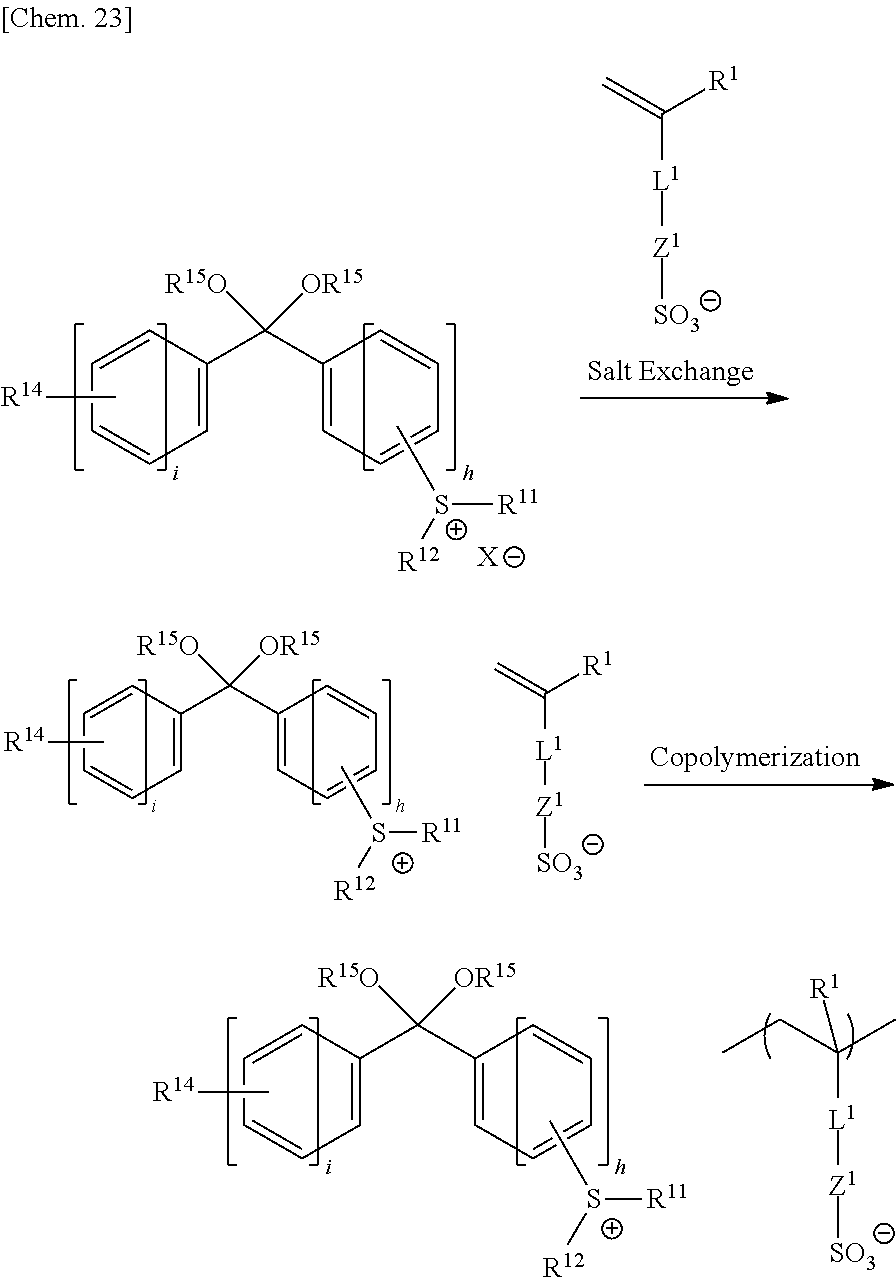
- When the desired onium salt forms a cyclic structure through L3, for example, the following synthesis method can be used. First, some of cyclic ketone derivatives (a) forming a cyclic structure through L3 are commercially available, and others can be synthesized as required. The cyclic ketone derivative and a sulfoxide compound having R11 group and R12 group are reacted with a strong acid such as methanesulfonic acid or the like and a dehydrating agent to obtain a sulfonium salt, in the following formula, the sulfonium group is bonded to an aryl group substituted with R13, but may be bonded to the aryl group substituted with R14. Subsequently, the desired sulfonium salt can be obtained by acetalizing the carbonyl group using an acid catalyst and an alcohol (R15OH).
-

- When the desired onium salt has L4 or L5 having an alkenylene group, for example, the following synthesis method can be used. An acetyl compound (b) having an R13 group or R14 group and an aldehyde compound (c) are reacted by an aldol reaction using sodium hydroxide to obtain an unsaturated ketone compound (d). Subsequently, the unsaturated ketone compound and a sulfoxide compound having R11 group and R12 group are reacted with a strong acid such as methanesulfonic acid or the like and a dehydrating agent to obtain a sulfonium salt, in the following formula, the sulfonium group is bonded to an aryl group substituted with R13, but may be bonded to the aryl group substituted with R14. Thereafter, the desired sulfonium salt can be obtained by acetalizing the carbonyl group using an acid catalyst and an alcohol (R15OH).
-

- An embodiment of the present invention relates to a composition containing the photoacid generator (A) and an acid reactive compound. Preferably, the composition further contains an acid-diffusion controller.
- A content of the photoacid generator in the composition according to an embodiment of the present invention is, with respect to 100 parts by mass of the resist composition component excluding the photoacid generator, preferably 0.1 to 50 parts by mass, more preferably 1 to 30 parts by mass, and even more preferably 3 to 15 parts by mass.
- In calculating the content of the photoacid generator, an organic solvent is not included in 100 parts by mass of the resist composition component.
- When the photoacid generator is contained in a resin as one unit, that is, when the photoacid generator is a polymer component, the content is based on a mass excluding the polymer main chain. In addition, when the photoacid generator is a polymer component and is contained, as a unit of the same polymer, together with at least one unit selected from the group consisting of: a unit represented by following general formulas (4a) to (4b), hereinafter also referred to as “unit C”; and a unit represented by general formulas (3a) to (3d), hereinafter also referred to as “unit B”, the unit acting as the photoacid generator, hereinafter also referred to as “unit A”, is preferably from 0.1 to 40 mol %, more preferably from 1 to 30 mol %, and even more preferably 3 to 20 mol % in all polymer units.
- The photoacid generator may be used solely or in combination of two or more, and may be used in combination with other photoacid generators, regardless of the polymer component and the low molecular weight component.
- Examples of photoacid generators other than the photoacid generator containing the onium salt include general-purpose ionic photoacid generators and nonionic photoacid generators. Examples of the ionic photoacid generators include onium salt compounds such as iodonium salts, sulfonium salts and the like other than those described above. Examples of the nonionic photoacid generator include N-sulfonyloxyimide compounds, oxime sulfonate compounds, organic halogen compounds, sulfonyldiazomethane compounds and the like.
- When the composition contains the photoacid generator other than the photoacid generator containing the onium salt, the content is preferably 0.1 to 50 parts by mass with respect to 100 parts by mass of the resist composition component excluding the total photoacid generator.
- The acid reactive compound is preferably at least one selected from the group consisting of: a compound having a protecting group to be deprotected by an acid; a compound having a polymerizable group to be polymerized by an acid; and a crosslinking agent exerting a crosslinking action by an acid.
- The compound having a protecting group to be deprotected by an acid is a compound whose solubility in a developing solution changes by forming a polar group due to deprotection of the protecting group by an acid. For example, in the case of water-based development using an alkaline developing solution or the like, the compound is insoluble in an alkaline developing solution, and by deprotection of the protecting group of the compound in the exposed portion by an acid generated from the photoacid generator with exposure, the compound becomes soluble in the alkaline developing solution.
- According to an embodiment of the present invention, the acid reactive compound is particularly preferably a resin (B) whose solubility in a developing solution changes by an acid.
- The resin (B) has at least one of the units B represented by the formulas (3a) to (3d) having a protective group to be deprotected by an acid.
- The unit B has the protecting group to be deprotected by an acid, is a unit contained in the resin (B), and is a unit in which the protecting group is deprotected to generate a polar group and the solubility in the developing solution changes. For example, in the case of water-based development using an alkaline developing solution or the like, the compound is insoluble in an alkaline developing solution, and by deprotection of the protecting group of the unit B in an exposed portion by an acid generated from the photoacid generator with exposure, the compound becomes soluble in the alkaline developing solution.
- In the present invention, it is not limited to the alkaline developing solution, and it may be an aqueous neutral developing solution or an organic solvent developing solution. Therefore, when the organic solvent developing solution is used, the compound having a protecting group to be deprotected by an acid is a compound whose solubility in the organic solvent developing solution becomes lower due to generating a polar group by deprotecting the protecting group of the compound in an exposed portion by the acid generated from the photoacid generator with exposure.
- Examples of the polar group include a hydroxy group, a carboxy group, an amino group, a sulfo group and the like. Among them, a polar group having —OH in the structure is preferable, and the hydroxy group or the carboxy group is preferable.
- Specific examples of the protecting group to be deprotected by an acid include: a group forming a tertiary alkyl ester group with a carboxy group; an alkoxyacetal group; a tetrahydropyranyl group; a siloxy group; a benzyloxy group; and the like. As a compound having the protecting group, a compound having a styrene skeleton, a methacrylate or acrylate skeleton to which these protecting groups are bonded is preferably used.
- The resin (B) may be a low molecular weight compound having a protecting group, instead of a polymer component having a unit B having a protecting group to be deprotected by an acid.
- The low molecular weight compound having a protective group has at least one of the units represented by the formulas (3a) to (3d), as the above resin (B).
- In the formulas (3a) to (3d), R1 is any one selected from the group consisting of a hydrogen atom, an alkyl group and a halogenated alkyl group.
- Examples of the alkyl group include a methyl group, an ethyl group, an n-propyl group, an n-butyl group, an isopropyl group, a t-butyl group, a cyclopropyl group, a cyclobutyl group, a cyclopentyl group and a cyclohexyl group, and a part of hydrogen atoms in these groups may be substituted with a halogen atom. Among them, R1 is preferably the hydrogen atom, the methyl group or a trifluoromethyl group.
- In the general formulas (3a) to (3d), a moiety represented by a following formula (a-1) or (a-2) is the protecting group to be deprotected by an acid, hereinafter also referred to as “acid labile group”, and the solubility in the developing solution changes due to generating a carboxylic acid or phenolic hydroxyl group by decomposition by an acid.
- A broken line in the following formulas (a-1) and (a-2) represents a bonding site with Li or an oxygen atom in the formulas (3a) to (3d). R2 to R7 in the following formulas (a-1) and (a-2) are preferably selected from a same option as R2 to R7 in the general formulas (3a) to (3d).
-

- In the formula (a-1), each of R2 and R3 is independently a linear, branched or cyclic alkyl group. Examples of such alkyl group include a methyl group, an ethyl group, an n-propyl group, an n-butyl group, an isopropyl group, a t-butyl group, a cyclopropyl group, a cyclobutyl group, a cyclopentyl group, a cyclohexyl group, an adamantan-1-yl group, an adamantan-2-yl group, a norbornan-1-yl group, a norbornan-2-yl group and the like.
- R4 is a linear, branched or cyclic alkyl group which may have a substituent, the alkyl group is selected from a same option as R2, and a part of hydrogen atoms in these groups may be substituted with an alkoxy group, an oxo group, an amino group, an alkylamino group and the like. R5, R6 and R7 may be bonded each other directly with a single bond or through a methylene group to form a ring structure.
- In the formula (a-2), each of R5 and R6 is independently a hydrogen atom, and a linear or cyclic alkyl group, and the alkyl group is selected from a same option as each of the alkyl group of R2.
- R7 is a linear, branched or cyclic alkyl group which may have a substituent, the alkyl group is selected from a same option as each of the alkyl group of R2, and a part of hydrogen atoms in these groups may be substituted with a hydroxyl group, an alkoxy group, an oxo group, an amino group, an alkylamino group and the like. R5, R6 and R7 may be bonded each other directly with a single bond or through a methylene group to form a ring structure.
- Specific examples of the formulas (a-1) and (a-2) include the following structures. However, the present invention is not limited thereto.
-

- R8 in the general formulas (3c) to (3d) is any one selected from the group consisting of an alkyl group, a hydroxy group, an alkoxy group, an alkylcarbonyl group, an alkylsulfanyl group, an alkylsulfinyl group, an alkylsulfonyl group, an amino group, a cyano group, a nitro group and a halogen atom. These are selected from a same option as R13.
- L1 in the general formulas (3a) to (3d) is any one selected from the group consisting of: a direct bond, a carbonyloxy group; a carbonylamino group; a linear, branched or cyclic alkylenecarbonyloxy group which may have a substituent; and a linear, branched or cyclic alkylenecarbonylamino group which may have a substituent, and the carbonyloxy group or the carbonylamino group is bonded to the acid labile group.
- In the general formulas (3a) to (3d), l is an integer of 1 to 2; m is an integer of 0 to 4 when l is 1, and an integer of 0 to 6 when l is 2; n is an integer of 1 to 5 when l is 1, and an integer of 1 to 7 when l is 2; and m+n is 1 to 5 when l is 1, and 1 to 7 when l is 2.
- Specific examples of the unit B represented by the general formulas (3a) to (3d) include the followings. However, the present invention is not limited thereto.
-


- Instead of or in addition to the resin (B), the compound having a polymerizable group to be polymerized by an acid and/or the crosslinking agent exerting a crosslinking action by an acid may be contained in the composition. The compound having a polymerizable group to be polymerized by an acid is a compound whose solubility in a developing solution changes by polymerizing by an acid. For example, in the case of water-based development, a compound soluble in an aqueous developing solution is affected and the solubility of the compound in the aqueous developing solution decreases after polymerization. Specific examples thereof include compounds having an epoxy group, a vinyloxy group, an oxetanyl group and the like.
- The compound having a polymerizable group to be polymerized by an acid may be a polymerizable low molecular compound or a polymer component having a unit having a polymerizable group. The crosslinking agent exerting a crosslinking action by an acid is a crosslinking agent whose solubility in the developing solution changes by crosslinking by an acid. For example, in the case of water-based development, a compound soluble in the aqueous developing solution is affected and the solubility of the compound in the aqueous developing solution decreases after polymerization or crosslinking. Specific examples thereof include crosslinking agents having a crosslinkable group such as an epoxy group, a vinyloxy group, a 1-alkoxyamino group, an oxetanyl group and the like. When the compound is a crosslinking agent having a crosslinking action, as a compound to be crosslinked with, that is, a compound which reacts with a crosslinking agent and changes solubility in the developing solution, a compound having a phenolic hydroxyl group and the like may be used.
- The compound exerting a crosslinking action by an acid may be a crosslinkable low molecular weight compound or a polymer component having a unit having a crosslinkable group.
- The resin (B) may contain, in addition to at least one of the units B represented by the formulas (3a) to (3d), other units normally used in the resist composition in the polymer component. Examples of other units include: a unit having at least one skeleton selected from the group consisting of a lactone skeleton, a sultone skeleton, a sulfolane skeleton, a lactam skeleton and the like; a unit having at least one structure selected from the group consisting of an ether structure, an ester structure, an acetal structure, a structure having a hydroxy group and the like; a unit containing a hydroxyaryl group; and the like. Further, the resin (B) may contain the unit A.
- The resin (B) may be contained in the composition as a homopolymer containing the unit B or as a copolymer containing the unit B, the unit A and at least one unit C selected from the group consisting of units represented by general formulas (4a) to (4b). When the resin (B) is the copolymer, a content of the unit B in the resin (B) is preferably 3 to 50 mol %, more preferably from 5 to 35 mol %, and even more preferably from 7 to 30 mol %.
- In an embodiment of the present invention, it is preferably that the composition contains a resin (C) having one or more units C represented by the following formulas (4a) to (4b), or the resin (B) further contains the unit C.
-

- In the general formulas (4a) and (4b), each of R1, R8 and L1 is independently selected from a same option as each of R1, R8 and L1 of the formulas (3a) to (3d).
- R9 is a cyclic group having at least one selected from the group consisting of —C(O)—O—, —SO2—and —O—SO2—.
- p is an integer of 0 to 4, and q is an integer of 1 to 5.
- Examples of the cyclic group include groups having a lactone skeleton, a sultone skeleton, a sulfolane skeleton or the like.
- The unit C represented by the formulas (4a) to (4b) may be contained in the copolymer containing at least one of the unit A and/or the formulas (3a) to (3d) as the unit B, or may be contained as a unit of other polymers.
- A unit represented by the formula (4a) is a hydroxyaryl group-containing unit, hereinafter also referred to as “unit Cl”, and a unit represented by the formula (4b) is a unit having a lactone skeleton, a sultone skeleton or a sulfolane skeleton, hereinafter also referred to as “unit C2”.
- A polymer having the hydroxyaryl group-containing unit C1 is preferably used since it can be a hydrogen source in decomposition of the photoacid generator, the acid generation efficiency can be improved, and high sensitivity can be obtained. Since the polymer having the hydroxyaryl group-containing unit C1 has a low ionization potential, when an electron beam or extreme ultraviolet (EUV) is used for a first active energy ray described later, a secondary electron is easily generated, so that the acid generation efficiency can be improved and high sensitivity can be obtained.
- Examples of the hydroxyaryl group-containing unit C1 include the followings. However, the present invention is not limited thereto.
-

- When the hydroxyaryl group-containing unit C1 is included as a unit of the same polymer together with at least one selected from the group consisting of the unit A and the unit B, a content of the hydroxyaryl group-containing unit C1 in all polymer units is, for a positive resist composition of the water-based development, preferably 3 to 90 mol %, more preferably 5 to 80 mol %, and even more preferably 7 to 70 mol %. For a negative resist composition of the water-based development, the content is preferably 60 to 99 mol %, more preferably 70 to 98 mol %, and even more preferably 75 to 98 mol %.
- Examples of the unit C2 having a lactone skeleton, a sultone skeleton or a sulfolane skeleton include the followings. However, the present invention is not limited thereto.
-


- When a sultone skeleton-containing unit or a sulfolane skeleton-containing unit is used as the unit C2, an acid is generated by ionization by irradiation with the electron beam or the extreme ultraviolet (EUV) as the first active energy ray to contribute to the deprotection reaction of the acetal of the onium salt in some embodiments of the present invention, and more ketone derivatives having absorption for the second active energy ray can be produced. It also contributes to a polarity conversion by a reaction with the resin (B) containing the unit B, so that the solubility of the resin in the developing solution further changes. That is, high sensitivity can be obtained.
- When, the lactone skeleton-containing unit, the sultone skeleton-containing unit, or the sulfolane skeleton-containing unit is contained as the unit C2 in the same polymer together with at least one selected from the group consisting of the unit A and the unit B, the content of the unit C2 in all polymer units is preferably 3 to 70 mol %, more preferably 5 to 50 mol %, and even more preferably 7 to 40 mol %.
- In the composition according to an embodiment of the present invention, in addition to the unit A, the unit B and the unit C, another compound may be contained in the resin (B) and/or the resin (C) as a unit of the same polymer. The other compound are not particularly limited as long as it is a compound generally used as a resin composition such as ArF lithography, KrF lithography, electron beam lithography, EUV lithography or the like.
- The composition according to an embodiment of the present invention may contain a low molecular weight compound containing a sulfone or a sulfonate ester, or a polymer.
- The sulfone or the sulfonate ester is not particularly limited but is preferably one having a linear, branched or cyclic alkyl, or an aryl group. More preferably, a part or all of hydrogen atoms of the alkyl group or the aryl group are substituted with a fluorine atom. Since the compound is contained, the acid is generated by ionization by irradiation with the electron beam or the extreme ultraviolet, so that the sensitivity of the resist can be enhanced.
- A content of the compound containing the sulfone or the sulfonate ester is preferably 0.1 to 50 parts by mass with respect to 100 parts by mass of the resist composition component excluding the total amount of the photoacid generator.
- Specific examples of the compound containing the sulfone or the sulfonate ester include dimethylsulfone, isopropylmethylsulfone, methylphenylsulfone, diphenylsulfone, phenyltrifluoromethylsulfone, bis(4-fluorophenyl)sulfone, bis(phenylsulfonyl)methane, methyl methanesulfonate, isopropyl methanesulfonate, ethyl trifluoromethanesulfonate, methyl benzenesulfonate, 1,3-propane sultone, 1-propene 1,3-sultone, 1,4-butane sultone, 1,2-bis(tosyloxy)ethane, 1,8-naphthosultone and the like. Each of them may be used solely or in combination of two or more.
- The composition according to an embodiment of the present invention may contain a fluorine-containing water repellent polymer.
- The fluorine-containing water repellent polymer is not particularly limited, but one usually used in an immersion exposure process, and a proportion of the fluorine atom content is preferably larger than that of the above polymer. In the case of forming a resist film using a composition containing the fluorine-containing water repellent polymer, the fluorine-containing water repellent polymer is localized to the surface of the resist film due to the water repellency of the fluorine-containing water repellent polymer.
- As the fluorine proportion of the fluorine-containing water repellent polymer, hydrogen atoms in a hydrocarbon group in the fluorine-containing water repellent polymer are fluorinated preferably 25% or more, and more preferably 50% or more.
- A content of the fluorine-containing water repellent polymer in the composition is, with respect to 100 parts by mass of the polymer according to an embodiment of the present invention, not the fluorine-containing water repellent polymer, preferably 0.5 to 10 parts by mass from a viewpoint of improving the hydrophobicity of the resist film. The fluorine-containing water repellent polymer may be used solely or in combination of two or more.
- (Photosensitizer and its Precursor)
- The composition according to an embodiment of the present invention may contain a photosensitizer and its precursor. Hereinafter, the photosensitizer and its precursor are referred to as “sensitizer compound” collectively.
- The sensitizer compound is not particularly limited as long as it does not reduce the effect of the onium salt according to some embodiments of the present invention, and examples of the sensitizer compound include a thioxanthone derivative and an acetalized compound thereof, a benzophenone derivative and an acetalized compound thereof, a naphthalene derivative, an anthracene derivative, an alkyl alcohol, an aryl alcohols and the like.
- In addition, as the sensitizer compound, for example, a photosensitizer precursor represented by the following general formula (7) may be contained. By containing the photosensitizer precursor, a photosensitizer is generated from the photosensitizer precursor by irradiation with the first active energy ray, and then irradiated with the second active energy, so that it is possible to utilize the sensitization reaction occurring between the photosensitizer and the onium salt according to some embodiments of the present invention, and possible to enhance the sensitivity of the resist.
-

- In the formula (7), each of Ar11 and Ar12 is independently a phenylene group which may have a substituent; R21 is any one selected from the group consisting of an alkylsulfanyl group, an arylsulfanyl group and an alkylsulfanylphenyl group which may have a substituent; W is any one selected from the group consisting of a sulfur atom, an oxygen atom and a direct bond; R22 is an alkyl group or an aryl group which may have a substituent; each of Y is independently an oxygen atom or a sulfur atom; each of R23 and R24 is any one independently selected from the group consisting of a linear, branched or cyclic alkyl group, alkenyl group, alkynyl group and aralkyl group which may have a substituent; and R23 and R24 may be bonded each other to form a ring structure with two of Y in the formula.
- Each of Ar11 and Ar12 in the above formula (7) is a phenylene group, and may have a substituent other than R21 or -W-R22, hereinafter, substituents of Ar11 and Ar12 are referred to as “fourth substituent”. Note that Ar11 and Ar12 are preferably not bonded indirectly to form a ring from a viewpoint of synthesis.
- An example of the fourth substituent is an electron donating group. Specific examples of the electron-donating group include an alkyl group, an alkenyl group, an alkoxy group, an alkoxyphenyl group, an alkylsulfanyl group, an arylsulfanyl group, an alkylsulfanylphenyl group and the like. Another example of the fourth substituent is a long-chain alkoxy group having a polyethylene glycol chain (—(CO2H4)n −). When the fourth substituent is bonded to the para position of Ar11 or Ar12, Ar11 or Ar12 may have an OH group as the fourth substituent.
- In the present invention, a substitution position such as “para position” of Ar11 or Ar12 indicates a position with respect to a group to which a quaternary carbon bonded to two of Y, Ar11 and Ar12 in the formula (7) is bonded. The substitution position such as “para position” is the position with respect to the group to which the quaternary carbon is bonded, not only according to the fourth substituent but also another group.
- The alkyl group and alkenyl group as the fourth substituent are selected from a same option as the alkyl group and alkenyl group of R11 in the formula (1). The alkoxy group as the fourth substituent is selected from a same option as the alkoxy group (—OR) in the first substituent.
- Examples of the alkylsulfanyl group, arylsulfanyl group and alkylsulfanylphenyl group as the fourth substituent include a same option as the alkylsulfanyl group, arylsulfanyl group and alkylsulfanylphenyl group of R21 described later.
- Any one methylene group of the alkyl group in the fourth substituent may be substituted with —C(═O)— group or —O—C(═O)— group. However, in the fourth substituent, the —C(═O)— group and the —O—C(═O)— group are preferably not directly bonded to Ar11 and Ar12. Further, the fourth substituent preferably does not have a continuous bonding of heteroatoms such as —O—O—, —S—S— and —S—O—.
- When the fourth substituent is the alkoxy group, the alkoxyphenyl group, the alkylsulfanyl group, the arylsulfanyl group or the alkylsulfanylphenyl group, the fourth substituent is preferably bonded to the ortho position and/or the para position of the phenylene group which is Ar11 and Ar12. In that case, a number of the substituent is preferably 3 or less.
- R21 in the formula (7) is any one selected from the group consisting of an alkylsulfanyl group which may have a substituent, an arylsulfanyl group which may have a substituent and an alkylsulfanylphenyl group which may have a substituent.
- Specifically, the alkylsulfanyl group of R21 is preferably an alkylsulfanyl group having 1 to 20 carbon atoms such as a methylsulfanyl group, an ethylsulfanyl group, an n-propylsulfanyl group, an n-butylsulfanyl group and the like, and more preferably an alkylsulfanyl group having 1 to 12 carbon atoms.
- Specific examples of the arylsulfanyl group of R21 include a phenylsulfanyl group, a naphthylsulfanyl group and the like.
- Specific examples of the alkylsulfanylphenyl group of R21 include preferably a phenyl group to which an alkylsulfanyl group having 1 to 20 carbon atoms is bonded, such as a methylsulfanylphenyl group, an ethylsulfanylphenyl group, a propylsulfanylphenyl group, a butylsulfanylphenyl group and the like, and more preferably a phenyl group to which an alkylsulfanyl group having 1 to 12 carbon atoms is bonded. A substitution position of the alkylsulfanyl group bonded to the phenylene group in R21 is not particularly limited, but the para position is preferable from a viewpoint of increasing the electron donating property and the molar absorption coefficient at 365 nm. R21 is preferably bonded to the ortho or para position of the phenylene group which is Ar11.
- R22 in the formula (7) is an alkyl group or an aryl group which may have a substituent, and selected from a same options as each of those in the above R11.
- R21 and R22 in the formula (7) may have a substituent, and the substituent, hereinafter the substituent of R21 and R22 is referred to as “fifth substituent”, is not particularly limited, but an electron withdrawing group and the like can be used in addition to the fourth substituent. Examples of the electron withdrawing group include a nitro group, a sulfonyl group and the like. A polymer synthesized by polymerizing R21 or R22 into which a polymerizable group is introduced may be used as a polymer to which a sensitizing function is imparted. The fifth substituent may have a polymer main chain. Examples of the polymerizable group include a (meth)acryloyloxy group, an epoxy group, a vinyl group and the like.
- When W in the formula (7) is an oxygen atom or a sulfur atom, W is preferably at the ortho position or para position of Ar12. When W is a direct bond, W is preferably at the ortho position or para position of Ar12.
- A total number of carbon atoms of R21 in the formula (7) is not particularly limited, but it is preferably 1 to 20 when R21 has a substituent. A total number of carbon atoms of R22 in the formula (7) is not particularly limited, but it is preferably 1 to 20 when R22 has a substituent. When the photosensitizer precursor is a polymer, a total number of carbon atoms of R21 and R22 is preferably 1 to 20, excluding a portion containing the polymer main chain to be the fifth substituent.
- Each of Y is independently an oxygen atom or a sulfur atom. Each of R23 and R24 is any one independently selected from the group consisting of a linear, branched or cyclic alkyl group, alkenyl group, alkynyl group and aralkyl group which may have a substituent. The alkyl group and alkenyl group of R23 and R24 are selected from a same option as the alkyl group and alkenyl group of R11 in the formula (1).
- The alkynyl group of R23 and R24 is selected from those in which a part of the alkyl groups of R23 and R24 are replaced with a triple bond. The aralkyl group of R23 and R24 is selected from those in which a part of the hydrogen of the alkyl group of R23 and R24 is substituted with an aryl group such as a phenyl group, a naphthyl group or the like.
- R23 and R24 in the formula (7) may have a substituent, and the substituent, hereinafter the substituent of R23 and R24 is referred to as “the sixth substituent”, is not particularly limited, and examples thereof include an aryl group such as a phenyl group, a naphthyl group and the like in addition to the fifth substituent.
- A total carbon number of R23 and R24 in the formula (7) is not particularly limited, and the photosensitizer precursor may be a constituent component of a polymer, but it is preferably 1 to 20 when R23 or R24 has a substituent.
- R23 and R24 may be bonded each other to form a ring structure with two of Y in the formula. That is, the photosensitizer precursor according to an embodiment of the present invention is represented by a following formula (8). In the following formula (8), —R25—R26— is preferably —(CH2)n −, and n is an integer of 2 or more. n is not limited as long as n is 2 or more, but n is preferably 8 or less from a viewpoint of ease of synthesis. R25 and R26 correspond to those in which R23 and R24 in the formula (7) are bonded each other to form a ring.
-

- In the formula (8), R25 and R26 may have the same sixth substituent as R23 and R24. A polymer synthesized by polymerizing R23 or R24 into which a polymerizable group is introduced may be used as a polymer to which a sensitizing function is imparted.
- A total carbon number of R23 and R24 is preferably 1 to 20. When the photosensitizer precursor is a polymer, the total number of carbon atoms of R23 and R24 is preferably 1 to 20, excluding the portion containing the polymer main chain to be the sixth substituent.
- A photosensitizer precursor after acid treatment, that is, the photosensitizer having a carbonyl group formed when the photosensitizer precursor is deprotected with an acid preferably has a molar absorption coefficient at 365 nm of 1.0×105 cm2/mol or more. A higher molar absorption coefficient at 365 nm is preferred, but 1.0×1010 cm2/mol or less is a realistic value. In order to obtain the molar absorption coefficient within the above-mentioned range, for example, one or more of an alkylsulfanyl group, an arylsulfanyl group, an alkylsulfanylphenyl group, or two or more of an alkoxy group or an aryloxy group are contained in the photosensitizer precursor.
- In the present invention, a molar absorption coefficient is a value measured at 365 nm with UV-VIS absorption photometer using chloroform as a solvent.
- From viewpoints of ease of synthesis and light absorption property, the photosensitizer precursor according to an embodiment of the present invention preferably has 4 or less of groups selected from the group consisting of an alkylsulfanyl group, an arylsulfanyl group, an alkoxyphenyl group, an alkylsulfanylphenyl group, an alkoxy group and an aryloxy group other than —Y—R23 and —Y—R24, or —Y—R25—R26—Y—.
- Examples of the photosensitizer precursor represented by the formula (7) or (8) include following photosensitizer precursors. In the following examples, parenthesized parts represent polymer units. The photosensitizer precursor in some embodiments of the present invention is not limited thereto.
-

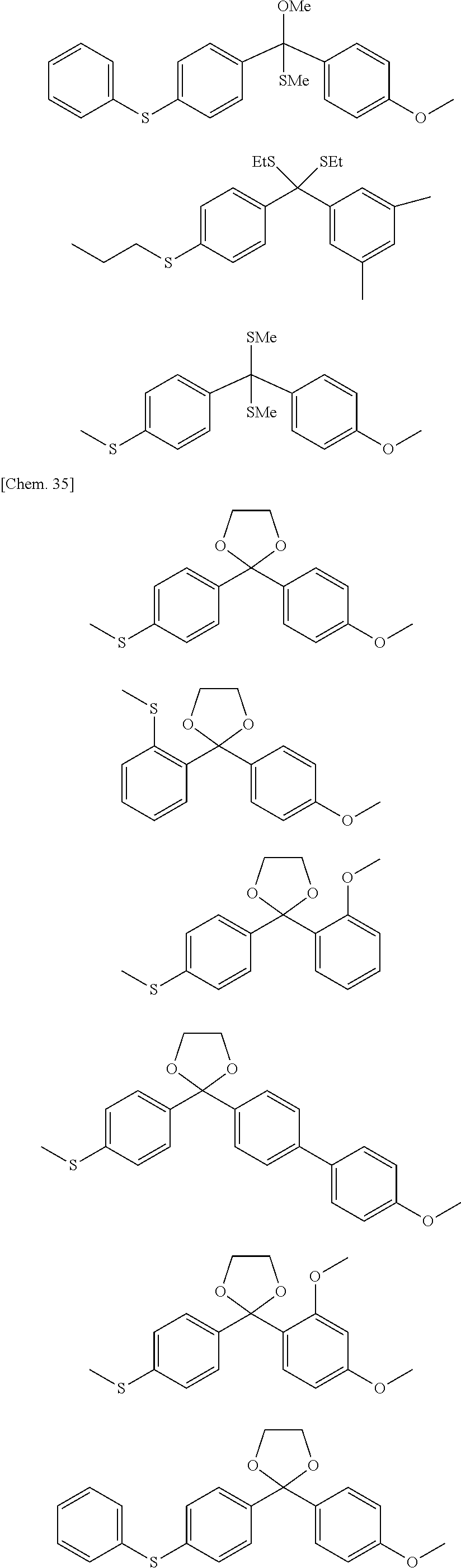


- A method of synthesizing a photosensitizer precursor according to an embodiment of the present invention will be described. However, the present invention is not limited thereto.
- When the photosensitizer precursor according to an embodiment of the present invention has a structure represented by a following formula (9), it can be synthesized, for example, by a following method. First, a reagent having -W-R22 group and a halogenated benzene having R21 group are reacted by Grignard reaction to obtain a benzophenone derivative, the reagent being one selected from the group consisting of: an alkoxybenzoyl chloride; an alkylbenzoyl chloride; a thioalkoxybenzoyl chloride; a thioalkylbenzoyl chloride; and those in which an alkyl group is an aryl group. Subsequently, the benzophenone derivative, an alcohol and optionally an orthoester such as a trialkyl orthoformate (R23, R24=alkyl group) as a dehydrating agent are reacted at 0° C. to reflux temperature for 1 to 120 hours to obtain a derivative represented by the following formula (9).
-

- In addition to the above components, the composition of an embodiment of the present invention may further contain, if necessary, an optional component such as an acid-diffusion controller, a surfactant, an organic carboxylic acid, an organic solvent, a dissolution inhibitor, a stabilizer, a dye, a polymer other than those described above and the like in combination.
- The acid-diffusion controller controls a diffusion of the acid generated from the photoacid generator in the resist film, and has an effect of suppressing an undesirable chemical reaction in an unexposed portion. The storage stability of the resulting resist composition and the resolution as a resist is further improved, and the line width change of the resist pattern due to fluctuation of the time elapsed from exposure until development process can be suppressed. Therefore, the resist composition excellent in process stability can be obtained.
- Examples of the acid-diffusion controller include a compound having one, two or three nitrogen atoms in the same molecule, an amide group-containing compound, a urea compound, a nitrogen-containing heterocyclic compound and the like. As the acid-diffusion controller, a photodegradable base to be sensitized by exposure and generates a weak acid may be used. Examples of the photodegradable base include an onium salt compound and an iodonium salt compound which decompose upon exposure to lose acid-diffusion controllability.
- Specific examples of the acid-diffusion controller include the compounds described in Japanese Patent No.3577743, JP2001-215689, JP2001-166476, JP2008-102383, JP2010-243773, JP2011-37835 and JP2012-173505.
- A content of the acid-diffusion controller is preferably 0.01 to 10 parts by mass, more preferably 0.03 to 5 parts by mass, and even more preferably 0.05 to 3 parts by mass, with respect to 100 parts by mass of the resist composition component.
- The surfactant is preferably used for improving coatability. Examples of the surfactant include nonionic surfactants such as polyoxyethylene alkyl ethers, polyoxyethylene alkylallyl ethers, polyoxyethylene polyoxypropylene block copolymers, sorbitan fatty acid esters, polyoxyethylene sorbitan fatty acid ester and the like; fluorine-based surfactants; organosiloxane polymers; and the like.
- A content of the surfactant is preferably 0.0001 to 2 parts by mass, and more preferably 0.0005 to 1% by mass with respect to 100 parts by mass of the resist composition component.
- Examples of the organic carboxylic acid include an aliphatic carboxylic acid, an alicyclic carboxylic acid, an unsaturated aliphatic carboxylic acid, an oxycarboxylic acid, an alkoxycarboxylic acid, a ketocarboxylic acid, a benzoic acid derivative, phthalic acid, terephthalic acid, isophthalic acid, 2-naphthoic acid, 1-hydroxy-2-naphthoic acid, 2-hydroxy-3-naphthoic acid and the like. When the electron beam exposure is performed under vacuum, there is a risk of being volatilized from the surface of the resist film and contaminating an inside of the writing chamber. Therefore, the organic carboxylic acid is preferably the aromatic organic carboxylic acid, particulary benzoic acid, 1-hydroxy-2-naphthoic acid and 2-hydroxy-3-naphthoic acid.
- A content of the organic carboxylic acid is preferably 0.01 to 10 parts by mass, more preferably 0.01 to 5 parts by mass, even more preferably 0.01 to 3 parts by mass with respect to 100 parts by mass of the resist composition component.
- Examples of the organic solvent preferably include ethylene glycol monoethyl ether acetate, cyclohexanone, 2-heptanone, propylene glycol monomethyl ether (PGME), propylene glycol monomethyl ether acetate (PGMEA), propylene glycol monomethyl ether propionate, propylene glycol monoethyl ether acetate, methyl 3-methoxypropionate, ethyl 3-ethoxypropionate, methyl β-methoxyisobutyrate, ethyl butyrate, propyl butyrate, methyl isobutyl ketone, ethyl acetate, isoamyl acetate, ethyl lactate, toluene, xylene, cyclohexyl acetate, diacetone alcohol, N-methyl pyrrolidone, N,N-dimethylformamide, γ-butyrolactone, N,N-dimethylacetamide, propylene carbonate, ethylene carbonate and the like. These organic solvents are used solely or in combination.
- The resist composition component is preferably dissolved in the organic solvent and dissolved at a solid concentration of 1 to 40% by mass, more preferably 1 to 30% by mass, and even more preferably 3 to 20% by mass. By setting the range of the solid concentration as described above, the above-mentioned film thickness can be achieved.
- When the resist composition according to an embodiment of the present invention contains a polymer, a weight average molecular weight of the polymer is preferably 2000 to 200000, more preferably 2000 to 50000, and even more preferably 2000 to 15000. From a viewpoint of sensitivity, a dispersity (molecular weight distribution) (Mw/Mn) of the polymer is preferably 1.0 to 1.7, and more preferably 1.0 to 1.2. The weight average molecular weight and the dispersity of the polymer are defined as polystyrene equivalent values by GPC measurement.
- The composition according to an embodiment of the present invention is obtained by mixing each component of the composition, and the mixing method is not particularly limited.
- An embodiment of the present invention is a method of manufacturing a device, including: formimg a resist film by, for example, applying the composition to a substrate; irradiating the resist film with a first active energy ray; irradiating a resist film after irradiating the first active energy ray, with a second active energy ray; and obtaining a pattern by developing a resist film after irradiating with the second active energy ray.
- An embodiment of the present invention may be a method of manufacturing a substrate having a pattern before obtaining a singulated chip, including: formimg a resist film with the composition; irradiating with a first active energy ray; irradiating with a second active energy ray; and forming a pattern.
- An embodiment of the present invention may be a method of manufacturing a device, including: forming a coating film on a substrate with the composition; and obtaining an interlayer insulating film by exposure of the coating film with a first active energy ray and a second active energy ray.
- The first active energy ray and the second active energy ray are not particularly limited as long as the onium salts according to some embodiments of the present invention do not have significant absorption in the second active energy ray, but a wavelength of the first active energy ray is preferably shorter than that of the second active energy ray, or an energy of a photon or particle beam of the first active energy ray is preferably higher than that of the second active energy ray. Although each active energy ray is exemplified below, it is not limited to followings as long as the wavelength of the first active energy ray is shorter than the second active energy ray, or the energy of the photon or particle beam of the first active energy ray is higher than that of the second active energy ray.
- The first active energy ray is not particularly limited as long as it can generate an active species such as an acid and the like in the resist film after irradiating the resist film. Preferred examples of the first active energy ray include KrF excimer laser, ArF excimer laser, electron beam or extreme ultraviolet (EUV) and the like.
- The second active energy ray may be a light which can generate an active species such as an acid or the like by activation of the ketone derivative formed by deprotecting the acetal or thioacetal moiety of the onium salt according to some embodiments of the present invention. The activation of the ketone derivative is achieved by an acid generated in the resist film after irradiation with the first active energy ray.
- For example, it means KrF excimer laser, UV, visible light and the like, and UV light within a range of 365 nm (i-line) to 436 nm (g-line) is preferable.
- The substrate is not particularly limited, and a known substrate may be used. Examples of the substrate include: a substrate made of a metal such as silicon, silicon nitride, titanium, tantalum, palladium, copper, chromium or aluminum; a glass substrate; and the like.
- In an embodiment of the present invention, an active energy ray used for exposure in a photolithography step used for obtaining an interlayer insulating film or the like for making LSI may be preferably UV, KrF excimer laser, ArF excimer laser, electron beam, extreme ultraviolet (EUV) or the like.
- A dose of the first active energy ray varies depending on a kind and blending ratio of each component in the photocurable composition, the film thickness of the coating film and the like, but is preferably 1 J/cm2 or less, or 1000 pC/cm2 or less.
- In an embodiment of the present invention, the thickness of the resist film formed from the resist composition is preferably 10 to 200 nm. The resist composition is applied to a substrate by a suitable coating method such as spin coating, roll coating, flow coating, dip coating, spray coating, doctor coating or the like, and a thin film is formed by pre-baking at 60 to 150 ° C. for 1 to 20 minutes, and preferably at 80 to 120 ° C. for 1 to 10 minutes. The thickness of the coating film is 5 to 200 nm, and preferably 10 to 100 nm.
- Hereinafter, the present invention will be described in more detail by examples, but the present invention is not limited by these examples at all.
- 4-Bromothioanisole (8.0 g) is dissolved in tetrahydrofuran (32 g), and a 1 mol/L THF solution (39 ml) of methylmagnesium bromide is added dropwise thereto at 5° C. or lower. After dropwise addition, a mixture is stirred at 35° C. for 30 minutes to obtain a THF solution of 4-methylsulfanylphenylmagnesium bromide. 4-Fluorobenzoyl chloride (7.0 g) is dissolved in THF (15 g), the THF solution of 4-methylsulfanylphenylmagnesium bromide is added dropwise thereto at 10° C. or lower, and a mixture is stirred at 25° C. for 1 hour. After stirring, 10% by mass of aqueous solution (50 g) of ammonium chloride is added thereto at 20° C. or lower, a mixture is further stirred for 10 minutes, and an organic layer is extracted with ethyl acetate (80 g). An extract is washed with water, and then ethyl acetate and tetrahydrofuran are evaporated to obtain a crude crystal. The crude crystal is recrystallized with ethanol (120 g) to obtain 4-fluoro-4′-methylsulfanylbenzophenone (6.1 g).
-

- 4-Fluoro-4′-methylsulfanylbenzophenone (6.0 g) obtained in Synthesis Example 1 is dissolved in DMF (30 g), thiophenol (3.2 g) and potassium carbonate (4.0 g) are added thereto, and a mixture is stirred at 70° C. for 4 hours. After stirring, pure water (90 g) is added thereto, a mixture is further stirred for 10 minutes, and an organic layer is extracted with toluene (60 g). An extract is washed three times with water, and then toluene is evaporated to obtain a crude crystal. The crude crystal is recrystallized with ethanol (40 g) to obtain 4-methylsulfanyl-4′-phenylsulfanylbenzophenone (5.6 g).
-

- 4-Methylsulfanyl-4′-phenylsulfanylbenzophenone (3.0 g) obtained in Synthesis Example 2 is dissolved in acetonitrile (20 g), dimethyl sulfate (2.8 g) is added thereto, and a mixture is stirred at 70° C. for 4 hours. After stirring, pure water (60 g) is added thereto, a mixture is further stirred for 10 minutes, and washed with toluene (40 g). To an obtained aqueous layer, potassium nonafluorobutanesulfonate (3.0 g) and methylene chloride (30 g) are added, and a mixture is stirred for about 1 hour. A stirred mixture is phase-separated, washed three times with water, and then methylene chloride is evaporated to obtain a crude crystal. The crude crystal is purified by silica gel column chromatography (methylene chloride/methanol=90/10 (volume ratio)) to obtain dimethyl-[4-(4-phenylsulfanyl) benzoylphenyl]sulfonium-nonafluorobutanesulfonate (4.9 g).
-

- Dimethyl-[4-(4-phenylsulfanyl) benzoylphenyl]sulfonium-nonafluorobutanesulfonate (1.0 g) obtained in Synthesis Example 3 is dissolved in methanol (2.5 g), trimethyl orthoformate (1.0 g) and concentrated sulfuric acid (4.0 mg) are added thereto, and a mixture is stirred at 60° C. for 2 hours. After stirring, a reaction solution is added to a mixed solution of methylene chloride (30 g) and 3% by mass of aqueous solution (10 g) of sodium hydrogen carbonate, a mixture is stirred for 10 minutes, and an organic layer is recovered. The obtained organic layer is washed three times with water, and then methylene chloride is evaporated to obtain {4-[dimethoxy-(4-phenylsulfanylphenyl)methyl]phenyl}dimethylsulfonium-nonafluorobutanesulfonate (1.0 g).
-

- {4-[Diethoxy-(4-phenylsulfanylphenyl)methyl]phenyl}dimethylsulfonium-nonafluorobutanesulfonate (1.2 g) is obtained in the same procedure as Synthesis Example 4 except that ethanol is used instead of methanol and triethyl orthoformate is used instead of trimethyl orthoformate.
-

- Ethyl-[4-(4-phenylsulfanylbenzoyl) phenyl]methylsulfonium-4-(3-hydroxyadamantylcarbonyloxy)-1,1,2-trifluorobutanesulfonate (5.1 g) is obtained in the same procedure as Synthesis Example 3 except that diethyl sulfate is used instead of dimethyl sulfate and sodium 4-(3-hydroxyadamantylcarbonyloxy)-1,1,2-trifluorobutanesulfonate is used instead of potassium nonafluorobutanesulfonate. A molar absorption coefficient at 365 nm of the obtained compound is 1.0×106 cm2/mol or greater.
-

- {4-[Dimethoxy-(4-phenylsulfanylphenyl)methyl]phenyl}ethylmethylsulfonium-4-(3-hydroxyadamantylcarbonyloxy)-1,1,2-trifluorobutanesulfonate (1.1 g) is obtained in the same procedure as Synthesis Example 4 except that ethyl-[4-(4-phenylsulfanylbenzoyl) phenyl]methylsulfonium-4-(3-hydroxyadamantylcarbonyloxy)-1,1,2-trifluorobutanesulfonate is used instead of {4-[dimethoxy-(4-phenylsulfanylphenyl)methyl]phenyl}dimethylsulfonium-nonafluorobutanesulfonate. A molar absorption coefficient at 365 nm of the obtained compound is 1.0×105 cm2/mol or smaller, which is one-tenth or smaller in comparison with that of ethylmethyl-[4-(4-phenylsulfanyl-benzoyl) phenyl]sulfonium-4-(3-hydroxyadamantylcarbonyloxy)-1,1,2-trifluorobutanesulfonate obtained in Synthesis Example 6.
-

- 4-Methylsulfanyl-4′-(4-methoxyphenylsulfanyl)benzophenone (4.6 g) is obtained in the same procedure as Synthesis Example 2 except that 4-methoxythiophenol is used instead of thiophenol.
-

- Dimethyl-{4-[4-(4-methoxyphenylsulfanyl) benzoyl]phenyl}sulfonium-camphorsulfonate (4.3 g) is obtained in the same procedure as Synthesis Example 3 except that 4-methylsulfanyl-4′-(4-methoxyphenylsulfanyl)benzophenone is used instead of 4-methylsulfanyl-4′-phenylsulfanylbenzophenone and sodium (±)-10-camphorsulfonate is used instead of potassium nonafluorobutanesulfonate. A molar absorption coefficient at 365 nm of the obtained compound is 3.0×106 cm2/mol or greater.
-

- Dimethyl-{4-[4-(4-methoxyphenylsulfanyl) benzoyl]phenyl}sulfonium-camphorsulfonate (1.0 g) is dissolved in methanol (2.5 g), trimethyl orthoformate (1.0 g) and (+/−)-10-camphorsulfonic acid (50 mg) are added thereto, and a mixture is stirred at 60° C. for 6 hours. After stirring, a reaction solution is added to a mixed solution of methylene chloride (30 g) and 3% by mass of aqueous solution (10 g) of sodium hydrogen carbonate, a mixture is stirred for 10 minutes, and an organic layer is recovered. The obtained organic layer is washed three times with water, and then methylene chloride is evaporate to obtain {4-{dimethoxy-[4-(4-methoxyphenylsulfanyl)phenyl]methyl}phenyl}dimethylsulfonium-camphorsulfonate (1.0 g). A molar absorption coefficient at 365 nm of the obtained compound is 1.0×105 cm2/mol or smaller, which is one-tenth or smaller in comparison with that of dimethyl-{4-[4-(4-methoxyphenylsulfanyl)benzoyl]phenyl}-sulfonium-camphorsulfonate obtained in Synthesis Example 9.
-

- 2-Mercaptobenzoic acid (9.2 g) is dissolved in DMF (60 g), bromobenzene (9.4 g), potassium carbonate (10 g) and copper (I) chloride (6.0 g) are added thereto, and a mixture is stirred at 90° C. for 6 hours. After stirring, pure water (180 g) is added thereto, a mixture is further stirred for 10 minutes, and an organic layer is extracted with methylene chloride (120 g). An extract is washed three times with water, and then methylene chloride is evaporated to obtain a crude crystal. The crude crystal is recrystallized with ethanol (80 g) to obtain 2-phenylsulfanylbenzoic acid (10.6 g).
-

- Thionyl chloride (60 g) is added to 2-phenylsulfanylbenzoic acid (10.0 g) obtained in Synthesis Example 11, and a mixture is stirred at 60° C. for 4 hours. After stirring, thionyl chloride is evaporated under reduced pressure to obtain 2-phenylsulfanylbenzoyl chloride (10.8 g).
-

- 4-Methylsulfanyl-2′-phenylsulfanylbenzophenone (6.5 g) is obtained in the same procedure as Synthesis Example 1 except that 2-phenylsulfanylbenzoyl chloride is used instead of 4-fluorobenzoyl chloride.
-

- 4-Methylsulfanyl-2′-phenylsulfanylbenophenone (3.0 g) is dissolved in acetonitrile (10 g), dimethyl sulfate (2.8 g) is added thereto, and a mixture is stirred at 70° C. for 4 hours. After stirring, a reaction solution is added dropwise to ethyl acetate (40 g) to precipitate a solid. The solid is filtered, washed with ethyl acetate (10 g), and then dried to obtain dimethyl-[4-(2-phenylsulfanylbenzoyl) phenyl]sulfonium-methylsulfate (4.1 g). A molar absorption coefficient at 365 nm of the obtained compound is 5.0×105 cm2/mol or greater.
-
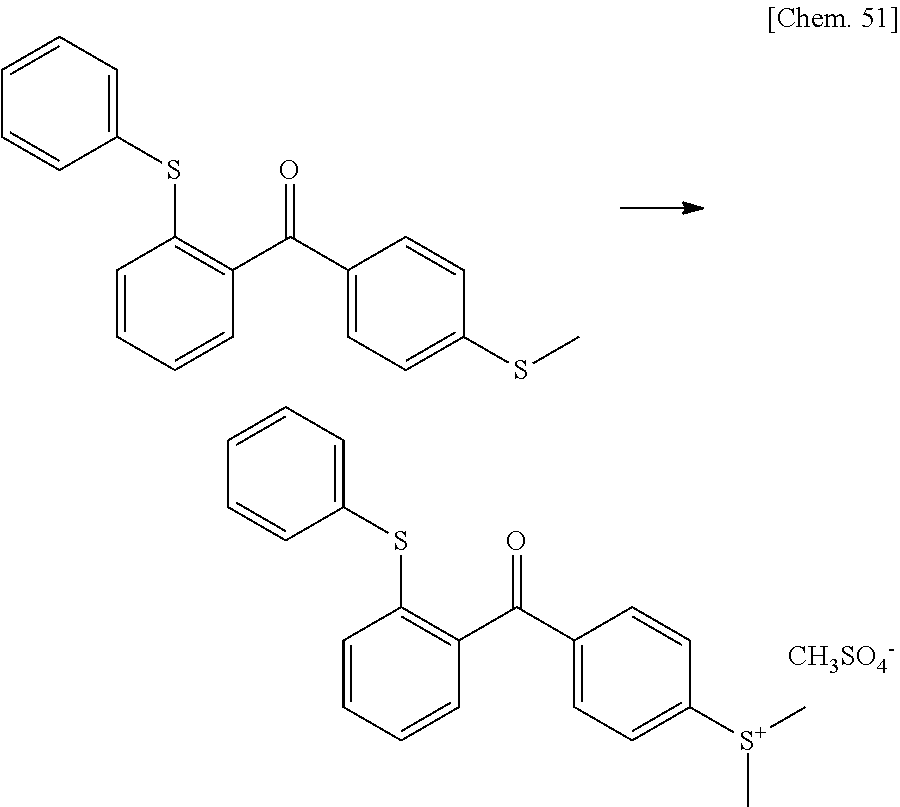
- Dimethyl-[4-(2-phenylsulfanyl-benzoyl) phenyl]sulfonium-methylsulfate (3.0 g) obtained in Synthesis Example 14 is dissolved in methanol (7.5 g), trimethyl orthoformate (3.0 g) and concentrated sulfuric acid (12.0 mg) are added thereto, and a mixture is stirred at 60° C. for 2 hours. After stirring, a reaction solution is added dropwise to 3% by mass of aqueous solution (30 g) of sodium hydrogen carbonate. Then, methylene chloride (30 g) and sodium benzoate (3.0 g) are added thereto, and a mixture is further stirred for 3 hours. After stirring, phase separation is performed to recover an organic layer, the organic layer is washed three times with water, and then methylene chloride is evaporated to obtain a crude crystal. The crude crystal is purified by silica gel column chromatography (methylene chloride/methanol=90/10 (volume ratio), addition of 0.1% by mass triethylamine) to obtain {4-[dimethoxy-(2-phenylsulfanylphenyl)methyl]phenyl}dimethylsulfonium-benzoate (1.2 g). A molar absorption coefficient at 365 nm of the obtained compound is 1.0×105 cm2/mol or smaller, which is one-fifth or smaller in comparison with that of dimethyl-[4-(2-phenylsulfanyl-benzoyl) phenyl]sulfonium-methylsulfate obtained in Synthesis Example 14.
-

- Aluminum chloride (3.0 g) is added to methylene chloride (28 g), and set to 0° C. 2,4-Dimethoxybenzene (3.0 g) is added thereto, and then 4-fluorobenzoyl chloride (3.4 g) is dissolved in methylene chloride (6.8 g) to add dropwise thereto over 30 minutes. After dropwise addition, a mixture is stirred at 25° C. for 1 hour, pure water (60 g) is added thereto, a mixture is further stirred for 5 minutes, and extracted twice with toluene (20 g). A mixture is phase-separated to obtain an organic layer, and a solvent is evaporated. An obtained residue is purified by recrystallization with ethanol (30 g) to obtain 2,4-dimethoxy-4′-fluorobenzophenone (5.2 g).
-

- 2,4-Dimethoxy-4′-fluorobenzophenone obtained (5.0 g) in Synthesis Example 16 is dissolved in DMF (30 g), 1-propanethiol (1.6 g) and potassium carbonate (3.2 g) are added thereto, and a mixture is stirred 70° C. for 4 hours. After stirring, pure water (90 g) is added thereto, a mixture is further stirred for 10 minutes, and an organic layer is extracted with toluene (60 g). An extract is washed three times with water, and then toluene is evaporated to obtain a crude product. The crude product is purified by silica gel column chromatography (hexane/ethyl acetate=75/25 (volume ratio)) to obtain 2,4-dimethoxy-4′-(n-propylsulfanyl)benzophenone (4.8 g).
-

- [4-(2, 4-Dimethoxybenzoyl)phenyl]ethyl-n-propylsulfonium-nonaflurobutanesulfonate (5.0 g) is obtained in the same procedure as Synthesis Example 3 except that 2,4-dimethoxy-4′-(n-propylsulfanyl)benzophenone is used instead of 4-methylsulfanyl-4′-phenylsulfanylbenzophenone and diethyl sulfate is used instead of dimethyl sulfate. A molar absorption coefficient at 365 nm of the obtained compound is 5.0×105 cm2/mol or greater.
-

- {4-[(2,4-Dimethoxyphenyl) dimethoxymethyl]phenyl}ethyl-n-propylsulfonium-nonafluorobutanesulfonate (5.1 g) is obtained in the same procedure as Synthesis Example 4 except that [4-(2,4-dimethoxybenzoyl) phenyl]ethyl-n-propylsulfonium-nonaflurobutanesulfonate is used instead of dimethyl-[4-(4-phenylsulfanylbenzoyl) phenyl]sulfonium-nonafluorobutanesulfonate. A molar absorption coefficient at 365 nm of the obtained compound is 1.0×105 cm2/mol or smaller, which is one-fifth or smaller in comparison with that of {4-(2,4-dimethoxybenzoyl)phenyl}ethyl-n-propylsulfonium-nonafluorobutanesulfonate obtained in Synthesis Example 18.
-

- Aluminum chloride (3.0 g) is dissolved in methylene chloride (28 g), and set to 0° C. Diphenyl sulfide (4.0 g) is added thereto, and then 4-bromobenzoyl chloride (3.4 g) is dissolved in methylene chloride (6.8 g) to add dropwise thereto over 30 minutes. After dropwise addition, a mixture is stirred at 25° C. for 1 hour, pure water (60 g) is added thereto, a mixture is further stirred for 5 minutes, and then washed twice with toluene (20 g). A mixture is phase-separated to obtain an organic layer, and a solvent is evaporated. An obtained residue is purified by recrystallization with isopropyl alcohol (30 g) to obtain 4-bromo-4′-phenylsulfanylbenzophenone (5.2 g).
-

- 4-Bromo-4′-phenylsulfanylbenzophenone (5.0 g) obtained in Synthesis Example 20 is dissolved in methanol (30 g), trimethyl orthoformate (5.0 g) and concentrated sulfuric acid (30 mg) are added thereto, and a mixture is stirred at 60° C. for 4 hours. After stirring, 3% by mass of aqueous solution (150 g) of sodium bicarbonate is added thereto, and a mixture is further stirred for 10 minutes to precipitate a solid. The precipitated solid is filtered, and re-dissolved in methylene chloride (30 g). A solution is washed three times with water, and then methylene chloride is evaporated to obtain 4-bromo-4′-phenylsulfanylbenzophenone dimethyl acetal (5.0 g).
-
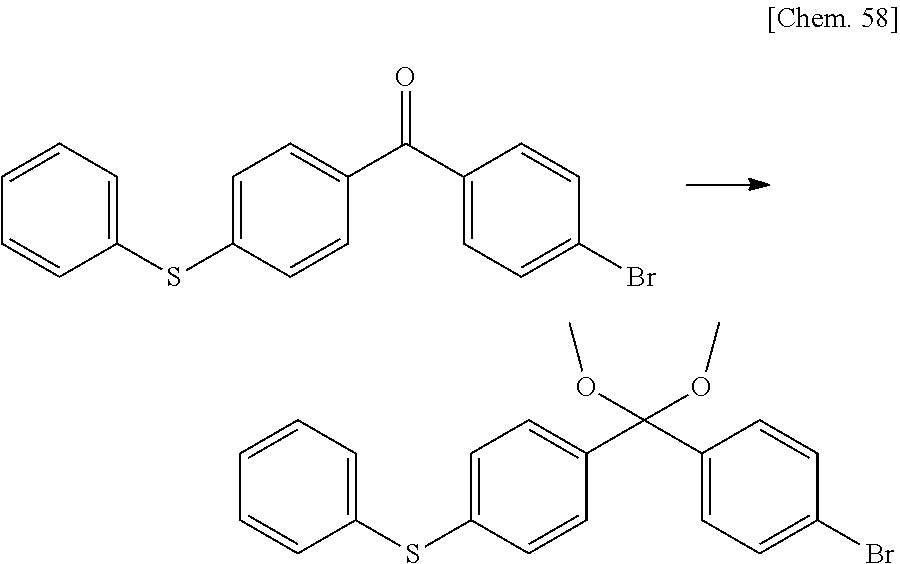
- To a flask dried in advance, tetrahydrofuran (2.0 g), magnesium (0.4 g) and 1,2-dibromoethane are added to activate magnesium. After check of the activation, a solution is heated to 50° C., and then 4-bromo-4′-phenylsulfanylbenzophenone dimethyl acetal (4.0 g) obtained in Synthesis Example 20 is dissolved in THF (6.0 g) to add dropwise thereto. After dropwise addition, a mixture is stirred at 50° C. for 5 hours to obtain a THF solution of 4-[dimethoxy-(4-phenylsulfanylphenyl)methyl]phenylmagnesium bromide. To a solution of diphenyl sulfoxide (1.9 g), trimethylsilyl chloride (1.8 g) and triethylamine (0.8 g) dissolved in methylene chloride (9.5 g), the THF solution of 4-[dimethoxy-(4-phenylsulfanylphenyl)methyl]phenylmagnesium bromide is added dropwise at 10° C. or lower, and then a mixture is stirred at 25° C. for 1 hour. After stirring, 10% by mass of aqueous solution (30 g) of ammonium chloride is added thereto at 5° C. or lower, a mixture is further stirred for 10 minutes, and washed twice with isopropyl ether (5.0 g). Thereafter, methylene chloride (40 g) and potassium nonafluorobutanesulfonate (3.1 g) are added thereto, and a mixture is stirred at 25° C. for about 2 hours. A stirred mixture is phase-separated, washed three times with water, and then methylene chloride is evaporated to obtain a crude crystal. The crude crystal is purified by silica gel column chromatography (methylene chloride/methanol=90/10 (volume ratio)) to obtain {4-[dimethoxy-(4-phenylsulfanylphenyl)methyl]phenyl}diphenylsulfonium-nonafluorobutanesulfonate (3.2 g). A molar absorption coefficient at 365 nm of the obtained compound is 1.0×105 cm2/mol or smaller.
-

- 2-(4-Bromophenyl)-2-(4-phenylsulfanylphenyl)-[1,3]dioxolane (5.0 g) is obtained in the same procedure as Synthesis Example 21 except that ethylene glycol is used instead of methanol.
-
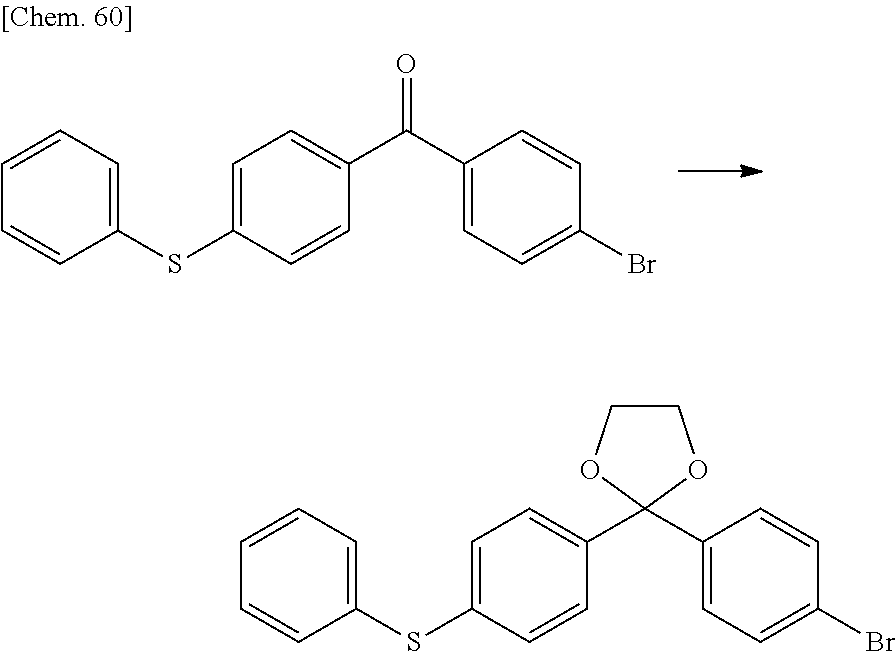
- Diphenyl-{4-[2-(4-phenylsulfanylphenyl)-[1,3]dioxolan-2-yl]phenyl}sulfonium-nonafluorobutanesulfonate (4.3 g) is obtained in the same procedure as Synthesis Example 22 except that 2-(4-bromophenyl)-2-(4-phenylsulfanylphenyl)-[1,3]dioxolane is used instead of 4-bromo-4′-phenylsulfanylbenzophenone dimethyl acetal. A molar absorption coefficient at 365 nm of the obtained compound is 1.0×105 cm2/mol or smaller.
-

- Dibenzothiophene (15 g) is dissolved in formic acid (75 g), and 35% by mass of aqueous solution (8.7 g) of hydrogen peroxide is added dropwise with ice cooling. Then, a mixture is allow to reach room temperature, and stirred for 5 hours. After stirring, pure water (200 g) is added dropwise to a reaction mixture to precipitate a solid. The precipitated solid is filtered, washed three times with pure water (40 g), and then dried to obtain a crude crystal. The crude crystal is recrystallized with acetone (100 g) and ethanol (200 g) to obtain dibenzothiophene-5-oxide (12 g).
-
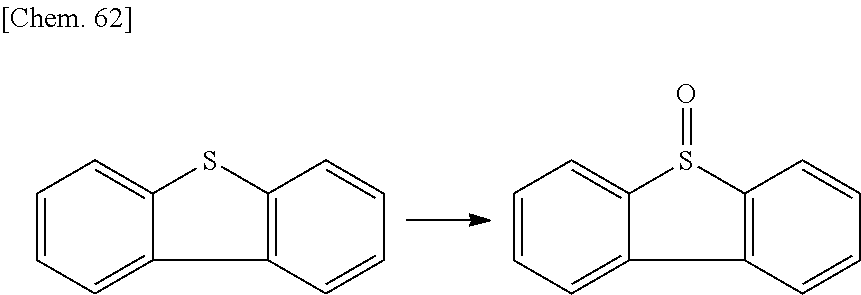
- 5-{4-[Dimethoxy-(4-phenylsulfanylphenyl)methyl]phenyl}dibenzothiophenium-nonafluorobutanesulfonate (4.0 g) is obtained in the same procedure as Synthesis Example 22 except that dibenzothiophene-5-oxide is used instead of diphenyl sulfoxide. A molar absorption coefficient at 365 nm of the obtained compound is 1.0×105 cm2/mol or smaller.
-

- {4-[Dimethoxy-(4-phenylsulfanylphenyl)methyl]phenyl}(di-p-tolyl)sulfonium-p-toluenesulfonate (3.8 g) is obtained in the same procedure as Synthesis Example 22 except that p-tolyl sulfoxide is used instead of diphenyl sulfoxide and sodium p-toluenesulfonate is used instead of potassium nonafluorobutanesulfonate. A molar absorption coefficient at 365 nm of the obtained compound is 1.0×105 cm2/mol or smaller.
-

- (6-Methoxynaphthalen-2-yl)-(4-methylsulfanylphenyl)methanone (4.5 g) is obtained in the same procedure as Synthesis Example 1 except that 2-bromo-6-methoxynaphthalene is used instead of 4-bromoanisole and 4-(methylthio)benzoyl chloride is used instead of 4-fluorobenzoyl chloride.
-

- [4-(6-Methoxynaphthalen-2-ylcarbonyl)phenyl]dimethylsulfonium-nonafluorobutanesulfonate (4.5 g) is obtained in the same procedure as Synthesis Example 3 except that (6-methoxynaphthalen-2-yl)-(4-methylsulfanylphenyl)methanone is used instead of 4-methylsulfanyl-4′-phenylsulfanylbenzophenone. A molar absorption coefficient at 365 nm of the obtained compound is 1.0×106 cm2/mol or greater.
-

- {4-[Dimethoxy-(6-methoxynaphthalen-2-yl)methyl]phenyl}dimethylsulfonium-nonafluorobutanesulfonate (1.0 g) is obtained in the same procedure as Synthesis Example 4 except that {4-(6-methoxynaphthalen-2-ylcarbonyl)phenyl}dimethylsulfonium-nonafluorobutanesulfonate is used instead of dimethyl-[4-(4-phenylsulfanyl-benzoyl)phenyl]-sulfonium-nonafluorobutanesulfonate. A molar absorption coefficient at 365 nm of the obtained compound is 1.0×105 cm2/mol or smaller, which is one-tenth or smaller in comparison with that of {4-(6-methoxynaphthalen-2-ylcarbonyl)phenyl}dimethylsulfonium-nonafluorobutanesulfonate obtained in Synthesis Example 29.
-

- 6-Bromonaphthoyl-2-chloride (10.8 g) is obtained in the same procedure as Synthesis Example 12 except that 6-bromo-2-naphthalenecarboxylic acid is used instead of 2-phenylsulfanylbenzoic acid.
-

- (6-Bromonaphthalen-2-yl)-(4,7-dimethoxynaphthalen-1-yl)methanone (5.4 g) is obtained in the same procedure as Synthesis Example 20 except that 1,6-dimethoxynaphthalene is used instead of diphenyl sulfide and 6-bromonaphthoyl-2-chloride is used instead of 4-bromobenzoyl chloride.
-

- 4-[(6-Bromonaphthalen-2-yl)dimethoxymethyl]-1,6-dimethoxynaphthalene (5.1 g) is obtained in the same procedure as Synthesis Example 21 except that (6-bromonaphthalen-2-yl)-(4,7-dimethoxynaphthalen-1-yl)methanone is used instead of 4-bromo-4′-phenylsulfanylbenzophenone.
-

- {6-[(4,7-Dimethoxynaphthalen-1-yl)dimethoxymethyl]naphthalen-2-yl}diphenylsulfonium-nonafluorobutanesulfonate (4.0 g) is obtained in the same procedure as Synthesis Example 22 except that 4-[(6-bromonaphthalen-2-yl)-dimethoxy-methyl]-1,6-dimethoxynaphthalene is used instead of 4-bromo-4′-phenylsulfanylbenzophenone dimethyl acetal. A molar absorption coefficient at 365 nm of the obtained compound is 1.0×105 cm2/mol or smaller.
-

- 4-(4-Bromophenylsulfanyl)benzophenone (5.8 g) is obtained in the same procedure as Synthesis Example 2 except that 4-fluorobenzophenone is used instead of 4-fluoro-4′-methylsulfanylbenzophenone and 4-bromothiophenol is used instead of thiophenol.
-

- 4-(4-Bromophenylsulfanyl)benzophenone dimethyl acetal (5.1 g) is obtained in the same procedure as Synthesis Example 21 except that
- 4-(4-bromophenylsulfanyl)benzophenone is used instead of 4-bromo-4′-phenylsulfanylbenzophenone.
-

- {4-[4-(Dimethoxy-phenyl-methyl)phenylsulfanyl]phenyl}diphenylsulfonium-nonafluorobutanesulfonate (4.0 g) is obtained in the same procedure as Synthesis Example 22 except that 4-(4-bromophenylsulfanyl)benzophenone dimethyl acetal is used instead of 4-bromo-4′-phenylsulfanylbenzophenone dimethyl acetal. A molar absorption coefficient at 365 nm of the obtained compound is 1.0×105 cm2/mol or smaller.
-

- (4-Fluorophenyl)-(6-methoxynaphthalen-2-yl)methanone (4.3 g) is obtained in the same procedure as Synthesis Example 1 except that 2-bromo-6-methoxynaphthalene is used instead of 4-bromothioanisole.
-
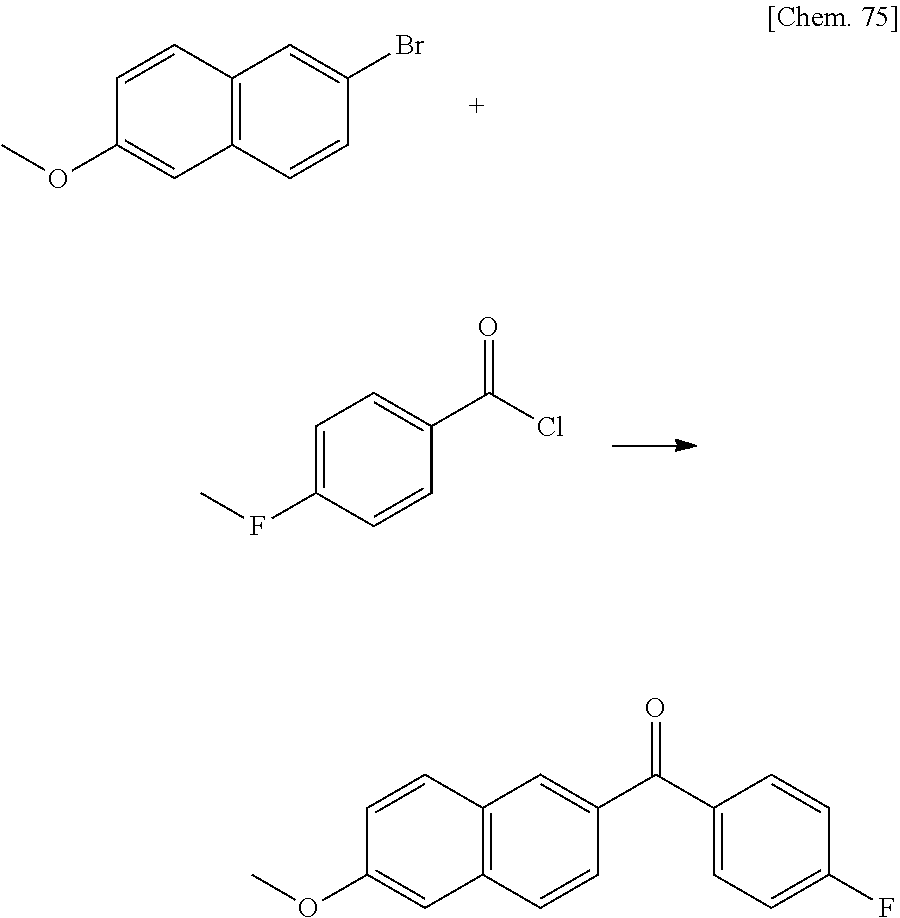
- [4-(4-Bromophenoxy)phenyl]-(6-methoxynaphthalen-2-yl)methanone (5.9 g) is obtained in the same procedure as Synthesis Example 2 except that (4-fluorophenyl)-(6-methoxynaphthalen-2-yl)methanone is used instead of 4-fluoro-4′-methylsulfanylbenzophenone and 4-bromophenol is used instead of thiophenol.
-

- 2-{[4-(4-Bromophenoxy)phenyl]-dimethoxymethyl}-6-methoxynaphthalene (5.0 g) is obtained in the same procedure as Synthesis Example 20 except that [4-(4-bromophenoxy)phenyl]-(6-methoxynaphthalen-2-yl)methanone is used instead of 4-bromo-4′-phenylsulfanylbenophenone.
-

- {4-{4-[Dimethoxy-(6-methoxynaphthalen-2-yl)methyl]phenoxy}phenyl}diphenylsulfonium-nonafluorobutanesulfonate (4.0 g) is obtained in the same procedure as Synthesis Example 22 except that 2-{[4-(4-bromophenoxy)phenyl]-dimethoxymethyl}-6-methoxynaphthalene is used instead of 4-bromo-4′-phenylsulfanylbenzophenone dimethyl acetal. A molar absorption coefficient at 365 nm of the obtained compound is 1.0×105 cm2/mol or smaller.
-

- 2,4-Dimethoxy-4′-iodobenzophenone (5.3 g) is obtained in the same procedure as Synthesis Example 16 except that 4-iodobenzoyl chloride is used instead of 4-fluorobenzoyl chloride.
-

- 2,4-Dimethoxy-4′-iodobenzophenone (4 g) obtained in Synthesis Example 41 is added to sulfuric acid (16 g), then potassium persulfate (10 g) is added thereto in small portions at 10° C. or lower, and a mixture is stirred for 30 minutes. After stirring, t-butylbenzene (18 g) is added thereto, and a mixture is further stirred at 25° C. for 3 hours. After stirring, pure water (30 g) is added thereto at 10° C. or lower, then methylene chloride (40 g) and potassium nonafluorobutanesulfonate (3.7 g) is added thereto, and a mixture is stirred at 25° C. for about 2 hours. A stirred mixture is phase-separated, washed three times with water, and then methylene chloride is evaporated to obtain a crude product. The crude product is purified by silica gel column chromatography (methylene chloride/methanol=90/10 (volume ratio)) to obtain (4-t-butylphenyl)[4-(2,4-dimethoxybenzoyl)phenyl]iodonium-nonafluorobutanesulfonate (3.5 g). A molar absorption coefficient at 365 nm of the obtained compound is 1.0×106 cm2/mol or greater.
-

- (4-t-Butylphenyl)[4-[(2,4-dimethoxyphenyl)dimethoxymethyl]phenyl]iodonium-nonafluorobutanesulfonate (1.0 g) is obtained in the same procedure as Synthesis Example 4 except that (4-t-butylphenyl)[4-(2,4-dimethoxybenzoyl)phenyl]iodonium-nonafluorobutanesulfonate is used instead of dimethyl-[4-(4-phenylsulfanyl-benzoyl) phenyl]sulfonium-nonafluorobutanesulfonate. A molar absorption coefficient at 365 nm of the obtained compound is 1.0×105 cm2/mol or smaller, which is one-tenth or smaller in comparison with that of (4-t-butylphenyl)[4-(2,4-dimethoxybenzoyl)phenyl]iodonium-nonafluorobutanesulfonate obtained in Synthesis Example 43.
-

- (4,7-Dimethoxynaphthalen-1-yl)-(4-iodophenyl)methanone (5.4 g) is obtained in the same procedure as Synthesis Example 19 except that 1,6-dimethoxynaphthalene is used instead of diphenyl sulfide and 4-iodobenzoyl chloride is used instead of 4-bromobenzoyl chloride.
-

- [4-(4,7-Dimethoxynaphthalen-1-ylcarbonyl)phenyl]phenyliodonium-nonafluorobutanesulfonate (3.3 g) is obtained in the same procedure as Synthesis Example 42 except that (4,7-dimethoxynaphthalen-1-yl)-(4-iodophenyl)methanone is used instead of 2,4-dimethoxy-4′-iodobenzophenone. A molar absorption coefficient at 365 nm of the obtained compound is 1.0×106 cm2/mol or greater.
-

- {4-[(4,7-Dimethoxynaphthalen-1-yl)-dimethoxy-methyl]phenyl}phenyliodonium-nonafluorobutanesulfonate (1.0 g) is obtained in the same procedure as Synthesis Example 4 except that {4-(4,7-dimethoxynaphthalene-1-carbonyl)phenyl}phenyliodonium-nonafluorobutanesulfonate is used instead of dimethyl-[4-(4-phenylsulfanylbenzoyl)phenyl]sulfonium-nonafluorobutanesulfonate. A molar absorption coefficient at 365 nm of the obtained compound is 1.0×105 cm2/mol or smaller, which is one-tenth or smaller in comparison with that of {4-(4,7-dimethoxynaphthalen-1-ylcarbonyl)phenyl}phenyliodonium-nonafluorobutanesulfonate obtained in Synthesis Example 46.
-

- {4-[Dimethoxy-(4-phenylsulfanylphenyl)methyl]phenyl}diphenylsulfonium-p-styrenesulfonate (2.8 g) is obtained in the same procedure as Synthesis Example 22 except that sodium p-styrenesulfonate hydrate is used instead of potassium nonafluorobutanesulfonate. A molar absorption coefficient at 365 nm of the obtained compound is 1.0×105 cm2/mol or smaller.
-

- {4-[Dimethoxy-(4-phenylsulfanylphenyl)methyl]phenyl}diphenylsulfonium-(4-methacryloyl-1,1,2-trifluorobutanesulfonate) (3.0 g) is obtained in the same procedure as Synthesis Example 22 except that sodium 4-methacryloyloxy-1,1,2-trifluorobutanesulfonate is used instead of potassium nonafluorobutanesulfonate. A molar absorption coefficient at 365 nm of the obtained compound is 1.0×105 cm2/mol or smaller.
-

- Formic acid (53.3 g) is added to 4-bromo-4′-phenylsulfanylbenzophenone (10.1 g) obtained in Synthesis Example 20, a mixture is stirred at 50° C., then 35% by mass of aqueous solution (2.9 g) of hydrogen peroxide is added dropwise thereto in small portions, and a mixture is stirred at 50° C. After 1 hour, a reaction solution is cooled with ice cooling, and pure water (28.2 g) and toluene (80.3 g) are added thereto. A mixture is phase-separated, an organic layer is washed three times with pure water (30 g), and then an organic solvent is evaporated to obtain 4-bromo-4′-phenylsulfinylbenzophenone (10.0 g).
-
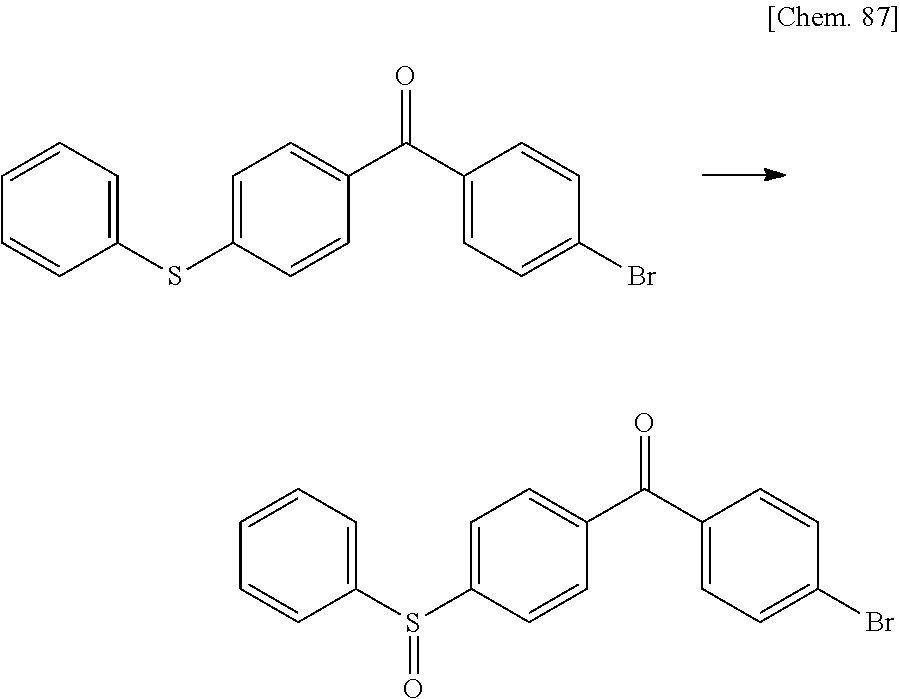
- 4-Bromo-4′-phenylsulfinylbenzophenone (7.7 g), potassium carbonate (3.6 g) and 4-hydroxybenzenethiol (3.0 g) are dissolved in DMF (23.1 g), and a mixture is stirred at 60° C. After 2 hours, a reaction solution is cooled with ice cooling, and pure water (70 g) is added dropwise thereto to precipitate a solid. The precipitated solid is filtered, and re-dissolved in methylene chloride (40 g). A solution is washed three times with pure water (40 g), and then methylene chloride is evaporated to obtain a crude crystal. The crude crystal is purified by silica gel column chromatography (hexane/ethyl acetate=2/1 (volume ratio)) to obtain 4-(4-hydroxyphenylsulfanyl)-4′-phenylsulfinylbenzophenone (6.4 g).
-

- 4-(4-Hydroxyphenylsulfanyl) -4′-phenylsulfinylbenzophenone dimethyl acetal (5.0 g) is obtained in the same procedure as Synthesis Example 21 except that 4-(4-hydroxyphenylsulfanyl)-4′-phenylsulfinylbenzophenone is used instead of 4-bromo-4′-phenylsulfanylbenzophenone.
-

- 4-(4-Hydroxyphenylsulfanyl)-4′-phenylsulfinylbenzophenone dimethyl acetal (5.0 g) is dissolved in dehydrated methylene chloride (30.0 g), and a 2 M THF solution (6.8 mL) of phenylmagnesium chloride is added dropwise thereto with ice cooling. Then, trichlorosilane (1.7 g) is added dropwise thereto, and a mixture is stirred for 1 hour. After stirring, 10% by mass of aqueous solution (30 g) of ammonium chloride is added thereto at 5° C. or lower, a mixture is further stirred, and washed twice with isopropyl ether (5.0 g). Then, methylene chloride (40 g) and potassium nonafluorobutanesulfonate (3.4 g) are added thereto, and a mixture is stirred at 25° C. for 2 hours. A stirred mixture is phase-separated, washed three times with pure water (20 g), and then methylene chloride is evaporated to obtain a crude crystal. The crude crystal is purified by silica gel column chromatography (methylene chloride/methanol=90/10 (volume ratio)) to obtain (4-{dimethoxy-[4-(4-hydroxyphenylsulfanyl)phenyl]methyl}phenyl) diphenylsulfonium-nonafluorobutanesulfonate (3.4 g).
-

- 2-Hydroxy-9-fluorenone (1.0 g), diphenyl sulfoxide (1.0 g) and diphosphorus pentaoxide (0.4 g) are added to methanesulfonic acid (6.0 g), and a mixture is stirred with ice cooling. After 18 hours, pure water (20 g) is added dropwise to a reaction solution, and a mixture is washed twice with isopropyl ether (5.0 g). Then, methylene chloride (20 g) and potassium nonafluorobutanesulfonate (1.7 g) are added thereto, and a mixture is stirred at 25° C. for 2 hours. A stirred mixture is phase-separated, wash three times with pure water (10 g), and then methylene chloride is evaporated to obtain a crude crystal. The crude crystal is purified by silica gel column chromatography (methylene chloride/methanol=90/10 (volume ratio)) to obtain (2-hydroxy-9-oxo-9H-fluoren-3-yl)diphenylsulfonium-nonafluorobutanesulfonate (2.1 g).
-

- (2-Hydroxy-9,9-dimethoxy-9H-fluoren-3-yl)diphenylsulfonium-nonafluorobutanesulfonate (2.1 g) is obtained in the same procedure as Synthesis Example 21 except that (2-hydroxy-9-oxo-9H-fluoren-3-yl)diphenylsulfonium-nonafluorobutanesulfonate is used instead of 4-bromo-4′-phenylsulfanylbenzophenone.
-

- (2-Hydroxy-9,9-dimethoxy-9H-fluoren-3-yl) diphenylsulfonium-nonafluorobutanesulfonate (2.0 g) and ethylene glycol (0.7 g) are dissolved in dehydrated THF (16.0 g). Then, p-toluenesulfonic acid (48.0 mg) is added thereto, and a mixture is stirred at room temperature under nitrogen atmosphere. After 18 hours, triethylamine (0.2 g) was added to the reaction solution. THF is evaporated, then methylene chloride (20 g) and pure water (20 g) are added thereto. A mixture is phase-separated, washed twice with pure water (20 g), and then methylene chloride is evaporated to obtain {spiro(1,3-dioxolane-2,9′-[9H]fluorene),2′-hydrox-3′-yl}diphenylsulfonium-nonafluorobutanesulfonate (1.8 g).
-

- 2-Acetyl-6-methoxynaphthalene (1.6 g) and 4-methylbenzaldehyde (1.1) are dissolved in ethanol (16 g), and a mixture is stirred. 10% by mass of aqueous solution (0.4 g) of sodium hydroxide is added dropwise thereto with ice cooling, and a mixture is further stirred. After 3 hours, a precipitated solid in a reaction solution is filtered, and washed with ethanol (8 g). A recovered solid is dried to obtain 1-(6-methoxy-2-naphthalenyl)-3-(4-methylphenyl)-2-propen-1-one (2.2 g).
-

- 1-(6-Methoxy-2-naphthalenyl)-3-(4-methylphenyl)-2-propen-1-one (0.8 g) and diphosphorus pentaoxide (0.3 g) are added to methanesulfonic acid (2.4 g), and a mixture is stirred. Diphenyl sulfoxide (0.4 g) is added thereto in small portions with ice cooling, and a mixture is further stirred. After 3 hours, pure water (20 g) is added dropwise thereto with ice cooling, a mixture is further stirred, and washed twice with isopropyl ether (5.0 g). Then, methylene chloride (20 g) and potassium nonafluorobutanesulfonate (0.7 g) are added thereto, and a mixture is stirred for 2 hours. A stirred mixture is phase-separated, washed three times with pure water (10 g), and then methylene chloride is evaporated to obtain a crude crystal. The crude crystal is purified by silica gel column chromatography (methylene chloride/methanol=90/10 (volume ratio)) to obtain {6-[3-(4-methylphenyl)-1-oxo-2-propenyl]-2-methoxynaphthalen-1-yl}diphenylsulfonium-nonafluorobutanesulfonate (0.9 g).
-

- {6-[3-(4-Methylphenyl)-1,1-dimethoxy-2-propenyl]-2-methoxynaphthalen-1-yl}diphenylsulfonium-nonafluorobutanesulfonate (0.9 g) is obtained in the same procedure as Synthesis Example 4 except that {6-[3-(4-methylphenyl)-1-oxo-2-propenyl]-2-methoxynaphthalen-1-yl}diphenylsulfonium-nonafluorobutanesulfonate is used instead of dimethyl-[4-(4-phenylsulfanyl)benzoylphenyl]sulfonium-nonafluorobutanesulfonate.
-

- 1-(6-Methoxy-2-naphthalenyl)-3-(4-methylphenyl)-2-propen-1-one (1.2 g) obtained in Synthesis Example 57 is dissolved in methylene chloride (9.6 g). Bromine (1.0 g) is dissolved in methylene chloride (2.0 g) to add dropwise thereto with ice cooling, and a mixture is stirred. After 2 hours, pure water (5 g) is added to a reaction solution, and a mixture is further stirred. A stirred mixture is phase-separated, an organic layer is washed twice with pure water (5 g), and then an organic solvent is evaporated to obtain 2,3-dibromo-1-(6-methoxy-2-naphthalenyl)-3-(4-methylphenyl)-1-propanone (1.8 g).
-

- 2,3-Dibromo-1-(6-methoxy-2-naphthalenyl)-3-(4-methylphenyl)-1-propanone (1.8 g) and diazabicycloundecene (0.8 g) is added to acetonitrile (14 g), and a mixture is stirred at room temperature. After 2 hours, potassium t-butoxide (1.6 g) is added thereto, and a mixture is further stirred. After 2 hours, pure water (36 g) is added to a reaction solution to precipitate a solid. The precipitated solid is filtered, washed with pure water (20 g), and then dried to obtain 1-(6-methoxy-2-naphthalenyl)-3-(4-methylphenyl)-2-propyn-1-one (1.0 g).
-

- {6-[3-(4-Methylphenyl)-1-oxo-2-propynyl]-2-methoxynaphthalen-1-yl}diphenylsulfonium-nonafluorobutanesulfonate (0.8 g) is obtained in the same procedure as Synthesis Example 58 except that 1-(6-methoxy-2-naphthalenyl)-3-(4-methylphenyl)-2-propyn-1-one is used instead of 1-(6-methoxy-2-naphthalenyl)-3-(4-methylphenyl)-2-propen-1-one.
-
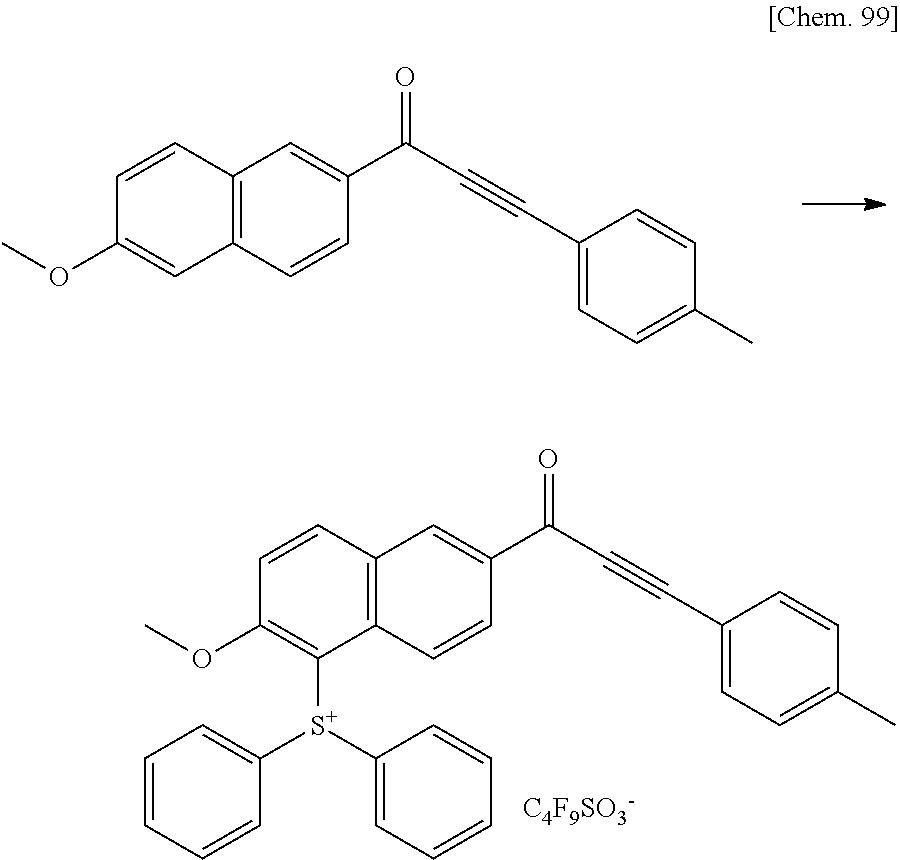
- {6-[3-(4-Methylphenyl)-1,1-dimethoxy-2-propynyl]-2-methoxynaphthalen-1-yl}diphenylsulfonium-nonafluorobutanesulfonate (0.8 g) is obtained in the same procedure as Synthesis Example 4 except that {6-[3-(4-methylphenyl)-1-oxo-2-propynyl]-2-methoxynaphthalen-1-yl}diphenylsulfonium-nonafluorobutanesulfonate is used instead of dimethyl-[4-(4-phenylsulfanyl)benzoylphenyl]sulfonium-nonafluorobutanesulfonate.
-

- 4-Phenylsulfanylbenzil (0.8 g) is obtained in the same procedure as Synthesis Example 2 except that 4-chlorobenzil (1 g) is used instead of 4-fluoro-4′-methylsulfanylbenzophenone.
-

- 4-Phenylsulfanylbenzil (0.8 g), diphenyliodonium-nonafluorobutanesulfonate (1.6 g) and copper (II) acetate dihydrate (55 mg) are added to chlorobenzene (8.0 g), and a mixture is stirred at 80° C. After 2 hours, a reaction solution is cooled to 25° C., and pure water (5.0 g) is added thereto. A mixture is phase-separated, an organic layer is washed twice with pure water (5.0 g), and then an organic solvent is evaporated to obtain a crude crystal. The crude crystal is purified by silica gel column chromatography (methylene chloride/methanol=90/10 (volume ratio)) to obtain [4-(benzoylcarbonyl)phenyl]dimethylsulfonium-nonafluorobutanesulfonate (1.0 g).
-

- [4-(Benzoyldimethoxymethyl)phenyl]dimethylsulfonium-nonafluorobutanesulfonate (0.9 g) is obtained in the same procedure as Synthesis Example 4 except that [4-(benzoylcarbonyl)phenyl]dimethylsulfonium-nonafluorobutanesulfonate is used instead of dimethyl-[4-(4-phenylsulfanyl) benzoylphenyl]sulfonium-nonafluorobutanesulfonate.
-

- 4-Bromo-4′-(4-methoxyphenyl)benzophenone (3.1 g) is obtained in the same procedure as Synthesis Example 16 except that 4-bromobenzoyl chloride is used instead of 4-fluorobenzoyl chloride, 4-phenylanisole is used instead of 2,4-dimethoxybenzene, and as purification method, silica gel column chromatography (hexane/ethyl acetate=80/20 (volume ratio)) is performed instead of recrystallization with ethanol.
-

- 4-Bromo-4′-(4-methoxyphenyl)benzophenone (3.0 g) is obtained in the same procedure as Synthesis Example 21 except that 4-bromo-4′-(4-methoxyphenyl)benzophenone is used instead of 4-bromo-4′-phenylsulfanylbenophenone.
-

- [4-(4′-Methoxybiphenyl-4-carbonyl)phenyl]-diphenylsulfonium-nonafluorobutanesulfonate (4.7 g) is obtained in the same procedure as Synthesis Example 22 except that 4-bromo-4′-(4-methoxyphenyl)benzophenone dimethyl acetal is used instead of 4-bromo-4′-phenylsulfanylbenzophenone dimethyl acetal and 10% by mass of aqueous solution of hydrochloric acid is used instead of 10% by mass of aqueous solution of ammonium chloride.
- [4-(4′-Methoxybiphenyl-4-carbonyl)phenyl]-diphenylsulfonium-nonafluorobutanesulfonate (4.0 g) is added to acetic acid (40 ml). 48% by mass of aqueous solution (10.2 g) of HBr is added dropwise thereto at 70° C. After dropwise addition, a mixture is stirred at 110° C. for 20 hours. Then, water (150 g) is added thereto, methylene chloride (40 g) is added thereto, and a mixture is stirred. A stirred mixture is phase-separated, washed three times with water, and then methylene chloride is evaporated to obtain a crude crystal. The crude crystal is purified by silica gel column chromatography (methylene chloride/methanol=90/10 (volume ratio)) to obtain [4-(4′-hydroxybiphenyl-4-carbonyl)phenyl]-diphenylsulfonium-nonafluorobutanesulfonate (2.4 g).
-

- [4-(4′-Hydroxybiphenyl-4-carbonyl)phenyl]-diphenylsulfonium-nonafluorobutanesulfonate (1.0 g) obtained in Synthesis Example 70 is dissolved in methanol (2.5 g), trimethyl orthoformate (1.0 g) and concentrated sulfuric acid (4.0 mg) are added thereto, and a mixture is stirred at 60° C. for 2 hours. After stirring, triethylamine (0.5 g) is added thereto, a reaction solution is added to a mixed solution of methylene chloride (30 g) and pure water (10 g), a mixture is stirred for 10 minutes, and an organic layer is recovered. An obtained organic layer is washed three times with water, and then methylene chloride is evaporated to obtain {4-[(4′-hydroxybiphenyl-4-yl) dimethoxymethyl]-phenyl}-diphenylsulfonium-nonafluorobutanesulfonate (1.0 g).
-

- (6-Bromo-naphthalen-2-yl)-(4-methoxyphenyl)methanone (4.1 g) is obtained in the same procedure as Synthesis Example 16 except that 6-bromonaphthalenecarbonyl chloride is used instead of 4-fluorobenzoyl chloride and anisole is used instead of 2,4-dimethoxybenzene.
-

- (6-Bromo-naphthalen-2-yl)-(4-methoxyphenyl)methanone dimethyl acetal (3.0 g) is obtained in the same procedure as Synthesis Example 21 except that (6-bromo-naphthalen-2-yl)-(4-methoxyphenyl)methanone is used instead of 4-bromo-4′-phenylsulfanylbenzophenone.
-

- [6-(4-Methoxybenzoyl)naphthalen-2-yl]diphenylsulfonium-nonafluorobutanesulfonate (4.5 g) is obtained in the same procedure as Synthesis Example 69 except that (6-bromo-naphthalen-2-yl)-(4-methoxyphenyl)methanone dimethyl acetal is used instead of 4-bromo-4′-(4-methoxyphenyl)benzophenone dimethyl acetal.
-

- [6-(4-Hydroxybenzoyl) naphthalen-2-yl]diphenylsulfonium-nonafluorobutanesulfonate (3.8 g) is obtained in the same procedure as Synthesis Example 70 except that [6-(4-methoxybenzoyl) naphthalen-2-yl]diphenylsulfonium-nonafluorobutanesulfonate is used instead of [4-(4 ′-methoxybiphenyl-4-carbonyl)phenyl-diphenylsulfonium-nonafluorobutanesulfonate.
-

- {6-[Dimethoxy-(4-methoxyphenyl)methyl]naphthalen-2-yl}diphenylsulfonium-nonafluorobutanesulfonate (3.6 g) is obtained in the same procedure as Synthesis Example 71 except that [6-(4-hydroxybenzoyl)naphthalen-2-yl]diphenylsulfonium-nonafluorobutanesulfonate is used instead of {4-[(4′-hydroxybiphenyl-4-yl)dimethoxymethyl]-phenyl}-diphenylsulfonium-nonafluorobutanesulfonate.
-

- Polyhydroxystyrene (8.0 g) with weight-average molecular weight of 8000 and 35% by mass of aqueous solution (0.010 g) of hydrochloric acid are dissolved in dehydrated dioxane (28 g). Cyclohexyl vinyl ether (2.73 g) is dissolved in dehydrated dioxane (2.80 g), and a mixture is added dropwise to the solution of polyhydroxystyrene over 30 minutes. After dropwise addition, a mixture is set to 40° C., and stirred for 2 hours. After stirring, a mixture is cooled, and then dimethylaminopyridine (0.014 g) is added thereto. Thereafter, an obtained solution is added dropwise to pure water (260 g) to precipitate a polymer. The precipitated polymer is separated by filtration under reduced pressure to obtain a solid, the solid is washed twice with pure water (300 g), and then dried under vacuum to obtain Polymer A (9.2 g), represented below, as a white solid. A monomer ratio of unit of the polymer in the present invention is not limited to the below.
-

- Acetoxystyrene (7.0 g), t-butyl methacrylate (3.1 g), butyl mercaptan (0.022 g) and dimethyl-2,2′-azobis(2-methylpropionate) (AIBN) (0.40 g) are dissolved in tetrahydrofuran (THF) (35 g), and a mixture is deoxygenated. A deoxygenated mixture is added dropwise over 4 hours to THF (20 g) which is set to reflux temperature under nitrogen flow in advance. After dropwise addition, a mixture is stirred for 2 hours, and then cooled to room temperature. A cooled mixture is added dropwise to a mixed solvent of hexane (149 g) and THF (12 g) to precipitate a polymer. The precipitated polymer is separated by filtration under reduced pressure to obtain a solid, the solid is washed with hexane (52 g), and then dried under vacuum to obtain Polymer B (10.3 g), represented by the following formula, as a white solid. A weight-average molecular weight calculated by polystyrene conversion using a gel permeation chromatography is 9200. A monomer ratio of unit of the polymer in the present invention is not limited to the below.
-

- Polymer B (6.0 g), triethylamine (6.0 g), methanol (6.0 g) and pure water (1.5 g) are dissolved in propylene glycol monomethyl ether (30 g), and a mixture is stirred at reflux temperature for 6 hours. Then, a mixture is cooled to 25° C., and an obtained solution is added dropwise to a mixed liquid of acetone (30 g) and pure water (30 g) to precipitate a polymer. The precipitated polymer is separated by filtration under reduced pressure to obtain a solid, the solid is washed twice with pure water (30 g), and then dried under vacuum to obtain Polymer C (4.3 g), represented by the following formula, as a white solid. A weight-average molecular weight calculated by polystyrene conversion using a gel permeation chromatography is 9100. A monomer ratio of unit of the polymer in the present invention is not limited to the below.
-

- α-Methacryloxy-γ-butyrolactone (5.0 g), 2-methyladamantane-2-methacrylate (6.0 g), 3-hydroxyadamantane-1-methacrylate (4.3 g) and dimethyl-2,2′-azobis(2-methylpropionate) (0.51 g) are dissolved in propylene glycol-1-monomethyl ether acetate (PGMEA) (26 g), and a mixture is deoxygenated. A deoxygenated mixture is added dropwise over 4 hours to PGMEA (7.5 g) which is heated to 85° C. in advance. A mixture is stirred for 2 hours, and then cooled. After cooling, a mixture is added dropwise to hexane (180 g) to reprecipitate. A reprecipitated solid is filtered, dispersion-washed with hexane (70 g), filtered again, and then dried under vacuum to obtain Polymer D (8.5 g), represented by the following formula, as a compound to react with an acid. A monomer ratio of unit of the polymer in the present invention is not limited to the below.
-

- Polymer E (10.1 g), represented by the following formula, is obtained in the same procedure as Synthesis Example 51 except that p-t-butoxystyrene is used instead of t-butyl methacrylate. A monomer ratio of unit of the polymer in the present invention is not limited to the below.
-

- Polymer F (4.1 g), represented by the following formula, is obtained in the same procedure as Synthesis Example 52 except that Polymer E is used instead of Polymer B. A monomer ratio of unit of the polymer in the present invention is not limited to the below.
-

- Polymer G (8.0 g), represented by the following formula, is obtained in the same procedure as Synthesis Example 53 except that 5-methacryloyloxynorbornane 2,6-lactone (5.5 g), 4-(1-ethoxyethoxy)phenyl methacrylate (6.2 g) and 4-hydroxyphenyl methacrylate (4.4 g) are used as monomers. A monomer ratio of unit of the polymer in the present invention is not limited to the below.
-

- Polymer H (10.5 g), represented by the following formula, is obtained in the same procedure as Synthesis Example 51 except that 1-acetoxy-4-vinylnaphthalene is used instead of acetoxystyrene and 1-(2-tetrahydropyranyloxy)-4-vinylnaphthalene is used instead of t-butyl methacrylate. A monomer ratio of unit of the polymer in the present invention is not limited to the below.
-

- Polymer I (4.3 g), represented by the following formula, is obtained in the same procedure as Synthesis Example 52 except that Polymer H is used instead of Polymer B. A ratio of monomer unit of the polymer is not limited to the below.
-

- Polymer J (8.0 g), represented by the following formula, is obtained in the same procedure as Synthesis Example 53 except that 2-methacryloyloxy-1,3-propanesultone is used instead of α-methacryloxy-γ-butyrolactone. A monomer ratio of unit of the polymer in the present invention is not limited to the below.
-

- Polymer K (8.2 g), represented by the following formula, is obtained in the same procedure as Synthesis Example 53 except that 2-methacryloyloxy-1,3-propanesultone is used instead of α-methacryloxy-γ-butyrolactone and 1-ethoxyethyl methacrylate is used instead of 2-methyladamantane-2-methacrylate. A monomer ratio of unit of the polymer in the present invention is not limited to the below.
-
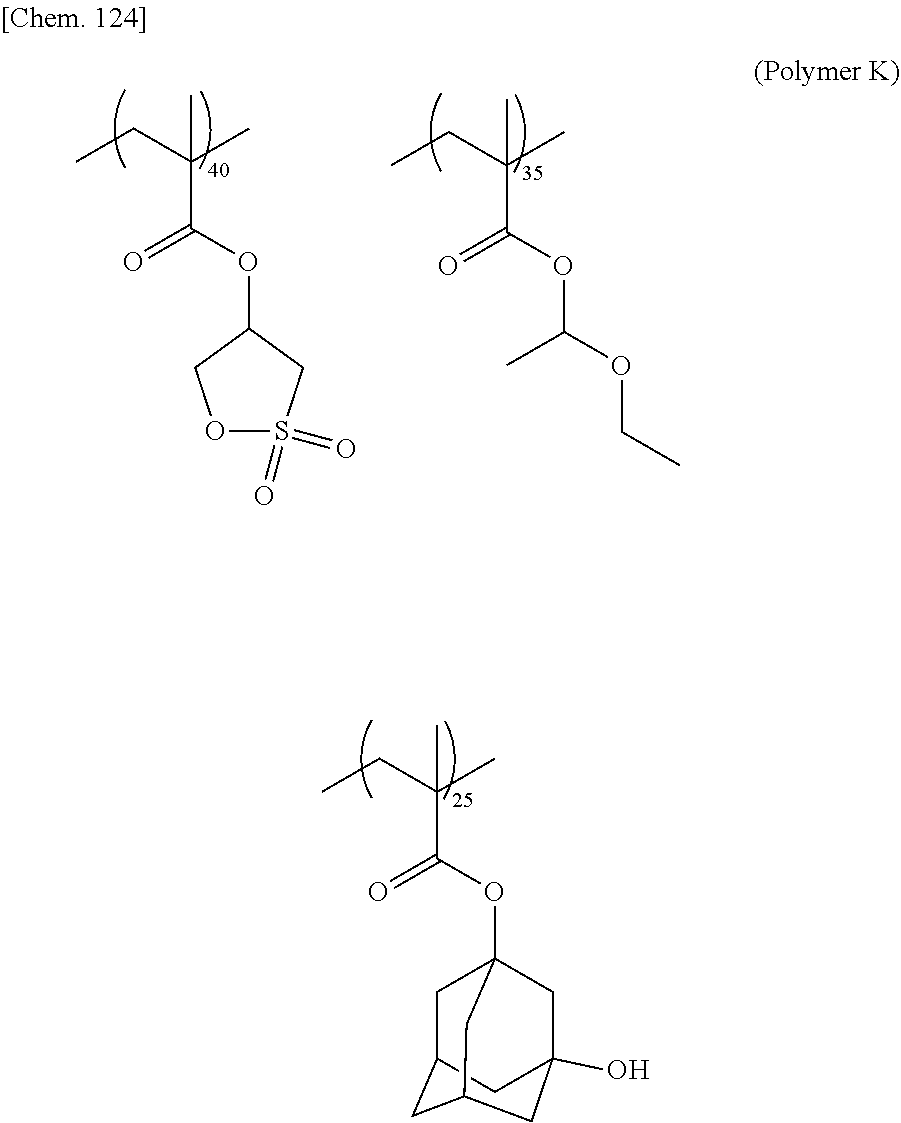
- Polymer L (8.0 g), represented by the following formula, is obtained in the same procedure as Synthesis Example 53 except that 5-methacryloyloxynorbornane 2,6-sultone (7.2 g), 2-(1-ethoxyethoxy)-6-vinylnaphthalene (5.9 g) and 2-hydroxy-6-vinylnaphthalene (3.0 g) are used as polymers. A monomer ratio of unit of the polymer in the present invention is not limited to the below.
-

- Polymer M (7.8 g), represented by the following formula, is obtained in the same procedure as Synthesis Example 53 except that Sulfonium Salt 16 (4.7 g) obtained in Synthesis Example 49, 5-methacryloyloxynorbornane 2,6-lactone (3.9 g), 4-(1-ethoxyethoxy)phenyl methacrylate (4.2 g) and 4-hydroxyphenyl methacrylate (3.2 g) are used as polymers. A monomer ratio of unit of the polymer in the present invention is not limited to the below.
-

- Each sample was prepared as follows. To cyclohexanone (3000 mg), any one of resin (500 mg) selected from Polymers A, C and D, each compound (0.036 mmol) appropriately selected solely or plurally from a photoacid generator (PAG) and a sensitizer compound, and an acid-diffusion controller (0.0012 mmol) were added in the ratio, to prepare Sample.
- As the photoacid generator (PAG), Sulfonium Salts 1 to 23, Sulfonium Salt 24 represented below and Iodonium Salts 1 to 2 were used. As the sensitizer compound, Sensitizer Compound 1 and Comparative Sensitizer Compounds 1′ to 2′ represented below were used.
- Sensitizer Compound 1 was synthesized as follows. 4-Methylsulfanyl-4′-phenylsulfanylbenzophenone (5.0 g) obtained in Synthesis Example 2, sulfuric acid (47 mg), and trimethyl orthoformate (13.5 g) are dissolved in methanol (12.5 g), and a mixture is stirred at reflux temperature for 3 hours. Then, a mixture is cooled to room temperature, 5% by mass of aqueous solution (50 g) of sodium hydrogen carbonate is added thereto, a mixture is further stirred for 10 minutes, and a precipitated crystal is filtrated. The crystal is recovered, re-dissolved in ethyl acetate (50 g), and a solution is washed with water. Thereafter, ethyl acetate is evaporated to obtain 4-methylsulfanyl-4′-phenylsulfanylbenzophenone dimethyl acetal (3.1 g).
-

- Evaluation of electron beam sensitivity is performed as follows. The resist composition sample 1 is spin-coated on a silicon wafer modified with hexamethylenedisilazane in advance. A spin-coated sample is prebaked on a hot plate at 110° C. for 1 minute to obtain a substrate on which a coating film having a thickness of 200 nm forms. To the coating film on the substrate, a line and space pattern of 200 nm is drawn by an electron beam of 30 keV using an electron beam lithography system. After irradiation with the electron beam, the entire surface of the substrate is exposed with exposure dose of 500 mJ/cm2 using a UV exposure system, and then the substrate was heated on a hot plate at 110° C. for 1 minute. The substrate is developed with a developing solution, product name: NMD-3, 2.38% by mass of aqueous solution of tetramethylammonium hydroxide, manufactured by Tokyo Ohka Kogyo Co., Ltd., for 1 minute, and then rinsed with pure water to obtain a line and space pattern of 200 nm. An irradiation dose of the electron beam at this time is defined as Esize [μC/cm2], and a sensitivity to the irradiation with the electron beam is evaluated. In addition, the obtained fine pattern is observed to measure LWR. The sensitivity evaluation and LWR measurement are also performed on the other samples in the same procedure as above. The sample compositions and results are described in Tables 1 to 3.
- In Table 1, sensitivity and LWR of each sample of Examples 1 to 17 and Comparative Example 2 were calculated as relative values with sensitivity of sample of Comparative Sample 1 being 100 and with LWR of that being 1, and Sulfonium Salt 24 and Comparative Sensitizer Compound 1′ being added to Comparative Sample 1. The smaller a value of sensitivity and LWR, the more effective.
- In Table 2, evaluation results of samples of Examples 18 to 24 and Comparative Example 4 were calculated as relative values with sensitivity of Comparative Example 3 being 100 and with LWR of that being 1.
- In Table 3, evaluation results of samples of Examples 25 to 32 and Comparative Example 6 were calculated as relative value, with sensitivity of Comparative Example 5 being 100 and with LWR of that being 1.
-
TABLE 1 Sensitivity Resist Composition (Esize) LWR Copolymer Photoacid Generator Sensitizer Compound (Rel.) (Rel.) Example 1 Polymer A Sulfonium Salt 1 Sulfonium Salt 24 — 75 0.95 Example 2 Polymer A Sulfonium Salt 7 Sulfonium Salt 24 — 60 0.95 Example 3 Polymer A Sulfonium Salt 9 Sulfonium Salt 24 — 55 0.95 Example 4 Polymer A Sulfonium Salt 11 Sulfonium Salt 24 — 70 0.98 Example 5 Polymer A Sulfonium Salt 12 Sulfonium Salt 24 — 53 0.98 Example 6 Polymer A Iodonium Salt 1 Sulfonium Salt 24 — 53 0.98 Example 7 Polymer A Sulfonium Salt 1 — — 85 0.93 Example 8 Polymer A Sulfonium Salt 7 — — 70 0.93 Example 9 Polymer A Sulfonium Salt 9 — — 65 0.93 Example 10 Polymer A Sulfonium Salt 11 — — 80 0.95 Example 11 Polymer A Sulfonium Salt 12 — — 60 0.95 Example 12 Polymer A Iodonium Salt 1 — — 63 0.98 Example 13 Polymer A Sulfonium Salt 9 — Sensitizer Compound 1 58 0.95 Example 14 Polymer A Iodonium Salt 1 — Sensitizer Compound 1 55 0.99 Example 15 Polymer A Sulfonium Salt 17 — — 68 0.93 Example 16 Polymer A Sulfonium Salt 22 — — 86 0.97 Example 17 Polymer A Sulfonium Salt 23 — — 62 0.93 Comparative Polymer A — Sulfonium Salt 24 Comparative Sensitizer 100 1 Example 1 Compound 1′ Comparative Polymer A — Sulfonium Salt 24 Comparative Sensitizer 140 1 Example 2 Compound 2′ -
TABLE 2 Sensitivity Resist Composition (Esize) LWR Copolymer Photoacid Generator Sensitizer Compound (Rel.) (Rel.) Example 18 Polymer C Sulfonium Salt 1 Sulfonium Salt 24 — 75 0.95 Example 19 Polymer C Sulfonium Salt 2 Sulfonium Salt 24 — 80 0.95 Example 20 Polymer C Sulfonium Salt 3 Sulfonium Salt 24 — 78 0.88 Example 21 Polymer C Sulfonium Salt 9 — — 65 0.93 Example 22 Polymer C Sulfonium Salt 13 — — 70 0.95 Example 23 Polymer C Sulfonium Salt 18 — — 63 0.98 Example 24 Polymer C Sulfonium Salt 20 — — 73 0.97 Comparative Polymer C — Sulfonium Salt 24 Comparative Sensitizer 100 1 Example 3 Compound 1′ -
TABLE 3 Sensitivity Resist Composition (Esize) LWR Copolymer Photoacid Generator Sensitizer Compound (Rel.) (Rel.) Example 25 Polymer D Sulfonium Salt 1 Sulfonium Salt 24 — 75 0.95 Example 26 Polymer D Sulfonium Salt 6 Sulfonium Salt 24 — 83 0.95 Example 27 Polymer D Sulfonium Salt 8 — — 90 0.93 Example 28 Polymer D Sulfonium Salt 9 — — 65 0.93 Example 29 Polymer D Sulfonium Salt 14 — — 60 0.98 Example 30 Polymer D Sulfonium Salt 19 — — 63 0.95 Example 31 Polymer D Sulfonium Salt 21 — — 62 0.98 Example 32 Polymer D Sulfonium Salt 23 — — 58 0.98 Comparative Polymer D — Sulfonium Salt 24 Comparative Sensitizer 100 1 Example 5 Compound 1′ Comparative Polymer D — Sulfonium Salt 24 Comparative Sensitizer 140 1 Example 6 Compound 2′ - It is found that: the sensitivities of Examples 1 to 17, which are samples containing onium salts according to some embodiments of the present invention, are higher than those of Comparative Examples 1 and 2; the sensitivities of Examples 18 to 24 are higher than those of Comparative Examples 3 and 4; and the sensitivities of Examples 25 to 32 are higher than those of Comparative Examples 5 and 6, respectively.
- The reason might be as follows. Deprotection of the acetal group occurs in the onium salt according to some embodiments of the present invention by an acid generated in the resist film by irradiation with the electron beam as the first active energy ray, and the onium salt becomes a ketone derivative. Since the ketone derivative has absorption in UV as the second active energy ray, it can directly generate an acid by excitation by irradiation with UV. On the other hand, in Comparative Examples 1 to 6, a reaction involving electron transfer such as photoinduced electron transfer reaction like photosensitization is utilized. That is, it is assumed that since a sensitization reaction between molecules is utilized, the sensitivity is not good and decreases compared with the case when the acid is directly generated by excitation.
- Furthermore, by using the onium salt according to some embodiments of the present invention, since acid diffusion involving electron transfer does not occur in the acid generation by irradiation with the second active energy ray, LWR can be suppressed as compared with Comparative Examples 1 to 6 utilizing the sensitization reaction between molecules.
- The reason why the sensitivities of Example 13 and Example 14 become higher than that of Example 9 and Example 12 respectively might be as follows. In Example 13 and Example 14, at the time of irradiation with the second active energy ray, an acid is generated by the excitation of the ketone derivative having the absorption in the second active energy ray, and then an acid is generated by photosensitization occurring between the photosensitizer derived from the Sensitizing Compound 1 and Sulfonium Salt 9 or Iodonium Salt 1 having a high electron accepting property at the time of irradiation with the first active energy ray.
- A line and space pattern of 200 nm is obtained by the same operation as in the above example <Electron Beam Sensitivity Evaluation 1>, except that PEB is performed for 30 seconds on a hot plate at 60 ° C. after the electron beam irradiation. An irradiation dose of the electron beam at this time is defined as Esize [μC/cm2], and a sensitivity when PEB is performed after the irradiation with the electron beam is evaluated. In addition, the obtained pattern is observed to measure LWR. The sample compositions and results are described in Table 4. Sensitivity and LWR of each sample (Examples 33 to 39 and Comparative Example 8) were calculated as relative values with sensitivity of sample of Comparative Sample 7 being 100 and with LWR of that being 1, and Sulfonium Salt 24 and Comparative Sensitizer Compound 1′ being added to Comparative Sample 7. In order to compare the effects of PEB, the sensitivity and LWR of the samples of Example 1 and Comparative Example 1 were calculated as relative values with the ones of Comparative Example 7, and evaluated. That is, in Table 4, in order to compare the effects of PEB, the evaluation of the Example 1, as evaluation of the sample in which Sulfonium Salt 1 and Sulfonium Salt 24 are added without PEB; and the evaluation of the Comparative Example 1 as evaluation of the sample in which Sulfonium Salt 24 and Comparative Sensitizing Compound 1′ are added without PEB; are described.
- The smaller a value of sensitivity and LWR, the more effective.
-
TABLE 4 Sensitivity Resist Composition (Esize) LWR Copolymer Photoacid Generator Sensitizer Compound (Rel.) (Rel.) Example 33 Polymer A Sulfonium Salt 1 Sulfonium Salt 24 — 75 0.95 Example 34 Polymer A Sulfonium Salt 1 — — 85 0.93 Example 35 Polymer A Sulfonium Salt 7 — — 70 0.93 Example 36 Polymer A Sulfonium Salt 9 — — 65 0.93 Example 37 Polymer A Sulfonium Salt 12 — — 60 0.95 Example 38 Polymer A Sulfonium Salt 1 — — 63 0.98 Example 39 Polymer A Sulfonium Salt 7 — — 78 0.90 Comparative Polymer A — Sulfonium Salt 24 Comparative Sensitizer 100 1 Example 7 Compound 1′ Comparative Polymer A — Sulfonium Salt 24 Comparative Sensitizer 140 1 Example 8 Compound 2′ Example 1 Polymer A Sulfonium Salt 1 Sulfonium Salt 24 — 90 0.93 Comparative Polymer A — Sulfonium Salt 24 Comparative Sensitizer 120 0.98 Example 1 Compound 1′ - Even when PEB is performed at 60 ° C. after the irradiation with the electron beam in the pattern forming step, in Examples 33 to 39, which are samples containing the onium salts according to some embodiments of the present invention, the sensitivity is higher and the LWR can be suppressed like the Examples 1 to 32, more than that in Comparative Examples 7 and 8 utilizing the sensitization reaction between molecules. In addition, comparing Example 33, Example 1 and Comparative Example 1, it is assumed that since in Example 33, PEB after the irradiation with the electron beam diffuses the acid generated by the electron beam as the first active energy ray, more ketone derivatives having absorption in the second active energy ray are generated in the resist film, the sensitivity is improved as compared with Example 1 and Comparative Example 1, which do not have PEB step after the irradiation with the electron beam.
- In Example 33, the LWR is somewhat deteriorated as compared with Example 1 due to the effect of acid diffusion by PEB, but since the acid diffusion involving electron transfer does not occur in the acid generation by the irradiation with the second energy ray, the LWR can be suppressed as compared with Comparative Example 1 in which the sensitization reaction is utilized.
- The polymer A has a higher proportion, than the polymer C, of hydroxystyrene and its derivative, which having a lower ionization potential, than the polymer C, and the polymer A has slightly higher secondary electron generation efficiency than the polymer C, so that the acid generation efficiency is improved by the irradiation with the electron beam as the first active energy ray and activation energy of a reactive group to an acid is lower, and the deprotection reaction progresses efficiently. Therefore, comparing Example 35 and Example 39, the sensitivity of Example 35 is higher than that of Example 39.
- A line and space pattern of 200 nm is obtained by the same operation as in the above example <Electron Beam Sensitivity Evaluation 2>. An irradiation dose of the electron beam at this time is defined as Esize [μC/cm2], and a sensitivity when PEB is performed by the irradiation with the electron beam is evaluated. In addition, the obtained fine pattern is observed to measure LWR. The sample compositions and results are described in Table 5. Sensitivity and LWR of each sample (Examples 40 to 44) were calculated as relative values with sensitivity of sample of Comparative Sample 9 being 100 and with LWR of that being 1, and Sulfonium Salt 24 and Comparative Sensitizer Compound 1′ being added to Comparative Sample 9.
- The smaller a value of sensitivity and LWR, the more effective.
-
TABLE 5 Sensitivity Resist Composition (Esize) LWR Copolymer Photoacid Generator Sensitizer Compound (Rel.) (Rel.) Example 40 Polymer D Sulfonium Salt 7 — — 70 0.90 Example 41 Polymer J Sulfonium Salt 7 — — 65 0.93 Example 42 Polymer K Sulfonium Salt 7 — — 60 0.95 Example 43 Polymer G Sulfonium Salt 7 — — 63 0.98 Example 44 Polymer M — — — 58 0.85 Comparative Polymer D — Sulfonium Salt 24 Comparative Sensitizer 100 1 Example 9 Compound 1′ - In Examples 40 to 43, which are samples containing the onium salts according to some embodiments of the present invention, the sensivity is higher and the LWR can be suppressed as in Examples 1 to 32 more than Comparative Example 9 utilizing a sensitization reaction between molecules. It is found that even when the onium salt of the present invention is contained in the polymer as in Example 44, the same function as the sample to which the onium salt is added can be obtained, so that the sensitivity is higher than Comparative Example 9 and the LWR can be suppressed.
- Comparing Examples 40 to 42, it is assumed that by using a polymer containing a sultone compound as in Examples 41 and 42, an acid generated by decomposition of the sultone compound after irradiation with the electron beam as the first active energy ray contributes to deprotection reaction of the acetal of the onium salt according to some embodiments of the present invention. As a result, more ketone derivatives having absorption in the second active energy ray can be produced, so that the sensitivities of Examples 41 and 42 are higher than those of Example 40. Further, in Example 42, it is assumed that since the acid reactive compound is an acid dissociable protecting group having low activation energy, the acid generated by the decomposition of the sultone compound after the irradiation with the electron beam as the first active energy ray also contributes to polarity conversion by reaction with the acid reactive compound. Then, the solubility of the resin in the developing solution changes more. Therefore, the sensitivity of Examples 42 is higher than those of Example 41.
- Comparing Examples 43 and 44, in Example 44, it is assumed since an anion moiety of the onium salt according to the present invention is copolymerized with a polymer, an acid generated upon irradiation with the electron beam as the first active energy ray and the second active energy ray hardly diffuse, and the LWR can be suppressed more than Example 43.
- According to some embodiments of the present invention, a resin composition containing an onium salt can be provided. A structure of the onium salt changes to a ketone derivative by an active species generated by irradiation with a first active energy ray such as an electron beam or an extreme ultraviolet, and the ketone derivative generates an active species by irradiation with a second active energy ray.
- By using the above resin composition, a resist composition having high sensitivity and excellent pattern characteristics such as LWR can be obtained.
Claims (15)


Applications Claiming Priority (7)
| Application Number | Priority Date | Filing Date | Title |
|---|---|---|---|
| JP2016203780 | 2016-10-17 | ||
| JP2016-203780 | 2016-10-17 | ||
| JPJP2016-203780 | 2016-10-17 | ||
| JP2017-033234 | 2017-02-24 | ||
| JPJP2017-033234 | 2017-02-24 | ||
| JP2017033234 | 2017-02-24 | ||
| PCT/JP2017/037266 WO2018074382A1 (en) | 2016-10-17 | 2017-10-13 | Composition and method for manufacturing device using same |
Publications (2)
| Publication Number | Publication Date |
|---|---|
| US20200048191A1 true US20200048191A1 (en) | 2020-02-13 |
| US11142495B2 US11142495B2 (en) | 2021-10-12 |
Family
ID=62019379
Family Applications (1)
| Application Number | Title | Priority Date | Filing Date |
|---|---|---|---|
| US16/339,525 Active 2038-06-30 US11142495B2 (en) | 2016-10-17 | 2017-10-13 | Composition and method for manufacturing device using same |
Country Status (6)
| Country | Link |
|---|---|
| US (1) | US11142495B2 (en) |
| JP (1) | JP6847121B2 (en) |
| KR (1) | KR102278416B1 (en) |
| CN (1) | CN109843853B (en) |
| TW (1) | TWI725241B (en) |
| WO (1) | WO2018074382A1 (en) |
Cited By (7)
| Publication number | Priority date | Publication date | Assignee | Title |
|---|---|---|---|---|
| US10995082B2 (en) | 2016-08-08 | 2021-05-04 | Changzhou Tronly New Electronic Materials Co., Ltd. | Cationic photoinitiator and preparation method and use thereof |
| US20220291583A1 (en) * | 2021-02-12 | 2022-09-15 | Sumitomo Chemical Company, Limited | Salt, acid generator, resist composition and method for producing resist pattern |
| US20230028443A1 (en) * | 2021-05-28 | 2023-01-26 | Sumitomo Chemical Company, Limited | Salt, acid generator, resist composition and method for producing resist pattern |
| US20230087992A1 (en) * | 2021-07-30 | 2023-03-23 | Taiwan Semiconductor Manufacturing Company, Ltd. | Photosensitive material for photoresist and lithography |
| US11687000B2 (en) | 2019-04-05 | 2023-06-27 | Shin-Etsu Chemical Co., Ltd. | Sulfonium compound, chemically amplified resist composition, and patterning process |
| US11953827B2 (en) | 2019-05-27 | 2024-04-09 | Shin-Etsu Chemical Co., Ltd. | Molecular resist composition and patterning process |
| US12619145B2 (en) * | 2021-11-10 | 2026-05-05 | Sumitomo Chemical Company, Limited | Carboxylate, carboxylic acid generator, resin, resist composition and method for producing resist pattern |
Families Citing this family (18)
| Publication number | Priority date | Publication date | Assignee | Title |
|---|---|---|---|---|
| JP6820233B2 (en) * | 2017-05-26 | 2021-01-27 | 東洋合成工業株式会社 | A polymer, a resist composition containing the polymer, and a method for producing a device using the polymer. |
| JP7079647B2 (en) * | 2018-04-17 | 2022-06-02 | 東洋合成工業株式会社 | A method for manufacturing a composition and a device using the composition. |
| JP7438716B2 (en) * | 2018-11-14 | 2024-02-27 | 住友化学株式会社 | Salt, acid generator, resist composition, and method for producing resist pattern |
| JP7304693B2 (en) * | 2018-12-19 | 2023-07-07 | 東京エレクトロン株式会社 | Resist composition and resist pattern forming method |
| JP7249198B2 (en) * | 2019-04-19 | 2023-03-30 | 東洋合成工業株式会社 | ONIUM SALT, COMPOSITION, AND DEVICE MANUFACTURING METHOD USING THE SAME |
| KR102898764B1 (en) | 2019-08-16 | 2025-12-10 | 도쿄엘렉트론가부시키가이샤 | Methods and processes for probability-based defect correction |
| CN114902138B (en) | 2019-12-27 | 2025-07-01 | 富士胶片株式会社 | Actinic ray-sensitive or radiation-sensitive resin composition, actinic ray-sensitive or radiation-sensitive film, pattern forming method, and method for producing electronic device |
| JPWO2022196258A1 (en) * | 2021-03-15 | 2022-09-22 | ||
| CN113253569B (en) * | 2021-05-21 | 2023-10-10 | 上海邃铸科技有限公司 | Small molecule composition, photoresist composition and method of forming pattern on substrate |
| JP7878932B2 (en) * | 2021-05-28 | 2026-06-23 | 住友化学株式会社 | Carboxylate salt, carboxylic acid generator, resist composition, and method for producing resist patterns |
| JP7867859B2 (en) * | 2021-05-28 | 2026-06-01 | 住友化学株式会社 | Salt, acid generator, resist composition, and method for producing resist patterns |
| JP2022191198A (en) * | 2021-06-15 | 2022-12-27 | 住友化学株式会社 | Carboxylate, carboxylic acid generator, resist composition, and method for producing resist pattern |
| US20230146890A1 (en) * | 2021-11-09 | 2023-05-11 | Sumitomo Chemical Company, Limited | Salt, acid generator, resin, resist composition and method for producing resist pattern |
| JP7779249B2 (en) * | 2022-01-27 | 2025-12-03 | 信越化学工業株式会社 | Resist material and pattern forming method |
| JP7782480B2 (en) * | 2022-02-04 | 2025-12-09 | 信越化学工業株式会社 | Resist material and pattern forming method |
| JP7875544B2 (en) * | 2022-02-22 | 2026-06-18 | 東洋合成工業株式会社 | A polymer, a resist composition containing the polymer, and a method for manufacturing a device using the same. |
| WO2025069930A1 (en) | 2023-09-29 | 2025-04-03 | 富士フイルム株式会社 | Actinic ray-sensitive or radiation-sensitive resin composition, resist film, pattern formation method, and electronic device manufacturing method |
| WO2026048572A1 (en) * | 2024-08-28 | 2026-03-05 | 富士フイルム株式会社 | Photosensitive composition, resist film, pattern forming method, and method for manufacturing electronic device |
Family Cites Families (14)
| Publication number | Priority date | Publication date | Assignee | Title |
|---|---|---|---|---|
| JP3297272B2 (en) | 1995-07-14 | 2002-07-02 | 富士通株式会社 | Resist composition and method of forming resist pattern |
| KR100206664B1 (en) | 1995-06-28 | 1999-07-01 | 세키사와 다다시 | Chemical Amplification Resist Composition and Resist Pattern Formation Method |
| US6200725B1 (en) | 1995-06-28 | 2001-03-13 | Fujitsu Limited | Chemically amplified resist compositions and process for the formation of resist patterns |
| JP3363787B2 (en) * | 1998-05-02 | 2003-01-08 | キヤノン株式会社 | Exposure method and exposure apparatus |
| JP3712047B2 (en) * | 2000-08-14 | 2005-11-02 | 信越化学工業株式会社 | Resist material and pattern forming method |
| JP4190167B2 (en) * | 2000-09-26 | 2008-12-03 | 富士フイルム株式会社 | Positive resist composition |
| KR101389057B1 (en) * | 2006-04-13 | 2014-05-13 | 시바 홀딩 인크 | Sulphonium salt initiators |
| US7569326B2 (en) * | 2006-10-27 | 2009-08-04 | Shin-Etsu Chemical Co., Ltd. | Sulfonium salt having polymerizable anion, polymer, resist composition, and patterning process |
| CN101952248B (en) | 2007-10-10 | 2014-04-16 | 巴斯夫欧洲公司 | Sulphonium salt initiators |
| KR102077101B1 (en) | 2012-02-27 | 2020-02-13 | 제이에스알 가부시끼가이샤 | Photoresist composition, resist pattern-forming method, compound, acid generating agent, and photodegradable base |
| JP5988115B2 (en) | 2013-02-20 | 2016-09-07 | 国立大学法人大阪大学 | Resist pattern forming method |
| JP2015124240A (en) | 2013-12-25 | 2015-07-06 | 三洋化成工業株式会社 | Active energy ray-curable resin composition |
| SG11201606813TA (en) * | 2014-02-21 | 2016-09-29 | Tokyo Electron Ltd | Photosensitization chemical-amplification type resist material, method for forming pattern using same, semiconductor device, mask for lithography, and template for nanoimprinting |
| JPWO2016133073A1 (en) * | 2015-02-18 | 2017-11-24 | 東洋合成工業株式会社 | COMPOUND, COMPOSITION CONTAINING THE COMPOUND AND DEVICE MANUFACTURING METHOD USING THE SAME |
-
2017
- 2017-10-13 KR KR1020197014020A patent/KR102278416B1/en active Active
- 2017-10-13 WO PCT/JP2017/037266 patent/WO2018074382A1/en not_active Ceased
- 2017-10-13 JP JP2018546305A patent/JP6847121B2/en active Active
- 2017-10-13 US US16/339,525 patent/US11142495B2/en active Active
- 2017-10-13 CN CN201780063876.2A patent/CN109843853B/en active Active
- 2017-10-16 TW TW106135350A patent/TWI725241B/en active
Cited By (8)
| Publication number | Priority date | Publication date | Assignee | Title |
|---|---|---|---|---|
| US10995082B2 (en) | 2016-08-08 | 2021-05-04 | Changzhou Tronly New Electronic Materials Co., Ltd. | Cationic photoinitiator and preparation method and use thereof |
| US11687000B2 (en) | 2019-04-05 | 2023-06-27 | Shin-Etsu Chemical Co., Ltd. | Sulfonium compound, chemically amplified resist composition, and patterning process |
| US11953827B2 (en) | 2019-05-27 | 2024-04-09 | Shin-Etsu Chemical Co., Ltd. | Molecular resist composition and patterning process |
| US20220291583A1 (en) * | 2021-02-12 | 2022-09-15 | Sumitomo Chemical Company, Limited | Salt, acid generator, resist composition and method for producing resist pattern |
| US20230028443A1 (en) * | 2021-05-28 | 2023-01-26 | Sumitomo Chemical Company, Limited | Salt, acid generator, resist composition and method for producing resist pattern |
| US20230087992A1 (en) * | 2021-07-30 | 2023-03-23 | Taiwan Semiconductor Manufacturing Company, Ltd. | Photosensitive material for photoresist and lithography |
| US12578640B2 (en) * | 2021-07-30 | 2026-03-17 | Taiwan Semiconductor Manufacturing Company, Ltd. | Photosensitive material for photoresist and lithography |
| US12619145B2 (en) * | 2021-11-10 | 2026-05-05 | Sumitomo Chemical Company, Limited | Carboxylate, carboxylic acid generator, resin, resist composition and method for producing resist pattern |
Also Published As
| Publication number | Publication date |
|---|---|
| US11142495B2 (en) | 2021-10-12 |
| JP6847121B2 (en) | 2021-03-24 |
| TWI725241B (en) | 2021-04-21 |
| KR102278416B1 (en) | 2021-07-15 |
| TW201821402A (en) | 2018-06-16 |
| KR20190059327A (en) | 2019-05-30 |
| WO2018074382A1 (en) | 2018-04-26 |
| CN109843853A (en) | 2019-06-04 |
| JPWO2018074382A1 (en) | 2019-08-29 |
| CN109843853B (en) | 2022-09-20 |
Similar Documents
| Publication | Publication Date | Title |
|---|---|---|
| US11142495B2 (en) | Composition and method for manufacturing device using same | |
| JP7079647B2 (en) | A method for manufacturing a composition and a device using the composition. | |
| US8900792B2 (en) | Polymerizable photoacid generators | |
| TWI637940B (en) | Barium salt, photoresist composition and pattern forming method | |
| TWI862688B (en) | Copper salt, acid generator, anticorrosive composition and device manufacturing method | |
| WO2022196258A1 (en) | Onium salt, photoacid generator, composition, and method for producing device using same | |
| JP7249198B2 (en) | ONIUM SALT, COMPOSITION, AND DEVICE MANUFACTURING METHOD USING THE SAME | |
| JP6827037B2 (en) | A resist composition and a method for manufacturing a device using the resist composition. | |
| JP6948828B2 (en) | Iodonium salt compounds, photoacid generators and compositions containing them, and methods for manufacturing devices. | |
| JP7747640B2 (en) | Polymer, resist composition containing the polymer, member manufacturing method using the same, pattern forming method, and reverse pattern forming method | |
| TWI751249B (en) | Photoacid generator, resist composition, and method of manufacturing device using the resist composition | |
| JP6887394B2 (en) | Sulfonium salt, photoacid generator, composition containing it, and method for manufacturing device | |
| TW201827444A (en) | Metal-containing onium salt compound, photodisintegrable base, resist composition, and process for producing device using said resist composition | |
| TW201731892A (en) | Photoacid-generating monomer, polymer derived therefrom, photoresist composition including the polymer, and method of forming a photoresist relief image using the photoresist composition | |
| TW201229064A (en) | Photosensitive copolymer and photoresist composition | |
| JP2018024598A (en) | Sulfonium salt, photoacid generator, composition comprising the same, and device manufacturing method | |
| JP2023122060A (en) | A polymer, a resist composition containing the polymer, and a method for manufacturing a device using the same. | |
| KR101401518B1 (en) | Active ray-sensitive or radiation-sensitive resin composition, active ray-sensitive or radiation-sensitive film using the same, and pattern forming method | |
| JP2025128965A (en) | Onium salt, resist composition and method for manufacturing a device using the same | |
| WO2023053877A1 (en) | Photoacid generator, resist composition, and method for producing device using said resist composition | |
| JP2021179544A (en) | Composition, cured product obtained therefrom, optical device, and method for producing device | |
| JP2024157135A (en) | Chemically amplified negative resist composition and pattern forming method | |
| JP6024409B2 (en) | Fullerene derivative and resist composition for exposure to extreme ultraviolet light or electron beam |
Legal Events
| Date | Code | Title | Description |
|---|---|---|---|
| AS | Assignment |
Owner name: TOYO GOSEI CO., LTD., JAPAN Free format text: ASSIGNMENT OF ASSIGNORS INTEREST;ASSIGNORS:SUGA, YUSUKE;ENOMOTO, SATOSHI;SIGNING DATES FROM 20190110 TO 20190111;REEL/FRAME:048794/0415 |
|
| FEPP | Fee payment procedure |
Free format text: ENTITY STATUS SET TO UNDISCOUNTED (ORIGINAL EVENT CODE: BIG.); ENTITY STATUS OF PATENT OWNER: LARGE ENTITY |
|
| STPP | Information on status: patent application and granting procedure in general |
Free format text: DOCKETED NEW CASE - READY FOR EXAMINATION |
|
| STPP | Information on status: patent application and granting procedure in general |
Free format text: NON FINAL ACTION MAILED |
|
| STPP | Information on status: patent application and granting procedure in general |
Free format text: RESPONSE TO NON-FINAL OFFICE ACTION ENTERED AND FORWARDED TO EXAMINER |
|
| STPP | Information on status: patent application and granting procedure in general |
Free format text: FINAL REJECTION MAILED |
|
| STPP | Information on status: patent application and granting procedure in general |
Free format text: NOTICE OF ALLOWANCE MAILED -- APPLICATION RECEIVED IN OFFICE OF PUBLICATIONS |
|
| STPP | Information on status: patent application and granting procedure in general |
Free format text: PUBLICATIONS -- ISSUE FEE PAYMENT VERIFIED |
|
| STCF | Information on status: patent grant |
Free format text: PATENTED CASE |
|
| MAFP | Maintenance fee payment |
Free format text: PAYMENT OF MAINTENANCE FEE, 4TH YEAR, LARGE ENTITY (ORIGINAL EVENT CODE: M1551); ENTITY STATUS OF PATENT OWNER: LARGE ENTITY Year of fee payment: 4 |