US20170096435A1 - Sepiapterin reductase inhibitors - Google Patents
Sepiapterin reductase inhibitors Download PDFInfo
- Publication number
- US20170096435A1 US20170096435A1 US15/282,000 US201615282000A US2017096435A1 US 20170096435 A1 US20170096435 A1 US 20170096435A1 US 201615282000 A US201615282000 A US 201615282000A US 2017096435 A1 US2017096435 A1 US 2017096435A1
- Authority
- US
- United States
- Prior art keywords
- compound
- alkylene
- group
- heteroaryl
- aryl
- Prior art date
- Legal status (The legal status is an assumption and is not a legal conclusion. Google has not performed a legal analysis and makes no representation as to the accuracy of the status listed.)
- Granted
Links
- 0 C*C1=C[y]cC(O)N1.CC.CC.CC(=O)*C1=CC(=O)NC(C)=N1.CC(=O)*C1=CC(O)=NC(C)=N1.CC(=O)*C1=C[y]cC(O)=N1.CC(C)=O.CC(C)=O.O=C1*[y]N=C(N2C=CC=N2)N1.OC1=NC(N2C=CC=N2)=N[y]*1.[5*]N1C(=O)c[y]C=C1*C.[5*]N1C(=O)c[y]C=C1*C(C)=O Chemical compound C*C1=C[y]cC(O)N1.CC.CC.CC(=O)*C1=CC(=O)NC(C)=N1.CC(=O)*C1=CC(O)=NC(C)=N1.CC(=O)*C1=C[y]cC(O)=N1.CC(C)=O.CC(C)=O.O=C1*[y]N=C(N2C=CC=N2)N1.OC1=NC(N2C=CC=N2)=N[y]*1.[5*]N1C(=O)c[y]C=C1*C.[5*]N1C(=O)c[y]C=C1*C(C)=O 0.000 description 67
- HMFLBGNCDZYITR-UHFFFAOYSA-N CCOC(=O)C(C=O)C=O Chemical compound CCOC(=O)C(C=O)C=O HMFLBGNCDZYITR-UHFFFAOYSA-N 0.000 description 6
- AZEQBMXYRBELJQ-UHFFFAOYSA-N CC1=NC(N2C=CC(C(=O)N3CCC(C(F)(F)F)CC3)=N2)=CC(=O)N1 Chemical compound CC1=NC(N2C=CC(C(=O)N3CCC(C(F)(F)F)CC3)=N2)=CC(=O)N1 AZEQBMXYRBELJQ-UHFFFAOYSA-N 0.000 description 5
- QZPNNRGMLHAXQZ-VURMDHGXSA-N COC(=O)/C(=C\N(C)C)C(=O)C(C)C Chemical compound COC(=O)/C(=C\N(C)C)C(=O)C(C)C QZPNNRGMLHAXQZ-VURMDHGXSA-N 0.000 description 5
- LUIAXBGGOIJWIF-BENRWUELSA-N COC(=O)/C(=C\N(C)C)C(=O)CC1=CC=CC=C1 Chemical compound COC(=O)/C(=C\N(C)C)C(=O)CC1=CC=CC=C1 LUIAXBGGOIJWIF-BENRWUELSA-N 0.000 description 5
- WLTJGMBUTJCVJJ-UHFFFAOYSA-N CC1=C(C(=O)N2CCC(O)(C3=CC=CC=C3)CC2)C=NN1C1=NC2=C(CCC2)C(=O)N1 Chemical compound CC1=C(C(=O)N2CCC(O)(C3=CC=CC=C3)CC2)C=NN1C1=NC2=C(CCC2)C(=O)N1 WLTJGMBUTJCVJJ-UHFFFAOYSA-N 0.000 description 4
- RMVGLQZGBDDGDD-UHFFFAOYSA-N CC1=CC(=O)NC(N2N=CC(C(=O)N3CCC4=CC=CC=C4C3)=C2C)=N1 Chemical compound CC1=CC(=O)NC(N2N=CC(C(=O)N3CCC4=CC=CC=C4C3)=C2C)=N1 RMVGLQZGBDDGDD-UHFFFAOYSA-N 0.000 description 4
- MBVMXHNTLDUOLU-UHFFFAOYSA-N CCC1CC2=CC=CC=C2N1C(=O)C1=C(C)N(C2=NC(C)=CC(=O)N2)N=C1 Chemical compound CCC1CC2=CC=CC=C2N1C(=O)C1=C(C)N(C2=NC(C)=CC(=O)N2)N=C1 MBVMXHNTLDUOLU-UHFFFAOYSA-N 0.000 description 4
- YMCDYRGMTRCAPZ-UHFFFAOYSA-N CCOC(=O)C(C(C)=O)C(C)=O Chemical compound CCOC(=O)C(C(C)=O)C(C)=O YMCDYRGMTRCAPZ-UHFFFAOYSA-N 0.000 description 4
- PXEXOYXTWOQNKO-UHFFFAOYSA-N COC1CCN(C(=O)C2=C(C)N(C3=NC4=C(CCC4)C(=O)N3)N=C2)CC1 Chemical compound COC1CCN(C(=O)C2=C(C)N(C3=NC4=C(CCC4)C(=O)N3)N=C2)CC1 PXEXOYXTWOQNKO-UHFFFAOYSA-N 0.000 description 4
- GYPCXFBCZWBORB-UHFFFAOYSA-N O=C1NC(N2C=C(C(=O)N3CCC(C(F)(F)F)CC3)C=N2)=NN2C(F)=CC=C12 Chemical compound O=C1NC(N2C=C(C(=O)N3CCC(C(F)(F)F)CC3)C=N2)=NN2C(F)=CC=C12 GYPCXFBCZWBORB-UHFFFAOYSA-N 0.000 description 4
- GCSUUMXLKMVATJ-UHFFFAOYSA-N C.C.C.CC.CC(C)(C)C.CC(C)(C)N1C=CC=N1.CC1=C(C(C)(C)C)C=NN1C(C)(C)C.CC1=C(C(C)(C)C)N=NN1C(C)(C)C Chemical compound C.C.C.CC.CC(C)(C)C.CC(C)(C)N1C=CC=N1.CC1=C(C(C)(C)C)C=NN1C(C)(C)C.CC1=C(C(C)(C)C)N=NN1C(C)(C)C GCSUUMXLKMVATJ-UHFFFAOYSA-N 0.000 description 3
- DTFYVPQGYVIKJQ-UHFFFAOYSA-N CC1=C(C(=O)N(C)CCC2=CNC3=CC=CC=C23)C=NN1C1=NC2=C(CCC2)C(=O)N1 Chemical compound CC1=C(C(=O)N(C)CCC2=CNC3=CC=CC=C23)C=NN1C1=NC2=C(CCC2)C(=O)N1 DTFYVPQGYVIKJQ-UHFFFAOYSA-N 0.000 description 3
- UGLUQATVVPXELR-UHFFFAOYSA-N CC1=C(C(=O)N(CC2COC3=CC=CC=C3O2)C(C)C)C=NN1C1=NC2=C(CCC2)C(=O)N1 Chemical compound CC1=C(C(=O)N(CC2COC3=CC=CC=C3O2)C(C)C)C=NN1C1=NC2=C(CCC2)C(=O)N1 UGLUQATVVPXELR-UHFFFAOYSA-N 0.000 description 3
- QQHVVISCHVBOGN-UHFFFAOYSA-N CC1=C(C(=O)N(CCC(F)(F)F)CC(F)(F)F)C=NN1/C1=N/C2=C(CCC2)C(=O)N1 Chemical compound CC1=C(C(=O)N(CCC(F)(F)F)CC(F)(F)F)C=NN1/C1=N/C2=C(CCC2)C(=O)N1 QQHVVISCHVBOGN-UHFFFAOYSA-N 0.000 description 3
- PZPLISOQINUWDT-UHFFFAOYSA-N CC1=C(C(=O)N2CC(C(F)(F)F)CC(C(F)(F)F)C2)C=NN1C1=NC2=C(SC=C2)C(=O)N1 Chemical compound CC1=C(C(=O)N2CC(C(F)(F)F)CC(C(F)(F)F)C2)C=NN1C1=NC2=C(SC=C2)C(=O)N1 PZPLISOQINUWDT-UHFFFAOYSA-N 0.000 description 3
- BCNSAMMZPLXPHO-UHFFFAOYSA-N CC1=C(C(=O)N2CC3(CCN(C(=O)OC(C)(C)C)CC3)C2)C=NN1C1=NC2=C(CCC2)C(=O)N1 Chemical compound CC1=C(C(=O)N2CC3(CCN(C(=O)OC(C)(C)C)CC3)C2)C=NN1C1=NC2=C(CCC2)C(=O)N1 BCNSAMMZPLXPHO-UHFFFAOYSA-N 0.000 description 3
- YTUNHSLBFBOKKJ-UHFFFAOYSA-N CC1=C(C(=O)N2CC3(CCN(C(=O)OC(C)(C)C)CC3)C2)C=NN1C1=NN2C=CC=C2C(=O)N1 Chemical compound CC1=C(C(=O)N2CC3(CCN(C(=O)OC(C)(C)C)CC3)C2)C=NN1C1=NN2C=CC=C2C(=O)N1 YTUNHSLBFBOKKJ-UHFFFAOYSA-N 0.000 description 3
- GLDUQCMUGJWBKK-UHFFFAOYSA-N CC1=C(C(=O)N2CC3CC(F)(F)C3C2)C=NN1C1=NN2C=CC=C2C(=O)N1 Chemical compound CC1=C(C(=O)N2CC3CC(F)(F)C3C2)C=NN1C1=NN2C=CC=C2C(=O)N1 GLDUQCMUGJWBKK-UHFFFAOYSA-N 0.000 description 3
- VDOHXQLTTWURAD-UHFFFAOYSA-N CC1=C(C(=O)N2CCC(C#N)(C3=CC=CC=C3)CC2)C=NN1C1=NC2=C(CCC2)C(=O)N1 Chemical compound CC1=C(C(=O)N2CCC(C#N)(C3=CC=CC=C3)CC2)C=NN1C1=NC2=C(CCC2)C(=O)N1 VDOHXQLTTWURAD-UHFFFAOYSA-N 0.000 description 3
- AILPFKRKNZNLQA-UHFFFAOYSA-N CC1=C(C(=O)N2CCC(C#N)CC2)C=NN1C1=NC2=C(CCC2)C(=O)N1 Chemical compound CC1=C(C(=O)N2CCC(C#N)CC2)C=NN1C1=NC2=C(CCC2)C(=O)N1 AILPFKRKNZNLQA-UHFFFAOYSA-N 0.000 description 3
- WYNYNSKOVXUIRV-UHFFFAOYSA-N CC1=C(C(=O)N2CCC(C(F)(F)F)CC2)C=NN1C1=NC2=C(C=CS2)C(=O)N1 Chemical compound CC1=C(C(=O)N2CCC(C(F)(F)F)CC2)C=NN1C1=NC2=C(C=CS2)C(=O)N1 WYNYNSKOVXUIRV-UHFFFAOYSA-N 0.000 description 3
- WOBYBQWVZAJYHZ-UHFFFAOYSA-N CC1=C(C(=O)N2CCC(C(F)(F)F)CC2)C=NN1C1=NC2=C(SC=C2)C(=O)N1 Chemical compound CC1=C(C(=O)N2CCC(C(F)(F)F)CC2)C=NN1C1=NC2=C(SC=C2)C(=O)N1 WOBYBQWVZAJYHZ-UHFFFAOYSA-N 0.000 description 3
- DWMVSSFXSVJUOK-UHFFFAOYSA-N CC1=C(C(=O)N2CCC(C(F)(F)F)CC2C)C=NN1C1=NC2=C(CCC2)C(=O)N1 Chemical compound CC1=C(C(=O)N2CCC(C(F)(F)F)CC2C)C=NN1C1=NC2=C(CCC2)C(=O)N1 DWMVSSFXSVJUOK-UHFFFAOYSA-N 0.000 description 3
- FMKTUIIMHGTWFZ-UHFFFAOYSA-N CC1=C(C(=O)N2CCC(C(O)(C(F)(F)F)C(F)(F)F)CC2)C=NN1C1=NC2=C(CCC2)C(=O)N1 Chemical compound CC1=C(C(=O)N2CCC(C(O)(C(F)(F)F)C(F)(F)F)CC2)C=NN1C1=NC2=C(CCC2)C(=O)N1 FMKTUIIMHGTWFZ-UHFFFAOYSA-N 0.000 description 3
- SXUOBUQNWVUFBD-UHFFFAOYSA-N CC1=C(C(=O)N2CCC(C)(C#N)CC2)C=NN1C1=NC2=C(CCC2)C(=O)N1 Chemical compound CC1=C(C(=O)N2CCC(C)(C#N)CC2)C=NN1C1=NC2=C(CCC2)C(=O)N1 SXUOBUQNWVUFBD-UHFFFAOYSA-N 0.000 description 3
- UBFAMEVWEYZMJR-UHFFFAOYSA-N CC1=C(C(=O)N2CCC(C3=CNC4=CC=CC=C43)CC2)C=NN1C1=NC2=C(CCC2)C(=O)N1 Chemical compound CC1=C(C(=O)N2CCC(C3=CNC4=CC=CC=C43)CC2)C=NN1C1=NC2=C(CCC2)C(=O)N1 UBFAMEVWEYZMJR-UHFFFAOYSA-N 0.000 description 3
- TYJZUAYFNTZMQI-UHFFFAOYSA-N CC1=C(C(=O)N2CCC(C3=NC4=CC=CC=C4S3)CC2)C=NN1C1=NC2=C(CCC2)C(=O)N1 Chemical compound CC1=C(C(=O)N2CCC(C3=NC4=CC=CC=C4S3)CC2)C=NN1C1=NC2=C(CCC2)C(=O)N1 TYJZUAYFNTZMQI-UHFFFAOYSA-N 0.000 description 3
- ARSYGLHLINRYKS-UHFFFAOYSA-N CC1=C(C(=O)N2CCC(OCC(F)(F)F)CC2)C=NN1C1=NC2=C(CCC2)C(=O)N1 Chemical compound CC1=C(C(=O)N2CCC(OCC(F)(F)F)CC2)C=NN1C1=NC2=C(CCC2)C(=O)N1 ARSYGLHLINRYKS-UHFFFAOYSA-N 0.000 description 3
- SNBATUQBFXAPQV-UHFFFAOYSA-N CC1=C(C(=O)N2CCC3(CC2)OCC2=CC=CC=C23)C=NN1C1=NN2C=CC=C2C(=O)N1 Chemical compound CC1=C(C(=O)N2CCC3(CC2)OCC2=CC=CC=C23)C=NN1C1=NN2C=CC=C2C(=O)N1 SNBATUQBFXAPQV-UHFFFAOYSA-N 0.000 description 3
- HRNZDPZPHSTUEO-UHFFFAOYSA-N CC1=C(C(=O)N2CCC3=CC=CC=C3C2)C=NN1C1=NC=C(C(C)(C)C)C(=O)N1 Chemical compound CC1=C(C(=O)N2CCC3=CC=CC=C3C2)C=NN1C1=NC=C(C(C)(C)C)C(=O)N1 HRNZDPZPHSTUEO-UHFFFAOYSA-N 0.000 description 3
- IPZBTQJUQQPCLJ-UHFFFAOYSA-N CC1=C(C(=O)N2CCCC2(C)C)C=NN1C1=NC2=C(SC=C2)C(=O)N1 Chemical compound CC1=C(C(=O)N2CCCC2(C)C)C=NN1C1=NC2=C(SC=C2)C(=O)N1 IPZBTQJUQQPCLJ-UHFFFAOYSA-N 0.000 description 3
- CHWZPFIGRMXNFM-UHFFFAOYSA-N CC1=C(C(=O)N2CCCC3=CC=CC=C32)C=NN1/C1=N/C2=C(SC=C2)C(=O)N1 Chemical compound CC1=C(C(=O)N2CCCC3=CC=CC=C32)C=NN1/C1=N/C2=C(SC=C2)C(=O)N1 CHWZPFIGRMXNFM-UHFFFAOYSA-N 0.000 description 3
- RMTFKVQQWWDVDP-NSHDSACASA-N CC1=C(C(=O)N2CCC[C@H](C(F)(F)F)C2)C=NN1C1=NC2=C(CCC2)C(=O)N1 Chemical compound CC1=C(C(=O)N2CCC[C@H](C(F)(F)F)C2)C=NN1C1=NC2=C(CCC2)C(=O)N1 RMTFKVQQWWDVDP-NSHDSACASA-N 0.000 description 3
- QNGJZIMSLPLXQT-UHFFFAOYSA-N CC1=C(C(=O)N2CCN(C(=O)OCC3=CC=CC=C3)C(C)C2)C=NN1C1=NC2=C(CCC2)C(=O)N1 Chemical compound CC1=C(C(=O)N2CCN(C(=O)OCC3=CC=CC=C3)C(C)C2)C=NN1C1=NC2=C(CCC2)C(=O)N1 QNGJZIMSLPLXQT-UHFFFAOYSA-N 0.000 description 3
- GGYNTUUCGKNFRH-UHFFFAOYSA-N CC1=C(C(=O)N2CCN(C3=CC=C(F)C=C3)CC2)C=NN1C1=NN2C=CC=C2C(=O)N1 Chemical compound CC1=C(C(=O)N2CCN(C3=CC=C(F)C=C3)CC2)C=NN1C1=NN2C=CC=C2C(=O)N1 GGYNTUUCGKNFRH-UHFFFAOYSA-N 0.000 description 3
- AGBCMUTZOLXZNP-UHFFFAOYSA-N CC1=C(C(=O)N2CCN(C3=CC=C(F)C=C3F)CC2)C=NN1C1=NC2=C(CCC2)C(=O)N1 Chemical compound CC1=C(C(=O)N2CCN(C3=CC=C(F)C=C3F)CC2)C=NN1C1=NC2=C(CCC2)C(=O)N1 AGBCMUTZOLXZNP-UHFFFAOYSA-N 0.000 description 3
- QUDUQTUDEHQDST-UHFFFAOYSA-N CC1=C(C(=O)N2CCN(CC(F)(F)F)C(C)C2)C=NN1C1=NN2C=CC=C2C(=O)N1 Chemical compound CC1=C(C(=O)N2CCN(CC(F)(F)F)C(C)C2)C=NN1C1=NN2C=CC=C2C(=O)N1 QUDUQTUDEHQDST-UHFFFAOYSA-N 0.000 description 3
- DWMVSSFXSVJUOK-ZYHUDNBSSA-N CC1=C(C(=O)N2CC[C@@H](C(F)(F)F)C[C@H]2C)C=NN1C1=NC2=C(CCC2)C(=O)N1 Chemical compound CC1=C(C(=O)N2CC[C@@H](C(F)(F)F)C[C@H]2C)C=NN1C1=NC2=C(CCC2)C(=O)N1 DWMVSSFXSVJUOK-ZYHUDNBSSA-N 0.000 description 3
- NSMMTTJEJTYNHY-UHFFFAOYSA-N CC1=C(C(=O)O)C=NN1C1=NC2=C(CC(C)(C)C2)C(=O)N1 Chemical compound CC1=C(C(=O)O)C=NN1C1=NC2=C(CC(C)(C)C2)C(=O)N1 NSMMTTJEJTYNHY-UHFFFAOYSA-N 0.000 description 3
- RHAMCROIRCBLHV-UHFFFAOYSA-N CC1=C(C(=O)O)C=NN1C1=NC2=C(CCC2)C(=O)N1 Chemical compound CC1=C(C(=O)O)C=NN1C1=NC2=C(CCC2)C(=O)N1 RHAMCROIRCBLHV-UHFFFAOYSA-N 0.000 description 3
- NBXHCZWRQDYIJK-UHFFFAOYSA-N CC1=CC(=O)NC(C2=C(C)N(CCC(=O)N3CCCC3)N=C2C)=N1 Chemical compound CC1=CC(=O)NC(C2=C(C)N(CCC(=O)N3CCCC3)N=C2C)=N1 NBXHCZWRQDYIJK-UHFFFAOYSA-N 0.000 description 3
- VLSVRASOIUODFK-UHFFFAOYSA-N CC1=CC(=O)NC(N2C=C(C(=O)N3CCC(C(F)(F)F)CC3)C(C)=N2)=C1 Chemical compound CC1=CC(=O)NC(N2C=C(C(=O)N3CCC(C(F)(F)F)CC3)C(C)=N2)=C1 VLSVRASOIUODFK-UHFFFAOYSA-N 0.000 description 3
- CHEJMOJRCXKTCT-UHFFFAOYSA-N CC1=CC(=O)NC(N2C=C(C(=O)N3CCC(C(F)(F)F)CC3)C(C)=N2)=N1 Chemical compound CC1=CC(=O)NC(N2C=C(C(=O)N3CCC(C(F)(F)F)CC3)C(C)=N2)=N1 CHEJMOJRCXKTCT-UHFFFAOYSA-N 0.000 description 3
- MSNSCGNXGXDJOJ-UHFFFAOYSA-N CC1=CC(=O)NC(N2C=C(C(=O)N3CCC(C(F)(F)F)CC3)C=N2)=N1 Chemical compound CC1=CC(=O)NC(N2C=C(C(=O)N3CCC(C(F)(F)F)CC3)C=N2)=N1 MSNSCGNXGXDJOJ-UHFFFAOYSA-N 0.000 description 3
- ZTHQGONJXBLVPJ-UHFFFAOYSA-N CC1=CC(=O)NC(N2C=CC(C(=O)N3C4=CC=CC=C4CC3C)=N2)=N1 Chemical compound CC1=CC(=O)NC(N2C=CC(C(=O)N3C4=CC=CC=C4CC3C)=N2)=N1 ZTHQGONJXBLVPJ-UHFFFAOYSA-N 0.000 description 3
- ANDIKVMDTQULGD-UHFFFAOYSA-N CC1=CC(=O)NC(N2C=CC(C(=O)N3CCC4=CC=CC=C4C3)=N2)=N1 Chemical compound CC1=CC(=O)NC(N2C=CC(C(=O)N3CCC4=CC=CC=C4C3)=N2)=N1 ANDIKVMDTQULGD-UHFFFAOYSA-N 0.000 description 3
- XYKYENKGKZNDBP-UHFFFAOYSA-N CC1=CC(=O)NC(N2N=C(C(=O)N3CCC4=CC=CC=C4C3)C=C2C)=N1 Chemical compound CC1=CC(=O)NC(N2N=C(C(=O)N3CCC4=CC=CC=C4C3)C=C2C)=N1 XYKYENKGKZNDBP-UHFFFAOYSA-N 0.000 description 3
- GUILUKLFIDTRJS-UHFFFAOYSA-N CC1=CC(=O)NC(N2N=C(C)C(C(=O)N3CCC4=CC=CC=C4C3)=C2C)=N1 Chemical compound CC1=CC(=O)NC(N2N=C(C)C(C(=O)N3CCC4=CC=CC=C4C3)=C2C)=N1 GUILUKLFIDTRJS-UHFFFAOYSA-N 0.000 description 3
- YTFDWOKAPBXLNI-UHFFFAOYSA-N CC1=CC(=O)NC(N2N=CC(C(=O)N(C)CC3=CC=CC=C3)=C2C)=N1 Chemical compound CC1=CC(=O)NC(N2N=CC(C(=O)N(C)CC3=CC=CC=C3)=C2C)=N1 YTFDWOKAPBXLNI-UHFFFAOYSA-N 0.000 description 3
- KUYOPLQVLCKMMI-UHFFFAOYSA-N CC1=CC(=O)NC(N2N=CC(C(=O)N3C4=CC=CC=C4CC3C)=C2C)=N1 Chemical compound CC1=CC(=O)NC(N2N=CC(C(=O)N3C4=CC=CC=C4CC3C)=C2C)=N1 KUYOPLQVLCKMMI-UHFFFAOYSA-N 0.000 description 3
- KUYOPLQVLCKMMI-GFCCVEGCSA-N CC1=CC(=O)NC(N2N=CC(C(=O)N3C4=CC=CC=C4C[C@H]3C)=C2C)=N1 Chemical compound CC1=CC(=O)NC(N2N=CC(C(=O)N3C4=CC=CC=C4C[C@H]3C)=C2C)=N1 KUYOPLQVLCKMMI-GFCCVEGCSA-N 0.000 description 3
- PFQCKWQKTCGFPQ-UHFFFAOYSA-N CC1=CC(=O)NC(N2N=CC(C(=O)N3CC4=CC=CC=C4C3)=C2C)=N1 Chemical compound CC1=CC(=O)NC(N2N=CC(C(=O)N3CC4=CC=CC=C4C3)=C2C)=N1 PFQCKWQKTCGFPQ-UHFFFAOYSA-N 0.000 description 3
- ZYVAEISOZMSZFC-UHFFFAOYSA-N CC1=CC(=O)NC(N2N=CC(C(=O)N3CCC(C(F)(F)F)CC3)=C2C)=N1 Chemical compound CC1=CC(=O)NC(N2N=CC(C(=O)N3CCC(C(F)(F)F)CC3)=C2C)=N1 ZYVAEISOZMSZFC-UHFFFAOYSA-N 0.000 description 3
- NOXHKAWGPPZWGR-UHFFFAOYSA-N CC1=CC(=O)NC(N2N=CC(C(=O)N3CCC(C)(C)C3)=C2CC(C)C)=N1 Chemical compound CC1=CC(=O)NC(N2N=CC(C(=O)N3CCC(C)(C)C3)=C2CC(C)C)=N1 NOXHKAWGPPZWGR-UHFFFAOYSA-N 0.000 description 3
- SVPDADLTOQURRI-UHFFFAOYSA-N CC1=CC(=O)NC(N2N=CC(C(=O)N3CCC4=CC=C(S(=O)(=O)N5CCOCC5)C=C4C3)=C2C)=N1 Chemical compound CC1=CC(=O)NC(N2N=CC(C(=O)N3CCC4=CC=C(S(=O)(=O)N5CCOCC5)C=C4C3)=C2C)=N1 SVPDADLTOQURRI-UHFFFAOYSA-N 0.000 description 3
- RCDPNCSATCQVLP-UHFFFAOYSA-N CC1=CC(=O)NC(N2N=CC(C(=O)N3CCOCC3)=C2C(F)F)=N1 Chemical compound CC1=CC(=O)NC(N2N=CC(C(=O)N3CCOCC3)=C2C(F)F)=N1 RCDPNCSATCQVLP-UHFFFAOYSA-N 0.000 description 3
- INJUATZBIMTKKQ-UHFFFAOYSA-N CC1=CC(=O)NC(N2N=CC(C(=O)NC3CCCC3)=C2C(C)C)=N1 Chemical compound CC1=CC(=O)NC(N2N=CC(C(=O)NC3CCCC3)=C2C(C)C)=N1 INJUATZBIMTKKQ-UHFFFAOYSA-N 0.000 description 3
- VLFIZFPYDYBGGO-UHFFFAOYSA-N CC1=CC(=O)NC(N2N=CC(C(=O)NC3CCCC3)=C2CC2=CC=CC=C2)=N1 Chemical compound CC1=CC(=O)NC(N2N=CC(C(=O)NC3CCCC3)=C2CC2=CC=CC=C2)=N1 VLFIZFPYDYBGGO-UHFFFAOYSA-N 0.000 description 3
- BQXUPAUXQMSWQC-UHFFFAOYSA-N CC1=CC(=O)NC(N2N=CC(C(=O)NC3CCCC4=CC=CC=C43)=C2C)=N1 Chemical compound CC1=CC(=O)NC(N2N=CC(C(=O)NC3CCCC4=CC=CC=C43)=C2C)=N1 BQXUPAUXQMSWQC-UHFFFAOYSA-N 0.000 description 3
- UCTGBLXOINLUAT-UHFFFAOYSA-N CC1=CC(=O)NC(N2N=CC(C(=O)NCC3(C4=CC=CC=C4)CCCC3)=C2C)=N1 Chemical compound CC1=CC(=O)NC(N2N=CC(C(=O)NCC3(C4=CC=CC=C4)CCCC3)=C2C)=N1 UCTGBLXOINLUAT-UHFFFAOYSA-N 0.000 description 3
- FFSOIHBHWZDPDB-UHFFFAOYSA-N CC1=CC2=C(S1)C(=O)NC(N1N=CC(C(=O)N3CCC4=CC=CC=C4C3)=C1C)=N2 Chemical compound CC1=CC2=C(S1)C(=O)NC(N1N=CC(C(=O)N3CCC4=CC=CC=C4C3)=C1C)=N2 FFSOIHBHWZDPDB-UHFFFAOYSA-N 0.000 description 3
- NPZWXHJEFSBFKE-UHFFFAOYSA-N CC1=NN(C2=NC3=C(SC=C3)C(=O)N2)C(C)=C1C(=O)N1CCC(C(F)(F)F)CC1 Chemical compound CC1=NN(C2=NC3=C(SC=C3)C(=O)N2)C(C)=C1C(=O)N1CCC(C(F)(F)F)CC1 NPZWXHJEFSBFKE-UHFFFAOYSA-N 0.000 description 3
- CBCGYTCNBWECEM-UHFFFAOYSA-N CCCN(CC)C(=O)C1=C(C)N(C2=NC(C)=CC(=O)N2)N=C1 Chemical compound CCCN(CC)C(=O)C1=C(C)N(C2=NC(C)=CC(=O)N2)N=C1 CBCGYTCNBWECEM-UHFFFAOYSA-N 0.000 description 3
- KDVPGBVZKTVEIS-WAYWQWQTSA-N CCO/C=C(\C(=O)OCC)C(=O)C(F)F Chemical compound CCO/C=C(\C(=O)OCC)C(=O)C(F)F KDVPGBVZKTVEIS-WAYWQWQTSA-N 0.000 description 3
- YPMSJMWJBYITQW-VURMDHGXSA-N COC(=O)/C(=C\N(C)C)C(=O)C1CC1 Chemical compound COC(=O)/C(=C\N(C)C)C(=O)C1CC1 YPMSJMWJBYITQW-VURMDHGXSA-N 0.000 description 3
- RXFYFVNOIGPGKA-UHFFFAOYSA-N COC1(C)CCN(C(=O)C2=C(C)N(C3=NC4=C(CCC4)C(=O)N3)N=C2)CC1 Chemical compound COC1(C)CCN(C(=O)C2=C(C)N(C3=NC4=C(CCC4)C(=O)N3)N=C2)CC1 RXFYFVNOIGPGKA-UHFFFAOYSA-N 0.000 description 3
- SUEXYYFYVQOBLN-UHFFFAOYSA-N COC1CCN(C(=O)C2=C(C)N(C3=NC4=C(CCC4)C(=O)N3)N=C2)C1 Chemical compound COC1CCN(C(=O)C2=C(C)N(C3=NC4=C(CCC4)C(=O)N3)N=C2)C1 SUEXYYFYVQOBLN-UHFFFAOYSA-N 0.000 description 3
- OPRDRIMHTUWGPS-UHFFFAOYSA-N ClC1=NC2=C(N=CS2)C(OCC2=CC=CC=C2)=N1 Chemical compound ClC1=NC2=C(N=CS2)C(OCC2=CC=CC=C2)=N1 OPRDRIMHTUWGPS-UHFFFAOYSA-N 0.000 description 3
- IDQGJZBQOYSDJH-UHFFFAOYSA-N N#CC1(C2=CC=CC=C2)CCN(C(=O)C2=CN(C3=NC4=C(SC=C4)C(=O)N3)N=C2)CC1 Chemical compound N#CC1(C2=CC=CC=C2)CCN(C(=O)C2=CN(C3=NC4=C(SC=C4)C(=O)N3)N=C2)CC1 IDQGJZBQOYSDJH-UHFFFAOYSA-N 0.000 description 3
- KFJDYDCTPBSYNX-UHFFFAOYSA-N O=C(C1=CN(C2=CC3=NC=CN3C(=O)N2)N=C1)N1CCC(C(F)(F)F)CC1 Chemical compound O=C(C1=CN(C2=CC3=NC=CN3C(=O)N2)N=C1)N1CCC(C(F)(F)F)CC1 KFJDYDCTPBSYNX-UHFFFAOYSA-N 0.000 description 3
- YNVPMLAQWOPHRJ-UHFFFAOYSA-N O=C1NC(C2=CC(C(=O)N3CCC(C(F)(F)F)CC3)=CC=C2)=NC2=C1CCC2 Chemical compound O=C1NC(C2=CC(C(=O)N3CCC(C(F)(F)F)CC3)=CC=C2)=NC2=C1CCC2 YNVPMLAQWOPHRJ-UHFFFAOYSA-N 0.000 description 3
- MJCTXWDVTKYWRE-UHFFFAOYSA-N O=C1NC(Cl)=NC2=C1CCC2 Chemical compound O=C1NC(Cl)=NC2=C1CCC2 MJCTXWDVTKYWRE-UHFFFAOYSA-N 0.000 description 3
- MBMGNJMXJGGITD-UHFFFAOYSA-N O=C1NC(Cl)=NC2=C1N=CS2 Chemical compound O=C1NC(Cl)=NC2=C1N=CS2 MBMGNJMXJGGITD-UHFFFAOYSA-N 0.000 description 3
- HEGCULOVFJZZOY-UHFFFAOYSA-N O=C1NC(N2C=C(C(=O)N3CCC(C(F)(F)F)CC3)C=N2)=NC2=C1SC=C2 Chemical compound O=C1NC(N2C=C(C(=O)N3CCC(C(F)(F)F)CC3)C=N2)=NC2=C1SC=C2 HEGCULOVFJZZOY-UHFFFAOYSA-N 0.000 description 3
- JETBIMSLNSMYFH-UHFFFAOYSA-N O=C1NC(N2C=C(C(=O)N3CCC(S(=O)(=O)C4=CC=CC=C4)CC3)C=N2)=NC2=C1SC=C2 Chemical compound O=C1NC(N2C=C(C(=O)N3CCC(S(=O)(=O)C4=CC=CC=C4)CC3)C=N2)=NC2=C1SC=C2 JETBIMSLNSMYFH-UHFFFAOYSA-N 0.000 description 3
- YSAGCYLHSSDOIR-UHFFFAOYSA-N C.C.C.CC(C)(C)C1CC1.CC(C)(C)C1CCC1(F)F.CC1(F)CC(C(C)(C)C)C1 Chemical compound C.C.C.CC(C)(C)C1CC1.CC(C)(C)C1CCC1(F)F.CC1(F)CC(C(C)(C)C)C1 YSAGCYLHSSDOIR-UHFFFAOYSA-N 0.000 description 2
- IFQYFUQTFLFHMN-UHFFFAOYSA-N C.C.CC(C)(C)C1=CC=NC(F)=C1.CC1=CC=C(C(C)(C)C)C=N1.CC1=COC(C(C)(C)C)=N1 Chemical compound C.C.CC(C)(C)C1=CC=NC(F)=C1.CC1=CC=C(C(C)(C)C)C=N1.CC1=COC(C(C)(C)C)=N1 IFQYFUQTFLFHMN-UHFFFAOYSA-N 0.000 description 2
- WQEDGKXPOMSOAP-RVDMUPIBSA-N CC(=O)/C(=C\N(C)C)C(=O)N1CCC2=CC=CC=C2C1 Chemical compound CC(=O)/C(=C\N(C)C)C(=O)N1CCC2=CC=CC=C2C1 WQEDGKXPOMSOAP-RVDMUPIBSA-N 0.000 description 2
- ADOIRDGBILERSQ-UHFFFAOYSA-N CC(C)(C)C(N1)=NC(CCC2)=C2C1=O Chemical compound CC(C)(C)C(N1)=NC(CCC2)=C2C1=O ADOIRDGBILERSQ-UHFFFAOYSA-N 0.000 description 2
- PSGRBQNVHYOMRP-UHFFFAOYSA-N CC(C)(C)C1=CC2=C(SC=C2)C(=O)N1.CC(C)(C)C1=CC2=C(SC=C2)C(O)=N1.CC(C)(C)C1=NC2=C(C=CN2)C(=O)N1.CC(C)(C)C1=NC2=C(C=CN2)C(O)=N1.CC(C)(C)C1=NC2=C(C=CS2)C(=O)N1.CC(C)(C)C1=NC2=C(C=CS2)C(O)=N1.CC(C)(C)C1=NC2=C(C=NN2)C(=O)N1.CC(C)(C)C1=NC2=C(C=NN2)C(O)=N1.CC(C)(C)C1=NC2=C(CC=C2)C(=O)N1.CC(C)(C)C1=NC2=C(CC=C2)C(O)=N1.CC(C)(C)C1=NC2=C(CCC2)C(=O)N1.CC(C)(C)C1=NC2=C(CCC2)C(O)=N1.CC(C)(C)C1=NC2=C(COC2)C(=O)N1.CC(C)(C)C1=NC2=C(COC2)C(O)=N1.CC(C)(C)C1=NC2=C(SC=C2)C(=O)N1.CC(C)(C)C1=NC2=C(SC=C2)C(O)=N1.CC(C)(C)C1=NN2C(F)=CC=C2C(=O)N1.CC(C)(C)C1=NN2C(F)=CC=C2C(O)=N1.CC(C)(C)C1=NN2C=CC=C2C(=O)N1.CC(C)(C)C1=NN2C=CC=C2C(O)=N1 Chemical compound CC(C)(C)C1=CC2=C(SC=C2)C(=O)N1.CC(C)(C)C1=CC2=C(SC=C2)C(O)=N1.CC(C)(C)C1=NC2=C(C=CN2)C(=O)N1.CC(C)(C)C1=NC2=C(C=CN2)C(O)=N1.CC(C)(C)C1=NC2=C(C=CS2)C(=O)N1.CC(C)(C)C1=NC2=C(C=CS2)C(O)=N1.CC(C)(C)C1=NC2=C(C=NN2)C(=O)N1.CC(C)(C)C1=NC2=C(C=NN2)C(O)=N1.CC(C)(C)C1=NC2=C(CC=C2)C(=O)N1.CC(C)(C)C1=NC2=C(CC=C2)C(O)=N1.CC(C)(C)C1=NC2=C(CCC2)C(=O)N1.CC(C)(C)C1=NC2=C(CCC2)C(O)=N1.CC(C)(C)C1=NC2=C(COC2)C(=O)N1.CC(C)(C)C1=NC2=C(COC2)C(O)=N1.CC(C)(C)C1=NC2=C(SC=C2)C(=O)N1.CC(C)(C)C1=NC2=C(SC=C2)C(O)=N1.CC(C)(C)C1=NN2C(F)=CC=C2C(=O)N1.CC(C)(C)C1=NN2C(F)=CC=C2C(O)=N1.CC(C)(C)C1=NN2C=CC=C2C(=O)N1.CC(C)(C)C1=NN2C=CC=C2C(O)=N1 PSGRBQNVHYOMRP-UHFFFAOYSA-N 0.000 description 2
- YKACHWIHTJQRGY-UHFFFAOYSA-N CC(C)(C)C1=NC2=C(CC=N2)C(=O)N1.CC(C)(C)C1=NC2=C(CC=N2)C(O)=N1.CC(C)(C)C1=NC2=C(N=CS2)C(=O)N1.CC(C)(C)C1=NC2=C(N=CS2)C(O)=N1.CC(C)(C)C1=NC2=C(SC(Cl)=C2)C(=O)N1.CC(C)(C)C1=NC2=C(SC(Cl)=C2)C(O)=N1.CC(C)(C)C1=NC2=C(SC=N2)C(=O)N1.CC(C)(C)C1=NC2=C(SC=N2)C(O)=N1.CC(C)(C)C1=NN2C=C(F)C=C2C(=O)N1.CC1=CC2=C(N=C(C(C)(C)C)N=C2O)S1.CC1=CC2=C(N=C(C(C)(C)C)NC2=O)S1.CC1=CC2=C(S1)C(=O)NC(C(C)(C)C)=N2.CC1=CC2=C(S1)C(O)=NC(C(C)(C)C)=N2.CN1C=CC2=C1N=C(C(C)(C)C)N=C2O.CN1C=CC2=C1N=C(C(C)(C)C)NC2=O Chemical compound CC(C)(C)C1=NC2=C(CC=N2)C(=O)N1.CC(C)(C)C1=NC2=C(CC=N2)C(O)=N1.CC(C)(C)C1=NC2=C(N=CS2)C(=O)N1.CC(C)(C)C1=NC2=C(N=CS2)C(O)=N1.CC(C)(C)C1=NC2=C(SC(Cl)=C2)C(=O)N1.CC(C)(C)C1=NC2=C(SC(Cl)=C2)C(O)=N1.CC(C)(C)C1=NC2=C(SC=N2)C(=O)N1.CC(C)(C)C1=NC2=C(SC=N2)C(O)=N1.CC(C)(C)C1=NN2C=C(F)C=C2C(=O)N1.CC1=CC2=C(N=C(C(C)(C)C)N=C2O)S1.CC1=CC2=C(N=C(C(C)(C)C)NC2=O)S1.CC1=CC2=C(S1)C(=O)NC(C(C)(C)C)=N2.CC1=CC2=C(S1)C(O)=NC(C(C)(C)C)=N2.CN1C=CC2=C1N=C(C(C)(C)C)N=C2O.CN1C=CC2=C1N=C(C(C)(C)C)NC2=O YKACHWIHTJQRGY-UHFFFAOYSA-N 0.000 description 2
- REOMJDBMMQDMCZ-UHFFFAOYSA-N CC(C)(C)C1=NN2C=C(F)C=C2C(O)=N1.CC1(C)CC2=C(C1)C(=O)NC(C(C)(C)C)=N2.CC1(C)CC2=C(C1)C(O)=NC(C(C)(C)C)=N2.CCN1C=CC2=C1N=C(C(C)(C)C)N=C2O.CCN1C=CC2=C1N=C(C(C)(C)C)NC2=O Chemical compound CC(C)(C)C1=NN2C=C(F)C=C2C(O)=N1.CC1(C)CC2=C(C1)C(=O)NC(C(C)(C)C)=N2.CC1(C)CC2=C(C1)C(O)=NC(C(C)(C)C)=N2.CCN1C=CC2=C1N=C(C(C)(C)C)N=C2O.CCN1C=CC2=C1N=C(C(C)(C)C)NC2=O REOMJDBMMQDMCZ-UHFFFAOYSA-N 0.000 description 2
- UQFHGWOQEWTSCP-UHFFFAOYSA-N CC(C)(C)S(=O)N1CCC1C1=CN=C(F)C=C1 Chemical compound CC(C)(C)S(=O)N1CCC1C1=CN=C(F)C=C1 UQFHGWOQEWTSCP-UHFFFAOYSA-N 0.000 description 2
- KHZMBJHDTZCRHY-UHFFFAOYSA-N CC(C)(C)S(=O)NC(CCO)C1=CN=C(F)C=C1 Chemical compound CC(C)(C)S(=O)NC(CCO)C1=CN=C(F)C=C1 KHZMBJHDTZCRHY-UHFFFAOYSA-N 0.000 description 2
- VWQULIJKYWUIKQ-UHFFFAOYSA-N CC(C)C1=C(C(=O)N2CCC(C(F)(F)F)CC2)C=NN1C1=NC2=C(CCC2)C(=O)N1 Chemical compound CC(C)C1=C(C(=O)N2CCC(C(F)(F)F)CC2)C=NN1C1=NC2=C(CCC2)C(=O)N1 VWQULIJKYWUIKQ-UHFFFAOYSA-N 0.000 description 2
- AVRBGUZVNCQRRZ-UHFFFAOYSA-N CC.CC(C)(C)C.CC(C)(C)N1C=CC=N1 Chemical compound CC.CC(C)(C)C.CC(C)(C)N1C=CC=N1 AVRBGUZVNCQRRZ-UHFFFAOYSA-N 0.000 description 2
- UMZKENWQICNXKH-UHFFFAOYSA-N CC.CC(C)(C)N1C=CC=N1.CC(C)C.CC1=C(C(C)(C)C)C=NN1C(C)(C)C.CC1=C(C(C)(C)C)N=NN1C(C)(C)C Chemical compound CC.CC(C)(C)N1C=CC=N1.CC(C)C.CC1=C(C(C)(C)C)C=NN1C(C)(C)C.CC1=C(C(C)(C)C)N=NN1C(C)(C)C UMZKENWQICNXKH-UHFFFAOYSA-N 0.000 description 2
- FFQPFHBAWVYRHR-UHFFFAOYSA-N CC1(C)CC2=C(C1)C(=O)NC(NN)=N2 Chemical compound CC1(C)CC2=C(C1)C(=O)NC(NN)=N2 FFQPFHBAWVYRHR-UHFFFAOYSA-N 0.000 description 2
- PJFFSFSTQAGBEB-UHFFFAOYSA-N CC1(C)CCN(C(=O)C2=NN(C3=NC4=C(SC=C4)C(=O)N3)C=C2)C1 Chemical compound CC1(C)CCN(C(=O)C2=NN(C3=NC4=C(SC=C4)C(=O)N3)C=C2)C1 PJFFSFSTQAGBEB-UHFFFAOYSA-N 0.000 description 2
- ALAHXDBJLTUHDX-UHFFFAOYSA-N CC1=C(C(=O)N(C)C2CCCCC2)C=NN1C1=NC2=C(CCC2)C(=O)N1 Chemical compound CC1=C(C(=O)N(C)C2CCCCC2)C=NN1C1=NC2=C(CCC2)C(=O)N1 ALAHXDBJLTUHDX-UHFFFAOYSA-N 0.000 description 2
- PXHCVRXRZRCFGY-UHFFFAOYSA-N CC1=C(C(=O)N(C)CC2=CC=C3N=CC=CC3=C2)C=NN1C1=NC2=C(CCC2)C(=O)N1 Chemical compound CC1=C(C(=O)N(C)CC2=CC=C3N=CC=CC3=C2)C=NN1C1=NC2=C(CCC2)C(=O)N1 PXHCVRXRZRCFGY-UHFFFAOYSA-N 0.000 description 2
- QQWNCFBMTFBXAT-UHFFFAOYSA-N CC1=C(C(=O)N(C)CC2=NN=C(C3=CC=C(Cl)C=C3)O2)C=NN1C1=NC2=C(CCC2)C(=O)N1 Chemical compound CC1=C(C(=O)N(C)CC2=NN=C(C3=CC=C(Cl)C=C3)O2)C=NN1C1=NC2=C(CCC2)C(=O)N1 QQWNCFBMTFBXAT-UHFFFAOYSA-N 0.000 description 2
- XUVADMAJXMHMOO-SFHVURJKSA-N CC1=C(C(=O)N(CC2=CC=CC=C2)[C@@H](C)C2=CC=CC=C2)C=NN1C1=NC2=C(CCC2)C(=O)N1 Chemical compound CC1=C(C(=O)N(CC2=CC=CC=C2)[C@@H](C)C2=CC=CC=C2)C=NN1C1=NC2=C(CCC2)C(=O)N1 XUVADMAJXMHMOO-SFHVURJKSA-N 0.000 description 2
- ALQHMSRBVOCSNL-UHFFFAOYSA-N CC1=C(C(=O)N(CCC#N)C2CCCCC2)C=NN1C1=NC2=C(CCC2)C(=O)N1 Chemical compound CC1=C(C(=O)N(CCC#N)C2CCCCC2)C=NN1C1=NC2=C(CCC2)C(=O)N1 ALQHMSRBVOCSNL-UHFFFAOYSA-N 0.000 description 2
- UYILSPFUVZWKFS-UHFFFAOYSA-N CC1=C(C(=O)N(CCC2=CC=CC=C2)CC(O)C(F)(F)F)C=NN1/C1=N/C2=C(CCC2)C(=O)N1 Chemical compound CC1=C(C(=O)N(CCC2=CC=CC=C2)CC(O)C(F)(F)F)C=NN1/C1=N/C2=C(CCC2)C(=O)N1 UYILSPFUVZWKFS-UHFFFAOYSA-N 0.000 description 2
- GXDGYNVUVVWKTI-UHFFFAOYSA-N CC1=C(C(=O)N2C3=CC=CC=C3CC2C)C=NN1C1=NC2=C(SC=C2)C(=O)N1 Chemical compound CC1=C(C(=O)N2C3=CC=CC=C3CC2C)C=NN1C1=NC2=C(SC=C2)C(=O)N1 GXDGYNVUVVWKTI-UHFFFAOYSA-N 0.000 description 2
- GXDGYNVUVVWKTI-NSHDSACASA-N CC1=C(C(=O)N2C3=CC=CC=C3C[C@@H]2C)C=NN1C1=NC2=C(SC=C2)C(=O)N1 Chemical compound CC1=C(C(=O)N2C3=CC=CC=C3C[C@@H]2C)C=NN1C1=NC2=C(SC=C2)C(=O)N1 GXDGYNVUVVWKTI-NSHDSACASA-N 0.000 description 2
- GXDGYNVUVVWKTI-LLVKDONJSA-N CC1=C(C(=O)N2C3=CC=CC=C3C[C@H]2C)C=NN1C1=NC2=C(SC=C2)C(=O)N1 Chemical compound CC1=C(C(=O)N2C3=CC=CC=C3C[C@H]2C)C=NN1C1=NC2=C(SC=C2)C(=O)N1 GXDGYNVUVVWKTI-LLVKDONJSA-N 0.000 description 2
- HBQUKQDRTABDGO-UHFFFAOYSA-N CC1=C(C(=O)N2C3CCC2CC(C(F)(F)F)C3)C=NN1C1=NN2C=CC=C2C(=O)N1 Chemical compound CC1=C(C(=O)N2C3CCC2CC(C(F)(F)F)C3)C=NN1C1=NN2C=CC=C2C(=O)N1 HBQUKQDRTABDGO-UHFFFAOYSA-N 0.000 description 2
- IKAWZSASAGGFEM-UHFFFAOYSA-N CC1=C(C(=O)N2C3CCC2CC(C2=CC=CC=C2)C3)C=NN1C1=NC2=C(CCC2)C(=O)N1 Chemical compound CC1=C(C(=O)N2C3CCC2CC(C2=CC=CC=C2)C3)C=NN1C1=NC2=C(CCC2)C(=O)N1 IKAWZSASAGGFEM-UHFFFAOYSA-N 0.000 description 2
- KVDXYOXQVATLLQ-UHFFFAOYSA-N CC1=C(C(=O)N2C3CCC2CC(O)(C2=CC=CC=C2)C3)C=NN1C1=NC2=C(CCC2)C(=O)N1 Chemical compound CC1=C(C(=O)N2C3CCC2CC(O)(C2=CC=CC=C2)C3)C=NN1C1=NC2=C(CCC2)C(=O)N1 KVDXYOXQVATLLQ-UHFFFAOYSA-N 0.000 description 2
- BTFXQDBAIJQECF-UHFFFAOYSA-N CC1=C(C(=O)N2C3CCC2CC(O)(C2=CC=CC=C2)C3)C=NN1C1=NN2C=CC=C2C(=O)N1 Chemical compound CC1=C(C(=O)N2C3CCC2CC(O)(C2=CC=CC=C2)C3)C=NN1C1=NN2C=CC=C2C(=O)N1 BTFXQDBAIJQECF-UHFFFAOYSA-N 0.000 description 2
- XWXOKZVJYOHGHC-UHFFFAOYSA-N CC1=C(C(=O)N2C3CCC2CN(C(=O)OC(C)(C)C)C3)C=NN1C1=NC2=C(CCC2)C(=O)N1 Chemical compound CC1=C(C(=O)N2C3CCC2CN(C(=O)OC(C)(C)C)C3)C=NN1C1=NC2=C(CCC2)C(=O)N1 XWXOKZVJYOHGHC-UHFFFAOYSA-N 0.000 description 2
- MWSGCTVKNZBBRF-UHFFFAOYSA-N CC1=C(C(=O)N2C3CCC2CN(C(=O)OC(C)(C)C)C3)C=NN1C1=NN2C=CC=C2C(=O)N1 Chemical compound CC1=C(C(=O)N2C3CCC2CN(C(=O)OC(C)(C)C)C3)C=NN1C1=NN2C=CC=C2C(=O)N1 MWSGCTVKNZBBRF-UHFFFAOYSA-N 0.000 description 2
- BDBSZOYAMOBJNV-UHFFFAOYSA-N CC1=C(C(=O)N2C3CCC2CN(C2=CC=C(C#N)C=C2)C3)C=NN1C1=NN2C=CC=C2C(=O)N1 Chemical compound CC1=C(C(=O)N2C3CCC2CN(C2=CC=C(C#N)C=C2)C3)C=NN1C1=NN2C=CC=C2C(=O)N1 BDBSZOYAMOBJNV-UHFFFAOYSA-N 0.000 description 2
- YKUVSNBDEBYPQQ-UHFFFAOYSA-N CC1=C(C(=O)N2C3CCC2CN(C2=CC=C(C#N)C=N2)C3)C=NN1C1=NN2C=CC=C2C(=O)N1 Chemical compound CC1=C(C(=O)N2C3CCC2CN(C2=CC=C(C#N)C=N2)C3)C=NN1C1=NN2C=CC=C2C(=O)N1 YKUVSNBDEBYPQQ-UHFFFAOYSA-N 0.000 description 2
- BGIPEJAJIYLXKZ-UHFFFAOYSA-N CC1=C(C(=O)N2C3CCC2CN(C2=CC=CC(F)=C2)C3)C=NN1C1=NN2C=CC=C2C(=O)N1 Chemical compound CC1=C(C(=O)N2C3CCC2CN(C2=CC=CC(F)=C2)C3)C=NN1C1=NN2C=CC=C2C(=O)N1 BGIPEJAJIYLXKZ-UHFFFAOYSA-N 0.000 description 2
- IVBDIPIPSVTMAV-UHFFFAOYSA-N CC1=C(C(=O)N2C3CCC2CN(C2=CC=CC=C2)C3)C=NN1C1=NN2C=CC=C2C(=O)N1 Chemical compound CC1=C(C(=O)N2C3CCC2CN(C2=CC=CC=C2)C3)C=NN1C1=NN2C=CC=C2C(=O)N1 IVBDIPIPSVTMAV-UHFFFAOYSA-N 0.000 description 2
- ASGWYPDMNAQCEA-UHFFFAOYSA-N CC1=C(C(=O)N2CC(C)(C)OC(C)(C)C2)C=NN1C1=NC2=C(SC=C2)C(=O)N1 Chemical compound CC1=C(C(=O)N2CC(C)(C)OC(C)(C)C2)C=NN1C1=NC2=C(SC=C2)C(=O)N1 ASGWYPDMNAQCEA-UHFFFAOYSA-N 0.000 description 2
- DCNYREMNSILLAT-UHFFFAOYSA-N CC1=C(C(=O)N2CC(C3=CC=C(F)C(F)=C3)C2)C=NN1C1=NC2=C(CCC2)C(=O)N1 Chemical compound CC1=C(C(=O)N2CC(C3=CC=C(F)C(F)=C3)C2)C=NN1C1=NC2=C(CCC2)C(=O)N1 DCNYREMNSILLAT-UHFFFAOYSA-N 0.000 description 2
- IFVHOTAYLGLVPR-UHFFFAOYSA-N CC1=C(C(=O)N2CC(C3=CC=C(F)C(F)=C3)C2)C=NN1C1=NN2C=CC=C2C(=O)N1 Chemical compound CC1=C(C(=O)N2CC(C3=CC=C(F)C(F)=C3)C2)C=NN1C1=NN2C=CC=C2C(=O)N1 IFVHOTAYLGLVPR-UHFFFAOYSA-N 0.000 description 2
- CULBEHPKBQEUGD-UHFFFAOYSA-N CC1=C(C(=O)N2CC(C3=CC=CC=C3)C2)C=NN1C1=NC2=C(CCC2)C(=O)N1 Chemical compound CC1=C(C(=O)N2CC(C3=CC=CC=C3)C2)C=NN1C1=NC2=C(CCC2)C(=O)N1 CULBEHPKBQEUGD-UHFFFAOYSA-N 0.000 description 2
- ZEVKOPZKRJFWLF-UHFFFAOYSA-N CC1=C(C(=O)N2CC(N(C)C(=O)OC(C)(C)C)C2)C=NN1C1=NN2C=CC=C2C(=O)N1 Chemical compound CC1=C(C(=O)N2CC(N(C)C(=O)OC(C)(C)C)C2)C=NN1C1=NN2C=CC=C2C(=O)N1 ZEVKOPZKRJFWLF-UHFFFAOYSA-N 0.000 description 2
- JRFMVRXMGGVLAN-UHFFFAOYSA-N CC1=C(C(=O)N2CC(N3CCC(F)(F)C3)C2)C=NN1C1=NC2=C(CC(C)(C)C2)C(=O)N1 Chemical compound CC1=C(C(=O)N2CC(N3CCC(F)(F)C3)C2)C=NN1C1=NC2=C(CC(C)(C)C2)C(=O)N1 JRFMVRXMGGVLAN-UHFFFAOYSA-N 0.000 description 2
- HNFYTJASGJQHGV-UHFFFAOYSA-N CC1=C(C(=O)N2CC(N3CCC(F)(F)C3)C2)C=NN1C1=NC2=C(CCC2)C(=O)N1 Chemical compound CC1=C(C(=O)N2CC(N3CCC(F)(F)C3)C2)C=NN1C1=NC2=C(CCC2)C(=O)N1 HNFYTJASGJQHGV-UHFFFAOYSA-N 0.000 description 2
- LPPQUKFUNMBBJG-UHFFFAOYSA-N CC1=C(C(=O)N2CC(N3CCC(F)(F)C3)C2)C=NN1C1=NN2C=CC=C2C(=O)N1 Chemical compound CC1=C(C(=O)N2CC(N3CCC(F)(F)C3)C2)C=NN1C1=NN2C=CC=C2C(=O)N1 LPPQUKFUNMBBJG-UHFFFAOYSA-N 0.000 description 2
- LQPWATAWLQSEOH-UHFFFAOYSA-N CC1=C(C(=O)N2CC(N3CCC(F)(F)CC3)C2)C=NN1C1=NN2C=CC=C2C(=O)N1 Chemical compound CC1=C(C(=O)N2CC(N3CCC(F)(F)CC3)C2)C=NN1C1=NN2C=CC=C2C(=O)N1 LQPWATAWLQSEOH-UHFFFAOYSA-N 0.000 description 2
- SCRXQLWDXUFVNC-UHFFFAOYSA-N CC1=C(C(=O)N2CC3(C2)CC(F)(F)C3)C=NN1C1=NN2C=CC=C2C(=O)N1 Chemical compound CC1=C(C(=O)N2CC3(C2)CC(F)(F)C3)C=NN1C1=NN2C=CC=C2C(=O)N1 SCRXQLWDXUFVNC-UHFFFAOYSA-N 0.000 description 2
- HHOXTCQXKBCFGP-UHFFFAOYSA-N CC1=C(C(=O)N2CC3(CCCC3)C2)C=NN1C1=NC2=C(CCC2)C(=O)N1 Chemical compound CC1=C(C(=O)N2CC3(CCCC3)C2)C=NN1C1=NC2=C(CCC2)C(=O)N1 HHOXTCQXKBCFGP-UHFFFAOYSA-N 0.000 description 2
- UNEKZUDMDOSUMJ-UHFFFAOYSA-N CC1=C(C(=O)N2CC3(CCCC3)C2)C=NN1C1=NN2C=CC=C2C(=O)N1 Chemical compound CC1=C(C(=O)N2CC3(CCCC3)C2)C=NN1C1=NN2C=CC=C2C(=O)N1 UNEKZUDMDOSUMJ-UHFFFAOYSA-N 0.000 description 2
- HLCPVJHXAQHGLG-UHFFFAOYSA-N CC1=C(C(=O)N2CC3(CCN(C(=O)OC(C)(C)C)C3)C2)C=NN1C1=NN2C=CC=C2C(=O)N1 Chemical compound CC1=C(C(=O)N2CC3(CCN(C(=O)OC(C)(C)C)C3)C2)C=NN1C1=NN2C=CC=C2C(=O)N1 HLCPVJHXAQHGLG-UHFFFAOYSA-N 0.000 description 2
- JDOBEUMYVYZSBL-UHFFFAOYSA-N CC1=C(C(=O)N2CC3(CCN(CC(F)(F)F)CC3)C2)C=NN1C1=NN2C=CC=C2C(=O)N1 Chemical compound CC1=C(C(=O)N2CC3(CCN(CC(F)(F)F)CC3)C2)C=NN1C1=NN2C=CC=C2C(=O)N1 JDOBEUMYVYZSBL-UHFFFAOYSA-N 0.000 description 2
- XNDXQCKAVJWXGF-UHFFFAOYSA-N CC1=C(C(=O)N2CC3(CN(CC(F)(F)F)C3)C2)C=NN1C1=NN2C=CC=C2C(=O)N1 Chemical compound CC1=C(C(=O)N2CC3(CN(CC(F)(F)F)C3)C2)C=NN1C1=NN2C=CC=C2C(=O)N1 XNDXQCKAVJWXGF-UHFFFAOYSA-N 0.000 description 2
- DIXYLHWYXOMWHH-NRFANRHFSA-N CC1=C(C(=O)N2CC3=CC=CC=C3C[C@H]2C(=O)NC(C)(C)C)C=NN1C1=NC2=C(CCC2)C(=O)N1 Chemical compound CC1=C(C(=O)N2CC3=CC=CC=C3C[C@H]2C(=O)NC(C)(C)C)C=NN1C1=NC2=C(CCC2)C(=O)N1 DIXYLHWYXOMWHH-NRFANRHFSA-N 0.000 description 2
- ZDURPCYFTTUGTJ-UHFFFAOYSA-N CC1=C(C(=O)N2CC3C(C2)C3(F)F)C=NN1C1=NN2C=CC=C2C(=O)N1 Chemical compound CC1=C(C(=O)N2CC3C(C2)C3(F)F)C=NN1C1=NN2C=CC=C2C(=O)N1 ZDURPCYFTTUGTJ-UHFFFAOYSA-N 0.000 description 2
- BLQMTKADUZYUKG-UHFFFAOYSA-N CC1=C(C(=O)N2CC3CC(C#N)CC3C2)C=NN1C1=NN2C=CC=C2C(=O)N1 Chemical compound CC1=C(C(=O)N2CC3CC(C#N)CC3C2)C=NN1C1=NN2C=CC=C2C(=O)N1 BLQMTKADUZYUKG-UHFFFAOYSA-N 0.000 description 2
- WXHSXUSIRQOVTK-UHFFFAOYSA-N CC1=C(C(=O)N2CC3CC(C(F)(F)F)CC3C2)C=NN1C1=NN2C=CC=C2C(=O)N1 Chemical compound CC1=C(C(=O)N2CC3CC(C(F)(F)F)CC3C2)C=NN1C1=NN2C=CC=C2C(=O)N1 WXHSXUSIRQOVTK-UHFFFAOYSA-N 0.000 description 2
- GBTZIOLCWPUKHD-UHFFFAOYSA-N CC1=C(C(=O)N2CC3CC(F)(F)CC3C2)C=NN1C1=NN2C=CC=C2C(=O)N1 Chemical compound CC1=C(C(=O)N2CC3CC(F)(F)CC3C2)C=NN1C1=NN2C=CC=C2C(=O)N1 GBTZIOLCWPUKHD-UHFFFAOYSA-N 0.000 description 2
- RAKBPNXTYOBFAT-UHFFFAOYSA-N CC1=C(C(=O)N2CC3CCC(C2)C3(O)C(F)(F)F)C=NN1C1=NN2C=CC=C2C(=O)N1 Chemical compound CC1=C(C(=O)N2CC3CCC(C2)C3(O)C(F)(F)F)C=NN1C1=NN2C=CC=C2C(=O)N1 RAKBPNXTYOBFAT-UHFFFAOYSA-N 0.000 description 2
- OBHYBXXNOJTESD-UHFFFAOYSA-N CC1=C(C(=O)N2CC3CCC2C2=CC=CC=C23)C=NN1/C1=N/N2C=CC=C2C(=O)N1 Chemical compound CC1=C(C(=O)N2CC3CCC2C2=CC=CC=C23)C=NN1/C1=N/N2C=CC=C2C(=O)N1 OBHYBXXNOJTESD-UHFFFAOYSA-N 0.000 description 2
- HNQVUTHNJYOJQQ-UHFFFAOYSA-N CC1=C(C(=O)N2CC3CCN(C(=O)OC(C)(C)C)C3C2)C=NN1C1=NN2C=CC=C2C(=O)N1 Chemical compound CC1=C(C(=O)N2CC3CCN(C(=O)OC(C)(C)C)C3C2)C=NN1C1=NN2C=CC=C2C(=O)N1 HNQVUTHNJYOJQQ-UHFFFAOYSA-N 0.000 description 2
- QNNCJPUEYBYAKK-UHFFFAOYSA-N CC1=C(C(=O)N2CCC(C#N)(C3=CC=CC=C3)CC2)C=NN1C1=NN2C=CC=C2C(=O)N1 Chemical compound CC1=C(C(=O)N2CCC(C#N)(C3=CC=CC=C3)CC2)C=NN1C1=NN2C=CC=C2C(=O)N1 QNNCJPUEYBYAKK-UHFFFAOYSA-N 0.000 description 2
- YUZGCXCJAHBSCY-UHFFFAOYSA-N CC1=C(C(=O)N2CCC(C(=O)C3CC3)CC2)C=NN1C1=NN2C=CC=C2C(=O)N1 Chemical compound CC1=C(C(=O)N2CCC(C(=O)C3CC3)CC2)C=NN1C1=NN2C=CC=C2C(=O)N1 YUZGCXCJAHBSCY-UHFFFAOYSA-N 0.000 description 2
- AQUGDTKNQRCQCU-UHFFFAOYSA-N CC1=C(C(=O)N2CCC(C(C)(C)C#N)CC2)C=NN1C1=NC2=C(CCC2)C(=O)N1 Chemical compound CC1=C(C(=O)N2CCC(C(C)(C)C#N)CC2)C=NN1C1=NC2=C(CCC2)C(=O)N1 AQUGDTKNQRCQCU-UHFFFAOYSA-N 0.000 description 2
- HHDQUQFSUMZLMR-UHFFFAOYSA-N CC1=C(C(=O)N2CCC(C(C)(C)C)CC2)C=NN1C1=NC2=C(SC=C2)C(=O)N1 Chemical compound CC1=C(C(=O)N2CCC(C(C)(C)C)CC2)C=NN1C1=NC2=C(SC=C2)C(=O)N1 HHDQUQFSUMZLMR-UHFFFAOYSA-N 0.000 description 2
- WYPLLTFXVFUKFT-UHFFFAOYSA-N CC1=C(C(=O)N2CCC(C(C)(O)C(F)(F)F)CC2)C=NN1C1=NC2=C(CCC2)C(=O)N1 Chemical compound CC1=C(C(=O)N2CCC(C(C)(O)C(F)(F)F)CC2)C=NN1C1=NC2=C(CCC2)C(=O)N1 WYPLLTFXVFUKFT-UHFFFAOYSA-N 0.000 description 2
- HBKAYFFKVXMZJO-UHFFFAOYSA-N CC1=C(C(=O)N2CCC(C(F)(F)F)C2)C=NN1C1=NC2=C(CCC2)C(=O)N1 Chemical compound CC1=C(C(=O)N2CCC(C(F)(F)F)C2)C=NN1C1=NC2=C(CCC2)C(=O)N1 HBKAYFFKVXMZJO-UHFFFAOYSA-N 0.000 description 2
- QBNSKJSOLRLIFT-UHFFFAOYSA-N CC1=C(C(=O)N2CCC(C(F)(F)F)C2)C=NN1C1=NC2=C(SC=C2)C(=O)N1 Chemical compound CC1=C(C(=O)N2CCC(C(F)(F)F)C2)C=NN1C1=NC2=C(SC=C2)C(=O)N1 QBNSKJSOLRLIFT-UHFFFAOYSA-N 0.000 description 2
- JFBSOUNBKKCWJY-UHFFFAOYSA-N CC1=C(C(=O)N2CCC(C(F)(F)F)C3(CCC3)C2)C=NN1C1=NN2C=CC=C2C(=O)N1 Chemical compound CC1=C(C(=O)N2CCC(C(F)(F)F)C3(CCC3)C2)C=NN1C1=NN2C=CC=C2C(=O)N1 JFBSOUNBKKCWJY-UHFFFAOYSA-N 0.000 description 2
- HBDVCJKUKSIAMC-UHFFFAOYSA-N CC1=C(C(=O)N2CCC(C(F)(F)F)CC2)C=CN1C1=NC2=C(CCC2)C(=O)N1 Chemical compound CC1=C(C(=O)N2CCC(C(F)(F)F)CC2)C=CN1C1=NC2=C(CCC2)C(=O)N1 HBDVCJKUKSIAMC-UHFFFAOYSA-N 0.000 description 2
- XKJXBHODDIJKMU-UHFFFAOYSA-N CC1=C(C(=O)N2CCC(C(F)(F)F)CC2)C=NN1C1=CC(C(F)(F)F)=CC(=O)N1 Chemical compound CC1=C(C(=O)N2CCC(C(F)(F)F)CC2)C=NN1C1=CC(C(F)(F)F)=CC(=O)N1 XKJXBHODDIJKMU-UHFFFAOYSA-N 0.000 description 2
- REKVYBFIGQNYSD-UHFFFAOYSA-N CC1=C(C(=O)N2CCC(C(F)(F)F)CC2)C=NN1C1=NC2=C(C=CN2C)C(=O)N1 Chemical compound CC1=C(C(=O)N2CCC(C(F)(F)F)CC2)C=NN1C1=NC2=C(C=CN2C)C(=O)N1 REKVYBFIGQNYSD-UHFFFAOYSA-N 0.000 description 2
- UHBSVMRXVMZOGP-UHFFFAOYSA-N CC1=C(C(=O)N2CCC(C(F)(F)F)CC2)C=NN1C1=NC2=C(CCC2)C(=O)N1 Chemical compound CC1=C(C(=O)N2CCC(C(F)(F)F)CC2)C=NN1C1=NC2=C(CCC2)C(=O)N1 UHBSVMRXVMZOGP-UHFFFAOYSA-N 0.000 description 2
- OXCDOCRTKZVFBZ-UHFFFAOYSA-N CC1=C(C(=O)N2CCC(C(F)(F)F)CC2)C=NN1C1=NC2=C(CCCC2)C(=O)N1 Chemical compound CC1=C(C(=O)N2CCC(C(F)(F)F)CC2)C=NN1C1=NC2=C(CCCC2)C(=O)N1 OXCDOCRTKZVFBZ-UHFFFAOYSA-N 0.000 description 2
- FXIOMQBHBDOIQH-UHFFFAOYSA-N CC1=C(C(=O)N2CCC(C(F)(F)F)CC2)C=NN1C1=NC2=C(N=CS2)C(=O)N1 Chemical compound CC1=C(C(=O)N2CCC(C(F)(F)F)CC2)C=NN1C1=NC2=C(N=CS2)C(=O)N1 FXIOMQBHBDOIQH-UHFFFAOYSA-N 0.000 description 2
- FKWJYBBUFMPOSO-UHFFFAOYSA-N CC1=C(C(=O)N2CCC(C(F)(F)F)CC2)C=NN1C1=NC2=C(SC=N2)C(=O)N1 Chemical compound CC1=C(C(=O)N2CCC(C(F)(F)F)CC2)C=NN1C1=NC2=C(SC=N2)C(=O)N1 FKWJYBBUFMPOSO-UHFFFAOYSA-N 0.000 description 2
- BFOIAVWCFQBDNP-UHFFFAOYSA-N CC1=C(C(=O)N2CCC(C(F)(F)F)CC2)C=NN1C1=NC2=CC=CC=C2C(=O)N1 Chemical compound CC1=C(C(=O)N2CCC(C(F)(F)F)CC2)C=NN1C1=NC2=CC=CC=C2C(=O)N1 BFOIAVWCFQBDNP-UHFFFAOYSA-N 0.000 description 2
- PUKWHFVUGOPZCQ-UHFFFAOYSA-N CC1=C(C(=O)N2CCC(C(F)(F)F)CC2)C=NN1C1=NC2=CC=NN2C(=O)N1 Chemical compound CC1=C(C(=O)N2CCC(C(F)(F)F)CC2)C=NN1C1=NC2=CC=NN2C(=O)N1 PUKWHFVUGOPZCQ-UHFFFAOYSA-N 0.000 description 2
- GUDSIMFVPYMYHL-UHFFFAOYSA-N CC1=C(C(=O)N2CCC(C(F)(F)F)CC2)C=NN1C1=NN2C=CC=C2C(=O)N1 Chemical compound CC1=C(C(=O)N2CCC(C(F)(F)F)CC2)C=NN1C1=NN2C=CC=C2C(=O)N1 GUDSIMFVPYMYHL-UHFFFAOYSA-N 0.000 description 2
- OPGKMOIMGLFBHX-UHFFFAOYSA-N CC1=C(C(=O)N2CCC(C(F)(F)F)CC2C)C=NN1C1=NC2=C(SC=C2)C(=O)N1 Chemical compound CC1=C(C(=O)N2CCC(C(F)(F)F)CC2C)C=NN1C1=NC2=C(SC=C2)C(=O)N1 OPGKMOIMGLFBHX-UHFFFAOYSA-N 0.000 description 2
- LEHPSQXTKXVZRH-UHFFFAOYSA-N CC1=C(C(=O)N2CCC(C(F)F)CC2)C=NN1C1=NC2=C(CCC2)C(=O)N1 Chemical compound CC1=C(C(=O)N2CCC(C(F)F)CC2)C=NN1C1=NC2=C(CCC2)C(=O)N1 LEHPSQXTKXVZRH-UHFFFAOYSA-N 0.000 description 2
- QRXQHWCLMSCGIN-UHFFFAOYSA-N CC1=C(C(=O)N2CCC(C(O)(C(F)(F)F)C(F)(F)F)CC2)C=NN1C1=NN2C=CC=C2C(=O)N1 Chemical compound CC1=C(C(=O)N2CCC(C(O)(C(F)(F)F)C(F)(F)F)CC2)C=NN1C1=NN2C=CC=C2C(=O)N1 QRXQHWCLMSCGIN-UHFFFAOYSA-N 0.000 description 2
- JOIIWJYVMGBAAM-UHFFFAOYSA-N CC1=C(C(=O)N2CCC(C)(C#N)CC2)C=NN1C1=NN2C=CC=C2C(=O)N1 Chemical compound CC1=C(C(=O)N2CCC(C)(C#N)CC2)C=NN1C1=NN2C=CC=C2C(=O)N1 JOIIWJYVMGBAAM-UHFFFAOYSA-N 0.000 description 2
- NBMOCMAAJASMAA-UHFFFAOYSA-N CC1=C(C(=O)N2CCC(C)(C)C2)C=NN1C1=NC2=C(SC=C2)C(=O)N1 Chemical compound CC1=C(C(=O)N2CCC(C)(C)C2)C=NN1C1=NC2=C(SC=C2)C(=O)N1 NBMOCMAAJASMAA-UHFFFAOYSA-N 0.000 description 2
- LKZLOYKECHFHIY-UHFFFAOYSA-N CC1=C(C(=O)N2CCC(C)CC2C)C=NN1C1=NC2=C(SC=C2)C(=O)N1 Chemical compound CC1=C(C(=O)N2CCC(C)CC2C)C=NN1C1=NC2=C(SC=C2)C(=O)N1 LKZLOYKECHFHIY-UHFFFAOYSA-N 0.000 description 2
- AWOWIBAVPXAGOB-UHFFFAOYSA-N CC1=C(C(=O)N2CCC(C3(C#N)CC3)CC2)C=NN1C1=NN2C=CC=C2C(=O)N1 Chemical compound CC1=C(C(=O)N2CCC(C3(C#N)CC3)CC2)C=NN1C1=NN2C=CC=C2C(=O)N1 AWOWIBAVPXAGOB-UHFFFAOYSA-N 0.000 description 2
- KDNJJJOHWODQHW-UHFFFAOYSA-N CC1=C(C(=O)N2CCC(C3=C4\C=CN\C4=C\C=C\3)CC2)C=NN1C1=NC2=C(CCC2)C(=O)N1 Chemical compound CC1=C(C(=O)N2CCC(C3=C4\C=CN\C4=C\C=C\3)CC2)C=NN1C1=NC2=C(CCC2)C(=O)N1 KDNJJJOHWODQHW-UHFFFAOYSA-N 0.000 description 2
- GOMAAJAFGSHVNE-UHFFFAOYSA-N CC1=C(C(=O)N2CCC(C3=CC=CC=C3)C2)C=NN1C1=NC2=C(CCC2)C(=O)N1 Chemical compound CC1=C(C(=O)N2CCC(C3=CC=CC=C3)C2)C=NN1C1=NC2=C(CCC2)C(=O)N1 GOMAAJAFGSHVNE-UHFFFAOYSA-N 0.000 description 2
- KNNPVTZPSCQAFY-UHFFFAOYSA-N CC1=C(C(=O)N2CCC(C3=CC=CC=C3)CC2)C=NN1C1=NC2=C(CCC2)C(=O)N1 Chemical compound CC1=C(C(=O)N2CCC(C3=CC=CC=C3)CC2)C=NN1C1=NC2=C(CCC2)C(=O)N1 KNNPVTZPSCQAFY-UHFFFAOYSA-N 0.000 description 2
- XIGROOYOCQXDNJ-UHFFFAOYSA-N CC1=C(C(=O)N2CCC(C3=CC=CC=C3)CC2)C=NN1C1=NC2=C(SC=C2)C(=O)N1 Chemical compound CC1=C(C(=O)N2CCC(C3=CC=CC=C3)CC2)C=NN1C1=NC2=C(SC=C2)C(=O)N1 XIGROOYOCQXDNJ-UHFFFAOYSA-N 0.000 description 2
- XGZVTZSFSYSBQJ-UHFFFAOYSA-N CC1=C(C(=O)N2CCC(C3=CNC4=CC(F)=CC=C43)CC2)C=NN1C1=NC2=C(CCC2)C(=O)N1 Chemical compound CC1=C(C(=O)N2CCC(C3=CNC4=CC(F)=CC=C43)CC2)C=NN1C1=NC2=C(CCC2)C(=O)N1 XGZVTZSFSYSBQJ-UHFFFAOYSA-N 0.000 description 2
- GBILVPWJPHQTMO-UHFFFAOYSA-N CC1=C(C(=O)N2CCC(C3=NC(C4=CC=CC=C4)=CO3)CC2)C=NN1C1=NN2C=CC=C2C(=O)N1 Chemical compound CC1=C(C(=O)N2CCC(C3=NC(C4=CC=CC=C4)=CO3)CC2)C=NN1C1=NN2C=CC=C2C(=O)N1 GBILVPWJPHQTMO-UHFFFAOYSA-N 0.000 description 2
- MNQQHTDUIZBEBC-UHFFFAOYSA-N CC1=C(C(=O)N2CCC(C3=NC4=CC=C(F)C=C4S3)CC2)C=NN1C1=NC2=C(CCC2)C(=O)N1 Chemical compound CC1=C(C(=O)N2CCC(C3=NC4=CC=C(F)C=C4S3)CC2)C=NN1C1=NC2=C(CCC2)C(=O)N1 MNQQHTDUIZBEBC-UHFFFAOYSA-N 0.000 description 2
- MVNRRKJQPQGBDT-UHFFFAOYSA-N CC1=C(C(=O)N2CCC(C3CC3)CC2)C=NN1C1=NC2=C(CCC2)C(=O)N1 Chemical compound CC1=C(C(=O)N2CCC(C3CC3)CC2)C=NN1C1=NC2=C(CCC2)C(=O)N1 MVNRRKJQPQGBDT-UHFFFAOYSA-N 0.000 description 2
- QOXWAIMPYVSEEV-UHFFFAOYSA-N CC1=C(C(=O)N2CCC(CC(F)(F)F)CC2)C=NN1C1=NC2=C(CCC2)C(=O)N1 Chemical compound CC1=C(C(=O)N2CCC(CC(F)(F)F)CC2)C=NN1C1=NC2=C(CCC2)C(=O)N1 QOXWAIMPYVSEEV-UHFFFAOYSA-N 0.000 description 2
- RYPJOXCBAHADSU-UHFFFAOYSA-N CC1=C(C(=O)N2CCC(CC3=CC=CC=C3)CC2)C=NN1C1=NC2=C(CCC2)C(=O)N1 Chemical compound CC1=C(C(=O)N2CCC(CC3=CC=CC=C3)CC2)C=NN1C1=NC2=C(CCC2)C(=O)N1 RYPJOXCBAHADSU-UHFFFAOYSA-N 0.000 description 2
- MOEHTMBDRMNVAG-UHFFFAOYSA-N CC1=C(C(=O)N2CCC(CCCF)C2)C=NN1C1=NN2C=CC=C2C(=O)N1 Chemical compound CC1=C(C(=O)N2CCC(CCCF)C2)C=NN1C1=NN2C=CC=C2C(=O)N1 MOEHTMBDRMNVAG-UHFFFAOYSA-N 0.000 description 2
- RVZFZMLKNBAXOG-UHFFFAOYSA-N CC1=C(C(=O)N2CCC(F)(F)CC2)C=NN1C1=NC2=C(CCC2)C(=O)N1 Chemical compound CC1=C(C(=O)N2CCC(F)(F)CC2)C=NN1C1=NC2=C(CCC2)C(=O)N1 RVZFZMLKNBAXOG-UHFFFAOYSA-N 0.000 description 2
- JTSMZDUFLJVPMH-UHFFFAOYSA-N CC1=C(C(=O)N2CCC(N3C=CC=C3)CC2)C=NN1C1=NN2C=CC=C2C(=O)N1 Chemical compound CC1=C(C(=O)N2CCC(N3C=CC=C3)CC2)C=NN1C1=NN2C=CC=C2C(=O)N1 JTSMZDUFLJVPMH-UHFFFAOYSA-N 0.000 description 2
- AEHAFJHYJSQMKP-UHFFFAOYSA-N CC1=C(C(=O)N2CCC(N3CCCC3)CC2)C=NN1C1=NN2C=CC=C2C(=O)N1 Chemical compound CC1=C(C(=O)N2CCC(N3CCCC3)CC2)C=NN1C1=NN2C=CC=C2C(=O)N1 AEHAFJHYJSQMKP-UHFFFAOYSA-N 0.000 description 2
- BNFVFPTWSZNIDJ-MLCCFXAWSA-N CC1=C(C(=O)N2CCC(N3CCC[C@H](F)C3)C2)C=NN1C1=NN2C=CC=C2C(=O)N1 Chemical compound CC1=C(C(=O)N2CCC(N3CCC[C@H](F)C3)C2)C=NN1C1=NN2C=CC=C2C(=O)N1 BNFVFPTWSZNIDJ-MLCCFXAWSA-N 0.000 description 2
- IYDKZHRQPOKJFB-UHFFFAOYSA-N CC1=C(C(=O)N2CCC(O)(C3=CC=CC=C3)CC2C)C=NN1C1=NC2=C(CCC2)C(=O)N1 Chemical compound CC1=C(C(=O)N2CCC(O)(C3=CC=CC=C3)CC2C)C=NN1C1=NC2=C(CCC2)C(=O)N1 IYDKZHRQPOKJFB-UHFFFAOYSA-N 0.000 description 2
- CVKFBTAZHCYSFD-UHFFFAOYSA-N CC1=C(C(=O)N2CCC(O)(C3CC3)CC2)C=NN1C1=NN2C=CC=C2C(=O)N1 Chemical compound CC1=C(C(=O)N2CCC(O)(C3CC3)CC2)C=NN1C1=NN2C=CC=C2C(=O)N1 CVKFBTAZHCYSFD-UHFFFAOYSA-N 0.000 description 2
- WYFJVLLLYDVVCD-UHFFFAOYSA-N CC1=C(C(=O)N2CCC(OC3=CC=CC=C3)C2)C=NN1C1=NC2=C(CCC2)C(=O)N1 Chemical compound CC1=C(C(=O)N2CCC(OC3=CC=CC=C3)C2)C=NN1C1=NC2=C(CCC2)C(=O)N1 WYFJVLLLYDVVCD-UHFFFAOYSA-N 0.000 description 2
- OGKDZEDPWAWDKF-UHFFFAOYSA-N CC1=C(C(=O)N2CCC(OC3=CC=CC=C3)CC2)C=NN1C1=NC2=C(CCC2)C(=O)N1 Chemical compound CC1=C(C(=O)N2CCC(OC3=CC=CC=C3)CC2)C=NN1C1=NC2=C(CCC2)C(=O)N1 OGKDZEDPWAWDKF-UHFFFAOYSA-N 0.000 description 2
- VMXXBFBVLBBGAZ-UHFFFAOYSA-N CC1=C(C(=O)N2CCC(S(=O)(=O)C3=CC=CC=C3)CC2)C=NN1C1=NC2=C(CCC2)C(=O)N1 Chemical compound CC1=C(C(=O)N2CCC(S(=O)(=O)C3=CC=CC=C3)CC2)C=NN1C1=NC2=C(CCC2)C(=O)N1 VMXXBFBVLBBGAZ-UHFFFAOYSA-N 0.000 description 2
- DXDJOOZOYDRUIQ-UHFFFAOYSA-N CC1=C(C(=O)N2CCC2)C=NN1C1=NN2C=CC=C2C(=O)N1 Chemical compound CC1=C(C(=O)N2CCC2)C=NN1C1=NN2C=CC=C2C(=O)N1 DXDJOOZOYDRUIQ-UHFFFAOYSA-N 0.000 description 2
- ZUNGJTSGXYEPHG-UHFFFAOYSA-N CC1=C(C(=O)N2CCC3(CC2)CC(F)(F)C3)C=NN1C1=NC2=C(CCC2)C(=O)N1 Chemical compound CC1=C(C(=O)N2CCC3(CC2)CC(F)(F)C3)C=NN1C1=NC2=C(CCC2)C(=O)N1 ZUNGJTSGXYEPHG-UHFFFAOYSA-N 0.000 description 2
- YNLXSTRUMFCODL-UHFFFAOYSA-N CC1=C(C(=O)N2CCC3(CC2)CC3)C=NN1C1=NC2=C(CCC2)C(=O)N1 Chemical compound CC1=C(C(=O)N2CCC3(CC2)CC3)C=NN1C1=NC2=C(CCC2)C(=O)N1 YNLXSTRUMFCODL-UHFFFAOYSA-N 0.000 description 2
- KJZSZXKVLYSZEX-UHFFFAOYSA-N CC1=C(C(=O)N2CCC3(CC2)CC3)C=NN1C1=NN2C=CC=C2C(=O)N1 Chemical compound CC1=C(C(=O)N2CCC3(CC2)CC3)C=NN1C1=NN2C=CC=C2C(=O)N1 KJZSZXKVLYSZEX-UHFFFAOYSA-N 0.000 description 2
- YAUWKDJLXLVKPX-UHFFFAOYSA-N CC1=C(C(=O)N2CCC3(CC2)CN(C(=O)OC(C)(C)C)C3)C=NN1C1=NC2=C(CCC2)C(=O)N1 Chemical compound CC1=C(C(=O)N2CCC3(CC2)CN(C(=O)OC(C)(C)C)C3)C=NN1C1=NC2=C(CCC2)C(=O)N1 YAUWKDJLXLVKPX-UHFFFAOYSA-N 0.000 description 2
- MSBCCVMSAOEBAL-UHFFFAOYSA-N CC1=C(C(=O)N2CCC3(CC2)CN(C(=O)OC(C)(C)C)C3)C=NN1C1=NN2C=CC=C2C(=O)N1 Chemical compound CC1=C(C(=O)N2CCC3(CC2)CN(C(=O)OC(C)(C)C)C3)C=NN1C1=NN2C=CC=C2C(=O)N1 MSBCCVMSAOEBAL-UHFFFAOYSA-N 0.000 description 2
- YECIZYFEZJTSFF-UHFFFAOYSA-N CC1=C(C(=O)N2CCC3(CC2)OCCO3)C=NN1C1=NN2C=CC=C2C(=O)N1 Chemical compound CC1=C(C(=O)N2CCC3(CC2)OCCO3)C=NN1C1=NN2C=CC=C2C(=O)N1 YECIZYFEZJTSFF-UHFFFAOYSA-N 0.000 description 2
- MPGPHLDGZDGKJI-UHFFFAOYSA-N CC1=C(C(=O)N2CCC3(CC3)C2)C=NN1C1=NN2C=CC=C2C(=O)N1 Chemical compound CC1=C(C(=O)N2CCC3(CC3)C2)C=NN1C1=NN2C=CC=C2C(=O)N1 MPGPHLDGZDGKJI-UHFFFAOYSA-N 0.000 description 2
- FHVAUTBDVPXYKO-UHFFFAOYSA-N CC1=C(C(=O)N2CCC3(CCCC3)CC2)C=NN1C1=NC2=C(SC=C2)C(=O)N1 Chemical compound CC1=C(C(=O)N2CCC3(CCCC3)CC2)C=NN1C1=NC2=C(SC=C2)C(=O)N1 FHVAUTBDVPXYKO-UHFFFAOYSA-N 0.000 description 2
- RXQJNNUOKRWCCA-UHFFFAOYSA-N CC1=C(C(=O)N2CCC3(CCCCC3)C2)C=NN1C1=NC2=C(CCC2)C(=O)N1 Chemical compound CC1=C(C(=O)N2CCC3(CCCCC3)C2)C=NN1C1=NC2=C(CCC2)C(=O)N1 RXQJNNUOKRWCCA-UHFFFAOYSA-N 0.000 description 2
- WXITUPGMPCESGK-UHFFFAOYSA-N CC1=C(C(=O)N2CCC3(CCCCN3C(=O)OC(C)(C)C)C2)C=NN1C1=NC2=C(CCC2)C(=O)N1 Chemical compound CC1=C(C(=O)N2CCC3(CCCCN3C(=O)OC(C)(C)C)C2)C=NN1C1=NC2=C(CCC2)C(=O)N1 WXITUPGMPCESGK-UHFFFAOYSA-N 0.000 description 2
- UVVOARPQRFAGKJ-UHFFFAOYSA-N CC1=C(C(=O)N2CCC3(CCN(CCC(F)(F)F)C3)CC2)C=NN1C1=NN2C=CC=C2C(=O)N1 Chemical compound CC1=C(C(=O)N2CCC3(CCN(CCC(F)(F)F)C3)CC2)C=NN1C1=NN2C=CC=C2C(=O)N1 UVVOARPQRFAGKJ-UHFFFAOYSA-N 0.000 description 2
- KVWPTHWYNUVWGR-UHFFFAOYSA-N CC1=C(C(=O)N2CCC3=C(C2)SC(C2=CC=CC=C2Cl)=N3)C=NN1C1=NN2C=CC=C2C(=O)N1 Chemical compound CC1=C(C(=O)N2CCC3=C(C2)SC(C2=CC=CC=C2Cl)=N3)C=NN1C1=NN2C=CC=C2C(=O)N1 KVWPTHWYNUVWGR-UHFFFAOYSA-N 0.000 description 2
- FBBYDPGXOJXJTA-UHFFFAOYSA-N CC1=C(C(=O)N2CCC3=CC=CC=C3C2)C=NN1C1=NC(C(C)(C)C)=CC(=O)N1 Chemical compound CC1=C(C(=O)N2CCC3=CC=CC=C3C2)C=NN1C1=NC(C(C)(C)C)=CC(=O)N1 FBBYDPGXOJXJTA-UHFFFAOYSA-N 0.000 description 2
- INJAKIHRCQGEHZ-UHFFFAOYSA-N CC1=C(C(=O)N2CCC3=CC=CC=C3C2)C=NN1C1=NC(C(F)(F)F)=CC(=O)N1 Chemical compound CC1=C(C(=O)N2CCC3=CC=CC=C3C2)C=NN1C1=NC(C(F)(F)F)=CC(=O)N1 INJAKIHRCQGEHZ-UHFFFAOYSA-N 0.000 description 2
- QNSFPQBLKCUPNE-UHFFFAOYSA-N CC1=C(C(=O)N2CCC3=CC=CC=C3C2)C=NN1C1=NC2=C(C=CS2)C(=O)N1 Chemical compound CC1=C(C(=O)N2CCC3=CC=CC=C3C2)C=NN1C1=NC2=C(C=CS2)C(=O)N1 QNSFPQBLKCUPNE-UHFFFAOYSA-N 0.000 description 2
- KKHHQNOWMVNMKF-UHFFFAOYSA-N CC1=C(C(=O)N2CCC3=CC=CC=C3C2)C=NN1C1=NC2=C(CCC2)C(=O)N1 Chemical compound CC1=C(C(=O)N2CCC3=CC=CC=C3C2)C=NN1C1=NC2=C(CCC2)C(=O)N1 KKHHQNOWMVNMKF-UHFFFAOYSA-N 0.000 description 2
- GWPJUGAZNOYWMZ-UHFFFAOYSA-N CC1=C(C(=O)N2CCC3=CC=CC=C3C2)C=NN1C1=NC2=C(NC=C2)C(=O)N1 Chemical compound CC1=C(C(=O)N2CCC3=CC=CC=C3C2)C=NN1C1=NC2=C(NC=C2)C(=O)N1 GWPJUGAZNOYWMZ-UHFFFAOYSA-N 0.000 description 2
- ARTBIHMIISETOD-UHFFFAOYSA-N CC1=C(C(=O)N2CCC3=CC=CC=C3C2)C=NN1C1=NC2=C(SC(Cl)=C2)C(=O)N1 Chemical compound CC1=C(C(=O)N2CCC3=CC=CC=C3C2)C=NN1C1=NC2=C(SC(Cl)=C2)C(=O)N1 ARTBIHMIISETOD-UHFFFAOYSA-N 0.000 description 2
- SWWGSIATQGELOJ-UHFFFAOYSA-N CC1=C(C(=O)N2CCC3=CC=CC=C3C2)C=NN1C1=NC2=C(SC=C2)C(=O)N1 Chemical compound CC1=C(C(=O)N2CCC3=CC=CC=C3C2)C=NN1C1=NC2=C(SC=C2)C(=O)N1 SWWGSIATQGELOJ-UHFFFAOYSA-N 0.000 description 2
- PUYDVNZOHTWNMT-UHFFFAOYSA-N CC1=C(C(=O)N2CCC3=CC=CC=C3C2)C=NN1C1=NC2=CC=CC=C2C(=O)N1 Chemical compound CC1=C(C(=O)N2CCC3=CC=CC=C3C2)C=NN1C1=NC2=CC=CC=C2C(=O)N1 PUYDVNZOHTWNMT-UHFFFAOYSA-N 0.000 description 2
- MKZKCVLOUKVQPO-UHFFFAOYSA-N CC1=C(C(=O)N2CCC3=CC=CC=C3C2)C=NN1C1=NC=C(Cl)C(=O)N1 Chemical compound CC1=C(C(=O)N2CCC3=CC=CC=C3C2)C=NN1C1=NC=C(Cl)C(=O)N1 MKZKCVLOUKVQPO-UHFFFAOYSA-N 0.000 description 2
- GTKGNRUSIPYYQV-UHFFFAOYSA-N CC1=C(C(=O)N2CCC3OCCCC3C2)C=NN1C1=NC2=C(SC=C2)C(=O)N1 Chemical compound CC1=C(C(=O)N2CCC3OCCCC3C2)C=NN1C1=NC2=C(SC=C2)C(=O)N1 GTKGNRUSIPYYQV-UHFFFAOYSA-N 0.000 description 2
- RMTFKVQQWWDVDP-UHFFFAOYSA-N CC1=C(C(=O)N2CCCC(C(F)(F)F)C2)C=NN1C1=NC2=C(CCC2)C(=O)N1 Chemical compound CC1=C(C(=O)N2CCCC(C(F)(F)F)C2)C=NN1C1=NC2=C(CCC2)C(=O)N1 RMTFKVQQWWDVDP-UHFFFAOYSA-N 0.000 description 2
- UZIGYAFOAARUMC-UHFFFAOYSA-N CC1=C(C(=O)N2CCCC(OC3=CC=CC=C3)C2)C=NN1C1=NC2=C(CCC2)C(=O)N1 Chemical compound CC1=C(C(=O)N2CCCC(OC3=CC=CC=C3)C2)C=NN1C1=NC2=C(CCC2)C(=O)N1 UZIGYAFOAARUMC-UHFFFAOYSA-N 0.000 description 2
- HECCFJDCKOCVDR-UHFFFAOYSA-N CC1=C(C(=O)N2CCCC3(CC3)C2)C=NN1C1=NN2C=CC=C2C(=O)N1 Chemical compound CC1=C(C(=O)N2CCCC3(CC3)C2)C=NN1C1=NN2C=CC=C2C(=O)N1 HECCFJDCKOCVDR-UHFFFAOYSA-N 0.000 description 2
- ZVPGRAZMHBXTPI-UHFFFAOYSA-N CC1=C(C(=O)N2CCCCC2(C)C)C=NN1C1=NC2=C(SC=C2)C(=O)N1 Chemical compound CC1=C(C(=O)N2CCCCC2(C)C)C=NN1C1=NC2=C(SC=C2)C(=O)N1 ZVPGRAZMHBXTPI-UHFFFAOYSA-N 0.000 description 2
- RBAICXNNIGRGNL-UHFFFAOYSA-N CC1=C(C(=O)N2CCCCC2C2=CC=CN=C2)C=NN1C1=NC2=C(CCC2)C(=O)N1 Chemical compound CC1=C(C(=O)N2CCCCC2C2=CC=CN=C2)C=NN1C1=NC2=C(CCC2)C(=O)N1 RBAICXNNIGRGNL-UHFFFAOYSA-N 0.000 description 2
- PGFLMHQSZSGEOJ-UHFFFAOYSA-N CC1=C(C(=O)N2CCCN(CC(F)(F)F)CC2)C=NN1C1=NN2C=CC=C2C(=O)N1 Chemical compound CC1=C(C(=O)N2CCCN(CC(F)(F)F)CC2)C=NN1C1=NN2C=CC=C2C(=O)N1 PGFLMHQSZSGEOJ-UHFFFAOYSA-N 0.000 description 2
- RMTFKVQQWWDVDP-LLVKDONJSA-N CC1=C(C(=O)N2CCC[C@@H](C(F)(F)F)C2)C=NN1C1=NC2=C(CCC2)C(=O)N1 Chemical compound CC1=C(C(=O)N2CCC[C@@H](C(F)(F)F)C2)C=NN1C1=NC2=C(CCC2)C(=O)N1 RMTFKVQQWWDVDP-LLVKDONJSA-N 0.000 description 2
- JWFOUXISBBQRQU-UHFFFAOYSA-N CC1=C(C(=O)N2CCN(C(=O)C34CC(C#N)(C3)C4)CC2)C=NN1C1=NC2=C(CCC2)C(=O)N1 Chemical compound CC1=C(C(=O)N2CCN(C(=O)C34CC(C#N)(C3)C4)CC2)C=NN1C1=NC2=C(CCC2)C(=O)N1 JWFOUXISBBQRQU-UHFFFAOYSA-N 0.000 description 2
- IUSZERVSNDUNNV-UHFFFAOYSA-N CC1=C(C(=O)N2CCN(C(=O)C34CC(C(=O)O)(C3)C4)CC2)C=NN1C1=NC2=C(CCC2)C(=O)N1 Chemical compound CC1=C(C(=O)N2CCN(C(=O)C34CC(C(=O)O)(C3)C4)CC2)C=NN1C1=NC2=C(CCC2)C(=O)N1 IUSZERVSNDUNNV-UHFFFAOYSA-N 0.000 description 2
- UPUZTOJYGGAJTE-UHFFFAOYSA-N CC1=C(C(=O)N2CCN(C(=O)C34CC(C(N)=O)(C3)C4)CC2)C=NN1C1=NC2=C(CCC2)C(=O)N1 Chemical compound CC1=C(C(=O)N2CCN(C(=O)C34CC(C(N)=O)(C3)C4)CC2)C=NN1C1=NC2=C(CCC2)C(=O)N1 UPUZTOJYGGAJTE-UHFFFAOYSA-N 0.000 description 2
- ZLKYSNYIRNGQMJ-UHFFFAOYSA-N CC1=C(C(=O)N2CCN(C(=O)OC(C)(C)C)CC2)C=NN1C1=NN2C=CC=C2C(=O)N1 Chemical compound CC1=C(C(=O)N2CCN(C(=O)OC(C)(C)C)CC2)C=NN1C1=NN2C=CC=C2C(=O)N1 ZLKYSNYIRNGQMJ-UHFFFAOYSA-N 0.000 description 2
- WPDARJZUNYQHLT-UHFFFAOYSA-N CC1=C(C(=O)N2CCN(C(C#N)C3=CC=CS3)CC2)C=NN1C1=NN2C=CC=C2C(=O)N1 Chemical compound CC1=C(C(=O)N2CCN(C(C#N)C3=CC=CS3)CC2)C=NN1C1=NN2C=CC=C2C(=O)N1 WPDARJZUNYQHLT-UHFFFAOYSA-N 0.000 description 2
- SFAXGUQXHSXZHP-UHFFFAOYSA-N CC1=C(C(=O)N2CCN(C(C)C(F)(F)F)CC2)C=NN1C1=NC2=C(CCC2)C(=O)N1 Chemical compound CC1=C(C(=O)N2CCN(C(C)C(F)(F)F)CC2)C=NN1C1=NC2=C(CCC2)C(=O)N1 SFAXGUQXHSXZHP-UHFFFAOYSA-N 0.000 description 2
- ZNCJLTLXPYNVNV-UHFFFAOYSA-N CC1=C(C(=O)N2CCN(C)CC2)C=NN1C1=NC2=C(CCC2)C(=O)N1 Chemical compound CC1=C(C(=O)N2CCN(C)CC2)C=NN1C1=NC2=C(CCC2)C(=O)N1 ZNCJLTLXPYNVNV-UHFFFAOYSA-N 0.000 description 2
- BZOGQYXHPLSVEE-UHFFFAOYSA-N CC1=C(C(=O)N2CCN(C3=CC=CC=C3)CC2)C=NN1C1=NC2=C(CCC2)C(=O)N1 Chemical compound CC1=C(C(=O)N2CCN(C3=CC=CC=C3)CC2)C=NN1C1=NC2=C(CCC2)C(=O)N1 BZOGQYXHPLSVEE-UHFFFAOYSA-N 0.000 description 2
- RFVVHQHJZNISOO-UHFFFAOYSA-N CC1=C(C(=O)N2CCN(C3=CC=CC=C3Cl)CC2)C=NN1C1=NC2=C(CCC2)C(=O)N1 Chemical compound CC1=C(C(=O)N2CCN(C3=CC=CC=C3Cl)CC2)C=NN1C1=NC2=C(CCC2)C(=O)N1 RFVVHQHJZNISOO-UHFFFAOYSA-N 0.000 description 2
- XYPDRURYYNQTSU-UHFFFAOYSA-N CC1=C(C(=O)N2CCN(C3=NC=C(C4=CC=NC(F)=C4)S3)CC2)C=NN1C1=NN2C=CC=C2C(=O)N1 Chemical compound CC1=C(C(=O)N2CCN(C3=NC=C(C4=CC=NC(F)=C4)S3)CC2)C=NN1C1=NN2C=CC=C2C(=O)N1 XYPDRURYYNQTSU-UHFFFAOYSA-N 0.000 description 2
- DZKMHMSQWLFCRL-UHFFFAOYSA-N CC1=C(C(=O)N2CCN(C3=NN=C(C(F)(F)F)O3)CC2)C=NN1C1=NN2C=CC=C2C(=O)N1 Chemical compound CC1=C(C(=O)N2CCN(C3=NN=C(C(F)(F)F)O3)CC2)C=NN1C1=NN2C=CC=C2C(=O)N1 DZKMHMSQWLFCRL-UHFFFAOYSA-N 0.000 description 2
- HTOZUJBIVIRFIK-UHFFFAOYSA-N CC1=C(C(=O)N2CCN(C3=NN=C(C4=CC=CC=C4Cl)O3)CC2)C=NN1C1=NN2C=CC=C2C(=O)N1 Chemical compound CC1=C(C(=O)N2CCN(C3=NN=C(C4=CC=CC=C4Cl)O3)CC2)C=NN1C1=NN2C=CC=C2C(=O)N1 HTOZUJBIVIRFIK-UHFFFAOYSA-N 0.000 description 2
- ZNKLNWPBGRZLGW-UHFFFAOYSA-N CC1=C(C(=O)N2CCN(C3CC3)CC2)N=NN1C1=NN2C=CC=C2C(=O)N1 Chemical compound CC1=C(C(=O)N2CCN(C3CC3)CC2)N=NN1C1=NN2C=CC=C2C(=O)N1 ZNKLNWPBGRZLGW-UHFFFAOYSA-N 0.000 description 2
- QNPWKYZBGXJJRZ-UHFFFAOYSA-N CC1=C(C(=O)N2CCN(C3CC3C(F)(F)F)CC2)C=NN1C1=NN2C=CC=C2C(=O)N1 Chemical compound CC1=C(C(=O)N2CCN(C3CC3C(F)(F)F)CC2)C=NN1C1=NN2C=CC=C2C(=O)N1 QNPWKYZBGXJJRZ-UHFFFAOYSA-N 0.000 description 2
- VNQJBXYOXVKLTJ-UHFFFAOYSA-N CC1=C(C(=O)N2CCN(C3CCC3(F)F)CC2)N=NN1C1=NN2C=CC=C2C(=O)N1 Chemical compound CC1=C(C(=O)N2CCN(C3CCC3(F)F)CC2)N=NN1C1=NN2C=CC=C2C(=O)N1 VNQJBXYOXVKLTJ-UHFFFAOYSA-N 0.000 description 2
- UTKSXTXQCHZYSH-UHFFFAOYSA-N CC1=C(C(=O)N2CCN(C3COC3)CC2)C=NN1C1=NN2C=CC=C2C(=O)N1 Chemical compound CC1=C(C(=O)N2CCN(C3COC3)CC2)C=NN1C1=NN2C=CC=C2C(=O)N1 UTKSXTXQCHZYSH-UHFFFAOYSA-N 0.000 description 2
- PHVPOWLVFISQFA-UHFFFAOYSA-N CC1=C(C(=O)N2CCN(CC#N)CC2)C=NN1C1=NN2C=CC=C2C(=O)N1 Chemical compound CC1=C(C(=O)N2CCN(CC#N)CC2)C=NN1C1=NN2C=CC=C2C(=O)N1 PHVPOWLVFISQFA-UHFFFAOYSA-N 0.000 description 2
- WFJITLLKLDYYLJ-UHFFFAOYSA-N CC1=C(C(=O)N2CCN(CC(F)(F)F)CC2)C=NN1C1=NC2=C(CC(C)(C)C2)C(=O)N1 Chemical compound CC1=C(C(=O)N2CCN(CC(F)(F)F)CC2)C=NN1C1=NC2=C(CC(C)(C)C2)C(=O)N1 WFJITLLKLDYYLJ-UHFFFAOYSA-N 0.000 description 2
- VGGSIJADTSECMT-UHFFFAOYSA-N CC1=C(C(=O)N2CCN(CC(F)(F)F)CC2)C=NN1C1=NC2=C(CCC2)C(=O)N1 Chemical compound CC1=C(C(=O)N2CCN(CC(F)(F)F)CC2)C=NN1C1=NC2=C(CCC2)C(=O)N1 VGGSIJADTSECMT-UHFFFAOYSA-N 0.000 description 2
- GPMQVMCLRRPIIE-UHFFFAOYSA-N CC1=C(C(=O)N2CCN(CC(F)(F)F)CC2)C=NN1C1=NN2C=CC=C2C(=O)N1 Chemical compound CC1=C(C(=O)N2CCN(CC(F)(F)F)CC2)C=NN1C1=NN2C=CC=C2C(=O)N1 GPMQVMCLRRPIIE-UHFFFAOYSA-N 0.000 description 2
- JNHNGHLXGCMBAF-UHFFFAOYSA-N CC1=C(C(=O)N2CCN(S(=O)(=O)C3=C(Cl)C=CC=C3Cl)CC2)C=NN1C1=NN2C=CC=C2C(=O)N1 Chemical compound CC1=C(C(=O)N2CCN(S(=O)(=O)C3=C(Cl)C=CC=C3Cl)CC2)C=NN1C1=NN2C=CC=C2C(=O)N1 JNHNGHLXGCMBAF-UHFFFAOYSA-N 0.000 description 2
- PBMWPLOPGQTILC-UHFFFAOYSA-N CC1=C(C(=O)N2CCN(S(=O)(=O)C3=CC=C(Cl)C4=NON=C34)CC2)C=NN1C1=NN2C=CC=C2C(=O)N1 Chemical compound CC1=C(C(=O)N2CCN(S(=O)(=O)C3=CC=C(Cl)C4=NON=C34)CC2)C=NN1C1=NN2C=CC=C2C(=O)N1 PBMWPLOPGQTILC-UHFFFAOYSA-N 0.000 description 2
- QXMUKRUQIAHCPP-UHFFFAOYSA-N CC1=C(C(=O)N2CCN(S(=O)(=O)C3=CC=C(F)C=C3F)CC2)C=NN1C1=NN2C=CC=C2C(=O)N1 Chemical compound CC1=C(C(=O)N2CCN(S(=O)(=O)C3=CC=C(F)C=C3F)CC2)C=NN1C1=NN2C=CC=C2C(=O)N1 QXMUKRUQIAHCPP-UHFFFAOYSA-N 0.000 description 2
- LZEVDHBNPLYLHH-UHFFFAOYSA-N CC1=C(C(=O)N2CCN(S(=O)(=O)C3=CC=C(OC(F)(F)F)C=C3)CC2)C=NN1C1=NN2C=CC=C2C(=O)N1 Chemical compound CC1=C(C(=O)N2CCN(S(=O)(=O)C3=CC=C(OC(F)(F)F)C=C3)CC2)C=NN1C1=NN2C=CC=C2C(=O)N1 LZEVDHBNPLYLHH-UHFFFAOYSA-N 0.000 description 2
- PDSYREHTLADXNJ-UHFFFAOYSA-N CC1=C(C(=O)N2CCN(S(=O)(=O)C3=CC=C4C=CC=CC4=C3)CC2)C=NN1C1=NN2C=CC=C2C(=O)N1 Chemical compound CC1=C(C(=O)N2CCN(S(=O)(=O)C3=CC=C4C=CC=CC4=C3)CC2)C=NN1C1=NN2C=CC=C2C(=O)N1 PDSYREHTLADXNJ-UHFFFAOYSA-N 0.000 description 2
- AWCUCHCEYWBGCL-UHFFFAOYSA-N CC1=C(C(=O)N2CCN(S(=O)(=O)C3=CC=CC(C(F)(F)F)=C3)CC2)C=NN1C1=NN2C=CC=C2C(=O)N1 Chemical compound CC1=C(C(=O)N2CCN(S(=O)(=O)C3=CC=CC(C(F)(F)F)=C3)CC2)C=NN1C1=NN2C=CC=C2C(=O)N1 AWCUCHCEYWBGCL-UHFFFAOYSA-N 0.000 description 2
- NCAVDHWKCPNEAY-IBGZPJMESA-N CC1=C(C(=O)N2CCN3CCC[C@@]3(C)C2)C=NN1C1=NN2C=CC=C2C(=O)N1 Chemical compound CC1=C(C(=O)N2CCN3CCC[C@@]3(C)C2)C=NN1C1=NN2C=CC=C2C(=O)N1 NCAVDHWKCPNEAY-IBGZPJMESA-N 0.000 description 2
- ITDJFMQOJXTBAK-UHFFFAOYSA-N CC1=C(C(=O)N2CCNCC2)C=NN1C1=NN2C=CC=C2C(=O)N1 Chemical compound CC1=C(C(=O)N2CCNCC2)C=NN1C1=NN2C=CC=C2C(=O)N1 ITDJFMQOJXTBAK-UHFFFAOYSA-N 0.000 description 2
- MPWQQVMBALQUJV-UHFFFAOYSA-N CC1=C(C(=O)N2CCOCC2)C=NN1C1=NC2=CC=CC=C2C(=O)N1 Chemical compound CC1=C(C(=O)N2CCOCC2)C=NN1C1=NC2=CC=CC=C2C(=O)N1 MPWQQVMBALQUJV-UHFFFAOYSA-N 0.000 description 2
- SGEICJVOGBDTKF-CQSZACIVSA-N CC1=C(C(=O)N2CC[C@@H](N(C)C(=O)OC(C)(C)C)C2)C=NN1C1=NC2=C(CCC2)C(=O)N1 Chemical compound CC1=C(C(=O)N2CC[C@@H](N(C)C(=O)OC(C)(C)C)C2)C=NN1C1=NC2=C(CCC2)C(=O)N1 SGEICJVOGBDTKF-CQSZACIVSA-N 0.000 description 2
- DWMVSSFXSVJUOK-JQWIXIFHSA-N CC1=C(C(=O)N2CC[C@H](C(F)(F)F)C[C@@H]2C)C=NN1C1=NC2=C(CCC2)C(=O)N1 Chemical compound CC1=C(C(=O)N2CC[C@H](C(F)(F)F)C[C@@H]2C)C=NN1C1=NC2=C(CCC2)C(=O)N1 DWMVSSFXSVJUOK-JQWIXIFHSA-N 0.000 description 2
- AZZVATYHOYFSFJ-ZIAGYGMSSA-N CC1=C(C(=O)N2CC[C@H]3CCCC[C@@H]3C2)C=NN1C1=NC2=C(SC=C2)C(=O)N1 Chemical compound CC1=C(C(=O)N2CC[C@H]3CCCC[C@@H]3C2)C=NN1C1=NC2=C(SC=C2)C(=O)N1 AZZVATYHOYFSFJ-ZIAGYGMSSA-N 0.000 description 2
- AZZVATYHOYFSFJ-KGLIPLIRSA-N CC1=C(C(=O)N2CC[C@H]3CCCC[C@H]3C2)C=NN1C1=NC2=C(SC=C2)C(=O)N1 Chemical compound CC1=C(C(=O)N2CC[C@H]3CCCC[C@H]3C2)C=NN1C1=NC2=C(SC=C2)C(=O)N1 AZZVATYHOYFSFJ-KGLIPLIRSA-N 0.000 description 2
- KWNWRIVERQRMKC-CZUORRHYSA-N CC1=C(C(=O)N2C[C@@H]3[C@H](C2)CN3C(=O)OC(C)(C)C)C=NN1C1=NN2C=CC=C2C(=O)N1 Chemical compound CC1=C(C(=O)N2C[C@@H]3[C@H](C2)CN3C(=O)OC(C)(C)C)C=NN1C1=NN2C=CC=C2C(=O)N1 KWNWRIVERQRMKC-CZUORRHYSA-N 0.000 description 2
- UPCQSXZPXDEKNQ-UHFFFAOYSA-N CC1=C(C(=O)NC2CCCC2)C=NN1C1=NC2=CC=CC=C2C(=O)N1 Chemical compound CC1=C(C(=O)NC2CCCC2)C=NN1C1=NC2=CC=CC=C2C(=O)N1 UPCQSXZPXDEKNQ-UHFFFAOYSA-N 0.000 description 2
- BTIJERSFLYSLSI-UHFFFAOYSA-N CC1=C(C(=O)O)C=NN1C1=NC2=C(SC=C2)C(=O)N1 Chemical compound CC1=C(C(=O)O)C=NN1C1=NC2=C(SC=C2)C(=O)N1 BTIJERSFLYSLSI-UHFFFAOYSA-N 0.000 description 2
- HNKHYIHARPDAIU-UHFFFAOYSA-N CC1=C(C(=O)OC(C)(C)C)C(C(N)=O)=NN1/C1=N/C2=C(CCC2)C(=O)N1 Chemical compound CC1=C(C(=O)OC(C)(C)C)C(C(N)=O)=NN1/C1=N/C2=C(CCC2)C(=O)N1 HNKHYIHARPDAIU-UHFFFAOYSA-N 0.000 description 2
- MDDXRNQNKLBVBU-UHFFFAOYSA-N CC1=C(C(N2CCC(C(F)(F)F)CC2)C(F)(F)F)C=NN1C1=NC2=C(CCC2)C(=O)N1 Chemical compound CC1=C(C(N2CCC(C(F)(F)F)CC2)C(F)(F)F)C=NN1C1=NC2=C(CCC2)C(=O)N1 MDDXRNQNKLBVBU-UHFFFAOYSA-N 0.000 description 2
- BVQMESMFVQEHCQ-UHFFFAOYSA-N CC1=C(C(O)C(F)(F)F)C=NN1C1=NC2=C(CCC2)C(=O)N1 Chemical compound CC1=C(C(O)C(F)(F)F)C=NN1C1=NC2=C(CCC2)C(=O)N1 BVQMESMFVQEHCQ-UHFFFAOYSA-N 0.000 description 2
- CWIAUQJHHZYIQI-UHFFFAOYSA-N CC1=C(C)C(=O)NC(N2N=CC(C(=O)N3C4=CC=CC=C4CC3C)=C2C)=N1 Chemical compound CC1=C(C)C(=O)NC(N2N=CC(C(=O)N3C4=CC=CC=C4CC3C)=C2C)=N1 CWIAUQJHHZYIQI-UHFFFAOYSA-N 0.000 description 2
- CWIAUQJHHZYIQI-NSHDSACASA-N CC1=C(C)C(=O)NC(N2N=CC(C(=O)N3C4=CC=CC=C4C[C@@H]3C)=C2C)=N1 Chemical compound CC1=C(C)C(=O)NC(N2N=CC(C(=O)N3C4=CC=CC=C4C[C@@H]3C)=C2C)=N1 CWIAUQJHHZYIQI-NSHDSACASA-N 0.000 description 2
- CWIAUQJHHZYIQI-LLVKDONJSA-N CC1=C(C)C(=O)NC(N2N=CC(C(=O)N3C4=CC=CC=C4C[C@H]3C)=C2C)=N1 Chemical compound CC1=C(C)C(=O)NC(N2N=CC(C(=O)N3C4=CC=CC=C4C[C@H]3C)=C2C)=N1 CWIAUQJHHZYIQI-LLVKDONJSA-N 0.000 description 2
- IFNCCPKDSYXQMS-UHFFFAOYSA-N CC1=C(C)C(=O)NC(N2N=CC(C(=O)N3CCC4=CC=CC=C4C3)=C2C)=N1 Chemical compound CC1=C(C)C(=O)NC(N2N=CC(C(=O)N3CCC4=CC=CC=C4C3)=C2C)=N1 IFNCCPKDSYXQMS-UHFFFAOYSA-N 0.000 description 2
- OVPHUWVYMICJGF-UHFFFAOYSA-N CC1=C(Cl)C(=O)NC(N2N=CC(C(=O)N3CCC4=CC=CC=C4C3)=C2C)=N1 Chemical compound CC1=C(Cl)C(=O)NC(N2N=CC(C(=O)N3CCC4=CC=CC=C4C3)=C2C)=N1 OVPHUWVYMICJGF-UHFFFAOYSA-N 0.000 description 2
- WPEMEXBDLZSINV-UHFFFAOYSA-N CC1=C/C(=N/N)NC(Cl)=C1 Chemical compound CC1=C/C(=N/N)NC(Cl)=C1 WPEMEXBDLZSINV-UHFFFAOYSA-N 0.000 description 2
- KJSCDEGBVQXVNX-UHFFFAOYSA-N CC1=CC(=O)N(C)C(N2N=CC(C(=O)N3CCC4=CC=CC=C4C3)=C2C)=N1 Chemical compound CC1=CC(=O)N(C)C(N2N=CC(C(=O)N3CCC4=CC=CC=C4C3)=C2C)=N1 KJSCDEGBVQXVNX-UHFFFAOYSA-N 0.000 description 2
- FOVMFFNMVBGMPX-UHFFFAOYSA-N CC1=CC(=O)NC(C2=C(C)N(CCC(=O)N3CCC4=CC=CC=C4C3)N=C2C)=N1 Chemical compound CC1=CC(=O)NC(C2=C(C)N(CCC(=O)N3CCC4=CC=CC=C4C3)N=C2C)=N1 FOVMFFNMVBGMPX-UHFFFAOYSA-N 0.000 description 2
- DXWVVLGMUWOVJN-UHFFFAOYSA-N CC1=CC(=O)NC(C2=CN(CCC(=O)N3CCC4=CC=CC=C4C3)N=C2)=N1.CC1=CC(OCC[Si](C)(C)C)=NC(C2=CN(CCC(=O)N3CCC4=CC=CC=C4C3)N=C2)=N1.CC1=CC(OCC[Si](C)(C)C)=NC(C2=CN(CCC(=O)O)N=C2)=N1.CC1=CC(OCC[Si](C)(C)C)=NC(Cl)=N1.CCOC(=O)CCN1C=C(B2OC(C)(C)C(C)(C)O2)C=N1.CCOC(=O)CCN1C=C(C2=NC(C)=CC(OCC[Si](C)(C)C)=N2)C=N1 Chemical compound CC1=CC(=O)NC(C2=CN(CCC(=O)N3CCC4=CC=CC=C4C3)N=C2)=N1.CC1=CC(OCC[Si](C)(C)C)=NC(C2=CN(CCC(=O)N3CCC4=CC=CC=C4C3)N=C2)=N1.CC1=CC(OCC[Si](C)(C)C)=NC(C2=CN(CCC(=O)O)N=C2)=N1.CC1=CC(OCC[Si](C)(C)C)=NC(Cl)=N1.CCOC(=O)CCN1C=C(B2OC(C)(C)C(C)(C)O2)C=N1.CCOC(=O)CCN1C=C(C2=NC(C)=CC(OCC[Si](C)(C)C)=N2)C=N1 DXWVVLGMUWOVJN-UHFFFAOYSA-N 0.000 description 2
- WEDBVALSEYOSPO-UHFFFAOYSA-N CC1=CC(=O)NC(C2=CN(CCC(=O)N3CCC4=CC=CC=C4C3)N=C2)=N1.CC1=NC(=O)NC(C2=CN(CCC(=O)N3CCC4=CC=CC=C4C3)N=C2)=C1 Chemical compound CC1=CC(=O)NC(C2=CN(CCC(=O)N3CCC4=CC=CC=C4C3)N=C2)=N1.CC1=NC(=O)NC(C2=CN(CCC(=O)N3CCC4=CC=CC=C4C3)N=C2)=C1 WEDBVALSEYOSPO-UHFFFAOYSA-N 0.000 description 2
- CNNXJNHKDNCPSR-UHFFFAOYSA-N CC1=CC(=O)NC(N2C=C(C(=O)N3CCC(C(F)(F)F)CC3)C=N2)=C1 Chemical compound CC1=CC(=O)NC(N2C=C(C(=O)N3CCC(C(F)(F)F)CC3)C=N2)=C1 CNNXJNHKDNCPSR-UHFFFAOYSA-N 0.000 description 2
- DIPFEHGJJFMKRV-UHFFFAOYSA-N CC1=CC(=O)NC(N2C=C(C(=O)N3CCC(C(F)(F)F)CC3)C=N2)=N1.CC1=CC(=O)NC(N2C=C(C(=O)O)C=N2)=N1.CC1=CC(=O)NC(NN)=N1.CCOC(=O)C(C=O)C=O.CCOC(=O)C1=CN(C2=NC(C)=CC(=O)N2)N=C1 Chemical compound CC1=CC(=O)NC(N2C=C(C(=O)N3CCC(C(F)(F)F)CC3)C=N2)=N1.CC1=CC(=O)NC(N2C=C(C(=O)O)C=N2)=N1.CC1=CC(=O)NC(NN)=N1.CCOC(=O)C(C=O)C=O.CCOC(=O)C1=CN(C2=NC(C)=CC(=O)N2)N=C1 DIPFEHGJJFMKRV-UHFFFAOYSA-N 0.000 description 2
- VDZKCOILUJRDRJ-UHFFFAOYSA-N CC1=CC(=O)NC(N2C=C(C(=O)N3CCC4=CC=CC=C4C3)N=N2)=N1 Chemical compound CC1=CC(=O)NC(N2C=C(C(=O)N3CCC4=CC=CC=C4C3)N=N2)=N1 VDZKCOILUJRDRJ-UHFFFAOYSA-N 0.000 description 2
- FWCHXQDNGGGKGU-UHFFFAOYSA-N CC1=CC(=O)NC(N2C=C(C)C(C(=O)N3CCC4=CC=CC=C4C3)=N2)=N1 Chemical compound CC1=CC(=O)NC(N2C=C(C)C(C(=O)N3CCC4=CC=CC=C4C3)=N2)=N1 FWCHXQDNGGGKGU-UHFFFAOYSA-N 0.000 description 2
- DLJNLXYTKXSZSO-UHFFFAOYSA-N CC1=CC(=O)NC(N2C=CC(C(=O)N3CCC4=CC=CC=C43)=N2)=N1 Chemical compound CC1=CC(=O)NC(N2C=CC(C(=O)N3CCC4=CC=CC=C43)=N2)=N1 DLJNLXYTKXSZSO-UHFFFAOYSA-N 0.000 description 2
- TVRVQUVBFMBIDW-UHFFFAOYSA-N CC1=CC(=O)NC(N2C=CC(C(=O)N3CCOCC3)=N2)=N1 Chemical compound CC1=CC(=O)NC(N2C=CC(C(=O)N3CCOCC3)=N2)=N1 TVRVQUVBFMBIDW-UHFFFAOYSA-N 0.000 description 2
- DOOQJXMELZCDKG-UHFFFAOYSA-N CC1=CC(=O)NC(N2C=CC(C(=O)NC3CCCC3)=N2)=N1 Chemical compound CC1=CC(=O)NC(N2C=CC(C(=O)NC3CCCC3)=N2)=N1 DOOQJXMELZCDKG-UHFFFAOYSA-N 0.000 description 2
- DINZXNCVFSFAPF-UHFFFAOYSA-N CC1=CC(=O)NC(N2C=CC(C(=O)O)=N2)=N1 Chemical compound CC1=CC(=O)NC(N2C=CC(C(=O)O)=N2)=N1 DINZXNCVFSFAPF-UHFFFAOYSA-N 0.000 description 2
- ZYQKFTIOFHUIKV-UHFFFAOYSA-N CC1=CC(=O)NC(N2N=C(C)C(CC(=O)N3CCCC3)=C2C)=N1 Chemical compound CC1=CC(=O)NC(N2N=C(C)C(CC(=O)N3CCCC3)=C2C)=N1 ZYQKFTIOFHUIKV-UHFFFAOYSA-N 0.000 description 2
- OVIRRLKWCWOKQU-UHFFFAOYSA-N CC1=CC(=O)NC(N2N=CC(C(=O)N(C)C)=C2C)=N1 Chemical compound CC1=CC(=O)NC(N2N=CC(C(=O)N(C)C)=C2C)=N1 OVIRRLKWCWOKQU-UHFFFAOYSA-N 0.000 description 2
- UOQNQZBKWUOOGJ-UHFFFAOYSA-N CC1=CC(=O)NC(N2N=CC(C(=O)N(C)C3CCCC4=CC=CC=C43)=C2C)=N1 Chemical compound CC1=CC(=O)NC(N2N=CC(C(=O)N(C)C3CCCC4=CC=CC=C43)=C2C)=N1 UOQNQZBKWUOOGJ-UHFFFAOYSA-N 0.000 description 2
- KUYOPLQVLCKMMI-LBPRGKRZSA-N CC1=CC(=O)NC(N2N=CC(C(=O)N3C4=CC=CC=C4C[C@@H]3C)=C2C)=N1 Chemical compound CC1=CC(=O)NC(N2N=CC(C(=O)N3C4=CC=CC=C4C[C@@H]3C)=C2C)=N1 KUYOPLQVLCKMMI-LBPRGKRZSA-N 0.000 description 2
- LMZZGXSPMCYLBK-UHFFFAOYSA-N CC1=CC(=O)NC(N2N=CC(C(=O)N3CCC(C(F)(F)F)CC3)=C2C(C)C)=N1 Chemical compound CC1=CC(=O)NC(N2N=CC(C(=O)N3CCC(C(F)(F)F)CC3)=C2C(C)C)=N1 LMZZGXSPMCYLBK-UHFFFAOYSA-N 0.000 description 2
- HOQZRTMRWIOMEJ-UHFFFAOYSA-N CC1=CC(=O)NC(N2N=CC(C(=O)N3CCC(C)(C)C3)=C2C)=N1 Chemical compound CC1=CC(=O)NC(N2N=CC(C(=O)N3CCC(C)(C)C3)=C2C)=N1 HOQZRTMRWIOMEJ-UHFFFAOYSA-N 0.000 description 2
- NXUFMPHALYWLER-UHFFFAOYSA-N CC1=CC(=O)NC(N2N=CC(C(=O)N3CCC4(CCN(C)C4)C3)=C2C)=N1 Chemical compound CC1=CC(=O)NC(N2N=CC(C(=O)N3CCC4(CCN(C)C4)C3)=C2C)=N1 NXUFMPHALYWLER-UHFFFAOYSA-N 0.000 description 2
- PDJXTIWAPGRDFD-UHFFFAOYSA-N CC1=CC(=O)NC(N2N=CC(C(=O)N3CCC4(CCOCC4)C3)=C2C)=N1 Chemical compound CC1=CC(=O)NC(N2N=CC(C(=O)N3CCC4(CCOCC4)C3)=C2C)=N1 PDJXTIWAPGRDFD-UHFFFAOYSA-N 0.000 description 2
- VRNGYPKPTITFJJ-UHFFFAOYSA-N CC1=CC(=O)NC(N2N=CC(C(=O)N3CCC4=CC=C(C#N)C=C4C3)=C2C)=N1 Chemical compound CC1=CC(=O)NC(N2N=CC(C(=O)N3CCC4=CC=C(C#N)C=C4C3)=C2C)=N1 VRNGYPKPTITFJJ-UHFFFAOYSA-N 0.000 description 2
- ROCSRMUPBBXFLH-UHFFFAOYSA-N CC1=CC(=O)NC(N2N=CC(C(=O)N3CCC4=CC=C(C(F)(F)F)C=C4C3)=C2C)=N1 Chemical compound CC1=CC(=O)NC(N2N=CC(C(=O)N3CCC4=CC=C(C(F)(F)F)C=C4C3)=C2C)=N1 ROCSRMUPBBXFLH-UHFFFAOYSA-N 0.000 description 2
- BFOSGOZEKIHQOL-UHFFFAOYSA-N CC1=CC(=O)NC(N2N=CC(C(=O)N3CCC4=CC=CC=C4C3)=C2C(C)C)=N1 Chemical compound CC1=CC(=O)NC(N2N=CC(C(=O)N3CCC4=CC=CC=C4C3)=C2C(C)C)=N1 BFOSGOZEKIHQOL-UHFFFAOYSA-N 0.000 description 2
- ALURYTRQWWBOCN-UHFFFAOYSA-N CC1=CC(=O)NC(N2N=CC(C(=O)N3CCC4=CC=CC=C4C3)=C2C(F)(F)F)=N1 Chemical compound CC1=CC(=O)NC(N2N=CC(C(=O)N3CCC4=CC=CC=C4C3)=C2C(F)(F)F)=N1 ALURYTRQWWBOCN-UHFFFAOYSA-N 0.000 description 2
- PIVYPGULKIJMMR-UHFFFAOYSA-N CC1=CC(=O)NC(N2N=CC(C(=O)N3CCC4=CC=CC=C4C3)=C2C(F)F)=N1 Chemical compound CC1=CC(=O)NC(N2N=CC(C(=O)N3CCC4=CC=CC=C4C3)=C2C(F)F)=N1 PIVYPGULKIJMMR-UHFFFAOYSA-N 0.000 description 2
- UDHIMUYNTSNSBW-UHFFFAOYSA-N CC1=CC(=O)NC(N2N=CC(C(=O)N3CCC4=CC=CC=C4C3)=C2CC(C)C)=N1 Chemical compound CC1=CC(=O)NC(N2N=CC(C(=O)N3CCC4=CC=CC=C4C3)=C2CC(C)C)=N1 UDHIMUYNTSNSBW-UHFFFAOYSA-N 0.000 description 2
- SGWZKQHHPIUOQL-UHFFFAOYSA-N CC1=CC(=O)NC(N2N=CC(C(=O)N3CCC4=CC=CC=C4C3)=C2CC2=CC=CC=C2)=N1 Chemical compound CC1=CC(=O)NC(N2N=CC(C(=O)N3CCC4=CC=CC=C4C3)=C2CC2=CC=CC=C2)=N1 SGWZKQHHPIUOQL-UHFFFAOYSA-N 0.000 description 2
- KNGZQZUVWHYXOH-ZDUSSCGKSA-N CC1=CC(=O)NC(N2N=CC(C(=O)N3CCC4=CC=CC=C4[C@@H]3C)=C2C)=N1 Chemical compound CC1=CC(=O)NC(N2N=CC(C(=O)N3CCC4=CC=CC=C4[C@@H]3C)=C2C)=N1 KNGZQZUVWHYXOH-ZDUSSCGKSA-N 0.000 description 2
- KNGZQZUVWHYXOH-CYBMUJFWSA-N CC1=CC(=O)NC(N2N=CC(C(=O)N3CCC4=CC=CC=C4[C@H]3C)=C2C)=N1 Chemical compound CC1=CC(=O)NC(N2N=CC(C(=O)N3CCC4=CC=CC=C4[C@H]3C)=C2C)=N1 KNGZQZUVWHYXOH-CYBMUJFWSA-N 0.000 description 2
- OWNUCOREVVIWBO-UHFFFAOYSA-N CC1=CC(=O)NC(N2N=CC(C(=O)N3CCC4=CC=CN=C4C3)=C2C)=N1 Chemical compound CC1=CC(=O)NC(N2N=CC(C(=O)N3CCC4=CC=CN=C4C3)=C2C)=N1 OWNUCOREVVIWBO-UHFFFAOYSA-N 0.000 description 2
- AEXGQVGIARFTOD-UHFFFAOYSA-N CC1=CC(=O)NC(N2N=CC(C(=O)N3CCCC(C(F)(F)F)C3)=C2C)=N1 Chemical compound CC1=CC(=O)NC(N2N=CC(C(=O)N3CCCC(C(F)(F)F)C3)=C2C)=N1 AEXGQVGIARFTOD-UHFFFAOYSA-N 0.000 description 2
- VWOZDOVBWYYSRA-UHFFFAOYSA-N CC1=CC(=O)NC(N2N=CC(C(=O)N3CCN(C4=CC=CC=N4)CC3)=C2C)=N1 Chemical compound CC1=CC(=O)NC(N2N=CC(C(=O)N3CCN(C4=CC=CC=N4)CC3)=C2C)=N1 VWOZDOVBWYYSRA-UHFFFAOYSA-N 0.000 description 2
- GCESFLDXEPNXOO-UHFFFAOYSA-N CC1=CC(=O)NC(N2N=CC(C(=O)N3CCN(C4=CC=CC=N4)CC3)=C2CC2=CC=CC=C2)=N1 Chemical compound CC1=CC(=O)NC(N2N=CC(C(=O)N3CCN(C4=CC=CC=N4)CC3)=C2CC2=CC=CC=C2)=N1 GCESFLDXEPNXOO-UHFFFAOYSA-N 0.000 description 2
- HZCVFDQJHIBZJO-UHFFFAOYSA-N CC1=CC(=O)NC(N2N=CC(C(=O)N3CCOCC3)=C2C)=N1 Chemical compound CC1=CC(=O)NC(N2N=CC(C(=O)N3CCOCC3)=C2C)=N1 HZCVFDQJHIBZJO-UHFFFAOYSA-N 0.000 description 2
- GJNMCNSARCQUJP-UHFFFAOYSA-N CC1=CC(=O)NC(N2N=CC(C(=O)N3CCS(=O)(=O)CC3)=C2C)=N1 Chemical compound CC1=CC(=O)NC(N2N=CC(C(=O)N3CCS(=O)(=O)CC3)=C2C)=N1 GJNMCNSARCQUJP-UHFFFAOYSA-N 0.000 description 2
- ZBXPGLSARBBOEH-UHFFFAOYSA-N CC1=CC(=O)NC(N2N=CC(C(=O)NC3CCCC3)=C2C(F)(F)F)=N1 Chemical compound CC1=CC(=O)NC(N2N=CC(C(=O)NC3CCCC3)=C2C(F)(F)F)=N1 ZBXPGLSARBBOEH-UHFFFAOYSA-N 0.000 description 2
- VDTWKKPUTHLUCL-UHFFFAOYSA-N CC1=CC(=O)NC(N2N=CC(C(=O)NC3CCCC3)=C2C(F)F)=N1 Chemical compound CC1=CC(=O)NC(N2N=CC(C(=O)NC3CCCC3)=C2C(F)F)=N1 VDTWKKPUTHLUCL-UHFFFAOYSA-N 0.000 description 2
- SQCXWYKNQKYKGS-UHFFFAOYSA-N CC1=CC(=O)NC(N2N=CC(C(=O)NCCC(F)(F)F)=C2C)=N1 Chemical compound CC1=CC(=O)NC(N2N=CC(C(=O)NCCC(F)(F)F)=C2C)=N1 SQCXWYKNQKYKGS-UHFFFAOYSA-N 0.000 description 2
- SOUCIWRYGSLIPW-UHFFFAOYSA-N CC1=CC(=O)NC(N2N=CC(C(=O)O)=C2C)=N1 Chemical compound CC1=CC(=O)NC(N2N=CC(C(=O)O)=C2C)=N1 SOUCIWRYGSLIPW-UHFFFAOYSA-N 0.000 description 2
- ZCGPXKPJPTUFCE-UHFFFAOYSA-N CC1=CC2=C(N=C(N3N=CC(C(=O)N4CCC(C(F)(F)F)CC4)=C3C)NC2=O)S1 Chemical compound CC1=CC2=C(N=C(N3N=CC(C(=O)N4CCC(C(F)(F)F)CC4)=C3C)NC2=O)S1 ZCGPXKPJPTUFCE-UHFFFAOYSA-N 0.000 description 2
- VLFGCZALTORUTC-UHFFFAOYSA-N CC1=CC2=C(S1)C(=O)NC(N1N=CC(C(=O)N3CCC(C(F)(F)F)CC3)=C1C)=N2 Chemical compound CC1=CC2=C(S1)C(=O)NC(N1N=CC(C(=O)N3CCC(C(F)(F)F)CC3)=C1C)=N2 VLFGCZALTORUTC-UHFFFAOYSA-N 0.000 description 2
- QJGUDNQDGPRTRJ-UHFFFAOYSA-N CC1=CC=C(C2(C)CN(C(=O)C3=C(C)N(C4=NC5=C(CCC5)C(=O)N4)N=C3)CCO2)C=C1 Chemical compound CC1=CC=C(C2(C)CN(C(=O)C3=C(C)N(C4=NC5=C(CCC5)C(=O)N4)N=C3)CCO2)C=C1 QJGUDNQDGPRTRJ-UHFFFAOYSA-N 0.000 description 2
- HGEJRVJSNBMAAC-UHFFFAOYSA-N CC1=CC=CC=C1N1CCN(C(=O)C2=C(C)N(C3=NC4=C(CCC4)C(=O)N3)N=C2)CC1 Chemical compound CC1=CC=CC=C1N1CCN(C(=O)C2=C(C)N(C3=NC4=C(CCC4)C(=O)N3)N=C2)CC1 HGEJRVJSNBMAAC-UHFFFAOYSA-N 0.000 description 2
- HLIMSLMOXMVCJU-UHFFFAOYSA-N CC1=NC(=O)NC(N2N=CC(C(=O)N3CCC(C(F)(F)F)CC3)=C2C)=C1 Chemical compound CC1=NC(=O)NC(N2N=CC(C(=O)N3CCC(C(F)(F)F)CC3)=C2C)=C1 HLIMSLMOXMVCJU-UHFFFAOYSA-N 0.000 description 2
- BRZYPCSAIGONGK-UHFFFAOYSA-N CC1=NC(N2N=CC(C(=O)N3CCC(C(F)(F)F)CC3)=C2C)=CC(=O)N1 Chemical compound CC1=NC(N2N=CC(C(=O)N3CCC(C(F)(F)F)CC3)=C2C)=CC(=O)N1 BRZYPCSAIGONGK-UHFFFAOYSA-N 0.000 description 2
- OGTNTZUSWPALHX-UHFFFAOYSA-N CC1=NN(C2=NC3=C(SC=C3)C(=O)N2)C(C)=C1C(=O)N1CCC(C)(C)C1 Chemical compound CC1=NN(C2=NC3=C(SC=C3)C(=O)N2)C(C)=C1C(=O)N1CCC(C)(C)C1 OGTNTZUSWPALHX-UHFFFAOYSA-N 0.000 description 2
- XUVOTTCDZUGTRL-UHFFFAOYSA-N CC1=NN(C2=NC3=C(SC=C3)C(=O)N2)C(C)=C1C(=O)N1CCC2=CC=CC=C2C1 Chemical compound CC1=NN(C2=NC3=C(SC=C3)C(=O)N2)C(C)=C1C(=O)N1CCC2=CC=CC=C2C1 XUVOTTCDZUGTRL-UHFFFAOYSA-N 0.000 description 2
- RTIWHDRLFVVGFQ-UHFFFAOYSA-N CC1=NOC(C)=C1S(=O)(=O)N1CCN(C(=O)C2=C(C)N(C3=NN4C=CC=C4C(=O)N3)N=C2)CC1 Chemical compound CC1=NOC(C)=C1S(=O)(=O)N1CCN(C(=O)C2=C(C)N(C3=NN4C=CC=C4C(=O)N3)N=C2)CC1 RTIWHDRLFVVGFQ-UHFFFAOYSA-N 0.000 description 2
- LHEFLIJAVBWAKU-UHFFFAOYSA-N CC1CCN(C(=O)C2=C(C3CC3)N(C3=NN4C=CC=C4C(=O)N3)N=C2)CC1 Chemical compound CC1CCN(C(=O)C2=C(C3CC3)N(C3=NN4C=CC=C4C(=O)N3)N=C2)CC1 LHEFLIJAVBWAKU-UHFFFAOYSA-N 0.000 description 2
- BRUXKLOXIXLHST-UHFFFAOYSA-N CCC(C#N)(CC)C1CCN(C(=O)C2=C(C)N(C3=NC4=C(CCC4)C(=O)N3)N=C2)CC1 Chemical compound CCC(C#N)(CC)C1CCN(C(=O)C2=C(C)N(C3=NC4=C(CCC4)C(=O)N3)N=C2)CC1 BRUXKLOXIXLHST-UHFFFAOYSA-N 0.000 description 2
- LWKYQRRASVTRKX-UHFFFAOYSA-N CCC(C#N)C1CCN(C(=O)C2=C(C)N(C3=NC4=C(CCC4)C(=O)N3)N=C2)CC1 Chemical compound CCC(C#N)C1CCN(C(=O)C2=C(C)N(C3=NC4=C(CCC4)C(=O)N3)N=C2)CC1 LWKYQRRASVTRKX-UHFFFAOYSA-N 0.000 description 2
- BSPRUMYPMHWZJV-UHFFFAOYSA-N CCC(C#N)C1CCN(C(=O)C2=C(C)N(C3=NN4C=CC=C4C(=O)N3)N=N2)CC1 Chemical compound CCC(C#N)C1CCN(C(=O)C2=C(C)N(C3=NN4C=CC=C4C(=O)N3)N=N2)CC1 BSPRUMYPMHWZJV-UHFFFAOYSA-N 0.000 description 2
- DGFLLVQNXWVXCX-UHFFFAOYSA-N CCC1(C#N)CCN(C(=O)C2=C(C)N(C3=NC4=C(C=CS4)C(=O)N3)N=C2)CC1 Chemical compound CCC1(C#N)CCN(C(=O)C2=C(C)N(C3=NC4=C(C=CS4)C(=O)N3)N=C2)CC1 DGFLLVQNXWVXCX-UHFFFAOYSA-N 0.000 description 2
- FCDLWXCYNMVFPH-UHFFFAOYSA-N CCC1(C#N)CCN(C(=O)C2=C(C)N(C3=NC4=C(CCC4)C(=O)N3)N=C2)CC1 Chemical compound CCC1(C#N)CCN(C(=O)C2=C(C)N(C3=NC4=C(CCC4)C(=O)N3)N=C2)CC1 FCDLWXCYNMVFPH-UHFFFAOYSA-N 0.000 description 2
- GSTDKMXWCIRRFB-UHFFFAOYSA-N CCC1(C#N)CCN(C(=O)C2=C(C)N(C3=NN4C(F)=CC=C4C(=O)N3)N=C2)CC1 Chemical compound CCC1(C#N)CCN(C(=O)C2=C(C)N(C3=NN4C(F)=CC=C4C(=O)N3)N=C2)CC1 GSTDKMXWCIRRFB-UHFFFAOYSA-N 0.000 description 2
- XTIVVPGZHVEUPI-UHFFFAOYSA-N CCC1(C#N)CCN(C(=O)C2=C(C)N(C3=NN4C=CC=C4C(=O)N3)N=C2)CC1 Chemical compound CCC1(C#N)CCN(C(=O)C2=C(C)N(C3=NN4C=CC=C4C(=O)N3)N=C2)CC1 XTIVVPGZHVEUPI-UHFFFAOYSA-N 0.000 description 2
- OFHPOUZZASXDRP-UHFFFAOYSA-N CCC1(C#N)CCN(C(=O)C2=C(C)N(C3=NN4C=CC=C4C(=O)N3)N=N2)CC1 Chemical compound CCC1(C#N)CCN(C(=O)C2=C(C)N(C3=NN4C=CC=C4C(=O)N3)N=N2)CC1 OFHPOUZZASXDRP-UHFFFAOYSA-N 0.000 description 2
- LKYJRRLGVMAQCF-UHFFFAOYSA-N CCC1(C#N)CCN(C(=O)C2=CN(C3=NC4=C(CCC4)C(=O)N3)N=C2)CC1 Chemical compound CCC1(C#N)CCN(C(=O)C2=CN(C3=NC4=C(CCC4)C(=O)N3)N=C2)CC1 LKYJRRLGVMAQCF-UHFFFAOYSA-N 0.000 description 2
- HIKXCRJGEAZMGP-UHFFFAOYSA-N CCCC(C#N)C1CCN(C(=O)C2=C(C)N(C3=NN4C=CC=C4C(=O)N3)N=C2)CC1 Chemical compound CCCC(C#N)C1CCN(C(=O)C2=C(C)N(C3=NN4C=CC=C4C(=O)N3)N=C2)CC1 HIKXCRJGEAZMGP-UHFFFAOYSA-N 0.000 description 2
- ZLJMGMHAULOKPN-UHFFFAOYSA-N CCCN(C)C(=O)C1=C(C)N(C2=NC(C)=CC(=O)N2)N=C1 Chemical compound CCCN(C)C(=O)C1=C(C)N(C2=NC(C)=CC(=O)N2)N=C1 ZLJMGMHAULOKPN-UHFFFAOYSA-N 0.000 description 2
- IJZUOIOCBAWQRZ-UHFFFAOYSA-N CCCN(CCC)C(=O)C1=C(C)N(C2=NC(C)=CC(=O)N2)N=C1 Chemical compound CCCN(CCC)C(=O)C1=C(C)N(C2=NC(C)=CC(=O)N2)N=C1 IJZUOIOCBAWQRZ-UHFFFAOYSA-N 0.000 description 2
- RPGTUUKOHRUBKE-UHFFFAOYSA-N CCN(C)C(=O)C1=C(C)N(C2=NC(C)=CC(=O)N2)N=C1 Chemical compound CCN(C)C(=O)C1=C(C)N(C2=NC(C)=CC(=O)N2)N=C1 RPGTUUKOHRUBKE-UHFFFAOYSA-N 0.000 description 2
- OKQHEISUJBGZGK-UHFFFAOYSA-N CCN(CC)C(=O)C1=C(C)N(C2=NC(C)=CC(=O)N2)N=C1 Chemical compound CCN(CC)C(=O)C1=C(C)N(C2=NC(C)=CC(=O)N2)N=C1 OKQHEISUJBGZGK-UHFFFAOYSA-N 0.000 description 2
- FZNMCUDAGVZVJK-UHFFFAOYSA-N CCN(CC1=CC=CC=C1)C(=O)C1=C(C)N(C2=NC3=C(CCC3)C(=O)N2)N=C1 Chemical compound CCN(CC1=CC=CC=C1)C(=O)C1=C(C)N(C2=NC3=C(CCC3)C(=O)N2)N=C1 FZNMCUDAGVZVJK-UHFFFAOYSA-N 0.000 description 2
- CBFXHPIRCVGCJK-UHFFFAOYSA-N CCN1CC2CCC(C1)N2C(=O)C1=C(C)N(C2=NN3C=CC=C3C(=O)N2)N=C1 Chemical compound CCN1CC2CCC(C1)N2C(=O)C1=C(C)N(C2=NN3C=CC=C3C(=O)N2)N=C1 CBFXHPIRCVGCJK-UHFFFAOYSA-N 0.000 description 2
- XNGGOXOLHQANRB-WAYWQWQTSA-N CCO/C=C(\C(=O)OCC)C(=O)C(F)(F)F Chemical compound CCO/C=C(\C(=O)OCC)C(=O)C(F)(F)F XNGGOXOLHQANRB-WAYWQWQTSA-N 0.000 description 2
- DPIDELOIRCTYAS-UHFFFAOYSA-N CCOC(=O)C1=NN(C2=NC(C)=CC(OCC3=CC=C(OC)C=C3)=N2)C=C1 Chemical compound CCOC(=O)C1=NN(C2=NC(C)=CC(OCC3=CC=C(OC)C=C3)=N2)C=C1 DPIDELOIRCTYAS-UHFFFAOYSA-N 0.000 description 2
- LWKYQRRASVTRKX-AWEZNQCLSA-N CC[C@@H](C#N)C1CCN(C(=O)C2=C(C)N(C3=NC4=C(CCC4)C(=O)N3)N=C2)CC1 Chemical compound CC[C@@H](C#N)C1CCN(C(=O)C2=C(C)N(C3=NC4=C(CCC4)C(=O)N3)N=C2)CC1 LWKYQRRASVTRKX-AWEZNQCLSA-N 0.000 description 2
- LWKYQRRASVTRKX-CQSZACIVSA-N CC[C@H](C#N)C1CCN(C(=O)C2=C(C)N(C3=NC4=C(CCC4)C(=O)N3)N=C2)CC1 Chemical compound CC[C@H](C#N)C1CCN(C(=O)C2=C(C)N(C3=NC4=C(CCC4)C(=O)N3)N=C2)CC1 LWKYQRRASVTRKX-CQSZACIVSA-N 0.000 description 2
- WIROGLUDZOMAPT-UHFFFAOYSA-N CN1C=CC2=C(Cl)N=C(Cl)N=C21 Chemical compound CN1C=CC2=C(Cl)N=C(Cl)N=C21 WIROGLUDZOMAPT-UHFFFAOYSA-N 0.000 description 2
- ILGZNFPIJBDCQQ-UHFFFAOYSA-N CNC(=O)C1=C(C)N(C2=NC(C)=CC(=O)N2)N=C1 Chemical compound CNC(=O)C1=C(C)N(C2=NC(C)=CC(=O)N2)N=C1 ILGZNFPIJBDCQQ-UHFFFAOYSA-N 0.000 description 2
- RPFZLULJSPXVDO-FNORWQNLSA-N COC(=O)/C(=C/N(C)C)C(C)=O Chemical compound COC(=O)/C(=C/N(C)C)C(C)=O RPFZLULJSPXVDO-FNORWQNLSA-N 0.000 description 2
- NHQOXRXEINPDQY-CLFYSBASSA-N COC(=O)/C(=C\N(C)C)C(=O)CC(C)C Chemical compound COC(=O)/C(=C\N(C)C)C(=O)CC(C)C NHQOXRXEINPDQY-CLFYSBASSA-N 0.000 description 2
- GZUTVXROFWKPMA-UHFFFAOYSA-N COC(=O)C12CC(C(=O)N3CCN(C(=O)C4=C(C)N(C5=NC6=C(CCC6)C(=O)N5)N=C4)CC3)(C1)C2 Chemical compound COC(=O)C12CC(C(=O)N3CCN(C(=O)C4=C(C)N(C5=NC6=C(CCC6)C(=O)N5)N=C4)CC3)(C1)C2 GZUTVXROFWKPMA-UHFFFAOYSA-N 0.000 description 2
- DRAOFCXMNCWSSE-UHFFFAOYSA-N COC(=O)C1=C(C)N(C2=NC(C)=CC(=O)N2)N=C1 Chemical compound COC(=O)C1=C(C)N(C2=NC(C)=CC(=O)N2)N=C1 DRAOFCXMNCWSSE-UHFFFAOYSA-N 0.000 description 2
- HRZMYDNKKIMZSJ-UHFFFAOYSA-N COC(=O)C1=C(C)N(C2=NC3=C(CC(C)(C)C3)C(=O)N2)N=C1 Chemical compound COC(=O)C1=C(C)N(C2=NC3=C(CC(C)(C)C3)C(=O)N2)N=C1 HRZMYDNKKIMZSJ-UHFFFAOYSA-N 0.000 description 2
- PUKLALZPIDZYIS-UHFFFAOYSA-N COC(=O)C1=CC=C(C2=NC3=C(CCC3)C(=O)N2)N=C1 Chemical compound COC(=O)C1=CC=C(C2=NC3=C(CCC3)C(=O)N2)N=C1 PUKLALZPIDZYIS-UHFFFAOYSA-N 0.000 description 2
- ZQFNHFFKBPDTDF-UHFFFAOYSA-N COC1(C)CCN(C(=O)C2=C(C)N(C3=NN4C=CC=C4C(=O)N3)N=C2)CC1 Chemical compound COC1(C)CCN(C(=O)C2=C(C)N(C3=NN4C=CC=C4C(=O)N3)N=C2)CC1 ZQFNHFFKBPDTDF-UHFFFAOYSA-N 0.000 description 2
- NKAOYJNONMEOCU-UHFFFAOYSA-N COC1(C2=CC=CC=C2)CCN(C(=O)C2=C(C)N(C3=NC4=C(CCC4)C(=O)N3)N=C2)CC1 Chemical compound COC1(C2=CC=CC=C2)CCN(C(=O)C2=C(C)N(C3=NC4=C(CCC4)C(=O)N3)N=C2)CC1 NKAOYJNONMEOCU-UHFFFAOYSA-N 0.000 description 2
- GTXODSSDHLSKFL-UHFFFAOYSA-N COC1=CC=C(OC)C(S(=O)(=O)N2CCN(C(=O)C3=C(C)N(C4=NN5C=CC=C5C(=O)N4)N=C3)CC2)=C1 Chemical compound COC1=CC=C(OC)C(S(=O)(=O)N2CCN(C(=O)C3=C(C)N(C4=NN5C=CC=C5C(=O)N4)N=C3)CC2)=C1 GTXODSSDHLSKFL-UHFFFAOYSA-N 0.000 description 2
- FPGGVMOAXMSSDT-UHFFFAOYSA-N COC1=CC=C2CCN(C(=O)C3=C(C)N(C4=NC(C)=CC(=O)N4)N=C3)CC2=C1 Chemical compound COC1=CC=C2CCN(C(=O)C3=C(C)N(C4=NC(C)=CC(=O)N4)N=C3)CC2=C1 FPGGVMOAXMSSDT-UHFFFAOYSA-N 0.000 description 2
- CHDRRDYKORCBHQ-UHFFFAOYSA-N COC1CCCN(C(=O)C2=C(C)N(C3=NC4=C(CCC4)C(=O)N3)N=C2)C1 Chemical compound COC1CCCN(C(=O)C2=C(C)N(C3=NC4=C(CCC4)C(=O)N3)N=C2)C1 CHDRRDYKORCBHQ-UHFFFAOYSA-N 0.000 description 2
- LBJKKPRSELPSHU-UHFFFAOYSA-N COC1CN(C(=O)C2=C(C)N(C3=NC4=C(CCC4)C(=O)N3)N=C2)C1 Chemical compound COC1CN(C(=O)C2=C(C)N(C3=NC4=C(CCC4)C(=O)N3)N=C2)C1 LBJKKPRSELPSHU-UHFFFAOYSA-N 0.000 description 2
- YVFSMKDGJYMMJC-PHDIDXHHSA-N C[C@@H]1C[C@H](C(F)(F)F)CCN1 Chemical compound C[C@@H]1C[C@H](C(F)(F)F)CCN1 YVFSMKDGJYMMJC-PHDIDXHHSA-N 0.000 description 2
- IJKCWMRSQBOVJR-UHFFFAOYSA-N Cc([n](C(N1)=NC(C)=CC1=O)nc1)c1C(NCc1nccnc1)=O Chemical compound Cc([n](C(N1)=NC(C)=CC1=O)nc1)c1C(NCc1nccnc1)=O IJKCWMRSQBOVJR-UHFFFAOYSA-N 0.000 description 2
- GDZIODIYBLTRRJ-UHFFFAOYSA-N N#CC(=O)OCC1=CC=CC=C1 Chemical compound N#CC(=O)OCC1=CC=CC=C1 GDZIODIYBLTRRJ-UHFFFAOYSA-N 0.000 description 2
- GKPQYVIFPQPUJP-UHFFFAOYSA-N N#CC1(C2=CC=CC=C2)CCN(C(=O)C2=CN(C3=NN4C=CC=C4C(=O)N3)N=C2)CC1 Chemical compound N#CC1(C2=CC=CC=C2)CCN(C(=O)C2=CN(C3=NN4C=CC=C4C(=O)N3)N=C2)CC1 GKPQYVIFPQPUJP-UHFFFAOYSA-N 0.000 description 2
- BZSZDLKZSZAGRF-UHFFFAOYSA-N NC(=O)C1=C(NC(=O)C2=NC=C(C(=O)N3CCC(C(F)(F)F)CC3)S2)C=CS1 Chemical compound NC(=O)C1=C(NC(=O)C2=NC=C(C(=O)N3CCC(C(F)(F)F)CC3)S2)C=CS1 BZSZDLKZSZAGRF-UHFFFAOYSA-N 0.000 description 2
- SGSMYEGRCJGOAH-UHFFFAOYSA-N NNC1=NC2=C(CCC2)C(=O)N1 Chemical compound NNC1=NC2=C(CCC2)C(=O)N1 SGSMYEGRCJGOAH-UHFFFAOYSA-N 0.000 description 2
- MUVDCMNDZYPPDB-UHFFFAOYSA-N O=C(C1=CNN=C1)N1CCC(C(F)(F)F)CC1 Chemical compound O=C(C1=CNN=C1)N1CCC(C(F)(F)F)CC1 MUVDCMNDZYPPDB-UHFFFAOYSA-N 0.000 description 2
- SYESRLROGWWHBF-UHFFFAOYSA-N O=C(NC1=CC=CC=C1N1CCOCC1)C1=CN(C2=NC3=C(CCC3)C(=O)N2)N=C1 Chemical compound O=C(NC1=CC=CC=C1N1CCOCC1)C1=CN(C2=NC3=C(CCC3)C(=O)N2)N=C1 SYESRLROGWWHBF-UHFFFAOYSA-N 0.000 description 2
- IHXPPQRZRHBRMZ-UHFFFAOYSA-N O=C(O)C1=NN(C2=NC3=C(SC=C3)C(=O)N2)C=C1 Chemical compound O=C(O)C1=NN(C2=NC3=C(SC=C3)C(=O)N2)C=C1 IHXPPQRZRHBRMZ-UHFFFAOYSA-N 0.000 description 2
- JYJILRIPOMWLCZ-UHFFFAOYSA-N O=C1NC(C2=CC(C(=O)N3CCC(/C4=N/C5=CC=CC=C5S4)CC3)=CC=N2)=NC2=C1SC=C2 Chemical compound O=C1NC(C2=CC(C(=O)N3CCC(/C4=N/C5=CC=CC=C5S4)CC3)=CC=N2)=NC2=C1SC=C2 JYJILRIPOMWLCZ-UHFFFAOYSA-N 0.000 description 2
- MPPJMJNWDIVSHI-UHFFFAOYSA-N O=C1NC(C2=CC(C(=O)N3CCC(C(F)(F)F)CC3)=CC=N2)=NC2=C1CCC2 Chemical compound O=C1NC(C2=CC(C(=O)N3CCC(C(F)(F)F)CC3)=CC=N2)=NC2=C1CCC2 MPPJMJNWDIVSHI-UHFFFAOYSA-N 0.000 description 2
- MSDAMIKVJYQXEZ-UHFFFAOYSA-N O=C1NC(C2=CC(C(=O)N3CCC(C(F)(F)F)CC3)=CC=N2)=NC2=C1SC=C2 Chemical compound O=C1NC(C2=CC(C(=O)N3CCC(C(F)(F)F)CC3)=CC=N2)=NC2=C1SC=C2 MSDAMIKVJYQXEZ-UHFFFAOYSA-N 0.000 description 2
- UXTWQFFKOZIIBD-UHFFFAOYSA-N O=C1NC(C2=CC(C(=O)N3CCC(C4=CNC5=CC=CC=C54)CC3)=CC=N2)=NC2=C1SC=C2 Chemical compound O=C1NC(C2=CC(C(=O)N3CCC(C4=CNC5=CC=CC=C54)CC3)=CC=N2)=NC2=C1SC=C2 UXTWQFFKOZIIBD-UHFFFAOYSA-N 0.000 description 2
- PYWMCZCABVZOAY-UHFFFAOYSA-N O=C1NC(C2=CC(S(=O)(=O)N3CCC(C(F)(F)F)CC3)=CC=N2)=NC2=C1CCC2 Chemical compound O=C1NC(C2=CC(S(=O)(=O)N3CCC(C(F)(F)F)CC3)=CC=N2)=NC2=C1CCC2 PYWMCZCABVZOAY-UHFFFAOYSA-N 0.000 description 2
- BXTYZHNXBFKKLX-UHFFFAOYSA-N O=C1NC(C2=CC=C(Br)C=N2)=NC2=C1CCC2 Chemical compound O=C1NC(C2=CC=C(Br)C=N2)=NC2=C1CCC2 BXTYZHNXBFKKLX-UHFFFAOYSA-N 0.000 description 2
- PVGZXFYFRQWISN-UHFFFAOYSA-N O=C1NC(C2=CC=C(C(=O)N3CCC(C(F)(F)F)CC3)C=N2)=NC2=C1CCC2 Chemical compound O=C1NC(C2=CC=C(C(=O)N3CCC(C(F)(F)F)CC3)C=N2)=NC2=C1CCC2 PVGZXFYFRQWISN-UHFFFAOYSA-N 0.000 description 2
- GQGHNHXCLCHVIH-UHFFFAOYSA-N O=C1NC(C2=CC=C(C(=O)N3CCC(C(F)(F)F)CC3)S2)=NC2=C1CCC2 Chemical compound O=C1NC(C2=CC=C(C(=O)N3CCC(C(F)(F)F)CC3)S2)=NC2=C1CCC2 GQGHNHXCLCHVIH-UHFFFAOYSA-N 0.000 description 2
- JONUERWOUYIOAT-UHFFFAOYSA-N O=C1NC(C2=NC=C(C(=O)N3CCC(C(F)(F)F)CC3)S2)=NC2=C1SC=C2 Chemical compound O=C1NC(C2=NC=C(C(=O)N3CCC(C(F)(F)F)CC3)S2)=NC2=C1SC=C2 JONUERWOUYIOAT-UHFFFAOYSA-N 0.000 description 2
- IHMWOTGINGMVHR-UHFFFAOYSA-N O=C1NC(Cl)=NC2=C1C=NN2 Chemical compound O=C1NC(Cl)=NC2=C1C=NN2 IHMWOTGINGMVHR-UHFFFAOYSA-N 0.000 description 2
- BBRJUSUNFXZCAQ-UHFFFAOYSA-N O=C1NC(Cl)=NN2C(F)=CC=C12 Chemical compound O=C1NC(Cl)=NN2C(F)=CC=C12 BBRJUSUNFXZCAQ-UHFFFAOYSA-N 0.000 description 2
- NBOSFXKSFVYBGT-UHFFFAOYSA-N O=C1NC(N2C=C(C(=O)N3CC(N4CCC(F)(F)C4)C3)N=N2)=NN2C=CC=C12 Chemical compound O=C1NC(N2C=C(C(=O)N3CC(N4CCC(F)(F)C4)C3)N=N2)=NN2C=CC=C12 NBOSFXKSFVYBGT-UHFFFAOYSA-N 0.000 description 2
- ULVNMFIYXMOBQH-UHFFFAOYSA-N O=C1NC(N2C=C(C(=O)N3CCC(C(F)(F)F)CC3)C=N2)=NC2=C1CCC2 Chemical compound O=C1NC(N2C=C(C(=O)N3CCC(C(F)(F)F)CC3)C=N2)=NC2=C1CCC2 ULVNMFIYXMOBQH-UHFFFAOYSA-N 0.000 description 2
- PLYUETBFNWZWCO-UHFFFAOYSA-N O=C1NC(N2C=C(C(=O)N3CCC(C(F)(F)F)CC3)C=N2)=NC2=C1COC2 Chemical compound O=C1NC(N2C=C(C(=O)N3CCC(C(F)(F)F)CC3)C=N2)=NC2=C1COC2 PLYUETBFNWZWCO-UHFFFAOYSA-N 0.000 description 2
- SEZNISSCEQNWLQ-UHFFFAOYSA-N O=C1NC(N2C=C(C(=O)N3CCC(C(F)(F)F)CC3)C=N2)=NN2C=C(F)C=C12 Chemical compound O=C1NC(N2C=C(C(=O)N3CCC(C(F)(F)F)CC3)C=N2)=NN2C=C(F)C=C12 SEZNISSCEQNWLQ-UHFFFAOYSA-N 0.000 description 2
- PYGKMLPLADYTJA-UHFFFAOYSA-N O=C1NC(N2C=C(C(=O)N3CCC(C(F)(F)F)CC3)C=N2)=NN2C=CC=C12 Chemical compound O=C1NC(N2C=C(C(=O)N3CCC(C(F)(F)F)CC3)C=N2)=NN2C=CC=C12 PYGKMLPLADYTJA-UHFFFAOYSA-N 0.000 description 2
- QOCFUCTVDZQPNO-UHFFFAOYSA-N O=C1NC(N2C=C(C(=O)N3CCC(C4=CNC5=CC=CC=C54)CC3)C=N2)=NC2=C1SC=C2 Chemical compound O=C1NC(N2C=C(C(=O)N3CCC(C4=CNC5=CC=CC=C54)CC3)C=N2)=NC2=C1SC=C2 QOCFUCTVDZQPNO-UHFFFAOYSA-N 0.000 description 2
- PNXMAAQASLZFJZ-UHFFFAOYSA-N O=C1NC(N2C=C(C(=O)N3CCC(C4=CNC5=CC=CC=C54)CC3)C=N2)=NN2C=CC=C12 Chemical compound O=C1NC(N2C=C(C(=O)N3CCC(C4=CNC5=CC=CC=C54)CC3)C=N2)=NN2C=CC=C12 PNXMAAQASLZFJZ-UHFFFAOYSA-N 0.000 description 2
- NMSSASFVJWYPBP-UHFFFAOYSA-N O=C1NC(N2C=C(C(=O)N3CCC(C4=NC5=CC=CC=C5S4)CC3)C=N2)=NC2=C1SC=C2 Chemical compound O=C1NC(N2C=C(C(=O)N3CCC(C4=NC5=CC=CC=C5S4)CC3)C=N2)=NC2=C1SC=C2 NMSSASFVJWYPBP-UHFFFAOYSA-N 0.000 description 2
- RXFWLOQWFKKATH-UHFFFAOYSA-N O=C1NC(N2C=C(C(=O)N3CCC(C4=NC5=CC=CC=C5S4)CC3)C=N2)=NN2C=CC=C12 Chemical compound O=C1NC(N2C=C(C(=O)N3CCC(C4=NC5=CC=CC=C5S4)CC3)C=N2)=NN2C=CC=C12 RXFWLOQWFKKATH-UHFFFAOYSA-N 0.000 description 2
- UFBSEMMASNXRTG-UHFFFAOYSA-N O=C1NC(N2C=C(C(=O)N3CCC(C4CC4)CC3)N=N2)=NN2C=CC=C12 Chemical compound O=C1NC(N2C=C(C(=O)N3CCC(C4CC4)CC3)N=N2)=NN2C=CC=C12 UFBSEMMASNXRTG-UHFFFAOYSA-N 0.000 description 2
- IUPLFNWBQZSUBR-UHFFFAOYSA-N O=C1NC(N2C=C(C(=O)N3CCC(OCC(F)(F)F)CC3)C=N2)=NN2C=CC=C12 Chemical compound O=C1NC(N2C=C(C(=O)N3CCC(OCC(F)(F)F)CC3)C=N2)=NN2C=CC=C12 IUPLFNWBQZSUBR-UHFFFAOYSA-N 0.000 description 2
- CMIBLQXKEBUQMN-UHFFFAOYSA-N O=C1NC(N2C=C(C(=O)N3CCC(S(=O)(=O)C4=CC=CC=C4)CC3)C=N2)=NN2C=CC=C12 Chemical compound O=C1NC(N2C=C(C(=O)N3CCC(S(=O)(=O)C4=CC=CC=C4)CC3)C=N2)=NN2C=CC=C12 CMIBLQXKEBUQMN-UHFFFAOYSA-N 0.000 description 2
- GJCCGMKWOXKTEI-UHFFFAOYSA-N O=C1NC(N2C=C(OC3CCCC3)C=N2)=NC2=C1CCC2 Chemical compound O=C1NC(N2C=C(OC3CCCC3)C=N2)=NC2=C1CCC2 GJCCGMKWOXKTEI-UHFFFAOYSA-N 0.000 description 2
- GLXTXOGKSLXELJ-UHFFFAOYSA-N O=C1NC(N2C=CC(C(=O)N3CCC(C(F)(F)F)CC3)=N2)=NC2=C1SC=C2 Chemical compound O=C1NC(N2C=CC(C(=O)N3CCC(C(F)(F)F)CC3)=N2)=NC2=C1SC=C2 GLXTXOGKSLXELJ-UHFFFAOYSA-N 0.000 description 2
- UXOVNLFOUAGUPW-UHFFFAOYSA-N O=C1NC(N2C=CC(C(=O)N3CCC4=CC=CC=C4C3)=N2)=NC2=C1SC=C2 Chemical compound O=C1NC(N2C=CC(C(=O)N3CCC4=CC=CC=C4C3)=N2)=NC2=C1SC=C2 UXOVNLFOUAGUPW-UHFFFAOYSA-N 0.000 description 2
- KMKBAAYRQUPOAN-UHFFFAOYSA-N O=C1NC(N2N=CC(C(=O)N3CCC(C(F)(F)F)CC3)=C2C2CC2)=NC2=C1CCC2 Chemical compound O=C1NC(N2N=CC(C(=O)N3CCC(C(F)(F)F)CC3)=C2C2CC2)=NC2=C1CCC2 KMKBAAYRQUPOAN-UHFFFAOYSA-N 0.000 description 2
- BKZNWILEYOKDSL-UHFFFAOYSA-N O=C1NC(S)=NC2=C1CCC2 Chemical compound O=C1NC(S)=NC2=C1CCC2 BKZNWILEYOKDSL-UHFFFAOYSA-N 0.000 description 2
- WIGGKJDEGFOWBC-UHFFFAOYSA-N O=C1NC(S)=NN2C=C(F)C=C12 Chemical compound O=C1NC(S)=NN2C=C(F)C=C12 WIGGKJDEGFOWBC-UHFFFAOYSA-N 0.000 description 2
- WSGCIVAUNARQGY-UHFFFAOYSA-N OC(c1cccc(C(N2)=NC(CCC3)=C3C2=O)c1)=O Chemical compound OC(c1cccc(C(N2)=NC(CCC3)=C3C2=O)c1)=O WSGCIVAUNARQGY-UHFFFAOYSA-N 0.000 description 2
- AFKWBNSYNKVIAD-UHFFFAOYSA-N *.*.C.C.C.C.C.C.C.CC(C)(C)C1=NC2=C(CCC2)C(=O)N1.CC(C)(C)C1=NC2=C(CCC2)C(O)=N1.CC(C)(C)C1=NN2C=CC=C2C(=O)N1.CC(C)(C)C1=NN2C=CC=C2C(O)=N1.CC(C)(C)C1=NccC(=O)N1.CC(C)(C)C1=NccC(O)=N1 Chemical compound *.*.C.C.C.C.C.C.C.CC(C)(C)C1=NC2=C(CCC2)C(=O)N1.CC(C)(C)C1=NC2=C(CCC2)C(O)=N1.CC(C)(C)C1=NN2C=CC=C2C(=O)N1.CC(C)(C)C1=NN2C=CC=C2C(O)=N1.CC(C)(C)C1=NccC(=O)N1.CC(C)(C)C1=NccC(O)=N1 AFKWBNSYNKVIAD-UHFFFAOYSA-N 0.000 description 1
- WMUHEIIOMIFNRT-UHFFFAOYSA-N *.*.C.C.C.C.CC(C)(C)C1=NC2=C(CCC2)C(=O)N1.CC(C)(C)C1=NC2=C(CCC2)C(O)=N1.CC(C)(C)C1=NccC(=O)N1.CC(C)(C)C1=NccC(O)=N1 Chemical compound *.*.C.C.C.C.CC(C)(C)C1=NC2=C(CCC2)C(=O)N1.CC(C)(C)C1=NC2=C(CCC2)C(O)=N1.CC(C)(C)C1=NccC(=O)N1.CC(C)(C)C1=NccC(O)=N1 WMUHEIIOMIFNRT-UHFFFAOYSA-N 0.000 description 1
- UMCBPDHIQLZCRR-UHFFFAOYSA-N *.*.C.C.C.C.CC(C)(C)C1=NN2C=CC=C2C(=O)N1.CC(C)(C)C1=NN2C=CC=C2C(O)=N1.CC(C)(C)C1=NccC(=O)N1.CC(C)(C)C1=NccC(O)=N1 Chemical compound *.*.C.C.C.C.CC(C)(C)C1=NN2C=CC=C2C(=O)N1.CC(C)(C)C1=NN2C=CC=C2C(O)=N1.CC(C)(C)C1=NccC(=O)N1.CC(C)(C)C1=NccC(O)=N1 UMCBPDHIQLZCRR-UHFFFAOYSA-N 0.000 description 1
- VDPCGGCYHWVXGY-UHFFFAOYSA-N *.*.C.CC(C)(C)C1=NccC(=O)N1.CC(C)(C)C1=NccC(O)=N1 Chemical compound *.*.C.CC(C)(C)C1=NccC(=O)N1.CC(C)(C)C1=NccC(O)=N1 VDPCGGCYHWVXGY-UHFFFAOYSA-N 0.000 description 1
- WGHUURUKULURLD-UHFFFAOYSA-N *.*.C.CC.CC.CC(C)=O.CC(C)=O.O=C1ccN=C(N2C=CC=N2)N1.OC1=NC(N2C=CC=N2)=Ncc1 Chemical compound *.*.C.CC.CC.CC(C)=O.CC(C)=O.O=C1ccN=C(N2C=CC=N2)N1.OC1=NC(N2C=CC=N2)=Ncc1 WGHUURUKULURLD-UHFFFAOYSA-N 0.000 description 1
- UTWGEJXPVQSURR-UHFFFAOYSA-N *.*.CC(C)(C)C1=NC2=C(CCC2)C(=O)N1.CC(C)(C)C1=NC2=C(CCC2)C(O)=N1.CC(C)(C)C1=NN2C=CC=C2C(=O)N1.CC(C)(C)C1=NN2C=CC=C2C(O)=N1.CC(C)(C)C1=NccC(=O)N1.CC(C)(C)C1=NccC(O)=N1 Chemical compound *.*.CC(C)(C)C1=NC2=C(CCC2)C(=O)N1.CC(C)(C)C1=NC2=C(CCC2)C(O)=N1.CC(C)(C)C1=NN2C=CC=C2C(=O)N1.CC(C)(C)C1=NN2C=CC=C2C(O)=N1.CC(C)(C)C1=NccC(=O)N1.CC(C)(C)C1=NccC(O)=N1 UTWGEJXPVQSURR-UHFFFAOYSA-N 0.000 description 1
- NNKIQKDIZZXGOG-UHFFFAOYSA-N *.*.CC(C)(C)C1=NC2=C(CCC2)C(=O)N1.CC(C)(C)C1=NC2=C(CCC2)C(O)=N1.CC(C)(C)C1=NccC(=O)N1.CC(C)(C)C1=NccC(O)=N1 Chemical compound *.*.CC(C)(C)C1=NC2=C(CCC2)C(=O)N1.CC(C)(C)C1=NC2=C(CCC2)C(O)=N1.CC(C)(C)C1=NccC(=O)N1.CC(C)(C)C1=NccC(O)=N1 NNKIQKDIZZXGOG-UHFFFAOYSA-N 0.000 description 1
- OPWSHJKEFWGQAS-UHFFFAOYSA-N *.*.CC(C)(C)C1=NN2C=CC=C2C(=O)N1.CC(C)(C)C1=NN2C=CC=C2C(O)=N1.CC(C)(C)C1=NccC(=O)N1.CC(C)(C)C1=NccC(O)=N1 Chemical compound *.*.CC(C)(C)C1=NN2C=CC=C2C(=O)N1.CC(C)(C)C1=NN2C=CC=C2C(O)=N1.CC(C)(C)C1=NccC(=O)N1.CC(C)(C)C1=NccC(O)=N1 OPWSHJKEFWGQAS-UHFFFAOYSA-N 0.000 description 1
- MYEIGIODOMYNBL-UHFFFAOYSA-N *.*.CC(C)(C)C1=NccC(=O)N1.CC(C)(C)C1=NccC(O)=N1 Chemical compound *.*.CC(C)(C)C1=NccC(=O)N1.CC(C)(C)C1=NccC(O)=N1 MYEIGIODOMYNBL-UHFFFAOYSA-N 0.000 description 1
- BGSCOKKFBSVWFV-NJJJQDLFSA-N *.CC1=C(C(=O)N2[C@@H](C)CCC[C@H]2C)C=NN1C1=NC2=C(SC=C2)C(=O)N1.S Chemical compound *.CC1=C(C(=O)N2[C@@H](C)CCC[C@H]2C)C=NN1C1=NC2=C(SC=C2)C(=O)N1.S BGSCOKKFBSVWFV-NJJJQDLFSA-N 0.000 description 1
- PFWVDDRAPPPTSI-UHFFFAOYSA-N C.C.C.C.C.C.C.C.C.C.C.C.C.CC(C)(C)C1=C(CC2=CC=CC=C2)N(C(C)(C)C)N=C1.CC(C)(C)C1=C(Cl)N(C(C)(C)C)N=N1.CC(C)(C)C1=C(F)N(C(C)(C)C)N=N1.CC(C)(C)C1=CC=C(C(C)(C)C)C=C1.CC(C)(C)C1=CC=CC(C(C)(C)C)=C1.CC(C)(C)C1=CN(C(C)(C)C)N=C1Cl.CC(C)(C)C1=CN(C(C)(C)C)N=N1.CC(C)(C)C1=CN=C(C(C)(C)C)C=C1.CC1=C(C(C)(C)C)C(C(N)=O)=NN1C(C)(C)C.CC1=C(C(C)(C)C)N=C(C(C)(C)C)O1.CC1=C(C(C)(C)C)N=NN1C(C)(C)C.CC1=CN(C(C)(C)C)N=C1C(C)(C)C.CCN1C(C(C)(C)C)=NN=C1C(C)(C)C Chemical compound C.C.C.C.C.C.C.C.C.C.C.C.C.CC(C)(C)C1=C(CC2=CC=CC=C2)N(C(C)(C)C)N=C1.CC(C)(C)C1=C(Cl)N(C(C)(C)C)N=N1.CC(C)(C)C1=C(F)N(C(C)(C)C)N=N1.CC(C)(C)C1=CC=C(C(C)(C)C)C=C1.CC(C)(C)C1=CC=CC(C(C)(C)C)=C1.CC(C)(C)C1=CN(C(C)(C)C)N=C1Cl.CC(C)(C)C1=CN(C(C)(C)C)N=N1.CC(C)(C)C1=CN=C(C(C)(C)C)C=C1.CC1=C(C(C)(C)C)C(C(N)=O)=NN1C(C)(C)C.CC1=C(C(C)(C)C)N=C(C(C)(C)C)O1.CC1=C(C(C)(C)C)N=NN1C(C)(C)C.CC1=CN(C(C)(C)C)N=C1C(C)(C)C.CCN1C(C(C)(C)C)=NN=C1C(C)(C)C PFWVDDRAPPPTSI-UHFFFAOYSA-N 0.000 description 1
- BFRSZAXSNHLKHL-UHFFFAOYSA-N C.C.C.C.C.C.C.C.CC.CC(=O)C(C)(C)C.CC(C)(C)CC(=O)C1=NNC(C2CC2)=C1.CC(C)(C)CN1CCC2=C(C=CC=C2)C1.CC(C)(C)CN1CCCCC1=O.CC(C)(C)OC(=O)C(C)(C)C.CC(C)(C)OC1CCCC1.CC1CCN(C(C(C)(C)C)C(F)(F)F)C(=O)C1.CC1CCN(S(=O)(=O)C(C)(C)C)C(=O)C1.CCOC(=O)C(C)(C)C.COC(=O)C(C)(C)C Chemical compound C.C.C.C.C.C.C.C.CC.CC(=O)C(C)(C)C.CC(C)(C)CC(=O)C1=NNC(C2CC2)=C1.CC(C)(C)CN1CCC2=C(C=CC=C2)C1.CC(C)(C)CN1CCCCC1=O.CC(C)(C)OC(=O)C(C)(C)C.CC(C)(C)OC1CCCC1.CC1CCN(C(C(C)(C)C)C(F)(F)F)C(=O)C1.CC1CCN(S(=O)(=O)C(C)(C)C)C(=O)C1.CCOC(=O)C(C)(C)C.COC(=O)C(C)(C)C BFRSZAXSNHLKHL-UHFFFAOYSA-N 0.000 description 1
- JJNWRGJYMQZIFM-UHFFFAOYSA-N C.C.C.C.C.C.C.CCOC(=O)C1=C(C)N(C2=NC3=C(CCC3)C(=O)N2)N=C1.CCOC(=O)C1=C(C)N(C2=NC3=C(CCC3)C(O)=N2)N=C1.CCOC(=O)C1=C(C2=CC=CC=C2)N(C2=NC3=C(CCC3)C(=O)N2)N=C1.CCOC(=O)C1=C(C2=CC=CC=C2)N(C2=NC3=C(CCC3)C(O)=N2)N=C1.CCOC(=O)C1=C(N)N(C2=NC3=C(CCC3)C(=O)N2)N=C1.CCOC(=O)C1=C(N)N(C2=NC3=C(CCC3)C(O)=N2)N=C1 Chemical compound C.C.C.C.C.C.C.CCOC(=O)C1=C(C)N(C2=NC3=C(CCC3)C(=O)N2)N=C1.CCOC(=O)C1=C(C)N(C2=NC3=C(CCC3)C(O)=N2)N=C1.CCOC(=O)C1=C(C2=CC=CC=C2)N(C2=NC3=C(CCC3)C(=O)N2)N=C1.CCOC(=O)C1=C(C2=CC=CC=C2)N(C2=NC3=C(CCC3)C(O)=N2)N=C1.CCOC(=O)C1=C(N)N(C2=NC3=C(CCC3)C(=O)N2)N=C1.CCOC(=O)C1=C(N)N(C2=NC3=C(CCC3)C(O)=N2)N=C1 JJNWRGJYMQZIFM-UHFFFAOYSA-N 0.000 description 1
- SNGFOXJSMIQJDQ-UHFFFAOYSA-N C.C.C.C.C.CC(C)(C)C1=CN(C(C)(C)C)C2=C1C=CC=C2.CC(C)(C)N1N=N(C(C)(C)C)C2=C1C=CC=C2.CC1=C(C(C)(C)C)C=NN1C(C)(C)C.CC1=C(C(C)(C)C)N=NN1C(C)(C)C Chemical compound C.C.C.C.C.CC(C)(C)C1=CN(C(C)(C)C)C2=C1C=CC=C2.CC(C)(C)N1N=N(C(C)(C)C)C2=C1C=CC=C2.CC1=C(C(C)(C)C)C=NN1C(C)(C)C.CC1=C(C(C)(C)C)N=NN1C(C)(C)C SNGFOXJSMIQJDQ-UHFFFAOYSA-N 0.000 description 1
- XTGAABDQAHUXSK-UHFFFAOYSA-N C.C.C.C.C.CC.CC(C)(C)C.CC(C)(C)C1=C(C2CC2)N(C(C)(C)C)N=N1.CC(C)(C)N1C=CC=N1.CC1=C(C(C)(C)C)C=NN1C(C)(C)C.CC1=C(C(C)(C)C)N=NN1C(C)(C)C Chemical compound C.C.C.C.C.CC.CC(C)(C)C.CC(C)(C)C1=C(C2CC2)N(C(C)(C)C)N=N1.CC(C)(C)N1C=CC=N1.CC1=C(C(C)(C)C)C=NN1C(C)(C)C.CC1=C(C(C)(C)C)N=NN1C(C)(C)C XTGAABDQAHUXSK-UHFFFAOYSA-N 0.000 description 1
- DFEMWFRJAMCUIF-UHFFFAOYSA-N C.C.C.C.CC(C)(C)C1=C(C(F)(F)F)N(C(C)(C)C)N=C1.CC(C)(C)C1=C(C(F)F)N(C(C)(C)C)N=C1.CC(C)(C)C1=C(C2CC2)N(C(C)(C)C)N=C1.CC(C)(C)C1=CC(C(C)(C)C)=NC=C1.CC(C)(C)C1=CC=C(C(C)(C)C)S1.CC(C)(C)C1=CN(C(C)(C)C)C=C1.CC(C)(C)C1=CN(C(C)(C)C)N=C1.CC(C)(C)C1=CN=C(C(C)(C)C)S1.CC(C)(C)C1=NN(C(C)(C)C)C=C1.CC(C)C1=C(C(C)(C)C)C=NN1C(C)(C)C.CC(C)CC1=C(C(C)(C)C)C=NN1C(C)(C)C.CC1=C(C(C)(C)C)C=CN1C(C)(C)C.CC1=C(C(C)(C)C)C=CN=C1C(C)(C)C.CC1=C(C(C)(C)C)C=NN1C(C)(C)C.CC1=CC(C(C)(C)C)=NN1C(C)(C)C.CC1=NN(C(C)(C)C)C(C)=C1C(C)(C)C.CC1=NN(C(C)(C)C)C=C1C(C)(C)C Chemical compound C.C.C.C.CC(C)(C)C1=C(C(F)(F)F)N(C(C)(C)C)N=C1.CC(C)(C)C1=C(C(F)F)N(C(C)(C)C)N=C1.CC(C)(C)C1=C(C2CC2)N(C(C)(C)C)N=C1.CC(C)(C)C1=CC(C(C)(C)C)=NC=C1.CC(C)(C)C1=CC=C(C(C)(C)C)S1.CC(C)(C)C1=CN(C(C)(C)C)C=C1.CC(C)(C)C1=CN(C(C)(C)C)N=C1.CC(C)(C)C1=CN=C(C(C)(C)C)S1.CC(C)(C)C1=NN(C(C)(C)C)C=C1.CC(C)C1=C(C(C)(C)C)C=NN1C(C)(C)C.CC(C)CC1=C(C(C)(C)C)C=NN1C(C)(C)C.CC1=C(C(C)(C)C)C=CN1C(C)(C)C.CC1=C(C(C)(C)C)C=CN=C1C(C)(C)C.CC1=C(C(C)(C)C)C=NN1C(C)(C)C.CC1=CC(C(C)(C)C)=NN1C(C)(C)C.CC1=NN(C(C)(C)C)C(C)=C1C(C)(C)C.CC1=NN(C(C)(C)C)C=C1C(C)(C)C DFEMWFRJAMCUIF-UHFFFAOYSA-N 0.000 description 1
- NIGBKZMSFWNLLU-GZKDLNMQSA-N C.C.C.C1CN2CCN1CC2.CC(=O)/C(C(=O)OC(C)(C)C)=C(/N)C(=O)OCC1=CC=CC=C1.CC(=O)CC(=O)OC(C)(C)C.CC1=C(C(=O)N2CCN(C)CC2)C(C(N)=O)=NN1C1=NC2=C(CCC2)C(=O)N1.CC1=C(C(=O)O)C(C(N)=O)=NN1C1=NC2=C(CCC2)C(=O)N1.CC1=C(C(=O)OC(C)(C)C)C(C(=O)OCC2=CC=CC=C2)=NN1C1=NC2=C(CCC2)C(=O)N1.CC1=C(C(=O)OC(C)(C)C)C(C(N)=O)=NN1C1=NC2=C(CCC2)C(=O)N1.C[Si](C)(C)C#N.Cl.FC(F)(F)C1CCNCC1.N#CC(=O)OCC1=CC=CC=C1.NNC1=NC2=C(CCC2)C(=O)N1.O=C(Cl)OCC1=CC=CC=C1.[C+68] Chemical compound C.C.C.C1CN2CCN1CC2.CC(=O)/C(C(=O)OC(C)(C)C)=C(/N)C(=O)OCC1=CC=CC=C1.CC(=O)CC(=O)OC(C)(C)C.CC1=C(C(=O)N2CCN(C)CC2)C(C(N)=O)=NN1C1=NC2=C(CCC2)C(=O)N1.CC1=C(C(=O)O)C(C(N)=O)=NN1C1=NC2=C(CCC2)C(=O)N1.CC1=C(C(=O)OC(C)(C)C)C(C(=O)OCC2=CC=CC=C2)=NN1C1=NC2=C(CCC2)C(=O)N1.CC1=C(C(=O)OC(C)(C)C)C(C(N)=O)=NN1C1=NC2=C(CCC2)C(=O)N1.C[Si](C)(C)C#N.Cl.FC(F)(F)C1CCNCC1.N#CC(=O)OCC1=CC=CC=C1.NNC1=NC2=C(CCC2)C(=O)N1.O=C(Cl)OCC1=CC=CC=C1.[C+68] NIGBKZMSFWNLLU-GZKDLNMQSA-N 0.000 description 1
- BSFJWNJLPKWFIO-KEXWESTNSA-N C.C.C.[2H]C([2H])([2H])C1=C(C(C)(C)C)C=CN1C(C)(C)C.[2H]C([2H])C1=C(C(C)(C)C)C=CN1C(C)(C)C.[2H]CC1=C(C(C)(C)C)C=CN1C(C)(C)C Chemical compound C.C.C.[2H]C([2H])([2H])C1=C(C(C)(C)C)C=CN1C(C)(C)C.[2H]C([2H])C1=C(C(C)(C)C)C=CN1C(C)(C)C.[2H]CC1=C(C(C)(C)C)C=CN1C(C)(C)C BSFJWNJLPKWFIO-KEXWESTNSA-N 0.000 description 1
- ZIXOHIFPVGYWBK-UHFFFAOYSA-N C.C.CC(C)(C)C1=CC=C(F)N=C1.CC1=CC(C(C)(C)C)=CC=N1.CC1=COC(C(C)(C)C)=N1 Chemical compound C.C.CC(C)(C)C1=CC=C(F)N=C1.CC1=CC(C(C)(C)C)=CC=N1.CC1=COC(C(C)(C)C)=N1 ZIXOHIFPVGYWBK-UHFFFAOYSA-N 0.000 description 1
- HOFIYZSKKTWFFG-UHFFFAOYSA-N C.C.CC.CC.CC(C)(C)C.CC(C)(C)C.CC(C)(C)N1C=CC=N1.CC(C)(C)N1C=CN=N1 Chemical compound C.C.CC.CC.CC(C)(C)C.CC(C)(C)C.CC(C)(C)N1C=CC=N1.CC(C)(C)N1C=CN=N1 HOFIYZSKKTWFFG-UHFFFAOYSA-N 0.000 description 1
- SWOVRRORVAFXLA-UHFFFAOYSA-N C.C.CC.CC.CC(C)(C)C1=CN(C(C)(C)C)N=C1.CC(C)(C)C1=NN(C(C)(C)C)C=C1 Chemical compound C.C.CC.CC.CC(C)(C)C1=CN(C(C)(C)C)N=C1.CC(C)(C)C1=NN(C(C)(C)C)C=C1 SWOVRRORVAFXLA-UHFFFAOYSA-N 0.000 description 1
- HQHHIRCQNQOLFJ-UHFFFAOYSA-N C.CC(C)(C)C1CC1.CC(C)(C)C1CCC1(F)F.CC1(F)CC(C(C)(C)C)C1 Chemical compound C.CC(C)(C)C1CC1.CC(C)(C)C1CCC1(F)F.CC1(F)CC(C(C)(C)C)C1 HQHHIRCQNQOLFJ-UHFFFAOYSA-N 0.000 description 1
- DIRVARXCAHNFGN-UHFFFAOYSA-O C.CC(C)(C)OC(=O)N1CCNCC1.CC1=C(C(=O)N2CCN(C(=O)C34CC(C(=O)O)(C3)C4)CC2)C=NN1C1=NC2=C(CCC2)C(=O)[NH2+]1.CC1=C(C(=O)O)C=NN1C1=NC2=C(CCC2)C(=O)N1.COC(=O)C12CC(C(=O)N3CCN(C(=O)C4=C(C)N(C5=NC6=C(CCC6)C(=O)N5)N=C4)CC3)(C1)C2.COC(=O)C12CC(C(=O)N3CCN(C(=O)OC(C)(C)C)CC3)(C1)C2.COC(=O)C12CC(C(=O)N3CCNCC3)(C1)C2.COC(=O)C12CC(C(=O)O)(C1)C2.COC(=O)C12CC(C(=O)OC)(C1)C2.Cl.O=C(O)C12CC(C(=O)O)(C1)C2.[C-11] Chemical compound C.CC(C)(C)OC(=O)N1CCNCC1.CC1=C(C(=O)N2CCN(C(=O)C34CC(C(=O)O)(C3)C4)CC2)C=NN1C1=NC2=C(CCC2)C(=O)[NH2+]1.CC1=C(C(=O)O)C=NN1C1=NC2=C(CCC2)C(=O)N1.COC(=O)C12CC(C(=O)N3CCN(C(=O)C4=C(C)N(C5=NC6=C(CCC6)C(=O)N5)N=C4)CC3)(C1)C2.COC(=O)C12CC(C(=O)N3CCN(C(=O)OC(C)(C)C)CC3)(C1)C2.COC(=O)C12CC(C(=O)N3CCNCC3)(C1)C2.COC(=O)C12CC(C(=O)O)(C1)C2.COC(=O)C12CC(C(=O)OC)(C1)C2.Cl.O=C(O)C12CC(C(=O)O)(C1)C2.[C-11] DIRVARXCAHNFGN-UHFFFAOYSA-O 0.000 description 1
- RTAWAYVCSLMZHJ-BTRSWWLGSA-N C.CC(C)(C)S(=O)/N=C/C1=CN=C(F)C=C1.CC(C)(C)S(=O)N1CCC1C1=CN=C(F)C=C1.CC(C)(C)S(=O)NC(CCO)C1=CN=C(F)C=C1.CC(C)(C)S(N)=O.COC(=O)CBr.COC(=O)CC(NS(=O)C(C)(C)C)C1=CN=C(F)C=C1.Cl.FC1=NC=C(C2CCN2)C=C1.O=CC1=CN=C(F)C=C1 Chemical compound C.CC(C)(C)S(=O)/N=C/C1=CN=C(F)C=C1.CC(C)(C)S(=O)N1CCC1C1=CN=C(F)C=C1.CC(C)(C)S(=O)NC(CCO)C1=CN=C(F)C=C1.CC(C)(C)S(N)=O.COC(=O)CBr.COC(=O)CC(NS(=O)C(C)(C)C)C1=CN=C(F)C=C1.Cl.FC1=NC=C(C2CCN2)C=C1.O=CC1=CN=C(F)C=C1 RTAWAYVCSLMZHJ-BTRSWWLGSA-N 0.000 description 1
- VIDDZEOBPOPTRA-UHFFFAOYSA-N C.CC.CC(C)(C)C.CC(C)(C)N1C=CC=N1 Chemical compound C.CC.CC(C)(C)C.CC(C)(C)N1C=CC=N1 VIDDZEOBPOPTRA-UHFFFAOYSA-N 0.000 description 1
- ZVVBDZOGVGKJLL-UHFFFAOYSA-N C.CS(=O)(=O)C1=NN2C=C(F)C=C2C(=O)N1.O=C(C1=CNN=C1)N1CCC(C(F)(F)F)CC1.O=C1NC(N2C=C(C(=O)N3CCC(C(F)(F)F)CC3)C=N2)=NN2C=C(F)C=C12.[C-10] Chemical compound C.CS(=O)(=O)C1=NN2C=C(F)C=C2C(=O)N1.O=C(C1=CNN=C1)N1CCC(C(F)(F)F)CC1.O=C1NC(N2C=C(C(=O)N3CCC(C(F)(F)F)CC3)C=N2)=NN2C=C(F)C=C12.[C-10] ZVVBDZOGVGKJLL-UHFFFAOYSA-N 0.000 description 1
- MAGNZZDEJBATKN-DXQDGUCLSA-N C/C=C(/C1CCN(C(=O)C(C)(C)C)CC1)C(F)(F)F.CC(C)(C)C(=O)N1CCC(C(=O)N2CCC2)(C(F)(F)F)CC1.CC(C)(C)C(=O)N1CCC(C(=O)N2CCCC2)(C(F)(F)F)CC1.CC(C)(C)C(=O)N1CCC(C(=O)N2CCCCC2)(C(F)(F)F)CC1.CC(C)(C)C(=O)N1CCC(O)(C2(C#N)CC2)CC1.CCC(=C1CCN(C(=O)C(C)(C)C)CC1)C(F)(F)F.CCC(C#N)C1(O)CCN(C(=O)C(C)(C)C)CC1 Chemical compound C/C=C(/C1CCN(C(=O)C(C)(C)C)CC1)C(F)(F)F.CC(C)(C)C(=O)N1CCC(C(=O)N2CCC2)(C(F)(F)F)CC1.CC(C)(C)C(=O)N1CCC(C(=O)N2CCCC2)(C(F)(F)F)CC1.CC(C)(C)C(=O)N1CCC(C(=O)N2CCCCC2)(C(F)(F)F)CC1.CC(C)(C)C(=O)N1CCC(O)(C2(C#N)CC2)CC1.CCC(=C1CCN(C(=O)C(C)(C)C)CC1)C(F)(F)F.CCC(C#N)C1(O)CCN(C(=O)C(C)(C)C)CC1 MAGNZZDEJBATKN-DXQDGUCLSA-N 0.000 description 1
- BFOMBNSLPHANAA-CQPUUCJISA-N C/C=C(/C1CCN(C(=O)C2=C(C)N(C3=NN4C=CC=C4C(=O)N3)N=C2)CC1)C(F)(F)F Chemical compound C/C=C(/C1CCN(C(=O)C2=C(C)N(C3=NN4C=CC=C4C(=O)N3)N=C2)CC1)C(F)(F)F BFOMBNSLPHANAA-CQPUUCJISA-N 0.000 description 1
- BRQVCPHFEVCSQX-UHFFFAOYSA-N C1=CC(C2=NC3=C(CNCC3)S2)=CC=N1.CC(C)(C)OC(=O)N1CCC(=O)C(Br)C1.CC(C)(C)OC(=O)N1CCC2(O)N=C(C3=CC=NC=C3)SC2C1.CC(C)(C)OC(=O)N1CCC2=C(C1)SC(C1=CC=NC=C1)=N2.NC(=S)C1=CC=NC=C1 Chemical compound C1=CC(C2=NC3=C(CNCC3)S2)=CC=N1.CC(C)(C)OC(=O)N1CCC(=O)C(Br)C1.CC(C)(C)OC(=O)N1CCC2(O)N=C(C3=CC=NC=C3)SC2C1.CC(C)(C)OC(=O)N1CCC2=C(C1)SC(C1=CC=NC=C1)=N2.NC(=S)C1=CC=NC=C1 BRQVCPHFEVCSQX-UHFFFAOYSA-N 0.000 description 1
- VHBRUQHAUJNUAM-UHFFFAOYSA-N C1=CC=C(C2=CC3CCC(C2)N3)C=C1.Cl Chemical compound C1=CC=C(C2=CC3CCC(C2)N3)C=C1.Cl VHBRUQHAUJNUAM-UHFFFAOYSA-N 0.000 description 1
- ORRDHOXURKUQRK-UHFFFAOYSA-N C1=CC=C(C2CC3CCC(C2)N3)C=C1.Cl Chemical compound C1=CC=C(C2CC3CCC(C2)N3)C=C1.Cl ORRDHOXURKUQRK-UHFFFAOYSA-N 0.000 description 1
- XUGWOQCAZRJFDS-UHFFFAOYSA-N C1=CC=C(P(C2=CC=CC=C2)C2=CC=CC=C2)C=C1.C1=CC=C(P(C2=CC=CC=C2)C2=CC=CC=C2)C=C1.C1=CC=C(P(C2=CC=CC=C2)C2=CC=CC=C2)C=C1.C1=CC=C(P(C2=CC=CC=C2)C2=CC=CC=C2)C=C1.CC(C)(C)OC(=O)N1CC=C(C2=CC=CC3=C2C=CN3)CC1.CC(C)(C)OC(=O)N1CC=C(OS(=O)(=O)C(F)(F)F)CC1.CC(C)(C)OC(=O)N1CCC(=O)CC1.CC(C)(C)OC(=O)N1CCC(C2=CC=CC3=C2C=CN3)CC1.OB(O)C1=CC=CC2=C1C=CN2.[HH].[Pd] Chemical compound C1=CC=C(P(C2=CC=CC=C2)C2=CC=CC=C2)C=C1.C1=CC=C(P(C2=CC=CC=C2)C2=CC=CC=C2)C=C1.C1=CC=C(P(C2=CC=CC=C2)C2=CC=CC=C2)C=C1.C1=CC=C(P(C2=CC=CC=C2)C2=CC=CC=C2)C=C1.CC(C)(C)OC(=O)N1CC=C(C2=CC=CC3=C2C=CN3)CC1.CC(C)(C)OC(=O)N1CC=C(OS(=O)(=O)C(F)(F)F)CC1.CC(C)(C)OC(=O)N1CCC(=O)CC1.CC(C)(C)OC(=O)N1CCC(C2=CC=CC3=C2C=CN3)CC1.OB(O)C1=CC=CC2=C1C=CN2.[HH].[Pd] XUGWOQCAZRJFDS-UHFFFAOYSA-N 0.000 description 1
- DCRSWPPXZOYTEY-UHFFFAOYSA-N C1CC1N1C2CNCC1C2 Chemical compound C1CC1N1C2CNCC1C2 DCRSWPPXZOYTEY-UHFFFAOYSA-N 0.000 description 1
- MRLLIDQVMQKQDN-UHFFFAOYSA-N C1CC1N1C2CNCC1C2.CC(C)(C)OC(=O)N1CC2CC(C1)N2.CC(C)(C)OC(=O)N1CC2CC(C1)N2C1CC1.CCOC1(O[Si](C)(C)C)CC1 Chemical compound C1CC1N1C2CNCC1C2.CC(C)(C)OC(=O)N1CC2CC(C1)N2.CC(C)(C)OC(=O)N1CC2CC(C1)N2C1CC1.CCOC1(O[Si](C)(C)C)CC1 MRLLIDQVMQKQDN-UHFFFAOYSA-N 0.000 description 1
- MPLNKDSTPWWSFC-UHFFFAOYSA-N C1CC2OC2C1.CC(C)(C)OC(=O)N1CCN(C2CCCC2(F)F)CC1.CC(C)(C)OC(=O)N1CCN(C2CCCC2=O)CC1.CC(C)(C)OC(=O)N1CCN(C2CCCC2O)CC1.CC(C)(C)OC(=O)N1CCNCC1.FC1(F)CCCC1N1CCNCC1 Chemical compound C1CC2OC2C1.CC(C)(C)OC(=O)N1CCN(C2CCCC2(F)F)CC1.CC(C)(C)OC(=O)N1CCN(C2CCCC2=O)CC1.CC(C)(C)OC(=O)N1CCN(C2CCCC2O)CC1.CC(C)(C)OC(=O)N1CCNCC1.FC1(F)CCCC1N1CCNCC1 MPLNKDSTPWWSFC-UHFFFAOYSA-N 0.000 description 1
- GLRHGXZQWIDUDN-PCTANKRZSA-M C=C(C)CBr.C=CCN(CC(=O)OC)CC1=CC=CC=C1.CO.COC(=O)CCCC1=CC=CC=C1.COC(=O)C[NH].Cl.Cl[Mg]C1CCCC1.O=CC1=CC=CC=C1.[H][C@]12CN(CC3=CC=CC=C3)C[C@@]1(O)C2.[H][C@]12CNC[C@@]1(O)C2 Chemical compound C=C(C)CBr.C=CCN(CC(=O)OC)CC1=CC=CC=C1.CO.COC(=O)CCCC1=CC=CC=C1.COC(=O)C[NH].Cl.Cl[Mg]C1CCCC1.O=CC1=CC=CC=C1.[H][C@]12CN(CC3=CC=CC=C3)C[C@@]1(O)C2.[H][C@]12CNC[C@@]1(O)C2 GLRHGXZQWIDUDN-PCTANKRZSA-M 0.000 description 1
- BKPKQAFCSZMEQK-UHFFFAOYSA-N C=C(C1=C(C(C)(C)C)N(C(C)C)N=C1)C(F)(F)F.CC(C)(C)C1=CC=C(Cl)C=C1.CC(C)(C)C1=CC=C(F)C=C1C(C)(C)O.CC(C)(C)C1CC(F)(F)C1.CC(C)(C)CC1=NC=CC=C1.CC(C)N1N=CC(C(C)(O)C(F)(F)F)=C1C(C)(C)C Chemical compound C=C(C1=C(C(C)(C)C)N(C(C)C)N=C1)C(F)(F)F.CC(C)(C)C1=CC=C(Cl)C=C1.CC(C)(C)C1=CC=C(F)C=C1C(C)(C)O.CC(C)(C)C1CC(F)(F)C1.CC(C)(C)CC1=NC=CC=C1.CC(C)N1N=CC(C(C)(O)C(F)(F)F)=C1C(C)(C)C BKPKQAFCSZMEQK-UHFFFAOYSA-N 0.000 description 1
- JTQFGXCMZDKWSU-UHFFFAOYSA-N C=C(C1=C(NC(=O)C(C)(C)C)N(C(C)C)N=C1)C(F)(F)F.CC(C)(C)C(=O)N1CC2(C1)CC(F)(F)C2.CC(C)(C)C(=O)N1CC2(CCCC2)C1.CC(C)(C)C(=O)N1CC2(CN(CC(F)F)C2)C1.CC(C)(C)C(=O)N1CCC12CC(F)(F)C2.CC(C)(C)C(=O)NC1=CC=C(F)C=C1C(C)(C)O.CC(C)(C)C(=O)NC1CC(F)(F)C1.CC(C)(C)OC(=O)N1CCN(C(=O)C(C)(C)C)CC12CCC2.CC(C)N1N=CC(C(C)(O)C(F)(F)F)=C1NC(=O)C(C)(C)C.CCC(=O)C1CCN(C(=O)C(C)(C)C)CC1 Chemical compound C=C(C1=C(NC(=O)C(C)(C)C)N(C(C)C)N=C1)C(F)(F)F.CC(C)(C)C(=O)N1CC2(C1)CC(F)(F)C2.CC(C)(C)C(=O)N1CC2(CCCC2)C1.CC(C)(C)C(=O)N1CC2(CN(CC(F)F)C2)C1.CC(C)(C)C(=O)N1CCC12CC(F)(F)C2.CC(C)(C)C(=O)NC1=CC=C(F)C=C1C(C)(C)O.CC(C)(C)C(=O)NC1CC(F)(F)C1.CC(C)(C)OC(=O)N1CCN(C(=O)C(C)(C)C)CC12CCC2.CC(C)N1N=CC(C(C)(O)C(F)(F)F)=C1NC(=O)C(C)(C)C.CCC(=O)C1CCN(C(=O)C(C)(C)C)CC1 JTQFGXCMZDKWSU-UHFFFAOYSA-N 0.000 description 1
- NJXMSQDJAYZXPM-UHFFFAOYSA-N C=C(C1=C(NC(=O)C2=C(C)N(C3=NN4C=CC=C4C(=O)N3)N=C2)N(C(C)C)N=C1)C(F)(F)F Chemical compound C=C(C1=C(NC(=O)C2=C(C)N(C3=NN4C=CC=C4C(=O)N3)N=C2)N(C(C)C)N=C1)C(F)(F)F NJXMSQDJAYZXPM-UHFFFAOYSA-N 0.000 description 1
- GGYIYMKPPJIKAG-UHFFFAOYSA-N C=C(C1CCN(C(=O)C(C)(C)C)CC1)C(F)(F)F.C=CCC(C#N)(CC=C)C1CCN(C(=O)C(C)(C)C)CC1.CC(C)(C)C(=O)N1CCC(C(C#N)CCF)CC1.CC(C)(C)C(=O)N1CCC(C(C(F)F)C(F)(F)F)CC1.CC(C)(C)C(=O)N1CCC(C(CCF)C(F)(F)F)CC1.CCC(=O)C1CCN(C(=O)C(C)(C)C)CC1.CCC1(C(F)(F)F)CCN(C(=O)C(C)(C)C)CC1.COCC(C1CCN(C(=O)C(C)(C)C)CC1)C(F)(F)F Chemical compound C=C(C1CCN(C(=O)C(C)(C)C)CC1)C(F)(F)F.C=CCC(C#N)(CC=C)C1CCN(C(=O)C(C)(C)C)CC1.CC(C)(C)C(=O)N1CCC(C(C#N)CCF)CC1.CC(C)(C)C(=O)N1CCC(C(C(F)F)C(F)(F)F)CC1.CC(C)(C)C(=O)N1CCC(C(CCF)C(F)(F)F)CC1.CCC(=O)C1CCN(C(=O)C(C)(C)C)CC1.CCC1(C(F)(F)F)CCN(C(=O)C(C)(C)C)CC1.COCC(C1CCN(C(=O)C(C)(C)C)CC1)C(F)(F)F GGYIYMKPPJIKAG-UHFFFAOYSA-N 0.000 description 1
- XKCOXKIIPBIMOS-UHFFFAOYSA-N C=C(C1CCN(C(=O)C(C)(C)C)CC1)C(F)(F)F.C=CCC(C#N)C1CCN(C(=O)C(C)(C)C)CC1.CC(C)(C)C(=O)N1CC=C(C2(C#N)CC2)CC1.CC(C)(C)C(=O)N1CCC(C(C#N)CCF)CC1.CC(C)(C)C(=O)N1CCC(C(O)C(F)(F)F)CC1.CCC(C#N)C1(F)CCN(C(=O)C(C)(C)C)CC1.CCC(C#N)C1=CCN(C(=O)C(C)(C)C)CC1.CCC(C#N)C1CCN(C(=O)C(C)(C)C)CC1 Chemical compound C=C(C1CCN(C(=O)C(C)(C)C)CC1)C(F)(F)F.C=CCC(C#N)C1CCN(C(=O)C(C)(C)C)CC1.CC(C)(C)C(=O)N1CC=C(C2(C#N)CC2)CC1.CC(C)(C)C(=O)N1CCC(C(C#N)CCF)CC1.CC(C)(C)C(=O)N1CCC(C(O)C(F)(F)F)CC1.CCC(C#N)C1(F)CCN(C(=O)C(C)(C)C)CC1.CCC(C#N)C1=CCN(C(=O)C(C)(C)C)CC1.CCC(C#N)C1CCN(C(=O)C(C)(C)C)CC1 XKCOXKIIPBIMOS-UHFFFAOYSA-N 0.000 description 1
- VEKAPGASAVHNMK-UHFFFAOYSA-N C=C(C1CCN(C(=O)C2=C(C)N(C3=NC4=C(CCC4)C(=O)N3)N=C2)CC1)C(F)(F)F Chemical compound C=C(C1CCN(C(=O)C2=C(C)N(C3=NC4=C(CCC4)C(=O)N3)N=C2)CC1)C(F)(F)F VEKAPGASAVHNMK-UHFFFAOYSA-N 0.000 description 1
- DRYBQCBFGQYQGB-UHFFFAOYSA-N C=C(C1CCN(C(=O)C2=C(C)N(C3=NN4C=CC=C4C(=O)N3)N=C2)CC1)C(F)(F)F Chemical compound C=C(C1CCN(C(=O)C2=C(C)N(C3=NN4C=CC=C4C(=O)N3)N=C2)CC1)C(F)(F)F DRYBQCBFGQYQGB-UHFFFAOYSA-N 0.000 description 1
- BLWVTIPYYPVOAU-UHFFFAOYSA-N C=C1C2CCCC1CN(C(=O)C(C)(C)C)C2.CC(C)(C)C(=O)N1C2CCC1CN(C1=NC=CS1)CC2.CC(C)(C)C(=O)N1C2CCCC1CN(CC1=CC=CC=C1)C2.CC(C)(C)C(=O)N1CC2CCCC(C1)C2(O)C(F)(F)F.CC(C)(C)C(=O)N1CC2CCCC(C1)C2=CC(F)(F)F.CC(C)(C)C(=O)N1CC2CCCC(C1)C2C(F)(F)F.CC(C)(C)C(=O)N1CC2CCCC(C1)C2CC(F)(F)F.CC(C)(C)C(=O)N1CC2CCCC(C1)N2CC(F)(F)F.CC(C)(C)C(=O)N1CC2CCCC(C1)N2CCC(F)(F)F.CC(C)(C)OC(=O)N1C2CCCC1CN(C(=O)C(C)(C)C)C2 Chemical compound C=C1C2CCCC1CN(C(=O)C(C)(C)C)C2.CC(C)(C)C(=O)N1C2CCC1CN(C1=NC=CS1)CC2.CC(C)(C)C(=O)N1C2CCCC1CN(CC1=CC=CC=C1)C2.CC(C)(C)C(=O)N1CC2CCCC(C1)C2(O)C(F)(F)F.CC(C)(C)C(=O)N1CC2CCCC(C1)C2=CC(F)(F)F.CC(C)(C)C(=O)N1CC2CCCC(C1)C2C(F)(F)F.CC(C)(C)C(=O)N1CC2CCCC(C1)C2CC(F)(F)F.CC(C)(C)C(=O)N1CC2CCCC(C1)N2CC(F)(F)F.CC(C)(C)C(=O)N1CC2CCCC(C1)N2CCC(F)(F)F.CC(C)(C)OC(=O)N1C2CCCC1CN(C(=O)C(C)(C)C)C2 BLWVTIPYYPVOAU-UHFFFAOYSA-N 0.000 description 1
- AFPPZXZFGFHEQJ-UHFFFAOYSA-N C=C1C2CCCC1CN(C(=O)C1=C(C)N(C3=NN4C=CC=C4C(=O)N3)N=C1)C2 Chemical compound C=C1C2CCCC1CN(C(=O)C1=C(C)N(C3=NN4C=CC=C4C(=O)N3)N=C1)C2 AFPPZXZFGFHEQJ-UHFFFAOYSA-N 0.000 description 1
- VJOZTIQPZJLRBW-UHFFFAOYSA-N C=C1CCN(C(=O)OC(C)(C)C)CC1.FC(F)(F)C=C1CCCCC1.FC(F)(F)CC1CCCCC1.FC(F)(F)CC1CCCCC1.FC(F)(F)CC1CCNCC1.[HH] Chemical compound C=C1CCN(C(=O)OC(C)(C)C)CC1.FC(F)(F)C=C1CCCCC1.FC(F)(F)CC1CCCCC1.FC(F)(F)CC1CCCCC1.FC(F)(F)CC1CCNCC1.[HH] VJOZTIQPZJLRBW-UHFFFAOYSA-N 0.000 description 1
- CUMLUBMBBKMDDQ-UHFFFAOYSA-N C=C1NC(=O)C2=C(CCCC2)N1 Chemical compound C=C1NC(=O)C2=C(CCCC2)N1 CUMLUBMBBKMDDQ-UHFFFAOYSA-N 0.000 description 1
- UOYKANBJQDRSSD-UHFFFAOYSA-N C=CC(C=N)C(OCI)=O Chemical compound C=CC(C=N)C(OCI)=O UOYKANBJQDRSSD-UHFFFAOYSA-N 0.000 description 1
- PJRJWJGTTXFSQF-UHFFFAOYSA-N C=CC(N=C(N1)[n]2ncc(C(N(CC3)Cc4c3cccc4)=O)c2Cc2ccccc2)=CC1=O Chemical compound C=CC(N=C(N1)[n]2ncc(C(N(CC3)Cc4c3cccc4)=O)c2Cc2ccccc2)=CC1=O PJRJWJGTTXFSQF-UHFFFAOYSA-N 0.000 description 1
- BENSQAHAEFHCPU-UHFFFAOYSA-N C=CCC(C#N)(CC=C)C1CCN(C(=O)C2=C(C)N(C3=NN4C=CC=C4C(=O)N3)N=C2)CC1 Chemical compound C=CCC(C#N)(CC=C)C1CCN(C(=O)C2=C(C)N(C3=NN4C=CC=C4C(=O)N3)N=C2)CC1 BENSQAHAEFHCPU-UHFFFAOYSA-N 0.000 description 1
- DNGPBRSQUVIWIZ-UHFFFAOYSA-N C=CCC(C#N)C1CCN(C(=O)C2=C(C)N(C3=NC4=C(CCC4)C(=O)N3)N=C2)CC1 Chemical compound C=CCC(C#N)C1CCN(C(=O)C2=C(C)N(C3=NC4=C(CCC4)C(=O)N3)N=C2)CC1 DNGPBRSQUVIWIZ-UHFFFAOYSA-N 0.000 description 1
- QGMPLAPJBZATBS-UHFFFAOYSA-N C=CCC(C#N)C1CCN(C(=O)C2=C(C)N(C3=NN4C=CC=C4C(=O)N3)N=C2)CC1 Chemical compound C=CCC(C#N)C1CCN(C(=O)C2=C(C)N(C3=NN4C=CC=C4C(=O)N3)N=C2)CC1 QGMPLAPJBZATBS-UHFFFAOYSA-N 0.000 description 1
- FQUVCZNQPQJHCW-UHFFFAOYSA-N C=Cc1c(C(C(F)(F)F)N(CC2)CCC2C(F)(F)F)cn[n]1C(N1)=NC(CCC2)=C2C1=O Chemical compound C=Cc1c(C(C(F)(F)F)N(CC2)CCC2C(F)(F)F)cn[n]1C(N1)=NC(CCC2)=C2C1=O FQUVCZNQPQJHCW-UHFFFAOYSA-N 0.000 description 1
- JMCNNEPKPQSECU-UHFFFAOYSA-N CBr.CC(C)(C)C(=O)O.CC(C)(C)CC(=O)C1=NNC(C2CC2)=C1.CC(C)(C)CN1CCC2=C(C=CC=C2)C1.CC(C)(C)CN1CCCCC1=O.CC(C)(C)OC(=O)C(C)(C)C.CC(C)(C)OC1CCCC1.CC1CCN(C(C(C)(C)C)C(F)(F)F)CC1.CC1CCN(S(=O)(=O)C(C)(C)C)CC1.CCOC(=O)C(C)(C)C.COC(=O)C(C)(C)C Chemical compound CBr.CC(C)(C)C(=O)O.CC(C)(C)CC(=O)C1=NNC(C2CC2)=C1.CC(C)(C)CN1CCC2=C(C=CC=C2)C1.CC(C)(C)CN1CCCCC1=O.CC(C)(C)OC(=O)C(C)(C)C.CC(C)(C)OC1CCCC1.CC1CCN(C(C(C)(C)C)C(F)(F)F)CC1.CC1CCN(S(=O)(=O)C(C)(C)C)CC1.CCOC(=O)C(C)(C)C.COC(=O)C(C)(C)C JMCNNEPKPQSECU-UHFFFAOYSA-N 0.000 description 1
- AMBREXXPISTMGM-DHZHZOJOSA-N CC(=O)/C(=C\N(C)C)C(=O)N1CCC(C(F)(F)F)CC1 Chemical compound CC(=O)/C(=C\N(C)C)C(=O)N1CCC(C(F)(F)F)CC1 AMBREXXPISTMGM-DHZHZOJOSA-N 0.000 description 1
- YMWYUGYRTZZAGD-YPKPFQOOSA-N CC(=O)/C(C(=O)OC(C)(C)C)=C(/N)C(=O)OCC1=CC=CC=C1 Chemical compound CC(=O)/C(C(=O)OC(C)(C)C)=C(/N)C(=O)OCC1=CC=CC=C1 YMWYUGYRTZZAGD-YPKPFQOOSA-N 0.000 description 1
- HTCIJPZZQXFHAC-UHFFFAOYSA-N CC(=O)C1(C2=CC=CC=C2)CCN(C(=O)C(C)(C)C)CC1.CC(C)(C)C(=O)N1CCC(C(=O)C2CC2)CC1.CC(C)(C)C(=O)N1CCC(C(=O)CCC(F)(F)F)CC1.CC(C)(C)C(=O)N1CCC(C(CO)C(F)(F)F)CC1.CC(C)(C)C(=O)N1CCC(C2(C#N)CCC2)CC1.CC(C)(C)C(=O)N1CCC(N2C=CC=C2C#N)CC1.CCCC(=O)C1CCN(C(=O)C(C)(C)C)CC1 Chemical compound CC(=O)C1(C2=CC=CC=C2)CCN(C(=O)C(C)(C)C)CC1.CC(C)(C)C(=O)N1CCC(C(=O)C2CC2)CC1.CC(C)(C)C(=O)N1CCC(C(=O)CCC(F)(F)F)CC1.CC(C)(C)C(=O)N1CCC(C(CO)C(F)(F)F)CC1.CC(C)(C)C(=O)N1CCC(C2(C#N)CCC2)CC1.CC(C)(C)C(=O)N1CCC(N2C=CC=C2C#N)CC1.CCCC(=O)C1CCN(C(=O)C(C)(C)C)CC1 HTCIJPZZQXFHAC-UHFFFAOYSA-N 0.000 description 1
- YFVWUMLQNXAMDF-UHFFFAOYSA-N CC(=O)C1(C2=CC=CC=C2)CCN(C(=O)C2=C(C)N(C3=NN4C=CC=C4C(=O)N3)N=C2)CC1 Chemical compound CC(=O)C1(C2=CC=CC=C2)CCN(C(=O)C2=C(C)N(C3=NN4C=CC=C4C(=O)N3)N=C2)CC1 YFVWUMLQNXAMDF-UHFFFAOYSA-N 0.000 description 1
- PPMYYJSDKNBDHF-UHFFFAOYSA-N CC(=O)C1=C(C)N(C2=NC3=C(SC=C3)C(=O)N2)N=C1 Chemical compound CC(=O)C1=C(C)N(C2=NC3=C(SC=C3)C(=O)N2)N=C1 PPMYYJSDKNBDHF-UHFFFAOYSA-N 0.000 description 1
- XOPNBNCWSLWDOF-UHFFFAOYSA-N CC(=O)CC(=O)N1CCC2=CC=CC=C2C1 Chemical compound CC(=O)CC(=O)N1CCC2=CC=CC=C2C1 XOPNBNCWSLWDOF-UHFFFAOYSA-N 0.000 description 1
- BQNASKKPBPQAIO-UHFFFAOYSA-N CC(=O)CC1=NC(C)=C(S(=O)(=O)N2CCN(C(=O)C(C)(C)C)CC2)S1.CC(C)(C)C(=O)N1CCN(S(=O)(=O)C2=CC(Cl)=CC=C2Cl)CC1.CC(C)(C)C(=O)N1CCN(S(=O)(=O)C2=CC3=C(C=C2)OCO3)CC1.CC(C)(C)C(=O)N1CCN(S(=O)(=O)C2=CC=C(C(=O)O)C=C2)CC1.CC(C)(C)C(=O)N1CCN(S(=O)(=O)C2=CC=CC(C(F)(F)F)=C2)CC1.CC(C)(C)C(=O)N1CCN(S(=O)(=O)C2=CC=CC(Cl)=C2)CC1.CC(C)(C)C(=O)N1CCN(S(=O)(=O)C2=CC=CC(F)=C2)CC1 Chemical compound CC(=O)CC1=NC(C)=C(S(=O)(=O)N2CCN(C(=O)C(C)(C)C)CC2)S1.CC(C)(C)C(=O)N1CCN(S(=O)(=O)C2=CC(Cl)=CC=C2Cl)CC1.CC(C)(C)C(=O)N1CCN(S(=O)(=O)C2=CC3=C(C=C2)OCO3)CC1.CC(C)(C)C(=O)N1CCN(S(=O)(=O)C2=CC=C(C(=O)O)C=C2)CC1.CC(C)(C)C(=O)N1CCN(S(=O)(=O)C2=CC=CC(C(F)(F)F)=C2)CC1.CC(C)(C)C(=O)N1CCN(S(=O)(=O)C2=CC=CC(Cl)=C2)CC1.CC(C)(C)C(=O)N1CCN(S(=O)(=O)C2=CC=CC(F)=C2)CC1 BQNASKKPBPQAIO-UHFFFAOYSA-N 0.000 description 1
- GGDFVSMBOZPTSB-UHFFFAOYSA-N CC(=O)NC1=CC=C(S(=O)(=O)N2CCN(C(=O)C(C)(C)C)CC2)C=C1.CC(C)(C)C(=O)N1CCN(S(=O)(=O)C2=C(Cl)C=CC=C2Cl)CC1.CC(C)(C)C(=O)N1CCN(S(=O)(=O)C2=CC(C(F)(F)F)=CC(C(F)(F)F)=C2)CC1.CC(C)(C)C(=O)N1CCN(S(=O)(=O)C2=CC3=C(C=CC=C3)C=C2)CC1.CC(C)(C)C(=O)N1CCN(S(=O)(=O)C2=CC=C(C(F)(F)F)C=C2)CC1.CC(C)(C)C(=O)N1CCN(S(=O)(=O)C2=CC=C(Cl)C(Cl)=C2)CC1.CN1C=C(S(=O)(=O)N2CCN(C(=O)C(C)(C)C)CC2)C=N1 Chemical compound CC(=O)NC1=CC=C(S(=O)(=O)N2CCN(C(=O)C(C)(C)C)CC2)C=C1.CC(C)(C)C(=O)N1CCN(S(=O)(=O)C2=C(Cl)C=CC=C2Cl)CC1.CC(C)(C)C(=O)N1CCN(S(=O)(=O)C2=CC(C(F)(F)F)=CC(C(F)(F)F)=C2)CC1.CC(C)(C)C(=O)N1CCN(S(=O)(=O)C2=CC3=C(C=CC=C3)C=C2)CC1.CC(C)(C)C(=O)N1CCN(S(=O)(=O)C2=CC=C(C(F)(F)F)C=C2)CC1.CC(C)(C)C(=O)N1CCN(S(=O)(=O)C2=CC=C(Cl)C(Cl)=C2)CC1.CN1C=C(S(=O)(=O)N2CCN(C(=O)C(C)(C)C)CC2)C=N1 GGDFVSMBOZPTSB-UHFFFAOYSA-N 0.000 description 1
- AXLAPAATZKHKJM-UHFFFAOYSA-N CC(=O)NC1=CC=C(S(=O)(=O)N2CCN(C(=O)C3=C(C)N(C4=NN5C=CC=C5C(=O)N4)N=C3)CC2)C=C1 Chemical compound CC(=O)NC1=CC=C(S(=O)(=O)N2CCN(C(=O)C3=C(C)N(C4=NN5C=CC=C5C(=O)N4)N=C3)CC2)C=C1 AXLAPAATZKHKJM-UHFFFAOYSA-N 0.000 description 1
- ILAPUXCMCFXGPF-UHFFFAOYSA-N CC(=O)NC1=NC(C)=C(S(=O)(=O)N2CCN(C(=O)C3=C(C)N(C4=NN5C=CC=C5C(=O)N4)N=C3)CC2)S1 Chemical compound CC(=O)NC1=NC(C)=C(S(=O)(=O)N2CCN(C(=O)C3=C(C)N(C4=NN5C=CC=C5C(=O)N4)N=C3)CC2)S1 ILAPUXCMCFXGPF-UHFFFAOYSA-N 0.000 description 1
- DVRDUWUKRCSKRP-UHFFFAOYSA-N CC(C#N)C1CCN(C(=O)C(C)(C)C)CC1.CC(C)(C)C(=O)N1CCC(C2=CNC3=C2C=CC(F)=C3)CC1.CC(C)(C)C(=O)N1CCC(C2=NC3=C(C=C(F)C=C3)S2)CC1.CC(C)(C)C(=O)N1CCC(CCC#N)CC1.CC(C)(C)C(=O)N1CCC2OCCCC2C1.CC(C)(C)C(=O)N1CCCCC1.CC(C)(C)OC(=O)N1CC2CCN(C(=O)C(C)(C)C)CC21.CC1CCN(C(=O)C(C)(C)C)CC1.CCC(C#N)(CC)C1CCN(C(=O)C(C)(C)C)CC1 Chemical compound CC(C#N)C1CCN(C(=O)C(C)(C)C)CC1.CC(C)(C)C(=O)N1CCC(C2=CNC3=C2C=CC(F)=C3)CC1.CC(C)(C)C(=O)N1CCC(C2=NC3=C(C=C(F)C=C3)S2)CC1.CC(C)(C)C(=O)N1CCC(CCC#N)CC1.CC(C)(C)C(=O)N1CCC2OCCCC2C1.CC(C)(C)C(=O)N1CCCCC1.CC(C)(C)OC(=O)N1CC2CCN(C(=O)C(C)(C)C)CC21.CC1CCN(C(=O)C(C)(C)C)CC1.CCC(C#N)(CC)C1CCN(C(=O)C(C)(C)C)CC1 DVRDUWUKRCSKRP-UHFFFAOYSA-N 0.000 description 1
- AOUIJXXSOGWMIF-UHFFFAOYSA-N CC(C#N)C1CCN(C(=O)C2=C(C3CC3)N(C3=NC4=C(CCC4)C(=O)N3)N=C2)CC1 Chemical compound CC(C#N)C1CCN(C(=O)C2=C(C3CC3)N(C3=NC4=C(CCC4)C(=O)N3)N=C2)CC1 AOUIJXXSOGWMIF-UHFFFAOYSA-N 0.000 description 1
- OYYJUUGZLZPWIS-UHFFFAOYSA-N CC(C)(C#N)C1CCN(C(=O)C2=C(C3CC3)N(C3=NC4=C(CCC4)C(=O)N3)N=C2)CC1 Chemical compound CC(C)(C#N)C1CCN(C(=O)C2=C(C3CC3)N(C3=NC4=C(CCC4)C(=O)N3)N=C2)CC1 OYYJUUGZLZPWIS-UHFFFAOYSA-N 0.000 description 1
- ANKACPFMIYWWDW-UHFFFAOYSA-N CC(C)(C#N)C1CCN(C(=O)C2=CN(C3=NC4=C(CCC4)C(=O)N3)N=C2)CC1 Chemical compound CC(C)(C#N)C1CCN(C(=O)C2=CN(C3=NC4=C(CCC4)C(=O)N3)N=C2)CC1 ANKACPFMIYWWDW-UHFFFAOYSA-N 0.000 description 1
- RCPOENFCFBHKPZ-UHFFFAOYSA-N CC(C)(C#N)C1CCN(C(=O)C2=CN(C3=NC4=C(SC=C4)C(=O)N3)N=C2)CC1 Chemical compound CC(C)(C#N)C1CCN(C(=O)C2=CN(C3=NC4=C(SC=C4)C(=O)N3)N=C2)CC1 RCPOENFCFBHKPZ-UHFFFAOYSA-N 0.000 description 1
- CBZOSTCHPNRNCJ-UHFFFAOYSA-N CC(C)(C#N)C1CCN(C(=O)C2=CN(C3=NN4C=CC=C4C(=O)N3)N=C2)CC1 Chemical compound CC(C)(C#N)C1CCN(C(=O)C2=CN(C3=NN4C=CC=C4C(=O)N3)N=C2)CC1 CBZOSTCHPNRNCJ-UHFFFAOYSA-N 0.000 description 1
- CZCCYJJBCQXQTM-UHFFFAOYSA-N CC(C)(C#N)C1CCNCC1.Cl Chemical compound CC(C)(C#N)C1CCNCC1.Cl CZCCYJJBCQXQTM-UHFFFAOYSA-N 0.000 description 1
- FJTAJROAKMVFHQ-BUHFOSPRSA-N CC(C)(C(CC1)CCN1C(/C(/C)=C(\C)/N(C(NC1=O)=Nc2c1[s]cc2)N=C)=O)C#N Chemical compound CC(C)(C(CC1)CCN1C(/C(/C)=C(\C)/N(C(NC1=O)=Nc2c1[s]cc2)N=C)=O)C#N FJTAJROAKMVFHQ-BUHFOSPRSA-N 0.000 description 1
- BGWTTWBGAHAHTJ-UHFFFAOYSA-N CC(C)(C)C(=O)N(CCC#N)C1CCCCC1.CCCN(C)C(=O)C(C)(C)C.CCCN(CCC)C(=O)C(C)(C)C.CCN(CC1=CC=CC=C1)C(=O)C(C)(C)C.CN(C(=O)C(C)(C)C)C1CCC2=C1C=CC=C2.CN(C(=O)C(C)(C)C)C1CCCCC1.CN(CC1=CC=C2N=CC=CC2=C1)C(=O)C(C)(C)C.CN(CC1=CC=CC=C1)C(=O)C(C)(C)C.CN(CC1=NN=C(C2=CC=C(Cl)C=C2)O1)C(=O)C(C)(C)C.CN(CCC1=CNC2=C1C=CC=C2)C(=O)C(C)(C)C Chemical compound CC(C)(C)C(=O)N(CCC#N)C1CCCCC1.CCCN(C)C(=O)C(C)(C)C.CCCN(CCC)C(=O)C(C)(C)C.CCN(CC1=CC=CC=C1)C(=O)C(C)(C)C.CN(C(=O)C(C)(C)C)C1CCC2=C1C=CC=C2.CN(C(=O)C(C)(C)C)C1CCCCC1.CN(CC1=CC=C2N=CC=CC2=C1)C(=O)C(C)(C)C.CN(CC1=CC=CC=C1)C(=O)C(C)(C)C.CN(CC1=NN=C(C2=CC=C(Cl)C=C2)O1)C(=O)C(C)(C)C.CN(CCC1=CNC2=C1C=CC=C2)C(=O)C(C)(C)C BGWTTWBGAHAHTJ-UHFFFAOYSA-N 0.000 description 1
- FSTHHJQAASDCOR-UHFFFAOYSA-N CC(C)(C)C(=O)N(CCC(F)(F)F)CC(F)(F)F.CC(C)(C)C(=O)N(CCC1=CC=CC=C1)CC(O)C(F)(F)F.CC(C)(C)C(=O)NC1=C(N2CCOCC2)C=CC=C1.CC(C)(C)C(=O)NC1=CC=NC=C1.CC(C)(C)C(=O)NC1CCCC1.CC(C)(C)C(=O)NC1CCCC2=C1/C=C\C=C/2.CC(C)N(CC1COC2=C(C=CC=C2)O1)C(=O)C(C)(C)C.CCCN(CC)C(=O)C(C)(C)C.CCN(C)C(=O)C(C)(C)C.CCN(CC)C(=O)C(C)(C)C.CN(C(=O)C(C)(C)C)C1CCCC2=C1/C=C\C=C/2 Chemical compound CC(C)(C)C(=O)N(CCC(F)(F)F)CC(F)(F)F.CC(C)(C)C(=O)N(CCC1=CC=CC=C1)CC(O)C(F)(F)F.CC(C)(C)C(=O)NC1=C(N2CCOCC2)C=CC=C1.CC(C)(C)C(=O)NC1=CC=NC=C1.CC(C)(C)C(=O)NC1CCCC1.CC(C)(C)C(=O)NC1CCCC2=C1/C=C\C=C/2.CC(C)N(CC1COC2=C(C=CC=C2)O1)C(=O)C(C)(C)C.CCCN(CC)C(=O)C(C)(C)C.CCN(C)C(=O)C(C)(C)C.CCN(CC)C(=O)C(C)(C)C.CN(C(=O)C(C)(C)C)C1CCCC2=C1/C=C\C=C/2 FSTHHJQAASDCOR-UHFFFAOYSA-N 0.000 description 1
- XJYUFCSXKKAKFQ-UHFFFAOYSA-N CC(C)(C)C(=O)N1C2CC1CN(CC(F)(F)F)C2.CC(C)(C)C(=O)N1C2CCC1CN(C1CC1)C2.CC(C)(C)C(=O)N1C2CCC1CN(C1CCC1)C2.CC(C)(C)C(=O)N1CC2CC(C1)N2C1CC1.CC(C)(C)C(=O)N1CC2CC(C1)N2C1CCC1.CC(C)(C)C(=O)N1CC2CC(C1)N2CC(F)(F)F.CC(C)(C)C(=O)N1CC2CC(C1)N2CCC(F)(F)F.CC(C)(C)OC(=O)N1C2CC1CN(C(=O)C(C)(C)C)C2 Chemical compound CC(C)(C)C(=O)N1C2CC1CN(CC(F)(F)F)C2.CC(C)(C)C(=O)N1C2CCC1CN(C1CC1)C2.CC(C)(C)C(=O)N1C2CCC1CN(C1CCC1)C2.CC(C)(C)C(=O)N1CC2CC(C1)N2C1CC1.CC(C)(C)C(=O)N1CC2CC(C1)N2C1CCC1.CC(C)(C)C(=O)N1CC2CC(C1)N2CC(F)(F)F.CC(C)(C)C(=O)N1CC2CC(C1)N2CCC(F)(F)F.CC(C)(C)OC(=O)N1C2CC1CN(C(=O)C(C)(C)C)C2 XJYUFCSXKKAKFQ-UHFFFAOYSA-N 0.000 description 1
- SQHJZWNJFMRFDJ-UHFFFAOYSA-N CC(C)(C)C(=O)N1C2CCC1CC(C(F)(F)F)C2.CC(C)(C)C(=O)N1C2CCC1CC(F)(C1=CC=C(Cl)C=C1)C2.CC(C)(C)C(=O)N1CC2CCC(C1)C2C(F)(F)F.CC(C)(C)C(=O)N1CCC(C2=NC(C(N)=O)=CS2)CC1.CC(C)(C)C(=O)N1CCC(C2=NN=C3CCCN32)CC1.CC(C)(C)C(=O)N1CCC2CCC(=O)N(C3CC3)C2C1.CC1=CC=C(OC2CC3CCC(C2)N3C(=O)C(C)(C)C)C=C1.CN(C(=O)C1=CC=CC=C1)C1CC2CCC(C1)N2C(=O)C(C)(C)C Chemical compound CC(C)(C)C(=O)N1C2CCC1CC(C(F)(F)F)C2.CC(C)(C)C(=O)N1C2CCC1CC(F)(C1=CC=C(Cl)C=C1)C2.CC(C)(C)C(=O)N1CC2CCC(C1)C2C(F)(F)F.CC(C)(C)C(=O)N1CCC(C2=NC(C(N)=O)=CS2)CC1.CC(C)(C)C(=O)N1CCC(C2=NN=C3CCCN32)CC1.CC(C)(C)C(=O)N1CCC2CCC(=O)N(C3CC3)C2C1.CC1=CC=C(OC2CC3CCC(C2)N3C(=O)C(C)(C)C)C=C1.CN(C(=O)C1=CC=CC=C1)C1CC2CCC(C1)N2C(=O)C(C)(C)C SQHJZWNJFMRFDJ-UHFFFAOYSA-N 0.000 description 1
- RWKYKSRCXJCNGO-UHFFFAOYSA-N CC(C)(C)C(=O)N1C2CCC1CC(C1=CC=CC=C1)C2.CC(C)(C)C(=O)N1C2CCC1CC(C1=CC=CC=C1)C2.CC(C)(C)C(=O)N1C2CCC1CC(O)(C1=CC=CC=C1)C2.CC(C)(C)C(=O)N1C2CCC1CC(O)(C1=CC=CC=C1)C2.CC(C)(C)C(=O)N1C2CCC1CC2.CC(C)(C)C(=O)N1CC2CC(C1)C2(F)F.CC(C)(C)C(=O)N1CCC(N2CCOCC2)C1.CC(C)(C)OC(=O)N1CC2CCC(C1)N2C(=O)C(C)(C)C.CC1CC2CN(C(=O)C(C)(C)C)CC2N1C(=O)C(C)(C)C Chemical compound CC(C)(C)C(=O)N1C2CCC1CC(C1=CC=CC=C1)C2.CC(C)(C)C(=O)N1C2CCC1CC(C1=CC=CC=C1)C2.CC(C)(C)C(=O)N1C2CCC1CC(O)(C1=CC=CC=C1)C2.CC(C)(C)C(=O)N1C2CCC1CC(O)(C1=CC=CC=C1)C2.CC(C)(C)C(=O)N1C2CCC1CC2.CC(C)(C)C(=O)N1CC2CC(C1)C2(F)F.CC(C)(C)C(=O)N1CCC(N2CCOCC2)C1.CC(C)(C)OC(=O)N1CC2CCC(C1)N2C(=O)C(C)(C)C.CC1CC2CN(C(=O)C(C)(C)C)CC2N1C(=O)C(C)(C)C RWKYKSRCXJCNGO-UHFFFAOYSA-N 0.000 description 1
- IRXUMUISURSSIS-UHFFFAOYSA-N CC(C)(C)C(=O)N1C2CCC1CC(F)(F)C2.CC(C)(C)C(=O)N1CC(C2=CC=C(F)C(F)=C2)C1.CC(C)(C)C(=O)N1CC(C2=CC=CC=C2)C1.CC(C)(C)C(=O)N1CC(CC2=CC=C(C(F)(F)F)C=C2)C1.CC(C)(C)C(=O)N1CC(F)(F)C1.CC(C)(C)C(=O)N1CC(N2CCC(F)(F)CC2)C1.CC(C)(C)C(=O)N1CCC1.CC(C)(C)OC(=O)N1CC2CN(C(=O)C(C)(C)C)C2C1.CC(C)(C)OC(=O)N1CCC2CN(C(=O)C(C)(C)C)C2C1.COC1CN(C(=O)C(C)(C)C)C1 Chemical compound CC(C)(C)C(=O)N1C2CCC1CC(F)(F)C2.CC(C)(C)C(=O)N1CC(C2=CC=C(F)C(F)=C2)C1.CC(C)(C)C(=O)N1CC(C2=CC=CC=C2)C1.CC(C)(C)C(=O)N1CC(CC2=CC=C(C(F)(F)F)C=C2)C1.CC(C)(C)C(=O)N1CC(F)(F)C1.CC(C)(C)C(=O)N1CC(N2CCC(F)(F)CC2)C1.CC(C)(C)C(=O)N1CCC1.CC(C)(C)OC(=O)N1CC2CN(C(=O)C(C)(C)C)C2C1.CC(C)(C)OC(=O)N1CCC2CN(C(=O)C(C)(C)C)C2C1.COC1CN(C(=O)C(C)(C)C)C1 IRXUMUISURSSIS-UHFFFAOYSA-N 0.000 description 1
- MXMYDINBJVGUET-UHFFFAOYSA-N CC(C)(C)C(=O)N1C2CCC1CN(C1=CC=C(C#N)C=C1)C2.CC(C)(C)C(=O)N1C2CCC1CN(C1=CC=C(C#N)C=N1)C2.CC(C)(C)C(=O)N1C2CCC1CN(C1=CC=C(C(F)(F)F)C=N1)C2.CC(C)(C)C(=O)N1C2CCC1CN(C1=CC=CC(F)=C1)C2.CC(C)(C)C(=O)N1CC2CCC(C1)C2(O)C(F)(F)F.CC(C)(C)C(=O)N1CC2COCC(C2)C1.CC(C)(C)OC(=O)N1CC2CC1CN2C(=O)C(C)(C)C Chemical compound CC(C)(C)C(=O)N1C2CCC1CN(C1=CC=C(C#N)C=C1)C2.CC(C)(C)C(=O)N1C2CCC1CN(C1=CC=C(C#N)C=N1)C2.CC(C)(C)C(=O)N1C2CCC1CN(C1=CC=C(C(F)(F)F)C=N1)C2.CC(C)(C)C(=O)N1C2CCC1CN(C1=CC=CC(F)=C1)C2.CC(C)(C)C(=O)N1CC2CCC(C1)C2(O)C(F)(F)F.CC(C)(C)C(=O)N1CC2COCC(C2)C1.CC(C)(C)OC(=O)N1CC2CC1CN2C(=O)C(C)(C)C MXMYDINBJVGUET-UHFFFAOYSA-N 0.000 description 1
- XDIRUFWPLCMIKR-UHFFFAOYSA-N CC(C)(C)C(=O)N1C2CCC1CN(C1=CC=C(C(F)(F)F)C=C1)C2.CC(C)(C)C(=O)N1C2CCC1CN(C1=CC=C(Cl)C=C1)C2.CC(C)(C)C(=O)N1C2CCC1CN(C1=CC=C(F)C=C1)C2.CC(C)(C)C(=O)N1C2CCC1CN(C1=CC=CC=C1)C2.CC(C)(C)C(=O)N1C2CCC1CN(C1=CC=CC=N1)C2.CC(C)(C)C(=O)N1CC(CN)C1.CC(C)(C)C(=O)N1CC2CC1C2.CC(C)(C)C(=O)N1CC2CCCC(C2)C1.CC(C)(C)OC(=O)NCC1CN(C(=O)C(C)(C)C)C1.CCN1CC2CCC(C1)N2C(=O)C(C)(C)C Chemical compound CC(C)(C)C(=O)N1C2CCC1CN(C1=CC=C(C(F)(F)F)C=C1)C2.CC(C)(C)C(=O)N1C2CCC1CN(C1=CC=C(Cl)C=C1)C2.CC(C)(C)C(=O)N1C2CCC1CN(C1=CC=C(F)C=C1)C2.CC(C)(C)C(=O)N1C2CCC1CN(C1=CC=CC=C1)C2.CC(C)(C)C(=O)N1C2CCC1CN(C1=CC=CC=N1)C2.CC(C)(C)C(=O)N1CC(CN)C1.CC(C)(C)C(=O)N1CC2CC1C2.CC(C)(C)C(=O)N1CC2CCCC(C2)C1.CC(C)(C)OC(=O)NCC1CN(C(=O)C(C)(C)C)C1.CCN1CC2CCC(C1)N2C(=O)C(C)(C)C XDIRUFWPLCMIKR-UHFFFAOYSA-N 0.000 description 1
- KPPAGKKPANCLGU-NAUWJSIUSA-N CC(C)(C)C(=O)N1CC(C(F)(F)F)CC(C(F)(F)F)C1.CC(C)(C)C(=O)N1CCC(C2=CNC3=C2C=CC=C3)CC1.CC(C)(C)C(=O)N1CCC(C2=NC3=C(C=CC=C3)S2)CC1.CC(C)(C)C(=O)N1CCC2=C(C=C(C#N)C=C2)C1.CC(C)(C)C(=O)N1CCC2CCCCC2C1.CC(C)(C)C(=O)N1CCCC2=C1C=CC=C2.[H][C@]12CCCC[C@@]1([H])CN(C(=O)C(C)(C)C)CC2.[H][C@]12CCCC[C@]1([H])CCN(C(=O)C(C)(C)C)C2 Chemical compound CC(C)(C)C(=O)N1CC(C(F)(F)F)CC(C(F)(F)F)C1.CC(C)(C)C(=O)N1CCC(C2=CNC3=C2C=CC=C3)CC1.CC(C)(C)C(=O)N1CCC(C2=NC3=C(C=CC=C3)S2)CC1.CC(C)(C)C(=O)N1CCC2=C(C=C(C#N)C=C2)C1.CC(C)(C)C(=O)N1CCC2CCCCC2C1.CC(C)(C)C(=O)N1CCCC2=C1C=CC=C2.[H][C@]12CCCC[C@@]1([H])CN(C(=O)C(C)(C)C)CC2.[H][C@]12CCCC[C@]1([H])CCN(C(=O)C(C)(C)C)C2 KPPAGKKPANCLGU-NAUWJSIUSA-N 0.000 description 1
- XZVDBRCVNYMWLU-UHFFFAOYSA-N CC(C)(C)C(=O)N1CC(C2=CC=NC(C(F)(F)F)=C2)C1.CC(C)(C)C(=O)N1CC(C2=CC=NC(C(F)F)=C2)C1.CC(C)(C)C(=O)N1CC(S(=O)(=O)C2=CC=CC=C2)C1.CC(C)(C)C(=O)N1CCC1C1=CC(F)=NC=C1.CC(C)(C)C(=O)N1CCN(C2=NN=C(C(F)(F)F)O2)CC1.CC(C)(C)C(=O)N1CCN(C2=NN=C(C(F)(F)F)S2)CC1.CC(C)(C)C(=O)N1CCN(C2=NN=C(C3=CC=C(Cl)C=C3)O2)CC1.CC(C)(C)C(=O)N1CCN2C=CC=C2C1 Chemical compound CC(C)(C)C(=O)N1CC(C2=CC=NC(C(F)(F)F)=C2)C1.CC(C)(C)C(=O)N1CC(C2=CC=NC(C(F)F)=C2)C1.CC(C)(C)C(=O)N1CC(S(=O)(=O)C2=CC=CC=C2)C1.CC(C)(C)C(=O)N1CCC1C1=CC(F)=NC=C1.CC(C)(C)C(=O)N1CCN(C2=NN=C(C(F)(F)F)O2)CC1.CC(C)(C)C(=O)N1CCN(C2=NN=C(C(F)(F)F)S2)CC1.CC(C)(C)C(=O)N1CCN(C2=NN=C(C3=CC=C(Cl)C=C3)O2)CC1.CC(C)(C)C(=O)N1CCN2C=CC=C2C1 XZVDBRCVNYMWLU-UHFFFAOYSA-N 0.000 description 1
- AOAKMTQAWFAHJT-UHFFFAOYSA-N CC(C)(C)C(=O)N1CC(C2=CC=NC(F)=C2)C1.CC(C)(C)C(=O)N1CC(C2=CN=CC(F)=C2)C1.CC(C)(C)C(=O)N1CC(C2=NC=C(F)C=C2)C1.CC(C)(C)C(=O)N1CCC1C1=CC(F)=CN=C1.CC(C)(C)C(=O)N1CCC1C1=CC=C(F)C=N1.CC(C)(C)C(=O)N1CCC1C1=CC=C(F)N=C1.CC(C)(C)C(=O)N1CCC1C1=CC=CC(F)=N1 Chemical compound CC(C)(C)C(=O)N1CC(C2=CC=NC(F)=C2)C1.CC(C)(C)C(=O)N1CC(C2=CN=CC(F)=C2)C1.CC(C)(C)C(=O)N1CC(C2=NC=C(F)C=C2)C1.CC(C)(C)C(=O)N1CCC1C1=CC(F)=CN=C1.CC(C)(C)C(=O)N1CCC1C1=CC=C(F)C=N1.CC(C)(C)C(=O)N1CCC1C1=CC=C(F)N=C1.CC(C)(C)C(=O)N1CCC1C1=CC=CC(F)=N1 AOAKMTQAWFAHJT-UHFFFAOYSA-N 0.000 description 1
- ZXDRSZITOSSHNH-UHFFFAOYSA-N CC(C)(C)C(=O)N1CC(C2=NC(F)=CC=C2)C1.CC(C)(C)C(=O)N1CC(F)(C2=CC=CC=C2)C1.CC(C)(C)C(=O)N1CC(N2CC(C(F)(F)F)C2)C1.CC(C)(C)C(=O)N1CC(N2CC(F)(C(F)(F)F)C2)C1.CC(C)(C)C(=O)N1CC(N2CC(F)C2)C1.CC(C)(C)C(=O)N1CC(N2CCC2)C1.CC(C)(C)C(=O)N1CCC1C1=CC=C(Cl)C=C1 Chemical compound CC(C)(C)C(=O)N1CC(C2=NC(F)=CC=C2)C1.CC(C)(C)C(=O)N1CC(F)(C2=CC=CC=C2)C1.CC(C)(C)C(=O)N1CC(N2CC(C(F)(F)F)C2)C1.CC(C)(C)C(=O)N1CC(N2CC(F)(C(F)(F)F)C2)C1.CC(C)(C)C(=O)N1CC(N2CC(F)C2)C1.CC(C)(C)C(=O)N1CC(N2CCC2)C1.CC(C)(C)C(=O)N1CCC1C1=CC=C(Cl)C=C1 ZXDRSZITOSSHNH-UHFFFAOYSA-N 0.000 description 1
- AZNOZMRNSXEWCH-UHFFFAOYSA-N CC(C)(C)C(=O)N1CC(CC(F)(F)F)C1.CC(C)(C)C(=O)N1CC1C1=CC=CC=C1.CC(C)(C)C(=O)N1CCN(C(=O)C23CC(C(=O)O)(C2)C3)CC1.CC(C)(C)C(=O)N1CCN(C2=C(Cl)C=CC=C2)CC1.CC(C)(C)C(=O)N1CCN(C2=CC=CC=N2)CC1.CC(C)(C)C(=O)N1CCN(CC(F)(F)F)CC1.CC(C)(C)C(=O)N1CCN2CCCCC2C1.CC(C)(C)C(=O)N1CCNCC1.CC1=CC=CC=C1N1CCN(C(=O)C(C)(C)C)CC1.CN1CCN(C(=O)C(C)(C)C)CC1 Chemical compound CC(C)(C)C(=O)N1CC(CC(F)(F)F)C1.CC(C)(C)C(=O)N1CC1C1=CC=CC=C1.CC(C)(C)C(=O)N1CCN(C(=O)C23CC(C(=O)O)(C2)C3)CC1.CC(C)(C)C(=O)N1CCN(C2=C(Cl)C=CC=C2)CC1.CC(C)(C)C(=O)N1CCN(C2=CC=CC=N2)CC1.CC(C)(C)C(=O)N1CCN(CC(F)(F)F)CC1.CC(C)(C)C(=O)N1CCN2CCCCC2C1.CC(C)(C)C(=O)N1CCNCC1.CC1=CC=CC=C1N1CCN(C(=O)C(C)(C)C)CC1.CN1CCN(C(=O)C(C)(C)C)CC1 AZNOZMRNSXEWCH-UHFFFAOYSA-N 0.000 description 1
- YXANZBOQCXDZRC-UHFFFAOYSA-N CC(C)(C)C(=O)N1CC(N2CC(O)(C(F)(F)F)C2)C1.CC(C)(C)C(=O)N1CC(N2CCC(F)C2)C1.CC(C)(C)C(=O)N1CC(N2CCC(F)CC2)C1.CC(C)(C)C(=O)N1CC(N2CCCC(F)(F)C2)C1.CC(C)(C)C(=O)N1CC(N2CCCC(F)C2)C1.CC(C)(C)C(=O)N1CC(OCC(F)(F)F)C1.CC(C)(C)C(=O)N1CC(OCC(F)F)C1.CC(C)(C)C(=O)N1CC(OCC2=CC=C(F)C(F)=C2)C1 Chemical compound CC(C)(C)C(=O)N1CC(N2CC(O)(C(F)(F)F)C2)C1.CC(C)(C)C(=O)N1CC(N2CCC(F)C2)C1.CC(C)(C)C(=O)N1CC(N2CCC(F)CC2)C1.CC(C)(C)C(=O)N1CC(N2CCCC(F)(F)C2)C1.CC(C)(C)C(=O)N1CC(N2CCCC(F)C2)C1.CC(C)(C)C(=O)N1CC(OCC(F)(F)F)C1.CC(C)(C)C(=O)N1CC(OCC(F)F)C1.CC(C)(C)C(=O)N1CC(OCC2=CC=C(F)C(F)=C2)C1 YXANZBOQCXDZRC-UHFFFAOYSA-N 0.000 description 1
- MFDVICRWXDBFEZ-UHFFFAOYSA-N CC(C)(C)C(=O)N1CC(N2CCC(F)(F)C2)C1.CC(C)(C)C(=O)N1CC(O)(C2CC2)C1.CC(C)(C)C(=O)N1CCN(C2=C(F)C=C(F)C=C2)CC1.CC1(NC(=O)OC(C)(C)C)CN(C(=O)C(C)(C)C)C1.CC1CN(C(=O)C(C)(C)C)CCN1C(=O)OCC1=CC=CC=C1.CCN1CCN(C(=O)C(C)(C)C)CC1.CN(C(=O)OC(C)(C)C)C1CN(C(=O)C(C)(C)C)C1.CN(CC1CN(C(=O)C(C)(C)C)C1)C(=O)OC(C)(C)C Chemical compound CC(C)(C)C(=O)N1CC(N2CCC(F)(F)C2)C1.CC(C)(C)C(=O)N1CC(O)(C2CC2)C1.CC(C)(C)C(=O)N1CCN(C2=C(F)C=C(F)C=C2)CC1.CC1(NC(=O)OC(C)(C)C)CN(C(=O)C(C)(C)C)C1.CC1CN(C(=O)C(C)(C)C)CCN1C(=O)OCC1=CC=CC=C1.CCN1CCN(C(=O)C(C)(C)C)CC1.CN(C(=O)OC(C)(C)C)C1CN(C(=O)C(C)(C)C)C1.CN(CC1CN(C(=O)C(C)(C)C)C1)C(=O)OC(C)(C)C MFDVICRWXDBFEZ-UHFFFAOYSA-N 0.000 description 1
- VENBIBXHASVVKF-UHFFFAOYSA-N CC(C)(C)C(=O)N1CC2(C1)CC(O)(C(F)(F)F)C2.CC(C)(C)C(=O)N1CCC2(CC1)CC2C1=NN=C(C2=CC(F)=CC=C2)O1.CC(C)(C)C(=O)N1CCC2(CC1)COC2.CC(C)(C)C(=O)N1CCC2(CC2)C1.CC(C)(C)C(=O)N1CCC2(CCCC2)C1.CC(C)(C)C(=O)N1CCC2(CCNC2=O)CC1.CC(C)(C)C(=O)N1CCN(CC#N)CC1.CN1CCC2(CCN(C(=O)C(C)(C)C)C2)C1 Chemical compound CC(C)(C)C(=O)N1CC2(C1)CC(O)(C(F)(F)F)C2.CC(C)(C)C(=O)N1CCC2(CC1)CC2C1=NN=C(C2=CC(F)=CC=C2)O1.CC(C)(C)C(=O)N1CCC2(CC1)COC2.CC(C)(C)C(=O)N1CCC2(CC2)C1.CC(C)(C)C(=O)N1CCC2(CCCC2)C1.CC(C)(C)C(=O)N1CCC2(CCNC2=O)CC1.CC(C)(C)C(=O)N1CCN(CC#N)CC1.CN1CCC2(CCN(C(=O)C(C)(C)C)C2)C1 VENBIBXHASVVKF-UHFFFAOYSA-N 0.000 description 1
- LOHGYRXQCBGENI-UHFFFAOYSA-N CC(C)(C)C(=O)N1CC2(CCN(CC(F)(F)F)CC2)C1.CC(C)(C)C(=O)N1CC2(CSC2)C1.CC(C)(C)C(=O)N1CCC2(CCCN2CC2=CC=CC=C2)C1.CC(C)(C)C(=O)N1CCC2(CCOC2)C1.CC(C)(C)C(=O)N1CCC2(CCOCC2)C1.CC(C)(C)OC(=O)N1CCC2(C1)CN(C(=O)C(C)(C)C)C2.CC(C)(C)OC(=O)N1CCC2(CC1)CN(C(=O)C(C)(C)C)C2 Chemical compound CC(C)(C)C(=O)N1CC2(CCN(CC(F)(F)F)CC2)C1.CC(C)(C)C(=O)N1CC2(CSC2)C1.CC(C)(C)C(=O)N1CCC2(CCCN2CC2=CC=CC=C2)C1.CC(C)(C)C(=O)N1CCC2(CCOC2)C1.CC(C)(C)C(=O)N1CCC2(CCOCC2)C1.CC(C)(C)OC(=O)N1CCC2(C1)CN(C(=O)C(C)(C)C)C2.CC(C)(C)OC(=O)N1CCC2(CC1)CN(C(=O)C(C)(C)C)C2 LOHGYRXQCBGENI-UHFFFAOYSA-N 0.000 description 1
- NURSCATXNQZEFX-UHFFFAOYSA-N CC(C)(C)C(=O)N1CC2(CN(CC(F)(F)F)C2)C1.CC(C)(C)C(=O)N1CCC2(CC1)CC2C1=NOC(C2=CC=CN=C2)=N1.CC(C)(C)OC(=O)N1CC2(CCN(C(=O)C(C)(C)C)C2)C1.CC(C)(C)OC(=O)N1CCCC12CN(C(=O)C(C)(C)C)C2.CC(C)(C)OC(=O)N1CCCCC12CCN(C(=O)C(C)(C)C)C2.CC(C)(C)OC(=O)N1CCN(C(=O)C(C)(C)C)C2(CCC2)C1.CCN1CC2(CCN(C(=O)C(C)(C)C)CC2)C1 Chemical compound CC(C)(C)C(=O)N1CC2(CN(CC(F)(F)F)C2)C1.CC(C)(C)C(=O)N1CCC2(CC1)CC2C1=NOC(C2=CC=CN=C2)=N1.CC(C)(C)OC(=O)N1CC2(CCN(C(=O)C(C)(C)C)C2)C1.CC(C)(C)OC(=O)N1CCCC12CN(C(=O)C(C)(C)C)C2.CC(C)(C)OC(=O)N1CCCCC12CCN(C(=O)C(C)(C)C)C2.CC(C)(C)OC(=O)N1CCN(C(=O)C(C)(C)C)C2(CCC2)C1.CCN1CC2(CCN(C(=O)C(C)(C)C)CC2)C1 NURSCATXNQZEFX-UHFFFAOYSA-N 0.000 description 1
- CPTIWECXKWAGRY-UHFFFAOYSA-N CC(C)(C)C(=O)N1CC2=C(C1)N=CC(C(F)(F)F)=C2.CC(C)(C)C(=O)N1CC2=C(C1)N=CC(Cl)=C2.CC(C)(C)C(=O)N1CC2C(CF)C2C1.CC(C)(C)C(=O)N1CC2CCS(=O)(=O)C2C1.CC(C)(C)C(=O)N1CCC(C(F)(F)F)C1(C)C.CC(C)(C)C(=O)N1CCC(N2CCC(F)(F)C2)C1.CC(C)(C)C(=O)N1CCC(OCC2=CN=C(Cl)S2)C1.CC(C)(C)CC(=O)C1CC2=C(C=CC=C2)CN1C(=O)C(C)(C)C Chemical compound CC(C)(C)C(=O)N1CC2=C(C1)N=CC(C(F)(F)F)=C2.CC(C)(C)C(=O)N1CC2=C(C1)N=CC(Cl)=C2.CC(C)(C)C(=O)N1CC2C(CF)C2C1.CC(C)(C)C(=O)N1CC2CCS(=O)(=O)C2C1.CC(C)(C)C(=O)N1CCC(C(F)(F)F)C1(C)C.CC(C)(C)C(=O)N1CCC(N2CCC(F)(F)C2)C1.CC(C)(C)C(=O)N1CCC(OCC2=CN=C(Cl)S2)C1.CC(C)(C)CC(=O)C1CC2=C(C=CC=C2)CN1C(=O)C(C)(C)C CPTIWECXKWAGRY-UHFFFAOYSA-N 0.000 description 1
- YXQVHZGJBONZFA-CGBATPJMSA-N CC(C)(C)C(=O)N1CC2=C(C=CC=C2)C1.CC(C)(C)C(=O)N1CC2C(C1)C2C(N)=O.CC(C)(C)C(=O)N1CCC2=C1C=CC=C2.CC(C)(C)C(=O)N1CCCC1.CC(C)(C)C(=O)N1CCCC1C(=O)OCC1=CC=CC=C1.CC(C)(C)C(=O)N1CCC[C@@H]1C(=O)OCC1=CC=CC=C1.CC1(C)CCN(C(=O)C(C)(C)C)C1.CCC1CC2=C(C=CC=C2)N1C(=O)C(C)(C)C.CN(C(=O)OC(C)(C)C)C1CCN(C(=O)C(C)(C)C)C1.CNC1CCN(C(=O)C(C)(C)C)C1 Chemical compound CC(C)(C)C(=O)N1CC2=C(C=CC=C2)C1.CC(C)(C)C(=O)N1CC2C(C1)C2C(N)=O.CC(C)(C)C(=O)N1CCC2=C1C=CC=C2.CC(C)(C)C(=O)N1CCCC1.CC(C)(C)C(=O)N1CCCC1C(=O)OCC1=CC=CC=C1.CC(C)(C)C(=O)N1CCC[C@@H]1C(=O)OCC1=CC=CC=C1.CC1(C)CCN(C(=O)C(C)(C)C)C1.CCC1CC2=C(C=CC=C2)N1C(=O)C(C)(C)C.CN(C(=O)OC(C)(C)C)C1CCN(C(=O)C(C)(C)C)C1.CNC1CCN(C(=O)C(C)(C)C)C1 YXQVHZGJBONZFA-CGBATPJMSA-N 0.000 description 1
- CUKVCTFZBVESJH-UHFFFAOYSA-N CC(C)(C)C(=O)N1CC2C(C1)C2(C)C.CC(C)(C)C(=O)N1CC2CC(C#N)CC2C1.CC(C)(C)C(=O)N1CC2CC(C(F)(F)F)CC2C1.CC(C)(C)C(=O)N1CC2CC(C(N)=O)CC2C1.CC(C)(C)C(=O)N1CC2CCC(F)(F)C2C1.CC(C)(C)OC(=O)N1CC2CCN(C(=O)C(C)(C)C)C2C1.CC(C)(C)OC(=O)N1CC2CN(C(=O)C(C)(C)C)CC2C1.CC(C)(C)OC(=O)N1CCC2CN(C(=O)C(C)(C)C)CC21.CC(C)(C)OC(=O)NC1(C(F)(F)F)CCN(C(=O)C(C)(C)C)C1 Chemical compound CC(C)(C)C(=O)N1CC2C(C1)C2(C)C.CC(C)(C)C(=O)N1CC2CC(C#N)CC2C1.CC(C)(C)C(=O)N1CC2CC(C(F)(F)F)CC2C1.CC(C)(C)C(=O)N1CC2CC(C(N)=O)CC2C1.CC(C)(C)C(=O)N1CC2CCC(F)(F)C2C1.CC(C)(C)OC(=O)N1CC2CCN(C(=O)C(C)(C)C)C2C1.CC(C)(C)OC(=O)N1CC2CN(C(=O)C(C)(C)C)CC2C1.CC(C)(C)OC(=O)N1CCC2CN(C(=O)C(C)(C)C)CC21.CC(C)(C)OC(=O)NC1(C(F)(F)F)CCN(C(=O)C(C)(C)C)C1 CUKVCTFZBVESJH-UHFFFAOYSA-N 0.000 description 1
- NJHJACPVBCXFND-UHFFFAOYSA-N CC(C)(C)C(=O)N1CC2C(C1)C2(F)F.CC(C)(C)C(=O)N1CC2CC(=O)CC2C1.CC(C)(C)C(=O)N1CC2CC(F)(F)C2C1.CC(C)(C)C(=O)N1CC2CC(F)(F)CC2C1.CC(C)(C)C(=O)N1CC2CC2(O)C1.CC(C)(C)C(=O)N1CC2CC23CC13.CC(C)(C)C(=O)N1CC2CN(C3=CC=CC=C3)CC2C1.CC(C)(C)OC(=O)N1CC2CN(C(=O)C(C)(C)C)CC21.CC1(O)CC2CN(C(=O)C(C)(C)C)CC2C1.CN1CC2CN(C(=O)C(C)(C)C)CC2C1 Chemical compound CC(C)(C)C(=O)N1CC2C(C1)C2(F)F.CC(C)(C)C(=O)N1CC2CC(=O)CC2C1.CC(C)(C)C(=O)N1CC2CC(F)(F)C2C1.CC(C)(C)C(=O)N1CC2CC(F)(F)CC2C1.CC(C)(C)C(=O)N1CC2CC2(O)C1.CC(C)(C)C(=O)N1CC2CC23CC13.CC(C)(C)C(=O)N1CC2CN(C3=CC=CC=C3)CC2C1.CC(C)(C)OC(=O)N1CC2CN(C(=O)C(C)(C)C)CC21.CC1(O)CC2CN(C(=O)C(C)(C)C)CC2C1.CN1CC2CN(C(=O)C(C)(C)C)CC2C1 NJHJACPVBCXFND-UHFFFAOYSA-N 0.000 description 1
- ICPVIVWXQVMPDZ-UHFFFAOYSA-N CC(C)(C)C(=O)N1CC2CC1CC2C#N.CC(C)(C)C(=O)N1CC2CCC1C1=C2C=CC=C1.CC(C)(C)C(=O)N1CCCC(C(F)(F)F)CC1.CC(C)(C)C(=O)N1CCCC(F)(F)CC1.CC(C)(C)C(=O)N1CCCC(O)(C(F)(F)F)CC1.CC(C)(C)C(=O)N1CCCN(C2CC2)CC1.CC(C)(C)C(=O)N1CCCN(C2CCC2)CC1.CC(C)(C)C(=O)N1CCCN(CC(F)(F)F)CC1.CC(C)(C)C(=O)N1CCCN(CCC(F)(F)F)CC1.CC(N1CCCN(C(=O)C(C)(C)C)CC1)C(F)(F)F Chemical compound CC(C)(C)C(=O)N1CC2CC1CC2C#N.CC(C)(C)C(=O)N1CC2CCC1C1=C2C=CC=C1.CC(C)(C)C(=O)N1CCCC(C(F)(F)F)CC1.CC(C)(C)C(=O)N1CCCC(F)(F)CC1.CC(C)(C)C(=O)N1CCCC(O)(C(F)(F)F)CC1.CC(C)(C)C(=O)N1CCCN(C2CC2)CC1.CC(C)(C)C(=O)N1CCCN(C2CCC2)CC1.CC(C)(C)C(=O)N1CCCN(CC(F)(F)F)CC1.CC(C)(C)C(=O)N1CCCN(CCC(F)(F)F)CC1.CC(N1CCCN(C(=O)C(C)(C)C)CC1)C(F)(F)F ICPVIVWXQVMPDZ-UHFFFAOYSA-N 0.000 description 1
- ZDXXYRABCXQBHX-UHFFFAOYSA-N CC(C)(C)C(=O)N1CC2CC1CN2CC1=CC=CC=C1.CC(C)(C)C(=O)N1CCC2(CC1)CC2C(=O)N1CCC1.CC(C)(C)C(=O)N1CCC2(CC1)CC2C(=O)N1CCCCC1.CC(C)(C)C(=O)N1CCC2(CC1)CC2C(=O)N1CCOCC1.CC(C)(C)C(=O)N1CCC2(CCC2=O)CC1.CC(C)(C)C(=O)N1CCC2(CCCCC2=O)CC1.CCC1(C#N)CC12CCN(C(=O)C(C)(C)C)CC2 Chemical compound CC(C)(C)C(=O)N1CC2CC1CN2CC1=CC=CC=C1.CC(C)(C)C(=O)N1CCC2(CC1)CC2C(=O)N1CCC1.CC(C)(C)C(=O)N1CCC2(CC1)CC2C(=O)N1CCCCC1.CC(C)(C)C(=O)N1CCC2(CC1)CC2C(=O)N1CCOCC1.CC(C)(C)C(=O)N1CCC2(CCC2=O)CC1.CC(C)(C)C(=O)N1CCC2(CCCCC2=O)CC1.CCC1(C#N)CC12CCN(C(=O)C(C)(C)C)CC2 ZDXXYRABCXQBHX-UHFFFAOYSA-N 0.000 description 1
- WOOGJRFPQDHQMR-GLWRCZDASA-N CC(C)(C)C(=O)N1CCC(C#N)(C2=CC=CC=C2)CC1.CC(C)(C)C(=O)N1CCC(C2=CC=CC=C2)CC1.CC(C)(C)C(=O)N1CCC(CC(F)(F)F)CC1.CC(C)(C)C(=O)N1CCC(F)(F)CC1.CC(C)(C)C(=O)N1CCC(OC2=CC=CC=C2)CC1.CC(C)(C)C(=O)N1CCCC(C(F)(F)F)C1.CC(C)(C)C(=O)N1CCC[C@@H](C(F)(F)F)C1.CC(C)(C)C(=O)N1CCC[C@H](C(F)(F)F)C1.CC1CCCC(C)N1C(=O)C(C)(C)C.CC1CCN(C(=O)C(C)(C)C)C(C)C1.C[C@H]1CCC[C@@H](C)N1C(=O)C(C)(C)C Chemical compound CC(C)(C)C(=O)N1CCC(C#N)(C2=CC=CC=C2)CC1.CC(C)(C)C(=O)N1CCC(C2=CC=CC=C2)CC1.CC(C)(C)C(=O)N1CCC(CC(F)(F)F)CC1.CC(C)(C)C(=O)N1CCC(F)(F)CC1.CC(C)(C)C(=O)N1CCC(OC2=CC=CC=C2)CC1.CC(C)(C)C(=O)N1CCCC(C(F)(F)F)C1.CC(C)(C)C(=O)N1CCC[C@@H](C(F)(F)F)C1.CC(C)(C)C(=O)N1CCC[C@H](C(F)(F)F)C1.CC1CCCC(C)N1C(=O)C(C)(C)C.CC1CCN(C(=O)C(C)(C)C)C(C)C1.C[C@H]1CCC[C@@H](C)N1C(=O)C(C)(C)C WOOGJRFPQDHQMR-GLWRCZDASA-N 0.000 description 1
- PEXWCCLQPJWZHM-UHFFFAOYSA-N CC(C)(C)C(=O)N1CCC(C#N)(C2=NC=CC=C2)CC1.CC(C)(C)C(=O)N1CCC(C2(C(F)(F)F)CC2)CC1.CC(C)(C)C(=O)N1CCC(C2=NC(C3=CC=CC=C3)=CS2)CC1.CC(C)(C)C(=O)N1CCC(N2C=CC=C2)CC1.CC(C)(C)C(=O)N1CCC(N2C=CN=C2)CC1.CC(C)(C)C(=O)N1CCC(N2CCCC2=O)CC1.COC1(C2CC2)CCN(C(=O)C(C)(C)C)CC1 Chemical compound CC(C)(C)C(=O)N1CCC(C#N)(C2=NC=CC=C2)CC1.CC(C)(C)C(=O)N1CCC(C2(C(F)(F)F)CC2)CC1.CC(C)(C)C(=O)N1CCC(C2=NC(C3=CC=CC=C3)=CS2)CC1.CC(C)(C)C(=O)N1CCC(N2C=CC=C2)CC1.CC(C)(C)C(=O)N1CCC(N2C=CN=C2)CC1.CC(C)(C)C(=O)N1CCC(N2CCCC2=O)CC1.COC1(C2CC2)CCN(C(=O)C(C)(C)C)CC1 PEXWCCLQPJWZHM-UHFFFAOYSA-N 0.000 description 1
- QEQGBFYXJIRMQN-UHFFFAOYSA-N CC(C)(C)C(=O)N1CCC(C#N)(CC(F)(F)F)CC1.CC(C)(C)C(=O)N1CCC(F)(C2=CC=C(Cl)C=C2)CC1.CC(C)(C)C(=O)N1CCC(F)(C2=CC=C(F)C=C2)CC1.CC(C)(C)C(=O)N1CCC(N2CCCC2C(F)(F)F)CC1.CC(C)(C)C(=O)N1CCCC(OCC(F)(F)F)C1.CC1CCN(C(=O)C(C)(C)C)CC1F.CCC(C1CCN(C(=O)C(C)(C)C)CC1)C(F)(F)F.CCC(O)(C1CCN(C(=O)C(C)(C)C)CC1)C(F)(F)F.COC1(C(F)(F)F)CCCN(C(=O)C(C)(C)C)C1 Chemical compound CC(C)(C)C(=O)N1CCC(C#N)(CC(F)(F)F)CC1.CC(C)(C)C(=O)N1CCC(F)(C2=CC=C(Cl)C=C2)CC1.CC(C)(C)C(=O)N1CCC(F)(C2=CC=C(F)C=C2)CC1.CC(C)(C)C(=O)N1CCC(N2CCCC2C(F)(F)F)CC1.CC(C)(C)C(=O)N1CCCC(OCC(F)(F)F)C1.CC1CCN(C(=O)C(C)(C)C)CC1F.CCC(C1CCN(C(=O)C(C)(C)C)CC1)C(F)(F)F.CCC(O)(C1CCN(C(=O)C(C)(C)C)CC1)C(F)(F)F.COC1(C(F)(F)F)CCCN(C(=O)C(C)(C)C)C1 QEQGBFYXJIRMQN-UHFFFAOYSA-N 0.000 description 1
- NYEGDHXWCWVHBW-HXYAWKCHSA-N CC(C)(C)C(=O)N1CCC(C#N)CC1.CC(C)(C)C(=O)N1CCC(C(C)(C)C#N)CC1.CC(C)(C)C(=O)N1CCC(C(C)(C)C)CC1.CC(C)(C)C(=O)N1CCC(C(C)(O)C(F)(F)F)CC1.CC(C)(C)C(=O)N1CCC(C2CC2)CC1.CC(C)(C)C(=O)N1CCC(S(=O)(=O)C2=CC=CC=C2)CC1.CC(C)(C)C(=O)N1CCCCC1C1=CC=CN=C1.CC1CC(O)(C2=CC=CC=C2)CCN1C(=O)C(C)(C)C.COC1CCN(C(=O)C(C)(C)C)CC1.C[C@@H]1C[C@H](C(F)(F)F)CCN1C(=O)C(C)(C)C Chemical compound CC(C)(C)C(=O)N1CCC(C#N)CC1.CC(C)(C)C(=O)N1CCC(C(C)(C)C#N)CC1.CC(C)(C)C(=O)N1CCC(C(C)(C)C)CC1.CC(C)(C)C(=O)N1CCC(C(C)(O)C(F)(F)F)CC1.CC(C)(C)C(=O)N1CCC(C2CC2)CC1.CC(C)(C)C(=O)N1CCC(S(=O)(=O)C2=CC=CC=C2)CC1.CC(C)(C)C(=O)N1CCCCC1C1=CC=CN=C1.CC1CC(O)(C2=CC=CC=C2)CCN1C(=O)C(C)(C)C.COC1CCN(C(=O)C(C)(C)C)CC1.C[C@@H]1C[C@H](C(F)(F)F)CCN1C(=O)C(C)(C)C NYEGDHXWCWVHBW-HXYAWKCHSA-N 0.000 description 1
- RMJAHHUULYASFL-UHFFFAOYSA-N CC(C)(C)C(=O)N1CCC(C(C#N)C2CC2)CC1.CC(C)(C)C(=O)N1CCC(C2(C#N)CC2)CC1.CC(C)(C)C(=O)N1CCC(CC#N)CC1.CC(C)(C)C(=O)N1CCC(O)(C(F)(F)F)CC1.CC(C)(C)C(=O)N1CCC(O)(C2CC2)CC1.CC(C)(C)C(=O)N1CCC2C(C1)C2C(F)(F)F.CCC(C#N)C1CCN(C(=O)C(C)(C)C)CC1.CCCC(C#N)C1CCN(C(=O)C(C)(C)C)CC1 Chemical compound CC(C)(C)C(=O)N1CCC(C(C#N)C2CC2)CC1.CC(C)(C)C(=O)N1CCC(C2(C#N)CC2)CC1.CC(C)(C)C(=O)N1CCC(CC#N)CC1.CC(C)(C)C(=O)N1CCC(O)(C(F)(F)F)CC1.CC(C)(C)C(=O)N1CCC(O)(C2CC2)CC1.CC(C)(C)C(=O)N1CCC2C(C1)C2C(F)(F)F.CCC(C#N)C1CCN(C(=O)C(C)(C)C)CC1.CCCC(C#N)C1CCN(C(=O)C(C)(C)C)CC1 RMJAHHUULYASFL-UHFFFAOYSA-N 0.000 description 1
- LEXDVDHQQLMXCO-KZEDTVHASA-N CC(C)(C)C(=O)N1CCC(C(F)(F)F)C1.CC(C)(C)C(=O)N1CCC(C2=CC=CC=C2)C1.CC(C)(C)C(=O)N1CCC(C2=NOC(C3CC3)=N2)CC1.CC(C)(C)C(=O)N1CCC(OC2=CC=CC=C2)C1.CC1CC2=C(C=CC=C2)N1C(=O)C(C)(C)C.CC[C@@H](C#N)C1CCN(C(=O)C(C)(C)C)CC1.CC[C@H](C#N)C1CCN(C(=O)C(C)(C)C)CC1.COC1CCN(C(=O)C(C)(C)C)C1.C[C@@H]1CC2=C(C=CC=C2)N1C(=O)C(C)(C)C.C[C@H]1CC2=C(C=CC=C2)N1C(=O)C(C)(C)C Chemical compound CC(C)(C)C(=O)N1CCC(C(F)(F)F)C1.CC(C)(C)C(=O)N1CCC(C2=CC=CC=C2)C1.CC(C)(C)C(=O)N1CCC(C2=NOC(C3CC3)=N2)CC1.CC(C)(C)C(=O)N1CCC(OC2=CC=CC=C2)C1.CC1CC2=C(C=CC=C2)N1C(=O)C(C)(C)C.CC[C@@H](C#N)C1CCN(C(=O)C(C)(C)C)CC1.CC[C@H](C#N)C1CCN(C(=O)C(C)(C)C)CC1.COC1CCN(C(=O)C(C)(C)C)C1.C[C@@H]1CC2=C(C=CC=C2)N1C(=O)C(C)(C)C.C[C@H]1CC2=C(C=CC=C2)N1C(=O)C(C)(C)C LEXDVDHQQLMXCO-KZEDTVHASA-N 0.000 description 1
- WXYSDHWCIGQWFV-UHFFFAOYSA-N CC(C)(C)C(=O)N1CCC(C(F)(F)F)C2(CCC2)C1.CC(C)(C)C(=O)N1CCC2(CC1)CC(F)C2.CC(C)(C)C(=O)N1CCC2(CCCC2=O)CC1.CC(C)(C)C(=O)N1CCC2(CCN(CCC(F)(F)F)C2)CC1.CC(C)(C)C(=O)N1CCN(CC2CCCO2)CC1.CC(C)(C)C(=O)N1CCN(S(=O)(=O)C(F)(F)F)CC1.CC(C)(C)OC(=O)N1CCN(C(=O)C(C)(C)C)CC1.CC(N1CCN(C(=O)C(C)(C)C)CC1)C(F)(F)F Chemical compound CC(C)(C)C(=O)N1CCC(C(F)(F)F)C2(CCC2)C1.CC(C)(C)C(=O)N1CCC2(CC1)CC(F)C2.CC(C)(C)C(=O)N1CCC2(CCCC2=O)CC1.CC(C)(C)C(=O)N1CCC2(CCN(CCC(F)(F)F)C2)CC1.CC(C)(C)C(=O)N1CCN(CC2CCCO2)CC1.CC(C)(C)C(=O)N1CCN(S(=O)(=O)C(F)(F)F)CC1.CC(C)(C)OC(=O)N1CCN(C(=O)C(C)(C)C)CC1.CC(N1CCN(C(=O)C(C)(C)C)CC1)C(F)(F)F WXYSDHWCIGQWFV-UHFFFAOYSA-N 0.000 description 1
- SDKVGFFVHGVCFN-OXDYQTHFSA-N CC(C)(C)C(=O)N1CCC(C(F)(F)F)CC1.CC(C)(C)C(=O)N1CCC2=C(C=CC=C2)C1.CC(C)(C)C(=O)NC1=C(F)C=CC=C1.CC(C)(C)C(=O)NC1=CC(F)=C(F)C=C1.CC(C)(C)C(=O)NC1=CC(F)=CC=C1.CC(C)(C)C(=O)NC1=CC=C(Cl)C=C1.CC(C)(C)C(=O)NCC1=CC=NC=C1.CC(C)(C)C(=O)NCC1=NC=CC=C1.CC1(C#N)CCN(C(=O)C(C)(C)C)CC1.CC1=NC(NC(=O)C(C)(C)C)=CC=C1.CC1CC(C(F)(F)F)CC(C)N1C(=O)C(C)(C)C.CC1CC(C(F)(F)F)CCN1C(=O)C(C)(C)C.CCC1(C#N)CCN(C(=O)C(C)(C)C)CC1.COC1(C)CCN(C(=O)C(C)(C)C)CC1.C[C@H]1C[C@@H](C(F)(F)F)CCN1C(=O)C(C)(C)C Chemical compound CC(C)(C)C(=O)N1CCC(C(F)(F)F)CC1.CC(C)(C)C(=O)N1CCC2=C(C=CC=C2)C1.CC(C)(C)C(=O)NC1=C(F)C=CC=C1.CC(C)(C)C(=O)NC1=CC(F)=C(F)C=C1.CC(C)(C)C(=O)NC1=CC(F)=CC=C1.CC(C)(C)C(=O)NC1=CC=C(Cl)C=C1.CC(C)(C)C(=O)NCC1=CC=NC=C1.CC(C)(C)C(=O)NCC1=NC=CC=C1.CC1(C#N)CCN(C(=O)C(C)(C)C)CC1.CC1=NC(NC(=O)C(C)(C)C)=CC=C1.CC1CC(C(F)(F)F)CC(C)N1C(=O)C(C)(C)C.CC1CC(C(F)(F)F)CCN1C(=O)C(C)(C)C.CCC1(C#N)CCN(C(=O)C(C)(C)C)CC1.COC1(C)CCN(C(=O)C(C)(C)C)CC1.C[C@H]1C[C@@H](C(F)(F)F)CCN1C(=O)C(C)(C)C SDKVGFFVHGVCFN-OXDYQTHFSA-N 0.000 description 1
- WJYDRVHRMPKDNN-UHFFFAOYSA-N CC(C)(C)C(=O)N1CCC(C(F)F)CC1.CC(C)(C)C(=O)N1CCC(N2C=NC=N2)CC1.CC(C)(C)C(=O)N1CCC(N2CCCC2)CC1.CC(C)(C)C(=O)N1CCC(OCC2=CC=C(F)C=C2)CC1.CC(C)(C)C(=O)N1CCCCC1C(F)(F)F.CC(C)(C)OC(=O)N1CCC2CN(C(=O)C(C)(C)C)CCC21.CC(C)(C)OC(=O)N1CCCC2C1CCCN2C(=O)C(C)(C)C.CC1(C#N)CCCN(C(=O)C(C)(C)C)C1.CCN(C)C1CCN(C(=O)C(C)(C)C)CC1 Chemical compound CC(C)(C)C(=O)N1CCC(C(F)F)CC1.CC(C)(C)C(=O)N1CCC(N2C=NC=N2)CC1.CC(C)(C)C(=O)N1CCC(N2CCCC2)CC1.CC(C)(C)C(=O)N1CCC(OCC2=CC=C(F)C=C2)CC1.CC(C)(C)C(=O)N1CCCCC1C(F)(F)F.CC(C)(C)OC(=O)N1CCC2CN(C(=O)C(C)(C)C)CCC21.CC(C)(C)OC(=O)N1CCCC2C1CCCN2C(=O)C(C)(C)C.CC1(C#N)CCCN(C(=O)C(C)(C)C)C1.CCN(C)C1CCN(C(=O)C(C)(C)C)CC1 WJYDRVHRMPKDNN-UHFFFAOYSA-N 0.000 description 1
- UMGNECHJWGJKTJ-UHFFFAOYSA-N CC(C)(C)C(=O)N1CCC(C(O)(C(F)(F)F)C(F)(F)F)CC1.CC(C)(C)C(=O)N1CCC(C2=NC3=C(C=CC(F)=C3)S2)CC1.CC(C)(C)C(=O)N1CCC(S(=O)(=O)C2=CC=C(F)C(F)=C2)CC1.CC(C)(C)C(=O)N1CCC2=C(C1)N=CC=C2.CC(C)(C)C(=O)N1CCC2=C(C=C(C(F)(F)F)C=C2)C1.CC1=C(C2CCN(C(=O)C(C)(C)C)CC2)C2=C(C=CC=C2)N1.CC1CCCCN1C(=O)C(C)(C)C.CC1CCCN(C(=O)C(C)(C)C)C1.CN1C=C(C2CCN(C(=O)C(C)(C)C)CC2)C2=C1C=CC=C2 Chemical compound CC(C)(C)C(=O)N1CCC(C(O)(C(F)(F)F)C(F)(F)F)CC1.CC(C)(C)C(=O)N1CCC(C2=NC3=C(C=CC(F)=C3)S2)CC1.CC(C)(C)C(=O)N1CCC(S(=O)(=O)C2=CC=C(F)C(F)=C2)CC1.CC(C)(C)C(=O)N1CCC2=C(C1)N=CC=C2.CC(C)(C)C(=O)N1CCC2=C(C=C(C(F)(F)F)C=C2)C1.CC1=C(C2CCN(C(=O)C(C)(C)C)CC2)C2=C(C=CC=C2)N1.CC1CCCCN1C(=O)C(C)(C)C.CC1CCCN(C(=O)C(C)(C)C)C1.CN1C=C(C2CCN(C(=O)C(C)(C)C)CC2)C2=C1C=CC=C2 UMGNECHJWGJKTJ-UHFFFAOYSA-N 0.000 description 1
- AQYHUVSTDLZSIS-UHFFFAOYSA-N CC(C)(C)C(=O)N1CCC(C2(C#N)CCCC2)CC1.CC(C)(C)C(=O)N1CCC(C2=NC(C#N)=CS2)CC1.CC(C)(C)C(=O)N1CCC(C2=NC(C(N)=O)=CS2)CC1.CC(C)(C)C(=O)N1CCC(F)(C2=CC=CC=N2)CC1.CC(C)(C)C(=O)N1CCC(N2CCC(F)(F)CC2)CC1.CC(C)(C)C(=O)N1CCC(N2CCCC(C(F)(F)F)C2)CC1 Chemical compound CC(C)(C)C(=O)N1CCC(C2(C#N)CCCC2)CC1.CC(C)(C)C(=O)N1CCC(C2=NC(C#N)=CS2)CC1.CC(C)(C)C(=O)N1CCC(C2=NC(C(N)=O)=CS2)CC1.CC(C)(C)C(=O)N1CCC(F)(C2=CC=CC=N2)CC1.CC(C)(C)C(=O)N1CCC(N2CCC(F)(F)CC2)CC1.CC(C)(C)C(=O)N1CCC(N2CCCC(C(F)(F)F)C2)CC1 AQYHUVSTDLZSIS-UHFFFAOYSA-N 0.000 description 1
- UZVZHUVBBQLKRC-UHFFFAOYSA-N CC(C)(C)C(=O)N1CCC(C2=CC=C(Cl)N=C2)CC1.CC(C)(C)C(=O)N1CCC(C2=CC=C(F)C=N2)CC1.CC(C)(C)C(=O)N1CCC(C2=CC=CC(F)=N2)CC1.CC(C)(C)C(=O)N1CCC(C2=CC=CN=C2Cl)CC1.CC(C)(C)C(=O)N1CCC(C2=CC=CN=C2F)CC1.CC(C)(C)C(=O)N1CCC(C2=NC(C#N)=CO2)CC1.CC(C)(C)C(=O)N1CCC2=C(C1)SC(C(F)(F)F)=N2.CC(C)(C)C(=O)N1CCC2=C(C1)SC(C1=CC=C(Cl)C=C1)=N2 Chemical compound CC(C)(C)C(=O)N1CCC(C2=CC=C(Cl)N=C2)CC1.CC(C)(C)C(=O)N1CCC(C2=CC=C(F)C=N2)CC1.CC(C)(C)C(=O)N1CCC(C2=CC=CC(F)=N2)CC1.CC(C)(C)C(=O)N1CCC(C2=CC=CN=C2Cl)CC1.CC(C)(C)C(=O)N1CCC(C2=CC=CN=C2F)CC1.CC(C)(C)C(=O)N1CCC(C2=NC(C#N)=CO2)CC1.CC(C)(C)C(=O)N1CCC2=C(C1)SC(C(F)(F)F)=N2.CC(C)(C)C(=O)N1CCC2=C(C1)SC(C1=CC=C(Cl)C=C1)=N2 UZVZHUVBBQLKRC-UHFFFAOYSA-N 0.000 description 1
- OKKQCGAWRVCOLY-UHFFFAOYSA-N CC(C)(C)C(=O)N1CCC(C2=NC(C#N)=CS2)CC1.CC(C)(C)C(=O)N1CCC(C2=NC(C(F)(F)F)=CS2)CC1.CC(C)(C)C(=O)N1CCC(C2=NC(C3=CC=CN=C3)=CS2)CC1.CC(C)(C)C(=O)N1CCC(C2=NC(C3=CC=NC=C3)=CS2)CC1.CC(C)(C)C(=O)N1CCC(C2=NC(C3=NC=CC=C3)=CS2)CC1 Chemical compound CC(C)(C)C(=O)N1CCC(C2=NC(C#N)=CS2)CC1.CC(C)(C)C(=O)N1CCC(C2=NC(C(F)(F)F)=CS2)CC1.CC(C)(C)C(=O)N1CCC(C2=NC(C3=CC=CN=C3)=CS2)CC1.CC(C)(C)C(=O)N1CCC(C2=NC(C3=CC=NC=C3)=CS2)CC1.CC(C)(C)C(=O)N1CCC(C2=NC(C3=NC=CC=C3)=CS2)CC1 OKKQCGAWRVCOLY-UHFFFAOYSA-N 0.000 description 1
- GAEKNCNEEJWFLV-UHFFFAOYSA-N CC(C)(C)C(=O)N1CCC(C2=NC(C3=CC=CC=C3)=CO2)CC1.CC(C)(C)C(=O)N1CCC(C2=NC(C3=CC=CN=C3)=CS2)CC1.CC(C)(C)C(=O)N1CCC(C2=NC(C3=CC=NC=C3)=CS2)CC1.CC(C)(C)C(=O)N1CCC(C2=NC(C3=NC=CC=C3)=CS2)CC1.CC(C)(C)C(=O)N1CCC(C2=NC=CS2)CC1 Chemical compound CC(C)(C)C(=O)N1CCC(C2=NC(C3=CC=CC=C3)=CO2)CC1.CC(C)(C)C(=O)N1CCC(C2=NC(C3=CC=CN=C3)=CS2)CC1.CC(C)(C)C(=O)N1CCC(C2=NC(C3=CC=NC=C3)=CS2)CC1.CC(C)(C)C(=O)N1CCC(C2=NC(C3=NC=CC=C3)=CS2)CC1.CC(C)(C)C(=O)N1CCC(C2=NC=CS2)CC1 GAEKNCNEEJWFLV-UHFFFAOYSA-N 0.000 description 1
- JZUJOUFGIQBINN-UHFFFAOYSA-N CC(C)(C)C(=O)N1CCC(C2=NN=CN2C2CC2)CC1.CC(C)(C)C(=O)N1CCC(N2C=CN=C2C(F)(F)F)CC1.CC(C)(C)C(=O)N1CCC(N2C=CN=C2Cl)CC1.CC(C)(C)C(=O)N1CCC(S(=O)(=O)N2CCCC2)CC1.CC(C)(C)C(=O)N1CCC(S(C)(=O)=O)CC1.CC(C)(C)C(=O)N1CCCC(C2=NNC(C3CC3)=N2)C1.CC1=CC=NN1C1CCN(C(=O)C(C)(C)C)CC1 Chemical compound CC(C)(C)C(=O)N1CCC(C2=NN=CN2C2CC2)CC1.CC(C)(C)C(=O)N1CCC(N2C=CN=C2C(F)(F)F)CC1.CC(C)(C)C(=O)N1CCC(N2C=CN=C2Cl)CC1.CC(C)(C)C(=O)N1CCC(S(=O)(=O)N2CCCC2)CC1.CC(C)(C)C(=O)N1CCC(S(C)(=O)=O)CC1.CC(C)(C)C(=O)N1CCCC(C2=NNC(C3CC3)=N2)C1.CC1=CC=NN1C1CCN(C(=O)C(C)(C)C)CC1 JZUJOUFGIQBINN-UHFFFAOYSA-N 0.000 description 1
- ILGPQUWJLJNHAN-UHFFFAOYSA-N CC(C)(C)C(=O)N1CCC(C2=NOC(C(F)(F)F)=N2)CC1.CC(C)(C)C(=O)N1CCC(N2C=CC(C#N)=C2)CC1.CC(C)(C)C(=O)N1CCC(N2C=CC(S(=O)(=O)C(F)(F)F)=C2)CC1.CC(C)(C)C(=O)N1CCC(N2C=CC=C2C(F)(F)F)CC1.CC(C)(C)C(=O)N1CCC(N2C=CC=C2Cl)CC1.CC(C)(C)C(=O)N1CCC(N2C=CC=C2S(C)(=O)=O)CC1.CC(C)(C)C(=O)N1CCC(N2C=NC(C(F)(F)F)=C2)CC1 Chemical compound CC(C)(C)C(=O)N1CCC(C2=NOC(C(F)(F)F)=N2)CC1.CC(C)(C)C(=O)N1CCC(N2C=CC(C#N)=C2)CC1.CC(C)(C)C(=O)N1CCC(N2C=CC(S(=O)(=O)C(F)(F)F)=C2)CC1.CC(C)(C)C(=O)N1CCC(N2C=CC=C2C(F)(F)F)CC1.CC(C)(C)C(=O)N1CCC(N2C=CC=C2Cl)CC1.CC(C)(C)C(=O)N1CCC(N2C=CC=C2S(C)(=O)=O)CC1.CC(C)(C)C(=O)N1CCC(N2C=NC(C(F)(F)F)=C2)CC1 ILGPQUWJLJNHAN-UHFFFAOYSA-N 0.000 description 1
- SKJXGGWVOGFZOG-UHFFFAOYSA-N CC(C)(C)C(=O)N1CCC(CC(F)(F)F)C1.CC(C)(C)C(=O)N1CCC(CCCF)C1.CC(C)(C)C(=O)N1CCC(COC2=NC=CC(Cl)=N2)C1.CC(C)(C)C(=O)N1CCC(F)(C#N)C1.CC(C)(C)C(=O)N1CCC(F)(F)C1.CC(C)(C)C(=O)N1CCC(N2CCC(F)C2)C1.CC(C)(C)C(=O)N1CCC(N2CCC(F)CC2)C1.CC(C)(C)C(=O)N1CCC(N2CCCC(F)C2)C1.CC(C)(C)C(=O)N1CCC(O)(CC2=CC=C(F)C=C2)C1 Chemical compound CC(C)(C)C(=O)N1CCC(CC(F)(F)F)C1.CC(C)(C)C(=O)N1CCC(CCCF)C1.CC(C)(C)C(=O)N1CCC(COC2=NC=CC(Cl)=N2)C1.CC(C)(C)C(=O)N1CCC(F)(C#N)C1.CC(C)(C)C(=O)N1CCC(F)(F)C1.CC(C)(C)C(=O)N1CCC(N2CCC(F)C2)C1.CC(C)(C)C(=O)N1CCC(N2CCC(F)CC2)C1.CC(C)(C)C(=O)N1CCC(N2CCCC(F)C2)C1.CC(C)(C)C(=O)N1CCC(O)(CC2=CC=C(F)C=C2)C1 SKJXGGWVOGFZOG-UHFFFAOYSA-N 0.000 description 1
- HIWQVJLYHXVDNV-BWRWRDRHSA-N CC(C)(C)C(=O)N1CCC(O)(C2=CC=CC=C2)CC1.CC(C)(C)C(=O)N1CCC(OCC(F)(F)F)CC1.CC(C)(C)C(=O)N1CCC2=C(C=C(S(=O)(=O)N3CCOCC3)C=C2)C1.CC(C)(C)C(=O)N1CCCC(OC2=CC=CC=C2)C1.CC1C2=C(C=CC=C2)CCN1C(=O)C(C)(C)C.CC1CC(C(F)(F)F)CCN1C(=O)C(C)(C)C.CC1C[C@H](C(F)(F)F)CCN1C(=O)C(C)(C)C.COC1(C2=CC=CC=C2)CCN(C(=O)C(C)(C)C)CC1.C[C@@H]1C2=C(C=CC=C2)CCN1C(=O)C(C)(C)C Chemical compound CC(C)(C)C(=O)N1CCC(O)(C2=CC=CC=C2)CC1.CC(C)(C)C(=O)N1CCC(OCC(F)(F)F)CC1.CC(C)(C)C(=O)N1CCC2=C(C=C(S(=O)(=O)N3CCOCC3)C=C2)C1.CC(C)(C)C(=O)N1CCCC(OC2=CC=CC=C2)C1.CC1C2=C(C=CC=C2)CCN1C(=O)C(C)(C)C.CC1CC(C(F)(F)F)CCN1C(=O)C(C)(C)C.CC1C[C@H](C(F)(F)F)CCN1C(=O)C(C)(C)C.COC1(C2=CC=CC=C2)CCN(C(=O)C(C)(C)C)CC1.C[C@@H]1C2=C(C=CC=C2)CCN1C(=O)C(C)(C)C HIWQVJLYHXVDNV-BWRWRDRHSA-N 0.000 description 1
- ZHEDCXDBYJMGAL-UHFFFAOYSA-N CC(C)(C)C(=O)N1CCC2(CC1)CC(F)(F)C2.CC(C)(C)C(=O)N1CCC2(CC1)CC2C1=NN=C(C2=CC=CC=C2)O1.CC(C)(C)C(=O)N1CCC2(CC1)OCC1=C2C=CC=C1.CC(C)(C)C(=O)N1CCC2(CC1)OCCO2.CC(C)(C)C(=O)N1CCC2(CCCCN2)C1.CC(C)(C)OC(=O)N1CC2(CCN(C(=O)C(C)(C)C)CC2)C1.CC1=CC=C(C2(C)CN(C(=O)C(C)(C)C)CCO2)C=C1 Chemical compound CC(C)(C)C(=O)N1CCC2(CC1)CC(F)(F)C2.CC(C)(C)C(=O)N1CCC2(CC1)CC2C1=NN=C(C2=CC=CC=C2)O1.CC(C)(C)C(=O)N1CCC2(CC1)OCC1=C2C=CC=C1.CC(C)(C)C(=O)N1CCC2(CC1)OCCO2.CC(C)(C)C(=O)N1CCC2(CCCCN2)C1.CC(C)(C)OC(=O)N1CC2(CCN(C(=O)C(C)(C)C)CC2)C1.CC1=CC=C(C2(C)CN(C(=O)C(C)(C)C)CCO2)C=C1 ZHEDCXDBYJMGAL-UHFFFAOYSA-N 0.000 description 1
- IHBKLHXGBKSFSL-UHFFFAOYSA-N CC(C)(C)C(=O)N1CCC2(CC1)CC2(F)F.CC(C)(C)C(=O)N1CCN(C(C)(C)C)CC1.CC(C)(C)C(=O)N1CCN(C2=NC=CS2)CC1.CC(C)(C)C(=O)N1CCN(CCC#N)CC1.CC(C)(C)C(=O)N1CCN2C(=O)CCC2C1.CC(C)(C)C(=O)N1CCOCC1.CC(C)(C)C(=O)N1CCS(=O)(=O)CC1.CC1CN(C(=O)C(C)(C)C)CCN1CC(F)(F)F.CCN1CCN(C(=O)C(C)(C)C)C(C)(C)C1 Chemical compound CC(C)(C)C(=O)N1CCC2(CC1)CC2(F)F.CC(C)(C)C(=O)N1CCN(C(C)(C)C)CC1.CC(C)(C)C(=O)N1CCN(C2=NC=CS2)CC1.CC(C)(C)C(=O)N1CCN(CCC#N)CC1.CC(C)(C)C(=O)N1CCN2C(=O)CCC2C1.CC(C)(C)C(=O)N1CCOCC1.CC(C)(C)C(=O)N1CCS(=O)(=O)CC1.CC1CN(C(=O)C(C)(C)C)CCN1CC(F)(F)F.CCN1CCN(C(=O)C(C)(C)C)C(C)(C)C1 IHBKLHXGBKSFSL-UHFFFAOYSA-N 0.000 description 1
- HSEOADXJMIXGOE-UHFFFAOYSA-N CC(C)(C)C(=O)N1CCC2(CC1)CC2.CC(C)(C)C(=O)N1CCC2(CC1)CC2C(=O)N1CCCC1.CC(C)(C)C(=O)N1CCC2(CCCC2)CC1.CC(C)(C)C(=O)N1CCCC2(CC2)C1.CC(C)(C)C(=O)N1CCN(C2=NC3=C(C=CC=C3)S2)CC1.CC(C)(C)C(=O)N1CCN(C2CC3CCC2C3)CC1.CC(C)(C)C(=O)N1CCN2CC(F)(F)CC2C1.CC1(C)CN(C(=O)C(C)(C)C)CC(C)(C)O1.CN(C(=O)C1CC12CCN(C(=O)C(C)(C)C)CC2)C1CC1 Chemical compound CC(C)(C)C(=O)N1CCC2(CC1)CC2.CC(C)(C)C(=O)N1CCC2(CC1)CC2C(=O)N1CCCC1.CC(C)(C)C(=O)N1CCC2(CCCC2)CC1.CC(C)(C)C(=O)N1CCCC2(CC2)C1.CC(C)(C)C(=O)N1CCN(C2=NC3=C(C=CC=C3)S2)CC1.CC(C)(C)C(=O)N1CCN(C2CC3CCC2C3)CC1.CC(C)(C)C(=O)N1CCN2CC(F)(F)CC2C1.CC1(C)CN(C(=O)C(C)(C)C)CC(C)(C)O1.CN(C(=O)C1CC12CCN(C(=O)C(C)(C)C)CC2)C1CC1 HSEOADXJMIXGOE-UHFFFAOYSA-N 0.000 description 1
- GOAVINDDJKLXSR-UHFFFAOYSA-N CC(C)(C)C(=O)N1CCC2=C(C1)SC(C1=CC=C(C(F)(F)F)C=C1)=N2.CC(C)(C)C(=O)N1CCC2=C(C1)SC(C1=CC=C(F)C=C1)=N2.CC(C)(C)C(=O)N1CCC2=C(C1)SC(C1=CC=CC(C(F)(F)F)=C1)=N2.CC(C)(C)C(=O)N1CCC2=C(C1)SC(C1=CC=CC(Cl)=C1)=N2.CC(C)(C)C(=O)N1CCC2=C(C1)SC(C1=CC=CC=C1Cl)=N2.CC(C)(C)C(=O)N1CCC2=C(C1)SC(C1=CC=CC=N1)=N2.CC(C)(C)C(=O)N1CCC2=C(C1)SC(C1=CC=CN=C1)=N2.CC(C)(C)C(=O)N1CCC2=C(C1)SC(C1=CC=NC=C1)=N2.CC(C)S(=O)(=O)C1CCN(C(=O)C(C)(C)C)CC1 Chemical compound CC(C)(C)C(=O)N1CCC2=C(C1)SC(C1=CC=C(C(F)(F)F)C=C1)=N2.CC(C)(C)C(=O)N1CCC2=C(C1)SC(C1=CC=C(F)C=C1)=N2.CC(C)(C)C(=O)N1CCC2=C(C1)SC(C1=CC=CC(C(F)(F)F)=C1)=N2.CC(C)(C)C(=O)N1CCC2=C(C1)SC(C1=CC=CC(Cl)=C1)=N2.CC(C)(C)C(=O)N1CCC2=C(C1)SC(C1=CC=CC=C1Cl)=N2.CC(C)(C)C(=O)N1CCC2=C(C1)SC(C1=CC=CC=N1)=N2.CC(C)(C)C(=O)N1CCC2=C(C1)SC(C1=CC=CN=C1)=N2.CC(C)(C)C(=O)N1CCC2=C(C1)SC(C1=CC=NC=C1)=N2.CC(C)S(=O)(=O)C1CCN(C(=O)C(C)(C)C)CC1 GOAVINDDJKLXSR-UHFFFAOYSA-N 0.000 description 1
- DROJMRGPYIHFKX-IPTAKHFASA-N CC(C)(C)C(=O)N1CCC2=C(C=NN2)C1.CC(C)(C)C(=O)N1CCC2=C(CN=C2)C1.CC(C)(C)C(=O)N1CCCCC1(C)C.CC(C)(C)NC(=O)C1C2=C(C=CC=C2)CCN1C(=O)C(C)(C)C.CC(C)(C)NC(=O)[C@@H]1C2=C(C=CC=C2)CCN1C(=O)C(C)(C)C.CC1CCN(C(=O)C(C)(C)C)C(C(F)(F)F)C1.CCOC1CCN(C(=O)C(C)(C)C)CC1.COC1=CC2=C(C=C1)CCN(C(=O)C(C)(C)C)C2.COC1CCCN(C(=O)C(C)(C)C)C1.C[C@H]1C2=C(C=CC=C2)CCN1C(=O)C(C)(C)C Chemical compound CC(C)(C)C(=O)N1CCC2=C(C=NN2)C1.CC(C)(C)C(=O)N1CCC2=C(CN=C2)C1.CC(C)(C)C(=O)N1CCCCC1(C)C.CC(C)(C)NC(=O)C1C2=C(C=CC=C2)CCN1C(=O)C(C)(C)C.CC(C)(C)NC(=O)[C@@H]1C2=C(C=CC=C2)CCN1C(=O)C(C)(C)C.CC1CCN(C(=O)C(C)(C)C)C(C(F)(F)F)C1.CCOC1CCN(C(=O)C(C)(C)C)CC1.COC1=CC2=C(C=C1)CCN(C(=O)C(C)(C)C)C2.COC1CCCN(C(=O)C(C)(C)C)C1.C[C@H]1C2=C(C=CC=C2)CCN1C(=O)C(C)(C)C DROJMRGPYIHFKX-IPTAKHFASA-N 0.000 description 1
- HSMZEUBYBMLSKY-UHFFFAOYSA-N CC(C)(C)C(=O)N1CCN(C(=O)C23CC(C#N)(C2)C3)CC1.CC(C)(C)C(=O)N1CCN(C2=CC=C(C#N)C=C2)CC1.CC(C)(C)C(=O)N1CCN(C2=CC=CC=C2)CC1.CC(C)(C)C(=O)N1CCN(C2CC2)CC1.CC(C)(C)C(=O)N1CCN(C2CCC2)CC1.CC(C)(C)C(=O)N1CCN2CCCC2C1.COC(=O)C12CC(C(=O)N3CCN(C(=O)C(C)(C)C)CC3)(C1)C2 Chemical compound CC(C)(C)C(=O)N1CCN(C(=O)C23CC(C#N)(C2)C3)CC1.CC(C)(C)C(=O)N1CCN(C2=CC=C(C#N)C=C2)CC1.CC(C)(C)C(=O)N1CCN(C2=CC=CC=C2)CC1.CC(C)(C)C(=O)N1CCN(C2CC2)CC1.CC(C)(C)C(=O)N1CCN(C2CCC2)CC1.CC(C)(C)C(=O)N1CCN2CCCC2C1.COC(=O)C12CC(C(=O)N3CCN(C(=O)C(C)(C)C)CC3)(C1)C2 HSMZEUBYBMLSKY-UHFFFAOYSA-N 0.000 description 1
- XALOIGDKKYKCTQ-UHFFFAOYSA-N CC(C)(C)C(=O)N1CCN(C(=O)C23CC(C(N)=O)(C2)C3)CC1.CC(C)(C)C(=O)N1CCN(C2=CC=C(C(F)(F)F)C=C2)CC1.CC(C)(C)C(=O)N1CCN(C2=CC=C(Cl)C(Cl)=C2)CC1.CC(C)(C)C(=O)N1CCN(C2=CC=C(Cl)C=C2)CC1.CC(C)(C)C(=O)N1CCN(C2=CC=C(Cl)C=N2)CC1.CC(C)(C)C(=O)N1CCN2C=NN=C2C1.CC(C)(C)OC(=O)N1CCN(C(=O)C(C)(C)C)CC1.CN1CCN(C(=O)C(C)(C)C)C2=C1C=CC=C2 Chemical compound CC(C)(C)C(=O)N1CCN(C(=O)C23CC(C(N)=O)(C2)C3)CC1.CC(C)(C)C(=O)N1CCN(C2=CC=C(C(F)(F)F)C=C2)CC1.CC(C)(C)C(=O)N1CCN(C2=CC=C(Cl)C(Cl)=C2)CC1.CC(C)(C)C(=O)N1CCN(C2=CC=C(Cl)C=C2)CC1.CC(C)(C)C(=O)N1CCN(C2=CC=C(Cl)C=N2)CC1.CC(C)(C)C(=O)N1CCN2C=NN=C2C1.CC(C)(C)OC(=O)N1CCN(C(=O)C(C)(C)C)CC1.CN1CCN(C(=O)C(C)(C)C)C2=C1C=CC=C2 XALOIGDKKYKCTQ-UHFFFAOYSA-N 0.000 description 1
- CSJXRYJVAKXTKU-UHFFFAOYSA-N CC(C)(C)C(=O)N1CCN(C(=O)C2CC2)CC1.CC(C)(C)C(=O)N1CCN(C(C#N)C2=CC=C(F)C=C2)CC1.CC(C)(C)C(=O)N1CCN(C(C#N)C2=CC=CS2)CC1.CC(C)(C)C(=O)N1CCN(CC(F)(F)F)C(=O)C1.CC(C)(C)C(=O)N1CCN(CC(F)(F)F)C2(CCC2)C1.CC(C)C(C#N)N1CCN(C(=O)C(C)(C)C)CC1.CC(N1CCN(C(=O)C(C)(C)C)CC1)C(F)(F)F.CC1CN(C(=O)C(C)(C)C)CCN1CC1CCC1 Chemical compound CC(C)(C)C(=O)N1CCN(C(=O)C2CC2)CC1.CC(C)(C)C(=O)N1CCN(C(C#N)C2=CC=C(F)C=C2)CC1.CC(C)(C)C(=O)N1CCN(C(C#N)C2=CC=CS2)CC1.CC(C)(C)C(=O)N1CCN(CC(F)(F)F)C(=O)C1.CC(C)(C)C(=O)N1CCN(CC(F)(F)F)C2(CCC2)C1.CC(C)C(C#N)N1CCN(C(=O)C(C)(C)C)CC1.CC(N1CCN(C(=O)C(C)(C)C)CC1)C(F)(F)F.CC1CN(C(=O)C(C)(C)C)CCN1CC1CCC1 CSJXRYJVAKXTKU-UHFFFAOYSA-N 0.000 description 1
- FXXZMILMCIBQAJ-UHFFFAOYSA-N CC(C)(C)C(=O)N1CCN(C(=O)CC2=CC=CC=C2F)CC1.CC(C)(C)C(=O)N1CCN(C2CC(F)(F)C2)CC1.CC(C)(C)C(=O)N1CCN(C2CC2C(F)(F)F)CC1.CC(C)(C)C(=O)N1CCN(C2CC2F)CC1.CC(C)(C)C(=O)N1CCN(C2CCC2(F)F)CC1.CC(C)(C)C(=O)N1CCN(C2CCCC2(F)F)CC1.CC(C)(C)C(=O)N1CCN(CCC(F)(F)F)CC1.CCC(=O)N1CCN(C(=O)C(C)(C)C)CC1 Chemical compound CC(C)(C)C(=O)N1CCN(C(=O)CC2=CC=CC=C2F)CC1.CC(C)(C)C(=O)N1CCN(C2CC(F)(F)C2)CC1.CC(C)(C)C(=O)N1CCN(C2CC2C(F)(F)F)CC1.CC(C)(C)C(=O)N1CCN(C2CC2F)CC1.CC(C)(C)C(=O)N1CCN(C2CCC2(F)F)CC1.CC(C)(C)C(=O)N1CCN(C2CCCC2(F)F)CC1.CC(C)(C)C(=O)N1CCN(CCC(F)(F)F)CC1.CCC(=O)N1CCN(C(=O)C(C)(C)C)CC1 FXXZMILMCIBQAJ-UHFFFAOYSA-N 0.000 description 1
- KZLMNYPZZOLHNE-UHFFFAOYSA-N CC(C)(C)C(=O)N1CCN(C2=CC=C(C#N)C=N2)CC1.CC(C)(C)C(=O)N1CCN(C2=CC=C(F)C=C2)CC1.CC(C)(C)C(=O)N1CCN(C2=CC=CC(C(F)(F)F)=C2)CC1.CC(C)(C)C(=O)N1CCN(C2=CC=CC(Cl)=C2)CC1.CC(C)(C)C(=O)N1CCN(C2=CN=CC=N2)CC1.CC(C)(C)C(=O)N1CCN2C(C3CC3)=CN=C2C1.CC(C)(C)C(=O)N1CCN2C=C(C(F)(F)F)N=C2C1.CC1CN(C(=O)C(C)(C)C)CCN1C(=O)OC(C)(C)C Chemical compound CC(C)(C)C(=O)N1CCN(C2=CC=C(C#N)C=N2)CC1.CC(C)(C)C(=O)N1CCN(C2=CC=C(F)C=C2)CC1.CC(C)(C)C(=O)N1CCN(C2=CC=CC(C(F)(F)F)=C2)CC1.CC(C)(C)C(=O)N1CCN(C2=CC=CC(Cl)=C2)CC1.CC(C)(C)C(=O)N1CCN(C2=CN=CC=N2)CC1.CC(C)(C)C(=O)N1CCN2C(C3CC3)=CN=C2C1.CC(C)(C)C(=O)N1CCN2C=C(C(F)(F)F)N=C2C1.CC1CN(C(=O)C(C)(C)C)CCN1C(=O)OC(C)(C)C KZLMNYPZZOLHNE-UHFFFAOYSA-N 0.000 description 1
- CODHFPOJBHJZRB-UHFFFAOYSA-N CC(C)(C)C(=O)N1CCN(C2=CC=C(C(F)(F)F)C=N2)CC1.CC(C)(C)C(=O)N1CCN(CCS(C)(=O)=O)CC1.CC(C)(C)C(=O)N1CCN2C(=NN=C2C(F)(F)F)C1.CC(C)(C)C(=O)N1CCN2C=CN=C2C1.CC(C)(C)C(=O)N1CCN2C=NC=C2C1.CC(C)(C)C(=O)N1CCN2CCCC2(C)C1.CC(C)(C)OC(=O)N1CCN(C(=O)C(C)(C)C)C(C)(C)C1.CC1CN(C(=O)OC(C)(C)C)CCN1C(=O)C(C)(C)C Chemical compound CC(C)(C)C(=O)N1CCN(C2=CC=C(C(F)(F)F)C=N2)CC1.CC(C)(C)C(=O)N1CCN(CCS(C)(=O)=O)CC1.CC(C)(C)C(=O)N1CCN2C(=NN=C2C(F)(F)F)C1.CC(C)(C)C(=O)N1CCN2C=CN=C2C1.CC(C)(C)C(=O)N1CCN2C=NC=C2C1.CC(C)(C)C(=O)N1CCN2CCCC2(C)C1.CC(C)(C)OC(=O)N1CCN(C(=O)C(C)(C)C)C(C)(C)C1.CC1CN(C(=O)OC(C)(C)C)CCN1C(=O)C(C)(C)C CODHFPOJBHJZRB-UHFFFAOYSA-N 0.000 description 1
- AQUXZKRZVFTJRI-UHFFFAOYSA-N CC(C)(C)C(=O)N1CCN(C2=NC(C(F)(F)F)=CO2)CC1.CC(C)(C)C(=O)N1CCN(C2=NC=C(C3=CC=C(Cl)C=C3)O2)CC1.CC(C)(C)C(=O)N1CCN(C2=NN=C(C3=C(F)C=CC=C3)O2)CC1.CC(C)(C)C(=O)N1CCN(C2=NN=C(C3=CC(Cl)=CC=C3)O2)CC1.CC(C)(C)C(=O)N1CCN(C2=NN=C(C3=CC=CC=C3Cl)O2)CC1.CC(C)(C)C(=O)N1CCN(C2=NN=C(C3=CN=CC=C3)O2)CC1.CC(C)(C)C(=O)N1CCN(C2=NN=C(C3=NC=C(C(F)(F)F)C=C3)O2)CC1 Chemical compound CC(C)(C)C(=O)N1CCN(C2=NC(C(F)(F)F)=CO2)CC1.CC(C)(C)C(=O)N1CCN(C2=NC=C(C3=CC=C(Cl)C=C3)O2)CC1.CC(C)(C)C(=O)N1CCN(C2=NN=C(C3=C(F)C=CC=C3)O2)CC1.CC(C)(C)C(=O)N1CCN(C2=NN=C(C3=CC(Cl)=CC=C3)O2)CC1.CC(C)(C)C(=O)N1CCN(C2=NN=C(C3=CC=CC=C3Cl)O2)CC1.CC(C)(C)C(=O)N1CCN(C2=NN=C(C3=CN=CC=C3)O2)CC1.CC(C)(C)C(=O)N1CCN(C2=NN=C(C3=NC=C(C(F)(F)F)C=C3)O2)CC1 AQUXZKRZVFTJRI-UHFFFAOYSA-N 0.000 description 1
- WHZBZQTWSRMUAJ-UHFFFAOYSA-N CC(C)(C)C(=O)N1CCN(C2=NC(C(F)(F)F)=CS2)CC1.CC(C)(C)C(=O)N1CCN(C2=NC(C3=C(Cl)C=CC=C3)=CS2)CC1.CC(C)(C)C(=O)N1CCN(C2=NC(C3=CC=C(C(F)(F)F)C=C3)=CS2)CC1.CC(C)(C)C(=O)N1CCN(C2=NC(C3=CC=C(Cl)C=C3)=CS2)CC1.CC(C)(C)C(=O)N1CCN(C2=NC(C3=CC=CC(Cl)=C3)=CS2)CC1.CC(C)(C)C(=O)N1CCN(C2=NC(C3=CC=CC(F)=C3)=CS2)CC1.CC1=C(C2=CSC(N3CCN(C(=O)C(C)(C)C)CC3)=N2)C=CC=C1 Chemical compound CC(C)(C)C(=O)N1CCN(C2=NC(C(F)(F)F)=CS2)CC1.CC(C)(C)C(=O)N1CCN(C2=NC(C3=C(Cl)C=CC=C3)=CS2)CC1.CC(C)(C)C(=O)N1CCN(C2=NC(C3=CC=C(C(F)(F)F)C=C3)=CS2)CC1.CC(C)(C)C(=O)N1CCN(C2=NC(C3=CC=C(Cl)C=C3)=CS2)CC1.CC(C)(C)C(=O)N1CCN(C2=NC(C3=CC=CC(Cl)=C3)=CS2)CC1.CC(C)(C)C(=O)N1CCN(C2=NC(C3=CC=CC(F)=C3)=CS2)CC1.CC1=C(C2=CSC(N3CCN(C(=O)C(C)(C)C)CC3)=N2)C=CC=C1 WHZBZQTWSRMUAJ-UHFFFAOYSA-N 0.000 description 1
- WLHHKVPIYXIPTP-UHFFFAOYSA-N CC(C)(C)C(=O)N1CCN(C2=NC(C3=CC(C#N)=CC=C3)=CS2)CC1.CC(C)(C)C(=O)N1CCN(C2=NC(C3=CC(F)=NC=C3)=CS2)CC1.CC(C)(C)C(=O)N1CCN(C2=NC(C3=CC=C(C#N)C=C3)=CS2)CC1.CC(C)(C)C(=O)N1CCN(C2=NC(C3=CC=NC=C3)=CS2)CC1.CC(C)(C)C(=O)N1CCN(C2=NC=C(C3=CC=C(C#N)C=C3)S2)CC1.CC(C)(C)C(=O)N1CCN(C2=NC=C(C3=CN=C(F)C=C3)S2)CC1 Chemical compound CC(C)(C)C(=O)N1CCN(C2=NC(C3=CC(C#N)=CC=C3)=CS2)CC1.CC(C)(C)C(=O)N1CCN(C2=NC(C3=CC(F)=NC=C3)=CS2)CC1.CC(C)(C)C(=O)N1CCN(C2=NC(C3=CC=C(C#N)C=C3)=CS2)CC1.CC(C)(C)C(=O)N1CCN(C2=NC(C3=CC=NC=C3)=CS2)CC1.CC(C)(C)C(=O)N1CCN(C2=NC=C(C3=CC=C(C#N)C=C3)S2)CC1.CC(C)(C)C(=O)N1CCN(C2=NC=C(C3=CN=C(F)C=C3)S2)CC1 WLHHKVPIYXIPTP-UHFFFAOYSA-N 0.000 description 1
- JHOPGQHEOZHWER-UHFFFAOYSA-N CC(C)(C)C(=O)N1CCN(C2=NC(C3=CC=CC(C(F)(F)F)=C3)=CS2)CC1.CC(C)(C)C(=O)N1CCN(C2=NC(C3=CC=CC=C3F)=CS2)CC1.CC(C)(C)C(=O)N1CCN(C2=NC(C3=CC=CN=C3)=CS2)CC1.CC(C)(C)C(=O)N1CCN(C2=NC(C3=CC=NC(Cl)=C3)=CS2)CC1.CC(C)(C)C(=O)N1CCN(C2=NC(C3=CN=C(Cl)C=C3)=CS2)CC1.CC(C)(C)C(=O)N1CCN(C2=NC(C3=CN=C(F)C=C3)=CS2)CC1.[C-]#[N+]C1=CC=CC=C1C1=CSC(N2CCN(C(=O)C(C)(C)C)CC2)=N1 Chemical compound CC(C)(C)C(=O)N1CCN(C2=NC(C3=CC=CC(C(F)(F)F)=C3)=CS2)CC1.CC(C)(C)C(=O)N1CCN(C2=NC(C3=CC=CC=C3F)=CS2)CC1.CC(C)(C)C(=O)N1CCN(C2=NC(C3=CC=CN=C3)=CS2)CC1.CC(C)(C)C(=O)N1CCN(C2=NC(C3=CC=NC(Cl)=C3)=CS2)CC1.CC(C)(C)C(=O)N1CCN(C2=NC(C3=CN=C(Cl)C=C3)=CS2)CC1.CC(C)(C)C(=O)N1CCN(C2=NC(C3=CN=C(F)C=C3)=CS2)CC1.[C-]#[N+]C1=CC=CC=C1C1=CSC(N2CCN(C(=O)C(C)(C)C)CC2)=N1 JHOPGQHEOZHWER-UHFFFAOYSA-N 0.000 description 1
- YBDGSPOYUOHLGY-UHFFFAOYSA-N CC(C)(C)C(=O)N1CCN(C2=NC=C(C3=C(Cl)C=CC=C3)O2)CC1.CC(C)(C)C(=O)N1CCN(C2=NC=C(C3=C(F)C=CC=C3)O2)CC1.CC(C)(C)C(=O)N1CCN(C2=NC=C(C3=CC(C(F)(F)F)=CC=C3)O2)CC1.CC(C)(C)C(=O)N1CCN(C2=NC=C(C3=CC(F)=CC=C3)O2)CC1.CC(C)(C)C(=O)N1CCN(C2=NC=C(C3=CC(F)=CC=C3)O2)CC1.CC(C)(C)C(=O)N1CCN(C2=NC=C(C3=CC=NC=C3)O2)CC1.CC1=C(C2=CN=C(N3CCN(C(=O)C(C)(C)C)CC3)O2)C=CC=C1 Chemical compound CC(C)(C)C(=O)N1CCN(C2=NC=C(C3=C(Cl)C=CC=C3)O2)CC1.CC(C)(C)C(=O)N1CCN(C2=NC=C(C3=C(F)C=CC=C3)O2)CC1.CC(C)(C)C(=O)N1CCN(C2=NC=C(C3=CC(C(F)(F)F)=CC=C3)O2)CC1.CC(C)(C)C(=O)N1CCN(C2=NC=C(C3=CC(F)=CC=C3)O2)CC1.CC(C)(C)C(=O)N1CCN(C2=NC=C(C3=CC(F)=CC=C3)O2)CC1.CC(C)(C)C(=O)N1CCN(C2=NC=C(C3=CC=NC=C3)O2)CC1.CC1=C(C2=CN=C(N3CCN(C(=O)C(C)(C)C)CC3)O2)C=CC=C1 YBDGSPOYUOHLGY-UHFFFAOYSA-N 0.000 description 1
- PHXINMMNYGLTOP-UHFFFAOYSA-N CC(C)(C)C(=O)N1CCN(C2=NC=C(C3=CC(C#N)=CC=C3)O2)CC1.CC(C)(C)C(=O)N1CCN(C2=NC=C(C3=CC(Cl)=CC=C3)O2)CC1.CC(C)(C)C(=O)N1CCN(C2=NC=C(C3=CC=C(C(F)(F)F)C=C3)O2)CC1.CC(C)(C)C(=O)N1CCN(C2=NC=C(C3=CC=C(F)C=C3)O2)CC1.CC(C)(C)C(=O)N1CCN(C2=NC=C(C3=CN=C(Cl)C=C3)O2)CC1.CC(C)(C)C(=O)N1CCN(C2=NC=C(C3=CN=CC=C3)O2)CC1.[C-]#[N+]C1=C(C2=CN=C(N3CCN(C(=O)C(C)(C)C)CC3)O2)C=CC=C1 Chemical compound CC(C)(C)C(=O)N1CCN(C2=NC=C(C3=CC(C#N)=CC=C3)O2)CC1.CC(C)(C)C(=O)N1CCN(C2=NC=C(C3=CC(Cl)=CC=C3)O2)CC1.CC(C)(C)C(=O)N1CCN(C2=NC=C(C3=CC=C(C(F)(F)F)C=C3)O2)CC1.CC(C)(C)C(=O)N1CCN(C2=NC=C(C3=CC=C(F)C=C3)O2)CC1.CC(C)(C)C(=O)N1CCN(C2=NC=C(C3=CN=C(Cl)C=C3)O2)CC1.CC(C)(C)C(=O)N1CCN(C2=NC=C(C3=CN=CC=C3)O2)CC1.[C-]#[N+]C1=C(C2=CN=C(N3CCN(C(=O)C(C)(C)C)CC3)O2)C=CC=C1 PHXINMMNYGLTOP-UHFFFAOYSA-N 0.000 description 1
- FAZFHTCFYAPUNT-UHFFFAOYSA-N CC(C)(C)C(=O)N1CCN(C2=NC=C(C3=CC=CC=C3F)S2)CC1.CC(C)(C)C(=O)N1CCN(C2=NC=C(C3=CC=NC(Cl)=C3)S2)CC1.CC(C)(C)C(=O)N1CCN(C2=NC=C(C3=CC=NC(F)=C3)S2)CC1.CC(C)(C)C(=O)N1CCN(C2=NC=C(C3=CC=NC=C3)S2)CC1.CC(C)(C)C(=O)N1CCN(CC(F)(F)F)C2=C1C=CC=C2 Chemical compound CC(C)(C)C(=O)N1CCN(C2=NC=C(C3=CC=CC=C3F)S2)CC1.CC(C)(C)C(=O)N1CCN(C2=NC=C(C3=CC=NC(Cl)=C3)S2)CC1.CC(C)(C)C(=O)N1CCN(C2=NC=C(C3=CC=NC(F)=C3)S2)CC1.CC(C)(C)C(=O)N1CCN(C2=NC=C(C3=CC=NC=C3)S2)CC1.CC(C)(C)C(=O)N1CCN(CC(F)(F)F)C2=C1C=CC=C2 FAZFHTCFYAPUNT-UHFFFAOYSA-N 0.000 description 1
- FRVVLRQKSJUUGB-UHFFFAOYSA-N CC(C)(C)C(=O)N1CCN(S(=O)(=O)C2=C(Cl)C=CC=C2)CC1.CC(C)(C)C(=O)N1CCN(S(=O)(=O)C2=CC(Cl)=C(Cl)S2)CC1.CC(C)(C)C(=O)N1CCN(S(=O)(=O)C2=CC=C(F)C=C2)CC1.CC(C)(C)C(=O)N1CCN(S(=O)(=O)C2=CC=CS2)CC1.CC(C)(C)C(=O)N1CCN(S(=O)(=O)C2CCCCC2)CC1.CC1=CC(C)=C(S(=O)(=O)N2CCN(C(=O)C(C)(C)C)CC2)C(C)=C1.CN(C)C1=CC=CC2=C(S(=O)(=O)N3CCN(C(=O)C(C)(C)C)CC3)C=CC=C12 Chemical compound CC(C)(C)C(=O)N1CCN(S(=O)(=O)C2=C(Cl)C=CC=C2)CC1.CC(C)(C)C(=O)N1CCN(S(=O)(=O)C2=CC(Cl)=C(Cl)S2)CC1.CC(C)(C)C(=O)N1CCN(S(=O)(=O)C2=CC=C(F)C=C2)CC1.CC(C)(C)C(=O)N1CCN(S(=O)(=O)C2=CC=CS2)CC1.CC(C)(C)C(=O)N1CCN(S(=O)(=O)C2CCCCC2)CC1.CC1=CC(C)=C(S(=O)(=O)N2CCN(C(=O)C(C)(C)C)CC2)C(C)=C1.CN(C)C1=CC=CC2=C(S(=O)(=O)N3CCN(C(=O)C(C)(C)C)CC3)C=CC=C12 FRVVLRQKSJUUGB-UHFFFAOYSA-N 0.000 description 1
- YBPUBUOTZTZCJV-UHFFFAOYSA-N CC(C)(C)C(=O)N1CCN(S(=O)(=O)C2=C(Cl)SC(Cl)=C2)CC1.CC(C)(C)C(=O)N1CCN(S(=O)(=O)C2=CC=CC3=C2N=CC=C3)CC1.CC(C)(C)C(=O)N1CCN(S(=O)(=O)C2=CC=CC=C2OC(F)(F)F)CC1.CC(C)(C)C(=O)N1CCN(S(=O)(=O)C2=CN=CC=C2)CC1.CC1=NOC(C)=C1S(=O)(=O)N1CCN(C(=O)C(C)(C)C)CC1.CN(C)S(=O)(=O)N1CCN(C(=O)C(C)(C)C)CC1.[C-]#[N+]C1=C(S(=O)(=O)N2CCN(C(=O)C(C)(C)C)CC2)C=CC=C1 Chemical compound CC(C)(C)C(=O)N1CCN(S(=O)(=O)C2=C(Cl)SC(Cl)=C2)CC1.CC(C)(C)C(=O)N1CCN(S(=O)(=O)C2=CC=CC3=C2N=CC=C3)CC1.CC(C)(C)C(=O)N1CCN(S(=O)(=O)C2=CC=CC=C2OC(F)(F)F)CC1.CC(C)(C)C(=O)N1CCN(S(=O)(=O)C2=CN=CC=C2)CC1.CC1=NOC(C)=C1S(=O)(=O)N1CCN(C(=O)C(C)(C)C)CC1.CN(C)S(=O)(=O)N1CCN(C(=O)C(C)(C)C)CC1.[C-]#[N+]C1=C(S(=O)(=O)N2CCN(C(=O)C(C)(C)C)CC2)C=CC=C1 YBPUBUOTZTZCJV-UHFFFAOYSA-N 0.000 description 1
- QBTAGEFKAAXUKP-UHFFFAOYSA-N CC(C)(C)C(=O)N1CCN(S(=O)(=O)C2=C(F)C=CC=C2)CC1.CC(C)(C)C(=O)N1CCN(S(=O)(=O)C2=CC(Cl)=C(F)C=C2)CC1.CC(C)(C)C(=O)N1CCN(S(=O)(=O)C2=CC=C(C(C)(C)C)C=C2)CC1.CC(C)(C)C(=O)N1CCN(S(=O)(=O)C2=CC=C(OC(F)(F)F)C=C2)CC1.CC1=NC(C)=C(S(=O)(=O)N2CCN(C(=O)C(C)(C)C)CC2)S1.CCCS(=O)(=O)N1CCN(C(=O)C(C)(C)C)CC1.COC1=CC=C(S(=O)(=O)N2CCN(C(=O)C(C)(C)C)CC2)C=C1 Chemical compound CC(C)(C)C(=O)N1CCN(S(=O)(=O)C2=C(F)C=CC=C2)CC1.CC(C)(C)C(=O)N1CCN(S(=O)(=O)C2=CC(Cl)=C(F)C=C2)CC1.CC(C)(C)C(=O)N1CCN(S(=O)(=O)C2=CC=C(C(C)(C)C)C=C2)CC1.CC(C)(C)C(=O)N1CCN(S(=O)(=O)C2=CC=C(OC(F)(F)F)C=C2)CC1.CC1=NC(C)=C(S(=O)(=O)N2CCN(C(=O)C(C)(C)C)CC2)S1.CCCS(=O)(=O)N1CCN(C(=O)C(C)(C)C)CC1.COC1=CC=C(S(=O)(=O)N2CCN(C(=O)C(C)(C)C)CC2)C=C1 QBTAGEFKAAXUKP-UHFFFAOYSA-N 0.000 description 1
- ISAQYOGYAFUWCN-UHFFFAOYSA-N CC(C)(C)C(=O)N1CCN(S(=O)(=O)C2=CC(C(=O)O)=CC=C2)CC1.CC(C)(C)C(=O)N1CCN(S(=O)(=O)C2=CC=C(Br)C=C2)CC1.CC(C)(C)C(=O)N1CCN(S(=O)(=O)C2=CC=C(C#N)C=C2)CC1.CC(C)(C)C(=O)N1CCN(S(=O)(=O)C2=CC=C(Cl)C(C(F)(F)F)=C2)CC1.CC(C)(C)C(=O)N1CCN(S(=O)(=O)C2=CC=C(Cl)S2)CC1.CC(C)(C)C(=O)N1CCN(S(=O)(=O)C2=CC=CC3=C2C=CC=C3)CC1.COC1=CC=C(OC)C(S(=O)(=O)N2CCN(C(=O)C(C)(C)C)CC2)=C1 Chemical compound CC(C)(C)C(=O)N1CCN(S(=O)(=O)C2=CC(C(=O)O)=CC=C2)CC1.CC(C)(C)C(=O)N1CCN(S(=O)(=O)C2=CC=C(Br)C=C2)CC1.CC(C)(C)C(=O)N1CCN(S(=O)(=O)C2=CC=C(C#N)C=C2)CC1.CC(C)(C)C(=O)N1CCN(S(=O)(=O)C2=CC=C(Cl)C(C(F)(F)F)=C2)CC1.CC(C)(C)C(=O)N1CCN(S(=O)(=O)C2=CC=C(Cl)S2)CC1.CC(C)(C)C(=O)N1CCN(S(=O)(=O)C2=CC=CC3=C2C=CC=C3)CC1.COC1=CC=C(OC)C(S(=O)(=O)N2CCN(C(=O)C(C)(C)C)CC2)=C1 ISAQYOGYAFUWCN-UHFFFAOYSA-N 0.000 description 1
- NUHROQIAXBUYMC-UHFFFAOYSA-N CC(C)(C)C(=O)N1CCN(S(=O)(=O)C2=CC=C(Cl)C3=NON=C23)CC1.CC(C)(C)C(=O)N1CCN(S(=O)(=O)C2=CC=C(Cl)N=C2)CC1.CC(C)(C)C(=O)N1CCN(S(=O)(=O)C2=CC=C(F)C=C2Cl)CC1.CC(C)(C)C(=O)N1CCN(S(=O)(=O)C2=CC=C(F)C=C2F)CC1.CC(C)(C)C(=O)N1CCN(S(=O)(=O)C2=CC=CC3=NSN=C23)CC1.CC(C)(C)C(=O)N1CCN(S(=O)(=O)C2=CN=C3C=CC=CC3=C2)CC1.COC(=O)C1=C(S(=O)(=O)N2CCN(C(=O)C(C)(C)C)CC2)C=CS1 Chemical compound CC(C)(C)C(=O)N1CCN(S(=O)(=O)C2=CC=C(Cl)C3=NON=C23)CC1.CC(C)(C)C(=O)N1CCN(S(=O)(=O)C2=CC=C(Cl)N=C2)CC1.CC(C)(C)C(=O)N1CCN(S(=O)(=O)C2=CC=C(F)C=C2Cl)CC1.CC(C)(C)C(=O)N1CCN(S(=O)(=O)C2=CC=C(F)C=C2F)CC1.CC(C)(C)C(=O)N1CCN(S(=O)(=O)C2=CC=CC3=NSN=C23)CC1.CC(C)(C)C(=O)N1CCN(S(=O)(=O)C2=CN=C3C=CC=CC3=C2)CC1.COC(=O)C1=C(S(=O)(=O)N2CCN(C(=O)C(C)(C)C)CC2)C=CS1 NUHROQIAXBUYMC-UHFFFAOYSA-N 0.000 description 1
- UDKFYZVLQAYJMM-UHFFFAOYSA-N CC(C)(C)C(=O)N1CCN(S(=O)(=O)C2=CC=CC(C#N)=C2)CC1.CC(C)(C)C(=O)N1CCN(S(=O)(=O)C2=CC=CC=C2)CC1.CC(C)(C)C(=O)N1CCN(S(=O)(=O)CC2=CC=CC=C2)CC1.CC(C)(C)C(=O)N1CCN(S(=O)(=O)CCC(F)(F)F)CC1.CC(C)(C)C(=O)N1CCN(S(C)(=O)=O)CC1.CC(C)S(=O)(=O)N1CCN(C(=O)C(C)(C)C)CC1.CC1=C(S(=O)(=O)N2CCN(C(=O)C(C)(C)C)CC2)C=CC=C1.CCS(=O)(=O)N1CCN(C(=O)C(C)(C)C)CC1 Chemical compound CC(C)(C)C(=O)N1CCN(S(=O)(=O)C2=CC=CC(C#N)=C2)CC1.CC(C)(C)C(=O)N1CCN(S(=O)(=O)C2=CC=CC=C2)CC1.CC(C)(C)C(=O)N1CCN(S(=O)(=O)CC2=CC=CC=C2)CC1.CC(C)(C)C(=O)N1CCN(S(=O)(=O)CCC(F)(F)F)CC1.CC(C)(C)C(=O)N1CCN(S(C)(=O)=O)CC1.CC(C)S(=O)(=O)N1CCN(C(=O)C(C)(C)C)CC1.CC1=C(S(=O)(=O)N2CCN(C(=O)C(C)(C)C)CC2)C=CC=C1.CCS(=O)(=O)N1CCN(C(=O)C(C)(C)C)CC1 UDKFYZVLQAYJMM-UHFFFAOYSA-N 0.000 description 1
- FYJOJKMZHTXNEI-FULHLUSZSA-N CC(C)(C)C(=O)NC(C1=CC=CC=C1)C1CCCC1.CC(C)(C)C(=O)NC12CC3CC(CC(C3)C1)C2.CC(C)(C)C(=O)NC1=CC(Cl)=C(F)C=C1.CC(C)(C)C(=O)NC1CCC2=C1C=CC=C2.CC(C)(C)C(=O)NCC(F)(F)C(F)(F)F.CC(C)(C)C(=O)NCC1=CC=CO1.CC(C)(C)C(=O)NCC1=CN=CC=N1.CC(C1=CC=CC=C1)N(CC1=CC=CC=C1)C(=O)C(C)(C)C.CN(C)C(=O)C(C)(C)C.CNC(=O)C(C)(C)C.COC1=CC=CC(CCNC(=O)C(C)(C)C)=C1.C[C@@H](C1=CC=CC=C1)N(CC1=CC=CC=C1)C(=O)C(C)(C)C Chemical compound CC(C)(C)C(=O)NC(C1=CC=CC=C1)C1CCCC1.CC(C)(C)C(=O)NC12CC3CC(CC(C3)C1)C2.CC(C)(C)C(=O)NC1=CC(Cl)=C(F)C=C1.CC(C)(C)C(=O)NC1CCC2=C1C=CC=C2.CC(C)(C)C(=O)NCC(F)(F)C(F)(F)F.CC(C)(C)C(=O)NCC1=CC=CO1.CC(C)(C)C(=O)NCC1=CN=CC=N1.CC(C1=CC=CC=C1)N(CC1=CC=CC=C1)C(=O)C(C)(C)C.CN(C)C(=O)C(C)(C)C.CNC(=O)C(C)(C)C.COC1=CC=CC(CCNC(=O)C(C)(C)C)=C1.C[C@@H](C1=CC=CC=C1)N(CC1=CC=CC=C1)C(=O)C(C)(C)C FYJOJKMZHTXNEI-FULHLUSZSA-N 0.000 description 1
- CTYQMNLGQPFRII-UHFFFAOYSA-N CC(C)(C)C(=O)NC1=C(F)C=C(F)C=C1.CC(C)(C)C(=O)NC1=CC2=C(C=C1)OCCO2.CC(C)(C)C(=O)NC1=NC2=C(C=CC=C2)S1.CC(C)(C)C(=O)NCC1=CC=C(F)C=C1.CC(C)(C)C(=O)NCC1=CC=CS1.CC(C)(C)C(=O)NCCC(F)(F)F.CC(C)(C)C(=O)NCCC1=CC=C(F)C=C1.CC(C)(C)C(=O)NCCC1=CC=CC=C1.CC1=CSC(NC(=O)C(C)(C)C)=N1.CC1=NN=C(NC(=O)C(C)(C)C)S1.COC1=C(NC(=O)C(C)(C)C)C=CC=C1 Chemical compound CC(C)(C)C(=O)NC1=C(F)C=C(F)C=C1.CC(C)(C)C(=O)NC1=CC2=C(C=C1)OCCO2.CC(C)(C)C(=O)NC1=NC2=C(C=CC=C2)S1.CC(C)(C)C(=O)NCC1=CC=C(F)C=C1.CC(C)(C)C(=O)NCC1=CC=CS1.CC(C)(C)C(=O)NCCC(F)(F)F.CC(C)(C)C(=O)NCCC1=CC=C(F)C=C1.CC(C)(C)C(=O)NCCC1=CC=CC=C1.CC1=CSC(NC(=O)C(C)(C)C)=N1.CC1=NN=C(NC(=O)C(C)(C)C)S1.COC1=C(NC(=O)C(C)(C)C)C=CC=C1 CTYQMNLGQPFRII-UHFFFAOYSA-N 0.000 description 1
- XJLQKZKNPPYDNN-BUHFOSPRSA-N CC(C)(C)C(CC1)CCN1C(/C(/C)=C(\C)/N(C(NC1=O)=Nc2c1[s]cc2)N=C)=O Chemical compound CC(C)(C)C(CC1)CCN1C(/C(/C)=C(\C)/N(C(NC1=O)=Nc2c1[s]cc2)N=C)=O XJLQKZKNPPYDNN-BUHFOSPRSA-N 0.000 description 1
- HKVHCWHKQWDWAB-UHFFFAOYSA-N CC(C)(C)C12CC3CC(CC(C3)C1)C2.CC(C)(C)C1=C(N2CCOCC2)C=CC=C1.CC(C)(C)C1CCC2=C1C=CC=C2.CC(C)(C)C1CCCC2=C1C=CC=C2.CC(C)(C)CC1(C2=CC=CC=C2)CCCC1.CC(C)(C)CC1=CC=C2N=CC=CC2=C1.CC(C)(C)CC1=CN=CC=N1.CC(C)(C)CC1=NN=C(C2=CC=C(Cl)C=C2)O1.CC(C)(C)CC1COC2=C(C=CC=C2)O1.CC(C)(C)CCC1=CC=C(F)C=C1.CC(C)(C)CCC1=CC=CC=C1.CC(C)(C)CCC1=CNC2=C1/C=C\C=C/2.CC(C1=CC=CC=C1)C(C)(C)C.COC1=C(C(C)(C)C)C=CC=C1 Chemical compound CC(C)(C)C12CC3CC(CC(C3)C1)C2.CC(C)(C)C1=C(N2CCOCC2)C=CC=C1.CC(C)(C)C1CCC2=C1C=CC=C2.CC(C)(C)C1CCCC2=C1C=CC=C2.CC(C)(C)CC1(C2=CC=CC=C2)CCCC1.CC(C)(C)CC1=CC=C2N=CC=CC2=C1.CC(C)(C)CC1=CN=CC=N1.CC(C)(C)CC1=NN=C(C2=CC=C(Cl)C=C2)O1.CC(C)(C)CC1COC2=C(C=CC=C2)O1.CC(C)(C)CCC1=CC=C(F)C=C1.CC(C)(C)CCC1=CC=CC=C1.CC(C)(C)CCC1=CNC2=C1/C=C\C=C/2.CC(C1=CC=CC=C1)C(C)(C)C.COC1=C(C(C)(C)C)C=CC=C1 HKVHCWHKQWDWAB-UHFFFAOYSA-N 0.000 description 1
- YNNJPPLHYUKFGR-UHFFFAOYSA-N CC(C)(C)C1=C(C(F)(F)F)N(C(C)(C)C)N=C1.CC(C)(C)C1=C(C(F)F)N(C(C)(C)C)N=C1.CC(C)(C)C1=C(C2CC2)N(C(C)(C)C)N=C1.CC(C)(C)C1=C(CC2=CC=CC=C2)N(C(C)(C)C)N=C1.CC(C)(C)C1=C(Cl)N(C(C)(C)C)N=N1.CC(C)(C)C1=C(F)N(C(C)(C)C)N=N1.CC(C)(C)C1=CN(C(C)(C)C)N=C1.CC(C)(C)C1=CN(C(C)(C)C)N=C1Cl.CC(C)(C)C1=CN(C(C)(C)C)N=N1.CC(C)C1=C(C(C)(C)C)C=NN1C(C)(C)C.CC(C)CC1=C(C(C)(C)C)C=NN1C(C)(C)C.CC1=C(C(C)(C)C)C=NN1C(C)(C)C.CC1=C(C(C)(C)C)N=NN1C(C)(C)C.CC1=NN(C(C)(C)C)C(C)=C1C(C)(C)C.CC1=NN(C(C)(C)C)C=C1C(C)(C)C Chemical compound CC(C)(C)C1=C(C(F)(F)F)N(C(C)(C)C)N=C1.CC(C)(C)C1=C(C(F)F)N(C(C)(C)C)N=C1.CC(C)(C)C1=C(C2CC2)N(C(C)(C)C)N=C1.CC(C)(C)C1=C(CC2=CC=CC=C2)N(C(C)(C)C)N=C1.CC(C)(C)C1=C(Cl)N(C(C)(C)C)N=N1.CC(C)(C)C1=C(F)N(C(C)(C)C)N=N1.CC(C)(C)C1=CN(C(C)(C)C)N=C1.CC(C)(C)C1=CN(C(C)(C)C)N=C1Cl.CC(C)(C)C1=CN(C(C)(C)C)N=N1.CC(C)C1=C(C(C)(C)C)C=NN1C(C)(C)C.CC(C)CC1=C(C(C)(C)C)C=NN1C(C)(C)C.CC1=C(C(C)(C)C)C=NN1C(C)(C)C.CC1=C(C(C)(C)C)N=NN1C(C)(C)C.CC1=NN(C(C)(C)C)C(C)=C1C(C)(C)C.CC1=NN(C(C)(C)C)C=C1C(C)(C)C YNNJPPLHYUKFGR-UHFFFAOYSA-N 0.000 description 1
- RMVVDHQFFIZGDC-UHFFFAOYSA-N CC(C)(C)C1=C(C(F)(F)F)N(C(C)(C)C)N=C1.CC(C)(C)C1=C(C(F)F)N(C(C)(C)C)N=C1.CC(C)(C)C1=C(C2CC2)N(C(C)(C)C)N=C1.CC(C)(C)C1=C(CC2=CC=CC=C2)N(C(C)(C)C)N=C1Cl.CC(C)(C)C1=C(Cl)N(C(C)(C)C)N=N1.CC(C)(C)C1=CN(C(C)(C)C)N=C1.CC(C)(C)C1=CN(C(C)(C)C)N=C1Cl.CC(C)(C)C1=CN(C(C)(C)C)N=N1.CC(C)C1=C(C(C)(C)C)C=NN1C(C)(C)C.CC(C)CC1=C(C(C)(C)C)C=NN1C(C)(C)C.CC1=C(C(C)(C)C)C=NN1C(C)(C)C.CC1=C(C(C)(C)C)N=NN1C(C)(C)C.CC1=NN(C(C)(C)C)C(C)=C1C(C)(C)C.CC1=NN(C(C)(C)C)C=C1C(C)(C)C Chemical compound CC(C)(C)C1=C(C(F)(F)F)N(C(C)(C)C)N=C1.CC(C)(C)C1=C(C(F)F)N(C(C)(C)C)N=C1.CC(C)(C)C1=C(C2CC2)N(C(C)(C)C)N=C1.CC(C)(C)C1=C(CC2=CC=CC=C2)N(C(C)(C)C)N=C1Cl.CC(C)(C)C1=C(Cl)N(C(C)(C)C)N=N1.CC(C)(C)C1=CN(C(C)(C)C)N=C1.CC(C)(C)C1=CN(C(C)(C)C)N=C1Cl.CC(C)(C)C1=CN(C(C)(C)C)N=N1.CC(C)C1=C(C(C)(C)C)C=NN1C(C)(C)C.CC(C)CC1=C(C(C)(C)C)C=NN1C(C)(C)C.CC1=C(C(C)(C)C)C=NN1C(C)(C)C.CC1=C(C(C)(C)C)N=NN1C(C)(C)C.CC1=NN(C(C)(C)C)C(C)=C1C(C)(C)C.CC1=NN(C(C)(C)C)C=C1C(C)(C)C RMVVDHQFFIZGDC-UHFFFAOYSA-N 0.000 description 1
- PUVXETSESJSFEY-UHFFFAOYSA-N CC(C)(C)C1=C(F)C=C(F)C=C1.CC(C)(C)C1=C(F)C=CC=C1.CC(C)(C)C1=CC(Cl)=C(F)C=C1.CC(C)(C)C1=CC(F)=C(F)C=C1.CC(C)(C)C1=CC(F)=CC=C1.CC(C)(C)C1=CC2=C(C=C1)OCCO2.CC(C)(C)C1=CC=NC=C1.CC(C)(C)C1=NC2=C(C=CC=C2)S1.CC(C)(C)CC1=CC=C(F)C=C1.CC(C)(C)CC1=CC=CO1.CC(C)(C)CC1=CC=CS1.CC1=CSC(C(C)(C)C)=N1.CC1=NC(C(C)(C)C)=CC=C1.CC1=NN=C(C(C)(C)C)S1.COC1=CC=CC(CCC(C)(C)C)=C1 Chemical compound CC(C)(C)C1=C(F)C=C(F)C=C1.CC(C)(C)C1=C(F)C=CC=C1.CC(C)(C)C1=CC(Cl)=C(F)C=C1.CC(C)(C)C1=CC(F)=C(F)C=C1.CC(C)(C)C1=CC(F)=CC=C1.CC(C)(C)C1=CC2=C(C=C1)OCCO2.CC(C)(C)C1=CC=NC=C1.CC(C)(C)C1=NC2=C(C=CC=C2)S1.CC(C)(C)CC1=CC=C(F)C=C1.CC(C)(C)CC1=CC=CO1.CC(C)(C)CC1=CC=CS1.CC1=CSC(C(C)(C)C)=N1.CC1=NC(C(C)(C)C)=CC=C1.CC1=NN=C(C(C)(C)C)S1.COC1=CC=CC(CCC(C)(C)C)=C1 PUVXETSESJSFEY-UHFFFAOYSA-N 0.000 description 1
- KNZKIYSKMPYDAM-UHFFFAOYSA-N CC(C)(C)C1=C(F)N(C(C)(C)C)N=N1 Chemical compound CC(C)(C)C1=C(F)N(C(C)(C)C)N=N1 KNZKIYSKMPYDAM-UHFFFAOYSA-N 0.000 description 1
- WADSXJGBAYLEFC-UHFFFAOYSA-N CC(C)(C)C1=CC(=O)NC(C(C)(C)C)=N1.CC(C)(C)C1=CC(O)=NC(C(C)(C)C)=N1.CC(C)(C)C1=NC2=C(CC=N2)C(=O)N1.CC(C)(C)C1=NC2=C(CC=N2)C(O)=N1.CC(C)(C)C1=NC2=C(SC(Cl)=C2)C(=O)N1.CC(C)(C)C1=NC2=CC=NN2C(=O)N1.CC(C)(C)C1=NC2=CC=NN2C(O)=N1.CC(C)(C)C1=NC2=NC=CN2C(=O)N1.CC(C)(C)C1=NC2=NC=CN2C(O)=N1.CC1=CC2=C(S1)C(=O)NC(C(C)(C)C)=N2.CC1=CC2=C(S1)C(O)=NC(C(C)(C)C)=N2.CC1=NC(=O)NC(C(C)(C)C)=N1.CC1=NC(O)=NC(C(C)(C)C)=N1 Chemical compound CC(C)(C)C1=CC(=O)NC(C(C)(C)C)=N1.CC(C)(C)C1=CC(O)=NC(C(C)(C)C)=N1.CC(C)(C)C1=NC2=C(CC=N2)C(=O)N1.CC(C)(C)C1=NC2=C(CC=N2)C(O)=N1.CC(C)(C)C1=NC2=C(SC(Cl)=C2)C(=O)N1.CC(C)(C)C1=NC2=CC=NN2C(=O)N1.CC(C)(C)C1=NC2=CC=NN2C(O)=N1.CC(C)(C)C1=NC2=NC=CN2C(=O)N1.CC(C)(C)C1=NC2=NC=CN2C(O)=N1.CC1=CC2=C(S1)C(=O)NC(C(C)(C)C)=N2.CC1=CC2=C(S1)C(O)=NC(C(C)(C)C)=N2.CC1=NC(=O)NC(C(C)(C)C)=N1.CC1=NC(O)=NC(C(C)(C)C)=N1 WADSXJGBAYLEFC-UHFFFAOYSA-N 0.000 description 1
- QHCADCZXDHIBGE-UHFFFAOYSA-N CC(C)(C)C1=CN=C(C(C)(C)C)N=C1O.CC(C)(C)C1=CN=C(C(C)(C)C)NC1=O.CC(C)(C)C1=NC2=C(CC2)C(=O)N1.CC(C)(C)C1=NC2=C(CC2)C(O)=N1.CC(C)(C)C1=NC2=C(SC(Cl)=C2)C(O)=N1.CC(C)(C)C1=NN2C=C(F)C=C2C(=O)N1.CC(C)(C)C1=NN2C=C(F)C=C2C(O)=N1.CC1=CC(=O)N(C)C(C(C)(C)C)=N1.CC1=CC2=C(N=C(C(C)(C)C)N=C2O)S1.CC1=CC2=C(N=C(C(C)(C)C)NC2=O)S1.CC1=NC(=O)NC(C(C)(C)C)=C1.CCC1=CC(=O)NC(C(C)(C)C)=N1.CCC1=CC(O)=NC(C(C)(C)C)=N1 Chemical compound CC(C)(C)C1=CN=C(C(C)(C)C)N=C1O.CC(C)(C)C1=CN=C(C(C)(C)C)NC1=O.CC(C)(C)C1=NC2=C(CC2)C(=O)N1.CC(C)(C)C1=NC2=C(CC2)C(O)=N1.CC(C)(C)C1=NC2=C(SC(Cl)=C2)C(O)=N1.CC(C)(C)C1=NN2C=C(F)C=C2C(=O)N1.CC(C)(C)C1=NN2C=C(F)C=C2C(O)=N1.CC1=CC(=O)N(C)C(C(C)(C)C)=N1.CC1=CC2=C(N=C(C(C)(C)C)N=C2O)S1.CC1=CC2=C(N=C(C(C)(C)C)NC2=O)S1.CC1=NC(=O)NC(C(C)(C)C)=C1.CCC1=CC(=O)NC(C(C)(C)C)=N1.CCC1=CC(O)=NC(C(C)(C)C)=N1 QHCADCZXDHIBGE-UHFFFAOYSA-N 0.000 description 1
- HYZTXNNFJHKTTI-UHFFFAOYSA-N CC(C)(C)C1=CN=C(NN)NC1=O Chemical compound CC(C)(C)C1=CN=C(NN)NC1=O HYZTXNNFJHKTTI-UHFFFAOYSA-N 0.000 description 1
- VRROMNGLNGOZJI-UHFFFAOYSA-N CC(C)(C)C1=CNC(=S)NC1=O Chemical compound CC(C)(C)C1=CNC(=S)NC1=O VRROMNGLNGOZJI-UHFFFAOYSA-N 0.000 description 1
- RUAWVQXSWSHPGF-UHFFFAOYSA-N CC(C)(C)C1=NC2=C(C=CC=C2)C(=O)N1.CC(C)(C)C1=NC2=C(C=CC=C2)C(O)=N1.CC(C)(C)C1=NC2=C(C=NN2)C(=O)N1.CC(C)(C)C1=NC2=C(C=NN2)C(O)=N1.CC(C)(C)C1=NC2=C(CC=C2)C(=O)N1.CC(C)(C)C1=NC2=C(CC=C2)C(O)=N1.CC(C)(C)C1=NC2=C(CCCC2)C(=O)N1.CC(C)(C)C1=NC2=C(CCCC2)C(O)=N1.CC(C)(C)C1=NC2=C(N=CS2)C(=O)N1.CC(C)(C)C1=NC2=C(N=CS2)C(O)=N1.CC(C)(C)C1=NC2=C(SC=N2)C(=O)N1.CC(C)(C)C1=NC2=C(SC=N2)C(O)=N1.CN1C=CC2=C1N=C(C(C)(C)C)N=C2O.CN1C=CC2=C1N=C(C(C)(C)C)NC2=O Chemical compound CC(C)(C)C1=NC2=C(C=CC=C2)C(=O)N1.CC(C)(C)C1=NC2=C(C=CC=C2)C(O)=N1.CC(C)(C)C1=NC2=C(C=NN2)C(=O)N1.CC(C)(C)C1=NC2=C(C=NN2)C(O)=N1.CC(C)(C)C1=NC2=C(CC=C2)C(=O)N1.CC(C)(C)C1=NC2=C(CC=C2)C(O)=N1.CC(C)(C)C1=NC2=C(CCCC2)C(=O)N1.CC(C)(C)C1=NC2=C(CCCC2)C(O)=N1.CC(C)(C)C1=NC2=C(N=CS2)C(=O)N1.CC(C)(C)C1=NC2=C(N=CS2)C(O)=N1.CC(C)(C)C1=NC2=C(SC=N2)C(=O)N1.CC(C)(C)C1=NC2=C(SC=N2)C(O)=N1.CN1C=CC2=C1N=C(C(C)(C)C)N=C2O.CN1C=CC2=C1N=C(C(C)(C)C)NC2=O RUAWVQXSWSHPGF-UHFFFAOYSA-N 0.000 description 1
- BVXRSBYYISFZSQ-UHFFFAOYSA-N CC(C)(C)C1=NC2=C(C=CN2)C(=O)N1.CC(C)(C)C1=NC2=C(C=CN2)C(O)=N1.CC(C)(C)C1=NC2=C(COC2)C(=O)N1.CC(C)(C)C1=NC2=C(COC2)C(O)=N1.CC(C)(C)C1=NC=C(Cl)C(=O)N1.CC(C)(C)C1=NC=C(Cl)C(O)=N1.CC1=C(C)C(=O)NC(C(C)(C)C)=N1.CC1=C(C)C(O)=NC(C(C)(C)C)=N1.CC1=C(Cl)C(=O)NC(C(C)(C)C)=N1.CC1=C(Cl)C(O)=NC(C(C)(C)C)=N1.CC1=CC(=O)NC(C(C)(C)C)=N1.CC1=CC(=O)NC(C(C)(C)C)=N1.CC1=CC(O)=NC(C(C)(C)C)=N1.CC1=CC(O)=NC(C(C)(C)C)=N1 Chemical compound CC(C)(C)C1=NC2=C(C=CN2)C(=O)N1.CC(C)(C)C1=NC2=C(C=CN2)C(O)=N1.CC(C)(C)C1=NC2=C(COC2)C(=O)N1.CC(C)(C)C1=NC2=C(COC2)C(O)=N1.CC(C)(C)C1=NC=C(Cl)C(=O)N1.CC(C)(C)C1=NC=C(Cl)C(O)=N1.CC1=C(C)C(=O)NC(C(C)(C)C)=N1.CC1=C(C)C(O)=NC(C(C)(C)C)=N1.CC1=C(Cl)C(=O)NC(C(C)(C)C)=N1.CC1=C(Cl)C(O)=NC(C(C)(C)C)=N1.CC1=CC(=O)NC(C(C)(C)C)=N1.CC1=CC(=O)NC(C(C)(C)C)=N1.CC1=CC(O)=NC(C(C)(C)C)=N1.CC1=CC(O)=NC(C(C)(C)C)=N1 BVXRSBYYISFZSQ-UHFFFAOYSA-N 0.000 description 1
- HUPOMOXPJBEDPI-UHFFFAOYSA-N CC(C)(C)C1=NC2=C(C=CS2)C(=O)N1.CC(C)(C)C1=NC2=C(C=CS2)C(O)=N1.CC(C)(C)C1=NC2=C(CCC2)C(=O)N1.CC(C)(C)C1=NC2=C(CCC2)C(O)=N1.CC(C)(C)C1=NC2=C(SC=C2)C(=O)N1.CC(C)(C)C1=NC2=C(SC=C2)C(=O)N1.CC(C)(C)C1=NC2=C(SC=C2)C(O)=N1.CC(C)(C)C1=NC2=C(SC=C2)C(O)=N1.CC(C)(C)C1=NN2C(F)=CC=C2C(=O)N1.CC(C)(C)C1=NN2C(F)=CC=C2C(O)=N1.CC(C)(C)C1=NN2C=CC=C2C(=O)N1.CC(C)(C)C1=NN2C=CC=C2C(O)=N1.CC1=CC(=O)NC(C(C)(C)C)=C1.CC1=CC(=O)NC(C(C)(C)C)=C1.CC1=CC(O)=NC(C(C)(C)C)=C1.CC1=CC(O)=NC(C(C)(C)C)=C1 Chemical compound CC(C)(C)C1=NC2=C(C=CS2)C(=O)N1.CC(C)(C)C1=NC2=C(C=CS2)C(O)=N1.CC(C)(C)C1=NC2=C(CCC2)C(=O)N1.CC(C)(C)C1=NC2=C(CCC2)C(O)=N1.CC(C)(C)C1=NC2=C(SC=C2)C(=O)N1.CC(C)(C)C1=NC2=C(SC=C2)C(=O)N1.CC(C)(C)C1=NC2=C(SC=C2)C(O)=N1.CC(C)(C)C1=NC2=C(SC=C2)C(O)=N1.CC(C)(C)C1=NN2C(F)=CC=C2C(=O)N1.CC(C)(C)C1=NN2C(F)=CC=C2C(O)=N1.CC(C)(C)C1=NN2C=CC=C2C(=O)N1.CC(C)(C)C1=NN2C=CC=C2C(O)=N1.CC1=CC(=O)NC(C(C)(C)C)=C1.CC1=CC(=O)NC(C(C)(C)C)=C1.CC1=CC(O)=NC(C(C)(C)C)=C1.CC1=CC(O)=NC(C(C)(C)C)=C1 HUPOMOXPJBEDPI-UHFFFAOYSA-N 0.000 description 1
- IZDGDGNXEHRPFY-UHFFFAOYSA-N CC(C)(C)OC(=O)N1C2C=C(C3=CC=CC=C3)CC1CC2 Chemical compound CC(C)(C)OC(=O)N1C2C=C(C3=CC=CC=C3)CC1CC2 IZDGDGNXEHRPFY-UHFFFAOYSA-N 0.000 description 1
- OXKOQZYYRYXSOI-UHFFFAOYSA-N CC(C)(C)OC(=O)N1C2CCC1CN(C1=CC=C(C#N)C=C1)C2.CC(C)(C)OC(=O)N1C2CCC1CNC2.Cl.Cl.N#CC1=CC=C(Br)C=C1.N#CC1=CC=C(N2CC3CCC(C2)N3)C=C1 Chemical compound CC(C)(C)OC(=O)N1C2CCC1CN(C1=CC=C(C#N)C=C1)C2.CC(C)(C)OC(=O)N1C2CCC1CNC2.Cl.Cl.N#CC1=CC=C(Br)C=C1.N#CC1=CC=C(N2CC3CCC(C2)N3)C=C1 OXKOQZYYRYXSOI-UHFFFAOYSA-N 0.000 description 1
- CZXVKUGWVFKPHY-UHFFFAOYSA-N CC(C)(C)OC(=O)N1C=C(C2=NC3=C(CCC3)C(=O)N2)C2=CC=CC=C21 Chemical compound CC(C)(C)OC(=O)N1C=C(C2=NC3=C(CCC3)C(=O)N2)C2=CC=CC=C21 CZXVKUGWVFKPHY-UHFFFAOYSA-N 0.000 description 1
- YXPMAOGEBDCTKV-UHFFFAOYSA-N CC(C)(C)OC(=O)N1CC(C2=CC=NC(F)=C2)C1 Chemical compound CC(C)(C)OC(=O)N1CC(C2=CC=NC(F)=C2)C1 YXPMAOGEBDCTKV-UHFFFAOYSA-N 0.000 description 1
- RVSKWARCGVRJAL-UHFFFAOYSA-M CC(C)(C)OC(=O)N1CC(C2=CC=NC(F)=C2)C1.CC(C)(C)OC(=O)N1CC(I)C1.CC(C)(C)OC(=O)N1CC([Zn]I)C1.FC1=CC(Br)=CC=N1.FC1=CC(C2CNC2)=CC=N1.[Zn] Chemical compound CC(C)(C)OC(=O)N1CC(C2=CC=NC(F)=C2)C1.CC(C)(C)OC(=O)N1CC(I)C1.CC(C)(C)OC(=O)N1CC([Zn]I)C1.FC1=CC(Br)=CC=N1.FC1=CC(C2CNC2)=CC=N1.[Zn] RVSKWARCGVRJAL-UHFFFAOYSA-M 0.000 description 1
- STAAQQBAJXGUAS-UHFFFAOYSA-M CC(C)(C)OC(=O)N1CC([Zn]I)C1 Chemical compound CC(C)(C)OC(=O)N1CC([Zn]I)C1 STAAQQBAJXGUAS-UHFFFAOYSA-M 0.000 description 1
- YFVWTDAWHYJAIC-UHFFFAOYSA-N CC(C)(C)OC(=O)N1CC2CC(=O)CC2C1.CC(C)(C)OC(=O)N1CC2CC(C#N)CC2C1.CC(C)(C)OC(=O)N1CC2CC(O)CC2C1.CC(C)(C)OC(=O)N1CC2CC(OS(C)(=O)=O)CC2C1.Cl.N#CC1CC2CNCC2C1.NC(=O)C1CC2CNCC2C1.O=CC(F)(F)F Chemical compound CC(C)(C)OC(=O)N1CC2CC(=O)CC2C1.CC(C)(C)OC(=O)N1CC2CC(C#N)CC2C1.CC(C)(C)OC(=O)N1CC2CC(O)CC2C1.CC(C)(C)OC(=O)N1CC2CC(OS(C)(=O)=O)CC2C1.Cl.N#CC1CC2CNCC2C1.NC(=O)C1CC2CNCC2C1.O=CC(F)(F)F YFVWTDAWHYJAIC-UHFFFAOYSA-N 0.000 description 1
- KHTJARSWQLHGHF-UHFFFAOYSA-N CC(C)(C)OC(=O)N1CC2CC(C1)N2C1CC1 Chemical compound CC(C)(C)OC(=O)N1CC2CC(C1)N2C1CC1 KHTJARSWQLHGHF-UHFFFAOYSA-N 0.000 description 1
- BQJUZZUDGXTYSH-UHFFFAOYSA-N CC(C)(C)OC(=O)N1CCC(C(C)(C)C#N)CC1 Chemical compound CC(C)(C)OC(=O)N1CCC(C(C)(C)C#N)CC1 BQJUZZUDGXTYSH-UHFFFAOYSA-N 0.000 description 1
- UGZIVTFRKNAYGV-UHFFFAOYSA-N CC(C)(C)OC(=O)N1CCC(C2=NC(C(=O)O)=CO2)CC1 Chemical compound CC(C)(C)OC(=O)N1CCC(C2=NC(C(=O)O)=CO2)CC1 UGZIVTFRKNAYGV-UHFFFAOYSA-N 0.000 description 1
- WMPBBZKEKGASSD-UHFFFAOYSA-N CC(C)(C)OC(=O)N1CCC(C2=NC(C(N)=O)=CO2)CC1 Chemical compound CC(C)(C)OC(=O)N1CCC(C2=NC(C(N)=O)=CO2)CC1 WMPBBZKEKGASSD-UHFFFAOYSA-N 0.000 description 1
- PBWQGUWSIBXMSG-UHFFFAOYSA-N CC(C)(C)OC(=O)N1CCC(O)(C2=CC=CC=C2)CC1 Chemical compound CC(C)(C)OC(=O)N1CCC(O)(C2=CC=CC=C2)CC1 PBWQGUWSIBXMSG-UHFFFAOYSA-N 0.000 description 1
- MCIOTQNMCQGZJG-UHFFFAOYSA-L CC(C)(C)OC(=O)N1CCC(O)CC1.CC(C)(C)OC(=O)N1CCC(OS(C)(=O)=O)CC1.CC(C)(C)OC(=O)N1CCC(S(=O)(=O)C2=CC=C(F)C(F)=C2)CC1.CC(C)(C)OC(=O)N1CCC(SC2=CC=C(F)C(F)=C2)CC1.FC1=CC=C(S)C=C1F.O=S(=O)(C1=CC=C(F)C(F)=C1)C1CCNCC1.O=[Al][Al](O)O Chemical compound CC(C)(C)OC(=O)N1CCC(O)CC1.CC(C)(C)OC(=O)N1CCC(OS(C)(=O)=O)CC1.CC(C)(C)OC(=O)N1CCC(S(=O)(=O)C2=CC=C(F)C(F)=C2)CC1.CC(C)(C)OC(=O)N1CCC(SC2=CC=C(F)C(F)=C2)CC1.FC1=CC=C(S)C=C1F.O=S(=O)(C1=CC=C(F)C(F)=C1)C1CCNCC1.O=[Al][Al](O)O MCIOTQNMCQGZJG-UHFFFAOYSA-L 0.000 description 1
- ZVEOXBFZIHUHSN-UHFFFAOYSA-N CC(C)(C)OC(=O)N1CCCCC12CCNC2.CC1=C(C(=O)N2CCC3(CCCCC3)C2)C=NN1C1=NC2=C(CCC2)C(=O)N1.CC1=C(C(=O)N2CCC3(CCCCN3C(=O)OC(C)(C)C)C2)C=NN1C1=NC2=C(CCC2)C(=O)N1.CC1=C(C(=O)O)C=NN1C1=NC2=C(CCC2)C(=O)N1.[C-65] Chemical compound CC(C)(C)OC(=O)N1CCCCC12CCNC2.CC1=C(C(=O)N2CCC3(CCCCC3)C2)C=NN1C1=NC2=C(CCC2)C(=O)N1.CC1=C(C(=O)N2CCC3(CCCCN3C(=O)OC(C)(C)C)C2)C=NN1C1=NC2=C(CCC2)C(=O)N1.CC1=C(C(=O)O)C=NN1C1=NC2=C(CCC2)C(=O)N1.[C-65] ZVEOXBFZIHUHSN-UHFFFAOYSA-N 0.000 description 1
- UIFLYGZQYNAZNA-UHFFFAOYSA-N CC(C)(C)OC(=O)N1CCN(C2CCC2(F)F)CC1 Chemical compound CC(C)(C)OC(=O)N1CCN(C2CCC2(F)F)CC1 UIFLYGZQYNAZNA-UHFFFAOYSA-N 0.000 description 1
- RKKHEHWADJHLTF-UHFFFAOYSA-N CC(C)(C)OC(=O)N1CCN(C2CCC2=O)CC1 Chemical compound CC(C)(C)OC(=O)N1CCN(C2CCC2=O)CC1 RKKHEHWADJHLTF-UHFFFAOYSA-N 0.000 description 1
- VIOQHZSMHIPIIK-UHFFFAOYSA-N CC(C)(C)OC(=O)N1CCNCC1.CC1=C(C(=O)N2CCN(C(=O)OC(C)(C)C)CC2)C=NN1C1=NN2C=CC=C2C(=O)N1.CC1=C(C(=O)N2CCN(S(=O)(=O)C3=CC=C(OC(F)(F)F)C=C3)CC2)C=NN1C1=NN2C=CC=C2C(=O)N1.CC1=C(C(=O)N2CCNCC2)C=NN1C1=NN2C=CC=C2C(=O)N1.CC1=C(C(=O)O)C=NN1C1=NN2C=CC=C2C(=O)N1.O=S(=O)(Cl)C1=CC=C(OC(F)(F)F)C=C1.[C+77] Chemical compound CC(C)(C)OC(=O)N1CCNCC1.CC1=C(C(=O)N2CCN(C(=O)OC(C)(C)C)CC2)C=NN1C1=NN2C=CC=C2C(=O)N1.CC1=C(C(=O)N2CCN(S(=O)(=O)C3=CC=C(OC(F)(F)F)C=C3)CC2)C=NN1C1=NN2C=CC=C2C(=O)N1.CC1=C(C(=O)N2CCNCC2)C=NN1C1=NN2C=CC=C2C(=O)N1.CC1=C(C(=O)O)C=NN1C1=NN2C=CC=C2C(=O)N1.O=S(=O)(Cl)C1=CC=C(OC(F)(F)F)C=C1.[C+77] VIOQHZSMHIPIIK-UHFFFAOYSA-N 0.000 description 1
- YCRCFUQXXZVMNE-NTUHNPAUSA-N CC(C)(C)S(=O)/N=C/C1=CN=C(F)C=C1 Chemical compound CC(C)(C)S(=O)/N=C/C1=CN=C(F)C=C1 YCRCFUQXXZVMNE-NTUHNPAUSA-N 0.000 description 1
- HFJYFTGXXSIVNL-UHFFFAOYSA-N CC(C)(CCC(=O)O)CC(=O)O Chemical compound CC(C)(CCC(=O)O)CC(=O)O HFJYFTGXXSIVNL-UHFFFAOYSA-N 0.000 description 1
- SBFPTIMJSYXOAA-UHFFFAOYSA-N CC(O)(C1CCN(C(=O)OCC2=CC=CC=C2)CC1)C(F)(F)F.CC(O)(C1CCNCC1)C(F)(F)F.C[Pd].O=C(O)C1CCN(C(=O)OCC2=CC=CC=C2)CC1.O=C(OC1=C(F)C(F)=C(F)C(F)=C1F)C1CCN(C(=O)OCC2=CC=CC=C2)CC1 Chemical compound CC(O)(C1CCN(C(=O)OCC2=CC=CC=C2)CC1)C(F)(F)F.CC(O)(C1CCNCC1)C(F)(F)F.C[Pd].O=C(O)C1CCN(C(=O)OCC2=CC=CC=C2)CC1.O=C(OC1=C(F)C(F)=C(F)C(F)=C1F)C1CCN(C(=O)OCC2=CC=CC=C2)CC1 SBFPTIMJSYXOAA-UHFFFAOYSA-N 0.000 description 1
- PXFWFDILLMWYJQ-UHFFFAOYSA-N CC.CC(C)(C)C.CC(C)(C)N1C=CC=N1.CC1=C(C(C)(C)C)C=NN1C(C)(C)C.CC1=C(C(C)(C)C)N=NN1C(C)(C)C Chemical compound CC.CC(C)(C)C.CC(C)(C)N1C=CC=N1.CC1=C(C(C)(C)C)C=NN1C(C)(C)C.CC1=C(C(C)(C)C)N=NN1C(C)(C)C PXFWFDILLMWYJQ-UHFFFAOYSA-N 0.000 description 1
- DSXFSPSWMYHIAZ-UHFFFAOYSA-N CC1=C(C(=O)C(F)(F)F)C=NN1C1=NC2=C(CCC2)C(=O)N1 Chemical compound CC1=C(C(=O)C(F)(F)F)C=NN1C1=NC2=C(CCC2)C(=O)N1 DSXFSPSWMYHIAZ-UHFFFAOYSA-N 0.000 description 1
- DOGVWJWNFJIYIO-UHFFFAOYSA-N CC1=C(C(=O)Cl)C=NN1C1=NN2C=CC=C2C(=O)N1 Chemical compound CC1=C(C(=O)Cl)C=NN1C1=NN2C=CC=C2C(=O)N1 DOGVWJWNFJIYIO-UHFFFAOYSA-N 0.000 description 1
- AWFHGOWCJLBFOZ-UHFFFAOYSA-N CC1=C(C(=O)Cl)C=NN1C1=NN2C=CC=C2C(=O)N1.CC1=C(C(=O)N2CCN(CC(F)(F)F)CC2(C)C)C=NN1C1=NN2C=CC=C2C(=O)N1.CC1=C(C(=O)O)C=NN1C1=NN2C=CC=C2C(=O)N1.CCN1CCNC(C)(C)C1.Cl.O=C(Cl)C(=O)Cl.[C+75] Chemical compound CC1=C(C(=O)Cl)C=NN1C1=NN2C=CC=C2C(=O)N1.CC1=C(C(=O)N2CCN(CC(F)(F)F)CC2(C)C)C=NN1C1=NN2C=CC=C2C(=O)N1.CC1=C(C(=O)O)C=NN1C1=NN2C=CC=C2C(=O)N1.CCN1CCNC(C)(C)C1.Cl.O=C(Cl)C(=O)Cl.[C+75] AWFHGOWCJLBFOZ-UHFFFAOYSA-N 0.000 description 1
- FVRYMEKSQUFZBC-UHFFFAOYSA-N CC1=C(C(=O)N2C3CC2CN(CC(F)(F)F)C3)C=NN1C1=NN2C=CC=C2C(=O)N1 Chemical compound CC1=C(C(=O)N2C3CC2CN(CC(F)(F)F)C3)C=NN1C1=NN2C=CC=C2C(=O)N1 FVRYMEKSQUFZBC-UHFFFAOYSA-N 0.000 description 1
- XGVMJPQCNYWMCI-UHFFFAOYSA-N CC1=C(C(=O)N2C3CCC2CC(F)(C2=CC=C(Cl)C=C2)C3)C=NN1C1=NN2C=CC=C2C(=O)N1 Chemical compound CC1=C(C(=O)N2C3CCC2CC(F)(C2=CC=C(Cl)C=C2)C3)C=NN1C1=NN2C=CC=C2C(=O)N1 XGVMJPQCNYWMCI-UHFFFAOYSA-N 0.000 description 1
- ACTSCKXLFLOAFY-UHFFFAOYSA-N CC1=C(C(=O)N2C3CCC2CC(F)(F)C3)C=NN1C1=NN2C=CC=C2C(=O)N1 Chemical compound CC1=C(C(=O)N2C3CCC2CC(F)(F)C3)C=NN1C1=NN2C=CC=C2C(=O)N1 ACTSCKXLFLOAFY-UHFFFAOYSA-N 0.000 description 1
- GIRYJMHDTLZSGL-UHFFFAOYSA-N CC1=C(C(=O)N2C3CCC2CC(N(C)C(=O)C2=CC=CC=C2)C3)C=NN1C1=NN2C=CC=C2C(=O)N1 Chemical compound CC1=C(C(=O)N2C3CCC2CC(N(C)C(=O)C2=CC=CC=C2)C3)C=NN1C1=NN2C=CC=C2C(=O)N1 GIRYJMHDTLZSGL-UHFFFAOYSA-N 0.000 description 1
- CNFVDZPOTJXDJY-UHFFFAOYSA-N CC1=C(C(=O)N2C3CCC2CN(C2=CC=C(C(F)(F)F)C=C2)C3)C=NN1C1=NN2C=CC=C2C(=O)N1 Chemical compound CC1=C(C(=O)N2C3CCC2CN(C2=CC=C(C(F)(F)F)C=C2)C3)C=NN1C1=NN2C=CC=C2C(=O)N1 CNFVDZPOTJXDJY-UHFFFAOYSA-N 0.000 description 1
- BUWUUVHQMGWUFD-UHFFFAOYSA-N CC1=C(C(=O)N2C3CCC2CN(C2=CC=C(C(F)(F)F)C=N2)C3)C=NN1C1=NN2C=CC=C2C(=O)N1 Chemical compound CC1=C(C(=O)N2C3CCC2CN(C2=CC=C(C(F)(F)F)C=N2)C3)C=NN1C1=NN2C=CC=C2C(=O)N1 BUWUUVHQMGWUFD-UHFFFAOYSA-N 0.000 description 1
- SHWNDLIZPFLQPC-UHFFFAOYSA-N CC1=C(C(=O)N2C3CCC2CN(C2=CC=C(Cl)C=C2)C3)C=NN1C1=NN2C=CC=C2C(=O)N1 Chemical compound CC1=C(C(=O)N2C3CCC2CN(C2=CC=C(Cl)C=C2)C3)C=NN1C1=NN2C=CC=C2C(=O)N1 SHWNDLIZPFLQPC-UHFFFAOYSA-N 0.000 description 1
- YOEXSZBLAMQYNV-UHFFFAOYSA-N CC1=C(C(=O)N2C3CCC2CN(C2=CC=C(F)C=C2)C3)C=NN1C1=NN2C=CC=C2C(=O)N1 Chemical compound CC1=C(C(=O)N2C3CCC2CN(C2=CC=C(F)C=C2)C3)C=NN1C1=NN2C=CC=C2C(=O)N1 YOEXSZBLAMQYNV-UHFFFAOYSA-N 0.000 description 1
- WOUCGANZSMRZAT-UHFFFAOYSA-N CC1=C(C(=O)N2C3CCC2CN(C2=CC=CC=N2)C3)C=NN1C1=NN2C=CC=C2C(=O)N1 Chemical compound CC1=C(C(=O)N2C3CCC2CN(C2=CC=CC=N2)C3)C=NN1C1=NN2C=CC=C2C(=O)N1 WOUCGANZSMRZAT-UHFFFAOYSA-N 0.000 description 1
- PDAOBEUMMSKXNF-UHFFFAOYSA-N CC1=C(C(=O)N2C3CCC2CN(C2=NC=CS2)C3)C=NN1C1=NN2C=CC=C2C(=O)N1 Chemical compound CC1=C(C(=O)N2C3CCC2CN(C2=NC=CS2)C3)C=NN1C1=NN2C=CC=C2C(=O)N1 PDAOBEUMMSKXNF-UHFFFAOYSA-N 0.000 description 1
- AROYKTRUJZBZNT-UHFFFAOYSA-N CC1=C(C(=O)N2C3CCC2CN(C2CC2)C3)C=NN1C1=NN2C=CC=C2C(=O)N1 Chemical compound CC1=C(C(=O)N2C3CCC2CN(C2CC2)C3)C=NN1C1=NN2C=CC=C2C(=O)N1 AROYKTRUJZBZNT-UHFFFAOYSA-N 0.000 description 1
- WEHRYIWOHXDLAQ-UHFFFAOYSA-N CC1=C(C(=O)N2C3CCC2CN(C2CCC2)C3)C=NN1C1=NN2C=CC=C2C(=O)N1 Chemical compound CC1=C(C(=O)N2C3CCC2CN(C2CCC2)C3)C=NN1C1=NN2C=CC=C2C(=O)N1 WEHRYIWOHXDLAQ-UHFFFAOYSA-N 0.000 description 1
- KPYPMDKBHOXLFH-UHFFFAOYSA-N CC1=C(C(=O)N2C3CCCC2CN(CC2=CC=CC=C2)C3)C=NN1C1=NN2C=CC=C2C(=O)N1 Chemical compound CC1=C(C(=O)N2C3CCCC2CN(CC2=CC=CC=C2)C3)C=NN1C1=NN2C=CC=C2C(=O)N1 KPYPMDKBHOXLFH-UHFFFAOYSA-N 0.000 description 1
- FWUPPZZWIBMNAF-UHFFFAOYSA-N CC1=C(C(=O)N2CC(C(F)(F)F)CC(C(F)(F)F)C2)C=NN1C1=NN2C=CC=C2C(=O)N1 Chemical compound CC1=C(C(=O)N2CC(C(F)(F)F)CC(C(F)(F)F)C2)C=NN1C1=NN2C=CC=C2C(=O)N1 FWUPPZZWIBMNAF-UHFFFAOYSA-N 0.000 description 1
- AVMGSLRDLFQYOU-UHFFFAOYSA-N CC1=C(C(=O)N2CC(C)(NC(=O)OC(C)(C)C)C2)C=NN1C1=NN2C=CC=C2C(=O)N1 Chemical compound CC1=C(C(=O)N2CC(C)(NC(=O)OC(C)(C)C)C2)C=NN1C1=NN2C=CC=C2C(=O)N1 AVMGSLRDLFQYOU-UHFFFAOYSA-N 0.000 description 1
- AAWFOYRQYWEGEC-UHFFFAOYSA-N CC1=C(C(=O)N2CC(C3=CC=C(F)C=N3)C2)C=NN1C1=NN2C=CC=C2C(=O)N1 Chemical compound CC1=C(C(=O)N2CC(C3=CC=C(F)C=N3)C2)C=NN1C1=NN2C=CC=C2C(=O)N1 AAWFOYRQYWEGEC-UHFFFAOYSA-N 0.000 description 1
- LUXAWGNWYDANAH-UHFFFAOYSA-N CC1=C(C(=O)N2CC(C3=CC=C(F)N=C3)C2)C=NN1C1=NN2C=CC=C2C(=O)N1 Chemical compound CC1=C(C(=O)N2CC(C3=CC=C(F)N=C3)C2)C=NN1C1=NN2C=CC=C2C(=O)N1 LUXAWGNWYDANAH-UHFFFAOYSA-N 0.000 description 1
- WFPCTPKGYSFYRD-UHFFFAOYSA-N CC1=C(C(=O)N2CC(C3=CC=CC(F)=N3)C2)C=NN1C1=NN2C=CC=C2C(=O)N1 Chemical compound CC1=C(C(=O)N2CC(C3=CC=CC(F)=N3)C2)C=NN1C1=NN2C=CC=C2C(=O)N1 WFPCTPKGYSFYRD-UHFFFAOYSA-N 0.000 description 1
- AZVZEQOWCQRTAU-UHFFFAOYSA-N CC1=C(C(=O)N2CC(C3=CC=NC(C(F)(F)F)=C3)C2)C=NN1C1=NN2C=CC=C2C(=O)N1 Chemical compound CC1=C(C(=O)N2CC(C3=CC=NC(C(F)(F)F)=C3)C2)C=NN1C1=NN2C=CC=C2C(=O)N1 AZVZEQOWCQRTAU-UHFFFAOYSA-N 0.000 description 1
- PIZWOANABPSBPE-UHFFFAOYSA-N CC1=C(C(=O)N2CC(C3=CC=NC(C(F)F)=C3)C2)C=NN1C1=NN2C=CC=C2C(=O)N1 Chemical compound CC1=C(C(=O)N2CC(C3=CC=NC(C(F)F)=C3)C2)C=NN1C1=NN2C=CC=C2C(=O)N1 PIZWOANABPSBPE-UHFFFAOYSA-N 0.000 description 1
- BRLJUASPXBSVBS-UHFFFAOYSA-N CC1=C(C(=O)N2CC(C3=CC=NC(F)=C3)C2)C=NN1C1=NN2C=CC=C2C(=O)N1 Chemical compound CC1=C(C(=O)N2CC(C3=CC=NC(F)=C3)C2)C=NN1C1=NN2C=CC=C2C(=O)N1 BRLJUASPXBSVBS-UHFFFAOYSA-N 0.000 description 1
- BKECEBSYWJHQIC-UHFFFAOYSA-N CC1=C(C(=O)N2CC(C3=CC=NC(F)=C3)C2)C=NN1C1=NN2C=CC=C2C(=O)N1.CC1=C(C(=O)N2CC(C3=CC=NC(F)=C3)C2)C=NN1C1=NN2C=CC=C2C(O)=N1 Chemical compound CC1=C(C(=O)N2CC(C3=CC=NC(F)=C3)C2)C=NN1C1=NN2C=CC=C2C(=O)N1.CC1=C(C(=O)N2CC(C3=CC=NC(F)=C3)C2)C=NN1C1=NN2C=CC=C2C(O)=N1 BKECEBSYWJHQIC-UHFFFAOYSA-N 0.000 description 1
- HBWPXQASAZQEME-UHFFFAOYSA-N CC1=C(C(=O)N2CC(C3=CC=NC(F)=C3)C2)C=NN1C1=NN2C=CC=C2C(=O)N1.CC1=C(C(=O)N2CC(C3=CC=NC(F)=C3)C2)C=NN1C1=NN2C=CC=C2C(O)=N1.CC1=C(C(=O)N2CCC(C3=NC(C#N)=CO3)CC2)C=NN1C1=NN2C=CC=C2C(=O)N1.CC1=C(C(=O)N2CCC(C3=NC(C#N)=CO3)CC2)C=NN1C1=NN2C=CC=C2C(O)=N1.CC1=C(C(=O)N2CCN(C3CC(F)(F)C3)CC2)C=NN1C1=NN2C=CC=C2C(=O)N1 Chemical compound CC1=C(C(=O)N2CC(C3=CC=NC(F)=C3)C2)C=NN1C1=NN2C=CC=C2C(=O)N1.CC1=C(C(=O)N2CC(C3=CC=NC(F)=C3)C2)C=NN1C1=NN2C=CC=C2C(O)=N1.CC1=C(C(=O)N2CCC(C3=NC(C#N)=CO3)CC2)C=NN1C1=NN2C=CC=C2C(=O)N1.CC1=C(C(=O)N2CCC(C3=NC(C#N)=CO3)CC2)C=NN1C1=NN2C=CC=C2C(O)=N1.CC1=C(C(=O)N2CCN(C3CC(F)(F)C3)CC2)C=NN1C1=NN2C=CC=C2C(=O)N1 HBWPXQASAZQEME-UHFFFAOYSA-N 0.000 description 1
- NZFYQDACFNKIJS-UHFFFAOYSA-N CC1=C(C(=O)N2CC(C3=CC=NC=C3F)C2)C=NN1C1=NN2C=CC=C2C(=O)N1 Chemical compound CC1=C(C(=O)N2CC(C3=CC=NC=C3F)C2)C=NN1C1=NN2C=CC=C2C(=O)N1 NZFYQDACFNKIJS-UHFFFAOYSA-N 0.000 description 1
- UPGUSFAMXPGQCD-UHFFFAOYSA-N CC1=C(C(=O)N2CC(C3=CN=CC(F)=C3)C2)C=NN1C1=NN2C=CC=C2C(=O)N1 Chemical compound CC1=C(C(=O)N2CC(C3=CN=CC(F)=C3)C2)C=NN1C1=NN2C=CC=C2C(=O)N1 UPGUSFAMXPGQCD-UHFFFAOYSA-N 0.000 description 1
- GWXKKEZKMRRFEU-UHFFFAOYSA-N CC1=C(C(=O)N2CC(CC(F)(F)F)C2)C=NN1C1=NN2C=CC=C2C(=O)N1 Chemical compound CC1=C(C(=O)N2CC(CC(F)(F)F)C2)C=NN1C1=NN2C=CC=C2C(=O)N1 GWXKKEZKMRRFEU-UHFFFAOYSA-N 0.000 description 1
- PWNKRZARTIAXCB-UHFFFAOYSA-N CC1=C(C(=O)N2CC(CC3=CC=C(C(F)(F)F)C=C3)C2)C=NN1C1=NN2C=CC=C2C(=O)N1 Chemical compound CC1=C(C(=O)N2CC(CC3=CC=C(C(F)(F)F)C=C3)C2)C=NN1C1=NN2C=CC=C2C(=O)N1 PWNKRZARTIAXCB-UHFFFAOYSA-N 0.000 description 1
- LZTWNBVKNWEUGJ-UHFFFAOYSA-N CC1=C(C(=O)N2CC(CCC(=O)OC(C)(C)C)C2)C=NN1C1=NC2=C(CCC2)C(=O)N1 Chemical compound CC1=C(C(=O)N2CC(CCC(=O)OC(C)(C)C)C2)C=NN1C1=NC2=C(CCC2)C(=O)N1 LZTWNBVKNWEUGJ-UHFFFAOYSA-N 0.000 description 1
- LHGQYIIGUDGFGI-UHFFFAOYSA-N CC1=C(C(=O)N2CC(CCC(=O)OC(C)(C)C)C2)C=NN1C1=NC2=C(S/C=C\2)C(=O)N1 Chemical compound CC1=C(C(=O)N2CC(CCC(=O)OC(C)(C)C)C2)C=NN1C1=NC2=C(S/C=C\2)C(=O)N1 LHGQYIIGUDGFGI-UHFFFAOYSA-N 0.000 description 1
- BJJQYMJYXFXTLQ-UHFFFAOYSA-N CC1=C(C(=O)N2CC(CN(C)C(=O)OC(C)(C)C)C2)C=NN1C1=NN2C=CC=C2C(=O)N1 Chemical compound CC1=C(C(=O)N2CC(CN(C)C(=O)OC(C)(C)C)C2)C=NN1C1=NN2C=CC=C2C(=O)N1 BJJQYMJYXFXTLQ-UHFFFAOYSA-N 0.000 description 1
- LYDOULNVSDMKEP-UHFFFAOYSA-N CC1=C(C(=O)N2CC(CN)C2)C=NN1C1=NC2=C(CCC2)C(=O)N1 Chemical compound CC1=C(C(=O)N2CC(CN)C2)C=NN1C1=NC2=C(CCC2)C(=O)N1 LYDOULNVSDMKEP-UHFFFAOYSA-N 0.000 description 1
- NUISGTNBRPADPK-UHFFFAOYSA-N CC1=C(C(=O)N2CC(CN)C2)C=NN1C1=NC2=C(SC=C2)C(=O)N1 Chemical compound CC1=C(C(=O)N2CC(CN)C2)C=NN1C1=NC2=C(SC=C2)C(=O)N1 NUISGTNBRPADPK-UHFFFAOYSA-N 0.000 description 1
- NAISKNTUQNUDRZ-UHFFFAOYSA-N CC1=C(C(=O)N2CC(F)(C3=CC=CC=C3)C2)C=NN1C1=NN2C=CC=C2C(=O)N1 Chemical compound CC1=C(C(=O)N2CC(F)(C3=CC=CC=C3)C2)C=NN1C1=NN2C=CC=C2C(=O)N1 NAISKNTUQNUDRZ-UHFFFAOYSA-N 0.000 description 1
- HLMOLSDAIJEXBO-UHFFFAOYSA-N CC1=C(C(=O)N2CC(F)(F)C2)C=NN1C1=NN2C=CC=C2C(=O)N1 Chemical compound CC1=C(C(=O)N2CC(F)(F)C2)C=NN1C1=NN2C=CC=C2C(=O)N1 HLMOLSDAIJEXBO-UHFFFAOYSA-N 0.000 description 1
- JEZYSVAEGQOWQX-UHFFFAOYSA-N CC1=C(C(=O)N2CC(N3CC(C(F)(F)F)C3)C2)C=NN1C1=NN2C=CC=C2C(=O)N1 Chemical compound CC1=C(C(=O)N2CC(N3CC(C(F)(F)F)C3)C2)C=NN1C1=NN2C=CC=C2C(=O)N1 JEZYSVAEGQOWQX-UHFFFAOYSA-N 0.000 description 1
- WMFROYFWDWKJGB-UHFFFAOYSA-N CC1=C(C(=O)N2CC(N3CC(F)(C(F)(F)F)C3)C2)C=NN1C1=NN2C=CC=C2C(=O)N1 Chemical compound CC1=C(C(=O)N2CC(N3CC(F)(C(F)(F)F)C3)C2)C=NN1C1=NN2C=CC=C2C(=O)N1 WMFROYFWDWKJGB-UHFFFAOYSA-N 0.000 description 1
- FYUQDMHKLUDXBG-UHFFFAOYSA-N CC1=C(C(=O)N2CC(N3CC(F)C3)C2)C=NN1C1=NN2C=CC=C2C(=O)N1 Chemical compound CC1=C(C(=O)N2CC(N3CC(F)C3)C2)C=NN1C1=NN2C=CC=C2C(=O)N1 FYUQDMHKLUDXBG-UHFFFAOYSA-N 0.000 description 1
- UXJMYONZEJFBEN-UHFFFAOYSA-N CC1=C(C(=O)N2CC(N3CC(O)(C(F)(F)F)C3)C2)C=NN1C1=NN2C=CC=C2C(=O)N1 Chemical compound CC1=C(C(=O)N2CC(N3CC(O)(C(F)(F)F)C3)C2)C=NN1C1=NN2C=CC=C2C(=O)N1 UXJMYONZEJFBEN-UHFFFAOYSA-N 0.000 description 1
- XAWYVFUQHUOSON-UHFFFAOYSA-N CC1=C(C(=O)N2CC(N3CCC(F)(F)C3)C2)C=NN1C1=NC2=C(C=CC2)C(=O)N1 Chemical compound CC1=C(C(=O)N2CC(N3CCC(F)(F)C3)C2)C=NN1C1=NC2=C(C=CC2)C(=O)N1 XAWYVFUQHUOSON-UHFFFAOYSA-N 0.000 description 1
- KNSRMCLHIWNQGD-UHFFFAOYSA-N CC1=C(C(=O)N2CC(N3CCC(F)(F)C3)C2)C=NN1C1=NC2=C(C=CN2C)C(=O)N1 Chemical compound CC1=C(C(=O)N2CC(N3CCC(F)(F)C3)C2)C=NN1C1=NC2=C(C=CN2C)C(=O)N1 KNSRMCLHIWNQGD-UHFFFAOYSA-N 0.000 description 1
- ZIYJBRVVNSJUNY-UHFFFAOYSA-N CC1=C(C(=O)N2CC(N3CCC(F)(F)C3)C2)C=NN1C1=NC2=C(C=NC2)C(=O)N1 Chemical compound CC1=C(C(=O)N2CC(N3CCC(F)(F)C3)C2)C=NN1C1=NC2=C(C=NC2)C(=O)N1 ZIYJBRVVNSJUNY-UHFFFAOYSA-N 0.000 description 1
- MUJDFTYBEQPMBU-UHFFFAOYSA-N CC1=C(C(=O)N2CC(N3CCC(F)(F)C3)C2)C=NN1C1=NC2=C(CC(C)(C)C2)C(=O)N1.[C+100] Chemical compound CC1=C(C(=O)N2CC(N3CCC(F)(F)C3)C2)C=NN1C1=NC2=C(CC(C)(C)C2)C(=O)N1.[C+100] MUJDFTYBEQPMBU-UHFFFAOYSA-N 0.000 description 1
- RIDKJMWZIFDQQA-UHFFFAOYSA-N CC1=C(C(=O)N2CC(N3CCC(F)(F)C3)C2)C=NN1C1=NC2=C(CC=C2)C(=O)N1 Chemical compound CC1=C(C(=O)N2CC(N3CCC(F)(F)C3)C2)C=NN1C1=NC2=C(CC=C2)C(=O)N1 RIDKJMWZIFDQQA-UHFFFAOYSA-N 0.000 description 1
- CHZVJCRCLDHZKC-UHFFFAOYSA-N CC1=C(C(=O)N2CC(N3CCC(F)(F)C3)C2)C=NN1C1=NC2=C(COC2)C(=O)N1 Chemical compound CC1=C(C(=O)N2CC(N3CCC(F)(F)C3)C2)C=NN1C1=NC2=C(COC2)C(=O)N1 CHZVJCRCLDHZKC-UHFFFAOYSA-N 0.000 description 1
- SWUPGRLNYBSUOG-UHFFFAOYSA-N CC1=C(C(=O)N2CC(N3CCC(F)(F)C3)C2)N=NN1C1=NN2C=CC=C2C(=O)N1 Chemical compound CC1=C(C(=O)N2CC(N3CCC(F)(F)C3)C2)N=NN1C1=NN2C=CC=C2C(=O)N1 SWUPGRLNYBSUOG-UHFFFAOYSA-N 0.000 description 1
- GSXBZSYRHIHWQI-UHFFFAOYSA-N CC1=C(C(=O)N2CC(N3CCC(F)CC3)C2)C=NN1C1=NN2C=CC=C2C(=O)N1 Chemical compound CC1=C(C(=O)N2CC(N3CCC(F)CC3)C2)C=NN1C1=NN2C=CC=C2C(=O)N1 GSXBZSYRHIHWQI-UHFFFAOYSA-N 0.000 description 1
- VHUJRSLLSKBWBT-UHFFFAOYSA-N CC1=C(C(=O)N2CC(N3CCC3)C2)C=NN1C1=NN2C=CC=C2C(=O)N1 Chemical compound CC1=C(C(=O)N2CC(N3CCC3)C2)C=NN1C1=NN2C=CC=C2C(=O)N1 VHUJRSLLSKBWBT-UHFFFAOYSA-N 0.000 description 1
- VUFSVAAJRYUWOG-UHFFFAOYSA-N CC1=C(C(=O)N2CC(N3CCCC(F)(F)C3)C2)C=NN1C1=NN2C=CC=C2C(=O)N1 Chemical compound CC1=C(C(=O)N2CC(N3CCCC(F)(F)C3)C2)C=NN1C1=NN2C=CC=C2C(=O)N1 VUFSVAAJRYUWOG-UHFFFAOYSA-N 0.000 description 1
- NTYMWBRMOZWSRS-ZDUSSCGKSA-N CC1=C(C(=O)N2CC(N3CCC[C@H](F)C3)C2)C=NN1C1=NN2C=CC=C2C(=O)N1 Chemical compound CC1=C(C(=O)N2CC(N3CCC[C@H](F)C3)C2)C=NN1C1=NN2C=CC=C2C(=O)N1 NTYMWBRMOZWSRS-ZDUSSCGKSA-N 0.000 description 1
- YMLHGAXNMAQZRZ-GFCCVEGCSA-N CC1=C(C(=O)N2CC(N3CC[C@@H](F)C3)C2)C=NN1C1=NN2C=CC=C2C(=O)N1 Chemical compound CC1=C(C(=O)N2CC(N3CC[C@@H](F)C3)C2)C=NN1C1=NN2C=CC=C2C(=O)N1 YMLHGAXNMAQZRZ-GFCCVEGCSA-N 0.000 description 1
- YMLHGAXNMAQZRZ-LBPRGKRZSA-N CC1=C(C(=O)N2CC(N3CC[C@H](F)C3)C2)C=NN1C1=NN2C=CC=C2C(=O)N1 Chemical compound CC1=C(C(=O)N2CC(N3CC[C@H](F)C3)C2)C=NN1C1=NN2C=CC=C2C(=O)N1 YMLHGAXNMAQZRZ-LBPRGKRZSA-N 0.000 description 1
- QERCDGJBZFLGBD-UHFFFAOYSA-N CC1=C(C(=O)N2CC(O)(C3CC3)C2)C=NN1C1=NN2C=CC=C2C(=O)N1 Chemical compound CC1=C(C(=O)N2CC(O)(C3CC3)C2)C=NN1C1=NN2C=CC=C2C(=O)N1 QERCDGJBZFLGBD-UHFFFAOYSA-N 0.000 description 1
- URVCZQVPCDBAHE-UHFFFAOYSA-N CC1=C(C(=O)N2CC(OCC(F)(F)F)C2)C=NN1C1=NN2C=CC=C2C(=O)N1 Chemical compound CC1=C(C(=O)N2CC(OCC(F)(F)F)C2)C=NN1C1=NN2C=CC=C2C(=O)N1 URVCZQVPCDBAHE-UHFFFAOYSA-N 0.000 description 1
- JOGVFBUTZLOALH-UHFFFAOYSA-N CC1=C(C(=O)N2CC(OCC(F)F)C2)C=NN1C1=NN2C=CC=C2C(=O)N1 Chemical compound CC1=C(C(=O)N2CC(OCC(F)F)C2)C=NN1C1=NN2C=CC=C2C(=O)N1 JOGVFBUTZLOALH-UHFFFAOYSA-N 0.000 description 1
- KHASVTFCJKOPJL-UHFFFAOYSA-N CC1=C(C(=O)N2CC(OCC3=CC=C(F)C(F)=C3)C2)C=NN1C1=NN2C=CC=C2C(=O)N1 Chemical compound CC1=C(C(=O)N2CC(OCC3=CC=C(F)C(F)=C3)C2)C=NN1C1=NN2C=CC=C2C(=O)N1 KHASVTFCJKOPJL-UHFFFAOYSA-N 0.000 description 1
- HKPUYMNIZXQUMH-UHFFFAOYSA-N CC1=C(C(=O)N2CC(S(=O)(=O)C3=CC=CC=C3)C2)C=NN1C1=NN2C=CC=C2C(=O)N1 Chemical compound CC1=C(C(=O)N2CC(S(=O)(=O)C3=CC=CC=C3)C2)C=NN1C1=NN2C=CC=C2C(=O)N1 HKPUYMNIZXQUMH-UHFFFAOYSA-N 0.000 description 1
- KOZHHMDUZBPCQK-UHFFFAOYSA-N CC1=C(C(=O)N2CC2C2=CC=CC=C2)C=NN1C1=NC2=C(CCC2)C(=O)N1 Chemical compound CC1=C(C(=O)N2CC2C2=CC=CC=C2)C=NN1C1=NC2=C(CCC2)C(=O)N1 KOZHHMDUZBPCQK-UHFFFAOYSA-N 0.000 description 1
- IFNHILFNKRMCOV-UHFFFAOYSA-N CC1=C(C(=O)N2CC3(C2)CC(F)(F)C3)C=NN1C1=NC2=C(C=CC2)C(=O)N1 Chemical compound CC1=C(C(=O)N2CC3(C2)CC(F)(F)C3)C=NN1C1=NC2=C(C=CC2)C(=O)N1 IFNHILFNKRMCOV-UHFFFAOYSA-N 0.000 description 1
- AQEAHNHLZHTJIX-UHFFFAOYSA-N CC1=C(C(=O)N2CC3(C2)CC(F)(F)C3)C=NN1C1=NC2=C(C=CN2C)C(=O)N1 Chemical compound CC1=C(C(=O)N2CC3(C2)CC(F)(F)C3)C=NN1C1=NC2=C(C=CN2C)C(=O)N1 AQEAHNHLZHTJIX-UHFFFAOYSA-N 0.000 description 1
- GBGWHXGDARCQPV-UHFFFAOYSA-N CC1=C(C(=O)N2CC3(C2)CC(F)(F)C3)C=NN1C1=NC2=C(C=NC2)C(=O)N1 Chemical compound CC1=C(C(=O)N2CC3(C2)CC(F)(F)C3)C=NN1C1=NC2=C(C=NC2)C(=O)N1 GBGWHXGDARCQPV-UHFFFAOYSA-N 0.000 description 1
- YECYHZNURYLXNB-UHFFFAOYSA-N CC1=C(C(=O)N2CC3(C2)CC(F)(F)C3)C=NN1C1=NC2=C(CC(C)(C)C2)C(=O)N1 Chemical compound CC1=C(C(=O)N2CC3(C2)CC(F)(F)C3)C=NN1C1=NC2=C(CC(C)(C)C2)C(=O)N1 YECYHZNURYLXNB-UHFFFAOYSA-N 0.000 description 1
- BDXQQSDFWGJBOB-UHFFFAOYSA-N CC1=C(C(=O)N2CC3(C2)CC(F)(F)C3)C=NN1C1=NC2=C(CC=C2)C(=O)N1 Chemical compound CC1=C(C(=O)N2CC3(C2)CC(F)(F)C3)C=NN1C1=NC2=C(CC=C2)C(=O)N1 BDXQQSDFWGJBOB-UHFFFAOYSA-N 0.000 description 1
- KNVXGKULEQEKIE-UHFFFAOYSA-N CC1=C(C(=O)N2CC3(C2)CC(F)(F)C3)C=NN1C1=NC2=C(CCC2)C(=O)N1 Chemical compound CC1=C(C(=O)N2CC3(C2)CC(F)(F)C3)C=NN1C1=NC2=C(CCC2)C(=O)N1 KNVXGKULEQEKIE-UHFFFAOYSA-N 0.000 description 1
- KEBHHLOJZAPVSS-UHFFFAOYSA-N CC1=C(C(=O)N2CC3(C2)CC(F)(F)C3)C=NN1C1=NC2=C(COC2)C(=O)N1 Chemical compound CC1=C(C(=O)N2CC3(C2)CC(F)(F)C3)C=NN1C1=NC2=C(COC2)C(=O)N1 KEBHHLOJZAPVSS-UHFFFAOYSA-N 0.000 description 1
- ALLGHPNHKRGCFZ-UHFFFAOYSA-N CC1=C(C(=O)N2CC3(C2)CC(F)(F)C3)N=NN1C1=NN2C=CC=C2C(=O)N1 Chemical compound CC1=C(C(=O)N2CC3(C2)CC(F)(F)C3)N=NN1C1=NN2C=CC=C2C(=O)N1 ALLGHPNHKRGCFZ-UHFFFAOYSA-N 0.000 description 1
- ZFIPISBFKFMSDG-UHFFFAOYSA-N CC1=C(C(=O)N2CC3(C2)CC(O)(C(F)(F)F)C3)C=NN1C1=NN2C=CC=C2C(=O)N1 Chemical compound CC1=C(C(=O)N2CC3(C2)CC(O)(C(F)(F)F)C3)C=NN1C1=NN2C=CC=C2C(=O)N1 ZFIPISBFKFMSDG-UHFFFAOYSA-N 0.000 description 1
- FHHHFBKISBCFGC-UHFFFAOYSA-N CC1=C(C(=O)N2CC3(CCCN3C(=O)OC(C)(C)C)C2)C=NN1C1=NN2C=CC=C2C(=O)N1 Chemical compound CC1=C(C(=O)N2CC3(CCCN3C(=O)OC(C)(C)C)C2)C=NN1C1=NN2C=CC=C2C(=O)N1 FHHHFBKISBCFGC-UHFFFAOYSA-N 0.000 description 1
- MQVHEMXMIVVNPX-UHFFFAOYSA-N CC1=C(C(=O)N2CC3(CN(CC(F)F)C3)C2)C=NN1C1=NN2C=CC=C2C(=O)N1 Chemical compound CC1=C(C(=O)N2CC3(CN(CC(F)F)C3)C2)C=NN1C1=NN2C=CC=C2C(=O)N1 MQVHEMXMIVVNPX-UHFFFAOYSA-N 0.000 description 1
- SNBQEJMFLDIAIJ-UHFFFAOYSA-N CC1=C(C(=O)N2CC3(CSC3)C2)C=NN1C1=NN2C=CC=C2C(=O)N1 Chemical compound CC1=C(C(=O)N2CC3(CSC3)C2)C=NN1C1=NN2C=CC=C2C(=O)N1 SNBQEJMFLDIAIJ-UHFFFAOYSA-N 0.000 description 1
- BOZPGHNLUFMXNW-UHFFFAOYSA-N CC1=C(C(=O)N2CC3=CC(C(F)(F)F)=CN=C3C2)C=NN1C1=NN2C=CC=C2C(=O)N1 Chemical compound CC1=C(C(=O)N2CC3=CC(C(F)(F)F)=CN=C3C2)C=NN1C1=NN2C=CC=C2C(=O)N1 BOZPGHNLUFMXNW-UHFFFAOYSA-N 0.000 description 1
- LFRHBFIRTVJHSX-UHFFFAOYSA-N CC1=C(C(=O)N2CC3=CC(Cl)=CN=C3C2)C=NN1C1=NN2C=CC=C2C(=O)N1 Chemical compound CC1=C(C(=O)N2CC3=CC(Cl)=CN=C3C2)C=NN1C1=NN2C=CC=C2C(=O)N1 LFRHBFIRTVJHSX-UHFFFAOYSA-N 0.000 description 1
- LVGGWBQHBZKHRA-UHFFFAOYSA-N CC1=C(C(=O)N2CC3C(C2)C3(C)C)C=NN1C1=NC2=C(CCC2)C(=O)N1 Chemical compound CC1=C(C(=O)N2CC3C(C2)C3(C)C)C=NN1C1=NC2=C(CCC2)C(=O)N1 LVGGWBQHBZKHRA-UHFFFAOYSA-N 0.000 description 1
- DRXZWBGUBZXXCQ-UHFFFAOYSA-N CC1=C(C(=O)N2CC3C(C2)C3(C)C)C=NN1C1=NN2C=CC=C2C(=O)N1 Chemical compound CC1=C(C(=O)N2CC3C(C2)C3(C)C)C=NN1C1=NN2C=CC=C2C(=O)N1 DRXZWBGUBZXXCQ-UHFFFAOYSA-N 0.000 description 1
- ASASLSRWHUJQOQ-UHFFFAOYSA-N CC1=C(C(=O)N2CC3CC(=O)CC3C2)C=NN1C1=NN2C=CC=C2C(=O)N1 Chemical compound CC1=C(C(=O)N2CC3CC(=O)CC3C2)C=NN1C1=NN2C=CC=C2C(=O)N1 ASASLSRWHUJQOQ-UHFFFAOYSA-N 0.000 description 1
- QCARHZSFXNCYDX-UHFFFAOYSA-N CC1=C(C(=O)N2CC3CC(C(N)=O)CC3C2)C=NN1C1=NN2C=CC=C2C(=O)N1 Chemical compound CC1=C(C(=O)N2CC3CC(C(N)=O)CC3C2)C=NN1C1=NN2C=CC=C2C(=O)N1 QCARHZSFXNCYDX-UHFFFAOYSA-N 0.000 description 1
- SQPIBOZIVPYPGG-UHFFFAOYSA-N CC1=C(C(=O)N2CC3CC(C)(O)CC3C2)C=NN1C1=NN2C=CC=C2C(=O)N1 Chemical compound CC1=C(C(=O)N2CC3CC(C)(O)CC3C2)C=NN1C1=NN2C=CC=C2C(=O)N1 SQPIBOZIVPYPGG-UHFFFAOYSA-N 0.000 description 1
- GLDYLUXMGQHUAM-UHFFFAOYSA-N CC1=C(C(=O)N2CC3CC(C)N(C(=O)C(C)(C)C)C3C2)C=NN1C1=NN2C=CC=C2C(=O)N1 Chemical compound CC1=C(C(=O)N2CC3CC(C)N(C(=O)C(C)(C)C)C3C2)C=NN1C1=NN2C=CC=C2C(=O)N1 GLDYLUXMGQHUAM-UHFFFAOYSA-N 0.000 description 1
- MBOBEHXLQJASSJ-UHFFFAOYSA-N CC1=C(C(=O)N2CC3CC(C2)C3(F)F)C=NN1C1=NN2C=CC=C2C(=O)N1 Chemical compound CC1=C(C(=O)N2CC3CC(C2)C3(F)F)C=NN1C1=NN2C=CC=C2C(=O)N1 MBOBEHXLQJASSJ-UHFFFAOYSA-N 0.000 description 1
- FRJFNVXGDWYSDU-UHFFFAOYSA-N CC1=C(C(=O)N2CC3CC(C2)N3C(=O)OC(C)(C)C)C=NN1C1=NN2C=CC=C2C(=O)N1 Chemical compound CC1=C(C(=O)N2CC3CC(C2)N3C(=O)OC(C)(C)C)C=NN1C1=NN2C=CC=C2C(=O)N1 FRJFNVXGDWYSDU-UHFFFAOYSA-N 0.000 description 1
- SURNJESQISXODD-UHFFFAOYSA-N CC1=C(C(=O)N2CC3CC(C2)N3C2CC2)C=NN1C1=NN2C=CC=C2C(=O)N1 Chemical compound CC1=C(C(=O)N2CC3CC(C2)N3C2CC2)C=NN1C1=NN2C=CC=C2C(=O)N1 SURNJESQISXODD-UHFFFAOYSA-N 0.000 description 1
- PHNADPBFTXPWEB-UHFFFAOYSA-N CC1=C(C(=O)N2CC3CC(C2)N3C2CC2)C=NN1C1=NN2C=CC=C2C(=O)N1.CC1=C(C(=O)N2CC3CC(C2)N3C2CC2)C=NN1C1=NN2C=CC=C2C(O)=N1 Chemical compound CC1=C(C(=O)N2CC3CC(C2)N3C2CC2)C=NN1C1=NN2C=CC=C2C(=O)N1.CC1=C(C(=O)N2CC3CC(C2)N3C2CC2)C=NN1C1=NN2C=CC=C2C(O)=N1 PHNADPBFTXPWEB-UHFFFAOYSA-N 0.000 description 1
- NGBJXNIVEMIPKJ-UHFFFAOYSA-N CC1=C(C(=O)N2CC3CC(C2)N3C2CC2)C=NN1C1=NN2C=CC=C2C(=O)N1.CC1=C(C(=O)N2CC3CC(C2)N3C2CC2)C=NN1C1=NN2C=CC=C2C(O)=N1.CC1=C(C(=O)N2CCN(C3CC(F)(F)C3)CC2)C=NN1C1=NN2C=CC=C2C(O)=N1.CC1=C(C(=O)N2CCN(C3CCC3(F)F)CC2)N=NN1C1=NN2C=CC=C2C(=O)N1.CC1=C(C(=O)N2CCN(C3CCC3(F)F)CC2)N=NN1C1=NN2C=CC=C2C(O)=N1 Chemical compound CC1=C(C(=O)N2CC3CC(C2)N3C2CC2)C=NN1C1=NN2C=CC=C2C(=O)N1.CC1=C(C(=O)N2CC3CC(C2)N3C2CC2)C=NN1C1=NN2C=CC=C2C(O)=N1.CC1=C(C(=O)N2CCN(C3CC(F)(F)C3)CC2)C=NN1C1=NN2C=CC=C2C(O)=N1.CC1=C(C(=O)N2CCN(C3CCC3(F)F)CC2)N=NN1C1=NN2C=CC=C2C(=O)N1.CC1=C(C(=O)N2CCN(C3CCC3(F)F)CC2)N=NN1C1=NN2C=CC=C2C(O)=N1 NGBJXNIVEMIPKJ-UHFFFAOYSA-N 0.000 description 1
- MRBDZOQQWIVHHA-UHFFFAOYSA-N CC1=C(C(=O)N2CC3CC(C2)N3C2CCC2)C=NN1C1=NN2C=CC=C2C(=O)N1 Chemical compound CC1=C(C(=O)N2CC3CC(C2)N3C2CCC2)C=NN1C1=NN2C=CC=C2C(=O)N1 MRBDZOQQWIVHHA-UHFFFAOYSA-N 0.000 description 1
- HWKHJMYDXAGYCR-UHFFFAOYSA-N CC1=C(C(=O)N2CC3CC(C2)N3CC(F)(F)F)C=NN1C1=NC2=C(C=CC2)C(=O)N1 Chemical compound CC1=C(C(=O)N2CC3CC(C2)N3CC(F)(F)F)C=NN1C1=NC2=C(C=CC2)C(=O)N1 HWKHJMYDXAGYCR-UHFFFAOYSA-N 0.000 description 1
- KNJSMJJLEZNUOA-UHFFFAOYSA-N CC1=C(C(=O)N2CC3CC(C2)N3CC(F)(F)F)C=NN1C1=NC2=C(C=CN2C)C(=O)N1 Chemical compound CC1=C(C(=O)N2CC3CC(C2)N3CC(F)(F)F)C=NN1C1=NC2=C(C=CN2C)C(=O)N1 KNJSMJJLEZNUOA-UHFFFAOYSA-N 0.000 description 1
- CRSQQZYQGWRRCF-UHFFFAOYSA-N CC1=C(C(=O)N2CC3CC(C2)N3CC(F)(F)F)C=NN1C1=NC2=C(C=NC2)C(=O)N1 Chemical compound CC1=C(C(=O)N2CC3CC(C2)N3CC(F)(F)F)C=NN1C1=NC2=C(C=NC2)C(=O)N1 CRSQQZYQGWRRCF-UHFFFAOYSA-N 0.000 description 1
- JZWSFQYEHKEKLW-UHFFFAOYSA-N CC1=C(C(=O)N2CC3CC(C2)N3CC(F)(F)F)C=NN1C1=NC2=C(CC=C2)C(=O)N1 Chemical compound CC1=C(C(=O)N2CC3CC(C2)N3CC(F)(F)F)C=NN1C1=NC2=C(CC=C2)C(=O)N1 JZWSFQYEHKEKLW-UHFFFAOYSA-N 0.000 description 1
- BQJNHIXXULQTJV-UHFFFAOYSA-N CC1=C(C(=O)N2CC3CC(C2)N3CC(F)(F)F)C=NN1C1=NC2=C(COC2)C(=O)N1 Chemical compound CC1=C(C(=O)N2CC3CC(C2)N3CC(F)(F)F)C=NN1C1=NC2=C(COC2)C(=O)N1 BQJNHIXXULQTJV-UHFFFAOYSA-N 0.000 description 1
- HRHAEQZFJMWOJO-UHFFFAOYSA-N CC1=C(C(=O)N2CC3CC(C2)N3CC(F)(F)F)C=NN1C1=NN2C=CC=C2C(=O)N1 Chemical compound CC1=C(C(=O)N2CC3CC(C2)N3CC(F)(F)F)C=NN1C1=NN2C=CC=C2C(=O)N1 HRHAEQZFJMWOJO-UHFFFAOYSA-N 0.000 description 1
- BUWZKZFCLRNPJO-UHFFFAOYSA-N CC1=C(C(=O)N2CC3CC(C2)N3CC(F)(F)F)N=NN1C1=NN2C=CC=C2C(=O)N1 Chemical compound CC1=C(C(=O)N2CC3CC(C2)N3CC(F)(F)F)N=NN1C1=NN2C=CC=C2C(=O)N1 BUWZKZFCLRNPJO-UHFFFAOYSA-N 0.000 description 1
- CPUSABNCYKWEQL-UHFFFAOYSA-N CC1=C(C(=O)N2CC3CC(C2)N3CCC(F)(F)F)C=NN1C1=NN2C=CC=C2C(=O)N1 Chemical compound CC1=C(C(=O)N2CC3CC(C2)N3CCC(F)(F)F)C=NN1C1=NN2C=CC=C2C(=O)N1 CPUSABNCYKWEQL-UHFFFAOYSA-N 0.000 description 1
- OBIQQCBQAQBLHL-UHFFFAOYSA-N CC1=C(C(=O)N2CC3CC2C3)C=NN1C1=NN2C=CC=C2C(=O)N1 Chemical compound CC1=C(C(=O)N2CC3CC2C3)C=NN1C1=NN2C=CC=C2C(=O)N1 OBIQQCBQAQBLHL-UHFFFAOYSA-N 0.000 description 1
- NSAMVJPNOIJLLJ-PNESKVBLSA-N CC1=C(C(=O)N2CC3CC2C[C@@H]3C#N)C=NN1C1=NN2C=CC=C2C(=O)N1 Chemical compound CC1=C(C(=O)N2CC3CC2C[C@@H]3C#N)C=NN1C1=NN2C=CC=C2C(=O)N1 NSAMVJPNOIJLLJ-PNESKVBLSA-N 0.000 description 1
- NSAMVJPNOIJLLJ-HIFPTAJRSA-N CC1=C(C(=O)N2CC3CC2C[C@H]3C#N)C=NN1C1=NN2C=CC=C2C(=O)N1 Chemical compound CC1=C(C(=O)N2CC3CC2C[C@H]3C#N)C=NN1C1=NN2C=CC=C2C(=O)N1 NSAMVJPNOIJLLJ-HIFPTAJRSA-N 0.000 description 1
- MLKKPBATVGXXDX-UHFFFAOYSA-N CC1=C(C(=O)N2CC3CC3(O)C2)C=NN1C1=NC2=C(C=CS2)C(=O)N1 Chemical compound CC1=C(C(=O)N2CC3CC3(O)C2)C=NN1C1=NC2=C(C=CS2)C(=O)N1 MLKKPBATVGXXDX-UHFFFAOYSA-N 0.000 description 1
- IXEVZRBYYMKALW-UHFFFAOYSA-N CC1=C(C(=O)N2CC3CC3(O)C2)C=NN1C1=NC2=C(CCC2)C(=O)N1 Chemical compound CC1=C(C(=O)N2CC3CC3(O)C2)C=NN1C1=NC2=C(CCC2)C(=O)N1 IXEVZRBYYMKALW-UHFFFAOYSA-N 0.000 description 1
- KKCSRULWEBXYPS-UHFFFAOYSA-N CC1=C(C(=O)N2CC3CC3(O)C2)C=NN1C1=NC2=C(SC=C2)C(=O)N1 Chemical compound CC1=C(C(=O)N2CC3CC3(O)C2)C=NN1C1=NC2=C(SC=C2)C(=O)N1 KKCSRULWEBXYPS-UHFFFAOYSA-N 0.000 description 1
- VTXDEFRKYRCWKZ-UHFFFAOYSA-N CC1=C(C(=O)N2CC3CCC(C2)C3C(F)(F)F)C=NN1C1=NN2C=CC=C2C(=O)N1 Chemical compound CC1=C(C(=O)N2CC3CCC(C2)C3C(F)(F)F)C=NN1C1=NN2C=CC=C2C(=O)N1 VTXDEFRKYRCWKZ-UHFFFAOYSA-N 0.000 description 1
- CGLLEWOTADNNMI-UHFFFAOYSA-N CC1=C(C(=O)N2CC3CCCC(C2)C3(O)C(F)(F)F)C=NN1C1=NN2C=CC=C2C(=O)N1 Chemical compound CC1=C(C(=O)N2CC3CCCC(C2)C3(O)C(F)(F)F)C=NN1C1=NN2C=CC=C2C(=O)N1 CGLLEWOTADNNMI-UHFFFAOYSA-N 0.000 description 1
- SHYISLLFRSSJFM-UHFFFAOYSA-N CC1=C(C(=O)N2CC3CCCC(C2)C3=CC(F)(F)F)C=NN1C1=NN2C=CC=C2C(=O)N1 Chemical compound CC1=C(C(=O)N2CC3CCCC(C2)C3=CC(F)(F)F)C=NN1C1=NN2C=CC=C2C(=O)N1 SHYISLLFRSSJFM-UHFFFAOYSA-N 0.000 description 1
- KRKSUCBPBQHZSQ-UHFFFAOYSA-N CC1=C(C(=O)N2CC3CCCC(C2)C3C(F)(F)F)C=NN1C1=NN2C=CC=C2C(=O)N1 Chemical compound CC1=C(C(=O)N2CC3CCCC(C2)C3C(F)(F)F)C=NN1C1=NN2C=CC=C2C(=O)N1 KRKSUCBPBQHZSQ-UHFFFAOYSA-N 0.000 description 1
- DFUFENDRUVHSOX-UHFFFAOYSA-N CC1=C(C(=O)N2CC3CCCC(C2)N3C(=O)OC(C)(C)C)C=NN1C1=NC2=C(CCC2)C(=O)N1 Chemical compound CC1=C(C(=O)N2CC3CCCC(C2)N3C(=O)OC(C)(C)C)C=NN1C1=NC2=C(CCC2)C(=O)N1 DFUFENDRUVHSOX-UHFFFAOYSA-N 0.000 description 1
- IYKCPNLCTOXSJZ-UHFFFAOYSA-N CC1=C(C(=O)N2CC3CCCC(C2)N3C(=O)OC(C)(C)C)C=NN1C1=NN2C=CC=C2C(=O)N1 Chemical compound CC1=C(C(=O)N2CC3CCCC(C2)N3C(=O)OC(C)(C)C)C=NN1C1=NN2C=CC=C2C(=O)N1 IYKCPNLCTOXSJZ-UHFFFAOYSA-N 0.000 description 1
- RMTJVBJQIFAKKD-UHFFFAOYSA-N CC1=C(C(=O)N2CC3CCCC(C2)N3CC(F)(F)F)C=NN1C1=NC2=C(CCC2)C(=O)N1 Chemical compound CC1=C(C(=O)N2CC3CCCC(C2)N3CC(F)(F)F)C=NN1C1=NC2=C(CCC2)C(=O)N1 RMTJVBJQIFAKKD-UHFFFAOYSA-N 0.000 description 1
- PTPMYLZIASBTOF-UHFFFAOYSA-N CC1=C(C(=O)N2CC3CCCC(C2)N3CC(F)(F)F)C=NN1C1=NN2C=CC=C2C(=O)N1 Chemical compound CC1=C(C(=O)N2CC3CCCC(C2)N3CC(F)(F)F)C=NN1C1=NN2C=CC=C2C(=O)N1 PTPMYLZIASBTOF-UHFFFAOYSA-N 0.000 description 1
- MKZSUTRIASDVFD-UHFFFAOYSA-N CC1=C(C(=O)N2CC3CCCC(C2)N3CCC(F)(F)F)C=NN1C1=NN2C=CC=C2C(=O)N1 Chemical compound CC1=C(C(=O)N2CC3CCCC(C2)N3CCC(F)(F)F)C=NN1C1=NN2C=CC=C2C(=O)N1 MKZSUTRIASDVFD-UHFFFAOYSA-N 0.000 description 1
- ULZQTSFOZYUABF-UHFFFAOYSA-N CC1=C(C(=O)N2CC3CCCC(C3)C2)C=NN1C1=NN2C=CC=C2C(=O)N1 Chemical compound CC1=C(C(=O)N2CC3CCCC(C3)C2)C=NN1C1=NN2C=CC=C2C(=O)N1 ULZQTSFOZYUABF-UHFFFAOYSA-N 0.000 description 1
- OXJPQWUXCKRFOY-UHFFFAOYSA-N CC1=C(C(=O)N2CC3CN(C(=O)OC(C)(C)C)CC3C2)C=NN1C1=NN2C=CC=C2C(=O)N1 Chemical compound CC1=C(C(=O)N2CC3CN(C(=O)OC(C)(C)C)CC3C2)C=NN1C1=NN2C=CC=C2C(=O)N1 OXJPQWUXCKRFOY-UHFFFAOYSA-N 0.000 description 1
- CWRZOOGLOAVDNN-UHFFFAOYSA-N CC1=C(C(=O)N2CC3CN(C)CC3C2)C=NN1C1=NN2C=CC=C2C(=O)N1 Chemical compound CC1=C(C(=O)N2CC3CN(C)CC3C2)C=NN1C1=NN2C=CC=C2C(=O)N1 CWRZOOGLOAVDNN-UHFFFAOYSA-N 0.000 description 1
- DYRVZSPPZGTPFM-UHFFFAOYSA-N CC1=C(C(=O)N2CC3CN(C4=CC=CC=C4)CC3C2)C=NN1C1=NN2C=CC=C2C(=O)N1 Chemical compound CC1=C(C(=O)N2CC3CN(C4=CC=CC=C4)CC3C2)C=NN1C1=NN2C=CC=C2C(=O)N1 DYRVZSPPZGTPFM-UHFFFAOYSA-N 0.000 description 1
- USWKOUWDSNGUHX-UHFFFAOYSA-N CC1=C(C(=O)N2CC3COCC(C3)C2)C=NN1C1=NC2=C(CCC2)C(=O)N1 Chemical compound CC1=C(C(=O)N2CC3COCC(C3)C2)C=NN1C1=NC2=C(CCC2)C(=O)N1 USWKOUWDSNGUHX-UHFFFAOYSA-N 0.000 description 1
- LIPRZRITIXHIPT-UHFFFAOYSA-N CC1=C(C(=O)N2CC3COCC(C3)C2)C=NN1C1=NC2=C(SC=C2)C(=O)N1 Chemical compound CC1=C(C(=O)N2CC3COCC(C3)C2)C=NN1C1=NC2=C(SC=C2)C(=O)N1 LIPRZRITIXHIPT-UHFFFAOYSA-N 0.000 description 1
- KWNWRIVERQRMKC-KNVGNIICSA-N CC1=C(C(=O)N2CC3[C@@H](C2)CN3C(=O)OC(C)(C)C)C=NN1C1=NN2C=CC=C2C(=O)N1 Chemical compound CC1=C(C(=O)N2CC3[C@@H](C2)CN3C(=O)OC(C)(C)C)C=NN1C1=NN2C=CC=C2C(=O)N1 KWNWRIVERQRMKC-KNVGNIICSA-N 0.000 description 1
- BBWSPYZMLZYARK-UHFFFAOYSA-N CC1=C(C(=O)N2CC=C(C3(C#N)CC3)CC2)C=NN1C1=NN2C=CC=C2C(=O)N1 Chemical compound CC1=C(C(=O)N2CC=C(C3(C#N)CC3)CC2)C=NN1C1=NN2C=CC=C2C(=O)N1 BBWSPYZMLZYARK-UHFFFAOYSA-N 0.000 description 1
- FQHNSWKMBWBCFS-UHFFFAOYSA-N CC1=C(C(=O)N2CCC(/C3=N/C4=CC=CC=C4S3)CC2)C=CN=C1C1=NC2=C(SC=C2)C(=O)N1 Chemical compound CC1=C(C(=O)N2CCC(/C3=N/C4=CC=CC=C4S3)CC2)C=CN=C1C1=NC2=C(SC=C2)C(=O)N1 FQHNSWKMBWBCFS-UHFFFAOYSA-N 0.000 description 1
- YQZYDIMIBHSMER-UHFFFAOYSA-N CC1=C(C(=O)N2CCC(C#N)(C3=CC=CC=C3)CC2)C=NN1C1=NC2=C(C=CS2)C(=O)N1 Chemical compound CC1=C(C(=O)N2CCC(C#N)(C3=CC=CC=C3)CC2)C=NN1C1=NC2=C(C=CS2)C(=O)N1 YQZYDIMIBHSMER-UHFFFAOYSA-N 0.000 description 1
- ODGXSFRWQNGHDY-UHFFFAOYSA-N CC1=C(C(=O)N2CCC(C#N)(C3=CC=CC=C3)CC2)C=NN1C1=NC2=C(SC=C2)C(=O)N1 Chemical compound CC1=C(C(=O)N2CCC(C#N)(C3=CC=CC=C3)CC2)C=NN1C1=NC2=C(SC=C2)C(=O)N1 ODGXSFRWQNGHDY-UHFFFAOYSA-N 0.000 description 1
- XRXYQPNDAUTLIT-UHFFFAOYSA-N CC1=C(C(=O)N2CCC(C#N)(C3=CC=CC=N3)CC2)C=NN1C1=NN2C=CC=C2C(=O)N1 Chemical compound CC1=C(C(=O)N2CCC(C#N)(C3=CC=CC=N3)CC2)C=NN1C1=NN2C=CC=C2C(=O)N1 XRXYQPNDAUTLIT-UHFFFAOYSA-N 0.000 description 1
- MXZFQSBBAZHTFE-UHFFFAOYSA-N CC1=C(C(=O)N2CCC(C#N)(CC(F)(F)F)CC2)C=NN1C1=NN2C=CC=C2C(=O)N1 Chemical compound CC1=C(C(=O)N2CCC(C#N)(CC(F)(F)F)CC2)C=NN1C1=NN2C=CC=C2C(=O)N1 MXZFQSBBAZHTFE-UHFFFAOYSA-N 0.000 description 1
- IMZZZIAOPACINX-UHFFFAOYSA-N CC1=C(C(=O)N2CCC(C#N)CC2)C=NN1C1=NN2C=CC=C2C(=O)N1 Chemical compound CC1=C(C(=O)N2CCC(C#N)CC2)C=NN1C1=NN2C=CC=C2C(=O)N1 IMZZZIAOPACINX-UHFFFAOYSA-N 0.000 description 1
- PYCFKZZRXNOQOW-UHFFFAOYSA-N CC1=C(C(=O)N2CCC(C(=O)CCC(F)(F)F)CC2)C=NN1C1=NN2C=CC=C2C(=O)N1 Chemical compound CC1=C(C(=O)N2CCC(C(=O)CCC(F)(F)F)CC2)C=NN1C1=NN2C=CC=C2C(=O)N1 PYCFKZZRXNOQOW-UHFFFAOYSA-N 0.000 description 1
- QQBQDTIYGCSMMP-UHFFFAOYSA-N CC1=C(C(=O)N2CCC(C(=O)N3CCC3)(C(F)(F)F)CC2)C=NN1C1=NN2C=CC=C2C(=O)N1 Chemical compound CC1=C(C(=O)N2CCC(C(=O)N3CCC3)(C(F)(F)F)CC2)C=NN1C1=NN2C=CC=C2C(=O)N1 QQBQDTIYGCSMMP-UHFFFAOYSA-N 0.000 description 1
- ODDXXAUPTJWIPY-UHFFFAOYSA-N CC1=C(C(=O)N2CCC(C(=O)N3CCCC3)(C(F)(F)F)CC2)C=NN1C1=NN2C=CC=C2C(=O)N1 Chemical compound CC1=C(C(=O)N2CCC(C(=O)N3CCCC3)(C(F)(F)F)CC2)C=NN1C1=NN2C=CC=C2C(=O)N1 ODDXXAUPTJWIPY-UHFFFAOYSA-N 0.000 description 1
- KWUUJMOPMCRIHT-UHFFFAOYSA-N CC1=C(C(=O)N2CCC(C(=O)N3CCCCC3)(C(F)(F)F)CC2)C=NN1C1=NN2C=CC=C2C(=O)N1 Chemical compound CC1=C(C(=O)N2CCC(C(=O)N3CCCCC3)(C(F)(F)F)CC2)C=NN1C1=NN2C=CC=C2C(=O)N1 KWUUJMOPMCRIHT-UHFFFAOYSA-N 0.000 description 1
- KQQKHGJZTQTCNV-UHFFFAOYSA-N CC1=C(C(=O)N2CCC(C(C#N)C3CC3)CC2)C=NN1C1=NN2C=CC=C2C(=O)N1 Chemical compound CC1=C(C(=O)N2CCC(C(C#N)C3CC3)CC2)C=NN1C1=NN2C=CC=C2C(=O)N1 KQQKHGJZTQTCNV-UHFFFAOYSA-N 0.000 description 1
- VMTGXJKDZZQHFZ-UHFFFAOYSA-N CC1=C(C(=O)N2CCC(C(C#N)CCF)CC2)C=NN1C1=NC2=C(CCC2)C(=O)N1 Chemical compound CC1=C(C(=O)N2CCC(C(C#N)CCF)CC2)C=NN1C1=NC2=C(CCC2)C(=O)N1 VMTGXJKDZZQHFZ-UHFFFAOYSA-N 0.000 description 1
- YSUPGYWDVYJERL-UHFFFAOYSA-N CC1=C(C(=O)N2CCC(C(C#N)CCF)CC2)C=NN1C1=NN2C=CC=C2C(=O)N1 Chemical compound CC1=C(C(=O)N2CCC(C(C#N)CCF)CC2)C=NN1C1=NN2C=CC=C2C(=O)N1 YSUPGYWDVYJERL-UHFFFAOYSA-N 0.000 description 1
- NCZMIZCDEOHUGO-UHFFFAOYSA-N CC1=C(C(=O)N2CCC(C(C(F)F)C(F)(F)F)CC2)C=NN1C1=NN2C=CC=C2C(=O)N1 Chemical compound CC1=C(C(=O)N2CCC(C(C(F)F)C(F)(F)F)CC2)C=NN1C1=NN2C=CC=C2C(=O)N1 NCZMIZCDEOHUGO-UHFFFAOYSA-N 0.000 description 1
- XJYDHALQAIDHGC-UHFFFAOYSA-N CC1=C(C(=O)N2CCC(C(C)(C)C#N)CC2)C=NN1C1=NC2=C(SC=C2)C(=O)N1 Chemical compound CC1=C(C(=O)N2CCC(C(C)(C)C#N)CC2)C=NN1C1=NC2=C(SC=C2)C(=O)N1 XJYDHALQAIDHGC-UHFFFAOYSA-N 0.000 description 1
- SEJLWSYAQGAMTF-UHFFFAOYSA-N CC1=C(C(=O)N2CCC(C(C)(C)C#N)CC2)C=NN1C1=NN2C=CC=C2C(=O)N1 Chemical compound CC1=C(C(=O)N2CCC(C(C)(C)C#N)CC2)C=NN1C1=NN2C=CC=C2C(=O)N1 SEJLWSYAQGAMTF-UHFFFAOYSA-N 0.000 description 1
- TVCAELKSNLMUNF-UHFFFAOYSA-N CC1=C(C(=O)N2CCC(C(C)(C)C)CC2)C=NN1C1=NC2=C(CCC2)C(=O)N1 Chemical compound CC1=C(C(=O)N2CCC(C(C)(C)C)CC2)C=NN1C1=NC2=C(CCC2)C(=O)N1 TVCAELKSNLMUNF-UHFFFAOYSA-N 0.000 description 1
- CNYGQWRJIVBBBN-UHFFFAOYSA-N CC1=C(C(=O)N2CCC(C(C)(O)C(F)(F)F)CC2)C=NN1C1=NN2C=CC=C2C(=O)N1 Chemical compound CC1=C(C(=O)N2CCC(C(C)(O)C(F)(F)F)CC2)C=NN1C1=NN2C=CC=C2C(=O)N1 CNYGQWRJIVBBBN-UHFFFAOYSA-N 0.000 description 1
- ITVUNIJVMXGTRN-UHFFFAOYSA-N CC1=C(C(=O)N2CCC(C(C)C#N)CC2)C=NN1C1=NN2C=CC=C2C(=O)N1 Chemical compound CC1=C(C(=O)N2CCC(C(C)C#N)CC2)C=NN1C1=NN2C=CC=C2C(=O)N1 ITVUNIJVMXGTRN-UHFFFAOYSA-N 0.000 description 1
- YZBWAALXHGODLP-UHFFFAOYSA-N CC1=C(C(=O)N2CCC(C(CCF)C(F)(F)F)CC2)C=NN1C1=NN2C=CC=C2C(=O)N1 Chemical compound CC1=C(C(=O)N2CCC(C(CCF)C(F)(F)F)CC2)C=NN1C1=NN2C=CC=C2C(=O)N1 YZBWAALXHGODLP-UHFFFAOYSA-N 0.000 description 1
- KZTFCGAIGGAPJV-UHFFFAOYSA-N CC1=C(C(=O)N2CCC(C(CO)C(F)(F)F)CC2)C=NN1C1=NN2C=CC=C2C(=O)N1 Chemical compound CC1=C(C(=O)N2CCC(C(CO)C(F)(F)F)CC2)C=NN1C1=NN2C=CC=C2C(=O)N1 KZTFCGAIGGAPJV-UHFFFAOYSA-N 0.000 description 1
- GLWXQPQZCVQTEJ-UHFFFAOYSA-N CC1=C(C(=O)N2CCC(C(F)(F)F)C2(C)C)C=NN1C1=NN2C=CC=C2C(=O)N1 Chemical compound CC1=C(C(=O)N2CCC(C(F)(F)F)C2(C)C)C=NN1C1=NN2C=CC=C2C(=O)N1 GLWXQPQZCVQTEJ-UHFFFAOYSA-N 0.000 description 1
- GLMMFDNBWVECMO-UHFFFAOYSA-N CC1=C(C(=O)N2CCC(C(F)(F)F)CC2)C(C(N)=O)=NN1C1=NC2=C(CCC2)C(=O)N1 Chemical compound CC1=C(C(=O)N2CCC(C(F)(F)F)CC2)C(C(N)=O)=NN1C1=NC2=C(CCC2)C(=O)N1 GLMMFDNBWVECMO-UHFFFAOYSA-N 0.000 description 1
- JBXCHNOAXIYCPF-UHFFFAOYSA-N CC1=C(C(=O)N2CCC(C(F)(F)F)CC2)C=CN1 Chemical compound CC1=C(C(=O)N2CCC(C(F)(F)F)CC2)C=CN1 JBXCHNOAXIYCPF-UHFFFAOYSA-N 0.000 description 1
- NZAXQXXXWLDCHB-UHFFFAOYSA-M CC1=C(C(=O)N2CCC(C(F)(F)F)CC2)C=CN1.CC1=C(C(=O)N2CCC(C(F)(F)F)CC2)C=CN1C1=NC2=C(CCC2)C(=O)N1.CC1=C(C(=O)O)C=CN1.CCOC(=O)C1=C(C)NC=C1.FC(F)(F)C1CCNCC1.O.O=C1NC(Cl)=NC2=C1CCC2.[Li]O Chemical compound CC1=C(C(=O)N2CCC(C(F)(F)F)CC2)C=CN1.CC1=C(C(=O)N2CCC(C(F)(F)F)CC2)C=CN1C1=NC2=C(CCC2)C(=O)N1.CC1=C(C(=O)O)C=CN1.CCOC(=O)C1=C(C)NC=C1.FC(F)(F)C1CCNCC1.O.O=C1NC(Cl)=NC2=C1CCC2.[Li]O NZAXQXXXWLDCHB-UHFFFAOYSA-M 0.000 description 1
- AESYQTVRBHFCEN-UHFFFAOYSA-N CC1=C(C(=O)N2CCC(C(F)(F)F)CC2)C=CN=C1C1=NC2=C(SC=C2)C(=O)N1 Chemical compound CC1=C(C(=O)N2CCC(C(F)(F)F)CC2)C=CN=C1C1=NC2=C(SC=C2)C(=O)N1 AESYQTVRBHFCEN-UHFFFAOYSA-N 0.000 description 1
- BGVGTMADOGOVMY-UHFFFAOYSA-N CC1=C(C(=O)N2CCC(C(F)(F)F)CC2)C=NN1C1=NC2=C(C=CC2)C(=O)N1 Chemical compound CC1=C(C(=O)N2CCC(C(F)(F)F)CC2)C=NN1C1=NC2=C(C=CC2)C(=O)N1 BGVGTMADOGOVMY-UHFFFAOYSA-N 0.000 description 1
- TZXXKRWABBNPAO-UHFFFAOYSA-N CC1=C(C(=O)N2CCC(C(F)(F)F)CC2)C=NN1C1=NC2=C(C=CN2)C(=O)N1 Chemical compound CC1=C(C(=O)N2CCC(C(F)(F)F)CC2)C=NN1C1=NC2=C(C=CN2)C(=O)N1 TZXXKRWABBNPAO-UHFFFAOYSA-N 0.000 description 1
- WHTFNPTWSVLDPI-UHFFFAOYSA-N CC1=C(C(=O)N2CCC(C(F)(F)F)CC2)C=NN1C1=NC2=C(C=NC2)C(=O)N1 Chemical compound CC1=C(C(=O)N2CCC(C(F)(F)F)CC2)C=NN1C1=NC2=C(C=NC2)C(=O)N1 WHTFNPTWSVLDPI-UHFFFAOYSA-N 0.000 description 1
- JTSRUHITDLKOCL-UHFFFAOYSA-N CC1=C(C(=O)N2CCC(C(F)(F)F)CC2)C=NN1C1=NC2=C(C=NN2)C(=O)N1 Chemical compound CC1=C(C(=O)N2CCC(C(F)(F)F)CC2)C=NN1C1=NC2=C(C=NN2)C(=O)N1 JTSRUHITDLKOCL-UHFFFAOYSA-N 0.000 description 1
- FVTQRPXFLXGOIJ-UHFFFAOYSA-N CC1=C(C(=O)N2CCC(C(F)(F)F)CC2)C=NN1C1=NC2=C(CC2)C(=O)N1 Chemical compound CC1=C(C(=O)N2CCC(C(F)(F)F)CC2)C=NN1C1=NC2=C(CC2)C(=O)N1 FVTQRPXFLXGOIJ-UHFFFAOYSA-N 0.000 description 1
- TUFCRVOTJBQDNE-UHFFFAOYSA-N CC1=C(C(=O)N2CCC(C(F)(F)F)CC2)C=NN1C1=NC2=C(CC=N2)C(=O)N1 Chemical compound CC1=C(C(=O)N2CCC(C(F)(F)F)CC2)C=NN1C1=NC2=C(CC=N2)C(=O)N1 TUFCRVOTJBQDNE-UHFFFAOYSA-N 0.000 description 1
- NLKGYZPQUCOFQD-UHFFFAOYSA-N CC1=C(C(=O)N2CCC(C(F)(F)F)CC2)C=NN1C1=NC2=C(NC=N2)C(=O)N1 Chemical compound CC1=C(C(=O)N2CCC(C(F)(F)F)CC2)C=NN1C1=NC2=C(NC=N2)C(=O)N1 NLKGYZPQUCOFQD-UHFFFAOYSA-N 0.000 description 1
- MCYLMZGZHBPVJK-UHFFFAOYSA-N CC1=C(C(=O)N2CCC(C(F)(F)F)CC2)C=NN1C1=NN2C(F)=CC=C2C(=O)N1 Chemical compound CC1=C(C(=O)N2CCC(C(F)(F)F)CC2)C=NN1C1=NN2C(F)=CC=C2C(=O)N1 MCYLMZGZHBPVJK-UHFFFAOYSA-N 0.000 description 1
- KCYMEEDSIFFVKC-UHFFFAOYSA-N CC1=C(C(=O)N2CCC(C(F)(F)F)CC2)C=NN1C1=NN2C=C(F)C=C2C(=O)N1 Chemical compound CC1=C(C(=O)N2CCC(C(F)(F)F)CC2)C=NN1C1=NN2C=C(F)C=C2C(=O)N1 KCYMEEDSIFFVKC-UHFFFAOYSA-N 0.000 description 1
- DAVYTFMNMJIYKF-UHFFFAOYSA-N CC1=C(C(=O)N2CCC(C(F)(F)F)CC2)N=NN1C1=NN2C=CC=C2C(=O)N1 Chemical compound CC1=C(C(=O)N2CCC(C(F)(F)F)CC2)N=NN1C1=NN2C=CC=C2C(=O)N1 DAVYTFMNMJIYKF-UHFFFAOYSA-N 0.000 description 1
- NKZPGYFHUUBPSV-UHFFFAOYSA-N CC1=C(C(=O)N2CCC(C(F)F)CC2)C=NN1C1=NN2C=CC=C2C(=O)N1 Chemical compound CC1=C(C(=O)N2CCC(C(F)F)CC2)C=NN1C1=NN2C=CC=C2C(=O)N1 NKZPGYFHUUBPSV-UHFFFAOYSA-N 0.000 description 1
- VKHDUEPMTXIRLG-UHFFFAOYSA-N CC1=C(C(=O)N2CCC(C(O)C(F)(F)F)CC2)C=NN1C1=NC2=C(CCC2)C(=O)N1 Chemical compound CC1=C(C(=O)N2CCC(C(O)C(F)(F)F)CC2)C=NN1C1=NC2=C(CCC2)C(=O)N1 VKHDUEPMTXIRLG-UHFFFAOYSA-N 0.000 description 1
- UXUQUNVWNSPBBD-UHFFFAOYSA-N CC1=C(C(=O)N2CCC(C(O)C(F)(F)F)CC2)C=NN1C1=NN2C=CC=C2C(=O)N1 Chemical compound CC1=C(C(=O)N2CCC(C(O)C(F)(F)F)CC2)C=NN1C1=NN2C=CC=C2C(=O)N1 UXUQUNVWNSPBBD-UHFFFAOYSA-N 0.000 description 1
- UGZQWEGQKUMWDW-UHFFFAOYSA-N CC1=C(C(=O)N2CCC(C)C(F)C2)C=NN1C1=NN2C=CC=C2C(=O)N1 Chemical compound CC1=C(C(=O)N2CCC(C)C(F)C2)C=NN1C1=NN2C=CC=C2C(=O)N1 UGZQWEGQKUMWDW-UHFFFAOYSA-N 0.000 description 1
- DDPNRDSZLNIORT-UHFFFAOYSA-N CC1=C(C(=O)N2CCC(C)CC2)C(C(N)=O)=NN1/C1=N/C2=C(CCC2)C(=O)N1 Chemical compound CC1=C(C(=O)N2CCC(C)CC2)C(C(N)=O)=NN1/C1=N/C2=C(CCC2)C(=O)N1 DDPNRDSZLNIORT-UHFFFAOYSA-N 0.000 description 1
- CDOMPHWNCQVBDE-UHFFFAOYSA-N CC1=C(C(=O)N2CCC(C)CC2)C=NN1C1=NN2C=CC=C2C(=O)N1 Chemical compound CC1=C(C(=O)N2CCC(C)CC2)C=NN1C1=NN2C=CC=C2C(=O)N1 CDOMPHWNCQVBDE-UHFFFAOYSA-N 0.000 description 1
- GILSQODPQQPYEP-UHFFFAOYSA-N CC1=C(C(=O)N2CCC(C)CC2C(F)(F)F)C=NN1C1=NC2=C(CCC2)C(=O)N1 Chemical compound CC1=C(C(=O)N2CCC(C)CC2C(F)(F)F)C=NN1C1=NC2=C(CCC2)C(=O)N1 GILSQODPQQPYEP-UHFFFAOYSA-N 0.000 description 1
- WBPLNTUEZMVJHL-UHFFFAOYSA-N CC1=C(C(=O)N2CCC(C3(C#N)CC3)CC2)C=NN1C1=NC2=C(CCC2)C(=O)N1 Chemical compound CC1=C(C(=O)N2CCC(C3(C#N)CC3)CC2)C=NN1C1=NC2=C(CCC2)C(=O)N1 WBPLNTUEZMVJHL-UHFFFAOYSA-N 0.000 description 1
- XMOQLHXAZBVWTE-UHFFFAOYSA-N CC1=C(C(=O)N2CCC(C3(C#N)CCC3)CC2)C=NN1C1=NC2=C(CCC2)C(=O)N1 Chemical compound CC1=C(C(=O)N2CCC(C3(C#N)CCC3)CC2)C=NN1C1=NC2=C(CCC2)C(=O)N1 XMOQLHXAZBVWTE-UHFFFAOYSA-N 0.000 description 1
- YWOKECJVLHRGHL-UHFFFAOYSA-N CC1=C(C(=O)N2CCC(C3(C#N)CCC3)CC2)C=NN1C1=NN2C=CC=C2C(=O)N1 Chemical compound CC1=C(C(=O)N2CCC(C3(C#N)CCC3)CC2)C=NN1C1=NN2C=CC=C2C(=O)N1 YWOKECJVLHRGHL-UHFFFAOYSA-N 0.000 description 1
- HGNZUVBRCABKSM-UHFFFAOYSA-N CC1=C(C(=O)N2CCC(C3(C#N)CCCC3)CC2)C=NN1C1=NN2C=CC=C2C(=O)N1 Chemical compound CC1=C(C(=O)N2CCC(C3(C#N)CCCC3)CC2)C=NN1C1=NN2C=CC=C2C(=O)N1 HGNZUVBRCABKSM-UHFFFAOYSA-N 0.000 description 1
- FVTRVWMZWHMNNL-UHFFFAOYSA-N CC1=C(C(=O)N2CCC(C3(C(F)(F)F)CC3)CC2)C=NN1C1=NC2=C(CCC2)C(=O)N1 Chemical compound CC1=C(C(=O)N2CCC(C3(C(F)(F)F)CC3)CC2)C=NN1C1=NC2=C(CCC2)C(=O)N1 FVTRVWMZWHMNNL-UHFFFAOYSA-N 0.000 description 1
- RCXXXYXIIAUQFC-UHFFFAOYSA-N CC1=C(C(=O)N2CCC(C3(C(F)(F)F)CC3)CC2)C=NN1C1=NN2C=CC=C2C(=O)N1 Chemical compound CC1=C(C(=O)N2CCC(C3(C(F)(F)F)CC3)CC2)C=NN1C1=NN2C=CC=C2C(=O)N1 RCXXXYXIIAUQFC-UHFFFAOYSA-N 0.000 description 1
- WRGRFIZNURGOTN-UHFFFAOYSA-N CC1=C(C(=O)N2CCC(C3=CC=C(Cl)N=C3)CC2)C=NN1C1=NN2C=CC=C2C(=O)N1 Chemical compound CC1=C(C(=O)N2CCC(C3=CC=C(Cl)N=C3)CC2)C=NN1C1=NN2C=CC=C2C(=O)N1 WRGRFIZNURGOTN-UHFFFAOYSA-N 0.000 description 1
- KQSDUDXWYKQAER-UHFFFAOYSA-N CC1=C(C(=O)N2CCC(C3=CC=C(F)C=N3)CC2)C=NN1C1=NN2C=CC=C2C(=O)N1 Chemical compound CC1=C(C(=O)N2CCC(C3=CC=C(F)C=N3)CC2)C=NN1C1=NN2C=CC=C2C(=O)N1 KQSDUDXWYKQAER-UHFFFAOYSA-N 0.000 description 1
- WMWTZBHWJHBBKL-UHFFFAOYSA-N CC1=C(C(=O)N2CCC(C3=CC=C(F)N=C3)CC2)C=NN1C1=NN2C=CC=C2C(=O)N1 Chemical compound CC1=C(C(=O)N2CCC(C3=CC=C(F)N=C3)CC2)C=NN1C1=NN2C=CC=C2C(=O)N1 WMWTZBHWJHBBKL-UHFFFAOYSA-N 0.000 description 1
- SFCMLWOYLQHWEU-UHFFFAOYSA-N CC1=C(C(=O)N2CCC(C3=CC=CC(F)=N3)CC2)C=NN1C1=NN2C=CC=C2C(=O)N1 Chemical compound CC1=C(C(=O)N2CCC(C3=CC=CC(F)=N3)CC2)C=NN1C1=NN2C=CC=C2C(=O)N1 SFCMLWOYLQHWEU-UHFFFAOYSA-N 0.000 description 1
- LWPPKJFAIYLNPJ-UHFFFAOYSA-N CC1=C(C(=O)N2CCC(C3=CC=CC=C3)CC2)C=NN1C1=NC2=C(C=CC2)C(=O)N1 Chemical compound CC1=C(C(=O)N2CCC(C3=CC=CC=C3)CC2)C=NN1C1=NC2=C(C=CC2)C(=O)N1 LWPPKJFAIYLNPJ-UHFFFAOYSA-N 0.000 description 1
- KAFWYCAFLXHUPE-UHFFFAOYSA-N CC1=C(C(=O)N2CCC(C3=CC=CC=C3)CC2)C=NN1C1=NC2=C(C=CN2)C(=O)N1 Chemical compound CC1=C(C(=O)N2CCC(C3=CC=CC=C3)CC2)C=NN1C1=NC2=C(C=CN2)C(=O)N1 KAFWYCAFLXHUPE-UHFFFAOYSA-N 0.000 description 1
- IRUHFBWQXSBADD-UHFFFAOYSA-N CC1=C(C(=O)N2CCC(C3=CC=CN=C3Cl)CC2)C=NN1C1=NN2C=CC=C2C(=O)N1 Chemical compound CC1=C(C(=O)N2CCC(C3=CC=CN=C3Cl)CC2)C=NN1C1=NN2C=CC=C2C(=O)N1 IRUHFBWQXSBADD-UHFFFAOYSA-N 0.000 description 1
- URBFIYXLTDAVSW-UHFFFAOYSA-N CC1=C(C(=O)N2CCC(C3=CC=CN=C3F)CC2)C=NN1C1=NN2C=CC=C2C(=O)N1 Chemical compound CC1=C(C(=O)N2CCC(C3=CC=CN=C3F)CC2)C=NN1C1=NN2C=CC=C2C(=O)N1 URBFIYXLTDAVSW-UHFFFAOYSA-N 0.000 description 1
- UYUHRTFJOVXKSS-UHFFFAOYSA-N CC1=C(C(=O)N2CCC(C3=CCC4=CC=CC=C43)CC2)C=NN1C1=NC2=C(C=CS2)C(=O)N1 Chemical compound CC1=C(C(=O)N2CCC(C3=CCC4=CC=CC=C43)CC2)C=NN1C1=NC2=C(C=CS2)C(=O)N1 UYUHRTFJOVXKSS-UHFFFAOYSA-N 0.000 description 1
- WLWIDCFOVNIMMY-UHFFFAOYSA-N CC1=C(C(=O)N2CCC(C3=CN(C)C4=CC=CC=C34)CC2)C=NN1C1=NC2=C(CCC2)C(=O)N1 Chemical compound CC1=C(C(=O)N2CCC(C3=CN(C)C4=CC=CC=C34)CC2)C=NN1C1=NC2=C(CCC2)C(=O)N1 WLWIDCFOVNIMMY-UHFFFAOYSA-N 0.000 description 1
- FSWGAVCOTNGQRX-UHFFFAOYSA-N CC1=C(C(=O)N2CCC(C3=CNC4=CC=CC=C43)CC2)C=CN=C1C1=NC2=C(SC=C2)C(=O)N1 Chemical compound CC1=C(C(=O)N2CCC(C3=CNC4=CC=CC=C43)CC2)C=CN=C1C1=NC2=C(SC=C2)C(=O)N1 FSWGAVCOTNGQRX-UHFFFAOYSA-N 0.000 description 1
- UDDJWLCZUWXQDB-UHFFFAOYSA-N CC1=C(C(=O)N2CCC(C3=CNC4=CC=CC=C43)CC2)C=NN1C1=NC2=C(SC=C2)C(=O)N1 Chemical compound CC1=C(C(=O)N2CCC(C3=CNC4=CC=CC=C43)CC2)C=NN1C1=NC2=C(SC=C2)C(=O)N1 UDDJWLCZUWXQDB-UHFFFAOYSA-N 0.000 description 1
- OFSFKKVNWINCMB-UHFFFAOYSA-N CC1=C(C(=O)N2CCC(C3=CNC4=CC=CC=C43)CC2)C=NN1C1=NN2C(F)=CC=C2C(=O)N1 Chemical compound CC1=C(C(=O)N2CCC(C3=CNC4=CC=CC=C43)CC2)C=NN1C1=NN2C(F)=CC=C2C(=O)N1 OFSFKKVNWINCMB-UHFFFAOYSA-N 0.000 description 1
- BHYMTLQLKDVZEP-UHFFFAOYSA-N CC1=C(C(=O)N2CCC(C3=CNC4=CC=CC=C43)CC2)C=NN1C1=NN2C=CC=C2C(=O)N1 Chemical compound CC1=C(C(=O)N2CCC(C3=CNC4=CC=CC=C43)CC2)C=NN1C1=NN2C=CC=C2C(=O)N1 BHYMTLQLKDVZEP-UHFFFAOYSA-N 0.000 description 1
- MHDYAPNKMGPFNA-UHFFFAOYSA-N CC1=C(C(=O)N2CCC(C3=NC(C#N)=CO3)CC2)C=NN1C1=NN2C=CC=C2C(=O)N1 Chemical compound CC1=C(C(=O)N2CCC(C3=NC(C#N)=CO3)CC2)C=NN1C1=NN2C=CC=C2C(=O)N1 MHDYAPNKMGPFNA-UHFFFAOYSA-N 0.000 description 1
- WQAYEDZZYWALPO-UHFFFAOYSA-N CC1=C(C(=O)N2CCC(C3=NC(C#N)=CO3)CC2)C=NN1C1=NN2C=CC=C2C(=O)N1.CC1=C(C(=O)N2CCC(C3=NC(C#N)=CO3)CC2)C=NN1C1=NN2C=CC=C2C(O)=N1 Chemical compound CC1=C(C(=O)N2CCC(C3=NC(C#N)=CO3)CC2)C=NN1C1=NN2C=CC=C2C(=O)N1.CC1=C(C(=O)N2CCC(C3=NC(C#N)=CO3)CC2)C=NN1C1=NN2C=CC=C2C(O)=N1 WQAYEDZZYWALPO-UHFFFAOYSA-N 0.000 description 1
- XZBOLNHKGZOWEI-UHFFFAOYSA-N CC1=C(C(=O)N2CCC(C3=NC(C#N)=CS3)CC2)C=NN1C1=NC2=C(CCC2)C(=O)N1 Chemical compound CC1=C(C(=O)N2CCC(C3=NC(C#N)=CS3)CC2)C=NN1C1=NC2=C(CCC2)C(=O)N1 XZBOLNHKGZOWEI-UHFFFAOYSA-N 0.000 description 1
- BSKKVIMWYHJVQS-UHFFFAOYSA-N CC1=C(C(=O)N2CCC(C3=NC(C#N)=CS3)CC2)C=NN1C1=NN2C=CC=C2C(=O)N1 Chemical compound CC1=C(C(=O)N2CCC(C3=NC(C#N)=CS3)CC2)C=NN1C1=NN2C=CC=C2C(=O)N1 BSKKVIMWYHJVQS-UHFFFAOYSA-N 0.000 description 1
- OAHKZXGGRIOJFK-UHFFFAOYSA-N CC1=C(C(=O)N2CCC(C3=NC(C(F)(F)F)=CS3)CC2)C=NN1C1=NN2C=CC=C2C(=O)N1 Chemical compound CC1=C(C(=O)N2CCC(C3=NC(C(F)(F)F)=CS3)CC2)C=NN1C1=NN2C=CC=C2C(=O)N1 OAHKZXGGRIOJFK-UHFFFAOYSA-N 0.000 description 1
- FIQWDMVHGGMVTR-UHFFFAOYSA-N CC1=C(C(=O)N2CCC(C3=NC(C(N)=O)=CS3)CC2)C=NN1C1=NC2=C(CCC2)C(=O)N1 Chemical compound CC1=C(C(=O)N2CCC(C3=NC(C(N)=O)=CS3)CC2)C=NN1C1=NC2=C(CCC2)C(=O)N1 FIQWDMVHGGMVTR-UHFFFAOYSA-N 0.000 description 1
- ZROXQAXIITUGFK-UHFFFAOYSA-N CC1=C(C(=O)N2CCC(C3=NC(C(N)=O)=CS3)CC2)C=NN1C1=NN2C=CC=C2C(=O)N1 Chemical compound CC1=C(C(=O)N2CCC(C3=NC(C(N)=O)=CS3)CC2)C=NN1C1=NN2C=CC=C2C(=O)N1 ZROXQAXIITUGFK-UHFFFAOYSA-N 0.000 description 1
- NBZNCYSXHUWFAK-UHFFFAOYSA-N CC1=C(C(=O)N2CCC(C3=NC(C4=CC=CC=C4)=CO3)CC2)C=NN1C1=NC2=C(CCC2)C(=O)N1 Chemical compound CC1=C(C(=O)N2CCC(C3=NC(C4=CC=CC=C4)=CO3)CC2)C=NN1C1=NC2=C(CCC2)C(=O)N1 NBZNCYSXHUWFAK-UHFFFAOYSA-N 0.000 description 1
- QZMNZOKFKLHUKQ-UHFFFAOYSA-N CC1=C(C(=O)N2CCC(C3=NC(C4=CC=CC=C4)=CS3)CC2)C=NN1C1=NC2=C(CCC2)C(=O)N1 Chemical compound CC1=C(C(=O)N2CCC(C3=NC(C4=CC=CC=C4)=CS3)CC2)C=NN1C1=NC2=C(CCC2)C(=O)N1 QZMNZOKFKLHUKQ-UHFFFAOYSA-N 0.000 description 1
- IOHIRGQGISLEQR-UHFFFAOYSA-N CC1=C(C(=O)N2CCC(C3=NC(C4=CC=CC=C4)=CS3)CC2)C=NN1C1=NN2C=CC=C2C(=O)N1 Chemical compound CC1=C(C(=O)N2CCC(C3=NC(C4=CC=CC=C4)=CS3)CC2)C=NN1C1=NN2C=CC=C2C(=O)N1 IOHIRGQGISLEQR-UHFFFAOYSA-N 0.000 description 1
- NDPAGVRGTFWXMX-UHFFFAOYSA-N CC1=C(C(=O)N2CCC(C3=NC(C4=CC=CC=N4)=CS3)CC2)C=NN1C1=NC2=C(CCC2)C(=O)N1 Chemical compound CC1=C(C(=O)N2CCC(C3=NC(C4=CC=CC=N4)=CS3)CC2)C=NN1C1=NC2=C(CCC2)C(=O)N1 NDPAGVRGTFWXMX-UHFFFAOYSA-N 0.000 description 1
- GTHMPINSCSBMGC-UHFFFAOYSA-N CC1=C(C(=O)N2CCC(C3=NC(C4=CC=CC=N4)=CS3)CC2)C=NN1C1=NN2C=CC=C2C(=O)N1 Chemical compound CC1=C(C(=O)N2CCC(C3=NC(C4=CC=CC=N4)=CS3)CC2)C=NN1C1=NN2C=CC=C2C(=O)N1 GTHMPINSCSBMGC-UHFFFAOYSA-N 0.000 description 1
- WDDFORBAGMTWKN-UHFFFAOYSA-N CC1=C(C(=O)N2CCC(C3=NC(C4=CC=CN=C4)=CS3)CC2)C=NN1C1=NC2=C(CCC2)C(=O)N1 Chemical compound CC1=C(C(=O)N2CCC(C3=NC(C4=CC=CN=C4)=CS3)CC2)C=NN1C1=NC2=C(CCC2)C(=O)N1 WDDFORBAGMTWKN-UHFFFAOYSA-N 0.000 description 1
- KGTQISVDSCUTHM-UHFFFAOYSA-N CC1=C(C(=O)N2CCC(C3=NC(C4=CC=CN=C4)=CS3)CC2)C=NN1C1=NN2C=CC=C2C(=O)N1 Chemical compound CC1=C(C(=O)N2CCC(C3=NC(C4=CC=CN=C4)=CS3)CC2)C=NN1C1=NN2C=CC=C2C(=O)N1 KGTQISVDSCUTHM-UHFFFAOYSA-N 0.000 description 1
- GDKDKMCBZSEZOO-UHFFFAOYSA-N CC1=C(C(=O)N2CCC(C3=NC(C4=CC=NC=C4)=CS3)CC2)C=NN1C1=NC2=C(CCC2)C(=O)N1 Chemical compound CC1=C(C(=O)N2CCC(C3=NC(C4=CC=NC=C4)=CS3)CC2)C=NN1C1=NC2=C(CCC2)C(=O)N1 GDKDKMCBZSEZOO-UHFFFAOYSA-N 0.000 description 1
- ANOKIDNARRBCBZ-UHFFFAOYSA-N CC1=C(C(=O)N2CCC(C3=NC(C4=CC=NC=C4)=CS3)CC2)C=NN1C1=NN2C=CC=C2C(=O)N1 Chemical compound CC1=C(C(=O)N2CCC(C3=NC(C4=CC=NC=C4)=CS3)CC2)C=NN1C1=NN2C=CC=C2C(=O)N1 ANOKIDNARRBCBZ-UHFFFAOYSA-N 0.000 description 1
- MOMJYOMNDYBSSN-UHFFFAOYSA-N CC1=C(C(=O)N2CCC(C3=NC4=CC(F)=CC=C4S3)CC2)C=NN1C1=NC2=C(CCC2)C(=O)N1 Chemical compound CC1=C(C(=O)N2CCC(C3=NC4=CC(F)=CC=C4S3)CC2)C=NN1C1=NC2=C(CCC2)C(=O)N1 MOMJYOMNDYBSSN-UHFFFAOYSA-N 0.000 description 1
- VDNFOADOLODVAW-UHFFFAOYSA-N CC1=C(C(=O)N2CCC(C3=NC4=CC(F)=CC=C4S3)CC2)C=NN1C1=NC2=C(SC=C2)C(=O)N1 Chemical compound CC1=C(C(=O)N2CCC(C3=NC4=CC(F)=CC=C4S3)CC2)C=NN1C1=NC2=C(SC=C2)C(=O)N1 VDNFOADOLODVAW-UHFFFAOYSA-N 0.000 description 1
- NYSMTIWVRAJGJA-UHFFFAOYSA-N CC1=C(C(=O)N2CCC(C3=NC4=CC(F)=CC=C4S3)CC2)C=NN1C1=NN2C=CC=C2C(=O)N1 Chemical compound CC1=C(C(=O)N2CCC(C3=NC4=CC(F)=CC=C4S3)CC2)C=NN1C1=NN2C=CC=C2C(=O)N1 NYSMTIWVRAJGJA-UHFFFAOYSA-N 0.000 description 1
- FPJUJIPZXRMCBV-UHFFFAOYSA-N CC1=C(C(=O)N2CCC(C3=NC4=CC=CC=C4S3)CC2)C=NN1C1=NC2=C(C=CS2)C(=O)N1 Chemical compound CC1=C(C(=O)N2CCC(C3=NC4=CC=CC=C4S3)CC2)C=NN1C1=NC2=C(C=CS2)C(=O)N1 FPJUJIPZXRMCBV-UHFFFAOYSA-N 0.000 description 1
- ZEOBTFZSWSYYJQ-UHFFFAOYSA-N CC1=C(C(=O)N2CCC(C3=NC4=CC=CC=C4S3)CC2)C=NN1C1=NC2=C(SC=C2)C(=O)N1 Chemical compound CC1=C(C(=O)N2CCC(C3=NC4=CC=CC=C4S3)CC2)C=NN1C1=NC2=C(SC=C2)C(=O)N1 ZEOBTFZSWSYYJQ-UHFFFAOYSA-N 0.000 description 1
- IGCZDRWLFVBIKH-UHFFFAOYSA-N CC1=C(C(=O)N2CCC(C3=NC4=CC=CC=C4S3)CC2)C=NN1C1=NN2C(F)=CC=C2C(=O)N1 Chemical compound CC1=C(C(=O)N2CCC(C3=NC4=CC=CC=C4S3)CC2)C=NN1C1=NN2C(F)=CC=C2C(=O)N1 IGCZDRWLFVBIKH-UHFFFAOYSA-N 0.000 description 1
- RRMGTHVLKNOHJI-UHFFFAOYSA-N CC1=C(C(=O)N2CCC(C3=NC4=CC=CC=C4S3)CC2)C=NN1C1=NN2C=CC=C2C(=O)N1 Chemical compound CC1=C(C(=O)N2CCC(C3=NC4=CC=CC=C4S3)CC2)C=NN1C1=NN2C=CC=C2C(=O)N1 RRMGTHVLKNOHJI-UHFFFAOYSA-N 0.000 description 1
- UOIBCGSBHYDTGI-UHFFFAOYSA-N CC1=C(C(=O)N2CCC(C3=NC=CS3)CC2)C=NN1C1=NC2=C(CCC2)C(=O)N1 Chemical compound CC1=C(C(=O)N2CCC(C3=NC=CS3)CC2)C=NN1C1=NC2=C(CCC2)C(=O)N1 UOIBCGSBHYDTGI-UHFFFAOYSA-N 0.000 description 1
- YEYPYKZGAZCQRF-UHFFFAOYSA-N CC1=C(C(=O)N2CCC(C3=NC=CS3)CC2)C=NN1C1=NN2C=CC=C2C(=O)N1 Chemical compound CC1=C(C(=O)N2CCC(C3=NC=CS3)CC2)C=NN1C1=NN2C=CC=C2C(=O)N1 YEYPYKZGAZCQRF-UHFFFAOYSA-N 0.000 description 1
- JVDWODVBLJNNAP-UHFFFAOYSA-N CC1=C(C(=O)N2CCC(C3=NN=C4CCCN43)CC2)C=NN1C1=NN2C=CC=C2C(=O)N1 Chemical compound CC1=C(C(=O)N2CCC(C3=NN=C4CCCN43)CC2)C=NN1C1=NN2C=CC=C2C(=O)N1 JVDWODVBLJNNAP-UHFFFAOYSA-N 0.000 description 1
- FJRUGVLXDDUFJH-UHFFFAOYSA-N CC1=C(C(=O)N2CCC(C3=NN=CN3C3CC3)CC2)C=NN1C1=NN2C=CC=C2C(=O)N1 Chemical compound CC1=C(C(=O)N2CCC(C3=NN=CN3C3CC3)CC2)C=NN1C1=NN2C=CC=C2C(=O)N1 FJRUGVLXDDUFJH-UHFFFAOYSA-N 0.000 description 1
- OSFYKARRZMRFHT-UHFFFAOYSA-N CC1=C(C(=O)N2CCC(C3=NOC(C(F)(F)F)=N3)CC2)C=NN1C1=NC2=C(CCC2)C(=O)N1 Chemical compound CC1=C(C(=O)N2CCC(C3=NOC(C(F)(F)F)=N3)CC2)C=NN1C1=NC2=C(CCC2)C(=O)N1 OSFYKARRZMRFHT-UHFFFAOYSA-N 0.000 description 1
- ZOEJOYYWLOWEJZ-UHFFFAOYSA-N CC1=C(C(=O)N2CCC(C3=NOC(C(F)(F)F)=N3)CC2)C=NN1C1=NN2C=CC=C2C(=O)N1 Chemical compound CC1=C(C(=O)N2CCC(C3=NOC(C(F)(F)F)=N3)CC2)C=NN1C1=NN2C=CC=C2C(=O)N1 ZOEJOYYWLOWEJZ-UHFFFAOYSA-N 0.000 description 1
- SEXPQTBCTOVKPL-UHFFFAOYSA-N CC1=C(C(=O)N2CCC(C3=NOC(C4CC4)=N3)CC2)C=NN1C1=NN2C=CC=C2C(=O)N1 Chemical compound CC1=C(C(=O)N2CCC(C3=NOC(C4CC4)=N3)CC2)C=NN1C1=NN2C=CC=C2C(=O)N1 SEXPQTBCTOVKPL-UHFFFAOYSA-N 0.000 description 1
- NNLBQKKBBLNWHG-UHFFFAOYSA-N CC1=C(C(=O)N2CCC(C3CC3)CC2)C=NN1C1=NC2=C(C=CS2)C(=O)N1 Chemical compound CC1=C(C(=O)N2CCC(C3CC3)CC2)C=NN1C1=NC2=C(C=CS2)C(=O)N1 NNLBQKKBBLNWHG-UHFFFAOYSA-N 0.000 description 1
- NINUQPFRWZDHDA-UHFFFAOYSA-N CC1=C(C(=O)N2CCC(C3CC3)CC2)C=NN1C1=NC2=C(SC=C2)C(=O)N1 Chemical compound CC1=C(C(=O)N2CCC(C3CC3)CC2)C=NN1C1=NC2=C(SC=C2)C(=O)N1 NINUQPFRWZDHDA-UHFFFAOYSA-N 0.000 description 1
- JSMJNNOMBUASOR-UHFFFAOYSA-N CC1=C(C(=O)N2CCC(C3CC3)CC2)C=NN1C1=NN2C=CC=C2C(=O)N1 Chemical compound CC1=C(C(=O)N2CCC(C3CC3)CC2)C=NN1C1=NN2C=CC=C2C(=O)N1 JSMJNNOMBUASOR-UHFFFAOYSA-N 0.000 description 1
- NJAMVSHSLBYFLH-UHFFFAOYSA-N CC1=C(C(=O)N2CCC(C3CC3)CC2)N=NN1C1=NN2C=CC=C2C(=O)N1 Chemical compound CC1=C(C(=O)N2CCC(C3CC3)CC2)N=NN1C1=NN2C=CC=C2C(=O)N1 NJAMVSHSLBYFLH-UHFFFAOYSA-N 0.000 description 1
- HXRRENDHTSDWOK-UHFFFAOYSA-N CC1=C(C(=O)N2CCC(CC#N)CC2)C=NN1C1=NN2C=CC=C2C(=O)N1 Chemical compound CC1=C(C(=O)N2CCC(CC#N)CC2)C=NN1C1=NN2C=CC=C2C(=O)N1 HXRRENDHTSDWOK-UHFFFAOYSA-N 0.000 description 1
- FLLRTVDZOXOQPQ-UHFFFAOYSA-N CC1=C(C(=O)N2CCC(CC(F)(F)F)C2)C=NN1C1=NN2C=CC=C2C(=O)N1 Chemical compound CC1=C(C(=O)N2CCC(CC(F)(F)F)C2)C=NN1C1=NN2C=CC=C2C(=O)N1 FLLRTVDZOXOQPQ-UHFFFAOYSA-N 0.000 description 1
- JFJWWAJBGKFRNF-UHFFFAOYSA-N CC1=C(C(=O)N2CCC(CC(F)(F)F)CC2)C=NN1C1=NC2=C(C=CS2)C(=O)N1 Chemical compound CC1=C(C(=O)N2CCC(CC(F)(F)F)CC2)C=NN1C1=NC2=C(C=CS2)C(=O)N1 JFJWWAJBGKFRNF-UHFFFAOYSA-N 0.000 description 1
- HQKCBVUYHIHQLB-UHFFFAOYSA-N CC1=C(C(=O)N2CCC(CC(F)(F)F)CC2)C=NN1C1=NC2=C(SC=C2)C(=O)N1 Chemical compound CC1=C(C(=O)N2CCC(CC(F)(F)F)CC2)C=NN1C1=NC2=C(SC=C2)C(=O)N1 HQKCBVUYHIHQLB-UHFFFAOYSA-N 0.000 description 1
- UVOODUCWXDQXFL-UHFFFAOYSA-N CC1=C(C(=O)N2CCC(CC(F)(F)F)CC2)C=NN1C1=NN2C=C(F)C=C2C(=O)N1 Chemical compound CC1=C(C(=O)N2CCC(CC(F)(F)F)CC2)C=NN1C1=NN2C=C(F)C=C2C(=O)N1 UVOODUCWXDQXFL-UHFFFAOYSA-N 0.000 description 1
- MFLHVPGWUGSQSF-UHFFFAOYSA-N CC1=C(C(=O)N2CCC(F)(C#N)C2)C=NN1C1=NN2C=CC=C2C(=O)N1 Chemical compound CC1=C(C(=O)N2CCC(F)(C#N)C2)C=NN1C1=NN2C=CC=C2C(=O)N1 MFLHVPGWUGSQSF-UHFFFAOYSA-N 0.000 description 1
- IJMOIHOKEVCORV-UHFFFAOYSA-N CC1=C(C(=O)N2CCC(F)(C3=CC=C(Cl)C=C3)CC2)C=NN1C1=NN2C=CC=C2C(=O)N1 Chemical compound CC1=C(C(=O)N2CCC(F)(C3=CC=C(Cl)C=C3)CC2)C=NN1C1=NN2C=CC=C2C(=O)N1 IJMOIHOKEVCORV-UHFFFAOYSA-N 0.000 description 1
- YOVQSYHHSWHDBO-UHFFFAOYSA-N CC1=C(C(=O)N2CCC(F)(C3=CC=C(F)C=C3)C2)C=NN1C1=NN2C=CC=C2C(=O)N1 Chemical compound CC1=C(C(=O)N2CCC(F)(C3=CC=C(F)C=C3)C2)C=NN1C1=NN2C=CC=C2C(=O)N1 YOVQSYHHSWHDBO-UHFFFAOYSA-N 0.000 description 1
- RRGZELAASMLKNU-UHFFFAOYSA-N CC1=C(C(=O)N2CCC(F)(C3=CC=CC=N3)CC2)C=NN1C1=NN2C=CC=C2C(=O)N1 Chemical compound CC1=C(C(=O)N2CCC(F)(C3=CC=CC=N3)CC2)C=NN1C1=NN2C=CC=C2C(=O)N1 RRGZELAASMLKNU-UHFFFAOYSA-N 0.000 description 1
- KZMHWOWAEOKOEU-UHFFFAOYSA-N CC1=C(C(=O)N2CCC(F)(F)C2)C=NN1C1=NN2C=CC=C2C(=O)N1 Chemical compound CC1=C(C(=O)N2CCC(F)(F)C2)C=NN1C1=NN2C=CC=C2C(=O)N1 KZMHWOWAEOKOEU-UHFFFAOYSA-N 0.000 description 1
- FQQBPJJTTMDOMI-UHFFFAOYSA-N CC1=C(C(=O)N2CCC(N3C=CC(C#N)=C3)CC2)C=NN1C1=NN2C=CC=C2C(=O)N1 Chemical compound CC1=C(C(=O)N2CCC(N3C=CC(C#N)=C3)CC2)C=NN1C1=NN2C=CC=C2C(=O)N1 FQQBPJJTTMDOMI-UHFFFAOYSA-N 0.000 description 1
- JZBJMMVGVRGURL-UHFFFAOYSA-N CC1=C(C(=O)N2CCC(N3C=CC(S(=O)(=O)C(F)(F)F)=C3)CC2)C=NN1C1=NN2C=CC=C2C(=O)N1 Chemical compound CC1=C(C(=O)N2CCC(N3C=CC(S(=O)(=O)C(F)(F)F)=C3)CC2)C=NN1C1=NN2C=CC=C2C(=O)N1 JZBJMMVGVRGURL-UHFFFAOYSA-N 0.000 description 1
- ZIJRSDDCFMFGOU-UHFFFAOYSA-N CC1=C(C(=O)N2CCC(N3C=CC=C3C#N)CC2)C=NN1C1=NN2C=CC=C2C(=O)N1 Chemical compound CC1=C(C(=O)N2CCC(N3C=CC=C3C#N)CC2)C=NN1C1=NN2C=CC=C2C(=O)N1 ZIJRSDDCFMFGOU-UHFFFAOYSA-N 0.000 description 1
- SQTLXTGOJZJRCT-UHFFFAOYSA-N CC1=C(C(=O)N2CCC(N3C=CC=C3C(F)(F)F)CC2)C=NN1C1=NN2C=CC=C2C(=O)N1 Chemical compound CC1=C(C(=O)N2CCC(N3C=CC=C3C(F)(F)F)CC2)C=NN1C1=NN2C=CC=C2C(=O)N1 SQTLXTGOJZJRCT-UHFFFAOYSA-N 0.000 description 1
- OYCXUMZLOGNTAD-UHFFFAOYSA-N CC1=C(C(=O)N2CCC(N3C=CC=C3Cl)CC2)C=NN1C1=NN2C=CC=C2C(=O)N1 Chemical compound CC1=C(C(=O)N2CCC(N3C=CC=C3Cl)CC2)C=NN1C1=NN2C=CC=C2C(=O)N1 OYCXUMZLOGNTAD-UHFFFAOYSA-N 0.000 description 1
- QMVLXJBUUOJBGD-UHFFFAOYSA-N CC1=C(C(=O)N2CCC(N3C=CC=C3S(=O)(=O)C(F)(F)F)CC2)C=NN1C1=NN2C=CC=C2C(=O)N1 Chemical compound CC1=C(C(=O)N2CCC(N3C=CC=C3S(=O)(=O)C(F)(F)F)CC2)C=NN1C1=NN2C=CC=C2C(=O)N1 QMVLXJBUUOJBGD-UHFFFAOYSA-N 0.000 description 1
- NIEQFMPYMSGFJU-UHFFFAOYSA-N CC1=C(C(=O)N2CCC(N3C=CN=C3)CC2)C=NN1C1=NN2C=CC=C2C(=O)N1 Chemical compound CC1=C(C(=O)N2CCC(N3C=CN=C3)CC2)C=NN1C1=NN2C=CC=C2C(=O)N1 NIEQFMPYMSGFJU-UHFFFAOYSA-N 0.000 description 1
- LLZYDSHXHCWUQQ-UHFFFAOYSA-N CC1=C(C(=O)N2CCC(N3C=CN=C3C(F)(F)F)CC2)C=NN1C1=NN2C=CC=C2C(=O)N1 Chemical compound CC1=C(C(=O)N2CCC(N3C=CN=C3C(F)(F)F)CC2)C=NN1C1=NN2C=CC=C2C(=O)N1 LLZYDSHXHCWUQQ-UHFFFAOYSA-N 0.000 description 1
- IBJQMXQTOFNUQD-UHFFFAOYSA-N CC1=C(C(=O)N2CCC(N3C=CN=C3Cl)CC2)C=NN1C1=NN2C=CC=C2C(=O)N1 Chemical compound CC1=C(C(=O)N2CCC(N3C=CN=C3Cl)CC2)C=NN1C1=NN2C=CC=C2C(=O)N1 IBJQMXQTOFNUQD-UHFFFAOYSA-N 0.000 description 1
- KQXBJFJRCXLHNQ-UHFFFAOYSA-N CC1=C(C(=O)N2CCC(N3C=NC(C(F)(F)F)=C3)CC2)C=NN1C1=NN2C=CC=C2C(=O)N1 Chemical compound CC1=C(C(=O)N2CCC(N3C=NC(C(F)(F)F)=C3)CC2)C=NN1C1=NN2C=CC=C2C(=O)N1 KQXBJFJRCXLHNQ-UHFFFAOYSA-N 0.000 description 1
- DIOXAPSDCCRFQJ-UHFFFAOYSA-N CC1=C(C(=O)N2CCC(N3C=NC=N3)CC2)C=NN1C1=NN2C=CC=C2C(=O)N1 Chemical compound CC1=C(C(=O)N2CCC(N3C=NC=N3)CC2)C=NN1C1=NN2C=CC=C2C(=O)N1 DIOXAPSDCCRFQJ-UHFFFAOYSA-N 0.000 description 1
- VXEIRVSAUPLZCN-UHFFFAOYSA-N CC1=C(C(=O)N2CCC(N3CCC(F)(F)C3)C2)C=NN1C1=NN2C=CC=C2C(=O)N1 Chemical compound CC1=C(C(=O)N2CCC(N3CCC(F)(F)C3)C2)C=NN1C1=NN2C=CC=C2C(=O)N1 VXEIRVSAUPLZCN-UHFFFAOYSA-N 0.000 description 1
- JSFXMXPEUQULLR-UHFFFAOYSA-N CC1=C(C(=O)N2CCC(N3CCC(F)(F)CC3)CC2)C=NN1C1=NN2C=CC=C2C(=O)N1 Chemical compound CC1=C(C(=O)N2CCC(N3CCC(F)(F)CC3)CC2)C=NN1C1=NN2C=CC=C2C(=O)N1 JSFXMXPEUQULLR-UHFFFAOYSA-N 0.000 description 1
- DHCMEIJHQDMYOM-UHFFFAOYSA-N CC1=C(C(=O)N2CCC(N3CCC(F)CC3)C2)C=NN1C1=NN2C=CC=C2C(=O)N1 Chemical compound CC1=C(C(=O)N2CCC(N3CCC(F)CC3)C2)C=NN1C1=NN2C=CC=C2C(=O)N1 DHCMEIJHQDMYOM-UHFFFAOYSA-N 0.000 description 1
- UUGKUJNVFHDREO-UHFFFAOYSA-N CC1=C(C(=O)N2CCC(N3CCCC(C(F)(F)F)C3)CC2)C=NN1C1=NN2C=CC=C2C(=O)N1 Chemical compound CC1=C(C(=O)N2CCC(N3CCCC(C(F)(F)F)C3)CC2)C=NN1C1=NN2C=CC=C2C(=O)N1 UUGKUJNVFHDREO-UHFFFAOYSA-N 0.000 description 1
- XFGCMEXFUQXAKA-UHFFFAOYSA-N CC1=C(C(=O)N2CCC(N3CCCC3=O)CC2)C=NN1C1=NN2C=CC=C2C(=O)N1 Chemical compound CC1=C(C(=O)N2CCC(N3CCCC3=O)CC2)C=NN1C1=NN2C=CC=C2C(=O)N1 XFGCMEXFUQXAKA-UHFFFAOYSA-N 0.000 description 1
- BNFVFPTWSZNIDJ-GICMACPYSA-N CC1=C(C(=O)N2CCC(N3CCC[C@@H](F)C3)C2)C=NN1C1=NN2C=CC=C2C(=O)N1 Chemical compound CC1=C(C(=O)N2CCC(N3CCC[C@@H](F)C3)C2)C=NN1C1=NN2C=CC=C2C(=O)N1 BNFVFPTWSZNIDJ-GICMACPYSA-N 0.000 description 1
- CNOZCXOJXCPHAA-QGZVFWFLSA-N CC1=C(C(=O)N2CCC(N3CCC[C@@H]3C(F)(F)F)CC2)C=NN1C1=NN2C=CC=C2C(=O)N1 Chemical compound CC1=C(C(=O)N2CCC(N3CCC[C@@H]3C(F)(F)F)CC2)C=NN1C1=NN2C=CC=C2C(=O)N1 CNOZCXOJXCPHAA-QGZVFWFLSA-N 0.000 description 1
- CNOZCXOJXCPHAA-KRWDZBQOSA-N CC1=C(C(=O)N2CCC(N3CCC[C@H]3C(F)(F)F)CC2)C=NN1C1=NN2C=CC=C2C(=O)N1 Chemical compound CC1=C(C(=O)N2CCC(N3CCC[C@H]3C(F)(F)F)CC2)C=NN1C1=NN2C=CC=C2C(=O)N1 CNOZCXOJXCPHAA-KRWDZBQOSA-N 0.000 description 1
- NRVPCUSGQKTWPZ-UHFFFAOYSA-N CC1=C(C(=O)N2CCC(N3CCOCC3)C2)C=NN1C1=NN2C=CC=C2C(=O)N1 Chemical compound CC1=C(C(=O)N2CCC(N3CCOCC3)C2)C=NN1C1=NN2C=CC=C2C(=O)N1 NRVPCUSGQKTWPZ-UHFFFAOYSA-N 0.000 description 1
- MXQVGHMDTGXXKL-KWCCSABGSA-N CC1=C(C(=O)N2CCC(N3CC[C@@H](F)C3)C2)C=NN1C1=NN2C=CC=C2C(=O)N1 Chemical compound CC1=C(C(=O)N2CCC(N3CC[C@@H](F)C3)C2)C=NN1C1=NN2C=CC=C2C(=O)N1 MXQVGHMDTGXXKL-KWCCSABGSA-N 0.000 description 1
- MXQVGHMDTGXXKL-LSLKUGRBSA-N CC1=C(C(=O)N2CCC(N3CC[C@H](F)C3)C2)C=NN1C1=NN2C=CC=C2C(=O)N1 Chemical compound CC1=C(C(=O)N2CCC(N3CC[C@H](F)C3)C2)C=NN1C1=NN2C=CC=C2C(=O)N1 MXQVGHMDTGXXKL-LSLKUGRBSA-N 0.000 description 1
- PNIGXKYTESXNPK-UHFFFAOYSA-N CC1=C(C(=O)N2CCC(N3N=CC=C3C(F)(F)F)CC2)C=NN1C1=NN2C=CC=C2C(=O)N1 Chemical compound CC1=C(C(=O)N2CCC(N3N=CC=C3C(F)(F)F)CC2)C=NN1C1=NN2C=CC=C2C(=O)N1 PNIGXKYTESXNPK-UHFFFAOYSA-N 0.000 description 1
- BKXFWBCRCWNEBC-UHFFFAOYSA-N CC1=C(C(=O)N2CCC(NC(=O)OC(C)(C)C)(C(F)(F)F)C2)C=NN1C1=NN2C=CC=C2C(=O)N1 Chemical compound CC1=C(C(=O)N2CCC(NC(=O)OC(C)(C)C)(C(F)(F)F)C2)C=NN1C1=NN2C=CC=C2C(=O)N1 BKXFWBCRCWNEBC-UHFFFAOYSA-N 0.000 description 1
- RIAQGPJEPOJLTL-UHFFFAOYSA-N CC1=C(C(=O)N2CCC(O)(C(F)(F)F)CC2)C=NN1C1=NN2C=CC=C2C(=O)N1 Chemical compound CC1=C(C(=O)N2CCC(O)(C(F)(F)F)CC2)C=NN1C1=NN2C=CC=C2C(=O)N1 RIAQGPJEPOJLTL-UHFFFAOYSA-N 0.000 description 1
- WZHFPKKMCCCJPI-UHFFFAOYSA-N CC1=C(C(=O)N2CCC(O)(C3(C#N)CC3)CC2)C=NN1C1=NN2C=CC=C2C(=O)N1 Chemical compound CC1=C(C(=O)N2CCC(O)(C3(C#N)CC3)CC2)C=NN1C1=NN2C=CC=C2C(=O)N1 WZHFPKKMCCCJPI-UHFFFAOYSA-N 0.000 description 1
- FSKXZSOPFHLISV-UHFFFAOYSA-N CC1=C(C(=O)N2CCC(O)(CC3=CC=C(F)C=C3)C2)C=NN1C1=NN2C=CC=C2C(=O)N1 Chemical compound CC1=C(C(=O)N2CCC(O)(CC3=CC=C(F)C=C3)C2)C=NN1C1=NN2C=CC=C2C(=O)N1 FSKXZSOPFHLISV-UHFFFAOYSA-N 0.000 description 1
- ASYGPIQTBPKWOH-UHFFFAOYSA-N CC1=C(C(=O)N2CCC(OCC(F)(F)F)CC2)C=NN1C1=NN2C=CC=C2C(=O)N1 Chemical compound CC1=C(C(=O)N2CCC(OCC(F)(F)F)CC2)C=NN1C1=NN2C=CC=C2C(=O)N1 ASYGPIQTBPKWOH-UHFFFAOYSA-N 0.000 description 1
- IEPQGCDWHMPCQT-UHFFFAOYSA-N CC1=C(C(=O)N2CCC(OCC3=CC=C(F)C=C3)CC2)C=NN1C1=NN2C=CC=C2C(=O)N1 Chemical compound CC1=C(C(=O)N2CCC(OCC3=CC=C(F)C=C3)CC2)C=NN1C1=NN2C=CC=C2C(=O)N1 IEPQGCDWHMPCQT-UHFFFAOYSA-N 0.000 description 1
- IQGGVIOSOCCZIS-UHFFFAOYSA-N CC1=C(C(=O)N2CCC(S(=O)(=O)C(C)C)CC2)C=NN1C1=NN2C=CC=C2C(=O)N1 Chemical compound CC1=C(C(=O)N2CCC(S(=O)(=O)C(C)C)CC2)C=NN1C1=NN2C=CC=C2C(=O)N1 IQGGVIOSOCCZIS-UHFFFAOYSA-N 0.000 description 1
- HQZAUAUHIYWPNF-UHFFFAOYSA-N CC1=C(C(=O)N2CCC(S(=O)(=O)C3=CC=C(F)C(F)=C3)CC2)C=NN1C1=NC2=C(SC=C2)C(=O)N1 Chemical compound CC1=C(C(=O)N2CCC(S(=O)(=O)C3=CC=C(F)C(F)=C3)CC2)C=NN1C1=NC2=C(SC=C2)C(=O)N1 HQZAUAUHIYWPNF-UHFFFAOYSA-N 0.000 description 1
- WAJMHFCXGWXFSI-UHFFFAOYSA-N CC1=C(C(=O)N2CCC(S(=O)(=O)C3=CC=C(F)C(F)=C3)CC2)C=NN1C1=NN2C=CC=C2C(=O)N1 Chemical compound CC1=C(C(=O)N2CCC(S(=O)(=O)C3=CC=C(F)C(F)=C3)CC2)C=NN1C1=NN2C=CC=C2C(=O)N1 WAJMHFCXGWXFSI-UHFFFAOYSA-N 0.000 description 1
- XRGLTOQIOYFGSN-UHFFFAOYSA-N CC1=C(C(=O)N2CCC(S(=O)(=O)C3=CC=CC=C3)CC2)C=NN1C1=NN2C=CC=C2C(=O)N1 Chemical compound CC1=C(C(=O)N2CCC(S(=O)(=O)C3=CC=CC=C3)CC2)C=NN1C1=NN2C=CC=C2C(=O)N1 XRGLTOQIOYFGSN-UHFFFAOYSA-N 0.000 description 1
- NBKOZIIJINIEGQ-UHFFFAOYSA-N CC1=C(C(=O)N2CCC(S(=O)(=O)N3CCCC3)CC2)C=NN1C1=NN2C=CC=C2C(=O)N1 Chemical compound CC1=C(C(=O)N2CCC(S(=O)(=O)N3CCCC3)CC2)C=NN1C1=NN2C=CC=C2C(=O)N1 NBKOZIIJINIEGQ-UHFFFAOYSA-N 0.000 description 1
- DUBWUJQAANPHKG-UHFFFAOYSA-N CC1=C(C(=O)N2CCC(S(C)(=O)=O)CC2)C=NN1C1=NN2C=CC=C2C(=O)N1 Chemical compound CC1=C(C(=O)N2CCC(S(C)(=O)=O)CC2)C=NN1C1=NN2C=CC=C2C(=O)N1 DUBWUJQAANPHKG-UHFFFAOYSA-N 0.000 description 1
- WPCXWPDCWWQOEU-UHFFFAOYSA-N CC1=C(C(=O)N2CCC23CC(F)(F)C3)C=NN1C1=NN2C=CC=C2C(=O)N1 Chemical compound CC1=C(C(=O)N2CCC23CC(F)(F)C3)C=NN1C1=NN2C=CC=C2C(=O)N1 WPCXWPDCWWQOEU-UHFFFAOYSA-N 0.000 description 1
- PCSMKPBEPVODOX-UHFFFAOYSA-N CC1=C(C(=O)N2CCC2C2=CC=C(Cl)C=C2)C=NN1C1=NN2C=CC=C2C(=O)N1 Chemical compound CC1=C(C(=O)N2CCC2C2=CC=C(Cl)C=C2)C=NN1C1=NN2C=CC=C2C(=O)N1 PCSMKPBEPVODOX-UHFFFAOYSA-N 0.000 description 1
- IPAMYVZINLUDPT-UHFFFAOYSA-N CC1=C(C(=O)N2CCC2C2=CC=C(F)C=N2)C=NN1C1=NN2C=CC=C2C(=O)N1 Chemical compound CC1=C(C(=O)N2CCC2C2=CC=C(F)C=N2)C=NN1C1=NN2C=CC=C2C(=O)N1 IPAMYVZINLUDPT-UHFFFAOYSA-N 0.000 description 1
- FIXORZFOMWKNPV-UHFFFAOYSA-N CC1=C(C(=O)N2CCC2C2=CC=C(F)N=C2)C=NN1C1=NN2C=CC=C2C(=O)N1 Chemical compound CC1=C(C(=O)N2CCC2C2=CC=C(F)N=C2)C=NN1C1=NN2C=CC=C2C(=O)N1 FIXORZFOMWKNPV-UHFFFAOYSA-N 0.000 description 1
- PARYNJLDVLRPHB-UHFFFAOYSA-N CC1=C(C(=O)N2CCC2C2=CC=C(F)N=C2)C=NN1C1=NN2C=CC=C2C(=O)N1.CC1=C(C(=O)N2CCC2C2=CC=C(F)N=C2)C=NN1C1=NN2C=CC=C2C(O)=N1 Chemical compound CC1=C(C(=O)N2CCC2C2=CC=C(F)N=C2)C=NN1C1=NN2C=CC=C2C(=O)N1.CC1=C(C(=O)N2CCC2C2=CC=C(F)N=C2)C=NN1C1=NN2C=CC=C2C(O)=N1 PARYNJLDVLRPHB-UHFFFAOYSA-N 0.000 description 1
- VTFYEBIGAXABJJ-UHFFFAOYSA-N CC1=C(C(=O)N2CCC2C2=CC=C(F)N=C2)C=NN1C1=NN2C=CC=C2C(=O)N1.CC1=C(C(=O)N2CCC2C2=CC=C(F)N=C2)C=NN1C1=NN2C=CC=C2C(O)=N1.CC1=C(C(=O)N2CCN(C3CC(F)(F)C3)CC2)N=NN1C1=NN2C=CC=C2C(=O)N1.CC1=C(C(=O)N2CCN(C3CC(F)(F)C3)CC2)N=NN1C1=NN2C=CC=C2C(O)=N1 Chemical compound CC1=C(C(=O)N2CCC2C2=CC=C(F)N=C2)C=NN1C1=NN2C=CC=C2C(=O)N1.CC1=C(C(=O)N2CCC2C2=CC=C(F)N=C2)C=NN1C1=NN2C=CC=C2C(O)=N1.CC1=C(C(=O)N2CCN(C3CC(F)(F)C3)CC2)N=NN1C1=NN2C=CC=C2C(=O)N1.CC1=C(C(=O)N2CCN(C3CC(F)(F)C3)CC2)N=NN1C1=NN2C=CC=C2C(O)=N1 VTFYEBIGAXABJJ-UHFFFAOYSA-N 0.000 description 1
- CFHLWNCWFIJGFX-UHFFFAOYSA-N CC1=C(C(=O)N2CCC2C2=CC=CC(F)=N2)C=NN1C1=NN2C=CC=C2C(=O)N1 Chemical compound CC1=C(C(=O)N2CCC2C2=CC=CC(F)=N2)C=NN1C1=NN2C=CC=C2C(=O)N1 CFHLWNCWFIJGFX-UHFFFAOYSA-N 0.000 description 1
- UHFATOJJQKBACB-UHFFFAOYSA-N CC1=C(C(=O)N2CCC2C2=CC=NC(F)=C2)C=NN1C1=NN2C=CC=C2C(=O)N1 Chemical compound CC1=C(C(=O)N2CCC2C2=CC=NC(F)=C2)C=NN1C1=NN2C=CC=C2C(=O)N1 UHFATOJJQKBACB-UHFFFAOYSA-N 0.000 description 1
- SIYOKPWVXDGITH-UHFFFAOYSA-N CC1=C(C(=O)N2CCC2C2=CN=CC(F)=C2)C=NN1C1=NN2C=CC=C2C(=O)N1 Chemical compound CC1=C(C(=O)N2CCC2C2=CN=CC(F)=C2)C=NN1C1=NN2C=CC=C2C(=O)N1 SIYOKPWVXDGITH-UHFFFAOYSA-N 0.000 description 1
- FAXJRUVRKVEZNJ-UHFFFAOYSA-N CC1=C(C(=O)N2CCC3(CC2)CC(F)(F)C3)C=NN1C1=NN2C=CC=C2C(=O)N1 Chemical compound CC1=C(C(=O)N2CCC3(CC2)CC(F)(F)C3)C=NN1C1=NN2C=CC=C2C(=O)N1 FAXJRUVRKVEZNJ-UHFFFAOYSA-N 0.000 description 1
- CJMIWOKCRBBNHY-UHFFFAOYSA-N CC1=C(C(=O)N2CCC3(CC2)CC(F)C3)C=NN1C1=NN2C=CC=C2C(=O)N1 Chemical compound CC1=C(C(=O)N2CCC3(CC2)CC(F)C3)C=NN1C1=NN2C=CC=C2C(=O)N1 CJMIWOKCRBBNHY-UHFFFAOYSA-N 0.000 description 1
- XVUOOEOKUSWKOZ-UHFFFAOYSA-N CC1=C(C(=O)N2CCC3(CC2)CC3(F)F)C=NN1C1=NN2C=CC=C2C(=O)N1 Chemical compound CC1=C(C(=O)N2CCC3(CC2)CC3(F)F)C=NN1C1=NN2C=CC=C2C(=O)N1 XVUOOEOKUSWKOZ-UHFFFAOYSA-N 0.000 description 1
- INRLWNFWULEZKQ-UHFFFAOYSA-N CC1=C(C(=O)N2CCC3(CC2)CC3)N=NN1C1=NN2C=CC=C2C(=O)N1 Chemical compound CC1=C(C(=O)N2CCC3(CC2)CC3)N=NN1C1=NN2C=CC=C2C(=O)N1 INRLWNFWULEZKQ-UHFFFAOYSA-N 0.000 description 1
- FILSCQRSSFLQMS-UHFFFAOYSA-N CC1=C(C(=O)N2CCC3(CC2)CC3C(=O)N(C)C2CC2)C=NN1C1=NN2C=CC=C2C(=O)N1 Chemical compound CC1=C(C(=O)N2CCC3(CC2)CC3C(=O)N(C)C2CC2)C=NN1C1=NN2C=CC=C2C(=O)N1 FILSCQRSSFLQMS-UHFFFAOYSA-N 0.000 description 1
- OFVZUPVQOCDUOW-UHFFFAOYSA-N CC1=C(C(=O)N2CCC3(CC2)CC3C(=O)N2CCC2)C=NN1C1=NC2=C(CCC2)C(=O)N1 Chemical compound CC1=C(C(=O)N2CCC3(CC2)CC3C(=O)N2CCC2)C=NN1C1=NC2=C(CCC2)C(=O)N1 OFVZUPVQOCDUOW-UHFFFAOYSA-N 0.000 description 1
- AJDXGCZOUVBRFF-UHFFFAOYSA-N CC1=C(C(=O)N2CCC3(CC2)CC3C(=O)N2CCC2)C=NN1C1=NN2C=CC=C2C(=O)N1 Chemical compound CC1=C(C(=O)N2CCC3(CC2)CC3C(=O)N2CCC2)C=NN1C1=NN2C=CC=C2C(=O)N1 AJDXGCZOUVBRFF-UHFFFAOYSA-N 0.000 description 1
- BDLRDSTUCOMOLP-UHFFFAOYSA-N CC1=C(C(=O)N2CCC3(CC2)CC3C(=O)N2CCCC2)C=NN1C1=NC2=C(CCC2)C(=O)N1 Chemical compound CC1=C(C(=O)N2CCC3(CC2)CC3C(=O)N2CCCC2)C=NN1C1=NC2=C(CCC2)C(=O)N1 BDLRDSTUCOMOLP-UHFFFAOYSA-N 0.000 description 1
- CEZXIEFPCJHPTG-UHFFFAOYSA-N CC1=C(C(=O)N2CCC3(CC2)CC3C(=O)N2CCCC2)C=NN1C1=NN2C=CC=C2C(=O)N1 Chemical compound CC1=C(C(=O)N2CCC3(CC2)CC3C(=O)N2CCCC2)C=NN1C1=NN2C=CC=C2C(=O)N1 CEZXIEFPCJHPTG-UHFFFAOYSA-N 0.000 description 1
- KGURPZXOHXAFHK-UHFFFAOYSA-N CC1=C(C(=O)N2CCC3(CC2)CC3C(=O)N2CCCCC2)C=NN1C1=NC2=C(CCC2)C(=O)N1 Chemical compound CC1=C(C(=O)N2CCC3(CC2)CC3C(=O)N2CCCCC2)C=NN1C1=NC2=C(CCC2)C(=O)N1 KGURPZXOHXAFHK-UHFFFAOYSA-N 0.000 description 1
- OHWKMBXRTJYKNO-UHFFFAOYSA-N CC1=C(C(=O)N2CCC3(CC2)CC3C(=O)N2CCCCC2)C=NN1C1=NN2C=CC=C2C(=O)N1 Chemical compound CC1=C(C(=O)N2CCC3(CC2)CC3C(=O)N2CCCCC2)C=NN1C1=NN2C=CC=C2C(=O)N1 OHWKMBXRTJYKNO-UHFFFAOYSA-N 0.000 description 1
- XOWBEWRUVAPKFL-UHFFFAOYSA-N CC1=C(C(=O)N2CCC3(CC2)CC3C(=O)N2CCOCC2)C=NN1C1=NC2=C(CCC2)C(=O)N1 Chemical compound CC1=C(C(=O)N2CCC3(CC2)CC3C(=O)N2CCOCC2)C=NN1C1=NC2=C(CCC2)C(=O)N1 XOWBEWRUVAPKFL-UHFFFAOYSA-N 0.000 description 1
- OGZMNVSWRDIAFY-UHFFFAOYSA-N CC1=C(C(=O)N2CCC3(CC2)CC3C(=O)N2CCOCC2)C=NN1C1=NN2C=CC=C2C(=O)N1 Chemical compound CC1=C(C(=O)N2CCC3(CC2)CC3C(=O)N2CCOCC2)C=NN1C1=NN2C=CC=C2C(=O)N1 OGZMNVSWRDIAFY-UHFFFAOYSA-N 0.000 description 1
- SKZGEOGGKUJIKS-UHFFFAOYSA-N CC1=C(C(=O)N2CCC3(CC2)CC3C2=NN=C(C3=CC=CC(F)=C3)O2)C=NN1C1=NN2C=CC=C2C(=O)N1 Chemical compound CC1=C(C(=O)N2CCC3(CC2)CC3C2=NN=C(C3=CC=CC(F)=C3)O2)C=NN1C1=NN2C=CC=C2C(=O)N1 SKZGEOGGKUJIKS-UHFFFAOYSA-N 0.000 description 1
- QVMSRLZADTZAKV-UHFFFAOYSA-N CC1=C(C(=O)N2CCC3(CC2)CC3C2=NN=C(C3=CC=CC=C3)O2)C=NN1C1=NC2=C(CCC2)C(=O)N1 Chemical compound CC1=C(C(=O)N2CCC3(CC2)CC3C2=NN=C(C3=CC=CC=C3)O2)C=NN1C1=NC2=C(CCC2)C(=O)N1 QVMSRLZADTZAKV-UHFFFAOYSA-N 0.000 description 1
- JIVYXXPAOLWMFX-UHFFFAOYSA-N CC1=C(C(=O)N2CCC3(CC2)CC3C2=NN=C(C3=CC=CC=C3)O2)C=NN1C1=NN2C=CC=C2C(=O)N1 Chemical compound CC1=C(C(=O)N2CCC3(CC2)CC3C2=NN=C(C3=CC=CC=C3)O2)C=NN1C1=NN2C=CC=C2C(=O)N1 JIVYXXPAOLWMFX-UHFFFAOYSA-N 0.000 description 1
- DOBHNPFXSSHWAK-UHFFFAOYSA-N CC1=C(C(=O)N2CCC3(CC2)CC3C2=NOC(C3=CC=CN=C3)=N2)C=NN1C1=NN2C=CC=C2C(=O)N1 Chemical compound CC1=C(C(=O)N2CCC3(CC2)CC3C2=NOC(C3=CC=CN=C3)=N2)C=NN1C1=NN2C=CC=C2C(=O)N1 DOBHNPFXSSHWAK-UHFFFAOYSA-N 0.000 description 1
- SSLTUEHFLVNQIN-UHFFFAOYSA-N CC1=C(C(=O)N2CCC3(CC2)COC3)C=NN1C1=NN2C=CC=C2C(=O)N1 Chemical compound CC1=C(C(=O)N2CCC3(CC2)COC3)C=NN1C1=NN2C=CC=C2C(=O)N1 SSLTUEHFLVNQIN-UHFFFAOYSA-N 0.000 description 1
- ZFBGULDJTJXBGW-UHFFFAOYSA-N CC1=C(C(=O)N2CCC3(CCC3=O)CC2)C=NN1C1=NN2C=CC=C2C(=O)N1 Chemical compound CC1=C(C(=O)N2CCC3(CCC3=O)CC2)C=NN1C1=NN2C=CC=C2C(=O)N1 ZFBGULDJTJXBGW-UHFFFAOYSA-N 0.000 description 1
- XRKBDFKMXWJQCK-UHFFFAOYSA-N CC1=C(C(=O)N2CCC3(CCCC3)C2)C=NN1C1=NN2C=CC=C2C(=O)N1 Chemical compound CC1=C(C(=O)N2CCC3(CCCC3)C2)C=NN1C1=NN2C=CC=C2C(=O)N1 XRKBDFKMXWJQCK-UHFFFAOYSA-N 0.000 description 1
- SJNWLCRHZMHIDN-UHFFFAOYSA-N CC1=C(C(=O)N2CCC3(CCCC3=O)CC2)C=NN1C1=NN2C=CC=C2C(=O)N1 Chemical compound CC1=C(C(=O)N2CCC3(CCCC3=O)CC2)C=NN1C1=NN2C=CC=C2C(=O)N1 SJNWLCRHZMHIDN-UHFFFAOYSA-N 0.000 description 1
- LWSDIEOAQNSROD-UHFFFAOYSA-N CC1=C(C(=O)N2CCC3(CCCCC3)C2)C=NN1C1=NC2=C(SC=C2)C(=O)N1 Chemical compound CC1=C(C(=O)N2CCC3(CCCCC3)C2)C=NN1C1=NC2=C(SC=C2)C(=O)N1 LWSDIEOAQNSROD-UHFFFAOYSA-N 0.000 description 1
- DKSAWVWIJRERHE-UHFFFAOYSA-N CC1=C(C(=O)N2CCC3(CCCCC3=O)CC2)C=NN1C1=NN2C=CC=C2C(=O)N1 Chemical compound CC1=C(C(=O)N2CCC3(CCCCC3=O)CC2)C=NN1C1=NN2C=CC=C2C(=O)N1 DKSAWVWIJRERHE-UHFFFAOYSA-N 0.000 description 1
- WPGSUXRZSVCCIZ-UHFFFAOYSA-N CC1=C(C(=O)N2CCC3(CCCCN3C(=O)OC(C)(C)C)C2)C=NN1C1=NC2=C(SC=C2)C(=O)N1 Chemical compound CC1=C(C(=O)N2CCC3(CCCCN3C(=O)OC(C)(C)C)C2)C=NN1C1=NC2=C(SC=C2)C(=O)N1 WPGSUXRZSVCCIZ-UHFFFAOYSA-N 0.000 description 1
- GZSQJQHTWOREKO-UHFFFAOYSA-N CC1=C(C(=O)N2CCC3(CCCN3CC3=CC=CC=C3)C2)C=NN1C1=NC2=C(CCC2)C(=O)N1 Chemical compound CC1=C(C(=O)N2CCC3(CCCN3CC3=CC=CC=C3)C2)C=NN1C1=NC2=C(CCC2)C(=O)N1 GZSQJQHTWOREKO-UHFFFAOYSA-N 0.000 description 1
- WIPJMLWIHWLVNJ-UHFFFAOYSA-N CC1=C(C(=O)N2CCC3(CCCN3CC3=CC=CC=C3)C2)C=NN1C1=NC2=C(SC=C2)C(=O)N1 Chemical compound CC1=C(C(=O)N2CCC3(CCCN3CC3=CC=CC=C3)C2)C=NN1C1=NC2=C(SC=C2)C(=O)N1 WIPJMLWIHWLVNJ-UHFFFAOYSA-N 0.000 description 1
- DYBMKOBRUCYWCO-UHFFFAOYSA-N CC1=C(C(=O)N2CCC3(CCNC3=O)CC2)C=NN1C1=NN2C=CC=C2C(=O)N1 Chemical compound CC1=C(C(=O)N2CCC3(CCNC3=O)CC2)C=NN1C1=NN2C=CC=C2C(=O)N1 DYBMKOBRUCYWCO-UHFFFAOYSA-N 0.000 description 1
- ZXONQFNBOSSCFR-UHFFFAOYSA-N CC1=C(C(=O)N2CCC3(CCOC3)C2)C=NN1C1=NN2C=CC=C2C(=O)N1 Chemical compound CC1=C(C(=O)N2CCC3(CCOC3)C2)C=NN1C1=NN2C=CC=C2C(=O)N1 ZXONQFNBOSSCFR-UHFFFAOYSA-N 0.000 description 1
- LPKPDQMGMJPAFC-UHFFFAOYSA-N CC1=C(C(=O)N2CCC3(CN(C(=O)OC(C)(C)C)C3)C2)C=NN1C1=NN2C=CC=C2C(=O)N1 Chemical compound CC1=C(C(=O)N2CCC3(CN(C(=O)OC(C)(C)C)C3)C2)C=NN1C1=NN2C=CC=C2C(=O)N1 LPKPDQMGMJPAFC-UHFFFAOYSA-N 0.000 description 1
- ICUMGTXHLOUFQP-UHFFFAOYSA-N CC1=C(C(=O)N2CCC3=C(C2)C(C(F)(F)F)=NC3)C=NN1C1=NN2C=CC=C2C(=O)N1 Chemical compound CC1=C(C(=O)N2CCC3=C(C2)C(C(F)(F)F)=NC3)C=NN1C1=NN2C=CC=C2C(=O)N1 ICUMGTXHLOUFQP-UHFFFAOYSA-N 0.000 description 1
- QGHIDCFMLHHTNC-UHFFFAOYSA-N CC1=C(C(=O)N2CCC3=C(C2)C(C(F)(F)F)=NN3C)C=NN1C1=NN2C=CC=C2C(=O)N1 Chemical compound CC1=C(C(=O)N2CCC3=C(C2)C(C(F)(F)F)=NN3C)C=NN1C1=NN2C=CC=C2C(=O)N1 QGHIDCFMLHHTNC-UHFFFAOYSA-N 0.000 description 1
- ZCTCZUOZWXGWLH-UHFFFAOYSA-N CC1=C(C(=O)N2CCC3=C(C2)SC(C(F)(F)F)=N3)C=NN1C1=NN2C=CC=C2C(=O)N1 Chemical compound CC1=C(C(=O)N2CCC3=C(C2)SC(C(F)(F)F)=N3)C=NN1C1=NN2C=CC=C2C(=O)N1 ZCTCZUOZWXGWLH-UHFFFAOYSA-N 0.000 description 1
- DOIXIMKKROCKDO-UHFFFAOYSA-N CC1=C(C(=O)N2CCC3=C(C2)SC(C2=CC=C(C(F)(F)F)C=C2)=N3)C=NN1C1=NN2C=CC=C2C(=O)N1 Chemical compound CC1=C(C(=O)N2CCC3=C(C2)SC(C2=CC=C(C(F)(F)F)C=C2)=N3)C=NN1C1=NN2C=CC=C2C(=O)N1 DOIXIMKKROCKDO-UHFFFAOYSA-N 0.000 description 1
- BXCAGETWQSFLOR-UHFFFAOYSA-N CC1=C(C(=O)N2CCC3=C(C2)SC(C2=CC=C(Cl)C=C2)=N3)C=NN1C1=NN2C=CC=C2C(=O)N1 Chemical compound CC1=C(C(=O)N2CCC3=C(C2)SC(C2=CC=C(Cl)C=C2)=N3)C=NN1C1=NN2C=CC=C2C(=O)N1 BXCAGETWQSFLOR-UHFFFAOYSA-N 0.000 description 1
- ABSOYZISXUTHPO-UHFFFAOYSA-N CC1=C(C(=O)N2CCC3=C(C2)SC(C2=CC=C(F)C=C2)=N3)C=NN1C1=NN2C=CC=C2C(=O)N1 Chemical compound CC1=C(C(=O)N2CCC3=C(C2)SC(C2=CC=C(F)C=C2)=N3)C=NN1C1=NN2C=CC=C2C(=O)N1 ABSOYZISXUTHPO-UHFFFAOYSA-N 0.000 description 1
- JFKALGVBYMIISI-UHFFFAOYSA-N CC1=C(C(=O)N2CCC3=C(C2)SC(C2=CC=CC(C(F)(F)F)=C2)=N3)C=NN1C1=NN2C=CC=C2C(=O)N1 Chemical compound CC1=C(C(=O)N2CCC3=C(C2)SC(C2=CC=CC(C(F)(F)F)=C2)=N3)C=NN1C1=NN2C=CC=C2C(=O)N1 JFKALGVBYMIISI-UHFFFAOYSA-N 0.000 description 1
- DRNMHNXHXKYCHK-UHFFFAOYSA-N CC1=C(C(=O)N2CCC3=C(C2)SC(C2=CC=CC(Cl)=C2)=N3)C=NN1C1=NN2C=CC=C2C(=O)N1 Chemical compound CC1=C(C(=O)N2CCC3=C(C2)SC(C2=CC=CC(Cl)=C2)=N3)C=NN1C1=NN2C=CC=C2C(=O)N1 DRNMHNXHXKYCHK-UHFFFAOYSA-N 0.000 description 1
- PWDROTSWNCAYNB-UHFFFAOYSA-N CC1=C(C(=O)N2CCC3=C(C2)SC(C2=CC=CC=N2)=N3)C=NN1C1=NN2C=CC=C2C(=O)N1 Chemical compound CC1=C(C(=O)N2CCC3=C(C2)SC(C2=CC=CC=N2)=N3)C=NN1C1=NN2C=CC=C2C(=O)N1 PWDROTSWNCAYNB-UHFFFAOYSA-N 0.000 description 1
- WGIFKNMGLUXHIP-UHFFFAOYSA-N CC1=C(C(=O)N2CCC3=C(C2)SC(C2=CC=CN=C2)=N3)C=NN1C1=NN2C=CC=C2C(=O)N1 Chemical compound CC1=C(C(=O)N2CCC3=C(C2)SC(C2=CC=CN=C2)=N3)C=NN1C1=NN2C=CC=C2C(=O)N1 WGIFKNMGLUXHIP-UHFFFAOYSA-N 0.000 description 1
- GXZBUWAOKXHYDZ-UHFFFAOYSA-N CC1=C(C(=O)N2CCC3=C(C2)SC(C2=CC=NC=C2)=N3)C=NN1C1=NN2C=CC=C2C(=O)N1 Chemical compound CC1=C(C(=O)N2CCC3=C(C2)SC(C2=CC=NC=C2)=N3)C=NN1C1=NN2C=CC=C2C(=O)N1 GXZBUWAOKXHYDZ-UHFFFAOYSA-N 0.000 description 1
- WWKLVRMYGGPDAQ-UHFFFAOYSA-N CC1=C(C(=O)N2CCC3=C(C=NC3)C2)C=NN1C1=NN2C=CC=C2C(=O)N1 Chemical compound CC1=C(C(=O)N2CCC3=C(C=NC3)C2)C=NN1C1=NN2C=CC=C2C(=O)N1 WWKLVRMYGGPDAQ-UHFFFAOYSA-N 0.000 description 1
- LTCCJLISHNLTPP-UHFFFAOYSA-N CC1=C(C(=O)N2CCC3C(C2)C3C(F)(F)F)C=NN1C1=NN2C=CC=C2C(=O)N1 Chemical compound CC1=C(C(=O)N2CCC3C(C2)C3C(F)(F)F)C=NN1C1=NN2C=CC=C2C(=O)N1 LTCCJLISHNLTPP-UHFFFAOYSA-N 0.000 description 1
- WOWPEGXVQVHGID-UHFFFAOYSA-N CC1=C(C(=O)N2CCC3C(CCN3C(=O)OC(C)(C)C)C2)C=NN1C1=NN2C=CC=C2C(=O)N1 Chemical compound CC1=C(C(=O)N2CCC3C(CCN3C(=O)OC(C)(C)C)C2)C=NN1C1=NN2C=CC=C2C(=O)N1 WOWPEGXVQVHGID-UHFFFAOYSA-N 0.000 description 1
- PAXXMRZLLISMQN-UHFFFAOYSA-N CC1=C(C(=O)N2CCC3CCC(=O)N(C4CC4)C3C2)C=NN1C1=NN2C=CC=C2C(=O)N1 Chemical compound CC1=C(C(=O)N2CCC3CCC(=O)N(C4CC4)C3C2)C=NN1C1=NN2C=CC=C2C(=O)N1 PAXXMRZLLISMQN-UHFFFAOYSA-N 0.000 description 1
- SVRUYQVZKCXTMO-UHFFFAOYSA-N CC1=C(C(=O)N2CCC3CN(C(=O)OC(C)(C)C)CC32)C=NN1C1=NN2C=CC=C2C(=O)N1 Chemical compound CC1=C(C(=O)N2CCC3CN(C(=O)OC(C)(C)C)CC32)C=NN1C1=NN2C=CC=C2C(=O)N1 SVRUYQVZKCXTMO-UHFFFAOYSA-N 0.000 description 1
- NJCFUVHZGZOATN-UHFFFAOYSA-N CC1=C(C(=O)N2CCC3OCCCC3C2)C=NN1C1=NC2=C(CCC2)C(=O)N1 Chemical compound CC1=C(C(=O)N2CCC3OCCCC3C2)C=NN1C1=NC2=C(CCC2)C(=O)N1 NJCFUVHZGZOATN-UHFFFAOYSA-N 0.000 description 1
- CMXOSJDZBJPPJP-UHFFFAOYSA-N CC1=C(C(=O)N2CCC3OCCCC3C2)C=NN1C1=NN2C=CC=C2C(=O)N1 Chemical compound CC1=C(C(=O)N2CCC3OCCCC3C2)C=NN1C1=NN2C=CC=C2C(=O)N1 CMXOSJDZBJPPJP-UHFFFAOYSA-N 0.000 description 1
- FHWRHVPLEMUUOM-UHFFFAOYSA-N CC1=C(C(=O)N2CCCC(C(F)(F)F)CC2)C=NN1C1=NN2C=CC=C2C(=O)N1 Chemical compound CC1=C(C(=O)N2CCCC(C(F)(F)F)CC2)C=NN1C1=NN2C=CC=C2C(=O)N1 FHWRHVPLEMUUOM-UHFFFAOYSA-N 0.000 description 1
- KQKFILYNBFGPNI-UHFFFAOYSA-N CC1=C(C(=O)N2CCCC(C)(C#N)C2)C=NN1C1=NN2C=CC=C2C(=O)N1 Chemical compound CC1=C(C(=O)N2CCCC(C)(C#N)C2)C=NN1C1=NN2C=CC=C2C(=O)N1 KQKFILYNBFGPNI-UHFFFAOYSA-N 0.000 description 1
- MOVNKHWZJCXDLA-UHFFFAOYSA-N CC1=C(C(=O)N2CCCC(F)(F)CC2)C=NN1C1=NN2C=CC=C2C(=O)N1 Chemical compound CC1=C(C(=O)N2CCCC(F)(F)CC2)C=NN1C1=NN2C=CC=C2C(=O)N1 MOVNKHWZJCXDLA-UHFFFAOYSA-N 0.000 description 1
- ZCPXNUGMHKPLGC-UHFFFAOYSA-N CC1=C(C(=O)N2CCCC(O)(C(F)(F)F)CC2)C=NN1C1=NN2C=CC=C2C(=O)N1 Chemical compound CC1=C(C(=O)N2CCCC(O)(C(F)(F)F)CC2)C=NN1C1=NN2C=CC=C2C(=O)N1 ZCPXNUGMHKPLGC-UHFFFAOYSA-N 0.000 description 1
- LQERBZMFWWQHPR-UHFFFAOYSA-N CC1=C(C(=O)N2CCCC2C(=O)OCC2=CC=CC=C2)C=NN1C1=NC2=C(CCC2)C(=O)N1 Chemical compound CC1=C(C(=O)N2CCCC2C(=O)OCC2=CC=CC=C2)C=NN1C1=NC2=C(CCC2)C(=O)N1 LQERBZMFWWQHPR-UHFFFAOYSA-N 0.000 description 1
- JTLKQANUNCSVJS-UHFFFAOYSA-N CC1=C(C(=O)N2CCCC3C2CCCN3C(=O)OC(C)(C)C)C=NN1/C1=N/N2C=CC=C2C(=O)N1 Chemical compound CC1=C(C(=O)N2CCCC3C2CCCN3C(=O)OC(C)(C)C)C=NN1/C1=N/N2C=CC=C2C(=O)N1 JTLKQANUNCSVJS-UHFFFAOYSA-N 0.000 description 1
- CTMCWKIBNPAFDM-UHFFFAOYSA-N CC1=C(C(=O)N2CCCCC2)C=NN1C1=NC2=C(CCC2)C(=O)N1 Chemical compound CC1=C(C(=O)N2CCCCC2)C=NN1C1=NC2=C(CCC2)C(=O)N1 CTMCWKIBNPAFDM-UHFFFAOYSA-N 0.000 description 1
- VIPRGSLECBMCOO-UHFFFAOYSA-N CC1=C(C(=O)N2CCCCC2)C=NN1C1=NN2C=CC=C2C(=O)N1 Chemical compound CC1=C(C(=O)N2CCCCC2)C=NN1C1=NN2C=CC=C2C(=O)N1 VIPRGSLECBMCOO-UHFFFAOYSA-N 0.000 description 1
- HKCYYJKOEWKUMK-UHFFFAOYSA-N CC1=C(C(=O)N2CCCCC2=O)C=NN1C1=NC2=C(CCC2)C(=O)N1 Chemical compound CC1=C(C(=O)N2CCCCC2=O)C=NN1C1=NC2=C(CCC2)C(=O)N1 HKCYYJKOEWKUMK-UHFFFAOYSA-N 0.000 description 1
- AEGUZQKHIMAWAC-UHFFFAOYSA-N CC1=C(C(=O)N2CCCCC2C(F)(F)F)C=NN1C1=NN2C=CC=C2C(=O)N1 Chemical compound CC1=C(C(=O)N2CCCCC2C(F)(F)F)C=NN1C1=NN2C=CC=C2C(=O)N1 AEGUZQKHIMAWAC-UHFFFAOYSA-N 0.000 description 1
- JWSZMSIJOBYMLN-UHFFFAOYSA-N CC1=C(C(=O)N2CCCN(C(C)C(F)(F)F)CC2)C=NN1C1=NN2C=CC=C2C(=O)N1 Chemical compound CC1=C(C(=O)N2CCCN(C(C)C(F)(F)F)CC2)C=NN1C1=NN2C=CC=C2C(=O)N1 JWSZMSIJOBYMLN-UHFFFAOYSA-N 0.000 description 1
- IAPWIKDHLNVLLS-UHFFFAOYSA-N CC1=C(C(=O)N2CCCN(C3CC3)CC2)C=NN1C1=NN2C=CC=C2C(=O)N1 Chemical compound CC1=C(C(=O)N2CCCN(C3CC3)CC2)C=NN1C1=NN2C=CC=C2C(=O)N1 IAPWIKDHLNVLLS-UHFFFAOYSA-N 0.000 description 1
- YERZVYZKFDJKGL-UHFFFAOYSA-N CC1=C(C(=O)N2CCCN(C3CCC3)CC2)C=NN1C1=NN2C=CC=C2C(=O)N1 Chemical compound CC1=C(C(=O)N2CCCN(C3CCC3)CC2)C=NN1C1=NN2C=CC=C2C(=O)N1 YERZVYZKFDJKGL-UHFFFAOYSA-N 0.000 description 1
- ZSHAFFZTZGZCFR-UHFFFAOYSA-N CC1=C(C(=O)N2CCCN(CCC(F)(F)F)CC2)C=NN1C1=NN2C=CC=C2C(=O)N1 Chemical compound CC1=C(C(=O)N2CCCN(CCC(F)(F)F)CC2)C=NN1C1=NN2C=CC=C2C(=O)N1 ZSHAFFZTZGZCFR-UHFFFAOYSA-N 0.000 description 1
- RPVCTQGNZGZBJU-GFCCVEGCSA-N CC1=C(C(=O)N2CCC[C@@H](OCC(F)(F)F)C2)C=NN1C1=NN2C=CC=C2C(=O)N1 Chemical compound CC1=C(C(=O)N2CCC[C@@H](OCC(F)(F)F)C2)C=NN1C1=NN2C=CC=C2C(=O)N1 RPVCTQGNZGZBJU-GFCCVEGCSA-N 0.000 description 1
- LQERBZMFWWQHPR-HXUWFJFHSA-N CC1=C(C(=O)N2CCC[C@@H]2C(=O)OCC2=CC=CC=C2)C=NN1C1=NC2=C(CCC2)C(=O)N1 Chemical compound CC1=C(C(=O)N2CCC[C@@H]2C(=O)OCC2=CC=CC=C2)C=NN1C1=NC2=C(CCC2)C(=O)N1 LQERBZMFWWQHPR-HXUWFJFHSA-N 0.000 description 1
- RPVCTQGNZGZBJU-LBPRGKRZSA-N CC1=C(C(=O)N2CCC[C@H](OCC(F)(F)F)C2)C=NN1C1=NN2C=CC=C2C(=O)N1 Chemical compound CC1=C(C(=O)N2CCC[C@H](OCC(F)(F)F)C2)C=NN1C1=NN2C=CC=C2C(=O)N1 RPVCTQGNZGZBJU-LBPRGKRZSA-N 0.000 description 1
- CHYSYMIHLIWSIM-UHFFFAOYSA-N CC1=C(C(=O)N2CCN(C(=O)C3=CC=CO3)CC2)C=NN1C1=NN2C=CC=C2C(=O)N1 Chemical compound CC1=C(C(=O)N2CCN(C(=O)C3=CC=CO3)CC2)C=NN1C1=NN2C=CC=C2C(=O)N1 CHYSYMIHLIWSIM-UHFFFAOYSA-N 0.000 description 1
- DTTPUXHNKYFONW-UHFFFAOYSA-N CC1=C(C(=O)N2CCN(C(=O)C3CC3)CC2)C=NN1C1=NN2C=CC=C2C(=O)N1 Chemical compound CC1=C(C(=O)N2CCN(C(=O)C3CC3)CC2)C=NN1C1=NN2C=CC=C2C(=O)N1 DTTPUXHNKYFONW-UHFFFAOYSA-N 0.000 description 1
- CXTZMMPZLYRAEO-UHFFFAOYSA-N CC1=C(C(=O)N2CCN(C(=O)CC3=CC=CC=C3F)CC2)C=NN1C1=NN2C=CC=C2C(=O)N1 Chemical compound CC1=C(C(=O)N2CCN(C(=O)CC3=CC=CC=C3F)CC2)C=NN1C1=NN2C=CC=C2C(=O)N1 CXTZMMPZLYRAEO-UHFFFAOYSA-N 0.000 description 1
- XHLZTHZKZFWKBK-UHFFFAOYSA-N CC1=C(C(=O)N2CCN(C(=O)OC(C)(C)C)C(C)C2)C=NN1C1=NN2C=CC=C2C(=O)N1 Chemical compound CC1=C(C(=O)N2CCN(C(=O)OC(C)(C)C)C(C)C2)C=NN1C1=NN2C=CC=C2C(=O)N1 XHLZTHZKZFWKBK-UHFFFAOYSA-N 0.000 description 1
- IBVKITIHXXSPRF-UHFFFAOYSA-N CC1=C(C(=O)N2CCN(C(=O)OC(C)(C)C)C3(CCC3)C2)C=NN1C1=NN2C=CC=C2C(=O)N1 Chemical compound CC1=C(C(=O)N2CCN(C(=O)OC(C)(C)C)C3(CCC3)C2)C=NN1C1=NN2C=CC=C2C(=O)N1 IBVKITIHXXSPRF-UHFFFAOYSA-N 0.000 description 1
- FQGXPRWONFCYHG-UHFFFAOYSA-N CC1=C(C(=O)N2CCN(C(=O)OC(C)(C)C)CC2(C)C)C=NN1C1=NN2C=CC=C2C(=O)N1 Chemical compound CC1=C(C(=O)N2CCN(C(=O)OC(C)(C)C)CC2(C)C)C=NN1C1=NN2C=CC=C2C(=O)N1 FQGXPRWONFCYHG-UHFFFAOYSA-N 0.000 description 1
- YSTUULJASVKLKC-UHFFFAOYSA-N CC1=C(C(=O)N2CCN(C(=O)OC(C)(C)C)CC2)C=NN1C1=NC2=C(CCC2)C(=O)N1 Chemical compound CC1=C(C(=O)N2CCN(C(=O)OC(C)(C)C)CC2)C=NN1C1=NC2=C(CCC2)C(=O)N1 YSTUULJASVKLKC-UHFFFAOYSA-N 0.000 description 1
- QEFYCTKQRJHROB-UHFFFAOYSA-N CC1=C(C(=O)N2CCN(C(=O)OC(C)(C)C)CC23CCC3)C=NN1C1=NN2C=CC=C2C(=O)N1 Chemical compound CC1=C(C(=O)N2CCN(C(=O)OC(C)(C)C)CC23CCC3)C=NN1C1=NN2C=CC=C2C(=O)N1 QEFYCTKQRJHROB-UHFFFAOYSA-N 0.000 description 1
- UHEBYVUWWCRMJF-UHFFFAOYSA-N CC1=C(C(=O)N2CCN(C(=O)OC(C)(C)C)CC2C)C=NN1C1=NN2C=CC=C2C(=O)N1 Chemical compound CC1=C(C(=O)N2CCN(C(=O)OC(C)(C)C)CC2C)C=NN1C1=NN2C=CC=C2C(=O)N1 UHEBYVUWWCRMJF-UHFFFAOYSA-N 0.000 description 1
- UHEBYVUWWCRMJF-ZDUSSCGKSA-N CC1=C(C(=O)N2CCN(C(=O)OC(C)(C)C)C[C@@H]2C)C=NN1C1=NN2C=CC=C2C(=O)N1 Chemical compound CC1=C(C(=O)N2CCN(C(=O)OC(C)(C)C)C[C@@H]2C)C=NN1C1=NN2C=CC=C2C(=O)N1 UHEBYVUWWCRMJF-ZDUSSCGKSA-N 0.000 description 1
- UHEBYVUWWCRMJF-CYBMUJFWSA-N CC1=C(C(=O)N2CCN(C(=O)OC(C)(C)C)C[C@H]2C)C=NN1C1=NN2C=CC=C2C(=O)N1 Chemical compound CC1=C(C(=O)N2CCN(C(=O)OC(C)(C)C)C[C@H]2C)C=NN1C1=NN2C=CC=C2C(=O)N1 UHEBYVUWWCRMJF-CYBMUJFWSA-N 0.000 description 1
- XHLZTHZKZFWKBK-CYBMUJFWSA-N CC1=C(C(=O)N2CCN(C(=O)OC(C)(C)C)[C@H](C)C2)C=NN1C1=NN2C=CC=C2C(=O)N1 Chemical compound CC1=C(C(=O)N2CCN(C(=O)OC(C)(C)C)[C@H](C)C2)C=NN1C1=NN2C=CC=C2C(=O)N1 XHLZTHZKZFWKBK-CYBMUJFWSA-N 0.000 description 1
- JZIHUAGGBAHOBS-UHFFFAOYSA-N CC1=C(C(=O)N2CCN(C(C#N)C(C)C)CC2)C=NN1C1=NN2C=CC=C2C(=O)N1 Chemical compound CC1=C(C(=O)N2CCN(C(C#N)C(C)C)CC2)C=NN1C1=NN2C=CC=C2C(=O)N1 JZIHUAGGBAHOBS-UHFFFAOYSA-N 0.000 description 1
- FJNBWRPASIENCF-UHFFFAOYSA-N CC1=C(C(=O)N2CCN(C(C#N)C3=CC=C(F)C=C3)CC2)C=NN1C1=NN2C=CC=C2C(=O)N1 Chemical compound CC1=C(C(=O)N2CCN(C(C#N)C3=CC=C(F)C=C3)CC2)C=NN1C1=NN2C=CC=C2C(=O)N1 FJNBWRPASIENCF-UHFFFAOYSA-N 0.000 description 1
- UOBGCJQDMWWUOL-UHFFFAOYSA-N CC1=C(C(=O)N2CCN(C(C)(C)C)CC2)C=NN1C1=NN2C=CC=C2C(=O)N1 Chemical compound CC1=C(C(=O)N2CCN(C(C)(C)C)CC2)C=NN1C1=NN2C=CC=C2C(=O)N1 UOBGCJQDMWWUOL-UHFFFAOYSA-N 0.000 description 1
- ORBNRGKXEMZWOU-UHFFFAOYSA-N CC1=C(C(=O)N2CCN(C(C)C(F)(F)F)CC2)C=NN1C1=NN2C=CC=C2C(=O)N1 Chemical compound CC1=C(C(=O)N2CCN(C(C)C(F)(F)F)CC2)C=NN1C1=NN2C=CC=C2C(=O)N1 ORBNRGKXEMZWOU-UHFFFAOYSA-N 0.000 description 1
- YMDWNIMJUOKVJZ-UHFFFAOYSA-N CC1=C(C(=O)N2CCN(C(C)C(F)(F)F)CC2)N=NN1C1=NN2C=CC=C2C(=O)N1 Chemical compound CC1=C(C(=O)N2CCN(C(C)C(F)(F)F)CC2)N=NN1C1=NN2C=CC=C2C(=O)N1 YMDWNIMJUOKVJZ-UHFFFAOYSA-N 0.000 description 1
- YOGZKRSFMIQLQJ-UHFFFAOYSA-N CC1=C(C(=O)N2CCN(C)C3=CC=CC=C32)C=NN1/C1=N/C2=C(CCC2)C(=O)N1 Chemical compound CC1=C(C(=O)N2CCN(C)C3=CC=CC=C32)C=NN1/C1=N/C2=C(CCC2)C(=O)N1 YOGZKRSFMIQLQJ-UHFFFAOYSA-N 0.000 description 1
- SFKNBBWCWPOTOZ-UHFFFAOYSA-N CC1=C(C(=O)N2CCN(C)C3=CC=CC=C32)C=NN1/C1=N/N2C=CC=C2C(=O)N1 Chemical compound CC1=C(C(=O)N2CCN(C)C3=CC=CC=C32)C=NN1/C1=N/N2C=CC=C2C(=O)N1 SFKNBBWCWPOTOZ-UHFFFAOYSA-N 0.000 description 1
- BMDVQGYCVAHMQN-UHFFFAOYSA-N CC1=C(C(=O)N2CCN(C)CC2)C=NN1C1=NN2C=CC=C2C(=O)N1 Chemical compound CC1=C(C(=O)N2CCN(C)CC2)C=NN1C1=NN2C=CC=C2C(=O)N1 BMDVQGYCVAHMQN-UHFFFAOYSA-N 0.000 description 1
- GVXQPFGBRSLMMB-UHFFFAOYSA-N CC1=C(C(=O)N2CCN(C3=CC=C(C#N)C=C3)CC2)C=NN1C1=NN2C=CC=C2C(=O)N1 Chemical compound CC1=C(C(=O)N2CCN(C3=CC=C(C#N)C=C3)CC2)C=NN1C1=NN2C=CC=C2C(=O)N1 GVXQPFGBRSLMMB-UHFFFAOYSA-N 0.000 description 1
- OFYUIYIPXAHSMW-UHFFFAOYSA-N CC1=C(C(=O)N2CCN(C3=CC=C(C#N)C=N3)CC2)C=NN1C1=NN2C=CC=C2C(=O)N1 Chemical compound CC1=C(C(=O)N2CCN(C3=CC=C(C#N)C=N3)CC2)C=NN1C1=NN2C=CC=C2C(=O)N1 OFYUIYIPXAHSMW-UHFFFAOYSA-N 0.000 description 1
- RYTXQEPPIYWOGU-UHFFFAOYSA-N CC1=C(C(=O)N2CCN(C3=CC=C(C(F)(F)F)C=C3)CC2)C=NN1C1=NN2C=CC=C2C(=O)N1 Chemical compound CC1=C(C(=O)N2CCN(C3=CC=C(C(F)(F)F)C=C3)CC2)C=NN1C1=NN2C=CC=C2C(=O)N1 RYTXQEPPIYWOGU-UHFFFAOYSA-N 0.000 description 1
- HIHSCXZQCPFJRD-UHFFFAOYSA-N CC1=C(C(=O)N2CCN(C3=CC=C(C(F)(F)F)C=N3)CC2)C=NN1C1=NN2C=CC=C2C(=O)N1 Chemical compound CC1=C(C(=O)N2CCN(C3=CC=C(C(F)(F)F)C=N3)CC2)C=NN1C1=NN2C=CC=C2C(=O)N1 HIHSCXZQCPFJRD-UHFFFAOYSA-N 0.000 description 1
- NAGLDSNPGCFPHW-UHFFFAOYSA-N CC1=C(C(=O)N2CCN(C3=CC=C(Cl)C(Cl)=C3)CC2)C=NN1C1=NN2C=CC=C2C(=O)N1 Chemical compound CC1=C(C(=O)N2CCN(C3=CC=C(Cl)C(Cl)=C3)CC2)C=NN1C1=NN2C=CC=C2C(=O)N1 NAGLDSNPGCFPHW-UHFFFAOYSA-N 0.000 description 1
- LBFZWNNTADKGJC-UHFFFAOYSA-N CC1=C(C(=O)N2CCN(C3=CC=C(Cl)C=C3)CC2)C=NN1C1=NN2C=CC=C2C(=O)N1 Chemical compound CC1=C(C(=O)N2CCN(C3=CC=C(Cl)C=C3)CC2)C=NN1C1=NN2C=CC=C2C(=O)N1 LBFZWNNTADKGJC-UHFFFAOYSA-N 0.000 description 1
- GUZWLWAUHKZYEB-UHFFFAOYSA-N CC1=C(C(=O)N2CCN(C3=CC=C(Cl)C=N3)CC2)C=NN1C1=NN2C=CC=C2C(=O)N1 Chemical compound CC1=C(C(=O)N2CCN(C3=CC=C(Cl)C=N3)CC2)C=NN1C1=NN2C=CC=C2C(=O)N1 GUZWLWAUHKZYEB-UHFFFAOYSA-N 0.000 description 1
- PVFQBHLBXRXGPA-UHFFFAOYSA-N CC1=C(C(=O)N2CCN(C3=CC=C(F)C=C3F)CC2)C=NN1C1=NN2C=CC=C2C(=O)N1 Chemical compound CC1=C(C(=O)N2CCN(C3=CC=C(F)C=C3F)CC2)C=NN1C1=NN2C=CC=C2C(=O)N1 PVFQBHLBXRXGPA-UHFFFAOYSA-N 0.000 description 1
- RXFHDTUVCLELBC-UHFFFAOYSA-N CC1=C(C(=O)N2CCN(C3=CC=CC(C(F)(F)F)=C3)CC2)C=NN1C1=NN2C=CC=C2C(=O)N1 Chemical compound CC1=C(C(=O)N2CCN(C3=CC=CC(C(F)(F)F)=C3)CC2)C=NN1C1=NN2C=CC=C2C(=O)N1 RXFHDTUVCLELBC-UHFFFAOYSA-N 0.000 description 1
- VXHGBHSUUSEDGS-UHFFFAOYSA-N CC1=C(C(=O)N2CCN(C3=CC=CC(Cl)=C3)CC2)C=NN1C1=NN2C=CC=C2C(=O)N1 Chemical compound CC1=C(C(=O)N2CCN(C3=CC=CC(Cl)=C3)CC2)C=NN1C1=NN2C=CC=C2C(=O)N1 VXHGBHSUUSEDGS-UHFFFAOYSA-N 0.000 description 1
- IZJDNTKMHKQKEH-UHFFFAOYSA-N CC1=C(C(=O)N2CCN(C3=CC=CC=C3)CC2)C=NN1C1=NN2C=CC=C2C(=O)N1 Chemical compound CC1=C(C(=O)N2CCN(C3=CC=CC=C3)CC2)C=NN1C1=NN2C=CC=C2C(=O)N1 IZJDNTKMHKQKEH-UHFFFAOYSA-N 0.000 description 1
- JUDQQFGVMIXQDR-UHFFFAOYSA-N CC1=C(C(=O)N2CCN(C3=CC=CC=N3)CC2)C=NN1C1=NN2C=CC=C2C(=O)N1 Chemical compound CC1=C(C(=O)N2CCN(C3=CC=CC=N3)CC2)C=NN1C1=NN2C=CC=C2C(=O)N1 JUDQQFGVMIXQDR-UHFFFAOYSA-N 0.000 description 1
- VRGQBGQABQRGKL-UHFFFAOYSA-N CC1=C(C(=O)N2CCN(C3=CN=CC=N3)CC2)C=NN1C1=NN2C=CC=C2C(=O)N1 Chemical compound CC1=C(C(=O)N2CCN(C3=CN=CC=N3)CC2)C=NN1C1=NN2C=CC=C2C(=O)N1 VRGQBGQABQRGKL-UHFFFAOYSA-N 0.000 description 1
- RXOJSQPJCZVVAM-UHFFFAOYSA-N CC1=C(C(=O)N2CCN(C3=NC(C(F)(F)F)=CO3)CC2)C=NN1C1=NN2C=CC=C2C(=O)N1 Chemical compound CC1=C(C(=O)N2CCN(C3=NC(C(F)(F)F)=CO3)CC2)C=NN1C1=NN2C=CC=C2C(=O)N1 RXOJSQPJCZVVAM-UHFFFAOYSA-N 0.000 description 1
- NXANKGSJTOXTOJ-UHFFFAOYSA-N CC1=C(C(=O)N2CCN(C3=NC(C(F)(F)F)=CS3)CC2)C=NN1C1=NN2C=CC=C2C(=O)N1 Chemical compound CC1=C(C(=O)N2CCN(C3=NC(C(F)(F)F)=CS3)CC2)C=NN1C1=NN2C=CC=C2C(=O)N1 NXANKGSJTOXTOJ-UHFFFAOYSA-N 0.000 description 1
- OBDMAWVHMGFEPB-UHFFFAOYSA-N CC1=C(C(=O)N2CCN(C3=NC(C4=CC=C(C#N)C=C4)=CS3)CC2)C=NN1C1=NN2C=CC=C2C(=O)N1 Chemical compound CC1=C(C(=O)N2CCN(C3=NC(C4=CC=C(C#N)C=C4)=CS3)CC2)C=NN1C1=NN2C=CC=C2C(=O)N1 OBDMAWVHMGFEPB-UHFFFAOYSA-N 0.000 description 1
- GYHSWQVXWLVIKJ-UHFFFAOYSA-N CC1=C(C(=O)N2CCN(C3=NC(C4=CC=C(C(F)(F)F)C=C4)=CS3)CC2)C=NN1C1=NN2C=CC=C2C(=O)N1 Chemical compound CC1=C(C(=O)N2CCN(C3=NC(C4=CC=C(C(F)(F)F)C=C4)=CS3)CC2)C=NN1C1=NN2C=CC=C2C(=O)N1 GYHSWQVXWLVIKJ-UHFFFAOYSA-N 0.000 description 1
- RLMGTIPOPPWUDD-UHFFFAOYSA-N CC1=C(C(=O)N2CCN(C3=NC(C4=CC=C(Cl)C=C4)=CS3)CC2)C=NN1C1=NN2C=CC=C2C(=O)N1 Chemical compound CC1=C(C(=O)N2CCN(C3=NC(C4=CC=C(Cl)C=C4)=CS3)CC2)C=NN1C1=NN2C=CC=C2C(=O)N1 RLMGTIPOPPWUDD-UHFFFAOYSA-N 0.000 description 1
- XOSLCIQWMASABA-UHFFFAOYSA-N CC1=C(C(=O)N2CCN(C3=NC(C4=CC=C(Cl)N=C4)=CS3)CC2)C=NN1C1=NN2C=CC=C2C(=O)N1 Chemical compound CC1=C(C(=O)N2CCN(C3=NC(C4=CC=C(Cl)N=C4)=CS3)CC2)C=NN1C1=NN2C=CC=C2C(=O)N1 XOSLCIQWMASABA-UHFFFAOYSA-N 0.000 description 1
- BNTGASCYIQMOEP-UHFFFAOYSA-N CC1=C(C(=O)N2CCN(C3=NC(C4=CC=C(F)N=C4)=CS3)CC2)C=NN1C1=NN2C=CC=C2C(=O)N1 Chemical compound CC1=C(C(=O)N2CCN(C3=NC(C4=CC=C(F)N=C4)=CS3)CC2)C=NN1C1=NN2C=CC=C2C(=O)N1 BNTGASCYIQMOEP-UHFFFAOYSA-N 0.000 description 1
- SNWLQRMTIIHCHY-UHFFFAOYSA-N CC1=C(C(=O)N2CCN(C3=NC(C4=CC=CC(C#N)=C4)=CS3)CC2)C=NN1C1=NN2C=CC=C2C(=O)N1 Chemical compound CC1=C(C(=O)N2CCN(C3=NC(C4=CC=CC(C#N)=C4)=CS3)CC2)C=NN1C1=NN2C=CC=C2C(=O)N1 SNWLQRMTIIHCHY-UHFFFAOYSA-N 0.000 description 1
- ZNIGMPUCWAVRFR-UHFFFAOYSA-N CC1=C(C(=O)N2CCN(C3=NC(C4=CC=CC(C(F)(F)F)=C4)=CS3)CC2)C=NN1C1=NN2C=CC=C2C(=O)N1 Chemical compound CC1=C(C(=O)N2CCN(C3=NC(C4=CC=CC(C(F)(F)F)=C4)=CS3)CC2)C=NN1C1=NN2C=CC=C2C(=O)N1 ZNIGMPUCWAVRFR-UHFFFAOYSA-N 0.000 description 1
- OMZLQTIXTLQYRN-UHFFFAOYSA-N CC1=C(C(=O)N2CCN(C3=NC(C4=CC=CC(Cl)=C4)=CS3)CC2)C=NN1C1=NN2C=CC=C2C(=O)N1 Chemical compound CC1=C(C(=O)N2CCN(C3=NC(C4=CC=CC(Cl)=C4)=CS3)CC2)C=NN1C1=NN2C=CC=C2C(=O)N1 OMZLQTIXTLQYRN-UHFFFAOYSA-N 0.000 description 1
- JSGUVPBPTSMTSA-UHFFFAOYSA-N CC1=C(C(=O)N2CCN(C3=NC(C4=CC=CC(F)=C4)=CS3)CC2)C=NN1C1=NN2C=CC=C2C(=O)N1 Chemical compound CC1=C(C(=O)N2CCN(C3=NC(C4=CC=CC(F)=C4)=CS3)CC2)C=NN1C1=NN2C=CC=C2C(=O)N1 JSGUVPBPTSMTSA-UHFFFAOYSA-N 0.000 description 1
- MSSNBNIWMVLQHE-UHFFFAOYSA-N CC1=C(C(=O)N2CCN(C3=NC(C4=CC=CC=C4C#N)=CS3)CC2)C=NN1C1=NN2C=CC=C2C(=O)N1 Chemical compound CC1=C(C(=O)N2CCN(C3=NC(C4=CC=CC=C4C#N)=CS3)CC2)C=NN1C1=NN2C=CC=C2C(=O)N1 MSSNBNIWMVLQHE-UHFFFAOYSA-N 0.000 description 1
- DTLIYZZJKGBEMZ-UHFFFAOYSA-N CC1=C(C(=O)N2CCN(C3=NC(C4=CC=CC=C4C(F)(F)F)=CS3)CC2)C=NN1C1=NN2C=CC=C2C(=O)N1 Chemical compound CC1=C(C(=O)N2CCN(C3=NC(C4=CC=CC=C4C(F)(F)F)=CS3)CC2)C=NN1C1=NN2C=CC=C2C(=O)N1 DTLIYZZJKGBEMZ-UHFFFAOYSA-N 0.000 description 1
- GUXGJMUTKSMMEK-UHFFFAOYSA-N CC1=C(C(=O)N2CCN(C3=NC(C4=CC=CC=C4Cl)=CS3)CC2)C=NN1C1=NN2C=CC=C2C(=O)N1 Chemical compound CC1=C(C(=O)N2CCN(C3=NC(C4=CC=CC=C4Cl)=CS3)CC2)C=NN1C1=NN2C=CC=C2C(=O)N1 GUXGJMUTKSMMEK-UHFFFAOYSA-N 0.000 description 1
- IWWWEEQIGUVZGH-UHFFFAOYSA-N CC1=C(C(=O)N2CCN(C3=NC(C4=CC=CC=C4F)=CS3)CC2)C=NN1C1=NN2C=CC=C2C(=O)N1 Chemical compound CC1=C(C(=O)N2CCN(C3=NC(C4=CC=CC=C4F)=CS3)CC2)C=NN1C1=NN2C=CC=C2C(=O)N1 IWWWEEQIGUVZGH-UHFFFAOYSA-N 0.000 description 1
- HSOZCRCSTOGPEN-UHFFFAOYSA-N CC1=C(C(=O)N2CCN(C3=NC(C4=CC=CN=C4)=CS3)CC2)C=NN1C1=NN2C=CC=C2C(=O)N1 Chemical compound CC1=C(C(=O)N2CCN(C3=NC(C4=CC=CN=C4)=CS3)CC2)C=NN1C1=NN2C=CC=C2C(=O)N1 HSOZCRCSTOGPEN-UHFFFAOYSA-N 0.000 description 1
- JHQWJBGVKVGDEC-UHFFFAOYSA-N CC1=C(C(=O)N2CCN(C3=NC(C4=CC=NC(Cl)=C4)=CS3)CC2)C=NN1C1=NN2C=CC=C2C(=O)N1 Chemical compound CC1=C(C(=O)N2CCN(C3=NC(C4=CC=NC(Cl)=C4)=CS3)CC2)C=NN1C1=NN2C=CC=C2C(=O)N1 JHQWJBGVKVGDEC-UHFFFAOYSA-N 0.000 description 1
- HQVDRLMAFITWOC-UHFFFAOYSA-N CC1=C(C(=O)N2CCN(C3=NC(C4=CC=NC(F)=C4)=CS3)CC2)C=NN1C1=NN2C=CC=C2C(=O)N1 Chemical compound CC1=C(C(=O)N2CCN(C3=NC(C4=CC=NC(F)=C4)=CS3)CC2)C=NN1C1=NN2C=CC=C2C(=O)N1 HQVDRLMAFITWOC-UHFFFAOYSA-N 0.000 description 1
- VDLIUCDBQDRAMZ-UHFFFAOYSA-N CC1=C(C(=O)N2CCN(C3=NC(C4=CC=NC=C4)=CS3)CC2)C=NN1C1=NN2C=CC=C2C(=O)N1 Chemical compound CC1=C(C(=O)N2CCN(C3=NC(C4=CC=NC=C4)=CS3)CC2)C=NN1C1=NN2C=CC=C2C(=O)N1 VDLIUCDBQDRAMZ-UHFFFAOYSA-N 0.000 description 1
- WYKGDEQKZKLTDN-UHFFFAOYSA-N CC1=C(C(=O)N2CCN(C3=NC4=CC=CC=C4S3)CC2)C=NN1C1=NN2C=CC=C2C(=O)N1 Chemical compound CC1=C(C(=O)N2CCN(C3=NC4=CC=CC=C4S3)CC2)C=NN1C1=NN2C=CC=C2C(=O)N1 WYKGDEQKZKLTDN-UHFFFAOYSA-N 0.000 description 1
- HMXRGVHVSTUPTM-UHFFFAOYSA-N CC1=C(C(=O)N2CCN(C3=NC=C(C4=CC=C(C#N)C=C4)S3)CC2)C=NN1C1=NN2C=CC=C2C(=O)N1 Chemical compound CC1=C(C(=O)N2CCN(C3=NC=C(C4=CC=C(C#N)C=C4)S3)CC2)C=NN1C1=NN2C=CC=C2C(=O)N1 HMXRGVHVSTUPTM-UHFFFAOYSA-N 0.000 description 1
- QEDCZUNGMOISOR-UHFFFAOYSA-N CC1=C(C(=O)N2CCN(C3=NC=C(C4=CC=C(C(F)(F)F)C=C4)O3)CC2)C=NN1C1=NN2C=CC=C2C(=O)N1 Chemical compound CC1=C(C(=O)N2CCN(C3=NC=C(C4=CC=C(C(F)(F)F)C=C4)O3)CC2)C=NN1C1=NN2C=CC=C2C(=O)N1 QEDCZUNGMOISOR-UHFFFAOYSA-N 0.000 description 1
- OOSMNBGIHKRHAT-UHFFFAOYSA-N CC1=C(C(=O)N2CCN(C3=NC=C(C4=CC=C(Cl)C=C4)O3)CC2)C=NN1C1=NN2C=CC=C2C(=O)N1 Chemical compound CC1=C(C(=O)N2CCN(C3=NC=C(C4=CC=C(Cl)C=C4)O3)CC2)C=NN1C1=NN2C=CC=C2C(=O)N1 OOSMNBGIHKRHAT-UHFFFAOYSA-N 0.000 description 1
- TWZQIMBWBKNGCQ-UHFFFAOYSA-N CC1=C(C(=O)N2CCN(C3=NC=C(C4=CC=C(Cl)N=C4)O3)CC2)N=NN1C1=NN2C=CC=C2C(=O)N1 Chemical compound CC1=C(C(=O)N2CCN(C3=NC=C(C4=CC=C(Cl)N=C4)O3)CC2)N=NN1C1=NN2C=CC=C2C(=O)N1 TWZQIMBWBKNGCQ-UHFFFAOYSA-N 0.000 description 1
- KXFSIBNDNICFDT-UHFFFAOYSA-N CC1=C(C(=O)N2CCN(C3=NC=C(C4=CC=C(F)C=C4)O3)CC2)C=NN1C1=NN2C=CC=C2C(=O)N1 Chemical compound CC1=C(C(=O)N2CCN(C3=NC=C(C4=CC=C(F)C=C4)O3)CC2)C=NN1C1=NN2C=CC=C2C(=O)N1 KXFSIBNDNICFDT-UHFFFAOYSA-N 0.000 description 1
- HASBRUVXXAPDLT-UHFFFAOYSA-N CC1=C(C(=O)N2CCN(C3=NC=C(C4=CC=C(F)N=C4)S3)CC2)C=NN1C1=NN2C=CC=C2C(=O)N1 Chemical compound CC1=C(C(=O)N2CCN(C3=NC=C(C4=CC=C(F)N=C4)S3)CC2)C=NN1C1=NN2C=CC=C2C(=O)N1 HASBRUVXXAPDLT-UHFFFAOYSA-N 0.000 description 1
- CHWKQRLVKKYLST-UHFFFAOYSA-N CC1=C(C(=O)N2CCN(C3=NC=C(C4=CC=CC(C#N)=C4)O3)CC2)C=NN1C1=NN2C=CC=C2C(=O)N1 Chemical compound CC1=C(C(=O)N2CCN(C3=NC=C(C4=CC=CC(C#N)=C4)O3)CC2)C=NN1C1=NN2C=CC=C2C(=O)N1 CHWKQRLVKKYLST-UHFFFAOYSA-N 0.000 description 1
- UTLCRGRVFCZJSP-UHFFFAOYSA-N CC1=C(C(=O)N2CCN(C3=NC=C(C4=CC=CC(C(F)(F)F)=C4)O3)CC2)C=NN1C1=NN2C=CC=C2C(=O)N1 Chemical compound CC1=C(C(=O)N2CCN(C3=NC=C(C4=CC=CC(C(F)(F)F)=C4)O3)CC2)C=NN1C1=NN2C=CC=C2C(=O)N1 UTLCRGRVFCZJSP-UHFFFAOYSA-N 0.000 description 1
- PREJPCFNYSNOFG-UHFFFAOYSA-N CC1=C(C(=O)N2CCN(C3=NC=C(C4=CC=CC(Cl)=C4)O3)CC2)C=NN1C1=NN2C=CC=C2C(=O)N1 Chemical compound CC1=C(C(=O)N2CCN(C3=NC=C(C4=CC=CC(Cl)=C4)O3)CC2)C=NN1C1=NN2C=CC=C2C(=O)N1 PREJPCFNYSNOFG-UHFFFAOYSA-N 0.000 description 1
- YXRKOLSGZLCLJX-UHFFFAOYSA-N CC1=C(C(=O)N2CCN(C3=NC=C(C4=CC=CC(F)=C4)O3)CC2)C=NN1C1=NN2C=CC=C2C(=O)N1 Chemical compound CC1=C(C(=O)N2CCN(C3=NC=C(C4=CC=CC(F)=C4)O3)CC2)C=NN1C1=NN2C=CC=C2C(=O)N1 YXRKOLSGZLCLJX-UHFFFAOYSA-N 0.000 description 1
- WHGYMRWNOGZXOP-UHFFFAOYSA-N CC1=C(C(=O)N2CCN(C3=NC=C(C4=CC=CC=C4C#N)O3)CC2)C=NN1C1=NN2C=CC=C2C(=O)N1 Chemical compound CC1=C(C(=O)N2CCN(C3=NC=C(C4=CC=CC=C4C#N)O3)CC2)C=NN1C1=NN2C=CC=C2C(=O)N1 WHGYMRWNOGZXOP-UHFFFAOYSA-N 0.000 description 1
- BRVZVIYRYXYJHA-UHFFFAOYSA-N CC1=C(C(=O)N2CCN(C3=NC=C(C4=CC=CC=C4C(F)(F)F)O3)CC2)C=NN1C1=NN2C=CC=C2C(=O)N1 Chemical compound CC1=C(C(=O)N2CCN(C3=NC=C(C4=CC=CC=C4C(F)(F)F)O3)CC2)C=NN1C1=NN2C=CC=C2C(=O)N1 BRVZVIYRYXYJHA-UHFFFAOYSA-N 0.000 description 1
- CJVBASNGOGMOJP-UHFFFAOYSA-N CC1=C(C(=O)N2CCN(C3=NC=C(C4=CC=CC=C4Cl)O3)CC2)C=NN1C1=NN2C=CC=C2C(=O)N1 Chemical compound CC1=C(C(=O)N2CCN(C3=NC=C(C4=CC=CC=C4Cl)O3)CC2)C=NN1C1=NN2C=CC=C2C(=O)N1 CJVBASNGOGMOJP-UHFFFAOYSA-N 0.000 description 1
- WJQNKQNCCCPTLN-UHFFFAOYSA-N CC1=C(C(=O)N2CCN(C3=NC=C(C4=CC=CC=C4F)O3)CC2)C=NN1C1=NN2C=CC=C2C(=O)N1 Chemical compound CC1=C(C(=O)N2CCN(C3=NC=C(C4=CC=CC=C4F)O3)CC2)C=NN1C1=NN2C=CC=C2C(=O)N1 WJQNKQNCCCPTLN-UHFFFAOYSA-N 0.000 description 1
- NUIREDNSNJLJHF-UHFFFAOYSA-N CC1=C(C(=O)N2CCN(C3=NC=C(C4=CC=CC=C4F)S3)CC2)C=NN1C1=NN2C=CC=C2C(=O)N1 Chemical compound CC1=C(C(=O)N2CCN(C3=NC=C(C4=CC=CC=C4F)S3)CC2)C=NN1C1=NN2C=CC=C2C(=O)N1 NUIREDNSNJLJHF-UHFFFAOYSA-N 0.000 description 1
- YGVFXEOUMBAWQM-UHFFFAOYSA-N CC1=C(C(=O)N2CCN(C3=NC=C(C4=CC=CN=C4)O3)CC2)C=NN1C1=NN2C=CC=C2C(=O)N1 Chemical compound CC1=C(C(=O)N2CCN(C3=NC=C(C4=CC=CN=C4)O3)CC2)C=NN1C1=NN2C=CC=C2C(=O)N1 YGVFXEOUMBAWQM-UHFFFAOYSA-N 0.000 description 1
- QMWZKDPSOZHNMM-UHFFFAOYSA-N CC1=C(C(=O)N2CCN(C3=NC=C(C4=CC=NC(Cl)=C4)S3)CC2)C=NN1C1=NN2C=CC=C2C(=O)N1 Chemical compound CC1=C(C(=O)N2CCN(C3=NC=C(C4=CC=NC(Cl)=C4)S3)CC2)C=NN1C1=NN2C=CC=C2C(=O)N1 QMWZKDPSOZHNMM-UHFFFAOYSA-N 0.000 description 1
- QXOKMDRIUOCUDT-UHFFFAOYSA-N CC1=C(C(=O)N2CCN(C3=NC=C(C4=CC=NC=C4)O3)CC2)C=NN1C1=NN2C=CC=C2C(=O)N1 Chemical compound CC1=C(C(=O)N2CCN(C3=NC=C(C4=CC=NC=C4)O3)CC2)C=NN1C1=NN2C=CC=C2C(=O)N1 QXOKMDRIUOCUDT-UHFFFAOYSA-N 0.000 description 1
- KVHXQHVSRURJIG-UHFFFAOYSA-N CC1=C(C(=O)N2CCN(C3=NC=C(C4=CC=NC=C4)S3)CC2)C=NN1C1=NN2C=CC=C2C(=O)N1 Chemical compound CC1=C(C(=O)N2CCN(C3=NC=C(C4=CC=NC=C4)S3)CC2)C=NN1C1=NN2C=CC=C2C(=O)N1 KVHXQHVSRURJIG-UHFFFAOYSA-N 0.000 description 1
- KOGKNSJEIOWWOC-UHFFFAOYSA-N CC1=C(C(=O)N2CCN(C3=NC=CS3)CC2)C=NN1C1=NN2C=CC=C2C(=O)N1 Chemical compound CC1=C(C(=O)N2CCN(C3=NC=CS3)CC2)C=NN1C1=NN2C=CC=C2C(=O)N1 KOGKNSJEIOWWOC-UHFFFAOYSA-N 0.000 description 1
- XYHXHVVVRNMXHQ-UHFFFAOYSA-N CC1=C(C(=O)N2CCN(C3=NN=C(C(F)(F)F)S3)CC2)C=NN1C1=NN2C=CC=C2C(=O)N1 Chemical compound CC1=C(C(=O)N2CCN(C3=NN=C(C(F)(F)F)S3)CC2)C=NN1C1=NN2C=CC=C2C(=O)N1 XYHXHVVVRNMXHQ-UHFFFAOYSA-N 0.000 description 1
- BBFGVRCUSPPIPQ-UHFFFAOYSA-N CC1=C(C(=O)N2CCN(C3=NN=C(C4=CC=C(C(F)(F)F)C=N4)O3)CC2)C=NN1C1=NN2C=CC=C2C(=O)N1 Chemical compound CC1=C(C(=O)N2CCN(C3=NN=C(C4=CC=C(C(F)(F)F)C=N4)O3)CC2)C=NN1C1=NN2C=CC=C2C(=O)N1 BBFGVRCUSPPIPQ-UHFFFAOYSA-N 0.000 description 1
- MOACCYXOUDORIR-UHFFFAOYSA-N CC1=C(C(=O)N2CCN(C3=NN=C(C4=CC=C(Cl)C=C4)O3)CC2)C=NN1C1=NN2C=CC=C2C(=O)N1 Chemical compound CC1=C(C(=O)N2CCN(C3=NN=C(C4=CC=C(Cl)C=C4)O3)CC2)C=NN1C1=NN2C=CC=C2C(=O)N1 MOACCYXOUDORIR-UHFFFAOYSA-N 0.000 description 1
- WRRBWWWTIQJYIS-UHFFFAOYSA-N CC1=C(C(=O)N2CCN(C3=NN=C(C4=CC=CC(Cl)=C4)O3)CC2)C=NN1C1=NN2C=CC=C2C(=O)N1 Chemical compound CC1=C(C(=O)N2CCN(C3=NN=C(C4=CC=CC(Cl)=C4)O3)CC2)C=NN1C1=NN2C=CC=C2C(=O)N1 WRRBWWWTIQJYIS-UHFFFAOYSA-N 0.000 description 1
- FQLQQRAKJQVWPF-UHFFFAOYSA-N CC1=C(C(=O)N2CCN(C3=NN=C(C4=CC=CC(F)=C4)O3)CC2)C=NN1C1=NN2C=CC=C2C(=O)N1 Chemical compound CC1=C(C(=O)N2CCN(C3=NN=C(C4=CC=CC(F)=C4)O3)CC2)C=NN1C1=NN2C=CC=C2C(=O)N1 FQLQQRAKJQVWPF-UHFFFAOYSA-N 0.000 description 1
- LVNPHVVXNXREIL-UHFFFAOYSA-N CC1=C(C(=O)N2CCN(C3=NN=C(C4=CC=CN=C4)O3)CC2)C=NN1C1=NN2C=CC=C2C(=O)N1 Chemical compound CC1=C(C(=O)N2CCN(C3=NN=C(C4=CC=CN=C4)O3)CC2)C=NN1C1=NN2C=CC=C2C(=O)N1 LVNPHVVXNXREIL-UHFFFAOYSA-N 0.000 description 1
- QIPVPLPKRDKIBQ-UHFFFAOYSA-N CC1=C(C(=O)N2CCN(C3CC(F)(F)C3)CC2)C=NN1C1=NN2C=CC=C2C(=O)N1 Chemical compound CC1=C(C(=O)N2CCN(C3CC(F)(F)C3)CC2)C=NN1C1=NN2C=CC=C2C(=O)N1 QIPVPLPKRDKIBQ-UHFFFAOYSA-N 0.000 description 1
- VLDGBXFHPSCWCH-UHFFFAOYSA-N CC1=C(C(=O)N2CCN(C3CC(F)(F)C3)CC2)C=NN1C1=NN2C=CC=C2C(=O)N1.CC1=C(C(=O)N2CCN(C3CC(F)(F)C3)CC2)C=NN1C1=NN2C=CC=C2C(O)=N1 Chemical compound CC1=C(C(=O)N2CCN(C3CC(F)(F)C3)CC2)C=NN1C1=NN2C=CC=C2C(=O)N1.CC1=C(C(=O)N2CCN(C3CC(F)(F)C3)CC2)C=NN1C1=NN2C=CC=C2C(O)=N1 VLDGBXFHPSCWCH-UHFFFAOYSA-N 0.000 description 1
- OTAKMBRMGDXZPK-UHFFFAOYSA-N CC1=C(C(=O)N2CCN(C3CC(F)(F)C3)CC2)N=NN1C1=NN2C=CC=C2C(=O)N1 Chemical compound CC1=C(C(=O)N2CCN(C3CC(F)(F)C3)CC2)N=NN1C1=NN2C=CC=C2C(=O)N1 OTAKMBRMGDXZPK-UHFFFAOYSA-N 0.000 description 1
- VCPICUAARORQAZ-UHFFFAOYSA-N CC1=C(C(=O)N2CCN(C3CC(F)(F)C3)CC2)N=NN1C1=NN2C=CC=C2C(=O)N1.CC1=C(C(=O)N2CCN(C3CC(F)(F)C3)CC2)N=NN1C1=NN2C=CC=C2C(O)=N1 Chemical compound CC1=C(C(=O)N2CCN(C3CC(F)(F)C3)CC2)N=NN1C1=NN2C=CC=C2C(=O)N1.CC1=C(C(=O)N2CCN(C3CC(F)(F)C3)CC2)N=NN1C1=NN2C=CC=C2C(O)=N1 VCPICUAARORQAZ-UHFFFAOYSA-N 0.000 description 1
- NXFSJKOPOYXWEJ-UHFFFAOYSA-N CC1=C(C(=O)N2CCN(C3CC3)CC2)C=NN1C1=NC2=C(CCC2)C(=O)N1 Chemical compound CC1=C(C(=O)N2CCN(C3CC3)CC2)C=NN1C1=NC2=C(CCC2)C(=O)N1 NXFSJKOPOYXWEJ-UHFFFAOYSA-N 0.000 description 1
- GKTOOOYSXOEKAI-UHFFFAOYSA-N CC1=C(C(=O)N2CCN(C3CC3)CC2)C=NN1C1=NN2C=CC=C2C(=O)N1 Chemical compound CC1=C(C(=O)N2CCN(C3CC3)CC2)C=NN1C1=NN2C=CC=C2C(=O)N1 GKTOOOYSXOEKAI-UHFFFAOYSA-N 0.000 description 1
- KTEHUOKNOMRTKV-UHFFFAOYSA-N CC1=C(C(=O)N2CCN(C3CC4CCC3C4)CC2)C=NN1C1=NN2C=CC=C2C(=O)N1 Chemical compound CC1=C(C(=O)N2CCN(C3CC4CCC3C4)CC2)C=NN1C1=NN2C=CC=C2C(=O)N1 KTEHUOKNOMRTKV-UHFFFAOYSA-N 0.000 description 1
- JHRHITGOKBTGLG-UHFFFAOYSA-N CC1=C(C(=O)N2CCN(C3CCC3(F)F)CC2)C=NN1C1=NN2C=CC=C2C(=O)N1 Chemical compound CC1=C(C(=O)N2CCN(C3CCC3(F)F)CC2)C=NN1C1=NN2C=CC=C2C(=O)N1 JHRHITGOKBTGLG-UHFFFAOYSA-N 0.000 description 1
- HWDZAFIXSPWQLI-UHFFFAOYSA-N CC1=C(C(=O)N2CCN(C3CCC3(F)F)CC2)N=NN1C1=NN2C=CC=C2C(=O)N1.CC1=C(C(=O)N2CCN(C3CCC3(F)F)CC2)N=NN1C1=NN2C=CC=C2C(O)=N1 Chemical compound CC1=C(C(=O)N2CCN(C3CCC3(F)F)CC2)N=NN1C1=NN2C=CC=C2C(=O)N1.CC1=C(C(=O)N2CCN(C3CCC3(F)F)CC2)N=NN1C1=NN2C=CC=C2C(O)=N1 HWDZAFIXSPWQLI-UHFFFAOYSA-N 0.000 description 1
- PEUWYEXAGBUPKJ-UHFFFAOYSA-N CC1=C(C(=O)N2CCN(C3CCC3)CC2)C=NN1C1=NN2C=CC=C2C(=O)N1 Chemical compound CC1=C(C(=O)N2CCN(C3CCC3)CC2)C=NN1C1=NN2C=CC=C2C(=O)N1 PEUWYEXAGBUPKJ-UHFFFAOYSA-N 0.000 description 1
- UFSRKUIWDYUDNV-UHFFFAOYSA-N CC1=C(C(=O)N2CCN(C3CCC3)CC2)N=NN1C1=NN2C=CC=C2C(=O)N1 Chemical compound CC1=C(C(=O)N2CCN(C3CCC3)CC2)N=NN1C1=NN2C=CC=C2C(=O)N1 UFSRKUIWDYUDNV-UHFFFAOYSA-N 0.000 description 1
- NXXXRHVYGWZHFU-UHFFFAOYSA-N CC1=C(C(=O)N2CCN(C3CCCC3(F)F)CC2)C=NN1C1=NN2C=CC=C2C(=O)N1 Chemical compound CC1=C(C(=O)N2CCN(C3CCCC3(F)F)CC2)C=NN1C1=NN2C=CC=C2C(=O)N1 NXXXRHVYGWZHFU-UHFFFAOYSA-N 0.000 description 1
- UVXPPSJZNGZPMC-UHFFFAOYSA-N CC1=C(C(=O)N2CCN(CC(F)(F)F)C(=O)C2)C=NN1C1=NN2C=CC=C2C(=O)N1 Chemical compound CC1=C(C(=O)N2CCN(CC(F)(F)F)C(=O)C2)C=NN1C1=NN2C=CC=C2C(=O)N1 UVXPPSJZNGZPMC-UHFFFAOYSA-N 0.000 description 1
- RPTLLOSCROUONB-UHFFFAOYSA-N CC1=C(C(=O)N2CCN(CC(F)(F)F)C3(CCC3)C2)C=NN1C1=NN2C=CC=C2C(=O)N1 Chemical compound CC1=C(C(=O)N2CCN(CC(F)(F)F)C3(CCC3)C2)C=NN1C1=NN2C=CC=C2C(=O)N1 RPTLLOSCROUONB-UHFFFAOYSA-N 0.000 description 1
- XMPHAZGYKQFHDI-UHFFFAOYSA-N CC1=C(C(=O)N2CCN(CC(F)(F)F)C3=CC=CC=C32)C=NN1C1=NN2C=CC=C2C(=O)N1 Chemical compound CC1=C(C(=O)N2CCN(CC(F)(F)F)C3=CC=CC=C32)C=NN1C1=NN2C=CC=C2C(=O)N1 XMPHAZGYKQFHDI-UHFFFAOYSA-N 0.000 description 1
- FCZFNXMUHZKZEY-UHFFFAOYSA-N CC1=C(C(=O)N2CCN(CC(F)(F)F)CC2(C)C)C=NN1C1=NN2C=CC=C2C(=O)N1 Chemical compound CC1=C(C(=O)N2CCN(CC(F)(F)F)CC2(C)C)C=NN1C1=NN2C=CC=C2C(=O)N1 FCZFNXMUHZKZEY-UHFFFAOYSA-N 0.000 description 1
- XFQVWTRZUDJGJR-UHFFFAOYSA-N CC1=C(C(=O)N2CCN(CC(F)(F)F)CC2)C=NN1C1=NC2=C(C=CC2)C(=O)N1 Chemical compound CC1=C(C(=O)N2CCN(CC(F)(F)F)CC2)C=NN1C1=NC2=C(C=CC2)C(=O)N1 XFQVWTRZUDJGJR-UHFFFAOYSA-N 0.000 description 1
- WOXBNUOGHIKQEQ-UHFFFAOYSA-N CC1=C(C(=O)N2CCN(CC(F)(F)F)CC2)C=NN1C1=NC2=C(C=CN2C)C(=O)N1 Chemical compound CC1=C(C(=O)N2CCN(CC(F)(F)F)CC2)C=NN1C1=NC2=C(C=CN2C)C(=O)N1 WOXBNUOGHIKQEQ-UHFFFAOYSA-N 0.000 description 1
- HRAMOLNCXSASSL-UHFFFAOYSA-N CC1=C(C(=O)N2CCN(CC(F)(F)F)CC2)C=NN1C1=NC2=C(C=NC2)C(=O)N1 Chemical compound CC1=C(C(=O)N2CCN(CC(F)(F)F)CC2)C=NN1C1=NC2=C(C=NC2)C(=O)N1 HRAMOLNCXSASSL-UHFFFAOYSA-N 0.000 description 1
- LTFUMQFFUDNISG-UHFFFAOYSA-N CC1=C(C(=O)N2CCN(CC(F)(F)F)CC2)C=NN1C1=NC2=C(CC=C2)C(=O)N1 Chemical compound CC1=C(C(=O)N2CCN(CC(F)(F)F)CC2)C=NN1C1=NC2=C(CC=C2)C(=O)N1 LTFUMQFFUDNISG-UHFFFAOYSA-N 0.000 description 1
- IPXOGQLVXYOOHU-UHFFFAOYSA-N CC1=C(C(=O)N2CCN(CC(F)(F)F)CC2)C=NN1C1=NC2=C(COC2)C(=O)N1 Chemical compound CC1=C(C(=O)N2CCN(CC(F)(F)F)CC2)C=NN1C1=NC2=C(COC2)C(=O)N1 IPXOGQLVXYOOHU-UHFFFAOYSA-N 0.000 description 1
- WMQJOHBGCYPSRF-UHFFFAOYSA-N CC1=C(C(=O)N2CCN(CC(F)(F)F)CC2)N=NN1C1=NN2C=CC=C2C(=O)N1 Chemical compound CC1=C(C(=O)N2CCN(CC(F)(F)F)CC2)N=NN1C1=NN2C=CC=C2C(=O)N1 WMQJOHBGCYPSRF-UHFFFAOYSA-N 0.000 description 1
- IUEQYINPISPONW-CQSZACIVSA-N CC1=C(C(=O)N2CCN(CC3CCC3)[C@H](C)C2)C=NN1C1=NN2C=CC=C2C(=O)N1 Chemical compound CC1=C(C(=O)N2CCN(CC3CCC3)[C@H](C)C2)C=NN1C1=NN2C=CC=C2C(=O)N1 IUEQYINPISPONW-CQSZACIVSA-N 0.000 description 1
- XKVLCIPQQXSTPF-UHFFFAOYSA-N CC1=C(C(=O)N2CCN(CC3CCCO3)CC2)C=NN1C1=NN2C=CC=C2C(=O)N1 Chemical compound CC1=C(C(=O)N2CCN(CC3CCCO3)CC2)C=NN1C1=NN2C=CC=C2C(=O)N1 XKVLCIPQQXSTPF-UHFFFAOYSA-N 0.000 description 1
- MSDLIYYPQUGEQY-UHFFFAOYSA-N CC1=C(C(=O)N2CCN(CCC#N)CC2)C=NN1C1=NN2C=CC=C2C(=O)N1 Chemical compound CC1=C(C(=O)N2CCN(CCC#N)CC2)C=NN1C1=NN2C=CC=C2C(=O)N1 MSDLIYYPQUGEQY-UHFFFAOYSA-N 0.000 description 1
- RPUFFVGCZNBYEU-UHFFFAOYSA-N CC1=C(C(=O)N2CCN(CCC(F)(F)F)CC2)C=NN1C1=NN2C=CC=C2C(=O)N1 Chemical compound CC1=C(C(=O)N2CCN(CCC(F)(F)F)CC2)C=NN1C1=NN2C=CC=C2C(=O)N1 RPUFFVGCZNBYEU-UHFFFAOYSA-N 0.000 description 1
- LJRKICMINZDFQA-UHFFFAOYSA-N CC1=C(C(=O)N2CCN(CCS(C)(=O)=O)CC2)C=NN1C1=NN2C=CC=C2C(=O)N1 Chemical compound CC1=C(C(=O)N2CCN(CCS(C)(=O)=O)CC2)C=NN1C1=NN2C=CC=C2C(=O)N1 LJRKICMINZDFQA-UHFFFAOYSA-N 0.000 description 1
- VELNDGHOBBYAOU-UHFFFAOYSA-N CC1=C(C(=O)N2CCN(S(=O)(=O)C(C)C)CC2)C=NN1C1=NN2C=CC=C2C(=O)N1 Chemical compound CC1=C(C(=O)N2CCN(S(=O)(=O)C(C)C)CC2)C=NN1C1=NN2C=CC=C2C(=O)N1 VELNDGHOBBYAOU-UHFFFAOYSA-N 0.000 description 1
- ABGYSHSNKSXHBE-UHFFFAOYSA-N CC1=C(C(=O)N2CCN(S(=O)(=O)C(F)(F)F)CC2)C=NN1C1=NN2C=CC=C2C(=O)N1 Chemical compound CC1=C(C(=O)N2CCN(S(=O)(=O)C(F)(F)F)CC2)C=NN1C1=NN2C=CC=C2C(=O)N1 ABGYSHSNKSXHBE-UHFFFAOYSA-N 0.000 description 1
- LVRHROYDDMMPFJ-UHFFFAOYSA-N CC1=C(C(=O)N2CCN(S(=O)(=O)C3=C(Cl)SC(Cl)=C3)CC2)C=NN1C1=NN2C=CC=C2C(=O)N1 Chemical compound CC1=C(C(=O)N2CCN(S(=O)(=O)C3=C(Cl)SC(Cl)=C3)CC2)C=NN1C1=NN2C=CC=C2C(=O)N1 LVRHROYDDMMPFJ-UHFFFAOYSA-N 0.000 description 1
- QRKHVBWKMKBDIS-UHFFFAOYSA-N CC1=C(C(=O)N2CCN(S(=O)(=O)C3=C4C=CC=CC4=CC=C3)CC2)C=NN1C1=NN2C=CC=C2C(=O)N1 Chemical compound CC1=C(C(=O)N2CCN(S(=O)(=O)C3=C4C=CC=CC4=CC=C3)CC2)C=NN1C1=NN2C=CC=C2C(=O)N1 QRKHVBWKMKBDIS-UHFFFAOYSA-N 0.000 description 1
- JSHMMECGDBBZOM-UHFFFAOYSA-N CC1=C(C(=O)N2CCN(S(=O)(=O)C3=C4N=CC=CC4=CC=C3)CC2)C=NN1C1=NN2C=CC=C2C(=O)N1 Chemical compound CC1=C(C(=O)N2CCN(S(=O)(=O)C3=C4N=CC=CC4=CC=C3)CC2)C=NN1C1=NN2C=CC=C2C(=O)N1 JSHMMECGDBBZOM-UHFFFAOYSA-N 0.000 description 1
- WCKCDTUGAATZDK-UHFFFAOYSA-N CC1=C(C(=O)N2CCN(S(=O)(=O)C3=CC(C(F)(F)F)=CC(C(F)(F)F)=C3)CC2)C=NN1C1=NN2C=CC=C2C(=O)N1 Chemical compound CC1=C(C(=O)N2CCN(S(=O)(=O)C3=CC(C(F)(F)F)=CC(C(F)(F)F)=C3)CC2)C=NN1C1=NN2C=CC=C2C(=O)N1 WCKCDTUGAATZDK-UHFFFAOYSA-N 0.000 description 1
- IGIZRQQZXWBORW-UHFFFAOYSA-N CC1=C(C(=O)N2CCN(S(=O)(=O)C3=CC(Cl)=C(Cl)S3)CC2)C=NN1C1=NN2C=CC=C2C(=O)N1 Chemical compound CC1=C(C(=O)N2CCN(S(=O)(=O)C3=CC(Cl)=C(Cl)S3)CC2)C=NN1C1=NN2C=CC=C2C(=O)N1 IGIZRQQZXWBORW-UHFFFAOYSA-N 0.000 description 1
- ZELNRPIUOURYNP-UHFFFAOYSA-N CC1=C(C(=O)N2CCN(S(=O)(=O)C3=CC(Cl)=CC=C3Cl)CC2)C=NN1C1=NN2C=CC=C2C(=O)N1 Chemical compound CC1=C(C(=O)N2CCN(S(=O)(=O)C3=CC(Cl)=CC=C3Cl)CC2)C=NN1C1=NN2C=CC=C2C(=O)N1 ZELNRPIUOURYNP-UHFFFAOYSA-N 0.000 description 1
- MPZGBPFOLXRJCP-UHFFFAOYSA-N CC1=C(C(=O)N2CCN(S(=O)(=O)C3=CC=C(Br)C=C3)CC2)C=NN1C1=NN2C=CC=C2C(=O)N1 Chemical compound CC1=C(C(=O)N2CCN(S(=O)(=O)C3=CC=C(Br)C=C3)CC2)C=NN1C1=NN2C=CC=C2C(=O)N1 MPZGBPFOLXRJCP-UHFFFAOYSA-N 0.000 description 1
- SYDZLSGJDJMTQD-UHFFFAOYSA-N CC1=C(C(=O)N2CCN(S(=O)(=O)C3=CC=C(C#N)C=C3)CC2)C=NN1C1=NN2C=CC=C2C(=O)N1 Chemical compound CC1=C(C(=O)N2CCN(S(=O)(=O)C3=CC=C(C#N)C=C3)CC2)C=NN1C1=NN2C=CC=C2C(=O)N1 SYDZLSGJDJMTQD-UHFFFAOYSA-N 0.000 description 1
- KOMOVADWEWUXIM-UHFFFAOYSA-N CC1=C(C(=O)N2CCN(S(=O)(=O)C3=CC=C(C(=O)O)C=C3)CC2)C=NN1C1=NN2C=CC=C2C(=O)N1 Chemical compound CC1=C(C(=O)N2CCN(S(=O)(=O)C3=CC=C(C(=O)O)C=C3)CC2)C=NN1C1=NN2C=CC=C2C(=O)N1 KOMOVADWEWUXIM-UHFFFAOYSA-N 0.000 description 1
- SUTJRLHHVCVIPX-UHFFFAOYSA-N CC1=C(C(=O)N2CCN(S(=O)(=O)C3=CC=C(C(C)(C)C)C=C3)CC2)C=NN1C1=NN2C=CC=C2C(=O)N1 Chemical compound CC1=C(C(=O)N2CCN(S(=O)(=O)C3=CC=C(C(C)(C)C)C=C3)CC2)C=NN1C1=NN2C=CC=C2C(=O)N1 SUTJRLHHVCVIPX-UHFFFAOYSA-N 0.000 description 1
- HFFXOUBJIARYAN-UHFFFAOYSA-N CC1=C(C(=O)N2CCN(S(=O)(=O)C3=CC=C(C(F)(F)F)C=C3)CC2)C=NN1C1=NN2C=CC=C2C(=O)N1 Chemical compound CC1=C(C(=O)N2CCN(S(=O)(=O)C3=CC=C(C(F)(F)F)C=C3)CC2)C=NN1C1=NN2C=CC=C2C(=O)N1 HFFXOUBJIARYAN-UHFFFAOYSA-N 0.000 description 1
- UHSSOUPWNQHYRR-UHFFFAOYSA-N CC1=C(C(=O)N2CCN(S(=O)(=O)C3=CC=C(Cl)C(C(F)(F)F)=C3)CC2)C=NN1C1=NN2C=CC=C2C(=O)N1 Chemical compound CC1=C(C(=O)N2CCN(S(=O)(=O)C3=CC=C(Cl)C(C(F)(F)F)=C3)CC2)C=NN1C1=NN2C=CC=C2C(=O)N1 UHSSOUPWNQHYRR-UHFFFAOYSA-N 0.000 description 1
- GJADOUNUFSFMGV-UHFFFAOYSA-N CC1=C(C(=O)N2CCN(S(=O)(=O)C3=CC=C(Cl)C(Cl)=C3)CC2)C=NN1C1=NN2C=CC=C2C(=O)N1 Chemical compound CC1=C(C(=O)N2CCN(S(=O)(=O)C3=CC=C(Cl)C(Cl)=C3)CC2)C=NN1C1=NN2C=CC=C2C(=O)N1 GJADOUNUFSFMGV-UHFFFAOYSA-N 0.000 description 1
- WKCIQFFBNBOZDC-UHFFFAOYSA-N CC1=C(C(=O)N2CCN(S(=O)(=O)C3=CC=C(Cl)N=C3)CC2)C=NN1C1=NN2C=CC=C2C(=O)N1 Chemical compound CC1=C(C(=O)N2CCN(S(=O)(=O)C3=CC=C(Cl)N=C3)CC2)C=NN1C1=NN2C=CC=C2C(=O)N1 WKCIQFFBNBOZDC-UHFFFAOYSA-N 0.000 description 1
- AJZOKWTYXVXPCJ-UHFFFAOYSA-N CC1=C(C(=O)N2CCN(S(=O)(=O)C3=CC=C(Cl)S3)CC2)C=NN1C1=NN2C=CC=C2C(=O)N1 Chemical compound CC1=C(C(=O)N2CCN(S(=O)(=O)C3=CC=C(Cl)S3)CC2)C=NN1C1=NN2C=CC=C2C(=O)N1 AJZOKWTYXVXPCJ-UHFFFAOYSA-N 0.000 description 1
- KEXGSRDCEAPPOD-UHFFFAOYSA-N CC1=C(C(=O)N2CCN(S(=O)(=O)C3=CC=C(F)C(Cl)=C3)CC2)C=NN1C1=NN2C=CC=C2C(=O)N1 Chemical compound CC1=C(C(=O)N2CCN(S(=O)(=O)C3=CC=C(F)C(Cl)=C3)CC2)C=NN1C1=NN2C=CC=C2C(=O)N1 KEXGSRDCEAPPOD-UHFFFAOYSA-N 0.000 description 1
- JZQLXDVEZSBYDH-UHFFFAOYSA-N CC1=C(C(=O)N2CCN(S(=O)(=O)C3=CC=C(F)C=C3)CC2)C=NN1C1=NN2C=CC=C2C(=O)N1 Chemical compound CC1=C(C(=O)N2CCN(S(=O)(=O)C3=CC=C(F)C=C3)CC2)C=NN1C1=NN2C=CC=C2C(=O)N1 JZQLXDVEZSBYDH-UHFFFAOYSA-N 0.000 description 1
- KGMZKHWFZWJCTJ-UHFFFAOYSA-N CC1=C(C(=O)N2CCN(S(=O)(=O)C3=CC=C(F)C=C3Cl)CC2)C=NN1C1=NN2C=CC=C2C(=O)N1 Chemical compound CC1=C(C(=O)N2CCN(S(=O)(=O)C3=CC=C(F)C=C3Cl)CC2)C=NN1C1=NN2C=CC=C2C(=O)N1 KGMZKHWFZWJCTJ-UHFFFAOYSA-N 0.000 description 1
- TUGDBYXQTNMTII-UHFFFAOYSA-N CC1=C(C(=O)N2CCN(S(=O)(=O)C3=CC=C4OCOC4=C3)CC2)C=NN1C1=NN2C=CC=C2C(=O)N1 Chemical compound CC1=C(C(=O)N2CCN(S(=O)(=O)C3=CC=C4OCOC4=C3)CC2)C=NN1C1=NN2C=CC=C2C(=O)N1 TUGDBYXQTNMTII-UHFFFAOYSA-N 0.000 description 1
- GLMKFBXGASDFEP-UHFFFAOYSA-N CC1=C(C(=O)N2CCN(S(=O)(=O)C3=CC=CC(C#N)=C3)CC2)C=NN1C1=NN2C=CC=C2C(=O)N1 Chemical compound CC1=C(C(=O)N2CCN(S(=O)(=O)C3=CC=CC(C#N)=C3)CC2)C=NN1C1=NN2C=CC=C2C(=O)N1 GLMKFBXGASDFEP-UHFFFAOYSA-N 0.000 description 1
- MQQSFPDDBOQCGC-UHFFFAOYSA-N CC1=C(C(=O)N2CCN(S(=O)(=O)C3=CC=CC(C(=O)O)=C3)CC2)C=NN1C1=NN2C=CC=C2C(=O)N1 Chemical compound CC1=C(C(=O)N2CCN(S(=O)(=O)C3=CC=CC(C(=O)O)=C3)CC2)C=NN1C1=NN2C=CC=C2C(=O)N1 MQQSFPDDBOQCGC-UHFFFAOYSA-N 0.000 description 1
- KAOPBGRGGZHMRK-UHFFFAOYSA-N CC1=C(C(=O)N2CCN(S(=O)(=O)C3=CC=CC(Cl)=C3)CC2)C=NN1C1=NN2C=CC=C2C(=O)N1 Chemical compound CC1=C(C(=O)N2CCN(S(=O)(=O)C3=CC=CC(Cl)=C3)CC2)C=NN1C1=NN2C=CC=C2C(=O)N1 KAOPBGRGGZHMRK-UHFFFAOYSA-N 0.000 description 1
- GDCLXFLWZOKTKQ-UHFFFAOYSA-N CC1=C(C(=O)N2CCN(S(=O)(=O)C3=CC=CC(F)=C3)CC2)C=NN1C1=NN2C=CC=C2C(=O)N1 Chemical compound CC1=C(C(=O)N2CCN(S(=O)(=O)C3=CC=CC(F)=C3)CC2)C=NN1C1=NN2C=CC=C2C(=O)N1 GDCLXFLWZOKTKQ-UHFFFAOYSA-N 0.000 description 1
- PANOGUNQLPQRGR-UHFFFAOYSA-N CC1=C(C(=O)N2CCN(S(=O)(=O)C3=CC=CC4=C(N(C)C)C=CC=C34)CC2)C=NN1C1=NN2C=CC=C2C(=O)N1 Chemical compound CC1=C(C(=O)N2CCN(S(=O)(=O)C3=CC=CC4=C(N(C)C)C=CC=C34)CC2)C=NN1C1=NN2C=CC=C2C(=O)N1 PANOGUNQLPQRGR-UHFFFAOYSA-N 0.000 description 1
- QRCIEBUVJRXUJF-UHFFFAOYSA-N CC1=C(C(=O)N2CCN(S(=O)(=O)C3=CC=CC4=NSN=C34)CC2)C=NN1C1=NN2C=CC=C2C(=O)N1 Chemical compound CC1=C(C(=O)N2CCN(S(=O)(=O)C3=CC=CC4=NSN=C34)CC2)C=NN1C1=NN2C=CC=C2C(=O)N1 QRCIEBUVJRXUJF-UHFFFAOYSA-N 0.000 description 1
- OPNQHBIVZDHRID-UHFFFAOYSA-N CC1=C(C(=O)N2CCN(S(=O)(=O)C3=CC=CC=C3)CC2)C=NN1C1=NN2C=CC=C2C(=O)N1 Chemical compound CC1=C(C(=O)N2CCN(S(=O)(=O)C3=CC=CC=C3)CC2)C=NN1C1=NN2C=CC=C2C(=O)N1 OPNQHBIVZDHRID-UHFFFAOYSA-N 0.000 description 1
- HCOODFVCOBGUJF-UHFFFAOYSA-N CC1=C(C(=O)N2CCN(S(=O)(=O)C3=CC=CC=C3C#N)CC2)C=NN1C1=NN2C=CC=C2C(=O)N1 Chemical compound CC1=C(C(=O)N2CCN(S(=O)(=O)C3=CC=CC=C3C#N)CC2)C=NN1C1=NN2C=CC=C2C(=O)N1 HCOODFVCOBGUJF-UHFFFAOYSA-N 0.000 description 1
- SPCVTGYFGYFNAM-UHFFFAOYSA-N CC1=C(C(=O)N2CCN(S(=O)(=O)C3=CC=CC=C3C(F)(F)F)CC2)C=NN1C1=NN2C=CC=C2C(=O)N1 Chemical compound CC1=C(C(=O)N2CCN(S(=O)(=O)C3=CC=CC=C3C(F)(F)F)CC2)C=NN1C1=NN2C=CC=C2C(=O)N1 SPCVTGYFGYFNAM-UHFFFAOYSA-N 0.000 description 1
- MIPTUWSFECRMPF-UHFFFAOYSA-N CC1=C(C(=O)N2CCN(S(=O)(=O)C3=CC=CC=C3Cl)CC2)C=NN1C1=NN2C=CC=C2C(=O)N1 Chemical compound CC1=C(C(=O)N2CCN(S(=O)(=O)C3=CC=CC=C3Cl)CC2)C=NN1C1=NN2C=CC=C2C(=O)N1 MIPTUWSFECRMPF-UHFFFAOYSA-N 0.000 description 1
- FNOHRSLMYMIOAC-UHFFFAOYSA-N CC1=C(C(=O)N2CCN(S(=O)(=O)C3=CC=CC=C3F)CC2)C=NN1C1=NN2C=CC=C2C(=O)N1 Chemical compound CC1=C(C(=O)N2CCN(S(=O)(=O)C3=CC=CC=C3F)CC2)C=NN1C1=NN2C=CC=C2C(=O)N1 FNOHRSLMYMIOAC-UHFFFAOYSA-N 0.000 description 1
- JTPGTMRTXSMVAV-UHFFFAOYSA-N CC1=C(C(=O)N2CCN(S(=O)(=O)C3=CC=CC=C3OC(F)(F)F)CC2)C=NN1C1=NN2C=CC=C2C(=O)N1 Chemical compound CC1=C(C(=O)N2CCN(S(=O)(=O)C3=CC=CC=C3OC(F)(F)F)CC2)C=NN1C1=NN2C=CC=C2C(=O)N1 JTPGTMRTXSMVAV-UHFFFAOYSA-N 0.000 description 1
- QROBJQKZWSPADL-UHFFFAOYSA-N CC1=C(C(=O)N2CCN(S(=O)(=O)C3=CC=CN=C3)CC2)C=NN1C1=NN2C=CC=C2C(=O)N1 Chemical compound CC1=C(C(=O)N2CCN(S(=O)(=O)C3=CC=CN=C3)CC2)C=NN1C1=NN2C=CC=C2C(=O)N1 QROBJQKZWSPADL-UHFFFAOYSA-N 0.000 description 1
- WDRNZDQOUZNRNR-UHFFFAOYSA-N CC1=C(C(=O)N2CCN(S(=O)(=O)C3=CC=CS3)CC2)C=NN1C1=NN2C=CC=C2C(=O)N1 Chemical compound CC1=C(C(=O)N2CCN(S(=O)(=O)C3=CC=CS3)CC2)C=NN1C1=NN2C=CC=C2C(=O)N1 WDRNZDQOUZNRNR-UHFFFAOYSA-N 0.000 description 1
- XHXWOWQAPUCUPV-UHFFFAOYSA-N CC1=C(C(=O)N2CCN(S(=O)(=O)C3=CN(C)N=C3)CC2)C=NN1C1=NN2C=CC=C2C(=O)N1 Chemical compound CC1=C(C(=O)N2CCN(S(=O)(=O)C3=CN(C)N=C3)CC2)C=NN1C1=NN2C=CC=C2C(=O)N1 XHXWOWQAPUCUPV-UHFFFAOYSA-N 0.000 description 1
- DILOTHWXZIXGSN-UHFFFAOYSA-N CC1=C(C(=O)N2CCN(S(=O)(=O)C3=CN=C4C=CC=CC4=C3)CC2)C=NN1C1=NN2C=CC=C2C(=O)N1 Chemical compound CC1=C(C(=O)N2CCN(S(=O)(=O)C3=CN=C4C=CC=CC4=C3)CC2)C=NN1C1=NN2C=CC=C2C(=O)N1 DILOTHWXZIXGSN-UHFFFAOYSA-N 0.000 description 1
- AJBVOCPOUQPGPR-UHFFFAOYSA-N CC1=C(C(=O)N2CCN(S(=O)(=O)C3CCCCC3)CC2)C=NN1C1=NN2C=CC=C2C(=O)N1 Chemical compound CC1=C(C(=O)N2CCN(S(=O)(=O)C3CCCCC3)CC2)C=NN1C1=NN2C=CC=C2C(=O)N1 AJBVOCPOUQPGPR-UHFFFAOYSA-N 0.000 description 1
- SHPKBAUZNDQYKM-UHFFFAOYSA-N CC1=C(C(=O)N2CCN(S(=O)(=O)CC3=CC=CC=C3)CC2)C=NN1C1=NN2C=CC=C2C(=O)N1 Chemical compound CC1=C(C(=O)N2CCN(S(=O)(=O)CC3=CC=CC=C3)CC2)C=NN1C1=NN2C=CC=C2C(=O)N1 SHPKBAUZNDQYKM-UHFFFAOYSA-N 0.000 description 1
- ZPULOMFPBHUQMS-UHFFFAOYSA-N CC1=C(C(=O)N2CCN(S(=O)(=O)CCC(F)(F)F)CC2)C=NN1C1=NN2C=CC=C2C(=O)N1 Chemical compound CC1=C(C(=O)N2CCN(S(=O)(=O)CCC(F)(F)F)CC2)C=NN1C1=NN2C=CC=C2C(=O)N1 ZPULOMFPBHUQMS-UHFFFAOYSA-N 0.000 description 1
- DEKXZRDBBZCZDS-UHFFFAOYSA-N CC1=C(C(=O)N2CCN(S(=O)(=O)N(C)C)CC2)C=NN1C1=NN2C=CC=C2C(=O)N1 Chemical compound CC1=C(C(=O)N2CCN(S(=O)(=O)N(C)C)CC2)C=NN1C1=NN2C=CC=C2C(=O)N1 DEKXZRDBBZCZDS-UHFFFAOYSA-N 0.000 description 1
- GZTICBXICRNKCR-UHFFFAOYSA-N CC1=C(C(=O)N2CCN(S(C)(=O)=O)CC2)C=NN1C1=NN2C=CC=C2C(=O)N1 Chemical compound CC1=C(C(=O)N2CCN(S(C)(=O)=O)CC2)C=NN1C1=NN2C=CC=C2C(=O)N1 GZTICBXICRNKCR-UHFFFAOYSA-N 0.000 description 1
- XGJGGTABBFTIFT-UHFFFAOYSA-N CC1=C(C(=O)N2CCN3C(=NN=C3C(F)(F)F)C2)C=NN1C1=NN2C=CC=C2C(=O)N1 Chemical compound CC1=C(C(=O)N2CCN3C(=NN=C3C(F)(F)F)C2)C=NN1C1=NN2C=CC=C2C(=O)N1 XGJGGTABBFTIFT-UHFFFAOYSA-N 0.000 description 1
- DHQBBFFZXUANEO-UHFFFAOYSA-N CC1=C(C(=O)N2CCN3C(=NN=C3C3CC3)C2)C=NN1C1=NN2C=CC=C2C(=O)N1 Chemical compound CC1=C(C(=O)N2CCN3C(=NN=C3C3CC3)C2)C=NN1C1=NN2C=CC=C2C(=O)N1 DHQBBFFZXUANEO-UHFFFAOYSA-N 0.000 description 1
- NSRZKLRPWAOFPF-GFCCVEGCSA-N CC1=C(C(=O)N2CCN3C(=O)CC[C@@H]3C2)C=NN1C1=NN2C=CC=C2C(=O)N1 Chemical compound CC1=C(C(=O)N2CCN3C(=O)CC[C@@H]3C2)C=NN1C1=NN2C=CC=C2C(=O)N1 NSRZKLRPWAOFPF-GFCCVEGCSA-N 0.000 description 1
- NSRZKLRPWAOFPF-LBPRGKRZSA-N CC1=C(C(=O)N2CCN3C(=O)CC[C@H]3C2)C=NN1C1=NN2C=CC=C2C(=O)N1 Chemical compound CC1=C(C(=O)N2CCN3C(=O)CC[C@H]3C2)C=NN1C1=NN2C=CC=C2C(=O)N1 NSRZKLRPWAOFPF-LBPRGKRZSA-N 0.000 description 1
- LUZLAFZXDXJXTJ-UHFFFAOYSA-N CC1=C(C(=O)N2CCN3C=C(C(F)(F)F)N=C3C2)C=NN1C1=NN2C=CC=C2C(=O)N1 Chemical compound CC1=C(C(=O)N2CCN3C=C(C(F)(F)F)N=C3C2)C=NN1C1=NN2C=CC=C2C(=O)N1 LUZLAFZXDXJXTJ-UHFFFAOYSA-N 0.000 description 1
- RSFJVKATKJZRAY-UHFFFAOYSA-N CC1=C(C(=O)N2CCN3C=CC=C3C2)C=NN1C1=NN2C=CC=C2C(=O)N1 Chemical compound CC1=C(C(=O)N2CCN3C=CC=C3C2)C=NN1C1=NN2C=CC=C2C(=O)N1 RSFJVKATKJZRAY-UHFFFAOYSA-N 0.000 description 1
- IKAFJLBOAWWFJD-UHFFFAOYSA-N CC1=C(C(=O)N2CCN3C=CN=C3C2)C=NN1C1=NN2C=CC=C2C(=O)N1 Chemical compound CC1=C(C(=O)N2CCN3C=CN=C3C2)C=NN1C1=NN2C=CC=C2C(=O)N1 IKAFJLBOAWWFJD-UHFFFAOYSA-N 0.000 description 1
- NCWYXMONGKYRJJ-UHFFFAOYSA-N CC1=C(C(=O)N2CCN3C=NC=C3C2)C=NN1C1=NN2C=CC=C2C(=O)N1 Chemical compound CC1=C(C(=O)N2CCN3C=NC=C3C2)C=NN1C1=NN2C=CC=C2C(=O)N1 NCWYXMONGKYRJJ-UHFFFAOYSA-N 0.000 description 1
- WOZQMWMZOQIJHJ-UHFFFAOYSA-N CC1=C(C(=O)N2CCN3C=NN=C3C2)C=NN1C1=NN2C=CC=C2C(=O)N1 Chemical compound CC1=C(C(=O)N2CCN3C=NN=C3C2)C=NN1C1=NN2C=CC=C2C(=O)N1 WOZQMWMZOQIJHJ-UHFFFAOYSA-N 0.000 description 1
- VBPKOOKAWUEDQI-LBPRGKRZSA-N CC1=C(C(=O)N2CCN3CC(F)(F)C[C@H]3C2)C=NN1C1=NN2C=CC=C2C(=O)N1 Chemical compound CC1=C(C(=O)N2CCN3CC(F)(F)C[C@H]3C2)C=NN1C1=NN2C=CC=C2C(=O)N1 VBPKOOKAWUEDQI-LBPRGKRZSA-N 0.000 description 1
- VMXAADBYYFDPRL-CYBMUJFWSA-N CC1=C(C(=O)N2CCN3CCC[C@@H]3C2)C=NN1C1=NC2=C(CCC2)C(=O)N1 Chemical compound CC1=C(C(=O)N2CCN3CCC[C@@H]3C2)C=NN1C1=NC2=C(CCC2)C(=O)N1 VMXAADBYYFDPRL-CYBMUJFWSA-N 0.000 description 1
- NKCDZWPFKSJJMX-GFCCVEGCSA-N CC1=C(C(=O)N2CCN3CCC[C@@H]3C2)C=NN1C1=NC2=C(SC=C2)C(=O)N1 Chemical compound CC1=C(C(=O)N2CCN3CCC[C@@H]3C2)C=NN1C1=NC2=C(SC=C2)C(=O)N1 NKCDZWPFKSJJMX-GFCCVEGCSA-N 0.000 description 1
- KDXJRPTYKJFHPJ-CYBMUJFWSA-N CC1=C(C(=O)N2CCN3CCC[C@@H]3C2)C=NN1C1=NN2C=CC=C2C(=O)N1 Chemical compound CC1=C(C(=O)N2CCN3CCC[C@@H]3C2)C=NN1C1=NN2C=CC=C2C(=O)N1 KDXJRPTYKJFHPJ-CYBMUJFWSA-N 0.000 description 1
- KDXJRPTYKJFHPJ-ZDUSSCGKSA-N CC1=C(C(=O)N2CCN3CCC[C@H]3C2)C=NN1C1=NN2C=CC=C2C(=O)N1 Chemical compound CC1=C(C(=O)N2CCN3CCC[C@H]3C2)C=NN1C1=NN2C=CC=C2C(=O)N1 KDXJRPTYKJFHPJ-ZDUSSCGKSA-N 0.000 description 1
- NXFYEHKWRMCCTB-UHFFFAOYSA-N CC1=C(C(=O)N2CCNCC2)C=NN1C1=NC2=C(CCC2)C(=O)N1 Chemical compound CC1=C(C(=O)N2CCNCC2)C=NN1C1=NC2=C(CCC2)C(=O)N1 NXFYEHKWRMCCTB-UHFFFAOYSA-N 0.000 description 1
- DWMVSSFXSVJUOK-TVKKRMFBSA-N CC1=C(C(=O)N2CC[C@@H](C(F)(F)F)CC2C)C=NN1C1=NC2=C(CCC2)C(=O)N1 Chemical compound CC1=C(C(=O)N2CC[C@@H](C(F)(F)F)CC2C)C=NN1C1=NC2=C(CCC2)C(=O)N1 DWMVSSFXSVJUOK-TVKKRMFBSA-N 0.000 description 1
- ZKTWHKRCDQSELN-CYBMUJFWSA-N CC1=C(C(=O)N2CC[C@@H](COC3=NC=CC(Cl)=N3)C2)C=NN1C1=NN2C=CC=C2C(=O)N1 Chemical compound CC1=C(C(=O)N2CC[C@@H](COC3=NC=CC(Cl)=N3)C2)C=NN1C1=NN2C=CC=C2C(=O)N1 ZKTWHKRCDQSELN-CYBMUJFWSA-N 0.000 description 1
- QEOYLCCHAXCFJU-CYBMUJFWSA-N CC1=C(C(=O)N2CC[C@@H](N(C)C(=O)OC(C)(C)C)C2)C=NN1C1=NC2=C(SC=C2)C(=O)N1 Chemical compound CC1=C(C(=O)N2CC[C@@H](N(C)C(=O)OC(C)(C)C)C2)C=NN1C1=NC2=C(SC=C2)C(=O)N1 QEOYLCCHAXCFJU-CYBMUJFWSA-N 0.000 description 1
- SSPTXLBVVNUJHQ-CQSZACIVSA-N CC1=C(C(=O)N2CC[C@@H](N(C)C(=O)OC(C)(C)C)C2)C=NN1C1=NN2C=CC=C2C(=O)N1 Chemical compound CC1=C(C(=O)N2CC[C@@H](N(C)C(=O)OC(C)(C)C)C2)C=NN1C1=NN2C=CC=C2C(=O)N1 SSPTXLBVVNUJHQ-CQSZACIVSA-N 0.000 description 1
- RFNQXVUUASQVAI-GFCCVEGCSA-N CC1=C(C(=O)N2CC[C@@H](OCC3=CN=C(Cl)S3)C2)C=NN1C1=NN2C=CC=C2C(=O)N1 Chemical compound CC1=C(C(=O)N2CC[C@@H](OCC3=CN=C(Cl)S3)C2)C=NN1C1=NN2C=CC=C2C(=O)N1 RFNQXVUUASQVAI-GFCCVEGCSA-N 0.000 description 1
- FIXORZFOMWKNPV-CQSZACIVSA-N CC1=C(C(=O)N2CC[C@@H]2C2=CC=C(F)N=C2)C=NN1C1=NN2C=CC=C2C(=O)N1 Chemical compound CC1=C(C(=O)N2CC[C@@H]2C2=CC=C(F)N=C2)C=NN1C1=NN2C=CC=C2C(=O)N1 FIXORZFOMWKNPV-CQSZACIVSA-N 0.000 description 1
- SVRUYQVZKCXTMO-PBHICJAKSA-N CC1=C(C(=O)N2CC[C@@H]3CN(C(=O)OC(C)(C)C)C[C@@H]32)C=NN1C1=NN2C=CC=C2C(=O)N1 Chemical compound CC1=C(C(=O)N2CC[C@@H]3CN(C(=O)OC(C)(C)C)C[C@@H]32)C=NN1C1=NN2C=CC=C2C(=O)N1 SVRUYQVZKCXTMO-PBHICJAKSA-N 0.000 description 1
- FDUCVYURCMBBOF-RHSMWYFYSA-N CC1=C(C(=O)N2CC[C@@H]3CN(C(=O)OC(C)(C)C)[C@@H]3C2)C=NN1C1=NN2C=CC=C2C(=O)N1 Chemical compound CC1=C(C(=O)N2CC[C@@H]3CN(C(=O)OC(C)(C)C)[C@@H]3C2)C=NN1C1=NN2C=CC=C2C(=O)N1 FDUCVYURCMBBOF-RHSMWYFYSA-N 0.000 description 1
- GILSQODPQQPYEP-ZUZCIYMTSA-N CC1=C(C(=O)N2CC[C@H](C)C[C@@H]2C(F)(F)F)C=NN1C1=NC2=C(CCC2)C(=O)N1 Chemical compound CC1=C(C(=O)N2CC[C@H](C)C[C@@H]2C(F)(F)F)C=NN1C1=NC2=C(CCC2)C(=O)N1 GILSQODPQQPYEP-ZUZCIYMTSA-N 0.000 description 1
- SSPTXLBVVNUJHQ-AWEZNQCLSA-N CC1=C(C(=O)N2CC[C@H](N(C)C(=O)OC(C)(C)C)C2)C=NN1C1=NN2C=CC=C2C(=O)N1 Chemical compound CC1=C(C(=O)N2CC[C@H](N(C)C(=O)OC(C)(C)C)C2)C=NN1C1=NN2C=CC=C2C(=O)N1 SSPTXLBVVNUJHQ-AWEZNQCLSA-N 0.000 description 1
- RFNQXVUUASQVAI-LBPRGKRZSA-N CC1=C(C(=O)N2CC[C@H](OCC3=CN=C(Cl)S3)C2)C=NN1C1=NN2C=CC=C2C(=O)N1 Chemical compound CC1=C(C(=O)N2CC[C@H](OCC3=CN=C(Cl)S3)C2)C=NN1C1=NN2C=CC=C2C(=O)N1 RFNQXVUUASQVAI-LBPRGKRZSA-N 0.000 description 1
- FIXORZFOMWKNPV-AWEZNQCLSA-N CC1=C(C(=O)N2CC[C@H]2C2=CC=C(F)N=C2)C=NN1C1=NN2C=CC=C2C(=O)N1 Chemical compound CC1=C(C(=O)N2CC[C@H]2C2=CC=C(F)N=C2)C=NN1C1=NN2C=CC=C2C(=O)N1 FIXORZFOMWKNPV-AWEZNQCLSA-N 0.000 description 1
- FDUCVYURCMBBOF-YOEHRIQHSA-N CC1=C(C(=O)N2CC[C@H]3CN(C(=O)OC(C)(C)C)[C@H]3C2)C=NN1C1=NN2C=CC=C2C(=O)N1 Chemical compound CC1=C(C(=O)N2CC[C@H]3CN(C(=O)OC(C)(C)C)[C@H]3C2)C=NN1C1=NN2C=CC=C2C(=O)N1 FDUCVYURCMBBOF-YOEHRIQHSA-N 0.000 description 1
- NMVMULUEKYSMRL-YOEHRIQHSA-N CC1=C(C(=O)N2C[C@@H]3CCN(C(=O)OC(C)(C)C)C[C@@H]32)C=NN1C1=NN2C=CC=C2C(=O)N1 Chemical compound CC1=C(C(=O)N2C[C@@H]3CCN(C(=O)OC(C)(C)C)C[C@@H]32)C=NN1C1=NN2C=CC=C2C(=O)N1 NMVMULUEKYSMRL-YOEHRIQHSA-N 0.000 description 1
- UHBVCNQTKCFQQF-SMDDNHRTSA-N CC1=C(C(=O)N2C[C@@H]3CCS(=O)(=O)[C@@H]3C2)C=NN1C1=NN2C=CC=C2C(=O)N1 Chemical compound CC1=C(C(=O)N2C[C@@H]3CCS(=O)(=O)[C@@H]3C2)C=NN1C1=NN2C=CC=C2C(=O)N1 UHBVCNQTKCFQQF-SMDDNHRTSA-N 0.000 description 1
- UGTQEDUNGITFRS-BBRMVZONSA-N CC1=C(C(=O)N2C[C@@H]3CN(C(=O)OC(C)(C)C)C[C@@H]32)C=NN1C1=NN2C=CC=C2C(=O)N1 Chemical compound CC1=C(C(=O)N2C[C@@H]3CN(C(=O)OC(C)(C)C)C[C@@H]32)C=NN1C1=NN2C=CC=C2C(=O)N1 UGTQEDUNGITFRS-BBRMVZONSA-N 0.000 description 1
- QWZGBAYTASHMOI-ROUUACIJSA-N CC1=C(C(=O)N2C[C@@H]3C[C@H]2CN3CC2=CC=CC=C2)C=NN1C1=NN2C=CC=C2C(=O)N1 Chemical compound CC1=C(C(=O)N2C[C@@H]3C[C@H]2CN3CC2=CC=CC=C2)C=NN1C1=NN2C=CC=C2C(=O)N1 QWZGBAYTASHMOI-ROUUACIJSA-N 0.000 description 1
- UYOUNPAOWQWFTA-WCQYABFASA-N CC1=C(C(=O)N2C[C@@H]3[C@@H](CCC3(F)F)C2)C=NN1C1=NN2C=CC=C2C(=O)N1 Chemical compound CC1=C(C(=O)N2C[C@@H]3[C@@H](CCC3(F)F)C2)C=NN1C1=NN2C=CC=C2C(=O)N1 UYOUNPAOWQWFTA-WCQYABFASA-N 0.000 description 1
- LMZTUUOBWKWOPO-UOJUARBOSA-N CC1=C(C(=O)N2C[C@@H]3[C@@H](CF)[C@@H]3C2)C=NN1C1=NN2C=CC=C2C(=O)N1 Chemical compound CC1=C(C(=O)N2C[C@@H]3[C@@H](CF)[C@@H]3C2)C=NN1C1=NN2C=CC=C2C(=O)N1 LMZTUUOBWKWOPO-UOJUARBOSA-N 0.000 description 1
- VUCLBBYWIJYXIN-DABQJJPHSA-N CC1=C(C(=O)N2C[C@@H]3[C@H](C(N)=O)[C@@H]3C2)C=NN1C1=NC2=C(CCC2)C(=O)N1 Chemical compound CC1=C(C(=O)N2C[C@@H]3[C@H](C(N)=O)[C@@H]3C2)C=NN1C1=NC2=C(CCC2)C(=O)N1 VUCLBBYWIJYXIN-DABQJJPHSA-N 0.000 description 1
- WYFFDCABSFQCJG-QDMKHBRRSA-N CC1=C(C(=O)N2C[C@H]3CCC[C@@H](C2)[C@@H]3CC(F)(F)F)C=NN1C1=NN2C=CC=C2C(=O)N1 Chemical compound CC1=C(C(=O)N2C[C@H]3CCC[C@@H](C2)[C@@H]3CC(F)(F)F)C=NN1C1=NN2C=CC=C2C(=O)N1 WYFFDCABSFQCJG-QDMKHBRRSA-N 0.000 description 1
- WYFFDCABSFQCJG-FICVDOATSA-N CC1=C(C(=O)N2C[C@H]3CCC[C@@H](C2)[C@H]3CC(F)(F)F)C=NN1C1=NN2C=CC=C2C(=O)N1 Chemical compound CC1=C(C(=O)N2C[C@H]3CCC[C@@H](C2)[C@H]3CC(F)(F)F)C=NN1C1=NN2C=CC=C2C(=O)N1 WYFFDCABSFQCJG-FICVDOATSA-N 0.000 description 1
- UGTQEDUNGITFRS-CZUORRHYSA-N CC1=C(C(=O)N2C[C@H]3CN(C(=O)OC(C)(C)C)C[C@H]32)C=NN1C1=NN2C=CC=C2C(=O)N1 Chemical compound CC1=C(C(=O)N2C[C@H]3CN(C(=O)OC(C)(C)C)C[C@H]32)C=NN1C1=NN2C=CC=C2C(=O)N1 UGTQEDUNGITFRS-CZUORRHYSA-N 0.000 description 1
- ZNAOEQUCHDWLEL-ZIAGYGMSSA-N CC1=C(C(=O)N2C[C@H]3C[C@@H]2CN3C(=O)OC(C)(C)C)C=NN1C1=NN2C=CC=C2C(=O)N1 Chemical compound CC1=C(C(=O)N2C[C@H]3C[C@@H]2CN3C(=O)OC(C)(C)C)C=NN1C1=NN2C=CC=C2C(=O)N1 ZNAOEQUCHDWLEL-ZIAGYGMSSA-N 0.000 description 1
- XHLDPWKEHWUCBZ-PHIMTYICSA-N CC1=C(C(=O)N2[C@@H](C)CCC[C@H]2C)C=NN1C1=NC2=C(SC=C2)C(=O)N1 Chemical compound CC1=C(C(=O)N2[C@@H](C)CCC[C@H]2C)C=NN1C1=NC2=C(SC=C2)C(=O)N1 XHLDPWKEHWUCBZ-PHIMTYICSA-N 0.000 description 1
- BZHQNHIIIXOBQU-OKILXGFUSA-N CC1=C(C(=O)N2[C@@H](C)CN(C(=O)OC(C)(C)C)C[C@H]2C)C=NN1C1=NN2C=CC=C2C(=O)N1 Chemical compound CC1=C(C(=O)N2[C@@H](C)CN(C(=O)OC(C)(C)C)C[C@H]2C)C=NN1C1=NN2C=CC=C2C(=O)N1 BZHQNHIIIXOBQU-OKILXGFUSA-N 0.000 description 1
- YKUQHSVLLKZEJR-UHFFFAOYSA-N CC1=C(C(=O)NC2=C(C(C)(O)C(F)(F)F)C=NN2C(C)C)C=NN1C1=NN2C=CC=C2C(=O)N1 Chemical compound CC1=C(C(=O)NC2=C(C(C)(O)C(F)(F)F)C=NN2C(C)C)C=NN1C1=NN2C=CC=C2C(=O)N1 YKUQHSVLLKZEJR-UHFFFAOYSA-N 0.000 description 1
- IRJFYNXANQAQMT-UHFFFAOYSA-N CC1=C(C(=O)NC2=C(N3CCOCC3)C=CC=C2)C=NN1C1=NC2=C(CCC2)C(=O)N1 Chemical compound CC1=C(C(=O)NC2=C(N3CCOCC3)C=CC=C2)C=NN1C1=NC2=C(CCC2)C(=O)N1 IRJFYNXANQAQMT-UHFFFAOYSA-N 0.000 description 1
- HQDNVGIZIBSWFK-UHFFFAOYSA-N CC1=C(C(=O)NC2=CC=C(F)C=C2C(C)(C)O)C=NN1C1=NN2C=CC=C2C(=O)N1 Chemical compound CC1=C(C(=O)NC2=CC=C(F)C=C2C(C)(C)O)C=NN1C1=NN2C=CC=C2C(=O)N1 HQDNVGIZIBSWFK-UHFFFAOYSA-N 0.000 description 1
- QICSWUQHYWQIKL-UHFFFAOYSA-N CC1=C(C(=O)NC2CC(F)(F)C2)C=NN1C1=NN2C=CC=C2C(=O)N1 Chemical compound CC1=C(C(=O)NC2CC(F)(F)C2)C=NN1C1=NN2C=CC=C2C(=O)N1 QICSWUQHYWQIKL-UHFFFAOYSA-N 0.000 description 1
- XTIXQNWFQZYGNL-UHFFFAOYSA-N CC1=C(C(=O)NCC2=CC=CO2)C=NN1C1=NC2=C(CCCC2)C(=O)N1 Chemical compound CC1=C(C(=O)NCC2=CC=CO2)C=NN1C1=NC2=C(CCCC2)C(=O)N1 XTIXQNWFQZYGNL-UHFFFAOYSA-N 0.000 description 1
- QILMJBQZJMBKEF-UHFFFAOYSA-N CC1=C(C(=O)O)C(C(N)=O)=NN1C1=NC2=C(CCC2)C(=O)N1 Chemical compound CC1=C(C(=O)O)C(C(N)=O)=NN1C1=NC2=C(CCC2)C(=O)N1 QILMJBQZJMBKEF-UHFFFAOYSA-N 0.000 description 1
- HLYYXPDTFLUERX-UHFFFAOYSA-N CC1=C(C(=O)O)C=NN1 Chemical compound CC1=C(C(=O)O)C=NN1 HLYYXPDTFLUERX-UHFFFAOYSA-N 0.000 description 1
- FREXZNSNYROTLO-UHFFFAOYSA-N CC1=C(C(=O)O)C=NN1C1=CC(C(F)(F)F)=CC(=O)N1 Chemical compound CC1=C(C(=O)O)C=NN1C1=CC(C(F)(F)F)=CC(=O)N1 FREXZNSNYROTLO-UHFFFAOYSA-N 0.000 description 1
- FWIRAQMKTZXHNK-UHFFFAOYSA-N CC1=C(C(=O)O)C=NN1C1=NC2=C(C=CS2)C(=O)N1 Chemical compound CC1=C(C(=O)O)C=NN1C1=NC2=C(C=CS2)C(=O)N1 FWIRAQMKTZXHNK-UHFFFAOYSA-N 0.000 description 1
- GPIHMUKERRYCCC-UHFFFAOYSA-N CC1=C(C(=O)O)C=NN1C1=NC2=C(CCC2)C(=O)N1.COC(=O)C1=CN(C2=NC3=C(CCC3)C(=O)N2)N=C1.COC(=O)C1=CNN=C1.O=C(C1=CNN=C1)N1CCC(C(F)(F)F)CC1.O=C1NC(Cl)=NC2=C1CCC2.O=C1NC(N2C=C(C(=O)N3CCC(C(F)(F)F)CC3)C=N2)=NC2=C1CCC2 Chemical compound CC1=C(C(=O)O)C=NN1C1=NC2=C(CCC2)C(=O)N1.COC(=O)C1=CN(C2=NC3=C(CCC3)C(=O)N2)N=C1.COC(=O)C1=CNN=C1.O=C(C1=CNN=C1)N1CCC(C(F)(F)F)CC1.O=C1NC(Cl)=NC2=C1CCC2.O=C1NC(N2C=C(C(=O)N3CCC(C(F)(F)F)CC3)C=N2)=NC2=C1CCC2 GPIHMUKERRYCCC-UHFFFAOYSA-N 0.000 description 1
- CWYYFVKUDITNSW-UHFFFAOYSA-N CC1=C(C(=O)O)C=NN1C1=NC2=C(SC=C2)C(=O)N1.COC(=O)C1=C(C)N(C2=NC3=C(SC=C3)C(=O)N2)N=C1.ClC1=NC2=C(SC=C2)C(Cl)=N1.NNC1=NC2=C(SC=C2)C(=O)N1.O=C1NC(Cl)=NC2=C1SC=C2 Chemical compound CC1=C(C(=O)O)C=NN1C1=NC2=C(SC=C2)C(=O)N1.COC(=O)C1=C(C)N(C2=NC3=C(SC=C3)C(=O)N2)N=C1.ClC1=NC2=C(SC=C2)C(Cl)=N1.NNC1=NC2=C(SC=C2)C(=O)N1.O=C1NC(Cl)=NC2=C1SC=C2 CWYYFVKUDITNSW-UHFFFAOYSA-N 0.000 description 1
- FLDHKWRHJZFDMY-UHFFFAOYSA-N CC1=C(C(=O)O)C=NN1C1=NN2C=CC=C2C(=O)N1 Chemical compound CC1=C(C(=O)O)C=NN1C1=NN2C=CC=C2C(=O)N1 FLDHKWRHJZFDMY-UHFFFAOYSA-N 0.000 description 1
- FSLMLZJUWACZOT-UHFFFAOYSA-N CC1=C(C(=O)O)N=NN1C1=NN2C=CC=C2C(=O)N1 Chemical compound CC1=C(C(=O)O)N=NN1C1=NN2C=CC=C2C(=O)N1 FSLMLZJUWACZOT-UHFFFAOYSA-N 0.000 description 1
- CCSVLOGGLAOCQE-UHFFFAOYSA-N CC1=C(C(=O)OC(C)(C)C)C(C(=O)OCC2=CC=CC=C2)=NN1/C1=N/C2=C(CCC2)C(=O)N1 Chemical compound CC1=C(C(=O)OC(C)(C)C)C(C(=O)OCC2=CC=CC=C2)=NN1/C1=N/C2=C(CCC2)C(=O)N1 CCSVLOGGLAOCQE-UHFFFAOYSA-N 0.000 description 1
- SCGPAHUDZDFLON-UHFFFAOYSA-N CC1=C(C(C)N2CCCC2)C=NN1C1=NC2=C(CCCC2)C(=O)N1 Chemical compound CC1=C(C(C)N2CCCC2)C=NN1C1=NC2=C(CCCC2)C(=O)N1 SCGPAHUDZDFLON-UHFFFAOYSA-N 0.000 description 1
- IQXPNACNZUHNCZ-UHFFFAOYSA-N CC1=C(C)C(=O)NC(N2N=CC(C(=O)CCC3=CC=CO3)=C2C)=N1 Chemical compound CC1=C(C)C(=O)NC(N2N=CC(C(=O)CCC3=CC=CO3)=C2C)=N1 IQXPNACNZUHNCZ-UHFFFAOYSA-N 0.000 description 1
- VRWYRLNGZLTTIN-UHFFFAOYSA-N CC1=C(C)C(=O)NC(N2N=CC(C(=O)CCC3=CC=CS3)=C2C)=N1 Chemical compound CC1=C(C)C(=O)NC(N2N=CC(C(=O)CCC3=CC=CS3)=C2C)=N1 VRWYRLNGZLTTIN-UHFFFAOYSA-N 0.000 description 1
- LLENHRVBWQNHLA-UHFFFAOYSA-N CC1=C(C)C(=O)NC(N2N=CC(C(=O)NC3CCCC3)=C2C)=N1 Chemical compound CC1=C(C)C(=O)NC(N2N=CC(C(=O)NC3CCCC3)=C2C)=N1 LLENHRVBWQNHLA-UHFFFAOYSA-N 0.000 description 1
- WEEFTXRIKBLVTD-UHFFFAOYSA-N CC1=C(C)C(=O)NC(NN)=N1 Chemical compound CC1=C(C)C(=O)NC(NN)=N1 WEEFTXRIKBLVTD-UHFFFAOYSA-N 0.000 description 1
- IXIBMIVZFCIQNK-UHFFFAOYSA-N CC1=C(C2CCN(C(=O)C3=C(C)N(C4=NC5=C(CCC5)C(=O)N4)N=C3)CC2)C2=CC=CC=C2N1 Chemical compound CC1=C(C2CCN(C(=O)C3=C(C)N(C4=NC5=C(CCC5)C(=O)N4)N=C3)CC2)C2=CC=CC=C2N1 IXIBMIVZFCIQNK-UHFFFAOYSA-N 0.000 description 1
- SCWCJJNBXDCYLP-UHFFFAOYSA-N CC1=C(CN2CCCCC2=O)C=NN1C1=NC2=C(CCC2)C(=O)N1 Chemical compound CC1=C(CN2CCCCC2=O)C=NN1C1=NC2=C(CCC2)C(=O)N1 SCWCJJNBXDCYLP-UHFFFAOYSA-N 0.000 description 1
- HKIYGZJUCCFMQV-UHFFFAOYSA-N CC1=C(CO)C=NN1C1=NC2=C(CCC2)C(=O)N1 Chemical compound CC1=C(CO)C=NN1C1=NC2=C(CCC2)C(=O)N1 HKIYGZJUCCFMQV-UHFFFAOYSA-N 0.000 description 1
- CNIPIBGQMZOUAK-UHFFFAOYSA-N CC1=C(Cl)C(=O)NC(N2N=CC(C(=O)N3CCC(C(C)(F)F)CC3)=C2C)=N1 Chemical compound CC1=C(Cl)C(=O)NC(N2N=CC(C(=O)N3CCC(C(C)(F)F)CC3)=C2C)=N1 CNIPIBGQMZOUAK-UHFFFAOYSA-N 0.000 description 1
- VJXBZYQNBJSTAF-UHFFFAOYSA-N CC1=C(Cl)C(=O)NC(N2N=CC(C(=O)N3CCC(C(F)(F)F)CC3)=C2C)=N1 Chemical compound CC1=C(Cl)C(=O)NC(N2N=CC(C(=O)N3CCC(C(F)(F)F)CC3)=C2C)=N1 VJXBZYQNBJSTAF-UHFFFAOYSA-N 0.000 description 1
- YADBJXZCDWBMMX-UHFFFAOYSA-N CC1=CC(=O)CC(N2N=CC(C(=O)N(C)C3CCC4=CC=CC=C43)=C2C)=N1 Chemical compound CC1=CC(=O)CC(N2N=CC(C(=O)N(C)C3CCC4=CC=CC=C43)=C2C)=N1 YADBJXZCDWBMMX-UHFFFAOYSA-N 0.000 description 1
- ABDLTABHFJTGMQ-UHFFFAOYSA-N CC1=CC(=O)CC(N2N=CC(C(=O)NC34CC5CC(CC(C5)C3)C4)=C2C)=N1 Chemical compound CC1=CC(=O)CC(N2N=CC(C(=O)NC34CC5CC(CC(C5)C3)C4)=C2C)=N1 ABDLTABHFJTGMQ-UHFFFAOYSA-N 0.000 description 1
- CTRLSJJAGDMNJH-UHFFFAOYSA-N CC1=CC(=O)CC(N2N=CC(C(=O)NC3=NC4=CC=CC=C4S3)=C2C)=N1 Chemical compound CC1=CC(=O)CC(N2N=CC(C(=O)NC3=NC4=CC=CC=C4S3)=C2C)=N1 CTRLSJJAGDMNJH-UHFFFAOYSA-N 0.000 description 1
- JRRWASRIUPMIPF-UHFFFAOYSA-N CC1=CC(=O)CC(N2N=CC(C(=O)NC3CCC4=CC=CC=C43)=C2C)=N1 Chemical compound CC1=CC(=O)CC(N2N=CC(C(=O)NC3CCC4=CC=CC=C43)=C2C)=N1 JRRWASRIUPMIPF-UHFFFAOYSA-N 0.000 description 1
- DYRVJGSNWSXGLT-UHFFFAOYSA-N CC1=CC(=O)N2N=NNC2=N1 Chemical compound CC1=CC(=O)N2N=NNC2=N1 DYRVJGSNWSXGLT-UHFFFAOYSA-N 0.000 description 1
- LTKWWWKAPRCFMD-UHFFFAOYSA-N CC1=CC(=O)NC(C2=CC=C(CC(=O)C3=NNC(C4CC4)=C3)C=C2)=N1 Chemical compound CC1=CC(=O)NC(C2=CC=C(CC(=O)C3=NNC(C4CC4)=C3)C=C2)=N1 LTKWWWKAPRCFMD-UHFFFAOYSA-N 0.000 description 1
- ISAGEAHODPESHG-UHFFFAOYSA-N CC1=CC(=O)NC(C2=CN(CCC(=O)N3CCC4=CC=CC=C4C3)N=C2)=N1 Chemical compound CC1=CC(=O)NC(C2=CN(CCC(=O)N3CCC4=CC=CC=C4C3)N=C2)=N1 ISAGEAHODPESHG-UHFFFAOYSA-N 0.000 description 1
- QRWNWCOSJZLXMK-UHFFFAOYSA-N CC1=CC(=O)NC(C2=CN(CCC(=O)N3CCCC3)N=C2)=N1 Chemical compound CC1=CC(=O)NC(C2=CN(CCC(=O)N3CCCC3)N=C2)=N1 QRWNWCOSJZLXMK-UHFFFAOYSA-N 0.000 description 1
- SYPZQMDXMWTGIJ-UHFFFAOYSA-N CC1=CC(=O)NC(N2C=C(C(=O)C3CCC4=CC=CC=C4C3)C=N2)=N1 Chemical compound CC1=CC(=O)NC(N2C=C(C(=O)C3CCC4=CC=CC=C4C3)C=N2)=N1 SYPZQMDXMWTGIJ-UHFFFAOYSA-N 0.000 description 1
- GCGWCVUQIPDFCA-UHFFFAOYSA-N CC1=CC(=O)NC(N2C=C(C(=O)N3CCC(C(F)(F)F)CC3)C(C)=N2)=C1.CC1=CC(=O)NC(N2N=CC(C(=O)N3CCC(C(F)(F)F)CC3)=C2C)=C1 Chemical compound CC1=CC(=O)NC(N2C=C(C(=O)N3CCC(C(F)(F)F)CC3)C(C)=N2)=C1.CC1=CC(=O)NC(N2N=CC(C(=O)N3CCC(C(F)(F)F)CC3)=C2C)=C1 GCGWCVUQIPDFCA-UHFFFAOYSA-N 0.000 description 1
- VFQGTINQTBSEQS-UHFFFAOYSA-N CC1=CC(=O)NC(N2C=C(C(=O)N3CCC4=CC=CC=C4C3)C=N2)=N1 Chemical compound CC1=CC(=O)NC(N2C=C(C(=O)N3CCC4=CC=CC=C4C3)C=N2)=N1 VFQGTINQTBSEQS-UHFFFAOYSA-N 0.000 description 1
- XFWMFDQQOXFBNP-UHFFFAOYSA-N CC1=CC(=O)NC(N2C=C(C(=O)O)C(C)=N2)=N1 Chemical compound CC1=CC(=O)NC(N2C=C(C(=O)O)C(C)=N2)=N1 XFWMFDQQOXFBNP-UHFFFAOYSA-N 0.000 description 1
- MBMSBAYZXPPJBR-UHFFFAOYSA-N CC1=CC(=O)NC(N2C=C(C(=O)O)N=N2)=N1 Chemical compound CC1=CC(=O)NC(N2C=C(C(=O)O)N=N2)=N1 MBMSBAYZXPPJBR-UHFFFAOYSA-N 0.000 description 1
- MYGYGNWTRCMQOC-UHFFFAOYSA-N CC1=CC(=O)NC(N2C=CC(C(=O)O)=N2)=N1.CC1=CC(=O)NC(S(C)(=O)=O)=N1.CCOC(=O)C1=NN(C2=NC(C)=CC(=O)N2)C=C1.CCOC(=O)C1=NN(C2=NC3=C(SC=C3)C(=O)N2)C=C1.CCOC(=O)C1=NNC=C1.CCOC(=O)C1=NNC=C1.O=C(O)C1=NN(C2=NC3=C(SC=C3)C(=O)N2)C=C1.O=C1NC(Cl)=NC2=C1SC=C2 Chemical compound CC1=CC(=O)NC(N2C=CC(C(=O)O)=N2)=N1.CC1=CC(=O)NC(S(C)(=O)=O)=N1.CCOC(=O)C1=NN(C2=NC(C)=CC(=O)N2)C=C1.CCOC(=O)C1=NN(C2=NC3=C(SC=C3)C(=O)N2)C=C1.CCOC(=O)C1=NNC=C1.CCOC(=O)C1=NNC=C1.O=C(O)C1=NN(C2=NC3=C(SC=C3)C(=O)N2)C=C1.O=C1NC(Cl)=NC2=C1SC=C2 MYGYGNWTRCMQOC-UHFFFAOYSA-N 0.000 description 1
- VEYMJCAQEFCVND-UHFFFAOYSA-N CC1=CC(=O)NC(N2N=C(C)C(CCC(=O)CC3=C(F)C=CC=C3)=C2C)=N1 Chemical compound CC1=CC(=O)NC(N2N=C(C)C(CCC(=O)CC3=C(F)C=CC=C3)=C2C)=N1 VEYMJCAQEFCVND-UHFFFAOYSA-N 0.000 description 1
- DCIINAWENMTRKX-UHFFFAOYSA-N CC1=CC(=O)NC(N2N=C(C)C(CCC(=O)CC3=CC=C(Cl)C=C3)=C2C)=N1 Chemical compound CC1=CC(=O)NC(N2N=C(C)C(CCC(=O)CC3=CC=C(Cl)C=C3)=C2C)=N1 DCIINAWENMTRKX-UHFFFAOYSA-N 0.000 description 1
- WATQBNMFMFGRIU-UHFFFAOYSA-N CC1=CC(=O)NC(N2N=C(C)C(CCC(=O)CC3=CC=C(F)C(Cl)=C3)=C2C)=N1 Chemical compound CC1=CC(=O)NC(N2N=C(C)C(CCC(=O)CC3=CC=C(F)C(Cl)=C3)=C2C)=N1 WATQBNMFMFGRIU-UHFFFAOYSA-N 0.000 description 1
- KAKZKHOYCODZPG-UHFFFAOYSA-N CC1=CC(=O)NC(N2N=C(C)C(CCC(=O)CC3=CC=C(F)C(F)=C3)=C2C)=N1 Chemical compound CC1=CC(=O)NC(N2N=C(C)C(CCC(=O)CC3=CC=C(F)C(F)=C3)=C2C)=N1 KAKZKHOYCODZPG-UHFFFAOYSA-N 0.000 description 1
- GXQYHQKLJRULPA-UHFFFAOYSA-N CC1=CC(=O)NC(N2N=C(C)C(CCC(=O)CC3=CC=NC=C3)=C2C)=N1 Chemical compound CC1=CC(=O)NC(N2N=C(C)C(CCC(=O)CC3=CC=NC=C3)=C2C)=N1 GXQYHQKLJRULPA-UHFFFAOYSA-N 0.000 description 1
- MDVPUGPZLIXTIP-UHFFFAOYSA-N CC1=CC(=O)NC(N2N=C(C)C(CCC(=O)CCC3=CC=CC=N3)=C2C)=N1 Chemical compound CC1=CC(=O)NC(N2N=C(C)C(CCC(=O)CCC3=CC=CC=N3)=C2C)=N1 MDVPUGPZLIXTIP-UHFFFAOYSA-N 0.000 description 1
- ROMAETCIAUTARF-UHFFFAOYSA-N CC1=CC(=O)NC(N2N=C(C)C(CCC(=O)CCC3=CC=NC=C3)=C2C)=N1 Chemical compound CC1=CC(=O)NC(N2N=C(C)C(CCC(=O)CCC3=CC=NC=C3)=C2C)=N1 ROMAETCIAUTARF-UHFFFAOYSA-N 0.000 description 1
- SYKOXIXSUZNFEH-UHFFFAOYSA-N CC1=CC(=O)NC(N2N=C(C)C(CCC(=O)N3CCCC(C)C3)=C2C)=N1 Chemical compound CC1=CC(=O)NC(N2N=C(C)C(CCC(=O)N3CCCC(C)C3)=C2C)=N1 SYKOXIXSUZNFEH-UHFFFAOYSA-N 0.000 description 1
- JLPGNXKBJPBBSR-UHFFFAOYSA-N CC1=CC(=O)NC(N2N=C(C)C(CCC(=O)N3CCCC3)=C2C)=N1 Chemical compound CC1=CC(=O)NC(N2N=C(C)C(CCC(=O)N3CCCC3)=C2C)=N1 JLPGNXKBJPBBSR-UHFFFAOYSA-N 0.000 description 1
- QVFFBTJHBUQORW-UHFFFAOYSA-N CC1=CC(=O)NC(N2N=C(C)C(CCC(=O)N3CCCCC3C)=C2C)=N1 Chemical compound CC1=CC(=O)NC(N2N=C(C)C(CCC(=O)N3CCCCC3C)=C2C)=N1 QVFFBTJHBUQORW-UHFFFAOYSA-N 0.000 description 1
- CGZBVCQIFZRPGT-UHFFFAOYSA-N CC1=CC(=O)NC(N2N=C(C)C(CCC(=O)NC3=CC(F)=CC=C3)=C2C)=N1 Chemical compound CC1=CC(=O)NC(N2N=C(C)C(CCC(=O)NC3=CC(F)=CC=C3)=C2C)=N1 CGZBVCQIFZRPGT-UHFFFAOYSA-N 0.000 description 1
- DOFJXFZSIDDJBD-UHFFFAOYSA-N CC1=CC(=O)NC(N2N=CC(C(=O)CCC(F)(F)C(F)(F)F)=C2C)=N1 Chemical compound CC1=CC(=O)NC(N2N=CC(C(=O)CCC(F)(F)C(F)(F)F)=C2C)=N1 DOFJXFZSIDDJBD-UHFFFAOYSA-N 0.000 description 1
- IRVPPRPEEFGWNT-UHFFFAOYSA-N CC1=CC(=O)NC(N2N=CC(C(=O)CCC3=CC=C(F)C=C3)=C2C)=N1 Chemical compound CC1=CC(=O)NC(N2N=CC(C(=O)CCC3=CC=C(F)C=C3)=C2C)=N1 IRVPPRPEEFGWNT-UHFFFAOYSA-N 0.000 description 1
- WDNVPNXGEWRGEV-UHFFFAOYSA-N CC1=CC(=O)NC(N2N=CC(C(=O)CCC3=CN=CC=N3)=C2C)=N1 Chemical compound CC1=CC(=O)NC(N2N=CC(C(=O)CCC3=CN=CC=N3)=C2C)=N1 WDNVPNXGEWRGEV-UHFFFAOYSA-N 0.000 description 1
- ZUBNBDWTIMNTET-UHFFFAOYSA-N CC1=CC(=O)NC(N2N=CC(C(=O)CCCC(F)(F)F)=C2C)=N1 Chemical compound CC1=CC(=O)NC(N2N=CC(C(=O)CCCC(F)(F)F)=C2C)=N1 ZUBNBDWTIMNTET-UHFFFAOYSA-N 0.000 description 1
- JYZRINRYVVMIIS-UHFFFAOYSA-N CC1=CC(=O)NC(N2N=CC(C(=O)CCCC3=CC=C(F)C=C3)=C2C)=N1 Chemical compound CC1=CC(=O)NC(N2N=CC(C(=O)CCCC3=CC=C(F)C=C3)=C2C)=N1 JYZRINRYVVMIIS-UHFFFAOYSA-N 0.000 description 1
- QJNNCFWRVDSIES-UHFFFAOYSA-N CC1=CC(=O)NC(N2N=CC(C(=O)CN3C4CCC3CC4)=C2C)=N1 Chemical compound CC1=CC(=O)NC(N2N=CC(C(=O)CN3C4CCC3CC4)=C2C)=N1 QJNNCFWRVDSIES-UHFFFAOYSA-N 0.000 description 1
- JLMVCSCQOLCBQN-UHFFFAOYSA-N CC1=CC(=O)NC(N2N=CC(C(=O)N(C)C3CCC4=CC=CC=C43)=C2C)=N1 Chemical compound CC1=CC(=O)NC(N2N=CC(C(=O)N(C)C3CCC4=CC=CC=C43)=C2C)=N1 JLMVCSCQOLCBQN-UHFFFAOYSA-N 0.000 description 1
- HVFQOVJVBKWARF-UHFFFAOYSA-N CC1=CC(=O)NC(N2N=CC(C(=O)N3C4CCC3CC4)=C2C)=N1 Chemical compound CC1=CC(=O)NC(N2N=CC(C(=O)N3C4CCC3CC4)=C2C)=N1 HVFQOVJVBKWARF-UHFFFAOYSA-N 0.000 description 1
- JDOBFCZKHLHIFS-UHFFFAOYSA-N CC1=CC(=O)NC(N2N=CC(C(=O)N3CCC4=C(C3)NN=C4)=C2C)=N1 Chemical compound CC1=CC(=O)NC(N2N=CC(C(=O)N3CCC4=C(C3)NN=C4)=C2C)=N1 JDOBFCZKHLHIFS-UHFFFAOYSA-N 0.000 description 1
- KNGZQZUVWHYXOH-UHFFFAOYSA-N CC1=CC(=O)NC(N2N=CC(C(=O)N3CCC4=C(C=CC=C4)C3C)=C2C)=N1 Chemical compound CC1=CC(=O)NC(N2N=CC(C(=O)N3CCC4=C(C=CC=C4)C3C)=C2C)=N1 KNGZQZUVWHYXOH-UHFFFAOYSA-N 0.000 description 1
- CJOMRBIXPXWMIS-UHFFFAOYSA-N CC1=CC(=O)NC(N2N=CC(C(=O)N3CCC4=C(C=NC4)C3)=C2C)=N1 Chemical compound CC1=CC(=O)NC(N2N=CC(C(=O)N3CCC4=C(C=NC4)C3)=C2C)=N1 CJOMRBIXPXWMIS-UHFFFAOYSA-N 0.000 description 1
- QUFSMRZEDSZSOB-UHFFFAOYSA-N CC1=CC(=O)NC(N2N=CC(C(=O)N3CCC4=C(CN=C4)C3)=C2C)=N1 Chemical compound CC1=CC(=O)NC(N2N=CC(C(=O)N3CCC4=C(CN=C4)C3)=C2C)=N1 QUFSMRZEDSZSOB-UHFFFAOYSA-N 0.000 description 1
- YDIDBAHZSUSPJL-UHFFFAOYSA-N CC1=CC(=O)NC(N2N=CC(C(=O)N3CCC4=C3C=CC=C4)=C2C)=N1 Chemical compound CC1=CC(=O)NC(N2N=CC(C(=O)N3CCC4=C3C=CC=C4)=C2C)=N1 YDIDBAHZSUSPJL-UHFFFAOYSA-N 0.000 description 1
- UGYBEJDQQCDTSM-UHFFFAOYSA-N CC1=CC(=O)NC(N2N=CC(C(=O)NC34CC5CC(CC(C5)C3)C4)=C2C)=N1 Chemical compound CC1=CC(=O)NC(N2N=CC(C(=O)NC34CC5CC(CC(C5)C3)C4)=C2C)=N1 UGYBEJDQQCDTSM-UHFFFAOYSA-N 0.000 description 1
- MEXCSPGDDSCMAG-UHFFFAOYSA-N CC1=CC(=O)NC(N2N=CC(C(=O)NC3=CC4=C(C=C3)OCCO4)=C2C)=N1 Chemical compound CC1=CC(=O)NC(N2N=CC(C(=O)NC3=CC4=C(C=C3)OCCO4)=C2C)=N1 MEXCSPGDDSCMAG-UHFFFAOYSA-N 0.000 description 1
- HPVSLHHZGMNBSE-UHFFFAOYSA-N CC1=CC(=O)NC(N2N=CC(C(=O)NC3=CC=C(F)C=C3F)=C2C)=N1 Chemical compound CC1=CC(=O)NC(N2N=CC(C(=O)NC3=CC=C(F)C=C3F)=C2C)=N1 HPVSLHHZGMNBSE-UHFFFAOYSA-N 0.000 description 1
- SFTFCYPSIQBSLJ-UHFFFAOYSA-N CC1=CC(=O)NC(N2N=CC(C(=O)NC3=NN=C(C)S3)=C2C)=N1 Chemical compound CC1=CC(=O)NC(N2N=CC(C(=O)NC3=NN=C(C)S3)=C2C)=N1 SFTFCYPSIQBSLJ-UHFFFAOYSA-N 0.000 description 1
- XKXUDEBVSNRZLN-UHFFFAOYSA-N CC1=CC(=O)NC(N2N=CC(C(=O)NC3CCC4=CC=CC=C43)=C2C)=N1 Chemical compound CC1=CC(=O)NC(N2N=CC(C(=O)NC3CCC4=CC=CC=C43)=C2C)=N1 XKXUDEBVSNRZLN-UHFFFAOYSA-N 0.000 description 1
- RADRSXQNBDWCQU-UHFFFAOYSA-N CC1=CC(=O)NC(N2N=CC(C(=O)NC3CCCC3)=C2C)=N1 Chemical compound CC1=CC(=O)NC(N2N=CC(C(=O)NC3CCCC3)=C2C)=N1 RADRSXQNBDWCQU-UHFFFAOYSA-N 0.000 description 1
- MKSQCXIKBDRCPZ-UHFFFAOYSA-N CC1=CC(=O)NC(N2N=CC(C(=O)NCC(F)(F)C(F)(F)F)=C2C)=N1 Chemical compound CC1=CC(=O)NC(N2N=CC(C(=O)NCC(F)(F)C(F)(F)F)=C2C)=N1 MKSQCXIKBDRCPZ-UHFFFAOYSA-N 0.000 description 1
- RZAOCBGPGNEBDI-UHFFFAOYSA-N CC1=CC(=O)NC(N2N=CC(CN3CCC4=C(C=NN4)C3)=C2C)=N1 Chemical compound CC1=CC(=O)NC(N2N=CC(CN3CCC4=C(C=NN4)C3)=C2C)=N1 RZAOCBGPGNEBDI-UHFFFAOYSA-N 0.000 description 1
- CTDZHCFCGLPMDZ-UHFFFAOYSA-N CC1=CC(=O)NC(N2N=CC(CN3CCC4=CC=CC=C4C3)=C2C)=N1 Chemical compound CC1=CC(=O)NC(N2N=CC(CN3CCC4=CC=CC=C4C3)=C2C)=N1 CTDZHCFCGLPMDZ-UHFFFAOYSA-N 0.000 description 1
- RFKCQKWRFAJRPY-UHFFFAOYSA-N CC1=CC(=O)NC(NN)=N1 Chemical compound CC1=CC(=O)NC(NN)=N1 RFKCQKWRFAJRPY-UHFFFAOYSA-N 0.000 description 1
- LJRQBNQXRFQZGL-UHFFFAOYSA-N CC1=CC(=S)NC(=O)N1 Chemical compound CC1=CC(=S)NC(=O)N1 LJRQBNQXRFQZGL-UHFFFAOYSA-N 0.000 description 1
- NJBAUHJUIUPZKU-UHFFFAOYSA-N CC1=CC(C)=C(S(=O)(=O)N2CCN(C(=O)C3=C(C)N(C4=NN5C=CC=C5C(=O)N4)N=C3)CC2)C(C)=C1 Chemical compound CC1=CC(C)=C(S(=O)(=O)N2CCN(C(=O)C3=C(C)N(C4=NN5C=CC=C5C(=O)N4)N=C3)CC2)C(C)=C1 NJBAUHJUIUPZKU-UHFFFAOYSA-N 0.000 description 1
- FDIMSFITHONZKL-UHFFFAOYSA-N CC1=CC(C2=CN(CCC(=O)O)N=C2)=NC(OCC[Si](C)(C)C)=N1.CC1=CC(OCC[Si](C)(C)C)=NC(C2=CN(CCC(=O)O)N=C2)=N1 Chemical compound CC1=CC(C2=CN(CCC(=O)O)N=C2)=NC(OCC[Si](C)(C)C)=N1.CC1=CC(OCC[Si](C)(C)C)=NC(C2=CN(CCC(=O)O)N=C2)=N1 FDIMSFITHONZKL-UHFFFAOYSA-N 0.000 description 1
- JYQWULSQRFJMPX-UHFFFAOYSA-N CC1=CC(Cl)=NC(N2C=C(C(=O)N3CCC(C(F)(F)F)CC3)C(C)=N2)=C1.CC1=CC(Cl)=NC(N2N=CC(C(=O)N3CCC(C(F)(F)F)CC3)=C2C)=C1 Chemical compound CC1=CC(Cl)=NC(N2C=C(C(=O)N3CCC(C(F)(F)F)CC3)C(C)=N2)=C1.CC1=CC(Cl)=NC(N2N=CC(C(=O)N3CCC(C(F)(F)F)CC3)=C2C)=C1 JYQWULSQRFJMPX-UHFFFAOYSA-N 0.000 description 1
- UYEFKAFGUODVTD-UHFFFAOYSA-N CC1=CC(Cl)=NC(N2C=C(C(=O)N3CCC(C(F)(F)F)CC3)C=N2)=C1 Chemical compound CC1=CC(Cl)=NC(N2C=C(C(=O)N3CCC(C(F)(F)F)CC3)C=N2)=C1 UYEFKAFGUODVTD-UHFFFAOYSA-N 0.000 description 1
- ZLQBKGPKXGZVSO-UHFFFAOYSA-N CC1=CC(Cl)=NC(OCC[Si](C)(C)C)=N1.CC1=CC(OCC[Si](C)(C)C)=NC(Cl)=N1 Chemical compound CC1=CC(Cl)=NC(OCC[Si](C)(C)C)=N1.CC1=CC(OCC[Si](C)(C)C)=NC(Cl)=N1 ZLQBKGPKXGZVSO-UHFFFAOYSA-N 0.000 description 1
- RYZOTLGCVOWBOP-UHFFFAOYSA-N CC1=CC(OCC2=CC=CC=C2)=NC(N2C=C(C(=O)N3CCC(C(F)(F)F)CC3)C(C)=N2)=C1.CC1=CC(OCC2=CC=CC=C2)=NC(N2N=CC(C(=O)N3CCC(C(F)(F)F)CC3)=C2C)=C1 Chemical compound CC1=CC(OCC2=CC=CC=C2)=NC(N2C=C(C(=O)N3CCC(C(F)(F)F)CC3)C(C)=N2)=C1.CC1=CC(OCC2=CC=CC=C2)=NC(N2N=CC(C(=O)N3CCC(C(F)(F)F)CC3)=C2C)=C1 RYZOTLGCVOWBOP-UHFFFAOYSA-N 0.000 description 1
- UXVBAVCGZAZMRV-UHFFFAOYSA-N CC1=CC(OCC2=CC=CC=C2)=NC(N2C=C(C(=O)N3CCC(C(F)(F)F)CC3)C=N2)=C1 Chemical compound CC1=CC(OCC2=CC=CC=C2)=NC(N2C=C(C(=O)N3CCC(C(F)(F)F)CC3)C=N2)=C1 UXVBAVCGZAZMRV-UHFFFAOYSA-N 0.000 description 1
- PIZHAUJWNOWGDX-UHFFFAOYSA-N CC1=CC2=C(S1)C(=O)NC(=O)N2 Chemical compound CC1=CC2=C(S1)C(=O)NC(=O)N2 PIZHAUJWNOWGDX-UHFFFAOYSA-N 0.000 description 1
- QVCZIHURXKPWJZ-UHFFFAOYSA-N CC1=CC=C(OC2CC3CCC(C2)N3C(=O)C2=C(C)N(C3=NN4C=CC=C4C(=O)N3)N=C2)C=C1 Chemical compound CC1=CC=C(OC2CC3CCC(C2)N3C(=O)C2=C(C)N(C3=NN4C=CC=C4C(=O)N3)N=C2)C=C1 QVCZIHURXKPWJZ-UHFFFAOYSA-N 0.000 description 1
- IOFCXBOMDJCOFC-UHFFFAOYSA-N CC1=CC=CC(NC(=O)CCC2=C(C)N(C3=NC(C)=CC(=O)N3)N=C2C)=N1 Chemical compound CC1=CC=CC(NC(=O)CCC2=C(C)N(C3=NC(C)=CC(=O)N3)N=C2C)=N1 IOFCXBOMDJCOFC-UHFFFAOYSA-N 0.000 description 1
- OBRLCWWBKOLFOZ-UHFFFAOYSA-N CC1=CSC(NC(=O)C2=C(C)N(C3=NC(C)=CC(=O)N3)N=C2)=N1 Chemical compound CC1=CSC(NC(=O)C2=C(C)N(C3=NC(C)=CC(=O)N3)N=C2)=N1 OBRLCWWBKOLFOZ-UHFFFAOYSA-N 0.000 description 1
- MNDHRJOQGOJKDV-UHFFFAOYSA-N CC1=NC(=O)NC(C2=C(C)N(CCC(=O)N3CCC4=CC=CC=C4C3)N=C2C)=C1 Chemical compound CC1=NC(=O)NC(C2=C(C)N(CCC(=O)N3CCC4=CC=CC=C4C3)N=C2C)=C1 MNDHRJOQGOJKDV-UHFFFAOYSA-N 0.000 description 1
- SJDLCRKHLLJPET-UHFFFAOYSA-N CC1=NC(=O)NC(C2=CN(CCC(=O)N3CCC4=CC=CC=C4C3)N=C2)=C1 Chemical compound CC1=NC(=O)NC(C2=CN(CCC(=O)N3CCC4=CC=CC=C4C3)N=C2)=C1 SJDLCRKHLLJPET-UHFFFAOYSA-N 0.000 description 1
- UNGIALNDZVXASW-UHFFFAOYSA-N CC1=NC(C)=C(S(=O)(=O)N2CCN(C(=O)C3=C(C)N(C4=NN5C=CC=C5C(=O)N4)N=C3)CC2)S1 Chemical compound CC1=NC(C)=C(S(=O)(=O)N2CCN(C(=O)C3=C(C)N(C4=NN5C=CC=C5C(=O)N4)N=C3)CC2)S1 UNGIALNDZVXASW-UHFFFAOYSA-N 0.000 description 1
- QOWCWBTUMNEFDM-UHFFFAOYSA-N CC1=NC(C2=CN(CCC(=O)N3CCC4=CC=CC=C4C3)N=C2)=NC(OCC[Si](C)(C)C)=C1.CC1=NC(OCC[Si](C)(C)C)=NC(C2=CN(CCC(=O)N3CCC4=CC=CC=C4C3)N=C2)=C1 Chemical compound CC1=NC(C2=CN(CCC(=O)N3CCC4=CC=CC=C4C3)N=C2)=NC(OCC[Si](C)(C)C)=C1.CC1=NC(OCC[Si](C)(C)C)=NC(C2=CN(CCC(=O)N3CCC4=CC=CC=C4C3)N=C2)=C1 QOWCWBTUMNEFDM-UHFFFAOYSA-N 0.000 description 1
- PNSQLQIATRDOKM-UHFFFAOYSA-N CC1=NC(N2C=CC(C(=O)O)=N2)=CC(=O)N1 Chemical compound CC1=NC(N2C=CC(C(=O)O)=N2)=CC(=O)N1 PNSQLQIATRDOKM-UHFFFAOYSA-N 0.000 description 1
- IKKQSNMREHDFGU-UHFFFAOYSA-N CC1=NN(C2=NC(C)=C(C)C(=O)N2)C(C)=C1CCC(=O)CC1CCCC1 Chemical compound CC1=NN(C2=NC(C)=C(C)C(=O)N2)C(C)=C1CCC(=O)CC1CCCC1 IKKQSNMREHDFGU-UHFFFAOYSA-N 0.000 description 1
- PZWMXYKLANPCIR-UHFFFAOYSA-N CC1=NN(C2=NC(C)=C(C)C(=O)N2)C(C)=C1CCC(=O)NC1=CC=CN=C1 Chemical compound CC1=NN(C2=NC(C)=C(C)C(=O)N2)C(C)=C1CCC(=O)NC1=CC=CN=C1 PZWMXYKLANPCIR-UHFFFAOYSA-N 0.000 description 1
- SUONMQIMZTZBCN-UHFFFAOYSA-N CC1=NN(C2=NN3C=CC=C3C(=O)N2)C=C1C(=O)N1CC(N2CCC(F)(F)C2)C1 Chemical compound CC1=NN(C2=NN3C=CC=C3C(=O)N2)C=C1C(=O)N1CC(N2CCC(F)(F)C2)C1 SUONMQIMZTZBCN-UHFFFAOYSA-N 0.000 description 1
- JUWDUBFUTUSIMR-UHFFFAOYSA-N CC1=NN(C2=NN3C=CC=C3C(=O)N2)C=C1C(=O)N1CC2(C1)CC(F)(F)C2 Chemical compound CC1=NN(C2=NN3C=CC=C3C(=O)N2)C=C1C(=O)N1CC2(C1)CC(F)(F)C2 JUWDUBFUTUSIMR-UHFFFAOYSA-N 0.000 description 1
- NJHBQBJBDXGABS-UHFFFAOYSA-N CC1=NN(C2=NN3C=CC=C3C(=O)N2)C=C1C(=O)N1CCN(C2CCC2)CC1 Chemical compound CC1=NN(C2=NN3C=CC=C3C(=O)N2)C=C1C(=O)N1CCN(C2CCC2)CC1 NJHBQBJBDXGABS-UHFFFAOYSA-N 0.000 description 1
- HEDOXHZJJVYHFH-UHFFFAOYSA-N CC1=NN(C2=NN3C=CC=C3C(=O)N2)C=C1C(=O)N1CCN(CC(F)(F)F)CC1 Chemical compound CC1=NN(C2=NN3C=CC=C3C(=O)N2)C=C1C(=O)N1CCN(CC(F)(F)F)CC1 HEDOXHZJJVYHFH-UHFFFAOYSA-N 0.000 description 1
- KYWOCMPXOUFFMQ-UHFFFAOYSA-N CC1CC(O)(C2=CC=CC=C2)CCN1.Cl Chemical compound CC1CC(O)(C2=CC=CC=C2)CCN1.Cl KYWOCMPXOUFFMQ-UHFFFAOYSA-N 0.000 description 1
- VJAMBLVRLREUHW-UHFFFAOYSA-N CC1CC(O)(C2=CC=CC=C2)CCN1C(=O)OC(C)(C)C Chemical compound CC1CC(O)(C2=CC=CC=C2)CCN1C(=O)OC(C)(C)C VJAMBLVRLREUHW-UHFFFAOYSA-N 0.000 description 1
- YQRFBKLNFMHTJP-UHFFFAOYSA-N CCC(=C1CCN(C(=O)C2=C(C)N(C3=NN4C=CC=C4C(=O)N3)N=C2)CC1)C(F)(F)F Chemical compound CCC(=C1CCN(C(=O)C2=C(C)N(C3=NN4C=CC=C4C(=O)N3)N=C2)CC1)C(F)(F)F YQRFBKLNFMHTJP-UHFFFAOYSA-N 0.000 description 1
- GGXQIIXAAXNNOL-UHFFFAOYSA-N CCC(=O)C1CCN(C(=O)C2=C(C)N(C3=NC4=C(CCC4)C(=O)N3)N=C2)CC1 Chemical compound CCC(=O)C1CCN(C(=O)C2=C(C)N(C3=NC4=C(CCC4)C(=O)N3)N=C2)CC1 GGXQIIXAAXNNOL-UHFFFAOYSA-N 0.000 description 1
- GWENVIWEKUXYIL-UHFFFAOYSA-N CCC(=O)C1CCN(C(=O)C2=C(C)N(C3=NN4C=CC=C4C(=O)N3)N=C2)CC1 Chemical compound CCC(=O)C1CCN(C(=O)C2=C(C)N(C3=NN4C=CC=C4C(=O)N3)N=C2)CC1 GWENVIWEKUXYIL-UHFFFAOYSA-N 0.000 description 1
- JILUTRORMCLXQQ-UHFFFAOYSA-N CCC(=O)N1CCN(C(=O)C2=C(C)N(C3=NN4C=CC=C4C(=O)N3)N=C2)CC1 Chemical compound CCC(=O)N1CCN(C(=O)C2=C(C)N(C3=NN4C=CC=C4C(=O)N3)N=C2)CC1 JILUTRORMCLXQQ-UHFFFAOYSA-N 0.000 description 1
- BFCCYXVVKNGLFV-UHFFFAOYSA-N CCC(C#N)C1(F)CCN(C(=O)C2=C(C)N(C3=NC4=C(CCC4)C(=O)N3)N=C2)CC1 Chemical compound CCC(C#N)C1(F)CCN(C(=O)C2=C(C)N(C3=NC4=C(CCC4)C(=O)N3)N=C2)CC1 BFCCYXVVKNGLFV-UHFFFAOYSA-N 0.000 description 1
- NXTMQDWSRSYWQX-UHFFFAOYSA-N CCC(C#N)C1(F)CCN(C(=O)C2=C(C)N(C3=NN4C=CC=C4C(=O)N3)N=C2)CC1 Chemical compound CCC(C#N)C1(F)CCN(C(=O)C2=C(C)N(C3=NN4C=CC=C4C(=O)N3)N=C2)CC1 NXTMQDWSRSYWQX-UHFFFAOYSA-N 0.000 description 1
- XTYDNXBVXBEVMY-UHFFFAOYSA-N CCC(C#N)C1(O)CCN(C(=O)C2=C(C)N(C3=NN4C=CC=C4C(=O)N3)N=C2)CC1 Chemical compound CCC(C#N)C1(O)CCN(C(=O)C2=C(C)N(C3=NN4C=CC=C4C(=O)N3)N=C2)CC1 XTYDNXBVXBEVMY-UHFFFAOYSA-N 0.000 description 1
- DRIVESFKDNXGQF-UHFFFAOYSA-N CCC(C#N)C1=CCN(C(=O)C2=C(C)N(C3=NC4=C(CCC4)C(=O)N3)N=C2)CC1 Chemical compound CCC(C#N)C1=CCN(C(=O)C2=C(C)N(C3=NC4=C(CCC4)C(=O)N3)N=C2)CC1 DRIVESFKDNXGQF-UHFFFAOYSA-N 0.000 description 1
- QPLKHMPYCPGQSZ-UHFFFAOYSA-N CCC(C#N)C1CCN(C(=O)C2=C(C)N(C3=NN4C=CC=C4C(=O)N3)N=C2)CC1 Chemical compound CCC(C#N)C1CCN(C(=O)C2=C(C)N(C3=NN4C=CC=C4C(=O)N3)N=C2)CC1 QPLKHMPYCPGQSZ-UHFFFAOYSA-N 0.000 description 1
- XTYXOZLBUCKGPY-UHFFFAOYSA-N CCC(C)C1CCNCC1.Cl Chemical compound CCC(C)C1CCNCC1.Cl XTYXOZLBUCKGPY-UHFFFAOYSA-N 0.000 description 1
- OICZIZKFAWMFAI-UHFFFAOYSA-N CCC(C1CCN(C(=O)C2=C(C)N(C3=NN4C=CC=C4C(=O)N3)N=C2)CC1)C(F)(F)F Chemical compound CCC(C1CCN(C(=O)C2=C(C)N(C3=NN4C=CC=C4C(=O)N3)N=C2)CC1)C(F)(F)F OICZIZKFAWMFAI-UHFFFAOYSA-N 0.000 description 1
- MFFFQNABZRGATB-UHFFFAOYSA-N CCC(O)(C1CCN(C(=O)C2=C(C)N(C3=NN4C=CC=C4C(=O)N3)N=C2)CC1)C(F)(F)F Chemical compound CCC(O)(C1CCN(C(=O)C2=C(C)N(C3=NN4C=CC=C4C(=O)N3)N=C2)CC1)C(F)(F)F MFFFQNABZRGATB-UHFFFAOYSA-N 0.000 description 1
- XGGNMXOVRUJHNE-UHFFFAOYSA-N CCC1(C#N)CC12CCN(C(=O)C1=C(C)N(C3=NN4C=CC=C4C(=O)N3)N=C1)CC2 Chemical compound CCC1(C#N)CC12CCN(C(=O)C1=C(C)N(C3=NN4C=CC=C4C(=O)N3)N=C1)CC2 XGGNMXOVRUJHNE-UHFFFAOYSA-N 0.000 description 1
- OANRQFPSYJFVKB-UHFFFAOYSA-N CCC1(C#N)CCN(C(=O)C2=C(C)N(C3=NC4=C(SC=C4)C(=O)N3)N=C2)CC1 Chemical compound CCC1(C#N)CCN(C(=O)C2=C(C)N(C3=NC4=C(SC=C4)C(=O)N3)N=C2)CC1 OANRQFPSYJFVKB-UHFFFAOYSA-N 0.000 description 1
- ZPMYIRPITCYZOS-UHFFFAOYSA-N CCC1(C#N)CCN(C(=O)C2=CN(C3=NN4C=C(F)C=C4C(=O)N3)N=C2)CC1 Chemical compound CCC1(C#N)CCN(C(=O)C2=CN(C3=NN4C=C(F)C=C4C(=O)N3)N=C2)CC1 ZPMYIRPITCYZOS-UHFFFAOYSA-N 0.000 description 1
- UYENAIAQGXBWNZ-UHFFFAOYSA-N CCC1(C#N)CCN(C(=O)C2=CN(C3=NN4C=CC=C4C(=O)N3)N=N2)CC1 Chemical compound CCC1(C#N)CCN(C(=O)C2=CN(C3=NN4C=CC=C4C(=O)N3)N=N2)CC1 UYENAIAQGXBWNZ-UHFFFAOYSA-N 0.000 description 1
- YNRRUTXJKCXMIT-UHFFFAOYSA-N CCC1(C#N)CCN(C(=O)OC(C)(C)C)CC1 Chemical compound CCC1(C#N)CCN(C(=O)OC(C)(C)C)CC1 YNRRUTXJKCXMIT-UHFFFAOYSA-N 0.000 description 1
- RDTAATZMSHBUDM-UHFFFAOYSA-N CCC1(C#N)CCNCC1.Cl Chemical compound CCC1(C#N)CCNCC1.Cl RDTAATZMSHBUDM-UHFFFAOYSA-N 0.000 description 1
- ZQUQKWNCRVVBLB-UHFFFAOYSA-N CCC1(C(F)(F)F)CCN(C(=O)C2=C(C)N(C3=NN4C=CC=C4C(=O)N3)N=C2)CC1 Chemical compound CCC1(C(F)(F)F)CCN(C(=O)C2=C(C)N(C3=NN4C=CC=C4C(=O)N3)N=C2)CC1 ZQUQKWNCRVVBLB-UHFFFAOYSA-N 0.000 description 1
- IHOSMLFQXMYIJG-UHFFFAOYSA-N CCC1=CC(=O)NC(N2N=CC(C(=O)CCCC3=CC=CC=C3)=C2C)=N1 Chemical compound CCC1=CC(=O)NC(N2N=CC(C(=O)CCCC3=CC=CC=C3)=C2C)=N1 IHOSMLFQXMYIJG-UHFFFAOYSA-N 0.000 description 1
- MOEWPZBKGCFCHP-UHFFFAOYSA-N CCC1=CC(=O)NC(N2N=CC(C(=O)NC3CCCC3)=C2C)=N1 Chemical compound CCC1=CC(=O)NC(N2N=CC(C(=O)NC3CCCC3)=C2C)=N1 MOEWPZBKGCFCHP-UHFFFAOYSA-N 0.000 description 1
- VDNCLAMPOHDMBD-UHFFFAOYSA-N CCC1=CC(=O)NC(N2N=CC(C(=O)NCC3=CC=CO3)=C2C)=N1 Chemical compound CCC1=CC(=O)NC(N2N=CC(C(=O)NCC3=CC=CO3)=C2C)=N1 VDNCLAMPOHDMBD-UHFFFAOYSA-N 0.000 description 1
- VNAFMHREFHINGY-UHFFFAOYSA-N CCC1CC2=C(C=CC=C2)N1 Chemical compound CCC1CC2=C(C=CC=C2)N1 VNAFMHREFHINGY-UHFFFAOYSA-N 0.000 description 1
- YQSSRYKRZCNHEC-UHFFFAOYSA-N CCCC(=O)C1CCN(C(=O)C2=C(C)N(C3=NN4C=CC=C4C(=O)N3)N=C2)CC1 Chemical compound CCCC(=O)C1CCN(C(=O)C2=C(C)N(C3=NN4C=CC=C4C(=O)N3)N=C2)CC1 YQSSRYKRZCNHEC-UHFFFAOYSA-N 0.000 description 1
- QKWZDCUTBZBHRP-UHFFFAOYSA-N CCCS(=O)(=O)N1CCN(C(=O)C2=C(C)N(C3=NN4C=CC=C4C(=O)N3)N=C2)CC1 Chemical compound CCCS(=O)(=O)N1CCN(C(=O)C2=C(C)N(C3=NN4C=CC=C4C(=O)N3)N=C2)CC1 QKWZDCUTBZBHRP-UHFFFAOYSA-N 0.000 description 1
- KXICIVAVFSPQKT-UHFFFAOYSA-N CCN(C)C1CCN(C(=O)C2=C(C)N(C3=NN4C=CC=C4C(=O)N3)N=C2)CC1 Chemical compound CCN(C)C1CCN(C(=O)C2=C(C)N(C3=NN4C=CC=C4C(=O)N3)N=C2)CC1 KXICIVAVFSPQKT-UHFFFAOYSA-N 0.000 description 1
- SJTFETQWDIKYPS-UHFFFAOYSA-N CCN1C=CC2=C1N=C(N1N=CC(C(=O)N3CC(N4CCC(F)(F)C4)C3)=C1C)NC2=O Chemical compound CCN1C=CC2=C1N=C(N1N=CC(C(=O)N3CC(N4CCC(F)(F)C4)C3)=C1C)NC2=O SJTFETQWDIKYPS-UHFFFAOYSA-N 0.000 description 1
- COXGJPKSEAZCDS-UHFFFAOYSA-N CCN1C=CC2=C1N=C(N1N=CC(C(=O)N3CC4(C3)CC(F)(F)C4)=C1C)NC2=O Chemical compound CCN1C=CC2=C1N=C(N1N=CC(C(=O)N3CC4(C3)CC(F)(F)C4)=C1C)NC2=O COXGJPKSEAZCDS-UHFFFAOYSA-N 0.000 description 1
- QGCBMXVNURAUES-UHFFFAOYSA-N CCN1C=CC2=C1N=C(N1N=CC(C(=O)N3CC4CC(C3)N4CC(F)(F)F)=C1C)NC2=O Chemical compound CCN1C=CC2=C1N=C(N1N=CC(C(=O)N3CC4CC(C3)N4CC(F)(F)F)=C1C)NC2=O QGCBMXVNURAUES-UHFFFAOYSA-N 0.000 description 1
- HKXAJCVDUZYQBK-UHFFFAOYSA-N CCN1C=CC2=C1N=C(N1N=CC(C(=O)N3CCN(CC(F)(F)F)CC3)=C1C)NC2=O Chemical compound CCN1C=CC2=C1N=C(N1N=CC(C(=O)N3CCN(CC(F)(F)F)CC3)=C1C)NC2=O HKXAJCVDUZYQBK-UHFFFAOYSA-N 0.000 description 1
- WRHZNEVDSYLWSB-UHFFFAOYSA-N CCN1CC2(CCN(C(=O)C3=C(C)N(C4=NN5C=CC=C5C(=O)N4)N=C3)CC2)C1 Chemical compound CCN1CC2(CCN(C(=O)C3=C(C)N(C4=NN5C=CC=C5C(=O)N4)N=C3)CC2)C1 WRHZNEVDSYLWSB-UHFFFAOYSA-N 0.000 description 1
- YBIGCEJDVRMAHU-UHFFFAOYSA-N CCN1CCN(C(=O)C2=C(C)N(C3=NC(C)=C(C)C(=O)N3)N=C2)CC1 Chemical compound CCN1CCN(C(=O)C2=C(C)N(C3=NC(C)=C(C)C(=O)N3)N=C2)CC1 YBIGCEJDVRMAHU-UHFFFAOYSA-N 0.000 description 1
- KZKMACQDCSAKRA-UHFFFAOYSA-N CCN1CCN(C(=O)C2=C(C)N(C3=NN4C=CC=C4C(=O)N3)N=C2)C(C)(C)C1 Chemical compound CCN1CCN(C(=O)C2=C(C)N(C3=NN4C=CC=C4C(=O)N3)N=C2)C(C)(C)C1 KZKMACQDCSAKRA-UHFFFAOYSA-N 0.000 description 1
- OAKSAOZUARKSRJ-GQCTYLIASA-N CCO/C=C(\C(C)=O)C(=O)C(F)(F)F Chemical compound CCO/C=C(\C(C)=O)C(=O)C(F)(F)F OAKSAOZUARKSRJ-GQCTYLIASA-N 0.000 description 1
- KWYUYNLTUUEJIT-UHFFFAOYSA-N CCOC(=O)C1=C(C)N(C2=NC3=C(CCC3)C(=O)=N2)N=C1.CCOC(=O)C1=C(C)N(C2=NC3=C(CCC3)C(=O)N2)N=C1.CCOC(=O)C1=C(C2=CC=CC=C2)N(C2=NC3=C(CCC3)C(=O)N2)N=C1.CCOC(=O)C1=C(C2=CC=CC=C2)N(C2=NC3=C(CCC3)C(O)=N2)N=C1.CCOC(=O)C1=C(N)N(C2=NC3=C(CCC3)C(=O)N2)N=C1.CCOC(=O)C1=C(N)N(C2=NC3=C(CCC3)C(O)=N2)N=C1 Chemical compound CCOC(=O)C1=C(C)N(C2=NC3=C(CCC3)C(=O)=N2)N=C1.CCOC(=O)C1=C(C)N(C2=NC3=C(CCC3)C(=O)N2)N=C1.CCOC(=O)C1=C(C2=CC=CC=C2)N(C2=NC3=C(CCC3)C(=O)N2)N=C1.CCOC(=O)C1=C(C2=CC=CC=C2)N(C2=NC3=C(CCC3)C(O)=N2)N=C1.CCOC(=O)C1=C(N)N(C2=NC3=C(CCC3)C(=O)N2)N=C1.CCOC(=O)C1=C(N)N(C2=NC3=C(CCC3)C(O)=N2)N=C1 KWYUYNLTUUEJIT-UHFFFAOYSA-N 0.000 description 1
- KYHOKVMXVPHKEE-UHFFFAOYSA-N CCOC(=O)C1=C(C)N(C2=NN3C=CC=C3C(=O)N2)N=N1 Chemical compound CCOC(=O)C1=C(C)N(C2=NN3C=CC=C3C(=O)N2)N=N1 KYHOKVMXVPHKEE-UHFFFAOYSA-N 0.000 description 1
- FRWHAJZDHMIWRB-UHFFFAOYSA-N CCOC(=O)C1=CN(C2=NC(C)=CC(OCC3=CC=C(OC)C=C3)=N2)N=C1 Chemical compound CCOC(=O)C1=CN(C2=NC(C)=CC(OCC3=CC=C(OC)C=C3)=N2)N=C1 FRWHAJZDHMIWRB-UHFFFAOYSA-N 0.000 description 1
- IYWFXAWKXRYPJF-UHFFFAOYSA-N CCOC(=O)C1=CN(C2=NC3=C(SC=C3)C(=O)N2)N=C1 Chemical compound CCOC(=O)C1=CN(C2=NC3=C(SC=C3)C(=O)N2)N=C1 IYWFXAWKXRYPJF-UHFFFAOYSA-N 0.000 description 1
- DYLXPGWGAYSIJH-UHFFFAOYSA-N CCOC(=O)C1=CN(C2=NN3C=CC=C3C(=O)N2)N=N1 Chemical compound CCOC(=O)C1=CN(C2=NN3C=CC=C3C(=O)N2)N=N1 DYLXPGWGAYSIJH-UHFFFAOYSA-N 0.000 description 1
- HALUNHIFIXLLOE-UHFFFAOYSA-N CCOC(=O)C1=NC=C(C(=O)N2CCC(C(F)(F)F)CC2)S1 Chemical compound CCOC(=O)C1=NC=C(C(=O)N2CCC(C(F)(F)F)CC2)S1 HALUNHIFIXLLOE-UHFFFAOYSA-N 0.000 description 1
- QJFUSYNFWLGJIO-UHFFFAOYSA-N CCOC(=O)C1=NC=C(C(=O)O)S1 Chemical compound CCOC(=O)C1=NC=C(C(=O)O)S1 QJFUSYNFWLGJIO-UHFFFAOYSA-N 0.000 description 1
- UTANZKJNTLRDBE-UHFFFAOYSA-N CCOC(=O)C1=NN(C2=CC(=O)NC(C)=N2)C=C1 Chemical compound CCOC(=O)C1=NN(C2=CC(=O)NC(C)=N2)C=C1 UTANZKJNTLRDBE-UHFFFAOYSA-N 0.000 description 1
- VOUHIGXEKQAGAP-UHFFFAOYSA-N CCOC(=O)C1=NN(C2=NC(C)=CC(=O)N2)C=C1 Chemical compound CCOC(=O)C1=NN(C2=NC(C)=CC(=O)N2)C=C1 VOUHIGXEKQAGAP-UHFFFAOYSA-N 0.000 description 1
- XXNNCTLFXBWZBT-UHFFFAOYSA-N CCOC(=O)C1=NN(C2=NC(C)=CC(OCC3=CC=C(OC)C=C3)=N2)C(C)=C1 Chemical compound CCOC(=O)C1=NN(C2=NC(C)=CC(OCC3=CC=C(OC)C=C3)=N2)C(C)=C1 XXNNCTLFXBWZBT-UHFFFAOYSA-N 0.000 description 1
- GCMRPIOVJUCVON-UHFFFAOYSA-N CCOC(=O)C1=NN(C2=NC3=C(SC=C3)C(=O)N2)C=C1 Chemical compound CCOC(=O)C1=NN(C2=NC3=C(SC=C3)C(=O)N2)C=C1 GCMRPIOVJUCVON-UHFFFAOYSA-N 0.000 description 1
- QWAQXZLPWDYHSJ-UHFFFAOYSA-N CCOC(=O)CC(=S)NC1=CC=NN1 Chemical compound CCOC(=O)CC(=S)NC1=CC=NN1 QWAQXZLPWDYHSJ-UHFFFAOYSA-N 0.000 description 1
- SYFYQFPMCJILRX-UHFFFAOYSA-N CCOC(=O)CCN1C=C(B2OC(C)(C)C(C)(C)O2)C=N1 Chemical compound CCOC(=O)CCN1C=C(B2OC(C)(C)C(C)(C)O2)C=N1 SYFYQFPMCJILRX-UHFFFAOYSA-N 0.000 description 1
- RABFLXKJPRMEFT-UHFFFAOYSA-N CCOC(=O)CCN1C=C(C2=NC(C)=CC(OCC[Si](C)(C)C)=N2)C=N1.CCOC(=O)CCN1C=C(C2=NC(OCC[Si](C)(C)C)=NC(C)=C2)C=N1 Chemical compound CCOC(=O)CCN1C=C(C2=NC(C)=CC(OCC[Si](C)(C)C)=N2)C=N1.CCOC(=O)CCN1C=C(C2=NC(OCC[Si](C)(C)C)=NC(C)=C2)C=N1 RABFLXKJPRMEFT-UHFFFAOYSA-N 0.000 description 1
- OWBWVNKOUGLCFO-UHFFFAOYSA-N CCOC1CCN(C(=O)C2=CN(C3=NC4=C(CCC4)C(=O)N3)N=C2)CC1 Chemical compound CCOC1CCN(C(=O)C2=CN(C3=NC4=C(CCC4)C(=O)N3)N=C2)CC1 OWBWVNKOUGLCFO-UHFFFAOYSA-N 0.000 description 1
- RELBRIYMTWXWLH-UHFFFAOYSA-N CCS(=O)(=O)N1CCN(C(=O)C2=C(C)N(C3=NN4C=CC=C4C(=O)N3)N=C2)CC1 Chemical compound CCS(=O)(=O)N1CCN(C(=O)C2=C(C)N(C3=NN4C=CC=C4C(=O)N3)N=C2)CC1 RELBRIYMTWXWLH-UHFFFAOYSA-N 0.000 description 1
- AWANBEUJJHIXKK-CQSZACIVSA-N CN(C(=O)OC(C)(C)C)[C@@H]1CCN(C(=O)C2=CN(C3=NN4C=CC=C4C(=O)N3)N=C2)C1 Chemical compound CN(C(=O)OC(C)(C)C)[C@@H]1CCN(C(=O)C2=CN(C3=NN4C=CC=C4C(=O)N3)N=C2)C1 AWANBEUJJHIXKK-CQSZACIVSA-N 0.000 description 1
- XVPPUSWYKYTBRC-LLVKDONJSA-N CN[C@@H]1CCN(C(=O)C2=C(C)N(C3=NC4=C(CCC4)C(=O)N3)N=C2)C1 Chemical compound CN[C@@H]1CCN(C(=O)C2=C(C)N(C3=NC4=C(CCC4)C(=O)N3)N=C2)C1 XVPPUSWYKYTBRC-LLVKDONJSA-N 0.000 description 1
- NPUKLWGZTPOACH-SNVBAGLBSA-N CN[C@@H]1CCN(C(=O)C2=C(C)N(C3=NC4=C(SC=C4)C(=O)N3)N=C2)C1 Chemical compound CN[C@@H]1CCN(C(=O)C2=C(C)N(C3=NC4=C(SC=C4)C(=O)N3)N=C2)C1 NPUKLWGZTPOACH-SNVBAGLBSA-N 0.000 description 1
- NDSOIKRGIIQEML-QPEQYQDCSA-N COC(=O)C/C(C)=N\NC1=NC(C)=CC(=O)N1 Chemical compound COC(=O)C/C(C)=N\NC1=NC(C)=CC(=O)N1 NDSOIKRGIIQEML-QPEQYQDCSA-N 0.000 description 1
- VFBNJJZKAXQVRU-UHFFFAOYSA-N COC(=O)C12CC(C(=O)N3CCN(C(=O)OC(C)(C)C)CC3)(C1)C2 Chemical compound COC(=O)C12CC(C(=O)N3CCN(C(=O)OC(C)(C)C)CC3)(C1)C2 VFBNJJZKAXQVRU-UHFFFAOYSA-N 0.000 description 1
- JQOQOQKRWCTRLG-UHFFFAOYSA-N COC(=O)C12CC(C(=O)N3CCNCC3)(C1)C2.Cl Chemical compound COC(=O)C12CC(C(=O)N3CCNCC3)(C1)C2.Cl JQOQOQKRWCTRLG-UHFFFAOYSA-N 0.000 description 1
- UJZHYIMESNWEQA-UHFFFAOYSA-N COC(=O)C12CC(C(=O)O)(C1)C2 Chemical compound COC(=O)C12CC(C(=O)O)(C1)C2 UJZHYIMESNWEQA-UHFFFAOYSA-N 0.000 description 1
- TWMHLEILGHXLSY-UHFFFAOYSA-N COC(=O)C12CC(C(=O)OC)(C1)C2 Chemical compound COC(=O)C12CC(C(=O)OC)(C1)C2 TWMHLEILGHXLSY-UHFFFAOYSA-N 0.000 description 1
- XRIXMJIDGDXUGR-UHFFFAOYSA-N COC(=O)C1=C(C)N(C2=CC(C(F)(F)F)=CC(Cl)=N2)N=C1 Chemical compound COC(=O)C1=C(C)N(C2=CC(C(F)(F)F)=CC(Cl)=N2)N=C1 XRIXMJIDGDXUGR-UHFFFAOYSA-N 0.000 description 1
- XKYQSQOPDLLXDH-UHFFFAOYSA-N COC(=O)C1=C(C)N(C2=CC(C(F)(F)F)=CC(OCC3=CC=CC=C3)=N2)N=C1 Chemical compound COC(=O)C1=C(C)N(C2=CC(C(F)(F)F)=CC(OCC3=CC=CC=C3)=N2)N=C1 XKYQSQOPDLLXDH-UHFFFAOYSA-N 0.000 description 1
- BAHKIEKLTSQLNW-UHFFFAOYSA-N COC(=O)C1=C(C)N(C2=NC3=C(CCC3)C(=O)N2)N=C1 Chemical compound COC(=O)C1=C(C)N(C2=NC3=C(CCC3)C(=O)N2)N=C1 BAHKIEKLTSQLNW-UHFFFAOYSA-N 0.000 description 1
- JOKMRNSHCPEAHN-UHFFFAOYSA-N COC(=O)C1=C(C)N(C2=NC3=C(SC=C3)C(=O)N2)N=C1 Chemical compound COC(=O)C1=C(C)N(C2=NC3=C(SC=C3)C(=O)N2)N=C1 JOKMRNSHCPEAHN-UHFFFAOYSA-N 0.000 description 1
- UFXLADONDRICSL-UHFFFAOYSA-N COC(=O)C1=C(C)N(C2=NN3C(F)=CC=C3C(=O)N2)N=C1 Chemical compound COC(=O)C1=C(C)N(C2=NN3C(F)=CC=C3C(=O)N2)N=C1 UFXLADONDRICSL-UHFFFAOYSA-N 0.000 description 1
- KEYRGGYDKXKVLZ-UHFFFAOYSA-N COC(=O)C1=C(C2CC2)N(C2=NN3C(F)=CC=C3C(=O)N2)N=C1 Chemical compound COC(=O)C1=C(C2CC2)N(C2=NN3C(F)=CC=C3C(=O)N2)N=C1 KEYRGGYDKXKVLZ-UHFFFAOYSA-N 0.000 description 1
- OEELYQLCKVBAGJ-UHFFFAOYSA-N COC(=O)C1=C(S(=O)(=O)N2CCN(C(=O)C3=C(C)N(C4=NN5C=CC=C5C(=O)N4)N=C3)CC2)C=CS1 Chemical compound COC(=O)C1=C(S(=O)(=O)N2CCN(C(=O)C3=C(C)N(C4=NN5C=CC=C5C(=O)N4)N=C3)CC2)C=CS1 OEELYQLCKVBAGJ-UHFFFAOYSA-N 0.000 description 1
- DQCVQMRMLSMVDL-UHFFFAOYSA-N COC(=O)C1=CC(F)=CN1 Chemical compound COC(=O)C1=CC(F)=CN1 DQCVQMRMLSMVDL-UHFFFAOYSA-N 0.000 description 1
- LZNMVRNFKIPSJH-UHFFFAOYSA-N COC(=O)C1=CC(F)=CN1N Chemical compound COC(=O)C1=CC(F)=CN1N LZNMVRNFKIPSJH-UHFFFAOYSA-N 0.000 description 1
- SSPQRYODAHNBHS-UHFFFAOYSA-N COC(=O)C1=CC(F)=CN1NC(=S)NC(=O)C1=CC=CC=C1 Chemical compound COC(=O)C1=CC(F)=CN1NC(=S)NC(=O)C1=CC=CC=C1 SSPQRYODAHNBHS-UHFFFAOYSA-N 0.000 description 1
- LAUMLOUKLXGFNW-UHFFFAOYSA-N COC(=O)C1=CN(C2=NC(C)=CC(=O)N2)N=C1C Chemical compound COC(=O)C1=CN(C2=NC(C)=CC(=O)N2)N=C1C LAUMLOUKLXGFNW-UHFFFAOYSA-N 0.000 description 1
- AZIXONIZOFCWPU-UHFFFAOYSA-N COC(=O)C1=CN(C2=NC(C)=CC(=O)N2)N=N1 Chemical compound COC(=O)C1=CN(C2=NC(C)=CC(=O)N2)N=N1 AZIXONIZOFCWPU-UHFFFAOYSA-N 0.000 description 1
- XRIKEHPAKGMDJX-UHFFFAOYSA-N COC(=O)C1=COC(C2CCN(C(=O)OC(C)(C)C)CC2)=N1 Chemical compound COC(=O)C1=COC(C2CCN(C(=O)OC(C)(C)C)CC2)=N1 XRIKEHPAKGMDJX-UHFFFAOYSA-N 0.000 description 1
- ILNDZWDLRUEJDT-UHFFFAOYSA-N COC(=O)C1=NC(C2CCN(C(=O)OC(C)(C)C)CC2)OC1 Chemical compound COC(=O)C1=NC(C2CCN(C(=O)OC(C)(C)C)CC2)OC1 ILNDZWDLRUEJDT-UHFFFAOYSA-N 0.000 description 1
- XWEUDAXDKUDFMQ-UHFFFAOYSA-N COC(=O)C1CC(C)(C)CC1=O Chemical compound COC(=O)C1CC(C)(C)CC1=O XWEUDAXDKUDFMQ-UHFFFAOYSA-N 0.000 description 1
- RPYSGPRTWAWWKK-UHFFFAOYSA-N COC(=O)C1CC(F)(F)CN1 Chemical compound COC(=O)C1CC(F)(F)CN1 RPYSGPRTWAWWKK-UHFFFAOYSA-N 0.000 description 1
- RQDZKOOUQIDZOG-UHFFFAOYSA-N COC(=O)C1CC(F)(F)CN1C(=O)OC(C)(C)C Chemical compound COC(=O)C1CC(F)(F)CN1C(=O)OC(C)(C)C RQDZKOOUQIDZOG-UHFFFAOYSA-N 0.000 description 1
- NIHWXEXMSYFLKW-UHFFFAOYSA-N COC(=O)CC(NS(=O)C(C)(C)C)C1=CN=C(F)C=C1 Chemical compound COC(=O)CC(NS(=O)C(C)(C)C)C1=CN=C(F)C=C1 NIHWXEXMSYFLKW-UHFFFAOYSA-N 0.000 description 1
- PYCMUZAIJFOELM-UHFFFAOYSA-N COC(=O)CCC(C)(C)CC(=O)OC Chemical compound COC(=O)CCC(C)(C)CC(=O)OC PYCMUZAIJFOELM-UHFFFAOYSA-N 0.000 description 1
- SVORHXDQPOTYEP-UHFFFAOYSA-N COC1(C(F)(F)F)CCCN(C(=O)C2=C(C)N(C3=NN4C=CC=C4C(=O)N3)N=C2)C1 Chemical compound COC1(C(F)(F)F)CCCN(C(=O)C2=C(C)N(C3=NN4C=CC=C4C(=O)N3)N=C2)C1 SVORHXDQPOTYEP-UHFFFAOYSA-N 0.000 description 1
- WWESMGYIANHHAE-UHFFFAOYSA-N COC1(C2=CC=CC=C2)CCN(C(=O)OC(C)(C)C)CC1 Chemical compound COC1(C2=CC=CC=C2)CCN(C(=O)OC(C)(C)C)CC1 WWESMGYIANHHAE-UHFFFAOYSA-N 0.000 description 1
- ZKISCCNMDWZDCF-UHFFFAOYSA-N COC1(C2=CC=CC=C2)CCNCC1.Cl Chemical compound COC1(C2=CC=CC=C2)CCNCC1.Cl ZKISCCNMDWZDCF-UHFFFAOYSA-N 0.000 description 1
- SJELVEAOVLCHKL-UHFFFAOYSA-N COC1(C2CC2)CCN(C(=O)C2=C(C)N(C3=NN4C=CC=C4C(=O)N3)N=C2)CC1 Chemical compound COC1(C2CC2)CCN(C(=O)C2=C(C)N(C3=NN4C=CC=C4C(=O)N3)N=C2)CC1 SJELVEAOVLCHKL-UHFFFAOYSA-N 0.000 description 1
- PGICTBIOBXRBPZ-UHFFFAOYSA-N COC1=C(NC(=O)C2=C(C)N(C3=NC(C)=CC(=O)N3)N=C2)C=CC=C1 Chemical compound COC1=C(NC(=O)C2=C(C)N(C3=NC(C)=CC(=O)N3)N=C2)C=CC=C1 PGICTBIOBXRBPZ-UHFFFAOYSA-N 0.000 description 1
- HBGCZKKCKKDPOI-UHFFFAOYSA-N COC1=CC(C)=NC(Cl)=N1 Chemical compound COC1=CC(C)=NC(Cl)=N1 HBGCZKKCKKDPOI-UHFFFAOYSA-N 0.000 description 1
- VHDXXYPIPMKWFO-UHFFFAOYSA-N COC1=CC=C(CO)C=C1.COC1=CC=C(COC2=NC(Cl)=NC3=C2CCC3)C=C1.ClC1=NC2=C(CCC2)C(Cl)=N1.N=Cl1CCC(C(F)(F)F)CC1.O=C(O)C(F)(F)F.O=C(O)C1=CC=C(C2=NC3=C(CCC3)C(=O)N2)S1.O=C(O)C1=CC=C(OBO)S1.O=C1NC(C2=CC=C(C(=O)N3CCC(C(F)(F)F)CC3)S2)=NC2=C1CCC2.O=C1NC(Cl)=NC2=C1CCC2.[C-97] Chemical compound COC1=CC=C(CO)C=C1.COC1=CC=C(COC2=NC(Cl)=NC3=C2CCC3)C=C1.ClC1=NC2=C(CCC2)C(Cl)=N1.N=Cl1CCC(C(F)(F)F)CC1.O=C(O)C(F)(F)F.O=C(O)C1=CC=C(C2=NC3=C(CCC3)C(=O)N2)S1.O=C(O)C1=CC=C(OBO)S1.O=C1NC(C2=CC=C(C(=O)N3CCC(C(F)(F)F)CC3)S2)=NC2=C1CCC2.O=C1NC(Cl)=NC2=C1CCC2.[C-97] VHDXXYPIPMKWFO-UHFFFAOYSA-N 0.000 description 1
- ZKISZUHEMYJWLL-UHFFFAOYSA-N COC1=CC=C(CO/C2=N/C(Cl)=N\C3=C2CCC3)C=C1 Chemical compound COC1=CC=C(CO/C2=N/C(Cl)=N\C3=C2CCC3)C=C1 ZKISZUHEMYJWLL-UHFFFAOYSA-N 0.000 description 1
- JLEROQKXTUQGHX-UHFFFAOYSA-N COC1=CC=C(COC2=NC(Cl)=NC(C)=C2)C=C1 Chemical compound COC1=CC=C(COC2=NC(Cl)=NC(C)=C2)C=C1 JLEROQKXTUQGHX-UHFFFAOYSA-N 0.000 description 1
- CJFPVMZHYFDBQI-UHFFFAOYSA-N COC1=CC=C(COC2=NC(N3C=C(C(=O)N4CCC5=CC=CC=C5C4)C=N3)=NC(C)=C2)C=C1 Chemical compound COC1=CC=C(COC2=NC(N3C=C(C(=O)N4CCC5=CC=CC=C5C4)C=N3)=NC(C)=C2)C=C1 CJFPVMZHYFDBQI-UHFFFAOYSA-N 0.000 description 1
- DCORQVQRAKZBDL-UHFFFAOYSA-N COC1=CC=C(COC2=NC(N3C=C(C(=O)O)C=N3)=NC(C)=C2)C=C1 Chemical compound COC1=CC=C(COC2=NC(N3C=C(C(=O)O)C=N3)=NC(C)=C2)C=C1 DCORQVQRAKZBDL-UHFFFAOYSA-N 0.000 description 1
- ZQEWXFGJNBSROL-UHFFFAOYSA-N COC1=CC=C(COC2=NC(N3C=CC(C(=O)N4CCC5=CC=CC=C5C4)=N3)=NC(C)=C2)C=C1 Chemical compound COC1=CC=C(COC2=NC(N3C=CC(C(=O)N4CCC5=CC=CC=C5C4)=N3)=NC(C)=C2)C=C1 ZQEWXFGJNBSROL-UHFFFAOYSA-N 0.000 description 1
- XWKKFSBOYKCLSG-UHFFFAOYSA-N COC1=CC=C(COC2=NC(N3C=CC(C(=O)O)=N3)=NC(C)=C2)C=C1 Chemical compound COC1=CC=C(COC2=NC(N3C=CC(C(=O)O)=N3)=NC(C)=C2)C=C1 XWKKFSBOYKCLSG-UHFFFAOYSA-N 0.000 description 1
- OLIYMQWJFIJQND-UHFFFAOYSA-N COC1=CC=C(COC2=NC(N3N=C(C(=O)N4CCC5=CC=CC=C5C4)C=C3C)=NC(C)=C2)C=C1 Chemical compound COC1=CC=C(COC2=NC(N3N=C(C(=O)N4CCC5=CC=CC=C5C4)C=C3C)=NC(C)=C2)C=C1 OLIYMQWJFIJQND-UHFFFAOYSA-N 0.000 description 1
- NJNPQVGCYMWNGG-UHFFFAOYSA-N COC1=CC=C(COC2=NC(N3N=C(C(=O)O)C=C3C)=NC(C)=C2)C=C1 Chemical compound COC1=CC=C(COC2=NC(N3N=C(C(=O)O)C=C3C)=NC(C)=C2)C=C1 NJNPQVGCYMWNGG-UHFFFAOYSA-N 0.000 description 1
- ZJCHOHXWASKVJY-UHFFFAOYSA-N COC1=CC=C(COC2=NC(S(C)(=O)=O)=NC(C)=C2)C=C1 Chemical compound COC1=CC=C(COC2=NC(S(C)(=O)=O)=NC(C)=C2)C=C1 ZJCHOHXWASKVJY-UHFFFAOYSA-N 0.000 description 1
- OOBVFKQEHCWDPI-UHFFFAOYSA-N COC1=CC=C(COC2=NC(SC)=NC(C)=C2)C=C1 Chemical compound COC1=CC=C(COC2=NC(SC)=NC(C)=C2)C=C1 OOBVFKQEHCWDPI-UHFFFAOYSA-N 0.000 description 1
- BGCWJAITOXHPEG-UHFFFAOYSA-N COC1=CC=C(S(=O)(=O)N2CCN(C(=O)C3=C(C)N(C4=NN5C=CC=C5C(=O)N4)N=C3)CC2)C=C1 Chemical compound COC1=CC=C(S(=O)(=O)N2CCN(C(=O)C3=C(C)N(C4=NN5C=CC=C5C(=O)N4)N=C3)CC2)C=C1 BGCWJAITOXHPEG-UHFFFAOYSA-N 0.000 description 1
- OQLYPURRTWYVCD-UHFFFAOYSA-N COC1=CC=CC(CCCC(=O)C2=C(C)N(C3=NC(C)=CC(=O)N3)N=C2)=C1 Chemical compound COC1=CC=CC(CCCC(=O)C2=C(C)N(C3=NC(C)=CC(=O)N3)N=C2)=C1 OQLYPURRTWYVCD-UHFFFAOYSA-N 0.000 description 1
- ALFRIZNFLZQBHO-UHFFFAOYSA-N COC1CCN(C(=O)C2=C(C)N(C3=NN4C=CC=C4C(=O)N3)N=C2)CC1 Chemical compound COC1CCN(C(=O)C2=C(C)N(C3=NN4C=CC=C4C(=O)N3)N=C2)CC1 ALFRIZNFLZQBHO-UHFFFAOYSA-N 0.000 description 1
- BNKMAJNPAKLWPN-UHFFFAOYSA-N COCC(C1CCN(C(=O)C2=C(C)N(C3=NN4C=CC=C4C(=O)N3)N=C2)CC1)C(F)(F)F Chemical compound COCC(C1CCN(C(=O)C2=C(C)N(C3=NN4C=CC=C4C(=O)N3)N=C2)CC1)C(F)(F)F BNKMAJNPAKLWPN-UHFFFAOYSA-N 0.000 description 1
- WWRYYSSTZXFTFX-UHFFFAOYSA-N COCC1(C#N)CCN(C(=O)C2=C(C)N(C3=NN4C=CC=C4C(=O)N3)N=C2)CC1 Chemical compound COCC1(C#N)CCN(C(=O)C2=C(C)N(C3=NN4C=CC=C4C(=O)N3)N=C2)CC1 WWRYYSSTZXFTFX-UHFFFAOYSA-N 0.000 description 1
- GCYXIRWTFSJFOH-UHFFFAOYSA-N COCCOCOC1=NC(Cl)=NC2=C1SC=C2 Chemical compound COCCOCOC1=NC(Cl)=NC2=C1SC=C2 GCYXIRWTFSJFOH-UHFFFAOYSA-N 0.000 description 1
- JYPLNUHZPHAJCT-UHFFFAOYSA-N CS(=O)(=O)C1=NN2C=C(F)C=C2C(=O)N1 Chemical compound CS(=O)(=O)C1=NN2C=C(F)C=C2C(=O)N1 JYPLNUHZPHAJCT-UHFFFAOYSA-N 0.000 description 1
- GWSBVPVUALEYQD-UHFFFAOYSA-N CS(=O)(=O)C1=NN2C=CC=C2C(=O)N1 Chemical compound CS(=O)(=O)C1=NN2C=CC=C2C(=O)N1 GWSBVPVUALEYQD-UHFFFAOYSA-N 0.000 description 1
- ZLKSFIQDRGDZCG-UHFFFAOYSA-N CSC1=NC(C)=C(C)C(=O)N1 Chemical compound CSC1=NC(C)=C(C)C(=O)N1 ZLKSFIQDRGDZCG-UHFFFAOYSA-N 0.000 description 1
- OCOHPSHRDKBGOZ-UHFFFAOYSA-N CSC1=NC(C)=CC(=O)N1 Chemical compound CSC1=NC(C)=CC(=O)N1 OCOHPSHRDKBGOZ-UHFFFAOYSA-N 0.000 description 1
- QYXORJXXZRQXTL-UHFFFAOYSA-N CSC1=NC(C)=CC(=O)N1C Chemical compound CSC1=NC(C)=CC(=O)N1C QYXORJXXZRQXTL-UHFFFAOYSA-N 0.000 description 1
- KIXSIGPHKDVKFA-UHFFFAOYSA-N CSC1=NC(Cl)=CC2=NC=CN21.Cl Chemical compound CSC1=NC(Cl)=CC2=NC=CN21.Cl KIXSIGPHKDVKFA-UHFFFAOYSA-N 0.000 description 1
- XRXLVLPOPIEVTL-UHFFFAOYSA-N CSC1=NC2=C(CC(C)(C)C2)C(=O)N1 Chemical compound CSC1=NC2=C(CC(C)(C)C2)C(=O)N1 XRXLVLPOPIEVTL-UHFFFAOYSA-N 0.000 description 1
- RYFAQTBOTJEQEQ-UHFFFAOYSA-N CSC1=NC2=C(CCC2)C(=O)N1 Chemical compound CSC1=NC2=C(CCC2)C(=O)N1 RYFAQTBOTJEQEQ-UHFFFAOYSA-N 0.000 description 1
- IFJXIBDFOJYHHV-UHFFFAOYSA-N CSC1=NC=C(C(C)(C)C)C(=O)N1 Chemical compound CSC1=NC=C(C(C)(C)C)C(=O)N1 IFJXIBDFOJYHHV-UHFFFAOYSA-N 0.000 description 1
- NLJMATZRBFTTED-UHFFFAOYSA-N CSC1=NN2C=C(F)C=C2C(=O)N1 Chemical compound CSC1=NN2C=C(F)C=C2C(=O)N1 NLJMATZRBFTTED-UHFFFAOYSA-N 0.000 description 1
- WAZJVLNXDYCATL-RITPCOANSA-N C[C@@H]1CCN[C@H](C(F)(F)F)C1 Chemical compound C[C@@H]1CCN[C@H](C(F)(F)F)C1 WAZJVLNXDYCATL-RITPCOANSA-N 0.000 description 1
- KQBPUIZCAVYAHK-UHFFFAOYSA-N Cc([n](C(NC1=O)=N[n]2c1ccc2)nc1)c1C(N(CC(CC1)C2)CC1C2C(F)(F)F)=O Chemical compound Cc([n](C(NC1=O)=N[n]2c1ccc2)nc1)c1C(N(CC(CC1)C2)CC1C2C(F)(F)F)=O KQBPUIZCAVYAHK-UHFFFAOYSA-N 0.000 description 1
- CDQISQQZINGIKK-UHFFFAOYSA-N Cc([n](C(NC1=O)=N[n]2c1ccc2)nc1)c1C(N(CC1)Cc2c1[nH]nc2C(F)(F)F)=O Chemical compound Cc([n](C(NC1=O)=N[n]2c1ccc2)nc1)c1C(N(CC1)Cc2c1[nH]nc2C(F)(F)F)=O CDQISQQZINGIKK-UHFFFAOYSA-N 0.000 description 1
- XIMWCWRSJCYOOE-UHFFFAOYSA-N Cc([n](C(NC1=O)=N[n]2c1ccc2)nc1)c1C(N(CCC1)CC1c1n[nH]c(C2CC2)n1)=O Chemical compound Cc([n](C(NC1=O)=N[n]2c1ccc2)nc1)c1C(N(CCC1)CC1c1n[nH]c(C2CC2)n1)=O XIMWCWRSJCYOOE-UHFFFAOYSA-N 0.000 description 1
- FTBDJUMBLJIPDN-UHFFFAOYSA-N Cc([n](C(NC1=O)=Nc2c1[s]cc2)nc1)c1C(N(CC1)CC11NCCCC1)=O Chemical compound Cc([n](C(NC1=O)=Nc2c1[s]cc2)nc1)c1C(N(CC1)CC11NCCCC1)=O FTBDJUMBLJIPDN-UHFFFAOYSA-N 0.000 description 1
- JZQZCUWNCQINGS-UHFFFAOYSA-N Cc1c(CCC(NCc2ncccc2)=O)c(C)n[n]1C(N1)=NC(C)=CC1=O Chemical compound Cc1c(CCC(NCc2ncccc2)=O)c(C)n[n]1C(N1)=NC(C)=CC1=O JZQZCUWNCQINGS-UHFFFAOYSA-N 0.000 description 1
- KIDMMFCFYIACSI-UHFFFAOYSA-L Cl.Cl.ClCCN(CCCl)CC1=CC=CC=C1.FC1(F)CC(N2CCN(CC3=CC=CC=C3)CC2)C1.FC1(F)CC(N2CCNCC2)C1.NC1CC(F)(F)C1.O[Pd]O Chemical compound Cl.Cl.ClCCN(CCCl)CC1=CC=CC=C1.FC1(F)CC(N2CCN(CC3=CC=CC=C3)CC2)C1.FC1(F)CC(N2CCNCC2)C1.NC1CC(F)(F)C1.O[Pd]O KIDMMFCFYIACSI-UHFFFAOYSA-L 0.000 description 1
- GETYXRUQQZFQPL-UHFFFAOYSA-N Cl.FC(F)(F)C1CCNCC1.O=C(O)C1=CC(C2=NC3=C(CCC3)C(=O)N2)=CC=C1.O=C(O)C1=CC(OBO)=CC=C1.O=C1NC(C2=CC=CC(C(=O)N3CCC(C(F)(F)F)CC3)=C2)=NC2=C1CCC2.O=C1NC(Cl)=NC2=C1CCC2.[C-81] Chemical compound Cl.FC(F)(F)C1CCNCC1.O=C(O)C1=CC(C2=NC3=C(CCC3)C(=O)N2)=CC=C1.O=C(O)C1=CC(OBO)=CC=C1.O=C1NC(C2=CC=CC(C(=O)N3CCC(C(F)(F)F)CC3)=C2)=NC2=C1CCC2.O=C1NC(Cl)=NC2=C1CCC2.[C-81] GETYXRUQQZFQPL-UHFFFAOYSA-N 0.000 description 1
- QTNVXCHMLHJHNL-UHFFFAOYSA-N Cl.FC1=NC=C(C2CCN2)C=C1 Chemical compound Cl.FC1=NC=C(C2CCN2)C=C1 QTNVXCHMLHJHNL-UHFFFAOYSA-N 0.000 description 1
- PKCLZJZJMVDUEB-UHFFFAOYSA-N Cl.[C-]#[N+]C1=COC(C2CCNCC2)=N1 Chemical compound Cl.[C-]#[N+]C1=COC(C2CCNCC2)=N1 PKCLZJZJMVDUEB-UHFFFAOYSA-N 0.000 description 1
- YTBCURLKGMTHAH-UHFFFAOYSA-N ClC1=CC2=C(S1)C(Cl)=NC(Cl)=N2 Chemical compound ClC1=CC2=C(S1)C(Cl)=NC(Cl)=N2 YTBCURLKGMTHAH-UHFFFAOYSA-N 0.000 description 1
- XBNQFSRYSDCLQZ-UHFFFAOYSA-N ClC1=NC2=C(C=NN2)C(OCC2=CC=CC=C2)=N1 Chemical compound ClC1=NC2=C(C=NN2)C(OCC2=CC=CC=C2)=N1 XBNQFSRYSDCLQZ-UHFFFAOYSA-N 0.000 description 1
- QVWCCRUWKDYVFZ-UHFFFAOYSA-N ClC1=NN2C=CC=C2C(Cl)=N1.FC1=CC=C2C(Cl)=NC(Cl)=NN12.O=C(C1=CNNC1)N1CCC(C(F)(F)F)CC1.O=C1NC(Cl)=NN2C(F)=CC=C12.O=C1NC(N2C=C(C(=O)N3CCC(C(F)(F)F)CC3)C=N2)=NN2C(F)=CC=C12.[C-13] Chemical compound ClC1=NN2C=CC=C2C(Cl)=N1.FC1=CC=C2C(Cl)=NC(Cl)=NN12.O=C(C1=CNNC1)N1CCC(C(F)(F)F)CC1.O=C1NC(Cl)=NN2C(F)=CC=C12.O=C1NC(N2C=C(C(=O)N3CCC(C(F)(F)F)CC3)C=N2)=NN2C(F)=CC=C12.[C-13] QVWCCRUWKDYVFZ-UHFFFAOYSA-N 0.000 description 1
- RDRQUUWCJTYHCT-UHFFFAOYSA-N FC(C1CCNCC1)(F)F Chemical compound FC(C1CCNCC1)(F)F RDRQUUWCJTYHCT-UHFFFAOYSA-N 0.000 description 1
- PXDXFFOWTQOSHU-UHFFFAOYSA-N FC(F)(F)COC1=CC=NC=C1 Chemical compound FC(F)(F)COC1=CC=NC=C1 PXDXFFOWTQOSHU-UHFFFAOYSA-N 0.000 description 1
- HOCPYEYZSBYINV-UHFFFAOYSA-N FC(F)(F)COC1CCNCC1 Chemical compound FC(F)(F)COC1CCNCC1 HOCPYEYZSBYINV-UHFFFAOYSA-N 0.000 description 1
- ZIIDYCAUKSBLPJ-UHFFFAOYSA-N FC1(F)CC(N2CCN(CC3=CC=CC=C3)CC2)C1 Chemical compound FC1(F)CC(N2CCN(CC3=CC=CC=C3)CC2)C1 ZIIDYCAUKSBLPJ-UHFFFAOYSA-N 0.000 description 1
- XSZMGPVGSMJLNN-UHFFFAOYSA-N FC1(F)CC(N2CCNCC2)C1 Chemical compound FC1(F)CC(N2CCNCC2)C1 XSZMGPVGSMJLNN-UHFFFAOYSA-N 0.000 description 1
- UFYLJHBFXNGUMX-UHFFFAOYSA-N FC1(F)CCC1N1CCCCC1 Chemical compound FC1(F)CCC1N1CCCCC1 UFYLJHBFXNGUMX-UHFFFAOYSA-N 0.000 description 1
- DCWUDZUEYUWVGP-UHFFFAOYSA-N FC1=CC(C2CNC2)=CC=N1 Chemical compound FC1=CC(C2CNC2)=CC=N1 DCWUDZUEYUWVGP-UHFFFAOYSA-N 0.000 description 1
- RJWQEFUGSXDWPR-UHFFFAOYSA-N FC1=CC=C2C(Cl)=NC(Cl)=NN12 Chemical compound FC1=CC=C2C(Cl)=NC(Cl)=NN12 RJWQEFUGSXDWPR-UHFFFAOYSA-N 0.000 description 1
- NKGJGVYTQADDEB-UHFFFAOYSA-N N#CC1(C2=CC=CC=C2)CCN(C(=O)C2=CN(C3=NC4=C(CCC4)C(=O)N3)N=C2)CC1 Chemical compound N#CC1(C2=CC=CC=C2)CCN(C(=O)C2=CN(C3=NC4=C(CCC4)C(=O)N3)N=C2)CC1 NKGJGVYTQADDEB-UHFFFAOYSA-N 0.000 description 1
- HDHAGPYPEWEKMK-UHFFFAOYSA-N N#CC1=NC=CC(C(=O)N2CCC(C(F)(F)F)CC2)=C1 Chemical compound N#CC1=NC=CC(C(=O)N2CCC(C(F)(F)F)CC2)=C1 HDHAGPYPEWEKMK-UHFFFAOYSA-N 0.000 description 1
- YNGWGJGOTQQSOU-UHFFFAOYSA-N N#CC1=NC=CC(C(=O)OC2=CC=CC=C2)=C1 Chemical compound N#CC1=NC=CC(C(=O)OC2=CC=CC=C2)=C1 YNGWGJGOTQQSOU-UHFFFAOYSA-N 0.000 description 1
- IMSYCPLDIVWPRA-UHFFFAOYSA-N N=C(N)C1=NC=CC(Br)=C1 Chemical compound N=C(N)C1=NC=CC(Br)=C1 IMSYCPLDIVWPRA-UHFFFAOYSA-N 0.000 description 1
- JFACCCFLLFQERY-UHFFFAOYSA-N NNC1=CC(C(F)(F)F)=CC(Cl)=N1 Chemical compound NNC1=CC(C(F)(F)F)=CC(Cl)=N1 JFACCCFLLFQERY-UHFFFAOYSA-N 0.000 description 1
- KPGDWIBHNGNNII-UHFFFAOYSA-N NNC1=NC(C(F)(F)F)=CC(=O)N1 Chemical compound NNC1=NC(C(F)(F)F)=CC(=O)N1 KPGDWIBHNGNNII-UHFFFAOYSA-N 0.000 description 1
- LEFRWEFKNQEIDR-UHFFFAOYSA-N NNC1=NC2=C(C=NN2)C(=O)N1 Chemical compound NNC1=NC2=C(C=NN2)C(=O)N1 LEFRWEFKNQEIDR-UHFFFAOYSA-N 0.000 description 1
- YHHJKUXDMUBNFS-UHFFFAOYSA-N NNC1=NC2=C(SC(Cl)=C2)C(=O)N1 Chemical compound NNC1=NC2=C(SC(Cl)=C2)C(=O)N1 YHHJKUXDMUBNFS-UHFFFAOYSA-N 0.000 description 1
- GCUQOEKZGYWTPC-UHFFFAOYSA-N NNC1=NC2=C(SC=C2)C(=O)N1 Chemical compound NNC1=NC2=C(SC=C2)C(=O)N1 GCUQOEKZGYWTPC-UHFFFAOYSA-N 0.000 description 1
- RPZJEGLDWZHOPE-UHFFFAOYSA-N NNC1=NC=C(Cl)C(=O)N1 Chemical compound NNC1=NC=C(Cl)C(=O)N1 RPZJEGLDWZHOPE-UHFFFAOYSA-N 0.000 description 1
- VCOGHNLDKNIUKY-UHFFFAOYSA-N NNC1=NN2C=CC=C2C(=O)N1 Chemical compound NNC1=NN2C=CC=C2C(=O)N1 VCOGHNLDKNIUKY-UHFFFAOYSA-N 0.000 description 1
- HDPSOFZVTLZWQG-UHFFFAOYSA-N O=C(CCCCO)C1=CC=C(CSC2=NC3=CC=CC=C3C(=O)N2)C=C1 Chemical compound O=C(CCCCO)C1=CC=C(CSC2=NC3=CC=CC=C3C(=O)N2)C=C1 HDPSOFZVTLZWQG-UHFFFAOYSA-N 0.000 description 1
- COQSKHOYOMCJRG-UHFFFAOYSA-N O=C(O)C1=C(C2CC2)N(C2=NC3=C(CCC3)C(=O)N2)N=C1 Chemical compound O=C(O)C1=C(C2CC2)N(C2=NC3=C(CCC3)C(=O)N2)N=C1 COQSKHOYOMCJRG-UHFFFAOYSA-N 0.000 description 1
- COIVMDCJOCXENS-UHFFFAOYSA-N O=C(O)C1=CC=C(/C2=N/C3=C(CCC3)C(=O)N2)S1 Chemical compound O=C(O)C1=CC=C(/C2=N/C3=C(CCC3)C(=O)N2)S1 COIVMDCJOCXENS-UHFFFAOYSA-N 0.000 description 1
- LBASADJBVODPKF-UHFFFAOYSA-N O=C(O)C1=CC=C(C2=NC3=C(CCC3)C(=O)N2)N=C1 Chemical compound O=C(O)C1=CC=C(C2=NC3=C(CCC3)C(=O)N2)N=C1 LBASADJBVODPKF-UHFFFAOYSA-N 0.000 description 1
- FENABBRLZBYAIS-UHFFFAOYSA-N O=C(O)C1=CC=NC(C2=NC3=C(C=CS3)C(=O)N2)=C1 Chemical compound O=C(O)C1=CC=NC(C2=NC3=C(C=CS3)C(=O)N2)=C1 FENABBRLZBYAIS-UHFFFAOYSA-N 0.000 description 1
- UOWBPQSURPDJHA-UHFFFAOYSA-N O=C(O)C1=CC=NC(C2=NC3=C(CCC3)C(=O)N2)=C1 Chemical compound O=C(O)C1=CC=NC(C2=NC3=C(CCC3)C(=O)N2)=C1 UOWBPQSURPDJHA-UHFFFAOYSA-N 0.000 description 1
- IVLLKUJKQSVGQR-UHFFFAOYSA-N O=C(O)C1=CC=NC(C2=NC3=C(SC=C3)C(=O)N2)=C1 Chemical compound O=C(O)C1=CC=NC(C2=NC3=C(SC=C3)C(=O)N2)=C1 IVLLKUJKQSVGQR-UHFFFAOYSA-N 0.000 description 1
- XEJKREOWANAMGH-UHFFFAOYSA-N O=C(O)C1=CN(C2=NC3=C(SC=C3)C(=O)N2)N=C1 Chemical compound O=C(O)C1=CN(C2=NC3=C(SC=C3)C(=O)N2)N=C1 XEJKREOWANAMGH-UHFFFAOYSA-N 0.000 description 1
- UASQMQBNOAYACJ-UHFFFAOYSA-N O=C(O)C1=CN(C2=NN3C=CC=C3C(=O)N2)N=N1 Chemical compound O=C(O)C1=CN(C2=NN3C=CC=C3C(=O)N2)N=N1 UASQMQBNOAYACJ-UHFFFAOYSA-N 0.000 description 1
- HYTPSKCWRADWRI-UHFFFAOYSA-N O=C(O)C1=NC=C(C(=O)N2CCC(C(F)(F)F)CC2)S1 Chemical compound O=C(O)C1=NC=C(C(=O)N2CCC(C(F)(F)F)CC2)S1 HYTPSKCWRADWRI-UHFFFAOYSA-N 0.000 description 1
- XZPMHHBRKPIEHS-UHFFFAOYSA-N O=C1N=C(Cl)C=C2C=CSC12 Chemical compound O=C1N=C(Cl)C=C2C=CSC12 XZPMHHBRKPIEHS-UHFFFAOYSA-N 0.000 description 1
- QAFVXBQPQCSSLI-UHFFFAOYSA-N O=C1NC(=O)C2=C(C=CS2)N1 Chemical compound O=C1NC(=O)C2=C(C=CS2)N1 QAFVXBQPQCSSLI-UHFFFAOYSA-N 0.000 description 1
- OOXVDMMAVZXHFW-UHFFFAOYSA-N O=C1NC(=S)NC2=CC=NN12 Chemical compound O=C1NC(=S)NC2=CC=NN12 OOXVDMMAVZXHFW-UHFFFAOYSA-N 0.000 description 1
- FEMWDDHMCWSNCQ-UHFFFAOYSA-N O=C1NC(C2=CC(Br)=CC=N2)=NC2=C1CCC2 Chemical compound O=C1NC(C2=CC(Br)=CC=N2)=NC2=C1CCC2 FEMWDDHMCWSNCQ-UHFFFAOYSA-N 0.000 description 1
- FRPABOFEHAGNQY-UHFFFAOYSA-N O=C1NC(C2=CC(Br)=CC=N2)=NC2=C1SC=C2 Chemical compound O=C1NC(C2=CC(Br)=CC=N2)=NC2=C1SC=C2 FRPABOFEHAGNQY-UHFFFAOYSA-N 0.000 description 1
- MORDDYJPVSRHAG-UHFFFAOYSA-N O=C1NC(Cl)=CC2=NC=CN12 Chemical compound O=C1NC(Cl)=CC2=NC=CN12 MORDDYJPVSRHAG-UHFFFAOYSA-N 0.000 description 1
- FBOANQMIFSDBHG-UHFFFAOYSA-N O=C1NC(Cl)=NC2=C1COC2 Chemical compound O=C1NC(Cl)=NC2=C1COC2 FBOANQMIFSDBHG-UHFFFAOYSA-N 0.000 description 1
- VDNLGQNEQQLTKN-UHFFFAOYSA-N O=C1NC(Cl)=NC2=C1SC(Cl)=C2 Chemical compound O=C1NC(Cl)=NC2=C1SC(Cl)=C2 VDNLGQNEQQLTKN-UHFFFAOYSA-N 0.000 description 1
- SLIDFTPKOQIIMW-UHFFFAOYSA-N O=C1NC(Cl)=NC2=C1SC=C2 Chemical compound O=C1NC(Cl)=NC2=C1SC=C2 SLIDFTPKOQIIMW-UHFFFAOYSA-N 0.000 description 1
- FSHHAMFGEBYYJV-UHFFFAOYSA-N O=C1NC(Cl)=NC2=C1SC=N2 Chemical compound O=C1NC(Cl)=NC2=C1SC=N2 FSHHAMFGEBYYJV-UHFFFAOYSA-N 0.000 description 1
- BFXPUIUKFVPUKI-UHFFFAOYSA-N O=C1NC(Cl)=NC=C1Cl Chemical compound O=C1NC(Cl)=NC=C1Cl BFXPUIUKFVPUKI-UHFFFAOYSA-N 0.000 description 1
- FWRBBSRLGVCMIR-UHFFFAOYSA-N O=C1NC(Cl)=NN2C=CC=C12 Chemical compound O=C1NC(Cl)=NN2C=CC=C12 FWRBBSRLGVCMIR-UHFFFAOYSA-N 0.000 description 1
- OIALPWCJCSMRGK-UHFFFAOYSA-N O=C1NC(N2C=C(C(=O)N3CC4(C3)CC(F)(F)C4)N=N2)=NN2C=CC=C12 Chemical compound O=C1NC(N2C=C(C(=O)N3CC4(C3)CC(F)(F)C4)N=N2)=NN2C=CC=C12 OIALPWCJCSMRGK-UHFFFAOYSA-N 0.000 description 1
- XZCKUHRVHXPDAV-UHFFFAOYSA-N O=C1NC(N2C=C(C(=O)N3CC4CC(C3)N4CC(F)(F)F)N=N2)=NN2C=CC=C12 Chemical compound O=C1NC(N2C=C(C(=O)N3CC4CC(C3)N4CC(F)(F)F)N=N2)=NN2C=CC=C12 XZCKUHRVHXPDAV-UHFFFAOYSA-N 0.000 description 1
- CJAFGDUECQVPOP-UHFFFAOYSA-N O=C1NC(N2C=C(C(=O)N3CCC(C(F)(F)F)CC3)C(Cl)=N2)=NN2C=CC=C12 Chemical compound O=C1NC(N2C=C(C(=O)N3CCC(C(F)(F)F)CC3)C(Cl)=N2)=NN2C=CC=C12 CJAFGDUECQVPOP-UHFFFAOYSA-N 0.000 description 1
- ZITVFWODHVNZHB-UHFFFAOYSA-N O=C1NC(N2C=C(C(=O)N3CCC(C(F)(F)F)CC3)C=N2)=CC2=C1SC=C2 Chemical compound O=C1NC(N2C=C(C(=O)N3CCC(C(F)(F)F)CC3)C=N2)=CC2=C1SC=C2 ZITVFWODHVNZHB-UHFFFAOYSA-N 0.000 description 1
- ALEKWKBXDQOCBN-UHFFFAOYSA-N O=C1NC(N2C=C(C(=O)N3CCC(C(F)(F)F)CC3)C=N2)=NC2=C1C=CS2 Chemical compound O=C1NC(N2C=C(C(=O)N3CCC(C(F)(F)F)CC3)C=N2)=NC2=C1C=CS2 ALEKWKBXDQOCBN-UHFFFAOYSA-N 0.000 description 1
- MAZMZIVHZCCOJU-UHFFFAOYSA-N O=C1NC(N2C=C(C(=O)N3CCC(C(F)(F)F)CC3)N=N2)=NN2C=CC=C12 Chemical compound O=C1NC(N2C=C(C(=O)N3CCC(C(F)(F)F)CC3)N=N2)=NN2C=CC=C12 MAZMZIVHZCCOJU-UHFFFAOYSA-N 0.000 description 1
- CVSNOURDFXGZMS-UHFFFAOYSA-N O=C1NC(N2C=C(C(=O)N3CCC(C(O)(C(F)(F)F)C(F)(F)F)CC3)C=N2)=NN2C=CC=C12 Chemical compound O=C1NC(N2C=C(C(=O)N3CCC(C(O)(C(F)(F)F)C(F)(F)F)CC3)C=N2)=NN2C=CC=C12 CVSNOURDFXGZMS-UHFFFAOYSA-N 0.000 description 1
- YRSWETDEAIQUKF-UHFFFAOYSA-N O=C1NC(N2C=C(C(=O)N3CCC(C4=CCC5=CC=CC=C54)CC3)C=N2)=NC2=C1C=CS2 Chemical compound O=C1NC(N2C=C(C(=O)N3CCC(C4=CCC5=CC=CC=C54)CC3)C=N2)=NC2=C1C=CS2 YRSWETDEAIQUKF-UHFFFAOYSA-N 0.000 description 1
- ZMXWFHLIBRLUAK-UHFFFAOYSA-N O=C1NC(N2C=C(C(=O)N3CCC(C4=CNC5=CC=CC=C54)CC3)C=N2)=NC2=C1CCC2 Chemical compound O=C1NC(N2C=C(C(=O)N3CCC(C4=CNC5=CC=CC=C54)CC3)C=N2)=NC2=C1CCC2 ZMXWFHLIBRLUAK-UHFFFAOYSA-N 0.000 description 1
- BOEURQXXAPMOKJ-UHFFFAOYSA-N O=C1NC(N2C=C(C(=O)N3CCC(C4=NC5=CC(F)=CC=C5S4)CC3)C=N2)=NC2=C1CCC2 Chemical compound O=C1NC(N2C=C(C(=O)N3CCC(C4=NC5=CC(F)=CC=C5S4)CC3)C=N2)=NC2=C1CCC2 BOEURQXXAPMOKJ-UHFFFAOYSA-N 0.000 description 1
- CUKPAUSNMKSTJU-UHFFFAOYSA-N O=C1NC(N2C=C(C(=O)N3CCC(C4=NC5=CC=C(F)C=C5S4)CC3)C=N2)=NC2=C1CCC2 Chemical compound O=C1NC(N2C=C(C(=O)N3CCC(C4=NC5=CC=C(F)C=C5S4)CC3)C=N2)=NC2=C1CCC2 CUKPAUSNMKSTJU-UHFFFAOYSA-N 0.000 description 1
- GIXXVUUIFQUQIU-UHFFFAOYSA-N O=C1NC(N2C=C(C(=O)N3CCC(C4CC4)CC3)C=N2)=NC2=C1C=CS2 Chemical compound O=C1NC(N2C=C(C(=O)N3CCC(C4CC4)CC3)C=N2)=NC2=C1C=CS2 GIXXVUUIFQUQIU-UHFFFAOYSA-N 0.000 description 1
- PYVQHUCGCGRFTP-UHFFFAOYSA-N O=C1NC(N2C=C(C(=O)N3CCC(C4CC4)CC3)C=N2)=NC2=C1CCC2 Chemical compound O=C1NC(N2C=C(C(=O)N3CCC(C4CC4)CC3)C=N2)=NC2=C1CCC2 PYVQHUCGCGRFTP-UHFFFAOYSA-N 0.000 description 1
- FGNCTVNMZZOBRN-UHFFFAOYSA-N O=C1NC(N2C=C(C(=O)N3CCC(C4CC4)CC3)C=N2)=NC2=C1SC=C2 Chemical compound O=C1NC(N2C=C(C(=O)N3CCC(C4CC4)CC3)C=N2)=NC2=C1SC=C2 FGNCTVNMZZOBRN-UHFFFAOYSA-N 0.000 description 1
- YTPUDYSMDYNAQR-UHFFFAOYSA-N O=C1NC(N2C=C(C(=O)N3CCC(C4CC4)CC3)C=N2)=NN2C=CC=C12 Chemical compound O=C1NC(N2C=C(C(=O)N3CCC(C4CC4)CC3)C=N2)=NN2C=CC=C12 YTPUDYSMDYNAQR-UHFFFAOYSA-N 0.000 description 1
- UMYWLBBDQMSRSO-UHFFFAOYSA-N O=C1NC(N2C=C(C(=O)N3CCC(CC(F)(F)F)CC3)C=N2)=NC2=C1C=CS2 Chemical compound O=C1NC(N2C=C(C(=O)N3CCC(CC(F)(F)F)CC3)C=N2)=NC2=C1C=CS2 UMYWLBBDQMSRSO-UHFFFAOYSA-N 0.000 description 1
- UKLJZUSKXPWEBI-UHFFFAOYSA-N O=C1NC(N2C=C(C(=O)N3CCC(CC(F)(F)F)CC3)C=N2)=NC2=C1CCC2 Chemical compound O=C1NC(N2C=C(C(=O)N3CCC(CC(F)(F)F)CC3)C=N2)=NC2=C1CCC2 UKLJZUSKXPWEBI-UHFFFAOYSA-N 0.000 description 1
- AMGAKLURRURFNI-UHFFFAOYSA-N O=C1NC(N2C=C(C(=O)N3CCC(CC(F)(F)F)CC3)C=N2)=NC2=C1SC=C2 Chemical compound O=C1NC(N2C=C(C(=O)N3CCC(CC(F)(F)F)CC3)C=N2)=NC2=C1SC=C2 AMGAKLURRURFNI-UHFFFAOYSA-N 0.000 description 1
- PYIIKRHJRRRMJC-UHFFFAOYSA-N O=C1NC(N2C=C(C(=O)N3CCC(CC(F)(F)F)CC3)C=N2)=NN2C(F)=CC=C12 Chemical compound O=C1NC(N2C=C(C(=O)N3CCC(CC(F)(F)F)CC3)C=N2)=NN2C(F)=CC=C12 PYIIKRHJRRRMJC-UHFFFAOYSA-N 0.000 description 1
- CDENGVCSRQCHCR-UHFFFAOYSA-N O=C1NC(N2C=C(C(=O)N3CCC(CC(F)(F)F)CC3)C=N2)=NN2C=C(F)C=C12 Chemical compound O=C1NC(N2C=C(C(=O)N3CCC(CC(F)(F)F)CC3)C=N2)=NN2C=C(F)C=C12 CDENGVCSRQCHCR-UHFFFAOYSA-N 0.000 description 1
- MXQPQYQILXYXKM-UHFFFAOYSA-N O=C1NC(N2C=C(C(=O)N3CCC(CC(F)(F)F)CC3)C=N2)=NN2C=CC=C12 Chemical compound O=C1NC(N2C=C(C(=O)N3CCC(CC(F)(F)F)CC3)C=N2)=NN2C=CC=C12 MXQPQYQILXYXKM-UHFFFAOYSA-N 0.000 description 1
- SJZTZBNAJBXAFT-UHFFFAOYSA-N O=C1NC(N2C=C(C(=O)N3CCC(S(=O)(=O)C4=CC=C(F)C(F)=C4)CC3)C=N2)=NN2C=CC=C12 Chemical compound O=C1NC(N2C=C(C(=O)N3CCC(S(=O)(=O)C4=CC=C(F)C(F)=C4)CC3)C=N2)=NN2C=CC=C12 SJZTZBNAJBXAFT-UHFFFAOYSA-N 0.000 description 1
- VQROJBPZCNAGSS-UHFFFAOYSA-N O=C1NC(N2C=C(C(=O)N3CCC4(CC3)CC4)C=N2)=NC2=C1CCC2 Chemical compound O=C1NC(N2C=C(C(=O)N3CCC4(CC3)CC4)C=N2)=NC2=C1CCC2 VQROJBPZCNAGSS-UHFFFAOYSA-N 0.000 description 1
- NOGJLJRPBPSZKZ-UHFFFAOYSA-N O=C1NC(N2C=C(C(=O)N3CCC4(CC3)CC4)C=N2)=NN2C=CC=C12 Chemical compound O=C1NC(N2C=C(C(=O)N3CCC4(CC3)CC4)C=N2)=NN2C=CC=C12 NOGJLJRPBPSZKZ-UHFFFAOYSA-N 0.000 description 1
- YKRDMNWVILVWIW-UHFFFAOYSA-N O=C1NC(N2C=C(C(=O)N3CCN(C4=CC=C(F)C=C4F)CC3)C=N2)=NC2=C1CCC2 Chemical compound O=C1NC(N2C=C(C(=O)N3CCN(C4=CC=C(F)C=C4F)CC3)C=N2)=NC2=C1CCC2 YKRDMNWVILVWIW-UHFFFAOYSA-N 0.000 description 1
- VCFJTOWZYJLTGB-UHFFFAOYSA-N O=C1NC(N2C=C(C(=O)N3CCN(C4=CC=C(F)C=C4F)CC3)C=N2)=NN2C=CC=C12 Chemical compound O=C1NC(N2C=C(C(=O)N3CCN(C4=CC=C(F)C=C4F)CC3)C=N2)=NN2C=CC=C12 VCFJTOWZYJLTGB-UHFFFAOYSA-N 0.000 description 1
- UTKYDYGEQIBYKQ-UHFFFAOYSA-N O=C1NC(N2C=C(C(=O)N3CCN(C4CC4)CC3)N=N2)=NN2C=CC=C12 Chemical compound O=C1NC(N2C=C(C(=O)N3CCN(C4CC4)CC3)N=N2)=NN2C=CC=C12 UTKYDYGEQIBYKQ-UHFFFAOYSA-N 0.000 description 1
- BCRXPDWDUISGGL-UHFFFAOYSA-N O=C1NC(N2C=C(C(=O)N3CCN(C4CCC4(F)F)CC3)N=N2)=NN2C=CC=C12 Chemical compound O=C1NC(N2C=C(C(=O)N3CCN(C4CCC4(F)F)CC3)N=N2)=NN2C=CC=C12 BCRXPDWDUISGGL-UHFFFAOYSA-N 0.000 description 1
- FXRVKROUMRAURP-UHFFFAOYSA-N O=C1NC(N2C=C(C(=O)N3CCN(C4CCC4)CC3)N=N2)=NN2C=CC=C12 Chemical compound O=C1NC(N2C=C(C(=O)N3CCN(C4CCC4)CC3)N=N2)=NN2C=CC=C12 FXRVKROUMRAURP-UHFFFAOYSA-N 0.000 description 1
- BFFWVPHHXBMYOR-LBPRGKRZSA-N O=C1NC(N2C=C(C(=O)N3CCN4CC(F)(F)C[C@H]4C3)C=N2)=NN2C=CC=C12 Chemical compound O=C1NC(N2C=C(C(=O)N3CCN4CC(F)(F)C[C@H]4C3)C=N2)=NN2C=CC=C12 BFFWVPHHXBMYOR-LBPRGKRZSA-N 0.000 description 1
- ZYGYLUJKKSYBDA-GFCCVEGCSA-N O=C1NC(N2C=C(C(=O)N3CCN4CCC[C@@H]4C3)C=N2)=NC2=C1C=CS2 Chemical compound O=C1NC(N2C=C(C(=O)N3CCN4CCC[C@@H]4C3)C=N2)=NC2=C1C=CS2 ZYGYLUJKKSYBDA-GFCCVEGCSA-N 0.000 description 1
- MTWSJPGKZCSSLO-CYBMUJFWSA-N O=C1NC(N2C=C(C(=O)N3CCN4CCC[C@@H]4C3)C=N2)=NC2=C1CCC2 Chemical compound O=C1NC(N2C=C(C(=O)N3CCN4CCC[C@@H]4C3)C=N2)=NC2=C1CCC2 MTWSJPGKZCSSLO-CYBMUJFWSA-N 0.000 description 1
- LNDLCVWOBHWRLU-CYBMUJFWSA-N O=C1NC(N2C=C(C(=O)N3CCN4CCC[C@@H]4C3)C=N2)=NN2C=CC=C12 Chemical compound O=C1NC(N2C=C(C(=O)N3CCN4CCC[C@@H]4C3)C=N2)=NN2C=CC=C12 LNDLCVWOBHWRLU-CYBMUJFWSA-N 0.000 description 1
- NXMMGXKNKIACHZ-UHFFFAOYSA-N O=C1NC(N2C=CC(C(=O)N3CCC(C(F)(F)F)CC3)=C2)=NC2=C1CCC2 Chemical compound O=C1NC(N2C=CC(C(=O)N3CCC(C(F)(F)F)CC3)=C2)=NC2=C1CCC2 NXMMGXKNKIACHZ-UHFFFAOYSA-N 0.000 description 1
- CKJJRZPWONIUBY-UHFFFAOYSA-N O=C1NC(N2C=CC(C(=O)N3CCC(C(F)(F)F)CC3)=C2)=NN2C=CC=C12 Chemical compound O=C1NC(N2C=CC(C(=O)N3CCC(C(F)(F)F)CC3)=C2)=NN2C=CC=C12 CKJJRZPWONIUBY-UHFFFAOYSA-N 0.000 description 1
- GZXLLKHXSHAELH-UHFFFAOYSA-N O=C1NC(N2N=CC(C(=O)N3CCC(C(F)(F)F)CC3)=C2C2CC2)=NN2C(F)=CC=C12 Chemical compound O=C1NC(N2N=CC(C(=O)N3CCC(C(F)(F)F)CC3)=C2C2CC2)=NN2C(F)=CC=C12 GZXLLKHXSHAELH-UHFFFAOYSA-N 0.000 description 1
- YAVXKZDNWNLGIO-UHFFFAOYSA-N O=C1NC(N2N=CC(C(=O)N3CCC(C4=NC5=CC=CC=C5S4)CC3)=C2C2CC2)=NC2=C1CCC2 Chemical compound O=C1NC(N2N=CC(C(=O)N3CCC(C4=NC5=CC=CC=C5S4)CC3)=C2C2CC2)=NC2=C1CCC2 YAVXKZDNWNLGIO-UHFFFAOYSA-N 0.000 description 1
- QJLMQEVUZVRLFG-UHFFFAOYSA-N O=C1NC(N2N=CC(C(=O)N3CCC3)=C2C2CC2)=NN2C(F)=CC=C12 Chemical compound O=C1NC(N2N=CC(C(=O)N3CCC3)=C2C2CC2)=NN2C(F)=CC=C12 QJLMQEVUZVRLFG-UHFFFAOYSA-N 0.000 description 1
- BNGSICIRNOEPGS-UHFFFAOYSA-N O=C1NC(SCC2=CC(Br)=CC=C2)=NC2=C1CCC2 Chemical compound O=C1NC(SCC2=CC(Br)=CC=C2)=NC2=C1CCC2 BNGSICIRNOEPGS-UHFFFAOYSA-N 0.000 description 1
- ROZUZZWOTMMUTR-UHFFFAOYSA-N OC1(C2=CC=CC=C2)CC2CCC(C1)N2 Chemical compound OC1(C2=CC=CC=C2)CC2CCC(C1)N2 ROZUZZWOTMMUTR-UHFFFAOYSA-N 0.000 description 1
- BAYMPZTXDZYSCO-UHFFFAOYSA-N [C-]#[N+]C(CC)C1CCN(C(=O)OC(C)(C)C)CC1 Chemical compound [C-]#[N+]C(CC)C1CCN(C(=O)OC(C)(C)C)CC1 BAYMPZTXDZYSCO-UHFFFAOYSA-N 0.000 description 1
- QMXGGVSRFYLVBO-UHFFFAOYSA-N [C-]#[N+]C1=COC(C2CCN(C(=O)OC(C)(C)C)CC2)=N1 Chemical compound [C-]#[N+]C1=COC(C2CCN(C(=O)OC(C)(C)C)CC2)=N1 QMXGGVSRFYLVBO-UHFFFAOYSA-N 0.000 description 1
- HGGFOZRVRSJJBA-UHFFFAOYSA-N [H]C(=O)C(C(=O)OCC)C(C)(C)C Chemical compound [H]C(=O)C(C(=O)OCC)C(C)(C)C HGGFOZRVRSJJBA-UHFFFAOYSA-N 0.000 description 1
- AVULKWMNSSGIDN-UHFFFAOYSA-N [H]C(=O)C1=C(C)N(C2=NC3=C(CCC3)C(=O)N2)N=C1 Chemical compound [H]C(=O)C1=C(C)N(C2=NC3=C(CCC3)C(=O)N2)N=C1 AVULKWMNSSGIDN-UHFFFAOYSA-N 0.000 description 1
Classifications
-
- C—CHEMISTRY; METALLURGY
- C07—ORGANIC CHEMISTRY
- C07D—HETEROCYCLIC COMPOUNDS
- C07D495/00—Heterocyclic compounds containing in the condensed system at least one hetero ring having sulfur atoms as the only ring hetero atoms
- C07D495/02—Heterocyclic compounds containing in the condensed system at least one hetero ring having sulfur atoms as the only ring hetero atoms in which the condensed system contains two hetero rings
- C07D495/04—Ortho-condensed systems
-
- A—HUMAN NECESSITIES
- A61—MEDICAL OR VETERINARY SCIENCE; HYGIENE
- A61P—SPECIFIC THERAPEUTIC ACTIVITY OF CHEMICAL COMPOUNDS OR MEDICINAL PREPARATIONS
- A61P25/00—Drugs for disorders of the nervous system
- A61P25/04—Centrally acting analgesics, e.g. opioids
-
- A—HUMAN NECESSITIES
- A61—MEDICAL OR VETERINARY SCIENCE; HYGIENE
- A61P—SPECIFIC THERAPEUTIC ACTIVITY OF CHEMICAL COMPOUNDS OR MEDICINAL PREPARATIONS
- A61P29/00—Non-central analgesic, antipyretic or antiinflammatory agents, e.g. antirheumatic agents; Non-steroidal antiinflammatory drugs [NSAID]
-
- A—HUMAN NECESSITIES
- A61—MEDICAL OR VETERINARY SCIENCE; HYGIENE
- A61P—SPECIFIC THERAPEUTIC ACTIVITY OF CHEMICAL COMPOUNDS OR MEDICINAL PREPARATIONS
- A61P37/00—Drugs for immunological or allergic disorders
- A61P37/02—Immunomodulators
-
- C—CHEMISTRY; METALLURGY
- C07—ORGANIC CHEMISTRY
- C07D—HETEROCYCLIC COMPOUNDS
- C07D401/00—Heterocyclic compounds containing two or more hetero rings, having nitrogen atoms as the only ring hetero atoms, at least one ring being a six-membered ring with only one nitrogen atom
- C07D401/14—Heterocyclic compounds containing two or more hetero rings, having nitrogen atoms as the only ring hetero atoms, at least one ring being a six-membered ring with only one nitrogen atom containing three or more hetero rings
-
- C—CHEMISTRY; METALLURGY
- C07—ORGANIC CHEMISTRY
- C07D—HETEROCYCLIC COMPOUNDS
- C07D403/00—Heterocyclic compounds containing two or more hetero rings, having nitrogen atoms as the only ring hetero atoms, not provided for by group C07D401/00
- C07D403/02—Heterocyclic compounds containing two or more hetero rings, having nitrogen atoms as the only ring hetero atoms, not provided for by group C07D401/00 containing two hetero rings
- C07D403/04—Heterocyclic compounds containing two or more hetero rings, having nitrogen atoms as the only ring hetero atoms, not provided for by group C07D401/00 containing two hetero rings directly linked by a ring-member-to-ring-member bond
-
- C—CHEMISTRY; METALLURGY
- C07—ORGANIC CHEMISTRY
- C07D—HETEROCYCLIC COMPOUNDS
- C07D403/00—Heterocyclic compounds containing two or more hetero rings, having nitrogen atoms as the only ring hetero atoms, not provided for by group C07D401/00
- C07D403/14—Heterocyclic compounds containing two or more hetero rings, having nitrogen atoms as the only ring hetero atoms, not provided for by group C07D401/00 containing three or more hetero rings
-
- C—CHEMISTRY; METALLURGY
- C07—ORGANIC CHEMISTRY
- C07D—HETEROCYCLIC COMPOUNDS
- C07D409/00—Heterocyclic compounds containing two or more hetero rings, at least one ring having sulfur atoms as the only ring hetero atoms
- C07D409/14—Heterocyclic compounds containing two or more hetero rings, at least one ring having sulfur atoms as the only ring hetero atoms containing three or more hetero rings
-
- C—CHEMISTRY; METALLURGY
- C07—ORGANIC CHEMISTRY
- C07D—HETEROCYCLIC COMPOUNDS
- C07D413/00—Heterocyclic compounds containing two or more hetero rings, at least one ring having nitrogen and oxygen atoms as the only ring hetero atoms
- C07D413/14—Heterocyclic compounds containing two or more hetero rings, at least one ring having nitrogen and oxygen atoms as the only ring hetero atoms containing three or more hetero rings
-
- C—CHEMISTRY; METALLURGY
- C07—ORGANIC CHEMISTRY
- C07D—HETEROCYCLIC COMPOUNDS
- C07D451/00—Heterocyclic compounds containing 8-azabicyclo [3.2.1] octane, 9-azabicyclo [3.3.1] nonane, or 3-oxa-9-azatricyclo [3.3.1.0<2,4>] nonane ring systems, e.g. tropane or granatane alkaloids, scopolamine; Cyclic acetals thereof
- C07D451/02—Heterocyclic compounds containing 8-azabicyclo [3.2.1] octane, 9-azabicyclo [3.3.1] nonane, or 3-oxa-9-azatricyclo [3.3.1.0<2,4>] nonane ring systems, e.g. tropane or granatane alkaloids, scopolamine; Cyclic acetals thereof containing not further condensed 8-azabicyclo [3.2.1] octane or 3-oxa-9-azatricyclo [3.3.1.0<2,4>] nonane ring systems, e.g. tropane; Cyclic acetals thereof
-
- C—CHEMISTRY; METALLURGY
- C07—ORGANIC CHEMISTRY
- C07D—HETEROCYCLIC COMPOUNDS
- C07D471/00—Heterocyclic compounds containing nitrogen atoms as the only ring hetero atoms in the condensed system, at least one ring being a six-membered ring with one nitrogen atom, not provided for by groups C07D451/00 - C07D463/00
- C07D471/02—Heterocyclic compounds containing nitrogen atoms as the only ring hetero atoms in the condensed system, at least one ring being a six-membered ring with one nitrogen atom, not provided for by groups C07D451/00 - C07D463/00 in which the condensed system contains two hetero rings
- C07D471/04—Ortho-condensed systems
-
- C—CHEMISTRY; METALLURGY
- C07—ORGANIC CHEMISTRY
- C07D—HETEROCYCLIC COMPOUNDS
- C07D487/00—Heterocyclic compounds containing nitrogen atoms as the only ring hetero atoms in the condensed system, not provided for by groups C07D451/00 - C07D477/00
- C07D487/02—Heterocyclic compounds containing nitrogen atoms as the only ring hetero atoms in the condensed system, not provided for by groups C07D451/00 - C07D477/00 in which the condensed system contains two hetero rings
- C07D487/04—Ortho-condensed systems
-
- C—CHEMISTRY; METALLURGY
- C07—ORGANIC CHEMISTRY
- C07D—HETEROCYCLIC COMPOUNDS
- C07D487/00—Heterocyclic compounds containing nitrogen atoms as the only ring hetero atoms in the condensed system, not provided for by groups C07D451/00 - C07D477/00
- C07D487/02—Heterocyclic compounds containing nitrogen atoms as the only ring hetero atoms in the condensed system, not provided for by groups C07D451/00 - C07D477/00 in which the condensed system contains two hetero rings
- C07D487/08—Bridged systems
-
- C—CHEMISTRY; METALLURGY
- C07—ORGANIC CHEMISTRY
- C07D—HETEROCYCLIC COMPOUNDS
- C07D487/00—Heterocyclic compounds containing nitrogen atoms as the only ring hetero atoms in the condensed system, not provided for by groups C07D451/00 - C07D477/00
- C07D487/02—Heterocyclic compounds containing nitrogen atoms as the only ring hetero atoms in the condensed system, not provided for by groups C07D451/00 - C07D477/00 in which the condensed system contains two hetero rings
- C07D487/10—Spiro-condensed systems
-
- C—CHEMISTRY; METALLURGY
- C07—ORGANIC CHEMISTRY
- C07D—HETEROCYCLIC COMPOUNDS
- C07D491/00—Heterocyclic compounds containing in the condensed ring system both one or more rings having oxygen atoms as the only ring hetero atoms and one or more rings having nitrogen atoms as the only ring hetero atoms, not provided for by groups C07D451/00 - C07D459/00, C07D463/00, C07D477/00 or C07D489/00
- C07D491/02—Heterocyclic compounds containing in the condensed ring system both one or more rings having oxygen atoms as the only ring hetero atoms and one or more rings having nitrogen atoms as the only ring hetero atoms, not provided for by groups C07D451/00 - C07D459/00, C07D463/00, C07D477/00 or C07D489/00 in which the condensed system contains two hetero rings
- C07D491/04—Ortho-condensed systems
- C07D491/044—Ortho-condensed systems with only one oxygen atom as ring hetero atom in the oxygen-containing ring
- C07D491/052—Ortho-condensed systems with only one oxygen atom as ring hetero atom in the oxygen-containing ring the oxygen-containing ring being six-membered
-
- C—CHEMISTRY; METALLURGY
- C07—ORGANIC CHEMISTRY
- C07D—HETEROCYCLIC COMPOUNDS
- C07D491/00—Heterocyclic compounds containing in the condensed ring system both one or more rings having oxygen atoms as the only ring hetero atoms and one or more rings having nitrogen atoms as the only ring hetero atoms, not provided for by groups C07D451/00 - C07D459/00, C07D463/00, C07D477/00 or C07D489/00
- C07D491/02—Heterocyclic compounds containing in the condensed ring system both one or more rings having oxygen atoms as the only ring hetero atoms and one or more rings having nitrogen atoms as the only ring hetero atoms, not provided for by groups C07D451/00 - C07D459/00, C07D463/00, C07D477/00 or C07D489/00 in which the condensed system contains two hetero rings
- C07D491/10—Spiro-condensed systems
- C07D491/107—Spiro-condensed systems with only one oxygen atom as ring hetero atom in the oxygen-containing ring
-
- C—CHEMISTRY; METALLURGY
- C07—ORGANIC CHEMISTRY
- C07D—HETEROCYCLIC COMPOUNDS
- C07D519/00—Heterocyclic compounds containing more than one system of two or more relevant hetero rings condensed among themselves or condensed with a common carbocyclic ring system not provided for in groups C07D453/00 or C07D455/00
Definitions
- Tetrahydrobiopterin is an enzyme cofactor for various aromatic amino acid hydroxylases, including phenylalanine, tyrosine and tryptophan hydroxylases, as well as being an important cofactor for other enzymes such as the nitric oxide synthases (inducible NOS (iNOS), endothelial NOS (eNOS), and neuronal NOS (nNOS)), and alkylglycerol monooxygenase.
- iNOS inducible NOS
- eNOS endothelial NOS
- nNOS neuronal NOS
- alkylglycerol monooxygenase alkylglycerol monooxygenase.
- BH4 is involved in regulating production of various neurotransmitters (e.g., serotonin and dopamine) and nitric oxide.
- Deficiencies in BH4 are associated with deficiencies in neurotransmitters including serotonin and dopamine.
- the last step in the de novo pathway for BH4 biosynthesis is conversion of 6-pyruvoyltetrahydropterin to BH4 by the action of sepiapterin reductase.
- Sepiapterin reductase SPR
- SPR sepiapterin reductase
- compositions comprising one or more of the compounds disclosed herein and a pharmaceutically acceptable carrier.
- the methods include methods of inhibiting sepiapterin reductase (SPR), methods of treating a subject suffering from pain, methods of treating a subject suffering from inflammation, and/or methods of treating a subject suffering from an immunological disorder.
- SPR sepiapterin reductase
- SPR sepiapterin reductase
- uses of sepiapterin reductase inhibitors in analgesia treatment of acute and chronic pain, anti-inflammation, and immune cell regulation.
- administration of an SPR inhibitor reduced pain hypersensitivity and BH4 levels in target tissues (Latremoliere et al., Neuron, 86:1393-1406 (2015)).
- alkyl refers to straight chained and branched hydrocarbon groups, including but not limited to, methyl, ethyl, n-propyl, i-propyl, n-butyl, sec-butyl, t-butyl, n-pentyl, 2-methylbutyl, 3-methylbutyl, 2,2-dimethylpropyl, n-hexyl, 2-methylpentyl, 3-methylpentyl, 4-methylpentyl, 2,2-dimethylbutyl, 2,3-dimethylbutyl, 3,3-dimethylbutyl, and 2-ethybutyl.
- C m-n means the alkyl group has “m” to “n” carbon atoms.
- alkylene refers to an alkyl group having a substituent.
- An alkyl (e.g., methyl), or alkylene (e.g., —CH 2 —), group can be substituted with one or more, and typically one to three, of independently selected halo, trifluoromethyl, trifluoromethoxy, hydroxy, alkoxy, nitro, cyano, alkylamino, or amino groups, for example.
- halo refers to fluoro, chloro, bromo, and iodo.
- hydroxy is defined as —OH.
- alkoxy is defined as —OR, wherein R is alkyl.
- amino is defined as —NH 2
- alkylamino is defined as —NR 2 , wherein at least one R is alkyl and the second R is alkyl or hydrogen.
- carbbamoyl is defined as —C( ⁇ O)NR 2 .
- carbboxy is defined as —C( ⁇ O)OH or a salt thereof.
- nitro is defined as —NO 2 .
- cyano is defined as —CN.
- trifluoromethyl is defined as —CF 3 .
- trifluoromethoxy is defined as —OCF 3 .
- aryl refers to a monocyclic or polycyclic aromatic group, preferably a monocyclic or bicyclic aromatic group.
- aryl groups include, but are not limited to, phenyl, naphthyl, fluorenyl, azulenyl, anthryl, phenanthryl, pyrenyl, biphenyl, and terphenyl.
- Aryl also refers to bicyclic and tricyclic carbon rings, where one ring is aromatic and the others are saturated, partially unsaturated, or aromatic, for example, dihydronaphthyl, indenyl, indanyl, or tetrahydronaphthyl (tetralinyl).
- an aryl group can be unsubstituted or substituted with one or more, and in particular one to four, groups independently selected from, for example, halo, alkyl, alkenyl, —OCF 3 , —NO 2 , —CN, —NC, —OH, alkoxy, amino, alkylamino, —CO 2 H, —CO 2 alkyl, —OCOalkyl, aryl, and heteroaryl.
- benzyl refers to —CH 2 -phenyl. Unless otherwise indicated, a benzyl group can be unsubstituted or substituted with one or more, and in particular one to four, groups independently selected from, for example, halo, alkyl, alkenyl, —OCF 3 , —NO 2 , —CN, —NC, —OH, alkoxy, amino, alkylamino, —CO 2 H, —CO 2 alkyl, —OCOalkyl, aryl, and heteroaryl.
- heterocyclic refers to a heteroaryl or heterocycloalkyl ring system.
- carbocyclic refers to an aryl or cycloalkyl ring system.
- heteroaryl refers to a monocyclic or polycyclic ring system (for example, bicyclic) containing one or two aromatic rings and containing at least one nitrogen, oxygen, or sulfur atom in an aromatic ring.
- Each ring of a heteroaryl group can contain one or two O atoms, one or two S atoms, and/or one to four N atoms, provided that the total number of heteroatoms in each ring is four or less and each ring contains at least one carbon atom.
- the heteroaryl group has from 5 to 20, from 5 to 15, or from 5 to 10 ring atoms.
- monocyclic heteroaryl groups include, but are not limited to, furanyl, imidazolyl, isothiazolyl, isoxazolyl, oxadiazolyl, oxazolyl, pyrazinyl, pyrazolyl, pyridazinyl, pyridyl, pyrimidinyl, pyrrolyl, thiadiazolyl, thiazolyl, thienyl, tetrazolyl, triazinyl, and triazolyl.
- bicyclic heteroaryl groups include, but are not limited to, benzofuranyl, benzimidazolyl, benzoisoxazolyl, benzopyranyl, benzothiadiazolyl, benzothiazolyl, benzothienyl, benzothiophenyl, benzotriazolyl, benzoxazolyl, furopyridyl, imidazopyridinyl, imidazothiazolyl, indolizinyl, indolyl, indazolyl, isobenzofuranyl, isobenzothienyl, isoindolyl, isoquinolinyl, isothiazolyl, naphthyridinyl, oxazolopyridinyl, phthalazinyl, pteridinyl, purinyl, pyridopyridyl, pyrrolopyridyl, quinolinyl, quinoxalinyl, quiazolinyl,
- a heteroaryl group can be unsubstituted or substituted with one or more, and in particular one to four, substituents selected from, for example, halo, alkyl, alkenyl, —OCF 3 , —NO 2 , —CN, —NC, —OH, alkoxy, amino, alkylamino, —CO 2 H, —CO 2 alkyl, —OCOalkyl, aryl, and heteroaryl.
- cycloalkyl means a monocyclic or polycyclic (e.g., bicyclic), saturated or partially unsaturated, ring system containing three or more (e.g., three to twelve or three to eight) carbon atoms, including cyclopropyl, cyclobutyl, cyclopentyl, cyclohexyl, cycloheptyl, and cyclooctyl, optionally substituted with one or more, and typically one to three, of independently selected halo, trifluoromethyl, trifluoromethoxy, hydroxy, alkoxy, nitro, cyano, alkylamino, or amino groups, for example.
- heterocycloalkyl means a monocyclic or polycyclic (e.g., bicyclic), saturated or partially unsaturated, ring system containing 3 or more (e.g., 4 to 12) total atoms, of which one to five of the atoms are independently selected from nitrogen, oxygen, and sulfur and the remaining atoms are carbon.
- heterocycloalkyl groups are azetidinyl, pyrrolidinyl, piperidinyl, piperazinyl, dihydropyrrolyl, morpholinyl, thiomorpholinyl, dihydropyridinyl, oxacycloheptyl, dioxacycloheptyl, thiacycloheptyl, diazacycloheptyl, each optionally substituted with one or more, and typically one to three, of independently selected halo, C 1-6 alkyl, C 1-6 alkoxy, cyano, amino, carbamoyl, nitro, carboxy, C 2-7 alkenyl, C 2-7 alkynyl, or the like on an atom of the ring.
- the compounds disclosed herein include all pharmaceutically acceptable isotopically-labeled compounds wherein one or more atoms of the compounds disclosed herein are replaced by atoms having the same atomic number, but an atomic mass or mass number different from the atomic mass or mass number usually found in nature, examples of which include isotopes of hydrogen, such as 2 H and 3 H. In some cases, one or more hydrogen atoms of the compounds disclosed herein are specifically 2 H (deuterium).
- Isotopically-labeled compounds as disclosed herein can generally be prepared by conventional techniques known to those skilled in the art or by processes analogous to those described in the accompanying examples and schemes using an appropriate isotopically-labeled reagent in place of the non-labeled reagent previously employed.
- Certain of the compounds as disclosed herein may exist as stereoisomers (i.e., isomers that differ only in the spatial arrangement of atoms) including optical isomers and conformational isomers (or conformers).
- the compounds disclosed herein include all stereoisomers, both as pure individual stereoisomer preparations and enriched preparations of each, and both the racemic mixtures of such stereoisomers as well as the individual diastereomers and enantiomers that may be separated according to methods that are known to those skilled in the art. Additionally, the compounds disclosed herein include all tautomeric forms of the compounds.
- the disclosure provides a compound of formula I or I′, or a pharmaceutically acceptable salt thereof:
- Z is CR 1 or NR 1 , or if the double bond is present, then Z is CR 1 or N;
- Y is NR 2 or CR 2 , or if the double bond is present, then Y is N or CR 2 ;
- X is N or CR 5a ;
- R 1 and R 2 taken together with the atoms to which they are attached form a 4-, 5-, 6-, or 7-membered ring; or
- R 1 and R 2 are independently selected from the group consisting of H, C 1-5 alkyl, C 3-5 cycloalkyl, C 1-5 haloalkyl, and halo;
- R 5 and R 5a are independently selected from the group consisting of H and C 1-5 alkyl
- L is heteroaryl-C 0-5 alkylene-, aryl-C 0-5 alkylene-, —S—C 1-5 alkylene-aryl, —S—C 1-5 alkylene-heteroaryl, —C 1-5 alkylene-S-aryl, or —C 1-5 alkylene-S-heteroaryl;
- R 3 and R 4 taken together with nitrogen atom to which they are attached form a 3-, 4-, 5-, 6-, or 7-membered monocyclic ring or 6-, 7-, 8-, 9-, 10-, 11-, 12-, 13-, or 14-membered spiro, fused, and/or bridged polycyclic (e.g., bicyclic) ring; or
- R 3 is selected from the group consisting of H, C 1-5 alkyl, C 3-10 cycloalkyl, C 1-5 haloalkyl, aryl, heteroaryl, and C 1-5 alkylene-G,
- R 4 is selected from the group consisting of C 1-5 alkyl, C 3-10 cycloalkyl, C 1-5 haloalkyl, aryl, heteroaryl, and C 1-5 alkylene-G;
- each G is independently selected from the group consisting of CN, aryl, heteroaryl, cycloalkyl, and heterocycloalkyl.
- the compound of formula I does not include a compound having a structure as recited in Table D, below.
- the disclosure provides a compound having a formula IA or IA′:
- Y is NR 2 or CR 2 , or if the double bond is present, then Y is CR 2 ;
- R 1 and R 2 taken together with the atoms to which they are attached form a 4-, 5-, 6-, or 7-membered ring.
- Compounds of formula IA or IA′ include, but are not limited to, compounds having a structure selected from the group consisting of:
- Compounds of formula IA or IA′ also include, but are not limited to, compounds having a structure:
- R 1 and R 2 taken together with the atoms to which they are attached form a heteroaryl ring, an aryl ring, a heterocycloalkyl ring, or a cycloalkyl ring.
- R 1 and R 2 taken together with the atoms to which they are attached form a pyrrole ring, a cyclopentene ring, a thiophene ring, a dihydrofuran ring, a cyclohexene ring, a pyrazole ring, a thiazole ring, a benzene ring, an imidazole ring, or a cyclobutene ring.
- the disclosure provides a compound having a formula IB or IB′:
- R 1 and R 2 are independently selected from the group consisting of H, C 1-5 alkyl, C 3-5 cycloalkyl, C 1-5 haloalkyl, and halo.
- L is —S—C 1-5 alkylene-aryl, —S—C 1-5 alkylene-heteroaryl, —C 1-5 alkylene-S-aryl, or —C 1-5 alkylene-S-heteroaryl.
- L is aryl-C 1-5 alkylene- or heteroaryl-C 1-5 alkylene-.
- L is heteroaryl or aryl, such as, but not limited to a 5- or 6-membered heteroaryl ring.
- Suitable L groups include, but are not limited to, pyrazolyl, triazolyl, thiazolyl, pyridinyl, imidazolyl, phenyl, thiophenyl, pyrrolyl, and indolyl.
- L is N
- n 0 or 1
- Q is CH, CR 6 , or N
- each R 6 is selected from the group consisting of C 1-5 alkyl, C 3-5 cycloalkyl, heterocycloalkyl, C 1-5 haloalkyl, halo, benzyl, C 1-5 haloalkylene-OH, C 1-5 alkylene-CN, C 1-5 alkoxy, C 1-5 haloalkoxy, aryloxy, heteroaryloxy, CN, OH, —NHR 11 , —NR 11 CO 2 R 11a , —SO 2 R 11 , —SO 2 NHR 11 , —SOR 11 , —CO 2 R 11 , —CONHR 11 , aryl, and heteroaryl; and
- R 11 and R 11a are each independently selected from the group consisting of H, C 1-5 alkyl, C 1-5 haloalkyl, —C 0-5 alkylene-C 3-6 cycloalkyl, —C 0-5 alkylene-heterocycloalkyl, —C 0-5 alkylene-aryl, and —C 0-5 alkylene-heteroaryl. In some cases,
- L is N
- n 0, 1, or 2;
- R 6 is selected from the group consisting of C 1-5 alkyl, C 3-5 cycloalkyl, heterocycloalkyl, C 1-5 haloalkyl, halo, benzyl, C 1-5 haloalkylene-OH, C 1-5 alkylene-CN, C 1-5 alkoxy, C 1-5 haloalkoxy, aryloxy, heteroaryloxy, CN, OH, —NHR 11 , —NR 11 CO 2 R 11a , —SO 2 R 11 , —SO 2 NHR 11 , —SOR 11 , —CO 2 R 11 , —CONHR 11 , aryl, and heteroaryl; and
- R 11 and R 11a are each independently selected from the group consisting of H, C 1-5 alkyl, C 1-5 haloalkyl, —C 0-5 alkylene-C 3-6 cycloalkyl, —C 0-5 alkylene-heterocycloalkyl, —C 0-5 alkylene-aryl, and —C 0-5 alkylene-heteroaryl.
- Suitable L groups include, but are not limited to,
- L has a structure selected from
- L is selected from the group consisting of
- L has a structure selected from
- L has a structure selected from
- R 3 and R 4 taken together with the nitrogen atom to which they are attached form a 3-, 4-, 5-, 6-, or 7-membered ring, including, but not limited to, piperidinyl, pyrrolidinyl, azetidinyl, piperazinyl, morpholinyl, thiomorpholinyl, aziridinyl, oxaziridinyl, imidazolidinyl, pyrazolidinyl, oxazolidinyl, isoxazolidinyl, thiazolidinyl, isothiazolidinyl, azepanyl, diazepanyl, or diazabicycloheptane.
- R 7 groups together with the carbon atom(s) to which they are attached, form a 3-, 4-, 5-, 6-, 7-, or 8-membered cycloalkyl, a 3-, 4-, 5-, 6-, 7-, or 8-membered heterocycloalkyl, aryl, or a 5- or 6-membered heteroaryl ring;
- R 8 and R 8a are each independently selected from the group consisting of H, C 1-5 alkyl, C 1-5 haloalkyl, —C 0-5 alkylene-C 3-6 cycloalkyl, —C 0-5 alkylene-heterocycloalkyl, —C 0-5 alkylene-aryl, and —C 0-5 alkylene-heteroaryl; or
- R 7 group and R 9 together with the atoms to which they are attached, form a 5- or 6-membered heterocycloalkyl or heteroaryl ring.
- R 7 and R 9 are each independently selected from the group consisting of halo, C 1-5 alkyl, C 3-5 cycloalkyl, heterocycloalkyl, C 1-5 haloalkyl, C 1-5 haloalkylene-OH, C 1-5 alkylene-CN, C 1-5 alkoxy, C 1-5 haloalkoxy, aryloxy, heteroaryloxy, CN, OH, —NHR 8 , —NR 8 CO 2 R 8a , —SO 2 R 8 , —CO 2 R 8 , —CONHR 8 , aryl, and heteroaryl; and
- R 8 and R 8a are each independently selected from the group consisting of H, C 1-5 alkyl, C 1-5 haloalkyl, —C 0-5 alkylene-C 3-6 cycloalkyl, —C 0-5 alkylene-heterocycloalkyl, —C 0-5 alkylene-aryl, and —C 0-5 alkylene-heteroaryl.
- R 7 or R 9 is selected from the group consisting of C 3-5 cycloalkyl, heterocycloalkyl, aryloxy, heteroaryloxy, aryl, and heteroaryl.
- R 7 is oxazolyl or pyridinyl, each of which is optionally substituted with CN or F.
- R 7 is selected from the group consisting of
- R 9 is C 3-5 cycloalkyl. In some embodiments, R 9 is cyclopropyl or cyclobutyl, each of which is optionally substituted with 1, 2, 3, or 4 F atoms. In some embodiments, wherein R 9 is selected from the group consisting of
- the two R 7 groups are present on adjacent carbon atoms, and in some cases, the two R 7 groups form a 4-, 5-, 6-, or 7-membered heterocyclic group or carbocyclic group with the carbon atoms to which they are attached.
- the two R 7 groups form a 4-, 5-, 6-, or 7-membered heterocyclic group or carbocyclic group with the carbon atoms to which they are attached.
- the two R 7 groups are present on the same carbon atom, and in some cases, the two R 7 groups form a 3-, 4-, 5-, 6-, or 7-membered heterocycloalkyl group or cycloalkyl group with the carbon atom to which they are attached.
- At least one R 7 or R 9 is F, CF 3 , CH 3 , CH 2 CH 3 , —CH 2 CF 3 , cyclopropyl, 1-cyano-cyclopropyl, CN, —C(CH 3 ) 2 CN, —CH(CN)CH 2 CH 3 , 3,3-difluoropyrrolidine, —OH, —OCH 3 , —OCH 2 CH 3 , —OCH 2 CF 3 , —C(OH)(CF 3 ) 2 , —C(OH)CH 3 CF 3 , —CO 2 C(CH 3 ) 3 , —CONHC(CH 3 ) 3 , —N(CH 3 )CO 2 C(CH 3 ) 3 , phenoxy, phenylsulfonyl, 3,4-difluorobenzenesulfonyl, phenyl, fluorophenyl, difluorophenyl, cyanopheny
- At least one R 7 is 3-indolyl, 6-fluoro-3-indolyl, N-methyl-3-indolyl, 4-indolyl, 2-benzothiazolyl, or 5-fluoro-2-benzothiazolyl.
- R 9 is —C 0-5 alkylene-aryl. In some embodiments, R 9 is 2,4-difluorophenyl, 5-fluorophenyl, phenyl, or 2-chlorophenyl.
- R 3 and R 4 taken together with the nitrogen atom to which they are attached form a 6-, 7-, 8-, 9-, 10-, 11-, 12-, 13-, or 14-membered spiro, fused, or bridged polycyclic (e.g., bicyclic ring).
- Suitable 6- to 14-membered spiro, fused, or bridged bicyclic rings include, but are not limited to, 10-azabicyclodecane, 9-azabicyclononane, 8-azabicyclooctane (e.g., 8-azabicyclo[3.2.1]octane), azabicycloheptane (e.g., 7-azabicycloheptane), 3-azabicyclohexane (e.g., 3-azabicyclo[3.1.0]hexane), diazabicyclononane (e.g., 1,4-diazabicyclo[4.3.0]nonane), diazabicyclooctane, diazabicycloheptane, diazaspirononane, azaspirononane, diazaspirooctane, azaspirooctane, spiroksobenzofuran-piperidine, diazaspir
- the 6- to 14-membered spiro, fused, or bridged polycyclic (e.g, bicyclic) ring is substituted with one or two substituents independently selected from the group consisting of halo, C 1-5 alkyl, C 1-5 haloalkyl, C 1-5 alkoxy, aryloxy, heteroaryloxy, CN, OH, —SO 2 R 10 , CO 2 R 10 , CONHR 10 , C 3-5 cycloalkyl, oxo, aryl, and heteroaryl; and R 10 is selected from the group consisting of H, C 1-5 alkyl, —C 0-5 alkylene-aryl, and —C 0-5 alkylene-heteroaryl.
- substituents independently selected from the group consisting of halo, C 1-5 alkyl, C 1-5 haloalkyl, C 1-5 alkoxy, aryloxy, heteroaryloxy, CN, OH, —SO 2 R 10 , CO
- At least one substituent of the 6- to 14-membered spiro, fused, or bridged polycyclic (e.g., bicyclic) ring is cyclopropyl, F, —CO 2 C(CH 3 ) 3 , —CH 2 CF 3 , CF 3 , fluorophenyl, cyanophenyl, OH, or phenyl.
- R 3 is selected from the group consisting H, CH 3 , —CH 2 CH 3 , —CH 2 CH 2 CH 3 , —CH(CH 3 ) 2 , —CH 2 CF 3 , —CH 2 CH 2 CN, —CH 2 CH(OH)CF 3 , and benzyl; and R 4 is selected from the group consisting of CH 3 , —CH 2 CH 3 , —CH 2 CH 2 CH 3 , —CH 2 CH 2 CF 3 , —CH 2 CF 2 CF 3 , cyclohexyl, cyclopentyl, benzyl,
- Exemplary compounds of formula I include, but are not limited to, the compounds listed in Table A.
- Exemplary compounds of formula I also include, but are not limited to, the compounds listed in Table B.
- the disclosure provides a compound of formula II or II′, or a pharmaceutically acceptable salt thereof:
- L is heteroaryl or aryl
- R 3 is selected from the group consisting of H, C 1-5 alkyl, C 3-10 cycloalkyl, C 1-5 haloalkyl, aryl, heteroaryl, and C 1-5 alkylene-G;
- R 4 is selected from the group consisting of C 1-5 alkyl, C 3-10 cycloalkyl, C 1-5 haloalkyl, aryl, heteroaryl, and C 1-5 alkylene-G; or
- R 3 and R 4 taken together with the nitrogen atom to which they are attached form a 3-, 4-, 5-, 6-, or 7-membered monocyclic ring or a 6-, 7-, 8-, 9-, 10-, 11-, 12-, 13-, or 14-membered spiro, fused, or bridged bicyclic ring, and
- each G is independently selected from the group consisting of CN, aryl, heteroaryl, cycloalkyl, and heterocycloalkyl.
- the disclosure provides a compound of formula III or III′, or a pharmaceutically acceptable salt thereof:
- Z is CR 1 or NR 1 , or if the double bond is present, then Z is CR 1 or N;
- Y is CR 2 or NR 2 , or if the double bond is present, then Y is CR 2 or N;
- X is CH or N
- R 1 and R 2 are independently selected from the group consisting of H, C 1-5 alkyl, C 3-5 cycloalkyl, C 1-5 haloalkyl, and halo; or
- R 1 and R 2 taken together with the atoms to which they are attached form a 5- to 6-membered ring;
- R 5 is selected from the group consisting of H and C 1-5 alkyl
- L is heteroaryl-C 0-5 alkylene-, aryl-C 0-5 alkylene-, —S—C 1-5 alkylene-aryl, —S—C 1-5 alkylene-heteroaryl, —C 1-5 alkylene-S-aryl, or —C 1-5 alkylene-S-heteroaryl;
- A is selected from the group consisting of
- the compound of formula III or III′ does not include a compound having a structure:
- the disclosure provides a compound of formula IV or IV′, or a pharmaceutically acceptable salt thereof:
- Y is NR 2 , or if the double bond is present, then Y is CR 2 ;
- R 1 and R 2 taken together with the atoms to which they are attached form a 5-membered ring;
- n 0 or 1
- each R 6 is selected from the group consisting of C 1-5 alkyl, C 3-5 cycloalkyl, C 1-5 haloalkyl, halo, and benzyl;
- Q is CH, CR 6 , or N
- R 3 and R 4 taken together with nitrogen atom to which they are attached form a 3-, 4-, 5-, 6-, or 7-membered monocyclic ring or 6-, 7-, 8-, 9-, 10-, 11-, 12-, 13-, or 14-membered spiro, fused, or bridged bicyclic ring.
- n 0, 1, 2, or 3;
- R 7 and R 9 are each independently selected from the group consisting of halo, C 1-5 alkyl, C 3-5 cycloalkyl, heterocycloalkyl, C 1-5 haloalkyl, C 1-5 haloalkylene-OH, C 1-5 alkylene-CN, C 1-5 alkoxy, C 1-5 haloalkoxy, aryloxy, heteroaryloxy, CN, OH, —NHR 8 , —NR 8 CO 2 R 8a , —SO 2 R 8 , —CO 2 R 8 , —CONHR 8 , aryl, and heteroaryl, or
- R 7 groups together with the carbon atom(s) to which they are attached, form a 3-, 4-, 5-, 6-, 7-, or 8-membered cycloalkyl, a 3-, 4-, 5-, 6-, 7-, or 8-membered heterocycloalkyl, aryl, or a 5- or 6-membered heteroaryl ring;
- R 8 and R 8a are each independently selected from the group consisting of H, C 1-5 alkyl, C 1-5 haloalkyl, —C 0-5 alkylene-C 3-6 cycloalkyl, —C 0-5 alkylene-heterocycloalkyl, —C 0-5 alkylene-aryl, and —C 0-5 alkylene-heteroaryl; or
- R 7 group and R 9 together with the atoms to which they are attached, form a 5- or 6-membered heterocycloalkyl or heteroaryl ring.
- two R 7 groups are present on adjacent carbon atoms, and in some cases, the two R 7 groups and the carbons to which they are attached form a 3-, 4-, 5-, 6-, or 7-membered heterocycloalkyl group or cycloalkyl group. In some embodiments, two R 7 groups are present on the same carbon atom, and in some cases, the two R 7 groups and the carbon to which they are attached form a 3-, 4-, 5-, 6-, or 7-membered heterocycloalkyl or cycloalkyl group.
- the 6- to 14-membered spiro, fused, or bridged polycyclic (e.g., bicyclic) ring is substituted with one or two substituents independently selected from the group consisting of halo, C 1-5 alkyl, C 1-5 haloalkyl, C 1-5 alkoxy, aryloxy, heteroaryloxy, CN, OH, —SO 2 R 10 , —CO 2 R 10 , CONHR 10 , C 3-5 cycloalkyl, aryl, and heteroaryl; and R 10 is selected from the group consisting of H, C 1-5 alkyl, —C 0-5 alkylene-aryl, and —C 0-5 alkylene-heteroaryl.
- substituents independently selected from the group consisting of halo, C 1-5 alkyl, C 1-5 haloalkyl, C 1-5 alkoxy, aryloxy, heteroaryloxy, CN, OH, —SO 2 R 10 , —CO
- the 3-, 4-, 5-, 6-, or 7-membered heterocycloalkyl or cycloalkyl group is substituted with one or two substituents selected from the group consisting of fluoro, hydroxy, cyano, methyl, ethyl, trifluoromethyl, trifluoroethyl, cyanopropyl, methoxy, trifluoromethoxy, trifluoroethoxy, hexafluorohydroxypropyl, cyclopropyl, 1-cyano-cyclopropyl, 1-trifluoromethylcyclopropyl, 3,3-difluoropyrrolidine, C(O)-t-butoxy, phenyl, fluorophenyl, difluorophenyl, cyanophenyl, indolyl, difluoropyrrolindinyl, benzothiazolyl, and N(methyl)C(O)t-butoxy.
- Suitable 6- to 14-membered spiro, fused, or bridged bicyclic rings include, but are not limited to, 10-azabicyclodecane, 9-azabicyclononane, 8-azabicyclooctane (e.g., 8-azabicyclo[3.2.1]octane), azabicycloheptane (e.g., 7-azabicycloheptane), 3-azabicyclohexane (e.g., 3-azabicyclo[3.1.0]hexane), diazabicyclononane (e.g., 1,4-diazabicyclo[4.3.0]nonane), diazabicyclooctane, diazabicycloheptane, diazaspirononane, azaspirononane, diazaspirooctane, azaspirooctane, spiroksobenzofuran-piperidine, diazaspir
- the 6- to 14-membered spiro, fused, or bicyclic ring is substituted with one or two substituents independently selected from the group consisting of halo, C 1-5 alkyl, C 1-5 haloalkyl, C 1-5 alkoxy, aryloxy, heteroaryloxy, CN, OH, —SO 2 R 10 , —CO 2 R 10 , —CONHR 10 , C 3-5 cycloalkyl, aryl, and heteroaryl; and R 10 is selected from the group consisting of H, C 1-5 alkyl, —C 0-5 alkylene-aryl, and —C 0-5 alkylene-heteroaryl.
- the disclosure provides a compound of formula V or V′, or a pharmaceutically acceptable salt thereof:
- Y 1 is N, or if the double bond is present, then Y 1 is C;
- n 0 or 1
- each R 6 is selected from the group consisting of C 1-5 alkyl, C 3-5 cycloalkyl, C 1-5 haloalkyl, halo, and benzyl;
- Q is CH, CR 6 , or N
- R 3 and R 4 taken together with nitrogen atom to which they are attached form a 3-, 4-, 5-, 6-, or 7-membered monocyclic ring or 6-, 7-, 8-, 9-, 10-, 11-, 12-, 13-, or 14-membered spiro, fused, and/or bridged polycyclic ring.
- pyrrole ring is a pyrrole ring, a cyclopentene ring, a thiophene ring, a dihydrofuran ring, a pyrazole ring, a thiazole ring, or an imidazole ring.
- a pyrrole ring is a pyrrole ring, a cyclopentene ring, a thiophene ring, a dihydrofuran ring, a pyrazole ring, a thiazole ring, or an imidazole ring.
- R 3 and R 4 taken together with nitrogen atom to which they are attached form a 3-, 4-, 5-, 6-, or 7-membered ring.
- Suitable 3-, 4-, 5-, 6-, or 7-membered rings include, but are not limited to, piperidinyl, pyrrolidinyl, azetidinyl, piperazinyl, morpholinyl, thiomorpholinyl, aziridinyl, oxaziridinyl, imidazolidinyl, pyrazolidinyl, oxazolidinyl, isoxazolidinyl, thiazolidinyl, isothiazolidinyl, azepanyl, diazepanyl, or diazabicycloheptane.
- n 0, 1, 2, or 3;
- R 7 and R 9 are each independently selected from the group consisting of halo, C 1-5 alkyl, C 3-5 cycloalkyl, heterocycloalkyl, C 1-5 haloalkyl, C 1-5 haloalkylene-OH, C 1-5 alkylene-CN, C 1-5 alkoxy, C 1-5 haloalkoxy, aryloxy, heteroaryloxy, CN, OH, —NHR 8 , —NR 8 CO 2 R 8a , —SO 2 R 8 , —CO 2 R 8 , —CONHR 8 , aryl, and heteroaryl, or
- R 7 groups together with the carbon atom(s) to which they are attached, form a 3-, 4-, 5-, 6-, 7-, or 8-membered cycloalkyl, a 3-, 4-, 5-, 6-, 7-, or 8-membered heterocycloalkyl, aryl, or a 5- or 6-membered heteroaryl ring;
- R 8 and R 8a are each independently selected from the group consisting of H, C 1-5 alkyl, —C 0-5 alkylene-aryl, and —C 0-5 alkylene-heteroaryl; or
- R 7 group and R 9 together with the atoms to which they are attached, form a 5- or 6-membered heterocyclic or heteroaryl ring.
- R 7 and R 9 are each independently selected from the group consisting of halo, C 1-5 alkyl, C 3-5 cycloalkyl, heterocycloalkyl, C 1-5 haloalkyl, C 1-5 haloalkylene-OH, C 1-5 alkylene-CN, C 1-5 alkoxy, C 1-5 haloalkoxy, aryloxy, heteroaryloxy, CN, OH, —NHR 8 , —NR 8 CO 2 R 8a , —SO 2 R 8 , —CO 2 R 8 , —CONHR 8 , aryl, and heteroaryl; and
- R 8 and R 8a are each independently selected from the group consisting of H, C 1-5 alkyl, —C 0-5 alkylene-aryl, and —C 0-5 alkylene-heteroaryl.
- R 7 or R 9 is selected from the group consisting of C 3-5 cycloalkyl, heterocycloalkyl, aryloxy, heteroaryloxy, aryl, and heteroaryl.
- R 7 is oxazolyl or pyridinyl, each of which is optionally substituted with CN or F.
- R 7 is selected from the group consisting of
- R 9 is C 3-5 cycloalkyl. In some embodiments, R 9 is cyclopropyl or cyclobutyl, each of which is optionally substituted with 1, 2, 3, or 4 F atoms. In some embodiments, R 9 is selected from the group consisting of
- the compound is selected from:
- the uses of the compounds and compositions disclosed herein include use as an SPR inhibitor, an analgesic, a treatment for acute or chronic pain, an anti-inflammatory, and/or as an immune cell regulator.
- the disclosed methods include inhibiting sepiapterin reductase (SPR) by a method comprising contacting SPR with a compound or composition disclosed herein in an amount effective to inhibit SPR.
- the contacting is in vitro.
- the contacting is in vivo.
- contacting comprises administering the compound or the composition to a subject in need thereof.
- the subject is a mammal.
- the mammalian subject is human.
- the SPR inhibitor compounds, compositions, and methods are useful in the treatment of diseases and disorders associated with the BH4 synthesis pathway, such as, but not limited to, pain, inflammation, and immunological disorders.
- diseases and disorders associated with increased levels of BH4 such as, but not limited to, pain, inflammation, and immunological disorders, compared with normal subjects not known to suffer from pain, inflammation, and/or immunological disorders.
- the subject suffers from pain (e.g., acute or chronic pain), inflammation, and/or an immunological disorder.
- the disclosed methods include methods of treating a subject suffering from pain, such as acute pain or chronic pain, comprising administering to the subject a therapeutically effective amount of a compound or composition as disclosed herein.
- the disclosed methods also include methods of treating a subject suffering from inflammation, such as chronic inflammation, comprising administering to the subject a therapeutically effective amount of a compound or composition as disclosed herein.
- the disclosed methods further include methods of treating a subject suffering from an immunological disorder, comprising administering to the subject a therapeutically effective amount of a compound or composition as disclosed herein.
- Pain includes, but is not limited to, AIDS/HIV-related pain, ankylosing spondylitis, arachnoiditis, back pain, breakthrough pain, burning mouth syndrome, bursitis, cancer pain, carpal tunnel syndrome pain, cauda equina syndrome, central pain syndrome, Charcot-Marie-Tooth disease, chronic functional abdominal pain, chronic pancreatitis pain, complex regional pain syndrome, corneal neuropathic pain, degenerative disc disease, Dercum's disease, dermatomyositis, diabetic peripheral neuropathy, Ehlers-Danlos syndrome, endometriosis, erythromelalgia, failed back surgery syndrome, fibromyalgia, intercostal neuraligia, interstitial cystitis, irritable bowel syndrome, juvenile dermatositis, leg pain, loin pain-haematuria syndrome, meralgia paresthetica, migraine, multiple sclerosis pain, musculoskeletal pain, myofascial pain, myositis
- Immunological disorders include, but are not limited to, acid-induced lung injury, acne (PAPA), acute respiratory distress syndrome, ageing, headache, AIDS, alcoholic hepatitis, alcoholic liver disease, nonalcoholic steatohepatitis (NASH), allergen induced asthma, allergic bronchpulmonay aspergillosis, Alzheimer's disease, amyotropic lateral sclerosis (ALS), angina pectoris, anhidrotic ecodermal dysplasia-ID, ankylosiing spondylitis, antiphospholipid syndrome, aphthous stomatitis, appendicitis, arthritis, asthma, atopic dermatitis, autoimmune diseases, bee sting-induced inflammation, Behcet's disease, Bell's palsey, Blau syndrome, bronchiolitis, burns, cancer, cardiac hypertrophy, catabolic disorders, cataracts, cerebral aneurysm, Cystic Fibrosis, chemical irritant-induced inflammation, chronic heart failure, chronic lung disease of prematur
- a “therapeutically effective amount” means an amount effective to treat or to prevent development of, or to alleviate the existing symptoms of, the subject being treated. Determination of the effective amounts is well within the capability of those skilled in the art, especially in light of the detailed disclosure provided herein. Generally, a “therapeutically effective dose” refers to that amount of the compound that results in achieving the desired effect.
- a therapeutically effective amount of a compound disclosed herein decreases SPR activity by at least 5%, compared to control, at least 10%, at least 15%, at least 20%, at least 25%, at least 30%, at least 35%, at least 40%, at least 45%, at least 50%, at least 55%, at least 60%, at least 65%, at least 70%, at least 75%, at least 80%, at least 85%, or at least 90%.
- the amount of compound administered can be dependent on the subject being treated, on the subject's age, health, sex, and weight, the kind of concurrent treatment (if any), severity of the affliction, the nature of the effect desired, the manner and frequency of treatment, and the judgment of the prescribing physician.
- the frequency of dosing also can be dependent on pharmacodynamic effects on arterial oxygen pressures.
- the most preferred dosage can be tailored to the individual subject, as is understood and determinable by one of skill in the art, without undue experimentation. This typically involves adjustment of a standard dose (e.g., reduction of the dose if the patient has a low body weight).
- typical dosages of the compounds of the present invention can be about 0.05 mg/kg/day to about 50 mg/kg/day, for example at least 0.05 mg/kg, at least 0.08 mg/kg, at least 0.1 mg/kg, at least 0.2 mg/kg, at least 0.3 mg/kg, at least 0.4 mg/kg, or at least 0.5 mg/kg, and preferably 50 mg/kg or less, 40 mg/kg or less, 30 mg/kg or less, 20 mg/kg or less, or 10 mg/kg or less, which can be about 2.5 mg/day (0.5 mg/kg ⁇ 5 kg) to about 5000 mg/day (50 mg/kg ⁇ 100 kg), for example.
- dosages of the compounds can be about 0.1 mg/kg/day to about 50 mg/kg/day, about 0.05 mg/kg/day to about 10 mg/kg/day, about 0.05 mg/kg/day to about 5 mg/kg/day, about 0.05 mg/kg/day to about 3 mg/kg/day, about 0.07 mg/kg/day to about 3 mg/kg/day, about 0.09 mg/kg/day to about 3 mg/kg/day, about 0.05 mg/kg/day to about 0.1 mg/kg/day, about 0.1 mg/kg/day to about 1 mg/kg/day, about 1 mg/kg/day to about 10 mg/kg/day, about 1 mg/kg/day to about 5 mg/kg/day, about 1 mg/kg/day to about 3 mg/kg/day, about 3 mg/day to about 500 mg/day, about 5 mg/day to about 250 mg/day, about 10 mg/day to about 100 mg/day, about 3 mg/day to about 10 mg/day, or about 100 mg/day to about 250 mg/day,
- An SPR inhibitor is contemplated to be useful in the treatment of any condition wherein the lowering of BH4 levels will provide benefits.
- the SPR inhibitor is useful alone, or in combination with other compounds, which may act to promote the reduction of BH4 levels.
- the present section provides a description of how the SPR inhibitors of the invention may be therapeutically administered to a subject in need thereof.
- compositions comprising one or more SPR inhibitors.
- the SPR inhibitor formulation for therapy in a subject is selected based on the route of administration and in certain aspects includes liposome and micelle formulations as well as classic pharmaceutical preparations.
- administration of the compositions is systemic or local, and in still other aspects comprises a single site injection of a therapeutically-effective amount of the SPR inhibitor composition.
- Any route known to those of skill in the art for the administration of a therapeutic composition of the invention is contemplated including, for example, intravenous, intramuscular, subcutaneous, oral, or a catheter for long-term administration.
- combination therapy is specifically contemplated.
- the SPR inhibitor composition therapy is used similarly in conjunction with other agents commonly used for the treatment of elevated levels of BH4 and/or SPR.
- the combination therapy compositions are provided in a combined amount effective to produce the desired therapeutic outcome in the treatment of reduced levels of BH4 and/or make a detectable change in an indication as described herein.
- This process involves administering the SPR inhibitor and the second agent(s) or factor(s) at the same time.
- Methods thus include administering a single composition or pharmacological formulation that includes both agents, or administering two distinct compositions or formulations, at the same time, wherein one composition includes the SPR inhibitor therapeutic composition and the other includes the second therapeutic agent.
- the SPR inhibitor treatment precedes or follows the second therapeutic agent treatment by intervals ranging from minutes to weeks.
- the second therapeutic agent and the SPR inhibitor are administered separately, one generally ensures that a significant period of time did not transpire between the times of each delivery, such that the second therapeutic agent and the SPR inhibitor are able to exert an advantageously combined effect.
- one administers both modalities within about 12-24 hours of each other, or alternately, within about 6-12 hours of each other, or alternately, with a delay time of only about 12 hours.
- Systemic delivery of SPR inhibitors to patients is a very efficient method for delivering a therapeutically effective amount of the compound to counteract the immediate clinical manifestations of a disease or disorder.
- local delivery of the SPR inhibitor and/or the second therapeutic agent is appropriate in certain circumstances.
- the SPR inhibitor is delivered to a patient for an extended period of time. It is further contemplated that the SPR inhibitor is taken throughout a patient's lifetime to lower SPR activity levels.
- compositions that includes a compound as disclosed herein, together with a pharmaceutically acceptable excipient such as a diluent or carrier.
- a pharmaceutically acceptable excipient such as a diluent or carrier.
- Compounds and pharmaceutical compositions suitable for use in the present invention include those wherein the compound can be administered in an effective amount to achieve its intended purpose. Administration of the compound described in more detail below.
- Suitable pharmaceutical formulations can be determined by the skilled artisan depending on the route of administration and the desired dosage. See, e.g., Remington's Pharmaceutical Sciences, 1435-712 (18th ed., Mack Publishing Co, Easton, Pa., 1990). Formulations may influence the physical state, stability, rate of in vivo release and rate of in vivo clearance of the administered agents. Depending on the route of administration, a suitable dose may be calculated according to body weight, body surface areas or organ size. Further refinement of the calculations necessary to determine the appropriate treatment dose is routinely made by those of ordinary skill in the art without undue experimentation, especially in light of the dosage information and assays disclosed herein as well as the pharmacokinetic data obtainable through animal or human clinical trials.
- phrases “pharmaceutically acceptable” or “pharmacologically acceptable” refer to molecular entities and compositions that do not produce adverse, allergic, or other untoward reactions when administered to an animal or a human.
- pharmaceutically acceptable carrier includes any and all solvents, dispersion media, coatings, antibacterial and antifungal agents, isotonic and absorption delaying agents and the like. The use of such excipients for pharmaceutically active substances is well known in the art. Except insofar as any conventional media or agent is incompatible with the therapeutic compositions, its use in therapeutic compositions is contemplated. Supplementary active ingredients also can be incorporated into the compositions.
- the formulation may comprise corn syrup solids, high-oleic safflower oil, coconut oil, soy oil, L-leucine, calcium phosphate tribasic, L-tyrosine, L-proline, L-lysine acetate, DATEM (an emulsifier), L-glutamine, L-valine, potassium phosphate dibasic, L-isoleucine, L-arginine, L-alanine, glycine, L-asparagine monohydrate, L-serine, potassium citrate, L-threonine, sodium citrate, magnesium chloride, L-histidine, L-methionine, ascorbic acid, calcium carbonate, L-glutamic acid, L-cystine dihydrochloride, L-tryptophan, L-aspartic acid, choline chloride, taurine, m-inositol, ferrous sulfate, ascorbyl palmitate, zinc sulfate, L
- DATEM
- pharmaceutically acceptable salts include, for example base addition salts and acid addition salts.
- Pharmaceutically acceptable base addition salts may be formed with metals or amines, such as alkali and alkaline earth metals or organic amines.
- Pharmaceutically acceptable salts of compounds may also be prepared with a pharmaceutically acceptable cation. Suitable pharmaceutically acceptable cations are well known to those skilled in the art and include alkaline, alkaline earth, ammonium and quaternary ammonium cations. Carbonates or hydrogen carbonates are also possible. Examples of metals used as cations are sodium, potassium, magnesium, ammonium, calcium, or ferric, and the like.
- Suitable amines include isopropylamine, trimethylamine, histidine, N,N′-dibenzylethylenediamine, chloroprocaine, choline, diethanolamine, dicyclohexylamine, ethylenediamine, N-methylglucamine, and procaine.
- Pharmaceutically acceptable acid addition salts include inorganic or organic acid salts.
- suitable acid salts include the hydrochlorides, formates, acetates, citrates, salicylates, nitrates, phosphates.
- Other suitable pharmaceutically acceptable salts are well known to those skilled in the art and include, for example, formic, acetic, citric, oxalic, tartaric, or mandelic acids, hydrochloric acid, hydrobromic acid, sulfuric acid or phosphoric acid; with organic carboxylic, sulfonic, sulfo or phospho acids or N-substituted sulfamic acids, for example acetic acid, trifluoroacetic acid (TFA), propionic acid, glycolic acid, succinic acid, maleic acid, hydroxymaleic acid, methylmaleic acid, fumaric acid, malic acid, tartaric acid, lactic acid, oxalic acid, gluconic acid, glucaric acid, glucuronic
- compositions containing the compounds disclosed herein can be manufactured in a conventional manner, e.g., by conventional mixing, dissolving, granulating, dragee-making, levigating, emulsifying, encapsulating, entrapping, or lyophilizing processes. Proper formulation is dependent upon the route of administration chosen.
- compositions can be formulated readily by combining a compound disclosed herein with pharmaceutically acceptable excipients such as carriers well known in the art.
- excipients and carriers enable the present compounds to be formulated as tablets, pills, dragees, capsules, liquids, gels, syrups, slurries, suspensions and the like, for oral ingestion by a patient to be treated.
- Pharmaceutical preparations for oral use can be obtained by adding a compound as disclosed herein with a solid excipient, optionally grinding a resulting mixture, and processing the mixture of granules, after adding suitable auxiliaries, if desired, to obtain tablets or dragee cores.
- Suitable excipients include, for example, fillers and cellulose preparations.
- disintegrating agents can be added.
- Pharmaceutically acceptable ingredients are well known for the various types of formulation and may be for example binders (e.g., natural or synthetic polymers), lubricants, surfactants, sweetening and flavoring agents, coating materials, preservatives, dyes, thickeners, adjuvants, antimicrobial agents, antioxidants and carriers for the various formulation types.
- the composition typically is in the form of a solid (e.g., tablet, capsule, pill, powder, or troche) or a liquid formulation (e.g., aqueous suspension, solution, elixir, or syrup).
- a solid e.g., tablet, capsule, pill, powder, or troche
- a liquid formulation e.g., aqueous suspension, solution, elixir, or syrup.
- the composition can additionally contain a functional solid and/or solid carrier, such as a gelatin or an adjuvant.
- a functional solid and/or solid carrier such as a gelatin or an adjuvant.
- the tablet, capsule, and powder can contain about 1 to about 95% compound, and preferably from about 15 to about 90% compound.
- a functional liquid and/or a liquid carrier such as water, petroleum, or oils of animal or plant origin can be added.
- the liquid form of the composition can further contain physiological saline solution, sugar alcohol solutions, dextrose or other saccharide solutions, or glycols.
- the composition can contain about 0.5 to about 90% by weight of a compound disclosed herein, and preferably about 1 to about 50% of a compound disclosed herein.
- the liquid carrier is non-aqueous or substantially non-aqueous.
- the composition may be supplied as a rapidly-dissolving solid formulation for dissolution or suspension immediately prior to administration.
- compositions When a therapeutically effective amount of a compound disclosed herein is administered by intravenous, cutaneous, or subcutaneous injection, the composition is in the form of a pyrogen-free, parenterally acceptable aqueous solution.
- parenterally acceptable solutions having due regard to pH, isotonicity, stability, and the like, is within the skill in the art.
- a preferred composition for intravenous, cutaneous, or subcutaneous injection typically contains, in addition to a compound disclosed herein, an isotonic vehicle.
- Such compositions may be prepared for administration as solutions of free base or pharmacologically acceptable salts in water suitably mixed with a surfactant, such as hydroxypropylcellulose.
- Dispersions also can be prepared in glycerol, liquid polyethylene glycols, and mixtures thereof and in oils. Under ordinary conditions of storage and use, these preparations can optionally contain a preservative to prevent the growth of microorganisms.
- Injectable compositions can include sterile aqueous solutions, suspensions, or dispersions and sterile powders for the extemporaneous preparation of sterile injectable solutions, suspensions, or dispersions.
- the form must be sterile and must be fluid to the extent that easy syringability exists. It must be stable under the conditions of manufacture and storage and must resist the contaminating action of microorganisms, such as bacteria and fungi, by optional inclusion of a preservative.
- the carrier can be a solvent or dispersion medium containing, for example, water, ethanol, polyol (e.g., glycerol, propylene glycol, and liquid polyethylene glycol, and the like), suitable mixtures thereof, and vegetable oils.
- the carrier is non-aqueous or substantially non-aqueous.
- the proper fluidity can be maintained, for example, by the use of a coating, such as lecithin, by the maintenance of the required particle size of the compound in the case of dispersion and by the use of surfactants.
- the prevention of the action of microorganisms can be brought about by various antibacterial and antifungal agents, for example, parabens, chlorobutanol, phenol, sorbic acid, thimerosal, and the like. In many cases, it will be preferable to include isotonic agents, for example, sugars or sodium chloride. Prolonged absorption of the injectable compositions can be brought about by the use in the compositions of agents delaying absorption, for example, aluminum monostearate and gelatin.
- Sterile injectable solutions are prepared by incorporating the active compounds in the required amount in the appropriate solvent with various of the other ingredients enumerated above, as required, followed by filtered sterilization.
- dispersions are prepared by incorporating the various sterilized active ingredients into a sterile vehicle which contains the basic dispersion medium and the required other ingredients from those enumerated above.
- the preferred methods of preparation are vacuum-drying and freeze-drying techniques which yield a powder of the active ingredient plus any additional desired ingredient from a previously sterile-filtered solution thereof.
- Slow release or sustained release formulations may also be prepared in order to achieve a controlled release of the active compound in contact with the body fluids in the GI tract, and to provide a substantially constant and effective level of the active compound in the blood plasma.
- release can be controlled by one or more of dissolution, diffusion, and ion-exchange.
- the slow release approach may enhance absorption via saturable or limiting pathways within the GI tract.
- the compound may be embedded for this purpose in a polymer matrix of a biological degradable polymer, a water-soluble polymer or a mixture of both, and optionally suitable surfactants. Embedding can mean in this context the incorporation of micro-particles in a matrix of polymers. Controlled release formulations are also obtained through encapsulation of dispersed micro-particles or emulsified micro-droplets via known dispersion or emulsion coating technologies.
- compounds of the present invention are conveniently delivered in the form of an aerosol spray presentation from pressurized packs or a nebulizer, with the use of a suitable propellant.
- the dosage unit can be determined by providing a valve to deliver a metered amount.
- Capsules and cartridges of, e.g., gelatin, for use in an inhaler or insufflator can be formulated containing a powder mix of the compound and a suitable powder base such as lactose or starch.
- compositions can take such forms as suspensions, solutions, or emulsions in oily or aqueous vehicles, and can contain formulatory agents such as suspending, stabilizing, and/or dispersing agents.
- compositions for parenteral administration include aqueous solutions of the compounds in water-soluble form.
- suspensions of the compounds can be prepared as appropriate oily injection suspensions.
- Suitable lipophilic solvents or vehicles include fatty oils or synthetic fatty acid esters.
- Aqueous injection suspensions can contain substances which increase the viscosity of the suspension.
- the suspension also can contain suitable stabilizers or agents that increase the solubility of the compounds and allow for the preparation of highly concentrated solutions.
- a present composition can be in powder form for constitution with a suitable vehicle (e.g., sterile pyrogen-free water) before use.
- Compounds disclosed herein also can be formulated in rectal compositions, such as suppositories or retention enemas (e.g., containing conventional suppository bases).
- the compounds also can be formulated as a depot preparation.
- Such long-acting formulations can be administered by implantation (e.g., subcutaneously or intramuscularly) or by intramuscular injection.
- the compounds can be formulated with suitable polymeric or hydrophobic materials (for example, as an emulsion in an acceptable oil) or ion exchange resins, or as sparingly soluble derivatives, for example, as a sparingly soluble salt.
- a compound disclosed herein can be administered orally, buccally, or sublingually in the form of tablets containing excipients, such as starch or lactose, or in capsules or ovules, either alone or in admixture with excipients, or in the form of elixirs or suspensions containing flavoring or coloring agents.
- excipients such as starch or lactose
- capsules or ovules either alone or in admixture with excipients, or in the form of elixirs or suspensions containing flavoring or coloring agents.
- Such liquid preparations can be prepared with pharmaceutically acceptable additives, such as suspending agents.
- a compound also can be injected parenterally, for example, intravenously, intramuscularly, subcutaneously, or intracoronarily.
- the compound is best used in the form of a sterile aqueous solution which can contain other substances, for example, salts, or sugar alcohols, such as mannitol, or glucose, to make the solution isotonic with blood.
- a sterile aqueous solution which can contain other substances, for example, salts, or sugar alcohols, such as mannitol, or glucose, to make the solution isotonic with blood.
- a compound disclosed herein is administered as a suitably acceptable formulation in accordance with normal veterinary practice.
- the veterinarian can readily determine the dosing regimen and route of administration that is most appropriate for a particular animal.
- kits for use in the therapeutic intervention of the disease comprising a packaged set of medicaments that include the compound disclosed herein as well as buffers and other components for preparing deliverable forms of said medicaments, and/or devices for delivering such medicaments, and/or any agents that are used in combination therapy with the compound disclosed herein, and/or instructions for the treatment of the disease packaged with the medicaments.
- the instructions may be fixed in any tangible medium, such as printed paper, or a computer readable magnetic or optical medium, or instructions to reference a remote computer data source such as a world wide web page accessible via the internet.
- the compounds disclosed herein can be prepared following the methods outlined in detail in the Examples, using suitable modifications to the starting reagents.
- One of skill in the art in view of the teachings of the Examples and using typical organic chemistry techniques, can synthesize a compound as disclosed herein.
- compounds of formula I can be prepared by converting an appropriate thiouracil to a hydrazine intermediate, coupling the hydrazine intermediate with an appropriate enamine reagent to form a compound of formula I or an intermediate having a pyrazolyl moiety, and further reacting the intermediate having a pyrazolyl moiety so as to couple with an appropriate amine (for example, using reagents such as HATU or HATU/HOAt) to provide a compound of formula I as shown in the Scheme 1 and Scheme 2.
- compounds of formula I can be prepared by converting an appropriate dichloropyrimidine to a hydrazine intermediate, coupling the hydrazine intermediate with an appropriate enamine reagent to form an intermediate having a pyrazolyl moiety, and further reacting the intermediate having a pyrazolyl moiety so as to couple with an appropriate amine (for example, using reagents such as HATU or HATU/HOAt) to provide a compound of formula I as shown in Schemes 3 and 4.
- compounds of formula I can be prepared by converting an appropriate cyclopentanone to a hydrazine intermediate, coupling the hydrazine intermediate with an appropriate enamine reagent to form an intermediate having a pyrazolyl moiety, and further reacting the intermediate having a pyrazolyl moiety so as to couple with an appropriate amine (for example, using reagents such as HATU or HATU/HOAt) to provide a compound of formula I as shown in Scheme 5.
- an appropriate amine for example, using reagents such as HATU or HATU/HOAt
- compounds of formula I can be prepared by coupling an appropriate hydrazine intermediate with an appropriate enamine, enol ether, aldehyde, or ketone reagent to form an intermediate having a pyrazolyl moiety, and further reacting the intermediate having a pyrazolyl moiety so as to couple with an appropriate amine (for example, using reagents such as HATU or HATU/HOAt) to provide a compound of formula I as shown in Scheme 6.
- compounds of formula I can be prepared by coupling an appropriate hydrazine intermediate with an appropriate dialdehyde reagent to form an intermediate having a pyrazolyl moiety, and further reacting the intermediate having a pyrazolyl moiety so as to couple with an appropriate amine (for example, using reagents such as HATU or HATU/HOAt) to provide a compound of formula I as shown in Scheme 7.
- compounds of formula I can be prepared by coupling an appropriate chloropyrimidine or sulfonyl pyrimidine with an appropriate pyrazolyl moiety to form a compound of formula I or an intermediate having a pyrazolyl moiety, and further reacting the intermediate having a pyrazolyl moiety so as to couple with an appropriate amine (for example, using reagents such as HATU or HATU/HOAt) to provide a compound of formula I as shown in Schemes 8, 9, 10 and 11.
- compounds of formula I can be prepared by coupling an appropriate bromo-cyclopropylideneacetate with an appropriate pyrazolyl moiety to form an intermediate having a pyrazolyl moiety, and further reacting the intermediate having a pyrazolyl moiety so as to couple with an appropriate amine (for example, using reagents such as HATU or HATU/HOAt) to provide a compound of formula I as shown in Scheme 12.
- compounds of formula I can be prepared by coupling an appropriate azide with an appropriate ⁇ -keto ester to form an intermediate having a triazolyl moiety, and further reacting the intermediate having a triazolyl moiety so as to couple with an appropriate amine (for example, using reagents such as HATU or HATU/HOAt) to provide a compound of formula I as shown in Scheme 13.
- Amines that are not commercially available can be prepared by standard procedures. In some cases, amines that are not commercially available can be prepared by coupling an appropriate aryl bromide with a mono-protected cyclic diamine, followed by deprotection of the amine protecting group to obtain the amine, for example, as shown in Scheme 14.
- amines that are not commercially available can be prepared by reducing an appropriate protected aminoketone to obtain the corresponding alcohol, protecting the alcohol with an appropriate protecting group, further reacting with an appropriate reagent so as to convert the protected alcohol to a desired functional group (e.g., a cyano group), followed by deprotection of the amine protecting group to obtain the amine, for example, as shown in Scheme 15.
- a desired functional group e.g., a cyano group
- a compound is assayed by an enzymatic assay (e.g., a TR-FRET assay) and/or a cellular assay (e.g., SKN-N-BE(2) cells or human PBMC (Peripheral Blood Mononuclear Cells)) as described below.
- an enzymatic assay e.g., a TR-FRET assay
- a cellular assay e.g., SKN-N-BE(2) cells or human PBMC (Peripheral Blood Mononuclear Cells)
- TR-FRET homogeneous, time-resolved, fluorescence resonance energy transfer
- SK-N-N-BE(2) Cellular Assay SK-N-BE (2) cells were seeded in sterile, 96-well plates and incubated for 12-24 hours at 37° C. with 5% CO 2 supply. Media was removed and fresh DMEM/F-12 media (containing Glutamine & Pen/Strep but no FBS) was added. Compounds (at different concentrations) were added to different wells. The plates were then incubated for 6-48 hours at 37° C. with 5% CO 2 supply. Plates were then centrifuged and the supernatant was removed. The plates were then optionally washed once with PBS. They were then sealed and stored at ⁇ 80° C. or immediately used. The cells were lysed and the level of BH4 was assessed by LC-MS.
- PBMCs were either purchased or isolated from fresh human blood and used either as a fresh preparation or frozen for later use.
- the assay system was prepared by pre-treating the assay plates overnight with a solution containing anti-human CD3 antibody.
- Human PBMCs were suspended in assay medium and plated into the assay plates at a density of 1-4 ⁇ 10 5 cells per well. The desired concentration of the test compound was added to each well. A solution of human anti-CD28 antibody was also added to each well. Plates were incubated for 12-48 hours at 37° C. and 5% CO 2 .
- Assay plates were centrifuged for 5-15 minutes at 1-3000 RMP and supernatants were removed. The cells were lysed, sealed and used directly or frozen at ⁇ 80° C.
- LC-MS was used to quantify the amount of inhibition of BH4 production.
- the compounds disclosed herein can be assessed for effect on pain behavior.
- a compound is assayed by a behavioral pharmacology model as described below.
- Behavioral Pharmacology Model Compounds were administered by oral gavage to rats that had undergone one of two nerve injury surgeries: spared nerve injury to injure two of the three peripheral branches of the sciatic nerve or chronic constriction injury of the sciatic nerve. Paw withdrawal thresholds to mechanical stimulation using calibrated von Frey filaments were used as measurement of neuropathic pain-like behaviors.
- Method A (2 min IPC) MET/CR/1673 Column: Supelco Ascentis Express C18, 30 mm ⁇ 2.1 mm, 2.7 ⁇ m Flow rate: 1.0 ml/min Mobile Phase: A, Formic acid (aqueous) 0.1% and B, Formic acid (MeCN) 0.1% Injection Vol: 3 ⁇ l Temp.: 40° C.
- Method D SFC: 10% Methanol: 90% CO 2 on a 25 cm OJ-H Column, at 15 ml/min.
- Method E Generic high pH prep method (Gilson 3 and Gilson 5) Column: Waters Xbridge C18 (30 ⁇ 100 mm, 10 um) Flow rate: 40 ml/min Mobile Phase: A, Water + 0.2% Ammonium hydroxide, B, Acetonitrile + 0.2% Ammonium hydroxide Injection Vol.: 1500 ⁇ l Temperature: r.t.
- Method H Separation Column: SFC ChiralPak AS (250 mm ⁇ 20 mm, 5 um) Flow rate: 50 mL/min Eluent: MeOH/CO 2 50% (TFA was added as a modifier) Injection Vol: 0.7 mL (7 mg) Detection: 218 nm
- Method I Analysis Column: SFC ChiralPak AS (250 mm ⁇ 4.6 mm, 5 um) Flow rate: 4 mL/min Eluent: MeOH/CO2 45% (TFA was added as a modifier)
- Method J Separation Column: HPLC Lux C1 (20 mm ⁇ 250 mm, 5 um) Flow rate: 21 mL/min Eluent: HEPT/EtOH (50:50) (TFA was added as a modifier) Injection Vol: 0.5 mL (10 mg) Detection: 210 nm
- Method K Analysis Column: HPLC Lux C1 (4.6 mm ⁇ 250 mm, 5 um) Eluent: HEPT
- Method L Separation Column: ChiralPak AD (20 mm ⁇ 250 mm, 20 um) Eluent: EtOH (TFA was added as a modifier) Flow rate was 21 mL/min Method M: Analysis Column: HPLC using a YMC AMY-C (4.6 mm ⁇ 250 mm, 5 um) Eluent EtOH (TFA was added as a modifier) Flow rate: 1 mL/min Method N: Separation Column: HPLC Chiralcel OD-H 25 cm Eluent: ethanol + 0.1% formic acid Flow rate: 5 ml/min Method O: Separation Column: Lux A2 (20 mm ⁇ 250 mm, 5 um) Eluent: EtOH (TFA was added as a modifier) Flow rate: 21 mL/min Detection: 210 nm
- Method A′ Column: SunFire C18 (4.6 ⁇ 50 mm, 3.5 um) Mobile phase: H 2 O (0.05% TFA) (A)/ACN (0.05% TFA) (B) Elution program: Gradient from 5 to 100% of B in 1.3 min at 2 mL/min Temperature: 50° C. Detection: UV (214, 254 nm) and MS (ESI, Pos mode, 110 to 1000 amu)
- Method B′ Column: Chromolith Fast Gradien RP-18e, 50-3 mm Mobile Phase: A: Water (0.01% TFA) B: ACN (0.01% TFA) Gradient: 5% B increase to 100% B within 0.8 min, 100% B for 1.1 min.
- Method E′ Column: SunFire C18, 4.6 * 50 mm, 3.5 um
- Method F′ Column: Xbridge C18 (4.6 ⁇ 50 mm, 3.5 um) Mobile phase: H2O (10 mmol NH 4 HCO 3 ) (A)/ACN(B) Elution program: Gradient from 5 to 95% of B in 1.3 min at 1.8 ml/min Temperature: 50° C.
- Method H′ Column: Xbridge C18 4.6 * 50 mm 3.5 um
- Mobile Phase A: 10 mM NH 4 HCO 3 in water
- B ACN
- Method I′ Column: Gemini-NX 3u C18 (4.6 ⁇ 50 mm, 3 um)
- Elution program Gradient from 10 to 95% of B in 1.5 min at 1.8 mL/min Temperature: 50° C.
- Step 1 Synthesis of methyl-5-methyl-1-(4-methyl-6-oxo-1,6-dihydropyrimidin-2-yl)-1H-pyrazole-4-carboxylate
- Step 2 Synthesis of 5-methyl-1-(4-methyl-6-oxo-1,6-dihydropyrimidin-2-yl)-1H-pyrazole-4-carboxylic acid (Intermediate 2)
- the intermediate was formed using the procedure from US Patent Publication 2011/0021500.
- Examples 2-39 were prepared according to the procedure described in Example 1 by reacting Intermediate 2 (5-methyl-1-(4-methyl-6-oxo-1,6-dihydropyrimidin-2-yl)-1H-pyrazole-4-carboxylic acid) with the appropriate amine and the coupling agent specified in Table 1. All amines used in Table 1 were commercially available except for example 38 which was synthesized using Intermediate 4 (2-ethyl-2,3-dihydro-1H-indole).
- Examples 40-43 in Table 2 were prepared by chiral separation of racemic compounds in Table 1. The stereochemistry was arbitrarily assigned.
- reaction mixture was acidified to pH 5 using acetic acid and then neutralized to pH 7 using saturated sodium bicarbonate solution.
- the reaction mixture was extracted with DCM (3 ⁇ 40 mL) and the combined organic extracts dried over Na 2 SO 4 , concentrated in vacuo and triturated using MeCN (3 mL) to afford the title compound (57 mg, 35%) as a white powder.
- Step 1 Synthesis of ethyl N-[(1H-pyrazol-5-yl)carbamothioyl]carbamate
- reaction mixture was concentrated in vacuo and the residue redissolved in water.
- the reaction mixture was acidified to pH 3/4 using 5M aq HCl solution, the precipitate filtered, washing with H 2 O and Et 2 O, and dried under vacuum to afford the title compound (10.70 g, 98%) as an off white powder.
- 3,6-dimethyl-2-(methylsulfanyl)-3,4-dihydropyrimidin-4-one was prepared from (3E)-1,1,1-trichloro-4-methoxypent-3-en-2-one using the procedure found in: Zanatta, Nilo; Madruga, Stephan C.; Marisco, Patricia C.; Da Rosa, Luciana S.; Da Silva, Fabio M.; Bonacorso, Helio G.; Martins, Marcos A. P.; Journal of Heterocyclic Chemistry; vol. 47; nb. 5; (2010); p. 1234-1239, affording the title compound (4.68 g, 78%) as a brown powder.
- Examples 47-54 in Table 3 were prepared in an analogous fashion to Example 1 starting with the corresponding commercial thiouracil, methyl thioether or the specified intermediate, and coupling the intermediate acid with the appropriate amine using the specified coupling conditions.
- Examples 55-56 in Table 4 were prepared by chiral separation of racemic compounds in Table 3. The stereochemistry was arbitrarily assigned.
- Step 1 Synthesis of methyl-5-methyl-1- ⁇ 4-oxo-3H,4H-thieno[3,2-d]pyrimidin-2-yl ⁇ -1H-pyrazole-4-carboxylate
- Step 1 Synthesis of tert-butyl 4-(1-cyano-1-methylethyl)piperidine-1-carboxylate
- Examples 57-74 in Table 5 were prepared using the method described in Example 1 reacting intermediate 11 (5-methyl-1- ⁇ 4-oxo-3H,4H-thieno[3,2-d]pyrimidin-2-yl ⁇ -1H-pyrazole-4-carboxylic acid) with the appropriate amine using the specified coupling reagent.
- Examples in Table 6 were prepared by chiral separation of racemic compounds in Table 5. The stereochemistry was arbitrarily assigned.
- Examples 78-88 in Table 7 were synthesized following the procedure described for Example 57 starting from the corresponding dichloropyrimidine or specified intermediate and coupling the intermediate acid with the appropriate amine using the specified coupling conditions.
- Step 1 Synthesis of 2- ⁇ 5-methyl-4-[4-(trifluoromethyl)piperidine-1-carbonyl]-1H-pyrazol-1-yl ⁇ -3H,4H,5H,6H,7H-cyclopenta[d]pyrimidin-4-one
- Step 2 Synthesis of 5-methyl-1- ⁇ 4-oxo-3H,4H,5H,6H,7H-cyclopenta[d]pyrimidin-2-yl ⁇ -1H-pyrazole-4-carboxylic acid (Q-481, EV-AQ7139-001)
- Step 1 Synthesis of tert-butyl 4-hydroxy-2-methyl-4-phenylpiperidine-1-carboxylate formation using phenyllithium
- Step 1 Synthesis of tert-butyl 3-phenyl-8-azabicyclo[3.2.1]oct-2-ene-8-carboxylate
- Step 1 Synthesis of tert-butyl-4-hydroxy-4-phenylpiperidine-1-carboxylate
- Step 2 Synthesis of tert-butyl 4-methoxy-4-phenylpiperidine-1-carboxylate
- the catalyst was removed by filtration over Celite and the filtrate evaporated under vacuum, the residue was triturated with ether to provide the title compound (460 mg, 36%) as a white solid.
- Step 1 Synthesis of 1-(1,2,3,4-tetrahydroisoquinolin-2-yl)butane-1,3-dione
- Step 2 Synthesis of 2-[(dimethylamino)methylidene]-1-(1,2,3,4-tetrahydroisoquinolin-2-yl)butane-1,3-dione
- the title compound was prepared in an analogous manner to intermediate EV-AP2535-001 starting with 4-trifluoromethylpiperidine hydrochloride (10.5 g, 55.4 mm) to afford the title compound (13.4 g, 87%) as a dark orange powder.
- Step 1 Synthesis of methyl 1H,2H,3H,4H-thieno[3,2-d]pyrimidine-2,4-dione
- Step 1 Synthesis of ethyl 2-formyl-3,3-dimethylbutanoate
- EV-AQ0249-001 was synthesized in an analogous method to the synthesis of EV-AQ0263-001, affording the title compound (190 mg, 56%) as a yellow powder.
- the yellow suspension was cooled to 4° C., the solid was collected by filtration, washed with cold water ( ⁇ 0.5 ml) and dried under vacuum to provide the title compound (64 mg, 65%) as a yellow solid.
- the reaction mixture was concentrated in vacuo.
- the crude residue was purified by chromatography on SiO 2 eluting with 0-10% methanol in DCM.
- the material was purified further by PREP-HPLC (Method G) to afford the title compound (20.9 mg, 8.1%) as an off white powder.
- Step 1 Synthesis of methyl 3-[2-(4-methyl-6-oxo-1,6-dihydropyrimidin-2-yl)hydrazin-1-ylidene]butanoate
- Step 2 Synthesis of methyl 3-methyl-1-(4-methyl-6-oxo-1,6-dihydropyrimidin-2-yl)-1H-pyrazole-4-carboxylate
- Step 3 Synthesis of 3-methyl-1-(4-methyl-6-oxo-1,6-dihydropyrimidin-2-yl)-1H-pyrazole-4-carboxylic acid
- Step 4 Synthesis of 6-methyl-2- ⁇ 3-methyl-4-[4-(trifluoromethyl)piperidine-1-carbonyl]-1H-pyrazol-1-yl ⁇ -3,4-dihydropyrimidin-4-one
- the compounds in Table 11 were prepared by cyclization of the intermediate hydrazine with the appropriate enamine followed by coupling using the specified reagent.
- Step 1 Synthesis of ethyl 1- ⁇ 4-oxo-3H,4H-thieno[3,2-d]pyrimidin-2-yl ⁇ -1H-pyrazole-4-carboxylate
- the reaction mixture was concentrated in vacuo and a 0.2M aq EDTA solution (20 ml) and DCM (30 ml) were added and the mixture was stirred at r.t. overnight.
- the organic phase was separated and the aqueous phase was extracted with DCM (10 ml).
- the combined organic phases were washed with water, dried over sodium sulfate and concentrated in vacuo to afford the title compound (559, 44%) as a beige powder.
- Step 3 Synthesis of 1-(1- ⁇ 4-oxo-3H,4H-thieno[3,2-d]pyrimidin-2-yl ⁇ -1H-pyrazole-4-carbonyl)-4-phenylpiperidine-4-carbonitrile
- Step 2 Synthesis of ethyl 1- ⁇ 4-oxo-3H,4H-thieno[3,2-d]pyrimidin-2-yl ⁇ -1H-pyrazole-3-carboxylate
- Ethyl 1- ⁇ 4-oxo-3H,4H-thieno[3,2-d]pyrimidin-2-yl ⁇ -1H-pyrazole-3-carboxylate (EV-AP2547-001, 310 mg, 1.07 mmol) was suspended in 2:2:1 THF/water/methanol (10 mL) and 2.5M aq NaOH solution (2.6 mL) was added. The reaction mixture was stirred at r.t. for 1.5 h. The reaction mixture was concentrated in vacuo and the aqueous solution acidified to pH 4 with 2M aq HCl solution. The resulting precipitate was filtered and dried under vacuum filtration to afford the title compound (260 mg, 91%) as a pale brown powder.
- Step 1 Synthesis of ethyl 1-(2-methyl-6-oxo-1,6-dihydropyrimidin-4-yl)-1H-pyrazole-3-carboxylate
- Ethyl 1-(2-methyl-6-oxo-1,6-dihydropyrimidin-4-yl)-1H-pyrazole-3-carboxylate (EV-AQ7119-001, 30%, 240 mg, 0.29 mmol) was suspended in 2:2:1 THF/water/methanol (10 mL) and 2.5M aq NaOH (1.7 mL) was added. The reaction mixture was stirred at r.t. for 25 mins. The organics from the reaction mixture were removed in vacuo. The residue was acidified with 2M aq HCl solution and the resulting precipitate was collected and dried under vacuum filtration to afford the title compound (55 mg, 86.1%) as a beige powder:
- Step 3 Synthesis of 2-methyl-6- ⁇ 3-[4-(trifluoromethyl)piperidine-1-carbonyl]-1H-pyrazol-1-yl ⁇ -3,4-dihydropyrimidin-4-one
- Step 2 Synthesis of ethyl-1- ⁇ 4-[(4-methoxyphenyL)methoxy]-6-methylpyrimidin-2-yl ⁇ -1H-pyrazole-3-carboxylate
- Step 3 Synthesis of ethyl-1-(4-methyl-6-oxo-1,6-dihydropyrimidin-2-yL)-1H-pyrazole-3-carboxylate
- Step 3 7- ⁇ 4-[4-(trifluoromethyl)piperidine-1-carbonyl]-1H-pyrazol-1-yl ⁇ -5H,6H-imidazo[1,2-c]pyrimidin-5-one
- Step 2 Synthesis of 7-fluoro-2- ⁇ 4-[4-(trifluoromethyl)piperidine-1-carbonyl]-1H-pyrazol-1-yl ⁇ -3H,4H-pyrrolo[2,1-f][1,2,4]triazin-4-one
- the title compound was prepared in an analogous manner to Example 191 using 2-chloro-7-fluoro-3H,4H-pyrrolo[2,1-f][1,2,4]triazin-4-one (140 mg, 0.75 mmol) and purifying by preparative HPLC [method G] to give 7-fluoro-2- ⁇ 4-[4-(trifluoromethyl)piperidine-1-carbonyl]-1H-pyrazol-1-yl ⁇ -3H,4H-pyrrolo[2,1-f][1,2,4]triazin-4-one one (42 mg, 14%) as an off white powder.
- Step 2 Synthesis of 2- ⁇ 4-[4-(trifluoromethyl)piperidine-1-carbonyl]-1H-pyrazol-1-yl ⁇ -3H,4H,5H,6H,7H-cyclopenta[d]pyrimidin-4-one
- Example 15 was prepared by the procedure described in Example 192, starting instead with 2,4-dichlorothieno[3,2-d]pyrimidine.
- Step 1 Synthesis of 4-[(4-methoxyphenyl)methoxy]-6-methyl-2-(methylsulfanyl)pyrimidine
- Step 1 (EV-AO5743-001, 7 g, 44.8 mmol) in water (50 ml) and dioxane (100 ml) was added NaOH (2.15 g, 53.8 mmol) followed by 1-(chloromethyl)-4-methoxybenzene (8.42 g, 53.8 mmol) and stirred at 50° C. for 1 h. The reaction mixture was cooled to r.t.
- Step 3 Synthesis of ethyl 1- ⁇ 4-[(4-methoxyphenyl)methoxy]-6-methylpyrimidin-2-yl ⁇ -1H-pyrazole-3-carboxylate
- reaction mixture was quenched by the addition of water (10 mL) and extracted with EtOAc (3 ⁇ 15 mL). The combined organic fractions were washed with water (3 ⁇ 10 mL), brine solution (10 mL), dried over Na 2 SO 4 , and concentrated in vacuo. Purification by chromatography on SiO 2 eluting with Heptane/EtOAc (gradient 100:0-0:100) to afford the title compound (154 mg, 62.5%) as a clear oil.
- Ethyl 1- ⁇ 4-[(4-methoxyphenyl)methoxy]-6-methylpyrimidin-2-yl ⁇ -1H-pyrazole-3-carboxylate (EV-AN7466-001, 125 mg, 0.34 mmol) was suspended in 2:2:1 THF/water/methanol (7.5 mL) and 2.5M aq NaOH solution (0.81 mL) was added. The reaction mixture was stirred at r.t. for 30 mins. The organics were removed in vacuo and the aqueous solution acidified with 2M aq HCl solution. The resultant precipitate was collected and dried under vacuum filtration. The filtrate was then extracted with EtOAc (2 ⁇ 10 mL) and the combined extracts dried over Na 2 SO 4 , concentrated in vacuo and combined with the precipitate to afford the title compound (115 mg, 93.6%) as an off white powder.
- Step 5 Synthesis of 2-(1- ⁇ 4-[(4-methoxyphenyl)methoxy]-6-methylpyrimidin-2-yl ⁇ -1H-pyrazole-3-carbonyl)-1,2,3,4-tetrahydroisoquinoline
- Step 6 Synthesis of 6-methyl-2-[3-(1,2,3,4-tetrahydroisoquinoline-2-carbonyl)-1H-pyrazol-1-yl]-3,4-dihydropyrimidin-4-one
- Example 196 The title compound (20.1 mg, 25.6%) was prepared in an analogous manner to Example 196, reacting ethyl 2-(3,5-dimethyl-1H-pyrazol-4-yl)acetate with Example 196 step 2 using HATU for the coupling with pyrrolidine.
- Step 1 Synthesis of ethyl-1- ⁇ 4-[(4-methoxyphenyl)methoxy]-6-methylpyrimidin-2-yl ⁇ -5-methyl-1H-pyrazole-3-carboxylate
- Step 2 Synthesis of 1- ⁇ 4-[(4-methoxyphenyl)methoxy]-6-methylpyrimidin-2-yl ⁇ -5-methyl-1H-pyrazole-3-carboxylic acid
- Step 3 Synthesis of 2-(1- ⁇ 4-[(4-methoxyphenyl)methoxy]-6-methylpyrimidin-2-yl ⁇ -5-methyl-1H-pyrazole-3-carbonyl)-1,2,3,4-tetrahydroisoquinoline
- reaction mixture was quenched by addition of saturated sodium bicarbonate solution (20 ml) extracted with DCM (3 ⁇ 100 ml). The combined organic extracts were dried over sodium sulphate, concentrated in vacuo and purified via chromatography on SiO 2 (gradient 100:0-0:100, Heptane-EtOAc) to afford the title compound (152 mg, 61%) as a yellow viscous oil.
- Step 4 Synthesis of 6-methyl-2-[5-methyl-3-(1,2,3,4-tetrahydroisoquinoline-2-carbonyl)-1H-pyrazol-1-yl]-3,4-dihydropyrimidin-4-one
- the title compound was prepared analogously to Example 200 using ethyl 4-methyl-1H-pyrazole-3-carboxylate in place of ethyl 5-methyl-1H-pyrazole-3-carboxylate.
- Step 2 Synthesis of 2- ⁇ 4-[4-(trifluoromethyl)piperidine-1-carbonyl]-1H-pyrazol-1-yl ⁇ -3H,4H-pyrrolo[2,1-f][1,2,4]triazin-4-one
- 1-(1H-pyrazole-4-carbonyl)-4-(trifluoromethyl)piperidine (EV-AQ3840-001, 243.49 mg, 0.98 mmol) was added to a solution of 2-methanesulfonyl-3H,4H-pyrrolo[2,1-f][1,2,4]triazin-4-one (200 mg, 0.94 mmol) and caesium carbonate (458.44 mg, 1.41 mmol) in DMF (4 ml) and stirred under microwave conditions at 175° C. for 9 h. The reaction mixture was concentrated in vacuo, redissolved in water and extracted with EtOAc ( ⁇ 2).
- Example 204 Preparation of 6-methyl-2- ⁇ 1-[3-oxo-3-(1,2,3,4-tetrahydroisoquinolin-2-yl)propyl]-1H-pyrazol-4-yl ⁇ -3,4-dihydropyrimidin-4-one (Q-291, EV-AN7447-001) and Example 205—4-methyl-6- ⁇ 1-[3-oxo-3-(1,2,3,4-tetrahydroisoquinolin-2-yl)propyl]-1H-pyrazol-4-yl ⁇ -1,2-dihydropyrimidin-2-one (Q-292, EV-AN7447-002)
- Step 1 Synthesis of ethyl 3-[3,5-dimethyl-4-(tetramethyl-1,3,2-dioxaborolan-2-yl)-1H-pyrazol-1-yl]propanoate
- Step 2 Synthesis of 2-chloro-4-methyl-6-[2-(trimethylsilyl)ethoxy]pyrimidine and 4-chloro-6-methyl-2-[2-(trimethylsilyl)ethoxy]pyrimidine
- Step 3 Synthesis of ethyl 3-(4- ⁇ 4-methyl-6-[2-(trimethylsilyl)ethoxy]pyrimidin-2-yl ⁇ -1H-pyrazol-1-yl)propanoate and ethyl 3-(4- ⁇ 6-methyl-2-[2-(trimethylsilyl)ethoxy]pyrimidin-4-yl ⁇ -1H-pyrazol-1-yl)propanoate
- Step 4 Synthesis 3-(4- ⁇ 4-methyl-6-[2-(trimethylsilyl)ethoxy]pyrimidin-2-yl ⁇ -1H-pyrazol-1-yl)propanoic acid and 3-(4- ⁇ 6-methyl-2-[2-(trimethylsilyl)ethoxy]pyrimidin-4-yl ⁇ -1H-pyrazol-1-yl)propanoic acid
- Ethyl 3-(4- ⁇ 4-methyl-6-[2-(trimethylsilyl)ethoxy]pyrimidin-2-yl ⁇ -1H-pyrazol-1-yl)propanoate (EV-AN7442-001, 285 mg (as a mixture of regioisomers), 0.76 mmol) was suspended in 2:2:1 THF/water/methanol (12.5 mL) and sodium hydroxide (147.13 mg, 3.68 mmol) was added. The reaction mixture was stirred at r.t. for 1 h. The organics were removed in vacuo and the aqueous solution acidified with 2M aq HCl solution and extracted with EtOAc (2 ⁇ 10 mL). The combined organics were dried over Na 2 SO 4 and concentrated in vacuo to afford the title compound (239 mg, 94%, 2:1 mixture of regioisomers) as a colourless oil.
- Step 5 Synthesis of 3-(4- ⁇ 4-methyl-6-[2-(trimethylsilyl)ethoxy]pyrimidin-2-yl ⁇ -1H-pyrazol-1-yl)-1-(1,2,3,4-tetrahydroisoquinolin-2-yl)propan-1-one and 3-(4- ⁇ 6-methyl-2-[2-(trimethylsilyl)ethoxy]pyrimidin-4-yl ⁇ -1H-pyrazol-1-yl)-1-(1,2,3,4-tetrahydroisoquinolin-2-yl)propan-1-one
- Step 6 Synthesis of 6-methyl-2- ⁇ 1-[3-oxo-3-(1,2,3,4-tetrahydroisoquinolin-2-yl)propyl]-1H-pyrazol-4-yl ⁇ -3,4-dihydropyrimidin-4-one (Q-291, EV-AN7447-001) and 4-methyl-6- ⁇ 1-[3-oxo-3-(1,2,3,4-tetrahydroisoquinolin-2-yl)propyl]-1H-pyrazol-4-yl ⁇ -1,2-dihydropyrimidin-2-one
- Example 204 The title compound was prepared in an analogous manner to Example 204 provide the title compound (12.02 mg, 16.6%). The regioisomer could not be obtained in sufficient purity for testing.
- Example 210 Preparation of 4-methyl-6- ⁇ 5-methyl-4-[4-(trifluoromethyl)piperidine-1-carbonyl]-1H-pyrazol-1-yl ⁇ -1,2-dihydropyridin-2-one (Q-439, EV-AQ8815-001) and Example 211—4-methyl-6- ⁇ 3-methyl-4-[4-(trifluoromethyL)piperidine-1-carbonyl]-1H-pyrazol-1-yl ⁇ -1,2-dihydropyridin-2-one (Q-440, EV-AQ8815-002)
- 2,6-dichloro-4-methylpyridine (102 mg, 0.63 mmol) was heated to ⁇ 110° C. in hydrazine hydrate (1 mL) for 3 hours. The solution was cooled to 0° C. and water (3 mL) was added. The resulting precipitate was isolated via filtration and washed with ice-cold water to yield 6-chloro-2-hydrazinylidene-4-methyl-1,2-dihydropyridine (32 mg, 32%) as a pale yellow powder.
- Step 2 Synthesis of 2-chloro-4-methyl-6- ⁇ 5-methyl-4-[4-(trifluoromethyL)piperidine-1-carbonyl]-1H-pyrazol-1-yl ⁇ pyridine and 2-chloro-4-methyl-6- ⁇ 3-methyl-4-[4-(trifluoromethyl)piperidine-1-carbonyl]-1H-pyrazol-1-yl ⁇ pyridine
- Step 3 Synthesis of 2-(benzyloxy)-4-methyl-6- ⁇ 5-methyl-4-[4-(trifluoromethyL)piperidine-1-carbonyl]-1H-pyrazol-1-yl ⁇ pyridine and 2-(benzyloxy)-4-methyl-6- ⁇ 3-methyl-4-[4-(trifluoromethyl)piperidine-1-carbonyl]-1H-pyrazol-1-yl ⁇ pyridine
- Step 4 Synthesis of 4-methyl-6- ⁇ 5-methyl-4-[4-(trifluoromethyL)piperidine-1-carbonyl]-1H-pyrazol-1-yl ⁇ -1,2-dihydropyridin-2-one and 4-methyl-6- ⁇ 3-methyl-4-[4-(trifluoromethyl)piperidine-1-carbonyl]-1H-pyrazol-1-yl ⁇ -1,2-dihydropyridin-2-one
- Step 1 Synthesis of 2-chloro-4-methyl-6- ⁇ 4-[4-(trifluoromethyl)piperidine-1-carbonyl]-1H-pyrazol-1-yl ⁇ pyridine
- Step 2 Synthesis of 2-(benzyloxy)-4-methyl-6- ⁇ 4-[4-(trifluoromethyl)piperidine-1-carbonyl]-1H-pyrazol-1-yl ⁇ pyridine
Landscapes
- Chemical & Material Sciences (AREA)
- Organic Chemistry (AREA)
- Health & Medical Sciences (AREA)
- Animal Behavior & Ethology (AREA)
- General Health & Medical Sciences (AREA)
- Chemical Kinetics & Catalysis (AREA)
- General Chemical & Material Sciences (AREA)
- Medicinal Chemistry (AREA)
- Nuclear Medicine, Radiotherapy & Molecular Imaging (AREA)
- Veterinary Medicine (AREA)
- Pharmacology & Pharmacy (AREA)
- Life Sciences & Earth Sciences (AREA)
- Public Health (AREA)
- Engineering & Computer Science (AREA)
- Immunology (AREA)
- Bioinformatics & Cheminformatics (AREA)
- Pain & Pain Management (AREA)
- Rheumatology (AREA)
- Biomedical Technology (AREA)
- Neurology (AREA)
- Neurosurgery (AREA)
- Pharmaceuticals Containing Other Organic And Inorganic Compounds (AREA)
- Nitrogen Condensed Heterocyclic Rings (AREA)
- Plural Heterocyclic Compounds (AREA)
- Heterocyclic Carbon Compounds Containing A Hetero Ring Having Oxygen Or Sulfur (AREA)
- Nitrogen And Oxygen Or Sulfur-Condensed Heterocyclic Ring Systems (AREA)
Abstract
Description
- Tetrahydrobiopterin (BH4) is an enzyme cofactor for various aromatic amino acid hydroxylases, including phenylalanine, tyrosine and tryptophan hydroxylases, as well as being an important cofactor for other enzymes such as the nitric oxide synthases (inducible NOS (iNOS), endothelial NOS (eNOS), and neuronal NOS (nNOS)), and alkylglycerol monooxygenase. As such, BH4 is involved in regulating production of various neurotransmitters (e.g., serotonin and dopamine) and nitric oxide. Deficiencies in BH4 are associated with deficiencies in neurotransmitters including serotonin and dopamine. Reduced BH4 production is also associated with reduced pain sensitivity after injury.
- The last step in the de novo pathway for BH4 biosynthesis is conversion of 6-pyruvoyltetrahydropterin to BH4 by the action of sepiapterin reductase. Sepiapterin reductase (SPR) is inhibited by the clinically approved drug sulfasalazine and other sulfa drugs, thereby interfering with the de novo biosynthesis of BH4.
- Disclosed herein are compounds of formulae I, I′, II, II′, III, III′, IV, IV′, V, and V′, and pharmaceutically acceptable salts thereof:
-


- Also disclosed are compositions (e.g., pharmaceutical compositions) comprising one or more of the compounds disclosed herein and a pharmaceutically acceptable carrier.
- Further disclosed are methods of using one or more of the compounds disclosed herein, or a pharmaceutical composition thereof. The methods include methods of inhibiting sepiapterin reductase (SPR), methods of treating a subject suffering from pain, methods of treating a subject suffering from inflammation, and/or methods of treating a subject suffering from an immunological disorder.
- These and other embodiments and features of the present invention will become apparent from the following detailed description of the preferred embodiments.
- Disclosed herein are inhibitors of sepiapterin reductase (SPR) and uses of sepiapterin reductase inhibitors in analgesia, treatment of acute and chronic pain, anti-inflammation, and immune cell regulation. In mouse models, administration of an SPR inhibitor reduced pain hypersensitivity and BH4 levels in target tissues (Latremoliere et al., Neuron, 86:1393-1406 (2015)).
- The use of the terms “a,” “an,” “the,” and similar referents in the context of describing the invention (especially in the context of the claims) are to be construed to cover both the singular and the plural, unless otherwise indicated. Recitation of ranges of values herein merely are intended to serve as a shorthand method of referring individually to each separate value falling within the range, unless otherwise indicated herein, and each separate value is incorporated into the specification as if it were individually recited herein. The use of any and all examples, or exemplary language (e.g., “such as”) provided herein, is intended to better illustrate the invention and is not a limitation on the scope of the invention unless otherwise claimed. No language in the specification should be construed as indicating any non-claimed element as essential to the practice of the invention.
- As used herein, the term “alkyl” refers to straight chained and branched hydrocarbon groups, including but not limited to, methyl, ethyl, n-propyl, i-propyl, n-butyl, sec-butyl, t-butyl, n-pentyl, 2-methylbutyl, 3-methylbutyl, 2,2-dimethylpropyl, n-hexyl, 2-methylpentyl, 3-methylpentyl, 4-methylpentyl, 2,2-dimethylbutyl, 2,3-dimethylbutyl, 3,3-dimethylbutyl, and 2-ethybutyl. The term Cm-n means the alkyl group has “m” to “n” carbon atoms. The term “alkylene” refers to an alkyl group having a substituent. An alkyl (e.g., methyl), or alkylene (e.g., —CH2—), group can be substituted with one or more, and typically one to three, of independently selected halo, trifluoromethyl, trifluoromethoxy, hydroxy, alkoxy, nitro, cyano, alkylamino, or amino groups, for example.
- As used herein, the term “halo” refers to fluoro, chloro, bromo, and iodo. The term “hydroxy” is defined as —OH. The term “alkoxy” is defined as —OR, wherein R is alkyl. The term “amino” is defined as —NH2, and the term “alkylamino” is defined as —NR2, wherein at least one R is alkyl and the second R is alkyl or hydrogen. The term “carbamoyl” is defined as —C(═O)NR2. The term “carboxy” is defined as —C(═O)OH or a salt thereof. The term “nitro” is defined as —NO2. The term “cyano” is defined as —CN. The term “trifluoromethyl” is defined as —CF3. The term “trifluoromethoxy” is defined as —OCF3.
- As used herein, the term “aryl” refers to a monocyclic or polycyclic aromatic group, preferably a monocyclic or bicyclic aromatic group. Examples of aryl groups include, but are not limited to, phenyl, naphthyl, fluorenyl, azulenyl, anthryl, phenanthryl, pyrenyl, biphenyl, and terphenyl. Aryl also refers to bicyclic and tricyclic carbon rings, where one ring is aromatic and the others are saturated, partially unsaturated, or aromatic, for example, dihydronaphthyl, indenyl, indanyl, or tetrahydronaphthyl (tetralinyl). Unless otherwise indicated, an aryl group can be unsubstituted or substituted with one or more, and in particular one to four, groups independently selected from, for example, halo, alkyl, alkenyl, —OCF3, —NO2, —CN, —NC, —OH, alkoxy, amino, alkylamino, —CO2H, —CO2alkyl, —OCOalkyl, aryl, and heteroaryl.
- As used herein, the term “benzyl” refers to —CH2-phenyl. Unless otherwise indicated, a benzyl group can be unsubstituted or substituted with one or more, and in particular one to four, groups independently selected from, for example, halo, alkyl, alkenyl, —OCF3, —NO2, —CN, —NC, —OH, alkoxy, amino, alkylamino, —CO2H, —CO2alkyl, —OCOalkyl, aryl, and heteroaryl.
- As used herein, the term “heterocyclic” refers to a heteroaryl or heterocycloalkyl ring system. As used herein, the term “carbocyclic” refers to an aryl or cycloalkyl ring system.
- As used herein, the term “heteroaryl” refers to a monocyclic or polycyclic ring system (for example, bicyclic) containing one or two aromatic rings and containing at least one nitrogen, oxygen, or sulfur atom in an aromatic ring. Each ring of a heteroaryl group can contain one or two O atoms, one or two S atoms, and/or one to four N atoms, provided that the total number of heteroatoms in each ring is four or less and each ring contains at least one carbon atom. In certain embodiments, the heteroaryl group has from 5 to 20, from 5 to 15, or from 5 to 10 ring atoms. Examples of monocyclic heteroaryl groups include, but are not limited to, furanyl, imidazolyl, isothiazolyl, isoxazolyl, oxadiazolyl, oxazolyl, pyrazinyl, pyrazolyl, pyridazinyl, pyridyl, pyrimidinyl, pyrrolyl, thiadiazolyl, thiazolyl, thienyl, tetrazolyl, triazinyl, and triazolyl. Examples of bicyclic heteroaryl groups include, but are not limited to, benzofuranyl, benzimidazolyl, benzoisoxazolyl, benzopyranyl, benzothiadiazolyl, benzothiazolyl, benzothienyl, benzothiophenyl, benzotriazolyl, benzoxazolyl, furopyridyl, imidazopyridinyl, imidazothiazolyl, indolizinyl, indolyl, indazolyl, isobenzofuranyl, isobenzothienyl, isoindolyl, isoquinolinyl, isothiazolyl, naphthyridinyl, oxazolopyridinyl, phthalazinyl, pteridinyl, purinyl, pyridopyridyl, pyrrolopyridyl, quinolinyl, quinoxalinyl, quiazolinyl, thiadiazolopyrimidyl, and thienopyridyl. Unless otherwise indicated, a heteroaryl group can be unsubstituted or substituted with one or more, and in particular one to four, substituents selected from, for example, halo, alkyl, alkenyl, —OCF3, —NO2, —CN, —NC, —OH, alkoxy, amino, alkylamino, —CO2H, —CO2alkyl, —OCOalkyl, aryl, and heteroaryl.
- As used herein, the term “cycloalkyl” means a monocyclic or polycyclic (e.g., bicyclic), saturated or partially unsaturated, ring system containing three or more (e.g., three to twelve or three to eight) carbon atoms, including cyclopropyl, cyclobutyl, cyclopentyl, cyclohexyl, cycloheptyl, and cyclooctyl, optionally substituted with one or more, and typically one to three, of independently selected halo, trifluoromethyl, trifluoromethoxy, hydroxy, alkoxy, nitro, cyano, alkylamino, or amino groups, for example.
- As used herein, the term “heterocycloalkyl” means a monocyclic or polycyclic (e.g., bicyclic), saturated or partially unsaturated, ring system containing 3 or more (e.g., 4 to 12) total atoms, of which one to five of the atoms are independently selected from nitrogen, oxygen, and sulfur and the remaining atoms are carbon. Nonlimiting examples of heterocycloalkyl groups are azetidinyl, pyrrolidinyl, piperidinyl, piperazinyl, dihydropyrrolyl, morpholinyl, thiomorpholinyl, dihydropyridinyl, oxacycloheptyl, dioxacycloheptyl, thiacycloheptyl, diazacycloheptyl, each optionally substituted with one or more, and typically one to three, of independently selected halo, C1-6 alkyl, C1-6 alkoxy, cyano, amino, carbamoyl, nitro, carboxy, C2-7 alkenyl, C2-7 alkynyl, or the like on an atom of the ring.
- The compounds disclosed herein include all pharmaceutically acceptable isotopically-labeled compounds wherein one or more atoms of the compounds disclosed herein are replaced by atoms having the same atomic number, but an atomic mass or mass number different from the atomic mass or mass number usually found in nature, examples of which include isotopes of hydrogen, such as 2H and 3H. In some cases, one or more hydrogen atoms of the compounds disclosed herein are specifically 2H (deuterium). Isotopically-labeled compounds as disclosed herein can generally be prepared by conventional techniques known to those skilled in the art or by processes analogous to those described in the accompanying examples and schemes using an appropriate isotopically-labeled reagent in place of the non-labeled reagent previously employed.
- Certain of the compounds as disclosed herein may exist as stereoisomers (i.e., isomers that differ only in the spatial arrangement of atoms) including optical isomers and conformational isomers (or conformers). The compounds disclosed herein include all stereoisomers, both as pure individual stereoisomer preparations and enriched preparations of each, and both the racemic mixtures of such stereoisomers as well as the individual diastereomers and enantiomers that may be separated according to methods that are known to those skilled in the art. Additionally, the compounds disclosed herein include all tautomeric forms of the compounds.
- In one aspect, the disclosure provides a compound of formula I or I′, or a pharmaceutically acceptable salt thereof:
-

- wherein:
- is an optional double bond;

- Z is CR1 or NR1, or if the double bond is present, then Z is CR1 or N;
- Y is NR2 or CR2, or if the double bond is present, then Y is N or CR2;
- X is N or CR5a;
- R1 and R2, taken together with the atoms to which they are attached form a 4-, 5-, 6-, or 7-membered ring; or
- R1 and R2 are independently selected from the group consisting of H, C1-5alkyl, C3-5cycloalkyl, C1-5haloalkyl, and halo;
- R5 and R5a are independently selected from the group consisting of H and C1-5alkyl;
- L is heteroaryl-C0-5alkylene-, aryl-C0-5alkylene-, —S—C1-5alkylene-aryl, —S—C1-5alkylene-heteroaryl, —C1-5alkylene-S-aryl, or —C1-5alkylene-S-heteroaryl;
- R3 and R4, taken together with nitrogen atom to which they are attached form a 3-, 4-, 5-, 6-, or 7-membered monocyclic ring or 6-, 7-, 8-, 9-, 10-, 11-, 12-, 13-, or 14-membered spiro, fused, and/or bridged polycyclic (e.g., bicyclic) ring; or
- R3 is selected from the group consisting of H, C1-5alkyl, C3-10cycloalkyl, C1-5haloalkyl, aryl, heteroaryl, and C1-5alkylene-G,
- R4 is selected from the group consisting of C1-5alkyl, C3-10cycloalkyl, C1-5haloalkyl, aryl, heteroaryl, and C1-5alkylene-G; and
- each G is independently selected from the group consisting of CN, aryl, heteroaryl, cycloalkyl, and heterocycloalkyl.
- In some embodiments, the compound of formula I does not include a compound having a structure as recited in Table D, below.
- In some embodiments, the disclosure provides a compound having a formula IA or IA′:
-

- wherein:
- Y is NR2 or CR2, or if the double bond is present, then Y is CR2; and
- R1 and R2, taken together with the atoms to which they are attached form a 4-, 5-, 6-, or 7-membered ring.
- Compounds of formula IA or IA′ include, but are not limited to, compounds having a structure selected from the group consisting of:
-

- Compounds of formula IA or IA′ also include, but are not limited to, compounds having a structure:
-

- In some embodiments, R1 and R2, taken together with the atoms to which they are attached form a heteroaryl ring, an aryl ring, a heterocycloalkyl ring, or a cycloalkyl ring. In some embodiments, R1 and R2, taken together with the atoms to which they are attached form a pyrrole ring, a cyclopentene ring, a thiophene ring, a dihydrofuran ring, a cyclohexene ring, a pyrazole ring, a thiazole ring, a benzene ring, an imidazole ring, or a cyclobutene ring.
- In some embodiments, the disclosure provides a compound having a formula IB or IB′:
-

- wherein R1 and R2 are independently selected from the group consisting of H, C1-5alkyl, C3-5cycloalkyl, C1-5haloalkyl, and halo.
- In some embodiments,
-

- is selected from the group consisting of:
-


- In some embodiments, L is —S—C1-5 alkylene-aryl, —S—C1-5 alkylene-heteroaryl, —C1-5alkylene-S-aryl, or —C1-5alkylene-S-heteroaryl. In other embodiments, L is aryl-C1-5alkylene- or heteroaryl-C1-5alkylene-. In still other embodiments, L is heteroaryl or aryl, such as, but not limited to a 5- or 6-membered heteroaryl ring. Suitable L groups include, but are not limited to, pyrazolyl, triazolyl, thiazolyl, pyridinyl, imidazolyl, phenyl, thiophenyl, pyrrolyl, and indolyl.
- In some embodiments, L is
-

- n is 0 or 1;
- Q is CH, CR6, or N;
- each R6 is selected from the group consisting of C1-5alkyl, C3-5cycloalkyl, heterocycloalkyl, C1-5haloalkyl, halo, benzyl, C1-5haloalkylene-OH, C1-5alkylene-CN, C1-5alkoxy, C1-5haloalkoxy, aryloxy, heteroaryloxy, CN, OH, —NHR11, —NR11CO2R11a, —SO2R11, —SO2NHR11, —SOR11, —CO2R11, —CONHR11, aryl, and heteroaryl; and
- R11 and R11a are each independently selected from the group consisting of H, C1-5alkyl, C1-5haloalkyl, —C0-5alkylene-C3-6cycloalkyl, —C0-5alkylene-heterocycloalkyl, —C0-5alkylene-aryl, and —C0-5alkylene-heteroaryl. In some cases,
-

- In some embodiments, L is
-

- n is 0, 1, or 2;
- R6 is selected from the group consisting of C1-5alkyl, C3-5cycloalkyl, heterocycloalkyl, C1-5haloalkyl, halo, benzyl, C1-5haloalkylene-OH, C1-5alkylene-CN, C1-5alkoxy, C1-5haloalkoxy, aryloxy, heteroaryloxy, CN, OH, —NHR11, —NR11CO2R11a, —SO2R11, —SO2NHR11, —SOR11, —CO2R11, —CONHR11, aryl, and heteroaryl; and
- R11 and R11a are each independently selected from the group consisting of H, C1-5alkyl, C1-5haloalkyl, —C0-5alkylene-C3-6cycloalkyl, —C0-5alkylene-heterocycloalkyl, —C0-5alkylene-aryl, and —C0-5alkylene-heteroaryl. Suitable L groups include, but are not limited to,
-

- In some embodiments, L has a structure selected from
-

- and is substituted with 0, 1, or 2 R6 substituents.
In some cases, L is selected from the group consisting of -


- In some cases, one or more hydrogen atoms of the L groups disclosed herein are replaced with 2H (deuterium). In some cases, L has a structure selected from
-

- and is substituted with 1 or 2 deutero C1-5alkyl substituents, such as CH2D, CHD2, or CD3. In some cases, L has a structure selected from
-

- In some embodiments, R3 and R4, taken together with the nitrogen atom to which they are attached form a 3-, 4-, 5-, 6-, or 7-membered ring, including, but not limited to, piperidinyl, pyrrolidinyl, azetidinyl, piperazinyl, morpholinyl, thiomorpholinyl, aziridinyl, oxaziridinyl, imidazolidinyl, pyrazolidinyl, oxazolidinyl, isoxazolidinyl, thiazolidinyl, isothiazolidinyl, azepanyl, diazepanyl, or diazabicycloheptane.
- In some embodiments,
-

-
- m is 0, 1, 2, or 3;
- R7 and R9 are each independently selected from the group consisting of halo, C1-5alkyl, C3-5cycloalkyl, heterocycloalkyl, C1-5haloalkyl, C1-5haloalkylene-OH, C1-5alkylene-CN, C1-5alkoxy, C1-5haloalkoxy, aryloxy, heteroaryloxy, CN, OH, —NHR8, —NR8CO2R8a, —SO2R8, —CO2R8, —CONHR8, aryl, and heteroaryl, or
- two R7 groups, together with the carbon atom(s) to which they are attached, form a 3-, 4-, 5-, 6-, 7-, or 8-membered cycloalkyl, a 3-, 4-, 5-, 6-, 7-, or 8-membered heterocycloalkyl, aryl, or a 5- or 6-membered heteroaryl ring; and
- R8 and R8a are each independently selected from the group consisting of H, C1-5alkyl, C1-5haloalkyl, —C0-5alkylene-C3-6cycloalkyl, —C0-5alkylene-heterocycloalkyl, —C0-5alkylene-aryl, and —C0-5alkylene-heteroaryl; or
- one R7 group and R9, together with the atoms to which they are attached, form a 5- or 6-membered heterocycloalkyl or heteroaryl ring.
- In some embodiments,
-

- R7 and R9 are each independently selected from the group consisting of halo, C1-5alkyl, C3-5 cycloalkyl, heterocycloalkyl, C1-5haloalkyl, C1-5haloalkylene-OH, C1-5alkylene-CN, C1-5alkoxy, C1-5haloalkoxy, aryloxy, heteroaryloxy, CN, OH, —NHR8, —NR8CO2R8a, —SO2R8, —CO2R8, —CONHR8, aryl, and heteroaryl; and
- R8 and R8a are each independently selected from the group consisting of H, C1-5alkyl, C1-5haloalkyl, —C0-5alkylene-C3-6cycloalkyl, —C0-5alkylene-heterocycloalkyl, —C0-5alkylene-aryl, and —C0-5alkylene-heteroaryl.
- In some embodiments, R7 or R9 is selected from the group consisting of C3-5cycloalkyl, heterocycloalkyl, aryloxy, heteroaryloxy, aryl, and heteroaryl. In some embodiments, R7 is oxazolyl or pyridinyl, each of which is optionally substituted with CN or F. In some embodiments, R7 is selected from the group consisting of
-

- In some embodiments, R9 is C3-5cycloalkyl. In some embodiments, R9 is cyclopropyl or cyclobutyl, each of which is optionally substituted with 1, 2, 3, or 4 F atoms. In some embodiments, wherein R9 is selected from the group consisting of
-

- In some embodiments,
-

- In some embodiments,
-

- and the two R7 groups are present on adjacent carbon atoms, and in some cases, the two R7 groups form a 4-, 5-, 6-, or 7-membered heterocyclic group or carbocyclic group with the carbon atoms to which they are attached. In some embodiments,
-

- and the two R7 groups are present on the same carbon atom, and in some cases, the two R7 groups form a 3-, 4-, 5-, 6-, or 7-membered heterocycloalkyl group or cycloalkyl group with the carbon atom to which they are attached.
- In some embodiments, at least one R7 or R9 is F, CF3, CH3, CH2CH3, —CH2CF3, cyclopropyl, 1-cyano-cyclopropyl, CN, —C(CH3)2CN, —CH(CN)CH2CH3, 3,3-difluoropyrrolidine, —OH, —OCH3, —OCH2CH3, —OCH2CF3, —C(OH)(CF3)2, —C(OH)CH3CF3, —CO2C(CH3)3, —CONHC(CH3)3, —N(CH3)CO2C(CH3)3, phenoxy, phenylsulfonyl, 3,4-difluorobenzenesulfonyl, phenyl, fluorophenyl, difluorophenyl, cyanophenyl, indolyl, difluoropyrrolidinyl, or benzothiazolyl, or two R7 groups, together with the carbon atoms to which they are attached, form a fused benzene ring. In some embodiments, at least one R7 is 3-indolyl, 6-fluoro-3-indolyl, N-methyl-3-indolyl, 4-indolyl, 2-benzothiazolyl, or 5-fluoro-2-benzothiazolyl.
- In some embodiments, R9 is —C0-5alkylene-aryl. In some embodiments, R9 is 2,4-difluorophenyl, 5-fluorophenyl, phenyl, or 2-chlorophenyl.
- In some embodiments, R3 and R4, taken together with the nitrogen atom to which they are attached form a 6-, 7-, 8-, 9-, 10-, 11-, 12-, 13-, or 14-membered spiro, fused, or bridged polycyclic (e.g., bicyclic ring). Suitable 6- to 14-membered spiro, fused, or bridged bicyclic rings include, but are not limited to, 10-azabicyclodecane, 9-azabicyclononane, 8-azabicyclooctane (e.g., 8-azabicyclo[3.2.1]octane), azabicycloheptane (e.g., 7-azabicycloheptane), 3-azabicyclohexane (e.g., 3-azabicyclo[3.1.0]hexane), diazabicyclononane (e.g., 1,4-diazabicyclo[4.3.0]nonane), diazabicyclooctane, diazabicycloheptane, diazaspirononane, azaspirononane, diazaspirooctane, azaspirooctane, spiroksobenzofuran-piperidine, diazaspiroheptane, azaspiroheptane, octahydrocyclopenta[b]pyrrole, or octahydrocyclopenta[c]pyrrole. In some embodiments, the 6- to 14-membered spiro, fused, or bridged polycyclic (e.g, bicyclic) ring is substituted with one or two substituents independently selected from the group consisting of halo, C1-5alkyl, C1-5haloalkyl, C1-5alkoxy, aryloxy, heteroaryloxy, CN, OH, —SO2R10, CO2R10, CONHR10, C3-5cycloalkyl, oxo, aryl, and heteroaryl; and R10 is selected from the group consisting of H, C1-5alkyl, —C0-5alkylene-aryl, and —C0-5alkylene-heteroaryl. In some embodiments, at least one substituent of the 6- to 14-membered spiro, fused, or bridged polycyclic (e.g., bicyclic) ring is cyclopropyl, F, —CO2C(CH3)3, —CH2CF3, CF3, fluorophenyl, cyanophenyl, OH, or phenyl.
- In some embodiments, R3 is selected from the group consisting H, CH3, —CH2CH3, —CH2CH2CH3, —CH(CH3)2, —CH2CF3, —CH2CH2CN, —CH2CH(OH)CF3, and benzyl; and R4 is selected from the group consisting of CH3, —CH2CH3, —CH2CH2CH3, —CH2CH2CF3, —CH2CF2CF3, cyclohexyl, cyclopentyl, benzyl,
-


- In some embodiments,
-

- Suitable
-

- groups also include, but are not limited to, the following:
-


- Exemplary compounds of formula I include, but are not limited to, the compounds listed in Table A.
-
TABLE A Ref. No. Compound Q-817 
Q-816 
Q-815 
Q-813 
Q-812 
Q-804 
Q-784 
Q-777 
Q-772 
Q-768 
Q-760 
Q-739 
Q-737 
Q-691 
Q-635 
Q-586 
Q-572 
Q-520 
Q-518 
Q-461 
- Exemplary compounds of formula I also include, but are not limited to, the compounds listed in Table B.
-
TABLE B Ref. No. Compound Q-951 
Q-937 
Q-931 
Q-928 
Q-924 
Q-909 
Q-908 
Q-902 
Q-891 
Q-884 
Q-876 
Q-869 
Q-850 
Q-823 
Q-819 
Q-797 
Q-757 
Q-749 
Q-745 
Q-681 
Q-615 
Q-599 
Q-598 
Q-590 
Q-571 
Q-567 
Q-565 
Q-545 
Q-521 
Q-446 
- Provided herein are compounds as disclosed in Table C:
-
TABLE C 
Q-280 
Q-281 
Q-282 
Q-283 
Q-284 
Q-285 
Q-286 
Q-287 
Q-290 
Q-291 
Q-292 
Q-298 
Q-299 
Q-300 
Q-301 
Q-302 
Q-303 
Q-304 
Q-305 
Q-306 
Q-307 
Q-308 
Q-310 
Q-311 
Q-312 
Q-313 
Q-314 
Q-316 
Q-317 
Q-318 
Q-319 
Q-320 
Q-321 
Q-322 
Q-323 
Q-327 
Q-328 
Q-329 
Q-330 
Q-331 
Q-332 
Q-333 
Q-334 
Q-339 
Q-340 
Q-341 
Q-342 
Q-343 
Q-344 
Q-345 
Q-346 
Q-347 
Q-348 
Q-349 
Q-350 
Q-351 
Q-352 
Q-353 
Q-354 
Q-358 
Q-359 
Q-361 
Q-362 
Q-363 
Q-364 
Q-365 
Q-366 
Q-367 
Q-368 
Q-369 
Q-370 
Q-371 
Q-372 
Q-373 
Q-374 
Q-375 
Q-376 
Q-377 
Q-378 
Q-379 
Q-380 
Q-381 
Q-382 
Q-383 
Q-384 
Q-385 
Q-387 
Q-388 
Q-389 
Q-390 
Q-393 
Q-394 
Q-395 
Q-396 
Q-397 
Q-398 
Q-399 
Q-400 
Q-401 
Q-402 
Q-403 
Q-404 
Q-405 
Q-406 
Q-407 
Q-408 
Q-409 
Q-410 
Q-411 
Q-412 
Q-413 
Q-414 
Q-415 
Q-416 
Q-417 
Q-418 
Q-419 
Q-420 
Q-421 
Q-422 
Q-423 
Q-424 
Q-425 
Q-426 
Q-427 
Q-428 
Q-429 
Q-431 
Q-432 
Q-433 
Q-434 
Q-435 
Q-436 
Q-437 
Q-438 
Q-439 
Q-440 
Q-441 
Q-442 
Q-443 
Q-444 
Q-445 
Q-446 
Q-447 
Q-448 
Q-449 
Q-450 
Q-451 
Q-452 
Q-453 
Q-454 
Q-455 
Q-456 
Q-457 
Q-458 
Q-459 
Q-460 
Q-461 
Q-462 
Q-463 
Q-464 
Q-465 
Q-466 
Q-467 
Q-468 
Q-469 
Q-470 
Q-471 
Q-472 
Q-473 
Q-474 
Q-475 
Q-476 
Q-477 
Q-478 
Q-479 
Q-480 
Q-481 
Q-482 
Q-483 
Q-485 
Q-486 
Q-487 
Q-488 
Q-489 
Q-490 
Q-491 
Q-492 
Q-493 
Q-494 
Q-495 
Q-496 
Q-497 
Q-498 
Q-499 
Q-500 
Q-501 
Q-502 
Q-503 
Q-504 
Q-505 
Q-506 
Q-507 
Q-508 
Q-509 
Q-510 
Q-511 
Q-513 
Q-514 
Q-515 
Q-517 
Q-518 
Q-519 
Q-520 
Q-521 
Q-522 
Q-523 
Q-524 
Q-525 
Q-526 
Q-527 
Q-528 
Q-529 
Q-530 
Q-531 
Q-532 
Q-533 
Q-534 
Q-535 
Q-536 
Q-537 
Q-540 
Q-541 
Q-542 
Q-543 
Q-544 
Q-545 
Q-546 
Q-547 
Q-548 
Q-549 
Q-550 
Q-551 
Q-552 
Q-553 
Q-555 
Q-556 
Q-557 
Q-558 
Q-559 
Q-560 
Q-561 
Q-562 
Q-563 
Q-564 
Q-565 
Q-566 
Q-567 
Q-568 
Q-569 
Q-570 
Q-571 
Q-572 
Q-573 
Q-574 
Q-575 
Q-576 
Q-577 
Q-578 
Q-579 
Q-580 
Q-582 
Q-583 
Q-584 
Q-585 
Q-586 
Q-587 
Q-588 
Q-589 
Q-590 
Q-591 
Q-592 
Q-593 
Q-594 
Q-595 
Q-596 
Q-597 
Q-598 
Q-599 
Q-600 
Q-601 
Q-602 
Q-603 
Q-604 
Q-605 
Q-606 
Q-607 
Q-608 
Q-609 
Q-610 
Q-611 
Q-612 
Q-614 
Q-615 
Q-616 
Q-617 
Q-618 
Q-619 
Q-620 
Q-621 
Q-622 
Q-623 
Q-624 
Q-626 
Q-627 
Q-630 
Q-632 
Q-633 
Q-634 
Q-635 
Q-681 
Q-687 
Q-690 
Q-691 
Q-693 
Q-696 
Q-697 
Q-698 
Q-700 
Q-701 
Q-702 
Q-703 
Q-704 
Q-705 
Q-706 
Q-707 
Q-708 
Q-709 
Q-710 
Q-711 
Q-712 
Q-713 
Q-714 
Q-715 
Q-716 
Q-718 
Q-719 
Q-720 
Q-721 
Q-722 
Q-723 
Q-724 
Q-725 
Q-726 
Q-727 
Q-730 
Q-731 
Q-732 
Q-734 
Q-735 
Q-736 
Q-737 
Q-738 
Q-739 
Q-741 
Q-743 
Q-744 
Q-745 
Q-746 
Q-747 
Q-748 
Q-749 
Q-750 
Q-751 
Q-752 
Q-753 
Q-754 
Q-755 
Q-756 
Q-757 
Q-758 
Q-759 
Q-760 
Q-761 
Q-762 
Q-764 
Q-765 
Q-768 
Q-770 
Q-771 
Q-772 
Q-773 
Q-774 
Q-775 
Q-777 
Q-779 
Q-780 
Q-781 
Q-782 
Q-783 
Q-784 
Q-785 
Q-788 
Q-789 
Q-790 
Q-791 
Q-792 
Q-793 
Q-794 
Q-795 
Q-796 
Q-797 
Q-798 
Q-799 
Q-800 
Q-802 
Q-803 
Q-804 
Q-805 
Q-806 
Q-807 
Q-808 
Q-809 
Q-812 
Q-813 
Q-814 
Q-815 
Q-816 
Q-817 
Q-818 
Q-819 
Q-820 
Q-821 
Q-822 
Q-823 
Q-824 
Q-825 
Q-826 
Q-827 
Q-828 
Q-829 
Q-830 
Q-831 
Q-832 
Q-833 
Q-835 
Q-836 
Q-837 
Q-839 
Q-840 
Q-842 
Q-843 
Q-844 
Q-845 
Q-846 
Q-847 
Q-848 
Q-849 
Q-850 
Q-851 
Q-852 
Q-853 
Q-854 
Q-855 
Q-856 
Q-857 
Q-858 
Q-859 
Q-860 
Q-861 
Q-862 
Q-863 
Q-865 
Q-866 
Q-867 
Q-868 
Q-869 
Q-870 
Q-871 
Q-872 
Q-873 
Q-874 
Q-875 
Q-876 
Q-877 
Q-878 
Q-879 
Q-880 
Q-881 
Q-882 
Q-883 
Q-884 
Q-885 
Q-886 
Q-887 
Q-888 
Q-890 
Q-891 
Q-892 
Q-893 
Q-894 
Q-895 
Q-896 
Q-897 
Q-899 
Q-900 
Q-901 
Q-902 
Q-905 
Q-906 
Q-907 
Q-908 
Q-909 
Q-910 
Q-911 
Q-912 
Q-913 
Q-914 
Q-915 
Q-916 
Q-917 
Q-918 
Q-919 
Q-920 
Q-921 
Q-922 
Q-923 
Q-924 
Q-925 
Q-926 
Q-927 
Q-928 
Q-929 
Q-930 
Q-931 
Q-932 
Q-933 
Q-934 
Q-935 
Q-936 
Q-937 
Q-938 
Q-939 
Q-940 
Q-941 
Q-942 
Q-943 
Q-944 
Q-945 
Q-946 
Q-947 
Q-948 
Q-949 
Q-950 
Q-951 
Q-952 
Q-953 
Q-572a 
Q-572b 
Q-954 
Q-955 
Q-956 
Q-957 
Q-958 
Q-959 
Q-960 
Q-961 
Q-962 
Q-963 
Q-964 
Q-965 
Q-966 
Q-967 
Q-968 
Q-969 
Q-970 
Q-971 
Q-972 
Q-973 
Q-974 
Q-975 
Q-976 
Q-977 
Q-978 
Q-979 
Q-980 
Q-981 
Q-982 
Q-983 
Q-984 
Q-985 
Q-986 
Q-987 
Q-988 
Q-989 
Q-990 
Q-991 
Q-992 
Q-993 
Q-994 
Q-995 
Q-996 
Q-997 
Q-998 
Q-999 
Q-1000 
Q-1001 
Q-1002 
Q-1003 
Q-1004 
Q-1005 
Q-1006 
Q-1007 
Q-1008 
Q-1009 
Q-1010 
Q-1011 
Q-1012 
Q-1013 
Q-1014 
Q-1015 
Q-1016 
Q-1017 
Q-1018 
Q-1019 
Q-1020 
Q-1021 
Q-1022 
Q-1023 
Q-1024 
Q-1025 
Q-1026 
Q-1027 
Q-1028 
Q-1029 
Q-1030 
Q-1031 
Q-1032 
Q-1033 
Q-1034 
Q-1035 
Q-1036 
Q-1037 
Q-1038 
Q-1039 
Q-1040 
Q-1041 
Q-1042 
Q-1043 
Q-1044 
Q-1045 
Q-1046 
Q-1047 
Q-1048 
Q-1049 
Q-1050 
Q-1051 
Q-1052 
Q-1053 
Q-1054 
Q-1055 
Q-1056 
Q-1057 
Q-1058 
Q-1059 
Q-1060 
Q-1061 
Q-1062 
Q-1063 
Q-1064 
Q-1065 
Q-1066 
Q-1067 
Q-1070 
Q-1071 
Q-1072 
Q-1073 
Q-1074 
Q-1075 
Q-1076 
Q-1077 
Q-1078 
Q-1079 
Q-1080 
Q-1081 
Q-1082 
Q-1083 
Q-1084 
Q-1085 
Q-1086 
Q-1087 
Q-1088 
Q-1089 
Q-1090 
Q-1091 
Q-1092 
Q-1093 
Q-1094 
Q-1095 
Q-1096 
Q-1097 
Q-1098 
Q-1099 
Q-1100 
Q-1101 
Q-1102 
Q-1103 
Q-1104 
Q-1105 
Q-1106 
Q-1107 
Q-1108 
Q-1109 
Q-1110 
Q-1111 
Q-1112 
Q-1113 
Q-1114 
Q-1115 
Q-1116 
Q-1117 
Q-1118 
Q-1119 
Q-1120 
Q-1121 
Q-1122 
Q-1123 
Q-1124 
Q-1125 
Q-1126 
Q-1127 
Q-1128 
Q-1129 
Q-1130 
Q-1131 
Q-1132 
Q-1133 
Q-1134 
Q-1135 
Q-1136 
Q-1137 
Q-1138 
Q-1139 
Q-1140 
Q-1141 
Q-1142 
Q-1143 
Q-1144 
Q-1145 
Q-1146 
Q-1147 
Q-1148 
Q-1149 
Q-1150 
Q-1151 
Q-1152 
Q-1153 
Q-1154 
Q-1155 
Q-1156 
Q-1157 
Q-1158 
Q-1159 
Q-1160 
Q-1161 
Q-1162 
Q-1163 
Q-1164 
Q-1165 
Q-1166 
Q-1167 
Q-1168 
Q-1169 
Q-1170 
Q-1171 
Q-1172 
Q-1173 
Q-1174 
Q-1175 
Q-1176 
Q-1177 
Q-1178 
Q-1179 
Q-1180 
Q-1181 
Q-1182 
Q-1183 
Q-1184 
Q-1185 
Q-1186 
Q-1187 
Q-1188 
Q-1189 
Q-1190 
Q-1191 
Q-1192 
Q-1193 
Q-1194 
Q-1195 
Q-1196 
Q-1197 
Q-1198 
Q-1199 
Q-1200 
Q-1201 
Q-1202 
Q-1203 
Q-1204 
Q-1205 
Q-1206 
Q-1207 
Q-1208 
Q-1209 
Q-1210 
Q-1211 
Q-1212 
Q-1213 
Q-1214 
Q-1215 
Q-1216 
Q-1217 
Q-1218 
Q-1219 
Q-1220 
Q-1221 
Q-1222 
Q-1223 
Q-1224 
Q-1225 
Q-1226 
Q-1227 
Q-1228 
Q-1229 
Q-1230 
Q-1231 
Q-1232 
Q-1233 
Q-1234 
Q-1235 
Q-1236 
Q-1237 
Q-1238 
Q-1239 
Q-1240 
Q-1241 
Q-1242 
Q-1243 
Q-1244 
Q-1245 
Q-1246 
Q-1247 
Q-1249 
Q-1250 
Q-1251 
Q-1254 
Q-1255 
Q-1256 
Q-1259 
Q-1260 
Q-1263 
Q-1266 
Q-1269 
Q-1288 
Q-1289 
Q-1291 
Q-1292 
Q-1295 
Q-1296 
Q-1301 
Q-1305 
Q-1306 
Q-1311 
Q-1313 
Q-1320 
Q-1322 
Q-1341 
Q-1343 
Q-1344 
Q-1345 
Q-1346 
Q-1362 
Q-1365 
Q-1483 
Q-1535 
Q-1539 
Q-1558 
Q-1560 
Q-1563 
Q-1564 
Q-1565 
Q-1581 
Q-1591 
Q-1597 
Q-1641 
Q-1728 
Q-1794 
Q-1796 
Q-1797 
Q-1798 
Q-1799 
Q-1800 
Q-1801 
Q-1804 
Q-1805 
Q-1807 
Q-1814 
Q-1815 
Q-1818 
Q-1819 
Q-1820 
Q-1821 
Q-1822 
Q-1823 
Q-1824 
Q-1825 
Q-1826 
Q-1827 
Q-1829 
Q-1830 
Q-1831 
Q-1832 
Q-1833 
Q-1834 
Q-1835 
Q-1836 
Q-1837 
Q-1838 
Q-1839 
Q-1840 
Q-1841 
Q-1842 
Q-1845 
Q-1846 
Q-1847 
Q-1848 
Q-1857 
Q-1858 
Q-1859 
Q-1861 
Q-1862 
Q-1864 
Q-1866 
Q-1875 
Q-1876 
Q-1882 
Q-1884 
Q-1885 
Q-1886 
Q-1889 
Q-1925 
Q-1932 
Q-1984 
Q-1985 
Q-2007 
Q-2008 
Q-2009 
Q-2016 
Q-2017 
Q-2031 
Q-2032 
Q-2041 
Q-2043 
Q-2048 
Q-2054 
Q-2055 - In one aspect, the disclosure provides a compound of formula II or II′, or a pharmaceutically acceptable salt thereof:
-

- wherein L is heteroaryl or aryl; and
- R3 is selected from the group consisting of H, C1-5alkyl, C3-10cycloalkyl, C1-5haloalkyl, aryl, heteroaryl, and C1-5alkylene-G;
- R4 is selected from the group consisting of C1-5alkyl, C3-10cycloalkyl, C1-5haloalkyl, aryl, heteroaryl, and C1-5alkylene-G; or
- R3 and R4, taken together with the nitrogen atom to which they are attached form a 3-, 4-, 5-, 6-, or 7-membered monocyclic ring or a 6-, 7-, 8-, 9-, 10-, 11-, 12-, 13-, or 14-membered spiro, fused, or bridged bicyclic ring, and
- each G is independently selected from the group consisting of CN, aryl, heteroaryl, cycloalkyl, and heterocycloalkyl.
- In one aspect, the disclosure provides a compound of formula III or III′, or a pharmaceutically acceptable salt thereof:
-

- wherein:
- is an optional double bond;
- Z is CR1 or NR1, or if the double bond is present, then Z is CR1 or N;
- Y is CR2 or NR2, or if the double bond is present, then Y is CR2 or N;
- X is CH or N;
- R1 and R2 are independently selected from the group consisting of H, C1-5alkyl, C3-5cycloalkyl, C1-5haloalkyl, and halo; or
- R1 and R2, taken together with the atoms to which they are attached form a 5- to 6-membered ring;
- R5 is selected from the group consisting of H and C1-5alkyl;
- L is heteroaryl-C0-5alkylene-, aryl-C0-5alkylene-, —S—C1-5alkylene-aryl, —S—C1-5alkylene-heteroaryl, —C1-5alkylene-S-aryl, or —C1-5alkylene-S-heteroaryl;
- A is selected from the group consisting of
-

- In some embodiments, the compound of formula III or III′ does not include a compound having a structure:
-

- In one aspect, the disclosure provides a compound of formula IV or IV′, or a pharmaceutically acceptable salt thereof:
-

- wherein:
- is an optional double bond;
- Y is NR2, or if the double bond is present, then Y is CR2;
- R1 and R2, taken together with the atoms to which they are attached form a 5-membered ring;
- n is 0 or 1;
- each R6 is selected from the group consisting of C1-5alkyl, C3-5cycloalkyl, C1-5haloalkyl, halo, and benzyl;
- Q is CH, CR6, or N;
- R3 and R4, taken together with nitrogen atom to which they are attached form a 3-, 4-, 5-, 6-, or 7-membered monocyclic ring or 6-, 7-, 8-, 9-, 10-, 11-, 12-, 13-, or 14-membered spiro, fused, or bridged bicyclic ring.
- In some embodiments,
-

- m is 0, 1, 2, or 3;
- R7 and R9 are each independently selected from the group consisting of halo, C1-5alkyl, C3-5cycloalkyl, heterocycloalkyl, C1-5haloalkyl, C1-5haloalkylene-OH, C1-5alkylene-CN, C1-5alkoxy, C1-5haloalkoxy, aryloxy, heteroaryloxy, CN, OH, —NHR8, —NR8CO2R8a, —SO2R8, —CO2R8, —CONHR8, aryl, and heteroaryl, or
- two R7 groups, together with the carbon atom(s) to which they are attached, form a 3-, 4-, 5-, 6-, 7-, or 8-membered cycloalkyl, a 3-, 4-, 5-, 6-, 7-, or 8-membered heterocycloalkyl, aryl, or a 5- or 6-membered heteroaryl ring; and
- R8 and R8a are each independently selected from the group consisting of H, C1-5alkyl, C1-5haloalkyl, —C0-5alkylene-C3-6cycloalkyl, —C0-5alkylene-heterocycloalkyl, —C0-5alkylene-aryl, and —C0-5alkylene-heteroaryl; or
- one R7 group and R9, together with the atoms to which they are attached, form a 5- or 6-membered heterocycloalkyl or heteroaryl ring.
- In some embodiments,
-

- and is optionally substituted with one to four substituents selected from the group consisting of F, Cl, and C1-3alkyl.
- In some embodiments,
-

- In some embodiments, two R7 groups are present on adjacent carbon atoms, and in some cases, the two R7 groups and the carbons to which they are attached form a 3-, 4-, 5-, 6-, or 7-membered heterocycloalkyl group or cycloalkyl group. In some embodiments, two R7 groups are present on the same carbon atom, and in some cases, the two R7 groups and the carbon to which they are attached form a 3-, 4-, 5-, 6-, or 7-membered heterocycloalkyl or cycloalkyl group. In some embodiments, the 6- to 14-membered spiro, fused, or bridged polycyclic (e.g., bicyclic) ring is substituted with one or two substituents independently selected from the group consisting of halo, C1-5alkyl, C1-5haloalkyl, C1-5alkoxy, aryloxy, heteroaryloxy, CN, OH, —SO2R10, —CO2R10, CONHR10, C3-5cycloalkyl, aryl, and heteroaryl; and R10 is selected from the group consisting of H, C1-5alkyl, —C0-5alkylene-aryl, and —C0-5alkylene-heteroaryl. In some embodiments, the 3-, 4-, 5-, 6-, or 7-membered heterocycloalkyl or cycloalkyl group is substituted with one or two substituents selected from the group consisting of fluoro, hydroxy, cyano, methyl, ethyl, trifluoromethyl, trifluoroethyl, cyanopropyl, methoxy, trifluoromethoxy, trifluoroethoxy, hexafluorohydroxypropyl, cyclopropyl, 1-cyano-cyclopropyl, 1-trifluoromethylcyclopropyl, 3,3-difluoropyrrolidine, C(O)-t-butoxy, phenyl, fluorophenyl, difluorophenyl, cyanophenyl, indolyl, difluoropyrrolindinyl, benzothiazolyl, and N(methyl)C(O)t-butoxy.
- Suitable 6- to 14-membered spiro, fused, or bridged bicyclic rings include, but are not limited to, 10-azabicyclodecane, 9-azabicyclononane, 8-azabicyclooctane (e.g., 8-azabicyclo[3.2.1]octane), azabicycloheptane (e.g., 7-azabicycloheptane), 3-azabicyclohexane (e.g., 3-azabicyclo[3.1.0]hexane), diazabicyclononane (e.g., 1,4-diazabicyclo[4.3.0]nonane), diazabicyclooctane, diazabicycloheptane, diazaspirononane, azaspirononane, diazaspirooctane, azaspirooctane, spiroksobenzofuran-piperidine, diazaspiroheptane, azaspiroheptane, octahydrocyclopenta[b]pyrrole, or octahydrocyclopenta[c]pyrrole. In some embodiments, the 6- to 14-membered spiro, fused, or bicyclic ring is substituted with one or two substituents independently selected from the group consisting of halo, C1-5alkyl, C1-5haloalkyl, C1-5alkoxy, aryloxy, heteroaryloxy, CN, OH, —SO2R10, —CO2R10, —CONHR10, C3-5cycloalkyl, aryl, and heteroaryl; and R10 is selected from the group consisting of H, C1-5alkyl, —C0-5alkylene-aryl, and —C0-5alkylene-heteroaryl.
- In one aspect, the disclosure provides a compound of formula V or V′, or a pharmaceutically acceptable salt thereof:
-

- wherein:
- is an optional double bond;
- Y1 is N, or if the double bond is present, then Y1 is C;
-

- is a 5-membered ring;
- n is 0 or 1;
- each R6 is selected from the group consisting of C1-5alkyl, C3-5cycloalkyl, C1-5haloalkyl, halo, and benzyl;
- Q is CH, CR6, or N;
- R3 and R4, taken together with nitrogen atom to which they are attached form a 3-, 4-, 5-, 6-, or 7-membered monocyclic ring or 6-, 7-, 8-, 9-, 10-, 11-, 12-, 13-, or 14-membered spiro, fused, and/or bridged polycyclic ring.
- In some embodiments,
-

- is a pyrrole ring, a cyclopentene ring, a thiophene ring, a dihydrofuran ring, a pyrazole ring, a thiazole ring, or an imidazole ring. In some embodiments,
-

- is selected from the group consisting of:
-


- In some embodiments,
-

- and is optionally substituted with one to four substituents selected from the group consisting of F, Cl, and C1-3alkyl. In some embodiments,
-

- In some embodiments,
-

- In some embodiments,
-

- In some embodiments,
-

- is selected from the group consisting of
-

- In some embodiments,
-

- In some embodiments, R3 and R4, taken together with nitrogen atom to which they are attached form a 3-, 4-, 5-, 6-, or 7-membered ring. Suitable 3-, 4-, 5-, 6-, or 7-membered rings include, but are not limited to, piperidinyl, pyrrolidinyl, azetidinyl, piperazinyl, morpholinyl, thiomorpholinyl, aziridinyl, oxaziridinyl, imidazolidinyl, pyrazolidinyl, oxazolidinyl, isoxazolidinyl, thiazolidinyl, isothiazolidinyl, azepanyl, diazepanyl, or diazabicycloheptane.
- In some embodiments,
-

- m is 0, 1, 2, or 3;
- R7 and R9 are each independently selected from the group consisting of halo, C1-5alkyl, C3-5 cycloalkyl, heterocycloalkyl, C1-5haloalkyl, C1-5haloalkylene-OH, C1-5alkylene-CN, C1-5alkoxy, C1-5haloalkoxy, aryloxy, heteroaryloxy, CN, OH, —NHR8, —NR8CO2R8a, —SO2R8, —CO2R8, —CONHR8, aryl, and heteroaryl, or
- two R7 groups, together with the carbon atom(s) to which they are attached, form a 3-, 4-, 5-, 6-, 7-, or 8-membered cycloalkyl, a 3-, 4-, 5-, 6-, 7-, or 8-membered heterocycloalkyl, aryl, or a 5- or 6-membered heteroaryl ring; and
- R8 and R8a are each independently selected from the group consisting of H, C1-5alkyl, —C0-5alkylene-aryl, and —C0-5alkylene-heteroaryl; or
- one R7 group and R9, together with the atoms to which they are attached, form a 5- or 6-membered heterocyclic or heteroaryl ring.
- In some embodiments,
-

- R7 and R9 are each independently selected from the group consisting of halo, C1-5alkyl, C3-5 cycloalkyl, heterocycloalkyl, C1-5haloalkyl, C1-5haloalkylene-OH, C1-5alkylene-CN, C1-5alkoxy, C1-5haloalkoxy, aryloxy, heteroaryloxy, CN, OH, —NHR8, —NR8CO2R8a, —SO2R8, —CO2R8, —CONHR8, aryl, and heteroaryl; and
- R8 and R8a are each independently selected from the group consisting of H, C1-5alkyl, —C0-5alkylene-aryl, and —C0-5alkylene-heteroaryl.
- In some embodiments, R7 or R9 is selected from the group consisting of C3-5cycloalkyl, heterocycloalkyl, aryloxy, heteroaryloxy, aryl, and heteroaryl. In some embodiments, R7 is oxazolyl or pyridinyl, each of which is optionally substituted with CN or F. In some embodiments, R7 is selected from the group consisting of
-

- In some embodiments, R9 is C3-5cycloalkyl. In some embodiments, R9 is cyclopropyl or cyclobutyl, each of which is optionally substituted with 1, 2, 3, or 4 F atoms. In some embodiments, R9 is selected from the group consisting of
-

- In some embodiments, the compound is selected from
-


- or a pharmaceutically acceptable salt thereof.
- Further disclosed are compounds listed in Table D, below, for use in inhibiting SPR.
-
TABLE D 
Q-001 
Q-002 
Q-003 
Q-004 
Q-005 
Q-006 
Q-007 
Q-008 
Q-009 
Q-010 
Q-011 
Q-012 
Q-013 
Q-014 
Q-015 
Q-016 
Q-017 
Q-018 
Q-019 
Q-020 
Q-021 
Q-022 
Q-023 
Q-024 
Q-025 
Q-026 
Q-027 
Q-028 
Q-029 
Q-030 
Q-031 
Q-055 
Q-214 
Q-248 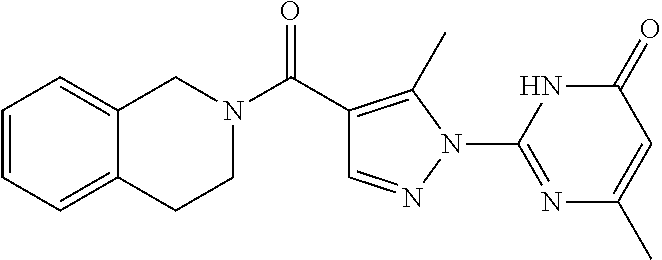
Q-279 - The uses of the compounds and compositions disclosed herein include use as an SPR inhibitor, an analgesic, a treatment for acute or chronic pain, an anti-inflammatory, and/or as an immune cell regulator. The disclosed methods include inhibiting sepiapterin reductase (SPR) by a method comprising contacting SPR with a compound or composition disclosed herein in an amount effective to inhibit SPR. In some aspects, the contacting is in vitro. In other aspects, the contacting is in vivo. In various aspects, contacting comprises administering the compound or the composition to a subject in need thereof. In various aspects, the subject is a mammal. In a preferred aspect, the mammalian subject is human.
- It is contemplated that the SPR inhibitor compounds, compositions, and methods are useful in the treatment of diseases and disorders associated with the BH4 synthesis pathway, such as, but not limited to, pain, inflammation, and immunological disorders. In addition, it is contemplated that the SPR inhibitor compounds, compositions, and methods are useful in the treatment of diseases and disorders associated with increased levels of BH4, such as, but not limited to, pain, inflammation, and immunological disorders, compared with normal subjects not known to suffer from pain, inflammation, and/or immunological disorders. In other aspects, the subject suffers from pain (e.g., acute or chronic pain), inflammation, and/or an immunological disorder.
- The disclosed methods include methods of treating a subject suffering from pain, such as acute pain or chronic pain, comprising administering to the subject a therapeutically effective amount of a compound or composition as disclosed herein. The disclosed methods also include methods of treating a subject suffering from inflammation, such as chronic inflammation, comprising administering to the subject a therapeutically effective amount of a compound or composition as disclosed herein. The disclosed methods further include methods of treating a subject suffering from an immunological disorder, comprising administering to the subject a therapeutically effective amount of a compound or composition as disclosed herein.
- Pain includes, but is not limited to, AIDS/HIV-related pain, ankylosing spondylitis, arachnoiditis, back pain, breakthrough pain, burning mouth syndrome, bursitis, cancer pain, carpal tunnel syndrome pain, cauda equina syndrome, central pain syndrome, Charcot-Marie-Tooth disease, chronic functional abdominal pain, chronic pancreatitis pain, complex regional pain syndrome, corneal neuropathic pain, degenerative disc disease, Dercum's disease, dermatomyositis, diabetic peripheral neuropathy, Ehlers-Danlos syndrome, endometriosis, erythromelalgia, failed back surgery syndrome, fibromyalgia, intercostal neuraligia, interstitial cystitis, irritable bowel syndrome, juvenile dermatositis, leg pain, loin pain-haematuria syndrome, meralgia paresthetica, migraine, multiple sclerosis pain, musculoskeletal pain, myofascial pain, myositis, neuropathic pain, occipital neuralgia, osteoarthritis pain, Paget's disease, pelvic pain, peripheral neuropathy, phantom limb pain, pinched nerve, polymyalgia rhuematica, polymyositis, post-herniorraphy pain syndrome, post-mastectomy pain syndrome, post-stroke pain, post-thorocotomy pain syndrome, post-traumatic neuropathy, postherpetic neuralgia, post-polio syndrome, primary lateral sclerosis, psoriatic arthritis, pudendal neuralgia, Raynaud's disease, restless leg syndrome, rheumatoid arthritis, sacroiliac joint dysfunction, sarcoidosis, sciatica, postherpetic neuralgia, sickle cell pain, Sjogren's syndrome, spasmodic torticollis, sphincter of Oddi dysfunction, spinal cord injury, spinal stenosis, syringomyelia, Tarlov cysts, thoracic outlet syndrome (TOS), temporomandibular joint disorder, transverse myelitis, trigeminal neuralgia, ulcerative Colitis, vascular pain, vulvodynia, and whiplash pain.
- Immunological disorders include, but are not limited to, acid-induced lung injury, acne (PAPA), acute respiratory distress syndrome, ageing, headache, AIDS, alcoholic hepatitis, alcoholic liver disease, nonalcoholic steatohepatitis (NASH), allergen induced asthma, allergic bronchpulmonay aspergillosis, Alzheimer's disease, amyotropic lateral sclerosis (ALS), angina pectoris, anhidrotic ecodermal dysplasia-ID, ankylosiing spondylitis, antiphospholipid syndrome, aphthous stomatitis, appendicitis, arthritis, asthma, atopic dermatitis, autoimmune diseases, bee sting-induced inflammation, Behcet's disease, Bell's palsey, Blau syndrome, bronchiolitis, burns, cancer, cardiac hypertrophy, catabolic disorders, cataracts, cerebral aneurysm, Cystic Fibrosis, chemical irritant-induced inflammation, chronic heart failure, chronic lung disease of prematurity, chronic obstructive pulmonary disease, colitis, complex regional pain syndrome, congenital muscular dystrophies, connective tissue diseases, crohn's disease, cryopyrin-associated periodic syndromes, cyrptococcosis, cystic fibrosis, deficiency of the interleukin-1-receptor antagonist (DIRA), dermatitis, dermatomyositis, DIPG (Diffuse Intrinsic Pontine Glioma), endometriosis, endotoxemia, eosiniphilic esophagitis, familial amyloidotic polyneuropathy, familial cold urticarial, familial mediterranean fever, fetal growth, FSHD, glaucoma, glomerular disease, glomerular nephritis, gut diseases, peritoneal endometriosis, head injury, hearing loss, heart disease, Henoch-Scholein purpura, hepatitis, hereditary periodic fever syndrome, Herpes zoster and simplex, HIV-1, Huntington's disease, hyaline membrane disease, hypercholesterolemia, hyperimmunoglobulinemia D with recurrent fever (HIDS), hypoplastic and tother anemias, incontinentia pigmenti, infectious mononucleosis, inflammatory bowel disease, inflammatory lung disease, inflammatory neuropathy, inflammatory pain, insect bite-induced inflammation, irritant-induced inflammation, ischemia/reperfusion, Kawasaki Disease, kidney disease, kidney injury caused by parasitic infections[m1], leptospiriosis, leukemia, limb girdle muscular dystrophy 2A, limb girdle muscular dystrophy 2B, lung injury, lupus, lupus nephritis, lymphoma, meningitis, mesothelioma, Muckle-Wells syndrome (urticaria deafness amyloidosis), multiple sclerosis, muscle wasting, muscular dystrophy, myasthenia gravis, mycarditis, mycosis fungoides, myelodysplastic syndrome, myositis, nasal sinusitis, necrotizing enterocolitis, neonatal onset multisystem inflammatory disease (NOMID), nephrotic eyndrome, neuritis, neuropathological diseases, non-allergen induced asthma, obesity, ocular allergy, organ transplant, osterarthritis, otitis media, paget's disease, pancreatitis, Parkinson's disease, pericarditis, periodic fever, periodonitis, pertussis, pharyngitis and adenitis (PFAPA syndrome), plant irritant-induced inflammation, Pneumosystis infection, poison ivy/urushiol oil-induced inflammation, polyarteritis nodosa, polycystic kidney disease, polymyositis, pontine glioma, psoriasis, psychosocial stress diseases, pulmonary disease, pulmonary fibrosis, pulmonary hypertension, pyoderma gangrenosum, pyogenic sterile arthritis, renal disease, retardation, retinal disease, rheumatic disease, sarcoidosis, sebborrhea, sepsis, sickle cell, silica-induced diseases, Sjogren's syndrome, skin diseases, sleep apnea, solid tumors including brain tumors, spinal cord injury, statin induced myopathy, stroke, subarachnoid hemorrhage, sunburn, thrombocytopenia, tissue transplant, TNF receptor associated periodic syndrome (TRAPS), toxoplasmosis, traumatic brain injury, tuberculosis, type 1 diabetes, type 2 diabetes, ulcerative colitis, uveitis, and wound repair.
- A “therapeutically effective amount” means an amount effective to treat or to prevent development of, or to alleviate the existing symptoms of, the subject being treated. Determination of the effective amounts is well within the capability of those skilled in the art, especially in light of the detailed disclosure provided herein. Generally, a “therapeutically effective dose” refers to that amount of the compound that results in achieving the desired effect. For example, in one preferred embodiment, a therapeutically effective amount of a compound disclosed herein decreases SPR activity by at least 5%, compared to control, at least 10%, at least 15%, at least 20%, at least 25%, at least 30%, at least 35%, at least 40%, at least 45%, at least 50%, at least 55%, at least 60%, at least 65%, at least 70%, at least 75%, at least 80%, at least 85%, or at least 90%.
- The amount of compound administered can be dependent on the subject being treated, on the subject's age, health, sex, and weight, the kind of concurrent treatment (if any), severity of the affliction, the nature of the effect desired, the manner and frequency of treatment, and the judgment of the prescribing physician. The frequency of dosing also can be dependent on pharmacodynamic effects on arterial oxygen pressures. However, the most preferred dosage can be tailored to the individual subject, as is understood and determinable by one of skill in the art, without undue experimentation. This typically involves adjustment of a standard dose (e.g., reduction of the dose if the patient has a low body weight).
- While individual needs vary, determination of optimal ranges of effective amounts of the compound is within the skill of the art. For administration to a human in the curative or prophylactic treatment of the conditions and disorders identified herein, for example, typical dosages of the compounds of the present invention can be about 0.05 mg/kg/day to about 50 mg/kg/day, for example at least 0.05 mg/kg, at least 0.08 mg/kg, at least 0.1 mg/kg, at least 0.2 mg/kg, at least 0.3 mg/kg, at least 0.4 mg/kg, or at least 0.5 mg/kg, and preferably 50 mg/kg or less, 40 mg/kg or less, 30 mg/kg or less, 20 mg/kg or less, or 10 mg/kg or less, which can be about 2.5 mg/day (0.5 mg/kg×5 kg) to about 5000 mg/day (50 mg/kg×100 kg), for example. For example, dosages of the compounds can be about 0.1 mg/kg/day to about 50 mg/kg/day, about 0.05 mg/kg/day to about 10 mg/kg/day, about 0.05 mg/kg/day to about 5 mg/kg/day, about 0.05 mg/kg/day to about 3 mg/kg/day, about 0.07 mg/kg/day to about 3 mg/kg/day, about 0.09 mg/kg/day to about 3 mg/kg/day, about 0.05 mg/kg/day to about 0.1 mg/kg/day, about 0.1 mg/kg/day to about 1 mg/kg/day, about 1 mg/kg/day to about 10 mg/kg/day, about 1 mg/kg/day to about 5 mg/kg/day, about 1 mg/kg/day to about 3 mg/kg/day, about 3 mg/day to about 500 mg/day, about 5 mg/day to about 250 mg/day, about 10 mg/day to about 100 mg/day, about 3 mg/day to about 10 mg/day, or about 100 mg/day to about 250 mg/day. Such doses may be administered in a single dose or it may be divided into multiple doses.
- An SPR inhibitor is contemplated to be useful in the treatment of any condition wherein the lowering of BH4 levels will provide benefits. The SPR inhibitor is useful alone, or in combination with other compounds, which may act to promote the reduction of BH4 levels. The present section provides a description of how the SPR inhibitors of the invention may be therapeutically administered to a subject in need thereof.
- One of the therapeutic embodiments of the invention is the provision, to a subject in need thereof, compositions comprising one or more SPR inhibitors. In one aspect, the SPR inhibitor formulation for therapy in a subject is selected based on the route of administration and in certain aspects includes liposome and micelle formulations as well as classic pharmaceutical preparations.
- In various aspects, administration of the compositions is systemic or local, and in still other aspects comprises a single site injection of a therapeutically-effective amount of the SPR inhibitor composition. Any route known to those of skill in the art for the administration of a therapeutic composition of the invention is contemplated including, for example, intravenous, intramuscular, subcutaneous, oral, or a catheter for long-term administration.
- Combination Therapy:
- In addition to therapies based solely on the delivery of the SPR inhibitor composition, combination therapy is specifically contemplated. In the context of the invention, it is contemplated that the SPR inhibitor composition therapy is used similarly in conjunction with other agents commonly used for the treatment of elevated levels of BH4 and/or SPR.
- The combination therapy compositions are provided in a combined amount effective to produce the desired therapeutic outcome in the treatment of reduced levels of BH4 and/or make a detectable change in an indication as described herein. This process involves administering the SPR inhibitor and the second agent(s) or factor(s) at the same time. Methods thus include administering a single composition or pharmacological formulation that includes both agents, or administering two distinct compositions or formulations, at the same time, wherein one composition includes the SPR inhibitor therapeutic composition and the other includes the second therapeutic agent.
- Alternatively, the SPR inhibitor treatment precedes or follows the second therapeutic agent treatment by intervals ranging from minutes to weeks. In embodiments where the second therapeutic agent and the SPR inhibitor are administered separately, one generally ensures that a significant period of time did not transpire between the times of each delivery, such that the second therapeutic agent and the SPR inhibitor are able to exert an advantageously combined effect. In such instances, it is contemplated that one administers both modalities within about 12-24 hours of each other, or alternately, within about 6-12 hours of each other, or alternately, with a delay time of only about 12 hours. However, in some situations, it is desirable to extend the time period for treatment significantly, where several days (2, 3, 4, 5, 6 or 7) to several weeks (1, 2, 3, 4, 5, 6, 7 or 8) lapse between the respective administrations.
- Systemic delivery of SPR inhibitors to patients is a very efficient method for delivering a therapeutically effective amount of the compound to counteract the immediate clinical manifestations of a disease or disorder. Alternatively, local delivery of the SPR inhibitor and/or the second therapeutic agent is appropriate in certain circumstances. In a certain embodiment, it is contemplated that the SPR inhibitor is delivered to a patient for an extended period of time. It is further contemplated that the SPR inhibitor is taken throughout a patient's lifetime to lower SPR activity levels.
- Also provided herein are pharmaceutical compositions that includes a compound as disclosed herein, together with a pharmaceutically acceptable excipient such as a diluent or carrier. Compounds and pharmaceutical compositions suitable for use in the present invention include those wherein the compound can be administered in an effective amount to achieve its intended purpose. Administration of the compound described in more detail below.
- Suitable pharmaceutical formulations can be determined by the skilled artisan depending on the route of administration and the desired dosage. See, e.g., Remington's Pharmaceutical Sciences, 1435-712 (18th ed., Mack Publishing Co, Easton, Pa., 1990). Formulations may influence the physical state, stability, rate of in vivo release and rate of in vivo clearance of the administered agents. Depending on the route of administration, a suitable dose may be calculated according to body weight, body surface areas or organ size. Further refinement of the calculations necessary to determine the appropriate treatment dose is routinely made by those of ordinary skill in the art without undue experimentation, especially in light of the dosage information and assays disclosed herein as well as the pharmacokinetic data obtainable through animal or human clinical trials.
- The phrases “pharmaceutically acceptable” or “pharmacologically acceptable” refer to molecular entities and compositions that do not produce adverse, allergic, or other untoward reactions when administered to an animal or a human. As used herein, “pharmaceutically acceptable carrier” includes any and all solvents, dispersion media, coatings, antibacterial and antifungal agents, isotonic and absorption delaying agents and the like. The use of such excipients for pharmaceutically active substances is well known in the art. Except insofar as any conventional media or agent is incompatible with the therapeutic compositions, its use in therapeutic compositions is contemplated. Supplementary active ingredients also can be incorporated into the compositions. In exemplary embodiments, the formulation may comprise corn syrup solids, high-oleic safflower oil, coconut oil, soy oil, L-leucine, calcium phosphate tribasic, L-tyrosine, L-proline, L-lysine acetate, DATEM (an emulsifier), L-glutamine, L-valine, potassium phosphate dibasic, L-isoleucine, L-arginine, L-alanine, glycine, L-asparagine monohydrate, L-serine, potassium citrate, L-threonine, sodium citrate, magnesium chloride, L-histidine, L-methionine, ascorbic acid, calcium carbonate, L-glutamic acid, L-cystine dihydrochloride, L-tryptophan, L-aspartic acid, choline chloride, taurine, m-inositol, ferrous sulfate, ascorbyl palmitate, zinc sulfate, L-carnitine, alpha-tocopheryl acetate, sodium chloride, niacinamide, mixed tocopherols, calcium pantothenate, cupric sulfate, thiamine chloride hydrochloride, vitamin A palmitate, manganese sulfate, riboflavin, pyridoxine hydrochloride, folic acid, beta-carotene, potassium iodide, phylloquinone, biotin, sodium selenate, chromium chloride, sodium molybdate, vitamin D3 and cyanocobalamin.
- As used herein, “pharmaceutically acceptable salts” include, for example base addition salts and acid addition salts.
- Pharmaceutically acceptable base addition salts may be formed with metals or amines, such as alkali and alkaline earth metals or organic amines. Pharmaceutically acceptable salts of compounds may also be prepared with a pharmaceutically acceptable cation. Suitable pharmaceutically acceptable cations are well known to those skilled in the art and include alkaline, alkaline earth, ammonium and quaternary ammonium cations. Carbonates or hydrogen carbonates are also possible. Examples of metals used as cations are sodium, potassium, magnesium, ammonium, calcium, or ferric, and the like. Examples of suitable amines include isopropylamine, trimethylamine, histidine, N,N′-dibenzylethylenediamine, chloroprocaine, choline, diethanolamine, dicyclohexylamine, ethylenediamine, N-methylglucamine, and procaine.
- Pharmaceutically acceptable acid addition salts include inorganic or organic acid salts. Examples of suitable acid salts include the hydrochlorides, formates, acetates, citrates, salicylates, nitrates, phosphates. Other suitable pharmaceutically acceptable salts are well known to those skilled in the art and include, for example, formic, acetic, citric, oxalic, tartaric, or mandelic acids, hydrochloric acid, hydrobromic acid, sulfuric acid or phosphoric acid; with organic carboxylic, sulfonic, sulfo or phospho acids or N-substituted sulfamic acids, for example acetic acid, trifluoroacetic acid (TFA), propionic acid, glycolic acid, succinic acid, maleic acid, hydroxymaleic acid, methylmaleic acid, fumaric acid, malic acid, tartaric acid, lactic acid, oxalic acid, gluconic acid, glucaric acid, glucuronic acid, citric acid, benzoic acid, cinnamic acid, mandelic acid, salicylic acid, 4-aminosalicylic acid, 2-phenoxybenzoic acid, 2-acetoxybenzoic acid, embonic acid, nicotinic acid or isonicotinic acid; and with amino acids, such as the 20 alpha amino acids involved in the synthesis of proteins in nature, for example glutamic acid or aspartic acid, and also with phenylacetic acid, methanesulfonic acid, ethanesulfonic acid, 2-hydroxyethanesulfonic acid, ethane 1,2-disulfonic acid, benzenesulfonic acid, 4-methylbenzenesulfonic acid, naphthalene 2-sulfonic acid, naphthalene 1,5-disulfonic acid, 2- or 3-phosphoglycerate, glucose 6-phosphate, N-cyclohexylsulfamic acid (with the formation of cyclamates), or with other acid organic compounds, such as ascorbic acid.
- Pharmaceutical compositions containing the compounds disclosed herein can be manufactured in a conventional manner, e.g., by conventional mixing, dissolving, granulating, dragee-making, levigating, emulsifying, encapsulating, entrapping, or lyophilizing processes. Proper formulation is dependent upon the route of administration chosen.
- For oral administration, suitable compositions can be formulated readily by combining a compound disclosed herein with pharmaceutically acceptable excipients such as carriers well known in the art. Such excipients and carriers enable the present compounds to be formulated as tablets, pills, dragees, capsules, liquids, gels, syrups, slurries, suspensions and the like, for oral ingestion by a patient to be treated. Pharmaceutical preparations for oral use can be obtained by adding a compound as disclosed herein with a solid excipient, optionally grinding a resulting mixture, and processing the mixture of granules, after adding suitable auxiliaries, if desired, to obtain tablets or dragee cores. Suitable excipients include, for example, fillers and cellulose preparations. If desired, disintegrating agents can be added. Pharmaceutically acceptable ingredients are well known for the various types of formulation and may be for example binders (e.g., natural or synthetic polymers), lubricants, surfactants, sweetening and flavoring agents, coating materials, preservatives, dyes, thickeners, adjuvants, antimicrobial agents, antioxidants and carriers for the various formulation types.
- When a therapeutically effective amount of a compound disclosed herein is administered orally, the composition typically is in the form of a solid (e.g., tablet, capsule, pill, powder, or troche) or a liquid formulation (e.g., aqueous suspension, solution, elixir, or syrup).
- When administered in tablet form, the composition can additionally contain a functional solid and/or solid carrier, such as a gelatin or an adjuvant. The tablet, capsule, and powder can contain about 1 to about 95% compound, and preferably from about 15 to about 90% compound.
- When administered in liquid or suspension form, a functional liquid and/or a liquid carrier such as water, petroleum, or oils of animal or plant origin can be added. The liquid form of the composition can further contain physiological saline solution, sugar alcohol solutions, dextrose or other saccharide solutions, or glycols. When administered in liquid or suspension form, the composition can contain about 0.5 to about 90% by weight of a compound disclosed herein, and preferably about 1 to about 50% of a compound disclosed herein. In one embodiment contemplated, the liquid carrier is non-aqueous or substantially non-aqueous. For administration in liquid form, the composition may be supplied as a rapidly-dissolving solid formulation for dissolution or suspension immediately prior to administration.
- When a therapeutically effective amount of a compound disclosed herein is administered by intravenous, cutaneous, or subcutaneous injection, the composition is in the form of a pyrogen-free, parenterally acceptable aqueous solution. The preparation of such parenterally acceptable solutions, having due regard to pH, isotonicity, stability, and the like, is within the skill in the art. A preferred composition for intravenous, cutaneous, or subcutaneous injection typically contains, in addition to a compound disclosed herein, an isotonic vehicle. Such compositions may be prepared for administration as solutions of free base or pharmacologically acceptable salts in water suitably mixed with a surfactant, such as hydroxypropylcellulose. Dispersions also can be prepared in glycerol, liquid polyethylene glycols, and mixtures thereof and in oils. Under ordinary conditions of storage and use, these preparations can optionally contain a preservative to prevent the growth of microorganisms.
- Injectable compositions can include sterile aqueous solutions, suspensions, or dispersions and sterile powders for the extemporaneous preparation of sterile injectable solutions, suspensions, or dispersions. In all cases the form must be sterile and must be fluid to the extent that easy syringability exists. It must be stable under the conditions of manufacture and storage and must resist the contaminating action of microorganisms, such as bacteria and fungi, by optional inclusion of a preservative. The carrier can be a solvent or dispersion medium containing, for example, water, ethanol, polyol (e.g., glycerol, propylene glycol, and liquid polyethylene glycol, and the like), suitable mixtures thereof, and vegetable oils. In one embodiment contemplated, the carrier is non-aqueous or substantially non-aqueous. The proper fluidity can be maintained, for example, by the use of a coating, such as lecithin, by the maintenance of the required particle size of the compound in the case of dispersion and by the use of surfactants. The prevention of the action of microorganisms can be brought about by various antibacterial and antifungal agents, for example, parabens, chlorobutanol, phenol, sorbic acid, thimerosal, and the like. In many cases, it will be preferable to include isotonic agents, for example, sugars or sodium chloride. Prolonged absorption of the injectable compositions can be brought about by the use in the compositions of agents delaying absorption, for example, aluminum monostearate and gelatin.
- Sterile injectable solutions are prepared by incorporating the active compounds in the required amount in the appropriate solvent with various of the other ingredients enumerated above, as required, followed by filtered sterilization. Generally, dispersions are prepared by incorporating the various sterilized active ingredients into a sterile vehicle which contains the basic dispersion medium and the required other ingredients from those enumerated above. In the case of sterile powders for the preparation of sterile injectable solutions, the preferred methods of preparation are vacuum-drying and freeze-drying techniques which yield a powder of the active ingredient plus any additional desired ingredient from a previously sterile-filtered solution thereof.
- Slow release or sustained release formulations may also be prepared in order to achieve a controlled release of the active compound in contact with the body fluids in the GI tract, and to provide a substantially constant and effective level of the active compound in the blood plasma. For example, release can be controlled by one or more of dissolution, diffusion, and ion-exchange. In addition, the slow release approach may enhance absorption via saturable or limiting pathways within the GI tract. For example, the compound may be embedded for this purpose in a polymer matrix of a biological degradable polymer, a water-soluble polymer or a mixture of both, and optionally suitable surfactants. Embedding can mean in this context the incorporation of micro-particles in a matrix of polymers. Controlled release formulations are also obtained through encapsulation of dispersed micro-particles or emulsified micro-droplets via known dispersion or emulsion coating technologies.
- For administration by inhalation, compounds of the present invention are conveniently delivered in the form of an aerosol spray presentation from pressurized packs or a nebulizer, with the use of a suitable propellant. In the case of a pressurized aerosol, the dosage unit can be determined by providing a valve to deliver a metered amount. Capsules and cartridges of, e.g., gelatin, for use in an inhaler or insufflator can be formulated containing a powder mix of the compound and a suitable powder base such as lactose or starch.
- The compounds disclosed herein can be formulated for parenteral administration by injection (e.g., by bolus injection or continuous infusion). Formulations for injection can be presented in unit dosage form (e.g., in ampules or in multidose containers), with an added preservative. The compositions can take such forms as suspensions, solutions, or emulsions in oily or aqueous vehicles, and can contain formulatory agents such as suspending, stabilizing, and/or dispersing agents.
- Pharmaceutical formulations for parenteral administration include aqueous solutions of the compounds in water-soluble form. Additionally, suspensions of the compounds can be prepared as appropriate oily injection suspensions. Suitable lipophilic solvents or vehicles include fatty oils or synthetic fatty acid esters. Aqueous injection suspensions can contain substances which increase the viscosity of the suspension. Optionally, the suspension also can contain suitable stabilizers or agents that increase the solubility of the compounds and allow for the preparation of highly concentrated solutions. Alternatively, a present composition can be in powder form for constitution with a suitable vehicle (e.g., sterile pyrogen-free water) before use.
- Compounds disclosed herein also can be formulated in rectal compositions, such as suppositories or retention enemas (e.g., containing conventional suppository bases). In addition to the formulations described previously, the compounds also can be formulated as a depot preparation. Such long-acting formulations can be administered by implantation (e.g., subcutaneously or intramuscularly) or by intramuscular injection. Thus, for example, the compounds can be formulated with suitable polymeric or hydrophobic materials (for example, as an emulsion in an acceptable oil) or ion exchange resins, or as sparingly soluble derivatives, for example, as a sparingly soluble salt.
- In particular, a compound disclosed herein can be administered orally, buccally, or sublingually in the form of tablets containing excipients, such as starch or lactose, or in capsules or ovules, either alone or in admixture with excipients, or in the form of elixirs or suspensions containing flavoring or coloring agents. Such liquid preparations can be prepared with pharmaceutically acceptable additives, such as suspending agents. A compound also can be injected parenterally, for example, intravenously, intramuscularly, subcutaneously, or intracoronarily. For parenteral administration, the compound is best used in the form of a sterile aqueous solution which can contain other substances, for example, salts, or sugar alcohols, such as mannitol, or glucose, to make the solution isotonic with blood.
- For veterinary use, a compound disclosed herein is administered as a suitably acceptable formulation in accordance with normal veterinary practice. The veterinarian can readily determine the dosing regimen and route of administration that is most appropriate for a particular animal.
- In some cases, all the necessary components for the treatment of an SPR-related disorder using a compound as disclosed herein either alone or in combination with another agent or intervention traditionally used for the treatment of such disease may be packaged into a kit. Specifically, the present invention provides a kit for use in the therapeutic intervention of the disease comprising a packaged set of medicaments that include the compound disclosed herein as well as buffers and other components for preparing deliverable forms of said medicaments, and/or devices for delivering such medicaments, and/or any agents that are used in combination therapy with the compound disclosed herein, and/or instructions for the treatment of the disease packaged with the medicaments. The instructions may be fixed in any tangible medium, such as printed paper, or a computer readable magnetic or optical medium, or instructions to reference a remote computer data source such as a world wide web page accessible via the internet.
- The compounds disclosed herein can be prepared following the methods outlined in detail in the Examples, using suitable modifications to the starting reagents. One of skill in the art, in view of the teachings of the Examples and using typical organic chemistry techniques, can synthesize a compound as disclosed herein.
- In some cases, compounds of formula I can be prepared by converting an appropriate thiouracil to a hydrazine intermediate, coupling the hydrazine intermediate with an appropriate enamine reagent to form a compound of formula I or an intermediate having a pyrazolyl moiety, and further reacting the intermediate having a pyrazolyl moiety so as to couple with an appropriate amine (for example, using reagents such as HATU or HATU/HOAt) to provide a compound of formula I as shown in the Scheme 1 and Scheme 2.
-

-

- In some cases, compounds of formula I can be prepared by converting an appropriate dichloropyrimidine to a hydrazine intermediate, coupling the hydrazine intermediate with an appropriate enamine reagent to form an intermediate having a pyrazolyl moiety, and further reacting the intermediate having a pyrazolyl moiety so as to couple with an appropriate amine (for example, using reagents such as HATU or HATU/HOAt) to provide a compound of formula I as shown in Schemes 3 and 4.
-

-

- In some cases, compounds of formula I can be prepared by converting an appropriate cyclopentanone to a hydrazine intermediate, coupling the hydrazine intermediate with an appropriate enamine reagent to form an intermediate having a pyrazolyl moiety, and further reacting the intermediate having a pyrazolyl moiety so as to couple with an appropriate amine (for example, using reagents such as HATU or HATU/HOAt) to provide a compound of formula I as shown in Scheme 5.
-

- In some cases, compounds of formula I can be prepared by coupling an appropriate hydrazine intermediate with an appropriate enamine, enol ether, aldehyde, or ketone reagent to form an intermediate having a pyrazolyl moiety, and further reacting the intermediate having a pyrazolyl moiety so as to couple with an appropriate amine (for example, using reagents such as HATU or HATU/HOAt) to provide a compound of formula I as shown in Scheme 6.
-

- In some cases, compounds of formula I can be prepared by coupling an appropriate hydrazine intermediate with an appropriate dialdehyde reagent to form an intermediate having a pyrazolyl moiety, and further reacting the intermediate having a pyrazolyl moiety so as to couple with an appropriate amine (for example, using reagents such as HATU or HATU/HOAt) to provide a compound of formula I as shown in Scheme 7.
-

- In some cases, compounds of formula I can be prepared by coupling an appropriate chloropyrimidine or sulfonyl pyrimidine with an appropriate pyrazolyl moiety to form a compound of formula I or an intermediate having a pyrazolyl moiety, and further reacting the intermediate having a pyrazolyl moiety so as to couple with an appropriate amine (for example, using reagents such as HATU or HATU/HOAt) to provide a compound of formula I as shown in Schemes 8, 9, 10 and 11.
-

-

-

-

- In some cases, compounds of formula I can be prepared by coupling an appropriate bromo-cyclopropylideneacetate with an appropriate pyrazolyl moiety to form an intermediate having a pyrazolyl moiety, and further reacting the intermediate having a pyrazolyl moiety so as to couple with an appropriate amine (for example, using reagents such as HATU or HATU/HOAt) to provide a compound of formula I as shown in Scheme 12.
-

- In some cases, compounds of formula I can be prepared by coupling an appropriate azide with an appropriate β-keto ester to form an intermediate having a triazolyl moiety, and further reacting the intermediate having a triazolyl moiety so as to couple with an appropriate amine (for example, using reagents such as HATU or HATU/HOAt) to provide a compound of formula I as shown in Scheme 13.
-

- Amines that are not commercially available can be prepared by standard procedures. In some cases, amines that are not commercially available can be prepared by coupling an appropriate aryl bromide with a mono-protected cyclic diamine, followed by deprotection of the amine protecting group to obtain the amine, for example, as shown in Scheme 14.
-

- In some cases, amines that are not commercially available can be prepared by reducing an appropriate protected aminoketone to obtain the corresponding alcohol, protecting the alcohol with an appropriate protecting group, further reacting with an appropriate reagent so as to convert the protected alcohol to a desired functional group (e.g., a cyano group), followed by deprotection of the amine protecting group to obtain the amine, for example, as shown in Scheme 15.
-

- The compounds disclosed herein can be assessed for SPR inhibitory activity. Typically, a compound is assayed by an enzymatic assay (e.g., a TR-FRET assay) and/or a cellular assay (e.g., SKN-N-BE(2) cells or human PBMC (Peripheral Blood Mononuclear Cells)) as described below.
- TR-FRET Assay: A TR-FRET (homogeneous, time-resolved, fluorescence resonance energy transfer) assay was used to assess activity of compounds following standard assay conditions. Terbium labeled SNAP-hSPR and SSZ (sulfasalazine) labeled SNAP-EGFP were used as the protein pair in this assay according to the procedure described in Haruki et al., Science, 430:987 (2013). Compounds were screened at different concentrations and IC50 values calculated.
- SKN-N-BE(2) Cellular Assay: SK-N-BE (2) cells were seeded in sterile, 96-well plates and incubated for 12-24 hours at 37° C. with 5% CO2 supply. Media was removed and fresh DMEM/F-12 media (containing Glutamine & Pen/Strep but no FBS) was added. Compounds (at different concentrations) were added to different wells. The plates were then incubated for 6-48 hours at 37° C. with 5% CO2 supply. Plates were then centrifuged and the supernatant was removed. The plates were then optionally washed once with PBS. They were then sealed and stored at −80° C. or immediately used. The cells were lysed and the level of BH4 was assessed by LC-MS.
- hPBMC Assay: PBMCs were either purchased or isolated from fresh human blood and used either as a fresh preparation or frozen for later use. The assay system was prepared by pre-treating the assay plates overnight with a solution containing anti-human CD3 antibody. Human PBMCs were suspended in assay medium and plated into the assay plates at a density of 1-4×10⁵ cells per well. The desired concentration of the test compound was added to each well. A solution of human anti-CD28 antibody was also added to each well. Plates were incubated for 12-48 hours at 37° C. and 5% CO2. Assay plates were centrifuged for 5-15 minutes at 1-3000 RMP and supernatants were removed. The cells were lysed, sealed and used directly or frozen at −80° C. LC-MS was used to quantify the amount of inhibition of BH4 production.
- The compounds disclosed herein can be assessed for effect on pain behavior. Typically, a compound is assayed by a behavioral pharmacology model as described below.
- Behavioral Pharmacology Model: Compounds were administered by oral gavage to rats that had undergone one of two nerve injury surgeries: spared nerve injury to injure two of the three peripheral branches of the sciatic nerve or chronic constriction injury of the sciatic nerve. Paw withdrawal thresholds to mechanical stimulation using calibrated von Frey filaments were used as measurement of neuropathic pain-like behaviors.
- In the examples and throughout the specification, the following abbreviations are used.
-
conc. concentrated DCM dichloromethane DMF N,N-dimethylformamide DMSO dimethylsulfoxide Et2O diethyl ether EtOAc or EA ethyl acetate MeOH methanol EtOH ethanol THF tetrahydrofuran DIPEA N,N-diisopropylethylamine DAST diethylaminosulfur trifluoride LDA lithium diisopropylamide mCPBA 3-chloroperoxybenzoic acid Pd(OAc)2 palladium(II) acetate TEA triethylamine DIAD diisopropyl azodicarboxylate NaHCO3 Sodium bicarbonate Na2CO3 Sodium Carbonate MgSO4 Magnesium sulphate Na2SO4 Sodium Sulphate SiO2 silica h hour r.t. room temperature RT retention time br broad M mass HPLC High Performance Liquid Chromatography LC-MS Liquid Chromatography Mass Spectrometry ES+ Electrospray Positive Ionisation ES− Electrospray Negative Ionisation brine aqueous sodium chloride solution EDC 1-(3-dimethylaminopropyl)-3- ethylcarbodiimide hydrochloride HATU O-(7-azabenzotriazol-1-yl)-N,N,N′,N′- tetramethyluronium hexafluorophosphate Pd(PPh3)4 tetrakis(triphenylphosphine)palladium(0) HOAt 1-Hydroxy-7-azabenzotriazole PE Petroleum ether SGC Silica gel chromatography TLC Thin layer chromatography GC-MS Gas chromatography mass spectrometry PdCl2(dppf) [1,1′- bis(diphenylphosphino)ferrocene]dichloropalladium(II) T3P Propylphosphonic anhydride COMU (1-Cyano-2-ethoxy-2- oxoethylidenaminooxy)dimethylamino- morpholino-carbenium hexafluorophosphate SCX propylsulfonic acid bonded sorbent purification cartridge - The following analytical LC-MS methods were used.
-
Method A: (2 min IPC) MET/CR/1673 Column: Supelco Ascentis Express C18, 30 mm × 2.1 mm, 2.7 μm Flow rate: 1.0 ml/min Mobile Phase: A, Formic acid (aqueous) 0.1% and B, Formic acid (MeCN) 0.1% Injection Vol: 3 μl Temp.: 40° C. Detection: 215 nm (nominal) Gradient Time (minutes) - % B 0.00-5 1.50-100 1.60-100 1.61-5 Method B: (1.7 min IPC) MET/CR/1410 Column: Kinetex Core-Shell C18, 50 mm × 2.1 mm, 5.0 μm Flow rate: 1.2 ml/min Mobile Phase: A, Formic acid (aqueous) 0.1% and B, Formic acid (MeCN) 0.1% Injection Vol: 3 μl Temp.: 40° C. Detection: 215 nm (nominal) Gradient Time (minutes) - % B 0.00-5 1.20-100 1.30-100 1.31-5 Method C: (7 min IPC) MET/u-HPLC (low pH 7 min method) Column: Phenomenex Kinetex-XB C18, 2.1 mm × 100 mm, 1.7 μm Flow rate: 0.6 ml/min Mobile Phase: A, Formic acid (aqueous) 0.1% and B, Formic acid (MeCN) 0.1% Injection Vol: 3 μl Temp.: 40° C. Detection: 215 nm (nominal) Gradient Time (minutes) - % B 0.00-5 5.30-100 5.80-100 5.82-5 - The following preparative HPLC and SFC methods were used.
-
Method D: SFC: 10% Methanol: 90% CO2 on a 25 cm OJ-H Column, at 15 ml/min. Method E: Generic high pH prep method (Gilson 3 and Gilson 5) Column: Waters Xbridge C18 (30 × 100 mm, 10 um) Flow rate: 40 ml/min Mobile Phase: A, Water + 0.2% Ammonium hydroxide, B, Acetonitrile + 0.2% Ammonium hydroxide Injection Vol.: 1500 μl Temperature: r.t. Detection: 215 nm Gradient Time (minutes) - % B 0.0-5 2.5-5 16.05-95 18.2-95 19.1-5 20-5 Method F: Generic neutral pH prep method (Waters 1) Column: Waters Sunfire C18 (30 × 100 mm, 10 um), Part no. 186003971 Flow rate: 40 ml/min Mobile Phase: A, Water, B, Acetonitrile Injection Vol: 1500 μl Temperature: r.t. Detection: 215 nm Gradient Time (minutes) - % B 0-10 2-10 2.5-15 14.5-100 15.5-100 16-10 17-10 Method G: Generic low pH prep method (Waters 2) Column: Waters Sunfire C18 (30 × 100 mm, 10 um), Part no. 186003971 Flow rate: 40 ml/min Mobile Phase: A, Water + 0.1% Formic acid, B, Acetonitrile + 0.1% Formic acid Injection Vol.: 1500 μl Temperature: r.t. Detection: 215 nm Gradient Time (minutes) - % B 0-5 2-5 2.5-10 14.5-10 15.5-100 16-5 - The following preparative chiral separation and analysis methods were used.
-
Method H: Separation Column: SFC ChiralPak AS (250 mm × 20 mm, 5 um) Flow rate: 50 mL/min Eluent: MeOH/CO2 50% (TFA was added as a modifier) Injection Vol: 0.7 mL (7 mg) Detection: 218 nm Method I: Analysis Column: SFC ChiralPak AS (250 mm × 4.6 mm, 5 um) Flow rate: 4 mL/min Eluent: MeOH/CO2 45% (TFA was added as a modifier) Method J: Separation Column: HPLC Lux C1 (20 mm × 250 mm, 5 um) Flow rate: 21 mL/min Eluent: HEPT/EtOH (50:50) (TFA was added as a modifier) Injection Vol: 0.5 mL (10 mg) Detection: 210 nm Method K: Analysis Column: HPLC Lux C1 (4.6 mm × 250 mm, 5 um) Eluent: HEPT/EtOH (40:60) (TFA was added as a modifier) Flow rate: 4 mL/min. Method L: Separation Column: ChiralPak AD (20 mm × 250 mm, 20 um) Eluent: EtOH (TFA was added as a modifier) Flow rate was 21 mL/min Method M: Analysis Column: HPLC using a YMC AMY-C (4.6 mm × 250 mm, 5 um) Eluent EtOH (TFA was added as a modifier) Flow rate: 1 mL/min Method N: Separation Column: HPLC Chiralcel OD-H 25 cm Eluent: ethanol + 0.1% formic acid Flow rate: 5 ml/min Method O: Separation Column: Lux A2 (20 mm × 250 mm, 5 um) Eluent: EtOH (TFA was added as a modifier) Flow rate: 21 mL/min Detection: 210 nm - The following LC-MS methods were used.
-
Method A′: Column: SunFire C18 (4.6 × 50 mm, 3.5 um) Mobile phase: H2 O (0.05% TFA) (A)/ACN (0.05% TFA) (B) Elution program: Gradient from 5 to 100% of B in 1.3 min at 2 mL/min Temperature: 50° C. Detection: UV (214, 254 nm) and MS (ESI, Pos mode, 110 to 1000 amu) Method B′: Column: Chromolith Fast Gradien RP-18e, 50-3 mm Mobile Phase: A: Water (0.01% TFA) B: ACN (0.01% TFA) Gradient: 5% B increase to 100% B within 0.8 min, 100% B for 1.1 min. Flow Rate: 1.5 mL/min Column Temperature: 40° C. Mass Range: 103-1100 Method C′: Column: Sunfire C18 4.6 × 50 mm, 3.5 um Mobile phase: H2O (0.01% TFA) (A)/ACN (0.01% TFA) (B) Elution program: Gradient from 5 to 95% of B in 1.4 min at 2.0 ml/min Temperature: 45° C. Detection: UV (214, 254 nm) and MS (ESI, POS mode, 113 to 1200 amu) Method D′: Column: Sunfire C18 2.5 um3 * 30 mm Mobile Phase: A: water (0.01% TFA) B: ACN (0.01% TFA) Gradient: 5%-95% B in 1.5 min Flow Rate: 1.5 mL/min Mass Range: 110-1000 UV: 214 nm; 254 nm Oven Temperature: 50° C. Method E′: Column: SunFire C18, 4.6 * 50 mm, 3.5 um Mobile Phase: A: Water (0.01% TFA) B: ACN (0.01% TFA) Gradient: 5% B increase to 95% B within 1.2 min, 95% B for 1.3 min, back to 5% B within 0.01 min. Flow Rate: 2.0 mL/min Column Temperature: 50° C. Method F′: Column: Xbridge C18 (4.6 × 50 mm, 3.5 um) Mobile phase: H2O (10 mmol NH4HCO3) (A)/ACN(B) Elution program: Gradient from 5 to 95% of B in 1.3 min at 1.8 ml/min Temperature: 50° C. Detection: UV (214, 254 nm) and MS (ESI, POS mode, 110 to 1000 amu) Method G′: Column: Xbridge, 3.5um, 50 * 4.6 mm Mobile Phase: A: 10 m mol/L NH4HCO3 in water B: ACN Gradient: 5% B increase to 95% B within 1.5 min, 95% B for 1.0 min, back to 5% B within 0.01 min. Flow Rate: 2 mL/min Oven Temperature: 50° C. Method H′: Column: Xbridge C18 4.6 * 50 mm 3.5 um Mobile Phase: A: 10 mM NH4HCO3 in water B: ACN Gradient: 5% B increase to 95% B within 1.2 min, 95% B for 1.3 min, back to 5% B within 0.01 min. Flow Rate: 2.0 mL/min Oven Temperature: 50° C. Method I′: Column: Gemini-NX 3u C18 (4.6 × 50 mm, 3 um) Mobile phase: H2O (10 mmol NH4HCO3) (A)/ACN (B) Elution program: Gradient from 10 to 95% of B in 1.5 min at 1.8 mL/min Temperature: 50° C. Detection: UV (214, 254 nm) and MS (ESI, Pos mode, 70 to 900 amu) Method J′: Column: Xbridge C18(2) (4.6 × 50 mm, 3.5 um) Mobile phase: H2O (10 mmol NH4HCO3) (A)/ACN (B) Elution program: Gradient from 10 to 95% of B in 1.5 min at 1.8 mL/min Temperature: 50° C. Detection: UV (214, 254 nm) and MS (ESI, Pos mode, 110 to 1100 amu) Method K′: Column: YMC C18 Plus, 4.6 * 50 mm, 3 um, 12 nm Mobile Phase: A: water (10 mM Ammonium hydrogen carbonate) B: ACN Gradient: 5%-95% B in 1.6 min Flow Rate: 1.6 mL/min Oven Temperature: 50° C. MS Range: 110-1100 -

-

- To water (500 mL) was added NaOH (97%, 15.7 g, 381 mmol) and the suspension stirred at r.t. for 10 mins. 6-methyl-2-sulfanylidene-1,2,3,4-tetrahydropyrimidin-4-one (98%, 53.5 g, 369 mmol) was added and the mixture stirred until fully dissolved for 10 mins. Iodomethane (28.99 mL, 461 mmol) was added dropwise and the mixture stirred at r.t. for 4 h. The colorless solid was filtered, washed with ice cold water (2×100 mL) and dried under vacuum at 60° C. to afford the title compound (57 g, 98%) as a colorless solid.
- Method A: LC-MS m/z=156.9 [M+H]+; RT=0.61 min.
-

- To a stirred solution of 6-methyl-2-(methylsulfanyl)-3,4-dihydropyrimidin-4-one (11.9 g, 76.18 mmol) in EtOH (30 mL) was added hydrazine hydrate (15.75 mL, 0.32 mol) and stirred at 80° C. for 5.5 h. The reaction mixture was allowed to cool to r.t. and the resulting precipitate was collected and dried by vacuum filtration, washing with water (3 mL) to afford the title compound (9.20 g, 85%) as an off white powder.
- Method A: LC-MS m/z=140.90 [M+H]+; RT=0.18 min.
-

- To a stirred suspension of hydrazinyl-6-methyl-3,4-dihydropyrimidin-4-one (Intermediate 1, 6.82 g, 48.66 mmol) in EtOH (70 mL) was added methyl (2Z)-2-[(dimethylamino)methylidene]-3-oxobutanoate (8.33 g, 48.66 mmol) (Intermediate 3) followed by addition of AcOH (9.75 mL) and stirred at 80° C. for 1 h. The reaction mixture was cooled to r.t., at which point the product precipitated out of solution, and was filtered under vacuum, washing sparingly with EtOH, to afford the title compound (6.02 g, 50%) as a fluffy pale peach powder.
- Method A: LC-MS m/z=248.95 [M+H]+; RT=1.01 min.
-

- To a stirred suspension of methyl-5-methyl-1-(4-methyl-6-oxo-1,6-dihydropyrimidin-2-yl)-1H-pyrazole-4-carboxylate (6.02 g, 24.25 mmol) in THF (40 mL) was added 3M aq NaOH solution (40.42 mL), followed by water (20 mL) to aid dissolution and stirred at r.t. for 1 h. The reaction mixture was concentrated in vacuo to remove the THF and then acidified to pH 6 using 1M aq HCl solution. The resultant white solid was filtered under vacuum, washing with Et2O, and dried to afford the title compound (5.45 g, 96%) as an off white powder.
- Method A: LC-MS m/z=234.9 [M+H]+; RT=0.84 min.
-

- Methyl 3-oxobutanoate (40 g, 0.34 mol) and 1,1-dimethoxy-N,N-dimethylmethanamine (54.92 mL, 0.41 mol) were combined and stirred at 80° C. for 2 hours. The reaction mixture was concentrated in vacuo and the resulting oil was dried for 24 hours under vacuum to afford 56.53 g (86.3%) of the title compound as a dark red solid: 1H NMR (500 MHz, DMSO-d6) δ 7.62 (s, 1H), 3.63 (s, 3H), 3.24-2.96 (m, 3H), 2.90-2.58 (m, 3H), 2.13 (s, 3H).
-

- The intermediate was formed using the procedure from US Patent Publication 2011/0021500.
- A solution of 2-ethyl-1H-indole (1 g, 6.89 mmol) in acetic acid (15 ml) at r.t. was treated portion wise with sodium cyanoborohydride (2.03 g, 32.37 mmol); addition caused effervescence and a slight exotherm. The resultant suspension was stirred at r.t. for 20 h. The reaction mixture was concentrated in vacuo and the residue treated with 4M aq HCl solution (30 mL) with scrubbing. The mixture was stirred at r.t. for 1 h, then cooled to 0° C. and treated with 4M aq NaOH solution (40 mL). Once the addition was complete the mixture was extracted with EtOAc (×2). The extracts were washed with brine, dried over MgSO4 and concentrated in vacuo to afford the title compound (1.1 g, 97%) as a pale yellow mobile oil.
- Method A: LC-MS m/z=147.9 [M+H]+; RT=0.96 min.
-

- To a stirred solution of 5-methyl-1-(4-methyl-6-oxo-1,6-dihydropyrimidin-2-yl)-1H-pyrazole-4-carboxylic acid (Intermediate 2, 6.60 g, 28.18 mmol) in DMF (80 mL) was added COMU (13.28 g, 31.00 mmol), DIPEA (12.06 mL, 70.45 mmol) and 1,2,3,4-tetrahydroisoquinoline (3.93 mL, 31.00 mmol) and stirred at r.t. for 1 h. The reaction mixture was quenched by addition of saturated NaHCO3 solution (20 mL) and water (20 mL) and extracted with DCM (4×100 mL). The combined organic extracts were dried over sodium sulphate, concentrated in vacuo and triturated using MeCN to afford the title compound (4.71 g, 48%) as an off white powder.
- Method C: LC-MS m/z=350.1 [M+H]+; RT=2.54 min.
- Examples 2-39 were prepared according to the procedure described in Example 1 by reacting Intermediate 2 (5-methyl-1-(4-methyl-6-oxo-1,6-dihydropyrimidin-2-yl)-1H-pyrazole-4-carboxylic acid) with the appropriate amine and the coupling agent specified in Table 1. All amines used in Table 1 were commercially available except for example 38 which was synthesized using Intermediate 4 (2-ethyl-2,3-dihydro-1H-indole).
-
TABLE 1 Ex- LC-MS MS ample Ref. (RT) (M + H)+ Coupling No. No. LBN Structure Method C Method C Agent 2 Q-328 EV-AP2301-002 
1.54 340.1 COMU 3 Q-341 EV-AP2305-001 
2.27 316.2 TBTU 4 Q-346 EV-AP2309-001 
1.97 290.2 TBTU 5 Q-347 EV-AP2310-001 
2.25 304.2 TBTU 6 Q-348 EV-AP2311-001 
1.94 290.2 TBTU 7 Q-359 EV-AP2325-001 
2.65 370.2 COMU 8 Q-368 EV-AP2328-001 
2.50 370.2 COMU 9 Q-329 EV-AP2300-002 
2.12 314.1 COMU 10 Q-344 EV-AN7494-001 
1.45 326.1 COMU 11 Q-345 EV-AN7496-002 
1.44 340.1 COMU 12 Q-327 EV-AP2502-001 
2.34 499.2 TBTU 13 Q-350 EV-AP2503-001 
1.70 276.2 COMU 14 Q-351 EV-AP2504-001 
2.56 318.2 COMU 15 Q-352 EV-AP2508-001 
1.47 304.2 COMU 16 Q-302 EV-AO7503-002 
2.39 336.1 HATU 17 Q-303 EV-AO7504-002 
2.88 350.2 HATU 18 Q-304 EV-AO7506-002 
1.48 352.1 HATU 19 Q-305 EV-AO7508-002 
3.32 368.2 HATU 20 Q-318 EV-AO7513-002 
2.44 338.1 COMU 21 Q-362 EV-AO7565-002 
2.94 364.2 COMU 22 Q-363 EV-AO7566-002 
2.66 350.2 COMU 23 Q-364 EV-AO7567-002 
2.47 366.1 COMU 24 Q-367 EV-AO7570-002 
2.09 330.1 COMU 25 Q-385 EV-AO7572-002 
3.26 392.2 COMU 26 Q-373 EV-AO7573-002 
2.96 378.2 COMU 27 Q-374 EV-AO7574-002 
2.774 364.2 COMU 28 Q-286 EV-AN0091-004 
2.34 375.1 TBTU 29 Q-287 EV-AN0093-003 
1.77 358.2 TBTU 30 Q-300 EV-AN0094-002 
1.36 351.1 TBTU 31 Q-307 EV-AN0099-002 
2.68 380.2 COMU 32 Q-313 EV-AO8802-002 
2.75 364.2 COMU 33 Q-322 EV-AO8803-002 
0.87 357.2 COMU 34 Q-317 EV-AO5736-002 
1.45 262.1 COMU 35 Q-316 EV-AO5735-002 
1.31 248.1 COMU 36 Q-298 EV-AO5715-002 
3.03 418.2 HATU (Et3N) 37 Q-299 EV-AO5716-002 
1.11 380.2 HATU (Et3N) 38 Q-420 EV-AB8097-002 
3.07 364.3 COMU 39 Q-347 EV-AP2310-001 
2.25 304.2 TBTU - Examples 40-43 in Table 2 were prepared by chiral separation of racemic compounds in Table 1. The stereochemistry was arbitrarily assigned.
-
TABLE 2 LC-MS MS Column Ex. Ref. (RT) (M + H)+ Retention* Separation No. No. LBN Structure Method C Method C (min) Method 40 Q-339 EV-AO8802-004 
2.75 364.2 3.09 Method I H 41 Q-340 EV-AO8802-005 
2.75 364.2 5.09 Method I H 42 Q-372 EV-AO7553-002 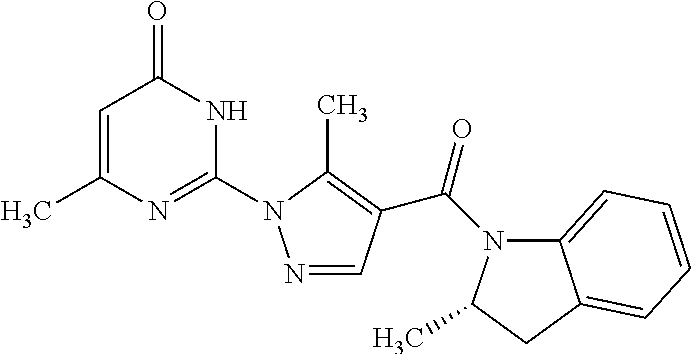
2.58 350.2 6.69 Method K J 43 Q-361 EV-AO7553-003 
2.81 350.2 8.35 Method K J -

- To a solution of 6-methyl-2-[5-methyl-4-(1,2,3,4-tetrahydroisoquinoline-2-carbonyl)-1H-pyrazol-1-yl]-3,4-dihydropyrimidin-4-one (Example 1, Q-279 (EV-AO7529-002), 100 mg, 0.286 mmol) in AcOH (2 mL) was added NCS (40 mg, 0.301 mmol) and stirred at 90° C. for 1 h. The reaction mixture was concentrated in vacuo and triturated using MeCN to afford the title compound (60 mg, 54%) as a white powder.
- Method C: LC-MS m/z=384.2 [M+H]+; RT=2.99 min.
-

- Chlorination of 6-methyl-2-[5-methyl-4-(1,2,3,4-tetrahydroisoquinoline-2-carbonyl)-1H-pyrazol-1-yl]-3,4-dihydropyrimidin-4-one (Example 7, Q-359 (EV-AP2325-001) using the procedure described in Example 44 afforded the title compound (54 mg, 42%) as a white powder.
- Method C: LC-MS m/z=404.2 [M+H]+; RT=2.88 min.
-

- To a stirred solution of 6-methyl-2-[5-methyl-4-(1,2,3,4-tetrahydroisoquinoline-2-carbonyl)-1H-pyrazol-1-yl]-3,4-dihydropyrimidin-4-one (Example 1, Q-279 (EV-AO7529-002), 165 mg, 0.472 mmol) in THF (3 mL) at 0° C. was added LiAlH4 (216 μl, 0.519 mmol) and stirred at r.t. for 1 h. The reaction mixture was quenched by the addition of water (4 mL), NaOH (4 mL) and then further water (4 mL). The reaction mixture was acidified to pH 5 using acetic acid and then neutralized to pH 7 using saturated sodium bicarbonate solution. The reaction mixture was extracted with DCM (3×40 mL) and the combined organic extracts dried over Na2SO4, concentrated in vacuo and triturated using MeCN (3 mL) to afford the title compound (57 mg, 35%) as a white powder.
- Method C: LC-MS m/z=336.1 [M+H]+; RT=1.29 min.
-

-

- To a solution of 1H-pyrazol-5-amine (3 g, 36.1 mmol) in acetone (50 ml) was added over 5 mins (slight exotherm) ethyl N-carbothioylcarbamate (3.96 ml, 0.03 mol) and stirred at r.t. for 2 h. The yellow solution was treated with ice cold water (50 ml) which caused a transient precipitation. The flask was cooled in ice and a precipitate formed. The solid was collected by filtration, washed with water and dried under vacuum to afford the title compound (5.0 g, 46%) as a yellow solid.
- Method A: LC-MS m/z=214.90 [M+H]+; RT=0.94.
-

- To ethyl N-[(1H-pyrazol-5-yl)carbamothioyl]carbamate (2.5 g, 11.67 mmol) was added 2M aq NaOH solution (23.3 ml) and stirred at r.t. for 2 h. The solution was acidified with concentrated H2SO4 and the resultant precipitate filtered under vacuum to afford a pale yellow powder. Purification by recrystallisation using water afforded the title compound (1.54 g, 94%) as a pale yellow powder.
- Method A: LC-MS m/z=168.95 [M+H]+; RT=0.19.
-

- To a solution of ethyl 2-oxocyclohexane-1-carboxylate (9.40 ml, 58.75 mmol) in MeCN (40 ml) was added thiourea (5.37 g, 70.5 mmol) and DBU (13.15 ml, 88.13 mmol) and stirred at 80° C. overnight.
- The reaction mixture was concentrated in vacuo and the residue redissolved in water. The reaction mixture was acidified to pH 3/4 using 5M aq HCl solution, the precipitate filtered, washing with H2O and Et2O, and dried under vacuum to afford the title compound (10.70 g, 98%) as an off white powder.
- Method A: LC-MS: m/z=183.0 (M+H)+; RT=0.71.
-

- To a solution of 6-methyl-1,2,3,4-tetrahydropyrimidine-2,4-dione (2.0 g, 15.86 mmol) in dioxane (30 ml) was added 2,4-bis(4-methoxyphenyl)-1,3,2,4-dithiadiphosphetane 2,4-disulfide (6.41 g, 15.86 mmol) and stirred at 100° C. for 2 h. The reaction mixture was cooled to r.t. and the white precipitate filtered under vacuum, washing with dioxane (20 ml), to afford the title compound (1.85 g, 82%) as an off white powder.
- Method B: LC-MS: m/z=142.85 (M+H)+; RT=0.36.
-

- 3,6-dimethyl-2-(methylsulfanyl)-3,4-dihydropyrimidin-4-one was prepared from (3E)-1,1,1-trichloro-4-methoxypent-3-en-2-one using the procedure found in: Zanatta, Nilo; Madruga, Claudia C.; Marisco, Patricia C.; Da Rosa, Luciana S.; Da Silva, Fabio M.; Bonacorso, Helio G.; Martins, Marcos A. P.; Journal of Heterocyclic Chemistry; vol. 47; nb. 5; (2010); p. 1234-1239, affording the title compound (4.68 g, 78%) as a brown powder.
- Method A: LC-MS: m/z=170.95 (M+H)+; RT=0.97 min.
- Examples 47-54 in Table 3 were prepared in an analogous fashion to Example 1 starting with the corresponding commercial thiouracil, methyl thioether or the specified intermediate, and coupling the intermediate acid with the appropriate amine using the specified coupling conditions.
-
TABLE 3 LC-MS MS Ex. Ref. (RT) (M + H)+ Coupling No. No. LBN Structure Method C Method C Agent Comments 47 Q-447 EV-AQ0294-002 
2.53 396.2 T3P Intermediate 5 48 Q-454 EV-AR5305-002 
2.19 370.0 T3P Intermediate 7 49 Q-455 EV-AO7537-002 
2.58 364.1 COMU Intermediate 8 50 Q-427 EV-AQ0240-002 
2.35 395.1 COMU 51 Q-425 EV-AQ0230-002 
3.04 410.2 COMU Intermediate 6 52 Q-404 EV-AP2566-003 
3.10 364.3 COMU 53 Q-383 EV-AP2542-001 
3.48 392.3 COMU 54 Q-488 EV-AR5353-002 
2.75 403.2 T3P - Examples 55-56 in Table 4 were prepared by chiral separation of racemic compounds in Table 3. The stereochemistry was arbitrarily assigned.
-
TABLE 4 LC-MS MS Column Ex. Ref. (RT) (M + H)+ Retention* Separation No. No. LBN Structure Method C Method C (min) Method 55 Q-416 EV-AP2566-004 
3.11 364.3 5.134 L 56 Q-457 EV-AP2566-005 
3.10 364.2 7.20 L -

-

- To a stirred solution of 2,4-dichlorothieno[3,2-d]pyrimidine (20 g, 97.5 mmol) in THF (80 mL) was added 5M aq NaOH solution (98 mL, 488 mmol) and stirred at 50° C. for 6 h. The reaction mixture was acidified to pH 5 using acetic acid. The solution was then extracted with EtOAc (2×50 mL) and the combined organics were dried over Na2SO4, filtered and concentrated in vacuo to yield the title compound (11.3 g, 60.5 mmol, 62%) as a yellow powder.
- Method A: LC-MS m/z=186.9 [M+H]+; RT=0.77 min.
-

- To a stirred solution of 2-chloro-3H,4H-thieno[3,2-d]pyrimidin-4-one (11.34 g, 60.8 mmol) in EtOH (90 mL) was added hydrazine hydrate (5.91 mL, 121.5 mmol) and stirred at 80° C. overnight. The reaction mixture was cooled to r.t. and the resultant precipitate was collected via filtration, and washed with water (15 mL) to yield the title compound (7.4 g, 40.6 mmol, 67%) as a pale yellow powder.
- Method A: LC-MS m/z=182.9 [M+H]+; RT=0.18 min.
-

- To a stirred solution of 2-hydrazinyl-3H,4H-thieno[3,2-d]pyrimidin-4-one (7 g, 38.4 mmol) in EtOH (75 mL) and AcOH (7.70 mL, 134.5 mmol) was added (2Z)-2-[(dimethylamino)methylidene]-3-oxobutanoate (7.89 g, 46.1 mmol) and stirred at 50° C. for 3 h. The reaction mixture was cooled to r.t. and the resulting precipitate was isolated via filtration to yield the title compound (11.2 g, 22.5 mmol, 59%) as a pale yellow powder.
- Method A: LC-MS m/z=291.0 [M+H]+; RT=1.15 min.
-

- To a solution of methyl-5-methyl-1-{4-oxo-3H,4H-thieno[3,2-d]pyrimidin-2-yl}-1H-pyrazole-4-carboxylate (6.53 g, 22.5 mmol) in 2:1 THF/methanol (37 mL) was added 2.5M aq NaOH solution (54 mL, 135 mmol) and stirred at r.t. for 2 h. The organics were removed in vacuo, the residue acidified to pH 5 with 2M aq HCl solution and the resulting precipitate was collected via filtration to yield the title compound (6.22 g, 19.9 mmol, 89%) as a beige powder.
- Method A: LC-MS m/z=277.0 [M+H]+; RT=0.97 min.
-

- A solution of 2-methyl-4-(trifluoromethyl)pyridine (800 mg, 4.97 mmol) in 25% acetic acid in MeOH (100 ml) [0.05M] was reacted on the H-Cube [10% Pt on C cartridge, 90 bar and 80° C., 1 ml/min. Upon completion, the reaction mixture was treated with a solution of 4M HCl in dioxane (2 ml, 8 mmol) and then concentrated in vacuo to yield a white solid. The solid was dissolved in MeOH, treated with ammonia (7M in MeOH) and concentrated in vacuo to afford the title compound (270 mg, 32%) as a white solid.
- Method A: LC-MS m/z=168.00 [M+H]+; RT=0.17 min.
-

- To a stirred solution of tert-butyl 4-(cyanomethyl)piperidine-1-carboxylate (0.2 g, 8.13 mmol) in dry THF (2 mL) at 0° C. was added slowly KHMDS (1 M in toluene, 2.68 mL, 2.68 mmol). The reaction mixture was allowed to stir for 10 minutes, after which a solution of iodomethane (0.11 mL, 1.78 mmol) in dry THF (2 mL) was added slowly. The reaction was warmed to room temperature and stirred overnight. The reaction mixture was quenched with aqueous ammonium chloride and extracted with ethyl acetate. The extracts were dried (Na2SO4) and concentrated in vacuo to afford the title compound (246 mg, 98%) as a yellow powder: 1H NMR (250 MHz, Chloroform-d) δ 4.20 (s, 2H), 2.63 (m, 2H), 1.80 (m, 2H), 1.47 (s, 3H), 1.46 (s, 9H), 1.33 (s, 6H).
-

- Tert-butyl 4-(1-cyano-1-methylethyl)piperidine-1-carboxylate (EV-AQ8828-001, 243 mg, 0.963 mmol) was suspended in HCl (4 M in dioxane, 7 mL) and the reaction was stirred at room temperature for 3 hours. The resultant precipitate was filtered and washed with ether to afford the title compound (95 mg, 51%) as a yellow powder: 1H NMR (500 MHz, DMSO-d6) δ 8.96 (s, 1H), 8.51 (s, 1H), 2.87-2.78 (m, 2H), 1.95-1.87 (m, 2H), 1.72-1.63 (m, 1H), 1.54-1.45 (m, 2H), 1.29 (s, 6H).
- Examples 57-74 in Table 5 were prepared using the method described in Example 1 reacting intermediate 11 (5-methyl-1-{4-oxo-3H,4H-thieno[3,2-d]pyrimidin-2-yl}-1H-pyrazole-4-carboxylic acid) with the appropriate amine using the specified coupling reagent.
-
TABLE 5 LC-MS MS Example Ref. (RT) (M + H)+ Coupling No No. LBN Structure Method C Method C Agent 57 Q-403 EV-AP2371-001 
2.68 398.2 COMU 58 Q-402 EV-AP2366-001 
3.43 398.3 T3P 59 Q-495 EV-AQ8852-001 
3.31 420.1 T3P 60 Q-395 EV-AP2364-001 
3.16 392.2 T3P 61 Q-380 EV-AP2536-001 
2.79 358.2 COMU 62 Q-397 EV-AP2562-001 
2.85 358.2 COMU 63 Q-405 EV-AP2570-001 
2.74 402.3 COMU 64 Q-398 EV-AP2563-001 
3.51 398.2 COMU 65 Q-354 EV-AP2517-001 
3.00 392.2 COMU 66 Q-399 EV-AQ0205-002 
3.64 400.2 T3P 67 Q-400 EV-AQ0207-002 
3.08 372.2 COMU 68 Q-406 EV-AQ0208-002 
3.21 480.2 T3P 60 Q-408 EV-AQ0210-002 
3.54 398.3 COMU 70 Q-412 EV-AQ0216-002 
3.28 372.2 COMU 71 Q-401 EV-AB8083-002 
3.28 392.2 T3P 72 Q-422 EV-AQ3802-003 
3.10, 28% 3.14 63% 425.0 COMU Intermediate 12 73 Q-379 EV-AP2394-001 
2.90 412.1 T3P 74 Q-531 EV-AS3708-002 
2.58 411.1 T3P Intermediate 13 -

- To a solution of 5-methyl-1-{4-oxo-3H,4H-thieno[3,2-d]pyrimidin-2-yl}-1H-pyrazole-4-carboxylic acid (Intermediate 11, (EV-AP2386-001), 75 mg, 0.27 mmol) in DCM (5 ml) was added thionyl chloride (0.2 ml, 2.71 mmol) followed by DMF (cat, 1 drop) and stirred at 50° C. for 2 h. The reaction mixture was concentrated in vacuo and DCM added and the concentration repeated (×2). The crude acid chloride (assume 0.271 mmol) was suspended in more DCM (5 ml) at 0° C. and (cis)-2,6-dimethylpiperidine (0.04 ml, 0.41 mmol) and triethylamine (0.09 ml, 0.68 mmol) were added dropwise. The reaction mixture was stirred at r.t. for 2 h. The reaction mixture was washed with water (5 mL) and brine solution (5 mL) and the organic fraction was concentrated in vacuo. The crude residue was dissolved in THF: 1M NaOH (1:1, 2 mL) and stirred at r.t. Methanol (0.5 ml) was added. The organics from the reaction mixture were removed in vacuo and the reaction mixture acidified to pH 5 using 1M aq HCl solution. The aqueous was extracted using DCM (2×5 mL) and the combined organic extracts were dried over Na2SO4, filtered and concentrated in vacuo. The crude residue was purified by prep HPLC (Method G) to afford the title compound (14.2 mg, 14%) as an off-white powder.
- Method A: LC-MS m/z=372.2 [M+H]+; RT=3.05 min.
- Examples in Table 6 were prepared by chiral separation of racemic compounds in Table 5. The stereochemistry was arbitrarily assigned.
-
TABLE 6 LC-MS MS Column Example Ref. (RT) (M + H)+ Retention* Separation No No. LBN Structure Method C Method C (min) Method 76 Q-414 EV-AQ0229-001 
3.29 392.2 6.43 Method M L 77 Q-415 EV-AQ0229-002 
3.29 392.2 8.41 Method M L -

-

- To a solution of 2,4-dichloro-6-methylpyrimidine (1 g, 6.14 mmol) in THF (10 ml) was added 0.5M NaOMe in MeOH (18.4 ml, 9.20 mmol) at 0° C. and stirred at r.t. overnight. A further 0.5 equivalents of 0.5 M NaOMe in MeOH (6.14 ml, 3.07 mmol) were added at 0° C. and the reaction stirred at r.t. for 1 h. The reaction mixture was diluted with water (30 ml) and extracted with EtOAc (2×50 ml). The combined organic extracts were washed with brine (20 ml), dried and concentrated in vacuo and the residue purified via column chromatography (100:0-75:25 Heptane-EtOAc) to afford the title compound (275 mg, 28%) as a colourless crystalline solid.
- Method A: LC-MS m/z=158.9 [M+H]+; RT=1.05 min.
-

-

- To a solution of 5,7-dichloro-[1,3]thiazolo[5,4-d]pyrimidine (980 mg, 4.76 mmol) in THF (20 mL) at 0° C. was added benzyl alcohol (495 μl, 4.76 mmol) and sodium hydride (114 mg, 4.76 mmol, 60% in mineral oil) and stirred at r.t. for 22 h. To the reaction mixture was added water (20 ml) and extracted with EtOAc (2×50 ml). The combined organic extracts were washed with brine, dried over sodium sulfate and concentrated in vacuo. Purification by chromatography on SiO2 (gradient 100:0-90:10, Heptane-EtOAc) afforded the title compound (708 mg, 47%) as a white powder.
- Method A: LC-MS m/z=277.85 [M+H]+; RT=1.39 min.
-

- 7-(benzyloxy)-5-chloro-[1,3]thiazolo[5,4-d]pyrimidine (EV-AQ0259-002, 708 mg, 2.24 mmol) was dissolved in a 1:1 mixture of 37% aq HCl-THF (10 mL) and stirred at room temperature for 18 h. The reaction mixture was filtered under vacuum, washing with THF and Et2O, to afford 5-chloro-6H,7H-[1,3]thiazolo[5,4-d]pyrimidin-7-one (246 mg, 58%) as a pale yellow powder.
- Method A: LC-MS m/z=187.80 [M+H]+; RT=0.49 min.
-

- To a solution of 2,4-dichloro-7H-pyrrolo[2,3-d]pyrimidine (1.5 g, 7.98 mmol) in THF (30 ml) at 0° C. was added sodium hydride (60% oil suspension, 383 mg, 9.57 mmol) and stirred at 0° C. to r.t. for 20 mins. Iodomethane (0.6 ml, 9.57 mmol) was added and stirred at r.t. for 3 h.
- The mixture was quenched by addition of saturated ammonium chloride solution (20 mL). EtOAc was then added resulting in formation of a precipitate. The precipitate was filtered and the filtrate extracted with EtOAc (×2). The combined organic fractions were washed with water, dried over Na2SO4, filtered and concentrated in vacuo to afford the title compound (1.65 g, 97.2%) as a yellow powder.
- Method A: LC-MS m/z=201.90, 203.90 [M+H]+; RT=1.21 min.
- Examples 78-88 in Table 7 were synthesized following the procedure described for Example 57 starting from the corresponding dichloropyrimidine or specified intermediate and coupling the intermediate acid with the appropriate amine using the specified coupling conditions.
-
TABLE 7 Ex- LC-MS MS ample Ref. (RT) (M + H)+ Coupling No No. LBN Structure Method C Method C Agent Comments 78 Q-410 EV-AP2378-001 
3.02 412.2 COMU 79 Q-426 EV-AP2597-002 
2.72 409.2 T3P 80 Q-323 EV-AN7481-001 
3.26 386.2 COMU 81 Q-320 EV-AO8806-002 
340.1 2.17 COMU 82 Q-321 EV-AO8807-002 
338.2 2.96 COMU 83 Q-429 EV-AQ0246-002 
406.2 3.16 T3P 84 Q-378 EV-AP2343-001 
375.2 2.62 TBTU 85 Q-436 EV-AQ7107-002 
2.23 370.2 T3P Commerical chloro- pyrimidone 86 Q-413 EV-AQ0227-002 
426.2 3.29 COMU 87 Q-441 EV-AQ0268-002 
2.53 413.2 T3P Intermediate 15 -

-

-

- To a solution of methyl 2-oxocyclopentanecarboxylate (17.83 mL, 143.65 mmol) in acetonitrile (150 mL) was added thiourea (16.4 g, 215.47 mmol) followed by DBU (25.73 mL, 172.38 mmol) and stirred at 80° C. for 24 h. The reaction mixture was concentrated in vacuo and dissolved in water. The solution was acidified to pH3/4 using 5M aq HCl solution and the resulting precipitate was collected and dried under vacuum after washing with water and diethyl ether. The solid was dried further at 40° C. under vacuum overnight to afford the title compound (17.81 g, 73.7%) as a beige powder.
- Method A: LC-MS: m/z=168.9 (M+H)+, RT=0.2-0.45 min.
-

- To a suspension of 2-sulfanylidene-1H,2H,3H,4H,5H,6H,7H-cyclopenta[d]pyrimidin-4-one (EV-AS7131-001, 17.81 g, 105.88 mmol) in water (100 mL) was added NaOH (4.66 g, 116.46 mmol) followed by the drop wise addition of iodomethane (7.25 mL, 116.46 mmol). The reaction mixture was stirred at room temperature for 1.5 h, then cooled to 5° C. and the resultant precipitate was collected by vacuum filtration. The solid was washed with ice cold water (50 mL) water and diethyl ether (50 mL) and dried further under vacuum at 40° C. to afford the title compound (17.78 g, 89.4%) as an off white powder.
- Method A: LC-MS: m/z=182.9 (M+H)+; RT=0.89 min.
-

- To a solution of 2-(methylsulfanyl)-3H,4H,5H,6H,7H-cyclopenta[d]pyrimidin-4-one (EV-AQ7133-001, 17.78 g, 97.56 mmol) in EtOH (30 mL) was added hydrazine hydrate (23.73 mL, 487.81 mmol). The reaction mixture was stirred at 90° C. for 24 h and then at 85° C. for a further 7 h. The cooled reaction mixture was filtered and washed with EtOH (15 mL) and water (10 mL) to afford the title compound (13.1 g, 80.8%) as a white powder.
- Method B: LC-MS: m/z=166.9 (M+H)+, RT=0.19 min.
-

-

- To a solution of 2-hydrazinyl-3H,4H,5H,6H,7H-cyclopenta[d]pyrimidin-4-one (EV-AQ7134-001, 19 g, 114.33 mmol) in ethanol (120 mL) was added methyl 2-[(dimethylamino)methylidene]-3-oxobutanoate (EV-AL6988-001, 21.53 g, 125.77 mmol) followed by acetic acid (22.91 mL, 400.17 mmol). The reaction mixture was stirred at 50° C. for 3.5 h. After 15 mins additional ethanol (170 mL) was added to maintain stirring. The reaction mixture was cooled and the solvent volume reduced to approximately half. The resultant precipitate was collected and dried by vacuum filtration to afford the title compound (21.84 g, 69.6%) as a beige powder.
- Method B: LC-MS: m/z=275.0 (M+H)+, RT=0.98 min.
-

- Methyl 5-methyl-1-{4-oxo-3H,4H,5H,6H,7H-cyclopenta[d]pyrimidin-2-yl}-1H-pyrazole-4-carboxylate (EV-AQ7137-001, 21.84 g, 79.63 mmol) was suspended in 3:2:1 water/THF/methanol (300 mL) and 2.5M aq NaOH solution (191 mL) was added. The reaction mixture was stirred at r.t. for 3 h. The organics from the reaction mixture were removed in vacuo. The residue was acidified with 5M aq HCl solution and the resulting precipitate was collected and dried under vacuum filtration at 45° C. for 5 days to afford the title compound (21.6 g, 100%) as a beige powder.
- Method C: LC-MS: m/z=261.1 (M+H)+, RT=1.81 min.
-

- A solution of 2-methyl-4-(trifluoromethyl)pyridine (3 g, 18.62 mmol) in MeOH (100 ml) was treated with a solution of 4M HCl in dioxane (5.6 ml, 22.3 mmol) followed by platinum (iv) oxide (253 mg, 1.12 mmol) and the resultant suspension was hydrogenated in a pressure vessel at 50 psi and r.t. for 4 h. The catalyst was cautiously removed by filtration over Celite and the filtrate concentrated in vacuo to afford the title compound (3.7 g, 99%) as a white solid.
- Method A: LC-MS m/z=168.0 [M+H]+; RT=0.21 min.
-

- To a solution of phenyllithium (1.8M in Bu2O, 7.16 ml, 12.89 mmol) in THF (15 mL) at −78° C. was added dropwise 1-boc-2-methyl-4-piperidinone (2.5 g, 11.72 mmol) in more THF (5 mL). The reaction mixture was warmed to room temperature and stirred for 3 hours. The reaction was quenched by pouring onto ice water. EtOAc (2×25 mL) was added and the product extracted. The combined organics were dried (Na2SO4), filtered and concentrated in vacuo. The crude residue was purified by chromatography on SiO2 Eluting with 0-100% EtOAc in heptane to afford the title compound (2.97 g, 73.9%) as a yellow oil
- Method B: LC-MS: m/z=192.0 (M-Boc)+, RT=1.19 min.
-

- To a solution of tert-butyl 4-hydroxy-2-methyl-4-phenylpiperidine-1-carboxylate (EV-AQ7159-002, 1.5 g, 5.15 mmol) in dioxane (3 mL) was added HCl in dioxane (4M, 6.43 mL, 25.74) and the reaction mixture stirred at room temperature for 1 hour. The reaction mixture was concentrated in vacuo re-dissolved in DCM and concentrated again to afford 1.22 g (83.3%) of the title compound as an orange gum.
- Method B: LC-MS: m/z=192.0 (M+H)+, RT=0.21 min.
-

- 2-(4-{3-hydroxy-3-phenyl-8-azabicyclo[3.2.1]octane-8-carbonyl}-5-methyl-1H-pyrazol-1-yl)-3H,4H,5H,6H,7H-cyclopenta[d]pyrimidin-4-one was prepared by the procedure described for Intermediate 21 (EV-AQ7161-001) substituting 1-boc-2-methyl-4-piperidinone with tert-butyl 3-oxo-8-azabicyclo[3.2.1]octane-8-carboxylate, affording the title compound (505 mg, 35%) as a an off white powder.
- Method B: LC-MS: m/z=203.9 (M+H)+, RT=0.27 mins.
-

- To a solution of phenyllithium (2.0M in Bu2O, 3.66 ml, 7.32 mmol) in THF (15 mL) at −78° C. was added dropwise tert-butyl 3-oxo-8-azabicyclo[3.2.1]octane-8-carboxylate (1.5 g, 6.66 mmol) in THF (5 mL). The reaction was warmed to r.t. over 1 h and stirred for another 1 h. 1/3 of the reaction mixture was removed for an analogous chemistry and the remaining 2/3 of the reaction mixture was cooled to −78° C. and treated with methanesulfonyl chloride (1.03 mL, 13.32 mmol) followed by triethylamine (3.06 mL, 21.97 mmol). The reaction mixture was then warmed to r.t. and stirred overnight. The reaction mixture was cooled to −78° C. again and more methanesulfonyl chloride (2.06 mL, 26.64 mmol) and triethylamine (6.12 mL, 43.94 mmol) were added. The reaction mixture was then warmed to r.t. and stirred for 3.5 h. The reaction was diluted with water and extracted with EtOAc (3×20 mL). The combined organics were washed with water (10 mL) and brine (10 mL), dried over Na2SO4 and concentrated in vacuo. The crude residue was purified by chromatography on SiO2 eluenting with Heptane/EtOAc (0-100%) to afford the title compound (480 mg, 36.8%) as an off-white solid.
- Method B: LC-MS: m/z=229.95 (M−tBu)+, RT=1.37 min.
-

- To a solution of tert-butyl 3-phenyl-8-azabicyclo[3.2.1]oct-2-ene-8-carboxylate (EV-AQ7180-002, 97%, 480 mg, 1.63 mmol) in dioxane (3 mL) was added HCl in dioxane (4M, 2.04 mL, 8.16 mmol) and the mixture was stirred at r.t. for 4 h. The reaction mixture was concentrated in vacuo re-dissolved in DCM and concentrated again to afford the title compound (355 mg, 93.2%) as an off white powder.
- Method B: LC-MS: m/z=186.0 (M+H)+, RT=0.79 min.
-

- 3-phenyl-8-azabicyclo[3.2.1]oct-2-ene hydrochloride (EV-AQ7183-001, 355 mg, 1.92 mmol) was dissolved in MeOH: EtOAc (1:1, 45 mL) and subjected to H-cube hydrogenation (1 mL/min, 20 bar, 60° C., controlled H2 mode) over an Pd/C (10%) cat cart. The procedure was repeated at 40 bar, 60° C. and again at 60 bar, 60° C. The reaction mixture was concentrated in vacuo to afford the title compound (305 mg, 76%) as an off white powder.
- Method B: LC-MS: m/z=188.0 (M+H)+, RT=0.74 mins.
-

- A solution 1-Boc-4-piperidinone (1 g, 5.02 mmol) in THF (5 mL) was added dropwise to a solution of phenyllithium (1.8M in Bu2O, 3.07 mL, 5.52 mmol) in THF (5 mL) at −78° C. The reaction was warmed to r.t. and stirred for 4 h. The reaction was quenched by pouring onto ice water and extracted with EtOAc (2×25 mL). The combined organic extracts were dried over MgSO4 and concentrated in vacuo. The crude residue was purified by chromatography on SiO2, eluenting with Heptane/EtOAc (gradient 100:0-20:80) to afford the title compound (1.095 g, 79%) as a yellow powder.
- Method B: LC-MS: m/z=177.9 (M-Boc)+, RT=1.15 min.
-

- To a stirred solution of 4-hydroxy-4-phenyl-piperidine-1-carboxylic acid tert-butyl ester (1.08 g, 3.91 mmol) in dry THF (25 mL) was added NaH (60% in oil, 0.17 g, 4.30 mmol) and stirred for 1 h before methyl iodide (0.37 mL, 5.86 mmol) was added and stirred overnight. The mixture was retreated with NaH (60%, 0.17 g, 4.30 mmol), followed by methyl iodide (0.37 mL, 5.86 mmol) and stirred overnight. The mixture was retreated for a third time with NaH (60%, 0.17 g, 4.30 mmol), followed by methyl iodide (0.37 mL, 5.86 mmol) and stirred for 4 h. Brine (40 mL) was added and the product extracted with EtOAc (2×50 mL). The combined organic extracts were dried over MgSO4, concentrated in vacuo and purified by chromatography, eluting with Heptane/EtOAc (gradient 100:0-85:15) to afford the title compound (610 mg, 54%) as an off-white powder.
- Method B: LC-MS: m/z=192.02 (M-Boc)+, RT=1.30 mins.
-

- 4-methoxy-4-phenylpiperidine-1-carboxylate (603 mg, 2.07 mmol) was dissolved in HCl in dioxane (4M, 6 mL, 24.0 mmol) and stirred at r.t. overnight. The reaction mixture was concentrated in vacuo and triturated with ether to afford the title compound (391 mg, 83%) as a colourless powder.
- Method B: LC-MS: m/z=191.9 (M+H)+, RT=0.64 mins.
-

- To a solution of 2,2,2-trifluoroethanol (0.96 mL, 13.33 mmol) and NaH (60% in oil, 533.26 mg, 13.33 mmol) was added 4-chloropyridine hydrochloride (1 g, 6.67 mmol) in anhydrous DMSO (20 mL). The reaction mixture was stirred at 0° C. to r.t. overnight. Water (10 mL) was added and the product extracted with DCM (2×50 mL). The combined organic extracts were washed with water (10 mL) and brine (10 mL), dried over Na2SO4, filtered and concentrated in vacuo to afford the title compound (510 mg, 38.9%) as a tan gum.
- Method B: LC-MS: m/z=178.0 (M+H)+, RT=0.31 min.
-

- 4-(2,2,2-trifluoroethoxy)pyridine (EV-AQ7197-001, 510 mg, 2.88 mmol) was dissolved in EtOH: acetic acid (3:1, 60 mL) and subjected to H-cube hydrogenation (1 ml/min, 90 bar, 80° C.) over a 5% Rh/C cat cart. The reaction mixture was concentrated in vacuo to afford the title compound (104 mg, 11.9%) as a tan gum.
- Method B: LC-MS: m/z=184.0 (M+H)+, RT=0.21-0.33 min.
-

- A solution of 4-methyl-2-(trifluoromethyl)pyridine (1 g, 6.21 mmol) in MeOH (20 ml) was treated with HCl (4M in dioxane, 1.9 mL), followed by platinum (iv) oxide (85 mg, 0.37 mmol) and the resultant suspension was hydrogenated in a pressure vessel at 50 psi and r.t. for 20 h. More platinum (iv) oxide (85 mg, 0.37 mmol) was added along with AcOH (10 ml) and the hydrogenation was continued for 20 h.
- The catalyst was removed by filtration over Celite and the filtrate evaporated under vacuum, the residue was triturated with ether to provide the title compound (460 mg, 36%) as a white solid.
- Method B: LC-MS m/z=167.95 [M+H]+; RT=0.18 min.
- Examples in Table 8 were prepared using Method 1 reacting Intermediate 18 (5-methyl-1-{4-oxo-3H,4H,5H,6H,7H-cyclopenta[d]pyrimidin-2-yl}-1H-pyrazole-4-carboxylic acid) with the appropriate amine using the specified coupling reagent.
-
TABLE 8 LC-MS MS Example Ref. (RT) (M + H) Coupling No No. LBN Structure Method C Method C Agent Comments 89 Q-431 EV- AQ7102-002 
2.55 382.2 T3P 90 Q-435 EV- AQ7103-002 
3.17 438.2 T3P, SOCl2 91 Q-446 EV- AQ7126-004 
2.47 420.2 T3P 92 Q-449 EV- AQ7132-002 
2.48 440.2 T3P 93 Q-461 EV- AQ7145-002 
2.1 358.3 T3P 94 Q-462 EV- AQ7146-002 
3.13 420.2 T3P 95 Q-505 EV- AQ7172-001 
1.67 405.2 T3P 96 Q-496 EV- AQ7172-002 
3.03 448.1 T3P 97 Q-418 EV- AQ8866-003 
2.72 396.2 T3P 98 Q-497 EV- AQ7172-003 
2.63 417.2 T3P 99 Q-498 EV- AQ7172-004 
3.06 443.2 T3P 100 Q-499 EV- AQ7173-001 
3.04 461.1 T3P 101 Q-500 EV- AQ7173-002 
3.45 450.2 T3P 102 Q-501 EV- AQ7173-003 
3.18 434.2 T3P 103 Q-502 EV- AQ7176-001 
3.14 476.1 T3P 104 Q-464 EV- AQ8829-001 
2.02 353.1 T3P 105 Q-470 EV- AQ8832-001 
1.9 330.1 T3P 106 Q-477 EV- AQ8837-001 
2.86 406.2 T3P 107 Q-478 EV- AQ8838-001 
1.92 344.2 T3P 108 Q-504 EV- AQ8853-001 
2.5 468.1 T3P 109 Q-424 EV- AQ0237-002 
2.47 364.2 COMU 110 Q-428 EV- AQ0241-002 
3.22 404.2 T3P 111 Q-473 EV- AR5330-002 
2.98 429.2 T3P 112 Q-479 EV- AR5333-002 
2.83 376.2 T3P 113 Q-490 EV- AR5335-002 
3.00 378.2 T3P 114 Q-491 EV- AR5343-002 
3.46 418.2 T3P 115 Q-492 EV- AR5344-002 
2.94 356.2 T3P 116 Q-489 EV- AR5345-002 
3.01 475.2 T3P 117 Q-487 EV- AR5346-002 
2.87 395.2 T3P 118 Q-493 EV- AR5347-002 
3.73 454.2 T3P 119 Q-485 EV- AR5351-002 
3.36 419.2 T3P 120 Q-486 EV- AR5352-002 
2.9 466.1 T3P 121 Q-506 EV- AR5357-002 
1.68 415.1 T3P 122 Q-507 EV- AR5363-002 
2.97 477.2 T3P 123 Q-468 EV- AQ3828-001 
3.07 420.2 T3P 124 Q-476 EV- AQ3831-001 
2.93 410.2 T3P 125 Q-450 EV- AN9592-005 
2.85 396.2 T3P 126 Q-423 EV- AQ3801-003 
2.99 min, 18%, 3.02 min, 74%. 409.0 COMU 127 Q-434 EV- AQ3808-002 
3.02 409.0 T3P 128 Q-482 EV- AQ3835-002 
2.16 358.2 T3P 129 Q-518 EV- AQ7198-001 
367.2 2.23 T3P 130 Q-519 EV- AQ7198-002 
381.2 2.48 T3P 131 Q-520 EV- AQ7199-001 
372.2 2.29 T3P 132 Q-451 EV- AN9594-002 
368.2 3.10 T3P 133 Q-532 EV- AS5411-002 
421.1 3.05 T3P 134 Q-510 EV- AR7006-003 
390.3 2.91 T3P 135 Q-469 EV- AQ8831-001 
395.2 2.52 T3P Intermediate 13 136 Q-514 EV- AQ8865-001 
434.2 3.07 T3P 137 Q-521 EV- AS3701-002 
426.1 2.73 T3P Intermediate 24 138 Q-509 EV- AQ7187-002 
446.2 2.56 T3P Intermediate 21 139 Q-513 EV- AQ7190-002 
430.3 3.31 T3P Intermediate 22 140 Q-483 EV- AQ7163-003 
434.2 2.63 SOCl2 Intermediate 20 141 Q-480 EV- AR5334-002 
410.1 3.36 SOCl2 Intermediate 25 - Examples in Table 9 were prepared by chiral separation of racemic compounds in Table 8. The stereochemistry was arbitrarily assigned.
-
TABLE 9 LC-MS MS Column Example Ref. (RT) (M + H)+ Retention* Separation No No. LBN Structure Method C Method C (min) method 142 Q-442 EV-AQ3808-004 
3.01 94% 409.0 16.3 Method N N 143 Q-459 EV-AQ3808-005 
3.01 95% 409.0 21.3 Method N N 144 Q-474 EV-AN9592-006 
2.84 396.2 7.47 Method O O 145 Q-475 EV-AN9592-007 
2.84 396.2 12.48 Method O O -

-

- Methyl 3-oxobutanoate (40 g, 0.34 mol) and 1,1-dimethoxy-N,N-dimethylmethanamine (54.92 mL, 0.41 mol) were combined and stirred at 80° C. for 2 h. The reaction mixture was concentrated in vacuo and the resulting oil was dried for 24 h under vacuum to afford the title compound (56.53 g, 86.3%) as a dark red solid.
- 1H NMR (500 MHz, DMSO-d6) δ 7.62 (s, 1H), 3.63 (s, 3H), 3.24-2.96 (m, 3H), 2.90-2.58 (m, 3H), 2.13 (s, 3H).
-

-

- To a solution of 1,2,3,4-tetrahydroisoquinoline (10.0 mL, 78.83 mmol) in toluene (80 mL) was added methyl 3-oxobutanoate (12.76 mL, 118.25 mmol) and triethylamine (13.19 mL, 94.6 mmol) and stirred at 105° C. for 15.5 hours. Water (15 mL) was added to the cooled reaction mixture and the organic phase was extracted. The organics were dried over Na2SO4, filtered and concentrated in vacuo. The crude residue was purified by chromatography on SiO2, eluting with 0-100% EtOAc in heptane to afford the title compound (12.8 g, 70.2%) as viscous yellow oil.
- Method A: LC-MS: m/z=218.0 (M+H)+; RT=1.03 min.
-

- 1-(1,2,3,4-tetrahydroisoquinolin-2-yl)butane-1,3-dione (EV-AP2535-001, 2 g, 9.21 mmol) and 1,1-dimethoxy-N,N-dimethylmethanamine (1.47 mL, 11.1 mmol) were combined and stirred at 80° C. for 15 h. The reaction mixture was concentrated in vacuo to afford the title compound (2.51 g, 96.1%) as a beige powder.
- Method A: LC-MS: m/z=273.0 (M+H)+; RT=0.99 min.
-

- The title compound was prepared in an analogous manner to intermediate EV-AP2535-001 starting with 4-trifluoromethylpiperidine hydrochloride (10.5 g, 55.4 mm) to afford the title compound (13.4 g, 87%) as a dark orange powder.
- Method A: LC-MS: m/z=293.0 (M+H); RT=0.97 min.
-

- To a stirred solution of 1H-pyrazole-4-carboxylic acid (1.0 g, 8.92 mmol) and DIPEA (5.4 mL, 31.2 mmol) in THF (15 mL) was added T3P (50% in EtOAc, 10.5 mL, 17.8 mmol) and stirred at r.t. for 5 mins. 4-(trifluoromethyl)piperidine hydrochloride (2.03 g, 10.7 mmol) was then added and the solution was stirred at r.t. overnight. The reaction mixture was cooled, partitioned between DCM (30 mL) and saturated NaHCO3 solution (40 mL) and the aqueous fraction extracted with DCM (2×30 mL). The combined organic fractions were dried over MgSO4 and the solvent removed in vacuo. The resulting oil was purified via chromatography on SiO2 MeOH/DCM (gradient 100:0-90:10) to afford the title compound (673 mg, 61%) as a yellow powder.
- Method A: LC-MS m/z=248.0 [M+H]+; RT=0.98 min.
-

- A mixture of methyl 3-aminothiophene-2-carboxylate (3.5 g, 22.3 mmol) and urea (8.75 mL, 144.7 mmol) was heated at 180° C. for 5 h. The mixture was cooled to ˜90° C. and water (40 mL) was added. The mixture was stirred at r.t. overnight and the resulting precipitate isolated via filtration to afford the title compound (3.66 mg, 98%) as an off-white powder.
- Method A: LC-MS m/z=214.0 [M+H]+; RT=0.79 min.
-

- 1H,2H,3H,4H-thieno[3,2-d]pyrimidine-2,4-dione (EV-AP2346-001, 3.65 g, 21.7 mmol) was added portion wise to a stirred solution of fuming HNO3 (12 mL) and H2SO4 (95%, 12 mL) at 0° C. The reaction was warmed to r.t. and stirred for 1 h. The precipitated solid was collected via filtration to afford the title compound (1.28 g, 28%) as an orange powder.
- Method A: LC-MS m/z=214.0 [M+H]+; RT=0.79 min.
-

- A stirred suspension of 6-nitro-1H,2H,3H,4H-thieno[3,2-d]pyrimidine-2,4-dione (EV-AP2349-001, 1.2 g, 21.7 mmol) in phenylphosphonic dichloride (5 mL, 35.3 mmol) was stirred at 180° C. for 4 h. The mixture was cooled to ˜100° C. and transferred slowly onto vigorously stirred ice/water (40 mL). The resulting suspension was stirred at r.t. for 30 mins and was then extracted with DCM (2×40 mL). The combined organic fractions were dried over Na2SO4, concentrated in vacuo, and purified via chromatography on SiO2 (0:100-10:90 MeOH-DCM) followed by further chromatography on SiO2 (0:100-50:50 EtOAc-heptane) to yield the title compound (752 mg, 55%) as a colourless powder.
- Method A: LC-MS m/z=240.7 [M+H]+; RT=1.43 min.
-

- To a stirred solution of 2,4,6-trichlorothieno[3,2-d]pyrimidine (EV-AP2352-001,749 mg, 3.13 mmol) in THF (12 mL) was added 1M aq NaOH solution (16 mL, 16 mmol) and stirred at r.t. overnight. The solution was acidified to pH ˜5 with 5M aq HCl solution and the resulting precipitate isolated via filtration to afford the title compound (400 mg, 58%) as a colourless powder.
- Method A: LC-MS m/z=220.8 [M+H]+; RT=1.02 min.
-

- To a stirred solution of 2,6-dichloro-3H,4H-thieno[3,2-d]pyrimidin-4-one (EV-AP2354-001, 361 mg, 1.63 mmol) in ethanol (5 mL) was added hydrazine hydrate (199 μL, 4.08 mmol) and stirred at 80° C. overnight. The reaction mixture was cooled, the precipitate was collected via filtration and the solid washed with water to afford the title compound (247 mg, 70%) as a yellow powder.
- Method A: LC-MS m/z=216.9 [M+H]+; RT=0.74 min.
-

- To a solution of 2,4,5-trichloropyrimidine (5.00 g, 27.3 mmol) in THF (12 mL) was added 1M aq NaOH (35.4 mL, 35.4 mmol) and stirred at r.t. for 3 days. The solution was acidified to pH ˜5 with 5M aq HCl and extracted with DCM (2×40 mL). The combined organic fractions were dried over Na2SO4, concentrated in vacuo and triturated with 1:4 DCM-heptane to afford the title compound (2.33 g, 52%) as an orange powder.
- Method A: LC-MS m/z=164.8 [M+H]+; RT=0.38 min.
-

- To a solution of 2,5-dichloro-3,4-dihydropyrimidin-4-one (EV-AP2350-001, 200 mg, 1.21 mmol) in ethanol (3 mL) was added hydrazine hydrate (148 μL, 3.03 mmol) and stirred at 50° C. overnight. The reaction mixture was cooled to r.t. and the resulting precipitate isolated via filtration to afford the title compound (88 mg, 45%) as an off-white powder.
- Method A: LC-MS m/z=160.9 [M+H]+; RT=0.17 min.
-

- To a solution of ethyl 3,3-dimethylbutanoate (5.814 ml, 34.67 mmol) and ethyl formate (8.366 ml, 104.01 mmol) in DCM (60 ml) at 0° C. under nitrogen was added TiCl4 (52.01 ml, 52.01 mmol) and Et3N (11.61 mL, 83.21 mmol) and stirred at 0° C.—r.t. overnight. To the reaction mixture was added water, which was then extracted with DCM (2×50 ml). The combined organic extracts were washed with brine, dried over Na2SO4, concentrated in vacuo and purified via column chromatography (100:0-0:100 Heptane-EtOAc) to afford the title compound (2.72 mg, 42%) as a free flowing orange oil.
- 1H NMR (500 MHz, DMSO-d6) δ 9.74 (d, J=3.6 Hz, 1H), 4.21-4.10 (m, 2H), 3.07 (d, J=3.6 Hz, 1H), 1.21 (t, J=7.1 Hz, 3H), 1.07 (s, 9H).
-

- To a solution of ethyl 2-formyl-3,3-dimethylbutanoate (EV-AO7549-002, 92%, 100 mg, 0.534 mmol) in water (2 ml) was added 1M aq NaOH solution (534 μl, 0.534 mmol) and thiourea (122 mg, 1.603 mmol) and stirred at 100° C. for 1 h. The reaction mixture was allowed to cool to r.t. and acidified to pH 2-3 using 1M aq HCl solution to afford a white precipitate. The reaction mixture was filtered, washing with MeCN, to afford the title compound (72 mg, 73%) as a pearly white solid.
- Method A: LC-MS m/z=184.9 [M+H]+; RT=0.93 min.
-

- To water (20 ml) was added NaOH (97%, 286 mg, 6.925 mmol). After the sodium hydroxide had dissolved 5-tert-butyl-2-sulfanylidene-1,2,3,4-tetrahydropyrimidin-4-one (EV-A07576-001, 1.16 g, 6.295 mmol) was added and the mixture stirred until dissolved. Iodomethane (435 μl, 6.925 mmol) was added dropwise and the mixture stirred at r.t. overnight. The solid was filtered and washed with ice cold water (2×10 ml) to afford the title compound (686 mg, 54%) as an off white solid.
- Method A: LC-MS m/z=198.9 [M+H]+; RT=1.09 min.
-

- To a solution of 5-tert-butyl-2-(methylsulfanyl)-3,4-dihydropyrimidin-4-one (EV-A07579-001, 600 mg, 3.026 mmol) in pyridine (5 ml) was added hydrazine hydrate (1.47 ml, 30.26 mmol) and stirred at 100° C. overnight. The reaction mixture was concentrated in vacuo and triturated using Et2O to afford the title compound (331 mg, 60%) as an off white powder.
- Method A: LC-MS m/z=183.0 [M+H]+; RT=0.40 min.
-

- 2-hydrazinyl-6-(trifluoromethyl)-3,4-dihydropyrimidin-4-one was prepared by an analogous route to Intermediate 32 substituting with 2-sulfanylidene-6-(trifluoromethyl)-1,2,3,4-tetrahydropyrimidin-4-one, which afforded the title compound (212 mg, 31%) as an off white powder.
- Method A: LC-MS m/z=194.9 [M+H]+; RT=0.52 min.
-

- To a solution of benzyl alcohol (0.19 mL, 1.85 mmol) in dioxane (3 mL) at 0° C. was added potassium t-butoxide (436.38 mg, 3.89 mmol) followed by 4,6-dichloro-1H-pyrazolo[3,4-d]pyrimidine (350 mg, 1.85 mmol). The reaction mixture was warmed to r.t. over 15 mins and then stirred for 21 h. The reaction mixture was quenched by the addition of sat aq NH4Cl solution (2 mL) and extracted with EtOAc (2×5 mL). The combined organic fractions were dried over Na2SO4, filtered and concentrated in vacuo. The crude material was purified by chromatography on SiO2, eluting with 0-50% EtOAc in heptane to afford the title compound (325 mg, 41.1%) as a white solid.
- Method A: LC-MS: m/z=+261.0, 262.9 (M+H)+; RT=1.28 min.
-

- To a solution of 4-(benzyloxy)-6-chloro-1H-pyrazolo[3,4-d]pyrimidine (EV-AQ7113-003, 61%, 325 mg, 0.76 mmol) in THF (2.5 mL) was added 4M HCl in dioxane (1.9 mL) and stirred at r.t. for 1.5 h. Conc. HCl (2.5 mL) was then added and the reaction stirred for a further 2 h. The resulting precipitate was collected and dried under vacuum filtration to afford the title compound (128 mg, 98.7%) as a white powder.
- Method A: LC-MS: m/z=+170.9, 172.8 (M+H)+; RT=0.20
-

- To a solution of 6-chloro-1H,4H,5H-pyrazolo[3,4-d]pyrimidin-4-one (EV-AQ7115-001, 128 mg, 0.75 mmol) in ethanol (2 mL) was added hydrazine hydrate (0.18 mL, 3.75 mmol). The reaction vessel was sealed and the reaction mixture irradiated in the microwave at 100° C. for 30 mins. The reaction mixture was cooled and the resulting precipitate was collected and dried under vacuum to afford the title compound (90 mg, 72.2%) as a white powder.
- Method A: LC-MS: m/z=+166.9 (M+H)+; RT=0.17 min.
-

- To a suspension of 5,6-dimethyl-2-sulfanylidene-1,2,3,4-tetrahydropyrimidin-4-one (2 g, 12.8 mmol) in water (15 mL) was added sodium hydroxide (527.47 mg, 13.19 mmol) followed by iodomethane (1 mL, 16 mmol) and stirred at r.t. overnight. The reaction mixture was cooled to 5° C. and the resulting precipitate was collected by vacuum filtration. The solid was washed with water and dried under vacuum at 40° C. to afford the title compound (1.67 g, 76%) as a white powder.
- Method A: LC-MS m/z=170.9 [M+H]+; RT=0.83 min.
-

- To 5,6-dimethyl-2-(methylsulfanyl)-3,4-dihydropyrimidin-4-one (EV-AB8059-001, 1 g, 5.87 mmol) was added hydrazine hydrate (1.43 mL, 29.37 mmol) and stirred at 100° C. for 1.5 h. The reaction was then allowed to stand at r.t. over the weekend. A further portion of hydrazine hydrate (1.43 mL, 29.37 mmol) was added and stirred at 100° C. for 1 h. The reaction mixture was cooled to r.t. and ice cold methanol (3 mL) was added. The resultant precipitate was collected by vacuum filtration and washed with more ice cold methanol (5 mL). The solid was dried further under vacuum to afford the title compound (618 mg, 68.2%) as a white powder.
- Method A: LC-MS m/z=154.9 [M+H]+; RT=0.17 min.
-

- EV-AQ0249-001 was synthesized in an analogous method to the synthesis of EV-AQ0263-001, affording the title compound (190 mg, 56%) as a yellow powder.
- Method A: LC-MS m/z=187.85 [M+H]+; RT=0.37 min.
-

- To a solution of 2,4-dichloropyrrolo[2,1-f][1,2,4]triazine (2 g, 10.6 mmol) in THF (100 ml) was added sodium hydroxide (5M, 10.64 ml, 53.2 mmol) and the reaction mixture was stirred at room temperature for 16 hours and at 50° C. for 4 hours.
- The yellow solution was cooled to room temperature and concentrated in vacuo and acidified (pH 3-4, 2M HCl). The resultant precipitate was collected by filtration, washed with water followed by ether, to afford the title compound (1.79 g, 99%) as a pale yellow powder after drying under vacuum.
- Method B: LC-MS m/z=160.0 [M+H]+; RT=0.79 min.
-

- Hydrazine hydrate (43.04 μl, 0.88 mmol) was added to a stirred solution of 2-chloro-3H,4H-pyrrolo[2,1-f][1,2,4]triazin-4-one (100 mg, 0.59 mmol) in EtOH (2 ml) and the reaction was stirred at room temperature for 18 hours before the suspension was heated at 80° C. for 40 hours.
- More hydrazine hydrate (43.04 μl, 0.88 mmol) was added and the reaction mixture was heated at 80° C. for 16 hours
- The yellow suspension was cooled to 4° C., the solid was collected by filtration, washed with cold water (˜0.5 ml) and dried under vacuum to provide the title compound (64 mg, 65%) as a yellow solid.
- Method B: LC-MS m/z=166.9 [M+H]+; RT=0.20 min.
-

- To a solution of 2-hydrazinyl-3H,4H-thieno[2,3-d]pyrimidin-4-one (formed in an analogous manner to Intermediate 4) (EV-AP2372-001, 120 mg, 0.66 mmol) in ethanol (3 mL) was added 2-[(dimethylamino)methylidene]-1-(1,2,3,4-tetrahydroisoquinolin-2-yl)butane-1,3-dione (Intermediate 27, 90%, 199.3 mg, 0.66 mmol) followed by acetic acid (0.13 mL, 2.31 mmol). The vessel was sealed and the reaction mixture stirred at r.t. for 5 mins and then heated at 80° C. for 5 h. The reaction mixture was concentrated in vacuo. The crude residue was purified by chromatography on SiO2 eluting with 0-10% methanol in DCM. The material was purified further by PREP-HPLC (Method G) to afford the title compound (20.9 mg, 8.1%) as an off white powder.
- Method C: LC-MS m/z=392.1 [M+H]+; RT=3.12 min.
- The examples in Table 10 were synthesized by cyclizing the corresponding hydrazine intermediate with either intermediate 27 or intermediate 28 using the procedure described in example 1.
-
TABLE 10 LC-MS MS Example Ref. (RT) (M + H)+ No No. LBN Structure Method C Method C Comments 146 Q-438 EV-AQ7122-002 
2.19 396.2 Intermediate 34 147 Q-407 EV-AQ0209-002 
3.25 406.2 148 Q-409 EV-AQ0218-002 
3.14 426.2 149 Q-448 EV-AQ0295-002 
2.02 396.2 150 Q-384 EV-AO7582-002 
3.55 391.5 Intermediate 32 151 Q-393 EV-AO7599-002 
3.29 404.2 Intermediate 33 152 Q-533 EV-AQ3864-005 
2.80 394.0 Intermediate 37a 153 Q-433 EV-AQ0254-002 
2.53 412.1 Intermediate 36 154 Q-394 EV-AP2362-001 
3.56 426.1 Intermediate 30 155 Q-396 EV-AP2556-002 
2.89 376.2 Intermediate 17 156 Q-387 EV-AP2358-001 
2.75 370.1 Intermediate 31 157a Q-381 EV-AP2539-002 
2.81 364.2 Intermediate 35 -

- To a stirred suspension of sodium hydride (60%, 1.68 g, 42.1 mmol) in THF (20 mL) was added ethyl formate (8.5 mL, 105.7 mmol). The solution was cooled to 0° C. and a solution of ethyl 3,3-diethoxypropanoate (4 g, 21.0 mmol) in THF (10 mL) was added dropwise over 30 mins and the reaction mixture stirred at r.t. overnight. 2M aq HCl (30 mL) was added under whilst cooling with ice and the reaction stirred at r.t. for 30 mins. The reaction mixture was extracted with diethyl ether (2×50 mL) and the combined organic extracts were dried over MgSO4 and concentrated in vacuo to afford the title compound (3.02 g, 99.7%) as an amber liquid.
- 1H NMR (250 MHz, Chloroform-d) δ 9.13 (s, 2H), 4.29 (q, J=7.1 Hz, 2H), 1.37-1.28 (m, 3H).
-

- A solution of 2-hydrazinyl-6-methyl-3,4-dihydropyrimidin-4-one (Intermediate 1, EV-AO5744-001, 826 mg, 5.89 mmol) and methyl 3-oxobutanoate (763 μl, 7.07 mmol) in EtOH (20 ml) was heated at reflux for 3 h. The reaction mixture was cooled to r.t., concentrated in vacuo and triturated with EtOH, washing with EtOH followed by Et2O, to afford the title compound (886 mg, 63%) as a pink solid.
- Method A: LC-MS m/z=239.00 [M+H]+; RT=0.71 min.
-

- A solution of methyl 3-[2-(4-methyl-6-oxo-1,6-dihydropyrimidin-2-yl)hydrazin-1-ylidene]butanoate (EV-AQ3804-001, 300 mg, 1.26 mmol) in anhydrous DMF (4 ml) at 0° C. was treated dropwise with phosphoric trichloride (352 μl, 3.78 mmol) and stirred at 0° C. for 2 h. The reaction mixture was quenched by the addition of water (1 ml), poured onto crushed ice and left to stand for 30 mins. The solution was neutralised with 1M aq NaOH solution and then concentrated in vacuo. The residue was dissolved in water (20 ml) and extracted with EtOAc (3×50 ml). The organic extracts were washed with brine, dried over magnesium sulfate, concentrated in vacuo and triturated using Et2O to afford methyl 3-methyl-1-(4-methyl-6-oxo-1,6-dihydropyrimidin-2-yl)-1H-pyrazole-4-carboxylate (119 mg, 38%) as a pink solid.
- Method A: LC-MS m/z=249.00 [M+H]+; RT=1.01 min.
-

- To a solution of methyl 3-methyl-1-(4-methyl-6-oxo-1,6-dihydropyrimidin-2-yl)-1H-pyrazole-4-carboxylate (EV-AQ3806-002, 120 mg, 0.44 mmol) in THF (3 mL) was added 3M aq NaOH solution (0.97 ml) and stirred at r.t. for 2 h. The reaction mixture was concentrated in vacuo to remove the organic solvent and the aqueous solution acidified to pH 3 using 5M aq HCl solution. A beige precipitate formed which was filtered washing with H2O and Et2O to afford 3-methyl-1-(4-methyl-6-oxo-1,6-dihydropyrimidin-2-yl)-1H-pyrazole-4-carboxylic acid (110 mg, 95%) as a beige powder.
- Method A: LC-MS m/z=235.0 [M+H]+: RT=0.83 min.
-

- To a suspension of 3-methyl-1-(4-methyl-6-oxo-1,6-dihydropyrimidin-2-yl)-1H-pyrazole-4-carboxylic acid (EV-AQ0251-001, 35 mg, 0.15 mmol) in THF (2 ml) was added DIPEA (91 μl, 0.52 mmol), T3P (50% in EtOAc) (176 μl, 0.30 mmol) and 4-(trifluoromethyl)piperidine hydrochloride (34 mg, 0.18 mmol) and stirred at r.t. for 3 h. The reaction mixture was concentrated in vacuo, redissolved in water (10 ml) and extracted with EtOAc (3×20 ml). The combined organic extracts were dried over sodium sulfate, concentrated in vacuo and purified via chromatography on SiO2 (gradient 100:0-80:20, DCM-MeOH) to afford 6-methyl-2-{3-methyl-4-[4-(trifluoromethyl)piperidine-1-carbonyl]-1H-pyrazol-1-yl}-3,4-dihydropyrimidin-4-one (16 mg, 29%) as an off white powder.
- Method C: LC-MS m/z=370.2 [M+H]+; RT=2.40 min.
-

-

- To a solution of 2,4-dichloro-7H-pyrrolo[2,3-d]pyrimidine (1.5 g, 7.98 mmol) in THF (30 ml) at 0° C. was added sodium hydride (60% oil suspension, 383 mg, 9.57 mmol) and stirred at 0° C.—r.t. for 20 mins. Iodomethane (0.6 ml, 9.57 mmol) was added and stirred at r.t. for 3 h. The mixture was quenched by addition of saturated ammonium chloride solution (20 mL). EtOAc was then added resulting in formation of a precipitate. The precipitate was filtered and the filtrate extracted with EtOAc (×2). The combined organic fractions were washed with water, dried over Na2SO4, filtered and concentrated in vacuo to afford the title compound (1.65 g, 97.2%) as a yellow powder.
- Method A: LC-MS m/z=201.90, 203.90 [M+H]+; RT=1.21
-

- To a solution of 5,7-dichloro-[1,3]thiazolo[5,4-d]pyrimidine (980 mg, 4.76 mmol) in THF (20 mL) at 0° C. was added benzyl alcohol (495 μl, 4.76 mmol) and sodium hydride (114 mg, 4.76 mmol, 60% in mineral oil) and stirred at r.t. for 22 h. To the reaction mixture was added water (20 ml) and extracted with EtOAc (2×50 ml). The combined organic extracts were washed with brine, dried over sodium sulfate and concentrated in vacuo. Purification by chromatography on SiO2 (gradient 100:0-90:10, Heptane-EtOAc) afforded the title compound (708 mg, 47%) as a white powder.
- Method A: LC-MS m/z=277.85 [M+H]+; RT=1.39 min.
-

- 7-(benzyloxy)-5-chloro-[1,3]thiazolo[5,4-d]pyrimidine (EV-AQ0259-002, 708 mg, 2.24 mmol) was dissolved in a 1:1 mixture of 37% aq HCl-THF (10 mL) and stirred at r.t. for 18 h. The reaction mixture was filtered under vacuum, washing with THF and Et2O, to afford the title compound (246 mg, 58%) as a pale yellow powder.
- Method A: LC-MS m/z=187.80 [M+H]+; RT=0.49 min.
-

-

- To methyl 4-methyl-3-oxopentanoate (1.98 ml, 13.87 mmol) was added 1,1-dimethoxy-N,N-dimethylmethanamine (2.21 ml, 16.65 mmol) and the solution was stirred at 80° C. for 1 h. The reaction mixture was concentrated in vacuo to afford methyl-2-[(dimethylamino)methylidene]-4-methyl-3-oxopentanoate (2.76 g, 95%) as an orange oil.
- Method A: LC-MS m/z=200.0 [M+H]+; RT=1.00
- The compounds in Table 11 were prepared by cyclization of the intermediate hydrazine with the appropriate enamine followed by coupling using the specified reagent.
-
TABLE 11 LC-MS MS Ex- (RT) (M + H)+ Coup- ample Ref. Method Method ling No Enamine No. LBN Structure C C Agent 157b 
Q- 444 EV- AQ0282- 002 
2.87 398.2 T3P 158b 
Q- 445 EV- AQ0286- 002 
3.20 424.2 T3P 159 
Q- 330 EV- AO7546- 002 
2.61 330.2 COMU 160 
Q- 319 EV- AQ0281- 002 
2.95 377.4 T3P 161 
Q- 463 EV- AR5315- 002 
2.91 422.2 T3P 162 
Q- 353 EV- AP2516- 001 
3.27 392.3 COMU 163 
Q- 371 EV- AP2521- 001 
3.04 358.2 COMU 164 
Q- 358 EV- AP2324- 001 
3.40 426.2 COMU Angew Chem Int Ed 53(3), 757-760, 2014. 165 
Q- 369 EV- AP2329- 001 
1.72 456.2 COMU Angew Chem Int Ed 53(3), 757-760, 2014. 166 
Q- 370 EV- AP2333- 001 
3.03 378.2 COMU Angew Chem Int Ed 53(3), 757-760, 2014. 167 
Q- 332 EV- AN7498- 001 
2.71 386.12 COMU WO2008053043 168 
Q- 331 EV- AN7499- 001 
2.36 338.1 COMU WO2008053043 169 
Q- 349 EV- AP2500- 001 
1.69 340.1 COMU WO2008053043 170 
Q- 342 EV- AN7486- 001 
2.95 404.1 COMU WO2008053043 171 
Q- 334 EV- AN7489- 001 
2.56 356.1 TBTU WO2008053043 172 
Q- 375 EV- AP2332- 001 
2.67 364.2 COMU 173 
Q- 419 EV- AP2578- 001 
3.04 426.2 COMU 174 
Q- 458 EV- AP2577- 001 
3.15 406.2 COMU 175 
Q- 411 EV- AP2579- 001 
2.91 372.2 COMU 176 
Q- 443 EV- AQ4752- 003 
2.28 356.2 T3P WO2009148004 177 
Q- 537 EV- AQ3868- 002 
2.95 446.1 T3P WO2009148004 178 
Q- 536 EV- AQ3869- 002 
2.97 428.3 T3P WO2009148004 179 
Q- 535 EV- AS5419- 002 
2.42 453.0 T3P WO2009148004 180 
Q- 534 EV- AS5418- 002 
2.89 414.1 T3P WO2009148004 -


-

-

- To a solution of 2-chloro-3H,4H-thieno[3,2-d]pyrimidin-4-one (Intermediate 9, 647 mg, 3.47 mmol) in DMF (2 ml) was added ethyl 1H-pyrazole-4-carboxylate (Intermediate Y, 437 mg, 3.12 mmol), caesium carbonate (1.69 g, 5.20 mmol), L-proline (160 mg, 1.39 mmol) and copper (I) iodide (132 mg, 0.69 mmol). The reaction mixture was then de-gassed and stirred at 120° C. overnight. The reaction mixture was concentrated in vacuo and a 0.2M aq EDTA solution (20 ml) and DCM (30 ml) were added and the mixture was stirred at r.t. overnight. The organic phase was separated and the aqueous phase was extracted with DCM (10 ml). The combined organic phases were washed with water, dried over sodium sulfate and concentrated in vacuo to afford the title compound (559, 44%) as a beige powder.
- Method B: LC-MS m/z=290.95 [M+H]+; RT=1.02 min.
-

- To a solution of methyl ethyl 1-{4-oxo-3H,4H-thieno[3,2-d]pyrimidin-2-yl}-1H-pyrazole-4-carboxylate (EV-AR5386-001, 80%, 559 mg, 1.54 mmol) in THF (5 mL) and water (5 ml) was added 6M aqueous NaOH solution (2.57 ml) and the reaction mixture stirred at r.t. for 4 h. The reaction mixture was concentrated in vacuo to remove the organic solvent and the aqueous mixture acidified to pH 4 using 5M aq HCl solution. The reaction mixture was extracted with EtOAc (2×50 ml) and the combined organic extracts dried over sodium sulfate and concentrated in vacuo to afford the title compound (307 mg, 72%) as a pale grey powder.
- Method B: LC-MS m/z=262.95 [M+H]+; RT=0.82 min.
-

- To a suspension of 1-{4-oxo-3H,4H-thieno[3,2-d]pyrimidin-2-yl}-1H-pyrazole-4-carboxylic acid (EV-AR5392-001, 80%, 52 mg, 0.159 mmol) in THF (2 ml) was added DIPEA (69 μl, 0.40 mmol), T3P (50% in EtOAc) (234 μl, 0.40 mmol) and 4-phenylpiperidine-4-carbonitrile (33 mg, 0.17 mmol) and the reaction mixture stirred at r.t. for 2 h. The reaction mixture was concentrated in vacuo and to the crude sample added DCM (2 ml) and saturated NaHCO3 solution (1 ml). The solution was then passed through a phase separator cartridge and concentrated in vacuo. Purification using an SCX cartridge followed by trituration with MeOH afforded the title compound (31 mg, 45%) as an off white powder.
- Method C: LC-MS m/z=431.0 [M+H]+; RT=2.83 min.
- The compounds in Table 12 were prepared in an analogous manner to Example 181 by coupling the appropriate amine with intermediate 42
-
TABLE 12 LC-MS MS Example Ref. (RT) (M + H)+ No Route No. LBN Structure Method C Method C 182 1 Q-524 EV-AR5388-002 
2.36 470.0 183 1 Q-528 EV-AR5394-002 
2.88 463.0 184 1 Q-527 EV-AR5395-002 
2.91 445.1 -

-

- To a solution of 2-chloro-3H,4H-thieno[3,2-d]pyrimidin-4-one (EV-AP2531-001, 750 mg, 4.02 mmol) and DIPEA (1.03 mL, 6.03 mmol) in THF (15 mL) was added dropwise 1-(chloromethoxy)-2-methoxyethane (0.5 ml, 4.42 mmol) and stirred at r.t. overnight. To the reaction mixture was added EtOAc (50 mL) washed with water (2×15 mL) and brine solution (15 mL). The organic fraction was dried over Na2SO4 and concentrated in vacuo to afford the title compound (1.09, 87.9%) (as a mixture of N and O alkylation products) as a tan oil.
- Method A: LC-MS: m/z=274.9, 276.9 (M+H)+; RT=1.03, 1.19 min, A=52 and 37% respectively.
-

- To a solution of 2-chloro-4-[(2-methoxyethoxy)methoxy]thieno[3,2-d]pyrimidine (EV-AP2543-001, 902 mg, 3.28 mmol) in DMF (20 mL) was added caesium carbonate (1.71 g, 5.25 mmol) and ethyl 1H-pyrazole-5-carboxylate (506.13 mg, 3.61 mmol) and stirred at 120° C. for 30 mins. The reaction mixture was cooled to 0° C., diluted with 1M aqueous HCl solution (45 mL) and stirred at 0° C. to r.t. for 30 mins. The resulting precipitate was filtered under vacuum and dried to afford the title compound (275 mg, 28%) as a pale brown powder.
- Method A: LC-MS: m/z=+291.1 (M+H)+; RT=1.12 min.
-

- Ethyl 1-{4-oxo-3H,4H-thieno[3,2-d]pyrimidin-2-yl}-1H-pyrazole-3-carboxylate (EV-AP2547-001, 310 mg, 1.07 mmol) was suspended in 2:2:1 THF/water/methanol (10 mL) and 2.5M aq NaOH solution (2.6 mL) was added. The reaction mixture was stirred at r.t. for 1.5 h. The reaction mixture was concentrated in vacuo and the aqueous solution acidified to pH 4 with 2M aq HCl solution. The resulting precipitate was filtered and dried under vacuum filtration to afford the title compound (260 mg, 91%) as a pale brown powder.
- Method A: LC-MS: m/z=+262.9 (M+H)+; RT=0.92 min.
-

- To a solution of 1-{4-oxo-3H,4H-thieno[3,2-d]pyrimidin-2-yl}-1H-pyrazole-3-carboxylic acid (Intermediate 43) (EV-AP2548-001, 80 mg, 0.31 mmol) in DMF (1.0 mL) was added COMU (143.71 mg, 0.34 mmol), DIPEA (0.13 mL, 0.76 mmol) and 1,2,3,4-tetrahydroisoquinoline (0.04 mL, 0.34 mmol) and stirred at r.t. for 2 h. The reaction mixture was concentrated in vacuo and the crude material was purified by PREP-HPLC (Method G) to afford the title compound (28.7 mg, 24.9%) as a fluffy pale yellow solid.
- Method C: LC-MS: m/z=+378.1 (M+H)+; RT=2.98 min.
- The examples in Table 13 were prepared analogously to example 181 coupling intermediate 43
-
TABLE 13 LC-MS MS Example Ref. (RT) (M + H)+ No No. LBN Structure Method C Method C 186 Q-389 EV-AP2550-001 
2.74 344.1 187 Q-390 EV-AP2551-001 
2.88 398.1 -

-

- To a microwave vessel was added 6-chloro-2-methyl-3,4-dihydropyrimidin-4-one (450 mg, 3.11 mmol), ethyl 1H-pyrazole-5-carboxylate (610.74 mg, 4.36 mmol), caesium carbonate (1.72 g, 5.29 mmol), L-proline (143.36 mg, 1.25 mmol) and copper (I) iodide (118.57 mg, 0.62 mmol) in DMF (10 mL). The reaction mixture was de-gassed by bubbling through nitrogen gas for 5 mins and then irradiated in the microwave at 140° C. for 4 h. Additional 6-chloro-2-methyl-3,4-dihydropyrimidin-4-one (150 mg, 1.04 mmol) was added and the reaction irradiated at 140° C. for a further 1.5 h. EtOAc was added to the cooled reaction mixture and the organic layer washed with brine (×2). The organics were dried over Na2SO4, concentrated in vacuo and purified by chromatography on SiO2, eluting with 0-100% EtOAc in heptane followed by a flush with 50% methanol in EtOAc to afford the title compound (294 mg, 11.4%) as a beige powder.
- Method A: LC-MS: m/z=+249.0 (M+H)+; RT=1.00 min.
-

- Ethyl 1-(2-methyl-6-oxo-1,6-dihydropyrimidin-4-yl)-1H-pyrazole-3-carboxylate (EV-AQ7119-001, 30%, 240 mg, 0.29 mmol) was suspended in 2:2:1 THF/water/methanol (10 mL) and 2.5M aq NaOH (1.7 mL) was added. The reaction mixture was stirred at r.t. for 25 mins. The organics from the reaction mixture were removed in vacuo. The residue was acidified with 2M aq HCl solution and the resulting precipitate was collected and dried under vacuum filtration to afford the title compound (55 mg, 86.1%) as a beige powder:
- Method A: LC-MS: m/z=+221.0 (M+H)+; RT=0.78.
-

- To a solution of 1-(2-methyl-6-oxo-1,6-dihydropyrimidin-4-yl)-1H-pyrazole-3-carboxylic acid (EV-AQ7123-001 75 mg, 0.34 mmol) in THF (2 mL) was added DIPEA (0.20 mL, 1.19 mmol) and T3P 50% in EtOAc (0.40 mL, 0.68 mmol). The reaction mixture was stirred at r.t. for 10 mins and 4-(trifluoromethyl)piperidin-1-ium. HCl (77.5 mg, 0.41 mmol) was added before stirring for a further 14 h. The reaction mixture concentrated in vacuo and the crude residue partitioned between water (1 mL) and DCM (5 mL). The organic phase was extracted, washed with saturated NaHCO3 solution (1 ml), water (1 mL) and brine solution (5 mL) and dried over Na2SO4 and concentrated in vacuo. The crude residue was purified by Prep HPLC (method G) to afford the title compound (43.2 mg, 35.7%) as an off white powder.
- Method C: LC-MS: m/z=+356.2 (M+H)+; RT=2.32 min.
-

-

- To a stirred solution of (4-methoxyphenyL)methanol (3.39 g, 3.05 mL, 24.5 mmol) in THF (40 mL) at 0° C. was added NaH (60% in oil, 1.47 g, 36.8 mmol). After 1 h, a solution of 2,4-dichloro-6-methylpyrimidine (4.0 g, 24.5 mmol) in THF (15 mL) was added dropwise and stirred at 0° C. to r.t. overnight. The reaction mixture was quenched by the addition of saturated aq NH4Cl solution (40 mL) and extracted with EtOAc (3×75 mL). The combined organic fractions were washed with brine solution (40 mL), dried over Na2SO4 and concentrated in vacuo. The resulting residue was purified via chromatography on SiO2, eluent Heptane/EtOAc (gradient 100:0-75:25), to afford the title compound (2.37 g, 36%) as a colourless crystalline solid.
- Method A: LC-MS m/z=256.0 [M+H]+; RT=1.39 min.
-

- To a stirred solution of ethyl-1H-pyrazole-5-carboxylate (0.945 g, 6.74 mmol) in THF (65 mL) at 0° C. was added NaH (60%, 290 mg, 7.25 mmol) and stirred at 0° C. for 30 mins. 2-chloro-4-[(4-methoxyphenyL)methoxy]-6-methylpyrimidine (1.70 g, 6.42 mmol) was then added and the reaction mixture stirred at reflux for 4 days. The cooled reaction mixture was quenched with saturated NH4Cl aqueous solution (40 mL) and extracted with EtOAc (2×40 mL). The combined organic fractions were dried (Na2SO4), concentrated in vacuo and purified via chromatography on SiO2, eluting with Heptane/EtOAc (gradient 100:0-70:30) to afford the title compound (1.23 g, 52%) as a colourless powder.
- Method A: LC-MS m/z=369.1 [M+H]+; RT=1.43 min.
-

- To a stirred solution of ethyl-1-{4-[(4-methoxyphenyL)methoxy]-6-methylpyrimidin-2-yl}-1H-pyrazole-3-carboxylate (1.06 g, 2.73 mmol) in EtOAc (25 mL) was added Pd on carbon (10%, 100 mg) and the solution exposed to an atmosphere of H2 (g) overnight. The solution was filtered through celite, washing with EtOAc, the filtrate concentrated in vacuo and the residue purified via chromatography, eluting with Heptane/EtOAc (gradient 100:0-20:80) to afford the title compound (400 mg, 59%) as a colourless powder.
- Method A: LC-MS m/z=249.0 [M+H]+; RT=1.01 min.
-

- To a stirred solution of ethyl-1-(4-methyl-6-oxo-1,6-dihydropyrimidin-2-yL)-1H-pyrazole-3-carboxylate (386 mg, 1.56 mmol) in 2:1 THF/methanol (8 mL) was added 3M aqueous NaOH solution (3.1 mL) and the reaction mixture was stirred at r.t. for 2 h. The organics were removed in vacuo, the residue acidified to pH 4/5 with 2M aqueous HCl solution and extracted with EtOAc (3×20 mL). The combined organics were dried over Na2SO4 and concentrated in vacuo to afford the title compound (337 mg, 98%) as a colourless powder.
- Method A: LC-MS m/z=220.9 [M+H]+; RT=0.79 min.
- The examples in Table 14 were prepared by coupling intermediate 44 with the appropriate amine using COMU as the coupling agent.
-
TABLE 14 LC-MS MS Example Ref. (RT) (M + H)+ No. No. LBN Structure Method C Method C 189 Q-376 EV-AP2337-001 
2.63 322.2 190 Q-377 EV-AP2338-001 
2.84 336.2 -

-

- To a stirred solution of 6-chloro-2-(methylsulfanyL)pyrimidin-4-amine (1.5 g, 8.54 mmol) in dioxane (4 mL) was added chloroacetaldehyde (50%, 1.63 mL, 12.8 mmol) and stirred at 95° C. overnight. The reaction mixture was cooled in an ice bath and the resulting precipitate filtered and washed with dioxane to afford the title compound (1.41 g, 70%) as a colourless powder.
- Method A: LC-MS m/z=199.8 [M+H]+; RT=0.93 min
-

- To a stirred solution of methyl 7-chloro-5-(methylsulfanyL)imidazo[1,2-c]pyrimidine hydrochloride (EV-AQ8808-001, 1.32 g, 5.59 mmol) in methanol (4 mL) was added 2M aqueous KOH solution (10 mL, 20 mmol) and stirred at reflux overnight. The solution was cooled to r.t. and acidified to pH 5/6 using 5M aq HCl solution. The resulting precipitate was isolated via vacuum filtration to afford the title compound (704 mg, 74%) as a tan powder.
- Method A: LC-MS m/z=169.9 [M+H]+; RT=0.23 min
-

- To a stirred solution of 7-chloro-5H,6H-imidazo[1,2-c]pyrimidin-5-one (EV-AQ8809-001,100 mg, 0.59 mmol) and cesium carbonate (288 mg, 0.89 mmol) in DMF (3 mL) was added 1-(1H-pyrazole-4-carbonyL)-4-(trifluoromethyL)piperidine (intermediate 29, EV-AQ8818-001,175 mg, 0.71 mmol) and the reaction was stirred at 70° C. for 2 h and 100° C. for 3 h. Copper iodide (22 mg, 0.12 mmol) and L-proline (27 mg, 0.24 mmol) were added the reaction heated at 100° C. overnight. The reaction was transferred to the microwave at heated at 150° C. for 6 hours. The reaction was cooled to r.t., concentrated in vacuo and purified via PREP-HPLC (Method G) to yield the title compound (70 mg, 31%) as a colourless powder.
- Method C: LC-MS m/z=379.2 [M+H]+; RT=2.00 min.
- Q-525 (EV-AS3703-002)
-

-

- To a solution of 2,4-dichloro-7-fluoropyrrolo[2,1-f][1,2,4]triazine (WO2011/88045 A1, 2011) (446 mg, 2.16 mmol) in THF (20 ml) was added 5M aq NaOH solution (2.16 ml, 10.82 mmol) and stirred at r.t. for 22 h. The reaction mixture was concentrated in vacuo and the residue acidified to pH 5 using 2M aq HCl solution. The resulting precipitate was collected under vacuum filtration, washing with diethyl ether, to afford the title compound (283 mg, 35%) as an off-white powder.
- Method B: LC-MS m/z=187.9 [M+H]+; RT=0.86 min.
-

- The title compound was prepared in an analogous manner to Example 191 using 2-chloro-7-fluoro-3H,4H-pyrrolo[2,1-f][1,2,4]triazin-4-one (140 mg, 0.75 mmol) and purifying by preparative HPLC [method G] to give 7-fluoro-2-{4-[4-(trifluoromethyl)piperidine-1-carbonyl]-1H-pyrazol-1-yl}-3H,4H-pyrrolo[2,1-f][1,2,4]triazin-4-one one (42 mg, 14%) as an off white powder.
- Method C: LC-MS m/z=398.0 [M+H]+; RT=2.82 min.
-

- To a solution of 2,4-dichloro-5H,6H,7H-cyclopenta[d]pyrimidine (3 g, 15.87 mmol) in THF (15 mL) was added 6M aq NaOH solution (10 eq, 26.45 ml) and the reaction stirred at 50° C. for 48 h. The reaction mixture was concentrated in vacuo to remove the organic solvent. The resulting aqueous solution was acidified to pH 4 with 5M aq HCl solution and extracted with EtOAc (2×50 ml), dried over sodium sulfate and concentrated in vacuo to afford the title compound (2.09 g, 75%) as a pale orange powder.
- Method B: LC-MS m/z=170.9 [M+H]+; RT=0.68 min.
-

- To a solution of 2-chloro-3H,4H,5H,6H,7H-cyclopenta[d]pyrimidin-4-one (EV-AR5385-002, 200 mg, 1.17 mmol) in DMF (2 ml) was added 1-(1H-pyrazole-4-carbonyl)-4-(trifluoromethyl)piperidine (EV-AQ8818-001, 319 mg, 1.29 mmol), caesium carbonate (573 mg, 1.76 mmol), L-proline (54 mg, 0.47 mmol) and copper (I) iodide (45 mg, 0.23 mmol). The reaction mixture was then de-gassed and stirred at 120° C. for 20 h. The reaction mixture was concentrated in vacuo and then a 0.2M aq solution of EDTA (20 ml) and DCM (30 ml) were added and the mixture stirred at r.t. for 4 h. The organic phase was separated and the aqueous phase extracted with DCM (20 ml). The combined organic extracts were washed with water (10 ml), dried over sodium sulfate and concentrated in vacuo. Purification by PREP-HPLC (Method G) afforded the title compound (140 mg, 31%) as a beige powder.
- Method C: LC-MS m/z=382.1 [M+H]+; RT=2.51 min
- The example in Table 15 was prepared by the procedure described in Example 192, starting instead with 2,4-dichlorothieno[3,2-d]pyrimidine.
-
TABLE 15 LC-MS MS Example Ref. (RT) (M + H)+ No No. LBN Structure Method C Method C 194 Q-517 EV-AR5376-002 
2.67 397.1 -

- To a stirred solution of 2,4-dichloro-5H,7H-furo[3,4-d]pyrimidine (EV-AQ8821-001, 1 g, 5.24 mmol) in THF (10 mL) was added 1M aq NaOH solution (10.5 mL, 10.5 mmol) and stirred at r.t. overnight. The solution was acidified to pH 4/5 with acetic acid and extracted with DCM (3×30 mL). The combined organic extracts were dried over MgSO4 and concentrated in vacuo to afford the title compound (890 mg, 99%) as an orange powder.
- 1H NMR (500 MHz, DMSO-d6) δ 4.88 (t, J=3.3 Hz, 2H), 4.81 (t, J=3.3 Hz, 2H).
-

- To a stirred solution of 7-chloro-5H,6H-imidazo[1,2-c]pyrimidin-5-one (EV-AQ8821-001,100 mg, 0.58 mmol) and caesium carbonate (283 mg, 0.87 mmol) in DMF (3 mL) was added 1-(1H-pyrazole-4-carbonyL)-4-(trifluoromethyL)piperidine (Intermediate V, EV-AQ8818-001,143 mg, 0.58 mmol) and stirred under microwave conditions at 120° C. for 5 h. The reaction was cooled to r.t., concentrated in vacuo and purified via PREP-HPLC (Method G) to afford (59 mg, 27%) as a colourless powder.
- Method C: LC-MS m/z=382.2 [M−H]+; RT=2.28 min
-

- To solution of 6-methyl-2-(methylsulfanyl)-3,4-dihydropyrimidin-4-one Intermediate 1 Step 1 (EV-AO5743-001, 7 g, 44.8 mmol) in water (50 ml) and dioxane (100 ml) was added NaOH (2.15 g, 53.8 mmol) followed by 1-(chloromethyl)-4-methoxybenzene (8.42 g, 53.8 mmol) and stirred at 50° C. for 1 h. The reaction mixture was cooled to r.t. and the resultant precipitate filtered under vacuum and purified by chromatography on SiO2, eluting with Heptane/EtOAc (gradient 100:0-0:100) to afford the title compound (1.54 g, 11.4%) as an oil.
- Method A: LC-MS: m/z=+277.0 (M+H)+; RT=1.40 min.
-

- To a solution of 4-[(4-methoxyphenyl)methoxy]-6-methyl-2-(methylsulfanyl)pyrimidine (EV-AN0086-002, 1.5 g, 5.43 mmol) in DCM (15 mL) under nitrogen at 0° C. was added mCPBA (75%, 2.50 g, 10.86 mmol) and stirred at r.t. for 1 h. The reaction was diluted with chloroform (50 mL) and more mCPBA (200 mg, 0.87 mmol) was added and the reaction stirred at r.t. for a further 1 h. The reaction was quenched by addition of 0.5M aq sodium thiosulfate solution (20 mL). The organic layer was extracted and washed with saturated NaHCO3 solution (3×20 mL), dried over Na2SO4 and concentrated in vacuo to afford the title compound (1.64 g, 104%) as a pale yellow oil.
- Method A: LC-MS: m/z=+331.1 (M+Na)+, RT=1.23 min.
-

- To a solution of ethyl 1H-pyrazole-5-carboxylate (95.44 mg, 0.68 mmol) in DMF (5 mL) at 0° C. was added NaH (60% in oil, 31.13 mg, 0.78 mmol) and stirred at 0° C.—r.t. for 30 mins. 2-methanesulfonyl-4-[(4-methoxyphenyl)methoxy]-6-methylpyrimidine (EV-A05710-002, 200 mg, 0.65 mmol) in DMF (5 mL) was added and the reaction mixture stirred at r.t. for 1.5 h. The reaction mixture was quenched by the addition of water (10 mL) and extracted with EtOAc (3×15 mL). The combined organic fractions were washed with water (3×10 mL), brine solution (10 mL), dried over Na2SO4, and concentrated in vacuo. Purification by chromatography on SiO2 eluting with Heptane/EtOAc (gradient 100:0-0:100) to afford the title compound (154 mg, 62.5%) as a clear oil.
- Method A: LC-MS: m/z=391.1 (M+Na)+; RT=1.43.
-

- Ethyl 1-{4-[(4-methoxyphenyl)methoxy]-6-methylpyrimidin-2-yl}-1H-pyrazole-3-carboxylate (EV-AN7466-001, 125 mg, 0.34 mmol) was suspended in 2:2:1 THF/water/methanol (7.5 mL) and 2.5M aq NaOH solution (0.81 mL) was added. The reaction mixture was stirred at r.t. for 30 mins. The organics were removed in vacuo and the aqueous solution acidified with 2M aq HCl solution. The resultant precipitate was collected and dried under vacuum filtration. The filtrate was then extracted with EtOAc (2×10 mL) and the combined extracts dried over Na2SO4, concentrated in vacuo and combined with the precipitate to afford the title compound (115 mg, 93.6%) as an off white powder.
- Method A: LC-MS: m/z=363.1 (M+Na)+; RT=1.24 min.
-

- To a solution of 1-{4-[(4-methoxyphenyl)methoxy]-6-methylpyrimidin-2-yl}-1H-pyrazole-3-carboxylic acid (EV-AN7466-001, 115 mg, 0.34 mmol) in DMF (1.5 mL) was added COMU (159.18 mg, 0.37 mmol), DIPEA (0.14 mL, 0.84 mmol) and 1,2,3,4-tetrahydroisoquinoline (0.05 mL, 0.37 mmol) and stirred at r.t. overnight. To the reaction mixture was added ice water and extracted with EtOAc (2×5 mL). The combined organic extracts were washed with saturated NaHCO3 solution (5 mL), brine solution (5 mL), dried over Na2SO4 and concentrated in vacuo. Purification by chromatography on SiO2, eluting with Heptane/EtOAc (gradient 100:0-0:100), afforded the title compound (119 mg, 70.4%) as an opaque gum.
- Method A: LC-MS: m/z=+456.0 (M+H)+; RT=1.52 min.
-

- To a solution of 2-(1-{4-[(4-methoxyphenyl)methoxy]-6-methylpyrimidin-2-yl}-1H-pyrazole-3-carbonyl)-1,2,3,4-tetrahydroisoquinoline (EV-AN7468-001, 89 mg, 0.2 mmol) in DCM (2 mL) was added TFA (0.16 mL) and stirred at r.t. for 2 h. The reaction mixture was concentrated in vacuo, re-dissolved in DCM, washed with saturated NaHCO3 solution, dried over Na2SO4 and concentrated in vacuo. Purification by PREP-HPLC (Method G) method) followed by a free base with saturated NaHCO3 solution afforded the title compound (35.7 mg, 54.5%) as an off white solid.
- Method A: LC-MS: m/z=+336.1 (M+H)+; RT=2.50.
- The examples in Table 16 were made in an analogous manner to example 197 coupling Intermediate 46 with the appropriate amine followed by deprotection.
-
TABLE 16 LC-MS MS Example Ref. (RT) (M + H)+ No Route No. LBN Structure Method C Method C 197 5a Q-343 EV-AN7493-001 
1.48 290.1 198 5a Q-333 EV-AN7492-001 
2.24 288.1 -

- The title compound (20.1 mg, 25.6%) was prepared in an analogous manner to Example 196, reacting ethyl 2-(3,5-dimethyl-1H-pyrazol-4-yl)acetate with Example 196 step 2 using HATU for the coupling with pyrrolidine.
- Method C: LC-MS: m/z=316.2 (M+H)+; RT=2.05 min.
-

-

- To a solution of 2-methanesulfonyl-4-[(4-methoxyphenyl)methoxy]-6-methylpyrimidine (Example 196 Step 2, 500 mg, 1.622 mmol) in DMF (10 mL) at 0° C. was added NaH (60% in oil) (60%, 78 mg, 1.946 mmol) and then ethyl 5-methyl-1H-pyrazole-3-carboxylate (275 mg, 1.784 mmol) and the reaction mixture stirred at r.t. for 2 h. The reaction mixture was quenched by the addition of water (10 mL) and extracted with EtOAc (3×20 mL). The combined organic extracts were washed with water (2×10 mL), brine solution (10 mL), dried over Na2SO4, concentrated in vacuo and purified via chromatography on SiO2 (gradient 100:0-0:100, Heptane-EtOAc), to afford the title compound (406 mg, 65%) as a colourless oil.
- Method A: LC-MS m/z=383.1 [M+H]+; RT=1.45 min.
-

- To a solution of ethyl 1-{4-[(4-methoxyphenyl)methoxy]-6-methylpyrimidin-2-yl}-5-methyl-1H-pyrazole-3-carboxylate (EV-AO7559-002, 406 mg, 1.062 mmol) in 2:2:1 THF/water/methanol (25 mL) was added 2.5M aqueous NaOH (2.55 ml) and the reaction mixture stirred at r.t. overnight. The reaction mixture was concentrated in vacuo and the residue acidified with 2M aq HCl solution to pH 6 to afford a white precipitate which was filtered and dried under vacuum to give the title compound (340 mg, 90%) as a white powder.
- Method A: LC-MS m/z=377.0 [M+H]+; RT=1.26 min.
-

- To a stirred solution of 5-methyl-1-(4-methyl-6-oxo-1,6-dihydropyrimidin-2-yl)-1H-pyrazole-4-carboxylic acid (EV-AO7561-001, 150 mg, 0.423 mmol) in DMF (2 ml) were added COMU (199 mg, 0.466 mmol), DIPEA (181 μl, 1.058 mmol) and 1,2,3,4-tetrahydroisoquinoline (59 μl, 0.466 mmol). The resulting mixture was stirred at r.t. for 2 h. The reaction mixture was concentrated in vacuo to remove the DMF and the crude residue redissolved in water (50 ml). The reaction mixture was quenched by addition of saturated sodium bicarbonate solution (20 ml) extracted with DCM (3×100 ml). The combined organic extracts were dried over sodium sulphate, concentrated in vacuo and purified via chromatography on SiO2 (gradient 100:0-0:100, Heptane-EtOAc) to afford the title compound (152 mg, 61%) as a yellow viscous oil.
- Method A: LC-MS m/z=470.2 [M+H]+; RT=1.51 min.
-

- 2-(1-{4-[(4-methoxyphenyl)methoxy]-6-methylpyrimidin-2-yl}-5-methyl-1H-pyrazole-3-carbonyl)-1,2,3,4-tetrahydroisoquinoline (EV-AO7563-002, 80%, 152 mg, 0.259 mmol) was dissolved in MeOH (10 mL) and subjected to H-cube conditions (1 ml/min, 1 bar, 50° C., Full H2 mode) over a Pd/C (10%) cat cartridge. The solvent was then removed in vacuo and the residue purified by trituration using MeCN to afford the title compound (61 mg, 67%) as a white powder.
- Method C: LC-MS m/z=350.2 [M+H]+; RT=2.81 min
-

- The title compound was prepared analogously to Example 200 using ethyl 4-methyl-1H-pyrazole-3-carboxylate in place of ethyl 5-methyl-1H-pyrazole-3-carboxylate.
- Method C: LC-MS m/z=350.2 [M+H]+; RT=2.81 min.
-

- To 2-(methylsulfanyl)-3H,4H-pyrrolo[2,1-f][1,2,4] triazin-4-one (900 mg, 4.97 mmol) in AcOH (18 ml) was added hydrogen peroxide (35%, 8.7 ml, 0.1 mol) and the resultant suspension was stirred r.t. for 39 h, during which time the suspension dissolved and a precipitate formed. The precipitate was collected by vacuum filtration, washed with water followed by ether to afford the title compound (950 mg, 88%) as a white solid.
- Method B: LC-MS m/z=213.9 [M+H]+; RT=0.73 min.
-

- 1-(1H-pyrazole-4-carbonyl)-4-(trifluoromethyl)piperidine (EV-AQ3840-001, 243.49 mg, 0.98 mmol) was added to a solution of 2-methanesulfonyl-3H,4H-pyrrolo[2,1-f][1,2,4]triazin-4-one (200 mg, 0.94 mmol) and caesium carbonate (458.44 mg, 1.41 mmol) in DMF (4 ml) and stirred under microwave conditions at 175° C. for 9 h. The reaction mixture was concentrated in vacuo, redissolved in water and extracted with EtOAc (×2). The combined organic extracts were washed with brine, dried over MgSO4 and concentrated in vacuo to afford a clear gum. Purification by PREP-HPLC afforded the title compound (37 mg, 10%) as a white solid. Meanwhile a solid had precipitated from the aqueous, the solid was collected under vacuum filtration, washed with water followed by ether and dried under vacuum overnight to afford a further batch of the title compound (113 mg, 32%) as a white solid.
- Method C: LC-MS m/z=380.0 [M+H]+; RT=2.66 min.
-

-

- To a solution of pyrazole-4-boronic acid pinacol ester (500 mg, 2.58 mmol) in acetonitrile (10 mL) was added ethyl acrylate (0.42 mL, 3.87 mmol), followed by DBU (0.39 mL, 2.58 mmol) and stirred at r.t. for 15.5 h. The reaction mixture was concentrated in vacuo and purified by chromatography on SiO2, eluting with Heptane/EtOAc (gradient 100:0-0:100) to afford the title compound (310 mg, 38%) as a clear oil.
- Method A: LC-MS: m/z=+295.0 (M+H)+; RT=1.25 min.
-

- To a stirred solution of 2-(trimethylsilyl)ethanol (3.5 mL) in THF (7 mL) at 0° C. was added NaH (60% in oil, 490.74 mg, 12.27 mmol). The reaction mixture was warmed to r.t. over 15 mins and then cooled again to 0° C. To the reaction mixture was added 2,4-dichloro-6-methylpyrimidine (2 g, 12.27 mmol) in THF (8 mL) and stirred at 0° C. for 1.5 h. The reaction mixture was quenched by the addition of saturated NH4Cl aqueous solution (10 mL) and extracted with EtOAc (3×25 mL). The combined organic extracts were washed with brine solution (10 mL), dried over Na2SO4 and concentrated in vacuo. Purification by chromatography on SiO2, eluting with Heptane/EtOAc (gradient 100:0-50:50) to afford the title compound (2.21 g, 72.2%, 2.7:1 mixture of regioisomers) as a white solid.
- Method A: LC-MS: m/z=216.9, 218.9 (M+H)+; RT=1.62 min.
-

- To a solution of 2-chloro-4-methyl-6-[2-(trimethylsilyl)ethoxy]pyrimidine (EV-AN7439-004,185 mg as a mixture of regioisomers, 0.76 mmol), ethyl 3-[4-(tetramethyl-1,3,2-dioxaborolan-2-yl)-1H-pyrazol-1-yl]propanoate (EV-AN7436-002, 93%, 358.56 mg, 1.13 mmol) and CsF (172.2 mg, 1.13 mmol) in DME, ethanol (2:1, 7.5 mL) was added Pd(PPh3)4 (87.33 mg, 0.08 mmol) and stirred under microwave conditions at 120° C. for 15 mins. The reaction mixture was cooled to r.t. and water (10 mL) and EtOAc (15 mL) were added. The organic fraction was extracted and the aqueous phase re-extracted with more EtOAc (2×5 mL). The combined organics were washed with brine solution (5 mL), dried over Na2SO4 and concentrated in vacuo. Purification by chromatography on SiO2 eluting with Heptane/EtOAc (gradient 100:0-0:100) to afford the title compound (285 mg, 81.1%, 2:1 mixture of regioisomers) as a clear oil.
- Method A: LC-MS: m/z=+377.2 (M+H)+; RT=1.45 min.
-

- Ethyl 3-(4-{4-methyl-6-[2-(trimethylsilyl)ethoxy]pyrimidin-2-yl}-1H-pyrazol-1-yl)propanoate (EV-AN7442-001, 285 mg (as a mixture of regioisomers), 0.76 mmol) was suspended in 2:2:1 THF/water/methanol (12.5 mL) and sodium hydroxide (147.13 mg, 3.68 mmol) was added. The reaction mixture was stirred at r.t. for 1 h. The organics were removed in vacuo and the aqueous solution acidified with 2M aq HCl solution and extracted with EtOAc (2×10 mL). The combined organics were dried over Na2SO4 and concentrated in vacuo to afford the title compound (239 mg, 94%, 2:1 mixture of regioisomers) as a colourless oil.
- Method A: LC-MS: m/z=+349.2 (M+H)+; RT=1.27 min.
-

- To a solution of 3-(4-{4-methyl-6-[2-(trimethylsilyl)ethoxy]pyrimidin-2-yl}-1H-pyrazol-1-yl)propanoic acid (EV-AN7445-001, 120 mg (as a mixture of regioisomers), 0.29 mmol) in DMF (4 ml) was added TBTU (278.63 mg, 0.87 mmol), DIPEA (0.12 mL, 0.72 mmol) and 1,2,3,4-tetrahydroisoquinoline (0.06 mL, 0.43 mmol) and stirred at r.t. for 15 h. To the reaction mixture was added ice water and extracted with EtOAc (2×5 mL). The combined organic extracts were washed with brine (5 mL), dried over Na2SO4 and concentrated in vacuo to afford the title compound (162 mg, 87%, as a mixture of regioisomers) as a colourless oil.
- Method: LC-MS: m/z=+464.2 (M+H)+; RT=1.47 min.
-

- 3-(4-{4-methyl-6-[2-(trimethylsilyl)ethoxy]pyrimidin-2-yl}-1H-pyrazol-1-yl)-1-(1,2,3,4-tetrahydroisoquinolin-2-yl)propan-1-one (EV-AN7446-001, 162 mg (as a mixture of regioisomers), 0.25 mmol) was dissolved in DCM (4 mL) and TFA (1 mL) was added. The reaction mixture was stirred for 1.5 h and then concentrated in vacuo. The crude residue was re-dissolved in DCM and washed with saturated NaHCO3 solution, dried over Na2SO4 and concentrated in vacuo afforded the title compounds as a mixture of regioisomers.
- Purification by PREP-HPLC (Method G) afforded the first eluting isomer 6-methyl-2-{1-[3-oxo-3-(1,2,3,4-tetrahydroisoquinolin-2-yl)propyl]-1H-pyrazol-4-yl}-3,4-dihydropyrimidin-4-one, Example 204 (Q-291, EV-AN7447-001) (20.2 mg, 22.1%) as an off white powder.
- Method C: LC-MS: m/z=364.2 (M+H)+; RT=2.02
- The second eluting isomer 4-methyl-6-{1-[3-oxo-3-(1,2,3,4-tetrahydroisoquinolin-2-yl)propyl]-1H-pyrazol-4-yl}-1,2-dihydropyrimidin-2-one Example 205 (Q-292, EV-AN7447-002) (12.2 mg, 12.5%) was isolated as a beige powder.
- The title compound was prepared in an analogous manner to Example 204 provide the title compound (12.02 mg, 16.6%). The regioisomer could not be obtained in sufficient purity for testing.
- Method C: LC-MS: m/z=302.1 (M+H)+; RT=1.40
-

- The title compound was prepared in an analogous fashion to Example 204 using 3,5-dimethyl-4-(tetramethyl-1,3,2-dioxaborolan-2-yl)-1H-pyrazole in step 1 to provide the title compound (21.9 mg, 38.5).
- Method C: LC-MS: m/z=392.2 (M+H)+; RT=2.15
- The title compound was prepared in an analogous fashion to Example 204 using 3,5-dimethyl-4-(tetramethyl-1,3,2-dioxaborolan-2-yl)-1H-pyrazole in step 1 to provide the title compound (17.5 mg, 31.1).
- Method C: LC-MS: m/z=392.2 (M+H)+; RT=1.82 min.
-

- The title compound (20.1 mg, 25.6%) was prepared in an analogous manner to Example 208 coupling with pyrrolidine.
- Method C: LC-MS: m/z=330.2 (M+H)+; RT=1.57 min.
-

- 2,6-dichloro-4-methylpyridine (102 mg, 0.63 mmol) was heated to ˜110° C. in hydrazine hydrate (1 mL) for 3 hours. The solution was cooled to 0° C. and water (3 mL) was added. The resulting precipitate was isolated via filtration and washed with ice-cold water to yield 6-chloro-2-hydrazinylidene-4-methyl-1,2-dihydropyridine (32 mg, 32%) as a pale yellow powder.
- LC-MS m/z=157.9 [M+H]+; RT=0.42 min.
-

- To a stirred solution of (2E)-2-[(dimethylamino)methylidene]-1-[4-(trifluoromethyL)piperidin-1-yl]butane-1,3-dione (EV-AP2353-001, 927 mg, 3.17 mmol) in EtOH (7 mL) and AcOH (635 μL 11.1 mmol) was added 2-chloro-6-hydrazinyl-4-methylpyridine (500 mg, 3.17 mmol) and the reaction mixture was stirred at 80° C. overnight. The reaction was cooled ant the solvent removed in vacuo, the resulting residue was partitioned between DCM (50 mL) and sat. NaHCO3 (60 mL), the aqueous fraction was extracted with DCM (2×50 mL) and the combined organic fractions were dried (MgSO4) and concentrated in vacuo to yield 2-chloro-4-methyl-6-{5-methyl-4-[4-(trifluoromethyL)piperidine-1-carbonyl]-1H-pyrazol-1-yl}pyridine (1.08 g, 88%, mixture of regioisomers) as a yellow powder.
- LC-MS m/z=387.1 [M+H]+; RT=1.41-1.43 min.
-

- To a stirred solution of 2-chloro-4-methyl-6-{5-methyl-4-[4-(trifluoromethyL)piperidine-1-carbonyl]-1H-pyrazol-1-yl}pyridine (1.08 g, 2.79 mmol) (Crude mixture from containing regioisomers) in dioxane (15 mL) was added phenylmethanol (0.32 mL, 3.07 mmol), followed by t-BuOK (345 mg, 3.07 mmol) and the solution was heated to reflux overnight. A further 1.1 equivalents of t-BuOK (345 mg, 3.07 mmol) and phenylmethanol (0.32 mL, 3.07 mmol) were added and the reaction was refluxed for a further 3 hours. Saturated NH4Cl (50 mL) was added to the cooled solution and the mixture was extracted with EtOAc (2×80 mL), the combined organic fractions were dried over MgSO4, the solvent removed in vacuo and the resulting residue purified via chromatography on SiO2 eluting with 0:100-100:0 EtOAc-heptane) to afford the title compounds (593 mg, 82%, mixture of isomers) as an off-white powder.
- LC-MS m/z=459.2 [M+H]+; RT=1.56-1.60 min.
-

- To a stirred solution of 2-(benzyloxy)-4-methyl-6-{5-methyl-4-[4-(trifluoromethyL)piperidine-1-carbonyl]-1H-pyrazol-1-yl}pyridine (530 mg, 1.16 mmol, as a mixture of regioisomers) in EtOAc (25 mL) was added Pd on carbon (10%, 100 mg) and the solution exposed to an atmosphere of H2 (g) overnight. The solution was filtered through celite washing with EtOAc, the filtrate concentrated in vacuo and the residue purified via PREP-HPLC (Method G) to yield 4-methyl-6-{5-methyl-4-[4-(trifluoromethyL)piperidine-1-carbonyl]-1H-pyrazol-1-yl}-1,2-dihydropyridin-2-one (42 mg, 10%) as a yellow powder and 4-methyl-6-{3-methyl-4-[4-(trifluoromethyL)piperidine-1-carbonyl]-1H-pyrazol-1-yl}-1,2-dihydropyridin-2-one (118 mg, 28%) as a yellow powder.
- LC-MS m/z=369.1 [M+H]+; RT=3.46 min.
-

- LC-MS m/z=369.1 [M+H]+; RT=3.67 min
-

-

- To a solution of 1-(1H-pyrazole-4-carbonyl)-4-(trifluoromethyl)piperidine (EV-AQ8818-001, 91.55 mg, 0.37 mmol) and caesium carbonate (150.83 mg, 0.46 mmol) in DMF (2 mL) was added 2,6-dichloro-4-methylpyridine (50 mg, 0.31 mmol). The reaction mixture was stirred at 100° C. for 6 h. The reaction mixture was concentrated under vacuum. The residue was diluted with water and extracted with EtOAc. The organics were washed with brine (×2), dried over Na2SO4 and concentrated under vacuum. The crude residue was purified by chromatography on SiO2 eluting with 0-100% EtOAc in heptane to afford the title compound (45 mg, 39.1%) as an off-white powder.
- Method A: LC-MS: m/z=373.1 (M+H)+; RT=1.43 min.
-

- To a solution of 2-chloro-4-methyl-6-{4-[4-(trifluoromethyl)piperidine-1-carbonyl]-1H-pyrazol-1-yl}pyridine (EV-AQ7130-001, 45 mg, 0.12 mmol) in dioxane (2 mL) was added benzyl alcohol (0.01 mL, 0.13 mmol) and potassium tert-butoxide (14.9 mg, 0.13 mmol) and the solution was heated at 90° C. for 4 h. The reaction mixture was concentrated under vacuum and purified by chromatography on SiO2 eluting with 0-100% EtOAc in heptane to afford the title compound (72 mg, 33.5%).
- Method A: LC-MS: m/z=445.1 (M+H)+; RT=1.60 min.
- Pd on carbon (10%, 17 mg) was added to a stirred solution of 2-(benzyloxy)-4-methyl-6-{4-[4-(trifluoromethyl)piperidine-1-carbonyl]-1H-pyrazol-1-yl}pyridine (EV-AQ7129-002, 72 mg, 0.16 mmol) in ethanol (5.0 mL) and the solution was stirred under an atmosphere of H2 overnight. More Pd on carbon (10%, 17 mg) was added to the reaction and the stir under an atmosphere of H2 was continued for a further 5 h. The solution was filtered through Celite, washing with EtOAc. The filtrate was concentrated under vacuum and the residue purified by Prep-HPLC (Method G) to afford the title compound (8.2 mg, 14.3%) as an off-white powder
- Method C: LC-MS: m/z=355.2 (M+H)+; RT=2.84 min.
-

-

- Hydrazine hydrate (0.05 mL, 0.93 mmol) was added to a suspension of 2,6-dichloro-4-(trifluoromethyl)pyridine (100 mg, 0.46 mmol) in ethanol (2 mL) and the reaction vessel was sealed and heated at 40° C. for 1.5 h and then at 70° C. for another 5.5 h.
- The solution was concentrated and the resulting solid was triturated with water to afford the title compound (70 mg, 51.5%) as a pale brown solid.
- Method B: LC-MS: m/z=211.9 (M+H)+; RT=0.91 min.
-

- To a solution of 2-chloro-6-hydrazinyl-4-(trifluoromethyl)pyridine (EV-AQ7141-001, 770 mg, 3.64 mmol) and methyl 2-[(dimethylamino)methylidene]-3-oxobutanoate (90%, 934.57 mg, 4.91 mmol) in ethanol (22 mL) was added acetic acid (0.729 mL, 12.74 mmol) and the reaction mixture was stirred at r.t. for 5 mins and then heated at 50° C. for 1 h. The mixture was concentrated under vacuum and purified by chromatography on SiO2 Eluting with 0-100% EtOAc in heptane to afford the title compound (1.04 g, 88.5%) as a white powder.
- Method B: LC-MS: m/z=320.0 (M+H)+; RT=1.35 min.
-

- To a solution of methyl 1-[6-chloro-4-(trifluoromethyl)pyridin-2-yl]-5-methyl-1H-pyrazole-4-carboxylate (EV-AQ7144-001, 600 mg, 1.88 mmol) in dioxane (10 mL) was added benzyl alcohol (0.21 mL, 2.06 mmol) and potassium tert-butoxide (231.68 mg, 2.06 mmol). The reaction mixture was stirred at 60° C. for 0.5 h. The reaction mixture was concentrated under vacuum, diluted with water (10 mL), and extracted with EtOAc (25 mL). The organics were washed with brine, dried (Na2SO4) and concentrated under vacuum. The crude material was purified by chromatography on SiO2 eluting with 0-50% EtOAc in heptane to afford the title compound (629 mg, 48%) (mixture with the benzyl ester) of as a clear oil.
- Method B: LC-MS: m/z=392.1 (M+H)+; RT=1.39 min.
-

- Pd on carbon (10%, 86 mg) was added to a stirred solution of methyl 1-[6-(benzyloxy)-4-(trifluoromethyl)pyridin-2-yl]-5-methyl-1H-pyrazole-4-carboxylate (EV-AQ7147-001, (mixture with the benzyl ester) (629 mg, 1.61 mmol)) in ethyl acetate (15.0 mL) and the solution was stirred under an atmosphere of H2 overnight. The reaction mixture was filtered through Celite, washing with EtOAc. The filtrate was concentrated in vacuo and purified by chromatography on SiO2 Eluting with 0-100% EtOAc in heptane to afford the title compound (107 mg, 21.6%) as an off white powder.
- Method B: LC-MS: m/z=287.9 (M+H)+; RT=1.01
- To a solution of 5-methyl-1-[6-oxo-4-(trifluoromethyl)-1,6-dihydropyridin-2-yl]-1H-pyrazole-4-carboxylic acid (200 mg, 0.70 mmol) in THF (6.0 mL) was added DIPEA (0.417 mL, 2.44 mmol) and T3P 50% in EtOAc (0.821 ml, 1.39 mmol). The reaction mixture was stirred at r.t. for 10 mins and 4-(trifluoromethyl)piperidin-1-ium. HCl (158.45 mg, 0.84 mmol) was added before stirring for a further 1 h. The reaction mixture concentrated in vacuo and the crude residue was then suspended in water (5 mL) and DCM (10 mL). The organics were extracted and the aqueous phase was then acidified to pH3-4 and extracted with more DCM (5 mL). The combined organics were dried (Na2SO4), filtered and concentrated in vacuo. The crude material was purified by PREP-HPLC (Method G) method) to afford the title compound (19.1 mg, 6.4%) of as an off-white powder.
- Method C: LC-MS: m/z=423.1 (M+H)+; RT=3.41
-

- To a solution of 5-chloro-7-[(4-methoxyphenyl)methoxy]thieno[2,3-c]pyridine (EV-AR5360-001, 200 mg, 0.65 mmol) in DMF (3 ml) was added caesium carbonate (341 mg, 1.05 mmol) and 1-(1H-pyrazole-4-carbonyl)-4-(trifluoromethyl)piperidine (Intermediate 29, EV-AQ8818-001, 178 mg, 0.719 mmol) and stirred at 140° C. for 5 h. The reaction mixture was concentrated in vacuo and purified by PREP-HPLC (Method G) to afford the title compound (56 mg, 44%) as an off white powder.
- Method B: LC-MS m/z=185.8 [M+H]+; RT=0.86 min.
-

- To a solution of 5-chloro-7-[(4-methoxyphenyl)methoxy]-6H,7H-thieno[2,3-c]pyridine (EV-AR5366-003, 56 mg, 0.302 mmol) in DMF (1 ml) was added 1-(1H-pyrazole-4-carbonyl)-4-(trifluoromethyl)piperidine (Intermediate 29, 89 mg, 0.362 mmol), caesium carbonate (147 mg, 0.453 mmol), L-proline (14 mg, 0.121 mmol) and copper (I) iodide (11 mg, 0.06 mmol). The reaction mixture was then de-gassed and stirred at 140° C. for 16 h. The reaction mixture was cooled to r.t., diluted with EtOAc (20 ml) and washed with brine (2×10 ml). The organic extracts were dried over sodium sulfate, concentrated in vacuo and purified by PREP-HPLC (Method G) followed by trituration using MeCN, to afford the title compound (32 mg, 27%) as an off white powder.
- Method C: LC-MS m/z=397.1 [M+H]+; RT=2.67 min.
-

- To a solution of bromopyruvic acid (2.0 g, 11.98 mmol) in anhydrous 1, 4-dioxane (20 ml) was added ethyl amino(thioxo)acetate (1.60 g, 11.98 mmol) and stirred at 100° C. overnight. The reaction mixture was cooled to room temperature, basified with saturated NaHCO3 solution and extracted with EtOAc (2×20 ml). The organic extracts were discarded. The aqueous extracts were then acidified to pH 3/4 using 5M aq HCl solution and extracted with EtOAc (2×50 ml). The organic extracts were dried over sodium sulfate and concentrated in vacuo to afford the title compound (1.34 g, 54%) as an orange powder.
- Method B: LC-MS m/z=201.85 [M+H]+; RT=0.80 min.
-

- To a suspension of 2-(ethoxycarbonyl)-1,3-thiazole-5-carboxylic acid (EV-AS5405-001, 1.34 g, 6.66 mmol) in THF (15 ml) was added DIPEA (2.9 ml, 16.7 mmol), T3P (50% in EtOAc) (9.8 ml, 16.7 mmol) and 4-(trifluoromethyl)piperidine hydrochloride (1.39 g, 7.33 mmol) and stirred at r.t. for 2 h. The reaction mixture was concentrated in vacuo and to the crude residue added DCM (40 ml) and saturated NaHCO3 solution (20 ml). The organic layer was extracted, washed with water (10 ml), dried over sodium sulfate and concentrated in vacuo to afford the title compound (2.13 g, 75%) as a brown powder.
- Method B: LC-MS m/z=337.0 [M+H]+; RT=1.09 min.
-

- To a solution of ethyl 5-[4-(trifluoromethyl)piperidine-1-carbonyl]-1,3-thiazole-2-carboxylate (EV-AS5406-001, 79%, 2.10 g, 4.93 mmol) in THF (10 mL) and water (5 ml) was added 3M aqueous NaOH solution (8.22 ml) and stirred at r.t. for 2 h. The reaction mixture was concentrated in vacuo to remove the organic solvent and the aqueous mixture acidified to pH 2/3 using 5M aq HCl solution. The reaction mixture was extracted with EtOAc (2×50 ml) and the combined organic extracts dried over sodium sulfate and concentrated in vacuo to afford the title compound (874 mg, 40%) as a brown solid.
- Method B: LC-MS m/z=308.85 [M+H]+; RT=0.87 min.
-

- To a solution of 5-[4-(trifluoromethyl)piperidine-1-carbonyl]-1,3-thiazole-2-carboxylic acid (EV-AS5407-001, 70%, 872 mg, 1.98 mmol) in THF (10 ml) was added HATU (904 mg, 2.38 mmol), DIPEA (848 μl, 4.95 mmol) and 3-aminothiophene-2-carboxamide (310 mg, 2.18 mmol) and stirred at r.t. for 2 h. The reaction mixture was concentrated in vacuo and redissolved in DCM (2 ml) and water (1 ml). The reaction mixture was filtered through a phase separator cartridge, concentrated in vacuo and purified by chromatography, eluting with DCM/MeOH (gradient 100:0-95:5) to afford the title compound (1.03 g, 88%) as an orange oil.
- Method B: LC-MS m/z=432.90 [M+H]+; RT=1.09 min.
-

- To a solution of N-(2-carbamoylthiophen-3-yl)-5-[4-(trifluoromethyl)piperidine-1-carbonyl]-1,3-thiazole-2-carboxamide (EV-AS5408-002, 73%, 45 mg, 0.076 mmol) in MeOH (3 ml) was added 1M aq NaOH solution (380 μl, 0.38 mmol) and stirred at 70° C. for 2 h. The reaction mixture was filtered to remove the precipitate, the filtrate extracted with EtOAc (2×10 ml) and the organic extracts discarded. The aqueous extracts were then acidified to pH 4/5 using 2M aq HCl solution. A white precipitate formed which was filtered, washing with water and purified by PREP-HPLC (Method G) to afford the title compound (12 mg, 38%) as a white powder.
- Method C: LC-MS m/z=415.0 [M+H]+; RT=2.84 min.
-

-

- To a solution of 2-hydrazinyl-3H,4H,5H,6H,7H-cyclopenta[d]pyrimidin-4-one (EV-AQ7134-001, 150 mg, 0.9 mmol, Intermediate 17) in THF (15 mL) at −10° C. was added dropwise 3-(ethoxymethylidene)-1,1,1-trifluoropentane-2,4-dione (prepared using the procedure described in Journal of Fluorine Chemistry. 136, 38-42; 2012) (EV-AQ7167-001, 199.17 mg, 0.95 mmol) in THF (5 mL) over 20 mins and stirred at −10° C. for 30 mins and at r.t. for a further 1 h. The reaction mixture was concentrated in vacuo and dissolved in DCM. The organics were washed with brine, dried over Na2SO4 and concentrated in vacuo to afford the title compound (310 mg, 92.4%) as an orange powder, which ionised in the LC-MS as a mixture of ketone and dehydrate.
- Method B: LC-MS m/z=331.0 [M+H]+; RT=0.98 min; 313.0 [M+H]+; RT=1.14 min
-

- To a solution of NaBH4 (49.68 mg, 1.31 mmol) in MeOH (1 mL) was added 1M aqueous NaOH solution (0.1 mL) followed by 2-[5-methyl-4-(trifluoroacetyl)-1H-pyrazol-1-yl]-3H,4H,5H,6H,7H-cyclopenta[d]pyrimidin-4-one (EV-AQ7169-001, 100 mg, 0.32 mmol) in MeOH (2 mL) and stirred at r.t. for 1 h. The reaction mixture was quenched with water (˜2 mL) and concentrated in vacuo. The residue was dissolved in EtOAc, washed with water (3 mL) and brine (3 mL), dried over Na2SO4 and concentrated in vacuo to afford the title compound (95 mg, 94.4%) as an orange powder.
- Method B: LC-MS m/z=315.0 [M+H]+; RT=0.99 min
-
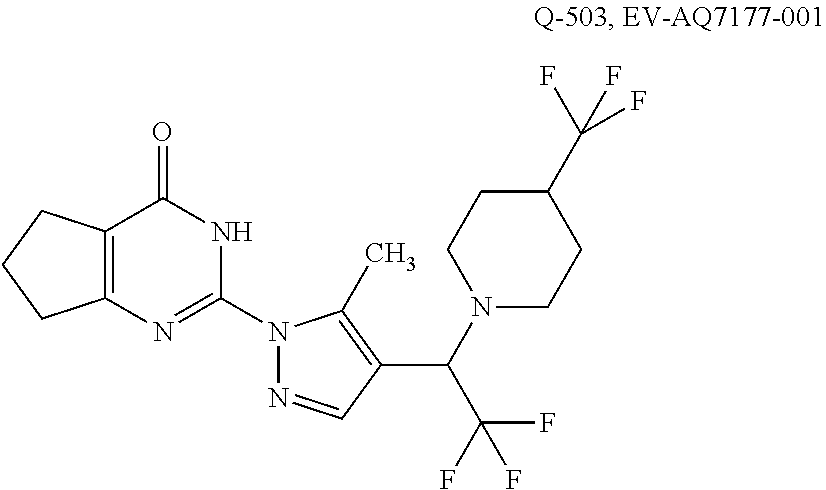
- To a solution of 2-[5-methyl-4-(2,2,2-trifluoro-1-hydroxyethyl)-1H-pyrazol-1-yl]-3H,4H,5H,6H,7H-cyclopenta[d]pyrimidin-4-one (EV-AQ7174-001, 90 mg, 0.29 mmol) in DCM (3.5 mL) at −10° C. was added Et3N (0.12 mL, 0.86 mmol) followed by triflic anhydride (0.08 mL, 0.50 mmol) and stirred at −10° C. for 1 h. The reaction mixture was washed with cold saturated NaHCO3 solution (3 mL) and water (3 mL). The organic extracts were then dried over Na2SO4 and concentrated in vacuo. The residue was dissolved in THF (3 mL), cooled to 0° C., added to a stirred solution of 4-(trifluoromethyl)piperidin-1-ium HCl (108.6 mg, 0.57 mmol) and potassium carbonate (118.74 mg, 0.86 mmol) and stirred at 0° C.—r.t. for 15 h. The reaction mixture was concentrated in vacuo and partitioned between DCM (2 mL) and water (1 mL). The organics were isolated using a phase separator cartridge, concentrated in vacuo and purified by PREP-HPLC (Method G) to afford the title compound (21 mg, 16.3%) as brown powder.
- Method C: LC-MS m/z=450.1 [M+H]+; RT=2.98 min
- Step 1: Synthesis of 2-[4-(hydroxymethyL)-5-methyl-1H-pyrazol-1-yl]-3H,4H,5H,6H,7H-cyclopenta[d]pyrimidin-4-one
-

- To a solution of methyl 5-methyl-1-{4-oxo-3H,4H,5H,6H,7H-cyclopenta[d]pyrimidin-2-yl}-1H-pyrazole-4-carboxylate (Intermediate 18 step 1, EV-AQ7137-001, 1 g, 3.65 mmol) in THF (20 mL) at 0° C. was added dropwise lithium aluminium hydride (2.4 M solution in THF, 1.82 mL, 4.35 mmol) and stirred at r.t. for 15 h. The reaction mixture was quenched by the addition of water (15 mL) and filtered through Celite, washing with methanol (15 mL). The filtrate was concentrated in vacuo to afford the title compound (650 mg, 62%) as a pale yellow powder:
- Method B: LC-MS m/z=245 [M+H]+; RT=0.89 min
- Step 2: Synthesis of 5-methyl-1-{4-oxo-3H,4H,5H,6H,7H-cyclopenta[d]pyrimidin-2-yl}-1H-pyrazole-4-carbaldehyde
-

- To a solution of 2-[4-(hydroxymethyL)-5-methyl-1H-pyrazol-1-yl]-3H,4H,5H,6H,7H-cyclopenta[d]pyrimidin-4-one (EV-AQ7157-001, 650 mg, 2.64 mmol) in DCM (20 mL) and MeOH (10 mL) was added manganese (IV) oxide (1.84 g, 21.12 mmol) and stirred at r.t. for 15 h. A further portion of manganese (IV) oxide (1.84 g, 21.12 mmol) was added and stirred at r.t. for 6 h. A further portion of manganese (IV) oxide (0.92 g, 10.56 mmol) was added and stirred at r.t. for 4 days. The reaction mixture was filtered through Celite, washing with DCM and MeOH, and the filtrate concentrated in vacuo to afford the title compound (558 mg, 68%) as a beige powder.
- Method B: LC-MS m/z=245 [M+H]+; RT=0.89 min
- Step 3: Synthesis of 1-[(5-methyl-1-{4-oxo-3H,4H,5H,6H,7H-cyclopenta[d]pyrimidin-2-yl}-1H-pyrazol-4-yL)methyl]piperidin-2-one.
-

- To a solution of 5-methyl-1-{4-oxo-3H,4H,5H,6H,7H-cyclopenta[d]pyrimidin-2-yl}-1H-pyrazole-4-carbaldehyde (EV-AQ7158-001, 80%, 90 mg, 0.295 mmol) in anhydrous MeOH (3 mL) was added ethyl 5-aminopentanoate hydrochloride (59 mg, 0.324 mmol) and Et3N (164 μl, 1.179 mmol) and stirred at r.t. for 1 h. To the reaction mixture was added NaBH4 (13 mg, 0.354 mmol) and stirred at 45° C. for 16 h. The reaction mixture was stirred at 50° C. for a further 3 h. The reaction mixture was cooled to r.t. and diluted with water (10 mL). The aqueous mixture was then acidified to pH 4 using 5 M aq HCl solution and extracted with EtOAc (2×30 mL). The combined extracts were dried over sodium sulfate, concentrated in vacuo and purified via PREP-HPLC (Method G) to afford the title compound (5 mg, 5%) as an off white powder.
- Method C: LC-MS m/z=328.1 [M+H]+; RT=2.19 min.
-

- To a solution of ethyl 1H-pyrazole-4-carboxylate (143 m g, 1.022 mol) in DMF (5 mL) at 0° C. was added NaH (60% in oil) (60%, 45 mg, 1.12 mmol). The reaction mixture was warmed to r.t. over 30 minutes before 2-methanesulfonyl-4-[(4-methoxyphenyl)methoxy]-6-methylpyrimidine (Example 196 step 2, EV-AO5710-002, 300 mg, 0.97 mmol) was added in more DMF (1 mL). The reaction mixture was stirred at r.t. for 3 h. The reaction mixture was quenched by the addition of water (20 mL) and extracted with EtOAc (3×30 mL). The combined organic fractions were washed with brine (20 mL), dried (Na2SO4) and concentrated under vacuum to an opaque gum which was purified by chromatography on SiO2 eluting with 12-100% EtOAc in heptane to afford the title compound (266 mg, 66% yield) as a white powder.
- Method A: LC-MS: m/z=+391.10 (M+Na)+1.41 min
-

- To a solution of ethyl 1-{4-[(4-methoxyphenyl)methoxy]-6-methylpyrimidin-2-yl}-1H-pyrazole-4-carboxylate (EV-AN0096-002 (266 mg, 0.64 mmol) in THF (10 ml) was added NaOH (3M, 1 ml) and the reaction was stirred at room temperature for 18 h. More NaOH (2.5M, 1.5 ml) was added along with MeOH (1 ml) and the reaction stirred for a further 7 h. The Organic solvent was evaporated in vacuo and the aqueous phase acidified to pH1 with HCl (1M). The mixture was extracted with EtOAc (3×30 ml), washed with brine (2×20 ml), dried (Na2SO4) and evaporated to afford the title compound (199 mg, 64%) as a colourless gum.
- Method A: LC-MS: m/z=+363.0 (M+Na)+1.20 min
-

- To a stirred solution of 1-{4-[(4-methoxyphenyl)methoxy]-6-methylpyrimidin-2-yl}-1H-pyrazole-4-carboxylic acid (EV-AN0090-001, 199 mg, 0.58 mmol) in DMF (1 ml) was added DIPEA (255 μl, 1.46 mmol) followed by TBTU (225 mg, 0.7 mmol). The reaction was stirred for 3 min after which time 1,2,3,4-tetrahydroisoquinoline (101 mg, 0.76 mmol) was added and then the reaction was placed under N2. The reaction was stirred for 16 hours and then quenched with water (20 ml) and extracted with DCM (3×30 ml). The organics were washed with brine (2×50 ml), dried (Na2SO4) and evaporated under vacuum, followed by azeotrope with heptane (2×50 mL) to remove residual DMF. The crude product was purified by chromatography on SiO2 eluting with 25-100% EtOAc in heptane gradient to afford the title compound (220 mg, 72%) as a colourless gum.
- Method C: LC-MS: m/z=456.2 (M+H)+1.40 min
-

- 2-(1-{4-[(4-methoxyphenyl)methoxy]-6-methylpyrimidin-2-yl}-1H-pyrazole-4-carbonyl)-1,2,3,4-tetrahydroisoquinoline (EV-AO8800-002, 220 mg, 0.42 mmol) was dissolved in DCM (3 mL) and TFA (0.35 mL) was added. The reaction mixture was stirred for 1 hour and 30 minutes and then concentrated under vacuum. The crude residue was then re-dissolved in DCM (30 ml) and washed with sodium bicarbonate solution (sat, 2×10 ml), dried (Na2SO4) and concentrated under vacuum. The crude material was purified by preparative HPLC (Method G) to afford the title compound (46 mg, 33%) as an off white solid
- Method C: LC-MS: m/z=336.1 (M+H)+2.38 min
-

- To a solution of hydrazinyl-6-methyl-3,4-dihydropyrimidin-4-one (Intermediate 1, EV-AN7477-001, 0.5 g, 3.6 mmol) in ice cold acetic acid (3 mL) was added dropwise a solution of sodium nitrite (0.37 g, 5.4 mmol) in water (0.4 mL). The reaction mixture was stirred at 5° C. for 1 hour and then concentrated in vacuo. The residue was triturated from water, filtered and dried in vacuo to afford the title compound (335 mg, 59%) as a colourless solid.
- Method A: LC-MS m/z=152.1 [M+H]+; RT=0.24 min
-

- A solution of tert-butanol-water 1:1 (4 mL) was degassed with a stream of nitrogen for 5 minutes and methyl-3H,7H-[1,2,3,4]tetrazolo[1,5-a]pyrimidin-7-one (EV-AO05708-001, 200 mg, 1.32 mmol), copper (I) chloride (26 mg, 0.26 mmol) and methyl propionate (98%, 227 mg, 2.65 mmol) were added. The reaction mixture was stirred at 70° C. for 6 hours. The reaction mixture was diluted with CHCl3-10% IPA (5 mL) and washed with water (5 mL) and brine (5 mL). The aqueous phase was re-extracted with CHCl3-10% IPA (3×5 mL) and the combined organics were dried (Na2SO4) and concentrated in vacuo. Purification by chromatography on SiO2, eluting with DCM/Ammonia (7M in methanol) 0-100%) afforded the title compound (183 mg, 53%) as a pale solid.
- Method A: LC-MS m/z=235.9 [M+H]+; RT=0.90 min
-

- To a solution of methyl 1-(4-methyl-6-oxo-1,6-dihydropyrimidin-2-yl)-1H-1,2,3-triazole-4-carboxylate (EV-AO5726-001, 190 mg, 0.71 mmol) in methanol (3 mL) was added 1M KOH (1.25 mL, 1.25 mmol) and the mixture was stirred at r.t. for 4 hours. The reaction mixture was concentrated in vacuo and acidified with HCl (3M, 0.4 mL). The resulting precipitate was collected by filtration, washed with water (2×1 mL) and dried under vacuum to afford the title compound (137 mg, 83%) as a light brown solid.
- Method A: LC-MS m/z=221.9 [M+H]+; RT=0.70 min.
-

- To a solution of 1-(4-methyl-6-oxo-1,6-dihydropyrimidin-2-yl)-1H-1,2,3-triazole-4-carboxylic acid (EV-A05728-001 (130 mg, 0.56 mmol) in DMF (2 mL) was added DIPEA (233.05 μl, 1.4 mmol and COMU (98%, 268.42 mg, 0.61 mmol). The reaction mixture was stirred at r.t. for 2 minutes and 1,2,3,4-tetrahydroisoquinoline (98%, 83.48 mg, 0.61 mmol) was added and the reaction stirred at r.t. for a further 24 hours. Further COMU (98%, 268.42 mg, 0.61 mmol) and 1,2,3,4-tetrahydroisoquinoline (98%, 83.48 mg, 0.61 mmol) were added and the mixture stirred at r.t. for 2 hr.
- The reaction mixture was concentrated in vacuo and diluted with DCM (10 ml). The mixture was washed with HCl (1 M 2×5 mL), water (5 mL) and brine (5 mL), dried (Na2SO4) and concentrated in vacuo. Purification by chromatography on SiO2 eluting with DCM/methanol (0-2%) followed by preparative HPLC (Method G) afforded the title compound (36 mg, 19%) as a colourless solid.
- Method C: LC-MS: m/z=337.1 (M+H)+; RT=2.56 min
-

- To a solution of 5-bromopyridine-2-carboximidamide (917 mg, 4.584 mmol) in dry MeOH (10 ml) was added methyl-2-oxocyclopentane-1-carboxylate (1.1 eq, 569 μl, 4.584 mmol), followed by NaOMe (5.4 M in MeOH) (1.1 eq, 934 μl, 5.043 mmol) and stirred at 60° C. for 20 h. A further portion of methyl-2-oxocyclopentane-1-carboxylate (0.1 eq, 57 μl, 0.458 mmol) and NaOMe (5.4 M in MeOH) (0.1 eq, 85 μl, 0.458 mmol) was added and stirred at 60° C. for 1 h. The reaction mixture was concentrated in vacuo, the residue redissolved in water and the solution acidified to pH 3 using 2 M aqueous HCl solution. The precipitate was filtered under vacuum filtration, washed with water and Et2O, and dried to afford the title compound (832 mg, 62%) as a cream powder.
- Method C: LC-MS m/z=295.0 [M+H]+; RT=2.53 min.
-

- To a suspension of 2-(5-bromopyridin-2-yl)-3H,4H,5H,6H,7H-cyclopenta[d]pyrimidin-4-one (EV-AR5317-001, 690 mg, 2.36 mmol) in THF (3 ml) was added MeOH (3 ml), Mo(CO)6 (249 mg, 0.945 mmol), Pd(OAc)2 (53 mg, 0.236 mmol), tBu3P (96 mg, 0.472 mmol) and DBU (705 μl, 4.724 mmol) and stirred at 120° C. overnight. The reaction mixture was diluted with water (10 mL) and extracted with EtOAc (3×20 mL). The combined organic extracts were washed with saturated brine solution (10 mL), dried over Na2SO4, concentrated in vacuo and purified via chromatography on SiO2 eluting with (100:0-95:5, DCM-MeOH) followed by trituration using THF to afford the title compound (109 mg, 17%) as an off white powder.
- Method C: LC-MS m/z=272.1 [M+H]+; RT=2.27 min.
-

- To a solution of methyl 6-{4-oxo-3H,4H,5H,6H,7H-cyclopenta[d]pyrimidin-2-yl}pyridine-3-carboxylate (EV-AR5321-002, 100 mg, 0.369 mmol) in THF (5 mL) was added 3M aqueous NaOH solution (737 μl, 2.21 mmol) and stirred at r.t. for 1 h. The reaction mixture was concentrated in vacuo to remove the organic solvent and the aqueous mixture acidified to pH 4 using 5M aq HCl solution; a white precipitate formed. The reaction mixture was filtered under vacuum to afford the title compound (65 mg, 53%) as an off white powder.
- Method B: LC-MS m/z=258.0 [M+H]+; RT=0.84 min.
-

- To a suspension of 6-{4-oxo-3H,4H,5H,6H,7H-cyclopenta[d]pyrimidin-2-yl}pyridine-3-carboxylic acid (EV-AR5324-001, 64 mg, 0.249 mmol) in THF (3 ml) was added DIPEA (130 μl, 0.746 mmol), T3P (50% in EtOAc) (440 μl, 0.746 mmol) and 4-(trifluoromethyl)piperidine hydrochloride (52 mg, 0.274 mmol) and stirred at r.t. for 2 h. The reaction mixture was concentrated in vacuo and redissolved in EtOAc (20 ml). The reaction mixture was then washed with water (10 ml), the organic extracts dried over sodium sulfate, concentrated in vacuo and purified via PREP-HPLC (Method G) to afford the title compound (45 mg, 46%) as a white powder.
- Method C: LC-MS m/z=393.2 [M+H]+; RT=2.65 min.
-

- To a solution of 4-bromopyridine-2-carbonitrile (1 g, 5.46 mmol) in anhydrous MeOH (4 mL) was added sodium methoxide in MeOH (0.5 M, 2.19 mL, 1.1 mmol) and stirred at r.t. for 4 h. To the reaction mixture was added ammonium chloride (0.32 g, 6 mmol) and stirred at r.t. overnight. The reaction was diluted with ether (10 mL) and stirred at r.t. for 30 mins. A precipitate formed that was collected by filtration, washed with ether (2×4 mL) and dried under vacuum to afford the title compound (967 mg, 74.8%) as a white powder.
- Method B: LC-MS m/z=199.8, 201.9 [M+H]+; RT=0.2 min.
-

- Methyl 2-oxocyclopentane-1-carboxylate (609.16 μl, 4.91 mmol) and 4-bromopyridine-2-carboxamidine hydrochloride (0.97 g, 4.09 mmol) were dissolved in NaOMe in MeOH (0.5 M, 9.8 mL, 4.9 mmol) at r.t. under an atmosphere of nitrogen, and stirred at 60° C. overnight. The reaction mixture was concentrated in vacuo, the residue re-dissolved in water and the solution acidified to pH 3 using 2 M aq HCl solution. The precipitate was collected by filtration, washed with water and diethyl ether, and dried to afford the title compound (783 mg, 65.6%) as a brown powder.
- Method B: LC-MS m/z=293.85/295 [M+H]+; RT=1.04 min.
-

- To a solution of 2-(4-bromopyridin-2-yl)-3H,4H,5H,6H,7H-cyclopenta[d]pyrimidin-4-one (50 mg, 0.17 mmol) in anhydrous 1,4-dioxane (2 mL) under nitrogen was added 4-(trifluoromethyl)piperidin-1-ium chloride (97.36 mg, 0.51 mmol), palladium acetate (2.88 mg, 0.01 mmol), (9,9-dimethyl-9H-xanthene-4,5-diyl)bis(diphenylphosphane) (14.86 mg, 0.03 mmol), tripotassium phosphate (0.09 ml, 1.03 mmol), hexakis(oxomethylidene)molybdenum (18.07 mg, 0.07 mmol) and N,N-dimethylpyridin-4-amine (41.82 mg, 0.34 mmol). The reaction vessel was de-gassed and back filled with nitrogen (×3), sealed and heated at 140° C. for 45 mins. The reaction mixture was diluted with EtOAc, concentrated on to silica and purified by chromatography on SiO2 eluting with 0-5% MeOH/DCM then 5-15% rapid flush to yield a brown gum. The crude material was dissolved in IPA (0.3 mL) and treated with (2E)-but-2-enedioic acid (0.01 ml, 0.09 mmol) solution in IPA and stirred at r.t. for 4 mins before diethyl ether (1 mL) was added. A precipitate slowly formed over 3 h and was left standing overnight. The precipitate was collected by filtration, washed with ether (2×1 mL) and dried under vacuum to provide the title compound (9.7 mg, 14.2%) as a pale beige solid.
- Method C: LC-MS m/z=393.1 [M+H]+; RT=2.59 min.
-

- 4-bromopyridine-2-carbonitrile (150 mg, 0.82 mmol), phenyl formate (0.12 ml, 1.07 mmol), palladium(II) acetate (5.52 mg, 0.02 mmol), tri-tert-butylphosphonium tetrafluoroborate (28.54 mg, 0.1 mmol) and N,N-diethylethanamine (0.15 ml, 1.07 mmol) were added to a microwave vessel under an atmosphere of nitrogen. The reaction vessel was de-gassed and back filled with nitrogen (×3), sealed and heated at 140° C. for 20 mins under microwave irradiation. A further portion of palladium(II) acetate (5.52 mg, 0.02 mmol) and tri-tert-butylphosphonium tetrafluoroborate (28.54 mg, 0.1 mmol) was added and the reaction vessel de-gassed and back filled with nitrogen (×3), sealed and heated at 140° C. for 45 mins under microwave irradiation. The resultant mixture was diluted with water (4 mL) and DCM (3 mL), stirred vigorously and the phases separated using a phase separator cartridge. The aqueous was re-extracted with DCM (×2) and the organic extracts separated using a phase separator. The combined organic extracts were concentrated in vacuo and purified by chromatography on SiO2, eluting with Heptane/EtOAc (gradient 100:0-55:45) to afford the title compound (94 mg, 51%) as a pale yellow gum that solidified on standing.
- Method B: LC-MS m/z=224.9 [M+H]+; RT=1.11 min.
-

- To a solution of phenyl 2-cyanopyridine-4-carboxylate (101 mg, 0.45 mmol) in anhydrous THF (1 mL), under an atmosphere of nitrogen, was added 4-(trifluoromethyl)piperidin-1-ium chloride (128.12 mg, 0.68 mmol), N,N-diethylethanamine (0.13 ml, 0.9 mmol) and N,N-dimethylpyridin-4-amine (2.75 mg, 0.02 mmol) and the suspension stirred at 45° C. for 4-5 h. The reaction mixture was diluted with DCM, concentrated on to silica (1.5 g) and purified by chromatography on SiO2 eluting with Heptane/EtOAc (gradient 100:0-70:30), followed by DCM/MeOH (gradient 100:0-45:55), to afford the title compound (102 mg, 80%) as a colourless glass.
- Method B: LC-MS m/z=284.0 [M+H]+; RT=1.02 min
-

- To a solution of 4-[4-(trifluoromethyl)piperidine-1-carbonyl]pyridine-2-carbonitrile (0.1 g, 0.36 mmol) and methyl 3-aminothiophene-2-carboxylate (0.06 g, 0.4 mmol) in THF (2.5 mL) at 0° C. under an atmosphere of nitrogen was added potassium tert-butoxide (0.04 g, 0.4 mmol) and stirred at 0° C.—r.t. for 3 h. The reaction mixture was concentrated in vacuo, diluted with saturated ammonium chloride (5 mL) and water and stirred at r.t. The mixture was extracted with DCM (×2), followed by EtOAc, and the combined organic extracts dried over Na2SO4 and concentrated in vacuo. The crude residue was stirred in diethyl ether (9 mL) for 30 mins at r.t. and the resultant solid was filtered, washing with diethyl ether (×2) and dried under vacuum to yield the title compound (58 mg, 38.6%) as a white solid.
- Method C: LC-MS m/z=409.1 [M+H]+; RT=2.75 min
-

- In a pressure tube palladium(II) acetate (0.01 g, 0.03 mmol), N,N,N-tributylbutan-1-aminium bromide (182 mg, 0.56 mmol), triphenylphosphine (20 mg, 0.08 mmol), sodium formate (77 mg, 1.13 mmol), 1,10-phenanthroline hydrate (1:1) (0.02 g, 0.08 mmol) and dipotassium oxidosulfanesulfonate oxide (0.23 g, 1.03 mmol) were stirred vigorously in anhydrous DMSO (3 mL), under an atmosphere of nitrogen before 2-(4-bromopyridin-2-yl)-3H,4H,5H,6H,7H-cyclopenta[d]pyrimidin-4-one (Example 223 step 2)(0.15 g, 0.51 mmol) was added and the vessel sealed and heated at 70° C. for 3 h. The reaction mixture was cooled to r.t., diluted with MeOH (5 mL) and stirred for 5-10 mins. The mixture was filtered through a small pad of Celite®, washing with MeOH (3×2 mL), concentrated in vacuo and triturated with diethyl ether (2×4 mL). The resulting solid was azeotroped with toluene, cooled to 0° C. and treated with 4-(trifluoromethyl)piperidin-1-ium chloride (0.11 g, 0.56 mmol), DIPEA (223.59 μl, 1.28 mmol) and 1-chloropyrrolidine-2,5-dione (41.55 μl, 0.51 mmol) in DMF (1 mL) and stirred at r.t. for 72 h. The reaction mixture was diluted with water (10 mL), extracted with EtOAc (3×25 mL) and the combined extracts washed with water (×4) and brine. The organics were dried over Na2SO4, concentrated in vacuo and triturated with ether. The solid was suspended in MeOH (˜4-5 mL) and heated to dissolution. The solution was concentrated in vacuo and triturated with ether to afford the title compound (96 mg, 44%) as a pale yellow solid.
- Method C: LC-MS m/z=429.1 [M+H]+; RT=3.15 min
-

- To a solution of 2-chloro-3H,4H,5H,6H,7H-cyclopenta[d]pyrimidin-4-one (Example 193 step 1, 74 mg, 0.43 mmol) and 4-(cyclopentyloxy)-1H-pyrazole (85 mg, 0.46 mmol) in DMF (3 mL) was added cesium carbonate (434 mg, 1.33 mmol). The mixture was irradiated at 170° C. in the microwave for an hour. After a further 1 hour under these conditions the cooled reaction mixture was diluted with HCl (1M 20 mL) and extracted with EtOAc (20 mL), the organic fraction was dried (MgSO4), concentrated under vacuum and purified by PERP-HPLC (method G) to yield the title compound (32 mg, 26%) as a as a colourless powder.
- Method C: LC-MS m/z=287.1 [M+H]+; RT=3.10 min
-

- 2.5 M n-BuLi in THF (0.28 mL, 0.7 mmol) was added to a solution of diisopropylamine (54 mg, 0.536 mmol) in THF (2 mL) at −78° C. The solution was stirred for 30 min and then a solution of tert-butyl 4-(cyanomethyl)piperidine-1-carboxylate (100 mg, 0.446 mmol) was added dropwise at −78° C. The resulting solution was stirred for 1 h and iodoethane (83.6 mg, 0.536 mmol) was added. The reaction mixture was stirred overnight. The reaction was quenched with sat. NH4Cl (5 mL), extracted with EtOAc (30 mL×2), the combined organics were dried over Na2SO4, concentrated to yield the product (110 mg, 98% yield) which was used in the next step without purification.
- LC-MS: m/z=197 (M−55)+, RT=1.70 min.
-

- 4.0 M HCl in dioxane (2 mL) was added to a solution of tert-butyl 4-(1-cyanopropyl) piperidine-1-carboxylate (110 mg, 0.436 mmol) in DCM (2 mL). The solution was stirred at r.t for 4 h. Then the reaction was removed the solvent to yield the product (85 mg, 99%) as white solid.
- LC-MS: m/z=153 (M+H)+
-

- 2.5 M n-BuLi in THF (7.2 mL, 18 mmol) was added to a solution of diisopropylamine (1.818 g, 18 mmol) in THF (20 mL) at −78° C. The solution was stirred for 30 min and then the solution was added to the solution of tert-butyl 4-cyanopiperidine-1-carboxylate (3.15 g, 15 mmol) in THF (40 mL) dropwise at −78° C. The resulting solution was stirred for 1 h and iodoethane (83.6 mg, 0.536 mmol) was added. The reaction mixture was stirred overnight. The reaction was quenched with sat. NH4Cl (10 mL) and water (20 mL), extracted with EtOAc (50 mL×2), the combined organics were dried over Na2SO4, concentrated to yield the product (3.4 g, 95.2% yield) which used in the next step without purification.
- LC-MS: m/z=183 (M−55)+, RT=1.879 min.
-

- 4.0 M HCl in dioxane (10 mL) was added to the solution of tert-butyl 4-cyano-4-ethylpiperidine-1-carboxylate (3.4 g, 14.3 mmol) in DCM (10 mL). The solution was stirred at r.t. overnight. Then the reaction was removed the solvent to yield the product (2.48 g, 99%) as pale white solid.
- LC-MS: m/z=139 (M+H)+, RT=1.076 min.
-

-

- To a 100 mL of RBF was added (4-methoxyphenyl) methanol (460 mg, 3.33 mmol), 15 mL of THF and NaH (60%) (160 mg, 4.0 mmol). The mixture was stirred at r.t. for 30 min. Then 2,4-dichloro-6,7-dihydro-5H-cyclopenta[d]pyrimidine (600 mg, 3.19 mmol) was added and the mixture was stirred at r.t. for 3 h. The reaction mixture was treated with water (20 ml) and extracted with EtOAc (100 ml). The organic layer was concentrated and purified by combiflash (isco, silica gel, UV 254, 40 g, EA/PE=1/10) to give product. LC-MS: m/z=291 (M+H)+, RT=2.012 min.
-

- To a 100 mL of RBF was added 2-chloro-4-(4-methoxybenzyloxy)-6,7-dihydro-5H-cyclopenta[d]pyrimidine (350 mg, 1.2 mmol), 8 mL of DCM and 2 ml of CF3COOH. The mixture was stirred at r.t. for 3 h. The reaction mixture was treated with TEA until pH=8 and then purified by combiflash (isco, silica gel, UV 254, 40 g, EA/PE=1/1) to give product. LC-MS: m/z=171 (M+H)+, RT=1.246 min.
-

- To a 100 mL of RBF was added 2-chloro-6,7-dihydro-3H-cyclopenta[d]pyrimidin-4(5H)-one (100 mg, 0.58 mmol), 5-boronothiophene-2-carboxylic acid (350 mg, 2.03 mmol), 3 mL of DME, 1.5 mL of EtOH, 0.5 mL of Na2CO3 (2N) and Pd(PPh3)4 (100 mg, 0.086 mmol). The mixture was stirred at 110° C. for 1 h. Then the reaction mixture was purified by combi flash (isco, silica gel, UV 254, 20 g, MeOH/DCM=1/20) to give product LC-MS: m/z=263 (M+H)+, RT=1.358 min.
-

- To a 100 mL of RBF was added 5-(4-oxo-4, 5,6,7-tetrahydro-3H-cyclopenta[d]pyrimidin-2-yl)thiophene-2-carboxylic acid (80 mg, 0.30 mmol), 4-(trifluoromethyl)piperidine hydrochloride (60 mg, 0.31 mmol), HOAT (40 mg, 0.30 mmol), HATU (80 mg, 0.34 mmol), 5 ml of THF and 0.05 ml of TEA. The mixture was stirred at r.t. for 16 h. Then the reaction mixture was purified by combi flash (isco, silica gel, UV 254, 20 g, MeOH/DCM=1/20) to give product. LC-MS (method C′): m/z=398 (M+H)+, RT=1.703 min.
-

-

- To a 100 mL of RBF was added 2-chloro-6,7-dihydro-3H-cyclopenta[d]pyrimidin-4(5H)-one (90 mg, 0.53 mmol), 3-boronobenzoic acid (200 mg, 1.20 mmol), K2CO3 (120 mg, 0.87 mmol), 5 mL of dioxane, 1 mL of water and Pd(PPh3)4 (40 mg, 0.034 mmol). The mixture was stirred at 100° C. for 40 h. Then the reaction mixture was purified by combiflash (isco, silica gel, UV 254, 20 g, MeOH/DCM=1/10) to give product. LC-MS: m/z=257 (M+H)+, RT=0.994 min.
-

- To a 100 mL of RBF was added 3-(4-oxo-4,5,6,7-tetrahydro-3H-cyclopenta[d]pyrimidin-2-yl)benzoic acid (60 mg, 0.23 mmol), 4-(trifluoromethyl)piperidine hydrochloride (50 mg, 0.26 mmol), HOAT (40 mg, 0.30 mmol), HATU (60 mg, 0.25 mmol), 3 ml of THF and 0.05 ml of TEA. The mixture was stirred at r.t. for 16 h. Then the reaction mixture was purified by combiflash (isco, silica gel, UV 254, 20 g, MeOH/DCM=1/20) to give product. LC-MS (method G′): m/z=392 (M+H)+, RT=1.608 min.
-


-

- 4,4-dimethylcyclohexanone (9 g, 71.3 mmol) and KMnO4 (22.5 g, 142.6 mmol) were taken up in 450 mL of H2O. To this, an aqueous solution of NaOH (1 g, 25 mmol) in 10 mL of H2O was added at r.t. This mixture was stirred at r.t. for 48 hrs. Aqueous sodium bisulfate was then added until the purple color disappeared. A brown solid was filtered off, and the filtrate was brought to pH=2 with conc. HCl. The solution was extracted with EtOAc (150 mL×2). The combined organics were dried and concentrated to yield the product. LC-MS: m/z=175.1 (M+H)+, RT=0.35 min.
-

- To a solution of 3,3-dimethylhexanedioic acid (7.8 g, 44.8 mmol) in MeOH (100 mL) was added conc. H2SO4 (1 g, 10 mmol). The mixture was stirred at 80° C. for 2 hrs and concentrated. NaHCO3 solution was added to the residue to pH=7. The mixture was extracted with EtOAc (50 mL×2). The combined organic layers were dried over Na2SO4 and concentrated under vacuum to yield the product. LC-MS: m/z=203.1 (M+H)+, RT=1.89 min.
-

- The mixture of Na (230 mg, 10 mmol) in MeOH (8 mL) was stirred at r.t. for 5 minutes. Dimethyl 3,3-dimethylhexanedioate (1 g, 5 mmol) was added. The mixture was stirred at r.t. for 30 minutes and concentrated under vacuum to remove MeOH. THF (8 mL) was added to the residue, and the mixture was stirred at r.t. for 12 hrs. The mixture was poured into H2O (20 mL). HCl (2N) was added to pH=7. The mixture was extracted with EtOAc (50 mL×2). The organic layers were concentrated and purified by column (silica gel, PE/EtOAc=1/1) to yield the product. LC-MS: m/z=171.1 (M+H)+, RT=1.77 min.
-

- To a solution of methyl 4,4-dimethyl-2-oxocyclopentanecarboxylate (750 mg, 4.4 mmol) in H2O (20 mL) was added methyl carbamimidothioate (594 mg, 6.6 mmol) and Na2CO3 (1.87 g, 17.6 mmol). The mixture was stirred at r.t. for 12 hrs. The mixture was extracted with EtOAc (20 mL×2). The organic layers were concentrated and purified by column (silica gel, PE/EtOAc=2/1) to yield the product. LC-MS: m/z=211.1 (M+H)+, RT=1.61 min.
-

- To a solution of 6,6-dimethyl-2-(methylthio)-6,7-dihydro-3H-cyclopenta[d]pyrimidin-4(5H)-one (250 mg, 1.2 mmol) in EtOH (5 mL) was added NH2NH2.H2O (1 mL). The mixture was stirred at 90° C. for 12 hrs and concentrated under vacuum to yield the product which was used in next step directly without purification. LC-MS: m/z=195.2 (M+H)+, RT=1.23 min.
-

- To a solution of 2-hydrazinyl-6,6-dimethyl-6,7-dihydro-3H-cyclopenta[d]pyrimidin-4(5H)-one (230 mg, 1.2 mmol) in EtOH (5 mL) was added (Z)-methyl 2-((dimethylamino)methylene)-3-oxobutanoate (246 mg, 1.4 mmol) and AcOH (0.5 mL). The mixture was stirred at 50° C. for 2 hrs and concentrated under vacuum. The crude residue was purified by column (silica gel, PE/EtOAc=1/3) to yield the product. LC-MS: m/z=303.1 (M+H)+, RT=1.99 min.
-

- To a solution of methyl 1-(6,6-dimethyl-4-oxo-4,5,6,7-tetrahydro-3H-cyclopenta[d] pyrimidin-2-yl)-5-methyl-1H-pyrazole-4-carboxylate (140 mg, 0.5 mmol) in THF (5 mL) was added a solution of NaOH (60 mg, 1.5 mmol) in H2O (3 mL). The mixture was stirred at 35° C. for 3 hrs and concentrated under vacuum to remove THF. EtOAc (10 mL) was added to extract the impurity. The aqueous phase was adjusted to pH=4 with HCl (2N). The solid was filtered to yield the product. LC-MS: m/z=289.1 (M+H)+, RT=1.11 min.
-

- To a solution of 1-(6,6-dimethyl-4-oxo-4,5,6,7-tetrahydro-3H-cyclopenta[d]pyrimidin-2-yl)-5-methyl-1H-pyrazole-4-carboxylic acid (49 mg, 0.17 mmol) in THF (6 mL) was added NMM (68 mg, 0.68 mmol), HATU (76 mg, 0.2 mmol), HOAt (26 mg, 0.2 mmol) and 1-(azetidin-3-yl)-3,3-difluoropyrrolidine (46 mg, 0.2 mmol). The mixture was stirred at r.t. for 2 hrs and concentrated under vacuum. The residue was purified by Prep-HPLC (NH4HCO3) to yield the product. LC-MS (method J′): m/z=433.2 (M+H)+, RT=1.46 min.
-

-

- To the solution of ethyl 2-methyl-1H-pyrrole-3-carboxylate (785 mg, 5.12 mmol) in dioxane (8 mL) was added a solution of lithium hydroxide (1.08 g, 25.62 mmol) in H2O (8 mL). After addition, the reaction mixture was stirred under refluxed for 4 h. The mixture was partitioned with EtOAc and HCl (1M, a.q.). The organic phase was washed with brine, dried over Na2SO4 and concentrated to get the title compound. LC-MS: m/z=126.2 (M+H)+, RT=0.32 min.
-

- To the solution of 2-methyl-1H-pyrrole-3-carboxylic acid (100 mg, 0.8 mmol) and 4-(trifluoromethyl)piperidine (147 mg, 0.96 mmol) in DMF (2 mL) were added HATU (456 mg, 1.2 mmol) and DIPEA (206 mg, 1.6 mmol). The reaction mixture was stirred at r.t. for 15 h. The mixture was concentrated and purified by SGC (eluting with PE/EtOAc=1/2, silica gel) to give the title compound. LC-MS: m/z=261.1 (M+H)+, RT=1.62 min.
-

- To the solution of 2-chloro-6,7-dihydro-3H-cyclopenta[d]pyrimidin-4(5H)-one (90 mg, 0.53 mmol) and (2-methyl-1H-pyrrol-3-yl)(4-(trifluoromethyl)piperidin-1-yl)methanone (164 mg, 0.63 mmol) in DMF (2 mL) were added Cs2CO3 (344 mg, 1.06 mmol), L-proline (30 mg, 0.26 mmol) and CuI (50 mg, 0.26 mmol). The reaction mixture was stirred at 140° C. for 15 h. The mixture was purified by pre-HPLC (high pH) to give the title compound. LC-MS (method G′): m/z=395.0 (M+H)+, RT=1.42 min.
-

-

- Benzyl chloroformate (5 g, 0.029 mol) and 1, 4-diazabicyclo [2.2.2] octane (22 mg; 0.20 mmol) were added to a dry reaction vessel under a dry nitrogen atmosphere. Trimethylsilyl nitrile (2.9 g, 0.029 mol) was added dropwise over about 1 hr. The mixture was maintained at between 20° C.-30° C. until the reaction reached completion in about 3 hr. After distilling off the trimethylsilyl chloride, 4.3 g of crude product was obtained, which was used directly in the next step. GC-MS: m/z=161 M+, RT=9.249 min.
-

- To a solution of tert-butyl 3-oxobutanoate (982 mg, 6.22 mmol and benzyl cyanoformate (1 g, 6.21 mmol) in DCM (3 mL) was added zinc(II) acetyl acetonate (82 mg, 0.31 mmol) and the reaction mixture was stirred at r.t. for 2 h. The reaction mixture was evaporated, and the residue was taken up in Et2O (20 mL) and the suspension was filtered over celite. The cake was washed with Et2O (15 mL) and the filtrate evaporated. The residue was purified by silica gel chromatography (PE/EA=12/1) to afford the title compound. LC-MS: m/z=342 (M+Na)+, RT=1.596 min.
-

- To a solution of 4-benzyl 1-tert-butyl 2-acetyl-3-aminofumarate (575 mg, 1.80 mmol) in 5 mL of EtOH was added 2-hydrazinyl-6,7-dihydro-3H-cyclopenta[d]pyrimidin-4(5H)-one (300 mg, 1.81 mmol). The suspension was heated to reflux for 15 h. After being cooled to r.t., the suspension was filtered and the filtrate was concentrated. The residue was purified by silica gel chromatography using (PE/EA=12/1) to afford the title compound. LC-MS: m/z=395 (M−55)+, RT=2.188 min.
-

- A solution of 3-benzyl 4-tert-butyl 5-methyl-1-(4-oxo-4, 5, 6, 7-tetrahydro-3H-cyclopenta[d]pyrimidin-2-yl)-1H-pyrazole-3,4-dicarboxylate (440 mg, 0.98 mmol) in 8 mL of 7 M NH3 solution in MeOH was put into a sealed tube and heated at 50° C. for 15 h. After being cooled to r.t., the solution was concentrated to give title compound. LC-MS: m/z=304 (M−55)+, RT=1.504 min.
-

- To a solution of tert-butyl 3-carbamoyl-5-methyl-1-(4-oxo-4,5,6,7-tetrahydro-3H-cyclopenta-[d]pyrimidin-2-yl)-1H-pyrazole-4-carboxylate (30 mg, 0.084 mmol) in 2 mL of DCM was added 1 mL of TFA and the mixture was stirred at r.t. for 3 h. Then the reaction mixture was diluted with toluene and concentrated to give the desired product. LC-MS: m/z=304 (M+H)+, RT=0.407 min.
-

- To a mixture of 3-carbamoyl-5-methyl-1-(4-oxo-4, 5, 6, 7-tetrahydro-3H-cyclopenta[d]pyramidin-2-yl)-1H-pyrazole-4-carboxylic acid (26 mg, 0.084 mmol) and 4-(trifluoromethyl) piperidine hydrochloride (16 mg, 0.084 mmol) in 2 mL of DMF was added NMM (0.05 mL, 0.45 mmol), HOAt (14 mg, 0.10 mmol) and HATU (38 mg, 0.10 mmol). The reaction mixture was stirred at r.t. for 2 h and filtered. The filtrate was purified by prepared HPLC (NH4HCO3) to give the desired product. LC-MS (method F′): m/z=439 (M+H)+, RT=1.356 min.
-


-

- To a 100 mL of RBF was added 1H-pyrazole-4-carboxylic acid (500 mg, 4.46 mmol), 4-(trifluoromethyl)piperidine hydrochloride (1.0 g, 5.29 mmol), HATU (1.2 g, 5.10 mmol), HOAT (700 mg, 5.14 mmol), 40 mL of THF and 2 mL of TEA. The mixture was stirred at RT for 16 h. The reaction mixture was concentrated and purified by combiflash (isco, silica gel, UV 254, 40 g, MeOH/DCM=1/10) to give product LC-MS: m/z=248 (M+H)+, RT=1.434 min.
-

- To a 500 mL of RBF was added (R)-1-tert-butyl 2-methyl 4-oxopyrrolidine-1,2-dicarboxylate (4.0 g, 16.4 mmol) and 200 mL of DCM. The mixture was cooled to 0° C. and DAST (24.0 g, 150.0 mmol) in 100 ml of DCM was added drop wise over 1 h. Then the mixture was stirred at r.t. for 16 h. The reaction mixture was treated with NaHCO3 (aq) and extracted with DCM (300 ml), the organic layer was concentrated to give product. LC-MS: m/z=166 (M−100)+, RT=0.344 min.
-

- To a 100 mL of RBF was added (R)-1-tert-butyl 2-methyl 4,4-difluoropyrrolidine-1,2-dicarboxylate (4.0 g, 15.1 mmol) and 40 mL of HCl (4 M in dioxane). The mixture was stirred at RT for 16 h. Then the reaction mixture was concentrated to give product. LC-MS: m/z=166 (M+H)+, RT=0.347 min.
-

- To a 250 mL of RBF was added (R)-methyl 4,4-difluoropyrrolidine-2-carboxylate (2.4 g, 14.5 mmol) in 80 ml of THF was added 24 g of MnO2. The mixture was stirred at 70° C. for 16 h. The reaction mixture was filtered and the filtrate was concentrated and purified by combiflash (isco, silica gel, UV 254, 40 g, EA/PE=1/3) to give product. LC-MS: m/z=144 (M+H)+, RT=1.528 min.
-

- To a 500 mL of RBF was added NH4Cl (6.0 g, 112 mmol) in 200 ml of Et2O. The mixture was cooled to −5° C. and 9.4 ml of NH4OH was added drop wise with vigorous stirring. Then 145 ml of NaClO was added drop wise over 2 h. The mixture was stirred for 15 min and the layer was separated. The organic layer was washed with brine and dried with CaCl2 and used in the next step without further purification. Then to a 100 ml of RBF was added methyl 4-fluoro-1H-pyrrole-2-carboxylate (1.7 g, 11.8 mmol) and 30 ml of DMF. The mixture was cooled to 0° C. and NaH (60%) (600 mg, 15.0 mmol) was added. After 45 min, the previously prepared NH2Cl (100 ml) was added dropwise. The mixture was stirred at r.t. for 2 h. The reaction mixture was extracted with EtOAc (200 ml), the organic layer was concentrated and purified by combiflash (isco, silica gel, UV 254, 40 g, EA/PE=1/5) to give product. LC-MS: m/z=159 (M+H)+, RT=1.49 min.
-

- To a 250 mL of RBF was added methyl 1-amino-4-fluoro-1H-pyrrole-2-carboxylate (1.7 g, 10.76 mmol), 80 ml of THF and benzoyl isothiocyanate (1.8 g, 11.04 mmol). The mixture was stirred at RT under N2 for 16 h. The reaction mixture was concentrated and purified by combi flash (isco, silica gel, UV 254, 40 g, EA/PE=1/4) to give product. LC-MS: m/z=322 (M+H)+, RT=1.823 min.
-

- To a 100 mL of RBF was added methyl 1-(3-benzoylthioureido)-4-fluoro-1H-pyrrole-2-carboxylate (1.5 g, 4.67 mmol) and 10 ml of NaOH (2N). The mixture was stirred at 85° C. under N2 for 1.5 h. The reaction mixture was cooled to 0° C. and EtOH (5 ml), HOAc (2 ml) was added and stirred at r.t. for 30 min. The reaction mixture was filtered and washed with Et2O (20 ml) to give product. LC-MS: m/z=186 (M+H)+, RT=0.67 min.
-

- To a 100 mL of RBF was added 6-fluoro-2-mercaptopyrrolo[1,2-f][1,2,4]triazin-4(3H)-one (700 mg, 3.78 mmol) and 20 ml of THF was added MeI (700 mg, 4.92 mmol). The mixture was stirred at 45° C. under N2 for 1 h. The reaction mixture was treated with NaHCO3 (aq) and filtered to give product. LC-MS: m/z=200 (M+H)+, RT=1.551 min.
-

- To a 50 mL of RBF was added 6-fluoro-2-(methylthio)pyrrolo[1,2-f][1,2,4]triazin-4(3H)-one (100 mg, 0.50 mmol) and 4 ml of HOAc was added 2 ml of H2O2. The mixture was stirred at 170° C. in a microwave for 15 h. The reaction mixture was filtered to give product. LC-MS: m/z=232 (M+H)+, RT=1.368 min.
-

- To a microwave tube was added 6-fluoro-2-(methylsulfonyl)pyrrolo[1,2-f][1,2,4]triazin-4(3H)-one (100 mg, 0.43 mmol), (1H-pyrazol-4-yl)(4-(trifluoromethyl)piperidin-1-yl)methanone (110 mg, 0.44 mmol), Cs2CO3 (160 mg, 0.49 mmol) and 2 ml of NMP. The mixture was stirred at r.t. for 2 days. The reaction mixture was concentrated and purified by combi flash (isco, silica gel, UV 254, 20 g, MeOH/DCM=1/10) to give product. LC-MS (method G′): m/z=399 (M+H)+, RT=1.399 min.
- Examples 235-236 in Table 17 were prepared in an analogous fashion to Example 234 starting with the corresponding starting materials.
-
TABLE 17 Ex. LC-MS No. Ref. No. (Retention Time) MS (M + H)+ LC-MS Method 235 Q-741 1.565 413.1 F′ 236 Q-746 1.497 384.1 F′ -

-

- A mixture of 2,4-dichloropyrrolo[1,2-f][1,2,4]triazine (6.0 g, 31.9 mmol) and 1-(chloromethyl)-4-fluoro-1,4-diazonia-bicyclo[2.2.2]octane tetrafluoroborate (22.6 g, 63.8 mmol) in acetonitrile (250 mL) was stirred at 45° C. for 16 h under N2 atmosphere. The mixture was concentrated, the residue was diluted with DCM (400 mL), washed with H2O (50 mL×3), and dried over Na2SO4. The filtrate was concentrated to give the crude product. LC-MS: m/z=206.0 (M+H)+, RT=1.873 min.
-

- To a mixture of 2,4-dichloro-7-fluoropyrrolo[1,2-f][1,2,4]triazine (6.33 g, 30.7 mmol) in THF/H2O (30 ml/30 mL) was added sodium hydroxide (6.16 g, 154 mmol). The mixture was stirred at 50° C. for 4 h, and cooled to r.t. The mixture was adjusted to pH=3-4 with 4N HCl and extracted with EtOAc (100 mL×4). The combined organics were dried over Na2SO4 and concentrated to give 5.2 g of the crude product. 2 g of the crude product was purified by prep-HPLC (TFA/CH3CN/H2O) to give the product. LC-MS: m/z=188.0 (M+H)+, RT=1.486 min.
-

- To a mixture of 2-chloro-7-fluoropyrrolo[1,2-f][1,2,4]triazin-4(3H)-one (302 mg, 1.61 mmol), (1H-pyrazol-4-yl)(4-(trifluoromethyl)piperidin-1-yl)methanone (398 mg, 1.61 mmol) and Cs2CO3 (1049 mg, 3.22 mmol) in dry DMF (20 mL) were added L-proline (93 mg, 0.8 mmol) and CuI (152 mg, 0.8 mmol) under N2 atmosphere. The mixture was stirred at 140° C. for 20 h. The mixture was cooled to r.t., diluted with H2O (100 mL), pH adjusted to 3-4 with 1N HCl, and extracted with EtOAc (100 mL×5). The combined organics were dried over Na2SO4 and concentrated. The residue was purified by prep-HPLC (TFA/CH3CN/H2O) to give the crude product which was further purified by prep-HPLC (NH4HCO3/CH3CN/H2O) to give the product. LC-MS (method D′): m/z=399.2 (M+H)+, RT=1.002 min.
- Examples 238-239 in Table 18 were prepared in an analogous fashion to Example 237 starting with the corresponding starting materials.
-
TABLE 18 Ex. LC-MS No. Ref. No. (Retention Time) MS (M + H)+ LC-MS Method 238 Q-732 1.429 381.2 F′ 239 Q-738 1.479 380.2 F′ -

-

- To the solution of 5-methyl-1-(4-oxo-3,4-dihydropyrrolo[1,2-f][1,2,4]triazin-2-yl)-1H-pyrazole-4-carboxylic acid (2 g, 7.715 mmol) and tert-butyl-piperazine-1-carboxylate (1.6 g, 8.487 mmol) in THF (40 mL) were added HATU (3.52 g, 9.258 mmol), HOAT (1.05 g, 7.715 mmol) and TEA (2.34 g, 23.146 mmol), the reaction mixture was stirred at r.t. for 15 h. The mixture was concentrated and purified by SGC (eluting with DCM/MeOH=20/1) to give the title compound. LC-MS: m/z=428.3 (M+H)+, RT=1.535 min.
-

- To the solution of tert-butyl-4-(5-methyl-1-(4-oxo-3,4-dihydropyrrolo[1,2-f][1,2,4]triazin-2-yl)-1H-pyrazole-4-carbonyl)piperazine-1-carboxylate (3.88 g, 9.077 mmol) in DCM (50 mL) was added HCl (20 mL, 4 M in dioxane). The reaction mixture was stirred at r.t. for 15 h. The mixture was concentrated to give the title compound. LC-MS: m/z=328.2 (M+H)+, RT=1.146 min.
-

- To the solution of 2-(5-methyl-4-(piperazine-1-carbonyl)-1H-pyrazol-1-yl)pyrrolo[1,2-f][1,2,4]triazin-4(3H)-one dihydrochloride (50 mg, 0.125 mmol) and TEA (51 mg, 0.50 mmol) in DCM (3 mL) was added 4-(trifluoromethoxy)benzene-1-sulfonyl chloride (39 mg, 0.15 mmol). The reaction mixture was stirred at r.t. for 15 h. The mixture was purified by prep-HPLC (high pH) to give the title compound. LC-MS (method J′): m/z=552.2 (M+H)+, RT=1.671 min.
- Examples 241-289 in Table 19 were prepared in an analogous fashion to Example 240 starting with the corresponding starting materials.
-
TABLE 19 Ex. LC-MS No. Ref. No. (Retention Time) MS (M + H)+ LC-MS Method 241 Q-1794 1.51 493.2 J′ 243 Q-1796 1.62 536.2 J′ 243 Q-1797 1.436 434.2 J′ 244 Q-1798 1.671 552.2 J′ 245 Q-1799 1.524 486.2 J′ 246 Q-1800 1.719 524.3 J′ 247 Q-1801 1.630 520.2 J′ 248 Q-1804 1.84 498.1 C′ 249 Q-1805 1.488 503.2 J′ 250 Q-1807 1.86 486.1 C′ 251 Q-1814 1.695 542.1 J′ 252 Q-1815 1.701 561.3 J′ 253 Q-1819 1.562 502.2 J′ 254 Q-1820 1.691 510.2 J′ 255 Q-1821 1.502 474.2 J′ 256 Q-1822 1.606 502.2 J′ 257 Q-1823 1.553 486.2 J′ 258 Q-1824 1.51 493.2 J′ 259 Q-1825 1.648 536.1 J′ 260 Q-1826 1.646 536.2 J′ 261 Q-1827 1.461 546.2 J′ 262 Q-1829 1.527 512.2 J′ 263 Q-1830 1.681 536.2 J′ 264 Q-1831 1.623 518.2 J′ 265 Q-1832 1.6 472 C′ 266 Q-1833 1.72 525.1 C′ 267 Q-1834 1.647 536.2 J′ 268 Q-1835 1.757 604.2 J′ 269 Q-1836 1.73 536 A′ 270 Q-1837 1.62 546.2 J′ 271 Q-1838 1.51 493.2 J′ 272 Q-1839 1.84 528.1 C′ 273 Q-1840 1.82 570 A′ 274 Q-1841 1.961 518.1 C′ 275 Q-1842 1.955 508.0 C′ 276 Q-1845 1.748 512.1 C′ 277 Q-1846 1.720 435.1 C′ 278 Q-1847 1.498 493.2 J′ 279 Q-1848 1.511 487.2 J′ 280 Q-1857 1.7 469.1 C′ 281 Q-1858 1.680 542.1 J′ 282 Q-1859 1.508 519.2 J′ 283 Q-1861 1.966 552.1 C′ 284 Q-1862 1.850 503.0 C′ 285 Q-1864 1.56 519.2 E′ 286 Q-1875 1.823 532.1 C′ 287 Q-1876 1.93 520 C′ 288 Q-1882 1.832 526.5 C′ 289 Q-1885 1.940 544.0 C′ -

-

- The mixture of 5-methyl-1-(4-oxo-4,5,6,7-tetrahydro-3H-cyclopenta[d]pyrimidin-2-yl)-1H-pyrazole-4-carboxylic acid (50 mg, 0.19 mmol), tert-butyl 2,6-diazaspiro[4.5]decane-6-carboxylate (55 mg, 0.19 mmol), HATU (109.6 mg, 0.29 mmol), HOAt (39 mg, 0.29 mmol) and TEA (0.05 mL, 0.38 mmol) was stirred at r.t. for 2 h. The reaction was concentrated. The residue was purified by prep-TLC (DCM/MeOH=15/1, silica, UV254) to get the title compound. LC-MS: m/z=483 (M+H)+, RT=1.544 min.
-
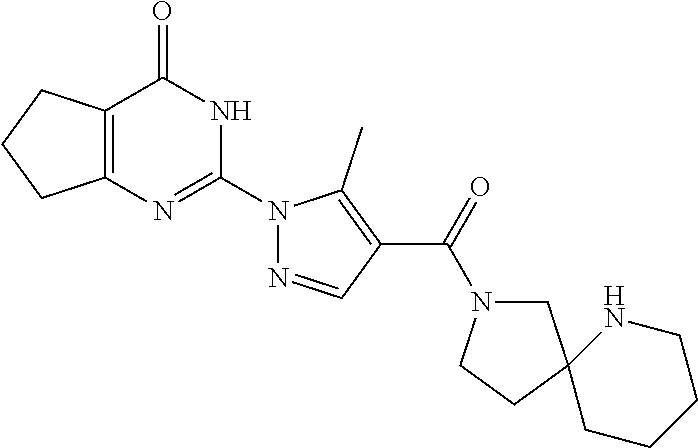
- To a solution of tert-butyl 2-(5-methyl-1-(4-oxo-4,5,6,7-tetrahydro-3H-cyclo penta[d]pyrimidin-2-yl)-1H-pyrazole-4-carbonyl)-2,6-diazaspiro[4.5]decane-6-carboxylate (50 mg, 0.1 mmol) in DCM (1 mL) was added HCl (4M in dioxane, 1 mL). The mixture was stirred at r.t. for 1 h. The reaction was concentrated. The residue was purified by prep-HPLC (high pH) to get the title compound. LC-MS (method C′): m/z=383 (M+H)+, RT=1.21 min.
- Examples 291-292 in Table 20 were prepared in an analogous fashion to Example 290 starting with the corresponding starting materials.
-
TABLE 20 Ex. LC-MS No. Ref. No. (Retention Time) MS (M + H)+ LC-MS Method 291 Q-595 1.069 399 H′ 292 Q-714 1.185 329.1 A′ -


-

- To a solution of bicyclo[1.1.1]pentane-1,3-dicarboxylic acid (1 g, 6.4 mmol) in MeOH (50 mL) was added SOCl2 (6 mL) dropwise. The reaction was stirred at 80° C. for 15 h. The reaction was concentrated. The residue was treated with aq. NaHCO3 (80 mL) and extracted with DCM (2×60 mL). The combined organic layers were concentrated to get the title compound.
-

- To a solution of dimethyl bicyclo[1.1.1]pentane-1,3-dicarboxylate (1.1 g, 5.98 mmol) in THF/MeOH (1/1, 10 mL) was added NaOH (2M, 3 mL). The reaction was stirred at r.t. for 15 h. The reaction was concentrated. The residue was treated with water (50 mL), adjusted pH=5 with HCl (2M), and extracted with DCM (2×50 mL). The combined organic layers were concentrated to get the title compound.
-

- The mixture of 3-(methoxycarbonyl)bicyclo[1.1.1]pentane-1-carboxylic acid (600 mg, 3.53 mmol), tert-butyl piperazine-1-carboxylate (656 mg, 3.53 mmol), EDCI (1.01 g, 5.29 mmol), HOBt (715 mg, 5.29 mmol) and TEA (1 mL, 7.06 mmol) in THF (30 mL) was stirred at room temperature for 15 h. The reaction was treated with water (50 mL), extracted with EtOAc (2×50 mL). The combined organic layers were concentrated to get the title compound. LC-MS: m/z=283 (M−56+H)+; RT=1.68 min.
-

- To a solution of tert-butyl 4-(3-(methoxycarbonyl)bicyclo[1.1.1]pentane-1-carbonyl)piperazine-1-carboxylate (1.05 g, 3.1 mmol) in DCM (10 mL) was added HCl (4M in dioxane, 10 mL). The mixture was stirred at r.t. for 2 h. The reaction was concentrated to get the title compound (850 mg, 99%). LC-MS: m/z=239 (M+H)+, RT=0.92 min.
-

- The mixture of 5-methyl-1-(4-oxo-4,5,6,7-tetrahydro-3H-cyclopenta[d]pyrimidin-2-yl)-1H-pyrazole-4-carboxylic acid (585 mg, 2.25 mmol), methyl 3-(piperazine-1-carbonyl)bicyclo[1.1.1]pentane-1-carboxylate hydrochloride (850 mg, 3.1 mmol), HATU (1.28 g, 3.37 mmol), HOAt (460 mg, 3.37 mmol) and TEA (1 mL) in THF (30 mL) was stirred at r.t. for 15 h. The reaction was concentrated. The residue was purified by combi-flash (40 g, DCM/MeOH=20/1, silica, UV254) to get the title compound. LC-MS: m/z=481 (M+H)+, RT=1.48 min.
-

- To a solution of methyl 3-(4-(5-methyl-1-(4-oxo-4,5,6,7-tetrahydro-3H-cyclopenta[d]pyrimidin-2-yl)-1H-pyrazole-4-carbonyl)piperazine-1-carbonyl)bicyclo[1.1.1]pentane-1-carboxylate (120 mg, 0.25 mmol) in THF/MeOH (1/1, 4 mL) was added LiOH (2 M, 1 mL). The reaction mixture was stirred at r.t. for 1 h. The reaction was treated with water (20 mL), adjust pH=5 with HCl (2M). The mixture was extracted with EtOAc (2×30 mL). The combined organic layers were concentrated. The residue was purified by prep-HPLC (low pH) to get the title compound. LC-MS (method C′): m/z=467 (M+H)+, RT=1.34 min.
-

- The mixture of 3-(4-(5-methyl-1-(4-oxo-4,5,6,7-tetrahydro-3H-cyclopenta[d]pyrimidin-2-yl)-1H-pyrazole-4-carbonyl)piperazine-1-carbonyl)bicyclo[1.1.1]pentane-1-carboxylic acid (80 mg, 0.17 mmol), NH4Cl (13.6 mg, 0.26 mmol), HOBt (49.2 mg, 0.26 mmol), EDCI (34.7 mg, 0.26 mmol) and TEA (0.07 mL) in THF (5 mL) was stirred at r.t. for 15 h. The reaction was concentrated. The residue was purified by prep-HPLC (low pH) to get the title compound. LC-MS: m/z=466 (M+H)+, RT=1.28 min.
-

- To a solution of 3-(4-(5-methyl-1-(4-oxo-4,5,6,7-tetrahydro-3H-cyclopenta[d]pyrimidin-2-yl)-1H-pyrazole-4-carbonyl)piperazine-1-carbonyl)bicyclo[1.1.1]pentane-1-carboxamide (45 mg, 0.1 mmol) in DCM (3 mL) was added TEA (0.6 mL) and trifluoroacetic anhydride (0.4 mL). The mixture was stirred at r.t. for 15 h. The reaction was concentrated. The residue was purified by prep-HPLC (high pH) to get the title compound. LC-MS (method F′): m/z=448 (M+H)+, RT=1.35 min.
-

-

- To a solution of 5-methyl-1-(4-oxo-3,4-dihydropyrrolo[1,2-f][1,2,4]triazin-2-yl)-1H-pyrazole-4-carboxylic acid (50 mg, 0.193 mmol) and oxalyl dichloride (74 mg, 0.579 mmol) in DCM (8 mL) was added DMF (3 drops) at r.t. The mixture was stirred at r.t. for 2 h until the reaction was completed. The mixture was concentrated to give the crude product (80 mg) which was used to next step directly.
-

- A solution of 5-methyl-1-(4-oxo-3,4-dihydropyrrolo[1,2-f][1,2,4]triazin-2-yl)-1H-pyrazole-4-carbonyl chloride (80 mg, 0.288 mmol), 3,3-dimethyl-1-(2,2,2-trifluoroethyl)piperazine hydrochloride (74 mg, 0.317 mmol) and TEA (87 mg, 0.864 mmol) in DCM (8 mL) was stirred at r.t. overnight. The mixture was concentrated to remove solvent, and the residue was purified with prep-HPLC (high pH) to the target. LC-MS (method F′): m/z=438.1 (M+H)+, RT=1.67 min.
- Examples 296-299 in Table 21 were prepared in an analogous fashion to Example 295 starting with the corresponding starting materials.
-
TABLE 21 Ex. LC-MS No. Ref. No. (Retention Time) MS (M + H)+ LC-MS Method 296 Q-1142 1.388 479.3 J′ 297 Q-1143 1.516 461.3 J′ 298 Q-1295 1.29 376.3 D′ 299 Q-1345 1.57 405.1 K′ - Examples 300-946 in Table 22 were prepared according to the methods described herein starting with appropriate starting materials.
-
TABLE 22 LC-MS Ex. Ref. (Retention LC-MS Coupling No. No. Time) MS (M + H)+ Method Agent 300 Q-0540 1.108 308.0 B′ 301 Q-0541 0.937 277.2 B′ 302 Q-0542 0.958 277.2 B′ 303 Q-0543 1.43 413 G′ HATU/HOAt 304 Q-0544 0.932 287.3 B′ 305 Q-0545 1.389 405.1 G′ HATU/HOAt 306 Q-0546 1.087 487.2 F′ HATU/HOAt 307 Q-0547 1.033 274.0 H′ 308 Q-0548 1.765 474.0 C′ HATU/HOAt 309 Q-0549 1.007 459.1 F′ HATU/HOAt 310 Q-0550 1.389 445 H′ HATU/HOAt 311 Q-0551 1.469 459.0 G′ HATU/HOAt 312 Q-0552 1.496 483.0 G′ HATU/HOAt 313 Q-0553 1.32 421 G′ HATU/HOAt 314 Q-0555 1.755 456.1 C′ HATU/HOAt 315 Q-0556 1.185 385 G′ HATU/HOAt 316 Q-0557 1.237 400 G′ HATU/HOAt 317 Q-0558 1.014 258.2 B′ 318 Q-0559 1.455 477 G′ HATU/HOAt 319 Q-0560 1.462 459 G′ HATU/HOAt 320 Q-0561 1.768 445.1 C′ HATU/HOAt 321 Q-0562 1.286 397 G′ HATU/HOAt 322 Q-0563 1.34 397 G′ HATU/HOAt 323 Q-0564 1.61 423 G′ HATU/HOAt 324 Q-0565 1.164 461.3 B′ HATU/HOAt 325 Q-0566 1.449 274.02 C′ 326 Q-0567 1.103 441.3 B′ HATU/HOAt 327 Q-0568 1.104 429.4 B′ HATU/HOAt 328 Q-0569 1.218 370.1 H′ HATU/HOAt 329 Q-0570 1.540 439.1 H′ HATU/HOAt 330 Q-0571 1.408 443.2 H′ HATU/HOAt 331 Q-0572 1.343 395 G′ HATU/HOAt 332 Q-0573 1.483 459 G′ HATU/HOAt 333 Q-0574 1.469 477 G′ HATU/HOAt 334 Q-0575 1.171 369.2 C′ HATU/HOAt 335 Q-0576 1.288 384.1 H′ HATU/HOAt 336 Q-0578 1.29 407.2 H′ HATU/HOAt 337 Q-0579 1.489 499 G′ HATU/HOAt 338 Q-0580 1.603 384.2 H′ HATU/HOAt 339 Q-0582 1.284 445 H′ HATU/HOAt 340 Q-0583 0.938 345 G′ HATU/HOAt 341 Q-0584 0.969 359 H′ HATU/HOAt 342 Q-0585 1.475 442.0 G′ HATU/HOAt 343 Q-0586 1.380 380.0 G′ HATU/HOAt 344 Q-0587 1.484 479 H′ HATU/HOAt 345 Q-0588 1.029 343.1 G′ HATU/HOAt 346 Q-0589 0.934 329.0 G′ HATU/HOAt 347 Q-0590 1.489 479.0 H′ HATU/HOAt 348 Q-0591 1.42 502.9 G′ HATU/HOAt 349 Q-0592 1.515 457 G′ HATU 350 Q-0594 1.675 470 G′ HATU/HOAt 351 Q-0596 1.668 362.1 C′ HATU/HOAt 352 Q-0597 1.089 520.2 B′ HATU 353 Q-0598 1.396 493.9 G′ HATU/HOAt 354 Q-0599 1.458 427.9 G′ HATU/HOAt 355 Q-0600 1.349 394.0 G′ HATU/HOAt 356 Q-0601 1.444 475.0 G′ HATU/HOAt 357 Q-0602 1.171 386.0 G′ HATU/HOAt 358 Q-0603 1.804 495 C′ HATU/HOAt 359 Q-0604 1.494 478.0 G′ HATU/HOAt 360 Q-0605 1.584 488 H′ HATU/HOAt 361 Q-0606 1.441 412.9 G′ HATU/HOAt 362 Q-0607 1.502 477.9 G′ HATU/HOAt 363 Q-0608 1.477 460.0 G′ HATU/HOAt 364 Q-0610 0.723 369.2 B′ HATU/HOAt 365 Q-0611 0.975 457.2 B′ HATU/HOAt 366 Q-0612 1.481 481.1 C′ HATU/HOAt 367 Q-0614 1.046 342.1 H′ HATU/HOAt 368 Q-0615 0.951 443.3 B′ HATU 369 Q-0617 1.092 358.0 H′ HATU/HOAt 370 Q-0618 1.246 318.1 H′ 371 Q-0619 1.612 292.1 E′ 372 Q-0620 1.026 439.3 B′ HATU/HOAt 373 Q-0621 1.050 358.1 H′ HATU/HOAt 374 Q-0623 1.277 398.1 H′ HATU/HOAt 375 Q-0624 1.410 460.1 H′ HATU/HOAt 376 Q-0626 1.56 423.2 F′ HATU/HOAt 377 Q-0630 1.280 466.2 A′ EDCI/HOBt 378 Q-0633 1.405 328.2 F′ HATU/HOAt 379 Q-0634 1.463 327.2 F′ HATU/HOAt 380 Q-0635 1.504 354.1 F′ HATU/HOAt 381 Q-0681 1.557 353.1 F′ HATU/HOAt 382 Q-0690 2 403 F′ HATU/HOAt 383 Q-0691 1.559 404.1 E′ HATU/HOAt 384 Q-0693 1.399 368.1 F′ HATU/HOAt 385 Q-0696 1.609 497.2 F′ HATU/HOAt 386 Q-0697 1.568 498.2 F′ HATU/HOAt 387 Q-0698 1.584 384.2 F′ HATU/HOAt 388 Q-0700 1.698 384.1 E′ HATU/HOAt 389 Q-0701 1.519 480.1 F′ HATU/HOAt 390 Q-0702 1.56 429.2 F′ HATU/HOAt 391 Q-0703 1.341 354.2 F′ HATU/HOAt 392 Q-0704 1.547 426.1 F′ HATU/HOAt 393 Q-0705 1.476 340.1 F′ HATU/HOAt 394 Q-0706 1.543 354.2 F′ HATU/HOAt 395 Q-0707 1.576 465.1 F′ HATU/HOAt 396 Q-0708 1.505 339.1 F′ HATU/HOAt 397 Q-0709 2 353 F′ HATU/HOAt 398 Q-0710 1.426 381.2 F′ HATU/HOAt 399 Q-0711 1.541 370.1 F′ HATU/HOAt 400 Q-0712 1.408 412.1 F′ HATU/HOAt 401 Q-0713 1.555 395.1 F′ HATU/HOAt 402 Q-0715 1.518 440.2 F′ HATU/HOAt 403 Q-0716 1.547 489.1 F′ HATU/HOAt 404 Q-0718 1.580 465.1 E′ HATU/HOAt 405 Q-0719 1.429 479.2 F′ HATU/HOAt 406 Q-0720 1.337 380.3 F′ HATU/HOAt 407 Q-0721 1.473 493.2 F′ HATU/HOAt 408 Q-0722 1.156 343.2 F′ HATU/HOAt 409 Q-0723 1.4 429.3 F′ HATU/HOAt 410 Q-0724 1.598 426.1 F′ HATU/HOAt 411 Q-0725 1.607 367.1 A′ HATU/HOAt 412 Q-0726 1.712 415.1 A′ HATU/HOAt 413 Q-0727 1.625 367.2 F′ HATU/HOAt 414 Q-0730 1.717 372.1 (M − 55)+ A′ HATU/HOAt 415 Q-0731 1.617 391.2 E′ HATU/HOAt 416 Q-0734 1.566 426.1 F′ HATU, HOAt 417 Q-0735 1.397 427.1 C′ HATU/HOAt 418 Q-0736 1.378 442.3 C′ HATU/HOAt 419 Q-0737 1.664 411.1 A′ HATU/HOAt 420 Q-0739 1.494 454.3 F′ HATU/HOAt 421 Q-0743 1.311 355.2 F′ HATU/HOAt 422 Q-0744 1.802 396.1 F′ HATU/HOAt 423 Q-0745 1.758 455.2 A′ HATU/HOAt 424 Q-0747 1.617 427.1 F′ HATU/HOAt 425 Q-0748 1.474 454.3 F′ HATU/HOAt 426 Q-0749 1.526 412.1 F′ HATU/HOAt 427 Q-0750 1 428 F′ HATU/HOAt 428 Q-0751 1.437 369.8 I′ HATU/HOAt 429 Q-0752 1.424 411.7 I′ HATU/HOAt 430 Q-0753 1.525 398 F′ HATU/HOAt 431 Q-0754 1.589 445.1 F′ HATU/HOAt 432 Q-0755 1.356 371.1 F′ HATU/HOAt 433 Q-0756 1 342 F′ HATU/HOAt 434 Q-0757 1.584 421.1 F′ HATU/HOAt 435 Q-0758 1.768 413.1 A′ HATU/HOAt 436 Q-0759 1.575 390.1 F′ HATU/HOAt 437 Q-0760 1.404 410.2 F′ HATU/HOAt 438 Q-0761 1.539 389.1 F′ HATU/HOAt 439 Q-0762 1.702 398.1 (M − 55)+ A′ HATU/HOAt 440 Q-0764 1.425 368.1 F′ HATU/HOAt 441 Q-0768 1.593 412.1 (M − 55)+ F′ HATU/HOAt 442 Q-0770 1.53 412.1 F′ HATU/HOAt 443 Q-0771 1.584 411.1 F′ HATU/HOAt 444 Q-0772 1.595 468.2 F′ HATU/HOAt 445 Q-0773 1.432 462 (M + Na)+ F′ HATU/HOAt 446 Q-0774 1.327 247 A′ 447 Q-0775 1.464 367.1 F′ HATU/HOAt 448 Q-0777 1.487 381.1 F′ HATU/HOAt 449 Q-0779 1.398 261.0 A′ 450 Q-0780 1.434 289.1 F′ 451 Q-0781 1.528 382.1 F′ HATU/HOAt 452 Q-0782 1.490 439.1 F′ HATU/HOAt 453 Q-0783 1.518 411.1 F′ HATU/HOAt 454 Q-0784 1.562 425.1 F′ HATU/HOAt 455 Q-0785 1.537 454.2 F′ HATU/HOAt 456 Q-0788 1.525 454.2 F′ HATU/HOAt 457 Q-0789 1.393 335.1 F′ HATU/HOAt 458 Q-0790 1.53 454.2 F′ HATU/HOAt 459 Q-0791 1.378 325.1 F′ HATU/HOAt 460 Q-0792 1.482 437.1 F′ HATU/HOAt 461 Q-0793 1.347 369.2 E′ HATU/HOAt 462 Q-0794 1.353 299.2 E′ HATU/HOAt 463 Q-0795 1.371 385.1 F′ HATU/HOAt 464 Q-0796 1.475 389.1 F′ HATU/HOAt 465 Q-0797 1.485 445.2 F′ HATU/HOAt 466 Q-0798 1.658 468.2 F′ HATU/HOAt 467 Q-0799 1.439 375.1 F′ HATU/HOAt 468 Q-0800 1.41 366.2 F′ HATU/HOAt 469 Q-0802 1.558 404.2 F′ HATU/HOAt 470 Q-0803 1.560 411.0 A′ HATU/HOAt 471 Q-0804 1.444 375.1 F′ HATU/HOAt 472 Q-0805 1.415 423.1 F′ HATU/HOAt 473 Q-0806 1.504 384.1 (M − 55)+ F′ HATU/HOAt 474 Q-0807 1.420 361.1 F′ HATU/HOAt 475 Q-0808 1.577 367.2 F′ HATU/HOAt 476 Q-0809 1.537 398.1 (M − 55)+ F′ HATU/HOAt 477 Q-0812 1.411 404.2 F′ HATU/HOAt 478 Q-0813 1.533 353.1 F′ HATU/HOAt 479 Q-0814 1.340 355.1 F′ HATU/HOAt 480 Q-0815 1.401 383.1 F′ HATU/HOAt 481 Q-0816 1.467 375.1 F′ HATU/HOAt 482 Q-0817 1.459 392.2 F′ HATU/HOAt 483 Q-0818 1.460 418.1 F′ HATU/HOAt 484 Q-0819 1.534 353.1 F′ HATU/HOAt 485 Q-0820 1.664 468.2 F′ HATU/HOAt 486 Q-0821 1.301 382.1 A′ HATU/HOAt 487 Q-0822 1.585 357 A′ HATU/HOAt 488 Q-0823 1.597 422.2 E′ HATU/HOAt 489 Q-0824 1.3 367.1 F′ HATU/HOAt 490 Q-0825 1.365 366.1 F′ HATU/HOAt 491 Q-0826 1.503 394.1 F′ HATU/HOAt 492 Q-0827 1.651 438.0 F′ HATU/HOAt 493 Q-0828 1.715 472.1 F′ HATU/HOAt 494 Q-0829 1.509 429.2 F′ HATU/HOAt 495 Q-0830 1.651 438.1 F′ HATU/HOAt 496 Q-0831 1.367 406.1 F′ HATU/HOAt 497 Q-0832 1.535 396.1 F′ HATU/HOAt 498 Q-0833 1.703 472.1 F′ HATU/HOAt 499 Q-0835 1.593 439.1 F′ HATU/HOAt 500 Q-0836 1.647 473.1 F′ HATU/HOAt 501 Q-0837 1.635 437.1 A′ HATU/HOAt 502 Q-0839 1.389 275.1 F′ 503 Q-0840 1.702 472.1 F′ HATU/HOAt 504 Q-0842 1.501 384.1 (M − 55)+ F′ HATU/HOAt 505 Q-0843 1.305 405.1 A′ HATU/HOAt 506 Q-0844 1.510 407.1 F′ HATU/HOAt 507 Q-0845 1.389 430.2 F′ HATU/HOAt 508 Q-0846 1.611 430.2 F′ HATU/HOAt 509 Q-0847 1.088 368.2 E′ HATU/HOAt 510 Q-0848 1.411 396.1 A′ HATU/HOAt 511 Q-0849 1.413 380.2 F′ HATU/HOAt 512 Q-0850 1.507 428.2 F′ HATU/HOAt 513 Q-0851 1.566 442.2 F′ HATU/HOAt 514 Q-0852 1.600 496.2 F′ HATU/HOAt 515 Q-0853 1.333 366.1 A′ HATU/HOAt 516 Q-0854 1.674 499.2 F′ HATU/HOAt 517 Q-0855 1.502 406.2 F′ HATU/HOAt 518 Q-0856 1.348 368.1 F′ HATU/HOAt 519 Q-0857 1.499 384.1 (M − 55)+ F′ HATU/HOAt 520 Q-0858 1.556 408.2 F′ HATU/HOAt 521 Q-0859 1.367 434.1 F′ HATU/HOAt 522 Q-0860 1.506 440.1 F′ HATU/HOAt 523 Q-0861 1.534 464.1 (M + Na)+ F′ HATU/HOAt 524 Q-0862 1.267 382.1 F′ HATU/HOAt 525 Q-0863 1.386 343.1 F′ HATU/HOAt 526 Q-0865 1.580 412.1 (M − 55)+ F′ HATU/HOAt 527 Q-0866 1.270 365.1 F′ HATU/HOAt 528 Q-0867 1.497 428.2 F′ HATU/HOAt 529 Q-0868 1.287 406.2 F′ HATU/HOAt 530 Q-0869 1.560 455.1 F′ HATU/HOAt 531 Q-0870 1.738 498.1 F′ HATU/HOAt 532 Q-0871 1.443 433.1 F′ HATU/HOAt 533 Q-0872 1.261 382.1 F′ HATU/HOAt 534 Q-0873 1.245 365.1 F′ HATU/HOAt 535 Q-0874 1.54 378.1 A′ HATU/HOAt 536 Q-0875 1.654 430.1 F′ HATU/HOAt 537 Q-0876 1.65 448.2 F′ HATU/HOAt 538 Q-0877 1.511 456.2 F′ HATU/HOAt 539 Q-0878 1.509 476.2 (M + Na)+ F′ HATU/HOAt 540 Q-0879 1.264 396.1 F′ HATU/HOAt 541 Q-0880 1.548 448.3 F′ HATU/HOAt 542 Q-0881 1.346 382.1 F′ HATU/HOAt 543 Q-0882 1.507 431.2 F′ HATU/HOAt 544 Q-0883 1.365 352.1 F′ HATU/HOAt 545 Q-0884 1.616 436.1 F′ HATU/HOAt 546 Q-0885 1.631 442.2 F′ HATU/HOAt 547 Q-0886 1.325 396.2 F′ HATU/HOAt 548 Q-0887 1.57 442.2 F′ HATU/HOAt 549 Q-0888 1.32 384.2 A′ HATU/HOAt 550 Q-0890 1.618 260.1 C′ 551 Q-0891 1.341 422.2 F′ HATU/HOAt 552 Q-0892 1.558 442 F′ HATU/HOAt 553 Q-0893 2 451 F′ HATU/HOAt 554 Q-0894 1.704 464.1 F′ HATU/HOAt 555 Q-0895 1.223 381.2 F′ HATU/HOAt 556 Q-0896 1.474 389.1 F′ HATU/HOAt 557 Q-0897 1.54 476.1 (M + Na)+ F′ HATU/HOAt 558 Q-0899 1.569 442.1 F′ HATU/HOAt 559 Q-0900 1.499 375.1 F′ HATU/HOAt 560 Q-0901 1.275 434.1 F′ HATU/HOAt 561 Q-0902 1.557 421.1 F′ HATU/HOAt 562 Q-0905 1.597 515.2 F′ HATU/HOAt 563 Q-0906 1.688 404.1 D′ HATU/HOAt 564 Q-0907 1.598 411.1 D′ HATU/HOAt 565 Q-0908 1.538 424.1 F′ HATU/HOAt 566 Q-0909 1.569 431.1 F′ HATU/HOAt 567 Q-0910 1.818 389 D′ HATU/HOAt 568 Q-0911 1.419 450.2 F′ HATU/HOAt 569 Q-0912 1.642 482 F′ HATU/HOAt 570 Q-0913 1.512 450.2 F′ HATU/HOAt 571 ′Q-0914 1.538 476.1 (M + Na)+ F′ HATU/HOAt 572 Q-0915 1.577 442.3 J′ HATU/HOAt 573 Q-0916 2 456 F′ HATU/HOAt 574 Q-0917 1.745 383.2 C′ HATU/HOAt 575 Q-0918 1.293 367.1 F′ HATU/HOAt 576 Q-0919 1.284 394.2 J′ HATU/HOAt 577 Q-0920 1.925 395.1 D′ HATU/HOAt 578 Q-0921 1.435 339.2 J′ HATU/HOAt 579 Q-0922 1.332 369.1 F′ HATU/HOAt 580 Q-0923 1.388 366.1 F′ HATU/HOAt 581 Q-0924 1.528 469.3 J′ HATU/HOAt 582 Q-0925 4.538 438.1 F′ HATU/HOAt 583 Q-0926 1.463 377.1 F′ HATU/HOAt 584 Q-0927 1.525 353.1 F′ HATU/HOAt 585 Q-0928 1.520 469.3 J′ HATU/HOAt 586 Q-0929 1.504 454.1 F′ HATU/HOAt 587 Q-0930 1.467 450.2 F′ HATU/HOAt 588 Q-0931 1.890 354.2 C′ HATU/HOAt 589 Q-0932 1.515 498.3 F′ HATU/HOAt 590 Q-0933 1.402 422.2 C′ HATU/HOAt 591 Q-0934 1.553 367.2 J′ HATU/HOAt 592 Q-0935 1.298 410.2 J′ HATU/HOAt 593 Q-0936 1.889 461.1 C′ HATU/HOAt 594 Q-0937 1.330 405.2 J′ HATU/HOAt 595 Q-0938 1.5 397.1 F′ HATU/HOAt 596 Q-0939 1.680 486.2 J′ HATU/HOAt 597 Q-0940 1.667 457.2 J′ HATU/HOAt 598 Q-0941 1.500 392.2 J′ HATU/HOAt 599 Q-0942 1.287 393.2 J′ HATU/HOAt 600 Q-0943 1.980 436.2 C′ HATU/HOAt 601 Q-0944 1.989 435.2 C′ HATU/HOAt 602 Q-0945 1.322 404.1 C′ HATU/HOAt 603 Q-0946 1.502 452 J′ HATU/HOAt 604 Q-0947 1.828 381 C′ HATU/HOAt 605 Q-0948 1.379 393.2 F′ HATU/HOAt 606 Q-0950 1.298 398.2 F′ HATU/HOAt 607 Q-0951 1.518 450.2 F′ HATU/HOAt 608 Q-0952 1.453 429.1 F′ HATU/HOAt 609 Q-0953 1.479 435.3 J′ HATU/HOAt 610 Q-0954 1.328 436.3 J′ HATU/HOAt 611 Q-0955 1.352 434.3 J′ HATU/HOAt 612 Q-0956 1.609 424.2 J′ HATU/HOAt 613 Q-0957 1.391 396.2 J′ HATU/HOAt 614 Q-0958 1.331 434.2 F′ HATU/HOAt 615 Q-0959 1.61 409.1 F′ HATU/HOAt 616 Q-0960 1.647 435.2 J′ HATU/HOAt 617 Q-0961 1.406 357.2 J′ HATU/HOAt 618 Q-0962 1.498 422.2 J′ HATU/HOAt 619 Q-0963 1.585 461.2 J′ HATU/HOAt 620 Q-0964 1.555 449.2 J′ HATU/HOAt 621 Q-0965 1.572 401.2 J′ HATU/HOAt 622 Q-0966 1.501 395.2 J′ HATU/HOAt 623 Q-0967 1.605 463.2 J′ HATU/HOAt 624 Q-0968 1.612 456.3 J′ HATU/HOAt 625 Q-0969 1.420 410.2 J′ HATU/HOAt 626 Q-0970 1.781 486.2 C′ HATU/HOAt 627 Q-0971 1.253 403.2 J′ HATU/HOAt 628 Q-0972 1.993 490.1 (M + Na)+ C′ HATU/HOAt 629 Q-0973 1.329 371.2 F′ HATU/HOAt 630 Q-0974 2.082 459.3 C′ HATU/HOAt 631 Q-0975 1.520 480.2 J′ HATU/HOAt 632 Q-0976 1.695 357.2 C′ HATU/HOAt 633 Q-0977 1.282 433.2 F′ HATU/HOAt 634 Q-0978 1.853 406.2 C′ HATU/HOAt 635 Q-0979 1.745 379.1 C′ HATU/HOAt 636 Q-0980 1.708 424.1 C′ HATU/HOAt 637 Q-0981 1 372 J′ HATU/HOAt 638 Q-0982 1.519 409.3 J′ HATU/HOAt 639 Q-0983 1.425 434.2 C′ HATU/HOAt 640 Q-0984 1.958 461.2 C′ HATU/HOAt 641 Q-0985 1.279 354.2 J′ HATU/HOAt 642 Q-0986 1.852 434.2 C′ HATU/HOAt 643 Q-0987 1.424 397.1 F′ HATU/HOAt 644 Q-0988 1.515 420.2 F′ HATU/HOAt 645 Q-0989 1.619 458.3 J′ HATU/HOAt 646 Q-0990 1.746 455.1 F′ HATU/HOAt 647 Q-0991 1.928 415.1 C′ HATU/HOAt 648 Q-0992 1.871 424.2 C′ HATU/HOAt 649 Q-0993 1.348 418.2 F′ HATU/HOAt 650 Q-0994 1.587 418.2 D′ HATU/HOAt 651 Q-0995 1 446 C′ HATU/HOAt 652 Q-0996 1.576 425.1 F′ HATU/HOAt 653 Q-0997 1.448 460.1 F′ HATU/HOAt 654 Q-0998 1.539 385.1 F′ HATU/HOAt 655 Q-0999 1.472 406.2 F′ HATU/HOAt 656 Q-1000 1.562 441.1 F′ HATU/HOAt 657 Q-1001 1.643 364.2 C′ HATU/HOAt 658 Q-1002 1.667 364.2 C′ HATU/HOAt 659 Q-1003 1.812 422.1 C′ HATU/HOAt 660 Q-1004 1.863 430.1 C′ HATU/HOAt 661 Q-1005 1.474 354 F′ HATU/HOAt 662 Q-1006 1.523 425.1 F′ HATU/HOAt 663 Q-1007 1.448 411.1 F′ HATU/HOAt 664 Q-1008 1.552 411.1 F′ HATU/HOAt 665 Q-1009 1.280 386.2 A′ HATU/HOAt 666 Q-1010 1.321 400.2 D′ HATU/HOAt 667 Q-1011 1.447 460.1 F′ HATU/HOAt 668 Q-1012 1.429 464.2 F′ HATU/HOAt 669 Q-1013 1.42 396 F′ HATU/HOAt 670 Q-1014 1.513 425.1 F′ HATU/HOAt 671 Q-1015 1.584 478.2 F′ HATU/HOAt 672 Q-1016 1.37 414.2 F′ HATU/HOAt 673 Q-1017 1.819 395.2 C′ HATU/HOAt 674 Q-1018 1.528 478.2 D′ HATU/HOAt 675 Q-1019 1.832 464.2 C′ HATU/HOAt 676 Q-1020 1.540 410.2 F′ HATU/HOAt 677 Q-1021 1.355 400.1 F′ HATU/HOAt 678 Q-1022 1.33 369.2 F′ HATU/HOAt 679 Q-1023 1.772 376.2 C′ HATU/HOAt 680 Q-1024 1.832 376.1 C′ HATU/HOAt 681 Q-1025 1.35 400.2 F′ HATU/HOAt 682 Q-1026 1.367 414.2 F′ HATU/HOAt 683 Q-1027 1.331 414.2 C′ HATU/HOAt 684 Q-1028 2 437 D′ HATU/HOAt 685 Q-1029 1.810 464.2 C′ HATU/HOAt 686 Q-1030 1.339 400.2 J′ HATU/HOAt 687 Q-1031 1.315 386.2 J′ HATU/HOAt 688 Q-1032 1.326 438.2 J′ HATU/HOAt 689 Q-1033 1.483 428.1 (M − H)− F′ HATU/HOAt 690 Q-1034 1.461 390.2 F′ HATU/HoAt 691 Q-1035 1.589 450.2 J′ HATU/HOAt 692 Q-1036 1.566 464.2 J′ HATU/HOAt 693 Q-1037 1.844 481.1 F′ HATU/HOAt 694 Q-1038 1.934 393.2 C′ HATU/HOAt 695 Q-1039 1.427 359.1 F′ HATU/HOAt 696 Q-1040 1.494 341.1 F′ HATU/HOAt 697 Q-1041 1.416 395.2 J′ HATU/HOAt 698 Q-1042 1.803 440.1 D′ HATU/HOAt 699 Q-1043 1.474 455.2 J′ HATU/HOAt 700 Q-1044 1.556 425.1 F′ HATU/HOAt 701 Q-1045 1.545 469.3 J′ HATU/HOAt 702 Q-1046 1.505 492.2 F′ HATU/HOAt 703 Q-1047 1.866 412 J′ HATU/HOAt 704 Q-1048 1.891 354.2 C′ HATU/HOAt 705 Q-1049 1.786 378.2 C′ HATU/HOAt 706 Q-1050 1.747 349.1 D′ HATU/HOAt 707 Q-1051 1.680 437.2 J′ HATU/HOAt 708 Q-1052 1.949 453.2 J′ HATU/HOAt 709 Q-1053 1.487 406.1 F′ HATU/HOAt 710 Q-1054 1.903 425.2 C′ HATU/HOAt 711 Q-1055 1 410 J′ HATU/HOAt 712 Q-1056 2.054 487.2 C′ HATU/HOAt 713 Q-1057 1.401 464.3 F′ HATU/HOAt 714 Q-1058 1.381 465.2 F′ HATU/HOAt 715 Q-1059 1.373 356.1 J′ HATU/HOAt 716 Q-1060 1.472 424.2 J′ HATU/HOAt 717 Q-1061 1.696 451.2 C′ HATU/HOAt 718 Q-1062 1.773 412.2 C′ HATU/HOAt 719 Q-1063 1.745 413.2 C′ HATU/HOAt 720 Q-1064 2.066 435.2 C′ HATU/HOAt 721 Q-1065 2.049 435.2 C′ HATU/HOAt 722 Q-1066 1.425 425.2 J′ HATU/HOAt 723 Q-1067 1.390 426.2 J′ HATU/HOAt 724 Q-1070 1.271 466.2 F′ HATU/HOAt 725 Q-1071 1.991 409.1 C′ HATU/HOAt 726 Q-1072 1.802 395.2 C′ HATU/HOAt 727 Q-1073 1.431 407.2 J′ HATU/HOAt 728 Q-1074 1.563 463.1 F′ HATU/HOAt 729 Q-1075 1.517 464.1 F′ HATU/HOAt 730 Q-1076 1.7 411.2 C′ HATU/HOAt 731 Q-1077 1.284 467.3 F′ HATU/HOAt 732 Q-1078 1.945 450.1 C′ HATU/HOAt 733 Q-1079 1.486 471.2 I′ HATU/HOAt 734 Q-1080 1.522 470.2 I′ HATU/HOAt 735 Q-1081 1.759 451.2 A′ HATU/HOAt 736 Q-1082 1.490 422.1 C′ HATU/HOAt 737 Q-1083 1.691 422.1 A′ HATU/HOAt 738 Q-1084 1.551 488.1 C′ HATU/HOAt 739 Q-1085 1.401 478.2 F′ HATU/HOAt 740 Q-1086 1.533 506.3 F′ HATU/HOAt 741 Q-1087 1.430 407.1 F′ HATU/HOAt 742 Q-1088 1.373 436.3 F′ HATU/HOAt 743 Q-1089 1.344 437.3 F′ HATU/HOAt 744 Q-1090 1.617 453.2 C′ HATU/HOAt 745 Q-1091 1.35 454.2 J′ HATU/HOAt 746 Q-1092 1.387 408.3 E′ HATU/HOAt 747 Q-1093 1.446 435.1 J′ HATU/HOAt 748 Q-1094 1.499 394.2 C′ HATU/HOAt 749 Q-1095 1.614 421.2 J′ HATU/HOAt 750 Q-1096 1.572 422.2 J′ HATU/HOAt 751 Q-1097 1.570 487.2 C′ HATU/HOAt 752 Q-1098 1.466 373.2 J′ HATU/HOAt 753 Q-1099 1.669 487.2 C′ HATU/HOAt 754 Q-1100 1.648 488.2 C′ HATU/HOAt 755 Q-1101 1.490 487.2 C′ HATU/HOAt 756 Q-1102 1.82 413.3 C′ HATU/HOAt 757 Q-1103 1.799 393.2 C′ HATU/HOAt 758 Q-1104 1.41 436.2 J′ HATU/HOAt 759 Q-1105 1.494 422.2 J′ HATU/HOAt 760 Q-1106 1.752 422.2 C′ HATU/HOAt 761 Q-1107 1 437 J′ HATU/HOAt 762 Q-1108 2 478.2 J′ HATU/HOAt 763 Q-1109 1.349 451.2 F′ HATU/HOAt 764 Q-1110 1.986 446.3 C′ HATU/HOAt 765 Q-1111 1.851 438.2 C′ HATU/HOAt 766 Q-1112 1.792 383.2 C′ HATU/HOAt 767 Q-1113 1.753 384.2 C′ HATU/HOAt 768 Q-1114 1.422 408.2 C′ HATU/HOAt 769 Q-1115 1.584 422.2 A′ HATU/HOAt 770 Q-1116 1.866 438.1 C′ HATU/HOAt 771 Q-1117 1.469 422.2 J′ HATU/HOAt 772 Q-1118 1.755 425.1 C′ HATU/HOAt 773 Q-1119 1.437 377.2 J′ HATU/HOAt 774 Q-1120 1.640 418.1 C′ HATU/HOAt 775 Q-1121 1.396 394.1 J′ HATU/HOAt 776 Q-1122 1.923 421.1 C′ HATU/HOAt 777 Q-1123 1.545 435.2 F′ HATU/HOAt 778 Q-1124 1.921 409.2 C′ HATU/HOAt 779 Q-1125 1.398 410.2 J′ HATU/HOAt 780 Q-1126 1.549 379.2 J′ HATU/HOAt 781 Q-1128 1.781 394.1 C′ HATU/HOAt 782 Q-1129 1.312 394.1 J′ HATU/HOAt 783 Q-1130 1.517 421.1 F′ HATU/HOAt 784 Q-1131 1.704 459.2 J′ HATU/HOAt 785 Q-1132 1.657 423.2 F′ HATU/HOAt 786 Q-1134 1.974 479.1 C′ HATU/HOAt 787 Q-1135 1.637 505.2 J′ HATU/HOAt 788 Q-1136 1.35 488.2 F′ HATU/HOAt 789 Q-1137 1.896 463.1 C′ HATU/HOAt 790 Q-1138 2.162 521.1 C′ HATU/HOAt 791 Q-1139 2.191 555.1 C′ HATU/HOAt 792 Q-1140 1.894 506.1 C′ HATU/HOAt 793 Q-1141 1.571 455.2 J′ HATU/HOAt 794 Q-1144 1.731 394.1 C′ HATU/HOAt 795 Q-1145 1.820 464.1 C′ HATU/HOAt 796 Q-1146 2.125 492.1 C′ HATU/HOAt 797 Q-1147 2.069 492.1 C′ HATU/HOAt 798 Q-1148 2.135 526.1 C′ HATU/HOAt 799 Q-1149 1.566 489.2 J′ HATU/HOAt 800 Q-1150 1.588 473.1 C′ HATU/HOAt 801 Q-1151 1.602 505.2 J′ HATU/HOAt 802 Q-1152 1.753 521.2 J′ HATU/HOAt 803 Q-1153 2.078 555.1 C′ HATU/HOAt 804 Q-1154 1.912 506.1 C′ HATU/HOAt 805 Q-1155 1.748 521.2 J′ HATU/HOAt 806 Q-1156 1.683 505.2 J′ HATU/HOAt 807 Q-1157 1.919 489.2 D′ HATU/HOAt 808 Q-1158 1.842 459.1 D′ HATU/HOAt 809 Q-1159 2.031 539.1 C′ HATU/HOAt 810 Q-1160 2.009 476.1 C′ HATU/HOAt 811 Q-1161 1.350 472.2 J′ HATU/HOAt 812 Q-1162 1.366 472.2 J′ HATU/HOAt 813 Q-1163 1.886 522.1 C′ HATU/HOAt 814 Q-1164 1.593 488.2 D′ HATU/HOAt 815 Q-1165 2.043 505.1 C′ HATU/HOAt 816 Q-1166 2.114 492.0 C′ HATU/HOAt 817 Q-1167 2.139 526.1 C′ HATU/HOAt 818 Q-1168 1.383 394.2 C′ HATU/HOAt 819 Q-1170 1.482 440.2 J′ HATU/HOAt 820 Q-1171 1.648 539.2 J′ HATU/HOAt 821 Q-1172 1.989 512.1 C′ HATU/HOAt 822 Q-1173 2.183 555.1 C′ HATU/HOAt 823 Q-1174 1.683 447.2 J′ HATU/HOAt 824 Q-1175 1.668 539.2 J′ HATU/HOAt 825 Q-1176 1.63 505.2 J′ HATU/HOAt 826 Q-1177 1.521 349.1 E′ HATU/HOAt 827 Q-1178 1.838 541.1 C′ HATU/HOAt 828 Q-1179 1.997 522 C′ HATU/HOAt 829 Q-1180 1.937 506.2 C′ HATU/HOAt 830 Q-1181 2.010 512.1 C′ HATU/HOAt 831 Q-1182 1.477 488.1 C′ HATU/HOAt 832 Q-1183 1.469 438.2 J′ HATU/HOAt 833 Q-1184 1.959 368.1 C′ HATU/HOAt 834 Q-1185 1.689 405.1 C′ HATU/HOAt 835 Q-1186 2.022 449.1 C′ HATU/HOAt 836 Q-1187 1.550 459.1 C′ HATU/HOAt 837 Q-1188 1.856 506.1 C′ HATU/HOAt 838 Q-1189 1.41 396.3 J′ HATU/HOAt 839 Q-1190 1.524 506.2 J′ HATU/HOAt 840 Q-1191 1.402 383.2 J′ HATU/HOAt 841 Q-1192 1.78 395.2 C′ HATU/HOAt 842 Q-1193 1.863 490.1 C′ HATU/HOAt 843 Q-1194 1.456 436.1 C′ HATU/HOAt 844 Q-1196 1.963 506.1 C′ HATU/HOAt 845 Q-1197 1.865 506.1 C′ HATU/HOAt 846 Q-1198 1.537 453.2 J′ HATU/HOAt 847 Q-1199 2.083 449.2 C′ HATU/HOAt 848 Q-1200 2.004 450.2 C′ HATU/HOAt 849 Q-1201 1.405 369.2 C′ HATU/HOAt 850 Q-1202 1.575 489.2 J′ HATU/HOAt 851 Q-1203 1.525 496.2 J′ HATU/HOAt 852 Q-1205 1.366 382.3 J′ HATU/HOAt 853 Q-1206 1.690 459.1 C′ HATU/HOAt 854 Q-1207 1.857 397.2 C′ HATU/HOAt 855 Q-1208 1.786 395.1 C′ HATU/HOAt 856 Q-1209 1.377 381.2 J′ HATU/HOAt 857 Q-1210 2.026 512.2 C′ HATU/HOAt 858 Q-1211 1.928 512.2 C′ HATU/HOAt 859 Q-1212 1.559 496.3 J′ HATU/HOAt 860 Q-1213 1.318 396.2 J′ HATU/HOAt 861 Q-1214 1.615 384.2 C′ HATU/HOAt 862 Q-1215 1.926 445.2 C′ HATU/HOAt 863 Q-1216 2 458.3 J′ HATU/HOAt 864 Q-1217 1.780 394.1 C′ HATU/HOAt 865 Q-1218 1.584 438.2 J′ HATU/HOAt 866 Q-1219 1.88 417.1 C′ HATU/HOAt 867 Q-1220 1.847 409.2 C′ HATU/HOAt 868 Q-1221 1.331 355.2 C′ HATU/HOAt 869 Q-1222 1.516 354.2 J′ HATU/HOAt 870 Q-1223 1.427 397.2 J′ HATU/HOAt 871 Q-1224 1.645 391.1 C′ HATU/HOAt 872 Q-1225 1.759 423.1 C′ HATU/HOAt 873 Q-1226 1.708 409.1 C′ HATU/HOAt 874 Q-1227 1.895 451.1 C′ HATU/HOAt 875 Q-1228 1.767 439.1 C′ HATU/HOAt 876 Q-1229 1.418 461.2 J′ HATU/HOAt 877 Q-1230 1.626 505.2 J′ HATU/HOAt 878 Q-1231 1.874 506.1 C′ HATU/HOAt 879 Q-1232 1.668 427.1 C′ HATU/HOAt 880 Q-1233 1.578 426.2 J′ HATU/HOAt 881 Q-1234 1.792 461.1 C′ HATU/HOAt 882 Q-1235 1.474 488.1 C′ HATU/HOAt 883 Q-1236 1.924 522.1 C′ HATU/HOAt 884 Q-1237 1.762 362.1 C′ HATU/HOAt 885 Q-1238 2.05 460.1 C′ HATU/HOAt 886 Q-1239 1.404 375.2 J′ HATU/HOAt 887 Q-1240 1.542 436.2 J′ HATU/HOAt 888 Q-1241 1.272 382.1 C′ HATU/HOAt 889 Q-1243 1.368 404.2 J′ HATU/HOAt 890 Q-1244 1.254 369.1 C′ HATU/HOAt 891 Q-1246 1.646 390.1 C′ HATU/HOAt 892 Q-1247 1.401 405.2 J′ HATU/HOAt 893 Q-1249 1.388 386.2 J′ HATU/HOAt 894 Q-1250 1.786 417.1 C′ HATU/HOAt 895 Q-1251 1.162 328.2 J′ HATU/HOAt 896 Q-1254 1.35 404.2 J′ HATU/HOAt 897 Q-1255 1.537 404.1 HATU/HOAt 898 Q-1256 1.477 410.2 J′ HATU/HOAt 899 Q-1259 1.677 375.1 C′ HATU/HOAt 900 Q-1260 1.719 410.1 C′ HATU/HOAt 901 Q-1263 1.409 375.2 J′ HATU/HOAt 902 Q-1266 1.778 424.1 C′ HATU/HOAt 903 Q-1269 1.699 394.1 C′ HATU/HOAt 904 Q-1288 2 524.1 C′ HATU/HOAt 905 Q-1289 2 524.2 J′ HATU/HOAt 906 Q-1291 1.603 422.1 C′ HATU/HOAt 907 Q-1292 4.560 438.2 E′ HATU/HOAt 908 Q-1296 1.345 411.2 J′ HATU/HOAt 909 Q-1301 1.400 394.3 D′ HATU/HOAt 910 Q-1305 1.461 422.2 F′ HATU/HOAt 911 Q-1306 1.485 389.2 E′ HATU/HOAt 912 Q-1311 1.680 432.1 C′ HATU/HOAt 913 Q-1313 1.537 403.2 E′ HATU/HOAt 914 Q-1320 1.753 394.1 C′ HATU/HOAt 915 Q-1322 1.612 418.2 C′ HATU/HOAt 916 Q-1341 1.450 450.2 E′ HATU/HOAt 917 Q-1343 1.256 407.2 J′ HATU/HOAt 918 Q-1344 1.709 413.1 C′ HATU/HOAt 919 Q-1346 1.673 378.1 C′ HATU/HOAt 920 Q-1362 1.462 432.2 J′ HATU/HOAt 921 Q-1365 1.547 436.2 J′ HATU/HOAt 922 Q-1483 1.633 425.1 C′ HATU 923 Q-1535 1.506 468.2 J′ HOAt/HATU 924 Q-1539 1.607 406.1 C′ HATU/HOAt 925 Q-1558 1.402 434.2 J′ HATU/HOAt 926 Q-1560 1.493 423.0 C′ HATU/HOAt 927 Q-1563 1.524 439.2 J′ HATU/HOAt 928 Q-1565 1.479 404.2 J′ HATU/HOAt 929 Q-1581 1.663 420.1 C′ HATU/HOAt 930 Q-1591 1.494 482.2 J′ HOAt/HATU 931 Q-1597 1.757 289.1 C′ 932 Q-1641 1.424 303.2 J′ 933 Q-1728 1.448 488.1 F′ HATU/HOAt 934 Q-1818 1.561 474.3 J′ HATU/HOAt 935 Q-1866 1.889 504.1 C′ HATU/HOAt 936 Q-1886 1.573 460.1 J′ HATU/HOAt 937 Q-1889 1.925 425.1 C′ HATU/HOAt 938 Q-1925 1.343 364.1 D′ HATU/HOAt 939 Q-1932 1.381 365.0 J′ HATU/HOAt 940 Q-1984 1.784 467.0 C′ HATU/HOAt 941 Q-1985 1.561 405.1 C′ HATU/HOAt 942 Q-2007 1.285 460.3 D′ HATU/HOAt 943 Q-2008 1.756 426.0 C′ HATU/HOAt 944 Q-2009 1.850 444.0 C′ HATU/HOAt 945 Q-2016 1.509 412.1 J′ HATU/HOAt 946 Q-2017 1.556 439.0 J′ HATU/HOAt -

-

- 1,2-Dibromoethane (1.992 g, 10.6 mmmol) was added to the suspension of Zn (2.86 g, 44.1 mmol) in dry THF (40 mL) under N2 atmosphere. The mixture was refluxed for 15 min and cooled to r.t. TMSCl (764 mg, 7.08 mmol) was added to the mixture slowly. After the addition, the mixture was stirred for 45 min at r.t. and then tert-butyl 3-iodoazetidine-1-carboxylate (5 g, 17.7 mmol) in dry THF (10 mL) was added. The mixture was stirred for 2 h at 40° C. to give the zinc reagent solution, which was used in next step directly.
-

- 4-Bromo-2-fluoropyridine (3 g, 17.142 mmol) in THF (10 ml) was added to the mixture of Pd(dba)3 (1.57 g, 1.714 mmol) and Pd(2-furyl)3 (1.2 g, 5.143 mmol) under N2 atmosphere. Then (1-(tert-butoxycarbonyl)azetidin-3-yl)zinc(II) iodide (7.2 g, 20.571 mmol) solution in THF (50 mL) was added. The mixture was stirred at 60° C. for 5 h. The reaction was quenched with H2O (10 mL). The precipitate was filtered. The filtrate was extracted with EtOAc (30 mL×2) and washed with water (200 mL). The combined organics were dried over Na2SO4. The solvent was then removed and the residue was purified by silica gel chromatography with CH2Cl2/MeOH: 50/1 to yield the product. LC-MS: m/z=253 (M+H)+, RT=1.457 min.
-

- TFA (5 mL) was added to a solution of tert-butyl 3-(2-fluoropyridin-4-yl)azetidine-1-carboxylate (1.926 g, 7.634 mmol) in DCM (5 mL). The solution was stirred at r.t. for 3 h. The solvent was removed from the reaction to yield the product which was used in the next step without further purification. LC-MS: m/z=153 (M+H)+.
-

- Step 1: Synthesis of 1-benzyl-4-(3,3-difluorocyclobutyl)piperazine.
-

- To a 100 mL of RBF was added N-benzyl-2-chloro-N-(2-chloroethyl)ethanamine hydrochloride (2.3 g, 8.61 mmol), 3,3-difluorocyclobutanamine hydrochloride (1.0 g, 6.99 mmol), 20 mL of EtOH, and 6 mL of DIPEA. The mixture was stirred at reflux under N2 for 16 h. The reaction mixture was concentrated and purified by combi flash (isco, silica gel, UV 254, 40 g, EA/PE=1/3) to give the product. LC-MS (UV 214) 267.2 (M+H)+, RT=2.01 min.
-

- To a 100 mL of RBF was added 1-benzyl-4-(3,3-difluorocyclobutyl)piperazine (1.0 g, 3.76 mmol), 30 mL of EtOAc, 0.05 mL of HOAc, and 400 mg of Pd(OH)2. The mixture was stirred at r.t. under H2 (2 atm) for 16 h. The reaction mixture was filtered and the filtrate was concentrated to give the title product. LC-MS (UV 214) 177.2 (M+H)+, RT=1.17 min.
-

-

- To the solution of 1,2-bis(trimethylsilyloxy)cyclobut-1-ene (12.5 g, 54.24 mmol) in MeOH (40 mL) was added dropwise a solution of tert-butyl-piperazine-1-carboxylate (10.1 g, 54.24 mmol) in MeOH (60 mL) over 30 min. After addition, the reaction mixture was stirred at r.t. for 15 h. The mixture was concentrated and purified by SGC (eluting with DCM/MeOH=20/1) to get the title compound. LC-MS: m/z=199.1 (M−56)+, RT=1.80 min.
-

- To the solution of tert-butyl-4-(2-oxocyclobutyl)piperazine-1-carboxylate (7.2 g, 28.31 mmol) in DCM (50 mL) was added DAST (13.69 g, 84.93 mmol). The reaction mixture was stirred at r.t. for 15 h. It was then quenched with sat. NaHCO3 (100 mL), extracted with DCM (80 mL×3), and the combined organics were dried over Na2SO4 and concentrated. The residue was purified by SGC (eluting with PE/EtOAc=10/1-1/1) to give the title compound. LC-MS: m/z=277.2 (M+H)+, RT=2.01 min.
-

- To a solution of tert-butyl-4-(2,2-difluorocyclobutyl)piperazine-1-carboxylate (950 mg, 3.44 mmol) in DCM (10 mL) was added HCl (4 mL, 4 M in dioxane). The reaction mixture was stirred at r.t. for 15 h, concentrated, and washed with EtOAc (40 mL) to give the title compound. LC-MS: m/z=177.2 (M+H)+, RT=1.15 min.
-

-

- The mixture of methyl 2-amino-3-hydroxypropanoate (80 g, 516.4 mmol) and DABCO (157.74 g, 1408.45 mmol) in 2 liters of DCM was stirred for 40 min. Then tert-butyl 4-formylpiperidine-1-carboxylate (100 g, 469.48 mmol) was added to the mixture and stirred for 40 min at r.t. The mixture was cooled to 0° C. and then NBS (68.68 g, 516.4 mmol) in 500 mL of DCM was added dropwise to the mixture. The mixture was warmed to r.t. and stirred overnight. The reaction was quenched with sat. aq. Na2S2O5, extracted with DCM (300 Ml×2), and washed with aq. NaHCO3. The combined organics were dried over Na2SO4, concentrated and purified by SGC (PE/EA=3/2) to get the title compound. LC-MS: m/z=335 (M+23)+, RT=1.97 min.
-

- A mixture of methyl 2-(1-(tert-butoxycarbonyl)piperidin-4-yl)-2,5-dihydrooxazole (10 g, 32.25 mmol), NBS (5.74 g, 32.25 mmol), and K2CO3 (5.34 g, 38.7 mmol) in 100 mL of DCE was heated to 80° C. and stirred for 2 h. The mixture was then cooled to 0° C. and quenched with sat. aq. Na2S2O3, extracted with DCM (100 mL×3), and washed with aq. NaHCO3. The combined organics were dried over Na2SO4, concentrated and purified by SGC (PE/EA=3/2) to get the title compound. LC-MS: m/z=333 (M+23)+, RT=1.48 min.
-

- A solution of methyl 2-(1-(tert-butoxycarbonyl)piperidin-4-yl) oxazole-4-carboxylate (6 g, 19.35 mmol) and LiOH.H2O (2.438 g, 58.06 mmol) in THF/H2O (40 mL, v/v=1/1) was stirred for 16 h at 25° C. The mixture was adjusted to pH=3 with 1N HCl and then extracted with EA (60 mL×3). The combined organics were dried over Na2SO4. The solvent was removed under reduced pressure. The residue was used for the next step directly. LC-MS: m/z=319 (M+23)+, RT=1.34 min.
-

- The mixture of 2-(1-(tert-butoxycarbonyl)piperidin-4-yl)oxazole-4-carboxylic acid (4 g, 13.51 mmol), NH4Cl (1.702 g, 27.02 mmol), HATU (6.16 g, 16.212 mmol), HOAt (2.204 g, 16.212 mmol) and TEA (4.093 g, 40.53 mmol) in 50 mL of THF was stirred overnight at r.t. The reaction was quenched with water, extracted with EA (60 mL×3), and washed with aq. NaCl. The combined organics were dried over Na2SO4, concentrated, and purified by SGC (PE/EA=1/4) to get the title compound. LC-MS: m/z=318 (M+23)+, RT=1.77 min.
-

- To a solution of tert-butyl 4-(4-carbamoyloxazol-2-yl) piperidine-1-carboxylate (2.5 g, 8.474 mmol) in TEA (10 mL) and THF (10 mL) was added TFAA (4 mL) dropwise at 0° C. The reaction mixture was stirred at room temperature overnight. The solvent was removed under reduced pressure, and the residue was purified by SGC (PE/EA=2/1) to get the title compound. LC-MS: m/z=300 (M+23)+; RT=2.01 min.
-

- To a solution of tert-butyl 4-(4-cyanooxazol-2-yl)piperidine-1-carboxylate (1.3 g, 4.693 mmol) in EA (5 mL) was added 3N HCl/EA (5 mL). The mixture was stirred for 1 h at r.t. The resulting precipitate was collected and dried under vacuum after washing with diethyl ether to afford the title compound. LC-MS: m/z=178 (M+1)+, RT=0.21 min.
-

-

- A mixture of 6-fluoronicotinaldehyde (4.7 g, 37.6 mmol) and titanium isopropoxide (1.37 g, 75.2 mmol) in dry THF (90 mL) was stirred at r.t. for 30 mins under nitrogen. Then a solution of 2-methyl-2-propanesulfinamide (4.56 g, 37.6 mmol) in dry THF (10 mL) was added. The reaction mixture was stirred at r.t. for 16 h, diluted with EtOAc (200 mL) and MeOH (50 mL), and then brine (100 mL) was added slowly. The mixture was stirred at r.t. for 30 mins and filtered. The solid was washed with EtOAc (200 mL×2). The filtrate was extracted with EtOAc (200 mL×3). The combined organics were washed with brine (50 mL×2), dried over Na2SO4, and concentrated. The residue was purified by SGC (PE/EtOAc=5/1) to give the title compound. LC-MS: m/z=303 (M+H)+, RT=1.61 min.
-

- To a suspension of Zn dust (13.13 g, 200.7 mmol) in dry THF (130 mL) was added 1, 2-Dibromoethane (7.53 g, 40.1 mmol). The mixture was stirred at reflux for 20 mins and then was cooled to r.t. TMSCl (2.91 g, 26.8 mmol) was added and stirred for 1 h at r.t. Then methyl 2-bromoacetate (10.05 g, 66.9 mmol) was added and stirred for 2 h at 50° C. The mixture was cooled to r.t. The resulting solution was dropped into a solution of (E)-N-((6-fluoropyridin-3-yl) methylene)-2-methylpropane-2-sulfinamide (5.09 g, 22.3 mmol) in dry THF (20 mL) at 0° C. The mixture was stirred at 0° C. for 6 h, diluted with DCM (100 mL), washed with 0.25 M aq. citric acid (200 mL×2), sat. aq. NaHCO3 (50 mL×2), brine (50 mL×2), dried over Na2SO4, and concentrated to give the title compound. LC-MS: m/z=303 (M+H)+, RT=1.61 min.
-

- To a solution of methyl 3-(1,1-dimethylethylsulfinamido)-3-(6-fluoropyridin-3-yl)propanoate (3.32 g, 11.0 mmol) in dry THF (50 mL) was added 1 M LiAlH4 THF solution (22 mL, 22 mol) at 0° C. The mixture was stirred at 0° C. for 30 mins, diluted with EtOAc (200 mL), quenched with Na2SO410H2O (22 g) in portions. The mixture was stirred at r.t. for 30 mins and filtered. The solid was washed with MeOH (20 mL). The filtrate was dried over Na2SO4 and concentrated to give the crude title compound. LC-MS: m/z=275 (M+H)+; RT=1.60 min.
-

- To a solution of N-(1-(6-fluoropyridin-3-yl)-3-hydroxypropyl)-2-methylpropane-2-sulfinamide (2.7 g, 9.85 mmol) in dry THF (50 mL) was added potassium hydroxide (1.65 g, 29.55 mmol) and 4-methylbenzene-1-sulfonyl chloride (2.25 g, 11.82 mmol). The mixture was stirred at reflux for 5 h and cooled to r.t. The mixture was diluted with DCM (200 mL), washed with brine (20 mL×2), dried over Na2SO4 and concentrated. The residue was purified by SGC (PE/EtOAc=2/1) to give the title compound. LC-MS: m/z=257 (M+H)+; RT=1.61 min.
-

- To a solution of 5-(1-(tert-butylsulfinyl)azetidin-2-yl)-2-fluoropyridine (1.14 g, 4.45 mmol) in DCM (20 mL) was added 4 M HCl/Dixoane solution (16.7 mL, 66.8 mmol) at 0° C. The mixture was stirred at r.t. for 30 mins then concentrated to give the title compound. LC-MS: m/z=124 (M−28)+, RT=0.308 min.
- Preparation 6-cyclopropyl-3,6-diaza-bicyclo[3.1.1]heptane dihydrochloride:
-

-

- To a solution of tert-butyl 3,6-diaza-bicyclo[3.1.1]heptane-3-carboxylate (1.5 g, 7.58 mmol) and (1-ethoxycyclopropoxy)trimethylsilane (3.1 ml, 15.45 mmol) in 10 ml of MeOH and 10 ml of THF were added sodium cyanoborohydride (715 mg, 11.35 mmol) and acetic acid (2.2 ml, 38.50 mmol). The mixture was stirred at 60° C. under N2 for 12 h. After cooling to r.t., 1 ml of water was added and the mixture was stirred for 5 min. It was then treated with 1N NaOH (2.5 ml) and stirred for 15 min. The mixture was concentrated and the aqueous phase was extracted with DCM (100 ml). The organic phase was washed with 1N NaOH (50 ml). The combined aqueous phase was extracted with DCM (2×100 ml). The combined organics were washed with brine, dried over sodium sulphate and concentrated to give crude product which was used for the next step without further purification. LC-MS: m/z=239 (M+H)+, RT=2.26 min.
-

- To a solution of tert-butyl 6-cyclopropyl-3,6-diaza-bicyclo[3.1.1]heptane-3-carboxylate (1.8 g crude, 7.56 mmol) in 40 mL of dichloromethane was added 25 mL of 4N HCl solution in 1,4-dioxane. The mixture was stirred at r.t. for 7 h and then stirred at 4° C. overnight. The upper clear solution was poured out and the sticky solid on the bottom of the flask was dried under vacuum to give the product. LC-MS: m/z=139 (M+H)+, RT=0.44 min.
-

-

-

-

-

-

-

-

- Examples 947-953 in Table 23 were prepared by coupling an appropriate carboxylic acid with an appropriate amine using the specified reaction conditions.
-
TABLE 23 LC-MS Ex. Ref. (Retention MS LC-MS Acid No. No. Time) (M + H)+ Method Reaction Conditions Scale 947 Q-1127 1.553 419.2 A’ Acid (1 eqv.), amine (1.1 eqv.), 2.1 g HATU (1.2 eqv.), HOAt (1.2 eqv.), NMM (3 eqv.), THF, room temperature, 16 h 948 Q-1133 1.749 394.1 C’ Acid (1 eqv.), amine (1.1 eqv.), 1 g HATU (1 eqv.), HOAt (1 eqv.), TEA (4 eqv.), THF, room temperature, 2 h 949 Q-1169 1.514 418.2 F’ Acid (1 eqv.), amine (1.1 eqv.), 820 mg HATU (1 eqv.), HOAt (1 eqv.), NMM (4 eqv.), THF, room temperature, 16 h 950 Q-1195 1.302 380.2 J’ Acid (1 eqv.), amine (leqv.), 1.9 g HATU (1.2 eqv.), HOAt (1.2 eqv.), NMM (7 eqv.), DMF, room temperature, 3 h 951 Q-1204 1.579 419.1 C’ Acid (1 eqv.), amine (1.1 eqv.), 700 mg HATU (1.1 eqv.), HOAt (1 eqv.), NMM (2.6 eqv.), THF, 60 C., 16h 952 Q-1242 1.771 394.1 C’ Acid (1 eqv.), amine (1.1 eqv.), 1 g HATU (1.1 eqv.), HOAt (1 eqv.), NMM (4 eqv.), THF, room temperature, 16 h 953 Q-1245 1.455 419.1 C’ Acid (1 eqv.), amine (1.1 eqv.), 800 mg HATU (1 eqv.), HOAt (1 eqv.), NMM (4 eqv.), THF, room temperature, 16 h - Compounds were assayed for SPR inhibitory activity using a TR-FRET (homogeneous, time-resolved, fluorescence resonance energy transfer) assay according to the procedure described in Haruki et al., Science, 430:987 (2013). Terbium labelled SNAP-hSPR and SSZ (sulfasalazine) labelled SNAP-EGFP were used as the protein pair in this assay. Compounds were screened at different concentrations, and 1050 and Kd values calculated. SPR inhibitory activity of the compounds is provided in Table 24.
- Compounds were assayed for SPR inhibitory activity using a SKN-N-BE (2) cellular assay according to the following procedure. SK-N-BE (2) cells were seeded in sterile, 96-well plates and incubated for 12-24 hours at 37° C. with 5% CO2 supply. Media was removed and fresh DMEM/F-12 media (containing Glutamine & Pen/Strep but no FBS) was added. Compounds (at different concentrations) were added to different wells. The plates were then incubated for 6-48 hours at 37° C. with 5% CO2 supply. Plates were then centrifuged and the supernatant was removed. The plates were then optionally washed once with PBS. They were then sealed and stored at −80° C. or immediately used in the next step. The cells were lysed and the levels of BH4 were assessed by LC-MS. SPR inhibitory activity of the compounds is provided in Table 24.
- Compounds were assayed for inhibition of BH4 production using human peripheral blood mononuclear cells (PBMCs) according to the following procedure. PBMCs were either purchased or isolated from fresh human blood and used either as a fresh preparation or frozen for later use. The assay system was prepared by pre-treating the assay plates overnight with a solution containing anti-human CD3 antibody. Human PBMCs were suspended in assay medium and plated into the assay plates at a density of 1-4×10⁵ cells per well. The desired concentration of the test compound was added to each well. A solution of human anti-CD28 antibody was also added to each well. Plates are incubated for 12-48 hours at 37° C. and 5% CO2. Assay plates were centrifuged for 5-15 minutes at 1-3000 RMP and supernatants were removed. The cells were lysed, sealed and used directly or frozen at −80° C. LC-MS was used to quantify the amount of inhibition of BH4 production and is provided in Table 24.
-
TABLE 24 hTR-FRET SK-N-BE(2) hPBMC TR FRET IC50 IC50 IC50 Kd Compound (μM) (μM) (μM) (nM) Q-0001 0.02 2.7 Q-0002 0.03 Q-0003 14 Q-0004 0.07 Q-0005 33 Q-0006 41 Q-0007 0.10 Q-0008 48 Q-0009 0.3 22 Q-0010 72 Q-0011 77 Q-0012 81 Q-0013 88 Q-0014 88 Q-0015 100 Q-0016 101 Q-0017 118 Q-0018 125 Q-0019 129 Q-0020 129 Q-0021 133 Q-0022 139 Q-0023 141 Q-0024 153 Q-0025 268 Q-0026 295 Q-0027 326 Q-0028 364 Q-0029 406 Q-0030 484 Q-0031 495 Q-0055 7 Q-0214 1123 Q-0248 0.6 575 Q-0279 0.007 1.0 2.2 Q-0280 0.06 16 Q-0281 0.06 9.0 Q-0282 0.03 4.4 Q-0283 1.5 Q-0284 2.9 Q-0285 40 Q-0286 0.01 Q-0287 0.02 Q-0290 2.0 Q-0291 2.7 Q-0292 40 Q-0298 0.02 1.5 Q-0299 0.005 1.2 Q-0300 0.009 5.0 Q-0301 0.2 Q-0302 0.009 1.2 Q-0303 0.007 0.9 Q-0304 0.04 67 Q-0305 0.03 4.6 Q-0306 25 Q-0307 0.009 4.2 Q-0308 0.02 2.0 Q-0310 0.06 12 Q-0311 0.04 11 Q-0312 0.02 10 Q-0313 0.006 1.5 Q-0314 0.02 5.8 Q-0316 0.3 Q-0317 0.06 20 Q-0318 0.006 2.1 Q-0319 0.01 2.2 Q-0320 1.3 Q-0321 0.9 Q-0322 0.2 Q-0323 0.3 35 Q-0327 0.007 12 Q-0328 0.01 53 Q-0329 0.01 3.5 Q-0330 0.02 6.1 Q-0331 0.08 15 Q-0332 0.01 2.5 Q-0333 0.02 12 Q-0334 0.08 49 Q-0339 0.009 1.5 Q-0340 0.007 1.1 Q-0341 0.005 1.8 Q-0342 0.01 2.4 Q-0343 0.1 40 Q-0344 0.07 23 Q-0345 0.01 78 Q-0346 0.008 5.3 Q-0347 0.01 7.5 Q-0348 0.01 6.4 Q-0349 0.03 57 Q-0350 0.02 11 Q-0351 0.01 4.6 Q-0352 0.02 13 Q-0353 0.05 15 Q-0354 0.002 0.1 0.38 Q-0358 0.1 22 Q-0359 0.003 1.1 Q-0361 0.01 0.6 Q-0362 0.02 2.9 Q-0363 0.03 5.8 Q-0364 0.07 16 Q-0365 0.05 12 Q-0366 0.4 128 Q-0367 0.07 11 Q-0368 0.01 2.9 Q-0369 0.2 28 Q-0370 0.1 22 Q-0371 0.07 14 Q-0372 0.005 0.3 Q-0373 0.02 1.5 Q-0374 0.009 1.2 Q-0375 0.02 2.5 Q-0376 0.03 8.2 Q-0377 0.04 6.3 Q-0378 0.03 4.1 0.74 Q-0379 0.002 0.084 0.28 Q-0380 0.007 2.7 Q-0381 0.01 2.1 Q-0382 0.003 0.1 Q-0383 0.3 69 Q-0384 14 Q-0385 0.03 3.8 Q-0387 0.01 3.7 Q-0388 0.1 36 Q-0389 0.02 5.6 Q-0390 0.02 12 Q-0393 0.006 0.8 Q-0394 1.5 Q-0395 0.02 0.5 Q-0396 0.002 0.061 Q-0397 0.02 2.3 Q-0398 0.01 0.072 Q-0399 0.003 0.024 Q-0400 0.004 0.2 Q-0401 0.03 0.4 Q-0402 0.01 0.041 Q-0403 0.009 1.1 Q-0404 0.04 4.3 Q-0405 0.01 1.5 Q-0406 0.05 2.0 Q-0407 1.7 Q-0408 0.01 0.075 Q-0409 0.2 25 Q-0410 0.002 0.2 Q-0411 0.009 2.7 Q-0412 0.009 0.5 Q-0413 2.2 Q-0414 0.006 0.3 Q-0415 0.03 1.2 Q-0416 0.02 2.8 Q-0417 0.004 0.9 Q-0418 0.002 0.05 0.032 Q-0419 0.005 0.7 Q-0420 0.007 Q-0421 0.003 0.7 Q-0422 0.003 0.2 Q-0423 0.005 0.1 0.41 Q-0424 0.004 1.1 Q-0425 0.03 2.1 Q-0426 0.1 16 Q-0427 0.009 3.1 1.1 Q-0428 0.003 0.019 Q-0429 0.1 49 Q-0431 0.003 0.5 Q-0432 0.04 6.5 Q-0433 0.2 58 Q-0434 0.005 0.2 Q-0435 0.02 1.2 Q-0436 4.6 Q-0437 5.0 Q-0438 0.10 35 Q-0439 0.001 0.096 Q-0440 0.009 1.4 Q-0441 0.1 31 Q-0442 0.004 0.2 Q-0443 0.009 3.9 Q-0444 0.01 2.7 Q-0445 0.01 0.9 Q-0446 0.007 0.096 Q-0447 0.4 Q-0448 1.5 Q-0449 0.003 0.078 Q-0450 0.005 0.3 Q-0451 0.002 0.019 0.013 Q-0452 0.8 Q-0453 0.006 1.6 1.3 Q-0454 0.3 Q-0455 16 Q-0456 0.008 0.5 Q-0457 0.1 Q-0458 0.006 0.4 Q-0459 0.002 0.059 Q-0460 0.003 0.6 Q-0461 0.003 0.4 Q-0462 0.005 0.094 Q-0463 0.004 0.3 Q-0464 0.003 0.3 Q-0465 0.3 150 Q-0466 0.001 0.059 Q-0467 0.002 0.082 0.1 Q-0468 0.007 0.2 Q-0469 0.004 0.037 Q-0470 0.005 1.0 Q-0471 0.08 16 Q-0472 0.2 17 Q-0473 0.006 0.092 Q-0474 0.007 0.6 Q-0475 0.005 0.3 Q-0476 0.003 0.056 Q-0477 0.005 0.091 Q-0478 0.006 1.4 Q-0479 0.006 0.1 Q-0480 0.009 0.3 Q-0481 0.03 95 Q-0482 0.008 1.0 Q-0483 0.004 0.049 Q-0485 0.009 0.062 Q-0486 0.006 0.1 Q-0487 0.003 0.6 Q-0488 0.02 1.2 Q-0489 0.008 0.053 Q-0490 0.007 0.1 Q-0491 0.02 0.037 Q-0492 0.008 0.2 Q-0493 0.03 0.029 Q-0494 0.006 0.3 Q-0495 0.005 0.051 Q-0496 0.007 0.4 Q-0497 0.009 0.4 Q-0498 0.02 0.03 Q-0499 0.02 0.044 Q-0500 0.03 0.097 Q-0501 0.009 0.2 Q-0502 0.02 0.4 Q-0503 4.0 Q-0504 0.004 0.058 Q-0505 0.004 0.1 Q-0506 0.003 0.2 Q-0507 0.01 0.2 Q-0508 0.03 2.0 Q-0509 0.003 0.068 Q-0510 0.005 0.1 Q-0511 0.003 0.3 Q-0513 0.01 0.047 Q-0514 0.007 0.057 Q-0515 0.04 5.3 Q-0517 0.002 0.1 Q-0518 0.003 0.5 0.032 Q-0519 0.003 0.053 0.12 Q-0520 0.003 0.2 Q-0521 0.008 0.1 Q-0522 0.3 10 Q-0523 0.02 0.1 Q-0524 0.004 1.1 Q-0525 0.001 0.019 0.024 Q-0526 0.003 0.028 Q-0527 0.03 0.045 Q-0528 0.07 0.8 Q-0529 0.01 0.1 Q-0530 0.03 1.8 Q-0531 0.004 0.062 Q-0532 0.02 0.044 Q-0533 0.002 0.069 Q-0534 0.003 0.1 Q-0535 0.004 0.4 Q-0536 0.007 0.059 Q-0537 0.04 0.2 Q-0540 0.3 Q-0541 0.2 Q-0542 0.1 Q-0543 0.003 0.4 Q-0544 0.03 Q-0545 0.002 0.041 Q-0546 0.009 0.084 Q-0547 2.3 10 Q-0548 0.02 2.1 Q-0549 0.004 0.4 Q-0550 0.002 0.1 Q-0551 0.006 0.5 Q-0552 0.007 0.038 Q-0553 0.006 0.2 Q-0555 0.02 0.7 Q-0556 0.007 0.6 Q-0557 0.008 0.6 Q-0558 5.0 10 Q-0559 0.007 0.038 Q-0560 0.003 0.012 Q-0561 0.004 0.011 Q-0562 0.004 0.2 Q-0563 0.005 0.3 Q-0564 0.2 4.0 Q-0565 0.006 0.011 Q-0566 5.0 10 Q-0567 0.003 0.02 Q-0568 0.006 0.2 Q-0569 0.01 0.3 Q-0570 0.003 0.023 Q-0571 0.003 0.073 0.067 Q-0572 0.002 0.036 0.024 Q-0573 0.003 0.035 Q-0574 0.006 0.047 Q-0575 0.003 0.2 Q-0576 0.006 0.1 Q-0577 0.04 2.1 Q-0578 0.008 0.7 Q-0579 0.005 0.1 Q-0580 0.003 0.022 Q-0582 0.02 1.0 Q-0583 0.1 3.7 Q-0584 0.2 10 Q-0585 0.006 0.033 Q-0586 0.002 0.2 0.13 Q-0587 0.01 0.021 Q-0588 0.07 4.7 Q-0589 0.06 1.7 Q-0590 0.003 0.015 Q-0591 0.003 0.1 0.045 Q-0592 0.02 0.076 Q-0593 0.2 7.4 Q-0594 0.3 3.6 Q-0595 0.07 4.4 Q-0596 0.004 0.016 Q-0597 0.003 0.053 Q-0598 0.004 0.01 Q-0599 0.002 0.012 Q-0600 0.001 0.057 Q-0601 0.005 0.1 Q-0602 0.02 1.2 Q-0603 0.006 0.1 Q-0604 0.007 0.072 Q-0605 0.2 10 Q-0606 0.002 0.051 Q-0607 0.005 0.087 Q-0608 0.002 0.056 Q-0609 0.001 0.084 Q-0610 0.01 10 Q-0611 0.004 0.029 Q-0612 0.01 2.6 Q-0614 0.01 1.6 Q-0615 0.003 0.019 Q-0616 0.002 0.1 Q-0617 0.02 3.0 Q-0618 0.001 0.025 Q-0619 0.003 0.3 Q-0620 0.001 0.1 Q-0621 0.02 5.2 Q-0622 0.001 0.058 Q-0623 0.001 0.078 Q-0624 0.002 0.032 Q-0626 0.001 0.014 Q-0627 0.009 10 Q-0630 0.009 10 Q-0632 0.004 7.3 Q-0633 0.005 0.4 Q-0634 0.003 0.7 Q-0635 0.002 0.1 0.054 Q-0681 0.001 0.2 Q-0690 0.002 0.2 0.072 Q-0691 0.002 0.091 Q-0693 0.003 0.8 0.45 Q-0696 0.004 0.4 Q-0697 0.004 0.2 Q-0698 0.001 0.071 Q-0700 0.002 0.1 Q-0701 0.002 0.082 Q-0702 0.002 0.032 Q-0703 0.004 0.6 0.19 Q-0704 0.002 0.2 Q-0705 0.002 0.043 Q-0706 0.002 0.03 Q-0707 0.005 0.3 Q-0708 0.001 0.097 Q-0709 0.001 0.028 Q-0710 0.002 0.2 Q-0711 0.002 0.086 Q-0712 0.002 0.3 Q-0713 0.001 0.2 Q-0714 0.03 8.1 Q-0715 0.002 0.097 Q-0716 0.002 0.4 Q-0718 0.004 0.2 Q-0719 0.002 0.2 Q-0720 0.001 0.3 Q-0721 0.001 0.035 0.026 Q-0722 0.02 3.3 Q-0723 0.003 0.2 Q-0724 0.002 0.2 Q-0725 0.001 0.1 Q-0726 0.001 0.074 Q-0727 0.001 0.081 Q-0730 0.001 0.2 Q-0731 0.002 0.053 Q-0732 0.001 0.1 Q-0734 0.004 0.3 Q-0735 0.003 0.095 Q-0736 0.002 0.2 Q-0737 0.005 0.2 0.037 Q-0738 0.001 0.1 Q-0739 0.002 0.3 Q-0741 0.004 0.4 Q-0743 0.004 0.4 Q-0744 0.003 0.1 Q-0745 0.004 0.2 Q-0746 0.004 0.6 Q-0747 0.008 0.8 Q-0748 0.004 0.9 Q-0749 0.003 0.05 Q-0750 0.003 0.5 0.18 Q-0751 0.003 0.2 Q-0752 0.004 0.5 Q-0753 0.002 0.2 Q-0754 0.009 0.1 Q-0755 0.004 0.5 Q-0756 0.004 0.8 Q-0757 0.002 0.2 Q-0758 0.002 0.09 Q-0759 0.001 0.2 Q-0760 0.001 0.4 0.075 Q-0761 0.002 0.2 0.14 Q-0762 0.002 0.2 Q-0764 0.002 0.3 0.10 Q-0765 0.005 0.3 Q-0768 0.002 0.2 0.045 Q-0770 0.002 0.2 Q-0771 0.001 0.2 Q-0772 0.001 0.2 0.072 Q-0773 0.006 1.7 Q-0774 0.2 10 Q-0775 0.002 1.0 Q-0777 0.001 0.3 0.055 Q-0779 0.02 10 Q-0780 0.001 0.2 Q-0781 0.001 0.2 Q-0782 0.001 0.1 0.038 Q-0783 0.002 0.3 Q-0784 0.001 0.3 0.12 Q-0785 0.001 0.2 Q-0788 0.01 3.6 Q-0789 0.008 2.5 0.44 Q-0790 0.007 1.4 Q-0791 0.002 0.6 Q-0792 0.006 2.1 Q-0793 0.003 1.0 Q-0794 0.01 3.5 0.41 Q-0795 0.002 0.5 Q-0796 0.001 0.2 Q-0797 0.001 0.1 0.027 Q-0798 0.002 0.3 Q-0799 0.001 0.3 Q-0800 0.002 0.6 0.047 Q-0802 0.001 0.067 Q-0803 0.001 0.2 Q-0804 0.001 0.3 0.094 Q-0805 0.004 2.3 Q-0806 0.003 1.2 Q-0807 0.002 0.4 Q-0808 0.001 0.2 Q-0809 0.006 0.9 Q-0812 0.003 1.0 0.15 Q-0813 0.001 0.1 0.065 Q-0814 0.002 0.4 Q-0815 0.001 0.1 0.072 Q-0816 0.001 0.6 0.17 Q-0817 0.001 0.2 0.044 Q-0818 0.002 0.9 Q-0819 0.001 0.2 Q-0820 0.001 0.04 Q-0821 0.001 0.1 0.051 Q-0822 0.002 0.4 0.13 Q-0823 0.001 0.066 Q-0824 0.005 1.8 Q-0825 0.002 0.4 0.15 Q-0826 0.001 0.1 Q-0827 0.002 0.065 Q-0828 0.004 0.05 Q-0829 0.001 0.08 Q-0830 0.001 0.041 Q-0831 0.002 0.4 Q-0832 0.001 0.2 Q-0833 0.006 0.2 Q-0835 0.002 0.1 0.039 Q-0836 0.005 0.3 0.052 Q-0837 0.001 0.2 0.063 Q-0839 0.008 1.5 Q-0840 0.003 0.2 Q-0842 0.002 0.7 Q-0843 0.001 0.2 Q-0844 0.001 0.2 Q-0845 0.003 0.4 Q-0846 0.002 0.2 Q-0847 0.02 8.8 Q-0848 0.002 10 Q-0849 0.001 0.3 0.044 Q-0850 0.001 0.3 0.074 Q-0851 0.002 0.5 0.13 Q-0852 0.002 0.8 Q-0853 0.03 10 Q-0854 0.003 0.2 Q-0855 0.001 0.1 Q-0856 0.004 1.1 Q-0857 0.003 0.8 Q-0858 0.044 Q-0859 0.02 8.3 Q-0860 1.0 Q-0861 0.4 Q-0862 10 Q-0863 0.6 Q-0865 0.1 Q-0866 6.7 Q-0867 0.002 0.4 0.07 Q-0868 10 Q-0869 0.1 Q-0870 0.3 Q-0871 4.0 Q-0872 10 Q-0873 10 Q-0874 1.1 Q-0875 0.076 Q-0876 0.088 Q-0877 0.2 Q-0878 0.8 Q-0879 10 Q-0880 0.087 Q-0881 2.3 Q-0882 0.2 Q-0883 1.3 Q-0884 0.2 Q-0885 0.4 Q-0886 5.4 Q-0887 0.001 0.2 0.057 Q-0888 0.005 0.4 0.24 Q-0890 Q-0891 0.004 0.9 0.24 Q-0892 0.002 0.4 0.076 Q-0893 0.3 Q-0894 0.1 Q-0895 1.4 Q-0896 0.001 0.3 0.049 Q-0897 0.5 Q-0899 0.001 0.3 0.048 Q-0900 2.3 Q-0901 10 Q-0902 0.1 Q-0905 0.6 Q-0906 0.003 0.8 0.19 Q-0907 0.4 Q-0908 0.001 0.3 0.13 Q-0909 0.1 Q-0910 0.002 0.5 0.074 Q-0911 0.002 0.4 0.11 Q-0912 0.9 Q-0913 0.002 0.5 0.087 Q-0914 0.6 Q-0915 0.002 0.5 0.092 Q-0916 0.7 Q-0917 0.003 0.7 0.10 Q-0918 0.002 0.6 0.12 Q-0919 1.7 Q-0920 0.5 Q-0921 0.002 0.4 0.047 Q-0922 1.0 Q-0923 1.3 Q-0924 0.002 0.2 0.051 Q-0925 0.5 Q-0926 0.001 0.2 0.045 Q-0927 0.001 0.2 0.081 Q-0928 0.2 Q-0929 2.0 Q-0930 0.001 0.3 0.058 Q-0931 0.2 Q-0932 0.7 Q-0933 0.2 Q-0934 0.3 Q-0935 1.6 Q-0936 0.2 Q-0937 0.004 0.8 0.13 Q-0938 0.1 Q-0939 0.083 Q-0940 0.8 Q-0941 0.001 0.3 0.013 Q-0942 9.1 Q-0943 0.002 0.018 0.038 Q-0944 0.001 0.028 0.036 Q-0945 1.0 Q-0946 1.1 Q-0947 1.0 Q-0948 0.001 0.1 0.053 Q-0949 0.2 Q-0950 6.2 Q-0951 0.002 0.4 0.045 Q-0952 0.001 0.3 0.083 Q-0953 0.001 0.058 0.021 Q-0954 9.0 Q-0955 10 Q-0956 0.001 0.086 0.014 Q-0957 1.0 Q-0958 10 Q-0959 1.0 Q-0960 0.2 Q-0961 0.7 Q-0962 0.3 Q-0963 4.0 Q-0964 8.9 Q-0965 0.1 Q-0966 1.3 Q-0967 1.9 Q-0968 0.4 Q-0969 0.001 0.2 0.16 Q-0970 0.4 Q-0971 7.2 Q-0972 0.001 0.065 0.014 Q-0973 0.001 0.7 0.08 Q-0974 0.1 Q-0975 1.3 Q-0976 1.1 Q-0977 0.001 0.5 0.086 Q-0978 0.001 0.081 0.059 Q-0979 1.4 Q-0980 1.3 Q-0981 1.4 Q-0982 10 Q-0983 10 Q-0984 0.4 Q-0985 9.2 Q-0986 0.002 0.7 0.11 Q-0987 1.1 Q-0988 0.069 Q-0989 0.9 Q-0990 0.2 Q-0991 0.1 Q-0992 0.003 0.8 0.098 Q-0993 0.003 1.1 0.16 Q-0994 3.0 Q-0995 0.002 0.6 0.18 Q-0996 1.9 Q-0997 1.0 Q-0998 0.001 0.3 0.092 Q-0999 0.2 Q-1000 0.9 Q-1001 1.8 Q-1002 3.4 Q-1003 0.001 0.1 0.051 Q-1004 3.1 Q-1005 0.001 0.3 0.1 Q-1006 1.4 Q-1007 0.001 0.5 0.12 Q-1008 0.3 Q-1009 2.0 Q-1010 4.0 Q-1011 0.8 Q-1012 1.3 Q-1013 1.5 Q-1014 1.4 Q-1015 0.4 Q-1016 2.4 Q-1017 0.3 Q-1018 0.7 Q-1019 0.4 Q-1020 0.002 0.3 0.20 Q-1021 1.0 Q-1022 0.002 0.1 0.041 Q-1023 0.7 Q-1024 0.001 0.3 0.056 Q-1025 1.2 Q-1026 1.7 Q-1027 3.1 Q-1028 1.1 Q-1029 1.0 Q-1030 3.1 Q-1031 2.3 Q-1032 10 Q-1033 0.008 0.4 0.26 Q-1034 0.002 0.2 0.16 Q-1035 0.1 Q-1036 0.07 Q-1037 0.071 Q-1038 0.002 0.3 0.34 Q-1039 0.3 Q-1040 0.3 Q-1041 0.001 0.046 0.028 Q-1042 1.0 Q-1043 1.4 Q-1044 1.0 Q-1045 0.1 Q-1046 0.001 0.1 0.083 Q-1047 0.001 0.2 0.066 Q-1048 0.001 0.2 0.05 Q-1049 0.002 0.072 0.025 Q-1050 1.4 Q-1051 0.001 0.053 0.027 Q-1052 0.001 0.044 0.083 Q-1053 0.001 0.2 0.23 Q-1054 0.001 0.028 0.06 Q-1055 0.001 0.7 0.16 Q-1056 0.003 0.016 0.055 Q-1057 0.001 0.1 0.067 Q-1058 0.002 0.093 0.15 Q-1059 0.002 1.3 2.1 Q-1060 0.002 0.2 0.22 Q-1061 0.003 0.4 0.21 Q-1062 0.001 0.1 0.097 Q-1063 0.002 0.055 0.12 Q-1064 0.002 0.2 0.22 Q-1065 0.001 0.058 0.074 Q-1066 0.001 0.3 0.082 Q-1067 0.002 0.1 0.16 Q-1070 0.002 0.20 Q-1071 0.006 0.032 Q-1072 0.002 0.055 Q-1073 0.003 0.055 Q-1074 0.001 0.022 Q-1075 0.002 0.017 Q-1076 0.001 0.035 Q-1077 0.005 0.16 Q-1078 0.005 0.036 Q-1079 0.003 0.074 Q-1080 0.002 0.025 Q-1081 0.002 0.13 Q-1082 0.004 0.12 Q-1083 0.001 0.068 Q-1084 0.002 0.013 Q-1085 0.001 0.063 Q-1086 0.001 0.084 Q-1087 0.002 0.029 Q-1088 0.004 0.29 Q-1089 0.003 0.35 Q-1090 0.001 Q-1091 0.002 0.13 Q-1092 0.001 0.33 Q-1093 0.001 0.095 Q-1094 0.001 0.099 Q-1095 0.001 0.027 Q-1096 0.001 0.018 Q-1097 0.001 0.024 Q-1098 0.001 0.21 Q-1099 0.001 0.06 Q-1100 0.001 0.031 Q-1101 0.001 0.041 Q-1102 0.001 0.058 Q-1103 0.001 0.10 Q-1104 0.003 0.11 Q-1105 0.001 0.018 Q-1106 0.001 0.093 Q-1107 0.001 0.058 Q-1108 0.001 0.05 Q-1109 0.001 0.046 Q-1110 0.002 0.043 Q-1111 0.001 0.015 Q-1112 0.001 0.037 Q-1113 0.001 0.016 Q-1114 0.001 0.024 Q-1115 0.001 0.045 Q-1116 0.001 0.076 Q-1117 0.001 0.02 Q-1118 0.001 0.11 Q-1119 0.002 0.37 Q-1120 0.001 0.097 Q-1121 0.001 0.07 Q-1122 0.001 0.025 Q-1123 0.001 0.057 Q-1124 0.001 0.035 Q-1125 0.006 0.1 Q-1126 0.001 0.048 Q-1127 0.001 0.015 Q-1128 0.002 0.048 Q-1129 0.002 0.05 Q-1130 0.001 0.057 Q-1131 0.001 0.027 Q-1132 0.001 0.04 Q-1133 0.002 0.022 Q-1134 0.003 0.025 Q-1135 0.01 0.045 Q-1136 0.002 0.014 Q-1137 0.003 0.16 Q-1138 0.02 0.36 Q-1139 0.02 0.42 Q-1140 0.008 0.23 Q-1141 0.001 0.019 Q-1142 0.001 0.075 Q-1143 0.003 0.31 Q-1144 0.001 0.07 Q-1145 0.003 0.19 Q-1146 0.005 0.38 Q-1147 0.007 0.52 Q-1148 0.01 0.54 Q-1149 0.005 0.21 Q-1150 0.001 Q-1151 0.008 0.31 Q-1152 0.008 0.38 Q-1153 0.008 0.63 Q-1154 0.005 0.35 Q-1155 0.01 0.27 Q-1156 0.006 0.11 Q-1157 0.004 0.49 Q-1158 0.002 0.13 Q-1159 0.02 0.60 Q-1160 0.003 0.11 Q-1161 0.003 0.31 Q-1162 0.001 0.095 Q-1163 0.002 0.068 Q-1164 0.001 0.037 Q-1165 0.006 0.19 Q-1166 0.005 0.02 Q-1167 0.01 0.081 Q-1168 0.003 0.058 Q-1169 0.001 0.077 Q-1170 0.001 0.16 Q-1171 0.01 0.14 Q-1172 0.003 0.18 Q-1173 0.02 0.29 Q-1174 0.001 0.022 Q-1175 0.02 0.45 Q-1176 0.009 0.28 Q-1177 0.009 1.3 Q-1178 0.009 2.6 Q-1179 0.002 0.11 Q-1180 0.002 0.047 Q-1181 0.002 0.011 Q-1182 0.001 0.048 Q-1183 0.004 0.11 Q-1184 0.002 0.037 Q-1185 0.001 0.11 Q-1186 0.001 0.036 Q-1187 0.004 0.19 Q-1188 0.006 0.29 Q-1189 Q-1190 0.01 0.059 Q-1191 0.001 0.02 Q-1192 0.001 0.04 Q-1193 0.007 0.16 Q-1194 0.002 0.06 Q-1195 0.002 0.047 Q-1196 0.003 0.052 Q-1197 0.003 0.026 Q-1198 0.001 0.017 Q-1199 0.001 0.029 Q-1200 0.001 0.15 Q-1201 0.001 0.069 Q-1202 0.005 0.26 Q-1203 0.006 0.18 Q-1204 0.001 0.017 Q-1205 0.003 0.035 Q-1206 0.001 0.07 Q-1207 0.001 0.029 Q-1208 0.001 0.061 Q-1209 0.001 0.92 Q-1210 0.002 0.084 Q-1211 0.01 0.16 Q-1212 0.001 0.013 Q-1213 0.003 0.89 Q-1214 0.006 1.0 Q-1215 0.001 0.017 Q-1216 0.001 0.046 Q-1217 0.003 0.27 Q-1218 0.003 0.13 Q-1219 0.001 0.079 Q-1220 0.001 0.022 Q-1221 0.001 0.037 Q-1222 0.001 0.025 Q-1223 0.003 0.024 Q-1224 0.009 0.37 Q-1225 0.001 0.029 Q-1226 0.007 0.41 Q-1227 0.001 0.014 Q-1228 0.001 0.017 Q-1229 0.002 0.1 Q-1230 0.01 0.18 Q-1231 0.003 0.062 Q-1232 0.001 0.056 Q-1233 0.001 0.023 Q-1234 0.002 0.027 Q-1235 0.005 0.018 Q-1236 0.006 0.048 Q-1237 0.003 0.70 Q-1238 0.002 0.079 Q-1239 0.002 0.027 Q-1240 0.001 0.035 Q-1241 0.002 0.02 Q-1242 0.005 0.032 Q-1243 0.02 0.051 Q-1244 0.001 0.036 Q-1245 0.001 0.026 Q-1246 0.004 0.10 Q-1247 0.002 0.15 Q-1249 0.002 0.046 Q-1250 0.001 0.024 Q-1251 0.05 Q-1254 0.1 0.87 Q-1255 0.1 0.58 Q-1256 0.03 0.33 Q-1259 0.1 0.36 Q-1260 0.03 0.081 Q-1263 0.1 0.37 Q-1266 0.2 Q-1269 0.005 0.053 Q-1288 0.008 0.60 Q-1289 0.002 0.07 Q-1291 0.2 2.4 Q-1292 5.0 Q-1295 2.4 Q-1296 0.6 Q-1301 0.01 0.82 Q-1305 0.1 1.2 Q-1306 0.5 Q-1311 5.0 Q-1313 5.0 Q-1320 0.02 Q-1322 0.4 Q-1341 5.0 Q-1343 0.07 Q-1344 0.009 0.32 Q-1345 1.4 Q-1346 0.05 Q-1362 0.001 0.043 Q-1365 1.0 Q-1483 0.03 Q-1535 0.001 0.11 Q-1539 0.004 0.78 Q-1558 0.002 0.092 Q-1560 0.8 Q-1563 5.0 Q-1564 5.0 Q-1565 5.0 Q-1581 0.004 0.17 Q-1591 0.003 0.11 Q-1597 5.0 Q-1641 5.0 Q-1728 0.001 0.086 Q-1794 0.002 0.25 Q-1796 0.001 0.26 Q-1797 0.001 0.079 Q-1798 0.002 Q-1799 0.001 0.10 Q-1800 0.002 Q-1801 0.002 Q-1804 0.002 Q-1805 0.001 0.13 Q-1807 0.001 0.11 Q-1814 0.002 Q-1815 0.002 Q-1818 0.001 0.095 Q-1819 0.001 0.091 Q-1820 0.001 0.094 Q-1821 0.001 0.13 Q-1822 0.001 0.12 Q-1823 0.001 0.11 Q-1824 0.003 Q-1825 0.002 Q-1826 0.002 Q-1827 0.001 Q-1829 0.002 Q-1830 0.002 Q-1831 0.003 Q-1832 0.003 Q-1833 0.001 Q-1834 0.001 Q-1835 0.004 Q-1836 0.001 0.27 Q-1837 0.001 Q-1838 0.001 0.17 Q-1839 0.002 Q-1840 0.003 Q-1841 0.001 0.087 Q-1842 0.001 0.15 Q-1845 0.002 Q-1846 0.001 0.17 Q-1847 0.001 0.064 Q-1848 0.001 0.21 Q-1857 0.001 0.15 Q-1858 0.001 0.26 Q-1859 0.001 0.16 Q-1861 0.001 0.098 Q-1862 0.002 0.25 Q-1864 0.004 Q-1866 0.002 0.08 Q-1875 0.001 0.11 Q-1876 0.001 0.11 Q-1882 0.002 0.092 Q-1884 0.001 0.084 Q-1885 0.01 Q-1886 0.002 0.11 Q-1889 0.001 0.036 Q-1925 0.001 0.17 Q-1932 0.003 2.7 Q-1984 0.001 Q-1985 0.002 Q-2007 0.001 Q-2008 0.002 0.30 Q-2009 0.002 0.37 Q-2016 0.001 0.045 Q-2017 0.002 0.17 Q-2031 0.003 Q-2032 0.006 Q-2041 0.003 Q-2043 0.005 Q-2048 0.004 Q-2054 0.004 Q-2055 0.007 - Compounds were tested in standard behavioral pharmacology models for pain in rats as described in the literature (see, e.g., Latremoliere et al., Neuron, 86:1393-1406 (2015); Tegeder et al., Nature Medicine, 12:1269-1277 (2006)). Compounds were administered by oral gavage to rats that had undergone one of two nerve injury surgeries: spared nerve injury to injure two of the three peripheral branches of the sciatic nerve (SNI, Decosterd et al., Pain, 87:149-158 (2000)) or chronic constriction injury of the sciatic nerve (CCI, Bennett et al., Pain, 33:87-107 (1988)). Paw withdrawal thresholds to mechanical stimulation using calibrated von Frey filaments were used as measurement of neuropathic pain-like behaviors. Effect on pain behavior in these models is provided in Table 25.
-
TABLE 25 Be- Behavior havior Signif- Com- Dose Dosing Behavior Time icant pound Model (mpk) Schedule Endpoint Point effect Q-1127 SNI 20 QD 3 days mechanical 4 hrs yes Q-1133 CCI 10 QD 3 days mechanical 4 hrs yes Q-1169 CCI 9.5 QD 3 days mechanical 4 hrs yes Q-1195 SNI 15 QD 3 days mechanical 4 hrs yes Q-1204 SNI 10 QD 3 days mechanical 4 hrs yes Q-1242 SNI 10 QD 3 days mechanical 4 hrs yes Q-1245 CCI 9.5 QD 3 days mechanical 4 hrs yes mpk = mg per kg QD 3 days = daily for 3 days - The present invention is described in connection with preferred embodiments. However, it should be appreciated that the invention is not limited to the disclosed embodiments. It is understood that, given the description of the embodiments of the invention herein, various modifications can be made by a person skilled in the art. Such modifications are encompassed by the claims below.
Claims (38)


Priority Applications (1)
| Application Number | Priority Date | Filing Date | Title |
|---|---|---|---|
| US15/282,000 US9963462B2 (en) | 2015-09-30 | 2016-09-30 | Sepiapterin reductase inhibitors |
Applications Claiming Priority (2)
| Application Number | Priority Date | Filing Date | Title |
|---|---|---|---|
| US201562235191P | 2015-09-30 | 2015-09-30 | |
| US15/282,000 US9963462B2 (en) | 2015-09-30 | 2016-09-30 | Sepiapterin reductase inhibitors |
Publications (2)
| Publication Number | Publication Date |
|---|---|
| US20170096435A1 true US20170096435A1 (en) | 2017-04-06 |
| US9963462B2 US9963462B2 (en) | 2018-05-08 |
Family
ID=57133442
Family Applications (1)
| Application Number | Title | Priority Date | Filing Date |
|---|---|---|---|
| US15/282,000 Active US9963462B2 (en) | 2015-09-30 | 2016-09-30 | Sepiapterin reductase inhibitors |
Country Status (7)
| Country | Link |
|---|---|
| US (1) | US9963462B2 (en) |
| EP (1) | EP3356345B1 (en) |
| JP (1) | JP6896715B2 (en) |
| CA (1) | CA3038280A1 (en) |
| DK (1) | DK3356345T3 (en) |
| ES (1) | ES2969565T3 (en) |
| WO (1) | WO2017059191A1 (en) |
Cited By (7)
| Publication number | Priority date | Publication date | Assignee | Title |
|---|---|---|---|---|
| CN114765954A (en) * | 2019-07-17 | 2022-07-19 | 赛特凯恩蒂克公司 | Oral preparation of cardiac sarcomere inhibitor |
| CN116323578A (en) * | 2020-07-24 | 2023-06-23 | 伊尼制药公司 | Thiophene HSD17B13 inhibitors and uses thereof |
| CN116496195A (en) * | 2023-05-10 | 2023-07-28 | 南京优氟医药科技有限公司 | A kind of preparation method of (R)-4,4-difluoropyrrolidine-2-carboxylic acid |
| WO2025006293A3 (en) * | 2023-06-26 | 2025-02-13 | Merck Sharp & Dohme Llc | Inhibitors of human respiratory syncytial virus and metapneumovirus |
| US12227489B2 (en) | 2020-11-13 | 2025-02-18 | Inipharm, Inc. | Dichlorophenol HSD17B13 inhibitors and uses thereof |
| US12617772B2 (en) | 2021-04-05 | 2026-05-05 | Inipharm, Inc. | Hydroxypyridine HSD17B13 inhibitors and uses thereof |
| US12649732B2 (en) | 2019-07-17 | 2026-06-09 | Cytokinetics, Inc. | Polymorphs of (R)-N-(5-(5-isopropyl-1,2,4-oxadiazol-3-yl)-2,3-dihydro-1H-inden-1-yl)-2-methyl-2H-tetrazole-5-carboxamide |
Families Citing this family (24)
| Publication number | Priority date | Publication date | Assignee | Title |
|---|---|---|---|---|
| WO2017112777A1 (en) | 2015-12-22 | 2017-06-29 | SHY Therapeutics LLC | Compounds for the treatment of cancer and inflammatory disease |
| KR102736865B1 (en) | 2017-06-21 | 2024-12-03 | 샤이 테라퓨틱스 엘엘씨 | Compounds that interact with the Ras superfamily for the treatment of cancer, inflammatory diseases, neurodevelopmental diseases and fibrotic diseases |
| CN107312011A (en) * | 2017-06-29 | 2017-11-03 | 上海药明康德新药开发有限公司 | The synthetic method of the carboxylic acid of 2,7 diaza spiro nonane of racemic 7 tert-butoxycarbonyl, 1 oxygen subunit 4 |
| CN107817307B (en) * | 2017-11-01 | 2020-12-25 | 重庆华邦制药有限公司 | Method for separating and determining paszidine and related impurities thereof by HPLC method |
| CN111630034B (en) | 2018-01-23 | 2026-01-16 | 巴斯夫欧洲公司 | Bromination of pyridine derivatives |
| CN111630033B (en) | 2018-01-23 | 2026-04-07 | 巴斯夫欧洲公司 | Preparation of Optionally Substituted Dihydroisoquinolines |
| US11591312B2 (en) | 2018-01-23 | 2023-02-28 | Basf Se | Halogenation of pyridine derivatives |
| WO2019145174A1 (en) | 2018-01-23 | 2019-08-01 | Basf Se | Preparation of optionally substituted 5-substituted pyridine |
| WO2019175332A1 (en) | 2018-03-14 | 2019-09-19 | Imba - Institut Für Molekulare Biotechnologie Gmbh | Bh4 pathway inhibition and use thereof for treating t-cell mediated autoimmune diseases or hypersensitivity |
| TWI803696B (en) * | 2018-09-14 | 2023-06-01 | 日商橘生藥品工業股份有限公司 | Hypoxanthine compound |
| US11401273B2 (en) | 2018-11-20 | 2022-08-02 | Piramal Pharma Limited | Asymmetric synthesis of Azaspiro compounds |
| JP7407461B2 (en) | 2018-12-19 | 2024-01-04 | シャイ・セラピューティクス・エルエルシー | Compounds that interact with the RAS superfamily for the treatment of cancer, inflammatory diseases, RAS diseases, and fibrotic diseases |
| WO2021077102A1 (en) * | 2019-10-18 | 2021-04-22 | The Board Of Regents Of The University Of Texas System | Novel antiparasitic compounds and methods |
| JP7385467B2 (en) * | 2019-12-26 | 2023-11-22 | キッセイ薬品工業株式会社 | hypoxanthine compound |
| JP2021123539A (en) * | 2020-02-03 | 2021-08-30 | キッセイ薬品工業株式会社 | Pyrrolopyrimidinone compound |
| JP7611900B2 (en) * | 2020-04-14 | 2025-01-10 | 日産化学株式会社 | Fused heterocyclic compounds |
| CN111393366B (en) * | 2020-06-05 | 2020-09-01 | 北京华氏开元医药科技有限公司 | Tetrahydroisoquinoline derivatives, preparation method, pharmaceutical composition and application |
| CN114262322B (en) * | 2020-09-16 | 2026-01-06 | 中国科学院上海有机化学研究所 | A class of cell programmed necrosis inhibitors, their preparation methods and uses |
| CN113072420B (en) * | 2021-02-23 | 2022-05-20 | 中山大学 | A class of 2-aryl substituted geminal difluorocyclobutane compounds and preparation method thereof |
| CN116490498B (en) * | 2021-03-19 | 2025-09-02 | 南京迈晟科技有限责任公司 | Pyrimidocyclic compounds and their use in preparing drugs for treating pain and spinal cord injury |
| JP7743829B2 (en) * | 2021-11-05 | 2025-09-25 | 小野薬品工業株式会社 | Pharmaceutical composition containing a compound having KDM5 inhibitory activity |
| EP4504341A1 (en) | 2022-04-08 | 2025-02-12 | Shy Therapeutics LLC | Compounds that interact with ras superfamily proteins for treatment of cancers, inflammatory diseases, rasopathies, and fibrotic disease |
| WO2024109788A1 (en) * | 2022-11-23 | 2024-05-30 | 成都先导药物开发股份有限公司 | Parp7 inhibitor, preparation method therefor, and use thereof |
| CN117820310A (en) * | 2023-12-27 | 2024-04-05 | 自贡市第四人民医院(自贡市急救中心) | A thiazole amide compound and its application in preparing anti-tumor drugs |
Family Cites Families (37)
| Publication number | Priority date | Publication date | Assignee | Title |
|---|---|---|---|---|
| US3040047A (en) | 1960-04-04 | 1962-06-19 | Takeda Pharmaceutical | 2-(pyrazol-1-yl)-pyrimidine derivatives |
| JPH04182636A (en) | 1990-11-19 | 1992-06-30 | Fuji Photo Film Co Ltd | Silver halide photographic sensitive material |
| JP2534423B2 (en) | 1991-12-26 | 1996-09-18 | コーネル・リサーチ・ファンデーション・インコーポレイテッド | Inhibitors that prevent vascular disorders resulting from overproduction of nitric oxide |
| JPH05341428A (en) | 1992-06-10 | 1993-12-24 | Fuji Photo Film Co Ltd | Silver halide photographic sensitive material |
| TW312694B (en) | 1994-09-26 | 1997-08-11 | Daiichi Seiyaku Co | |
| EP1177188B1 (en) | 1999-05-12 | 2005-10-12 | Ortho-McNeil Pharmaceutical, Inc. | Pyrazole carboxamides useful for the treatment of obesity and other disorders |
| AU2002363250A1 (en) * | 2001-11-01 | 2003-05-12 | Icagen, Inc. | Pyrazole-amides and-sulfonamides |
| WO2003053975A1 (en) * | 2001-12-13 | 2003-07-03 | Daiichi Suntory Pharma Co., Ltd. | Pyrazolopyrimidinone derivatives having pde7-inhibitory activity |
| GB2388594A (en) | 2002-05-16 | 2003-11-19 | Bayer Ag | Imidazo-triazine PDE 4 inhibitors |
| TW200407143A (en) | 2002-05-21 | 2004-05-16 | Bristol Myers Squibb Co | Pyrrolotriazinone compounds and their use to treat diseases |
| TWI272271B (en) | 2002-07-19 | 2007-02-01 | Bristol Myers Squibb Co | Process for preparing certain pyrrolotriazine compounds |
| TWI329112B (en) | 2002-07-19 | 2010-08-21 | Bristol Myers Squibb Co | Novel inhibitors of kinases |
| ATE440825T1 (en) | 2003-06-06 | 2009-09-15 | Vertex Pharma | PYRIMIDINE DERIVATIVES FOR USE AS MODULATORS OF ATP-BINDING CASSETTE TRANSPORTERS |
| EP2256106B1 (en) | 2003-07-22 | 2015-05-06 | Astex Therapeutics Limited | 3,4-disubstituted 1H-pyrazole compounds and their use as cyclin dependent kinases (CDK) and glycogen synthase kinase-3 (GSK-3) modulators |
| WO2005048926A2 (en) | 2003-11-13 | 2005-06-02 | The General Hospital Corporation | Methods for treating pain |
| DE102004003428A1 (en) | 2004-01-23 | 2005-08-11 | Boehringer Ingelheim Pharma Gmbh & Co. Kg | New long-acting beta-2 agonists, and their use as pharmaceuticals |
| US7306631B2 (en) | 2004-03-30 | 2007-12-11 | The Procter & Gamble Company | Keratin dyeing compounds, keratin dyeing compositions containing them, and use thereof |
| KR20070058602A (en) | 2004-09-30 | 2007-06-08 | 티보텍 파마슈티칼즈 리미티드 | HCC inhibition bi-cyclic pyrimidine |
| BRPI0608411A2 (en) | 2005-03-10 | 2009-12-29 | Basf Ag | Use of a Compound, Compound, Process for Preparing Compounds, Agent, Seed, and Process for Combating Phytopathogenic Fungal Fungi |
| US7534882B2 (en) | 2005-04-06 | 2009-05-19 | Bristol-Myers Squibb Company | Method for preparing pyrrolotriazine compounds via in situ amination of pyrroles |
| EP1921067A1 (en) | 2006-11-08 | 2008-05-14 | Bayer Schering Pharma Aktiengesellschaft | Indole and indazole derivatives as anti-inflammatory agents |
| WO2008055709A1 (en) | 2006-11-08 | 2008-05-15 | Bayer Schering Pharma Aktiengesellschaft | Indazole and indole derivatives as anti -inflammatory agents |
| WO2008092861A1 (en) | 2007-01-30 | 2008-08-07 | Janssen Pharmaceutica N.V. | Bicyclic derivatives as ep4 agonists |
| JP5545955B2 (en) | 2007-03-08 | 2014-07-09 | ジヤンセン・フアーマシユーチカ・ナームローゼ・フエンノートシヤツプ | Quinolinone derivatives as PARP and TANK inhibitors |
| WO2008131050A1 (en) | 2007-04-18 | 2008-10-30 | Bristol-Myers Squibb Company | Pyrrolotriazine kinase inhibitors |
| WO2008138876A1 (en) | 2007-05-10 | 2008-11-20 | Glaxo Group Limited | Pyrazole derivatives as p2x7 modulators |
| CN101711245B (en) * | 2007-07-19 | 2015-03-25 | H.隆德贝克有限公司 | 5-membered heterocyclic amides and related compounds |
| EP2062889A1 (en) | 2007-11-22 | 2009-05-27 | Boehringer Ingelheim Pharma GmbH & Co. KG | Compounds |
| JP5643233B2 (en) * | 2009-02-10 | 2014-12-17 | ジヤンセン・フアーマシユーチカ・ナームローゼ・フエンノートシヤツプJanssen Pharmaceutica Naamloze Vennootschap | Quinazolinone as a prolyl hydroxylase inhibitor |
| WO2011035009A1 (en) | 2009-09-17 | 2011-03-24 | Hercules Technology Management Co V, Inc. | Heterocyclic gtp cyclohydrolase 1 inhibitors for the treatment of pain |
| AU2010306750B2 (en) | 2009-10-15 | 2014-11-13 | Children's Medical Center Corporation | Sepiapterin reductase inhibitors for the treatment of pain |
| WO2011088045A1 (en) | 2010-01-12 | 2011-07-21 | Ambit Biosciences Corporation | Aurora kinase compounds and methods of their use |
| WO2011138142A1 (en) | 2010-05-07 | 2011-11-10 | Ecole Polytechnique Federale De Lausanne (Epfl) | Compositions and use of sulfasalazine |
| RU2696572C2 (en) | 2012-03-07 | 2019-08-05 | Инститьют Оф Кансер Ресёрч: Ройял Кансер Хоспитал (Зе) | 3-aryl-5-substituted isoquinolin-1-one compounds and their therapeutic application |
| SG11201406997WA (en) * | 2012-05-04 | 2014-11-27 | Merck Patent Gmbh | Pyrrolotriazinone derivatives |
| WO2014015523A1 (en) | 2012-07-27 | 2014-01-30 | Hutchison Medipharma Limited | Novel heteroaryl and heterocycle compounds, compositions and methods |
| AR097631A1 (en) * | 2013-09-16 | 2016-04-06 | Bayer Pharma AG | TRIFLUOROMETILPIRIMIDINONAS REPLACED WITH HETEROCICLOS AND ITS USES |
-
2016
- 2016-09-30 DK DK16781631.3T patent/DK3356345T3/en active
- 2016-09-30 WO PCT/US2016/054657 patent/WO2017059191A1/en not_active Ceased
- 2016-09-30 JP JP2018517345A patent/JP6896715B2/en active Active
- 2016-09-30 EP EP16781631.3A patent/EP3356345B1/en active Active
- 2016-09-30 CA CA3038280A patent/CA3038280A1/en active Pending
- 2016-09-30 ES ES16781631T patent/ES2969565T3/en active Active
- 2016-09-30 US US15/282,000 patent/US9963462B2/en active Active
Cited By (9)
| Publication number | Priority date | Publication date | Assignee | Title |
|---|---|---|---|---|
| CN114765954A (en) * | 2019-07-17 | 2022-07-19 | 赛特凯恩蒂克公司 | Oral preparation of cardiac sarcomere inhibitor |
| AU2020315642B2 (en) * | 2019-07-17 | 2026-04-02 | Cytokinetics, Inc. | Cardiac sarcomere inhibitor oral formulations |
| US12649732B2 (en) | 2019-07-17 | 2026-06-09 | Cytokinetics, Inc. | Polymorphs of (R)-N-(5-(5-isopropyl-1,2,4-oxadiazol-3-yl)-2,3-dihydro-1H-inden-1-yl)-2-methyl-2H-tetrazole-5-carboxamide |
| CN116323578A (en) * | 2020-07-24 | 2023-06-23 | 伊尼制药公司 | Thiophene HSD17B13 inhibitors and uses thereof |
| US12673930B2 (en) | 2020-07-24 | 2026-07-07 | Inipharm, Inc. | Thiophene HSD17B13 inhibitors and uses thereof |
| US12227489B2 (en) | 2020-11-13 | 2025-02-18 | Inipharm, Inc. | Dichlorophenol HSD17B13 inhibitors and uses thereof |
| US12617772B2 (en) | 2021-04-05 | 2026-05-05 | Inipharm, Inc. | Hydroxypyridine HSD17B13 inhibitors and uses thereof |
| CN116496195A (en) * | 2023-05-10 | 2023-07-28 | 南京优氟医药科技有限公司 | A kind of preparation method of (R)-4,4-difluoropyrrolidine-2-carboxylic acid |
| WO2025006293A3 (en) * | 2023-06-26 | 2025-02-13 | Merck Sharp & Dohme Llc | Inhibitors of human respiratory syncytial virus and metapneumovirus |
Also Published As
| Publication number | Publication date |
|---|---|
| DK3356345T3 (en) | 2024-02-12 |
| ES2969565T3 (en) | 2024-12-13 |
| WO2017059191A1 (en) | 2017-04-06 |
| EP3356345B1 (en) | 2023-11-08 |
| EP3356345A1 (en) | 2018-08-08 |
| US9963462B2 (en) | 2018-05-08 |
| JP2018529739A (en) | 2018-10-11 |
| CA3038280A1 (en) | 2017-04-06 |
| JP6896715B2 (en) | 2021-06-30 |
Similar Documents
| Publication | Publication Date | Title |
|---|---|---|
| US9963462B2 (en) | Sepiapterin reductase inhibitors | |
| US12162873B2 (en) | Substituted nicotinimide inhibitors of BTK for treating cancer | |
| AU2019216728B2 (en) | Heteroaryl pyridone and aza-pyridone compounds as inhibitors of Btk activity | |
| US8962596B2 (en) | 5,7-substituted-imidazo[1,2-C]pyrimidines as inhibitors of JAK kinases | |
| KR101548443B1 (en) | IMIDAZO[5,1-f][1,2,4]TRIAZINES FOR THE TREATMENT OF NEUROLOGICAL DISORDERS | |
| CN102971317B (en) | Tetrahydro-pyrido-pyrimidine derivatives | |
| US20210032251A1 (en) | Heterobicyclic amides as inhibitors of cd38 | |
| TW201136937A (en) | Imidazopyrimidine derivatives | |
| CA2753236A1 (en) | Pyrrolopyrimidines used as kinase inhibitors | |
| US20120058997A1 (en) | Imidazo[1,2-b]pyridazine and pyrazolo[1,5-a]pyrimidine derivatives and their use as protein kinase inhibitors | |
| JP2010535189A (en) | Pyrazole compounds and their use as Raf inhibitors | |
| US20150284394A1 (en) | Inhibitors of bruton's tyrosine kinase | |
| US20180298009A1 (en) | Fused Pyrazole Derivatives As Kinase Inhibitors | |
| CA2868240A1 (en) | Triazolo compounds as pde10 inhibitors | |
| CN117917405A (en) | KIF18A protein inhibitor | |
| US20230295145A1 (en) | Pyrrolidine derivatives and methods of use | |
| US20250275965A1 (en) | Compounds as casein kinase inhibitors | |
| US20250059188A1 (en) | Arylsulphonamide compounds | |
| AU2022249724B2 (en) | Pharmaceutical compound | |
| Meniconi | Heteroaryl derivatives as sepiapterin reductase inhibitors | |
| US20250215017A1 (en) | TGF-ß INHIBITOR COMPOUND AND USE THEROF | |
| US20250129078A1 (en) | Erbb2 inhibitors | |
| WO2024109660A1 (en) | Cdk inhibitors |
Legal Events
| Date | Code | Title | Description |
|---|---|---|---|
| AS | Assignment |
Owner name: EVOTEC (UK) LTD., UNITED KINGDOM Free format text: ASSIGNMENT OF ASSIGNORS INTEREST;ASSIGNORS:ATTON, HOLLY VICTORIA;AVERY, CRAIG;BROMIDGE, STEVEN MARK;AND OTHERS;SIGNING DATES FROM 20161026 TO 20161103;REEL/FRAME:040312/0287 |
|
| AS | Assignment |
Owner name: QUARTET MEDICINE, INC., MASSACHUSETTS Free format text: ASSIGNMENT OF ASSIGNORS INTEREST;ASSIGNORS:TEBBE, MARK JOSEPH;SAIAH, EDDINE;PENG, HAIRUO;AND OTHERS;SIGNING DATES FROM 20161025 TO 20161103;REEL/FRAME:040321/0066 Owner name: QUARTET MEDICINE INC., MASSACHUSETTS Free format text: ASSIGNMENT OF ASSIGNORS INTEREST;ASSIGNOR:EVOTEC (UK) LTD.;REEL/FRAME:040321/0229 Effective date: 20161104 Owner name: ECOLE POLYTECHNIQUE FEDERALE DE LAUSANNE (EPFL), S Free format text: ASSIGNMENT OF ASSIGNORS INTEREST;ASSIGNORS:JOHNSSON, KAI PETER;GORSKA, KATARZYNA IRENA;SIGNING DATES FROM 20161025 TO 20161031;REEL/FRAME:040320/0992 |
|
| AS | Assignment |
Owner name: ECOLE POLYTECHNIQUE FEDERALE DE LAUSANNE, SWITZERL Free format text: ASSIGNMENT OF ASSIGNORS INTEREST;ASSIGNOR:QUARTET MEDICINE, INC.;REEL/FRAME:044189/0546 Effective date: 20171107 |
|
| AS | Assignment |
Owner name: ECOLE POLYTECHNIQUE FEDERALE DE LAUSANNE (EPFL), S Free format text: CORRECTIVE ASSIGNMENT TO CORRECT THE ASSIGNEE NAME PREVIOUSLY RECORDED ON REEL 044189 FRAME 0546. ASSIGNOR(S) HEREBY CONFIRMS THE ASSIGNMENT;ASSIGNOR:QUARTET MEDICINE, INC.;REEL/FRAME:044694/0050 Effective date: 20171107 |
|
| AS | Assignment |
Owner name: MAX-PLANCK-GESELLSCHAFT ZUR FOERDERUNG DER WISSENS Free format text: ASSIGNMENT OF ASSIGNORS INTEREST;ASSIGNOR:ECOLE POLYTECHNIQUE FEDERALE DE LAUSANNE (EPFL);REEL/FRAME:045553/0856 Effective date: 20180409 |
|
| STCF | Information on status: patent grant |
Free format text: PATENTED CASE |
|
| MAFP | Maintenance fee payment |
Free format text: PAYMENT OF MAINTENANCE FEE, 4TH YR, SMALL ENTITY (ORIGINAL EVENT CODE: M2551); ENTITY STATUS OF PATENT OWNER: SMALL ENTITY Year of fee payment: 4 |
|
| MAFP | Maintenance fee payment |
Free format text: PAYMENT OF MAINTENANCE FEE, 8TH YR, SMALL ENTITY (ORIGINAL EVENT CODE: M2552); ENTITY STATUS OF PATENT OWNER: SMALL ENTITY Year of fee payment: 8 |