US20170017789A1 - High Performance Software Vulnerabilities Detection System and Methods - Google Patents
High Performance Software Vulnerabilities Detection System and Methods Download PDFInfo
- Publication number
- US20170017789A1 US20170017789A1 US15/014,309 US201615014309A US2017017789A1 US 20170017789 A1 US20170017789 A1 US 20170017789A1 US 201615014309 A US201615014309 A US 201615014309A US 2017017789 A1 US2017017789 A1 US 2017017789A1
- Authority
- US
- United States
- Prior art keywords
- instruction
- data
- unsafe
- basic block
- model
- Prior art date
- Legal status (The legal status is an assumption and is not a legal conclusion. Google has not performed a legal analysis and makes no representation as to the accuracy of the status listed.)
- Granted
Links
Images




Classifications
-
- G—PHYSICS
- G06—COMPUTING OR CALCULATING; COUNTING
- G06F—ELECTRIC DIGITAL DATA PROCESSING
- G06F21/00—Security arrangements for protecting computers, components thereof, programs or data against unauthorised activity
- G06F21/50—Monitoring users, programs or devices to maintain the integrity of platforms, e.g. of processors, firmware or operating systems
- G06F21/55—Detecting local intrusion or implementing counter-measures
- G06F21/556—Detecting local intrusion or implementing counter-measures involving covert channels, i.e. data leakage between processes
-
- G—PHYSICS
- G06—COMPUTING OR CALCULATING; COUNTING
- G06F—ELECTRIC DIGITAL DATA PROCESSING
- G06F11/00—Error detection; Error correction; Monitoring
- G06F11/36—Prevention of errors by analysis, debugging or testing of software
- G06F11/3604—Analysis of software for verifying properties of programs
- G06F11/3608—Analysis of software for verifying properties of programs using formal methods, e.g. model checking, abstract interpretation
-
- G—PHYSICS
- G06—COMPUTING OR CALCULATING; COUNTING
- G06F—ELECTRIC DIGITAL DATA PROCESSING
- G06F11/00—Error detection; Error correction; Monitoring
- G06F11/36—Prevention of errors by analysis, debugging or testing of software
- G06F11/362—Debugging of software
-
- G—PHYSICS
- G06—COMPUTING OR CALCULATING; COUNTING
- G06F—ELECTRIC DIGITAL DATA PROCESSING
- G06F11/00—Error detection; Error correction; Monitoring
- G06F11/36—Prevention of errors by analysis, debugging or testing of software
- G06F11/3668—Testing of software
-
- G—PHYSICS
- G06—COMPUTING OR CALCULATING; COUNTING
- G06F—ELECTRIC DIGITAL DATA PROCESSING
- G06F21/00—Security arrangements for protecting computers, components thereof, programs or data against unauthorised activity
- G06F21/50—Monitoring users, programs or devices to maintain the integrity of platforms, e.g. of processors, firmware or operating systems
- G06F21/52—Monitoring users, programs or devices to maintain the integrity of platforms, e.g. of processors, firmware or operating systems during program execution, e.g. stack integrity ; Preventing unwanted data erasure; Buffer overflow
-
- G—PHYSICS
- G06—COMPUTING OR CALCULATING; COUNTING
- G06F—ELECTRIC DIGITAL DATA PROCESSING
- G06F21/00—Security arrangements for protecting computers, components thereof, programs or data against unauthorised activity
- G06F21/50—Monitoring users, programs or devices to maintain the integrity of platforms, e.g. of processors, firmware or operating systems
- G06F21/55—Detecting local intrusion or implementing counter-measures
- G06F21/56—Computer malware detection or handling, e.g. anti-virus arrangements
- G06F21/566—Dynamic detection, i.e. detection performed at run-time, e.g. emulation, suspicious activities
-
- G—PHYSICS
- G06—COMPUTING OR CALCULATING; COUNTING
- G06F—ELECTRIC DIGITAL DATA PROCESSING
- G06F21/00—Security arrangements for protecting computers, components thereof, programs or data against unauthorised activity
- G06F21/50—Monitoring users, programs or devices to maintain the integrity of platforms, e.g. of processors, firmware or operating systems
- G06F21/57—Certifying or maintaining trusted computer platforms, e.g. secure boots or power-downs, version controls, system software checks, secure updates or assessing vulnerabilities
- G06F21/577—Assessing vulnerabilities and evaluating computer system security
-
- G—PHYSICS
- G06—COMPUTING OR CALCULATING; COUNTING
- G06F—ELECTRIC DIGITAL DATA PROCESSING
- G06F2221/00—Indexing scheme relating to security arrangements for protecting computers, components thereof, programs or data against unauthorised activity
- G06F2221/03—Indexing scheme relating to G06F21/50, monitoring users, programs or devices to maintain the integrity of platforms
- G06F2221/033—Test or assess software
Definitions
- This invention relates generally to ensuring software security and in particular to exposing software vulnerabilities by performing static and dynamic analysis of compiled software.
- U.S. Pat. No. 8,499,353 discloses security assessment and vulnerability testing of software applications based in part on application metadata in order to determine an appropriate assurance level and associated test plan that includes multiple types of analysis. Steps from each test are combined into a “custom” or “application-specific” workflow, and the results of each test then correlated with other results to identify potential vulnerabilities.
- U.S. Pat. No. 8,365,155 describes a software analysis framework utilizing a decompilation method and system for parsing executable code, identifying and recursively modeling data flows, identifying and recursively modeling control flow and iteratively refining these models to provide a complete model at the nanocode level.
- the nanocode decompiler may be used to determine flaws, security vulnerabilities, or general quality issues that may exist in the code.
- U.S. Pat. No. 8,739,280 describes a context-sensitive taint analysis system. Taint processing applied to a tainted value of an application is identified and an output context of the application associated with output of the tainted value is determined. It is determined whether the taint processing is effective in mitigating a security vulnerability caused by the tainted value for the output context.
- U.S. Pat. No. 8,347,392 describes an apparatus and method for analyzing and supplementing a program to provide security.
- a computer readable storage medium has executable instructions to perform an automated analysis of program instructions.
- the automated analysis includes at least two analyses selected from an automated analysis of injection vulnerabilities, an automated analysis of potential repetitive attacks, an automated analysis of sensitive information, and automated analysis of specific HTTP attributes.
- Protective instructions are inserted into the program instructions. The protective instructions are utilized to detect and respond to attacks during execution of the program instructions.
- Non-Patent reference “Dynamic Taint Analysis for Automatic Detection, Analysis” by James Newsome and Dawn Song of Carnegie Mellon University, proposes a dynamic taint analysis solution for automatic detection of overwrite attacks.
- the approach does not need source code or special compilation for the monitored program, and hence works on commodity software.
- TaintCheck a mechanism that can perform dynamic taint analysis by performing binary rewriting at run time.
- Non-Patent reference “gFuzz: An instrumented web application fuzzing environment” by Ezequiel D. Gutesman of Core Security Technologies, Argentina, introduces a fuzzing solution for PHP web applications that improves the detection accuracy and enriches the information provided in vulnerability reports. They use dynamic character-grained taint analysis and grammar-based analysis in order to analyze the anatomy of each executed SQL query and determine which resulted in successful attacks. A vulnerability report is then accompanied by the offending lines of source code and the fuzz vector (with attacker-controlled characters individualized).
- prior art teachings suffer from poor accuracy while also at times requiring source code for analysis as opposed to just bytecode/assembly code, or they attempt to simplify the bytecode/assembly code before analysis.
- Other prior art work teaches running both dynamic and static analysis components in an independent or serial fashion.
- earlier approaches attempt to exhaustively map all data flows in a decompiled or intermediate representation of a software system which impairs performance and slows the overall process.
- prior art teachings do not provide for advantages afforded by concurrent multi-core or multi-CPU processing infrastructure that is commonplace these days, to allow for distributed analysis of very large target software systems with high precision.
- prior art teachings suffer from poor performance by not proper utilizing the benefits of precomputation and caching of the analysis of basic blocks of code.
- the objects and advantages of the invention are secured by a system and methods of detecting software vulnerabilities in a computer program by analyzing the compiled code of that computer program.
- the invention optionally uses the source code of the computer program in conjunction with the compiled code, but having the source code is not a requirement of the invention.
- the invention teaches utilizing an instruction model for each instruction of the compiled code.
- the instruction model for a given instruction includes the instruction location, debug information, instruction type, operands, existing memory state requirements, bytecode metadata, potential security attributes, basic block membership and function/method membership if applicable of that instruction.
- the invention further uses a control flow graph for each instruction that complements the instruction model of that instruction, and includes all potential control flow paths, and a bidirectional list of predecessor instructions of that instruction.
- the compiled code is instrumented at random and critical points in the code.
- the system has the means to analyze the data flow model and to create a security finding corresponding to each instruction that calls an unsafe function on unsafe data. These security findings are aggregated in a security report along with the corresponding debug information and the optional source code information for each instruction that triggered the security finding.
- the instruction model also includes placeholders for additional attributes.
- additional attributes may include information for pointer aliases or unsafe data flow.
- the pointer alias information may include an aliasing map containing pointers that have the same address values given a subset of or all possible control flows of the instructions of the compiled code.
- the instruction model also contains attributes that are deduced from other attributes of the instruction model. These derived attributes may include values for memory locations, processor registers and variable types associated with the given instruction of the instruction model.
- the flow of unsafe data is recorded in a data flow file that utilizes a common file format such as XML, based on which the data flow model is at least partially populated.
- an analyzer module is used to analyze the instruction model, control flow graph and the data flow model to detect software vulnerabilities in the compiled code.
- a set of concurrent worker threads are spawned that take advantage of a multi-core or multi-node or multi-machine or multi-CPU processing platform, to analyze instructions where an unknown or unsafe external input (or taint) data is provided to the program and an unsafe function or method is called upon it.
- the security findings in the security report also contain a full trace of the unsafe data at the instruction that triggered the security finding, along with the line numbers of the source file if available, a human-readable description of the finding, a risk rating and optionally one or more recommendations to address the security finding.
- the methods of the invention further teach the steps required to carry out the operation of the system.
- the invention teaches the steps required to detect software vulnerabilities of a computer program by taking as input the compiled code of the program, and optionally its source code. It then creates an instruction model and a control flow graph for each instruction in the compiled code. If further creates a data flow model to record the flow of unsafe data during the execution of the compiled code.
- the compiled code is instrumented at random and critical control flow points of the program.
- the instruction model For a given instruction, the instruction model includes the instruction location, debug information, instruction type, operands, existing memory state requirements, bytecode metadata, potential security attributes, basic block membership, function/method membership if applicable and class membership of the given instruction.
- the instruction model also includes placeholders for additional attributes, including pointer aliasing information, unsafe data flow information and attributes that are deduced from other attributes including values of memory locations, values of processor registers and variable types for the given instruction.
- control flow graph is populated with all potential control flow paths, and a bidirectional list of predecessor instructions.
- data flow model is populated by running the compiled code with the instrumentation at least once and recording the flow of unsafe data for each run. In another preferred embodiment, this recording of unsafe data flow is first done in a data flow file in a common file format such as XML, and the population of the data flow model is based on the data flow file.
- the compiled code is scanned according to the methods provided by the invention to find each instruction where an external input is supplied to the program, denoting unknown, unsafe data. If that instruction calls an unsafe function on the unsafe data, this triggers the creation of a security finding. As the analysis is performed, all security findings are aggregated in a security report.
- each security finding in the security report includes the debug information for the instruction that triggered the finding, along with the line numbers of the source code if available, a trace of the unsafe data from its origin to termination, identifier values of any processor registers or variables containing the unsafe data, a description of the security finding, a risk rating, and optionally one or more recommendations to address/remedy the security finding. Appropriate highlighting of these elements in the security report is also performed to make the report visually presentable, readable and easy to consume.
- three lists are created for each instruction. These lists are Unsafe 1 , Unsafe 2 and Unsafe 3 . All instructions that are determined to be unsafe i.e. they use unsafe data by calling an unsafe function, are added to a list called Worklist. A set of concurrent worker threads are spawned, each thread selecting and processing an instruction at random from Worklist. Based on the control flow graph and data flow model earlier created, for each instruction in Worklist, Unsafe 1 list is populated with incoming unsafe data at that instruction, Unsafe 2 list with unsafe data currently being processed by that instruction, and Unsafe 3 list with unsafe data that has been fully processed by that instruction.
- the contents of the three lists for each instruction are updated based on the control flow graph of that instruction as data flows from its Unsafe 1 list to Unsafe 2 list to Unsafe 3 list and into the Unsafe 1 list of the downstream instruction. If new unsafe data is added to the Unsafe 1 list of an instruction that calls an unsafe function, it is re-added to the Worklist and a security finding is generated, and the above process is repeated. Ultimately, the spawning of worker threads is concluded when there are no more unsafe instructions left in Worklist, or a predetermined timeout period has elapsed during the above processing.
- Concurrency locks are provided for each of the three lists, Unsafe 1 , Unsafe 2 and Unsafe 3 above, and at each step of the above processing, these locks are used to ensure the integrity of the contents of these lists. When a list is no longer being used, its concurrency lock is released (unlocked).
- worker threads are distributed across a multi-core or multi-processor or multi-CPU processing environment to improve the performance of the analysis and to allow processing of very large target software programs.
- the traversal of the control flow graph by the worker threads is performed according to custom unsafe data propagation rules provided by the user.
- security findings are created by an analyzer module.
- a precomputation or preprocessing phase is performed first.
- all basic blocks in the code are identified.
- a basic block is a straight-line code sequence with no branches.
- the data locations referenced by the instructions are identified.
- the data locations can include a local variable, a register value, a stack value, or a pointer reference. These data locations are tracked as the basic block is traversed through to its end-point. Then a 1-to-many data flow map is created that includes each beginning data location encountered in the basic block, and its corresponding one or more ending data locations at the end of the basic block. These data flow inputs and outputs are recorded and cached in a data flow map.
- any unsafe instruction is determined to be a member of a basic block
- the data flow map is simply consulted to see where the data locations referenced by the unsafe instruction may end up during the execution of the basic block. This way, the basic block does not need to be traversed instruction by instruction. Then any time, during the analysis of the subsequent code, if an instruction is determined to be a part of the basic block, an exhaustive iteration/execution of the basic block is avoided.
- FIG. 1 is a block diagram view of the software vulnerabilities detection system according to the current invention.
- FIG. 2 is a conceptual diagram of the instruction model according to the current invention.
- FIG. 3 is a diagram of the control flow graph of an instruction according to the invention.
- FIG. 4 is a conceptual diagram of the data flow model of an instruction according to the invention.
- FIG. 5 is a detailed block diagram view of the elements and their workings according to the current invention.
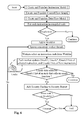
- FIG. 6 is a flowchart comprising the analytical steps of the algorithm required for the detection of software vulnerabilities according to the current invention.
- FIG. 7 is a diagram depicting a typical basic block or straight-line code sequence as utilized by an additional set of embodiments that employ precomputation and caching to improve performance.
- FIG. 8 shows how the additional set of embodiments of FIG. 7 arrive at a data flow mapping.
- FIG. 9 is a variation of FIG. 5 depicting the use of data flow mapping obtained in FIG. 8 .
- Vulnerabilities detection system 100 comprises computer program 102 in the form of its compiled code 104 and optionally source code 106 that resulted in its compiled code 104 .
- Computer program 102 is the target program to be analyzed by system 100 for software vulnerabilities. Having source code 106 is desirable but not required by software vulnerabilities detection system 100 according to the invention.
- Vulnerabilities detected by system 100 in computer program 102 may allow exploitative attacks by potential adversaries or hackers. Such attacks include, but are not limited to denial of service attacks, code injection attacks and 2 nd order attacks such as cross-site scripting (XSS) attacks.
- XSS cross-site scripting
- Software vulnerabilities detection system 100 comprises instruction model 110 , control flow graph 112 and data flow model 114 . Based on instruction model 110 , control flow graph 112 and data flow model 114 , software vulnerabilities detection system 100 performs analysis 116 to produce security report 118 comprising the security findings discovered during analysis 116 .
- compiled code 104 can be executable binary code, machine code, or object code that can run directly on a hardware platform such as x86, Sparc, Mac, HP, IBM Mainframe, etc. or it can be an intermediate bytecode or portable code that can run in a given runtime environment such as Java Virtual Machine (JVM).
- Source code 106 can be in any programing language such as C, C++, Java, Assembly, Cobol, SQL, etc.
- source code 106 can be in any 2 nd , 3 rd , 4 th or higher generation programming language without departing from the principles of the invention.
- a highly advantageous feature of the current invention is that source code 106 is desirable, but not required to achieve the objects of the invention. Not requiring the presence of source code 106 overcomes many practical limitations of the prior art.
- Instruction model 110 is a programming construct used by the invention to model each instruction of compiled code 104 .
- This programming construct comprises all the necessary and desirable attributes required by system 100 to model each instruction of compiled code 104 .
- attributes include the instruction location (e.g. base address and relative memory location of the instruction), debug information if available (e.g. variable name annotations and/or source code line annotations), type of the instruction (e.g. mov, add, sub), its operands (e.g. eax register, an integer immediate value, operand stack reference, local value reference) and its potential security attributes.
- FIG. 2 provides a conceptual representation of instruction model 110 using a familiar notation for data structures and member associations in computer programming.
- user input 108 may be provided by the operator or user of computer program 102 whose vulnerabilities are to be detected.
- user input 108 represents a potential security risk for computer program 102 as it may intentionally or otherwise, violate the bounds of a program variable which may affect the integrity of computer program 102 or the data it is operating on.
- user input 108 represents ‘taint’ or unsafe data, as will be understood by skilled people of the art.
- User input 108 can be provided in many different ways, for example, via a web form and keyboard, a file, an input/output buffer or stream, a pipe, screen redirect, etc.
- Compiled code 104 is preferably instrumented at random and critical control flow points of the program.
- instrumentation may refer to code instructions and metadata augmented to the computer program that allow monitoring of its behavior, performance and operation more closely than during normal execution, and may generate additional logging and debug output to the screen or files as desired.
- computer program 102 is preferably instrumented at random points within the program. Instead of or in addition to that, the program is also preferably instrumented at points where there is a critical control flow transition in the program.
- instrumentation may be provided in computer program 102 .
- instructions in compiled code 104 can be randomly selected for instrumentation.
- a pre-processor can be used to determine the critical control flow points in program 102 prior to its execution, and then instrumentation can be added at those points in program 102 . Indeed, it is allowed by the invention to instrument entire or none of computer program 102 , without departing from the principles of the invention.
- the instrumentation of program 102 allows observing and modification of unsafe data as it flows through program 102 according to the invention.
- Control flow graph 112 for each instruction that complements instruction model 110 of that instruction.
- Control flow graph 110 for a given instruction of compiled code 104 is populated with all potential control flow paths of that instruction, assuming there is no overwriting of the underlying instructions.
- Control flow graph 112 for a given instruction also contains a bidirectional list of its predecessor instructions.
- FIG. 3 represents control flow graph 112 for an instruction I according to the teachings of the invention. In FIG. 3 , each instruction is represented by a circle. Instruction I has 4 predecessor instructions P and 3 successor instructions S representing all possible control flow paths for I as shown in the figure. All P instructions will be contained in a bidirectional list in control flow graph 112 for instruction I as represented by the dashed lines in FIG. 3 .
- the invention further comprises data flow model 114 .
- data flow model 114 During the execution of program 102 , the movement of unsafe data is recorded in data flow model 114 . As a consequence of successive instructions, when unsafe data moves from one variable, processor register, stack value or pointer reference, to another such data location, this movement is recorded in data flow model 114 according to the teachings of the invention.
- FIG. 4 represents an example data flow model 114 populated according to the teachings of the invention.
- variable V 1 contains unsafe data that may have been previously supplied by user input 108 as taught earlier (see FIG. 1 ).
- Tainted data V 1 is then moved to processor register AX in the next instruction of one control flow path, and then copied to variable V 2 .
- the subsequent instruction then calls an unsafe function on variable V 2 representing a potential security risk in the computer program.
- FIG. 4 also illustrates additional control flow paths in data flow model 114 where the unsafe function call is performed on the tainted data contained in variable V 2 .
- data flow model 114 only records the flow of unsafe data during the execution of the program, as opposed to attempting to include and record all potential data flows. This significantly reduces the performance overhead and memory requirements of software vulnerabilities detection system 100 , allowing it to analyze large target software systems more comprehensively than possible through the teachings of prior art. This also allows the current invention to not require decompilation of compiled code, as required by some prior art teachings.
- instruction model 110 further includes placeholders for additional attributes or deduced attributes that may not be immediately known at the time of the initial creation of instruction model 110 .
- additional attributes may include pointer aliases. Pointer aliases represent pointers that point to or contain same memory address for multiple control flow paths of computer program 102 .
- instruction model 110 for a given instruction I may include information related to its predecessor instructions P as represented in FIG. 3 , and any additional information or metadata as deemed necessary to facilitate recording of the flow of unsafe data as represented in FIG. 4 .
- instruction model 110 may also include information deduced from other attributes. Examples of such derived attributes include memory locations or addresses, processor registers and variable type information for the given instruction based on its type, debug information and bytecode metadata.
- analysis 116 in FIG. 1 may be performed by an analyzer module.
- Analyzer module may be a part of system 100 or may be external to it. If it is external to system 100 , appropriate remote invocation calls or function calls or remote procedure calls (RPC) may be implemented to call the external module, as will be obvious to those skilled in the art. Indeed it is possible that the analyzer module is a 3 rd party software with its own application programming interface (API), without departing from the principles of the invention.
- analysis 116 is performed by worker threads that are spawned specifically for that purpose. These worker threads may then be distributed across a cluster of computing nodes, processors or cores, in a multi-CPU or multi-core, parallel processing environment.
- security report 118 of FIG. 1 allows security report 118 of FIG. 1 to include an execution trace of unsafe data corresponding to each security finding populated in the report.
- the execution trace may contain the origin and termination information for the unsafe data that ultimately caused the security finding to be triggered. For example, if unsafe data was provided as a user input in function or instruction I 1 and it traversed through several intervening functions or instructions I 2 . . . I 9 before being discarded or reset in instruction I 10 , then execution trace for the corresponding security finding in security report 118 may contain the entire lifecycle or trace of that data along with the names of functions or instructions I 1 . . . I 10 .
- security report 118 may contain a human friendly description of the security finding, and a risk rating or risk factor assigned to the security finding by system 100 . Depending on the severity of the vulnerability associated with each finding, vulnerabilities detection system 100 may assign a risk rating from 1 to 10, or as a percentage, or use some other suitable rating system. Security report 118 may also contain one or more recommendations on how to address the security finding, or provide a ‘fix’ for the problem. Such recommendations and risk assignments may be based on a knowledgebase (not shown) derived from subject matter expertise in detecting and correcting such software vulnerabilities.
- the methods of the invention describe the steps required to operate software vulnerabilities detection system 100 of FIG. 1 .
- computer program 102 is executed at least once and the flow of unsafe data through the program is first recorded in a data flow file 140 as shown in
- data flow model 114 is populated.
- the format of data flow file 140 can be any suitable file format, such as XML, plain text, any other markup format, or a binary (or compiled) format, without departing from the principles of the invention.
- Unsafe 1 Unsafe 2
- Unsafe 3 are created for each instruction.
- these lists can be linked lists, arrays or any other appropriate data structures of computer software without departing from the principles of the invention.
- Compiled code 104 is scanned to find each instruction where an external input is supplied to the program, denoting unknown, unsafe or ‘taint’ data. If that instruction calls an unsafe function on the unsafe data, that instruction is added to another list, Worklist.
- Worklist can be a linked list, an array or any other suitable data structure.
- List Worklist 160 , Unsafe 1 list 180 , Unsafe 2 list 184 and Unsafe 3 list 186 are shown in FIG. 5 along with the other elements of the invention as taught earlier.
- Unsafe 1 list 180 is populated with incoming unsafe data at that instruction, Unsafe 2 list 182 with unsafe data currently being processed by that instruction, and Unsafe 3 list 184 with unsafe data that has been fully processed by that instruction.
- Unsafe 1 list 180 As the worker threads process the instructions of compiled code 104 , the contents of Unsafe 1 list 180 , Unsafe 2 list 182 , Unsafe 3 list 184 for each instruction are updated based on control flow graph 112 of that instruction as data flows from its Unsafe 1 list 180 to Unsafe 2 list 182 to Unsafe 3 list 184 and into Unsafe 1 list 180 of the successor instruction.
- FIG. 6 shows the above algorithm in a flowchart format where an unsafe instruction denotes an instruction that calls an unsafe function on unsafe data as explained above, and the label instr is used to abbreviate the term instruction.
- concurrency locks 190 , 192 , 194 are provided for each of Unsafe 1 list 180 , Unsafe 2 list 182 and Unsafe 3 list 184 respectively, and at each step of the above processing, these locks are used to ensure the integrity of the contents of these lists. When a list is no longer being used, its concurrency lock is released (unlocked). Those skilled in the art will understand how the contents of Unsafe 1 list 180 , Unsafe 2 list 182 and Unsafe 3 list 184 will be updated as explained above.
- a worker thread selects an instruction to process from Worklist 160 , it locks its Unsafe 2 list 182 and Unsafe 3 list 184 , and also temporarily locks its Unsafe 1 list 180 while it imports data from its Unsafe 1 list 180 to Unsafe 2 list 182 .
- the worker thread then statically analyzes the currently selected instruction to determine from its incoming unsafe data in Unsafe 1 list, currently processed data in Unsafe 2 list and fully processed data in Unsafe 3 list, what other instructions that unsafe data may propagate to. This determination is based on the attributes of the current instruction as contained in its instruction model 110 , and any other custom unsafe data propagation rules pre-defined or provided by the user.
- custom unsafe data propagation rules include specifying that a function or method, e.g.
- execSqlStatement(String query) should never receive unsafe or “taint” user input in its first and only parameter.
- a rule could be expressed as an XML file defining regular expressions to identify the specific class and method for this call, along with a numeric value identifying that the first parameter should never be tainted or uncontrolled, along with security information defining the security impact of such a condition.
- Another example would be a rule which identifies that the subString(Integer from) call will propagate the value of its object instance to its return value, which could be similarly expressed in an xml file, and identifying the return value.
- custom rules include source rules, which define the insertion of uncontrolled or tainted data into a program and cleanse rules which define methods that are known to control data such that the data can afterwards be considered safe in one or more ways.
- the current worker thread aggregates all possible control flow destinations of the current instruction in a list Next Instructions (not shown). Subsequently, for each instruction in Next_Instructions list, the current worker thread locks its Unsafe 1 list and adds outgoing processed unsafe data contained in its Unsafe 3 list 184 , to the incoming unsafe data contained in Unsafe 1 list 180 of the instruction selected from Next_Instructions list. As explained above, if unsafe data is added to Unsafe 1 list of an instruction that calls an unsafe function, a security finding 200 is added to security report 118 and that instruction is re-added to Worklist 160 . The above process continues until there are no more instructions left to process in Worklist 160 or a timeout period has elapsed.
- worker threads are distributed across a multi-core or multi-CPU or multi-machine or multi-node processing environment to improve the performance of the analysis and to allow processing of very large target software programs.
- the traversal of the control flow graph by the worker threads is performed according to custom unsafe data propagation rules provided by the user.
- the security findings are created by an analyzer module. Conveniently, the security findings as discovered, may be added to a list e.g. FindingsList, which may be post-processed to generate security report 118 .
- security report 118 as shown in FIG. 5 contains a full execution trace of unsafe data corresponding to each security finding 200 populated in security report 118 .
- the execution trace may contain the origin and termination information for the unsafe data that ultimately caused security finding 200 to be triggered.
- unsafe data was provided as a user input in function or instruction I 1 and it traversed through several intervening functions or instructions I 2 . . . I 9 before being discarded or reset in instruction I 10 .
- execution trace for corresponding security finding 200 in security report 118 may contain the entire lifecycle or trace of that data along with the names/labels of instructions I 1 . . . I 10 and filename(s) and corresponding line numbers in the source files from source code 106 if available, or obtained from debug information or assembly instructions.
- each source file corresponding to the above trace is parsed into an abstract syntax tree or trees, and the line numbers and offsets for non-keyword identifier tokens is generated.
- these non-keyword identifier tokens will represent user or custom variables, as opposed to keywords belonging to the grammar of the programming language itself.
- security report 118 of FIG. 5 may be properly formatted to be visually appealing with proper highlighting of important pieces of information for each security finding 200 , and contain a human friendly description of the finding along with a risk rating or risk factor assigned to the finding by system 100 .
- vulnerabilities detection system 100 may assign a risk rating from 1 to 10, or as a percentage, or use some other suitable rating system.
- Security report 118 may also contain one or more recommendations on how to address security finding 200 , or ‘fix’ the problem.
- recommendations and risk assignments may be based on a knowledgebase (not shown) derived from subject matter expertise in detecting and correcting such software vulnerabilities.
- the knowledgebase may be further designed to continuously augment its content either automatically or with human assistance or by a combination of both automatic and manual means, as vulnerabilities detection system 100 operates over time.
- software vulnerabilities detection system and the associated methods employ several techniques to improve the performance of the system.
- These embodiments of the instant invention precompute and cache the results of the analysis of a basic block or a set of basic blocks.
- a basic block in computer software is a straight-line code sequence with no branches in except at the entry and no branches out except at the exit of the basic block. Such a straight-line piece of code makes it highly attractive for software analysis since only one path sequence of code needs to be considered. Compilers routinely break down complex code into its constituent set of basic blocks to perform their code analysis.
- the present invention precomputes and saves/caches the flow of data at the beginning of the basic block, also referred to as data flow input, and at the end of the basic block, also referred to as data flow output. Then during the normal operation of performing analysis of the whole code, this cached data flow is reused for each instruction that is a member of the precomputed basic block. This results in significant performance improvements during the operation of the system. We will now look at the workings of these advantageous embodiments in detail.
- FIG. 7 illustrating a basic block or a straight-line piece of code 300 .
- Basic block 300 of FIG. 7 starts at instruction I 1 and ends at instruction I 6 , while progressing through intervening sequential instructions I 2 , I 3 , I 4 and I 5 .
- FIG. 7 further shows the actual exemplary software commands corresponding to instructions I 1 . . . I 6 .
- instruction I 1 is a move instruction
- instruction I 2 is a copy instruction, and so on.
- the operands for these instructions will be introduced in reference to the rest of this explanation shortly.
- FIG. 7 are identified upfront. From our earlier teachings we see that instructions I 1 through I 5 each have only one control flow path because they all have a single successor instruction. This is a direct result of the definition of a basic block. Of course, instruction I 6 however, may have one or more control flow paths because it is the ending instruction of basic block 300 .
- control flow paths for each instruction in the basic block are statically iterated over. In other words, each instruction of the basic block is traversed without actually executing the code.
- the present invention stores the instructions of the basic blocks identified, in an array or arrays of instructions. This facilitates the iteration process during the precomputation phase being taught.
- the purpose of the above iteration of basic block instructions is to identify all data storage locations or simply data locations that are referenced by any instruction of the basic block. These data locations may include a processor register, a local variable, a data location referenced by a pointer or an address (also referred to as a pointer reference), and/or an entry or data value on the stack (also referred to as stack value).
- the data flow for each such location is tracked until the end of the basic block. All these data flows are then saved in a 1-to-many mapping since a beginning data location can have one or more ending data locations. Note that for convenience we will still call this mapping a 1-to-many map/mapping even though it is not necessary for there to be more than one ending data location for each beginning data location, in which case this mapping may actually contain 1-to-1 entries.
- each data location as identified above its data value is tracked as the instructions of the basic block are traversed.
- the ending data location for each beginning data location is saved.
- Each such beginning data location represents a data flow input into the basic block, and at each ending data location corresponding to a beginning data location represents a data flow output out of the basic block.
- This 1-to-many correspondence of each beginning data location of a data value and its ending data location(s) are saved in a precomputed map or mapping.
- FIG. 8 illustrates the above described process as an exemplary precomputation phase 302 of the instant invention.
- basic block 300 of FIG. 7 is represented by the dashed lines and instruction nodes I 1 . . . I 6 .
- Basic block 300 is used to precompute the 1-to-many data flow mapping described above.
- data values referenced by basic block 300 at various data locations Li are tracked as basic block 300 is traversed.
- move instruction I 1 moves the data value stored in variable V 1 at data location L 1 to processor register AX identified as data location L 2 .
- Copy instruction I 2 copies the contents of register AX identified by data location L 2 to variable V 2 identified as data location L 3 . From here onwards, we will denote a data value V at a data location L by its short form L:V. For instance, Copy instruction I 2 above copies L 2 :AX to variable L 3 :V 2 .
- add instruction I 3 adds L 4 :S 1 to L 3 :V 2 (and stores the result in L 3 :V 2 ), where S 1 represents a data value stored on the stack.
- add instruction I 4 adds L 5 :CX to L 1 :V 1 (and stores the results in L 1 :V 1 ), where CX is a processor register.
- Move instruction I 5 moves L 5 :CX to L 6 :DX where DX is a register.
- subtract instruction I 6 subtracts the contents of variable V 1 identified by data location L 1 from the data value stored at pointer reference P 1 and stores the results at pointer reference P 1 identified by location L 7 .
- beginning data location L 1 has three ending data locations, L 3 (representing variable V 2 ), L 6 (representing register DX) and L 7 (representing the data location identified by pointer reference P 1 ). These ending data locations are illustrated by oval (terminator) shapes in the diagram of FIG. 8 .
- Beginning data location L 2 (representing register AX) has one ending data location L 3 (representing variable V 2 ).
- beginning data location L 4 has one ending data location L 3
- beginning data location L 5 has one ending data location L 6 .
- the mapping obtained above is a 1-to-many mapping for location L 1
- 1-to-1 mappings for locations L 2 . . . L 5 are presented in Table 1 below.
- any beginning data location Lj will also trivially be its own ending data location Lj.
- the data flow model is populated by fetching the corresponding beginning and ending data location entries from the precomputed and cached 1 -to-many data flow map explained above.
- instruction I 1 is an unsafe instruction.
- the present invention would determine instruction I 1 to be a member/part of basic block 300 .
- Instruction I 1 could be unsafe because variable V 1 referenced by I 1 is a tainted variable, because it was inputted by a user via a web form. Recall from earlier teachings that such an input may be a tainted input because of the vulnerabilities that can be introduced as a result of such a web form/query.
- any unsafe instruction deemed to be a member of those basic blocks can immediately benefit from the corresponding 1-to-many data flow map(s) to determine where its tainted data ends up. This avoids an exhaustive iteration of the block instruction by instruction. Any time during the subsequent operation of the system, if an unsafe instruction is encountered that is a member of a basic block whose data flow map has been precomputed, an instruction by instruction tracking of the referenced data values of that instruction till the end of the basic block can be avoided.
- FIG. 9 is a variation of FIG. 5 showing a block diagram view of the elements and their workings according to the present embodiments, with the inclusion of the precomputed/cached data flow map 103 taught above.
Landscapes
- Engineering & Computer Science (AREA)
- Theoretical Computer Science (AREA)
- General Engineering & Computer Science (AREA)
- Computer Hardware Design (AREA)
- Computer Security & Cryptography (AREA)
- Software Systems (AREA)
- General Physics & Mathematics (AREA)
- Physics & Mathematics (AREA)
- Quality & Reliability (AREA)
- Health & Medical Sciences (AREA)
- General Health & Medical Sciences (AREA)
- Virology (AREA)
- Computing Systems (AREA)
- Debugging And Monitoring (AREA)
Abstract
Description
- This invention is a Continuation-in-part of U.S. patent application Ser. No. 14/460,636 filed on 15 Aug., 2014. The above numbered application is incorporated herein in its entirety.
- This invention was made with government support under the CyberFastTrack program documented in DARPA PA-11-53 dated Jan. 31, 2013, awarded by Defense Advanced Research Projects Agency (DARPA).
- This invention relates generally to ensuring software security and in particular to exposing software vulnerabilities by performing static and dynamic analysis of compiled software.
- Software security and vulnerability checking is an active field of academic and industrial pursuit. With the news of exploitation of software vulnerabilities by hackers a commonplace occurrence, it is unsurprising to see many academic and professional institutions focusing their efforts to develop tools and practices that aim to make software more secure against exploitative attacks from global hackers and adversaries.
- There are many ways of detecting and addressing vulnerabilities in software in the prior art. U.S. Pat. No. 8,499,353 discloses security assessment and vulnerability testing of software applications based in part on application metadata in order to determine an appropriate assurance level and associated test plan that includes multiple types of analysis. Steps from each test are combined into a “custom” or “application-specific” workflow, and the results of each test then correlated with other results to identify potential vulnerabilities.
- U.S. Pat. No. 8,365,155 describes a software analysis framework utilizing a decompilation method and system for parsing executable code, identifying and recursively modeling data flows, identifying and recursively modeling control flow and iteratively refining these models to provide a complete model at the nanocode level. The nanocode decompiler may be used to determine flaws, security vulnerabilities, or general quality issues that may exist in the code.
- U.S. Pat. No. 8,739,280 describes a context-sensitive taint analysis system. Taint processing applied to a tainted value of an application is identified and an output context of the application associated with output of the tainted value is determined. It is determined whether the taint processing is effective in mitigating a security vulnerability caused by the tainted value for the output context.
- U.S. Pat. No. 8,347,392 describes an apparatus and method for analyzing and supplementing a program to provide security. A computer readable storage medium has executable instructions to perform an automated analysis of program instructions. The automated analysis includes at least two analyses selected from an automated analysis of injection vulnerabilities, an automated analysis of potential repetitive attacks, an automated analysis of sensitive information, and automated analysis of specific HTTP attributes. Protective instructions are inserted into the program instructions. The protective instructions are utilized to detect and respond to attacks during execution of the program instructions.
- Non-Patent reference, “Dynamic Taint Analysis for Automatic Detection, Analysis” by James Newsome and Dawn Song of Carnegie Mellon University, proposes a dynamic taint analysis solution for automatic detection of overwrite attacks. The approach does not need source code or special compilation for the monitored program, and hence works on commodity software. To demonstrate this idea, they implemented TaintCheck, a mechanism that can perform dynamic taint analysis by performing binary rewriting at run time.
- Non-Patent reference, “gFuzz: An instrumented web application fuzzing environment” by Ezequiel D. Gutesman of Core Security Technologies, Argentina, introduces a fuzzing solution for PHP web applications that improves the detection accuracy and enriches the information provided in vulnerability reports. They use dynamic character-grained taint analysis and grammar-based analysis in order to analyze the anatomy of each executed SQL query and determine which resulted in successful attacks. A vulnerability report is then accompanied by the offending lines of source code and the fuzz vector (with attacker-controlled characters individualized).
- One shortcoming of prior art teachings is that they suffer from poor accuracy while also at times requiring source code for analysis as opposed to just bytecode/assembly code, or they attempt to simplify the bytecode/assembly code before analysis. Other prior art work teaches running both dynamic and static analysis components in an independent or serial fashion. Furthermore earlier approaches attempt to exhaustively map all data flows in a decompiled or intermediate representation of a software system which impairs performance and slows the overall process. Relatedly, prior art teachings do not provide for advantages afforded by concurrent multi-core or multi-CPU processing infrastructure that is commonplace these days, to allow for distributed analysis of very large target software systems with high precision. Similarly, prior art teachings suffer from poor performance by not proper utilizing the benefits of precomputation and caching of the analysis of basic blocks of code.
- In view of the shortcomings of the prior art, it is an object of the present invention to provide for high-precision, high- performance software analysis system and methods that do not require the source code of the analyzed program.
- It is another object of the invention to not require an exhaustive processing of all data flows in a program but rather than the ones that include unsafe data.
- It is another object of the invention to not rely on decompliation of executable binary code.
- It is yet another object of the invention to allow for distributed processing of the analysis framework taught by the invention by taking advantage of a multi-CPU or multi-core processing environment, consequently allowing for analysis of very large target software systems with efficiency and high precision.
- Still other objects and advantages of the invention will become apparent upon reading the detailed description in conjunction with the drawing figures.
- The objects and advantages of the invention are secured by a system and methods of detecting software vulnerabilities in a computer program by analyzing the compiled code of that computer program. The invention optionally uses the source code of the computer program in conjunction with the compiled code, but having the source code is not a requirement of the invention. The invention teaches utilizing an instruction model for each instruction of the compiled code. The instruction model for a given instruction includes the instruction location, debug information, instruction type, operands, existing memory state requirements, bytecode metadata, potential security attributes, basic block membership and function/method membership if applicable of that instruction.
- The invention further uses a control flow graph for each instruction that complements the instruction model of that instruction, and includes all potential control flow paths, and a bidirectional list of predecessor instructions of that instruction. Preferably, the compiled code is instrumented at random and critical points in the code. There is a data flow model to record the flow of unsafe data during the execution of the program. The system has the means to analyze the data flow model and to create a security finding corresponding to each instruction that calls an unsafe function on unsafe data. These security findings are aggregated in a security report along with the corresponding debug information and the optional source code information for each instruction that triggered the security finding.
- In the preferred embodiment of the invention, the instruction model also includes placeholders for additional attributes. These additional attributes may include information for pointer aliases or unsafe data flow. The pointer alias information may include an aliasing map containing pointers that have the same address values given a subset of or all possible control flows of the instructions of the compiled code.
- In another embodiment, the instruction model also contains attributes that are deduced from other attributes of the instruction model. These derived attributes may include values for memory locations, processor registers and variable types associated with the given instruction of the instruction model. In another preferred embodiment, the flow of unsafe data is recorded in a data flow file that utilizes a common file format such as XML, based on which the data flow model is at least partially populated. In an advantageous embodiment of the invention, an analyzer module is used to analyze the instruction model, control flow graph and the data flow model to detect software vulnerabilities in the compiled code.
- In a highly advantageous embodiment of the invention, a set of concurrent worker threads are spawned that take advantage of a multi-core or multi-node or multi-machine or multi-CPU processing platform, to analyze instructions where an unknown or unsafe external input (or taint) data is provided to the program and an unsafe function or method is called upon it. In another preferred embodiment of the system, the security findings in the security report also contain a full trace of the unsafe data at the instruction that triggered the security finding, along with the line numbers of the source file if available, a human-readable description of the finding, a risk rating and optionally one or more recommendations to address the security finding.
- The methods of the invention further teach the steps required to carry out the operation of the system. The invention teaches the steps required to detect software vulnerabilities of a computer program by taking as input the compiled code of the program, and optionally its source code. It then creates an instruction model and a control flow graph for each instruction in the compiled code. If further creates a data flow model to record the flow of unsafe data during the execution of the compiled code. The compiled code is instrumented at random and critical control flow points of the program.
- For a given instruction, the instruction model includes the instruction location, debug information, instruction type, operands, existing memory state requirements, bytecode metadata, potential security attributes, basic block membership, function/method membership if applicable and class membership of the given instruction. The instruction model also includes placeholders for additional attributes, including pointer aliasing information, unsafe data flow information and attributes that are deduced from other attributes including values of memory locations, values of processor registers and variable types for the given instruction.
- For each instruction, the control flow graph is populated with all potential control flow paths, and a bidirectional list of predecessor instructions. Finally, for each instruction, the data flow model is populated by running the compiled code with the instrumentation at least once and recording the flow of unsafe data for each run. In another preferred embodiment, this recording of unsafe data flow is first done in a data flow file in a common file format such as XML, and the population of the data flow model is based on the data flow file.
- The compiled code is scanned according to the methods provided by the invention to find each instruction where an external input is supplied to the program, denoting unknown, unsafe data. If that instruction calls an unsafe function on the unsafe data, this triggers the creation of a security finding. As the analysis is performed, all security findings are aggregated in a security report.
- In the preferred embodiment, each security finding in the security report includes the debug information for the instruction that triggered the finding, along with the line numbers of the source code if available, a trace of the unsafe data from its origin to termination, identifier values of any processor registers or variables containing the unsafe data, a description of the security finding, a risk rating, and optionally one or more recommendations to address/remedy the security finding. Appropriate highlighting of these elements in the security report is also performed to make the report visually presentable, readable and easy to consume.
- In another advantageous embodiment, three lists are created for each instruction. These lists are Unsafe1, Unsafe2 and Unsafe3. All instructions that are determined to be unsafe i.e. they use unsafe data by calling an unsafe function, are added to a list called Worklist. A set of concurrent worker threads are spawned, each thread selecting and processing an instruction at random from Worklist. Based on the control flow graph and data flow model earlier created, for each instruction in Worklist, Unsafe1 list is populated with incoming unsafe data at that instruction, Unsafe2 list with unsafe data currently being processed by that instruction, and Unsafe3 list with unsafe data that has been fully processed by that instruction.
- As the worker threads process the instructions, the contents of the three lists for each instruction are updated based on the control flow graph of that instruction as data flows from its Unsafe1 list to Unsafe2 list to Unsafe3 list and into the Unsafe1 list of the downstream instruction. If new unsafe data is added to the Unsafe1 list of an instruction that calls an unsafe function, it is re-added to the Worklist and a security finding is generated, and the above process is repeated. Ultimately, the spawning of worker threads is concluded when there are no more unsafe instructions left in Worklist, or a predetermined timeout period has elapsed during the above processing. Concurrency locks are provided for each of the three lists, Unsafe1, Unsafe2 and Unsafe3 above, and at each step of the above processing, these locks are used to ensure the integrity of the contents of these lists. When a list is no longer being used, its concurrency lock is released (unlocked).
- In a highly advantageous embodiment, worker threads are distributed across a multi-core or multi-processor or multi-CPU processing environment to improve the performance of the analysis and to allow processing of very large target software programs. In a similarly advantageous embodiment, the traversal of the control flow graph by the worker threads is performed according to custom unsafe data propagation rules provided by the user. In another advantageous embodiment the security findings are created by an analyzer module.
- Several ways for enhancing the performance of the system have also been provided by the invention. In a highly preferred set of embodiments, a precomputation or preprocessing phase is performed first. In the precomputation phase, all basic blocks in the code are identified. A basic block is a straight-line code sequence with no branches.
- For each control flow path of the basic block, the data locations referenced by the instructions are identified. The data locations can include a local variable, a register value, a stack value, or a pointer reference. These data locations are tracked as the basic block is traversed through to its end-point. Then a 1-to-many data flow map is created that includes each beginning data location encountered in the basic block, and its corresponding one or more ending data locations at the end of the basic block. These data flow inputs and outputs are recorded and cached in a data flow map.
- Subsequently, during normal operation when data flow model is being populated, if any unsafe instruction is determined to be a member of a basic block, then the data flow map is simply consulted to see where the data locations referenced by the unsafe instruction may end up during the execution of the basic block. This way, the basic block does not need to be traversed instruction by instruction. Then any time, during the analysis of the subsequent code, if an instruction is determined to be a part of the basic block, an exhaustive iteration/execution of the basic block is avoided. These techniques result in significant performance improvements for the system.
- Clearly, the system and methods of the invention find many advantageous embodiments. The details of the invention, including its preferred embodiments, are presented in the below detailed description with reference to the appended drawing figures.
- BRIEF DESCRIPTION OF THE DRAWING FIGURES
-
FIG. 1 is a block diagram view of the software vulnerabilities detection system according to the current invention. -
FIG. 2 is a conceptual diagram of the instruction model according to the current invention. -
FIG. 3 is a diagram of the control flow graph of an instruction according to the invention. -
FIG. 4 is a conceptual diagram of the data flow model of an instruction according to the invention. -
FIG. 5 is a detailed block diagram view of the elements and their workings according to the current invention. -
FIG. 6 is a flowchart comprising the analytical steps of the algorithm required for the detection of software vulnerabilities according to the current invention. -
FIG. 7 is a diagram depicting a typical basic block or straight-line code sequence as utilized by an additional set of embodiments that employ precomputation and caching to improve performance. -
FIG. 8 shows how the additional set of embodiments ofFIG. 7 arrive at a data flow mapping. -
FIG. 9 is a variation ofFIG. 5 depicting the use of data flow mapping obtained inFIG. 8 . - The figures and the following description relate to preferred embodiments of the present invention by way of illustration only. It should be noted that from the following discussion, alternative embodiments of the structures and methods disclosed herein will be readily recognized as viable alternatives that may be employed without departing from the principles of the claimed invention.
- Reference will now be made in detail to several embodiments of the present invention(s), examples of which are illustrated in the accompanying figures. It is noted that wherever practicable, similar or like reference numbers may be used in the figures and may indicate similar or like functionality. The figures depict embodiments of the present invention for purposes of illustration only. One skilled in the art will readily recognize from the following description that alternative embodiments of the structures and methods illustrated herein may be employed without departing from the principles of the invention described herein.
- The present invention will be best understood by first reviewing the software
vulnerabilities detection system 100 according to the current invention as illustrated inFIG. 1 .Vulnerabilities detection system 100 comprisescomputer program 102 in the form of its compiledcode 104 andoptionally source code 106 that resulted in its compiledcode 104.Computer program 102 is the target program to be analyzed bysystem 100 for software vulnerabilities. Havingsource code 106 is desirable but not required by softwarevulnerabilities detection system 100 according to the invention. Vulnerabilities detected bysystem 100 incomputer program 102 may allow exploitative attacks by potential adversaries or hackers. Such attacks include, but are not limited to denial of service attacks, code injection attacks and 2nd order attacks such as cross-site scripting (XSS) attacks. - Software
vulnerabilities detection system 100 comprisesinstruction model 110,control flow graph 112 anddata flow model 114. Based oninstruction model 110,control flow graph 112 anddata flow model 114, softwarevulnerabilities detection system 100 performsanalysis 116 to producesecurity report 118 comprising the security findings discovered duringanalysis 116. - Readers with average skill in the art will understand that compiled
code 104 can be executable binary code, machine code, or object code that can run directly on a hardware platform such as x86, Sparc, Mac, HP, IBM Mainframe, etc. or it can be an intermediate bytecode or portable code that can run in a given runtime environment such as Java Virtual Machine (JVM).Source code 106 can be in any programing language such as C, C++, Java, Assembly, Cobol, SQL, etc. Furthermore,source code 106 can be in any 2nd, 3rd, 4th or higher generation programming language without departing from the principles of the invention. A highly advantageous feature of the current invention is thatsource code 106 is desirable, but not required to achieve the objects of the invention. Not requiring the presence ofsource code 106 overcomes many practical limitations of the prior art. -
Instruction model 110 is a programming construct used by the invention to model each instruction of compiledcode 104. This programming construct comprises all the necessary and desirable attributes required bysystem 100 to model each instruction of compiledcode 104. These attributes include the instruction location (e.g. base address and relative memory location of the instruction), debug information if available (e.g. variable name annotations and/or source code line annotations), type of the instruction (e.g. mov, add, sub), its operands (e.g. eax register, an integer immediate value, operand stack reference, local value reference) and its potential security attributes. - These attributes further include existing memory state requirements of the instruction (e.g. basic block derived invariant conditions), basic block membership (e.g. start and end references for all basic blocks encompassing an instruction), function/method membership (e.g. what functions/methods the instruction belongs to) and/or class membership (e.g. which object classes the instruction belongs to), if applicable. Those with average skill in the art will find these attributes familiar from the fundamentals of software engineering and computer programming.
FIG. 2 provides a conceptual representation ofinstruction model 110 using a familiar notation for data structures and member associations in computer programming. - Referring to
FIG. 1 , during the execution of compiledcode 104,user input 108 may be provided by the operator or user ofcomputer program 102 whose vulnerabilities are to be detected. Those familiar with the art will understand thatuser input 108 represents a potential security risk forcomputer program 102 as it may intentionally or otherwise, violate the bounds of a program variable which may affect the integrity ofcomputer program 102 or the data it is operating on. Thususer input 108 represents ‘taint’ or unsafe data, as will be understood by skilled people of the art.User input 108 can be provided in many different ways, for example, via a web form and keyboard, a file, an input/output buffer or stream, a pipe, screen redirect, etc. - Compiled
code 104 according to the invention is preferably instrumented at random and critical control flow points of the program. Those familiar with the art will understand that instrumentation may refer to code instructions and metadata augmented to the computer program that allow monitoring of its behavior, performance and operation more closely than during normal execution, and may generate additional logging and debug output to the screen or files as desired. As provided by the invention,computer program 102 is preferably instrumented at random points within the program. Instead of or in addition to that, the program is also preferably instrumented at points where there is a critical control flow transition in the program. - Those familiar with the art will understand that there are many ways to determine these points where instrumentation may be provided in
computer program 102. In a preferred embodiment, instructions in compiledcode 104 can be randomly selected for instrumentation. Alternatively or in addition, a pre-processor can be used to determine the critical control flow points inprogram 102 prior to its execution, and then instrumentation can be added at those points inprogram 102. Indeed, it is allowed by the invention to instrument entire or none ofcomputer program 102, without departing from the principles of the invention. The instrumentation ofprogram 102 allows observing and modification of unsafe data as it flows throughprogram 102 according to the invention. - The invention further uses
control flow graph 112 for each instruction that complementsinstruction model 110 of that instruction.Control flow graph 110 for a given instruction of compiledcode 104 is populated with all potential control flow paths of that instruction, assuming there is no overwriting of the underlying instructions.Control flow graph 112 for a given instruction also contains a bidirectional list of its predecessor instructions.FIG. 3 representscontrol flow graph 112 for an instruction I according to the teachings of the invention. InFIG. 3 , each instruction is represented by a circle. Instruction I has 4 predecessor instructions P and 3 successor instructions S representing all possible control flow paths for I as shown in the figure. All P instructions will be contained in a bidirectional list incontrol flow graph 112 for instruction I as represented by the dashed lines inFIG. 3 . - Referring back to
FIG. 1 , the invention further comprisesdata flow model 114. During the execution ofprogram 102, the movement of unsafe data is recorded indata flow model 114. As a consequence of successive instructions, when unsafe data moves from one variable, processor register, stack value or pointer reference, to another such data location, this movement is recorded indata flow model 114 according to the teachings of the invention.FIG. 4 represents an exampledata flow model 114 populated according to the teachings of the invention. - In
FIG. 4 , variable V1 contains unsafe data that may have been previously supplied byuser input 108 as taught earlier (seeFIG. 1 ). Tainted data V1 is then moved to processor register AX in the next instruction of one control flow path, and then copied to variable V2. The subsequent instruction then calls an unsafe function on variable V2 representing a potential security risk in the computer program.FIG. 4 also illustrates additional control flow paths indata flow model 114 where the unsafe function call is performed on the tainted data contained in variable V2. Those familiar with the art will know the various types of unsafe function calls that may result in a potential security flaw in the code that can be exploited by an adversary. For example, in C/C++ “char*strcpy(char*dest, const char*src)” function on tainted data is an unsafe function call, because it can allow a security condition called buffer overflow to happen and damage the integrity ofcomputer program 102 ofFIG. 1 , or its data, or worse allow a malicious adversary to inject harmful code or virus into the computer program. - According to the teachings of the current invention as explained above,
data flow model 114 only records the flow of unsafe data during the execution of the program, as opposed to attempting to include and record all potential data flows. This significantly reduces the performance overhead and memory requirements of softwarevulnerabilities detection system 100, allowing it to analyze large target software systems more comprehensively than possible through the teachings of prior art. This also allows the current invention to not require decompilation of compiled code, as required by some prior art teachings. - According to the main embodiment of the invention, based on
instruction model 110,control flow graph 112 anddata flow model 114, all instructions incomputer program 102 that call an unsafe function on unsafe data, trigger a security finding which is recorded insecurity report 118 as represented inFIG. 1 . Each such security finding contains debug information of the instruction that triggered the security finding, along with its source code information, if available.Security report 118 exposes the vulnerabilities incomputer program 102 that can be appropriately remediated to prevent exploitative attacks by amateur and professional adversaries according to the teachings of the invention. - As represented in
FIG. 2 ,instruction model 110 further includes placeholders for additional attributes or deduced attributes that may not be immediately known at the time of the initial creation ofinstruction model 110. These additional attributes may include pointer aliases. Pointer aliases represent pointers that point to or contain same memory address for multiple control flow paths ofcomputer program 102. In addition,instruction model 110 for a given instruction I may include information related to its predecessor instructions P as represented inFIG. 3 , and any additional information or metadata as deemed necessary to facilitate recording of the flow of unsafe data as represented inFIG. 4 . Furthermore,instruction model 110 may also include information deduced from other attributes. Examples of such derived attributes include memory locations or addresses, processor registers and variable type information for the given instruction based on its type, debug information and bytecode metadata. - According to an additional embodiment of the invention,
analysis 116 inFIG. 1 may be performed by an analyzer module. Analyzer module may be a part ofsystem 100 or may be external to it. If it is external tosystem 100, appropriate remote invocation calls or function calls or remote procedure calls (RPC) may be implemented to call the external module, as will be obvious to those skilled in the art. Indeed it is possible that the analyzer module is a 3rd party software with its own application programming interface (API), without departing from the principles of the invention. Similarly, in a highly advantageous embodiment,analysis 116 is performed by worker threads that are spawned specifically for that purpose. These worker threads may then be distributed across a cluster of computing nodes, processors or cores, in a multi-CPU or multi-core, parallel processing environment. - Further embodiments allow
security report 118 ofFIG. 1 to include an execution trace of unsafe data corresponding to each security finding populated in the report. The execution trace may contain the origin and termination information for the unsafe data that ultimately caused the security finding to be triggered. For example, if unsafe data was provided as a user input in function or instruction I1 and it traversed through several intervening functions or instructions I2 . . . I9 before being discarded or reset in instruction I10, then execution trace for the corresponding security finding insecurity report 118 may contain the entire lifecycle or trace of that data along with the names of functions or instructions I1 . . . I10. In addition,security report 118 may contain a human friendly description of the security finding, and a risk rating or risk factor assigned to the security finding bysystem 100. Depending on the severity of the vulnerability associated with each finding,vulnerabilities detection system 100 may assign a risk rating from 1 to 10, or as a percentage, or use some other suitable rating system.Security report 118 may also contain one or more recommendations on how to address the security finding, or provide a ‘fix’ for the problem. Such recommendations and risk assignments may be based on a knowledgebase (not shown) derived from subject matter expertise in detecting and correcting such software vulnerabilities. - The methods of the invention describe the steps required to operate software
vulnerabilities detection system 100 ofFIG. 1 . In the preferred embodiment,computer program 102 is executed at least once and the flow of unsafe data through the program is first recorded in adata flow file 140 as shown in -
FIG. 4 . Based on the contents ofdata flow file 140,data flow model 114 is populated. The format ofdata flow file 140 can be any suitable file format, such as XML, plain text, any other markup format, or a binary (or compiled) format, without departing from the principles of the invention. - In a preferred embodiment, three lists, Unsafe1, Unsafe2, Unsafe3 are created for each instruction. Persons with average skill in the art will understand that these lists can be linked lists, arrays or any other appropriate data structures of computer software without departing from the principles of the invention. Compiled
code 104 is scanned to find each instruction where an external input is supplied to the program, denoting unknown, unsafe or ‘taint’ data. If that instruction calls an unsafe function on the unsafe data, that instruction is added to another list, Worklist. Persons skilled in the art will again understand that Worklist can be a linked list, an array or any other suitable data structure.List Worklist 160,Unsafe1 list 180,Unsafe2 list 184 and Unsafe3 list 186 are shown inFIG. 5 along with the other elements of the invention as taught earlier. - Next, a set of concurrent worker threads are spawned, each thread selecting and processing an instruction at random from
Worklist 160 ofFIG. 5 . Based oninstruction model 110,control flow graph 112 anddata flow model 114, for each instruction inWorklist 160,Unsafe1 list 180 is populated with incoming unsafe data at that instruction,Unsafe2 list 182 with unsafe data currently being processed by that instruction, andUnsafe3 list 184 with unsafe data that has been fully processed by that instruction. As the worker threads process the instructions of compiledcode 104, the contents ofUnsafe1 list 180,Unsafe2 list 182,Unsafe3 list 184 for each instruction are updated based oncontrol flow graph 112 of that instruction as data flows from itsUnsafe1 list 180 toUnsafe2 list 182 toUnsafe3 list 184 and intoUnsafe1 list 180 of the successor instruction. - If new unsafe data is added to
Unsafe1 list 180 of an instruction that calls an unsafe function, a new security finding 200 is created and added tosecurity report 118 as represented inFIG. 5 , and that instruction is re-added toWorklist 160, and the above process is repeated. Ultimately, the spawning of worker threads is concluded when there are no more unsafe instructions left inWorklist 160, or a predetermined timeout period has elapsed during the above processing.FIG. 6 shows the above algorithm in a flowchart format where an unsafe instruction denotes an instruction that calls an unsafe function on unsafe data as explained above, and the label instr is used to abbreviate the term instruction. - Referring to
FIG. 5 ,concurrency locks Unsafe1 list 180,Unsafe2 list 182 andUnsafe3 list 184 respectively, and at each step of the above processing, these locks are used to ensure the integrity of the contents of these lists. When a list is no longer being used, its concurrency lock is released (unlocked). Those skilled in the art will understand how the contents ofUnsafe1 list 180,Unsafe2 list 182 andUnsafe3 list 184 will be updated as explained above. Further explained, when a worker thread selects an instruction to process fromWorklist 160, it locks itsUnsafe2 list 182 andUnsafe3 list 184, and also temporarily locks itsUnsafe1 list 180 while it imports data from itsUnsafe1 list 180 toUnsafe2 list 182. The worker thread then statically analyzes the currently selected instruction to determine from its incoming unsafe data in Unsafe1 list, currently processed data in Unsafe2 list and fully processed data in Unsafe3 list, what other instructions that unsafe data may propagate to. This determination is based on the attributes of the current instruction as contained in itsinstruction model 110, and any other custom unsafe data propagation rules pre-defined or provided by the user. - Examples of custom unsafe data propagation rules include specifying that a function or method, e.g.
- execSqlStatement(String query), should never receive unsafe or “taint” user input in its first and only parameter. Such a rule could be expressed as an XML file defining regular expressions to identify the specific class and method for this call, along with a numeric value identifying that the first parameter should never be tainted or uncontrolled, along with security information defining the security impact of such a condition. Another example would be a rule which identifies that the subString(Integer from) call will propagate the value of its object instance to its return value, which could be similarly expressed in an xml file, and identifying the return value. Still other examples of custom rules include source rules, which define the insertion of uncontrolled or tainted data into a program and cleanse rules which define methods that are known to control data such that the data can afterwards be considered safe in one or more ways.
- Referring back to
FIG. 5 and preceding teachings, based oncontrol flow graph 112 of the current instruction, the current worker thread aggregates all possible control flow destinations of the current instruction in a list Next Instructions (not shown). Subsequently, for each instruction in Next_Instructions list, the current worker thread locks its Unsafe1 list and adds outgoing processed unsafe data contained in itsUnsafe3 list 184, to the incoming unsafe data contained inUnsafe1 list 180 of the instruction selected from Next_Instructions list. As explained above, if unsafe data is added to Unsafe1 list of an instruction that calls an unsafe function, a security finding 200 is added tosecurity report 118 and that instruction is re-added toWorklist 160. The above process continues until there are no more instructions left to process inWorklist 160 or a timeout period has elapsed. - In a highly advantageous embodiment, worker threads are distributed across a multi-core or multi-CPU or multi-machine or multi-node processing environment to improve the performance of the analysis and to allow processing of very large target software programs. In a similarly advantageous embodiment, the traversal of the control flow graph by the worker threads is performed according to custom unsafe data propagation rules provided by the user. In another advantageous embodiment the security findings are created by an analyzer module. Conveniently, the security findings as discovered, may be added to a list e.g. FindingsList, which may be post-processed to generate
security report 118. - In another advantageous embodiment,
security report 118 as shown inFIG. 5 contains a full execution trace of unsafe data corresponding to each security finding 200 populated insecurity report 118. The execution trace may contain the origin and termination information for the unsafe data that ultimately caused security finding 200 to be triggered. As an example, consider that unsafe data was provided as a user input in function or instruction I1 and it traversed through several intervening functions or instructions I2 . . . I9 before being discarded or reset in instruction I10. Then execution trace for corresponding security finding 200 insecurity report 118 may contain the entire lifecycle or trace of that data along with the names/labels of instructions I1 . . . I10 and filename(s) and corresponding line numbers in the source files fromsource code 106 if available, or obtained from debug information or assembly instructions. - If
source code 106 is available, each source file corresponding to the above trace is parsed into an abstract syntax tree or trees, and the line numbers and offsets for non-keyword identifier tokens is generated. Persons skilled in the art will understand that these non-keyword identifier tokens will represent user or custom variables, as opposed to keywords belonging to the grammar of the programming language itself. Using the abstract syntax tree or trees above, corresponding to each instruction in the trace, the identifier names and values of any variables or processor registers that contained the unsafe data is obtained using the debug information, and then added to the trace information. - In addition,
security report 118 ofFIG. 5 may be properly formatted to be visually appealing with proper highlighting of important pieces of information for each security finding 200, and contain a human friendly description of the finding along with a risk rating or risk factor assigned to the finding bysystem 100. Depending on the severity of the vulnerability associated with each security finding 200,vulnerabilities detection system 100 may assign a risk rating from 1 to 10, or as a percentage, or use some other suitable rating system. -
Security report 118 may also contain one or more recommendations on how to address security finding 200, or ‘fix’ the problem. Such recommendations and risk assignments may be based on a knowledgebase (not shown) derived from subject matter expertise in detecting and correcting such software vulnerabilities. The knowledgebase may be further designed to continuously augment its content either automatically or with human assistance or by a combination of both automatic and manual means, asvulnerabilities detection system 100 operates over time. - In a related set of embodiments, software vulnerabilities detection system and the associated methods employ several techniques to improve the performance of the system. These embodiments of the instant invention precompute and cache the results of the analysis of a basic block or a set of basic blocks. Those skilled in the art will understand that a basic block in computer software is a straight-line code sequence with no branches in except at the entry and no branches out except at the exit of the basic block. Such a straight-line piece of code makes it highly attractive for software analysis since only one path sequence of code needs to be considered. Compilers routinely break down complex code into its constituent set of basic blocks to perform their code analysis.
- For each basic block, the present invention precomputes and saves/caches the flow of data at the beginning of the basic block, also referred to as data flow input, and at the end of the basic block, also referred to as data flow output. Then during the normal operation of performing analysis of the whole code, this cached data flow is reused for each instruction that is a member of the precomputed basic block. This results in significant performance improvements during the operation of the system. We will now look at the workings of these advantageous embodiments in detail.
- Let us consider
FIG. 7 illustrating a basic block or a straight-line piece ofcode 300.Basic block 300 ofFIG. 7 starts at instruction I1 and ends at instruction I6, while progressing through intervening sequential instructions I2, I3, I4 and I5.FIG. 7 further shows the actual exemplary software commands corresponding to instructions I1 . . . I6. Specifically, instruction I1 is a move instruction, instruction I2 is a copy instruction, and so on. The operands for these instructions will be introduced in reference to the rest of this explanation shortly. - The reader will note that the specific instructions in
basic block 300 ofFIG. 7 are reminiscent of assembly/assembler code however that is not a requirement imposed by the present invention, whose teachings apply equally to machine code, as well as higher level programming languages such a 3rd generation (3GL) or 4th generation programming languages (4GL). - As a part of the precomputation and caching phase for significantly improving the performance of the system according to the present embodiments, basic blocks such as 300 shown in
-
FIG. 7 are identified upfront. From our earlier teachings we see that instructions I1 through I5 each have only one control flow path because they all have a single successor instruction. This is a direct result of the definition of a basic block. Of course, instruction I6 however, may have one or more control flow paths because it is the ending instruction ofbasic block 300. - After the identification of basic blocks as a part of the precomputation phase, control flow paths for each instruction in the basic block are statically iterated over. In other words, each instruction of the basic block is traversed without actually executing the code. Conveniently, the present invention stores the instructions of the basic blocks identified, in an array or arrays of instructions. This facilitates the iteration process during the precomputation phase being taught.
- The purpose of the above iteration of basic block instructions is to identify all data storage locations or simply data locations that are referenced by any instruction of the basic block. These data locations may include a processor register, a local variable, a data location referenced by a pointer or an address (also referred to as a pointer reference), and/or an entry or data value on the stack (also referred to as stack value). As the basic block is iterated over, the data flow for each such location is tracked until the end of the basic block. All these data flows are then saved in a 1-to-many mapping since a beginning data location can have one or more ending data locations. Note that for convenience we will still call this mapping a 1-to-many map/mapping even though it is not necessary for there to be more than one ending data location for each beginning data location, in which case this mapping may actually contain 1-to-1 entries.
- Thus for each data location as identified above, its data value is tracked as the instructions of the basic block are traversed. At the end of the basic block, the ending data location for each beginning data location is saved. Each such beginning data location represents a data flow input into the basic block, and at each ending data location corresponding to a beginning data location represents a data flow output out of the basic block. This 1-to-many correspondence of each beginning data location of a data value and its ending data location(s) are saved in a precomputed map or mapping.
-
FIG. 8 illustrates the above described process as anexemplary precomputation phase 302 of the instant invention. InFIG. 8 ,basic block 300 ofFIG. 7 is represented by the dashed lines and instruction nodes I1 . . . I6.Basic block 300 is used to precompute the 1-to-many data flow mapping described above. In other words, inFIG. 8 , data values referenced bybasic block 300 at various data locations Li are tracked asbasic block 300 is traversed. Specifically, move instruction I1 moves the data value stored in variable V1 at data location L1 to processor register AX identified as data location L2. Copy instruction I2 copies the contents of register AX identified by data location L2 to variable V2 identified as data location L3. From here onwards, we will denote a data value V at a data location L by its short form L:V. For instance, Copy instruction I2 above copies L2:AX to variable L3:V2. - Similarly, add instruction I3 adds L4:S1 to L3:V2 (and stores the result in L3:V2), where S1 represents a data value stored on the stack. Then add instruction I4 adds L5:CX to L1:V1 (and stores the results in L1:V1), where CX is a processor register. Move instruction I5 moves L5:CX to L6:DX where DX is a register. Finally, subtract instruction I6 subtracts the contents of variable V1 identified by data location L1 from the data value stored at pointer reference P1 and stores the results at pointer reference P1 identified by location L7.
- Now let us analyze what has been accomplished above. As
basic block 300 is iterated over instruction by instruction, each data value identified by data location Li is tracked until the point wherebasic block 300 ends at instruction I6. Specifically, beginning data location L1 has three ending data locations, L3 (representing variable V2), L6 (representing register DX) and L7 (representing the data location identified by pointer reference P1). These ending data locations are illustrated by oval (terminator) shapes in the diagram ofFIG. 8 . - Beginning data location L2 (representing register AX) has one ending data location L3 (representing variable V2). Similarly, beginning data location L4 has one ending data location L3, and beginning data location L5 has one ending data location L6. Note that the mapping obtained above is a 1-to-many mapping for location L1, and 1-to-1 mappings for locations L2 . . . L5. However we will still call such a data flow mapping as a 1-to-many data flow map/mapping as already noted above. The 1-to-many data flow map for
basic block 300 obtained above, is presented in Table 1 below. Note that any beginning data location Lj will also trivially be its own ending data location Lj. These reflexive entries are eliminated from Table 1 for clarity. -
TABLE 1 Beginning Location Ending Location L1 L3 L1 L6 L1 L7 L2 L3 L4 L3 L5 L6 - Once the data flow map as exemplified in Table 1, is obtained for each basic block as a part of preprocessing or
precomputation phase 302 ofFIG. 8 , the present embodiments of the instant invention are ready to perform their normal operation as provided by earlier teachings. The major difference afforded by the present embodiments occurs during the population of data flow model 114 (seeFIG. 1 andFIG. 4 and the associated explanation) when the target program is being executed. Specifically, if an unsafe instruction is determined to be a part of a basic block for which a data flow map has been precomputed, then instead of dynamically executing each instruction of that basic block, the data flow model is populated by fetching the corresponding beginning and ending data location entries from the precomputed and cached 1-to-many data flow map explained above. - Explained further, let us reconsider above example of
FIG. 8 and assume that instruction I1 is an unsafe instruction. During the process of populating the data flow model of the compiled code, the present invention would determine instruction I1 to be a member/part ofbasic block 300. Instruction I1 could be unsafe because variable V1 referenced by I1 is a tainted variable, because it was inputted by a user via a web form. Recall from earlier teachings that such an input may be a tainted input because of the vulnerabilities that can be introduced as a result of such a web form/query. - Now in the present embodiments, instead of determining all the data flows, instruction by instruction, for variable V1 identified by location L1, the system would simply lookup Table and determine that the possible ending locations for L1:V1 are L3:V2, L6:DX and L7:*P1. This information can be directly fetched into the data flow model of the code being analyzed, without having to traverse the
entire block 300 and tracking all data locations L1 . . . L7. This is true each time unsafe instruction I1 is called from anywhere in the code. Similarly, for each instruction I2 . . . I6 the same applies, i.e. if any of those instructions are deemed unsafe, Table 1 can instantaneously provide ending locations where tainted data may end up. - The above techniques of precomputing and caching provide significant performance improvements in the instant invention, since any compiled code can by decomposed into its constituent basic blocks. Once the precomputation and caching phase has been performed, any unsafe instruction deemed to be a member of those basic blocks can immediately benefit from the corresponding 1-to-many data flow map(s) to determine where its tainted data ends up. This avoids an exhaustive iteration of the block instruction by instruction. Any time during the subsequent operation of the system, if an unsafe instruction is encountered that is a member of a basic block whose data flow map has been precomputed, an instruction by instruction tracking of the referenced data values of that instruction till the end of the basic block can be avoided.
- The remainder teachings of the earlier embodiments, including Worklist, Unsafe1, Unsafe2 and Unsafe3 lists, the use concurrency locks in the management of these lists, security findings and security report, recommendations and knowledgebase, as well as spawning concurrent threads to process members of Worklist, etc. still apply in the present embodiments. The difference of course is the precomputation and caching phase that speeds the performance of the subsequent operation of the system as explained above. Thusly,
FIG. 9 is a variation ofFIG. 5 showing a block diagram view of the elements and their workings according to the present embodiments, with the inclusion of the precomputed/cacheddata flow map 103 taught above. - In view of the above teaching, a person skilled in the art will recognize that the apparatus and method of invention can be embodied in many different ways in addition to those described without departing from the principles of the invention. Therefore, the scope of the invention should be judged in view of the appended claims and their legal equivalents.
Claims (20)
Priority Applications (2)
| Application Number | Priority Date | Filing Date | Title |
|---|---|---|---|
| US15/014,309 US9824214B2 (en) | 2014-08-15 | 2016-02-03 | High performance software vulnerabilities detection system and methods |
| US15/057,294 US10599852B2 (en) | 2014-08-15 | 2016-03-01 | High performance software vulnerabilities detection system and methods |
Applications Claiming Priority (2)
| Application Number | Priority Date | Filing Date | Title |
|---|---|---|---|
| US14/460,636 US9454659B1 (en) | 2014-08-15 | 2014-08-15 | Software vulnerabilities detection system and methods |
| US15/014,309 US9824214B2 (en) | 2014-08-15 | 2016-02-03 | High performance software vulnerabilities detection system and methods |
Related Parent Applications (1)
| Application Number | Title | Priority Date | Filing Date |
|---|---|---|---|
| US14/460,636 Continuation-In-Part US9454659B1 (en) | 2014-08-15 | 2014-08-15 | Software vulnerabilities detection system and methods |
Related Child Applications (1)
| Application Number | Title | Priority Date | Filing Date |
|---|---|---|---|
| US15/057,294 Continuation-In-Part US10599852B2 (en) | 2014-08-15 | 2016-03-01 | High performance software vulnerabilities detection system and methods |
Publications (2)
| Publication Number | Publication Date |
|---|---|
| US20170017789A1 true US20170017789A1 (en) | 2017-01-19 |
| US9824214B2 US9824214B2 (en) | 2017-11-21 |
Family
ID=57775097
Family Applications (1)
| Application Number | Title | Priority Date | Filing Date |
|---|---|---|---|
| US15/014,309 Active 2035-01-17 US9824214B2 (en) | 2014-08-15 | 2016-02-03 | High performance software vulnerabilities detection system and methods |
Country Status (1)
| Country | Link |
|---|---|
| US (1) | US9824214B2 (en) |
Cited By (24)
| Publication number | Priority date | Publication date | Assignee | Title |
|---|---|---|---|---|
| US20180121657A1 (en) * | 2016-11-01 | 2018-05-03 | International Business Machines Corporation | Security risk evaluation |
| US20180349612A1 (en) * | 2017-06-05 | 2018-12-06 | Karamba Security | In-memory protection for controller security |
| US20190020685A1 (en) * | 2017-07-17 | 2019-01-17 | General Electric Company | Apparatus and method for analysis of binary targets to generate security policy |
| US10354064B2 (en) * | 2014-06-20 | 2019-07-16 | Secure-Ic Sas | Computer implemented method and a system for controlling dynamically the execution of a code |
| US10581905B2 (en) * | 2014-04-11 | 2020-03-03 | Hdiv Security, S.L. | Detection of manipulation of applications |
| CN111902816A (en) * | 2018-03-20 | 2020-11-06 | 北京嘀嘀无限科技发展有限公司 | Malicious program detection |
| CN112183712A (en) * | 2019-07-03 | 2021-01-05 | 安徽寒武纪信息科技有限公司 | Compiling method, device and related products of deep learning algorithm |
| US11023574B2 (en) | 2017-06-05 | 2021-06-01 | Karamba Security Ltd. | In-memory protection for controller security |
| CN113176990A (en) * | 2021-03-25 | 2021-07-27 | 中国人民解放军战略支援部队信息工程大学 | Taint analysis framework and method supporting correlation analysis among data |
| US20210271751A1 (en) * | 2018-06-26 | 2021-09-02 | Nokia Technologies Oy | Method and apparatus for attestation |
| CN113760700A (en) * | 2020-08-06 | 2021-12-07 | 北京京东振世信息技术有限公司 | Program endless loop detection method, device, electronic equipment and storage medium |
| CN114500043A (en) * | 2022-01-25 | 2022-05-13 | 山东省计算中心(国家超级计算济南中心) | Internet of things firmware vulnerability detection method and system based on homology analysis |
| CN114510723A (en) * | 2022-02-18 | 2022-05-17 | 北京大学 | Intelligent contract authority management vulnerability detection method and device |
| US11429725B1 (en) * | 2018-04-26 | 2022-08-30 | Citicorp Credit Services, Inc. (Usa) | Automated security risk assessment systems and methods |
| US20230031997A1 (en) * | 2021-07-29 | 2023-02-02 | Kyndryl, Inc. | Intelligent logging and automated code documentation |
| CN115712902A (en) * | 2022-11-28 | 2023-02-24 | 国网山东省电力公司信息通信公司 | Executable file-oriented off-by-one vulnerability detection method and system |
| CN115952230A (en) * | 2022-10-14 | 2023-04-11 | 中南大学 | A Visualization Method of Dynamic Function Call |
| US20240028742A1 (en) * | 2022-07-22 | 2024-01-25 | Cisco Technology, Inc. | Learned control flow monitoring and enforcement of unobserved transitions |
| US20240104206A1 (en) * | 2021-08-26 | 2024-03-28 | SecuLetter Co.,Ltd. | Method and apparatus for detecting maliciousness of non-portable executable file by changing executing flow of application program |
| US11989296B2 (en) | 2022-10-13 | 2024-05-21 | Cybersentry.Ai, Inc. | Program execution anomaly detection for cybersecurity |
| US20240179176A1 (en) * | 2022-11-24 | 2024-05-30 | Tsinghua University | Method and system for analyzing interaction security of tcp/ip layered network model, and storage medium |
| CN118426872A (en) * | 2024-05-27 | 2024-08-02 | 中国科学技术大学 | A cross-platform tensor program performance prediction method |
| CN120234811A (en) * | 2025-05-29 | 2025-07-01 | 北京智游网安科技有限公司 | A mobile application component vulnerability analysis method and analysis device |
| US12634327B2 (en) * | 2022-11-24 | 2026-05-19 | Tsinghua University | Method and system for analyzing interaction security of TCP/IP layered network model, and storage medium |
Families Citing this family (2)
| Publication number | Priority date | Publication date | Assignee | Title |
|---|---|---|---|---|
| US11687440B2 (en) * | 2021-02-02 | 2023-06-27 | Thales Dis Cpl Usa, Inc. | Method and device of protecting a first software application to generate a protected software application |
| US12086269B2 (en) | 2022-03-21 | 2024-09-10 | Bank Of America Corporation | System for deployable software vulnerability testing platform |
Citations (6)
| Publication number | Priority date | Publication date | Assignee | Title |
|---|---|---|---|---|
| US8381192B1 (en) * | 2007-08-03 | 2013-02-19 | Google Inc. | Software testing using taint analysis and execution path alteration |
| US8397300B2 (en) * | 2009-09-22 | 2013-03-12 | International Business Machines Corporation | Detecting security vulnerabilities relating to cryptographically-sensitive information carriers when testing computer software |
| US20130239087A1 (en) * | 2011-02-07 | 2013-09-12 | International Business Machines Corporation | Distributed, non-intrusive code review in a development environment |
| US20140359776A1 (en) * | 2013-05-29 | 2014-12-04 | Lucent Sky Corporation | Method, system, and computer program product for automatically mitigating vulnerabilities in source code |
| US20150074803A1 (en) * | 2007-02-23 | 2015-03-12 | Irdeto Canada Corportation | System and method of interlocking to protect software-mediated program and device behaviours |
| US20150319187A1 (en) * | 2014-04-30 | 2015-11-05 | Institute For Information Industry | Method, electronic device, and user interface for on-demand detecting malware |
Family Cites Families (102)
| Publication number | Priority date | Publication date | Assignee | Title |
|---|---|---|---|---|
| US5210837A (en) | 1990-06-15 | 1993-05-11 | Digital Equipment Corporation | Methods and apparatus for transforming machine language program control into high-level language constructs by manipulating graphical program representations |
| US5790858A (en) | 1994-06-30 | 1998-08-04 | Microsoft Corporation | Method and system for selecting instrumentation points in a computer program |
| US5586328A (en) | 1994-10-21 | 1996-12-17 | Microsoft Corporation | Module dependency based incremental compiler and method |
| US5671419A (en) | 1995-06-15 | 1997-09-23 | International Business Machines Corporation | Interprocedural data-flow analysis that supports recursion while only performing one flow-sensitive analysis of each procedure |
| US5787287A (en) | 1995-12-27 | 1998-07-28 | Intel Corporation | Representation of control flow and data dependence for machine |
| US6226789B1 (en) | 1996-01-29 | 2001-05-01 | Compaq Computer Corporation | Method and apparatus for data flow analysis |
| US5854924A (en) | 1996-08-08 | 1998-12-29 | Globetrotter Software, Inc. | Static debugging tool and method |
| US5872949A (en) | 1996-11-13 | 1999-02-16 | International Business Machines Corp. | Apparatus and method for managing data flow dependencies arising from out-of-order execution, by an execution unit, of an instruction series input from an instruction source |
| EP0918281A1 (en) | 1997-03-29 | 1999-05-26 | IMEC vzw | Method and apparatus for size optimisation of storage units |
| EP1071991A4 (en) | 1997-12-11 | 2002-03-13 | Digits Corp | Object code analysis and remediation system and method |
| US6389587B1 (en) | 1999-02-04 | 2002-05-14 | Sun Microsystems, Inc. | User interface for developing and executing data flow programs and methods, apparatus, and articles of manufacture for optimizing the execution of data flow programs |
| US7430670B1 (en) | 1999-07-29 | 2008-09-30 | Intertrust Technologies Corp. | Software self-defense systems and methods |
| US6892303B2 (en) | 2000-01-06 | 2005-05-10 | International Business Machines Corporation | Method and system for caching virus-free file certificates |
| US6883101B1 (en) | 2000-02-08 | 2005-04-19 | Harris Corporation | System and method for assessing the security posture of a network using goal oriented fuzzy logic decision rules |
| US6829710B1 (en) | 2000-03-14 | 2004-12-07 | Microsoft Corporation | Technique for producing, through watermarking, highly tamper-resistant executable code and resulting “watermarked” code so formed |
| US7577834B1 (en) | 2000-05-09 | 2009-08-18 | Sun Microsystems, Inc. | Message authentication using message gates in a distributed computing environment |
| AU2001263064A1 (en) | 2000-05-09 | 2001-11-20 | Sun Microsystems, Inc. | Transformation of objects between a computer programming language and a data representation language |
| US6981279B1 (en) | 2000-08-17 | 2005-12-27 | International Business Machines Corporation | Method and apparatus for replicating and analyzing worm programs |
| US7284274B1 (en) | 2001-01-18 | 2007-10-16 | Cigital, Inc. | System and method for identifying and eliminating vulnerabilities in computer software applications |
| US7076804B2 (en) | 2001-05-11 | 2006-07-11 | International Business Machines Corporation | Automated program resource identification and association |
| US6546493B1 (en) | 2001-11-30 | 2003-04-08 | Networks Associates Technology, Inc. | System, method and computer program product for risk assessment scanning based on detected anomalous events |
| CA2372034A1 (en) | 2002-02-14 | 2003-08-14 | Cloakware Corporation | Foiling buffer-overflow and alien-code attacks by encoding |
| US6941467B2 (en) | 2002-03-08 | 2005-09-06 | Ciphertrust, Inc. | Systems and methods for adaptive message interrogation through multiple queues |
| US7930753B2 (en) | 2002-07-01 | 2011-04-19 | First Data Corporation | Methods and systems for performing security risk assessments of internet merchant entities |
| GB0218680D0 (en) | 2002-08-10 | 2002-09-18 | Ibm | Method and system for modifying a class file to monitor data flow |
| US7051322B2 (en) | 2002-12-06 | 2006-05-23 | @Stake, Inc. | Software analysis framework |
| KR100503386B1 (en) | 2003-03-14 | 2005-07-26 | 주식회사 안철수연구소 | Method to detect malicious code patterns with due regard to control and data flow |
| AU2004232058B2 (en) | 2003-04-18 | 2010-05-27 | International Business Machines Corporation | Method and system for detecting vulnerabilities in source code |
| JP2006525592A (en) | 2003-05-01 | 2006-11-09 | サムスン エレクトロニクス カンパニー リミテッド | Authentication method and apparatus |
| US7383583B2 (en) | 2004-03-05 | 2008-06-03 | Microsoft Corporation | Static and run-time anti-disassembly and anti-debugging |
| US8584239B2 (en) | 2004-04-01 | 2013-11-12 | Fireeye, Inc. | Virtual machine with dynamic data flow analysis |
| US8171553B2 (en) | 2004-04-01 | 2012-05-01 | Fireeye, Inc. | Heuristic based capture with replay to virtual machine |
| US7207065B2 (en) | 2004-06-04 | 2007-04-17 | Fortify Software, Inc. | Apparatus and method for developing secure software |
| US7975306B2 (en) | 2004-06-04 | 2011-07-05 | Hewlett-Packard Development Company, L.P. | Apparatus and method for monitoring secure software |
| US20050273860A1 (en) | 2004-06-04 | 2005-12-08 | Brian Chess | Apparatus and method for developing, testing and monitoring secure software |
| US20050273859A1 (en) | 2004-06-04 | 2005-12-08 | Brian Chess | Apparatus and method for testing secure software |
| US20060090206A1 (en) | 2004-10-15 | 2006-04-27 | Ladner Michael V | Method, system and apparatus for assessing vulnerability in Web services |
| US8887287B2 (en) | 2004-10-27 | 2014-11-11 | Alcatel Lucent | Method and apparatus for software integrity protection using timed executable agents |
| US7840845B2 (en) | 2005-02-18 | 2010-11-23 | Intel Corporation | Method and system for setting a breakpoint |
| US7860842B2 (en) | 2005-03-16 | 2010-12-28 | Oracle International Corporation | Mechanism to detect and analyze SQL injection threats |
| US7735136B2 (en) | 2005-04-18 | 2010-06-08 | Vmware, Inc. | 0-touch and 1-touch techniques for improving the availability of computer programs under protection without compromising security |
| US8266700B2 (en) | 2005-05-16 | 2012-09-11 | Hewlett-Packard Development Company, L. P. | Secure web application development environment |
| US20070016894A1 (en) | 2005-07-15 | 2007-01-18 | Sreedhar Vugranam C | System and method for static analysis using fault paths |
| US8239939B2 (en) | 2005-07-15 | 2012-08-07 | Microsoft Corporation | Browser protection module |
| US8347392B2 (en) | 2005-08-25 | 2013-01-01 | Hewlett-Packard Development Company, L.P. | Apparatus and method for analyzing and supplementing a program to provide security |
| US7849509B2 (en) | 2005-10-07 | 2010-12-07 | Microsoft Corporation | Detection of security vulnerabilities in computer programs |
| US8528093B1 (en) | 2006-04-12 | 2013-09-03 | Hewlett-Packard Development Company, L.P. | Apparatus and method for performing dynamic security testing using static analysis data |
| US8510827B1 (en) | 2006-05-18 | 2013-08-13 | Vmware, Inc. | Taint tracking mechanism for computer security |
| EP1870829B1 (en) | 2006-06-23 | 2014-12-03 | Microsoft Corporation | Securing software by enforcing data flow integrity |
| US7971193B2 (en) | 2006-07-14 | 2011-06-28 | Hewlett-Packard Development Company, L.P. | Methods for performining cross module context-sensitive security analysis |
| US7526681B2 (en) | 2006-08-07 | 2009-04-28 | Sap Portals Israel Ltd. | Software testing framework |
| US7788235B1 (en) | 2006-09-29 | 2010-08-31 | Symantec Corporation | Extrusion detection using taint analysis |
| WO2008047351A2 (en) | 2006-10-19 | 2008-04-24 | Checkmarx Ltd. | Locating security vulnerabilities in source code |
| US8266702B2 (en) | 2006-10-31 | 2012-09-11 | Microsoft Corporation | Analyzing access control configurations |
| US8380841B2 (en) | 2006-12-07 | 2013-02-19 | Microsoft Corporation | Strategies for investigating and mitigating vulnerabilities caused by the acquisition of credentials |
| US7877812B2 (en) | 2007-01-04 | 2011-01-25 | International Business Machines Corporation | Method, system and computer program product for enforcing privacy policies |
| US8613080B2 (en) | 2007-02-16 | 2013-12-17 | Veracode, Inc. | Assessment and analysis of software security flaws in virtual machines |
| GB2459629A (en) | 2007-02-16 | 2009-11-04 | Veracode Inc | Assessment and analysis of software security flaws |
| US9069967B2 (en) | 2007-02-16 | 2015-06-30 | Veracode, Inc. | Assessment and analysis of software security flaws |
| CN100461132C (en) | 2007-03-02 | 2009-02-11 | 北京邮电大学 | Software security code analyzer and detection method based on source code static analysis |
| US7933946B2 (en) | 2007-06-22 | 2011-04-26 | Microsoft Corporation | Detecting data propagation in a distributed system |
| JP5176478B2 (en) | 2007-10-22 | 2013-04-03 | 富士通株式会社 | Data flow analysis device, data flow analysis method, and data flow analysis program |
| US7530107B1 (en) | 2007-12-19 | 2009-05-05 | International Business Machines Corporation | Systems, methods and computer program products for string analysis with security labels for vulnerability detection |
| US8321840B2 (en) | 2007-12-27 | 2012-11-27 | Intel Corporation | Software flow tracking using multiple threads |
| US8327339B2 (en) | 2008-06-30 | 2012-12-04 | Oracle America, Inc. | Method and system for fast static taint analysis |
| WO2010134325A1 (en) | 2009-05-20 | 2010-11-25 | 日本電気株式会社 | Dynamic data flow tracking method, dynamic data flow tracking program, dynamic data flow tracking device |
| US8423965B2 (en) | 2009-06-23 | 2013-04-16 | Microsoft Corporation | Tracing of data flow |
| US8584246B2 (en) | 2009-10-13 | 2013-11-12 | International Business Machines Corporation | Eliminating false reports of security vulnerabilities when testing computer software |
| US8407800B2 (en) | 2009-11-24 | 2013-03-26 | Honeywell International Inc. | Method for software vulnerability flow analysis, generation of vulnerability-covering code, and multi-generation of functionally-equivalent code |
| US8468605B2 (en) | 2009-11-30 | 2013-06-18 | International Business Machines Corporation | Identifying security vulnerability in computer software |
| US8402547B2 (en) | 2010-03-14 | 2013-03-19 | Virtual Forge GmbH | Apparatus and method for detecting, prioritizing and fixing security defects and compliance violations in SAP® ABAP™ code |
| US20110231317A1 (en) | 2010-03-19 | 2011-09-22 | Wihem Arsac | Security sensitive data flow analysis |
| US8458798B2 (en) | 2010-03-19 | 2013-06-04 | Aspect Security Inc. | Detection of vulnerabilities in computer systems |
| US8528095B2 (en) | 2010-06-28 | 2013-09-03 | International Business Machines Corporation | Injection context based static analysis of computer software applications |
| US8381242B2 (en) | 2010-07-20 | 2013-02-19 | International Business Machines Corporation | Static analysis for verification of software program access to secure resources for computer systems |
| US8701198B2 (en) | 2010-08-10 | 2014-04-15 | Salesforce.Com, Inc. | Performing security analysis on a software application |
| JP5844809B2 (en) | 2010-08-24 | 2016-01-20 | チェックマークス リミテッド | Source code mining for programming rule violations |
| US8434070B2 (en) | 2010-10-26 | 2013-04-30 | International Business Machines Corporation | Generating specifications of client-server applications for static analysis |
| US8667584B2 (en) | 2010-12-15 | 2014-03-04 | International Business Machines Corporation | Formal analysis of the quality and conformance of information flow downgraders |
| US8856764B2 (en) | 2011-01-25 | 2014-10-07 | International Business Machines Corporation | Distributed static analysis of computer software applications |
| US8850405B2 (en) | 2011-02-23 | 2014-09-30 | International Business Machines Corporation | Generating sound and minimal security reports based on static analysis of a program |
| US8627465B2 (en) | 2011-04-18 | 2014-01-07 | International Business Machines Corporation | Automatic inference of whitelist-based validation as part of static analysis for security |
| US8539466B2 (en) | 2011-05-23 | 2013-09-17 | International Business Machines Corporation | Determining suitable insertion points for string sanitizers in a computer code |
| US8516443B2 (en) | 2011-05-26 | 2013-08-20 | Oracle International Corporation | Context-sensitive analysis framework using value flows |
| US8949992B2 (en) | 2011-05-31 | 2015-02-03 | International Business Machines Corporation | Detecting persistent vulnerabilities in web applications |
| US9032528B2 (en) | 2011-06-28 | 2015-05-12 | International Business Machines Corporation | Black-box testing of web applications with client-side code evaluation |
| US8893102B2 (en) | 2011-07-27 | 2014-11-18 | Oracle International Corporation | Method and system for performing backward-driven path-sensitive dataflow analysis |
| US8793665B2 (en) | 2011-08-26 | 2014-07-29 | Fujitsu Limited | Performing taint analysis for javascript software using a control flow graph |
| US8671397B2 (en) | 2011-09-27 | 2014-03-11 | International Business Machines Corporation | Selective data flow analysis of bounded regions of computer software applications |
| US8739280B2 (en) | 2011-09-29 | 2014-05-27 | Hewlett-Packard Development Company, L.P. | Context-sensitive taint analysis |
| US8756587B2 (en) | 2011-09-30 | 2014-06-17 | International Business Machines Corporation | Static analysis of computer software applications |
| US9971896B2 (en) | 2011-12-30 | 2018-05-15 | International Business Machines Corporation | Targeted security testing |
| US8806464B2 (en) | 2012-04-26 | 2014-08-12 | Hewlett-Packard Development Company, L.P. | Process flow optimized directed graph traversal |
| US8844046B2 (en) | 2012-09-26 | 2014-09-23 | International Business Machines Corporation | Method and apparatus for paralleling and distributing static source code security analysis using loose synchronization |
| US9740868B2 (en) | 2012-09-27 | 2017-08-22 | International Business Machines Corporation | Customizing a security report using static analysis |
| US8973131B2 (en) | 2012-11-02 | 2015-03-03 | International Business Machines Corporation | Refinement-based security analysis |
| US20140130153A1 (en) | 2012-11-08 | 2014-05-08 | International Business Machines Corporation | Sound and effective data-flow analysis in the presence of aliasing |
| US9690945B2 (en) | 2012-11-14 | 2017-06-27 | International Business Machines Corporation | Security analysis using relational abstraction of data structures |
| US9171169B2 (en) | 2012-12-14 | 2015-10-27 | Salesforce.Com, Inc. | System and method for dynamic analysis wrapper objects for application dataflow |
| US8869287B2 (en) | 2012-12-31 | 2014-10-21 | International Business Machines Corporation | Hybrid analysis of vulnerable information flows |
| US9405915B2 (en) | 2013-03-14 | 2016-08-02 | Whitehat Security, Inc. | Techniques for correlating vulnerabilities across an evolving codebase |
| US9569334B2 (en) | 2013-03-14 | 2017-02-14 | Whitehat Security, Inc. | Techniques for traversing representations of source code |
-
2016
- 2016-02-03 US US15/014,309 patent/US9824214B2/en active Active
Patent Citations (6)
| Publication number | Priority date | Publication date | Assignee | Title |
|---|---|---|---|---|
| US20150074803A1 (en) * | 2007-02-23 | 2015-03-12 | Irdeto Canada Corportation | System and method of interlocking to protect software-mediated program and device behaviours |
| US8381192B1 (en) * | 2007-08-03 | 2013-02-19 | Google Inc. | Software testing using taint analysis and execution path alteration |
| US8397300B2 (en) * | 2009-09-22 | 2013-03-12 | International Business Machines Corporation | Detecting security vulnerabilities relating to cryptographically-sensitive information carriers when testing computer software |
| US20130239087A1 (en) * | 2011-02-07 | 2013-09-12 | International Business Machines Corporation | Distributed, non-intrusive code review in a development environment |
| US20140359776A1 (en) * | 2013-05-29 | 2014-12-04 | Lucent Sky Corporation | Method, system, and computer program product for automatically mitigating vulnerabilities in source code |
| US20150319187A1 (en) * | 2014-04-30 | 2015-11-05 | Institute For Information Industry | Method, electronic device, and user interface for on-demand detecting malware |
Cited By (38)
| Publication number | Priority date | Publication date | Assignee | Title |
|---|---|---|---|---|
| US10581905B2 (en) * | 2014-04-11 | 2020-03-03 | Hdiv Security, S.L. | Detection of manipulation of applications |
| US10354064B2 (en) * | 2014-06-20 | 2019-07-16 | Secure-Ic Sas | Computer implemented method and a system for controlling dynamically the execution of a code |
| US20180121657A1 (en) * | 2016-11-01 | 2018-05-03 | International Business Machines Corporation | Security risk evaluation |
| US11023574B2 (en) | 2017-06-05 | 2021-06-01 | Karamba Security Ltd. | In-memory protection for controller security |
| WO2018224948A3 (en) * | 2017-06-05 | 2019-02-07 | Karamba Security | In-memory protection for controller security |
| US10878103B2 (en) * | 2017-06-05 | 2020-12-29 | Karamba Security Ltd. | In-memory protection for controller security |
| US11995177B2 (en) | 2017-06-05 | 2024-05-28 | Karamba Security Ltd. | In-memory protection for controller security |
| US20180349612A1 (en) * | 2017-06-05 | 2018-12-06 | Karamba Security | In-memory protection for controller security |
| US20190020685A1 (en) * | 2017-07-17 | 2019-01-17 | General Electric Company | Apparatus and method for analysis of binary targets to generate security policy |
| US10623444B2 (en) * | 2017-07-17 | 2020-04-14 | General Electric Company | Apparatus and method for analysis of binary targets to generate security policy |
| CN111902816A (en) * | 2018-03-20 | 2020-11-06 | 北京嘀嘀无限科技发展有限公司 | Malicious program detection |
| US11429725B1 (en) * | 2018-04-26 | 2022-08-30 | Citicorp Credit Services, Inc. (Usa) | Automated security risk assessment systems and methods |
| US20210271751A1 (en) * | 2018-06-26 | 2021-09-02 | Nokia Technologies Oy | Method and apparatus for attestation |
| US12332996B2 (en) * | 2018-06-26 | 2025-06-17 | Nokia Technologies Oy | Method and apparatus for attestation |
| US11860997B2 (en) * | 2018-06-26 | 2024-01-02 | Nokia Technologies Oy | Method and apparatus for attestation |
| CN112183712A (en) * | 2019-07-03 | 2021-01-05 | 安徽寒武纪信息科技有限公司 | Compiling method, device and related products of deep learning algorithm |
| CN113760700A (en) * | 2020-08-06 | 2021-12-07 | 北京京东振世信息技术有限公司 | Program endless loop detection method, device, electronic equipment and storage medium |
| CN113176990A (en) * | 2021-03-25 | 2021-07-27 | 中国人民解放军战略支援部队信息工程大学 | Taint analysis framework and method supporting correlation analysis among data |
| US20230031997A1 (en) * | 2021-07-29 | 2023-02-02 | Kyndryl, Inc. | Intelligent logging and automated code documentation |
| US11630661B2 (en) * | 2021-07-29 | 2023-04-18 | Kyndryl, Inc. | Intelligent logging and automated code documentation |
| US20240104206A1 (en) * | 2021-08-26 | 2024-03-28 | SecuLetter Co.,Ltd. | Method and apparatus for detecting maliciousness of non-portable executable file by changing executing flow of application program |
| CN114500043A (en) * | 2022-01-25 | 2022-05-13 | 山东省计算中心(国家超级计算济南中心) | Internet of things firmware vulnerability detection method and system based on homology analysis |
| CN114510723A (en) * | 2022-02-18 | 2022-05-17 | 北京大学 | Intelligent contract authority management vulnerability detection method and device |
| US12572656B2 (en) * | 2022-07-22 | 2026-03-10 | Cisco Technology, Inc. | Control flow integrity monitoring based insights |
| US20240028742A1 (en) * | 2022-07-22 | 2024-01-25 | Cisco Technology, Inc. | Learned control flow monitoring and enforcement of unobserved transitions |
| US12585771B2 (en) * | 2022-07-22 | 2026-03-24 | Cisco Technology, Inc. | Learned control flow monitoring and enforcement of unobserved transitions |
| US12475224B2 (en) | 2022-07-22 | 2025-11-18 | Cisco Technology, Inc. | Control flow integrity enforcement for applications running on platforms |
| US12488106B2 (en) | 2022-07-22 | 2025-12-02 | Cisco Technology, Inc. | Control flow integrity monitoring for applications running on platforms |
| US12499231B2 (en) | 2022-07-22 | 2025-12-16 | Cisco Technology, Inc. | Inline control flow monitor with enforcement |
| US12524541B2 (en) | 2022-07-22 | 2026-01-13 | Cisco Technology, Inc. | Control flow integrity instruction pointer patching |
| US11989296B2 (en) | 2022-10-13 | 2024-05-21 | Cybersentry.Ai, Inc. | Program execution anomaly detection for cybersecurity |
| US12547718B2 (en) | 2022-10-13 | 2026-02-10 | praedictio.ai, Inc. | Program execution anomaly detection for CyberSecurity |
| CN115952230A (en) * | 2022-10-14 | 2023-04-11 | 中南大学 | A Visualization Method of Dynamic Function Call |
| US20240179176A1 (en) * | 2022-11-24 | 2024-05-30 | Tsinghua University | Method and system for analyzing interaction security of tcp/ip layered network model, and storage medium |
| US12634327B2 (en) * | 2022-11-24 | 2026-05-19 | Tsinghua University | Method and system for analyzing interaction security of TCP/IP layered network model, and storage medium |
| CN115712902A (en) * | 2022-11-28 | 2023-02-24 | 国网山东省电力公司信息通信公司 | Executable file-oriented off-by-one vulnerability detection method and system |
| CN118426872A (en) * | 2024-05-27 | 2024-08-02 | 中国科学技术大学 | A cross-platform tensor program performance prediction method |
| CN120234811A (en) * | 2025-05-29 | 2025-07-01 | 北京智游网安科技有限公司 | A mobile application component vulnerability analysis method and analysis device |
Also Published As
| Publication number | Publication date |
|---|---|
| US9824214B2 (en) | 2017-11-21 |
Similar Documents
| Publication | Publication Date | Title |
|---|---|---|
| US9824214B2 (en) | High performance software vulnerabilities detection system and methods | |
| US9715593B2 (en) | Software vulnerabilities detection system and methods | |
| US10599852B2 (en) | High performance software vulnerabilities detection system and methods | |
| Lam et al. | Context-sensitive program analysis as database queries | |
| Liao et al. | SmartDagger: a bytecode-based static analysis approach for detecting cross-contract vulnerability | |
| Landman et al. | Challenges for static analysis of java reflection-literature review and empirical study | |
| US7849509B2 (en) | Detection of security vulnerabilities in computer programs | |
| Saxena et al. | Loop-extended symbolic execution on binary programs | |
| Brumley et al. | Towards automatic generation of vulnerability-based signatures | |
| US8930884B2 (en) | Efficient extraction of software dependencies from program code | |
| Arcuri et al. | Enhancing search-based testing with testability transformations for existing APIs | |
| Nguyen et al. | Cross-language program slicing for dynamic web applications | |
| Leino et al. | Fine-grained caching of verification results | |
| WO2012079832A1 (en) | Formal analysis of the quality and conformance of information flow downgraders | |
| WO2023101574A1 (en) | Method and system for static analysis of binary executable code | |
| Dewey et al. | Uncovering use-after-free conditions in compiled code | |
| Ouyang et al. | Mirrortaint: Practical non-intrusive dynamic taint tracking for jvm-based microservice systems | |
| Brumley et al. | Theory and techniques for automatic generation of vulnerability-based signatures | |
| Livshits et al. | SecuriFly: Runtime protection and recovery from Web application vulnerabilities | |
| Buccioli et al. | Jchainz: Automatic detection of deserialization vulnerabilities for the java language | |
| Wang et al. | Offdtan: A new approach of offline dynamic taint analysis for binaries | |
| Wang et al. | An empirical study of test case prioritization on the Linux Kernel | |
| US12050687B1 (en) | Systems and methods for malware detection in portable executable files | |
| Li et al. | DepTaint: a static taint analysis method based on program dependence | |
| Xu et al. | A review of code vulnerability detection techniques based on static analysis |
Legal Events
| Date | Code | Title | Description |
|---|---|---|---|
| AS | Assignment |
Owner name: SECURISEA, INC., GEORGIA Free format text: ASSIGNMENT OF ASSIGNORS INTEREST;ASSIGNOR:DAYMONT, JOSHUA M.;REEL/FRAME:038208/0493 Effective date: 20160227 |
|
| STCF | Information on status: patent grant |
Free format text: PATENTED CASE |
|
| MAFP | Maintenance fee payment |
Free format text: PAYMENT OF MAINTENANCE FEE, 4TH YR, SMALL ENTITY (ORIGINAL EVENT CODE: M2551); ENTITY STATUS OF PATENT OWNER: SMALL ENTITY Year of fee payment: 4 |
|
| FEPP | Fee payment procedure |
Free format text: MAINTENANCE FEE REMINDER MAILED (ORIGINAL EVENT CODE: REM.); ENTITY STATUS OF PATENT OWNER: SMALL ENTITY |
|
| FEPP | Fee payment procedure |
Free format text: 7.5 YR SURCHARGE - LATE PMT W/IN 6 MO, SMALL ENTITY (ORIGINAL EVENT CODE: M2555); ENTITY STATUS OF PATENT OWNER: SMALL ENTITY |
|
| MAFP | Maintenance fee payment |
Free format text: PAYMENT OF MAINTENANCE FEE, 8TH YR, SMALL ENTITY (ORIGINAL EVENT CODE: M2552); ENTITY STATUS OF PATENT OWNER: SMALL ENTITY Year of fee payment: 8 |