US20160176868A1 - Bicyclic-pyrimidinedione compounds - Google Patents
Bicyclic-pyrimidinedione compounds Download PDFInfo
- Publication number
- US20160176868A1 US20160176868A1 US14/973,132 US201514973132A US2016176868A1 US 20160176868 A1 US20160176868 A1 US 20160176868A1 US 201514973132 A US201514973132 A US 201514973132A US 2016176868 A1 US2016176868 A1 US 2016176868A1
- Authority
- US
- United States
- Prior art keywords
- compound
- alkyl
- group
- pharmaceutically acceptable
- butyl
- Prior art date
- Legal status (The legal status is an assumption and is not a legal conclusion. Google has not performed a legal analysis and makes no representation as to the accuracy of the status listed.)
- Granted
Links
- 150000001875 compounds Chemical class 0.000 claims abstract description 465
- -1 bicyclic pyrimidinedione compounds Chemical class 0.000 claims abstract description 225
- 238000000034 method Methods 0.000 claims abstract description 45
- 206010020871 hypertrophic cardiomyopathy Diseases 0.000 claims abstract description 44
- 208000019622 heart disease Diseases 0.000 claims abstract description 8
- 208000007177 Left Ventricular Hypertrophy Diseases 0.000 claims abstract description 6
- 150000003839 salts Chemical class 0.000 claims description 81
- 125000004178 (C1-C4) alkyl group Chemical group 0.000 claims description 49
- 125000005843 halogen group Chemical group 0.000 claims description 49
- 125000004765 (C1-C4) haloalkyl group Chemical group 0.000 claims description 37
- 125000001997 phenyl group Chemical group [H]C1=C([H])C([H])=C(*)C([H])=C1[H] 0.000 claims description 23
- 125000001495 ethyl group Chemical group [H]C([H])([H])C([H])([H])* 0.000 claims description 21
- 125000001449 isopropyl group Chemical group [H]C([H])([H])C([H])(*)C([H])([H])[H] 0.000 claims description 21
- 125000000959 isobutyl group Chemical group [H]C([H])([H])C([H])(C([H])([H])[H])C([H])([H])* 0.000 claims description 20
- 125000004206 2,2,2-trifluoroethyl group Chemical group [H]C([H])(*)C(F)(F)F 0.000 claims description 19
- 125000004778 2,2-difluoroethyl group Chemical group [H]C([H])(*)C([H])(F)F 0.000 claims description 19
- 125000000999 tert-butyl group Chemical group [H]C([H])([H])C(*)(C([H])([H])[H])C([H])([H])[H] 0.000 claims description 17
- 125000000229 (C1-C4)alkoxy group Chemical group 0.000 claims description 15
- 125000006552 (C3-C8) cycloalkyl group Chemical group 0.000 claims description 15
- 125000006432 1-methyl cyclopropyl group Chemical group [H]C([H])([H])C1(*)C([H])([H])C1([H])[H] 0.000 claims description 15
- 125000004186 cyclopropylmethyl group Chemical group [H]C([H])(*)C1([H])C([H])([H])C1([H])[H] 0.000 claims description 15
- 208000037265 diseases, disorders, signs and symptoms Diseases 0.000 claims description 15
- 125000000592 heterocycloalkyl group Chemical group 0.000 claims description 15
- 125000002887 hydroxy group Chemical group [H]O* 0.000 claims description 15
- 125000000753 cycloalkyl group Chemical group 0.000 claims description 14
- 229910052739 hydrogen Inorganic materials 0.000 claims description 14
- 125000002496 methyl group Chemical group [H]C([H])([H])* 0.000 claims description 13
- 239000008194 pharmaceutical composition Substances 0.000 claims description 13
- 239000000546 pharmaceutical excipient Substances 0.000 claims description 13
- 238000002560 therapeutic procedure Methods 0.000 claims description 13
- 229910052799 carbon Inorganic materials 0.000 claims description 12
- 201000010099 disease Diseases 0.000 claims description 11
- 230000000747 cardiac effect Effects 0.000 claims description 10
- 125000000113 cyclohexyl group Chemical group [H]C1([H])C([H])([H])C([H])([H])C([H])(*)C([H])([H])C1([H])[H] 0.000 claims description 10
- 239000001257 hydrogen Substances 0.000 claims description 10
- 125000004209 (C1-C8) alkyl group Chemical group 0.000 claims description 9
- 125000001511 cyclopentyl group Chemical group [H]C1([H])C([H])([H])C([H])([H])C([H])(*)C1([H])[H] 0.000 claims description 9
- 125000001436 propyl group Chemical group [H]C([*])([H])C([H])([H])C([H])([H])[H] 0.000 claims description 9
- 125000006570 (C5-C6) heteroaryl group Chemical group 0.000 claims description 8
- 125000004215 2,4-difluorophenyl group Chemical group [H]C1=C([H])C(*)=C(F)C([H])=C1F 0.000 claims description 8
- 125000004198 2-fluorophenyl group Chemical group [H]C1=C([H])C(F)=C(*)C([H])=C1[H] 0.000 claims description 8
- 125000004105 2-pyridyl group Chemical group N1=C([*])C([H])=C([H])C([H])=C1[H] 0.000 claims description 8
- 125000004211 3,5-difluorophenyl group Chemical group [H]C1=C(F)C([H])=C(*)C([H])=C1F 0.000 claims description 8
- 125000004180 3-fluorophenyl group Chemical group [H]C1=C([H])C(*)=C([H])C(F)=C1[H] 0.000 claims description 8
- 125000001255 4-fluorophenyl group Chemical group [H]C1=C([H])C(*)=C([H])C([H])=C1F 0.000 claims description 8
- YZCKVEUIGOORGS-OUBTZVSYSA-N Deuterium Chemical compound [2H] YZCKVEUIGOORGS-OUBTZVSYSA-N 0.000 claims description 8
- 125000004432 carbon atom Chemical group C* 0.000 claims description 8
- 230000001684 chronic effect Effects 0.000 claims description 8
- 229910052805 deuterium Inorganic materials 0.000 claims description 8
- 125000001028 difluoromethyl group Chemical group [H]C(F)(F)* 0.000 claims description 8
- 150000002431 hydrogen Chemical class 0.000 claims description 8
- 125000004284 isoxazol-3-yl group Chemical group [H]C1=C([H])C(*)=NO1 0.000 claims description 8
- 125000004108 n-butyl group Chemical group [H]C([H])([H])C([H])([H])C([H])([H])C([H])([H])* 0.000 claims description 8
- 125000003261 o-tolyl group Chemical group [H]C1=C([H])C(*)=C(C([H])=C1[H])C([H])([H])[H] 0.000 claims description 8
- 125000002023 trifluoromethyl group Chemical group FC(F)(F)* 0.000 claims description 8
- 108060008487 Myosin Proteins 0.000 claims description 7
- 229910052757 nitrogen Inorganic materials 0.000 claims description 7
- 208000020446 Cardiac disease Diseases 0.000 claims description 6
- 102000003505 Myosin Human genes 0.000 claims description 6
- 206010027727 Mitral valve incompetence Diseases 0.000 claims description 5
- 125000001995 cyclobutyl group Chemical group [H]C1([H])C([H])([H])C([H])(*)C1([H])[H] 0.000 claims description 5
- 125000001559 cyclopropyl group Chemical group [H]C1([H])C([H])([H])C1([H])* 0.000 claims description 5
- 125000006528 (C2-C6) alkyl group Chemical group 0.000 claims description 4
- 125000004182 2-chlorophenyl group Chemical group [H]C1=C([H])C(Cl)=C(*)C([H])=C1[H] 0.000 claims description 4
- 125000004462 3,4-difluorophenylmethyl group Chemical group FC=1C=C(C=CC1F)C* 0.000 claims description 4
- 125000004179 3-chlorophenyl group Chemical group [H]C1=C([H])C(*)=C([H])C(Cl)=C1[H] 0.000 claims description 4
- 125000004199 4-trifluoromethylphenyl group Chemical group [H]C1=C([H])C(=C([H])C([H])=C1*)C(F)(F)F 0.000 claims description 4
- 239000002333 angiotensin II receptor antagonist Substances 0.000 claims description 4
- 229940125364 angiotensin receptor blocker Drugs 0.000 claims description 4
- 125000001797 benzyl group Chemical group [H]C1=C([H])C([H])=C(C([H])=C1[H])C([H])([H])* 0.000 claims description 4
- 208000035475 disorder Diseases 0.000 claims description 4
- 125000001153 fluoro group Chemical group F* 0.000 claims description 4
- 125000000040 m-tolyl group Chemical group [H]C1=C([H])C(*)=C([H])C(=C1[H])C([H])([H])[H] 0.000 claims description 4
- 125000004433 nitrogen atom Chemical group N* 0.000 claims description 4
- 125000006299 oxetan-3-yl group Chemical group [H]C1([H])OC([H])([H])C1([H])* 0.000 claims description 4
- 125000003854 p-chlorophenyl group Chemical group [H]C1=C([H])C(*)=C([H])C([H])=C1Cl 0.000 claims description 4
- 125000001037 p-tolyl group Chemical group [H]C1=C([H])C(=C([H])C([H])=C1*)C([H])([H])[H] 0.000 claims description 4
- 239000002571 phosphodiesterase inhibitor Substances 0.000 claims description 4
- 206010002383 Angina Pectoris Diseases 0.000 claims description 3
- 239000002876 beta blocker Substances 0.000 claims description 3
- 229940097320 beta blocking agent Drugs 0.000 claims description 3
- 125000001188 haloalkyl group Chemical group 0.000 claims description 3
- 208000031225 myocardial ischemia Diseases 0.000 claims description 3
- 230000001991 pathophysiological effect Effects 0.000 claims description 3
- 230000036316 preload Effects 0.000 claims description 3
- 208000037905 systemic hypertension Diseases 0.000 claims description 3
- 239000005541 ACE inhibitor Substances 0.000 claims description 2
- 229940127291 Calcium channel antagonist Drugs 0.000 claims description 2
- 206010007559 Cardiac failure congestive Diseases 0.000 claims description 2
- 208000003037 Diastolic Heart Failure Diseases 0.000 claims description 2
- JRWZLRBJNMZMFE-UHFFFAOYSA-N Dobutamine Chemical compound C=1C=C(O)C(O)=CC=1CCNC(C)CCC1=CC=C(O)C=C1 JRWZLRBJNMZMFE-UHFFFAOYSA-N 0.000 claims description 2
- 229940118365 Endothelin receptor antagonist Drugs 0.000 claims description 2
- 206010019280 Heart failures Diseases 0.000 claims description 2
- 102000003979 Mineralocorticoid Receptors Human genes 0.000 claims description 2
- 108090000375 Mineralocorticoid Receptors Proteins 0.000 claims description 2
- 229940099471 Phosphodiesterase inhibitor Drugs 0.000 claims description 2
- 206010038748 Restrictive cardiomyopathy Diseases 0.000 claims description 2
- 239000000808 adrenergic beta-agonist Substances 0.000 claims description 2
- 229940044094 angiotensin-converting-enzyme inhibitor Drugs 0.000 claims description 2
- 230000003276 anti-hypertensive effect Effects 0.000 claims description 2
- 206010002906 aortic stenosis Diseases 0.000 claims description 2
- 239000000480 calcium channel blocker Substances 0.000 claims description 2
- 229940082638 cardiac stimulant phosphodiesterase inhibitors Drugs 0.000 claims description 2
- 239000002934 diuretic Substances 0.000 claims description 2
- 229940030606 diuretics Drugs 0.000 claims description 2
- 229960001089 dobutamine Drugs 0.000 claims description 2
- 230000002222 downregulating effect Effects 0.000 claims description 2
- 239000002308 endothelin receptor antagonist Substances 0.000 claims description 2
- ZZUFCTLCJUWOSV-UHFFFAOYSA-N furosemide Chemical compound C1=C(Cl)C(S(=O)(=O)N)=CC(C(O)=O)=C1NCC1=CC=CO1 ZZUFCTLCJUWOSV-UHFFFAOYSA-N 0.000 claims description 2
- 229960003883 furosemide Drugs 0.000 claims description 2
- 230000004217 heart function Effects 0.000 claims description 2
- 239000004041 inotropic agent Substances 0.000 claims description 2
- 229960003574 milrinone Drugs 0.000 claims description 2
- PZRHRDRVRGEVNW-UHFFFAOYSA-N milrinone Chemical compound N1C(=O)C(C#N)=CC(C=2C=CN=CC=2)=C1C PZRHRDRVRGEVNW-UHFFFAOYSA-N 0.000 claims description 2
- 230000001537 neural effect Effects 0.000 claims description 2
- 230000002644 neurohormonal effect Effects 0.000 claims description 2
- 239000000137 peptide hydrolase inhibitor Substances 0.000 claims description 2
- 239000002464 receptor antagonist Substances 0.000 claims description 2
- 229940044551 receptor antagonist Drugs 0.000 claims description 2
- 238000007634 remodeling Methods 0.000 claims description 2
- 239000002461 renin inhibitor Substances 0.000 claims description 2
- 229940086526 renin-inhibitors Drugs 0.000 claims description 2
- 230000008439 repair process Effects 0.000 claims description 2
- 210000002460 smooth muscle Anatomy 0.000 claims description 2
- 230000004936 stimulating effect Effects 0.000 claims description 2
- 230000000638 stimulation Effects 0.000 claims description 2
- 229940124549 vasodilator Drugs 0.000 claims description 2
- 239000003071 vasodilator agent Substances 0.000 claims description 2
- 206010052337 Diastolic dysfunction Diseases 0.000 abstract description 5
- 230000015572 biosynthetic process Effects 0.000 abstract description 2
- 238000003786 synthesis reaction Methods 0.000 abstract description 2
- 238000012512 characterization method Methods 0.000 abstract 1
- IAZDPXIOMUYVGZ-WFGJKAKNSA-N Dimethyl sulfoxide Chemical compound [2H]C([2H])([2H])S(=O)C([2H])([2H])[2H] IAZDPXIOMUYVGZ-WFGJKAKNSA-N 0.000 description 254
- 238000005160 1H NMR spectroscopy Methods 0.000 description 185
- XEKOWRVHYACXOJ-UHFFFAOYSA-N Ethyl acetate Chemical compound CCOC(C)=O XEKOWRVHYACXOJ-UHFFFAOYSA-N 0.000 description 153
- 239000000243 solution Substances 0.000 description 143
- WYURNTSHIVDZCO-UHFFFAOYSA-N Tetrahydrofuran Chemical compound C1CCOC1 WYURNTSHIVDZCO-UHFFFAOYSA-N 0.000 description 102
- 238000004895 liquid chromatography mass spectrometry Methods 0.000 description 99
- 239000000203 mixture Substances 0.000 description 92
- 239000007787 solid Substances 0.000 description 91
- OKKJLVBELUTLKV-MZCSYVLQSA-N Deuterated methanol Chemical compound [2H]OC([2H])([2H])[2H] OKKJLVBELUTLKV-MZCSYVLQSA-N 0.000 description 80
- 235000019439 ethyl acetate Nutrition 0.000 description 76
- XLYOFNOQVPJJNP-UHFFFAOYSA-N water Substances O XLYOFNOQVPJJNP-UHFFFAOYSA-N 0.000 description 75
- RTZKZFJDLAIYFH-UHFFFAOYSA-N Diethyl ether Chemical compound CCOCC RTZKZFJDLAIYFH-UHFFFAOYSA-N 0.000 description 73
- OKKJLVBELUTLKV-UHFFFAOYSA-N Methanol Chemical compound OC OKKJLVBELUTLKV-UHFFFAOYSA-N 0.000 description 68
- YMWUJEATGCHHMB-UHFFFAOYSA-N Dichloromethane Chemical compound ClCCl YMWUJEATGCHHMB-UHFFFAOYSA-N 0.000 description 62
- 238000003756 stirring Methods 0.000 description 62
- XKRFYHLGVUSROY-UHFFFAOYSA-N Argon Chemical compound [Ar] XKRFYHLGVUSROY-UHFFFAOYSA-N 0.000 description 60
- 239000011541 reaction mixture Substances 0.000 description 53
- 239000003921 oil Substances 0.000 description 40
- 235000019198 oils Nutrition 0.000 description 40
- 239000012044 organic layer Substances 0.000 description 36
- 238000006243 chemical reaction Methods 0.000 description 35
- HEDRZPFGACZZDS-MICDWDOJSA-N Trichloro(2H)methane Chemical compound [2H]C(Cl)(Cl)Cl HEDRZPFGACZZDS-MICDWDOJSA-N 0.000 description 34
- 0 [1*]N1C(=O)NC2=C(CCC([2*])CN2)C1=O Chemical compound [1*]N1C(=O)NC2=C(CCC([2*])CN2)C1=O 0.000 description 33
- PMZURENOXWZQFD-UHFFFAOYSA-L Sodium Sulfate Chemical compound [Na+].[Na+].[O-]S([O-])(=O)=O PMZURENOXWZQFD-UHFFFAOYSA-L 0.000 description 32
- HEMHJVSKTPXQMS-UHFFFAOYSA-M Sodium hydroxide Chemical compound [OH-].[Na+] HEMHJVSKTPXQMS-UHFFFAOYSA-M 0.000 description 32
- 229910052786 argon Inorganic materials 0.000 description 30
- 238000010898 silica gel chromatography Methods 0.000 description 29
- 229910052938 sodium sulfate Inorganic materials 0.000 description 29
- 239000007832 Na2SO4 Substances 0.000 description 28
- 239000012071 phase Substances 0.000 description 28
- 239000003208 petroleum Substances 0.000 description 26
- 238000002360 preparation method Methods 0.000 description 26
- DTQVDTLACAAQTR-UHFFFAOYSA-N trifluoroacetic acid Substances OC(=O)C(F)(F)F DTQVDTLACAAQTR-UHFFFAOYSA-N 0.000 description 25
- CSNNHWWHGAXBCP-UHFFFAOYSA-L Magnesium sulfate Chemical compound [Mg+2].[O-][S+2]([O-])([O-])[O-] CSNNHWWHGAXBCP-UHFFFAOYSA-L 0.000 description 24
- IXCSERBJSXMMFS-UHFFFAOYSA-N hydrogen chloride Substances Cl.Cl IXCSERBJSXMMFS-UHFFFAOYSA-N 0.000 description 24
- 239000000706 filtrate Substances 0.000 description 22
- 230000002829 reductive effect Effects 0.000 description 22
- ZMXDDKWLCZADIW-UHFFFAOYSA-N N,N-Dimethylformamide Chemical compound CN(C)C=O ZMXDDKWLCZADIW-UHFFFAOYSA-N 0.000 description 21
- AICOOMRHRUFYCM-ZRRPKQBOSA-N oxazine, 1 Chemical compound C([C@@H]1[C@H](C(C[C@]2(C)[C@@H]([C@H](C)N(C)C)[C@H](O)C[C@]21C)=O)CC1=CC2)C[C@H]1[C@@]1(C)[C@H]2N=C(C(C)C)OC1 AICOOMRHRUFYCM-ZRRPKQBOSA-N 0.000 description 20
- ZMANZCXQSJIPKH-UHFFFAOYSA-N Triethylamine Chemical compound CCN(CC)CC ZMANZCXQSJIPKH-UHFFFAOYSA-N 0.000 description 19
- 238000002953 preparative HPLC Methods 0.000 description 17
- UIIMBOGNXHQVGW-UHFFFAOYSA-M Sodium bicarbonate Chemical compound [Na+].OC([O-])=O UIIMBOGNXHQVGW-UHFFFAOYSA-M 0.000 description 16
- 239000002904 solvent Substances 0.000 description 16
- 239000012267 brine Substances 0.000 description 15
- 238000001914 filtration Methods 0.000 description 15
- HPALAKNZSZLMCH-UHFFFAOYSA-M sodium;chloride;hydrate Chemical compound O.[Na+].[Cl-] HPALAKNZSZLMCH-UHFFFAOYSA-M 0.000 description 15
- VEXZGXHMUGYJMC-UHFFFAOYSA-N Hydrochloric acid Chemical compound Cl VEXZGXHMUGYJMC-UHFFFAOYSA-N 0.000 description 14
- JGFZNNIVVJXRND-UHFFFAOYSA-N N,N-Diisopropylethylamine (DIPEA) Chemical compound CCN(C(C)C)C(C)C JGFZNNIVVJXRND-UHFFFAOYSA-N 0.000 description 14
- XHXFXVLFKHQFAL-UHFFFAOYSA-N phosphoryl trichloride Chemical compound ClP(Cl)(Cl)=O XHXFXVLFKHQFAL-UHFFFAOYSA-N 0.000 description 14
- 239000000725 suspension Substances 0.000 description 14
- 208000024891 symptom Diseases 0.000 description 14
- LFQSCWFLJHTTHZ-UHFFFAOYSA-N Ethanol Chemical compound CCO LFQSCWFLJHTTHZ-UHFFFAOYSA-N 0.000 description 13
- 239000012298 atmosphere Substances 0.000 description 13
- 229910000041 hydrogen chloride Inorganic materials 0.000 description 13
- 238000000746 purification Methods 0.000 description 13
- IAZDPXIOMUYVGZ-UHFFFAOYSA-N Dimethylsulphoxide Chemical compound CS(C)=O IAZDPXIOMUYVGZ-UHFFFAOYSA-N 0.000 description 12
- YXFVVABEGXRONW-UHFFFAOYSA-N Toluene Chemical compound CC1=CC=CC=C1 YXFVVABEGXRONW-UHFFFAOYSA-N 0.000 description 12
- 239000004480 active ingredient Substances 0.000 description 12
- 239000000460 chlorine Substances 0.000 description 12
- 239000013058 crude material Substances 0.000 description 12
- 239000003814 drug Substances 0.000 description 12
- 230000000694 effects Effects 0.000 description 12
- 125000005842 heteroatom Chemical group 0.000 description 12
- 229910052943 magnesium sulfate Inorganic materials 0.000 description 12
- BWHMMNNQKKPAPP-UHFFFAOYSA-L potassium carbonate Chemical compound [K+].[K+].[O-]C([O-])=O BWHMMNNQKKPAPP-UHFFFAOYSA-L 0.000 description 12
- 239000000047 product Substances 0.000 description 12
- QTBSBXVTEAMEQO-UHFFFAOYSA-N Acetic acid Chemical compound CC(O)=O QTBSBXVTEAMEQO-UHFFFAOYSA-N 0.000 description 11
- 239000010410 layer Substances 0.000 description 11
- 229920006395 saturated elastomer Polymers 0.000 description 11
- 125000000217 alkyl group Chemical group 0.000 description 10
- HTZCNXWZYVXIMZ-UHFFFAOYSA-M benzyl(triethyl)azanium;chloride Chemical compound [Cl-].CC[N+](CC)(CC)CC1=CC=CC=C1 HTZCNXWZYVXIMZ-UHFFFAOYSA-M 0.000 description 10
- 239000012043 crude product Substances 0.000 description 10
- 229940079593 drug Drugs 0.000 description 10
- 239000005457 ice water Substances 0.000 description 10
- UOQQCFYMRJAAHH-GFCCVEGCSA-N (6R)-6-phenyl-3-propan-2-yl-1,5,6,7-tetrahydropyrrolo[2,3-d]pyrimidine-2,4-dione Chemical compound C(C)(C)N1C(NC2=C(C1=O)C[C@@H](N2)C1=CC=CC=C1)=O UOQQCFYMRJAAHH-GFCCVEGCSA-N 0.000 description 9
- RYHBNJHYFVUHQT-UHFFFAOYSA-N 1,4-Dioxane Chemical compound C1COCCO1 RYHBNJHYFVUHQT-UHFFFAOYSA-N 0.000 description 9
- KFZMGEQAYNKOFK-UHFFFAOYSA-N Isopropanol Chemical compound CC(C)O KFZMGEQAYNKOFK-UHFFFAOYSA-N 0.000 description 9
- LRHPLDYGYMQRHN-UHFFFAOYSA-N N-Butanol Chemical compound CCCCO LRHPLDYGYMQRHN-UHFFFAOYSA-N 0.000 description 9
- 125000003545 alkoxy group Chemical group 0.000 description 9
- 229910052796 boron Inorganic materials 0.000 description 9
- 238000001816 cooling Methods 0.000 description 9
- 239000012448 Lithium borohydride Substances 0.000 description 8
- WQDUMFSSJAZKTM-UHFFFAOYSA-N Sodium methoxide Chemical compound [Na+].[O-]C WQDUMFSSJAZKTM-UHFFFAOYSA-N 0.000 description 8
- 239000003795 chemical substances by application Substances 0.000 description 8
- 125000001072 heteroaryl group Chemical group 0.000 description 8
- VLKZOEOYAKHREP-UHFFFAOYSA-N n-Hexane Chemical class CCCCCC VLKZOEOYAKHREP-UHFFFAOYSA-N 0.000 description 8
- AZZSKDZDZAJZKT-JTDNENJMSA-N 5-[(3R)-3-amino-3-(3,4-difluorophenyl)propanoyl]-1-propan-2-yl-1,3-diazinane-2,4,6-trione Chemical compound N[C@H](CC(=O)C1C(NC(N(C1=O)C(C)C)=O)=O)C1=CC(=C(C=C1)F)F AZZSKDZDZAJZKT-JTDNENJMSA-N 0.000 description 7
- BAWFJGJZGIEFAR-NNYOXOHSSA-N NAD zwitterion Chemical compound NC(=O)C1=CC=C[N+]([C@H]2[C@@H]([C@H](O)[C@@H](COP([O-])(=O)OP(O)(=O)OC[C@@H]3[C@H]([C@@H](O)[C@@H](O3)N3C4=NC=NC(N)=C4N=C3)O)O2)O)=C1 BAWFJGJZGIEFAR-NNYOXOHSSA-N 0.000 description 7
- FAPWRFPIFSIZLT-UHFFFAOYSA-M Sodium chloride Chemical compound [Na+].[Cl-] FAPWRFPIFSIZLT-UHFFFAOYSA-M 0.000 description 7
- 125000004093 cyano group Chemical group *C#N 0.000 description 7
- 239000003480 eluent Substances 0.000 description 7
- 239000000796 flavoring agent Substances 0.000 description 7
- 230000006870 function Effects 0.000 description 7
- 230000005764 inhibitory process Effects 0.000 description 7
- 229950006238 nadide Drugs 0.000 description 7
- LZMATGARSSLFMQ-UHFFFAOYSA-N propan-2-ylurea Chemical compound CC(C)NC(N)=O LZMATGARSSLFMQ-UHFFFAOYSA-N 0.000 description 7
- 229910000030 sodium bicarbonate Inorganic materials 0.000 description 7
- 239000003765 sweetening agent Substances 0.000 description 7
- 230000002861 ventricular Effects 0.000 description 7
- GEBMKXTUHYJYDA-LLVKDONJSA-N (7R)-7-(3,4-difluorophenyl)-3-propan-2-yl-1,6,7,8-tetrahydropyrido[2,3-d]pyrimidine-2,4,5-trione Chemical compound FC=1C=C(C=CC=1F)[C@H]1CC(C2=C(NC(N(C2=O)C(C)C)=O)N1)=O GEBMKXTUHYJYDA-LLVKDONJSA-N 0.000 description 6
- AGNALZPVBQTXDZ-UHFFFAOYSA-N 1-propan-2-yl-1,3-diazinane-2,4,6-trione Chemical compound CC(C)N1C(=O)CC(=O)NC1=O AGNALZPVBQTXDZ-UHFFFAOYSA-N 0.000 description 6
- CSCPPACGZOOCGX-UHFFFAOYSA-N Acetone Chemical compound CC(C)=O CSCPPACGZOOCGX-UHFFFAOYSA-N 0.000 description 6
- WEVYAHXRMPXWCK-UHFFFAOYSA-N Acetonitrile Chemical compound CC#N WEVYAHXRMPXWCK-UHFFFAOYSA-N 0.000 description 6
- IJGRMHOSHXDMSA-UHFFFAOYSA-N Atomic nitrogen Chemical compound N#N IJGRMHOSHXDMSA-UHFFFAOYSA-N 0.000 description 6
- 150000001721 carbon Chemical group 0.000 description 6
- 238000004296 chiral HPLC Methods 0.000 description 6
- 150000002148 esters Chemical class 0.000 description 6
- 235000003599 food sweetener Nutrition 0.000 description 6
- RAXXELZNTBOGNW-UHFFFAOYSA-N imidazole Natural products C1=CNC=N1 RAXXELZNTBOGNW-UHFFFAOYSA-N 0.000 description 6
- 239000004615 ingredient Substances 0.000 description 6
- IUYHWZFSGMZEOG-UHFFFAOYSA-M magnesium;propane;chloride Chemical compound [Mg+2].[Cl-].C[CH-]C IUYHWZFSGMZEOG-UHFFFAOYSA-M 0.000 description 6
- 239000000463 material Substances 0.000 description 6
- 210000003365 myofibril Anatomy 0.000 description 6
- 229930027945 nicotinamide-adenine dinucleotide Natural products 0.000 description 6
- 229910000027 potassium carbonate Inorganic materials 0.000 description 6
- 239000003826 tablet Substances 0.000 description 6
- DYHSDKLCOJIUFX-UHFFFAOYSA-N tert-butoxycarbonyl anhydride Chemical compound CC(C)(C)OC(=O)OC(=O)OC(C)(C)C DYHSDKLCOJIUFX-UHFFFAOYSA-N 0.000 description 6
- HQFGRYZBBWYCCV-LLVKDONJSA-N tert-butyl (3R)-3-amino-3-(3,4-difluorophenyl)propanoate Chemical compound N[C@H](CC(=O)OC(C)(C)C)C1=CC(=C(C=C1)F)F HQFGRYZBBWYCCV-LLVKDONJSA-N 0.000 description 6
- FYSNRJHAOHDILO-UHFFFAOYSA-N thionyl chloride Chemical compound ClS(Cl)=O FYSNRJHAOHDILO-UHFFFAOYSA-N 0.000 description 6
- JMXKSZRRTHPKDL-UHFFFAOYSA-N titanium ethoxide Chemical compound [Ti+4].CC[O-].CC[O-].CC[O-].CC[O-] JMXKSZRRTHPKDL-UHFFFAOYSA-N 0.000 description 6
- CGLCNEVHQBQDGK-LLVKDONJSA-N (3r)-3-(3,4-difluorophenyl)-3-[(2-methylpropan-2-yl)oxycarbonylamino]propanoic acid Chemical compound CC(C)(C)OC(=O)N[C@H](CC(O)=O)C1=CC=C(F)C(F)=C1 CGLCNEVHQBQDGK-LLVKDONJSA-N 0.000 description 5
- KXSTWQYMQUANLF-JLOHTSLTSA-N 5-[(3R)-3-amino-3-(3,4-difluorophenyl)propyl]-1-propan-2-yl-1,3-diazinane-2,4,6-trione Chemical compound N[C@H](CCC1C(NC(N(C1=O)C(C)C)=O)=O)C1=CC(=C(C=C1)F)F KXSTWQYMQUANLF-JLOHTSLTSA-N 0.000 description 5
- WFDIJRYMOXRFFG-UHFFFAOYSA-N Acetic anhydride Chemical compound CC(=O)OC(C)=O WFDIJRYMOXRFFG-UHFFFAOYSA-N 0.000 description 5
- 241000283690 Bos taurus Species 0.000 description 5
- AHVYPIQETPWLSZ-UHFFFAOYSA-N N-methyl-pyrrolidine Natural products CN1CC=CC1 AHVYPIQETPWLSZ-UHFFFAOYSA-N 0.000 description 5
- KDLHZDBZIXYQEI-UHFFFAOYSA-N Palladium Chemical compound [Pd] KDLHZDBZIXYQEI-UHFFFAOYSA-N 0.000 description 5
- 206010049418 Sudden Cardiac Death Diseases 0.000 description 5
- WETWJCDKMRHUPV-UHFFFAOYSA-N acetyl chloride Chemical compound CC(Cl)=O WETWJCDKMRHUPV-UHFFFAOYSA-N 0.000 description 5
- 239000012346 acetyl chloride Substances 0.000 description 5
- 125000003282 alkyl amino group Chemical group 0.000 description 5
- 239000012300 argon atmosphere Substances 0.000 description 5
- 230000008901 benefit Effects 0.000 description 5
- 239000000872 buffer Substances 0.000 description 5
- 210000004027 cell Anatomy 0.000 description 5
- 239000003086 colorant Substances 0.000 description 5
- 239000007859 condensation product Substances 0.000 description 5
- 235000014113 dietary fatty acids Nutrition 0.000 description 5
- 239000000284 extract Substances 0.000 description 5
- 239000000194 fatty acid Substances 0.000 description 5
- 229930195729 fatty acid Natural products 0.000 description 5
- 150000004665 fatty acids Chemical class 0.000 description 5
- 239000007788 liquid Substances 0.000 description 5
- 230000035772 mutation Effects 0.000 description 5
- 125000000449 nitro group Chemical group [O-][N+](*)=O 0.000 description 5
- 125000006413 ring segment Chemical group 0.000 description 5
- 229910000104 sodium hydride Inorganic materials 0.000 description 5
- 239000000126 substance Substances 0.000 description 5
- XTUQAKVTPBYERM-IURRXHLWSA-N tert-butyl N-[(1R)-1-(3,4-difluorophenyl)-3-oxo-3-(2,4,6-trioxo-1-propan-2-yl-1,3-diazinan-5-yl)propyl]carbamate Chemical compound FC=1C=C(C=CC=1F)[C@@H](CC(=O)C1C(NC(N(C1=O)C(C)C)=O)=O)NC(OC(C)(C)C)=O XTUQAKVTPBYERM-IURRXHLWSA-N 0.000 description 5
- IQPQPXUDXQDVMK-LLVKDONJSA-N (3r)-3-(3-fluorophenyl)-3-[(2-methylpropan-2-yl)oxycarbonylamino]propanoic acid Chemical compound CC(C)(C)OC(=O)N[C@H](CC(O)=O)C1=CC=CC(F)=C1 IQPQPXUDXQDVMK-LLVKDONJSA-N 0.000 description 4
- QHIFDXAESIWFEC-CYBMUJFWSA-N (7R)-7-(2-fluorophenyl)-3-propan-2-yl-5,6,7,8-tetrahydro-1H-pyrido[2,3-d]pyrimidine-2,4-dione Chemical compound FC1=C(C=CC=C1)[C@H]1CCC2=C(NC(N(C2=O)C(C)C)=O)N1 QHIFDXAESIWFEC-CYBMUJFWSA-N 0.000 description 4
- BWJJZNJEYLPTQT-LLVKDONJSA-N (7R)-7-phenyl-3-propan-2-yl-1,6,7,8-tetrahydropyrido[2,3-d]pyrimidine-2,4,5-trione Chemical compound C(C)(C)N1C(NC2=C(C1=O)C(C[C@@H](N2)C1=CC=CC=C1)=O)=O BWJJZNJEYLPTQT-LLVKDONJSA-N 0.000 description 4
- CESUXLKAADQNTB-ZETCQYMHSA-N 2-methylpropane-2-sulfinamide Chemical compound CC(C)(C)[S@@](N)=O CESUXLKAADQNTB-ZETCQYMHSA-N 0.000 description 4
- JPHKMYXKNKLNDF-UHFFFAOYSA-N 3,4-difluorobenzaldehyde Chemical compound FC1=CC=C(C=O)C=C1F JPHKMYXKNKLNDF-UHFFFAOYSA-N 0.000 description 4
- VHYFNPMBLIVWCW-UHFFFAOYSA-N 4-Dimethylaminopyridine Chemical compound CN(C)C1=CC=NC=C1 VHYFNPMBLIVWCW-UHFFFAOYSA-N 0.000 description 4
- KGNSZFNQYGWUGX-UHFFFAOYSA-N 6-chloro-3-propan-2-yl-1h-pyrimidine-2,4-dione Chemical compound CC(C)N1C(=O)C=C(Cl)NC1=O KGNSZFNQYGWUGX-UHFFFAOYSA-N 0.000 description 4
- OYPRJOBELJOOCE-UHFFFAOYSA-N Calcium Chemical compound [Ca] OYPRJOBELJOOCE-UHFFFAOYSA-N 0.000 description 4
- VTYYLEPIZMXCLO-UHFFFAOYSA-L Calcium carbonate Chemical compound [Ca+2].[O-]C([O-])=O VTYYLEPIZMXCLO-UHFFFAOYSA-L 0.000 description 4
- 102000013602 Cardiac Myosins Human genes 0.000 description 4
- 108010051609 Cardiac Myosins Proteins 0.000 description 4
- IAYPIBMASNFSPL-UHFFFAOYSA-N Ethylene oxide Chemical compound C1CO1 IAYPIBMASNFSPL-UHFFFAOYSA-N 0.000 description 4
- TWRXJAOTZQYOKJ-UHFFFAOYSA-L Magnesium chloride Chemical compound [Mg+2].[Cl-].[Cl-] TWRXJAOTZQYOKJ-UHFFFAOYSA-L 0.000 description 4
- OFOBLEOULBTSOW-UHFFFAOYSA-N Malonic acid Chemical compound OC(=O)CC(O)=O OFOBLEOULBTSOW-UHFFFAOYSA-N 0.000 description 4
- BZLVMXJERCGZMT-UHFFFAOYSA-N Methyl tert-butyl ether Chemical compound COC(C)(C)C BZLVMXJERCGZMT-UHFFFAOYSA-N 0.000 description 4
- JUJWROOIHBZHMG-UHFFFAOYSA-N Pyridine Chemical compound C1=CC=NC=C1 JUJWROOIHBZHMG-UHFFFAOYSA-N 0.000 description 4
- VYPSYNLAJGMNEJ-UHFFFAOYSA-N Silicium dioxide Chemical compound O=[Si]=O VYPSYNLAJGMNEJ-UHFFFAOYSA-N 0.000 description 4
- KEAYESYHFKHZAL-UHFFFAOYSA-N Sodium Chemical compound [Na] KEAYESYHFKHZAL-UHFFFAOYSA-N 0.000 description 4
- CDBYLPFSWZWCQE-UHFFFAOYSA-L Sodium Carbonate Chemical compound [Na+].[Na+].[O-]C([O-])=O CDBYLPFSWZWCQE-UHFFFAOYSA-L 0.000 description 4
- 208000027418 Wounds and injury Diseases 0.000 description 4
- 238000002835 absorbance Methods 0.000 description 4
- 239000007900 aqueous suspension Substances 0.000 description 4
- 239000011575 calcium Substances 0.000 description 4
- 229910052791 calcium Inorganic materials 0.000 description 4
- 230000006378 damage Effects 0.000 description 4
- 239000002270 dispersing agent Substances 0.000 description 4
- 239000000839 emulsion Substances 0.000 description 4
- 235000013355 food flavoring agent Nutrition 0.000 description 4
- 238000009472 formulation Methods 0.000 description 4
- 208000014674 injury Diseases 0.000 description 4
- 238000004519 manufacturing process Methods 0.000 description 4
- 210000000107 myocyte Anatomy 0.000 description 4
- MZRVEZGGRBJDDB-UHFFFAOYSA-N n-Butyllithium Substances [Li]CCCC MZRVEZGGRBJDDB-UHFFFAOYSA-N 0.000 description 4
- 231100000252 nontoxic Toxicity 0.000 description 4
- 230000003000 nontoxic effect Effects 0.000 description 4
- 239000012074 organic phase Substances 0.000 description 4
- 230000036961 partial effect Effects 0.000 description 4
- 230000007170 pathology Effects 0.000 description 4
- 229930029653 phosphoenolpyruvate Natural products 0.000 description 4
- DTBNBXWJWCWCIK-UHFFFAOYSA-N phosphoenolpyruvic acid Chemical compound OC(=O)C(=C)OP(O)(O)=O DTBNBXWJWCWCIK-UHFFFAOYSA-N 0.000 description 4
- 229920001223 polyethylene glycol Polymers 0.000 description 4
- 229920000642 polymer Polymers 0.000 description 4
- 239000002244 precipitate Substances 0.000 description 4
- 239000003755 preservative agent Substances 0.000 description 4
- ZDYVRSLAEXCVBX-UHFFFAOYSA-N pyridinium p-toluenesulfonate Chemical compound C1=CC=[NH+]C=C1.CC1=CC=C(S([O-])(=O)=O)C=C1 ZDYVRSLAEXCVBX-UHFFFAOYSA-N 0.000 description 4
- 230000004044 response Effects 0.000 description 4
- 238000004904 shortening Methods 0.000 description 4
- 150000003384 small molecules Chemical class 0.000 description 4
- 239000012279 sodium borohydride Substances 0.000 description 4
- 229910000033 sodium borohydride Inorganic materials 0.000 description 4
- QDRKDTQENPPHOJ-UHFFFAOYSA-N sodium ethoxide Chemical compound [Na+].CC[O-] QDRKDTQENPPHOJ-UHFFFAOYSA-N 0.000 description 4
- 239000012312 sodium hydride Substances 0.000 description 4
- 239000000375 suspending agent Substances 0.000 description 4
- MLSJKFFGDUXDBS-LLVKDONJSA-N tert-butyl (3r)-3-amino-3-(3-fluorophenyl)propanoate Chemical compound CC(C)(C)OC(=O)C[C@@H](N)C1=CC=CC(F)=C1 MLSJKFFGDUXDBS-LLVKDONJSA-N 0.000 description 4
- YLQBMQCUIZJEEH-UHFFFAOYSA-N tetrahydrofuran Natural products C=1C=COC=1 YLQBMQCUIZJEEH-UHFFFAOYSA-N 0.000 description 4
- 239000000080 wetting agent Substances 0.000 description 4
- 239000011701 zinc Substances 0.000 description 4
- ALJNFNIIALZFIP-GFCCVEGCSA-N (3R)-3-(3,4-difluorophenyl)-3-[(2,4-dioxo-3-propan-2-yl-1H-pyrimidin-6-yl)amino]propanoic acid Chemical compound FC=1C=C(C=CC=1F)[C@@H](CC(=O)O)NC=1NC(N(C(C=1)=O)C(C)C)=O ALJNFNIIALZFIP-GFCCVEGCSA-N 0.000 description 3
- UAPUWYXMBSAAHD-GFCCVEGCSA-N (7R)-3-ethyl-7-(2-fluorophenyl)-5,6,7,8-tetrahydro-1H-pyrido[2,3-d]pyrimidine-2,4-dione Chemical compound FC1=C(C=CC=C1)[C@H]1CCC2=C(NC(N(C2=O)CC)=O)N1 UAPUWYXMBSAAHD-GFCCVEGCSA-N 0.000 description 3
- KMKDMIPTSZGLIQ-RETPIPSBSA-N (7R)-5,5-dideuterio-7-(3,4-difluorophenyl)-3-propan-2-yl-1,6,7,8-tetrahydropyrido[2,3-d]pyrimidine-2,4-dione Chemical compound [2H]C1([2H])C[C@@H](NC2=C1C(=O)N(C(C)C)C(=O)N2)C1=CC=C(F)C(F)=C1 KMKDMIPTSZGLIQ-RETPIPSBSA-N 0.000 description 3
- XQGJYWLJVVMGCN-LLVKDONJSA-N (7R)-7-(2,4-difluorophenyl)-3-propan-2-yl-1,6,7,8-tetrahydropyrido[2,3-d]pyrimidine-2,4,5-trione Chemical compound FC1=C(C=CC(=C1)F)[C@H]1CC(C2=C(NC(N(C2=O)C(C)C)=O)N1)=O XQGJYWLJVVMGCN-LLVKDONJSA-N 0.000 description 3
- KMKDMIPTSZGLIQ-CYBMUJFWSA-N (7R)-7-(3,4-difluorophenyl)-3-propan-2-yl-5,6,7,8-tetrahydro-1H-pyrido[2,3-d]pyrimidine-2,4-dione Chemical compound FC=1C=C(C=CC=1F)[C@H]1CCC2=C(NC(N(C2=O)C(C)C)=O)N1 KMKDMIPTSZGLIQ-CYBMUJFWSA-N 0.000 description 3
- NYWGTCLTSQRLMU-OAHLLOKOSA-N (7R)-7-(3-fluorophenyl)-3,7-dimethyl-1,5,6,8-tetrahydropyrido[2,3-d]pyrimidine-2,4-dione Chemical compound FC=1C=C(C=CC=1)[C@]1(CCC2=C(NC(N(C2=O)C)=O)N1)C NYWGTCLTSQRLMU-OAHLLOKOSA-N 0.000 description 3
- BJGRGUJGZHTCRR-GICMACPYSA-N (7R)-7-(4-fluorophenyl)-5-hydroxy-3-phenyl-5,6,7,8-tetrahydro-1H-pyrido[2,3-d]pyrimidine-2,4-dione Chemical compound FC1=CC=C(C=C1)[C@H]1CC(C2=C(NC(N(C2=O)C2=CC=CC=C2)=O)N1)O BJGRGUJGZHTCRR-GICMACPYSA-N 0.000 description 3
- DKNGXWIXAVKYBM-LBPRGKRZSA-N (7S)-6,6-difluoro-7-phenyl-3-propan-2-yl-1,5,7,8-tetrahydropyrido[2,3-d]pyrimidine-2,4-dione Chemical compound FC1(CC2=C(NC(N(C2=O)C(C)C)=O)N[C@H]1C1=CC=CC=C1)F DKNGXWIXAVKYBM-LBPRGKRZSA-N 0.000 description 3
- DCGGMHIZEAHUJL-UHFFFAOYSA-N 1-methyl-1,3-diazinane-2,4,6-trione Chemical compound CN1C(=O)CC(=O)NC1=O DCGGMHIZEAHUJL-UHFFFAOYSA-N 0.000 description 3
- XTWYTFMLZFPYCI-KQYNXXCUSA-N 5'-adenylphosphoric acid Chemical compound C1=NC=2C(N)=NC=NC=2N1[C@@H]1O[C@H](COP(O)(=O)OP(O)(O)=O)[C@@H](O)[C@H]1O XTWYTFMLZFPYCI-KQYNXXCUSA-N 0.000 description 3
- MSKHMYPKTCXXNP-UHFFFAOYSA-N 5-(2-amino-2-phenylethyl)-6-chloro-3-propan-2-yl-1H-pyrimidine-2,4-dione Chemical compound NC(CC=1C(N(C(NC=1Cl)=O)C(C)C)=O)C1=CC=CC=C1 MSKHMYPKTCXXNP-UHFFFAOYSA-N 0.000 description 3
- CFXUSALXNVUGAZ-GFCCVEGCSA-N 5-[(3R)-3-amino-3-(3,4-difluorophenyl)propyl]-6-chloro-3-ethyl-1H-pyrimidine-2,4-dione Chemical compound N[C@H](CCC=1C(N(C(NC=1Cl)=O)CC)=O)C1=CC(=C(C=C1)F)F CFXUSALXNVUGAZ-GFCCVEGCSA-N 0.000 description 3
- LEBHLUHNPIVWPA-MGWDBEAMSA-N 5-[(3R)-3-amino-3-(3-fluorophenyl)propyl]-1-propan-2-yl-1,3-diazinane-2,4,6-trione hydrochloride Chemical compound Cl.CC(C)N1C(=O)NC(=O)C(CC[C@@H](N)c2cccc(F)c2)C1=O LEBHLUHNPIVWPA-MGWDBEAMSA-N 0.000 description 3
- XTWYTFMLZFPYCI-UHFFFAOYSA-N Adenosine diphosphate Natural products C1=NC=2C(N)=NC=NC=2N1C1OC(COP(O)(=O)OP(O)(O)=O)C(O)C1O XTWYTFMLZFPYCI-UHFFFAOYSA-N 0.000 description 3
- NLXLAEXVIDQMFP-UHFFFAOYSA-N Ammonia chloride Chemical compound [NH4+].[Cl-] NLXLAEXVIDQMFP-UHFFFAOYSA-N 0.000 description 3
- 206010003658 Atrial Fibrillation Diseases 0.000 description 3
- 206010013971 Dyspnoea exertional Diseases 0.000 description 3
- PEDCQBHIVMGVHV-UHFFFAOYSA-N Glycerine Chemical compound OCC(O)CO PEDCQBHIVMGVHV-UHFFFAOYSA-N 0.000 description 3
- UFHFLCQGNIYNRP-UHFFFAOYSA-N Hydrogen Chemical compound [H][H] UFHFLCQGNIYNRP-UHFFFAOYSA-N 0.000 description 3
- 229910019213 POCl3 Inorganic materials 0.000 description 3
- 101100272976 Panax ginseng CYP716A53v2 gene Proteins 0.000 description 3
- DNIAPMSPPWPWGF-UHFFFAOYSA-N Propylene glycol Chemical compound CC(O)CO DNIAPMSPPWPWGF-UHFFFAOYSA-N 0.000 description 3
- RWRDLPDLKQPQOW-UHFFFAOYSA-N Pyrrolidine Chemical compound C1CCNC1 RWRDLPDLKQPQOW-UHFFFAOYSA-N 0.000 description 3
- 208000003959 Ventricular Outflow Obstruction Diseases 0.000 description 3
- HCHKCACWOHOZIP-UHFFFAOYSA-N Zinc Chemical compound [Zn] HCHKCACWOHOZIP-UHFFFAOYSA-N 0.000 description 3
- QQIRAVWVGBTHMJ-UHFFFAOYSA-N [dimethyl-(trimethylsilylamino)silyl]methane;lithium Chemical compound [Li].C[Si](C)(C)N[Si](C)(C)C QQIRAVWVGBTHMJ-UHFFFAOYSA-N 0.000 description 3
- 235000011054 acetic acid Nutrition 0.000 description 3
- 239000002253 acid Substances 0.000 description 3
- 230000004913 activation Effects 0.000 description 3
- 239000013543 active substance Substances 0.000 description 3
- 239000008346 aqueous phase Substances 0.000 description 3
- 238000003556 assay Methods 0.000 description 3
- 125000004429 atom Chemical group 0.000 description 3
- 125000002619 bicyclic group Chemical group 0.000 description 3
- KRKNYBCHXYNGOX-UHFFFAOYSA-N citric acid Chemical compound OC(=O)CC(O)(C(O)=O)CC(O)=O KRKNYBCHXYNGOX-UHFFFAOYSA-N 0.000 description 3
- 230000008602 contraction Effects 0.000 description 3
- 239000006184 cosolvent Substances 0.000 description 3
- 230000002255 enzymatic effect Effects 0.000 description 3
- OPRNHTCNEKRPMF-CYBMUJFWSA-N ethyl (2R)-6-amino-2-(3-methoxyphenyl)-1,2,3,4-tetrahydropyridine-5-carboxylate Chemical compound NC=1N[C@H](CCC=1C(=O)OCC)C1=CC(=CC=C1)OC OPRNHTCNEKRPMF-CYBMUJFWSA-N 0.000 description 3
- PGLWIDNQCBMONL-GFCCVEGCSA-N ethyl (2R)-6-amino-2-(4-fluorophenyl)-1,2,3,4-tetrahydropyridine-5-carboxylate Chemical compound NC=1N[C@H](CCC=1C(=O)OCC)C1=CC=C(C=C1)F PGLWIDNQCBMONL-GFCCVEGCSA-N 0.000 description 3
- UHKDKPDAGPXJMA-OAHLLOKOSA-N ethyl (2R)-6-ethoxy-2-(3-methoxyphenyl)-1,2,3,4-tetrahydropyridine-5-carboxylate Chemical compound C(C)OC=1N[C@H](CCC=1C(=O)OCC)C1=CC(=CC=C1)OC UHKDKPDAGPXJMA-OAHLLOKOSA-N 0.000 description 3
- QDGCZECTTINTOL-CQSZACIVSA-N ethyl (2R)-6-ethoxy-2-(4-fluorophenyl)-1,2,3,4-tetrahydropyridine-5-carboxylate Chemical compound C(C)OC=1N[C@H](CCC=1C(=O)OCC)C1=CC=C(C=C1)F QDGCZECTTINTOL-CQSZACIVSA-N 0.000 description 3
- SAALFHDKHDZPOO-YTEVENLXSA-N ethyl (3S)-3-[[(S)-tert-butylsulfinyl]amino]-2,2-difluoro-3-phenylpropanoate Chemical compound C(C)(C)(C)[S@](=O)N[C@H](C(C(=O)OCC)(F)F)C1=CC=CC=C1 SAALFHDKHDZPOO-YTEVENLXSA-N 0.000 description 3
- IBFWPUOXJBELLB-SNVBAGLBSA-N ethyl (3r)-3-amino-3-(2-fluorophenyl)propanoate Chemical compound CCOC(=O)C[C@@H](N)C1=CC=CC=C1F IBFWPUOXJBELLB-SNVBAGLBSA-N 0.000 description 3
- 238000004128 high performance liquid chromatography Methods 0.000 description 3
- 229940057995 liquid paraffin Drugs 0.000 description 3
- ZBELDPMWYXDLNY-UHFFFAOYSA-N methyl 9-(4-bromo-2-fluoroanilino)-[1,3]thiazolo[5,4-f]quinazoline-2-carboximidate Chemical compound C12=C3SC(C(=N)OC)=NC3=CC=C2N=CN=C1NC1=CC=C(Br)C=C1F ZBELDPMWYXDLNY-UHFFFAOYSA-N 0.000 description 3
- 125000002950 monocyclic group Chemical group 0.000 description 3
- KHEXSXPVKHWNOZ-AWEZNQCLSA-N n-benzylidene-2-methylpropane-2-sulfinamide Chemical compound CC(C)(C)[S@](=O)N=CC1=CC=CC=C1 KHEXSXPVKHWNOZ-AWEZNQCLSA-N 0.000 description 3
- 239000004006 olive oil Substances 0.000 description 3
- 235000008390 olive oil Nutrition 0.000 description 3
- 235000013855 polyvinylpyrrolidone Nutrition 0.000 description 3
- UOUOSADDTKJFBU-LLVKDONJSA-N propyl (3R)-3-amino-3-(3,4-difluorophenyl)propanoate Chemical compound N[C@H](CC(=O)OCCC)C1=CC(=C(C=C1)F)F UOUOSADDTKJFBU-LLVKDONJSA-N 0.000 description 3
- 238000010992 reflux Methods 0.000 description 3
- 210000002235 sarcomere Anatomy 0.000 description 3
- 239000011734 sodium Substances 0.000 description 3
- 239000011780 sodium chloride Substances 0.000 description 3
- 206010042772 syncope Diseases 0.000 description 3
- LPRKWAWERKOJRF-OAHLLOKOSA-N tert-butyl (3R)-3-(3,4-difluorophenyl)-3-[(2,4-dioxo-3-propan-2-yl-1H-pyrimidin-6-yl)amino]propanoate Chemical compound FC=1C=C(C=CC=1F)[C@@H](CC(=O)OC(C)(C)C)NC=1NC(N(C(C=1)=O)C(C)C)=O LPRKWAWERKOJRF-OAHLLOKOSA-N 0.000 description 3
- RUOHVUIDQAAUHJ-RXFWQSSRSA-N tert-butyl (3R)-3-[benzyl-[(1S)-1-phenylethyl]amino]-3-(3,4-difluorophenyl)propanoate Chemical compound C(C1=CC=CC=C1)N([C@H](CC(=O)OC(C)(C)C)C1=CC(=C(C=C1)F)F)[C@@H](C)C1=CC=CC=C1 RUOHVUIDQAAUHJ-RXFWQSSRSA-N 0.000 description 3
- NFEGNISFSSLEGU-UHFFFAOYSA-N tert-butyl 2-diethoxyphosphorylacetate Chemical compound CCOP(=O)(OCC)CC(=O)OC(C)(C)C NFEGNISFSSLEGU-UHFFFAOYSA-N 0.000 description 3
- KMIWZIHIACYSHV-LOACHALJSA-N tert-butyl N-[(1S)-2,2-difluoro-1-phenyl-3-(2,4,6-trioxo-1-propan-2-yl-1,3-diazinan-5-yl)propyl]carbamate Chemical compound FC([C@H](C1=CC=CC=C1)NC(OC(C)(C)C)=O)(CC1C(NC(N(C1=O)C(C)C)=O)=O)F KMIWZIHIACYSHV-LOACHALJSA-N 0.000 description 3
- 239000010936 titanium Substances 0.000 description 3
- 230000000699 topical effect Effects 0.000 description 3
- PUPZLCDOIYMWBV-UHFFFAOYSA-N (+/-)-1,3-Butanediol Chemical compound CC(O)CCO PUPZLCDOIYMWBV-UHFFFAOYSA-N 0.000 description 2
- ZYZHMSJNPCYUTB-ZDUSSCGKSA-N (1s)-n-benzyl-1-phenylethanamine Chemical compound N([C@@H](C)C=1C=CC=CC=1)CC1=CC=CC=C1 ZYZHMSJNPCYUTB-ZDUSSCGKSA-N 0.000 description 2
- HVIYSVPMUJEINS-YSYXNDDBSA-N (2S)-2-amino-3-cyclohexyl-N-(1-diphenoxyphosphorylethyl)propanamide Chemical compound C([C@H](N)C(=O)NC(C)P(=O)(OC=1C=CC=CC=1)OC=1C=CC=CC=1)C1CCCCC1 HVIYSVPMUJEINS-YSYXNDDBSA-N 0.000 description 2
- APGOHCBEJDAUOM-VYIIXAMBSA-N (2S)-2-amino-N-(1-diphenoxyphosphorylethyl)butanediamide Chemical compound C=1C=CC=CC=1OP(=O)(C(NC(=O)[C@@H](N)CC(N)=O)C)OC1=CC=CC=C1 APGOHCBEJDAUOM-VYIIXAMBSA-N 0.000 description 2
- YOLVBJUSDXESQT-LSLKUGRBSA-N (2S)-2-amino-N-(1-diphenoxyphosphorylethyl)propanamide Chemical compound C=1C=CC=CC=1OP(=O)(C(C)NC(=O)[C@@H](N)C)OC1=CC=CC=C1 YOLVBJUSDXESQT-LSLKUGRBSA-N 0.000 description 2
- YFQBFBATCINSHI-BGERDNNASA-N (2s)-2,6-diamino-1-(2-diphenoxyphosphorylpyrrolidin-1-yl)hexan-1-one Chemical compound NCCCC[C@H](N)C(=O)N1CCCC1P(=O)(OC=1C=CC=CC=1)OC1=CC=CC=C1 YFQBFBATCINSHI-BGERDNNASA-N 0.000 description 2
- OKHUDYOUNFDWEI-BGERDNNASA-N (2s)-2-amino-1-(2-diphenoxyphosphorylpyrrolidin-1-yl)-3-(1h-imidazol-5-yl)propan-1-one Chemical compound C([C@H](N)C(=O)N1C(CCC1)P(=O)(OC=1C=CC=CC=1)OC=1C=CC=CC=1)C1=CN=CN1 OKHUDYOUNFDWEI-BGERDNNASA-N 0.000 description 2
- BLSRGJPGRJBHQK-BUSXIPJBSA-N (2s)-2-amino-1-(2-diphenoxyphosphorylpyrrolidin-1-yl)propan-1-one Chemical compound C[C@H](N)C(=O)N1CCCC1P(=O)(OC=1C=CC=CC=1)OC1=CC=CC=C1 BLSRGJPGRJBHQK-BUSXIPJBSA-N 0.000 description 2
- DTXHEGKINASZCK-LLVKDONJSA-N (3R)-3-(3-chlorophenyl)-3-[(3-ethyl-2,4-dioxo-1H-pyrimidin-6-yl)amino]propanoic acid Chemical compound ClC=1C=C(C=CC=1)[C@@H](CC(=O)O)NC=1NC(N(C(C=1)=O)CC)=O DTXHEGKINASZCK-LLVKDONJSA-N 0.000 description 2
- JJCNGBAEGKXXRP-CQSZACIVSA-N (3R)-3-(4,4-difluorocyclohexyl)-3-[[3-(3,5-difluorophenyl)-2,4-dioxo-1H-pyrimidin-6-yl]amino]propanoic acid Chemical compound FC1(CCC(CC1)[C@@H](CC(=O)O)NC=1NC(N(C(C=1)=O)C1=CC(=CC(=C1)F)F)=O)F JJCNGBAEGKXXRP-CQSZACIVSA-N 0.000 description 2
- DAPYZMRLNLLEQM-GFCCVEGCSA-N (3R)-3-[(2,4-dioxo-3-propan-2-yl-1H-pyrimidin-6-yl)amino]-3-phenylpropanoic acid Chemical compound C(C)(C)N1C(NC(=CC1=O)N[C@H](CC(=O)O)C1=CC=CC=C1)=O DAPYZMRLNLLEQM-GFCCVEGCSA-N 0.000 description 2
- JEVOMVRVTZMPSA-VLIAUNLRSA-N (3R)-3-[[(S)-tert-butylsulfinyl]amino]-3-(3-fluorophenyl)butanoic acid Chemical compound C(C)(C)(C)[S@](=O)N[C@@](CC(=O)O)(C)C1=CC(=CC=C1)F JEVOMVRVTZMPSA-VLIAUNLRSA-N 0.000 description 2
- RWKBRUHXJUJYPX-JTQLQIEISA-N (3S)-2,2-difluoro-3-[(2-methylpropan-2-yl)oxycarbonylamino]-3-phenylpropanoic acid Chemical compound C(C)(C)(C)OC(=O)N[C@H](C(C(=O)O)(F)F)C1=CC=CC=C1 RWKBRUHXJUJYPX-JTQLQIEISA-N 0.000 description 2
- GZNJUJNKZBHINS-MRVPVSSYSA-N (3r)-3-amino-3-(3-fluorophenyl)propanoic acid Chemical compound OC(=O)C[C@@H](N)C1=CC=CC(F)=C1 GZNJUJNKZBHINS-MRVPVSSYSA-N 0.000 description 2
- JMVFRBIAXHMBPB-KKFHFHRHSA-N (3s)-3-amino-4-(2-diphenoxyphosphorylpyrrolidin-1-yl)-4-oxobutanamide Chemical compound NC(=O)C[C@H](N)C(=O)N1CCCC1P(=O)(OC=1C=CC=CC=1)OC1=CC=CC=C1 JMVFRBIAXHMBPB-KKFHFHRHSA-N 0.000 description 2
- NTSKOZMSQFZPKG-ZENAZSQFSA-N (3s)-3-amino-4-(2-diphenoxyphosphorylpyrrolidin-1-yl)-4-oxobutanoic acid Chemical compound OC(=O)C[C@H](N)C(=O)N1CCCC1P(=O)(OC=1C=CC=CC=1)OC1=CC=CC=C1 NTSKOZMSQFZPKG-ZENAZSQFSA-N 0.000 description 2
- UOQQCFYMRJAAHH-LBPRGKRZSA-N (6S)-6-phenyl-3-propan-2-yl-1,5,6,7-tetrahydropyrrolo[2,3-d]pyrimidine-2,4-dione Chemical compound C(C)(C)N1C(NC2=C(C1=O)C[C@H](N2)C1=CC=CC=C1)=O UOQQCFYMRJAAHH-LBPRGKRZSA-N 0.000 description 2
- ONWPHBUDONLBNQ-GFCCVEGCSA-N (7R)-3-ethyl-7-(3-fluorophenyl)-5,6,7,8-tetrahydro-1H-pyrido[2,3-d]pyrimidine-2,4-dione Chemical compound FC=1C=C(C=CC=1)[C@H]1CCC2=C(NC(N(C2=O)CC)=O)N1 ONWPHBUDONLBNQ-GFCCVEGCSA-N 0.000 description 2
- DKNGXWIXAVKYBM-GFCCVEGCSA-N (7R)-6,6-difluoro-7-phenyl-3-propan-2-yl-1,5,7,8-tetrahydropyrido[2,3-d]pyrimidine-2,4-dione Chemical compound FC1(CC2=C(NC(N(C2=O)C(C)C)=O)N[C@@H]1C1=CC=CC=C1)F DKNGXWIXAVKYBM-GFCCVEGCSA-N 0.000 description 2
- IMTHCWXXLJLKOO-CYBMUJFWSA-N (7R)-7-(2,4-difluorophenyl)-3-propan-2-yl-5,6,7,8-tetrahydro-1H-pyrido[2,3-d]pyrimidine-2,4-dione Chemical compound FC1=C(C=CC(=C1)F)[C@H]1CCC2=C(NC(N(C2=O)C(C)C)=O)N1 IMTHCWXXLJLKOO-CYBMUJFWSA-N 0.000 description 2
- BISPGOWCVHZLKP-GFCCVEGCSA-N (7R)-7-(3,4-difluorophenyl)-3-ethyl-5,6,7,8-tetrahydro-1H-pyrido[2,3-d]pyrimidine-2,4-dione Chemical compound FC=1C=C(C=CC=1F)[C@H]1CCC2=C(NC(N(C2=O)CC)=O)N1 BISPGOWCVHZLKP-GFCCVEGCSA-N 0.000 description 2
- OVOVJSJRLFGWJF-SNVBAGLBSA-N (7R)-7-(3-chlorophenyl)-3-ethyl-1,6,7,8-tetrahydropyrido[2,3-d]pyrimidine-2,4,5-trione Chemical compound ClC=1C=C(C=CC=1)[C@H]1CC(C2=C(NC(N(C2=O)CC)=O)N1)=O OVOVJSJRLFGWJF-SNVBAGLBSA-N 0.000 description 2
- QEAYMJSSDQREKD-GFCCVEGCSA-N (7R)-7-(3-chlorophenyl)-3-ethyl-5,6,7,8-tetrahydro-1H-pyrido[2,3-d]pyrimidine-2,4-dione Chemical compound ClC=1C=C(C=CC=1)[C@H]1CCC2=C(NC(N(C2=O)CC)=O)N1 QEAYMJSSDQREKD-GFCCVEGCSA-N 0.000 description 2
- LDBWYWLFQNKGIJ-CQSZACIVSA-N (7R)-7-(3-methoxyphenyl)-3-propan-2-yl-5,6,7,8-tetrahydro-1H-pyrido[2,3-d]pyrimidine-2,4-dione Chemical compound C(C)(C)N1C(NC2=C(C1=O)CC[C@@H](N2)C1=CC(=CC=C1)OC)=O LDBWYWLFQNKGIJ-CQSZACIVSA-N 0.000 description 2
- RXQDLLSVHPMGNS-CYBMUJFWSA-N (7R)-7-(4,4-difluorocyclohexyl)-3-(3,5-difluorophenyl)-1,6,7,8-tetrahydropyrido[2,3-d]pyrimidine-2,4,5-trione Chemical compound FC1(CCC(CC1)[C@H]1CC(C2=C(NC(N(C2=O)C2=CC(=CC(=C2)F)F)=O)N1)=O)F RXQDLLSVHPMGNS-CYBMUJFWSA-N 0.000 description 2
- INHUXIDXFKMLHQ-OAHLLOKOSA-N (7R)-7-(4,4-difluorocyclohexyl)-3-(3,5-difluorophenyl)-5,6,7,8-tetrahydro-1H-pyrido[2,3-d]pyrimidine-2,4-dione Chemical compound FC1(CCC(CC1)[C@H]1CCC2=C(NC(N(C2=O)C2=CC(=CC(=C2)F)F)=O)N1)F INHUXIDXFKMLHQ-OAHLLOKOSA-N 0.000 description 2
- UBPYJIQCLWTQMH-MRXNPFEDSA-N (7R)-7-(4-fluorophenyl)-3-phenyl-5,6,7,8-tetrahydro-1H-pyrido[2,3-d]pyrimidine-2,4-dione Chemical compound FC1=CC=C(C=C1)[C@H]1CCC2=C(NC(N(C2=O)C2=CC=CC=C2)=O)N1 UBPYJIQCLWTQMH-MRXNPFEDSA-N 0.000 description 2
- ZSBURWFLUQTKNU-SBNBMVPLSA-N (NE,S)-N-[(4,4-difluorocyclohexyl)methylidene]-2-methylpropane-2-sulfinamide Chemical compound FC1(CCC(CC1)\C=N\[S@@](=O)C(C)(C)C)F ZSBURWFLUQTKNU-SBNBMVPLSA-N 0.000 description 2
- UKYGYPDVTBBDFJ-IDJPSDCMSA-N (NE,S)-N-[1-(3-fluorophenyl)ethylidene]-2-methylpropane-2-sulfinamide Chemical compound FC=1C=C(C=CC=1)\C(\C)=N\[S@@](=O)C(C)(C)C UKYGYPDVTBBDFJ-IDJPSDCMSA-N 0.000 description 2
- SMSWPWRRGGPIPK-SEMGMVPLSA-N (S)-N-[(1R)-1-(3,4-difluorophenyl)-3-(1-ethyl-2,4,6-trioxo-1,3-diazinan-5-yl)-3-oxopropyl]-2-methylpropane-2-sulfinamide Chemical compound FC=1C=C(C=CC=1F)[C@@H](CC(=O)C1C(NC(N(C1=O)CC)=O)=O)N[S@@](=O)C(C)(C)C SMSWPWRRGGPIPK-SEMGMVPLSA-N 0.000 description 2
- KVNKFJJEENINPW-FZTFXCBQSA-N (S)-N-[(2R)-2-(3-fluorophenyl)-4-(1-methyl-2,4,6-trioxo-1,3-diazinan-5-yl)-4-oxobutan-2-yl]-2-methylpropane-2-sulfinamide Chemical compound FC=1C=C(C=CC=1)[C@@](C)(CC(=O)C1C(NC(N(C1=O)C)=O)=O)N[S@@](=O)C(C)(C)C KVNKFJJEENINPW-FZTFXCBQSA-N 0.000 description 2
- YVIPVSJZGWXUBA-NRUITVPNSA-N (ne)-n-[(3-chlorophenyl)methylidene]-2-methylpropane-2-sulfinamide Chemical compound CC(C)(C)[S@](=O)\N=C\C1=CC=CC(Cl)=C1 YVIPVSJZGWXUBA-NRUITVPNSA-N 0.000 description 2
- ZORQXIQZAOLNGE-UHFFFAOYSA-N 1,1-difluorocyclohexane Chemical compound FC1(F)CCCCC1 ZORQXIQZAOLNGE-UHFFFAOYSA-N 0.000 description 2
- NWUYHJFMYQTDRP-UHFFFAOYSA-N 1,2-bis(ethenyl)benzene;1-ethenyl-2-ethylbenzene;styrene Chemical compound C=CC1=CC=CC=C1.CCC1=CC=CC=C1C=C.C=CC1=CC=CC=C1C=C NWUYHJFMYQTDRP-UHFFFAOYSA-N 0.000 description 2
- FDESMAFLUNEGPG-UHFFFAOYSA-N 1-(3-methoxyphenyl)prop-2-en-1-ol Chemical compound COC1=CC=CC(C(O)C=C)=C1 FDESMAFLUNEGPG-UHFFFAOYSA-N 0.000 description 2
- RVQAXSWDOJVIJA-UHFFFAOYSA-N 1-(3-methoxyphenyl)prop-2-en-1-one Chemical compound COC1=CC=CC(C(=O)C=C)=C1 RVQAXSWDOJVIJA-UHFFFAOYSA-N 0.000 description 2
- VBICKXHEKHSIBG-UHFFFAOYSA-N 1-monostearoylglycerol Chemical compound CCCCCCCCCCCCCCCCCC(=O)OCC(O)CO VBICKXHEKHSIBG-UHFFFAOYSA-N 0.000 description 2
- IIZPXYDJLKNOIY-JXPKJXOSSA-N 1-palmitoyl-2-arachidonoyl-sn-glycero-3-phosphocholine Chemical compound CCCCCCCCCCCCCCCC(=O)OC[C@H](COP([O-])(=O)OCC[N+](C)(C)C)OC(=O)CCC\C=C/C\C=C/C\C=C/C\C=C/CCCCC IIZPXYDJLKNOIY-JXPKJXOSSA-N 0.000 description 2
- IHPYMWDTONKSCO-UHFFFAOYSA-N 2,2'-piperazine-1,4-diylbisethanesulfonic acid Chemical compound OS(=O)(=O)CCN1CCN(CCS(O)(=O)=O)CC1 IHPYMWDTONKSCO-UHFFFAOYSA-N 0.000 description 2
- APORIKJNLVVUNX-UHFFFAOYSA-N 2-amino-1-(2-diphenoxyphosphorylpyrrolidin-1-yl)ethanone Chemical compound NCC(=O)N1CCCC1P(=O)(OC=1C=CC=CC=1)OC1=CC=CC=C1 APORIKJNLVVUNX-UHFFFAOYSA-N 0.000 description 2
- IZHVBANLECCAGF-UHFFFAOYSA-N 2-hydroxy-3-(octadecanoyloxy)propyl octadecanoate Chemical compound CCCCCCCCCCCCCCCCCC(=O)OCC(O)COC(=O)CCCCCCCCCCCCCCCCC IZHVBANLECCAGF-UHFFFAOYSA-N 0.000 description 2
- CESUXLKAADQNTB-SSDOTTSWSA-N 2-methylpropane-2-sulfinamide Chemical compound CC(C)(C)[S@](N)=O CESUXLKAADQNTB-SSDOTTSWSA-N 0.000 description 2
- BBQXXTOCYJPXDI-UHFFFAOYSA-N 3-azaniumyl-3-(3,4-difluorophenyl)propanoate Chemical compound OC(=O)CC(N)C1=CC=C(F)C(F)=C1 BBQXXTOCYJPXDI-UHFFFAOYSA-N 0.000 description 2
- XEJWSBVHJKWEKC-UHFFFAOYSA-N 3-bromopropoxy-tert-butyl-diphenylsilane Chemical compound C=1C=CC=CC=1[Si](OCCCBr)(C(C)(C)C)C1=CC=CC=C1 XEJWSBVHJKWEKC-UHFFFAOYSA-N 0.000 description 2
- WMPDAIZRQDCGFH-UHFFFAOYSA-N 3-methoxybenzaldehyde Chemical compound COC1=CC=CC(C=O)=C1 WMPDAIZRQDCGFH-UHFFFAOYSA-N 0.000 description 2
- IGCKVDJXTQMRJH-UHFFFAOYSA-N 3-propan-2-yl-5,6,7,8-tetrahydro-1H-pyrido[2,3-d]pyrimidine-2,4-dione Chemical compound C(C)(C)N1C(NC2=C(C1=O)CCCN2)=O IGCKVDJXTQMRJH-UHFFFAOYSA-N 0.000 description 2
- QGDRGVWTVHQUOL-UHFFFAOYSA-N 4,4-difluoro-n-methoxy-n-methylcyclohexane-1-carboxamide Chemical compound CON(C)C(=O)C1CCC(F)(F)CC1 QGDRGVWTVHQUOL-UHFFFAOYSA-N 0.000 description 2
- DNSDOTKSZMHDOR-UHFFFAOYSA-N 4,4-difluorocyclohexane-1-carbaldehyde Chemical compound FC1(F)CCC(C=O)CC1 DNSDOTKSZMHDOR-UHFFFAOYSA-N 0.000 description 2
- NPDGOYDDGKIAHS-UHFFFAOYSA-N 5-(3-hydroxypropyl)-1-propan-2-yl-1,3-diazinane-2,4,6-trione Chemical compound OCCCC1C(NC(N(C1=O)C(C)C)=O)=O NPDGOYDDGKIAHS-UHFFFAOYSA-N 0.000 description 2
- CIKPHJGLXOWWBX-JTDNENJMSA-N 5-[(3R)-3-amino-3-(2-fluorophenyl)propanoyl]-1-propan-2-yl-1,3-diazinane-2,4,6-trione Chemical compound N[C@H](CC(=O)C1C(NC(N(C1=O)C(C)C)=O)=O)C1=C(C=CC=C1)F CIKPHJGLXOWWBX-JTDNENJMSA-N 0.000 description 2
- KJRYGMGGLFLPOG-GLGOKHISSA-N 5-[(3R)-3-amino-3-(2-fluorophenyl)propyl]-1-propan-2-yl-1,3-diazinane-2,4,6-trione Chemical compound N[C@H](CCC1C(NC(N(C1=O)C(C)C)=O)=O)C1=C(C=CC=C1)F KJRYGMGGLFLPOG-GLGOKHISSA-N 0.000 description 2
- VQYPEIQUCVGPFG-ZHWMGRLRSA-N 5-[(3R)-3-amino-3-(3,4-difluorophenyl)propyl]-1-ethyl-1,3-diazinane-2,4,6-trione hydrochloride Chemical compound Cl.CCN1C(=O)NC(=O)C(CC[C@@H](N)c2ccc(F)c(F)c2)C1=O VQYPEIQUCVGPFG-ZHWMGRLRSA-N 0.000 description 2
- NKFOVYYSLBGCED-NEIGUCDHSA-N 5-[(3R)-3-amino-3-(3-fluorophenyl)butanoyl]-1-methyl-1,3-diazinane-2,4,6-trione hydrochloride Chemical compound Cl.CN1C(=O)NC(=O)C(C(=O)C[C@@](C)(N)c2cccc(F)c2)C1=O NKFOVYYSLBGCED-NEIGUCDHSA-N 0.000 description 2
- DTEQJCTZQRYBQN-JOPIAHFSSA-N 5-[(3R)-3-amino-3-(3-fluorophenyl)butyl]-1-methyl-1,3-diazinane-2,4,6-trione Chemical compound N[C@@](CCC1C(NC(N(C1=O)C)=O)=O)(C)C1=CC(=CC=C1)F DTEQJCTZQRYBQN-JOPIAHFSSA-N 0.000 description 2
- BUYCGESWNSHAGO-JTDNENJMSA-N 5-[(3R)-3-amino-3-(3-fluorophenyl)propanoyl]-1-propan-2-yl-1,3-diazinane-2,4,6-trione Chemical compound N[C@H](CC(=O)C1C(NC(N(C1=O)C(C)C)=O)=O)C1=CC(=CC=C1)F BUYCGESWNSHAGO-JTDNENJMSA-N 0.000 description 2
- RYCSISHFHLOVNJ-MMFRDWCLSA-N 5-[(3S)-3-amino-2,2-difluoro-3-phenylpropyl]-1-propan-2-yl-1,3-diazinane-2,4,6-trione hydrochloride Chemical compound Cl.CC(C)N1C(=O)NC(=O)C(CC(F)(F)[C@@H](N)c2ccccc2)C1=O RYCSISHFHLOVNJ-MMFRDWCLSA-N 0.000 description 2
- HVZNYPAJEGRQED-UHFFFAOYSA-N 5-[3-[tert-butyl(diphenyl)silyl]oxypropyl]-1-propan-2-yl-1,3-diazinane-2,4,6-trione Chemical compound [Si](C1=CC=CC=C1)(C1=CC=CC=C1)(C(C)(C)C)OCCCC1C(NC(N(C1=O)C(C)C)=O)=O HVZNYPAJEGRQED-UHFFFAOYSA-N 0.000 description 2
- DKPGYFYPLQCUEL-UHFFFAOYSA-N 5-acetyl-1-ethyl-1,3-diazinane-2,4,6-trione Chemical compound C(C)(=O)C1C(NC(N(C1=O)CC)=O)=O DKPGYFYPLQCUEL-UHFFFAOYSA-N 0.000 description 2
- ODTFLFGVSLPHDM-UHFFFAOYSA-N 5-phenacyl-1-propan-2-yl-1,3-diazinane-2,4,6-trione Chemical compound C(C)(C)N1C(NC(C(C1=O)CC(C1=CC=CC=C1)=O)=O)=O ODTFLFGVSLPHDM-UHFFFAOYSA-N 0.000 description 2
- DXKYDTFWFJMHPL-UHFFFAOYSA-N 6-chloro-5-(3-chloropropyl)-3-propan-2-yl-1H-pyrimidine-2,4-dione Chemical compound ClC1=C(C(N(C(N1)=O)C(C)C)=O)CCCCl DXKYDTFWFJMHPL-UHFFFAOYSA-N 0.000 description 2
- SECAGKSRERWNLQ-UHFFFAOYSA-N 6-chloro-5-phenacyl-3-propan-2-yl-1H-pyrimidine-2,4-dione Chemical compound ClC1=C(C(N(C(N1)=O)C(C)C)=O)CC(C1=CC=CC=C1)=O SECAGKSRERWNLQ-UHFFFAOYSA-N 0.000 description 2
- FATHRUITEMHPSV-UHFFFAOYSA-N 8-[(4-methoxyphenyl)methyl]-3-propan-2-yl-1,5,6,7-tetrahydropyrido[2,3-d]pyrimidine-2,4-dione Chemical compound C(C)(C)N1C(NC2=C(C1=O)CCCN2CC1=CC=C(C=C1)OC)=O FATHRUITEMHPSV-UHFFFAOYSA-N 0.000 description 2
- ZKHQWZAMYRWXGA-KQYNXXCUSA-J ATP(4-) Chemical compound C1=NC=2C(N)=NC=NC=2N1[C@@H]1O[C@H](COP([O-])(=O)OP([O-])(=O)OP([O-])([O-])=O)[C@@H](O)[C@H]1O ZKHQWZAMYRWXGA-KQYNXXCUSA-J 0.000 description 2
- 244000215068 Acacia senegal Species 0.000 description 2
- 235000006491 Acacia senegal Nutrition 0.000 description 2
- ZKHQWZAMYRWXGA-UHFFFAOYSA-N Adenosine triphosphate Natural products C1=NC=2C(N)=NC=NC=2N1C1OC(COP(O)(=O)OP(O)(=O)OP(O)(O)=O)C(O)C1O ZKHQWZAMYRWXGA-UHFFFAOYSA-N 0.000 description 2
- USFZMSVCRYTOJT-UHFFFAOYSA-N Ammonium acetate Chemical compound N.CC(O)=O USFZMSVCRYTOJT-UHFFFAOYSA-N 0.000 description 2
- 239000005695 Ammonium acetate Substances 0.000 description 2
- 235000003911 Arachis Nutrition 0.000 description 2
- 244000105624 Arachis hypogaea Species 0.000 description 2
- CIWBSHSKHKDKBQ-JLAZNSOCSA-N Ascorbic acid Chemical compound OC[C@H](O)[C@H]1OC(=O)C(O)=C1O CIWBSHSKHKDKBQ-JLAZNSOCSA-N 0.000 description 2
- 241000416162 Astragalus gummifer Species 0.000 description 2
- 108091003079 Bovine Serum Albumin Proteins 0.000 description 2
- FERIUCNNQQJTOY-UHFFFAOYSA-N Butyric acid Chemical compound CCCC(O)=O FERIUCNNQQJTOY-UHFFFAOYSA-N 0.000 description 2
- MQFKFSAONVBWEJ-LBPRGKRZSA-N C(C)(C)(C)OC(=O)N[C@H](C(C(=O)OCC)(F)F)C1=CC=CC=C1 Chemical compound C(C)(C)(C)OC(=O)N[C@H](C(C(=O)OCC)(F)F)C1=CC=CC=C1 MQFKFSAONVBWEJ-LBPRGKRZSA-N 0.000 description 2
- JBLOFERCKPPCLN-LZFUHGBRSA-N CC(C)N1C(=O)NC2=C(CC(F)(F)[C@H](C3=CC(Cl)=CC=C3)N2)C1=O.CC(C)N1C(=O)NC2=C(CC(F)(F)[C@H](C3=CC=CC(F)=C3)N2)C1=O.CC(C)N1C(=O)NC2=C(CC(F)(F)[C@H](C3=CC=CC=C3)N2)C1=O.CC(C)N1C(=O)NC2=C(CC(F)(F)[C@H](C3=CC=CC=C3F)N2)C1=O.CC(C)N1C(=O)NC2=C(CC(F)(F)[C@](C)(C3=CC=CC=C3)N2)C1=O.CC(C)N1C(=O)NC2=C(CC[C@](C)(C3=CC=CC=C3)N2)C1=O Chemical compound CC(C)N1C(=O)NC2=C(CC(F)(F)[C@H](C3=CC(Cl)=CC=C3)N2)C1=O.CC(C)N1C(=O)NC2=C(CC(F)(F)[C@H](C3=CC=CC(F)=C3)N2)C1=O.CC(C)N1C(=O)NC2=C(CC(F)(F)[C@H](C3=CC=CC=C3)N2)C1=O.CC(C)N1C(=O)NC2=C(CC(F)(F)[C@H](C3=CC=CC=C3F)N2)C1=O.CC(C)N1C(=O)NC2=C(CC(F)(F)[C@](C)(C3=CC=CC=C3)N2)C1=O.CC(C)N1C(=O)NC2=C(CC[C@](C)(C3=CC=CC=C3)N2)C1=O JBLOFERCKPPCLN-LZFUHGBRSA-N 0.000 description 2
- KMKDMIPTSZGLIQ-ZDUSSCGKSA-N CC(C)N1C(=O)NC2=C(CC[C@@H](C3=CC=C(F)C(F)=C3)N2)C1=O Chemical compound CC(C)N1C(=O)NC2=C(CC[C@@H](C3=CC=C(F)C(F)=C3)N2)C1=O KMKDMIPTSZGLIQ-ZDUSSCGKSA-N 0.000 description 2
- XUKYMGSZCTYEOV-GFCCVEGCSA-N CC(C)N1C(=O)NC2=C(CC[C@H](C3=C(F)C(F)=CC=C3)N2)C1=O Chemical compound CC(C)N1C(=O)NC2=C(CC[C@H](C3=C(F)C(F)=CC=C3)N2)C1=O XUKYMGSZCTYEOV-GFCCVEGCSA-N 0.000 description 2
- ODLFJJDRXOTJNP-OJFAXOEPSA-N CC(C)N1C(=O)NC2=C(CC[C@H](C3=CC(F)=C(F)C=C3)N2)C1=O.CC(C)N1C(=O)NC2=C(CC[C@H](C3=CC=C(F)C=C3)N2)C1=O.CC1(N2C(=O)NC3=C(CC[C@H](C4=CC=C(F)C(F)=C4)N3)C2=O)CC1.CCN1C(=O)NC2=C(CC[C@H](C3=CC=C(F)C(F)=C3)N2)C1=O.CCN1C(=O)NC2=C(CC[C@H](C3=CC=C(F)C=C3)N2)C1=O.CC[C@H](C)N1C(=O)NC2=C(CC[C@H](C3=CC=C(F)C(F)=C3)N2)C1=O Chemical compound CC(C)N1C(=O)NC2=C(CC[C@H](C3=CC(F)=C(F)C=C3)N2)C1=O.CC(C)N1C(=O)NC2=C(CC[C@H](C3=CC=C(F)C=C3)N2)C1=O.CC1(N2C(=O)NC3=C(CC[C@H](C4=CC=C(F)C(F)=C4)N3)C2=O)CC1.CCN1C(=O)NC2=C(CC[C@H](C3=CC=C(F)C(F)=C3)N2)C1=O.CCN1C(=O)NC2=C(CC[C@H](C3=CC=C(F)C=C3)N2)C1=O.CC[C@H](C)N1C(=O)NC2=C(CC[C@H](C3=CC=C(F)C(F)=C3)N2)C1=O ODLFJJDRXOTJNP-OJFAXOEPSA-N 0.000 description 2
- BUKZYYPGVZNRKN-SFHVURJKSA-N CCN1C(=O)NC2=C(CC[C@@](C3=CC=CC=C3)(C(C)C)N2)C1=O Chemical compound CCN1C(=O)NC2=C(CC[C@@](C3=CC=CC=C3)(C(C)C)N2)C1=O BUKZYYPGVZNRKN-SFHVURJKSA-N 0.000 description 2
- HXZRRJAPHCSBFW-GFCCVEGCSA-N CCN1C(=O)NC2=C(CC[C@H](C3=C(Cl)C=CC=C3)N2)C1=O Chemical compound CCN1C(=O)NC2=C(CC[C@H](C3=C(Cl)C=CC=C3)N2)C1=O HXZRRJAPHCSBFW-GFCCVEGCSA-N 0.000 description 2
- IGDOZMHBSISYRX-INIZCTEOSA-N COC(=O)N1CCC([C@@H]2CCC3=C(NC(=O)N(C4=CC=CC=C4)C3=O)N2)CC1 Chemical compound COC(=O)N1CCC([C@@H]2CCC3=C(NC(=O)N(C4=CC=CC=C4)C3=O)N2)CC1 IGDOZMHBSISYRX-INIZCTEOSA-N 0.000 description 2
- KXDHJXZQYSOELW-UHFFFAOYSA-M Carbamate Chemical compound NC([O-])=O KXDHJXZQYSOELW-UHFFFAOYSA-M 0.000 description 2
- FBPFZTCFMRRESA-FSIIMWSLSA-N D-Glucitol Natural products OC[C@H](O)[C@H](O)[C@@H](O)[C@H](O)CO FBPFZTCFMRRESA-FSIIMWSLSA-N 0.000 description 2
- FBPFZTCFMRRESA-JGWLITMVSA-N D-glucitol Chemical compound OC[C@H](O)[C@@H](O)[C@H](O)[C@H](O)CO FBPFZTCFMRRESA-JGWLITMVSA-N 0.000 description 2
- WQZGKKKJIJFFOK-GASJEMHNSA-N Glucose Natural products OC[C@H]1OC(O)[C@H](O)[C@@H](O)[C@@H]1O WQZGKKKJIJFFOK-GASJEMHNSA-N 0.000 description 2
- 229920000084 Gum arabic Polymers 0.000 description 2
- 239000007821 HATU Substances 0.000 description 2
- WMFOQBRAJBCJND-UHFFFAOYSA-M Lithium hydroxide Chemical compound [Li+].[OH-] WMFOQBRAJBCJND-UHFFFAOYSA-M 0.000 description 2
- YNAVUWVOSKDBBP-UHFFFAOYSA-N Morpholine Chemical compound C1COCCN1 YNAVUWVOSKDBBP-UHFFFAOYSA-N 0.000 description 2
- XGEGHDBEHXKFPX-UHFFFAOYSA-N N-methyl urea Chemical compound CNC(N)=O XGEGHDBEHXKFPX-UHFFFAOYSA-N 0.000 description 2
- CTQNGGLPUBDAKN-UHFFFAOYSA-N O-Xylene Chemical compound CC1=CC=CC=C1C CTQNGGLPUBDAKN-UHFFFAOYSA-N 0.000 description 2
- DXJQIWGWFPOYAQ-CQSZACIVSA-N O=C1NC2=C(CC[C@H](C3=CC=CC=C3)N2)C(=O)N1C1CCC1 Chemical compound O=C1NC2=C(CC[C@H](C3=CC=CC=C3)N2)C(=O)N1C1CCC1 DXJQIWGWFPOYAQ-CQSZACIVSA-N 0.000 description 2
- CQAAEEXEQYVFKI-OAHLLOKOSA-N O=C1NC2=C(CC[C@H](C3=CC=CC=C3)N2)C(=O)N1C1CCOCC1 Chemical compound O=C1NC2=C(CC[C@H](C3=CC=CC=C3)N2)C(=O)N1C1CCOCC1 CQAAEEXEQYVFKI-OAHLLOKOSA-N 0.000 description 2
- CEGXTGSFACJRSU-GFCCVEGCSA-N O=C1NC2=C(CC[C@H](C3CCC(F)(F)CC3)N2)C(=O)N1C1CC1 Chemical compound O=C1NC2=C(CC[C@H](C3CCC(F)(F)CC3)N2)C(=O)N1C1CC1 CEGXTGSFACJRSU-GFCCVEGCSA-N 0.000 description 2
- 235000019502 Orange oil Nutrition 0.000 description 2
- NBIIXXVUZAFLBC-UHFFFAOYSA-N Phosphoric acid Chemical compound OP(O)(O)=O NBIIXXVUZAFLBC-UHFFFAOYSA-N 0.000 description 2
- GLUUGHFHXGJENI-UHFFFAOYSA-N Piperazine Chemical compound C1CNCCN1 GLUUGHFHXGJENI-UHFFFAOYSA-N 0.000 description 2
- NQRYJNQNLNOLGT-UHFFFAOYSA-N Piperidine Chemical compound C1CCNCC1 NQRYJNQNLNOLGT-UHFFFAOYSA-N 0.000 description 2
- 229920000954 Polyglycolide Polymers 0.000 description 2
- KYQCOXFCLRTKLS-UHFFFAOYSA-N Pyrazine Chemical compound C1=CN=CC=N1 KYQCOXFCLRTKLS-UHFFFAOYSA-N 0.000 description 2
- LCTONWCANYUPML-UHFFFAOYSA-M Pyruvate Chemical compound CC(=O)C([O-])=O LCTONWCANYUPML-UHFFFAOYSA-M 0.000 description 2
- 229910006124 SOCl2 Inorganic materials 0.000 description 2
- CZMRCDWAGMRECN-UGDNZRGBSA-N Sucrose Chemical compound O[C@H]1[C@H](O)[C@@H](CO)O[C@@]1(CO)O[C@@H]1[C@H](O)[C@@H](O)[C@H](O)[C@@H](CO)O1 CZMRCDWAGMRECN-UGDNZRGBSA-N 0.000 description 2
- 229930006000 Sucrose Natural products 0.000 description 2
- DHXVGJBLRPWPCS-UHFFFAOYSA-N Tetrahydropyran Chemical compound C1CCOCC1 DHXVGJBLRPWPCS-UHFFFAOYSA-N 0.000 description 2
- YPWFISCTZQNZAU-UHFFFAOYSA-N Thiane Chemical compound C1CCSCC1 YPWFISCTZQNZAU-UHFFFAOYSA-N 0.000 description 2
- YTPLMLYBLZKORZ-UHFFFAOYSA-N Thiophene Chemical compound C=1C=CSC=1 YTPLMLYBLZKORZ-UHFFFAOYSA-N 0.000 description 2
- 229920001615 Tragacanth Polymers 0.000 description 2
- 208000033774 Ventricular Remodeling Diseases 0.000 description 2
- 235000010489 acacia gum Nutrition 0.000 description 2
- ORILYTVJVMAKLC-UHFFFAOYSA-N adamantane Chemical compound C1C(C2)CC3CC1CC2C3 ORILYTVJVMAKLC-UHFFFAOYSA-N 0.000 description 2
- 229910052782 aluminium Inorganic materials 0.000 description 2
- 235000019257 ammonium acetate Nutrition 0.000 description 2
- 229940043376 ammonium acetate Drugs 0.000 description 2
- 239000003963 antioxidant agent Substances 0.000 description 2
- 235000006708 antioxidants Nutrition 0.000 description 2
- 230000001746 atrial effect Effects 0.000 description 2
- 239000011230 binding agent Substances 0.000 description 2
- 230000037396 body weight Effects 0.000 description 2
- 229940098773 bovine serum albumin Drugs 0.000 description 2
- FJDQFPXHSGXQBY-UHFFFAOYSA-L caesium carbonate Chemical compound [Cs+].[Cs+].[O-]C([O-])=O FJDQFPXHSGXQBY-UHFFFAOYSA-L 0.000 description 2
- 229910000019 calcium carbonate Inorganic materials 0.000 description 2
- 235000010216 calcium carbonate Nutrition 0.000 description 2
- 239000001506 calcium phosphate Substances 0.000 description 2
- 229910000389 calcium phosphate Inorganic materials 0.000 description 2
- 235000011010 calcium phosphates Nutrition 0.000 description 2
- 210000004413 cardiac myocyte Anatomy 0.000 description 2
- 239000001913 cellulose Substances 0.000 description 2
- 229920002678 cellulose Polymers 0.000 description 2
- 239000012230 colorless oil Substances 0.000 description 2
- 238000013270 controlled release Methods 0.000 description 2
- 229920001577 copolymer Polymers 0.000 description 2
- MGNZXYYWBUKAII-UHFFFAOYSA-N cyclohexa-1,3-diene Chemical compound C1CC=CC=C1 MGNZXYYWBUKAII-UHFFFAOYSA-N 0.000 description 2
- HGCIXCUEYOPUTN-UHFFFAOYSA-N cyclohexene Chemical compound C1CCC=CC1 HGCIXCUEYOPUTN-UHFFFAOYSA-N 0.000 description 2
- LPIQUOYDBNQMRZ-UHFFFAOYSA-N cyclopentene Chemical compound C1CC=CC1 LPIQUOYDBNQMRZ-UHFFFAOYSA-N 0.000 description 2
- NNBZCPXTIHJBJL-UHFFFAOYSA-N decalin Chemical compound C1CCCC2CCCCC21 NNBZCPXTIHJBJL-UHFFFAOYSA-N 0.000 description 2
- 230000003247 decreasing effect Effects 0.000 description 2
- 230000003205 diastolic effect Effects 0.000 description 2
- HPNMFZURTQLUMO-UHFFFAOYSA-N diethylamine Chemical compound CCNCC HPNMFZURTQLUMO-UHFFFAOYSA-N 0.000 description 2
- 239000003085 diluting agent Substances 0.000 description 2
- 238000010790 dilution Methods 0.000 description 2
- 239000012895 dilution Substances 0.000 description 2
- MICHGSPBGNGKAO-UHFFFAOYSA-N dimethyl 2-[3-[tert-butyl(diphenyl)silyl]oxypropyl]propanedioate Chemical compound [Si](C1=CC=CC=C1)(C1=CC=CC=C1)(C(C)(C)C)OCCCC(C(=O)OC)C(=O)OC MICHGSPBGNGKAO-UHFFFAOYSA-N 0.000 description 2
- BEPAFCGSDWSTEL-UHFFFAOYSA-N dimethyl malonate Chemical compound COC(=O)CC(=O)OC BEPAFCGSDWSTEL-UHFFFAOYSA-N 0.000 description 2
- XBDQKXXYIPTUBI-UHFFFAOYSA-N dimethylselenoniopropionate Natural products CCC(O)=O XBDQKXXYIPTUBI-UHFFFAOYSA-N 0.000 description 2
- 239000003937 drug carrier Substances 0.000 description 2
- TULDPUYKDKVVOF-MRXNPFEDSA-N ethyl (2R)-2-(3-methoxyphenyl)-6-(propan-2-ylcarbamoylamino)-1,2,3,4-tetrahydropyridine-5-carboxylate Chemical compound C(C)(C)NC(NC=1N[C@H](CCC=1C(=O)OCC)C1=CC(=CC=C1)OC)=O TULDPUYKDKVVOF-MRXNPFEDSA-N 0.000 description 2
- VXXDYIMDIWGIGI-GOSISDBHSA-N ethyl (2R)-2-(4-fluorophenyl)-6-(phenylcarbamoylamino)-1,2,3,4-tetrahydropyridine-5-carboxylate Chemical compound FC1=CC=C(C=C1)[C@H]1CCC(=C(N1)NC(NC1=CC=CC=C1)=O)C(=O)OCC VXXDYIMDIWGIGI-GOSISDBHSA-N 0.000 description 2
- IKNLSKNNQZCIQH-CYBMUJFWSA-N ethyl (3R)-3-(3-chlorophenyl)-3-[(3-ethyl-2,4-dioxo-1H-pyrimidin-6-yl)amino]propanoate Chemical compound ClC=1C=C(C=CC=1)[C@@H](CC(=O)OCC)NC=1NC(N(C(C=1)=O)CC)=O IKNLSKNNQZCIQH-CYBMUJFWSA-N 0.000 description 2
- GYEMAULYBSQQFC-MRXNPFEDSA-N ethyl (3R)-3-(4,4-difluorocyclohexyl)-3-[[3-(3,5-difluorophenyl)-2,4-dioxo-1H-pyrimidin-6-yl]amino]propanoate Chemical compound FC1(CCC(CC1)[C@@H](CC(=O)OCC)NC=1NC(N(C(C=1)=O)C1=CC(=CC(=C1)F)F)=O)F GYEMAULYBSQQFC-MRXNPFEDSA-N 0.000 description 2
- XFQFPJINUCNTBI-CQSZACIVSA-N ethyl (3R)-3-[(2,4-dioxo-3-propan-2-yl-1H-pyrimidin-6-yl)amino]-3-phenylpropanoate Chemical compound C(C)(C)N1C(NC(=CC1=O)N[C@H](CC(=O)OCC)C1=CC=CC=C1)=O XFQFPJINUCNTBI-CQSZACIVSA-N 0.000 description 2
- GHIBJCOYWLHJIK-ASSNKEHSSA-N ethyl (3R)-3-[[(S)-tert-butylsulfinyl]amino]-3-(3-chlorophenyl)propanoate Chemical compound ClC=1C=C(C=CC=1)[C@@H](CC(=O)OCC)N[S@@](=O)C(C)(C)C GHIBJCOYWLHJIK-ASSNKEHSSA-N 0.000 description 2
- JSEUHHBMEFWQAF-IPQOISQHSA-N ethyl (3R)-3-[[(S)-tert-butylsulfinyl]amino]-3-(4,4-difluorocyclohexyl)propanoate Chemical compound FC1(CCC(CC1)[C@@H](CC(=O)OCC)N[S@@](=O)C(C)(C)C)F JSEUHHBMEFWQAF-IPQOISQHSA-N 0.000 description 2
- IZDPVDFWEFOMOC-SECBINFHSA-N ethyl (3R)-3-amino-3-(4,4-difluorocyclohexyl)propanoate Chemical compound N[C@H](CC(=O)OCC)C1CCC(CC1)(F)F IZDPVDFWEFOMOC-SECBINFHSA-N 0.000 description 2
- NQYXLLDGNIARIB-VIFPVBQESA-N ethyl (3S)-3-amino-2,2-difluoro-3-phenylpropanoate Chemical compound N[C@H](C(C(=O)OCC)(F)F)C1=CC=CC=C1 NQYXLLDGNIARIB-VIFPVBQESA-N 0.000 description 2
- PQQICJYHWOLBIR-SNVBAGLBSA-N ethyl (3r)-3-amino-3-(3-chlorophenyl)propanoate Chemical compound CCOC(=O)C[C@@H](N)C1=CC=CC(Cl)=C1 PQQICJYHWOLBIR-SNVBAGLBSA-N 0.000 description 2
- NUWRDXMXYDWUAN-SNVBAGLBSA-N ethyl (3r)-3-amino-3-phenylpropanoate Chemical compound CCOC(=O)C[C@@H](N)C1=CC=CC=C1 NUWRDXMXYDWUAN-SNVBAGLBSA-N 0.000 description 2
- LZFHHIFBLARPIH-NOHHUFTASA-N ethyl (5E)-5-[(R)-tert-butylsulfinyl]imino-2-cyano-5-(3-methoxyphenyl)pentanoate Chemical compound C(#N)C(C(=O)OCC)CC\C(=N/[S@](=O)C(C)(C)C)\C1=CC(=CC=C1)OC LZFHHIFBLARPIH-NOHHUFTASA-N 0.000 description 2
- CCGFZZIBTLSSLO-IIHDYVOBSA-N ethyl (5E)-5-[(R)-tert-butylsulfinyl]imino-2-cyano-5-(4-fluorophenyl)pentanoate Chemical compound C(#N)C(C(=O)OCC)CC\C(=N/[S@](=O)C(C)(C)C)\C1=CC=C(C=C1)F CCGFZZIBTLSSLO-IIHDYVOBSA-N 0.000 description 2
- VKFZCJYNXRUHSD-SWJRTISMSA-N ethyl (5R)-5-[[(R)-tert-butylsulfinyl]amino]-2-cyano-5-(4-fluorophenyl)pentanoate Chemical compound C(#N)C(C(=O)OCC)CC[C@@H](N[S@](=O)C(C)(C)C)C1=CC=C(C=C1)F VKFZCJYNXRUHSD-SWJRTISMSA-N 0.000 description 2
- WGEGHXUCVAQRCL-QQVJCTLCSA-N ethyl (5R)-5-amino-2-cyano-5-(3-methoxyphenyl)pentanoate hydrochloride Chemical compound Cl.CCOC(=O)C(CC[C@@H](N)c1cccc(OC)c1)C#N WGEGHXUCVAQRCL-QQVJCTLCSA-N 0.000 description 2
- QWOBAUPTOWZCNO-ASSPZCQQSA-N ethyl (5R)-5-amino-2-cyano-5-(4-fluorophenyl)pentanoate hydrochloride Chemical compound Cl.CCOC(=O)C(CC[C@@H](N)c1ccc(F)cc1)C#N QWOBAUPTOWZCNO-ASSPZCQQSA-N 0.000 description 2
- IRSJDVYTJUCXRV-UHFFFAOYSA-N ethyl 2-bromo-2,2-difluoroacetate Chemical compound CCOC(=O)C(F)(F)Br IRSJDVYTJUCXRV-UHFFFAOYSA-N 0.000 description 2
- QADRHXFOWJVZOY-UHFFFAOYSA-N ethyl 2-cyano-5-(3-methoxyphenyl)-5-oxopentanoate Chemical compound C(#N)C(C(=O)OCC)CCC(=O)C1=CC(=CC=C1)OC QADRHXFOWJVZOY-UHFFFAOYSA-N 0.000 description 2
- ZBVRIBHTLCVJQF-UHFFFAOYSA-N ethyl 2-cyano-5-(4-fluorophenyl)-5-oxopentanoate Chemical compound C(#N)C(C(=O)OCC)CCC(=O)C1=CC=C(C=C1)F ZBVRIBHTLCVJQF-UHFFFAOYSA-N 0.000 description 2
- ZIUSEGSNTOUIPT-UHFFFAOYSA-N ethyl 2-cyanoacetate Chemical compound CCOC(=O)CC#N ZIUSEGSNTOUIPT-UHFFFAOYSA-N 0.000 description 2
- 238000002474 experimental method Methods 0.000 description 2
- 238000000605 extraction Methods 0.000 description 2
- 238000011049 filling Methods 0.000 description 2
- 239000007903 gelatin capsule Substances 0.000 description 2
- 230000002068 genetic effect Effects 0.000 description 2
- 239000008103 glucose Substances 0.000 description 2
- 239000008187 granular material Substances 0.000 description 2
- 230000000004 hemodynamic effect Effects 0.000 description 2
- BXWNKGSJHAJOGX-UHFFFAOYSA-N hexadecan-1-ol Chemical compound CCCCCCCCCCCCCCCCO BXWNKGSJHAJOGX-UHFFFAOYSA-N 0.000 description 2
- 239000012456 homogeneous solution Substances 0.000 description 2
- 239000003999 initiator Substances 0.000 description 2
- 239000003456 ion exchange resin Substances 0.000 description 2
- 229920003303 ion-exchange polymer Polymers 0.000 description 2
- 235000010445 lecithin Nutrition 0.000 description 2
- 239000000787 lecithin Substances 0.000 description 2
- 229940067606 lecithin Drugs 0.000 description 2
- DLEDOFVPSDKWEF-UHFFFAOYSA-N lithium butane Chemical compound [Li+].CCC[CH2-] DLEDOFVPSDKWEF-UHFFFAOYSA-N 0.000 description 2
- ZCSHNCUQKCANBX-UHFFFAOYSA-N lithium diisopropylamide Chemical compound [Li+].CC(C)[N-]C(C)C ZCSHNCUQKCANBX-UHFFFAOYSA-N 0.000 description 2
- 239000000314 lubricant Substances 0.000 description 2
- 229910001629 magnesium chloride Inorganic materials 0.000 description 2
- HQKMJHAJHXVSDF-UHFFFAOYSA-L magnesium stearate Chemical compound [Mg+2].CCCCCCCCCCCCCCCCCC([O-])=O.CCCCCCCCCCCCCCCCCC([O-])=O HQKMJHAJHXVSDF-UHFFFAOYSA-L 0.000 description 2
- 230000007246 mechanism Effects 0.000 description 2
- 238000013160 medical therapy Methods 0.000 description 2
- 238000002483 medication Methods 0.000 description 2
- 230000002503 metabolic effect Effects 0.000 description 2
- MCFPXAUZLLQKHK-VFNWGFHPSA-N methyl (3R)-3-[[(S)-tert-butylsulfinyl]amino]-3-(3-fluorophenyl)butanoate Chemical compound C(C)(C)(C)[S@](=O)N[C@@](CC(=O)OC)(C)C1=CC(=CC=C1)F MCFPXAUZLLQKHK-VFNWGFHPSA-N 0.000 description 2
- 239000002480 mineral oil Substances 0.000 description 2
- 235000010446 mineral oil Nutrition 0.000 description 2
- 239000001788 mono and diglycerides of fatty acids Substances 0.000 description 2
- 239000000346 nonvolatile oil Substances 0.000 description 2
- 239000002674 ointment Substances 0.000 description 2
- 239000010502 orange oil Substances 0.000 description 2
- NXJCBFBQEVOTOW-UHFFFAOYSA-L palladium(2+);dihydroxide Chemical compound O[Pd]O NXJCBFBQEVOTOW-UHFFFAOYSA-L 0.000 description 2
- 230000000144 pharmacologic effect Effects 0.000 description 2
- 229910052698 phosphorus Inorganic materials 0.000 description 2
- 229920000747 poly(lactic acid) Polymers 0.000 description 2
- 229920001467 poly(styrenesulfonates) Polymers 0.000 description 2
- 125000003367 polycyclic group Chemical group 0.000 description 2
- 239000004633 polyglycolic acid Substances 0.000 description 2
- 239000004626 polylactic acid Substances 0.000 description 2
- 229920000036 polyvinylpyrrolidone Polymers 0.000 description 2
- 239000001267 polyvinylpyrrolidone Substances 0.000 description 2
- 239000000843 powder Substances 0.000 description 2
- 230000002265 prevention Effects 0.000 description 2
- 230000008569 process Effects 0.000 description 2
- BDERNNFJNOPAEC-UHFFFAOYSA-N propan-1-ol Chemical compound CCCO BDERNNFJNOPAEC-UHFFFAOYSA-N 0.000 description 2
- UMJSCPRVCHMLSP-UHFFFAOYSA-N pyridine Natural products COC1=CC=CN=C1 UMJSCPRVCHMLSP-UHFFFAOYSA-N 0.000 description 2
- 239000011347 resin Substances 0.000 description 2
- 229920005989 resin Polymers 0.000 description 2
- 238000004007 reversed phase HPLC Methods 0.000 description 2
- 229910052710 silicon Inorganic materials 0.000 description 2
- 229910000029 sodium carbonate Inorganic materials 0.000 description 2
- 239000011343 solid material Substances 0.000 description 2
- 235000011069 sorbitan monooleate Nutrition 0.000 description 2
- 239000001593 sorbitan monooleate Substances 0.000 description 2
- 229940035049 sorbitan monooleate Drugs 0.000 description 2
- 239000000600 sorbitol Substances 0.000 description 2
- 239000007858 starting material Substances 0.000 description 2
- 230000003068 static effect Effects 0.000 description 2
- 239000005720 sucrose Substances 0.000 description 2
- 239000004094 surface-active agent Substances 0.000 description 2
- 239000006188 syrup Substances 0.000 description 2
- 235000020357 syrup Nutrition 0.000 description 2
- JQFITVGFNZGAJL-FNORWQNLSA-N tert-butyl (e)-3-(3,4-difluorophenyl)prop-2-enoate Chemical compound CC(C)(C)OC(=O)\C=C\C1=CC=C(F)C(F)=C1 JQFITVGFNZGAJL-FNORWQNLSA-N 0.000 description 2
- WUWXYAQNPQGOEV-IURRXHLWSA-N tert-butyl N-[(1R)-1-(2-fluorophenyl)-3-oxo-3-(2,4,6-trioxo-1-propan-2-yl-1,3-diazinan-5-yl)propyl]carbamate Chemical compound FC1=C(C=CC=C1)[C@@H](CC(=O)C1C(NC(N(C1=O)C(C)C)=O)=O)NC(OC(C)(C)C)=O WUWXYAQNPQGOEV-IURRXHLWSA-N 0.000 description 2
- ATCMOMCNNIZXHO-IURRXHLWSA-N tert-butyl N-[(1R)-1-(3-fluorophenyl)-3-oxo-3-(2,4,6-trioxo-1-propan-2-yl-1,3-diazinan-5-yl)propyl]carbamate Chemical compound FC=1C=C(C=CC=1)[C@@H](CC(=O)C1C(NC(N(C1=O)C(C)C)=O)=O)NC(OC(C)(C)C)=O ATCMOMCNNIZXHO-IURRXHLWSA-N 0.000 description 2
- SZGWCFWMFWOBEG-KZUDCZAMSA-N tert-butyl N-[(1S)-2,2-difluoro-3-oxo-1-phenyl-3-(2,4,6-trioxo-1-propan-2-yl-1,3-diazinan-5-yl)propyl]carbamate Chemical compound FC([C@H](C1=CC=CC=C1)NC(OC(C)(C)C)=O)(C(=O)C1C(NC(N(C1=O)C(C)C)=O)=O)F SZGWCFWMFWOBEG-KZUDCZAMSA-N 0.000 description 2
- RAOIDOHSFRTOEL-UHFFFAOYSA-N tetrahydrothiophene Chemical compound C1CCSC1 RAOIDOHSFRTOEL-UHFFFAOYSA-N 0.000 description 2
- 229940124597 therapeutic agent Drugs 0.000 description 2
- 230000001225 therapeutic effect Effects 0.000 description 2
- 230000009466 transformation Effects 0.000 description 2
- 238000000844 transformation Methods 0.000 description 2
- QORWJWZARLRLPR-UHFFFAOYSA-H tricalcium bis(phosphate) Chemical compound [Ca+2].[Ca+2].[Ca+2].[O-]P([O-])([O-])=O.[O-]P([O-])([O-])=O QORWJWZARLRLPR-UHFFFAOYSA-H 0.000 description 2
- 238000004704 ultra performance liquid chromatography Methods 0.000 description 2
- 235000015112 vegetable and seed oil Nutrition 0.000 description 2
- 239000008158 vegetable oil Substances 0.000 description 2
- 239000003981 vehicle Substances 0.000 description 2
- 239000008096 xylene Substances 0.000 description 2
- RRKODOZNUZCUBN-CCAGOZQPSA-N (1z,3z)-cycloocta-1,3-diene Chemical compound C1CC\C=C/C=C\C1 RRKODOZNUZCUBN-CCAGOZQPSA-N 0.000 description 1
- LNAZSHAWQACDHT-XIYTZBAFSA-N (2r,3r,4s,5r,6s)-4,5-dimethoxy-2-(methoxymethyl)-3-[(2s,3r,4s,5r,6r)-3,4,5-trimethoxy-6-(methoxymethyl)oxan-2-yl]oxy-6-[(2r,3r,4s,5r,6r)-4,5,6-trimethoxy-2-(methoxymethyl)oxan-3-yl]oxyoxane Chemical compound CO[C@@H]1[C@@H](OC)[C@H](OC)[C@@H](COC)O[C@H]1O[C@H]1[C@H](OC)[C@@H](OC)[C@H](O[C@H]2[C@@H]([C@@H](OC)[C@H](OC)O[C@@H]2COC)OC)O[C@@H]1COC LNAZSHAWQACDHT-XIYTZBAFSA-N 0.000 description 1
- QFLWZFQWSBQYPS-AWRAUJHKSA-N (3S)-3-[[(2S)-2-[[(2S)-2-[5-[(3aS,6aR)-2-oxo-1,3,3a,4,6,6a-hexahydrothieno[3,4-d]imidazol-4-yl]pentanoylamino]-3-methylbutanoyl]amino]-3-(4-hydroxyphenyl)propanoyl]amino]-4-[1-bis(4-chlorophenoxy)phosphorylbutylamino]-4-oxobutanoic acid Chemical compound CCCC(NC(=O)[C@H](CC(O)=O)NC(=O)[C@H](Cc1ccc(O)cc1)NC(=O)[C@@H](NC(=O)CCCCC1SC[C@@H]2NC(=O)N[C@H]12)C(C)C)P(=O)(Oc1ccc(Cl)cc1)Oc1ccc(Cl)cc1 QFLWZFQWSBQYPS-AWRAUJHKSA-N 0.000 description 1
- RJWRQSGZCKYLML-LLVKDONJSA-N (3r)-3-(2-fluorophenyl)-3-[(2-methylpropan-2-yl)oxycarbonylamino]propanoic acid Chemical compound CC(C)(C)OC(=O)N[C@H](CC(O)=O)C1=CC=CC=C1F RJWRQSGZCKYLML-LLVKDONJSA-N 0.000 description 1
- OOKAZRDERJMRCJ-KOUAFAAESA-N (3r)-7-[(1s,2s,4ar,6s,8s)-2,6-dimethyl-8-[(2s)-2-methylbutanoyl]oxy-1,2,4a,5,6,7,8,8a-octahydronaphthalen-1-yl]-3-hydroxy-5-oxoheptanoic acid Chemical compound C1=C[C@H](C)[C@H](CCC(=O)C[C@@H](O)CC(O)=O)C2[C@@H](OC(=O)[C@@H](C)CC)C[C@@H](C)C[C@@H]21 OOKAZRDERJMRCJ-KOUAFAAESA-N 0.000 description 1
- JFGZKPQHTPQARK-JJEPRSEASA-N (5R)-5-[[(R)-tert-butylsulfinyl]amino]-2-cyano-5-(3-methoxyphenyl)pentanoic acid Chemical compound COc1cccc(c1)[C@@H](CCC(C#N)C(O)=O)N[S@](=O)C(C)(C)C JFGZKPQHTPQARK-JJEPRSEASA-N 0.000 description 1
- PBUKBMMDACVOAZ-CQSZACIVSA-N (7R)-7-(4-fluorophenyl)-3-phenyl-1,6,7,8-tetrahydropyrido[2,3-d]pyrimidine-2,4,5-trione Chemical compound FC1=CC=C(C=C1)[C@H]1CC(C2=C(NC(N(C2=O)C2=CC=CC=C2)=O)N1)=O PBUKBMMDACVOAZ-CQSZACIVSA-N 0.000 description 1
- 125000004169 (C1-C6) alkyl group Chemical group 0.000 description 1
- 125000006582 (C5-C6) heterocycloalkyl group Chemical group 0.000 description 1
- WRIDQFICGBMAFQ-UHFFFAOYSA-N (E)-8-Octadecenoic acid Natural products CCCCCCCCCC=CCCCCCCC(O)=O WRIDQFICGBMAFQ-UHFFFAOYSA-N 0.000 description 1
- VAHOEOASMIVXLQ-KAMPRCONSA-N (NE,S)-N-[(3,4-difluorophenyl)methylidene]-2-methylpropane-2-sulfinamide Chemical compound FC=1C=C(\C=N\[S@@](=O)C(C)(C)C)C=CC=1F VAHOEOASMIVXLQ-KAMPRCONSA-N 0.000 description 1
- ALXWEKVZCLUNRL-MWWPQYJRSA-N *.CCCOC(=O)CC(N)C1=CC(F)=C(F)C=C1.CCCOC(=O)C[C@@H](N)C1=CC(F)=C(F)C=C1.Cl.N[C@@H](CC(=O)O)C1=CC(F)=C(F)C=C1.S Chemical compound *.CCCOC(=O)CC(N)C1=CC(F)=C(F)C=C1.CCCOC(=O)C[C@@H](N)C1=CC(F)=C(F)C=C1.Cl.N[C@@H](CC(=O)O)C1=CC(F)=C(F)C=C1.S ALXWEKVZCLUNRL-MWWPQYJRSA-N 0.000 description 1
- JYEUMXHLPRZUAT-UHFFFAOYSA-N 1,2,3-triazine Chemical compound C1=CN=NN=C1 JYEUMXHLPRZUAT-UHFFFAOYSA-N 0.000 description 1
- CXWGKAYMVASWDQ-UHFFFAOYSA-N 1,2-dithiane Chemical compound C1CCSSC1 CXWGKAYMVASWDQ-UHFFFAOYSA-N 0.000 description 1
- CIISBYKBBMFLEZ-UHFFFAOYSA-N 1,2-oxazolidine Chemical compound C1CNOC1 CIISBYKBBMFLEZ-UHFFFAOYSA-N 0.000 description 1
- CZSRXHJVZUBEGW-UHFFFAOYSA-N 1,2-thiazolidine Chemical compound C1CNSC1 CZSRXHJVZUBEGW-UHFFFAOYSA-N 0.000 description 1
- GWYPDXLJACEENP-UHFFFAOYSA-N 1,3-cycloheptadiene Chemical compound C1CC=CC=CC1 GWYPDXLJACEENP-UHFFFAOYSA-N 0.000 description 1
- WNXJIVFYUVYPPR-UHFFFAOYSA-N 1,3-dioxolane Chemical compound C1COCO1 WNXJIVFYUVYPPR-UHFFFAOYSA-N 0.000 description 1
- IMLSAISZLJGWPP-UHFFFAOYSA-N 1,3-dithiolane Chemical compound C1CSCS1 IMLSAISZLJGWPP-UHFFFAOYSA-N 0.000 description 1
- OGYGFUAIIOPWQD-UHFFFAOYSA-N 1,3-thiazolidine Chemical compound C1CSCN1 OGYGFUAIIOPWQD-UHFFFAOYSA-N 0.000 description 1
- HCEKGPAHZCYRBZ-UHFFFAOYSA-N 1-(3-fluorophenyl)ethanone Chemical compound CC(=O)C1=CC=CC(F)=C1 HCEKGPAHZCYRBZ-UHFFFAOYSA-N 0.000 description 1
- IDPURXSQCKYKIJ-UHFFFAOYSA-N 1-(4-methoxyphenyl)methanamine Chemical compound COC1=CC=C(CN)C=C1 IDPURXSQCKYKIJ-UHFFFAOYSA-N 0.000 description 1
- LMDZBCPBFSXMTL-UHFFFAOYSA-N 1-Ethyl-3-(3-dimethylaminopropyl)carbodiimide Substances CCN=C=NCCCN(C)C LMDZBCPBFSXMTL-UHFFFAOYSA-N 0.000 description 1
- SGKUPLCQYHQBTN-UHFFFAOYSA-N 1-ethyl-1,3-diazinane-2,4,6-trione Chemical compound CCN1C(=O)CC(=O)NC1=O SGKUPLCQYHQBTN-UHFFFAOYSA-N 0.000 description 1
- IXPNQXFRVYWDDI-UHFFFAOYSA-N 1-methyl-2,4-dioxo-1,3-diazinane-5-carboximidamide Chemical compound CN1CC(C(N)=N)C(=O)NC1=O IXPNQXFRVYWDDI-UHFFFAOYSA-N 0.000 description 1
- AVFZOVWCLRSYKC-UHFFFAOYSA-N 1-methylpyrrolidine Chemical compound CN1CCCC1 AVFZOVWCLRSYKC-UHFFFAOYSA-N 0.000 description 1
- KAESVJOAVNADME-UHFFFAOYSA-N 1H-pyrrole Natural products C=1C=CNC=1 KAESVJOAVNADME-UHFFFAOYSA-N 0.000 description 1
- JECYNCQXXKQDJN-UHFFFAOYSA-N 2-(2-methylhexan-2-yloxymethyl)oxirane Chemical compound CCCCC(C)(C)OCC1CO1 JECYNCQXXKQDJN-UHFFFAOYSA-N 0.000 description 1
- JKMHFZQWWAIEOD-UHFFFAOYSA-N 2-[4-(2-hydroxyethyl)piperazin-1-yl]ethanesulfonic acid Chemical compound OCC[NH+]1CCN(CCS([O-])(=O)=O)CC1 JKMHFZQWWAIEOD-UHFFFAOYSA-N 0.000 description 1
- ZWDVQMVZZYIAHO-UHFFFAOYSA-N 2-fluorobenzaldehyde Chemical compound FC1=CC=CC=C1C=O ZWDVQMVZZYIAHO-UHFFFAOYSA-N 0.000 description 1
- YEDUAINPPJYDJZ-UHFFFAOYSA-N 2-hydroxybenzothiazole Chemical compound C1=CC=C2SC(O)=NC2=C1 YEDUAINPPJYDJZ-UHFFFAOYSA-N 0.000 description 1
- GSLTVFIVJMCNBH-UHFFFAOYSA-N 2-isocyanatopropane Chemical compound CC(C)N=C=O GSLTVFIVJMCNBH-UHFFFAOYSA-N 0.000 description 1
- LQJBNNIYVWPHFW-UHFFFAOYSA-N 20:1omega9c fatty acid Natural products CCCCCCCCCCC=CCCCCCCCC(O)=O LQJBNNIYVWPHFW-UHFFFAOYSA-N 0.000 description 1
- FPQQSJJWHUJYPU-UHFFFAOYSA-N 3-(dimethylamino)propyliminomethylidene-ethylazanium;chloride Chemical compound Cl.CCN=C=NCCCN(C)C FPQQSJJWHUJYPU-UHFFFAOYSA-N 0.000 description 1
- RQFUZUMFPRMVDX-UHFFFAOYSA-N 3-Bromo-1-propanol Chemical compound OCCCBr RQFUZUMFPRMVDX-UHFFFAOYSA-N 0.000 description 1
- WFOVEDJTASPCIR-UHFFFAOYSA-N 3-[(4-methyl-5-pyridin-4-yl-1,2,4-triazol-3-yl)methylamino]-n-[[2-(trifluoromethyl)phenyl]methyl]benzamide Chemical compound N=1N=C(C=2C=CN=CC=2)N(C)C=1CNC(C=1)=CC=CC=1C(=O)NCC1=CC=CC=C1C(F)(F)F WFOVEDJTASPCIR-UHFFFAOYSA-N 0.000 description 1
- MIZZHRMHULMMHX-UHFFFAOYSA-N 3-amino-3-(3,4-difluorophenyl)propanoic acid;hydrochloride Chemical compound Cl.OC(=O)CC(N)C1=CC=C(F)C(F)=C1 MIZZHRMHULMMHX-UHFFFAOYSA-N 0.000 description 1
- BMYNFMYTOJXKLE-UHFFFAOYSA-N 3-azaniumyl-2-hydroxypropanoate Chemical compound NCC(O)C(O)=O BMYNFMYTOJXKLE-UHFFFAOYSA-N 0.000 description 1
- AAHQPLJUSLMHHR-UHFFFAOYSA-N 3-chloro-1-(4-fluorophenyl)propan-1-one Chemical compound FC1=CC=C(C(=O)CCCl)C=C1 AAHQPLJUSLMHHR-UHFFFAOYSA-N 0.000 description 1
- SRWILAKSARHZPR-UHFFFAOYSA-N 3-chlorobenzaldehyde Chemical compound ClC1=CC=CC(C=O)=C1 SRWILAKSARHZPR-UHFFFAOYSA-N 0.000 description 1
- PIKNVEVCWAAOMJ-UHFFFAOYSA-N 3-fluorobenzaldehyde Chemical compound FC1=CC=CC(C=O)=C1 PIKNVEVCWAAOMJ-UHFFFAOYSA-N 0.000 description 1
- 229960000549 4-dimethylaminophenol Drugs 0.000 description 1
- FJKROLUGYXJWQN-UHFFFAOYSA-M 4-hydroxybenzoate Chemical compound OC1=CC=C(C([O-])=O)C=C1 FJKROLUGYXJWQN-UHFFFAOYSA-M 0.000 description 1
- OHTANMYDXJJLJO-UHFFFAOYSA-N 6-chloro-3-(3,5-difluorophenyl)-1H-pyrimidine-2,4-dione Chemical compound Fc1cc(F)cc(c1)-n1c(=O)cc(Cl)[nH]c1=O OHTANMYDXJJLJO-UHFFFAOYSA-N 0.000 description 1
- CDQGLIMPENHTQH-UHFFFAOYSA-N 6-chloro-3-ethyl-1h-pyrimidine-2,4-dione Chemical compound CCN1C(=O)C=C(Cl)NC1=O CDQGLIMPENHTQH-UHFFFAOYSA-N 0.000 description 1
- ZCYVEMRRCGMTRW-UHFFFAOYSA-N 7553-56-2 Chemical compound [I] ZCYVEMRRCGMTRW-UHFFFAOYSA-N 0.000 description 1
- HBAQYPYDRFILMT-UHFFFAOYSA-N 8-[3-(1-cyclopropylpyrazol-4-yl)-1H-pyrazolo[4,3-d]pyrimidin-5-yl]-3-methyl-3,8-diazabicyclo[3.2.1]octan-2-one Chemical class C1(CC1)N1N=CC(=C1)C1=NNC2=C1N=C(N=C2)N1C2C(N(CC1CC2)C)=O HBAQYPYDRFILMT-UHFFFAOYSA-N 0.000 description 1
- QSBYPNXLFMSGKH-UHFFFAOYSA-N 9-Heptadecensaeure Natural products CCCCCCCC=CCCCCCCCC(O)=O QSBYPNXLFMSGKH-UHFFFAOYSA-N 0.000 description 1
- 206010063746 Accidental death Diseases 0.000 description 1
- 208000004476 Acute Coronary Syndrome Diseases 0.000 description 1
- 206010001029 Acute pulmonary oedema Diseases 0.000 description 1
- GUBGYTABKSRVRQ-XLOQQCSPSA-N Alpha-Lactose Chemical compound O[C@@H]1[C@@H](O)[C@@H](O)[C@@H](CO)O[C@H]1O[C@@H]1[C@@H](CO)O[C@H](O)[C@H](O)[C@H]1O GUBGYTABKSRVRQ-XLOQQCSPSA-N 0.000 description 1
- 239000005995 Aluminium silicate Substances 0.000 description 1
- 241000937413 Axia Species 0.000 description 1
- ZGXAKUCVIIIRLQ-XPKYGMBBSA-N B.C1CCOC1.CC(C)N1C(=O)NC2=C(C(=O)C[C@H](C3=CC=C(F)C=C3F)N2)C1=O.CC(C)N1C(=O)NC2=C(CC[C@H](C3=CC=C(F)C=C3F)N2)C1=O.[LiH] Chemical compound B.C1CCOC1.CC(C)N1C(=O)NC2=C(C(=O)C[C@H](C3=CC=C(F)C=C3F)N2)C1=O.CC(C)N1C(=O)NC2=C(CC[C@H](C3=CC=C(F)C=C3F)N2)C1=O.[LiH] ZGXAKUCVIIIRLQ-XPKYGMBBSA-N 0.000 description 1
- NZNHLIABVWLHRP-XPKYGMBBSA-N B.C1CCOC1.CC(C)N1C(=O)NC2=C(C(=O)C[C@H](C3=CC=CC=C3)N2)C1=O.CC(C)N1C(=O)NC2=C(CC[C@H](C3=CC=CC=C3)N2)C1=O.[LiH] Chemical compound B.C1CCOC1.CC(C)N1C(=O)NC2=C(C(=O)C[C@H](C3=CC=CC=C3)N2)C1=O.CC(C)N1C(=O)NC2=C(CC[C@H](C3=CC=CC=C3)N2)C1=O.[LiH] NZNHLIABVWLHRP-XPKYGMBBSA-N 0.000 description 1
- HKOCTXXVKRRWAK-RYMDOWBZSA-N B.C1CCOC1.CCN1C(=O)NC2=C(C(=O)C[C@H](C3=CC(Cl)=CC=C3)N2)C1=O.CCN1C(=O)NC2=C(CC[C@H](C3=CC(Cl)=CC=C3)N2)C1=O.[LiH] Chemical compound B.C1CCOC1.CCN1C(=O)NC2=C(C(=O)C[C@H](C3=CC(Cl)=CC=C3)N2)C1=O.CCN1C(=O)NC2=C(CC[C@H](C3=CC(Cl)=CC=C3)N2)C1=O.[LiH] HKOCTXXVKRRWAK-RYMDOWBZSA-N 0.000 description 1
- WCQPMFPKOPLYEY-TUAOKLTNSA-N B.C1CCOC1.CCOC(=O)C(C#N)CC/C(=N\[S@](=O)C(C)(C)C)C1=CC=C(F)C=C1.CCOC(=O)C(C#N)CC[C@@H](N[S@](=O)C(C)(C)C)C1=CC=C(F)C=C1.[NaH] Chemical compound B.C1CCOC1.CCOC(=O)C(C#N)CC/C(=N\[S@](=O)C(C)(C)C)C1=CC=C(F)C=C1.CCOC(=O)C(C#N)CC[C@@H](N[S@](=O)C(C)(C)C)C1=CC=C(F)C=C1.[NaH] WCQPMFPKOPLYEY-TUAOKLTNSA-N 0.000 description 1
- LUGMKHKHOOYXLK-YILDMLHUSA-N B.C1CCOC1.CCOC(=O)C(C#N)CC/C(=N\[S@](=O)C(C)(C)C)C1=CC=CC(OC)=C1.CCOC(=O)C(C#N)CC[C@@H](N[S@](=O)C(C)(C)C)C1=CC=CC(OC)=C1.[NaH] Chemical compound B.C1CCOC1.CCOC(=O)C(C#N)CC/C(=N\[S@](=O)C(C)(C)C)C1=CC=CC(OC)=C1.CCOC(=O)C(C#N)CC[C@@H](N[S@](=O)C(C)(C)C)C1=CC=CC(OC)=C1.[NaH] LUGMKHKHOOYXLK-YILDMLHUSA-N 0.000 description 1
- JBUXORGVFQJRHO-UDPNXRRHSA-N B.C1CCOC1.O=C1C[C@H](C2CCC(F)(F)CC2)NC2=C1C(=O)N(C1=CC(F)=CC(F)=C1)C(=O)N2.O=C1NC2=C(CC[C@H](C3CCC(F)(F)CC3)N2)C(=O)N1C1=CC(F)=CC(F)=C1.[LiH] Chemical compound B.C1CCOC1.O=C1C[C@H](C2CCC(F)(F)CC2)NC2=C1C(=O)N(C1=CC(F)=CC(F)=C1)C(=O)N2.O=C1NC2=C(CC[C@H](C3CCC(F)(F)CC3)N2)C(=O)N1C1=CC(F)=CC(F)=C1.[LiH] JBUXORGVFQJRHO-UDPNXRRHSA-N 0.000 description 1
- WKBOTKDWSSQWDR-UHFFFAOYSA-N Bromine atom Chemical compound [Br] WKBOTKDWSSQWDR-UHFFFAOYSA-N 0.000 description 1
- LLWWATLWGSZYTN-NHFCWZICSA-N C.CC(=O)C[C@@H](N)C1CCC(F)(F)CC1.CC(=O)C[C@@H](NC1=CC(=O)N(C2=CC(F)=CC(F)=C2)C(=O)N1)C1CCC(F)(F)CC1.O=C1C=C(Cl)NC(=O)N1C1=CC(F)=CC(F)=C1 Chemical compound C.CC(=O)C[C@@H](N)C1CCC(F)(F)CC1.CC(=O)C[C@@H](NC1=CC(=O)N(C2=CC(F)=CC(F)=C2)C(=O)N1)C1CCC(F)(F)CC1.O=C1C=C(Cl)NC(=O)N1C1=CC(F)=CC(F)=C1 LLWWATLWGSZYTN-NHFCWZICSA-N 0.000 description 1
- LDKUDUFFGBJHKZ-DPGVDRFRSA-N C.CC(C)(C)OC(=O)C[C@@H](N)C1=CC=C(F)C(F)=C1.CC(C)N1C(=O)C=C(Cl)NC1=O.CC(C)N1C(=O)C=C(N[C@H](CC(=O)OC(C)(C)C)C2=CC=C(F)C(F)=C2)NC1=O Chemical compound C.CC(C)(C)OC(=O)C[C@@H](N)C1=CC=C(F)C(F)=C1.CC(C)N1C(=O)C=C(Cl)NC1=O.CC(C)N1C(=O)C=C(N[C@H](CC(=O)OC(C)(C)C)C2=CC=C(F)C(F)=C2)NC1=O LDKUDUFFGBJHKZ-DPGVDRFRSA-N 0.000 description 1
- ZXMIOYMPDVOWBN-KAKYOMDMSA-N C.CC(C)N1C(=O)C=C(Cl)NC1=O.CCOC(=O)C[C@@H](N)C1=CC=CC=C1.CCOC(=O)C[C@@H](NC1=CC(=O)N(C(C)C)C(=O)N1)C1=CC=CC=C1 Chemical compound C.CC(C)N1C(=O)C=C(Cl)NC1=O.CCOC(=O)C[C@@H](N)C1=CC=CC=C1.CCOC(=O)C[C@@H](NC1=CC(=O)N(C(C)C)C(=O)N1)C1=CC=CC=C1 ZXMIOYMPDVOWBN-KAKYOMDMSA-N 0.000 description 1
- KEKSWUBVXJHRFK-UHFFFAOYSA-N C.CC(C)N1C(=O)NC(=O)C(CCCO)C1=O.CC(C)N1C(=O)NC(Cl)=C(CCCCl)C1=O.O=P(Cl)(Cl)Cl Chemical compound C.CC(C)N1C(=O)NC(=O)C(CCCO)C1=O.CC(C)N1C(=O)NC(Cl)=C(CCCCl)C1=O.O=P(Cl)(Cl)Cl KEKSWUBVXJHRFK-UHFFFAOYSA-N 0.000 description 1
- QLKCNDBAZFXMTB-IUWNWRFPSA-N C.CCN1C(=O)NC(Cl)=C(CC[C@@H](N)C2=CC=C(F)C(F)=C2)C1=O.CCN1C(=O)NC2=C(CC[C@H](C3=CC=C(F)C(F)=C3)N2)C1=O Chemical compound C.CCN1C(=O)NC(Cl)=C(CC[C@@H](N)C2=CC=C(F)C(F)=C2)C1=O.CCN1C(=O)NC2=C(CC[C@H](C3=CC=C(F)C(F)=C3)N2)C1=O QLKCNDBAZFXMTB-IUWNWRFPSA-N 0.000 description 1
- NZTXXPKKEJJEDW-ZOZMCEHESA-N C/C(=N\[S@@](=O)C(C)(C)C)C1=CC=CC(F)=C1.CC(=O)C1=CC=CC(F)=C1.CC(C)(C)S(N)=O.S Chemical compound C/C(=N\[S@@](=O)C(C)(C)C)C1=CC=CC(F)=C1.CC(=O)C1=CC=CC(F)=C1.CC(C)(C)S(N)=O.S NZTXXPKKEJJEDW-ZOZMCEHESA-N 0.000 description 1
- SQYIOFJKGCIIJD-DJPFWBHBSA-N C/C(=N\[S@@](=O)C(C)(C)C)C1=CC=CC(F)=C1.COC(=O)CBr.COC(=O)C[C@@](C)(N[S@@](=O)C(C)(C)C)C1=CC=CC(F)=C1 Chemical compound C/C(=N\[S@@](=O)C(C)(C)C)C1=CC=CC(F)=C1.COC(=O)CBr.COC(=O)C[C@@](C)(N[S@@](=O)C(C)(C)C)C1=CC=CC(F)=C1 SQYIOFJKGCIIJD-DJPFWBHBSA-N 0.000 description 1
- FDEZZGXARBMUNM-ADLJWPQSSA-N C/C=C(\C)N1C(=O)NC2=C(CC[C@H](C3=CC=CC=C3)N2)C1=O Chemical compound C/C=C(\C)N1C(=O)NC2=C(CC[C@H](C3=CC=CC=C3)N2)C1=O FDEZZGXARBMUNM-ADLJWPQSSA-N 0.000 description 1
- PSWBPKMEBFFZEV-TZAOPPDWSA-N C/C=C(\C)N1C(=O)NC2=C(CC[C@H](C3=CC=CC=C3)N2)C1=O.CC(C)N1C(=O)NC2=C(CC[C@H](CC3CC(F)(F)C3)N2)C1=O.CC1(N2C(=O)NC3=C(CC[C@H](C4=CC=CC=C4)N3)C2=O)CC1.CC1=CC(F)=CC(N2C(=O)NC3=C(CC[C@H](CC4CC(F)(F)C4)N3)C2=O)=C1.CC1=CC(N2C(=O)NC3=C(CC[C@H](C4CCC(O)CC4)N3)C2=O)=CC(F)=C1 Chemical compound C/C=C(\C)N1C(=O)NC2=C(CC[C@H](C3=CC=CC=C3)N2)C1=O.CC(C)N1C(=O)NC2=C(CC[C@H](CC3CC(F)(F)C3)N2)C1=O.CC1(N2C(=O)NC3=C(CC[C@H](C4=CC=CC=C4)N3)C2=O)CC1.CC1=CC(F)=CC(N2C(=O)NC3=C(CC[C@H](CC4CC(F)(F)C4)N3)C2=O)=C1.CC1=CC(N2C(=O)NC3=C(CC[C@H](C4CCC(O)CC4)N3)C2=O)=CC(F)=C1 PSWBPKMEBFFZEV-TZAOPPDWSA-N 0.000 description 1
- SNGWWTYDOSEDFP-UHFFFAOYSA-M C1CCOC1.C=CC(O)C1=CC=CC(OC)=C1.C=C[Mg]Br.COC1=CC(C=O)=CC=C1 Chemical compound C1CCOC1.C=CC(O)C1=CC=CC(OC)=C1.C=C[Mg]Br.COC1=CC(C=O)=CC=C1 SNGWWTYDOSEDFP-UHFFFAOYSA-M 0.000 description 1
- ZCCJKXANEZCWTE-IGAYFELSSA-N C1CCOC1.CC(=O)C[C@@H](NC1=CC(=O)N(C2=CC(F)=CC(F)=C2)C(=O)N1)C1CCC(F)(F)CC1.O=C(O)C[C@@H](NC1=CC(=O)N(C2=CC(F)=CC(F)=C2)C(=O)N1)C1CCC(F)(F)CC1.ON[Na] Chemical compound C1CCOC1.CC(=O)C[C@@H](NC1=CC(=O)N(C2=CC(F)=CC(F)=C2)C(=O)N1)C1CCC(F)(F)CC1.O=C(O)C[C@@H](NC1=CC(=O)N(C2=CC(F)=CC(F)=C2)C(=O)N1)C1CCC(F)(F)CC1.ON[Na] ZCCJKXANEZCWTE-IGAYFELSSA-N 0.000 description 1
- XGGWFOZOLHIRBW-UHFFFAOYSA-N C1CCOC1.CC(C)N1C(=O)NC(=O)C(CCCO)C1=O.CCCCC1C(=O)NC(=O)N(C(C)C)C1=O Chemical compound C1CCOC1.CC(C)N1C(=O)NC(=O)C(CCCO)C1=O.CCCCC1C(=O)NC(=O)N(C(C)C)C1=O XGGWFOZOLHIRBW-UHFFFAOYSA-N 0.000 description 1
- AFLRCDRKRRSVPM-UEVYCYTGSA-N C1CCOC1.CC(C)N=C=O.CCOC(=O)C1=C(N)N[C@@H](C2=CC=CC(OC)=C2)CC1.CCOC(=O)C1=C(NC(=O)NC(C)C)N[C@@H](C2=CC=CC(OC)=C2)CC1 Chemical compound C1CCOC1.CC(C)N=C=O.CCOC(=O)C1=C(N)N[C@@H](C2=CC=CC(OC)=C2)CC1.CCOC(=O)C1=C(NC(=O)NC(C)C)N[C@@H](C2=CC=CC(OC)=C2)CC1 AFLRCDRKRRSVPM-UEVYCYTGSA-N 0.000 description 1
- KPLZDBUEHXJVKE-UHFFFAOYSA-N C1CCOC1.CON(C)C(=O)C1CCC(F)(F)CC1.[AlH3].[H]C(=O)C1CCC(F)(F)CC1.[LiH] Chemical compound C1CCOC1.CON(C)C(=O)C1CCC(F)(F)CC1.[AlH3].[H]C(=O)C1CCC(F)(F)CC1.[LiH] KPLZDBUEHXJVKE-UHFFFAOYSA-N 0.000 description 1
- CGDFUDIQQTZNRC-NRYZZLHASA-N C1CCOC1.O=C(O)C[C@@H](NC1=CC(=O)N(C2=CC(F)=CC(F)=C2)C(=O)N1)C1CCC(F)(F)CC1.O=C1C[C@H](C2CCC(F)(F)CC2)NC2=C1C(=O)N(C1=CC(F)=CC(F)=C1)C(=O)N2 Chemical compound C1CCOC1.O=C(O)C[C@@H](NC1=CC(=O)N(C2=CC(F)=CC(F)=C2)C(=O)N1)C1CCC(F)(F)CC1.O=C1C[C@H](C2CCC(F)(F)CC2)NC2=C1C(=O)N(C1=CC(F)=CC(F)=C1)C(=O)N2 CGDFUDIQQTZNRC-NRYZZLHASA-N 0.000 description 1
- PSSWFHFVXUNBBT-IEYBULCESA-N C=C1NC2=C(CC[C@](C)(C3=C(F)C=CC(F)=C3)N2)C(=O)N1C.CC(C)N1C(=O)NC2=C(CC[C@@](C)(C3=CC=CC=C3)N2)C1=O.CC(C)N1C(=O)NC2=C(CC[C@@](C3=CC=CC=C3)(C(F)F)N2)C1=O.CC(C)N1C(=O)NC2=C(CC[C@](C)(C3=C(F)C=CC(F)=C3)N2)C1=O.CC(C)N1C(=O)NC2=C(CC[C@](C)(C3=CC=C(F)C(F)=C3)N2)C1=O.CC(C)N1C(=O)NC2=C(CC[C@](C)(C3=CC=CC=C3)N2)C1=O Chemical compound C=C1NC2=C(CC[C@](C)(C3=C(F)C=CC(F)=C3)N2)C(=O)N1C.CC(C)N1C(=O)NC2=C(CC[C@@](C)(C3=CC=CC=C3)N2)C1=O.CC(C)N1C(=O)NC2=C(CC[C@@](C3=CC=CC=C3)(C(F)F)N2)C1=O.CC(C)N1C(=O)NC2=C(CC[C@](C)(C3=C(F)C=CC(F)=C3)N2)C1=O.CC(C)N1C(=O)NC2=C(CC[C@](C)(C3=CC=C(F)C(F)=C3)N2)C1=O.CC(C)N1C(=O)NC2=C(CC[C@](C)(C3=CC=CC=C3)N2)C1=O PSSWFHFVXUNBBT-IEYBULCESA-N 0.000 description 1
- ZTUHUHNIENWUMI-INLCFWDSSA-N C=C1NC2=C(CC[C@](C)(C3=CC=CC(F)=C3)N2)C(=O)N1C.CCN1C(=O)NC2=C(CC[C@](C)(C3=C(F)C=CC(F)=C3)N2)C1=O.CCN1C(=O)NC2=C(CC[C@](CC)(C3=CC=CC=C3)N2)C1=O.COC(=O)N1CCC(N2C(=O)NC3=C(CC[C@](C)(C4=CC(F)=C(F)C=C4)N3)C2=O)CC1.C[C@]1(C2=CC=CC(F)=C2)CCC2=C(NC(=O)N(C3=CC=CC=C3)C2=O)N1.C[C@]1(C2=CC=CC(F)=C2)CCC2=C(NC(=O)N(C3CCCCC3)C2=O)N1 Chemical compound C=C1NC2=C(CC[C@](C)(C3=CC=CC(F)=C3)N2)C(=O)N1C.CCN1C(=O)NC2=C(CC[C@](C)(C3=C(F)C=CC(F)=C3)N2)C1=O.CCN1C(=O)NC2=C(CC[C@](CC)(C3=CC=CC=C3)N2)C1=O.COC(=O)N1CCC(N2C(=O)NC3=C(CC[C@](C)(C4=CC(F)=C(F)C=C4)N3)C2=O)CC1.C[C@]1(C2=CC=CC(F)=C2)CCC2=C(NC(=O)N(C3=CC=CC=C3)C2=O)N1.C[C@]1(C2=CC=CC(F)=C2)CCC2=C(NC(=O)N(C3CCCCC3)C2=O)N1 ZTUHUHNIENWUMI-INLCFWDSSA-N 0.000 description 1
- IEJBRLQMTTXZQP-UHFFFAOYSA-N C=CC(=O)C1=CC=CC(OC)=C1.C=CC(O)C1=CC=CC(OC)=C1 Chemical compound C=CC(=O)C1=CC=CC(OC)=C1.C=CC(O)C1=CC=CC(OC)=C1 IEJBRLQMTTXZQP-UHFFFAOYSA-N 0.000 description 1
- IWRLGGVJDMJAEV-UHFFFAOYSA-N C=CC(=O)C1=CC=CC(OC)=C1.CCOC(=O)C(C#N)CCC(=O)C1=CC=CC(OC)=C1.CCOC(=O)CC#N Chemical compound C=CC(=O)C1=CC=CC(OC)=C1.CCOC(=O)C(C#N)CCC(=O)C1=CC=CC(OC)=C1.CCOC(=O)CC#N IWRLGGVJDMJAEV-UHFFFAOYSA-N 0.000 description 1
- SAVFQBQDYYWQAY-DUEKELTISA-N CC#N.CCOC(=O)C(C#N)CC[C@@H](N)C1=CC=CC(OC)=C1.CCOC(=O)C(C#N)CC[C@@H](N[S@](=O)C(C)(C)C)C1=CC=CC(OC)=C1.[Cl-] Chemical compound CC#N.CCOC(=O)C(C#N)CC[C@@H](N)C1=CC=CC(OC)=C1.CCOC(=O)C(C#N)CC[C@@H](N[S@](=O)C(C)(C)C)C1=CC=CC(OC)=C1.[Cl-] SAVFQBQDYYWQAY-DUEKELTISA-N 0.000 description 1
- RGVFRNBCYFMKBO-IKZRDALYSA-N CC(=O)C[C@@H](N)C1=CC(Cl)=CC=C1.CCN1C(=O)C=C(Cl)NC1=O.CCN1C(=O)C=C(N[C@H](CC(C)=O)C2=CC(Cl)=CC=C2)NC1=O.ClCCl Chemical compound CC(=O)C[C@@H](N)C1=CC(Cl)=CC=C1.CCN1C(=O)C=C(Cl)NC1=O.CCN1C(=O)C=C(N[C@H](CC(C)=O)C2=CC(Cl)=CC=C2)NC1=O.ClCCl RGVFRNBCYFMKBO-IKZRDALYSA-N 0.000 description 1
- ROCDMOCEMUVMDA-IPXHJIQNSA-N CC(=O)C[C@@H](N)C1=CC(Cl)=CC=C1.CCOC(=O)C[C@@H](N[S@@](=O)C(C)(C)C)C1=CC(Cl)=CC=C1 Chemical compound CC(=O)C[C@@H](N)C1=CC(Cl)=CC=C1.CCOC(=O)C[C@@H](N[S@@](=O)C(C)(C)C)C1=CC(Cl)=CC=C1 ROCDMOCEMUVMDA-IPXHJIQNSA-N 0.000 description 1
- QLQCUHMSOFJHLZ-UHFFFAOYSA-N CC(=O)O.CC(=O)OC(C)=O.CN1C(=O)CC(=O)NC1=O.CNC(N)=O.O=C(O)CC(=O)O Chemical compound CC(=O)O.CC(=O)OC(C)=O.CN1C(=O)CC(=O)NC1=O.CNC(N)=O.O=C(O)CC(=O)O QLQCUHMSOFJHLZ-UHFFFAOYSA-N 0.000 description 1
- UWWSZYNQOIVOHL-UHFFFAOYSA-N CC(=O)O.CC(C)N1C(=O)NC(Cl)=C(CC(=O)C2=CC=CC=C2)C1=O.CC(C)N1C(=O)NC(Cl)=C(CC(N)C2=CC=CC=C2)C1=O.N Chemical compound CC(=O)O.CC(C)N1C(=O)NC(Cl)=C(CC(=O)C2=CC=CC=C2)C1=O.CC(C)N1C(=O)NC(Cl)=C(CC(N)C2=CC=CC=C2)C1=O.N UWWSZYNQOIVOHL-UHFFFAOYSA-N 0.000 description 1
- ISWLOEUHEIZUSK-UHFFFAOYSA-N CC(=O)OC(C)=O.CCN1C(=O)CC(=O)NC1=O.CCN1C(=O)NC(=O)C(C(C)=O)C1=O.O=S(=O)(O)O Chemical compound CC(=O)OC(C)=O.CCN1C(=O)CC(=O)NC1=O.CCN1C(=O)NC(=O)C(C(C)=O)C1=O.O=S(=O)(O)O ISWLOEUHEIZUSK-UHFFFAOYSA-N 0.000 description 1
- QNTQVVHOSAHCNK-WVKUUHRJSA-N CC(C)(C)OC(=O)/C=C/C1=CC=C(F)C(F)=C1.CCOP(=O)(CC(=O)OC(C)(C)C)OCC.O=CC1=CC=C(F)C(F)=C1 Chemical compound CC(C)(C)OC(=O)/C=C/C1=CC=C(F)C(F)=C1.CCOP(=O)(CC(=O)OC(C)(C)C)OCC.O=CC1=CC=C(F)C(F)=C1 QNTQVVHOSAHCNK-WVKUUHRJSA-N 0.000 description 1
- VPIAOQQTNXQUPS-VSJLWDGZSA-N CC(C)(C)OC(=O)/C=C/C1=CC=C(F)C(F)=C1.C[C@@H](C1=CC=CC=C1)N(CC1=CC=CC=C1)[C@H](CC(=O)OC(C)(C)C)C1=CC=C(F)C(F)=C1.C[C@H](NCC1=CC=CC=C1)C1=CC=CC=C1 Chemical compound CC(C)(C)OC(=O)/C=C/C1=CC=C(F)C(F)=C1.C[C@@H](C1=CC=CC=C1)N(CC1=CC=CC=C1)[C@H](CC(=O)OC(C)(C)C)C1=CC=C(F)C(F)=C1.C[C@H](NCC1=CC=CC=C1)C1=CC=CC=C1 VPIAOQQTNXQUPS-VSJLWDGZSA-N 0.000 description 1
- UCYJUAWPKMJXBK-CKNJVLFMSA-N CC(C)(C)OC(=O)C[C@@H](N)C1=CC=C(F)C(F)=C1.C[C@@H](C1=CC=CC=C1)N(CC1=CC=CC=C1)[C@H](CC(=O)OC(C)(C)C)C1=CC=C(F)C(F)=C1 Chemical compound CC(C)(C)OC(=O)C[C@@H](N)C1=CC=C(F)C(F)=C1.C[C@@H](C1=CC=CC=C1)N(CC1=CC=CC=C1)[C@H](CC(=O)OC(C)(C)C)C1=CC=C(F)C(F)=C1 UCYJUAWPKMJXBK-CKNJVLFMSA-N 0.000 description 1
- UMIXMZRQCJRUAR-UIQPSYLMSA-N CC(C)(C)OC(=O)C[C@@H](N)C1=CC=CC(F)=C1.N[C@H](CC(=O)O)C1=CC=CC(F)=C1 Chemical compound CC(C)(C)OC(=O)C[C@@H](N)C1=CC=CC(F)=C1.N[C@H](CC(=O)O)C1=CC=CC(F)=C1 UMIXMZRQCJRUAR-UIQPSYLMSA-N 0.000 description 1
- OYDOWWMGYWNGOP-HIVXOREZSA-N CC(C)(C)OC(=O)N[C@@H](C1=CC=CC=C1)C(F)(F)C(=O)O.CC(C)N1C(=O)CC(=O)NC1=O.CC(C)N1C(=O)NC(=O)C(C(=O)C(F)(F)[C@@H](NC(=O)OC(C)(C)C)C2=CC=CC=C2)C1=O Chemical compound CC(C)(C)OC(=O)N[C@@H](C1=CC=CC=C1)C(F)(F)C(=O)O.CC(C)N1C(=O)CC(=O)NC1=O.CC(C)N1C(=O)NC(=O)C(C(=O)C(F)(F)[C@@H](NC(=O)OC(C)(C)C)C2=CC=CC=C2)C1=O OYDOWWMGYWNGOP-HIVXOREZSA-N 0.000 description 1
- RWEFSNOSBDXSSZ-PYHFHJASSA-N CC(C)(C)OC(=O)N[C@@H](C1=CC=CC=C1)C(F)(F)C(=O)O.CCOC(=O)C(F)(F)[C@@H](NC(=O)OC(C)(C)C)C1=CC=CC=C1 Chemical compound CC(C)(C)OC(=O)N[C@@H](C1=CC=CC=C1)C(F)(F)C(=O)O.CCOC(=O)C(F)(F)[C@@H](NC(=O)OC(C)(C)C)C1=CC=CC=C1 RWEFSNOSBDXSSZ-PYHFHJASSA-N 0.000 description 1
- DLSZOMQZIGURNE-FABNSHFTSA-N CC(C)(C)OC(=O)N[C@H](CC(=O)O)C1=CC(F)=C(F)C=C1.CC(C)N1C(=O)CC(=O)NC1=O.CC(C)N1C(=O)NC(=O)C(C(=O)C[C@@H](NC(=O)OC(C)(C)C)C2=CC=C(F)C(F)=C2)C1=O Chemical compound CC(C)(C)OC(=O)N[C@H](CC(=O)O)C1=CC(F)=C(F)C=C1.CC(C)N1C(=O)CC(=O)NC1=O.CC(C)N1C(=O)NC(=O)C(C(=O)C[C@@H](NC(=O)OC(C)(C)C)C2=CC=C(F)C(F)=C2)C1=O DLSZOMQZIGURNE-FABNSHFTSA-N 0.000 description 1
- XUFRIAAJOLOXTP-BSGLVDAKSA-N CC(C)(C)OC(=O)N[C@H](CC(=O)O)C1=CC(F)=C(F)C=C1.CCCOC(=O)C[C@@H](N)C1=CC(F)=C(F)C=C1 Chemical compound CC(C)(C)OC(=O)N[C@H](CC(=O)O)C1=CC(F)=C(F)C=C1.CCCOC(=O)C[C@@H](N)C1=CC(F)=C(F)C=C1 XUFRIAAJOLOXTP-BSGLVDAKSA-N 0.000 description 1
- ZOLGYPIRYCHHCN-FABNSHFTSA-N CC(C)(C)OC(=O)N[C@H](CC(=O)O)C1=CC(F)=CC=C1.CC(C)N1C(=O)CC(=O)NC1=O.CC(C)N1C(=O)NC(=O)C(C(=O)C[C@@H](NC(=O)OC(C)(C)C)C2=CC=CC(F)=C2)C1=O Chemical compound CC(C)(C)OC(=O)N[C@H](CC(=O)O)C1=CC(F)=CC=C1.CC(C)N1C(=O)CC(=O)NC1=O.CC(C)N1C(=O)NC(=O)C(C(=O)C[C@@H](NC(=O)OC(C)(C)C)C2=CC=CC(F)=C2)C1=O ZOLGYPIRYCHHCN-FABNSHFTSA-N 0.000 description 1
- NLZOSKHULIAVDD-UIQPSYLMSA-N CC(C)(C)OC(=O)N[C@H](CC(=O)O)C1=CC=CC(F)=C1.N[C@H](CC(=O)O)C1=CC=CC(F)=C1 Chemical compound CC(C)(C)OC(=O)N[C@H](CC(=O)O)C1=CC=CC(F)=C1.N[C@H](CC(=O)O)C1=CC=CC(F)=C1 NLZOSKHULIAVDD-UIQPSYLMSA-N 0.000 description 1
- XZQYCWVOWKISNP-FABNSHFTSA-N CC(C)(C)OC(=O)N[C@H](CC(=O)O)C1=CC=CC=C1F.CC(C)N1C(=O)CC(=O)NC1=O.CC(C)N1C(=O)NC(=O)C(C(=O)C[C@@H](NC(=O)OC(C)(C)C)C2=CC=CC=C2F)C1=O Chemical compound CC(C)(C)OC(=O)N[C@H](CC(=O)O)C1=CC=CC=C1F.CC(C)N1C(=O)CC(=O)NC1=O.CC(C)N1C(=O)NC(=O)C(C(=O)C[C@@H](NC(=O)OC(C)(C)C)C2=CC=CC=C2F)C1=O XZQYCWVOWKISNP-FABNSHFTSA-N 0.000 description 1
- INSGFDCMDJUFGH-UIQPSYLMSA-N CC(C)(C)OC(=O)N[C@H](CC(=O)O)C1=CC=CC=C1F.N[C@H](CC(=O)O)C1=CC=CC=C1F Chemical compound CC(C)(C)OC(=O)N[C@H](CC(=O)O)C1=CC=CC=C1F.N[C@H](CC(=O)O)C1=CC=CC=C1F INSGFDCMDJUFGH-UIQPSYLMSA-N 0.000 description 1
- UMSCUTSSMKEDJL-LCSQKVPJSA-N CC(C)(C)S(N)=O.CC(C)(C)[S@](=O)/N=C/C1=CC=CC=C1.[H]C(=O)C1=CC=CC=C1 Chemical compound CC(C)(C)S(N)=O.CC(C)(C)[S@](=O)/N=C/C1=CC=CC=C1.[H]C(=O)C1=CC=CC=C1 UMSCUTSSMKEDJL-LCSQKVPJSA-N 0.000 description 1
- TVXAZAIXHWVVNI-XVPOITPTSA-N CC(C)(C)[S@@](N)=O.[H]/C(=N\[S@@](=O)C(C)(C)C)C1=CC(Cl)=CC=C1.[H]C(=O)C1=CC(Cl)=CC=C1 Chemical compound CC(C)(C)[S@@](N)=O.[H]/C(=N\[S@@](=O)C(C)(C)C)C1=CC(Cl)=CC=C1.[H]C(=O)C1=CC(Cl)=CC=C1 TVXAZAIXHWVVNI-XVPOITPTSA-N 0.000 description 1
- BDPRHGQSEXREAR-OZRWVWLGSA-N CC(C)(C)[S@@](N)=O.[H]/C(=N\[S@@](=O)C(C)(C)C)C1CCC(F)(F)CC1.[H]C(=O)C1CCC(F)(F)CC1 Chemical compound CC(C)(C)[S@@](N)=O.[H]/C(=N\[S@@](=O)C(C)(C)C)C1CCC(F)(F)CC1.[H]C(=O)C1CCC(F)(F)CC1 BDPRHGQSEXREAR-OZRWVWLGSA-N 0.000 description 1
- CTBVIHBGUWMQGI-CCBPHUNUSA-N CC(C)(C)[S@](=O)/N=C/C1=CC=C(F)C(F)=C1.CCN1C(=O)NC(=O)C(C(=O)C[C@@H](N[S@@](=O)C(C)(C)C)C2=CC=C(F)C(F)=C2)C1=O.CCN1C(=O)NC(=O)C(C(=O)C[C@H](N[S@@](=O)C(C)C)C2=CC=C(F)C(F)=C2)C1=O.CCN1C(=O)NC(=O)C(C(C)=O)C1=O Chemical compound CC(C)(C)[S@](=O)/N=C/C1=CC=C(F)C(F)=C1.CCN1C(=O)NC(=O)C(C(=O)C[C@@H](N[S@@](=O)C(C)(C)C)C2=CC=C(F)C(F)=C2)C1=O.CCN1C(=O)NC(=O)C(C(=O)C[C@H](N[S@@](=O)C(C)C)C2=CC=C(F)C(F)=C2)C1=O.CCN1C(=O)NC(=O)C(C(C)=O)C1=O CTBVIHBGUWMQGI-CCBPHUNUSA-N 0.000 description 1
- RWAQGMLXOWFFOH-YBUHHDCASA-N CC(C)(C)[S@](=O)/N=C/C1=CC=CC=C1.CCOC(=O)C(F)(F)Br.CCOC(=O)C(F)(F)[C@@H](N[S@@](=O)C(C)(C)C)C1=CC=CC=C1 Chemical compound CC(C)(C)[S@](=O)/N=C/C1=CC=CC=C1.CCOC(=O)C(F)(F)Br.CCOC(=O)C(F)(F)[C@@H](N[S@@](=O)C(C)(C)C)C1=CC=CC=C1 RWAQGMLXOWFFOH-YBUHHDCASA-N 0.000 description 1
- YROQGKBEBPKOBO-BMEYPMPFSA-N CC(C)(C)[S@](=O)N[C@](C)(CC(=O)O)C1=CC=CC(F)=C1.CN1C(=O)CC(=O)NC1=O.CN1C(=O)NC(=O)C(C(=O)C[C@@](C)(N[S@@](=O)C(C)(C)C)C2=CC(F)=CC=C2)C1=O Chemical compound CC(C)(C)[S@](=O)N[C@](C)(CC(=O)O)C1=CC=CC(F)=C1.CN1C(=O)CC(=O)NC1=O.CN1C(=O)NC(=O)C(C(=O)C[C@@](C)(N[S@@](=O)C(C)(C)C)C2=CC(F)=CC=C2)C1=O YROQGKBEBPKOBO-BMEYPMPFSA-N 0.000 description 1
- BKJJNBHDPZFBIX-CRUNGGKHSA-N CC(C)(C)[S@](=O)N[C@](C)(CC(=O)O)C1=CC=CC(F)=C1.COC(=O)C[C@@](C)(N[S@@](=O)C(C)(C)C)C1=CC=CC(F)=C1 Chemical compound CC(C)(C)[S@](=O)N[C@](C)(CC(=O)O)C1=CC=CC(F)=C1.COC(=O)C[C@@](C)(N[S@@](=O)C(C)(C)C)C1=CC=CC(F)=C1 BKJJNBHDPZFBIX-CRUNGGKHSA-N 0.000 description 1
- VLRAFCHHLVIIKW-USSTUGTMSA-N CC(C)(C)[S@](N)=O.CCOC(=O)C(C#N)CC/C(=N\[S@](=O)C(C)(C)C)C1=CC=C(F)C=C1.CCOC(=O)C(C#N)CCC(=O)C1=CC=C(F)C=C1 Chemical compound CC(C)(C)[S@](N)=O.CCOC(=O)C(C#N)CC/C(=N\[S@](=O)C(C)(C)C)C1=CC=C(F)C=C1.CCOC(=O)C(C#N)CCC(=O)C1=CC=C(F)C=C1 VLRAFCHHLVIIKW-USSTUGTMSA-N 0.000 description 1
- MLASFTWDPFWLNL-WIXANFLRSA-N CC(C)(C)[S@](N)=O.CCOC(=O)C(C#N)CC/C(=N\[S@](=O)C(C)(C)C)C1=CC=CC(OC)=C1.CCOC(=O)C(C#N)CCC(=O)C1=CC=CC(OC)=C1 Chemical compound CC(C)(C)[S@](N)=O.CCOC(=O)C(C#N)CC/C(=N\[S@](=O)C(C)(C)C)C1=CC=CC(OC)=C1.CCOC(=O)C(C#N)CCC(=O)C1=CC=CC(OC)=C1 MLASFTWDPFWLNL-WIXANFLRSA-N 0.000 description 1
- KVNKFJJEENINPW-SGWANGIQSA-N CC(C)(C)[S@](N[C@](C)(CC(C(C(NC(N1C)=O)=O)C1=O)=O)c1cc(F)ccc1)=O Chemical compound CC(C)(C)[S@](N[C@](C)(CC(C(C(NC(N1C)=O)=O)C1=O)=O)c1cc(F)ccc1)=O KVNKFJJEENINPW-SGWANGIQSA-N 0.000 description 1
- JEVOMVRVTZMPSA-JLTOFOAXSA-N CC(C)(C)[S@](N[C@](C)(CC(O)=O)c1cc(F)ccc1)=O Chemical compound CC(C)(C)[S@](N[C@](C)(CC(O)=O)c1cc(F)ccc1)=O JEVOMVRVTZMPSA-JLTOFOAXSA-N 0.000 description 1
- JAOXCVPZNKKZQP-UHFFFAOYSA-N CC(C)(C)[Si](Cl)(C1=CC=CC=C1)C1=CC=CC=C1.CCCCBr.ClCCl.OCCCBr Chemical compound CC(C)(C)[Si](Cl)(C1=CC=CC=C1)C1=CC=CC=C1.CCCCBr.ClCCl.OCCCBr JAOXCVPZNKKZQP-UHFFFAOYSA-N 0.000 description 1
- UXYQFFHBQVFBNQ-CQSZACIVSA-N CC(C)CN1C(=O)NC2=C(CC[C@H](C3=CC=C(F)C(F)=C3)N2)C1=O Chemical compound CC(C)CN1C(=O)NC2=C(CC[C@H](C3=CC=C(F)C(F)=C3)N2)C1=O UXYQFFHBQVFBNQ-CQSZACIVSA-N 0.000 description 1
- QYZIBVUEPXCXLK-BFFOWKTPSA-N CC(C)CN1C(=O)NC2=C(CC[C@H](C3=CC=C(F)C(F)=C3)N2)C1=O.CC(C)CN1C(=O)NC2=C(CC[C@H](C3CCC(F)(F)CC3)N2)C1=O.CC(C)N1C(=O)NC2=C(CC[C@H](C3=CC=C(F)C=C3)N2)C1=O.CC(F)CN1C(=O)NC2=C(CC[C@H](C3=CC=C(F)C=C3)N2)C1=O.CCN1C(=O)NC2=C(CC[C@H](C3=CC=C(F)C=C3)N2)C1=O.O=C1NC2=C(CC[C@H](C3CCC(F)(F)CC3)N2)C(=O)N1C1CCC1 Chemical compound CC(C)CN1C(=O)NC2=C(CC[C@H](C3=CC=C(F)C(F)=C3)N2)C1=O.CC(C)CN1C(=O)NC2=C(CC[C@H](C3CCC(F)(F)CC3)N2)C1=O.CC(C)N1C(=O)NC2=C(CC[C@H](C3=CC=C(F)C=C3)N2)C1=O.CC(F)CN1C(=O)NC2=C(CC[C@H](C3=CC=C(F)C=C3)N2)C1=O.CCN1C(=O)NC2=C(CC[C@H](C3=CC=C(F)C=C3)N2)C1=O.O=C1NC2=C(CC[C@H](C3CCC(F)(F)CC3)N2)C(=O)N1C1CCC1 QYZIBVUEPXCXLK-BFFOWKTPSA-N 0.000 description 1
- HHINWNGJUKMEID-CYBMUJFWSA-N CC(C)CN1C(=O)NC2=C(CC[C@H](C3CCC(F)(F)CC3)N2)C1=O Chemical compound CC(C)CN1C(=O)NC2=C(CC[C@H](C3CCC(F)(F)CC3)N2)C1=O HHINWNGJUKMEID-CYBMUJFWSA-N 0.000 description 1
- SCXUBPDAIUUWGV-PIJUOJQZSA-N CC(C)N(C(C(C([C@H](C1)C1(c1ccccc1)N1)=O)=C1N1)=O)C1=O Chemical compound CC(C)N(C(C(C([C@H](C1)C1(c1ccccc1)N1)=O)=C1N1)=O)C1=O SCXUBPDAIUUWGV-PIJUOJQZSA-N 0.000 description 1
- FPRXVAKTCDEUQY-CYBMUJFWSA-N CC(C)N(C(C(CC[C@H](c1ccccc1)N1)=C1N1)=O)C1=O Chemical compound CC(C)N(C(C(CC[C@H](c1ccccc1)N1)=C1N1)=O)C1=O FPRXVAKTCDEUQY-CYBMUJFWSA-N 0.000 description 1
- YQUYMEPIDQYOAS-UHFFFAOYSA-N CC(C)N.CC(C)NC(N)=O.C[Si](C)(C)OC#N.ClCCl Chemical compound CC(C)N.CC(C)NC(N)=O.C[Si](C)(C)OC#N.ClCCl YQUYMEPIDQYOAS-UHFFFAOYSA-N 0.000 description 1
- JQFDDFQGIUVHAO-UHFFFAOYSA-N CC(C)N1C(=O)C=C(Cl)NC1=O.CC(C)N1C(=O)CC(=O)NC1=O.O=P(Cl)(Cl)Cl Chemical compound CC(C)N1C(=O)C=C(Cl)NC1=O.CC(C)N1C(=O)CC(=O)NC1=O.O=P(Cl)(Cl)Cl JQFDDFQGIUVHAO-UHFFFAOYSA-N 0.000 description 1
- IVIWMTRAGQIBMX-BFHPKYLASA-N CC(C)N1C(=O)C=C(N[C@H](CC(=O)O)C2=CC=C(F)C(F)=C2)NC1=O.CC(C)N1C(=O)C=C(N[C@H](CC(=O)OC(C)(C)C)C2=CC=C(F)C(F)=C2)NC1=O Chemical compound CC(C)N1C(=O)C=C(N[C@H](CC(=O)O)C2=CC=C(F)C(F)=C2)NC1=O.CC(C)N1C(=O)C=C(N[C@H](CC(=O)OC(C)(C)C)C2=CC=C(F)C(F)=C2)NC1=O IVIWMTRAGQIBMX-BFHPKYLASA-N 0.000 description 1
- BCRQBRJDDMSBBW-DZAMXHHTSA-N CC(C)N1C(=O)C=C(N[C@H](CC(=O)O)C2=CC=C(F)C(F)=C2)NC1=O.CC(C)N1C(=O)NC2=C(C(=O)C[C@H](C3=CC=C(F)C(F)=C3)N2)C1=O Chemical compound CC(C)N1C(=O)C=C(N[C@H](CC(=O)O)C2=CC=C(F)C(F)=C2)NC1=O.CC(C)N1C(=O)NC2=C(C(=O)C[C@H](C3=CC=C(F)C(F)=C3)N2)C1=O BCRQBRJDDMSBBW-DZAMXHHTSA-N 0.000 description 1
- IODITUGHONCSCQ-DZAMXHHTSA-N CC(C)N1C(=O)C=C(N[C@H](CC(=O)O)C2=CC=CC=C2)NC1=O.CC(C)N1C(=O)NC2=C(C(=O)C[C@H](C3=CC=CC=C3)N2)C1=O Chemical compound CC(C)N1C(=O)C=C(N[C@H](CC(=O)O)C2=CC=CC=C2)NC1=O.CC(C)N1C(=O)NC2=C(C(=O)C[C@H](C3=CC=CC=C3)N2)C1=O IODITUGHONCSCQ-DZAMXHHTSA-N 0.000 description 1
- XCXBWZNQCXNZGP-OBVAOZIJSA-N CC(C)N1C(=O)C=C(N[C@H](CC(=O)O)C2=CC=CC=C2)NC1=O.CCOC(=O)C[C@@H](NC1=CC(=O)N(C(C)C)C(=O)N1)C1=CC=CC=C1 Chemical compound CC(C)N1C(=O)C=C(N[C@H](CC(=O)O)C2=CC=CC=C2)NC1=O.CCOC(=O)C[C@@H](NC1=CC(=O)N(C(C)C)C(=O)N1)C1=CC=CC=C1 XCXBWZNQCXNZGP-OBVAOZIJSA-N 0.000 description 1
- SMDBSOBMZAFPFE-BLTFFBPFSA-N CC(C)N1C(=O)C=C(N[C@H](CC(=O)OC(C)(C)C)C2=CC=C(F)C(F)=C2)NC1=O.CC(C)N1C(=O)NC2=C(C(=O)C[C@H](C3=CC=C(F)C(F)=C3)N2)C1=O Chemical compound CC(C)N1C(=O)C=C(N[C@H](CC(=O)OC(C)(C)C)C2=CC=C(F)C(F)=C2)NC1=O.CC(C)N1C(=O)NC2=C(C(=O)C[C@H](C3=CC=C(F)C(F)=C3)N2)C1=O SMDBSOBMZAFPFE-BLTFFBPFSA-N 0.000 description 1
- NQKXTOCWNHVUQO-UHFFFAOYSA-N CC(C)N1C(=O)CC(=O)NC1=O.CC(C)N1C(=O)NC(=O)C(CC(=O)C2=CC=CC=C2)C1=O.O=C(CBr)C1=CC=CC=C1 Chemical compound CC(C)N1C(=O)CC(=O)NC1=O.CC(C)N1C(=O)NC(=O)C(CC(=O)C2=CC=CC=C2)C1=O.O=C(CBr)C1=CC=CC=C1 NQKXTOCWNHVUQO-UHFFFAOYSA-N 0.000 description 1
- JDIQQUXAXUQZSA-UHFFFAOYSA-N CC(C)N1C(=O)CC(=O)NC1=O.CC(C)NC(N)=O.COC(=O)CC(=O)OC Chemical compound CC(C)N1C(=O)CC(=O)NC1=O.CC(C)NC(N)=O.COC(=O)CC(=O)OC JDIQQUXAXUQZSA-UHFFFAOYSA-N 0.000 description 1
- UMHQQBUHDRESPG-KGIPSDNMSA-N CC(C)N1C(=O)NC(=O)C(C(=O)C(F)(F)[C@@H](NC(=O)OC(C)(C)C)C2=CC=CC=C2)C1=O.CC(C)N1C(=O)NC(=O)C(CC(F)(F)[C@@H](NC(=O)OC(C)(C)C)C2=CC=CC=C2)C1=O Chemical compound CC(C)N1C(=O)NC(=O)C(C(=O)C(F)(F)[C@@H](NC(=O)OC(C)(C)C)C2=CC=CC=C2)C1=O.CC(C)N1C(=O)NC(=O)C(CC(F)(F)[C@@H](NC(=O)OC(C)(C)C)C2=CC=CC=C2)C1=O UMHQQBUHDRESPG-KGIPSDNMSA-N 0.000 description 1
- BRERPXXDPJUWLT-XRZSTJGVSA-N CC(C)N1C(=O)NC(=O)C(C(=O)C[C@@H](N)C2=C(F)C=CC=C2)C1=O.CC(C)N1C(=O)NC(=O)C(CC[C@@H](N)C2=C(F)C=CC=C2)C1=O Chemical compound CC(C)N1C(=O)NC(=O)C(C(=O)C[C@@H](N)C2=C(F)C=CC=C2)C1=O.CC(C)N1C(=O)NC(=O)C(CC[C@@H](N)C2=C(F)C=CC=C2)C1=O BRERPXXDPJUWLT-XRZSTJGVSA-N 0.000 description 1
- QEQCEJNDSHSZNO-WQKAJHRNSA-N CC(C)N1C(=O)NC(=O)C(C(=O)C[C@@H](N)C2=CC=C(F)C(F)=C2)C1=O.CC(C)N1C(=O)NC(=O)C(C(=O)C[C@@H](NC(=O)OC(C)(C)C)C2=CC=C(F)C(F)=C2)C1=O Chemical compound CC(C)N1C(=O)NC(=O)C(C(=O)C[C@@H](N)C2=CC=C(F)C(F)=C2)C1=O.CC(C)N1C(=O)NC(=O)C(C(=O)C[C@@H](NC(=O)OC(C)(C)C)C2=CC=C(F)C(F)=C2)C1=O QEQCEJNDSHSZNO-WQKAJHRNSA-N 0.000 description 1
- VOOFFNPPEKUQOX-GAWDMXIYSA-N CC(C)N1C(=O)NC(=O)C(C(=O)C[C@@H](N)C2=CC=C(F)C(F)=C2)C1=O.CC(C)N1C(=O)NC(=O)C(CC[C@@H](N)C2=CC=C(F)C(F)=C2)C1=O Chemical compound CC(C)N1C(=O)NC(=O)C(C(=O)C[C@@H](N)C2=CC=C(F)C(F)=C2)C1=O.CC(C)N1C(=O)NC(=O)C(CC[C@@H](N)C2=CC=C(F)C(F)=C2)C1=O VOOFFNPPEKUQOX-GAWDMXIYSA-N 0.000 description 1
- DUPKXYJJLSGKSC-WQKAJHRNSA-N CC(C)N1C(=O)NC(=O)C(C(=O)C[C@@H](N)C2=CC=CC(F)=C2)C1=O.CC(C)N1C(=O)NC(=O)C(C(=O)C[C@@H](NC(=O)OC(C)(C)C)C2=CC=CC(F)=C2)C1=O Chemical compound CC(C)N1C(=O)NC(=O)C(C(=O)C[C@@H](N)C2=CC=CC(F)=C2)C1=O.CC(C)N1C(=O)NC(=O)C(C(=O)C[C@@H](NC(=O)OC(C)(C)C)C2=CC=CC(F)=C2)C1=O DUPKXYJJLSGKSC-WQKAJHRNSA-N 0.000 description 1
- YBWHWXYEFIGXNG-DALMHIANSA-N CC(C)N1C(=O)NC(=O)C(C(=O)C[C@@H](N)C2=CC=CC(F)=C2)C1=O.CC(C)N1C(=O)NC(=O)C(CC[C@@H](N)C2=CC=CC(F)=C2)C1=O Chemical compound CC(C)N1C(=O)NC(=O)C(C(=O)C[C@@H](N)C2=CC=CC(F)=C2)C1=O.CC(C)N1C(=O)NC(=O)C(CC[C@@H](N)C2=CC=CC(F)=C2)C1=O YBWHWXYEFIGXNG-DALMHIANSA-N 0.000 description 1
- KRXAGZYYQFTRGQ-WQKAJHRNSA-N CC(C)N1C(=O)NC(=O)C(C(=O)C[C@@H](N)C2=CC=CC=C2F)C1=O.CC(C)N1C(=O)NC(=O)C(C(=O)C[C@@H](NC(=O)OC(C)(C)C)C2=CC=CC=C2F)C1=O Chemical compound CC(C)N1C(=O)NC(=O)C(C(=O)C[C@@H](N)C2=CC=CC=C2F)C1=O.CC(C)N1C(=O)NC(=O)C(C(=O)C[C@@H](NC(=O)OC(C)(C)C)C2=CC=CC=C2F)C1=O KRXAGZYYQFTRGQ-WQKAJHRNSA-N 0.000 description 1
- YOJAHEKLLRUMBZ-UHFFFAOYSA-N CC(C)N1C(=O)NC(=O)C(CC(=O)C2=CC=CC=C2)C1=O.CC(C)N1C(=O)NC(Cl)=C(CC(=O)C2=CC=CC=C2)C1=O.O=P(Cl)(Cl)Cl Chemical compound CC(C)N1C(=O)NC(=O)C(CC(=O)C2=CC=CC=C2)C1=O.CC(C)N1C(=O)NC(Cl)=C(CC(=O)C2=CC=CC=C2)C1=O.O=P(Cl)(Cl)Cl YOJAHEKLLRUMBZ-UHFFFAOYSA-N 0.000 description 1
- ZVECRWFYNDJGNX-CWWRHRFXSA-N CC(C)N1C(=O)NC(=O)C(CC(F)(F)[C@@H](N)C2=CC=CC=C2)C1=O.CC(C)N1C(=O)NC(=O)C(CC(F)(F)[C@@H](NC(=O)OC(C)(C)C)C2=CC=CC=C2)C1=O.Cl Chemical compound CC(C)N1C(=O)NC(=O)C(CC(F)(F)[C@@H](N)C2=CC=CC=C2)C1=O.CC(C)N1C(=O)NC(=O)C(CC(F)(F)[C@@H](NC(=O)OC(C)(C)C)C2=CC=CC=C2)C1=O.Cl ZVECRWFYNDJGNX-CWWRHRFXSA-N 0.000 description 1
- VLOJMHOHLNMBLZ-UOTPHIPJSA-N CC(C)N1C(=O)NC(=O)C(CC(F)(F)[C@@H](N)C2=CC=CC=C2)C1=O.CC(C)N1C(=O)NC2=C(CC(F)(F)C(C3=CC=CC=C3)N2)C1=O.CC(C)N1C(=O)NC2=C(CC(F)(F)[C@@H](C3=CC=CC=C3)N2)C1=O.CC(C)N1C(=O)NC2=C(CC(F)(F)[C@H](C3=CC=CC=C3)N2)C1=O.Cl Chemical compound CC(C)N1C(=O)NC(=O)C(CC(F)(F)[C@@H](N)C2=CC=CC=C2)C1=O.CC(C)N1C(=O)NC2=C(CC(F)(F)C(C3=CC=CC=C3)N2)C1=O.CC(C)N1C(=O)NC2=C(CC(F)(F)[C@@H](C3=CC=CC=C3)N2)C1=O.CC(C)N1C(=O)NC2=C(CC(F)(F)[C@H](C3=CC=CC=C3)N2)C1=O.Cl VLOJMHOHLNMBLZ-UOTPHIPJSA-N 0.000 description 1
- GUCFRUNCOVHJQZ-YFAJJNROSA-N CC(C)N1C(=O)NC(=O)C(CC[C@@H](N)C2=C(F)C=CC=C2)C1=O.CC(C)N1C(=O)NC2=C(CC[C@H](C3=C(F)C=CC=C3)N2)C1=O Chemical compound CC(C)N1C(=O)NC(=O)C(CC[C@@H](N)C2=C(F)C=CC=C2)C1=O.CC(C)N1C(=O)NC2=C(CC[C@H](C3=C(F)C=CC=C3)N2)C1=O GUCFRUNCOVHJQZ-YFAJJNROSA-N 0.000 description 1
- GVYQQPNLIYTVES-RIGUCGBKSA-N CC(C)N1C(=O)NC(=O)C(CC[C@@H](N)C2=CC=C(F)C(F)=C2)C1=O.CC(C)N1C(=O)NC2=C(CC[C@H](C3=CC=C(F)C(F)=C3)N2)C1=O Chemical compound CC(C)N1C(=O)NC(=O)C(CC[C@@H](N)C2=CC=C(F)C(F)=C2)C1=O.CC(C)N1C(=O)NC2=C(CC[C@H](C3=CC=C(F)C(F)=C3)N2)C1=O GVYQQPNLIYTVES-RIGUCGBKSA-N 0.000 description 1
- GZNNYOXGWCKDSK-HNLARUBOSA-N CC(C)N1C(=O)NC(=O)C(CC[C@@H](N)C2=CC=CC(F)=C2)C1=O.CC(C)N1C(=O)NC2=C(CC[C@H](C3=CC=CC(F)=C3)N2)C1=O Chemical compound CC(C)N1C(=O)NC(=O)C(CC[C@@H](N)C2=CC=CC(F)=C2)C1=O.CC(C)N1C(=O)NC2=C(CC[C@H](C3=CC=CC(F)=C3)N2)C1=O GZNNYOXGWCKDSK-HNLARUBOSA-N 0.000 description 1
- SNAWOIOHUYXISI-WKEFIFSLSA-N CC(C)N1C(=O)NC(Cl)=C(CC(N)C2=CC=CC=C2)C1=O.CC(C)N1C(=O)NC2=C(C[C@@H](C3=CC=CC=C3)N2)C1=O Chemical compound CC(C)N1C(=O)NC(Cl)=C(CC(N)C2=CC=CC=C2)C1=O.CC(C)N1C(=O)NC2=C(C[C@@H](C3=CC=CC=C3)N2)C1=O SNAWOIOHUYXISI-WKEFIFSLSA-N 0.000 description 1
- SNAWOIOHUYXISI-MBBUEALLSA-N CC(C)N1C(=O)NC(Cl)=C(CC(N)C2=CC=CC=C2)C1=O.CC(C)N1C(=O)NC2=C(C[C@H](C3=CC=CC=C3)N2)C1=O Chemical compound CC(C)N1C(=O)NC(Cl)=C(CC(N)C2=CC=CC=C2)C1=O.CC(C)N1C(=O)NC2=C(C[C@H](C3=CC=CC=C3)N2)C1=O SNAWOIOHUYXISI-MBBUEALLSA-N 0.000 description 1
- FGEXNDKFLKYOEP-UHFFFAOYSA-N CC(C)N1C(=O)NC(Cl)=C(CCCCl)C1=O.COC1=CC=C(CN)C=C1.COC1=CC=C(CN2CCCC3=C2NC(=O)N(C(C)C)C3=O)C=C1 Chemical compound CC(C)N1C(=O)NC(Cl)=C(CCCCl)C1=O.COC1=CC=C(CN)C=C1.COC1=CC=C(CN2CCCC3=C2NC(=O)N(C(C)C)C3=O)C=C1 FGEXNDKFLKYOEP-UHFFFAOYSA-N 0.000 description 1
- AFRZKDYYYSJMEM-SLYLEETMSA-N CC(C)N1C(=O)NC2=C(C(=O)C[C@H](C3=CC=C(F)C(F)=C3)N2)C1=O.CC(C)N1C(=O)NC2=C(CC[C@H](C3=CC=C(F)C(F)=C3)N2)C1=O Chemical compound CC(C)N1C(=O)NC2=C(C(=O)C[C@H](C3=CC=C(F)C(F)=C3)N2)C1=O.CC(C)N1C(=O)NC2=C(CC[C@H](C3=CC=C(F)C(F)=C3)N2)C1=O AFRZKDYYYSJMEM-SLYLEETMSA-N 0.000 description 1
- FJOSIWZKLKLKPW-XXMCOJQQSA-N CC(C)N1C(=O)NC2=C(C(=O)C[C@H](C3=CC=C(F)C(F)=C3)N2)C1=O.[2H]C1([2H])C[C@H](C2=CC=C(F)C(F)=C2)NC2=C1C(=O)N(C(C)C)C(=O)N2.[Zn] Chemical compound CC(C)N1C(=O)NC2=C(C(=O)C[C@H](C3=CC=C(F)C(F)=C3)N2)C1=O.[2H]C1([2H])C[C@H](C2=CC=C(F)C(F)=C2)NC2=C1C(=O)N(C(C)C)C(=O)N2.[Zn] FJOSIWZKLKLKPW-XXMCOJQQSA-N 0.000 description 1
- GITAPEOFGPCZKY-GFCCVEGCSA-N CC(C)N1C(=O)NC2=C(CC(F)(F)[C@@H](C3=CC=CC(Cl)=C3)N2)C1=O Chemical compound CC(C)N1C(=O)NC2=C(CC(F)(F)[C@@H](C3=CC=CC(Cl)=C3)N2)C1=O GITAPEOFGPCZKY-GFCCVEGCSA-N 0.000 description 1
- HXCARYPTBDXHMT-POSAERHUSA-N CC(C)N1C(=O)NC2=C(CC(F)(F)[C@@H](C3=CC=CC(Cl)=C3)N2)C1=O.CC(C)N1C(=O)NC2=C(CC(F)(F)[C@@H](C3=CC=CC(F)=C3)N2)C1=O.CC(C)N1C(=O)NC2=C(CC(F)(F)[C@@H](C3=CC=CC=C3)N2)C1=O.CC(C)N1C(=O)NC2=C(CC(F)(F)[C@H](C3=CC=CC(Cl)=C3)N2)C1=O.CC(C)N1C(=O)NC2=C(CC(F)(F)[C@H](C3=CC=CC(F)=C3)N2)C1=O.CC(C)N1C(=O)NC2=C(CC(F)(F)[C@H](C3=CC=CC=C3)N2)C1=O.CC(C)N1C(=O)NC2=C(CC(F)(F)[C@](C)(C3=CC=CC=C3)N2)C1=O Chemical compound CC(C)N1C(=O)NC2=C(CC(F)(F)[C@@H](C3=CC=CC(Cl)=C3)N2)C1=O.CC(C)N1C(=O)NC2=C(CC(F)(F)[C@@H](C3=CC=CC(F)=C3)N2)C1=O.CC(C)N1C(=O)NC2=C(CC(F)(F)[C@@H](C3=CC=CC=C3)N2)C1=O.CC(C)N1C(=O)NC2=C(CC(F)(F)[C@H](C3=CC=CC(Cl)=C3)N2)C1=O.CC(C)N1C(=O)NC2=C(CC(F)(F)[C@H](C3=CC=CC(F)=C3)N2)C1=O.CC(C)N1C(=O)NC2=C(CC(F)(F)[C@H](C3=CC=CC=C3)N2)C1=O.CC(C)N1C(=O)NC2=C(CC(F)(F)[C@](C)(C3=CC=CC=C3)N2)C1=O HXCARYPTBDXHMT-POSAERHUSA-N 0.000 description 1
- BKMKQHJLOGYTQV-GFCCVEGCSA-N CC(C)N1C(=O)NC2=C(CC(F)(F)[C@@H](C3=CC=CC(F)=C3)N2)C1=O Chemical compound CC(C)N1C(=O)NC2=C(CC(F)(F)[C@@H](C3=CC=CC(F)=C3)N2)C1=O BKMKQHJLOGYTQV-GFCCVEGCSA-N 0.000 description 1
- NJSUVTSURXAITH-GFCCVEGCSA-N CC(C)N1C(=O)NC2=C(CC(F)(F)[C@@H](C3=CC=CC=C3F)N2)C1=O Chemical compound CC(C)N1C(=O)NC2=C(CC(F)(F)[C@@H](C3=CC=CC=C3F)N2)C1=O NJSUVTSURXAITH-GFCCVEGCSA-N 0.000 description 1
- ZKFVSFFUKCWUBZ-IZIBOJBPSA-N CC(C)N1C(=O)NC2=C(CC(F)(F)[C@@H](C3=CC=CC=C3F)N2)C1=O.CC(C)N1C(=O)NC2=C(CC(F)(F)[C@H](C3=CC=CC=C3F)N2)C1=O Chemical compound CC(C)N1C(=O)NC2=C(CC(F)(F)[C@@H](C3=CC=CC=C3F)N2)C1=O.CC(C)N1C(=O)NC2=C(CC(F)(F)[C@H](C3=CC=CC=C3F)N2)C1=O ZKFVSFFUKCWUBZ-IZIBOJBPSA-N 0.000 description 1
- GITAPEOFGPCZKY-LBPRGKRZSA-N CC(C)N1C(=O)NC2=C(CC(F)(F)[C@H](C3=CC=CC(Cl)=C3)N2)C1=O Chemical compound CC(C)N1C(=O)NC2=C(CC(F)(F)[C@H](C3=CC=CC(Cl)=C3)N2)C1=O GITAPEOFGPCZKY-LBPRGKRZSA-N 0.000 description 1
- BKMKQHJLOGYTQV-LBPRGKRZSA-N CC(C)N1C(=O)NC2=C(CC(F)(F)[C@H](C3=CC=CC(F)=C3)N2)C1=O Chemical compound CC(C)N1C(=O)NC2=C(CC(F)(F)[C@H](C3=CC=CC(F)=C3)N2)C1=O BKMKQHJLOGYTQV-LBPRGKRZSA-N 0.000 description 1
- NJSUVTSURXAITH-LBPRGKRZSA-N CC(C)N1C(=O)NC2=C(CC(F)(F)[C@H](C3=CC=CC=C3F)N2)C1=O Chemical compound CC(C)N1C(=O)NC2=C(CC(F)(F)[C@H](C3=CC=CC=C3F)N2)C1=O NJSUVTSURXAITH-LBPRGKRZSA-N 0.000 description 1
- YGZLCZZRZRYFGV-INIZCTEOSA-N CC(C)N1C(=O)NC2=C(CC(F)(F)[C@](C)(C3=CC=CC=C3)N2)C1=O Chemical compound CC(C)N1C(=O)NC2=C(CC(F)(F)[C@](C)(C3=CC=CC=C3)N2)C1=O YGZLCZZRZRYFGV-INIZCTEOSA-N 0.000 description 1
- DSPBLALLOLDKKD-HCGOIWFKSA-N CC(C)N1C(=O)NC2=C(CC(F)(F)[C@](C)(C3=CC=CC=C3)N2)C1=O.CC(F)(F)CN1C(=O)NC2=C(CC[C@](C)(C3=CC(F)=CC=C3)N2)C1=O.CCN1C(=O)NC2=C(CC[C@@](C3=CC=CC=C3)(C3CCOCC3)N2)C1=O.CCN1C(=O)NC2=C(CC[C@](C3=CC=CC=C3)(C3CCOCC3)N2)C1=O.C[C@]1(C2=C(F)C=CC(F)=C2)CCC2=C(NC(=O)N(C3CC3)C2=O)N1.C[C@]1(C2=CC=CC=C2)CCC2=C(NC(=O)N(C3=CC=CC=C3)C2=O)N1 Chemical compound CC(C)N1C(=O)NC2=C(CC(F)(F)[C@](C)(C3=CC=CC=C3)N2)C1=O.CC(F)(F)CN1C(=O)NC2=C(CC[C@](C)(C3=CC(F)=CC=C3)N2)C1=O.CCN1C(=O)NC2=C(CC[C@@](C3=CC=CC=C3)(C3CCOCC3)N2)C1=O.CCN1C(=O)NC2=C(CC[C@](C3=CC=CC=C3)(C3CCOCC3)N2)C1=O.C[C@]1(C2=C(F)C=CC(F)=C2)CCC2=C(NC(=O)N(C3CC3)C2=O)N1.C[C@]1(C2=CC=CC=C2)CCC2=C(NC(=O)N(C3=CC=CC=C3)C2=O)N1 DSPBLALLOLDKKD-HCGOIWFKSA-N 0.000 description 1
- FPRXVAKTCDEUQY-UHFFFAOYSA-N CC(C)N1C(=O)NC2=C(CCC(C3=CC=CC=C3)N2)C1=O Chemical compound CC(C)N1C(=O)NC2=C(CCC(C3=CC=CC=C3)N2)C1=O FPRXVAKTCDEUQY-UHFFFAOYSA-N 0.000 description 1
- CLPGZSFKYMIJJX-UHFFFAOYSA-N CC(C)N1C(=O)NC2=C(CCCN2)C1=O.COC1=CC=C(CN2CCCC3=C2NC(=O)N(C(C)C)C3=O)C=C1 Chemical compound CC(C)N1C(=O)NC2=C(CCCN2)C1=O.COC1=CC=C(CN2CCCC3=C2NC(=O)N(C(C)C)C3=O)C=C1 CLPGZSFKYMIJJX-UHFFFAOYSA-N 0.000 description 1
- ZOULUWUBGGCCSA-IVJSWEQSSA-N CC(C)N1C(=O)NC2=C(CC[C@@H](C3=CC=CC=C3)N2)C1=O.CC(C)N1C(=O)NC2=C(CC[C@H](C3=CC(F)=CC(F)=C3)N2)C1=O.CC(C)N1C(=O)NC2=C(C[C@@H](C)[C@H](C3=CC=CC=C3)N2)C1=O.CC(C)N1C(=O)NC2=C(C[C@H](C)[C@H](C3=CC=CC=C3)N2)C1=O.CCN1C(=O)NC2=C(CC[C@@H](C3=CC=CC=C3)N2)C1=O.O=C1NC2=C(CC[C@H](C3=CC=CC=C3)N2)C(=O)N1C1CC1 Chemical compound CC(C)N1C(=O)NC2=C(CC[C@@H](C3=CC=CC=C3)N2)C1=O.CC(C)N1C(=O)NC2=C(CC[C@H](C3=CC(F)=CC(F)=C3)N2)C1=O.CC(C)N1C(=O)NC2=C(C[C@@H](C)[C@H](C3=CC=CC=C3)N2)C1=O.CC(C)N1C(=O)NC2=C(C[C@H](C)[C@H](C3=CC=CC=C3)N2)C1=O.CCN1C(=O)NC2=C(CC[C@@H](C3=CC=CC=C3)N2)C1=O.O=C1NC2=C(CC[C@H](C3=CC=CC=C3)N2)C(=O)N1C1CC1 ZOULUWUBGGCCSA-IVJSWEQSSA-N 0.000 description 1
- DBTWWRPHOCOFSJ-KRWDZBQOSA-N CC(C)N1C(=O)NC2=C(CC[C@@](C)(C3=CC=CC=C3)N2)C1=O Chemical compound CC(C)N1C(=O)NC2=C(CC[C@@](C)(C3=CC=CC=C3)N2)C1=O DBTWWRPHOCOFSJ-KRWDZBQOSA-N 0.000 description 1
- PPJPYQSEETZDBR-QGZVFWFLSA-N CC(C)N1C(=O)NC2=C(CC[C@@](C3=CC=CC=C3)(C(F)F)N2)C1=O Chemical compound CC(C)N1C(=O)NC2=C(CC[C@@](C3=CC=CC=C3)(C(F)F)N2)C1=O PPJPYQSEETZDBR-QGZVFWFLSA-N 0.000 description 1
- WTJXHKSIDZEYTG-UGTPTGQKSA-N CC(C)N1C(=O)NC2=C(CC[C@H](C3=C(F)C(F)=CC=C3)N2)C1=O.CC(C)N1C(=O)NC2=C(CC[C@H](C3=C(F)C=CC=C3)N2)C1=O.CC(C)N1C(=O)NC2=C(CC[C@H](C3=C(F)C=CC=C3F)N2)C1=O.CCN1C(=O)NC2=C(CC[C@H](C3=C(F)C=CC(F)=C3)N2)C1=O.CCN1C(=O)NC2=C(CC[C@H](C3=C(F)C=CC=C3F)N2)C1=O.CCN1C(=O)NC2=C(CC[C@H](C3=CC=C(F)C(F)=C3)N2)C1=O Chemical compound CC(C)N1C(=O)NC2=C(CC[C@H](C3=C(F)C(F)=CC=C3)N2)C1=O.CC(C)N1C(=O)NC2=C(CC[C@H](C3=C(F)C=CC=C3)N2)C1=O.CC(C)N1C(=O)NC2=C(CC[C@H](C3=C(F)C=CC=C3F)N2)C1=O.CCN1C(=O)NC2=C(CC[C@H](C3=C(F)C=CC(F)=C3)N2)C1=O.CCN1C(=O)NC2=C(CC[C@H](C3=C(F)C=CC=C3F)N2)C1=O.CCN1C(=O)NC2=C(CC[C@H](C3=CC=C(F)C(F)=C3)N2)C1=O WTJXHKSIDZEYTG-UGTPTGQKSA-N 0.000 description 1
- QQCUZKPNBAOYSY-CYBMUJFWSA-N CC(C)N1C(=O)NC2=C(CC[C@H](C3=C(F)C=CC(F)=C3)N2)C1=O Chemical compound CC(C)N1C(=O)NC2=C(CC[C@H](C3=C(F)C=CC(F)=C3)N2)C1=O QQCUZKPNBAOYSY-CYBMUJFWSA-N 0.000 description 1
- PTHFEAMAYZJXEA-KJXFYRBUSA-N CC(C)N1C(=O)NC2=C(CC[C@H](C3=C(F)C=CC(F)=C3)N2)C1=O.CC(F)CN1C(=O)NC2=C(CC[C@H](C3=CC=C(F)C(F)=C3)N2)C1=O.CC(F)CN1C(=O)NC2=C(CC[C@H](C3=CC=CC(F)=C3)N2)C1=O.CCN1C(=O)NC2=C(CC[C@H](C3=C(F)C=CC=C3)N2)C1=O.CCN1C(=O)NC2=C(CC[C@H](C3=CC(F)=CC(F)=C3)N2)C1=O.CC[C@H](C)N1C(=O)NC2=C(CC[C@H](C3=CC=C(F)C(F)=C3)N2)C1=O Chemical compound CC(C)N1C(=O)NC2=C(CC[C@H](C3=C(F)C=CC(F)=C3)N2)C1=O.CC(F)CN1C(=O)NC2=C(CC[C@H](C3=CC=C(F)C(F)=C3)N2)C1=O.CC(F)CN1C(=O)NC2=C(CC[C@H](C3=CC=CC(F)=C3)N2)C1=O.CCN1C(=O)NC2=C(CC[C@H](C3=C(F)C=CC=C3)N2)C1=O.CCN1C(=O)NC2=C(CC[C@H](C3=CC(F)=CC(F)=C3)N2)C1=O.CC[C@H](C)N1C(=O)NC2=C(CC[C@H](C3=CC=C(F)C(F)=C3)N2)C1=O PTHFEAMAYZJXEA-KJXFYRBUSA-N 0.000 description 1
- LZVCMEJJZJLUBZ-WEYJNVMZSA-N CC(C)N1C(=O)NC2=C(CC[C@H](C3=C(F)C=CC=C3)N2)C1=O.CC(C)N1C(=O)NC2=C(CC[C@H](C3=CC(F)=CC=C3)N2)C1=O.CC(C)N1C(=O)NC2=C(CC[C@H](C3=CC=CC=C3)N2)C1=O.CC1(N2C(=O)NC3=C(CC[C@H](C4=C(F)C=CC=C4)N3)C2=O)CC1.CC1(N2C(=O)NC3=C(CC[C@H](C4=CC=CC=C4)N3)C2=O)CC1.CCN1C(=O)NC2=C(CC[C@H](C3=C(F)C=CC=C3)N2)C1=O.CCN1C(=O)NC2=C(CC[C@H](C3=CC(F)=CC=C3)N2)C1=O.CCN1C(=O)NC2=C(CC[C@H](C3=CC=CC=C3)N2)C1=O Chemical compound CC(C)N1C(=O)NC2=C(CC[C@H](C3=C(F)C=CC=C3)N2)C1=O.CC(C)N1C(=O)NC2=C(CC[C@H](C3=CC(F)=CC=C3)N2)C1=O.CC(C)N1C(=O)NC2=C(CC[C@H](C3=CC=CC=C3)N2)C1=O.CC1(N2C(=O)NC3=C(CC[C@H](C4=C(F)C=CC=C4)N3)C2=O)CC1.CC1(N2C(=O)NC3=C(CC[C@H](C4=CC=CC=C4)N3)C2=O)CC1.CCN1C(=O)NC2=C(CC[C@H](C3=C(F)C=CC=C3)N2)C1=O.CCN1C(=O)NC2=C(CC[C@H](C3=CC(F)=CC=C3)N2)C1=O.CCN1C(=O)NC2=C(CC[C@H](C3=CC=CC=C3)N2)C1=O LZVCMEJJZJLUBZ-WEYJNVMZSA-N 0.000 description 1
- AMQSDRIXVPVEQH-DQQHTJPESA-N CC(C)N1C(=O)NC2=C(CC[C@H](C3=C(F)C=CC=C3)N2)C1=O.CC(C)N1C(=O)NC2=C(CC[C@H](C3=CC(F)=CC=C3)N2)C1=O.CC(C)N1C(=O)NC2=C(CC[C@H](C3=CC=CC=C3)N2)C1=O.CCN1C(=O)NC2=C(CC[C@H](C3=C(F)C=CC=C3)N2)C1=O.CCN1C(=O)NC2=C(CC[C@H](C3=CC(F)=CC=C3)N2)C1=O.CCN1C(=O)NC2=C(CC[C@H](C3=CC=CC=C3)N2)C1=O Chemical compound CC(C)N1C(=O)NC2=C(CC[C@H](C3=C(F)C=CC=C3)N2)C1=O.CC(C)N1C(=O)NC2=C(CC[C@H](C3=CC(F)=CC=C3)N2)C1=O.CC(C)N1C(=O)NC2=C(CC[C@H](C3=CC=CC=C3)N2)C1=O.CCN1C(=O)NC2=C(CC[C@H](C3=C(F)C=CC=C3)N2)C1=O.CCN1C(=O)NC2=C(CC[C@H](C3=CC(F)=CC=C3)N2)C1=O.CCN1C(=O)NC2=C(CC[C@H](C3=CC=CC=C3)N2)C1=O AMQSDRIXVPVEQH-DQQHTJPESA-N 0.000 description 1
- UPHSBYDBRNTKDP-GFCCVEGCSA-N CC(C)N1C(=O)NC2=C(CC[C@H](C3=C(F)C=CC=C3F)N2)C1=O Chemical compound CC(C)N1C(=O)NC2=C(CC[C@H](C3=C(F)C=CC=C3F)N2)C1=O UPHSBYDBRNTKDP-GFCCVEGCSA-N 0.000 description 1
- XZTRUWRAFDKWEJ-CYBMUJFWSA-N CC(C)N1C(=O)NC2=C(CC[C@H](C3=CC(F)=CC(F)=C3)N2)C1=O Chemical compound CC(C)N1C(=O)NC2=C(CC[C@H](C3=CC(F)=CC(F)=C3)N2)C1=O XZTRUWRAFDKWEJ-CYBMUJFWSA-N 0.000 description 1
- LCQJYYZKNRPMGM-CYBMUJFWSA-N CC(C)N1C(=O)NC2=C(CC[C@H](C3=CC=C(F)C=C3)N2)C1=O Chemical compound CC(C)N1C(=O)NC2=C(CC[C@H](C3=CC=C(F)C=C3)N2)C1=O LCQJYYZKNRPMGM-CYBMUJFWSA-N 0.000 description 1
- JIALFXDRLQJXDA-CYBMUJFWSA-N CC(C)N1C(=O)NC2=C(CC[C@H](C3=CC=CC(Cl)=C3)N2)C1=O Chemical compound CC(C)N1C(=O)NC2=C(CC[C@H](C3=CC=CC(Cl)=C3)N2)C1=O JIALFXDRLQJXDA-CYBMUJFWSA-N 0.000 description 1
- XBHRHLKLNUKVOZ-RRRBBECZSA-N CC(C)N1C(=O)NC2=C(CC[C@H](C3=CC=CC(Cl)=C3)N2)C1=O.CC1=CC(F)=CC(N2C(=O)NC3=C(CC[C@H](C(C)C)N3)C2=O)=C1.CC1=CC(F)=CC(N2C(=O)NC3=C(CC[C@H](C4CCCC4)N3)C2=O)=C1.CCN1C(=O)NC2=C(CC[C@H](C3=C(F)C=C(F)C=C3)N2)C1=O.CCN1C(=O)NC2=C(CC[C@H](C3=CC(Cl)=C(F)C=C3)N2)C1=O.CCN1C(=O)NC2=C(CC[C@H](C3=CC=C(Cl)C=C3)N2)C1=O Chemical compound CC(C)N1C(=O)NC2=C(CC[C@H](C3=CC=CC(Cl)=C3)N2)C1=O.CC1=CC(F)=CC(N2C(=O)NC3=C(CC[C@H](C(C)C)N3)C2=O)=C1.CC1=CC(F)=CC(N2C(=O)NC3=C(CC[C@H](C4CCCC4)N3)C2=O)=C1.CCN1C(=O)NC2=C(CC[C@H](C3=C(F)C=C(F)C=C3)N2)C1=O.CCN1C(=O)NC2=C(CC[C@H](C3=CC(Cl)=C(F)C=C3)N2)C1=O.CCN1C(=O)NC2=C(CC[C@H](C3=CC=C(Cl)C=C3)N2)C1=O XBHRHLKLNUKVOZ-RRRBBECZSA-N 0.000 description 1
- SQUSVPOFEGVEEF-CYBMUJFWSA-N CC(C)N1C(=O)NC2=C(CC[C@H](C3=CC=CC(F)=C3)N2)C1=O Chemical compound CC(C)N1C(=O)NC2=C(CC[C@H](C3=CC=CC(F)=C3)N2)C1=O SQUSVPOFEGVEEF-CYBMUJFWSA-N 0.000 description 1
- UHTZQQIKHKZMPX-ONBLJIFDSA-N CC(C)N1C(=O)NC2=C(CC[C@H](C3=CC=CC(F)=C3)N2)C1=O.CC(F)(F)CN1C(=O)NC2=C(CC[C@H](C3=CC=CC=C3)N2)C1=O.CC1=CC(F)=CC(N2C(=O)NC3=C(CC[C@H](C4=CC=CC(F)=C4)N3)C2=O)=C1.CCN1C(=O)NC2=C(CC[C@H](C3=C(F)C(F)=CC=C3)N2)C1=O.CCN1C(=O)NC2=C(CC[C@H](C3=CC=CC(F)=C3)N2)C1=O.CCN1C(=O)NC2=C(CC[C@H](C3=CC=CC=C3)N2)C1=O Chemical compound CC(C)N1C(=O)NC2=C(CC[C@H](C3=CC=CC(F)=C3)N2)C1=O.CC(F)(F)CN1C(=O)NC2=C(CC[C@H](C3=CC=CC=C3)N2)C1=O.CC1=CC(F)=CC(N2C(=O)NC3=C(CC[C@H](C4=CC=CC(F)=C4)N3)C2=O)=C1.CCN1C(=O)NC2=C(CC[C@H](C3=C(F)C(F)=CC=C3)N2)C1=O.CCN1C(=O)NC2=C(CC[C@H](C3=CC=CC(F)=C3)N2)C1=O.CCN1C(=O)NC2=C(CC[C@H](C3=CC=CC=C3)N2)C1=O UHTZQQIKHKZMPX-ONBLJIFDSA-N 0.000 description 1
- SCIXPIUNLNTDGP-LLVKDONJSA-N CC(C)N1C(=O)NC2=C(CC[C@H](C3=CNC(=O)C=C3)N2)C1=O Chemical compound CC(C)N1C(=O)NC2=C(CC[C@H](C3=CNC(=O)C=C3)N2)C1=O SCIXPIUNLNTDGP-LLVKDONJSA-N 0.000 description 1
- KYIULZBPAMCLMR-VWHALXKYSA-N CC(C)N1C(=O)NC2=C(CC[C@H](C3=CNC(=O)C=C3)N2)C1=O.CC(C)N1C(=O)NC2=C(CC[C@H](CC3=CC=CC=C3)N2)C1=O.CC1=CC(F)=CC(N2C(=O)NC3=C(CC[C@H](C4=CC=CC=C4)N3)C2=O)=C1.COC1=CC=C([C@H]2CCC3=C(NC(=O)N(C(C)C)C3=O)N2)C=N1.COC1=NC(N2C(=O)NC3=C(CC[C@H](C4CCC(F)(F)CC4)N3)C2=O)=CC=C1.O=C1NC2=C(CC[C@H](C3=CC=CC=C3)N2)C(=O)N1C1CCC1 Chemical compound CC(C)N1C(=O)NC2=C(CC[C@H](C3=CNC(=O)C=C3)N2)C1=O.CC(C)N1C(=O)NC2=C(CC[C@H](CC3=CC=CC=C3)N2)C1=O.CC1=CC(F)=CC(N2C(=O)NC3=C(CC[C@H](C4=CC=CC=C4)N3)C2=O)=C1.COC1=CC=C([C@H]2CCC3=C(NC(=O)N(C(C)C)C3=O)N2)C=N1.COC1=NC(N2C(=O)NC3=C(CC[C@H](C4CCC(F)(F)CC4)N3)C2=O)=CC=C1.O=C1NC2=C(CC[C@H](C3=CC=CC=C3)N2)C(=O)N1C1CCC1 KYIULZBPAMCLMR-VWHALXKYSA-N 0.000 description 1
- OFNXYJDTNUCERN-SNVBAGLBSA-N CC(C)N1C(=O)NC2=C(CC[C@H](C3CC(F)(F)C3)N2)C1=O Chemical compound CC(C)N1C(=O)NC2=C(CC[C@H](C3CC(F)(F)C3)N2)C1=O OFNXYJDTNUCERN-SNVBAGLBSA-N 0.000 description 1
- PNOQHYFUZDIKFH-XGGAQZKUSA-N CC(C)N1C(=O)NC2=C(CC[C@H](C3CC(F)(F)C3)N2)C1=O.CC1(N2C(=O)NC3=C(CC[C@H](C4CCC(F)(F)CC4)N3)C2=O)CC1.CC1=CC(F)=CC(N2C(=O)NC3=C(CC[C@H](C4CC(F)(F)C4)N3)C2=O)=C1.CC1=NC(N2C(=O)NC3=C(CC[C@H](C4CCC(F)(F)CC4)N3)C2=O)=CC=C1.CN1C=CC(N2C(=O)NC3=C(CC[C@H](C4CCC(F)(F)CC4)N3)C2=O)=N1 Chemical compound CC(C)N1C(=O)NC2=C(CC[C@H](C3CC(F)(F)C3)N2)C1=O.CC1(N2C(=O)NC3=C(CC[C@H](C4CCC(F)(F)CC4)N3)C2=O)CC1.CC1=CC(F)=CC(N2C(=O)NC3=C(CC[C@H](C4CC(F)(F)C4)N3)C2=O)=C1.CC1=NC(N2C(=O)NC3=C(CC[C@H](C4CCC(F)(F)CC4)N3)C2=O)=CC=C1.CN1C=CC(N2C(=O)NC3=C(CC[C@H](C4CCC(F)(F)CC4)N3)C2=O)=N1 PNOQHYFUZDIKFH-XGGAQZKUSA-N 0.000 description 1
- WVKPVUAFYNIOII-GFCCVEGCSA-N CC(C)N1C(=O)NC2=C(CC[C@H](C3CCC(F)(F)CC3)N2)C1=O Chemical compound CC(C)N1C(=O)NC2=C(CC[C@H](C3CCC(F)(F)CC3)N2)C1=O WVKPVUAFYNIOII-GFCCVEGCSA-N 0.000 description 1
- BTLDESRIPASSDC-QZZMKVCJSA-N CC(C)N1C(=O)NC2=C(CC[C@H](C3CCC(F)(F)CC3)N2)C1=O.CCN1C(=O)NC2=C(CC[C@H](C3CCC(F)(F)CC3)N2)C1=O.O=C1NC2=C(CC[C@H](C3CCC(F)(F)CC3)N2)C(=O)N1C1=CC=CC(F)=N1.O=C1NC2=C(CC[C@H](C3CCC(F)(F)CC3)N2)C(=O)N1C1=CC=CC=C1.O=C1NC2=C(CC[C@H](C3CCC(F)(F)CC3)N2)C(=O)N1C1=CC=CC=N1 Chemical compound CC(C)N1C(=O)NC2=C(CC[C@H](C3CCC(F)(F)CC3)N2)C1=O.CCN1C(=O)NC2=C(CC[C@H](C3CCC(F)(F)CC3)N2)C1=O.O=C1NC2=C(CC[C@H](C3CCC(F)(F)CC3)N2)C(=O)N1C1=CC=CC(F)=N1.O=C1NC2=C(CC[C@H](C3CCC(F)(F)CC3)N2)C(=O)N1C1=CC=CC=C1.O=C1NC2=C(CC[C@H](C3CCC(F)(F)CC3)N2)C(=O)N1C1=CC=CC=N1 BTLDESRIPASSDC-QZZMKVCJSA-N 0.000 description 1
- JBPGRTLJKCJEAX-GFCCVEGCSA-N CC(C)N1C(=O)NC2=C(CC[C@H](C3CCOCC3)N2)C1=O Chemical compound CC(C)N1C(=O)NC2=C(CC[C@H](C3CCOCC3)N2)C1=O JBPGRTLJKCJEAX-GFCCVEGCSA-N 0.000 description 1
- YALUUODAOAXSKD-VYMZHUCQSA-N CC(C)N1C(=O)NC2=C(CC[C@H](C3CCOCC3)N2)C1=O.CC1=CC=C(N2C(=O)NC3=C(CC[C@H](C4CCC(F)(F)CC4)N3)C2=O)N=C1.CCCN1C(=O)NC2=C(CC[C@H](C3CCC(F)(F)CC3)N2)C1=O.CC[C@H](C)N1C(=O)NC2=C(CC[C@H](C3CCC(F)(F)CC3)N2)C1=O.O=C1NC2=C(CC[C@H](C3CCC(F)(F)CC3)N2)C(=O)N1C1CC1.O=C1NC2=C(CC[C@H](C3CCC(F)(F)CC3)N2)C(=O)N1CC1CC1 Chemical compound CC(C)N1C(=O)NC2=C(CC[C@H](C3CCOCC3)N2)C1=O.CC1=CC=C(N2C(=O)NC3=C(CC[C@H](C4CCC(F)(F)CC4)N3)C2=O)N=C1.CCCN1C(=O)NC2=C(CC[C@H](C3CCC(F)(F)CC3)N2)C1=O.CC[C@H](C)N1C(=O)NC2=C(CC[C@H](C3CCC(F)(F)CC3)N2)C1=O.O=C1NC2=C(CC[C@H](C3CCC(F)(F)CC3)N2)C(=O)N1C1CC1.O=C1NC2=C(CC[C@H](C3CCC(F)(F)CC3)N2)C(=O)N1CC1CC1 YALUUODAOAXSKD-VYMZHUCQSA-N 0.000 description 1
- SIFICLXESMADTM-CYBMUJFWSA-N CC(C)N1C(=O)NC2=C(CC[C@H](CC3=CC=CC=C3)N2)C1=O Chemical compound CC(C)N1C(=O)NC2=C(CC[C@H](CC3=CC=CC=C3)N2)C1=O SIFICLXESMADTM-CYBMUJFWSA-N 0.000 description 1
- VXHQFMBIVXJAPE-SNVBAGLBSA-N CC(C)N1C(=O)NC2=C(CC[C@H](CC3CC(F)(F)C3)N2)C1=O Chemical compound CC(C)N1C(=O)NC2=C(CC[C@H](CC3CC(F)(F)C3)N2)C1=O VXHQFMBIVXJAPE-SNVBAGLBSA-N 0.000 description 1
- FFELAPRYOJTZKZ-GFCCVEGCSA-N CC(C)N1C(=O)NC2=C(CC[C@H](CC3CCOCC3)N2)C1=O Chemical compound CC(C)N1C(=O)NC2=C(CC[C@H](CC3CCOCC3)N2)C1=O FFELAPRYOJTZKZ-GFCCVEGCSA-N 0.000 description 1
- NFXAGNCAADYHKT-RQBYZYTOSA-N CC(C)N1C(=O)NC2=C(CC[C@H](CC3CCOCC3)N2)C1=O.CC[C@@H](C)N1C(=O)NC2=C(CC[C@H](C3CCC(F)(F)CC3)N2)C1=O Chemical compound CC(C)N1C(=O)NC2=C(CC[C@H](CC3CCOCC3)N2)C1=O.CC[C@@H](C)N1C(=O)NC2=C(CC[C@H](C3CCC(F)(F)CC3)N2)C1=O NFXAGNCAADYHKT-RQBYZYTOSA-N 0.000 description 1
- DHBOYGFFWVIUCN-QGZVFWFLSA-N CC(C)N1C(=O)NC2=C(CC[C@](C)(C3=C(F)C=CC(F)=C3)N2)C1=O Chemical compound CC(C)N1C(=O)NC2=C(CC[C@](C)(C3=C(F)C=CC(F)=C3)N2)C1=O DHBOYGFFWVIUCN-QGZVFWFLSA-N 0.000 description 1
- ZALCMCHDSZCQEW-QGZVFWFLSA-N CC(C)N1C(=O)NC2=C(CC[C@](C)(C3=CC=C(F)C(F)=C3)N2)C1=O Chemical compound CC(C)N1C(=O)NC2=C(CC[C@](C)(C3=CC=C(F)C(F)=C3)N2)C1=O ZALCMCHDSZCQEW-QGZVFWFLSA-N 0.000 description 1
- DBTWWRPHOCOFSJ-QGZVFWFLSA-N CC(C)N1C(=O)NC2=C(CC[C@](C)(C3=CC=CC=C3)N2)C1=O Chemical compound CC(C)N1C(=O)NC2=C(CC[C@](C)(C3=CC=CC=C3)N2)C1=O DBTWWRPHOCOFSJ-QGZVFWFLSA-N 0.000 description 1
- WTJOGFOUOFXWNQ-BXUZGUMPSA-N CC(C)N1C(=O)NC2=C(C[C@@H](C)[C@H](C3=CC=CC=C3)N2)C1=O Chemical compound CC(C)N1C(=O)NC2=C(C[C@@H](C)[C@H](C3=CC=CC=C3)N2)C1=O WTJOGFOUOFXWNQ-BXUZGUMPSA-N 0.000 description 1
- JWZROUOQZJPGRD-XQHDGSTHSA-N CC(C)N1C(=O)NC2=C(C[C@@H](C)[C@H](C3=CC=CC=C3)N2)C1=O.CC(C)N1C(=O)NC2=C(C[C@H](C)[C@H](C3=CC=CC=C3)N2)C1=O.CC1=C([C@H]2CCC3=C(NC(=O)N(C(C)C)C3=O)N2)C=CC=C1.CC1=CC=CC([C@@H]2CCC3=C(NC(=O)N(C(C)C)C3=O)N2)=C1.CC1=CC=CC([C@H]2CCC3=C(NC(=O)N(C(C)C)C3=O)N2)=C1.CCN1C(=O)NC2=C(CC[C@H](C3=C(Cl)C=CC=C3)N2)C1=O Chemical compound CC(C)N1C(=O)NC2=C(C[C@@H](C)[C@H](C3=CC=CC=C3)N2)C1=O.CC(C)N1C(=O)NC2=C(C[C@H](C)[C@H](C3=CC=CC=C3)N2)C1=O.CC1=C([C@H]2CCC3=C(NC(=O)N(C(C)C)C3=O)N2)C=CC=C1.CC1=CC=CC([C@@H]2CCC3=C(NC(=O)N(C(C)C)C3=O)N2)=C1.CC1=CC=CC([C@H]2CCC3=C(NC(=O)N(C(C)C)C3=O)N2)=C1.CCN1C(=O)NC2=C(CC[C@H](C3=C(Cl)C=CC=C3)N2)C1=O JWZROUOQZJPGRD-XQHDGSTHSA-N 0.000 description 1
- AUUCZNGHUQLKJA-GFCCVEGCSA-N CC(C)N1C(=O)NC2=C(C[C@@H](CC3=CC=CC=C3)N2)C1=O Chemical compound CC(C)N1C(=O)NC2=C(C[C@@H](CC3=CC=CC=C3)N2)C1=O AUUCZNGHUQLKJA-GFCCVEGCSA-N 0.000 description 1
- RETLBTPNQUTOEY-ZQDSMCKRSA-N CC(C)N1C(=O)NC2=C(C[C@@H](CC3=CC=CC=C3)N2)C1=O.CC(C)N1C(=O)NC2=C(C[C@H](CC3=CC=CC=C3)N2)C1=O.CC1=CC(F)=CC(N2C(=O)NC3=C(C[C@@H](C4=CC=CC=C4)N3)C2=O)=C1.CC1=CC(F)=CC(N2C(=O)NC3=C(C[C@H](C4=CC=CC=C4)N3)C2=O)=C1 Chemical compound CC(C)N1C(=O)NC2=C(C[C@@H](CC3=CC=CC=C3)N2)C1=O.CC(C)N1C(=O)NC2=C(C[C@H](CC3=CC=CC=C3)N2)C1=O.CC1=CC(F)=CC(N2C(=O)NC3=C(C[C@@H](C4=CC=CC=C4)N3)C2=O)=C1.CC1=CC(F)=CC(N2C(=O)NC3=C(C[C@H](C4=CC=CC=C4)N3)C2=O)=C1 RETLBTPNQUTOEY-ZQDSMCKRSA-N 0.000 description 1
- WTJOGFOUOFXWNQ-SMDDNHRTSA-N CC(C)N1C(=O)NC2=C(C[C@H](C)[C@H](C3=CC=CC=C3)N2)C1=O Chemical compound CC(C)N1C(=O)NC2=C(C[C@H](C)[C@H](C3=CC=CC=C3)N2)C1=O WTJOGFOUOFXWNQ-SMDDNHRTSA-N 0.000 description 1
- AUUCZNGHUQLKJA-LBPRGKRZSA-N CC(C)N1C(=O)NC2=C(C[C@H](CC3=CC=CC=C3)N2)C1=O Chemical compound CC(C)N1C(=O)NC2=C(C[C@H](CC3=CC=CC=C3)N2)C1=O AUUCZNGHUQLKJA-LBPRGKRZSA-N 0.000 description 1
- BQIKBSFLGLKACT-UHFFFAOYSA-N CC(C)NC(N)=O.CCCCC(C(=O)OC)C(=O)OC.CCCCC1C(=O)NC(=O)N(C(C)C)C1=O Chemical compound CC(C)NC(N)=O.CCCCC(C(=O)OC)C(=O)OC.CCCCC1C(=O)NC(=O)N(C(C)C)C1=O BQIKBSFLGLKACT-UHFFFAOYSA-N 0.000 description 1
- TUTBQENVUBARMP-CYBMUJFWSA-N CC(C)[C@H]1CCC2=C(NC(=O)N(C3=CC(F)=CC(F)=C3)C2=O)N1 Chemical compound CC(C)[C@H]1CCC2=C(NC(=O)N(C3=CC(F)=CC(F)=C3)C2=O)N1 TUTBQENVUBARMP-CYBMUJFWSA-N 0.000 description 1
- UVTMVSGJMDIVGX-CNEOBDJASA-N CC(F)CN1C(=O)NC2=C(CC[C@](C)(C3=CC(F)=CC=C3)N2)C1=O.CC1=CC(F)=CC(N2C(=O)NC3=C(CC[C@](C)(C4=C(F)C=CC(F)=C4)N3)C2=O)=C1.CCC[C@]1(C2=CC=CC=C2)CCC2=C(NC(=O)N(CC)C2=O)N1.CCN1C(=O)NC2=C(CC[C@@](C3=CC=CC=C3)(C(C)C)N2)C1=O.CCN1C(=O)NC2=C(CC[C@](C3=CC=CC=C3)(C(C)C)N2)C1=O.C[C@]1(C2=C(F)C=CC(F)=C2)CCC2=C(NC(=O)N(C3CCC3)C2=O)N1 Chemical compound CC(F)CN1C(=O)NC2=C(CC[C@](C)(C3=CC(F)=CC=C3)N2)C1=O.CC1=CC(F)=CC(N2C(=O)NC3=C(CC[C@](C)(C4=C(F)C=CC(F)=C4)N3)C2=O)=C1.CCC[C@]1(C2=CC=CC=C2)CCC2=C(NC(=O)N(CC)C2=O)N1.CCN1C(=O)NC2=C(CC[C@@](C3=CC=CC=C3)(C(C)C)N2)C1=O.CCN1C(=O)NC2=C(CC[C@](C3=CC=CC=C3)(C(C)C)N2)C1=O.C[C@]1(C2=C(F)C=CC(F)=C2)CCC2=C(NC(=O)N(C3CCC3)C2=O)N1 UVTMVSGJMDIVGX-CNEOBDJASA-N 0.000 description 1
- DHEAGIMMGROTPE-ZDUSSCGKSA-N CC1(N2C(=O)NC3=C(CC[C@@H](C4=C(F)C=CC=C4)N3)C2=O)CC1 Chemical compound CC1(N2C(=O)NC3=C(CC[C@@H](C4=C(F)C=CC=C4)N3)C2=O)CC1 DHEAGIMMGROTPE-ZDUSSCGKSA-N 0.000 description 1
- DHSTVBHGGABQHJ-NPWVYTKPSA-N CC1(N2C(=O)NC3=C(CC[C@@H](C4=C(F)C=CC=C4)N3)C2=O)CC1.CC1(N2C(=O)NC3=C(CC[C@H](C4=C(F)C=CC(F)=C4)N3)C2=O)CC1.CC1(N2C(=O)NC3=C(CC[C@H](C4=C(F)C=CC=C4)N3)C2=O)CC1.CC1(N2C(=O)NC3=C(CC[C@H](C4=CC=CC(F)=C4)N3)C2=O)CC1.CC1=C([C@H]2CCC3=C(NC(=O)N(C4(C)CC4)C3=O)N2)C=CC=C1.CC1=CC([C@H]2CCC3=C(NC(=O)N(C4(C)CC4)C3=O)N2)=CC=C1 Chemical compound CC1(N2C(=O)NC3=C(CC[C@@H](C4=C(F)C=CC=C4)N3)C2=O)CC1.CC1(N2C(=O)NC3=C(CC[C@H](C4=C(F)C=CC(F)=C4)N3)C2=O)CC1.CC1(N2C(=O)NC3=C(CC[C@H](C4=C(F)C=CC=C4)N3)C2=O)CC1.CC1(N2C(=O)NC3=C(CC[C@H](C4=CC=CC(F)=C4)N3)C2=O)CC1.CC1=C([C@H]2CCC3=C(NC(=O)N(C4(C)CC4)C3=O)N2)C=CC=C1.CC1=CC([C@H]2CCC3=C(NC(=O)N(C4(C)CC4)C3=O)N2)=CC=C1 DHSTVBHGGABQHJ-NPWVYTKPSA-N 0.000 description 1
- AAWDYUJYGUZOJJ-RZZYHLJSSA-N CC1(N2C(=O)NC3=C(CC[C@@H](C4=C(F)C=CC=C4)N3)C2=O)CC1.CC1(N2C(=O)NC3=C(CC[C@H](C4=C(F)C=CC(F)=C4)N3)C2=O)CC1.CC1(N2C(=O)NC3=C(CC[C@H](C4=C(F)C=CC=C4)N3)C2=O)CC1.COC(=O)N1CCC(N2C(=O)NC3=C(CC[C@H](C4=CC=CC=C4)N3)C2=O)CC1.O=C1NC2=C(CC[C@@H](C3=C(F)C=CC=C3)N2)C(=O)N1C1=CC=CC=C1.O=C1NC2=C(CC[C@H](C3=C(F)C=CC=C3)N2)C(=O)N1C1=CC=CC=C1 Chemical compound CC1(N2C(=O)NC3=C(CC[C@@H](C4=C(F)C=CC=C4)N3)C2=O)CC1.CC1(N2C(=O)NC3=C(CC[C@H](C4=C(F)C=CC(F)=C4)N3)C2=O)CC1.CC1(N2C(=O)NC3=C(CC[C@H](C4=C(F)C=CC=C4)N3)C2=O)CC1.COC(=O)N1CCC(N2C(=O)NC3=C(CC[C@H](C4=CC=CC=C4)N3)C2=O)CC1.O=C1NC2=C(CC[C@@H](C3=C(F)C=CC=C3)N2)C(=O)N1C1=CC=CC=C1.O=C1NC2=C(CC[C@H](C3=C(F)C=CC=C3)N2)C(=O)N1C1=CC=CC=C1 AAWDYUJYGUZOJJ-RZZYHLJSSA-N 0.000 description 1
- VRZPWIVVFZCLQL-LZGKFZHBSA-N CC1(N2C(=O)NC3=C(CC[C@@H](C4=C(F)C=CC=C4)N3)C2=O)CC1.CC1(N2C(=O)NC3=C(CC[C@H](C4=C(F)C=CC=C4)N3)C2=O)CC1.CC1=C([C@@H]2CCC3=C(NC(=O)N(C(C)C)C3=O)N2)C=CC=C1.COC(=O)N1CCC(N2C(=O)NC3=C(CC[C@H](C4=CC=CC=C4)N3)C2=O)CC1.O=C1NC2=C(CC[C@@H](C3=C(F)C=CC=C3)N2)C(=O)N1C1=CC=CC=C1.O=C1NC2=C(CC[C@H](C3=C(F)C=CC=C3)N2)C(=O)N1C1=CC=CC=C1 Chemical compound CC1(N2C(=O)NC3=C(CC[C@@H](C4=C(F)C=CC=C4)N3)C2=O)CC1.CC1(N2C(=O)NC3=C(CC[C@H](C4=C(F)C=CC=C4)N3)C2=O)CC1.CC1=C([C@@H]2CCC3=C(NC(=O)N(C(C)C)C3=O)N2)C=CC=C1.COC(=O)N1CCC(N2C(=O)NC3=C(CC[C@H](C4=CC=CC=C4)N3)C2=O)CC1.O=C1NC2=C(CC[C@@H](C3=C(F)C=CC=C3)N2)C(=O)N1C1=CC=CC=C1.O=C1NC2=C(CC[C@H](C3=C(F)C=CC=C3)N2)C(=O)N1C1=CC=CC=C1 VRZPWIVVFZCLQL-LZGKFZHBSA-N 0.000 description 1
- ZTSAZWHMRRCNNF-CYBMUJFWSA-N CC1(N2C(=O)NC3=C(CC[C@H](C4=C(F)C=CC(F)=C4)N3)C2=O)CC1 Chemical compound CC1(N2C(=O)NC3=C(CC[C@H](C4=C(F)C=CC(F)=C4)N3)C2=O)CC1 ZTSAZWHMRRCNNF-CYBMUJFWSA-N 0.000 description 1
- NAMWORBRFKTNQA-VQWJSJLSSA-N CC1(N2C(=O)NC3=C(CC[C@H](C4=C(F)C=CC(F)=C4)N3)C2=O)CC1.CC1(N2C(=O)NC3=C(CC[C@H](C4=CC=CC(F)=C4)N3)C2=O)CC1.CC1=C([C@H]2CCC3=C(NC(=O)N(C4(C)CC4)C3=O)N2)C=CC=C1.CC1=CC([C@H]2CCC3=C(NC(=O)N(C4(C)CC4)C3=O)N2)=CC=C1.COC(=O)N1CCC([C@@H]2CCC3=C(NC(=O)N(C4=CC=CC=C4)C3=O)N2)CC1.COC(=O)N1CCC([C@H]2CCC3=C(NC(=O)N(C4=CC=CC=C4)C3=O)N2)CC1 Chemical compound CC1(N2C(=O)NC3=C(CC[C@H](C4=C(F)C=CC(F)=C4)N3)C2=O)CC1.CC1(N2C(=O)NC3=C(CC[C@H](C4=CC=CC(F)=C4)N3)C2=O)CC1.CC1=C([C@H]2CCC3=C(NC(=O)N(C4(C)CC4)C3=O)N2)C=CC=C1.CC1=CC([C@H]2CCC3=C(NC(=O)N(C4(C)CC4)C3=O)N2)=CC=C1.COC(=O)N1CCC([C@@H]2CCC3=C(NC(=O)N(C4=CC=CC=C4)C3=O)N2)CC1.COC(=O)N1CCC([C@H]2CCC3=C(NC(=O)N(C4=CC=CC=C4)C3=O)N2)CC1 NAMWORBRFKTNQA-VQWJSJLSSA-N 0.000 description 1
- DHEAGIMMGROTPE-CYBMUJFWSA-N CC1(N2C(=O)NC3=C(CC[C@H](C4=C(F)C=CC=C4)N3)C2=O)CC1 Chemical compound CC1(N2C(=O)NC3=C(CC[C@H](C4=C(F)C=CC=C4)N3)C2=O)CC1 DHEAGIMMGROTPE-CYBMUJFWSA-N 0.000 description 1
- RLSJEJYGGHLIGH-NTJSTCHISA-N CC1(N2C(=O)NC3=C(CC[C@H](C4=C(F)C=CC=C4)N3)C2=O)CC1.CC1(N2C(=O)NC3=C(CC[C@H](C4=CC(F)=CC=C4)N3)C2=O)CC1.CC1(N2C(=O)NC3=C(CC[C@H](C4=CC=CC=C4)N3)C2=O)CC1.CC1=CC=CC([C@H]2CCC3=C(NC(=O)N(C4(C)CC4)C3=O)N2)=C1 Chemical compound CC1(N2C(=O)NC3=C(CC[C@H](C4=C(F)C=CC=C4)N3)C2=O)CC1.CC1(N2C(=O)NC3=C(CC[C@H](C4=CC(F)=CC=C4)N3)C2=O)CC1.CC1(N2C(=O)NC3=C(CC[C@H](C4=CC=CC=C4)N3)C2=O)CC1.CC1=CC=CC([C@H]2CCC3=C(NC(=O)N(C4(C)CC4)C3=O)N2)=C1 RLSJEJYGGHLIGH-NTJSTCHISA-N 0.000 description 1
- ZJROFRKFJHPMNU-YHDDXKOVSA-N CC1(N2C(=O)NC3=C(CC[C@H](C4=CC(F)=CC=C4)N3)C2=O)CC1.CC1=CC=CC([C@H]2CCC3=C(NC(=O)N(C4(C)CC4)C3=O)N2)=C1 Chemical compound CC1(N2C(=O)NC3=C(CC[C@H](C4=CC(F)=CC=C4)N3)C2=O)CC1.CC1=CC=CC([C@H]2CCC3=C(NC(=O)N(C4(C)CC4)C3=O)N2)=C1 ZJROFRKFJHPMNU-YHDDXKOVSA-N 0.000 description 1
- LWBDFLAACITLGT-CYBMUJFWSA-N CC1(N2C(=O)NC3=C(CC[C@H](C4=CC=C(F)C(F)=C4)N3)C2=O)CC1 Chemical compound CC1(N2C(=O)NC3=C(CC[C@H](C4=CC=C(F)C(F)=C4)N3)C2=O)CC1 LWBDFLAACITLGT-CYBMUJFWSA-N 0.000 description 1
- FZNSUOMTALMYEB-XCACTSOISA-N CC1(N2C(=O)NC3=C(CC[C@H](C4=CC=C(F)C(F)=C4)N3)C2=O)CC1.CC[C@@H](C)N1C(=O)NC2=C(CC[C@H](C3=CC=C(F)C(F)=C3)N2)C1=O.O=C1NC2=C(CC[C@H](C3=CC=C(F)C(F)=C3)N2)C(=O)N1CC1CC1 Chemical compound CC1(N2C(=O)NC3=C(CC[C@H](C4=CC=C(F)C(F)=C4)N3)C2=O)CC1.CC[C@@H](C)N1C(=O)NC2=C(CC[C@H](C3=CC=C(F)C(F)=C3)N2)C1=O.O=C1NC2=C(CC[C@H](C3=CC=C(F)C(F)=C3)N2)C(=O)N1CC1CC1 FZNSUOMTALMYEB-XCACTSOISA-N 0.000 description 1
- PFFCGSKVSABPBW-QPSJGRHCSA-N CC1(N2C(=O)NC3=C(CC[C@H](C4=CC=CC(F)=C4)N3)C2=O)CC1.CC1=C([C@H]2CCC3=C(NC(=O)N(C4(C)CC4)C3=O)N2)C=CC=C1.CC1=CC([C@H]2CCC3=C(NC(=O)N(C4(C)CC4)C3=O)N2)=CC=C1 Chemical compound CC1(N2C(=O)NC3=C(CC[C@H](C4=CC=CC(F)=C4)N3)C2=O)CC1.CC1=C([C@H]2CCC3=C(NC(=O)N(C4(C)CC4)C3=O)N2)C=CC=C1.CC1=CC([C@H]2CCC3=C(NC(=O)N(C4(C)CC4)C3=O)N2)=CC=C1 PFFCGSKVSABPBW-QPSJGRHCSA-N 0.000 description 1
- ITCKMSNJKWDYNJ-CYBMUJFWSA-N CC1(N2C(=O)NC3=C(CC[C@H](C4=CC=CC=C4)N3)C2=O)CC1 Chemical compound CC1(N2C(=O)NC3=C(CC[C@H](C4=CC=CC=C4)N3)C2=O)CC1 ITCKMSNJKWDYNJ-CYBMUJFWSA-N 0.000 description 1
- BVEIBLWDKKVWRQ-GFCCVEGCSA-N CC1(N2C(=O)NC3=C(CC[C@H](C4CCC(F)(F)CC4)N3)C2=O)CC1 Chemical compound CC1(N2C(=O)NC3=C(CC[C@H](C4CCC(F)(F)CC4)N3)C2=O)CC1 BVEIBLWDKKVWRQ-GFCCVEGCSA-N 0.000 description 1
- OUBBPHBDXADNRV-AWEZNQCLSA-N CC1=C([C@@H]2CCC3=C(NC(=O)N(C(C)C)C3=O)N2)C=CC=C1 Chemical compound CC1=C([C@@H]2CCC3=C(NC(=O)N(C(C)C)C3=O)N2)C=CC=C1 OUBBPHBDXADNRV-AWEZNQCLSA-N 0.000 description 1
- HUDVVXKSBYEXFD-UPVPIWNCSA-N CC1=C([C@@H]2CCC3=C(NC(=O)N(C(C)C)C3=O)N2)C=CC=C1.CC1=C([C@H]2CCC3=C(NC(=O)N(C(C)C)C3=O)N2)C=CC=C1.CC1=CC=CC([C@@H]2CCC3=C(NC(=O)N(C(C)C)C3=O)N2)=C1.CC1=CC=CC([C@H]2CCC3=C(NC(=O)N(C(C)C)C3=O)N2)=C1.CCN1C(=O)NC2=C(CCC[C@@H](C3=CC=C(F)C(F)=C3)N2)C1=O.[2H]C1([2H])C[C@H](C2=CC=C(F)C(F)=C2)NC2=C1C(=O)N(C(C)C)C(=O)N2 Chemical compound CC1=C([C@@H]2CCC3=C(NC(=O)N(C(C)C)C3=O)N2)C=CC=C1.CC1=C([C@H]2CCC3=C(NC(=O)N(C(C)C)C3=O)N2)C=CC=C1.CC1=CC=CC([C@@H]2CCC3=C(NC(=O)N(C(C)C)C3=O)N2)=C1.CC1=CC=CC([C@H]2CCC3=C(NC(=O)N(C(C)C)C3=O)N2)=C1.CCN1C(=O)NC2=C(CCC[C@@H](C3=CC=C(F)C(F)=C3)N2)C1=O.[2H]C1([2H])C[C@H](C2=CC=C(F)C(F)=C2)NC2=C1C(=O)N(C(C)C)C(=O)N2 HUDVVXKSBYEXFD-UPVPIWNCSA-N 0.000 description 1
- JIBBKKFSABAZEQ-CZTIDPDBSA-N CC1=C([C@@H]2CCC3=C(NC(=O)N(C(C)C)C3=O)N2)C=CC=C1.CC1=C([C@H]2CCC3=C(NC(=O)N(C(C)C)C3=O)N2)C=CC=C1.CC1=CC=CC([C@@H]2CCC3=C(NC(=O)N(C(C)C)C3=O)N2)=C1.CC1=CC=CC([C@H]2CCC3=C(NC(=O)N(C(C)C)C3=O)N2)=C1.COC(=O)N1CCC(N2C(=O)NC3=C(CC[C@H](C4=CC=CC=C4)N3)C2=O)CC1.O=C1NC2=C(CC[C@@H](C3=C(F)C=CC=C3)N2)C(=O)N1C1=CC=CC=C1.O=C1NC2=C(CC[C@H](C3=C(F)C=CC=C3)N2)C(=O)N1C1=CC=CC=C1 Chemical compound CC1=C([C@@H]2CCC3=C(NC(=O)N(C(C)C)C3=O)N2)C=CC=C1.CC1=C([C@H]2CCC3=C(NC(=O)N(C(C)C)C3=O)N2)C=CC=C1.CC1=CC=CC([C@@H]2CCC3=C(NC(=O)N(C(C)C)C3=O)N2)=C1.CC1=CC=CC([C@H]2CCC3=C(NC(=O)N(C(C)C)C3=O)N2)=C1.COC(=O)N1CCC(N2C(=O)NC3=C(CC[C@H](C4=CC=CC=C4)N3)C2=O)CC1.O=C1NC2=C(CC[C@@H](C3=C(F)C=CC=C3)N2)C(=O)N1C1=CC=CC=C1.O=C1NC2=C(CC[C@H](C3=C(F)C=CC=C3)N2)C(=O)N1C1=CC=CC=C1 JIBBKKFSABAZEQ-CZTIDPDBSA-N 0.000 description 1
- OUBBPHBDXADNRV-CQSZACIVSA-N CC1=C([C@H]2CCC3=C(NC(=O)N(C(C)C)C3=O)N2)C=CC=C1 Chemical compound CC1=C([C@H]2CCC3=C(NC(=O)N(C(C)C)C3=O)N2)C=CC=C1 OUBBPHBDXADNRV-CQSZACIVSA-N 0.000 description 1
- HNRWYUWKVHACMB-CQSZACIVSA-N CC1=C([C@H]2CCC3=C(NC(=O)N(C4(C)CC4)C3=O)N2)C=CC=C1 Chemical compound CC1=C([C@H]2CCC3=C(NC(=O)N(C4(C)CC4)C3=O)N2)C=CC=C1 HNRWYUWKVHACMB-CQSZACIVSA-N 0.000 description 1
- BUGBVVKJDDPNQK-CQSZACIVSA-N CC1=CC([C@H]2CCC3=C(NC(=O)N(C4(C)CC4)C3=O)N2)=CC=C1 Chemical compound CC1=CC([C@H]2CCC3=C(NC(=O)N(C4(C)CC4)C3=O)N2)=CC=C1 BUGBVVKJDDPNQK-CQSZACIVSA-N 0.000 description 1
- NQUKBIGBWIQTHD-AWEZNQCLSA-N CC1=CC=CC([C@@H]2CCC3=C(NC(=O)N(C(C)C)C3=O)N2)=C1 Chemical compound CC1=CC=CC([C@@H]2CCC3=C(NC(=O)N(C(C)C)C3=O)N2)=C1 NQUKBIGBWIQTHD-AWEZNQCLSA-N 0.000 description 1
- NQUKBIGBWIQTHD-CQSZACIVSA-N CC1=CC=CC([C@H]2CCC3=C(NC(=O)N(C(C)C)C3=O)N2)=C1 Chemical compound CC1=CC=CC([C@H]2CCC3=C(NC(=O)N(C(C)C)C3=O)N2)=C1 NQUKBIGBWIQTHD-CQSZACIVSA-N 0.000 description 1
- DBEFHUBQHABXQE-CQSZACIVSA-N CC1=NC(N2C(=O)NC3=C(CC[C@H](C4CCC(F)(F)CC4)N3)C2=O)=CC=C1 Chemical compound CC1=NC(N2C(=O)NC3=C(CC[C@H](C4CCC(F)(F)CC4)N3)C2=O)=CC=C1 DBEFHUBQHABXQE-CQSZACIVSA-N 0.000 description 1
- RDUBMIBMYGMWLF-UHFFFAOYSA-N CCCCBr.CCCCC(C(=O)OC)C(=O)OC.COC(=O)CC(=O)OC Chemical compound CCCCBr.CCCCC(C(=O)OC)C(=O)OC.COC(=O)CC(=O)OC RDUBMIBMYGMWLF-UHFFFAOYSA-N 0.000 description 1
- CDLLAPLPYOZFMM-CYBMUJFWSA-N CCCN1C(=O)NC2=C(CC[C@H](C3=CC=C(F)C(F)=C3)N2)C1=O Chemical compound CCCN1C(=O)NC2=C(CC[C@H](C3=CC=C(F)C(F)=C3)N2)C1=O CDLLAPLPYOZFMM-CYBMUJFWSA-N 0.000 description 1
- UVFLIPNMJNYVAH-XVXGGSDHSA-N CCCN1C(=O)NC2=C(CC[C@H](C3=CC=C(F)C(F)=C3)N2)C1=O.CCN1C(=O)NC2=C(CCC[C@@H](C3=CC=C(F)C(F)=C3)N2)C1=O.CCN1C(=O)NC2=C(CCC[C@H](C3=CC=C(F)C(F)=C3)N2)C1=O.CCN1C(=O)NC2=C(CC[C@@H](C3=CC=C(F)C(F)=C3)CN2)C1=O.O=C1NC2=C(CC[C@H](C3=CC=C(F)C(F)=C3)N2)C(=O)N1C1CCC1.[2H]C1([2H])C[C@H](C2=CC=C(F)C(F)=C2)NC2=C1C(=O)N(C(C)C)C(=O)N2 Chemical compound CCCN1C(=O)NC2=C(CC[C@H](C3=CC=C(F)C(F)=C3)N2)C1=O.CCN1C(=O)NC2=C(CCC[C@@H](C3=CC=C(F)C(F)=C3)N2)C1=O.CCN1C(=O)NC2=C(CCC[C@H](C3=CC=C(F)C(F)=C3)N2)C1=O.CCN1C(=O)NC2=C(CC[C@@H](C3=CC=C(F)C(F)=C3)CN2)C1=O.O=C1NC2=C(CC[C@H](C3=CC=C(F)C(F)=C3)N2)C(=O)N1C1CCC1.[2H]C1([2H])C[C@H](C2=CC=C(F)C(F)=C2)NC2=C1C(=O)N(C(C)C)C(=O)N2 UVFLIPNMJNYVAH-XVXGGSDHSA-N 0.000 description 1
- AJQMNDJZFVMGIQ-DKYRAHCRSA-N CCCN1C(=O)NC2=C(CC[C@H](C3=CC=C(F)C(F)=C3)N2)C1=O.CCN1C(=O)NC2=C(CCC[C@H](C3=CC=C(F)C(F)=C3)N2)C1=O.CCN1C(=O)NC2=C(CC[C@@H](C3=CC=C(F)C(F)=C3)N2)C1=O.COC1=CC=CC([C@@H]2CCC3=C(NC(=O)N(C(C)C)C3=O)N2)=C1.O=C1NC2=C(C(=O)N1C1=CC=CC=C1)C(O)C[C@H](C1=CC=C(F)C=C1)N2.O=C1NC2=C(CC[C@H](C3=CC=C(F)C(F)=C3)N2)C(=O)N1C1CCC1 Chemical compound CCCN1C(=O)NC2=C(CC[C@H](C3=CC=C(F)C(F)=C3)N2)C1=O.CCN1C(=O)NC2=C(CCC[C@H](C3=CC=C(F)C(F)=C3)N2)C1=O.CCN1C(=O)NC2=C(CC[C@@H](C3=CC=C(F)C(F)=C3)N2)C1=O.COC1=CC=CC([C@@H]2CCC3=C(NC(=O)N(C(C)C)C3=O)N2)=C1.O=C1NC2=C(C(=O)N1C1=CC=CC=C1)C(O)C[C@H](C1=CC=C(F)C=C1)N2.O=C1NC2=C(CC[C@H](C3=CC=C(F)C(F)=C3)N2)C(=O)N1C1CCC1 AJQMNDJZFVMGIQ-DKYRAHCRSA-N 0.000 description 1
- HPLUGTWKWBAWMF-GFCCVEGCSA-N CCCN1C(=O)NC2=C(CC[C@H](C3CCC(F)(F)CC3)N2)C1=O Chemical compound CCCN1C(=O)NC2=C(CC[C@H](C3CCC(F)(F)CC3)N2)C1=O HPLUGTWKWBAWMF-GFCCVEGCSA-N 0.000 description 1
- GYSINSIIHHPHAY-UHFFFAOYSA-N CCCOC(=O)CC(N)C1=CC(F)=C(F)C=C1.Cl.NC(CC(=O)O)C1=CC(F)=C(F)C=C1 Chemical compound CCCOC(=O)CC(N)C1=CC(F)=C(F)C=C1.Cl.NC(CC(=O)O)C1=CC(F)=C(F)C=C1 GYSINSIIHHPHAY-UHFFFAOYSA-N 0.000 description 1
- NZLARNHWCXJTIE-GOSISDBHSA-N CCC[C@]1(C2=CC=CC=C2)CCC2=C(NC(=O)N(CC)C2=O)N1 Chemical compound CCC[C@]1(C2=CC=CC=C2)CCC2=C(NC(=O)N(CC)C2=O)N1 NZLARNHWCXJTIE-GOSISDBHSA-N 0.000 description 1
- VKABLYBPFHJTPQ-BFHBGLAWSA-N CCN(C(C(CC[C@@H](C)c(cc1)cc(F)c1F)C(N1)=O)=O)C1=O Chemical compound CCN(C(C(CC[C@@H](C)c(cc1)cc(F)c1F)C(N1)=O)=O)C1=O VKABLYBPFHJTPQ-BFHBGLAWSA-N 0.000 description 1
- UCTMUCJJFBRQJD-MRXNPFEDSA-N CCN(C(C(CC[C@](C)(c1ccccc1)N1)=C1N1)=O)C1=O Chemical compound CCN(C(C(CC[C@](C)(c1ccccc1)N1)=C1N1)=O)C1=O UCTMUCJJFBRQJD-MRXNPFEDSA-N 0.000 description 1
- WDQAMXGJEIDYSU-XOLGZOETSA-N CCN1C(=O)C=C(N[C@H](CC(=O)O)C2=CC(Cl)=CC=C2)NC1=O.CCN1C(=O)C=C(N[C@H](CC(C)=O)C2=CC(Cl)=CC=C2)NC1=O Chemical compound CCN1C(=O)C=C(N[C@H](CC(=O)O)C2=CC(Cl)=CC=C2)NC1=O.CCN1C(=O)C=C(N[C@H](CC(C)=O)C2=CC(Cl)=CC=C2)NC1=O WDQAMXGJEIDYSU-XOLGZOETSA-N 0.000 description 1
- YUNGCHANBJWHGO-OYVFXSTNSA-N CCN1C(=O)C=C(N[C@H](CC(=O)O)C2=CC(Cl)=CC=C2)NC1=O.CCN1C(=O)NC2=C(C(=O)C[C@H](C3=CC(Cl)=CC=C3)N2)C1=O Chemical compound CCN1C(=O)C=C(N[C@H](CC(=O)O)C2=CC(Cl)=CC=C2)NC1=O.CCN1C(=O)NC2=C(C(=O)C[C@H](C3=CC(Cl)=CC=C3)N2)C1=O YUNGCHANBJWHGO-OYVFXSTNSA-N 0.000 description 1
- BDBBEUBRBGPPIY-ORJOFISKSA-N CCN1C(=O)NC(=O)C(C(=O)C[C@@H](N[S@](=O)C(C)(C)C)C2=CC=C(F)C(F)=C2)C1=O.CCN1C(=O)NC(=O)C(CC[C@@H](N)C2=CC=C(F)C(F)=C2)C1=O.[Cl-] Chemical compound CCN1C(=O)NC(=O)C(C(=O)C[C@@H](N[S@](=O)C(C)(C)C)C2=CC=C(F)C(F)=C2)C1=O.CCN1C(=O)NC(=O)C(CC[C@@H](N)C2=CC=C(F)C(F)=C2)C1=O.[Cl-] BDBBEUBRBGPPIY-ORJOFISKSA-N 0.000 description 1
- FPDWMUYTFNLKNY-VROWREHSSA-N CCN1C(=O)NC(=O)C(CC[C@@H](N)C2=CC=C(F)C(F)=C2)C1=O.CCN1C(=O)NC(Cl)=C(CC[C@@H](N)C2=CC=C(F)C(F)=C2)C1=O.O=P(Cl)(Cl)Cl.[Cl-] Chemical compound CCN1C(=O)NC(=O)C(CC[C@@H](N)C2=CC=C(F)C(F)=C2)C1=O.CCN1C(=O)NC(Cl)=C(CC[C@@H](N)C2=CC=C(F)C(F)=C2)C1=O.O=P(Cl)(Cl)Cl.[Cl-] FPDWMUYTFNLKNY-VROWREHSSA-N 0.000 description 1
- NDEHTIUWQQJABW-ZDUSSCGKSA-N CCN1C(=O)NC2=C(CCC[C@@H](C3=CC=C(F)C(F)=C3)N2)C1=O Chemical compound CCN1C(=O)NC2=C(CCC[C@@H](C3=CC=C(F)C(F)=C3)N2)C1=O NDEHTIUWQQJABW-ZDUSSCGKSA-N 0.000 description 1
- NDEHTIUWQQJABW-CYBMUJFWSA-N CCN1C(=O)NC2=C(CCC[C@H](C3=CC=C(F)C(F)=C3)N2)C1=O Chemical compound CCN1C(=O)NC2=C(CCC[C@H](C3=CC=C(F)C(F)=C3)N2)C1=O NDEHTIUWQQJABW-CYBMUJFWSA-N 0.000 description 1
- SGCKFBJGVUDRMS-SNVBAGLBSA-N CCN1C(=O)NC2=C(CC[C@@H](C3=CC=C(F)C(F)=C3)CN2)C1=O Chemical compound CCN1C(=O)NC2=C(CC[C@@H](C3=CC=C(F)C(F)=C3)CN2)C1=O SGCKFBJGVUDRMS-SNVBAGLBSA-N 0.000 description 1
- BISPGOWCVHZLKP-LBPRGKRZSA-N CCN1C(=O)NC2=C(CC[C@@H](C3=CC=C(F)C(F)=C3)N2)C1=O Chemical compound CCN1C(=O)NC2=C(CC[C@@H](C3=CC=C(F)C(F)=C3)N2)C1=O BISPGOWCVHZLKP-LBPRGKRZSA-N 0.000 description 1
- GRRRQQDPQBWKHJ-LJQANCHMSA-N CCN1C(=O)NC2=C(CC[C@@](C3=CC=CC=C3)(C3CCC3)N2)C1=O Chemical compound CCN1C(=O)NC2=C(CC[C@@](C3=CC=CC=C3)(C3CCC3)N2)C1=O GRRRQQDPQBWKHJ-LJQANCHMSA-N 0.000 description 1
- WAZJAVZOQPQKBN-WZMGOYRLSA-N CCN1C(=O)NC2=C(CC[C@@](C3=CC=CC=C3)(C3CCC3)N2)C1=O.CCN1C(=O)NC2=C(CC[C@](C3=CC=CC=C3)(C3CCC3)N2)C1=O.CCN1C(=O)NC2=C(C[C@](C)(C3=CC=CC=C3)N2)C1=O Chemical compound CCN1C(=O)NC2=C(CC[C@@](C3=CC=CC=C3)(C3CCC3)N2)C1=O.CCN1C(=O)NC2=C(CC[C@](C3=CC=CC=C3)(C3CCC3)N2)C1=O.CCN1C(=O)NC2=C(C[C@](C)(C3=CC=CC=C3)N2)C1=O WAZJAVZOQPQKBN-WZMGOYRLSA-N 0.000 description 1
- SBCFAWDAMIXACY-HXUWFJFHSA-N CCN1C(=O)NC2=C(CC[C@@](C3=CC=CC=C3)(C3CCOCC3)N2)C1=O Chemical compound CCN1C(=O)NC2=C(CC[C@@](C3=CC=CC=C3)(C3CCOCC3)N2)C1=O SBCFAWDAMIXACY-HXUWFJFHSA-N 0.000 description 1
- PMOLMQATJJINET-LLVKDONJSA-N CCN1C(=O)NC2=C(CC[C@H](C3=C(F)C(F)=CC=C3)N2)C1=O Chemical compound CCN1C(=O)NC2=C(CC[C@H](C3=C(F)C(F)=CC=C3)N2)C1=O PMOLMQATJJINET-LLVKDONJSA-N 0.000 description 1
- QAWBARCYXGWNHZ-GFCCVEGCSA-N CCN1C(=O)NC2=C(CC[C@H](C3=C(F)C=C(F)C=C3)N2)C1=O Chemical compound CCN1C(=O)NC2=C(CC[C@H](C3=C(F)C=C(F)C=C3)N2)C1=O QAWBARCYXGWNHZ-GFCCVEGCSA-N 0.000 description 1
- OHMMYMZRVZYJDH-GFCCVEGCSA-N CCN1C(=O)NC2=C(CC[C@H](C3=C(F)C=CC(F)=C3)N2)C1=O Chemical compound CCN1C(=O)NC2=C(CC[C@H](C3=C(F)C=CC(F)=C3)N2)C1=O OHMMYMZRVZYJDH-GFCCVEGCSA-N 0.000 description 1
- NCPXWLDYYIBRKN-LLVKDONJSA-N CCN1C(=O)NC2=C(CC[C@H](C3=C(F)C=CC=C3F)N2)C1=O Chemical compound CCN1C(=O)NC2=C(CC[C@H](C3=C(F)C=CC=C3F)N2)C1=O NCPXWLDYYIBRKN-LLVKDONJSA-N 0.000 description 1
- KCTQMCAOOACAKZ-GFCCVEGCSA-N CCN1C(=O)NC2=C(CC[C@H](C3=CC(Cl)=C(F)C=C3)N2)C1=O Chemical compound CCN1C(=O)NC2=C(CC[C@H](C3=CC(Cl)=C(F)C=C3)N2)C1=O KCTQMCAOOACAKZ-GFCCVEGCSA-N 0.000 description 1
- NFCPUMDYSKDJSS-GFCCVEGCSA-N CCN1C(=O)NC2=C(CC[C@H](C3=CC(F)=CC(F)=C3)N2)C1=O Chemical compound CCN1C(=O)NC2=C(CC[C@H](C3=CC(F)=CC(F)=C3)N2)C1=O NFCPUMDYSKDJSS-GFCCVEGCSA-N 0.000 description 1
- GKZYDJKZAOXQMD-GFCCVEGCSA-N CCN1C(=O)NC2=C(CC[C@H](C3=CC=C(Cl)C=C3)N2)C1=O Chemical compound CCN1C(=O)NC2=C(CC[C@H](C3=CC=C(Cl)C=C3)N2)C1=O GKZYDJKZAOXQMD-GFCCVEGCSA-N 0.000 description 1
- SGCKFBJGVUDRMS-JTQLQIEISA-N CCN1C(=O)NC2=C(CC[C@H](C3=CC=C(F)C(F)=C3)CN2)C1=O Chemical compound CCN1C(=O)NC2=C(CC[C@H](C3=CC=C(F)C(F)=C3)CN2)C1=O SGCKFBJGVUDRMS-JTQLQIEISA-N 0.000 description 1
- PGPCEKBKPGQEES-GFCCVEGCSA-N CCN1C(=O)NC2=C(CC[C@H](C3=CC=C(F)C=C3)N2)C1=O Chemical compound CCN1C(=O)NC2=C(CC[C@H](C3=CC=C(F)C=C3)N2)C1=O PGPCEKBKPGQEES-GFCCVEGCSA-N 0.000 description 1
- JEZFYJLVCHQJPX-GFCCVEGCSA-N CCN1C(=O)NC2=C(CC[C@H](C3=CC=CC=C3)N2)C1=O Chemical compound CCN1C(=O)NC2=C(CC[C@H](C3=CC=CC=C3)N2)C1=O JEZFYJLVCHQJPX-GFCCVEGCSA-N 0.000 description 1
- XTYWGPHUNLZBHG-LLVKDONJSA-N CCN1C(=O)NC2=C(CC[C@H](C3CCC(F)(F)CC3)N2)C1=O Chemical compound CCN1C(=O)NC2=C(CC[C@H](C3CCC(F)(F)CC3)N2)C1=O XTYWGPHUNLZBHG-LLVKDONJSA-N 0.000 description 1
- CUFVHSJOKKQIDH-MRXNPFEDSA-N CCN1C(=O)NC2=C(CC[C@](C)(C3=C(F)C=CC(F)=C3)N2)C1=O Chemical compound CCN1C(=O)NC2=C(CC[C@](C)(C3=C(F)C=CC(F)=C3)N2)C1=O CUFVHSJOKKQIDH-MRXNPFEDSA-N 0.000 description 1
- GRRRQQDPQBWKHJ-IBGZPJMESA-N CCN1C(=O)NC2=C(CC[C@](C3=CC=CC=C3)(C3CCC3)N2)C1=O Chemical compound CCN1C(=O)NC2=C(CC[C@](C3=CC=CC=C3)(C3CCC3)N2)C1=O GRRRQQDPQBWKHJ-IBGZPJMESA-N 0.000 description 1
- SBCFAWDAMIXACY-FQEVSTJZSA-N CCN1C(=O)NC2=C(CC[C@](C3=CC=CC=C3)(C3CCOCC3)N2)C1=O Chemical compound CCN1C(=O)NC2=C(CC[C@](C3=CC=CC=C3)(C3CCOCC3)N2)C1=O SBCFAWDAMIXACY-FQEVSTJZSA-N 0.000 description 1
- YXAGTNNZUKSVFC-QGZVFWFLSA-N CCN1C(=O)NC2=C(CC[C@](CC)(C3=CC=CC=C3)N2)C1=O Chemical compound CCN1C(=O)NC2=C(CC[C@](CC)(C3=CC=CC=C3)N2)C1=O YXAGTNNZUKSVFC-QGZVFWFLSA-N 0.000 description 1
- VRPVNTYHYJLSIV-GGZXBSDVSA-N CCO.CCOC(=O)C(C#N)CC[C@@H](N)C1=CC=C(F)C=C1.CCOC(=O)C1=C(OCC)N[C@@H](C2=CC=C(F)C=C2)CC1.Cl.Cl Chemical compound CCO.CCOC(=O)C(C#N)CC[C@@H](N)C1=CC=C(F)C=C1.CCOC(=O)C1=C(OCC)N[C@@H](C2=CC=C(F)C=C2)CC1.Cl.Cl VRPVNTYHYJLSIV-GGZXBSDVSA-N 0.000 description 1
- BUINGVFKTNMIAF-YIVWVYORSA-N CCO.CCOC(=O)C(C#N)CC[C@@H](N)C1=CC=CC(OC)=C1.CCOC(=O)C1=C(OCC)N[C@@H](C2=CC=CC(OC)=C2)CC1.Cl.[Cl-] Chemical compound CCO.CCOC(=O)C(C#N)CC[C@@H](N)C1=CC=CC(OC)=C1.CCOC(=O)C1=C(OCC)N[C@@H](C2=CC=CC(OC)=C2)CC1.Cl.[Cl-] BUINGVFKTNMIAF-YIVWVYORSA-N 0.000 description 1
- WKABMQUQYIDSPC-QUDZTJQOSA-N CCO.CCOC(=O)C1=C(N)N[C@@H](C2=CC=C(F)C=C2)CC1.CCOC(=O)C1=C(OCC)N[C@@H](C2=CC=C(F)C=C2)CC1.N Chemical compound CCO.CCOC(=O)C1=C(N)N[C@@H](C2=CC=C(F)C=C2)CC1.CCOC(=O)C1=C(OCC)N[C@@H](C2=CC=C(F)C=C2)CC1.N WKABMQUQYIDSPC-QUDZTJQOSA-N 0.000 description 1
- IYYYBMJHNWOGBO-GRISUBORSA-N CCO.CCOC(=O)C1=C(N)N[C@@H](C2=CC=CC(OC)=C2)CC1.CCOC(=O)C1=C(OCC)N[C@@H](C2=CC=CC(OC)=C2)CC1.N Chemical compound CCO.CCOC(=O)C1=C(N)N[C@@H](C2=CC=CC(OC)=C2)CC1.CCOC(=O)C1=C(OCC)N[C@@H](C2=CC=CC(OC)=C2)CC1.N IYYYBMJHNWOGBO-GRISUBORSA-N 0.000 description 1
- FINHJBMWNSWTMB-IGAYFELSSA-N CCO.CCOC(=O)C1=C(NC(=O)NC(C)C)N[C@@H](C2=CC=CC(OC)=C2)CC1.CCO[Na].COC1=CC([C@H]2CCC3=C(NC(=O)N(C(C)C)C3=O)N2)=CC=C1 Chemical compound CCO.CCOC(=O)C1=C(NC(=O)NC(C)C)N[C@@H](C2=CC=CC(OC)=C2)CC1.CCO[Na].COC1=CC([C@H]2CCC3=C(NC(=O)N(C(C)C)C3=O)N2)=CC=C1 FINHJBMWNSWTMB-IGAYFELSSA-N 0.000 description 1
- FCTZTTRZNCULNZ-HCJGVLMUSA-N CCO.CCOC(=O)C1=C(NC(=O)NC2=CC=CC=C2)N[C@@H](C2=CC=C(F)C=C2)CC1.CCO[Na].O=C1NC2=C(CC[C@H](C3=CC=C(F)C=C3)N2)C(=O)N1C1=CC=CC=C1 Chemical compound CCO.CCOC(=O)C1=C(NC(=O)NC2=CC=CC=C2)N[C@@H](C2=CC=C(F)C=C2)CC1.CCO[Na].O=C1NC2=C(CC[C@H](C3=CC=C(F)C=C3)N2)C(=O)N1C1=CC=CC=C1 FCTZTTRZNCULNZ-HCJGVLMUSA-N 0.000 description 1
- GQHAYRMFSQKELT-UHFFFAOYSA-N CCOC(=O)C(C#N)CCC(=O)C1=CC=C(F)C=C1.CCOC(=O)CC#N.O=C(CCCl)C1=CC=C(F)C=C1 Chemical compound CCOC(=O)C(C#N)CCC(=O)C1=CC=C(F)C=C1.CCOC(=O)CC#N.O=C(CCCl)C1=CC=C(F)C=C1 GQHAYRMFSQKELT-UHFFFAOYSA-N 0.000 description 1
- GSPCKRKGUTYPCG-MIZBRRIOSA-N CCOC(=O)C(C#N)CC[C@@H](N)C1=CC=C(F)C=C1.CCOC(=O)C(C#N)CC[C@@H](N[S@](=O)C(C)(C)C)C1=CC=C(F)C=C1.Cl.Cl Chemical compound CCOC(=O)C(C#N)CC[C@@H](N)C1=CC=C(F)C=C1.CCOC(=O)C(C#N)CC[C@@H](N[S@](=O)C(C)(C)C)C1=CC=C(F)C=C1.Cl.Cl GSPCKRKGUTYPCG-MIZBRRIOSA-N 0.000 description 1
- CXANTUGEZRNWDT-MATWGEPFSA-N CCOC(=O)C(F)(F)[C@@H](N)C1=CC=CC=C1.CCOC(=O)C(F)(F)[C@@H](NC(=O)OC(C)(C)C)C1=CC=CC=C1 Chemical compound CCOC(=O)C(F)(F)[C@@H](N)C1=CC=CC=C1.CCOC(=O)C(F)(F)[C@@H](NC(=O)OC(C)(C)C)C1=CC=CC=C1 CXANTUGEZRNWDT-MATWGEPFSA-N 0.000 description 1
- CACGTTUZTAHOGX-KLZLPZBFSA-N CCOC(=O)C(F)(F)[C@@H](N)C1=CC=CC=C1.CCOC(=O)C(F)(F)[C@@H](N[S@@](=O)C(C)(C)C)C1=CC=CC=C1 Chemical compound CCOC(=O)C(F)(F)[C@@H](N)C1=CC=CC=C1.CCOC(=O)C(F)(F)[C@@H](N[S@@](=O)C(C)(C)C)C1=CC=CC=C1 CACGTTUZTAHOGX-KLZLPZBFSA-N 0.000 description 1
- XVOKOKZKZJVZIQ-CYWVVCGSSA-N CCOC(=O)C1=C(N)N[C@@H](C2=CC=C(F)C=C2)CC1.CCOC(=O)C1=C(NC(=O)NC2=CC=CC=C2)N[C@@H](C2=CC=C(F)C=C2)CC1.O=C(NC1=CC=CC=C1)OC1=CC=CC=C1 Chemical compound CCOC(=O)C1=C(N)N[C@@H](C2=CC=C(F)C=C2)CC1.CCOC(=O)C1=C(NC(=O)NC2=CC=CC=C2)N[C@@H](C2=CC=C(F)C=C2)CC1.O=C(NC1=CC=CC=C1)OC1=CC=CC=C1 XVOKOKZKZJVZIQ-CYWVVCGSSA-N 0.000 description 1
- DAOBKZGCLDEBBL-UHFFFAOYSA-N CCOC(=O)C1CCC(F)(F)CC1.CNOC.CON(C)C(=O)C1CCC(F)(F)CC1.Cl Chemical compound CCOC(=O)C1CCC(F)(F)CC1.CNOC.CON(C)C(=O)C1CCC(F)(F)CC1.Cl DAOBKZGCLDEBBL-UHFFFAOYSA-N 0.000 description 1
- XNTSLSCHYXLUAS-QHXCCHAVSA-N CCOC(=O)CBr.CCOC(=O)C[C@@H](N[S@@](=O)C(C)(C)C)C1=CC(Cl)=CC=C1.[H]/C(=N\[S@@](=O)C(C)(C)C)C1=CC(Cl)=CC=C1 Chemical compound CCOC(=O)CBr.CCOC(=O)C[C@@H](N[S@@](=O)C(C)(C)C)C1=CC(Cl)=CC=C1.[H]/C(=N\[S@@](=O)C(C)(C)C)C1=CC(Cl)=CC=C1 XNTSLSCHYXLUAS-QHXCCHAVSA-N 0.000 description 1
- FNHCRKPZWJOFDT-IMUCLEIGSA-N CCOC(=O)C[C@@H](N)C1=CC=CC=C1.CCOC(=O)C[C@@H](N)C1=CC=CC=C1.[Cl-] Chemical compound CCOC(=O)C[C@@H](N)C1=CC=CC=C1.CCOC(=O)C[C@@H](N)C1=CC=CC=C1.[Cl-] FNHCRKPZWJOFDT-IMUCLEIGSA-N 0.000 description 1
- RMHAWSWFJNHPSP-QEJDHUHTSA-N CCOC(=O)C[C@@H](N)C1CCC(F)(F)CC1.CCOC(=O)C[C@@H](N[S@@](=O)C(C)(C)C)C1CCC(F)(F)CC1 Chemical compound CCOC(=O)C[C@@H](N)C1CCC(F)(F)CC1.CCOC(=O)C[C@@H](N[S@@](=O)C(C)(C)C)C1CCC(F)(F)CC1 RMHAWSWFJNHPSP-QEJDHUHTSA-N 0.000 description 1
- GRDVEABYJJAIJO-JTEQPHBCSA-N CCOC(=O)C[C@@H](N[S@@](=O)C(C)(C)C)C1CCC(F)(F)CC1.CCOC(C)=O.[H]/C(=N\[S@@](=O)C(C)(C)C)C1CCC(F)(F)CC1 Chemical compound CCOC(=O)C[C@@H](N[S@@](=O)C(C)(C)C)C1CCC(F)(F)CC1.CCOC(C)=O.[H]/C(=N\[S@@](=O)C(C)(C)C)C1CCC(F)(F)CC1 GRDVEABYJJAIJO-JTEQPHBCSA-N 0.000 description 1
- CCGFZZIBTLSSLO-QHTTXJIMSA-N CCOC(C(CC/C(/c(cc1)ccc1F)=N\[S@](C(C)(C)C)=O)C#N)=O Chemical compound CCOC(C(CC/C(/c(cc1)ccc1F)=N\[S@](C(C)(C)C)=O)C#N)=O CCGFZZIBTLSSLO-QHTTXJIMSA-N 0.000 description 1
- VKFZCJYNXRUHSD-UTSBRYNHSA-N CCOC(C(CC[C@H](c(cc1)ccc1F)N[S@](C(C)(C)C)=O)C#N)=O Chemical compound CCOC(C(CC[C@H](c(cc1)ccc1F)N[S@](C(C)(C)C)=O)C#N)=O VKFZCJYNXRUHSD-UTSBRYNHSA-N 0.000 description 1
- SZJIPFAUBRHMIR-YMTOWFKASA-N CC[C@@H](C)N1C(=O)NC2=C(CC[C@H](C3=CC=C(F)C(F)=C3)N2)C1=O Chemical compound CC[C@@H](C)N1C(=O)NC2=C(CC[C@H](C3=CC=C(F)C(F)=C3)N2)C1=O SZJIPFAUBRHMIR-YMTOWFKASA-N 0.000 description 1
- XCJFWSDIRDCKSB-ZWNOBZJWSA-N CC[C@@H](C)N1C(=O)NC2=C(CC[C@H](C3CCC(F)(F)CC3)N2)C1=O Chemical compound CC[C@@H](C)N1C(=O)NC2=C(CC[C@H](C3CCC(F)(F)CC3)N2)C1=O XCJFWSDIRDCKSB-ZWNOBZJWSA-N 0.000 description 1
- SZJIPFAUBRHMIR-LKFCYVNXSA-N CC[C@H](C)N1C(=O)NC2=C(CC[C@H](C3=CC=C(F)C(F)=C3)N2)C1=O Chemical compound CC[C@H](C)N1C(=O)NC2=C(CC[C@H](C3=CC=C(F)C(F)=C3)N2)C1=O SZJIPFAUBRHMIR-LKFCYVNXSA-N 0.000 description 1
- XCJFWSDIRDCKSB-GXFFZTMASA-N CC[C@H](C)N1C(=O)NC2=C(CC[C@H](C3CCC(F)(F)CC3)N2)C1=O Chemical compound CC[C@H](C)N1C(=O)NC2=C(CC[C@H](C3CCC(F)(F)CC3)N2)C1=O XCJFWSDIRDCKSB-GXFFZTMASA-N 0.000 description 1
- KTBBLNGYPOEWDF-QSDNBIQBSA-N CN1C(=O)NC(=O)C(C(=O)C[C@@](C)(N)C2=CC(F)=CC=C2)C1=O.CN1C(=O)NC(=O)C(C(=O)C[C@@](C)(N[S@@](=O)C(C)(C)C)C2=CC(F)=CC=C2)C1=O.Cl Chemical compound CN1C(=O)NC(=O)C(C(=O)C[C@@](C)(N)C2=CC(F)=CC=C2)C1=O.CN1C(=O)NC(=O)C(C(=O)C[C@@](C)(N[S@@](=O)C(C)(C)C)C2=CC(F)=CC=C2)C1=O.Cl KTBBLNGYPOEWDF-QSDNBIQBSA-N 0.000 description 1
- JHNLCIZOJZAECS-JJNKZTSMSA-N CN1C(=O)NC(=O)C(C(=O)C[C@@](C)(N)C2=CC(F)=CC=C2)C1=O.CN1C(=O)NC(=O)C(CC[C@@](C)(N)C2=CC(F)=CC=C2)C1=O.Cl Chemical compound CN1C(=O)NC(=O)C(C(=O)C[C@@](C)(N)C2=CC(F)=CC=C2)C1=O.CN1C(=O)NC(=O)C(CC[C@@](C)(N)C2=CC(F)=CC=C2)C1=O.Cl JHNLCIZOJZAECS-JJNKZTSMSA-N 0.000 description 1
- NDBNFQBWECREED-NRRIDDKZSA-N CN1C(=O)NC(=O)C(CC[C@@](C)(N)C2=CC(F)=CC=C2)C1=O.CN1C(=O)NC2=C(CC[C@](C)(C3=CC=CC(F)=C3)N2)C1=O Chemical compound CN1C(=O)NC(=O)C(CC[C@@](C)(N)C2=CC(F)=CC=C2)C1=O.CN1C(=O)NC2=C(CC[C@](C)(C3=CC=CC(F)=C3)N2)C1=O NDBNFQBWECREED-NRRIDDKZSA-N 0.000 description 1
- ZPZZVOUIEHEJHD-OAHLLOKOSA-N CN1C(=O)NC2=C(CC[C@](C)(C3=C(F)C=CC(F)=C3)N2)C1=O Chemical compound CN1C(=O)NC2=C(CC[C@](C)(C3=C(F)C=CC(F)=C3)N2)C1=O ZPZZVOUIEHEJHD-OAHLLOKOSA-N 0.000 description 1
- SMZOVEMKXZNIFN-GFCCVEGCSA-N CN1C=CC(N2C(=O)NC3=C(CC[C@H](C4CCC(F)(F)CC4)N3)C2=O)=N1 Chemical compound CN1C=CC(N2C(=O)NC3=C(CC[C@H](C4CCC(F)(F)CC4)N3)C2=O)=N1 SMZOVEMKXZNIFN-GFCCVEGCSA-N 0.000 description 1
- XLFGRJQEBSJXBB-MRXNPFEDSA-N COC(=O)N1CCC(N2C(=O)NC3=C(CC[C@H](C4=CC=CC=C4)N3)C2=O)CC1 Chemical compound COC(=O)N1CCC(N2C(=O)NC3=C(CC[C@H](C4=CC=CC=C4)N3)C2=O)CC1 XLFGRJQEBSJXBB-MRXNPFEDSA-N 0.000 description 1
- YQZOGYCXARYYRS-OAQYLSRUSA-N COC(=O)N1CCC(N2C(=O)NC3=C(CC[C@](C)(C4=CC(F)=C(F)C=C4)N3)C2=O)CC1 Chemical compound COC(=O)N1CCC(N2C(=O)NC3=C(CC[C@](C)(C4=CC(F)=C(F)C=C4)N3)C2=O)CC1 YQZOGYCXARYYRS-OAQYLSRUSA-N 0.000 description 1
- OGZBYEJFVPOGFJ-CYBMUJFWSA-N COC(=O)N1CCC([C@H]2CCC3=C(NC(=O)N(C(C)C)C3=O)N2)CC1 Chemical compound COC(=O)N1CCC([C@H]2CCC3=C(NC(=O)N(C(C)C)C3=O)N2)CC1 OGZBYEJFVPOGFJ-CYBMUJFWSA-N 0.000 description 1
- IGDOZMHBSISYRX-MRXNPFEDSA-N COC(=O)N1CCC([C@H]2CCC3=C(NC(=O)N(C4=CC=CC=C4)C3=O)N2)CC1 Chemical compound COC(=O)N1CCC([C@H]2CCC3=C(NC(=O)N(C4=CC=CC=C4)C3=O)N2)CC1 IGDOZMHBSISYRX-MRXNPFEDSA-N 0.000 description 1
- USPGSRYSFSEWHC-GFCCVEGCSA-N COC1=CC=C([C@H]2CCC3=C(NC(=O)N(C(C)C)C3=O)N2)C=N1 Chemical compound COC1=CC=C([C@H]2CCC3=C(NC(=O)N(C(C)C)C3=O)N2)C=N1 USPGSRYSFSEWHC-GFCCVEGCSA-N 0.000 description 1
- LDBWYWLFQNKGIJ-AWEZNQCLSA-N COC1=CC=CC([C@@H]2CCC3=C(NC(=O)N(C(C)C)C3=O)N2)=C1 Chemical compound COC1=CC=CC([C@@H]2CCC3=C(NC(=O)N(C(C)C)C3=O)N2)=C1 LDBWYWLFQNKGIJ-AWEZNQCLSA-N 0.000 description 1
- GCGMXAHPFLASSZ-CYBMUJFWSA-N COC1=NC(N2C(=O)NC3=C(CC[C@H](C4CCC(F)(F)CC4)N3)C2=O)=CC=C1 Chemical compound COC1=NC(N2C(=O)NC3=C(CC[C@H](C4CCC(F)(F)CC4)N3)C2=O)=CC=C1 GCGMXAHPFLASSZ-CYBMUJFWSA-N 0.000 description 1
- UWLXQSOTGHECFN-HXUWFJFHSA-N C[C@]1(C2=C(F)C=CC(F)=C2)CCC2=C(NC(=O)N(C3=CC(F)=CC(F)=C3)C2=O)N1 Chemical compound C[C@]1(C2=C(F)C=CC(F)=C2)CCC2=C(NC(=O)N(C3=CC(F)=CC(F)=C3)C2=O)N1 UWLXQSOTGHECFN-HXUWFJFHSA-N 0.000 description 1
- WEFFJCUMYXBZNN-QGZVFWFLSA-N C[C@]1(C2=C(F)C=CC(F)=C2)CCC2=C(NC(=O)N(C3CC3)C2=O)N1 Chemical compound C[C@]1(C2=C(F)C=CC(F)=C2)CCC2=C(NC(=O)N(C3CC3)C2=O)N1 WEFFJCUMYXBZNN-QGZVFWFLSA-N 0.000 description 1
- PSAQKLHIWPZIRE-GOSISDBHSA-N C[C@]1(C2=C(F)C=CC(F)=C2)CCC2=C(NC(=O)N(C3CCC3)C2=O)N1 Chemical compound C[C@]1(C2=C(F)C=CC(F)=C2)CCC2=C(NC(=O)N(C3CCC3)C2=O)N1 PSAQKLHIWPZIRE-GOSISDBHSA-N 0.000 description 1
- GXQVIRIKKXRBAY-OAHLLOKOSA-N C[C@]1(C2=CC(F)=CC=C2)CCC2=C(NC(=O)N(CC(F)(F)F)C2=O)N1 Chemical compound C[C@]1(C2=CC(F)=CC=C2)CCC2=C(NC(=O)N(CC(F)(F)F)C2=O)N1 GXQVIRIKKXRBAY-OAHLLOKOSA-N 0.000 description 1
- IFDMQWKMMFCXJW-MRXNPFEDSA-N C[C@]1(C2=CC(F)=CC=C2)CCC2=C(NC(=O)N(CC(F)F)C2=O)N1 Chemical compound C[C@]1(C2=CC(F)=CC=C2)CCC2=C(NC(=O)N(CC(F)F)C2=O)N1 IFDMQWKMMFCXJW-MRXNPFEDSA-N 0.000 description 1
- JWEPPHXMSBUFRH-HXUWFJFHSA-N C[C@]1(C2=CC=CC(F)=C2)CCC2=C(NC(=O)N(C3=CC=CC=C3)C2=O)N1 Chemical compound C[C@]1(C2=CC=CC(F)=C2)CCC2=C(NC(=O)N(C3=CC=CC=C3)C2=O)N1 JWEPPHXMSBUFRH-HXUWFJFHSA-N 0.000 description 1
- KVPBKAFGDHJSFU-LJQANCHMSA-N C[C@]1(C2=CC=CC(F)=C2)CCC2=C(NC(=O)N(C3CCOCC3)C2=O)N1 Chemical compound C[C@]1(C2=CC=CC(F)=C2)CCC2=C(NC(=O)N(C3CCOCC3)C2=O)N1 KVPBKAFGDHJSFU-LJQANCHMSA-N 0.000 description 1
- CXHQPRDIPWLOOE-HXUWFJFHSA-N C[C@]1(C2=CC=CC=C2)CCC2=C(NC(=O)N(C3=CC=CC=C3)C2=O)N1 Chemical compound C[C@]1(C2=CC=CC=C2)CCC2=C(NC(=O)N(C3=CC=CC=C3)C2=O)N1 CXHQPRDIPWLOOE-HXUWFJFHSA-N 0.000 description 1
- UXVMQQNJUSDDNG-UHFFFAOYSA-L Calcium chloride Chemical compound [Cl-].[Cl-].[Ca+2] UXVMQQNJUSDDNG-UHFFFAOYSA-L 0.000 description 1
- OKTJSMMVPCPJKN-UHFFFAOYSA-N Carbon Chemical compound [C] OKTJSMMVPCPJKN-UHFFFAOYSA-N 0.000 description 1
- 208000031229 Cardiomyopathies Diseases 0.000 description 1
- ZAMOUSCENKQFHK-UHFFFAOYSA-N Chlorine atom Chemical compound [Cl] ZAMOUSCENKQFHK-UHFFFAOYSA-N 0.000 description 1
- 229920002261 Corn starch Polymers 0.000 description 1
- 229920000858 Cyclodextrin Polymers 0.000 description 1
- FBPFZTCFMRRESA-KVTDHHQDSA-N D-Mannitol Chemical compound OC[C@@H](O)[C@@H](O)[C@H](O)[C@H](O)CO FBPFZTCFMRRESA-KVTDHHQDSA-N 0.000 description 1
- 206010014498 Embolic stroke Diseases 0.000 description 1
- KRHYYFGTRYWZRS-UHFFFAOYSA-N Fluorane Chemical compound F KRHYYFGTRYWZRS-UHFFFAOYSA-N 0.000 description 1
- PXGOKWXKJXAPGV-UHFFFAOYSA-N Fluorine Chemical compound FF PXGOKWXKJXAPGV-UHFFFAOYSA-N 0.000 description 1
- 108010010803 Gelatin Proteins 0.000 description 1
- 206010064571 Gene mutation Diseases 0.000 description 1
- WHUUTDBJXJRKMK-UHFFFAOYSA-N Glutamic acid Natural products OC(=O)C(N)CCC(O)=O WHUUTDBJXJRKMK-UHFFFAOYSA-N 0.000 description 1
- 244000068988 Glycine max Species 0.000 description 1
- 235000010469 Glycine max Nutrition 0.000 description 1
- 239000007995 HEPES buffer Substances 0.000 description 1
- 101000610640 Homo sapiens U4/U6 small nuclear ribonucleoprotein Prp3 Proteins 0.000 description 1
- 206010020772 Hypertension Diseases 0.000 description 1
- 206010020919 Hypervolaemia Diseases 0.000 description 1
- 206010021137 Hypovolaemia Diseases 0.000 description 1
- WRYCSMQKUKOKBP-UHFFFAOYSA-N Imidazolidine Chemical compound C1CNCN1 WRYCSMQKUKOKBP-UHFFFAOYSA-N 0.000 description 1
- 239000003810 Jones reagent Substances 0.000 description 1
- WHUUTDBJXJRKMK-VKHMYHEASA-N L-glutamic acid Chemical compound OC(=O)[C@@H](N)CCC(O)=O WHUUTDBJXJRKMK-VKHMYHEASA-N 0.000 description 1
- 102000003855 L-lactate dehydrogenase Human genes 0.000 description 1
- 108700023483 L-lactate dehydrogenases Proteins 0.000 description 1
- JVTAAEKCZFNVCJ-UHFFFAOYSA-M Lactate Chemical compound CC(O)C([O-])=O JVTAAEKCZFNVCJ-UHFFFAOYSA-M 0.000 description 1
- GUBGYTABKSRVRQ-QKKXKWKRSA-N Lactose Natural products OC[C@H]1O[C@@H](O[C@H]2[C@H](O)[C@@H](O)C(O)O[C@@H]2CO)[C@H](O)[C@@H](O)[C@H]1O GUBGYTABKSRVRQ-QKKXKWKRSA-N 0.000 description 1
- 240000007472 Leucaena leucocephala Species 0.000 description 1
- 235000010643 Leucaena leucocephala Nutrition 0.000 description 1
- 229910010084 LiAlH4 Inorganic materials 0.000 description 1
- 239000004367 Lipase Substances 0.000 description 1
- 102000004882 Lipase Human genes 0.000 description 1
- 108090001060 Lipase Proteins 0.000 description 1
- 208000015439 Lysosomal storage disease Diseases 0.000 description 1
- 229930195725 Mannitol Natural products 0.000 description 1
- 206010028594 Myocardial fibrosis Diseases 0.000 description 1
- POFVJRKJJBFPII-UHFFFAOYSA-N N-cyclopentyl-5-[2-[[5-[(4-ethylpiperazin-1-yl)methyl]pyridin-2-yl]amino]-5-fluoropyrimidin-4-yl]-4-methyl-1,3-thiazol-2-amine Chemical compound C1(CCCC1)NC=1SC(=C(N=1)C)C1=NC(=NC=C1F)NC1=NC=C(C=C1)CN1CCN(CC1)CC POFVJRKJJBFPII-UHFFFAOYSA-N 0.000 description 1
- MZFPFDURVWWFKD-UHFFFAOYSA-N NC(CC(=O)O)C1=CC(F)=C(F)C=C1.[H]C(=O)C1=CC(F)=C(F)C=C1 Chemical compound NC(CC(=O)O)C1=CC(F)=C(F)C=C1.[H]C(=O)C1=CC(F)=C(F)C=C1 MZFPFDURVWWFKD-UHFFFAOYSA-N 0.000 description 1
- 229910020889 NaBH3 Inorganic materials 0.000 description 1
- NVDWTEKROVPQJN-INIZCTEOSA-N O=C1NC2=C(CC[C@@H](C3=C(F)C=CC=C3)N2)C(=O)N1C1=CC=CC=C1 Chemical compound O=C1NC2=C(CC[C@@H](C3=C(F)C=CC=C3)N2)C(=O)N1C1=CC=CC=C1 NVDWTEKROVPQJN-INIZCTEOSA-N 0.000 description 1
- BHVNSSZJFTWGEF-NSHDSACASA-N O=C1NC2=C(CC[C@@H](C3=CC=CC=C3)N2)C(=O)N1CC(F)(F)F Chemical compound O=C1NC2=C(CC[C@@H](C3=CC=CC=C3)N2)C(=O)N1CC(F)(F)F BHVNSSZJFTWGEF-NSHDSACASA-N 0.000 description 1
- NVDWTEKROVPQJN-MRXNPFEDSA-N O=C1NC2=C(CC[C@H](C3=C(F)C=CC=C3)N2)C(=O)N1C1=CC=CC=C1 Chemical compound O=C1NC2=C(CC[C@H](C3=C(F)C=CC=C3)N2)C(=O)N1C1=CC=CC=C1 NVDWTEKROVPQJN-MRXNPFEDSA-N 0.000 description 1
- MVFVEDJQFIVGDI-MRXNPFEDSA-N O=C1NC2=C(CC[C@H](C3=CC=C(F)C(F)=C3)N2)C(=O)N1C1=CC=CC=C1 Chemical compound O=C1NC2=C(CC[C@H](C3=CC=C(F)C(F)=C3)N2)C(=O)N1C1=CC=CC=C1 MVFVEDJQFIVGDI-MRXNPFEDSA-N 0.000 description 1
- KQZVNIYKNYBDNQ-CPBMLNAJSA-N O=C1NC2=C(CC[C@H](C3=CC=C(F)C(F)=C3)N2)C(=O)N1C1=CC=CC=C1.O=C1NC2=C(CC[C@H](C3=CC=CC(F)=C3)N2)C(=O)N1C1=CC=CC=C1.O=C1NC2=C(CC[C@H](C3=CC=CC=C3)N2)C(=O)N1C1=CC=CC(F)=N1.O=C1NC2=C(CC[C@H](C3=CC=CC=C3)N2)C(=O)N1C1=CC=CC=C1.O=C1NC2=C(CC[C@H](C3=CC=CC=C3)N2)C(=O)N1C1=CC=CC=N1.O=C1NC2=C(CC[C@H](C3=CC=CC=C3)N2)C(=O)N1C1CCCCC1 Chemical compound O=C1NC2=C(CC[C@H](C3=CC=C(F)C(F)=C3)N2)C(=O)N1C1=CC=CC=C1.O=C1NC2=C(CC[C@H](C3=CC=CC(F)=C3)N2)C(=O)N1C1=CC=CC=C1.O=C1NC2=C(CC[C@H](C3=CC=CC=C3)N2)C(=O)N1C1=CC=CC(F)=N1.O=C1NC2=C(CC[C@H](C3=CC=CC=C3)N2)C(=O)N1C1=CC=CC=C1.O=C1NC2=C(CC[C@H](C3=CC=CC=C3)N2)C(=O)N1C1=CC=CC=N1.O=C1NC2=C(CC[C@H](C3=CC=CC=C3)N2)C(=O)N1C1CCCCC1 KQZVNIYKNYBDNQ-CPBMLNAJSA-N 0.000 description 1
- UJCQLPCFZVWHKR-CQSZACIVSA-N O=C1NC2=C(CC[C@H](C3=CC=C(F)C(F)=C3)N2)C(=O)N1C1CCC1 Chemical compound O=C1NC2=C(CC[C@H](C3=CC=C(F)C(F)=C3)N2)C(=O)N1C1CCC1 UJCQLPCFZVWHKR-CQSZACIVSA-N 0.000 description 1
- WFTNFPGXPLHHLE-LLVKDONJSA-N O=C1NC2=C(CC[C@H](C3=CC=C(F)C(F)=C3)N2)C(=O)N1CC(F)(F)F Chemical compound O=C1NC2=C(CC[C@H](C3=CC=C(F)C(F)=C3)N2)C(=O)N1CC(F)(F)F WFTNFPGXPLHHLE-LLVKDONJSA-N 0.000 description 1
- YFCFFHNMXABUEU-LLVKDONJSA-N O=C1NC2=C(CC[C@H](C3=CC=C(F)C(F)=C3)N2)C(=O)N1CC(F)F Chemical compound O=C1NC2=C(CC[C@H](C3=CC=C(F)C(F)=C3)N2)C(=O)N1CC(F)F YFCFFHNMXABUEU-LLVKDONJSA-N 0.000 description 1
- WNMXHHBEIDKWNL-CQSZACIVSA-N O=C1NC2=C(CC[C@H](C3=CC=C(F)C(F)=C3)N2)C(=O)N1CC1CC1 Chemical compound O=C1NC2=C(CC[C@H](C3=CC=C(F)C(F)=C3)N2)C(=O)N1CC1CC1 WNMXHHBEIDKWNL-CQSZACIVSA-N 0.000 description 1
- HXWFBTAOCDICAD-LLVKDONJSA-N O=C1NC2=C(CC[C@H](C3=CC=C(F)C=C3)N2)C(=O)N1CC(F)F Chemical compound O=C1NC2=C(CC[C@H](C3=CC=C(F)C=C3)N2)C(=O)N1CC(F)F HXWFBTAOCDICAD-LLVKDONJSA-N 0.000 description 1
- BUMKRILVIAUDCY-MRXNPFEDSA-N O=C1NC2=C(CC[C@H](C3=CC=CC(F)=C3)N2)C(=O)N1C1=CC(F)=CC(F)=C1 Chemical compound O=C1NC2=C(CC[C@H](C3=CC=CC(F)=C3)N2)C(=O)N1C1=CC(F)=CC(F)=C1 BUMKRILVIAUDCY-MRXNPFEDSA-N 0.000 description 1
- HUTFLDROTYUVNB-MRXNPFEDSA-N O=C1NC2=C(CC[C@H](C3=CC=CC(F)=C3)N2)C(=O)N1C1=CC=CC=C1 Chemical compound O=C1NC2=C(CC[C@H](C3=CC=CC(F)=C3)N2)C(=O)N1C1=CC=CC=C1 HUTFLDROTYUVNB-MRXNPFEDSA-N 0.000 description 1
- XTTACZBYIVXFHH-LLVKDONJSA-N O=C1NC2=C(CC[C@H](C3=CC=CC(F)=C3)N2)C(=O)N1CC(F)F Chemical compound O=C1NC2=C(CC[C@H](C3=CC=CC(F)=C3)N2)C(=O)N1CC(F)F XTTACZBYIVXFHH-LLVKDONJSA-N 0.000 description 1
- IZQYRKZWGSGVMW-MRXNPFEDSA-N O=C1NC2=C(CC[C@H](C3=CC=CC=C3)N2)C(=O)N1C1=CC(F)=CC(F)=C1 Chemical compound O=C1NC2=C(CC[C@H](C3=CC=CC=C3)N2)C(=O)N1C1=CC(F)=CC(F)=C1 IZQYRKZWGSGVMW-MRXNPFEDSA-N 0.000 description 1
- LBMFIAFEMPSNCO-CYBMUJFWSA-N O=C1NC2=C(CC[C@H](C3=CC=CC=C3)N2)C(=O)N1C1=CC=CC(F)=N1 Chemical compound O=C1NC2=C(CC[C@H](C3=CC=CC=C3)N2)C(=O)N1C1=CC=CC(F)=N1 LBMFIAFEMPSNCO-CYBMUJFWSA-N 0.000 description 1
- HKXJGIBGHJAPHA-MRXNPFEDSA-N O=C1NC2=C(CC[C@H](C3=CC=CC=C3)N2)C(=O)N1C1=CC=CC=C1 Chemical compound O=C1NC2=C(CC[C@H](C3=CC=CC=C3)N2)C(=O)N1C1=CC=CC=C1 HKXJGIBGHJAPHA-MRXNPFEDSA-N 0.000 description 1
- FGHFXFBIRMOIHZ-CQSZACIVSA-N O=C1NC2=C(CC[C@H](C3=CC=CC=C3)N2)C(=O)N1C1=CC=CC=N1 Chemical compound O=C1NC2=C(CC[C@H](C3=CC=CC=C3)N2)C(=O)N1C1=CC=CC=N1 FGHFXFBIRMOIHZ-CQSZACIVSA-N 0.000 description 1
- GQLZFDMNXLPRLE-CYBMUJFWSA-N O=C1NC2=C(CC[C@H](C3=CC=CC=C3)N2)C(=O)N1C1CC1 Chemical compound O=C1NC2=C(CC[C@H](C3=CC=CC=C3)N2)C(=O)N1C1CC1 GQLZFDMNXLPRLE-CYBMUJFWSA-N 0.000 description 1
- BHVNSSZJFTWGEF-LLVKDONJSA-N O=C1NC2=C(CC[C@H](C3=CC=CC=C3)N2)C(=O)N1CC(F)(F)F Chemical compound O=C1NC2=C(CC[C@H](C3=CC=CC=C3)N2)C(=O)N1CC(F)(F)F BHVNSSZJFTWGEF-LLVKDONJSA-N 0.000 description 1
- BZIUVTZDMOXQMR-CYBMUJFWSA-N O=C1NC2=C(CC[C@H](C3CC(F)(F)C3)N2)C(=O)N1C1=CC(F)=CC(F)=C1 Chemical compound O=C1NC2=C(CC[C@H](C3CC(F)(F)C3)N2)C(=O)N1C1=CC(F)=CC(F)=C1 BZIUVTZDMOXQMR-CYBMUJFWSA-N 0.000 description 1
- ORKMZDVHDZLVPS-CYBMUJFWSA-N O=C1NC2=C(CC[C@H](C3CCC(F)(F)CC3)N2)C(=O)N1C1=CC=C(F)C=N1 Chemical compound O=C1NC2=C(CC[C@H](C3CCC(F)(F)CC3)N2)C(=O)N1C1=CC=C(F)C=N1 ORKMZDVHDZLVPS-CYBMUJFWSA-N 0.000 description 1
- LIYBNYMOKLIBAR-GFCCVEGCSA-N O=C1NC2=C(CC[C@H](C3CCC(F)(F)CC3)N2)C(=O)N1C1=CC=CC(F)=N1 Chemical compound O=C1NC2=C(CC[C@H](C3CCC(F)(F)CC3)N2)C(=O)N1C1=CC=CC(F)=N1 LIYBNYMOKLIBAR-GFCCVEGCSA-N 0.000 description 1
- ILDNCAXTSQFWSC-OAHLLOKOSA-N O=C1NC2=C(CC[C@H](C3CCC(F)(F)CC3)N2)C(=O)N1C1=CC=CC=C1 Chemical compound O=C1NC2=C(CC[C@H](C3CCC(F)(F)CC3)N2)C(=O)N1C1=CC=CC=C1 ILDNCAXTSQFWSC-OAHLLOKOSA-N 0.000 description 1
- UFJWMFMLWWWDEJ-CYBMUJFWSA-N O=C1NC2=C(CC[C@H](C3CCC(F)(F)CC3)N2)C(=O)N1C1=CC=CC=N1 Chemical compound O=C1NC2=C(CC[C@H](C3CCC(F)(F)CC3)N2)C(=O)N1C1=CC=CC=N1 UFJWMFMLWWWDEJ-CYBMUJFWSA-N 0.000 description 1
- ASGFOZWLPJPKON-CYBMUJFWSA-N O=C1NC2=C(CC[C@H](C3CCC(F)(F)CC3)N2)C(=O)N1C1CCC1 Chemical compound O=C1NC2=C(CC[C@H](C3CCC(F)(F)CC3)N2)C(=O)N1C1CCC1 ASGFOZWLPJPKON-CYBMUJFWSA-N 0.000 description 1
- LTZSVXHKRYRDMI-CYBMUJFWSA-N O=C1NC2=C(CC[C@H](C3CCC(F)(F)CC3)N2)C(=O)N1CC1CC1 Chemical compound O=C1NC2=C(CC[C@H](C3CCC(F)(F)CC3)N2)C(=O)N1CC1CC1 LTZSVXHKRYRDMI-CYBMUJFWSA-N 0.000 description 1
- DTELFIRUAOLUAG-DARSQCIJSA-N O=C1NC2=C(CC[C@H](C3CCC(O)CC3)N2)C(=O)N1C1=CC(F)=CC(F)=C1 Chemical compound O=C1NC2=C(CC[C@H](C3CCC(O)CC3)N2)C(=O)N1C1=CC(F)=CC(F)=C1 DTELFIRUAOLUAG-DARSQCIJSA-N 0.000 description 1
- QKVCAMWWJOKILT-OAHLLOKOSA-N O=C1NC2=C(CC[C@H](C3CCCC3)N2)C(=O)N1C1=CC(F)=CC(F)=C1 Chemical compound O=C1NC2=C(CC[C@H](C3CCCC3)N2)C(=O)N1C1=CC(F)=CC(F)=C1 QKVCAMWWJOKILT-OAHLLOKOSA-N 0.000 description 1
- RSMVPXOLQYUWEN-GFCCVEGCSA-N O=C1NC2=C(CC[C@H](CC3CC(F)(F)C3)N2)C(=O)N1C1=CC(F)=CC(F)=C1 Chemical compound O=C1NC2=C(CC[C@H](CC3CC(F)(F)C3)N2)C(=O)N1C1=CC(F)=CC(F)=C1 RSMVPXOLQYUWEN-GFCCVEGCSA-N 0.000 description 1
- MYYGXNGVHBMUIU-HNNXBMFYSA-N O=C1NC2=C(C[C@@H](C3=CC=CC=C3)N2)C(=O)N1C1=CC(F)=CC(F)=C1 Chemical compound O=C1NC2=C(C[C@@H](C3=CC=CC=C3)N2)C(=O)N1C1=CC(F)=CC(F)=C1 MYYGXNGVHBMUIU-HNNXBMFYSA-N 0.000 description 1
- MYYGXNGVHBMUIU-OAHLLOKOSA-N O=C1NC2=C(C[C@H](C3=CC=CC=C3)N2)C(=O)N1C1=CC(F)=CC(F)=C1 Chemical compound O=C1NC2=C(C[C@H](C3=CC=CC=C3)N2)C(=O)N1C1=CC(F)=CC(F)=C1 MYYGXNGVHBMUIU-OAHLLOKOSA-N 0.000 description 1
- 239000005642 Oleic acid Substances 0.000 description 1
- ZQPPMHVWECSIRJ-UHFFFAOYSA-N Oleic acid Natural products CCCCCCCCC=CCCCCCCCC(O)=O ZQPPMHVWECSIRJ-UHFFFAOYSA-N 0.000 description 1
- ZCQWOFVYLHDMMC-UHFFFAOYSA-N Oxazole Chemical compound C1=COC=N1 ZCQWOFVYLHDMMC-UHFFFAOYSA-N 0.000 description 1
- WYNCHZVNFNFDNH-UHFFFAOYSA-N Oxazolidine Chemical compound C1COCN1 WYNCHZVNFNFDNH-UHFFFAOYSA-N 0.000 description 1
- 239000007990 PIPES buffer Substances 0.000 description 1
- 229910019142 PO4 Inorganic materials 0.000 description 1
- BIVQBWSIGJFXLF-UHFFFAOYSA-N PPM-18 Chemical compound C=1C(=O)C2=CC=CC=C2C(=O)C=1NC(=O)C1=CC=CC=C1 BIVQBWSIGJFXLF-UHFFFAOYSA-N 0.000 description 1
- 235000019483 Peanut oil Nutrition 0.000 description 1
- PCNDJXKNXGMECE-UHFFFAOYSA-N Phenazine Natural products C1=CC=CC2=NC3=CC=CC=C3N=C21 PCNDJXKNXGMECE-UHFFFAOYSA-N 0.000 description 1
- 229920003171 Poly (ethylene oxide) Polymers 0.000 description 1
- 239000004698 Polyethylene Substances 0.000 description 1
- 229920001710 Polyorthoester Polymers 0.000 description 1
- 206010036653 Presyncope Diseases 0.000 description 1
- 206010037423 Pulmonary oedema Diseases 0.000 description 1
- WTKZEGDFNFYCGP-UHFFFAOYSA-N Pyrazole Chemical compound C=1C=NNC=1 WTKZEGDFNFYCGP-UHFFFAOYSA-N 0.000 description 1
- CZPWVGJYEJSRLH-UHFFFAOYSA-N Pyrimidine Chemical compound C1=CN=CN=C1 CZPWVGJYEJSRLH-UHFFFAOYSA-N 0.000 description 1
- 102000013009 Pyruvate Kinase Human genes 0.000 description 1
- 108020005115 Pyruvate Kinase Proteins 0.000 description 1
- 208000004756 Respiratory Insufficiency Diseases 0.000 description 1
- 101001110823 Saccharomyces cerevisiae (strain ATCC 204508 / S288c) 60S ribosomal protein L6-A Proteins 0.000 description 1
- 101000712176 Saccharomyces cerevisiae (strain ATCC 204508 / S288c) 60S ribosomal protein L6-B Proteins 0.000 description 1
- 229920002472 Starch Polymers 0.000 description 1
- 235000021355 Stearic acid Nutrition 0.000 description 1
- 208000006011 Stroke Diseases 0.000 description 1
- 101710172711 Structural protein Proteins 0.000 description 1
- QAOWNCQODCNURD-UHFFFAOYSA-N Sulfuric acid Chemical compound OS(O)(=O)=O QAOWNCQODCNURD-UHFFFAOYSA-N 0.000 description 1
- FZWLAAWBMGSTSO-UHFFFAOYSA-N Thiazole Chemical compound C1=CSC=N1 FZWLAAWBMGSTSO-UHFFFAOYSA-N 0.000 description 1
- 208000001435 Thromboembolism Diseases 0.000 description 1
- 102100040374 U4/U6 small nuclear ribonucleoprotein Prp3 Human genes 0.000 description 1
- WERKSKAQRVDLDW-ANOHMWSOSA-N [(2s,3r,4r,5r)-2,3,4,5,6-pentahydroxyhexyl] (z)-octadec-9-enoate Chemical compound CCCCCCCC\C=C/CCCCCCCC(=O)OC[C@H](O)[C@@H](O)[C@H](O)[C@H](O)CO WERKSKAQRVDLDW-ANOHMWSOSA-N 0.000 description 1
- 230000001594 aberrant effect Effects 0.000 description 1
- 238000002679 ablation Methods 0.000 description 1
- 230000005856 abnormality Effects 0.000 description 1
- 238000010521 absorption reaction Methods 0.000 description 1
- DPXJVFZANSGRMM-UHFFFAOYSA-N acetic acid;2,3,4,5,6-pentahydroxyhexanal;sodium Chemical compound [Na].CC(O)=O.OCC(O)C(O)C(O)C(O)C=O DPXJVFZANSGRMM-UHFFFAOYSA-N 0.000 description 1
- 150000007513 acids Chemical class 0.000 description 1
- 230000009471 action Effects 0.000 description 1
- 239000011149 active material Substances 0.000 description 1
- TTWYZDPBDWHJOR-IDIVVRGQSA-L adenosine triphosphate disodium Chemical compound [Na+].[Na+].C1=NC=2C(N)=NC=NC=2N1[C@@H]1O[C@H](COP(O)(=O)OP(O)(=O)OP([O-])([O-])=O)[C@@H](O)[C@H]1O TTWYZDPBDWHJOR-IDIVVRGQSA-L 0.000 description 1
- 239000002671 adjuvant Substances 0.000 description 1
- 230000002411 adverse Effects 0.000 description 1
- 235000010443 alginic acid Nutrition 0.000 description 1
- 239000000783 alginic acid Substances 0.000 description 1
- 229920000615 alginic acid Polymers 0.000 description 1
- 229960001126 alginic acid Drugs 0.000 description 1
- 150000004781 alginic acids Chemical class 0.000 description 1
- 125000002947 alkylene group Chemical group 0.000 description 1
- 229910000147 aluminium phosphate Inorganic materials 0.000 description 1
- 235000012211 aluminium silicate Nutrition 0.000 description 1
- 235000019270 ammonium chloride Nutrition 0.000 description 1
- 238000004458 analytical method Methods 0.000 description 1
- 230000003288 anthiarrhythmic effect Effects 0.000 description 1
- 239000003416 antiarrhythmic agent Substances 0.000 description 1
- 239000002518 antifoaming agent Substances 0.000 description 1
- 230000003078 antioxidant effect Effects 0.000 description 1
- 125000003118 aryl group Chemical group 0.000 description 1
- 229960005070 ascorbic acid Drugs 0.000 description 1
- 235000010323 ascorbic acid Nutrition 0.000 description 1
- 239000011668 ascorbic acid Substances 0.000 description 1
- CBHOOMGKXCMKIR-UHFFFAOYSA-N azane;methanol Chemical compound N.OC CBHOOMGKXCMKIR-UHFFFAOYSA-N 0.000 description 1
- ZSIQJIWKELUFRJ-UHFFFAOYSA-N azepane Chemical compound C1CCCNCC1 ZSIQJIWKELUFRJ-UHFFFAOYSA-N 0.000 description 1
- HONIICLYMWZJFZ-UHFFFAOYSA-N azetidine Chemical compound C1CNC1 HONIICLYMWZJFZ-UHFFFAOYSA-N 0.000 description 1
- 125000004069 aziridinyl group Chemical group 0.000 description 1
- QXNDZONIWRINJR-UHFFFAOYSA-N azocane Chemical compound C1CCCNCCC1 QXNDZONIWRINJR-UHFFFAOYSA-N 0.000 description 1
- 210000000270 basal cell Anatomy 0.000 description 1
- 235000013871 bee wax Nutrition 0.000 description 1
- 239000012166 beeswax Substances 0.000 description 1
- WQZGKKKJIJFFOK-VFUOTHLCSA-N beta-D-glucose Chemical compound OC[C@H]1O[C@@H](O)[C@H](O)[C@@H](O)[C@@H]1O WQZGKKKJIJFFOK-VFUOTHLCSA-N 0.000 description 1
- 238000010256 biochemical assay Methods 0.000 description 1
- 229920002988 biodegradable polymer Polymers 0.000 description 1
- 239000004621 biodegradable polymer Substances 0.000 description 1
- 230000004071 biological effect Effects 0.000 description 1
- 229920001400 block copolymer Polymers 0.000 description 1
- 230000017531 blood circulation Effects 0.000 description 1
- GDTBXPJZTBHREO-UHFFFAOYSA-N bromine Substances BrBr GDTBXPJZTBHREO-UHFFFAOYSA-N 0.000 description 1
- 229910052794 bromium Inorganic materials 0.000 description 1
- 239000008366 buffered solution Substances 0.000 description 1
- 235000019437 butane-1,3-diol Nutrition 0.000 description 1
- 125000000484 butyl group Chemical group [H]C([*])([H])C([H])([H])C([H])([H])C([H])([H])[H] 0.000 description 1
- 229910000024 caesium carbonate Inorganic materials 0.000 description 1
- 239000001110 calcium chloride Substances 0.000 description 1
- 229910001628 calcium chloride Inorganic materials 0.000 description 1
- 239000001768 carboxy methyl cellulose Substances 0.000 description 1
- 230000002490 cerebral effect Effects 0.000 description 1
- 229960000541 cetyl alcohol Drugs 0.000 description 1
- 239000003153 chemical reaction reagent Substances 0.000 description 1
- 239000007910 chewable tablet Substances 0.000 description 1
- 229940112822 chewing gum Drugs 0.000 description 1
- 235000015218 chewing gum Nutrition 0.000 description 1
- 229910052801 chlorine Inorganic materials 0.000 description 1
- 235000015165 citric acid Nutrition 0.000 description 1
- 238000000576 coating method Methods 0.000 description 1
- 229940110456 cocoa butter Drugs 0.000 description 1
- 235000019868 cocoa butter Nutrition 0.000 description 1
- 239000003240 coconut oil Substances 0.000 description 1
- 235000019864 coconut oil Nutrition 0.000 description 1
- 230000000295 complement effect Effects 0.000 description 1
- 229940125773 compound 10 Drugs 0.000 description 1
- 229940125782 compound 2 Drugs 0.000 description 1
- 229940126214 compound 3 Drugs 0.000 description 1
- 229940125898 compound 5 Drugs 0.000 description 1
- 238000013329 compounding Methods 0.000 description 1
- 239000008120 corn starch Substances 0.000 description 1
- 208000029078 coronary artery disease Diseases 0.000 description 1
- 230000008878 coupling Effects 0.000 description 1
- 238000010168 coupling process Methods 0.000 description 1
- 238000005859 coupling reaction Methods 0.000 description 1
- 239000006071 cream Substances 0.000 description 1
- 230000001186 cumulative effect Effects 0.000 description 1
- 125000004122 cyclic group Chemical group 0.000 description 1
- 125000001047 cyclobutenyl group Chemical group C1(=CCC1)* 0.000 description 1
- ZXIJMRYMVAMXQP-UHFFFAOYSA-N cycloheptene Chemical compound C1CCC=CCC1 ZXIJMRYMVAMXQP-UHFFFAOYSA-N 0.000 description 1
- URYYVOIYTNXXBN-UPHRSURJSA-N cyclooctene Chemical compound C1CCC\C=C/CC1 URYYVOIYTNXXBN-UPHRSURJSA-N 0.000 description 1
- 239000004913 cyclooctene Substances 0.000 description 1
- 125000000640 cyclooctyl group Chemical group [H]C1([H])C([H])([H])C([H])([H])C([H])([H])C([H])(*)C([H])([H])C([H])([H])C1([H])[H] 0.000 description 1
- NLUNLVTVUDIHFE-UHFFFAOYSA-N cyclooctylcyclooctane Chemical compound C1CCCCCCC1C1CCCCCCC1 NLUNLVTVUDIHFE-UHFFFAOYSA-N 0.000 description 1
- 125000002704 decyl group Chemical group [H]C([H])([H])C([H])([H])C([H])([H])C([H])([H])C([H])([H])C([H])([H])C([H])([H])C([H])([H])C([H])([H])C([H])([H])* 0.000 description 1
- 230000006735 deficit Effects 0.000 description 1
- 230000002939 deleterious effect Effects 0.000 description 1
- 235000005911 diet Nutrition 0.000 description 1
- 230000037213 diet Effects 0.000 description 1
- 230000003467 diminishing effect Effects 0.000 description 1
- 239000007884 disintegrant Substances 0.000 description 1
- UVTNFZQICZKOEM-UHFFFAOYSA-N disopyramide Chemical compound C=1C=CC=NC=1C(C(N)=O)(CCN(C(C)C)C(C)C)C1=CC=CC=C1 UVTNFZQICZKOEM-UHFFFAOYSA-N 0.000 description 1
- 229960001066 disopyramide Drugs 0.000 description 1
- LOZWAPSEEHRYPG-UHFFFAOYSA-N dithiane Natural products C1CSCCS1 LOZWAPSEEHRYPG-UHFFFAOYSA-N 0.000 description 1
- 239000002552 dosage form Substances 0.000 description 1
- 231100000673 dose–response relationship Toxicity 0.000 description 1
- 239000000890 drug combination Substances 0.000 description 1
- 238000012377 drug delivery Methods 0.000 description 1
- 230000008406 drug-drug interaction Effects 0.000 description 1
- 238000003708 edge detection Methods 0.000 description 1
- 239000007911 effervescent powder Substances 0.000 description 1
- 239000007938 effervescent tablet Substances 0.000 description 1
- 239000003974 emollient agent Substances 0.000 description 1
- 239000003995 emulsifying agent Substances 0.000 description 1
- 238000006911 enzymatic reaction Methods 0.000 description 1
- MDKXBBPLEGPIRI-UHFFFAOYSA-N ethoxyethane;methanol Chemical compound OC.CCOCC MDKXBBPLEGPIRI-UHFFFAOYSA-N 0.000 description 1
- ATSZQDTVNRNXKB-HNCPQSOCSA-N ethyl (3r)-3-amino-3-phenylpropanoate;hydrochloride Chemical compound Cl.CCOC(=O)C[C@@H](N)C1=CC=CC=C1 ATSZQDTVNRNXKB-HNCPQSOCSA-N 0.000 description 1
- ILZXQEPIJOUKGV-NYRVOGNISA-N ethyl (5R)-5-[[(R)-tert-butylsulfinyl]amino]-2-cyano-5-(3-methoxyphenyl)pentanoate Chemical compound C(#N)C(C(=O)OCC)CC[C@@H](N[S@](=O)C(C)(C)C)C1=CC(=CC=C1)OC ILZXQEPIJOUKGV-NYRVOGNISA-N 0.000 description 1
- HZZDWLBBNSDYQM-UHFFFAOYSA-N ethyl 4,4-difluorocyclohexane-1-carboxylate Chemical compound CCOC(=O)C1CCC(F)(F)CC1 HZZDWLBBNSDYQM-UHFFFAOYSA-N 0.000 description 1
- PQJJJMRNHATNKG-UHFFFAOYSA-N ethyl bromoacetate Chemical compound CCOC(=O)CBr PQJJJMRNHATNKG-UHFFFAOYSA-N 0.000 description 1
- 230000029142 excretion Effects 0.000 description 1
- 239000000945 filler Substances 0.000 description 1
- 235000019634 flavors Nutrition 0.000 description 1
- 239000011737 fluorine Substances 0.000 description 1
- 229910052731 fluorine Inorganic materials 0.000 description 1
- 239000003517 fume Substances 0.000 description 1
- 125000000524 functional group Chemical group 0.000 description 1
- 210000001035 gastrointestinal tract Anatomy 0.000 description 1
- 229920000159 gelatin Polymers 0.000 description 1
- 239000008273 gelatin Substances 0.000 description 1
- 235000019322 gelatine Nutrition 0.000 description 1
- 235000011852 gelatine desserts Nutrition 0.000 description 1
- 239000011521 glass Substances 0.000 description 1
- 235000013922 glutamic acid Nutrition 0.000 description 1
- 239000004220 glutamic acid Substances 0.000 description 1
- 229940074045 glyceryl distearate Drugs 0.000 description 1
- 229940075507 glyceryl monostearate Drugs 0.000 description 1
- 229940093915 gynecological organic acid Drugs 0.000 description 1
- 229910052736 halogen Inorganic materials 0.000 description 1
- 150000002367 halogens Chemical class 0.000 description 1
- 239000007902 hard capsule Substances 0.000 description 1
- 230000036541 health Effects 0.000 description 1
- 208000018578 heart valve disease Diseases 0.000 description 1
- 238000010438 heat treatment Methods 0.000 description 1
- 125000003187 heptyl group Chemical group [H]C([*])([H])C([H])([H])C([H])([H])C([H])([H])C([H])([H])C([H])([H])C([H])([H])[H] 0.000 description 1
- FBPFZTCFMRRESA-UHFFFAOYSA-N hexane-1,2,3,4,5,6-hexol Chemical compound OCC(O)C(O)C(O)C(O)CO FBPFZTCFMRRESA-UHFFFAOYSA-N 0.000 description 1
- 125000004051 hexyl group Chemical group [H]C([H])([H])C([H])([H])C([H])([H])C([H])([H])C([H])([H])C([H])([H])* 0.000 description 1
- 239000000017 hydrogel Substances 0.000 description 1
- 229910000040 hydrogen fluoride Inorganic materials 0.000 description 1
- 230000007062 hydrolysis Effects 0.000 description 1
- 238000006460 hydrolysis reaction Methods 0.000 description 1
- USZLCYNVCCDPLQ-UHFFFAOYSA-N hydron;n-methoxymethanamine;chloride Chemical compound Cl.CNOC USZLCYNVCCDPLQ-UHFFFAOYSA-N 0.000 description 1
- NPZTUJOABDZTLV-UHFFFAOYSA-N hydroxybenzotriazole Substances O=C1C=CC=C2NNN=C12 NPZTUJOABDZTLV-UHFFFAOYSA-N 0.000 description 1
- 235000010979 hydroxypropyl methyl cellulose Nutrition 0.000 description 1
- 239000001866 hydroxypropyl methyl cellulose Substances 0.000 description 1
- 229920003088 hydroxypropyl methyl cellulose Polymers 0.000 description 1
- UFVKGYZPFZQRLF-UHFFFAOYSA-N hydroxypropyl methyl cellulose Chemical compound OC1C(O)C(OC)OC(CO)C1OC1C(O)C(O)C(OC2C(C(O)C(OC3C(C(O)C(O)C(CO)O3)O)C(CO)O2)O)C(CO)O1 UFVKGYZPFZQRLF-UHFFFAOYSA-N 0.000 description 1
- 230000001771 impaired effect Effects 0.000 description 1
- 239000007943 implant Substances 0.000 description 1
- 238000002513 implantation Methods 0.000 description 1
- 239000003701 inert diluent Substances 0.000 description 1
- 238000001802 infusion Methods 0.000 description 1
- 230000002401 inhibitory effect Effects 0.000 description 1
- 229940102223 injectable solution Drugs 0.000 description 1
- 229940102213 injectable suspension Drugs 0.000 description 1
- 238000002347 injection Methods 0.000 description 1
- 239000007924 injection Substances 0.000 description 1
- 229910052500 inorganic mineral Inorganic materials 0.000 description 1
- 238000007918 intramuscular administration Methods 0.000 description 1
- 238000007912 intraperitoneal administration Methods 0.000 description 1
- 238000001990 intravenous administration Methods 0.000 description 1
- 239000011630 iodine Substances 0.000 description 1
- 229910052740 iodine Inorganic materials 0.000 description 1
- 230000000302 ischemic effect Effects 0.000 description 1
- NIZHERJWXFHGGU-UHFFFAOYSA-N isocyanato(trimethyl)silane Chemical compound C[Si](C)(C)N=C=O NIZHERJWXFHGGU-UHFFFAOYSA-N 0.000 description 1
- QXJSBBXBKPUZAA-UHFFFAOYSA-N isooleic acid Natural products CCCCCCCC=CCCCCCCCCC(O)=O QXJSBBXBKPUZAA-UHFFFAOYSA-N 0.000 description 1
- 125000001972 isopentyl group Chemical group [H]C([H])([H])C([H])(C([H])([H])[H])C([H])([H])C([H])([H])* 0.000 description 1
- JJWLVOIRVHMVIS-UHFFFAOYSA-N isopropylamine Chemical compound CC(C)N JJWLVOIRVHMVIS-UHFFFAOYSA-N 0.000 description 1
- ZLTPDFXIESTBQG-UHFFFAOYSA-N isothiazole Chemical compound C=1C=NSC=1 ZLTPDFXIESTBQG-UHFFFAOYSA-N 0.000 description 1
- CTAPFRYPJLPFDF-UHFFFAOYSA-N isoxazole Chemical compound C=1C=NOC=1 CTAPFRYPJLPFDF-UHFFFAOYSA-N 0.000 description 1
- ZLVXBBHTMQJRSX-VMGNSXQWSA-N jdtic Chemical compound C1([C@]2(C)CCN(C[C@@H]2C)C[C@H](C(C)C)NC(=O)[C@@H]2NCC3=CC(O)=CC=C3C2)=CC=CC(O)=C1 ZLVXBBHTMQJRSX-VMGNSXQWSA-N 0.000 description 1
- 235000015110 jellies Nutrition 0.000 description 1
- NLYAJNPCOHFWQQ-UHFFFAOYSA-N kaolin Chemical compound O.O.O=[Al]O[Si](=O)O[Si](=O)O[Al]=O NLYAJNPCOHFWQQ-UHFFFAOYSA-N 0.000 description 1
- 239000008101 lactose Substances 0.000 description 1
- 235000019421 lipase Nutrition 0.000 description 1
- 239000012280 lithium aluminium hydride Substances 0.000 description 1
- 230000007774 longterm Effects 0.000 description 1
- 239000007937 lozenge Substances 0.000 description 1
- 235000019359 magnesium stearate Nutrition 0.000 description 1
- 235000019341 magnesium sulphate Nutrition 0.000 description 1
- IJMWREDHKRHWQI-UHFFFAOYSA-M magnesium;ethene;chloride Chemical compound [Mg+2].[Cl-].[CH-]=C IJMWREDHKRHWQI-UHFFFAOYSA-M 0.000 description 1
- 230000003211 malignant effect Effects 0.000 description 1
- 239000000594 mannitol Substances 0.000 description 1
- 235000010355 mannitol Nutrition 0.000 description 1
- YDCHPLOFQATIDS-UHFFFAOYSA-N methyl 2-bromoacetate Chemical compound COC(=O)CBr YDCHPLOFQATIDS-UHFFFAOYSA-N 0.000 description 1
- 229920000609 methyl cellulose Polymers 0.000 description 1
- 235000010981 methylcellulose Nutrition 0.000 description 1
- 239000001923 methylcellulose Substances 0.000 description 1
- 210000003632 microfilament Anatomy 0.000 description 1
- 235000010755 mineral Nutrition 0.000 description 1
- 239000011707 mineral Substances 0.000 description 1
- 238000002156 mixing Methods 0.000 description 1
- 238000012986 modification Methods 0.000 description 1
- 230000004048 modification Effects 0.000 description 1
- 238000012544 monitoring process Methods 0.000 description 1
- 239000002324 mouth wash Substances 0.000 description 1
- 230000004118 muscle contraction Effects 0.000 description 1
- 230000002107 myocardial effect Effects 0.000 description 1
- 210000004165 myocardium Anatomy 0.000 description 1
- 125000004123 n-propyl group Chemical group [H]C([H])([H])C([H])([H])C([H])([H])* 0.000 description 1
- 230000007935 neutral effect Effects 0.000 description 1
- 238000006386 neutralization reaction Methods 0.000 description 1
- 239000012299 nitrogen atmosphere Substances 0.000 description 1
- 229910000069 nitrogen hydride Inorganic materials 0.000 description 1
- 239000002796 non-dihydropyridine calcium channel blocker Substances 0.000 description 1
- 231100000344 non-irritating Toxicity 0.000 description 1
- 125000001400 nonyl group Chemical group [H]C([*])([H])C([H])([H])C([H])([H])C([H])([H])C([H])([H])C([H])([H])C([H])([H])C([H])([H])C([H])([H])[H] 0.000 description 1
- SJYNFBVQFBRSIB-UHFFFAOYSA-N norbornadiene Chemical compound C1=CC2C=CC1C2 SJYNFBVQFBRSIB-UHFFFAOYSA-N 0.000 description 1
- UMRZSTCPUPJPOJ-KNVOCYPGSA-N norbornane Chemical compound C1C[C@H]2CC[C@@H]1C2 UMRZSTCPUPJPOJ-KNVOCYPGSA-N 0.000 description 1
- JFNLZVQOOSMTJK-KNVOCYPGSA-N norbornene Chemical compound C1[C@@H]2CC[C@H]1C=C2 JFNLZVQOOSMTJK-KNVOCYPGSA-N 0.000 description 1
- QIQXTHQIDYTFRH-UHFFFAOYSA-N octadecanoic acid Chemical compound CCCCCCCCCCCCCCCCCC(O)=O QIQXTHQIDYTFRH-UHFFFAOYSA-N 0.000 description 1
- OQCDKBAXFALNLD-UHFFFAOYSA-N octadecanoic acid Natural products CCCCCCCC(C)CCCCCCCCC(O)=O OQCDKBAXFALNLD-UHFFFAOYSA-N 0.000 description 1
- 125000002347 octyl group Chemical group [H]C([*])([H])C([H])([H])C([H])([H])C([H])([H])C([H])([H])C([H])([H])C([H])([H])C([H])([H])[H] 0.000 description 1
- ZQPPMHVWECSIRJ-KTKRTIGZSA-N oleic acid Chemical compound CCCCCCCC\C=C/CCCCCCCC(O)=O ZQPPMHVWECSIRJ-KTKRTIGZSA-N 0.000 description 1
- 230000003287 optical effect Effects 0.000 description 1
- 229940041672 oral gel Drugs 0.000 description 1
- 150000007524 organic acids Chemical class 0.000 description 1
- 235000005985 organic acids Nutrition 0.000 description 1
- 230000003204 osmotic effect Effects 0.000 description 1
- UHHKSVZZTYJVEG-UHFFFAOYSA-N oxepane Chemical compound C1CCCOCC1 UHHKSVZZTYJVEG-UHFFFAOYSA-N 0.000 description 1
- AHHWIHXENZJRFG-UHFFFAOYSA-N oxetane Chemical compound C1COC1 AHHWIHXENZJRFG-UHFFFAOYSA-N 0.000 description 1
- TWNQGVIAIRXVLR-UHFFFAOYSA-N oxo(oxoalumanyloxy)alumane Chemical compound O=[Al]O[Al]=O TWNQGVIAIRXVLR-UHFFFAOYSA-N 0.000 description 1
- 229910052760 oxygen Inorganic materials 0.000 description 1
- 125000004430 oxygen atom Chemical group O* 0.000 description 1
- 125000001312 palmitoyl group Chemical group O=C([*])C([H])([H])C([H])([H])C([H])([H])C([H])([H])C([H])([H])C([H])([H])C([H])([H])C([H])([H])C([H])([H])C([H])([H])C([H])([H])C([H])([H])C([H])([H])C([H])([H])C([H])([H])[H] 0.000 description 1
- 239000012188 paraffin wax Substances 0.000 description 1
- 230000001314 paroxysmal effect Effects 0.000 description 1
- 230000007310 pathophysiology Effects 0.000 description 1
- 230000037361 pathway Effects 0.000 description 1
- 239000000312 peanut oil Substances 0.000 description 1
- RGSFGYAAUTVSQA-UHFFFAOYSA-N pentamethylene Natural products C1CCCC1 RGSFGYAAUTVSQA-UHFFFAOYSA-N 0.000 description 1
- 125000001147 pentyl group Chemical group C(CCCC)* 0.000 description 1
- 230000010412 perfusion Effects 0.000 description 1
- 229940124531 pharmaceutical excipient Drugs 0.000 description 1
- LIGACIXOYTUXAW-UHFFFAOYSA-N phenacyl bromide Chemical compound BrCC(=O)C1=CC=CC=C1 LIGACIXOYTUXAW-UHFFFAOYSA-N 0.000 description 1
- XVNKRRXASPPECQ-UHFFFAOYSA-N phenyl n-phenylcarbamate Chemical compound C=1C=CC=CC=1OC(=O)NC1=CC=CC=C1 XVNKRRXASPPECQ-UHFFFAOYSA-N 0.000 description 1
- NBIIXXVUZAFLBC-UHFFFAOYSA-K phosphate Chemical compound [O-]P([O-])([O-])=O NBIIXXVUZAFLBC-UHFFFAOYSA-K 0.000 description 1
- 239000010452 phosphate Substances 0.000 description 1
- 230000000704 physical effect Effects 0.000 description 1
- 239000002798 polar solvent Substances 0.000 description 1
- 229920001610 polycaprolactone Polymers 0.000 description 1
- 229920002721 polycyanoacrylate Polymers 0.000 description 1
- 229920000573 polyethylene Polymers 0.000 description 1
- 229920000656 polylysine Polymers 0.000 description 1
- 235000010482 polyoxyethylene sorbitan monooleate Nutrition 0.000 description 1
- 239000000244 polyoxyethylene sorbitan monooleate Substances 0.000 description 1
- 229920006324 polyoxymethylene Polymers 0.000 description 1
- 229920000137 polyphosphoric acid Polymers 0.000 description 1
- 229920000053 polysorbate 80 Polymers 0.000 description 1
- 230000002335 preservative effect Effects 0.000 description 1
- 230000009862 primary prevention Effects 0.000 description 1
- 208000037821 progressive disease Diseases 0.000 description 1
- 235000019260 propionic acid Nutrition 0.000 description 1
- XMUJCDRPEQKROO-UHFFFAOYSA-N propyl 3-amino-3-(3,4-difluorophenyl)propanoate hydrochloride Chemical compound Cl.CCCOC(=O)CC(N)c1ccc(F)c(F)c1 XMUJCDRPEQKROO-UHFFFAOYSA-N 0.000 description 1
- 230000001681 protective effect Effects 0.000 description 1
- 235000018102 proteins Nutrition 0.000 description 1
- 108090000623 proteins and genes Proteins 0.000 description 1
- 102000004169 proteins and genes Human genes 0.000 description 1
- 208000005333 pulmonary edema Diseases 0.000 description 1
- 230000002685 pulmonary effect Effects 0.000 description 1
- USPWKWBDZOARPV-UHFFFAOYSA-N pyrazolidine Chemical compound C1CNNC1 USPWKWBDZOARPV-UHFFFAOYSA-N 0.000 description 1
- PBMFSQRYOILNGV-UHFFFAOYSA-N pyridazine Chemical compound C1=CC=NN=C1 PBMFSQRYOILNGV-UHFFFAOYSA-N 0.000 description 1
- 125000000168 pyrrolyl group Chemical group 0.000 description 1
- IUVKMZGDUIUOCP-BTNSXGMBSA-N quinbolone Chemical compound O([C@H]1CC[C@H]2[C@H]3[C@@H]([C@]4(C=CC(=O)C=C4CC3)C)CC[C@@]21C)C1=CCCC1 IUVKMZGDUIUOCP-BTNSXGMBSA-N 0.000 description 1
- SBYHFKPVCBCYGV-UHFFFAOYSA-N quinuclidine Chemical compound C1CC2CCN1CC2 SBYHFKPVCBCYGV-UHFFFAOYSA-N 0.000 description 1
- 210000000664 rectum Anatomy 0.000 description 1
- 230000009467 reduction Effects 0.000 description 1
- 210000001567 regular cardiac muscle cell of ventricle Anatomy 0.000 description 1
- 238000012827 research and development Methods 0.000 description 1
- 201000004193 respiratory failure Diseases 0.000 description 1
- 230000004043 responsiveness Effects 0.000 description 1
- 230000000284 resting effect Effects 0.000 description 1
- 230000002441 reversible effect Effects 0.000 description 1
- 238000007363 ring formation reaction Methods 0.000 description 1
- CVHZOJJKTDOEJC-UHFFFAOYSA-N saccharin Chemical compound C1=CC=C2C(=O)NS(=O)(=O)C2=C1 CVHZOJJKTDOEJC-UHFFFAOYSA-N 0.000 description 1
- 229940081974 saccharin Drugs 0.000 description 1
- 235000019204 saccharin Nutrition 0.000 description 1
- 239000000901 saccharin and its Na,K and Ca salt Substances 0.000 description 1
- HFHDHCJBZVLPGP-UHFFFAOYSA-N schardinger α-dextrin Chemical compound O1C(C(C2O)O)C(CO)OC2OC(C(C2O)O)C(CO)OC2OC(C(C2O)O)C(CO)OC2OC(C(O)C2O)C(CO)OC2OC(C(C2O)O)C(CO)OC2OC2C(O)C(O)C1OC2CO HFHDHCJBZVLPGP-UHFFFAOYSA-N 0.000 description 1
- 125000002914 sec-butyl group Chemical group [H]C([H])([H])C([H])([H])C([H])(*)C([H])([H])[H] 0.000 description 1
- 238000000926 separation method Methods 0.000 description 1
- 239000008159 sesame oil Substances 0.000 description 1
- 235000011803 sesame oil Nutrition 0.000 description 1
- 238000007493 shaping process Methods 0.000 description 1
- 239000000741 silica gel Substances 0.000 description 1
- 229910002027 silica gel Inorganic materials 0.000 description 1
- 239000000377 silicon dioxide Substances 0.000 description 1
- 235000012239 silicon dioxide Nutrition 0.000 description 1
- 239000002002 slurry Substances 0.000 description 1
- 235000010413 sodium alginate Nutrition 0.000 description 1
- 239000000661 sodium alginate Substances 0.000 description 1
- 229940005550 sodium alginate Drugs 0.000 description 1
- 235000017557 sodium bicarbonate Nutrition 0.000 description 1
- 229910001467 sodium calcium phosphate Inorganic materials 0.000 description 1
- 235000019812 sodium carboxymethyl cellulose Nutrition 0.000 description 1
- 229920001027 sodium carboxymethylcellulose Polymers 0.000 description 1
- BEOOHQFXGBMRKU-UHFFFAOYSA-N sodium cyanoborohydride Chemical compound [Na+].[B-]C#N BEOOHQFXGBMRKU-UHFFFAOYSA-N 0.000 description 1
- 239000001488 sodium phosphate Substances 0.000 description 1
- 235000011152 sodium sulphate Nutrition 0.000 description 1
- 239000007901 soft capsule Substances 0.000 description 1
- 239000007921 spray Substances 0.000 description 1
- 230000000087 stabilizing effect Effects 0.000 description 1
- 239000008107 starch Substances 0.000 description 1
- 235000019698 starch Nutrition 0.000 description 1
- 239000008117 stearic acid Substances 0.000 description 1
- 238000010254 subcutaneous injection Methods 0.000 description 1
- 239000007929 subcutaneous injection Substances 0.000 description 1
- 125000001424 substituent group Chemical group 0.000 description 1
- 125000005415 substituted alkoxy group Chemical group 0.000 description 1
- 125000000547 substituted alkyl group Chemical group 0.000 description 1
- 125000005346 substituted cycloalkyl group Chemical group 0.000 description 1
- 229910052717 sulfur Inorganic materials 0.000 description 1
- 239000000829 suppository Substances 0.000 description 1
- 230000001629 suppression Effects 0.000 description 1
- 238000013165 surgical myectomy Methods 0.000 description 1
- 230000002459 sustained effect Effects 0.000 description 1
- 238000010189 synthetic method Methods 0.000 description 1
- 230000009885 systemic effect Effects 0.000 description 1
- 239000000454 talc Substances 0.000 description 1
- 235000012222 talc Nutrition 0.000 description 1
- 229910052623 talc Inorganic materials 0.000 description 1
- MHYGQXWCZAYSLJ-UHFFFAOYSA-N tert-butyl-chloro-diphenylsilane Chemical compound C=1C=CC=CC=1[Si](Cl)(C(C)(C)C)C1=CC=CC=C1 MHYGQXWCZAYSLJ-UHFFFAOYSA-N 0.000 description 1
- 238000012360 testing method Methods 0.000 description 1
- 150000003536 tetrazoles Chemical class 0.000 description 1
- 239000002562 thickening agent Substances 0.000 description 1
- XSROQCDVUIHRSI-UHFFFAOYSA-N thietane Chemical compound C1CSC1 XSROQCDVUIHRSI-UHFFFAOYSA-N 0.000 description 1
- VOVUARRWDCVURC-UHFFFAOYSA-N thiirane Chemical compound C1CS1 VOVUARRWDCVURC-UHFFFAOYSA-N 0.000 description 1
- BRNULMACUQOKMR-UHFFFAOYSA-N thiomorpholine Chemical compound C1CSCCN1 BRNULMACUQOKMR-UHFFFAOYSA-N 0.000 description 1
- 229930192474 thiophene Natural products 0.000 description 1
- 230000009424 thromboembolic effect Effects 0.000 description 1
- 231100000331 toxic Toxicity 0.000 description 1
- 230000002588 toxic effect Effects 0.000 description 1
- 231100000419 toxicity Toxicity 0.000 description 1
- 230000001988 toxicity Effects 0.000 description 1
- 230000037317 transdermal delivery Effects 0.000 description 1
- 150000003852 triazoles Chemical class 0.000 description 1
- GGUBFICZYGKNTD-UHFFFAOYSA-N triethyl phosphonoacetate Chemical compound CCOC(=O)CP(=O)(OCC)OCC GGUBFICZYGKNTD-UHFFFAOYSA-N 0.000 description 1
- RYFMWSXOAZQYPI-UHFFFAOYSA-K trisodium phosphate Chemical compound [Na+].[Na+].[Na+].[O-]P([O-])([O-])=O RYFMWSXOAZQYPI-UHFFFAOYSA-K 0.000 description 1
- 239000003039 volatile agent Substances 0.000 description 1
- 229910052725 zinc Inorganic materials 0.000 description 1
Images


Classifications
-
- C—CHEMISTRY; METALLURGY
- C07—ORGANIC CHEMISTRY
- C07D—HETEROCYCLIC COMPOUNDS
- C07D471/00—Heterocyclic compounds containing nitrogen atoms as the only ring hetero atoms in the condensed system, at least one ring being a six-membered ring with one nitrogen atom, not provided for by groups C07D451/00 - C07D463/00
- C07D471/02—Heterocyclic compounds containing nitrogen atoms as the only ring hetero atoms in the condensed system, at least one ring being a six-membered ring with one nitrogen atom, not provided for by groups C07D451/00 - C07D463/00 in which the condensed system contains two hetero rings
- C07D471/04—Ortho-condensed systems
-
- A—HUMAN NECESSITIES
- A61—MEDICAL OR VETERINARY SCIENCE; HYGIENE
- A61K—PREPARATIONS FOR MEDICAL, DENTAL OR TOILETRY PURPOSES
- A61K31/00—Medicinal preparations containing organic active ingredients
- A61K31/33—Heterocyclic compounds
- A61K31/395—Heterocyclic compounds having nitrogen as a ring hetero atom, e.g. guanethidine or rifamycins
- A61K31/495—Heterocyclic compounds having nitrogen as a ring hetero atom, e.g. guanethidine or rifamycins having six-membered rings with two or more nitrogen atoms as the only ring heteroatoms, e.g. piperazine or tetrazines
- A61K31/505—Pyrimidines; Hydrogenated pyrimidines, e.g. trimethoprim
- A61K31/519—Pyrimidines; Hydrogenated pyrimidines, e.g. trimethoprim ortho- or peri-condensed with heterocyclic rings
-
- A—HUMAN NECESSITIES
- A61—MEDICAL OR VETERINARY SCIENCE; HYGIENE
- A61K—PREPARATIONS FOR MEDICAL, DENTAL OR TOILETRY PURPOSES
- A61K31/00—Medicinal preparations containing organic active ingredients
- A61K31/33—Heterocyclic compounds
- A61K31/395—Heterocyclic compounds having nitrogen as a ring hetero atom, e.g. guanethidine or rifamycins
- A61K31/55—Heterocyclic compounds having nitrogen as a ring hetero atom, e.g. guanethidine or rifamycins having seven-membered rings, e.g. azelastine, pentylenetetrazole
-
- A—HUMAN NECESSITIES
- A61—MEDICAL OR VETERINARY SCIENCE; HYGIENE
- A61K—PREPARATIONS FOR MEDICAL, DENTAL OR TOILETRY PURPOSES
- A61K45/00—Medicinal preparations containing active ingredients not provided for in groups A61K31/00 - A61K41/00
- A61K45/06—Mixtures of active ingredients without chemical characterisation, e.g. antiphlogistics and cardiaca
-
- C—CHEMISTRY; METALLURGY
- C07—ORGANIC CHEMISTRY
- C07D—HETEROCYCLIC COMPOUNDS
- C07D487/00—Heterocyclic compounds containing nitrogen atoms as the only ring hetero atoms in the condensed system, not provided for by groups C07D451/00 - C07D477/00
- C07D487/02—Heterocyclic compounds containing nitrogen atoms as the only ring hetero atoms in the condensed system, not provided for by groups C07D451/00 - C07D477/00 in which the condensed system contains two hetero rings
- C07D487/04—Ortho-condensed systems
Definitions
- HCM hypertrophic cardiomyopathy
- HCM Sarcomere gene mutations that cause HCM are highly penetrant, but there is wide variability in clinical severity and clinical course. Some genotypes are associated with a more malignant course, but there is considerable variability between and even within families carrying the same mutation. Sex differences have also been noted, with male patients generally more severely affected than female patients. While many patients with HCM report minimal or no symptoms for extended periods of time, HCM is a progressive disease with a significant cumulative burden of morbidity. Symptoms of effort intolerance predominate, and can be exacerbated by exercise and other maneuvers that increase heart rate and/or decrease preload. As with many other disorders, symptoms tend to worsen with age. By far the most prevalent clinical burden for patients with HCM is exertional dyspnea, which limits their activities of daily living and can be debilitating.
- HCM patients with HCM are often symptomatic in the absence of documented hemodynamic abnormalities like left ventricular outflow tract obstruction (with or without mitral regurgitation). Patients' symptoms of exertional dyspnea can rapidly worsen with the onset of atrial fibrillation, a common complication of HCM that can precipitate acute pulmonary edema and increases the risk of systemic arterial thromboembolic disease, including stroke. Other adverse events associated with HCM include intolerance of hypovolemia or hypervolemia, and syncope. Concomitant coronary artery disease may confer a higher risk of acute coronary syndromes than in patients without HCM. Sudden cardiac death (SCD) in patients with HCM is both uncommon and difficult to predict but is a leading cause of non-traumatic death in young adults. For survivors of SCD, ICD placement is standard practice, and in other HCM patients risk profiling, while imprecise, is used to identify those for whom ICD placement for primary prevention is deemed prudent.
- SCD Sudden cardiac death
- Medical therapy for HCM is limited to the treatment of symptoms and does not address the fundamental, underlying cause of disease—disruptions in normal sarcomere function.
- therapies are variably effective in alleviating symptoms but typically show decreased efficacy with increasing disease duration. Patients are thus empirically managed with beta-blockers, non-dihydropyridine calcium channel blockers, and/or disopyramide. None of these agents carry labeled indications for treating HCM, and essentially no rigorous clinical trial evidence is available to guide their use. Compounding this unfortunate situation is the fact that no new medical therapies for HCM have been identified for many years.
- the present invention provides new therapeutic agents and methods that remedy the long-felt need for improved treatment of HCM and related cardiac disorders.
- the invention provides a pharmaceutical composition containing a compound or a pharmaceutically acceptable salt thereof as described herein and a pharmaceutically acceptable excipient.
- the invention provides a method of treating hypertrophic cardiomyopathy.
- the method includes administering to a subject in need thereof an effective amount of a compound or pharmaceutically acceptable salt thereof as described herein.
- the invention is intended to include all isotopically labeled analogs of the compounds of invention.
- Isotopes include those atoms having the same atomic number but difference mass.
- isotopes of hydrogen include 2 H(D) and 3 H(T) and isotopes of carbon include 13 C and 14 C.
- Isotopically labeled compounds of the invention can be prepared according to methods commonly known in the art. Such compounds have various uses as, but not limit to, standards and reagents in determining biological/pharmacological activities. For those stable isotopically labeled compounds of the invention, they can also favorably modulate biological, pharmacological, or pharmacokinetic properties.
- FIGS. 1-7 show general schematic routes for the synthesis of the compounds or pharmaceutically acceptable salts described herein.
- a series of bicyclic pyrimidinedione compounds has been found to reduce excess contractility in hypercontractile states and/or promote cardiac relaxation in hearts with diastolic dysfunction by stabilizing the conformation of beta cardiac myosin post-ATP hydrolysis but prior to strongly binding the actin filament and releasing phosphate, thus reducing the proportion of myosin molecules that are available to participate in the “powerstroke” portion of the muscle contraction cycle.
- the compounds can improve cardiac elasticity, reduce dynamic and/or static left ventricular outflow obstruction, improve diastolic left ventricular relaxation, reduce left ventricular diastolic (filling) pressures, reduce functional mitral regurgitation, and/or reduce left atrial and pulmonary capillary wedge pressures in patients with HCM helping overcome the debilitating exertional dyspnea and/or symptoms referable to left ventricular outflow obstruction (presyncope or syncope) that often accompanies the disease.
- the compounds can also be used to treat other cardiac disorders.
- alkyl refers to a straight or branched, saturated, aliphatic radical having the number of carbon atoms indicated. Alkyl can include any number of carbons, such as C 1-2 , C 1-3 , C 1-4 , C 1-5 , C 1-6 , C 1-7 , C 1-8 , C 2-3 , C 2-4 , C 2-5 , C 2-6 , C 3-4 , C 3-5 , C 3-6 , C 4-5 , C 4-6 and C 5-6 .
- C 1-6 alkyl includes, but is not limited to, methyl, ethyl, propyl, isopropyl, butyl, isobutyl, sec-butyl, tert-butyl, pentyl, isopentyl, hexyl, etc.
- Alkyl can refer to alkyl groups having up to 20 carbons atoms, such as, but not limited to heptyl, octyl, nonyl, decyl, etc. Unless stated otherwise, alkyl groups are unsubstituted.
- a “substituted alkyl” group can be substituted with one or more moieties selected from halo, hydroxy, amino, alkylamino, nitro, cyano, and alkoxy.
- cycloalkyl refers to a saturated or partially unsaturated, monocyclic, fused bicyclic or bridged polycyclic ring assembly containing from 3 to 12 ring atoms, or the number of atoms indicated. Cycloalkyl can include any number of carbons, such as C 3-6 , C 4-6 , C 5-6 , C 3-8 , C 4-8 , C 5-8 , and C 6-8 . Saturated monocyclic cycloalkyl rings include, for example, cyclopropyl, cyclobutyl, cyclopentyl, cyclohexyl, and cyclooctyl.
- Saturated bicyclic and polycyclic cycloalkyl rings include, for example, norbornane, [2.2.2]bicyclooctane, decahydronaphthalene and adamantane. Cycloalkyl groups can also be partially unsaturated, having one or more double bonds in the ring.
- cycloalkyl groups that are partially unsaturated include, but are not limited to, cyclobutene, cyclopentene, cyclohexene, cyclohexadiene (1,3- and 1,4-isomers), cycloheptene, cycloheptadiene, cyclooctene, cyclooctadiene (1,3-, 1,4- and 1,5-isomers), norbornene, and norbornadiene. Unless otherwise stated, cycloalkyl groups are unsubstituted. A “substituted cycloalkyl” group can be substituted with one or more moieties selected from halo, hydroxy, amino, alkylamino, nitro, cyano, and alkoxy.
- heterocycloalkyl refers to a saturated ring system having from 3 to 12 ring members and from 1 to 4 heteroatoms selected from N, 0 and S. Additional heteroatoms including, but not limited to, B, Al, Si and P can also be present in a heterocycloalkyl group. The heteroatoms can be oxidized to form moieties such as, but not limited to, —S(O)— and —S(O) 2 —. Heterocycloalkyl groups can include any number of ring atoms, such as, 3 to 6, 4 to 6, 5 to 6, or 4 to 7 ring members.
- heterocycloalkyl groups any suitable number of heteroatoms can be included in the heterocycloalkyl groups, such as 1, 2, 3, or 4, or 1 to 2, 1 to 3, 1 to 4, 2 to 3, 2 to 4, or 3 to 4.
- heterocycloalkyl groups include, but are not limited to, aziridine, azetidine, pyrrolidine, piperidine, azepane, azocane, quinuclidine, pyrazolidine, imidazolidine, piperazine (1,2-, 1,3- and 1,4-isomers), oxirane, oxetane, tetrahydrofuran, oxane (tetrahydropyran), oxepane, thiirane, thietane, thiolane (tetrahydrothiophene), thiane (tetrahydrothiopyran), oxazolidine, isoxazolidine, thiazolidine, isothiazolidine, diox
- Heterocycloalkyl groups are unsubstituted, but can be described, in some embodiments as substituted. “Substituted heterocycloalkyl” groups can be substituted with one or more moieties selected from halo, hydroxy, amino, alkylamino, nitro, cyano, and alkoxy.
- heteroaryl refers to a monocyclic or fused bicyclic or tricyclic aromatic ring assembly containing 5 to 16 ring atoms, where from 1 to 5 of the ring atoms are a heteroatom such as N, O or S. Additional heteroatoms including, but not limited to, B, Al, Si and P can also be present in a heteroaryl group. The heteroatoms can be oxidized to form moieties such as, but not limited to, —S(O)— and —S(O) 2 —. Heteroaryl groups can include any number of ring atoms, such as, 5 to 6, 5 to 8, 6 to 8, 5 to 9, 5 to 10, 5 to 11, or 5 to 12 ring members.
- heteroaryl groups can have from 5 to 8 ring members and from 1 to 4 heteroatoms, or from 5 to 8 ring members and from 1 to 3 heteroatoms, or from 5 to 6 ring members and from 1 to 4 heteroatoms, or from 5 to 6 ring members and from 1 to 3 heteroatoms.
- heteroaryl groups include, but are not limited to, pyrrole, pyridine, imidazole, pyrazole, triazole, tetrazole, pyrazine, pyrimidine, pyridazine, triazine (1,2,3-, 1,2,4- and 1,3,5-isomers), thiophene, furan, thiazole, isothiazole, oxazole, and isoxazole.
- Heteroaryl groups are unsubstituted, but can be described, in some embodiments as substituted. “Substituted heteroaryl” groups can be substituted with one or more moieties selected from halo, hydroxy, amino, alkylamino, nitro, cyano, and alkoxy.
- alkoxy refers to an alkyl group having an oxygen atom that connects the alkyl group to the point of attachment: i.e., alkyl-O—.
- alkoxy groups can have any suitable number of carbon atoms, such as C 1-6 or C 1-4 .
- Alkoxy groups include, for example, methoxy, ethoxy, propoxy, iso-propoxy, butoxy, 2-butoxy, iso-butoxy, sec-butoxy, tert-butoxy, pentoxy, hexoxy, etc. Alkoxy groups are unsubstituted, but can be described, in some embodiments as substituted. “Substituted alkoxy” groups can be substituted with one or more moieties selected from halo, hydroxy, amino, alkylamino, nitro, cyano, and alkoxy.
- halo and halogen refer to fluorine, chlorine, bromine and iodine.
- the term “pharmaceutically acceptable” refers to a substance that is compatible with a compound of the invention, as well as with any other ingredients with which the compound is formulated. Furthermore, a pharmaceutically acceptable substance is not deleterious to the recipient of the substance.
- salt refers to an acid or base salt of a compound of the invention.
- Pharmaceutically acceptable salts can be derived, for example, from mineral acids (hydrochloric acid, hydrobromic acid, phosphoric acid, and the like), organic acids (acetic acid, propionic acid, glutamic acid, citric acid and the like), and quaternary ammonium ions. It is understood that the pharmaceutically acceptable salts are non-toxic. Additional information on suitable pharmaceutically acceptable salts can be found in Remington's Pharmaceutical Sciences, 17th ed., Mack Publishing Company, Easton, Pa., 1985, which is incorporated herein by reference.
- the neutral form of a compound may be regenerated by contacting the salt with a base or acid and isolating the parent compound in the conventional manner.
- the parent form of the compound differs from the various salt forms in certain physical properties, such as solubility in polar solvents, but otherwise the salts are equivalent to the parent form of the compound for the purposes of the invention.
- Certain compounds of the present invention possess asymmetric carbon atoms (optical centers) or double bonds; the racemates, diastereomers, geometric isomers, regioisomers and individual isomers (e.g., separate enantiomers) are all intended to be encompassed within the scope of the present invention.
- a stereochemical depiction it is meant to refer the compound in which one of the isomers is present and substantially free of the other isomer.
- ‘Substantially free of’ another isomer indicates at least an 80/20 ratio of the two isomers, more preferably 90/10, or 95/5 or more. In some embodiments, one of the isomers will be present in an amount of at least 99%.
- the term “pharmaceutical composition” refers to a product comprising a compound of the invention, an excipient as defined herein, and other optional ingredients in specified amounts, as well as any product which results directly or indirectly from combination of the specified ingredients in the specified amounts.
- excipient refers to a substance that aids the administration of an active agent to a subject.
- Pharmaceutical excipients useful in the present invention include, but are not limited to, binders, fillers, disintegrants, lubricants, coatings, sweeteners, flavors and colors.
- binders include, but are not limited to, binders, fillers, disintegrants, lubricants, coatings, sweeteners, flavors and colors.
- the terms “treat,” “treating” and “treatment” refer to any indicia of success in the treatment or amelioration of a pathology, injury, condition, or symptom related to hypertrophic cardiomyopathy, including any objective or subjective parameter such as abatement; remission; diminishing of symptoms; making the pathology, injury, condition, or symptom more tolerable to the patient; decreasing the frequency or duration of the pathology, injury, condition, or symptom; or, in some situations, preventing the onset of the pathology, injury, condition, or symptom.
- Treatment or amelioration can be based on any objective or subjective parameter; including, e.g., the result of a physical examination.
- R 1 is a member selected from the group consisting of C 1 -C 8 alkyl, C 3 -C 8 cycloalkyl and C 3 -C 8 cycloalkyl-C 1 -C 3 alkyl, each of which is optionally substituted with from 1-3 R a .
- R 2 is C 3 -C 8 cycloalkyl, which is optionally substituted with from 1-3 R b .
- R 2 is phenyl, which is optionally substituted with from 1-3 R b .
- compounds of formula (I) or their pharmaceutically acceptable salts are provided wherein n is 0. In some embodiments, compounds of formula (I) or their pharmaceutically acceptable salts are provided wherein n is 1. In some embodiments, compounds of formula (I) or their pharmaceutically acceptable salts are provided wherein m is 0. In some embodiments, compounds of formula (I) or their pharmaceutically acceptable salts are provided wherein m is 1. In some embodiments, compounds of formula (I) or their pharmaceutically acceptable salts are provided wherein m is 2.
- compounds of formula (I) or their pharmaceutically acceptable salts are provided wherein n is 0 and m is 0. In still other embodiments, compounds of formula (I) or their pharmaceutically acceptable salts are provided wherein n is 0 and m is 1. In still other embodiments, compounds of formula (I) or their pharmaceutically acceptable salts are provided wherein n is 0 and m is 2.
- compounds of formula (Ia), or their pharmaceutically acceptable salts are provided wherein R 1 is C 2 -C 6 alkyl, which is optionally substituted with from 1-4 halo. In other embodiments, compounds of formula (Ia), or their pharmaceutically acceptable salts are provided wherein R 1 is C 2 -C 6 alkyl. In some embodiments, compounds of formula (Ia), or their pharmaceutically acceptable salts are provided wherein R 2 is phenyl, which is optionally substituted with from 1-2 R b . In other embodiments, compounds of formula (Ia), or their pharmaceutically acceptable salts are provided wherein R 2 is C 5 -C 6 cycloalkyl, which is optionally substituted with from 1-2 R b . In some embodiments, compounds of formula (Ia), or their pharmaceutically acceptable salts are provided wherein the subscript q is 0.
- compounds of formula (I) or their pharmaceutically acceptable salts having a formula selected from:
- compounds of formula (I) or their pharmaceutically acceptable salts having a formula selected from:
- compounds of formula (I) or their pharmaceutically acceptable salts having a formula selected from:
- compounds of formula (I) or their pharmaceutically acceptable salts having a formula selected from:
- compounds of formula (I) or their pharmaceutically acceptable salts having a formula selected from:
- compounds of formula (I) or their pharmaceutically acceptable salts having a formula selected from:
- compounds of formula (I) or their pharmaceutically acceptable salts having a formula selected from:
- compounds of formula (I) or their pharmaceutically acceptable salts having a formula selected from:
- compounds of formula (I) or their pharmaceutically acceptable salts having a formula selected from:
- the 0-5 R c substituents are separately identified as R c1 , R c2 , R c3 , R c4 and R c5 .
- the compounds or their pharmaceutically acceptable salts provided herein can have any combination of the selected embodiments for R 1 , R 2 , R a , R b , R b1 , R b2 and R c groups recited herein.
- Selected embodiments recited for R 2 for example, can be combined with any of the selected embodiments recited for R 1 .
- R 2 is cyclohexyl, 4,4-difluorocyclohexyl, or (4,4-difluorocyclohexyl)methyl.
- R 1 is isopropyl
- R 2 is C 4 -C 6 cycloalkyl, C 4 -C 6 cycloalkyl C 1 -C 2 alkyl, or a 5- to 6-membered heterocycloalkyl, wherein each R 2 is optionally substituted with from 1-2 R b .
- the compound has the formula:
- the compound has the formula:
- R c5 is selected from the group consisting of hydrogen, deuterium, methyl, difluoromethyl, trifluoromethyl, ethyl, 2,2,2-trifluoroethyl, 2,2-difluoroethyl, propyl, isopropyl, n-butyl, isobutyl, (S)-2-butyl, (R)-2-butyl, and tert-butyl;
- the compound is selected from:
- the compound is selected from:
- the compound is selected from:
- the compounds of formula (I) can be prepared via any suitable method.
- Compounds can be prepared, for example, by the route outlined in FIGS. 1-7 , as well as in the Examples below.
- One of skill in the art will appreciate that the compounds of invention can be prepared using other synthetic methods, including transformations as described in, for example, LaRock ( Comprehensive Organic Transformations: A Guide to Functional Group Preparations, Wiley, 1999).
- compositions containing a compound of formula I or a pharmaceutically acceptable salt thereof and a pharmaceutically acceptable excipient.
- the compositions are useful for treating hypertrophic cardiomyopathy in humans and other subjects.
- compositions for the administration of the compounds or their pharmaceutically acceptable salts provided herein may conveniently be presented in unit dosage form and may be prepared by any of the methods known in the art of pharmacy and drug delivery. All methods include the step of bringing the active ingredient into association with a carrier containing one or more accessory ingredients.
- the pharmaceutical compositions are prepared by uniformly and intimately bringing the active ingredient into association with a liquid carrier or a finely divided solid carrier or both, and then, if necessary, shaping the product into the desired formulation.
- the active agent is generally included in an amount sufficient to produce the desired effect upon myocardial contractility (i.e. to decrease the often supranormal systolic contractility in HCM) and to improve left ventricular relaxation in diastole.
- Such improved relaxation can alleviate symptoms in hypertrophic cardiomyopathy and other etiologies of diastolic dysfunction. It can also ameliorate the effects of diastolic dysfunction causing impairment of coronary blood flow, improving the latter as an adjunctive agent in angina pectoris and ischemic heart disease. It can also confer benefits on salutary left ventricular remodeling in HCM and other causes of left ventricular hypertrophy due to chronic volume or pressure overload from, e.g., valvular heart disease or systemic hypertension
- compositions containing the active ingredient may be in a form suitable for oral use, for example, as tablets, troches, lozenges, aqueous or oily suspensions, dispersible powders or granules, emulsions, hard or soft capsules, syrups, elixirs, solutions, buccal patch, oral gel, chewing gum, chewable tablets, effervescent powder and effervescent tablets.
- Compositions intended for oral use may be prepared according to any method known to the art for the manufacture of pharmaceutical compositions and such compositions may contain one or more agents selected from the group consisting of sweetening agents, flavoring agents, coloring agents, antioxidants and preserving agents in order to provide pharmaceutically elegant and palatable preparations.
- Tablets contain the active ingredient in admixture with non-toxic pharmaceutically acceptable excipients which are suitable for the manufacture of tablets.
- excipients may be for example, inert diluents, such as cellulose, silicon dioxide, aluminum oxide, calcium carbonate, sodium carbonate, glucose, mannitol, sorbitol, lactose, calcium phosphate or sodium phosphate; granulating and disintegrating agents, for example, corn starch, or alginic acid; binding agents, for example PVP, cellulose, PEG, starch, gelatin or acacia, and lubricating agents, for example magnesium stearate, stearic acid or talc.
- inert diluents such as cellulose, silicon dioxide, aluminum oxide, calcium carbonate, sodium carbonate, glucose, mannitol, sorbitol, lactose, calcium phosphate or sodium phosphate
- granulating and disintegrating agents for example, corn starch, or alginic acid
- the tablets may be uncoated or they may be coated, enterically or otherwise, by known techniques to delay disintegration and absorption in the gastrointestinal tract and thereby provide a sustained action over a longer period.
- a time delay material such as glyceryl monostearate or glyceryl distearate may be employed. They may also be coated to form osmotic therapeutic tablets for controlled release.
- Formulations for oral use may also be presented as hard gelatin capsules wherein the active ingredient is mixed with an inert solid diluent, for example, calcium carbonate, calcium phosphate or kaolin, or as soft gelatin capsules wherein the active ingredient is mixed with water or an oil medium, for example peanut oil, liquid paraffin, or olive oil.
- emulsions can be prepared with a non-water miscible ingredient such as oils and stabilized with surfactants such as mono-diglycerides, PEG esters and the like.
- Aqueous suspensions contain the active materials in admixture with excipients suitable for the manufacture of aqueous suspensions.
- excipients are suspending agents, for example sodium carboxymethylcellulose, methylcellulose, hydroxy-propylmethylcellulose, sodium alginate, polyvinyl-pyrrolidone, gum tragacanth and gum acacia; dispersing or wetting agents may be a naturally-occurring phosphatide, for example lecithin, or condensation products of an alkylene oxide with fatty acids, for example polyoxy-ethylene stearate, or condensation products of ethylene oxide with long chain aliphatic alcohols, for example heptadecaethyleneoxycetanol, or condensation products of ethylene oxide with partial esters derived from fatty acids and a hexitol such as polyoxyethylene sorbitol monooleate, or condensation products of ethylene oxide with partial esters derived from fatty acids and hexitol anhydrides, for example polyethylene sorbitan mono
- the aqueous suspensions may also contain one or more preservatives, for example ethyl, or n-propyl, p-hydroxybenzoate, one or more coloring agents, one or more flavoring agents, and one or more sweetening agents, such as sucrose or saccharin.
- preservatives for example ethyl, or n-propyl, p-hydroxybenzoate
- coloring agents for example ethyl, or n-propyl, p-hydroxybenzoate
- coloring agents for example ethyl, or n-propyl, p-hydroxybenzoate
- flavoring agents for example ethyl, or n-propyl, p-hydroxybenzoate
- sweetening agents such as sucrose or saccharin.
- Oily suspensions may be formulated by suspending the active ingredient in a vegetable oil, for example arachis oil, olive oil, sesame oil or coconut oil, or in a mineral oil such as liquid paraffin.
- the oily suspensions may contain a thickening agent, for example beeswax, hard paraffin or cetyl alcohol. Sweetening agents such as those set forth above, and flavoring agents may be added to provide a palatable oral preparation. These compositions may be preserved by the addition of an anti-oxidant such as ascorbic acid.
- Dispersible powders and granules suitable for preparation of an aqueous suspension by the addition of water provide the active ingredient in admixture with a dispersing or wetting agent, suspending agent and one or more preservatives.
- a dispersing or wetting agent e.g., glycerol, glycerol, glycerol, glycerol, glycerol, glycerol, glycerin, glycerin, glycerin, glycerin, glycerin, sorbitol, sorbitol, sorbitol, sorbitol, sorbitol, sorbitol, sorbitol, sorbitol, sorbitol, sorbitol, glycerol, glycerol, glycerol, glycerol, glycerol, glycerol, glycerol, glycerol, glycerol
- the pharmaceutical compositions provided herein may also be in the form of oil-in-water emulsions.
- the oily phase may be a vegetable oil, for example olive oil or arachis oil, or a mineral oil, for example liquid paraffin or mixtures of these.
- Suitable emulsifying agents may be naturally-occurring gums, for example gum acacia or gum tragacanth, naturally-occurring phosphatides, for example soy bean, lecithin, and esters or partial esters derived from fatty acids and hexitol anhydrides, for example sorbitan monooleate, and condensation products of the said partial esters with ethylene oxide, for example polyoxyethylene sorbitan monooleate.
- the emulsions may also contain sweetening and flavoring agents.
- Syrups and elixirs may be formulated with sweetening agents, for example glycerol, propylene glycol, sorbitol or sucrose. Such formulations may also contain a demulcent, a preservative and flavoring and coloring agents.
- Oral solutions can be prepared in combination with, for example, cyclodextrin, PEG and surfactants.
- the pharmaceutical compositions may be in the form of a sterile injectable aqueous or oleagenous suspension.
- This suspension may be formulated according to the known art using those suitable dispersing or wetting agents and suspending agents which have been mentioned above.
- the sterile injectable preparation may also be a sterile injectable solution or suspension in a non-toxic parenterally-acceptable diluent or solvent, for example as a solution in 1,3-butane diol.
- the acceptable vehicles and solvents that may be employed are water, Ringer's solution and isotonic sodium chloride solution.
- sterile, fixed oils are conventionally employed as a solvent or suspending medium.
- any bland fixed oil may be employed including synthetic mono- or diglycerides.
- fatty acids such as oleic acid find use in the preparation of injectables.
- the compounds or their pharmaceutically acceptable salts provided herein may also be administered in the form of suppositories for rectal administration of the drug.
- These compositions can be prepared by mixing the drug with a suitable non-irritating excipient which is solid at ordinary temperatures but liquid at the rectal temperature and will therefore melt in the rectum to release the drug.
- a suitable non-irritating excipient which is solid at ordinary temperatures but liquid at the rectal temperature and will therefore melt in the rectum to release the drug.
- Such materials include cocoa butter and polyethylene glycols.
- the compounds can be administered via ocular delivery by means of solutions or ointments.
- transdermal delivery of the subject compounds can be accomplished by means of iontophoretic patches and the like.
- creams, ointments, jellies, solutions or suspensions, etc., containing the compounds or their pharmaceutically acceptable salts provided herein are employed.
- topical application is also meant to include the use of mouth washes and gargles.
- the compounds of this invention may also be coupled to a carrier that is a suitable polymer for targetable drug carriers.
- a carrier that is a suitable polymer for targetable drug carriers.
- suitable polymers can include polyvinylpyrrolidone, pyran copolymer, polyhydroxy-propyl-methacrylamide-phenol, polyhydroxyethyl-aspartamide-phenol, or polyethyleneoxide-polylysine substituted with palmitoyl residues.
- the compounds or their pharmaceutically acceptable salts provided herein may be coupled to a carrier that is a biodegradable polymer useful in achieving controlled release of a drug, such as polylactic acid, polyglycolic acid, copolymers of polylactic and polyglycolic acid, polyepsilon caprolactone, polyhydroxy butyric acid, polyorthoesters, polyacetals, polydihydropyrans, polycyanoacrylates and cross linked or amphipathic block copolymers of hydrogels.
- a carrier that is a biodegradable polymer useful in achieving controlled release of a drug, such as polylactic acid, polyglycolic acid, copolymers of polylactic and polyglycolic acid, polyepsilon caprolactone, polyhydroxy butyric acid, polyorthoesters, polyacetals, polydihydropyrans, polycyanoacrylates and cross linked or amphipathic block copolymers of hydrogels.
- the mutations that lead to HCM cause significant perturbations in myosin mechanics. These mutations exert their effects via distinct mechanisms depending on their locations in the myosin gene.
- the well-studied HCM mutations, R403Q and R453C are located in different sections of the motor domain and cause distinct mechanistic perturbations that lead to the common outcome of increased force production.
- the compounds or their pharmaceutically acceptable salts provided herein can bind directly to the mutant sarcomeric proteins and correct for their aberrant function, either in cis (by affecting the same specific function) or in trans (by altering a complementary function). As such, they can provide therapeutic benefit for HCM patients by counteracting the hypercontractile and/or impaired relaxation associated with this disease.
- the invention provides a method of treating hypertrophic cardiomyopathy (HCM) or a cardiac disorder having one or more pathophysiological features associated with HCM.
- the method includes administering to a subject in need thereof an effective amount of a compound provided herein.
- the compounds of the invention or their pharmaceutically acceptable salts can alter the natural history of HCM and other diseases rather than merely palliating symptoms.
- the mechanisms conferring clinical benefit to HCM patients can extend to patients with other forms of heart disease sharing similar pathophysiology, with or without demonstrable genetic influence.
- an effective treatment for HCM by improving ventricular relaxation during diastole, can also be effective in a broader population characterized by diastolic dysfunction.
- the compounds of the invention or their pharmaceutically acceptable salts can specifically target the root causes of the conditions or act upon other downstream pathways.
- the compounds of the invention or their pharmaceutically acceptable salts can also confer benefit to patients suffering from diastolic heart failure with preserved ejection fraction, ischemic heart disease, angina pectoris, or restrictive cardiomyopathy.
- Compounds of the invention or their pharmaceutically acceptable salts can also promote salutary ventricular remodeling of left ventricular hypertrophy due to volume or pressure overload; e.g., chronic mitral regurgitation, chronic aortic stenosis, or chronic systemic hypertension; in conjunction with therapies aimed at correcting or alleviating the primary cause of volume or pressure overload (valve repair/replacement, effective antihypertensive therapy). By reducing left ventricular filling pressures the compounds could reduce the risk of pulmonary edema and respiratory failure.
- Reducing or eliminating functional mitral regurgitation and/or lowering left atrial pressures may reduce the risk of paroxysmal or permanent atrial fibrillation, and with it reduce the attendant risk of arterial thromboembolic complications including but not limited to cerebral arterial embolic stroke.
- Reducing or eliminating either dynamic and/or static left ventricular outflow obstruction may reduce the likelihood of requiring septal reduction therapy, either surgical or percutaneous, with their attendant risks of short and long term complications.
- the compounds or their pharmaceutically acceptable salts may reduce the severity of the chronic ischemic state associated with HCM and thereby reduce the risk of Sudden Cardiac Death (SCD) or its equivalent in patients with implantable cardioverter-defibrillators (frequent and/or repeated ICD discharges) and/or the need for potertially toxic antiarrhythmic medications.
- SCD Sudden Cardiac Death
- the compounds or their pharmaceutically acceptable salts could be valuable in reducing or eliminating the need for concomitant medications with their attendant potertial toxicities, drug-drug interactions, and/or side effects.
- the compounds or their pharmaceutically acceptable salts may reduce interstitial myocardial fibrosis and/or slow the progression, arrest, or reverse left ventricular hypertrophy.
- the compounds or their pharmaceutically acceptable salts provided herein may be administered by oral, parenteral (e.g., intramuscular, intraperitoneal, intravenous, ICV, intracisternal injection or infusion, subcutaneous injection, or implant), by implantation (e.g., as when the compound is coupled to a stert device), by inhalation spray, nasal, vaginal, rectal, sublingual, or topical routes of administration and may be formulated, alone or together, in suitable dosage unit formulations containing conventional non-toxic pharmaceutically acceptable carriers, adjuvants and vehicles appropriate for each route of administration.
- parenteral e.g., intramuscular, intraperitoneal, intravenous, ICV, intracisternal injection or infusion, subcutaneous injection, or implant
- implantation e.g., as when the compound is coupled to a stert device
- inhalation spray e.g., nasal, vaginal, rectal, sublingual, or topical routes of administration and may be formulated, alone or together, in
- an appropriate dosage level will generally be about 0.001 to 100 mg per kg patient body weight per day which can be administered in single or multiple doses.
- the dosage level will be about 0.01 to about 25 mg/kg per day; more preferably about 0.05 to about 10 mg/kg per day.
- a suitable dosage level may be about 0.01 to 25 mg/kg per day, about 0.05 to 10 mg/kg per day, or about 0.1 to 5 mg/kg per day. Within this range the dosage may be 0.005 to 0.05, 0.05 to 0.5 or 0.5 to 5.0 mg/kg per day.
- compositions are preferably provided in the form of tablets containing 1.0 to 1000 milligrams of the active ingredient, particularly 1.0, 5.0, 10.0, 15.0, 20.0, 25.0, 50.0, 75.0, 100.0, 150.0, 200.0, 250.0, 300.0, 400.0, 500.0, 600.0, 750.0, 800.0, 900.0, and 1000.0 milligrams of the active ingredient for the symptomatic adjustment of the dosage to the patient to be treated.
- the compounds may be administered on a regimen of 1 to 4 times per day, preferably once or twice per day.
- the specific dose level and frequency of dosage for any particular patient may be varied and will depend upon a variety of factors including the activity of the specific compound employed, the metabolic stability and length of action of that compound, the age, body weight, hereditary characteristics, general health, sex and diet of the subject, as well as the mode and time of administration, rate of excretion, drug combination, and the severity of the particular condition for the subject undergoing therapy.
- compositions provided herein may be used in combination with other drugs that are used in the treatment, prevention, suppression or amelioration of the diseases or conditions for which compounds and compositions provided herein are useful. Such other drugs may be administered, by a route and in an amount commonly used therefor, contemporaneously or sequentially with a compound or composition provided herein. When a compound or composition provided herein is used contemporaneously with one or more other drugs, a pharmaceutical composition containing such other drugs in addition to the compound or composition provided herein is preferred. Accordingly, the pharmaceutical compositions provided herein include those that also contain one or more other active ingredients or therapeutic agents, in addition to a compound or composition provided herein.
- Suitable additional active agents include, for example: therapies that retard the progression of heart failure by down-regulating neurohormonal stimulation of the heart and attempt to prevent cardiac remodeling (e.g., ACE inhibitors, angiotensin receptor blockers (ARBs), ⁇ -blockers, aldosterone receptor antagonists, or neural endopeptidase inhibitors); therapies that improve cardiac function by stimulating cardiac contractility (e.g., positive inotropic agents, such as the ⁇ -adrenergic agonist dobutamine or the phosphodiesterase inhibitor milrinone); and therapies that reduce cardiac preload (e.g., diuretics, such as furosemide) or afterload (vasodilators of any class, including but not limited to calcium channel blockers, phosphodiesterase inhibitors, endothelin receptor antagonists, renin inhibitors, or smooth muscle myosin modulators).
- the weight ratio of the compound provided herein to the second active ingredient may be varied and will depend upon the effective dose of each ingredient. Generally, an effective dose of each
- the fractions containing product were combined and lyophilized to yield 100 mg of enantiomerically impure product (as determined by chiral HPLC).
- This material (100 mg) was purified by preparative chiral HPLC (Column, Chiralpak IB, 2*25 cm, 5 um; mobile phase, hexanes (0.2% diethylamine) and EtOH (held at 30.0% EtOH over 46 min)).
- a solution of tert-butyl (3R)-3-amino-3-(3,4-difluorophenyl)propanoate (228 g, 0.89 mol, 1.0 eq.) in xylene (800 mL) was added to the reaction mixture at 130° C. over a period of 2 h.
- the reaction progress was monitored by HPLC until the contert of tert-butyl (3R)-3-amino-3-(3,4-difluorophenyl)propanoate was not more than 1.0% (UV at 210 nm).
- the solvent was distilled off under reduced pressure at 40-50° C. and the residue was dissolved in EtOAc (1600 mL).
- a white precipitate was collected by filtration through a glass frit. The solid was washed with MTBE (150 mL ⁇ 3) and with ice-water (500 mL), respectively. The combined two-layer filtrate was transferred to the separation funnel and washed with aqueous NaHCO 3 (400 mL ⁇ 3). The organic phase was separated and washed with brine (400 mL), dried over anhydrous Na 2 SO 4 , and evaporated under reduced pressure to provide the title compound. Additional amount of the title compound was recovered from the combined aqueous phases by extraction with MTBE (1200 mL). The organic phase was washed with NaHCO 3 (400 mL), brine (400 mL), dried over Na 2 SO 4 , and concentrated.
- the aqueous phase was extracted with dichloromethane (5 mL ⁇ 2).
- the combined organic phase was dried over anhydrous Na 2 SO 4 , and concentrated to give a viscous oil, which was immediately used in the following step.
- the residue was dissolved in n-butanol (2 mL) and transferred to a microwave vial.
- Solid potassium carbonate (450 mg, 3.3 mmol) was added to the vial.
- the mixture was heated in a microwave reactor at 140° C. for 15 minutes. After cooling, the liquid was decanted.
- the solid was washed with an additional quantity of n-butanol (5 mL).
- the combined organic phase was concentrated, and the residue was treated with acetonitrile (3 mL) and water (6 mL).
- the crude product was purified directly by preparative HPLC (Column: X Bridge RP C18, 19 ⁇ 150 mm, 5 um; Mobile Phase A: H 2 O/10 mM NH 4 HCO 3 , Mobile Phase B: CH 3 CN; Gradient: 20-60% B over 5 min). The fractions containing the racemic compound were combined and lyophilized to yield 20 mg. The racemate was separated by preparative chiral HPLC (Column, Phenomenex Lux 5u Cellulose-4, AXIA Packed, 250 ⁇ 21.2 mm, 1 um; mobile phase, hexanes and EtOH (isocratic mixture of 30.0% EtOH over 15 min)).
- Small molecule agents were assessed for their ability to inhibit the enzymatic activity of bovine cardiac myosin using a biochemical assay that couples the release of ADP (adenosine diphosphate) from cardiac myosin to an enzymatic coupling system consisting of pyruvate kinase and lactate dehydrogenase (PK/LDH) and monitoring the absorbance decrease of NADH (at 340 nm) as a function of time.
- PK converts ADP to ATP (adenosine triphosphate) by converting PEP (phosphoenolpyruvate) to pyruvate.
- nicotinamide adenine dinucleotide Pyruvate is then converted to lactate by LDH by converting NADH (nicotinamide adenine dinucleotide) to NAD (oxidized nicotinamide adenine dinucleotide).
- the source of cardiac myosin was from bovine heart in the form of skinned myofibrils. Prior to testing small molecule agents, the bovine myofibrils were assessed for their calcium responsiveness and the calcium concentration that achieves a 50% activation of the myofibril system was chosen as the final condition for assessing the inhibitory activity of the small molecule agents.
- a dilution series of compound was created in DMSO such that the final desired concentration of compound would be achieved in a volume of 30 ⁇ L with a fixed DMSO concentration of 3.3% (v/v).
- a dilution series were added to 384 well plate to achieve an 10 point dose response.
- 14 ⁇ L of a solution containing bovine cardiac myofibrils, PK/LDH and a solution of calcium that achieved 50% activation
- the enzymatic reaction was started with the addition of 15 ⁇ L of a solution containing ATP, PEP and NADH. The reaction progress was followed in a PerkinElmer Envision plate reader at ambient temperature using clear bottom plates.
- the plate reader was configured to read absorbance at 340 nm in kinetics mode for 15 minutes. Data were recorded as the slope of the absorbance response to time. The slopes of the absorbance response as a function of time were normalized to slopes on the plate containing DMSO. This normalized rate was then plotted as a function of small molecule concentration and the data was fitted to a four-parameter fit using EXCEL XLfit.
- the IC 50 is the concentration at which fifty percent of the total response is inhibited. Any agent that failed to achieve a fifty percent inhibition at the highest concentration tested was reported as an IC 50 greater than the highest concentration tested (ie. IC 50 >50 ⁇ M).
- Contractility of adult rat ventricular myocytes is determined by edge detection with an IonOptix contractility system. Aliquots of myocytes in Tyrode buffer (137 mM NaCl, 3.7 mM KCL, 0.5 mM MgCl 2 , 1.5 mM CaCl 2 , 4 mM HEPES, 11 mM glucose) are placed in a perfusion chamber (Series 20 RC-27NE; Warner Instruments), allowed to adhere to the coverslip, and then perfused with 37° C. Tyrode buffer. Myocytes are filed stimulated at 1 Hz and 10V.
- myocytes with clear striations, quiescent prior to pacing, with a cell length of 120-180 microns, a basal fractional shortening equal to 3-8% of the cell length, and a contraction velocity greater than 100 microns per second are used for contractility experiments.
- myocytes are first perfused for 60 seconds with Tyrodes buffer followed by 5 minutes of compound and a 140 second washout with Tyrodes buffer. Data is continuously recorded using IonOptix software. Contractility data is analyzed using Ionwizard software (IonOptix). For each cell, 10-20 contractility transients were averaged and compared under basal (no compound) and compound-treated conditions. Compound activity is measured by effects on fractional shortening (FS), where fractional shortening is the ratio of the peak length of the cell at contraction divided by the basal cell length normalized to 100% for an untreated cell.
- FS fractional shortening
Landscapes
- Health & Medical Sciences (AREA)
- Chemical & Material Sciences (AREA)
- Organic Chemistry (AREA)
- Medicinal Chemistry (AREA)
- Pharmacology & Pharmacy (AREA)
- Epidemiology (AREA)
- Life Sciences & Earth Sciences (AREA)
- Animal Behavior & Ethology (AREA)
- General Health & Medical Sciences (AREA)
- Public Health (AREA)
- Veterinary Medicine (AREA)
- Pharmaceuticals Containing Other Organic And Inorganic Compounds (AREA)
Abstract
Description
- This application claims the benefit of priority to U.S. Provisional Application No. 62/093,820, filed Dec. 18, 2014, the entire contert of which is incorporated herein by reference.
- Not Applicable
- Genetic (heritable) hypertrophic cardiomyopathy (HCM) comprises a group of highly penetrant, monogenic, autosomal dominant myocardial diseases. HCM is caused by one or more of over 1,000 known point mutations in any one of the structural protein genes contributing to the functional unit of myocardium, the sarcomere. About 1 in 500 individuals in the general population are found to have left ventricular hypertrophy unexplained by other known causes (e.g., hypertension or valvular disease), and many of these can be shown to have HCM, once other heritable (e.g., lysosomal storage diseases), metabolic, or infiltrative causes have been excluded.
- Sarcomere gene mutations that cause HCM are highly penetrant, but there is wide variability in clinical severity and clinical course. Some genotypes are associated with a more malignant course, but there is considerable variability between and even within families carrying the same mutation. Sex differences have also been noted, with male patients generally more severely affected than female patients. While many patients with HCM report minimal or no symptoms for extended periods of time, HCM is a progressive disease with a significant cumulative burden of morbidity. Symptoms of effort intolerance predominate, and can be exacerbated by exercise and other maneuvers that increase heart rate and/or decrease preload. As with many other disorders, symptoms tend to worsen with age. By far the most prevalent clinical burden for patients with HCM is exertional dyspnea, which limits their activities of daily living and can be debilitating.
- Patients with HCM are often symptomatic in the absence of documented hemodynamic abnormalities like left ventricular outflow tract obstruction (with or without mitral regurgitation). Patients' symptoms of exertional dyspnea can rapidly worsen with the onset of atrial fibrillation, a common complication of HCM that can precipitate acute pulmonary edema and increases the risk of systemic arterial thromboembolic disease, including stroke. Other adverse events associated with HCM include intolerance of hypovolemia or hypervolemia, and syncope. Concomitant coronary artery disease may confer a higher risk of acute coronary syndromes than in patients without HCM. Sudden cardiac death (SCD) in patients with HCM is both uncommon and difficult to predict but is a leading cause of non-traumatic death in young adults. For survivors of SCD, ICD placement is standard practice, and in other HCM patients risk profiling, while imprecise, is used to identify those for whom ICD placement for primary prevention is deemed prudent.
- Medical therapy for HCM is limited to the treatment of symptoms and does not address the fundamental, underlying cause of disease—disruptions in normal sarcomere function. Currently available therapies are variably effective in alleviating symptoms but typically show decreased efficacy with increasing disease duration. Patients are thus empirically managed with beta-blockers, non-dihydropyridine calcium channel blockers, and/or disopyramide. None of these agents carry labeled indications for treating HCM, and essentially no rigorous clinical trial evidence is available to guide their use. Compounding this unfortunate situation is the fact that no new medical therapies for HCM have been identified for many years. For patients with hemodynamically significant outflow tract obstruction (resting gradient >30 mmHg), in appropriately selected patients surgical myectomy or alcohol septal ablation is usually required to alleviate the hemodynamic obstruction. The present invention provides new therapeutic agents and methods that remedy the long-felt need for improved treatment of HCM and related cardiac disorders.
- In one aspect, provided is a compound having the formula:
-

- or a pharmaceutically acceptable salt thereof, wherein
- the subscript m is an integer of from 0 to 2;
- the subscript n is 0 or 1; and the sum of n+m is no more than 2;
- R1 is a member selected from the group consisting of C1-C8 alkyl, C3-C8 cycloalkyl, C3-C8 cycloalkyl-C1-C3 alkyl, 4- to 7-membered heterocycloalkyl, 4- to 7-membered heterocycloalkyl-C1-C3 alkyl, phenyl, phenyl-C1-C3 alkyl, 5- to 6-membered heteroaryl and 5- to 6-membered heteroaryl-C1-C3 alkyl, wherein each R1 is optionally substituted with from 1-5 Ra;
- R2 is a member selected from the group consisting of C2-C8 alkyl, C3-C8 cycloalkyl, C3-C8 cycloalkyl-C1-C3 alkyl, phenyl, phenyl-C1-C3 alkyl, 4- to 7-membered heterocycloalkyl, 4- to 7-membered heterocycloalkyl-C1-C3 alkyl, 5- to 6-membered heteroaryl and 5- to 6-membered heteroaryl-C1-C3 alkyl, wherein each R2 is optionally substituted with from 1-5 Rb;
- each Ra is independently selected from the group consisting of halo, CN, hydroxyl, C1-C4 alkyl, C1-C4 haloalkyl, C1-C4 alkoxy and —CO2-C1-C8 alkyl;
- each Rb is independently selected from the group consisting of halo, CN, hydroxyl, C1-C4 alkyl, C1-C4 haloalkyl, C1-C4 alkoxy, —CORb1, —CO2Rb1, —SO2Rb1, —SO2NRb1Rb2, and —CONRb1Rb2, wherein each Rb1 and Rb2 is independently selected from the group consisting of H and C1-C4 alkyl or optionally Rb1 and Rb2 when attached to a nitrogen atom are combined to form a 4- to 6- membered ring; and optionally two Rb groups on the same carbon atom are combined to form oxo;
- and wherein the ring bearing R2 is optionally further substituted with from one to five Rc, each of which is independently selected from the group consisting of halo, CN, hydroxyl, C1-C4 alkyl, C1-C4 haloalkyl and C1-C4 alkoxy, or optionally two R1 groups on the same carbon atom are combined to form oxo.
- In another aspect, the invention provides a pharmaceutical composition containing a compound or a pharmaceutically acceptable salt thereof as described herein and a pharmaceutically acceptable excipient.
- In another aspect, the invention provides a method of treating hypertrophic cardiomyopathy. The method includes administering to a subject in need thereof an effective amount of a compound or pharmaceutically acceptable salt thereof as described herein.
- In another aspect, the invention is intended to include all isotopically labeled analogs of the compounds of invention. Isotopes include those atoms having the same atomic number but difference mass. For example, isotopes of hydrogen include 2H(D) and 3H(T) and isotopes of carbon include 13C and 14C. Isotopically labeled compounds of the invention can be prepared according to methods commonly known in the art. Such compounds have various uses as, but not limit to, standards and reagents in determining biological/pharmacological activities. For those stable isotopically labeled compounds of the invention, they can also favorably modulate biological, pharmacological, or pharmacokinetic properties.
-
FIGS. 1-7 show general schematic routes for the synthesis of the compounds or pharmaceutically acceptable salts described herein. - A series of bicyclic pyrimidinedione compounds has been found to reduce excess contractility in hypercontractile states and/or promote cardiac relaxation in hearts with diastolic dysfunction by stabilizing the conformation of beta cardiac myosin post-ATP hydrolysis but prior to strongly binding the actin filament and releasing phosphate, thus reducing the proportion of myosin molecules that are available to participate in the “powerstroke” portion of the muscle contraction cycle. As such, the compounds can improve cardiac elasticity, reduce dynamic and/or static left ventricular outflow obstruction, improve diastolic left ventricular relaxation, reduce left ventricular diastolic (filling) pressures, reduce functional mitral regurgitation, and/or reduce left atrial and pulmonary capillary wedge pressures in patients with HCM helping overcome the debilitating exertional dyspnea and/or symptoms referable to left ventricular outflow obstruction (presyncope or syncope) that often accompanies the disease. The compounds can also be used to treat other cardiac disorders.
- As used herein, the term “alkyl” refers to a straight or branched, saturated, aliphatic radical having the number of carbon atoms indicated. Alkyl can include any number of carbons, such as C1-2, C1-3, C1-4, C1-5, C1-6, C1-7, C1-8, C2-3, C2-4, C2-5, C2-6, C3-4, C3-5, C3-6, C4-5, C4-6 and C5-6. For example, C1-6 alkyl includes, but is not limited to, methyl, ethyl, propyl, isopropyl, butyl, isobutyl, sec-butyl, tert-butyl, pentyl, isopentyl, hexyl, etc. Alkyl can refer to alkyl groups having up to 20 carbons atoms, such as, but not limited to heptyl, octyl, nonyl, decyl, etc. Unless stated otherwise, alkyl groups are unsubstituted. A “substituted alkyl” group can be substituted with one or more moieties selected from halo, hydroxy, amino, alkylamino, nitro, cyano, and alkoxy.
- As used herein, the term “cycloalkyl” refers to a saturated or partially unsaturated, monocyclic, fused bicyclic or bridged polycyclic ring assembly containing from 3 to 12 ring atoms, or the number of atoms indicated. Cycloalkyl can include any number of carbons, such as C3-6, C4-6, C5-6, C3-8, C4-8, C5-8, and C6-8. Saturated monocyclic cycloalkyl rings include, for example, cyclopropyl, cyclobutyl, cyclopentyl, cyclohexyl, and cyclooctyl. Saturated bicyclic and polycyclic cycloalkyl rings include, for example, norbornane, [2.2.2]bicyclooctane, decahydronaphthalene and adamantane. Cycloalkyl groups can also be partially unsaturated, having one or more double bonds in the ring. Representative cycloalkyl groups that are partially unsaturated include, but are not limited to, cyclobutene, cyclopentene, cyclohexene, cyclohexadiene (1,3- and 1,4-isomers), cycloheptene, cycloheptadiene, cyclooctene, cyclooctadiene (1,3-, 1,4- and 1,5-isomers), norbornene, and norbornadiene. Unless otherwise stated, cycloalkyl groups are unsubstituted. A “substituted cycloalkyl” group can be substituted with one or more moieties selected from halo, hydroxy, amino, alkylamino, nitro, cyano, and alkoxy.
- As used herein, the term “heterocycloalkyl” refers to a saturated ring system having from 3 to 12 ring members and from 1 to 4 heteroatoms selected from N, 0 and S. Additional heteroatoms including, but not limited to, B, Al, Si and P can also be present in a heterocycloalkyl group. The heteroatoms can be oxidized to form moieties such as, but not limited to, —S(O)— and —S(O)2—. Heterocycloalkyl groups can include any number of ring atoms, such as, 3 to 6, 4 to 6, 5 to 6, or 4 to 7 ring members. Any suitable number of heteroatoms can be included in the heterocycloalkyl groups, such as 1, 2, 3, or 4, or 1 to 2, 1 to 3, 1 to 4, 2 to 3, 2 to 4, or 3 to 4. Examples of heterocycloalkyl groups include, but are not limited to, aziridine, azetidine, pyrrolidine, piperidine, azepane, azocane, quinuclidine, pyrazolidine, imidazolidine, piperazine (1,2-, 1,3- and 1,4-isomers), oxirane, oxetane, tetrahydrofuran, oxane (tetrahydropyran), oxepane, thiirane, thietane, thiolane (tetrahydrothiophene), thiane (tetrahydrothiopyran), oxazolidine, isoxazolidine, thiazolidine, isothiazolidine, dioxolane, dithiolane, morpholine, thiomorpholine, dioxane, or dithiane. Heterocycloalkyl groups are unsubstituted, but can be described, in some embodiments as substituted. “Substituted heterocycloalkyl” groups can be substituted with one or more moieties selected from halo, hydroxy, amino, alkylamino, nitro, cyano, and alkoxy.
- As used herein, the term “heteroaryl” refers to a monocyclic or fused bicyclic or tricyclic aromatic ring assembly containing 5 to 16 ring atoms, where from 1 to 5 of the ring atoms are a heteroatom such as N, O or S. Additional heteroatoms including, but not limited to, B, Al, Si and P can also be present in a heteroaryl group. The heteroatoms can be oxidized to form moieties such as, but not limited to, —S(O)— and —S(O)2—. Heteroaryl groups can include any number of ring atoms, such as, 5 to 6, 5 to 8, 6 to 8, 5 to 9, 5 to 10, 5 to 11, or 5 to 12 ring members. Any suitable number of heteroatoms can be included in the heteroaryl groups, such as 1, 2, 3, 4, or 5, or 1 to 2, 1 to 3, 1 to 4, 1 to 5, 2 to 3, 2 to 4, 2 to 5, 3 to 4, or 3 to 5. Heteroaryl groups can have from 5 to 8 ring members and from 1 to 4 heteroatoms, or from 5 to 8 ring members and from 1 to 3 heteroatoms, or from 5 to 6 ring members and from 1 to 4 heteroatoms, or from 5 to 6 ring members and from 1 to 3 heteroatoms. Examples of heteroaryl groups include, but are not limited to, pyrrole, pyridine, imidazole, pyrazole, triazole, tetrazole, pyrazine, pyrimidine, pyridazine, triazine (1,2,3-, 1,2,4- and 1,3,5-isomers), thiophene, furan, thiazole, isothiazole, oxazole, and isoxazole. Heteroaryl groups are unsubstituted, but can be described, in some embodiments as substituted. “Substituted heteroaryl” groups can be substituted with one or more moieties selected from halo, hydroxy, amino, alkylamino, nitro, cyano, and alkoxy.
- As used herein, the term “alkoxy” refers to an alkyl group having an oxygen atom that connects the alkyl group to the point of attachment: i.e., alkyl-O—. As for the alkyl portions, alkoxy groups can have any suitable number of carbon atoms, such as C1-6 or C1-4. Alkoxy groups include, for example, methoxy, ethoxy, propoxy, iso-propoxy, butoxy, 2-butoxy, iso-butoxy, sec-butoxy, tert-butoxy, pentoxy, hexoxy, etc. Alkoxy groups are unsubstituted, but can be described, in some embodiments as substituted. “Substituted alkoxy” groups can be substituted with one or more moieties selected from halo, hydroxy, amino, alkylamino, nitro, cyano, and alkoxy.
- As used herein, the terms “halo” and “halogen” refer to fluorine, chlorine, bromine and iodine.
- As used herein, the term “pharmaceutically acceptable” refers to a substance that is compatible with a compound of the invention, as well as with any other ingredients with which the compound is formulated. Furthermore, a pharmaceutically acceptable substance is not deleterious to the recipient of the substance.
- As used herein, the term “salt” refers to an acid or base salt of a compound of the invention. Pharmaceutically acceptable salts can be derived, for example, from mineral acids (hydrochloric acid, hydrobromic acid, phosphoric acid, and the like), organic acids (acetic acid, propionic acid, glutamic acid, citric acid and the like), and quaternary ammonium ions. It is understood that the pharmaceutically acceptable salts are non-toxic. Additional information on suitable pharmaceutically acceptable salts can be found in Remington's Pharmaceutical Sciences, 17th ed., Mack Publishing Company, Easton, Pa., 1985, which is incorporated herein by reference.
- The neutral form of a compound may be regenerated by contacting the salt with a base or acid and isolating the parent compound in the conventional manner. The parent form of the compound differs from the various salt forms in certain physical properties, such as solubility in polar solvents, but otherwise the salts are equivalent to the parent form of the compound for the purposes of the invention.
- Certain compounds of the present invention possess asymmetric carbon atoms (optical centers) or double bonds; the racemates, diastereomers, geometric isomers, regioisomers and individual isomers (e.g., separate enantiomers) are all intended to be encompassed within the scope of the present invention. When a stereochemical depiction is shown, it is meant to refer the compound in which one of the isomers is present and substantially free of the other isomer. ‘Substantially free of’ another isomer indicates at least an 80/20 ratio of the two isomers, more preferably 90/10, or 95/5 or more. In some embodiments, one of the isomers will be present in an amount of at least 99%.
- As used herein, the term “pharmaceutical composition” refers to a product comprising a compound of the invention, an excipient as defined herein, and other optional ingredients in specified amounts, as well as any product which results directly or indirectly from combination of the specified ingredients in the specified amounts.
- As used herein, the term “excipient” refers to a substance that aids the administration of an active agent to a subject. Pharmaceutical excipients useful in the present invention include, but are not limited to, binders, fillers, disintegrants, lubricants, coatings, sweeteners, flavors and colors. One of skill in the art will recognize that other excipients can be useful in the present invention.
- As used herein, the terms “treat,” “treating” and “treatment” refer to any indicia of success in the treatment or amelioration of a pathology, injury, condition, or symptom related to hypertrophic cardiomyopathy, including any objective or subjective parameter such as abatement; remission; diminishing of symptoms; making the pathology, injury, condition, or symptom more tolerable to the patient; decreasing the frequency or duration of the pathology, injury, condition, or symptom; or, in some situations, preventing the onset of the pathology, injury, condition, or symptom. Treatment or amelioration can be based on any objective or subjective parameter; including, e.g., the result of a physical examination.
- In one aspect, provided herein are compounds having formula (I):
-

- or a pharmaceutically acceptable salt thereof, wherein
- the subscript m is an integer of from 0 to 2;
- the subscript n is 0 or 1; and the sum of n+m is no more than 2;
- R1 is a member selected from the group consisting of C1-C8 alkyl, C3-C8 cycloalkyl, C3-C8 cycloalkyl-C1-C3 alkyl, 4- to 7-membered heterocycloalkyl, 4- to 7-membered heterocycloalkyl-C1-C3 alkyl, phenyl, phenyl-C1-C3 alkyl, 5- to 6-membered heteroaryl and 5- to 6-membered heteroaryl-C1-C3 alkyl, wherein each R1 is optionally substituted with from 1-5 Ra;
- R2 is a member selected from the group consisting of C2-C8 alkyl, C3-C8 cycloalkyl, C3-C8 cycloalkyl-C1-C3 alkyl, phenyl, phenyl-C1-C3 alkyl, 4- to 7-membered heterocycloalkyl, 4- to 7-membered heterocycloalkyl-C1-C3 alkyl, 5- to 6-membered heteroaryl and 5- to 6-membered heteroaryl-C1-C3 alkyl, wherein each R2 is optionally substituted with from 1-5 Rb;
- each Ra is independently selected from the group consisting of halo, CN, hydroxyl, C1-C4 alkyl, C1-C4 haloalkyl, C1-C4 alkoxy and —CO2—C1-C8alkyl;
- each Rb is independently selected from the group consisting of halo, CN, hydroxyl, C1-C4 alkyl, C1-C4 haloalkyl, C1-C4 alkoxy, —CORb1, —CO2Rb1, —SO2Rb1, —SO2NRb1Rb2, and CONRb1Rb2, wherein each Rb1 and Rb2 is independently selected from the group consisting of H and C1-C4 alkyl or optionally Rb1 and Rb2 when attached to a nitrogen atom are combined to form a 4- to 6-membered ring; and optionally two Rb groups on the same carbon atom are combined to form oxo;
- and wherein the ring bearing R2 is optionally further substituted with from one to five Rc, each of which is independently selected from the group consisting of halo, CN, hydroxyl, C1-C4 alkyl, C1-C4 haloalkyl and C1-C4 alkoxy, or optionally two R1 groups on the same carbon atom are combined to form oxo.
- In some embodiments, compounds are provided wherein R1 is a member selected from the group consisting of C1-C8 alkyl, C3-C8 cycloalkyl and C3-C8 cycloalkyl-C1-C3 alkyl, each of which is optionally substituted with from 1-3 Ra. In other embodiments, compounds are provided wherein R2 is C3-C8 cycloalkyl, which is optionally substituted with from 1-3 Rb. In still other embodiments, compounds are provided wherein R2 is phenyl, which is optionally substituted with from 1-3 Rb.
- In some embodiments, compounds of formula (I) or their pharmaceutically acceptable salts are provided wherein n is 0. In some embodiments, compounds of formula (I) or their pharmaceutically acceptable salts are provided wherein n is 1. In some embodiments, compounds of formula (I) or their pharmaceutically acceptable salts are provided wherein m is 0. In some embodiments, compounds of formula (I) or their pharmaceutically acceptable salts are provided wherein m is 1. In some embodiments, compounds of formula (I) or their pharmaceutically acceptable salts are provided wherein m is 2.
- In still other embodiments, compounds of formula (I) or their pharmaceutically acceptable salts are provided wherein n is 0 and m is 0. In still other embodiments, compounds of formula (I) or their pharmaceutically acceptable salts are provided wherein n is 0 and m is 1. In still other embodiments, compounds of formula (I) or their pharmaceutically acceptable salts are provided wherein n is 0 and m is 2.
- In some embodiments, compounds of formula (I) or their pharmaceutically acceptable salts are provided having formula (Ia):
-

- wherein
- R1 is a member selected from the group consisting of C1-C8 alkyl, C3-C8 cycloalkyl and C3-C8 cycloalkyl-C1-C3 alkyl, each of which is optionally substituted with from 1-3 Ra;
- R2 is a member selected from the group consisting of C5-C6 cycloalkyl and phenyl, each of which is optionally substituted with from 1-3 Rb;
- each Ra is independently selected from the group consisting of halo, CN, C1-C4 alkyl, C1-C4 and haloalkyl;
- each Rb is independently selected from the group consisting of halo, CN, hydroxyl, C1-C4 alkyl, C1-C4 haloalkyl and C1-C4 alkoxy;
- the subscript q is 0 to 2;
- each R1 is independently selected from the group consisting of halo, C1-C4 alkyl and C1-C4 haloalkyl; and
- wherein the compound is substantially free of other isomers at the carbon atom bearing R2.
- In some embodiments, compounds of formula (I) or their pharmaceutically acceptable salts are provided having formula (Ia):
-

- wherein
- R1 is a member selected from the group consisting of C1-C8 alkyl, C3-C8 cycloalkyl and C3-C8 cycloalkyl-C1-C3 alkyl, each of which is optionally substituted with from 1-3 Ra;
- R2 is a member selected from the group consisting of C5-C6 cycloalkyl and phenyl, each of which is optionally substituted with from 1-3 Rb;
- each Ra is independently selected from the group consisting of halo, —CN, C1-C4 alkyl, C1-C4 and haloalkyl;
- each Rb is independently selected from the group consisting of halo, —CN, hydroxyl, C1-C4 alkyl, C1-C4 haloalkyl and C1-C4 alkoxy;
- the subscript q is 2 to 5;
- each R1 is independently selected from the group consisting of halo, C1-C4 alkyl and C1-C4 haloalkyl; and
- wherein the compound is substantially free of other isomers at the carbon atom bearing R2.
- In some embodiments, compounds of formula (Ia), or their pharmaceutically acceptable salts are provided wherein R1 is C2-C6 alkyl, which is optionally substituted with from 1-4 halo. In other embodiments, compounds of formula (Ia), or their pharmaceutically acceptable salts are provided wherein R1 is C2-C6 alkyl. In some embodiments, compounds of formula (Ia), or their pharmaceutically acceptable salts are provided wherein R2 is phenyl, which is optionally substituted with from 1-2 Rb. In other embodiments, compounds of formula (Ia), or their pharmaceutically acceptable salts are provided wherein R2 is C5-C6 cycloalkyl, which is optionally substituted with from 1-2 Rb. In some embodiments, compounds of formula (Ia), or their pharmaceutically acceptable salts are provided wherein the subscript q is 0.
- In some embodiments, compounds of formula (I) or their pharmaceutically acceptable salts are provided having a formula selected from:
-

- wherein
- R1 is selected from the group consisting of ethyl, isopropyl, isobutyl, t-butyl, cyclopropylmethyl, 1-methylcyclopropyl, (S)-2-butyl, (R)-2-butyl, 2,2,2-trifluoroethyl and 2,2-difluoroethyl;
- each Rb is independently selected from the group consisting of halo, C1-C4 alkyl, and C1-C4 haloalkyl;
- q is an integer of from 0 to 2; and
- each Rc is independently selected from the group consisting of halo, C1-C4 alkyl and C1-C4 haloalkyl.
- In some embodiments, compounds of formula (I) or their pharmaceutically acceptable salts are provided having a formula selected from:
-

- wherein
- R1 is selected from the group consisting of ethyl, isopropyl, isobutyl, t-butyl, cyclopropylmethyl, 1-methylcyclopropyl, (S)-2-butyl, (R)-2-butyl, 2,2,2-trifluoroethyl and 2,2-difluoroethyl;
- each Rb is independently selected from the group consisting of halo, C1-C4 alkyl, and C1-C4 haloalkyl;
- q is an integer of from 3 to 5; and
- each Rc is independently selected from the group consisting of halo, C1-C4 alkyl and C1-C4 haloalkyl.
- In some embodiments, compounds of formula (I) or their pharmaceutically acceptable salts are provided having a formula selected from:
-

- wherein
- R1 is selected from the group consisting of ethyl, isopropyl, isobutyl, t-butyl, cyclopropylmethyl, 1-methylcyclopropyl, (S)-2-butyl, (R)-2-butyl, 2,2,2-trifluoroethyl and 2,2-difluoroethyl;
- each Rb is independently selected from the group consisting of halo, C1-C4 alkyl, and C1-C4 haloalkyl;
- q is an integer of from 0 to 5; and
- each Rc is independently selected from the group consisting of halo, C1-C4 alkyl and C1-C4 haloalkyl.
- In some embodiments, compounds of formula (I) or their pharmaceutically acceptable salts are provided having a formula selected from:
-

- wherein
- R1 is selected from the group consisting of ethyl, isopropyl, isobutyl, t-butyl, cyclopropylmethyl, 1-methylcyclopropyl, (S)-2-butyl, (R)-2-butyl, 2,2,2-trifluoroethyl, and 2,2-difluoroethyl;
- each Rb is independently selected from the group consisting of halo, C1-C4 alkyl, and C1-C4 haloalkyl;
- q is an integer of from 0 to 2; and
- each Rc is independently selected from the group consisting of halo, C1-C4 alkyl and C1-C4 haloalkyl.
- In some embodiments, compounds of formula (I) or their pharmaceutically acceptable salts are provided having a formula selected from:
-

- wherein
- R1 is selected from the group consisting of ethyl, isopropyl, isobutyl, t-butyl, cyclopropylmethyl, 1-methylcyclopropyl, (S)-2-butyl, (R)-2-butyl, 2,2,2-trifluoroethyl, and 2,2-difluoroethyl;
- each Rb is independently selected from the group consisting of halo, C1-C4 alkyl, and C1-C4 haloalkyl;
- q is an integer of from 3 to 5; and
- each Rc is independently selected from the group consisting of halo, C1-C4 alkyl and C1-C4 haloalkyl.
- In some embodiments, compounds of formula (I) or their pharmaceutically acceptable salts are provided having a formula selected from:
-

- wherein
- R1 is selected from the group consisting of ethyl, isopropyl, isobutyl, t-butyl, cyclopropylmethyl, 1-methylcyclopropyl, (S)-2-butyl, (R)-2-butyl, 2,2,2-trifluoroethyl, and 2,2-difluoroethyl; Rb1 C1-C4 C4 alkyl;
- q is an integer of from 0 to 5; and
- each Rc is independently selected from the group consisting of halo, C1-C4 alkyl and C1-C4 haloalkyl.
- In some embodiments, compounds of formula (I) or their pharmaceutically acceptable salts are provided having a formula selected from:
-

- wherein
- R1 is selected from the group consisting of ethyl, isopropyl, isobutyl, t-butyl, cyclopropylmethyl, 1-methylcyclopropyl, (S)-2-butyl, (R)-2-butyl, 2,2,2-trifluoroethyl and 2,2-difluoroethyl;
- each Rb is independently selected from the group consisting of halo, C1-C4 alkyl, and C1-C4 haloalkyl;
- q is an integer of from 0 to 2; and
- each Rc is independently selected from the group consisting of halo, C1-C4 alkyl and C1-C4 haloalkyl.
- In some embodiments, compounds of formula (I) or their pharmaceutically acceptable salts are provided having a formula selected from:
-

- wherein
- R1 is selected from the group consisting of ethyl, isopropyl, isobutyl, t-butyl, cyclopropylmethyl, 1-methylcyclopropyl, (S)-2-butyl, (R)-2-butyl, 2,2,2-trifluoroethyl, and 2,2-difluoroethyl;
- each Rb is independently selected from the group consisting of halo, C1-C4 alkyl, and C1-C4 haloalkyl;
- q is an integer of from 3 to 5; and
- each R1 is independently selected from the group consisting of halo, C1-C4 alkyl and C1-C4
- In some embodiments, compounds of formula (I) or their pharmaceutically acceptable salts are provided having a formula selected from:
-

- wherein
- R1 is selected from the group consisting of ethyl, isopropyl, isobutyl, t-butyl, cyclopropylmethyl, 1-methylcyclopropyl, (S)-2-butyl, (R)-2-butyl, 2,2,2-trifluoroethyl, and 2,2-difluoroethyl;
- Rb1 is C1-C4 alkyl;
- q is an integer of from 0 to 5; and
- each R1 is independently selected from the group consisting of halo, C1-C4 alkyl and C1-C4 haloalkyl.
- In selected embodiments of the compounds described herein, the 0-5 Rc substituents are separately identified as Rc1, Rc2, Rc3, Rc4 and Rc5.
- The compounds or their pharmaceutically acceptable salts provided herein can have any combination of the selected embodiments for R1, R2, Ra, Rb, Rb1, Rb2 and Rc groups recited herein. Selected embodiments recited for R2, for example, can be combined with any of the selected embodiments recited for R1.
- In certain selected embodiments R2 is cyclohexyl, 4,4-difluorocyclohexyl, or (4,4-difluorocyclohexyl)methyl.
- In some embodiments, R1 is isopropyl; R2 is C4-C6 cycloalkyl, C4-C6 cycloalkyl C1-C2 alkyl, or a 5- to 6-membered heterocycloalkyl, wherein each R2 is optionally substituted with from 1-2 Rb.
- In some embodiments, the compound has the formula:
-

- or a pharmaceutically acceptable salt thereof, wherein
- R1 is selected from the group consisting of methyl, ethyl, 2,2,2-trifluoroethyl, 2,2-difluoroethyl, propyl, isopropyl, cyclopropyl, n-butyl, isobutyl, (S)-2-butyl, (R)-2-butyl, cyclopropylmethyl, 1-methylcyclopropyl, cyclobutyl, 3,3-difluorocyclobut-1-yl, oxetan-3-yl, N-methoxycarbonylazetidin-3-yl, cyclopentyl, (S)-3,3-difluorocyclopent-1-yl, (R)-3,3-difluorocyclopent-1-yl, (S)-tetrahydrofur-3-yl, (R)-tetrahydrofur-3-yl, (R)—N-methoxycarbonylpyrrolidin-3-yl, (S)—N-methoxycarbonylpyrrolidin-3-yl, cyclohexyl, 4,4-difluorocyclohex-1-yl, tetrahydro-2H-pyran-4-yl, N-methoxycarbonylpiperidin-4-yl, 1-methylpyrazol-3-yl, 1-methylpyrazol-4-yl, isoxazol-3-yl, 4-methylisoxazol-3-yl, 5-methylisoxazol-3-yl, phenyl, 2-methylphenyl, 2-fluorophenyl, 3-fluorophenyl, 4-fluorophenyl, 2,3-difluorophenyl, 2,4-difluorophenyl, 2,5-difluorophenyl, 3,5-difluorophenyl, pyrid-2-yl, 3-fluoropyrid-2-yl, 4-fluoropyrid-2-yl, 5-fluoropyrid-2-yl, 6-fluoropyrid-2-yl, and 6-methylpyrid-2-yl;
- R2 is selected from the group consisting of cyclopentyl, (S)-3,3-difluorocyclopent-1-yl, (R)-3,3-difluorocyclopent-1-yl, (S)-tetrahydrofur-3-yl, (R)-tetrahydrofur-3-yl, (R)—N-methoxycarbonylpyrrolidin-3-yl, (S)-N-methoxycarbonylpyrrolidin-3-yl, cyclohexyl, 4,4-difluorocyclohex-1-yl, tetrahydro-2H-pyran-4-yl, N-methoxycarbonylpiperidin-4-yl, 1-methylpyrazol-3-yl, 1-methylpyrazol-4-yl, isoxazol-3-yl, 4-methylisoxazol-3-yl, 5-methylisoxazol-3-yl, phenyl, 2-methylphenyl, 3-methylphenyl, 4-methylphenyl, 2-chlorophenyl, 3-chlorophenyl, 4-chlorophenyl, 2-trifluoromethylphenyl, 3-trifluoromethylphenyl, 4-trifluoromethylphenyl, 2-fluorophenyl, 3-fluorophenyl, 4-fluorophenyl, 2,3-difluorophenyl, 2,4-difluorophenyl, 2,5-difluorophenyl, 3,5-difluorophenyl, 3-chloro-2-fluorophenyl, 5-chloro-2-fluorophenyl, 3-chloro-5-fluorophenyl, 2-fluoro-3-trifluoromethylphenyl, 2-fluoro-4-trifluoromethylphenyl, 2-fluoro-5-trifluoromethylphenyl, 3-fluoro-4-trifluoromethylphenyl, 3-fluoro-5-trifluoromethylphenyl, pyrid-2-yl, 3-fluoropyrid-2-yl, 4-fluoropyrid-2-yl, 5-fluoropyrid-2-yl, 6-fluoropyrid-2-yl, 6-methylpyrid-2-yl, phenylmethyl, 2-fluorophenylmethyl, 3-fluorophenylmethyl, 4-fluorophenylmethyl, 2,3-difluorophenylmethyl, 2,4-difluorophenylmethyl, 2,5-difluorophenylmethyl, 2,6-difluorophenylmethyl, 3,4-difluorophenylmethyl, 3,5-difluorophenylmethyl, (S)-1-phenylethyl, (R)-1-phenylethyl, and phenyldifluoromethyl;
- Rc5 is selected from the group consisting of hydrogen, deuterium, methyl, difluoromethyl, trifluoromethyl, ethyl, 2,2,2-trifluoroethyl, 2,2-difluoroethyl, propyl, isopropyl, n-butyl, isobutyl, (S)-2-butyl, (R)-2-butyl, and tert-butyl; and
- Rc1, Rc2, Rc3, Rc4 are independently selected from the group consisting of hydrogen, deuterium, fluoro, methyl, difluoromethyl, and trifluoromethyl.
- In some embodiments, the compound has the formula:
-

- or a pharmaceutically acceptable salt thereof, wherein
- R1 is selected from the group consisting of methyl, ethyl, 2,2,2-trifluoroethyl, 2,2-difluoroethyl, propyl, isopropyl, cyclopropyl, n-butyl, isobutyl, (S)-2-butyl, (R)-2-butyl, cyclopropylmethyl, 1-methylcyclopropyl, cyclobutyl, 3,3-difluorocyclobut-1-yl, oxetan-3-yl, N-methoxycarbonylazetidin-3-yl, cyclopentyl, (S)-3,3-difluorocyclopent-1-yl, (R)-3,3-difluorocyclopent-1-yl, (S)-tetrahydrofur-3-yl, (R)-tetrahydrofur-3-yl, (R)—N-methoxycarbonylpyrrolidin-3-yl, (S)-N-methoxycarbonylpyrrolidin-3-yl, cyclohexyl, 4,4-difluorocyclohex-1-yl, tetrahydro-2H-pyran-4-yl, N-methoxycarbonylpiperidin-4-yl, 1-methylpyrazol-3-yl, 1-methylpyrazol-4-yl, isoxazol-3-yl, 4-methylisoxazol-3-yl, 5-methylisoxazol-3-yl, phenyl, 2-methylphenyl, 2-fluorophenyl, 3-fluorophenyl, 4-fluorophenyl, 2,3-difluorophenyl, 2,4-difluorophenyl, 2,5-difluorophenyl, 3,5-difluorophenyl, pyrid-2-yl, 3-fluoropyrid-2-yl, 4-fluoropyrid-2-yl, 5-fluoropyrid-2-yl, 6-fluoropyrid-2-yl, and 6-methylpyrid-2-yl;
- R2 is selected from the group consisting of cyclopentyl, (S)-3,3-difluorocyclopent-1-yl, (R)-3,3-difluorocyclopent-1-yl, (S)-tetrahydrofur-3-yl, (R)-tetrahydrofur-3-yl, (R)—N-methoxycarbonylpyrrolidin-3-yl, (S)-N-methoxycarbonylpyrrolidin-3-yl, cyclohexyl, 4,4-difluorocyclohex-1-yl, tetrahydro-2H-pyran-4-yl, N-methoxycarbonylpiperidin-4-yl, 1-methylpyrazol-3-yl, 1-methylpyrazol-4-yl, isoxazol-3-yl, 4-methylisoxazol-3-yl, 5-methylisoxazol-3-yl, phenyl, 2-methylphenyl, 3-methylphenyl, 4-methylphenyl, 2-chlorophenyl, 3-chlorophenyl, 4-chlorophenyl, 2-trifluoromethylphenyl, 3-trifluoromethylphenyl, 4-trifluoromethylphenyl, 2-fluorophenyl, 3-fluorophenyl, 4-fluorophenyl, 2,3-difluorophenyl, 2,4-difluorophenyl, 2,5-difluorophenyl, 3,5-difluorophenyl, 3-chloro-2-fluorophenyl, 5-chloro-2-fluorophenyl, 3-chloro-5-fluorophenyl, 2-fluoro-3-trifluoromethylphenyl, 2-fluoro-4-trifluoromethylphenyl, 2-fluoro-5-trifluoromethylphenyl, 3-fluoro-4-trifluoromethylphenyl, 3-fluoro-5-trifluoromethylphenyl, pyrid-2-yl, 3-fluoropyrid-2-yl, 4-fluoropyrid-2-yl, 5-fluoropyrid-2-yl, 6-fluoropyrid-2-yl, 6-methylpyrid-2-yl, phenylmethyl, 2-fluorophenylmethyl, 3-fluorophenylmethyl, 4-fluorophenylmethyl, 2,3-difluorophenylmethyl, 2,4-difluorophenylmethyl, 2,5-difluorophenylmethyl, 2,6-difluorophenylmethyl, 3,4-difluorophenylmethyl, 3,5-difluorophenylmethyl, (S)-1-phenylethyl, (R)-1-phenylethyl, and phenyldifluoromethyl;
- Rc5 is selected from the group consisting of hydrogen, deuterium, methyl, difluoromethyl, trifluoromethyl, ethyl, 2,2,2-trifluoroethyl, 2,2-difluoroethyl, propyl, isopropyl, n-butyl, isobutyl, (S)-2-butyl, (R)-2-butyl, and tert-butyl;
-
- Rc1 and Rc2 are independently selected from the group consisting of hydrogen, deuterium, fluoro, methyl, difluoromethyl, and trifluoromethyl.
- In some embodiments, the compound is selected from
-

- or a pharmaceutically acceptable salt thereof.
- In some embodiments, the compound is selected from
-


- or a pharmaceutically acceptable salt thereof.
- In some embodiments, the compound is selected from
-

- or a pharmaceutically acceptable salt thereof.
- The compounds of formula (I) can be prepared via any suitable method. Compounds can be prepared, for example, by the route outlined in
FIGS. 1-7 , as well as in the Examples below. One of skill in the art will appreciate that the compounds of invention can be prepared using other synthetic methods, including transformations as described in, for example, LaRock (Comprehensive Organic Transformations: A Guide to Functional Group Preparations, Wiley, 1999). - In another aspect, provided herein is a pharmaceutical composition containing a compound of formula I or a pharmaceutically acceptable salt thereof and a pharmaceutically acceptable excipient. The compositions are useful for treating hypertrophic cardiomyopathy in humans and other subjects.
- The pharmaceutical compositions for the administration of the compounds or their pharmaceutically acceptable salts provided herein may conveniently be presented in unit dosage form and may be prepared by any of the methods known in the art of pharmacy and drug delivery. All methods include the step of bringing the active ingredient into association with a carrier containing one or more accessory ingredients. In general, the pharmaceutical compositions are prepared by uniformly and intimately bringing the active ingredient into association with a liquid carrier or a finely divided solid carrier or both, and then, if necessary, shaping the product into the desired formulation. In the pharmaceutical composition, the active agent is generally included in an amount sufficient to produce the desired effect upon myocardial contractility (i.e. to decrease the often supranormal systolic contractility in HCM) and to improve left ventricular relaxation in diastole. Such improved relaxation can alleviate symptoms in hypertrophic cardiomyopathy and other etiologies of diastolic dysfunction. It can also ameliorate the effects of diastolic dysfunction causing impairment of coronary blood flow, improving the latter as an adjunctive agent in angina pectoris and ischemic heart disease. It can also confer benefits on salutary left ventricular remodeling in HCM and other causes of left ventricular hypertrophy due to chronic volume or pressure overload from, e.g., valvular heart disease or systemic hypertension
- The pharmaceutical compositions containing the active ingredient may be in a form suitable for oral use, for example, as tablets, troches, lozenges, aqueous or oily suspensions, dispersible powders or granules, emulsions, hard or soft capsules, syrups, elixirs, solutions, buccal patch, oral gel, chewing gum, chewable tablets, effervescent powder and effervescent tablets. Compositions intended for oral use may be prepared according to any method known to the art for the manufacture of pharmaceutical compositions and such compositions may contain one or more agents selected from the group consisting of sweetening agents, flavoring agents, coloring agents, antioxidants and preserving agents in order to provide pharmaceutically elegant and palatable preparations. Tablets contain the active ingredient in admixture with non-toxic pharmaceutically acceptable excipients which are suitable for the manufacture of tablets. These excipients may be for example, inert diluents, such as cellulose, silicon dioxide, aluminum oxide, calcium carbonate, sodium carbonate, glucose, mannitol, sorbitol, lactose, calcium phosphate or sodium phosphate; granulating and disintegrating agents, for example, corn starch, or alginic acid; binding agents, for example PVP, cellulose, PEG, starch, gelatin or acacia, and lubricating agents, for example magnesium stearate, stearic acid or talc. The tablets may be uncoated or they may be coated, enterically or otherwise, by known techniques to delay disintegration and absorption in the gastrointestinal tract and thereby provide a sustained action over a longer period. For example, a time delay material such as glyceryl monostearate or glyceryl distearate may be employed. They may also be coated to form osmotic therapeutic tablets for controlled release.
- Formulations for oral use may also be presented as hard gelatin capsules wherein the active ingredient is mixed with an inert solid diluent, for example, calcium carbonate, calcium phosphate or kaolin, or as soft gelatin capsules wherein the active ingredient is mixed with water or an oil medium, for example peanut oil, liquid paraffin, or olive oil. Additionally, emulsions can be prepared with a non-water miscible ingredient such as oils and stabilized with surfactants such as mono-diglycerides, PEG esters and the like.
- Aqueous suspensions contain the active materials in admixture with excipients suitable for the manufacture of aqueous suspensions. Such excipients are suspending agents, for example sodium carboxymethylcellulose, methylcellulose, hydroxy-propylmethylcellulose, sodium alginate, polyvinyl-pyrrolidone, gum tragacanth and gum acacia; dispersing or wetting agents may be a naturally-occurring phosphatide, for example lecithin, or condensation products of an alkylene oxide with fatty acids, for example polyoxy-ethylene stearate, or condensation products of ethylene oxide with long chain aliphatic alcohols, for example heptadecaethyleneoxycetanol, or condensation products of ethylene oxide with partial esters derived from fatty acids and a hexitol such as polyoxyethylene sorbitol monooleate, or condensation products of ethylene oxide with partial esters derived from fatty acids and hexitol anhydrides, for example polyethylene sorbitan monooleate. The aqueous suspensions may also contain one or more preservatives, for example ethyl, or n-propyl, p-hydroxybenzoate, one or more coloring agents, one or more flavoring agents, and one or more sweetening agents, such as sucrose or saccharin.
- Oily suspensions may be formulated by suspending the active ingredient in a vegetable oil, for example arachis oil, olive oil, sesame oil or coconut oil, or in a mineral oil such as liquid paraffin. The oily suspensions may contain a thickening agent, for example beeswax, hard paraffin or cetyl alcohol. Sweetening agents such as those set forth above, and flavoring agents may be added to provide a palatable oral preparation. These compositions may be preserved by the addition of an anti-oxidant such as ascorbic acid.
- Dispersible powders and granules suitable for preparation of an aqueous suspension by the addition of water provide the active ingredient in admixture with a dispersing or wetting agent, suspending agent and one or more preservatives. Suitable dispersing or wetting agents and suspending agents are exemplified by those already mentioned above. Additional excipients, for example sweetening, flavoring and coloring agents, may also be present.
- The pharmaceutical compositions provided herein may also be in the form of oil-in-water emulsions. The oily phase may be a vegetable oil, for example olive oil or arachis oil, or a mineral oil, for example liquid paraffin or mixtures of these. Suitable emulsifying agents may be naturally-occurring gums, for example gum acacia or gum tragacanth, naturally-occurring phosphatides, for example soy bean, lecithin, and esters or partial esters derived from fatty acids and hexitol anhydrides, for example sorbitan monooleate, and condensation products of the said partial esters with ethylene oxide, for example polyoxyethylene sorbitan monooleate. The emulsions may also contain sweetening and flavoring agents.
- Syrups and elixirs may be formulated with sweetening agents, for example glycerol, propylene glycol, sorbitol or sucrose. Such formulations may also contain a demulcent, a preservative and flavoring and coloring agents. Oral solutions can be prepared in combination with, for example, cyclodextrin, PEG and surfactants.
- The pharmaceutical compositions may be in the form of a sterile injectable aqueous or oleagenous suspension. This suspension may be formulated according to the known art using those suitable dispersing or wetting agents and suspending agents which have been mentioned above. The sterile injectable preparation may also be a sterile injectable solution or suspension in a non-toxic parenterally-acceptable diluent or solvent, for example as a solution in 1,3-butane diol. Among the acceptable vehicles and solvents that may be employed are water, Ringer's solution and isotonic sodium chloride solution. In addition, sterile, fixed oils are conventionally employed as a solvent or suspending medium. For this purpose any bland fixed oil may be employed including synthetic mono- or diglycerides. In addition, fatty acids such as oleic acid find use in the preparation of injectables.
- The compounds or their pharmaceutically acceptable salts provided herein may also be administered in the form of suppositories for rectal administration of the drug. These compositions can be prepared by mixing the drug with a suitable non-irritating excipient which is solid at ordinary temperatures but liquid at the rectal temperature and will therefore melt in the rectum to release the drug. Such materials include cocoa butter and polyethylene glycols. Additionally, the compounds can be administered via ocular delivery by means of solutions or ointments. Still further, transdermal delivery of the subject compounds can be accomplished by means of iontophoretic patches and the like. For topical use, creams, ointments, jellies, solutions or suspensions, etc., containing the compounds or their pharmaceutically acceptable salts provided herein are employed. As used herein, topical application is also meant to include the use of mouth washes and gargles.
- The compounds of this invention may also be coupled to a carrier that is a suitable polymer for targetable drug carriers. Such polymers can include polyvinylpyrrolidone, pyran copolymer, polyhydroxy-propyl-methacrylamide-phenol, polyhydroxyethyl-aspartamide-phenol, or polyethyleneoxide-polylysine substituted with palmitoyl residues. Furthermore, the compounds or their pharmaceutically acceptable salts provided herein may be coupled to a carrier that is a biodegradable polymer useful in achieving controlled release of a drug, such as polylactic acid, polyglycolic acid, copolymers of polylactic and polyglycolic acid, polyepsilon caprolactone, polyhydroxy butyric acid, polyorthoesters, polyacetals, polydihydropyrans, polycyanoacrylates and cross linked or amphipathic block copolymers of hydrogels. Polymers and semipermeable polymer matrices may be formed into shaped articles, such as valves, sterts, tubing, prostheses and the like.
- The mutations that lead to HCM cause significant perturbations in myosin mechanics. These mutations exert their effects via distinct mechanisms depending on their locations in the myosin gene. The well-studied HCM mutations, R403Q and R453C, are located in different sections of the motor domain and cause distinct mechanistic perturbations that lead to the common outcome of increased force production. Without wishing to be bound by any particular theory, it is believed that the compounds or their pharmaceutically acceptable salts provided herein can bind directly to the mutant sarcomeric proteins and correct for their aberrant function, either in cis (by affecting the same specific function) or in trans (by altering a complementary function). As such, they can provide therapeutic benefit for HCM patients by counteracting the hypercontractile and/or impaired relaxation associated with this disease.
- Accordingly, the invention provides a method of treating hypertrophic cardiomyopathy (HCM) or a cardiac disorder having one or more pathophysiological features associated with HCM. The method includes administering to a subject in need thereof an effective amount of a compound provided herein.
- The compounds of the invention or their pharmaceutically acceptable salts can alter the natural history of HCM and other diseases rather than merely palliating symptoms. The mechanisms conferring clinical benefit to HCM patients can extend to patients with other forms of heart disease sharing similar pathophysiology, with or without demonstrable genetic influence. For example, an effective treatment for HCM, by improving ventricular relaxation during diastole, can also be effective in a broader population characterized by diastolic dysfunction. The compounds of the invention or their pharmaceutically acceptable salts can specifically target the root causes of the conditions or act upon other downstream pathways. Accordingly, the compounds of the invention or their pharmaceutically acceptable salts can also confer benefit to patients suffering from diastolic heart failure with preserved ejection fraction, ischemic heart disease, angina pectoris, or restrictive cardiomyopathy. Compounds of the invention or their pharmaceutically acceptable salts can also promote salutary ventricular remodeling of left ventricular hypertrophy due to volume or pressure overload; e.g., chronic mitral regurgitation, chronic aortic stenosis, or chronic systemic hypertension; in conjunction with therapies aimed at correcting or alleviating the primary cause of volume or pressure overload (valve repair/replacement, effective antihypertensive therapy). By reducing left ventricular filling pressures the compounds could reduce the risk of pulmonary edema and respiratory failure. Reducing or eliminating functional mitral regurgitation and/or lowering left atrial pressures may reduce the risk of paroxysmal or permanent atrial fibrillation, and with it reduce the attendant risk of arterial thromboembolic complications including but not limited to cerebral arterial embolic stroke. Reducing or eliminating either dynamic and/or static left ventricular outflow obstruction may reduce the likelihood of requiring septal reduction therapy, either surgical or percutaneous, with their attendant risks of short and long term complications. The compounds or their pharmaceutically acceptable salts may reduce the severity of the chronic ischemic state associated with HCM and thereby reduce the risk of Sudden Cardiac Death (SCD) or its equivalent in patients with implantable cardioverter-defibrillators (frequent and/or repeated ICD discharges) and/or the need for potertially toxic antiarrhythmic medications. The compounds or their pharmaceutically acceptable salts could be valuable in reducing or eliminating the need for concomitant medications with their attendant potertial toxicities, drug-drug interactions, and/or side effects. The compounds or their pharmaceutically acceptable salts may reduce interstitial myocardial fibrosis and/or slow the progression, arrest, or reverse left ventricular hypertrophy.
- Depending on the disease to be treated and the subject's condition, the compounds or their pharmaceutically acceptable salts provided herein may be administered by oral, parenteral (e.g., intramuscular, intraperitoneal, intravenous, ICV, intracisternal injection or infusion, subcutaneous injection, or implant), by implantation (e.g., as when the compound is coupled to a stert device), by inhalation spray, nasal, vaginal, rectal, sublingual, or topical routes of administration and may be formulated, alone or together, in suitable dosage unit formulations containing conventional non-toxic pharmaceutically acceptable carriers, adjuvants and vehicles appropriate for each route of administration.
- In the treatment or prevention of conditions which require improved ventricular relaxation during diastole, an appropriate dosage level will generally be about 0.001 to 100 mg per kg patient body weight per day which can be administered in single or multiple doses. Preferably, the dosage level will be about 0.01 to about 25 mg/kg per day; more preferably about 0.05 to about 10 mg/kg per day. A suitable dosage level may be about 0.01 to 25 mg/kg per day, about 0.05 to 10 mg/kg per day, or about 0.1 to 5 mg/kg per day. Within this range the dosage may be 0.005 to 0.05, 0.05 to 0.5 or 0.5 to 5.0 mg/kg per day. For oral administration, the compositions are preferably provided in the form of tablets containing 1.0 to 1000 milligrams of the active ingredient, particularly 1.0, 5.0, 10.0, 15.0, 20.0, 25.0, 50.0, 75.0, 100.0, 150.0, 200.0, 250.0, 300.0, 400.0, 500.0, 600.0, 750.0, 800.0, 900.0, and 1000.0 milligrams of the active ingredient for the symptomatic adjustment of the dosage to the patient to be treated. The compounds may be administered on a regimen of 1 to 4 times per day, preferably once or twice per day.
- It will be understood, however, that the specific dose level and frequency of dosage for any particular patient may be varied and will depend upon a variety of factors including the activity of the specific compound employed, the metabolic stability and length of action of that compound, the age, body weight, hereditary characteristics, general health, sex and diet of the subject, as well as the mode and time of administration, rate of excretion, drug combination, and the severity of the particular condition for the subject undergoing therapy.
- Compounds and compositions provided herein may be used in combination with other drugs that are used in the treatment, prevention, suppression or amelioration of the diseases or conditions for which compounds and compositions provided herein are useful. Such other drugs may be administered, by a route and in an amount commonly used therefor, contemporaneously or sequentially with a compound or composition provided herein. When a compound or composition provided herein is used contemporaneously with one or more other drugs, a pharmaceutical composition containing such other drugs in addition to the compound or composition provided herein is preferred. Accordingly, the pharmaceutical compositions provided herein include those that also contain one or more other active ingredients or therapeutic agents, in addition to a compound or composition provided herein. Suitable additional active agents include, for example: therapies that retard the progression of heart failure by down-regulating neurohormonal stimulation of the heart and attempt to prevent cardiac remodeling (e.g., ACE inhibitors, angiotensin receptor blockers (ARBs), β-blockers, aldosterone receptor antagonists, or neural endopeptidase inhibitors); therapies that improve cardiac function by stimulating cardiac contractility (e.g., positive inotropic agents, such as the β-adrenergic agonist dobutamine or the phosphodiesterase inhibitor milrinone); and therapies that reduce cardiac preload (e.g., diuretics, such as furosemide) or afterload (vasodilators of any class, including but not limited to calcium channel blockers, phosphodiesterase inhibitors, endothelin receptor antagonists, renin inhibitors, or smooth muscle myosin modulators). The weight ratio of the compound provided herein to the second active ingredient may be varied and will depend upon the effective dose of each ingredient. Generally, an effective dose of each will be used.
- Abbreviations: AcCl: acetyl chloride; aq: aqueous; CH2Cl2: dichloromethane; CH3CN: acetonitrile; CH3OH: methanol; DIEA: diisopropyl ethylamine; DMF: dimethyl formamide; DMSO: dimethyl sulfoxide; equiv.: equivalent(s); Et3N: triethylamine; Et2O: diethyl ether; EtOH: ethanol; h or hr: hour(s); HCl: hydrogen chloride; H2O: water; IPA: isopropyl alcohol; iPrMgCl: isopropyl magnesium chloride; K2CO3: potassium carbonate; LiBH4: lithium borohydride; LiHMDS: lithium hexamethyldisilazane; MeOH: methanol; MgSO4: magnesium sulfate; min: minutes; mL: milliliter; MW or microwave (reaction done in microwave reactor); NaBH4: sodium borohydride; NaCl: sodium chloride; NaH: sodium hydride; NaHCO3: sodium bicarbonate; NaOEt: sodium ethoxide; NaOH: sodium hydroxide; NaOMe: sodium methoxide; Na2SO4: sodium sulfate; n-BuLi: n-butyl lithium; n-BuOH: n-butanol; NH4Cl: ammonium chloride; NMP: N-methyl pyrrolidine; Pd/C: palladium on carbon; Pd(OH)2: palladium hydroxide; pH: −log [Hf]; POCl3: phosphoryl trichloride; PPA: polyphosphoric acid; PPTS: pyridinium p-toluenesulfonate; RT: room temperature; TEBAC: triethylbenzylammonium chloride; TFA: trifluoroacetic acid; THF: tetrahydrofuran; and Ti(OEt)4: titanium (IV) ethoxide. All of the experiments were carried out in fume hoods with specific safety precautions and necessary personal protective equipment.
-

- To a stirred solution of isopropylamine (15.3 g, 259 mmol, 1.00 equiv) in CH2Cl2 (200 mL) under argon at 0° C. was added dropwise trimethylsilyl isocyanate (30 g, 260 mmol, 1.0 equiv). The resulting mixture was allowed to reach ambient temperature and stirred overnight. After cooling to 0° C., MeOH (100 mL) was added dropwise. The resulting solution was stirred 2 h at room temperature and then concentrated under reduced pressure. The crude residue was recrystallized from MeOH/Et2O=1/20 (v/v) to yield 15.4 g (58%) of the title compound as a white solid. 1H NMR (400 MHz, DMSO-d6): δ 5.72 (d, J=7.4 Hz, 1H), 5.25 (br s, 2H), 3.59 (dq, J=13.9, 6.7 Hz, 1H), 0.99 (d, J=6.7 Hz, 6H) ppm.
-

- To a stirred solution of isopropylurea ((compound 1.1), 14.4 g, 0.14 mol, 1.00 equiv) in MeOH (500 mL) were added dimethyl malonate (19.55 g, 0.148 mol, 1.05 equiv) and sodium methoxide (18.9 g, 0.35 mol, 2.50 equiv). The resulting mixture was stirred overnight at 65° C. After cooling to ambient temperature and then to 0° C., the pH was carefully adjusted to 3 using concentrated HCl. The resulting mixture was concentrated under reduced pressure. The resulting residue was taken up in EtOH (200 mL) and was filtered. The filtrate was concentrated under reduced pressure and the resulting residue was purified by silica gel column chromatography eluting with CH2Cl2/MeOH=20/1(v/v). The fractions containing pure compound were combined and concentrated in vacuo to yield 16.8 g (71%) of the title compound as a white solid. LC-MS (ES, m/z): [M−H]−=169. 1H-NMR (300 MHz, DMSO-d6,): δ 11.19 (s, 1H), 4.83 (m, 1H), 3.58 (s, 2H), 1.32 (d, J=6.0 Hz, 6H) ppm.
-

- To a 100-mL round-bottom flask containing 1-isopropylpyrimidine-2,4,6(1H,3H,5H)-trione ((compound 1.2), 11.4 g, 66.99 mmol, 1.00 equiv) under argon were added benzyltriethylammonium chloride (BTEAC) (21.3 g, 93.5 mmol, 1.40 equiv) and phosphoroyl trichloride (30 mL). The resulting mixture was stirred overnight at 50° C. After cooling to room temperature, the mixture was concentrated under reduced pressure. The residue was dissolved in CH2Cl2 (150 mL) followed by slow addition of H2O (100 mL). The layers were separated and the organic layer was washed with H2O (100 mL), dried over anhydrous Na2SO4 and concentrated in vacuo. The resulting residue was purified by silica gel column chromatography eluting with EtOAc/petroleum ether=1/1 (v/v). The fractions containing pure compound were combined and concentrated in vacuo to yield 5.12 g (41%) of the title compound as a light yellow solid. LC-MS (ES, m/z): [M+H]+=189. 1H-NMR (DMSO-d6, 300 MHz): δ 12.22 (s, 1H), 5.88 (s, 1H), 4.95 (m, 1H), 1.34 (d, J=6.0 Hz, 6H) ppm.
-

- To commercially available ethyl (3R)-3-amino-3-phenylpropanoate hydrochloride (506 mg, 2.21 mmol) in 5% Na2CO3(aq) (30 mL) was added Et2O (40 mL). The two layers were separated and the organic layer was dried over anhydrous MgSO4 and concentrated to yield 361 mg (85%) of the title compound as a clear oil. LC-MS (ES, m/z): [M+H]+=194.
-

- To a stirring solution of ethyl (3R)-3-amino-3-phenylpropanoate ((compound 1.4), 361 mg, 1.87 mmol) in 1,4-dioxane (3 mL) was added DIEA (0.6 mL) and 6-chloro-3-isopropylpyrimidine-2,4(1H,3H)-dione ((compound 1.3), 460 mg, 2.45 mmol, 1.3 equiv). The reaction mixture was heated in a microwave reactor (Biotage® Initiator+) at 150° C. for 30 minutes. The reaction was cooled and the dioxane was removed in vacuo. The crude material was used in the next step without further purification. LC-MS (ES, m/z): [M+H]+=346.
-

- To a stirring solution of crude ethyl (R)-3-((1-isopropyl-2,6-dioxo-1,2,3,6-tetrahydropyrimidin-4-yl)amino)-3-phenylpropanoate ((compound 1.5), in THF (5 mL) was added 1 M NaOH (5 mL). The reaction mixture was stirred at room temperature for 30 min and was concentrated to 5 mL under reduced pressure. The pH of the resulting mixture was adjusted to 3 with 1 N HCl(aq). A solid (containing product by UPLC) precipitated and was isolated by filtration. To the filtrate, which also contained appreciable product by UPLC, was added with EtOAc (50 mL). The filtered solid was added back into the filtrate and the two layers were separated. The organic layer was concentrated in vacuo to give a white solid that was suspended in H2O/CH3CN (0.1% TFA) (15 mL) and filtered. The resulting filtrate was purified by reverse phase HPLC ((Shimadzu, Prominence LC-20AP system equipped with a Phenomenex Gemini-NX C18 column) Mobile phase A: H2O (0.1% TFA), phase B: CH3CN (0.1% TFA)=70:30 (v/v)for 3 min, up to 55% over 2.5 min, held at 55% for 1.5 min). The fractions containing pure compound were combined and lyophilized to yield 45 mg (8% over two steps) of the title compound as a white solid. LC-MS (ES, m/z): [M+H]+=318.
-

- To a stirring solution of (R)-3-((1-isopropyl-2,6-dioxo-1,2,3,6-tetrahydropyrimidin-4-yl)amino)-3-phenylpropanoic acid ((compound 1.6), 45 mg, 0.14 mmol) in CH2Cl2 (5 mL) at 0° C. was added pyridine (0.05 mL) and acetyl chloride (1 mL of 0.1 mL AcCl in 10 mL CH2Cl2). The reaction mixture was stirred at 0° C. for 30 minutes and a second portion of the acetyl chloride in CH2Cl2 solution was added (1 mL). The reaction was stirred for 30 minutes, was quenched with EtOH and was concentrated. The crude material was dissolved in CH3CN (5 mL), transferred to a microwave vial and heated in a microwave reactor (Biotage® Initiator+) at 120° C. for 30 minutes. The volatiles were removed and the crude product was used in the next step without further purification. LC-MS (ES, m/z): [M+H]+=300.
-

- To crude (R)-3-isopropyl-7-phenyl-7,8-dihydropyrido[2,3-d]pyrimidine-2,4,5(1H,3H,6H)-trione (compound 1.7) in THF (8 mL) at 0° C. was added LiBH4 (50 mg, 2.3 mmol, equiv.). The reaction was stirred at 0° C. for 30 minutes before another portion of LiBH4 (50 mg) was added. The reaction was stirred for an additional 30 minutes at 0° C. and was carefully quenched with saturated NH4Cl(aq). Ethyl acetate (20 mL) was added and the two layers were separated. The aqueous layer was further extracted with EtOAc (20 mL). The combined organics were concentrated and the resulting white solid was suspended in H2O/CH3CN (0.1% TFA (v/v)) and filtered. The filtrate was subjected to reverse phase HPLC ((Shimadzu, Prominence LC-20AP system equipped with a Phenomenex Gemini-NX C18 column) Mobile phase A: H2O (0.1% TFA), phase B: CH3CN (0.1% TFA)=70/30 for 1 min, up to 65% B over 4.5 min, held at 65% for 1.5 min, up to 75% over 0.5 min).
- The fractions containing pure compound were combined and lyophilized to yield 11.1 mg (27% over two steps) of the title compound as a white solid. LC-MS (ES, m/z): [M+H]+=286. 1H-NMR (400 MHz, DMSO-d6,): δ 10.00 (br s, 1H), 7.38-7.33 (m, 2H), 7.29-7.25 (m, 3H), 6.25 (br s, 1H), 5.04-4.95 (m, 1H), 4.51-4.47 (m, 1H), 2.33-2.21 (m, 1H), 2.08-2.01 (m, 1H), 1.96-1.84 (m, 1H), 1.82-1.72 (m, 1H), 1.31 (dd, J=7.0, 1.6 Hz, 6H) ppm.
- The following are representative compounds that were synthesized using the methodology outlined in example 1:
-


-

- To a stirring solution of
ethyl 4,4-difluorocyclohexane-1-carboxylate (16 g, 83.25 mmol, 1.00 equiv) and methoxy(methyl)amine hydrochloride (12.125 g, 125.00 mmol, 1.50 equiv) in THF (120 mL) under an inert atmosphere of argon at −20° C. was added isopropyl magnesium chloride (2M in THF, 125 mL, 3.00 equiv) dropwise over 30 min. The resulting solution was warmed to room temperature and stirred for 3 h. The reaction was cooled to 0° C. and was carefully quenched by the addition saturated NH4Cl(aq) (100 mL). The resulting mixture was extracted with EtOAc (3×100 mL). The organic layers were combined, washed with brine (2×100 mL), dried over anhydrous MgSO4 and concentrated in vacuo. The resulting residue was purified by silica gel column chromatography eluting with EtOAc/petroleum ether=1/2 (v/v). The fractions containing pure compound were combined and concentrated to yield 11.6 g (67%) of the title compound as light yellow oil. LC-MS (ES, m/z): [M+H]+=208. 1H-NMR (300 MHz, CDCl3): δ 3.71 (s, 3H), 3.18 (s, 3H), 2.74 (m, 1H), 2.24-2.14 (m, 2H), 1.94-1.65 (m, 6H) ppm. -

- To a stirring solution of 4,4-difluoro-N-methoxy-N-methylcyclohexane-1-carboxamide ((compound 2.1), 11.6 g, 56.0 mmol, 1.00 equiv) in THF (120 mL) under an inert atmosphere of argon at 0° C. was added LiAlH4 (4.26 g, 112.25 mmol, 2.00 equiv) batch-wise (CAUTION! Exothermic step). The resulting solution was warmed to room temperature and stirred for 3 h. The reaction was cooled back to 0° C. and was carefully quenched by the slow addition of H2O (5 mL, dropwise), 15% NaOH(aq) (5 mL and H2O (15 mL). The resulting mixture was stirred for 30 min at 25° C. and was filtered. The filtrate was dried over anhydrous MgSO4 and concentrated in vacuo to yield 8 g (crude) of the title compound as light yellow oil.
-

- To a stirring solution of 4,4-difluorocyclohexane-1-carbaldehyde ((compound 2.2), 16.0 g, 108 mmol, 1.00 equiv) in CH2Cl2 (250 mL) under an argon atmosphere was added (5)-2-methylpropane-2-sulfinamide (19.62 g, 161.9 mmol, 1.50 equiv), PPTS (1.36 g, 5.41 mmol, 0.05 equiv) and anhydrous MgSO4 (64.86 g, 540.5 mmol, 5.00 equiv). The resulting mixture was stirred overnight at 25° C. and filtered. The filtrate was concentrated in vacuo and the resulting residue was purified by silica gel column chromatography eluting with EtOAc/petroleum ether=1/4 (v/v). The fractions containing pure compound were combined and concentrated in vacuo to yield 17 g (63%) of the title compound as a light yellow oil. LC-MS (ES, m/z): [M+H]+=252. 1H-NMR (400 MHz, CDCl3): δ 8.03 (m, 1H), 2.58 (m, 1H), 2.15 (m, 2H), 2.05 (m, 2H), 1.90-1.75 (m, 4H), 1.22 (s, 9H) ppm.
-

- To a stirring solution of EtOAc (5.61 g, 63.7 mmol, 2.00 equiv) in THF (60 mL) under an argon atmosphere at −78° C. was added lithium diisopropylamide (2M in THF, 33.7 mL, 67.4 mmol, 2.10 equiv, dropwise). The solution was stirred for 30 min at −78° C. and then a solution of Ti(Oi-Pr)3Cl (34.8 g, 134. mmol, 4.20 equiv) in THF (20 mL) was added. The reaction mixture was stirred for 30 min at −78° C. and (S)−N-[(1E)-(4,4-difluorocyclohexyl)methylidene]-2-methylpropane-2-sulfinamide ((compound 2.3), 8.0 g, 32. mmol, 1.00 equiv) in THF (10 mL) was added. The resulting solution was stirred for 3 h at −78° C. and quenched by the addition of saturated NH4Cl(aq) (100 mL). The mixture was filtered and the filtrate was extracted with of EtOAc (3×150 mL). The organic layers were combined, washed with brine (3×150 mL), dried over anhydrous MgSO4 and concentrated in vacuo. The resulting residue was purified by silica gel column chromatography eluting with EtOAc/petroleum ether=1/1 (v/v). The fractions containing pure compound were combined and concentrated in vacuo to yield 9.0 g (83%) of the title compound as orange oil. LC-MS (ES, m/z): [M+H]+=340. 1H-NMR (300 MHz, CDCl3): δ 4.32 (d, J=8.4 Hz, 1H), 4.17 (q, J=7.2 Hz, 2H), 3.41-3.32 (m, 1H), 2.85 (m, 1H), 2.66 (m, 1H), 2.09 (m, 2H), 1.98 (m, 1H), 1.73 (m, 3H), 1.66 (m, 1H), 1.55-1.30 (m, 2H), 1.30-1.18 (m, 12H) ppm.
-

- To a stirring solution of ethyl (3R)-3-(4,4-difluorocyclohexyl)-3-[[(S)-2-methylpropane-2-sulfinyl]amino]propanoate ((compound 2.4), 9.0 g, 27 mmol, 1.0 equiv) in MeOH (40 mL) under argon was added 4N HCl in 1,4-dioxane (5 mL). The resulting solution was stirred for 5 h at 25° C. and then concentrated in vacuo. The resulting residue was diluted with THF (40 mL) and 1N NaOH (30 mL, added at 0° C.). After stirring for 30 min at 0° C., the resulting mixture was concentrated in vacuo. The residue was diluted with CH2Cl2/EtOH=5/1 (v/v) (200 mL). The solid was filtered and the filtrate was concentrated in vacuo. This resulted in 3.7 g (59%) of the title compound as an orange oil. LC-MS (ES, m/z): [M+H]+=236. 1H-NMR (400 MHz, CDCl3): δ 4.18 (m, 2H), 3.13 (m, 1H), 2.53 (m, 1H), 2.34 (m, 1H), 2.30-2.14 (m, 2H), 1.84 (m, 3H), 1.79-1.65 (m, 3H), 1.41 (m, 3H), 1.26 (m, 3H) ppm.
-

- To a stirring solution of ethyl (3R)-3-amino-3-(4,4-difluorocyclohexyl)propanoate ((compound 2.5), 3.0 g, 13 mmol, 1.20 equiv) in NMP (12 mL) under argon were added proton sponge (3.41 g, 15.9 mmol, 1.5 equiv) and 6-chloro-3-(3,5-difluorophenyl)-1,2,3,4-tetrahydropyrimidine-2,4-dione (2.75 g, 10.6 mmol, 1.00 equiv). The resulting solution was stirred for 4 h at 120° C. The reaction mixture was directly purified by preparative HPLC ((IntelFlash): Column, C18; mobile phase, H2O with 0.5%TFA (v/v) and CH3CN (5% CH3CN up to 95% (v/v) in 40 min)) to yield 2.25 g (46%) of the title compound as a brown solid. LC-MS (ES, m/z): [M+H]+=458. 1H-NMR (400 MHz, CDCl3): δ 10.45 (br, 1H), 6.94-6.85 (m, 3H), 5.91 (br, 1H), 5.19 (s, 1H), 4.16 (m, 2H), 3.64 (s, 1H), 2.55 (m, 1H), 2.37 (m, 1H), 2.07 (m, 2H), 1.71-1.60 (m, 5H), 1.28 (m, 5H) ppm.
-

- To a stirring solution of ethyl (3R)-3-(4,4-difluorocyclohexyl)-3-[[1-(3,5-difluorophenyl)-2,6-dioxo-1,2,3,6-tetrahydropyrimidin-4-yl]amino]propanoate ((compound 2.6), 1.2 g, 2.6 mmol, 1.0 equiv) in THF (15 mL) was added 1N NaOH(aq) (10 mL). The resulting solution was stirred for 2 h at 25° C. and then concentrated in vacuo. The residue was diluted with THF (20 mL). The pH value of the solution was adjusted to 6 with ion exchange resin (Dowex, 50WX8 (H) Fine Mesh Resin, 100-200 Mesh). The solid was filtered and the filtrate was concentrated in vacuo to yield 800 mg (71%) of the title compound as a brown solid. LC-MS (ES, m/z): [M+H]−=430. 1H-NMR (400 MHz, DMSO-d6): δ 12.44 (br, 1H), 10.35 (br, 1H), 7.28 (m, 1H), 7.07 (m, 2H), 4.81 (s, 1H), 3.76-3.65 (m, 1H), 2.64 (m, 2H), 2.54 (m, 1H), 2.06 (m, 2H), 1.83-1.70 (m, 5H), 1.33-1.21 (m, 2H) ppm.
-

- To a 25-mL round-bottom flask purged and maintained with an inert atmosphere of argon, was added (3R)-3-(4,4-difluorocyclohexyl)-3-[[1-(3,5-difluorophenyl)-2,6-dioxo-1,2,3,6-tetrahydropyrimidin-4-yl]amino]propanoic acid ((compound 2.7), 100 mg, 0.23 mmol, 1.00 equiv) and THF (0.5 mL) in PPA (10 mL). The resulting solution was stirred for 15 min at 80° C. The reaction was cooled and quenched by the slow and careful addition of H2O/ice (10 mL). The pH of the solution was adjusted to 7 with saturated NaHCO3(aq). The solid was collected by filtration to yield 25 mg (26%) of the title compound as an off-white solid. LC-MS (ES, m/z): [M+H]+=412.
-

- To a stirring solution of (R)-7-(4,4-difluorocyclohexyl)-3-(3,5-difluorophenyl)-7,8-dihydropyrido[2,3-d]pyrimidine-2,4,5(1H,3H,6H)-trione ((compound 2.8), 55 mg, 0.13 mmol, 1.00 equiv) in THF (3 mL) under argon at 0° C. was added LiBH4 (2M in THF, 0.67 mL, 1.3 mmol, 10 equiv). The resulting solution was stirred overnight at 25° C. The reaction was cooled to 0° C. and quenched by the addition of saturated NH4Cl(aq) (15 mL). The resulting mixture was extracted with EtOAc (3×15 mL). The organic layers were combined, washed with brine (2×20 mL), dried over anhydrous MgSO4 and concentrated in vacuo. The resulting residue was purified by preparative HPLC (XBridge Prep C18 OBD Column, 19×150
mm 5 um 13 nm; mobile phase, H2O with 10 mmol NH4HCO3 and CH3CN (28.0% CH3CN up to 64.0% over 7 min, up to 95.0% over the next 1 min and down to 28.0% (v/v) in final 2 min) to yield 32.1 mg (60%) of the title compound as a white solid. LC-MS (ES, m/z): [M+H]+=398. 1H-NMR (300 MHz, CD3OD): δ 7.03-6.96 (m, 1H), 6.90-6.84 (m, 2H), 3.33-3.26 (obscured m, 1H), 2.49-2.27 (m, 2H), 2.16-2.03 (m, 2H), 1.95-1.52 (m, 7H), 1.46-1.32 (m, 2H) ppm. - The following are representative compounds that were synthesized using the methodology outlined in example 2:
-


-

- To a stirring solution of ethyl 2-cyanoacetate (18.23 g, 161.2 mmol, 6.0 equiv) in THF (100 mL) at 0° C. was added K2CO3 (7.4 g, 54. mmol, 2.0 equiv). After stirring for 10 min at 0° C., 3-chloro-1-(4-fluorophenyl)propan-1-one (5.0 g, 27. mmol, 1.0 equiv) was added portionwise. The resulting mixture was warmed to room temperature, stirred for 3 h and concentrated in vacuo. The residue was diluted with EtOAc (200 mL) and washed with H2O (2×100 mL). The organic layer was dried over Na2SO4 and concentrated in vacuo. The crude product was purified by preparative HPLC (IntelFlash): Column, C18; mobile phase, H2O/CH3CN=100/0 (v/v) increasing to H2O/CH3CN=0/100 (v/v) over 45 min). The fractions containing pure compound were combined and concentrated in vacuo to yield 4.0 g (57%) of the title compound as yellow oil. LC-MS (ES, m/z): [M+H]=264. 1H-NMR (300 MHz, DMSO-d6): δ 8.05 (m, 2H), 7.37 (m, 2H), 4.22 (m, 3H), 3.23 (m, 2H), 2.20 (m, 2H), 1.24 (m, 3H) ppm.
-

- To a stirring solution of ethyl 2-cyano-5-(4-fluorophenyl)-5-oxopentanoate ((compound 3.1), 773 mg, 2.94 mmol, 1.00 equiv) and (R)-2-methylpropane-2-sulfinamide (711 mg, 5.87 mmol, 2.00 equiv) in THF (10 mL) was added and titanium (IV) ethoxide (3.34 g, 14.6 mmol, 5.0 equiv). The resulting mixture was stirred overnight at 65° C. Upon cooling, the reaction was quenched by the addition of ice water (50 mL). The reaction mixture was filtered and the filtrate was extracted with EtOAc (2×50 mL). The organic layers were combined, dried over anhydrous Na2SO4 and concentrated in vacuo. The resulting residue was purified by silica gel column chromatography eluting with EtOAc/petroleum ether=1/10 (v/v). The fractions containing pure compound were combined and concentrated in vacuo to yield 620 mg (58%) of the title compound as clear oil. LC-MS (ES, m/z): [M+H]+=367. 1H-NMR (300 MHz, DMSO-d6): δ 7.93 (m, 2H), 7.36 (m, 2H), 4.43 (m, 1H), 4.21 (m, 2H), 3.30-3.20 (m, 2H), 2.12 (m, 2H), 1.20 (m, 12H) ppm.
-

- To a stirring solution of ethyl (5E)-2-cyano-5-(4-fluorophenyl)-5-[[(R)-2-methylpropane-2-sulfinyl]imino]pentanoate ((compound 3.2), 2.2 g, 6.0 mmol, 1.0 equiv) in THF (25 mL) under argon at 0° C. was added sodium borohydride (341 mg, 9.01 mmol, 1.50 equiv) portion-wise. The resulting solution was stirred for 2 h at 25° C. The reaction was quenched with saturated NH4Cl(aq) (5 mL) and diluted with H2O (40 mL). The resulting mixture was extracted with EtOAc (3×40 mL) and the organic layers were combined. The organic layer was washed with brine (50 mL), dried over anhydrous Na2SO4 and concentrated in vacuo. The resulting residue was purified by silica gel column chromatography eluting with EtOAc/petroleum ether=1/3 (v/v). The fractions containing pure compound were combined and concentrated in vacuo to yield 1.0 g (45%) of the title compound as a yellow oil. LC-MS (ES, m/z): [M+H]+=369. 1H-NMR (300 MHz, DMSO-d6): δ 7.44-7.13 (m, 2H), 7.16 (m, 2H), 5.73 (s, 1H), 4.27-4.12 (m, 4H), 2.07-1.70 (m, 4H), 1.20 (m, 3H), 1.11 (s, 9H) ppm.
-

- To a stirring solution of ethyl (5R)-2-cyano-5-(4-fluorophenyl)-5-[[(R)-2-methylpropane-2-sulfinyl]amino]pentanoate ((compound 3.3), 3.0 g, 8.1 mmol, 1.0 equiv) in CH3CN (30 mL) at 0° C. was added 4N HCl in 1,4-dioxane (10 mL). The resulting solution was stirred for 1 h at 0° C. and then was diluted with Et2O (40 mL). The precipitated solid was isolated by filtration to give 2.2 g (crude) of the title compound as a white solid. LC-MS (ES, m/z): [M+H]+=265.
-

- To a 50-mL 3-necked round-bottom flask purged and maintained with argon was added ethyl (5R)-5-amino-2-cyano-5-(4-fluorophenyl)pentanoate hydrochloride ((compound 3.4), 2.2 g, 7.3 mmol, 1.0 equiv) in EtOH (20 mL). Dry HCl(g) was bubbled through the solution at 0° C. for 5 minutes and the resulting mixture was stirred for 4 h. The reaction mixture was concentrated in vacuo to yield 2.2 g (crude) of the title compound as clear oil. This crude intermediate was used in next step without purification. LC-MS (ES, m/z): [M+H]+=294.
-

- To a 10-mL round-bottom flask, was added ethyl (6R)-2-ethoxy-6-(4-fluorophenyl)-1,4,5,6-tetrahydropyridine-3-carboxylate ((compound 3.5), 250 mg, 0.85 mmol, 1.00 equiv) and saturated NH3 in EtOH (5 mL). The resulting solution was stirred for 1 h at 0° C. The resulting mixture was concentrated in vacuo. The residue was purified by silica gel column chromatography eluting with EtOAc/petroleum ether=1/2 (v/v). The fractions containing pure compound were combined and concentrated in vacuo to yield 66 mg (29%) of the title compound as a white solid. LC-MS (ES, m/z): [M+H]+=265. 1H-NMR (300 MHz, DMSO-d6): δ 7.50-7.28 (m, 2H), 7.27-7.14 (m, 2H), 6.78 (s, 2H), 6.44 (s, 1H), 4.39-4.02 (m, 1H), 3.95 (m, 2H), 2.26-2.13 (m, 1H), 2.10 (m, 1H), 2.06-1.90 (m, 1H), 1.87-1.68 (m, 1H), 1.23-1.13 (m, 3H) ppm.
-

- To a stirring solution of ethyl (6R)-2-amino-6-(4-fluorophenyl)-1,4,5,6-tetrahydropyridine-3-carboxylate ((compound 3.6), 260 mg, 0.98 mmol, 1.00 equiv) in DMSO (5 mL) was added DIEA (388 mg, 3.00 mmol, 3.00 equiv) and phenyl N-phenylcarbamate (234 mg, 1.10 mmol, 1.10 equiv). The resulting solution was stirred for 2 h at 65° C. The reaction was quenched by the addition of H2O (10 mL) and the resulting mixture was extracted with CH2Cl2 (3×10 mL). The organic layers were combined, washed with brine (2×10 mL), dried over anhydrous MgSO4 and concentrated in vacuo to yield 290 mg (77%) of the title compound (crude) as a white solid. LC-MS (ES, m/z): [M+H]+=384.
-

- To a stirring solution of ethyl (6R)-6-(4-fluorophenyl)-2-[(phenylcarbamoyl)amino]-1,4,5,6-tetrahydropyridine-3-carboxylate ((compound 3.7), 290 mg, 0.76 mmol, 1.00 equiv) in EtOH (3 mL) was added NaOEt (76 mg, 1.50 equiv). The resulting solution was stirred at 25° C. for 16 h and then quenched with ice water (30 mL). The mixture was extracted with EtOAc (2×25 mL). The organic layers were combined, washed with brine (20 mL), dried over anhydrous Na2SO4 and concentrated in vacuo. The crude product was purified by preparative HPLC ((IntelFlash): Column, C18; mobile phase, H2O:CH3CN=100/0 (v/v) increasing to H2O:CH3CN=0/100 (v/v) over 45 min). The fractions containing product were combined and lyophilized to yield 100 mg of enantiomerically impure product (as determined by chiral HPLC). This material (100 mg) was purified by preparative chiral HPLC (Column, Chiralpak IB, 2*25 cm, 5 um; mobile phase, hexanes (0.2% diethylamine) and EtOH (held at 30.0% EtOH over 46 min)). The fractions containing enantiomerically pure product were combined and lyophilized to yield 13.7 mg (5%) of the title compound as a white solid. LC-MS (ES, m/z): [M+H]+=338. 1H-NMR (300 MHz, DMSO-d6): δ 9.23-9.11 (m, 1H), 7.43-7.31 (m, 5H), 7.24-7.15 (m, 4H), 6.69 (br s, 1H), 4.68-4.61 (m, 1H), 2.36-2.27 (m, 1H), 2.11-1.92 (m, 2H), 1.85-1.77 (m, 1H) ppm.
-

- To a stirred solution of tert-butyl 2-(diethoxyphosphoryl)acetate (8.8 g, 34.89 mmol, 1.00 equiv) in THF (30 mL) under argon at 0° C. was added 60% sodium hydride (1.4 g, 58.33 mmol, 1.10 equiv) batch wise. The mixture was stirred for 30 min at 0° C. and 3,4-difluorobenzaldehyde (5.0 g, 35 mmol, 1.0 equiv) was added. The resulting solution was warmed to room temperature, stirred for 1 hour, quenched with ice water (60 mL) and extracted with EtOAc (3×50 mL). The organic layers were combined and concentrated in vacuo to yield 8 g (crude) of the title compound as oil. 1H-NMR (400 MHz, CDCl3): δ 7.49 (m, 1H), 7.36-7.14 (m, 3H), 6.30 (m, 1H), 1.53 (s, 9H) ppm.
-

- To a stirring solution of tert-butyl (2E)-3-(3,4-difluorophenyl)prop-2-enoate ((compound 4.1), 4.0 g, 17 mmol, 1.0 equiv) in THF (100 mL) under argon at −78° C. was added n-BuLi (2.5M in hexanes, 10 mL, 1.55 equiv) dropwise. The reaction mixture was stirred at −78° C. for 1 h and benzyl [(1S)-1-phenylethyl]amine (5.63 g, 26.64 mmol, 1.60 equiv) was added dropwise over 10 minutes. The resulting solution was stirred for 5 h at −78° C. The reaction was quenched by the addition of saturated NH4Cl(aq) (20 mL). The resulting mixture was extracted with EtOAc (3×30 mL) and the organic layers were combined and concentrated in vacuo. The resulting residue was purified by silica gel column chromatography eluting with EtOAc/petroleum ether=1/20 (v/v). The fractions containing pure compound were combined and concentrated in vacuo to yield 6.8 g (90%) of the title compound as a yellow oil. 1H-NMR (400 MHz, CDCl3): δ 7.42 (m, 6H), 7.38-7.11 (m, 7H), 4.39 (m, 1H), 3.96 (m, 1H), 3.66 (m, 2H), 2.53-2.41 (m, 2H), 1.34 (m, 12H) ppm.
-

- Into a 250-mL pressure tank reactor was added tert-butyl (3R)-3-[benzyl[(1S)-1-phenylethyl]amino]-3-(3,4-difluorophenyl) propanoate ((compound 4.2), 5.35 g, 1.18 mmol) and 20% Pd(OH)2/C (50% water, 1.0 g) in MeOH/EtOAc/acetic acid (40/4/1, 200 mL). The reactor was purged and maintained with atmosphere of hydrogen (5 atm). The resulting solution was stirred for 5 h at 30° C. The reaction mixture was filtered and the filtrate was concentrated in vacuo. To the crude residue was added EtOAc/petroleum ether=1/50 (v/v). Solid precipitated and was isolated by filtration to yield 2 g (crude) of the title compound as a white solid. LC-MS (ES, m/z): [M+H]−=258. 1H-NMR (400 MHz, CD3OD): δ 7.47-7.28 (m, 3H), 4.55 (m, 1H), 2.87 (m, 2H), 1.41 (s, 9H) ppm.
-

- Condition 1: To a stirring solution of tert-butyl (R)-3-amino-3-(3,4-difluorophenyl)propanoate ((compound 4.3), 1.09 g, 4.24 mmol, 2.00 equiv) in NMP (5 mL) under argon were added proton sponge (500 mg, 2.34 mmol, 1.50 equiv) and 6-chloro-3-isopropylpyrimidine-2,4(1H,3H)-dione ((compound 1.3), 400 mg, 2.12 mmol, 1.00 equiv). The reaction mixture was heated at 120° C. for 2 hours. The reaction mixture was cooled and purified by preparative HPLC ((Combiflash): Column, C18; mobile phase, H2O with 0.5% TFA and CH3CN (5% CH3CN up to 95% over 25 min)). The fractions containing pure compound were combined and lyophilized to yield 300 mg (35%) of the title compound as a brown solid. LC-MS (ES, m/z): [M+H]−=410. 1H-NMR (400 MHz, DMSO-d6): δ 10.11 (br s, 1H), 7.53-7.39 (m, 2H), 7.25 (m, 1H), 6.68 (m, 1H), 4.91 (m, 1H), 4.76 (m, 1H), 4.48 (s, 1H), 2.73 (m, 2H), 1.32 (s, 9H), 1.26 (m, 6H) ppm.
- Condition 2: 6-Chloro-3-isopropylpyrimidine-2,4(1H,3H)-dione ((compound 4.3), 200 g, 1.06 mol, 1.2 eq.) was added to a 3.0 L round-bottom flask with an inert atmosphere of nitrogen, followed by xylene (1200 mL) and DIPEA (165 g, 1.28 mol, 1.5 eq.) at ambient temperature. The reaction mass temperature was raised to 130° C. Subsequently, a solution of tert-butyl (3R)-3-amino-3-(3,4-difluorophenyl)propanoate (228 g, 0.89 mol, 1.0 eq.) in xylene (800 mL) was added to the reaction mixture at 130° C. over a period of 2 h. The reaction progress was monitored by HPLC until the contert of tert-butyl (3R)-3-amino-3-(3,4-difluorophenyl)propanoate was not more than 1.0% (UV at 210 nm). The solvent was distilled off under reduced pressure at 40-50° C. and the residue was dissolved in EtOAc (1600 mL). The resulting organic solution was washed with water (1000 mL×4). The organic layer was concentrated under reduced pressure at 30-40° C. to a volume of 400 mL. The suspension was filtered at 20-25° C. Next, the filtered cake was slurred with EtOAc (300 mL) and filtered. The solid was separated and the combined mother liquid was concentrated under reduced pressure at 30-40° C. and the residue was slurred with EtOAc (300 mL). This process of filtering, concentrating, and re-slurring was repeated three times. The solid collected was dried with flow nitrogen to give the title compound (213 g, 59% yield with a purity of 98%) as a white solid.
-

- To a stirring solution of tert-butyl (R)-3-(3,4-difluorophenyl)-3-((1-isopropyl-2,6-dioxo-1,2,3,6-tetrahydropyrimidin-4-yl)amino)propanoate ((compound 4.4), 300 mg, 0.73 mmol, 1.00 equiv) in CH2Cl2 (3 mL) under argon was added and trifluoroacetic acid (1 mL). The resulting solution was stirred for 2 h at 25° C. and concentrated in vacuo. This resulted in 250 mg (crude) the title compound as a black solid. LC-MS (ES, m/z): [M+H]+=354.
-

- To (R)-3-(3,4-difluorophenyl)-3-[[1-isopropyl-2,6-dioxo-1,2,3,6-tetrahydropyrimidin-4-yl]amino]propanoic acid ((compound 4.5), 250 mg, 0.71 mmol, 1.00 equiv) was added PPA (4 mL). The resulting solution was stirred for 3 h at 80° C. The reaction was cooled and quenched with ice/H2O (15 mL). The resulting solid was filtered and dried under reduced pressure to yield 150 mg (63%) of the title compound as a brown solid. LC-MS (ES, m/z): [M+H]+=336.
-

- tert-Butyl (R)-3-(3,4-difluorophenyl)-3-((1-isopropyl-2,6-dioxo-1,2,3,6-tetrahydropyrimidin-4-yl)amino)propanoate ((compound 4.4), 120.0 g, 0.293 mol, 1.0 eq.) was added to a 2.0 L jacketed reactor maintaining with an inert atmosphere of nitrogen, followed by toluene (1800 mL) and TFA (167 g, 1.47 mol, 5.0 eq.) at 25° C. The reaction mass was heated to 75° C. and the reaction was monitored with HPLC (UV at 278 nm) to attain <1% of (R)-3-(3,4-difluorophenyl)-3-[[1-isopropyl-2,6-dioxo-1,2,3,6-tetrahydropyrimidin-4-yl]amino]propanoic acid (compound 4.5). After stirring at 72-75° C. for 22 h, an additional TFA (1.0 eq.) was added to complete cyclization at 72-75° C. Subsequently, the reaction mixture was concentrated at 40-45° C. under vacuum. The resulting mass was treated with EtOAc (1000 mL) and the solvent was distilled off at 40-45° C. under reduced pressure. This procedure was repeated twice to get solid suspension. After stirring the solid mass in EtOAc (1000 mL) for 30 min at 20-25° C., the mixture was filtered under reduced pressure at 20-25° C. This slurring and filtration procedure was repeated twice by switching EtOAc to water (2000 mL) and MTBE (2000 mL), respectively. The solid material was dried under reduced pressure at 30° C. for 12 h to give the title compound (80 g, 99.2% yield with a purity of >99%) as a light yellow solid.
-

- Condition 1: To a stirring solution of (R)-7-(3,4-difluorophenyl)-3-isopropyl-7,8-dihydropyrido[2,3-d]pyrimidine-2,4,5(1H,3H,6H)-trione ((compound 4.6), 150 mg, 0.45 mmol, 1.00 equiv) in THF (3 mL) under argon at 0° C. was added LiBH4 (2M in THF, 2.2 mL, 10.00 equiv). The resulting solution was warmed to room temperature, stirred for 16 h and carefully quenched with saturated NH4Cl(aq) (15 mL, dropwise) at 0° C. The resulting mixture was extracted with EtOAc (3×15 mL) and the organic layers were combined. The organic layer was washed with brine (2×20 mL), dried over anhydrous MgSO4 and concentrated in vacuo. The resulting residue was purified by preparative HPLC (XBridge Prep C 18 OBD Column, 19×150
mm 5 um 13 nm; mobile phase, H2O with 10 mmol NH4HCO3 and CH3CN (25.0% CH3CN up to 51.0% (v/v) over 9 min)). The fractions containing pure compound were combined and lyophilized to yield 38.3 mg (27%) of the title compound as a white solid. LC-MS (ES, m/z): [M+H]+=322. 1H-NMR (300 MHz, DMSO-d6): δ 10.11 (br s, 1H), 7.48-7.33 (m, 2H), 7.14-7.10 (m, 1H), 6.33 (br s 1H), 5.05-4.96 (m, 1H), 4.54-4.52 (m, 1H), 2.32-2.22 (m, 1H), 2.04-1.74 (m, 3H), 1.33-1.30 (m, 6H) ppm. - Condition 2: of (R)-7-(3,4-difluorophenyl)-3-isopropyl-7,8-dihydropyrido[2,3-d]pyrimidine-2,4,5(1H,3H,6H)-trione (compound 4.6, 80 g, 238.8 mmol, 1.0 eq.) was added to a cleaned reactor, followed by 155 g of Zn (238.8 mmol, 10 eq.) and EtOH (1000 mL) at 25° C. Subsequently, 1.0 M aq. HCl (1000 mL) solution was added drop-wise to the reaction mixture at 70° C. The reaction mixture was stirred at 70° C. for 1 h and the reaction progress was monitored by HPLC. Next, 12 M aq. HCl solution (100 mL×4) to the reaction mixture was added drop-wise at 70° C. and the resulting mixture was stirred for about 6 h until the starting material attains below 1.0% (UV at 210 nm). The mixture was cooled to rt and diluted with EtOH (1500 mL). The suspension was filtered and filtered cake was washed with EtOH (200 mL). The mother liquid was concentrated to a volume of 1000 mL at 30-40° C. under reduced pressure. The suspension was filtered and the combined solid was slurred with water (1000 mL) and filtered. This procedure was repeated by replacing water with petroleum ether (1000 mL). The solid material was dried in vacuo to give the title compound (57 g, 74% yield with a chemical purity of >99% yield and chiral purity of 98.7%) as a white solid.
-

- Malonic acid (65.2 g, 627 mmol) and ammonium acetate (80.6 g, 1045 mmol) were dissolved in ethanol (350 mL) and then 3,4-difluorobenzaldehyde (59.46 g, 418 mmol) was added. The mixture was stirred and heated to 90° C. at which time a homogeneous solution was achieved. The mixture was heated at 90-94° C. overnight. The mixture was cooled and diluted with cold water (150 mL). The precipitate was collected and washed with water (50 mL) followed by ethanol (50 mL). The solid was dried overnight in vacuo to afford the title compound (51.54 g, 61.3% yield). LC-MS (ES, m/z): [M+H]+=202.
-

- 3-Amino-3-(3,4-difluorophenyl)propanoic acid ((Compound 4.7), 335.7 g, 1669 mmol) was added to n-propanol (1250 mL). Thionyl chloride (135 mL, 1836 mmol) was added in portions. The temperature was slowly raised and kept at about 50° C. for 6 h at which time a clear solution was observed. The reaction mixture was concentrated under reduced pressure and the residue was triturated with ether and stirred overnight. The solid was filtered and rinsed well with ether and then thoroughly dried overnight in vacuo to afford the title compound (471.2 g, 90% yield). LC-MS (ES, m/z): [M+H]+=244.
-

- (±)-3-Amino-3-(3,4-difluoro-phenyl)-propionic acid propyl ester hydrochloride salt ((Compound 4.8), 240 g, 0.857 mmol) was dissolved in 400 mL of water. The resulting solution was cooled to 5-10° C. and the pH was adjusted to 8.0-8.2 with 25% NaOH(aq) (95 mL). Then MTBE (500 mL) was added followed by amano lipase PS (12 g, 5%). The resulting mixture was stirred at 33-34° C. overnight. During this period, the (S)-β-amino acid was crystallized from the reaction mixture. The reaction was cooled to 10° C. A white precipitate was collected by filtration through a glass frit. The solid was washed with MTBE (150 mL×3) and with ice-water (500 mL), respectively. The combined two-layer filtrate was transferred to the separation funnel and washed with aqueous NaHCO3 (400 mL×3). The organic phase was separated and washed with brine (400 mL), dried over anhydrous Na2SO4, and evaporated under reduced pressure to provide the title compound. Additional amount of the title compound was recovered from the combined aqueous phases by extraction with MTBE (1200 mL). The organic phase was washed with NaHCO3 (400 mL), brine (400 mL), dried over Na2SO4, and concentrated. The combined material was dried in vacuo to give the title compound (104 g, 49% yield with a chiral purity of >99.5%) as a light yellow oil. LC-MS (ES, m/z): [M+H]+=244.
-

- Propyl (R)-3-amino-3-(3,4-difluorophenyl)propanoate ((Compound 4.9), 135 g, 556 mmol) was dissolved in a mixture of THF (1000 mL) and triethylamine (80 mL, 573 mmol) and to this mixture was added di-tert-butyl dicarbonate (140 g, 641 mmol). The resulting reaction mixture was stirred at rt overnight. Next, THF was removed under reduced pressure and the residue was taken up in methanol (200 mL) and 2N NaOH(aq) (200 mL). The mixture was stirred at 60° C. for 1 h and then concentrated under reduced pressure. Subsequently, the aqueous residue was adjusted to
pH 1 by the addition of 2N HCl(aq) at 0° C. The mixture was extracted with EtOAc (1000 mL), washed with water (250 mL) and brine (250 mL), and dried over anhydrous Na2SO4. The solvent was removed and the residue was dried in vacuo to give the title compound (161 g, 96% yield) as a white crystalline solid. LC-MS (ES, m/z): [M+H]+=302. -

- A mixture of (R)-3-((tert-butoxycarbonyl)amino)-3-(3,4-difluorophenyl)propanoic acid ((Compound 4.10), 77 g, 256 mmol)) and 1-isopropylpyrimidine-2,4,6(1H,3H,5H)-trione ((Compound 1.2), 65 g, 382 mmol) in dichloromethane (800 mL) and triethylamine (108 mL, 753 mmol) was added EDCI (62 g, 327 mmol), HOBT (20 g, 151 mmol), and DMAP (15 g, 125 mmol). After stirring rt for 16 h, the reaction mixture was concentrated and residue was dissolved in EtOAc (1500 mL). The resulting mixture was washed with saturated NaHCO3(aq) (300 mL) and brine (300 mL), respectively. After removing most of EtOAc, the residue was poured into 0.5 N aq. HCl (1400 mL). The resulting suspension was filtered. The solid was washed with water (500 mL×3) and azeotroped with toluene to near dryness to afford a crude material of the title compound (175 g), which was used in the next reaction without further purification. LC-MS (ES, m/z): [M+H]+=454.
-

- The crude product (175 g) from the previous step was taken up in 25% (v/v) TFA in methylene chloride (500 mL). After stirring at rt for 3 h, the reaction mixture was concentrated and the residue was dried in vacuo to give a curde material of the title compound (180 g). LC-MS (ES, m/z): [M+H]+=354.
-

- Crude 5-((R)-3-amino-3-(3,4-difluorophenyl)propanoyl)-1-isopropylpyrimidine-2,4,6-(1H,3H,5H)-trione ((Compound 4.12), 45 g, 128 mmol) in ethanol (500 mL) was treated with 2N HCl(aq) (360 mL) to form a suspension. To this suspension was added zinc dust over 10 minutes in portions. After the initial evolution of hydrogen gas subsided, the mixture was heated in an oil bath preheated to 51° C. Within 15 min, a homogeneous solution was obtained. LC/MS analysis showed about 86% conversion to product. Heating continued for an additional 90 min at which time the solution was cooled and the solid was filtered off. The solvent was removed under reduced pressure and the residue was partitioned between dichloromethane and NaHCO3(aq). After neutralization of the organic layer, the solvent was removed under reduced pressure to afford a crude material of the title compound (50 g). LC-MS (ES, m/z): [M+H]+=340.
-

- To 5-((R)-3-amino-3-(3,4-difluorophenyl)propyl)-1-isopropylpyrimidine-2,4,6-(1H,3H,5H)-trione hydrochloride ((Compound 4.13), 0.376 g, 1.0 mmol) was added phosphorus oxychloride (3 mL). The mixture was heated to 80° C. until the starting material was consumed. Excess POCl3 was removed in vacuo. The resulting mixture was suspended with dichloromethane (30 mL), cooled to 0° C., and treated with 10% aq. NaOH solution until the pH of the resulting aqueous phase was around 12. The aqueous phase was extracted with dichloromethane (5 mL×2). The combined organic phase was dried over anhydrous Na2SO4, and concentrated to give a viscous oil, which was immediately used in the following step. The residue was dissolved in n-butanol (2 mL) and transferred to a microwave vial. Solid potassium carbonate (450 mg, 3.3 mmol) was added to the vial. The mixture was heated in a microwave reactor at 140° C. for 15 minutes. After cooling, the liquid was decanted. The solid was washed with an additional quantity of n-butanol (5 mL). The combined organic phase was concentrated, and the residue was treated with acetonitrile (3 mL) and water (6 mL). The precipitated solid was collected by filtration, washed with water (5 mL), and dried in vacuo to afford the title compound (129 mg, 40% yield). The process was repeated iteratively to produce additional quantities of the desired product. LC-MS (ES, m/z): [M+H]+=322.
- The following are representative compounds that were synthesized using the methodology outlined in example 4:
-


-

- To a stirring solution of 3-methoxybenzaldehyde (30 g, 220.35 mmol, 1.00 equiv) in THF (330 mL) under argon at 0° C. was added vinyl magnesium chloride (320 mL, 1.00 equiv, 0.7 M in THF) dropwise. The resulting solution was warmed to room temperature and stirred for 16 hours. The reaction was carefully quenched by the addition of ice water (600 mL). The resulting mixture was extracted with EtOAc (3×250 mL) and the organic layers combined. The organic layer was washed with brine (500 mL), dried over anhydrous Na2SO4 and concentrated in vacuo. The resulting residue was purified by silica gel column chromatography eluting with EtOAc/petroleum ether=1/3 (v/v). The fractions containing pure compound were combined and concentrated in vacuo to yield 30 g (83%) of the title compound as a yellow oil. 1H-NMR (300 MHz, DMSO-d6): δ 7.23 (m, 1H), 6.90 (m, 2H), 6.78 (m, 1H), 5.95 (m, 1H), 5.49 (m, 1H), 5.26 (m, 1H), 5.05 (m, 2H), 3.73 (s, 3H) ppm.
-

- To a stirring solution of 1-(3-methoxyphenyl)prop-2-en-1-ol ((compound 5.1), 26. g, 160 mmol, 1.0 equiv) in acetone (520 mL) at 0° C. was added Jones Reagent (130 mL, 2.10 equiv) dropwise. The resulting solution was stirred for 1 h at 0° C. and then diluted with Et2O (500 mL). The solid was filtered and the filtrate was concentrated in vacuo. The resulting residue was treated with H2O (200 mL) and extracted with EtOAc (150 mL×3). The organic layers were combined, washed with H2O (150 mL), dried over anhydrous Na2SO4 and concentrated in vacuo. The crude product was purified by silica gel column chromatography eluting with EtOAc/petroleum ether=1/5 (v/v). The fractions containing pure compound were combined and concentrated in vacuo to yield 7.9 g (31%) of the title compound as a yellow oil. 1H-NMR (400 MHz, CDCl3): δ 7.53-7.41 (m, 2H), 7.38 (m, 1H), 7.15 (m, 2H), 6.44 (m, 1H), 5.92 (m, 1H), 3.87 (s, 3H) ppm.
-

- To a stirring solution of ethyl 2-cyanoacetate (32.64 g, 288.56 mmol, 6.00 equiv) in THF (120 mL) at 0° C. was added K2CO3 (6.63 g, 47.97 mmol, 1.00 equiv). The reaction mixture was stirred for 30 min at 0° C. and then 1-(3-methoxyphenyl)prop-2-en-1-one ((compound 5.2), 7.8 g, 48 mmol, 1.0 equiv) was added. The resulting solution was stirred for 1 hour at 0° C. and was quenched by the addition of ice water (200 mL). The mixture was extracted with EtOAc (2×100 mL) and the organic layers were combined, dried over anhydrous Na2SO4, and concentrated in vacuo. The resulting residue was purified by preparative HPLC ((IntelFlash): Column, C18; mobile phase, H2O and CH3CN (5% CH3CN up to 95% (v/v) over 45 min)). The fractions containing pure compound were combined and concentrated in vacuo to yield 7.9 g (60%) of the title compound as a yellow oil. 1H-NMR (400 MHz, DMSO-d6): δ 7.56 (m, 1H), 7.46 (m, 2H), 7.23 (m, 1H), 4.27-4.16 (m, 3H), 3.82 (s, 3H), 3.21 (m, 2H), 2.30-2.13 (m, 2H), 1.22 (m, 3H) ppm.
-

- To a stirring solution of ethyl 2-cyano-5-(3-methoxyphenyl)-5-oxopentanoate ((compound 5.3), 7.8 g, 28 mmol, 1.0 equiv) and (R)-2-methylpropane-2-sulfinamide (6.86 g, 56.6 mmol, 2.00 equiv) in THF (400 mL) under argon was added titanium(IV) ethoxide (25.84 g, 113 mmol, 4.0 equiv). The resulting solution was stirred overnight at 65° C. The reaction was cooled, quenched with MeOH (10 mL) and diluted with H2O (500 mL). The resulting solution was extracted with EtOAc (3×250 mL). The organic layers were combined, dried over anhydrous Na2SO4 and concentrated in vacuo. The resulting residue was purified by silica gel column chromatography eluting with EtOAc/petroleum ether=1/10 (v/v). The fractions containing pure compound were combined and concentrated in vacuo to yield 9.8 g (91%) of the title compound as a yellow oil. LC-MS (ES, m/z): [M+H]+=379.
-

- To a stirring solution of ethyl (5E)-2-cyano-5-(3-methoxyphenyl)-5-[[(R)-2-methylpropane-2-sulfinyl]imino]pentanoate ((compound 5.4), 9.8 g, 26 mmol, 1.0 equiv) in THF (200 mL) under argon at 0° C. was added sodium borohydride (1.96 g, 51.81 mmol, 2.00 equiv) portionwise. The resulting solution was stirred for 1 h at 0° C. The reaction was quenched by the careful addition of H2O (200 mL). The resulting mixture was extracted with EtOAc (3×150 mL) and the organic layers were combined. The resulting solution was washed with brine (150 mL), dried over anhydrous Na2SO4 and concentrated in vacuo. The resulting residue was purified by silica gel column chromatography eluting with EtOAc/petroleum ether=1/1 (v/v). The fractions containing pure compound were combined and concentrated in vacuo to yield 2.2 g (22%) of the title compound as a clear oil. 1H-NMR (300 MHz, DMSO-d6): δ 7.24 (m, 1H), 6.95 (m, 2H), 6.81 (m, 1H), 5.72 (m, 1H), 4.21-4.09 (m, 4H), 3.73 (s, 3H), 2.00-1.67 (m, 4H), 1.20 (m, 3H), 1.16 (s, 9H) ppm.
-

- To a stirring solution of ethyl (5R)-2-cyano-5-(3-methoxyphenyl)-5-[[(R)-2-methylpropane-2-sulfinyl]amino]pentanoate ((compound 5.5), 1.0 g, 2.6 mmol, 1.0 equiv) in CH3CN (10 mL) at 0° C. was added 4N HCl in 1,4-dioxane (2.5 mL) dropwise. The resulting solution was stirred for 1 h at 0° C. and was concentrated in vacuo. The resulting residue was precipitated with Et2O (10 mL). The solid was isolated by filtration and dried under reduced pressure to yield 1 g (crude) of title compound as a white solid. LC-MS (ES, m/z): [M-HCl+H]+=277.
-

- To a stirring solution of ethyl (5R)-5-amino-2-cyano-5-(3-methoxyphenyl)pentanoate hydrochloride ((compound 5.6), 100 mg, 0.32 mmol, 1.00 equiv) in EtOH (10 mL) at 0° C. was bubbled HCl (g) for 5 minutes. The resulting solution was stirred for 5 h at 0° C. The resulting mixture was concentrated in vacuo to give 1.0 g (crude) of the title compound as a clear oil. LC-MS (ES, m/z): [M+H]+=306.
-

- To EtOH (15 mL) at 0° C. was added NH3(g). Upon saturation, ethyl (R)-2-ethoxy-6-(3-methoxyphenyl)-1,4,5,6-tetrahydropyridine-3-carboxylate ((compound 5.7), 1.0 g, 3.27 mmol, 1.00 equiv) was added. The resulting solution was stirred for 1 h at 0° C. and concentrated in vacuo. The crude residue was purified by silica gel column chromatography eluting with EtOAc/petroleum ether=1/1 (v/v). The fractions containing pure compound were combined and concentrated to yield 420 mg (46%) of the title compound as a clear oil. LC-MS (ES, m/z): [M+H]+=277.
-

- To a stirred solution of ethyl (6R)-2-amino-6-(3-methoxyphenyl)-1,4,5,6-tetrahydropyridine-3-carboxylate ((compound 5.8), 150 mg, 0.54 mmol, 1.00 equiv) and triethylamine (110 mg, 1.09 mmol, 2.00 equiv) in THF (3 mL) under argon at 0° C. was added 2-isocyanatopropane (116 mg, 1.36 mmol, 2.50 equiv) dropwise. The resulting solution was stirred for 5 h at 0° C. The reaction was then quenched by the addition of MeOH (1 mL) and concentrated in vacuo. The resulting residue was purified by silica gel column chromatography eluting with CH2Cl2/MeOH=50/1(v/v). The fractions containing pure compound were combined and concentrated in vacuo to yield 80 mg (41%) of the title compound as a yellow oil. LC-MS (ES, m/z): [M+H]−=362. 1H-NMR (400 MHz, CD3OD): δ 7.27 (m, 1H), 6.88 (m, 3H), 4.46 (m, 1H), 4.10 (m, 2H), 3.83 (m, 1H), 3.81 (s, 3H), 2.39 (m, 2H), 1.95 (m, 1H), 1.75 (m, 1H), 1.12-1.32 (m, 9H) ppm.
-

- To a stirring solution of NaOEt (20 mg, 0.30 mmol, 1.00 equiv) in EtOH (5 mL) at 0° C. was added a solution of ethyl (R)-2-(3-isopropylureido)-6-(3-methoxyphenyl)-1,4,5,6-tetrahydropyridine-3-carboxylate ((compound 5.9), 110 mg, 0.30 mmol, 1.00 equiv) in EtOH (5 mL) dropwise. The resulting solution was stirred overnight at 0° C. and then was quenched with H2O (20 mL). The reaction mixture was extracted with EtOAc (3×25 mL) and the organic layers were combined. The organic layer was washed with H2O (10 mL), dried over anhydrous Na2SO4 and concentrated in vacuo. The resulting residue (110 mg) was purified by preparative HPLC (X Bridge RP18 Column, 19×150 mm, 5 um; Mobile Phase A: H2O/0.05% NH4HCO3, Mobile Phase B: CH3CN; Gradient: 30% B to 50% B over 8 min). The product was further purified by preparative chiral HPLC (Column, Chiralpak IA, 2×25 cm, 5 um; mobile phase, Hexanes (0.1% IPA) and EtOH (70.0% EtOH to 30.0% over 9 min)). The fractions containing pure compound were combined and lyophilized to yield 10.0 mg (21%) of the title compound as a white solid. LC-MS (ES, m/z): [M+H]+=316. 1H-NMR (400 MHz, DMSO-d6): δ 9.80 (br s, 1H), 7.28 (t, J=7.6 Hz, 1H), 6.88-6.84 (m, 3H), 6.27 (br s, 1H), 5.03-4.98 (m, 1H), 4.48-4.46 (m, 1H), 3.75 (s, 3H), 2.30-2.23 (m, 1H), 2.12-2.05 (m, 1H), 1.95-1.89 (m, 1H), 1.80-1.71 (m 1H), 1.49 (d, J=7.2 Hz, 6H) ppm.
- The following are representative compounds that were synthesized using the methodology outlined in example 5:
-


-

- The title compound was synthesized according to procedures similar to that described in Example 4 (starting from 2,4-diflurobenzaldehye and tert-butyl 2-(diethoxyphosphoryl)acetate). LC-MS (ES, m/z): [M+H]+=336.
-

- The title compound was synthesized according to procedures similar to that described in Example 4 utilizing (R)-7-(2,4-difluorophenyl)-3-isopropyl-7,8-dihydropyrido[2,3-d]pyrimidine-2,4,5(1H,3H,6H)-trione in place of (R)-7-(3,4-difluorophenyl)-3-isopropyl-7,8-dihydropyrido[2,3-d]pyrimidine-2,4,5(1H,3H,6H)-trione. LC-MS (ES, m/z): [M+H]+=322. 1H-NMR (300 MHz, DMSO-d6): δ 10.26 (br s, 1H), 7.31-7.23 (m, 2H), 7.10 (td, J=8.4, 2.1 Hz, 1H), 6.31 (br s, 1H), 5.06-4.97 (m, 1H), 4.81-4.79 (m, 1H), 2.36-2.26 (m, 1H), 2.00-1.84 (m, 2H), 1.82-1.72 (m, 1H), 1.33 (dd, J=7.2, 1.5 Hz, 6H) ppm.
-

- To a stirring solution of 1-isopropylpyrimidine-2,4,6(1H,3H,5H)-trione ((compound 1.2), 2.0 g, 12 mmol, 1.0 equiv) in THF (30 mL) under an argon atmosphere at 0° C. was added 60% sodium hydride (494 mg, 17.6 mmol, 1.5 equiv) portionwise. The reaction mixture was stirred for 30 min at 0° C. and 2-bromo-1-phenylethan-1-one (2.34 g, 11.8 mmol, 1.00 equiv) was added. The resulting solution was stirred for 4 h at 25° C., diluted with H2O (30 mL) and extracted with EtOAc (2×30 mL). The organic layer was discarded and the aqueous layer was adjusted to pH1 with 1N HCl(aq). The resulting precipitate was collected by filtration and dried under reduced pressure to yield 850 mg (25%) of the title compound as a yellow solid. LC-MS (ES, m/z): [M+H]−=289. 1H-NMR (400 MHz, DMSO-d6): δ 11.42 (s, 1H), 8.01 (m, 2H), 7.70 (t, J=7.2Hz, 1H), 7.56 (t, J=7.6Hz, 2H), 4.80-4.91 (m, 1H), 4.16 (t, J=4.0 Hz, 1H), 3.84 (t, J=4.0 Hz, 2H), 3.57 (s, 1H), 1.32 (m, 6H) ppm.
-

- To a 50-mL round-bottom flask purged and maintained with an inert atmosphere of argon was added 1-isopropyl-5-(2-oxo-2-phenylethyl)pyrimidine-2,4,6(1H,3H,5H)-trione ((compound 7.1), 400 mg, 1.39 mmol, 1.00 equiv), BTEAC (441 mg, 1.94 mmol, 1.40 equiv) and phosphoryl trichloride (15 mL). The resulting solution was stirred for 2 days at 65° C., cooled and concentrated in vacuo. The reaction was slowly and carefully quenched by the addition of ice water (15 mL) and extracted with EtOAc (2×25 mL). The organic layers were combined, dried over anhydrous Na2SO4 and concentrated in vacuo. The resulting residue was purified by silica gel column chromatography eluting with EtOAc/petroleum ether=1/3 (v/v). The fractions containing pure compound were combined and lyophilized to yield 80 mg (19%) of the title compound as a yellow solid. LC-MS (ES, m/z): [M+H]+=307. 1H-NMR (400 MHz, CDCl3): δ 9.16 (s, 1H), 8.05 (m, 2H), 7.62 (t, J=7.6 Hz, 1H), 7.52 (t, J=7.2 Hz, 2H), 5.18-5.11 (m, 1H), 4.19 (s, 2H), 1.42 (m, 6H) ppm.
-

- To a stirring solution of 6-chloro-3-isopropyl-5-(2-oxo-2-phenylethyl)pyrimidine-2,4(1H,3H)-dione ((compound 7.2), 180 mg, 0.59 mmol, 1.0 equiv) in EtOH (20 mL) were added ammonium acetate (1.76 g, 22.8 mmol, 39 equiv) and sodium cyanoborohydride (234 mg, 3.72 mmol, 6.4 equiv). The resulting solution was stirred for 1 h at 50° C. and then concentrated in vacuo. The crude product was purified by preparative HPLC ((IntelFlash): Column: C18; Mobile Phase A: H2O, Mobile Phase B: CH3CN; Gradient: 0-100% B over 25 min). The fractions containing pure compound were combined and concentrated in vacuo to yield 130 mg (72%) of the title compound as yellow oil. LC-MS (ES, m/z): [M+H]+=308. 1H-NMR (400 MHz, CD3OD): δ 7.43 (m, 5H), 5.10 (m, 1H), 4.58 (t, J=7.2 Hz, 1H), 3.63 (m, 2H), 3.18-3.02 (m, 2H), 1.44 (m, 6H) ppm.
-

- To a stirring solution of 5-(2-amino-2-phenylethyl)-6-chloro-3-isopropylpyrimidine-2,4(1H,3H)-dione ((compound 7.3), 50 mg, 0.16 mmol, 1.0 equiv) in NMP (1 mL) was added proton sponge (42 mg, 0.19 mmol, 1.2 equiv). The resulting solution was stirred for 1 h at 120° C., cooled and diluted with DMF (10 mL). The crude product was purified directly by preparative HPLC (Column: X Bridge RP C18, 19×150 mm, 5 um; Mobile Phase A: H2O/10 mM NH4HCO3, Mobile Phase B: CH3CN; Gradient: 20-60% B over 5 min). The fractions containing the racemic compound were combined and lyophilized to yield 20 mg. The racemate was separated by preparative chiral HPLC (Column, Phenomenex Lux 5u Cellulose-4, AXIA Packed, 250×21.2 mm, 1 um; mobile phase, hexanes and EtOH (isocratic mixture of 30.0% EtOH over 15 min)). The first peak was collected and lyophilized to yield 5.9 mg (27%) of the title compound as a white solid. LC-MS (ES, m/z): [M+H]+=272. 1H-NMR (400 MHz, DMSO-d6): δ 11.18 (br s, 1H), 7.39-7.26 (m, 5H), 7.10 (s, 1H), 5.05-4.92 (m, 2H), 3.21-3.15 (m, 1H), 2.41 (m, 1H), 1.33 (d, J=6.8 Hz, 6H) ppm.
-

- The second peak eluted in the preparative chiral HPLC in the preparation of (R)-3-isopropyl-6-phenyl-1,5,6,7-tetrahydro-2H-pyrrolo[2,3-d]pyrimidine-2,4(3H)-dione (Compound 7) was collected and lyophilized to yield 5.4 mg (25%) of the title compound as a white solid. LC-MS (ES, m/z): [M+H]+=272. 1H-NMR (400 MHz, DMSO-d6): δ 11.19 (br s, 1H), 7.39-7.28 (m, 5H), 7.11 (br s, 1H), 5.04-4.92 (m, 2H), 3.21-3.15 (m, 1H), 2.42 (m, 1H), 1.33 (d, J=6.8 Hz, 6H) ppm.
- The following are representative compounds that were synthesized using the methodology outlined in examples 7 and 8:
-

-

- To a stirring solution of 1-ethylpyrimidine-2,4,6(1H,3H,5H)-trione (2.21 g, 14.2 mmol) in a microwave vial was added Ac2O (4.0 mL) and H2SO4 (0.5 mL, dropwise) (CAUTION!). The reaction mixture was capped and heated in an oil bath at 100° C. for 1 h 50 min. The reaction mixture was cooled and carefully diluted with ice-cold H2O (15 mL). Solid precipitated and was isolated by filtration. The solid was further washed with H2O (30 mL), toluene (2×30 mL) and was dried under pressure to give 2.16 g (74%) of the title compound. LC-MS (ES, m/z): [M+H]+=199.
-

- To a stirring solution of 5-acetyl-1-ethylpyrimidine-2,4,6(1H,3H,5H)-trione ((compound 9.1), 1.08 g, 5.45 mmol) in THF (40 mL) under an N2 atmosphere at −78° C. was added LiHMDS (15 mL, 1M in toluene, dropwise, 2.75 equiv). The reaction was stirred at −78° C. for 5 minutes, warmed to 0° C. and stirred at 0° C. for 30 minutes. The reaction mixture cooled to −78° C. and then (S,E)-N-(3,4-difluorobenzylidene)-2-methylpropane-2-sulfinamide (2.15 g, 8.73 mmol, 1.6 eq) in THF (20 mL) was added dropwise. The reaction mixture was warmed to 0° C., stirred for 2 h and quenched with saturated NH4Cl(aq) (20 mL). The mixture was diluted with EtOAc (50 mL) and the two layers were separated. The organic layer was washed with 5% NaHCO3(aq) (4×30 mL). The aqueous layers were combined and acidified to pH-3 with 1 N HCl(aq). The resulting solution was extracted with EtOAc (2×50 mL). The EtOAc extractions were combined and concentrated in vacuo. The resulting residue was purified by silica gel column chromatography eluting with a 0 to 4% (v/v) MeOH in CH2Cl2 gradient. The fractions containing pure compound were combined and concentrated in vacuo to yield 745 mg (31%) of the title compound. LC-MS (ES, m/z): [M+H]+=444.
-

- To a stirring solution of (S)—N-((1R)-1-(3,4-difluorophenyl)-3-(1-ethyl-2,4,6-trioxohexahydropyrimidin-5-yl)-3-oxopropyl)-2-methylpropane-2-sulfinamide ((compound 9.2), 745 mg, 1.68 mmol) in a a 1:1 mixture of EtOH/2N HCl(aq) (16 mL) was added Zn (300 mg, 4.59 mmol, 2.73 equiv). The reaction mixture was heated at 50° C. for 1 h and then cooled and filtered. The filtrate was concentrated in vacuo to give 410 mg (67%) of a crude residue, which was used in the next step without further purification. LC-MS (ES, m/z): [M+H]+=326.
-

- A solution of (1R)-1-(3,4-difluorophenyl)-3-(1-ethyl-2,4,6-trioxohexahydropyrimidin-5-yl)propan-1-amine hydrochloride ((compound 9.3), 410 mg, 1.13 mmol) in POCl3 was heated to 80° C. for 2 hours. The reaction mixture was cooled and concentrated. The mixture was diluted with CH2Cl2 (50 mL) and then carefully basified to pH-8 (at 0° C.) with 3N NaOH(aq) and then to pH12 with 10% Na2SO4(aq). The combined organics were concentrated to give 140 mg crude product (36%), which was used in the next reaction without further purification. LC-MS (ES, m/z): [M+H]−=344.
-

- To a microwave vial containing (R)-5-(3-amino-3-(3,4-difluorophenyl)propyl)-6-chloro-3-ethylpyrimidine-2,4(1H,3H)-dione ((compound 9.4), 140 mg, 0.41 mmol) in n-BuOH (1.5 mL) was added K2CO3 (300 mg, 2.17 mmol, 5.3 equiv). The reaction mixture capped and heated in a microwave reactor at 140° C. for 10 min. The reaction mixture was cooled and filtered and the solid was further washed with n-BuOH (5 ml). The filtrate was concentrated and the crude residue was treated with 6 mL of 1:1 (v/v) mixture of H2O/CH3CN (0.1% (v/v) TFA). Solid precipitated and was isolated by filtration. The solid was further washed with H2O (10 mL) and dried under reduced pressure to yield 52 mg (41%) of title compound as a white solid. LC-MS (ES, m/z): [M+H]+=308. 1H-NMR (400 MHz, DMSO-d6): δ 10.29 (br s, 1H), 7.47-7.35 (m, 2H), 7.15-7.10 (m, 1H) 6.40 (br s, 1H), 4.60-4.55 (m, 1H), 3.74 (q, J=6.8 Hz, 2H), 2.33-2.26 (m, 1H), 2.08-1.97 (m, 1H), 1.95-1.88 (m, 1H), 1.84-1.76 (m, 1H), 1.06 (t, J=6.8 Hz, 3H) ppm.
- The following is a representative compound which was synthesized using the methodology outlined in example 9:
-

-

- To a stirring solution of 3-bromopropan-1-ol (5.0 g, 36 mmol, 1.0 equiv) in CH2Cl2 (50 mL) under argon were added tert-butyl(chloro)diphenylsilane (14.9 g, 54.2 mmol, 1.5 equiv), 4-dimethylaminopyridine (2.2 g, 18 mmol, 0.50 equiv) and 1H-imidazole (4.9 g, 72 mmol, 2.0 equiv). The resulting solution was stirred overnight at room temperature and then was partitioned with H2O (2×100 mL). The organic layer was separated, dried over anhydrous Na2SO4 and concentrated in vacuo. The resulting residue was purified by silica gel column chromatography eluting with EtOAc/petroleum ether=80/1 (v/v). The fractions containing pure compound were combined and concentrated in vacuo to yield 9.0 g (66%) of the title compound as a yellow oil. 1H-NMR (400 MHz, CDCl3): δ 7.70 (m, 4H), 7.45 (m, 6H), 3.83 (m, 2H), 3.63 (m, 2H), 2.13 (m, 2H), 1.10 (s, 9H) ppm.
-

- To a stirring solution of 1,3-dimethyl propanedioate (800 mg, 6.06 mmol, 1.10 equiv) in THF (20 mL) at 0° C. under an argon atmosphere was added sodium hydride (130 mg, 5.40 mmol, 1.20 equiv), portion-wise. The resulting mixture was stirred for 1 h at 0° C. To this was added (3-bromopropoxy)(tert-butyl)diphenylsilane ((compound 10.1), 1.7 g, 4.5 mmol, 1.0 equiv). The resulting solution was stirred overnight at 60° C. Upon cooling, the mixture was diluted with H2O (50 mL) and extracted with EtOAc (2×50 mL). The organic layers were combined, dried over anhydrous Na2SO4 and concentrated in vacuo. The resulting residue was purified by silica gel column chromatography eluting with EtOAc/petroleum ether=1/9 (v/v). The fractions containing pure compound were combined and concentrated in vacuo to yield 1.5 g (78%) of the title compound as a light yellow oil. 1H-NMR (300 MHz, CDCl3): δ 7.63 (m, 4H), 7.36 (m, 6H), 3.70 (s, 6H), 3.64 (t, J=6.3 Hz, 2H), 3.38 (t, J=7.5 Hz, 1H), 1.99 (m, 2H), 1.58-1.53 (m, 2H), 1.02 (s, 9H) ppm.
-

- To a stirring solution of sodium methoxide (160 mg, 1.00 equiv) in MeOH (10 mL) under argon was added 1,3-dimethyl 2-[3-[(tert-butyldiphenylsilyl)oxy]propyl]propanedioate ((compound 10.2), 1.0 g, 2.3 mmol, 1.0 equiv) and isopropylurea ((compound 1.1), 282 mg, 2.76 mmol, 1.20 equiv). The reaction mixture heated overnight at 65° C. The reaction was cooled and quenched by the addition of ice water (20 mL). The pH of the solution was adjusted to 1 with 2N HCl(aq) and the resulting solution was extracted with EtOAc (2×20 mL). The organic layers were combined, dried over anhydrous Na2SO4 and concentrated in vacuo. The resulting residue was purified by silica gel column chromatography eluting with EtOAc/petroleum ether=3/1 (v/v). The fractions containing pure compound were combined and concentrated in vacuo to yield 500 mg (46%) of the title compound as a yellow oil. LC-MS (ES, m/z): [M+H]+=467. 1H-NMR (400 MHz, CDCl3): δ 7.93 (s, 1H), 7.67 (m, 4H), 7.43 (m, 6H), 5.02 (m, 1H), 3.68 (m, 2H), 3.51 (m, 1H), 2.25 (m, 2H), 1.63 (m, 2H), 1.47 (d, J=4.0 Hz, 6H), 1.08 (s, 9H) ppm.
-

- To a stirring solution of 5-(3-((tert-butyldiphenylsilyl)oxy)propyl)-1-isopropylpyrimidine-2,4,6(1H,3H,5H)-trione ((compound 10.3), 1 g, 2.14 mmol, 1.00 equiv) in THF (10 mL) under an argon atmosphere at 0° C. was added 3M hydrogen fluoride/triethylamine (2.5 mL, CAUTION!) dropwise. The resulting solution was stirred for 2 h at 20° C. The resulting mixture was concentrated in vacuo to yield 1.0 g (crude) of the title compound as a yellow oil. LC-MS (ES, m/z): [M+H]+=229.
-

- To crude 5-(3-hydroxypropyl)-1-isopropylpyrimidine-2,4,6(1H,3H,5H)-trione ((compound 10.4), 489 mg, 2.14 mmol, 1.00 equiv) at 0° C. were added phosphoroyl trichloride (5 mL) and BTEAC (684 mg, 3.00 mmol, 1.40 equiv). The resulting solution was stirred overnight at 50° C. Upon cooling, the reaction was quenched by the addition of ice water (50 mL) (CAUTION!). The resulting solution was extracted with CH2Cl2 (5×100 mL) and the organic layers were combined. The organic solution was dried over anhydrous MgSO4 and concentrated in vacuo. The resulting residue was purified by silica gel column chromatography eluting with EtOAc/petroleum ether=1/3 (v/v). The fractions containing pure compound were combined and concentrated in vacuo to yield 110 mg (19%) of the title compound as a yellow oil. 1H-NMR (300 MHz, CDCl3): δ 10.68 (s, 1H), 5.11 (t, J=6.3 Hz, 1H), 3.54 (t, J=7.2 Hz, 2H), 2.58 (m, 2H), 1.97 (m, 2H), 1.44 (m, 6H) ppm.
-

- Into a 10-mL round-bottom flask purged and maintained with an inert atmosphere of argon, was added 6-chloro-5-(3-chloropropyl)-3-isopropylpyrimidine-2,4(1H,3H)-dione ((compound 10.5), 10 mg, 0.04 mmol, 1.00 equiv) and (4-methoxyphenyl)methanamine (0.2 mL). The resulting mixture was stirred overnight at 100° C. The resulting mixture was concentrated in vacuo to yield 20 mg (crude) of the title compound as a yellow oil. LC-MS (ES, m/z): [M+H]+=330.
-

- To 3-isopropyl-8-(4-methoxybenzyl)-5,6,7,8-tetrahydropyrido[2,3-d]pyrimidine-2,4(1H,3H)-dione ((compound 10.6), 138.6 mg, 0.42 mmol, 1.00 equiv) under argon was added trifluoroacetic acid (5 mL). The resulting solution was stirred for 48 hours at 40° C. and then concentrated in vacuo. The resulting residue was purified by preparative HPLC (XBridge Prep C18 OBD Column, 5 um, 19*150 mm; mobile phase, H2O (0.05% TFA) and CH3CN (15.0% CH3CN to 45.0% (v/v) over 10 min). The fractions containing pure compound were combined and lyophilized to yield 9.5 mg (11%) of the title compound as a white solid. LC-MS (ES, m/z): [M+H]+=210. 1H-NMR (400 MHz, DMSO-d6): δ 6.51 (m, 2H), 5.05-5.00 (m, 1H), 4.31 (t, J=4.8 Hz, 2H), 2.23 (t, J=4.4 Hz, 2H), 1.91 (t, J=5.2 Hz, 2H), 1.33 (d, J=6.8 Hz, 6H) ppm.
-

- To 3-chlorobenzaldehyde (20 g, 142.28 mmol, 1.00 equiv) in in CH2Cl2 (500 mL) were added PPTS (1.8 g, 0.05 equiv), (S)-2-methylpropane-2-sulfinamide (26 g, 214.52 mmol, 1.50 equiv) and anhydrous MgSO4 (85 g, 5.00 equiv). The resulting mixture was stirred overnight at 40° C. Upon cooling, the solid were removed by filtration and the filtrate was concentrated in vacuo. The resulting residue was purified by silica gel column chromatography eluting with EtOAc/petroleum ether=1/10 (v/v). The fractions containing pure compound were combined and concentrated in vacuo to yield 14 g (40%) of the title compound as yellow oil. LC-MS (ES, m/z): [M+H]+=244. 1H-NMR (400 MHz, CDCl3): 8.48 (s, 1H), 7.78 (m, 1H), 7.61 (m, 1H), 7.40 (m, 1H), 7.33 (m, 1H), 1.19 (s, 9H) ppm.
-

- To a stirring solution of activated zinc powder (9.7 g, 3.00 equiv) in THF (200 mL) was added a solution of ethyl 2-bromoacetate (24.7 g, 147.90 mmol, 3.00 equiv) and (S,E)-N-(3-chlorobenzylidene)-2-methylpropane-2-sulfinamide ((11.1), 12 g, 49.23 mmol, 1.00 equiv) in THF (20 mL) dropwise. The resulting mixture was stirred for 1 h at 70° C. Upon cooling, the solid was removed by filtration and the filtrate was concentrated in vacuo. The resulting residue was purified by silica gel column chromatography eluting with EtOAc/petroleum ether=1/10 (v/v). This resulted in 11 g (67%) of the title compound as a yellow oil. LC-MS (ES, m/z): [M+H]+=332. 1H-NMR (400 MHz, CDCl3): δ 7.33-7.22 (m, 4H), 4.75 (m, 2H), 4.13 (m, 2H), 2.84 (m, 2H), 1.22 (m, 12H) ppm.
-

- To a stirring solution of ethyl (3R)-3-(3-chlorophenyl)-3-[[(S)-2-methylpropane-2-sulfinyl]amino]propanoate ((compound 11.2), 11 g, 33 mmol, 1.0 equiv) in MeOH (20 mL) was added 4N HCl in 1,4-dioxane (5 mL). The resulting mixture was stirred for 30 min at room temperature and then concentrated in vacuo. The crude residue was diluted with H2O (20 mL) and extracted with EtOAc (2×10 mL). The aqueous layer was adjusted to pH10 with 1N NaOH(aq) and the resulting solution was extracted with EtOAc (3×20 mL). The organic layers were combined and concentrated in vacuo to yield 8 g (crude) of the title compound as a yellow oil. LC-MS (ES, m/z): [M+H]+=228.
-

- To a stirring solution of ethyl (3R)-3-amino-3-(3-chlorophenyl)propanoate ((compound 11.3), 1.9 g, 8.3 mmol, 1.5 equiv) in CH2Cl2 (0.5 mL) was added 6-chloro-3-ethyl-1,2,3,4-tetrahydropyrimidine-2,4-dione (1 g, 5.73 mmol, 1.00 equiv). The resulting solution was stirred for 7 h at 120° C. The resulting solution was diluted with DMF (10 mL) and purified by preparative HPLC ((IntelFlash): Column, C18; mobile phase, H2O/CH3CN=100/0 (v/v) increasing to H2O/CH3CN=0/100 (v/v) over 45 min). The fractions containing pure compound were combined and concentrated in vacuo to yield 1.7 g (81%) of the title compound as a yellow solid. LC-MS (ES, m/z): [M+H]+=366. 1H-NMR (400 MHz, DMSO-d6): 10.25 (s, 1H), 7.49 (m, 1H), 7.41-7.32 (m, 3H), 6.80 (m, 1H), 4.84 (m, 1H), 4.50 (s, 1H), 4.04 (m, 2H), 3.66 (m, 2H), 2.85 (m, 2H), 1.12 (m, 3H), 0.98 (m, 3H) ppm.
-

- To a stirring solution of ethyl (3R)-3-(3-chlorophenyl)-3-[(1-ethyl-2,6-dioxo-1,2,3,6-tetrahydropyrimidin-4-yl)amino]propanoate ((compound 11.4), 1.7 g, 4.7 mmol, 1.0 equiv) in THF (4 mL) was added 1N aq. NaOH (5 mL). The resulting solution was stirred for 1 h at room temperature. The pH of the reaction mixture was adjusted to ˜6 with an ion exchange resin (Dowex, 50WX8 (H) Fine Mesh Resin, 100-200 Mesh). The solid was removed by filtration and the filtrate was concentrated in vacuo to yield 1.4 g (89%) of the title compound as a white solid. LC-MS (ES, m/z): [M+H]+=338.
-

- To a 50-mL round-bottom flask purged and maintained with an inert atmosphere of argon, was added a solution of (3R)-3-(3-chlorophenyl)-3-[(1-ethyl-2,6-dioxo-1,2,3,6-tetrahydropyrimidin-4-yl)amino]propanoic acid ((compound 11.5), 900 mg, 2.66 mmol, 1.00 equiv) and THF (0.5 mL) in PPA (5 mL). The resulting solution was stirred for 2.5 h at 80° C. and then quenched with ice water (10 mL). The resulting solid was filtered and dried to afford 0.8 g (94%) of the title compound as a yellow solid. LC-MS (ES, m/z): [M+H]+=320.
-

- To a stirring solution of (R)-7-(3-chlorophenyl)-3-ethyl-7,8-dihydropyrido[2,3-d]pyrimidine-2,4,5(1H,3H,6H)-trione ((compound 11.6), 500 mg, 1.56 mmol, 1.00 equiv) in THF (5 mL) under argon at 0° C. was added LiBH4 (4N in THF) (8 mL, 15.00 equiv) dropwise. The resulting solution was warmed to room temperature and stirred overnight. The reaction was quenched by the addition of saturated NH4Cl(aq) (20 mL) and extracted with EtOAc (3×20 mL). The organic layers were combined, dried over anhydrous Na2SO4 and concentrated in vacuo. The resulting residue was purified by preparative HPLC (X Bridge RP Column, 19* 150 mm, 5 um; Mobile Phase A: H2O/10 mM NH4HCO3, Mobile Phase B: CH3CN; Gradient: 30% B to 40% B over 9 min). The fractions containing pure compound were combined and lyophilized to yield 109.1 mg (23%) of the title compound as a white solid. LC-MS (ES, m/z): [M+H]+=306. 1H-NMR (400 MHz, CD3OD): δ 7.35-7.23 (m, 4H), 4.59-4.55 (m, 1H), 3.91 (q, J=7.2 Hz, 2H) 2.47-2.40 (m, 1H), 2.29-2.22 (m, 1H), 2.10-2.03 (m, 1H), 1.93-1.85 (m, 1H), 1.20 (t, J=7.2 Hz, 3H) ppm.
- The following are representative compounds that were synthesized using the methodology outlined in example 11:
-


-

- Following the same procedure used to prepare tert-butyl (R)-3-amino-3-(3,4-difluorophenyl)propanoate (Compound 4.3) by replacing 3,4-difluorobenzaldehyde with 3-fluorobenzaldehyde, the title compound was prepared. LC-MS (ES, m/z): [M+H]+=240.
-

- Into a 250-mL round-bottom flask purged and maintained with an inert atmosphere of argon was placed tert-butyl (3R)-3-amino-3-(3-fluorophenyl)propanoate (13 g, 54.33 mmol, 1.00 equiv) in DCM (100 mL)/TFA (10 mL). After stirring at rt for 5 h, the reaction mixture was concentrated and the residue was adjusted to pH 7 with 1 N NaOH(aq). The resulting solution was extracted with EtOAc (100 mL×3) and the organic extracts were combined and dried over anhydrous sodium sulfate. The solvent was removed and the residue was dried in vacuo to give a crude material of the title compound (12 g) as a solid. LC-MS (ES, m/z): [M+H]+=184.
-

- Into a 250-mL round-bottom flask purged and maintained with an inert atmosphere of argon was placed (3R)-3-amino-3-(3-fluorophenyl)propanoic acid (11 g, 60.05 mmol, 1.00 equiv), sodium hydroxide (4.8 g, 120.00 mmol, 2.00 equiv), Boc2O (19.6 g, 89.81 mmol, 1.50 equiv) in 1,4-dioxane (50 mL)/water (50 mL). The resulting solution was stirred for 3 h at room temperature. The pH value of the solution was adjusted to 6 with 1 M HCl(aq). The resulting solution was extracted with EtOAc (30 mL×3) and the organic layers were combined and dried over anhydrous sodium sulfate. The solvent was removed and the residue was dried in vacuo to give crude material of the title compound (10 g, 59% yield) as a yellow solid. LC-MS (ES, m/z): [M-Boc+H]+=184.
-

- Following the same procedure used to prepare tert-butyl ((1R)-1-(3,4-difluorophenyl)-3-(1-isopropyl-2,4,6-trioxohexahydropyrimidin-5-yl)-3-oxopropyl)carbamate (Compound 4.11) by replacing (R)-3-((tert-butoxycarbonyl)amino)-3-(3,4-difluorophenyl)propanoic acid (Compound 4.10) with N-Boc-(R)-3-amino-3-(3-fluorophenyl)propanoic acid (Compound 68.3), the title compound was prepared. LC-MS (ES, m/z): [M+H]+=436.
-

- Following the same procedure used to prepare 5-((R)-3-amino-3-(3,4-difluorophenyl)-propanoyl)-1-isopropylpyrimidine-2,4,6(1H,3H,5H)-trione (Compound 4.12) by replacing tert-butyl ((1R)-1-(3,4-difluorophenyl)-3-(1-isopropyl-2,4,6-trioxohexahydropyrimidin-5-yl)-3-oxopropyl)carbamate (Compound 4.11) with tert-butyl ((1R)-1-(3-fluorophenyl)-3-(1-isopropyl-2,4,6-trioxohexahydropyrimidin-5-yl)-3-oxopropyl)carbamate (Compound 68.4), the title compound was prepared. LC-MS (ES, m/z): [M+H]+=336.
-

- Following the same procedure used to prepare 5-((R)-3-amino-3-(3,4-difluorophenyl)propyl)-1-isopropylpyrimidine-2,4,6(1H,3H,5H)-trione (Compound 4.13) by replacing 5-((R)-3-amino-3-(3,4-difluorophenyl)propanoyl)-1-isopropylpyrimidine-2,4,6-(1H,3H,5H)-trione (Compound 4.12) with 5-((R)-3-amino-3-(3-fluorophenyl)propanoyl)-1-isopropylpyrimidine-2,4,6(1H,3H,5H)-trione (Compound 68.5), the title compound was prepared. LC-MS (ES, m/z): [M+H]+=322.
-

- Into a 30-mL vial purged and maintained with an inert atmosphere of argon was placed 5-[(3R)-3-amino-3-(3-fluorophenyl)propyl]-1-(propan-2-yl)-1,3-diazinane-2,4,6-trione hydrochloride ((Compound 68.6), 1.5 g, 4.19 mmol, 1.00 equiv) in ACN (15 mL). The resulting solution was stirred for 2 h at 150° C. in a microwave bath. The resulting mixture was concentrated under vacuum. The resulting solution was diluted with DMF (3 mL). The crude product was purified by Flash-Prep-HPLC with the following conditions (IntelFlash-1): Column, C18 silica gel; mobile phase, CAN/H2O=5:95 (v/v) increasing to CAN/H2O=95:5 (v/v) within 40 min; Detector, UV at 254 nm to give 1.3 g crude product, which was further purified by Prep-SFC with the following conditions: Column: Chiralpak IC, 2*25 cm, 5 μm; Mobile Phase A: CO2: 75%, Mobile Phase B: MeOH (0.1% (v/v) DEA) 25%; Flow rate: 45 mL/min; UV at 220 nm; S-isomer: tR=4.83 min; R-siomer: tR=5.98 min. This resulted in 1.07 g (84% yield) of the title compound as a white solid. LC-MS (ES, m/z): [M+H]+=304.
-

- Following the same procedure used to prepare tert-butyl (R)-3-amino-3-(3,4-difluorophenyl)propanoate (Compound 4.3) by replacing 3,4-difluorobenzaldehyde with 2-fluorobenzaldehyde and tert-butyl 2-(diethoxyphosphoryl)acetate with ethyl 2-(diethoxyphosphoryl)acetate, the title compound was prepared. LC-MS (ES, m/z): [M+H]+=240.
-

- Into a 250-mL round-bottom flask purged and maintained with an inert atmosphere of argon was placed a solution of ethyl (3R)-3-amino-3-(2-fluorophenyl)propanoate ((Compound 69.1), 3.4 g, 16.10 mmol, 1.00 equiv), TEA (4.88 g, 48.32 mmol, 3.00 equiv), Boc2O (5.27 g, 24.17 mmol, 1.50 equiv) in THF (50 mL). After stirring at rt for 1 h, the reaction mixture was diluted with water (20 mL). The resulting mixture was extracted with EtOAc (300 mL×3) and the organic extracts were combined, washed with brine (300 mL), dried over anhydrous Na2SO4. The solvent was removed and the residue was dried in vacuo. Subsequently, the residue was dissolved in MeOH (20 mL), followed by adding 2 N NaOH(aq) (5 mL). After stirring at rt for 2 h, the mixture was diluted with water (100 mL) and extracted with EtOAc (20 mL×3). The pH value of the aq. Layer was adjusted to around 6 with 1N HCl(aq). The resulting solution was extracted with EtOAc (100 mL×3) and the organic extracts were combined, dried over anhydrous Na2SO4. The solvent was removed and the residue was dried in vacuo to give 3.9 g (86% yield) of the title compound as a white solid. LC-MS (ES, m/z): [M-Boc+H]+=184.
-

- Following the same procedure used to prepare tert-butyl ((1R)-1-(3,4-difluorophenyl)-3-(1-isopropyl-2,4,6-trioxohexahydropyrimidin-5-yl)-3-oxopropyl)carbamate (Compound 4.11) by replacing (R)-3-((tert-butoxycarbonyl)amino)-3-(3,4-difluorophenyl)propanoic acid (Compound 4.10) with N-Boc-(R)-3-amino-3-(3-fluorophenyl)propanoic acid (Compound 69.2), the title compound was prepared. LC-MS (ES, m/z): [M+H]+=436.
-

- Following the same procedure used to prepare 5-((R)-3-amino-3-(3,4-difluorophenyl)-propanoyl)-1-isopropylpyrimidine-2,4,6(1H,3H,5H)-trione (Compound 4.12) by replacing tert-butyl ((1R)-1-(3,4-difluorophenyl)-3-(1-isopropyl-2,4,6-trioxohexahydropyrimidin-5-yl)-3-oxopropyl)carbamate (Compound 4.11) with tert-butyl ((1R)-1-(2-fluorophenyl)-3-(1-isopropyl-2,4,6-trioxohexahydropyrimidin-5-yl)-3-oxopropyl)carbamate (Compound 69.3), the title compound was prepared. LC-MS (ES, m/z): [M+H]+=336.
-

- Following the same procedure used to prepare 5-((R)-3-amino-3-(3,4-difluorophenyl)propyl)-1-isopropylpyrimidine-2,4,6(1H,3H,5H)-trione (Compound 4.13) by replacing 5-((R)-3-amino-3-(3,4-difluorophenyl)propanoyl)-1-isopropylpyrimidine-2,4,6-(1H,3H,5H)-trione (Compound 4.12) with 5-((R)-3-amino-3-(2-fluorophenyl)propanoyl)-1-isopropylpyrimidine-2,4,6(1H,3H,5H)-trione (Compound 69.4), the title compound was prepared. LC-MS (ES, m/z): [M+H]+=322.
-

- Following the same procedure used to prepare (R)-7-(2-fluorophenyl)-3-isopropyl-5,6,7,8-tetrahydropyrido[2,3-d]pyrimidine-2,4(1H,3H)-dione (Compound 68) by replacing 5-[(3R)-3-amino-3-(3-fluorophenyl)propyl]-1-(propan-2-yl)-1,3-diazinane-2,4,6-trione hydrochloride (Compound 68.6) with 5-((R)-3-amino-3-(2-fluorophenyl)propyl)-1-isopropylpyrimidine-2,4,6(1H,3H,5H)-trione (Compound 69.5), the title compound was prepared. LC-MS (ES, m/z): [M+H]+=304.
-

- A mixture of (R)-7-(4-fluorophenyl)-3-phenyl-7,8-dihydropyrido[2,3-d]pyrimidine-2,4,5(1H,3H,6H)-trione (35 mg, 1 mmol, 1.0 eq) in THF (4 mL, 0.1 M) was added LiBH4 (21 mg, 1 mmol, 10.0 eq.). After stirring at rt overnight, the reaction was quenched by adding several milliliters of acetone. The solvent was removed and the residue was purified by preparative HPLC to give the title compound (26.5 mg, 75% yield) as a white solid. LC-MS (ES, m/z): [M+H]+=354.
-

- To a stirring solution of (R)-7-(3,4-difluorophenyl)-3-isopropyl-7,8-dihydropyrido[2,3-d]pyrimidine-2,4,5(1H,3H,6H)-trione ((Compound 4.6), 28 mg, 84 μmol) in CD3OD (5 mL) with 35% DCl in D2O by weight (5 mL, Sigma Aldrich) was added Zinc (100 mg). The reaction mixture was heated at 65° C. for 1 h. The reaction mixture was cooled, filtered, and concentrated. The resulting material was dissolved in ACN/H2O (0.1% TFA) (5 mL) and purified by preparative HPLC utilizing 30% of ACN (0.1%TFA) up to 75% of ACN (0.1%TFA) in H2O (0.1% TFA) (v/v) as eluent over 23 min. The fractions containing the product were combined, frozen, and lyophilized to dryness, giving 8 mg (29% yield) of the title compound as a white solid. LC-MS (ES, m/z): [M+H]+=324.
-

- A mixture of benzaodehyde (10.0 g, 94.3 mmol), (S)-2-methylpropane-2-sulfinamide (11.4 g, 94.3 mmol) and Cs2CO3 (36.5 g, 113.2 mmol) in DCM (500 mL) was stirred at room temperature overnight. The reaction mixture was filtered and the filtrate was concentrated. The residue was purified by silica gel column chromatography using Petroleum ether/EtOAc=2:1 (v/v) as the eluent to give the title compound (17.1 g, 86%) as colorless oil. LC-MS (ES, m/z): [M+H]+=210.
-

- A solution of Zn (7.8 g, 120.5 mmol) and ethyl 2-bromo-2,2-difluoroacetate (15.2 g, 75.6 mmol) in dry THF (200 mL) was stirred at refluxing for 30 mins. Then (S,E)-N-benzylidene-2-methylpropane-2-sulfinamide ((Compound 116.1), 7.2 g, 34.4 mmol) in dry THF (100 mL) was added to the mixture slowly at that temperature. After stirring at reflux for 1.5 h, the reaction mixture was filtered and the filtrate was concentrated. The residue was purified by silica gel column chromatography using Petroleum ether/EtOAc=1:2 (v/v) as the eluent to give the title compound (5.0 g, 43% yield) as colorless oil. LC-MS (ES, m/z): [M+H]+=334.
-

- To a mixture of ethyl (S)-3-(((S)-tert-butylsulfinyl)amino)-2,2-difluoro-3-phenylpropanoate ((Compound 116.2), 5.0 g, 15.0 mmol) in EtOH (150 mL) was added SOCl2 (2.3 g, 19.5 mmol) slowly at room temperature for 5 min. After stirring at rt for 2 h, the reaction mixture was concentrated and the residue was dried in vacuo to give a crude material of the title compound (3.3 g, purity 92%) as a white solid, which was used directly in the next step without further purification. LC-MS (ES, m/z): [M+H]+=230.
-

- A mixture of ethyl (S)-3-amino-2,2-difluoro-3-phenylpropanoate ((Compound 116.3), 3.0 g, 13.1 mmol), (Boc)2O (5.7 g, 26.2 mmol) and NaHCO3 (3.3 g, 39.3 mmol) in THF (150 mL) was stirred at reflux overnight. The reaction mixture was diluted with water (500 mL) and the mixture was extracted with EtOAc (100 mL×3). The organic extracts were combined, washed with brian, and dried over anhydrous Na2SO4. The solvent was removed and the residue was purified by silica gel column chromatography using Petroleum ether/EtOAc=20:1 (v/v) as the eluent to give the title compound (4.1 g, 93% yield) as a white solid. LC-MS (ES, m/z): [M+H]+=330.
-

- A mixture of ethyl (S)-3-((tert-butoxycarbonyl)amino)-2,2-difluoro-3-phenylpropanoate ((Compound 116.4), 4.1 g, 12.4 mmol), 2 N NaOH (5 eq.) in MeOH was stirred at room temperature overnight. The mixture was concentrated and the residue was diluted with water and adjusted pH to 4-5 using 6N HCl(aq). Subsequently, the mixture was extracted with EtOAc (80 mL×3) and the combined organic extracts were washed with brine (50 mL×3) and dried over anhydrous sodium sulfate. The solvent was removed and the residue was dried in vacuo to give a crude material of the title compound (3.5 g, purity 91%) as a white solid, which was used in the next step without further purification. LC-MS (ES, m/z): [M+Na]+=302.
-

- A mixture of (S)-3-((tert-butoxycarbonyl)amino)-2,2-difluoro-3-phenylpropanoic acid ((Compound 116.5), 1.7 g, 5.6 mmol), HATU (2.5 g, 6.7 mmol) and DIPEA (2.1 g, 16.8 mmol) in DMF (40 mL) was stirred at room temperature for 30 min. Subsequently, 1-isopropylpyrimidine-2,4,6(1H,3H,5H)-trione ((Compound 1.2), 1.4 g, 8.4 mmol, 1.5 eq.) was added and the mixture was stirred at room temperature overnight. The reaction mixture was concentrated and the residue was diluted with EtOAc (100 mL). The resulting mixture was washed with water and dried over anhydrous Na2SO4. The solvent was removed and the residue was purified by silica gel column chromatography using DCM/MeOH=10:1 (v/v) as the eluent to give the title compound (810 mg, 31% yield) as a yellow oil. LC-MS (ES, m/z): [M+H]+=454.
-

- To a solution of tert-butyl ((1S)-2,2-difluoro-3-(1-isopropyl-2,4,6-trioxohexahydropyrimidin-5-yl)-3-oxo-1-phenylpropyl)carbamate ((Compound 116.6), 810 mg, 1.7 mmol) in AcOH (20 mL) was added NaBH3CN (3.2 g, 5.1 mmol). After stirring at rt for 2 h, the reaction mixture was concentrated and the residue was dried in vacuo to give a crude material of the title compound (750 mg, purity 96%), which was used directly in the next step without further purification. LC-MS (ES, m/z): [M+H]+=440.
-

- To a solution of crude tert-Butyl ((1S)-2,2-difluoro-3-(1-isopropyl-2,4,6-trioxohexahydropyrimidin-5-yl)-1-phenylpropyl)carbamate ((Compound 116.7), 750 mg, 1.7 mmol) in DCM (15 mL) was added 4M HCl in dioxane (5 mL). After stirring at rt for 4 h, the reaction mixture was concentrated and the residue was dried in vacuo to give a crude material of the title compound (500 mg, purity 92%), which was used directly in the next step without further purification. LC-MS (ES, m/z): [M+H]+=340.
-

- A reaction mixture of 5-((S)-3-amino-2,2-difluoro-3-phenylpropyl)-1-isopropylpyrimidine-2,4,6(1H,3H,5H)-trione hydrochloride ((Compound 116.8), 500 mg, 1.5 mmol) in CH3CN was heated at 160° C. in a microwave device for 2 h. The solid was filtered, washed with CH3CN, and then purified by prep-HPLC to afford a crude material (250 mg) as a white solid, which was further purified by chiral HPLC (Column: AS-H (4.6×250 mm, 5 μm); Co-solvent: MeOH (0.2%Methanol Ammonia); Column Temperature: 32.6° C.; CO2 Flow Rate: 2.55 mL/min; Co-Solvent Flow Rate: 0.45 mL/min; Co-Solvent %: 15; Back Pressure: 122 par; Total Flow: 3 mL/min; PDA Start Wavelength: 214 nm; PDA Stop Wavelength: 359 nm) to give the title compound (tR=4.9 min, 89.8 mg, 19% yield) as a white solid. LC-MS (ES, m/z): [M+H]+=322.
- The fractions at tR=4.09 min were collected and dried in vacuo to give the title compound (36.7 mg, 7.7% yield) as a white solid. LC-MS (ES, m/z): [M+H]+=322.
- The following are representative compounds that were synthesized using the methodology outlined in example 16:
-


-

- To a solution of 1-methylurea (14 g, 189 mmol, 1.0 eq.) and malonic acid (23.6 g, 226.8 mmol, 1.2 eq.) in acetic acid (60 mL), acetic anhydride (36 mL, 378 mmol, 2.0 eq.) was added slowly at 70° C. After the completion of the addition, the reaction mixture was stirred at 90° C. for 3 h and then cooled to rt. The reaction mixture was concentrated and the residue was diluted with EtOH (100 mL). The solid was collected and re-crystalized in EtOH to give the title compound (17.0 g, 64% yield) as a light yellow solid. LC-MS (ES, m/z): [M+H]+=143; 1H NMR (400 MHz, DMSO-d6): δ 11.32 (s, 1H), 3.58 (s, 2H), 2.50 (s, 3H) ppm.
-

- To a solution of (S)-2-methylpropane-2-sulfinamide (21.0 g, 173.8 mmol, 2.0 eq.) and 1-(3-fluorophenyl)ethan-1-one (12.0 g, 86.9 mmol, 1.0 eq.) in THF (200 mL) was added Ti(OEt)4 (79.3 g, 347.6 mmol, 4.0 eq.). The reaction mixture was stirred at 85° C. for 2 hours and then poured into EA (100 mL). Water (20 mL) was added dropwise and the resultant slurry was stirred for 15 min and then filtered through a pad of Celite®545. The filtered cake was washed with EtOAc and the filtrate was washed with water (50 mL×3), dried over anhydrous Na2SO4, filtered and concentrated. The residue was purified by silica gel column chromatography using Petroleum ether/EtOAc=50:1 to 5:1 (v/v) as the eluent to give the title compound (19.0 g, 91% yield) as light yellow oil. LC-MS (ES, m/z): [M+H]+=242.
-

- Following the same procedure used to prepare ethyl (S)-3-(((S)-tert-butylsulfinyl)amino)-2,2-difluoro-3-phenylpropanoate (Compound 116.2) by replacing ethyl 2-bromo-2,2-difluoroacetate with methyl 2-bromoacetate and (S,E)-N-benzylidene-2-methylpropane-2-sulfinamide (Compound 116.1) with (S,E)-N-(1-(3-fluorophenyl)ethylidene)-2-methylpropane-2-sulfinamide (Compound 126.3), the title compound was prepared (17.6 g, 71.5% yield) as a light yellow oil. LC-MS (ES, m/z): [M+Na]+=338.
-

- To a stirring solution of methyl (R)-3-(((S)-tert-butylsulfinyl)amino)-3-(3-fluorophenyl)butanoate ((Compound 126.3), 17.6 g, 55.8 mmol, 1.0 eq.) in MeOH (100 mL) was added 5 N aq. LiOH solution (5.0 eq.). After stirring at rt for 1 h, the reaction mixture was concentrated and adjusted pH to 4-5 with 6NHCl(aq). The mixture was filtered and the solid was dried in vacuo to give a crude material of the title compound (9.9 g) as a light yellow solid, which was used in the next reaction without further purification. LC-MS (ES, m/z): [M+Na]+=302.
-

- A reaction mixture of (R)-3-(((S)-tert-butylsulfinyl)amino)-3-(3-fluorophenyl)butanoic acid ((Compound 126.4), 3.1 g, 10.2 mmol, 1.0 eq.), 1-methylpyrimidine-2,4,6(1H,3H,5H)-trione ((Compound 126.1), 2.2 g, 15.3 mmol, 1.5 eq.), HATU (5.8 g, 15.3 mmol, 1.5 eq.) and DIPEA (4.0 g, 30.6 mmol, 3.0 eq.) in DMF (25 mL) was stirred at rt for 3 h. The mixture was concentrated and the residue was diluted with EtOAc (100 mL). The resulting mixture was washed with water (50 mL), dried with anhydrous Na2SO4, and concentrated. The residue was purified by silica gel column chromatography using EtOAc/MeOH=15:1 (v/v) as the eluent to give the title compound (2.0 g, 46%) as a light yellow solid. LC-MS (ES, m/z): [M+H]+=426.
-

- To a reaction mixture of (S)—N-((2R)-2-(3-fluorophenyl)-4-(1-methyl-2,4,6-trioxohexahydropyrimidin-5-yl)-4-oxobutan-2-yl)-2-methylpropane-2-sulfinamide ((Compound 126.5), 1.2 g, 2.8 mmol, 1.0 eq.) in EtOH/THF=5/1 (v/v) (10 mL) was added SOCl2 (1 mL). After stirring at rt for 2 h, the reaction mixture was concentrated. The residue was washed with ether (10 mL×3) and dried in vacuo to give the title compound (900 mg, 90% yield) as a light yellow solid, which was used in the next step without further purification. LC-MS (ES, m/z): [M+H]+=322; 1HNMR (400 MHz, DMSO-d6): δ 8.83 (br, 1H), 7.46-7.34 (m, 3H), 7.18 (t, 1H), 4.00-3.82 (m, 2H), 3.39-3.37 (m, 1H), 3.09 (s, 3H), 1.71(s, 3H) ppm.
-

- Following the same procedure used to prepare tert-butyl ((1S)-2,2-difluoro-3-(1-isopropyl-2,4,6-trioxohexahydropyrimidin-5-yl)-1-phenylpropyl)carbamate (Compound 116.7) by replacing ((1S)-2,2-difluoro-3-(1-isopropyl-2,4,6-trioxohexahydropyrimidin-5-yl)-3-oxo-1-phenylpropyl)carbamate (Compound 116.6) with 5-((R)-3-Amino-3-(3-fluorophenyl)butanoyl)-1-methylpyrimidine-2,4,6(1H,3H,5H)-trione hydrochloride (Compound 126.6), the title compound was prepared (500 mg, purity 86%) as yellow oil, which was used in the next step without further purification. LC-MS (ES, m/z): [M+H]+=308.
-

- Following the same procedure used to prepare (R)-7-(2-fluorophenyl)-3-isopropyl-5,6,7,8-tetrahydropyrido[2,3-d]pyrimidine-2,4(1H,3H)-dione (Compound 68) by replacing 5-[(3R)-3-amino-3-(3-fluorophenyl)propyl]-1-(propan-2-yl)-1,3-diazinane-2,4,6-trione hydrochloride (Compound 68.6) with 5-((R)-3-amino-3-(3-fluorophenyl)butyl)-1-methylpyrimidine-2,4,6(1H,3H,5H)-trione (Compound 126.7), the title compound was prepared as a pale grey solid. LC-MS (ES, m/z): [M+H]+=290.
- The following are representative compounds that were synthesized using the methodology outlined in example 17:
-


- The compounds in Table 1 were prepared according to the examples as described above.
-
TABLE 1 Representative compounds of the Invention and Analytical Data Compd. Ref. Observed Structure No. Example Mass 1H NMR 
12 11 320 [M + H]+ 1H-NMR (400 MHz, CD3OD): δ 7.44-7.20 (m, 4H), 5.19-5.10 (m, 1H), 4.52-4.48 (m, 1H), 2.45-2.38 (m, 1H), 2.27-2.20 (m, 1H), 2.10-2.01 (m, 1H), 1.92-1.86 (m, 1H), 1.46- 1.44 (m, 6H) ppm 
13 11 324 [M + H]+ 1H-NMR (400 MHz, DMSO-d6): δ 10.30 (br s, 1H), 7.52-7.49 (m, 1H), 7.43-7.39 (m, 1H), 7.31-7.27 (m, 1H), 6.41 (br s, 1H), 4.59-4.55 (m, 1H), 3.74 (q, J = 6.8 Hz, 2H), 2.33-2.26 (m, 1H), 2.04-1.97 (m, 1H), 1.94- 1.88 (m, 1H), 1.82-1.77 (m, 1H), 1.05 (t, J = 6.8 Hz, 3H) ppm 
14 4 290 [M + H]+ 1H-NMR (400 MHz, DMSO-d6): δ 10.39 (br s, 1H), 7.38-7.33 (m, 1H), 7.27-7.19 (m, 3H), 6.38 (br s, 1H), 4.86-4.84 (m, 1H), 3.75 (q, J = 6.8 Hz, 2H) 2.38-2.30 (m, 1H), 2.01-1.89 (m, 2H), 1.85-1.79 (m, 1H), 1.05 (t, J = 6.8 Hz, 3H) ppm 
15 11 306 [M + H]+ 1H-NMR (400 MHz, CD3OD): δ 7.37 (d, J = 8.4 Hz, 2H), 7.30 (d, J = 8.4 Hz, 2H), 4.57 (dd, J = 7.6, 3.6 Hz, 1H), 3.91 (q, J = 7.2 Hz, 2H), 2.46-2.40 (m, 1H), 2.29-2.22 (m, 1H), 2.09-2.02 (m, 1H), 1.91-1.83 (m, 1H), 1.17 (t, J = 7.2 Hz, 3H) ppm 
16 11 308 [M + H]+ 1H-NMR (300 MHz, DMSO-d6): δ 10.42 (br s, 1H), 7.31-7.23 (m, 2H), 7.13-7.07 (m, 1H), 6.42 (br s, 1H), 4.84-4.79 (m, 1H), 3.74 (q, J = 7.2 Hz, 2H), 2.38-2.27 (m, 1H), 2.01-1.76 (m, 3H), 1.07 (t, J = 7.2 Hz, 3H) ppm 
17 4 322 [M + H]+ 1H-NMR (300 MHz, DMSO-d6): δ 10.22 (br s, 1H), 7.33-7.17 (m, 2H), 7.07-7.01 (m, 1H), 6.35 (br s, 1H), 5.06-4.97 (m, 1H), 4.82-4.78 (m, 1H), 2.37-2.27 (m, 1H), 2.03- 1.90 (m, 2H), 1.85-1.77 (m, 1H), 1.33 (dd, J = 6.6, 1.8 Hz, 6H) ppm 
18 4 336 [M + H]+ 1H-NMR (300 MHz, CD3OD): δ 7.31-7.22 (m, 2H), 7.17-7.12 (m, 1H), 4.92 (obscured m, 1H), 4.58-4.55 (m, 1H), 2.48-2.38 (m, 1H), 2.30-2.04 (m, 3H), 1.94-1.68 (m, 2H), 1.42 (d, J = 7.2 Hz, 3H), 0.86 (t, J = 7.2 Hz, 3H) ppm 
19 2 340 [M + H]+ 1H-NMR (400 MHz, CD3OD): δ 3.73 (d, J = 6.8 Hz, 2H), 3.23 (m, 1H), 2.48-2.43 (m, 1H), 2.38-2.32 (m, 1H), 2.12 (m, 2H), 1.94-1.71 (m, 6H), 1.63-1.54 (m, 1H), 1.45- 1.38 (m, 2H), 1.24-1.20 (m, 1H), 0.48-0.35 (m, 4H) ppm 
20 5 290 [M + H]+ 1H-NMR (300 MHz, DMSO-d6): δ 10.21 (br s, 1H), 7.32 (dd, J = 8.4, 5.4 Hz, 2H), 7.19 (t, J = 9.0 Hz, 2H), 6.35 (br s, 1H), 4.52 (m, 1H), 3.74 (q, J = 6.9 Hz, 2H) 2.33- 2.25 (m, 1H), 2.08-1.99 (m, 1H), 1.96-1.86 (m, 1H), 1.82-1.72 (m, 1H), 1.05 (t, J = 6.9 Hz, 3H) ppm 
21 2 326 [M + H]+ 1H-NMR (400 MHz, DMSO-d6): δ 9.72 (br s, 1H), 5.95 (br s, 1H), 3.11 (m, 1H), 2.44- 2.40 (m, 1H), 2.26-2.13 (m, 2H) 2.07-1.99 (m, 2H), 1.83-1.65 (m, 5H), 1.59-1.49 (m, 2H), 1.27-1.19 (m, 2H), 0.89-0.84 (m, 2H), 0.63-0.59 (m, 2H) ppm 
22 4 344 [M + H]+ 1H-NMR (300 MHz, DMSO-d6): δ 10.59 (br s, 1H), 7.47-7.33 (m, 2H), 7.15-7.10 (m, 2H), 6.60 (br s, 1H), 6.15 (tt, J = 56.7, 4.5 Hz, 1H), 4.63-4.59 (m, 1H), 4.12 (td, 14.1, 4.5 Hz, 2H), 2.36-2.28 (m, 1H), 2.07-1.80 (m, 3H) ppm. 
23 5 342 [M + H]+ 1H-NMR (400 MHz, DMSO-d6): δ 9.86 (br s, 1H), 5.97 (br s, 1H), 3.49 (d, J = 7.4 Hz, 2H), 3.14-3.10 (m, 1H), 2.33-2.10 (m, 2H), 2.09-1.64 (m, 8H), 1.62-1.45 (m, 2H) 1.32-1.15 (m, 2H), 0.78 (d, J = 6.7 Hz, 6H) ppm 
24 4 326 [M + H]+ 1H-NMR (300 MHz, DMSO-d6): δ 10.16 (br s, 1H), 7.43-7.38 (m, 1H), 7.14-7.08 (m, 3H), 6.75 (br s, 1H), 6.14 (tt, J = 56.7, 4.5 Hz, 1H), 4.63-4.59 (m, 1H), 4.12 (td, 14.1, 4.5 Hz, 2H), 2.36-2.28 (m, 1H), 2.07-1.80 (m, 3H) ppm. 
25 4 308 [M + H]+ 1H-NMR (400 MHz, DMSO-d6): δ 10.32 (br s, 1H), 7.18-7.12 (m, 1H), 7.01 (d, J = 7.2 Hz, 2H), 6.45 (br s, 1H), 4.65-4.61 (m, 1H), 3.74 (q, J = 6.8 Hz, 2H), 2.32-2.26 (m, 1H), 2.02-1.80 (m, 3H), 1.06 (t, J = 6.8 Hz, 3H) ppm 
26 4 320 [M + H]+ 1H-NMR (400 MHz, CD3OD): δ 7.51-7.47 (m, 2H), 7.45-7.31 (m, 6H), 7.26-7.24 (m, 2H), 4.65 (dd, J = 7.2, 4.0 Hz, 1H), 2.51- 2.45 (m, 1H), 2.38-2.31 (m, 1H), 2.16-2.11 (m, 1H), 1.99-1.93 (m, 1H) ppm 
27 2 294 [M + H]+ 1H-NMR (400 MHz, CD3OD): δ 5.15-5.08 (m, 1H), 4.03-3.98 (m, 2H), 3.43 (t, J = 12.0 Hz, 2H), 3.16-3.11 (m, 1H), 2.46-2.39 (m, 1H), 2.36-2.28 (m, 1H), 1.90-1.84 (m, 1H), 1.77-1.67 (m 4H), 1.44-1.37 (m, 8H) ppm 
28 1 298 [M + H]+ 1H NMR (400 MHz, DMSO-d6): δ 10.10 (br s, 1H), 7.36-7.33 (m, 2H), 7.30-7.23 (m, 3H), 6.31 (br s, 1H), 5.22 (quint, J = 9.2 Hz, 1H), 4.54-4.49 (m, 1H), 2.99-2.84 (m, 2H), 2.30-2.21 (m, 1H), 2.06-1.85 (m, 4H), 1.81- 1.55 (m, 3H) ppm 
29 2 342 [M + H]+ 1H-NMR (300 MHz, DMSO-d6): δ 9.78 (m, 1H), 6.18 (m, 1H), 4.80-4.69 (m, 1H), 3.15-3.09 (m, 1H), 2.31-1.45 (m, 13H), 1.33-1.19 (m, 5H), 0.72 (t, J = 7.2 Hz, 3H) ppm. 
30 2 328 [M + H]+ 1H-NMR (300 MHz, DMSO-d6): δ 9.83 (br s, 1H), 6.01 (br s, 1H), 3.65-3.60 (m, 2H), 3.16-3.11 (m, 1H), 2.31-2.14 (m, 2H), 2.13-1.99 (m, 2H), 1.91-1.66 (m, 5H), 1.64- 1.39 (m, 4H), 1.35-1.18 (m, 2H), 0.82 (t, J = 7.2 Hz, 3H) ppm 
31 5 340 [M + H]+ 1H-NMR (400 MHz, DMSO-d6): δ 9.82 (br s, 1H), 6.01 (br s, 1H), 5.23-5.15 (m, 1H), 3.14-3.09 (m, 1H), 2.93-2.83 (m, 2H), 2.26-2.09 (m, 2H), 2.07-1.92 (m, 4H), 1.87- 1.42 (m, 9H), 1.31-1.18 (m, 2H) ppm 
32 4 328 [M + H]+ 1H-NMR (400 MHz, CD3OD): δ 7.38-7.29 (m, 5H), 5.05-4.98 (m, 1H), 4.57 (dd, J = 7.6, 4.0 Hz, 1H), 4.06-4.02 (m, 2H), 3.53- 3.46 (m, 2H), 2.84-2.76 (m, 2H), 2.47-2.39 (m, 1H), 2.33-2.26 (m, 1H), 2.13-2.04 (m, 1H), 1.94-1.86 (m, 1H), 1.53 (d, J = 12.8 Hz, 2H) ppm 
33 2 381 [M + H]+ 1H-NMR (400 MHz, CD3OD): δ 8.48 (d, J = 1.2 Hz, 1H), 7.82-7.76 (m, 1H), 7.44 (dd, J = 8.8, 4.0 Hz, 1H), 3.32 (obscured m, 1H), 2.52-2.42 (m, 1H), 2.40-2.34 (m, 1H), 2.18-2.07 (m, 2H), 1.99-1.73 (m, 6H), 1.66-1.63 (m, 1H), 1.50-1.39 (m, 2H) ppm 
34 4 339 [M + H]+ 1H-NMR (300 MHz, CD3OD): δ 8.09-8.03 (m, 1H), 7.39-7.25 (m, 6H), 7.14 (dd, J = 2.4, 8.1 Hz, 1H), 4.84-4.80 (m, 1H), 2.48- 2.38 (m, 1H), 2.32-2.23 (m, 1H), 2.14-2.05 (m, 1H), 1.96-1.87 (m, 1H) ppm 
35 4 321 [M + H]+ 1H-NMR (400 MHz, CD3OD): δ 8.60-8.58 (m, 1H), 8.05-8.01 (m, 1H), 7.54-7.51 (m, 1H), 7.45-7.31 (m, 6H), 4.68-4.65 (m, 1H), 2.51-2.45 (m, 1H), 2.36-2.29 (m, 1H), 2.18- 2.12 (m, 1H), 2.01-1.95 (m, 1H) ppm 
36 2 366 [M + H]+ 1H NMR (400 MHz, CD3OD): δ 7.66 (d, J = 2.0 Hz, 1H), 6.20 (d, J = 2.4 Hz, 1H), 3.91 (s, 3H), 3.33-3.27 (obscured m, 1H), 2.52-2.45 (m, 1H), 2.40-2.33 (m, 1H), 2.18- 2.08 (m, 2H), 1.99-1.71 (m, 6H), 1.69-1.59 (m, 1H), 1.51-1.38 (m, 2H) ppm 
37 2 340 [M + H]+ 1H-NMR (400 MHz, CD3OD): δ 3.22-3.18 (m, 1H), 2.55-2.25 (m, 2H), 2.16-2.04 (m, 2H), 1.97-1.75 (m, 6H), 1.65-1.53 (m, 1H), 1.42-1.35 (m, 5H), 0.98-0.82 (m, 4H) ppm 
38 2 377 [M + H]+ 1H-NMR (400 MHz, CD3OD): δ 7.88 (t, J = 7.6 Hz, 1H), 7.37 (d, J = 7.6 Hz, 1H), 7.18 (d, J = 7.6 Hz, 1H), 3.33-3.29 (obscured m, 1H), 2.57 (s, 3H), 2.52-2.45 (m, 1H), 2.42-2.34 (m, 1H), 2.19-2.05 (m, 2H), 1.99-1.70 (m, 6H), 1.69-1.59 (m, 1H), 1.51-1.36 (m, 2H) ppm 
39 1 393 [M + H]+ 1H-NMR (400 MHz, DMSO-d6): δ 10.11 (br s, 1H), 7.78 (t, J = 7.8 Hz, 1H), 6.84 (dd, J = 10.6, 7.8 Hz, 2H), 6.22 (br s, 1H), 3.75 (s, 3H), 3.23-3.18 (m, 1H), 2.35-2.13 (m, 2H), 2.11-1.96 (m, 2H), 1.92-1.47 (m, 7H), 1.37-1.18 (m, 2H) ppm 
40 11 348 [M + H]+ 1H-NMR (400 MHz, DMSO-d6): δ 10.25 (br s, 1H), 7.31-7.25 (m, 1H), 7.06-7.03 (m, 2H), 6.09 (br s, 1H), 3.12-3.07 (m, 1H), 2.38-2.30 (m, 1H), 2.25-2.15 (m, 1H), 1.94- 1.72 (m, 4H), 1.69-1.46 (m, 5H), 1.35-1.15 (m, 2H) ppm 
41 2 300 [M + H]+ 1H-NMR (400 MHz, CDCl3): δ 10.59 (br s, 1H), 5.23-5.16 (m, 1H), 4.72-4.61 (m, 1H), 3.39-3.30 (m, 1H), 2.82-2.64 (m, 2H), 2.55-2.25 (m, 5H), 1.98-1.87 (m, 1H), 1.63- 1.53 (m, 1H), 1.45 (d, J = 7.2 Hz, 6H) ppm 
42 2 370 [M + H]+ 1H-NMR (400 MHz CD3Cl3): δ 10.02 (br s, 1H), 6.94-6.90 (m, 1H), 6.83 (d, J = 5.2 Hz, 2H), 5.40 (br s, 1H), 3.28-3.23 (m, 1H), 2.77-2.35 (m, 4H), 2.26-2.12 (m, 3H), 1.97- 1.80 (m, 1H), 1.61-1.53 (m, 1H) ppm 
43 2 381 [M + H]+ 1H-NMR (400 MHz, CD3OD): δ 8.12-8.08 (m, 1H), 7.30 (dd, J = 7.2, 0.8 Hz, 1H), 7.18 (dd, J = 8.0, 2.0 Hz, 1H), 2.52-2.43 (m, 1H), 2.41-2.34 (m, 1H), 2.16-2.03 (m, 2H), 1.98-1.70 (m, 6H), 1.68-1.56 (m, 1H), 1.47- 1.35 (m, 2H) ppm 
44 11 322 [M + H]+ 1H-NMR (400 MHz, DMSO-d6): δ 10.21 (br s, 1H), 7.30-7.25 (m, 1H), 7.07-7.03 (m, 2H) 6.10 (br s, 1H), 3.11-3.07 (m, 1H), 2.38-2.31 (m, 1H), 2.22-2.14 (m, 1H), 1.82- 1.70 (m, 2H), 1.58-1.45 (m, 1H). 0.97-0.92 (m, 6H) ppm 
45 2 363 [M + H]+ 1H-NMR (400 MHz, CD3OD): δ 8.58-8.57 (m, 1H), 8.03-7.98 (m, 1H), 7.52-7.49 (m, 1H), 7.39 (d, J = 8.0 Hz, 1H), 3.30-3.25 (m, 1H), 2.52-2.46 (m, 1H), 2.44-2.34 (m, 1H), 2.16-2.04 (m, 2H), 1.95-1.54 (m, 7H), 1.47- 1.33 (m, 2H) ppm 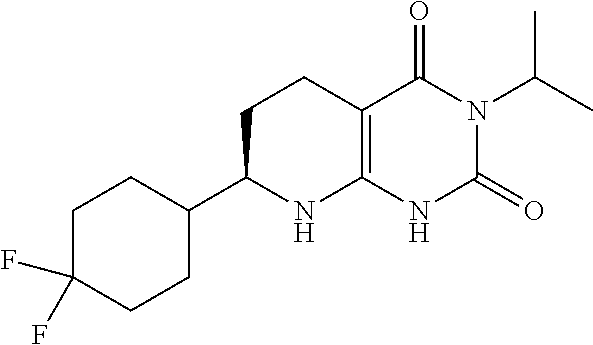
46 2 328 [M + H]+ 1H-NMR (400 MHz, CD3OD): δ 5.16-5.08 (m, 1H), 3.23-3.19 (m, 1H), 2.49-2.40 (m, 1H), 2.35-2.27 (m, 1H), 2.16-2.03 (m, 2H), 1.95-1.70 (m, 6H), 1.64-1.54 (m, 1H), 1.47- 1.32 (m, 8H) ppm 
47 2 362 [M + H]+ 1H-NMR (400 MHz, DMSO-d6): δ 7.43- 7.32 (m, 3H), 7.15-7.13 (m, 2H), 6.18 (br s, 1H), 3.22-3.18 (m, 1H), 2.36-2.22 (m, 2H), 2.16-2.03 (m, 2H), 1.95-1.71 (m, 5H) 1.70-1.51 (m, 2H), 1.35-1.22 (m, 2H) ppm 
48 4 356 [M + H]+ 1H-NMR (300 MHz, DMSO-d6): δ 10.51 (br s, 1H), 7.51-7.33 (m, 5H), 7.21-7.15 (m, 3H), 6.61 (br s, 1H), 4.65-4.61 (m, 1H), 2.38-2.26 (m, 1H), 2.10-1.82 (m, 3H) ppm 
49 4 338 [M + H]+ 1H-NMR (400 MHz, DMSO-d6): δ 10.50 (br s, 1H), 7.48-7.32 (m, 4H), 7.21-7.11 (m, 5H), 6.57 (br s, 1H), 4.66-4.62 (m, 1H), 2.38-2.26 (m, 1H), 2.12-1.94 (m, 2H), 1.88- 1.81 (m, 1H) ppm 
50 4 314 [M + H]+ 1H-NMR (400 MHz, DMSO-d6): δ 9.90 (br s, 1H), 5.87 (br s, 1H), 5.03-4.97(m, 1H), 3.27-3.24 (m, 1H), 2.73-2.66 (m, 2H), 2.32-2.14 (m, 5H), 1.78-1.64 (m, 2H), 1.62- 1.55 (m 1H), 1.47-1.40 (m, 1H), 1.31 (d, J = 6.8 Hz, 6H) ppm 
51 4 384 [M + H]+ 1H-NMR (400 MHz, DMSO-d6): δ 10.45 (br s, 1H), 7.29-7.24 (m, 1H), 7.05-7.02 (m, 2H) 6.19 (br s, 1H), 3.32-3.29 (obscured m, 1H), 2.78-2.65 (m, 2H), 2.34-2.20 (m, 5H), 1.81-1.70 (m, 2H), 1.68-1.45 (m, 2H) ppm 
52 4 378 [M + H]+ 1H-NMR (400 MHz, DMSO-d6): δ 10.15 (br, s, 1H), 7.24 (tt, J = 9.4, 2.4 Hz, 1H), 7.06-6.99 (m, 2H) 6.12 (br s, 1H), 4.01 (m, 1H), 3.38-3.25 (m, 1H), 3.10-3.05 (m, 1H), 2.34-2.26 (m, 1H), 2.22-2.09 (m, 1H), 1.92- 1.81 (m, 2H), 1.79-1.65 (m, 3H) 1.61-1.49 (m, 1H), 1.36-1.24 (m, 1H), 1.18-0.94 (m, 4H) ppm 
53 2 314 [M + H]+ 1H-NMR (400 MHz, CD3OD): δ 3.90 (q, J = 7.2 Hz, 2H), 3.25-3.20 (m, 1H), 2.49- 2.43 (m, 1H), 2.38-2.30 (m, 1H), 2.16- 2.06 (m, 2H), 1.94-1.72 (m 6H), 1.65-1.57 (m, 1H), 1.47-1.33 (m, 2H), 1.17 (t, J = 7.2 Hz, 3H) ppm 
54 1 303 [M + H]+ 1H-NMR (400 MHz, DMSO-d6): δ 11.54 (m, 1H), 9.95 (br s, 1H), 7.40 (dd, J = 9.6, 2.5 Hz, 1H), 7.19 (d, J = 9.6 Hz, 1H), 6.33 (d, J = 9.4 Hz, 1H), 6.09 (br s, 1H), 5.02- 4.94 (m, 1H), 4.26-4.23 (m, 1H), 2.24-2.06 (m, 2H), 1.89-1.65 (m, 2H), 1.30 (d, J = 7.0 Hz, 6H) ppm 
55 4 298 [M + H]+ 1H-NMR (300 MHz, CD3OD): δ 7.35-7.23 (m, 5H), 5.42-5.37 (m, 1H), 4.57-4.52 (m, 1H), 2.45-2.35 (m, 1H), 2.31-2.26 (m, 1H), 2.13-2.02 (m, 1H), 1.92-1.82 (m, 4H), 1.73 (d, J = 6.9 Hz, 3H) ppm 
56 4 298 [M + H]+ 1H-NMR (400 MHz, CD3OD): δ 7.40-7.28 (m, 5H), 4.57-4.52 (m, 1H), 2.49-2.15 (m, 2H), 2.13-2.05 (m, 1H), 1.93-1.84 (m, 1H), 1.41 (s, 3H), 0.98-0.86 (m, 4H) ppm 
57 11 306 [M + H]+ 1H-NMR (300 MHz, DMSO-d6): δ 10.48 (br s, 1H), 7.47 (dd, J = 7.5, 1.5 Hz, 1H), 7.38-7.25 (m, 3H), 6.44 (br s, 1H), 4.92- 4.88 (m, 1H), 3.75 (q, J = 6.9 Hz, 2H), 2.37- 2.27 (m, 1H), 1.94-1.78 (m, 3H), 1.06 (t, J = 6.9 Hz, 3H) ppm 
58 4 308 [M + H]+ 1H-NMR (400 MHz, DMSO-d6): δ 10.48 (br s, 1H), 7.40-7.34 (m, 1H), 7.24-7.15 (m, 1H), 7.06-7.03 (m, 1H), 6.43 (br s, 1H), 4.90 (br s, 1H), 4.90 (br s, 1H), 3.74 (q, J = 6.8 Hz, 2H), 2.30-2.26 (m, 1H), 2.00- 1.80 (m, 3H), 1.06 (t, J = 6.8 Hz, 3H) ppm 
59 1 317 [M + H]+ 1H-NMR (400 MHz, DMSO-d6): δ 10.02 (br s, 1H), 8.06 (d, J = 2.7 Hz, 1H), 7.61 (dd, J = 8.6, 2.7 Hz, 1H), 6.81 (d, J = 8.6 Hz, 1H), 6.22 (br s, 1H), 5.03-4.96 (m, 1H), 4.49-4.45 (m, 1H), 3.82 (s, 3H), 2.26-2.20 (m, 1H), 2.08 (dt, J = 16.0, 5.7 Hz, 1H), 1.94-1.84 (m, 1H), 1.82-1.69 (m, 1H), 1.31 (dd, J = 7.0, 0.8 Hz, 6H) ppm 
60 4 374 [M + H]+ 1H-NMR (400 MHz, DMSO-d6): δ 10.69 (br s, 1H), 7.48-7.42 (m, 1H), 7.33-7.26 (m, 1H), 7.21-7.08 (m, 5H), 6.67 (br s, 1H), 4.69-4.64 (m, 1H), 2.37-2.31 (m, 1H), 2.05- 1.94 (m, 2H), 1.90-1.85 (m, 1H) ppm 
61 4 290 [M + H]+ 1H-NMR (400 MHz, DMSO-d6): δ 10.28 (br s, 1H), 7.45-7.39 (m, 1H), 7.14-7.10 (m, 3H), 6.42 (br s, 1H), 4.61-4.55 (m, 1H), 3.75 (q, J = 6.8 Hz, 2H), 2.34-2.27 (m, 1H), 2.08-1.89 (m, 2H), 1.84-1.76 (m, 1H), 1.06 (t, J = 6.8 Hz, 3H) ppm 
62 2 308 [M + H]+ 1H-NMR (300 MHz, DMSO-d6): δ 9.82 (br s, 1H), 5.90 (br s, 1H), 5.03-4.94 (m, 1H), 3.86-3.81 (m, 2H), 3.39-3.24 (m, 2H), 2.27-2.12 (m, 3H), 1.80-1.73 (m, 1H), 1.68- 1.53 (m, 4H), 1.47-1.10 (m, 10H) ppm 
63 4 326 [M + H]+ 1H-NMR (400 MHz, CD3OD): δ 7.42-7.28 (m, 5H), 4.73-4.60 (m, 3H), 2.49-2.43 (m, 1H), 2.37-2.30 (m, 1H), 2.17-2.06 (m, 1H), 1.98-1.89 (m, 1H) ppm 
64 4 272 [M + H]+ 1H-NMR (400 MHz, DMSO-d6): δ 9.99 (br s, 1H), 7.40-7.28 (m, 5H), 6.36 (br s, 1H), 4.55-4.51 (m, 1H), 3.75 (q, J = 6.8 Hz, 2H), 2.34-2.27 (m, 1H), 2.11-2.04 (m, 1H), 1.96-1.89 (m, 1H), 1.82-1.75 (m, 1H), 1.06 (t, J = 6.8 Hz, 3H) ppm 
65 1 356 [M + H]+ 1H-NMR (400 MHz, DMSO-d6): δ 10.55 (br s, 1H), 7.40-7.35 (m, 2H), 7.32-7.26 (m, 4H), 7.11-7.02 (m, 2H), 6.57 (br s, 1H), 2.33-2.28 (m, 1H), 2.10-1.94 (m, 2H), 1.85- 1.75 (m 1H) ppm 
66 1 300 [M + H]+ 1H-NMR (400 MHz, DMSO-d6): δ 9.89 (br s, 1H), 7.34-7.30 (m, 2H), 7.25-7.21 (m, 3H), 5.69 (br s, 1H), 5.02-4.94 (m, 1H), 4.55-4.51 (m, 1H), 2.74-2.67 (m, 2H), 2.32- 2.24 (m, 1H), 2.18-2.10 (m, 1H), 1.74-1.70 (m, 1H), 1.46-1.42 (m, 1H), 1.28 (d, J = 7.0 Hz, 6H) ppm 
67 5 304 [M + H]+ 1H-NMR (300 MHz, DMSO-d6): δ 10.04 (br s, 1H), 7.35-7.29 (m, 2H), 7.22-7.16 (m, 2H), 6.28 (br s, 1H), 5.05-4.96 (m, 1H), 4.54-4.50 (m, 1H), 2.33-2.23 (m, 1H), 2.09- 2.00 (m, 1H), 1.95-1.87 (m, 1H), 1.80-1.74 (m, 1H), 1.33 (d, J = 7.2 Hz, 6H) ppm 
68 4 304 [M + H]+ 1H-NMR (400 MHz, CD3OD): δ 7.39-7.35 (m, 1H), 7.13 (d, J = 8.0 Hz, 1H), 7.07-6.99 (m, 2H), 5.17-5.10 (m, 1H), 4.57 (dd, J = 7.2, 4.0 Hz, 1H), 2.44-2.38 (m, 1H), 2.27- 2.20 (m, 1H), 2.12-2.04 (m, 1H), 1.94-1.85 (m, 1H), 1.43 (dd, J = 7.2, 1.2 Hz, 6H) ppm 
69 4 304 [M + H]+ 1H-NMR (300 MHz, DMSO-d6): δ 10.21 (br s, 1H), 7.38-7.31 (m, 1H), 7.27-7.18 (m, 3H) 6.32 (br s, 1H), 5.03-4.97 (m, 1H), 4.84-4.80 (m, 1H), 2.36-2.27 (m, 1H), 2.02- 1.88 (m, 2H), 1.83-1.75 (m, 1H), 1.33 (dd, J = 6.9, 1.5 Hz, 6H) ppm 
70 4 362 [M + H]+ 1H-NMR (400 MHz, DMSO-d6): δ 10.66 (br s, 1H), 7.48-7.34 (m, 2H), 7.15-7.10 (m, 1H), 6.66 (br s, 1H), 4.64-4.59 (m, 1H), 4.52 (q, J = 12.4 Hz, 2H), 2.37-2.27 (m, 1H), 2.09-1.80 (m, 3H) ppm 
71 7 342 [M + H]+ 1H-NMR (400 MHz, CD3OD): δ 7.42-7.40 (m, 4H), 7.36-7.30 (m, 1H), 7.08-7.03 (m, 1H), 6.98-6.93 (m, 2H), 5.18-5.12 (m, 1H), 3.38 (obscured m, 1H), 2.75-2.71 (m, 1H) ppm 
72 4 322 [M + H]+ 1H-NMR (400 MHz, DMSO-d6): δ 10.06 (br s, 1H) 7.46-7.38 (m, 1H), 7.14-7.09 (m, 2H), 6.35 (br s, 1H), 5.05-4.98 (m, 1H), 4.85-4.80 (m, 1H), 2.33-2.28 (m, 2H), 1.97- 1.94 (m, 2H), 1.33 (d, J = 6.8 Hz, 6H) ppm 
73 5 326 [M + H]+ 1H-NMR (400 MHz, DMSO-d6): δ 10.53 (br s, 1H), 7.47-7.33 (dd, J = 5.2, 8.8 Hz, 2H), 7.23-7.18 (m, 2H), 6.54 (br s, 1H), 6.16 (tt, J = 56.8, 4.4 Hz), 4.62-4.58 (m, 1H), 4.13 (td, 14.4, 4.4 Hz, 2H), 2.36-2.28 (m, 1H), 2.09-2.02 (m, 1H), 1.96-1.89 (m, 1H), 1.83-1.76 (m, 1H) ppm 
74 4 308 [M + H]+ 1H-NMR (400 MHz, DMSO-d6): δ 10.40 (br s, 1H), 7.32-7.26 (m, 1H), 7.22-7.17 (m, 1H), 7.06-7.01 (m, 1H), 6.41 (br s, 1H), 4.84-4.80 (m, 1H), 3.75 (q, J = 6.8 Hz, 2H), 2.38-2.31 (m, 1H), 2.02-1.89 (m, 2H), 1.84- 1.76 (m, 1H), 1.06 (t, J = 6.8 Hz, 3H) ppm 
75 4 308 [M + H]+ 1H-NMR (400 MHz, DMSO-d6): δ 10.22 (br s, 1H), 7.45-7.39 (m, 1H), 7.14-7.10 (m, 2H), 6.41 (br s, 1H), 4.87-4.83 (m, 1H), 3.75 (q, J = 6.8 Hz, 2H), 2.33-2.26 (m, 2H), 1.98-1.95 (m, 2H), 1.06 (t, J = 6.8 Hz, 3H) ppm 
76 4 322 [M + H]+ 1H-NMR (300 MHz, DMSO-d6): δ 10.29 (br s, 1H), 7.39-7.33 (m, 1H), 7.39-7.33 (m, 1H), 7.23 (dd, J = 7.2, 12.6 Hz, 1H), 7.08- 7.03 (m, 1H), 6.38 (br s, 1H), 5.05-4.99 (m, 1H), 4.92-4.88 (m, 1H), 2.37-2.31 (m, 1H), 2.01-1.78 (m, 3H), 1.34 (d, J = 6.9 Hz, 6H) ppm 
77 4 322 [M + H]+ 1H-NMR (400 MHz, CD3OD): δ 6.94-6.92, (m, 2H), 6.90-6.85 (m, 1H), 5.17-5.10 (m, 1H), 4.59 (dd, J = 7.2, 4.0 Hz, 1H), 2.46- 2.39 (m, 1H), 2.24-2.17 (m, 1H), 2.12-2.03 (m, 1H), 1.92-1.86 (m, 1H), 1.43 (dd, J = 6.8, 1.6 Hz, 6H) ppm. 
78 2 342 [M + H]+ 1H-NMR (300 MHz, DMSO-d6): δ 9.72 (br s, 1H), 5.96 (br s, 1H), 4.76-4.71 (m, 1H), 3.17-3.07 (m, 1H), 2.31-1.45 (m, 13H), 1.34-1.18 (m, 5H), 0.74 (t, J = 7.2 Hz, 3H) ppm 
79 7 342 [M + H]+ 1H-NMR (400 MHz, CD3OD): δ 7.42-7.40 (m, 4H), 7.36-7.30 (m, 1H), 7.08-7.03 (m, 1H), 6.98-6.93 (m, 2H), 5.18-5.12 (m, 1H), 3.38 (obscured m, 1H), 2.75-2.71 (m, 1H) ppm 
80 5 336 [M + H]+ 1H-NMR (300 MHz, DMSO-d6): δ 10.33 (br s, 1H), 7.48-7.34 (m, 2H), 7.15-7.10 (m, 1H), 6.62 (br s, 1H), 4.58-4.53 (m, 1H), 3.54 (d, J = 7.2 Hz, 2H), 2.34-2.24 (m, 1H), 2.06-1.73 (m, 4H), 0.81 (d, J = 6.6 Hz, 6H) ppm 
81 5 334 [M + H]+ 1H-NMR (400 MHz, DMSO-d6): δ 10.08 (br s, 1H), 7.46-7.34 (m, 2H), 7.15-7.10 (m, 1H), 6.30 (br s, 1H), 4.55-4.50 (m, 1H), 2.33-2.24 (m, 1H), 2.09-1.87 (m, 2H), 1.84- 1.78 (m, 1H), 1.26 (s, 3H), 0.75 (m, 4H) ppm 
82 5 334 [M + H]+ 1H-NMR (300 MHz, DMSO-d6): δ 10.29 (br s, 1H), 7.45-7.38 (m, 2H), 7.16-7.12 (m, 1H), 6.43 (br s, 1H), 4.59-4.55 (m, 1H), 3.58 (d, J = 7.2 Hz, 2H), 2.35-2.24 (m, 1H), 2.10-1.78 (m, 3H), 1.05-1.01 (m, 1H), 0.39-0.29 (m, 4H) ppm 
83 5 336 [M + H]+ 1H-NMR (300 MHz, DMSO-d6): δ 10.10 (br s, 1H), 7.46-7.39 (m, 2H), 7.16-7.12 (m, 1H), 6.35 (br s, 1H), 4.78-4.71 (m, 1H), 4.56-4.52 (m, 1H), 2.31-2.24 (m, 1H), 2.12- 1.89 (m, 3H), 1.87-1.64 (m, 2H), 1.30 (d, J = 6.9 Hz, 3H), 0.75 (t, J = 7.5 Hz, 3H) ppm 
84 1 322 [M + H]+ 1H-NMR (300 MHz, DMSO-d6): δ 10.42 (br s, 1H), 7.46-7.35 (m, 2H), 7.18-7.13 (m, 1H), 4.52 (s, 1H), 3.78-3.70 (m, 3H), 3.54- 3.23 (m, 4H), 2.37-2.27 (m 1H), 2.07-1.97 (m, 1H), 1.03 (t, 3H) ppm 
85 9 322 [M + H]+ 1H-NMR (400 MHz, DMSO-d6): δ 10.11 (br s, 1H), 7.48-7.33 (m, 2H), 7.14-7.10 (m, 1H), 6.33 (br s 1H), 5.05-4.96 (m, 1H), 4.54-4.52 (m, 1H), 2.32-2.22 (m, 1 H), 2.04-1.74 (m, 3H), 1.33-1.30 (m, 6H) ppm 
86 4 326 [M + H]+ 1H-NMR (400 MHz, CD3OD): δ 7.42-7.28 (m, 5H), 4.73-4.60 (m, 3H), 2.49-2.43 (m, 1H), 2.37-2.30 (m, 1H), 2.17-2.06 (m, 1H), 1.98-1.89 (m, 1H) ppm 
87 7, 8 286 [M + H]+ 1H-NMR (400 MHz, CD3OD): δ 7.34-7.30 (m, 2H), 7.27-7.22 (m, 3H), 5.14-5.07 (m, 1H), 4.28-4.21 (m, 1H), 2.94-2.83 (m, 3H), 2.57 (dd, J = 14.0, 6.0 Hz, 1H), 1.41 (d, J = 6.8 Hz, 6H) ppm 
88 7, 8 286 [M + H]+ 1H-NMR (400 MHz, CD3OD): δ 7.34-7.30 (m, 2H), 7.27-7.22 (m, 3H), 5.14-5.07 (m, 1H), 4.28-4.21 (m, 1H), 2.94-2.83 (m, 3H), 2.57 (dd, J = 14.0, 6.0 Hz, 1H), 1.41 (d, J = 6.8 Hz, 6H) ppm 
89 1, 4 286 [M + H]+ 1H NMR (400 MHz, DMSO-d6) δ 10.00 (s, 1H), 7.41-7.19 (m, 5H), 6.25 (d, J = 1.6 Hz, 1H), 4.99 (dt, J = 13.9, 6.8 Hz, 1H), 4.49 (dt, J = 6.2, 3.4 Hz, 1H), 2.32-2.21 (m, 1H), 2.09-2.01 (m, 1H), 1.96-1.86 (m, 1H), 1.74 (dtd, J = 12.9, 7.6, 7.6, 5.1 Hz, 1H), 1.31 (dd, J = 7.0, 1.6 Hz, 6H) ppm 
90 1, 4 284 [M + H]+ 1H NMR (400 MHz, DMSO-d6) δ 9.93 (br s, 1H), 7.40-7.12 (m, 5H), 6.24 (d, J = 2.0 Hz, 1H), 4.49 (dt, J = 6.40, 3.3 Hz, 1H), 2.46-2.40 (m, 1H), 2.32-2.19 (m, 1H), 2.08- 2.01 (m, 1H), 1.95-1.85 (m, 1H), 1.78-1.69 (m, 1H), 0.95-0.80 (m, 2H), 0.71-0.58 (m, 2H) ppm 
91 4, 11 300 [M + H]+ 1H NMR (400 MHz, CDCl3) δ 9.86 (br s, 1H), 7.46-7.35 (m, 3H), 7.34-7.28 (m, 2H), 5.14-5.07 (m, 1H), 4.70 (br s, 1H), 3.99 (d, J = 8.8 Hz, 1H), 2.66 (dd, J = 15.6, 4.8 Hz, 1H), 2.16-2.09 (m, 1H), 1.99-1.90 (m, 1H), 1.37 (dd, J = 6.8, 4.4 Hz, 6H), 0.89 (d, J = 6.4 Hz, 3H) ppm 
92 4, 11 300 [M + H]+ 1H NMR (400 MHz, DMSO-d6) δ 9.88 (s, 1H), 7.41-7.37 (m, 2H), 7.34-7.28 (m, 3H), 6.21 (d, J = 4.8 Hz, 1H), 5.05-5.00 (m, 1H), 4.03 (d, J = 7.6 Hz, 1H), 2.31 (dd J = 15.2, 4.8 Hz, 1H), 2.00-1.85 (m, 2H), 1.33 (dd, J = 6.8 Hz, 6H), 0.79 (d, J = 6.4 Hz, 3H) ppm 
93 1, 4 316 [M + H]+ 1H-NMR (300 MHz, DMSO-d6): δ 7.32- 7.26 (m, 1H), 6.88-6.84 (m, 3H), 6.26 (br s, 1H), 5.03-4.98 (m, 1H), 4.48-4.45 (m, 1H), 3.75 (s, 3H), 2.30-2.23 (m, 1H), 2.12-2.05 (m, 1H), 1.95-1.89 (m, 1H), 1.80-1.71 (m 1H), 1.33 (d, J = 6.6 Hz, 6H) ppm 
94 1, 4 308 [M + H]+ 1H-NMR (400 MHz, DMSO-d6): δ 10.25 (br s, 1H), 7.48-7.28 (m, 2H), 7.15-7.10 (m, 1H) 6.36 (br s, 1H), 4.57-4.53 (m, 1H), 3.72 (q, J = 6.7 Hz, 2H), 2.33-2.26 (m, 1H), 2.08-1.97 (m, 1H), 1.95-1.88 (m, 1H), 1.84- 1.76 (m, 1H), 1.03 (t, J = 6.9 Hz, 3H) ppm 
95 1, 4, 14 354 [M + H]+ 
96 1, 4 334 [M + H]+ 1H NMR (400 MHz, DMSO-d6) δ 10.19 (s, 1H), 7.48-7.29 (m, 2H), 7.15-7.04 (m, 1H), 6.38 (d, J = 2.4 Hz, 1H), 5.21 (quin, J = 9.0 Hz, 1H), 4.56-4.54 (m, 1H), 2.99-2.80 (m, 2H), 2.33-2.19 (m, 1H), 2.04-1.93 (m, 3H), 1.92-1.83 (m, 1H), 1.82-1.70 (m, 2H), 1.68- 1.59 (m, 1H) ppm 
97 1, 4 322 [M + H]+ 1H NMR (400 MHz, DMSO-d6) δ 10.29 (s, 1H), 7.44-7.36 (m, 2H), 7.13-7.11 (m, 1H), 6.41 (d, J = 2.0 Hz, 1H), 4.56-4.54 (m, 1H), 3.65-3.62 (m, 2H), 2.32-2.22 (m, 1H), 2.04- 1.95 (m, 1H), 1.93-1.84 (m, 1H), 1.81-1.73 (m, 1H), 1.53-1.42 (m, 2H), 0.81 (t, J = 7.4 Hz, 3H) ppm 
98 1 322 [M + H]+ 1H NMR (300 MHz, DMSO-d6): δ 10.41 (br s, 1H), 7.46-7.35 (m, 2H), 7.18-7.13 (m, 1H), 4.49 (s, 1H), 3.78-3.70 (m, 3H), 3.54- 3.23 (m, 4H), 2.37-2.27 (m 1H), 2.07-1.97 (m, 1H), 1.03 (t, J = 6.9 Hz, 3H) ppm 
99 1, 4 322 [M + H]+ 1H NMR (400 MHz, DMSO-d6): δ 10.39 (br s, 1H), 7.44-7.36 (m, 1H), 7.32-7.26 (m, 1H), 7.05-7.02 (m, 1H), 4.95-4.91 (m, 1H) 4.25 (s, 1H), 3.81-3.76 (m, 1H), 3.69 (q, J = 7.2 Hz, 2H), 3.47-3.42 (m, 1H), 2.34- 2.28 (m 1H), 1.93-1.74 (m, 3H), 1.00 (t, J = 7.2 Hz, 3H) ppm 
100 1, 4 322 [M + H]+ 1H NMR (400 MHz, DMSO-d6): δ 10.39 (br s, 1H), 7.45-7.39 (m, 1H), 7.32-7.26 (m, 1H), 7.05-7.02 (m, 1H), 4.95-4.91 (m, 1H) 4.25 (s, 1H), 3.81-3.76 (m, 1H), 3.69 (q, J = 7.6 Hz, 2H), 3.47-3.42 (m, 1H), 2.34- 2.28 (m, 1H), 1.93-1.74 (m, 3H), 1.00 (t, J = 7.2 Hz, 3H) ppm 
101 1, 4, 15 324 [M + H]+ 
102 1, 4, 11 300 [M + H]+ 1H NMR (400 MHz, DMSO-d6) δ 9.97 (br s, 1H), 7.27-7.23 (m, 1H), 7.11-7.05 (m, 3H), 6.23 (s, 1H), 5.05-4.98 (m, 1H), 4.46- 4.44 (m, 1H), 2.31-2.24 (m, 4H), 2.14-2.08 (m, 1H) 1.94-1.88 (m, 1H), 1.77-1.71 (m, 1H), 1.33 (d, J = 6.4 Hz, 6H) ppm 
103 1, 4, 11 300 [M + H]+ 1H NMR (500 MHz, DMSO-d6) δ 9.58 (br, 1H), 7.27-7.23 (m, 1H), 7.11-7.05 (m, 3H), 6.25 (s, 1H), 5.04-4.98 (m, 1H), 4.46-4.44 (m, 1H), 2.31-2.24 (m, 4H), 2.14-2.07 (m, 1H), 1.93-1.88 (m, 1H), 1.77-1.71 (m, 1H), 1.33 (d, J = 6.0 Hz, 6H) ppm 
104 1, 4, 11 300 [M + H]+ 1H NMR (400 MHz, DMSO-d6) δ 10.06 (br s, 1H), 7.21-7.17 (m, 4H), 6.16 (s, 1H), 5.50-5.00 (m, 1H), 4.70-4.68 (m, 1H), 2.32- 2.26 (m, 4H), 2.15-2.07 (m, 1H), 1.94-1.88 (m, 1H), 1.67-1.61 (m, 1H), 1.34 (dd, J = 7.0, 2.5 Hz, 6H) ppm 
105 1, 4, 11 300 [M + H]+ 1H NMR (500 MHz, DMSO-d6) δ 10.05 (br s, 1H), 7.21-7.17 (m, 4H), 6.16 (s, 1H), 5.05-5.00 (m, 1H), 4.70-4.68 (m, 1H), 2.32- 2.26 (m, 4H), 2.14-2.07 (m, 1H), 1.93-1.87 (m, 1H), 1.67-1.61 (m, 1H), 1.34 (dd, J = 7.0, 2.5 Hz, 6H) ppm 
106 17 300 [M + H]+ 1H NMR (400 MHz, DMSO-d6) δ 9.85 (br s, 1H), 7.38-7.30 (m, 4H), 7.26-7.22 (m, 1H), 6.44 (s, 1H), 5.01-4.94 (m, 1H), 2.28- 2.14 (m, 2H), 1.73-1.64 (m, 1H), 1.61-1.52 (m, 1H), 1.50 (s, 3H), 1.31 (d, J = 7.0 Hz, 6H) ppm. 
107 17 300 [M + H]+ 1H NMR (500 MHz, DMSO-d6) δ 9.83 (br s, 1H), 7.37-7.30 (m, 4H), 7.25-7.23 (m, 1H), 6.43 (s, 1H), 5.00-4.93 (m, 1H), 2.25- 2.14 (m, 2H), 1.69-1.63 (m, 1H), 1.59-1.51 (m, 1H), 1.49 (s, 3H), 1.29 (d, J = 7.0 Hz, 6H) ppm 
108 1, 4, 11 338 [M + H]+ 1H NMR (500 MHz, DMSO-d6) δ 10.76- 10.67 (m, 1H), 7.45-7.34 (m, 5H), 7.33- 7.14 (m, 4H), 6.77 (br s, 1H), 4.89 (s, 1H), 2.38-2.32 (m, 1H), 2.03-1.95 (m, 2H), 1.92- 1.83 (m, 1H) ppm 
109 1, 4, 11 338 [M + H]+ 1H NMR (500 MHz, DMSO-d6) δ 10.89- 10.79 (m, 1H), 7.48-7.36 (m, 5H), 7.35-7.16 (m, 4H), 6.77 (br s, 1H), 4.89 (s, 1H), 2.38- 2.32 (m, 1H), 2.03-1.95 (m, 2H), 1.92-1.83 (m, 1H) ppm 
110 1, 4, 11 385 [M + H]+ 1H NMR (500 MHz, DMSO-d6) δ 10.19 (br s, 1H), 7.39-7.36 (m, 2H), 7.30-7.27 (m, 3H), 6.36 (br s, 1H), 4.85-4.79 (m, 1H), 4.55-4.49 (m, 1H), 4.05-4.00 (m, 2H), 3.60 (s, 3H), 2.83-2.75 (m, 2H), 2.48-2.37 (m, 2H), 2.31-2.25 (m, 1H), 2.08-2.02 (m, 1H), 1.96-1.89 (m, 1H), 1.80-1.73 (m, 1H), 1.45(d, J = 11.5 Hz, 2H) ppm 
111 17 336 [M + H]+ 1H NMR (400 MHz, DMSO-d6) δ 9.85 (br s, 1H), 7.46-7.38 (m, 2H), 7.16-7.12 (m, 1H), 6.50 (s, 1H), 5.04-4.93 (m, 1H), 2.28-2.15 (m, 2H), 1.73-1.48 (m, 5H), 1.31 (d, J = 6.7 Hz, 6H) ppm 
112 17 336 [M + H]+ 1H NMR (400 MHz, DMSO-d6) δ 9.74 (s, 1H), 7.41-7.27 (m, 5H), 6.89 (s, 1H), 6.36 (t, J = 56.0 Hz, 1H), 4.93-4.84 (m, 1H), 2.37-2.24 (m, 2H), 1.82 (td, J = 12.4, 5.0 Hz, 1H), 1.52-1.42 (m, 1H), 1.23 (d, J = 7.0 Hz, 6H) ppm 
113 1, 4, 11 304 [M + H]+ 1H NMR (500 MHz, DMSO-d6) δ 10.18 (br s, 1H), 7.35-7.33 (m, 1H), 7.25-7.19 (m, 3H), 6.31 (s, 1H), 4.82-4.80 (m, 1H), 2.30- 2.21 (m, 1H), 2.03-1.90 (m, 2H), 1.80-1.73 (m, 1H), 1.27 (s, 3H), 0.78-0.74 (m, 4H) ppm 
114 1, 4, 11 316 [M + H]+ 1H NMR (500 MHz, DMSO-d6) δ 10.21 (br s, 1H), 7.35-7.33 (m, 1H), 7.25-7.19 (m, 3H), 6.33 (s, 1H), 4.82-4.80 (m, 1H), 2.30-2.21 (m, 1H), 2.03-1.90 (m, 2H), 1.80- 1.73 (m, 1H), 1.27 (s, 3H), 0.78-0.74 (m, 4H) ppm 
115 17 336 [M + H]+ 1H NMR (400 MHz, DMSO-d6) δ 9.98- 9.86 (m, 1H), 7.31-7.25 (m, 1H), 7.22-7.19 (m, 1H), 7.00-6.93 (m, 1H), 6.57 (s, 1H), 5.02-4.93 (m, 1H), 2.42-2.22 (m, 2H), 1.72- 1.64 (m, 1H), 1.58-1.50 (m, 4H), 1.32 (dd, J = 6.9, 2.0 Hz, 6H) ppm 
116 16 322 [M + H]+ 1H NMR (500 MHz, CD3OD) δ 7.44-7.40 (m, 5H), 5.17-5.13 (m, 1H), 4.81-4.77 (m, 1H), 2.91-2.84 (m, 1H), 2.73-2.63 (m, 1H), 1.47 (dd, J = 7.0, 2.0 Hz, 6H) ppm 
117 16 322 [M + H]+ 1H NMR (500 MHz, CD3OD) δ 7.43-7.40 (m, 5H), 5.17-5.13 (m, 1H), 4.81-4.77 (m, 1H), 2.91-2.84 (m, 1H), 2.73-2.63 (m, 1H), 1.47 (dd, J = 7.0, 2.0 Hz, 6H) ppm 
118 17 308 [M + H]+ 1H NMR (500 MHz, DMSO-d6) δ 10.06 (br s, 1H), 7.26-7.18 (m, 1H), 7.16-7.09 (m, 1H), 6.92-6.86 (m, 1H), 6.53 (s, 1H), 2.98 (s, 3H), 2.36-2.21 (m, 2H), 1.65-1.58 (m, 1H), 1.54-1.46 (m, 4H) ppm 
119 17 322 [M + H]+ 1H NMR (400 MHz, DMSO-d6) δ 10.00 (br s, 1H), 7.26-7.18 (m, 1H), 7.16-7.10 (m, 1H), 6.94-6.85 (m, 1H), 6.53 (s, 1H), 3.65 (q, J = 7.0 Hz, 2H), 2.36-2.21 (m, 2H), 1.65-1.58 (m, 1H), 1.54-1.46 (m, 4H), 0.96 (t, J = 7.0 Hz, 3H) ppm 
120 1, 4, 11 334 [M + H]+ 1H NMR (400 MHz, DMSO-d6) δ 10.18 (br s, 1H), 7.30-7.24 (m, 1H), 7.21-7.14 (m, 1H), 7.04-6.98 (m, 1H), 6.29 (br s, 1H), 4.79-4.75 (m, 1H), 2.33-2.25 (m, 1H), 2.03- 1.86 (m, 2H), 1.81-1.72 (m, 1H), 1.25 (s, 3H), 0.77-0.73 (m, 4H) ppm 
121 1, 4, 11 316 [M + H]+ 1H-NMR (400 MHz, CD3OD): δ 7.39-7.34 (m, 1H), 7.12 (d, J = 6.8 Hz, 1H), 7.06-6.99 (m, 2H), 4.57-4.52 (m, 1H), 2.41-2.34 (m, 1H), 2.32-2.18 (m, 1H), 2.09-2.03 (m, 1H), 1.91-1.83 (m, 1H), 1.38 (s, 3H), 0.92-0.85 (m, 4H) ppm 
122 1, 4, 11 312 [M + H]+ 1H-NMR (400 MHz, DMSO-d6): δ 10.03 (s, 1H), 7.19-7.15 (m, 4H), 6.11 (s, 1H), 4.69-4.65 (m, 1H), 2.33-2.28 (m, 4H), 2.18- 2.04 (m, 1H), 1.94-1.83 (m, 1H), 1.71-1.58 (m, 1H), 1.21 (s, 3H), 0.82-0.74 (m, 4H) ppm 
123 17 300 [M + H]+ 1H NMR (400 MHz, DMSO-d6) δ 9.87 (s, 1H), 7.33-7.28 (m, 2H), 7.21-7.16 (m, 3H), 6.40 (s, 1H), 3.66-3.62 (m, 2H), 2.22- 2.08 (m, 2H), 1.91-1.80 (m, 1H), 1.76-1.59 (m, 2H), 1.48-1.38 (m, 1H), 0.95 (t, J = 7.0 Hz, 3H), 0.61 (t, J = 7.4 Hz, 3H) ppm 
124 1, 4, 11 312 [M + H]+ 1H-NMR (400 MHz, DMSO-d6): δ 9.90 (s, 1H), 7.24-7.19 (m, 1H), 7.08-7.00 (m, 3H), 6.15 (s, 1H), 4.40-4.38 (m, 1H), 2.46 (s, 3H), 2.27-2.08 (m, 2H), 1.89-1.82 (m, 1H), 1.72-1.65 (m, 1H), 1.22 (s, 3H), 0.74-0.70 (m, 4H) ppm 
125 17 435 [M + H]+ 1H NMR (500 MHz, DMSO-d6) δ 10.01 (s, 1H), 7.46-7.38 (m, 2H), 7.16-7.11 (m, 1H), 6.67 (br s, 1H), 4.87-4.77 (m, 1H), 4.05-4.00 (m, 2H), 3.60 (s, 3H), 2.83-2.75 (m, 2H), 2.48-2.37 (m, 2H), 2.31-2.25 (m, 2H), 2.22-2.12 (m, 1H), 1.69-1.55 (m, 1H), 1.50 (s, 3H), 1.46-1.42 (m, 2H) ppm 
126 17 290 [M + H]+ 1H NMR (400 MHz, DMSO-d6) δ 10.07 (br s, 1H), 7.42-7.37 (m, 1H), 7.16-7.06 (m, 3H), 6.54 (s, 1H), 3.03 (s, 3H), 2.28-2.18 (m, 2H), 1.70-1.64 (m, 1H), 1.54-1.52 (m, 1H), 1.51 (s, 3H) ppm 
127 17 352 [M + H]+ 1H NMR (500 MHz, DMSO-d6) δ 7.44- 7.33 (m, 4H), 7.22-7.10 (m, 5H), 6.83 (br s, 1H), 2.27-2.21 (m, 2H), 1.72-1.65, 1.62- 1.56 (m, 2H), 1.54 (s, 3H) ppm 
128 17 360 [M + H]+ 1H NMR (500 MHz, DMSO-d6) δ 9.95 (br s, 1H), 7.43-7.38 (m, 1H), 7.17-7.06 (m, 3H), 6.55 (br s, 1H), 4.83-4.82 (m, 1H), 3.89-3.87 (m, 2H), 3.32-3.27 (m, 2H), 2.60- 2.56 (m, 2H), 2.23-2.18 (m, 2H), 1.69-1.50 (m, 5H), 1.36-1.34 (m, 2H) ppm 
129 16 356 [M + H]+ 1H NMR (500 MHz, DMSO-d6) δ 11.15- 10.95 (m, 1H), 7.48-7.41 (m, 4H), 7.33 (d, J = 7.0 Hz, 1H), 5.02-4.88 (m, 2H), 2.84- 2.79 (m, 1H), 2.64-2.52 (m, 1H), 1.32 (dd, J = 7.0, 3.0 Hz, 6H) ppm 
130 16 356 [M + H]+ 1H NMR (500 MHz, DMSO-d6) δ 10.90- 10.70 (m, 1H), 7.48-7.41 (m, 4H), 7.33 (d, J = 6.5 Hz, 1H), 5.02-4.88 (m, 2H), 2.84- 2.79 (m, 1H), 2.64-2.52 (m, 1H), 1.32 (dd, J1 = 6.5, J2 = 3.0 Hz, 6H) ppm 
131 17 314 [M + H]+ 1H NMR (400 MHz, DMSO-d6) δ 9.96 (s, 1H), 7.38-7.34 (m, 2H), 7.25-7.21 (m, 3H), 6.38 (s, 1H), 3.69 (q, J = 6.9 Hz, 2H), 2.30- 2.24 (m, 2H), 2.12 (quin, J = 6.8 Hz, 1H), 1.78 (td, J = 13.0, 5.1 Hz, 1H), 1.36 (ddd, J = 15.4, 12.8, 5.1 Hz, 1H), 1.01 (t, J = 7.0 Hz, 3H), 0.93 (d, J = 6.6 Hz, 3H), 0.66 (d, J = 7.0 Hz, 3H) ppm 
132 17 314 [M + H]+ 1H NMR (400 MHz, DMSO-d6) δ 9.95 (s, 1H), 7.38-7.32 (m, 2H), 7.25-7.20 (m, 3H), 6.37 (s, 1H), 3.67 (q, J = 7.0 Hz, 2H), 2.30- 2.20 (m, 2H), 2.11 (quin, J = 6.8 Hz, 1H), 1.77 (td, J = 13.0, 5.2 Hz, 1H), 1.35 (ddd, J = 15.4, 12.8, 5.1 Hz, 1H), 1.00 (t, J = 7.0 Hz, 3H), 0.91 (d, J = 6.6 Hz, 3H), 0.65 (d, J = 7.0 Hz, 3H) ppm 
133 17 314 [M + H]+ 1H NMR (400 MHz, DMSO-d6) δ ppm 9.84 (br s, 1H), 7.32-7.28 (m, 2H), 7.16- 7.12 (m, 3H), 6.43 (s, 1H), 3.63 (q, J = 6.9 Hz, 2H), 2.20-2.10 (m, 2H), 1.83-1.74 (m, 1H), 1.71-1.58 (m, 2H), 1.47-1.36 (m, 1H), 1.20-1.09 (m, 1H), 0.95 (t, J = 6.9 Hz, 3H), 0.88-0.80 (m, 1H), 0.74 (t, J = 8.0 Hz, 3H) ppm 
134 17 348 [M + H]+ 1H NMR (300 MHz, CD3OD) δ 7.13-7.07 (m, 1H), 7.04-6.99 (m, 1H), 6.93-6.86 (m, 1H), 5.26-5.19 (m, 1H), 2.99-2.89 (m, 2H), 2.55-2.48 (m, 1H), 2.42-2.35 (m, 1H), 2.17- 2.08 (m, 2H), 1.88-1.62 (m, 7H) ppm 
135 17 406 [M + H]+ 1H NMR (300 MHz, CD3OD) δ 7.17-6.90 (m, 6H), 2.62-2.56 (m, 1H), 2.52-2.43 (m, 1H), 1.83-1.72 (m, 2H), 1.68 (s, 3H) ppm 
136 17 340 [M + H]+ 1H NMR (500 MHz, DMSO-d6): δ ppm 10.48-10.41 (m, 1H), 7.42-7.38 (m, 1H), 7.18-7.15 (m, 2H), 7.12-7.07 (m, 1H), 6.92 (br s, 1H), 6.13 (tt, J = 57.0, 4.5 Hz, 1H), 4.10 (td, 14.0, 4.5 Hz, 2H), 2.26-2.20 (m, 2H), 1.71-1.65 (m, 1H), 1.60-1.52 (m, 4H) ppm 
137 17 358 [M + H]+ 1H NMR (500 MHz, DMSO-d6): δ 10.45- 10.40 (m, 1H), 7.42-7.38 (m, 1H), 7.18- 7.15 (m, 2H), 7.11-7.07 (m, 1H), 6.79 (br s, 1H), 6.79 (br s, 1H), 4.52-4.46 (m, 2H), 2.30-2.20 (m, 2H), 1.71-1.57 (m, 2H), 1.53 (s, 3H) ppm 
138 17 334 [M + H]+ 1H NMR (400 MHz, CD3OD): δ 7.17-7.11 (m, 1H), 7.06-7.03 (m, 1H), 6.95-6.91 (m, 1H) 2.54-2.51 (m, 2H), 2.46-2.42 (m, 1H), 1.73-1.70 (m, 2H), 1.65 (s, 3H), 1.03-1.00 (m, 2H), 0.75-0.72 (m, 2H) ppm 
139 17 334 [M + H]+ 1H NMR (500 MHz, DMSO-d6): δ 10.18- 10.03 (m, 1H), 7.41-7.33 (m, 7H), 7.28-7.27 (m, 1H), 7.14 (d, J = 7.5 Hz, 2H), 6.64 (br s, 1H), 2.28-2.19 (m, 2H), 1.71-1.57 (m, 2H), 1.55 (s, 3H) ppm 
140 16, 17 336 [M + H]+ 1H NMR (400 MHz, DMSO-d6): δ 7.45- 7.36 (m, 5H), 6.99 (br s, 1H), 4.99 (m, 1H), 2.77 (m, 1H), 2.32 (m, 1H), 1.33 (dd, J1 = 6.4 Hz, J2 = 2.4 Hz, 6H) ppm 
141 1, 4, 11 351 [M + H]+ 1H NMR (400 MHz, DMSO-d6): δ 9.50 (br s, 1H), 5.99 (br s, 1H), 5.02-4.94 (m, 1H), 4.02 (m, 2H), 3.58 (s, 3H), 3.08-3.02 (m, 1H), 2.78-2.67 (m, 2H), 2.25-2.11 (m, 2H), 1.70-1.51 (m, 5H), 1.31-1.29 (m, 6H), 1.16-1.08 (m, 2H) ppm 
142 17 356 [M + H]+ 1H NMR (500 MHz, DMSO-d6): δ 9.83 (s, 1H), 7.38-7.34 (m, 2H), 7.26-7.22 (m, 3H), 6.51 (s, 1H), 3.91 (dd, J = 3.5 Hz, 11.0 Hz, 1H), 3.82-3.78 (m, 1H), 3.68 (q, J = 7.0 Hz, 2H), 3.30-3.26 (m, 1H), 3.17-3.12 (m, 1H), 2.27-2.23 (m, 2H), 2.04-2.02 (m, 1H), 1.82- 1.80 (m, 1H), 1.71-1.67 (m, 1H), 1.38-1.30 (m, 2H), 1.18-1.16 (m, 1H), 1.02-0.96 (m, 4H) ppm 
143 17 356 [M + H]+ 1H NMR (500 MHz, DMSO-d6): δ 9.83 (s, 1H), 7.38-7.34 (m, 2H), 7.26-7.22 (m, 3H), 6.51 (s, 1H), 3.91 (dd, J = 3.5 Hz, 11.0 Hz, 1H), 3.82-3.78 (m, 1H), 3.68 (q, J = 7.0 Hz, 2H), 3.30-3.26 (m, 1H), 3.17-3.12 (m, 1H), 2.27-2.23 (m, 2H), 2.04-2.02 (m, 1H), 1.82- 1.80 (m, 1H), 1.71-1.67 (m, 1H), 1.38-1.30 (m, 2H), 1.18-1.16 (m, 1H), 1.02-0.96 (m, 4H) ppm 
144 17 272 [M + H]+ 1H NMR (400 MHz, DMSO-d6): δ 11.32 (s, 1H), 7.40-7.26 (m, 4H), 7.19-7.15 (m, 1H), 6.49 (br s, 1H), 3.65 (q, J = 8.0 Hz, 2H), 2.82 (d, J = 13.7 Hz, 1H), 2.63 (d, J = 13.7 Hz, 1H), 1.50 (s, 3H), 0.96 (t, J = 7.0 Hz, 3H) ppm 
145 17 326 [M + H]+ 1H NMR (400 MHz, DMSO-d6): δ 7.35- 7.33 (m, 2H), 7.26-7.21 (m, 3H), 6.58 (br s, 1H), 3.69 (q, J = 5.6 Hz, 2H), 2.87 (m, 1H), 2.23 (m, 1H), 2.14 (m, 1H), 1.93- 1.86 (m, 2H), 1.78-1.55 (m, 4H), 1.49 (m, 2H), 1.01 (t, J = 5.6 Hz, 3H) ppm 
146 17 326 [M + H]+ 1H NMR (400 MHz, DMSO-d6): δ 7.35- 7.33 (m, 2H), 7.26-7.21 (m, 3H), 6.58 (br s, 1H), 3.69 (q, J = 5.6 Hz, 2H), 2.87 (m, 1H), 2.23 (m, 1H), 2.14 (m, 1H), 1.93- 1.86 (m, 2H), 1.78-1.55 (m, 4H), 1.49 (m, 2H), 1.01 (t, J = 5.6 Hz, 3H) ppm 
147 1, 4, 11 385 [M + H]+ 1H NMR (400 MHz, DMSO-d6): δ 7.36- 7.32 (m, 2H), 7.24 (m, 1H), 7.04 (m, 2H), 3.97 (br s, 2H), 3.59 (s, 3H), 2.99 (br s, 1H), 2.63 (br s, 2H), 2.26 (m, 1H), 2.17 (m, 1H), 1.64-1.61 (m, 1H), 1.53-1.49 (m, 2H), 1.36 (m, 2H), 1.08-1.01 (m, 2H) ppm 
148 1, 4, 11 385 [M + H]+ 1H NMR (400 MHz, CD3OD): δ 7.46-7.42 (m, 2H), 7.36 (m, 1H), 7.18 (m, 2H), 4.22 (m, 2H), 3.70 (s, 3H), 3.19 (m, 1H), 2.82 (m, 2H), 2.54-2.45 (m, 2H), 1.91-1.80 (m, 5H), 1.31-1.26 (m, 2H) ppm 
149 16 340 [M + H]+ 1H NMR (400 MHz, DMSO-d6): δ 10.57 (br s, 1H), 7.48 (m, 1H), 7.27-7.19 (m, 3H), 6.99 (s, 1H), 5.00 (m, 1H), 4.92 (m, 1H), 2.82 (m, 1H), 2.57 (m, 1H), 1.35 (dd, J1 = 6.5 Hz, J2 = 3.5 Hz, 6H) ppm 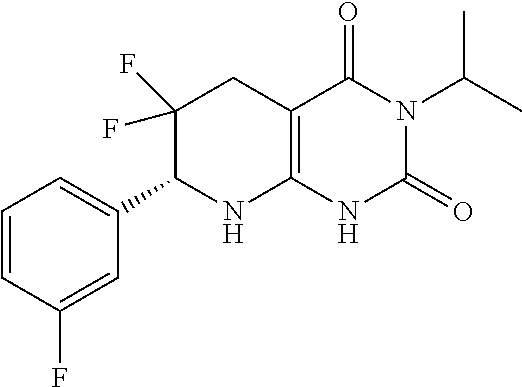
150 16 340 [M + H]+ 1H NMR (400 MHz, DMSO-d6): δ 10.57 (br s, 1H), 7.48 (m, 1H), 7.27-7.19 (m, 3H), 7.02 (s, 1H), 5.01 (m, 1H), 4.92 (m, 1H), 2.82 (m, 1H), 2.57 (m, 1H), 1.35 (dd, J1 = 6.5 Hz, J2 = 3.5 Hz, 6H) ppm 
151 16 340 [M + H]+ 1H NMR (400 MHz, DMSO-d6): δ 7.45 (m, 1H), 7.38 (m, 1H), 7.27 (m, 2H), 6.94 (br s, 1H), 5.15 (m, 1H), 5.02 (m, 1H), 2.86 (m, 1H), 2.57 (, 1H), 1.35 (d, J = 2.8 Hz, 6H) ppm 
152 16 340 [M + H]+ 1H NMR (400 MHz, DMSO-d6): δ 7.45 (m, 1H), 7.38 (m, 1H), 7.27 (m, 2H), 6.94 (br s, 1H), 5.15 (m, 1H), 5.02 (m, 1H), 2.86 (m, 1H), 2.57 (, 1H), 1.35 (d, J = 2.4 Hz, 6H) ppm - Small molecule agents were assessed for their ability to inhibit the enzymatic activity of bovine cardiac myosin using a biochemical assay that couples the release of ADP (adenosine diphosphate) from cardiac myosin to an enzymatic coupling system consisting of pyruvate kinase and lactate dehydrogenase (PK/LDH) and monitoring the absorbance decrease of NADH (at 340 nm) as a function of time. PK converts ADP to ATP (adenosine triphosphate) by converting PEP (phosphoenolpyruvate) to pyruvate. Pyruvate is then converted to lactate by LDH by converting NADH (nicotinamide adenine dinucleotide) to NAD (oxidized nicotinamide adenine dinucleotide). The source of cardiac myosin was from bovine heart in the form of skinned myofibrils. Prior to testing small molecule agents, the bovine myofibrils were assessed for their calcium responsiveness and the calcium concentration that achieves a 50% activation of the myofibril system was chosen as the final condition for assessing the inhibitory activity of the small molecule agents. All enzymatic activity was measured in a buffered solution containing 12 mM PIPES (piperazine-N,N′-bis(2-ethanesulfonic acid), 2 mM magnesium chloride at pH 6.8 (PM12 buffer). Final assay conditions were 1 mg/mL of bovine cardiac myofibrils, 0.4 mM PK/LDH, 50 uM ATP, 0.1 mg/mL BSA (bovine serum albumin), 10 ppm antifoam, 2 mM BME, 0.5 mM NADH, 1.5 mM PEP at the desired free calcium concentration required to achieve 50% activation of the myofibrils.
- A dilution series of compound was created in DMSO such that the final desired concentration of compound would be achieved in a volume of 30 μL with a fixed DMSO concentration of 3.3% (v/v). Typically 1 μL of the dilution series were added to 384 well plate to achieve an 10 point dose response. Following the addition of 14 μL of a solution containing bovine cardiac myofibrils, PK/LDH and a solution of calcium (that achieved 50% activation), the enzymatic reaction was started with the addition of 15 μL of a solution containing ATP, PEP and NADH. The reaction progress was followed in a PerkinElmer Envision plate reader at ambient temperature using clear bottom plates. The plate reader was configured to read absorbance at 340 nm in kinetics mode for 15 minutes. Data were recorded as the slope of the absorbance response to time. The slopes of the absorbance response as a function of time were normalized to slopes on the plate containing DMSO. This normalized rate was then plotted as a function of small molecule concentration and the data was fitted to a four-parameter fit using EXCEL XLfit. The IC50 is the concentration at which fifty percent of the total response is inhibited. Any agent that failed to achieve a fifty percent inhibition at the highest concentration tested was reported as an IC50 greater than the highest concentration tested (ie. IC50>50 μM).
-
TABLE 2 Myosin Inhibition Activity of Selected Compoundsa bcMF Compound pCa_6 No. IC50 1 ++ 2 +++ 3 ++ 4 ++ 5 ++ 6 +++ 7 ++ 8 + 9 ++ 10 + 11 ++ 12 +++ 13 ++ 14 ++ 15 ++ 16 ++ 17 ++ 18 ++ 19 ++ 20 ++ 21 ++ 22 ++ 23 +++ 24 ++ 25 + 26 ++ 27 ++ 28 ++ 29 ++ 30 +++ 31 +++ 32 ++ 33 +++ 34 ++ 35 ++ 36 +++ 37 +++ 38 ++ 39 ++ 40 ++ 41 ++ 42 + 43 +++ 44 + 45 +++ 46 +++ 47 +++ 48 ++ 49 ++ 50 ++ 51 ++ 52 ++ 53 ++ 54 + 55 ++ 56 ++ 57 ++ 58 + 59 ++ 60 ++ 61 ++ 62 + 63 ++ 64 + 65 ++ 66 +++ 67 ++ 68 ++ 69 ++ 70 ++ 71 + 72 ++ 73 ++ 74 ++ 75 + 76 ++ 77 ++ 78 +++ 79 + 80 ++ 81 ++ 82 ++ 83 +++ 84 + 85 + 86 + 87 + 88 + 89 ++ 90 ++ 91 + 92 + 93 + 94 ++ 95 + 96 ++ 97 ++ 98 + 99 + 100 + 101 ++ 102 +++ 103 + 104 ++ 105 + 106 +++ 107 + 108 ++ 109 + 110 ++ 111 +++ 112 +++ 113 + 114 ++ 115 +++ 116 ++ 117 + 118 ++ 119 ++ 120 ++ 121 ++ 122 ++ 123 ++ 124 ++ 125 ++ 126 ++ 127 +++ 128 +++ 129 +++ 130 + 131 ++ 132 + 133 ++ 134 +++ 135 +++ 136 +++ 137 +++ 138 +++ 139 +++ 140 ++ 141 ++ 142 +++ 143 ++ 144 + 145 +++ 146 + a+++ corresponds to IC50 values below 1 μM. ++ corresponds to IC50 values from 1 to 15 μM. + corresponds to IC50 values above 15 μM. - Contractility of adult rat ventricular myocytes is determined by edge detection with an IonOptix contractility system. Aliquots of myocytes in Tyrode buffer (137 mM NaCl, 3.7 mM KCL, 0.5 mM MgCl2, 1.5 mM CaCl2, 4 mM HEPES, 11 mM glucose) are placed in a perfusion chamber (Series 20 RC-27NE; Warner Instruments), allowed to adhere to the coverslip, and then perfused with 37° C. Tyrode buffer. Myocytes are filed stimulated at 1 Hz and 10V. Only myocytes with clear striations, quiescent prior to pacing, with a cell length of 120-180 microns, a basal fractional shortening equal to 3-8% of the cell length, and a contraction velocity greater than 100 microns per second are used for contractility experiments. To determine the response to compounds, myocytes are first perfused for 60 seconds with Tyrodes buffer followed by 5 minutes of compound and a 140 second washout with Tyrodes buffer. Data is continuously recorded using IonOptix software. Contractility data is analyzed using Ionwizard software (IonOptix). For each cell, 10-20 contractility transients were averaged and compared under basal (no compound) and compound-treated conditions. Compound activity is measured by effects on fractional shortening (FS), where fractional shortening is the ratio of the peak length of the cell at contraction divided by the basal cell length normalized to 100% for an untreated cell.
-
TABLE 3 Inhibition of Cardiomyocyte Contraction by Selected Compoundsa Compound Activity at Activity at Activity at No. 0.1 μM 0.3 μM 1.0 μM 1 n.d ++ n.d 2 n.d + +++ 4 + ++ n.d. 6 n.d ++ +++ 9 n.d n.d ++ 14 n.d + +++ 18 n.d ++ n.d 20 n.d n.d ++ 22 n.d n.d ++ 31 n.d ++ n.d 46 n.d n.d +++ 48 n.d + + 53 n.d n.d ++ 67 n.d ++ n.d 68 +++ n.d n.d 69 +++ n.d n.d 70 n.d n.d ++ 81 n.d n.d ++ 83 n.d ++ n.d 106 +++ n.d n.d 116 n.d ++ +++ an.d represents not determined; + represents fractional shorting inhibition values less than 33%; ++ represents fractional shorting inhibition values from 33% to 66%; and +++ represents fractional shortening inhibition values greater than 66%. - Although the foregoing invention has been described in some detail by way of illustration and example for purposes of clarity of understanding, one of skill in the art will appreciate that certain changes and modifications may be practiced within the scope of the appended claims. In addition, each reference provided herein is incorporated by reference in its entirety to the same extert as if each reference was individually incorporated by reference. Where a conflict exists between the instant application and a reference provided herein, the instant application shall dominate.
Claims (26)


Priority Applications (1)
| Application Number | Priority Date | Filing Date | Title |
|---|---|---|---|
| US14/973,132 US9663516B2 (en) | 2014-12-18 | 2015-12-17 | Bicyclic-pyrimidinedione compounds |
Applications Claiming Priority (2)
| Application Number | Priority Date | Filing Date | Title |
|---|---|---|---|
| US201462093820P | 2014-12-18 | 2014-12-18 | |
| US14/973,132 US9663516B2 (en) | 2014-12-18 | 2015-12-17 | Bicyclic-pyrimidinedione compounds |
Publications (2)
| Publication Number | Publication Date |
|---|---|
| US20160176868A1 true US20160176868A1 (en) | 2016-06-23 |
| US9663516B2 US9663516B2 (en) | 2017-05-30 |
Family
ID=55168401
Family Applications (1)
| Application Number | Title | Priority Date | Filing Date |
|---|---|---|---|
| US14/973,132 Active US9663516B2 (en) | 2014-12-18 | 2015-12-17 | Bicyclic-pyrimidinedione compounds |
Country Status (1)
| Country | Link |
|---|---|
| US (1) | US9663516B2 (en) |
Cited By (15)
| Publication number | Priority date | Publication date | Assignee | Title |
|---|---|---|---|---|
| WO2020092208A1 (en) * | 2018-10-29 | 2020-05-07 | MyoKardia, Inc. | Tetrahydropyran (thp)-substituted bicyclic-pyrimidinedione compounds |
| CN111333552A (en) * | 2020-04-09 | 2020-06-26 | 广州安岩仁医药科技有限公司 | β -benzo amino acid compound synthesis method |
| WO2022047004A1 (en) | 2020-08-28 | 2022-03-03 | MyoKardia, Inc. | Methods of treatment with myosin modulator |
| CN114149423A (en) * | 2020-09-08 | 2022-03-08 | 江苏恒瑞医药股份有限公司 | Tetrahydropyridopyrimidine diketone derivative, preparation method and medical application thereof |
| CN114456163A (en) * | 2020-11-09 | 2022-05-10 | 江苏恒瑞医药股份有限公司 | Tetrahydropyridopyrimidine diketone derivative, preparation method and medical application thereof |
| WO2022105852A1 (en) * | 2020-11-20 | 2022-05-27 | 江苏恒瑞医药股份有限公司 | Triazine dione derivative, preparation method therefor and application thereof in medicine |
| US11414424B2 (en) | 2018-08-31 | 2022-08-16 | Cytokinetics, Inc. | Cardiac sarcomere inhibitors |
| US11919909B2 (en) | 2021-03-04 | 2024-03-05 | Cytokinetics, Inc. | Cardiac sarcomere inhibitors |
| WO2024073426A1 (en) * | 2022-09-26 | 2024-04-04 | Edgewise Therapeutics, Inc. | 1,4-dihydroquinazolinone compounds and uses thereof |
| US11964967B2 (en) | 2018-06-26 | 2024-04-23 | Cytokinetics, Inc. | Cardiac sarcomere inhibitors |
| US12065436B2 (en) | 2018-01-19 | 2024-08-20 | Cytokinetics, Inc. | Cardiac sarcomere inhibitors |
| WO2024218783A1 (en) * | 2023-04-17 | 2024-10-24 | Dasha Pharmaceuticals Private Limited | Green chemistry approach for synthesis of mavacamten and its intermediate using novel methodology |
| US12187712B2 (en) | 2018-06-26 | 2025-01-07 | Cytokinetics, Inc. | Cardiac sarcomere inhibitors |
| US12448369B2 (en) | 2023-03-27 | 2025-10-21 | Edgewise Therapeutics, Inc. | Quinolinone amide compounds and uses thereof |
| US12559464B2 (en) | 2023-03-27 | 2026-02-24 | Edgewise Therapeutics, Inc. | Quinazolinone dione compounds and uses thereof |
-
2015
- 2015-12-17 US US14/973,132 patent/US9663516B2/en active Active
Cited By (34)
| Publication number | Priority date | Publication date | Assignee | Title |
|---|---|---|---|---|
| US12065436B2 (en) | 2018-01-19 | 2024-08-20 | Cytokinetics, Inc. | Cardiac sarcomere inhibitors |
| US11964967B2 (en) | 2018-06-26 | 2024-04-23 | Cytokinetics, Inc. | Cardiac sarcomere inhibitors |
| US12187712B2 (en) | 2018-06-26 | 2025-01-07 | Cytokinetics, Inc. | Cardiac sarcomere inhibitors |
| US12275741B2 (en) | 2018-08-31 | 2025-04-15 | Cytokinetics, Inc. | Cardiac sarcomere inhibitors |
| US11952381B2 (en) | 2018-08-31 | 2024-04-09 | Cytokinetics, Inc. | Cardiac sarcomere inhibitors |
| US11414424B2 (en) | 2018-08-31 | 2022-08-16 | Cytokinetics, Inc. | Cardiac sarcomere inhibitors |
| US12344607B2 (en) | 2018-10-29 | 2025-07-01 | MyoKardia, Inc. | Substituted 5,6,7,8-tetrahydropyrido[2,3-d]pyrimidine-2,4-diones for treating cardiac diseases |
| IL282740B2 (en) * | 2018-10-29 | 2026-05-01 | Myokardia Inc | 4-TETRAHYDROPYRAN-4-YL-6-FLUORO-7-PHENYL-5,6,7,8-TETRAHYDRO-1H-PYRIDO[2,3-d]PYRIMIDINE-2,4-DIONE DERIVATIVES |
| WO2020092208A1 (en) * | 2018-10-29 | 2020-05-07 | MyoKardia, Inc. | Tetrahydropyran (thp)-substituted bicyclic-pyrimidinedione compounds |
| JP2022506524A (en) * | 2018-10-29 | 2022-01-17 | マイオカーディア,インク | Tetrahydropyran (THP) -substituted bicyclic-pyrimidinedione compound |
| TWI876902B (en) * | 2018-10-29 | 2025-03-11 | 美商邁奧卡迪亞公司 | Tetrahydropyran (thp)-substituted bicyclic-pyrimidinedione compounds |
| JP7447110B2 (en) | 2018-10-29 | 2024-03-11 | マイオカーディア,インク | Tetrahydropyran (THP)-substituted bicyclic-pyrimidinedione compounds |
| TWI837202B (en) * | 2018-10-29 | 2024-04-01 | 美商邁奧卡迪亞公司 | Tetrahydropyran (thp)-substituted bicyclic-pyrimidinedione compounds |
| JP2025138748A (en) * | 2018-10-29 | 2025-09-25 | マイオカーディア,インク | Tetrahydropyran (THP)-substituted bicyclic pyrimidinedione compounds |
| CN113056465A (en) * | 2018-10-29 | 2021-06-29 | 迈奥卡迪亚公司 | Tetrahydropyran (THP) -substituted bicyclic pyrimidinedione compounds |
| US11034693B2 (en) | 2018-10-29 | 2021-06-15 | MyoKardia, Inc. | Substituted 5,6,7,8-tetrahydropyrido[2,3-d]pyrimidine-2,4-diones for treating cardiac diseases |
| JP2024063091A (en) * | 2018-10-29 | 2024-05-10 | マイオカーディア,インク | Tetrahydropyran (THP)-Substituted Bicyclic-Pyrimidinedione Compounds |
| EP4464321A3 (en) * | 2018-10-29 | 2025-01-01 | MyoKardia, Inc. | Tetrahydropyran (thp)-substituted bicyclic-pyrimidinedione compounds |
| JP7703716B2 (en) | 2018-10-29 | 2025-07-15 | マイオカーディア,インク | Tetrahydropyran (THP)-Substituted Bicyclic-Pyrimidinedione Compounds |
| IL282740B1 (en) * | 2018-10-29 | 2026-01-01 | Myokardia Inc | 4-tetrahydropyran-4-yl-6-fluoro-7-phenyl-5,6,7,8-tetrahydro-1h-pyrido[2,3-d]pyrimidine-2,4-dione derivatives |
| CN111333552A (en) * | 2020-04-09 | 2020-06-26 | 广州安岩仁医药科技有限公司 | β -benzo amino acid compound synthesis method |
| EP4203927A4 (en) * | 2020-08-28 | 2024-09-04 | MyoKardia, Inc. | TREATMENT PROCEDURES WITH MYOSIN MODULATOR |
| US12616697B2 (en) | 2020-08-28 | 2026-05-05 | MyoKardia, Inc. | Methods of treatment with myosin modulator |
| WO2022047004A1 (en) | 2020-08-28 | 2022-03-03 | MyoKardia, Inc. | Methods of treatment with myosin modulator |
| CN114149423A (en) * | 2020-09-08 | 2022-03-08 | 江苏恒瑞医药股份有限公司 | Tetrahydropyridopyrimidine diketone derivative, preparation method and medical application thereof |
| CN114456163A (en) * | 2020-11-09 | 2022-05-10 | 江苏恒瑞医药股份有限公司 | Tetrahydropyridopyrimidine diketone derivative, preparation method and medical application thereof |
| WO2022105852A1 (en) * | 2020-11-20 | 2022-05-27 | 江苏恒瑞医药股份有限公司 | Triazine dione derivative, preparation method therefor and application thereof in medicine |
| US12286437B2 (en) | 2021-03-04 | 2025-04-29 | Cytokinetics, Inc. | Cardiac sarcomere inhibitors |
| US11919909B2 (en) | 2021-03-04 | 2024-03-05 | Cytokinetics, Inc. | Cardiac sarcomere inhibitors |
| US12509431B2 (en) | 2022-09-26 | 2025-12-30 | Edgewise Therapeutics, Inc. | 1,4-dihydroquinazolinone compounds and uses thereof |
| WO2024073426A1 (en) * | 2022-09-26 | 2024-04-04 | Edgewise Therapeutics, Inc. | 1,4-dihydroquinazolinone compounds and uses thereof |
| US12448369B2 (en) | 2023-03-27 | 2025-10-21 | Edgewise Therapeutics, Inc. | Quinolinone amide compounds and uses thereof |
| US12559464B2 (en) | 2023-03-27 | 2026-02-24 | Edgewise Therapeutics, Inc. | Quinazolinone dione compounds and uses thereof |
| WO2024218783A1 (en) * | 2023-04-17 | 2024-10-24 | Dasha Pharmaceuticals Private Limited | Green chemistry approach for synthesis of mavacamten and its intermediate using novel methodology |
Also Published As
| Publication number | Publication date |
|---|---|
| US9663516B2 (en) | 2017-05-30 |
Similar Documents
| Publication | Publication Date | Title |
|---|---|---|
| US9663516B2 (en) | Bicyclic-pyrimidinedione compounds | |
| US20240382486A1 (en) | Pyrimidinedione compounds | |
| US9199945B2 (en) | Cycloalkyl-substituted pyrimidinedione compounds | |
| CA3124101A1 (en) | Substituted 3-((3-aminophenyl)amino)piperidine-2,6-dione compounds, compositions thereof, and methods of treatment therewith | |
| HK40032330A (en) | Pyrimidinedione compound against cardiac conditions | |
| NZ715456B2 (en) | Pyrimidinedione compounds against cardiac conditions | |
| HK1223930B (en) | Pyrimidinedione compounds against cardiac conditions | |
| OA17651A (en) | Pyrimidinedione compounds against cardiac conditions. |
Legal Events
| Date | Code | Title | Description |
|---|---|---|---|
| AS | Assignment |
Owner name: MYOKARDIA, INC., CALIFORNIA Free format text: ASSIGNMENT OF ASSIGNORS INTEREST;ASSIGNORS:OSLOB, JOHAN;AUBELE, DANIELLE;EVANCHIK, MARC;AND OTHERS;REEL/FRAME:041261/0291 Effective date: 20160520 |
|
| STCF | Information on status: patent grant |
Free format text: PATENTED CASE |
|
| MAFP | Maintenance fee payment |
Free format text: PAYMENT OF MAINTENANCE FEE, 4TH YR, SMALL ENTITY (ORIGINAL EVENT CODE: M2551); ENTITY STATUS OF PATENT OWNER: SMALL ENTITY Year of fee payment: 4 |
|
| FEPP | Fee payment procedure |
Free format text: ENTITY STATUS SET TO UNDISCOUNTED (ORIGINAL EVENT CODE: BIG.); ENTITY STATUS OF PATENT OWNER: LARGE ENTITY |
|
| MAFP | Maintenance fee payment |
Free format text: PAYMENT OF MAINTENANCE FEE, 8TH YEAR, LARGE ENTITY (ORIGINAL EVENT CODE: M1552); ENTITY STATUS OF PATENT OWNER: LARGE ENTITY Year of fee payment: 8 |