US20150284359A1 - Methods for synthesizing 3-(substituted dihydroisoindolinone-2-yl)-2, 6-dioxopiperidine, and intermediates thereof - Google Patents
Methods for synthesizing 3-(substituted dihydroisoindolinone-2-yl)-2, 6-dioxopiperidine, and intermediates thereof Download PDFInfo
- Publication number
- US20150284359A1 US20150284359A1 US14/545,757 US201514545757A US2015284359A1 US 20150284359 A1 US20150284359 A1 US 20150284359A1 US 201514545757 A US201514545757 A US 201514545757A US 2015284359 A1 US2015284359 A1 US 2015284359A1
- Authority
- US
- United States
- Prior art keywords
- formula
- compound
- yield
- alkoxy
- cyclizing
- Prior art date
- Legal status (The legal status is an assumption and is not a legal conclusion. Google has not performed a legal analysis and makes no representation as to the accuracy of the status listed.)
- Granted
Links
- -1 3-(substituted dihydroisoindolinone-2-yl)-2, 6-dioxopiperidine Chemical class 0.000 title claims abstract description 67
- 238000000034 method Methods 0.000 title claims abstract description 58
- 230000002194 synthesizing effect Effects 0.000 title claims abstract description 17
- 239000000543 intermediate Substances 0.000 title abstract description 7
- 150000001875 compounds Chemical class 0.000 claims abstract description 343
- 238000003786 synthesis reaction Methods 0.000 claims abstract description 35
- 230000015572 biosynthetic process Effects 0.000 claims abstract description 27
- WEVYAHXRMPXWCK-UHFFFAOYSA-N Acetonitrile Chemical group CC#N WEVYAHXRMPXWCK-UHFFFAOYSA-N 0.000 claims description 60
- 238000006243 chemical reaction Methods 0.000 claims description 60
- 229910052739 hydrogen Inorganic materials 0.000 claims description 59
- QGZKDVFQNNGYKY-UHFFFAOYSA-N Ammonia Chemical compound N QGZKDVFQNNGYKY-UHFFFAOYSA-N 0.000 claims description 46
- BWHMMNNQKKPAPP-UHFFFAOYSA-L potassium carbonate Chemical group [K+].[K+].[O-]C([O-])=O BWHMMNNQKKPAPP-UHFFFAOYSA-L 0.000 claims description 46
- 239000001257 hydrogen Substances 0.000 claims description 45
- OKKJLVBELUTLKV-UHFFFAOYSA-N Methanol Chemical compound OC OKKJLVBELUTLKV-UHFFFAOYSA-N 0.000 claims description 42
- 239000000203 mixture Substances 0.000 claims description 39
- CDBYLPFSWZWCQE-UHFFFAOYSA-L Sodium Carbonate Chemical compound [Na+].[Na+].[O-]C([O-])=O CDBYLPFSWZWCQE-UHFFFAOYSA-L 0.000 claims description 36
- WYURNTSHIVDZCO-UHFFFAOYSA-N Tetrahydrofuran Chemical compound C1CCOC1 WYURNTSHIVDZCO-UHFFFAOYSA-N 0.000 claims description 32
- 125000002924 primary amino group Chemical group [H]N([H])* 0.000 claims description 31
- 238000010992 reflux Methods 0.000 claims description 28
- 125000000027 (C1-C10) alkoxy group Chemical group 0.000 claims description 25
- ZMXDDKWLCZADIW-UHFFFAOYSA-N N,N-Dimethylformamide Chemical compound CN(C)C=O ZMXDDKWLCZADIW-UHFFFAOYSA-N 0.000 claims description 25
- 125000004104 aryloxy group Chemical group 0.000 claims description 25
- 125000002887 hydroxy group Chemical group [H]O* 0.000 claims description 25
- ZHNUHDYFZUAESO-UHFFFAOYSA-N Formamide Chemical compound NC=O ZHNUHDYFZUAESO-UHFFFAOYSA-N 0.000 claims description 24
- 229910000027 potassium carbonate Inorganic materials 0.000 claims description 23
- FYSNRJHAOHDILO-UHFFFAOYSA-N thionyl chloride Chemical compound ClS(Cl)=O FYSNRJHAOHDILO-UHFFFAOYSA-N 0.000 claims description 22
- HEMHJVSKTPXQMS-UHFFFAOYSA-M Sodium hydroxide Chemical compound [OH-].[Na+] HEMHJVSKTPXQMS-UHFFFAOYSA-M 0.000 claims description 21
- AFVFQIVMOAPDHO-UHFFFAOYSA-N Methanesulfonic acid Chemical compound CS(O)(=O)=O AFVFQIVMOAPDHO-UHFFFAOYSA-N 0.000 claims description 20
- 230000035484 reaction time Effects 0.000 claims description 20
- 238000007363 ring formation reaction Methods 0.000 claims description 20
- ODZPKZBBUMBTMG-UHFFFAOYSA-N sodium amide Chemical compound [NH2-].[Na+] ODZPKZBBUMBTMG-UHFFFAOYSA-N 0.000 claims description 19
- KWYUFKZDYYNOTN-UHFFFAOYSA-M Potassium hydroxide Chemical group [OH-].[K+] KWYUFKZDYYNOTN-UHFFFAOYSA-M 0.000 claims description 18
- WQDUMFSSJAZKTM-UHFFFAOYSA-N Sodium methoxide Chemical compound [Na+].[O-]C WQDUMFSSJAZKTM-UHFFFAOYSA-N 0.000 claims description 18
- 229910021529 ammonia Inorganic materials 0.000 claims description 18
- 150000002431 hydrogen Chemical group 0.000 claims description 18
- 125000000449 nitro group Chemical group [O-][N+](*)=O 0.000 claims description 18
- 229910000029 sodium carbonate Inorganic materials 0.000 claims description 18
- XLYOFNOQVPJJNP-UHFFFAOYSA-N water Substances O XLYOFNOQVPJJNP-UHFFFAOYSA-N 0.000 claims description 18
- UFHFLCQGNIYNRP-UHFFFAOYSA-N Hydrogen Chemical compound [H][H] UFHFLCQGNIYNRP-UHFFFAOYSA-N 0.000 claims description 16
- XHXFXVLFKHQFAL-UHFFFAOYSA-N phosphoryl trichloride Chemical compound ClP(Cl)(Cl)=O XHXFXVLFKHQFAL-UHFFFAOYSA-N 0.000 claims description 16
- PFKFTWBEEFSNDU-UHFFFAOYSA-N carbonyldiimidazole Chemical compound C1=CN=CN1C(=O)N1C=CN=C1 PFKFTWBEEFSNDU-UHFFFAOYSA-N 0.000 claims description 15
- 239000003795 chemical substances by application Substances 0.000 claims description 15
- 125000001475 halogen functional group Chemical group 0.000 claims description 15
- QOSSAOTZNIDXMA-UHFFFAOYSA-N Dicylcohexylcarbodiimide Chemical compound C1CCCCC1N=C=NC1CCCCC1 QOSSAOTZNIDXMA-UHFFFAOYSA-N 0.000 claims description 14
- 125000003277 amino group Chemical group 0.000 claims description 13
- 238000010511 deprotection reaction Methods 0.000 claims description 13
- 238000010438 heat treatment Methods 0.000 claims description 13
- 150000007529 inorganic bases Chemical class 0.000 claims description 13
- 150000007530 organic bases Chemical class 0.000 claims description 13
- YLQBMQCUIZJEEH-UHFFFAOYSA-N tetrahydrofuran Natural products C=1C=COC=1 YLQBMQCUIZJEEH-UHFFFAOYSA-N 0.000 claims description 13
- FPQQSJJWHUJYPU-UHFFFAOYSA-N 3-(dimethylamino)propyliminomethylidene-ethylazanium;chloride Chemical compound Cl.CCN=C=NCCCN(C)C FPQQSJJWHUJYPU-UHFFFAOYSA-N 0.000 claims description 12
- 229910052760 oxygen Inorganic materials 0.000 claims description 12
- 125000000951 phenoxy group Chemical group [H]C1=C([H])C([H])=C(O*)C([H])=C1[H] 0.000 claims description 12
- LPNYRYFBWFDTMA-UHFFFAOYSA-N potassium tert-butoxide Chemical group [K+].CC(C)(C)[O-] LPNYRYFBWFDTMA-UHFFFAOYSA-N 0.000 claims description 12
- 125000006239 protecting group Chemical group 0.000 claims description 12
- XSQUKJJJFZCRTK-UHFFFAOYSA-N Urea Chemical compound NC(N)=O XSQUKJJJFZCRTK-UHFFFAOYSA-N 0.000 claims description 11
- 239000004202 carbamide Substances 0.000 claims description 11
- 125000004435 hydrogen atom Chemical group [H]* 0.000 claims description 11
- 125000002496 methyl group Chemical group [H]C([H])([H])* 0.000 claims description 11
- 125000004178 (C1-C4) alkyl group Chemical group 0.000 claims description 10
- 229910052783 alkali metal Inorganic materials 0.000 claims description 10
- 229910052794 bromium Inorganic materials 0.000 claims description 10
- 229940098779 methanesulfonic acid Drugs 0.000 claims description 10
- WFDIJRYMOXRFFG-UHFFFAOYSA-N Acetic anhydride Chemical compound CC(=O)OC(C)=O WFDIJRYMOXRFFG-UHFFFAOYSA-N 0.000 claims description 9
- WMFOQBRAJBCJND-UHFFFAOYSA-M Lithium hydroxide Chemical compound [Li+].[OH-] WMFOQBRAJBCJND-UHFFFAOYSA-M 0.000 claims description 9
- FJDQFPXHSGXQBY-UHFFFAOYSA-L caesium carbonate Chemical compound [Cs+].[Cs+].[O-]C([O-])=O FJDQFPXHSGXQBY-UHFFFAOYSA-L 0.000 claims description 9
- 229910000024 caesium carbonate Inorganic materials 0.000 claims description 9
- 230000003197 catalytic effect Effects 0.000 claims description 9
- 239000003960 organic solvent Substances 0.000 claims description 9
- ASOKPJOREAFHNY-UHFFFAOYSA-N 1-Hydroxybenzotriazole Chemical compound C1=CC=C2N(O)N=NC2=C1 ASOKPJOREAFHNY-UHFFFAOYSA-N 0.000 claims description 8
- NRKYWOKHZRQRJR-UHFFFAOYSA-N 2,2,2-trifluoroacetamide Chemical compound NC(=O)C(F)(F)F NRKYWOKHZRQRJR-UHFFFAOYSA-N 0.000 claims description 8
- MFGOFGRYDNHJTA-UHFFFAOYSA-N 2-amino-1-(2-fluorophenyl)ethanol Chemical compound NCC(O)C1=CC=CC=C1F MFGOFGRYDNHJTA-UHFFFAOYSA-N 0.000 claims description 7
- 239000003513 alkali Substances 0.000 claims description 7
- HUCVOHYBFXVBRW-UHFFFAOYSA-M caesium hydroxide Inorganic materials [OH-].[Cs+] HUCVOHYBFXVBRW-UHFFFAOYSA-M 0.000 claims description 7
- AFRJJFRNGGLMDW-UHFFFAOYSA-N lithium amide Chemical group [Li+].[NH2-] AFRJJFRNGGLMDW-UHFFFAOYSA-N 0.000 claims description 7
- RYHBNJHYFVUHQT-UHFFFAOYSA-N 1,4-Dioxane Chemical compound C1COCCO1 RYHBNJHYFVUHQT-UHFFFAOYSA-N 0.000 claims description 6
- 229910021055 KNH2 Inorganic materials 0.000 claims description 6
- 229910018954 NaNH2 Inorganic materials 0.000 claims description 6
- JUJWROOIHBZHMG-UHFFFAOYSA-N Pyridine Chemical compound C1=CC=NC=C1 JUJWROOIHBZHMG-UHFFFAOYSA-N 0.000 claims description 6
- 238000007142 ring opening reaction Methods 0.000 claims description 6
- 229910001413 alkali metal ion Inorganic materials 0.000 claims description 4
- 125000000440 benzylamino group Chemical group [H]N(*)C([H])([H])C1=C([H])C([H])=C([H])C([H])=C1[H] 0.000 claims description 4
- 239000007810 chemical reaction solvent Substances 0.000 claims description 4
- 125000004093 cyano group Chemical group *C#N 0.000 claims description 4
- 150000002148 esters Chemical class 0.000 claims description 4
- 125000001997 phenyl group Chemical group [H]C1=C([H])C([H])=C(*)C([H])=C1[H] 0.000 claims description 4
- VHUUQVKOLVNVRT-UHFFFAOYSA-N Ammonium hydroxide Chemical compound [NH4+].[OH-] VHUUQVKOLVNVRT-UHFFFAOYSA-N 0.000 claims description 3
- 125000003545 alkoxy group Chemical group 0.000 claims description 3
- 235000011114 ammonium hydroxide Nutrition 0.000 claims description 3
- 125000003754 ethoxycarbonyl group Chemical group C(=O)(OCC)* 0.000 claims description 3
- UMJSCPRVCHMLSP-UHFFFAOYSA-N pyridine Natural products COC1=CC=CN=C1 UMJSCPRVCHMLSP-UHFFFAOYSA-N 0.000 claims description 3
- 238000003756 stirring Methods 0.000 claims description 3
- 125000000217 alkyl group Chemical group 0.000 claims description 2
- 125000003118 aryl group Chemical group 0.000 claims description 2
- 229910052751 metal Inorganic materials 0.000 claims description 2
- 239000002184 metal Substances 0.000 claims description 2
- 239000000376 reactant Substances 0.000 claims description 2
- 230000003301 hydrolyzing effect Effects 0.000 claims 5
- 150000002466 imines Chemical group 0.000 claims 2
- 125000006612 decyloxy group Chemical group 0.000 claims 1
- 239000000463 material Substances 0.000 abstract description 9
- 238000009776 industrial production Methods 0.000 abstract 1
- IAZDPXIOMUYVGZ-WFGJKAKNSA-N Dimethyl sulfoxide Chemical compound [2H]C([2H])([2H])S(=O)C([2H])([2H])[2H] IAZDPXIOMUYVGZ-WFGJKAKNSA-N 0.000 description 40
- 0 *C1=C2C(=C([5*])C([4*])=C1[3*])C([Y])N(C1([1*])CCC(=O)CC1=O)C2C Chemical compound *C1=C2C(=C([5*])C([4*])=C1[3*])C([Y])N(C1([1*])CCC(=O)CC1=O)C2C 0.000 description 37
- YMWUJEATGCHHMB-UHFFFAOYSA-N Dichloromethane Chemical compound ClCCl YMWUJEATGCHHMB-UHFFFAOYSA-N 0.000 description 24
- KDLHZDBZIXYQEI-UHFFFAOYSA-N Palladium Chemical compound [Pd] KDLHZDBZIXYQEI-UHFFFAOYSA-N 0.000 description 23
- 238000004128 high performance liquid chromatography Methods 0.000 description 21
- 238000005160 1H NMR spectroscopy Methods 0.000 description 20
- KFZMGEQAYNKOFK-UHFFFAOYSA-N Isopropanol Chemical compound CC(C)O KFZMGEQAYNKOFK-UHFFFAOYSA-N 0.000 description 18
- RBMYJAZPAMNDAW-UHFFFAOYSA-N COC(=O)CCC(C(=O)OC)N1CC2=C(C=CC=C2[N+](=O)[O-])C1=O Chemical compound COC(=O)CCC(C(=O)OC)N1CC2=C(C=CC=C2[N+](=O)[O-])C1=O RBMYJAZPAMNDAW-UHFFFAOYSA-N 0.000 description 17
- VFMZYOCFGHUISX-UHFFFAOYSA-N COC(=O)CCC(C(=O)OC)N1CC2=C(C=CC=C2Cl)C1=O Chemical compound COC(=O)CCC(C(=O)OC)N1CC2=C(C=CC=C2Cl)C1=O VFMZYOCFGHUISX-UHFFFAOYSA-N 0.000 description 16
- GOTYRUGSSMKFNF-UHFFFAOYSA-N lenalidomide Chemical compound C1C=2C(N)=CC=CC=2C(=O)N1C1CCC(=O)NC1=O GOTYRUGSSMKFNF-UHFFFAOYSA-N 0.000 description 16
- VZGDMQKNWNREIO-UHFFFAOYSA-N tetrachloromethane Chemical compound ClC(Cl)(Cl)Cl VZGDMQKNWNREIO-UHFFFAOYSA-N 0.000 description 16
- IEXRHOPTENQHFR-UHFFFAOYSA-N NC1=CC=CC2=C1CN(C1CCC(=O)CC1=O)C2=O Chemical compound NC1=CC=CC2=C1CN(C1CCC(=O)CC1=O)C2=O IEXRHOPTENQHFR-UHFFFAOYSA-N 0.000 description 14
- QKAKHTRZPJTPQJ-UHFFFAOYSA-N O=C1CCC(N2CC3=C(C=CC=C3Cl)C2=O)C(=O)C1 Chemical compound O=C1CCC(N2CC3=C(C=CC=C3Cl)C2=O)C(=O)C1 QKAKHTRZPJTPQJ-UHFFFAOYSA-N 0.000 description 14
- ZMANZCXQSJIPKH-UHFFFAOYSA-N Triethylamine Chemical compound CCN(CC)CC ZMANZCXQSJIPKH-UHFFFAOYSA-N 0.000 description 14
- 239000007787 solid Substances 0.000 description 14
- DDSNNDWJPXYLFT-UHFFFAOYSA-N COC(=O)CCC(C)(C(=O)OC)N1CC2=C(C=CC=C2[N+](=O)[O-])C1=O Chemical compound COC(=O)CCC(C)(C(=O)OC)N1CC2=C(C=CC=C2[N+](=O)[O-])C1=O DDSNNDWJPXYLFT-UHFFFAOYSA-N 0.000 description 13
- 238000004458 analytical method Methods 0.000 description 13
- RTDDSWLIZLMORY-UHFFFAOYSA-N 4-nitro-2,3-dihydroisoindol-1-one Chemical compound [O-][N+](=O)C1=CC=CC2=C1CNC2=O RTDDSWLIZLMORY-UHFFFAOYSA-N 0.000 description 12
- ZPNNSMNJFAOYMM-UHFFFAOYSA-N O=C1CCC(N2CC3=C(C=CC=C3[N+](=O)[O-])C2=O)C(=O)C1 Chemical compound O=C1CCC(N2CC3=C(C=CC=C3[N+](=O)[O-])C2=O)C(=O)C1 ZPNNSMNJFAOYMM-UHFFFAOYSA-N 0.000 description 12
- PMZURENOXWZQFD-UHFFFAOYSA-L Sodium Sulfate Chemical compound [Na+].[Na+].[O-]S([O-])(=O)=O PMZURENOXWZQFD-UHFFFAOYSA-L 0.000 description 12
- 239000012071 phase Substances 0.000 description 12
- 229910019142 PO4 Inorganic materials 0.000 description 11
- 239000013078 crystal Substances 0.000 description 11
- NBIIXXVUZAFLBC-UHFFFAOYSA-K phosphate Chemical compound [O-]P([O-])([O-])=O NBIIXXVUZAFLBC-UHFFFAOYSA-K 0.000 description 11
- 239000010452 phosphate Substances 0.000 description 11
- OZFCFEHMEDACEA-UHFFFAOYSA-N COC(=O)CCC(C(=O)OC)N1CC2=C(C=CC=C2N)C1=O Chemical compound COC(=O)CCC(C(=O)OC)N1CC2=C(C=CC=C2N)C1=O OZFCFEHMEDACEA-UHFFFAOYSA-N 0.000 description 10
- GQYDUUCOPPIMQP-UHFFFAOYSA-N O=C(O)CCC(C(=O)O)N1CC2=C(C=CC=C2Cl)C1=O Chemical compound O=C(O)CCC(C(=O)O)N1CC2=C(C=CC=C2Cl)C1=O GQYDUUCOPPIMQP-UHFFFAOYSA-N 0.000 description 10
- RZPMMKDWVZJPMQ-UHFFFAOYSA-N O=C(O)CCC(C(=O)O)N1CC2=C(C=CC=C2[N+](=O)[O-])C1=O Chemical compound O=C(O)CCC(C(=O)O)N1CC2=C(C=CC=C2[N+](=O)[O-])C1=O RZPMMKDWVZJPMQ-UHFFFAOYSA-N 0.000 description 10
- 238000010606 normalization Methods 0.000 description 10
- 239000007858 starting material Substances 0.000 description 10
- VAODKTURBHGWFB-UHFFFAOYSA-N CC1(N2CC3=C(C=CC=C3[N+](=O)[O-])C2=O)CCC(=O)CC1=O Chemical compound CC1(N2CC3=C(C=CC=C3[N+](=O)[O-])C2=O)CCC(=O)CC1=O VAODKTURBHGWFB-UHFFFAOYSA-N 0.000 description 9
- MUPSZQADJPIQMZ-UHFFFAOYSA-N COC(=O)CCC(Br)C(=O)OC Chemical compound COC(=O)CCC(Br)C(=O)OC MUPSZQADJPIQMZ-UHFFFAOYSA-N 0.000 description 9
- 239000000706 filtrate Substances 0.000 description 9
- 239000011541 reaction mixture Substances 0.000 description 9
- 239000000126 substance Substances 0.000 description 9
- GMHMCNGRDIULLK-UHFFFAOYSA-N CC(CCC(=O)O)(C(=O)O)N1CC2=C(C=CC=C2[N+](=O)[O-])C1=O Chemical compound CC(CCC(=O)O)(C(=O)O)N1CC2=C(C=CC=C2[N+](=O)[O-])C1=O GMHMCNGRDIULLK-UHFFFAOYSA-N 0.000 description 8
- 238000005516 engineering process Methods 0.000 description 8
- AUFWWPZGCCIWSW-UHFFFAOYSA-N CC1(N2CC3=C(C=CC=C3[N+](=O)[O-])C2=O)CCC(=O)OC1=O Chemical compound CC1(N2CC3=C(C=CC=C3[N+](=O)[O-])C2=O)CCC(=O)OC1=O AUFWWPZGCCIWSW-UHFFFAOYSA-N 0.000 description 7
- 125000000472 sulfonyl group Chemical group *S(*)(=O)=O 0.000 description 7
- 125000003088 (fluoren-9-ylmethoxy)carbonyl group Chemical group 0.000 description 6
- 125000003903 2-propenyl group Chemical group [H]C([*])([H])C([H])=C([H])[H] 0.000 description 6
- UTGWJHQCBPZRNC-UHFFFAOYSA-N COC(=O)CCC(C)(C(N)=O)N1CC2=C(C=CC=C2[N+](=O)[O-])C1=O Chemical compound COC(=O)CCC(C)(C(N)=O)N1CC2=C(C=CC=C2[N+](=O)[O-])C1=O UTGWJHQCBPZRNC-UHFFFAOYSA-N 0.000 description 6
- XEKOWRVHYACXOJ-UHFFFAOYSA-N Ethyl acetate Chemical compound CCOC(C)=O XEKOWRVHYACXOJ-UHFFFAOYSA-N 0.000 description 6
- VEXZGXHMUGYJMC-UHFFFAOYSA-N Hydrochloric acid Chemical compound Cl VEXZGXHMUGYJMC-UHFFFAOYSA-N 0.000 description 6
- BZLVMXJERCGZMT-UHFFFAOYSA-N Methyl tert-butyl ether Chemical compound COC(C)(C)C BZLVMXJERCGZMT-UHFFFAOYSA-N 0.000 description 6
- DVFZIZCDDQITQV-UHFFFAOYSA-N NC1=CC=CC2=C1CN(C(CCC(=O)O)C(=O)O)C2=O Chemical compound NC1=CC=CC2=C1CN(C(CCC(=O)O)C(=O)O)C2=O DVFZIZCDDQITQV-UHFFFAOYSA-N 0.000 description 6
- CEJVKOGHWDPFKF-UHFFFAOYSA-N O=C1CCC(N2CC3=C(C=CC=C3Cl)C2=O)C(=O)O1 Chemical compound O=C1CCC(N2CC3=C(C=CC=C3Cl)C2=O)C(=O)O1 CEJVKOGHWDPFKF-UHFFFAOYSA-N 0.000 description 6
- IXEVBYGMPCCOLJ-UHFFFAOYSA-N O=C1CCC(N2CC3=C(C=CC=C3[N+](=O)[O-])C2=O)C(=O)O1 Chemical compound O=C1CCC(N2CC3=C(C=CC=C3[N+](=O)[O-])C2=O)C(=O)O1 IXEVBYGMPCCOLJ-UHFFFAOYSA-N 0.000 description 6
- 125000002777 acetyl group Chemical group [H]C([H])([H])C(*)=O 0.000 description 6
- 229910000062 azane Inorganic materials 0.000 description 6
- 125000001584 benzyloxycarbonyl group Chemical group C(=O)(OCC1=CC=CC=C1)* 0.000 description 6
- 150000004657 carbamic acid derivatives Chemical class 0.000 description 6
- 125000003170 phenylsulfonyl group Chemical group C1(=CC=CC=C1)S(=O)(=O)* 0.000 description 6
- 125000001557 phthalyl group Chemical group C(=O)(O)C1=C(C(=O)*)C=CC=C1 0.000 description 6
- 239000002904 solvent Substances 0.000 description 6
- GFIVHMQAVMYGFZ-UHFFFAOYSA-N COC(=O)CCC(C(N)=O)N1CC2=C(C=CC=C2Cl)C1=O Chemical compound COC(=O)CCC(C(N)=O)N1CC2=C(C=CC=C2Cl)C1=O GFIVHMQAVMYGFZ-UHFFFAOYSA-N 0.000 description 5
- VZTDIZULWFCMLS-UHFFFAOYSA-N ammonium formate Chemical compound [NH4+].[O-]C=O VZTDIZULWFCMLS-UHFFFAOYSA-N 0.000 description 5
- 239000012141 concentrate Substances 0.000 description 5
- VHBUYZYELQIEGV-UHFFFAOYSA-N dimethyl 3-(7-amino-3-oxo-1h-isoindol-2-yl)pentanedioate Chemical compound O=C1N(C(CC(=O)OC)CC(=O)OC)CC2=C1C=CC=C2N VHBUYZYELQIEGV-UHFFFAOYSA-N 0.000 description 5
- JFCQEDHGNNZCLN-UHFFFAOYSA-N glutaric acid Chemical compound OC(=O)CCCC(O)=O JFCQEDHGNNZCLN-UHFFFAOYSA-N 0.000 description 5
- 238000005984 hydrogenation reaction Methods 0.000 description 5
- 238000004519 manufacturing process Methods 0.000 description 5
- 238000004321 preservation Methods 0.000 description 5
- 229910052938 sodium sulfate Inorganic materials 0.000 description 5
- 235000011152 sodium sulphate Nutrition 0.000 description 5
- 125000000475 sulfinyl group Chemical group [*:2]S([*:1])=O 0.000 description 5
- JIMLDJNLXLMGLX-JTQLQIEISA-N (2s)-5-amino-5-oxo-2-(phenylmethoxycarbonylamino)pentanoic acid Chemical compound NC(=O)CC[C@@H](C(O)=O)NC(=O)OCC1=CC=CC=C1 JIMLDJNLXLMGLX-JTQLQIEISA-N 0.000 description 4
- YIARPOLJSNXULV-UHFFFAOYSA-N 3-(7-chloro-3-oxo-1h-isoindol-2-yl)piperidine-2,6-dione Chemical compound C1C=2C(Cl)=CC=CC=2C(=O)N1C1CCC(=O)NC1=O YIARPOLJSNXULV-UHFFFAOYSA-N 0.000 description 4
- YCPULGHBTPQLRH-UHFFFAOYSA-N 3-aminopiperidine-2,6-dione;hydron;chloride Chemical compound Cl.NC1CCC(=O)NC1=O YCPULGHBTPQLRH-UHFFFAOYSA-N 0.000 description 4
- GZRGLZWHIFBBLS-UHFFFAOYSA-N 4-amino-2,3-dihydroisoindol-1-one Chemical compound NC1=CC=CC2=C1CNC2=O GZRGLZWHIFBBLS-UHFFFAOYSA-N 0.000 description 4
- IJGRMHOSHXDMSA-UHFFFAOYSA-N Atomic nitrogen Chemical compound N#N IJGRMHOSHXDMSA-UHFFFAOYSA-N 0.000 description 4
- RAXJOTRPHCTBAY-UHFFFAOYSA-N CC(CCC(=O)O)(C(N)=O)N1CC2=C(C=CC=C2[N+](=O)[O-])C1=O Chemical compound CC(CCC(=O)O)(C(N)=O)N1CC2=C(C=CC=C2[N+](=O)[O-])C1=O RAXJOTRPHCTBAY-UHFFFAOYSA-N 0.000 description 4
- PCWQZMOJUJEWOA-UHFFFAOYSA-N CC(CCC(N)=O)(C(N)=O)N1CC2=C(C=CC=C2[N+](=O)[O-])C1=O Chemical compound CC(CCC(N)=O)(C(N)=O)N1CC2=C(C=CC=C2[N+](=O)[O-])C1=O PCWQZMOJUJEWOA-UHFFFAOYSA-N 0.000 description 4
- FWZPYWQOJSQNOC-UHFFFAOYSA-N CC1=CC=CC2=C1CN(C1CCC(=O)OC1=O)C2=O Chemical compound CC1=CC=CC2=C1CN(C1CCC(=O)OC1=O)C2=O FWZPYWQOJSQNOC-UHFFFAOYSA-N 0.000 description 4
- CIQRFJOEEHVXJZ-UHFFFAOYSA-N COC(=O)CCC(C(N)=O)N1CC2=C(C=CC=C2[N+](=O)[O-])C1=O Chemical compound COC(=O)CCC(C(N)=O)N1CC2=C(C=CC=C2[N+](=O)[O-])C1=O CIQRFJOEEHVXJZ-UHFFFAOYSA-N 0.000 description 4
- OAKJQQAXSVQMHS-UHFFFAOYSA-N Hydrazine Chemical compound NN OAKJQQAXSVQMHS-UHFFFAOYSA-N 0.000 description 4
- JYDJHINBRNBCOO-UHFFFAOYSA-N NC(=O)C(CCC(=O)O)N1CC2=C(C=CC=C2Cl)C1=O Chemical compound NC(=O)C(CCC(=O)O)N1CC2=C(C=CC=C2Cl)C1=O JYDJHINBRNBCOO-UHFFFAOYSA-N 0.000 description 4
- GZPZKRXUUOVLED-UHFFFAOYSA-N NC(=O)CCC(C(N)=O)N1CC2=C(C=CC=C2Cl)C1=O Chemical compound NC(=O)CCC(C(N)=O)N1CC2=C(C=CC=C2Cl)C1=O GZPZKRXUUOVLED-UHFFFAOYSA-N 0.000 description 4
- DWTCYUIQXNXGEJ-UHFFFAOYSA-N NC(=O)CCC(C(N)=O)N1CC2=C(C=CC=C2[N+](=O)[O-])C1=O Chemical compound NC(=O)CCC(C(N)=O)N1CC2=C(C=CC=C2[N+](=O)[O-])C1=O DWTCYUIQXNXGEJ-UHFFFAOYSA-N 0.000 description 4
- CYXGUOABTMIWLG-UHFFFAOYSA-N benzyl 3-amino-2,6-dioxopiperidine-1-carboxylate Chemical compound O=C1C(N)CCC(=O)N1C(=O)OCC1=CC=CC=C1 CYXGUOABTMIWLG-UHFFFAOYSA-N 0.000 description 4
- 238000000605 extraction Methods 0.000 description 4
- NPZTUJOABDZTLV-UHFFFAOYSA-N hydroxybenzotriazole Substances O=C1C=CC=C2NNN=C12 NPZTUJOABDZTLV-UHFFFAOYSA-N 0.000 description 4
- 229960004942 lenalidomide Drugs 0.000 description 4
- 229910052753 mercury Inorganic materials 0.000 description 4
- FCGIVHSBEKGQMZ-UHFFFAOYSA-N methyl 2-(bromomethyl)-3-nitrobenzoate Chemical compound COC(=O)C1=CC=CC([N+]([O-])=O)=C1CBr FCGIVHSBEKGQMZ-UHFFFAOYSA-N 0.000 description 4
- 238000002360 preparation method Methods 0.000 description 4
- 239000000047 product Substances 0.000 description 4
- 239000002994 raw material Substances 0.000 description 4
- 238000001953 recrystallisation Methods 0.000 description 4
- GBXNUOZFQGIWTE-UHFFFAOYSA-N 3-(7-amino-3-oxo-1h-isoindol-2-yl)pentanedioic acid Chemical compound NC1=CC=CC2=C1CN(C(CC(O)=O)CC(O)=O)C2=O GBXNUOZFQGIWTE-UHFFFAOYSA-N 0.000 description 3
- NLXLAEXVIDQMFP-UHFFFAOYSA-N Ammonia chloride Chemical compound [NH4+].[Cl-] NLXLAEXVIDQMFP-UHFFFAOYSA-N 0.000 description 3
- DWPRRDWRPPVRGW-UHFFFAOYSA-N COC(=O)CCC(C)(Br)C(=O)OC Chemical compound COC(=O)CCC(C)(Br)C(=O)OC DWPRRDWRPPVRGW-UHFFFAOYSA-N 0.000 description 3
- MUVQMLOEDIDSDJ-UHFFFAOYSA-N NC(=O)C(CCC(=O)O)N1CC2=C(C=CC=C2[N+](=O)[O-])C1=O Chemical compound NC(=O)C(CCC(=O)O)N1CC2=C(C=CC=C2[N+](=O)[O-])C1=O MUVQMLOEDIDSDJ-UHFFFAOYSA-N 0.000 description 3
- UCZAYZNTAWBJRF-UHFFFAOYSA-N O=C1NCC2=C1C=CC=C2Cl Chemical compound O=C1NCC2=C1C=CC=C2Cl UCZAYZNTAWBJRF-UHFFFAOYSA-N 0.000 description 3
- 239000008346 aqueous phase Substances 0.000 description 3
- 125000000484 butyl group Chemical group [H]C([*])([H])C([H])([H])C([H])([H])C([H])([H])[H] 0.000 description 3
- 238000004440 column chromatography Methods 0.000 description 3
- 238000010586 diagram Methods 0.000 description 3
- 125000001495 ethyl group Chemical group [H]C([H])([H])C([H])([H])* 0.000 description 3
- 239000005457 ice water Substances 0.000 description 3
- 125000000959 isobutyl group Chemical group [H]C([H])([H])C([H])(C([H])([H])[H])C([H])([H])* 0.000 description 3
- 125000001449 isopropyl group Chemical group [H]C([H])([H])C([H])(*)C([H])([H])[H] 0.000 description 3
- QSHDDOUJBYECFT-UHFFFAOYSA-N mercury Chemical compound [Hg] QSHDDOUJBYECFT-UHFFFAOYSA-N 0.000 description 3
- 125000001436 propyl group Chemical group [H]C([*])([H])C([H])([H])C([H])([H])[H] 0.000 description 3
- 238000000746 purification Methods 0.000 description 3
- 239000012258 stirred mixture Substances 0.000 description 3
- 125000000999 tert-butyl group Chemical group [H]C([H])([H])C(*)(C([H])([H])[H])C([H])([H])[H] 0.000 description 3
- YPQAFWHSMWWPLX-UHFFFAOYSA-N 1975-50-4 Chemical compound CC1=C(C(O)=O)C=CC=C1[N+]([O-])=O YPQAFWHSMWWPLX-UHFFFAOYSA-N 0.000 description 2
- JKPJLYIGKKDZDT-UHFFFAOYSA-N 3-(7-nitro-3-oxo-1h-isoindol-2-yl)piperidine-2,6-dione Chemical compound C1C=2C([N+](=O)[O-])=CC=CC=2C(=O)N1C1CCC(=O)NC1=O JKPJLYIGKKDZDT-UHFFFAOYSA-N 0.000 description 2
- VHYFNPMBLIVWCW-UHFFFAOYSA-N 4-Dimethylaminopyridine Chemical compound CN(C)C1=CC=NC=C1 VHYFNPMBLIVWCW-UHFFFAOYSA-N 0.000 description 2
- AQAVVTCUDAZYRT-UHFFFAOYSA-N CC1(N2C(=O)C3=C(C2=O)C([N+](=O)[O-])=CC=C3)CCC(=O)CC1=O Chemical compound CC1(N2C(=O)C3=C(C2=O)C([N+](=O)[O-])=CC=C3)CCC(=O)CC1=O AQAVVTCUDAZYRT-UHFFFAOYSA-N 0.000 description 2
- RXNLJUZQYUZNDX-UHFFFAOYSA-N CC1=CC=CC2=C1CN(C(CCC(=O)O)C(N)=O)C2=O Chemical compound CC1=CC=CC2=C1CN(C(CCC(=O)O)C(N)=O)C2=O RXNLJUZQYUZNDX-UHFFFAOYSA-N 0.000 description 2
- KHHJYZKYCPGSHL-UHFFFAOYSA-N CC1=CC=CC2=C1CN(C(CCC(N)=O)C(N)=O)C2=O Chemical compound CC1=CC=CC2=C1CN(C(CCC(N)=O)C(N)=O)C2=O KHHJYZKYCPGSHL-UHFFFAOYSA-N 0.000 description 2
- WZILKPOTAZGIBJ-UHFFFAOYSA-N COC(=O)CCC(C(N)=O)N1CC2=C(C=CC=C2N)C1=O Chemical compound COC(=O)CCC(C(N)=O)N1CC2=C(C=CC=C2N)C1=O WZILKPOTAZGIBJ-UHFFFAOYSA-N 0.000 description 2
- OKTJSMMVPCPJKN-UHFFFAOYSA-N Carbon Chemical compound [C] OKTJSMMVPCPJKN-UHFFFAOYSA-N 0.000 description 2
- HEDRZPFGACZZDS-UHFFFAOYSA-N Chloroform Chemical compound ClC(Cl)Cl HEDRZPFGACZZDS-UHFFFAOYSA-N 0.000 description 2
- MUVQMLOEDIDSDJ-SNVBAGLBSA-N NC(=O)[C@@H](CCC(=O)O)N1CC2=C(C=CC=C2[N+](=O)[O-])C1=O Chemical compound NC(=O)[C@@H](CCC(=O)O)N1CC2=C(C=CC=C2[N+](=O)[O-])C1=O MUVQMLOEDIDSDJ-SNVBAGLBSA-N 0.000 description 2
- MUVQMLOEDIDSDJ-JTQLQIEISA-N NC(=O)[C@H](CCC(=O)O)N1CC2=C(C=CC=C2[N+](=O)[O-])C1=O Chemical compound NC(=O)[C@H](CCC(=O)O)N1CC2=C(C=CC=C2[N+](=O)[O-])C1=O MUVQMLOEDIDSDJ-JTQLQIEISA-N 0.000 description 2
- IXEVBYGMPCCOLJ-SNVBAGLBSA-N O=C1CC[C@@H](N2CC3=C(C=CC=C3[N+](=O)[O-])C2=O)C(=O)O1 Chemical compound O=C1CC[C@@H](N2CC3=C(C=CC=C3[N+](=O)[O-])C2=O)C(=O)O1 IXEVBYGMPCCOLJ-SNVBAGLBSA-N 0.000 description 2
- IXEVBYGMPCCOLJ-JTQLQIEISA-N O=C1CC[C@H](N2CC3=C(C=CC=C3[N+](=O)[O-])C2=O)C(=O)O1 Chemical compound O=C1CC[C@H](N2CC3=C(C=CC=C3[N+](=O)[O-])C2=O)C(=O)O1 IXEVBYGMPCCOLJ-JTQLQIEISA-N 0.000 description 2
- UIIMBOGNXHQVGW-UHFFFAOYSA-M Sodium bicarbonate Chemical class [Na+].OC([O-])=O UIIMBOGNXHQVGW-UHFFFAOYSA-M 0.000 description 2
- 150000008065 acid anhydrides Chemical class 0.000 description 2
- 238000005915 ammonolysis reaction Methods 0.000 description 2
- HSDAJNMJOMSNEV-UHFFFAOYSA-N benzyl chloroformate Chemical compound ClC(=O)OCC1=CC=CC=C1 HSDAJNMJOMSNEV-UHFFFAOYSA-N 0.000 description 2
- 229910052799 carbon Inorganic materials 0.000 description 2
- 239000007795 chemical reaction product Substances 0.000 description 2
- 230000006378 damage Effects 0.000 description 2
- 238000001035 drying Methods 0.000 description 2
- IDGUHHHQCWSQLU-UHFFFAOYSA-N ethanol;hydrate Chemical compound O.CCO IDGUHHHQCWSQLU-UHFFFAOYSA-N 0.000 description 2
- 125000000879 imine group Chemical group 0.000 description 2
- VCJMYUPGQJHHFU-UHFFFAOYSA-N iron(3+);trinitrate Chemical compound [Fe+3].[O-][N+]([O-])=O.[O-][N+]([O-])=O.[O-][N+]([O-])=O VCJMYUPGQJHHFU-UHFFFAOYSA-N 0.000 description 2
- 231100000518 lethal Toxicity 0.000 description 2
- 230000001665 lethal effect Effects 0.000 description 2
- 238000002844 melting Methods 0.000 description 2
- 230000008018 melting Effects 0.000 description 2
- VLKZOEOYAKHREP-UHFFFAOYSA-N n-Hexane Chemical compound CCCCCC VLKZOEOYAKHREP-UHFFFAOYSA-N 0.000 description 2
- 229910052757 nitrogen Inorganic materials 0.000 description 2
- 239000012074 organic phase Substances 0.000 description 2
- 238000013341 scale-up Methods 0.000 description 2
- MFRIHAYPQRLWNB-UHFFFAOYSA-N sodium tert-butoxide Chemical compound [Na+].CC(C)(C)[O-] MFRIHAYPQRLWNB-UHFFFAOYSA-N 0.000 description 2
- 238000005406 washing Methods 0.000 description 2
- GOTYRUGSSMKFNF-SNVBAGLBSA-N (3R)-3-(7-amino-3-oxo-1H-isoindol-2-yl)piperidine-2,6-dione Chemical compound C1C=2C(N)=CC=CC=2C(=O)N1[C@@H]1CCC(=O)NC1=O GOTYRUGSSMKFNF-SNVBAGLBSA-N 0.000 description 1
- GOTYRUGSSMKFNF-JTQLQIEISA-N (3s)-3-(7-amino-3-oxo-1h-isoindol-2-yl)piperidine-2,6-dione Chemical compound C1C=2C(N)=CC=CC=2C(=O)N1[C@H]1CCC(=O)NC1=O GOTYRUGSSMKFNF-JTQLQIEISA-N 0.000 description 1
- CFTRXIMNXGINRI-UMJHXOGRSA-N (4s)-4,5-diamino-3-(7-nitro-3-oxo-1h-isoindol-2-yl)-5-oxopentanoic acid Chemical compound O=C1N(C(CC(O)=O)[C@H](N)C(N)=O)CC2=C1C=CC=C2[N+]([O-])=O CFTRXIMNXGINRI-UMJHXOGRSA-N 0.000 description 1
- RTBFRGCFXZNCOE-UHFFFAOYSA-N 1-methylsulfonylpiperidin-4-one Chemical compound CS(=O)(=O)N1CCC(=O)CC1 RTBFRGCFXZNCOE-UHFFFAOYSA-N 0.000 description 1
- XREDBMQNKAWFGA-UHFFFAOYSA-N 2,3,3a,4-tetrahydro-1h-isoindole Chemical group C1=CCC2CNCC2=C1 XREDBMQNKAWFGA-UHFFFAOYSA-N 0.000 description 1
- UEJJHQNACJXSKW-UHFFFAOYSA-N 2-(2,6-dioxopiperidin-3-yl)-1H-isoindole-1,3(2H)-dione Chemical compound O=C1C2=CC=CC=C2C(=O)N1C1CCC(=O)NC1=O UEJJHQNACJXSKW-UHFFFAOYSA-N 0.000 description 1
- HIXDQWDOVZUNNA-UHFFFAOYSA-N 2-(3,4-dimethoxyphenyl)-5-hydroxy-7-methoxychromen-4-one Chemical compound C=1C(OC)=CC(O)=C(C(C=2)=O)C=1OC=2C1=CC=C(OC)C(OC)=C1 HIXDQWDOVZUNNA-UHFFFAOYSA-N 0.000 description 1
- PILGBCYSJCSKOW-UHFFFAOYSA-N 3-(7-nitro-3-oxo-1h-isoindol-2-yl)pentanedioic acid Chemical compound O=C1N(C(CC(O)=O)CC(=O)O)CC2=C1C=CC=C2[N+]([O-])=O PILGBCYSJCSKOW-UHFFFAOYSA-N 0.000 description 1
- 229960000549 4-dimethylaminophenol Drugs 0.000 description 1
- USFZMSVCRYTOJT-UHFFFAOYSA-N Ammonium acetate Chemical compound N.CC(O)=O USFZMSVCRYTOJT-UHFFFAOYSA-N 0.000 description 1
- 239000005695 Ammonium acetate Substances 0.000 description 1
- WKBOTKDWSSQWDR-UHFFFAOYSA-N Bromine atom Chemical compound [Br] WKBOTKDWSSQWDR-UHFFFAOYSA-N 0.000 description 1
- MWBWSXWLFGVXJY-UHFFFAOYSA-M C.C.CC(=O)OC(C)=O.CC(C)(C)O[K].COC(=O)CCC(Br)C(=O)OC.COC(=O)CCC(C(=O)OC)N1CC2=C(C=CC=C2[N+](=O)[O-])C1=O.COC(=O)CCC(C(=O)OC)N1CC2=C(C=CC=C2[N+](=O)[O-])C1=O.COC(=O)CCC(C(N)=O)N1CC2=C(C=CC=C2[N+](=O)[O-])C1=O.N.N.N.NC(=O)C(CCC(=O)O)N1CC2=C(C=CC=C2[N+](=O)[O-])C1=O.NC(=O)CCC(C(N)=O)N1CC2=C(C=CC=C2[N+](=O)[O-])C1=O.NC(N)=O.NC1=CC=CC2=C1CN(C1CCC(=O)CC1=O)C2=O.NC=O.NC=O.O=C1CCC(N2CC3=C(C=CC=C3[N+](=O)[O-])C2=O)C(=O)C1.O=C1CCC(N2CC3=C(C=CC=C3[N+](=O)[O-])C2=O)C(=O)O1.O=C1NCC2=C1C=CC=C2[N+](=O)[O-].O=C1NCC2=C1C=CC=C2[N+](=O)[O-].O=COO[K].O=S(Cl)Cl.[KH] Chemical compound C.C.CC(=O)OC(C)=O.CC(C)(C)O[K].COC(=O)CCC(Br)C(=O)OC.COC(=O)CCC(C(=O)OC)N1CC2=C(C=CC=C2[N+](=O)[O-])C1=O.COC(=O)CCC(C(=O)OC)N1CC2=C(C=CC=C2[N+](=O)[O-])C1=O.COC(=O)CCC(C(N)=O)N1CC2=C(C=CC=C2[N+](=O)[O-])C1=O.N.N.N.NC(=O)C(CCC(=O)O)N1CC2=C(C=CC=C2[N+](=O)[O-])C1=O.NC(=O)CCC(C(N)=O)N1CC2=C(C=CC=C2[N+](=O)[O-])C1=O.NC(N)=O.NC1=CC=CC2=C1CN(C1CCC(=O)CC1=O)C2=O.NC=O.NC=O.O=C1CCC(N2CC3=C(C=CC=C3[N+](=O)[O-])C2=O)C(=O)C1.O=C1CCC(N2CC3=C(C=CC=C3[N+](=O)[O-])C2=O)C(=O)O1.O=C1NCC2=C1C=CC=C2[N+](=O)[O-].O=C1NCC2=C1C=CC=C2[N+](=O)[O-].O=COO[K].O=S(Cl)Cl.[KH] MWBWSXWLFGVXJY-UHFFFAOYSA-M 0.000 description 1
- SZPYRJULKGPVIB-UHFFFAOYSA-M C.C.CC(C)(C)O[K].CC1=CC=CC2=C1CN(C(CCC(=O)O)C(N)=O)C2=O.CC1=CC=CC2=C1CN(C(CCC(N)=O)C(N)=O)C2=O.CCl.CCl.CNC1=CC=CC2=C1CN(C1CCC(=O)OC1=O)C2=O.COC(=O)CCC(Br)C(=O)OC.COC(=O)CCC(C(=O)OC)N1CC2=C(C=CC=C2C)C1=O.COC(=O)CCC(C(=O)OC)N1CC2=C(C=CC=C2N)C1=O.COC(=O)CCC(C(N)=O)N1CC2=C(C=CC=C2N)C1=O.N.N.N.NC(N)=O.NC1=CC=CC2=C1CN(C(CCC(=O)O)C(=O)O)C2=O.NC1=CC=CC2=C1CN(C1CCC(=O)CC1=O)C2=O.NC1=CC=CC2=C1CNC2=O.NOC=O.O=C1NCC2=C1C=CC=C2[N+](=O)[O-].O=COO[K].[KH] Chemical compound C.C.CC(C)(C)O[K].CC1=CC=CC2=C1CN(C(CCC(=O)O)C(N)=O)C2=O.CC1=CC=CC2=C1CN(C(CCC(N)=O)C(N)=O)C2=O.CCl.CCl.CNC1=CC=CC2=C1CN(C1CCC(=O)OC1=O)C2=O.COC(=O)CCC(Br)C(=O)OC.COC(=O)CCC(C(=O)OC)N1CC2=C(C=CC=C2C)C1=O.COC(=O)CCC(C(=O)OC)N1CC2=C(C=CC=C2N)C1=O.COC(=O)CCC(C(N)=O)N1CC2=C(C=CC=C2N)C1=O.N.N.N.NC(N)=O.NC1=CC=CC2=C1CN(C(CCC(=O)O)C(=O)O)C2=O.NC1=CC=CC2=C1CN(C1CCC(=O)CC1=O)C2=O.NC1=CC=CC2=C1CNC2=O.NOC=O.O=C1NCC2=C1C=CC=C2[N+](=O)[O-].O=COO[K].[KH] SZPYRJULKGPVIB-UHFFFAOYSA-M 0.000 description 1
- CNZQEDUOTBRBIN-MNKZCWTESA-M C.CC(=O)OC(C)=O.CC(C)(C)O[K].COC(=O)CCC(Br)C(=O)OC.COC(=O)CCC(C(=O)OC)N1CC2=C(C=CC=C2Cl)C1=O.COC(=O)CCC(C(N)=O)N1CC2=C(C=CC=C2Cl)C1=O.N.N.N.N.N.NC(=O)C(CCC(=O)O)N1CC2=C(C=CC=C2Cl)C1=O.NC(=O)CCC(C(N)=O)N1CC2=C(C=CC=C2Cl)C1=O.NC(N)=O.NC1=CC=CC2=C1CN(C1CCC(=O)CC1=O)C2=O.NC=O.N[Na].O=C(O)CCC(C(=O)O)N1CC2=C(C=CC=C2Cl)C1=O.O=C1CCC(N2CC3=C(C=CC=C3Cl)C2=O)C(=O)C1.O=C1CCC(N2CC3=C(C=CC=C3Cl)C2=O)C(=O)O1.O=C1NCC2=C1C=CC=C2Cl.O=COO[K].O=S(=O)(Cl)Cl.[2H]CF.[KH] Chemical compound C.CC(=O)OC(C)=O.CC(C)(C)O[K].COC(=O)CCC(Br)C(=O)OC.COC(=O)CCC(C(=O)OC)N1CC2=C(C=CC=C2Cl)C1=O.COC(=O)CCC(C(N)=O)N1CC2=C(C=CC=C2Cl)C1=O.N.N.N.N.N.NC(=O)C(CCC(=O)O)N1CC2=C(C=CC=C2Cl)C1=O.NC(=O)CCC(C(N)=O)N1CC2=C(C=CC=C2Cl)C1=O.NC(N)=O.NC1=CC=CC2=C1CN(C1CCC(=O)CC1=O)C2=O.NC=O.N[Na].O=C(O)CCC(C(=O)O)N1CC2=C(C=CC=C2Cl)C1=O.O=C1CCC(N2CC3=C(C=CC=C3Cl)C2=O)C(=O)C1.O=C1CCC(N2CC3=C(C=CC=C3Cl)C2=O)C(=O)O1.O=C1NCC2=C1C=CC=C2Cl.O=COO[K].O=S(=O)(Cl)Cl.[2H]CF.[KH] CNZQEDUOTBRBIN-MNKZCWTESA-M 0.000 description 1
- MVCKSXXATNAPRP-UHFFFAOYSA-N CC(CCC(=O)O)(C(=O)O)N1CC2=C(C=CC=C2N)C1=O.CC(CCC(=O)O)(C(=O)O)N1CC2=C(C=CC=C2[N+](=O)[O-])C1=O.COC(=O)CCC(C(N)=O)N1CC2=C(C=CC=C2Cl)C1=O.COC(=O)CCC(C(N)=O)N1CC2=C(C=CC=C2N)C1=O.COC(=O)CCC(C(N)=O)N1CC2=C(C=CC=C2[N+](=O)[O-])C1=O.COC(=O)CCC(C(N)=O)N1CC2=C(C=CC=C2[N+](=O)[O-])C1=O.COC(=O)CCC(C)(C(N)=O)N1C(=O)C2=C(C1=O)C([N+](=O)[O-])=CC=C2.COC(=O)CCC(C)(C(N)=O)N1CC2=C(C=CC=C2[N+](=O)[O-])C1=O Chemical compound CC(CCC(=O)O)(C(=O)O)N1CC2=C(C=CC=C2N)C1=O.CC(CCC(=O)O)(C(=O)O)N1CC2=C(C=CC=C2[N+](=O)[O-])C1=O.COC(=O)CCC(C(N)=O)N1CC2=C(C=CC=C2Cl)C1=O.COC(=O)CCC(C(N)=O)N1CC2=C(C=CC=C2N)C1=O.COC(=O)CCC(C(N)=O)N1CC2=C(C=CC=C2[N+](=O)[O-])C1=O.COC(=O)CCC(C(N)=O)N1CC2=C(C=CC=C2[N+](=O)[O-])C1=O.COC(=O)CCC(C)(C(N)=O)N1C(=O)C2=C(C1=O)C([N+](=O)[O-])=CC=C2.COC(=O)CCC(C)(C(N)=O)N1CC2=C(C=CC=C2[N+](=O)[O-])C1=O MVCKSXXATNAPRP-UHFFFAOYSA-N 0.000 description 1
- ZXUSAKZEGUZJSK-UHFFFAOYSA-N CC(CCC(=O)O)(C(=O)O)N1CC2=C(C=CC=C2N)C1=O.CC1(N2C(=O)C3=C(C2=O)C(N)=CC=C3)CCC(=O)OC1=O.CC1(N2CC3=C(C=CC=C3N)C2=O)CCC(=O)OC1=O.CC1(N2CC3=C(C=CC=C3[N+](=O)[O-])C2=O)CCC(=O)OC1=O.NC1=CC=CC2=C1CN(C1CCC(=O)OC1=O)C2=O.O=C(O)CCC(C(=O)O)N1CC2=C(C=CC=C2Cl)C1=O.O=C1CCC(N2CC3=C(C=CC=C3Cl)C2=O)C(=O)O1.O=C1CCC(N2CC3=C(C=CC=C3[N+](=O)[O-])C2=O)C(=O)O1 Chemical compound CC(CCC(=O)O)(C(=O)O)N1CC2=C(C=CC=C2N)C1=O.CC1(N2C(=O)C3=C(C2=O)C(N)=CC=C3)CCC(=O)OC1=O.CC1(N2CC3=C(C=CC=C3N)C2=O)CCC(=O)OC1=O.CC1(N2CC3=C(C=CC=C3[N+](=O)[O-])C2=O)CCC(=O)OC1=O.NC1=CC=CC2=C1CN(C1CCC(=O)OC1=O)C2=O.O=C(O)CCC(C(=O)O)N1CC2=C(C=CC=C2Cl)C1=O.O=C1CCC(N2CC3=C(C=CC=C3Cl)C2=O)C(=O)O1.O=C1CCC(N2CC3=C(C=CC=C3[N+](=O)[O-])C2=O)C(=O)O1 ZXUSAKZEGUZJSK-UHFFFAOYSA-N 0.000 description 1
- NITMDRXUWKHIDF-UHFFFAOYSA-N CC(CCC(=O)O)(C(N)=O)N1C(=O)C2=C(C1=O)C(N)=CC=C2.CC(CCC(=O)O)(C(N)=O)N1C(=O)C2=C(C1=O)C(N)=CC=C2.CC(CCC(=O)O)(C(N)=O)N1C(=O)C2=C(C1=O)C([N+](=O)[O-])=CC=C2.CC(CCC(=O)O)(C(N)=O)N1CC2=C(C=CC=C2[N+](=O)[O-])C1=O.NC(=O)C(CCC(=O)O)N1CC2=C(C=CC=C2Cl)C1=O.NC1=CC=CC2=C1C(=O)N(C1CCC(=O)OC1=O)C2=O Chemical compound CC(CCC(=O)O)(C(N)=O)N1C(=O)C2=C(C1=O)C(N)=CC=C2.CC(CCC(=O)O)(C(N)=O)N1C(=O)C2=C(C1=O)C(N)=CC=C2.CC(CCC(=O)O)(C(N)=O)N1C(=O)C2=C(C1=O)C([N+](=O)[O-])=CC=C2.CC(CCC(=O)O)(C(N)=O)N1CC2=C(C=CC=C2[N+](=O)[O-])C1=O.NC(=O)C(CCC(=O)O)N1CC2=C(C=CC=C2Cl)C1=O.NC1=CC=CC2=C1C(=O)N(C1CCC(=O)OC1=O)C2=O NITMDRXUWKHIDF-UHFFFAOYSA-N 0.000 description 1
- OFGNYSVEQDWIJM-UHFFFAOYSA-N CC1=C2CN(C3CCC(=O)CC3=O)C(=O)C2=CC=C1.COC(=O)C1=CC=CC([N+](=O)[O-])=C1C.COC(=O)C1=CC=CC([N+](=O)[O-])=C1CBr.NC1CCC(=O)CC1=O Chemical compound CC1=C2CN(C3CCC(=O)CC3=O)C(=O)C2=CC=C1.COC(=O)C1=CC=CC([N+](=O)[O-])=C1C.COC(=O)C1=CC=CC([N+](=O)[O-])=C1CBr.NC1CCC(=O)CC1=O OFGNYSVEQDWIJM-UHFFFAOYSA-N 0.000 description 1
- KZYKCFLPCONFJH-UHFFFAOYSA-N COC(=O)C(CCC(C)=O)N1CC2=C(N)C=CC=C2C1=O.COC(=O)C(CCC(N)=O)N1CC2=C([N+](=O)[O-])C=CC=C2C1=O.COC(=O)C(CCC(N)=O)NC(=O)OCC1=CC=CC=C1.COC(=O)C(N)CCC(N)=O.COC(=O)C1=CC=CC([N+](=O)[O-])=C1CBr.NC(=O)CCC(NC(=O)OCC1=CC=CC=C1)C(=O)O.NC1=C2CN(C3CCC(=O)CC3=O)C(=O)C2=CC=C1.O=C1CCC(N2CC3=C([N+](=O)[O-])C=CC=C3C2=O)C(=O)C1 Chemical compound COC(=O)C(CCC(C)=O)N1CC2=C(N)C=CC=C2C1=O.COC(=O)C(CCC(N)=O)N1CC2=C([N+](=O)[O-])C=CC=C2C1=O.COC(=O)C(CCC(N)=O)NC(=O)OCC1=CC=CC=C1.COC(=O)C(N)CCC(N)=O.COC(=O)C1=CC=CC([N+](=O)[O-])=C1CBr.NC(=O)CCC(NC(=O)OCC1=CC=CC=C1)C(=O)O.NC1=C2CN(C3CCC(=O)CC3=O)C(=O)C2=CC=C1.O=C1CCC(N2CC3=C([N+](=O)[O-])C=CC=C3C2=O)C(=O)C1 KZYKCFLPCONFJH-UHFFFAOYSA-N 0.000 description 1
- DGAQECJNVWCQMB-PUAWFVPOSA-M Ilexoside XXIX Chemical compound C[C@@H]1CC[C@@]2(CC[C@@]3(C(=CC[C@H]4[C@]3(CC[C@@H]5[C@@]4(CC[C@@H](C5(C)C)OS(=O)(=O)[O-])C)C)[C@@H]2[C@]1(C)O)C)C(=O)O[C@H]6[C@@H]([C@H]([C@@H]([C@H](O6)CO)O)O)O.[Na+] DGAQECJNVWCQMB-PUAWFVPOSA-M 0.000 description 1
- 239000004367 Lipase Substances 0.000 description 1
- 102000004882 Lipase Human genes 0.000 description 1
- 108090001060 Lipase Proteins 0.000 description 1
- FXHOOIRPVKKKFG-UHFFFAOYSA-N N,N-Dimethylacetamide Chemical compound CN(C)C(C)=O FXHOOIRPVKKKFG-UHFFFAOYSA-N 0.000 description 1
- SECXISVLQFMRJM-UHFFFAOYSA-N N-Methylpyrrolidone Chemical compound CN1CCCC1=O SECXISVLQFMRJM-UHFFFAOYSA-N 0.000 description 1
- RZPMMKDWVZJPMQ-JTQLQIEISA-N O=C(O)CC[C@@H](C(=O)O)N1CC2=C(C=CC=C2[N+](=O)[O-])C1=O Chemical compound O=C(O)CC[C@@H](C(=O)O)N1CC2=C(C=CC=C2[N+](=O)[O-])C1=O RZPMMKDWVZJPMQ-JTQLQIEISA-N 0.000 description 1
- RZPMMKDWVZJPMQ-SNVBAGLBSA-N O=C(O)CC[C@H](C(=O)O)N1CC2=C(C=CC=C2[N+](=O)[O-])C1=O Chemical compound O=C(O)CC[C@H](C(=O)O)N1CC2=C(C=CC=C2[N+](=O)[O-])C1=O RZPMMKDWVZJPMQ-SNVBAGLBSA-N 0.000 description 1
- ZPNNSMNJFAOYMM-GFCCVEGCSA-N O=C1CC[C@@H](N2CC3=C(C=CC=C3[N+](=O)[O-])C2=O)C(=O)C1 Chemical compound O=C1CC[C@@H](N2CC3=C(C=CC=C3[N+](=O)[O-])C2=O)C(=O)C1 ZPNNSMNJFAOYMM-GFCCVEGCSA-N 0.000 description 1
- ZPNNSMNJFAOYMM-LBPRGKRZSA-N O=C1CC[C@H](N2CC3=C(C=CC=C3[N+](=O)[O-])C2=O)C(=O)C1 Chemical compound O=C1CC[C@H](N2CC3=C(C=CC=C3[N+](=O)[O-])C2=O)C(=O)C1 ZPNNSMNJFAOYMM-LBPRGKRZSA-N 0.000 description 1
- CBENFWSGALASAD-UHFFFAOYSA-N Ozone Chemical compound [O-][O+]=O CBENFWSGALASAD-UHFFFAOYSA-N 0.000 description 1
- FAPWRFPIFSIZLT-UHFFFAOYSA-M Sodium chloride Chemical class [Na+].[Cl-] FAPWRFPIFSIZLT-UHFFFAOYSA-M 0.000 description 1
- ALVWLHDEOFIVSM-UHFFFAOYSA-N [N].CCOC(Cl)=O Chemical compound [N].CCOC(Cl)=O ALVWLHDEOFIVSM-UHFFFAOYSA-N 0.000 description 1
- 150000004703 alkoxides Chemical group 0.000 description 1
- 229940043376 ammonium acetate Drugs 0.000 description 1
- 235000019257 ammonium acetate Nutrition 0.000 description 1
- 235000019270 ammonium chloride Nutrition 0.000 description 1
- 230000000259 anti-tumor effect Effects 0.000 description 1
- 230000002137 anti-vascular effect Effects 0.000 description 1
- CBHOOMGKXCMKIR-UHFFFAOYSA-N azane;methanol Chemical class N.OC CBHOOMGKXCMKIR-UHFFFAOYSA-N 0.000 description 1
- 150000001555 benzenes Chemical class 0.000 description 1
- 230000031709 bromination Effects 0.000 description 1
- 238000005893 bromination reaction Methods 0.000 description 1
- GDTBXPJZTBHREO-UHFFFAOYSA-N bromine Substances BrBr GDTBXPJZTBHREO-UHFFFAOYSA-N 0.000 description 1
- 238000010960 commercial process Methods 0.000 description 1
- 230000005574 cross-species transmission Effects 0.000 description 1
- 239000012043 crude product Substances 0.000 description 1
- 230000006837 decompression Effects 0.000 description 1
- 150000002012 dioxanes Chemical class 0.000 description 1
- 239000012153 distilled water Substances 0.000 description 1
- RTZKZFJDLAIYFH-UHFFFAOYSA-N ether Substances CCOCC RTZKZFJDLAIYFH-UHFFFAOYSA-N 0.000 description 1
- 239000000284 extract Substances 0.000 description 1
- WHUUTDBJXJRKMK-UHFFFAOYSA-N glutamic acid Chemical compound OC(=O)C(N)CCC(O)=O WHUUTDBJXJRKMK-UHFFFAOYSA-N 0.000 description 1
- 150000008282 halocarbons Chemical class 0.000 description 1
- 231100000086 high toxicity Toxicity 0.000 description 1
- 239000002955 immunomodulating agent Substances 0.000 description 1
- 229940121354 immunomodulator Drugs 0.000 description 1
- 230000002584 immunomodulator Effects 0.000 description 1
- 230000006872 improvement Effects 0.000 description 1
- 239000003112 inhibitor Substances 0.000 description 1
- 239000010410 layer Substances 0.000 description 1
- 235000019421 lipase Nutrition 0.000 description 1
- 239000007788 liquid Substances 0.000 description 1
- GBMDVOWEEQVZKZ-UHFFFAOYSA-N methanol;hydrate Chemical compound O.OC GBMDVOWEEQVZKZ-UHFFFAOYSA-N 0.000 description 1
- 125000000956 methoxy group Chemical group [H]C([H])([H])O* 0.000 description 1
- GRVDJDISBSALJP-UHFFFAOYSA-N methyloxidanyl Chemical group [O]C GRVDJDISBSALJP-UHFFFAOYSA-N 0.000 description 1
- 230000004048 modification Effects 0.000 description 1
- 238000012986 modification Methods 0.000 description 1
- WGXWHCBVDZSHSG-UHFFFAOYSA-N n,n'-dicyclohexylmethanediimine;thionyl dichloride Chemical compound ClS(Cl)=O.C1CCCCC1N=C=NC1CCCCC1 WGXWHCBVDZSHSG-UHFFFAOYSA-N 0.000 description 1
- 239000012044 organic layer Substances 0.000 description 1
- 230000001699 photocatalysis Effects 0.000 description 1
- 238000007146 photocatalysis Methods 0.000 description 1
- 238000013032 photocatalytic reaction Methods 0.000 description 1
- CNMOHEDUVVUVPP-UHFFFAOYSA-N piperidine-2,3-dione Chemical compound O=C1CCCNC1=O CNMOHEDUVVUVPP-UHFFFAOYSA-N 0.000 description 1
- TYJJADVDDVDEDZ-UHFFFAOYSA-M potassium hydrogencarbonate Chemical compound [K+].OC([O-])=O TYJJADVDDVDEDZ-UHFFFAOYSA-M 0.000 description 1
- 230000003389 potentiating effect Effects 0.000 description 1
- 230000008569 process Effects 0.000 description 1
- 230000035755 proliferation Effects 0.000 description 1
- 230000009467 reduction Effects 0.000 description 1
- 238000007670 refining Methods 0.000 description 1
- 229910052708 sodium Inorganic materials 0.000 description 1
- 239000011734 sodium Substances 0.000 description 1
- WBHQBSYUUJJSRZ-UHFFFAOYSA-M sodium bisulfate Chemical compound [Na+].OS([O-])(=O)=O WBHQBSYUUJJSRZ-UHFFFAOYSA-M 0.000 description 1
- 229910000342 sodium bisulfate Inorganic materials 0.000 description 1
- 239000000758 substrate Substances 0.000 description 1
- 238000010189 synthetic method Methods 0.000 description 1
- 229960003433 thalidomide Drugs 0.000 description 1
- 231100000419 toxicity Toxicity 0.000 description 1
- 230000001988 toxicity Effects 0.000 description 1
- 230000006433 tumor necrosis factor production Effects 0.000 description 1
Classifications
-
- C—CHEMISTRY; METALLURGY
- C07—ORGANIC CHEMISTRY
- C07D—HETEROCYCLIC COMPOUNDS
- C07D401/00—Heterocyclic compounds containing two or more hetero rings, having nitrogen atoms as the only ring hetero atoms, at least one ring being a six-membered ring with only one nitrogen atom
- C07D401/02—Heterocyclic compounds containing two or more hetero rings, having nitrogen atoms as the only ring hetero atoms, at least one ring being a six-membered ring with only one nitrogen atom containing two hetero rings
- C07D401/04—Heterocyclic compounds containing two or more hetero rings, having nitrogen atoms as the only ring hetero atoms, at least one ring being a six-membered ring with only one nitrogen atom containing two hetero rings directly linked by a ring-member-to-ring-member bond
-
- A—HUMAN NECESSITIES
- A61—MEDICAL OR VETERINARY SCIENCE; HYGIENE
- A61P—SPECIFIC THERAPEUTIC ACTIVITY OF CHEMICAL COMPOUNDS OR MEDICINAL PREPARATIONS
- A61P37/00—Drugs for immunological or allergic disorders
- A61P37/02—Immunomodulators
-
- C—CHEMISTRY; METALLURGY
- C07—ORGANIC CHEMISTRY
- C07D—HETEROCYCLIC COMPOUNDS
- C07D209/00—Heterocyclic compounds containing five-membered rings, condensed with other rings, with one nitrogen atom as the only ring hetero atom
- C07D209/02—Heterocyclic compounds containing five-membered rings, condensed with other rings, with one nitrogen atom as the only ring hetero atom condensed with one carbocyclic ring
- C07D209/44—Iso-indoles; Hydrogenated iso-indoles
- C07D209/46—Iso-indoles; Hydrogenated iso-indoles with an oxygen atom in position 1
-
- C—CHEMISTRY; METALLURGY
- C07—ORGANIC CHEMISTRY
- C07D—HETEROCYCLIC COMPOUNDS
- C07D209/00—Heterocyclic compounds containing five-membered rings, condensed with other rings, with one nitrogen atom as the only ring hetero atom
- C07D209/02—Heterocyclic compounds containing five-membered rings, condensed with other rings, with one nitrogen atom as the only ring hetero atom condensed with one carbocyclic ring
- C07D209/44—Iso-indoles; Hydrogenated iso-indoles
- C07D209/48—Iso-indoles; Hydrogenated iso-indoles with oxygen atoms in positions 1 and 3, e.g. phthalimide
-
- C—CHEMISTRY; METALLURGY
- C07—ORGANIC CHEMISTRY
- C07D—HETEROCYCLIC COMPOUNDS
- C07D405/00—Heterocyclic compounds containing both one or more hetero rings having oxygen atoms as the only ring hetero atoms, and one or more rings having nitrogen as the only ring hetero atom
- C07D405/02—Heterocyclic compounds containing both one or more hetero rings having oxygen atoms as the only ring hetero atoms, and one or more rings having nitrogen as the only ring hetero atom containing two hetero rings
- C07D405/04—Heterocyclic compounds containing both one or more hetero rings having oxygen atoms as the only ring hetero atoms, and one or more rings having nitrogen as the only ring hetero atom containing two hetero rings directly linked by a ring-member-to-ring-member bond
Definitions
- the present invention is in the field of pharmaceutical chemistry, and more specifically it relates to methods for synthesizing 3-(substituted dihydroisoindolinone-2-yl)-2,6-dioxopiperidine, and intermediates thereof.
- Lenalidomide an analog of Thalidomide, is a kind of immunomodulator with anti-vascular proliferation and anti-tumor activities; its chemical name is 3-(4-amino-1-oxo-1,3-dihydro-2H-isoindol-2-yl)-2,6-dioxopiperidine and its chemical structure is as following:
- Lenalidomide has the residue of dioxopiperidine and dihydroisoindoline residue, as well as an asymmetric center in its structure. At present Lenalidomide approved on the market are racemic mixtures.
- ⁇ -aminoglutarimide hydrochloride begins with N-benzyloxycarbony-L-glutamine which reacts with N,N′-carbonyldiimidazole (CDI) refluxing in THF to yield N-benzyloxycarbony-aminoglutarimide;
- CDI N,N′-carbonyldiimidazole
- the key material of the reaction is: methyl 2-bromomethyl-3-nitro benzoate, which is converted from 2-methyl-3-nitrobenzoate by catalytic bromination in the condition of carbon tetrachloride under ultraviolet light.
- the catalytic and refluxing reaction needs long time and the yield is low. Additionally, the mass production is unease to be realized due to the difficulty of workers' labour protection against ultraviolet produced by mercury lamp as catalytic light source.
- reaction product was purified by column chromatography at least twice or more, which made industrial operation complicated and made it difficult to industrial scale-up production.
- N-benzyloxycarbony-L-glutamine as initial material, reacted with N,N′-carbonyldiimidazole in THF refluxing for 24 h to yield N-benzyloxycarbony-aminoglutarimide, low purity of yield due to long reactive time for refluxing and high temperature made extraction difficult.
- the present invention provides a novel method for synthesizing 3-(substituted dihydroisoindolinone-2-yl)-2,6-dioxopiperidine and its intermediates, which overcame the disadvantages mentioned above in prior art.
- One objective of the present invention is to provide a novel method for synthesizing 3-(substituted dihydroisoindolinone-2-yl)-2,6-dioxopiperidine.
- Another objective of the present invention is to provide the intermediates used to synthesize 3-(substituted dihydroisoindolinone-2-yl)-2,6-dioxopiperidine.
- R, R3, R4 and R5 is amino or protected amino (carbamates: such as carbobenzyloxy, t-butyloxycarbonyl, fluorenylmethoxycarbonyl, etc.; acyl amides: such as acetyl, phenylacetyl, phthalyl, etc.; azanes: such as allyl, etc.; sulfonyl and sulfinyl: such as phenylsulfonyl, p-toluenesulfonyl, phenylsulfinyl, O-nitrophenylsulfinyl, etc.; referred to Greene T. W. and WuTs P. G. M.
- nitro or halo for example F, Cl, Br or I
- R3, R4 and R5 are hydrogen
- X is halo, such as: F, Cl, Br or I;
- Y is ⁇ O or H
- Z is ⁇ O or H
- R′ is alkali metal ion or hydrogen (such as: H, Li + , Na + , K + or Cs + ), or imine protecting group (such as ethoxycarbonyl, etc.; referred to Greene T. W. and WuTs P. G. M. Protective Groups in Organic Synthesis : P494-, East China University Of Science And Technology Press, and Chemical Research and Application : 2006, 18(11): 1349-1352), etc., preferably K + or Cs + , and more preferably Cs + ;
- a and B are each independently hydroxyl, C 1-10 alkoxy, aryloxy, aryl C 1-4 alkoxy or NHR 2 , and herein, R 2 is hydrogen or amino protecting group (carbamates: such as carbobenzyloxy, t-butyloxycarbonyl, fluorenylmethoxycarbonyl, etc.; acyl amides: such as acetyl, phenylacetyl, phthalyl, etc.; azanes: such as allyl, etc.; sulfonyl and sulfinyl: such as phenylsulfonyl, p-toluenesulfonyl, phenylsulfiny, O-nitrophenylsulfinyl, etc.; referred to Protective Groups in Organic Synthesis : Greene T.
- a and B are each independently hydroxyl, methoxyl, ethoxyl, propoxy, isopropoxy, butoxy, isobutoxy, t-butoxy, pentyloxy, hexyloxy, heptyloxy, octyloxy, nonyloxy, decyloxy; phenoxy or substituted phenoxy; phenyl C 1-4 alkoxy, such as benzyloxy, phenylethoxy, phenylpropoxy, etc., or substituted phenyl C 1-4 alkoxy; in terms of the substituted phenoxy or substituted phenyl C 1-4 alkoxy, the number of the substituted groups is one or more; the substituted groups are selected from the group consisting of C 1-4 alkyl, halo, cyano, and nitro, and the substituted groups may be the same or different, optionally, the groups are
- R1 is C 1-4 alkyl or hydrogen; the said C 1-4 alkyl is selected from methyl, ethyl, propyl, isopropyl, butyl, isobutyl, t-butyl; preferably, R1 is hydrogen or methyl.
- the present invention provides the method of synthesizing the compound of Formula (I) mentioned above, after yielding the compound of Formula (IV), further including that if A and B are both NHR 2 , the compound of Formula (IV) is heated and cyclized in or out of the presence of formamide or methanesulfonic acid to yield the compound of Formula (I); and with the proviso that when R 2 is not hydrogen, the compound of Formula (IV) undergoes deprotection of amino groups and then cyclization mentioned above to yield the compound of Formula (I);
- the compound of Formula (IV) when one of A and B is NHR 2 and the other is hydroxyl, the compound of Formula (IV) reacts in the presence of condensing agent (such as thionyl chloride, dicyclohexylcarbodiimide (DCC), phosphorus oxychloride, carbonyldiimidazole, etc.), to yield the compound of Formula (I); and with proviso that when R 2 is not hydrogen, the compound of Formula (IV) undergoes deprotection of amino groups and then cyclization mentioned above to yield the compound of Formula (I);
- condensing agent such as thionyl chloride, dicyclohexylcarbodiimide (DCC), phosphorus oxychloride, carbonyldiimidazole, etc.
- the compound of Formula (IV) when one of A and B is NHR 2 and the other is C 1-10 alkoxy, aryloxy, or aryl C 1-4 alkoxy, the compound of Formula (IV) is cyclized in alkaline condition (such as in the presence of inorganic base, for example potassium carbonate, sodium carbonate, or organic base, for example potassium tert-butoxide or sodium methoxide, etc.), to yield the compound of Formula (I); and with the proviso that when R 2 is not hydrogen, the compound of Formula (IV) undergoes deprotection of amino groups and then cyclization mentioned above to yield the compound of Formula (I);
- alkaline condition such as in the presence of inorganic base, for example potassium carbonate, sodium carbonate, or organic base, for example potassium tert-butoxide or sodium methoxide, etc.
- the compound of Formula (IV) when A and B are both hydroxyl, the compound of Formula (IV) is cyclized in the presence of urea, or in the presence of trifluoroacetamide, 1-hydroxy benzotriazole (HOBT) and N-ethyl-N′-(3-dimethylaminopropyl) carbodiimide hydrochloride (EDCI), to yield the compound of Formula (I);
- HOBT 1-hydroxy benzotriazole
- EDCI N-ethyl-N′-(3-dimethylaminopropyl) carbodiimide hydrochloride
- the compound of Formula (IV) is cyclized in the presence of alkali metal amide (such as lithium amide, sodium amide, potassamide, preferred sodium amide), to yield the compound of Formula (I);
- alkali metal amide such as lithium amide, sodium amide, potassamide, preferred sodium amide
- the compound of Formula (IV) when one of A and B is hydroxyl and the other is C 1-10 alkoxy, aryloxy or aryl C 1 alkoxy, the compound of Formula (IV) is firstly esterified, and then cyclized in the presence of alkali metal amide (such as lithium amide, sodium amide, potassamide, preferred sodium amide), to yield the compound of Formula (I); alternatively, the compound of Formula (IV) is firstly ester hydrolyzed, and then cyclized in the presence of urea, or in the presence of trifluoroacetamide, 1-hydroxy benzotriazole (HOBT) and N-ethyl-N′-(3-dimethylaminopropyl)carbodiimide hydrochloride (EDCI), to yield the compound of Formula (I); alternatively, the compound of Formula (IV) is firstly ammonolyzed and then reacts in the presence of condensing agent (such as thionyl chloride, dicyclohexy
- the above-mentioned method for synthesizing the compound of Formula (I) provided by the invention includes that, after yielding the compound of Formula (IV), when A and B are both C 1-10 alkoxy, aryloxy, or aryl C 1-4 alkoxy, the compound of Formula (IV) is ammonolyzed to yield the monoamide compound of Formula (IV), and then the monoamide compound of Formula (IV′) is cyclized in alkaline condition (such as in the presence of inorganic base, for example potassium carbonate, sodium carbonate, etc., or organic base, for example potassium tert-butoxide or sodium methoxide, etc.), to yield the compound of Formula (I); the monoamide compound of Formula (IV′) may alternatively continue to be ammonolysed to yield eventually diamide of Formula (IV′′), and then diamide of Formula (IV′′) is heated to be cyclized in or out of the presence of formamide or methanesulfonic acid to yield the compound of Formula (I);
- alkaline condition such as
- the above-mentioned method for synthesizing the compound of Formula (I) provided by the invention after yielding the compound of Formula (IV), when A and B are both C 1-10 alkoxy, aryloxy, or arylC 1-4 alkoxy, further includes that the compound of Formula (IV) is hydrolyzed to yield the monoamide compound of Formula (V);
- the above-mentioned method for synthesizing the compound of Formula (I) provided by the present invention after yielding the compound of Formula (V), further includes that the compound of Formula (V) is cyclized (such as in the condition of acid anhydride and heating) to yield the compound of Formula (VI);
- the above-mentioned method for synthesizing the compound of Formula (I) provided by the present invention after yielding the compound of Formula (VI), further includes that the compound of Formula (VI) is ring-opening ammonolyzed to yield the compound of Formula (VII); then the compound of Formula (VII) reacts in the presence of condensing agent (such as thionylchloride, dicyclohexylcarbodiimide (DCC), phosphorus oxychloride, carbonyldiimidazole, etc.), to yield the compound of Formula (I):
- condensing agent such as thionylchloride, dicyclohexylcarbodiimide (DCC), phosphorus oxychloride, carbonyldiimidazole, etc.
- the present invention provided a novel method for synthesizing the compound of Formula (I), which includes the following steps:
- the compound of Formula (II) reacts with the compound of Formula (III) in the alkaline condition (such as in the presence of inorganic base, for example potassium hydroxide, potassium carbonate, sodium hydroxide, sodium carbonate, cesium hydroxide or cesium carbonate, etc., otherwise organic base, for example potassium tert-butoxide or sodium methoxide, etc.), to yield the compound of Formula (IV);
- inorganic base for example potassium hydroxide, potassium carbonate, sodium hydroxide, sodium carbonate, cesium hydroxide or cesium carbonate, etc.
- organic base for example potassium tert-butoxide or sodium methoxide, etc.
- the compound of Formula (IV) when one of A and B is NHR 2 and the other is hydroxyl, the compound of Formula (IV) reacts in the presence of condensing agent (such as thionyl chloride, dicyclohexylcarbodiimide (DCC), phosphorus oxychloride, carbonyldiimidazole, etc.), to yield the compound of Formula (I); and with the proviso that when R 2 is not hydrogen, the compound of Formula (IV) undergoes deprotection of amino groups and then cyclization mentioned above to yield the compound of Formula when one of A and B is NHR 2 and the other is C 1-10 alkoxy, aryloxy, or aryl C 1-4 alkoxy, the compound of Formula (IV) is cyclized in alkaline condition (such as in the presence of inorganic base, for example potassium carbonate, sodium carbonate, etc., or organic base, for example potassium tert-butoxide or sodium methoxide, etc.), to yield the compound of Formula (
- the compound of Formula (IV) when A and B are both hydroxyl, the compound of Formula (IV) is cyclized in the presence of urea, or in the presence of trifluoroacetamide, 1-hydroxy benzotriazole (HOBT) and N-ethyl-N′-(3-dimethylaminopropyl)carbodiimide hydrochloride (EDCI), to yield the compound of Formula (I);
- HOBT 1-hydroxy benzotriazole
- EDCI N-ethyl-N′-(3-dimethylaminopropyl)carbodiimide hydrochloride
- the compound of Formula (IV) is cyclized in the presence of alkali metal amide (such as lithium amide, sodium amide, potassamide, preferred sodium amide), to yield the compound of Formula (I);
- alkali metal amide such as lithium amide, sodium amide, potassamide, preferred sodium amide
- the compound of Formula (IV) when one of A and B is hydroxyl and the other is C 1-10 alkoxy, aryloxy or aryl C 1-4 alkoxy, the compound of Formula (IV) is firstly esterified, and then cyclized in the presence of alkali metal amide (such as lithium amide, sodium amide, potassamide, preferred sodium amide), to yield the compound of Formula (I); alternatively, the compound of Formula (IV) is firstly ester hydrolyzed, and then cyclized in the presence of urea, or in the presence of trifluoroacetamide, 1-hydroxybenzotriazole (HOBT) and N-ethyl-N′-(3-dimethylamino propyl)-carbodiimide hydrochloride (EDCI), to yield the compound of Formula (I); alternatively, the compound of Formula (IV) is firstly ammonolyzed and then reacts in the presence of condensing agent (such as thionyl chloride dicyclohex
- R, R3, R4 and R5 is amino or protected amino
- carbobenzyloxy, t-butyloxycarbonyl, fluorenylmethoxycarbonyl, etc. acyl amides: such as acetyl, phenylacetyl, phthalyl, etc.
- azanes such as allyl, etc.
- sulfonyl and sulfinyl such as phenylsulfonyl, p-toluenesulfonyl, phenylsulfiny, O-nitrophenylsulfinyl, etc.; referred to Greene T. W. and WuTs P. G. M. Protective Groups in Organic Synthesis : P494-; East China University Of Science And Technology Press), nitro or halo (for example F, Cl, Br or I), and the others are hydrogen, preferably, R3, R4 and R5 are hydrogen;
- X is halo, such as: F, Cl, Br or I;
- Y is ⁇ O or H
- Z is ⁇ O or H
- R′ is alkali metal ion or hydrogen, such as: H; Li + ; Na + ; K + ; Cs + ; or imine group (such as ethoxycarbonyl, etc.; referred to Greene T. W. and WuTs P. G. M. Protective Groups in Organic Synthesis : P494-, East China University Of Science And Technology Press, and referred to Chemical Research and Application : 2006, 18(11): 1349-1352), etc. preferably K + or Cs + , and more preferably Cs + ;
- a and B are each independently hydroxyl, C 1-10 alkoxy, aryloxy, aryl C 1-4 alkoxy or NHR 2 in which R 2 is hydrogen or amino protecting group (carbamates: such as carbobenzyloxy, t-butyloxycarbonyl, fluorenylmethoxycarbonyl, etc.; acyl amides: such as acetyl, phenylacetyl, phthalyl, etc.; azanes: such as allyl, etc.; sulfonyl and sulfinyl: such as phenylsulfonyl, p-toluenesulfonyl, phenylsulfiny, O-nitrophenylsulfinyl, etc.; referred to Protective Groups in Organic Synthesis : Greene T.
- a and B are each independently hydroxyl, methoxy, ethoxyl, propoxy, isopropoxy, butoxy, isobutoxy, t-butoxy, pentyloxy, hexyloxy, heptyloxy, octyloxy, nonyloxy, decyloxy; phenoxy or substituted phenoxy; phenyl C1-4 alkoxy, such as benzyloxy, phenylethoxy, phenylpropoxy, etc., or substituted phenyl C 1-4 alkoxy; in terms of the substituted phenoxy or substituted phenyl C1-4 alkoxy, the substituted groups are selected from the group consisting of C 1-4 alkyl, halo, cyano, nitro, and the substituted groups are one or more, which could be the same or different groups; optionally, the groups are substituted in 2, 3, 4, 5 or 6-
- R1 is C 1-4 alkyl or hydrogen; the described C 1-4 alkyl is selected from methyl, ethyl, propyl, isopropyl, butyl, isobutyl, and t-butyl; preferably, R1 is hydrogen or methyl.
- the step (2) is: when A and B are both C 1-10 alkoxy, aryloxy, or arylC 1-4 alkoxy, the compound of Formula (IV) is ammonolyzed to yield the monoamide compound of Formula (IV′), and then the monoamide compound of Formula (IV′) is cyclized in alkaline condition (such as in the presence of inorganic base, for example potassium carbonate, sodium carbonate, etc., or organic base, for example potassium tert-butoxide or sodium methoxide, etc.), to yield the compound of Formula (I); the monoamide compound of Formula (IV′) may alternatively continue to be ammonolysed to yield eventually diamide of Formula (IV′′), and then diamide of Formula (IV′′) is heated to be cyclized in or out of the presence of formamide or methanesulfonic acid, to yield the compound of Formula (I);
- alkaline condition such as in the presence of inorganic base, for example potassium carbonate, sodium carbonate, etc., or organic base, for example potassium
- the step (2) is: when A and B are both C 1-10 alkoxy, aryloxy, or arylC 1-4 alkoxy, the compound of Formula (IV) is hydrolyzed to yield the monoamide compound of Formula (V);
- the compound of Formula (V) is further cyclized (such as in the condition of acid anhydride and heating) to yield the compound of Formula (VI);
- the compound of Formula (VI) is further ring-opening ammonolyzed to yield the compound of Formula (VII); then the compound of Formula (VII) reacts in the presence of condensing agent (such as thionylchloride, dicyclohexylcarbodiimide (DCC), phosphorus oxychloride, carbonyldiimidazole, etc.), to yield the compound of Formula (I):
- condensing agent such as thionylchloride, dicyclohexylcarbodiimide (DCC), phosphorus oxychloride, carbonyldiimidazole, etc.
- the present invention provides a method for preparing 3-(substituted dihydroisoindolinone-2-yl)-2,6-dioxopiperidine, i.e. the compound of Formula (I), including:
- R is amino, nitro or halo (such as F, Cl, Br or I); R3, R4 and R5 are all hydrogen;
- R1 is hydrogen or methyl
- the following compound of Formula (II) is stirred in the presence of potassium hydroxide, potassium carbonate, sodium hydroxide, sodium carbonate, cesium hydroxide or cesium carbonate for 5 minutes ⁇ 6 hours; preferably, in the presence of potassium hydroxide, potassium carbonate, cesium hydroxide or cesium carbonate, and more preferably in the presence of cesium hydroxide or cesium carbonate; the reaction time is preferably 10 minutes ⁇ 4 hours, and more preferably 20 minutes ⁇ 4 hours; then the corresponding compound of Formula (III) is added into the reaction system to react with stirring, the reaction temperature is ⁇ 20° C. ⁇ 80° C.; the reaction temperature is preferably 0° C. ⁇ 50° C., and more preferably 10° C. ⁇ 30° C.; the reaction time is 1 hour-72 hours, preferably 8 hours 48 hours, and more preferably 12 hours ⁇ 28 hours; the corresponding compound of Formula (IV) is yielded in the reaction.
- the compound of Formula (IV) in step (1) is cyclized in the presence of alkali metal amide (such as lithium amide, sodium amide, potassamide, preferred sodium amide);
- the reaction temperature is ⁇ 60° C. ⁇ 80° C., preferably ⁇ 40° C. ⁇ 50° C., and more preferably ⁇ 30° C. ⁇ 20° C.;
- the reaction time is 30 minutes ⁇ 24 hours, preferably 1 hour-12 hours, and more preferably 2 hours ⁇ 8 hours; the corresponding compounds of Formula (I) are yielded in the reaction;
- the compound of Formula (IV) in step (1) is cyclized in the presence of urea; the reaction temperature is 50 ⁇ 250° C. preferably 100 ⁇ 200° C., and more preferably 130 ⁇ 160° C.; the reaction time is 30 minutes ⁇ 24 hours, preferably 1 hour-12 hours, and more preferably 2 hours ⁇ 8 hours; the corresponding compounds of Formula (I) are yielded in the reaction;
- Formula sequence Compound of Formula Compound of Formula number (IV) conditions (I) 1 NaNH 2 or KNH 2 2 NH 2 CONH 2 3 NaNH 2 or KNH 2 4 NH 2 CONH 2 5 NaNH 2 or KNH 2 6 NH 2 CONH 2 7 NH 2 CONH 2
- the compound of Formula (IV) in step (1) is ammonolyzed in alkaline condition to yield the monoamide compounds of Formula (IV′); then the monoamide compound of Formula (IV′) is cyclized in the condition of alkali such as potassium tert-butoxide, potassium carbonate etc. to yield the compound of Formula (I); alternatively the monoamide compound of Formula (IV′) continues to be ammonolyzed to yield diamide compound of Formula (IV′′), and then the compound of Formula (IV′′) is heated to be cyclized to yield the compound of Formula (I);
- preferred ammonolysis conditions are: the compound of Formula (IV) is added into a single organic solvent or mixture of two or more organic solvents containing saturated ammonia such as ammonia water, ammonia/methanol, ammonia/tetrahydrofuran, ammonia/dioxane or ammonia/dimethylformamide; preferably ammonia/methanol or ammonia/tetrahydrofuran; the reaction temperature is between ⁇ 20° C.
- the reaction time for preparing the compound of Formula (IV′) is 10 minutes ⁇ 18 hours, preferably 2 hours ⁇ 12 hours, more preferably 3 hours ⁇ 8 hours;
- the synthesis time of the compound of Formula (IV′′) is 6 hours ⁇ 72 hours, preferably 8 hours ⁇ 32 hours, more preferably 10 hours ⁇ 24 hours;
- reaction conditions of cyclization of the compound of Formula (IV′) are: in the presence of alkali, by cyclization the compound of Formula (I) is yielded.
- metal organic base such as potassium tert-butoxide or sodium tert-butoxide
- reaction temperature is between ⁇ 20° C. and the refluxing temperature, preferably ⁇ 10° C. ⁇ 50° C., and more preferably 0° C. ⁇ 20° C.
- reaction time is 10 minutes ⁇ 48 hours, preferably 20 minutes ⁇ 24 hours, more preferably 30 minutes ⁇ 6 hours.
- reaction solvent can be acetonitrile or tetrahydrofuran, and reaction temperature can be between 30° C. and the refluxing temperature;
- optional reaction conditions of synthesis of the compound of formula (I) by cyclization of the compound of Formula (IV′′) are: in or out of the presence of formamide or methanesulfonic acid, by heated cyclization the compound of Formula (I) is yielded.
- the optional reaction temperature is 0° C. 250° C., preferably 60° C. ⁇ 200° C. and more preferably 120° C. ⁇ 180° C.; the reaction time is 10 minutes ⁇ 12 hours, preferably 1 hour 10 hours, more preferably 2 hours ⁇ 8 hours;
- the compound of Formula (IV) in the step (1) is hydrolyzed to yield the compound of Formula (V), and the reaction conditions in particular are: the compound of Formula (IV) is posed in a mixture system of organic solvent (the solvent is selected from acetonitrile, tetrahydrofuran, dioxane, methyl tert-butyl ether, dichloromethane, etc., preferably, a single solvent or mixture of two or more solvents of acetonitrile, tetrahydrofuran, dioxane) and water in any optional ratio; in the alkali system of potassium carbonate, sodium carbonate, sodium hydroxide, potassium hydroxide or lithium hydroxide, at certain temperature, by stirred reaction the compound of Formula (V) is yielded, in which alkaline condition is preferably lithium hydroxide, sodium hydroxide, sodium carbonate or potassium carbonate, and more preferably potassium carbonate or sodium carbonate.
- alkaline condition is preferably lithium hydroxide, sodium hydroxide, sodium
- the reaction temperature can be between ⁇ 20° C. and the refluxing temperature, preferably between room temperature and the refluxing temperature, and more preferably 30° C. ⁇ 50° C.; the reaction time is 30 minutes ⁇ 24 hours, preferably 8 hours ⁇ 24 hours, more preferably 12 hours ⁇ 18 hours;
- the obtained compound of Formula (V) is cyclized to yield the compound of Formula (VI), and the specific reaction procedure is: in dry surrounding a mixture of the compound of Formula (V), acetic anhydride and catalytic amount of pyridine is stirred by heating up and then the reactant is concentrated to dryness to yield the compound of Formula (VI), wherein: to yield the compound of Formula (VI), the reaction temperature is between room temperature and 120° C., preferably between 40° C. ⁇ 100° C. and more preferably 50° C. ⁇ 80° C.; the reaction time, in particular, is 1 minute-12 hours, preferably 10 minutes ⁇ 6 hours, more preferably 20 minutes ⁇ 4 hours;
- the compound of Formula (VI) undergoes ring-opening ammonolysis to yield the compound of Formula (VII) which is then cyclized in the presence of condensing agent (such as thionyl chloride, dicyclohexylcarbodiimide (DCC), phosphorus oxychloride, carbonyldiimidazole, etc.), to yield the compound of Formula (I).
- condensing agent such as thionyl chloride, dicyclohexylcarbodiimide (DCC), phosphorus oxychloride, carbonyldiimidazole, etc.
- the procedure of synthesis of the compound of Formula (VII) from the compound of Formula (VI) is: in dry surrounding, the compound of Formula (IV) is added into supersaturated solution of ammonia/methanol, ammonia/tetrahydrofuran, ammonia/dioxane or ammonia/dimethylformamide;
- the above ammonia organic solvent system can be a single organic solvent or mixture of two or more organic solvents of methanol, tetrahydrofuran, dioxane or dimethylformamide.
- stirred reaction temperature is ⁇ 40° C. ⁇ 80° C., preferably ⁇ 20° C. ⁇ 50° C.
- the reaction time is 5 minutes ⁇ 24 hours, preferably 30 minutes ⁇ 12 hours, more preferably 1 hours ⁇ 6 hours.
- thionyl chloride is added drop by drop into the compound of Formula (VII) to yield the compound of Formula (I), in which the reaction temperature is ⁇ 40° C. ⁇ 80° C., preferably ⁇ 30° C. ⁇ 40° C. and preferably ⁇ 20° C. ⁇ 20° C.; the reaction time is 10 minutes ⁇ 24 hours, preferably 30 minutes ⁇ 6 hours, more preferably 30 minutes ⁇ 3 hours;
- R, R3, R4 and R5 is amino or protected amino (carbamates: such as carbobenzyloxy, t-butyloxycarbonyl, fluorenylmethoxycarbonyl, etc.; acyl amide: such as acetyl, phenylacetyl, phthalyl, etc.; azanes: such as allyl, etc.; sulfonyl and sulfonyl: such as phenylsulfonyl, p-toluenesulfonyl, phenylsulfinyl, O-nitrophenylsulfinyl, etc.; referred to T. W. and WuTs P. G. M. Protective Groups in Organic Synthesis : P494-; East China University Of Science And Technology Press), nitro or halo (for example F, Cl, Br or I), and the others are hydrogen. preferably, R3, R4 and R5 are hydrogen;
- X is halo, such as: F, Cl, Br or I;
- Y is ⁇ O or H
- Z is ⁇ O or H
- Y and Z are both ⁇ O; or one of Y and Z is ⁇ O and the other of Y and Z is H;
- a and B are each independently hydroxyl, C 1-10 alkoxy, aryloxy, aryl C 1-4 alkoxy or NHR 2 , in which R 2 is hydrogen or amino protecting group (carbamates: such as carbobenzyloxy, t-butyloxycarbonyl, fluorenylmethoxycarbonyl, etc.; acyl amides: such as acetyl, phenylacetyl, phthalyl, etc.; azanes: such as allyl, etc.; sulfonyl and sulfinyl: such as phenylsulfonyl, p-toluenesulfonyl, phenylsulfinyl, O-nitrophenylsulfinyl, etc.; referred to Protective Groups in Organic Synthesis : Greene T.
- a and B are each independently hydroxyl, methoxy, ethoxyl, propoxy, isopropoxy, butoxy, isobutoxy, t-butoxy, pentyloxy, hexyloxy, heptyloxy, octyloxy, nonyloxy, decyloxy; phenoxy or substituted phenoxy; phenyl C1-4 alkoxy, such as benzyloxy, phenylethoxy, phenylpropoxy, etc., or substituted phenyl C1-4 alkoxy; in terms of the substituted phenoxy or substituted phenyl C1-4 alkoxy, the substituted groups are selected from the group consisting of C 1-4 alkyl, halo, cyano, nitro, and the substituted groups are one or more, which could be the same or different groups; optionally, the groups are substituted in 2, 3, 4, 5 or 6-position
- R1 is C 1-4 alkyl or hydrogen; the described C 1 alkyl is selected from methyl, ethyl, propyl, isopropyl, butyl, isobutyl, t-butyl; preferably, R1 is hydrogen or methyl;
- the present invention provides the compounds of Formula (IV):
- the definitions of the substituted groups in the compounds of Formula (IV′) are identical to that in the compounds of Formula (IV); more preferably, one of Y and Z is ⁇ O, and the other is H.
- the present invention provides the compounds of Formula (IV′′):
- the definitions of the substituted groups in the compounds of Formula (N′′) are identical to that in the compounds of Formula (IV); more preferably, one of Y and Z is ⁇ O, and the other is H.
- the present invention provides the compound of Formula (V):
- the definitions of the substituted groups in the compound of Formula (V) are identical to that in the compound of Formula (IV); more preferably, one of Y and Z is ⁇ O, and the other is H; and with the proviso that the following compounds are not included: when R is amino or nitro, R1, R3, R4 and R5 are all hydrogen, and Y is ⁇ O, and Z is ⁇ O or H.
- the present invention provides the compounds of Formula (VI):
- the definitions of the substituted groups in the compounds of Formula (VI) are identical to that in the compounds of Formula (IV); more preferably, one of Y and Z is ⁇ O, and the other is H; and with the proviso that the following compounds are not included: when R is nitro, R1, R3, R4 and R5 are all hydrogen, and Y is ⁇ O, and Z is ⁇ O.
- the present invention provides the compounds of Formula (VII):
- the definitions of the substituted groups in the compounds of Formula (VII) are identical to that in the compounds of Formula (IV); more preferably, one of Y and Z is ⁇ O, and the other is H; and with the proviso that the following compounds are not included: when R is amino or nitro, R1, R3, R4 and R5 are all hydrogen, Y is ⁇ O, and Z is ⁇ O or H.
- the present invention provides the compounds of following formula:
- the present invention has the following advantages:
- ⁇ -aminoglutarimide hydrochloride is commercially unavailable internally. It is synthesized from N-benzyloxycarbony-L-glutamine, which reacts with N,N′-carbonyldiimidazole in TI-IF refluxing to yield N-benzyloxycarbony-aminoglutarimide. After that amino protection group is removed and ⁇ -aminoglutarimide hydrochloride is yielded by hydrogenation under certain pressure catalyzed with Pd/C.
- methyl 2-bromomethyl-3-nitrobenzoate is synthesized from 2-methyl-3-nitrobenzoate, which is brominated by refluxing over 24 h in the presence of lethal carbon tetrachloride and in the condition of ultraviolet light photocatalysis under mercury lamp.
- Photocatalytic reaction has low yield and the difficulty in mass production, as well as the difficulty in labour protection against ultraviolet light emitted by the catalytic light source—mercury lamp.
- reaction product was purified by column chromatography at least twice or more, which made industrial operation complicated and made it difficult to industrial scale-up production.
- N-benzyloxycarbony-L-glutamine as initial material, reacted with N,N′-carbonyldiimidazole in THF refluxing for 24 h to yield N-benzyloxycarbony-aminoglutarimide, low purity of yield results from long reactive time and high temperature.
- the total yield was lower than 20% and 18% respectively reported in the US Patent application US2006052609A1 and the Chinese Patent application.
- the total yield of 3-(4-amino-1-oxo-1,3-dihydro-2H-isoindol-2-yl)-2,6-dioxopiperidine synthesized from the original raw material, 4-nitro-2,3-dihydro-1H-isoindol-1-one and ⁇ -bromodimethyl glutarate averages from 35% to 40%, due to the short reaction routes and simple methods.
- ammonium chloride (5 g) (ammonia spillover is allowed) and water (300 ml) were added and the resulting mixture was filtered. The crude was recrystallized from isopropanol (15 ml) to give target yield (1.22 g).
- the concentrate was mixed in methanol (100 ml) and stirred with 5% Pd/C (1 g) and ammonium formate (7 g) at 30° C. for 2 hours. Pd/C was filtered and the filtrate concentrated to dryness. The concentrate was recrystallized from isopropanol and rinsed with water. Decompression drying gave 3.76 g of target yield as a light yellow solid. yield: 62%. mp: 250.8 ⁇ 252.7° C.
- the method for preparing key substrate needed in the synthesis is simple and with low cost, which is suitable for commercial process;
- Each step to the present invention is under mild reaction conditions without hard long-time reflux.
- the products yielded in each step to the present invention are of high purity, which simplify the extraction and purification process without column chromatography or other complicated extraction conditions.
- the solvents used in each preparation procedure are easy to be disposed for environment protection, which is relatively eco-friendly.
Landscapes
- Chemical & Material Sciences (AREA)
- Organic Chemistry (AREA)
- Health & Medical Sciences (AREA)
- Immunology (AREA)
- Engineering & Computer Science (AREA)
- Bioinformatics & Cheminformatics (AREA)
- Chemical Kinetics & Catalysis (AREA)
- General Chemical & Material Sciences (AREA)
- Medicinal Chemistry (AREA)
- Nuclear Medicine, Radiotherapy & Molecular Imaging (AREA)
- Pharmacology & Pharmacy (AREA)
- Life Sciences & Earth Sciences (AREA)
- Animal Behavior & Ethology (AREA)
- General Health & Medical Sciences (AREA)
- Public Health (AREA)
- Veterinary Medicine (AREA)
- Nitrogen Condensed Heterocyclic Rings (AREA)
- Plural Heterocyclic Compounds (AREA)
- Indole Compounds (AREA)
- Pharmaceuticals Containing Other Organic And Inorganic Compounds (AREA)
- Heterocyclic Carbon Compounds Containing A Hetero Ring Having Nitrogen And Oxygen As The Only Ring Hetero Atoms (AREA)
Abstract

Description
- The present invention is in the field of pharmaceutical chemistry, and more specifically it relates to methods for synthesizing 3-(substituted dihydroisoindolinone-2-yl)-2,6-dioxopiperidine, and intermediates thereof.
- Lenalidomide, an analog of Thalidomide, is a kind of immunomodulator with anti-vascular proliferation and anti-tumor activities; its chemical name is 3-(4-amino-1-oxo-1,3-dihydro-2H-isoindol-2-yl)-2,6-dioxopiperidine and its chemical structure is as following:
-

- Lenalidomide has the residue of dioxopiperidine and dihydroisoindoline residue, as well as an asymmetric center in its structure. At present Lenalidomide approved on the market are racemic mixtures.
- As is manifest in the article “Amino-substituted thalidomide analogs: Potent inhibitors of TNF-α production” (Bioorganic & Medicinal Chemistry Letters, Vol. 9, Issue 11, 7 Jun., 1999, pp 1625-1630) and the Chinese Patent ZL97180299.8 by Muller etc., the method of preparing 3-(substituted dihydroisoindolinone-2-yl)-2,6-dioxopiperidine is as following: α-aminoglutarimide hydrochloride reacts with methyl 2-bromomethyl-3-nitrobenzoate, then hydrogenated over Pd/C to yield lenalidomide.
-

- wherein, (a) under ultraviolet light (mercury lamp), NBS, CCl4, refluxing; (b) Et3N, DMF, 80° C.; (c) H2, 10% Pd/C, MeOH. 7a X=4-NO2, 8a X=4-NH2. In which, the synthesis of α-aminoglutarimide hydrochloride begins with N-benzyloxycarbony-L-glutamine which reacts with N,N′-carbonyldiimidazole (CDI) refluxing in THF to yield N-benzyloxycarbony-aminoglutarimide; the key material of the reaction is: methyl 2-bromomethyl-3-nitro benzoate, which is converted from 2-methyl-3-nitrobenzoate by catalytic bromination in the condition of carbon tetrachloride under ultraviolet light. The catalytic and refluxing reaction needs long time and the yield is low. Additionally, the mass production is unease to be realized due to the difficulty of workers' labour protection against ultraviolet produced by mercury lamp as catalytic light source.
- In the US Patent application US2006/0052609 A1, Muller etc. disclosed another synthetic method of 3-(substituted dihydroisoindolinone-2-yl)-2,6-dioxopiperidine:
-

- In the US Patent application US2006052609A1 and the Chinese Patent application CN97180299.8, the reaction product was purified by column chromatography at least twice or more, which made industrial operation complicated and made it difficult to industrial scale-up production.
- In the US Patent application US2006052609A1 and the Chinese Patent application CN97180299.8, pressurized hydrogenation was both utilized twice, which was of much more risk in industrial operation.
- In addition, when N-benzyloxycarbony-L-glutamine, as initial material, reacted with N,N′-carbonyldiimidazole in THF refluxing for 24 h to yield N-benzyloxycarbony-aminoglutarimide, low purity of yield due to long reactive time for refluxing and high temperature made extraction difficult.
- On the other hand, the total yield was lower than 20% and 18% respectively reported in the US Patent application US2006052609A1 and the Chinese Patent application. Also, in the above two documents “lethal carbon tetrachloride” was reported to be reactive solvent used for refluxing. Carbon tetrachloride had serious destruction to ozone layer, which was forbidden to use by UNEP. Because of the high toxicity of carbon tetrachloride, it was difficult to dispose this substance, which is harmful to environment.
- The present invention provides a novel method for synthesizing 3-(substituted dihydroisoindolinone-2-yl)-2,6-dioxopiperidine and its intermediates, which overcame the disadvantages mentioned above in prior art.
- One objective of the present invention is to provide a novel method for synthesizing 3-(substituted dihydroisoindolinone-2-yl)-2,6-dioxopiperidine.
- Another objective of the present invention is to provide the intermediates used to synthesize 3-(substituted dihydroisoindolinone-2-yl)-2,6-dioxopiperidine.
- In one embodiment of the present invention, a novel method for synthesizing the compound of Formula (I) is provided.
-

- Including the reaction of the compound of Formula (II) and the compound of Formula (III) to yield the compound of Formula (IV);
- wherein:
- One of R, R3, R4 and R5 is amino or protected amino (carbamates: such as carbobenzyloxy, t-butyloxycarbonyl, fluorenylmethoxycarbonyl, etc.; acyl amides: such as acetyl, phenylacetyl, phthalyl, etc.; azanes: such as allyl, etc.; sulfonyl and sulfinyl: such as phenylsulfonyl, p-toluenesulfonyl, phenylsulfinyl, O-nitrophenylsulfinyl, etc.; referred to Greene T. W. and WuTs P. G. M. Protective Groups in Organic Synthesis: P494-; East China University Of Science And Technology Press, which is hereby incorporated by reference in their entirety), nitro or halo (for example F, Cl, Br or I), and the others are all hydrogen, preferably, R3, R4 and R5 are hydrogen;
- X is halo, such as: F, Cl, Br or I;
- Y is ═O or H;
- Z is ═O or H;
- with the proviso that Y and Z are both ═O; or one of Y and Z is ═O and the other of Y and Z is H;
- R′ is alkali metal ion or hydrogen (such as: H, Li+, Na+, K+ or Cs+), or imine protecting group (such as ethoxycarbonyl, etc.; referred to Greene T. W. and WuTs P. G. M. Protective Groups in Organic Synthesis: P494-, East China University Of Science And Technology Press, and Chemical Research and Application: 2006, 18(11): 1349-1352), etc., preferably K+ or Cs+, and more preferably Cs+;
- A and B are each independently hydroxyl, C1-10 alkoxy, aryloxy, aryl C1-4 alkoxy or NHR2, and herein, R2 is hydrogen or amino protecting group (carbamates: such as carbobenzyloxy, t-butyloxycarbonyl, fluorenylmethoxycarbonyl, etc.; acyl amides: such as acetyl, phenylacetyl, phthalyl, etc.; azanes: such as allyl, etc.; sulfonyl and sulfinyl: such as phenylsulfonyl, p-toluenesulfonyl, phenylsulfiny, O-nitrophenylsulfinyl, etc.; referred to Protective Groups in Organic Synthesis: Greene T. W., WuTs P. G. M. East China University Of Science And Technology Press: P494-); preferably, A and B are each independently hydroxyl, methoxyl, ethoxyl, propoxy, isopropoxy, butoxy, isobutoxy, t-butoxy, pentyloxy, hexyloxy, heptyloxy, octyloxy, nonyloxy, decyloxy; phenoxy or substituted phenoxy; phenyl C1-4 alkoxy, such as benzyloxy, phenylethoxy, phenylpropoxy, etc., or substituted phenyl C1-4 alkoxy; in terms of the substituted phenoxy or substituted phenyl C1-4 alkoxy, the number of the substituted groups is one or more; the substituted groups are selected from the group consisting of C1-4 alkyl, halo, cyano, and nitro, and the substituted groups may be the same or different, optionally, the groups are substituted at 2, 3, 4, 5 or 6-position of the benzene ring, for example 4-nitrobenzyloxyl, 2-chloro-4-nitrobenzyloxyl; amino, or benzylamino;
- R1 is C1-4 alkyl or hydrogen; the said C1-4 alkyl is selected from methyl, ethyl, propyl, isopropyl, butyl, isobutyl, t-butyl; preferably, R1 is hydrogen or methyl.
- The present invention provides the method of synthesizing the compound of Formula (I) mentioned above, after yielding the compound of Formula (IV), further including that if A and B are both NHR2, the compound of Formula (IV) is heated and cyclized in or out of the presence of formamide or methanesulfonic acid to yield the compound of Formula (I); and with the proviso that when R2 is not hydrogen, the compound of Formula (IV) undergoes deprotection of amino groups and then cyclization mentioned above to yield the compound of Formula (I);
- when one of A and B is NHR2 and the other is hydroxyl, the compound of Formula (IV) reacts in the presence of condensing agent (such as thionyl chloride, dicyclohexylcarbodiimide (DCC), phosphorus oxychloride, carbonyldiimidazole, etc.), to yield the compound of Formula (I); and with proviso that when R2 is not hydrogen, the compound of Formula (IV) undergoes deprotection of amino groups and then cyclization mentioned above to yield the compound of Formula (I);
- when one of A and B is NHR2 and the other is C1-10 alkoxy, aryloxy, or aryl C1-4 alkoxy, the compound of Formula (IV) is cyclized in alkaline condition (such as in the presence of inorganic base, for example potassium carbonate, sodium carbonate, or organic base, for example potassium tert-butoxide or sodium methoxide, etc.), to yield the compound of Formula (I); and with the proviso that when R2 is not hydrogen, the compound of Formula (IV) undergoes deprotection of amino groups and then cyclization mentioned above to yield the compound of Formula (I);
- when A and B are both hydroxyl, the compound of Formula (IV) is cyclized in the presence of urea, or in the presence of trifluoroacetamide, 1-hydroxy benzotriazole (HOBT) and N-ethyl-N′-(3-dimethylaminopropyl) carbodiimide hydrochloride (EDCI), to yield the compound of Formula (I);
- when A and B are both C1-10 alkoxy, aryloxy or aryl C1-4alkoxy, the compound of Formula (IV) is cyclized in the presence of alkali metal amide (such as lithium amide, sodium amide, potassamide, preferred sodium amide), to yield the compound of Formula (I);
- when one of A and B is hydroxyl and the other is C1-10 alkoxy, aryloxy or aryl C1 alkoxy, the compound of Formula (IV) is firstly esterified, and then cyclized in the presence of alkali metal amide (such as lithium amide, sodium amide, potassamide, preferred sodium amide), to yield the compound of Formula (I); alternatively, the compound of Formula (IV) is firstly ester hydrolyzed, and then cyclized in the presence of urea, or in the presence of trifluoroacetamide, 1-hydroxy benzotriazole (HOBT) and N-ethyl-N′-(3-dimethylaminopropyl)carbodiimide hydrochloride (EDCI), to yield the compound of Formula (I); alternatively, the compound of Formula (IV) is firstly ammonolyzed and then reacts in the presence of condensing agent (such as thionyl chloride, dicyclohexylcarbodiimide (DCC), phosphorus oxychloride, carbonyldiimidazole, etc.), to yield the compound of Formula (I); alternatively, the compound of Formula (IV) is firstly acylated, converting its hydroxyl to amino, and then cyclized in alkaline condition (such as in the presence of inorganic base, for example potassium carbonate, sodium carbonate, etc., or organic base, for example potassium tert-butoxide or sodium methoxide, etc.), to yield the compound of Formula (I);
-

- wherein, each substituted group in the Formula (IV) or (I) is defined as above.
- Optionally, the above-mentioned method for synthesizing the compound of Formula (I) provided by the invention includes that, after yielding the compound of Formula (IV), when A and B are both C1-10 alkoxy, aryloxy, or aryl C1-4 alkoxy, the compound of Formula (IV) is ammonolyzed to yield the monoamide compound of Formula (IV), and then the monoamide compound of Formula (IV′) is cyclized in alkaline condition (such as in the presence of inorganic base, for example potassium carbonate, sodium carbonate, etc., or organic base, for example potassium tert-butoxide or sodium methoxide, etc.), to yield the compound of Formula (I); the monoamide compound of Formula (IV′) may alternatively continue to be ammonolysed to yield eventually diamide of Formula (IV″), and then diamide of Formula (IV″) is heated to be cyclized in or out of the presence of formamide or methanesulfonic acid to yield the compound of Formula (I);
-

- wherein, each substituted group in the Formula (IV), (IV′), (IV″) and (I) is defined as above.
- Optionally, the above-mentioned method for synthesizing the compound of Formula (I) provided by the invention, after yielding the compound of Formula (IV), when A and B are both C1-10 alkoxy, aryloxy, or arylC1-4alkoxy, further includes that the compound of Formula (IV) is hydrolyzed to yield the monoamide compound of Formula (V);
-

- wherein, each substituted group in the Formula (IV) and (V) is defined as above.
- The above-mentioned method for synthesizing the compound of Formula (I) provided by the present invention, after yielding the compound of Formula (V), further includes that the compound of Formula (V) is cyclized (such as in the condition of acid anhydride and heating) to yield the compound of Formula (VI);
-

- wherein, each substituted group in the Formula (V) and (VI) is defined as above.
- The above-mentioned method for synthesizing the compound of Formula (I) provided by the present invention, after yielding the compound of Formula (VI), further includes that the compound of Formula (VI) is ring-opening ammonolyzed to yield the compound of Formula (VII); then the compound of Formula (VII) reacts in the presence of condensing agent (such as thionylchloride, dicyclohexylcarbodiimide (DCC), phosphorus oxychloride, carbonyldiimidazole, etc.), to yield the compound of Formula (I):
-

- wherein, each substituted group in the Formula (VI) and (VII) is defined as above.
- The present invention provided a novel method for synthesizing the compound of Formula (I), which includes the following steps:
-

- (1) the compound of Formula (II) reacts with the compound of Formula (III) in the alkaline condition (such as in the presence of inorganic base, for example potassium hydroxide, potassium carbonate, sodium hydroxide, sodium carbonate, cesium hydroxide or cesium carbonate, etc., otherwise organic base, for example potassium tert-butoxide or sodium methoxide, etc.), to yield the compound of Formula (IV);
-

- (2) when A and B are both NHR2, the compound of Formula (IV) is heated and cyclized in or out of the presence of formamide or methanesulfonic acid to yield the compound of Formula (I); and with the proviso that when R2 is not hydrogen, the compound of Formula (IV) undergoes deprotection of amino groups and then cyclization mentioned above to yield the compound of Formula (I);
- when one of A and B is NHR2 and the other is hydroxyl, the compound of Formula (IV) reacts in the presence of condensing agent (such as thionyl chloride, dicyclohexylcarbodiimide (DCC), phosphorus oxychloride, carbonyldiimidazole, etc.), to yield the compound of Formula (I); and with the proviso that when R2 is not hydrogen, the compound of Formula (IV) undergoes deprotection of amino groups and then cyclization mentioned above to yield the compound of Formula when one of A and B is NHR2 and the other is C1-10 alkoxy, aryloxy, or aryl C1-4alkoxy, the compound of Formula (IV) is cyclized in alkaline condition (such as in the presence of inorganic base, for example potassium carbonate, sodium carbonate, etc., or organic base, for example potassium tert-butoxide or sodium methoxide, etc.), to yield the compound of Formula (I); and with the proviso that if R2 is not hydrogen, the compound of Formula (IV) undergoes deprotection of amino groups and then cyclization mentioned above to yield the compound of Formula (I);
- when A and B are both hydroxyl, the compound of Formula (IV) is cyclized in the presence of urea, or in the presence of trifluoroacetamide, 1-hydroxy benzotriazole (HOBT) and N-ethyl-N′-(3-dimethylaminopropyl)carbodiimide hydrochloride (EDCI), to yield the compound of Formula (I);
- when A and B are both C1-10 alkoxy, aryloxy or aryl C1-4alkoxy, the compound of Formula (IV) is cyclized in the presence of alkali metal amide (such as lithium amide, sodium amide, potassamide, preferred sodium amide), to yield the compound of Formula (I);
- when one of A and B is hydroxyl and the other is C1-10 alkoxy, aryloxy or aryl C1-4 alkoxy, the compound of Formula (IV) is firstly esterified, and then cyclized in the presence of alkali metal amide (such as lithium amide, sodium amide, potassamide, preferred sodium amide), to yield the compound of Formula (I); alternatively, the compound of Formula (IV) is firstly ester hydrolyzed, and then cyclized in the presence of urea, or in the presence of trifluoroacetamide, 1-hydroxybenzotriazole (HOBT) and N-ethyl-N′-(3-dimethylamino propyl)-carbodiimide hydrochloride (EDCI), to yield the compound of Formula (I); alternatively, the compound of Formula (IV) is firstly ammonolyzed and then reacts in the presence of condensing agent (such as thionyl chloride dicyclohexylcarbodiimide (DCC), phosphorus oxychloride, carbonyldiimidazole, etc.), to yield the compound of Formula (I); alternatively, the compound of Formula (IV) is firstly acylated, converting hydroxyl to amino, and then cyclized in alkaline condition (such as in the presence of inorganic base, for example potassium carbonate, sodium carbonate, etc., or organic base, for example potassium tert-butoxide or sodium methoxide, etc.), to yield the compound of Formula (I).
-

- wherein, each substituted group in the compounds of Formula from (I) to (IV) mentioned above is defined as:
- one of R, R3, R4 and R5 is amino or protected amino (carbamates: such as carbobenzyloxy, t-butyloxycarbonyl, fluorenylmethoxycarbonyl, etc.; acyl amides: such as acetyl, phenylacetyl, phthalyl, etc.; azanes: such as allyl, etc.; sulfonyl and sulfinyl: such as phenylsulfonyl, p-toluenesulfonyl, phenylsulfiny, O-nitrophenylsulfinyl, etc.; referred to Greene T. W. and WuTs P. G. M. Protective Groups in Organic Synthesis: P494-; East China University Of Science And Technology Press), nitro or halo (for example F, Cl, Br or I), and the others are hydrogen, preferably, R3, R4 and R5 are hydrogen;
- X is halo, such as: F, Cl, Br or I;
- Y is ═O or H;
- Z is ═O or H;
- and with the proviso that Y and Z are both ═O; or one of Y and Z is ═O and the other is H;
- R′ is alkali metal ion or hydrogen, such as: H; Li+; Na+; K+; Cs+; or imine group (such as ethoxycarbonyl, etc.; referred to Greene T. W. and WuTs P. G. M. Protective Groups in Organic Synthesis: P494-, East China University Of Science And Technology Press, and referred to Chemical Research and Application: 2006, 18(11): 1349-1352), etc. preferably K+ or Cs+, and more preferably Cs+;
- A and B are each independently hydroxyl, C1-10 alkoxy, aryloxy, aryl C1-4 alkoxy or NHR2 in which R2 is hydrogen or amino protecting group (carbamates: such as carbobenzyloxy, t-butyloxycarbonyl, fluorenylmethoxycarbonyl, etc.; acyl amides: such as acetyl, phenylacetyl, phthalyl, etc.; azanes: such as allyl, etc.; sulfonyl and sulfinyl: such as phenylsulfonyl, p-toluenesulfonyl, phenylsulfiny, O-nitrophenylsulfinyl, etc.; referred to Protective Groups in Organic Synthesis: Greene T. W., WuTs P. G. M. East China University Of Science And Technology Press: P494-); preferably, A and B are each independently hydroxyl, methoxy, ethoxyl, propoxy, isopropoxy, butoxy, isobutoxy, t-butoxy, pentyloxy, hexyloxy, heptyloxy, octyloxy, nonyloxy, decyloxy; phenoxy or substituted phenoxy; phenyl C1-4 alkoxy, such as benzyloxy, phenylethoxy, phenylpropoxy, etc., or substituted phenyl C1-4 alkoxy; in terms of the substituted phenoxy or substituted phenyl C1-4 alkoxy, the substituted groups are selected from the group consisting of C1-4 alkyl, halo, cyano, nitro, and the substituted groups are one or more, which could be the same or different groups; optionally, the groups are substituted in 2, 3, 4, 5 or 6-position of the benzene ring, for example 4-nitrobenzyloxyl, 2-chloro-4-nitrobenzyloxyl; amino and benzylamino.
- R1 is C1-4 alkyl or hydrogen; the described C1-4 alkyl is selected from methyl, ethyl, propyl, isopropyl, butyl, isobutyl, and t-butyl; preferably, R1 is hydrogen or methyl.
- Optionally, in the above-mentioned method for synthesizing the compound of Formula (I) provided by the invention, the step (2) is: when A and B are both C1-10 alkoxy, aryloxy, or arylC1-4alkoxy, the compound of Formula (IV) is ammonolyzed to yield the monoamide compound of Formula (IV′), and then the monoamide compound of Formula (IV′) is cyclized in alkaline condition (such as in the presence of inorganic base, for example potassium carbonate, sodium carbonate, etc., or organic base, for example potassium tert-butoxide or sodium methoxide, etc.), to yield the compound of Formula (I); the monoamide compound of Formula (IV′) may alternatively continue to be ammonolysed to yield eventually diamide of Formula (IV″), and then diamide of Formula (IV″) is heated to be cyclized in or out of the presence of formamide or methanesulfonic acid, to yield the compound of Formula (I);
-

- wherein, each other substituted group in the Formula (IV), (IV′), (IV″) and (I) is defined as above.
- Optionally, in the above-mentioned method for synthesizing the compound of Formula (I) provided by the invention, the step (2) is: when A and B are both C1-10 alkoxy, aryloxy, or arylC1-4alkoxy, the compound of Formula (IV) is hydrolyzed to yield the monoamide compound of Formula (V);
-

- after yielding the compound of Formula (V), the compound of Formula (V) is further cyclized (such as in the condition of acid anhydride and heating) to yield the compound of Formula (VI);
-

- after yielding the compound of Formula (VI), the compound of Formula (VI) is further ring-opening ammonolyzed to yield the compound of Formula (VII); then the compound of Formula (VII) reacts in the presence of condensing agent (such as thionylchloride, dicyclohexylcarbodiimide (DCC), phosphorus oxychloride, carbonyldiimidazole, etc.), to yield the compound of Formula (I):
-

- wherein, each other substituted group in the Formula (IV), (V), (VI) and (VII) is defined as above.
- More preferably, the present invention provides a method for preparing 3-(substituted dihydroisoindolinone-2-yl)-2,6-dioxopiperidine, i.e. the compound of Formula (I), including:
-

- wherein: in the formula (I),
- substituted group R is amino, nitro or halo (such as F, Cl, Br or I); R3, R4 and R5 are all hydrogen;
- Y is ═O; Z is H;
- R1 is hydrogen or methyl;
- (1) the following compound of Formula (II) is stirred in the presence of potassium hydroxide, potassium carbonate, sodium hydroxide, sodium carbonate, cesium hydroxide or cesium carbonate for 5 minutes˜6 hours; preferably, in the presence of potassium hydroxide, potassium carbonate, cesium hydroxide or cesium carbonate, and more preferably in the presence of cesium hydroxide or cesium carbonate; the reaction time is preferably 10 minutes˜4 hours, and more preferably 20 minutes˜4 hours; then the corresponding compound of Formula (III) is added into the reaction system to react with stirring, the reaction temperature is −20° C.˜80° C.; the reaction temperature is preferably 0° C.˜50° C., and more preferably 10° C.˜30° C.; the reaction time is 1 hour-72 hours, preferably 8 hours 48 hours, and more preferably 12 hours˜28 hours; the corresponding compound of Formula (IV) is yielded in the reaction.
- in these conditions:
-
Formula sequence Compound of Compound of Compound of Formula number Formula (II) Formula (III) (IV) 1 


2 


3 


4 


- (2) the compound of Formula (IV) in step (1) is cyclized in the presence of alkali metal amide (such as lithium amide, sodium amide, potassamide, preferred sodium amide); the reaction temperature is −60° C.˜80° C., preferably −40° C.˜50° C., and more preferably −30° C.˜20° C.; the reaction time is 30 minutes˜24 hours, preferably 1 hour-12 hours, and more preferably 2 hours˜8 hours; the corresponding compounds of Formula (I) are yielded in the reaction;
- alternatively, the compound of Formula (IV) in step (1) is cyclized in the presence of urea; the reaction temperature is 50˜250° C. preferably 100˜200° C., and more preferably 130˜160° C.; the reaction time is 30 minutes˜24 hours, preferably 1 hour-12 hours, and more preferably 2 hours˜8 hours; the corresponding compounds of Formula (I) are yielded in the reaction;
- in these conditions:
-
Formula sequence Compound of Formula Compound of Formula number (IV) conditions (I) 1 
NaNH2 or KNH2 
2 
NH2CONH2 
3 
NaNH2 or KNH2 
4 
NH2CONH2 
5 
NaNH2 or KNH2 
6 
NH2CONH2 
7 
NH2CONH2 
- alternatively, the compound of Formula (IV) in step (1) is ammonolyzed in alkaline condition to yield the monoamide compounds of Formula (IV′); then the monoamide compound of Formula (IV′) is cyclized in the condition of alkali such as potassium tert-butoxide, potassium carbonate etc. to yield the compound of Formula (I); alternatively the monoamide compound of Formula (IV′) continues to be ammonolyzed to yield diamide compound of Formula (IV″), and then the compound of Formula (IV″) is heated to be cyclized to yield the compound of Formula (I);
- in particular, preferred ammonolysis conditions are: the compound of Formula (IV) is added into a single organic solvent or mixture of two or more organic solvents containing saturated ammonia such as ammonia water, ammonia/methanol, ammonia/tetrahydrofuran, ammonia/dioxane or ammonia/dimethylformamide; preferably ammonia/methanol or ammonia/tetrahydrofuran; the reaction temperature is between −20° C. and the refluxing temperature, preferably −10° C.˜40° C., and more preferably 0° C.˜20° C.; the reaction time for preparing the compound of Formula (IV′) is 10 minutes˜18 hours, preferably 2 hours˜12 hours, more preferably 3 hours˜8 hours; the synthesis time of the compound of Formula (IV″) is 6 hours˜72 hours, preferably 8 hours˜32 hours, more preferably 10 hours˜24 hours;
- optional reaction conditions of cyclization of the compound of Formula (IV′) are: in the presence of alkali, by cyclization the compound of Formula (I) is yielded. In particular, when metal organic base such as potassium tert-butoxide or sodium tert-butoxide is selected, reaction temperature is between −20° C. and the refluxing temperature, preferably −10° C.˜50° C., and more preferably 0° C.˜20° C.; reaction time is 10 minutes˜48 hours, preferably 20 minutes˜24 hours, more preferably 30 minutes˜6 hours. When inorganic base such as potassium carbonate or sodium carbonate is selected, reaction solvent can be acetonitrile or tetrahydrofuran, and reaction temperature can be between 30° C. and the refluxing temperature;
- in these condition:
-
Formula sequence Compound of Compound of Compound of number Formula (IV) Formula (IV′) Formula (I) 1 


2 


3 


4 


- optional reaction conditions of synthesis of the compound of formula (I) by cyclization of the compound of Formula (IV″) are: in or out of the presence of formamide or methanesulfonic acid, by heated cyclization the compound of Formula (I) is yielded. In particular, the optional reaction temperature is 0° C. 250° C., preferably 60° C.˜200° C. and more preferably 120° C.˜180° C.; the reaction time is 10 minutes˜12 hours, preferably 1 hour 10 hours, more preferably 2 hours˜8 hours;
- in these conditions:
-
Formula sequence Compound of Compound of Compound of number Formula (IV) Formula (IV″) Formula (I) 1 


2 


3 


4 


- alternatively, the compound of Formula (IV) in the step (1) is hydrolyzed to yield the compound of Formula (V), and the reaction conditions in particular are: the compound of Formula (IV) is posed in a mixture system of organic solvent (the solvent is selected from acetonitrile, tetrahydrofuran, dioxane, methyl tert-butyl ether, dichloromethane, etc., preferably, a single solvent or mixture of two or more solvents of acetonitrile, tetrahydrofuran, dioxane) and water in any optional ratio; in the alkali system of potassium carbonate, sodium carbonate, sodium hydroxide, potassium hydroxide or lithium hydroxide, at certain temperature, by stirred reaction the compound of Formula (V) is yielded, in which alkaline condition is preferably lithium hydroxide, sodium hydroxide, sodium carbonate or potassium carbonate, and more preferably potassium carbonate or sodium carbonate. To yield the compound of Formula (V), the reaction temperature can be between −20° C. and the refluxing temperature, preferably between room temperature and the refluxing temperature, and more preferably 30° C.˜50° C.; the reaction time is 30 minutes˜24 hours, preferably 8 hours˜24 hours, more preferably 12 hours˜18 hours;
- in these conditions:
-
sequence Formula number Compound of Formula (IV) Compound of Formula (V) 1 

2 

3 

4 

- after that, the obtained compound of Formula (V) is cyclized to yield the compound of Formula (VI), and the specific reaction procedure is: in dry surrounding a mixture of the compound of Formula (V), acetic anhydride and catalytic amount of pyridine is stirred by heating up and then the reactant is concentrated to dryness to yield the compound of Formula (VI), wherein: to yield the compound of Formula (VI), the reaction temperature is between room temperature and 120° C., preferably between 40° C.˜100° C. and more preferably 50° C.˜80° C.; the reaction time, in particular, is 1 minute-12 hours, preferably 10 minutes˜6 hours, more preferably 20 minutes˜4 hours;
- in these conditions:
-
sequence Formula number Compound of Formula (V) Compound of Formula (VI) 1 

2 

3 

4 

- subsequently, the compound of Formula (VI) undergoes ring-opening ammonolysis to yield the compound of Formula (VII) which is then cyclized in the presence of condensing agent (such as thionyl chloride, dicyclohexylcarbodiimide (DCC), phosphorus oxychloride, carbonyldiimidazole, etc.), to yield the compound of Formula (I). In particular, the procedure of synthesis of the compound of Formula (VII) from the compound of Formula (VI) is: in dry surrounding, the compound of Formula (IV) is added into supersaturated solution of ammonia/methanol, ammonia/tetrahydrofuran, ammonia/dioxane or ammonia/dimethylformamide; the above ammonia organic solvent system can be a single organic solvent or mixture of two or more organic solvents of methanol, tetrahydrofuran, dioxane or dimethylformamide. To yield the compound of Formula (VII), stirred reaction temperature is −40° C.˜80° C., preferably −20° C.˜50° C. and more preferably −10° C.˜30° C.; the reaction time is 5 minutes˜24 hours, preferably 30 minutes˜12 hours, more preferably 1 hours˜6 hours. In dry condition and in the reaction system of dimethylformamide, dimethylacetamide and halogenated hydrocarbon, thionyl chloride is added drop by drop into the compound of Formula (VII) to yield the compound of Formula (I), in which the reaction temperature is −40° C.˜80° C., preferably −30° C.˜40° C. and preferably −20° C.˜20° C.; the reaction time is 10 minutes˜24 hours, preferably 30 minutes˜6 hours, more preferably 30 minutes˜3 hours;
- in these conditions:
-
Formula sequence Compound of Compound of Compound of number Formula (VI) Formula (VII) Formula (I) 1 


2 


3 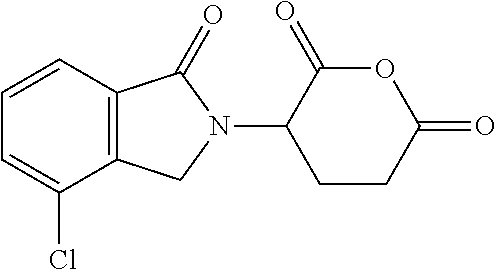


4 


- The reaction routes of the reaction process mentioned above are described in diagram A:
-

- The reaction routes of the reaction process mentioned above are described in diagram B:
-

- The reaction routes of the reaction process mentioned above are described in diagram C:
-

- In another aspection of the invention, the following intermediate compounds of Formula (IV) are provided:
-

- wherein:
- One of R, R3, R4 and R5 is amino or protected amino (carbamates: such as carbobenzyloxy, t-butyloxycarbonyl, fluorenylmethoxycarbonyl, etc.; acyl amide: such as acetyl, phenylacetyl, phthalyl, etc.; azanes: such as allyl, etc.; sulfonyl and sulfonyl: such as phenylsulfonyl, p-toluenesulfonyl, phenylsulfinyl, O-nitrophenylsulfinyl, etc.; referred to T. W. and WuTs P. G. M. Protective Groups in Organic Synthesis: P494-; East China University Of Science And Technology Press), nitro or halo (for example F, Cl, Br or I), and the others are hydrogen. preferably, R3, R4 and R5 are hydrogen;
- X is halo, such as: F, Cl, Br or I;
- Y is ═O or H;
- Z is ═O or H;
- and with the proviso that Y and Z are both ═O; or one of Y and Z is ═O and the other of Y and Z is H;
- A and B are each independently hydroxyl, C1-10 alkoxy, aryloxy, aryl C1-4 alkoxy or NHR2, in which R2 is hydrogen or amino protecting group (carbamates: such as carbobenzyloxy, t-butyloxycarbonyl, fluorenylmethoxycarbonyl, etc.; acyl amides: such as acetyl, phenylacetyl, phthalyl, etc.; azanes: such as allyl, etc.; sulfonyl and sulfinyl: such as phenylsulfonyl, p-toluenesulfonyl, phenylsulfinyl, O-nitrophenylsulfinyl, etc.; referred to Protective Groups in Organic Synthesis: Greene T. W., WuTs P. G. M. East China University Of Science And Technology Press: P494-); preferably, A and B are each independently hydroxyl, methoxy, ethoxyl, propoxy, isopropoxy, butoxy, isobutoxy, t-butoxy, pentyloxy, hexyloxy, heptyloxy, octyloxy, nonyloxy, decyloxy; phenoxy or substituted phenoxy; phenyl C1-4 alkoxy, such as benzyloxy, phenylethoxy, phenylpropoxy, etc., or substituted phenyl C1-4 alkoxy; in terms of the substituted phenoxy or substituted phenyl C1-4 alkoxy, the substituted groups are selected from the group consisting of C1-4 alkyl, halo, cyano, nitro, and the substituted groups are one or more, which could be the same or different groups; optionally, the groups are substituted in 2, 3, 4, 5 or 6-position of the benzene ring, for example 4-nitrobenzyloxyl, 2-chlorine-4-nitrobenzyloxyl; amino and benzylamino;
- R1 is C1-4 alkyl or hydrogen; the described C1 alkyl is selected from methyl, ethyl, propyl, isopropyl, butyl, isobutyl, t-butyl; preferably, R1 is hydrogen or methyl;
- and with proviso that the following compounds are not included: when R is nitro, A and B are both methoxy, benzyloxy, hydroxyl or amino; when R is nitro, A is methoxy and B is amino; when R is amino, A and B are both ethoxyl; when R is nitro, A is amino and B is alkoxide.
- Preferably, the present invention provides the compounds of Formula (IV):
-

- the definitions of the substituted groups in the compounds of Formula (IV′) are identical to that in the compounds of Formula (IV); more preferably, one of Y and Z is ═O, and the other is H.
- Preferably, the present invention provides the compounds of Formula (IV″):
-

- the definitions of the substituted groups in the compounds of Formula (N″) are identical to that in the compounds of Formula (IV); more preferably, one of Y and Z is ═O, and the other is H.
- Preferably, the present invention provides the compound of Formula (V):
-

- wherein: the definitions of the substituted groups in the compound of Formula (V) are identical to that in the compound of Formula (IV); more preferably, one of Y and Z is ═O, and the other is H; and with the proviso that the following compounds are not included: when R is amino or nitro, R1, R3, R4 and R5 are all hydrogen, and Y is ═O, and Z is ═O or H.
- Preferably, the present invention provides the compounds of Formula (VI):
-

- wherein: the definitions of the substituted groups in the compounds of Formula (VI) are identical to that in the compounds of Formula (IV); more preferably, one of Y and Z is ═O, and the other is H; and with the proviso that the following compounds are not included: when R is nitro, R1, R3, R4 and R5 are all hydrogen, and Y is ═O, and Z is ═O.
- Preferably, the present invention provides the compounds of Formula (VII):
-

- wherein: the definitions of the substituted groups in the compounds of Formula (VII) are identical to that in the compounds of Formula (IV); more preferably, one of Y and Z is ═O, and the other is H; and with the proviso that the following compounds are not included: when R is amino or nitro, R1, R3, R4 and R5 are all hydrogen, Y is ═O, and Z is ═O or H.
- Further preferably, the present invention provides the compounds of following formula:
-


- By comparison with the existing synthesis routes, the present invention has the following advantages:
- 1. The raw materials used in the present invention are accessible, whereas the raw materials used in original R&D Corporation's route are commercially unavailable internally:
- Initial materials: α-aminoglutarimide hydrochloride is commercially unavailable internally. It is synthesized from N-benzyloxycarbony-L-glutamine, which reacts with N,N′-carbonyldiimidazole in TI-IF refluxing to yield N-benzyloxycarbony-aminoglutarimide. After that amino protection group is removed and α-aminoglutarimide hydrochloride is yielded by hydrogenation under certain pressure catalyzed with Pd/C.
- Key materials in reaction: methyl 2-bromomethyl-3-nitrobenzoate is synthesized from 2-methyl-3-nitrobenzoate, which is brominated by refluxing over 24 h in the presence of lethal carbon tetrachloride and in the condition of ultraviolet light photocatalysis under mercury lamp. Photocatalytic reaction has low yield and the difficulty in mass production, as well as the difficulty in labour protection against ultraviolet light emitted by the catalytic light source—mercury lamp.
- 2. Comparison of time length and degree of difficulty of reaction, yield purity, as well as degree of extraction and purification:
- In both the US Patent application US2006052609A1 and the Chinese Patent application CN97180299.8, the reaction product was purified by column chromatography at least twice or more, which made industrial operation complicated and made it difficult to industrial scale-up production.
- In both the US Patent application US2006052609A1 and the Chinese Patent application CN97180299.8, pressurized hydrogenation was utilized twice; In the present invention, only Pd/C and ammonium formate are used in deprotection reduction, which is of high security and mild conditions. By comparison with hydrogenation under certain pressure, hydrogenation under atmospheric pressure is of less risk, leading to enhanced production security.
- When N-benzyloxycarbony-L-glutamine, as initial material, reacted with N,N′-carbonyldiimidazole in THF refluxing for 24 h to yield N-benzyloxycarbony-aminoglutarimide, low purity of yield results from long reactive time and high temperature.
- 3. Comparison of yield in each procedure and total yield:
- The total yield was lower than 20% and 18% respectively reported in the US Patent application US2006052609A1 and the Chinese Patent application.
- In the present invention, the total yield of 3-(4-amino-1-oxo-1,3-dihydro-2H-isoindol-2-yl)-2,6-dioxopiperidine synthesized from the original raw material, 4-nitro-2,3-dihydro-1H-isoindol-1-one and α-bromodimethyl glutarate, averages from 35% to 40%, due to the short reaction routes and simple methods.
- 4. Toxicity of solvent and its influence on environment:
- In the US Patent application US2006052609A1 and the Chinese Patent application, carbon tetrachloride was reported to be reaction solvent used for refluxing, which did extreme harm to environment and made innocent treatment and labor protection difficult.
- In the present invention, derivatives of benzene or carbon tetrachloride are unavailable to be as reaction solvent, which is relatively eco-friendly.
- The following examples will serve to further elaborate the present invention seeing the above routes A, B and C, which shouldn't be understood as a limitation in the scope of this invention by the person skilled in the art. Any modification or improvement based on the instruction well known in the art should be in the scope of this invention, without departing from the spirit and scope of the present invention.
- A mixture of methyl 2-bromomethyl-3-nitrobenzoate (20 g) and methanol (200 ml) was stirred under ammonia gas for 30 min at room temperature, and was kept in heat preservation for 2 hours. Crystal grew in an ice bath for 2 hours, and then filtered, and dried to give 11.7 g of light yellow crystal. yield: 90%. mp: 235.4˜236.7° C.
- 1H-NMR: (300 MHz, DMSO-d6) δ: 4.78 (s, 2H), 7.79 (t, 1H), 8.10 (d, 1H), 8.41 (d, 1H), 8.90 (S, 1H).
- 1H-NMR: (300 MHz, DMSO-d6/D2O) δ: 4.76 (s, 2H), 7.77 (t, 1H), 8.08 (d, 1H), 8.39 (d, 1H).
- FAB(M+1): 179
- theoretical data: C, 53.94%; H, 3.39%; N, 15.72%
- measured data: C, 54.08%; H, 3.49%; N, 15.81%
- type and specification of column:
-
- phenomenex Luna 5 u C18
- 250 mm×4.6 mm; velocity: 1.0 ml/min; λ=230 nm
- mobile phase: acetonitrile/0.1% phosphate=30/70
- appearance time of target yield: 5.810 minutes
- purity of target yield: 99.59%
- A mixture of 4-nitro-2,3-dihydro-1H-isoindol-1-one (20 g), ammonium formate (35 g) and 7.5% Pd/C (0.6 g) in methanol (60 ml) was stirred for 2 hours by heating up to 35° C. Pd/C was filtered and the filtrate concentrated under reduced pressure. The residue was recrystallized from water to give 15.3 g of light yellow solid. yield: 92%. mp: 195.6-197° C.
- 1H-NMR: (300 MHz, DMSO-d6) δ: 4.31 (s, 2H), 6.76 (d, 1H), 7.14 (t, 1H), 6.86 (d, 1H), 5.30 (s, 2H), 8.26 (s, 1H)
- 1H-NMR: (300 MHz, DMSO-d6/D2O) δ: 4.14 (s, 2H), 6.79 (d, 1H), 6.93 (d, 1H), 7.16 (t, 1H)
- FAB(M+1): 149
- theoretical data: C, 64.85%; H, 5.44%; N, 18.91%
- measured data: C, 64.96%; H, 5.61%; N, 19.02%
- type and specification of column:
-
- phenomenex Luna 5 u C18
- 250 mm×4.6 mm; velocity: 1.0 ml/min; λ=230 nm
- mobile phase:
- acetonitrile/0.1% phosphate=15/85 or
- acetonitrile/0.01M ammonium acetate=10/90
- appearance time of target yield: 3.580 minutes; 4.790 minutes
- purity of target yield: 99.66%
- In a dry reaction flask, thionyl chloride 36 ml was added into a stirred mixture of glutaric acid (30 g) and chloroform (90 ml) under reflux for 2 hours, and then bromine (36 g) was added under reflux for over 16 hours. The reaction mixture was cooled, into which methanol (75 ml) was then added by droplet in an ice bath and stirred in heat preservation for 2 hours. The resulting mixture was washed with 5% sodium bisulfate (150 ml), saturated sodium bicarbonate (150 ml) and saturated sodium chloride (150 ml) one by one. The organic layer was dried with anhydrous sodium sulfate and after that sodium sulfate was removed by filter. The filtrate was concentrated to dryness and distilled under reduced pressure, to collect the fraction at 110-115° C./5 mmHg. The target yield is colorless liquid. weight: 41.3 g. yield: 76%.
- FAB(M+1): 240
-
-
- type and specification of column:
- phenomenex Luna 5 u C18
- 250 mm×4.6 mm; velocity: 1.0 ml/min; λ=230 nm
- mobile phase: acetonitrile/0.1% phosphate=50/50
- appearance time of target yield: 7.750 minutes
- purity of target yield: 96.64%
- type and specification of column:
- A mixture of 4-amino-2,3-dihydro-1H-isoindol-1-one (5 g), N-methylpyrrolidone (25 ml), cesium carbonate (11 g) and α-bromodimethyl glutarate (9.7 g) was stirred under nitrogen at room temperature over night. After adding water (75 ml) and methylene chloride (50 ml), remove the aqueous phase and the organic phase was extracted with 2 mol/L hydrochloric acid. The aqueous hydrochloric acid solution was mixed with methylene chloride (100 ml) and phases separated at pH7 adjusted by addition of Na2CO3. The organic phase was dried over anhydrous sodium sulfate and concentrated under reduced pressure to give a yellow ticking substance (7.2 g) which could be used in next reaction without further purification. yield: 70%
- 1H-NMR: (300 MHz, DMSO-d6) δ: 2.19 (m, 2H), 2.35 (t, 2H), 3.52 (s, 3H), 3.66 (s, 3H), 4.23 (s, 2H), 4.90 (m, 1H), 5.38 (s, 2H), 6.79 (d, 1H), 6.89 (d, 1H), 7.17 (t, 1H).
- 1H-NMR: (300 MHz, DMSO-d6/D2O) δ: 2.10 (m, 2H), 2.33 (t, 2H), 3.53 (s, 3H), 3.66 (s, 3H), 4.22 (s, 2H), 4.90 (m, 1H), 5.38 (s, 2H), 6.80 (d, 1H), 6.89 (d, 1H), 7.17 (t, 1H).
- FAB(M+1): 307
- theoretical data: C, 58.82%; H, 5.92%; N, 9.15%
- measured data: C, 58.74%; H, 6.06%; N, 9.06%
-
-
- type and specification of column:
- phenomenex Luna 5 u C18
- 250 mm×4.6 mm; velocity: 1.0 ml/min; λ=230 nm
- mobile phase: acetonitrile/0.1% phosphate=30/70
- appearance time of target yield: 7.620 minutes
- purity of target yield: 92.1%
With the similar methods, the compounds in the following table are obtained:
- type and specification of column:
-
Formula original yield/purity sequence raw starting (HPLC by number material material target yield normalization) 1 


yield: 68.3% purity: 93.5% 2 


yield: 73.7% purity: 91.4% 3 


yield: 59.3% purity: 89.1% - Under nitrogen in dry reaction flask was added sodium amide (30 mmol 1.17 g) (obtained by adding metallic sodium (690 mg) into liquid ammonia (−40° C., 300 ml) and then adding catalytic amount of ferric nitrate). The solution of dimethyl 3-(4-amino-1,3-dihydro-1-oxo-2H-isoindol-2-yl)-glutarate (3 g, 10 mmol) in anhydrous tetrahydrofuran (100 ml) was added by droplet with the temperature maintaining at −40° C. and the mixture was stirred in heat preservation for 3 hours. ammonium chloride (5 g) (ammonia spillover is allowed) and water (300 ml) were added and the resulting mixture was filtered. The crude was recrystallized from isopropanol (15 ml) to give target yield (1.22 g).
- 1H-NMR: (500 MHz, DMSO-d6) S: 2.02˜2.04 (m, 1H), 2.27˜2.34 (m, 1H), 2.60˜2.63 (m, 1H), 2.88˜2.95 (m, 1H), 4.16 (dd, 2H), 5.10 (dd, 2H), 6.80 (d, 1H), 6.92 (d, 1H), 7.19 (t, 1H), 10.19 (s, 1H) FAB(M+1): 260
- theoretical data: C, 60.22%; H, 5.05%; N, 16.21%
- measured data: C, 60.14%; H, 5.16%; N, 16.30%
-
-
- type and specification of column:
- phenomenex Luna 5 u C18
- 250 mm×4.6 mm; velocity: 1.0 ml/min; ?=230 nm
- mobile phase: acetonitrile/0.1% phosphate=10/90
- appearance time of target yield: 11.81 minutes
- purity of target yield: 99.29%
With the similar methods, the compounds in the following table are obtained:
- type and specification of column:
-
Formula yield/purity sequence (HPLC by number starting material target yield normalization) 1 

yield: 53% purity: 93.23% 2 

yield: 39.7% purity: 94.77% - A mixture of dimethyl 3-(4-amino-1,3-dihydro-1-oxo-2H-isoindol-2-yl)-glutarate (30.6 g), saturated dioxane/ammonia solution (150 ml) and lipase (14 g) was stirred at 20° C. for 3˜5 hours. The reaction mixture concentrated by reduced pressure at room temperature to remove ammonia and then concentrated under reduced pressure to dryness. The concentrate was stirred with methyl tert-butyl ether (100 ml) and then white crystal was precipitated. After filter the residue was dried under vacuum at room temperature to give 21.4 g of target yield as a white crystal. yield: 73%. mp: 103˜106° C.
- 1H-NMR: (300 MHz, DMSO-d6) δ: 4.17 (d, 1H), 4.40 (d, 1H), 5.43 (s, 2H), 6.76 (d, 1H), 7.17 (t, 1H), 6.87 (d, 1H), 4.73 (m, 1H), 1.91 (m, 2H), 2.18 (t, 2H), 3.51 (s, 3H), 7.13 (s, 1H), 7.55 (s, 1H).
- 1H-NMR: (300 MHz, DMSO-d6/D2O) δ: 4.17 (d, 1H), 4.40 (d, 1H), 6.76 (d, 1H), 7.17 (t, 1H), 6.87 (d, 1H), 4.73 (m, 1H), 1.91 (m, 2H), 2.18 (t, 2H), 3.51 (s, 3H).
- FAB(M+1): 292
-
-
- type and specification of column:
- phenomenex Luna 5 u C18
- 250 mm×4.6 mm; velocity: 1.0 ml/min; λ=230 nm
- mobile phase: acetonitrile/0.1% phosphate=10/90
- appearance time of target yield: 19.900 minutes
- purity of target yield: 98.3%
With the similar methods, the compounds in the following table are obtained:
- type and specification of column:
-
Formula yield/purity sequence (HPLC by number starting material target yield normalization) 1 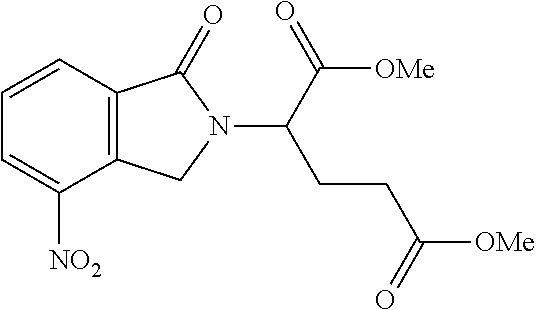

yield: 72% purity: 97.96% 2 

yield: 75.1% purity: 97.55% 3 

yield: 64.1% purity: 96.74% - A mixture of methyl N-[4-amin-1-oxo-1,3-dihydro-2-hydro-isoindol-2-yl]-glutaminate (20 g) in acetonitrile (300 ml) was stirred with potassium carbonate (9.4 g) under reflux for 5 hours. The reaction mixture was concentrated to remove acetonitrile and was stirred with ethyl acetate (100 ml) and water (50 ml). After filter, recrystallization from isopropanol gave a light yellow solid (14.9 g). yield: 84%. mp: 250.5˜251.7° C.
- 1H-NMR: (300 MHz, DMSO-d6) δ: 2.03˜2.06 (m, 1H), 2.26˜2.34 (m, 1H), 2.59˜2.63 (m, 1H), 2.85˜2.92 (m, 1H), 4.15 (dd, 2H), 5.09 (dd, 2H), 6.81 (d, 1H), 6.92 (d, 1H), 7.20 (t, 1H), 10.18 (s, 1H).
- FAB(M+1): 260
- theoretical data: C, 60.22%; H, 5.05%; N, 16.21%
- measured data: C, 60.12%; H, 5.17%; N, 16.29%
-
-
- type and specification of column:
- phenomenex Luna 5 u C18
- 250 mm×4.6 mm; velocity: 1.0 ml/min; λ=230 nm
- mobile phase: acetonitrile/0.1% phosphate=10/90
- appearance time of target yield: 11.73 minutes
- purity of target yield: 99.61%
With the similar methods, the compounds in the following table are obtained:
- type and specification of column:
-
Formula yield/purity sequence (HPLC by number starting material target yield normalization) 1 

yield: 81% purity: 98.61% 2 

yield: 86% purity: 99.21% 3 

yield: 71% purity: 97.97% - A mixture of dimethyl 3-(4-amino-1,3-dihydro-1-oxo-2H-isoindol-2-yl)-glutarate (30.6 g), anhydrous acetonitrile (150 ml) and triethylamine (13.9 ml) was stirred with benzyl chloroformate (17.1 g) under catalytic amount of MAP under reflux for 4 hours. The reaction mixture was cooled to room temperature and then mixed with water (500 ml). The resulting mixture was then extracted with dichloromethane and dried over anhydrous sodium sulphate, then concentrated under reduced pressure to give a red sticky substance (66 g). The solution of residue in supersaturated methanol-ammonia (250 ml) was stirred at 25˜30° C. for over 24 hours and white solid was precipitated. Crystal grew in an ice bath for 2 hours. After filter the cake was dried under reduced pressure to give 44.4 g of white crystal. yield: 67%. mp: 190˜192° C.
- 1H-NMR: (300 MHz, DMSO-d6) δ: 4.29 (d, 1H); 4.56 (d, 1H), 7.56 (s, 1H), 6.59 (d, 1H), 7.34 (t, 1H), 6.88 (d, 1H), 4.70 (m, 1H), 2.01 (m, 2H), 2.20 (m, 1H), 2.02 (m, 1H), 6.59 (s, 1H); 6.74 (s, 1H), 4.38 (s, 2H), 7.14˜7.40 (m, 7H).
- 1H-NMR: (300 MHz, DMSO-d6/D2O) δ: 4.29 (d, 1H); 4.56 (d, 1H), 6.59 (d, 1H), 7.34 (t, 1H), 6.88 (d, 1H), 4.70 (m, 1H), 2.01 (m, 2H), 2.20 (m, 1H), 2.02 (m, 1H), 4.38 (s, 2H), 7.14˜7.40 (m, 5H).
- FAB(M+1): 443
-
-
- type and specification of column:
- phenomenex Luna 5 u C18
- 250 mm×4.6 mm; velocity: 1.0 ml/min, λ=230 nm
- mobile phase: acetonitrile/0.1% phosphate=40/60
- appearance time of target yield: 6.980 minutes
- purity of target yield: 98.67%
With the similar methods, the compounds in the following table are obtained:
- type and specification of column:
-
Formula yield/purity sequence (HPLC by number starting material target yield normalization) 1 

yield: 72% purity: 97.96% 2 

yield: 75.1% purity: 97.55% 3 

yield: 64.1% purity: 96.74% - 3-[4-(N-benzyloxycarbonyl)amino-1,3-dihydro-1-oxo-2H-isoindol-2-yl]-glutaramide (30 g) was stirred with formamide (150 ml) for 3˜4 hours by slowly heating up to 160° C. The reaction mixture was cooled to 0° C. and then mixed with water (750 ml). After crystal growing for 1 hour, the resulting mixture was filtered and dried to give 21.6 g of light yellow solid. The solution of this residue in methanol (325 ml) was stirred with 5% Pd/C (0.3 g) and formamide (22 g) at 30° C. for 2 hours. Pd/C was filtered and the filtrate concentrated under reduced pressure to yield a yellow solid. Recrystallization and washing by isopropanol and active carbon gave 12.75 g of light yellow solid. yield: 72%. mp: 251.1˜252.4° C.
- 1H-NMR: (300 MHz, DMSO-d6) δ: 2.02 (m, 2H), 2.01˜2.06 (m, 1H), 2.25-2.39 (m, 1H), 2.59˜2.64 (m, 1H), 2.83˜2.94 (m, 1H), 4.16 (dd, 2H), 5.08 (dd, 1H), 5.35 (s, 2H), 6.80 (d, 1H), 6.93 (d, 1H), 7.90 (t, 1H), 10.91 (s, 1H).
- FAB(M+1): 260
- theoretical data: C, 60.22%; H, 5.05%; N, 16.21%
- measured data: C, 60.27%; H, 5.13%; N, 16.26%
-
-
- type and specification of column:
- phenomenex Luna 5 u C18
- 250 mm×4.6 mm; velocity: 1.0 ml/min, ?=230 nm
- mobile phase: acetonitrile/0.1% phosphate=10/90
- appearance time of target yield: 11.77 minutes
- purity of target yield: 99.37%
With the similar methods, the compounds in the following table are obtained:
- type and specification of column:
-
Formula yield/purity sequence (HPLC by number starting material target yield normalization) 1 

yield: 83% purity: 98.97% 2 

yield: 81% purity: 99.03% 3 

yield: 76% purity: 98.63% - A mixture of dimethyl 3-(4-amino-1,3-dihydro-1-oxo-2H-isoindol-2-yl)-glutarate (5 g) and tetrahydrofuran (14 ml) in 20% potassium carbonate solution (45 ml) was stirred for 5 hours by heating up to 50° C. The aqueous phase was separated and concentrated to dryness under reduced pressure. The concentrate was stirred with methanol (50 ml) for 30 min. After filter, the filtrate concentrated to dryness and was mixed with isopropanol (50 ml) for crystal growing for 2 hours at room temperature. The resulting mixture was filtered and dried under reduced pressure to give 3.7 g of target yield as a white solid. yield: 81%. Melting point test showed that the product began to melt at 90° C. and the final melting point was not apparently observed.
- 1H-NMR: (300 MHz, DMSO-d6) δ: 2.01 (m, 2H), 2.20 (m, 2H), 3.78 (m, 1H), 4.55 (s, 2H), 5.30 (s, 2H), 6.73 (d, 1H), 6.85 (d, 1H), 7.12 (t, 1H), 10.99 (br, 2H).
- 1H-NMR: (300 MHz, DMSO-d6/D2O) δ: 1.88 (m, 2H), 2.09 (m, 2H), 3.71 (m, 1H), 4.49 (s, 2H), 6.76 (d, 1H), 6.90 (d, 1H), 7.15 (t, 1H).
- FAB(M+1): 279
- theoretical data: C, 56.11%; H, 5.07%; N, 10.07%
- measured data: C, 56.20%; H, 5.21%; N, 10.18%
-
-
- type and specification of column:
- phenomenex Luna 5 u C18
- 250 mm×4.6 mm; velocity: 1.0 ml/min, A=230 nm
- mobile phase: acetonitrile/0.1% phosphate=15/85
- appearance time of target yield: 5.260 minutes
- purity of target yield: 98.7%
With the similar methods, the compounds in the following table are obtained:
- type and specification of column:
-
Formula yield/purity sequence raw (HPLC by number starting material material target yield normalization) 1 
K2CO3/H2O CH3OH 
yield: 84% purity: 97.9% 2 
K2CO3/H2O EtOH 
yield: 77% purity: 96.7% 3 
K2CO3/H2O EtOH 
yield: 68% purity: 93.3% - A mixture of 3-(4-amino-1,3-dihydro-1-oxo-2H-isoindol-2-yl)-glutaric acid (5 g) and urea (1.08 g) in N, N-dimethylformamide (25 ml) was stirred and heated under reflux for 3˜4 hours. The reaction mixture concentrated under reduced pressure at 60° C. and then was added into ice water by being stirred rapidly. After filter, the cake was washed with isopropanol. The crude product was recrystallized from isopropanol and active carbon to give 1.4 g of off-white target compound. Yield: 30%. mp: 252.1˜254.3° C.
- 1H-NMR: (300 MHz, DMSO-d6) δ: 2.03 (m, 2H), 2.01˜2.07 (m, 1H), 2.26˜2.37 (m, 1H), 2.61˜2.65 (m, 1H), 2.87˜2.96 (m, 1H), 4.17 (dd, 2H), 5.09 (dd, 1H), 5.36 (s, 2H), 6.81 (d, 1H), 6.92 (d, 1H), 7.91 (t, 1H), 10.93 (s, 1H).
- 1H-NMR: (300 MHz, DMSO-d6/D2O) δ: 2.02˜2.05 (m, 1H), 2.32˜2.36 (m, 1H), 2.60˜2.65 (m, 1H), 2.83˜2.88 (m, 1H), 4.17 (dd, 2H), 5.04 (dd, 1H), 6.82 (d, 1H), 6.94 (d, 1H), 7.20 (t, 1H).
- FAB(M+1): 260
- theoretical data: C, 60.22%; H, 5.05%; N, 16.21%
- measured data: C, 60.30%; H, 5.20%; N, 16.18%
- With the similar methods, the compounds in the following table are obtained:
-
Formula yield/purity sequence (HPLC by number starting material target yield normalization) 1 

yield: 33% purity: 99.37% 2 

yield: 31% purity: 98.55% - To a stirred mixture of 3-(4-amino-1,3-dihydro-1-oxo-2H-isoindol-2-yl)-glutaric acid (30.6 g) and triethylamine (13.9 ml) in anhydrous acetonitrile (150 ml) was added benzyl chloroformate (17.1 g) and catalytic amount of DMAP under reflux for 4 hours. The resulting mixture was cooled to room temperature and then added into water (500 ml). The mixture was extracted with dichloromethane and dried over anhydrous sodium sulphate. The resulting mixture was concentrated under reduced pressure to give 66 g of red sticky substance. Then the substance was added in acetic anhydride (250 ml) and heated to 50° C., then pyridine (3 ml) was added and reacted at 70° C. for 30 minutes. The reaction mixture was dried by reduced pressure and added anhydrous methyl tert-butyl ether. Refinement gave 30 g of white target yield. yield: 76%.
- FAB(M+1): 395
- With the similar methods, the compounds in the following table are obtained:
-
sequence Formula number starting material target yield yield 1 

yield: 91% 2 

yield: 87% 3 

yield: 85% 4 

yield: 90% 5 

yield: 93.3% - A mixture of 3-[4-(N-benzyloxycarbonyl)amino-1,3-dihydro-1-oxo-2H-isoindol-2-yl]-glutaric anhydride (30 g) in thy tetrahydrofuran (300 ml) was stirred at 0° C. under supersaturated ammonia for 2 hours. After filter, the cake was washed with ether and dried under reduced pressure at room temperature to give 27.3 g of white solid.
- yield: 84%. purity: 95.61%.
- FAB(M+1): 428
- With the similar methods, the compounds in the following table are obtained:
-
Formula yield/purity sequence (HPLC by number starting material target yield normalization) 1 

yield: 80% purity: 96.1% 2 

yield: 78% purity: 94.3% 3 

yield: 75% purity: 93.1% 4 

yield: 75% purity: 95.3% 5 

yield: 79% purity: 94.7% - To a stirred mixture of 3-[4-(N-benzyloxycarbonyl)amino-1,3-dihydro-1-oxo-2H-isoindol-2-yl]-isoglutamine (10 g) in DMF (30 ml) was added thionyl chloride (5 g) by droplet at −20° C. for reaction in heat preservation for 2˜3 hours. The resulting mixture was mixed in ice water stirred rapidly. Then the mixture was extracted with ethyl acetate (2×50 ml) and dried over anhydrous sodium sulfate. Sodium sulfate was filtered and the filtrate concentrated to dryness under reduced pressure. The concentrate was mixed in methanol (100 ml) and stirred with 5% Pd/C (1 g) and ammonium formate (7 g) at 30° C. for 2 hours. Pd/C was filtered and the filtrate concentrated to dryness. The concentrate was recrystallized from isopropanol and rinsed with water. Decompression drying gave 3.76 g of target yield as a light yellow solid. yield: 62%. mp: 250.8˜252.7° C.
- 1H-NMR: (300 MHz, DMSO-d6/D2O) δ: 2.04˜2.10 (m, 1H), 2.34˜2.39 (m, 1H), 2.61˜2.67 (m, 1H), 2.87˜2.91 (m, 1H), 4.18 (dd, 2H), 5.08 (dd, 2H), 6.84 (d, 1H), 6.96 (d, 1H), 7.23 (t, 1H)
- FAB(M+1): 260
- theoretical data: C, 60.22%; H, 5.05%; N, 16.21%
- measured data: C, 60.04%; H, 5.31%; N, 16.33%
-
-
- type and specification of column:
- phenomenex Luna 5 u C18
- 250 mm×4.6 mm; velocity: 1.0 ml/min, λ=230 nm
- mobile phase: acetonitrile/0.1% phosphate=10/90
- appearance time of target yield: 11.767 minutes
- purity of target yield: 99.69%.
- type and specification of column:
- To a mixture of 3-(4-nitro-1,3-dihydro-1-oxo-2H-isoindol-2-yl)-isoglutamine (9 g) in N,N-dimethylformamide (80 ml), was added thionyl chloride (6.6 g) by droplet below 0° C. for stirred reaction in heat preservation for 2˜3 hours. The resulting solution was added by droplet into mixture of ice and water and pH value was adjusted to 7˜8 with sodium carbonate. The mixture was stirred for 30 minutes and filtered to get light yellow crude. Refining with methanol gave 6.6 g of target yield as a light yellow solid. yield: 78%.
- FAB(M+1): 290
- theoretical data: C, 53.98%; H, 3.83%; N, 14.53%
- measured data: C, 54.06%; H, 3.95%; N, 14.61%
- With the similar methods, the compounds in the following table are obtained:
-
Formula yield/purity sequence (HPLC by number starting material target yield normalization) 1 

yield: 83% purity: 93.4% 2 

yield: 87% purity: 91% 3 

yield: 77% purity: 93.1% 4 

yield: 81% purity: 92.2% - A mixture of 3-(4-nitro-1,3-dihydro-1-oxo-2H-isoindol-2-yl)-2,6-dioxopiperidine (7 g), 5% Pd/C (1.4 g) and ammonium formate (2.1 g) in methanol (35 ml) was stirred completely at room temperature for 2 hours. Pd/C was filtered and the filtrate concentrated to dry under reduced pressure. Recrystallization from heated isopropanol and washing with water gave 5.6 g of yellow crystal. yield: 89%. mp: 252.3˜254.0° C.
- 1H-NMR: (300 MHz, DMSO-d6) δ: 2.00˜2.08 (m, 1H), 2.27˜2.32 (m, 1H), 2.58˜2.64 (m, 1H), 2.86˜2.96 (m, 1H), 4.15 (dd, 2H), 5.11 (dd, 2H), 6.80 (d, 1H), 6.91 (d, 1H), 7.19 (t, 1H), 11.00 (s, 1H).
- FAB(M+1): 260
- theoretical data: C, 60.22%; H, 5.05%; N, 16.21%
- measured data: C, 60.17%; H, 5.21%; N, 16.26%
- Preparation with the Same Method:
- (R)-3-(4-amino-1-oxo-1,3-dihydro-2H-isoindol-2-yl)-2,6-dioxopiperidine;
yield: 93%; purity 99.41%.
Preparation with the Same Method: - (S)-3-(4-amino-1-oxo-1,3-dihydro-2H-isoindol-2-yl)-2,6-dioxopiperidine;
yield: 91%; purity 99.73%. - A mixture of 3-(4-chloro-1-oxo-1,3-dihydro-2H-isoindol-2-yl)-2,6-dioxopiperidine (5 g) in ammonium formate (30 ml) was stirred by heating up slowly to reflux and then reacted under ammonia for 6˜8 hours. The reaction mixture concentrated to dryness under reduced pressure. Recrystallization from heated isopropanol gave 3.96 g of target yield. yield: 85%. Purity: 99.17%. mp: 251.6˜253.9° C.
- 1H-NMR: (300 MHz, DMSO-d6) δ: 2.05˜2.11 (m, 1H), 2.25˜2.34 (m, 1H), 2.60˜2.65 (m, 1H), 2.85˜2.97 (m, 1H), 4.16 (dd, 2H), 5.12 (dd, 2H), 6.82 (d, 1H), 6.90 (d, 1H), 7.19 (t, 1H), 10.97 (s, 1H)
- FAB(M+1): 260
- theoretical data: C, 60.22%; H, 5.05%; N, 16.21%
- measured data: C, 60.29%; H, 5.16%; N, 16.27%
- A mixture of 4-nitro-2,3-dihydro-1H-isoindol-1-one (80 g) and cesium carbonate (219 g) in triethylamine (100 ml) was stirred for over half an hour. Under nitrogen ethyl chloroformate (68 ml) was added by droplet below 0° C. and reacted by stirring at room temperature for 3˜5 hours. The resulting mixture was added in ice water (1000 mL) and then light yellow solid was precipitated. After filter, the cake was washed by iced water. The aqueous phase was extracted with dichloromethane twice and the combined extracts were dried with anhydrous sodium sulphate. After filtered, the filtrate was concentrated to dry under reduced pressure. The concentrated was diluted with n-hexane (120 ml) and stirred to precipitate crystal. Filter and drying under reduced pressure gave light yellow solid.
- A mixture of D,L-glutamic acid (66.7 g) in tetrahydrofuran (330 ml) was stirred with the intermediate prepared above in batches at subzero temperature. Triethylamine (6.5 ml) was added in the mixture to react for 20 min and then for 16˜24 hours under reflux. The reaction mixture was cooled and filtered. The filtrate was concentrated to dryness under reduced pressure. The concentrate was dissolved in dichloromethane (60 ml) and extracted with saturated sodium bicarbonate solution. When pH of the resulting mixture was adjusted to 2 by 2N hydrochloric acid, a number of light yellow solid was precipitated, subsequently extracted with dichloromethane, and washed with distilled water, dried over anhydrous sodium sulfate, filtered and concentrated under reduced pressure, finally crystal grew by standing, filtered and dried to give 94.2 g of title product as light yellow solid, yield 79%. purity 95.81%.
- FAB(M+1): 309.
- theoretical data: C, 50.65%; H, 3.92%; N, 9.09%
- measured data: C, 50.54%; H, 4.01%; N, 9.04%
- The present processes have the following advantages:
- i. The method for preparing key substrate needed in the synthesis is simple and with low cost, which is suitable for commercial process;
- ii. Each step to the present invention is under mild reaction conditions without hard long-time reflux.
- iii. The products yielded in each step to the present invention are of high purity, which simplify the extraction and purification process without column chromatography or other complicated extraction conditions.
- iv. There is high yield in each reaction. When 3-(4-amino-1-oxo-1,3-dihydro-2H-isoindol-2-yl)-2,6-dioxopiperidine is synthesized from the original raw material, 4-nitro-2,3-dihydro-1H-isoindol-1-one and α-bromodimethyl glutarate, the total yield averages from 35% to 40%. Hence the preparation methods are simple with low costs.
- v. Only by three or four procedures can the key product be yielded, which leads to short synthesis routes and simple methods.
- vi. The solvents used in each preparation procedure are easy to be disposed for environment protection, which is relatively eco-friendly.
Claims (15)


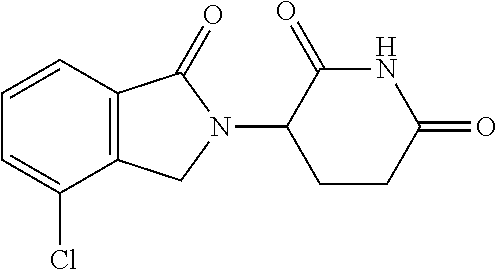


Priority Applications (1)
| Application Number | Priority Date | Filing Date | Title |
|---|---|---|---|
| US14/545,757 US9522899B2 (en) | 2009-06-01 | 2015-06-15 | Methods for synthesizing 3-(substituted dihydroisoindolinone-2-yl)-2, 6-dioxopiperidine, and intermediates thereof |
Applications Claiming Priority (6)
| Application Number | Priority Date | Filing Date | Title |
|---|---|---|---|
| CN0910142160.9 | 2009-06-01 | ||
| CN0910142160 | 2009-06-01 | ||
| CN2009101421609A CN101580501B (en) | 2009-06-01 | 2009-06-01 | Synthesis method and intermediate of 3-(substituted dihydroisoindolinone-2-yl)-2,6-piperidinedione |
| PCT/CN2010/073437 WO2010139266A1 (en) | 2009-06-01 | 2010-06-01 | Methods for synthesizing 3-(substituted dihydroisoindolinone-2-yl)-2,6-dioxopiperidine, and intermediates thereof |
| US201113375610A | 2011-12-01 | 2011-12-01 | |
| US14/545,757 US9522899B2 (en) | 2009-06-01 | 2015-06-15 | Methods for synthesizing 3-(substituted dihydroisoindolinone-2-yl)-2, 6-dioxopiperidine, and intermediates thereof |
Related Parent Applications (2)
| Application Number | Title | Priority Date | Filing Date |
|---|---|---|---|
| US13/375,610 Division US9085530B2 (en) | 2009-06-01 | 2010-06-01 | Methods for synthesizing 3-(substituted dihydroisoindolinone-2-yl)-2, 6-dioxopiperidine, and intermediates thereof |
| PCT/CN2010/073437 Division WO2010139266A1 (en) | 2009-06-01 | 2010-06-01 | Methods for synthesizing 3-(substituted dihydroisoindolinone-2-yl)-2,6-dioxopiperidine, and intermediates thereof |
Publications (2)
| Publication Number | Publication Date |
|---|---|
| US20150284359A1 true US20150284359A1 (en) | 2015-10-08 |
| US9522899B2 US9522899B2 (en) | 2016-12-20 |
Family
ID=41362841
Family Applications (3)
| Application Number | Title | Priority Date | Filing Date |
|---|---|---|---|
| US13/375,610 Active 2030-09-05 US9085530B2 (en) | 2009-06-01 | 2010-06-01 | Methods for synthesizing 3-(substituted dihydroisoindolinone-2-yl)-2, 6-dioxopiperidine, and intermediates thereof |
| US14/545,756 Abandoned US20150284329A1 (en) | 2009-06-01 | 2015-06-15 | Methods for synthesizing 3-(Substituted Dihydroisoindolinone-2-YI)-2, 6-Dioxopiperidine, and intermediates thereof |
| US14/545,757 Expired - Fee Related US9522899B2 (en) | 2009-06-01 | 2015-06-15 | Methods for synthesizing 3-(substituted dihydroisoindolinone-2-yl)-2, 6-dioxopiperidine, and intermediates thereof |
Family Applications Before (2)
| Application Number | Title | Priority Date | Filing Date |
|---|---|---|---|
| US13/375,610 Active 2030-09-05 US9085530B2 (en) | 2009-06-01 | 2010-06-01 | Methods for synthesizing 3-(substituted dihydroisoindolinone-2-yl)-2, 6-dioxopiperidine, and intermediates thereof |
| US14/545,756 Abandoned US20150284329A1 (en) | 2009-06-01 | 2015-06-15 | Methods for synthesizing 3-(Substituted Dihydroisoindolinone-2-YI)-2, 6-Dioxopiperidine, and intermediates thereof |
Country Status (8)
| Country | Link |
|---|---|
| US (3) | US9085530B2 (en) |
| EP (1) | EP2438053B1 (en) |
| JP (1) | JP5588506B2 (en) |
| KR (2) | KR101504298B1 (en) |
| CN (1) | CN101580501B (en) |
| AU (1) | AU2010256200B2 (en) |
| ES (1) | ES2437751T3 (en) |
| WO (1) | WO2010139266A1 (en) |
Families Citing this family (20)
| Publication number | Priority date | Publication date | Assignee | Title |
|---|---|---|---|---|
| UA83504C2 (en) | 2003-09-04 | 2008-07-25 | Селджин Корпорейшн | Polymorphic forms of 3-(4-amino-1-oxo-1,3 dihydro-isoindol-2-yl)-piperidine-2,6-dione |
| CN101580501B (en) * | 2009-06-01 | 2011-03-09 | 南京卡文迪许生物工程技术有限公司 | Synthesis method and intermediate of 3-(substituted dihydroisoindolinone-2-yl)-2,6-piperidinedione |
| US20120184746A1 (en) * | 2009-09-03 | 2012-07-19 | Ranbaxy Laboratories Limited | Process for the preparation of lenalidomide |
| EP2545043B1 (en) | 2010-03-08 | 2019-04-24 | Natco Pharma Limited | Anhydrous lenalidomide form-i |
| WO2013012485A2 (en) * | 2011-07-19 | 2013-01-24 | Amplio Pharma, Llc | Novel crystalline forms of 3-(4-amino-1-oxo-1,3 dihydro-isoindol-2-yl)-piperidine-2,6-dione |
| CN103601717A (en) * | 2013-10-09 | 2014-02-26 | 湖南华腾制药有限公司 | Novel preparation method of lenalidomide |
| LV14985B (en) | 2013-10-14 | 2015-06-20 | Latvijas Organiskās Sintēzes Institūts | Lenalidom ī da ing ū š anas process |
| CN104059010A (en) * | 2014-06-12 | 2014-09-24 | 浙江华海药业股份有限公司 | Preparation method of 2-(2-oxopyrrolidine-1-yl)-butyrate |
| CN105440014B (en) * | 2014-08-29 | 2018-08-28 | 杭州和泽医药科技有限公司 | A kind of preparation method of lenalidomide |
| AU2015341301B2 (en) | 2014-10-30 | 2019-05-16 | Kangpu Biopharmaceuticals, Ltd. | Isoindoline derivative, intermediate, preparation method, pharmaceutical composition and use thereof |
| CN106220552B (en) * | 2016-08-04 | 2019-02-15 | 温州大学 | A kind of preparation method of 2-substituted-isoindole-1,3-dione derivatives |
| CN106278992B (en) * | 2016-08-05 | 2018-12-11 | 温州大学 | A kind of synthetic method of 2- substitution-iso-indoles -1,3- derovatives |
| CN109400579B (en) * | 2017-08-18 | 2020-06-23 | 新发药业有限公司 | Production method of lenalidomide |
| EP3813829A4 (en) | 2018-06-29 | 2021-12-08 | Dana Farber Cancer Institute, Inc. | LIGANDS FOR CEREBLON (CRB) |
| CN109651334B (en) * | 2019-01-29 | 2021-12-21 | 南京卡文迪许生物工程技术有限公司 | Process for preparing substituted piperidinedione derivatives |
| CN114933584B (en) * | 2021-08-09 | 2022-12-27 | 上海贵之言医药科技有限公司 | dihydro-2H-isoindole ester compound |
| CN113801054A (en) * | 2021-09-30 | 2021-12-17 | 西南大学 | Preparation method of 3-alkyl-3-hydroxyindole-2-ketone and derivatives thereof and products thereof |
| CN114644586A (en) * | 2022-04-12 | 2022-06-21 | 江苏豪森药业集团有限公司 | Preparation method of lenalidomide related substance |
| CN115626916B (en) * | 2022-10-24 | 2024-01-30 | 河南科技大学第一附属医院 | Pomalidomide derivative as well as preparation method and application thereof |
| CN115784967A (en) * | 2022-12-17 | 2023-03-14 | 上海泰坦科技股份有限公司 | Synthesis method of nitroisoindolinone compounds |
Family Cites Families (22)
| Publication number | Priority date | Publication date | Assignee | Title |
|---|---|---|---|---|
| JPH0717643B2 (en) * | 1986-02-24 | 1995-03-01 | 富山化学工業株式会社 | Novel naphthyridine derivative and its salt |
| GB9013615D0 (en) | 1990-06-19 | 1990-08-08 | Wellcome Found | Pharmaceutical compounds |
| EP0480745A3 (en) | 1990-10-12 | 1992-07-29 | Merck & Co. Inc. | Substituted dihydrothieno-thiophene-2-sulfonamides and dioxides thereof |
| GB9226842D0 (en) * | 1992-12-23 | 1993-02-17 | Wellcome Found | Pharmaceutical compounds |
| EP0641776A3 (en) * | 1993-09-08 | 1997-05-02 | Takeda Chemical Industries Ltd | Thioglycerol derivatives. |
| CZ302378B6 (en) | 1996-07-24 | 2011-04-20 | Celgene Corporation | (S)-1,3-dioxo-2-(2,6-dioxopiperidin-3-yl)-4-aminoisoindoline optic isomer and pharmaceutical composition containing thereof |
| US5874448A (en) * | 1997-11-18 | 1999-02-23 | Celgene Corporation | Substituted 2-(2,6 dioxo-3-fluoropiperidin-3-yl)-isoindolines and method of reducing TNFα levels |
| US5955476A (en) | 1997-11-18 | 1999-09-21 | Celgene Corporation | Substituted 2-(2,6-dioxo-3-fluoropiperidin-3-yl)-isoindolines and method of reducing inflammatory cytokine levels |
| HK1042494A1 (en) * | 1999-03-18 | 2002-08-16 | 塞尔基因公司 | Substituted 1-oxo-and 1,3-dioxoisoindolines and their use in pharmaceutical compositions for reducing inflammatory cytokine levels |
| US7629360B2 (en) * | 1999-05-07 | 2009-12-08 | Celgene Corporation | Methods for the treatment of cachexia and graft v. host disease |
| US6534651B2 (en) * | 2000-04-06 | 2003-03-18 | Inotek Pharmaceuticals Corp. | 7-Substituted isoindolinone inhibitors of inflammation and reperfusion injury and methods of use thereof |
| US20030045552A1 (en) | 2000-12-27 | 2003-03-06 | Robarge Michael J. | Isoindole-imide compounds, compositions, and uses thereof |
| ES2325916T3 (en) * | 2001-08-06 | 2009-09-24 | The Children's Medical Center Corporation | ANTIANGIOGENIC ACTIVITY OF TALIDOMIDE ANALOGS REPLACED WITH NITROGEN. |
| CH696542A5 (en) * | 2003-07-09 | 2007-07-31 | Siegfried Ltd | A process for the preparation of substituted 2,6-dioxopiperidin-3-yl compounds. |
| CN101163489A (en) * | 2004-04-23 | 2008-04-16 | 细胞基因公司 | Compositions comprising immunomodulatory compounds and methods of use thereof for the treatment and management of pulmonary hypertension |
| US7405237B2 (en) * | 2004-07-28 | 2008-07-29 | Celgene Corporation | Isoindoline compounds and methods of their use |
| WO2007050087A1 (en) | 2004-08-25 | 2007-05-03 | Ardea Biosciences, Inc. | N[S(4-aryl-triazol-3-yl)α -mercaptoacetyl]-p-amino benozoic acids AS HIV REVERSE TRANSCRIPTASE INHIBITORS |
| JP2008512379A (en) * | 2004-09-03 | 2008-04-24 | セルジーン・コーポレーション | Process for the preparation of substituted 2- (2,6-dioxopiperidin-3-yl) -1-oxoisoindolines |
| KR101342241B1 (en) | 2005-06-30 | 2013-12-16 | 셀진 코포레이션 | Processes for the preparation of 4-amino-2-(2,6-dioxopiperidin-3-yl)isoindoline-1,3-dione compounds |
| CN101050400A (en) | 2007-05-21 | 2007-10-10 | 申雨林 | Wax candle with color flame |
| JP5251392B2 (en) | 2007-10-01 | 2013-07-31 | 日立化成株式会社 | Epoxy resin molding material for sealing and electronic component device |
| CN101580501B (en) * | 2009-06-01 | 2011-03-09 | 南京卡文迪许生物工程技术有限公司 | Synthesis method and intermediate of 3-(substituted dihydroisoindolinone-2-yl)-2,6-piperidinedione |
-
2009
- 2009-06-01 CN CN2009101421609A patent/CN101580501B/en active Active
-
2010
- 2010-06-01 KR KR1020147007696A patent/KR101504298B1/en not_active Expired - Fee Related
- 2010-06-01 AU AU2010256200A patent/AU2010256200B2/en not_active Ceased
- 2010-06-01 WO PCT/CN2010/073437 patent/WO2010139266A1/en not_active Ceased
- 2010-06-01 US US13/375,610 patent/US9085530B2/en active Active
- 2010-06-01 KR KR1020117031119A patent/KR101418813B1/en active Active
- 2010-06-01 JP JP2012513462A patent/JP5588506B2/en active Active
- 2010-06-01 EP EP10782970.7A patent/EP2438053B1/en active Active
- 2010-06-01 ES ES10782970.7T patent/ES2437751T3/en active Active
-
2015
- 2015-06-15 US US14/545,756 patent/US20150284329A1/en not_active Abandoned
- 2015-06-15 US US14/545,757 patent/US9522899B2/en not_active Expired - Fee Related
Non-Patent Citations (4)
| Title |
|---|
| Amine vs Amide "Answeres from internet" p.1-2 (2008) * |
| Chemistry of Amine "University of Michigan, Chem2 teaching text" p.1-9 (2013) * |
| Kulkarni et al. "Ion exchangeâ¦.." Angew Chem. Int. Ed. Eng. 36(22) 2454-55 (1997) * |
| Laue et al. "Named Organic reactions" p.56-57 (2005) * |
Also Published As
| Publication number | Publication date |
|---|---|
| AU2010256200A1 (en) | 2011-12-22 |
| KR20120014219A (en) | 2012-02-16 |
| US9522899B2 (en) | 2016-12-20 |
| JP2012528802A (en) | 2012-11-15 |
| KR20140052061A (en) | 2014-05-02 |
| EP2438053B1 (en) | 2013-09-11 |
| KR101504298B1 (en) | 2015-03-19 |
| AU2010256200B2 (en) | 2013-02-14 |
| KR101418813B1 (en) | 2014-07-11 |
| ES2437751T3 (en) | 2014-01-14 |
| EP2438053A4 (en) | 2012-11-07 |
| JP5588506B2 (en) | 2014-09-10 |
| CN101580501A (en) | 2009-11-18 |
| US20120077982A1 (en) | 2012-03-29 |
| US9085530B2 (en) | 2015-07-21 |
| WO2010139266A1 (en) | 2010-12-09 |
| US20150284329A1 (en) | 2015-10-08 |
| CN101580501B (en) | 2011-03-09 |
| EP2438053A1 (en) | 2012-04-11 |
Similar Documents
| Publication | Publication Date | Title |
|---|---|---|
| US9522899B2 (en) | Methods for synthesizing 3-(substituted dihydroisoindolinone-2-yl)-2, 6-dioxopiperidine, and intermediates thereof | |
| JP5817079B2 (en) | Process for preparing 6- (7-((1-aminocyclopropyl) methoxy) -6-methoxyquinolin-4-yloxy) -N-methyl-1-naphthamide, or a pharmaceutically acceptable salt thereof | |
| WO2011054171A1 (en) | Tyrosine derivative histone deacetylases inhibitors and applications thereof | |
| US8378119B2 (en) | Method for producing asymmetric tetrasubstituted carbon atom-containing compound | |
| US5475116A (en) | Aza bicyclo[3,1,0]hexane intermediates useful in the synthesis of quinolones | |
| SK13732000A3 (en) | METHOD FOR PRODUCING (3S)-TETRAHYDRO-3-FURYL-N-[(1S,2R)-3-ì (54) (4-AMINO-N-ISOBUTYLBENZENE SULFONAMIDO)-1-BENZYL-2-ì (54) HYDROXYPROPYL]CARBAMATE AND AN INTERMEDIATE | |
| CN102060746B (en) | Synthesis method and intermediate of 3-(substituted dihydroisoindolinone-2-group)-2, 6-piperadinedione | |
| WO2014170910A1 (en) | Process for the preparation of lapatinib | |
| KR20130134407A (en) | Process for preparing gefitinib and an intermediate used for preparing thereof | |
| WO2017090991A1 (en) | Method for purifying benzopyran derivative, crystal form thereof, and method for preparing crystal form | |
| EP3464243B1 (en) | An improved process for the synthesis of ivacaftor | |
| Chen et al. | An improved and efficient synthesis of panobinostat | |
| US8975393B2 (en) | Synthesis of 5-deoxy-5′-fluorocytidine compounds | |
| CN111560021B (en) | Degaitinib intermediate and preparation method thereof | |
| CN109776493A (en) | A kind of preparation method of lenalidomide | |
| RU2742765C1 (en) | Method for preparing intermediate compound for synthesis of medicinal agent | |
| KR101432351B1 (en) | Synthesis of high-grade infant formula II and infant infant formula II | |
| CN101033209B (en) | Method of preparing pharmaceutical intermediate of (2S,4R)-4-hydroxy-N,N-dimethyl-2-pyrrolidineformamide | |
| JP2003048888A (en) | Isoindoline derivatives and their production |
Legal Events
| Date | Code | Title | Description |
|---|---|---|---|
| AS | Assignment |
Owner name: NANJING CAVENDISH BIO-ENGINEERING TECHNOLOGY CO., Free format text: ASSIGNMENT OF ASSIGNORS INTEREST;ASSIGNORS:YAN, RONG;YANG, HAO;XU, YONGXIANG;REEL/FRAME:040206/0551 Effective date: 20111124 Owner name: YAN, RONG, CHINA Free format text: ASSIGNMENT OF ASSIGNORS INTEREST;ASSIGNORS:YAN, RONG;YANG, HAO;XU, YONGXIANG;REEL/FRAME:040206/0551 Effective date: 20111124 |
|
| STCF | Information on status: patent grant |
Free format text: PATENTED CASE |
|
| CC | Certificate of correction | ||
| FEPP | Fee payment procedure |
Free format text: MAINTENANCE FEE REMINDER MAILED (ORIGINAL EVENT CODE: REM.); ENTITY STATUS OF PATENT OWNER: SMALL ENTITY |
|
| LAPS | Lapse for failure to pay maintenance fees |
Free format text: PATENT EXPIRED FOR FAILURE TO PAY MAINTENANCE FEES (ORIGINAL EVENT CODE: EXP.); ENTITY STATUS OF PATENT OWNER: SMALL ENTITY |
|
| STCH | Information on status: patent discontinuation |
Free format text: PATENT EXPIRED DUE TO NONPAYMENT OF MAINTENANCE FEES UNDER 37 CFR 1.362 |
|
| FP | Lapsed due to failure to pay maintenance fee |
Effective date: 20201220 |