US20150274883A1 - Poly(dihydroferulic acid) a biorenewable polyethylene terephthalate mimic derived from lignin and acetic acid and copolymers thereof - Google Patents
Poly(dihydroferulic acid) a biorenewable polyethylene terephthalate mimic derived from lignin and acetic acid and copolymers thereof Download PDFInfo
- Publication number
- US20150274883A1 US20150274883A1 US14/734,360 US201514734360A US2015274883A1 US 20150274883 A1 US20150274883 A1 US 20150274883A1 US 201514734360 A US201514734360 A US 201514734360A US 2015274883 A1 US2015274883 A1 US 2015274883A1
- Authority
- US
- United States
- Prior art keywords
- acid
- poly
- biorenewable
- dihydroferulic
- acetyldihydroferulic
- Prior art date
- Legal status (The legal status is an assumption and is not a legal conclusion. Google has not performed a legal analysis and makes no representation as to the accuracy of the status listed.)
- Granted
Links
- -1 Poly(dihydroferulic acid) Polymers 0.000 title claims abstract description 29
- 229920005610 lignin Polymers 0.000 title claims abstract description 11
- QTBSBXVTEAMEQO-UHFFFAOYSA-N Acetic acid Chemical compound CC(O)=O QTBSBXVTEAMEQO-UHFFFAOYSA-N 0.000 title claims description 24
- 229920000139 polyethylene terephthalate Polymers 0.000 title abstract description 24
- 239000005020 polyethylene terephthalate Substances 0.000 title abstract description 24
- 229920001577 copolymer Polymers 0.000 title abstract description 13
- 230000003278 mimic effect Effects 0.000 title abstract description 9
- XKBXNORTWYHTMG-WEVVVXLNSA-N (2E)-2-[(4-hydroxy-5-methoxycyclohexa-2,4-dien-1-yl)methylidene]-3-oxobutanoic acid Chemical compound C(C)(=O)/C(/C(=O)O)=C\C1CC(OC)=C(O)C=C1 XKBXNORTWYHTMG-WEVVVXLNSA-N 0.000 claims abstract description 32
- 239000000178 monomer Substances 0.000 claims abstract description 18
- 229920001169 thermoplastic Polymers 0.000 claims abstract description 14
- 239000004416 thermosoftening plastic Substances 0.000 claims abstract description 14
- 240000007594 Oryza sativa Species 0.000 claims abstract description 4
- 235000007164 Oryza sativa Nutrition 0.000 claims abstract description 4
- 235000009566 rice Nutrition 0.000 claims abstract description 4
- 229920000642 polymer Polymers 0.000 claims description 31
- 238000000034 method Methods 0.000 claims description 22
- 239000003054 catalyst Substances 0.000 claims description 14
- 125000003118 aryl group Chemical group 0.000 claims description 13
- 229910007339 Zn(OAc)2 Inorganic materials 0.000 claims description 8
- 125000004051 hexyl group Chemical group [H]C([H])([H])C([H])([H])C([H])([H])C([H])([H])C([H])([H])C([H])([H])* 0.000 claims description 8
- DJWUNCQRNNEAKC-UHFFFAOYSA-L zinc acetate Chemical group [Zn+2].CC([O-])=O.CC([O-])=O DJWUNCQRNNEAKC-UHFFFAOYSA-L 0.000 claims description 8
- 229920001519 homopolymer Polymers 0.000 claims description 7
- 125000001931 aliphatic group Chemical group 0.000 claims description 6
- 125000003668 acetyloxy group Chemical group [H]C([H])([H])C(=O)O[*] 0.000 claims description 5
- 150000004703 alkoxides Chemical class 0.000 claims description 4
- 229910052782 aluminium Inorganic materials 0.000 claims description 4
- 229910052787 antimony Inorganic materials 0.000 claims description 4
- 229910052732 germanium Inorganic materials 0.000 claims description 4
- 229910052719 titanium Inorganic materials 0.000 claims description 4
- 229910052726 zirconium Inorganic materials 0.000 claims description 4
- QTBSBXVTEAMEQO-UHFFFAOYSA-M Acetate Chemical compound CC([O-])=O QTBSBXVTEAMEQO-UHFFFAOYSA-M 0.000 claims description 3
- 230000000379 polymerizing effect Effects 0.000 claims 6
- IHKNVZISLLDMOR-GQCTYLIASA-N O-acetylferulic acid Chemical compound COC1=CC(\C=C\C(O)=O)=CC=C1OC(C)=O IHKNVZISLLDMOR-GQCTYLIASA-N 0.000 abstract description 12
- IHKNVZISLLDMOR-UHFFFAOYSA-N O-Acetylferulic acid Natural products COC1=CC(C=CC(O)=O)=CC=C1OC(C)=O IHKNVZISLLDMOR-UHFFFAOYSA-N 0.000 abstract description 11
- 229940114124 ferulic acid Drugs 0.000 abstract description 7
- 239000004793 Polystyrene Substances 0.000 abstract description 4
- 238000007334 copolymerization reaction Methods 0.000 abstract description 4
- 229920002223 polystyrene Polymers 0.000 abstract description 3
- 239000007858 starting material Substances 0.000 abstract description 3
- OKKJLVBELUTLKV-UHFFFAOYSA-N Methanol Chemical compound OC OKKJLVBELUTLKV-UHFFFAOYSA-N 0.000 description 39
- YMWUJEATGCHHMB-UHFFFAOYSA-N Dichloromethane Chemical compound ClCCl YMWUJEATGCHHMB-UHFFFAOYSA-N 0.000 description 33
- IJGRMHOSHXDMSA-UHFFFAOYSA-N Atomic nitrogen Chemical compound N#N IJGRMHOSHXDMSA-UHFFFAOYSA-N 0.000 description 26
- HEDRZPFGACZZDS-MICDWDOJSA-N Trichloro(2H)methane Chemical compound [2H]C(Cl)(Cl)Cl HEDRZPFGACZZDS-MICDWDOJSA-N 0.000 description 26
- 239000000203 mixture Substances 0.000 description 20
- 239000007787 solid Substances 0.000 description 20
- WFDIJRYMOXRFFG-UHFFFAOYSA-N Acetic anhydride Chemical compound CC(=O)OC(C)=O WFDIJRYMOXRFFG-UHFFFAOYSA-N 0.000 description 18
- DTQVDTLACAAQTR-UHFFFAOYSA-N Trifluoroacetic acid Chemical compound OC(=O)C(F)(F)F DTQVDTLACAAQTR-UHFFFAOYSA-N 0.000 description 18
- 238000006116 polymerization reaction Methods 0.000 description 17
- XLYOFNOQVPJJNP-UHFFFAOYSA-N water Substances O XLYOFNOQVPJJNP-UHFFFAOYSA-N 0.000 description 17
- IAZDPXIOMUYVGZ-UHFFFAOYSA-N Dimethylsulphoxide Chemical compound CS(C)=O IAZDPXIOMUYVGZ-UHFFFAOYSA-N 0.000 description 15
- WYURNTSHIVDZCO-UHFFFAOYSA-N Tetrahydrofuran Chemical compound C1CCOC1 WYURNTSHIVDZCO-UHFFFAOYSA-N 0.000 description 14
- BOLQJTPHPSDZHR-UHFFFAOYSA-N dihydroferulic acid Chemical compound COC1=CC(CCC(O)=O)=CC=C1O BOLQJTPHPSDZHR-UHFFFAOYSA-N 0.000 description 14
- 229910052757 nitrogen Inorganic materials 0.000 description 13
- 238000005160 1H NMR spectroscopy Methods 0.000 description 12
- 125000000325 methylidene group Chemical group [H]C([H])=* 0.000 description 12
- 239000000047 product Substances 0.000 description 11
- 239000000243 solution Substances 0.000 description 11
- DTQVDTLACAAQTR-DYCDLGHISA-N trifluoroacetic acid-d1 Chemical compound [2H]OC(=O)C(F)(F)F DTQVDTLACAAQTR-DYCDLGHISA-N 0.000 description 11
- 0 [1*]C1=C(C)C([4*])=C([3*])C(CCC(=O)OC)=C1[2*] Chemical compound [1*]C1=C(C)C([4*])=C([3*])C(CCC(=O)OC)=C1[2*] 0.000 description 10
- 238000002360 preparation method Methods 0.000 description 10
- 238000001644 13C nuclear magnetic resonance spectroscopy Methods 0.000 description 9
- XEKOWRVHYACXOJ-UHFFFAOYSA-N Ethyl acetate Chemical compound CCOC(C)=O XEKOWRVHYACXOJ-UHFFFAOYSA-N 0.000 description 9
- 125000000956 methoxy group Chemical group [H]C([H])([H])O* 0.000 description 9
- CSNNHWWHGAXBCP-UHFFFAOYSA-L Magnesium sulfate Chemical compound [Mg+2].[O-][S+2]([O-])([O-])[O-] CSNNHWWHGAXBCP-UHFFFAOYSA-L 0.000 description 8
- 238000001914 filtration Methods 0.000 description 8
- VLKZOEOYAKHREP-UHFFFAOYSA-N n-Hexane Chemical class CCCCCC VLKZOEOYAKHREP-UHFFFAOYSA-N 0.000 description 8
- 238000002411 thermogravimetry Methods 0.000 description 8
- ADCOVFLJGNWWNZ-UHFFFAOYSA-N antimony trioxide Inorganic materials O=[Sb]O[Sb]=O ADCOVFLJGNWWNZ-UHFFFAOYSA-N 0.000 description 7
- YLQBMQCUIZJEEH-UHFFFAOYSA-N tetrahydrofuran Natural products C=1C=COC=1 YLQBMQCUIZJEEH-UHFFFAOYSA-N 0.000 description 7
- QPFMBZIOSGYJDE-UHFFFAOYSA-N 1,1,2,2-tetrachloroethane Chemical compound ClC(Cl)C(Cl)Cl QPFMBZIOSGYJDE-UHFFFAOYSA-N 0.000 description 6
- 241000196324 Embryophyta Species 0.000 description 6
- KDLHZDBZIXYQEI-UHFFFAOYSA-N Palladium Chemical compound [Pd] KDLHZDBZIXYQEI-UHFFFAOYSA-N 0.000 description 6
- JUJWROOIHBZHMG-UHFFFAOYSA-N Pyridine Chemical compound C1=CC=NC=C1 JUJWROOIHBZHMG-UHFFFAOYSA-N 0.000 description 6
- 238000004458 analytical method Methods 0.000 description 6
- 238000001938 differential scanning calorimetry curve Methods 0.000 description 6
- KSEBMYQBYZTDHS-HWKANZROSA-N ferulic acid Chemical compound COC1=CC(\C=C\C(O)=O)=CC=C1O KSEBMYQBYZTDHS-HWKANZROSA-N 0.000 description 6
- KSEBMYQBYZTDHS-UHFFFAOYSA-N ferulic acid Natural products COC1=CC(C=CC(O)=O)=CC=C1O KSEBMYQBYZTDHS-UHFFFAOYSA-N 0.000 description 6
- 239000002904 solvent Substances 0.000 description 6
- 238000001757 thermogravimetry curve Methods 0.000 description 6
- BEAZKUGSCHFXIQ-UHFFFAOYSA-L zinc;diacetate;dihydrate Chemical compound O.O.[Zn+2].CC([O-])=O.CC([O-])=O BEAZKUGSCHFXIQ-UHFFFAOYSA-L 0.000 description 6
- KSEBMYQBYZTDHS-HWKANZROSA-M (E)-Ferulic acid Natural products COC1=CC(\C=C\C([O-])=O)=CC=C1O KSEBMYQBYZTDHS-HWKANZROSA-M 0.000 description 5
- 235000001785 ferulic acid Nutrition 0.000 description 5
- 239000000463 material Substances 0.000 description 5
- 238000003756 stirring Methods 0.000 description 5
- QURCVMIEKCOAJU-UHFFFAOYSA-N trans-isoferulic acid Natural products COC1=CC=C(C=CC(O)=O)C=C1O QURCVMIEKCOAJU-UHFFFAOYSA-N 0.000 description 5
- 229920003232 aliphatic polyester Polymers 0.000 description 4
- 230000015572 biosynthetic process Effects 0.000 description 4
- 238000002425 crystallisation Methods 0.000 description 4
- 238000000113 differential scanning calorimetry Methods 0.000 description 4
- 229910052943 magnesium sulfate Inorganic materials 0.000 description 4
- 235000019341 magnesium sulphate Nutrition 0.000 description 4
- ISWSIDIOOBJBQZ-UHFFFAOYSA-N phenol group Chemical class C1(=CC=CC=C1)O ISWSIDIOOBJBQZ-UHFFFAOYSA-N 0.000 description 4
- 238000012545 processing Methods 0.000 description 4
- 239000000126 substance Substances 0.000 description 4
- MWOOGOJBHIARFG-UHFFFAOYSA-N vanillin Chemical compound COC1=CC(C=O)=CC=C1O MWOOGOJBHIARFG-UHFFFAOYSA-N 0.000 description 4
- FGQOOHJZONJGDT-UHFFFAOYSA-N vanillin Natural products COC1=CC(O)=CC(C=O)=C1 FGQOOHJZONJGDT-UHFFFAOYSA-N 0.000 description 4
- 235000012141 vanillin Nutrition 0.000 description 4
- UAMUPTLPKILPJC-UHFFFAOYSA-N 3-(4-acetyloxy-3-methoxyphenyl)propanoic acid 2-[(4-hydroxy-3-methoxyphenyl)methyl]-3-oxobutanoic acid Chemical compound C(C)(=O)C(C(=O)O)CC1=CC(OC)=C(O)C=C1.C(C)(=O)OC1=C(C=C(C=C1)CCC(=O)O)OC UAMUPTLPKILPJC-UHFFFAOYSA-N 0.000 description 3
- LYCAIKOWRPUZTN-UHFFFAOYSA-N Ethylene glycol Chemical compound OCCO LYCAIKOWRPUZTN-UHFFFAOYSA-N 0.000 description 3
- UFHFLCQGNIYNRP-UHFFFAOYSA-N Hydrogen Chemical compound [H][H] UFHFLCQGNIYNRP-UHFFFAOYSA-N 0.000 description 3
- VYPSYNLAJGMNEJ-UHFFFAOYSA-N Silicium dioxide Chemical compound O=[Si]=O VYPSYNLAJGMNEJ-UHFFFAOYSA-N 0.000 description 3
- HEMHJVSKTPXQMS-UHFFFAOYSA-M Sodium hydroxide Chemical compound [OH-].[Na+] HEMHJVSKTPXQMS-UHFFFAOYSA-M 0.000 description 3
- YXFVVABEGXRONW-UHFFFAOYSA-N Toluene Chemical compound CC1=CC=CC=C1 YXFVVABEGXRONW-UHFFFAOYSA-N 0.000 description 3
- 238000001460 carbon-13 nuclear magnetic resonance spectrum Methods 0.000 description 3
- 210000002421 cell wall Anatomy 0.000 description 3
- 230000008025 crystallization Effects 0.000 description 3
- 230000009477 glass transition Effects 0.000 description 3
- 239000001257 hydrogen Substances 0.000 description 3
- 229910052739 hydrogen Inorganic materials 0.000 description 3
- 238000005259 measurement Methods 0.000 description 3
- 238000002844 melting Methods 0.000 description 3
- 230000008018 melting Effects 0.000 description 3
- 125000002496 methyl group Chemical group [H]C([H])([H])* 0.000 description 3
- 239000003208 petroleum Substances 0.000 description 3
- 238000000425 proton nuclear magnetic resonance spectrum Methods 0.000 description 3
- UMJSCPRVCHMLSP-UHFFFAOYSA-N pyridine Natural products COC1=CC=CN=C1 UMJSCPRVCHMLSP-UHFFFAOYSA-N 0.000 description 3
- 239000011541 reaction mixture Substances 0.000 description 3
- 238000003786 synthesis reaction Methods 0.000 description 3
- YEAUATLBSVJFOY-UHFFFAOYSA-N tetraantimony hexaoxide Chemical compound O1[Sb](O2)O[Sb]3O[Sb]1O[Sb]2O3 YEAUATLBSVJFOY-UHFFFAOYSA-N 0.000 description 3
- NVYPHEIKCRRYKE-CVDVRWGVSA-N C(C)(=O)/C(/C(=O)O)=CC1=CC(OC)=C(O)C=C1.C(C)(=O)OC1=C(C=C(C=C1)/C=C/C(=O)O)OC Chemical compound C(C)(=O)/C(/C(=O)O)=CC1=CC(OC)=C(O)C=C1.C(C)(=O)OC1=C(C=C(C=C1)/C=C/C(=O)O)OC NVYPHEIKCRRYKE-CVDVRWGVSA-N 0.000 description 2
- QOKSGDLEBVRINF-UHFFFAOYSA-N COC1=C(OC(C)=O)C=CC(CCC(=O)O)=C1 Chemical compound COC1=C(OC(C)=O)C=CC(CCC(=O)O)=C1 QOKSGDLEBVRINF-UHFFFAOYSA-N 0.000 description 2
- VEXZGXHMUGYJMC-UHFFFAOYSA-N Hydrochloric acid Chemical compound Cl VEXZGXHMUGYJMC-UHFFFAOYSA-N 0.000 description 2
- 238000005481 NMR spectroscopy Methods 0.000 description 2
- KKEYFWRCBNTPAC-UHFFFAOYSA-N Terephthalic acid Chemical compound OC(=O)C1=CC=C(C(O)=O)C=C1 KKEYFWRCBNTPAC-UHFFFAOYSA-N 0.000 description 2
- 240000008042 Zea mays Species 0.000 description 2
- 235000016383 Zea mays subsp huehuetenangensis Nutrition 0.000 description 2
- 235000002017 Zea mays subsp mays Nutrition 0.000 description 2
- 238000012512 characterization method Methods 0.000 description 2
- 238000006243 chemical reaction Methods 0.000 description 2
- 238000001816 cooling Methods 0.000 description 2
- 239000008367 deionised water Substances 0.000 description 2
- 229910021641 deionized water Inorganic materials 0.000 description 2
- 238000007416 differential thermogravimetric analysis Methods 0.000 description 2
- 235000009973 maize Nutrition 0.000 description 2
- VNWKTOKETHGBQD-UHFFFAOYSA-N methane Chemical compound C VNWKTOKETHGBQD-UHFFFAOYSA-N 0.000 description 2
- 125000000896 monocarboxylic acid group Chemical group 0.000 description 2
- 239000004033 plastic Substances 0.000 description 2
- 229920003023 plastic Polymers 0.000 description 2
- 238000006068 polycondensation reaction Methods 0.000 description 2
- 239000000843 powder Substances 0.000 description 2
- 239000002244 precipitate Substances 0.000 description 2
- 230000008569 process Effects 0.000 description 2
- 239000002994 raw material Substances 0.000 description 2
- 239000002002 slurry Substances 0.000 description 2
- CZDYPVPMEAXLPK-UHFFFAOYSA-N tetramethylsilane Chemical compound C[Si](C)(C)C CZDYPVPMEAXLPK-UHFFFAOYSA-N 0.000 description 2
- 239000002023 wood Substances 0.000 description 2
- 239000011701 zinc Substances 0.000 description 2
- IBALAMWIIOHEOA-NFMSUCEZSA-N (e)-3-(4-hydroxy-3-methoxyphenyl)prop-2-enoic acid Chemical compound COC1=CC(\C=C\C(O)=O)=CC=C1O.COC1=CC(\C=C\C(O)=O)=CC=C1O IBALAMWIIOHEOA-NFMSUCEZSA-N 0.000 description 1
- YQPHNMWXZLUIJX-UHFFFAOYSA-N 3-(4'-acetoxyphenyl)propionic acid Chemical class CC(=O)OC1=CC=C(CCC(O)=O)C=C1 YQPHNMWXZLUIJX-UHFFFAOYSA-N 0.000 description 1
- ATOGPJBNWPDOAB-UHFFFAOYSA-N 3-(4-acetyloxy-3,5-dimethoxyphenyl)prop-2-enoic acid Chemical compound COC1=CC(C=CC(O)=O)=CC(OC)=C1OC(C)=O ATOGPJBNWPDOAB-UHFFFAOYSA-N 0.000 description 1
- UBMQQQUZEQGFQW-UHFFFAOYSA-N 3-(4-acetyloxy-3,5-dimethoxyphenyl)propanoic acid Chemical compound COC1=CC(CCC(O)=O)=CC(OC)=C1OC(C)=O UBMQQQUZEQGFQW-UHFFFAOYSA-N 0.000 description 1
- WAOUCKBSGSTKQV-UHFFFAOYSA-N 3-(4-hydroxy-3-methoxyphenyl)propanoic acid Chemical compound OC1=C(C=C(C=C1)CCC(=O)O)OC.C(CCC1=CC(OC)=C(O)C=C1)(=O)O WAOUCKBSGSTKQV-UHFFFAOYSA-N 0.000 description 1
- 235000017060 Arachis glabrata Nutrition 0.000 description 1
- 244000105624 Arachis hypogaea Species 0.000 description 1
- 235000010777 Arachis hypogaea Nutrition 0.000 description 1
- 235000018262 Arachis monticola Nutrition 0.000 description 1
- 244000075850 Avena orientalis Species 0.000 description 1
- 235000007319 Avena orientalis Nutrition 0.000 description 1
- 240000007154 Coffea arabica Species 0.000 description 1
- 229920001081 Commodity plastic Polymers 0.000 description 1
- 244000019459 Cynara cardunculus Species 0.000 description 1
- 235000019106 Cynara scolymus Nutrition 0.000 description 1
- DGAQECJNVWCQMB-PUAWFVPOSA-M Ilexoside XXIX Chemical compound C[C@@H]1CC[C@@]2(CC[C@@]3(C(=CC[C@H]4[C@]3(CC[C@@H]5[C@@]4(CC[C@@H](C5(C)C)OS(=O)(=O)[O-])C)C)[C@@H]2[C@]1(C)O)C)C(=O)O[C@H]6[C@@H]([C@H]([C@@H]([C@H](O6)CO)O)O)O.[Na+] DGAQECJNVWCQMB-PUAWFVPOSA-M 0.000 description 1
- 241000209510 Liliopsida Species 0.000 description 1
- 241000218922 Magnoliophyta Species 0.000 description 1
- 241001347978 Major minor Species 0.000 description 1
- 241000220225 Malus Species 0.000 description 1
- 235000011430 Malus pumila Nutrition 0.000 description 1
- 235000015103 Malus silvestris Nutrition 0.000 description 1
- 238000003684 Perkin reaction Methods 0.000 description 1
- 241000209504 Poaceae Species 0.000 description 1
- VMHLLURERBWHNL-UHFFFAOYSA-M Sodium acetate Chemical compound [Na+].CC([O-])=O VMHLLURERBWHNL-UHFFFAOYSA-M 0.000 description 1
- 241000592342 Tracheophyta Species 0.000 description 1
- 241000209140 Triticum Species 0.000 description 1
- 235000021307 Triticum Nutrition 0.000 description 1
- 229910007340 Zn(OAc)2.2H2O Inorganic materials 0.000 description 1
- 150000001242 acetic acid derivatives Chemical class 0.000 description 1
- ZOIORXHNWRGPMV-UHFFFAOYSA-N acetic acid;zinc Chemical compound [Zn].CC(O)=O.CC(O)=O ZOIORXHNWRGPMV-UHFFFAOYSA-N 0.000 description 1
- 125000002777 acetyl group Chemical group [H]C([H])([H])C(*)=O 0.000 description 1
- 239000007864 aqueous solution Substances 0.000 description 1
- 150000003934 aromatic aldehydes Chemical class 0.000 description 1
- 235000016520 artichoke thistle Nutrition 0.000 description 1
- 230000008901 benefit Effects 0.000 description 1
- RWCCWEUUXYIKHB-UHFFFAOYSA-N benzophenone Chemical compound C=1C=CC=CC=1C(=O)C1=CC=CC=C1 RWCCWEUUXYIKHB-UHFFFAOYSA-N 0.000 description 1
- 239000012965 benzophenone Substances 0.000 description 1
- 239000012267 brine Substances 0.000 description 1
- 150000001732 carboxylic acid derivatives Chemical class 0.000 description 1
- 235000016213 coffee Nutrition 0.000 description 1
- 235000013353 coffee beverage Nutrition 0.000 description 1
- 230000002860 competitive effect Effects 0.000 description 1
- 230000000295 complement effect Effects 0.000 description 1
- 238000009833 condensation Methods 0.000 description 1
- 230000005494 condensation Effects 0.000 description 1
- 230000008878 coupling Effects 0.000 description 1
- 238000010168 coupling process Methods 0.000 description 1
- 238000005859 coupling reaction Methods 0.000 description 1
- 239000012043 crude product Substances 0.000 description 1
- 239000013078 crystal Substances 0.000 description 1
- 238000000354 decomposition reaction Methods 0.000 description 1
- 238000013461 design Methods 0.000 description 1
- 238000011161 development Methods 0.000 description 1
- 230000018109 developmental process Effects 0.000 description 1
- 238000004821 distillation Methods 0.000 description 1
- 238000005265 energy consumption Methods 0.000 description 1
- 238000005516 engineering process Methods 0.000 description 1
- 230000007515 enzymatic degradation Effects 0.000 description 1
- 241001233957 eudicotyledons Species 0.000 description 1
- 238000001704 evaporation Methods 0.000 description 1
- 230000008020 evaporation Effects 0.000 description 1
- 238000002474 experimental method Methods 0.000 description 1
- 238000000605 extraction Methods 0.000 description 1
- 238000001125 extrusion Methods 0.000 description 1
- 230000005484 gravity Effects 0.000 description 1
- 238000003306 harvesting Methods 0.000 description 1
- 238000010438 heat treatment Methods 0.000 description 1
- 229930005346 hydroxycinnamic acid Natural products 0.000 description 1
- DEDGUGJNLNLJSR-UHFFFAOYSA-N hydroxycinnamic acid group Chemical class OC(C(=O)O)=CC1=CC=CC=C1 DEDGUGJNLNLJSR-UHFFFAOYSA-N 0.000 description 1
- 235000010359 hydroxycinnamic acids Nutrition 0.000 description 1
- 239000005457 ice water Substances 0.000 description 1
- 230000006872 improvement Effects 0.000 description 1
- 230000010354 integration Effects 0.000 description 1
- 239000007788 liquid Substances 0.000 description 1
- 238000011068 loading method Methods 0.000 description 1
- 238000004519 manufacturing process Methods 0.000 description 1
- 238000010128 melt processing Methods 0.000 description 1
- QSHDDOUJBYECFT-UHFFFAOYSA-N mercury Chemical compound [Hg] QSHDDOUJBYECFT-UHFFFAOYSA-N 0.000 description 1
- 229910052753 mercury Inorganic materials 0.000 description 1
- 238000012986 modification Methods 0.000 description 1
- 230000004048 modification Effects 0.000 description 1
- 239000002808 molecular sieve Substances 0.000 description 1
- 238000013365 molecular weight analysis method Methods 0.000 description 1
- 238000000465 moulding Methods 0.000 description 1
- COCAUCFPFHUGAA-MGNBDDOMSA-N n-[3-[(1s,7s)-5-amino-4-thia-6-azabicyclo[5.1.0]oct-5-en-7-yl]-4-fluorophenyl]-5-chloropyridine-2-carboxamide Chemical compound C=1C=C(F)C([C@@]23N=C(SCC[C@@H]2C3)N)=CC=1NC(=O)C1=CC=C(Cl)C=N1 COCAUCFPFHUGAA-MGNBDDOMSA-N 0.000 description 1
- 239000003345 natural gas Substances 0.000 description 1
- 239000012299 nitrogen atmosphere Substances 0.000 description 1
- 239000012044 organic layer Substances 0.000 description 1
- 229920000620 organic polymer Polymers 0.000 description 1
- 238000004806 packaging method and process Methods 0.000 description 1
- 235000020232 peanut Nutrition 0.000 description 1
- 239000003209 petroleum derivative Substances 0.000 description 1
- 125000001997 phenyl group Chemical group [H]C1=C([H])C([H])=C(*)C([H])=C1[H] 0.000 description 1
- 235000017807 phytochemicals Nutrition 0.000 description 1
- 229930000223 plant secondary metabolite Natural products 0.000 description 1
- 238000004537 pulping Methods 0.000 description 1
- 238000000746 purification Methods 0.000 description 1
- 238000004064 recycling Methods 0.000 description 1
- 238000010992 reflux Methods 0.000 description 1
- 239000011734 sodium Substances 0.000 description 1
- 229910052708 sodium Inorganic materials 0.000 description 1
- 239000001632 sodium acetate Substances 0.000 description 1
- 235000017281 sodium acetate Nutrition 0.000 description 1
- URGAHOPLAPQHLN-UHFFFAOYSA-N sodium aluminosilicate Chemical compound [Na+].[Al+3].[O-][Si]([O-])=O.[O-][Si]([O-])=O URGAHOPLAPQHLN-UHFFFAOYSA-N 0.000 description 1
- HPALAKNZSZLMCH-UHFFFAOYSA-M sodium;chloride;hydrate Chemical compound O.[Na+].[Cl-] HPALAKNZSZLMCH-UHFFFAOYSA-M 0.000 description 1
- 238000001228 spectrum Methods 0.000 description 1
- 238000009987 spinning Methods 0.000 description 1
- 239000000725 suspension Substances 0.000 description 1
- 229920001059 synthetic polymer Polymers 0.000 description 1
- KCDXJAYRVLXPFO-UHFFFAOYSA-N syringaldehyde Chemical compound COC1=CC(C=O)=CC(OC)=C1O KCDXJAYRVLXPFO-UHFFFAOYSA-N 0.000 description 1
- COBXDAOIDYGHGK-UHFFFAOYSA-N syringaldehyde Natural products COC1=CC=C(C=O)C(OC)=C1O COBXDAOIDYGHGK-UHFFFAOYSA-N 0.000 description 1
- 230000010512 thermal transition Effects 0.000 description 1
- 230000009466 transformation Effects 0.000 description 1
- 235000013311 vegetables Nutrition 0.000 description 1
- 239000004246 zinc acetate Substances 0.000 description 1
- 235000013904 zinc acetate Nutrition 0.000 description 1
Images


Classifications
-
- C—CHEMISTRY; METALLURGY
- C08—ORGANIC MACROMOLECULAR COMPOUNDS; THEIR PREPARATION OR CHEMICAL WORKING-UP; COMPOSITIONS BASED THEREON
- C08G—MACROMOLECULAR COMPOUNDS OBTAINED OTHERWISE THAN BY REACTIONS ONLY INVOLVING UNSATURATED CARBON-TO-CARBON BONDS
- C08G63/00—Macromolecular compounds obtained by reactions forming a carboxylic ester link in the main chain of the macromolecule
-
- C—CHEMISTRY; METALLURGY
- C08—ORGANIC MACROMOLECULAR COMPOUNDS; THEIR PREPARATION OR CHEMICAL WORKING-UP; COMPOSITIONS BASED THEREON
- C08G—MACROMOLECULAR COMPOUNDS OBTAINED OTHERWISE THAN BY REACTIONS ONLY INVOLVING UNSATURATED CARBON-TO-CARBON BONDS
- C08G63/00—Macromolecular compounds obtained by reactions forming a carboxylic ester link in the main chain of the macromolecule
- C08G63/02—Polyesters derived from hydroxycarboxylic acids or from polycarboxylic acids and polyhydroxy compounds
- C08G63/06—Polyesters derived from hydroxycarboxylic acids or from polycarboxylic acids and polyhydroxy compounds derived from hydroxycarboxylic acids
- C08G63/065—Polyesters derived from hydroxycarboxylic acids or from polycarboxylic acids and polyhydroxy compounds derived from hydroxycarboxylic acids the hydroxy and carboxylic ester groups being bound to aromatic rings
-
- C—CHEMISTRY; METALLURGY
- C08—ORGANIC MACROMOLECULAR COMPOUNDS; THEIR PREPARATION OR CHEMICAL WORKING-UP; COMPOSITIONS BASED THEREON
- C08G—MACROMOLECULAR COMPOUNDS OBTAINED OTHERWISE THAN BY REACTIONS ONLY INVOLVING UNSATURATED CARBON-TO-CARBON BONDS
- C08G63/00—Macromolecular compounds obtained by reactions forming a carboxylic ester link in the main chain of the macromolecule
- C08G63/66—Polyesters containing oxygen in the form of ether groups
-
- C—CHEMISTRY; METALLURGY
- C08—ORGANIC MACROMOLECULAR COMPOUNDS; THEIR PREPARATION OR CHEMICAL WORKING-UP; COMPOSITIONS BASED THEREON
- C08G—MACROMOLECULAR COMPOUNDS OBTAINED OTHERWISE THAN BY REACTIONS ONLY INVOLVING UNSATURATED CARBON-TO-CARBON BONDS
- C08G63/00—Macromolecular compounds obtained by reactions forming a carboxylic ester link in the main chain of the macromolecule
- C08G63/78—Preparation processes
- C08G63/82—Preparation processes characterised by the catalyst used
- C08G63/83—Alkali metals, alkaline earth metals, beryllium, magnesium, copper, silver, gold, zinc, cadmium, mercury, manganese, or compounds thereof
Definitions
- Biorenewability is directed toward a sustainable raw material supply where the raw material is renewed from plants or other biological matter, generally through agricultural.
- Biorenewable polymers are pursued as environmentally friendly replacements for commodity plastics from petrochemical starting materials. The goal is to use low cost readily available starting materials from biorenewable resources such that biorenewable polymers can be competitive with current commercial plastics in the marketplace.
- biorenewable polymers Rather than creating a biorenewable polymer directly from a crop with the limitations imposed by nature with respect to processing and properties, a practical goal is to develop polymers from monomers derived from biorenewable sources that are chemically identical to or a mimic of those derived from petroleum sources. In this manner the market for the biorenewable polymer need not be generated, as materials with the properties to be provided by the new polymers are presently commodities. Additionally, polymerization techniques and processing technologies that are developed along with the monomers for the biorenewable polymers can be designed in light of the methods currently used to produce the commodity polymers.
- thermoplastics constitute more than 65% of all global polymer demand and have the possibility to be recycled by melt-processing.
- Thermoplastic biorenewable polymers are potentially recyclable, which is advantageous for consumer packaging and other high volume needs.
- a commercially important thermoplastic or its mimic that is prepared by a step-growth process is a particularly practical target for biorenewable monomers.
- PET polyethylene terephthalate
- T g glass transition temperature
- T m melting temperature
- the key aromatic monomer for preparation of PET, terephthalic acid, is derived from petroleum, and its complementary monomer, ethylene glycol, is derived from petroleum or natural gas.
- lignin an attractive biorenewable source for the aromatic monomer is lignin.
- Lignin is found in all vascular plants and is the second most abundant naturally-occurring organic polymer, making up approximately 30% of wood.
- the extraction of lignin from wood is carried out in large scale in the paper pulping industry, and as such, constitutes an attractive source for a PET mimic.
- the bran of rice and maize offers attractive opportunities to harvest potentially useful aromatic/aliphatic monomers.
- One such monomer, ferulic acid (4-hydroxy-3-methoxycinnamic acid) is found in the cell walls of several plants and is one of the most abundant hydroxycinnamic acids in the plant world.
- Ferulic acid enhances the rigidity and strength of plants from several families including various grasses such as Graminaceae, vegetable plants from the Solanace family, as well as many flowering plants from the groups of both Monocots as well as Dicots. Seeds of coffee, apple, artichoke, peanut, and orange, as well as both seeds and cell walls of rice, wheat, and oats all contain this phenolic phytochemical. Perhaps the greatest naturally occurring source comes from maize bran, a plant with highly cross-linked cell walls containing esterified ferulic acid, making the structure rather impervious to enzymatic degradation.
- An embodiment of the invention is directed to a biorenewable thermoplastic homopolymer comprising poly(dihydroferulic acid), which is a PET mimic.
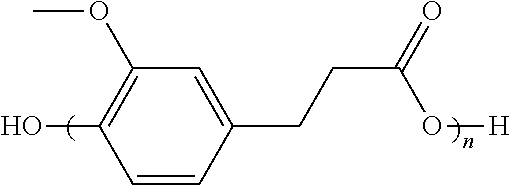
- the poly(dihydroferulic acid) can have at least one acetoxy end group.
- an aromatic/aliphatic polymer of the structure is also disclosed.
- R 1 , R 2 , R 3 , R 4 are independently H or OR where R is C 1 to C 6 alkyl can be produced and can have an acetoxy end-group.
- Some of these polymers can be prepared from monomers that can be derived from biorenewable resources.
- An embodiment of the invention is directed to a method of preparing poly(dihydroferulic acid) where acetyldihydroferulic acid and a catalyst are combined and the acetyldihydroferulic acid polymerized to poly(dihydroferulic acid) with the liberation of acetic acid.
- the acetyldihydroferulic acid can be derived from a biorenewable source, for example lignin.
- the polymerization of a monomer of the structure :
- R 1 , R 2 , R 3 , R 4 are independently H or OR where R is C 1 to C 6 alkyl can be combined with a catalyst and polymerized to any polymer of the structure:
- R 1 , R 2 , R 3 , R 4 are independently H or OR where R is C 1 to C 6 alkyl with the liberation of acetic acid.
- the catalyst comprises an oxide, alkoxide or acetate of Sb, Ti, Ge, Hg, Si, Zr, Al, or Zn, such as Zn(OAc) 2 .
- the polymerization can be carried out under vacuum and can be carried out at a temperature of 200 to 300° C.
- An embodiment of the invention is directed to a copolymer of acetylferulic acid and acetyldihydroferulic acid for the preparation of a thermoplastic. Another embodiment of the invention is directed to a method for the copolymerizing acetylferulic acid and acetyldihydroferulic acid with a variety of comonomer ratios.
- FIG. 1 shows a synthetic scheme for the preparation of poly(dihydroferulic acid), PHFA, from biorenewable feedstocks in accordance with an embodiment of the invention.
- FIG. 2 is a 1 H NMR spectrum of acetylferulic acid.
- FIG. 3 is a 13 C NMR spectrum of acetylferulic acid.
- FIG. 4 is a 1 H NMR spectrum of acetyldihydroferulic acid.
- FIG. 5 is a 13 C NMR spectrum of acetyldihydroferulic acid.
- FIG. 6 is a 1 H NMR spectrum of PHFA according to an embodiment of the invention with peak assignment indicated that was used for end-group analysis for the determination of the degree of polymerization.
- FIG. 7 is a 13 C NMR spectrum of PHFA according to an embodiment of the invention.
- FIG. 8 is a DSC thermogram of PHFA in accordance with an embodiment of the invention.
- FIG. 9 is a TGA plot for PHFA in accordance with an embodiment of the invention.
- FIG. 10 shows a synthetic scheme for the preparation of poly(dihydroferulic acid-co-ferulic acid) in accordance with an embodiment of the invention.
- FIG. 11 is a DSC thermogram of 10:90 poly(ferulic acid-co-dihydroferulic acid), in accordance with an embodiment of the invention.
- FIG. 12 is a TGA plot for 10:90 poly(ferulic acid-co-dihydroferulic acid), in accordance with an embodiment of the invention.
- FIG. 13 is a DSC thermogram of 30:70 poly(ferulic acid-co-dihydroferulic acid), in accordance with an embodiment of the invention.
- FIG. 14 is a TGA plot for 30:70 poly(ferulic acid-co-dihydroferulic acid), in accordance with an embodiment of the invention.
- FIG. 15 is a DSC thermogram of 70:30 poly(ferulic acid-co-dihydroferulic acid), in accordance with an embodiment of the invention.
- FIG. 16 is a TGA plot for 70:30 poly(ferulic acid-co-dihydroferulic acid), in accordance with an embodiment of the invention.
- FIG. 17 is a DSC thermogram of 90:10 poly(ferulic acid-co-dihydroferulic acid), in accordance with an embodiment of the invention.
- FIG. 18 is a TGA plot for 90:10 poly(ferulic acid-co-dihydroferulic acid), in accordance with an embodiment of the invention
- FIG. 19 is a DSC thermogram of poly(ferulic acid), in accordance with an embodiment of the invention.
- FIG. 20 is a TGA plot for poly(ferulic acid), in accordance with an embodiment of the invention
- Embodiments of the invention are directed to a novel biorenewable polymer, poly(dihydroferulic acid) (PHFA), and a method for its preparation by the step-growth polycondensation of a biorenewable monomer, acetyldihydroferulic acid.
- the preparation of the biorenewable polymer begins with the aromatic aldehyde, vanillin, which can be extracted from lignin at up to about 5% by mass of the lignin. As shown in FIG. 1 , vanillin is condensed with acetic anhydride in the presence of a base, a Perkin reaction, to yield acetylferulic acid.
- Acetic anhydride can be prepared commercially from biorenewable sources.
- Acetylferulic acid is subsequently reduced with H 2 to acetyldihydroferulic acid.
- Polytransesterification of the acetyldihydroferulic acid results in the desired PHFA with the liberation of acetic acid, which can be recycled for the preparation of acetic anhydride if desired.
- the PHFA results from the self condensation of acetyldihydroferulic acid, no molecular weight limitations due to a stoichiometric imbalance of reactive functionality is possible.
- the net transformation from vanillin to PHFA has the potential for the very efficient use of the renewable resources.
- dihydroferulic acid can be polymerized to PHFA.
- the PHFA is biorenewable and is potentially recyclable.
- PHFA is a polyethylene terephthalate (PET) mimic, displaying a T m of 234° C. and a T g of 73° C.
- PET polyethylene terephthalate
- T m 265° C.
- T g 67° C.
- PHFA Since most PET devices are rarely subjected to extremely high temperatures during routine use, the lower T m of PHFA implies that it can be readily substituted and allow a facile processability with lower energy consumption. PHFA also has a cooling-cycle crystallization temperature that is 17° C. higher (207° C.) than that of PET (190° C.), suggesting a faster rate of crystallization which is conducive to greater throughput of PHFA devices during extrusion, spinning, or molding processes than is possible for PET that has a lamentably slow crystallization rate. Additionally, PHFA typically exhibits a peak decomposition temperature near 462° C. (50% mass loss under nitrogen, as measured by thermal gravimetric analysis), which is comparable to that of PET (470° C.).
- the polymerization method for formation of PHFA involves melting acetyldihydroferulic acid in the presence of a catalyst.
- the catalyst can be any that can be used for the polymerization to PET such as Sb 2 O 3 .
- other oxides, alkoxides or acetates of Sb, Ti, Ge, Hg, Si, Zr, Al, or Zn can be used, for example Zn(OAc) 2 .2H 2 O.
- Polycondensation can be carried out at temperatures as low as about 200 to 220° C. but can be carried out at higher temperatures in excess of 220° C. but below about 370° C., for example 280 to 300° C.
- the polymerization can be carried out under a dynamic vacuum to effectively remove acetic acid and drive the polymerization.
- Traditional “solid stating” and either standard or flow induced “crystallizing” steps that are used for the preparation of PET can be included for the processing of PHFA.
- the method employed to provide the biorenewable acetyldihydroferulic acid can provide other aromatic/aliphatic polyesters from a phenyl substituted 3-(4-acetoxyphenyl)propanoic acid.
- syringaldehyde which can also be isolated from lignin, can be converted into 3-(4-acetoxy-3,5-dimethoxyphenyl)acrylic acid, reduced to 3-(4-acetoxy-3,5-dimethoxyphenyl)propanoic acid and self-condensed to a poly(3-(4-hydroxy-3,5-dimethoxyphenyl)propanoic acid) in an analogous manner to that for the preparation of PHFA.
- any monomer of the structure can be converted into 3-(4-acetoxy-3,5-dimethoxyphenyl)acrylic acid, reduced to 3-(4-acetoxy-3,5-dimethoxyphenyl)propanoic acid and self-condensed to a
- R 1 , R 2 , R 3 , R 4 are independently H or OR where R is C 1 to C 6 alkyl can be employed to prepare an aromatic/aliphatic polyester of the structure:
- R 1 , R 2 , R 3 , R 4 are independently H or OR where R is C 1 to C 6 alkyl, according to an embodiment of the invention.
- the aromatic/aliphatic polyester can have acetoxy terminal units.
- Another embodiment of the invention is directed to copolymers of acetyldihydroferulic acid and acetylferulic acid, as shown in FIG. 10 .
- the copolymers are equivalent to polystyrene with respect to thermal transitions where the proportions of the comonomers is appropriate, for example, a 50:50 mixture of monomers by mole results in a copolymer with a T g similar to atactic polystyrene.
- the properties of the copolymer are readily adjusted by the comonomer mixture used to prepare the copolymer. In general, as the proportion of acetylferulic acid derived units in the copolymer increases, the glass transition temperature increases. Therefore, polymers with little crystallinity can be formed where the glass transition temperature can range from about 70° C. to about 140° C. by selection of the appropriate comonomer feed ratio.
- Proton nuclear magnetic resonance ( 1 H NMR) spectra were recorded using a Varian Mercury 300 MHz spectrometer. Chemical shifts are reported in parts per million (ppm) downfield relative to tetramethylsilane (TMS, 0.0 ppm) or residual proton in the specified solvent. Coupling constants (0.1) are reported in Hertz (Hz). Multiplicities are reported using the following abbreviations: s, singlet; d, doublet; t, triplet; q, quartet; quin, quintuplet; m, multiplet; br, broad.
- Differential scanning chromatographs were obtained with a DSC Q1000 from TA instruments. About 5-10 mg of each sample were massed and added to a sealed pan that went through a heat/cool/heat cycle at 10° C./min. Reported data are from the second full cycle. The temperature range depends on the experiment, but was limited to 300° C. by the instrument.
- Thermogravimetric analyses were measured under nitrogen with a TGA Q5000 from TA Instruments. About 5-10 mg of each sample was heated at 50° C./min from 25-600° C.
- Viscosity measurements were performed at 35° C. in a 1:2 mixture of phenol:1,1,2,2 tetrachloroethane with a CANNON-Ubbelohde type 150 viscometer.
- the solid was dissolved in a minimum amount of warm tetrahydrofuran (THF) and precipitated in ice cooled hexanes and the solid portion recrystallized from a 5:1 mixture of ethyl acetate and water and dried on a Schlenk line in a 62% yield.
- THF warm tetrahydrofuran
- the crystals of dihydroferulic acid were acetylated by reaction with 9.6 g of acetic anhydride in the presence of 7.6 mL of pyridine. The mixture was stirred at room temperature for three hours and poured over an ice/water slurry (300 mL), to form a white precipitate that was filtered and dried on a Schlenk line, giving a 78% yield.
- Differential Scanning Calorimetry (DSC) and Thermogravimetric Analysis (TGA) plots for various copolymers 10:90, 30:70, 70:30 and 90:10 are shown in FIGS. 11-18 , respectively.
- Differential Scanning Calorimetry (DSC) and Thermogravimetric Analysis (TGA) plots for poly(ferulic acid) are shown in FIGS. 19 and 20 , respectively.
- Intrinsic viscosity measurements were performed with a Ubbelohde viscometer. 15 mL of clean 1:2 mixture of phenol: 1,1,2,2-tetrachloroethane were poured in the viscometer and allow to thermally equilibrate for 2 h. Exactly 1 mL of about 8 g/L solution of polymer was added for each measurement until the final volume is 20 mL in the viscometer giving a final concentration of about 2 g/L.
- End group analysis was used to determine the degree of polymerization of the polymer.
- the chemical environment for the end group is different from that of the repeat unit in the middle of the polymer chain.
- the end groups are carboxylic acid and acetyl groups, which bear a methyl group that has a chemical shift of about 2.4 ppm.
- Four aliphatic hydrogens, associated with each repeat unit of the chain, resonate near 2.9 to 3.1 ppm.
- the number of repeat units (the degree of polymerization, DP) and by the repeating unit's molecular weight, RU, the number average molecular weight of the polymer chain is determined using the following equation.
- a solution was prepared from 8.0 g (0.034 mol) of acetyldihydroferulic acid and 4.7 g (0.118 mol) of sodium hydroxide in 100 mL of water and refluxed for 5 h. After cooling to room temperature, the aqueous solution was acidified with hydrochloric acid and extracted with dichloromethane. The organic layer was washed with brine and dried over magnesium sulfate. The evaporation of the solvent left a yellow crude product that was dissolved in dichloromethane and precipitated in hexanes to yield 5.5 g of an off-white powder in 83% yield.
Landscapes
- Chemical & Material Sciences (AREA)
- Health & Medical Sciences (AREA)
- Chemical Kinetics & Catalysis (AREA)
- Medicinal Chemistry (AREA)
- Polymers & Plastics (AREA)
- Organic Chemistry (AREA)
- Polyesters Or Polycarbonates (AREA)
- Organic Low-Molecular-Weight Compounds And Preparation Thereof (AREA)
- Greenhouses (AREA)
- Compositions Of Macromolecular Compounds (AREA)
- Biological Depolymerization Polymers (AREA)
- Absorbent Articles And Supports Therefor (AREA)
- Stringed Musical Instruments (AREA)
Abstract
Description
- This application is a divisional of U.S. application Ser. No. 13/674,561, filed Nov. 12, 2012, which is a continuation-in-part of International Patent Application No. PCT/US2011/036181, filed May 12, 2011, which claims the benefit of U.S. Provisional Application Ser. No. 61/334,342, filed May 13, 2010, the disclosures of which are hereby incorporated by reference herein in their entireties, including any figures, tables, or drawings.
- The subject invention was made with government support under the National Science Foundation, Contract No. 0848236. The government has certain rights to this invention.
- The development of new polymeric materials from renewable resources is gaining considerable attention. Biorenewability is directed toward a sustainable raw material supply where the raw material is renewed from plants or other biological matter, generally through agricultural. Biorenewable polymers are pursued as environmentally friendly replacements for commodity plastics from petrochemical starting materials. The goal is to use low cost readily available starting materials from biorenewable resources such that biorenewable polymers can be competitive with current commercial plastics in the marketplace.
- Rather than creating a biorenewable polymer directly from a crop with the limitations imposed by nature with respect to processing and properties, a practical goal is to develop polymers from monomers derived from biorenewable sources that are chemically identical to or a mimic of those derived from petroleum sources. In this manner the market for the biorenewable polymer need not be generated, as materials with the properties to be provided by the new polymers are presently commodities. Additionally, polymerization techniques and processing technologies that are developed along with the monomers for the biorenewable polymers can be designed in light of the methods currently used to produce the commodity polymers.
- In general, thermoplastics constitute more than 65% of all global polymer demand and have the possibility to be recycled by melt-processing. Thermoplastic biorenewable polymers are potentially recyclable, which is advantageous for consumer packaging and other high volume needs. A commercially important thermoplastic or its mimic that is prepared by a step-growth process is a particularly practical target for biorenewable monomers.
- Step-growth produced polyethylene terephthalate (PET) is the third most common synthetic polymer and accounts for about 20% of world polymer production. This aromatic/aliphatic polyester has very useful thermal properties that are not displayed in an all-aliphatic commodity thermoplastic. PET displays a glass transition temperature (Tg) of 67° C. and a melting temperature (Tm) of 265° C. The key aromatic monomer for preparation of PET, terephthalic acid, is derived from petroleum, and its complementary monomer, ethylene glycol, is derived from petroleum or natural gas.
- The design of a sustainable PET mimic requires an aromatic monomer. To this end, an attractive biorenewable source for the aromatic monomer is lignin. Lignin is found in all vascular plants and is the second most abundant naturally-occurring organic polymer, making up approximately 30% of wood. The extraction of lignin from wood is carried out in large scale in the paper pulping industry, and as such, constitutes an attractive source for a PET mimic. In addition to lignin, the bran of rice and maize offers attractive opportunities to harvest potentially useful aromatic/aliphatic monomers. One such monomer, ferulic acid (4-hydroxy-3-methoxycinnamic acid), is found in the cell walls of several plants and is one of the most abundant hydroxycinnamic acids in the plant world. Ferulic acid enhances the rigidity and strength of plants from several families including various grasses such as Graminaceae, vegetable plants from the Solanace family, as well as many flowering plants from the groups of both Monocots as well as Dicots. Seeds of coffee, apple, artichoke, peanut, and orange, as well as both seeds and cell walls of rice, wheat, and oats all contain this phenolic phytochemical. Perhaps the greatest naturally occurring source comes from maize bran, a plant with highly cross-linked cell walls containing esterified ferulic acid, making the structure rather impervious to enzymatic degradation. To this end the preparation of material with comparable thermal properties to polyethylene terephthalate (PET) and polystyrene (PS), two of the most widely used synthetic petroleum derived polymers, based on a functionalized ferulic acid, is a desirable way to achieve the goal of a biorenewable polymer.
- An embodiment of the invention is directed to a biorenewable thermoplastic homopolymer comprising poly(dihydroferulic acid), which is a PET mimic. The poly(dihydroferulic acid) can have at least one acetoxy end group. In other embodiments of the invention an aromatic/aliphatic polymer of the structure:
-

- wherein R1, R2, R3, R4 are independently H or OR where R is C1 to C6 alkyl can be produced and can have an acetoxy end-group. Some of these polymers can be prepared from monomers that can be derived from biorenewable resources.
- An embodiment of the invention is directed to a method of preparing poly(dihydroferulic acid) where acetyldihydroferulic acid and a catalyst are combined and the acetyldihydroferulic acid polymerized to poly(dihydroferulic acid) with the liberation of acetic acid. The acetyldihydroferulic acid can be derived from a biorenewable source, for example lignin. In another embodiment of the invention, the polymerization of a monomer of the structure:
-

- where R1, R2, R3, R4 are independently H or OR where R is C1 to C6 alkyl can be combined with a catalyst and polymerized to any polymer of the structure:
-

- wherein R1, R2, R3, R4 are independently H or OR where R is C1 to C6 alkyl with the liberation of acetic acid. For these polymerizations, the catalyst comprises an oxide, alkoxide or acetate of Sb, Ti, Ge, Hg, Si, Zr, Al, or Zn, such as Zn(OAc)2. The polymerization can be carried out under vacuum and can be carried out at a temperature of 200 to 300° C.
- An embodiment of the invention is directed to a copolymer of acetylferulic acid and acetyldihydroferulic acid for the preparation of a thermoplastic. Another embodiment of the invention is directed to a method for the copolymerizing acetylferulic acid and acetyldihydroferulic acid with a variety of comonomer ratios.
-
FIG. 1 shows a synthetic scheme for the preparation of poly(dihydroferulic acid), PHFA, from biorenewable feedstocks in accordance with an embodiment of the invention. -
FIG. 2 is a 1H NMR spectrum of acetylferulic acid. -
FIG. 3 is a 13C NMR spectrum of acetylferulic acid. -
FIG. 4 is a 1H NMR spectrum of acetyldihydroferulic acid. -
FIG. 5 is a 13C NMR spectrum of acetyldihydroferulic acid. -
FIG. 6 is a 1H NMR spectrum of PHFA according to an embodiment of the invention with peak assignment indicated that was used for end-group analysis for the determination of the degree of polymerization. -
FIG. 7 is a 13C NMR spectrum of PHFA according to an embodiment of the invention. -
FIG. 8 is a DSC thermogram of PHFA in accordance with an embodiment of the invention. -
FIG. 9 is a TGA plot for PHFA in accordance with an embodiment of the invention. -
FIG. 10 shows a synthetic scheme for the preparation of poly(dihydroferulic acid-co-ferulic acid) in accordance with an embodiment of the invention. -
FIG. 11 is a DSC thermogram of 10:90 poly(ferulic acid-co-dihydroferulic acid), in accordance with an embodiment of the invention. -
FIG. 12 is a TGA plot for 10:90 poly(ferulic acid-co-dihydroferulic acid), in accordance with an embodiment of the invention. -
FIG. 13 is a DSC thermogram of 30:70 poly(ferulic acid-co-dihydroferulic acid), in accordance with an embodiment of the invention. -
FIG. 14 is a TGA plot for 30:70 poly(ferulic acid-co-dihydroferulic acid), in accordance with an embodiment of the invention. -
FIG. 15 is a DSC thermogram of 70:30 poly(ferulic acid-co-dihydroferulic acid), in accordance with an embodiment of the invention. -
FIG. 16 is a TGA plot for 70:30 poly(ferulic acid-co-dihydroferulic acid), in accordance with an embodiment of the invention. -
FIG. 17 is a DSC thermogram of 90:10 poly(ferulic acid-co-dihydroferulic acid), in accordance with an embodiment of the invention. -
FIG. 18 is a TGA plot for 90:10 poly(ferulic acid-co-dihydroferulic acid), in accordance with an embodiment of the invention -
FIG. 19 is a DSC thermogram of poly(ferulic acid), in accordance with an embodiment of the invention. -
FIG. 20 is a TGA plot for poly(ferulic acid), in accordance with an embodiment of the invention - Embodiments of the invention are directed to a novel biorenewable polymer, poly(dihydroferulic acid) (PHFA), and a method for its preparation by the step-growth polycondensation of a biorenewable monomer, acetyldihydroferulic acid. The preparation of the biorenewable polymer begins with the aromatic aldehyde, vanillin, which can be extracted from lignin at up to about 5% by mass of the lignin. As shown in
FIG. 1 , vanillin is condensed with acetic anhydride in the presence of a base, a Perkin reaction, to yield acetylferulic acid. Acetic anhydride can be prepared commercially from biorenewable sources. Acetylferulic acid is subsequently reduced with H2 to acetyldihydroferulic acid. Polytransesterification of the acetyldihydroferulic acid results in the desired PHFA with the liberation of acetic acid, which can be recycled for the preparation of acetic anhydride if desired. As the PHFA results from the self condensation of acetyldihydroferulic acid, no molecular weight limitations due to a stoichiometric imbalance of reactive functionality is possible. The net transformation from vanillin to PHFA has the potential for the very efficient use of the renewable resources. In another embodiment dihydroferulic acid can be polymerized to PHFA. - The PHFA is biorenewable and is potentially recyclable. PHFA is a polyethylene terephthalate (PET) mimic, displaying a Tm of 234° C. and a Tg of 73° C. Hence, the thermal processing and recycling of PHFA and PET, Tm=265° C. and Tg=67° C., is inherently similar, and for many applications the thermal properties of PHFA are arguably an improvement over those of PET. Devices, such as plastic water bottles, which are commonly made of PET, have uses confined by the thermal properties of the amorphous phase reflected in the Tg, and can be formed from PHFA with no compromise. Since most PET devices are rarely subjected to extremely high temperatures during routine use, the lower Tm of PHFA implies that it can be readily substituted and allow a facile processability with lower energy consumption. PHFA also has a cooling-cycle crystallization temperature that is 17° C. higher (207° C.) than that of PET (190° C.), suggesting a faster rate of crystallization which is conducive to greater throughput of PHFA devices during extrusion, spinning, or molding processes than is possible for PET that has a lamentably slow crystallization rate. Additionally, PHFA typically exhibits a peak decomposition temperature near 462° C. (50% mass loss under nitrogen, as measured by thermal gravimetric analysis), which is comparable to that of PET (470° C.).
- In one embodiment of the invention, the polymerization method for formation of PHFA involves melting acetyldihydroferulic acid in the presence of a catalyst. The catalyst can be any that can be used for the polymerization to PET such as Sb2O3. Additionally other oxides, alkoxides or acetates of Sb, Ti, Ge, Hg, Si, Zr, Al, or Zn can be used, for example Zn(OAc)2.2H2O. Polycondensation can be carried out at temperatures as low as about 200 to 220° C. but can be carried out at higher temperatures in excess of 220° C. but below about 370° C., for example 280 to 300° C. The polymerization can be carried out under a dynamic vacuum to effectively remove acetic acid and drive the polymerization. Traditional “solid stating” and either standard or flow induced “crystallizing” steps that are used for the preparation of PET can be included for the processing of PHFA.
- The method employed to provide the biorenewable acetyldihydroferulic acid can provide other aromatic/aliphatic polyesters from a phenyl substituted 3-(4-acetoxyphenyl)propanoic acid. For example, syringaldehyde, which can also be isolated from lignin, can be converted into 3-(4-acetoxy-3,5-dimethoxyphenyl)acrylic acid, reduced to 3-(4-acetoxy-3,5-dimethoxyphenyl)propanoic acid and self-condensed to a poly(3-(4-hydroxy-3,5-dimethoxyphenyl)propanoic acid) in an analogous manner to that for the preparation of PHFA. Hence, any monomer of the structure:
-

- where R1, R2, R3, R4 are independently H or OR where R is C1 to C6 alkyl can be employed to prepare an aromatic/aliphatic polyester of the structure:
-

- where R1, R2, R3, R4 are independently H or OR where R is C1 to C6 alkyl, according to an embodiment of the invention. The aromatic/aliphatic polyester can have acetoxy terminal units.
- Another embodiment of the invention is directed to copolymers of acetyldihydroferulic acid and acetylferulic acid, as shown in
FIG. 10 . The copolymers are equivalent to polystyrene with respect to thermal transitions where the proportions of the comonomers is appropriate, for example, a 50:50 mixture of monomers by mole results in a copolymer with a Tg similar to atactic polystyrene. The properties of the copolymer are readily adjusted by the comonomer mixture used to prepare the copolymer. In general, as the proportion of acetylferulic acid derived units in the copolymer increases, the glass transition temperature increases. Therefore, polymers with little crystallinity can be formed where the glass transition temperature can range from about 70° C. to about 140° C. by selection of the appropriate comonomer feed ratio. - Unless otherwise noted, all solvents were sparged with nitrogen, dried over molecular sieves using an MBraun Solvent Purification System, dispensed into oven-dried Straus flasks, and degassed by stirring under reduced pressure for 20 minutes. Toluene for polymerization reactions was distilled from sodium/benzophenone under a nitrogen atmosphere and stored in an oven-dried Straus flask until used. All other chemicals and solvents were used as received.
- Proton nuclear magnetic resonance (1H NMR) spectra were recorded using a
Varian Mercury 300 MHz spectrometer. Chemical shifts are reported in parts per million (ppm) downfield relative to tetramethylsilane (TMS, 0.0 ppm) or residual proton in the specified solvent. Coupling constants (0.1) are reported in Hertz (Hz). Multiplicities are reported using the following abbreviations: s, singlet; d, doublet; t, triplet; q, quartet; quin, quintuplet; m, multiplet; br, broad. - Differential scanning chromatographs were obtained with a DSC Q1000 from TA instruments. About 5-10 mg of each sample were massed and added to a sealed pan that went through a heat/cool/heat cycle at 10° C./min. Reported data are from the second full cycle. The temperature range depends on the experiment, but was limited to 300° C. by the instrument.
- Thermogravimetric analyses were measured under nitrogen with a TGA Q5000 from TA Instruments. About 5-10 mg of each sample was heated at 50° C./min from 25-600° C.
- Viscosity measurements were performed at 35° C. in a 1:2 mixture of phenol:1,1,2,2 tetrachloroethane with a CANNON-
Ubbelohde type 150 viscometer. -

- In a round bottomed flask, 30.04 g of vanillin (0.197 mol) and 26.0 g of sodium acetate (0.317 mol) were dissolved in 200 mL of acetic anhydride (2.12 mol). About 1 mL of pyridine was added to the flask and the mixture was heated to reflux. After 24 h, the brown solution was poured over about 500 g of crushed ice and the solution was stirred until the appearance of a yellow-brown solid. The flask was left overnight in the freezer and a dark yellow solid was obtained by filtration. The crude solid was recrystallized from acetic acid/water to give 32.3 g of a yellow beige solid in a 69% yield.
- 1H NMR (DMSO) (
FIG. 2 ): δ 12.35 (br s, 1H, COOH), 7.56 (d, J=15.9 Hz, 1H, Ar—CH), 7.46 (d, J=1.7 Hz, 1H, Ar—H), 7.24 (dd, J=8.2 Hz, 1.7 Hz, 1H, Ar—H), 7.09 (d, J=8.2 Hz, 1H, Ar—H), 6.56 (d, J=15.9 Hz, 1H, CHCOOH), 3.8 (s, 3H, OCH3), 2.24 (s, 3H, CH3). - 13C NMR (DMSO) (
FIG. 3 ): δ 168.4, 167.6, 151.1, 143.4, 140.8, 138.3, 123.2, 121.3, 119.5, 111.8, 56.0, 20.4. - In round bottomed flask, 10 g of (E)-3-(4-hydroxy-3-methoxy-phenyl)prop-2-enoic acid (ferulic acid) was dissolved in 14.7 mL of acetic anhydride and 15 mL of pyridine at room temperature with stirring for three hours. The resulting clear liquid was poured over 300 mL of an ice/deionized water slurry. After one hour, the ice/water mixture was gravity filtered, washed with deionized water, and dried. The resulting white powder was recrystallized in a 5:1 mixture of ethyl acetate and water and dried on a Schlenk line with a yield of 86%.
-

- A 15.0 g (0.064 mol) portion of acetylferulic acid was dissolved in 230 mL of a 15:8 by volume mixture of tetrahydrofuran:methanol. The solution and 1.5 g of 10% palladium on charcoal was placed in a Parr pressure reactor. The reaction mixture was stirred at room temperature under 60 psi of hydrogen for 5 hours. The resulting black suspension was filtered through celite to remove the palladium on charcoal. The resulting clear brown solution was dried over magnesium sulfate and concentrated in vacuo. The solid was then dissolved in tetrahydrofuran and precipitated by addition to hexanes giving 12.8 g of an off-white product in 85% yield.
- 1H NMR (DMSO)
FIG. 4 ): δ 12.15 (br s, 1H, COOH), 6.98 (s, 1H, Ar—H), 6.93 (d, j=7.9 Hz, 1H, Ar—H), 6.76 (d, J=7.9 Hz, 1H, Ar—H), 3.72 (s, 3H, OCH3), 2.79 (t, J=8.0 Hz, 2H, Ar—CH2), 2.53 (t, J=8.0 Hz, 2H, CH2COOH), 2.20 (s, 3H. CH3). - 13C NMR (DMSO) (
FIG. 5 ): δ 174.1, 168.9, 150.8, 140.1, 137.8, 122.7, 120.3, 113.1, 55.9, 35.5, 30.5, 20.7. - A 15 g portion of acetyldihydroferulic acid, 150 ml, of tetrahydrofuran, and 80 mL of methanol were placed in a Parr pressure reactor containing 1.5 grams of 10% palladium on charcoal. The reaction mixture was stirred at 30° C. under 60 psi of hydrogen for five hours. To remove the palladium on charcoal, the resulting solution was vacuum filtered through celite, dried over magnesium sulfate, and condensed in vacuo. The solid was dissolved in a minimum amount of warm tetrahydrofuran (THF) and precipitated in ice cooled hexanes and the solid portion recrystallized from a 5:1 mixture of ethyl acetate and water and dried on a Schlenk line in a 62% yield.
- A 10 g portion of ferulic acid, 150 mL of THF, and 80 mL of methanol were placed in a Parr pressure reactor with 1.5 grams of 10% palladium on charcoal. The reaction mixture was stirred at 30° C. under 60 psi of hydrogen for 12 hours. To remove the palladium on charcoal, the solution was vacuum filtered through celite, dried over magnesium sulfate, and condensed in vacuo. The solid was dissolved in a minimum amount of warm THF and poured into ice chilled hexanes and the solid portion recrystallized from a 5:1 mixture of ethyl acetate and water and dried on the Schlenk line. The crystals of dihydroferulic acid were acetylated by reaction with 9.6 g of acetic anhydride in the presence of 7.6 mL of pyridine. The mixture was stirred at room temperature for three hours and poured over an ice/water slurry (300 mL), to form a white precipitate that was filtered and dried on a Schlenk line, giving a 78% yield.
- A series of polymerization of acetyldihydroferulic acid was carried out as summarized in the following tables where Table 1 gives the polymerization conditions and polymer size and viscosity and Table 2 gives the thermal properties of the polymers.
- A series of copolymerizations of acetylferulic acid and acetyldihydroferulic acid was carried out with the mole and reaction conditions summarized in Table 3. All copolymerizations occurred by melting the two monomers under nitrogen for two hours at the temperature range between 260-280° C. in the presence of one mole % zinc acetate as catalyst. Vacuum was then applied for six hours, which resulted in a brown-orange solid. The solid was dissolved in a hot 1:1 mixture of trifluoroacetic acid/dichloromethane. Ice cooled methanol was added to the copolymer solution resulting in a yellow precipitate, which was filtered to isolate copolymer in 38 to 84% yield, as indicated in Table 3. Differential Scanning Calorimetry (DSC) and Thermogravimetric Analysis (TGA) plots for various copolymers 10:90, 30:70, 70:30 and 90:10 are shown in
FIGS. 11-18 , respectively. Differential Scanning Calorimetry (DSC) and Thermogravimetric Analysis (TGA) plots for poly(ferulic acid) are shown inFIGS. 19 and 20 , respectively. - Intrinsic viscosity measurements were performed with a Ubbelohde viscometer. 15 mL of clean 1:2 mixture of phenol: 1,1,2,2-tetrachloroethane were poured in the viscometer and allow to thermally equilibrate for 2 h. Exactly 1 mL of about 8 g/L solution of polymer was added for each measurement until the final volume is 20 mL in the viscometer giving a final concentration of about 2 g/L.
-
- From a Kramer plot and extrapolating to infinitely dilute solution (c→0), the intrinsic viscosity is obtained. The value is then related to the Mark-Houwink constant for PET in the same solvent and temperature.
-
[η]=1.09×10⁻² M v 0.84 - End group analysis was used to determine the degree of polymerization of the polymer. In an NMR analysis, the chemical environment for the end group is different from that of the repeat unit in the middle of the polymer chain. For PHFA, as shown in
FIG. 6 , the end groups are carboxylic acid and acetyl groups, which bear a methyl group that has a chemical shift of about 2.4 ppm. Four aliphatic hydrogens, associated with each repeat unit of the chain, resonate near 2.9 to 3.1 ppm. By measuring the integration of the methyl group hydrogens Iend by 1H NMR and that of the methylene hydrogens (In) present in each repeat unit, the number of repeat units (the degree of polymerization, DP) and by the repeating unit's molecular weight, RU, the number average molecular weight of the polymer chain is determined using the following equation. -
-
TABLE 1 Polymerization results and characterization of poly(dihydroferulic acid), PHFA. melt vacuum stirring yield Entry Tp (° C.) catalysta time (h) time (h) (h) (%) [η]b Mv c DPd Mn d acetyl dihydroferulic acid → PHFA 1 2 0200-220 None 2 2 1.5 83 31 12,900 27 4,800 2 2 200-220 Sb2O3 2 2 0.5 67 29 12,000 23 4,100 3 2 200-220 Zn(OAc)2 2 2 0.5 82 27 11,000 38 6,800 4 2200-220 Zn(OAc)2 2 6 0.5 91 36 15,500 50 8,900 5 2 220-250 Zn(OAc)2 2 6 0.5 68 35 14,800 100 17,800 6 200-220 Zn(OAc)2 2 0.17 — 75 17 6,300 17 3,000 7 220 Zn(OAc)2 2 6 — 84 — — — — dihydroferulic acid → PHFA 8 2 200-220 Sb2O3 5 6 — ~5 n.d. n.d. 3.5e 630c aCatalyst loading = 1 mol %. bIntrinsic viscosity measured with an Ubbelohde viscometer in a 1:2 solution of phenol/1,1,2,2-tetrachloroethane at 35° C. cIntrinsic viscosity (mL/g) calculated with [η] = 1.09 × 10⁻² Mv 0.84. dDegree of Polymerization measured by 1H NMR end group analysis. eGPC analysis. -
TABLE 2 Differential Scanning Calorimetry (DSC), as shown in FIG. 8, and Thermogravimetric Analysis (TGA), as shown in FIG. 9, data for PHFA from Table 1, entries 1-7.a major minor Tm ΔH melt ΔH cryst T 50% Entry Tg (° C.) Tm (° C.) (° C.) (J/g) Tc (° C.)a (J/g)a decomp. (° C.)b 1 74.0 242.6 228.9 47.7 207.1 51.0 471 2 73.4 234.4 216.9 43.5 193.4 48.1 462 3 73.3 234.1 220.4 39.8 195.8 44.9 461 4 66.9 231.2 215.2 43.2 189.3 46.9 464 5 66.6 216.3 — 27.9 162.2 26.8 456 6 65.1 240.3 219.6 51.4 203.2 54.6 452 7 73.0 242.9 228.9 38.6 204.5 42.2 422 aCrystallization was observed on the cooling scan, but not the heating scan. bThe temperature at which 50% mass loss is observed. TGA was performed under nitrogen. -
TABLE 3 Polymerization results and characterization of copolymerization of (A) acetyferulic and (B) acetyldihydroferulic acid (PHFA). T 50%Entry % A % B Stirringa Yield % Tg (° C.) Tm (° C.) (° C.) 1 0 100 0.5 84 73 243 422 2 10 90 1.5 47 73 217 422 3 20 80 2 46 70 213 419 4 30 70 1.5 35 86 NA 422 5 40 60 1.5 78 87 NA 404 6 50 50 1.5 82 95 NA 417 7 60 40 2 71 115 NA 440 8 70 30 1.5 68 123 NA 435 9 80 20 1.5 79 125 218 438 10 90 10 1.5 47 140 227 435 11 100 0 2 38 158 NA 446 12 100 0 2 56 155 290 467 aTime in hours that stirring stopped as the viscosity of the mixture increased. -

- 1.61 g (6.8 mmol) of acetyldihydroferulic acid were melted under nitrogen for 2 h and vacuum was applied for 2 h leaving a brown solid that was dissolved in a mixture of trifluoroacetic acid/dichloromethane and precipitated with methanol. 1.0 g of off-white product was obtained by filtration in 83% yield.
- 1H NMR (CF3COOD/CDCl3): δ 6.92 (m, 3H, Ar—H), 3.84 (s, 3H, OCH3), 3.11 (m, 2H, CH2), 3.00 (m, 2H, CH2).
- 13C NMR (DMSO): δ 176.1, 150.9, 140.6, 138.3, 123.2, 121.8, 113.9, 56.6, 36.2, 31.2.
- 1.61 g (6.8 mmol) of acetyldihydroferulic acid and 0.021 g (0.072 mmol) of antimony trioxide (1 mol %) were melted under nitrogen for 2 h and vacuum was applied for 2 h leaving a brown solid that was dissolved in a mixture of trifluoroacetic acid/dichloromethane and precipitated with methanol. 0.8 g of off-white product was obtained by filtration in 67% yield.
- 1H NMR (CF3COOD/CDCl3): δ 6.88 (m, 3H, Ar—H), 3.80 (s, 3H, OCH3), 3.07 (m, 2H, CH2), 2.96 (m, 2H, CH2).
- 13C NMR (CF3COOD/CDCl3): δ 175.5, 150.4, 140.1, 137.8, 122.6, 120.0, 113.4, 56.1, 35.8, 30.7.
- 1.63 g (6.8 mmol) of acetyldihydroferulic acid and 0.018 g (0.082 mmol) of zinc diacetate dihydrate (1 mol %) were melted under nitrogen for 2 h and vacuum was applied for 2 h leaving a brown solid that was dissolved in a mixture of trifluoroacetic acid/dichloromethane and precipitated with methanol. 1.0 g of off-white product was obtained by filtration in 82% yield.
- 1H NMR (CF3COOD/CDCl3): 6.92 (m, 3H, Ar—H), 3.84 (s, 3H, OCH3), 3.11 (m, 2H, CH2), 3.00 (m, 2H, CH2).
- 13C NMR (CF3COOD/CDCl3): 175.4, 150.4, 140.0, 137.8, 122.6, 121.7, 113.3, 56.0, 35.7, 30.7.
- 1.63 g (6.8 mmol) of acetyldihydroferulic acid and 0.018 g (0.082 mmol) of zinc diacetate dihydrate (1 mol %) were melted under nitrogen for 2 h and vacuum was applied for 6 h leaving a brown solid that was dissolved in a mixture of trifluoroacetic acid/dichloromethane and precipitated with methanol. 1.1 g of off-white product was obtained by filtration in 91% yield.
- 1H NMR (CF3COOD/CDCl3) (
FIG. 6 ): δ 6.90 (m, 3H, Ar—H), 3.83 (s, 3H, OCH3), 3.10 (m, 2H, CH2), 2.99 (m, 2H, CH2). - 13C NMR (CF3COOD/CDCl3) (
FIG. 7 ): δ 175.5, 150.4, 140.0, 137.7, 122.6, 121.1, 113.3, 56.0, 35.7, 30.7. - 1.61 g (6.8 mmol) of acetyldihydroferulic acid and 0.017 g (0.077 mmol) of zinc diacetate dihydrate (1 mol %) were melted under nitrogen at 220-250° C. for 2 h and vacuum was applied for 6 h leaving a brown solid that was dissolved in a mixture of trifluoroacetic acid/dichloromethane and precipitated with methanol. 0.82 g of off-white product was obtained by filtration in 68% yield.
- 1H NMR (CF3COOD/CDCl3): δ 6.88 (m, 3H, Ar—H), 3.80 (s, 3H, OCH3), 3.07 (m, 2H, CH2), 2.96 (m, 2H, CH2).
- 13C NMR (CF3COOD/CDCl3): δ 175.0, 150.4, 139.8, 137.7, 122.5, 121.0, 113.1, 56.0, 35.7, 30.7.
- 1.61 g (6.8 mmol) of acetyldihydroferulic acid and 0.017 g (0.077 mmol) of zinc diacetate dihydrate (1 mol %) were melted under nitrogen for 2 h and vacuum was applied for 10 min, leaving a brown solid that was dissolved in a mixture of trifluoroacetic acid/dichloromethane and precipitated with methanol. 0.90 g of off-white product was obtained by filtration in 75% yield.
- 1H NMR (CF3COOD/CDCl3): δ 6.88 (m, 3H, Ar—H), 3.80 (s, 3H, OCH3), 3.07 (m, 2H, CH2), 2.96 (m, 2H, CH2).
- 13C NMR (CF3COOD/CDCl3): δ 176.0, 150.5, 140.4, 138.0, 122.8, 121.6, 113.7, 56.2, 35.9, 30.9.
- 1.63 g (6.8 mmol) of acetyldihydroferulic acid and 0.018 g (0.082 mmol) of zinc diacetate dihydrate (1 mol %) were melted under nitrogen for 2 h and vacuum was applied for 6 h leaving a brown solid that was dissolved in a mixture of trifluoroacetic acid/dichloromethane and precipitated with methanol. 1.02 g of off-white product was obtained by filtration in 84% yield.
-

- A solution was prepared from 8.0 g (0.034 mol) of acetyldihydroferulic acid and 4.7 g (0.118 mol) of sodium hydroxide in 100 mL of water and refluxed for 5 h. After cooling to room temperature, the aqueous solution was acidified with hydrochloric acid and extracted with dichloromethane. The organic layer was washed with brine and dried over magnesium sulfate. The evaporation of the solvent left a yellow crude product that was dissolved in dichloromethane and precipitated in hexanes to yield 5.5 g of an off-white powder in 83% yield.
- 1H NMR (CDCl3): δ 6.87 (d, J=8.0 Hz, 1H, Ar—H), 6.73 (br s, 1H, Ar—H), 6.71 (d, J=8.0 Hz, 1H, Ar—H), 3.88 (s, 3H, OCH3), 2.90 (t, 0.1=7.8 Hz, 2H, Ar—CH2), 2.70 (t, J=7.8 Hz, 2H, CH2COOH).
- 13C NMR (CDCl3): δ 179.2, 146.4, 144.1, 132.0, 120.8, 114.4, 110.9, 55.8, 36.0, 30.3.
-
- 1.61 g (8.2 mmol) of dihydroferulic acid and 0.0195 g (0.067 mmol) of antimony trioxide (1 mol %) were heated under nitrogen for 5 h and vacuum was applied for 6 h. At the end of the 6 h period, the product was still a brown melt in the flask. The product was dissolved in dichloromethane/trifluoroacetic acid and only 0.07 g (5%) of product precipitated upon addition of methanol. The methanol was subjected to rotary distillation, leaving 1.5 g of brown, amorphous solid that was analyzed by GPC showing only low molecular weight material.
- All patents, patent applications, provisional applications, and publications referred to or cited herein are incorporated by reference in their entirety, including all figures and tables, to the extent they are not inconsistent with the explicit teachings of this specification.
- It should be understood that the examples and embodiments described herein are for illustrative purposes only and that various modifications or changes in light thereof will be suggested to persons skilled in the art and are to be included within the spirit and purview of this application.
Claims (17)


Priority Applications (1)
| Application Number | Priority Date | Filing Date | Title |
|---|---|---|---|
| US14/734,360 US9624340B2 (en) | 2010-05-13 | 2015-06-09 | Poly(dihydroferulic acid) a biorenewable polyethylene terephthalate mimic derived from lignin and acetic acid and copolymers thereof |
Applications Claiming Priority (4)
| Application Number | Priority Date | Filing Date | Title |
|---|---|---|---|
| US33434210P | 2010-05-13 | 2010-05-13 | |
| PCT/US2011/036181 WO2011143379A2 (en) | 2010-05-13 | 2011-05-12 | Poly(dihydroferulic acid) a biorenewable polyethylene terephthalate mimic derived from lignin and acetic acid |
| US13/674,561 US9080011B2 (en) | 2010-05-13 | 2012-11-12 | Poly(dihydroferulic acid) a biorenewable polyethylene terephthalate mimic derived from lignin and acetic acid and copolymers thereof |
| US14/734,360 US9624340B2 (en) | 2010-05-13 | 2015-06-09 | Poly(dihydroferulic acid) a biorenewable polyethylene terephthalate mimic derived from lignin and acetic acid and copolymers thereof |
Related Parent Applications (1)
| Application Number | Title | Priority Date | Filing Date |
|---|---|---|---|
| US13/674,561 Division US9080011B2 (en) | 2010-05-13 | 2012-11-12 | Poly(dihydroferulic acid) a biorenewable polyethylene terephthalate mimic derived from lignin and acetic acid and copolymers thereof |
Publications (2)
| Publication Number | Publication Date |
|---|---|
| US20150274883A1 true US20150274883A1 (en) | 2015-10-01 |
| US9624340B2 US9624340B2 (en) | 2017-04-18 |
Family
ID=50685343
Family Applications (2)
| Application Number | Title | Priority Date | Filing Date |
|---|---|---|---|
| US13/674,561 Active 2031-12-05 US9080011B2 (en) | 2010-05-13 | 2012-11-12 | Poly(dihydroferulic acid) a biorenewable polyethylene terephthalate mimic derived from lignin and acetic acid and copolymers thereof |
| US14/734,360 Active US9624340B2 (en) | 2010-05-13 | 2015-06-09 | Poly(dihydroferulic acid) a biorenewable polyethylene terephthalate mimic derived from lignin and acetic acid and copolymers thereof |
Family Applications Before (1)
| Application Number | Title | Priority Date | Filing Date |
|---|---|---|---|
| US13/674,561 Active 2031-12-05 US9080011B2 (en) | 2010-05-13 | 2012-11-12 | Poly(dihydroferulic acid) a biorenewable polyethylene terephthalate mimic derived from lignin and acetic acid and copolymers thereof |
Country Status (11)
| Country | Link |
|---|---|
| US (2) | US9080011B2 (en) |
| EP (1) | EP2917263B1 (en) |
| JP (1) | JP2015535023A (en) |
| KR (1) | KR20150084986A (en) |
| CN (1) | CN104918980A (en) |
| AU (1) | AU2013342037B2 (en) |
| BR (1) | BR112015010676A2 (en) |
| CA (1) | CA2890751A1 (en) |
| CU (1) | CU20150049A7 (en) |
| MX (1) | MX2015005890A (en) |
| WO (1) | WO2014075057A1 (en) |
Families Citing this family (7)
| Publication number | Priority date | Publication date | Assignee | Title |
|---|---|---|---|---|
| CN107075094A (en) | 2014-10-29 | 2017-08-18 | 树脂酸盐材料集团有限公司 | High recycle content polyester polyols from hydroxy-functional ketal acids, esters or amides |
| US9950996B2 (en) | 2014-12-23 | 2018-04-24 | Council Of Scientific & Industrial Research | Bio-based aromatic diisocyanates for preparation of polyurethanes |
| WO2016118411A1 (en) | 2015-01-21 | 2016-07-28 | Resinate Materials Group, Inc. | High recycle content polyols from thermoplastic polyesters and lignin or tannin |
| CN107257823A (en) | 2015-01-30 | 2017-10-17 | 瑞森内特材料集团有限公司 | Integrated approach for processing PET and PTT recycling streams |
| WO2017123587A1 (en) * | 2016-01-11 | 2017-07-20 | University Of Florida Research Foundation, Inc. | Ferulic acid and p-coumaric acid based polymers and copolymers |
| EP3733733A1 (en) | 2019-04-30 | 2020-11-04 | Vito NV | Polyesters from lignin-based monomers |
| CN116082587B (en) * | 2023-01-30 | 2024-02-09 | 常州工程职业技术学院 | Production process of polyacetal copolymer modified by biological ferulic acid side chain |
Family Cites Families (6)
| Publication number | Priority date | Publication date | Assignee | Title |
|---|---|---|---|---|
| US4230817A (en) * | 1979-03-02 | 1980-10-28 | Celanese Corporation | Thermotropic polyesters derived from ferulic acid and a process for preparing the polyesters |
| FI922152A0 (en) | 1992-05-12 | 1992-05-12 | Neste Oy | SMAELTBEARBETBAR VAETSKEKRISTALLIN POLYESTER, FOERFARANDE FOER FRAMSTAELLNING DAERAV SAMT PRODUKTER SOM AER FRAMSTAELLDA AV POLYESTERN. |
| EP2024435A1 (en) | 2006-05-05 | 2009-02-18 | BIOeCON International Holding N.V. | Polymeric material of photosynthetic origin comprising particulate inorganic material |
| US20090246430A1 (en) | 2008-03-28 | 2009-10-01 | The Coca-Cola Company | Bio-based polyethylene terephthalate polymer and method of making same |
| CN102115576B (en) * | 2009-12-31 | 2014-09-17 | 金伯利-克拉克环球有限公司 | Natural biological polymer thermoplastic film |
| WO2011143379A2 (en) * | 2010-05-13 | 2011-11-17 | University Of Florida Research Foundation, Inc. | Poly(dihydroferulic acid) a biorenewable polyethylene terephthalate mimic derived from lignin and acetic acid |
-
2012
- 2012-11-12 US US13/674,561 patent/US9080011B2/en active Active
-
2013
- 2013-11-12 KR KR1020157015504A patent/KR20150084986A/en not_active Withdrawn
- 2013-11-12 MX MX2015005890A patent/MX2015005890A/en unknown
- 2013-11-12 CA CA2890751A patent/CA2890751A1/en not_active Abandoned
- 2013-11-12 EP EP13853270.0A patent/EP2917263B1/en not_active Not-in-force
- 2013-11-12 CN CN201380070286.4A patent/CN104918980A/en active Pending
- 2013-11-12 WO PCT/US2013/069641 patent/WO2014075057A1/en not_active Ceased
- 2013-11-12 AU AU2013342037A patent/AU2013342037B2/en not_active Ceased
- 2013-11-12 BR BR112015010676A patent/BR112015010676A2/en not_active IP Right Cessation
- 2013-11-12 JP JP2015542008A patent/JP2015535023A/en active Pending
-
2015
- 2015-05-11 CU CUP2015000049A patent/CU20150049A7/en unknown
- 2015-06-09 US US14/734,360 patent/US9624340B2/en active Active
Also Published As
| Publication number | Publication date |
|---|---|
| US20130137847A1 (en) | 2013-05-30 |
| EP2917263B1 (en) | 2017-06-21 |
| AU2013342037B2 (en) | 2016-07-14 |
| EP2917263A4 (en) | 2016-06-29 |
| CA2890751A1 (en) | 2014-05-15 |
| JP2015535023A (en) | 2015-12-07 |
| AU2013342037A1 (en) | 2015-06-04 |
| KR20150084986A (en) | 2015-07-22 |
| WO2014075057A8 (en) | 2015-07-02 |
| MX2015005890A (en) | 2015-09-10 |
| WO2014075057A1 (en) | 2014-05-15 |
| US9624340B2 (en) | 2017-04-18 |
| CU20150049A7 (en) | 2015-08-27 |
| CN104918980A (en) | 2015-09-16 |
| EP2917263A1 (en) | 2015-09-16 |
| BR112015010676A2 (en) | 2017-07-11 |
| US9080011B2 (en) | 2015-07-14 |
Similar Documents
| Publication | Publication Date | Title |
|---|---|---|
| US9624340B2 (en) | Poly(dihydroferulic acid) a biorenewable polyethylene terephthalate mimic derived from lignin and acetic acid and copolymers thereof | |
| Llevot et al. | Renewable (semi) aromatic polyesters from symmetrical vanillin-based dimers | |
| AU2012363608B2 (en) | 2,5-furan dicarboxylic acid-based polyesters prepared from biomass | |
| US4230817A (en) | Thermotropic polyesters derived from ferulic acid and a process for preparing the polyesters | |
| CN105199085B (en) | A kind of dimer acid modified poly-succinic acid-butanediol copolyesters and preparation method thereof | |
| JP2007146153A (en) | Polymer compound and synthesis method thereof | |
| EP0286444A2 (en) | Process for producing a liquid crystalline polyester of a cyclohexanedicarboxylic acid and an aromatic diol | |
| CN114292388B (en) | Preparation method of degradable PET-based copolyester | |
| CN115403749A (en) | Degradable poly (butylene adipate/terephthalate-co-glycollic acid) copolyester and preparation method thereof | |
| WO2011143379A2 (en) | Poly(dihydroferulic acid) a biorenewable polyethylene terephthalate mimic derived from lignin and acetic acid | |
| CN102718948A (en) | Method for preparing aliphatic polyoxalate | |
| CN109438687A (en) | A kind of bridge chain structure biology base polyester, preparation method and applications | |
| SG184125A1 (en) | New polyesters from asymmetrical monomers based upon bisanhydrohexitols | |
| US20190002630A1 (en) | Ferulic acid and p-coumaric acid based polymers and copolymers | |
| CN116554453B (en) | Biodegradable poly (adipic acid)/butylene terephthalate-isosorbide copolyester and preparation method and application thereof | |
| CN120399205B (en) | All-bio-based copolymer based on citric acid bicyclo monomer, preparation method and application | |
| JP2010174207A (en) | Method for producing liquid crystal polyester | |
| Nguyen et al. | A “transient-comonomer” strategy for polycondensation of lignin-derived AB-type aromatic polyesters to high molecular weight | |
| CN116355190B (en) | Preparation method of chelidonic acid modified PBAT degradation material | |
| JPH02208317A (en) | copolymerized polyester | |
| JP2590483B2 (en) | Copolyester | |
| CN115785424A (en) | A hydrolysis-resistant composite titanium-based catalyst, its preparation method, and a preparation method of a high-molecular-weight oxalic acid-based polyester | |
| US5045627A (en) | Melt-processable copolyester | |
| JP2012111789A (en) | Method for producing aromatic polyester ether | |
| AU2015271988B2 (en) | 2,5-furan dicarboxylic acid-based polyesters prepared from biomass |
Legal Events
| Date | Code | Title | Description |
|---|---|---|---|
| AS | Assignment |
Owner name: UNIVERSITY OF FLORIDA RESEARCH FOUNDATION, INC., F Free format text: ASSIGNMENT OF ASSIGNORS INTEREST;ASSIGNORS:MIALON, LAURENT;MILLER, STEPHEN A.;SIGNING DATES FROM 20121211 TO 20130311;REEL/FRAME:035826/0876 |
|
| AS | Assignment |
Owner name: NATIONAL SCIENCE FOUNDATION, VIRGINIA Free format text: CONFIRMATORY LICENSE;ASSIGNOR:UNIVERSITY OF FLORIDA;REEL/FRAME:036074/0246 Effective date: 20150702 |
|
| STCF | Information on status: patent grant |
Free format text: PATENTED CASE |
|
| CC | Certificate of correction | ||
| MAFP | Maintenance fee payment |
Free format text: PAYMENT OF MAINTENANCE FEE, 4TH YR, SMALL ENTITY (ORIGINAL EVENT CODE: M2551); ENTITY STATUS OF PATENT OWNER: SMALL ENTITY Year of fee payment: 4 |
|
| MAFP | Maintenance fee payment |
Free format text: PAYMENT OF MAINTENANCE FEE, 8TH YR, SMALL ENTITY (ORIGINAL EVENT CODE: M2552); ENTITY STATUS OF PATENT OWNER: SMALL ENTITY Year of fee payment: 8 |