US20140043753A1 - High power dissipation mezzanine card cooling frame - Google Patents
High power dissipation mezzanine card cooling frame Download PDFInfo
- Publication number
- US20140043753A1 US20140043753A1 US13/568,223 US201213568223A US2014043753A1 US 20140043753 A1 US20140043753 A1 US 20140043753A1 US 201213568223 A US201213568223 A US 201213568223A US 2014043753 A1 US2014043753 A1 US 2014043753A1
- Authority
- US
- United States
- Prior art keywords
- mezzanine
- card
- protrusion
- cooling frame
- frame
- Prior art date
- Legal status (The legal status is an assumption and is not a legal conclusion. Google has not performed a legal analysis and makes no representation as to the accuracy of the status listed.)
- Granted
Links
Images



Classifications
-
- G—PHYSICS
- G06—COMPUTING OR CALCULATING; COUNTING
- G06F—ELECTRIC DIGITAL DATA PROCESSING
- G06F1/00—Details not covered by groups G06F3/00 - G06F13/00 and G06F21/00
- G06F1/16—Constructional details or arrangements
- G06F1/20—Cooling means
-
- G—PHYSICS
- G06—COMPUTING OR CALCULATING; COUNTING
- G06F—ELECTRIC DIGITAL DATA PROCESSING
- G06F1/00—Details not covered by groups G06F3/00 - G06F13/00 and G06F21/00
- G06F1/16—Constructional details or arrangements
- G06F1/18—Packaging or power distribution
- G06F1/183—Internal mounting support structures, e.g. for supporting printed circuit boards
- G06F1/185—Mounting of expansion boards
Definitions
- the techniques described herein relate to a cooling frame for a mezzanine card for use in connection with a host card.
- the cooling frame and mezzanine card allow for high power heat dissipation.
- Circuit card modules are used in many areas of computing and frequently utilize mezzanine cards and cooling frames.
- Standard bodies such as the VMEbus International Trade Association (“VITA”) have developed both electrical and mechanical specifications to which most manufacturers adhere.
- VITA VMEbus International Trade Association
- Customers often prefer standardized components because it ensures compatibility between various products purchased from different vendors. Accordingly, most manufacturers adhere to the above standards for circuit card modules and/or mezzanine cards.
- Circuit card modules may comprise printed circuit boards (PCBs) or printed wiring boards (PWBs), terms that are often used interchangeably.
- Electronic components such as integrated circuits and processors, may be affixed to the boards.
- Mezzanine cards are PWBs that may be attached both mechanically and electrically to a host card. As the processors and integrated circuits that are affixed to mezzanine cards increase in performance, there arises a need for efficient, high power dissipation of the heat generated by these components.
- Previous heat dissipation solutions transfer heat from the mezzanine card components to a top cooling frame, then to the mezzanine card PWB, and then finally to the host card frame.
- Some embodiments are directed to a mezzanine card assembly comprising a mezzanine card of a non-rectangular shape.
- the mezzanine card may have a a first mezzanine surface with at least one component mounted thereto and a second mezzanine surface opposing the first mezzanine surface.
- the mezzanine card assembly may also comprise a cooling frame, wherein joint dimensions of the cooling frame and the mezzanine card together conform to a standard dimensions requirements, for example VITA 20, VITA 42, VITA 61, etc. . . .
- the at least one component is in direct thermal contact with the cooling frame, which may be formed from a metallic material.
- the cooling frame may comprise at least one protrusion with a first protrusion surface at a first level defined by the second mezzanine surface and a second protrusion surface opposing the first protrusion surface.
- the PWB may comprise at least one cut-out portion configured to receive the at least one protrusion of the cooling frame.
- the second protrusion surface is at a second level defined by the first mezzanine surface.
- the at least one protrusion is substantially rectangular.
- the at least one protrusion may comprise at least one hole for receiving attachment hardware, the at least one hole configured so that the attachment hardware mounts the cooling frame to a host card and/or a host card frame.
- Some embodiments may use at least one cooling pad comprising a first pad surface in contact with the cooling frame and a second pad surface, opposing the first pad surface, wherein the second pad surface is in contact with the at least one component.
- the metallic frame may comprise a main body that is substantially rectangular comprising at least a first main body surface, wherein the main body is at a first level.
- the metallic frame may also comprise at least one protrusion at a second level other than the first level, wherein the at least one protrusion comprising at least a first protrusion surface.
- There may also be at least one sidewall connecting the main body to the at least one protrusion, wherein the at least one sidewall comprises at least a first sidewall surface, wherein the first sidewall surface is connected to the first main body surface and the first protrusion surface.
- the first sidewall surface may be connected substantially perpendicular to the first main body surface and the first protrusion surface.
- the at least one protrusion may comprise at least one hole for receiving attachment hardware, the at least one hole configured so that the attachment hardware mounts the frame to a host card.
- the metallic frame may also comprise a secondary body comprising at least a first secondary body surface substantially parallel to the first main body surface, wherein the secondary body is coupled to the main body by at least the at least one protrusion.
- the at least one protrusion may be configured to fit into a cut-out in a printed wiring board (PWB).
- a first thickness of the at least one protrusion may be configured to be substantially equal to a second thickness the PWB, wherein the first thickness and the second thickness are in the direction of the at least one sidewall.
- Some embodiments are directed to a circuit card assembly comprising a host card, a mezzanine card and a cooling frame.
- the mezzanine card may be substantially parallel to the host card and comprise a first mezzanine surface with at least one component mounted thereto and a second mezzanine surface opposing the first mezzanine surface;.
- the mezzanine card may be non-rectangular.
- the cooling frame may be in contact with the host card, wherein the cooling frame and the mezzanine card together have joint dimensions conforming to dimensions of a standard.
- the standard may be a VITA 20 standard, a VITA 42 standard, a VITA 61 standard or an IEEE standard.
- the cooling frame may comprise at least one protrusion comprising a first protrusion surface at a first level defined by the second mezzanine surface and a second protrusion surface opposing the first protrusion surface.
- the mezzanine card may comprise at least one cut-out portion configured to receive the at least one protrusion of the cooling frame.
- the second protrusion surface may be at a second level defined by the first mezzanine surface.
- the cooling frame may further comprise a main body and a secondary body connected to the main body by the at least one protrusion, wherein the secondary body is substantially parallel to the main body.
- the mezzanine board may have at least one component in contact with the main body and at least one additional component in contact with the secondary body.
- FIG. 1A illustrates a first exemplary mezzanine card
- FIG. 1B illustrates a first exemplary cooling frame for the first exemplary mezzanine card
- FIG. 1C illustrates the first exemplary mezzanine card and first exemplary cooling frame together as a first mezzanine card assembly
- FIG. 2A illustrates a second exemplary mezzanine card
- FIG. 2B illustrates a second exemplary cooling frame for the second exemplary mezzanine card
- FIG. 2C illustrates the second exemplary mezzanine card and the second exemplary cooling frame together as a second mezzanine card assembly
- FIG. 3 illustrates the second exemplary mezzanine card assembly attached to a host card
- FIG. 4 illustrates a close up cross-section of the first mezzanine card assembly.
- the inventors have recognized and appreciated that one of the factors limiting performance of mezzanine cards and the components thereon is the ability to dissipate the heat generated during operation. Heat may be more efficiently transferred away from the components of a mezzanine card by reducing the number of interfaces between the hot components and a heat sink. Moreover, heat dissipation can be made more efficient through the primary usage of lower impedance thermal conduction materials, such as metallic interfaces as opposed to standard PWB construction. The inventors have recognized and appreciated that more efficient heat dissipation permits higher operating temperatures for mezzanine cards, higher performance, and/or longer lifetime of the components thereon with no other changes to the architecture.
- some embodiments of the invention are directed to techniques for directly thermally coupling a metallic cooling frame of a mezzanine card to the host card and/or a cooling frame associated with the host card, bypassing the need to transfer heat through the relatively low conductivity PWB of the mezzanine card.
- some embodiments replace a thermal interface area of the PWB with a recessed metallic frame that both top cools the mezzanine card components and dissipates heat directly to the host card.
- VITA 61,VITA 42 and VITA 20 define mechanical and electrical specifications for a switched mezzanine card (XMC) and PCI (Peripheral Component Interface) Mezzanine Card (PMC), respectively.
- the standards each define a standoff height and a mechanical envelope to which mezzanine cards must adhere.
- a mechanical envelope may be a set of dimensions to which a mezzanine card assembly must adhere.
- Some off-the-shelf components that are designed to work with cards abiding by these standards, such as connectors that match the standoff height. Therefore, some embodiments comprise a mezzanine card and cooling frame that together conform to the mechanical envelope and standoff height dictated by the VITA standards.
- a mezzanine card and a cooling frame together may be referred to as a mezzanine card assembly.
- a mezzanine card assembly may also include additional components.
- a circuit card assembly may refer to a host card and a mezzanine card assembly.
- a computer card assembly may also include additional components, including a cooling frame associated with the host card.
- Embodiments of the invention are not limited to VITA standards.
- Other standard bodies exist for defining circuit card dimensions.
- some embodiments are based on a IEEE specification of dimensions.
- FIG. 1A shows an exemplary mezzanine card 100 illustrative of some embodiments.
- the mezzanine card 100 may comprise a PWB and one or more components (not shown in FIG. 1A ).
- the components may include processors, integrated circuits or any other suitable electrical component.
- the mezzanine card 100 has two surfaces, surface 130 is shown in FIG. 1A and there is a second surface opposing surface 130 not shown in FIG. 1A .
- Components may be mounted to one or both surfaces of the mezzanine card 100 . The distance between the first surface 130 and the second surface determines the thickness of the PWB of the mezzanine card.
- the mezzanine card 100 is non-rectangular in shape. Any suitable shape may be used.
- FIG. 1A illustrates an “I-shaped” mezzanine card 100 with a rectangular PWB with two rectangular “cut-outs” 110 and 120 along the long edge of the PWB.
- the cut-outs 110 and 120 are voids in the PWB of the mezzanine card 100 .
- the cut-outs 110 and 120 need not be precisely rectangular.
- the corners of the rectangle may be rounded in any suitable way such that cut-outs are substantially rectangular.
- Embodiments are not limited to two cut-outs.
- some embodiments may use four cut-outs—two along each long side of the PWB.
- Embodiments are not limited to any size, shape or number of cut-outs.
- the VITA standards define a rectangular envelope to which the dimensions of mezzanine card assemblies must conform. While the mezzanine card 100 does not adhere to the defined standard mechanical envelope due to the cut-outs 110 and 120 , as will be seen in connection with FIG. 1C below, the mezzanine card 100 together with cooling frame 150 conform to the specified mechanical envelope of a particular standard.
- the standard may also mandate the location and size of at least one hole 105 through the mezzanine card 100 .
- Attachment hardware may be placed through the hole to attach the mezzanine card 100 to the host card.
- FIG. 1B shows an exemplary cooling frame 150 illustrative of some embodiments.
- the cooling frame 150 may be placed in thermal contact with components of mezzanine board 100 in order to dissipate heat generated during the operation of said components.
- the cooling frame 150 is preferably made of a material with a high thermal conductivity. For example, any metal or metal alloy may be used, such as aluminum or copper. Alternatively, one or more thermally conductive polymers may be used to dissipate heat. Embodiments are not limited to any particular material. In some embodiments the cooling frame 150 is made from a single, integral piece of metal.
- Cooling frame 150 may be any suitable shape that, when combined with the shape of mezzanine card 100 conforms to the mechanical envelope and standoff height defined by particular standards.
- FIG. 1B illustrates a cooling frame 150 with a relatively large, single main body 152 .
- the main body 152 may be placed in thermal contact with components of mezzanine card 100 in order to dissipate heat therefrom.
- the main body 152 may be substantially rectangular, substantially flat and substantially parallel to the surfaces of the mezzanine card 100 .
- main body 152 may include cooling pedestals 180 - 181 designed to adjust the specific height of the main body at particular locations that correspond to a location of a component mounted to mezzanine card 100 . Cooling pedestals 180 - 181 need not be present in embodiments and, if they are, the size and shape are not limited in any way.
- a sidewall 154 may run around the perimeter of main body 152 .
- the sidewall 154 determines the level at which the main body 152 sits relative to the components of mezzanine card 100 and must allow the form factor of the mezzanine card assembly to fit within the maximum material condition in the selected standard.
- the sidewall 154 may be any suitable thickness. The sidewall thickness must be enough to accommodate a variety of bolt holes that are mandated by the standard. However, as the sidewall 154 is made thicker, there will be less room for components on mezzanine card 100 under main body 152 . Accordingly, in some embodiments, the sidewall will be thicker near the bolt holes and thinner where there are no bolt holes.
- the sidewall 154 connects main body 152 to protrusions 160 and 170 .
- Protrusions of the cooling frame 150 may be referred to as wings, ears or tabs. Cooling frame 150 may comprise any suitable number of protrusions. The number and shape of the protrusions may match the number and shapes of the cut-outs of mezzanine card 100 .
- Protrusions 160 and 170 comprise a first surface and a second surface opposing the first surface. The first and second surface of protrusions 160 and 170 may be substantially parallel to the surfaces of main body 152 . The distance between the first and second surface of the protrusions defines the thickness of the protrusions. As will be discussed in connection with FIG. 4 below, in some embodiments the thickness of the protrusions may be the same as the thickness of the PWB of the mezzanine card.
- protrusions 160 and 170 may comprise at least one hole 162 and 172 , respectively. Holes 162 and 172 may receive attachment hardware, such as screws or bolts. The location and size of the holes 162 and 172 may be mandated by, for example, the VITA specification. Any suitable number of holes may be in each protrusion. For example, FIG. 1B illustrates protrusions 160 and 170 with two holes each.
- FIG. 1C illustrates the mezzanine card 100 and cooling frame 150 fitted together to form a mezzanine card assembly 101 in accordance with some embodiments of the invention.
- Protrusions 160 and 170 of cooling frame 150 may be fitted into cut-outs 110 and 120 of the mezzanine card 100 , respectively.
- the mezzanine card 100 and the cooling frame 150 may conform to the rectangular envelope mandated by the VITA standard.
- the cooling frame 150 may be designed such that it does not interfere with the at least one hole 105 required for attachment hardware, as mandated by the VITA standard.
- FIG. 1C also illustrates components 130 - 131 of mezzanine card 100 .
- the components 130 - 131 may be in direct contact with cooling frame 150 , allowing efficient heat dissipation away from the components.
- cooling pads (not shown) may be placed between the components 130 - 131 and the cooling frame to facilitate thermal coupling.
- a cooling pad may comprise a first surface in contact with one or more of the components 130 - 131 and a second surface, opposed to the first surface, in contact with the main body 152 of the cooling frame 150 .
- the heat from components 130 - 131 may travel through the main body 152 to protrusions 160 and 170 .
- the protrusions 160 and 170 may be directly attached to the host card (not shown) via attachment hardware through holes 162 and 172 , respectively. This allows direct flow of heat from the cooling frame to the host card without the need for heat to dissipate through the PWB of mezzanine card 100 .
- FIG. 1C also shows additional components 134 and 136 that do not dissipate heat through the cooling frame 150 . Also shown are connectors 140 - 141 , which may be used to electrically couple the mezzanine card 100 to the associated host card. Mezzanine card 100 may comprise additional components, either under main body 152 or not under the main body 152 , which are not shown for purposed of clarity.
- FIG. 2A illustrates a second mezzanine card 200 according to some embodiments of the invention.
- mezzanine card 200 may be similar to mezzanine card 100 .
- mezzanine card 200 has a first surface 230 , a second surface opposed to the first surface, and mezzanine card 200 is non-rectangular due to two cut-outs 210 and 220 . Cut-outs 210 and 220 are larger than cut-outs 110 and 120 of mezzanine card 100 . This may provide additional direct thermal coupling of the mezzanine card to the host card. Also, as illustrated in FIG. 2B , it allows the cooling frame 250 to have additional areas to which components of the mezzanine card may dissipate heat.
- the standard may mandate the location and size of at least one hole 205 through the mezzanine card 200 .
- Attachment hardware may be placed through the hole to attach the mezzanine card 200 to the host card.
- FIG. 2B shows a second exemplary cooling frame 250 illustrative of some embodiments.
- cooling frame 250 may have a main body 252 , a sidewall 254 , cooling pedestals 280 - 281 , protrusions 260 and 270 , and holes 262 and 272 . Certain aspects of these components are the same as the corresponding components of cooling from 150 and are not repeated.
- Protrusions 260 and 270 are longer than protrusions 160 and 170 . This additional surface area may provide additional direct thermal contact to the host card.
- the longer protrusions 260 and 270 allow for cooling frame 250 to have an a secondary body 253 , which may be smaller than main body 252 .
- the secondary body 253 may be attached to the main body 252 by the protrusions 260 and 270 .
- the secondary body 253 may be substantially parallel to main body 252 and at the same height, wherein the height of each of the bodies may be defined as the distance from the PWB of the mezzanine card 200 to one of the surfaces of the body. In some embodiments, the height of the secondary body 253 may be different from the height of main body 252 .
- This gap may be any size, but as discussed below in connection with FIG. 2C , it must be large enough to accommodate the at least one hole 205 in mezzanine card 200 mandated by the VITA standard.
- FIG. 2C illustrates the mezzanine card 200 and the cooling frame 250 fitted together to form a mezzanine card assembly 201 in accordance with some embodiments of the invention.
- Protrusions 260 and 270 of cooling frame 250 may be fitted into cut-outs 210 and 220 of the mezzanine card 200 , respectively.
- the mezzanine card 200 and the cooling frame 250 may conform to the rectangular mechanical envelope mandated by the VITA standard.
- FIG. 2C also illustrates components 230 - 231 of mezzanine card 200 .
- the components 230 - 231 may be in direct contact with cooling frame 250 , allowing efficient heat dissipation away from the components.
- cooling pads (not shown) may be placed between the components 230 - 231 and the cooling frame to facilitate thermal coupling.
- the heat from components 230 - 231 may travel through the main body 252 to protrusions 260 and 270 .
- the protrusions 260 and 270 may be directly attached to the host card (not shown) via attachment hardware through holes 262 and 272 , respectively. This allows direct flow of heat from the cooling frame to the host card without the need for heat to dissipate through the PWB of mezzanine card 200 .
- additional components may be on the surface of mezzanine card 200 under the secondary body 253 .
- components 230 - 231 may be in contact with main body 252
- additional components may be in contact with secondary body 253 .
- the heat created by the additional components is carried away from the components by the secondary body 253 and transferred to the host card via protrusions 260 and 270 .
- the secondary body 253 may be separated from main body 253 to allow a gap between the bodies to accommodate the at least one hole 205 required by the VITA specification.
- FIG. 2C also shows additional components 234 and 236 that do not dissipate heat through the cooling frame 150 . Also shown are connectors 240 - 241 , which may be used to electrically couple the mezzanine card 200 to the associated host card. Mezzanine card 200 may comprise additional components, either under main body 252 or not under the main body 252 , which are not shown for purposed of clarity.
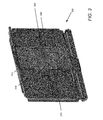
- FIG. 3 illustrates a circuit card assembly 300 comprising the mezzanine card 200 , cooling frame 250 (only protrusions 260 and 270 are visible in the drawing), host card 310 , and host card cooling frame 320 .
- the size of the mezzanine card assembly 201 may be mandated by a mechanical envelope defined in a VITA specification.
- the mezzanine card assembly 201 comprises the mezzanine card 200 and the cooling frame 250 .
- the cooling frame 250 may be mounted directly to the host card 310 and/or the host card cooling frame 320 using attachment hardware (not shown).
- the host card 310 may be one of a plurality of host cards that are interconnected using a backplane of a larger computing device.
- the host card 310 may dissipate heat in any suitable way.
- the host card may be conduction cooled by being thermally coupled to the host card cooling frame 320 .
- the host card cooling frame 320 may ultimately be coupled to a larger metal chassis that dissipates the heat transferred from the mezzanine card 200 and the host card 310 .
- Conduction cooling may be preferred in military applications, such as military avionics, where the device must operate in harsh environments and air-flow over the electronic components must be prevented. Other embodiments may use air flow cooling of the components. Embodiments are not limited to a particular method of heat dissipation.
- Host card cooling frame 320 may be considered part of host card 310 .
- the cooling frame 320 not only provides a means for dissipating heat generated by the host card, but it also provides structure and support to host card 310 .
- the cooling frames 150 and 250 associated with mezzanine cards 100 and 200 respectively, also provide support and structure to the mezzanine cards.
- FIG. 4 illustrates a close-up cross-section of mezzanine card assembly 101 , which comprises mezzanine card 100 and cooling frame 150 .
- Component 130 is mounted to mezzanine card 100 and is in direct thermal contact with the main body 152 of cooling frame 150 .
- Protrusion 160 may have a thickness defined by the level 450 of a first surface and level 451 of a second surface. In some embodiments, this thickness is the same thickness as sidewall 154 and main body 152 . However, the thickness may be thicker or thinner based on factors such as manufacturability and conduction performance.
- the PWB of mezzanine card 100 has the same thickness defined by levels 451 and 450 .
- Surface 130 of the mezzanine card's PWB may be at the same level 450 as the first surface of protrusion 160 .
- the cooling frame 150 together with the mezzanine card 100 adhere to the VITA specification mechanical envelope dimensions.
- Attachment hardware 410 may be used to mount the cooling frame 150 via protrusion 160 to the host card and/or the host card's cooling frame. Any suitable attachment hardware 410 may be used.
- attachment hardware 410 may be a bolt or a screw.
- Embodiments of the invention have been described with reference to the VITA standard, particularly the VITA 20, VITA 42 and VITA 61 specifications. Embodiments of the invention are not so limited and any circuit card module standard may be used. For example, a IEEE standard may be used.
- the invention may be embodied as a method, of which at least one example has been provided.
- the acts performed as part of the method may be ordered in any suitable way. Accordingly, embodiments may be constructed in which acts are performed in an order different than illustrated, which may include performing some acts simultaneously, even though shown as sequential acts in illustrative embodiments.
Landscapes
- Engineering & Computer Science (AREA)
- Theoretical Computer Science (AREA)
- Human Computer Interaction (AREA)
- Physics & Mathematics (AREA)
- General Engineering & Computer Science (AREA)
- General Physics & Mathematics (AREA)
- Computer Hardware Design (AREA)
- Power Engineering (AREA)
- Cooling Or The Like Of Electrical Apparatus (AREA)
Abstract
Description
- The techniques described herein relate to a cooling frame for a mezzanine card for use in connection with a host card. The cooling frame and mezzanine card allow for high power heat dissipation.
- Circuit card modules are used in many areas of computing and frequently utilize mezzanine cards and cooling frames. Standard bodies, such as the VMEbus International Trade Association (“VITA”) have developed both electrical and mechanical specifications to which most manufacturers adhere. Customers often prefer standardized components because it ensures compatibility between various products purchased from different vendors. Accordingly, most manufacturers adhere to the above standards for circuit card modules and/or mezzanine cards.
- Circuit card modules may comprise printed circuit boards (PCBs) or printed wiring boards (PWBs), terms that are often used interchangeably. Electronic components, such as integrated circuits and processors, may be affixed to the boards. Mezzanine cards are PWBs that may be attached both mechanically and electrically to a host card. As the processors and integrated circuits that are affixed to mezzanine cards increase in performance, there arises a need for efficient, high power dissipation of the heat generated by these components.
- Previous heat dissipation solutions transfer heat from the mezzanine card components to a top cooling frame, then to the mezzanine card PWB, and then finally to the host card frame.
- Some embodiments are directed to a mezzanine card assembly comprising a mezzanine card of a non-rectangular shape. The mezzanine card may have a a first mezzanine surface with at least one component mounted thereto and a second mezzanine surface opposing the first mezzanine surface. The mezzanine card assembly may also comprise a cooling frame, wherein joint dimensions of the cooling frame and the mezzanine card together conform to a standard dimensions requirements, for example VITA 20, VITA 42, VITA 61, etc. . . . The at least one component is in direct thermal contact with the cooling frame, which may be formed from a metallic material. The cooling frame may comprise at least one protrusion with a first protrusion surface at a first level defined by the second mezzanine surface and a second protrusion surface opposing the first protrusion surface. The PWB may comprise at least one cut-out portion configured to receive the at least one protrusion of the cooling frame. In some embodiments, the second protrusion surface is at a second level defined by the first mezzanine surface.
- In some embodiments, the at least one protrusion is substantially rectangular. The at least one protrusion may comprise at least one hole for receiving attachment hardware, the at least one hole configured so that the attachment hardware mounts the cooling frame to a host card and/or a host card frame. Some embodiments may use at least one cooling pad comprising a first pad surface in contact with the cooling frame and a second pad surface, opposing the first pad surface, wherein the second pad surface is in contact with the at least one component.
- Some embodiments are directed to a metallic frame for cooling a mezzanine card. The metallic frame may comprise a main body that is substantially rectangular comprising at least a first main body surface, wherein the main body is at a first level. The metallic frame may also comprise at least one protrusion at a second level other than the first level, wherein the at least one protrusion comprising at least a first protrusion surface. There may also be at least one sidewall connecting the main body to the at least one protrusion, wherein the at least one sidewall comprises at least a first sidewall surface, wherein the first sidewall surface is connected to the first main body surface and the first protrusion surface. In some embodiments, the first sidewall surface may be connected substantially perpendicular to the first main body surface and the first protrusion surface. The at least one protrusion may comprise at least one hole for receiving attachment hardware, the at least one hole configured so that the attachment hardware mounts the frame to a host card.
- The metallic frame may also comprise a secondary body comprising at least a first secondary body surface substantially parallel to the first main body surface, wherein the secondary body is coupled to the main body by at least the at least one protrusion. The at least one protrusion may be configured to fit into a cut-out in a printed wiring board (PWB). A first thickness of the at least one protrusion may be configured to be substantially equal to a second thickness the PWB, wherein the first thickness and the second thickness are in the direction of the at least one sidewall.
- Some embodiments are directed to a circuit card assembly comprising a host card, a mezzanine card and a cooling frame. The mezzanine card may be substantially parallel to the host card and comprise a first mezzanine surface with at least one component mounted thereto and a second mezzanine surface opposing the first mezzanine surface;. The mezzanine card may be non-rectangular. The cooling frame may be in contact with the host card, wherein the cooling frame and the mezzanine card together have joint dimensions conforming to dimensions of a standard. The standard may be a VITA 20 standard, a VITA 42 standard, a VITA 61 standard or an IEEE standard.
- The cooling frame may comprise at least one protrusion comprising a first protrusion surface at a first level defined by the second mezzanine surface and a second protrusion surface opposing the first protrusion surface. The mezzanine card may comprise at least one cut-out portion configured to receive the at least one protrusion of the cooling frame. The second protrusion surface may be at a second level defined by the first mezzanine surface. The cooling frame may further comprise a main body and a secondary body connected to the main body by the at least one protrusion, wherein the secondary body is substantially parallel to the main body. The mezzanine board may have at least one component in contact with the main body and at least one additional component in contact with the secondary body.
- The accompanying drawings are not intended to be drawn to scale. In the drawings, each identical or nearly identical component that is illustrated in various figures is represented by a like numeral. For purposes of clarity, not every component may be labeled in every drawing. In the drawings:
-
FIG. 1A illustrates a first exemplary mezzanine card; -
FIG. 1B illustrates a first exemplary cooling frame for the first exemplary mezzanine card; -
FIG. 1C illustrates the first exemplary mezzanine card and first exemplary cooling frame together as a first mezzanine card assembly; -
FIG. 2A illustrates a second exemplary mezzanine card; -
FIG. 2B illustrates a second exemplary cooling frame for the second exemplary mezzanine card; -
FIG. 2C illustrates the second exemplary mezzanine card and the second exemplary cooling frame together as a second mezzanine card assembly; -
FIG. 3 illustrates the second exemplary mezzanine card assembly attached to a host card; and -
FIG. 4 illustrates a close up cross-section of the first mezzanine card assembly. - The inventors have recognized and appreciated that one of the factors limiting performance of mezzanine cards and the components thereon is the ability to dissipate the heat generated during operation. Heat may be more efficiently transferred away from the components of a mezzanine card by reducing the number of interfaces between the hot components and a heat sink. Moreover, heat dissipation can be made more efficient through the primary usage of lower impedance thermal conduction materials, such as metallic interfaces as opposed to standard PWB construction. The inventors have recognized and appreciated that more efficient heat dissipation permits higher operating temperatures for mezzanine cards, higher performance, and/or longer lifetime of the components thereon with no other changes to the architecture.
- The ability to transfer heat may be increased by reducing the number of interfaces heat must traverse. Thermal resistance of a heat path increases with the number of interfaces. Moreover, conducting the heat through highly conductive materials, such as metal, greatly increases the ability to dissipate heat. Accordingly, some embodiments of the invention are directed to techniques for directly thermally coupling a metallic cooling frame of a mezzanine card to the host card and/or a cooling frame associated with the host card, bypassing the need to transfer heat through the relatively low conductivity PWB of the mezzanine card. To achieve this direct coupling, some embodiments replace a thermal interface area of the PWB with a recessed metallic frame that both top cools the mezzanine card components and dissipates heat directly to the host card.
- There are a variety of standards for circuit card modules. For example, VITA 61,VITA 42 and VITA 20 define mechanical and electrical specifications for a switched mezzanine card (XMC) and PCI (Peripheral Component Interface) Mezzanine Card (PMC), respectively. The standards each define a standoff height and a mechanical envelope to which mezzanine cards must adhere. A mechanical envelope may be a set of dimensions to which a mezzanine card assembly must adhere. There are many off-the-shelf components that are designed to work with cards abiding by these standards, such as connectors that match the standoff height. Therefore, some embodiments comprise a mezzanine card and cooling frame that together conform to the mechanical envelope and standoff height dictated by the VITA standards. A mezzanine card and a cooling frame together may be referred to as a mezzanine card assembly. A mezzanine card assembly may also include additional components. Similarly a circuit card assembly may refer to a host card and a mezzanine card assembly. A computer card assembly may also include additional components, including a cooling frame associated with the host card.
- Embodiments of the invention are not limited to VITA standards. Other standard bodies exist for defining circuit card dimensions. For example, some embodiments are based on a IEEE specification of dimensions.
-
FIG. 1A shows anexemplary mezzanine card 100 illustrative of some embodiments. Themezzanine card 100 may comprise a PWB and one or more components (not shown inFIG. 1A ). The components may include processors, integrated circuits or any other suitable electrical component. Themezzanine card 100 has two surfaces,surface 130 is shown inFIG. 1A and there is a secondsurface opposing surface 130 not shown inFIG. 1A . Components may be mounted to one or both surfaces of themezzanine card 100. The distance between thefirst surface 130 and the second surface determines the thickness of the PWB of the mezzanine card. - In some embodiments, the
mezzanine card 100 is non-rectangular in shape. Any suitable shape may be used.FIG. 1A illustrates an “I-shaped”mezzanine card 100 with a rectangular PWB with two rectangular “cut-outs” 110 and 120 along the long edge of the PWB. The cut-outs mezzanine card 100. The cut-outs mezzanine card 100 does not adhere to the defined standard mechanical envelope due to the cut-outs FIG. 1C below, themezzanine card 100 together with coolingframe 150 conform to the specified mechanical envelope of a particular standard. - The standard may also mandate the location and size of at least one
hole 105 through themezzanine card 100. Attachment hardware may be placed through the hole to attach themezzanine card 100 to the host card. -
FIG. 1B shows anexemplary cooling frame 150 illustrative of some embodiments. Thecooling frame 150 may be placed in thermal contact with components ofmezzanine board 100 in order to dissipate heat generated during the operation of said components. Thecooling frame 150 is preferably made of a material with a high thermal conductivity. For example, any metal or metal alloy may be used, such as aluminum or copper. Alternatively, one or more thermally conductive polymers may be used to dissipate heat. Embodiments are not limited to any particular material. In some embodiments thecooling frame 150 is made from a single, integral piece of metal. -
Cooling frame 150 may be any suitable shape that, when combined with the shape ofmezzanine card 100 conforms to the mechanical envelope and standoff height defined by particular standards.FIG. 1B illustrates acooling frame 150 with a relatively large, singlemain body 152. Themain body 152 may be placed in thermal contact with components ofmezzanine card 100 in order to dissipate heat therefrom. Themain body 152 may be substantially rectangular, substantially flat and substantially parallel to the surfaces of themezzanine card 100. In some embodiments,main body 152 may include cooling pedestals 180-181 designed to adjust the specific height of the main body at particular locations that correspond to a location of a component mounted tomezzanine card 100. Cooling pedestals 180-181 need not be present in embodiments and, if they are, the size and shape are not limited in any way. - A
sidewall 154 may run around the perimeter ofmain body 152. Thesidewall 154 determines the level at which themain body 152 sits relative to the components ofmezzanine card 100 and must allow the form factor of the mezzanine card assembly to fit within the maximum material condition in the selected standard. Thesidewall 154 may be any suitable thickness. The sidewall thickness must be enough to accommodate a variety of bolt holes that are mandated by the standard. However, as thesidewall 154 is made thicker, there will be less room for components onmezzanine card 100 undermain body 152. Accordingly, in some embodiments, the sidewall will be thicker near the bolt holes and thinner where there are no bolt holes. - The
sidewall 154 connectsmain body 152 toprotrusions cooling frame 150 may be referred to as wings, ears or tabs.Cooling frame 150 may comprise any suitable number of protrusions. The number and shape of the protrusions may match the number and shapes of the cut-outs ofmezzanine card 100.Protrusions protrusions main body 152. The distance between the first and second surface of the protrusions defines the thickness of the protrusions. As will be discussed in connection withFIG. 4 below, in some embodiments the thickness of the protrusions may be the same as the thickness of the PWB of the mezzanine card. - In some embodiments,
protrusions hole Holes holes FIG. 1B illustratesprotrusions -
FIG. 1C illustrates themezzanine card 100 andcooling frame 150 fitted together to form amezzanine card assembly 101 in accordance with some embodiments of the invention.Protrusions cooling frame 150 may be fitted into cut-outs mezzanine card 100, respectively. Together, themezzanine card 100 and thecooling frame 150 may conform to the rectangular envelope mandated by the VITA standard. Also, thecooling frame 150 may be designed such that it does not interfere with the at least onehole 105 required for attachment hardware, as mandated by the VITA standard. -
FIG. 1C also illustrates components 130-131 ofmezzanine card 100. In some embodiments, the components 130-131 may be in direct contact withcooling frame 150, allowing efficient heat dissipation away from the components. In other embodiments, cooling pads (not shown) may be placed between the components 130-131 and the cooling frame to facilitate thermal coupling. A cooling pad may comprise a first surface in contact with one or more of the components 130-131 and a second surface, opposed to the first surface, in contact with themain body 152 of thecooling frame 150. The heat from components 130-131 may travel through themain body 152 toprotrusions protrusions holes mezzanine card 100. - For illustrative purposes,
FIG. 1C also showsadditional components cooling frame 150. Also shown are connectors 140-141, which may be used to electrically couple themezzanine card 100 to the associated host card.Mezzanine card 100 may comprise additional components, either undermain body 152 or not under themain body 152, which are not shown for purposed of clarity. -
FIG. 2A illustrates asecond mezzanine card 200 according to some embodiments of the invention. Many aspects ofmezzanine card 200 may be similar tomezzanine card 100. For example,mezzanine card 200 has afirst surface 230, a second surface opposed to the first surface, andmezzanine card 200 is non-rectangular due to two cut-outs outs outs mezzanine card 100. This may provide additional direct thermal coupling of the mezzanine card to the host card. Also, as illustrated inFIG. 2B , it allows thecooling frame 250 to have additional areas to which components of the mezzanine card may dissipate heat. - The standard may mandate the location and size of at least one
hole 205 through themezzanine card 200. Attachment hardware may be placed through the hole to attach themezzanine card 200 to the host card. -
FIG. 2B shows a secondexemplary cooling frame 250 illustrative of some embodiments. There are many similarities betweencooling frame 250 and cooling from 150. For example, coolingframe 250 may have amain body 252, asidewall 254, cooling pedestals 280-281,protrusions -
Protrusions protrusions longer protrusions frame 250 to have an asecondary body 253, which may be smaller thanmain body 252. Thesecondary body 253 may be attached to themain body 252 by theprotrusions secondary body 253 may be substantially parallel tomain body 252 and at the same height, wherein the height of each of the bodies may be defined as the distance from the PWB of themezzanine card 200 to one of the surfaces of the body. In some embodiments, the height of thesecondary body 253 may be different from the height ofmain body 252. There may be a gap between themain body 252 and thesecondary body 253. This gap may be any size, but as discussed below in connection withFIG. 2C , it must be large enough to accommodate the at least onehole 205 inmezzanine card 200 mandated by the VITA standard. -
FIG. 2C illustrates themezzanine card 200 and thecooling frame 250 fitted together to form amezzanine card assembly 201 in accordance with some embodiments of the invention.Protrusions cooling frame 250 may be fitted into cut-outs mezzanine card 200, respectively. Together, themezzanine card 200 and thecooling frame 250 may conform to the rectangular mechanical envelope mandated by the VITA standard. -
FIG. 2C also illustrates components 230-231 ofmezzanine card 200. In some embodiments, the components 230-231 may be in direct contact withcooling frame 250, allowing efficient heat dissipation away from the components. In other embodiments, cooling pads (not shown) may be placed between the components 230-231 and the cooling frame to facilitate thermal coupling. The heat from components 230-231 may travel through themain body 252 toprotrusions protrusions holes mezzanine card 200. - Not shown in
FIG. 2C are additional components that may be on the surface ofmezzanine card 200 under thesecondary body 253. Just as components 230-231 may be in contact withmain body 252, additional components may be in contact withsecondary body 253. The heat created by the additional components is carried away from the components by thesecondary body 253 and transferred to the host card viaprotrusions secondary body 253 may be separated frommain body 253 to allow a gap between the bodies to accommodate the at least onehole 205 required by the VITA specification. - For illustrative purposes,
FIG. 2C also showsadditional components cooling frame 150. Also shown are connectors 240-241, which may be used to electrically couple themezzanine card 200 to the associated host card.Mezzanine card 200 may comprise additional components, either undermain body 252 or not under themain body 252, which are not shown for purposed of clarity. -
FIG. 3 illustrates acircuit card assembly 300 comprising themezzanine card 200, cooling frame 250 (onlyprotrusions host card 310, and hostcard cooling frame 320. In some embodiments, the size of themezzanine card assembly 201 may be mandated by a mechanical envelope defined in a VITA specification. Themezzanine card assembly 201 comprises themezzanine card 200 and thecooling frame 250. Thecooling frame 250 may be mounted directly to thehost card 310 and/or the hostcard cooling frame 320 using attachment hardware (not shown). - The
host card 310 may be one of a plurality of host cards that are interconnected using a backplane of a larger computing device. Thehost card 310 may dissipate heat in any suitable way. For example, in military applications, the host card may be conduction cooled by being thermally coupled to the hostcard cooling frame 320. The hostcard cooling frame 320 may ultimately be coupled to a larger metal chassis that dissipates the heat transferred from themezzanine card 200 and thehost card 310. Conduction cooling may be preferred in military applications, such as military avionics, where the device must operate in harsh environments and air-flow over the electronic components must be prevented. Other embodiments may use air flow cooling of the components. Embodiments are not limited to a particular method of heat dissipation. - Host
card cooling frame 320 may be considered part ofhost card 310. Thecooling frame 320 not only provides a means for dissipating heat generated by the host card, but it also provides structure and support to hostcard 310. Similarly the cooling frames 150 and 250 associated withmezzanine cards -
FIG. 4 illustrates a close-up cross-section ofmezzanine card assembly 101, which comprisesmezzanine card 100 andcooling frame 150.Component 130 is mounted tomezzanine card 100 and is in direct thermal contact with themain body 152 ofcooling frame 150.Protrusion 160 may have a thickness defined by thelevel 450 of a first surface andlevel 451 of a second surface. In some embodiments, this thickness is the same thickness assidewall 154 andmain body 152. However, the thickness may be thicker or thinner based on factors such as manufacturability and conduction performance. In some embodiments, the PWB ofmezzanine card 100 has the same thickness defined bylevels Surface 130 of the mezzanine card's PWB may be at thesame level 450 as the first surface ofprotrusion 160. By being at thesame level 450, thecooling frame 150 together with themezzanine card 100 adhere to the VITA specification mechanical envelope dimensions. -
Attachment hardware 410 may be used to mount thecooling frame 150 viaprotrusion 160 to the host card and/or the host card's cooling frame. Anysuitable attachment hardware 410 may be used. For example,attachment hardware 410 may be a bolt or a screw. - Embodiments of the invention have been described with reference to the VITA standard, particularly the VITA 20, VITA 42 and VITA 61 specifications. Embodiments of the invention are not so limited and any circuit card module standard may be used. For example, a IEEE standard may be used.
- This invention is not limited in its application to the details of construction and the arrangement of components set forth in the foregoing description or illustrated in the drawings. The invention is capable of other embodiments and of being practiced or of being carried out in various ways. Also, the phraseology and terminology used herein is for the purpose of description and should not be regarded as limiting. The use of “including,” “comprising,” or “having,” “containing,” “involving,” and variations thereof herein, is meant to encompass the items listed thereafter and equivalents thereof as well as additional items.
- Various aspects of the present invention may be used alone, in combination, or in a variety of arrangements not specifically discussed in the embodiments described in the foregoing and is therefore not limited in its application to the details and arrangement of components set forth in the foregoing description or illustrated in the drawings. For example, aspects described in one embodiment may be combined in any manner with aspects described in other embodiments.
- Also, the invention may be embodied as a method, of which at least one example has been provided. The acts performed as part of the method may be ordered in any suitable way. Accordingly, embodiments may be constructed in which acts are performed in an order different than illustrated, which may include performing some acts simultaneously, even though shown as sequential acts in illustrative embodiments.
- Use of ordinal terms such as “first,” “second,” “third,” etc., in the claims to modify a claim element does not by itself connote any priority, precedence, or order of one claim element over another or the temporal order in which acts of a method are performed, but are used merely as labels to distinguish one claim element having a certain name from another element having a same name (but for use of the ordinal term) to distinguish the claim elements.
- Having thus described several aspects of at least one embodiment of this invention, it is to be appreciated various alterations, modifications, and improvements will readily occur to those skilled in the art. Such alterations, modifications, and improvements are intended to be part of this disclosure, and are intended to be within the spirit and scope of the invention. Accordingly, the foregoing description and drawings are by way of example only.
Claims (20)
Priority Applications (1)
| Application Number | Priority Date | Filing Date | Title |
|---|---|---|---|
| US13/568,223 US9417670B2 (en) | 2012-08-07 | 2012-08-07 | High power dissipation mezzanine card cooling frame |
Applications Claiming Priority (1)
| Application Number | Priority Date | Filing Date | Title |
|---|---|---|---|
| US13/568,223 US9417670B2 (en) | 2012-08-07 | 2012-08-07 | High power dissipation mezzanine card cooling frame |
Publications (2)
| Publication Number | Publication Date |
|---|---|
| US20140043753A1 true US20140043753A1 (en) | 2014-02-13 |
| US9417670B2 US9417670B2 (en) | 2016-08-16 |
Family
ID=50066034
Family Applications (1)
| Application Number | Title | Priority Date | Filing Date |
|---|---|---|---|
| US13/568,223 Expired - Fee Related US9417670B2 (en) | 2012-08-07 | 2012-08-07 | High power dissipation mezzanine card cooling frame |
Country Status (1)
| Country | Link |
|---|---|
| US (1) | US9417670B2 (en) |
Cited By (1)
| Publication number | Priority date | Publication date | Assignee | Title |
|---|---|---|---|---|
| EP3859898A1 (en) * | 2020-02-03 | 2021-08-04 | Rockwell Collins, Inc. | Circuit board separation mechanism |
Families Citing this family (2)
| Publication number | Priority date | Publication date | Assignee | Title |
|---|---|---|---|---|
| US9426931B2 (en) | 2014-02-07 | 2016-08-23 | Lockheed Martin Corporation | Fluid-flow-through cooling of circuit boards |
| US12604437B2 (en) | 2023-08-21 | 2026-04-14 | Rockwell Collins, Inc. | Compact modular hybrid heat exchanger (CMH2X) |
Citations (9)
| Publication number | Priority date | Publication date | Assignee | Title |
|---|---|---|---|---|
| US5999407A (en) * | 1998-10-22 | 1999-12-07 | Lockheed Martin Corp. | Electronic module with conductively heat-sunk components |
| US6023412A (en) * | 1998-07-24 | 2000-02-08 | Fujitsu Limited | System board device having a displaceable daughter-board cover |
| US6064575A (en) * | 1998-05-12 | 2000-05-16 | Lockheed Martin Corporation | Circuit module assembly |
| US6101094A (en) * | 1998-12-18 | 2000-08-08 | Sun Microsystems, Inc. | Printed circuit board with integrated cooling mechanism |
| US20040070944A1 (en) * | 2002-10-10 | 2004-04-15 | Harris Corporation | Circuit card module including mezzanine card heat sink and related methods |
| US20040114331A1 (en) * | 2002-12-16 | 2004-06-17 | Hines Douglas J. | Vme circuit host card with triple mezzanine configuration |
| US20040212953A1 (en) * | 2002-02-20 | 2004-10-28 | Summers Mark D. | Thermal solution for a mezzanine card |
| US20090052139A1 (en) * | 2007-08-23 | 2009-02-26 | Kuping Lai | Heat-Dissipation Apparatus For Communication Device With Card Slot |
| US20100177487A1 (en) * | 2009-01-13 | 2010-07-15 | Nauman Arshad | Tamper respondent module |
Family Cites Families (4)
| Publication number | Priority date | Publication date | Assignee | Title |
|---|---|---|---|---|
| US6246582B1 (en) | 1998-12-30 | 2001-06-12 | Honeywell Inc. | Interchangeable stiffening frame with extended width wedgelock for use in a circuit card module |
| US6212075B1 (en) | 1998-12-30 | 2001-04-03 | Honeywell Inc. | Adapter kit to allow extended width wedgelock for use in a circuit card module |
| IL130775A (en) | 1999-07-02 | 2007-03-08 | Elta Systems Ltd | Conduction cooled electronic card module and method of producing the same utilizing an electronic circuit card originally designed for convection cooling |
| US6239972B1 (en) | 1999-12-13 | 2001-05-29 | Honeywell International Inc. | Integrated convection and conduction heat sink for multiple mounting positions |
-
2012
- 2012-08-07 US US13/568,223 patent/US9417670B2/en not_active Expired - Fee Related
Patent Citations (9)
| Publication number | Priority date | Publication date | Assignee | Title |
|---|---|---|---|---|
| US6064575A (en) * | 1998-05-12 | 2000-05-16 | Lockheed Martin Corporation | Circuit module assembly |
| US6023412A (en) * | 1998-07-24 | 2000-02-08 | Fujitsu Limited | System board device having a displaceable daughter-board cover |
| US5999407A (en) * | 1998-10-22 | 1999-12-07 | Lockheed Martin Corp. | Electronic module with conductively heat-sunk components |
| US6101094A (en) * | 1998-12-18 | 2000-08-08 | Sun Microsystems, Inc. | Printed circuit board with integrated cooling mechanism |
| US20040212953A1 (en) * | 2002-02-20 | 2004-10-28 | Summers Mark D. | Thermal solution for a mezzanine card |
| US20040070944A1 (en) * | 2002-10-10 | 2004-04-15 | Harris Corporation | Circuit card module including mezzanine card heat sink and related methods |
| US20040114331A1 (en) * | 2002-12-16 | 2004-06-17 | Hines Douglas J. | Vme circuit host card with triple mezzanine configuration |
| US20090052139A1 (en) * | 2007-08-23 | 2009-02-26 | Kuping Lai | Heat-Dissipation Apparatus For Communication Device With Card Slot |
| US20100177487A1 (en) * | 2009-01-13 | 2010-07-15 | Nauman Arshad | Tamper respondent module |
Cited By (3)
| Publication number | Priority date | Publication date | Assignee | Title |
|---|---|---|---|---|
| EP3859898A1 (en) * | 2020-02-03 | 2021-08-04 | Rockwell Collins, Inc. | Circuit board separation mechanism |
| US20210242630A1 (en) * | 2020-02-03 | 2021-08-05 | Rockwell Collins, Inc. | Circuit Board Separation Mechanism |
| US11121504B2 (en) * | 2020-02-03 | 2021-09-14 | Rockwell Collins, Inc. | Circuit board separation mechanism |
Also Published As
| Publication number | Publication date |
|---|---|
| US9417670B2 (en) | 2016-08-16 |
Similar Documents
| Publication | Publication Date | Title |
|---|---|---|
| US11497143B2 (en) | Mechanically flexible cold plates for low power components | |
| US7692927B2 (en) | Shielding and heat dissipation device | |
| US6542366B2 (en) | Circuit board support | |
| US20020186544A1 (en) | Utilizing a convection cooled electronic circuit card for producing a conduction cooled electronic card module | |
| US20150062820A1 (en) | Heat transfer for electronic equipment | |
| US9357676B2 (en) | Cooling device and electronic apparatus | |
| US10568206B2 (en) | Printed circuit board assembly and assembling method thereof | |
| US20050207115A1 (en) | Heat dissipating arrangement | |
| US20080239679A1 (en) | Heat dissipation device having metal die-casting component and metal-extrusion component | |
| US6278615B1 (en) | Heatsink grounding spring and shield apparatus | |
| JP7819369B2 (en) | Heat dissipation structure, vehicle-mounted device and terminal device | |
| US20210084746A1 (en) | Secondary side heatsink techniques for optical and electrical modules | |
| EP2451261B1 (en) | Wedge lock for use with a single board computer and method of assembling a computer system | |
| US20030058621A1 (en) | Method and apparatus for retaining cooling apparatus and bus bar | |
| US6483704B2 (en) | Microprocessor heat sink retention module | |
| US9417670B2 (en) | High power dissipation mezzanine card cooling frame | |
| US9648789B2 (en) | Apparatus for cooling and mounting a circuit board | |
| US9252512B2 (en) | Power connector having enhanced thermal conduction characteristics | |
| CN102281740B (en) | A kind of heat abstractor and method | |
| US7248479B2 (en) | Thermal management for hot-swappable module | |
| EP3958090B1 (en) | Support assembly and display device | |
| US7551446B2 (en) | Thermal management device attachment | |
| US20230164956A1 (en) | Apparatus, system, and method for mitigating deformation of spring-loaded heatsinks | |
| CN112188819A (en) | Case heat radiation structure of helicopter airborne equipment | |
| RU2671852C1 (en) | Electronic heat-transfer unit |
Legal Events
| Date | Code | Title | Description |
|---|---|---|---|
| AS | Assignment |
Owner name: LOCKHEED MARTIN CORPORATION, MARYLAND Free format text: ASSIGNMENT OF ASSIGNORS INTEREST;ASSIGNORS:KAPLUN, BRIAN;YOST, BORIS;REEL/FRAME:028737/0209 Effective date: 20120803 |
|
| STCF | Information on status: patent grant |
Free format text: PATENTED CASE |
|
| FEPP | Fee payment procedure |
Free format text: MAINTENANCE FEE REMINDER MAILED (ORIGINAL EVENT CODE: REM.); ENTITY STATUS OF PATENT OWNER: LARGE ENTITY |
|
| LAPS | Lapse for failure to pay maintenance fees |
Free format text: PATENT EXPIRED FOR FAILURE TO PAY MAINTENANCE FEES (ORIGINAL EVENT CODE: EXP.); ENTITY STATUS OF PATENT OWNER: LARGE ENTITY |
|
| STCH | Information on status: patent discontinuation |
Free format text: PATENT EXPIRED DUE TO NONPAYMENT OF MAINTENANCE FEES UNDER 37 CFR 1.362 |
|
| FP | Lapsed due to failure to pay maintenance fee |
Effective date: 20200816 |