US2011850A - Bicycle signaling device - Google Patents
Bicycle signaling device Download PDFInfo
- Publication number
- US2011850A US2011850A US748875A US74887534A US2011850A US 2011850 A US2011850 A US 2011850A US 748875 A US748875 A US 748875A US 74887534 A US74887534 A US 74887534A US 2011850 A US2011850 A US 2011850A
- Authority
- US
- United States
- Prior art keywords
- glass
- bicycle
- signaling device
- casing
- openings
- Prior art date
- Legal status (The legal status is an assumption and is not a legal conclusion. Google has not performed a legal analysis and makes no representation as to the accuracy of the status listed.)
- Expired - Lifetime
Links
- 230000011664 signaling Effects 0.000 title description 5
- 239000011521 glass Substances 0.000 description 18
- 238000010276 construction Methods 0.000 description 5
- 239000002184 metal Substances 0.000 description 5
- 239000010437 gem Substances 0.000 description 1
- 229910001751 gemstone Inorganic materials 0.000 description 1
- 238000004519 manufacturing process Methods 0.000 description 1
- 230000008439 repair process Effects 0.000 description 1
Images
Classifications
-
- B—PERFORMING OPERATIONS; TRANSPORTING
- B62—LAND VEHICLES FOR TRAVELLING OTHERWISE THAN ON RAILS
- B62J—CYCLE SADDLES OR SEATS; AUXILIARY DEVICES OR ACCESSORIES SPECIALLY ADAPTED TO CYCLES AND NOT OTHERWISE PROVIDED FOR, e.g. ARTICLE CARRIERS OR CYCLE PROTECTORS
- B62J6/00—Arrangement of optical signalling or lighting devices on cycles; Mounting or supporting thereof; Circuits therefor
- B62J6/20—Arrangement of reflectors, e.g. on the wheel spokes ; Lighting devices mounted on wheel spokes
Definitions
- This invention relates to an improved species of rear light signaling means for bicycles.
- the kind commonly used is a piece of red glass molded like a jewel, with its rim set in a frame mounted near the end of the rear mudguard. It reflects light togive the signal.
- a difficulty with the common form is that the glass breaks in its frame and falls out.
- the bicycle Auser does not usually replace it, and one reason is that there are few service stations for bicycles. Ordinarily a bicycle user needs to get replacement parts from the factory and boys do not bother to do that. Even very large sporting goods stores that sell a great many bicycles do not provide for repairs and replacements. The itemsv are too small and the burden of this situation is thrown back on the bicycle manufacturer.
- the object of my invention is to provide a rear signal construction that will continue to function even though the glass is badlybroken. As afurther object, the construction is made so that with the glass badly smashed it will not show sufciently to give the smashed appearance.
- This glass construction a crack or break will always occur in a zigzag line along the path of least resistance. This path is one borderingY the hexagonal bases, but never all the way around a single projection.
- kI enclose a piece of this glass in a box frame of sheet metal. Or for convenience I wrap the glass with a metal covering tightly enough so that if the glass is cracked or smashed the parts areheldin place. ⁇ Of course o the metal covering must have openings for light rays to reach the glass and be reflected.
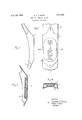
- Fig. 1 is a view of the signal construction as iti appears on the rear mudguard of the bicycle;' Fig. 2 is a cross-section online 2-2 of Fig. 3; Fig. 3 is a plan view of. Fig. 1; and Fig. 4 is a section online 4-4 of Fig. 3.
- a rear signaling device forbicycles which comprises a casing having a flat portion, side flanges extending rearwardly from the flat portion and adapted to engage the sides of the mud guard of the bicycle, and end portions sloping gradually from the flat portion into substantially smooth juncture with the face of the mud guard, a strap member, having side and bottom flanges, secured to the inner side of the flat portion of the casing and forming therewith a pocket, aglass reflecting plate, having a smooth flat front face and provided on its rear face with integral cone-shaped projections havingpolygonal bases contiguous to each other, positioned tightly in said pocket with 50
Landscapes
- Engineering & Computer Science (AREA)
- Mechanical Engineering (AREA)
- Automatic Cycles, And Cycles In General (AREA)
Description
Aug. 2Q, i935.
N. A. CLARKE BICYCLE SIGNALING DEVICE Filed 0G11.. 18.v` 1934 INVENTOR BY /VaAwA/V (Mami `ATTORNEYS Patented Aug. 20, 1935 PATENT OFFICE:v
n 2,011,850 BICYCLE SIGNALING DEVICE Norman A. Clarke, We
stfield, Mass., assigner to The Westfield Manufacturing Company, Westfield, Mass., a corporation of Massachusetts Application October 18, 1934, Serial No. 748,875
1 Claim.
This invention relates to an improved species of rear light signaling means for bicycles.
The kind commonly used is a piece of red glass molded like a jewel, with its rim set in a frame mounted near the end of the rear mudguard. It reflects light togive the signal.
A difficulty with the common form is that the glass breaks in its frame and falls out. The bicycle Auser does not usually replace it, and one reason is that there are few service stations for bicycles. Ordinarily a bicycle user needs to get replacement parts from the factory and boys do not bother to do that. Even very large sporting goods stores that sell a great many bicycles do not provide for repairs and replacements. The itemsv are too small and the burden of this situation is thrown back on the bicycle manufacturer.
The object of my invention is to provide a rear signal construction that will continue to function even though the glass is badlybroken. As afurther object, the construction is made so that with the glass badly smashed it will not show sufciently to give the smashed appearance. The
o parts of the glass are'heldtogether so that it will not only continue to function but also retain its original decent appearance.
In the preferred form, I accomplish this object as follows. I use a knownkind of colored signal glass that is perfectly smooth on one side. On the other side it is roughened with cone-shaped proi jections having hexagonallydefined bases touching one another. Each cone is about an eighth of an inch at the basev and about that in height. With this glass construction, a crack or break will always occur in a zigzag line along the path of least resistance. This path is one borderingY the hexagonal bases, but never all the way around a single projection. kI enclose a piece of this glass in a box frame of sheet metal. Or for convenience I wrap the glass with a metal covering tightly enough so that if the glass is cracked or smashed the parts areheldin place.` Of course o the metal covering must have openings for light rays to reach the glass and be reflected. The
Fig. 1 is a view of the signal construction as iti appears on the rear mudguard of the bicycle;' Fig. 2 is a cross-section online 2-2 of Fig. 3; Fig. 3 is a plan view of. Fig. 1; and Fig. 4 is a section online 4-4 of Fig. 3.
cones break up the light rays to make the glass For convenience I have made the casing I out of a single sheet metal stamping and a strapshaped metal piece 2 rwith an inturned lower end. When fastened to the casing, the strap holds the glass plate 3 with its flat side tightly pressed against the flat inner'side of stamping I. When the latter is fastened on the rear bicycle mudguard 5 the glass is entirely shut out from all light rays except those through the stencil-like openings spelling the word Bikef The drawing is substantially full scale.
With this construction, assume that a smashing blow hits the rear signal on a bicycle and the vglass plate within breaks badly. The glass wrapping holds it in place against its tendency to scatter. The broken pieces, unless pulverized, are ordinarily too large to pass through any of the openings spelling the word Bike So the 'broken pieces will be held in place. A great many light rays can pass through the many openings in the casing to the glass and the latter, even when broken, will reliect them and give the sparkle for signal purposes.
The character of openings in the glass gives the advantage that dirt cannot readily close them up. And the spelling of a signal word in the casing cut-touts has advantages in two ways: it gives the character of openings desired,'and it gives the best appearance.
The result is that bicycles, when furnished by the manufacturer with my species of signals on them, can now be Widely distributed to the trade without losingtheir rear signals after their first glass smashing accident. Having disclosed my invention, I claim:
A rear signaling device forbicycles which comprises a casing having a flat portion, side flanges extending rearwardly from the flat portion and adapted to engage the sides of the mud guard of the bicycle, and end portions sloping gradually from the flat portion into substantially smooth juncture with the face of the mud guard, a strap member, having side and bottom flanges, secured to the inner side of the flat portion of the casing and forming therewith a pocket, aglass reflecting plate, having a smooth flat front face and provided on its rear face with integral cone-shaped projections havingpolygonal bases contiguous to each other, positioned tightly in said pocket with 50
Priority Applications (1)
| Application Number | Priority Date | Filing Date | Title |
|---|---|---|---|
| US748875A US2011850A (en) | 1934-10-18 | 1934-10-18 | Bicycle signaling device |
Applications Claiming Priority (1)
| Application Number | Priority Date | Filing Date | Title |
|---|---|---|---|
| US748875A US2011850A (en) | 1934-10-18 | 1934-10-18 | Bicycle signaling device |
Publications (1)
| Publication Number | Publication Date |
|---|---|
| US2011850A true US2011850A (en) | 1935-08-20 |
Family
ID=25011302
Family Applications (1)
| Application Number | Title | Priority Date | Filing Date |
|---|---|---|---|
| US748875A Expired - Lifetime US2011850A (en) | 1934-10-18 | 1934-10-18 | Bicycle signaling device |
Country Status (1)
| Country | Link |
|---|---|
| US (1) | US2011850A (en) |
Cited By (6)
| Publication number | Priority date | Publication date | Assignee | Title |
|---|---|---|---|---|
| US2478735A (en) * | 1946-10-16 | 1949-08-09 | Joseph H Anderson | Bicycle reflector pedal |
| US3800449A (en) * | 1970-01-09 | 1974-04-02 | Nippon Musical Instruments Mfg | A mark carrying member affixed on a rough surface article |
| US20070277415A1 (en) * | 2006-05-30 | 2007-12-06 | Louis Chuang | Bicycle-Used Identification Device |
| WO2013150297A1 (en) * | 2012-04-04 | 2013-10-10 | Crawford Hollingworth | Lighting units for road users |
| US11054106B1 (en) * | 2019-07-12 | 2021-07-06 | Grand General Accessories Llc | LED vehicle light with dual color lens including the illuminated word “stop” |
| US11072384B2 (en) * | 2017-05-22 | 2021-07-27 | Hangzhou Qingqi Science And Technology Co., Ltd. | Fixed structure for an identification mark of a bicycle |
-
1934
- 1934-10-18 US US748875A patent/US2011850A/en not_active Expired - Lifetime
Cited By (10)
| Publication number | Priority date | Publication date | Assignee | Title |
|---|---|---|---|---|
| US2478735A (en) * | 1946-10-16 | 1949-08-09 | Joseph H Anderson | Bicycle reflector pedal |
| US3800449A (en) * | 1970-01-09 | 1974-04-02 | Nippon Musical Instruments Mfg | A mark carrying member affixed on a rough surface article |
| US20070277415A1 (en) * | 2006-05-30 | 2007-12-06 | Louis Chuang | Bicycle-Used Identification Device |
| US7748150B2 (en) * | 2006-05-30 | 2010-07-06 | Louis Chuang | Bicycle-used identification device |
| WO2013150297A1 (en) * | 2012-04-04 | 2013-10-10 | Crawford Hollingworth | Lighting units for road users |
| GB2514720A (en) * | 2012-04-04 | 2014-12-03 | Crawford Hollingworth | Lighting units for road users |
| GB2514720B (en) * | 2012-04-04 | 2016-12-21 | Hollingworth Crawford | Lighting units for road users |
| US9638387B2 (en) | 2012-04-04 | 2017-05-02 | Crawford Hollingworth | Lighting units for road users |
| US11072384B2 (en) * | 2017-05-22 | 2021-07-27 | Hangzhou Qingqi Science And Technology Co., Ltd. | Fixed structure for an identification mark of a bicycle |
| US11054106B1 (en) * | 2019-07-12 | 2021-07-06 | Grand General Accessories Llc | LED vehicle light with dual color lens including the illuminated word “stop” |
Similar Documents
| Publication | Publication Date | Title |
|---|---|---|
| US2935361A (en) | Ornamental disc for wheels | |
| US2248493A (en) | Hinge | |
| US2213701A (en) | Fishing spoon | |
| US2125629A (en) | Container | |
| US2167660A (en) | Illuminated sign | |
| US1538177A (en) | Light indicator for automobile lamps | |
| US2016333A (en) | Reflector device | |
| US2254599A (en) | Clock casing | |
| US2310600A (en) | Illuminated sign | |
| US1930556A (en) | Nose-guard pad for eyeglasses | |
| USD82034S (en) | Alfred g | |
| USD90104S (en) | George w | |
| US2157971A (en) | Velocipede structure | |
| USD73983S (en) | Design jpor a candy or like box | |
| USD91175S (en) | Design fok an ophthalmic mounting | |
| US1749881A (en) | Luminous electric-light switch | |
| USD107247S (en) | Design for a spectacle frame | |
| USD83200S (en) | Alfred g | |
| USD101633S (en) | Design for a glass building block | |
| USD79852S (en) | Waltee t | |
| US2293849A (en) | Reflector for bicycle pedals | |
| USD166578S (en) | Temple for spectacles or the like | |
| USD100339S (en) | Design for a bottle | |
| USD83390S (en) | Design for a dispenser eaucet | |
| USD100340S (en) | Design for a bottle |