US20100098528A1 - Torque monitoring apparatus - Google Patents
Torque monitoring apparatus Download PDFInfo
- Publication number
- US20100098528A1 US20100098528A1 US12/252,407 US25240708A US2010098528A1 US 20100098528 A1 US20100098528 A1 US 20100098528A1 US 25240708 A US25240708 A US 25240708A US 2010098528 A1 US2010098528 A1 US 2010098528A1
- Authority
- US
- United States
- Prior art keywords
- spokes
- projections
- axis
- hub
- monitoring apparatus
- Prior art date
- Legal status (The legal status is an assumption and is not a legal conclusion. Google has not performed a legal analysis and makes no representation as to the accuracy of the status listed.)
- Granted
Links
- 238000012544 monitoring process Methods 0.000 title claims abstract description 41
- 238000000034 method Methods 0.000 claims description 8
- 238000007493 shaping process Methods 0.000 claims description 3
- 239000012530 fluid Substances 0.000 description 7
- 230000033001 locomotion Effects 0.000 description 4
- 238000012806 monitoring device Methods 0.000 description 3
- 238000012546 transfer Methods 0.000 description 3
- 230000005540 biological transmission Effects 0.000 description 2
- 239000000567 combustion gas Substances 0.000 description 2
- 239000000446 fuel Substances 0.000 description 2
- 238000013459 approach Methods 0.000 description 1
- 238000005452 bending Methods 0.000 description 1
- 238000002485 combustion reaction Methods 0.000 description 1
- 230000002596 correlated effect Effects 0.000 description 1
- 230000000875 corresponding effect Effects 0.000 description 1
- 239000000463 material Substances 0.000 description 1
- 238000012986 modification Methods 0.000 description 1
- 230000004048 modification Effects 0.000 description 1
- 238000010248 power generation Methods 0.000 description 1
- 239000013589 supplement Substances 0.000 description 1
- 238000003466 welding Methods 0.000 description 1
Images


Classifications
-
- G—PHYSICS
- G01—MEASURING; TESTING
- G01L—MEASURING FORCE, STRESS, TORQUE, WORK, MECHANICAL POWER, MECHANICAL EFFICIENCY, OR FLUID PRESSURE
- G01L3/00—Measuring torque, work, mechanical power, or mechanical efficiency, in general
- G01L3/02—Rotary-transmission dynamometers
- G01L3/14—Rotary-transmission dynamometers wherein the torque-transmitting element is other than a torsionally-flexible shaft
- G01L3/1407—Rotary-transmission dynamometers wherein the torque-transmitting element is other than a torsionally-flexible shaft involving springs
- G01L3/1428—Rotary-transmission dynamometers wherein the torque-transmitting element is other than a torsionally-flexible shaft involving springs using electrical transducers
-
- F—MECHANICAL ENGINEERING; LIGHTING; HEATING; WEAPONS; BLASTING
- F01—MACHINES OR ENGINES IN GENERAL; ENGINE PLANTS IN GENERAL; STEAM ENGINES
- F01D—NON-POSITIVE DISPLACEMENT MACHINES OR ENGINES, e.g. STEAM TURBINES
- F01D17/00—Regulating or controlling by varying flow
- F01D17/02—Arrangement of sensing elements
- F01D17/04—Arrangement of sensing elements responsive to load
-
- F—MECHANICAL ENGINEERING; LIGHTING; HEATING; WEAPONS; BLASTING
- F05—INDEXING SCHEMES RELATING TO ENGINES OR PUMPS IN VARIOUS SUBCLASSES OF CLASSES F01-F04
- F05D—INDEXING SCHEME FOR ASPECTS RELATING TO NON-POSITIVE-DISPLACEMENT MACHINES OR ENGINES, GAS-TURBINES OR JET-PROPULSION PLANTS
- F05D2260/00—Function
- F05D2260/80—Diagnostics
-
- F—MECHANICAL ENGINEERING; LIGHTING; HEATING; WEAPONS; BLASTING
- F05—INDEXING SCHEMES RELATING TO ENGINES OR PUMPS IN VARIOUS SUBCLASSES OF CLASSES F01-F04
- F05D—INDEXING SCHEME FOR ASPECTS RELATING TO NON-POSITIVE-DISPLACEMENT MACHINES OR ENGINES, GAS-TURBINES OR JET-PROPULSION PLANTS
- F05D2270/00—Control
- F05D2270/01—Purpose of the control system
- F05D2270/05—Purpose of the control system to affect the output of the engine
- F05D2270/052—Torque
Definitions
- the invention relates to an apparatus operable to transmit torque between an input shaft and an output shaft and also includes structures that can move relative to one another for determining the level of torque being transmitted.
- a rotating shaft driving a load such as another shaft, a gear train, or some other structure, is susceptible to torsional strain. Continuous strain on a loaded shaft may result in a loss of power transmission efficiency, or may result in shaft deformation, or in breakage of the shaft. Dynamic torque or strain fluctuations can exacerbate mechanical and fatigue damage. It is therefore desirable to apply some structure or device to measure the torque on the loaded shaft.
- the invention is a torque monitoring apparatus.
- the torque monitoring apparatus includes a hub extending along an axis of rotation between first and second opposite ends.
- the torque monitoring apparatus also includes a plurality of spokes positioned on the hub.
- the plurality of spokes extends radially outward from the hub to respective distal ends.
- the torque monitoring apparatus also includes a plurality of projections spaced from the plurality of spokes along the axis of rotation. Each of the plurality of projections extends radially outward from the hub to respective distal ends.
- the plurality of projections are thinner along the axis than the plurality of spokes.
- FIG. 1 is a schematic of a turbine engine which incorporates an exemplary embodiment of the invention
- FIG. 2 is a cross-sectional view of the exemplary embodiment of the invention.
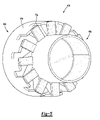
- FIG. 3 is a perspective view of the exemplary embodiment of the invention shown in FIG. 2 ;
- FIG. 4 is a partial perspective view of another exemplary embodiment of the invention.
- FIG. 5 is a full perspective view of the exemplary embodiment of the invention shown in FIG. 4 .
- the exemplary embodiments of the present invention provide improved torque monitoring devices.
- the exemplary torque monitoring devices can be more axially-compact than prior art torque monitoring devices.
- the novel and non-obvious improvement in axial compactness can be enjoyed in the exemplary embodiments by forming a first set of radial projections or spokes thicker along the axis of rotation than a second set of radial projections.
- An improved method of monitoring torque can also be applied. In the method, torque can be transmitted through one set of radial projections of a torque monitoring apparatus having two sets of radial projections.
- the exemplary embodiments can be applied in a turbine engine or in any other operating environment in which torque is transmitted.
- FIG. 1 schematically shows a turbine engine 10 .
- the various unnumbered arrows represent the flow of fluid through the turbine engine 10 .
- the turbine engine 10 can produce power for several different kinds of applications, including vehicle propulsion and power generation, among others.
- the exemplary embodiments of the invention disclosed herein, as well as other embodiments of the broader invention, can be practiced in any configuration of turbine engine and in any application other than turbine engines in which torque is transmitted.
- the exemplary turbine engine 10 can include an inlet 12 to receive fluid such as air.
- the turbine engine 10 may include a fan to direct fluid into the inlet 12 in alternative embodiments of the invention.
- the turbine engine 10 can also include a compressor section 14 to receive the fluid from the inlet 12 and compress the fluid.
- the compressor section 14 can be spaced from the inlet 12 along a centerline axis 16 of the turbine engine 10 .
- the turbine engine 10 can also include a combustor section 18 to receive the compressed fluid from the compressor section 14 .
- the compressed fluid can be mixed with fuel from a fuel system 20 and ignited in an annular combustion chamber 22 defined by the combustor section 18 .
- the turbine engine 10 can also include a turbine section 24 to receive the combustion gases from the combustor section 18 .
- the energy associated with the combustion gases can be converted into kinetic energy (motion) in the turbine section 24 .
- shafts 26 , 28 are shown disposed for rotation about the centerline axis 16 of the turbine engine 10 .
- Alternative embodiments of the invention can include any number of shafts.
- the shafts 26 , 28 can be journaled together for relative rotation.
- the shaft 26 can be a low pressure shaft supporting compressor blades 30 of a low pressure portion of the compressor section 14 .
- the shaft 26 can also support low pressure turbine blades 32 of a low pressure portion of the turbine section 24 .
- the shaft 28 encircles the shaft 26 .
- the shafts 26 , 28 can be journaled together, wherein bearings are disposed between the shafts 26 , 28 to permit relative rotation.
- the shaft 28 can be a high pressure shaft supporting compressor blades 34 of a high pressure portion of the compressor section 14 .
- the shaft 28 can also support high pressure turbine blades 36 of a high pressure portion of the turbine section 24 .
- the low pressure shaft 26 can drive other structures, such as a gear train, a fan, a propeller shaft, a rotor, a tower shaft or any other shaft, or any other structure.
- the low pressure shaft 26 can be coupled to a reduction gear box 38 , an intermediate shaft 40 , a torque monitoring apparatus 42 , and a propeller shaft 44 .
- the reduction gear box 38 can be coupled directly with the low pressure shaft 26 and can transmit torque/rotation from the low pressure shaft 26 to the intermediate shaft 40 at a reduced angular velocity.
- the torque monitoring apparatus 42 can communicate torque/rotation from the intermediate shaft 40 to the propeller shaft 44 without a reduction in angular velocity.
- the torque monitoring apparatus 42 can include a first portion 46 and a second portion 48 .
- the first and second portions 46 , 48 can move relative to one another during the transmission of torque between the low pressure shaft 26 and the propeller shaft 44 .
- the first and second portions 46 , 48 can twist relative to one another about the axis of rotation.
- the axis of rotation can be the centerline axis 16 , however, the axis of rotation of the torque monitoring apparatus 42 can be different than the centerline axis 16 in alternative embodiments of the invention.
- the first and second portions 46 , 48 can twist relative to one another across a torque transmitting plane, represented by line 50 .
- the torque monitoring apparatus 42 can have a minimized cross-sectional area in the torque transmitting plane 50 to permit the relative, twisting movement between the first and second portions 46 , 48 .
- the extent of relative movement between the first and second portions 46 , 48 can be monitored and correlated to a level of torque.
- one or more sensors such as first and second sensors 52 , 54 can be positioned to sense one or more structural features of the first and second portions 46 , 48 , respectively. These structural features in the exemplary embodiments of the invention will be discussed in greater detail below.
- the sensors 52 , 54 can each communicate respective, sensed conditions to a controller 56 in the form of signals.
- the sensors 52 , 54 can be proximity sensors and communicate the condition of proximity with some structure to the controller 56 .
- the controller 56 can receive signals from the sensors 52 , 54 and apply programmable logic to convert the signals, individually or in combination, into a level of torque.
- the sensing methodology can be any sensing methodology known in the art, including light sensing, magnetic/proximity sensing, or any other approach to sensing movement or position.
- FIG. 2 is detailed cross-sectional view of the exemplary embodiment of the invention.
- the torque monitoring apparatus 42 is shown having the first portion 46 and the second portion 48 .
- the torque monitoring apparatus 42 can include a hub 58 that extends along the axis 16 of rotation between first and second opposite ends 59 , 61 .
- the hub 58 can traverse both the first and second portions 46 , 48 of the torque monitoring apparatus 42 .
- the torque monitoring apparatus 42 also includes a first plurality of projections or spokes 60 positioned on the hub 58 along the first portion 46 .
- the spokes 60 can extend radially outward from the hub 58 to respective distal ends 62 .
- the distal ends 62 can be interconnected with one another through a hoop 64 .
- the hoop 64 can be welded to the input shaft, such as the intermediate shaft 40 shown in FIG. 2 .
- the distal ends 62 can be fixed to the input shaft.
- the inclusion of the hoop 64 can make the assembly of the torque monitoring apparatus 42 to the input shaft 40 easier by providing a continuous surface or edge 70 , shown in FIG. 2 , for welding about the axis 16 .
- the hoop 64 is not required of the invention.
- the torque monitoring apparatus 42 also includes a second plurality of projections 66 spaced from the plurality of spokes 60 along the axis 16 of rotation.
- Each of the plurality of projections 66 can extend radially outward from the hub 58 along the second portion 48 to respective distal ends 68 .
- the distal ends 68 of the plurality of projections 66 are circumferentially unconnected from one another. Forming the torque monitoring apparatus 42 such that the distal ends 68 are unconnected with one another can be desirable since unconnected ends 68 can be easier to detect by sensors, such as sensor 54 in FIG. 1 .
- the plurality of projections 66 are thinner along the axis 16 than the plurality of spokes 60 .
- the thickness of the projections 66 can be minimized.
- the torque monitoring apparatus 42 can be more compact along the axis 16 .
- the path of torque transfer can include the input shaft or intermediate shaft 40 , the hoop 64 , the projections 60 , the hub 58 , and the output shaft or propeller shaft 44 .
- the projections 66 can be positioned outside of the path of torque transfer.
- the output shaft 44 can be fixed directly to the hub 58 in the exemplary embodiment of the invention.
- the exemplary hub 58 encircles the propeller shaft 44 in the exemplary embodiment, but could be positioned internally of the output shaft in alternative embodiments of the invention.
- the projections 66 can be positioned anywhere along the hub 58 , such as closer to the plurality of spokes 60 than to either of the first and second ends 59 , 61 .
- the plurality of projections 66 can be positioned along the axis 16 spaced from both of the first and second ends 59 , 61 .
- the spokes 60 on the other hand, can be positioned along the axis 16 of rotation substantially proximate to the first end 59 since it is not necessary for the hub 58 to be overlapping the input shaft, other than the overlap of the axial thickness of the spokes 60 .
- Each the projections 60 , 66 can define a circumferential profile.
- the circumferential profile can be defined by axial thickness (in the direction along the axis 16 ) and circumferential thickness (in the direction about the axis 16 ).
- the projections 66 can have a different circumferential profile than the spokes 60 since the axial thicknesses of the spokes 60 and projections 68 are different.
- the projections 66 can be thicker or wider circumferentially about the axis 16 than the spokes 60 . By shaping the circumferential profile of the projections 66 wider, the projections 66 can be easier to detect by sensors, such as sensor 54 in FIG. 1 .
- a portion of the spokes 60 can extend past the edge 70 shown in FIG. 2 , into the gap that otherwise exists between the projections 66 and the spokes 60 . This portion of the spokes 60 can be sensed or detected by a sensor, such as sensor 52 in FIG. 1 .
- the hub 58 , the plurality of spokes 60 , and the plurality of projections 66 can be integrally-formed with respect to one another.
- one or two of these components of the torque monitoring apparatus 42 can be separately formed with respect to the other components and then subsequently connected together.
- FIG. 4 shows a first portion 46 a of a torque monitoring apparatus 42 a.
- the second portion 48 a of the torque monitoring apparatus 42 a is shown in FIG. 5 .
- a portion of a hub 58 a is also shown as well as a plurality of spokes 60 a.
- the exemplary spokes 60 a extend radially outward and can be at least partially tangent to the hub 58 a. Extending the spokes 60 a at least partially tangent to the hub 58 a allows the spokes 60 a to flex to greater extent than the spokes 60 which extend normal to the hub 58 (shown in FIG. 2 ) for the same level of torque. Flexing that is more pronounced is easier to sense or detect.
- the torque monitoring apparatus 42 a can also include a hoop 64 a.
- the hoop 64 a includes a plurality of notches 72 a circumferentially spaced from one another about the axis 16 a of rotation.
- the hoop 64 a can thus have a variable axial width or thickness about the axis 16 a.
- Each of the notches 72 a or partial-gaps can be defined between two adjacent spokes 60 a.
- the notches 72 a can decrease the stiffness of the hoop 64 a and allow the spokes 60 a to deflect a greater amount and thereby be easier to detect.
- the notches 72 a can also be a desirable feature in that the portions of the hoop 64 a between two notches 72 a can be sensed for the torque determination.
- the single set of torque-transmitting spokes can be larger (axially-wider) and therefore provide greater stiffness relative to a bending moment.
Landscapes
- Engineering & Computer Science (AREA)
- Physics & Mathematics (AREA)
- General Physics & Mathematics (AREA)
- Mechanical Engineering (AREA)
- General Engineering & Computer Science (AREA)
- Force Measurement Appropriate To Specific Purposes (AREA)
Abstract
Description
- 1. Field of the Invention
- The invention relates to an apparatus operable to transmit torque between an input shaft and an output shaft and also includes structures that can move relative to one another for determining the level of torque being transmitted.
- 2. Description of Related Prior Art
- A rotating shaft driving a load, such as another shaft, a gear train, or some other structure, is susceptible to torsional strain. Continuous strain on a loaded shaft may result in a loss of power transmission efficiency, or may result in shaft deformation, or in breakage of the shaft. Dynamic torque or strain fluctuations can exacerbate mechanical and fatigue damage. It is therefore desirable to apply some structure or device to measure the torque on the loaded shaft.
- In summary, the invention is a torque monitoring apparatus. The torque monitoring apparatus includes a hub extending along an axis of rotation between first and second opposite ends. The torque monitoring apparatus also includes a plurality of spokes positioned on the hub. The plurality of spokes extends radially outward from the hub to respective distal ends. The torque monitoring apparatus also includes a plurality of projections spaced from the plurality of spokes along the axis of rotation. Each of the plurality of projections extends radially outward from the hub to respective distal ends. The plurality of projections are thinner along the axis than the plurality of spokes.
- Advantages of the present invention will be readily appreciated as the same becomes better understood by reference to the following detailed description of exemplary embodiments when considered in connection with the accompanying drawings wherein:
-
FIG. 1 is a schematic of a turbine engine which incorporates an exemplary embodiment of the invention; -
FIG. 2 is a cross-sectional view of the exemplary embodiment of the invention; -
FIG. 3 is a perspective view of the exemplary embodiment of the invention shown inFIG. 2 ; -
FIG. 4 is a partial perspective view of another exemplary embodiment of the invention; and -
FIG. 5 is a full perspective view of the exemplary embodiment of the invention shown inFIG. 4 . - A plurality of different embodiments of the invention is shown in the Figures of the application. Similar features are shown in the various embodiments of the invention. Similar features have been numbered with a common reference numeral and have been differentiated by an alphabetic suffix. Also, to enhance consistency, the structures in any particular drawing share the same alphabetic suffix even if a particular feature is shown in less than all of the embodiments. Similar features are structured similarly, operate similarly, and/or have the same function unless otherwise indicated by the drawings or this specification. Furthermore, particular features of one embodiment can replace corresponding features in another embodiment or can supplement other embodiments unless otherwise indicated by the drawings or this specification.
- The exemplary embodiments of the present invention provide improved torque monitoring devices. The exemplary torque monitoring devices can be more axially-compact than prior art torque monitoring devices. The novel and non-obvious improvement in axial compactness can be enjoyed in the exemplary embodiments by forming a first set of radial projections or spokes thicker along the axis of rotation than a second set of radial projections. An improved method of monitoring torque can also be applied. In the method, torque can be transmitted through one set of radial projections of a torque monitoring apparatus having two sets of radial projections. The exemplary embodiments can be applied in a turbine engine or in any other operating environment in which torque is transmitted.
-
FIG. 1 schematically shows aturbine engine 10. The various unnumbered arrows represent the flow of fluid through theturbine engine 10. Theturbine engine 10 can produce power for several different kinds of applications, including vehicle propulsion and power generation, among others. The exemplary embodiments of the invention disclosed herein, as well as other embodiments of the broader invention, can be practiced in any configuration of turbine engine and in any application other than turbine engines in which torque is transmitted. - The
exemplary turbine engine 10 can include aninlet 12 to receive fluid such as air. Theturbine engine 10 may include a fan to direct fluid into theinlet 12 in alternative embodiments of the invention. Theturbine engine 10 can also include acompressor section 14 to receive the fluid from theinlet 12 and compress the fluid. Thecompressor section 14 can be spaced from theinlet 12 along acenterline axis 16 of theturbine engine 10. Theturbine engine 10 can also include acombustor section 18 to receive the compressed fluid from thecompressor section 14. The compressed fluid can be mixed with fuel from a fuel system 20 and ignited in anannular combustion chamber 22 defined by thecombustor section 18. Theturbine engine 10 can also include aturbine section 24 to receive the combustion gases from thecombustor section 18. The energy associated with the combustion gases can be converted into kinetic energy (motion) in theturbine section 24. - In
FIG. 1 ,shafts centerline axis 16 of theturbine engine 10. Alternative embodiments of the invention can include any number of shafts. Theshafts shaft 26 can be a low pressure shaft supportingcompressor blades 30 of a low pressure portion of thecompressor section 14. Theshaft 26 can also support lowpressure turbine blades 32 of a low pressure portion of theturbine section 24. - The
shaft 28 encircles theshaft 26. As set forth above, theshafts shafts shaft 28 can be a high pressure shaft supportingcompressor blades 34 of a high pressure portion of thecompressor section 14. Theshaft 28 can also support highpressure turbine blades 36 of a high pressure portion of theturbine section 24. - The
low pressure shaft 26 can drive other structures, such as a gear train, a fan, a propeller shaft, a rotor, a tower shaft or any other shaft, or any other structure. In the schematic view ofFIG. 1 , thelow pressure shaft 26 can be coupled to a reduction gear box 38, anintermediate shaft 40, atorque monitoring apparatus 42, and apropeller shaft 44. The reduction gear box 38 can be coupled directly with thelow pressure shaft 26 and can transmit torque/rotation from thelow pressure shaft 26 to theintermediate shaft 40 at a reduced angular velocity. Thetorque monitoring apparatus 42 can communicate torque/rotation from theintermediate shaft 40 to thepropeller shaft 44 without a reduction in angular velocity. - The
torque monitoring apparatus 42 can include afirst portion 46 and asecond portion 48. The first andsecond portions low pressure shaft 26 and thepropeller shaft 44. For example, the first andsecond portions FIG. 1 , the axis of rotation can be thecenterline axis 16, however, the axis of rotation of thetorque monitoring apparatus 42 can be different than thecenterline axis 16 in alternative embodiments of the invention. The first andsecond portions line 50. Thetorque monitoring apparatus 42 can have a minimized cross-sectional area in thetorque transmitting plane 50 to permit the relative, twisting movement between the first andsecond portions - The extent of relative movement between the first and
second portions second sensors second portions sensors controller 56 in the form of signals. For example, thesensors controller 56. Thecontroller 56 can receive signals from thesensors -
FIG. 2 is detailed cross-sectional view of the exemplary embodiment of the invention. Thetorque monitoring apparatus 42 is shown having thefirst portion 46 and thesecond portion 48. Thetorque monitoring apparatus 42 can include ahub 58 that extends along theaxis 16 of rotation between first and second opposite ends 59, 61. Thehub 58 can traverse both the first andsecond portions torque monitoring apparatus 42. - The
torque monitoring apparatus 42 also includes a first plurality of projections orspokes 60 positioned on thehub 58 along thefirst portion 46. Thespokes 60 can extend radially outward from thehub 58 to respective distal ends 62. As shown inFIG. 3 , the distal ends 62 can be interconnected with one another through ahoop 64. Thehoop 64 can be welded to the input shaft, such as theintermediate shaft 40 shown inFIG. 2 . Thus, through thehoop 64, the distal ends 62 can be fixed to the input shaft. The inclusion of thehoop 64 can make the assembly of thetorque monitoring apparatus 42 to theinput shaft 40 easier by providing a continuous surface oredge 70, shown inFIG. 2 , for welding about theaxis 16. However, thehoop 64 is not required of the invention. - Referring again to
FIG. 2 , thetorque monitoring apparatus 42 also includes a second plurality ofprojections 66 spaced from the plurality ofspokes 60 along theaxis 16 of rotation. Each of the plurality ofprojections 66 can extend radially outward from thehub 58 along thesecond portion 48 to respective distal ends 68. As shown inFIG. 3 , the distal ends 68 of the plurality ofprojections 66 are circumferentially unconnected from one another. Forming thetorque monitoring apparatus 42 such that the distal ends 68 are unconnected with one another can be desirable since unconnected ends 68 can be easier to detect by sensors, such assensor 54 inFIG. 1 . - Referring again to
FIG. 2 , the plurality ofprojections 66 are thinner along theaxis 16 than the plurality ofspokes 60. The thickness of theprojections 66 can be minimized. As a result, thetorque monitoring apparatus 42 can be more compact along theaxis 16. - In exemplary embodiment of the invention, the path of torque transfer can include the input shaft or
intermediate shaft 40, thehoop 64, theprojections 60, thehub 58, and the output shaft orpropeller shaft 44. Theprojections 66 can be positioned outside of the path of torque transfer. Theoutput shaft 44 can be fixed directly to thehub 58 in the exemplary embodiment of the invention. Theexemplary hub 58 encircles thepropeller shaft 44 in the exemplary embodiment, but could be positioned internally of the output shaft in alternative embodiments of the invention. - Removing the
projections 66 from the path of torque transfer provides greater flexibility in shaping theprojections 66 and in positioning theprojections 66 along thehub 58. Theprojections 66 can be positioned anywhere along thehub 58, such as closer to the plurality ofspokes 60 than to either of the first and second ends 59, 61. The plurality ofprojections 66 can be positioned along theaxis 16 spaced from both of the first and second ends 59, 61. Thespokes 60, on the other hand, can be positioned along theaxis 16 of rotation substantially proximate to thefirst end 59 since it is not necessary for thehub 58 to be overlapping the input shaft, other than the overlap of the axial thickness of thespokes 60. - Each the
projections projections 66 can have a different circumferential profile than thespokes 60 since the axial thicknesses of thespokes 60 andprojections 68 are different. In addition, theprojections 66 can be thicker or wider circumferentially about theaxis 16 than thespokes 60. By shaping the circumferential profile of theprojections 66 wider, theprojections 66 can be easier to detect by sensors, such assensor 54 inFIG. 1 . It is noted that a portion of thespokes 60 can extend past theedge 70 shown inFIG. 2 , into the gap that otherwise exists between theprojections 66 and thespokes 60. This portion of thespokes 60 can be sensed or detected by a sensor, such assensor 52 inFIG. 1 . - Referring again to
FIG. 2 , in the exemplary embodiment of the invention thehub 58, the plurality ofspokes 60, and the plurality ofprojections 66 can be integrally-formed with respect to one another. In alternative embodiments of the invention, one or two of these components of thetorque monitoring apparatus 42 can be separately formed with respect to the other components and then subsequently connected together. - A portion of an alternative embodiment of the invention is shown in
FIG. 4 .FIG. 4 shows afirst portion 46 a of atorque monitoring apparatus 42 a. Thesecond portion 48 a of thetorque monitoring apparatus 42 a is shown inFIG. 5 . Referring again toFIG. 4 , a portion of ahub 58 a is also shown as well as a plurality ofspokes 60 a. Theexemplary spokes 60 a extend radially outward and can be at least partially tangent to thehub 58 a. Extending thespokes 60 a at least partially tangent to thehub 58 a allows thespokes 60 a to flex to greater extent than thespokes 60 which extend normal to the hub 58 (shown inFIG. 2 ) for the same level of torque. Flexing that is more pronounced is easier to sense or detect. - The
torque monitoring apparatus 42 a can also include ahoop 64 a. Thehoop 64 a includes a plurality ofnotches 72 a circumferentially spaced from one another about theaxis 16 a of rotation. Thehoop 64 a can thus have a variable axial width or thickness about theaxis 16 a. Each of thenotches 72 a or partial-gaps can be defined between twoadjacent spokes 60 a. Thenotches 72 a can decrease the stiffness of thehoop 64 a and allow thespokes 60 a to deflect a greater amount and thereby be easier to detect. Thenotches 72 a can also be a desirable feature in that the portions of thehoop 64 a between twonotches 72 a can be sensed for the torque determination. - Another advantage provided by the exemplary embodiments relates to longitudinal stiffness. For example, given a particular axial space for placement of a torque monitoring apparatus, the single set of torque-transmitting spokes can be larger (axially-wider) and therefore provide greater stiffness relative to a bending moment.
- While the invention has been described with reference to an exemplary embodiment, it will be understood by those skilled in the art that various changes may be made and equivalents may be substituted for elements thereof without departing from the scope of the invention. In addition, many modifications may be made to adapt a particular situation or material to the teachings of the invention without departing from the essential scope thereof. Therefore, it is intended that the invention not be limited to the particular embodiment disclosed as the best mode contemplated for carrying out this invention, but that the invention will include all embodiments falling within the scope of the appended claims. Also, while this document may draw attention to certain features believed to be of particular importance, it should be understood that the Applicant claims protection in respect of any patentable feature or combination of features hereinbefore referred to and/or shown in the drawings whether or not particular emphasis has been placed thereon.
Claims (20)
Priority Applications (1)
| Application Number | Priority Date | Filing Date | Title |
|---|---|---|---|
| US12/252,407 US8167538B2 (en) | 2008-10-16 | 2008-10-16 | Torque monitoring apparatus |
Applications Claiming Priority (1)
| Application Number | Priority Date | Filing Date | Title |
|---|---|---|---|
| US12/252,407 US8167538B2 (en) | 2008-10-16 | 2008-10-16 | Torque monitoring apparatus |
Publications (2)
| Publication Number | Publication Date |
|---|---|
| US20100098528A1 true US20100098528A1 (en) | 2010-04-22 |
| US8167538B2 US8167538B2 (en) | 2012-05-01 |
Family
ID=42108814
Family Applications (1)
| Application Number | Title | Priority Date | Filing Date |
|---|---|---|---|
| US12/252,407 Active 2031-01-08 US8167538B2 (en) | 2008-10-16 | 2008-10-16 | Torque monitoring apparatus |
Country Status (1)
| Country | Link |
|---|---|
| US (1) | US8167538B2 (en) |
Cited By (2)
| Publication number | Priority date | Publication date | Assignee | Title |
|---|---|---|---|---|
| US20100101334A1 (en) * | 2008-10-29 | 2010-04-29 | Chris Norris | Torque monitoring apparatus |
| FR3017657A1 (en) * | 2014-02-19 | 2015-08-21 | Snecma | TORSION DISK TORQUE MEASURING DEVICE FOR TURBOMACHINE |
Citations (13)
| Publication number | Priority date | Publication date | Assignee | Title |
|---|---|---|---|---|
| US4809557A (en) * | 1986-04-05 | 1989-03-07 | Ringspann Albrecht Maurer Kg | Method and apparatus for measuring torque |
| US5067354A (en) * | 1988-05-31 | 1991-11-26 | Kyowa Electronic Instruments Co., Ltd. | Torque transducer and torque measuring device |
| US5228349A (en) * | 1990-09-18 | 1993-07-20 | Simmonds Precision Products, Inc. | Composite power shaft with intrinsic parameter measurability |
| US5450761A (en) * | 1994-07-01 | 1995-09-19 | Kop-Flex, Inc. | Torque meter |
| US5969269A (en) * | 1996-10-10 | 1999-10-19 | Kop-Flex, Inc. | Flexible coupling with torque measuring and detecting device |
| US6439067B1 (en) * | 1999-02-05 | 2002-08-27 | Curtis Instruments, Inc. | Shaft sensor assembly for angular velocity, torque, and power |
| US6679126B2 (en) * | 2001-07-10 | 2004-01-20 | Control Devices | System and method for measuring torque using filtration of light to detect angular displacement of a pair of wheels |
| US6782766B2 (en) * | 2002-09-13 | 2004-08-31 | Gastops Ltd. | Apparatus for detecting torque, axial position and axial alignment of a rotating shaft |
| US6981423B1 (en) * | 2002-04-09 | 2006-01-03 | Rockwell Automation Technologies, Inc. | System and method for sensing torque on a rotating shaft |
| US7093504B2 (en) * | 2003-08-29 | 2006-08-22 | Lord Corporation | Method and system for measuring torque |
| US7322250B1 (en) * | 2002-04-09 | 2008-01-29 | Rockwell Automation Technologies, Inc. | System and method for sensing torque on a rotating shaft |
| US7392714B2 (en) * | 2005-12-02 | 2008-07-01 | Gm Global Technology Operations, Inc. | Torque monitoring system and method of monitoring engine torque |
| US7665373B2 (en) * | 2008-06-18 | 2010-02-23 | Kop-Flex Inc. | Torque measuring device with redundant torque transmission paths and fail-safe mechanism |
-
2008
- 2008-10-16 US US12/252,407 patent/US8167538B2/en active Active
Patent Citations (13)
| Publication number | Priority date | Publication date | Assignee | Title |
|---|---|---|---|---|
| US4809557A (en) * | 1986-04-05 | 1989-03-07 | Ringspann Albrecht Maurer Kg | Method and apparatus for measuring torque |
| US5067354A (en) * | 1988-05-31 | 1991-11-26 | Kyowa Electronic Instruments Co., Ltd. | Torque transducer and torque measuring device |
| US5228349A (en) * | 1990-09-18 | 1993-07-20 | Simmonds Precision Products, Inc. | Composite power shaft with intrinsic parameter measurability |
| US5450761A (en) * | 1994-07-01 | 1995-09-19 | Kop-Flex, Inc. | Torque meter |
| US5969269A (en) * | 1996-10-10 | 1999-10-19 | Kop-Flex, Inc. | Flexible coupling with torque measuring and detecting device |
| US6439067B1 (en) * | 1999-02-05 | 2002-08-27 | Curtis Instruments, Inc. | Shaft sensor assembly for angular velocity, torque, and power |
| US6679126B2 (en) * | 2001-07-10 | 2004-01-20 | Control Devices | System and method for measuring torque using filtration of light to detect angular displacement of a pair of wheels |
| US6981423B1 (en) * | 2002-04-09 | 2006-01-03 | Rockwell Automation Technologies, Inc. | System and method for sensing torque on a rotating shaft |
| US7322250B1 (en) * | 2002-04-09 | 2008-01-29 | Rockwell Automation Technologies, Inc. | System and method for sensing torque on a rotating shaft |
| US6782766B2 (en) * | 2002-09-13 | 2004-08-31 | Gastops Ltd. | Apparatus for detecting torque, axial position and axial alignment of a rotating shaft |
| US7093504B2 (en) * | 2003-08-29 | 2006-08-22 | Lord Corporation | Method and system for measuring torque |
| US7392714B2 (en) * | 2005-12-02 | 2008-07-01 | Gm Global Technology Operations, Inc. | Torque monitoring system and method of monitoring engine torque |
| US7665373B2 (en) * | 2008-06-18 | 2010-02-23 | Kop-Flex Inc. | Torque measuring device with redundant torque transmission paths and fail-safe mechanism |
Cited By (3)
| Publication number | Priority date | Publication date | Assignee | Title |
|---|---|---|---|---|
| US20100101334A1 (en) * | 2008-10-29 | 2010-04-29 | Chris Norris | Torque monitoring apparatus |
| US7810402B2 (en) * | 2008-10-29 | 2010-10-12 | Rolls-Royce Corporation | Torque monitoring apparatus |
| FR3017657A1 (en) * | 2014-02-19 | 2015-08-21 | Snecma | TORSION DISK TORQUE MEASURING DEVICE FOR TURBOMACHINE |
Also Published As
| Publication number | Publication date |
|---|---|
| US8167538B2 (en) | 2012-05-01 |
Similar Documents
| Publication | Publication Date | Title |
|---|---|---|
| EP3002433B1 (en) | Geared architecture for a gas turbine | |
| US8251830B2 (en) | Engine shaft for a gas-turbine engine | |
| JP6635502B2 (en) | Planetary carrier for planetary gear set, and planetary gear set provided with the planetary carrier | |
| JP5879773B2 (en) | Coupling device | |
| EP2530281B1 (en) | Gearbox mount bracket | |
| JP6082099B2 (en) | Shaft coupling using variable profile splines | |
| US10196980B2 (en) | Bearing outer race retention during high load events | |
| US8465259B2 (en) | Gas turbine spindle bolt structure with reduced fretting motion | |
| CA2942667C (en) | Gas turbine gearbox input shaft | |
| KR20200074893A (en) | Exhaust gas turbocharger with auxetic structures | |
| US9316234B2 (en) | Rotor disk for a turbo machine | |
| US9133731B2 (en) | Joint assembly | |
| JP2010520967A (en) | Gas turbine rotor | |
| CN102287454A (en) | Interface with mount features for precise alignment | |
| JP2008133830A (en) | Especially the coupling device of two rotating shafts of turbomachine | |
| JP5271493B2 (en) | Axial-flow positive displacement worm compressor and gas turbine engine | |
| US20200096041A1 (en) | Bearing housing with damping arrangement | |
| US8047796B2 (en) | Dovetail attachment for use with turbine assemblies and methods of assembling turbine assemblies | |
| US10006520B2 (en) | System for regulating stresses in ring gears | |
| EP3719333B1 (en) | Bearing housing | |
| US8167538B2 (en) | Torque monitoring apparatus | |
| KR20110137259A (en) | Rotary clutch and drive device having same | |
| EP3489471B1 (en) | Engine bearing offset and load | |
| EP4067624A1 (en) | Hybrid gas turbine engine with torque transfer assembly | |
| EP3052813B1 (en) | Turbo engine with torsional coupling integrated to the driving and the driven shaft |
Legal Events
| Date | Code | Title | Description |
|---|---|---|---|
| AS | Assignment |
Owner name: ROLLS-ROYCE CORPORATION,INDIANA Free format text: ASSIGNMENT OF ASSIGNORS INTEREST;ASSIGNORS:NORRIS, CHRIS;WILKINSON, MATT;REEL/FRAME:021689/0050 Effective date: 20081003 Owner name: ROLLS-ROYCE CORPORATION, INDIANA Free format text: ASSIGNMENT OF ASSIGNORS INTEREST;ASSIGNORS:NORRIS, CHRIS;WILKINSON, MATT;REEL/FRAME:021689/0050 Effective date: 20081003 |
|
| STCF | Information on status: patent grant |
Free format text: PATENTED CASE |
|
| FPAY | Fee payment |
Year of fee payment: 4 |
|
| MAFP | Maintenance fee payment |
Free format text: PAYMENT OF MAINTENANCE FEE, 8TH YEAR, LARGE ENTITY (ORIGINAL EVENT CODE: M1552); ENTITY STATUS OF PATENT OWNER: LARGE ENTITY Year of fee payment: 8 |
|
| MAFP | Maintenance fee payment |
Free format text: PAYMENT OF MAINTENANCE FEE, 12TH YEAR, LARGE ENTITY (ORIGINAL EVENT CODE: M1553); ENTITY STATUS OF PATENT OWNER: LARGE ENTITY Year of fee payment: 12 |