US20070155978A1 - Method for producing dinitriles - Google Patents
Method for producing dinitriles Download PDFInfo
- Publication number
- US20070155978A1 US20070155978A1 US10/586,500 US58650005A US2007155978A1 US 20070155978 A1 US20070155978 A1 US 20070155978A1 US 58650005 A US58650005 A US 58650005A US 2007155978 A1 US2007155978 A1 US 2007155978A1
- Authority
- US
- United States
- Prior art keywords
- stream
- column
- catalyst
- pentenenitriles
- methylglutaronitrile
- Prior art date
- Legal status (The legal status is an assumption and is not a legal conclusion. Google has not performed a legal analysis and makes no representation as to the accuracy of the status listed.)
- Granted
Links
- 238000004519 manufacturing process Methods 0.000 title claims description 5
- 238000000034 method Methods 0.000 claims abstract description 185
- 239000003054 catalyst Substances 0.000 claims abstract description 97
- 239000000047 product Substances 0.000 claims abstract description 80
- FPPLREPCQJZDAQ-UHFFFAOYSA-N 2-methylpentanedinitrile Chemical compound N#CC(C)CCC#N FPPLREPCQJZDAQ-UHFFFAOYSA-N 0.000 claims abstract description 73
- 230000008569 process Effects 0.000 claims abstract description 56
- BTGRAWJCKBQKAO-UHFFFAOYSA-N adiponitrile Chemical compound N#CCCCCC#N BTGRAWJCKBQKAO-UHFFFAOYSA-N 0.000 claims abstract description 52
- 239000007857 degradation product Substances 0.000 claims abstract description 39
- LELOWRISYMNNSU-UHFFFAOYSA-N hydrogen cyanide Chemical compound N#C LELOWRISYMNNSU-UHFFFAOYSA-N 0.000 claims abstract description 28
- 238000006243 chemical reaction Methods 0.000 claims abstract description 26
- 239000000376 reactant Substances 0.000 claims abstract description 6
- 238000004821 distillation Methods 0.000 claims description 132
- 239000000203 mixture Substances 0.000 claims description 45
- 238000005669 hydrocyanation reaction Methods 0.000 claims description 37
- 239000003446 ligand Substances 0.000 claims description 35
- PXHVJJICTQNCMI-UHFFFAOYSA-N Nickel Chemical compound [Ni] PXHVJJICTQNCMI-UHFFFAOYSA-N 0.000 claims description 30
- UAEPNZWRGJTJPN-UHFFFAOYSA-N methylcyclohexane Chemical compound CC1CCCCC1 UAEPNZWRGJTJPN-UHFFFAOYSA-N 0.000 claims description 24
- ISBHMJZRKAFTGE-ARJAWSKDSA-N (z)-pent-2-enenitrile Chemical compound CC\C=C/C#N ISBHMJZRKAFTGE-ARJAWSKDSA-N 0.000 claims description 23
- IHXNSHZBFXGOJM-HWKANZROSA-N (e)-2-methylbut-2-enenitrile Chemical compound C\C=C(/C)C#N IHXNSHZBFXGOJM-HWKANZROSA-N 0.000 claims description 18
- KAKZBPTYRLMSJV-UHFFFAOYSA-N Butadiene Chemical compound C=CC=C KAKZBPTYRLMSJV-UHFFFAOYSA-N 0.000 claims description 14
- GYNNXHKOJHMOHS-UHFFFAOYSA-N methyl-cycloheptane Natural products CC1CCCCCC1 GYNNXHKOJHMOHS-UHFFFAOYSA-N 0.000 claims description 12
- IMNFDUFMRHMDMM-UHFFFAOYSA-N N-Heptane Chemical compound CCCCCCC IMNFDUFMRHMDMM-UHFFFAOYSA-N 0.000 claims description 9
- XDTMQSROBMDMFD-UHFFFAOYSA-N Cyclohexane Chemical compound C1CCCCC1 XDTMQSROBMDMFD-UHFFFAOYSA-N 0.000 claims description 4
- 239000002841 Lewis acid Substances 0.000 claims description 4
- NNBZCPXTIHJBJL-UHFFFAOYSA-N decalin Chemical compound C1CCCC2CCCCC21 NNBZCPXTIHJBJL-UHFFFAOYSA-N 0.000 claims description 4
- 150000007517 lewis acids Chemical class 0.000 claims description 4
- VLKZOEOYAKHREP-UHFFFAOYSA-N n-Hexane Chemical compound CCCCCC VLKZOEOYAKHREP-UHFFFAOYSA-N 0.000 claims description 4
- 238000007865 diluting Methods 0.000 claims description 2
- OFNHPGDEEMZPFG-UHFFFAOYSA-N phosphanylidynenickel Chemical compound [P].[Ni] OFNHPGDEEMZPFG-UHFFFAOYSA-N 0.000 claims description 2
- -1 alkyl radicals Chemical group 0.000 description 95
- 150000001875 compounds Chemical class 0.000 description 44
- 238000000605 extraction Methods 0.000 description 41
- 229910052698 phosphorus Inorganic materials 0.000 description 40
- 238000012856 packing Methods 0.000 description 35
- ISBHMJZRKAFTGE-UHFFFAOYSA-N pent-2-enenitrile Chemical compound CCC=CC#N ISBHMJZRKAFTGE-UHFFFAOYSA-N 0.000 description 25
- JIAARYAFYJHUJI-UHFFFAOYSA-L zinc dichloride Chemical compound [Cl-].[Cl-].[Zn+2] JIAARYAFYJHUJI-UHFFFAOYSA-L 0.000 description 23
- 125000003118 aryl group Chemical group 0.000 description 22
- CFEYBLWMNFZOPB-UHFFFAOYSA-N Allylacetonitrile Natural products C=CCCC#N CFEYBLWMNFZOPB-UHFFFAOYSA-N 0.000 description 21
- QVGXLLKOCUKJST-UHFFFAOYSA-N atomic oxygen Chemical compound [O] QVGXLLKOCUKJST-UHFFFAOYSA-N 0.000 description 21
- 229910052760 oxygen Inorganic materials 0.000 description 21
- 239000001301 oxygen Substances 0.000 description 21
- 125000004437 phosphorous atom Chemical group 0.000 description 21
- OAICVXFJPJFONN-UHFFFAOYSA-N Phosphorus Chemical compound [P] OAICVXFJPJFONN-UHFFFAOYSA-N 0.000 description 20
- 239000011574 phosphorus Substances 0.000 description 20
- 239000007788 liquid Substances 0.000 description 19
- 239000011592 zinc chloride Substances 0.000 description 16
- UVKXJAUUKPDDNW-NSCUHMNNSA-N (e)-pent-3-enenitrile Chemical compound C\C=C\CC#N UVKXJAUUKPDDNW-NSCUHMNNSA-N 0.000 description 15
- 239000010409 thin film Substances 0.000 description 15
- 239000011552 falling film Substances 0.000 description 13
- ISBHMJZRKAFTGE-ONEGZZNKSA-N (e)-pent-2-enenitrile Chemical compound CC\C=C\C#N ISBHMJZRKAFTGE-ONEGZZNKSA-N 0.000 description 12
- XYFCBTPGUUZFHI-UHFFFAOYSA-N Phosphine Chemical compound P XYFCBTPGUUZFHI-UHFFFAOYSA-N 0.000 description 12
- 125000004430 oxygen atom Chemical group O* 0.000 description 12
- AQSJGOWTSHOLKH-UHFFFAOYSA-N phosphite(3-) Chemical class [O-]P([O-])[O-] AQSJGOWTSHOLKH-UHFFFAOYSA-N 0.000 description 12
- 238000009833 condensation Methods 0.000 description 11
- 230000005494 condensation Effects 0.000 description 11
- 150000003254 radicals Chemical class 0.000 description 11
- XLYOFNOQVPJJNP-UHFFFAOYSA-N water Substances O XLYOFNOQVPJJNP-UHFFFAOYSA-N 0.000 description 10
- 239000013522 chelant Substances 0.000 description 9
- 239000002184 metal Substances 0.000 description 9
- 229910052751 metal Inorganic materials 0.000 description 9
- 125000001997 phenyl group Chemical group [H]C1=C([H])C([H])=C(*)C([H])=C1[H] 0.000 description 9
- OJMIONKXNSYLSR-UHFFFAOYSA-N phosphorous acid Chemical compound OP(O)O OJMIONKXNSYLSR-UHFFFAOYSA-N 0.000 description 9
- 238000010992 reflux Methods 0.000 description 9
- 239000004744 fabric Substances 0.000 description 8
- 125000001037 p-tolyl group Chemical group [H]C1=C([H])C(=C([H])C([H])=C1*)C([H])([H])[H] 0.000 description 7
- XRBCRPZXSCBRTK-UHFFFAOYSA-N phosphonous acid Chemical class OPO XRBCRPZXSCBRTK-UHFFFAOYSA-N 0.000 description 7
- 235000005074 zinc chloride Nutrition 0.000 description 7
- UVKXJAUUKPDDNW-IHWYPQMZSA-N (z)-pent-3-enenitrile Chemical compound C\C=C/CC#N UVKXJAUUKPDDNW-IHWYPQMZSA-N 0.000 description 6
- 125000004429 atom Chemical group 0.000 description 6
- 239000000460 chlorine Substances 0.000 description 6
- 239000000470 constituent Substances 0.000 description 6
- 239000012071 phase Substances 0.000 description 6
- 229910000073 phosphorus hydride Inorganic materials 0.000 description 6
- 238000004064 recycling Methods 0.000 description 6
- 239000000126 substance Substances 0.000 description 6
- 238000010626 work up procedure Methods 0.000 description 6
- 125000004432 carbon atom Chemical group C* 0.000 description 5
- 238000001704 evaporation Methods 0.000 description 5
- 230000008020 evaporation Effects 0.000 description 5
- 125000000040 m-tolyl group Chemical group [H]C1=C([H])C(*)=C([H])C(=C1[H])C([H])([H])[H] 0.000 description 5
- 239000000463 material Substances 0.000 description 5
- HCBPHBQMSDVIPZ-UHFFFAOYSA-N methylcyclohexatriene Chemical compound CC1=CC=C=C[CH]1 HCBPHBQMSDVIPZ-UHFFFAOYSA-N 0.000 description 5
- 125000005538 phosphinite group Chemical group 0.000 description 5
- QGZKDVFQNNGYKY-UHFFFAOYSA-N Ammonia Chemical compound N QGZKDVFQNNGYKY-UHFFFAOYSA-N 0.000 description 4
- 238000010533 azeotropic distillation Methods 0.000 description 4
- 238000009835 boiling Methods 0.000 description 4
- 229910052794 bromium Inorganic materials 0.000 description 4
- 239000006227 byproduct Substances 0.000 description 4
- 229910052801 chlorine Inorganic materials 0.000 description 4
- 238000000354 decomposition reaction Methods 0.000 description 4
- 125000003261 o-tolyl group Chemical group [H]C1=C([H])C(*)=C(C([H])=C1[H])C([H])([H])[H] 0.000 description 4
- 150000003018 phosphorus compounds Chemical class 0.000 description 4
- 125000004178 (C1-C4) alkyl group Chemical group 0.000 description 3
- WKBOTKDWSSQWDR-UHFFFAOYSA-N Bromine atom Chemical compound [Br] WKBOTKDWSSQWDR-UHFFFAOYSA-N 0.000 description 3
- VEXZGXHMUGYJMC-UHFFFAOYSA-M Chloride anion Chemical compound [Cl-] VEXZGXHMUGYJMC-UHFFFAOYSA-M 0.000 description 3
- ZAMOUSCENKQFHK-UHFFFAOYSA-N Chlorine atom Chemical compound [Cl] ZAMOUSCENKQFHK-UHFFFAOYSA-N 0.000 description 3
- LFQSCWFLJHTTHZ-UHFFFAOYSA-N Ethanol Chemical compound CCO LFQSCWFLJHTTHZ-UHFFFAOYSA-N 0.000 description 3
- PXGOKWXKJXAPGV-UHFFFAOYSA-N Fluorine Chemical compound FF PXGOKWXKJXAPGV-UHFFFAOYSA-N 0.000 description 3
- 125000000217 alkyl group Chemical group 0.000 description 3
- 230000008901 benefit Effects 0.000 description 3
- GDTBXPJZTBHREO-UHFFFAOYSA-N bromine Substances BrBr GDTBXPJZTBHREO-UHFFFAOYSA-N 0.000 description 3
- 238000001035 drying Methods 0.000 description 3
- 229910052731 fluorine Inorganic materials 0.000 description 3
- 239000011737 fluorine Substances 0.000 description 3
- 229910052736 halogen Inorganic materials 0.000 description 3
- 150000002367 halogens Chemical class 0.000 description 3
- 125000004435 hydrogen atom Chemical group [H]* 0.000 description 3
- 238000006317 isomerization reaction Methods 0.000 description 3
- 229910052759 nickel Inorganic materials 0.000 description 3
- 238000002360 preparation method Methods 0.000 description 3
- 238000000926 separation method Methods 0.000 description 3
- 125000002023 trifluoromethyl group Chemical group FC(F)(F)* 0.000 description 3
- 125000001637 1-naphthyl group Chemical group [H]C1=C([H])C([H])=C2C(*)=C([H])C([H])=C([H])C2=C1[H] 0.000 description 2
- GDCJAPJJFZWILF-UHFFFAOYSA-N 2-ethylbutanedinitrile Chemical compound CCC(C#N)CC#N GDCJAPJJFZWILF-UHFFFAOYSA-N 0.000 description 2
- WBAXCOMEMKANRN-UHFFFAOYSA-N 2-methylbut-3-enenitrile Chemical compound C=CC(C)C#N WBAXCOMEMKANRN-UHFFFAOYSA-N 0.000 description 2
- 125000001622 2-naphthyl group Chemical group [H]C1=C([H])C([H])=C2C([H])=C(*)C([H])=C([H])C2=C1[H] 0.000 description 2
- IEFGPZIDQMAXGN-UHFFFAOYSA-N CC1=CC(C)=C(OP(OC2=C(C(C)(C)C)C=CC=C2)C2=CC=CC=C2)C(C2=C(OP(OC3=C(C(C)(C)C)C=CC=C3)C3=CC=CC=C3)C(C)=CC(C)=C2)=C1 Chemical compound CC1=CC(C)=C(OP(OC2=C(C(C)(C)C)C=CC=C2)C2=CC=CC=C2)C(C2=C(OP(OC3=C(C(C)(C)C)C=CC=C3)C3=CC=CC=C3)C(C)=CC(C)=C2)=C1 IEFGPZIDQMAXGN-UHFFFAOYSA-N 0.000 description 2
- QDPIEWGNCSWLRC-UHFFFAOYSA-N N#C[Ni]C#N Chemical class N#C[Ni]C#N QDPIEWGNCSWLRC-UHFFFAOYSA-N 0.000 description 2
- RFFFKMOABOFIDF-UHFFFAOYSA-N Pentanenitrile Chemical compound CCCCC#N RFFFKMOABOFIDF-UHFFFAOYSA-N 0.000 description 2
- 229910021529 ammonia Inorganic materials 0.000 description 2
- 150000005840 aryl radicals Chemical class 0.000 description 2
- 230000015572 biosynthetic process Effects 0.000 description 2
- YCIMNLLNPGFGHC-UHFFFAOYSA-N catechol Chemical compound OC1=CC=CC=C1O YCIMNLLNPGFGHC-UHFFFAOYSA-N 0.000 description 2
- 230000008859 change Effects 0.000 description 2
- 239000012141 concentrate Substances 0.000 description 2
- 150000005690 diesters Chemical class 0.000 description 2
- 230000000694 effects Effects 0.000 description 2
- 150000004820 halides Chemical class 0.000 description 2
- RLSSMJSEOOYNOY-UHFFFAOYSA-N m-cresol Chemical compound CC1=CC=CC(O)=C1 RLSSMJSEOOYNOY-UHFFFAOYSA-N 0.000 description 2
- VHYAIWZUUQSEGU-UHFFFAOYSA-N methylcyclohexatriene Chemical compound CC1=C=CC=C[CH]1 VHYAIWZUUQSEGU-UHFFFAOYSA-N 0.000 description 2
- NLEUXPOVZGDKJI-UHFFFAOYSA-N nickel(2+);dicyanide Chemical compound [Ni+2].N#[C-].N#[C-] NLEUXPOVZGDKJI-UHFFFAOYSA-N 0.000 description 2
- IWDCLRJOBJJRNH-UHFFFAOYSA-N p-cresol Chemical compound CC1=CC=C(O)C=C1 IWDCLRJOBJJRNH-UHFFFAOYSA-N 0.000 description 2
- NQPDZGIKBAWPEJ-UHFFFAOYSA-N pentanoic acid group Chemical group C(CCCC)(=O)O NQPDZGIKBAWPEJ-UHFFFAOYSA-N 0.000 description 2
- 150000003003 phosphines Chemical class 0.000 description 2
- FAIAAWCVCHQXDN-UHFFFAOYSA-N phosphorus trichloride Chemical compound ClP(Cl)Cl FAIAAWCVCHQXDN-UHFFFAOYSA-N 0.000 description 2
- 239000002574 poison Substances 0.000 description 2
- 231100000614 poison Toxicity 0.000 description 2
- 238000011084 recovery Methods 0.000 description 2
- 239000007787 solid Substances 0.000 description 2
- 239000002904 solvent Substances 0.000 description 2
- 230000003685 thermal hair damage Effects 0.000 description 2
- FEVFLQDDNUQKRY-UHFFFAOYSA-N tris(4-methylphenyl) phosphite Chemical compound C1=CC(C)=CC=C1OP(OC=1C=CC(C)=CC=1)OC1=CC=C(C)C=C1 FEVFLQDDNUQKRY-UHFFFAOYSA-N 0.000 description 2
- IHXNSHZBFXGOJM-HYXAFXHYSA-N (z)-2-methylbut-2-enenitrile Chemical compound C\C=C(\C)C#N IHXNSHZBFXGOJM-HYXAFXHYSA-N 0.000 description 1
- HTSGKJQDMSTCGS-UHFFFAOYSA-N 1,4-bis(4-chlorophenyl)-2-(4-methylphenyl)sulfonylbutane-1,4-dione Chemical compound C1=CC(C)=CC=C1S(=O)(=O)C(C(=O)C=1C=CC(Cl)=CC=1)CC(=O)C1=CC=C(Cl)C=C1 HTSGKJQDMSTCGS-UHFFFAOYSA-N 0.000 description 1
- DVWQNBIUTWDZMW-UHFFFAOYSA-N 1-naphthalen-1-ylnaphthalen-2-ol Chemical compound C1=CC=C2C(C3=C4C=CC=CC4=CC=C3O)=CC=CC2=C1 DVWQNBIUTWDZMW-UHFFFAOYSA-N 0.000 description 1
- KJCVRFUGPWSIIH-UHFFFAOYSA-N 1-naphthol Chemical compound C1=CC=C2C(O)=CC=CC2=C1 KJCVRFUGPWSIIH-UHFFFAOYSA-N 0.000 description 1
- RCEJCSULJQNRQQ-UHFFFAOYSA-N 2-methylbutanenitrile Chemical compound CCC(C)C#N RCEJCSULJQNRQQ-UHFFFAOYSA-N 0.000 description 1
- WJQOZHYUIDYNHM-UHFFFAOYSA-N 2-tert-Butylphenol Chemical compound CC(C)(C)C1=CC=CC=C1O WJQOZHYUIDYNHM-UHFFFAOYSA-N 0.000 description 1
- BBDKZWKEPDTENS-UHFFFAOYSA-N 4-Vinylcyclohexene Chemical compound C=CC1CCC=CC1 BBDKZWKEPDTENS-UHFFFAOYSA-N 0.000 description 1
- CPELXLSAUQHCOX-UHFFFAOYSA-M Bromide Chemical compound [Br-] CPELXLSAUQHCOX-UHFFFAOYSA-M 0.000 description 1
- YHEVGSQYEJKROO-UHFFFAOYSA-N CC1=CC(C2=C(OP(OC3=CC=CC=C3C)OC3=C(C)C=CC=C3)C(C)=CC(C)=C2)=C(OP(OC2=CC=CC=C2C)OC2=CC=CC=C2C)C(C)=C1 Chemical compound CC1=CC(C2=C(OP(OC3=CC=CC=C3C)OC3=C(C)C=CC=C3)C(C)=CC(C)=C2)=C(OP(OC2=CC=CC=C2C)OC2=CC=CC=C2C)C(C)=C1 YHEVGSQYEJKROO-UHFFFAOYSA-N 0.000 description 1
- 241000282326 Felis catus Species 0.000 description 1
- 229910021577 Iron(II) chloride Inorganic materials 0.000 description 1
- ISWSIDIOOBJBQZ-UHFFFAOYSA-N Phenol Chemical compound OC1=CC=CC=C1 ISWSIDIOOBJBQZ-UHFFFAOYSA-N 0.000 description 1
- 0 [11*]CP(C[12*])C[Y]CP(C[21*])C[22*] Chemical compound [11*]CP(C[12*])C[Y]CP(C[21*])C[22*] 0.000 description 1
- ZHZZWIQPCAMTIM-UHFFFAOYSA-N [C]1=CC=CC2=CC=CC=C12 Chemical compound [C]1=CC=CC2=CC=CC=C12 ZHZZWIQPCAMTIM-UHFFFAOYSA-N 0.000 description 1
- 230000002411 adverse Effects 0.000 description 1
- 150000001298 alcohols Chemical class 0.000 description 1
- 230000003197 catalytic effect Effects 0.000 description 1
- 238000005119 centrifugation Methods 0.000 description 1
- 238000000576 coating method Methods 0.000 description 1
- 238000010924 continuous production Methods 0.000 description 1
- 239000002826 coolant Substances 0.000 description 1
- 239000000498 cooling water Substances 0.000 description 1
- 230000007797 corrosion Effects 0.000 description 1
- 238000005260 corrosion Methods 0.000 description 1
- 150000001896 cresols Chemical class 0.000 description 1
- 239000010779 crude oil Substances 0.000 description 1
- 230000006378 damage Effects 0.000 description 1
- 230000001419 dependent effect Effects 0.000 description 1
- YNLAOSYQHBDIKW-UHFFFAOYSA-M diethylaluminium chloride Chemical compound CC[Al](Cl)CC YNLAOSYQHBDIKW-UHFFFAOYSA-M 0.000 description 1
- 239000003085 diluting agent Substances 0.000 description 1
- 238000004090 dissolution Methods 0.000 description 1
- 238000011143 downstream manufacturing Methods 0.000 description 1
- 238000005516 engineering process Methods 0.000 description 1
- 125000001495 ethyl group Chemical group [H]C([H])([H])C([H])([H])* 0.000 description 1
- 230000007717 exclusion Effects 0.000 description 1
- 238000002474 experimental method Methods 0.000 description 1
- 238000004508 fractional distillation Methods 0.000 description 1
- 239000007789 gas Substances 0.000 description 1
- 125000001183 hydrocarbyl group Chemical group 0.000 description 1
- 229910052740 iodine Inorganic materials 0.000 description 1
- NMCUIPGRVMDVDB-UHFFFAOYSA-L iron dichloride Chemical compound Cl[Fe]Cl NMCUIPGRVMDVDB-UHFFFAOYSA-L 0.000 description 1
- 125000000959 isobutyl group Chemical group [H]C([H])([H])C([H])(C([H])([H])[H])C([H])([H])* 0.000 description 1
- 125000001449 isopropyl group Chemical group [H]C([H])([H])C([H])(*)C([H])([H])[H] 0.000 description 1
- 239000007791 liquid phase Substances 0.000 description 1
- 125000002496 methyl group Chemical group [H]C([H])([H])* 0.000 description 1
- 125000004108 n-butyl group Chemical group [H]C([H])([H])C([H])([H])C([H])([H])C([H])([H])* 0.000 description 1
- 125000004123 n-propyl group Chemical group [H]C([H])([H])C([H])([H])C([H])([H])* 0.000 description 1
- 150000002825 nitriles Chemical class 0.000 description 1
- 239000012074 organic phase Substances 0.000 description 1
- 230000003647 oxidation Effects 0.000 description 1
- 238000007254 oxidation reaction Methods 0.000 description 1
- 150000002978 peroxides Chemical class 0.000 description 1
- 238000005191 phase separation Methods 0.000 description 1
- 231100000572 poisoning Toxicity 0.000 description 1
- 230000000607 poisoning effect Effects 0.000 description 1
- 230000008707 rearrangement Effects 0.000 description 1
- 125000002914 sec-butyl group Chemical group [H]C([H])([H])C([H])([H])C([H])(*)C([H])([H])[H] 0.000 description 1
- 238000001179 sorption measurement Methods 0.000 description 1
- 239000007858 starting material Substances 0.000 description 1
- 238000003860 storage Methods 0.000 description 1
- 125000001424 substituent group Chemical group 0.000 description 1
- 125000000999 tert-butyl group Chemical group [H]C([H])([H])C(*)(C([H])([H])[H])C([H])([H])[H] 0.000 description 1
- MXSVLWZRHLXFKH-UHFFFAOYSA-N triphenylborane Chemical compound C1=CC=CC=C1B(C=1C=CC=CC=1)C1=CC=CC=C1 MXSVLWZRHLXFKH-UHFFFAOYSA-N 0.000 description 1
- 229940005605 valeric acid Drugs 0.000 description 1
Images

Classifications
-
- C—CHEMISTRY; METALLURGY
- C07—ORGANIC CHEMISTRY
- C07C—ACYCLIC OR CARBOCYCLIC COMPOUNDS
- C07C253/00—Preparation of carboxylic acid nitriles
- C07C253/08—Preparation of carboxylic acid nitriles by addition of hydrogen cyanide or salts thereof to unsaturated compounds
- C07C253/10—Preparation of carboxylic acid nitriles by addition of hydrogen cyanide or salts thereof to unsaturated compounds to compounds containing carbon-to-carbon double bonds
-
- C—CHEMISTRY; METALLURGY
- C07—ORGANIC CHEMISTRY
- C07C—ACYCLIC OR CARBOCYCLIC COMPOUNDS
- C07C255/00—Carboxylic acid nitriles
- C07C255/01—Carboxylic acid nitriles having cyano groups bound to acyclic carbon atoms
- C07C255/02—Carboxylic acid nitriles having cyano groups bound to acyclic carbon atoms of an acyclic and saturated carbon skeleton
- C07C255/04—Carboxylic acid nitriles having cyano groups bound to acyclic carbon atoms of an acyclic and saturated carbon skeleton containing two cyano groups bound to the carbon skeleton
Definitions
- a description of the essential features of a continuous process for preparing adiponitrile can be taken from U.S. Pat. No. 4,080,374, in which 1,3-butadiene, for example according to U.S. Pat. No. 3,496,215, is reacted with hydrogen cyanide to obtain a mixture comprising 3-pentenenitrile and 2-methyl-3-butenenitrile.
- 2-Methyl-3-butenenitrile may be isomerized, for example according to U.S. Pat. No. 3,542,874, to 3-pentenenitrile.
- the thus obtained 3-pentenenitrile for example according to U.S. Pat. No. 3,752,839, is reacted with hydrogen cyanide to give a mixture comprising adiponitrile and methylglutaronitrile.
- U.S. Pat. No. 3,773,809 and U.S. Pat. No. 4,385,007 describe processes for extracting nickel(0) catalysts which are used in hydrocyanation processes from mixtures which comprise 3- and 4-pentenenitriles.
- a prerequisite is a conversion of more than 60% in the hydrocyanation.
- these degrees of conversion can be achieved only with great losses of nickel(0) catalysts.
- This object is achieved by the process according to the invention for preparing adiponitrile and methylglutaronitrile.
- a reactant stream which comprises pentenenitriles is reacted with hydrogen cyanide in the presence of at least one catalyst and of at least one promoter to obtain a reaction stream which comprises pentenenitriles, the at least one catalyst, catalyst degradation products, the at least one promoter, adiponitrile and methylglutaronitrile.
- a further constituent of the reaction stream is valeric acid.
- the reactant stream used in this case preferably stems from the homogeneous hydrocyanation of butadiene in the presence of a nickel(0) catalyst which is known per se from the prior art.
- the catalysts used in process step (a) are preferably nickel(0)-phosphorus ligand complexes.
- Ni(0) complexes which contain phosphorus ligands and/or free phosphorus ligands are preferably homogeneously dissolved nickel(0) complexes.
- the phosphorus ligands of the nickel(0) complexes and the free phosphorus ligands are preferably selected from mono- or bidentate phosphines, phosphites, phosphinites and phosphonites.
- These phosphorus ligands preferably have the formula I P(X 1 R 1 )(X 2 R 2 )(X 3 R 3 ) (I)
- compound I is a single compound or a mixture of different compounds of the aforementioned formula.
- X 1 , X 2 , X 3 each independently are oxygen or a single bond.
- compound I is a phosphine of the formula P(R 1 R 2 R 3 ) with the definitions of R 1 , R 2 and R 3 specified in this description.
- compound I is a phosphinite of the formula P(OR 1 )(R 2 )(R 3 ) or P(R 1 )(OR 2 )(R 3 ) or P(R 1 )(R 2 )(OR 3 ) with the definitions of R 1 , R 2 and R 3 specified in this description.
- compound I is a phosphonite of the formula P(OR 1 )(OR 2 )(R 3 ) or P(R 1 )(OR 2 )(OR 3 ) or P(OR 1 )(R 2 )(OR 3 ) with the definitions of R 1 , R 2 and R 3 specified in this description.
- all X 1 , X 2 and X 3 groups should be oxygen, so that compound I is advantageously a phosphite of the formula P(OR 1 )(OR 2 )(OR 3 ) with the definitions of R 1 , R 2 and R 3 specified below.
- R 1 , R 2 , R 3 are each independently identical or different organic radicals.
- R 1 , R 2 and R 3 are each independently alkyl radicals preferably having from 1 to 10 carbon atoms, such as methyl, ethyl, n-propyl, i-propyl, n-butyl, i-butyl, s-butyl, t-butyl, aryl groups such as phenyl, o-tolyl, m-tolyl, p-tolyl, 1-naphthyl, 2-naphthyl, or hydrocarbyl, preferably having from 1 to 20 carbon atoms, such as 1,1′-biphenol, 1,1′-binaphthol.
- the R 1 , R 2 and R 3 groups may be bonded together directly, i.e. not solely via the central phosphorus atom. Preference is given to the R 1 , R 2 and R 3 groups not being bonded together directly.
- R 1 , R 2 and R 3 are radicals selected from the group consisting of phenyl, o-tolyl, m-tolyl and p-tolyl. In a particularly preferred embodiment, a maximum of two of the R 1 , R 2 and R 3 groups should be phenyl groups.
- a maximum of two of the R 1 , R 2 and R 3 groups should be o-tolyl groups.
- Such compounds Ia are, for example, (p-tolyl-O-)(phenyl-O—) 2 P, (m-tolyl-O-)(phenyl-O—) 2 P, (o-tolyl-O-)(phenyl-O—) 2 P, p-tolyl-O-) 2 (phenyl-O—)P, (m-tolyl-O-) 2 (phenyl-O—)P, (o-tolyl-O-) 2 (phenyl-O—)P, (m-tolyl-O-)(p-tolyl-O-)(phenyl-O—)P, (o-tolyl-O-)(p-tolyl-O-)(phenyl-O—)P, (o-tolyl-O-) (m-tolyl-O-)(phenyl-O—)P, (p-tolyl-O—) 3 P, (m-tolyl-O-)(p-tolyl
- Mixtures comprising (m-tolyl-O—) 3 P, (m-tolyl-O-) 2 (p-tolyl-O—)P, (m-tolyl-O-)(p-tolyl-O—) 2 P and (p-tolyl-O—) 3 P may be obtained, for example, by reacting a mixture comprising m-cresol and p-cresol, in particular in a molar ratio of 2:1, as obtained in the distillative workup of crude oil, with a phosphorus trihalide, such as phosphorus trichloride.
- the phosphorus ligands are the phosphites, described in detail in DE-A 199 53 058, of the formula Ib: P(O—R 1 ) x (O—R 2 ) y (O—R 3 ) z (O—R 4 ) p (Ib) where
- Preferred phosphites of the formula Ib can be taken from DE-A 199 53 058.
- the R 1 radical may advantageously be o-tolyl, o-ethylphenyl, o-n-propylphenyl, o-isopropyl-phenyl, o-n-butylphenyl, o-sec-butylphenyl, o-tert-butylphenyl, (o-phenyl)phenyl or 1-naphthyl groups.
- R 2 radicals are m-tolyl, m-ethylphenyl, m-n-propylphenyl, m-isopropylphenyl, m-n-butylphenyl, m-sec-butylphenyl, m-tert-butylphenyl, (m-phenyl)phenyl or 2-naphthyl groups.
- R 3 radicals are p-tolyl, p-ethylphenyl, p-n-propylphenyl, p-isopropyl-phenyl, p-n-butylphenyl, p-sec-butylphenyl, p-tert-butylphenyl or (p-phenyl)phenyl groups.
- the R 4 radical is preferably phenyl.
- p is preferably zero.
- x y z p 1 0 0 2 1 0 1 1 1 1 1 0 1 2 0 0 1 1 0 2 0 1 1 1 0 1 2 0 0 2 0 1 0 2 1 0 0 0 0 0 0 0 0
- Preferred phosphites of the formula Ib are those in which p is zero, and R 1 , R 2 and R 3 are each independently selected from o-isopropylphenyl, m-tolyl and p-tolyl, and R 4 is phenyl.
- Particularly preferred phosphites of the formula Ib are those in which R 1 is the o-isopropylphenyl radical, R 2 is the m-tolyl radical and R 3 is the p-tolyl radical with the indices specified in the table above; also those in which R 1 is the o-tolyl radical, R 2 is the m-tolyl radical and R 3 is the p-tolyl radical with the indices specified in the table; additionally those in which R 1 is the 1-naphthyl radical, R 2 is the m-tolyl radical and R 3 is the p-tolyl radical with the indices specified in the table; also those in which R 1 is the o-tolyl radical, R 2 is the 2-naphthyl radical and R 3 is the p-tolyl radical with the indices specified in the table; and finally those in which R 1 is the o-isopropylphenyl radical, R 2 is the 2-naphthyl radical
- Phosphites of the formula Ib may be obtained by
- the reaction may be carried out in three separate steps. Equally, two of the three steps may be combined, i.e. a) with b) or b) with c). Alternatively, all of steps a), b) and c) may be combined together.
- Suitable parameters and amounts of the alcohols selected from the group consisting of R 1 OH, R 2 OH, R 3 OH and R 4 OH or mixtures thereof may be determined readily by a few simple preliminary experiments.
- Useful phosphorus trihalides are in principle all phosphorus trihalides, preferably those in which the halide used is Cl, Br, I, in particular Cl, and mixtures thereof. It is also possible to use mixtures of various identically or differently halogen-substituted phosphines as the phosphorus trihalide. Particular preference is given to PCl 3 . Further details on the reaction conditions in the preparation of the phosphites Ib and for the workup can be taken from DE-A 199 53 058.
- the phosphites Ib may also be used in the form of a mixture of different phosphites Ib as a ligand. Such a mixture may be obtained, for example, in the preparation of the phosphites Ib.
- the ligand used therefore preferably has the formula II where
- compound II is a single compound or a mixture of different compounds of the aforementioned formula.
- X 11 , X 12 , X 13 , X 21 , X 22 , X 23 may each be oxygen.
- the bridging group Y is bonded to phosphite groups.
- X 11 and X 12 may each be oxygen and X 13 a single bond, or X 11 and X 13 each oxygen and X 12 a single bond, so that the phosphorus atom surrounded by X 11 , X 12 and X 13 is the central atom of a phosphonite.
- X 21 , X 22 and X 23 may each be oxygen, or X 21 and X 22 may each be oxygen and X 23 a single bond, or X 21 and X 23 may each be oxygen and X 22 a single bond, or X 23 may be oxygen and X 21 and X 22 each a single bond, or X 21 may be oxygen and X 22 and X 23 each a single bond, or X 21 , X 22 and X 23 may each be a single bond, so that the phosphorus atom surrounded by X 21 , X 22 and X 23 may be the central atom of a phosphite, phosphonite, phosphinite or phosphine, preferably a phosphonite.
- X 13 may be oxygen and X 11 and X 12 each a single bond, or X 11 may be oxygen and X 12 and X 13 each a single bond, so that the phosphorus atom surrounded by X 11 , X 12 and X 13 is the central atom of a phosphonite.
- X 21 , X 22 and X 23 may each be oxygen, or X 23 may be oxygen and X 21 and X 22 each a single bond, or X 21 may be oxygen and X 22 and X 23 each a single bond, or X 21 , X 22 and X 23 may each be a single bond, so that the phosphorus atom surrounded by X 21 , X 22 and X 23 may be the central atom of a phosphite, phosphinite or phosphine, preferably a phosphinite.
- X 11 , X 12 and X 13 may each be a single bond, so that the phosphorus atom surrounded by X 11 , X 12 and X 13 is the central atom of a phosphine.
- X 21 , X 22 and X 23 may each be oxygen, or X 21 , X 22 and X 23 may each be a single bond, so that the phosphorus atom surrounded by X 21 , X 22 and X 23 may be the central atom of a phosphite or phosphine, preferably a phosphine.
- the bridging group Y is advantageously an aryl group which is substituted, for example by C 1 -C 4 -alkyl, halogen, such as fluorine, chlorine, bromine, halogenated alkyl, such as trifluoromethyl, aryl, such as phenyl, or is unsubstituted, preferably a group having from 6 to 20 carbon atoms in the aromatic system, in particular pyrocatechol, bis(phenol) or bis(naphthol).
- halogen such as fluorine, chlorine, bromine
- halogenated alkyl such as trifluoromethyl
- aryl such as phenyl
- is unsubstituted preferably a group having from 6 to 20 carbon atoms in the aromatic system, in particular pyrocatechol, bis(phenol) or bis(naphthol).
- R 11 and R 12 radicals may each independently be identical or different organic radicals.
- Advantageous R 11 and R 12 radicals are aryl radicals, preferably those having from 6 to 10 carbon atoms, which may be unsubstituted or mono- or polysubstituted, in particular by C 1 -C 4 -alkyl, halogen, such as fluorine, chlorine, bromine, halogenated alkyl, such as trifluoromethyl, aryl, such as phenyl, or unsubstituted aryl groups.
- R 21 and R 22 radicals may each independently be the same or different organic radicals.
- Advantageous R 21 and R 22 radicals are aryl radicals, preferably those having from 6 to 10 carbon atoms, which may be unsubstituted or mono- or polysubstituted, in particular by C 1 -C 4 -alkyl, halogen, such as fluorine, chlorine, bromine, halogenated alkyl, such as trifluoromethyl, aryl, such as phenyl, or unsubstituted aryl groups.
- R 11 and R 12 radicals may each be separate or bridged.
- the R 21 and R 22 radicals too may each be separate or bridged.
- the R 11 , R 12 , R 21 and R 22 radicals may each be separate, two may be bridged and two separate, or all four may be bridged, in the manner described.
- useful compounds are those of the formula I, II, III, IV and V specified in U.S. Pat. No. 5,723,641.
- useful compounds are those of the formula I, II, III, IV, V, VI and VII specified in U.S. Pat. No. 5,512,696, in particular the compounds used there in examples 1 to 31.
- useful compounds are those of the formula I, II, III, IV, V, VI, VII, VIII, IX, X, XI, XII, XIII, XIV and XV specified in U.S. Pat. No. 5,821,378, in particular the compounds used there in examples 1 to 73.
- useful compounds are those of the formula I, II, III, IV, V and VI specified in U.S. Pat. No. 5,512,695, in particular the compounds used there in examples 1 to 6.
- useful compounds are those of the formula I, II, III, IV, V, VI, VII, VIII, IX, X, XI, XII, XIII and XIV specified in U.S. Pat. No. 5,981,772, in particular the compounds used there in examples 1 to 66.
- useful compounds are those specified in U.S. Pat. No. 6,127,567 and the compounds used there in examples 1 to 29.
- useful compounds are those of the formula I, II, III, IV, V, VI, VII, VIII, IX and X specified in U.S. Pat. No. 6,020,516, in particular the compounds used there in examples 1 to 33.
- useful compounds are those specified in U.S. Pat. No. 5,959,135, and the compounds used there in examples 1 to 13.
- useful compounds are those of the formula I, II and III specified in U.S. Pat. No. 5,847,191.
- useful compounds are those specified in U.S. Pat. No. 5,523,453, in particular the compounds illustrated there in formula 1, 2, 3, 4, 5, 6, 7, 8, 9, 10, 11, 12, 13, 14, 15, 16, 17, 18, 19, 20 and 21.
- useful compounds are those specified in WO 01/14392, preferably the compounds illustrated there in formula V, VI, VII, VIII, IX, X, XI, XII, XIII, XIV, XV, XVI, XVII, XXI, XXII, XXIII.
- useful compounds are those specified in WO 98/27054. In a particularly preferred embodiment, useful compounds are those specified in WO 99/13983. In a particularly preferred embodiment, useful compounds are those specified in WO 99/64155.
- useful compounds are those specified in the German patent application DE 100 380 37. In a particularly preferred embodiment, useful compounds are those specified in the German patent application DE 100 460 25. In a particularly preferred embodiment, useful compounds are those specified in the German patent application DE 101 502 85.
- useful compounds are those specified in the German patent application DE 101 502 86. In a particularly preferred embodiment, useful compounds are those specified in the German patent application DE 102 071 65. In a further particularly preferred embodiment of the present invention, useful phosphorus chelate ligands are those specified in US 2003/0100442 A1.
- useful phosphorus chelate ligands are those specified in the German patent application reference number DE 103 50 999.2 of Oct. 30, 2003 which has an earlier priority date but had not been published at the priority date of the present application.
- Phosphorus ligands used may also be a mixture comprising at least two of the compounds I, Ia, Ib and II.
- Process step (a) of the process according to the invention is preferably carried out at an absolute pressure of from 0.1 to 10 bar, more preferably from 0.5 to 2 bar, in particular from 0.8 to 1.5 bar.
- the temperature in process step (a) is preferably from 40 to 150° C., more preferably from 50 to 100° C., in particular from 60 to 70° C.
- Process step (a) may be carried out in any suitable apparatus known to those skilled in the art.
- suitable reactors are those having backmixing characteristics.
- process step (a) there may be partial decomposition of the catalysts.
- the decomposition products resulting therefrom are, for example, nickel(II) cyanide-containing components.
- Further degradation products formed are, for example, hydrolyzed phosphorus compounds which are derived by reaction of the particular substances I and II used as a result of traces of water which may be present in the feedstocks, especially in the hydrogen cyanide used.
- oxidized phosphorus compounds which are derived by reaction of the particular substances I and II used to give compounds having phosphorus atoms in the oxidation state (V), as a result of reaction with elemental oxygen or as a result of reaction with peroxides which may be present in the feedstocks, especially as a result of leakage in the apparatus or by dissolution of oxygen in pentenenitrile, for example in the course of storage, with subsequent formation of peroxide compounds of the pentenenitriles.
- Further degradation products formed, especially of the chelate ligands II used, may, under disadvantageous conditions, be monodentate degradation products which are derived, for example, by thermally induced, or proton- or base-catalyzed, rearrangement of the radicals on the phosphorus atoms of the particular structures and have less hydrocyanation activity than the starting materials.
- 2-pentenenitriles are generally formed additionally and are catalyst poisons when nickel(0) catalysts with monodentate ligands such as ZnCl 2 or BPh 3 are used as the promoter.
- the promoter which is used in process step (a) of the process according to the invention is preferably selected from the group consisting of the Lewis acids ZnCl 2 , FeCl 2 , Et 2 AlCl, Et 3 Al 2 Cl 3 , EtAlCl 2 and BPh 3 .
- Process step (a) may be carried out in any suitable apparatus known to those skilled in the art.
- Useful apparatus for the reaction is that which is customary for this purpose, as described, for example, in: Kirk-Othmer, Encyclopedia of Chemical Technology, 4th Ed. Vol. 20, John Wiley & Sons, New York 1996, pages 1040 to 1055, such as stirred tank reactors, loop reactors, gas circulation reactors, bubble column reactors or tubular reactors, in each case if appropriate with apparatus to remove heat of reaction.
- the reaction may be carried out in a plurality of, such as two or three, apparatuses.
- the reaction stream is distilled to obtain a stream 3 depleted in pentenenitriles as the bottom product which comprises the at least one catalyst, catalyst degradation products, the at least one promoter, adiponitrile and methylglutaronitrile, and a stream 4 enriched in pentenenitriles as the top product.
- a substantial removal of the pentenenitriles before the subsequent extraction in process step (c) is advantageous, since phase separation in the extraction is otherwise sometimes complicated or prevented, and the efficiency of the extraction of catalyst constituents from the hydrocyanation effluent is adversely affected by high pentenenitrile concentration.
- the evaporation of process step (b) may be effected in one stage or in a plurality of stages performed in series at different temperatures and pressures.
- the evaporator stage of process step (b) may be designed as a distillation column, in which case operation as a rectifying or stripping column is possible.
- the evaporator stage (b) is operated as a distillation column in stripping mode.
- At least one of the evaporator stages of process step (b) is operated with a divided column bottom, in which case the circulation stream which is generally large relative to the bottom draw stream is conducted from a first column bottom of the evaporator stage in question to the evaporator, the liquid effluent stream from the evaporator is not returned directly to the column bottom, but rather collected in a second column bottom which is separated from the first column bottom, the bottom draw stream is obtained from the second column bottom and the remaining excess of evaporator circulation stream is allowed to overflow into the first column bottom, and the bottom draw stream obtained from the second column bottom is a mixture which is depleted in low boilers compared to the draw from the first column bottom.
- the absolute pressure in process step (b) is preferably from 0.001 to 1 bar, more preferably from 0.005 to 0.1 bar, in particular from 0.01 to 0.05 bar.
- the distillation is carried out in such a way that the temperature in the bottom of the distillation apparatus is preferably from 40 to 180° C., more preferably from 70 to 120° C., in particular from 80 to 100° C.
- the distillation is carried out in such a way that the temperature at the top of the distillation apparatus is preferably from ⁇ 15 to 150° C., more preferably from 0 to 60° C., in particular from 20 to 50° C.
- the temperature ranges specified above are maintained both at the top and in the column bottom.
- the stream 4 enriched in pentenenitriles in process step (b) generally comprises trans-3-pentenenitrile, cis-3-pentenenitrile, 4-pentenenitrile, cis-2-pentenenitrile, trans-2-pentenenitrile and (E)-2-methyl-2-butenenitrile.
- this stream 4 is distilled at least partly in a further process step (i) to obtain a stream 18 depleted in cis-2-pentenenitrile and (E)-2-methyl-2-butenenitrile, and a stream 19 enriched in cis-2-pentenenitrile and (E)-2-methyl-2-butenenitrile.
- the stream 18 depleted in cis-2-pentenenitrile and (E)-2-methyl-2-butenenitrile is preferably recycled into the hydrocyanation of process step (a).
- Stream 19 may be fed to a further workup in order to recover product of value by isomerizing the cis-2-pentenenitrile to 3-pentenenitrile, for example according to a process as described in DE 103 23 803 or in DE-A-102 004 004 716.
- the distillation of the optional process step (i) may be carried out in any suitable apparatus known to those skilled in the art.
- the distillation of process step (i) takes place preferably in one or more distillation columns.
- the columns may be equipped with one or more side draws.
- the internals used for the distillation columns are preferably structured sheet metal packings, structured fabric packings, bubble-cap trays, dual-flow trays or beds of random packings or combinations of two or more of these classes of separating internals.
- One or more columns of process step (i) may be designed as a dividing wall column with side draw.
- the columns of process step (i) may be equipped with a falling-film evaporator, thin-film evaporator, natural circulation evaporator or forced circulation-decompression evaporator as the evaporator unit.
- the absolute pressure in process step (i) is preferably from 0.01 to 10.0 bar, more preferably 0.05 to 5.0 bar, in particular 0.1 to 1.0 bar.
- the distillation is carried out in such a way that the temperature in the bottom of the distillations apparatus is preferably from 40 to 250° C., more preferably from 50 to 180° C., in particular from 60 to 150° C.
- the distillation is carried out in such a way that the temperature at the top of the distillation apparatus is preferably from 0 to 200° C., more preferably from 15 to 180° C., in particular from 20 to 150° C.
- the aforementioned temperature ranges in the optional process step (i) are maintained both at the top and in the bottom.
- the stream 3 depleted in pentenenitrile in process step (b) still contains preferably from 0.1 to 90% by weight, more preferably from 1 to 50% by weight, in particular from 5 to 30% by weight, of pentenenitriles.
- pentenenitriles are generally composed of cis-3-pentenenitrile, trans-3-pentenenitrile and 4-pentenenitrile, and also additionally, each having a proportion of preferably less than 20% by weight, more preferably less than 10% by weight, of cis-2-pentenenitrile, trans-2-pentenenitrile, (E)-2-methyl-2-butenenitrile and (Z)-2-methyl-2-butenenitrile.
- Further constituents are the by-products formed in the hydrocyanation to a minor extent, for example valeronitrile.
- the stream 3 is extracted using an extractant in stream 5 to obtain a stream 6 enriched with extractant as the top product which comprises at least one catalyst, and a stream 7 depleted in extractant which comprises catalyst degradation products, the at least one promoter, pentenenitriles, adiponitrile and methylglutaronitrile.
- Process step (c) may be carried out in any suitable apparatus known to those skilled in the art.
- the extraction of process step (c) preferably takes place in countercurrent extraction columns, mixer-settler units or combinations of mixer-settler units with columns. Particular preference is given to using countercurrent extraction columns which are equipped in particular with sheet metal packings as dispersing elements. This is surprising since the hydrocyanation effluent is laden with solids. According to the invention, it has been found that the nickel(II) cyanide-containing solid which is formed in the hydrocyanation step (a), contrary to expectations, does not have a tendency to accumulate under the conditions in the extraction and does not form any noticeable deposits on column internals.
- the countercurrent extraction is performed in a compartmented, stirred extraction column.
- the extractant is used as a disperse phase, the bottom effluent obtained in process step (b) or the effluent from the hydrocyanation in process step (a) as a continuous phase.
- a phase ratio of from 0.1 to 10 calculated as the ratio of volume of the extractant supplied to volume of the mixture to be extracted is used.
- the extraction is operated with a phase ratio of from 0.4 to 2.5, in a preferred embodiment at from 0.75 to 1.5.
- the absolute pressure in process step (c) is preferably from 0.1 to 10 bar, more preferably from 0.5 to 5 bar, in particular from 1.0 to 2.5 bar.
- the extraction is preferably carried out at temperatures of from ⁇ 15 to 120° C., more preferably from 0 to 60° C., in particular from 25 to 45° C.
- the extractant is selected from the group consisting of cyclohexane, methylcyclohexane, n-hexane, n-heptane, isomeric C6, C7, C8, C9 cycloaliphatics, isomeric C6, C7, C8, C9 isoaliphatics, cis-, trans-decahydronaphthalene and mixtures thereof.
- the extractant used is cyclohexane or methylcyclohexane or n-heptane.
- the extractant used is preferably anhydrous, anhydrous meaning in the context of the present invention that the extractant contains less than 100 ppm, preferably less than 50 ppm, in particular less than 10 ppm, of water.
- the extractant may be dried by suitable processes known to those skilled in the art, for example by adsorption or azeotropic distillation.
- the extractant is preferably dried by azeotropic distillation in a separate process step (j). This is preferably effected distillatively as a heteroazeotropic distillation.
- the absolute pressure in this process step (j) is preferably from 0.01 to 10.0 bar, more preferably from 0.05 to 5.0 bar, in particular from 0.1 to 1.0 bar.
- the distillation is carried out in such a way that the temperature in the bottom of the distillation apparatus is preferably from 40 to 250° C., more preferably from 50 to 180° C., in particular from 60 to 150° C.
- the distillation is carried out in such a way that the temperature at the top of the distillation apparatus is preferably from 0 to 200° C., more preferably from 5 to 100° C., in particular from 20 to 50° C. In a particularly preferred embodiment of the process according to the invention, the aforementioned temperature ranges are maintained both at the top and in the bottom of the distillation apparatus.
- the azeotropic distillation of the extractant is preferably effected in a distillation column having in particular bubble-cap trays, structured sheet metal packings, structured fabric packings, dual-flow trays or beds of random packings as separating internals, if appropriate in a dividing wall column having side draws present if appropriate, a phase separator at the liquid draw of the top condenser to remove water, with apparatus for separate recycling of organic phases as reflux to columns, and also further apparatus suitable for azeotropic distillation.
- a distillation of stream 6 takes place to obtain a stream 8 comprising the at least one catalyst and a stream 9 comprising the extractant.
- This process step serves substantially to recover the catalyst and the extractant.
- Process step (d) may be carried out in any suitable apparatus known to those skilled in the art.
- the distillation of process step (d) preferably takes place in one or more evaporator stages and also distillation columns.
- Useful internals for the distillation columns are preferably structured sheet metal packing, structured fabric packing, bubble-cap trays, dual-flow trays or beds of random packings or combinations of two or more of these classes of separating internals.
- the distillation column of process step (d) may be designed with one or more liquid or gaseous side draws.
- the distillation column from process step (d) may be designed as a dividing wall column having one or more gaseous or liquid side draws present.
- the one or more evaporator stages or the distillation column of process step (d) may in particular be equipped with falling-film evaporators, thin-film evaporators, natural circulation evaporators, forced circulation-decompression evaporators and multiphase helical tube evaporators.
- At least one of the evaporator units of process step (d) is operated with a divided column bottom, in which case the circulation stream which is generally large relative to the bottom draw stream is conducted from a first column bottom of the evaporator stage in question to the evaporator, the liquid effluent stream from the evaporator is not returned directly to the column bottom, but rather collected in a second column bottom which is separated from the first column bottom, the bottom draw stream is obtained from the second column bottom and the remaining excess of evaporator circulation stream is allowed to overflow into the first column bottom, and the bottom draw stream obtained from the second column bottom is a mixture which is depleted in low boilers compared to the draw from the first column bottom.
- the absolute pressure in process step (d) is preferably from 0.001 to 2.0 bar, more preferably from 0.01 to 0.5 bar, in particular from 0.09 to 0.12 bar.
- the distillation is carried out in such a way that the temperature in the bottom of the distillation apparatus is preferably from 40 to 150° C., more preferably from 70 to 120° C., in particular from 80 to 100° C.
- the distillation is carried out in such a way that the temperature at the top of the distillation apparatus is preferably from ⁇ 15 to 100° C., more preferably from 0 to 60° C., in particular from 20 to 50° C.
- the temperature ranges specified above are maintained both at the top and in the column bottom.
- 3-pentenenitrile is added to the distillation as an intermediate boiler.
- This solvent change is that effective depletion of the extractant from the high-boiling catalyst stream is possible at evaporator temperatures which are low enough not to thermally damage the particular nickel catalyst used and especially the chelate ligand, although the pressure is still high enough to be able to condense the extractant having a comparatively low boiling point in comparison to the catalyst constituents at the top of the evaporator stage or distillation column even at customary cooling water temperatures of from 25 to 50° C.
- the solvent change additionally has the advantage that the flowability and monophasicity of the catalyst solution is ensured, since, depending on the temperature and residual content of extractant, catalyst constituents may in some cases crystallize out without the addition of 3-pentenenitrile.
- 3-Pentenenitrile which, depending on the pressure conditions, can only be removed fully with difficulty, for example from the cyclohexane or methylcyclohexane extractants, or, owing to minimum vapor pressure azeotrope formation, cannot be removed fully at all, does not have a disruptive effect on the process according to the invention at a proportion of preferably up to 10% by weight, more preferably up to 5% by weight, in particular up to 1% by weight, based on the total amount of the extractant feed stream to the extraction column in process step (c).
- the stream 9 obtained in process step (d) and comprising the extractant is recycled at least partly into the extraction step (c).
- the recycled stream 9 is preferably dried before the extraction step (c), for example in the above-described process step (j), so that the water content in this stream is preferably less than 100 ppm, more preferably less than 50 ppm, in particular less than 10 ppm.
- the stream 8 obtained in process step (d) and comprising the catalyst is recycled at least partly into the hydrocyanation of process step (a).
- the proportion of extractant in stream 8 is preferably less than 10% by weight, more preferably less than 5% by weight, in particular less than 1% by weight, based on the total amount of stream 8 .
- Process step (k) may be carried out in any suitable apparatus known to those skilled in the art. The distillation of process step (k) preferably takes place in one or more distillation columns.
- Useful internals for the distillation columns are preferably structured sheet metal packings, structured fabric packings, bubble-cap trays, dual-flow trays or beds of random packings or combinations of two or more of these classes of separating internals.
- the distillation column of process step (k) may be designed with one or more liquid or gaseous side draws.
- the distillation column from process step (d) may be designed as a dividing wall column having one or more gaseous or liquid side draws present.
- the stream 21 is preferably recycled into the above-described process step (i) to be carried out if appropriate, in order to free the stream of any cis-2-pentenenitrile and (E)-2-methyl-2-butenenitrile present.
- the stream 22 comprising the extractant is preferably recycled into the extraction of process step (c).
- the thus obtained stream 22 comprising the extractant is recycled at least partly into the extraction step (c).
- the recycled stream 22 is preferably dried before the extraction step (c), for example in the above-described process step (j), so that the water content in this stream is preferably less than 100 ppm, more preferably less than 50 ppm, in particular less than 10 ppm.
- streams 9 and 22 are dried before they are recycled into the extraction of process step (c), if appropriate in an apparatus.
- the absolute pressure in the optional process step (k) is preferably from 0.01 to 10.0 bar, more preferably from 0.05 to 5.0 bar, in particular from 0.1 to 1.0 bar.
- the distillation is carried out in such a way that the temperature in the bottom of the distillation apparatus is preferably from 40 to 250° C., more preferably from 50 to 180° C., in particular from 60 to 150° C.
- the distillation is carried out in such a way that the temperature at the top of the distillation apparatus is preferably from 0 to 200° C., more preferably from 15 to 180° C., in particular from 20 to 150° C.
- the aforementioned temperature ranges are maintained both at the top and in the bottom of the distillation apparatus.
- a distillation of stream 7 takes place to obtain a stream 10 as the top product which comprises catalyst degradation products, the at least one promoter, pentenenitriles, adiponitrile and methylglutaronitrile, and a stream 11 comprising the extractant as the top product.
- the process step (e) may carried out in any suitable apparatus known to those skilled in the art.
- the distillation of process step (e) preferably takes place in one or more evaporator stages or one or more distillation columns.
- Useful internals for the distillation columns are preferably structured sheet metal packing, structured fabric packing, bubble-cap trays, dual-flow trays or beds of random packings or combinations of two or more of these classes of separating internals.
- the distillation column of process step (e) may be designed with one or more liquid or gaseous side draws.
- the distillation column from process step (e) may be designed as a dividing wall column having one or more gaseous or liquid side draws present.
- the evaporator units for the one or more evaporator stages or one or more distillation columns may in particular be equipped with falling-film evaporators, thin-film evaporators, natural circulation evaporators, forced circulation-decompression evaporators and multiphase helical tube evaporators.
- At least one of the one or more evaporator units of process step (e) is operated with a divided column bottom, in which case the circulation stream which is generally large relative to the bottom draw stream is conducted from a first column bottom of the evaporator stage in question to the evaporator, the liquid effluent stream from the evaporator is not returned directly to the column bottom, but rather collected in a second column bottom which is separated from the first column bottom, the bottom draw stream is obtained from the second column bottom and the remaining excess of evaporator circulation stream is allowed to overflow into the first column bottom, and the bottom draw stream obtained from the second column bottom is a mixture which is depleted in low boilers compared to the draw from the first column bottom.
- the absolute pressure in process step (e) is preferably from 0.1 to 10.0 bar, more preferably from 0.5 to 5.0 bar, in particular from 0.15 to 0.2 bar.
- the distillation is carried out in such a way that the temperature in the bottom of the distillation apparatus is preferably from 40 to 250° C., more preferably from 50 to 200° C., in particular from 100 to 180° C.
- the distillation is carried out in such a way that the temperature at the top of the distillation apparatus is preferably from ⁇ 15 to 150° C., more preferably from 0 to 60° C., in particular from 20 to 50° C.
- the temperature ranges specified above are maintained both at the top and in the column bottom.
- the stream 11 comprising the extractant is preferably recycled into the extraction of process step (c). Preference is given to drying stream 11 before it is recycled into the extraction of process step (c), so that the water content in these streams is preferably less than 100 ppm, more preferably less than 50 ppm, in particular less than 10 ppm. This may be effected, for example, in process step (j).
- the distillation in process step (e) is carried out in such a way that the resulting stream 10 contains less than 10% by weight, more preferably less than 1% by weight, in particular less than 0.1% by weight, of extractant.
- the stream 11 comprises less than 10% by weight, more preferably less than 5% by weight, in particular less than 2% by weight, of pentenenitriles.
- the distillation in process step (e) is carried out in such a way that the resulting stream 10 contains less than 10% by weight, more preferably less than 5% by weight, in particular less than 1% by weight, of pentenenitriles. If this specification of stream 10 is achieved, it is possible to conduct stream 10 directly into process step (g) with exclusion of process step (f). This specification is preferably achieved by using, in process step (e), a combination, adapted to the temperature-dependent vapor pressure of pentenenitrile, of evaporation temperature and distillation pressure, so that pentenenitriles are distinctly depleted via the bottom and a mixture of pentenenitrile and the particular extractant used is obtained overhead.
- this mixture of substances having noticeably different condensation points is condensed in a process for closed condensation.
- the closed condensation allows the stream 11 to be condensed fully at distinctly higher temperatures in comparison to the customary open condensation, or a distinctly lower column pressure in comparison to the open condensation at the same cooling medium temperature, and thus a lower content of low boilers in the bottom draw stream at the same bottom temperature, to be attained.
- This embodiment has the result that a distillation stage for recycling pentenenitriles from stream 7 can be dispensed with.
- the closed condensation may be performed in all further ways suitable and known to those skilled in the art.
- One suitable embodiment is to carry out the condensation in a vertical tube bundle condenser, in which case the product is conducted into the tubes and the vapor-side inlet into the tubes is flushed with a circulation stream, large in comparison to the amount of top draw, from the condensate collecting vessel associated with the condenser.
- a further suitable embodiment is to carry out the condensation in a tube bundle heat exchanger, in which case the product is conducted in the jacket region and the jacket region is flushed with a circulation stream from the condensate collecting vessel associated with the condenser.
- a particularly preferred embodiment of the closed condensation is the use of a direct condenser which, as the column section attached to the column in process step (e), is equipped with a total collecting cup, one or more liquid draws for pumped circulation, heat exchangers in the pumped circulation system to remove the heat of condensation and recycling of the cooled circulation stream into the column section.
- the stream 11 contains from 1% by weight to 90% by weight, more preferably from 5 to 80% by weight, in particular from 10 to 60% by weight, of pentenenitriles.
- a distillation of stream 10 takes place to obtain a stream 12 as the bottom product which comprises catalyst degradation products, the at least one promoter, adiponitrile and methylglutaronitrile, and a stream 13 comprising pentenenitriles as the top product.
- the process step (f) may carried out in any suitable apparatus known to those skilled in the art.
- the distillation of process step (f) preferably takes place in one or more evaporator stages or one or more distillation columns.
- Useful internals for the distillation columns are preferably structured sheet metal packing, structured fabric packing, bubble-cap trays, dual-flow trays or beds of random packings or combinations of two or more of these classes of separating internals.
- the distillation column of process step (f) may be designed with one or more liquid or gaseous side draws.
- the distillation column from process step (f) may be designed as a dividing wall column having one or more gaseous or liquid side draws present.
- the evaporator units for the one or more evaporator stages or one or more distillation columns may in particular be equipped with falling-film evaporators, thin-film evaporators, natural circulation evaporators, forced circulation-decompression evaporators and multiphase helical tube evaporators.
- At least one of the evaporator stages of process step (f) is operated with a divided column bottom, in which case the circulation stream which is generally large relative to the bottom draw stream is conducted from a first column bottom of the evaporator stage in question to the evaporator, the liquid effluent stream from the evaporator is not returned directly to the column bottom, but rather collected in a second column bottom which is separated from the first column bottom, the bottom draw stream is obtained from the second column bottom and the remaining excess of evaporator circulation stream is allowed to overflow into the first column bottom, and the bottom draw stream obtained from the second column bottom is a mixture which is depleted in low boilers compared to the draw from the first column bottom.
- the absolute pressure in process step (f) is preferably from 0.001 to 1.0 bar, more preferably from 0.005 to 0.1 bar, in particular from 0.01 to 0.05 bar.
- the distillation is carried out in such a way that the temperature in the bottom of the distillation apparatus is preferably from 40 to 250° C., more preferably from 50 to 200° C., in particular from 100 to 180° C.
- the distillation is carried out in such a way that the temperature at the top of the distillation apparatus is preferably from ⁇ 15 to 150° C., more preferably from 0 to 60° C., in particular from 20 to 50° C.
- the temperature ranges specified above are maintained both at the top and in the column bottom.
- the content of pentenenitriles in stream 12 is preferably less than 10% by weight, more preferably less than 2% by weight, in particular less than 0.5% by weight.
- the stream 13 obtained in process step (f) generally contains trans-3-pentenenitrile, cis-3-pentenenitrile, 4-pentenenitrile, trans-2-pentenenitrile, cis-2-pentenenitrile and (E)-2-methyl-2-butenenitrile.
- this stream 13 is distilled at least partly to obtain a stream 22 depleted in trans-3-pentenenitrile, cis-3-pentenenitrile, 4-pentenenitrile, trans-2-pentenenitrile, cis-2-pentenenitrile and (E)-2-methyl-2-butenenitrile, and a stream 23 enriched in trans-3-pentenenitrile, cis-3-pentenenitrile, 4-pentenenitrile, trans-2-pentenenitrile, cis-2-pentenenitrile and (E)-2-methyl-2-butenenitrile in a further process step (I).
- the stream 22 depleted in cis-2-pentenenitrile and (E)-2-methyl-2-butenenitrile is preferably recycled into the hydrocyanation of process step (a).
- both the stream 4 and the stream 13 are distilled to deplete in cis-2-pentenenitrile and (E)-2-methyl-2-butenenitrile.
- the resulting stream 19 depleted in cis-2-pentenenitrile and (E)-2-methyl-2-butenenitrile is, if appropriate, at least partly recycled into the hydrocyanation.
- a distillation of stream 12 takes place to obtain a stream 14 as the bottom product comprising catalyst degradation products and the at least one promoter, and a stream 15 as the top product comprising adiponitrile and methylglutaronitrile.
- Process step (g) may be carried out in any suitable apparatus known to those skilled in the art.
- the distillation of process step (g) more preferably takes place in one or more distillation columns.
- the columns may be equipped with one or more side draws.
- the internals used for the distillation columns are preferably structured sheet metal packings, structured fabric packings, bubble-cap trays, dual-flow trays or beds of random packings or combinations of two or more of these classes of separating internals.
- the distillation of process step (g) more preferably takes place as an evaporation with one or more stages connected in series and condensation with the evaporators known per se to those skilled in the art.
- suitable evaporators for the one or more evaporator stages are falling-film evaporators, natural circulation evaporators, forced circulation-decompression evaporators, thin-film evaporators, short-path evaporators and multiphase helical tube evaporators.
- Particularly preferred evaporators are those which enable a very low evaporator surface temperature and a short contact time on the evaporator surface for the desired achievement of the degree of evaporation, and thus low thermal damage to the material to be concentrated.
- Suitable for this purpose are in particular falling-film evaporators, thin-film evaporators, multiphase helical tube evaporators and short-path evaporators.
- the absolute pressure in process step (g) is preferably from 0.0001 to 0.5 bar, more preferably from 0.001 to 0.05 bar, in particular from 0.002 to 0.01 bar.
- the distillation is carried out in such a way that the temperature in the bottom of the distillation apparatus is preferably from 60 to 300° C., more preferably from 120 to 220° C., in particular from 140 to 180° C.
- the distillation is carried out in such a way that the temperature at the top of the distillation apparatus is preferably from 5 to 250° C., more preferably from 40 to 180° C., in particular from 60 to 120° C.
- the aforementioned temperature ranges are maintained both at the top and in the bottom of the distillation apparatus.
- process stage (g) the stream 14 which comprises catalyst degradation products and the at least one promoter is removed.
- This stream is generally viscous, so that it has been found to be advantageous to make this stream more free-flowing by adding liquid. Suitable for this purpose is, for example, the methylglutaronitrile obtained in the downstream process step (h).
- process step (g) is thus performed as a two-stage distillation, by squeezing the stream 14 obtained in process step (g) in a subsequent process step (m) and diluting the squeezed stream 14 with at least a portion of the stream 17 obtained in process step (h) and comprising methylglutaronitrile.
- the stream obtained in process step (m) is diluted with pentenenitrile isomers, more preferably with at least a portion of stream ( 19 ).
- diluents for stream 14 are substances having higher boiling points than adiponitrile, as long as they increase the flowability.
- Process step (m) may be carried out in any suitable apparatus known to those skilled in the art. Preference is given to thin-film evaporators, forced circulation-decompression evaporators or multiphase helical tube evaporators. Examples of suitable evaporators for the one or more evaporator stages are falling-film evaporators, natural circulation evaporators, forced circulation-decompression evaporators, thin-film evaporators, short-path evaporators and multiphase helical tube evaporators.
- Particularly preferred evaporators are those which, taking into account the viscosity of the material to be concentrated, enable a very low evaporator surface temperature and a short contact time on the evaporator surface for the desired achievement of the degree of evaporation, and thus low thermal damage to the material to be concentrated and minimized product of value losses.
- Suitable for this purpose are in particular falling-film evaporators, thin-film evaporators, multiphase helical tube evaporators and short-path evaporators.
- the absolute pressure in process step (m) is preferably from 0.0001 to 0.5 bar, more preferably from 0.001 to 0.05 bar, in particular from 0.002 to 0.01 bar.
- the distillation is carried out in such a way that the temperature in the bottom of the distillation apparatus is preferably from 60 to 350° C., more preferably from 120 to 250° C., in particular from 160 to 220° C.
- the pressure in process step (m) is set within the above-described range and simultaneously to less than in process step (g).
- distillation of the stream 15 takes place to obtain a stream 16 comprising adiponitrile as the bottom product and a stream 17 comprising substantially methylglutaronitrile as the top product.
- Process step (h) may be carried out in any suitable apparatus known to those skilled in the art.
- the distillation of process step (h) preferably takes place in one or more distillation columns.
- Useful internals for the distillation columns are preferably structured sheet metal packing, structured fabric packing, bubble-cap trays, dual-flow trays or beds of random packings or combinations thereof.
- the distillation column of process step (h) may be designed with one or more liquid or gaseous side draws.
- the distillation column from process step (h) may be designed as a dividing wall column having one or more gaseous or liquid side draws present.
- the evaporator units for the one or more distillation columns may in particular be equipped with falling-film evaporators, thin-film evaporators, natural circulation evaporators, forced circulation-decompression evaporators and multiphase helical tube evaporators.
- the absolute pressure in process step (h) is preferably from 0.0001 to 0.5 bar, more preferably from 0.005 to 0.06 bar, in particular from 0.01 to 0.03 bar.
- the distillation is carried out in such a way that the temperature in the bottom of the distillation apparatus is preferably from 60 to 300° C., more preferably from 120 to 220° C., in particular from 140 to 180° C.
- the distillation is carried out in such a way that the temperature at the top of the distillation apparatus is preferably from 40 to 250° C., more preferably from 60 to 180° C., in particular from 100 to 140° C.
- the aforementioned temperature ranges are maintained both at the top and in the bottom of the distillation apparatus.
- methylglutaronitrile stream 17 is obtained via a side draw of the column and adiponitrile via the bottom of the column.
- the stream 16 comprising adiponitrile is obtained at a side draw. Preference is given to undertaking the withdrawal in the form of a gaseous side draw below the feed point.
- a mixture 23 is then obtained via the bottom and comprises substantially adiponitrile and high-boiling phosphorus-containing components which, despite low vapor pressure, get into stream 15 via process stage (g) and, where present, (m).
- stream 17 comprising methylglutaronitrile is recycled into process step (e) as an intermediate boiler.
- stream 17 comprising methylglutaronitrile is recycled into process step (f) as an intermediate boiler.
- stream 17 comprising methylglutaronitrile is recycled simultaneously and fully or partly into process steps (e) and/or (f) as an intermediate boiler. The recycling of stream 17 into process steps (e) and/or (f) essentially achieves low bottom temperatures in process steps (e) and/or (f), so that any 3-pentenenitriles still present do not react with the promoter, for example zinc chloride.
- Suitable medium boilers are recycled from the top or from a side draw of the column of process step (h) into process steps (e) and/or (f).
- Suitable substances do not form any vapor pressure minimum azeotropes with pentenenitriles or the extractant and its components, and, at the particular bottom temperatures of process steps (e) and/or (f), have a vapor pressure which is between that of the pentenenitriles and that of methylglutaronitrile, for example alkylphenols such as cresol isomers or tert-butylphenol, which are formed in traces in the process as degradation products of the catalyst components and are enriched in the top region of the columns of process step (h).
- stream 17 comprising substantially methylglutaronitrile is used to dilute stream 14 .
- the adiponitrile obtainable by the above-described process has a purity which is characterized by the secondary components of preferably from 1 ppm by weight to 1% by weight, more preferably from 5 to 1000 ppm by weight, in particular from 10 to 500 ppm by weight, of methylglutaronitrile, and also preferably from 0.01 to 1000 ppm by weight of methylglutaronitrile, more preferably from 0.1 to 500 ppm by weight, in particular from 1 to 20 ppm by weight, of phosphorus compounds calculated as elemental phosphorus, detectable as the sum of volatile and involatile phosphorus compounds.
- the methylglutaronitrile obtained by the above-described process has a purity of preferably from 50 to 100% by weight, more preferably from 80 to 99% by weight, in particular from 90 to 98% by weight, calculated as the sum of methylglutaronitrile and the isomeric ethylsuccinonitrile, the latter being obtained in parallel to methylglutaronitrile in the hydrocyanation and being virtually inseparable from methylglutaronitrile.
- methylglutaronitrile always refers to methylglutaronitrile or a mixture of methylglutaronitrile and ethylsuccinonitrile.
- the promoter Since the promoter has already been removed from adiponitrile and methylglutaronitrile in process step (g), it is not essential that the adiponitrile/methylglutaronitrile distillation is effected in apparatus made from chloride-resistant materials.
- chloride-containing Lewis acids are used as the promoter
- the design of the apparatus for process steps (e), (f), (g) and (m) entails the use of high-grade materials, wall coatings or other devices for protection against corrosion which are resistant to attack by chloride-containing media at the temperatures employed. The same applies to the use of bromide-containing promoters.
- FIG. 1 shows a particularly preferred embodiment of the process according to the invention.
- a nickel(0) catalyst cat
- pentenenitriles PN
- HCN hydrogen cyanide
- Further constituents are 3-pentenenitriles and, if appropriate, extractant (EX) in stream 18 which are recycled in the process according to the invention.
- EX extractant
- the bottom product (stream 3 ) of this distillation column comprises substantially the catalyst, catalyst degradation products, the at least one promoter, adiponitrile and methylglutaronitrile and is depleted in pentenenitriles.
- the stream 4 obtained via the top of the distillation column ( 2 ), comprising pentenenitriles and the extractant present, is transferred to a further distillation column. There, the extractant is obtained as the top product and is used later for further extraction (stream 22 ). Pentenenitriles are obtained as the bottom product of this column ( 10 ) (stream 21 ). This bottom stream of pentenenitriles is subsequently transferred to a further column ( 9 ) in which a separation into 3-pentenenitrile (stream 18 ) and (E)-2-methyl-2-butenenitrile and cis-2-pentenenitrile (stream 19 ) is effected. The 3-pentenenitrile is recycled into the hydrocyanation of reactor ( 1 ) and may contain extractant (stream 18 ).
- the bottom product of the distillation column ( 2 ) is subsequently transferred to an extraction column (stream 3 ).
- an extraction of stream 3 is effected with an extractant to form a stream 6 which is drawn off via the top of the extraction column ( 3 ).
- This stream 6 is transferred to a further distillation column ( 4 ) in which a separation into a stream 8 as the bottom product which comprises the catalyst, and a top stream 9 which comprises the extractant is brought about.
- the thus obtained extractant of stream 9 is subsequently transferred to an extractant drying column ( 11 ) in which the dry extractant is withdrawn as the bottom product.
- the stream 7 which stems from the distillation column ( 3 ) and is obtained as the bottom product in the distillation column ( 3 ) is subsequently transferred to a further distillation column ( 5 ).
- the bottom product withdrawn from this column ( 5 ) is stream 10 .
- This stream 10 is transferred to a further distillation column ( 6 ) in which the top product removed is a stream 13 which comprises pentenenitrile. This stream 13 is subsequently transferred to the distillation column ( 9 ).
- the bottom product withdrawn from the distillation column ( 6 ) is stream 12 comprising catalyst degradation product, promoter, adiponitrile and methylglutaronitrile. This stream 12 is subsequently transferred to a further distillation column ( 7 ).
- the bottom product obtained is stream 14 which comprises nickel degradation products and the promoter.
- the top product obtained from the distillation column is stream 15 . Thereafter, stream 15 passes into a further distillation column ( 8 ) in which a separation into adiponitrile, stream 16 , and methylbutanenitrile, stream 17 , is effected.
- a catalyst system based on nickel(0) complexes with a mixture of ligands is used for the hydrocyanation of butadiene.
- the ligand mixture for the hydrocyanation contains approx. 60 mol % of tri(m/p-tolyl) phosphite and 40 mol % of the chelate phosphonite 1:
- the stream 1 drawn off from reactor R 1 contains 40% in total of T3PN, C3PN and 4PN, and also 47% ADN and 6% MGN, corresponding to a conversion of 51% of pentenenitrile.
- step 2 stream 1 is fed to a distillation column K 2 which is operated in stripping mode and is equipped with forced circulation-decompression evaporator, a top condenser and column internals having structured packing which generates 15 theoretical plates.
- the column K 2 is operated at absolute top pressure 50 mbar, top temperature 313 K and bottom draw temperature 353 K.
- stream 4 (22 kg/h) which contains 81% in total of T3PN, C3PN and 4PN, and also 8% in total of T2PN and C2PN.
- Stream 3 having a content of 19% in total of T3PN, C3PN and 4PN, and also 1% in total of T2PN and C2PN.
- T2PN and C2PN are distinctly depleted relative to T3PN, C3PN and 4PN compared to the feed.
- Stream 3 additionally comprises the catalyst components nickel(0), the ligand mixture and ZnCl 2 , and also catalyst degradation products.
- step ( 3 ) stream 3 is introduced at the lower end of a countercurrent extraction column K 3 and extracted with 86 kg/h of stream 5 containing 93% methylcyclohexane and various pentenenitrile isomers.
- the stream 6 obtained at the top of the extraction consists of 91% extractant and contains, in addition to 4% in total of T3PN, C3PN and 4PN, the catalyst components nickel(0) and ligand mixture.
- the zinc chloride remains fully in the bottom draw of the extraction column in stream 7 .
- step ( 4 ) stream 6 is conducted into a distillation column K 4 which is equipped with falling-film evaporator, a divided column bottom and top condenser, and also column internals having structured packing which generate 12 theoretical plates.
- the column is operated at absolute top pressure 100 mbar, top temperature 308 K and bottom draw temperature 353 K.
- the reflux ratio is adjusted in such a way that 6% in total of T3PN, C3PN and 4PN are present in the top draw stream.
- the extracted catalyst is obtained in stream 8 as a solution in pentenenitrile (13 kg/h).
- Stream 8 contains 18% ligand mixture, 1% Ni(0) and 68% in total of T3PN, C3PN and 4PN.
- the methylcyclohexane content in stream 8 is adjusted to 10 ppm by weight in stream 8 in column K 4 .
- the catalyst-rich stream 8 is used in the hydrocyanation of butadiene to T3PN and 2M3BN.
- step ( 5 ) the stream 7 obtained in extraction column K 3 is passed to a distillation column K 5 which is operated in stripping mode and is equipped with forced circulation-decompression evaporator, at the top with a column section having total collecting cup, circulation and external heat removal as a direct condenser, and also column internals having structured packing which generate 5 theoretical plates.
- Column K 5 is operated at absolute top pressure 180 mbar, top temperature 313 K and bottom draw temperature 453 K.
- stream 11 Via the top of column K 5 is obtained stream 11 which is passed into distillation column K 4 .
- Stream 11 (22 kg/h) contains substantially 45% methylcyclohexane, 48% in total of T3PN, C3PN and 4PN, and also further pentenenitriles.
- stream 10 Via the bottom of column K 5 is obtained stream 10 ( 45 kg/h) which also contains 5% in total of T3PN, C3PN and 4PN, and also 83% ADN and the MGN by-product and additionally catalyst degradation products together with ZnCl 2 .
- step ( 7 ) stream 10 is worked up in an evaporator stage B 7 which is equipped with forced circulation-decompression evaporator, top condenser and downstream thin-film evaporator B 7 a to concentrate the bottom product.
- the evaporator is operated at an absolute pressure of 5 mbar and bottom temperature 453 K.
- ADN stream 15 ( 44 kg/h) which also contains 5% in total of T3PN, C3PN and 4PN, and also 10% MGN.
- step ( 8 ) stream 15 is conducted into a distillation column K 8 which is equipped with thin-film evaporator, a top condenser operated as a partial condenser, and also column internals having structured packing which generate 25 theoretical plates.
- Column K 8 is operated at an absolute pressure of 25 mbar of top pressure, top temperature 414 K and bottom draw temperature 453 K.
- the reflux ratio is suggested in such a way that 1% ADN is present in the top product.
- the amount of bottom draw of column K 8 is controlled in such a way that the bottom product contains 100 ppm by weight of MGN.
- step ( 9 ) stream 4 from column K 2 is worked up in distillation column K 9 which is equipped with circulation evaporator, top condenser and column internals with structured packing which generate 35 theoretical plates.
- the column of step ( 9 ) is operated at an absolute pressure of 46 mbar of top pressure, top temperature 313 K and bottom draw temperature 338 K.
- the reflux ratio is adjusted in such a way that the top product still contains 0.5% T3PN.
- stream 19 (1.4 kg/h), which contains 65% C2PN and 29% E2M2BN, and also small amounts of VCH and VAN.
- stream 18 (25 kg/h) which contains 81% in total of T3PN, C3PN and 4PN, and also 3% T2PN, 1% C2PN and 3% E2M2BN.
- Stream 18 is recycled into reactor R 1 as a recycle stream.
- a catalyst system based on nickel(0) complexes with a mixture of ligands is used for the hydrocyanation of butadiene.
- the ligand mixture for the hydrocyanation contains approx. 80 mol % of tri(m/p-tolyl) phosphite and 20 mol % of the chelate phosphite 2:
- the stream 1 drawn off from reactor R 1 contains 54% in total of T3PN, C3PN and 4PN, and also 34% ADN and 3% MGN, corresponding to a conversion of 35% of pentenenitrile.
- step 2 stream 1 is fed to an evaporator stage B 2 which is equipped with falling-film evaporator und a top condenser.
- the evaporator stage B 2 is operated at an absolute pressure of 20 mbar top pressure, top temperature 313 K and bottom draw temperature 343 K.
- stream 4 Via the top of the evaporator B 2 is obtained stream 4 (64 kg/h) which contains 82% in total of T3PN, C3PN and 4PN, and also 5% in total of T2PN and C2PN.
- Stream 3 Via the bottom of evaporator B 2 are obtained 65 kg/h of stream 3 having a content of 19% in total of T3PN, C3PN and 4PN, and also 1% in total of T2PN and C2PN.
- Stream 3 additionally contains the catalyst components nickel(0), the ligand mixture and ZnCl 2 , and also catalyst degradation products.
- step ( 3 ) stream 3 is introduced at the lower end of a countercurrent extraction column K 3 and extracted with 97 kg/h of stream 5 containing 94% methylcyclohexane and various pentenenitrile isomers.
- the stream 6 obtained at the top of the extraction consists of 92% extractant and contains, in addition to 4% in total of T3PN, C3PN and 4PN, the catalyst components nickel(0) and ligand mixture.
- the zinc chloride remains fully in the bottom draw of the extraction column in stream 7 .
- step ( 4 ) stream 6 is conducted into a distillation column K 4 which is equipped with falling-film evaporator, a divided column bottom and top condenser, and also column internals having structured packing which generate 12 theoretical plates.
- the column is operated at absolute top pressure 125 mbar, top temperature 308 K and bottom draw temperature 361 K.
- the reflux ratio is adjusted in such a way that 5% in total of T3PN, C3PN and 4PN are present in the top draw stream.
- the extracted catalyst in stream 8 is obtained as a solution in pentenenitrile (5 kg/h).
- Stream 8 contains 38% ligand mixture, 1% Ni(0) and 44% in total of T3PN, C3PN and 4PN.
- the methylcyclohexane content in stream 8 is adjusted in column K 4 to 10 ppm by weight in stream 8 .
- step ( 5 ) stream 7 obtained in extraction column K 3 is conducted to a distillation column K 5 which is equipped with forced circulation-decompression evaporator, divided column bottom, rectifying section and stripping section with column internals composed of structured packing which generate 9 theoretical plates.
- Column K 5 is operated at an absolute pressure of 460 mbar of top pressure, top temperature 342 K and bottom draw temperature 433 K.
- stream 10 Via the bottom of column K 5 is obtained stream 10 (62 kg/h) which also contains 21% in total of T3PN, C3PN and 4PN, and also 70% ADN and the MGN by-product and additionally catalyst degradation products together with ZnCl 2 and nickel cyanides which are formed in the hydrocyanation in reactor R 1 .
- step ( 6 ) stream 10 obtained in extraction column K 5 is conducted to a distillation column K 6 which is equipped with forced circulation-decompression evaporator, divided column bottom and a rectifying section having column internals composed of structure packing which generate 4 theoretical plates.
- Column K 6 is operated at an absolute pressure of 15 mbar of top pressure, top temperature 308 K and bottom draw temperature 426 K.
- stream 12 Via the bottom of column K 6 is obtained stream 12 (62 kg/h) which also contains 1000 ppm in total of pentenenitriles, 89% ADN and 11% MGN by-product and additionally catalyst degradation products, ZnCl 2 and nickel cyanides.
- step ( 7 ) stream 12 is worked up in an evaporator stage B 7 which is equipped with forced circulation-decompression evaporator, top condenser and downstream thin-film evaporator B 7 a to concentrate the bottom product.
- the evaporator is operated at an absolute pressure of 1 mbar and bottom temperature 365 K.
- ADN stream 15 (49 kg/h) which, in addition to ADN, contains 0.1% in total of T3PN, C3PN and 4PN, and also 11% MGN.
- step ( 8 ) stream 15 is conducted into a distillation column K 8 which is equipped with falling-film evaporator, top condenser and column internals having structured packing which generate 35 theoretical plates.
- Column K 8 is operated at an absolute pressure of 7 mbar of top pressure, top temperature 393 K and bottom draw temperature 443 K.
- the reflux ratio is adjusted in such a way that the top product contains 0.10% ADN.
- the amount of top draw of column K 8 is adjusted in such a way that the bottom product contains 50 ppm by weight of MGN.
- step ( 9 ) stream 4 from evaporator B 2 is worked up in a distillation column K 9 which is equipped with circulation evaporator, top condenser and column internals having structured packing which generate 35 theoretical plates.
- the column of step ( 9 ) is operated at an absolute pressure of 46 mbar of top pressure, top temperature 313 K and bottom draw temperature 338 K.
- the reflux ratio is adjusted in such a way that the top product still contains 500 ppm of T3PN.
- stream 19 (1.6 kg/h), which contains 66% C2PN and 29% E2M2BN, and also small amounts of VCH and VAN.
- stream 18 (78 kg/h) which contains 84% in total of T3PN, C3PN and 4PN, and also 2% T2PN, 1% C2PN and 3% E2M2BN.
- Stream 18 is recycled into reactor R 1 as a recycle stream.
Landscapes
- Chemical & Material Sciences (AREA)
- Organic Chemistry (AREA)
- Health & Medical Sciences (AREA)
- Toxicology (AREA)
- Organic Low-Molecular-Weight Compounds And Preparation Thereof (AREA)
- Low-Molecular Organic Synthesis Reactions Using Catalysts (AREA)
- Extraction Or Liquid Replacement (AREA)
- Catalysts (AREA)
Abstract
- (b) distilling the reaction stream to obtain a stream 3 which is depleted in pentenenitriles and comprises the at least one catalyst, catalyst degradation products, the at least one promoter, adiponitrile and methylglutaronitrile as the bottom product and a stream 4 enriched in pentenenitriles as the top product,
- (c) extracting the stream 3 using an extractant present in stream 5 to obtain a stream 6 enriched with extractant as the top product which comprises the catalyst, and a stream 7 depleted in extractant as the bottom product which comprises catalyst degradation products, the at least one promoter, pentenenitriles, adiponitrile and methylglutaronitrile,
- (d) distilling the stream 6 to obtain a stream 8 comprising the catalyst as the bottom product and a stream 9 comprising the extractant as the top product,
- (e) distilling the stream 7 to obtain a stream 10 as the bottom product which comprises catalyst degradation products, the at least one promoter, pentenenitriles, adiponitrile and methylglutaronitrile, and a stream 11 comprising the extractant as the top product,
- (f) distilling the stream 10 to obtain a stream 12 as the bottom product which comprises catalyst degradation products, the at least one promoter, adiponitrile and methylglutaronitrile, and a stream 13 comprising pentenenitriles as the top product,
- (g) distilling the stream 12 to obtain a stream 14 as the bottom product which comprises catalyst degradation products and the at least one promoter, and a stream 15 as the top product which comprises adiponitrile and methylglutaronitrile,
- (h) distilling the stream 15 to obtain a stream 16 comprising adiponitrile as the bottoms and a stream 17 comprising methylglutaronitrile as the top product.
Description
- A description of the essential features of a continuous process for preparing adiponitrile can be taken from U.S. Pat. No. 4,080,374, in which 1,3-butadiene, for example according to U.S. Pat. No. 3,496,215, is reacted with hydrogen cyanide to obtain a mixture comprising 3-pentenenitrile and 2-methyl-3-butenenitrile. 2-Methyl-3-butenenitrile may be isomerized, for example according to U.S. Pat. No. 3,542,874, to 3-pentenenitrile. In a further step, the thus obtained 3-pentenenitrile, for example according to U.S. Pat. No. 3,752,839, is reacted with hydrogen cyanide to give a mixture comprising adiponitrile and methylglutaronitrile.
- The known processes for preparing adiponitrile and methylglutaronitrile have a multitude of process steps. Individual process steps and configurations and improvements thereon have also already been discussed.
- For example, U.S. Pat. No. 3,773,809 and U.S. Pat. No. 4,385,007 describe processes for extracting nickel(0) catalysts which are used in hydrocyanation processes from mixtures which comprise 3- and 4-pentenenitriles. A prerequisite is a conversion of more than 60% in the hydrocyanation. However, these degrees of conversion can be achieved only with great losses of nickel(0) catalysts.
- The treatment of the streams obtained in the extraction is described in U.S. Pat. No. 4,080,374 which describes a process for working up hydrocyanation effluents by extraction, centrifugation of the raffinate and subsequent distillation in order to recover nitriles and the extractant from the adiponitrile-rich phase of the extraction. However, the necessity in this recovery of very substantially recovering the extractant and pentenenitrile from the catalyst stream in this recovery at industrially viable pressures results in the attainment of temperatures so high that they lead to at least partial decomposition of the product of value, adiponitrile, for example by reaction with the particular promoter used, zinc chloride or triphenylboron.
- With regard to the workup of reaction effluents of the hydrocyanation of pentenenitrile to adiponitrile with recycling of unconverted pentenenitrile, U.S. Pat. No. 3,564,040 should also be mentioned, which describes the removal of trans-2-pentenenitrile from a mixture of cis-, trans-3-pentenenitriles and 4-pentenenitriles by catalytic isomerization of the trans-2-pentenenitrile to cis-2-pentenenitrile. The isomerization is followed by a fractional distillation to remove cis-2-pentenenitrile and a recycling of the pentenenitrile stream with the remaining trans-2-pentenenitrile which is isomerized in the reactor to cis-2-pentenenitrile. It is evident from the examples of U.S. Pat. No. 3,564,040 that there is poisoning of the catalysts for the hydrocyanation even by 2.5% by weight of trans-2-pentenenitrile.
- With regard to the removal of cis-2-pentenenitriles from mixtures of 3- and 4-pentenenitriles, U.S. Pat. No. 3,852,325 and U.S. Pat. No. 3,852,327 should be mentioned, which describe the isomerization of trans-2-pentenenitrile with triarylboron halide or nickel(0) with tritolyl phosphite ligands with addition of Lewis acid in order to convert trans-2-pentenenitrile to cis-2-pentenenitrile which can be more readily removed from 3-pentenenitriles.
- The workup of adiponitrile is described in U.S. Pat. No. 3,766,241, which relates to the workup of hydrocyanation effluents by treating them with ammonia, in order to precipitate zinc(II) chloride, which is used in the hydrocyanation as a promoter, as the ammonia adduct.
- The individual process steps known hitherto which are necessary to isolate adiponitrile from a hydrocyanation mixture and recycle unconverted pentenenitrile and the nickel(0) catalyst into the process to avoid feedstock losses lead to unsatisfactory results as a result of product of value and catalyst losses.
- Accordingly, it is an object of the present invention to provide an integrated process for preparing adiponitrile and methylglutaronitrile which substantially avoids the disadvantages of the prior art discussed above and preferably exhibit the advantages cited hereinbelow.
- This object is achieved by the process according to the invention for preparing adiponitrile and methylglutaronitrile.
- The process according to the invention is characterized by the following process steps:
-
- (a) reacting a reactant stream comprising pentenenitriles with hydrogen cyanide in the presence of at least one catalyst and of at least one promoter to obtain a reaction stream which comprises pentenenitriles, the at least one catalyst, catalyst degradation products, the at least one promoter, adiponitrile and methylglutaronitrile,
- (b) distilling the reaction stream to obtain a
stream 3 which is depleted in pentenenitriles and comprises the at least one catalyst, catalyst degradation products, the at least one promoter, adiponitrile and methylglutaronitrile as the bottom product and astream 4 enriched in pentenenitriles as the top product, - (c) extracting the
stream 3 using an extractant present instream 5 to obtain astream 6 enriched with extractant as the top product which comprises the catalyst, and astream 7 depleted in extractant as the bottom product which comprises catalyst degradation products, the at least one promoter, pentenenitriles, adiponitrile and methylglutaronitrile, - (d) distilling the
stream 6 to obtain astream 8 comprising the catalyst as the bottom product and astream 9 comprising the extractant as the top product, - (e) distilling the
stream 7 to obtain astream 10 as the bottom product which comprises catalyst degradation products, the at least one promoter, pentenenitriles, adiponitrile and methylglutaronitrile, and astream 11 comprising the extractant as the top product, - (f) distilling the
stream 10 to obtain astream 12 as the bottom product which comprises catalyst degradation products, the at least one promoter, adiponitrile and methylglutaronitrile, and astream 13 comprising pentenenitriles as the top product, - (g) distilling the
stream 12 to obtain astream 14 as the bottom product which comprises catalyst degradation products and the at least one promoter, and astream 15 as the top product which comprises adiponitrile and methylglutaronitrile, - (h) distilling the
stream 15 to obtain astream 16 comprising adiponitrile as the bottoms and astream 17 comprising methylglutaronitrile as the top product.
- In process stage (a), a reactant stream which comprises pentenenitriles is reacted with hydrogen cyanide in the presence of at least one catalyst and of at least one promoter to obtain a reaction stream which comprises pentenenitriles, the at least one catalyst, catalyst degradation products, the at least one promoter, adiponitrile and methylglutaronitrile. A further constituent of the reaction stream is valeric acid.
- The reactant stream used in this case preferably stems from the homogeneous hydrocyanation of butadiene in the presence of a nickel(0) catalyst which is known per se from the prior art.
- The catalysts used in process step (a) are preferably nickel(0)-phosphorus ligand complexes.
- The Ni(0) complexes which contain phosphorus ligands and/or free phosphorus ligands are preferably homogeneously dissolved nickel(0) complexes.
- The phosphorus ligands of the nickel(0) complexes and the free phosphorus ligands are preferably selected from mono- or bidentate phosphines, phosphites, phosphinites and phosphonites.
- These phosphorus ligands preferably have the formula I
P(X1R1)(X2R2)(X3R3) (I) - In the context of the present invention, compound I is a single compound or a mixture of different compounds of the aforementioned formula.
- According to the invention, X1, X2, X3 each independently are oxygen or a single bond. When all of the X1, X2 and X3 groups are single bonds, compound I is a phosphine of the formula P(R1 R2 R3) with the definitions of R1, R2 and R3 specified in this description.
- When two of the X1, X2 and X3 groups are single bonds and one is oxygen, compound I is a phosphinite of the formula P(OR1)(R2)(R3) or P(R1)(OR2)(R3) or P(R1)(R2)(OR3) with the definitions of R1, R2 and R3 specified in this description.
- When one of the X1, X2 and X3 groups is a single bond and two are oxygen, compound I is a phosphonite of the formula P(OR1)(OR2)(R3) or P(R1)(OR2)(OR3) or P(OR1)(R2)(OR3) with the definitions of R1, R2 and R3 specified in this description.
- In a preferred embodiment, all X1, X2 and X3 groups should be oxygen, so that compound I is advantageously a phosphite of the formula P(OR1)(OR2)(OR3) with the definitions of R1, R2 and R3 specified below.
- According to the invention, R1, R2, R3 are each independently identical or different organic radicals. R1, R2 and R3 are each independently alkyl radicals preferably having from 1 to 10 carbon atoms, such as methyl, ethyl, n-propyl, i-propyl, n-butyl, i-butyl, s-butyl, t-butyl, aryl groups such as phenyl, o-tolyl, m-tolyl, p-tolyl, 1-naphthyl, 2-naphthyl, or hydrocarbyl, preferably having from 1 to 20 carbon atoms, such as 1,1′-biphenol, 1,1′-binaphthol. The R1, R2 and R3 groups may be bonded together directly, i.e. not solely via the central phosphorus atom. Preference is given to the R1, R2 and R3 groups not being bonded together directly.
- In a preferred embodiment, R1, R2 and R3 are radicals selected from the group consisting of phenyl, o-tolyl, m-tolyl and p-tolyl. In a particularly preferred embodiment, a maximum of two of the R1, R2 and R3 groups should be phenyl groups.
- In another preferred embodiment, a maximum of two of the R1, R2 and R3 groups should be o-tolyl groups.
- Particularly preferred compounds I which may be used are those of the formula Ia
(o-tolyl-O—)w(m-tolyl-O—)x(p-tolyl-O—)y(phenyl-O—)zP (Ia)
where w, x, y, z are each a natural number and the following conditions apply: w+x+y+z=3and w, z≦2. - Such compounds Ia are, for example, (p-tolyl-O-)(phenyl-O—)2P, (m-tolyl-O-)(phenyl-O—)2P, (o-tolyl-O-)(phenyl-O—)2P, p-tolyl-O-)2(phenyl-O—)P, (m-tolyl-O-)2(phenyl-O—)P, (o-tolyl-O-)2(phenyl-O—)P, (m-tolyl-O-)(p-tolyl-O-)(phenyl-O—)P, (o-tolyl-O-)(p-tolyl-O-)(phenyl-O—)P, (o-tolyl-O-) (m-tolyl-O-)(phenyl-O—)P, (p-tolyl-O—)3P, (m-tolyl-O-)(p-tolyl-O—)2P, (o-tolyl-O-)(p-tolyl-O—)2P, (m-tolyl-O-)2(p-tolyl-O—)P, (o-tolyl-O-)2(p-tolyl-O—)P, (o-tolyl-O-)(m-tolyl-O-)(p-tolyl-O—)P, (m-tolyl-O—)3P, (o-tolyl-O-)(m-tolyl-O—)2P (o-tolyl-O-)2(m-tolyl-O—)P or mixtures of such compounds.
- Mixtures comprising (m-tolyl-O—)3P, (m-tolyl-O-)2(p-tolyl-O—)P, (m-tolyl-O-)(p-tolyl-O—)2P and (p-tolyl-O—)3P may be obtained, for example, by reacting a mixture comprising m-cresol and p-cresol, in particular in a molar ratio of 2:1, as obtained in the distillative workup of crude oil, with a phosphorus trihalide, such as phosphorus trichloride.
- In another, likewise preferred embodiment, the phosphorus ligands are the phosphites, described in detail in DE-A 199 53 058, of the formula Ib:
P(O—R1)x(O—R2)y(O—R3)z(O—R4)p (Ib)
where - R1: aromatic radical having a C1-C18-alkyl substituent in the o-position to the oxygen atom which joins the phosphorus atom to the aromatic system, or having an aromatic substituent in the o-position to the oxygen atom which joins the phosphorus atom to the aromatic system, or having a fused aromatic system in the o-position to the oxygen atom which joins the phosphorus atom to the aromatic system,
- R2: aromatic radical having a C1-C18-alkyl substituent in the m-position to the oxygen atom which joins the phosphorus atom to the aromatic system, or having an aromatic substituent in the m-position to the oxygen atom which joins the phosphorus atom to the aromatic system, or having a fused aromatic system in the m-position to the oxygen atom which joins the phosphorus atom to the aromatic system, the aromatic radical bearing a hydrogen atom in the o-position to the oxygen atom which joins the phosphorus atom to the aromatic system,
- R3: aromatic radical having a C1-C18-alkyl substituent in the p-position to the oxygen atom which joins the phosphorus atom to the aromatic system, or having an aromatic substituent in the p-position to the oxygen atom which joins the phosphorus atom to the aromatic system, the aromatic radical bearing a hydrogen atom in the o-position to the oxygen atom which joins the phosphorus atom to the aromatic system,
- R4: aromatic radical which bears substituents other than those defined for R1, R2 and R3 in the o-, m- and p-position to the oxygen atom which joins the phosphorus atom to the aromatic system, the aromatic radical bearing a hydrogen atom in the o-position to the oxygen atom which joins the phosphorus atom to the aromatic system,
- x: 1 or 2,
- y,z,p: each independently 0, 1 or 2, with the proviso that x+y+z+p=3.
- Preferred phosphites of the formula Ib can be taken from DE-A 199 53 058. The R1 radical may advantageously be o-tolyl, o-ethylphenyl, o-n-propylphenyl, o-isopropyl-phenyl, o-n-butylphenyl, o-sec-butylphenyl, o-tert-butylphenyl, (o-phenyl)phenyl or 1-naphthyl groups.
- Preferred R2 radicals are m-tolyl, m-ethylphenyl, m-n-propylphenyl, m-isopropylphenyl, m-n-butylphenyl, m-sec-butylphenyl, m-tert-butylphenyl, (m-phenyl)phenyl or 2-naphthyl groups.
- Advantageous R3 radicals are p-tolyl, p-ethylphenyl, p-n-propylphenyl, p-isopropyl-phenyl, p-n-butylphenyl, p-sec-butylphenyl, p-tert-butylphenyl or (p-phenyl)phenyl groups.
- The R4 radical is preferably phenyl. p is preferably zero. For the indices x, y, z and p in compound Ib, there are the following possibilities:
x y z p 1 0 0 2 1 0 1 1 1 1 0 1 2 0 0 1 1 0 2 0 1 1 1 0 1 2 0 0 2 0 1 0 2 1 0 0 - Preferred phosphites of the formula Ib are those in which p is zero, and R1, R2 and R3 are each independently selected from o-isopropylphenyl, m-tolyl and p-tolyl, and R4 is phenyl.
- Particularly preferred phosphites of the formula Ib are those in which R1 is the o-isopropylphenyl radical, R2 is the m-tolyl radical and R3 is the p-tolyl radical with the indices specified in the table above; also those in which R1 is the o-tolyl radical, R2 is the m-tolyl radical and R3 is the p-tolyl radical with the indices specified in the table; additionally those in which R1 is the 1-naphthyl radical, R2 is the m-tolyl radical and R3 is the p-tolyl radical with the indices specified in the table; also those in which R1 is the o-tolyl radical, R2 is the 2-naphthyl radical and R3 is the p-tolyl radical with the indices specified in the table; and finally those in which R1 is the o-isopropylphenyl radical, R2 is the 2-naphthyl radical and R3 is the p-tolyl radical with the indices specified in the table; and also mixtures of these phosphites.
- Phosphites of the formula Ib may be obtained by
- a) reacting a phosphorus trihalide with an alcohol selected from the group consisting of R1OH, R2OH, R3OH and R4OH or mixtures thereof to obtain a dihalophosphorous monoester,
- b) reacting the dihalophosphorous monoester mentioned with an alcohol selected from the group consisting of R1OH, R2OH, R3OH and R4OH or mixtures thereof to obtain a monohalophosphorous diester and
- c) reacting the monohalophosphorous diester mentioned with an alcohol selected from the group consisting of R1OH, R2OH, R3OH and R4OH or mixtures thereof to obtain a phosphite of the formula Ib.
- The reaction may be carried out in three separate steps. Equally, two of the three steps may be combined, i.e. a) with b) or b) with c). Alternatively, all of steps a), b) and c) may be combined together.
- Suitable parameters and amounts of the alcohols selected from the group consisting of R1OH, R2OH, R3OH and R4OH or mixtures thereof may be determined readily by a few simple preliminary experiments.
- Useful phosphorus trihalides are in principle all phosphorus trihalides, preferably those in which the halide used is Cl, Br, I, in particular Cl, and mixtures thereof. It is also possible to use mixtures of various identically or differently halogen-substituted phosphines as the phosphorus trihalide. Particular preference is given to PCl3. Further details on the reaction conditions in the preparation of the phosphites Ib and for the workup can be taken from DE-A 199 53 058.
- The phosphites Ib may also be used in the form of a mixture of different phosphites Ib as a ligand. Such a mixture may be obtained, for example, in the preparation of the phosphites Ib.
- However, preference is given to the phosphorus ligand being multidentate, in particular bidentate. The ligand used therefore preferably has the formula II
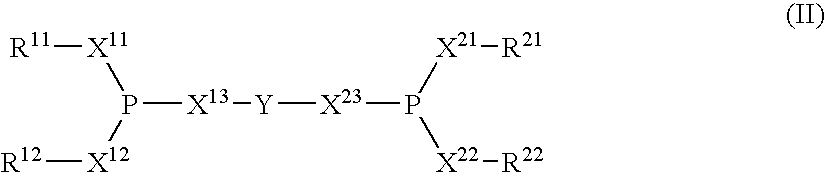
where - X11, X12, X13 X21, X22, X23 are each independently oxygen or a single bond
- R11, R12 are each independently identical or different, separate or bridged organic radicals
- R21, R22 are each independently identical or different, separate or bridged organic radicals,
- Y is a bridging group.
- In the context of the present invention, compound II is a single compound or a mixture of different compounds of the aforementioned formula.
- In a preferred embodiment, X11, X12, X13, X21, X22, X23 may each be oxygen. In such a case, the bridging group Y is bonded to phosphite groups.
- In another preferred embodiment, X11 and X12 may each be oxygen and X13 a single bond, or X11 and X13 each oxygen and X12 a single bond, so that the phosphorus atom surrounded by X11, X12 and X13 is the central atom of a phosphonite. In such a case, X21, X22 and X23 may each be oxygen, or X21 and X22 may each be oxygen and X23 a single bond, or X21 and X23 may each be oxygen and X22 a single bond, or X23 may be oxygen and X21 and X22 each a single bond, or X21 may be oxygen and X22 and X23 each a single bond, or X21, X22 and X23 may each be a single bond, so that the phosphorus atom surrounded by X21, X22 and X23 may be the central atom of a phosphite, phosphonite, phosphinite or phosphine, preferably a phosphonite.
- In another preferred embodiment, X13 may be oxygen and X11 and X12 each a single bond, or X11 may be oxygen and X12 and X13 each a single bond, so that the phosphorus atom surrounded by X11, X12 and X13 is the central atom of a phosphonite. In such a case, X21, X22 and X23 may each be oxygen, or X23 may be oxygen and X21 and X22 each a single bond, or X21 may be oxygen and X22 and X23 each a single bond, or X21, X22 and X23 may each be a single bond, so that the phosphorus atom surrounded by X21, X22 and X23 may be the central atom of a phosphite, phosphinite or phosphine, preferably a phosphinite.
- In another preferred embodiment, X11, X12 and X13 may each be a single bond, so that the phosphorus atom surrounded by X11, X12 and X13 is the central atom of a phosphine. In such a case, X21, X22 and X23 may each be oxygen, or X21, X22 and X23 may each be a single bond, so that the phosphorus atom surrounded by X21, X22 and X23 may be the central atom of a phosphite or phosphine, preferably a phosphine.
- The bridging group Y is advantageously an aryl group which is substituted, for example by C1-C4-alkyl, halogen, such as fluorine, chlorine, bromine, halogenated alkyl, such as trifluoromethyl, aryl, such as phenyl, or is unsubstituted, preferably a group having from 6 to 20 carbon atoms in the aromatic system, in particular pyrocatechol, bis(phenol) or bis(naphthol).
- The R11 and R12 radicals may each independently be identical or different organic radicals. Advantageous R11 and R12 radicals are aryl radicals, preferably those having from 6 to 10 carbon atoms, which may be unsubstituted or mono- or polysubstituted, in particular by C1-C4-alkyl, halogen, such as fluorine, chlorine, bromine, halogenated alkyl, such as trifluoromethyl, aryl, such as phenyl, or unsubstituted aryl groups.
- The R21 and R22 radicals may each independently be the same or different organic radicals. Advantageous R21 and R22 radicals are aryl radicals, preferably those having from 6 to 10 carbon atoms, which may be unsubstituted or mono- or polysubstituted, in particular by C1-C4-alkyl, halogen, such as fluorine, chlorine, bromine, halogenated alkyl, such as trifluoromethyl, aryl, such as phenyl, or unsubstituted aryl groups.
- The R11 and R12 radicals may each be separate or bridged. The R21 and R22 radicals too may each be separate or bridged. The R11, R12, R21 and R22 radicals may each be separate, two may be bridged and two separate, or all four may be bridged, in the manner described. In a particularly preferred embodiment, useful compounds are those of the formula I, II, III, IV and V specified in U.S. Pat. No. 5,723,641. In a particularly preferred embodiment, useful compounds are those of the formula I, II, III, IV, V, VI and VII specified in U.S. Pat. No. 5,512,696, in particular the compounds used there in examples 1 to 31. In a particularly preferred embodiment, useful compounds are those of the formula I, II, III, IV, V, VI, VII, VIII, IX, X, XI, XII, XIII, XIV and XV specified in U.S. Pat. No. 5,821,378, in particular the compounds used there in examples 1 to 73.
- In a particularly preferred embodiment, useful compounds are those of the formula I, II, III, IV, V and VI specified in U.S. Pat. No. 5,512,695, in particular the compounds used there in examples 1 to 6. In a particularly preferred embodiment, useful compounds are those of the formula I, II, III, IV, V, VI, VII, VIII, IX, X, XI, XII, XIII and XIV specified in U.S. Pat. No. 5,981,772, in particular the compounds used there in examples 1 to 66.
- In a particularly preferred embodiment, useful compounds are those specified in U.S. Pat. No. 6,127,567 and the compounds used there in examples 1 to 29. In a particularly preferred embodiment, useful compounds are those of the formula I, II, III, IV, V, VI, VII, VIII, IX and X specified in U.S. Pat. No. 6,020,516, in particular the compounds used there in examples 1 to 33. In a particularly preferred embodiment, useful compounds are those specified in U.S. Pat. No. 5,959,135, and the compounds used there in examples 1 to 13.
- In a particularly preferred embodiment, useful compounds are those of the formula I, II and III specified in U.S. Pat. No. 5,847,191. In a particularly preferred embodiment, useful compounds are those specified in U.S. Pat. No. 5,523,453, in particular the compounds illustrated there in
formula - In a particularly preferred embodiment, useful compounds are those specified in WO 98/27054. In a particularly preferred embodiment, useful compounds are those specified in WO 99/13983. In a particularly preferred embodiment, useful compounds are those specified in WO 99/64155.
- In a particularly preferred embodiment, useful compounds are those specified in the German patent application DE 100 380 37. In a particularly preferred embodiment, useful compounds are those specified in the German patent application DE 100 460 25. In a particularly preferred embodiment, useful compounds are those specified in the German patent application DE 101 502 85.
- In a particularly preferred embodiment, useful compounds are those specified in the German patent application DE 101 502 86. In a particularly preferred embodiment, useful compounds are those specified in the German patent application DE 102 071 65. In a further particularly preferred embodiment of the present invention, useful phosphorus chelate ligands are those specified in US 2003/0100442 A1.
- In a further particularly preferred embodiment of the present invention, useful phosphorus chelate ligands are those specified in the German patent application reference number DE 103 50 999.2 of Oct. 30, 2003 which has an earlier priority date but had not been published at the priority date of the present application.
- The compounds I, Ia, Ib and II described and their preparation are known per se. Phosphorus ligands used may also be a mixture comprising at least two of the compounds I, Ia, Ib and II.
- In a particularly preferred embodiment of the process according to the invention, the phosphorus ligand of the nickel(0) complex and/or the free phosphorus ligand is selected from tritolyl phosphite, bidentate phosphorus chelate ligands and the phosphites of the formula Ib
P(O—R1)x(O—R2)y(O—R3)z(O—R4)p (Ib)
where R1, R2 and R3 are each independently selected from o-isopropylphenyl, m-tolyl and p-tolyl, R4 is phenyl; x is 1 or 2, and y, z, p are each independently 0, 1 or 2 with the proviso that x+y+z+p =3; and mixtures thereof. - Process step (a) of the process according to the invention is preferably carried out at an absolute pressure of from 0.1 to 10 bar, more preferably from 0.5 to 2 bar, in particular from 0.8 to 1.5 bar. the temperature in process step (a) is preferably from 40 to 150° C., more preferably from 50 to 100° C., in particular from 60 to 70° C.
- Process step (a) may be carried out in any suitable apparatus known to those skilled in the art. Examples of suitable reactors are those having backmixing characteristics.
- In the hydrocyanation of process step (a), there may be partial decomposition of the catalysts. The decomposition products resulting therefrom are, for example, nickel(II) cyanide-containing components. Further degradation products formed are, for example, hydrolyzed phosphorus compounds which are derived by reaction of the particular substances I and II used as a result of traces of water which may be present in the feedstocks, especially in the hydrogen cyanide used. Further degradation products formed are oxidized phosphorus compounds which are derived by reaction of the particular substances I and II used to give compounds having phosphorus atoms in the oxidation state (V), as a result of reaction with elemental oxygen or as a result of reaction with peroxides which may be present in the feedstocks, especially as a result of leakage in the apparatus or by dissolution of oxygen in pentenenitrile, for example in the course of storage, with subsequent formation of peroxide compounds of the pentenenitriles. Further degradation products formed, especially of the chelate ligands II used, may, under disadvantageous conditions, be monodentate degradation products which are derived, for example, by thermally induced, or proton- or base-catalyzed, rearrangement of the radicals on the phosphorus atoms of the particular structures and have less hydrocyanation activity than the starting materials.
- In the hydrocyanation of process step (a), 2-pentenenitriles are generally formed additionally and are catalyst poisons when nickel(0) catalysts with monodentate ligands such as ZnCl2 or BPh3 are used as the promoter.
- The promoter which is used in process step (a) of the process according to the invention is preferably selected from the group consisting of the Lewis acids ZnCl2, FeCl2, Et2AlCl, Et3Al2Cl3, EtAlCl2 and BPh3.
- Process step (a) may be carried out in any suitable apparatus known to those skilled in the art. Useful apparatus for the reaction is that which is customary for this purpose, as described, for example, in: Kirk-Othmer, Encyclopedia of Chemical Technology, 4th Ed. Vol. 20, John Wiley & Sons, New York 1996, pages 1040 to 1055, such as stirred tank reactors, loop reactors, gas circulation reactors, bubble column reactors or tubular reactors, in each case if appropriate with apparatus to remove heat of reaction. The reaction may be carried out in a plurality of, such as two or three, apparatuses.
- In process step (b), the reaction stream is distilled to obtain a
stream 3 depleted in pentenenitriles as the bottom product which comprises the at least one catalyst, catalyst degradation products, the at least one promoter, adiponitrile and methylglutaronitrile, and astream 4 enriched in pentenenitriles as the top product. - A substantial removal of the pentenenitriles before the subsequent extraction in process step (c) is advantageous, since phase separation in the extraction is otherwise sometimes complicated or prevented, and the efficiency of the extraction of catalyst constituents from the hydrocyanation effluent is adversely affected by high pentenenitrile concentration.
- The evaporation of process step (b) may be effected in one stage or in a plurality of stages performed in series at different temperatures and pressures. In addition, the evaporator stage of process step (b) may be designed as a distillation column, in which case operation as a rectifying or stripping column is possible. In a preferred embodiment, the evaporator stage (b) is operated as a distillation column in stripping mode.
- In a further preferred embodiment of the process according to the invention, at least one of the evaporator stages of process step (b) is operated with a divided column bottom, in which case the circulation stream which is generally large relative to the bottom draw stream is conducted from a first column bottom of the evaporator stage in question to the evaporator, the liquid effluent stream from the evaporator is not returned directly to the column bottom, but rather collected in a second column bottom which is separated from the first column bottom, the bottom draw stream is obtained from the second column bottom and the remaining excess of evaporator circulation stream is allowed to overflow into the first column bottom, and the bottom draw stream obtained from the second column bottom is a mixture which is depleted in low boilers compared to the draw from the first column bottom.
- The absolute pressure in process step (b) is preferably from 0.001 to 1 bar, more preferably from 0.005 to 0.1 bar, in particular from 0.01 to 0.05 bar. The distillation is carried out in such a way that the temperature in the bottom of the distillation apparatus is preferably from 40 to 180° C., more preferably from 70 to 120° C., in particular from 80 to 100° C. The distillation is carried out in such a way that the temperature at the top of the distillation apparatus is preferably from −15 to 150° C., more preferably from 0 to 60° C., in particular from 20 to 50° C. In a particularly preferred embodiment of the process according to the invention, the temperature ranges specified above are maintained both at the top and in the column bottom.
- The
stream 4 enriched in pentenenitriles in process step (b) generally comprises trans-3-pentenenitrile, cis-3-pentenenitrile, 4-pentenenitrile, cis-2-pentenenitrile, trans-2-pentenenitrile and (E)-2-methyl-2-butenenitrile. In a particularly preferred embodiment, thisstream 4 is distilled at least partly in a further process step (i) to obtain astream 18 depleted in cis-2-pentenenitrile and (E)-2-methyl-2-butenenitrile, and astream 19 enriched in cis-2-pentenenitrile and (E)-2-methyl-2-butenenitrile. Thestream 18 depleted in cis-2-pentenenitrile and (E)-2-methyl-2-butenenitrile is preferably recycled into the hydrocyanation of process step (a).Stream 19 may be fed to a further workup in order to recover product of value by isomerizing the cis-2-pentenenitrile to 3-pentenenitrile, for example according to a process as described in DE 103 23 803 or in DE-A-102 004 004 716. - The distillation of the optional process step (i) may be carried out in any suitable apparatus known to those skilled in the art. The distillation of process step (i) takes place preferably in one or more distillation columns. The columns may be equipped with one or more side draws. The internals used for the distillation columns are preferably structured sheet metal packings, structured fabric packings, bubble-cap trays, dual-flow trays or beds of random packings or combinations of two or more of these classes of separating internals.
- One or more columns of process step (i) may be designed as a dividing wall column with side draw. The columns of process step (i) may be equipped with a falling-film evaporator, thin-film evaporator, natural circulation evaporator or forced circulation-decompression evaporator as the evaporator unit.
- The absolute pressure in process step (i) is preferably from 0.01 to 10.0 bar, more preferably 0.05 to 5.0 bar, in particular 0.1 to 1.0 bar. The distillation is carried out in such a way that the temperature in the bottom of the distillations apparatus is preferably from 40 to 250° C., more preferably from 50 to 180° C., in particular from 60 to 150° C. The distillation is carried out in such a way that the temperature at the top of the distillation apparatus is preferably from 0 to 200° C., more preferably from 15 to 180° C., in particular from 20 to 150° C. In a particularly preferred embodiment of the process according to the invention, the aforementioned temperature ranges in the optional process step (i) are maintained both at the top and in the bottom.
- According to the invention, it has been found that, in contradiction to the prior art, 2-pentenenitriles do not constitute catalyst poisons when the hydrocyanation is carried out using nickel(0) catalysts with chelate ligands. It is therefore unnecessary to fully remove cis-2-pentenenitrile and (E)-2-methyl-2-butenenitrile from the
stream 18 recycled into the hydrocyanation when a nickel(0) catalyst with chelate ligands is used in the hydrocyanation of process step (a). - The
stream 3 depleted in pentenenitrile in process step (b) still contains preferably from 0.1 to 90% by weight, more preferably from 1 to 50% by weight, in particular from 5 to 30% by weight, of pentenenitriles. These pentenenitriles are generally composed of cis-3-pentenenitrile, trans-3-pentenenitrile and 4-pentenenitrile, and also additionally, each having a proportion of preferably less than 20% by weight, more preferably less than 10% by weight, of cis-2-pentenenitrile, trans-2-pentenenitrile, (E)-2-methyl-2-butenenitrile and (Z)-2-methyl-2-butenenitrile. Further constituents are the by-products formed in the hydrocyanation to a minor extent, for example valeronitrile. - In process step (c), the
stream 3 is extracted using an extractant instream 5 to obtain astream 6 enriched with extractant as the top product which comprises at least one catalyst, and astream 7 depleted in extractant which comprises catalyst degradation products, the at least one promoter, pentenenitriles, adiponitrile and methylglutaronitrile. - Process step (c) may be carried out in any suitable apparatus known to those skilled in the art. The extraction of process step (c) preferably takes place in countercurrent extraction columns, mixer-settler units or combinations of mixer-settler units with columns. Particular preference is given to using countercurrent extraction columns which are equipped in particular with sheet metal packings as dispersing elements. This is surprising since the hydrocyanation effluent is laden with solids. According to the invention, it has been found that the nickel(II) cyanide-containing solid which is formed in the hydrocyanation step (a), contrary to expectations, does not have a tendency to accumulate under the conditions in the extraction and does not form any noticeable deposits on column internals.
- In a further particularly preferred embodiment, the countercurrent extraction is performed in a compartmented, stirred extraction column.
- In a preferred embodiment, the extractant is used as a disperse phase, the bottom effluent obtained in process step (b) or the effluent from the hydrocyanation in process step (a) as a continuous phase.
- In the extraction, a phase ratio of from 0.1 to 10, calculated as the ratio of volume of the extractant supplied to volume of the mixture to be extracted is used. In a preferred embodiment, the extraction is operated with a phase ratio of from 0.4 to 2.5, in a preferred embodiment at from 0.75 to 1.5.
- The absolute pressure in process step (c) is preferably from 0.1 to 10 bar, more preferably from 0.5 to 5 bar, in particular from 1.0 to 2.5 bar. The extraction is preferably carried out at temperatures of from −15 to 120° C., more preferably from 0 to 60° C., in particular from 25 to 45° C.
- In a preferred embodiment of the present invention, the extractant is selected from the group consisting of cyclohexane, methylcyclohexane, n-hexane, n-heptane, isomeric C6, C7, C8, C9 cycloaliphatics, isomeric C6, C7, C8, C9 isoaliphatics, cis-, trans-decahydronaphthalene and mixtures thereof.
- In a particularly preferred embodiment, the extractant used is cyclohexane or methylcyclohexane or n-heptane.
- The extractant used is preferably anhydrous, anhydrous meaning in the context of the present invention that the extractant contains less than 100 ppm, preferably less than 50 ppm, in particular less than 10 ppm, of water. The extractant may be dried by suitable processes known to those skilled in the art, for example by adsorption or azeotropic distillation.
- The extractant is preferably dried by azeotropic distillation in a separate process step (j). This is preferably effected distillatively as a heteroazeotropic distillation. The absolute pressure in this process step (j) is preferably from 0.01 to 10.0 bar, more preferably from 0.05 to 5.0 bar, in particular from 0.1 to 1.0 bar. The distillation is carried out in such a way that the temperature in the bottom of the distillation apparatus is preferably from 40 to 250° C., more preferably from 50 to 180° C., in particular from 60 to 150° C. The distillation is carried out in such a way that the temperature at the top of the distillation apparatus is preferably from 0 to 200° C., more preferably from 5 to 100° C., in particular from 20 to 50° C. In a particularly preferred embodiment of the process according to the invention, the aforementioned temperature ranges are maintained both at the top and in the bottom of the distillation apparatus.
- The azeotropic distillation of the extractant is preferably effected in a distillation column having in particular bubble-cap trays, structured sheet metal packings, structured fabric packings, dual-flow trays or beds of random packings as separating internals, if appropriate in a dividing wall column having side draws present if appropriate, a phase separator at the liquid draw of the top condenser to remove water, with apparatus for separate recycling of organic phases as reflux to columns, and also further apparatus suitable for azeotropic distillation.
- In process step (d), a distillation of
stream 6 takes place to obtain astream 8 comprising the at least one catalyst and astream 9 comprising the extractant. - This process step serves substantially to recover the catalyst and the extractant.
- Process step (d) may be carried out in any suitable apparatus known to those skilled in the art. The distillation of process step (d) preferably takes place in one or more evaporator stages and also distillation columns.
- Useful internals for the distillation columns are preferably structured sheet metal packing, structured fabric packing, bubble-cap trays, dual-flow trays or beds of random packings or combinations of two or more of these classes of separating internals. The distillation column of process step (d) may be designed with one or more liquid or gaseous side draws. The distillation column from process step (d) may be designed as a dividing wall column having one or more gaseous or liquid side draws present.
- The one or more evaporator stages or the distillation column of process step (d) may in particular be equipped with falling-film evaporators, thin-film evaporators, natural circulation evaporators, forced circulation-decompression evaporators and multiphase helical tube evaporators.
- In a further embodiment of the process according to the invention, at least one of the evaporator units of process step (d) is operated with a divided column bottom, in which case the circulation stream which is generally large relative to the bottom draw stream is conducted from a first column bottom of the evaporator stage in question to the evaporator, the liquid effluent stream from the evaporator is not returned directly to the column bottom, but rather collected in a second column bottom which is separated from the first column bottom, the bottom draw stream is obtained from the second column bottom and the remaining excess of evaporator circulation stream is allowed to overflow into the first column bottom, and the bottom draw stream obtained from the second column bottom is a mixture which is depleted in low boilers compared to the draw from the first column bottom.
- The absolute pressure in process step (d) is preferably from 0.001 to 2.0 bar, more preferably from 0.01 to 0.5 bar, in particular from 0.09 to 0.12 bar. The distillation is carried out in such a way that the temperature in the bottom of the distillation apparatus is preferably from 40 to 150° C., more preferably from 70 to 120° C., in particular from 80 to 100° C. The distillation is carried out in such a way that the temperature at the top of the distillation apparatus is preferably from −15 to 100° C., more preferably from 0 to 60° C., in particular from 20 to 50° C. In a particularly preferred embodiment of the process according to the invention, the temperature ranges specified above are maintained both at the top and in the column bottom.
- In the removal of the extractant to recover the catalyst in process step d), in a preferred embodiment of the present invention, 3-pentenenitrile is added to the distillation as an intermediate boiler. One advantage of this solvent change is that effective depletion of the extractant from the high-boiling catalyst stream is possible at evaporator temperatures which are low enough not to thermally damage the particular nickel catalyst used and especially the chelate ligand, although the pressure is still high enough to be able to condense the extractant having a comparatively low boiling point in comparison to the catalyst constituents at the top of the evaporator stage or distillation column even at customary cooling water temperatures of from 25 to 50° C. The solvent change additionally has the advantage that the flowability and monophasicity of the catalyst solution is ensured, since, depending on the temperature and residual content of extractant, catalyst constituents may in some cases crystallize out without the addition of 3-pentenenitrile. 3-Pentenenitrile, which, depending on the pressure conditions, can only be removed fully with difficulty, for example from the cyclohexane or methylcyclohexane extractants, or, owing to minimum vapor pressure azeotrope formation, cannot be removed fully at all, does not have a disruptive effect on the process according to the invention at a proportion of preferably up to 10% by weight, more preferably up to 5% by weight, in particular up to 1% by weight, based on the total amount of the extractant feed stream to the extraction column in process step (c).
- In a preferred embodiment of the process according to the invention, the
stream 9 obtained in process step (d) and comprising the extractant is recycled at least partly into the extraction step (c). Therecycled stream 9 is preferably dried before the extraction step (c), for example in the above-described process step (j), so that the water content in this stream is preferably less than 100 ppm, more preferably less than 50 ppm, in particular less than 10 ppm. - In a further preferred embodiment of the process according to the invention, the
stream 8 obtained in process step (d) and comprising the catalyst is recycled at least partly into the hydrocyanation of process step (a). In a preferred embodiment of the process according to the invention, the proportion of extractant instream 8 is preferably less than 10% by weight, more preferably less than 5% by weight, in particular less than 1% by weight, based on the total amount ofstream 8. - Since the removal of the extractant from the catalyst is thus not necessarily quantitative, it may be the case that extractant still present in
stream 8 is likewise recycled into the hydrocyanation stage. This extractant is then transferred in the downstream, above-described process stage (b) substantially intostream 4 comprising pentenenitriles, and accumulates there. If extractant will get intostream 4, it is thus advantageous to free thisstream 4 of the extractant in a further process step (k) by distillation. Process step (k) may be carried out in any suitable apparatus known to those skilled in the art. The distillation of process step (k) preferably takes place in one or more distillation columns. Useful internals for the distillation columns are preferably structured sheet metal packings, structured fabric packings, bubble-cap trays, dual-flow trays or beds of random packings or combinations of two or more of these classes of separating internals. The distillation column of process step (k) may be designed with one or more liquid or gaseous side draws. The distillation column from process step (d) may be designed as a dividing wall column having one or more gaseous or liquid side draws present. - This forms the
streams 21, comprising pentenenitrile, and 22, comprising the extractant. Thestream 21 is preferably recycled into the above-described process step (i) to be carried out if appropriate, in order to free the stream of any cis-2-pentenenitrile and (E)-2-methyl-2-butenenitrile present. Thestream 22 comprising the extractant is preferably recycled into the extraction of process step (c). - In a preferred embodiment of the process according to the invention, the thus obtained
stream 22 comprising the extractant is recycled at least partly into the extraction step (c). Therecycled stream 22 is preferably dried before the extraction step (c), for example in the above-described process step (j), so that the water content in this stream is preferably less than 100 ppm, more preferably less than 50 ppm, in particular less than 10 ppm. - In a further embodiment, streams 9 and 22 are dried before they are recycled into the extraction of process step (c), if appropriate in an apparatus.
- The absolute pressure in the optional process step (k) is preferably from 0.01 to 10.0 bar, more preferably from 0.05 to 5.0 bar, in particular from 0.1 to 1.0 bar. The distillation is carried out in such a way that the temperature in the bottom of the distillation apparatus is preferably from 40 to 250° C., more preferably from 50 to 180° C., in particular from 60 to 150° C. The distillation is carried out in such a way that the temperature at the top of the distillation apparatus is preferably from 0 to 200° C., more preferably from 15 to 180° C., in particular from 20 to 150° C. In a particularly preferred embodiment of the process according to the invention, the aforementioned temperature ranges are maintained both at the top and in the bottom of the distillation apparatus.
- In process step (e), a distillation of
stream 7 takes place to obtain astream 10 as the top product which comprises catalyst degradation products, the at least one promoter, pentenenitriles, adiponitrile and methylglutaronitrile, and astream 11 comprising the extractant as the top product. - The process step (e) may carried out in any suitable apparatus known to those skilled in the art. The distillation of process step (e) preferably takes place in one or more evaporator stages or one or more distillation columns. Useful internals for the distillation columns are preferably structured sheet metal packing, structured fabric packing, bubble-cap trays, dual-flow trays or beds of random packings or combinations of two or more of these classes of separating internals. The distillation column of process step (e) may be designed with one or more liquid or gaseous side draws. The distillation column from process step (e) may be designed as a dividing wall column having one or more gaseous or liquid side draws present.
- The evaporator units for the one or more evaporator stages or one or more distillation columns may in particular be equipped with falling-film evaporators, thin-film evaporators, natural circulation evaporators, forced circulation-decompression evaporators and multiphase helical tube evaporators.
- In a preferred embodiment of the process according to the invention, at least one of the one or more evaporator units of process step (e) is operated with a divided column bottom, in which case the circulation stream which is generally large relative to the bottom draw stream is conducted from a first column bottom of the evaporator stage in question to the evaporator, the liquid effluent stream from the evaporator is not returned directly to the column bottom, but rather collected in a second column bottom which is separated from the first column bottom, the bottom draw stream is obtained from the second column bottom and the remaining excess of evaporator circulation stream is allowed to overflow into the first column bottom, and the bottom draw stream obtained from the second column bottom is a mixture which is depleted in low boilers compared to the draw from the first column bottom.
- The absolute pressure in process step (e) is preferably from 0.1 to 10.0 bar, more preferably from 0.5 to 5.0 bar, in particular from 0.15 to 0.2 bar. The distillation is carried out in such a way that the temperature in the bottom of the distillation apparatus is preferably from 40 to 250° C., more preferably from 50 to 200° C., in particular from 100 to 180° C. The distillation is carried out in such a way that the temperature at the top of the distillation apparatus is preferably from −15 to 150° C., more preferably from 0 to 60° C., in particular from 20 to 50° C. In a particularly preferred embodiment of the process according to the invention, the temperature ranges specified above are maintained both at the top and in the column bottom.
- The
stream 11 comprising the extractant is preferably recycled into the extraction of process step (c). Preference is given to dryingstream 11 before it is recycled into the extraction of process step (c), so that the water content in these streams is preferably less than 100 ppm, more preferably less than 50 ppm, in particular less than 10 ppm. This may be effected, for example, in process step (j). - In a preferred embodiment A of the process according to the invention, the distillation in process step (e) is carried out in such a way that the resulting
stream 10 contains less than 10% by weight, more preferably less than 1% by weight, in particular less than 0.1% by weight, of extractant. - In a further preferred embodiment B of the process according to the invention, the
stream 11 comprises less than 10% by weight, more preferably less than 5% by weight, in particular less than 2% by weight, of pentenenitriles. - In a particularly preferred embodiment C, the specifications of embodiment A and B are achieved.
- In a further preferred embodiment D of the process according to the invention, the distillation in process step (e) is carried out in such a way that the resulting
stream 10 contains less than 10% by weight, more preferably less than 5% by weight, in particular less than 1% by weight, of pentenenitriles. If this specification ofstream 10 is achieved, it is possible to conductstream 10 directly into process step (g) with exclusion of process step (f). This specification is preferably achieved by using, in process step (e), a combination, adapted to the temperature-dependent vapor pressure of pentenenitrile, of evaporation temperature and distillation pressure, so that pentenenitriles are distinctly depleted via the bottom and a mixture of pentenenitrile and the particular extractant used is obtained overhead. In a preferred embodiment, this mixture of substances having noticeably different condensation points is condensed in a process for closed condensation. The closed condensation allows thestream 11 to be condensed fully at distinctly higher temperatures in comparison to the customary open condensation, or a distinctly lower column pressure in comparison to the open condensation at the same cooling medium temperature, and thus a lower content of low boilers in the bottom draw stream at the same bottom temperature, to be attained. This embodiment has the result that a distillation stage for recycling pentenenitriles fromstream 7 can be dispensed with. - The magnitude of the contents of pentenenitriles typically found in
stream 7 after the extraction makes necessary a removal and extraction for the economic practice of the process. The closed condensation may be performed in all further ways suitable and known to those skilled in the art. One suitable embodiment is to carry out the condensation in a vertical tube bundle condenser, in which case the product is conducted into the tubes and the vapor-side inlet into the tubes is flushed with a circulation stream, large in comparison to the amount of top draw, from the condensate collecting vessel associated with the condenser. A further suitable embodiment is to carry out the condensation in a tube bundle heat exchanger, in which case the product is conducted in the jacket region and the jacket region is flushed with a circulation stream from the condensate collecting vessel associated with the condenser. A particularly preferred embodiment of the closed condensation is the use of a direct condenser which, as the column section attached to the column in process step (e), is equipped with a total collecting cup, one or more liquid draws for pumped circulation, heat exchangers in the pumped circulation system to remove the heat of condensation and recycling of the cooled circulation stream into the column section. In a preferred embodiment E of the process according to the invention, thestream 11 contains from 1% by weight to 90% by weight, more preferably from 5 to 80% by weight, in particular from 10 to 60% by weight, of pentenenitriles. - In a further particularly preferred embodiment F, the specifications of embodiments D and E are attained.
- In process step (f), a distillation of
stream 10 takes place to obtain astream 12 as the bottom product which comprises catalyst degradation products, the at least one promoter, adiponitrile and methylglutaronitrile, and astream 13 comprising pentenenitriles as the top product. - The process step (f) may carried out in any suitable apparatus known to those skilled in the art. The distillation of process step (f) preferably takes place in one or more evaporator stages or one or more distillation columns. Useful internals for the distillation columns are preferably structured sheet metal packing, structured fabric packing, bubble-cap trays, dual-flow trays or beds of random packings or combinations of two or more of these classes of separating internals. The distillation column of process step (f) may be designed with one or more liquid or gaseous side draws. The distillation column from process step (f) may be designed as a dividing wall column having one or more gaseous or liquid side draws present.
- The evaporator units for the one or more evaporator stages or one or more distillation columns may in particular be equipped with falling-film evaporators, thin-film evaporators, natural circulation evaporators, forced circulation-decompression evaporators and multiphase helical tube evaporators.
- In a preferred embodiment of the process according to the invention, at least one of the evaporator stages of process step (f) is operated with a divided column bottom, in which case the circulation stream which is generally large relative to the bottom draw stream is conducted from a first column bottom of the evaporator stage in question to the evaporator, the liquid effluent stream from the evaporator is not returned directly to the column bottom, but rather collected in a second column bottom which is separated from the first column bottom, the bottom draw stream is obtained from the second column bottom and the remaining excess of evaporator circulation stream is allowed to overflow into the first column bottom, and the bottom draw stream obtained from the second column bottom is a mixture which is depleted in low boilers compared to the draw from the first column bottom.
- The absolute pressure in process step (f) is preferably from 0.001 to 1.0 bar, more preferably from 0.005 to 0.1 bar, in particular from 0.01 to 0.05 bar. The distillation is carried out in such a way that the temperature in the bottom of the distillation apparatus is preferably from 40 to 250° C., more preferably from 50 to 200° C., in particular from 100 to 180° C. The distillation is carried out in such a way that the temperature at the top of the distillation apparatus is preferably from −15 to 150° C., more preferably from 0 to 60° C., in particular from 20 to 50° C. In a particularly preferred embodiment of the process according to the invention, the temperature ranges specified above are maintained both at the top and in the column bottom.
- The content of pentenenitriles in
stream 12 is preferably less than 10% by weight, more preferably less than 2% by weight, in particular less than 0.5% by weight. - The
stream 13 obtained in process step (f) generally contains trans-3-pentenenitrile, cis-3-pentenenitrile, 4-pentenenitrile, trans-2-pentenenitrile, cis-2-pentenenitrile and (E)-2-methyl-2-butenenitrile. In a particularly preferred embodiment, thisstream 13 is distilled at least partly to obtain astream 22 depleted in trans-3-pentenenitrile, cis-3-pentenenitrile, 4-pentenenitrile, trans-2-pentenenitrile, cis-2-pentenenitrile and (E)-2-methyl-2-butenenitrile, and a stream 23 enriched in trans-3-pentenenitrile, cis-3-pentenenitrile, 4-pentenenitrile, trans-2-pentenenitrile, cis-2-pentenenitrile and (E)-2-methyl-2-butenenitrile in a further process step (I). Thestream 22 depleted in cis-2-pentenenitrile and (E)-2-methyl-2-butenenitrile is preferably recycled into the hydrocyanation of process step (a). - In a particularly preferred embodiment of the process according to the invention, it is envisaged that both the
stream 4 and thestream 13, if appropriate in the same apparatus from process step (i), are distilled to deplete in cis-2-pentenenitrile and (E)-2-methyl-2-butenenitrile. The resultingstream 19 depleted in cis-2-pentenenitrile and (E)-2-methyl-2-butenenitrile is, if appropriate, at least partly recycled into the hydrocyanation. - In process step (g), a distillation of
stream 12 takes place to obtain astream 14 as the bottom product comprising catalyst degradation products and the at least one promoter, and astream 15 as the top product comprising adiponitrile and methylglutaronitrile. - Process step (g) may be carried out in any suitable apparatus known to those skilled in the art. The distillation of process step (g) more preferably takes place in one or more distillation columns. The columns may be equipped with one or more side draws. The internals used for the distillation columns are preferably structured sheet metal packings, structured fabric packings, bubble-cap trays, dual-flow trays or beds of random packings or combinations of two or more of these classes of separating internals.
- The distillation of process step (g) more preferably takes place as an evaporation with one or more stages connected in series and condensation with the evaporators known per se to those skilled in the art. Examples of suitable evaporators for the one or more evaporator stages are falling-film evaporators, natural circulation evaporators, forced circulation-decompression evaporators, thin-film evaporators, short-path evaporators and multiphase helical tube evaporators. Particularly preferred evaporators are those which enable a very low evaporator surface temperature and a short contact time on the evaporator surface for the desired achievement of the degree of evaporation, and thus low thermal damage to the material to be concentrated. Suitable for this purpose are in particular falling-film evaporators, thin-film evaporators, multiphase helical tube evaporators and short-path evaporators.
- The absolute pressure in process step (g) is preferably from 0.0001 to 0.5 bar, more preferably from 0.001 to 0.05 bar, in particular from 0.002 to 0.01 bar. The distillation is carried out in such a way that the temperature in the bottom of the distillation apparatus is preferably from 60 to 300° C., more preferably from 120 to 220° C., in particular from 140 to 180° C. The distillation is carried out in such a way that the temperature at the top of the distillation apparatus is preferably from 5 to 250° C., more preferably from 40 to 180° C., in particular from 60 to 120° C. In a particularly preferred embodiment of the process according to the invention, the aforementioned temperature ranges are maintained both at the top and in the bottom of the distillation apparatus.
- In process stage (g), the
stream 14 which comprises catalyst degradation products and the at least one promoter is removed. This stream is generally viscous, so that it has been found to be advantageous to make this stream more free-flowing by adding liquid. Suitable for this purpose is, for example, the methylglutaronitrile obtained in the downstream process step (h). In a particularly preferred embodiment of the present invention, process step (g) is thus performed as a two-stage distillation, by squeezing thestream 14 obtained in process step (g) in a subsequent process step (m) and diluting the squeezedstream 14 with at least a portion of thestream 17 obtained in process step (h) and comprising methylglutaronitrile. In a further preferred embodiment, the stream obtained in process step (m) is diluted with pentenenitrile isomers, more preferably with at least a portion of stream (19). - Additionally suitable as diluents for
stream 14 are substances having higher boiling points than adiponitrile, as long as they increase the flowability. - Process step (m) may be carried out in any suitable apparatus known to those skilled in the art. Preference is given to thin-film evaporators, forced circulation-decompression evaporators or multiphase helical tube evaporators. Examples of suitable evaporators for the one or more evaporator stages are falling-film evaporators, natural circulation evaporators, forced circulation-decompression evaporators, thin-film evaporators, short-path evaporators and multiphase helical tube evaporators. Particularly preferred evaporators are those which, taking into account the viscosity of the material to be concentrated, enable a very low evaporator surface temperature and a short contact time on the evaporator surface for the desired achievement of the degree of evaporation, and thus low thermal damage to the material to be concentrated and minimized product of value losses. Suitable for this purpose are in particular falling-film evaporators, thin-film evaporators, multiphase helical tube evaporators and short-path evaporators.
- The absolute pressure in process step (m) is preferably from 0.0001 to 0.5 bar, more preferably from 0.001 to 0.05 bar, in particular from 0.002 to 0.01 bar. The distillation is carried out in such a way that the temperature in the bottom of the distillation apparatus is preferably from 60 to 350° C., more preferably from 120 to 250° C., in particular from 160 to 220° C. In a particularly preferred embodiment, the pressure in process step (m) is set within the above-described range and simultaneously to less than in process step (g).
- In process step (h), distillation of the
stream 15 takes place to obtain astream 16 comprising adiponitrile as the bottom product and astream 17 comprising substantially methylglutaronitrile as the top product. - Process step (h) may be carried out in any suitable apparatus known to those skilled in the art. The distillation of process step (h) preferably takes place in one or more distillation columns. Useful internals for the distillation columns are preferably structured sheet metal packing, structured fabric packing, bubble-cap trays, dual-flow trays or beds of random packings or combinations thereof. The distillation column of process step (h) may be designed with one or more liquid or gaseous side draws. The distillation column from process step (h) may be designed as a dividing wall column having one or more gaseous or liquid side draws present.
- The evaporator units for the one or more distillation columns may in particular be equipped with falling-film evaporators, thin-film evaporators, natural circulation evaporators, forced circulation-decompression evaporators and multiphase helical tube evaporators.
- The absolute pressure in process step (h) is preferably from 0.0001 to 0.5 bar, more preferably from 0.005 to 0.06 bar, in particular from 0.01 to 0.03 bar. The distillation is carried out in such a way that the temperature in the bottom of the distillation apparatus is preferably from 60 to 300° C., more preferably from 120 to 220° C., in particular from 140 to 180° C. The distillation is carried out in such a way that the temperature at the top of the distillation apparatus is preferably from 40 to 250° C., more preferably from 60 to 180° C., in particular from 100 to 140° C. In a particularly preferred embodiment of the process according to the invention, the aforementioned temperature ranges are maintained both at the top and in the bottom of the distillation apparatus.
- Should pentenenitriles still be present in
stream 15, they may preferably be obtained via the top of the distillation column. In this case, themethylglutaronitrile stream 17 is obtained via a side draw of the column and adiponitrile via the bottom of the column. - In a further embodiment of the process according to the invention, the
stream 16 comprising adiponitrile is obtained at a side draw. Preference is given to undertaking the withdrawal in the form of a gaseous side draw below the feed point. A mixture 23 is then obtained via the bottom and comprises substantially adiponitrile and high-boiling phosphorus-containing components which, despite low vapor pressure, get intostream 15 via process stage (g) and, where present, (m). - In a further embodiment of the process according to the invention,
stream 17 comprising methylglutaronitrile is recycled into process step (e) as an intermediate boiler. In a further embodiment of the process according to the invention,stream 17 comprising methylglutaronitrile is recycled into process step (f) as an intermediate boiler. In a further particular embodiment,stream 17 comprising methylglutaronitrile is recycled simultaneously and fully or partly into process steps (e) and/or (f) as an intermediate boiler. The recycling ofstream 17 into process steps (e) and/or (f) essentially achieves low bottom temperatures in process steps (e) and/or (f), so that any 3-pentenenitriles still present do not react with the promoter, for example zinc chloride. - In a further embodiment, other suitable medium boilers are recycled from the top or from a side draw of the column of process step (h) into process steps (e) and/or (f). Suitable substances do not form any vapor pressure minimum azeotropes with pentenenitriles or the extractant and its components, and, at the particular bottom temperatures of process steps (e) and/or (f), have a vapor pressure which is between that of the pentenenitriles and that of methylglutaronitrile, for example alkylphenols such as cresol isomers or tert-butylphenol, which are formed in traces in the process as degradation products of the catalyst components and are enriched in the top region of the columns of process step (h).
- In a further embodiment of the process according to the invention,
stream 17 comprising substantially methylglutaronitrile is used to dilutestream 14. - The adiponitrile obtainable by the above-described process has a purity which is characterized by the secondary components of preferably from 1 ppm by weight to 1% by weight, more preferably from 5 to 1000 ppm by weight, in particular from 10 to 500 ppm by weight, of methylglutaronitrile, and also preferably from 0.01 to 1000 ppm by weight of methylglutaronitrile, more preferably from 0.1 to 500 ppm by weight, in particular from 1 to 20 ppm by weight, of phosphorus compounds calculated as elemental phosphorus, detectable as the sum of volatile and involatile phosphorus compounds.
- The methylglutaronitrile obtained by the above-described process has a purity of preferably from 50 to 100% by weight, more preferably from 80 to 99% by weight, in particular from 90 to 98% by weight, calculated as the sum of methylglutaronitrile and the isomeric ethylsuccinonitrile, the latter being obtained in parallel to methylglutaronitrile in the hydrocyanation and being virtually inseparable from methylglutaronitrile.
- In the context of the present application, the term methylglutaronitrile always refers to methylglutaronitrile or a mixture of methylglutaronitrile and ethylsuccinonitrile.
- Since the promoter has already been removed from adiponitrile and methylglutaronitrile in process step (g), it is not essential that the adiponitrile/methylglutaronitrile distillation is effected in apparatus made from chloride-resistant materials. When chloride-containing Lewis acids are used as the promoter, the design of the apparatus for process steps (e), (f), (g) and (m) entails the use of high-grade materials, wall coatings or other devices for protection against corrosion which are resistant to attack by chloride-containing media at the temperatures employed. The same applies to the use of bromide-containing promoters.
- The invention is illustrated in detail hereinbelow with reference to a drawing and working examples.
-
FIG. 1 shows a particularly preferred embodiment of the process according to the invention. - In the reactor (1), a nickel(0) catalyst (cat), pentenenitriles (PN) which stem from a hydrocyanation of butadiene, and hydrogen cyanide (HCN) are fed in. Further constituents are 3-pentenenitriles and, if appropriate, extractant (EX) in
stream 18 which are recycled in the process according to the invention. Over the nickel(0) catalyst, hydrocyanation of pentenenitriles with hydrogen cyanide takes place. Thestream 1 resulting therefrom, which comprises pentenenitriles, the at least one catalyst, catalyst degradation products, the at least one promoter, extractant, adiponitrile and methylglutaronitrile from the hydrocyanation, is transferred to a distillation column (2). - There, a distillative removal of pentenenitriles and of extractant present via the top of the column takes place (stream 4). The bottom product (stream 3) of this distillation column comprises substantially the catalyst, catalyst degradation products, the at least one promoter, adiponitrile and methylglutaronitrile and is depleted in pentenenitriles.
- The
stream 4, obtained via the top of the distillation column (2), comprising pentenenitriles and the extractant present, is transferred to a further distillation column. There, the extractant is obtained as the top product and is used later for further extraction (stream 22). Pentenenitriles are obtained as the bottom product of this column (10) (stream 21). This bottom stream of pentenenitriles is subsequently transferred to a further column (9) in which a separation into 3-pentenenitrile (stream 18) and (E)-2-methyl-2-butenenitrile and cis-2-pentenenitrile (stream 19) is effected. The 3-pentenenitrile is recycled into the hydrocyanation of reactor (1) and may contain extractant (stream 18). - The bottom product of the distillation column (2) is subsequently transferred to an extraction column (stream 3). Here, an extraction of
stream 3 is effected with an extractant to form astream 6 which is drawn off via the top of the extraction column (3). Thisstream 6 is transferred to a further distillation column (4) in which a separation into astream 8 as the bottom product which comprises the catalyst, and atop stream 9 which comprises the extractant is brought about. The thus obtained extractant ofstream 9 is subsequently transferred to an extractant drying column (11) in which the dry extractant is withdrawn as the bottom product. - The
stream 7 which stems from the distillation column (3) and is obtained as the bottom product in the distillation column (3) is subsequently transferred to a further distillation column (5). - In this distillation column (5) extractant still present is removed overhead as
stream 11 and is likewise transferred to the extractant drying column (11). - The bottom product withdrawn from this column (5) is
stream 10. Thisstream 10 is transferred to a further distillation column (6) in which the top product removed is astream 13 which comprises pentenenitrile. Thisstream 13 is subsequently transferred to the distillation column (9). - The bottom product withdrawn from the distillation column (6) is
stream 12 comprising catalyst degradation product, promoter, adiponitrile and methylglutaronitrile. Thisstream 12 is subsequently transferred to a further distillation column (7). - In this distillation column (7), the bottom product obtained is
stream 14 which comprises nickel degradation products and the promoter. - The top product obtained from the distillation column is
stream 15. Thereafter, stream 15 passes into a further distillation column (8) in which a separation into adiponitrile,stream 16, and methylbutanenitrile,stream 17, is effected. - In the examples, the following abbreviations are used:
- HCN: hydrogen cyanide
- T3PN: trans-3-pentenenitrile
- C3PN: cis-3-pentenenitrile
- 4PN: 4-pentenenitrile
- E2M2BN: (E)-2-methyl-2-butenenitrile
- T2PN: trans-2-pentenenitrile
- C2PN: cis-2-pentenenitrile
- ADN: adiponitrile
- MGN: methylglutaronitrile
- VAN: valeronitrile
- VCH: 4-vinylcyclohexene
- In example 1, a catalyst system based on nickel(0) complexes with a mixture of ligands is used for the hydrocyanation of butadiene. The ligand mixture for the hydrocyanation contains approx. 60 mol % of tri(m/p-tolyl) phosphite and 40 mol % of the chelate phosphonite 1:

- In a loop reactor R1 of capacity 250 l which is equipped with a jet nozzle, impulse exchange tube, external pumped circulation and heat exchanger to remove the heat of reaction, the following streams are metered in:
- (1) 10 kg/h of liquid, unstabilized hydrogen cyanide freed of water by distillation,
- (2) 39 kg/h of pentenenitrile obtained from a process for preparing linear pentenenitrile according to DE-A-102 004 004 671, consisting of 97% in total of T3PN, C3PN and 4PN, and 2% E2M2BN,
- (3) 25 kg/h of pentenenitrile obtained as
stream 18 from column K9 from step (9), containing 81% in total of T3PN, C3PN, 4PN, and 3% T2PN, 1% C2PN and 3% E2M2BN. - (4) 6 kg/h of nickel(0) catalyst solution consisting of 40% ligand mixture, 2% nickel(0) and 3% ZnCl2, prepared according to example 13 of DE-A-103 51 002.
- The
stream 1 drawn off from reactor R1 contains 40% in total of T3PN, C3PN and 4PN, and also 47% ADN and 6% MGN, corresponding to a conversion of 51% of pentenenitrile. - In
step 2,stream 1 is fed to a distillation column K2 which is operated in stripping mode and is equipped with forced circulation-decompression evaporator, a top condenser and column internals having structured packing which generates 15 theoretical plates. The column K2 is operated at absolute top pressure 50 mbar, top temperature 313 K and bottom draw temperature 353 K. - Via the top of column K2 is obtained stream 4 (22 kg/h) which contains 81% in total of T3PN, C3PN and 4PN, and also 8% in total of T2PN and C2PN.
- Via the bottom of column K2 are obtained 57 kg/h of a
stream 3 having a content of 19% in total of T3PN, C3PN and 4PN, and also 1% in total of T2PN and C2PN. T2PN and C2PN are distinctly depleted relative to T3PN, C3PN and 4PN compared to the feed.Stream 3 additionally comprises the catalyst components nickel(0), the ligand mixture and ZnCl2, and also catalyst degradation products. - In step (3),
stream 3 is introduced at the lower end of a countercurrent extraction column K3 and extracted with 86 kg/h ofstream 5 containing 93% methylcyclohexane and various pentenenitrile isomers. Thestream 6 obtained at the top of the extraction consists of 91% extractant and contains, in addition to 4% in total of T3PN, C3PN and 4PN, the catalyst components nickel(0) and ligand mixture. The zinc chloride remains fully in the bottom draw of the extraction column instream 7. - In step (4),
stream 6 is conducted into a distillation column K4 which is equipped with falling-film evaporator, a divided column bottom and top condenser, and also column internals having structured packing which generate 12 theoretical plates. The column is operated at absolute top pressure 100 mbar, top temperature 308 K and bottom draw temperature 353 K. The reflux ratio is adjusted in such a way that 6% in total of T3PN, C3PN and 4PN are present in the top draw stream. - Via the top of column K4 is recovered the extractant which, together with a small makeup stream of pure methylcyclohexane dried to a water concentration below 10 ppm, is recycled as
stream 9 into extraction column K3. - At the top of column K4, the extracted catalyst is obtained in
stream 8 as a solution in pentenenitrile (13 kg/h).Stream 8 contains 18% ligand mixture, 1% Ni(0) and 68% in total of T3PN, C3PN and 4PN. The methylcyclohexane content instream 8 is adjusted to 10 ppm by weight instream 8 in column K4. - The catalyst-
rich stream 8 is used in the hydrocyanation of butadiene to T3PN and 2M3BN. - In step (5), the
stream 7 obtained in extraction column K3 is passed to a distillation column K5 which is operated in stripping mode and is equipped with forced circulation-decompression evaporator, at the top with a column section having total collecting cup, circulation and external heat removal as a direct condenser, and also column internals having structured packing which generate 5 theoretical plates. Column K5 is operated at absolute top pressure 180 mbar, top temperature 313 K and bottom draw temperature 453 K. - Via the top of column K5 is obtained
stream 11 which is passed into distillation column K4. Stream 11 (22 kg/h) contains substantially 45% methylcyclohexane, 48% in total of T3PN, C3PN and 4PN, and also further pentenenitriles. - Via the bottom of column K5 is obtained stream 10 (45 kg/h) which also contains 5% in total of T3PN, C3PN and 4PN, and also 83% ADN and the MGN by-product and additionally catalyst degradation products together with ZnCl2.
- In step (7),
stream 10 is worked up in an evaporator stage B7 which is equipped with forced circulation-decompression evaporator, top condenser and downstream thin-film evaporator B7 a to concentrate the bottom product. The evaporator is operated at an absolute pressure of 5 mbar and bottom temperature 453 K. - Via the top of the evaporator B7 is drawn off as crude ADN stream 15 (44 kg/h) which also contains 5% in total of T3PN, C3PN and 4PN, and also 10% MGN.
- Via the bottom of the thin-film evaporator B7 a are obtained at bottom temperature 473 K concentrated catalyst residues together with the zinc chloride as
stream 14, which are liquefied by admixing with 0.5 kg/h of MGN from the top of column K8 from step (8). - In step (8),
stream 15 is conducted into a distillation column K8 which is equipped with thin-film evaporator, a top condenser operated as a partial condenser, and also column internals having structured packing which generate 25 theoretical plates. Column K8 is operated at an absolute pressure of 25 mbar of top pressure, top temperature 414 K and bottom draw temperature 453 K. The reflux ratio is suggested in such a way that 1% ADN is present in the top product. The amount of bottom draw of column K8 is controlled in such a way that the bottom product contains 100 ppm by weight of MGN. - Via the bottom of column K8 are obtained 37 kg/h of ADN as
stream 16. At the top condenser of column K8 which is operated at 393 K, 3 kg/h of MGN are obtained in the liquid phase asstream 17 which is contaminated with 3PN, ADN and volatile catalyst decomposition products such as alkylphenols. The gaseous draw of the condenser of column K8 is condensed at 313 K in a postcondenser to obtain 4 kg/h of stream 20 which contains 54% in total of T3PN, C3PN and 4PN, and also 41% MGN. - In step (9),
stream 4 from column K2 is worked up in distillation column K9 which is equipped with circulation evaporator, top condenser and column internals with structured packing which generate 35 theoretical plates. The column of step (9) is operated at an absolute pressure of 46 mbar of top pressure, top temperature 313 K and bottom draw temperature 338 K. The reflux ratio is adjusted in such a way that the top product still contains 0.5% T3PN. - Via the top of column K9 is obtained stream 19 (1.4 kg/h), which contains 65% C2PN and 29% E2M2BN, and also small amounts of VCH and VAN.
- Via the bottom of column K9 is obtained stream 18 (25 kg/h) which contains 81% in total of T3PN, C3PN and 4PN, and also 3% T2PN, 1% C2PN and 3% E2M2BN.
Stream 18 is recycled into reactor R1 as a recycle stream. - In example 1, a catalyst system based on nickel(0) complexes with a mixture of ligands is used for the hydrocyanation of butadiene. The ligand mixture for the hydrocyanation contains approx. 80 mol % of tri(m/p-tolyl) phosphite and 20 mol % of the chelate phosphite 2:

- In a loop reactor R1 of capacity 250 l which is equipped with a jet nozzle, impulse exchange tube, external pumped circulation and heat exchanger to remove the heat of reaction, the following streams are metered in:
- (1) 12 kg/h of liquid, unstabilized hydrogen cyanide freed of water by distillation,
- (2) 39 kg/h of pentenenitrile obtained from a process for preparing linear pentenenitrile according to DE-A-102 004 004 671, consisting of 98% in total of T3PN, C3PN and 4PN, and 2% E2M2BN,
- (3) 78 kg/h of pentenenitrile obtained as
stream 18 from column K9 from step (9), containing 84% in total of T3PN, C3PN, 4PN, and 2% T2PN, 1% C2PN and 3% E2M2BN. - (4) 5 kg/h of nickel(0) catalyst solution consisting of 40% ligand mixture, 2% nickel(0) and 3% ZnCl2, prepared according to example 4 of DE-A-103 51 002.
- The
stream 1 drawn off from reactor R1 contains 54% in total of T3PN, C3PN and 4PN, and also 34% ADN and 3% MGN, corresponding to a conversion of 35% of pentenenitrile. - In
step 2,stream 1 is fed to an evaporator stage B2 which is equipped with falling-film evaporator und a top condenser. The evaporator stage B2 is operated at an absolute pressure of 20 mbar top pressure, top temperature 313 K and bottom draw temperature 343 K. - Via the top of the evaporator B2 is obtained stream 4 (64 kg/h) which contains 82% in total of T3PN, C3PN and 4PN, and also 5% in total of T2PN and C2PN.
- Via the bottom of evaporator B2 are obtained 65 kg/h of
stream 3 having a content of 19% in total of T3PN, C3PN and 4PN, and also 1% in total of T2PN and C2PN.Stream 3 additionally contains the catalyst components nickel(0), the ligand mixture and ZnCl2, and also catalyst degradation products. - In step (3),
stream 3 is introduced at the lower end of a countercurrent extraction column K3 and extracted with 97 kg/h ofstream 5 containing 94% methylcyclohexane and various pentenenitrile isomers. Thestream 6 obtained at the top of the extraction consists of 92% extractant and contains, in addition to 4% in total of T3PN, C3PN and 4PN, the catalyst components nickel(0) and ligand mixture. The zinc chloride remains fully in the bottom draw of the extraction column instream 7. - In step (4),
stream 6 is conducted into a distillation column K4 which is equipped with falling-film evaporator, a divided column bottom and top condenser, and also column internals having structured packing which generate 12 theoretical plates. The column is operated at absolute top pressure 125 mbar, top temperature 308 K and bottom draw temperature 361 K. The reflux ratio is adjusted in such a way that 5% in total of T3PN, C3PN and 4PN are present in the top draw stream. - In addition to
stream - Via the top of column K4 is recovered the extractant which, together with a small makeup stream (10 g/h) of pure methylcyclohexane dried to a water concentration below 10 ppm to compensate for losses is recycled as
stream 9 into extraction column K3. - At the bottom of column K4, the extracted catalyst in
stream 8 is obtained as a solution in pentenenitrile (5 kg/h).Stream 8 contains 38% ligand mixture, 1% Ni(0) and 44% in total of T3PN, C3PN and 4PN. The methylcyclohexane content instream 8 is adjusted in column K4 to 10 ppm by weight instream 8. - In step (5),
stream 7 obtained in extraction column K3 is conducted to a distillation column K5 which is equipped with forced circulation-decompression evaporator, divided column bottom, rectifying section and stripping section with column internals composed of structured packing which generate 9 theoretical plates. Column K5 is operated at an absolute pressure of 460 mbar of top pressure, top temperature 342 K and bottom draw temperature 433 K. - Via the top of column K5 is obtained a
stream 11 which is conducted into distillation column K4. The reflux ratio of column K5 is adjusted in such a way that the top product consisting mainly of methylcyclohexane (87%) contains 5% T3PN. - Via the bottom of column K5 is obtained stream 10 (62 kg/h) which also contains 21% in total of T3PN, C3PN and 4PN, and also 70% ADN and the MGN by-product and additionally catalyst degradation products together with ZnCl2 and nickel cyanides which are formed in the hydrocyanation in reactor R1.
- In step (6),
stream 10 obtained in extraction column K5 is conducted to a distillation column K6 which is equipped with forced circulation-decompression evaporator, divided column bottom and a rectifying section having column internals composed of structure packing which generate 4 theoretical plates. Column K6 is operated at an absolute pressure of 15 mbar of top pressure, top temperature 308 K and bottom draw temperature 426 K. - Via the top of column K6 is obtained
stream 13 which is conducted into the distillation column K9 of step (9). The reflux ratio of column K6 is adjusted in such a way that the top product consisting mainly of pentenenitriles (93%) contains 100 ppm of MGN. - Via the bottom of column K6 is obtained stream 12 (62 kg/h) which also contains 1000 ppm in total of pentenenitriles, 89% ADN and 11% MGN by-product and additionally catalyst degradation products, ZnCl2 and nickel cyanides.
- In step (7),
stream 12 is worked up in an evaporator stage B7 which is equipped with forced circulation-decompression evaporator, top condenser and downstream thin-film evaporator B7 a to concentrate the bottom product. The evaporator is operated at an absolute pressure of 1 mbar and bottom temperature 365 K. - Via the top of evaporator B7 is drawn off as crude ADN stream 15 (49 kg/h) which, in addition to ADN, contains 0.1% in total of T3PN, C3PN and 4PN, and also 11% MGN.
- Via the bottom of the thin-film evaporator B7 a are obtained at 493 K concentrated catalyst residues together with zinc chloride as stream 14 (0.3 kg/h) which are liquefied by admixing with 0.1 kg/h of MGN from the top of column K7 from step (8).
- In step (8),
stream 15 is conducted into a distillation column K8 which is equipped with falling-film evaporator, top condenser and column internals having structured packing which generate 35 theoretical plates. Column K8 is operated at an absolute pressure of 7 mbar of top pressure, top temperature 393 K and bottom draw temperature 443 K. The reflux ratio is adjusted in such a way that the top product contains 0.10% ADN. The amount of top draw of column K8 is adjusted in such a way that the bottom product contains 50 ppm by weight of MGN. - In step (9),
stream 4 from evaporator B2 is worked up in a distillation column K9 which is equipped with circulation evaporator, top condenser and column internals having structured packing which generate 35 theoretical plates. The column of step (9) is operated at an absolute pressure of 46 mbar of top pressure, top temperature 313 K and bottom draw temperature 338 K. The reflux ratio is adjusted in such a way that the top product still contains 500 ppm of T3PN. - Via the top of column K9 is obtained stream 19 (1.6 kg/h), which contains 66% C2PN and 29% E2M2BN, and also small amounts of VCH and VAN.
- Via the bottom of column K9 is obtained stream 18 (78 kg/h) which contains 84% in total of T3PN, C3PN and 4PN, and also 2% T2PN, 1% C2PN and 3% E2M2BN.
Stream 18 is recycled into reactor R1 as a recycle stream.
Claims (7)
Applications Claiming Priority (4)
| Application Number | Priority Date | Filing Date | Title |
|---|---|---|---|
| DE102004004683.2 | 2004-01-29 | ||
| DE102004004683A DE102004004683A1 (en) | 2004-01-29 | 2004-01-29 | Process for the preparation of dinitriles |
| DE102004004683 | 2004-01-29 | ||
| PCT/EP2005/000777 WO2005073172A1 (en) | 2004-01-29 | 2005-01-27 | Method for producing dinitriles |
Publications (2)
| Publication Number | Publication Date |
|---|---|
| US20070155978A1 true US20070155978A1 (en) | 2007-07-05 |
| US7816551B2 US7816551B2 (en) | 2010-10-19 |
Family
ID=34801260
Family Applications (1)
| Application Number | Title | Priority Date | Filing Date |
|---|---|---|---|
| US10/586,500 Expired - Fee Related US7816551B2 (en) | 2004-01-29 | 2005-01-27 | Method for producing dinitriles |
Country Status (15)
| Country | Link |
|---|---|
| US (1) | US7816551B2 (en) |
| EP (1) | EP1713760B2 (en) |
| JP (1) | JP4386922B2 (en) |
| KR (1) | KR101143755B1 (en) |
| CN (1) | CN100475779C (en) |
| AR (1) | AR048150A1 (en) |
| AT (1) | ATE399761T1 (en) |
| BR (1) | BRPI0506581B1 (en) |
| CA (1) | CA2553028A1 (en) |
| DE (2) | DE102004004683A1 (en) |
| ES (1) | ES2308428T3 (en) |
| MY (1) | MY138391A (en) |
| PL (1) | PL1713760T3 (en) |
| TW (1) | TW200604146A (en) |
| WO (1) | WO2005073172A1 (en) |
Cited By (20)
| Publication number | Priority date | Publication date | Assignee | Title |
|---|---|---|---|---|
| US20060258873A1 (en) * | 2003-02-10 | 2006-11-16 | Rhodia Polyamide Intermediates | Method of producing dinitrile compounds |
| US20070260086A1 (en) * | 2003-05-12 | 2007-11-08 | Cecile Rosier | Process for the Preparation of Dinitriles |
| US20080015379A1 (en) * | 2006-07-14 | 2008-01-17 | Invista North America S.A R.L. | Hydrocyanation of 2-pentenenitrile |
| US20080319219A1 (en) * | 2007-06-13 | 2008-12-25 | Invista North America S.A R.L. | Process for improving adiponitrile quality |
| US20090240068A1 (en) * | 2008-03-19 | 2009-09-24 | Invista North America S.A.R.L. | Methods of making cyclododecatriene and methods of making laurolactone |
| US20100076212A1 (en) * | 2006-03-17 | 2010-03-25 | Invista North America S.A R.L. | Method for the purification of triorganophosphites by treatment with a basic additive |
| US7880028B2 (en) | 2006-07-14 | 2011-02-01 | Invista North America S.A R.L. | Process for making 3-pentenenitrile by hydrocyanation of butadiene |
| US7973174B2 (en) | 2005-10-18 | 2011-07-05 | Invista North America S.A.R.L. | Process of making 3-aminopentanenitrile |
| US7977502B2 (en) | 2008-01-15 | 2011-07-12 | Invista North America S.A R.L. | Process for making and refining 3-pentenenitrile, and for refining 2-methyl-3-butenenitrile |
| US20110207959A1 (en) * | 2009-08-07 | 2011-08-25 | Invista North America S.A R.L. | Hydrogenation and esterification to form diesters |
| US8088943B2 (en) | 2008-01-15 | 2012-01-03 | Invista North America S.A R.L. | Hydrocyanation of pentenenitriles |
| US8247621B2 (en) | 2008-10-14 | 2012-08-21 | Invista North America S.A.R.L. | Process for making 2-secondary-alkyl-4,5-di-(normal-alkyl)phenols |
| WO2013052610A1 (en) * | 2011-10-07 | 2013-04-11 | Invista Technologies S.A R.L. | Process for making nitriles |
| CN103080075A (en) * | 2010-07-07 | 2013-05-01 | 因温斯特技术公司 | Process for making nitriles |
| US8906334B2 (en) | 2007-05-14 | 2014-12-09 | Invista North America S.A R.L. | High efficiency reactor and process |
| WO2015009847A1 (en) | 2013-07-17 | 2015-01-22 | Invista Technologies S.À R.L. | Separating a solvent from a nickel catalyst by distillation |
| US10207967B2 (en) * | 2012-06-29 | 2019-02-19 | Mitsubishi Gas Chemical Company, Inc. | Method and apparatus for separating alkyl aromatic hydrocarbon |
| US11028045B2 (en) | 2016-05-02 | 2021-06-08 | Inv Nylon Chemicals Americas, Llc | Process for reducing CPI in a dinitrile stream |
| WO2021152564A1 (en) * | 2020-01-31 | 2021-08-05 | Invista Textiles (U.K.) Limited | Impurity formation reduction during product refining |
| WO2022092484A1 (en) * | 2020-10-28 | 2022-05-05 | 주식회사 엘지화학 | Method for preparation of acrylonitrile dimer |
Families Citing this family (24)
| Publication number | Priority date | Publication date | Assignee | Title |
|---|---|---|---|---|
| DE102004004682A1 (en) | 2004-01-29 | 2005-08-18 | Basf Ag | Process for the preparation of adiponitrile by hydrocyanation of 1,3-butadiene |
| DE102004050935A1 (en) | 2004-10-18 | 2006-04-20 | Basf Ag | Extraction of nickel (0) complexes from nitrile mixtures with reduced leaching |
| FR2878848B1 (en) * | 2004-12-07 | 2007-01-05 | Rhodia Chimie Sa | PROCESS FOR PRODUCING DINITRIL COMPOUNDS |
| FR2898356B1 (en) * | 2006-03-07 | 2008-12-05 | Rhodia Recherches & Tech | BRANCHED CARBOXYLIC ACID DIESTERS |
| US7709674B2 (en) * | 2006-07-14 | 2010-05-04 | Invista North America S.A R.L | Hydrocyanation process with reduced yield losses |
| WO2008028843A1 (en) * | 2006-09-04 | 2008-03-13 | Basf Aktiengesellschaft | Method for producing dinitriles |
| FR2909088B1 (en) * | 2006-11-24 | 2009-02-13 | Rhodia Recherches & Tech | PROCESS FOR THE TRANSFORMATION OF NITRILIC COMPOUNDS OF CARBOXYLIC ACIDS AND CORRESPONDING ESTERS |
| WO2008074645A1 (en) * | 2006-12-20 | 2008-06-26 | Basf Se | Process for preparing 2-methylpentane 1,5-diisocyanate from methylglutaronitrile |
| EP2225351A4 (en) | 2007-12-03 | 2016-11-09 | Gevo Inc | Renewable compositions |
| MY159813A (en) | 2010-01-08 | 2017-02-15 | Gevo Inc | Integrated methods of preparing renewable chemicals |
| US8530690B2 (en) | 2010-04-07 | 2013-09-10 | Basf Se | Process for isomerizing CIS-2-pentenenitrile to 3-pentenenitriles |
| WO2011124610A1 (en) | 2010-04-07 | 2011-10-13 | Basf Se | Method for isomerizing cis-2-pentene nitrile to form 3-pentene nitriles |
| EP2566830B1 (en) | 2010-05-07 | 2017-03-22 | GEVO, Inc. | Renewable jet fuel blendstock from isobutanol |
| EP2699618A4 (en) | 2011-04-19 | 2014-12-17 | Gevo Inc | Variations on prins-like chemistry to produce 2,5-dimethylhexadiene from isobutanol |
| EP2794048B1 (en) | 2011-12-21 | 2022-01-05 | INVISTA Textiles (U.K.) Limited | Extraction solvent control for reducing stable emulsions |
| HK1199630A1 (en) | 2011-12-21 | 2015-07-10 | 因温斯特技术公司 | Extraction solvent control for reducing stable emulsions |
| EP2794046B1 (en) | 2011-12-21 | 2016-02-03 | Invista Technologies S.A R.L. | Extraction solvent control for reducing stable emulsions |
| US8772527B2 (en) | 2012-04-27 | 2014-07-08 | Basf Se | Process for isomerization of cis-2-pentenenitrile to 3-pentenenitriles |
| EP2657224A1 (en) | 2012-04-27 | 2013-10-30 | Basf Se | Method for isomerisation of cis-2-Pentennitril to 3-Pentennitril |
| EP3013793A1 (en) * | 2013-06-26 | 2016-05-04 | Invista Technologies S.à.r.l. | Improved process for refining nitriles |
| CN103521158B (en) * | 2013-10-29 | 2015-12-02 | 万华化学集团股份有限公司 | The method of succinonitrile is prepared in a kind of serialization |
| EP2998290A1 (en) * | 2014-09-16 | 2016-03-23 | Basf Se | Method for the continuous production of adipodinitrile |
| CN105481720A (en) * | 2015-12-04 | 2016-04-13 | 中国天辰工程有限公司 | Extractant recovery method and system of technology for preparing adiponitrile trough hydrocyanating allyl acetonitrile |
| CN111995547B (en) * | 2020-01-19 | 2021-07-09 | 浙江新和成股份有限公司 | Preparation method and device of adiponitrile |
Citations (11)
| Publication number | Priority date | Publication date | Assignee | Title |
|---|---|---|---|---|
| US3496215A (en) * | 1965-11-23 | 1970-02-17 | Du Pont | Hydrocyanation of olefins using selected nickel phosphite catalysts |
| US3542874A (en) * | 1965-04-03 | 1970-11-24 | Philips Corp | 1 - (2 - methylthiophenoxy) - 2 - hydroxy - 3-isopropylaminopropane and the salts thereof |
| US3564040A (en) * | 1968-06-14 | 1971-02-16 | Du Pont | Removal of trans-2-pentenenitrile from 3- and 4-pentenenitrile |
| US3752839A (en) * | 1970-07-02 | 1973-08-14 | Du Pont | Hydrocyanation olefins |
| US3766241A (en) * | 1971-05-26 | 1973-10-16 | Du Pont | Removal of metal cations from solution in nitriles |
| US3773809A (en) * | 1972-06-28 | 1973-11-20 | Du Pont | Separation of organic phosphorus compounds and their metal complexes from organic nitriles in the hydrocyanation of olefins |
| US3852325A (en) * | 1973-08-29 | 1974-12-03 | Du Pont | Selective isomerization of pentenenitriles |
| US3852327A (en) * | 1973-08-29 | 1974-12-03 | Du Pont | Selective cis/trans isomerization of 2-pentenenitrile in a solution of pentenenitrile isomers |
| US4080374A (en) * | 1977-02-23 | 1978-03-21 | E. I. Du Pont De Nemours And Company | Product recovery |
| US4385007A (en) * | 1981-09-24 | 1983-05-24 | E. I. Du Pont De Nemours And Company | Preparation of zerovalent nickel complexes |
| US5723641A (en) * | 1993-11-23 | 1998-03-03 | E. I. Du Pont De Nemours And Company | Processes and catalyst compositions for hydrocyanation of monoolefins |
Family Cites Families (3)
| Publication number | Priority date | Publication date | Assignee | Title |
|---|---|---|---|---|
| US4681968A (en) * | 1985-02-26 | 1987-07-21 | The Standard Oil Company | Method of producing adiponitrile |
| US4990645A (en) * | 1990-06-27 | 1991-02-05 | E. I. Du Pont De Nemours And Company | Hydrocyanation process |
| FR2711987B1 (en) * | 1993-11-03 | 1995-12-15 | Rhone Poulenc Chimie | Hydrocyanation process for nitriles unsaturated with dinitriles. |
-
2004
- 2004-01-29 DE DE102004004683A patent/DE102004004683A1/en not_active Withdrawn
-
2005
- 2005-01-26 AR ARP050100269A patent/AR048150A1/en unknown
- 2005-01-27 ES ES05701204T patent/ES2308428T3/en not_active Expired - Lifetime
- 2005-01-27 KR KR1020067015351A patent/KR101143755B1/en not_active Expired - Fee Related
- 2005-01-27 EP EP05701204.9A patent/EP1713760B2/en not_active Expired - Lifetime
- 2005-01-27 CA CA002553028A patent/CA2553028A1/en not_active Abandoned
- 2005-01-27 PL PL05701204T patent/PL1713760T3/en unknown
- 2005-01-27 WO PCT/EP2005/000777 patent/WO2005073172A1/en not_active Ceased
- 2005-01-27 US US10/586,500 patent/US7816551B2/en not_active Expired - Fee Related
- 2005-01-27 AT AT05701204T patent/ATE399761T1/en not_active IP Right Cessation
- 2005-01-27 JP JP2006550098A patent/JP4386922B2/en not_active Expired - Lifetime
- 2005-01-27 CN CNB2005800037005A patent/CN100475779C/en not_active Expired - Fee Related
- 2005-01-27 BR BRPI0506581-0A patent/BRPI0506581B1/en not_active IP Right Cessation
- 2005-01-27 DE DE502005004577T patent/DE502005004577D1/en not_active Expired - Lifetime
- 2005-01-28 MY MYPI20050332A patent/MY138391A/en unknown
- 2005-01-28 TW TW094102717A patent/TW200604146A/en unknown
Patent Citations (11)
| Publication number | Priority date | Publication date | Assignee | Title |
|---|---|---|---|---|
| US3542874A (en) * | 1965-04-03 | 1970-11-24 | Philips Corp | 1 - (2 - methylthiophenoxy) - 2 - hydroxy - 3-isopropylaminopropane and the salts thereof |
| US3496215A (en) * | 1965-11-23 | 1970-02-17 | Du Pont | Hydrocyanation of olefins using selected nickel phosphite catalysts |
| US3564040A (en) * | 1968-06-14 | 1971-02-16 | Du Pont | Removal of trans-2-pentenenitrile from 3- and 4-pentenenitrile |
| US3752839A (en) * | 1970-07-02 | 1973-08-14 | Du Pont | Hydrocyanation olefins |
| US3766241A (en) * | 1971-05-26 | 1973-10-16 | Du Pont | Removal of metal cations from solution in nitriles |
| US3773809A (en) * | 1972-06-28 | 1973-11-20 | Du Pont | Separation of organic phosphorus compounds and their metal complexes from organic nitriles in the hydrocyanation of olefins |
| US3852325A (en) * | 1973-08-29 | 1974-12-03 | Du Pont | Selective isomerization of pentenenitriles |
| US3852327A (en) * | 1973-08-29 | 1974-12-03 | Du Pont | Selective cis/trans isomerization of 2-pentenenitrile in a solution of pentenenitrile isomers |
| US4080374A (en) * | 1977-02-23 | 1978-03-21 | E. I. Du Pont De Nemours And Company | Product recovery |
| US4385007A (en) * | 1981-09-24 | 1983-05-24 | E. I. Du Pont De Nemours And Company | Preparation of zerovalent nickel complexes |
| US5723641A (en) * | 1993-11-23 | 1998-03-03 | E. I. Du Pont De Nemours And Company | Processes and catalyst compositions for hydrocyanation of monoolefins |
Cited By (43)
| Publication number | Priority date | Publication date | Assignee | Title |
|---|---|---|---|---|
| US8373001B2 (en) | 2003-02-10 | 2013-02-12 | Invista North America S.A R.L. | Method of producing dinitrile compounds |
| US20060258873A1 (en) * | 2003-02-10 | 2006-11-16 | Rhodia Polyamide Intermediates | Method of producing dinitrile compounds |
| US7897801B2 (en) | 2003-05-12 | 2011-03-01 | Invista North America S.A R.L. | Process for the preparation of dinitriles |
| US20070260086A1 (en) * | 2003-05-12 | 2007-11-08 | Cecile Rosier | Process for the Preparation of Dinitriles |
| US7973174B2 (en) | 2005-10-18 | 2011-07-05 | Invista North America S.A.R.L. | Process of making 3-aminopentanenitrile |
| US20100076212A1 (en) * | 2006-03-17 | 2010-03-25 | Invista North America S.A R.L. | Method for the purification of triorganophosphites by treatment with a basic additive |
| US8178711B2 (en) | 2006-03-17 | 2012-05-15 | Invista North America S.A R.L. | Method for the purification of triorganophosphites by treatment with a basic additive |
| US7880028B2 (en) | 2006-07-14 | 2011-02-01 | Invista North America S.A R.L. | Process for making 3-pentenenitrile by hydrocyanation of butadiene |
| US7919646B2 (en) | 2006-07-14 | 2011-04-05 | Invista North America S.A R.L. | Hydrocyanation of 2-pentenenitrile |
| US8394981B2 (en) | 2006-07-14 | 2013-03-12 | Invista North America S.A R.L. | Hydrocyanation of 2-pentenenitrile |
| US20080015379A1 (en) * | 2006-07-14 | 2008-01-17 | Invista North America S.A R.L. | Hydrocyanation of 2-pentenenitrile |
| US8906334B2 (en) | 2007-05-14 | 2014-12-09 | Invista North America S.A R.L. | High efficiency reactor and process |
| US20080319219A1 (en) * | 2007-06-13 | 2008-12-25 | Invista North America S.A R.L. | Process for improving adiponitrile quality |
| US8101790B2 (en) | 2007-06-13 | 2012-01-24 | Invista North America S.A.R.L. | Process for improving adiponitrile quality |
| US7977502B2 (en) | 2008-01-15 | 2011-07-12 | Invista North America S.A R.L. | Process for making and refining 3-pentenenitrile, and for refining 2-methyl-3-butenenitrile |
| US8088943B2 (en) | 2008-01-15 | 2012-01-03 | Invista North America S.A R.L. | Hydrocyanation of pentenenitriles |
| US20090240068A1 (en) * | 2008-03-19 | 2009-09-24 | Invista North America S.A.R.L. | Methods of making cyclododecatriene and methods of making laurolactone |
| US8247621B2 (en) | 2008-10-14 | 2012-08-21 | Invista North America S.A.R.L. | Process for making 2-secondary-alkyl-4,5-di-(normal-alkyl)phenols |
| US8338636B2 (en) | 2009-08-07 | 2012-12-25 | Invista North America S.A R.L. | Hydrogenation and esterification to form diesters |
| US20110207959A1 (en) * | 2009-08-07 | 2011-08-25 | Invista North America S.A R.L. | Hydrogenation and esterification to form diesters |
| CN103080075A (en) * | 2010-07-07 | 2013-05-01 | 因温斯特技术公司 | Process for making nitriles |
| US9133107B2 (en) | 2010-07-07 | 2015-09-15 | Invista North America S.A.R.L. | Process for making nitriles |
| US9169197B2 (en) | 2010-07-07 | 2015-10-27 | Invista North America S.A. R.L. | Process for making nitriles |
| US8937198B2 (en) | 2010-07-07 | 2015-01-20 | Invista North America S.A.R.L. | Process for making nitriles |
| US9133108B2 (en) | 2010-07-07 | 2015-09-15 | Invista North America S.A.R.L. | Process for making nitriles |
| CN103180290A (en) * | 2010-07-07 | 2013-06-26 | 因温斯特技术公司 | Process for the preparation of nitriles |
| US9040734B2 (en) | 2010-07-07 | 2015-05-26 | Invista North America S.A R.L. | Process for making nitriles |
| US9040733B2 (en) | 2010-07-07 | 2015-05-26 | Invista North America S.A.R.L. | Process for making nitriles |
| US9045391B2 (en) | 2010-07-07 | 2015-06-02 | Invista North America S.A.R.L. | Process for making nitriles |
| US9051242B2 (en) | 2010-07-07 | 2015-06-09 | Invista North America S.A.R.L. | Process for making nitriles |
| US9051241B2 (en) | 2010-07-07 | 2015-06-09 | Invista North America S.A.R.L. | Process for making nitriles |
| US9040735B2 (en) | 2011-10-07 | 2015-05-26 | Invista North America S.A.R.L. | Process for making nitriles |
| WO2013052610A1 (en) * | 2011-10-07 | 2013-04-11 | Invista Technologies S.A R.L. | Process for making nitriles |
| US10207967B2 (en) * | 2012-06-29 | 2019-02-19 | Mitsubishi Gas Chemical Company, Inc. | Method and apparatus for separating alkyl aromatic hydrocarbon |
| WO2015009847A1 (en) | 2013-07-17 | 2015-01-22 | Invista Technologies S.À R.L. | Separating a solvent from a nickel catalyst by distillation |
| CN105531257A (en) * | 2013-07-17 | 2016-04-27 | 因温斯特技术公司 | Separation of solvent from nickel catalyst by distillation |
| US20160168081A1 (en) * | 2013-07-17 | 2016-06-16 | Invista Technologies S.A R.L. | Separating a solvent from a nickel catalyst by distillation |
| US10759741B2 (en) * | 2013-07-17 | 2020-09-01 | Invista North America S.A R.L. | Separating a solvent from a nickel catalyst by distillation |
| US11028045B2 (en) | 2016-05-02 | 2021-06-08 | Inv Nylon Chemicals Americas, Llc | Process for reducing CPI in a dinitrile stream |
| WO2021152564A1 (en) * | 2020-01-31 | 2021-08-05 | Invista Textiles (U.K.) Limited | Impurity formation reduction during product refining |
| CN115023415A (en) * | 2020-01-31 | 2022-09-06 | 英威达纺织(英国)有限公司 | Reduction of impurity formation during product purification |
| WO2022092484A1 (en) * | 2020-10-28 | 2022-05-05 | 주식회사 엘지화학 | Method for preparation of acrylonitrile dimer |
| US11845711B2 (en) | 2020-10-28 | 2023-12-19 | Lg Chem, Ltd. | Method for preparing acrylonitrile dimer |
Also Published As
| Publication number | Publication date |
|---|---|
| DE102004004683A1 (en) | 2005-08-18 |
| EP1713760B2 (en) | 2019-03-20 |
| JP4386922B2 (en) | 2009-12-16 |
| BRPI0506581A (en) | 2007-04-10 |
| WO2005073172A1 (en) | 2005-08-11 |
| JP2007519673A (en) | 2007-07-19 |
| EP1713760B1 (en) | 2008-07-02 |
| PL1713760T3 (en) | 2008-12-31 |
| TW200604146A (en) | 2006-02-01 |
| KR20070011284A (en) | 2007-01-24 |
| CN1914162A (en) | 2007-02-14 |
| AR048150A1 (en) | 2006-04-05 |
| CN100475779C (en) | 2009-04-08 |
| KR101143755B1 (en) | 2012-05-11 |
| CA2553028A1 (en) | 2005-08-11 |
| EP1713760A1 (en) | 2006-10-25 |
| US7816551B2 (en) | 2010-10-19 |
| DE502005004577D1 (en) | 2008-08-14 |
| MY138391A (en) | 2009-05-29 |
| ES2308428T3 (en) | 2008-12-01 |
| BRPI0506581B1 (en) | 2014-10-29 |
| ATE399761T1 (en) | 2008-07-15 |
Similar Documents
| Publication | Publication Date | Title |
|---|---|---|
| US7816551B2 (en) | Method for producing dinitriles | |
| US9493405B2 (en) | Method for producing linear pentenenitrile | |
| US7541486B2 (en) | Method for producing 3-pentenenitrile | |
| US7528275B2 (en) | Method for the production of adipodinitrile by hydrocyanation of 1,3-butadiene | |
| US8278474B2 (en) | Method for the separation of pentenenitrile isomers | |
| US7781608B2 (en) | Production of 3-pentenenitrile from 1,3-butadiene | |
| US8088943B2 (en) | Hydrocyanation of pentenenitriles | |
| US10759741B2 (en) | Separating a solvent from a nickel catalyst by distillation | |
| US7504529B2 (en) | Method for hydrocyanation | |
| US8058466B2 (en) | Method for producing 3-pentenenitrile by means of the hydrocyanation of 1,3-butadiene | |
| HK1151790B (en) | Hydrocyanation of pentenenitriles | |
| MXPA06007888A (en) | Method for producing dinitriles |
Legal Events
| Date | Code | Title | Description |
|---|---|---|---|
| AS | Assignment |
Owner name: BASF AKTIENGESELLSCHAFT, GERMANY Free format text: ASSIGNMENT OF ASSIGNORS INTEREST;ASSIGNORS:JUNGKAMP, TIM;BAUMANN, ROBERT;BARTSCH, MICHAEL;AND OTHERS;SIGNING DATES FROM 20050211 TO 20050221;REEL/FRAME:024988/0466 |
|
| STCF | Information on status: patent grant |
Free format text: PATENTED CASE |
|
| FPAY | Fee payment |
Year of fee payment: 4 |
|
| MAFP | Maintenance fee payment |
Free format text: PAYMENT OF MAINTENANCE FEE, 8TH YEAR, LARGE ENTITY (ORIGINAL EVENT CODE: M1552) Year of fee payment: 8 |
|
| FEPP | Fee payment procedure |
Free format text: MAINTENANCE FEE REMINDER MAILED (ORIGINAL EVENT CODE: REM.); ENTITY STATUS OF PATENT OWNER: LARGE ENTITY |
|
| LAPS | Lapse for failure to pay maintenance fees |
Free format text: PATENT EXPIRED FOR FAILURE TO PAY MAINTENANCE FEES (ORIGINAL EVENT CODE: EXP.); ENTITY STATUS OF PATENT OWNER: LARGE ENTITY |
|
| STCH | Information on status: patent discontinuation |
Free format text: PATENT EXPIRED DUE TO NONPAYMENT OF MAINTENANCE FEES UNDER 37 CFR 1.362 |
|
| FP | Lapsed due to failure to pay maintenance fee |
Effective date: 20221019 |