US20040176367A1 - 1-Amino 1H-imidazoquinolines - Google Patents
1-Amino 1H-imidazoquinolines Download PDFInfo
- Publication number
- US20040176367A1 US20040176367A1 US10/794,099 US79409904A US2004176367A1 US 20040176367 A1 US20040176367 A1 US 20040176367A1 US 79409904 A US79409904 A US 79409904A US 2004176367 A1 US2004176367 A1 US 2004176367A1
- Authority
- US
- United States
- Prior art keywords
- group
- alkyl
- compound
- hydrogen
- alkenyl
- Prior art date
- Legal status (The legal status is an assumption and is not a legal conclusion. Google has not performed a legal analysis and makes no representation as to the accuracy of the status listed.)
- Abandoned
Links
- 150000001875 compounds Chemical class 0.000 claims abstract description 296
- 238000000034 method Methods 0.000 claims abstract description 72
- 241001465754 Metazoa Species 0.000 claims abstract description 52
- 102000004127 Cytokines Human genes 0.000 claims abstract description 39
- 108090000695 Cytokines Proteins 0.000 claims abstract description 39
- 208000037265 diseases, disorders, signs and symptoms Diseases 0.000 claims abstract description 36
- 201000010099 disease Diseases 0.000 claims abstract description 35
- 230000015572 biosynthetic process Effects 0.000 claims abstract description 29
- 230000003612 virological effect Effects 0.000 claims abstract description 17
- 230000001613 neoplastic effect Effects 0.000 claims abstract description 15
- 239000008194 pharmaceutical composition Substances 0.000 claims abstract description 12
- 125000000217 alkyl group Chemical group 0.000 claims description 244
- 229910052739 hydrogen Inorganic materials 0.000 claims description 200
- 239000001257 hydrogen Substances 0.000 claims description 200
- 150000003839 salts Chemical class 0.000 claims description 170
- -1 nitro, hydroxy, mercapto Chemical group 0.000 claims description 162
- 125000003342 alkenyl group Chemical group 0.000 claims description 112
- 125000001424 substituent group Chemical group 0.000 claims description 98
- 229910052757 nitrogen Inorganic materials 0.000 claims description 94
- 125000000623 heterocyclic group Chemical group 0.000 claims description 93
- 125000004435 hydrogen atom Chemical group [H]* 0.000 claims description 84
- 125000003118 aryl group Chemical group 0.000 claims description 74
- 125000000304 alkynyl group Chemical group 0.000 claims description 71
- 229910052736 halogen Inorganic materials 0.000 claims description 67
- 125000001072 heteroaryl group Chemical group 0.000 claims description 65
- 125000002947 alkylene group Chemical group 0.000 claims description 54
- 125000004433 nitrogen atom Chemical group N* 0.000 claims description 54
- 150000002367 halogens Chemical group 0.000 claims description 47
- 125000003545 alkoxy group Chemical group 0.000 claims description 45
- 125000002924 primary amino group Chemical group [H]N([H])* 0.000 claims description 42
- 125000004663 dialkyl amino group Chemical group 0.000 claims description 34
- 125000003282 alkyl amino group Chemical group 0.000 claims description 30
- 125000001188 haloalkyl group Chemical group 0.000 claims description 28
- 125000001797 benzyl group Chemical group [H]C1=C([H])C([H])=C(C([H])=C1[H])C([H])([H])* 0.000 claims description 23
- 125000004104 aryloxy group Chemical group 0.000 claims description 22
- 125000004438 haloalkoxy group Chemical group 0.000 claims description 22
- 125000004043 oxo group Chemical group O=* 0.000 claims description 22
- 125000000484 butyl group Chemical group [H]C([*])([H])C([H])([H])C([H])([H])C([H])([H])[H] 0.000 claims description 21
- 125000005842 heteroatom Chemical group 0.000 claims description 21
- 125000005553 heteroaryloxy group Chemical group 0.000 claims description 20
- 125000002102 aryl alkyloxo group Chemical group 0.000 claims description 18
- 125000000547 substituted alkyl group Chemical group 0.000 claims description 18
- 125000000732 arylene group Chemical group 0.000 claims description 17
- 125000002887 hydroxy group Chemical group [H]O* 0.000 claims description 17
- 125000005114 heteroarylalkoxy group Chemical group 0.000 claims description 16
- 125000005549 heteroarylene group Chemical group 0.000 claims description 15
- 125000002496 methyl group Chemical group [H]C([H])([H])* 0.000 claims description 14
- UFHFLCQGNIYNRP-UHFFFAOYSA-N Hydrogen Chemical compound [H][H] UFHFLCQGNIYNRP-UHFFFAOYSA-N 0.000 claims description 13
- 125000004450 alkenylene group Chemical group 0.000 claims description 12
- 125000001449 isopropyl group Chemical group [H]C([H])([H])C([H])(*)C([H])([H])[H] 0.000 claims description 12
- 125000002023 trifluoromethyl group Chemical group FC(F)(F)* 0.000 claims description 12
- 125000000113 cyclohexyl group Chemical group [H]C1([H])C([H])([H])C([H])([H])C([H])(*)C([H])([H])C1([H])[H] 0.000 claims description 11
- 125000004200 2-methoxyethyl group Chemical group [H]C([H])([H])OC([H])([H])C([H])([H])* 0.000 claims description 10
- 125000000490 cinnamyl group Chemical group C(C=CC1=CC=CC=C1)* 0.000 claims description 10
- 125000005745 ethoxymethyl group Chemical group [H]C([H])([H])C([H])([H])OC([H])([H])* 0.000 claims description 10
- 230000001939 inductive effect Effects 0.000 claims description 10
- 230000002452 interceptive effect Effects 0.000 claims description 10
- 125000004170 methylsulfonyl group Chemical group [H]C([H])([H])S(*)(=O)=O 0.000 claims description 10
- 125000003170 phenylsulfonyl group Chemical group C1(=CC=CC=C1)S(=O)(=O)* 0.000 claims description 10
- 125000002252 acyl group Chemical group 0.000 claims description 9
- 125000004457 alkyl amino carbonyl group Chemical group 0.000 claims description 9
- 125000004419 alkynylene group Chemical group 0.000 claims description 9
- 125000005100 aryl amino carbonyl group Chemical group 0.000 claims description 9
- 125000003709 fluoroalkyl group Chemical group 0.000 claims description 9
- 125000000959 isobutyl group Chemical group [H]C([H])([H])C([H])(C([H])([H])[H])C([H])([H])* 0.000 claims description 8
- 125000001972 isopentyl group Chemical group [H]C([H])([H])C([H])(C([H])([H])[H])C([H])([H])C([H])([H])* 0.000 claims description 8
- 125000005466 alkylenyl group Chemical group 0.000 claims description 7
- 239000003937 drug carrier Substances 0.000 claims description 7
- 125000003538 pentan-3-yl group Chemical group [H]C([H])([H])C([H])([H])C([H])(*)C([H])([H])C([H])([H])[H] 0.000 claims description 7
- 125000006201 3-phenylpropyl group Chemical group [H]C1=C([H])C([H])=C(C([H])=C1[H])C([H])([H])C([H])([H])C([H])([H])* 0.000 claims description 4
- 125000006374 C2-C10 alkenyl group Chemical group 0.000 claims description 4
- 125000004414 alkyl thio group Chemical group 0.000 claims description 4
- 125000005529 alkyleneoxy group Chemical group 0.000 claims description 4
- 125000005532 aryl alkyleneoxy group Chemical group 0.000 claims description 4
- 125000004093 cyano group Chemical group *C#N 0.000 claims description 4
- 125000002768 hydroxyalkyl group Chemical group 0.000 claims description 4
- 125000001436 propyl group Chemical group [H]C([*])([H])C([H])([H])C([H])([H])[H] 0.000 claims description 4
- 125000000008 (C1-C10) alkyl group Chemical group 0.000 claims description 3
- 125000004076 pyridyl group Chemical group 0.000 claims description 3
- 125000000051 benzyloxy group Chemical group [H]C1=C([H])C([H])=C(C([H])=C1[H])C([H])([H])O* 0.000 claims description 2
- 150000002431 hydrogen Chemical group 0.000 claims 53
- 239000000543 intermediate Substances 0.000 abstract description 15
- 238000011282 treatment Methods 0.000 abstract description 8
- 239000002955 immunomodulating agent Substances 0.000 abstract description 3
- 229940121354 immunomodulator Drugs 0.000 abstract description 3
- 238000006243 chemical reaction Methods 0.000 description 254
- 239000000243 solution Substances 0.000 description 222
- OKKJLVBELUTLKV-UHFFFAOYSA-N Methanol Chemical compound OC OKKJLVBELUTLKV-UHFFFAOYSA-N 0.000 description 216
- HEDRZPFGACZZDS-UHFFFAOYSA-N Chloroform Chemical compound ClC(Cl)Cl HEDRZPFGACZZDS-UHFFFAOYSA-N 0.000 description 214
- YMWUJEATGCHHMB-UHFFFAOYSA-N Dichloromethane Chemical compound ClCCl YMWUJEATGCHHMB-UHFFFAOYSA-N 0.000 description 187
- 239000007787 solid Substances 0.000 description 127
- 230000002829 reductive effect Effects 0.000 description 124
- XLYOFNOQVPJJNP-UHFFFAOYSA-N water Substances O XLYOFNOQVPJJNP-UHFFFAOYSA-N 0.000 description 121
- 229910001868 water Inorganic materials 0.000 description 120
- 239000011541 reaction mixture Substances 0.000 description 113
- VYPSYNLAJGMNEJ-UHFFFAOYSA-N Silicium dioxide Chemical compound O=[Si]=O VYPSYNLAJGMNEJ-UHFFFAOYSA-N 0.000 description 92
- CDBYLPFSWZWCQE-UHFFFAOYSA-L Sodium Carbonate Chemical compound [Na+].[Na+].[O-]C([O-])=O CDBYLPFSWZWCQE-UHFFFAOYSA-L 0.000 description 88
- ZMANZCXQSJIPKH-UHFFFAOYSA-N Triethylamine Chemical compound CCN(CC)CC ZMANZCXQSJIPKH-UHFFFAOYSA-N 0.000 description 81
- 239000000047 product Substances 0.000 description 79
- 239000007832 Na2SO4 Substances 0.000 description 77
- PMZURENOXWZQFD-UHFFFAOYSA-L Sodium Sulfate Chemical compound [Na+].[Na+].[O-]S([O-])(=O)=O PMZURENOXWZQFD-UHFFFAOYSA-L 0.000 description 77
- 239000012267 brine Substances 0.000 description 77
- 229910052938 sodium sulfate Inorganic materials 0.000 description 77
- HPALAKNZSZLMCH-UHFFFAOYSA-M sodium;chloride;hydrate Chemical compound O.[Na+].[Cl-] HPALAKNZSZLMCH-UHFFFAOYSA-M 0.000 description 77
- IJGRMHOSHXDMSA-UHFFFAOYSA-N Atomic nitrogen Chemical compound N#N IJGRMHOSHXDMSA-UHFFFAOYSA-N 0.000 description 76
- LFQSCWFLJHTTHZ-UHFFFAOYSA-N Ethanol Chemical compound CCO LFQSCWFLJHTTHZ-UHFFFAOYSA-N 0.000 description 71
- 238000007796 conventional method Methods 0.000 description 70
- IAZDPXIOMUYVGZ-WFGJKAKNSA-N Dimethyl sulfoxide Chemical compound [2H]C([2H])([2H])S(=O)C([2H])([2H])[2H] IAZDPXIOMUYVGZ-WFGJKAKNSA-N 0.000 description 62
- RTZKZFJDLAIYFH-UHFFFAOYSA-N Diethyl ether Chemical compound CCOCC RTZKZFJDLAIYFH-UHFFFAOYSA-N 0.000 description 60
- 239000003921 oil Substances 0.000 description 56
- 235000019198 oils Nutrition 0.000 description 56
- 0 *N([1*])N1C(C)=NC2=C(N)N=C3C=CC=CC3=C21.*N([1*])N1C(C)=NC2=C(N)N=C3CCCCC3=C21.CC.CC Chemical compound *N([1*])N1C(C)=NC2=C(N)N=C3C=CC=CC3=C21.*N([1*])N1C(C)=NC2=C(N)N=C3CCCCC3=C21.CC.CC 0.000 description 50
- 239000012298 atmosphere Substances 0.000 description 50
- 239000000203 mixture Substances 0.000 description 49
- WEVYAHXRMPXWCK-UHFFFAOYSA-N Acetonitrile Chemical compound CC#N WEVYAHXRMPXWCK-UHFFFAOYSA-N 0.000 description 48
- 239000006260 foam Substances 0.000 description 46
- YXFVVABEGXRONW-UHFFFAOYSA-N Toluene Chemical compound CC1=CC=CC=C1 YXFVVABEGXRONW-UHFFFAOYSA-N 0.000 description 45
- 229910000029 sodium carbonate Inorganic materials 0.000 description 44
- 229910052681 coesite Inorganic materials 0.000 description 42
- 229910052906 cristobalite Inorganic materials 0.000 description 42
- 239000000377 silicon dioxide Substances 0.000 description 42
- 229910052682 stishovite Inorganic materials 0.000 description 42
- 229910052905 tridymite Inorganic materials 0.000 description 42
- 238000004587 chromatography analysis Methods 0.000 description 37
- FHOKPKGJWHTTML-UHFFFAOYSA-N CN.CNC.CNC Chemical compound CN.CNC.CNC FHOKPKGJWHTTML-UHFFFAOYSA-N 0.000 description 36
- 239000002904 solvent Substances 0.000 description 36
- HEDRZPFGACZZDS-MICDWDOJSA-N Trichloro(2H)methane Chemical compound [2H]C(Cl)(Cl)Cl HEDRZPFGACZZDS-MICDWDOJSA-N 0.000 description 34
- YVGNQPFPBSFJCA-UHFFFAOYSA-N imidazo[4,5-c]quinoline-1,4-diamine Chemical compound NC1=NC2=CC=CC=C2C2=C1N=CN2N YVGNQPFPBSFJCA-UHFFFAOYSA-N 0.000 description 31
- KFZMGEQAYNKOFK-UHFFFAOYSA-N Isopropanol Chemical compound CC(C)O KFZMGEQAYNKOFK-UHFFFAOYSA-N 0.000 description 30
- YYROPELSRYBVMQ-UHFFFAOYSA-N 4-toluenesulfonyl chloride Chemical compound CC1=CC=C(S(Cl)(=O)=O)C=C1 YYROPELSRYBVMQ-UHFFFAOYSA-N 0.000 description 29
- VHUUQVKOLVNVRT-UHFFFAOYSA-N Ammonium hydroxide Chemical compound [NH4+].[OH-] VHUUQVKOLVNVRT-UHFFFAOYSA-N 0.000 description 29
- 238000005160 1H NMR spectroscopy Methods 0.000 description 26
- XEKOWRVHYACXOJ-UHFFFAOYSA-N Ethyl acetate Chemical compound CCOC(C)=O XEKOWRVHYACXOJ-UHFFFAOYSA-N 0.000 description 25
- BAVYZALUXZFZLV-UHFFFAOYSA-N CN Chemical compound CN BAVYZALUXZFZLV-UHFFFAOYSA-N 0.000 description 24
- HEMHJVSKTPXQMS-UHFFFAOYSA-M Sodium hydroxide Chemical compound [OH-].[Na+] HEMHJVSKTPXQMS-UHFFFAOYSA-M 0.000 description 24
- 239000000725 suspension Substances 0.000 description 24
- 238000001644 13C nuclear magnetic resonance spectroscopy Methods 0.000 description 22
- QTBSBXVTEAMEQO-UHFFFAOYSA-N Acetic acid Chemical compound CC(O)=O QTBSBXVTEAMEQO-UHFFFAOYSA-N 0.000 description 22
- UIIMBOGNXHQVGW-UHFFFAOYSA-M Sodium bicarbonate Chemical class [Na+].OC([O-])=O UIIMBOGNXHQVGW-UHFFFAOYSA-M 0.000 description 22
- WYURNTSHIVDZCO-UHFFFAOYSA-N Tetrahydrofuran Chemical compound C1CCOC1 WYURNTSHIVDZCO-UHFFFAOYSA-N 0.000 description 22
- 238000003756 stirring Methods 0.000 description 22
- 108060008682 Tumor Necrosis Factor Proteins 0.000 description 21
- 102000000852 Tumor Necrosis Factor-alpha Human genes 0.000 description 21
- 239000000706 filtrate Substances 0.000 description 21
- NHQDETIJWKXCTC-UHFFFAOYSA-N 3-chloroperbenzoic acid Chemical compound OOC(=O)C1=CC=CC(Cl)=C1 NHQDETIJWKXCTC-UHFFFAOYSA-N 0.000 description 20
- 229910052740 iodine Inorganic materials 0.000 description 20
- 238000010992 reflux Methods 0.000 description 19
- CSCPPACGZOOCGX-UHFFFAOYSA-N Acetone Chemical compound CC(C)=O CSCPPACGZOOCGX-UHFFFAOYSA-N 0.000 description 18
- IAZDPXIOMUYVGZ-UHFFFAOYSA-N Dimethylsulphoxide Chemical compound CS(C)=O IAZDPXIOMUYVGZ-UHFFFAOYSA-N 0.000 description 18
- ZMXDDKWLCZADIW-UHFFFAOYSA-N N,N-Dimethylformamide Chemical compound CN(C)C=O ZMXDDKWLCZADIW-UHFFFAOYSA-N 0.000 description 17
- 150000002576 ketones Chemical class 0.000 description 17
- VLKZOEOYAKHREP-UHFFFAOYSA-N n-Hexane Chemical class CCCCCC VLKZOEOYAKHREP-UHFFFAOYSA-N 0.000 description 16
- 239000012279 sodium borohydride Substances 0.000 description 16
- 229910000033 sodium borohydride Inorganic materials 0.000 description 16
- 239000003795 chemical substances by application Substances 0.000 description 14
- AOJFQRQNPXYVLM-UHFFFAOYSA-N pyridin-1-ium;chloride Chemical compound [Cl-].C1=CC=[NH+]C=C1 AOJFQRQNPXYVLM-UHFFFAOYSA-N 0.000 description 14
- DHKHKXVYLBGOIT-UHFFFAOYSA-N acetaldehyde Diethyl Acetal Natural products CCOC(C)OCC DHKHKXVYLBGOIT-UHFFFAOYSA-N 0.000 description 13
- 150000001241 acetals Chemical class 0.000 description 13
- 239000002585 base Substances 0.000 description 13
- 239000005457 ice water Substances 0.000 description 13
- NUZVWFYLLMWROL-UHFFFAOYSA-N imidazo[4,5-c]quinolin-1-amine Chemical compound C1=CC=CC2=C3N(N)C=NC3=CN=C21 NUZVWFYLLMWROL-UHFFFAOYSA-N 0.000 description 13
- 239000000463 material Substances 0.000 description 13
- VEXZGXHMUGYJMC-UHFFFAOYSA-N Hydrochloric acid Chemical compound Cl VEXZGXHMUGYJMC-UHFFFAOYSA-N 0.000 description 12
- 150000001204 N-oxides Chemical class 0.000 description 12
- 210000004027 cell Anatomy 0.000 description 12
- 238000004519 manufacturing process Methods 0.000 description 12
- RIOQSEWOXXDEQQ-UHFFFAOYSA-N triphenylphosphine Chemical compound C1=CC=CC=C1P(C=1C=CC=CC=1)C1=CC=CC=C1 RIOQSEWOXXDEQQ-UHFFFAOYSA-N 0.000 description 12
- MZOFCQQQCNRIBI-VMXHOPILSA-N (3s)-4-[[(2s)-1-[[(2s)-1-[[(1s)-1-carboxy-2-hydroxyethyl]amino]-4-methyl-1-oxopentan-2-yl]amino]-5-(diaminomethylideneamino)-1-oxopentan-2-yl]amino]-3-[[2-[[(2s)-2,6-diaminohexanoyl]amino]acetyl]amino]-4-oxobutanoic acid Chemical compound OC[C@@H](C(O)=O)NC(=O)[C@H](CC(C)C)NC(=O)[C@H](CCCN=C(N)N)NC(=O)[C@H](CC(O)=O)NC(=O)CNC(=O)[C@@H](N)CCCCN MZOFCQQQCNRIBI-VMXHOPILSA-N 0.000 description 11
- 239000013078 crystal Substances 0.000 description 11
- 238000010438 heat treatment Methods 0.000 description 11
- IXCSERBJSXMMFS-UHFFFAOYSA-N hydrogen chloride Substances Cl.Cl IXCSERBJSXMMFS-UHFFFAOYSA-N 0.000 description 11
- 229910000041 hydrogen chloride Inorganic materials 0.000 description 11
- 238000010189 synthetic method Methods 0.000 description 11
- YLQBMQCUIZJEEH-UHFFFAOYSA-N tetrahydrofuran Natural products C=1C=COC=1 YLQBMQCUIZJEEH-UHFFFAOYSA-N 0.000 description 11
- KDLHZDBZIXYQEI-UHFFFAOYSA-N Palladium Chemical compound [Pd] KDLHZDBZIXYQEI-UHFFFAOYSA-N 0.000 description 10
- 150000001299 aldehydes Chemical class 0.000 description 10
- GLUYGRYDSTYOPT-UHFFFAOYSA-N 2-(ethoxymethyl)imidazo[4,5-c]quinolin-1-amine Chemical compound C1=CC=CC2=C(N(C(COCC)=N3)N)C3=CN=C21 GLUYGRYDSTYOPT-UHFFFAOYSA-N 0.000 description 9
- DTQVDTLACAAQTR-UHFFFAOYSA-N Trifluoroacetic acid Chemical compound OC(=O)C(F)(F)F DTQVDTLACAAQTR-UHFFFAOYSA-N 0.000 description 9
- 229960000583 acetic acid Drugs 0.000 description 9
- 150000001732 carboxylic acid derivatives Chemical class 0.000 description 9
- 125000005931 tert-butyloxycarbonyl group Chemical group [H]C([H])([H])C(OC(*)=O)(C([H])([H])[H])C([H])([H])[H] 0.000 description 9
- 239000002253 acid Substances 0.000 description 8
- 125000004432 carbon atom Chemical group C* 0.000 description 8
- 239000002158 endotoxin Substances 0.000 description 8
- 230000028993 immune response Effects 0.000 description 8
- 230000006698 induction Effects 0.000 description 8
- 229920006008 lipopolysaccharide Polymers 0.000 description 8
- 238000002360 preparation method Methods 0.000 description 8
- DYHSDKLCOJIUFX-UHFFFAOYSA-N tert-butoxycarbonyl anhydride Chemical compound CC(C)(C)OC(=O)OC(=O)OC(C)(C)C DYHSDKLCOJIUFX-UHFFFAOYSA-N 0.000 description 8
- 125000000999 tert-butyl group Chemical group [H]C([H])([H])C(*)(C([H])([H])[H])C([H])([H])[H] 0.000 description 8
- DKACXUFSLUYRFU-UHFFFAOYSA-N tert-butyl n-aminocarbamate Chemical compound CC(C)(C)OC(=O)NN DKACXUFSLUYRFU-UHFFFAOYSA-N 0.000 description 8
- 238000012360 testing method Methods 0.000 description 8
- 238000003828 vacuum filtration Methods 0.000 description 8
- NLXLAEXVIDQMFP-UHFFFAOYSA-N Ammonia chloride Chemical class [NH4+].[Cl-] NLXLAEXVIDQMFP-UHFFFAOYSA-N 0.000 description 7
- 239000006146 Roswell Park Memorial Institute medium Substances 0.000 description 7
- 239000000908 ammonium hydroxide Substances 0.000 description 7
- 238000004458 analytical method Methods 0.000 description 7
- 239000000284 extract Substances 0.000 description 7
- 239000010410 layer Substances 0.000 description 7
- 210000003819 peripheral blood mononuclear cell Anatomy 0.000 description 7
- BASFCYQUMIYNBI-UHFFFAOYSA-N platinum Chemical compound [Pt] BASFCYQUMIYNBI-UHFFFAOYSA-N 0.000 description 7
- WSLDOOZREJYCGB-UHFFFAOYSA-N 1,2-Dichloroethane Chemical compound ClCCCl WSLDOOZREJYCGB-UHFFFAOYSA-N 0.000 description 6
- GFKBZPIAKPEIJD-UHFFFAOYSA-N 2,2-dimethylpropanoic acid;4-hydrazinylquinolin-3-amine Chemical compound CC(C)(C)C(O)=O.C1=CC=C2C(NN)=C(N)C=NC2=C1 GFKBZPIAKPEIJD-UHFFFAOYSA-N 0.000 description 6
- ZRFUZDDJSQVQBY-UHFFFAOYSA-N 4-chloro-3-nitroquinoline Chemical compound C1=CC=CC2=C(Cl)C([N+](=O)[O-])=CN=C21 ZRFUZDDJSQVQBY-UHFFFAOYSA-N 0.000 description 6
- CURLTUGMZLYLDI-UHFFFAOYSA-N Carbon dioxide Chemical compound O=C=O CURLTUGMZLYLDI-UHFFFAOYSA-N 0.000 description 6
- 238000002965 ELISA Methods 0.000 description 6
- 206010028980 Neoplasm Diseases 0.000 description 6
- 230000002378 acidificating effect Effects 0.000 description 6
- 150000001412 amines Chemical class 0.000 description 6
- 150000008064 anhydrides Chemical class 0.000 description 6
- HUMNYLRZRPPJDN-UHFFFAOYSA-N benzaldehyde Chemical compound O=CC1=CC=CC=C1 HUMNYLRZRPPJDN-UHFFFAOYSA-N 0.000 description 6
- 125000004122 cyclic group Chemical group 0.000 description 6
- RAXXELZNTBOGNW-UHFFFAOYSA-N imidazole Natural products C1=CNC=N1 RAXXELZNTBOGNW-UHFFFAOYSA-N 0.000 description 6
- 238000011534 incubation Methods 0.000 description 6
- OWIUPIRUAQMTTK-UHFFFAOYSA-M n-aminocarbamate Chemical compound NNC([O-])=O OWIUPIRUAQMTTK-UHFFFAOYSA-M 0.000 description 6
- 125000005740 oxycarbonyl group Chemical group [*:1]OC([*:2])=O 0.000 description 6
- 230000009467 reduction Effects 0.000 description 6
- NZJCICKPDFOURB-UHFFFAOYSA-N 1-n-propan-2-yl-2-propylimidazo[4,5-c]quinoline-1,4-diamine Chemical compound C1=CC=CC2=C(N(C(CCC)=N3)NC(C)C)C3=C(N)N=C21 NZJCICKPDFOURB-UHFFFAOYSA-N 0.000 description 5
- HEWZVZIVELJPQZ-UHFFFAOYSA-N 2,2-dimethoxypropane Chemical compound COC(C)(C)OC HEWZVZIVELJPQZ-UHFFFAOYSA-N 0.000 description 5
- QBGQRAIVGKWIOE-UHFFFAOYSA-N 2-(ethoxymethyl)-1-n-propan-2-ylimidazo[4,5-c]quinoline-1,4-diamine Chemical compound C1=CC=CC2=C(N(C(COCC)=N3)NC(C)C)C3=C(N)N=C21 QBGQRAIVGKWIOE-UHFFFAOYSA-N 0.000 description 5
- ZPMWWAIBJJFPPQ-UHFFFAOYSA-N 2-ethoxyacetyl chloride Chemical compound CCOCC(Cl)=O ZPMWWAIBJJFPPQ-UHFFFAOYSA-N 0.000 description 5
- DUWYEYCWDZOFEK-UHFFFAOYSA-N 2-phenylmethoxyimidazo[4,5-c]quinolin-1-amine Chemical compound N=1C2=CN=C3C=CC=CC3=C2N(N)C=1OCC1=CC=CC=C1 DUWYEYCWDZOFEK-UHFFFAOYSA-N 0.000 description 5
- 108091003079 Bovine Serum Albumin Proteins 0.000 description 5
- 102000006992 Interferon-alpha Human genes 0.000 description 5
- 108010047761 Interferon-alpha Proteins 0.000 description 5
- 108010050904 Interferons Proteins 0.000 description 5
- 102000014150 Interferons Human genes 0.000 description 5
- 235000019502 Orange oil Nutrition 0.000 description 5
- 150000001266 acyl halides Chemical class 0.000 description 5
- 238000010936 aqueous wash Methods 0.000 description 5
- 238000002425 crystallisation Methods 0.000 description 5
- 230000008025 crystallization Effects 0.000 description 5
- 239000012091 fetal bovine serum Substances 0.000 description 5
- 239000012362 glacial acetic acid Substances 0.000 description 5
- 229940079322 interferon Drugs 0.000 description 5
- JJWLVOIRVHMVIS-UHFFFAOYSA-N isopropylamine Chemical compound CC(C)N JJWLVOIRVHMVIS-UHFFFAOYSA-N 0.000 description 5
- 238000004895 liquid chromatography mass spectrometry Methods 0.000 description 5
- GXHFUVWIGNLZSC-UHFFFAOYSA-N meldrum's acid Chemical compound CC1(C)OC(=O)CC(=O)O1 GXHFUVWIGNLZSC-UHFFFAOYSA-N 0.000 description 5
- 239000010502 orange oil Substances 0.000 description 5
- 239000000843 powder Substances 0.000 description 5
- BDERNNFJNOPAEC-UHFFFAOYSA-N propan-1-ol Chemical compound CCCO BDERNNFJNOPAEC-UHFFFAOYSA-N 0.000 description 5
- 238000004809 thin layer chromatography Methods 0.000 description 5
- GKASDNZWUGIAMG-UHFFFAOYSA-N triethyl orthoformate Chemical compound CCOC(OCC)OCC GKASDNZWUGIAMG-UHFFFAOYSA-N 0.000 description 5
- DAWJZSIVQHNRDB-UHFFFAOYSA-N 1-n-(3-aminopropyl)-2-(ethoxymethyl)imidazo[4,5-c]quinoline-1,4-diamine Chemical compound C1=CC=CC2=C(N(C(COCC)=N3)NCCCN)C3=C(N)N=C21 DAWJZSIVQHNRDB-UHFFFAOYSA-N 0.000 description 4
- LXJOCBSQEFUEEC-UHFFFAOYSA-N 2-(ethoxymethyl)-7-phenylmethoxy-1-n-propan-2-ylimidazo[4,5-c]quinoline-1,4-diamine Chemical compound C1=CC2=C3N(NC(C)C)C(COCC)=NC3=C(N)N=C2C=C1OCC1=CC=CC=C1 LXJOCBSQEFUEEC-UHFFFAOYSA-N 0.000 description 4
- QCQCHGYLTSGIGX-GHXANHINSA-N 4-[[(3ar,5ar,5br,7ar,9s,11ar,11br,13as)-5a,5b,8,8,11a-pentamethyl-3a-[(5-methylpyridine-3-carbonyl)amino]-2-oxo-1-propan-2-yl-4,5,6,7,7a,9,10,11,11b,12,13,13a-dodecahydro-3h-cyclopenta[a]chrysen-9-yl]oxy]-2,2-dimethyl-4-oxobutanoic acid Chemical compound N([C@@]12CC[C@@]3(C)[C@]4(C)CC[C@H]5C(C)(C)[C@@H](OC(=O)CC(C)(C)C(O)=O)CC[C@]5(C)[C@H]4CC[C@@H]3C1=C(C(C2)=O)C(C)C)C(=O)C1=CN=CC(C)=C1 QCQCHGYLTSGIGX-GHXANHINSA-N 0.000 description 4
- VWCAPUBCPQTEIT-UHFFFAOYSA-N 4-amino-2-(ethoxymethyl)-1-(propan-2-ylamino)imidazo[4,5-c]quinolin-7-ol Chemical compound C1=C(O)C=CC2=C(N(C(COCC)=N3)NC(C)C)C3=C(N)N=C21 VWCAPUBCPQTEIT-UHFFFAOYSA-N 0.000 description 4
- YDIWHIYYZFXBPF-UHFFFAOYSA-N 4-chloroimidazo[4,5-c]quinolin-1-amine Chemical compound C1=CC=CC2=C3N(N)C=NC3=C(Cl)N=C21 YDIWHIYYZFXBPF-UHFFFAOYSA-N 0.000 description 4
- QGZKDVFQNNGYKY-UHFFFAOYSA-N Ammonia Chemical compound N QGZKDVFQNNGYKY-UHFFFAOYSA-N 0.000 description 4
- 150000001350 alkyl halides Chemical class 0.000 description 4
- 210000000601 blood cell Anatomy 0.000 description 4
- 239000003054 catalyst Substances 0.000 description 4
- 239000006285 cell suspension Substances 0.000 description 4
- 239000003153 chemical reaction reagent Substances 0.000 description 4
- XBDQKXXYIPTUBI-UHFFFAOYSA-N dimethylselenoniopropionate Natural products CCC(O)=O XBDQKXXYIPTUBI-UHFFFAOYSA-N 0.000 description 4
- 230000000694 effects Effects 0.000 description 4
- 238000001914 filtration Methods 0.000 description 4
- 239000013529 heat transfer fluid Substances 0.000 description 4
- 150000003840 hydrochlorides Chemical class 0.000 description 4
- 210000002540 macrophage Anatomy 0.000 description 4
- 239000003607 modifier Substances 0.000 description 4
- 230000003647 oxidation Effects 0.000 description 4
- 238000007254 oxidation reaction Methods 0.000 description 4
- XHXFXVLFKHQFAL-UHFFFAOYSA-N phosphoryl trichloride Chemical compound ClP(Cl)(Cl)=O XHXFXVLFKHQFAL-UHFFFAOYSA-N 0.000 description 4
- 239000002244 precipitate Substances 0.000 description 4
- ZDYVRSLAEXCVBX-UHFFFAOYSA-N pyridinium p-toluenesulfonate Chemical compound C1=CC=[NH+]C=C1.CC1=CC=C(S([O-])(=O)=O)C=C1 ZDYVRSLAEXCVBX-UHFFFAOYSA-N 0.000 description 4
- 239000011347 resin Substances 0.000 description 4
- 229920005989 resin Polymers 0.000 description 4
- 229920006395 saturated elastomer Polymers 0.000 description 4
- 239000012321 sodium triacetoxyborohydride Substances 0.000 description 4
- 238000003786 synthesis reaction Methods 0.000 description 4
- 239000006188 syrup Substances 0.000 description 4
- 235000020357 syrup Nutrition 0.000 description 4
- RNZCLXOBJLHYLC-UHFFFAOYSA-N tert-butyl n-(3,3-diethoxypropyl)carbamate Chemical compound CCOC(OCC)CCNC(=O)OC(C)(C)C RNZCLXOBJLHYLC-UHFFFAOYSA-N 0.000 description 4
- JOXIMZWYDAKGHI-UHFFFAOYSA-N toluene-4-sulfonic acid Chemical compound CC1=CC=C(S(O)(=O)=O)C=C1 JOXIMZWYDAKGHI-UHFFFAOYSA-N 0.000 description 4
- MHCVCKDNQYMGEX-UHFFFAOYSA-N 1,1'-biphenyl;phenoxybenzene Chemical compound C1=CC=CC=C1C1=CC=CC=C1.C=1C=CC=CC=1OC1=CC=CC=C1 MHCVCKDNQYMGEX-UHFFFAOYSA-N 0.000 description 3
- NJZFUINFNVBQHZ-UHFFFAOYSA-N 1,4-diamino-3h-imidazo[4,5-c]quinolin-2-one Chemical compound NC1=NC2=CC=CC=C2C2=C1N=C(O)N2N NJZFUINFNVBQHZ-UHFFFAOYSA-N 0.000 description 3
- AOWIFQQWJHRUMB-UHFFFAOYSA-N 1-[3-[[4-amino-2-(ethoxymethyl)imidazo[4,5-c]quinolin-1-yl]amino]propyl]-3-phenylurea Chemical compound CCOCC1=NC2=C(N)N=C3C=CC=CC3=C2N1NCCCNC(=O)NC1=CC=CC=C1 AOWIFQQWJHRUMB-UHFFFAOYSA-N 0.000 description 3
- BSDCWRINBJVKKB-UHFFFAOYSA-N 1-n-benzyl-2-(ethoxymethyl)imidazo[4,5-c]quinoline-1,4-diamine Chemical compound CCOCC1=NC2=C(N)N=C3C=CC=CC3=C2N1NCC1=CC=CC=C1 BSDCWRINBJVKKB-UHFFFAOYSA-N 0.000 description 3
- NZTHOFIVBXNCAM-UHFFFAOYSA-N 1-n-cyclohexyl-2-(ethoxymethyl)imidazo[4,5-c]quinoline-1,4-diamine Chemical compound CCOCC1=NC2=C(N)N=C3C=CC=CC3=C2N1NC1CCCCC1 NZTHOFIVBXNCAM-UHFFFAOYSA-N 0.000 description 3
- OUWGSFMKAKEZME-UHFFFAOYSA-N 1-n-propan-2-yl-2-propyl-6,7,8,9-tetrahydroimidazo[4,5-c]quinoline-1,4-diamine Chemical compound C1CCCC2=C(N(C(CCC)=N3)NC(C)C)C3=C(N)N=C21 OUWGSFMKAKEZME-UHFFFAOYSA-N 0.000 description 3
- BBJZRWUTNIKNDE-UHFFFAOYSA-N 1-n-propan-2-yl-2-propyl-7-pyridin-3-ylimidazo[4,5-c]quinoline-1,4-diamine Chemical compound C1=CC2=C3N(NC(C)C)C(CCC)=NC3=C(N)N=C2C=C1C1=CC=CN=C1 BBJZRWUTNIKNDE-UHFFFAOYSA-N 0.000 description 3
- NRFIQHHCHNZAAN-UHFFFAOYSA-N 1-n-propan-2-ylimidazo[4,5-c]quinoline-1,4-diamine Chemical compound C1=CC=CC2=C3N(NC(C)C)C=NC3=C(N)N=C21 NRFIQHHCHNZAAN-UHFFFAOYSA-N 0.000 description 3
- RSFJVCHKGRUCIC-UHFFFAOYSA-N 2,4-dichloro-3-nitroquinoline Chemical compound C1=CC=CC2=C(Cl)C([N+](=O)[O-])=C(Cl)N=C21 RSFJVCHKGRUCIC-UHFFFAOYSA-N 0.000 description 3
- GETLQURMXJLOMC-UHFFFAOYSA-N 2-(ethoxymethyl)-1-morpholin-4-ylimidazo[4,5-c]quinolin-4-amine Chemical compound CCOCC1=NC2=C(N)N=C3C=CC=CC3=C2N1N1CCOCC1 GETLQURMXJLOMC-UHFFFAOYSA-N 0.000 description 3
- JVRNPUDUXJYYPZ-UHFFFAOYSA-N 2-(ethoxymethyl)-1-n,1-n-dimethylimidazo[4,5-c]quinoline-1,4-diamine Chemical compound C1=CC=CC2=C(N(C(COCC)=N3)N(C)C)C3=C(N)N=C21 JVRNPUDUXJYYPZ-UHFFFAOYSA-N 0.000 description 3
- XDDPAATUKBQWDM-UHFFFAOYSA-N 2-(ethoxymethyl)-1-n-(2-methylpropyl)imidazo[4,5-c]quinoline-1,4-diamine Chemical compound C1=CC=CC2=C(N(C(COCC)=N3)NCC(C)C)C3=C(N)N=C21 XDDPAATUKBQWDM-UHFFFAOYSA-N 0.000 description 3
- MTMVPIBIFFPKTB-UHFFFAOYSA-N 2-(ethoxymethyl)-1-n-(3-methylbutyl)imidazo[4,5-c]quinoline-1,4-diamine Chemical compound C1=CC=CC2=C(N(C(COCC)=N3)NCCC(C)C)C3=C(N)N=C21 MTMVPIBIFFPKTB-UHFFFAOYSA-N 0.000 description 3
- NITUJISWXQZZFX-UHFFFAOYSA-N 2-(ethoxymethyl)-1-n-(furan-2-ylmethyl)imidazo[4,5-c]quinoline-1,4-diamine Chemical compound CCOCC1=NC2=C(N)N=C3C=CC=CC3=C2N1NCC1=CC=CO1 NITUJISWXQZZFX-UHFFFAOYSA-N 0.000 description 3
- SPCATQYDOUJEKI-UHFFFAOYSA-N 2-(ethoxymethyl)-1-n-pentan-3-ylimidazo[4,5-c]quinoline-1,4-diamine Chemical compound C1=CC=CC2=C(N(C(COCC)=N3)NC(CC)CC)C3=C(N)N=C21 SPCATQYDOUJEKI-UHFFFAOYSA-N 0.000 description 3
- MFYSUUPKMDJYPF-UHFFFAOYSA-N 2-[(4-methyl-2-nitrophenyl)diazenyl]-3-oxo-n-phenylbutanamide Chemical compound C=1C=CC=CC=1NC(=O)C(C(=O)C)N=NC1=CC=C(C)C=C1[N+]([O-])=O MFYSUUPKMDJYPF-UHFFFAOYSA-N 0.000 description 3
- LVZWAMFUEROEBJ-UHFFFAOYSA-N 2-butylimidazo[4,5-c]quinolin-1-amine;hydrochloride Chemical compound Cl.C1=CC=CC2=C(N(C(CCCC)=N3)N)C3=CN=C21 LVZWAMFUEROEBJ-UHFFFAOYSA-N 0.000 description 3
- WXUQRLWKEMUMOH-UHFFFAOYSA-N 2-phenylmethoxy-1h-quinolin-4-one Chemical compound N=1C2=CC=CC=C2C(O)=CC=1OCC1=CC=CC=C1 WXUQRLWKEMUMOH-UHFFFAOYSA-N 0.000 description 3
- NPNYKDYIAYJPGZ-UHFFFAOYSA-N 3-nitro-2-phenylmethoxy-1h-quinolin-4-one Chemical compound N=1C2=CC=CC=C2C(O)=C([N+]([O-])=O)C=1OCC1=CC=CC=C1 NPNYKDYIAYJPGZ-UHFFFAOYSA-N 0.000 description 3
- RHKWIGHJGOEUSM-UHFFFAOYSA-N 3h-imidazo[4,5-h]quinoline Chemical class C1=CN=C2C(N=CN3)=C3C=CC2=C1 RHKWIGHJGOEUSM-UHFFFAOYSA-N 0.000 description 3
- SHKUAAUCZDOPDI-UHFFFAOYSA-N 4-chloro-3h-imidazo[4,5-c]quinoline Chemical compound ClC1=NC2=CC=CC=C2C2=C1N=CN2 SHKUAAUCZDOPDI-UHFFFAOYSA-N 0.000 description 3
- HBAQYPYDRFILMT-UHFFFAOYSA-N 8-[3-(1-cyclopropylpyrazol-4-yl)-1H-pyrazolo[4,3-d]pyrimidin-5-yl]-3-methyl-3,8-diazabicyclo[3.2.1]octan-2-one Chemical class C1(CC1)N1N=CC(=C1)C1=NNC2=C1N=C(N=C2)N1C2C(N(CC1CC2)C)=O HBAQYPYDRFILMT-UHFFFAOYSA-N 0.000 description 3
- OKTJSMMVPCPJKN-UHFFFAOYSA-N Carbon Chemical compound [C] OKTJSMMVPCPJKN-UHFFFAOYSA-N 0.000 description 3
- 239000012591 Dulbecco’s Phosphate Buffered Saline Substances 0.000 description 3
- 238000007341 Heck reaction Methods 0.000 description 3
- 241000725303 Human immunodeficiency virus Species 0.000 description 3
- LRHPLDYGYMQRHN-UHFFFAOYSA-N N-Butanol Chemical compound CCCCO LRHPLDYGYMQRHN-UHFFFAOYSA-N 0.000 description 3
- GRYLNZFGIOXLOG-UHFFFAOYSA-N Nitric acid Chemical compound O[N+]([O-])=O GRYLNZFGIOXLOG-UHFFFAOYSA-N 0.000 description 3
- 241000725643 Respiratory syncytial virus Species 0.000 description 3
- 102100040247 Tumor necrosis factor Human genes 0.000 description 3
- 208000036142 Viral infection Diseases 0.000 description 3
- YKIOKAURTKXMSB-UHFFFAOYSA-N adams's catalyst Chemical compound O=[Pt]=O YKIOKAURTKXMSB-UHFFFAOYSA-N 0.000 description 3
- 150000001414 amino alcohols Chemical class 0.000 description 3
- 125000003277 amino group Chemical group 0.000 description 3
- 239000007864 aqueous solution Substances 0.000 description 3
- 210000004369 blood Anatomy 0.000 description 3
- 239000008280 blood Substances 0.000 description 3
- 239000001569 carbon dioxide Substances 0.000 description 3
- 229910002092 carbon dioxide Inorganic materials 0.000 description 3
- 238000005859 coupling reaction Methods 0.000 description 3
- 239000006071 cream Substances 0.000 description 3
- 239000012228 culture supernatant Substances 0.000 description 3
- 238000003182 dose-response assay Methods 0.000 description 3
- 239000012458 free base Substances 0.000 description 3
- 238000004128 high performance liquid chromatography Methods 0.000 description 3
- 230000002519 immonomodulatory effect Effects 0.000 description 3
- 208000015181 infectious disease Diseases 0.000 description 3
- 239000012948 isocyanate Substances 0.000 description 3
- 150000002513 isocyanates Chemical class 0.000 description 3
- YKYONYBAUNKHLG-UHFFFAOYSA-N n-Propyl acetate Natural products CCCOC(C)=O YKYONYBAUNKHLG-UHFFFAOYSA-N 0.000 description 3
- QTNBFESKWNQIIK-UHFFFAOYSA-N n-[3-[[4-amino-2-(ethoxymethyl)imidazo[4,5-c]quinolin-1-yl]amino]propyl]methanesulfonamide Chemical compound C1=CC=CC2=C(N(C(COCC)=N3)NCCCNS(C)(=O)=O)C3=C(N)N=C21 QTNBFESKWNQIIK-UHFFFAOYSA-N 0.000 description 3
- OHDXDNUPVVYWOV-UHFFFAOYSA-N n-methyl-1-(2-naphthalen-1-ylsulfanylphenyl)methanamine Chemical compound CNCC1=CC=CC=C1SC1=CC=CC2=CC=CC=C12 OHDXDNUPVVYWOV-UHFFFAOYSA-N 0.000 description 3
- 229910017604 nitric acid Inorganic materials 0.000 description 3
- 239000012044 organic layer Substances 0.000 description 3
- 229910052760 oxygen Inorganic materials 0.000 description 3
- LXNAVEXFUKBNMK-UHFFFAOYSA-N palladium(II) acetate Substances [Pd].CC(O)=O.CC(O)=O LXNAVEXFUKBNMK-UHFFFAOYSA-N 0.000 description 3
- YJVFFLUZDVXJQI-UHFFFAOYSA-L palladium(ii) acetate Chemical compound [Pd+2].CC([O-])=O.CC([O-])=O YJVFFLUZDVXJQI-UHFFFAOYSA-L 0.000 description 3
- QNGNSVIICDLXHT-UHFFFAOYSA-N para-ethylbenzaldehyde Natural products CCC1=CC=C(C=O)C=C1 QNGNSVIICDLXHT-UHFFFAOYSA-N 0.000 description 3
- 229920001467 poly(styrenesulfonates) Polymers 0.000 description 3
- 102000004196 processed proteins & peptides Human genes 0.000 description 3
- 108090000765 processed proteins & peptides Proteins 0.000 description 3
- 229940090181 propyl acetate Drugs 0.000 description 3
- 230000000638 stimulation Effects 0.000 description 3
- 229910052717 sulfur Inorganic materials 0.000 description 3
- YBBRCQOCSYXUOC-UHFFFAOYSA-N sulfuryl dichloride Chemical compound ClS(Cl)(=O)=O YBBRCQOCSYXUOC-UHFFFAOYSA-N 0.000 description 3
- 230000001225 therapeutic effect Effects 0.000 description 3
- 210000001519 tissue Anatomy 0.000 description 3
- NQPDZGIKBAWPEJ-UHFFFAOYSA-N valeric acid Chemical compound CCCCC(O)=O NQPDZGIKBAWPEJ-UHFFFAOYSA-N 0.000 description 3
- 230000009385 viral infection Effects 0.000 description 3
- MURNPBOKCGPOPC-UHFFFAOYSA-N (7-bromo-3-nitroquinolin-4-yl)hydrazine;2,2-dimethylpropanoic acid Chemical compound CC(C)(C)C(O)=O.BrC1=CC=C2C(NN)=C([N+]([O-])=O)C=NC2=C1 MURNPBOKCGPOPC-UHFFFAOYSA-N 0.000 description 2
- JAFMOTJMRSZOJE-UHFFFAOYSA-N 1,1,1-trimethoxybutane Chemical compound CCCC(OC)(OC)OC JAFMOTJMRSZOJE-UHFFFAOYSA-N 0.000 description 2
- RHUYHJGZWVXEHW-UHFFFAOYSA-N 1,1-Dimethyhydrazine Chemical compound CN(C)N RHUYHJGZWVXEHW-UHFFFAOYSA-N 0.000 description 2
- FLIKTBFPBVJSCV-UHFFFAOYSA-N 1,1-dimethyl-2-(3-nitroquinolin-4-yl)hydrazine Chemical compound C1=CC=C2C(NN(C)C)=C([N+]([O-])=O)C=NC2=C1 FLIKTBFPBVJSCV-UHFFFAOYSA-N 0.000 description 2
- LXTCICGLSOXGFH-UHFFFAOYSA-N 1-amino-3h-imidazo[4,5-c]quinolin-2-one Chemical compound C1=CC=CC2=C3N(N)C(O)=NC3=CN=C21 LXTCICGLSOXGFH-UHFFFAOYSA-N 0.000 description 2
- YMHKAIMNNJPDAZ-UHFFFAOYSA-N 1-n-benzyl-2-butylimidazo[4,5-c]quinoline-1,4-diamine Chemical compound CCCCC1=NC2=C(N)N=C3C=CC=CC3=C2N1NCC1=CC=CC=C1 YMHKAIMNNJPDAZ-UHFFFAOYSA-N 0.000 description 2
- XTAVMVXAGPRMKN-UHFFFAOYSA-N 1-phenylmethoxyimidazo[4,5-c]quinoline Chemical compound C1=NC2=CN=C3C=CC=CC3=C2N1OCC1=CC=CC=C1 XTAVMVXAGPRMKN-UHFFFAOYSA-N 0.000 description 2
- QPWUBAGFSDXDRX-UHFFFAOYSA-N 2,2-dimethylpropanoic acid;(3-nitro-7-phenylmethoxyquinolin-4-yl)hydrazine Chemical compound CC(C)(C)C(O)=O.C=1C=C2C(NN)=C([N+]([O-])=O)C=NC2=CC=1OCC1=CC=CC=C1 QPWUBAGFSDXDRX-UHFFFAOYSA-N 0.000 description 2
- ZMBPPILAXIGVOY-UHFFFAOYSA-N 2,2-dimethylpropanoic acid;4-hydrazinyl-7-phenylmethoxyquinolin-3-amine Chemical compound CC(C)(C)C(O)=O.C=1C=C2C(NN)=C(N)C=NC2=CC=1OCC1=CC=CC=C1 ZMBPPILAXIGVOY-UHFFFAOYSA-N 0.000 description 2
- IHPCVVSDFZVBPF-UHFFFAOYSA-N 2,4-dichloro-3-nitro-5,6,7,8-tetrahydroquinoline Chemical compound C1CCCC2=C(Cl)C([N+](=O)[O-])=C(Cl)N=C21 IHPCVVSDFZVBPF-UHFFFAOYSA-N 0.000 description 2
- HLPUJJZDRNYGNZ-UHFFFAOYSA-N 2-(ethoxymethyl)-1-n-propan-2-yl-6,7,8,9-tetrahydroimidazo[4,5-c]quinoline-1,4-diamine Chemical compound C1CCCC2=C(N(C(COCC)=N3)NC(C)C)C3=C(N)N=C21 HLPUJJZDRNYGNZ-UHFFFAOYSA-N 0.000 description 2
- WENKPCWFKLOYKP-UHFFFAOYSA-N 2-(ethoxymethyl)-7-phenylmethoxyimidazo[4,5-c]quinolin-1-amine Chemical compound C1=CC2=C3N(N)C(COCC)=NC3=CN=C2C=C1OCC1=CC=CC=C1 WENKPCWFKLOYKP-UHFFFAOYSA-N 0.000 description 2
- NKHAXESQDXLHTQ-UHFFFAOYSA-N 2-(ethoxymethyl)-n,n-dimethylimidazo[4,5-c]quinolin-1-amine Chemical compound C1=CC=CC2=C(N(C(COCC)=N3)N(C)C)C3=CN=C21 NKHAXESQDXLHTQ-UHFFFAOYSA-N 0.000 description 2
- VZFNLMPOTBIRAD-UHFFFAOYSA-N 2-(ethoxymethyl)-n-(2-methylpropyl)imidazo[4,5-c]quinolin-1-amine Chemical compound C1=CC=CC2=C(N(C(COCC)=N3)NCC(C)C)C3=CN=C21 VZFNLMPOTBIRAD-UHFFFAOYSA-N 0.000 description 2
- SPUIPWUXSIDCBE-UHFFFAOYSA-N 2-(ethoxymethyl)-n-(3-methylbutyl)imidazo[4,5-c]quinolin-1-amine Chemical compound C1=CC=CC2=C(N(C(COCC)=N3)NCCC(C)C)C3=CN=C21 SPUIPWUXSIDCBE-UHFFFAOYSA-N 0.000 description 2
- OBRVMXPKEVDOSB-UHFFFAOYSA-N 2-(ethoxymethyl)-n-(furan-2-ylmethyl)imidazo[4,5-c]quinolin-1-amine Chemical compound CCOCC1=NC2=CN=C3C=CC=CC3=C2N1NCC1=CC=CO1 OBRVMXPKEVDOSB-UHFFFAOYSA-N 0.000 description 2
- DLNXMTSCJZPVBW-UHFFFAOYSA-N 2-(ethoxymethyl)-n-pentan-3-ylimidazo[4,5-c]quinolin-1-amine Chemical compound C1=CC=CC2=C(N(C(COCC)=N3)NC(CC)CC)C3=CN=C21 DLNXMTSCJZPVBW-UHFFFAOYSA-N 0.000 description 2
- NGNBDVOYPDDBFK-UHFFFAOYSA-N 2-[2,4-di(pentan-2-yl)phenoxy]acetyl chloride Chemical compound CCCC(C)C1=CC=C(OCC(Cl)=O)C(C(C)CCC)=C1 NGNBDVOYPDDBFK-UHFFFAOYSA-N 0.000 description 2
- YWXNVCJLYHOOMI-UHFFFAOYSA-N 2-butyl-1-n-propan-2-ylimidazo[4,5-c]quinoline-1,4-diamine Chemical compound C1=CC=CC2=C(N(C(CCCC)=N3)NC(C)C)C3=C(N)N=C21 YWXNVCJLYHOOMI-UHFFFAOYSA-N 0.000 description 2
- UQSZIXKQQXPORO-UHFFFAOYSA-N 2-butyl-5-oxido-n-propan-2-ylimidazo[4,5-c]quinolin-5-ium-1-amine Chemical compound C1=CC=CC2=C(N(C(CCCC)=N3)NC(C)C)C3=C[N+]([O-])=C21 UQSZIXKQQXPORO-UHFFFAOYSA-N 0.000 description 2
- RSYIQSMKUOEULA-UHFFFAOYSA-N 2-chloroquinolin-3-amine Chemical compound C1=CC=C2N=C(Cl)C(N)=CC2=C1 RSYIQSMKUOEULA-UHFFFAOYSA-N 0.000 description 2
- QKEUSBMVOMDKOI-UHFFFAOYSA-N 2-ethoxy-n-[4-(morpholin-4-ylamino)quinolin-3-yl]acetamide Chemical compound CCOCC(=O)NC1=CN=C2C=CC=CC2=C1NN1CCOCC1 QKEUSBMVOMDKOI-UHFFFAOYSA-N 0.000 description 2
- VIQHYBBXQLLPSR-UHFFFAOYSA-N 2-methyl-1-n-propan-2-ylimidazo[4,5-c]quinoline-1,4-diamine Chemical compound C1=CC=CC2=C3N(NC(C)C)C(C)=NC3=C(N)N=C21 VIQHYBBXQLLPSR-UHFFFAOYSA-N 0.000 description 2
- QCCPHGBYJCVHQS-UHFFFAOYSA-N 2-methyl-5-oxido-n-propan-2-ylimidazo[4,5-c]quinolin-5-ium-1-amine Chemical compound C1=CC=CC2=C3N(NC(C)C)C(C)=NC3=C[N+]([O-])=C21 QCCPHGBYJCVHQS-UHFFFAOYSA-N 0.000 description 2
- HWJQSNDGFUZOCI-UHFFFAOYSA-N 2-methylimidazo[4,5-c]quinolin-1-amine;hydrochloride Chemical compound Cl.C1=CC=CC2=C(N(C(C)=N3)N)C3=CN=C21 HWJQSNDGFUZOCI-UHFFFAOYSA-N 0.000 description 2
- KPALUYVHNSZNLM-UHFFFAOYSA-N 2-phenylmethoxyimidazo[4,5-c]quinoline-1,4-diamine Chemical compound N=1C=2C(N)=NC3=CC=CC=C3C=2N(N)C=1OCC1=CC=CC=C1 KPALUYVHNSZNLM-UHFFFAOYSA-N 0.000 description 2
- RUBJFROZXAMTAW-UHFFFAOYSA-N 2-propylimidazo[4,5-c]quinolin-1-amine Chemical compound C1=CC=CC2=C(N(C(CCC)=N3)N)C3=CN=C21 RUBJFROZXAMTAW-UHFFFAOYSA-N 0.000 description 2
- PXXMSHBZYAOHBD-UHFFFAOYSA-N 3,3-diethoxypropan-1-amine Chemical compound CCOC(CCN)OCC PXXMSHBZYAOHBD-UHFFFAOYSA-N 0.000 description 2
- YGHRJJRRZDOVPD-UHFFFAOYSA-N 3-methylbutanal Chemical compound CC(C)CC=O YGHRJJRRZDOVPD-UHFFFAOYSA-N 0.000 description 2
- KHBPFTGALQRTJV-UHFFFAOYSA-N 3-nitro-7-phenylmethoxy-1h-quinolin-4-one Chemical compound C=1C=C2C(O)=C([N+]([O-])=O)C=NC2=CC=1OCC1=CC=CC=C1 KHBPFTGALQRTJV-UHFFFAOYSA-N 0.000 description 2
- VGXWQQBIBIECQE-UHFFFAOYSA-N 4-(2,2-dimethylhydrazinyl)quinolin-3-amine Chemical compound C1=CC=C2C(NN(C)C)=C(N)C=NC2=C1 VGXWQQBIBIECQE-UHFFFAOYSA-N 0.000 description 2
- QDERJXNJUYRIEE-UHFFFAOYSA-N 4-[2-(ethoxymethyl)imidazo[4,5-c]quinolin-1-yl]morpholine Chemical compound CCOCC1=NC2=CN=C3C=CC=CC3=C2N1N1CCOCC1 QDERJXNJUYRIEE-UHFFFAOYSA-N 0.000 description 2
- RVAUWAWKPTWMMF-UHFFFAOYSA-N 4-chloro-3-nitro-2-phenylmethoxyquinoline Chemical compound N1=C2C=CC=CC2=C(Cl)C([N+](=O)[O-])=C1OCC1=CC=CC=C1 RVAUWAWKPTWMMF-UHFFFAOYSA-N 0.000 description 2
- XIIMGQMTEDEDNC-UHFFFAOYSA-N 4-chloro-3-nitro-7-phenylmethoxyquinoline Chemical compound C1=CC2=C(Cl)C([N+](=O)[O-])=CN=C2C=C1OCC1=CC=CC=C1 XIIMGQMTEDEDNC-UHFFFAOYSA-N 0.000 description 2
- RQXLYNWDBLADKO-UHFFFAOYSA-N 4-n-morpholin-4-ylquinoline-3,4-diamine Chemical compound NC1=CN=C2C=CC=CC2=C1NN1CCOCC1 RQXLYNWDBLADKO-UHFFFAOYSA-N 0.000 description 2
- PVBAKMOLJWPRED-UHFFFAOYSA-N 7-bromo-1-n-propan-2-yl-2-propylimidazo[4,5-c]quinoline-1,4-diamine Chemical compound C1=C(Br)C=CC2=C(N(C(CCC)=N3)NC(C)C)C3=C(N)N=C21 PVBAKMOLJWPRED-UHFFFAOYSA-N 0.000 description 2
- NFXJYSHSDDTICZ-UHFFFAOYSA-N 7-bromo-2-propylimidazo[4,5-c]quinolin-1-amine Chemical compound C1=C(Br)C=CC2=C(N(C(CCC)=N3)N)C3=CN=C21 NFXJYSHSDDTICZ-UHFFFAOYSA-N 0.000 description 2
- VCCXCZAJWXPHCR-UHFFFAOYSA-N 7-bromo-4-hydrazinylquinolin-3-amine;2,2-dimethylpropanoic acid Chemical compound CC(C)(C)C(O)=O.BrC1=CC=C2C(NN)=C(N)C=NC2=C1 VCCXCZAJWXPHCR-UHFFFAOYSA-N 0.000 description 2
- RVPCYSANJGNESD-UHFFFAOYSA-N 7-bromo-n-propan-2-yl-2-propylimidazo[4,5-c]quinolin-1-amine Chemical compound C1=C(Br)C=CC2=C(N(C(CCC)=N3)NC(C)C)C3=CN=C21 RVPCYSANJGNESD-UHFFFAOYSA-N 0.000 description 2
- KWQRHYWEGFFXKV-UHFFFAOYSA-N 7-phenylmethoxy-1h-quinolin-4-one Chemical compound C=1C=C2C(O)=CC=NC2=CC=1OCC1=CC=CC=C1 KWQRHYWEGFFXKV-UHFFFAOYSA-N 0.000 description 2
- ZCYVEMRRCGMTRW-UHFFFAOYSA-N 7553-56-2 Chemical compound [I] ZCYVEMRRCGMTRW-UHFFFAOYSA-N 0.000 description 2
- ATRRKUHOCOJYRX-UHFFFAOYSA-N Ammonium bicarbonate Chemical compound [NH4+].OC([O-])=O ATRRKUHOCOJYRX-UHFFFAOYSA-N 0.000 description 2
- 241000606161 Chlamydia Species 0.000 description 2
- 206010008631 Cholera Diseases 0.000 description 2
- 206010012438 Dermatitis atopic Diseases 0.000 description 2
- 241000709661 Enterovirus Species 0.000 description 2
- 102000003886 Glycoproteins Human genes 0.000 description 2
- 108090000288 Glycoproteins Proteins 0.000 description 2
- 101001018064 Homo sapiens Lysosomal-trafficking regulator Proteins 0.000 description 2
- OAKJQQAXSVQMHS-UHFFFAOYSA-N Hydrazine Chemical compound NN OAKJQQAXSVQMHS-UHFFFAOYSA-N 0.000 description 2
- 108010002352 Interleukin-1 Proteins 0.000 description 2
- 102000000589 Interleukin-1 Human genes 0.000 description 2
- 102000003814 Interleukin-10 Human genes 0.000 description 2
- 108090000174 Interleukin-10 Proteins 0.000 description 2
- 102000013462 Interleukin-12 Human genes 0.000 description 2
- 108010065805 Interleukin-12 Proteins 0.000 description 2
- 108090001005 Interleukin-6 Proteins 0.000 description 2
- 102000004889 Interleukin-6 Human genes 0.000 description 2
- 102000015696 Interleukins Human genes 0.000 description 2
- 108010063738 Interleukins Proteins 0.000 description 2
- AMIMRNSIRUDHCM-UHFFFAOYSA-N Isopropylaldehyde Chemical compound CC(C)C=O AMIMRNSIRUDHCM-UHFFFAOYSA-N 0.000 description 2
- 102100033472 Lysosomal-trafficking regulator Human genes 0.000 description 2
- CSNNHWWHGAXBCP-UHFFFAOYSA-L Magnesium sulfate Chemical compound [Mg+2].[O-][S+2]([O-])([O-])[O-] CSNNHWWHGAXBCP-UHFFFAOYSA-L 0.000 description 2
- 235000010703 Modiola caroliniana Nutrition 0.000 description 2
- 244000038561 Modiola caroliniana Species 0.000 description 2
- 101000648740 Mus musculus Tumor necrosis factor Proteins 0.000 description 2
- ZGHCHUVKXXVRMH-UHFFFAOYSA-N NC1=NC=2C=CC=CC2C2=C1N=C(N2NCCCC2N(CCOC2)C(=O)N)COCC Chemical compound NC1=NC=2C=CC=CC2C2=C1N=C(N2NCCCC2N(CCOC2)C(=O)N)COCC ZGHCHUVKXXVRMH-UHFFFAOYSA-N 0.000 description 2
- MWUXSHHQAYIFBG-UHFFFAOYSA-N Nitric oxide Chemical compound O=[N] MWUXSHHQAYIFBG-UHFFFAOYSA-N 0.000 description 2
- 241001631646 Papillomaviridae Species 0.000 description 2
- 239000004743 Polypropylene Substances 0.000 description 2
- 239000012979 RPMI medium Substances 0.000 description 2
- 208000006265 Renal cell carcinoma Diseases 0.000 description 2
- 241000293869 Salmonella enterica subsp. enterica serovar Typhimurium Species 0.000 description 2
- KEAYESYHFKHZAL-UHFFFAOYSA-N Sodium Chemical compound [Na] KEAYESYHFKHZAL-UHFFFAOYSA-N 0.000 description 2
- 238000006069 Suzuki reaction reaction Methods 0.000 description 2
- 241000700605 Viruses Species 0.000 description 2
- 208000003152 Yellow Fever Diseases 0.000 description 2
- UDNQJTGJXDDIFQ-UHFFFAOYSA-N [1-[2-(ethoxymethyl)-7-phenylmethoxyimidazo[4,5-c]quinolin-1-yl]-2-methylpropan-2-yl] carbamate Chemical compound C1=CC2=C3N(CC(C)(C)OC(N)=O)C(COCC)=NC3=CN=C2C=C1OCC1=CC=CC=C1 UDNQJTGJXDDIFQ-UHFFFAOYSA-N 0.000 description 2
- 150000001298 alcohols Chemical class 0.000 description 2
- 238000005576 amination reaction Methods 0.000 description 2
- 229910021529 ammonia Inorganic materials 0.000 description 2
- 239000001099 ammonium carbonate Substances 0.000 description 2
- 201000008937 atopic dermatitis Diseases 0.000 description 2
- 210000003719 b-lymphocyte Anatomy 0.000 description 2
- 230000001580 bacterial effect Effects 0.000 description 2
- ZADPBFCGQRWHPN-UHFFFAOYSA-N boronic acid Chemical compound OBO ZADPBFCGQRWHPN-UHFFFAOYSA-N 0.000 description 2
- 125000001246 bromo group Chemical group Br* 0.000 description 2
- 239000006227 byproduct Substances 0.000 description 2
- FJDQFPXHSGXQBY-UHFFFAOYSA-L caesium carbonate Chemical compound [Cs+].[Cs+].[O-]C([O-])=O FJDQFPXHSGXQBY-UHFFFAOYSA-L 0.000 description 2
- 229910000024 caesium carbonate Inorganic materials 0.000 description 2
- 238000004440 column chromatography Methods 0.000 description 2
- 230000008878 coupling Effects 0.000 description 2
- 238000010168 coupling process Methods 0.000 description 2
- JHIVVAPYMSGYDF-UHFFFAOYSA-N cyclohexanone Chemical compound O=C1CCCCC1 JHIVVAPYMSGYDF-UHFFFAOYSA-N 0.000 description 2
- ZUOUZKKEUPVFJK-UHFFFAOYSA-N diphenyl Chemical group C1=CC=CC=C1C1=CC=CC=C1 ZUOUZKKEUPVFJK-UHFFFAOYSA-N 0.000 description 2
- 150000002148 esters Chemical class 0.000 description 2
- 238000009472 formulation Methods 0.000 description 2
- HYBBIBNJHNGZAN-UHFFFAOYSA-N furfural Chemical compound O=CC1=CC=CO1 HYBBIBNJHNGZAN-UHFFFAOYSA-N 0.000 description 2
- PCHJSUWPFVWCPO-UHFFFAOYSA-N gold Chemical compound [Au] PCHJSUWPFVWCPO-UHFFFAOYSA-N 0.000 description 2
- 229910052737 gold Inorganic materials 0.000 description 2
- 239000010931 gold Substances 0.000 description 2
- 238000009904 heterogeneous catalytic hydrogenation reaction Methods 0.000 description 2
- 210000005260 human cell Anatomy 0.000 description 2
- 238000005984 hydrogenation reaction Methods 0.000 description 2
- 150000002466 imines Chemical class 0.000 description 2
- 238000003018 immunoassay Methods 0.000 description 2
- 230000005764 inhibitory process Effects 0.000 description 2
- 229940047122 interleukins Drugs 0.000 description 2
- 239000011630 iodine Substances 0.000 description 2
- 208000032839 leukemia Diseases 0.000 description 2
- 210000000265 leukocyte Anatomy 0.000 description 2
- 239000007788 liquid Substances 0.000 description 2
- 239000002609 medium Substances 0.000 description 2
- QARBMVPHQWIHKH-UHFFFAOYSA-N methanesulfonyl chloride Chemical compound CS(Cl)(=O)=O QARBMVPHQWIHKH-UHFFFAOYSA-N 0.000 description 2
- SNEMPGOPYRDTSS-UHFFFAOYSA-N n-(2-butylimidazo[4,5-c]quinolin-1-yl)-1-phenylmethanimine Chemical compound CCCCC1=NC2=CN=C3C=CC=CC3=C2N1N=CC1=CC=CC=C1 SNEMPGOPYRDTSS-UHFFFAOYSA-N 0.000 description 2
- ZUFKTVFARHTCCV-UHFFFAOYSA-N n-(2-butylimidazo[4,5-c]quinolin-1-yl)propan-2-imine Chemical compound C1=CC=CC2=C(N(C(CCCC)=N3)N=C(C)C)C3=CN=C21 ZUFKTVFARHTCCV-UHFFFAOYSA-N 0.000 description 2
- YBQYBGSJAABMFP-UHFFFAOYSA-N n-(2-methylimidazo[4,5-c]quinolin-1-yl)propan-2-imine Chemical compound C1=CC=CC2=C3N(N=C(C)C)C(C)=NC3=CN=C21 YBQYBGSJAABMFP-UHFFFAOYSA-N 0.000 description 2
- BEVSCGSWYOJUEY-UHFFFAOYSA-N n-(2-propylimidazo[4,5-c]quinolin-1-yl)propan-2-imine Chemical compound C1=CC=CC2=C(N(C(CCC)=N3)N=C(C)C)C3=CN=C21 BEVSCGSWYOJUEY-UHFFFAOYSA-N 0.000 description 2
- GIEORJFUTTYHLF-UHFFFAOYSA-N n-(3-nitroquinolin-4-yl)morpholin-4-amine Chemical compound [O-][N+](=O)C1=CN=C2C=CC=CC2=C1NN1CCOCC1 GIEORJFUTTYHLF-UHFFFAOYSA-N 0.000 description 2
- GEQGFAOKJYPPMU-UHFFFAOYSA-N n-(7-bromo-2-propylimidazo[4,5-c]quinolin-1-yl)propan-2-imine Chemical compound C1=C(Br)C=CC2=C(N(C(CCC)=N3)N=C(C)C)C3=CN=C21 GEQGFAOKJYPPMU-UHFFFAOYSA-N 0.000 description 2
- FLSJBYNVQXYANE-UHFFFAOYSA-N n-[2-(ethoxymethyl)-7-phenylmethoxyimidazo[4,5-c]quinolin-1-yl]propan-2-imine Chemical compound C1=CC2=C3N(N=C(C)C)C(COCC)=NC3=CN=C2C=C1OCC1=CC=CC=C1 FLSJBYNVQXYANE-UHFFFAOYSA-N 0.000 description 2
- RRZDPAYYGMOVDD-UHFFFAOYSA-N n-[2-(ethoxymethyl)imidazo[4,5-c]quinolin-1-yl]-1-(furan-2-yl)methanimine Chemical compound CCOCC1=NC2=CN=C3C=CC=CC3=C2N1N=CC1=CC=CO1 RRZDPAYYGMOVDD-UHFFFAOYSA-N 0.000 description 2
- LXBISCXUYANXAY-UHFFFAOYSA-N n-[2-(ethoxymethyl)imidazo[4,5-c]quinolin-1-yl]-2-methylpropan-1-imine Chemical compound C1=CC=CC2=C(N(C(COCC)=N3)N=CC(C)C)C3=CN=C21 LXBISCXUYANXAY-UHFFFAOYSA-N 0.000 description 2
- QDLKZPIIENOERA-UHFFFAOYSA-N n-[2-(ethoxymethyl)imidazo[4,5-c]quinolin-1-yl]-3-methylbutan-1-imine Chemical compound C1=CC=CC2=C(N(C(COCC)=N3)N=CCC(C)C)C3=CN=C21 QDLKZPIIENOERA-UHFFFAOYSA-N 0.000 description 2
- VTHPMBYLKHJKNL-UHFFFAOYSA-N n-[2-(ethoxymethyl)imidazo[4,5-c]quinolin-1-yl]pentan-3-imine Chemical compound C1=CC=CC2=C(N(C(COCC)=N3)N=C(CC)CC)C3=CN=C21 VTHPMBYLKHJKNL-UHFFFAOYSA-N 0.000 description 2
- IAAYTURSBZFHDB-UHFFFAOYSA-N n-benzyl-2-butyl-5-oxidoimidazo[4,5-c]quinolin-5-ium-1-amine Chemical compound CCCCC1=NC2=C[N+]([O-])=C3C=CC=CC3=C2N1NCC1=CC=CC=C1 IAAYTURSBZFHDB-UHFFFAOYSA-N 0.000 description 2
- NHXHMSSHJMPKEV-UHFFFAOYSA-N n-benzyl-2-butylimidazo[4,5-c]quinolin-1-amine Chemical compound CCCCC1=NC2=CN=C3C=CC=CC3=C2N1NCC1=CC=CC=C1 NHXHMSSHJMPKEV-UHFFFAOYSA-N 0.000 description 2
- RMCHTGBIAYUIOA-UHFFFAOYSA-N n-cyclohexyl-2-(ethoxymethyl)-5-oxidoimidazo[4,5-c]quinolin-5-ium-1-amine Chemical compound CCOCC1=NC2=C[N+]([O-])=C3C=CC=CC3=C2N1NC1CCCCC1 RMCHTGBIAYUIOA-UHFFFAOYSA-N 0.000 description 2
- VYSOIOPBSXYZQM-UHFFFAOYSA-N n-cyclohexyl-2-(ethoxymethyl)imidazo[4,5-c]quinolin-1-amine Chemical compound CCOCC1=NC2=CN=C3C=CC=CC3=C2N1NC1CCCCC1 VYSOIOPBSXYZQM-UHFFFAOYSA-N 0.000 description 2
- YIUNZCQQHFPGAP-UHFFFAOYSA-N n-imidazo[4,5-c]quinolin-1-ylpropan-2-imine Chemical compound C1=CC=CC2=C3N(N=C(C)C)C=NC3=CN=C21 YIUNZCQQHFPGAP-UHFFFAOYSA-N 0.000 description 2
- KUVIRDUPAGKTER-UHFFFAOYSA-N n-phenylmethoxyaniline Chemical compound C=1C=CC=CC=1CONC1=CC=CC=C1 KUVIRDUPAGKTER-UHFFFAOYSA-N 0.000 description 2
- PYEYIOQPPJIJBI-UHFFFAOYSA-N n-propan-2-yl-2-propylimidazo[4,5-c]quinolin-1-amine Chemical compound C1=CC=CC2=C(N(C(CCC)=N3)NC(C)C)C3=CN=C21 PYEYIOQPPJIJBI-UHFFFAOYSA-N 0.000 description 2
- LQEDUESGCZMTOJ-UHFFFAOYSA-N n-propan-2-ylimidazo[4,5-c]quinolin-1-amine Chemical compound C1=CC=CC2=C3N(NC(C)C)C=NC3=CN=C21 LQEDUESGCZMTOJ-UHFFFAOYSA-N 0.000 description 2
- 238000006396 nitration reaction Methods 0.000 description 2
- 238000010915 one-step procedure Methods 0.000 description 2
- CTSLXHKWHWQRSH-UHFFFAOYSA-N oxalyl chloride Chemical compound ClC(=O)C(Cl)=O CTSLXHKWHWQRSH-UHFFFAOYSA-N 0.000 description 2
- FDPIMTJIUBPUKL-UHFFFAOYSA-N pentan-3-one Chemical compound CCC(=O)CC FDPIMTJIUBPUKL-UHFFFAOYSA-N 0.000 description 2
- 229920001155 polypropylene Polymers 0.000 description 2
- 238000011321 prophylaxis Methods 0.000 description 2
- 235000019260 propionic acid Nutrition 0.000 description 2
- 102000004169 proteins and genes Human genes 0.000 description 2
- 108090000623 proteins and genes Proteins 0.000 description 2
- IUVKMZGDUIUOCP-BTNSXGMBSA-N quinbolone Chemical compound O([C@H]1CC[C@H]2[C@H]3[C@@H]([C@]4(C=CC(=O)C=C4CC3)C)CC[C@@]21C)C1=CCCC1 IUVKMZGDUIUOCP-BTNSXGMBSA-N 0.000 description 2
- 238000001953 recrystallisation Methods 0.000 description 2
- 230000004044 response Effects 0.000 description 2
- 238000007790 scraping Methods 0.000 description 2
- 201000010153 skin papilloma Diseases 0.000 description 2
- 239000012312 sodium hydride Substances 0.000 description 2
- 229910000104 sodium hydride Inorganic materials 0.000 description 2
- AKHNMLFCWUSKQB-UHFFFAOYSA-L sodium thiosulfate Chemical compound [Na+].[Na+].[O-]S([O-])(=O)=S AKHNMLFCWUSKQB-UHFFFAOYSA-L 0.000 description 2
- 235000019345 sodium thiosulphate Nutrition 0.000 description 2
- 239000006228 supernatant Substances 0.000 description 2
- NFBDYFKHLBKSOE-UHFFFAOYSA-N tert-butyl n-(2-butylimidazo[4,5-c]quinolin-1-yl)carbamate Chemical compound C1=CC=CC2=C(N(C(CCCC)=N3)NC(=O)OC(C)(C)C)C3=CN=C21 NFBDYFKHLBKSOE-UHFFFAOYSA-N 0.000 description 2
- SRNLUDTVRVOPMV-UHFFFAOYSA-N tert-butyl n-(2-methylimidazo[4,5-c]quinolin-1-yl)carbamate Chemical compound C1=CC=CC2=C(N(C(C)=N3)NC(=O)OC(C)(C)C)C3=CN=C21 SRNLUDTVRVOPMV-UHFFFAOYSA-N 0.000 description 2
- MMWJCNJNACNVBX-UHFFFAOYSA-N tert-butyl n-(2-propylimidazo[4,5-c]quinolin-1-yl)carbamate Chemical compound C1=CC=CC2=C(N(C(CCC)=N3)NC(=O)OC(C)(C)C)C3=CN=C21 MMWJCNJNACNVBX-UHFFFAOYSA-N 0.000 description 2
- XDJCYKMWJCYQJM-UHFFFAOYSA-N tert-butyl n-(3-hydroxypropyl)carbamate Chemical compound CC(C)(C)OC(=O)NCCCO XDJCYKMWJCYQJM-UHFFFAOYSA-N 0.000 description 2
- ORVXNBKOWDNMGB-UHFFFAOYSA-N tert-butyl n-(3-iodopropyl)carbamate Chemical compound CC(C)(C)OC(=O)NCCCI ORVXNBKOWDNMGB-UHFFFAOYSA-N 0.000 description 2
- DDZUPOVQQYWFME-UHFFFAOYSA-N tert-butyl n-[(3-nitroquinolin-4-yl)amino]carbamate Chemical compound C1=CC=C2C(NNC(=O)OC(C)(C)C)=C([N+]([O-])=O)C=NC2=C1 DDZUPOVQQYWFME-UHFFFAOYSA-N 0.000 description 2
- LUGOITIIZQCYDD-UHFFFAOYSA-N tert-butyl n-[2-(ethoxymethyl)imidazo[4,5-c]quinolin-1-yl]carbamate Chemical compound C1=CC=CC2=C(N(C(COCC)=N3)NC(=O)OC(C)(C)C)C3=CN=C21 LUGOITIIZQCYDD-UHFFFAOYSA-N 0.000 description 2
- AVUTYBNHWHTQAG-UHFFFAOYSA-N tert-butyl n-[3-[2-(ethoxymethyl)imidazo[4,5-c]quinolin-1-yl]iminopropyl]carbamate Chemical compound C1=CC=CC2=C(N(C(COCC)=N3)N=CCCNC(=O)OC(C)(C)C)C3=CN=C21 AVUTYBNHWHTQAG-UHFFFAOYSA-N 0.000 description 2
- WRVYDPXPJRTCGL-UHFFFAOYSA-N tert-butyl n-[3-[[2-(ethoxymethyl)-5-oxidoimidazo[4,5-c]quinolin-5-ium-1-yl]amino]propyl]carbamate Chemical compound C1=CC=CC2=C(N(C(COCC)=N3)NCCCNC(=O)OC(C)(C)C)C3=C[N+]([O-])=C21 WRVYDPXPJRTCGL-UHFFFAOYSA-N 0.000 description 2
- FXMDVISYULHCAL-UHFFFAOYSA-N tert-butyl n-[3-[[2-(ethoxymethyl)imidazo[4,5-c]quinolin-1-yl]amino]propyl]carbamate Chemical compound C1=CC=CC2=C(N(C(COCC)=N3)NCCCNC(=O)OC(C)(C)C)C3=CN=C21 FXMDVISYULHCAL-UHFFFAOYSA-N 0.000 description 2
- SJQNKOPMDMLOKY-UHFFFAOYSA-N tert-butyl n-imidazo[4,5-c]quinolin-1-ylcarbamate Chemical compound C1=CC=CC2=C3N(NC(=O)OC(C)(C)C)C=NC3=CN=C21 SJQNKOPMDMLOKY-UHFFFAOYSA-N 0.000 description 2
- FYSNRJHAOHDILO-UHFFFAOYSA-N thionyl chloride Chemical compound ClS(Cl)=O FYSNRJHAOHDILO-UHFFFAOYSA-N 0.000 description 2
- 241000701161 unidentified adenovirus Species 0.000 description 2
- 239000012646 vaccine adjuvant Substances 0.000 description 2
- 229940124931 vaccine adjuvant Drugs 0.000 description 2
- DTGKSKDOIYIVQL-WEDXCCLWSA-N (+)-borneol Chemical group C1C[C@@]2(C)[C@@H](O)C[C@@H]1C2(C)C DTGKSKDOIYIVQL-WEDXCCLWSA-N 0.000 description 1
- DIKAUBKIDNXNNW-UHFFFAOYSA-N 1,1,1-triethoxypentane Chemical compound CCCCC(OCC)(OCC)OCC DIKAUBKIDNXNNW-UHFFFAOYSA-N 0.000 description 1
- HDPNBNXLBDFELL-UHFFFAOYSA-N 1,1,1-trimethoxyethane Chemical compound COC(C)(OC)OC HDPNBNXLBDFELL-UHFFFAOYSA-N 0.000 description 1
- YBYIRNPNPLQARY-UHFFFAOYSA-N 1H-indene Chemical group C1=CC=C2CC=CC2=C1 YBYIRNPNPLQARY-UHFFFAOYSA-N 0.000 description 1
- BFQARLQGQPYJQF-UHFFFAOYSA-N 2-(ethoxymethyl)-7-phenylmethoxy-n-propan-2-ylimidazo[4,5-c]quinolin-1-amine Chemical compound C1=CC2=C3N(NC(C)C)C(COCC)=NC3=CN=C2C=C1OCC1=CC=CC=C1 BFQARLQGQPYJQF-UHFFFAOYSA-N 0.000 description 1
- GDMCSSPAEKDNTR-UHFFFAOYSA-N 2-butyl-n-propan-2-ylimidazo[4,5-c]quinolin-1-amine Chemical compound C1=CC=CC2=C(N(C(CCCC)=N3)NC(C)C)C3=CN=C21 GDMCSSPAEKDNTR-UHFFFAOYSA-N 0.000 description 1
- FZZMTSNZRBFGGU-UHFFFAOYSA-N 2-chloro-7-fluoroquinazolin-4-amine Chemical compound FC1=CC=C2C(N)=NC(Cl)=NC2=C1 FZZMTSNZRBFGGU-UHFFFAOYSA-N 0.000 description 1
- DNPDQDQVEAEUSO-UHFFFAOYSA-N 2-methyl-n-propan-2-ylimidazo[4,5-c]quinolin-1-amine Chemical compound C1=CC=CC2=C3N(NC(C)C)C(C)=NC3=CN=C21 DNPDQDQVEAEUSO-UHFFFAOYSA-N 0.000 description 1
- KGIGUEBEKRSTEW-UHFFFAOYSA-N 2-vinylpyridine Chemical compound C=CC1=CC=CC=N1 KGIGUEBEKRSTEW-UHFFFAOYSA-N 0.000 description 1
- ZUUZNOFTKGDLLN-UHFFFAOYSA-N 3-(1,3,2-dioxaborinan-2-yl)pyridine Chemical compound O1CCCOB1C1=CC=CN=C1 ZUUZNOFTKGDLLN-UHFFFAOYSA-N 0.000 description 1
- DPZYLEIWHTWHCU-UHFFFAOYSA-N 3-ethenylpyridine Chemical compound C=CC1=CC=CN=C1 DPZYLEIWHTWHCU-UHFFFAOYSA-N 0.000 description 1
- MCSXGCZMEPXKIW-UHFFFAOYSA-N 3-hydroxy-4-[(4-methyl-2-nitrophenyl)diazenyl]-N-(3-nitrophenyl)naphthalene-2-carboxamide Chemical compound Cc1ccc(N=Nc2c(O)c(cc3ccccc23)C(=O)Nc2cccc(c2)[N+]([O-])=O)c(c1)[N+]([O-])=O MCSXGCZMEPXKIW-UHFFFAOYSA-N 0.000 description 1
- IGPFOKFDBICQMC-UHFFFAOYSA-N 3-phenylmethoxyaniline Chemical compound NC1=CC=CC(OCC=2C=CC=CC=2)=C1 IGPFOKFDBICQMC-UHFFFAOYSA-N 0.000 description 1
- HQBUPOAKJGJGCD-UHFFFAOYSA-N 3h-imidazo[4,5-c]quinolin-4-amine Chemical compound NC1=NC2=CC=CC=C2C2=C1N=CN2 HQBUPOAKJGJGCD-UHFFFAOYSA-N 0.000 description 1
- KFDVPJUYSDEJTH-UHFFFAOYSA-N 4-ethenylpyridine Chemical compound C=CC1=CC=NC=C1 KFDVPJUYSDEJTH-UHFFFAOYSA-N 0.000 description 1
- YHQPYMQQMBVULM-UHFFFAOYSA-N 6,7,8,9-tetrahydro-3h-imidazo[4,5-c]quinolin-4-amine Chemical compound C1CCCC2=C1N=C(N)C1=C2NC=N1 YHQPYMQQMBVULM-UHFFFAOYSA-N 0.000 description 1
- KGTVATADCQABRD-UHFFFAOYSA-N 7-bromo-4-chloro-3-nitroquinoline Chemical compound C1=C(Br)C=CC2=C(Cl)C([N+](=O)[O-])=CN=C21 KGTVATADCQABRD-UHFFFAOYSA-N 0.000 description 1
- 208000024827 Alzheimer disease Diseases 0.000 description 1
- 229910000013 Ammonium bicarbonate Inorganic materials 0.000 description 1
- 239000004254 Ammonium phosphate Substances 0.000 description 1
- 206010059313 Anogenital warts Diseases 0.000 description 1
- 201000002909 Aspergillosis Diseases 0.000 description 1
- 208000036641 Aspergillus infections Diseases 0.000 description 1
- 208000012657 Atopic disease Diseases 0.000 description 1
- 208000023275 Autoimmune disease Diseases 0.000 description 1
- 208000010839 B-cell chronic lymphocytic leukemia Diseases 0.000 description 1
- 208000003950 B-cell lymphoma Diseases 0.000 description 1
- 241000193830 Bacillus <bacterium> Species 0.000 description 1
- 241000894006 Bacteria Species 0.000 description 1
- 208000035143 Bacterial infection Diseases 0.000 description 1
- 206010004146 Basal cell carcinoma Diseases 0.000 description 1
- 241000588807 Bordetella Species 0.000 description 1
- 241000589562 Brucella Species 0.000 description 1
- PZAQAGDOAGSREQ-UHFFFAOYSA-N CCCCCC1=NC2=C(N)N=C3C=CC=CC3=C2N1NC(C)C Chemical compound CCCCCC1=NC2=C(N)N=C3C=CC=CC3=C2N1NC(C)C PZAQAGDOAGSREQ-UHFFFAOYSA-N 0.000 description 1
- WHUZXXYCDHZYRA-UHFFFAOYSA-N CCCCCC1=NC2=C(N)N=C3C=CC=CC3=C2N1NCC1=CC=CC=C1 Chemical compound CCCCCC1=NC2=C(N)N=C3C=CC=CC3=C2N1NCC1=CC=CC=C1 WHUZXXYCDHZYRA-UHFFFAOYSA-N 0.000 description 1
- BONVAYVVYWQUGL-UHFFFAOYSA-N CCOCC1=NC2=C(C3=C(C=CC=C3)C=C2N)N1NCCCNC(=O)N1CCOCC1 Chemical compound CCOCC1=NC2=C(C3=C(C=CC=C3)C=C2N)N1NCCCNC(=O)N1CCOCC1 BONVAYVVYWQUGL-UHFFFAOYSA-N 0.000 description 1
- HVVRWUACRNLVRU-UHFFFAOYSA-N CCOCC1=NC2=C(C3=CC=C(OCCCNC(=O)OC(C)(C)C)C=C3N=C2N)N1NC(C)C Chemical compound CCOCC1=NC2=C(C3=CC=C(OCCCNC(=O)OC(C)(C)C)C=C3N=C2N)N1NC(C)C HVVRWUACRNLVRU-UHFFFAOYSA-N 0.000 description 1
- 241000589876 Campylobacter Species 0.000 description 1
- 241000222122 Candida albicans Species 0.000 description 1
- 206010007134 Candida infections Diseases 0.000 description 1
- CKDWPUIZGOQOOM-UHFFFAOYSA-N Carbamyl chloride Chemical compound NC(Cl)=O CKDWPUIZGOQOOM-UHFFFAOYSA-N 0.000 description 1
- 229910004664 Cerium(III) chloride Inorganic materials 0.000 description 1
- 206010008263 Cervical dysplasia Diseases 0.000 description 1
- 201000006082 Chickenpox Diseases 0.000 description 1
- 241000588881 Chromobacterium Species 0.000 description 1
- 241000193403 Clostridium Species 0.000 description 1
- 208000035473 Communicable disease Diseases 0.000 description 1
- 208000000907 Condylomata Acuminata Diseases 0.000 description 1
- 241000711573 Coronaviridae Species 0.000 description 1
- 241000186216 Corynebacterium Species 0.000 description 1
- 208000006081 Cryptococcal meningitis Diseases 0.000 description 1
- 208000008953 Cryptosporidiosis Diseases 0.000 description 1
- 206010011502 Cryptosporidiosis infection Diseases 0.000 description 1
- 241000701022 Cytomegalovirus Species 0.000 description 1
- 108010041986 DNA Vaccines Proteins 0.000 description 1
- 229940021995 DNA vaccine Drugs 0.000 description 1
- 208000001490 Dengue Diseases 0.000 description 1
- 206010012310 Dengue fever Diseases 0.000 description 1
- 241000725619 Dengue virus Species 0.000 description 1
- KCXVZYZYPLLWCC-UHFFFAOYSA-N EDTA Chemical compound OC(=O)CN(CC(O)=O)CCN(CC(O)=O)CC(O)=O KCXVZYZYPLLWCC-UHFFFAOYSA-N 0.000 description 1
- 238000008157 ELISA kit Methods 0.000 description 1
- 206010014596 Encephalitis Japanese B Diseases 0.000 description 1
- 241000588914 Enterobacter Species 0.000 description 1
- 206010014950 Eosinophilia Diseases 0.000 description 1
- 241000588722 Escherichia Species 0.000 description 1
- 208000032027 Essential Thrombocythemia Diseases 0.000 description 1
- VGGSQFUCUMXWEO-UHFFFAOYSA-N Ethene Chemical group C=C VGGSQFUCUMXWEO-UHFFFAOYSA-N 0.000 description 1
- 239000005977 Ethylene Substances 0.000 description 1
- 208000004729 Feline Leukemia Diseases 0.000 description 1
- 241000710831 Flavivirus Species 0.000 description 1
- 241000606790 Haemophilus Species 0.000 description 1
- 241000589989 Helicobacter Species 0.000 description 1
- 241000711549 Hepacivirus C Species 0.000 description 1
- 241000700721 Hepatitis B virus Species 0.000 description 1
- 208000005176 Hepatitis C Diseases 0.000 description 1
- GVGLGOZIDCSQPN-PVHGPHFFSA-N Heroin Chemical compound O([C@H]1[C@H](C=C[C@H]23)OC(C)=O)C4=C5[C@@]12CCN(C)[C@@H]3CC5=CC=C4OC(C)=O GVGLGOZIDCSQPN-PVHGPHFFSA-N 0.000 description 1
- 201000002563 Histoplasmosis Diseases 0.000 description 1
- 101000611183 Homo sapiens Tumor necrosis factor Proteins 0.000 description 1
- 241000700588 Human alphaherpesvirus 1 Species 0.000 description 1
- 241000701074 Human alphaherpesvirus 2 Species 0.000 description 1
- 206010020751 Hypersensitivity Diseases 0.000 description 1
- 208000002979 Influenza in Birds Diseases 0.000 description 1
- 108010074328 Interferon-gamma Proteins 0.000 description 1
- 108090000176 Interleukin-13 Proteins 0.000 description 1
- 108090000978 Interleukin-4 Proteins 0.000 description 1
- 108010002616 Interleukin-5 Proteins 0.000 description 1
- 201000005807 Japanese encephalitis Diseases 0.000 description 1
- 241000710842 Japanese encephalitis virus Species 0.000 description 1
- 208000007766 Kaposi sarcoma Diseases 0.000 description 1
- 238000003109 Karl Fischer titration Methods 0.000 description 1
- 241000588748 Klebsiella Species 0.000 description 1
- 208000004554 Leishmaniasis Diseases 0.000 description 1
- 241000713666 Lentivirus Species 0.000 description 1
- 241000186781 Listeria Species 0.000 description 1
- 208000031422 Lymphocytic Chronic B-Cell Leukemia Diseases 0.000 description 1
- 201000005505 Measles Diseases 0.000 description 1
- 241000712079 Measles morbillivirus Species 0.000 description 1
- 206010027209 Meningitis cryptococcal Diseases 0.000 description 1
- 239000012359 Methanesulfonyl chloride Substances 0.000 description 1
- 238000006751 Mitsunobu reaction Methods 0.000 description 1
- 208000034578 Multiple myelomas Diseases 0.000 description 1
- 208000005647 Mumps Diseases 0.000 description 1
- 241000711386 Mumps virus Species 0.000 description 1
- 241000186359 Mycobacterium Species 0.000 description 1
- 241000204031 Mycoplasma Species 0.000 description 1
- 208000031888 Mycoses Diseases 0.000 description 1
- JUIKUQOUMZUFQT-UHFFFAOYSA-N NC(=O)CBr Chemical compound NC(=O)CBr JUIKUQOUMZUFQT-UHFFFAOYSA-N 0.000 description 1
- 241000588653 Neisseria Species 0.000 description 1
- 208000015914 Non-Hodgkin lymphomas Diseases 0.000 description 1
- 108091034117 Oligonucleotide Proteins 0.000 description 1
- 208000001388 Opportunistic Infections Diseases 0.000 description 1
- 241000700629 Orthopoxvirus Species 0.000 description 1
- 208000002606 Paramyxoviridae Infections Diseases 0.000 description 1
- 208000030852 Parasitic disease Diseases 0.000 description 1
- YGYAWVDWMABLBF-UHFFFAOYSA-N Phosgene Chemical compound ClC(Cl)=O YGYAWVDWMABLBF-UHFFFAOYSA-N 0.000 description 1
- 206010035148 Plague Diseases 0.000 description 1
- 206010035226 Plasma cell myeloma Diseases 0.000 description 1
- 241000233870 Pneumocystis Species 0.000 description 1
- 206010035664 Pneumonia Diseases 0.000 description 1
- 208000000474 Poliomyelitis Diseases 0.000 description 1
- WUGQZFFCHPXWKQ-UHFFFAOYSA-N Propanolamine Chemical compound NCCCO WUGQZFFCHPXWKQ-UHFFFAOYSA-N 0.000 description 1
- 241000588769 Proteus <enterobacteria> Species 0.000 description 1
- 241000588768 Providencia Species 0.000 description 1
- 241000589516 Pseudomonas Species 0.000 description 1
- SMWDFEZZVXVKRB-UHFFFAOYSA-N Quinoline Chemical compound N1=CC=CC2=CC=CC=C21 SMWDFEZZVXVKRB-UHFFFAOYSA-N 0.000 description 1
- 206010037742 Rabies Diseases 0.000 description 1
- 108010008281 Recombinant Fusion Proteins Proteins 0.000 description 1
- 102000007056 Recombinant Fusion Proteins Human genes 0.000 description 1
- 206010039085 Rhinitis allergic Diseases 0.000 description 1
- 241000702670 Rotavirus Species 0.000 description 1
- 241000607142 Salmonella Species 0.000 description 1
- 241000607720 Serratia Species 0.000 description 1
- 241000607768 Shigella Species 0.000 description 1
- 208000001203 Smallpox Diseases 0.000 description 1
- 238000003477 Sonogashira cross-coupling reaction Methods 0.000 description 1
- 241000191940 Staphylococcus Species 0.000 description 1
- 238000006619 Stille reaction Methods 0.000 description 1
- 241000194017 Streptococcus Species 0.000 description 1
- 230000024932 T cell mediated immunity Effects 0.000 description 1
- 208000031673 T-Cell Cutaneous Lymphoma Diseases 0.000 description 1
- 206010043376 Tetanus Diseases 0.000 description 1
- 201000005485 Toxoplasmosis Diseases 0.000 description 1
- 208000037386 Typhoid Diseases 0.000 description 1
- 206010046865 Vaccinia virus infection Diseases 0.000 description 1
- 206010046980 Varicella Diseases 0.000 description 1
- 241000870995 Variola Species 0.000 description 1
- 241000607598 Vibrio Species 0.000 description 1
- 206010052428 Wound Diseases 0.000 description 1
- 208000027418 Wounds and injury Diseases 0.000 description 1
- 241000607734 Yersinia <bacteria> Species 0.000 description 1
- 241000607479 Yersinia pestis Species 0.000 description 1
- JLCPHMBAVCMARE-UHFFFAOYSA-N [3-[[3-[[3-[[3-[[3-[[3-[[3-[[3-[[3-[[3-[[3-[[5-(2-amino-6-oxo-1H-purin-9-yl)-3-[[3-[[3-[[3-[[3-[[3-[[5-(2-amino-6-oxo-1H-purin-9-yl)-3-[[5-(2-amino-6-oxo-1H-purin-9-yl)-3-hydroxyoxolan-2-yl]methoxy-hydroxyphosphoryl]oxyoxolan-2-yl]methoxy-hydroxyphosphoryl]oxy-5-(5-methyl-2,4-dioxopyrimidin-1-yl)oxolan-2-yl]methoxy-hydroxyphosphoryl]oxy-5-(6-aminopurin-9-yl)oxolan-2-yl]methoxy-hydroxyphosphoryl]oxy-5-(6-aminopurin-9-yl)oxolan-2-yl]methoxy-hydroxyphosphoryl]oxy-5-(6-aminopurin-9-yl)oxolan-2-yl]methoxy-hydroxyphosphoryl]oxy-5-(6-aminopurin-9-yl)oxolan-2-yl]methoxy-hydroxyphosphoryl]oxyoxolan-2-yl]methoxy-hydroxyphosphoryl]oxy-5-(5-methyl-2,4-dioxopyrimidin-1-yl)oxolan-2-yl]methoxy-hydroxyphosphoryl]oxy-5-(4-amino-2-oxopyrimidin-1-yl)oxolan-2-yl]methoxy-hydroxyphosphoryl]oxy-5-(5-methyl-2,4-dioxopyrimidin-1-yl)oxolan-2-yl]methoxy-hydroxyphosphoryl]oxy-5-(5-methyl-2,4-dioxopyrimidin-1-yl)oxolan-2-yl]methoxy-hydroxyphosphoryl]oxy-5-(6-aminopurin-9-yl)oxolan-2-yl]methoxy-hydroxyphosphoryl]oxy-5-(6-aminopurin-9-yl)oxolan-2-yl]methoxy-hydroxyphosphoryl]oxy-5-(4-amino-2-oxopyrimidin-1-yl)oxolan-2-yl]methoxy-hydroxyphosphoryl]oxy-5-(4-amino-2-oxopyrimidin-1-yl)oxolan-2-yl]methoxy-hydroxyphosphoryl]oxy-5-(4-amino-2-oxopyrimidin-1-yl)oxolan-2-yl]methoxy-hydroxyphosphoryl]oxy-5-(6-aminopurin-9-yl)oxolan-2-yl]methoxy-hydroxyphosphoryl]oxy-5-(4-amino-2-oxopyrimidin-1-yl)oxolan-2-yl]methyl [5-(6-aminopurin-9-yl)-2-(hydroxymethyl)oxolan-3-yl] hydrogen phosphate Polymers Cc1cn(C2CC(OP(O)(=O)OCC3OC(CC3OP(O)(=O)OCC3OC(CC3O)n3cnc4c3nc(N)[nH]c4=O)n3cnc4c3nc(N)[nH]c4=O)C(COP(O)(=O)OC3CC(OC3COP(O)(=O)OC3CC(OC3COP(O)(=O)OC3CC(OC3COP(O)(=O)OC3CC(OC3COP(O)(=O)OC3CC(OC3COP(O)(=O)OC3CC(OC3COP(O)(=O)OC3CC(OC3COP(O)(=O)OC3CC(OC3COP(O)(=O)OC3CC(OC3COP(O)(=O)OC3CC(OC3COP(O)(=O)OC3CC(OC3COP(O)(=O)OC3CC(OC3COP(O)(=O)OC3CC(OC3COP(O)(=O)OC3CC(OC3COP(O)(=O)OC3CC(OC3COP(O)(=O)OC3CC(OC3COP(O)(=O)OC3CC(OC3CO)n3cnc4c(N)ncnc34)n3ccc(N)nc3=O)n3cnc4c(N)ncnc34)n3ccc(N)nc3=O)n3ccc(N)nc3=O)n3ccc(N)nc3=O)n3cnc4c(N)ncnc34)n3cnc4c(N)ncnc34)n3cc(C)c(=O)[nH]c3=O)n3cc(C)c(=O)[nH]c3=O)n3ccc(N)nc3=O)n3cc(C)c(=O)[nH]c3=O)n3cnc4c3nc(N)[nH]c4=O)n3cnc4c(N)ncnc34)n3cnc4c(N)ncnc34)n3cnc4c(N)ncnc34)n3cnc4c(N)ncnc34)O2)c(=O)[nH]c1=O JLCPHMBAVCMARE-UHFFFAOYSA-N 0.000 description 1
- 208000009621 actinic keratosis Diseases 0.000 description 1
- 239000004480 active ingredient Substances 0.000 description 1
- 239000013543 active substance Substances 0.000 description 1
- 125000005073 adamantyl group Chemical group C12(CC3CC(CC(C1)C3)C2)* 0.000 description 1
- 230000033289 adaptive immune response Effects 0.000 description 1
- 239000000443 aerosol Substances 0.000 description 1
- 230000001476 alcoholic effect Effects 0.000 description 1
- 125000004390 alkyl sulfonyl group Chemical group 0.000 description 1
- 208000026935 allergic disease Diseases 0.000 description 1
- 201000010105 allergic rhinitis Diseases 0.000 description 1
- 230000007815 allergy Effects 0.000 description 1
- 208000004631 alopecia areata Diseases 0.000 description 1
- 230000004075 alteration Effects 0.000 description 1
- 235000012538 ammonium bicarbonate Nutrition 0.000 description 1
- 235000012501 ammonium carbonate Nutrition 0.000 description 1
- 229910000148 ammonium phosphate Inorganic materials 0.000 description 1
- 235000019289 ammonium phosphates Nutrition 0.000 description 1
- 150000003863 ammonium salts Chemical class 0.000 description 1
- 210000004102 animal cell Anatomy 0.000 description 1
- 208000025009 anogenital human papillomavirus infection Diseases 0.000 description 1
- 201000004201 anogenital venereal wart Diseases 0.000 description 1
- 239000003242 anti bacterial agent Substances 0.000 description 1
- 230000003466 anti-cipated effect Effects 0.000 description 1
- 230000000259 anti-tumor effect Effects 0.000 description 1
- 230000000840 anti-viral effect Effects 0.000 description 1
- 229940088710 antibiotic agent Drugs 0.000 description 1
- 239000000427 antigen Substances 0.000 description 1
- 229940111121 antirheumatic drug quinolines Drugs 0.000 description 1
- 239000003443 antiviral agent Substances 0.000 description 1
- 229940121357 antivirals Drugs 0.000 description 1
- 125000004391 aryl sulfonyl group Chemical group 0.000 description 1
- 238000003556 assay Methods 0.000 description 1
- 208000006673 asthma Diseases 0.000 description 1
- 125000004429 atom Chemical group 0.000 description 1
- 208000010668 atopic eczema Diseases 0.000 description 1
- CBHOOMGKXCMKIR-UHFFFAOYSA-N azane;methanol Chemical compound N.OC CBHOOMGKXCMKIR-UHFFFAOYSA-N 0.000 description 1
- WZSDNEJJUSYNSG-UHFFFAOYSA-N azocan-1-yl-(3,4,5-trimethoxyphenyl)methanone Chemical compound COC1=C(OC)C(OC)=CC(C(=O)N2CCCCCCC2)=C1 WZSDNEJJUSYNSG-UHFFFAOYSA-N 0.000 description 1
- 230000008901 benefit Effects 0.000 description 1
- CSKNSYBAZOQPLR-UHFFFAOYSA-N benzenesulfonyl chloride Chemical compound ClS(=O)(=O)C1=CC=CC=C1 CSKNSYBAZOQPLR-UHFFFAOYSA-N 0.000 description 1
- 125000003785 benzimidazolyl group Chemical group N1=C(NC2=C1C=CC=C2)* 0.000 description 1
- 125000000499 benzofuranyl group Chemical group O1C(=CC2=C1C=CC=C2)* 0.000 description 1
- 125000001164 benzothiazolyl group Chemical group S1C(=NC2=C1C=CC=C2)* 0.000 description 1
- 125000004196 benzothienyl group Chemical group S1C(=CC2=C1C=CC=C2)* 0.000 description 1
- 125000004541 benzoxazolyl group Chemical group O1C(=NC2=C1C=CC=C2)* 0.000 description 1
- RXUBZLMIGSAPEJ-UHFFFAOYSA-N benzyl n-aminocarbamate Chemical compound NNC(=O)OCC1=CC=CC=C1 RXUBZLMIGSAPEJ-UHFFFAOYSA-N 0.000 description 1
- 230000004071 biological effect Effects 0.000 description 1
- 230000002051 biphasic effect Effects 0.000 description 1
- 239000012455 biphasic mixture Substances 0.000 description 1
- 239000004305 biphenyl Chemical group 0.000 description 1
- 235000010290 biphenyl Nutrition 0.000 description 1
- 150000001642 boronic acid derivatives Chemical class 0.000 description 1
- 125000005620 boronic acid group Chemical class 0.000 description 1
- 201000011510 cancer Diseases 0.000 description 1
- 201000003984 candidiasis Diseases 0.000 description 1
- 239000002775 capsule Substances 0.000 description 1
- 235000013877 carbamide Nutrition 0.000 description 1
- 125000000609 carbazolyl group Chemical group C1(=CC=CC=2C3=CC=CC=C3NC12)* 0.000 description 1
- 125000002837 carbocyclic group Chemical group 0.000 description 1
- 230000003197 catalytic effect Effects 0.000 description 1
- 229940030156 cell vaccine Drugs 0.000 description 1
- 239000012320 chlorinating reagent Substances 0.000 description 1
- 238000005660 chlorination reaction Methods 0.000 description 1
- 150000001805 chlorine compounds Chemical class 0.000 description 1
- 125000001309 chloro group Chemical group Cl* 0.000 description 1
- 125000004218 chloromethyl group Chemical group [H]C([H])(Cl)* 0.000 description 1
- 230000001684 chronic effect Effects 0.000 description 1
- 208000032852 chronic lymphocytic leukemia Diseases 0.000 description 1
- 238000003776 cleavage reaction Methods 0.000 description 1
- 239000012230 colorless oil Substances 0.000 description 1
- 230000001010 compromised effect Effects 0.000 description 1
- 239000007859 condensation product Substances 0.000 description 1
- 239000012043 crude product Substances 0.000 description 1
- 201000007241 cutaneous T cell lymphoma Diseases 0.000 description 1
- 125000000392 cycloalkenyl group Chemical group 0.000 description 1
- 125000000753 cycloalkyl group Chemical group 0.000 description 1
- 125000001511 cyclopentyl group Chemical group [H]C1([H])C([H])([H])C([H])([H])C([H])(*)C1([H])[H] 0.000 description 1
- 125000001559 cyclopropyl group Chemical group [H]C1([H])C([H])([H])C1([H])* 0.000 description 1
- 125000004186 cyclopropylmethyl group Chemical group [H]C([H])(*)C1([H])C([H])([H])C1([H])[H] 0.000 description 1
- 125000002704 decyl group Chemical group [H]C([H])([H])C([H])([H])C([H])([H])C([H])([H])C([H])([H])C([H])([H])C([H])([H])C([H])([H])C([H])([H])C([H])([H])* 0.000 description 1
- 210000004443 dendritic cell Anatomy 0.000 description 1
- 208000025729 dengue disease Diseases 0.000 description 1
- 238000000432 density-gradient centrifugation Methods 0.000 description 1
- 238000001514 detection method Methods 0.000 description 1
- MNNHAPBLZZVQHP-UHFFFAOYSA-N diammonium hydrogen phosphate Chemical compound [NH4+].[NH4+].OP([O-])([O-])=O MNNHAPBLZZVQHP-UHFFFAOYSA-N 0.000 description 1
- FAMRKDQNMBBFBR-BQYQJAHWSA-N diethyl azodicarboxylate Substances CCOC(=O)\N=N\C(=O)OCC FAMRKDQNMBBFBR-BQYQJAHWSA-N 0.000 description 1
- 230000004069 differentiation Effects 0.000 description 1
- 238000010790 dilution Methods 0.000 description 1
- 239000012895 dilution Substances 0.000 description 1
- 206010013023 diphtheria Diseases 0.000 description 1
- 208000035475 disorder Diseases 0.000 description 1
- 239000002552 dosage form Substances 0.000 description 1
- 239000003814 drug Substances 0.000 description 1
- 230000002708 enhancing effect Effects 0.000 description 1
- 125000001495 ethyl group Chemical group [H]C([H])([H])C([H])([H])* 0.000 description 1
- FAMRKDQNMBBFBR-UHFFFAOYSA-N ethyl n-ethoxycarbonyliminocarbamate Chemical compound CCOC(=O)N=NC(=O)OCC FAMRKDQNMBBFBR-UHFFFAOYSA-N 0.000 description 1
- 238000002474 experimental method Methods 0.000 description 1
- 238000003818 flash chromatography Methods 0.000 description 1
- 125000003983 fluorenyl group Chemical group C1(=CC=CC=2C3=CC=CC=C3CC12)* 0.000 description 1
- 125000001153 fluoro group Chemical group F* 0.000 description 1
- 230000002538 fungal effect Effects 0.000 description 1
- ZZUFCTLCJUWOSV-UHFFFAOYSA-N furosemide Chemical compound C1=C(Cl)C(S(=O)(=O)N)=CC(C(O)=O)=C1NCC1=CC=CO1 ZZUFCTLCJUWOSV-UHFFFAOYSA-N 0.000 description 1
- 125000002541 furyl group Chemical group 0.000 description 1
- 150000004676 glycans Chemical class 0.000 description 1
- 239000001963 growth medium Substances 0.000 description 1
- 201000009277 hairy cell leukemia Diseases 0.000 description 1
- 150000004820 halides Chemical class 0.000 description 1
- 125000005843 halogen group Chemical group 0.000 description 1
- 230000035876 healing Effects 0.000 description 1
- 239000011874 heated mixture Substances 0.000 description 1
- 208000005252 hepatitis A Diseases 0.000 description 1
- 208000002672 hepatitis B Diseases 0.000 description 1
- 239000002638 heterogeneous catalyst Substances 0.000 description 1
- 102000057041 human TNF Human genes 0.000 description 1
- 230000028996 humoral immune response Effects 0.000 description 1
- 125000000717 hydrazino group Chemical group [H]N([*])N([H])[H] 0.000 description 1
- 150000007857 hydrazones Chemical class 0.000 description 1
- 238000007327 hydrogenolysis reaction Methods 0.000 description 1
- 230000007062 hydrolysis Effects 0.000 description 1
- 238000006460 hydrolysis reaction Methods 0.000 description 1
- 125000002632 imidazolidinyl group Chemical group 0.000 description 1
- 125000002883 imidazolyl group Chemical group 0.000 description 1
- 229960002751 imiquimod Drugs 0.000 description 1
- DOUYETYNHWVLEO-UHFFFAOYSA-N imiquimod Chemical compound C1=CC=CC2=C3N(CC(C)C)C=NC3=C(N)N=C21 DOUYETYNHWVLEO-UHFFFAOYSA-N 0.000 description 1
- 230000036737 immune function Effects 0.000 description 1
- 210000000987 immune system Anatomy 0.000 description 1
- 230000036039 immunity Effects 0.000 description 1
- 238000000338 in vitro Methods 0.000 description 1
- 125000003454 indenyl group Chemical group C1(C=CC2=CC=CC=C12)* 0.000 description 1
- 125000001041 indolyl group Chemical group 0.000 description 1
- 239000012442 inert solvent Substances 0.000 description 1
- 206010022000 influenza Diseases 0.000 description 1
- 208000037797 influenza A Diseases 0.000 description 1
- 208000037798 influenza B Diseases 0.000 description 1
- 230000002401 inhibitory effect Effects 0.000 description 1
- 230000015788 innate immune response Effects 0.000 description 1
- 239000002198 insoluble material Substances 0.000 description 1
- 208000020082 intraepithelial neoplasia Diseases 0.000 description 1
- PNDPGZBMCMUPRI-UHFFFAOYSA-N iodine Chemical compound II PNDPGZBMCMUPRI-UHFFFAOYSA-N 0.000 description 1
- 125000002346 iodo group Chemical group I* 0.000 description 1
- NONOKGVFTBWRLD-UHFFFAOYSA-N isocyanatosulfanylimino(oxo)methane Chemical compound O=C=NSN=C=O NONOKGVFTBWRLD-UHFFFAOYSA-N 0.000 description 1
- 125000000904 isoindolyl group Chemical group C=1(NC=C2C=CC=CC12)* 0.000 description 1
- 125000000654 isopropylidene group Chemical group C(C)(C)=* 0.000 description 1
- 125000002183 isoquinolinyl group Chemical group C1(=NC=CC2=CC=CC=C12)* 0.000 description 1
- 125000004628 isothiazolidinyl group Chemical group S1N(CCC1)* 0.000 description 1
- 125000001786 isothiazolyl group Chemical group 0.000 description 1
- 125000000842 isoxazolyl group Chemical group 0.000 description 1
- 208000011379 keloid formation Diseases 0.000 description 1
- 230000003902 lesion Effects 0.000 description 1
- 230000021633 leukocyte mediated immunity Effects 0.000 description 1
- 230000000670 limiting effect Effects 0.000 description 1
- 238000004811 liquid chromatography Methods 0.000 description 1
- 239000007937 lozenge Substances 0.000 description 1
- 206010025135 lupus erythematosus Diseases 0.000 description 1
- 201000004792 malaria Diseases 0.000 description 1
- 238000004949 mass spectrometry Methods 0.000 description 1
- 238000005259 measurement Methods 0.000 description 1
- 230000007246 mechanism Effects 0.000 description 1
- 230000001404 mediated effect Effects 0.000 description 1
- 201000001441 melanoma Diseases 0.000 description 1
- 229960005037 meningococcal vaccines Drugs 0.000 description 1
- 238000012986 modification Methods 0.000 description 1
- 230000004048 modification Effects 0.000 description 1
- 208000008588 molluscum contagiosum Diseases 0.000 description 1
- 125000002950 monocyclic group Chemical group 0.000 description 1
- 210000001616 monocyte Anatomy 0.000 description 1
- MKQLBNJQQZRQJU-UHFFFAOYSA-N morpholin-4-amine Chemical compound NN1CCOCC1 MKQLBNJQQZRQJU-UHFFFAOYSA-N 0.000 description 1
- XMWFMEYDRNJSOO-UHFFFAOYSA-N morpholine-4-carbonyl chloride Chemical compound ClC(=O)N1CCOCC1 XMWFMEYDRNJSOO-UHFFFAOYSA-N 0.000 description 1
- 125000002757 morpholinyl group Chemical group 0.000 description 1
- 201000006417 multiple sclerosis Diseases 0.000 description 1
- 208000010805 mumps infectious disease Diseases 0.000 description 1
- 201000005962 mycosis fungoides Diseases 0.000 description 1
- JVJPNYGWKLOKTR-UHFFFAOYSA-N n-(8-bromo-5h-pyrimido[5,4-b]indol-4-yl)-n',n'-diethylethane-1,2-diamine Chemical compound C12=CC(Br)=CC=C2NC2=C1N=CN=C2NCCN(CC)CC JVJPNYGWKLOKTR-UHFFFAOYSA-N 0.000 description 1
- 125000001624 naphthyl group Chemical group 0.000 description 1
- 125000004593 naphthyridinyl group Chemical group N1=C(C=CC2=CC=CN=C12)* 0.000 description 1
- 210000000822 natural killer cell Anatomy 0.000 description 1
- 125000000449 nitro group Chemical group [O-][N+](*)=O 0.000 description 1
- 125000006574 non-aromatic ring group Chemical group 0.000 description 1
- 125000003518 norbornenyl group Chemical group C12(C=CC(CC1)C2)* 0.000 description 1
- 125000002868 norbornyl group Chemical group C12(CCC(CC1)C2)* 0.000 description 1
- 239000002674 ointment Substances 0.000 description 1
- 150000002905 orthoesters Chemical class 0.000 description 1
- 230000001151 other effect Effects 0.000 description 1
- 125000001715 oxadiazolyl group Chemical group 0.000 description 1
- 125000002971 oxazolyl group Chemical group 0.000 description 1
- 239000007800 oxidant agent Substances 0.000 description 1
- 230000003071 parasitic effect Effects 0.000 description 1
- XGISHOFUAFNYQF-UHFFFAOYSA-N pentanoyl chloride Chemical compound CCCCC(Cl)=O XGISHOFUAFNYQF-UHFFFAOYSA-N 0.000 description 1
- 125000001997 phenyl group Chemical group [H]C1=C([H])C([H])=C(*)C([H])=C1[H] 0.000 description 1
- DGTNSSLYPYDJGL-UHFFFAOYSA-N phenyl isocyanate Chemical compound O=C=NC1=CC=CC=C1 DGTNSSLYPYDJGL-UHFFFAOYSA-N 0.000 description 1
- UHZYTMXLRWXGPK-UHFFFAOYSA-N phosphorus pentachloride Chemical compound ClP(Cl)(Cl)(Cl)Cl UHZYTMXLRWXGPK-UHFFFAOYSA-N 0.000 description 1
- 125000004193 piperazinyl group Chemical group 0.000 description 1
- 125000003386 piperidinyl group Chemical group 0.000 description 1
- 239000004033 plastic Substances 0.000 description 1
- 229920003023 plastic Polymers 0.000 description 1
- 229910052697 platinum Inorganic materials 0.000 description 1
- 229960001973 pneumococcal vaccines Drugs 0.000 description 1
- 201000000317 pneumocystosis Diseases 0.000 description 1
- 125000003367 polycyclic group Chemical group 0.000 description 1
- 229920001282 polysaccharide Polymers 0.000 description 1
- 239000005017 polysaccharide Substances 0.000 description 1
- CHKVPAROMQMJNQ-UHFFFAOYSA-M potassium bisulfate Chemical compound [K+].OS([O-])(=O)=O CHKVPAROMQMJNQ-UHFFFAOYSA-M 0.000 description 1
- 229910000343 potassium bisulfate Inorganic materials 0.000 description 1
- BWHMMNNQKKPAPP-UHFFFAOYSA-L potassium carbonate Chemical class [K+].[K+].[O-]C([O-])=O BWHMMNNQKKPAPP-UHFFFAOYSA-L 0.000 description 1
- 208000025638 primary cutaneous T-cell non-Hodgkin lymphoma Diseases 0.000 description 1
- 230000035755 proliferation Effects 0.000 description 1
- VVWRJUBEIPHGQF-UHFFFAOYSA-N propan-2-yl n-propan-2-yloxycarbonyliminocarbamate Chemical compound CC(C)OC(=O)N=NC(=O)OC(C)C VVWRJUBEIPHGQF-UHFFFAOYSA-N 0.000 description 1
- 230000000069 prophylactic effect Effects 0.000 description 1
- 238000000746 purification Methods 0.000 description 1
- 125000000561 purinyl group Chemical group N1=C(N=C2N=CNC2=C1)* 0.000 description 1
- 125000003373 pyrazinyl group Chemical group 0.000 description 1
- 125000003226 pyrazolyl group Chemical group 0.000 description 1
- 125000002098 pyridazinyl group Chemical group 0.000 description 1
- 125000000714 pyrimidinyl group Chemical group 0.000 description 1
- 125000000719 pyrrolidinyl group Chemical group 0.000 description 1
- 125000000168 pyrrolyl group Chemical group 0.000 description 1
- 125000002294 quinazolinyl group Chemical group N1=C(N=CC2=CC=CC=C12)* 0.000 description 1
- 150000003248 quinolines Chemical class 0.000 description 1
- 125000002943 quinolinyl group Chemical group N1=C(C=CC2=CC=CC=C12)* 0.000 description 1
- 125000001567 quinoxalinyl group Chemical group N1=C(C=NC2=CC=CC=C12)* 0.000 description 1
- 125000004621 quinuclidinyl group Chemical group N12C(CC(CC1)CC2)* 0.000 description 1
- 238000011946 reduction process Methods 0.000 description 1
- 238000009877 rendering Methods 0.000 description 1
- 238000007363 ring formation reaction Methods 0.000 description 1
- 201000005404 rubella Diseases 0.000 description 1
- 230000037390 scarring Effects 0.000 description 1
- 230000007017 scission Effects 0.000 description 1
- 150000003335 secondary amines Chemical class 0.000 description 1
- 230000028327 secretion Effects 0.000 description 1
- 238000000926 separation method Methods 0.000 description 1
- 238000003533 single concentration assay Methods 0.000 description 1
- 239000010802 sludge Substances 0.000 description 1
- JVBXVOWTABLYPX-UHFFFAOYSA-L sodium dithionite Chemical compound [Na+].[Na+].[O-]S(=O)S([O-])=O JVBXVOWTABLYPX-UHFFFAOYSA-L 0.000 description 1
- 239000012453 solvate Substances 0.000 description 1
- 206010041823 squamous cell carcinoma Diseases 0.000 description 1
- 239000012258 stirred mixture Substances 0.000 description 1
- 239000000126 substance Substances 0.000 description 1
- 230000001629 suppression Effects 0.000 description 1
- 208000011580 syndromic disease Diseases 0.000 description 1
- 230000002194 synthesizing effect Effects 0.000 description 1
- 201000000596 systemic lupus erythematosus Diseases 0.000 description 1
- 239000003826 tablet Substances 0.000 description 1
- LIYMTLVBAVHPBU-UHFFFAOYSA-N tert-butyl n-(4-hydroxybutyl)carbamate Chemical compound CC(C)(C)OC(=O)NCCCCO LIYMTLVBAVHPBU-UHFFFAOYSA-N 0.000 description 1
- 238000010998 test method Methods 0.000 description 1
- 125000003718 tetrahydrofuranyl group Chemical group 0.000 description 1
- 125000001412 tetrahydropyranyl group Chemical group 0.000 description 1
- 125000005247 tetrazinyl group Chemical group N1=NN=NC(=C1)* 0.000 description 1
- 125000003831 tetrazolyl group Chemical group 0.000 description 1
- 229940124597 therapeutic agent Drugs 0.000 description 1
- 238000001149 thermolysis Methods 0.000 description 1
- 125000001113 thiadiazolyl group Chemical group 0.000 description 1
- 125000001984 thiazolidinyl group Chemical group 0.000 description 1
- 125000000335 thiazolyl group Chemical group 0.000 description 1
- 125000001544 thienyl group Chemical group 0.000 description 1
- 125000004568 thiomorpholinyl group Chemical group 0.000 description 1
- 239000003053 toxin Substances 0.000 description 1
- 231100000765 toxin Toxicity 0.000 description 1
- 108700012359 toxins Proteins 0.000 description 1
- 238000011269 treatment regimen Methods 0.000 description 1
- 125000004306 triazinyl group Chemical group 0.000 description 1
- 125000001425 triazolyl group Chemical group 0.000 description 1
- COIOYMYWGDAQPM-UHFFFAOYSA-N tris(2-methylphenyl)phosphane Chemical compound CC1=CC=CC=C1P(C=1C(=CC=CC=1)C)C1=CC=CC=C1C COIOYMYWGDAQPM-UHFFFAOYSA-N 0.000 description 1
- 201000008827 tuberculosis Diseases 0.000 description 1
- 229960002109 tuberculosis vaccine Drugs 0.000 description 1
- 230000004565 tumor cell growth Effects 0.000 description 1
- 201000008297 typhoid fever Diseases 0.000 description 1
- 241001529453 unidentified herpesvirus Species 0.000 description 1
- 241000712461 unidentified influenza virus Species 0.000 description 1
- 241001430294 unidentified retrovirus Species 0.000 description 1
- 150000003672 ureas Chemical class 0.000 description 1
- 208000007089 vaccinia Diseases 0.000 description 1
Classifications
-
- C—CHEMISTRY; METALLURGY
- C07—ORGANIC CHEMISTRY
- C07D—HETEROCYCLIC COMPOUNDS
- C07D413/00—Heterocyclic compounds containing two or more hetero rings, at least one ring having nitrogen and oxygen atoms as the only ring hetero atoms
- C07D413/14—Heterocyclic compounds containing two or more hetero rings, at least one ring having nitrogen and oxygen atoms as the only ring hetero atoms containing three or more hetero rings
-
- C—CHEMISTRY; METALLURGY
- C07—ORGANIC CHEMISTRY
- C07D—HETEROCYCLIC COMPOUNDS
- C07D471/00—Heterocyclic compounds containing nitrogen atoms as the only ring hetero atoms in the condensed system, at least one ring being a six-membered ring with one nitrogen atom, not provided for by groups C07D451/00 - C07D463/00
- C07D471/02—Heterocyclic compounds containing nitrogen atoms as the only ring hetero atoms in the condensed system, at least one ring being a six-membered ring with one nitrogen atom, not provided for by groups C07D451/00 - C07D463/00 in which the condensed system contains two hetero rings
-
- A—HUMAN NECESSITIES
- A61—MEDICAL OR VETERINARY SCIENCE; HYGIENE
- A61K—PREPARATIONS FOR MEDICAL, DENTAL OR TOILETRY PURPOSES
- A61K31/00—Medicinal preparations containing organic active ingredients
- A61K31/33—Heterocyclic compounds
- A61K31/395—Heterocyclic compounds having nitrogen as a ring hetero atom, e.g. guanethidine or rifamycins
- A61K31/435—Heterocyclic compounds having nitrogen as a ring hetero atom, e.g. guanethidine or rifamycins having six-membered rings with one nitrogen as the only ring hetero atom
- A61K31/47—Quinolines; Isoquinolines
- A61K31/4738—Quinolines; Isoquinolines ortho- or peri-condensed with heterocyclic ring systems
- A61K31/4745—Quinolines; Isoquinolines ortho- or peri-condensed with heterocyclic ring systems condensed with ring systems having nitrogen as a ring hetero atom, e.g. phenantrolines
-
- A—HUMAN NECESSITIES
- A61—MEDICAL OR VETERINARY SCIENCE; HYGIENE
- A61P—SPECIFIC THERAPEUTIC ACTIVITY OF CHEMICAL COMPOUNDS OR MEDICINAL PREPARATIONS
- A61P31/00—Antiinfectives, i.e. antibiotics, antiseptics, chemotherapeutics
- A61P31/12—Antivirals
-
- A—HUMAN NECESSITIES
- A61—MEDICAL OR VETERINARY SCIENCE; HYGIENE
- A61P—SPECIFIC THERAPEUTIC ACTIVITY OF CHEMICAL COMPOUNDS OR MEDICINAL PREPARATIONS
- A61P35/00—Antineoplastic agents
-
- A—HUMAN NECESSITIES
- A61—MEDICAL OR VETERINARY SCIENCE; HYGIENE
- A61P—SPECIFIC THERAPEUTIC ACTIVITY OF CHEMICAL COMPOUNDS OR MEDICINAL PREPARATIONS
- A61P37/00—Drugs for immunological or allergic disorders
- A61P37/02—Immunomodulators
-
- A—HUMAN NECESSITIES
- A61—MEDICAL OR VETERINARY SCIENCE; HYGIENE
- A61P—SPECIFIC THERAPEUTIC ACTIVITY OF CHEMICAL COMPOUNDS OR MEDICINAL PREPARATIONS
- A61P43/00—Drugs for specific purposes, not provided for in groups A61P1/00-A61P41/00
-
- C—CHEMISTRY; METALLURGY
- C07—ORGANIC CHEMISTRY
- C07D—HETEROCYCLIC COMPOUNDS
- C07D417/00—Heterocyclic compounds containing two or more hetero rings, at least one ring having nitrogen and sulfur atoms as the only ring hetero atoms, not provided for by group C07D415/00
- C07D417/14—Heterocyclic compounds containing two or more hetero rings, at least one ring having nitrogen and sulfur atoms as the only ring hetero atoms, not provided for by group C07D415/00 containing three or more hetero rings
-
- C—CHEMISTRY; METALLURGY
- C07—ORGANIC CHEMISTRY
- C07D—HETEROCYCLIC COMPOUNDS
- C07D471/00—Heterocyclic compounds containing nitrogen atoms as the only ring hetero atoms in the condensed system, at least one ring being a six-membered ring with one nitrogen atom, not provided for by groups C07D451/00 - C07D463/00
- C07D471/02—Heterocyclic compounds containing nitrogen atoms as the only ring hetero atoms in the condensed system, at least one ring being a six-membered ring with one nitrogen atom, not provided for by groups C07D451/00 - C07D463/00 in which the condensed system contains two hetero rings
- C07D471/04—Ortho-condensed systems
Definitions
- This invention relates to 1-amino 1H-imidazoquinoline compounds, pharmaceutical compositions containing such compounds, intermediates used in their preparation, and the use of these compounds as immunomodulators.
- R 1 ′, R 1 , R 2 , R 2A , R 3 , R′′, R′′′, R, R A , R B , n and m are as defined below; and pharmaceutically acceptable salts thereof.
- the compounds of Formulas I, I-1, I-2, I-3, II, and II-1 are useful as immune response modifiers (IRMs) due to their ability to modulate cytokine biosynthesis (e.g., induce or inhibit the biosynthesis or production of one or more cytokines) and otherwise modulate the immune response when administered to animals.
- IRMs immune response modifiers
- Compounds can be tested per the test procedures described in the Examples Section.
- Compounds can be tested for induction of cytokine biosynthesis by incubating human PBMC in a culture with the compound(s) at a concentration range of 30 to 0.014 ⁇ M and analyzing for interferon ( ⁇ ) or tumor necrosis factor ( ⁇ ) in the culture supernatant.
- Compounds can be tested for inhibition of cytokine biosynthesis by incubating mouse macrophage cell line Raw 264.7 in a culture with the compound(s) at a single concentration of, for example, 5 ⁇ M and analyzing for tumor necrosis factor ( ⁇ ) in the culture supernatant.
- the ability to modulate cytokine biosynthesis for example, induce the biosynthesis of one or more cytokines, makes the compounds useful in the treatment of a variety of conditions such as viral diseases and neoplastic diseases, that are responsive to such changes in the immune response.
- the present invention provides pharmaceutical compositions containing the immune response modifier compounds, and methods of inducing cytokine biosynthesis in animal cells, treating a viral disease in an animal, and/or treating a neoplastic disease in an animal by administering to the animal one or more compounds of the Formulas I, I-1, I-2, I-3, II, and/or II-1, and/or pharmaceutically acceptable salts thereof.
- the invention provides methods of synthesizing the compounds of Formulas I, I-1, I-2, I-3, II, and II-1 and intermediates useful in the synthesis of these compounds.
- the present invention provides 1-amino 1H-imidazoquinoline compounds of the following Formula I:
- R 1 ′ is selected from the group consisting of hydrogen and alkyl
- R 1 is selected from the group consisting of:
- R 1 ′ and R 1 together with the nitrogen atom to which they are bonded can join to form a group selected from the group consisting of:
- R 4 is selected from the group consisting of hydrogen, alkyl, alkenyl, alkynyl, aryl, heteroaryl, and heterocyclyl wherein the alkyl, alkenyl, alkynyl, aryl, heteroaryl, and heterocyclyl groups can be unsubstituted or substituted by one or more substituents independently selected from the group consisting of alkyl, alkoxy, haloalkyl, haloalkoxy, halogen, nitro, hydroxy, mercapto, cyano, carboxy, formyl, aryl, aryloxy, arylalkoxy, heteroaryl, heteroaryloxy, heteroarylalkoxy, heterocyclyl, heterocyclylalkylenyl, amino, alkylamino, (arylalkylenyl)amino, dialkylamino, and in the case of alkyl, alkenyl, alkynyl, and heterocyclyl, ox
- R 5 is selected from the group consisting of:
- each R 6 is independently selected from the group consisting of hydrogen, alkyl, and arylalkylenyl;
- R 7 is selected from the group consisting of ⁇ O and ⁇ S;
- R 8 is C 2-7 alkylene
- A is selected from the group consisting of —CH(R 6 )—, —O—, —N(R 6 )—, —N(Y—R 4 )—, and —N(X—N(R 6 )—Y—R 4 )—;
- X is C 2-20 alkylene
- Y is selected from the group consisting of —C(R 7 )—, —C(R 7 )—O—, —S(O) 2 —, —S(O) 2 —N(R 6 )—, and —C(R 7 )—N(R 9 )—; wherein R 9 is selected from the group consisting of hydrogen, alkyl, and arylalkylenyl; or R 9 and R 4 together with the nitrogen atom to which R 9 is bonded can join to form the group
- a and b are independently integers from 1 to 4 with the proviso that when A is —O—, —N(R 6 )—, —N(Y—R 4 )—, or —N(X—N(R 6 )—Y—R 4 )— then a and b are independently integers from 2 to 4;
- each R′′ is independently hydrogen or a non-interfering substituent
- each R′′′ is independently a non-interfering substituent
- n is an integer from 0 to 4.
- R′′ is selected from the group consisting of:
- each R 6 is independently selected from the group consisting of hydrogen, alkyl, and arylalkylenyl;
- each R 7 is independently selected from the group consisting of ⁇ O and ⁇ S;
- Z is selected from the group consisting of —O— and —S(O) 0-2 —.
- R′′′ is R or R 3 when n is 1, R or one R and one R 3 when n is 2, or R when n is 3 to 4; wherein:
- R is selected from the group consisting of alkyl, alkenyl, alkoxy, halogen, fluoroalkyl, hydroxy, amino, alkylamino, and dialkylamino;
- R 3 is selected from the group consisting of:
- Z′ is a bond or —O—
- X′ is selected from the group consisting of alkylene, alkenylene, alkynylene, arylene, heteroarylene, and heterocyclylene wherein the alkylene, alkenylene, and alkynylene groups can be optionally interrupted or terminated by arylene, heteroarylene, or heterocyclylene and optionally interrupted by one or more —O— groups;
- Y′ is selected from the group consisting of:
- R 4 ′ is selected from the group consisting of hydrogen, alkyl, alkenyl, alkynyl, aryl, arylalkylenyl, aryloxyalkylenyl, alkylarylenyl, heteroaryl, heteroarylalkylenyl, heteroaryloxyalkylenyl, alkylheteroarylenyl, and heterocyclyl wherein the alkyl, alkenyl, alkynyl, aryl, arylalkylenyl, aryloxyalkylenyl, alkylarylenyl, heteroaryl, heteroarylalkylenyl, heteroaryloxyalkylenyl, alkylheteroarylenyl, and heterocyclyl groups can be unsubstituted or substituted by one or more substituents independently selected from the group consisting of alkyl, alkoxy, hydroxyalkyl, haloalkyl, haloalkoxy
- R 5 ′ is selected from the group consisting of:
- each R 7 is independently selected from the group consisting of ⁇ O and ⁇ S;
- each R 8 is independently C 2-7 alkylene
- R 10 is C 3-8 alkylene
- each R 11 is independently selected from the group consisting of hydrogen, C 10 alkyl, C 2-10 alkenyl, C 1-10 alkoxyC 2-10 alkylenyl, and arylC 1-10 alkylenyl;
- R 12 is selected from the group consisting of hydrogen and alkyl
- A′ is selected from the group consisting of —CH 2 —, —O—, —C(O)—, —S(O) 0-2 —, and —N(R 4 ′)—;
- Q is selected from the group consisting of a bond, —C(R 7 )—, —C(R 7 )—C(R 7 )—, —S(O) 2 —, —C(R 7 )—N(R 11 )—W—, —S(O) 2 —N(R 11 )—, —C(R 7 )—O—, and —C(R 7 )—N(OR 12 )—;
- V is selected from the group consisting of —C(R 7 )—, —O—C(R 7 )—, —N(R 11 )—C(R 7 )—, and —S(O) 2 —;
- W is selected from the group consisting of a bond, —C(O)—, and —S(O) 2 —;
- c and d are independently integers from 1 to 6 with the proviso that c+d is ⁇ 7, and when A′ is —O— or —N(R 4 ′)— then c and d are independently integers from 2 to 4.
- the present invention also provides 1-amino 6,7,8,9-tetrahydro 1H-imidazoquinoline compounds of the following Formula II:
- each R A is independently selected from the group consisting of:
- n is an integer from 0 to 4.
- R 1 ′ is selected from the group consisting of hydrogen and alkyl
- R 1 is selected from the group consisting of:
- R 1 ′ and R 1 together with the nitrogen atom to which they are bonded can join to form a group selected from the group consisting of:
- R 4 is selected from the group consisting of hydrogen, alkyl, alkenyl, alkynyl, aryl, heteroaryl, and heterocyclyl wherein the alkyl, alkenyl, alkynyl, aryl, heteroaryl, and heterocyclyl groups can be unsubstituted or substituted by one or more substituents independently selected from the group consisting of alkyl, alkoxy, haloalkyl, haloalkoxy, halogen, nitro, hydroxy, mercapto, cyano, carboxy, formyl, aryl, aryloxy, arylalkoxy, heteroaryl, heteroaryloxy, heteroarylalkoxy, heterocyclyl, heterocyclylalkylenyl, amino, alkylamino, (arylalkylenyl)amino, dialkylamino, and in the case of alkyl, alkenyl, alkynyl, and heterocyclyl, ox
- R 5 is selected from the group consisting of:
- each R 6 is independently selected from the group consisting of hydrogen, alkyl, and arylalkylenyl;
- R 7 is selected from the group consisting of ⁇ O and ⁇ S;
- R 8 is C 2-7 alkylene
- A is selected from the group consisting of —CH(R 6 )—, —O—, —N(R 6 )—, —N(Y—R 4 )—, and —N(X—N(R 6 )—Y—R 4 )—;
- X is C 2-20 alkylene
- Y is selected from the group consisting of —C(R 7 )—, —C(R 7 )—O—, —S(O) 2 —, —S(O) 2 —N(R 6 )—, and —C(R 7 )—N(R 9 )—; wherein R 9 is selected from the group consisting of hydrogen, alkyl, and arylalkylenyl; or R 9 and R 4 together with the nitrogen atom to which R 9 is bonded can join to form the group
- a and b are independently integers from 1 to 4 with the proviso that when A is —O—, —N(R 6 )—, —N(Y—R 4 )—, or —N(X—N(R 6 )—Y—R 4 )— then a and b are independently integers from 2 to 4; and
- R′′ is hydrogen or a non-interfering substituent
- R 1 ′ is selected from the group consisting of hydrogen and alkyl
- R 1 is selected from the group consisting of:
- R 1 ′ and R 1 together with the nitrogen atom to which they are bonded can join to form a group selected from the group consisting of:
- R 2 is selected from the group consisting of:
- R 3 is selected from the group consisting of:
- each R is independently selected from the group consisting of alkyl, alkenyl, alkoxy, halogen, fluoroalkyl, hydroxy, amino, alkylamino, and dialkylamino;
- n is an integer from 0 to 4.
- n is 0 or 1;
- R 4 is selected from the group consisting of hydrogen, alkyl, alkenyl, alkynyl, aryl, heteroaryl, and heterocyclyl wherein the alkyl, alkenyl, alkynyl, aryl, heteroaryl, and heterocyclyl groups can be unsubstituted or substituted by one or more substituents independently selected from the group consisting of alkyl, alkoxy, haloalkyl, haloalkoxy, halogen, nitro, hydroxy, mercapto, cyano, carboxy, formyl, aryl, aryloxy, arylalkoxy, heteroaryl, heteroaryloxy, heteroarylalkoxy, heterocyclyl, heterocyclylalkylenyl, amino, alkylamino, (arylalkylenyl)amino, dialkylamino, and in the case of alkyl, alkenyl, alkynyl, and heterocyclyl, ox
- R 5 is selected from the group consisting of:
- X is C 2-20 alkylene
- Y is selected from the group consisting of —C(R 7 )—, —C(R 7 )—O—, —S(O) 2 —, —S(O) 2 —N(R)—, and C—(R 7 )—N(R 9 )—; wherein R 9 is selected from the group consisting of hydrogen, alkyl, and arylalkylenyl; or R 9 and R 4 together with the nitrogen atom to which R 9 is bonded can join to form the group
- Z is selected from the group consisting of —O— and —S(O) 0-2 —;
- A is selected from the group consisting of —CH(R 6 )—, —O—, —N(R 6 )—, —N(Y—R 4 )—, and —N(X—N(R 6 )—Y—R 4 )—;
- a and b are independently integers from 1 to 4 with the proviso that when A is —O—, —N(R 6 )—, —N(Y—R 4 )—, or —N(X—N(R 6 )—Y—R 4 )— then a and b are independently integers from 2 to 4;
- R 4 ′ is selected from the group consisting of hydrogen, alkyl, alkenyl, alkynyl, aryl, arylalkylenyl, aryloxyalkylenyl, alkylarylenyl, heteroaryl, heteroarylalkylenyl, heteroaryloxyalkylenyl, alkylheteroarylenyl, and heterocyclyl wherein the alkyl, alkenyl, alkynyl, aryl, arylalkylenyl, aryloxyalkylenyl, alkylarylenyl, heteroaryl, heteroarylalkylenyl, heteroaryloxyalkylenyl, alkylheteroarylenyl, and heterocyclyl groups can be unsubstituted or substituted by one or more substituents independently selected from the group consisting of alkyl, alkoxy, hydroxyalkyl, haloalkyl, haloalkoxy
- R 5 ′ is selected from the group consisting of:
- X′ is selected from the group consisting of alkylene, alkenylene, alkynylene, arylene, heteroarylene, and heterocyclylene wherein the alkylene, alkenylene, and alkynylene groups can be optionally interrupted or terminated by arylene, heteroarylene, or heterocyclylene and optionally interrupted by one or more —O— groups;
- Y′ is selected from the group consisting of:
- Z′ is a bond or —O—
- A′ is selected from the group consisting of —CH 2 —, —O—, —C(O)—, —S(O) 0-2 —, and —N(R 4 ′)—;
- Q is selected from the group consisting of a bond, —C(R 7 )—, —C(R 7 )—C(R 7 )—, —S(O) 2 —, —C(R 7 )—N(R 11 )—W—, —S(O) 2 —N(R 11 )—, —C(R 7 )—O—, and —C(R 7 )—N(O R 12 )—;
- V is selected from the group consisting of —C(R 7 )—, —O—C( 7 )—, —N(R 11 )—C(R 7 )—, and —S(O) 2 —;
- W is selected from the group consisting of a bond, —C(O)—, and —S(O) 2 —;
- c and d are independently integers from 1 to 6 with the proviso that c+d is ⁇ 7, and when A′ is —O— or —N(R 4 ′)— then c and d are independently integers from 2 to 4;
- each R 6 is independently selected from the group consisting of hydrogen, alkyl, and arylalkylenyl;
- each R 7 is independently selected from the group consisting of ⁇ O and ⁇ S;
- each R 8 is independently C 2-7 alkylene
- R 10 is C 3-8 alkylene
- each R 11 is independently selected from the group consisting of hydrogen, C 1-10 alkyl, C 2-10 alkenyl, C 1-10 alkoxyC 1-10 alkylenyl, and arylC 1-10 alkylenyl;
- R 12 is selected from the group consisting of hydrogen and alkyl
- R 1 is selected from the group consisting of —R 4 , —Y—R 4, and —X—N(R 6 )—Y—R 4 wherein Y is —C(R 7 )—, —S(O) 2 —, or —C(R 7 )—N(R 9 )—.
- R 1 is selected from the group consisting of hydrogen, alkyl, alkenyl, arylalkylenyl, arylalkenylenyl, heteroarylalkylenyl, heteroarylalkenylenyl, aminoalkylenyl, alkoxyalkylenyl, acyl, alkylsulfonylaminoalkylenyl, arylsulfonylaminoalkylenyl, alkylaminocarbonyl, arylaminocarbonyl, (arylalkylenyl)aminoalkylenyl, and arylaminocarbonylaminoalkylenyl.
- R 1 is selected from the group consisting of hydrogen, methyl, isopropyl, butyl, 2-methylpropyl, 1-ethylpropyl, 3-methylbutyl, cyclohexyl, benzyl, 3-phenylpropyl, cinnamyl, furan-2-ylmethyl, and —CH 2 CH 2 CH 2 —NHR 13 , wherein R 13 is selected from the group consisting of methanesulfonyl, phenylsulfonyl, benzyl, isopropylaminocarbonyl, and phenylaminocarbonyl.
- R 1 ′ is hydrogen
- R 1 and R 1 ′ are each independently alkyl.
- R 1 and R 1 ′ join to form the group:
- R 2 is selected from the group consisting of hydrogen, alkyl, and alkoxyalkylenyl, and in certain embodiments R 2 is selected from the group consisting of hydrogen, methyl, propyl, butyl, 2-methoxyethyl, and ethoxymethyl.
- n 0.
- R 3 is selected from the group consisting of -Z′-R 4 ′, -Z′-X′—R 4 ′, and -Z′—X′—Y′—R 4 ′, and in certain embodiments R 3 is selected from the group consisting of 2-(pyridin-3-yl)ethyl, pyridinyl, hydroxymethylpyridinyl, ethoxyphenyl, (morpholine-4-carbonyl)phenyl, 2-(methanesulfonylamino)ethoxy, and benzyloxy.
- R B is selected from the group consisting of alkyl, alkoxy, halogen, hydroxy, and trifluoromethyl;
- n is an integer from 0 to 4.
- R 1 ′ is selected from the group consisting of hydrogen and alkyl
- R 1 is selected from the group consisting of:
- R 1 ′ and R 1 together with the nitrogen atom to which they are bonded can join to form a group selected from the group consisting of:
- R 2 is selected from the group consisting of:
- R 4 is selected from the group consisting of hydrogen, alkyl, alkenyl, alkynyl, aryl, heteroaryl, and heterocyclyl wherein the alkyl, alkenyl, alkynyl, aryl, heteroaryl, and heterocyclyl groups can be unsubstituted or substituted by one or more substituents independently selected from the group consisting of alkyl, alkoxy, haloalkyl, haloalkoxy, halogen, nitro, hydroxy, mercapto, cyano, carboxy, formyl, aryl, aryloxy, arylalkoxy, heteroaryl, heteroaryloxy, heteroarylalkoxy, heterocyclyl, heterocyclylalkylenyl, amino, alkylamino, (arylalkylenyl)amino, dialkylamino, and in the case of alkyl, alkenyl, alkynyl, and heterocyclyl, ox
- R 5 is selected from the group consisting of:
- each R 6 is independently selected from the group consisting of hydrogen, alkyl, and arylalkylenyl;
- each R 7 is independently selected from the group consisting of ⁇ O and ⁇ S;
- R 8 is C 2-7 alkylene
- A is selected from the group consisting of —CH(R 6 )—, —O—, —N(R 6 )—, —N(Y—R 4 )—, and —N(X—N(R 6 )—Y—R 4 )—;
- X is C 2-20 alkylene
- Y is selected from the group consisting of —C(R 7 )—, —C(R 7 )—O—, —S(O) 2 —, —S(O) 2 —N(R 6 )—, and —C(R 7 )—N(R 9 )—; wherein R 9 is selected from the group consisting of hydrogen, alkyl, and arylalkylenyl; or R 9 and R 4 together with the nitrogen atom to which R 9 is bonded can join to form the group
- Z is selected from the group consisting of —O— and —S(O) 0-2 —;
- a and b are independently integers from 1 to 4 with the proviso that when A is —O—, —N(R 6 )—, —N(Y—R 4 )—, or —N(X—N(R 6 )—Y—R 4 )— then a and b are independently integers from 2 to 4;
- R 1 is selected from the group consisting of —R 4 , —Y—R 4 , and —X—N(R 6 )—Y—R 4 wherein Y is —C(R 7 )—, —S(O) 2 —, or —C(R 7 )—N(R 9 )—.
- R 1 is selected from the group consisting of hydrogen, alkyl, alkenyl, arylalkylenyl, arylalkenylenyl, heteroarylalkylenyl, heteroarylalkenylenyl, aminoalkylenyl, alkoxyalkylenyl, acyl, alkylsulfonylaminoalkylenyl, arylsulfonylaminoalkylenyl, alkylaminocarbonyl, arylaminocarbonyl, (arylalkylenyl)aminoalkylenyl, and arylaminocarbonylaminoalkylenyl.
- R 1 is selected from the group consisting of hydrogen, methyl, isopropyl, butyl, 2-methylpropyl, 1-ethylpropyl, 3-methylbutyl, cyclohexyl, benzyl, cinnamyl, furan-2-ylmethyl, and —CH 2 CH 2 CH 2 —NHR 13 , wherein R 13 is selected from the group consisting of methanesulfonyl, phenylsulfonyl, benzyl, and phenylaminocarbonyl.
- R 1 ′ is hydrogen
- R 1 and R 1 ′ are each independently alkyl.
- R 1 and R 1 ′ join to form the group:
- R 2 is selected from the group consisting of hydrogen, alkyl, and alkoxyalkylenyl, and in certain embodiments R 2 is selected from the group consisting of hydrogen, butyl, 2-methoxyethyl, and ethoxymethyl.
- n 0.
- n is 1, and R is halogen or hydroxy.
- R B is selected from alkyl, alkoxy, halogen, hydroxy, and trifluoromethyl;
- n is an integer from 0 to 4.
- R 1 ′ is selected from hydrogen and alkyl
- R 1 is selected from:
- R 1 ′ and R 1 together with the nitrogen atom to which they are bonded can join to form a group selected from:
- R 2A is selected from:
- R 4 is selected from hydrogen, alkyl, alkenyl, alkynyl, aryl, heteroaryl, and heterocyclyl wherein the alkyl, alkenyl, alkynyl, aryl, heteroaryl, and heterocyclyl groups can be unsubstituted or substituted by one or more substituents independently selected from alkyl, alkoxy, haloalkyl, haloalkoxy, halogen, nitro, hydroxy, mercapto, cyano, carboxy, formyl, aryl, aryloxy, arylalkoxy, heteroaryl, heteroaryloxy, heteroarylalkoxy, heterocyclyl, heterocyclylalkylenyl, amino, alkylamino, (arylalkylenyl)amino, dialkylamino, and in the case of alkyl, alkenyl, alkynyl, and heterocyclyl, oxo, with the proviso that when R
- R 5 is selected from:
- R 6 is selected from hydrogen, alkyl, and arylalkylenyl
- R 7 is selected from ⁇ O and ⁇ S;
- R 8 is C 2-7 alkylene
- R 9 is selected from hydrogen, alkyl, and arylalkylenyl, or R 9 and R 4 together with the nitrogen atom to which R 9 is bonded can join to form the group
- A is selected from —CHR 6 —, —O—, —N(R 6 )—, —N(Y—R 4 )—, and —N(X—N(R 6 )—Y—R 4 )—;
- X is C 2-20 alkylene
- Y is selected from —CR 7 —, —SO 2 —, —SO 2 —N(R 6 )—, and —CR 7 —N(R 9 )—;
- Z is selected from —O— and —S(O) 0-2 —;
- a and b are independently integers from 1 to 4 with the proviso that when A is —O—, —N(R 6 )—, —N(Y—R 4 )—, or —N(X—N(R 6 )—Y—R 4 )— then a and b are independently integers from 2 to 4;
- R 1 is selected from —R 4, —Y—R 4 , and —X—N(R 6 )—Y—R 4 wherein Y is —CR 7 —, —SO 2 —, or —CR 7 —N(R 9 )—.
- R 1 is selected from the group consisting of hydrogen, alkyl, alkenyl, arylalkylenyl, arylalkenylenyl, heteroarylalkylenyl, heteroarylalkenylenyl, aminoalkylenyl, alkoxyalkylenyl, acyl, alkylsulfonylaminoalkylenyl, arylsulfonylaminoalkylenyl, alkylaminocarbonyl, arylaminocarbonyl, (arylalkylenyl)aminoalkylenyl, and arylaminocarbonylaminoalkylenyl.
- R 1 is selected from hydrogen, isopropyl, butyl, cyclohexyl, benzyl, cinnamyl, and —CH 2 CH 2 CH 2 —NHR 13 , wherein R 13 is selected from methanesulfonyl, phenylsulfonyl, benzyl, and phenylaminocarbonyl.
- R 1 ′ is hydrogen
- R 2A is selected from hydrogen, alkyl, and alkoxyalkylenyl, and in certain embodiments R 2A is selected from hydrogen, butyl, methoxyethyl (e.g., 2-methoxyethyl), and ethoxymethyl.
- n 0.
- each R A is independently selected from the group consisting of:
- n is an integer from 0 to 4.
- R 1 ′ is selected from the group consisting of hydrogen and alkyl
- R 1 is selected from the group consisting of:
- R 1 ′ and R 1 together with the nitrogen atom to which they are bonded can join to form a group selected from the group consisting of:
- R 2 is selected from the group consisting of:
- R 4 is selected from the group consisting of hydrogen, alkyl, alkenyl, alkynyl, aryl, heteroaryl, and heterocyclyl wherein the alkyl, alkenyl, alkynyl, aryl, heteroaryl, and heterocyclyl groups can be unsubstituted or substituted by one or more substituents independently selected from the group consisting of alkyl, alkoxy, haloalkyl, haloalkoxy, halogen, nitro, hydroxy, mercapto, cyano, carboxy, formyl, aryl, aryloxy, arylalkoxy, heteroaryl, heteroaryloxy, heteroarylalkoxy, heterocyclyl, heterocyclylalkylenyl, amino, alkylamino, (arylalkylenyl)amino, dialkylamino, and in the case of alkyl, alkenyl, alkynyl, and heterocyclyl, ox
- R 5 is selected from the group consisting of:
- each R 6 is independently selected from the group consisting of hydrogen, alkyl, and arylalkylenyl;
- each R 7 is independently selected from the group consisting of ⁇ O and ⁇ S;
- R 8 is C 2-7 alkylene
- A is selected from the group consisting of —CH(R 6 )—, —O—, —N(R 6 )—, —N(Y—R 4 )—, and —N(X—N(R 6 )—Y—R 4 )—;
- X is C 2-20 alkylene
- Y is selected from the group consisting of —C(R 7 )—, —C(R 7 )—O—, —S(O) 2 —, —S(O) 2 —N(R 6 )—, and —C(R 7 )—N(R 9 )—; wherein R 9 is selected from the group consisting of hydrogen, alkyl, and arylalkylenyl; or R 9 and R 4 together with the nitrogen atom to which R 9 is bonded can join to form the group
- Z is selected from the group consisting of —O— and —S(O) 0-2 —;
- a and b are independently integers from 1 to 4 with the proviso that when A is —O—, —N(R 6 )—, —N(Y—R 4 )—, or —N(X—N(R 6 )—Y—R 4 )— then a and b are independently integers from 2 to 4;
- R 1 is selected from the group consisting of —R 4 , —Y—R 4 , and —X—N(R 6 )—Y—R 4 wherein Y is —C(R 7 )—, —S(O) 2 —, or —C(R 7 )—N(R 9 )—.
- R 1 is selected from the group consisting of hydrogen, alkyl, alkenyl, arylalkylenyl, arylalkenylenyl, heteroarylalkylenyl, heteroarylalkenylenyl, aminoalkylenyl, alkoxyalkylenyl, acyl, alkylsulfonylaminoalkylenyl, arylsulfonylaminoalkylenyl, alkylaminocarbonyl, arylaminocarbonyl, (arylalkylenyl)aminoalkylenyl, and arylaminocarbonylaminoalkylenyl.
- R 1 is selected from the group consisting of hydrogen, methyl, isopropyl, butyl, 2-methylpropyl, 1-ethylpropyl, 3-methylbutyl, cyclohexyl, benzyl, cinnamyl, furan-2-ylmethyl, and —CH 2 CH 2 CH 2 —NHR 13 , wherein R 13 is selected from the group consisting of methanesulfonyl, phenylsulfonyl, benzyl, and phenylaminocarbonyl.
- R 1 is selected from the group consisting of hydrogen, methyl, isopropyl, butyl, 2-methylpropyl, l-ethylpropyl, 3-methylbutyl, cyclohexyl, benzyl, 3-phenylpropyl, cinnamyl, furan-2-ylmethyl, and —CH 2 CH 2 CH 2 —NHR 13 , wherein R 13 is selected from the group consisting of methanesulfonyl, phenylsulfonyl, benzyl, isopropylaminocarbonyl, and phenylaminocarbonyl.
- R 1 ′ is hydrogen
- R 1 and R 1 ′ are each independently alkyl.
- R 1 and R 1 ′ join to form the group:
- R 2 is selected from the group consisting of hydrogen, alkyl, and alkoxyalkylenyl, in certain embodiments R 2 is selected from the group consisting of hydrogen, butyl, 2-methoxyethyl, and ethoxymethyl, and in certain embodiments R 2 is selected from the group consisting of hydrogen, methyl, propyl, butyl, 2-methoxyethyl, and ethoxymethyl.
- n 0.
- the present invention also provides compounds that are useful as intermediates in the synthesis of compounds of Formula I, I-1, I-2, I-3, II, and/or II-1. These intermediate compounds have the structural Formulas VII, IX, X, XLII, and XLIII described below.
- each R B is independently selected from the group consisting of alkyl, alkoxy, halogen, hydroxy, and trifluoromethyl;
- n is an integer from 0 to 4.
- R 2 is selected from the group consisting of:
- each R 6 is independently selected from the group consisting of hydrogen, alkyl, and arylalkylenyl;
- R 7 is selected from the group consisting of ⁇ O and ⁇ S.
- Z is selected from the group consisting of —O— and —S(O) 0-2 —;
- each R B is independently selected from the group consisting of alkyl, alkoxy, halogen, hydroxy, and trifluoromethyl;
- n is an integer from 0 to 4.
- R 1 ′ is hydrogen or alkyl
- R 1 is selected from the group consisting of:
- R 1 ′ and R 1 together with the nitrogen atom to which they are bonded can join to form a group selected from the group consisting of:
- R 2 is selected from the group consisting of:
- R 4 is selected from the group consisting of hydrogen, alkyl, alkenyl, alkynyl, aryl, heteroaryl, and heterocyclyl wherein the alkyl, alkenyl, alkynyl, aryl, heteroaryl, and heterocyclyl groups can be unsubstituted or substituted by one or more substituents independently selected from the group consisting of alkyl, alkoxy, haloalkyl, haloalkoxy, halogen, nitro, hydroxy, mercapto, cyano, carboxy, formyl, aryl, aryloxy, arylalkoxy, heteroaryl, heteroaryloxy, heteroarylalkoxy, heterocyclyl, heterocyclylalkylenyl, amino, alkylamino, (arylalkylenyl)amino, dialkylamino, and in the case of alkyl, alkenyl, alkynyl, and heterocyclyl, ox
- R 5 is selected from the group consisting of
- each R 6 is independently selected from the group consisting of hydrogen, alkyl, and arylalkylenyl;
- each R 7 is independently selected from the group consisting of ⁇ O and ⁇ S;
- R 8 is C 2-7 alkylene
- A is selected from the group consisting of —CH(R 6 )—, —O—, —N(R 6 )—, —N(Y—R 4 )—, and —N(X—N(R)—Y—R 4 )—;
- X is C 2-20 alkylene
- Y is selected from the group consisting of —C(R 7 )—, —C(R 7 )—O—, —S(O) 2 —, —S(O) 2 —N(R 6 )—, and —C(R 7 )—N(R 9 )—; wherein R 9 is selected from the group consisting of hydrogen, alkyl, and arylalkylenyl; or R 9 and R 4 together with the nitrogen atom to which R 9 is bonded can join to form the group
- Z is selected from the group consisting of —O— and —S(O) 0-2 —;
- a and b are independently integers from 1 to 4 with the proviso that when A is —O—, —N(R 6 )—, —N(Y—R 4 )—, or —N(X—N(R 6 )—Y—R 4 )— then a and b are independently integers from 2 to 4;
- each R B is independently selected from the group consisting of alkyl, alkoxy, halogen, hydroxy, and trifluoromethyl;
- n is an integer from 0 to 4.
- R 1 ′ is hydrogen or alkyl
- R 1a is selected from the group consisting of:
- R 1 ′ and R 1a together with the nitrogen atom to which they are bonded can join to form a group selected from the group consisting of:
- R 2a is selected from the group consisting of:
- R 4a is selected from the group consisting of hydrogen, alkyl, alkenyl, alkynyl, aryl, and heterocyclyl wherein the alkyl, alkenyl, alkynyl, aryl, and heterocyclyl groups can be unsubstituted or substituted by one or more substituents independently selected from the group consisting of alkyl, alkoxy, haloalkyl, haloalkoxy, halogen, nitro, hydroxy, cyano, carboxy, formyl, aryl, aryloxy, arylalkoxy, heterocyclyl, heterocyclylalkylenyl, amino, alkylamino, (arylalkylenyl)amino, dialkylamino, and in the case of alkyl, alkenyl, alkynyl, and heterocyclyl, oxo, with the proviso that when R 4a is a substituted alkyl group and the substituent contains a
- R 5 is selected from the group consisting of
- each R 6 is independently selected from the group consisting of hydrogen, alkyl, and arylalkylenyl;
- each R 7 is independently selected from the group consisting of ⁇ O and ⁇ S;
- R 8 is C 2-7 alkylene
- A is selected from the group consisting of —CH(R 6 )—, —O—, —N(R 6 )—, —N(Y—R 4 )—, and —N(X—N(R 6 )—Y—R 4 )—;
- X is C 2-20 alkylene
- Y is selected from the group consisting of —C(R 7 )—, —C(R 7 )—O—, —S(O) 2 —, —S(O) 2 —N(R 6 )—, and —C(R 7 )—N(R 9 )—; wherein R 9 is selected from the group consisting of hydrogen, alkyl and arylalkylenyl, or R 9 and R 4 together with the nitrogen atom to which R 9 is bonded can join to form the group
- Z′′ is selected from the group consisting of —O— and —S(O) 2 —;
- a and b are independently integers from 1 to 4 with the proviso that when A is —O—, —N(R 6 )—, —N(Y—R 4 )—, or —N(X—N(R 6 )—Y—R 4 )— then a and b are independently integers from2to4;
- R is selected from the group consisting of alkyl, alkenyl, alkoxy, halogen, fluoroalkyl, hydroxy, amino, alkylamino, and dialkylamino;
- l is 0 or 1;
- R 2 is selected from the group consisting of:
- each R 6 is independently selected from the group consisting of hydrogen, alkyl, and arylalkylenyl;
- R 7 is selected from the group consisting of ⁇ O and ⁇ S.
- Z is selected from the group consisting of —O— and —S(O) 0-2 —;
- R is selected from the group consisting of alkyl, alkenyl, alkoxy, halogen, fluoroalkyl, hydroxy, amino, alkylamino, and dialkylamino;
- l is 0 or 1;
- R 1 ′ is hydrogen or alkyl
- R 1 is selected from the group consisting of:
- R 1 ′ and R 1 together with the nitrogen atom to which they are bonded can join to form a group selected from the group consisting of:
- R 2 is selected from the group consisting of:
- R 4 is selected from the group consisting of hydrogen, alkyl, alkenyl, alkynyl, aryl, heteroaryl, and heterocyclyl wherein the alkyl, alkenyl, alkynyl, aryl, heteroaryl, and heterocyclyl groups can be unsubstituted or substituted by one or more substituents independently selected from the group consisting of alkyl, alkoxy, haloalkyl, haloalkoxy, halogen, nitro, hydroxy, mercapto, cyano, carboxy, formyl, aryl, aryloxy, arylalkoxy, heteroaryl, heteroaryloxy, heteroarylalkoxy, heterocyclyl, heterocyclylalkylenyl, amino, alkylamino, (arylalkylenyl)amino, dialkylamino, and in the case of alkyl, alkenyl, alkynyl, and heterocyclyl, ox
- R 5 is selected from the group consisting of
- each R 6 is independently selected from the group consisting of hydrogen, alkyl, and arylalkylenyl;
- each R 7 is independently selected from the group consisting of ⁇ O and ⁇ S;
- R 8 is C 2-7 alkylene
- A is selected from the group consisting of —CH(R 6 )—, —O—, —N(R 6 )—, —N(Y—R 4 )—, and —N(X—N(R 6 )—Y—R 4 )—,
- X is C 2-20 alkylene
- Y is selected from the group consisting of —C(R 7 )—, —C(R 7 )—O—, —S(O) 2 —, —S(O) 2 —N(R 6 )—, and —C(R 7 )—N(R 9 )—; wherein R 9 is selected from the group consisting of hydrogen, alkyl, and arylalkylenyl; or R 9 and R 4 together with the nitrogen atom to which R 9 is bonded can join to form the group
- Z is selected from the group consisting of —O— and —S(O) 0-2 —;
- a and b are independently integers from 1 to 4 with the proviso that when A is —O—, —N(R 6 )—, —N(Y—R 4 )—, or —N(X—N(R 6 )—Y—R 4 )— then a and b are independently integers from 2 to 4;
- non-interfering means that the ability of the compound or salt to modulate (e.g., induce or inhibit) the biosynthesis of one or more cytokines is not destroyed by the non-interfering substitutent.
- Illustrative non-interfering R′′ groups include those described above for R 2 in Formulas I-1, I-2, and II-1, and for R 2A in Formula I-3.
- Illustrative non-interfering R′′′ groups include those described above for R and R 3 in Formula I-1, and for R B in Formulas I-2 and I-3.
- alkyl As used herein, the terms “alkyl,” “alkenyl,” “alkynyl” and the prefix “alk-” are inclusive of both straight chain and branched chain groups and of cyclic groups, i.e. cycloalkyl and cycloalkenyl. Unless otherwise specified, these groups contain from 1 to 20 carbon atoms, with alkenyl groups containing from 2 to 20 carbon atoms, and alkynyl groups containing from 2 to 20 carbon atoms. In some embodiments, these groups have a total of up to 10 carbon atoms, up to 8 carbon atoms, up to 6 carbon atoms, or up to 4 carbon atoms.
- Cyclic groups can be monocyclic or polycyclic and preferably have from 3 to 10 ring carbon atoms.
- Exemplary cyclic groups include cyclopropyl, cyclopropylmethyl, cyclopentyl, cyclohexyl, adamantyl, and substituted and unsubstituted bornyl, norbornyl, and norbornenyl.
- alkylene alkenylene
- alkynylene the divalent forms of the “alkyl,” “alkenyl,” and “alkynyl” groups defined above.
- alkylenyl alkenylenyl
- alkynylenyl are the divalent forms of the “alkyl,” “alkenyl,” and “alkynyl” groups defined above.
- an arylalkylenyl group comprises an alkylene moiety to which an aryl group is attached.
- haloalkyl is inclusive of alkyl groups that are substituted by one or more halogen atoms, including perfluorinated groups. This is also true of other groups that include the prefix “halo-”. Examples of suitable haloalkyl groups are chloromethyl, trifluoromethyl, and the like. Similarly, the term “fluoroalkyl” is inclusive of groups that are substituted by one or more fluorine atoms, including perfluorinated groups (e.g., trifluoromethyl).
- aryl as used herein includes carbocyclic aromatic rings or ring systems. Examples of aryl groups include phenyl, naphthyl, biphenyl, fluorenyl and indenyl.
- heteroatom refers to the atoms O, S, or N.
- heteroaryl includes aromatic rings or ring systems that contain at least one ring heteroatom (e.g., O, S, N).
- Suitable heteroaryl groups include furyl, thienyl, pyridyl, quinolinyl, isoquinolinyl, indolyl, isoindolyl, triazolyl, pyrrolyl, tetrazolyl, imidazolyl, pyrazolyl, oxazolyl, thiazolyl, benzofuranyl, benzothiophenyl, carbazolyl, benzoxazolyl, pyrimidinyl, benzimidazolyl, quinoxalinyl, benzothiazolyl, naphthyridinyl, isoxazolyl, isothiazolyl, purinyl, quinazolinyl, pyrazinyl, 1-oxidopyridyl, pyridazinyl, triazin
- heterocyclyl includes non-aromatic rings or ring systems that contain at least one ring heteroatom (e.g., O, S, N) and includes all of the fully saturated and partially unsaturated derivatives of the above mentioned heteroaryl groups.
- exemplary heterocyclic groups include pyrrolidinyl, tetrahydrofuranyl, morpholinyl, thiomorpholinyl, piperidinyl, piperazinyl, thiazolidinyl, imidazolidinyl, isothiazolidinyl, tetrahydropyranyl, quinuclidinyl, homopiperidinyl, homopiperazinyl, and the like.
- arylene is the divalent forms of the “aryl,” “heteroaryl,” and “heterocyclyl” groups defined above.
- arylenyl is the divalent forms of the “aryl,” “heteroaryl,” and “heterocyclyl” groups defined above.
- an alkylarylenyl group comprises an arylene moiety to which an alkyl group is attached.
- the invention is inclusive of the compounds described herein and salts thereof in any of their pharmaceutically acceptable forms, including isomers such as diastereomers and enantiomers, solvates, polymorphs, and the like.
- the invention specifically includes each of the compound's enantiomers as well as racemic mixtures of the enantiomers.
- step (1) of Reaction Scheme I a 4-chloro-3-nitroquinoline of Formula III is reacted with tert-butyl carbazate or an alternate carbazate to provide a carbazate compound of Formula IV.
- the reaction can be carried out by adding tert-butyl carbazate to a solution of a compound of Formula III in a suitable solvent such as anhydrous dichloromethane in the presence of a base such as triethylamine.
- the reaction can be run at ambient temperature.
- the product or a pharmaceutically acceptable salt thereof can be isolated by conventional methods.
- Many compounds of Formula III are known or can be prepared using known synthetic methods, see for example, U.S. Pat. Nos.
- Tertiary-butyl carbazate is commercially available (for example, from Aldrich, Milwaukee, Wis.). Many alternate carbazate reagents (for example, benzyl carbazate) may be prepared using known synthetic methods.
- step (2) of Reaction Scheme I a carbazate compound of Formula IV is reduced to provide a compound of Formula V.
- the reduction can be carried out using a conventional heterogeneous hydrogenation catalyst such as platinum on carbon or palladium on carbon.
- a platinum catalyst is preferred.
- the reaction can be conveniently carried out on a Parr apparatus in a suitable solvent such as toluene and/or isopropanol.
- the product or a pharmaceutically acceptable salt thereof can be isolated by conventional methods.
- step (2) Other reduction processes may be used for the reduction in step (2).
- an aqueous solution of sodium dithionite can be added to a solution or suspension of the compound of Formula IV in a suitable solvent such as ethanol or isopropanol.
- the reaction can be carried out at an elevated temperature, for example at reflux, or at ambient temperature.
- step (3) of Reaction Scheme I a compound of Formula V is (i) reacted with an acyl halide of Formula R 2a C(O)Cl or R 2a C(O)Br and then (ii) cyclized to provide a 1H-imidazo compound of Formula VI.
- the acyl halide is added to a solution of a compound of Formula V in a suitable solvent such as anhydrous dichloromethane in the presence of a base such as triethylamine.
- the reaction can be run at a reduced temperature, for example, 0° C., or at ambient temperature.
- the product of part (i) is heated in an alcoholic solvent in the presence of a base.
- the product of part (i) is refluxed in ethanol in the presence of excess triethylamine or is heated with methanolic ammonia.
- step (3) can be carried out by reacting a compound of Formula V with a carboxylic acid or an equivalent thereof.
- Suitable equivalents to carboxylic acid include orthoesters and 1,1-dialkoxyalkyl alkanoates.
- the carboxylic acid or equivalent is selected such that it will provide the desired R 2a substituent in a compound of Formula VI.
- triethyl orthoformate will provide a compound where R 2a is hydrogen
- triethyl orthovalerate will provide a compound where R 2a is butyl.
- the reaction can be run in the absence of solvent or in an inert solvent such as anhydrous toluene.
- the reaction is run with sufficient heating to drive off any alcohol or water formed as a byproduct of the reaction.
- a catalyst such as pyridine hydrochloride can be included.
- the product or a pharmaceutically acceptable salt thereof can be isolated by conventional methods.
- step (4) of Reaction Scheme I the tert-butoxycarbonyl or alternate oxycarbonyl group is removed from a 1H-imidazo compound of Formula VI by hydrolysis under acidic conditions to provide a 1H-imidazo[4,5-c]quinolin-l-amine of Formula VIIa or a salt (for example, hydrochloride salt) thereof.
- a compound of Formula VI is dissolved in 1.5M HCl in ethanol and heated to reflux.
- the product or a pharmaceutically acceptable salt thereof can be isolated by conventional methods.
- step (5a) of Reaction Scheme I a 1H-imidazo[4,5-c]quinolin-1-amine of Formula VIIa or a salt thereof is treated with a ketone, aldehyde, or corresponding ketal or acetal thereof, under acidic conditions to provide a compound of Formula VIII.
- a ketone is added to a solution of the hydrochloride salt of a compound of Formula VIIa in a suitable solvent such as isopropanol in the presence of an acid or acid resin, for example, DOWEX W50-X1 acid resin.
- the ketone, aldehyde, or corresponding ketal or acetal thereof is selected with R i and R ii groups that will provide the desired R 1a substituent in a 1H-imidazo[4,5-c]quinolin-1-amine compound of Formula IXa.
- R i and R ii groups that will provide the desired R 1a substituent in a 1H-imidazo[4,5-c]quinolin-1-amine compound of Formula IXa.
- acetone will provide a compound where R 1a is isopropyl
- benzaldehyde will provide a compound where R 1a is benzyl.
- the reaction is run with sufficient heating to drive off the water formed as a byproduct of the reaction.
- the product or a pharmaceutically acceptable salt thereof can be isolated by conventional methods.
- step (6) of Reaction Scheme I a compound of Formula VIII is reduced to provide a 1H-imidazo[4,5-c]quinolin-1-amine compound of Formula IXa.
- the reaction can be carried out by adding sodium borohydride to a solution of a compound of Formula VIII in a suitable solvent, for example, methanol.
- a suitable solvent for example, methanol.
- the reaction can be run at ambient temperature.
- the product or a pharmaceutically acceptable salt thereof can be isolated by conventional methods.
- a 1H-imidazo[4,5-c]quinolin-1-amine of Formula VIIa can be treated with a ketone and a borohydride under acidic conditions to provide a 1H-imidazo[4,5-c]quinolin-1-amine compound of Formula IXa.
- the hydrochloride salt of a 1H-imidazo[4,5-c]quinolin-1-amine of Formula VIIa, dissolved in a suitable solvent such as 1,2-dichloroethane can be treated with a ketone and sodium triacetoxyborohydride at room temperature.
- the product or a pharmaceutically acceptable salt thereof can be isolated by conventional methods.
- step (7) of Reaction Scheme I a 1H-imidazo[4,5-c]quinolin-1-amine compound of Formula IXa is oxidized to provide an N-oxide of Formula Xa using a conventional oxidizing agent that is capable of forming N-oxides.
- the reaction is carried out by treating a solution of a compound of Formula IXa in a suitable solvent such as chloroform or dichloromethane with 3-chloroperoxybenzoic acid at ambient temperature.
- a suitable solvent such as chloroform or dichloromethane
- the product or a pharmaceutically acceptable salt thereof can be isolated by conventional methods.
- step (8) of Reaction Scheme I an N-oxide of Formula Xa is aminated to provide a 1H-imidazo[4,5-c]quinoline-1,4-diamine of the Formula Ia, which is a subgenus of compounds of the Formulas I, I-1, I-2, and I-3.
- the reaction is carried out in two parts. In part (i) a compound of Formula Xa is reacted with an acylating agent.
- Suitable acylating agents include alkyl- or arylsulfonyl chorides (e.g., benzenesulfonyl choride, methanesulfonyl choride, and p-toluenesulfonyl chloride).
- Suitable aminating agents include ammonia (e.g. in the form of ammonium hydroxide) and ammonium salts (e.g., ammonium carbonate, ammonium bicarbonate, ammonium phosphate).
- the reaction can be carried out by dissolving a compound of Formula Xa in a suitable solvent such as dichloromethane, adding ammonium hydroxide to the solution, and then adding p-toluenesulfonyl chloride.
- a suitable solvent such as dichloromethane
- ammonium hydroxide to the solution
- p-toluenesulfonyl chloride can be isolated using conventional methods.
- step (7) the oxidation of step (7) and the amination of step (8) can be carried out sequentially without isolating the product of the oxidation to provide a 1H-imidazo[4,5-c]quinoline-1,4-diamine of the Formula Ia.
- step (7) after the 1H-imidazo[4,5-c]quinolin-1-amine compound of Formula IXa is consumed by reaction with 3-chloroperoxybenzoic acid as described in step (7), the aminating and acylating agents are added to the reaction mixture as in step (8).
- the product or a pharmaceutically acceptable salt thereof can be isolated using conventional methods.
- step (1) of Reaction Scheme II a 1H-imidazo compound of Formula VI is oxidized to provide an N-oxide of Formula XI using the method of step (7) in Reaction Scheme I.
- the product or a pharmaceutically acceptable salt thereof can be isolated by conventional methods.
- step (2) of Reaction Scheme II an N-oxide of Formula XI is aminated using the method of step (8) in Reaction Scheme I to provide a 4-amino compound of the Formula XIIa.
- the product or a pharmaceutically acceptable salt thereof can be isolated using conventional methods.
- step (3) of Reaction Scheme II the tert-butoxycarbonyl or alternate oxycarbonyl group is removed from a 4-amino compound of the Formula XIIa using the method of step (4) in Reaction Scheme I to provide a 1H-imidazo[4,5-c]quinoline-1,4-diamine of Formula XIIIa or a salt (for example, hydrochloride salt) thereof.
- the product or a pharmaceutically acceptable salt thereof can be isolated by conventional methods.
- step (4a) of Reaction Scheme II a 1H-imidazo[4,5-c]quinoline-1,4-diamine of Formula XIIIa is treated with a ketone, aldehyde, or corresponding ketal or acetal thereof, using the method of step (5a) in Reaction Scheme I to provide a compound of Formula XIVa.
- the ketone, aldehyde, or corresponding ketal or acetal thereof, is selected with R i and R ii groups that will provide the desired R 1 substituent in a 1H-imidazo[4,5-c]quinoline-1,4-diamine compound of Formula Ib.
- the product or a pharmaceutically acceptable salt thereof can be isolated by conventional methods.
- step (5) of Reaction Scheme II a compound of Formula XIVa is reduced to provide a 1H-imidazo[4,5-c]quinolin-1-amine compound of Formula Ib using the method of step (6) in Reaction Scheme I.
- the product or a pharmaceutically acceptable salt thereof can be isolated by conventional methods.
- a 1H-imidazo[4,5-c]quinoline-1,4-diamine of Formula XIIIa can be treated with a ketone and a borohydride using the method of step (5b) of Reaction Scheme I to provide a 1H-imidazo[4,5-c]quinolin-1-amine compound of Formula Ib, which is a subgenus of compounds of the Formulas I, I-1, I-2, and I-3.
- the product or a pharmaceutically acceptable salt thereof can be isolated by conventional methods.
- step (1) of Reaction Scheme III a 4-chloro-3-nitroquinoline of Formula III is reacted with a hydrazino compound of Formula XVa to provide a compound of Formula XVI.
- the reaction can be carried out by adding the hydrazino compound of Formula XVa to a solution of a compound of Formula III in a suitable solvent such as anhydrous dichloromethane in the presence of a base such as triethylamine.
- the reaction can be run at ambient temperature.
- the product or a pharmaceutically acceptable salt thereof can be isolated by conventional methods.
- Many hydrazino compounds of Formula XVa are commercially available; others can be readily prepared using known synthetic methods.
- step (2) of Reaction Scheme III a compound of Formula XVI is reduced to provide a compound of Formula XVII using the methods of step (2) in Reaction Scheme I.
- the product or a pharmaceutically acceptable salt thereof can be isolated by conventional methods.
- step (3) of Reaction Scheme III a compound of formula XVII is cyclized using the methods of step (3) in Reaction Scheme I to provide a 1H-imidazo[4,5-c]quinolin-1-amine compound of Formula IXb.
- the product of step (i) (described in step (3) of Reaction Scheme I) can be isolated to provide a compound of the following formula:
- part (ii) the product of part (i) can be refluxed in suitable solvent such as toluene in the presence of pyridine hydrochloride.
- suitable solvent such as toluene
- the product or a pharmaceutically acceptable salt thereof can be isolated by conventional methods.
- step (4) of Reaction Scheme III a 1H-imidazo[4,5-c]quinolin-1-amine compound of Formula IXb is oxidized to provide an N-oxide of Formula X using the method of step (7) in Reaction Scheme I.
- the product or a pharmaceutically acceptable salt thereof can be isolated by conventional methods.
- step (5) of Reaction Scheme III an N-oxide of Formula X is aminated using the method of step (8) in Reaction Scheme I to provide a 1H-imidazo[4,5-c]quinoline-1,4-diamine of the Formula Ic, which is a subgenus of compounds of the Formulas I, I-1, I-2, and I-3.
- the product or a pharmaceutically acceptable salt thereof can be isolated using conventional methods.
- step (4) the oxidation of step (4) and the amination of step (5) can be carried out sequentially without isolating the product of the oxidation to provide a 1H-imidazo[4,5-c]quinoline-1,4-diamine of the Formula Ic.
- step (4) after the 1H-imidazo[4,5-c]quinolin-1-amine compound of Formula IXb is consumed by reaction with 3-chloroperoxybenzoic acid as described in step (4), the aminating and acylating agents are added to the reaction mixture as in step (5).
- the product or a pharmaceutically acceptable salt thereof can be isolated using conventional methods.
- step (1) of Reaction Scheme IV a 2,4-dichloro-3-nitroquinoline of Formula XVIII is reacted with tert-butyl carbazate or an alternate carbazate to provide a carbazate compound of Formula XIX.
- the reaction can be carried out by adding tert-butyl carbazate or an alternate carbazate to a solution of a 2,4-dichloro-3-nitroquinoline of Formula XVIII in a suitable solvent such as anhydrous dichloromethane in the presence of a base such as triethylamine.
- the reaction can be run at ambient temperature.
- the product or a pharmaceutically acceptable salt thereof can be isolated by conventional methods.
- Many quinolines of Formula XVIII are known or can be prepared using known synthetic methods (see for example, Andre et al., U.S. Pat. No. 4,988,815 and references cited therein).
- step (2) of Reaction Scheme IV a carbazate compound of Formula XIX is reduced to provide a 2-chloroquinolin-3-amine of Formula XX using the method of step (2) in Reaction Scheme I.
- the product or a pharmaceutically acceptable salt thereof can be isolated by conventional methods.
- step (3) of Reaction Scheme IV a 2-chloroquinolin-3-amine of Formula XX is reacted with an acyl halide of formula R 2 C(O)Cl or R 2 C(O)Br, or a carboxylic acid or equivalent thereof, using the methods of step (3) in Reaction Scheme I to provide a 4-chloro-1H-imidazo[4,5-c]quinoline of Formula XXI.
- the carboxylic acid or equivalent is selected such that it provides the desired R 2 substituent in compounds of Formula XXI.
- the product or a pharmaceutically acceptable salt thereof can be isolated by conventional methods.
- step (4) of Reaction Scheme IV the tert-butoxycarbonyl or alternate oxycarbonyl group is removed from a 4-chloro-1H-imidazo[4,5-c]quinoline of Formula XXI using the method of step (4) of Reaction Scheme I to provide a 4-chloro-1H-imidazo[4,5-c]quinolin-1-amine of Formula XXII or a salt thereof.
- the product or a pharmaceutically acceptable salt thereof can be isolated by conventional methods.
- step (5a) of Reaction Scheme IV a 4-chloro-1H-imidazo[4,5-c]quinolin-1-amine of Formula XXII or a salt thereof is treated with a ketone, aldehyde, or corresponding ketal or acetal using the method of step (5a) of Reaction Scheme I to provide a compound of Formula XXIII.
- the ketone, aldehyde, or corresponding ketal or acetal thereof is selected with R i and R ii groups that will provide the desired R 1 substituent in a 4-chloro-1H-imidazo[4,5-c]quinolin-1-amine compound of Formula XXIVa.
- the product or a pharmaceutically acceptable salt thereof can be isolated by conventional methods.
- step (6) of Reaction Scheme IV a compound of Formula XXIII is reduced using the method of step (6) in Reaction Scheme I to provide a 4-chloro-1H-imidazo[4,5-c]quinolin-1-amine compound of Formula XXIVa.
- the product or a pharmaceutically acceptable salt thereof can be isolated by conventional methods.
- step (5b) of Reaction Scheme IV a 4-chloro-1H-imidazo[4,5-c]quinolin-1-amine of Formula XXII can be treated with a ketone and a borohydride using the method of step (5b) in Reaction Scheme I to provide a 4-chloro-1H-imidazo[4,5-c]quinolin-1-amine compound of Formula XXIVa.
- the product or a pharmaceutically acceptable salt thereof can be isolated by conventional methods.
- a 4-chloro-1H-imidazo[4,5-c]quinolin-1-amine of Formula XXIVa is aminated to provide a 1H-imidazo[4,5-c]quinoline-1,4-diamine of Formula Id, which is a subgenus of compounds of the Formulas I, I-1, I-2, and I-3.
- the reaction is carried out by heating (e.g., 125-175° C.) a compound of Formula XXIVa under pressure in a sealed reactor in the presence of a solution of ammonia in an alkanol.
- the product or a pharmaceutically acceptable salt thereof can be isolated using conventional methods.
- step (1) of Reaction Scheme V a 4-chloro-1H-imidazo[4,5-c]quinoline of Formula XXI is aminated, using the method of step (7) in Reaction Scheme IV, to provide a 4-amino compound of the Formula XII.
- the product or a pharmaceutically acceptable salt thereof can be isolated by conventional methods.
- step (2) of Reaction Scheme V the tert-butoxycarbonyl or alternate oxycarbonyl group is removed from a 4-amino compound of the Formula XII using the method of step (4) of Reaction Scheme I to provide a 1H-imidazo[4,5-c]quinoline-1,4-diamine of Formula XIII or a salt thereof.
- the product or a pharmaceutically acceptable salt thereof can be isolated by conventional methods.
- step (3a) of Reaction Scheme V a 1H-imidazo[4,5-c]quinoline-1,4-diamine of Formula XIII or a salt thereof is treated with a ketone, aldehyde, or corresponding ketal or acetal using the method of step (5a) of Reaction Scheme I to provide a compound of Formula XIV.
- the ketone, aldehyde, or corresponding ketal or acetal thereof is selected with R i and R ii groups that will provide the desired R 1 substituent in a 1H-imidazo[4,5-c]quinoline-1,4-diamine compound of Formula Id.
- the product or a pharmaceutically acceptable salt thereof can be isolated by conventional methods.
- step (4) of Reaction Scheme V a compound of Formula XIV is reduced using the method of step (6) in Reaction Scheme I to provide a 1H-imidazo[4,5-c]quinoline-1,4-diamine compound of Formula Id, which is a subgenus of compounds of the Formulas I, I-1, I-2, and I-3.
- the product or a pharmaceutically acceptable salt thereof can be isolated by conventional methods.
- step (3b) of Reaction Scheme V a 1H-imidazo[4,5-c]quinoline-1,4-diamine of Formula XIII or a salt thereof can be treated with a ketone and a borohydride using the method of step (5b) in Reaction Scheme I to provide a 1H-imidazo[4,5-c]quinoline-1,4-diamine compound of Formula Id.
- the product or a pharmaceutically acceptable salt thereof can be isolated by conventional methods.
- step (1) of Reaction Scheme VI a 2,4-dichloro-3-nitroquinoline of Formula XVIII is reacted with a hydrazino compound of Formula XV, using the method of step (1) in Reaction Scheme III, to provide a compound of Formula XXV.
- the product or a pharmaceutically acceptable salt thereof can be isolated by conventional methods.
- step (2) of Reaction Scheme VI a compound of Formula XXV is reduced using the method of step (2) in Reaction Scheme I to provide a compound of Formula XXVI.
- the product or a pharmaceutically acceptable salt thereof can be isolated by conventional methods.
- step (3) of Reaction Scheme VI a compound of Formula XXVI is reacted with an acyl halide of formula R 2 C(O)Cl or R 2 C(O)Br, or a carboxylic acid or equivalent thereof using the methods of step (3) in Reaction Scheme I to provide a 4-chloro-1H-imidazo[4,5-c]quinolin-1-amine compound of Formula XXIV.
- the carboxylic acid or equivalent is selected such that it provides the desired R 2 substituent in a compound of Formula XXIV.
- the product or a pharmaceutically acceptable salt thereof can be isolated by conventional methods.
- step (4) of Reaction Scheme VI a 4-chloro-1H-imidazo[4,5-c]quinolin-1-amine compound of Formula XXIV is aminated using the method of step (7) in Reaction Scheme IV to provide a 1H-imidazo[4,5-c]quinoline-1,4-diamine of Formula Ie, which is a subgenus of compounds of the Formulas I, I-1, I-2, and I-3.
- the product or a pharmaceutically acceptable salt thereof can be isolated by conventional methods.
- step (1) of Reaction Scheme VII a 1H-imidazo[4,5-c]quinolin-1-amine of Formula VIIa or a salt thereof is treated with a ketal or acetal, containing a protected amino group, using the method of step (5a) of Reaction Scheme I to provide a compound of Formula XXVII.
- the product or a pharmaceutically acceptable salt thereof can be isolated by conventional methods.
- the amino ketal or acetal is selected with R 1 ′ and X groups that will provide the desired R 1 ′ and X groups in a 1H-imidazo[4,5-c]quinolin-1,4-diamine of Formula XXX, XXXI, or XXXII, which are subgenera of compounds of the Formulas I, I-1, I-2, and I-3.
- R 1 ′ is hydrogen and X is ethylene.
- the amino group of an amino ketal or acetal can be protected with a tert-butoxycarbonyl or an alternate oxycarbonyl group.
- 1-amino-3,3-diethoxypropane can be reacted with di-tert-butyl dicarbonate in a suitable solvent such as tetrahydrofuran (THF) in the presence of triethylamine to provide tert-butyl (3,3-diethoxypropyl)carbamate.
- a suitable solvent such as tetrahydrofuran (THF) in the presence of triethylamine
- step (2) of Reaction Scheme VII a compound of Formula XXVII is reduced using the method of step (6) in Reaction Scheme I to provide a compound of Formula XXVIII, which is a subgenus of compounds of the Formula IX.
- the product or a pharmaceutically acceptable salt thereof can be isolated by conventional methods.
- step (3) of Reaction Scheme VII a compound of Formula XXVIII is oxidized to provide an N-oxide of Formula XXIX using the method of step (7) in Reaction Scheme I.
- the product or a pharmaceutically acceptable salt thereof can be isolated by conventional methods.
- step (4) of Reaction Scheme VII an N-oxide of Formula XXIX is aminated using the method of step (8) in Reaction Scheme I to provide a 1H-imidazo[4,5-c]quinoline-1,4-diamine of the Formula XXX, which is a subgenus of compounds of the Formulas I, I-1, I-2, and I-3.
- the product or a pharmaceutically acceptable salt thereof can be isolated using conventional methods.
- step (5) of Reaction Scheme VII a the tert-butoxycarbonyl or alternate oxycarbonyl group is removed from a 1H-imidazo[4,5-c]quinoline-1,4-diamine of the Formula XXX using the method of step (4) of Reaction Scheme I to provide a 1H-imidazo[4,5-c]quinoline-1,4-diamine of the Formula XXXI, which is a subgenus of compounds of the Formulas I, I-1, I-2, and I-3.
- the product or a pharmaceutically acceptable salt thereof can be isolated by conventional methods.
- a 1H-imidazo[4,5-c]quinoline-1,4-diamine of the Formula XXXI is converted to a 1H-imidazo[4,5-c]quinoline-1,4-diamine of Formula XXXII using conventional methods.
- a 1H-imidazo[4,5-c]quinoline-1,4-diamine of the Formula XXXI can react with an acid chloride of Formula R 4 C(O)Cl to provide a compound of Formula XXXII in which Y is —C(O)—.
- a 1H-imidazo[4,5-c]quinoline-1,4-diamine of the Formula XXXI can react with sulfonyl chloride of Formula R 4 S(O) 2 Cl or a sulfonic anhydride of Formula (R 4 S(O) 2 ) 2 O to provide a compound of Formula XXXII in which Y is —S(O) 2 —.
- Numerous acid chlorides of Formula R 4 C(O)Cl, sulfonyl chlorides of Formula R 4 S(O) 2 Cl, and sulfonic anhydrides of Formula (R 4 S(O) 2 ) 2 O are commercially available; others can be readily prepared using known synthetic methods.
- the reaction can be conveniently carried out by adding the acid chloride of Formula R 4 C(O)Cl, sulfonyl chloride of Formula R 4 S(O) 2 Cl, or sulfonic anhydride of Formula (R 4 S(O) 2 ) 2 O to a cooled solution of a 1H-imidazo[4,5-c]quinoline-1,4-diamine of the Formula XXXI and a base such as triethylamine in a suitable solvent such as chloroform, dichloromethane, or acetonitrile.
- the reaction can be carried out at ambient temperature or at a sub-ambient temperature such as 0° C.
- the product or pharmaceutically acceptable salt thereof can be isolated using conventional methods.
- the reaction can be conveniently carried out by adding the isocyanate of Formula R 4 N ⁇ C ⁇ O to a cooled solution of a 1H-imidazo[4,5-c]quinoline-1,4-diamine of the Formula XXXI in a suitable solvent such as dichloromethane or chloroform.
- a suitable solvent such as dichloromethane or chloroform.
- the reaction can be carried out at ambient temperature or at a sub-ambient temperature such as 0° C.
- a compound of Formula XXXI can be treated with a thioisocyanate of Formula R 4 N ⁇ C ⁇ S, or a carbamoyl chloride of Formula R 4 N(R 9 )—C(O)Cl to provide a compound of Formula XXXII, where Y is —C(S)—N(R 9 )—, in which R 9 , is as defined above.
- the product or pharmaceutically acceptable salt thereof can be isolated using conventional methods.
- each R C is independently selected from the group consisting of hydroxy, alkyl, and alkoxy; and R 1b and R 2b are a subset of R 1 and R 2 , respectively, as defined above, which do not include those groups that one skilled in the art would recognize as being susceptible to reduction under the acidic hydrogenation conditions in step (1).
- susceptible groups include, for example, alkenyl, alkynyl, and aryl groups, and groups bearing nitro substituents.
- step (1) of Reaction Scheme VIII a 1H-imidazo[4,5-c]quinolin-4-amine of Formula If is reduced to provide a 6,7,8,9-tetrahydro-1H-imidazo[4,5-c]quinolin-4-amine of Formula IIa, which is a subgenus of compounds of the Formulas II and II-1.
- the reaction can be conveniently carried out by suspending or dissolving a compound of Formula If in trifluoroacetic acid, adding platinum(IV) oxide, and hydrogenating under an atmosphere of hydrogen.
- the reaction can be carried out in a Parr apparatus.
- the product or a pharmaceutically acceptable salt thereof can be isolated using conventional methods.
- Step (1) the amino group of a compound of Formula XXXIII may be acylated to provide a compound of Formula XXXIV.
- the reaction may be conveniently carried out by reacting a compound of Formula XXXIII with an alkyl malonyl chloride in the presence of a base such as triethylamine in a suitable solvent such as methylene chloride.
- a compound of Formula XXXIV may be cyclized to provide a compound of Formula XXXV.
- the reaction may be conveniently carried out by adding a solution of a compound of Formula XXXIV in a suitable solvent such as THF to a suspension of sodium hydride (or other base capable of removing a malonyl methylene proton) in a suitable solvent such as THF.
- the reaction may be run at an elevated temperature, for example the reflux temperature.
- the product or a pharmaceutically acceptable salt thereof may be isolated using conventional methods.
- a compound of Formula XXXV may be hydrolyzed and decarboxylated to provide a compound of Formula XXXVI.
- the reaction may be carried out by conventional methods, for example, by combining a compound of Formula XXXV with an acid, such as hydrochloric acid, with heating.
- the product may be isolated using conventional methods.
- a compound of Formula XXXVI may be nitrated to provide a compound of Formula XXXVII.
- the reaction may be carried out under conventional nitration conditions, such as by heating a compound of Formula XXXVI in the presence of nitric acid, preferably in a solvent such acetic acid.
- nitric acid preferably in a solvent such acetic acid.
- the product or a pharmaceutically acceptable salt thereof may be isolated using conventional methods.
- a compound of Formula XXXVII may be chlorinated to provide a 2,4-dichloro-3-nitro-5,6,7,8-tetrahydroquinoline of Formula XXXVIII.
- the reaction may be carried out by combining a compound of Formula XXXVII with a conventional chlorinating agent (e.g., phosphorus oxychloride, thionyl chloride, phosgene, oxalyl chloride, or phosphorus pentachloride), optionally in solvent such as N,N-dimethylformamide (DMF) or methylene chloride, with heating (e.g., at the reflux temperature).
- a conventional chlorinating agent e.g., phosphorus oxychloride, thionyl chloride, phosgene, oxalyl chloride, or phosphorus pentachloride
- solvent such as N,N-dimethylformamide (DMF) or methylene chloride
- heating
- step (6) of Reaction Scheme IX a 2,4-dichloro-3-nitro-5,6,7,8-tetrahydroquinoline of Formula XXXVIII may be reacted with a hydrazino compound of Formula XV (H 2 N—N(R 1 ′)(R 1 ), using the method of step (1) in Reaction Scheme III, to provide a compound of Formula XXXIX.
- the product or a pharmaceutically acceptable salt thereof may be isolated by conventional methods.
- a compound of Formula XXXIX may be reduced using the method of step (2) in Reaction Scheme I to provide a compound of Formula XL.
- the product or a pharmaceutically acceptable salt thereof may be isolated by conventional methods.
- a compound of Formula XL may be reacted with an acyl halide of formula R 2 C(O)Cl or R 2 C(O)Br, or a carboxylic acid or equivalent thereof using the methods of step (3) in Reaction Scheme I to provide a 4-chloro-1H-imidazo[4,5-c]quinolin-1-amine compound of Formula XLI.
- the carboxylic acid or equivalent may be selected such that it provides the desired R 2 substituent in a compound of Formula II-1.
- the product or a pharmaceutically acceptable salt thereof may be isolated by conventional methods.
- a 4-chloro-1H-imidazo[4,5-c]quinolin-1-amine compound of Formula XLI may be aminated using the method of step (7) in Reaction Scheme IV to provide a 1H-imidazo[4,5-c]quinoline-1,4-diamine of Formula II-1.
- the product or a pharmaceutically acceptable salt thereof may be isolated by conventional methods.
- compounds of the invention are prepared according to Reaction Scheme X, wherein R, R 1a , R 2a , and l are as defined above; Hal is chloro, bromo, or iodo; R 3a is -Z′-R 4 ′, -Z′-X′—R 4 ′, -Z′-X′—Y′—R 4 ′, or -Z′-X′-R 5 ′; wherein R 4 ′, Y′, X′, and R 5 ′ are as defined above; and Z′ is a bond.
- step (1) of Reaction Scheme X a 4-chloro-3-nitroquinoline of Formula XLIV is converted to a carbazate of Formula XLV according to the method described in step (1) of Reaction Scheme I.
- Compounds of Formula XLIV can be readily prepared using known synthetic routes; see for example, U.S. Pat. Nos. 4,689,338 (Gerster), 5,367,076 (Gerster), 6,331,539 (Crooks et al.), 6,451,810 (Coleman et al.), 6,541,485 (Crooks et al.) and the documents cited therein.
- steps (2) and (3) of Reaction Scheme X a nitro-substituted quinoline of Formula XLV is first reduced to an amino-substituted quinoline of Formula XLVI, which is then cyclized to a 1H-imidazoquinoline of Formula XLVII.
- Steps (2) and (3) of Reaction Scheme X can be carried out as described for steps (2) and (3) of Reaction Scheme I.
- step (4) of Reaction Scheme X the tert-butoxycarbonyl group of a 1H-imidazoquinoline of Formula XLVII is hydrolyzed under acidic conditions to provide a 1H-imidazo[4,5-c]quinolin-1-amine of Formula VIIb or a pharmaceutically acceptable salt thereof.
- the reaction is conveniently carried out as described in step (4) of Reaction Scheme I.
- step (5a) the ketone, aldehyde, or corresponding ketal or acetal thereof, is selected with R i and R ii groups that will provide the desired R 1a substituent in a 1H-imidazo[4,5-c]quinolin-1-amine compound of Formula IXc.
- Step (5b) of Reaction Scheme X can be carried out as described for step (5b) of Reaction Scheme I.
- steps (7) and (8) of Reaction Scheme X a 1H-imidazo[4,5-c]quinolin-1-amine of Formula IXc is first oxidized to an N-oxide of Formula Xb, which is then aminated to provide a 1H-imidazo[4,5-c]quinoline-1,4-diamine of Formula Ig, which is a subgenus of the compounds of the Formulas I, I-1, I-2, and I-3.
- Steps (7) and (8) of Reaction Scheme X can be carried out according to the procedures described in steps (7) and (8) of Reaction Scheme I.
- Step (9) of Reaction Scheme X can be carried out using known palladium-catalyzed coupling reactions such as Suzuki coupling, Stille coupling, Sonogashira coupling, and the Heck reaction.
- a 1H-imidazo[4,5-c]quinoline-1,4-diamine of Formula Ig undergoes Suzuki coupling with a boronic acid of Formula R 3a —B(OH) 2 , an anhydride thereof, or a boronic acid ester of Formula R 3a —B(O-alkyl) 2 to provide an 1H-imidazo[4,5-c]quinoline-1,4-diamine of Formula I-1b, a subgenus of Formulas I and I-1, wherein R 3a is -Z′-R 4 ′, -Z′-X′—R 4 ′, -Z′-X′-Y′-R 4 ′, or -Z′-X′-R 5 ′; -Z′ is a bond; —X
- the coupling is carried out by combining a compound of Formula Ig with a boronic acid or an ester or anhydride thereof in the presence of palladium (II) acetate, triphenylphosphine, and a base such as sodium carbonate in a suitable solvent such as n-propanol.
- the reaction can be carried out at an elevated temperature (e.g., 80-100° C.).
- Numerous boronic acids of Formula R 3a —B(OH) 2 , anhydrides thereof, and boronic acid esters of Formula R 3a —B(O-alkyl) 2 are commercially available; others can be readily prepared using known synthetic methods. See, for example, Li, W. et al, J. Org. Chem., 67, 5394-5397 (2002).
- the product of Formula I-1b or a pharmaceutically acceptable salt thereof can be isolated by conventional methods.
- the Heck reaction can also be used in step (9) of Reaction Scheme X to provide compounds of Formula I-1b, wherein R 3a is -Z′-X′—R 4 ′ or -Z′-X′—Y′—R 4 ′; -Z′ is a bond; —X′— is alkenylene optionally terminated by arylene or heteroarylene; and R 4 ′ and Y′ are as defined above.
- the Heck reaction is carried out by coupling a 1H-imidazo[4,5-c]quinoline-1,4-diamine of Formula Ig with a vinyl-substituted arylene or heteroarylene compound.
- arylene or heteroarylene compounds such as 2-vinylpyridine, 3-vinylpyridine, and 4-vinylpyridine
- the reaction is conveniently carried out by combining the 1H-imidazo[4,5-c]quinoline-1,4-diamine of Formula Ig and the vinyl-substituted compound in the presence of palladium (II) acetate, triphenylphosphine or tri-ortho-tolylphosphine, and a base such as triethylamine in a suitable solvent such as acetonitrile or toluene.
- the reaction can be carried out at an elevated temperature such as 100-120° C. under an inert atmosphere.
- the compound or pharmaceutically acceptable salt thereof can be isolated using conventional methods.
- compounds of the invention can be prepared according to Reaction Scheme XI where R, R 1a , R 2a , and 1 are as defined above; Boc is tert-butoxycarbonyl; R 3b is -Z′-R 4 ′, -Z′-X′—R 4 ′, -Z′-X′—Y′—R 4 ′, or -Z′-X′—R 5 ′; X′, Y′, and R 4 ′ are as defined above; and Z′ is —O—.
- step (1) of Reaction Scheme XI a benzyloxyaniline of Formula XLVIII is treated with the condensation product generated from 2,2-dimethyl-1,3-dioxane-4,6-dione (Meldrum's acid) and triethyl orthoformate to provide an imine of Formula XLIX.
- the reaction is conveniently carried out by adding a solution of a benzyloxyaniline of Formula XLVIII to a heated mixture of Meldrum's acid and triethyl orthoformate and heating the reaction at an elevated temperature such as 45° C.
- the product can be isolated using conventional methods.
- step (2) of Reaction Scheme XI an imine of Formula XLIX undergoes thermolysis and cyclization to provide a benzyloxyquinolin-4-ol of Formula L.
- the reaction is conveniently carried out in a heat transfer fluid such as DOWTHERM A heat transfer fluid at a temperature between 200 and 250° C.
- DOWTHERM A heat transfer fluid at a temperature between 200 and 250° C.
- the product can be isolated using conventional methods.
- step (3) of Reaction Scheme XI a benzyloxyquinolin-4-ol of Formula L is nitrated under conventional nitration conditions to provide a benzyloxy-3-nitroquinolin-4-ol of Formula LI.
- the reaction is conveniently carried out by adding nitric acid to the benzyloxyquinolin-4-ol of Formula L in a suitable solvent such as propionic acid and heating the mixture at an elevated temperature such as 125° C.
- the product can be isolated using conventional methods.
- a benzyloxy-3-nitroquinolin-4-ol of Formula LI is chlorinated using conventional chlorination chemistry to provide a benzyloxy-4-chloro-3-nitroquinoline of Formula LII.
- the reaction is conveniently carried out by treating the benzyloxy-3-nitroquinolin-4-ol of Formula LI with phosphorous oxychloride in a suitable solvent such as DMF.
- the reaction can be carried out at ambient temperature or at an elevated temperature such as 100° C., and the product can be isolated using conventional methods.
- step (5) of Reaction Scheme XI a benzyloxy-4-chloro-3-nitroquinoline of Formula LII is converted to a carbazate of Formula LIII.
- the reaction is conveniently carried out as described in step (1) of Reaction Scheme I.
- steps (6) and (7) of Reaction Scheme XI a nitro-substituted quinoline of Formula LIII is first reduced to an amino-substituted quinoline of Formula LIV, which is then cyclized to a benzyloxy-1H-imidazo[4,5-c]quinoline of Formula LV.
- Steps (6) and (7) of Reaction Scheme XI can be carried out as described for steps (2) and (3) of Reaction Scheme I.
- step (8) of Reaction Scheme XI the Boc group of a benzyloxy-1H-imidazo[4,5-c]quinoline of Formula LV is hydrolyzed under acidic conditions to provide a benzyloxy-1H-imidazo[4,5-c]quinolin-1-amine of Formula XLIIa or a pharmaceutically acceptable salt thereof.
- the reaction is conveniently carried out as described in step (4) of Reaction Scheme I.
- step (9a) the ketone, aldehyde, or corresponding ketal or acetal thereof, is selected with R i and R ii groups that will provide the desired R 1a substituent in a benzyloxy-1H-imidazo[4,57c]quinolin-1-arnine compound of Formula XLIIIa.
- Step (9b) of Reaction Scheme XI can be carried out as described for step (5b) of Reaction Scheme I.
- steps (11) and (12) of Reaction Scheme XI a benzyloxy-1H-imidazo[4,5-c]quinolin-1-amine of Formula XLIIIa is first oxidized to an N-oxide of Formula LVII, which is then aminated to provide a benzyloxy-1H-imidazo[4,5-c]quinoline-1,4-diamine of Formula LVIII, which is a subgenus of the compounds of the Formulas I and I-1.
- Steps (11) and (12) of Reaction Scheme XI can be carried out according to the procedures described in steps (7) and (8) of Reaction Scheme I.
- step (13) of Reaction Scheme XI the benzyl group of a benzyloxy-1H-imidazo[4,5-c]quinoline-1,4-diamine of Formula LVIII is cleaved to provide a hydroxy-1H-imidazo[4,5-c]quinoline-1,4-diamine of Formula Ih.
- the cleavage is conveniently carried out on a Parr apparatus under hydrogenolysis conditions using a suitable heterogeneous catalyst such as palladium on carbon in a solvent such as ethanol.
- the product or pharmaceutically acceptable salt thereof can be isolated using conventional methods.
- step (14) of Reaction Scheme XI a hydroxy-1H-imidazo[4,5-c]quinoline-1,4-diamine of Formula Ih is converted to an ether-substituted 1H-imidazo[4,5-c]quinoline-1,4-diamine of Formula I-1c (a subgenus of compounds of Formulas I and I-1) using a Williamson-type ether synthesis.
- the reaction is effected by treating a compound of Formula Ih with an alkyl halide of Formula Halide-R 4 ′, Halide-X′—Y′—R 4 ′, Halide-X′—R 4 ′, or Halide-X′—R 5 ′ in the presence of a base.
- the reaction is conveniently carried out by combining the alkyl halide with a compound of Formula Ih in a solvent such as DMF in the presence of a suitable base such as cesium carbonate.
- a suitable base such as cesium carbonate.
- the reaction can be carried out at ambient temperature or at an elevated temperature, for example 65° C. or 85° C.
- the reaction can be carried out by treating a solution of a compound of Formula Ih in a solvent such as DMF with sodium hydride and then adding the alkyl halide.
- the product or pharmaceutically acceptable salt thereof can be isolated using conventional methods.
- Halide-R 4 ′ Halide-X′—Y′—R 4 ′, or Halide-X′—R 5 ′ can be prepared using conventional synthetic methods; for example, a bromo-substituted acid halide of Formula ClC(O)—X′—Br can be treated with a secondary amine in a suitable solvent such as dichloromethane to provide a variety of bromo-substituted amides of Formula
- reaction can be run at a sub-ambient temperature such as ⁇ 25° C., and the product or pharmaceutically acceptable salt thereof can be isolated using conventional methods.
- Reagents of Formula I—X′—NH—C(O)—O—C(CH 3 ) 3 can be prepared in two steps from amino alcohols of Formula HO—X′—NH 2 , many of which are commercially available or readily prepared by known synthetic methods.
- An amino alcohol of Formula HO—X′—NH 2 is first protected with a tert-butoxy carbonyl group by treating the amino alcohol with di-tert-butyl dicarbonate in the presence of a base such as aqueous sodium hydroxide in a suitable solvent such as tetrahydrofuran.
- the resulting hydroxyalkylcarbamate of Formula HO—X′—NH—C(O)—O—C(CH 3 ) 3 is then treated with a solution of iodine, triphenylphosphine, and imidazole at ambient temperature in a suitable solvent such as dichloromethane.
- a suitable solvent such as dichloromethane.
- the product of Formula I—X′—NH—C(O)—O—C(CH 3 ) 3 can be isolated using conventional methods.
- Step (14) of Reaction Scheme XI can alternatively be carried out by treating a hydroxy-1H-imidazo[4,5-c]quinoline-1,4-diamine of Formula Ih with an alcohol of Formula HO—X′—Y′—R′, HO—X′—R 5 ′, HO—X′—R 4 ′, or HO—R 4 ′ under Mitsunobu reaction conditions.
- an alcohol of Formula HO—X′—Y′—R′, HO—X′—R 5 ′, HO—X′—R 4 ′, or HO—R 4 ′ under Mitsunobu reaction conditions.
- Numerous alcohols of these formulas are commercially available, and others can be prepared using conventional synthetic methods.
- the reaction is conveniently carried out by out by adding triphenylphosphine and an alcohol of Formula HO—X′—Y′—R 4 ′, HO—X′—R 5 ′, HO—X′—R 4 ′, or HO—R 4 ′ to a solution of a compound of Formula Ih in a suitable solvent such as tetrahydrofuran and then slowly adding diisopropyl azodicarboxylate or diethyl azodicarboxylate.
- the reaction can be carried out at ambient temperature or at a sub-ambient temperature, such as 0° C.
- the product or pharmaceutically acceptable salt thereof can be isolated using conventional methods.
- Compounds of Formula I-1c, wherein R 3b is —O—X′—NH—C(O)—O—C(CH 3 ) 3 can be prepared by treating compounds of Formula Ih with alcohols such as tert-butyl N-(4-hydroxybutyl)carbamate and tert-butyl N-(5-hydroxypentyi)carbarnate under Mitsunobu conditions or with alkyl halides of Formula I—X′—NH—C(O)—O—C(CH 3 ) 3 in a Williamson-type ether synthesis.
- compounds of Formula I-1c can be prepared according to Reaction Scheme XII, in which R, R 1a , R 2a , R 3b , and 1 are as defined above.
- step (1) of Reaction Scheme XII the benzyl group of a benzyloxy-1H-imidazo[4,5-c]quinolin-1-amine of Formula XLIIa is cleaved to provide a hydroxy-1H-imidazo[4,5-c]quinolin-1-amine of Formula IXd.
- step (2) of Reaction Scheme XII a hydroxy-1H-imidazo[4,5-c]quinolin-1-amine of Formula IXd is converted to an ether-substituted 1H-imidazo[4,5-c]quinolin-1-amine of Formula LIX.
- steps (3) and (4) of Reaction Scheme XII an ether-substituted 1H-imidazo[4,5-c]quinolin-1-amine of Formula LIX is first oxidized to an N-oxide of Formula LX, which is then aminated to provide an ether-substituted 1H-imidazo[4,5-c]quinoline-1,4-diamine of Formula I-1c, which is a subgenus of the compounds of Formula I-1.
- Steps (1), (2), (3), and (4) of Reaction Scheme XII can be carried out as described in steps (13), (14), (11), and (12), respectively, of Reaction Scheme XI.
- compositions of the invention contain a therapeutically effective amount of a compound of the invention as described above in combination with a pharmaceutically acceptable carrier.
- a therapeutically effective amount means an amount of the compound sufficient to induce a therapeutic or prophylactic effect, such as cytokine induction, immunomodulation, antitumor activity, and/or antiviral activity.
- a therapeutic or prophylactic effect such as cytokine induction, immunomodulation, antitumor activity, and/or antiviral activity.
- the exact amount of active compound used in a pharmaceutical composition of the invention will vary according to factors known to those of skill in the art, such as the physical and chemical nature of the compound, the nature of the carrier, and the intended dosing regimen, it is anticipated that the compositions of the invention will contain sufficient active ingredient to provide a dose of about 100 ng/kg to about 50 mg/kg, preferably about 10 ⁇ g/kg to about 5 mg/kg, of the compound to the subject.
- dosage forms may be used, such as tablets, lozenges, capsules, parenteral formulations, syrups, creams, ointments, aerosol formulations, transdermal patches, transmucosal
- the compounds of the invention can be administered as the single therapeutic agent in the treatment regimen, or the compounds of the invention may be administered in combination with one another or with other active agents, including additional immune response modifiers, antivirals, antibiotics, antibodies, proteins, peptides, oligonucleotides, etc.
- Cytokines whose production may be induced by the administration of compounds according to the invention generally include interferon- ⁇ (IFN- ⁇ ) and/or tumor necrosis factor- ⁇ (TNF- ⁇ ) as well as certain interleukins (IL). Cytokines whose biosynthesis may be induced by compounds of the invention include IFN- ⁇ , TNF- ⁇ ; IL-1, IL-6, IL-10 and IL-12, and a variety of other cytokines. Among other effects, these and other cytokines can inhibit virus production and tumor cell growth, making the compounds useful in the treatment of viral diseases and neoplastic diseases.
- IFN- ⁇ interferon- ⁇
- TNF- ⁇ tumor necrosis factor- ⁇
- IL-12 interleukins
- the invention provides a method of inducing cytokine biosynthesis in an animal comprising administering an effective amount of a compound or composition of the invention to the animal.
- the animal to which the compound or composition is administered for induction of cytokine biosynthesis may have a disease as described infra, for example a viral disease or a neoplastic disease, and administration of the compound may provide therapeutic treatment.
- the compound may be administered to the animal prior to the animal acquiring the disease so that administration of the compound may provide a prophylactic treatment.
- compounds of the invention may affect other aspects of the innate immune response. For example, natural killer cell activity may be stimulated, an effect that may be due to cytokine induction. Certain compounds may also activate macrophages, which in turn stimulate secretion of nitric oxide and the production of additional cytokines. Further, certain compounds may cause proliferation and differentiation of B-lymphocytes.
- T H 1 T helper type 1
- T H 2 T helper type 2
- the compound or composition may be administered alone or in combination with one or more active components as in, for example, a vaccine adjuvant.
- the compound and other component or components may be administered separately; together but independently such as in a solution; or together and associated with one another such as (a) covalently linked or (b) non-covalently associated, e.g., in a colloidal suspension.
- Conditions for which IRMs identified herein may be used as treatments include, but are not limited to:
- viral diseases such as, for example, diseases resulting from infection by an adenovirus, a herpesvirus (e.g., HSV-I, HSV-II, CMV, or VZV), a poxvirus (e.g., an orthopoxvirus such as variola or vaccinia, or molluscum contagiosum), a picomavirus (e.g., rhinovirus or enterovirus), an orthomyxovirus (e.g., influenzavirus), a paramyxovirus (e.g., parainfluenzavirus, mumps virus, measles virus, and respiratory syncytial virus (RSV)), a coronavirus (e.g., SARS), a papovavirus (e.g., papillomaviruses, such as those that cause genital warts, common warts, or plantar warts), a hepadnavirus (e.g., hepatitis
- bacterial diseases such as, for example, diseases resulting from infection by bacteria of, for example, the genus Escherichia, Enterobacter, Salmonella, Staphylococcus, Shigella, Listeria, Aerobacter, Helicobacter, Klebsiella, Proteus, Pseudomonas, Streptococcus, Chlamydia, Mycoplasma, Pneumococcus, Neisseria, Clostridium, Bacillus, Corynebacterium, Mycobacterium, Campylobacter, Vibrio, Serratia, Providencia, Chromobacterium, Brucella, Yersinia, Haemophilus, or Bordetella;
- (c) other infectious diseases such chlamydia, fungal diseases including but not limited to candidiasis, aspergillosis, histoplasmosis, cryptococcal meningitis, or parasitic diseases including but not limited to malaria, pneumocystis carnii pneumonia, leishmaniasis, cryptosporidiosis, toxoplasmosis, and trypanosome infection; and
- neoplastic diseases such as intraepithelial neoplasias, cervical dysplasia, actinic keratosis, basal cell carcinoma, squamous cell carcinoma, renal cell carcinoma, Kaposi's sarcoma, melanoma, renal cell carcinoma, leukemias including but not limited to myelogeous leukemia, chronic lymphocytic leukemia, multiple myeloma, non-Hodgkin's lymphoma, cutaneous T-cell lymphoma, B-cell lymphoma, and hairy cell leukemia, and other cancers; and
- T H 2-mediated, atopic, and autoimmune diseases such as atopic dermatitis or eczema, eosinophilia, asthma, allergy, allergic rhinitis, systemic lupus erythematosus, essential thrombocythaemia, multiple sclerosis, Ommen's syndrome, discoid lupus, alopecia areata, inhibition of keloid formation and other types of scarring, and enhancing would healing, including chronic wounds.
- IRMs identified herein also may be useful as a vaccine adjuvant for use in conjunction with any material that raises either humoral and/or cell mediated immune response, such as, for example, live viral, bacterial, or parasitic immunogens; inactivated viral, tumor-derived, protozoal, organism-derived, fungal, or bacterial immunogens, toxoids, toxins; self-antigens; polysaccharides; proteins; glycoproteins; peptides; cellular vaccines; DNA vaccines; recombinant proteins; glycoproteins; peptides; and the like, for use in connection with, for example, BCG, cholera, plague, typhoid, hepatitis A, hepatitis B, hepatitis C, influenza A, influenza B, parainfluenza, polio, rabies, measles, mumps, rubella, yellow fever, tetanus, diphtheria, hemophilus influenza b, tuberculosis
- IRMs may also be particularly helpful in individuals having compromised immune function.
- IRM compounds may be used for treating the opportunistic infections and tumors that occur after suppression of cell mediated immunity in, for example, transplant patients, cancer patients and HIV patients.
- one or more of the above diseases or types of diseases for example, a viral disease or a neoplastic disease may be treated in an animal in need thereof (having the disease) by administering a therapeutically effective amount of a compound or salt of Formula I, I-1, I-2, I-3, II, or II-1 to the animal.
- An amount of a compound effective to induce cytokine biosynthesis is an amount sufficient to cause one or more cell types, such as monocytes, macrophages, dendritic cells and B-cells to produce an amount of one or more cytokines such as, for example, IFN- ⁇ , TNF- ⁇ , IL-1, IL-6, IL-10 and IL-12 that is increased over the background level of such cytokines.
- the precise amount will vary according to factors known in the art but is expected to be a dose of about 100 ng/kg to about 50 mg/kg, preferably about 10 ⁇ g/kg to about 5 mg/kg.
- the invention also provides a method of treating a viral infection in an animal and a method of treating a neoplastic disease in an animal comprising administering an effective amount of a compound or composition of the invention to the animal.
- An amount effective to treat or inhibit a viral infection is an amount that will cause a reduction in one or more of the manifestations of viral infection, such as viral lesions, viral load, rate of virus production, and mortality as compared to untreated control animals.
- the precise amount that is effective for such treatment will vary according to factors known in the art but is expected to be a dose of about 100 ng/kg to about 50 mg/kg, preferably about 10 ⁇ g/kg to about 5 mg/kg.
- An amount of a compound effective to treat a neoplastic condition is an amount that will cause a reduction in tumor size or in the number of tumor foci. Again, the precise amount will vary according to factors known in the art but is expected to be a dose of about 100 ng/kg to about 50 mg/kg, preferably about 10 ⁇ g/kg to about 5 mg/kg.
- the material was passed through a SiO 2 column eluting with 2.5% methanol/CH 2 Cl 2 .
- the resulting red powder was treated with 5:1 hexanes/CH 2 Cl 2 and filtered.
- the solid was washed several times with hexanes and was dried under vacuum to give tert-butyl N′-(3-nitroquinolin-4-yl)hydrazinecarboxylate (4.97 g) as an orange powder.
- the mixture was transferred to a separatory finnel and the phases separated.
- the aqueous portion was extracted with dichloromethane (25 mL).
- the combined organic portions were washed sequentially with water (25 mL) and brine (25 mL), dried (Na 2 SO 4 ), filtered and then concentrated to yield a thick brown oil.
- Analysis by liquid chromatography/mass spectroscopy (LC/MS) of the crude product showed it to be a mixture of the hydrazone and hydrazine.
- the oil was dissolved in methanol (25 mL), chilled in an ice water bath and then treated with sodium borohydride (1.25 g). The reaction was quenched with water (25 mL) and the mixture concentrated.
- N-Cyclohexyl-2-(ethoxymethyl)-5-oxido-1H-imidazo[4,5-c]quinolin-1-amine (0.425 g, 1.25 mmol) was placed in a 100 mL round bottom flask and dissolved in dichloromethane (20 mL). Ammonium hydroxide solution (10 mL) was added and the mixture was stirred vigorously. The stirred mixture was chilled in an ice water bath. Para-toluenesulfonyl chloride (0.250 g, 1.31 mmol) was added over 5 min. After 30 min of stirring at 0° C. TLC (SiO 2 , 95:5 chloroform:methanol) showed complete conversion.
- the mixture was warmed to room temperature and then diluted with dichloromethane (25 mL) and water (10 mL). The mixture was transferred to a separatory funnel and the phases separated. The organic portion was washed sequentially with 2% sodium carbonate solution (15 mL), water (15 mL) and brine (15 mL), dried over Na 2 SO 4 , filtered and then concentrated to yield an orange/tan foamy solid.
- the material was purified by column chromatography (40 g SiO 2 , 95:5 chloroform:methanol) to yield the product as an off white solid. The off-white solid was dissolved in 3 mL of a 9:1 chloroform:methanol mixture.
- a small spatula tip full of activated carbon (DARCO G 60-100 mesh) was added and the mixture was stirred at room temperature for 3 h.
- the mixture was filtered through a short column of SiO 2 (5 g) eluting with 9:1 chloroform:methanol.
- the filtrate was concentrated to yield a glassy solid.
- the glassy solid was triturated in 15 mL diethyl ether for 2 h to provide a white solid. The solid was collected by vacuum filtration and rinsed with diethyl ether.
- the dried HCl salt was dissolved in 75 mL of water and treated with 50% NaOH solution until the pH of the water was 12-13.
- the free base of the product precipitated out and was triturated in the basic water for 30 min while being cooled in an ice water bath.
- the solid was collected by vacuum filtration and dried under vacuum to give 4.64 g of 2-propyl-1H-imidazo[4,5-c]quinolin-1-amine as a tan granular solid.
- the reaction mixture was treated with p-toluenesulfonyl chloride (1.85 g, 9.70 mmol) over 5 min. The reaction was allowed to come to ambient temperature. After 30 min, the reaction mixture was diluted with 50 mL of chloroform and 30 mL of water and the phases were separated. The organic portion was washed with 5% Na 2 CO 3 solution (30 mL), water (30 mL) and brine (30 mL). The organic portion was dried over Na 2 SO 4 , filtered and concentrated under reduced pressure to yield a light brown foam.
Landscapes
- Chemical & Material Sciences (AREA)
- Organic Chemistry (AREA)
- Health & Medical Sciences (AREA)
- Life Sciences & Earth Sciences (AREA)
- General Health & Medical Sciences (AREA)
- Veterinary Medicine (AREA)
- Public Health (AREA)
- Medicinal Chemistry (AREA)
- Pharmacology & Pharmacy (AREA)
- Animal Behavior & Ethology (AREA)
- Nuclear Medicine, Radiotherapy & Molecular Imaging (AREA)
- General Chemical & Material Sciences (AREA)
- Chemical Kinetics & Catalysis (AREA)
- Engineering & Computer Science (AREA)
- Bioinformatics & Cheminformatics (AREA)
- Immunology (AREA)
- Virology (AREA)
- Communicable Diseases (AREA)
- Oncology (AREA)
- Epidemiology (AREA)
- Pharmaceuticals Containing Other Organic And Inorganic Compounds (AREA)
- Nitrogen Condensed Heterocyclic Rings (AREA)
Abstract
Description
- The present application claims priority to U.S. Provisional Application No. 60/453,128, filed Mar. 7, 2003, and to U.S. Provisional Application No. 60/532,191, filed Dec. 23, 2003, which are both incorporated herein by reference in their entirety.
- This invention relates to 1-amino 1H-imidazoquinoline compounds, pharmaceutical compositions containing such compounds, intermediates used in their preparation, and the use of these compounds as immunomodulators.
- There has been a major effort in recent years to find compounds that modulate the immune system. Examples of such compounds, which have demonstrated cytokine inducing and immunomodulating activity, are disclosed by U.S. Pat. Nos. 4,689,338; 4,929,624; 5,266,575; 5,268,376; 5,352,784; 5,389,640; 5,446,153; 5,482,936; 5,494,916; 5,756,747; 6,110,929; 6,194,425; 6,331,539; 6,376,669; 6,451,810; 6,525,064; 6,541,485; 6,545,016; 6,545,017; 6,656,938; 6,660,735; 6,660,747; 6,664,260; 6,664,264; 6,664,265; 6,667,312; 6,670,372; 6,677,347; 6,677,348; and 6,683,088.
- But despite important progress in the effort to find immunomodulating compounds, there is still a critical scientific and medical need for additional compounds that have an ability to modulate aspects of the immune response, by induction of cytokine biosynthesis or other mechanisms.
- It has now been found that certain 1-amino 1H-imidazoquinoline compounds modulate cytokine biosynthesis. In one aspect, the present invention provides compounds of the Formulas I and II:

- and more specifically the following compounds of the Formulas I-1, I-2, I-3, and II-1:

- wherein R 1′, R1, R2, R2A, R3, R″, R′″, R, RA, RB, n and m are as defined below; and pharmaceutically acceptable salts thereof.
- The compounds of Formulas I, I-1, I-2, I-3, II, and II-1 are useful as immune response modifiers (IRMs) due to their ability to modulate cytokine biosynthesis (e.g., induce or inhibit the biosynthesis or production of one or more cytokines) and otherwise modulate the immune response when administered to animals. Compounds can be tested per the test procedures described in the Examples Section. Compounds can be tested for induction of cytokine biosynthesis by incubating human PBMC in a culture with the compound(s) at a concentration range of 30 to 0.014 μM and analyzing for interferon (α) or tumor necrosis factor (α) in the culture supernatant. Compounds can be tested for inhibition of cytokine biosynthesis by incubating mouse macrophage cell line Raw 264.7 in a culture with the compound(s) at a single concentration of, for example, 5 μM and analyzing for tumor necrosis factor (α) in the culture supernatant. The ability to modulate cytokine biosynthesis, for example, induce the biosynthesis of one or more cytokines, makes the compounds useful in the treatment of a variety of conditions such as viral diseases and neoplastic diseases, that are responsive to such changes in the immune response.
- In another aspect, the present invention provides pharmaceutical compositions containing the immune response modifier compounds, and methods of inducing cytokine biosynthesis in animal cells, treating a viral disease in an animal, and/or treating a neoplastic disease in an animal by administering to the animal one or more compounds of the Formulas I, I-1, I-2, I-3, II, and/or II-1, and/or pharmaceutically acceptable salts thereof.
- In another aspect, the invention provides methods of synthesizing the compounds of Formulas I, I-1, I-2, I-3, II, and II-1 and intermediates useful in the synthesis of these compounds.
- As used herein, “a,” “an,” “the,” “at least one,” and “one or more” are used interchangeably.
- The terms “comprising” and variations thereof do not have a limiting meaning where these terms appear in the description and claims.
- The above summary of the present invention is not intended to describe each disclosed embodiment or every implementation of the present invention. The description that follows more particularly exemplifies illustrative embodiments. Guidance is also provided herein through lists of examples, which can be used in various combinations. In each instance, the recited list serves only as a representative group and should not be interpreted as an exclusive list.
- In one aspect, the present invention provides 1-amino 1H-imidazoquinoline compounds of the following Formula I:

- wherein:
- R 1′ is selected from the group consisting of hydrogen and alkyl;
- R 1 is selected from the group consisting of:
- —R 4,
- —Y—R 4,
- —X—R 5,
- —X—N(R 6)—Y—R4,
- —X—C(R 7)—N(R6)—R4, and
- —X—O—R 4;
- or R 1′ and R1 together with the nitrogen atom to which they are bonded can join to form a group selected from the group consisting of:

- R 4is selected from the group consisting of hydrogen, alkyl, alkenyl, alkynyl, aryl, heteroaryl, and heterocyclyl wherein the alkyl, alkenyl, alkynyl, aryl, heteroaryl, and heterocyclyl groups can be unsubstituted or substituted by one or more substituents independently selected from the group consisting of alkyl, alkoxy, haloalkyl, haloalkoxy, halogen, nitro, hydroxy, mercapto, cyano, carboxy, formyl, aryl, aryloxy, arylalkoxy, heteroaryl, heteroaryloxy, heteroarylalkoxy, heterocyclyl, heterocyclylalkylenyl, amino, alkylamino, (arylalkylenyl)amino, dialkylamino, and in the case of alkyl, alkenyl, alkynyl, and heterocyclyl, oxo, with the proviso that when R4is a substituted alkyl group and the substituent contains a hetero atom which bonds directly to the alkyl group then the alkyl group contains at least two carbons between the substituent and the nitrogen atom to which R1 is bonded;
- R 5is selected from the group consisting of:

- each R 6is independently selected from the group consisting of hydrogen, alkyl, and arylalkylenyl;
- R 7 is selected from the group consisting of ═O and ═S;
- R 8 is C2-7 alkylene;
- A is selected from the group consisting of —CH(R 6)—, —O—, —N(R6)—, —N(Y—R4)—, and —N(X—N(R6)—Y—R4)—;
- X is C 2-20 alkylene;
- Y is selected from the group consisting of —C(R 7)—, —C(R7)—O—, —S(O)2—, —S(O)2—N(R6)—, and —C(R7)—N(R9)—; wherein R9 is selected from the group consisting of hydrogen, alkyl, and arylalkylenyl; or R9 and R4 together with the nitrogen atom to which R9 is bonded can join to form the group

- a and b are independently integers from 1 to 4 with the proviso that when A is —O—, —N(R 6)—, —N(Y—R4)—, or —N(X—N(R6)—Y—R4)— then a and b are independently integers from 2 to 4;
- each R″ is independently hydrogen or a non-interfering substituent;
- each R′″ is independently a non-interfering substituent; and
- n is an integer from 0 to 4;
- or a pharmaceutically acceptable salt thereof.
- In some embodiments of Formula I, R″ is selected from the group consisting of:
- -hydrogen,
- -alkyl,
- -alkenyl,
- -aryl,
- -heteroaryl,
- -heterocyclyl,
- -alkylene-Z-alkyl,
- -alkylene-Z-aryl,
- -alkylene-Z-alkenyl, and
- -alkyl or alkenyl substituted by one or more substituents selected from the group consisting of:
- —OH,
- -halogen,
- —N(R 6)2,
- —C(R 7)—N(R6)2,
- —S(O) 2—N(R6)2,
- —N(R 6)—C(R7)—C1-10 alkyl,
- —N(R 6)—S(O)2—C1-10 alkyl,
- —C(O)—C 1-10 alkyl,
- —C(O)—O—C 1-10 alkyl,
- —N 3,
- -aryl,
- -heteroaryl,
- -heterocyclyl,
- —C(O)-aryl, and
- —C(O)-heteroaryl;
- each R 6 is independently selected from the group consisting of hydrogen, alkyl, and arylalkylenyl;
- each R 7 is independently selected from the group consisting of ═O and ═S; and
- Z is selected from the group consisting of —O— and —S(O) 0-2—.
- In some embodiments of Formula I, R′″ is R or R 3 when n is 1, R or one R and one R3 when n is 2, or R when n is 3 to 4; wherein:
- R is selected from the group consisting of alkyl, alkenyl, alkoxy, halogen, fluoroalkyl, hydroxy, amino, alkylamino, and dialkylamino;
- R 3 is selected from the group consisting of:
- -Z′-R 4′,
- -Z′-X′—R 4′,
- -Z′-X′—Y′—R 4′, and
- -Z′-X′—R 5′;
- Z′ is a bond or —O—;
- X′ is selected from the group consisting of alkylene, alkenylene, alkynylene, arylene, heteroarylene, and heterocyclylene wherein the alkylene, alkenylene, and alkynylene groups can be optionally interrupted or terminated by arylene, heteroarylene, or heterocyclylene and optionally interrupted by one or more —O— groups;
- Y′ is selected from the group consisting of:
- —S(O) 0-2—,
- —S(O) 2—N(R11)—,
- —C(R 7)—,
- —C(R 7)—O—,
- —O—C(R 7)—,
- —O—C(O)—O—,
- —N(R 11)-Q-,
- —C(R 7)—N(R11)—,
- —O—C(R 7)—N(R11)—,
- —C(R 7)—N(OR12)—,

- R 4′ is selected from the group consisting of hydrogen, alkyl, alkenyl, alkynyl, aryl, arylalkylenyl, aryloxyalkylenyl, alkylarylenyl, heteroaryl, heteroarylalkylenyl, heteroaryloxyalkylenyl, alkylheteroarylenyl, and heterocyclyl wherein the alkyl, alkenyl, alkynyl, aryl, arylalkylenyl, aryloxyalkylenyl, alkylarylenyl, heteroaryl, heteroarylalkylenyl, heteroaryloxyalkylenyl, alkylheteroarylenyl, and heterocyclyl groups can be unsubstituted or substituted by one or more substituents independently selected from the group consisting of alkyl, alkoxy, hydroxyalkyl, haloalkyl, haloalkoxy, halogen, nitro, hydroxy, mercapto, cyano, aryl, aryloxy, arylalkyleneoxy, heteroaryl, heteroaryloxy, heteroarylalkyleneoxy, heterocyclyl, amino, alkylamino, dialkylamino, (dialkylamino)alkyleneoxy, and in the case of alkyl, alkenyl, alkynyl, and heterocyclyl, oxo;
- R 5′ is selected from the group consisting of:

- each R 7 is independently selected from the group consisting of ═O and ═S;
- each R 8 is independently C2-7 alkylene;
- R 10 is C3-8 alkylene;
- each R 11 is independently selected from the group consisting of hydrogen, C10 alkyl, C2-10 alkenyl, C1-10 alkoxyC2-10 alkylenyl, and arylC1-10 alkylenyl;
- R 12 is selected from the group consisting of hydrogen and alkyl;
- A′ is selected from the group consisting of —CH 2—, —O—, —C(O)—, —S(O)0-2—, and —N(R4′)—;
- Q is selected from the group consisting of a bond, —C(R 7)—, —C(R7)—C(R7)—, —S(O)2—, —C(R7)—N(R11)—W—, —S(O)2—N(R11)—, —C(R7)—O—, and —C(R7)—N(OR12)—;
- V is selected from the group consisting of —C(R 7)—, —O—C(R7)—, —N(R11)—C(R7)—, and —S(O)2—;
- W is selected from the group consisting of a bond, —C(O)—, and —S(O) 2—; and
- c and d are independently integers from 1 to 6 with the proviso that c+d is ≦7, and when A′ is —O— or —N(R 4′)— then c and d are independently integers from 2 to 4.
- The present invention also provides 1-amino 6,7,8,9-tetrahydro 1H-imidazoquinoline compounds of the following Formula II:

- wherein:
- each R A is independently selected from the group consisting of:
- halogen,
- hydroxy,
- alkyl,
- alkenyl,
- haloalkyl,
- alkoxy,
- alkylthio,
- —NH 2.
- —NH(alkyl), and
- —N(alkyl) 2;
- n is an integer from 0 to 4;
- R 1′ is selected from the group consisting of hydrogen and alkyl;
- R 1 is selected from the group consisting of:
- —R 4,
- —Y—R 4,
- —X—R 5,
- —X—N(R 6)—Y—R4,
- —X—C(R 7)—N(R6)—R4, and
- —X—O—R 4;
- or R 1′ and R1 together with the nitrogen atom to which they are bonded can join to form a group selected from the group consisting of:

- R 4 is selected from the group consisting of hydrogen, alkyl, alkenyl, alkynyl, aryl, heteroaryl, and heterocyclyl wherein the alkyl, alkenyl, alkynyl, aryl, heteroaryl, and heterocyclyl groups can be unsubstituted or substituted by one or more substituents independently selected from the group consisting of alkyl, alkoxy, haloalkyl, haloalkoxy, halogen, nitro, hydroxy, mercapto, cyano, carboxy, formyl, aryl, aryloxy, arylalkoxy, heteroaryl, heteroaryloxy, heteroarylalkoxy, heterocyclyl, heterocyclylalkylenyl, amino, alkylamino, (arylalkylenyl)amino, dialkylamino, and in the case of alkyl, alkenyl, alkynyl, and heterocyclyl, oxo, with the proviso that when R4 is a substituted alkyl group and the substituent contains a hetero atom which bonds directly to the alkyl group then the alkyl group contains at least two carbons between the substituent and the nitrogen atom to which R1 is bonded;
- R 5 is selected from the group consisting of:

- each R 6 is independently selected from the group consisting of hydrogen, alkyl, and arylalkylenyl;
- R 7 is selected from the group consisting of ═O and ═S;
- R 8 is C2-7 alkylene;
- A is selected from the group consisting of —CH(R 6)—, —O—, —N(R6)—, —N(Y—R4)—, and —N(X—N(R6)—Y—R4)—;
- X is C 2-20 alkylene;
- Y is selected from the group consisting of —C(R 7)—, —C(R7)—O—, —S(O)2—, —S(O)2—N(R6)—, and —C(R7)—N(R9)—; wherein R9 is selected from the group consisting of hydrogen, alkyl, and arylalkylenyl; or R9 and R4 together with the nitrogen atom to which R9 is bonded can join to form the group

- a and b are independently integers from 1 to 4 with the proviso that when A is —O—, —N(R 6)—, —N(Y—R4)—, or —N(X—N(R6)—Y—R4)— then a and b are independently integers from 2 to 4; and
- R″ is hydrogen or a non-interfering substituent;
- or a pharmaceutically acceptable salt thereof.
- The present invention also provides compounds of the following Formula I-1:

- wherein:
- R 1′ is selected from the group consisting of hydrogen and alkyl;
- R 1 is selected from the group consisting of:
- —R 4,
- —Y—R 4,
- —X—R 5,
- —X—N(R 6)—Y—R4,
- —X—C(R 7)—N(R6)—R4, and
- —X—O—R 4;
- or R 1′ and R1 together with the nitrogen atom to which they are bonded can join to form a group selected from the group consisting of:

- R 2 is selected from the group consisting of:
- -hydrogen,
- -alkyl,
- -alkenyl,
- -aryl,
- -heteroaryl,
- -heterocyclyl,
- -alkylene-Z-alkyl,
- -alkylene-Z-aryl,
- -alkylene-Z-alkenyl, and
- -alkyl or alkenyl substituted by one or more substituents selected from the group consisting of:
- —OH,
- -halogen,
- —N(R 6)2,
- —C(R 7)—N(R6)2,
- —S(O) 2—N(R)2,
- —N(R 6)—C(R7)—C1-10 alkyl,
- —N(R 6)—S(O)2—C1-10 alkyl,
- —C(O)—C 1-10 alkyl,
- —C(O)—O—C 1-10 alkyl,
- —N 3,
- -aryl,
- -heteroaryl,
- -heterocyclyl,
- —C(O)-aryl, and
- —C(O)-heteroaryl;
- R 3 is selected from the group consisting of:
- -Z′-X′—R 4′,
- -Z′-X′—Y′—R 4′, and
- -Z′-X′—R 5′;
- each R is independently selected from the group consisting of alkyl, alkenyl, alkoxy, halogen, fluoroalkyl, hydroxy, amino, alkylamino, and dialkylamino;
- n is an integer from 0 to 4;
- m is 0 or 1; with the proviso that when m is 1, then n is 0 or 1;
- R 4 is selected from the group consisting of hydrogen, alkyl, alkenyl, alkynyl, aryl, heteroaryl, and heterocyclyl wherein the alkyl, alkenyl, alkynyl, aryl, heteroaryl, and heterocyclyl groups can be unsubstituted or substituted by one or more substituents independently selected from the group consisting of alkyl, alkoxy, haloalkyl, haloalkoxy, halogen, nitro, hydroxy, mercapto, cyano, carboxy, formyl, aryl, aryloxy, arylalkoxy, heteroaryl, heteroaryloxy, heteroarylalkoxy, heterocyclyl, heterocyclylalkylenyl, amino, alkylamino, (arylalkylenyl)amino, dialkylamino, and in the case of alkyl, alkenyl, alkynyl, and heterocyclyl, oxo, with the proviso that when R4 is a substituted alkyl group and the substituent contains a hetero atom which bonds directly to the alkyl group then the alkyl group contains at least two carbons between the substituent and the nitrogen atom to which R1 is bonded;
- R 5 is selected from the group consisting of:

- X is C 2-20 alkylene;
- Y is selected from the group consisting of —C(R 7)—, —C(R7)—O—, —S(O)2—, —S(O)2—N(R)—, and C—(R7)—N(R9)—; wherein R9 is selected from the group consisting of hydrogen, alkyl, and arylalkylenyl; or R9 and R4 together with the nitrogen atom to which R9 is bonded can join to form the group

- Z is selected from the group consisting of —O— and —S(O) 0-2—;
- A is selected from the group consisting of —CH(R 6)—, —O—, —N(R6)—, —N(Y—R4)—, and —N(X—N(R6)—Y—R4)—;
- a and b are independently integers from 1 to 4 with the proviso that when A is —O—, —N(R 6)—, —N(Y—R4)—, or —N(X—N(R6)—Y—R4)— then a and b are independently integers from 2 to 4;
- R 4′ is selected from the group consisting of hydrogen, alkyl, alkenyl, alkynyl, aryl, arylalkylenyl, aryloxyalkylenyl, alkylarylenyl, heteroaryl, heteroarylalkylenyl, heteroaryloxyalkylenyl, alkylheteroarylenyl, and heterocyclyl wherein the alkyl, alkenyl, alkynyl, aryl, arylalkylenyl, aryloxyalkylenyl, alkylarylenyl, heteroaryl, heteroarylalkylenyl, heteroaryloxyalkylenyl, alkylheteroarylenyl, and heterocyclyl groups can be unsubstituted or substituted by one or more substituents independently selected from the group consisting of alkyl, alkoxy, hydroxyalkyl, haloalkyl, haloalkoxy, halogen, nitro, hydroxy, mercapto, cyano, aryl, aryloxy, arylalkyleneoxy, heteroaryl, heteroaryloxy, heteroarylalkyleneoxy, heterocyclyl, amino, alkylamino, dialkylamino, (dialkylamino)alkyleneoxy, and in the case of alkyl, alkenyl, alkynyl, and heterocyclyl, oxo;
- R 5′ is selected from the group consisting of:

- X′ is selected from the group consisting of alkylene, alkenylene, alkynylene, arylene, heteroarylene, and heterocyclylene wherein the alkylene, alkenylene, and alkynylene groups can be optionally interrupted or terminated by arylene, heteroarylene, or heterocyclylene and optionally interrupted by one or more —O— groups;
- Y′ is selected from the group consisting of:

- Z′ is a bond or —O—;
- A′ is selected from the group consisting of —CH 2—, —O—, —C(O)—, —S(O)0-2—, and —N(R4′)—;
- Q is selected from the group consisting of a bond, —C(R 7)—, —C(R7)—C(R7)—, —S(O)2—, —C(R7)—N(R11)—W—, —S(O)2—N(R11)—, —C(R7)—O—, and —C(R7)—N(OR 12)—;
- V is selected from the group consisting of —C(R 7)—, —O—C(7)—, —N(R11)—C(R7)—, and —S(O)2—;
- W is selected from the group consisting of a bond, —C(O)—, and —S(O) 2—;
- c and d are independently integers from 1 to 6 with the proviso that c+d is ≦7, and when A′ is —O— or —N(R 4′)— then c and d are independently integers from 2 to 4;
- each R 6 is independently selected from the group consisting of hydrogen, alkyl, and arylalkylenyl;
- each R 7 is independently selected from the group consisting of ═O and ═S;
- each R 8 is independently C2-7 alkylene;
- R 10 is C3-8 alkylene;
- each R 11 is independently selected from the group consisting of hydrogen, C1-10alkyl, C2-10alkenyl, C1-10alkoxyC1-10alkylenyl, and arylC1-10alkylenyl; and
- R 12 is selected from the group consisting of hydrogen and alkyl;
- or a pharmaceutically acceptable salt thereof.
- In some embodiments of Formula I-1, R 1 is selected from the group consisting of —R4, —Y—R4, and —X—N(R6)—Y—R4 wherein Y is —C(R7)—, —S(O)2—, or —C(R7)—N(R9)—.
- In certain embodiments of Formula I-1, R 1 is selected from the group consisting of hydrogen, alkyl, alkenyl, arylalkylenyl, arylalkenylenyl, heteroarylalkylenyl, heteroarylalkenylenyl, aminoalkylenyl, alkoxyalkylenyl, acyl, alkylsulfonylaminoalkylenyl, arylsulfonylaminoalkylenyl, alkylaminocarbonyl, arylaminocarbonyl, (arylalkylenyl)aminoalkylenyl, and arylaminocarbonylaminoalkylenyl.
- In certain embodiments of Formula I-1, R 1 is selected from the group consisting of hydrogen, methyl, isopropyl, butyl, 2-methylpropyl, 1-ethylpropyl, 3-methylbutyl, cyclohexyl, benzyl, 3-phenylpropyl, cinnamyl, furan-2-ylmethyl, and —CH2CH2CH2—NHR13, wherein R13 is selected from the group consisting of methanesulfonyl, phenylsulfonyl, benzyl, isopropylaminocarbonyl, and phenylaminocarbonyl.
- In some embodiments of Formula I-1, R 1′ is hydrogen.
- In some embodiments of Formula I-1, R 1 and R1′ are each independently alkyl.
- In some embodiments of Formula I-1, R 1 and R1′ join to form the group:

- In some embodiments of Formula I-1, R 2 is selected from the group consisting of hydrogen, alkyl, and alkoxyalkylenyl, and in certain embodiments R2 is selected from the group consisting of hydrogen, methyl, propyl, butyl, 2-methoxyethyl, and ethoxymethyl.
- In some embodiments of Formula I-1, n is 0.
- In some embodiments of Formula I-1, n is 0, and R 3 is selected from the group consisting of -Z′-R4′, -Z′-X′—R4′, and -Z′—X′—Y′—R4′, and in certain embodiments R3 is selected from the group consisting of 2-(pyridin-3-yl)ethyl, pyridinyl, hydroxymethylpyridinyl, ethoxyphenyl, (morpholine-4-carbonyl)phenyl, 2-(methanesulfonylamino)ethoxy, and benzyloxy.
- The present invention also provides compounds of the following Formula (I-2):

- wherein:
- R B is selected from the group consisting of alkyl, alkoxy, halogen, hydroxy, and trifluoromethyl;
- n is an integer from 0 to 4;
- R 1′ is selected from the group consisting of hydrogen and alkyl;
- R 1 is selected from the group consisting of:
- —R 4,
- —Y—R 4,
- —X—R 5,
- —X—N(R 6)—Y—R4,
- —X—C(R 7)—N(R6)—R4, and
- —X—O—R 4;
- or R 1′ and R1 together with the nitrogen atom to which they are bonded can join to form a group selected from the group consisting of:

- R 2 is selected from the group consisting of:
- -hydrogen,
- -alkyl,
- -alkenyl,
- -aryl,
- -heteroaryl,
- -heterocyclyl,
- -alkylene-Z-alkyl,
- -alkylene-Z-aryl,
- -alkylene-Z-alkenyl, and
- -alkyl or alkenyl substituted by one or more substituents selected from the group consisting of:
- —OH,
- -halogen,
- —N(R) 2,
- —C(R 7)—N(R)2,
- —S(O) 2—N(R6)2,
- —N(R 6)—C(R7)—C1-10 alkyl,
- —N(R 6)—S(O)2—C1-10 alkyl,
- —C(O)—C 1-10 alkyl,
- —C(O)—O—C 1-10 alkyl,
- —N 3,
- -aryl,
- -heteroaryl,
- -heterocyclyl,
- —C(O)-aryl, and
- —C(O)-heteroaryl;
- R 4 is selected from the group consisting of hydrogen, alkyl, alkenyl, alkynyl, aryl, heteroaryl, and heterocyclyl wherein the alkyl, alkenyl, alkynyl, aryl, heteroaryl, and heterocyclyl groups can be unsubstituted or substituted by one or more substituents independently selected from the group consisting of alkyl, alkoxy, haloalkyl, haloalkoxy, halogen, nitro, hydroxy, mercapto, cyano, carboxy, formyl, aryl, aryloxy, arylalkoxy, heteroaryl, heteroaryloxy, heteroarylalkoxy, heterocyclyl, heterocyclylalkylenyl, amino, alkylamino, (arylalkylenyl)amino, dialkylamino, and in the case of alkyl, alkenyl, alkynyl, and heterocyclyl, oxo, with the proviso that when R4 is a substituted alkyl group and the substituent contains a hetero atom which bonds directly to the alkyl group then the alkyl group contains at least two carbons between the substituent and the nitrogen atom to which R1 is bonded;
- R 5 is selected from the group consisting of:

- each R 6 is independently selected from the group consisting of hydrogen, alkyl, and arylalkylenyl;
- each R 7 is independently selected from the group consisting of ═O and ═S;
- R 8 is C2-7 alkylene;
- A is selected from the group consisting of —CH(R 6)—, —O—, —N(R6)—, —N(Y—R4)—, and —N(X—N(R6)—Y—R4)—;
- X is C 2-20 alkylene;
- Y is selected from the group consisting of —C(R 7)—, —C(R7)—O—, —S(O)2—, —S(O)2—N(R6)—, and —C(R7)—N(R9)—; wherein R9 is selected from the group consisting of hydrogen, alkyl, and arylalkylenyl; or R9 and R4 together with the nitrogen atom to which R9 is bonded can join to form the group

- Z is selected from the group consisting of —O— and —S(O) 0-2—; and
- a and b are independently integers from 1 to 4 with the proviso that when A is —O—, —N(R 6)—, —N(Y—R4)—, or —N(X—N(R6)—Y—R4)— then a and b are independently integers from 2 to 4;
- or a pharmaceutically acceptable salt thereof.
- In some embodiments of Formula I-2, R 1 is selected from the group consisting of —R4, —Y—R4, and —X—N(R6)—Y—R4 wherein Y is —C(R7)—, —S(O)2—, or —C(R7)—N(R9)—.
- In certain embodiments of Formula I-2, R 1 is selected from the group consisting of hydrogen, alkyl, alkenyl, arylalkylenyl, arylalkenylenyl, heteroarylalkylenyl, heteroarylalkenylenyl, aminoalkylenyl, alkoxyalkylenyl, acyl, alkylsulfonylaminoalkylenyl, arylsulfonylaminoalkylenyl, alkylaminocarbonyl, arylaminocarbonyl, (arylalkylenyl)aminoalkylenyl, and arylaminocarbonylaminoalkylenyl.
- In certain embodiments of Formula I-2, R 1 is selected from the group consisting of hydrogen, methyl, isopropyl, butyl, 2-methylpropyl, 1-ethylpropyl, 3-methylbutyl, cyclohexyl, benzyl, cinnamyl, furan-2-ylmethyl, and —CH2CH2CH2—NHR13, wherein R13 is selected from the group consisting of methanesulfonyl, phenylsulfonyl, benzyl, and phenylaminocarbonyl.
- In some embodiments of Formula I-2, R 1′ is hydrogen.
- In some embodiments of Formula I-2, R 1 and R1′ are each independently alkyl.
- In some embodiments of Formula I-2, R 1 and R1′ join to form the group:

- In some embodiments of Formula I-2, R 2 is selected from the group consisting of hydrogen, alkyl, and alkoxyalkylenyl, and in certain embodiments R2 is selected from the group consisting of hydrogen, butyl, 2-methoxyethyl, and ethoxymethyl.
- In some embodiments of Formula I-2, n is 0.
- In some embodiments of Formula I-2, n is 1, and R is halogen or hydroxy.
- The present invention also provides compounds of the following Formula (I-3):

- wherein:
- R B is selected from alkyl, alkoxy, halogen, hydroxy, and trifluoromethyl;
- n is an integer from 0 to 4;
- R 1′ is selected from hydrogen and alkyl;
- R 1 is selected from:
- —R 4,
- —Y—R 4,
- —X—R 5,
- —X—N(R 6)—Y—R4,
- —X—CR 7—N(R6)—R4, and
- —X—O—R 4;
- or R 1′ and R1 together with the nitrogen atom to which they are bonded can join to form a group selected from:

- R 2A is selected from:
- -hydrogen,
- -alkyl,
- -alkenyl,
- -aryl,
- -heteroaryl,
- -alkylene-Z-alkyl,
- -alkylene-Z-aryl,
- -alkylene-Z- alkenyl, and
- -alkyl or alkenyl substituted by one or more substituents selected from:
- —OH,
- -halogen,
- —N(R) 2,
- —CR 7—N(R6)2,
- —SO 2—N(R)2,
- —N(R 6)—CR7—C1-10 alkyl,
- —N(R 6)—SO2—C1-10 alkyl,
- —C(O)—C 1-10 alkyl,
- —C(O)—O—C 1-10 alkyl,
- —N 3,
- -aryl,
- -heteroaryl,
- -heterocyclyl,
- —C(O)-aryl, and
- —C(O)-heteroaryl;
- R 4 is selected from hydrogen, alkyl, alkenyl, alkynyl, aryl, heteroaryl, and heterocyclyl wherein the alkyl, alkenyl, alkynyl, aryl, heteroaryl, and heterocyclyl groups can be unsubstituted or substituted by one or more substituents independently selected from alkyl, alkoxy, haloalkyl, haloalkoxy, halogen, nitro, hydroxy, mercapto, cyano, carboxy, formyl, aryl, aryloxy, arylalkoxy, heteroaryl, heteroaryloxy, heteroarylalkoxy, heterocyclyl, heterocyclylalkylenyl, amino, alkylamino, (arylalkylenyl)amino, dialkylamino, and in the case of alkyl, alkenyl, alkynyl, and heterocyclyl, oxo, with the proviso that when R4 is a substituted alkyl group and the substituent contains a hetero atom which bonds directly to the alkyl group then the alkyl group contains at least two carbons between the substituent and the nitrogen atom to which R1 is bonded;
- R 5 is selected from:

- R 6 is selected from hydrogen, alkyl, and arylalkylenyl;
- R 7 is selected from ═O and ═S;
- R 8 is C2-7 alkylene;
- R 9 is selected from hydrogen, alkyl, and arylalkylenyl, or R9 and R4 together with the nitrogen atom to which R9 is bonded can join to form the group

- A is selected from —CHR 6—, —O—, —N(R6)—, —N(Y—R4)—, and —N(X—N(R6)—Y—R4)—;
- X is C 2-20 alkylene;
- Y is selected from —CR 7—, —SO2—, —SO2—N(R6)—, and —CR7—N(R9)—;
- Z is selected from —O— and —S(O) 0-2—;
- a and b are independently integers from 1 to 4 with the proviso that when A is —O—, —N(R 6)—, —N(Y—R4)—, or —N(X—N(R6)—Y—R4)— then a and b are independently integers from 2 to 4;
- and pharmaceutically acceptable salts thereof.
- In some embodiments of Formula I-3, R 1 is selected from —R4, —Y—R4, and —X—N(R6)—Y—R4 wherein Y is —CR7—, —SO2—, or —CR7—N(R9)—.
- In certain embodiments of Formula I-3, R 1 is selected from the group consisting of hydrogen, alkyl, alkenyl, arylalkylenyl, arylalkenylenyl, heteroarylalkylenyl, heteroarylalkenylenyl, aminoalkylenyl, alkoxyalkylenyl, acyl, alkylsulfonylaminoalkylenyl, arylsulfonylaminoalkylenyl, alkylaminocarbonyl, arylaminocarbonyl, (arylalkylenyl)aminoalkylenyl, and arylaminocarbonylaminoalkylenyl.
- In certain embodiments of Formula I-3, R 1 is selected from hydrogen, isopropyl, butyl, cyclohexyl, benzyl, cinnamyl, and —CH2CH2CH2—NHR13, wherein R13 is selected from methanesulfonyl, phenylsulfonyl, benzyl, and phenylaminocarbonyl.
- In some embodiments of Formula I-3, R 1′ is hydrogen.
- In some embodiments of Formula I-3, R 2A is selected from hydrogen, alkyl, and alkoxyalkylenyl, and in certain embodiments R2A is selected from hydrogen, butyl, methoxyethyl (e.g., 2-methoxyethyl), and ethoxymethyl.
- In some embodiments of Formula I-3, n is 0.
- The present invention also provides compounds of the following Formula (II-1):

- wherein:
- each R A is independently selected from the group consisting of:
- halogen,
- hydroxy,
- alkyl,
- alkenyl,
- haloalkyl,
- alkoxy,
- alkylthio,
- —NH 2,
- —NH(alkyl), and
- —N(alkyl) 2;
- n is an integer from 0 to 4;
- R 1′ is selected from the group consisting of hydrogen and alkyl;
- R 1 is selected from the group consisting of:
- —R 4,
- —Y—R 4,
- —X—R 5,
- —X—N(R 6)—Y—R4,
- —X—C(R 7)—N(R6)—R4, and
- —X—O—R 4;
- or R 1′ and R1 together with the nitrogen atom to which they are bonded can join to form a group selected from the group consisting of:

- R 2 is selected from the group consisting of:
- -hydrogen,
- -alkyl,
- -alkenyl,
- -aryl,
- -heteroaryl,
- -heterocyclyl,
- -alkylene-Z-alkyl,
- -alkylene-Z-aryl,
- -alkylene-Z-alkenyl, and
- -alkyl or alkenyl substituted by one or more substituents selected from the group consisting of:
- —OH,
- -halogen,
- —N(R 6)2,
- —C(R 7)—N(R6)2,
- —S(O) 2—N(R6)2,
- —N(R 6)—CR7)—C1-10 alkyl,
- —N(R 6)—S(O)2—C1-10 alkyl,
- —C(O)—C 1-10 alkyl,
- —C(O)—O—C 1-10 alkyl,
- —N 3,
- -aryl,
- -heteroaryl,
- -heterocyclyl,
- —C(O)-aryl, and
- —C(O)-heteroaryl;
- R 4 is selected from the group consisting of hydrogen, alkyl, alkenyl, alkynyl, aryl, heteroaryl, and heterocyclyl wherein the alkyl, alkenyl, alkynyl, aryl, heteroaryl, and heterocyclyl groups can be unsubstituted or substituted by one or more substituents independently selected from the group consisting of alkyl, alkoxy, haloalkyl, haloalkoxy, halogen, nitro, hydroxy, mercapto, cyano, carboxy, formyl, aryl, aryloxy, arylalkoxy, heteroaryl, heteroaryloxy, heteroarylalkoxy, heterocyclyl, heterocyclylalkylenyl, amino, alkylamino, (arylalkylenyl)amino, dialkylamino, and in the case of alkyl, alkenyl, alkynyl, and heterocyclyl, oxo, with the proviso that when R4 is a substituted alkyl group and the substituent contains a hetero atom which bonds directly to the alkyl group then the alkyl group contains at least two carbons between the substituent and the nitrogen atom to which R1 is bonded;
- R 5 is selected from the group consisting of:

- each R 6 is independently selected from the group consisting of hydrogen, alkyl, and arylalkylenyl;
- each R 7 is independently selected from the group consisting of ═O and ═S;
- R 8 is C2-7 alkylene;
- A is selected from the group consisting of —CH(R 6)—, —O—, —N(R6)—, —N(Y—R4)—, and —N(X—N(R6)—Y—R4)—;
- X is C 2-20 alkylene;
- Y is selected from the group consisting of —C(R 7)—, —C(R7)—O—, —S(O)2—, —S(O)2—N(R6)—, and —C(R7)—N(R9)—; wherein R9 is selected from the group consisting of hydrogen, alkyl, and arylalkylenyl; or R9 and R4 together with the nitrogen atom to which R9 is bonded can join to form the group
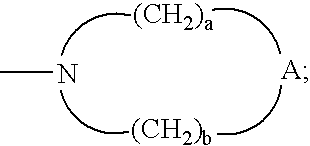
- Z is selected from the group consisting of —O— and —S(O) 0-2—; and
- a and b are independently integers from 1 to 4 with the proviso that when A is —O—, —N(R 6)—, —N(Y—R4)—, or —N(X—N(R6)—Y—R4)— then a and b are independently integers from 2 to 4;
- or a pharmaceutically acceptable salt thereof.
- In some embodiments of Formula II-1, R 1 is selected from the group consisting of —R4, —Y—R4, and —X—N(R6)—Y—R4 wherein Y is —C(R7)—, —S(O)2—, or —C(R7)—N(R9)—.
- In certain embodiments of Formula II-1, R 1 is selected from the group consisting of hydrogen, alkyl, alkenyl, arylalkylenyl, arylalkenylenyl, heteroarylalkylenyl, heteroarylalkenylenyl, aminoalkylenyl, alkoxyalkylenyl, acyl, alkylsulfonylaminoalkylenyl, arylsulfonylaminoalkylenyl, alkylaminocarbonyl, arylaminocarbonyl, (arylalkylenyl)aminoalkylenyl, and arylaminocarbonylaminoalkylenyl.
- In certain embodiments of Formula II-1, R 1 is selected from the group consisting of hydrogen, methyl, isopropyl, butyl, 2-methylpropyl, 1-ethylpropyl, 3-methylbutyl, cyclohexyl, benzyl, cinnamyl, furan-2-ylmethyl, and —CH2CH2CH2—NHR13, wherein R13 is selected from the group consisting of methanesulfonyl, phenylsulfonyl, benzyl, and phenylaminocarbonyl.
- In certain embodiments of Formula II-1, R 1 is selected from the group consisting of hydrogen, methyl, isopropyl, butyl, 2-methylpropyl, l-ethylpropyl, 3-methylbutyl, cyclohexyl, benzyl, 3-phenylpropyl, cinnamyl, furan-2-ylmethyl, and —CH2CH2CH2—NHR13, wherein R13 is selected from the group consisting of methanesulfonyl, phenylsulfonyl, benzyl, isopropylaminocarbonyl, and phenylaminocarbonyl.
- In some embodiments of Formula II-1, R 1′ is hydrogen.
- In some embodiments of Formula II-1, R 1 and R1′ are each independently alkyl.
- In some embodiments of Formula II-1, R 1 and R1′ join to form the group:

- In some embodiments of Formula II-1, R 2 is selected from the group consisting of hydrogen, alkyl, and alkoxyalkylenyl, in certain embodiments R2 is selected from the group consisting of hydrogen, butyl, 2-methoxyethyl, and ethoxymethyl, and in certain embodiments R2 is selected from the group consisting of hydrogen, methyl, propyl, butyl, 2-methoxyethyl, and ethoxymethyl.
- In some embodiments of Formula II-1, n is 0.
- The present invention also provides compounds that are useful as intermediates in the synthesis of compounds of Formula I, I-1, I-2, I-3, II, and/or II-1. These intermediate compounds have the structural Formulas VII, IX, X, XLII, and XLIII described below.
- The present invention provides intermediate compounds of the following Formula (VII):

- wherein:
- each R B is independently selected from the group consisting of alkyl, alkoxy, halogen, hydroxy, and trifluoromethyl;
- n is an integer from 0 to 4;
- R 2 is selected from the group consisting of:
- -hydrogen,
- -alkyl,
- -alkenyl,
- -aryl,
- -heteroaryl,
- -heterocyclyl,
- -alkylene-Z-alkyl,
- -alkylene-Z-aryl,
- -alkylene-Z-alkenyl, and
- -alkyl or alkenyl substituted by one or more substituents selected from the group consisting of:
- —OH,
- -halogen,
- —N(R 6)2,
- —C(R 7)—N(R6)2,
- —S(O) 2—N(R6)2,
- —N(R 6)—C(R7)—C1-10 alkyl,
- —N(R 6)—S(O)2—C1-10 alkyl,
- —C(O)—C 1-10 alkyl,
- —C(O)—O—C 1-10 alkyl,
- —N 3,
- -aryl,
- -heteroaryl,
- -heterocyclyl,
- —C(O)-aryl, and
- —C(O)-heteroaryl;
- each R 6 is independently selected from the group consisting of hydrogen, alkyl, and arylalkylenyl;
- R 7 is selected from the group consisting of ═O and ═S; and
- Z is selected from the group consisting of —O— and —S(O) 0-2—;
- or a pharmaceutically acceptable salt thereof.
- The present invention also provides intermediate compounds of the following Formula (IX):

- wherein:
- each R B is independently selected from the group consisting of alkyl, alkoxy, halogen, hydroxy, and trifluoromethyl;
- n is an integer from 0 to 4;
- R 1′ is hydrogen or alkyl;
- R 1 is selected from the group consisting of:
- —R 4,
- —Y—R 4,
- —X—R 5,
- —X—N(R 6)—Y—R4,
- —X—C(R 7)—N(R6)—R4, and
- —X—O—R 4;
- or R 1′ and R1 together with the nitrogen atom to which they are bonded can join to form a group selected from the group consisting of:

- R 2 is selected from the group consisting of:
- -hydrogen,
- -alkyl,
- -alkenyl,
- -aryl,
- -heteroaryl,
- -heterocyclyl,
- -alkylene-Z-alkyl,
- -alkylene-Z-aryl,
- -alkylene-Z-alkenyl, and
- -alkyl or alkenyl substituted by one or more substituents selected from the group consisting of:
- —OH,
- -halogen,
- —N(R 6)2,
- —C(R 7)—N(R6)2,
- —S(O) 2—N(R6)2,
- —N(R 6)—C(R7)—C1-10 alkyl,
- —N(R 6)—S(O)2—C1-10 alkyl,
- —C(O)—C 1-10 alkyl,
- —C(O)—O—C 1-10 alkyl,
- —N 3,
- -aryl,
- -heteroaryl,
- -heterocyclyl,
- —C(O)-aryl, and
- —C(O)-heteroaryl;
- R 4 is selected from the group consisting of hydrogen, alkyl, alkenyl, alkynyl, aryl, heteroaryl, and heterocyclyl wherein the alkyl, alkenyl, alkynyl, aryl, heteroaryl, and heterocyclyl groups can be unsubstituted or substituted by one or more substituents independently selected from the group consisting of alkyl, alkoxy, haloalkyl, haloalkoxy, halogen, nitro, hydroxy, mercapto, cyano, carboxy, formyl, aryl, aryloxy, arylalkoxy, heteroaryl, heteroaryloxy, heteroarylalkoxy, heterocyclyl, heterocyclylalkylenyl, amino, alkylamino, (arylalkylenyl)amino, dialkylamino, and in the case of alkyl, alkenyl, alkynyl, and heterocyclyl, oxo, with the proviso that when R4 is a substituted alkyl group and the substituent contains a hetero atom which bonds directly to the alkyl group then the alkyl group contains at least two carbons between the substituent and the nitrogen atom to which R1 is bonded;
- R 5 is selected from the group consisting of

- each R 6 is independently selected from the group consisting of hydrogen, alkyl, and arylalkylenyl;
- each R 7 is independently selected from the group consisting of ═O and ═S;
- R 8 is C2-7 alkylene;
- A is selected from the group consisting of —CH(R 6)—, —O—, —N(R6)—, —N(Y—R4)—, and —N(X—N(R)—Y—R4)—;
- X is C 2-20 alkylene;
- Y is selected from the group consisting of —C(R 7)—, —C(R7)—O—, —S(O)2—, —S(O)2—N(R6)—, and —C(R7)—N(R9)—; wherein R9 is selected from the group consisting of hydrogen, alkyl, and arylalkylenyl; or R9 and R4 together with the nitrogen atom to which R9 is bonded can join to form the group

- Z is selected from the group consisting of —O— and —S(O) 0-2—; and
- a and b are independently integers from 1 to 4 with the proviso that when A is —O—, —N(R 6)—, —N(Y—R4)—, or —N(X—N(R6)—Y—R4)— then a and b are independently integers from 2 to 4;
- or a pharmaceutically acceptable salt thereof.
- The present invention also provides intermediate compounds of the following Formula (X):

- wherein:
- each R B is independently selected from the group consisting of alkyl, alkoxy, halogen, hydroxy, and trifluoromethyl;
- n is an integer from 0 to 4;
- R 1′ is hydrogen or alkyl;
- R 1a is selected from the group consisting of:
- —R 4a,
- —Y—R 4a,
- —X—R 5,
- —X—N(R 6)—Y—R4a,
- —X—C(R 7)—N(R6)—R4a, and
- —X—O—R 4a;
- or R 1′ and R1a together with the nitrogen atom to which they are bonded can join to form a group selected from the group consisting of:

- R 2a is selected from the group consisting of:
- -hydrogen,
- -alkyl,
- -alkenyl,
- -aryl,
- -alkylene-Z″-alkyl,
- -alkylene-Z″-aryl,
- -alkylene-Z″-alkenyl, and
- -alkyl or alkenyl substituted by one or more substituents selected from the group consisting of:
- —OH,
- -halogen,
- —N(R 6)2,
- —C(R 7)—N(R6)2,
- —S(O) 2—N(R6)2,
- —N(R 6)—C(R7)—C1-10 alkyl,
- —N(R 6)—S(O)2—C1-10 alkyl,
- —C(O)—C 1-10 alkyl,
- —C(O)—O—C 1-10 alkyl,
- —N 3,
- -aryl,
- -heterocyclyl, and
- —C(O)-aryl;
- R 4a is selected from the group consisting of hydrogen, alkyl, alkenyl, alkynyl, aryl, and heterocyclyl wherein the alkyl, alkenyl, alkynyl, aryl, and heterocyclyl groups can be unsubstituted or substituted by one or more substituents independently selected from the group consisting of alkyl, alkoxy, haloalkyl, haloalkoxy, halogen, nitro, hydroxy, cyano, carboxy, formyl, aryl, aryloxy, arylalkoxy, heterocyclyl, heterocyclylalkylenyl, amino, alkylamino, (arylalkylenyl)amino, dialkylamino, and in the case of alkyl, alkenyl, alkynyl, and heterocyclyl, oxo, with the proviso that when R4a is a substituted alkyl group and the substituent contains a hetero atom which bonds directly to the alkyl group then the alkyl group contains at least two carbons between the substituent and the nitrogen atom to which R1 is bonded;
- R 5 is selected from the group consisting of

- each R 6 is independently selected from the group consisting of hydrogen, alkyl, and arylalkylenyl;
- each R 7 is independently selected from the group consisting of ═O and ═S;
- R 8 is C2-7 alkylene;
- A is selected from the group consisting of —CH(R 6)—, —O—, —N(R6)—, —N(Y—R4)—, and —N(X—N(R6)—Y—R4)—;
- X is C 2-20 alkylene;
- Y is selected from the group consisting of —C(R 7)—, —C(R7)—O—, —S(O)2—, —S(O)2—N(R6)—, and —C(R7)—N(R9)—; wherein R9 is selected from the group consisting of hydrogen, alkyl and arylalkylenyl, or R9 and R4 together with the nitrogen atom to which R9 is bonded can join to form the group

- Z″ is selected from the group consisting of —O— and —S(O) 2—; and
- a and b are independently integers from 1 to 4 with the proviso that when A is —O—, —N(R 6)—, —N(Y—R4)—, or —N(X—N(R6)—Y—R4)— then a and b are independently integers from2to4;
- or a pharmaceutically acceptable salt thereof.
- The present invention also provides intermediate compounds of the following Formula (XLII):

- wherein:
- R is selected from the group consisting of alkyl, alkenyl, alkoxy, halogen, fluoroalkyl, hydroxy, amino, alkylamino, and dialkylamino;
- l is 0 or 1;
- R 2 is selected from the group consisting of:
- -hydrogen,
- -alkyl,
- -alkenyl,
- -aryl,
- -heteroaryl,
- -heterocyclyl,
- -alkylene-Z-alkyl,
- -alkylene-Z-aryl,
- -alkylene-Z-alkenyl, and
- -alkyl or alkenyl substituted by one or more substituents selected from the group consisting of:
- —OH,
- -halogen,
- —N(R 6)2.
- —C(R 7)—N(R6)2,
- —S(O) 2—N(R6)2,
- —N(R 6)—C(R7)—C1-10 alkyl,
- —N(R)—S(O) 2—C1-10 alkyl,
- —C(O)—C 1-10 alkyl,
- —C(O)—O—C 1-10 alkyl,
- —N 3,
- -aryl,
- -heteroaryl,
- -heterocyclyl,
- —C(O)-aryl, and
- —C(O)-heteroaryl;
- each R 6 is independently selected from the group consisting of hydrogen, alkyl, and arylalkylenyl;
- R 7 is selected from the group consisting of ═O and ═S; and
- Z is selected from the group consisting of —O— and —S(O) 0-2—;
- or a pharmaceutically acceptable salt thereof.
- The present invention also provides intermediate compounds of the following Formula (XLIII):

- wherein:
- R is selected from the group consisting of alkyl, alkenyl, alkoxy, halogen, fluoroalkyl, hydroxy, amino, alkylamino, and dialkylamino;
- l is 0 or 1;
- R 1′ is hydrogen or alkyl;
- R 1 is selected from the group consisting of:
- —R 4,
- —Y—R 4,
- —X—R 5,
- —X—N(R 6)—Y—R4,
- —X—C(R 7)—N(R6)—R4, and
- —X—O—R 4;
- or R 1′ and R1 together with the nitrogen atom to which they are bonded can join to form a group selected from the group consisting of:

- R 2 is selected from the group consisting of:
- -hydrogen,
- -alkyl,
- -alkenyl,
- -aryl,
- -heteroaryl,
- -heterocyclyl,
- -alkylene-Z-alkyl,
- -alkylene-Z-aryl,
- -alkylene-Z-alkenyl, and
- -alkyl or alkenyl substituted by one or more substituents selected from the group consisting of:
- —OH,
- -halogen,
- —N(R 6)2,
- —C(R 7)—N(R6)2,
- —S(O) 2—N(R6)2,
- —N(R 6)—C(R7)—C1-10 alkyl,
- —N(R 6)—S(O)2—C1-10 alkyl,
- —C(O)—C 1-10 alkyl,
- —C(O)—O—C 1-10 alkyl,
- —N 3,
- -aryl,
- -heteroaryl,
- -heterocyclyl,
- —C(O)-aryl, and
- —C(O)-heteroaryl;
- R 4 is selected from the group consisting of hydrogen, alkyl, alkenyl, alkynyl, aryl, heteroaryl, and heterocyclyl wherein the alkyl, alkenyl, alkynyl, aryl, heteroaryl, and heterocyclyl groups can be unsubstituted or substituted by one or more substituents independently selected from the group consisting of alkyl, alkoxy, haloalkyl, haloalkoxy, halogen, nitro, hydroxy, mercapto, cyano, carboxy, formyl, aryl, aryloxy, arylalkoxy, heteroaryl, heteroaryloxy, heteroarylalkoxy, heterocyclyl, heterocyclylalkylenyl, amino, alkylamino, (arylalkylenyl)amino, dialkylamino, and in the case of alkyl, alkenyl, alkynyl, and heterocyclyl, oxo, with the proviso that when R4 is a substituted alkyl group and the substituent contains a hetero atom which bonds directly to the alkyl group then the alkyl group contains at least two carbons between the substituent and the nitrogen atom to which R1 is bonded;
- R 5 is selected from the group consisting of

- each R 6 is independently selected from the group consisting of hydrogen, alkyl, and arylalkylenyl;
- each R 7 is independently selected from the group consisting of ═O and ═S;
- R 8 is C2-7 alkylene;
- A is selected from the group consisting of —CH(R 6)—, —O—, —N(R6)—, —N(Y—R4)—, and —N(X—N(R6)—Y—R4)—,
- X is C 2-20 alkylene;
- Y is selected from the group consisting of —C(R 7)—, —C(R7)—O—, —S(O)2—, —S(O)2—N(R6)—, and —C(R7)—N(R9)—; wherein R9 is selected from the group consisting of hydrogen, alkyl, and arylalkylenyl; or R9 and R4 together with the nitrogen atom to which R9 is bonded can join to form the group

- Z is selected from the group consisting of —O— and —S(O) 0-2—; and
- a and b are independently integers from 1 to 4 with the proviso that when A is —O—, —N(R 6)—, —N(Y—R4)—, or —N(X—N(R6)—Y—R4)— then a and b are independently integers from 2 to 4;
- or a pharmaceutically acceptable salt thereof.
- Herein, “non-interfering” means that the ability of the compound or salt to modulate (e.g., induce or inhibit) the biosynthesis of one or more cytokines is not destroyed by the non-interfering substitutent. Illustrative non-interfering R″ groups include those described above for R 2 in Formulas I-1, I-2, and II-1, and for R2A in Formula I-3. Illustrative non-interfering R′″ groups include those described above for R and R3 in Formula I-1, and for RB in Formulas I-2 and I-3.
- As used herein, the terms “alkyl,” “alkenyl,” “alkynyl” and the prefix “alk-” are inclusive of both straight chain and branched chain groups and of cyclic groups, i.e. cycloalkyl and cycloalkenyl. Unless otherwise specified, these groups contain from 1 to 20 carbon atoms, with alkenyl groups containing from 2 to 20 carbon atoms, and alkynyl groups containing from 2 to 20 carbon atoms. In some embodiments, these groups have a total of up to 10 carbon atoms, up to 8 carbon atoms, up to 6 carbon atoms, or up to 4 carbon atoms. Cyclic groups can be monocyclic or polycyclic and preferably have from 3 to 10 ring carbon atoms. Exemplary cyclic groups include cyclopropyl, cyclopropylmethyl, cyclopentyl, cyclohexyl, adamantyl, and substituted and unsubstituted bornyl, norbornyl, and norbornenyl.
- Unless otherwise specified, “alkylene,” “alkenylene,” and “alkynylene” are the divalent forms of the “alkyl,” “alkenyl,” and “alkynyl” groups defined above. Likewise, “alkylenyl,” “alkenylenyl,” and “alkynylenyl” are the divalent forms of the “alkyl,” “alkenyl,” and “alkynyl” groups defined above. For example, an arylalkylenyl group comprises an alkylene moiety to which an aryl group is attached.
- The term “haloalkyl” is inclusive of alkyl groups that are substituted by one or more halogen atoms, including perfluorinated groups. This is also true of other groups that include the prefix “halo-”. Examples of suitable haloalkyl groups are chloromethyl, trifluoromethyl, and the like. Similarly, the term “fluoroalkyl” is inclusive of groups that are substituted by one or more fluorine atoms, including perfluorinated groups (e.g., trifluoromethyl).
- The term “aryl” as used herein includes carbocyclic aromatic rings or ring systems. Examples of aryl groups include phenyl, naphthyl, biphenyl, fluorenyl and indenyl.
- The term “heteroatom” refers to the atoms O, S, or N.
- The term “heteroaryl” includes aromatic rings or ring systems that contain at least one ring heteroatom (e.g., O, S, N). Suitable heteroaryl groups include furyl, thienyl, pyridyl, quinolinyl, isoquinolinyl, indolyl, isoindolyl, triazolyl, pyrrolyl, tetrazolyl, imidazolyl, pyrazolyl, oxazolyl, thiazolyl, benzofuranyl, benzothiophenyl, carbazolyl, benzoxazolyl, pyrimidinyl, benzimidazolyl, quinoxalinyl, benzothiazolyl, naphthyridinyl, isoxazolyl, isothiazolyl, purinyl, quinazolinyl, pyrazinyl, 1-oxidopyridyl, pyridazinyl, triazinyl, tetrazinyl, oxadiazolyl, thiadiazolyl, and so on.
- The term “heterocyclyl” includes non-aromatic rings or ring systems that contain at least one ring heteroatom (e.g., O, S, N) and includes all of the fully saturated and partially unsaturated derivatives of the above mentioned heteroaryl groups. Exemplary heterocyclic groups include pyrrolidinyl, tetrahydrofuranyl, morpholinyl, thiomorpholinyl, piperidinyl, piperazinyl, thiazolidinyl, imidazolidinyl, isothiazolidinyl, tetrahydropyranyl, quinuclidinyl, homopiperidinyl, homopiperazinyl, and the like.
- The terms “arylene,” “heteroarylene,” and “heterocyclylene” are the divalent forms of the “aryl,” “heteroaryl,” and “heterocyclyl” groups defined above. Likewise, “arylenyl,” “heteroarylenyl,” and “heterocyclylenyl” are the divalent forms of the “aryl,” “heteroaryl,” and “heterocyclyl” groups defined above. For example, an alkylarylenyl group comprises an arylene moiety to which an alkyl group is attached.
- When a group or substituent is present more that once in any Formula described herein, each group or substituent is independently selected, whether specifically stated or not.
- The invention is inclusive of the compounds described herein and salts thereof in any of their pharmaceutically acceptable forms, including isomers such as diastereomers and enantiomers, solvates, polymorphs, and the like. In particular, if a compound is optically active, the invention specifically includes each of the compound's enantiomers as well as racemic mixtures of the enantiomers.
- Preparation of the Compounds
- Compounds of the invention can be prepared according to Reaction Scheme I wherein R, R 1a, R2a, and n are as defined above.
- In step (1) of Reaction Scheme I, a 4-chloro-3-nitroquinoline of Formula III is reacted with tert-butyl carbazate or an alternate carbazate to provide a carbazate compound of Formula IV. The reaction can be carried out by adding tert-butyl carbazate to a solution of a compound of Formula III in a suitable solvent such as anhydrous dichloromethane in the presence of a base such as triethylamine. The reaction can be run at ambient temperature. The product or a pharmaceutically acceptable salt thereof can be isolated by conventional methods. Many compounds of Formula III are known or can be prepared using known synthetic methods, see for example, U.S. Pat. Nos. 4,689,338; 5,175,296; 5,367,076; and 5,389,640; and the documents cited therein. Tertiary-butyl carbazate is commercially available (for example, from Aldrich, Milwaukee, Wis.). Many alternate carbazate reagents (for example, benzyl carbazate) may be prepared using known synthetic methods.
- In step (2) of Reaction Scheme I a carbazate compound of Formula IV is reduced to provide a compound of Formula V. The reduction can be carried out using a conventional heterogeneous hydrogenation catalyst such as platinum on carbon or palladium on carbon. For some compounds of Formula IV, for example, compounds in which R is halogen, a platinum catalyst is preferred. The reaction can be conveniently carried out on a Parr apparatus in a suitable solvent such as toluene and/or isopropanol. The product or a pharmaceutically acceptable salt thereof can be isolated by conventional methods.
- Other reduction processes may be used for the reduction in step (2). For example, an aqueous solution of sodium dithionite can be added to a solution or suspension of the compound of Formula IV in a suitable solvent such as ethanol or isopropanol. The reaction can be carried out at an elevated temperature, for example at reflux, or at ambient temperature.
- In step (3) of Reaction Scheme I a compound of Formula V is (i) reacted with an acyl halide of Formula R 2aC(O)Cl or R2aC(O)Br and then (ii) cyclized to provide a 1H-imidazo compound of Formula VI. In part (i) the acyl halide is added to a solution of a compound of Formula V in a suitable solvent such as anhydrous dichloromethane in the presence of a base such as triethylamine. The reaction can be run at a reduced temperature, for example, 0° C., or at ambient temperature. In part (ii) the product of part (i) is heated in an alcoholic solvent in the presence of a base. For example, the product of part (i) is refluxed in ethanol in the presence of excess triethylamine or is heated with methanolic ammonia.
- Alternatively, step (3) can be carried out by reacting a compound of Formula V with a carboxylic acid or an equivalent thereof. Suitable equivalents to carboxylic acid include orthoesters and 1,1-dialkoxyalkyl alkanoates. The carboxylic acid or equivalent is selected such that it will provide the desired R 2a substituent in a compound of Formula VI. For example, triethyl orthoformate will provide a compound where R2a is hydrogen, and triethyl orthovalerate will provide a compound where R2a is butyl. The reaction can be run in the absence of solvent or in an inert solvent such as anhydrous toluene. The reaction is run with sufficient heating to drive off any alcohol or water formed as a byproduct of the reaction. Optionally a catalyst such as pyridine hydrochloride can be included. The product or a pharmaceutically acceptable salt thereof can be isolated by conventional methods.
- In step (4) of Reaction Scheme I, the tert-butoxycarbonyl or alternate oxycarbonyl group is removed from a 1H-imidazo compound of Formula VI by hydrolysis under acidic conditions to provide a 1H-imidazo[4,5-c]quinolin-l-amine of Formula VIIa or a salt (for example, hydrochloride salt) thereof. For example, a compound of Formula VI is dissolved in 1.5M HCl in ethanol and heated to reflux. The product or a pharmaceutically acceptable salt thereof can be isolated by conventional methods.
- In step (5a) of Reaction Scheme I, a 1H-imidazo[4,5-c]quinolin-1-amine of Formula VIIa or a salt thereof is treated with a ketone, aldehyde, or corresponding ketal or acetal thereof, under acidic conditions to provide a compound of Formula VIII. For example, a ketone is added to a solution of the hydrochloride salt of a compound of Formula VIIa in a suitable solvent such as isopropanol in the presence of an acid or acid resin, for example, DOWEX W50-X1 acid resin. The ketone, aldehyde, or corresponding ketal or acetal thereof, is selected with R i and Rii groups that will provide the desired R1a substituent in a 1H-imidazo[4,5-c]quinolin-1-amine compound of Formula IXa. For example, acetone will provide a compound where R1a is isopropyl, and benzaldehyde will provide a compound where R1a is benzyl. The reaction is run with sufficient heating to drive off the water formed as a byproduct of the reaction. The product or a pharmaceutically acceptable salt thereof can be isolated by conventional methods.
- In step (6) of Reaction Scheme I, a compound of Formula VIII is reduced to provide a 1H-imidazo[4,5-c]quinolin-1-amine compound of Formula IXa. The reaction can be carried out by adding sodium borohydride to a solution of a compound of Formula VIII in a suitable solvent, for example, methanol. The reaction can be run at ambient temperature. The product or a pharmaceutically acceptable salt thereof can be isolated by conventional methods.
- Alternatively, in step (5b) of Reaction Scheme I, a 1H-imidazo[4,5-c]quinolin-1-amine of Formula VIIa can be treated with a ketone and a borohydride under acidic conditions to provide a 1H-imidazo[4,5-c]quinolin-1-amine compound of Formula IXa. For example, the hydrochloride salt of a 1H-imidazo[4,5-c]quinolin-1-amine of Formula VIIa, dissolved in a suitable solvent such as 1,2-dichloroethane, can be treated with a ketone and sodium triacetoxyborohydride at room temperature. The product or a pharmaceutically acceptable salt thereof can be isolated by conventional methods.
- In step (7) of Reaction Scheme I, a 1H-imidazo[4,5-c]quinolin-1-amine compound of Formula IXa is oxidized to provide an N-oxide of Formula Xa using a conventional oxidizing agent that is capable of forming N-oxides. The reaction is carried out by treating a solution of a compound of Formula IXa in a suitable solvent such as chloroform or dichloromethane with 3-chloroperoxybenzoic acid at ambient temperature. The product or a pharmaceutically acceptable salt thereof can be isolated by conventional methods.
- In step (8) of Reaction Scheme I, an N-oxide of Formula Xa is aminated to provide a 1H-imidazo[4,5-c]quinoline-1,4-diamine of the Formula Ia, which is a subgenus of compounds of the Formulas I, I-1, I-2, and I-3. The reaction is carried out in two parts. In part (i) a compound of Formula Xa is reacted with an acylating agent. Suitable acylating agents include alkyl- or arylsulfonyl chorides (e.g., benzenesulfonyl choride, methanesulfonyl choride, and p-toluenesulfonyl chloride). In part (ii) the product of part (i) is reacted with an excess of an aminating agent. Suitable aminating agents include ammonia (e.g. in the form of ammonium hydroxide) and ammonium salts (e.g., ammonium carbonate, ammonium bicarbonate, ammonium phosphate). The reaction can be carried out by dissolving a compound of Formula Xa in a suitable solvent such as dichloromethane, adding ammonium hydroxide to the solution, and then adding p-toluenesulfonyl chloride. The product or a pharmaceutically acceptable salt thereof can be isolated using conventional methods.
- Alternatively, the oxidation of step (7) and the amination of step (8) can be carried out sequentially without isolating the product of the oxidation to provide a 1H-imidazo[4,5-c]quinoline-1,4-diamine of the Formula Ia. In step (7), after the 1H-imidazo[4,5-c]quinolin-1-amine compound of Formula IXa is consumed by reaction with 3-chloroperoxybenzoic acid as described in step (7), the aminating and acylating agents are added to the reaction mixture as in step (8). The product or a pharmaceutically acceptable salt thereof can be isolated using conventional methods.

- Compounds of the invention can be prepared according to Reaction Scheme II wherein R, R 1, R2a and n are as defined above.
- In step (1) of Reaction Scheme II, a 1H-imidazo compound of Formula VI is oxidized to provide an N-oxide of Formula XI using the method of step (7) in Reaction Scheme I. The product or a pharmaceutically acceptable salt thereof can be isolated by conventional methods.
- In step (2) of Reaction Scheme II, an N-oxide of Formula XI is aminated using the method of step (8) in Reaction Scheme I to provide a 4-amino compound of the Formula XIIa. The product or a pharmaceutically acceptable salt thereof can be isolated using conventional methods.
- In step (3) of Reaction Scheme II, the tert-butoxycarbonyl or alternate oxycarbonyl group is removed from a 4-amino compound of the Formula XIIa using the method of step (4) in Reaction Scheme I to provide a 1H-imidazo[4,5-c]quinoline-1,4-diamine of Formula XIIIa or a salt (for example, hydrochloride salt) thereof. The product or a pharmaceutically acceptable salt thereof can be isolated by conventional methods.
- In step (4a) of Reaction Scheme II, a 1H-imidazo[4,5-c]quinoline-1,4-diamine of Formula XIIIa is treated with a ketone, aldehyde, or corresponding ketal or acetal thereof, using the method of step (5a) in Reaction Scheme I to provide a compound of Formula XIVa. The ketone, aldehyde, or corresponding ketal or acetal thereof, is selected with R i and Rii groups that will provide the desired R1 substituent in a 1H-imidazo[4,5-c]quinoline-1,4-diamine compound of Formula Ib. The product or a pharmaceutically acceptable salt thereof can be isolated by conventional methods.
- In step (5) of Reaction Scheme II, a compound of Formula XIVa is reduced to provide a 1H-imidazo[4,5-c]quinolin-1-amine compound of Formula Ib using the method of step (6) in Reaction Scheme I. The product or a pharmaceutically acceptable salt thereof can be isolated by conventional methods.
- Alternatively, in step (4b) of Reaction Scheme II, a 1H-imidazo[4,5-c]quinoline-1,4-diamine of Formula XIIIa can be treated with a ketone and a borohydride using the method of step (5b) of Reaction Scheme I to provide a 1H-imidazo[4,5-c]quinolin-1-amine compound of Formula Ib, which is a subgenus of compounds of the Formulas I, I-1, I-2, and I-3. The product or a pharmaceutically acceptable salt thereof can be isolated by conventional methods.

- Compounds of the invention can be prepared according to Reaction Scheme III wherein R, R 1′, R1a, R2a, and n are as defined above.
- In step (1) of Reaction Scheme III, a 4-chloro-3-nitroquinoline of Formula III is reacted with a hydrazino compound of Formula XVa to provide a compound of Formula XVI. The reaction can be carried out by adding the hydrazino compound of Formula XVa to a solution of a compound of Formula III in a suitable solvent such as anhydrous dichloromethane in the presence of a base such as triethylamine. The reaction can be run at ambient temperature. The product or a pharmaceutically acceptable salt thereof can be isolated by conventional methods. Many hydrazino compounds of Formula XVa are commercially available; others can be readily prepared using known synthetic methods.
- In step (2) of Reaction Scheme III, a compound of Formula XVI is reduced to provide a compound of Formula XVII using the methods of step (2) in Reaction Scheme I. The product or a pharmaceutically acceptable salt thereof can be isolated by conventional methods.
- In step (3) of Reaction Scheme III, a compound of formula XVII is cyclized using the methods of step (3) in Reaction Scheme I to provide a 1H-imidazo[4,5-c]quinolin-1-amine compound of Formula IXb. The product of step (i) (described in step (3) of Reaction Scheme I) can be isolated to provide a compound of the following formula:

- In part (ii) the product of part (i) can be refluxed in suitable solvent such as toluene in the presence of pyridine hydrochloride. The product or a pharmaceutically acceptable salt thereof can be isolated by conventional methods.
- In step (4) of Reaction Scheme III, a 1H-imidazo[4,5-c]quinolin-1-amine compound of Formula IXb is oxidized to provide an N-oxide of Formula X using the method of step (7) in Reaction Scheme I. The product or a pharmaceutically acceptable salt thereof can be isolated by conventional methods.
- In step (5) of Reaction Scheme III, an N-oxide of Formula X is aminated using the method of step (8) in Reaction Scheme I to provide a 1H-imidazo[4,5-c]quinoline-1,4-diamine of the Formula Ic, which is a subgenus of compounds of the Formulas I, I-1, I-2, and I-3. The product or a pharmaceutically acceptable salt thereof can be isolated using conventional methods.
- Alternatively, the oxidation of step (4) and the amination of step (5) can be carried out sequentially without isolating the product of the oxidation to provide a 1H-imidazo[4,5-c]quinoline-1,4-diamine of the Formula Ic. In step (4), after the 1H-imidazo[4,5-c]quinolin-1-amine compound of Formula IXb is consumed by reaction with 3-chloroperoxybenzoic acid as described in step (4), the aminating and acylating agents are added to the reaction mixture as in step (5). The product or a pharmaceutically acceptable salt thereof can be isolated using conventional methods.

- Compounds of the invention can be prepared according to Reaction Scheme IV wherein R, R 1, R2 and n are as defined above.
- In step (1) of Reaction Scheme IV, a 2,4-dichloro-3-nitroquinoline of Formula XVIII is reacted with tert-butyl carbazate or an alternate carbazate to provide a carbazate compound of Formula XIX. The reaction can be carried out by adding tert-butyl carbazate or an alternate carbazate to a solution of a 2,4-dichloro-3-nitroquinoline of Formula XVIII in a suitable solvent such as anhydrous dichloromethane in the presence of a base such as triethylamine. The reaction can be run at ambient temperature. The product or a pharmaceutically acceptable salt thereof can be isolated by conventional methods. Many quinolines of Formula XVIII are known or can be prepared using known synthetic methods (see for example, Andre et al., U.S. Pat. No. 4,988,815 and references cited therein).
- In step (2) of Reaction Scheme IV, a carbazate compound of Formula XIX is reduced to provide a 2-chloroquinolin-3-amine of Formula XX using the method of step (2) in Reaction Scheme I. The product or a pharmaceutically acceptable salt thereof can be isolated by conventional methods.
- In step (3) of Reaction Scheme IV, a 2-chloroquinolin-3-amine of Formula XX is reacted with an acyl halide of formula R 2C(O)Cl or R2C(O)Br, or a carboxylic acid or equivalent thereof, using the methods of step (3) in Reaction Scheme I to provide a 4-chloro-1H-imidazo[4,5-c]quinoline of Formula XXI. The carboxylic acid or equivalent is selected such that it provides the desired R2 substituent in compounds of Formula XXI. The product or a pharmaceutically acceptable salt thereof can be isolated by conventional methods.
- In step (4) of Reaction Scheme IV, the tert-butoxycarbonyl or alternate oxycarbonyl group is removed from a 4-chloro-1H-imidazo[4,5-c]quinoline of Formula XXI using the method of step (4) of Reaction Scheme I to provide a 4-chloro-1H-imidazo[4,5-c]quinolin-1-amine of Formula XXII or a salt thereof. The product or a pharmaceutically acceptable salt thereof can be isolated by conventional methods.
- In step (5a) of Reaction Scheme IV, a 4-chloro-1H-imidazo[4,5-c]quinolin-1-amine of Formula XXII or a salt thereof is treated with a ketone, aldehyde, or corresponding ketal or acetal using the method of step (5a) of Reaction Scheme I to provide a compound of Formula XXIII. The ketone, aldehyde, or corresponding ketal or acetal thereof, is selected with R i and Rii groups that will provide the desired R1 substituent in a 4-chloro-1H-imidazo[4,5-c]quinolin-1-amine compound of Formula XXIVa. The product or a pharmaceutically acceptable salt thereof can be isolated by conventional methods.
- In step (6) of Reaction Scheme IV, a compound of Formula XXIII is reduced using the method of step (6) in Reaction Scheme I to provide a 4-chloro-1H-imidazo[4,5-c]quinolin-1-amine compound of Formula XXIVa. The product or a pharmaceutically acceptable salt thereof can be isolated by conventional methods.
- Alternatively, in step (5b) of Reaction Scheme IV, a 4-chloro-1H-imidazo[4,5-c]quinolin-1-amine of Formula XXII can be treated with a ketone and a borohydride using the method of step (5b) in Reaction Scheme I to provide a 4-chloro-1H-imidazo[4,5-c]quinolin-1-amine compound of Formula XXIVa. The product or a pharmaceutically acceptable salt thereof can be isolated by conventional methods.
- In step (7) of Reaction Scheme IV, a 4-chloro-1H-imidazo[4,5-c]quinolin-1-amine of Formula XXIVa is aminated to provide a 1H-imidazo[4,5-c]quinoline-1,4-diamine of Formula Id, which is a subgenus of compounds of the Formulas I, I-1, I-2, and I-3. The reaction is carried out by heating (e.g., 125-175° C.) a compound of Formula XXIVa under pressure in a sealed reactor in the presence of a solution of ammonia in an alkanol. The product or a pharmaceutically acceptable salt thereof can be isolated using conventional methods.

- Compounds of the invention can be prepared according to Reaction Scheme V wherein R, R 1, R2 and n are as defined above.
- In step (1) of Reaction Scheme V, a 4-chloro-1H-imidazo[4,5-c]quinoline of Formula XXI is aminated, using the method of step (7) in Reaction Scheme IV, to provide a 4-amino compound of the Formula XII. The product or a pharmaceutically acceptable salt thereof can be isolated by conventional methods.
- In step (2) of Reaction Scheme V, the tert-butoxycarbonyl or alternate oxycarbonyl group is removed from a 4-amino compound of the Formula XII using the method of step (4) of Reaction Scheme I to provide a 1H-imidazo[4,5-c]quinoline-1,4-diamine of Formula XIII or a salt thereof. The product or a pharmaceutically acceptable salt thereof can be isolated by conventional methods.
- In step (3a) of Reaction Scheme V, a 1H-imidazo[4,5-c]quinoline-1,4-diamine of Formula XIII or a salt thereof is treated with a ketone, aldehyde, or corresponding ketal or acetal using the method of step (5a) of Reaction Scheme I to provide a compound of Formula XIV. The ketone, aldehyde, or corresponding ketal or acetal thereof, is selected with R i and Rii groups that will provide the desired R1 substituent in a 1H-imidazo[4,5-c]quinoline-1,4-diamine compound of Formula Id. The product or a pharmaceutically acceptable salt thereof can be isolated by conventional methods.
- In step (4) of Reaction Scheme V, a compound of Formula XIV is reduced using the method of step (6) in Reaction Scheme I to provide a 1H-imidazo[4,5-c]quinoline-1,4-diamine compound of Formula Id, which is a subgenus of compounds of the Formulas I, I-1, I-2, and I-3. The product or a pharmaceutically acceptable salt thereof can be isolated by conventional methods.
- Alternatively, in step (3b) of Reaction Scheme V, a 1H-imidazo[4,5-c]quinoline-1,4-diamine of Formula XIII or a salt thereof can be treated with a ketone and a borohydride using the method of step (5b) in Reaction Scheme I to provide a 1H-imidazo[4,5-c]quinoline-1,4-diamine compound of Formula Id. The product or a pharmaceutically acceptable salt thereof can be isolated by conventional methods.

- Compounds of the invention can also be prepared according to Reaction Scheme VI wherein R, R 1′, R1, R2 and n are as defined above.
- In step (1) of Reaction Scheme VI, a 2,4-dichloro-3-nitroquinoline of Formula XVIII is reacted with a hydrazino compound of Formula XV, using the method of step (1) in Reaction Scheme III, to provide a compound of Formula XXV. The product or a pharmaceutically acceptable salt thereof can be isolated by conventional methods.
- In step (2) of Reaction Scheme VI, a compound of Formula XXV is reduced using the method of step (2) in Reaction Scheme I to provide a compound of Formula XXVI. The product or a pharmaceutically acceptable salt thereof can be isolated by conventional methods.
- In step (3) of Reaction Scheme VI, a compound of Formula XXVI is reacted with an acyl halide of formula R 2C(O)Cl or R2C(O)Br, or a carboxylic acid or equivalent thereof using the methods of step (3) in Reaction Scheme I to provide a 4-chloro-1H-imidazo[4,5-c]quinolin-1-amine compound of Formula XXIV. The carboxylic acid or equivalent is selected such that it provides the desired R2 substituent in a compound of Formula XXIV. The product or a pharmaceutically acceptable salt thereof can be isolated by conventional methods.
- In step (4) of Reaction Scheme VI, a 4-chloro-1H-imidazo[4,5-c]quinolin-1-amine compound of Formula XXIV is aminated using the method of step (7) in Reaction Scheme IV to provide a 1H-imidazo[4,5-c]quinoline-1,4-diamine of Formula Ie, which is a subgenus of compounds of the Formulas I, I-1, I-2, and I-3. The product or a pharmaceutically acceptable salt thereof can be isolated by conventional methods.

- Compounds of the invention can be prepared according to Reaction Scheme VII wherein R, R 1′, R2a, R4, n, and Y are as defined above, and Xa is C1-20 alkylene.
- In step (1) of Reaction Scheme VII, a 1H-imidazo[4,5-c]quinolin-1-amine of Formula VIIa or a salt thereof is treated with a ketal or acetal, containing a protected amino group, using the method of step (5a) of Reaction Scheme I to provide a compound of Formula XXVII. The product or a pharmaceutically acceptable salt thereof can be isolated by conventional methods.
- The amino ketal or acetal is selected with R 1′ and X groups that will provide the desired R1′ and X groups in a 1H-imidazo[4,5-c]quinolin-1,4-diamine of Formula XXX, XXXI, or XXXII, which are subgenera of compounds of the Formulas I, I-1, I-2, and I-3. For example, tert-butyl (3,3-diethoxypropyl)carbamate will provide a compound where R1′ is hydrogen and X is ethylene. The amino group of an amino ketal or acetal can be protected with a tert-butoxycarbonyl or an alternate oxycarbonyl group. For example, 1-amino-3,3-diethoxypropane can be reacted with di-tert-butyl dicarbonate in a suitable solvent such as tetrahydrofuran (THF) in the presence of triethylamine to provide tert-butyl (3,3-diethoxypropyl)carbamate.
- In step (2) of Reaction Scheme VII, a compound of Formula XXVII is reduced using the method of step (6) in Reaction Scheme I to provide a compound of Formula XXVIII, which is a subgenus of compounds of the Formula IX. The product or a pharmaceutically acceptable salt thereof can be isolated by conventional methods.
- In step (3) of Reaction Scheme VII, a compound of Formula XXVIII is oxidized to provide an N-oxide of Formula XXIX using the method of step (7) in Reaction Scheme I. The product or a pharmaceutically acceptable salt thereof can be isolated by conventional methods.
- In step (4) of Reaction Scheme VII, an N-oxide of Formula XXIX is aminated using the method of step (8) in Reaction Scheme I to provide a 1H-imidazo[4,5-c]quinoline-1,4-diamine of the Formula XXX, which is a subgenus of compounds of the Formulas I, I-1, I-2, and I-3. The product or a pharmaceutically acceptable salt thereof can be isolated using conventional methods.
- In step (5) of Reaction Scheme VII, a the tert-butoxycarbonyl or alternate oxycarbonyl group is removed from a 1H-imidazo[4,5-c]quinoline-1,4-diamine of the Formula XXX using the method of step (4) of Reaction Scheme I to provide a 1H-imidazo[4,5-c]quinoline-1,4-diamine of the Formula XXXI, which is a subgenus of compounds of the Formulas I, I-1, I-2, and I-3. The product or a pharmaceutically acceptable salt thereof can be isolated by conventional methods.
- In step (6) of Reaction Scheme VII, a 1H-imidazo[4,5-c]quinoline-1,4-diamine of the Formula XXXI is converted to a 1H-imidazo[4,5-c]quinoline-1,4-diamine of Formula XXXII using conventional methods. For example, a 1H-imidazo[4,5-c]quinoline-1,4-diamine of the Formula XXXI can react with an acid chloride of Formula R 4C(O)Cl to provide a compound of Formula XXXII in which Y is —C(O)—. In addition, a 1H-imidazo[4,5-c]quinoline-1,4-diamine of the Formula XXXI can react with sulfonyl chloride of Formula R4S(O)2Cl or a sulfonic anhydride of Formula (R4S(O)2)2O to provide a compound of Formula XXXII in which Y is —S(O)2—. Numerous acid chlorides of Formula R4C(O)Cl, sulfonyl chlorides of Formula R4S(O)2Cl, and sulfonic anhydrides of Formula (R4S(O)2)2O are commercially available; others can be readily prepared using known synthetic methods. The reaction can be conveniently carried out by adding the acid chloride of Formula R4C(O)Cl, sulfonyl chloride of Formula R4S(O)2Cl, or sulfonic anhydride of Formula (R4S(O)2)2O to a cooled solution of a 1H-imidazo[4,5-c]quinoline-1,4-diamine of the Formula XXXI and a base such as triethylamine in a suitable solvent such as chloroform, dichloromethane, or acetonitrile. The reaction can be carried out at ambient temperature or at a sub-ambient temperature such as 0° C. The product or pharmaceutically acceptable salt thereof can be isolated using conventional methods.
- Ureas of Formula XXXII, where Y is —C(R 7)—N(R9)—, in which R7 is ═O, and R9 is as defined above, can be prepared by reacting a 1H-imidazo[4,5-c]quinoline-1,4-diamine of the Formula XXXI with isocyanates of Formula R4N=C═O. Numerous isocyanates of Formula R4N═C═O are commercially available; others can be readily prepared using known synthetic methods. The reaction can be conveniently carried out by adding the isocyanate of Formula R4N═C═O to a cooled solution of a 1H-imidazo[4,5-c]quinoline-1,4-diamine of the Formula XXXI in a suitable solvent such as dichloromethane or chloroform. The reaction can be carried out at ambient temperature or at a sub-ambient temperature such as 0° C. Alternatively, a compound of Formula XXXI can be treated with a thioisocyanate of Formula R4N═C═S, or a carbamoyl chloride of Formula R4N(R9)—C(O)Cl to provide a compound of Formula XXXII, where Y is —C(S)—N(R9)—, in which R9, is as defined above. The product or pharmaceutically acceptable salt thereof can be isolated using conventional methods.

- Compounds of the invention can be prepared according to Reaction Scheme VIII where n is as defined above; each R C is independently selected from the group consisting of hydroxy, alkyl, and alkoxy; and R1b and R2b are a subset of R1 and R2, respectively, as defined above, which do not include those groups that one skilled in the art would recognize as being susceptible to reduction under the acidic hydrogenation conditions in step (1). These susceptible groups include, for example, alkenyl, alkynyl, and aryl groups, and groups bearing nitro substituents.
- In step (1) of Reaction Scheme VIII, a 1H-imidazo[4,5-c]quinolin-4-amine of Formula If is reduced to provide a 6,7,8,9-tetrahydro-1H-imidazo[4,5-c]quinolin-4-amine of Formula IIa, which is a subgenus of compounds of the Formulas II and II-1. The reaction can be conveniently carried out by suspending or dissolving a compound of Formula If in trifluoroacetic acid, adding platinum(IV) oxide, and hydrogenating under an atmosphere of hydrogen. The reaction can be carried out in a Parr apparatus. The product or a pharmaceutically acceptable salt thereof can be isolated using conventional methods.

- Compounds of the invention may be prepared according to Reaction Scheme IX where R A, R1, R1′, R2, and n is as defined above; and each Ra is independently alkyl. Steps (1) through (4) may be carried out as described in U.S. Pat. No. 5,352,784 and documents cited therein. In step (1) the amino group of a compound of Formula XXXIII may be acylated to provide a compound of Formula XXXIV. The reaction may be conveniently carried out by reacting a compound of Formula XXXIII with an alkyl malonyl chloride in the presence of a base such as triethylamine in a suitable solvent such as methylene chloride. The product or a pharmaceutically acceptable salt thereof may be isolated using conventional methods. Certain compounds of Formula XXXIII are commercially available and others can be prepared as described in U.S. Pat. No. 5,352,784 and documents cited therein. Alkyl malonyl chlorides are known, some of which are commercially available, and others can be made my known methods.
- In step (2) of Reaction Scheme IX, a compound of Formula XXXIV may be cyclized to provide a compound of Formula XXXV. The reaction may be conveniently carried out by adding a solution of a compound of Formula XXXIV in a suitable solvent such as THF to a suspension of sodium hydride (or other base capable of removing a malonyl methylene proton) in a suitable solvent such as THF. The reaction may be run at an elevated temperature, for example the reflux temperature. The product or a pharmaceutically acceptable salt thereof may be isolated using conventional methods.
- In step (3) of Reaction Scheme IX, a compound of Formula XXXV may be hydrolyzed and decarboxylated to provide a compound of Formula XXXVI. The reaction may be carried out by conventional methods, for example, by combining a compound of Formula XXXV with an acid, such as hydrochloric acid, with heating. The product may be isolated using conventional methods.
- In step (4) of Reaction Scheme IX, a compound of Formula XXXVI may be nitrated to provide a compound of Formula XXXVII. The reaction may be carried out under conventional nitration conditions, such as by heating a compound of Formula XXXVI in the presence of nitric acid, preferably in a solvent such acetic acid. The product or a pharmaceutically acceptable salt thereof may be isolated using conventional methods.
- In step (5) of Reaction Scheme IX, a compound of Formula XXXVII may be chlorinated to provide a 2,4-dichloro-3-nitro-5,6,7,8-tetrahydroquinoline of Formula XXXVIII. The reaction may be carried out by combining a compound of Formula XXXVII with a conventional chlorinating agent (e.g., phosphorus oxychloride, thionyl chloride, phosgene, oxalyl chloride, or phosphorus pentachloride), optionally in solvent such as N,N-dimethylformamide (DMF) or methylene chloride, with heating (e.g., at the reflux temperature). The product or a pharmaceutically acceptable salt thereof may be isolated from the reaction mixture using conventional methods.
- In step (6) of Reaction Scheme IX, a 2,4-dichloro-3-nitro-5,6,7,8-tetrahydroquinoline of Formula XXXVIII may be reacted with a hydrazino compound of Formula XV (H 2N—N(R1′)(R1), using the method of step (1) in Reaction Scheme III, to provide a compound of Formula XXXIX. The product or a pharmaceutically acceptable salt thereof may be isolated by conventional methods.
- In step (7) of Reaction Scheme IX, a compound of Formula XXXIX may be reduced using the method of step (2) in Reaction Scheme I to provide a compound of Formula XL. The product or a pharmaceutically acceptable salt thereof may be isolated by conventional methods.
- In step (8) of Reaction Scheme IX, a compound of Formula XL may be reacted with an acyl halide of formula R 2C(O)Cl or R2C(O)Br, or a carboxylic acid or equivalent thereof using the methods of step (3) in Reaction Scheme I to provide a 4-chloro-1H-imidazo[4,5-c]quinolin-1-amine compound of Formula XLI. The carboxylic acid or equivalent may be selected such that it provides the desired R2 substituent in a compound of Formula II-1. The product or a pharmaceutically acceptable salt thereof may be isolated by conventional methods.
- In step (9) of Reaction Scheme IX, a 4-chloro-1H-imidazo[4,5-c]quinolin-1-amine compound of Formula XLI may be aminated using the method of step (7) in Reaction Scheme IV to provide a 1H-imidazo[4,5-c]quinoline-1,4-diamine of Formula II-1. The product or a pharmaceutically acceptable salt thereof may be isolated by conventional methods.

- For some embodiments, compounds of the invention are prepared according to Reaction Scheme X, wherein R, R 1a, R2a, and l are as defined above; Hal is chloro, bromo, or iodo; R3a is -Z′-R4′, -Z′-X′—R4′, -Z′-X′—Y′—R4′, or -Z′-X′-R5′; wherein R4′, Y′, X′, and R5′ are as defined above; and Z′ is a bond.
- In step (1) of Reaction Scheme X, a 4-chloro-3-nitroquinoline of Formula XLIV is converted to a carbazate of Formula XLV according to the method described in step (1) of Reaction Scheme I. Compounds of Formula XLIV can be readily prepared using known synthetic routes; see for example, U.S. Pat. Nos. 4,689,338 (Gerster), 5,367,076 (Gerster), 6,331,539 (Crooks et al.), 6,451,810 (Coleman et al.), 6,541,485 (Crooks et al.) and the documents cited therein.
- In steps (2) and (3) of Reaction Scheme X, a nitro-substituted quinoline of Formula XLV is first reduced to an amino-substituted quinoline of Formula XLVI, which is then cyclized to a 1H-imidazoquinoline of Formula XLVII. Steps (2) and (3) of Reaction Scheme X can be carried out as described for steps (2) and (3) of Reaction Scheme I.
- In step (4) of Reaction Scheme X, the tert-butoxycarbonyl group of a 1H-imidazoquinoline of Formula XLVII is hydrolyzed under acidic conditions to provide a 1H-imidazo[4,5-c]quinolin-1-amine of Formula VIIb or a pharmaceutically acceptable salt thereof. The reaction is conveniently carried out as described in step (4) of Reaction Scheme I.
- The 1H-imidazo[4,5-c]quinolin-1-amine of Formula VIb is then converted to a 1H-imidazo[4,5-c]quinolin-1-amine of Formula IXc using either a two-step procedure as shown in steps (5a) and (6) of Reaction Scheme X or a one-step procedure as shown in step (5b). The two-step procedure, in which a compound of Formula VIIIb is isolated, can be carried out as described in steps (5a) and (6) of Reaction Scheme I. In step (5a), the ketone, aldehyde, or corresponding ketal or acetal thereof, is selected with R i and Rii groups that will provide the desired R1a substituent in a 1H-imidazo[4,5-c]quinolin-1-amine compound of Formula IXc. Step (5b) of Reaction Scheme X can be carried out as described for step (5b) of Reaction Scheme I.
- In steps (7) and (8) of Reaction Scheme X, a 1H-imidazo[4,5-c]quinolin-1-amine of Formula IXc is first oxidized to an N-oxide of Formula Xb, which is then aminated to provide a 1H-imidazo[4,5-c]quinoline-1,4-diamine of Formula Ig, which is a subgenus of the compounds of the Formulas I, I-1, I-2, and I-3. Steps (7) and (8) of Reaction Scheme X can be carried out according to the procedures described in steps (7) and (8) of Reaction Scheme I.
- Step (9) of Reaction Scheme X can be carried out using known palladium-catalyzed coupling reactions such as Suzuki coupling, Stille coupling, Sonogashira coupling, and the Heck reaction. For example, a 1H-imidazo[4,5-c]quinoline-1,4-diamine of Formula Ig undergoes Suzuki coupling with a boronic acid of Formula R 3a—B(OH)2, an anhydride thereof, or a boronic acid ester of Formula R3a—B(O-alkyl)2 to provide an 1H-imidazo[4,5-c]quinoline-1,4-diamine of Formula I-1b, a subgenus of Formulas I and I-1, wherein R3a is -Z′-R4′, -Z′-X′—R4′, -Z′-X′-Y′-R4′, or -Z′-X′-R5′; -Z′ is a bond; —X′— is alkenylene, arylene, or heteroarylene optionally terminated by arylene or heteroarylene; and R4′, Y′, and R5′ are as defined above. The coupling is carried out by combining a compound of Formula Ig with a boronic acid or an ester or anhydride thereof in the presence of palladium (II) acetate, triphenylphosphine, and a base such as sodium carbonate in a suitable solvent such as n-propanol. The reaction can be carried out at an elevated temperature (e.g., 80-100° C.). Numerous boronic acids of Formula R3a—B(OH)2, anhydrides thereof, and boronic acid esters of Formula R3a—B(O-alkyl)2 are commercially available; others can be readily prepared using known synthetic methods. See, for example, Li, W. et al, J. Org. Chem., 67, 5394-5397 (2002). The product of Formula I-1b or a pharmaceutically acceptable salt thereof can be isolated by conventional methods.
- The Heck reaction can also be used in step (9) of Reaction Scheme X to provide compounds of Formula I-1b, wherein R 3a is -Z′-X′—R4′ or -Z′-X′—Y′—R4′; -Z′ is a bond; —X′— is alkenylene optionally terminated by arylene or heteroarylene; and R4′ and Y′ are as defined above. The Heck reaction is carried out by coupling a 1H-imidazo[4,5-c]quinoline-1,4-diamine of Formula Ig with a vinyl-substituted arylene or heteroarylene compound. Several vinyl-substituted arylene or heteroarylene compounds, such as 2-vinylpyridine, 3-vinylpyridine, and 4-vinylpyridine, are commercially available; others can be prepared by known methods. The reaction is conveniently carried out by combining the 1H-imidazo[4,5-c]quinoline-1,4-diamine of Formula Ig and the vinyl-substituted compound in the presence of palladium (II) acetate, triphenylphosphine or tri-ortho-tolylphosphine, and a base such as triethylamine in a suitable solvent such as acetonitrile or toluene. The reaction can be carried out at an elevated temperature such as 100-120° C. under an inert atmosphere. The compound or pharmaceutically acceptable salt thereof can be isolated using conventional methods.
- Compounds of Formula I-1b, wherein R 3a is -Z′-X′—R4′ or -Z′-X′—Y′—R4′, -Z′ is a bond and —X′— is alkenylene optionally terminated by arylene or heteroarylene, may be reduced to provide compounds wherein —X′— is alkylene optionally terminated by arylene or heteroarylene. For example, compounds wherein R3a is a 2-(pyridin-3-yl)ethyl group may be prepared in this manner. The reduction can be carried out by hydrogenation using a conventional heterogeneous hydrogenation catalyst such as palladium on carbon. The reaction can conveniently be carried out on a Parr apparatus in a suitable solvent such as ethanol, methanol, or mixtures thereof. The compound or pharmaceutically acceptable salt thereof can be isolated using conventional methods.

- For some embodiments, compounds of the invention can be prepared according to Reaction Scheme XI where R, R 1a, R2a, and 1 are as defined above; Boc is tert-butoxycarbonyl; R3b is -Z′-R4′, -Z′-X′—R4′, -Z′-X′—Y′—R4′, or -Z′-X′—R5′; X′, Y′, and R4′ are as defined above; and Z′ is —O—.
- In step (1) of Reaction Scheme XI, a benzyloxyaniline of Formula XLVIII is treated with the condensation product generated from 2,2-dimethyl-1,3-dioxane-4,6-dione (Meldrum's acid) and triethyl orthoformate to provide an imine of Formula XLIX. The reaction is conveniently carried out by adding a solution of a benzyloxyaniline of Formula XLVIII to a heated mixture of Meldrum's acid and triethyl orthoformate and heating the reaction at an elevated temperature such as 45° C. The product can be isolated using conventional methods.
- In step (2) of Reaction Scheme XI, an imine of Formula XLIX undergoes thermolysis and cyclization to provide a benzyloxyquinolin-4-ol of Formula L. The reaction is conveniently carried out in a heat transfer fluid such as DOWTHERM A heat transfer fluid at a temperature between 200 and 250° C. The product can be isolated using conventional methods.
- In step (3) of Reaction Scheme XI, a benzyloxyquinolin-4-ol of Formula L is nitrated under conventional nitration conditions to provide a benzyloxy-3-nitroquinolin-4-ol of Formula LI. The reaction is conveniently carried out by adding nitric acid to the benzyloxyquinolin-4-ol of Formula L in a suitable solvent such as propionic acid and heating the mixture at an elevated temperature such as 125° C. The product can be isolated using conventional methods.
- In step (4) of Reaction Scheme XI, a benzyloxy-3-nitroquinolin-4-ol of Formula LI is chlorinated using conventional chlorination chemistry to provide a benzyloxy-4-chloro-3-nitroquinoline of Formula LII. The reaction is conveniently carried out by treating the benzyloxy-3-nitroquinolin-4-ol of Formula LI with phosphorous oxychloride in a suitable solvent such as DMF. The reaction can be carried out at ambient temperature or at an elevated temperature such as 100° C., and the product can be isolated using conventional methods.
- In step (5) of Reaction Scheme XI, a benzyloxy-4-chloro-3-nitroquinoline of Formula LII is converted to a carbazate of Formula LIII. The reaction is conveniently carried out as described in step (1) of Reaction Scheme I.
- In steps (6) and (7) of Reaction Scheme XI, a nitro-substituted quinoline of Formula LIII is first reduced to an amino-substituted quinoline of Formula LIV, which is then cyclized to a benzyloxy-1H-imidazo[4,5-c]quinoline of Formula LV. Steps (6) and (7) of Reaction Scheme XI can be carried out as described for steps (2) and (3) of Reaction Scheme I.
- In step (8) of Reaction Scheme XI, the Boc group of a benzyloxy-1H-imidazo[4,5-c]quinoline of Formula LV is hydrolyzed under acidic conditions to provide a benzyloxy-1H-imidazo[4,5-c]quinolin-1-amine of Formula XLIIa or a pharmaceutically acceptable salt thereof. The reaction is conveniently carried out as described in step (4) of Reaction Scheme I.
- The benzyloxy-1H-imidazo[4,5-c]quinolin-1-amine of Formula XLIIa is then converted to a benzyloxy-1H-imidazo[4,5-c]quinolin-1-amine of Formula XLIIIa using either a two-step procedure as shown in steps (9a) and (10) of Reaction Scheme XI or a one-step procedure as shown in step (9b). The two-step procedure, in which a compound of Formula LVI is isolated, can be carried out as described in steps (5a) and (6) of Reaction Scheme I. In step (9a), the ketone, aldehyde, or corresponding ketal or acetal thereof, is selected with R i and Rii groups that will provide the desired R1a substituent in a benzyloxy-1H-imidazo[4,57c]quinolin-1-arnine compound of Formula XLIIIa. Step (9b) of Reaction Scheme XI can be carried out as described for step (5b) of Reaction Scheme I.
- In steps (11) and (12) of Reaction Scheme XI, a benzyloxy-1H-imidazo[4,5-c]quinolin-1-amine of Formula XLIIIa is first oxidized to an N-oxide of Formula LVII, which is then aminated to provide a benzyloxy-1H-imidazo[4,5-c]quinoline-1,4-diamine of Formula LVIII, which is a subgenus of the compounds of the Formulas I and I-1. Steps (11) and (12) of Reaction Scheme XI can be carried out according to the procedures described in steps (7) and (8) of Reaction Scheme I.
- In step (13) of Reaction Scheme XI, the benzyl group of a benzyloxy-1H-imidazo[4,5-c]quinoline-1,4-diamine of Formula LVIII is cleaved to provide a hydroxy-1H-imidazo[4,5-c]quinoline-1,4-diamine of Formula Ih. The cleavage is conveniently carried out on a Parr apparatus under hydrogenolysis conditions using a suitable heterogeneous catalyst such as palladium on carbon in a solvent such as ethanol. The product or pharmaceutically acceptable salt thereof can be isolated using conventional methods.
- In step (14) of Reaction Scheme XI a hydroxy-1H-imidazo[4,5-c]quinoline-1,4-diamine of Formula Ih is converted to an ether-substituted 1H-imidazo[4,5-c]quinoline-1,4-diamine of Formula I-1c (a subgenus of compounds of Formulas I and I-1) using a Williamson-type ether synthesis. The reaction is effected by treating a compound of Formula Ih with an alkyl halide of Formula Halide-R 4′, Halide-X′—Y′—R4′, Halide-X′—R4′, or Halide-X′—R5′ in the presence of a base. The reaction is conveniently carried out by combining the alkyl halide with a compound of Formula Ih in a solvent such as DMF in the presence of a suitable base such as cesium carbonate. The reaction can be carried out at ambient temperature or at an elevated temperature, for example 65° C. or 85° C. Alternatively, the reaction can be carried out by treating a solution of a compound of Formula Ih in a solvent such as DMF with sodium hydride and then adding the alkyl halide. The product or pharmaceutically acceptable salt thereof can be isolated using conventional methods.
- Numerous reagents of Formulas Halide-R 4′, Halide-X′—R4′, and Halide-X′—Y′—R4′ are commercially available, for example, bromo-substituted ketones, esters, and heterocycles. Other reagents of Formulas Halide-R4′, Halide-X′—Y′—R4′, or Halide-X′—R5′ can be prepared using conventional synthetic methods; for example, a bromo-substituted acid halide of Formula ClC(O)—X′—Br can be treated with a secondary amine in a suitable solvent such as dichloromethane to provide a variety of bromo-substituted amides of Formula
- Br—X′—C(O)—N(R11)—R4′ or

- The reaction can be run at a sub-ambient temperature such as −25° C., and the product or pharmaceutically acceptable salt thereof can be isolated using conventional methods.
- Reagents of Formula I—X′—NH—C(O)—O—C(CH 3)3 can be prepared in two steps from amino alcohols of Formula HO—X′—NH2, many of which are commercially available or readily prepared by known synthetic methods. An amino alcohol of Formula HO—X′—NH2 is first protected with a tert-butoxy carbonyl group by treating the amino alcohol with di-tert-butyl dicarbonate in the presence of a base such as aqueous sodium hydroxide in a suitable solvent such as tetrahydrofuran. The resulting hydroxyalkylcarbamate of Formula HO—X′—NH—C(O)—O—C(CH3)3 is then treated with a solution of iodine, triphenylphosphine, and imidazole at ambient temperature in a suitable solvent such as dichloromethane. The product of Formula I—X′—NH—C(O)—O—C(CH3)3 can be isolated using conventional methods.
- Step (14) of Reaction Scheme XI can alternatively be carried out by treating a hydroxy-1H-imidazo[4,5-c]quinoline-1,4-diamine of Formula Ih with an alcohol of Formula HO—X′—Y′—R′, HO—X′—R 5′, HO—X′—R4′, or HO—R4′ under Mitsunobu reaction conditions. Numerous alcohols of these formulas are commercially available, and others can be prepared using conventional synthetic methods. The reaction is conveniently carried out by out by adding triphenylphosphine and an alcohol of Formula HO—X′—Y′—R4′, HO—X′—R5′, HO—X′—R4′, or HO—R4′ to a solution of a compound of Formula Ih in a suitable solvent such as tetrahydrofuran and then slowly adding diisopropyl azodicarboxylate or diethyl azodicarboxylate. The reaction can be carried out at ambient temperature or at a sub-ambient temperature, such as 0° C. The product or pharmaceutically acceptable salt thereof can be isolated using conventional methods.
- Compounds of Formula I-1c, wherein R 3b is —O—X′—NH—C(O)—O—C(CH3)3, can be prepared by treating compounds of Formula Ih with alcohols such as tert-butyl N-(4-hydroxybutyl)carbamate and tert-butyl N-(5-hydroxypentyi)carbarnate under Mitsunobu conditions or with alkyl halides of Formula I—X′—NH—C(O)—O—C(CH3)3 in a Williamson-type ether synthesis. These compounds of Formula I-1c, wherein R3b is —O—X′—NH—C(O)—O—C(CH3)3, are then readily converted to other compounds of Formula I-1c using conventional synthetic methods. For example, compounds in which R3b is —O—X′—NH—C(O)—O—C(CH3)3 can be deprotected and treated according to the methods described in steps (5) and (6) of Reaction Scheme VII, Parts F and G of Example 14, and Examples 15 and 23 to provide compounds of Formula I-1c wherein R3b is -Z′-X′—Y′—R4′; Z′ is —O—; Y′ is —NH-Q-; Q is —C(R7)—, —S(O)2—, or —C(R7)—N(R11)—; and X′, R4′, R7, and R11 are as defined above. Compounds in which R3b is a 2-methanesulfonylaminoethoxy group or a 3-methanesulfonylaminopropoxy group are available using these methods.


- For some embodiments, compounds of Formula I-1c can be prepared according to Reaction Scheme XII, in which R, R 1a, R2a, R3b, and 1 are as defined above. In step (1) of Reaction Scheme XII, the benzyl group of a benzyloxy-1H-imidazo[4,5-c]quinolin-1-amine of Formula XLIIa is cleaved to provide a hydroxy-1H-imidazo[4,5-c]quinolin-1-amine of Formula IXd. In step (2) of Reaction Scheme XII a hydroxy-1H-imidazo[4,5-c]quinolin-1-amine of Formula IXd is converted to an ether-substituted 1H-imidazo[4,5-c]quinolin-1-amine of Formula LIX. In steps (3) and (4) of Reaction Scheme XII, an ether-substituted 1H-imidazo[4,5-c]quinolin-1-amine of Formula LIX is first oxidized to an N-oxide of Formula LX, which is then aminated to provide an ether-substituted 1H-imidazo[4,5-c]quinoline-1,4-diamine of Formula I-1c, which is a subgenus of the compounds of Formula I-1. Steps (1), (2), (3), and (4) of Reaction Scheme XII can be carried out as described in steps (13), (14), (11), and (12), respectively, of Reaction Scheme XI.

- Pharmaceutical Compositions and Biological Activity
- Pharmaceutical compositions of the invention contain a therapeutically effective amount of a compound of the invention as described above in combination with a pharmaceutically acceptable carrier.
- The term “a therapeutically effective amount” or “effective amount” means an amount of the compound sufficient to induce a therapeutic or prophylactic effect, such as cytokine induction, immunomodulation, antitumor activity, and/or antiviral activity. Although the exact amount of active compound used in a pharmaceutical composition of the invention will vary according to factors known to those of skill in the art, such as the physical and chemical nature of the compound, the nature of the carrier, and the intended dosing regimen, it is anticipated that the compositions of the invention will contain sufficient active ingredient to provide a dose of about 100 ng/kg to about 50 mg/kg, preferably about 10 μg/kg to about 5 mg/kg, of the compound to the subject. A variety of dosage forms may be used, such as tablets, lozenges, capsules, parenteral formulations, syrups, creams, ointments, aerosol formulations, transdermal patches, transmucosal patches and the like.
- The compounds of the invention can be administered as the single therapeutic agent in the treatment regimen, or the compounds of the invention may be administered in combination with one another or with other active agents, including additional immune response modifiers, antivirals, antibiotics, antibodies, proteins, peptides, oligonucleotides, etc.
- Compounds of the invention have been shown to modulate (e.g., induce) the production of certain cytokines in experiments performed according to the tests set forth below. These results indicate that the compounds are useful as immune response modifiers that can modulate the immune response in a number of different ways, rendering them useful in the treatment of a variety of disorders.
- Cytokines whose production may be induced by the administration of compounds according to the invention generally include interferon-α (IFN-α) and/or tumor necrosis factor-α (TNF-α) as well as certain interleukins (IL). Cytokines whose biosynthesis may be induced by compounds of the invention include IFN-α, TNF-α; IL-1, IL-6, IL-10 and IL-12, and a variety of other cytokines. Among other effects, these and other cytokines can inhibit virus production and tumor cell growth, making the compounds useful in the treatment of viral diseases and neoplastic diseases. Accordingly, the invention provides a method of inducing cytokine biosynthesis in an animal comprising administering an effective amount of a compound or composition of the invention to the animal. The animal to which the compound or composition is administered for induction of cytokine biosynthesis may have a disease as described infra, for example a viral disease or a neoplastic disease, and administration of the compound may provide therapeutic treatment. Alternatively, the compound may be administered to the animal prior to the animal acquiring the disease so that administration of the compound may provide a prophylactic treatment.
- In addition to the ability to induce the production of cytokines, compounds of the invention may affect other aspects of the innate immune response. For example, natural killer cell activity may be stimulated, an effect that may be due to cytokine induction. Certain compounds may also activate macrophages, which in turn stimulate secretion of nitric oxide and the production of additional cytokines. Further, certain compounds may cause proliferation and differentiation of B-lymphocytes.
- Compounds of the invention also have an effect on the acquired immune response. For example, the production of the T helper type 1 (T H1) cytokine IFN-γ is induced indirectly and the production of the T helper type 2 (TH2) cytokines IL-4, IL-5 and IL-13 are inhibited upon administration of certain compounds.
- Whether for prophylaxis or therapeutic treatment of a disease, and whether for effecting innate or acquired immunity, the compound or composition may be administered alone or in combination with one or more active components as in, for example, a vaccine adjuvant. When administered with other components, the compound and other component or components may be administered separately; together but independently such as in a solution; or together and associated with one another such as (a) covalently linked or (b) non-covalently associated, e.g., in a colloidal suspension.
- Conditions for which IRMs identified herein may be used as treatments include, but are not limited to:
- (a) viral diseases such as, for example, diseases resulting from infection by an adenovirus, a herpesvirus (e.g., HSV-I, HSV-II, CMV, or VZV), a poxvirus (e.g., an orthopoxvirus such as variola or vaccinia, or molluscum contagiosum), a picomavirus (e.g., rhinovirus or enterovirus), an orthomyxovirus (e.g., influenzavirus), a paramyxovirus (e.g., parainfluenzavirus, mumps virus, measles virus, and respiratory syncytial virus (RSV)), a coronavirus (e.g., SARS), a papovavirus (e.g., papillomaviruses, such as those that cause genital warts, common warts, or plantar warts), a hepadnavirus (e.g., hepatitis B virus), a flavivirus (e.g., hepatitis C virus or Dengue virus), or a retrovirus (e.g., a lentivirus such as HIV);
- (b) bacterial diseases such as, for example, diseases resulting from infection by bacteria of, for example, the genus Escherichia, Enterobacter, Salmonella, Staphylococcus, Shigella, Listeria, Aerobacter, Helicobacter, Klebsiella, Proteus, Pseudomonas, Streptococcus, Chlamydia, Mycoplasma, Pneumococcus, Neisseria, Clostridium, Bacillus, Corynebacterium, Mycobacterium, Campylobacter, Vibrio, Serratia, Providencia, Chromobacterium, Brucella, Yersinia, Haemophilus, or Bordetella;
- (c) other infectious diseases, such chlamydia, fungal diseases including but not limited to candidiasis, aspergillosis, histoplasmosis, cryptococcal meningitis, or parasitic diseases including but not limited to malaria, pneumocystis carnii pneumonia, leishmaniasis, cryptosporidiosis, toxoplasmosis, and trypanosome infection; and
- (d) neoplastic diseases, such as intraepithelial neoplasias, cervical dysplasia, actinic keratosis, basal cell carcinoma, squamous cell carcinoma, renal cell carcinoma, Kaposi's sarcoma, melanoma, renal cell carcinoma, leukemias including but not limited to myelogeous leukemia, chronic lymphocytic leukemia, multiple myeloma, non-Hodgkin's lymphoma, cutaneous T-cell lymphoma, B-cell lymphoma, and hairy cell leukemia, and other cancers; and
- (e) T H2-mediated, atopic, and autoimmune diseases, such as atopic dermatitis or eczema, eosinophilia, asthma, allergy, allergic rhinitis, systemic lupus erythematosus, essential thrombocythaemia, multiple sclerosis, Ommen's syndrome, discoid lupus, alopecia areata, inhibition of keloid formation and other types of scarring, and enhancing would healing, including chronic wounds.
- IRMs identified herein also may be useful as a vaccine adjuvant for use in conjunction with any material that raises either humoral and/or cell mediated immune response, such as, for example, live viral, bacterial, or parasitic immunogens; inactivated viral, tumor-derived, protozoal, organism-derived, fungal, or bacterial immunogens, toxoids, toxins; self-antigens; polysaccharides; proteins; glycoproteins; peptides; cellular vaccines; DNA vaccines; recombinant proteins; glycoproteins; peptides; and the like, for use in connection with, for example, BCG, cholera, plague, typhoid, hepatitis A, hepatitis B, hepatitis C, influenza A, influenza B, parainfluenza, polio, rabies, measles, mumps, rubella, yellow fever, tetanus, diphtheria, hemophilus influenza b, tuberculosis, meningococcal and pneumococcal vaccines, adenovirus, HIV, chicken pox, cytomegalovirus, dengue, feline leukemia, fowl plague, HSV-1 and HSV-2, hog cholera, Japanese encephalitis, respiratory syncytial virus, rotavirus, papilloma virus, yellow fever, and Alzheimer's Disease.
- IRMs may also be particularly helpful in individuals having compromised immune function. For example, IRM compounds may be used for treating the opportunistic infections and tumors that occur after suppression of cell mediated immunity in, for example, transplant patients, cancer patients and HIV patients.
- Thus, one or more of the above diseases or types of diseases, for example, a viral disease or a neoplastic disease may be treated in an animal in need thereof (having the disease) by administering a therapeutically effective amount of a compound or salt of Formula I, I-1, I-2, I-3, II, or II-1 to the animal.
- An amount of a compound effective to induce cytokine biosynthesis is an amount sufficient to cause one or more cell types, such as monocytes, macrophages, dendritic cells and B-cells to produce an amount of one or more cytokines such as, for example, IFN-α, TNF-α, IL-1, IL-6, IL-10 and IL-12 that is increased over the background level of such cytokines. The precise amount will vary according to factors known in the art but is expected to be a dose of about 100 ng/kg to about 50 mg/kg, preferably about 10 μg/kg to about 5 mg/kg. The invention also provides a method of treating a viral infection in an animal and a method of treating a neoplastic disease in an animal comprising administering an effective amount of a compound or composition of the invention to the animal. An amount effective to treat or inhibit a viral infection is an amount that will cause a reduction in one or more of the manifestations of viral infection, such as viral lesions, viral load, rate of virus production, and mortality as compared to untreated control animals. The precise amount that is effective for such treatment will vary according to factors known in the art but is expected to be a dose of about 100 ng/kg to about 50 mg/kg, preferably about 10 μg/kg to about 5 mg/kg. An amount of a compound effective to treat a neoplastic condition is an amount that will cause a reduction in tumor size or in the number of tumor foci. Again, the precise amount will vary according to factors known in the art but is expected to be a dose of about 100 ng/kg to about 50 mg/kg, preferably about 10 μg/kg to about 5 mg/kg.
- Objects and advantages of this invention are further illustrated by the following examples, but the particular materials and amounts thereof recited in these examples, as well as other conditions and details, should not be construed to unduly limit this invention.
-

- Part A
- A solution of 4-chloro-3-nitroquinoline (5.00 g, 24.0 mmol) in 120 ML of anhydrous CH 2Cl2 was treated with triethylamine (6.7 mL, 48.2 mmol) and tert-butyl carbazate (3.20 g, 24.2 mmol). After stirring under nitrogen for 2.5 hour (h), an additional portion of tert-butyl carbazate (3.2 g, 24.2 mmol) was added. After stirring overnight, the deep red solution was washed with H2O (2×) and brine. The organic portion was dried over Na2SO4 and concentrated to give a red foam. The material was passed through a SiO2 column eluting with 2.5% methanol/CH2Cl2. The resulting red powder was treated with 5:1 hexanes/CH2Cl2 and filtered. The solid was washed several times with hexanes and was dried under vacuum to give tert-butyl N′-(3-nitroquinolin-4-yl)hydrazinecarboxylate (4.97 g) as an orange powder.
- Part B
- A suspension of tert-butyl N′-(3-nitroquinolin-4-yl)hydrazinecarboxylate (2.50 g, 8.22 mmol) in 150 mL of isopropanol was treated with 1.0 g of 10% palladium on carbon and the mixture was shaken under an atmosphere of hydrogen (3.8×10 5 Pa) for 2 h. The reaction mixture was then filtered through a pad of CELITE filter agent and rinsed with isopropanol, and the filtrate was concentrated under reduced pressure to give N′-(3-aminoquinolin-4-yl)hydrazine tert-butyl carboxylate (2.18 g) as a yellow solid.
- Part C
- A solution of N′-(3-aminoquinolin-4-yl)hydrazine tert-butyl carboxylate (2.18 g, 7.96 mmol) in 80 mL of anhydrous CH 2Cl2 was cooled to 0° C. and treated with triethylamine (1.12 mL, 8.00 mmol) and valeryl chloride (0.95 mL, 8.00 mmol) under an atmosphere of nitrogen. After stirring for 3 h, the reaction mixture was concentrated under reduced pressure and the residue was treated with Et2O and filtered. The filtrate was concentrated and the resulting black tar was dissolved in 80 ML of ethanol and treated with 3 mL of triethylamine and the mixture was refluxed overnight. The reaction mixture was concentrated under reduced pressure. Chromatography (SiO2, 1-5% methanol (MeOH)/CHCl3) gave tert-butyl N-(2-butyl-1H-imidazo[4,5-c]quinolin-1-yl)carbamate (1.41 g) as a mauve foam.
- Part D
- tert-Butyl N-(2-butyl-1H-imidazo[4,5-c]quinolin-1-yl)carbamate (830 mg, 2.44 mmol) was dissolved in 20 mL of 1.5 M HCl in ethanol (EtOH) and the reaction mixture was heated to reflux for 1.5 h. The reaction mixture was cooled and concentrated under reduced pressure to give a brown solid. The material was dissolved in 50 mL of hot isopropanol and the solution was allowed to cool overnight. The resulting crystals were isolated by filtration. A second crop was obtained from the filtrate by crystallization from isopropanol/Et 2O. The total yield of 2-butyl-1H-imidazo[4,5-c]quinolin-1-amine hydrochloride was 570 mg. mp>250° C. 1H NMR (300 MHz, DMSO-d6) δ 9.68 (s, 1H), 9.35 (d, J=8.3 Hz, 1H), 8.47 (d, J=8.0 Hz, 1H), 8.03 (t, J=7.1 Hz, 1H), 7.98 (t, J=Hz, 1H), 6.85 (s, 2H), 3.13 (t, J=7.6 Hz, 2H), 1.89, (m, 2H), 1.49 (m, 2H), 0.98 (t, J=7.3 Hz, 3H); 13C NMR (75 MHz, DMSO-d6) δ 163.5, 139.4, 136.1, 134.0, 131.8, 130.4, 128.9, 122.6, 120.2, 115.6, 28.2, 25.7, 22.1, 13.3; Anal. Calcd for C14H16N4HCl: C, 60.76; H, 6.19; N, 20.24; Cl, 12.81. Found: C, 60.78; H, 6.19; N, 20.21; Cl, 12.78.
- Part E
- A solution of 2-butyl-1H-imidazo[4,5-c]quinolin-1-amine hydrochloride (520 mg, 2.17 mmol) in 10 mL of isopropanol was treated with 2 mL of acetone and 200 mg of DOWEX W50-X1 acid resin. The reaction mixture was heated to 55° C. overnight. The reaction mixture was treated with an additional 10 mL of isopropanol and 5 mL of acetone and heated to 70° C. for 2 h. The reaction mixture was filtered and the filtrate was treated with 0.5 mL of triethylamine and concentrated under reduced pressure. Chromatography (SiO 2, 3% MeOH/CHCl3) gave N-(2-butyl-1H-imidazo[4,5-c]quinolin-1-yl)isopropylideneamine (421 mg) as a brown oil.
- Part F
- A solution of N-(2-butyl-1H-imidazo[4,5-c]quinolin-1-yl)isopropylideneamine (406 mg, 1.45 mmol) in 15 mL of MeOH was treated with NaBH 4 (500 mg, 13.2 mmol). After stirring for 2 days (d), the reaction was quenched with saturated NaHCO3 solution and extracted into ethyl acetate (EtOAc). The organic portion was washed with H2O and brine and dried over Na2SO4. Chromatography (SiO2, EtOAc) gave N-(2-butyl-1H-imidazo[4,5-c]quinolin-1-yl)isopropylamine (372 mg) as a mauve solid.
- Part G
- A solution of N-(2-butyl-1H-imidazo[4,5-c]quinolin-1-yl)isopropylaamine (334 mg, 1.18 mmol) in 10 mL of CH 2Cl2 was treated with 3-chloroperoxybenzoic acid (MCPBA) (77% max., 334 mg, 1.45 mmol). After stirring for 3 h, the reaction was quenched with saturated NaHCO3 solution and extracted into CH2Cl2. The organic portion was washed with saturated NaHCO3 solution, H2O and brine. The organic portion was dried over Na2SO4, filtered and concentrated to give N-(2-butyl-5-oxido-1H-imidazo[4,5-c]quinolin-1-yl)isopropylamine (338 mg) as a light brown solid.
- Part H
- A solution of N-(2-butyl-5-oxido-1H-imidazo[4,5-c]quinolin-1-yl)isopropylamine (332 mg, 1.11 mmol) in 15 mL of 1,2-dichloroethane was placed in a pressure vessel and heated to 70° C. The rapidly stirred solution was then treated with 3 mL of concentrated NH 4OH solution and p-toluenesulfonyl chloride (233 mg, 1.22 mmol), the reaction vessel was capped, and heating was continued for 2 h. The reaction mixture was then cooled to ambient temperature and treated with 50 mL of CH2Cl2. The reaction mixture was washed with H2O, 1% Na2CO3 solution (3×), H2O and brine. The organic portion was dried over Na2SO4, filtered and concentrated. Chromatography (SiO2, 5-10% MeOH/CHCl3) gave 320 mg of a light brown solid. Crystallization from CH2Cl2/hexanes gave 2-butyl-N1-isopropyl-1H-imidazo[4,5-c]quinoline-1,4-diamine (230 mg) as colorless crystals. mp 157.1-158.7° C. 1H NMR (300 MHz, DMSO-d6) δ 8.40 (m, 1H), 7.80 (m, 1H), 7.50 (m, 1H), 7.31 (m, 1H), 5.41 (s, 2H), 4.95 (s, 1H), 3.68 (m, 1H), 2.96 (t, J=7.6 Hz, 2H), 1.93-1.82 (m, 2H), 1.48 (m, 2H), 1.16 d, J=6.4 Hz, 6H), 1.00 (t, J=7.3 Hz, 3H); 13C NMR (75 MHz, DMSO-d6)δ 155.1, 151.8, 144.7, 133.1, 127.3, 126.6, 124.7, 122.0, 120.4, 115.3, 52.1, 30.3, 26.8, 23.0, 20.8, 14.2; MS m/z 298 (M+H)+; Anal. Calcd for C17H23N5: C, 68.66; H, 7.80; N, 23.55. Found: C, 68.30; H, 7.68; N, 23.33.
-

- Part A
- A solution of 2-butyl-1H-imidazo[4,5-c]quinolin-1-amine hydrochloride (503 mg, 1.82 mmol) in 10 mL of isopropanol was treated with benzaldehyde (220 μL, 2.17 mmol) and 200 mg of DOWEX W50-X1 acid resin. The reaction mixture was heated to reflux overnight. The reaction mixture was filtered, and the filtrate was treated with 0.5 mL of triethylamine and concentrated under reduced pressure. The resulting oil was dissolved in 75 mL of CH 2Cl2 and washed with saturated NaHCO3 solution, H2O and brine. The organic was dried over Na2SO4, filtered and concentrated to give N-benzylidene(2-butyl-1H-imidazo[4,5-c]quinolin-1-yl)amine (575 mg) as a light yellow solid.
- Part B
- A solution of N-benzylidene(2-butyl-1H-imidazo[4,5-c]quinolin-1-yl)amine (575 mg, 1.75 mmol) in 40 mL of MeOH was treated with NaBH 4 (250 mg, 6.58 mmol). After stirring for 4 h, the reaction was quenched with saturated NaHCO3 solution and extracted into CHCl3. The organic portion was washed with H2O and brine and dried over Na2SO4. Chromatography (SiO2, 50-67% EtOAc/hexanes) gave N-benzyl(2-butyl-1H-imidazo[4,5-c]quinolin-1-yl)amine (427 mg) as a yellow solid.
- Part C
- A solution of N-benzyl(2-butyl-1H-imidazo[4,5-c]quinolin-1-yl)amine (427 mg, 1.29 mmol) in 20 mL of CH 2Cl2 was treated with MCPBA (77% max., 325 mg, 1.41 mmol). After stirring for 3 h, the reaction was quenched with saturated NaHCO3 solution and extracted into CH2Cl2. The organic portion was washed with saturated NaHCO3 solution, H2O and brine. The organic was dried over Na2SO4, filtered and concentrated to give N-benzyl(2-butyl-5-oxido-1H-imidazo[4,5-c]quinolin-1-yl)amine (393 mg) as a light brown foam.
- Part D
- A solution of N-benzyl(2-butyl-5-oxido-1H-imidazo[4,5-c]quinolin-1-yl)amine (393 mg, 1.14 mmol) in 20 mL of 1,2-dichloroethane was placed in a pressure vessel and heated to 70° C. The rapidly stirred solution was then treated with 5 mL of concentrated NH 4OH solution andp-toluenesulfonyl chloride (239 mg, 1.25 mmol), the reaction vessel was capped, and heating was continued for 2 h. The reaction mixture was then cooled to ambient temperature and treated with 50 mL of CH2Cl2. The reaction mixture was washed with H2O, 1% Na2CO3 solution (3×), H2O and brine. The organic portion was dried over Na2SO4, filtered and concentrated. Chromatography (SiO2, 5% MeOH/CHCl3) followed by crystallization from propyl acetate/hexanes gave N1-benzyl-2-butyl-1H-imidazo[4,5-c]quinoline-1,4-diamine (237 mg) as light-yellow crystals. mp 159.3-160.5° C. 1H NMR (300 MHz, DMSO-d6) δ 8.31 (d, J=8.2 Hz, 1H), 7.83 (d, J=8.4 Hz, 1H), 7.54 (m, 1H), 7.42-7.31 (m, 6H), 5.44 (s, 2H), 5.26 (t, J=5.6 Hz, 1H), 4.37 (d, J=5.6 Hz, 2H), 2.71 (t, J=8.4 Hz, 2H), 1.74 (m, 2H), 1.42 (m, 2H), 0.95 (t, J=7.3 Hz, 3H); MS m/z 346 (M+H)+; Anal. Calcd for C21H23N5: C, 73.02; H, 6.71; N, 20.27. Found: C, 72.75; H, 6.55; N, 20.46.
-

- Part A
- A solution of N′-(3-aminoquinolin-4-yl)hydrazine tert-butyl carboxylate (11.67 g, 42.5 mmol) in 400 mL of anhydrous toluene was treated with trimethyl orthoacetate (5.96 mL, 46.8 mmol) and pyridine hydrochloride (100 mg) under an atmosphere of N 2 and heated to reflux. After stirring for 3 h, the reaction mixture was concentrated under reduced pressure to give a red solid. Chromatography (SiO2, 0-10% MeOH/EtOAc) gave tert-butyl N-(2-methyl-1H-imidazo[4,5-c]quinolin-1-yl)carbamate (10.7 g) as a yellow foam.
- Part B
- tert-Butyl N-(2-methyl-1H-imidazo[4,5-c]quinolin-1-yl)carbamate (5.00 g, 16.8 mmol) was dissolved in 40 mL of 1.65 M HCl in EtOH, and the reaction mixture was heated to reflux for 2 h. The reaction mixture was cooled and concentrated under reduced pressure to give a brown solid. The brown solid was crystallized from ethanol/H 2O to give 3.13 g of 2-methyl-1H-imidazo[4,5-c]quinolin-1-amine hydrochloride.
- Part C
- A suspension of 2-methyl-1H-imidazo[4,5-c]quinolin-1-amine hydrochloride (1.79 g, 7.62 mmol) in 30 mL of 2,2-dimethoxypropane was treated with 90 mg of p-toluenesulfonic acid. The reaction mixture was heated to 100° C. overnight. The reaction mixture was then treated with 10 mL of H 2O and 10 mL of MeOH, and heating was continued for 24 h. The reaction mixture was cooled and concentrated under reduced pressure. The resulting oil was dissolved in 50 mL of CHCl3 and washed with 2% Na2CO3 solution, H2O and brine. The organic portion was dried over Na2SO4, filtered and concentrated to give N-isopropylidene(2-methyl-1H-imidazo[4,5-c]quinolin-1-yl)amine (1.82 g) as a yellow solid.
- Part D
- A solution of N-isopropylidene(2-methyl-1H-imidazo[4,5-c]quinolin-1-yl)amine (1.82 g, 7.64 mmol) dissolved in 40 mL of MeOH was treated with NaBH4 (1.16 g, 30.6 mmol). After stirring for 18 h, the reaction was quenched with saturated NH 4Cl solution and partitioned between CH2Cl2 and 2% Na2CO3 solution. The organic portion was washed with 2% Na2CO3 solution, H2O and brine and dried over Na2SO4. The resulting organic portion was filtered and concentrated under reduced pressure to give N-isopropyl(2-methyl-1H-imidazo[4,5-c]quinolin-1-yl)amine (1.84 g) as a yellow foam.
- Part E
- A solution of N-isopropyl(2-methyl-1H-imidazo[4,5-c]quinolin-1-yl)aamine (1.84 g, 7.66 inmol) dissolved in 50 mL of 1,2-dichloroethane was treated with MCPBA (77% max., 2.36 g, 9.58 mmol). After stirring for 3 h, the reaction mixture was treated with 2% Na 2CO3 solution and extracted into CH2Cl2. The organic portion was washed with saturated 2% Na2CO3 solution, H2O and brine. The organic portion was dried over Na2SO4, filtered and concentrated to give N-isopropyl(2-methyl-5-oxido-1H-imidazo[4,5-c]quinolin-1-yl)amine (1.95 g) as a light orange solid.
- Part F
- A solution of N-isopropyl(2-methyl-5-oxido-1H-imidazo[4,5-c]quinolin-1-yl)amine (1.95 g, 7.61 mmol) in 75 mL of CH 2Cl2 was treated with 35 mL of concentrated NH4OH solution. To the rapidly stirred solution was added p-toluenesulfonyl chloride (1.52 g, 7.99 mmol). After stirring for 30 min, the reaction mixture was treated with CHCl3 (25 mL) and H2O (35 mL). The layers were separated and the organic portion was washed with 2% Na2CO3 solution (2×), H2O and brine. The organic portion was dried over Na2SO4, filtered and concentrated to give a light-yellow solid. Crystallization from propyl acetate gave NM-isopropyl-2-methyl-]H-imidazo[4,5-c]quinoline-1,4-diamine (747 mg) as off-white crystals. mp 227-229° C.; 1H NMR (300 MHz, CDCl3) δ 8.19 (dd, J=8.2, 1.1 Hz, 1 H), 7.79 (dd, J=8.4, 0.7 Hz, 1 H), 7.53-7.45 (m, 1 H), 7.33-7.26 (m, 1 H), 5.42 (s, 2 H), 4.91 (d, J=1.4 Hz, 1 H), 3.73-3.62 (m, 1 H), 2.64 (s, 3 H), 1.15 (d, J=6.2 Hz, 6 H); 13C NMR (75 MHz, CDCl3) δ 151.4, 151.3, 144.9, 133.3, 127.6, 127.3, 124.6, 122.4, 120.2, 115.4, 52.3, 20.9, 13.8; MS m/z 256 (M+H)+; Anal. Calcd for C14H17N5: C, 65.86; H, 6.71; N, 27.43; Found: C, 65.59; H, 6.56; N, 27.09.
-

- Part A
- A solution of N′-(3-aminoquinolin-4-yl)hydrazine tert-butyl carboxylate (12.15 g, 44.3 mmol) in 200 mL of anhydrous CH 2Cl2 was cooled to 0° C. and treated with triethylamine (7.72 mL, 55.4 mmol) and 2-ethoxyacetyl chloride (5.70 g, 46.5 mmol) under an atmosphere of N2. After 3 h, an additional 1 mL of 2-ethoxyacetyl chloride was added. After stirring for 2 h, the reaction mixture was concentrated under reduced pressure to give a brown solid. This was dissolved in 150 mL of EtOH and treated with 18.5 mL of triethylamine, and the mixture was refluxed overnight. The reaction mixture was concentrated under reduced pressure to give a dark-red oil. The red oil was dissolved in 200 mL of CH2Cl2 and washed with H2O (2×75 mL) and brine (75 mL). The organic portion was dried over Na2SO4, filtered, and concentrated under reduced pressure to give a red solid. The solid was treated with a minimum amount of hot Et2O and filtered to remove insoluble material. The filtrate was concentrated to give tert-butyl N-(2-ethoxymethyl-1H-imidazo[4,5-c]quinolin-1-yl)carbamate (14.3 g) as a tan solid.
- Part B
- tert-Butyl N-(2-ethoxymethyl-1H-imidazo[4,5-c]quinolin-1-yl)carbamate (14.3 g, 41.8 mmol) was dissolved in 150 mL of 2 M HCl in EtOH, and the reaction mixture was heated to reflux for 3 h. The reaction mixture was cooled and concentrated under reduced pressure to give a brown solid. The brown solid was dissolved in 100 mL of H 2O and treated with 100 mL of concentrated NH4OH solution. The basic, aqueous solution was then extracted with CH2Cl2 (4×). The combined organic layers were then washed with brine and dried over Na2SO4. The solution was filtered and concentrated under reduced pressure to give a brown foam. The foam was triturated with Et2O (150 mL) and filtered. The filtrate was concentrated to give 2-ethoxymethy-1H-imidazo[4,5-c]quinolin-1-amine (5.77 g) as a tan solid.
- Part C
- A solution of 2-ethoxymethy-1H-imidazo[4,5-c]quinolin-1-amine (1.50 g, 6.19 mmol) in 50 mL of isopropanol was treated with benzaldehyde (0.66 mL, 6.50 mmol) and 10 mg of p-toluenesulfonic acid. The reaction mixture was heated to 120° C. for 3 d. The reaction mixture was cooled, and a precipitate started to form. The reaction mixture was treated with Et 2O and then filtered to give N-benzylidene-(2-ethoxymethy-1H-imidazo[4,5-c]quinolin-1-yl)amine (1.21 g) as a gray solid.
- Part D
- A solution of N-benzylidene-(2-ethoxymethy-1H-imidazo[4,5-c]quinolin 1-yl)amine (1.00 g, 3.03 mmol) in 50 mL of MeOH was treated with NaBH 4 (458 mg, 12.1 mmol). After stirring for 1.5 h, the reaction mixture was concentrated, then treated with saturated NaHCO3 solution, and extracted into CHCl3. The organic portion was washed with H2O and brine and dried over Na2SO4. The resulting solution was filtered and concentrated to give N-benzyl-(2-ethoxyrnethy-1H-imidazo[4,5-c]quinolin-1-yl)amine (1.01 g) as a tan solid.
- Part E
- A solution of N-benzyl-(2-ethoxymethy-1H-imidazo[4,5-c]quinolin-1-yl)amine (1.01 g, 3.04 mmol) in 50 mL of CH 2Cl2 was treated with MCPBA (77% max., 1.02 g, 4.56 mmol). After stirring for 3 h, the reaction mixture was quenched with 2% Na2CO3 solution and extracted into CH2Cl2. The organic portion was washed with H2O and brine. The organic portion was dried over Na2SO4, filtered and concentrated to give N-benzyl-(2-ethoxymethy-5-oxido-1H-imidazo[4,5-c]quinolin-1-yl)amine (0.99 g) as a light-yellow solid.
- Part F
- A solution of N-benzyl-(2-ethoxymethy-5-oxido-1H-imidazo[4,5-c]quinolin-1-yl)amine (0.99 g, 2.84 mmol) in 50 mL of CH 2Cl2 was treated with 25 mL of concentrated NH4OH solution. To the rapidly stirred solution was added p-toluenesulfonyl chloride (569 mg, 2.98 mmol). After stirring for 30 min, the reaction was treated with CH2Cl2 (50 mL) and H2O (25 mL). The layers were separated and the organic portion was washed 2% Na2CO3 solution, H2O and brine. The organic portion was dried over Na2SO4, filtered and concentrated to give a tan solid. Chromatography (SiO2, 2% MeOH/CHCl3 containing 0.5% concentrated NH4OH) followed by crystallization from propyl acetate gave N1-benzyl-2-ethoxymethyl-1H-imidazo[4,5-c]quinoline-1,4-diamine (148 mg) as white needles. mp 152-155° C.; 1H NMR (300 MHz, DMSO-d6) δ 8.61 (dd, J=8.2, 1.2 Hz, 1 H), 7.85-7.77 (mn, 1H), 7.59-7.52 (m, 1H), 7.42-7.34 (m, 4 H), 7.33-7.24 (m, 2 H), 6.02 (t, J=6.6 Hz, 1H), 5.39 (s, 2 H), 4.43 (s, 2 H), 4.40 (d, J=6.7 Hz, 2 H), 3.55 (q, J=7.0 Hz, 2 H), 1.22 (t, J=7.0 Hz, 3 H); 13C NMR (75 MHz, CDCl3) δ 151.1, 147.9, 144.9, 135.7, 129.2, 129.1, 128.6, 127.8, 126.7, 122.4, 120.7, 66.7, 65.3, 56.7, 15.0; MS m/z 348 (M+H)+; Anal. Calcd for C20H21N5O·0.36H2O: C, 68.90; H, 6.11; N, 20.09; Found: C, 68.50; H, 6.07; N, 20.11.
-

- Part A
- A solution of 2-ethoxymethy-1H-imidazo[4,5-c]quinolin-1-amine (2.50 g, 10.3 mmol) in 250 mL of 1,2-dichloroethane was treated with acetone (0.83 mL, 11.3 mmol), acetic acid (0.65 mL, 11.3 mmol) and sodium triacetoxyborohydride (2.39 g, 11.3 mL). After stirring overnight, additional acetone (5 mL), acetic acid (0.65 mL, 11.3 mmol) and sodium triacetoxyborohydride (2.39 g, 11.3 mL) were added. After 2 d, the reaction was carefully quenched by addition of saturated NaHCO 3 solution. The layers were separated and the aqueous portion was extracted with additional CH2Cl2. The combined organic layers were washed with H2O and brine, dried over Na2SO4, and concentrated under reduced pressure to give a brown oil. Some isopropylidene intermediate was still present, so the material was dissolved in 50 mL of MeOH and treated with NaBH4 (1.0 g). After 2 h, the reaction was quenched by the addition of H2O and the reaction mixture was concentrated under reduced pressure. The residue was partitioned between saturated NaHCO3 solution and CH2Cl2. The layers were separated and the organic portion was washed with saturated NaHCO3, H2O and brine. The organic portion was dried over Na2SO4, filtered, and concentrated under reduced pressure. Chromatography (SiO2, 4% MeOH/CHCl3) gave N-(2-ethoxymethy-1H-imidazo[4,5-c]quinolin-1-yl)isopropylamine (0.98 g) as a brown oil.
- Part B
- A solution of N-(2-ethoxymethy-1H-imidazo[4,5-c]quinolin-1-yl)isopropylamine (0.98 g, 3.45 mmol) in 35 mL of CH 2Cl2 was treated with MCPBA (77% max., 1.10 g, 4.48 mmol). After stirring for 3 h, the reaction was quenched with 2% Na2CO3 solution and extracted into CH2Cl2. The organic portion was washed with H2O and brine. The organic portion was dried over Na2SO4, filtered and concentrated to give N-(2-ethoxymethy-5-oxido-1H-imidazo[4,5-c]quinolin-1-yl)isopropylamine (0.93 g) as a light-orange solid.
- Part C
- A solution of N-(2-ethoxymethy-5-oxido-1H-imidazo[4,5-c]quinolin-1-yl)isopropylamine (0.93 g, 3.10 mmol) in 25 mL of CH 2Cl2 was treated with 15 mL of concentrated NH4OH solution. To the rapidly stirred solution was added p-toluenesulfonyl chloride (620 mg, 3.25 mmol). After stirring for 30 min, the reaction was treated with CH2Cl2 (20 mL) and H2O (15 mL). The layers were separated and the organic portion was washed with 2% Na2CO3 solution, H2O and brine. The organic portion was dried over Na2SO4, filtered and concentrated to give a tan solid. Chromatography (SiO2, 5% MeOH/CHCl3) gave 2-ethoxymethyl-N1-isopropyl-1H-imidazo[4,5-c]quinoline-1,4-diamine (368 mg) as a tan solid. mp 162-164° C.; 1H NMR (300 MHz, CDCl3) δ 8.60 (dd, J=8.2, 1.1 Hz, 1H), 7.77 (dd, J=8.4, 0.7 Hz, 1 H), 7.54-7.47 (m, 1 H), 7.33-7.24 (m, 1 H), 5.55 (d, J=3.2 Hz, 1 H), 5.41 (s, 2 H), 4.89 (s, 2 H), 3.73-3.60 (m, 3 H), 1.26 (t, J=7.0 Hz, 3H); 1.15 (d, J=6.2 Hz, 6 H); 13C NMR (75 MHz, CDCl3) δ 151.1, 148.7, 145.0, 127.7, 126.6, 123.9, 121.9, 121.3, 115.4, 66.8, 65.7, 52.5, 20.6, 15.1; MS m/z 300 (M+H)+; Anal. Calcd for C16H21N5O·0.48 H2O: C, 62.39; H, 7.19; N, 22.74; Found: C, 62.38; H, 6.90; N, 22.79.
-

- Part A
- 2-(Ethoxymethyl)-1H-imidazo[4,5-c]quinolin-1-amine (0.900 g, 3.71 mmol) was placed in a 50 mL round bottom flask, dissolved in 1,2-dichloromethane, and placed under N 2. Cyclohexanone (1.19 mL, 11.5 mmol), acetic acid (0.45 mL, 7.79 mmol) and sodium triacetoxyborohydride (1.65 g, 7.79 mmol) were added and the reaction was stirred under N2 at room temperature for 5 days. The reaction was quenched by slow addition of saturated NaHCO3 solution (25 mL) and dichloromethane (25 mL). The mixture was transferred to a separatory finnel and the phases separated. The aqueous portion was extracted with dichloromethane (25 mL). The combined organic portions were washed sequentially with water (25 mL) and brine (25 mL), dried (Na2SO4), filtered and then concentrated to yield a thick brown oil. Analysis by liquid chromatography/mass spectroscopy (LC/MS) of the crude product showed it to be a mixture of the hydrazone and hydrazine. The oil was dissolved in methanol (25 mL), chilled in an ice water bath and then treated with sodium borohydride (1.25 g). The reaction was quenched with water (25 mL) and the mixture concentrated. The residue was partitioned between dichloromethane 50 mL) and water (15 mL), transferred to a separatory funnel, and the phases were separated. The organic portion was washed sequentially with saturated NaHCO3 solution (20 mL), water (20 mL) and brine (20 mL), dried (Na2SO4), filtered and then concentrated to yield a thick brown oil. The material was purified by column chromatography (35 g SiO2, 97:3 chloroform:methariol) to yield 0.51 g of N-cyclohexyl-2-(ethoxymethyl)-1H-imidazo[4,5-c]quinolin-1-amine as a light brown oil/solid.
- Part B
- N-Cyclohexyl-2-(ethoxymethyl)-1H-imidazo[4,5-c]quinolin-1-amine (0.51 g, 1.57 mmol) was placed in a 200 mL round bottom flask, purged with N 2 and dissolved in dichloromethane (25 mL). MCPBA (0.484 g, 1.96 mmol, 77% max) was added over a 5 min period. The reaction was stirred at room temperature under N2. After 2 h, analysis by thin layer chromatography (TLC) (SiO2, 95:5 chloroform:methanol) showed complete conversion. The solution was diluted with dichloromethane (15 mL) and 2% sodium carbonate solution (15 mL). The mixture was transferred to a separatory funnel, and the phases were separated. The organic portion was washed sequentially with 2% sodium carbonate solution (15 mL), water (15 mL) and brine (15 mL), dried (Na2SO4), filtered and then concentrated to yield 0.431 g of N-cyclohexyl-2-(ethoxymethyl)-5-oxido-1H-imidazo[4,5-c]quinolin-1-amine as a tan foam.
- Part C
- N-Cyclohexyl-2-(ethoxymethyl)-5-oxido-1H-imidazo[4,5-c]quinolin-1-amine (0.425 g, 1.25 mmol) was placed in a 100 mL round bottom flask and dissolved in dichloromethane (20 mL). Ammonium hydroxide solution (10 mL) was added and the mixture was stirred vigorously. The stirred mixture was chilled in an ice water bath. Para-toluenesulfonyl chloride (0.250 g, 1.31 mmol) was added over 5 min. After 30 min of stirring at 0° C. TLC (SiO 2, 95:5 chloroform:methanol) showed complete conversion. The mixture was warmed to room temperature and then diluted with dichloromethane (25 mL) and water (10 mL). The mixture was transferred to a separatory funnel and the phases separated. The organic portion was washed sequentially with 2% sodium carbonate solution (15 mL), water (15 mL) and brine (15 mL), dried over Na2SO4, filtered and then concentrated to yield an orange/tan foamy solid. The material was purified by column chromatography (40 g SiO2, 95:5 chloroform:methanol) to yield the product as an off white solid. The off-white solid was dissolved in 3 mL of a 9:1 chloroform:methanol mixture. A small spatula tip full of activated carbon (DARCO G 60-100 mesh) was added and the mixture was stirred at room temperature for 3 h. The mixture was filtered through a short column of SiO2 (5 g) eluting with 9:1 chloroform:methanol. The filtrate was concentrated to yield a glassy solid. The glassy solid was triturated in 15 mL diethyl ether for 2 h to provide a white solid. The solid was collected by vacuum filtration and rinsed with diethyl ether. The solid was dried in a vacuum oven (70° C.) to yield 0.062 g of N1-cyclohexyl-2-(ethoxymethyl)-1H-imidazo[4,5-c]quinoline-1,4-diamine. mp 143-145° C.; 1H NMR (300 MHz, DMSO-d6) δ 8.61 (dd, J=8.1, 1.1 Hz, 1 H), 7.58 (dd, J=8.3, 0.9 Hz, 1 H), 7.46-7.38 (m, 1 H), 7.28-7.21 (m, 1 H), 6.99 (d, J=1.9 Hz, 1 H), 6.69 (s, 2 H), 4.77 (s, 2 H), 3.63 (q, J=7.0 Hz, 2 H), 3.32-3.23 (m, 1H), 1.71-1.52 (m, 5 H), 1.30-1.05 (m, 8 H); 13C NMR (75 MHz, DMSO-d6) δ; MS m/z 152.1, 150.3, 145.0, 133.4, 127.4, 125.8, 123.9, 121.6, 121.1, 115.0, 65.8, 63.1, 59.8, 30.9, 25.8, 24.3, 15.4; MS m/z 340 (M+H)+; Anal. Calcd for C19H25N5O: C, 67.23; H, 7.42; N, 20.63; Found: C, 67.32; H, 7.37; N, 20.55.
-

- Part A
- A solution of 4-chloro-3-nitroquinoline (5.00 g, 24.0 mmol) in 100 mL CH 2Cl2 was cooled to 0° C. and treated with triethylamine (8.40 mL, 60.0 mmol) and N,N-dimethylhydrazine (5.65 mL, 74.4 mmol) under an atmosphere of nitrogen. After 18 h, the mixture was diluted with 2% Na2CO3 solution and CHCl3 and separated. The organic portion was washed with water and brine, dried over Na2SO4, filtered and concentrated under reduced pressure to yield 4-(2,2-dimethylhydrazino)-3-nitroquinoline (5.33 g) as a yellow/orange crystalline solid.
- Part B
- A suspension of 4-(2,2-dimethylhydrazino)-3-nitroquinoline (5.33 g, 23.0 mmol) in 125 mL of acetonitrile was treated with 5% platinum on carbon (0.45 g, 0.11 mmol) and the mixture was shaken under an atmosphere of hydrogen (3.8×10 5 Pa). After 5 h, the reaction mixture was filtered through a pad of CELITE filter agent and rinsed with 80:20 acetonitrile:MeOH. The filtrate was concentrated under reduced pressure. The resulting oil was dissolved in CH2Cl2, dried over Na2SO4, filtered and concentrated under reduced pressure to give 4-(2,2-dimethylhydrazino)quinolin-3-amine (4.64 g) as a red foam.
- Part C
- A solution of 4- (2,2-dimethylhydrazino)quinolin-3-amine (4.64 g, 23.0 mmol) in 75 mL of CH 2Cl2 was cooled to 0° C. under an atmosphere of nitrogen. The reaction mixture was treated with triethylamine (6.72 mL, 48.2 mmol) followed by dropwise addition of ethoxyacetyl chloride (2.95 g, 24.1 mmol). After 1.5 h, the reaction mixture was concentrated under reduced pressure. The resulting oil was dissolved in 75 mL of ethanol, treated with triethylamine (9.60 mL, 68.9 mmol) and heated to reflux. After 5 d, the reaction mixture was concentrated under reduced pressure. The resulting oil was dissolved in CH2Cl2, washed with 2% Na2CO3 solution, water and brine, dried over Na2SO4, filtered and concentrated under reduced pressure to yield a brown oil. Chromatography (SiO2, 5-10% MeOH/CHCl3) gave N,N-dimethyl-2-(ethoxymethyl)-1H-imidazo[4,5-c]quinolin-1-amine (0.89 g) as a brown oil.
- Part D
- A solution of N,N-dimethyl-2-(ethoxymethyl)-1H-imidazo[4,5-c]quinolin-1-amine (0.89 g, 3.3 mmol) in 25 mL of CH 2Cl2 was treated with MCPBA (1.01 g, 4.10 mmol, 77% max). After 1.5 h, the reaction mixture was treated with 7 mL of concentrated NH4OH solution andp-toluenesulfonyl chloride (0.69 g, 3.6 mmol). After 30 min, the reaction was diluted with CH2Cl2 and water and the phases were separated. The organic portion was washed with 2% Na2CO3 solution (2×), water and brine, dried over Na2SO4, filtered and concentrated under reduced pressure to yield an orange solid. Recrystallization twice from acetonitrile gave N1,N1-dimethyl-2-ethoxymethyl-1H-imidazo[4,5-c]quinoline-1,4-diamine (0.208 g) as gold, needle-like crystals. mp 213-215° C.; 1H NMR (300 MHz, CDCl3) δ 8.57 (dd, J=8.3, 1.4 Hz, 1 H), 7.79 (dd, J=8.4, 0.7 Hz, 1 H), 7.56-7.48 (m, 1 H), 7.38-7.29 (m, 1 H), 5.45 (s, 2 H), 4.48 (s, 2 H), 3.69 (q, J=7.0 Hz, 2 H), 3.20 (s, 6 H), 1.29 (t, J=7.0 Hz, 3 H); 13C NMR (75 MHz, CDCl3) δ 151.2, 149.3, 145.1, 133.5, 127.7, 126.7, 123.8, 122.1, 115.3, 66.4, 65.6, 45.3, 15.1; MS (APCI) m/z 286 (M+H)+; Anal. Calcd for C15H19N5O: C, 63.14; H, 6.71; N, 24.54; Found: C, 63.02; H, 6.91; N, 24.57.
-

- Part A
- A solution of 2-ethoxymethyl-1H-imidazo[4,5-c]quinolin-1-amine (1.50 g, 6.19 mmol) in 20 mL of isopropanol was treated with 2-furaldehyde (1.08 mL, 13.0 mmol) and 2 drops of concentrated HCl and heated to reflux under an atmosphere of nitrogen. After 48 h, the reaction was concentrated under reduced pressure to yield a brown oil. The oil was dissolved in 30 mL of CHCl 3 and washed with 5% Na2CO3 solution, water and brine, dried over Na2SO4, filtered and concentrated under reduced pressure to yield N-(2-ethoxymethyl-1H-imidazo[4,5-c]quinolin-1-yl)(furan-2-ylmethylene)amine (1.86 g) as a light brown solid.
- Part B
- A solution of N-(2-ethoxymethyl-1H-imidazo[4,5-c]quinolin-1-yl)(furan-2-ylmethylene)amine (1.86 g, 5.81 mmol) in 20 mL of methanol was treated with NaBH 4 (0.659 g, 17.4 mmol) and stirred under an atmosphere of nitrogen. After 18 h the reaction was quenched by addition of 20 mL of water. The reaction mixture was concentrated under reduced pressure and dissolved in CHCl3. The organic portion was washed with 2% Na2CO3 solution, water and brine, dried over Na2SO4, filtered and concentrated under reduced pressure to yield N-(2-ethoxymethyl-1H-imidazo[4,5-c]quinolin-1-yl)(furan-2-ylmethyl)amine (1.70 g) as a thick orange syrup.
- Part C
- A solution of N-(2-ethoxymethyl-1H-imidazo[4,5-c]quinolin-1-yl)(furan-2-ylmethyl)amine (1.70 g, 5.27 mmol) in 45 mL of CH 2Cl2 was treated with MCPBA (1.48 g, 6.59 mmol, 77% max). After 1.5 h the reaction mixture was treated with 15 mL of concentrated NH4OH solution and p-toluenesulfonyl chloride (1.06 g, 5.54 mmol). After 45 min the reaction mixture was diluted with water and CHCl3 and separated. The organic portion was washed with 3% Na2CO3 solution, water and brine, dried over Na2SO4, and concentrated under reduced pressure to yield a yellow foam. Chromatography (SiO2, 95:5 CHCl3:MeOH) gave an off white foam. The foam was triturated with diethyl ether and filtered to give 2-ethoxymethyl-N1-(furan-2-ylmethyl)-1H-imidazo[4,5-c]quinoline-1,4-diamine (1.03 g) as an off white powder. mp dec. >200° C.; 1H NMR (300 MHz, CDCl3) δ 8.57 (dd, J=8.1, 1.1 Hz, 1 H), 7.80 (dd, J=8.4, 0.8 Hz, 1 H), 7.57-7.51 (m, 1H), 7.45 (d, J=1.8 Hz, 1 H), 7.39-7.33 (m, 1 H), 6.34-6.32 (m, 1 H), 6.24 (t, J=5.3 Hz, 1 H), 6.07 (d, J=3.1 Hz, 1 H), 5.43 (s, 2 H), 4.40-4.38 (m, 4 H), 3.57 (q, J=7.0 Hz, 2 H), 1.25 (t, J=7.0 Hz, 3 H); 13C NMR (75 MHz, CDCl3) δ 151.1, 149.5, 147.8, 144.8, 143.0, 132.6, 127.8, 126.6, 124.1, 122.5, 120.7, 115.1, 111.1, 110.1, 66.8, 64.9, 48.5, 15.0; MS (APCI) m/z 338 (M+H)+; Anal. Calcd for C18H19N5O2: C, 64.08; H, 5.68; N, 20.76; Found: C, 63.89; H, 5.75; N, 20.48.
-

- Part A
- A solution of 2-ethoxymethyl-1H-imidazo[4,5-c]quinolin-1-amine (1.50 g, 6.19 mmol) in 20 mL of toluene and 5 mL of isopropanol was treated with 3-pentanone (5.00 mL, 47.2 mmol) and pyridiniump-toluenesulfonate (0.015 g, 0.062 mmol) and the reaction mixture was heated to reflux under an atmosphere of nitrogen. After 7 d, the reaction mixture was concentrated under reduced pressure, dissolved in CHCl 3, washed with water (2×) and brine, dried over Na2SO4, filtered and concentrated under reduced pressure to yield a light brown oil. Chromatography (SiO2, 95:5 CHCl3:MeOH) gave N-(2-ethoxymethyl-1H-imidazo[4,5-c]quinolin-1-yl)(1-ethylpropylidene)amine (1.78 g) as a yellow/green syrup.
- Part B
- A solution of N-(2-ethoxymethyl-1H-imidazo[4,5-c]quinolin-1-yl)(1-ethylpropylidene)amine (1.78 g, 5.73 mmol) in 20 mL of methanol was treated with NaBH 4 (0.867 g, 22.9 mmol) and CeCl37H2O (15 mg, catalytic) and stirred under an atmosphere of nitrogen. After 24 h, the reaction was concentrated under reduced pressure, dissolved CHCl3, washed with water (2×) and brine, dried over Na2SO4, filtered and concentrated under reduced pressure to yield a yellow/green syrup. Chromatography (SiO2, 93:7 CHCl3 :MeOH) gave N-(2-ethoxymethyl-1H-imidazo[4,5-c]quinolin-1-yl)(1-ethylpropyl)amine (1.01 g) as a yellow/green oil.
- Part C
- A solution of N-(2-ethoxymethyl-1H-imidazo[4,5-c]quinolin-1-yl)(1-ethylpropyl)amine (1.01 g, 3.23 mmol) in 30 mL of CH 2Cl2 was treated with MCPBA (1.04 g, 4.20 mmol, 77% max). After 1.5 h the reaction mixture was treated with 15 mL of concentrated NH4OH solution andp-toluenesulfonyl chloride (0.65 g, 3.39 mmol). After 30 min, the reaction mixture was diluted with CH2Cl2 and water and the phases were separated. The organic portion was washed with 2% Na2CO3 solution and water. The combined aqueous washes were back extracted with CHCl3 (2×). The combined organic portions were washed with brine, dried over Na2SO4, filtered and concentrated under reduced pressure to yield a light yellow foam. Chromatography (SiO2, 97:3 CHCl3:MeOH) gave a white foam. The foam was triturated with CH2Cl2/hexanes and filtered to give 2-ethoxymethyl-N-(1-ethylpropyl)-1H-imidazo[4,5-c]quinoline-1,4-diamine (0.652 g) as a white solid. mp 125-128° C.; 1H NMR (300 MHz, CDCl3) δ 8.66 (dd, J=8.3, 1.1 Hz, 1 H), 7.77 (dd, J=7.6, 0.8 Hz, 1 H), 7.55-7.48 (m, 1 H), 7.33-7.26 (m, 1 H), 5.66, (d, J=3.0 Hz, 1 H), 5.41 (s, 2 H), 4.87 (s, 2 H), 3.64 (q, J=7.0 Hz, 2 H), 3.32-3.23 (m, 1 H), 1.70-1.56 (m, 2 H), 1.55-1.41 (m, 2 H), 1.27 (t, J=7.1 Hz, 3 H), 0.94 (t, J=7.5 Hz, 6 H); 13C NMR (75 MHz, CDCl3) δ 151.5, 149.1, 145.4, 135.0, 132.4, 128.1, 126.9, 124.1, 122.2, 122.0, 115.9, 67.2, 66.2, 64.0, 24.5, 15.5, 10.2; MS (APCI) m/z 328 (M+H)+; Anal. Calcd for C18H25N5O: C, 66.03; H, 7.70; N, 21.39; Found: C, 65.64; H, 7.89; N, 21.02.
-

- Part A
- A solution of 2-ethoxymethyl-1H-imidazo[4,5-c]quinolin-1-amine (0.940 g, 3.88 mmol) in 20 mL of toluene and 5 mL of isopropanol was treated with isobutyraldehyde (0.800 mL, 8.81 mmol) and pyridiniump-toluenesulfonate (0.098 g, 0.39 mmol) and the reaction mixture was heated to reflux under an atmosphere of nitrogen. After 48 h, the reaction mixture was concentrated under reduced pressure and dissolved in CHCl 3. The organic portion was washed with water (2×) and brine, dried over Na2SO4, filtered and concentrated under reduced pressure to yield a light brown oil which solidified under vacuum to yield N-(2-ethoxymethyl-1H-imidazo[4,5-c]quinolin-1-yl)isobutylideneamine (1.15 g) as a tan solid.
- Part B
- A solution of N-(2-ethoxymethyl-1H-imidazo[4,5-c]quinolin-1-yl)isobutylideneamine (1.15 g, 3.88 mmol) in 15 mL of methanol was treated with NaBH 4 (0.44 g, 11.6 mmol) and stirred under an atmosphere of nitrogen. After 18 h, the reaction was concentrated under reduced pressure. The residue was partitioned between CHCl3 and water, and the phases were separated. The organic portion was washed with water and brine, dried over Na2SO4, filtered and concentrated under reduced pressure to yield an orange oil. Chromatography (SiO2, 97:3 CHCl3:MeOH), gave N-(2-ethoxymethyl-1H-imidazo[4,5-c]quinolin-1-yl)isobutylamine (0.69 g) as clear, colorless crystals.
- Part C
- A solution of N-(2-ethoxymethyl-1H-imidazo[4,5-c]quinolin-1-yl)isobutylamine (1.16 g, 3.89 mmol) in 30 mL of CH 2Cl2 was treated with MCPBA (1.25 g, 5.05 mmol, 77% max). After 1.5 h, the reaction mixture was treated with 15 mL of concentrated NH4OH solution andp-toluenesulfonyl chloride (0.78 g, 4.08 mmol). After 30 min the reaction mixture was diluted with CH2Cl2 and water, and the phases were separated. The organic portion was washed with 2% Na2CO3 solution and water. The combined aqueous washes were back extracted with CHCl3 (2×). The combined organic portions were washed with brine, dried over Na2SO4, filtered and concentrated under reduced pressure to yield a brown foam. Chromatography (SiO2, 97:3 CHCl3:MeOH) yielded 2-ethoxymethyl-N1-isobutyl-1H-imidazo[4,5-c]quinoline-1,4-diamine (0.049 g) as an off white solid. mp 137-140° C.; 1H NMR (300 MHz, DMSO-d6, 350 K) δ 8.47 (dd, J=8.1, 0.9 Hz, 1 H), 7.60 (d, J=8.3 Hz, 1 H), 7.45-7.36 (m, 1H), 7.28-7.19 (m, 1 H), 6.67, (t, J=6.2 Hz, 1 H), 6.22 (s, 2 H), 4.76 (s, 2 H), 3.64 (q, J=7.0 Hz, 2 H), 3.02 (t, J=6.4 Hz, 2 H), 1.97 (s, J=6.7 Hz, 1 H), 1.19 (t, J=7.0 Hz, 3 H), 1.05 (dJ=6.7 Hz, 6 H); 13C NMR (75 MHz, DMSO-d6) δ 151.9, 148.9, 144.8, 131.9, 126.9, 125.7, 123.8, 120.8, 114.2, 65.4, 62.8, 59.6, 26.7, 20.5, 14.9; MS (APCI) m/z 314 (M+H)+; Anal. Calcd for C17H23N5O: C, 65.15; H, 7.40; N, 22.35; Found: C, 64.88; H, 7.39; N, 22.38.
-

- Part A
- A solution of 2-ethoxymethyl-N 1-isopropyl-1H-imidazo[4,5-c]quinoline-1,4- diamine (0.700 g, 2.34 mmol) in 25 mL of trifluroacetic acid was treated with platinum(IV) oxide (0.27 g, 1.2 mmol) and the mixture was shaken under an atmosphere of hydrogen (3.8×10⁵ Pa). After 15 h, the reaction mixture was filtered through a pad of CELITE filter agent, rinsed with 9:1:0.5 CHCl3:MeOH:trifluoroacetic acid (TFA) and concentrated under reduced pressure to yield a creamy white solid. The solid was triturated with concentrated NH4OH solution for 2 h and then extracted with CHCl3 (3×). The organic portion was washed with brine, dried over Na2SO4, filtered and concentrated under reduced pressure to yield a white foam. The foam was triturated with diethyl ether, filtered and dried under reduced pressure to yield 2-ethoxymethyl-N1-isopropyl-6,7,8,9-tetrahydro-1H-imidazo[4,5-c]quinoline-1,4-diamine (0.376 g) as a fine white solid. mp 144-146° C.; 1H NMR (300 MHz, CDCl3) δ 5.08 (d, J=2.7 Hz, 1 H), 4.92 (s, 2 H), 4.78 (s, 2 H), 3.61 (q, J=7.0 Hz, 2 H), 3.53-3.43 (m, 1 H), 3.07-3.03 (m, 2 H), 2.85-2.81 (m, 2 H), 1.92-1.79 (m, 4 H), 1.25 (t, J=7.0 Hz, 3 H), 1.08 (d, J=6.3 Hz, 6 H); 13C NMR (75 MHz, CDCl3) δ 149.4, 148.9, 148.1, 138.8, 122.9, 107.4, 66.6, 65.4, 53.0, 32.5, 23.7, 23.2, 22.8, 20.5, 15.1; MS (APCI) m/z 304 (M+H)+; Anal. Calcd for C16H25N5O: C, 63.34; H, 8.31; N, 23.08; Found: C, 63.32; H, 8.31; N, 22.97.
-

- Part A
- A solution of 2-ethoxymethyl-1H-imidazo[4,5-c]quinolin-1-amine (1.00 g, 4.13 mmol) in 20 mL of toluene and 5 mL of isopropanol was treated with isovaleraldehyde (0.94 mL, 8.76 mmol) and pyridiniump-toluenesulfonate (0.052 g, 0.21 mmol) and the reaction mixture was heated to reflux under an atmosphere of nitrogen. After 15 h, the reaction mixture was concentrated under reduced pressure to yield a brown oil. The oil was dissolved in CHCl 3 and washed with water (2×) and brine, dried over Na2SO4, filtered and concentrated under reduced pressure to yield N-(2-ethoxymethyl-1H-imidazo[4,5-c]quinolin-1-yl)(3-methylbutylidene)amine (1.28 g) as a dark orange oil.
- Part B
- A solution of N-(2-ethoxymethyl-1H-imidazo[4,5-c]quinolin-1-yl)(3-methylbutylidene)amine (1.28 g, 4.13 mmol) in 25 mL of methanol was treated with NaBH 4 (0.47 g, 12.39 mmol). After 1 h, the reaction was quenched with saturated NH4Cl solution and the mixture was concentrated under reduced pressure. The residue was partitioned between CHCl3 and saturated NaHCO3 solution and the phases were separated. The organic portion was washed with water and brine, dried over Na2SO4, filtered and concentrated under reduced pressure to yield N-(2-ethoxymethyl-1H-imidazo[4,5-c]quinolin-1-yl)(3-methylbutyl)amine (1.24 g) as a dark orange oil.
- Part C
- A solution of N-(2-ethoxymethyl-1H-imidazo[4,5-c]quinolin-1-yl)(3-methylbutyl)amine (1.24 g, 3.97 mmol) in 45 mL of CH 2Cl2 was treated with MCPBA (1.87 g, 7.04 mmol, 77% max). After 1.5 h, the reaction mixture was treated with 15 mL of concentrated NH4OH solution and p-toluenesulfonyl chloride (0.795 g, 4.17 mmol). After 30 min, the reaction mixture was diluted with CHCl3 and water and the phases were separated. The organic portion was washed with 5% Na2CO3 solution, water and brine, dried over Na2SO4, filtered and concentrated under reduced pressure to yield a sticky orange foam. Chromatography (SiO2, 97:3 CHCl3:MeOH) gave an off white foam. The foam was triturated with diethyl ether and hexanes and filtered to give 2-ethoxymethyl-N-(3-methylbutyl)-1H-imidazo[4,5-c]quinoline-1,4-diamine (0.435 g) as a cream colored solid. mp 129-132° C.; 1H NMR (300 MHz, CDCl3) δ 8.48 (dd, J=8.1, 1.1 Hz, 1 H), 7.78 (d, J=8.3 Hz, 1 H), 7.56-7.50 (m, 1 H), 7.36-7.30 (m, 1 H), 5.59 (t, J=6.7 Hz, 1 H), 5.42 (s, 2 H), 4.87 (s, 2 H), 3.64 (q, J=7.0 Hz, 2 H), 3.29 (q, J=7.0 Hz, 2 H), 1.76 (s, J=6.7 Hz, 1 H), 1.60 (q, J=6.9 Hz, 2 H), 1.27 (t, J=7.0 Hz, 3 H), 0.97 (d, J=6.6 Hz, 6 H); 13C NMR (75 MHz, CDCl3) δ 151.2, 147.8, 144.9, 133.1, 127.8, 126.6, 124.0, 122.3, 120.7, 115.2, 66.8, 65.3, 51.1, 36.7, 26.0, 22.6, 15.1; MS (APCI) m/z 328 (M+H)+; Anal. Calcd for C18H25N5O·0.06H2O: C, 65.81; H, 7.71; N, 21.32; Found: C, 65.42; H, 7.75; N, 21.11. Karl Fischer analysis 0.32% water.
-

- Part A
- A solution of 4-chloro-3-nitroquinoline (5.00 g, 24.0 mmol) in 100 mL of CH 2Cl2 was treated with triethylamine (6.37 mL, 48.0 mmol) and 4-aminomorpholine (3.47 mL, 36.0 mL) under an atmosphere of nitrogen. After 15 h, the reaction mixture was diluted with 5% Na2CO3 solution and CHCl3, and the phases were separated. The organic portion was washed with another portion of 5% Na2CO3 solution, water and brine, dried over Na2SO4, filtered and concentrated under reduced pressure to yield a bright yellow solid. Recrystallization from acetonitrile gave N-(morpholin-4-yl)(3-nitroquinolin-4-yl)amine (4.54 g) as bright yellow needle-like crystals.
- Part B
- A solution of N-(morpholin-4-yl)(3-nitroquinolin-4-yl)amine (4.54 g, 16.6 mmol) in 150 mL of toluene was treated with 5% platinum on carbon (0.65 g, 0.17 mmol) and the mixture was shaken under an atmosphere of hydrogen (3.8×10 5 Pa). After 15 h, the reaction mixture was filtered through a pad of CELITE filter agent and rinsed with 4:1 toluene:MeOH. The filtrate was concentrated under reduced pressure to yield N4-(morpholin-4-yl)quinoline-3,4-diamine (4.06 g) as a red foam.
- Part C
- A solution of N 4-(morpholin-4-yl)quinoline-3,4-diamine (4.06 g, 16.6 mmol) in 50 mL of CH2Cl2 was treated with triethylamine (4.40 mL, 33.2 mmol) and cooled to 0° C. The solution was treated dropwise with ethoxyacetyl chloride (2.40 g, 17.4 mmol) and stirred under an atmosphere of nitrogen. The reaction mixture was allowed to slowly come to room temperature. After 2 d, the reaction mixture was concentrated under reduced pressure to yield a red semi-solid. The material was dissolved in CHCl3 and washed with water, 5% Na2CO3 solution and brine, dried over Na2SO4, filtered and dried to yield 2-ethoxy-N-{4-[(morpholin-4-yl)amino]quinolin-3-yl}acetamide (5.35 g) as a red/orange foam.
- Part D
- A suspension of 2-ethoxy-N-{4-[(morpholin-4-yl)amino]quinolin-3-yl}acetamide (5.35 g, 16.2 mmol) in 65 mL of toluene was treated with pyridine hydrochloride (0.94 g g, 0.081 mmol). The reaction flask was equipped with a Dean-Stark trap and the reaction mixture was heated to reflux under an atmosphere of nitrogen. After 2.5 d, the reaction mixture was concentrated under reduced pressure to yield a brown oil. The oil was dissolved in CHCl 3 and was washed with 5% Na2CO3 solution, water and brine, dried over Na2SO4, filtered and concentrated under reduced pressure to yield a brown foam. Chromatography (SiO2, 95:5 CHCl3:MeOH) gave 2-ethoxymethyl-1-(morpholin-4-yl)-1H-imidazo[4,5-c]quinoline (1.61 g) as a light brown solid.
- Part E
- A solution of 2-ethoxymethyl-1-(morpholin-4-yl)-1H-imidazo[4,5-c]quinoline (1.61 g, 5.51 mmol) in 40 mL of CH 2Cl2 was treated with MCPBA (1.78 g, 6.70 mmol, 77% max). After 30 min, the reaction mixture was treated with 20 mL of concentrated NH4OH solution and p-toluenesulfonyl chloride (1.03 g, 5.41 mmol). After 15 min, the reaction mixture was diluted with CH2Cl2 and water and the phases were separated. The organic portion was washed with 5% Na2CO3 solution, water and brine, dried over Na2SO4, filtered and concentrated under reduced pressure to yield a tan foam. Chromatography (SiO2, 97:3 CHCl3:MeOH) gave a light yellow foam. The foam was triturated with diethyl ether and filtered to give 2-ethoxymethyl-1-(morpholin-4-yl)-1H-imidazo[4,5-c]quinolin-4-amine (0.794 g) as a light cream colored solid. mp 223-224° C.; 1H NMR (300 MHz, CDCl3) δ 8.77 (d, J=8.1 Hz, 1 H), 7.79 (d, J=8.4 Hz, 1 H), 7.54 (t, J=8.2 Hz, 1 H), 7.34 (t, J=8.1 Hz, 1 H), 5.48 (s, 2 H), 4.85 (s, 2 H), 4.06-4.03 (m, 4 H), 3.74-3.66 (m, 4 H), 3.42-3.38 (m, 2 H), 1.29 (t, J=7.0 Hz, 3 H); 13C NMR (75 MHz, CDCl3) δ 151.2, 149.0, 145.3, 133.5, 127.9, 126.9, 123.7, 122.2, 121.3, 115.3, 67.5, 66.5, 65.9, 53.5, 15.1; MS (APCI) m/z 328 (M+H)+; Anal. Calcd for C17H21N5O2: C, 62.37; H, 6.47; N, 21.39; Found: C, 62.14; H, 6.19; N, 21.34.
-

- Part A
- A solution of 1-amino-3,3-diethoxypropane (5.00 mL, 30.9 mmol) in 5 mL of tetrahydrofuran (THF) was treated with triethylamine (4.51 mL, 34.0 mmol) under an atmosphere of nitrogen and cooled to 0° C. The reaction mixture was then treated dropwise with a solution of di-tert-butyl dicarbonate (7.42 g, 34.0 mmol) in 25 mL of THF. The reaction mixture was stirred for 2 h at 0° C. and then allowed to come to room temperature. After 15 h, the reaction mixture was concentrated under reduced pressure, dissolved in ethyl acetate, washed with water (2×) and brine, dried over Na 2SO4, filtered and concentrated under reduced pressure to yield tert-butyl (3,3-diethoxypropyl)carbamate (8.40 g) as a clear, faintly yellow oil.
- Part B
- A solution of 2-ethoxymethyl-1H-imidazo[4,5-c]quinolin-1-amine (1.00 g, 4.13 mmol) in 20 mL of acetonitrile and 5 mL of glacial acetic acid was treated with tert-butyl (3,3-diethoxypropyl)carbamate (2.55 g, 10.3 mmol) and heated to reflux under an atmosphere of nitrogen. After 15 h, the reaction mixture was concentrated under reduced pressure to yield a brown oil. The oil was partitioned between CHCl 3 and saturated NaHCO3 solution and the phases were separated. The organic portion was washed with water (2×) and brine, dried over Na2SO4, filtered and concentrated under reduced pressure to yield tert-butyl {3-[(2-ethoxymethyl-1H-imidazo[4,5-c]quinolin-1-yl)imino]propyl}carbamate (1.64 g) as a dark red/orange oil.
- Part C
- A solution of tert-butyl {3-[(2-ethoxymethyl-1H-imidazo[4,5-c]quinolin-1-yl)imino]propyl}carbamate (1.64 g, 4.13 mmol) in 20 mL of methanol was treated with NaBH 4 (0.78 g, 20.6 mmol) under an atmosphere of nitrogen. After 1.5 h, the reaction mixture was quenched with saturated NH4Cl solution and concentrated under reduced pressure. The residue was partitioned between saturated NaHCO3 solution and CHCl3 and the phases were separated. The organic portion was washed with water and brine, dried over Na2SO4, filtered and concentrated under reduced pressure to yield a light brown solid. Chromatography [SiO2, 95:5 CHCl3:(80:18:2 CHCl3:MeOH:NH4OH)] yielded tert-butyl {3-[(2-ethoxymethyl-1H-imidazo[4,5-c]quinolin-1-yl)amino]propyl}carbamate (1.34 g) as a tan foam.
- Part D
- A solution of tert-butyl {3-[(2-ethoxymethyl-1H-imidazo[4,5-c]quinolin-1-yl)amino]propyl}carbamate (1.34 g, 3.35 mmol) in 30 mL of CHCl 3 was treated with MCPBA (1.45 g, 5.03 mmol, 77% max). After 3 h, the reaction mixturewas diluted with 10% Na2CO3 solution and CHCl3 and the phases were separated. The organic portion was washed with water and brine, dried over Na2SO4, filtered and concentrated under reduced pressure to yield tert-butyl {3-[(2-ethoxymethyl-5-oxido-1H-imidazo[4,5-c]quinolin-1-yl)amino]propyl}carbamate (1.39 g) as an orange foam.
- Part E
- A solution of tert-butyl {3-[(2-ethoxymethyl-5-oxido-1H-imidazo[4,5-c]quinolin-1-yl)amino]propyl}carbamate (1.39 g, 3.35 mmol) in 35 mL of CHCl 3 was treated with 15 mL of concentrated NH4OH solution and p-toluenesulfonyl chloride (0.67 g, 3.51 mmol). After 15 min, the reaction mixture was diluted with water and CHCl3 and the phases were separated. The organic portion was washed with 10% Na2CO3 solution and water. The combined aqueous washes were back-extracted with. CHCl3. The combined organic extracts were washed with brine, dried over Na2SO4, filtered and concentrated under reduced pressure to yield {3-[(4-amino-2-ethoxymethyl-1H-imidazo[4,5-c]quinolin-1-yl)amino]propyl} tert-butyl carbamate (1.30 g) as an orange foam.
- Part F
- A solution of {3-[(4-amino-2-ethoxymethyl-1H-imidazo[4,5-c]quinolin-1-yl)amino]propyl} tert-butyl carbamate (1.30 g, 3.14 mmol) in 10 mL of ethanol was treated with a solution of 3 M hydrogen chloride in ethanol (5.0 mL, 15 mmol) and heated to 100° C. After 30 min, the solvent was concentrated under reduced pressure to yield a brown sludge. The material was triturated with diethyl ether and filtered to give a tan solid. The solid was dissolved in water and treated with 10% NaOH solution until pH 13 was reached. The aqueous solution was extracted with CH 2Cl2 (4×). The combined organic extracts were washed with brine, dried over Na2SO4, filtered and concentrated under reduced pressure to yield N1-(3-aminopropyl)-2-ethoxymethyl-1H-imidazo[4,5-c]quinoline-1,4-diamine (0.77 g) as a gold colored foam.
- Part G
- A solution of N 1-(3-aminopropyl)-2-ethoxymethyl-1H-imidazo[4,5-c]quinoline-1,4-diamine (0.250 g, 0.795 mmol) in 10 mL of CH2Cl2 was treated with triethylamine (0.221 mL, 1.67 mmol) under an atmosphere of nitrogen and cooled to 0° C. The reaction mixture was treated dropwise with methanesulfonyl chloride (0.065 mL, 0.835 mmol). After 16 h, the reaction mixture was quenched by 10% Na2CO3 solution, diluted with CHCl3 and the phases were separated. The organic portion was washed with water and brine, dried over Na2SO4, filtered and concentrated under reduced pressure to yield a light yellow solid. Chromatography (SiO2, 95:5 CHCl3:MeOH) gave an off-white foam. The foam was triturated with diethyl ether and filtered to give N-{3-[(4-amino-2-ethoxymethyl-1H-imidazo[4,5-c]quinolin-1-yl)amino]propyl} methanesulfonamide (0.164 g) as an off white solid. mp 148-150° C.; 1H NMR (300 MHz, DMSO-d6) δ 8.46 (d, J=7.8 Hz, 1 H), 7.58 (d, J=8.2 Hz, 1 H), 7.44 (t, J=7.1 Hz, 1 H), 7.25 (t, J=7.4 Hz, 1 H), 7.05-6.95 (m, 2 H), 6.61 (s, 2 H), 4.76 (s, 2 H), 3.62 (q, J=7.0 Hz, 2 H), 3.22 (q, J=6.8 Hz, 2 H), 3.07 (q, J=6.2 Hz, 2 H), 2.88 (s, 3 H), 1.78 (p, J=6.3 Hz, 2 H), 1.18 (t, J=7.0 Hz, 3 H); 13C NMR (125 MHz, DMSO-d6) δ 152.3, 149.5, 145.3, 132.5, 127.4, 126.1, 124.2, 121.3, 121.3, 114.7, 65.9, 63.1, 49.9, 39.6, 28.1, 15.4; MS (APCI) m/z 393 (M+H)+; Anal. Calcd for C17H24N6O3: C, 52.03; H, 6.16; N, 21.41; Found: C, 51.84; H, 6.28; N, 21.18.
-

- Part A
- A solution of N 1-(3-aminopropyl)-2-ethoxymethyl-1H-imidazo[4,5-c]quinoline-1,4-diamine (0.250 g, 0.795 mmol) in 10 mL of CH2Cl2 was cooled to 0° C. under an atmosphere of nitrogen. The reaction mixture was treated dropwise with phenyl isocyanate (0.091 mL, 0.835 mmol). After 16 h, the reaction mixture was quenched by 10% Na2CO3 solution, diluted with CHCl3 and the phases were separated. The organic portion was washed with brine, dried over Na2SO4, filtered and concentrated under reduced pressure to yield an off-white solid. Chromatography (SiO2, 95:5 CHCl3:MeOH) gave an off-white foam. The foam was triturated with diethyl ether and filtered to give 1-{3-[(4-amino-2-ethoxymethyl-1H-imidazo[4,5-c]quinolin-1-yl)amino]propyl}-3-phenylurea (0.115 g) as an off-white solid. mp 177-179° C.; 1H NMR (300 MHz, DMSO-d6) δ 8.46 (dd, J=8.1, 1.0 Hz, 1 H), 8.39 (s, 1 H), 7.58 (dd, J=8.4, 0.9 Hz, 1 H), 7.44-7.35 (m, 3 H), 7.25-7.18 (m, 3 H), 6.99 (t, J=5.6 Hz, 1 H), 6.90-6.85 (m, 1 H), 6.60 (s, 2 H), 6.16 (t, J=5.6 Hz, 1 H), 4.76 (s, 2 H), 3.60 (q, J=7.0 Hz, 2 H), 3.26-3.18 (m, 4 H), 1.76 (t, J=7.0 Hz, 2 H), 1.15 (t, J=7.0 Hz, 3 H); 13C NMR (125 MHz, DMSO-d6) δ 155.2, 151.8, 149.0, 144.8, 140.4, 132.0, 128.5, 126.9, 125.7, 123.7, 120.9, 120.8, 120.8, 117.6, 114.3, 65.4, 62.7, 49.7, 37.0, 28.1, 14.9; MS (APCI) m/z 434 (M+H)+; Anal. Calcd for C23H27N7O2: C, 63.72; H, 6.28; N, 22.62; Found: C, 63.45; H, 6.04; N, 22.28.
-

- Part A
- A suspension of N′-(3-aminoquinolin-4-yl)hydrazine tert-butyl carboxylate (6.50 g, 23.7 mmol) in 100 mL of toluene was treated with trimethyl orthobutyrate (4.18 mL, 26.1 mmol) and pyridine hydrochloride (0.14 g, 1.2 mmol) and heated to 130° C. under an atmosphere of nitrogen. After 18 h, the reaction mixture was concentrated under reduced pressure to yield abrown oil. The oil was dissolved in 150 mL CHCl 3, washed with water (2×50 mL), brine (50 mL), dried over Na2SO4, filtered and concentrated under reduced pressure to give 7.23 g of tert-butyl (2-propyl-1H-imidazo[4,5-c]quinolin-1-yl)carbamate as an orange foam.
- Part B
- A solution of tert-butyl (2-propyl-1H-imidazo[4,5-c]quinolin-1-yl)carbamate (7.23 g, 22.2 rnmol) in 40 mL of ethanol was treated with HCl (37 mL, 111 mmol, 3 M in ethanol) and heated to reflux. After 1 h, the reaction mixture was cooled to ambient temperature, diluted with 80 mL of diethyl ether, and cooled in an ice water bath. The HCl salt of the product was collected by vacuum filtration and rinsed with diethyl ether until the filtrate ran clear. The dried HCl salt was dissolved in 75 mL of water and treated with 50% NaOH solution until the pH of the water was 12-13. The free base of the product precipitated out and was triturated in the basic water for 30 min while being cooled in an ice water bath. The solid was collected by vacuum filtration and dried under vacuum to give 4.64 g of 2-propyl-1H-imidazo[4,5-c]quinolin-1-amine as a tan granular solid.
- Part C
- A solution of 2-propyl-1H-imidazo[4,5-c]quinolin-1-amine (4.64 g, 20.5 mmol) in 60 mL of acetonitrile and 15 mL of glacial acetic acid was treated with 2,2-dimethoxypropane (12.6 mL, 103 mmol) and heated to 100° C. under an atmosphere of nitrogen. After 6 d, the reaction mixture was concentrated under reduced pressure to yield a brown oil. The oil was dissolved in 100 mL of CHCl 3 and washed with 10% Na2CO3 (2×25 mL), water (25 mL), brine (25 mL), dried over Na2SO4, filtered and concentrated under reduced pressure to give 4.30 g of N-isopropylidene-(2-propyl-1H-imidazo[4,5-c]quinolin-1-yl)amine as a brown oil.
- Part D
- A solution of N-isopropylidene-(2-propyl-1H-imidazo[4,5-c]quinolin-1-yl)amine (4.30 g, 16.1 mmol) in 100 mL of methanol was cooled in an ice water bath. The solution was treated with sodium borohydride (3.05 g, 80.7 mmol) over 5 min. The reaction mixture was allowed to warm to ambient temperature. After 2.5, the reaction was quenched by addition of 15 mL of saturated NH 4Cl solution. The mixture was concentrated under reduced pressure to yield a light brown solid. The solid was partitioned between 100 mL CHCl3 and 25 mL of saturated NaHCO3 solution and then separated. The organic portion was washed with water (25 mL), brine (25 mL), dried over Na2SO4, filtered and concentrated under reduced pressure to yield a light brown solid. The solid was purified by chromatography (SiO2, 97:2.5:0.5 CHCl3:MeOH:NH4OH) to give 2.48 g of N-isopropyl-(2-propyl-1H-imidazo[4,5-c]quinolin-1-yl)amine as a tan solid.
- Part E
- A solution of N-isopropyl-(2-propyl-1H-imidazo[4,5-c]quinolin-1-yl)amine (2.48 g, 9.24 mmol) in 75 mL of chloroform was cooled in a cold water bath. The solution was treated with MCPBA (3.32 g, 11.6 mmol) over 6 min. The reaction was allowed to come to ambient temperature. After 1.5 h, TLC showed complete conversion to the 5-N-oxide intermediate. The reaction mixture was again cooled in a cold water bath and then treated with concentrated ammonium hydroxide solution (30 mL, 30%) and stirred rapidly. The reaction mixture was treated with p-toluenesulfonyl chloride (1.85 g, 9.70 mmol) over 5 min. The reaction was allowed to come to ambient temperature. After 30 min, the reaction mixture was diluted with 50 mL of chloroform and 30 mL of water and the phases were separated. The organic portion was washed with 5% Na 2CO3 solution (30 mL), water (30 mL) and brine (30 mL). The organic portion was dried over Na2SO4, filtered and concentrated under reduced pressure to yield a light brown foam. The material was purified by chromatography (SiO2, 97:3 CHCl3:MeOH) and recrystallized from EtOAc to yield 1.39 g of N1-isopropyl-2-propyl-1H-imidazo[4,5-c]quinoline-1,4-diamine as amber crystals.
- mp 181-184° C.; 1H NMR (300 MHz, DMSO-d6) δ 8.44 (d, J=8.1 Hz, 1 H), 7.57 (d, J=8.3 Hz, 1 H), 7.41-7.35 (m, 1 H), 7.23-7.18 (m, 1 H), 6.95 (d, J=1.6 Hz, 1 H), 6.48 (s, 2 H), 3.52-3.45 (m, 1H), 2.98-2.85 (m, 2 H), 1.91-1.79 (m, 2 H), 1.03-0.98 (m, 9 H); 13C NMR (75 MHz, DMSO-d6) δ 154.5, 152.0, 144.9, 132.6, 126.8, 126.1, 124.2, 121.2, 120.9, 115.0, 51.2, 28.2, 21.1, 20.6, 14.3; MS (APCI) m/z 284 (M+H)+; Anal. Calcd for C16H21N5: C, 67.82; H, 7.47; N, 24.71; Found: C, 67.66; H, 7.39; N, 24.66.
-

- Part A
- A solution of N 1-isopropyl-2-propyl-1H-imidazo[4,5-c]quinoline-1,4-diamine (0.59 g, 2.1 mmol) in 15 mL of trifluoroacetic acid was treated with platinum(IV) oxide (0.55 g, 2.4 mmol) and shaken under an atmosphere of hydrogen (3.8×10⁵ Pa). After 6 days, the reaction mixture was filtered through a pad of CELITE filter agent and rinsed with a mixture of 85:15:0.1 CHCl3:MeOH:TFA until the filtrate ran clear. The filtrate was concentrated under reduced pressure to yield a white foam. The material was suspended in water and treated with 50% NaOH solution until the pH reached 13. A white solid precipitated and was triturated in the basic mixture for 1 h. The white solid was collected by vacuum filtration. The solid was purified by chromatography (SiO2, 95:5:0.1 CHCl3:MeOH:NH4OH) to yield 0.23 g of N-isopropyl-2-propyl-6,7,8,9-tetrahydro-1H-imidazo[4,5-c]quinoline-1,4-diamine as a white solid.
- mp 162-164° C.; 1H NMR (300 MHz, DMSO-d6) δ 6.34 (s, 1H), 5.64 (s, 2 H), 3.38-3.23 (m, 2 H), 2.85-2.79 (m, 3 H), 2.78-2.71 (m, 2 H), 1.84-1.71 (m, 6 H), 0.99-0.86 (m, 9 H); 13C NMR (75 MHz, DMSO-d6) δ 154.4, 149.3, 146.1, 137.9, 122.8, 105.7, 52.4, 32.5, 28.4, 23.3, 23.1, 22.9, 21.0, 20.7, 14.3; MS (APCI) m/z 288 (M+H)+; Anal. Calcd for C16H25N5: C, 66.87; H, 8.77; N, 24.37; Found: C, 66.65; H, 8.90; N, 24.08.
-

- Part A
- A suspension of N′-(3-aminoquinolin-4-yl)hydrazine tert-butyl carboxylate (6.50 g, 23.7 mmol) in 100 mL of toluene was treated with triethyl orthoformate (8.68 mL, 52.2 mmol) and pyridine hydrochloride (0.14 g, 1.2 mmol) and heated to 130° C. under an atmosphere of nitrogen. After 23 h, the reaction mixture was concentrated under reduced pressure to yield a red/brown oil. The oil was dissolved in CHCl 3 (150 mL) and washed with water (2×50 mL), brine (50 mL), dried over Na2SO4, filtered and concentrated under reduced pressure to yield 6.74 of tert-butyl N-(1H-imidazo[4,5-c]quinolin-1-yl)carbamate as a red/orange oil.
- Part B
- A solution of tert-butyl N-(1H-imidazo[4,5-c]quinolin-1-yl)carbamate (6.74 g, 23.7 mmol) in 40 mL of ethanol was treated with 40 mL of HCl (40 mL, 119 mmol, 3 M in ethanol) and heated to reflux. After 1 h, the reaction mixture was cooled to ambient temperature, diluted with 80 mL of diethyl ether, and cooled in an ice water bath which precipitated a tan solid. The HCl salt of the product was collected by vacuum filtration and rinsed with diethyl ether until the filtrate ran clear. The dried HCl salt was dissolved in 75 mL of water and made basic by addition of 50% NaOH solution until the pH of the water was 12-13. The free base of the product precipitated out and was triturated in the basic water for 30 min while being cooled in an ice water bath. The solid was collected by vacuum filtration and dried under vacuum to give 2.86 g of 1H-imidazo[4,5-c]quinolin-1-amine as a tan granular solid.
- Part C
- A solution of 1H-imidazo[4,5-c]quinolin-1-amine (2.86 g, 15.5 mmol) in 60 mL of acetonitrile and 15 mL of glacial acetic acid was treated with 2,2-dimethoxypropane (9.53 mL, 77.5 mmol) and heated to 100° C. under an atmosphere of nitrogen. After 18 h, the reaction mixture was concentrated under reduced pressure to give a brown oil. The oil was dissolved in 100 mL of CHCl 3 and washed with 5% Na2CO3 solution (2×30 mL), water (30 mL) and brine (30 mL). The organic portion was dried over Na2SO4, filtered and concentrated under reduced pressure to yield 3.48 g of N-(1H-imidazo[4,5-c]quinolin-1-yl)isopropylidenearnine as a brown oil.
- Part D
- A solution of N-(1H-imidazo[4,5-c]quinolin-1-yl)isopropylideneamine (3.48 g, 15.5 mmol) in 75 mL of methanol was cooled in an ice water bath. The solution was treated over 5 min with sodium borohydride (2.94 g, 77.6 mmol). After 1 h, the reaction mixture was quenched with 20 mL of saturated NH 4Cl solution and then concentrated under reduced pressure to yield a brown soild. The solid was partitioned between 80 mL CHCl3 and 20 mL saturated NaHCO3 solution and the phases were separated. The organic portion was washed with water (20 mL), brine (20 mL), dried over Na2SO4, filtered and concentrated under reduced pressure to give a brown solid. The solid was purified by chromatography (SiO2, 95:5:0.5 CHCl3:MeOH:NH4OH) to give 1.28 g of N-(1H-imidazo[4,5-c]quinolin-1-yl)isopropylamine as a tan foam.
- Part E
- A solution of N-(1H-imidazo[4,5-c]quinolin-1-yl)isopropylamine (1.36 g, 5.66 mmol) in 50 mL of chloroform was cooled in a cold water bath. The solution was treated with MCPBA (2.03 g, 7.07 mmol) over 5 min and then allowed to warm to ambient temperature. After 1 h, TLC showed complete conversion to the intermediate 5-N-oxide. The reaction mixture was again cooled with a cold water bath. The solution was treated with concentrated ammonium hydroxide solution (25 mL, 30%) and stirred rapidly to homogenize. The reaction mixture was treated with p-toluenesulfonyl chloride (1.13 g, 5.94 g) over 5 min and allowed to warm to ambient temperature. After 30 min, the reaction mixture was diluted with 50 mL of CHCl 3 and 25 mL of water. An undissolved solid between the phases was filtered off, saved, and the phases were separated. The organic portion was washed with saturated NaHCO3 solution (30 mL), water (30 mL) and brine (30 mL). The organic portion was then dried over Na2SO4, filtered and concentrated under reduced pressure to yield a tan/orange solid. A high-performance liquid chromatography (HPLC) analysis of the filtered solid matched that of the solid from the concentrated organic extracts. The combined solid was recrystallized twice from MeOH to give 1.18 g of N1-isopropyl-1H-imidazo[4,5-c]quinoline-1,4-diamine as an off-white solid.
- mp dec. >250° C.; 1H NMR (300 MHz, DMSO-d6) δ 8.61 (dd, J=8.1, 1.1 Hz, 1 H), 8.23 (s, 1 H), 7.56 (d, J=7.6 Hz, 1 H), 7.43-7.37 (m, 1 H), 7.23-7.18 (m, 1 H), 7.04 (d, J=3.4 Hz, 1 H), 6.58 (s, 2 H), 3.57-3.47 (m, 1 H), 1.03 (d, J=6.2 Hz, 6 H); 13C NMR (75 MHz, DMSO-d6) δ 152.4, 145.3, 132.3, 127.3, 126.0, 125.1, 121.5, 121.0, 115.1, 52.6, 20.6; MS (APCI) m/z 242 (M+H)+; Anal. Calcd for C13H15N5: C, 64.71; H, 6.27; N, 29.02; Found: C, 63.11; H, 6.30; N, 27.96.
-

- Part A
- A suspension of 7-bromo-4-chloro-3-nitroquinoline (75.00 g, 260.9 mmol) in 350 mL of dichloromethane was cooled to 0° C. under an atmosphere of nitrogen. The suspension was treated with triethylamine (43.25 mL, 326.1 mmol), which dissolved most of the material. A solution of tert-butyl carbazate (37.93 g, 287.0 mmol) in 250 mL of dichloromethane was added to the reaction mixture over 20 min. The reaction was allowed to slowly come to ambient temperature. After 15 h, the reaction mixture was washed with 5% Na 2CO3 solution (2×100 mL) and water (100 mL). The combined aqueous washes were back-extracted with CHCl3 (50 mL). The combined organic portions were washed with brine (100 mL), dried over Na2SO4, filtered and concentrated under reduced pressure to yield 99.98 g of N′-(7-bromo-3-nitroquinolin-4-yl)hydrazine tert-butyl carboxylate as a dark red solid.
- Part B
- A suspension of N′-(7-bromo-3-nitroquinolin-4-yl)hydrazine tert-butyl carboxylate (50.0 g, 131 mmol) in 320 mL of acetonitrile (MeCN) and 80 mL of methanol was treated with platinum on carbon (5.0 g, 1.3 mmol, 5% w/w) and shaken under an atmosphere of hydrogen (3.8×10 5 Pa). After 4 h, the reaction mixture was filtered through a pad of CELITE filter agent and rinsed with portions of MeCN:MeOH (1:1) until the filtrate ran clear. The filtrate was concentrated under reduced pressure to yield 37.1 g of N′-(3-amino-7-bromoquinolin-4-yl)hydrazine tert-butyl carboxylate as a tan solid.
- Part C
- A solution of N′-(3-amino-7-bromoquinolin-4-yl)hydrazine tert-butyl carboxylate (37.1 g, 105 mmol) in 315 mL of toluene was treated with trimethyl orthobutyrate (16.7 mL, 105 mmol) and pyridine hydrochloride (0.12 g, 1.05 mmol). The reaction mixture was heated to reflux under an atmosphere of nitrogen. After 4 h, the reaction mixture was cooled to ambient temperature and concentrated under reduced pressure to give a brown oil. The oil was dissolved in 300 mL of CHCl 3. The solution was washed with 5% Na2CO3 (100 mL), water (100 mL) and brine (100 mL). The organic portion was dried over Na2SO4, filtered and concentrated under reduced pressure to yield a brown foam. The foam was purified by chromatography (SiO2, 100:0 gradient to 95:5 CHCl3:MeOH) to yield 30.1 g of (7-bromo-2-propyl-1H-imidazo[4,5-c]quinolin-1-yl) tert-butyl carbamate as a light brown solid.
- Part D
- A suspension of (7-bromo-2-propyl-1H-imidazo[4,5-c]quinolin-1-yl) tert-butyl carbamate (30.1 g, 74.3 mmol) in 25 mL of ethanol was treated with HCl in ethanol (86.4 mL, 37.1 mmol, 4.3 M) and heated to 100° C. After 30 min, the reaction mixture was cooled to ambient temperature and concentrated under reduced pressure to yield a brown solid. The solid was suspended in 100 mL of water, stirred vigorously and treated with 50% NaOH solution until the pH of the liquid rose to 12-13. A brown solid collected around the stir bar. The water was diluted with 200 mL of dichloromethane and the solid was broken apart. The material was triturated in the biphasic mixture overnight. After triturating for 15 h, the mixture was filtered to give the crude free base as a light brown solid. The solid was dried under vacuum to give 17.6 g of 7-bromo-2-propyl-1H-imidazo[4,5-c]quinolin-1-amine as a light brown solid.
- Part E
- A suspension of 7-bromo-2-propyl-1H-imidazo[4,5-c]quinolin-1-amine (17.6 g, 57.7 mmol) in 160 mL of acetonitrile and 40 mL of glacial acetic acid was treated with 2,2-dimethoxypropane (35.5 mL, 288 mmol). The reaction mixture was heated to 100° C. under an atmosphere of nitrogen. After 16 h, the reaction was cooled to ambient temperature and concentrated under reduced pressure to yield a brown oil. The oil was dissolved in CHCl 3 (200 mL). The CHCl3 solution was washed with saturated NaHCO3 solution (2×50 mL), water (50 mL) and brine (50 mL). The organic portion was then dried over Na2SO4, filtered and concentrated under reduced pressure to yield 18.4 g of N-(7-bromo-2-propyl-1H-imidazo[4,5-c]quinolin-1-yl)isopropylideneamine as a red/brown foam.
- Part F
- A solution of N-(7-bromo-2-propyl-1H-imidazo[4,5-c]quinolin-1-yl)isopropylideneamine (18.4 g, 53.3 mmol) in 100 mL of methanol was placed under an atmosphere of nitrogen and cooled in an ice water bath. The solution was treated with sodium borohydride (2.32 g, 61.3 mmol) over 30 min. The reaction mixture was allowed to slowly come to ambient temperature. After 1.5 h, the reaction was quenched by the addition of 25 mL of saturated NH 4Cl solution. The reaction mixture was concentrated under reduced pressure to remove the methanol. The residue was partitioned between chloroform (150 mL) and 10% Na2CO3 solution (35 mL), and the phases were separated. The organic portion was washed with another portion of 10% Na2CO3 solution (35 mL), water (35 mL) and brine (35 mL). The organic portion was dried over Na2SO4, filtered and concentrated under reduced pressure to yield a brown foam. The foam was purified by chromatography (SiO2, 97:3 CHCl3:MeOH gradient to 9:1) to give 16.3 g of N-(7-bromo-2-propyl-1H-imidazo[4,5-c]quinolin-1-yl)isopropylamine as a dark tan solid.
- Part G
- A solution of N-(7-bromo-2-propyl-1H-imidazo[4,5-c]quinolin-1-yl)isopropylamine (9.10 g, 26.2 mmol) in 200 mL of chloroform was placed under an atmosphere of nitrogen and cooled in an ice water bath. The solution was treated with MCPBA (8.28 g, 28.8 mmol, 77% max) and allowed to slowly come to ambient temperature. After 2 h, LC/MS and HPLC indicated complete conversion to the 5-N-oxide intermediate. The reaction mixture was again cooled in an ice water bath. The reaction mixture was treated with ammonium hydroxide solution (50 mL, 30%) and stirred vigorously. The mixture was treated with p-toluenesulfonyl chloride (5.24 g, 27.5 mmol) and allowed to come to ambient temperature. After 30 min, the reaction was diluted with 50 mL of water, and the phases were separated. The organic portion was washed with water (75 mL), brine (75 mL), dried over Na 2SO4, filtered and concentrated under reduced pressure to yield a light brown solid. The solid was purified by chromatography (SiO2, 95:5 CHCl3:MeOH) and then recrystallized from acetonitrile to give 4.52 g of 7-bromo-N1-isopropyl-2-propyl-1H-imidazo[4,5-c]quinoline-1,4-diamine as off white crystals. mp 226-228° C.; 1H NMR (300 MHz, DMSO-d6) δ 8.44 (d, J=8.7 Hz, 1 H), 7.71 (d, J=2.1 Hz, 1 H), 7.36 (dd, J=8.7, 2.1 Hz, 1 H), 6.99 (d, J=1.7 Hz, 1 H), 6.73 (s, 2 H), 3.53-3.40 (m, 1H), 2.90 (s, 2 H), 1.93-1.80 (m, 2 H), 1.05-1.00 (m, 9 H); 13C NMR (125 MHz, DMSO-d6) δ 154.9, 152.9, 146.3, 132.5, 127.8, 124.2, 123.5, 123.1, 119.7, 114.0, 79.5, 51.4, 28.2, 21.1, 20.6, 14.3; MS (APCI) m/z 362, 364 (M+H)+; Anal. Calcd for C16H20BrN5·0.25H2O: C, 52.40; H, 5.63; N, 19.09; Found: C, 52.03; H, 5.42; N, 19.14.
- Part H
- A suspension of 7-bromo-N 1-isopropyl-2-propyl-1H-imidazo[4,5-c]quinoline-1,4-diamine (1.00 g, 2.76 mmol) in 20 mL of 1-propanol was treated with pyridine-3-boronic acid 1,3-propane diol cyclic ester (0.540 g, 3.31 mmol). The head-space of the reaction flask was purged and back-filled with nitrogen (3×). The reaction mixture was then treated with triphenylphosphine (11 mg, 0.041 mmol), sodium carbonate (1.66 mL, 3.31 mmol, 2 M solution in water), water (2 mL) and palladium(II) acetate (3.1 mg, 0.014 mmol). Again the head-space of the reaction flask was purged and back-filled with nitrogen (3×). The reaction was heated to 100° C. After 17 h, the reaction was cooled to ambient temperature and concentrated under reduced pressure to yield a brown solid. The solid was dissolved and partitioned between 15 mL of water and 15 mL of chloroform and then separated. The aqueous portion was extracted with chloroform (2×15 mL). The combined organic extracts were washed with brine (15 mL), dried over Na2SO4, filtered and concentrated under reduced pressure to yield a tan solid. The solid was purified by chromatography (SiO2, 95:5 CHCl3:MeOH) and recrystallized from acetonitrile to give 0.515 g of N1-isopropyl-2-propyl-7-(pyridin-3-yl)-1H-imidazo[4,5-c]quinoline-1,4-diamine as white crystals.
- mp 218-219° C.; 1H NMR (300 MHz, DMSO-d6) δ 8.99 (d, J=1.7 Hz, 1 H), 8.60-8.57 (m, 2 H), 8.19-8.16 (m, 1H), 7.88 (d, J=1.9 Hz, 1H), 7.61 (dd, J=8.5, 1.9 Hz, 1 H), 7.53-7.49 (m, 1 H), 7.04 (s, 1 H), 6.59 (s, 2 H), 3.57-3.49 (m, 1 H), 2.92-2.87 (m, 2 H), 1.94-1.82 (m, 2 H), 1.06-1.01 (m, 9 H); 13C NMR (75 MHz, DMSO-d6) δ 154.8, 152.5, 148.6, 148.1, 145.4, 136.2, 135.4, 134.5, 132.5, 124.5, 124.3, 123.9, 122.2, 119.6, 114.7, 51.3, 28.2, 21.1, 20.6; MS (APCI) m/z 361 (M+H)+; Anal. Calcd for C21H24N6: C, 69.97; H, 6.71; N, 23.31; Found: C, 69.78; H, 6.55; N, 23.51.
-

- Part A
- A mixture of triethyl orthoformate (92 mL, 0.55 mol) and 2,2-dimethyl-1,3-dioxane-4,6-dione (75.3 g, 0.522 mol) (Meldrum's acid) was heated at 55° C. for 90 minutes and then cooled to 45° C. A solution of 3-benzyloxyaniline (100.2 g, 0.5029 mol) in methanol (200 mL) was slowly added to the reaction over a period 45 minutes while maintaining the reaction temperature below 50° C. The reaction was then heated at 45° C. for one hour, allowed to cool to room temperature, and stirred overnight. The reaction mixture was cooled to 1° C., and the product was isolated by filtration and washed with cold ethanol (˜400 mL) until the filtrate was colorless. 5-{[(3-Benzyloxy)phenylimino]methyl}-2,2-dimethyl-1,3-dioxane-4,6-dione (170.65 g) was isolated as a tan, powdery solid.
- 1H NMR (300 MHz, DMSO-d6) δ 11.21 (d, J=14.2 Hz, 1H), 8.61 (d, J=14.2 Hz, 1H), 7.49-7.30 (m, 7H), 7.12 (dd, J=8.1, 1.96 Hz, 1H), 6.91 (dd, J=8.4, 2.1 Hz, 1H), 5.16 (s, 2H), 1.68 (s, 6H).
- Part B
- A mixture of 5-{[(3-benzyloxy)phenylimino]methyl}-2,2-dimethyl-1,3-dioxane-4,6-dione (170.65 g, 0.483 mol) and DOWTHERM A heat transfer fluid (800 mL) was heated to 100° C. and then slowly added to a flask containing DOWTHERM A heat transfer fluid (1.3 L, heated at 210° C.) over a period of 40 minutes. During the addition, the reaction temperature was not allowed to fall below 207° C. Following the addition, the reaction was stirred at 210° C. for one hour, and then allowed to cool to ambient temperature. A precipitate formed, which was isolated by filtration, washed with diethyl ether (1.7 L) and acetone (0.5 L), and dried in an oven to provide 76.5 g of 7-benzyloxyquinolin-4-ol as a tan powder.
- 1H NMR (300 MHz, DMSO-d6) δ 11.53 (s, 1H), 7.99 (dd, J=7.4, 2.4 Hz, 1H), 7.79 (d, J=7.4 Hz, 1H), 7.50-7.32 (m, 5H), 7.00 (s, 1H), 6.98 (dd, J=7.4, 2.5 Hz, 1H), 5.93 (d, J=7.5 Hz, 1H), 5.20 (s, 2H).
- Part C
- A mixture of 7-benzyloxyquinolin-4-ol (71.47 g, 0.2844 mol) and propionic acid (700 mL) was heated to 125° C. with vigorous stirring. Nitric acid (23.11 mL of 16 M) was slowly added over a period of 30 minutes while maintaining the reaction temperature between 121° C. and 125° C. After the addition, the reaction was stirred at 125° C. for 1 hour then allowed to cool to ambient temperature. The resulting solid was isolated by filtration, washed with water, and dried in an oven for 1.5 days to provide 69.13 g of 7-benzyloxy-3-nitroquinolin-4-ol as a grayish powder.
- 1H NMR (300 MHz, DMSO-d6) δ 12.77 (s, 1H), 9.12 (s, 1H), 8.17 (dd, J=6.3, 3.3 Hz, 1H), 7.51-7.33 (m, 5H), 7.21-7.17 (m, 2H), 5.25 (s, 2H).
- Part D
- A suspension of 7-benzyloxy-3-nitroquinolin-4-ol (75.0 g, 253 mmol), which was made in a separate run, in 500 mL of N,N-dimethylformamide was placed under an atmosphere of nitrogen. The suspension was treated with phosphorous oxychloride (27.8 mL, 304 mmol) dropwise over 1.5 h. After 18 h, the reaction mixture was cooled to 0° C. and then poured into 1 L of ice water. The mixture was stirred until the ice had melted. A tan/yellow precipitate was collected by vacuum filtration. The solid was dissolved in dichloromethane (500 mL), dried over Na 2SO4, filtered and concentrated under reduced pressure to yield 71.7 g of 7-benzyloxy-4-chloro-3-nitro-quinoline as an orange solid.
- Part E
- A solution of tert-butyl carbazate (33.1 g, 251 mmol) in 150 mL of dichloromethane was treated with triethylamine (66.5 mL, 502 mmol). The solution was placed under an atmosphere of nitrogen and cooled in a cold-water bath. The solution was treated with a solution of 7-benzyloxy-4-chloro-3-nitroquinoline (71.7 g, 228 mmol) in 350 mL of dichloromethane over 1 h. The reaction was stirred and allowed to warm to ambient temperature. After 15 h, the reaction was diluted with 200 mL of water and 250 mL of CHCl 3 and the phases were separated. The organic portion was washed with water (200 mL), brine (200 mL), dried over Na2SO4, filtered and concentrated under reduced pressure to yield an orange solid. The solid was recrystallized from dichloromethane to yield 53.5 g of N′-(7-benzyloxy-3-nitroquinolin-4-yl)hydrazine tert-butyl carboxylate as yellow crystals.
- Part F
- A solution of N′-(7-benzyloxy-3-nitroquinolin-4-yl)hydrazine tert-butyl carboxylate (20.00 g, 48.73 mmol) in 200 mL of methanol and 200 mL of acetonitrile was treated with platinum on carbon (2.00 g, 0.51 mmol) and shaken under an atmosphere of hydrogen (3.8×10 5 Pa). After 17 h, the mixture was filtered through a pad of CELITE filter agent and rinsed with MeOH:MeCN (1:1) until the filtrate ran clear. The filtrate was concentrated under reduced pressure to yield 18.21 g of N′-(3-amino-7-benzyloxyquinolin-4-yl)hydrazine tert-butyl carboxylate as a red/orange solid.
- Part G
- A suspension of N′-(3-amino-7-benzyloxyquinolin-4-yl)hydrazine tert-butyl carboxylate (29.6 g, 77.8 mmol) in 250 mL of 1,2-dichloroethane was placed under an atmosphere of nitrogen. The mixture was treated with triethylamine (30.9 mL, 233 mmol). The mixture was then treated dropwise with ethoxyacetyl chloride (10.5 g, 85.6 mmol). After 2 h, the reaction was concentrated under reduced pressure to give a brown oil. The oil was dissolved in 200 mL of 1-butanol and treated with pyridinium p-toluenesulfonate (0.25 g, 1.0 mmol). The mixture was heated to 135° C. under an atmosphere of nitrogen. After 20 h, the reaction mixture was cooled to ambient temperature and concentrated under reduced pressure to give a brown oil. The oil was dissolved in 250 mL of CHCl 3 and washed with saturated NaHCO3 solution (75 mL), water (75 mL) and brine (75 mL). The organic portion was then dried over Na2SO4, filtered and concentrated under reduced pressure to give an orange/brown oil. The oil was purified by chromatography (SiO2, 9:1 CHCl3:MeOH) to yield 14.4 g of (7-benzyloxy-2-ethoxymethyl-1H-imidazo[4,5-c]quinolin-1-yl)tert-butyl carbamate as an orange/brown foam.
- Part H
- A suspension of (7-benzyloxy-2-ethoxymethyl-1H-imidazo[4,5-c]quinolin-1-yl)tert-butyl carbamate (14.4 g, 32.1 mmol) in 100 mL of ethanol was treated with HCl in ethanol (38 mL, 160 mmol, 4.3 M). The mixture was heated to 100° C. under an atmosphere of nitrogen. After 2 h, the reaction mixture was cooled to ambient temperature at which point a solid precipitated from solution. The mixture was diluted with 100 mL of diethyl ether and the solid was triturated for 15 min. The solid was collected by vacuum filtration and washed with several portions of diethyl ether. The solid was dried under vacuum for 2 h. The dry solid was suspended in 150 mL of water and treated with 50% NaOH solution until the pH of the liquid was 12. A brown solid precipitated. The mixture was diluted with 200 mL of CH 2Cl2 and stirred until the solid dissolved. The layers were then separated. The aqueous portion was extracted with CH2Cl2 (2×100 mL). The combined organic extracts were washed with brine (100 mL), dried over Na2SO4, filtered and concentrated under reduced pressure to yield 6.91 g of 7-benzyloxy-2-ethoxymethyl-1H-imidazo[4,5-c]quinolin-1-amine as a dark tan solid.
- Part I
- A suspension of 7-benzyloxy-2-ethoxymethyl-1H-imidazo[4,5-c]quinolin-1-amine (6.91 g, 19.8 mmol) in 55 mL of acetonitrile was treated with 2,2-dimethoxypropane (12.2 mL, 99.2 mmol) and 14 mL of glacial acetic acid. The reaction mixture was heated to 100° C. under an atmosphere of nitrogen. After 22 h, the reaction was cooled to ambient temperature and concentrated under reduced pressure to yield a brown oil. The oil was dissolved in 125 mL of CHCl 3 and washed with saturated NaHCO3 solution (2×30 mL) and water (30 mL). The combined aqueous washes were back-extracted with CHCl3 (25 mL). The combined organic extracts were washed with brine (50 mL), dried over Na2SO4, filtered and concentrated under reduced pressure to yield 7.69 g of N-(7-benzyloxy-2-ethoxymethyl-1H-imidazo[4,5-c]quinolin-1-yl)isopropylideneamine as a brown solid.
- Part J
- A solution of N-(7-benzyloxy-2-ethoxymethyl-1H-imidazo[4,5-c]quinolin-1-yl)isopropylideneamine (7.69 g, 19.8 mmol) in 50 mL of methanol was cooled to 0° C. The solution was treated with sodium borohydride (1.12 g, 29.7 mmol) over 10 min. The reaction was allowed to slowly come to ambient temperature. After 2 h, the reaction was quenched with 15 mL of saturated NH 4Cl solution and concentrated under reduced pressure to yield a tan solid residue. The solid was dissolved in 100 mL of CHCl3 and 25 mL of saturated K2CO3 solution then separated. The organic portion was washed with water (25 mL), brine (25 mL), dried over Na2SO4, filtered and concentrated to yield a brown oil. The oil was purified by chromatography (SiO2, 98:2 CHCl3:MeOH) to yield 6.63 g of N-(7-benzyloxy-2-ethoxymethyl-H-imidazo[4,5-c]quinolin-1-yl)isopropylamine as a tan foam.
- Part K
- A solution of N-(7-benzyloxy-2-ethoxymethyl-1H-imidazo[4,5-c]quinolin-1-yl)isopropylamine (6.63 g, 17.0 mmol) in 90 mL of CHCl 3 was treated with MPCBA (6.29 g, 25.5 mmol, 70%). After 3 h, HPLC and LC/MS indicated complete conversion to the intermediate 5-N-oxide. The reaction mixture was then treated with concentrated ammonium hydroxide solution (30 mL, 30%). The biphasic reaction mixture was stirred vigorously while p-toluenesulfonyl chloride (3.40 g, 17.9 mmol) was added. After 45 min, LC/MS indicated complete conversion to the 4-amine. The reaction mixture was diluted with 30 mL of water and 45 mL of CHCl3 and separated. The organic portion was washed with 10% Na2CO3 solution (50 mL) and water (50 mL). The combined aqueous portions were then back-extracted with CHCl3 (25 mL). The combined organic portions were washed with brine (50 mL), dried over Na2SO4, filtered and concentrated to yield a tan solid. The solid was purified by chromatography (SiO2, 96:4 CHCl3:MeOH) to give 5.90 g of 7-benzyloxy-2-ethoxymethyl-N1-isopropyl-1H-imidazo[4,5-c]quinoline-1,4-diamine as a light tan solid.
- mp 194-196° C.; 1H NMR (300 MHz, DMSO-d6) δ 8.47 (d, J=8.9 Hz, 1H), 7.50-7.48 (m, 2 H), 7.43-7.38 (m, 2 H), 7.35-7.30 (m, 1 H), 7.09 (d, J=2.6 Hz, 1 H), 6.96 (dd, J=9.0, 2.5 Hz, 1 H), 6.91 (d, J=1.5 Hz, 1 H), 6.57 (s, 2 H), 5.20 (s, 2 H), 4.72 (s, 2 H), 3.64-3.57 (m, 3 H), 1.15 (t, J=7.0 Hz, 3 H), 1.01 (d, J=6.1 Hz, 6 H); 13C NMR (75 MHz, DMSO-d6) δ 157.9, 152.6, 149.4, 147.1, 137.7, 133.7, 128.8, 128.1, 128.0, 122.7, 111.8, 109.2, 108.4, 69.5, 65.8, 63.0, 51.6, 20.6, 15.3; MS (APCI) m/z 406 (M+H)+; Anal. Calcd for C23H27N5O2: C, 68.13; H, 6.71; N, 17.27; Found: C, 68.15; H, 6.91; N, 17.24.
-

- Part A
- A solution of 7-benzyloxy-2-ethoxymethyl-N-isopropyl-1H-imidazo[4,5-c]quinoline-1,4-diamine (1.67 g, 4.12 mmol) in 25 mL of toluene and 25 mL of methanol was treated with palladium on carbon (0.44 g, 0.42 mmol, 10% w/w). The mixture was shaken under an atmosphere of hydrogen (3.8×10 5 Pa). After 16 h, the reaction was filtered through a pad of CELITE filter agent and rinsed with solvent until the filtrate ran clear. The filtrate was concentrated under reduced pressure to provide a white solid. Purification by chromatography (SiO2, 3:1 CHCl3: (80:18:2 CHCl3:MeOH:NH4OH) gradient to 1:1) gave 0.50 g of 4-amino-2-ethoxymethyl-1-isopropylamino-1H-imidazo[4,5-c]quinolin-7-ol as a white solid. MS (APCI) m/z 316 (M+H)+.
-

- Part A
- A solution of di-tert-butyl dicarbonate (19.05 g, 87.29 mmol) in tetrahydrofuran (20 mL) was added dropwise to a mixture of 3-amino-1-propanol (6.55 g, 87.2 mmol), tetrahydrofuran (50 mL), and 10% aqueous sodium hydroxide (35 mL). The reaction was stirred for 16 hours. The tetrahydrofuiran was removed under reduced pressure, and the residue was adjusted to pH 3 with the slow addition of 15% aqueous potassium hydrogen sulfate. The mixture was extracted with ethyl acetate (3×), and the combined organic fractions were washed sequentially with water and brine, dried over anhydrous magnesium sulfate, filtered, and concentrated under reduced pressure to provide 16.6 g of tert-butyl 3-hydroxypropylcarbamate as a colorless oil containing some residual ethyl acetate.
- Part B
- Iodine (21.1 g, 83.1 mmol) was added in three portions to a solution of triphenylphosphine (19.83 g, 75.6 mmol) and imidazole (5.15 g, 75.6 mmol) in dichloromethane (300 mL). The resulting reddish-brown solution with a white precipitate was stirred until all of the iodine had dissolved. A solution of tert-butyl 3-hydroxypropylcarbamate (13.25 g, 75.61 mmol) in dichloromethane (150 mL) was added over a period of 45 minutes, and the reaction was stirred for 16 hours at ambient temperature. The reaction mixture was poured into saturated aqueous sodium thiosulfate and stirred until solution became colorless. The organic layer was separated and washed sequentially with saturated aqueous sodium thiosulfate, water, and brine; dried over anhydrous magnesium sulfate; filtered; and concentrated under reduced pressure to a pale yellow oil. The oil was purified by flash column chromatography (eluting with 80:20 hexanes:ethyl acetate) to a pale yellow oil which slowly crystallizes upon standing to afford 16.2 g of tert-butyl 3-iodopropylcarbamate as a yellow solid.
- Part C
- A solution of 4-amino-2-ethoxymethyl-1-isopropylamino-1H-imidazo[4,5-c]quinolin-7-ol (0.11 g, 0.35 mmol) in 10 mL of N,N-dimethylformamide was placed under an atmosphere of nitrogen and was treated with cesium carbonate (0.23 g, 0.70 mmol). After 5 min of stirring the mixture was treated with tert-butyl 3-iodopropylcarbamate (0.12 g, 0.35 mmol) and heated to 65° C. After 60 h, the reaction mixture was cooled to ambient temperature and then poured into 100 mL of ice water which resulted in a cloudy suspension. The mixture was extracted with CHCl 3 (5×25 mL). The combined organic extracts were then washed with brine (50 mL), dried over Na2SO4, filtered and concentrated under reduced pressure to yield a tan oil. Chromatography (95:5 CHCl3:(80:18:2 CHCl3:MeOH:NH4OH) gradient to 1:1 gave 0.040 g of [3-(4-amino-2-ethoxymethyl-1-isopropylamino-1H-imidazo[4,5-c]quinolin-7-yloxy)propyl] tert-butyl carbamate as a light tan solid. LC/MS (APCI) m/z 473 (M+H)+.
-

- A solution of N 1-(3-aminopropyl)-2-ethoxymethyl-1H-imidazo[4,5-c]quinoline-1,4-diamine (0.500 g, 1.59 mmol) in 10 mL of CH2Cl2 was treated with triethylamine (0.443 mL, 3.34 mmol) under an atmosphere of nitrogen and cooled to 0° C. The reaction mixture was treated dropwise with 4-morpholinecarbonyl chloride (0.065 mL, 0.835 mmol) and allowed to slowly come to ambient temperature. After 60 h, the reaction mixture was quenched with 10% Na2CO3 solution, diluted with CHCl3 and the phases were separated. The organic portion was washed with water and brine, dried over Na2SO4, filtered and concentrated under reduced pressure to yield a light yellow solid. Chromatography (SiO2, 9:1 CHCl3:(80:18:2 CHCl3:MeOH:NH4OH) gradient to 1:1) gave a glassy solid. The solid was triturated with diethyl ether and filtered to give 0.046 g of [3-(4-amino-2-ethoxymethyl-1H-imidazo[4,5-c]quinolin-1-ylamino)propyl]morpholine-4-carboxamide as a white solid.
- mp 158-160° C.; 1H NMR (300 MHz, DMSO-d6) δ 8.44 (d, J=7.9 Hz, 1H), 7.58 (d, J=8.1 Hz, 1 H), 7.46-7.41 (m, 1 H), 7.26-7.21 (m, 1 H), 6.96 (t, J=5.5 Hz, 1 H), 6.60 (s, 2 H), 6.53 (t, J=5.1 Hz, 1 H), 4.75 (s, 2 H), 3.61 (q, J=7.0 Hz, 2 H), 3.50 (t, J=4.7 Hz, 4 H), 3.22-3.15 (m, 8 H), 1.72 (p, J=6.9 Hz, 2 H), 1.17 (t, J=7.0 Hz, 3 H); 13C NMR (75 MHz, DMSO-d6) δ 158.0, 152.3, 149.5, 145.3, 132.4, 127.4, 126.1, 124.2, 121.2, 114.7, 66.3, 65.8, 63.1, 50.2, 44.1, 38.3, 28.5, 15.4; MS (APCI) m/z 428 (M+H)+; Anal. Calcd for C21H29N7O3: C, 59.00; H, 6.84; N, 22.93; Found: C, 58.76; H, 7.04; N, 22.82.
- Exemplary Compounds
- Certain exemplary compounds, including some of those described above in the Examples, have the following Formula (I-1d) and the following R 1, R2, and R3 substituents, wherein each line of the table represents a specific compound.
I-Id 
R1 R2 R3 isopropyl hydrogen pyridin-3-yl isopropyl hydrogen benzyloxy isopropyl hydrogen 2-methanesulfonylaminoethoxy isopropyl hydrogen 3-methanesulfonylaminopropoxy isopropyl hydrogen 2-(pyridin-3-yl)ethyl isopropyl methyl pyridin-3-yl isopropyl methyl benzyloxy isopropyl methyl 2-methanesulfonylaminoethoxy isopropyl methyl 3-methanesulfonylaminopropoxy isopropyl methyl 2-(pyndin-3-yl)ethyl isopropyl propyl pyridin-3-yl isopropyl propyl benzyloxy isopropyl propyl 2-methanesulfonylaminoethoxy isopropyl propyl 3-methanesulfonylaminopropoxy isopropyl propyl 2-(pyridin-3-yl)ethyl isopropyl butyl pyridin-3-yl isopropyl butyl benzyloxy isopropyl butyl 2-methanesulfonylaminoethoxy isopropyl butyl 3-methanesulfonylaminopropoxy isopropyl butyl 2-(pyridin-3-yl)ethyl isopropyl 2-methoxyethyl pyridin-3-yl isopropyl 2-methoxyethyl benzyloxy isopropyl 2-methoxyethyl 2-methanesulfonylaminoethoxy isopropyl 2-methoxyethyl 3-methanesulfonylaminopropoxy isopropyl 2-methoxyethyl 2-(pyridin-3-yl)ethyl isopropyl ethoxymethyl pyridin-3-yl isopropyl ethoxymethyl benzyloxy isopropyl ethoxymethyl 2-methanesulfonylaminoethoxy isopropyl ethoxymethyl 3-methanesulfonylaminopropoxy isopropyl ethoxymethyl 2-(pyridin-3-yl)ethyl benzyl hydrogen pyridin-3-yl benzyl hydrogen benzyloxy benzyl hydrogen 2-methanesulfonylaminoethoxy benzyl hydrogen 3-methanesulfonylaminopropoxy benzyl hydrogen 2-(pyridin-3-yl)ethyl benzyl methyl pyridin-3-yl benzyl methyl benzyloxy benzyl methyl 2-methanesulfonylaminoethoxy benzyl methyl 3-methanesulfonylaminopropoxy benzyl methyl 2-(pyridin-3-yl)ethyl benzyl propyl pyridin-3-yl benzyl propyl benzyloxy benzyl propyl 2-methanesulfonylaminoethoxy benzyl propyl 3-methanesulfonylaminopropoxy benzyl propyl 2-(pyridin-3-yl)ethyl benzyl butyl pyridin-3-yl benzyl butyl benzyloxy benzyl butyl 2-methanesulfonylaminoethoxy benzyl butyl 3-methanesulfonylaminopropoxy benzyl butyl 2-(pyridin-3-yl)ethyl benzyl 2-methoxyethyl pyridin-3-yl benzyl 2-methoxyethyl benzyloxy benzyl 2-methoxyethyl 2-methanesulfonylaminoethoxy benzyl 2-methoxyethyl 3-methanesulfonylaminopropoxy benzyl 2-methoxyethyl 2-(pyridin-3 -yl)ethyl benzyl ethoxymethyl pyridin-3-yl benzyl ethoxymethyl benzyloxy benzyl ethoxymethyl 2-methanesulfonylaminoethoxy benzyl ethoxymethyl 3-methanesulfonylaminopropoxy benzyl ethoxymethyl 2-(pyridin-3-yl)ethyl 3-phenylpropyl hydrogen pyridin-3-yl 3-phenylpropyl hydrogen benzyloxy 3-phenylpropyl hydrogen 2-methanesulfonylaminoethoxy 3-phenylpropyl hydrogen 3-methanesulfonylaminopropoxy 3-phenylpropyl hydrogen 2-(pyridin-3-yl)ethyl 3-phenylpropyl methyl pyridin-3-yl 3-phenylpropyl methyl benzyloxy 3-phenylpropyl methyl 2-methane sulfonyl aminoethoxy 3-phenylpropyl methyl 3-methanesulfonylaminopropoxy 3-phenylpropyl methyl 2-(pyridin-3-yl)ethyl 3-phenylpropyl propyl pyridin-3-yl 3-phenylpropyl propyl benzyloxy 3-phenylpropyl propyl 2-methanesulfonylaminoethoxy 3-phenylpropyl propyl 3-methanesulfonylaminopropoxy 3-phenylpropyl propyl 2-(pyridin-3-yl)ethyl 3-phenylpropyl butyl pyridin-3-yl 3-phenylpropyl butyl benzyloxy 3-phenylpropyl butyl 2-methanesulfonylaminoethoxy 3-phenylpropyl butyl 3-methanesulfonylaminopropoxy 3-phenylpropyl butyl 2-(pyridin-3-yl)ethyl 3-phenylpropyl 2-methoxyethyl pyridin-3-yl 3-phenylproyl 2-methoxyethyl benzyloxy 3-phenylpropyl 2-methoxyethyl 2-methanesulfonylaminoethoxy 3-phenylpropyl 2-methoxyethyl 3-methanesulfonylaminopropoxy 3-phenylpropyl 2-methoxyethyl 2-(pyridin-3-yl)ethyl 3-phenylpropyl ethoxymethyl pyridin-3-yl 3-phenylpropyl ethoxymethyl benzyloxy 3-phenylpropyl ethoxymethyl 2-methanesulfonylaminoethoxy 3-phenylpropyl ethoxymethyl 3-methanesulfonylaminopropoxy 3-phenylpropyl ethoxymethyl 2-(pyridin-3-yl)ethyl 3-[3-(2-propyl)ureido]propyl hydrogen pyridin-3-yl 3-[3-(2-propyl)ureido]propyl hydrogen benzyloxy 3-[3-(2-propyl)ureido]propyl hydrogen 2-methanesulfonylaminoethoxy 3-[3-(2-propyl)ureido]propyl hydrogen 3-methanesulfonylaminopropoxy 3-[3-(2-propyl)ureido]propyl hydrogen 2-(pyridin-3-yl)ethyl 3-[3-(2-propyl)ureido]propyl methyl pyridin-3-yl 3-[3-(2-propyl)ureido]propyl methyl benzyloxy 3-[3-(2-propyl)ureido]propyl methyl 2-methanesulfonylaminoethoxy 3-[3-(2-propyl)ureido]propyl methyl 3-methanesulfonylaminopropoxy 3-[3-(2-propyl)ureido]propyl methyl 2-(pyridin-3-yl)ethyl 3-[3-(2-propyl)ureido]propyl propyl pyridin-3-yl 3-[3-(2-propyl)ureido]propyl propyl benzyloxy 3-[3-(2-propyl)ureido]propyl propyl 2-methanesulfonylaminoethoxy 3-[3-(2-propyl)ureido]propyl propyl 3-methanesulfonylaminopropoxy 3-[3-(2-propyl)ureido]propyl propyl 2-(pyridin-3-yl)ethyl 3-[3-(2-propyl)ureido]propyl butyl pyridin-3-yl 3-[3-(2-propyl)ureido]propyl butyl benzyloxy 3-[3-(2-propyl)ureido]propyl butyl 2-methanesulfonylaminoethoxy 3-[3-(2-propyl)ureido]propyl butyl 3-methanesulfonylaminopropoxy 3-[3-(2-propyl)ureido]propyl butyl 2-(pyridin-3-yl)ethyl 3-[3-(2-propyl)ureido]propyl 2-methoxyethyl pyridin-3-yl 3-[3-(2-propyl)ureido]propyl 2-methoxyethyl benzyloxy 3-[3-(2-propyl)ureido]propyl 2-methoxyethyl 2-methanesulfonylaminoethoxy 3-[3-(2-propyl)ureido]propyl 2-methoxyethyl 3-methanesulfonylaminopropoxy 3-[3-(2-propyl)ureido]propyl 2-methoxyethyl 2-(pyridin-3-yl)ethyl 3-[3-(2-propyl)ureido]propyl ethoxymethyl pyridin-3-yl 3-[3-(2-propyl)ureido]propyl ethoxymethyl benzyloxy 3-[3-(2-propyl)ureido]propyl ethoxymethyl 2-methanesulfonylaminoethoxy 3-[3-(2-propyl)ureido]propyl ethoxymethyl 3-methanesulfonylaminopropoxy 3-[3-(2-propyl)ureido]propyl ethoxymethyl 2-(pyridin-3-yl-ethyl 3-methanesulfonylaminopropyl hydrogen pyridin-3-yl 3-methanesulfonylaminopropyl hydrogen benzyloxy 3-methanesulfonylaminopropyl hydrogen 2-methanesulfonylaminoethoxy 3-methanesulfonylaimnopropyl hydrogen 3-methanesulfonylaminopropoxy 3-methanesulfonylaminopropyl hydrogen 2-(pyridin-3-yl)ethyl 3-methanesulfonylaminopropyl methyl pyridin-3-yl 3-methanesulfonylaminopropyl methyl benzyloxy 3-methanesulfonylaminopropyl methyl 2-methanesulfonylaminoethoxy 3-methanesulfonylaminopropyl methyl 3-methanesulfonylaminopropoxy 3-methanesulfonylaminopropyl methyl 2-(pyridin-3-yl)ethyl 3-methanesulfonylaminopropyl propyl pyridin-3-yl 3-methanesulfonylaminopropyl propyl benzyloxy 3-methanesulfonylaminopropyl propyl 2-methanesulfonylaminoethoxy 3-methanesulfonylaminopropyl propyl 3-methanesulfonylaminopropoxy 3-methanesulfonylaminopropyl propyl 2-(pyridin-3-yl)ethyl 3-methanesulfonylaminopropyl butyl pyridin-3-yl 3-methanesulfonylaminopropyl butyl benzyloxy 3-methanesulfonylaminopropyl butyl 2-methanesulfonylaminoethoxy 3-methanesulfonylaminopropyl butyl 3-methanesulfonylaminopropoxy 3-methanesulfonylaminopropyl butyl 2-(pyridin-3-yl)ethyl 3-methanesulfonylaminopropyl 2-methoxyethyl pyridin-3-yl 3-methanesulfonylaminopropyl 2-methoxyethyl benzyloxy 3-methanesulfonylaminopropyl 2-methoxyethyl 2-methanesulfonylaminoethoxy 3-methanesulfonylaminopropyl 2-methoxyethyl 3-methanesulfonylaminopropoxy 3-methanesulfonylaminopropyl 2-methoxyethyl 2-(pyridin-3-yl)ethyl 3-methanesulfonylaminopropyl ethoxymethyl pyridin-3-yl 3-methanesulfonylaminopropyl ethoxymethyl benzyloxy 3-methanesulfonylaminopropyl ethoxymethyl 2-methanesulfonylaminoethoxy 3-methanesulfonylaminopropyl ethoxymethyl 3-methanesulfonylaminopropoxy 3-methanesulfonylaminopropyl ethoxymethyl 2-(pyridin-3-yl)ethyl - Certain exemplary compounds, including some of those described above in the Examples, have the following Formulas (Ii or IIb) and the following R 1 and R2 substituents, wherein each line of the table is matched with Formula Ii or IIb to represent a specific compound.

R1 R2 isopropyl hydrogen isopropyl methyl isopropyl propyl isopropyl butyl isopropyl 2-methoxyethyl isopropyl ethoxymethyl benzyl hydrogen benzyl methyl benzyl propyl benzyl butyl benzyl 2-methoxyethyl benzyl ethoxymethyl 3-phenylpropyl hydrogen 3-phenylpropyl methyl 3-phenylpropyl propyl 3-phenylpropyl butyl 3-phenylpropyl 2-methoxyethyl 3-phenylpropyl ethoxymethyl 3-[3-(2-propyl)ureido]propyl hydrogen 3-[3-(2-propyl)ureido]propyl methyl 3-[3-(2-propyl)ureido]propyl propyl 3-[3-(2-propyl)ureido]propyl butyl 3-[3-(2-propyl)ureido]propyl 2-methoxyethyl 3-[3-(2-propyl)ureido]propyl ethoxymethyl 3-methanesulfonylaminopropyl hydrogen 3-methanesulfonylaminopropyl methyl 3-methanesulfonylaminopropyl propyl 3-methanesulfonylaminopropyl butyl 3-methanesulfonylaminopropyl 2-methoxyethyl 3-methanesulfonylaminopropyl ethoxymethyl - Many compounds of the invention have been found to modulate cytokine biosynthesis by inducing the production of interferon α and/or tumor necrosis factor α in human cells when tested using the method described below. Particular examples include but are not limited to the compounds of Examples 1-18.
- An in vitro human blood cell system is used to assess cytokine induction. Activity is based on the measurement of interferon and tumor necrosis factor (α) (IFN and TNF, respectively) secreted into culture media as described by Testerman et. al. in “Cytokine Induction by the Immunomodulators Imiquimod and S-27609”, Journal of Leukocyte Biology, 58, 365-372 (September, 1995).
- Blood Cell Preparation for Culture:
- Whole blood from healthy human donors is collected by venipuncture into EDTA vacutainer tubes. Peripheral blood mononuclear cells (PBMC) are separated from whole blood by density gradient centrifugation using HISTOPAQUE-1077. Blood is diluted 1:1 with Dulbecco's Phosphate Buffered Saline (DPBS) or Hank's Balanced Salts Solution (HBSS). The PBMC layer is collected and washed twice with DPBS or HBSS and resuspended at 4×10 6 cells/mL in RPMI complete. The PBMC suspension is added to 48 well flat bottom sterile tissue culture plates (Costar, Cambridge, Mass. or Becton Dickinson Labware, Lincoln Park, N.J.) containing an equal volume of RPMI complete media containing test compound.
- Compound Preparation:
- The compounds are solubilized in dimethyl sulfoxide (DMSO). The DMSO concentration should not exceed a final concentration of 1% for addition to the culture wells. The compounds are generally tested at concentrations ranging from 30-0.014 μM.
- Incubation:
- The solution of test compound is added at 60 μM to the first well containing RPMI complete and serial 3 fold dilutions are made in the wells. The PBMC suspension is then added to the wells in an equal volume, bringing the test compound concentrations to the desired range (30-0.014 μM). The final concentration of PBMC suspension is 2×10 6 cells/mL. The plates are covered with sterile plastic lids, mixed gently and then incubated for 18 to 24 hours at 37° C. in a 5% carbon dioxide atmosphere.
- Separation:
- Following incubation the plates are centrifuged for 10 minutes at 1000 rpm (˜200×g) at 4° C. The cell-free culture supernatant is removed with a sterile polypropylene pipet and transferred to sterile polypropylene tubes. Samples are maintained at −30 to −70° C. until analysis. The samples are analyzed for interferon (α) by ELISA and for tumor necrosis factor (α) by ELISA or IGEN Assay.
- Interferon (α) and Tumor Necrosis Factor (α) Analysis by ELISA:
- Interferon (α) concentration is determined by ELISA using a Human Multi-Species kit from PBL Biomedical Laboratories, New Brunswick, N.J. Results are expressed in pg/mL.
- Tumor necrosis factor (α) (TNF) concentration is determined using ELISA kits available from Biosource International, Camarillo, Calif. Alternately, the TNF concentration can be determined by ORIGEN M-Series Immunoassay and read on an IGEN M-8 analyzer from IGEN International, Gaithersburg, Md. The immunoassay uses a human TNF capture and detection antibody pair from Biosource International, Camarillo, Calif. Results are expressed in pg/mL.
- Certain compounds of the invention may modulate cytokine biosynthesis by inhibiting production of tumor necrosis factor α (TNF-α) when tested using the method described below.
- The mouse macrophage cell line Raw 264.7 is used to assess the ability of compounds to inhibit tumor necrosis factor-α (TNF-α) production upon stimulation by lipopolysaccharide (LPS).
- Single Concentration Assay:
- Blood Cell Preparation for Culture
- Raw cells (ATCC) are harvested by gentle scraping and then counted. The cell suspension is brought to 3×10 5 cells/mL in RPMI with 10% fetal bovine serum (FBS). Cell suspension (100 μL) is added to 96-well flat bottom sterile tissues culture plates (Becton Dickinson Labware, Lincoln Park, N.J.). The final concentration of cells is 3×10⁴ cells/well. The plates are incubated for 3 hours. Prior to the addition of test compound the medium is replaced with colorless RPMI medium with 3% FBS.
- Compound Preparation
- The compounds are solubilized in dimethyl sulfoxide (DMSO). The DMSO concentration should not exceed a final concentration of 1% for addition to the culture wells. Compounds are tested at 5 μM. LPS (Lipopolysaccaride from Salmonella typhimurium, Sigma-Aldrich) is diluted with colorless RPMI to the EC70 concentration as measured by a dose response assay.
- Incubation
- A solution of test compound (1 μl) is added to each well. The plates are mixed on a microtiter plate shaker for 1 minute and then placed in an incubator. Twenty minutes later the solution of LPS (1 μL, EC 70 concentration ˜10 ng/ml) is added and the plates are mixed for 1 minute on a shaker. The plates are incubated for 18 to 24 hours at 37° C. in a 5% carbon dioxide atmosphere.
- TNF-α Analysis
- Following the incubation the supernatant is removed with a pipet. TNF-α concentration is determined by ELISA using a mouse TNF-α kit (from Biosource International, Camarillo, Calif.). Results are expressed in pg/mL. TNF-α expression upon LPS stimulation alone is considered a 100% response.
- Dose Response Assay:
- Blood Cell Preparation for Culture
- Raw cells (ATCC) are harvested by gentle scraping and then counted. The cell suspension is brought to 4×10 5 cells/mL in RPMI with 10% FBS. Cell suspension (250 μL) is added to 48-well flat bottom sterile tissues culture plates (Costar, Cambridge, Mass.). The final concentration of cells is 1×10⁵ cells/well. The plates are incubated for 3 hours. Prior to the addition of test compound the medium, is replaced with colorless RPMI medium with 3% FBS.
- Compound Preparation
- The compounds are solubilized in dimethyl sulfoxide (DMSO). The DMSO concentration should not exceed a final concentration of 1% for addition to the culture wells. Compounds are tested at 0.03, 0.1, 0.3, 1, 3, 5 and 10 μM. LPS (Lipopolysaccaride from Salmonella typhimurium, Sigma-Aldrich) is diluted with colorless RPMI to the EC70 concentration as measured by dose response assay.
- Incubation
- A solution of test compound (200 μl) is added to each well. The plates are mixed on a microtiter plate shaker for 1 minute and then placed in an incubator. Twenty minutes later the solution of LPS (200 μL, EC 70 concentration ˜10 ng/ml) is added and the plates are mixed for 1 minute on a shaker. The plates are incubated for 18 to 24 hours at 37° C. in a 5% carbon dioxide atmosphere.
- TNF-α Analysis
- Following the incubation the supernatant is removed with a pipet. TNF-α concentration is determined by ELISA using a mouse TNF-α kit (from Biosource International, Camarillo, Calif.). Results are expressed in pg/mL. TNF-α expression upon LPS stimulation alone is considered a 100% response.
- The complete disclosures of the patents, patent documents, and publications cited herein are incorporated by reference in their entirety as if each were individually incorporated. Various modifications and alterations to this invention will become apparent to those skilled in the art without departing from the scope and spirit of this invention. It should be understood that this invention is not intended to be unduly limited by the illustrative embodiments and examples set forth herein and that such examples and embodiments are presented by way of example only with the scope of the invention intended to be limited only by the claims set forth herein as follows.
Claims (79)


Priority Applications (2)
| Application Number | Priority Date | Filing Date | Title |
|---|---|---|---|
| US10/794,099 US20040176367A1 (en) | 2003-03-07 | 2004-03-05 | 1-Amino 1H-imidazoquinolines |
| US10/933,658 US7163947B2 (en) | 2003-03-07 | 2004-09-03 | 1-Amino 1H-imidazoquinolines |
Applications Claiming Priority (3)
| Application Number | Priority Date | Filing Date | Title |
|---|---|---|---|
| US45312803P | 2003-03-07 | 2003-03-07 | |
| US53219103P | 2003-12-23 | 2003-12-23 | |
| US10/794,099 US20040176367A1 (en) | 2003-03-07 | 2004-03-05 | 1-Amino 1H-imidazoquinolines |
Related Child Applications (1)
| Application Number | Title | Priority Date | Filing Date |
|---|---|---|---|
| US10/933,658 Continuation-In-Part US7163947B2 (en) | 2003-03-07 | 2004-09-03 | 1-Amino 1H-imidazoquinolines |
Publications (1)
| Publication Number | Publication Date |
|---|---|
| US20040176367A1 true US20040176367A1 (en) | 2004-09-09 |
Family
ID=32994478
Family Applications (1)
| Application Number | Title | Priority Date | Filing Date |
|---|---|---|---|
| US10/794,099 Abandoned US20040176367A1 (en) | 2003-03-07 | 2004-03-05 | 1-Amino 1H-imidazoquinolines |
Country Status (12)
| Country | Link |
|---|---|
| US (1) | US20040176367A1 (en) |
| EP (1) | EP1605943A4 (en) |
| JP (1) | JP2006519877A (en) |
| KR (1) | KR20050107497A (en) |
| AR (1) | AR043508A1 (en) |
| AU (1) | AU2004220534A1 (en) |
| BR (1) | BRPI0408125A (en) |
| CA (1) | CA2517655A1 (en) |
| MX (1) | MXPA05009488A (en) |
| MY (1) | MY140539A (en) |
| TW (1) | TW200505458A (en) |
| WO (1) | WO2004080398A2 (en) |
Cited By (84)
| Publication number | Priority date | Publication date | Assignee | Title |
|---|---|---|---|---|
| US20030161797A1 (en) * | 2002-02-22 | 2003-08-28 | 3M Innovative Properties Company | Method of reducing and treating UVB-induced immunosuppression |
| US20040191833A1 (en) * | 2003-03-25 | 2004-09-30 | 3M Innovative Properties Company | Selective activation of cellular activities mediated through a common toll-like receptor |
| US20050048072A1 (en) * | 2003-08-25 | 2005-03-03 | 3M Innovative Properties Company | Immunostimulatory combinations and treatments |
| US20050054640A1 (en) * | 2003-03-07 | 2005-03-10 | Griesgraber George W. | 1-Amino 1H-imidazoquinolines |
| US20050059072A1 (en) * | 2003-09-17 | 2005-03-17 | 3M Innovative Properties Company | Selective modulation of TLR gene expression |
| US20050096259A1 (en) * | 2003-10-31 | 2005-05-05 | 3M Innovative Properties Company | Neutrophil activation by immune response modifier compounds |
| WO2005032484A3 (en) * | 2003-10-03 | 2005-06-30 | 3M Innovative Properties Co | Alkoxy substituted imidazoquinolines |
| US20050171072A1 (en) * | 2003-12-02 | 2005-08-04 | Tomai Mark A. | Therapeutic combinations and methods including IRM compounds |
| US20050197358A1 (en) * | 2001-12-21 | 2005-09-08 | 3M Innovative Properties Company | Sulfonamide and sulfamide substituted imidazoquinolines |
| US20050209268A1 (en) * | 2000-12-08 | 2005-09-22 | 3M Innovative Properties Company | Thioether substituted imidazoquinolines |
| US20050209267A1 (en) * | 2000-12-08 | 2005-09-22 | 3M Innovative Properties Company | Thioether substituted imidazoquinolines |
| WO2005089317A2 (en) | 2004-03-15 | 2005-09-29 | 3M Innovative Properties Company | Immune response modifier formulations and methods |
| US20050215581A1 (en) * | 2000-12-08 | 2005-09-29 | 3M Innovative Properties Company | Urea substituted imidazoquinoline ethers |
| US20050226878A1 (en) * | 2003-12-02 | 2005-10-13 | 3M Innovative Properties Company | Therapeutic combinations and methods including IRM compounds |
| US20050234088A1 (en) * | 2000-12-08 | 2005-10-20 | 3M Innovative Properties Company | Urea substituted imidazoquinoline ethers |
| US20050239735A1 (en) * | 2003-12-30 | 2005-10-27 | 3M Innovative Properties Company | Enhancement of immune responses |
| US20050267145A1 (en) * | 2004-05-28 | 2005-12-01 | Merrill Bryon A | Treatment for lung cancer |
| US20050288320A1 (en) * | 1997-12-11 | 2005-12-29 | 3M Innovative Properties Company | Imidazonaphthyridines |
| US20060045886A1 (en) * | 2004-08-27 | 2006-03-02 | Kedl Ross M | HIV immunostimulatory compositions |
| US20060051374A1 (en) * | 2004-04-28 | 2006-03-09 | 3M Innovative Properties Company | Compositions and methods for mucosal vaccination |
| WO2006028451A1 (en) * | 2004-09-03 | 2006-03-16 | 3M Innovative Properties Company | 1-amino 1-h-imidazoquinolines |
| US20060100229A1 (en) * | 2003-10-03 | 2006-05-11 | Hays David S | Pyrazolopyridines and analogs thereof |
| US20060106052A1 (en) * | 1999-06-10 | 2006-05-18 | 3M Innovative Properties Company | Method of using sulfonamide substituted imidazoquinolines |
| US20060142202A1 (en) * | 2000-12-08 | 2006-06-29 | 3M Innovative Properties Company | Compositions and methods for targeted delivery of immune response modifiers |
| US20060189644A1 (en) * | 2003-08-14 | 2006-08-24 | Wightman Paul D | Lipid-modified immune response modifiers |
| US7098221B2 (en) | 2000-12-08 | 2006-08-29 | 3M Innovative Properties Company | Amide substituted imidazopyridines |
| US7115622B2 (en) | 2000-12-08 | 2006-10-03 | 3M Innovative Properties Company | Amido ether substituted imidazoquinolines |
| US20070099901A1 (en) * | 2003-11-25 | 2007-05-03 | 3M Innovative Properties Company | Hydroxylamine and oxime substituted imidazoquinolines, imidazopyridines, and imidazonaphthyridines |
| US7220758B2 (en) | 2002-06-07 | 2007-05-22 | 3M Innovative Properties Company | Ether substituted imidazopyridines |
| US20070123558A1 (en) * | 2004-12-17 | 2007-05-31 | Statham Alexis S | Immune response modifier formulations containing oleic acid and methods |
| US20070155767A1 (en) * | 2003-12-04 | 2007-07-05 | Radmer Matthew R | Sulfone substituted imidazo ring ethers |
| US20070167476A1 (en) * | 2003-12-29 | 2007-07-19 | Kshirsagar Tushar A | Piperazine, [1,4]Diazepane, [1,4]Diazocane, and [1,5]Diazocane fused imidazo ring compounds |
| US20070166384A1 (en) * | 2004-04-09 | 2007-07-19 | Zarraga Isidro Angelo E | Methods , composition and preparations for delivery of immune response modifiers |
| US20070243215A1 (en) * | 2004-10-08 | 2007-10-18 | Miller Richard L | Adjuvant for Dna Vaccines |
| US20070287724A1 (en) * | 2004-06-18 | 2007-12-13 | 3M Innovative Properties Company | Substituted Imidazoquinolines, Imidazopyridines, and Imidazonaphthyridines |
| US20070292456A1 (en) * | 2003-08-05 | 2007-12-20 | 3M Innovative Properties Company | Formulations Containing an Immune Response Modifier |
| US20080015184A1 (en) * | 2004-06-14 | 2008-01-17 | 3M Innovative Properties Company | Urea Substituted Imidazopyridines, Imidazoquinolines, and Imidazonaphthyridines |
| US20080114019A1 (en) * | 2003-08-12 | 2008-05-15 | Coley Pharmaceutical Group, Inc. | Hydroxylamine Substituted Imidazoquinolines |
| US20080188513A1 (en) * | 2004-12-30 | 2008-08-07 | Taked Pharmaceutical Company Limited | 1-(2-Methylpropyl)-1H-Imidazo[4,5-C](1,5]Naphthyridin-4-Amine Ethanesulfonate and 1-(2-Methylpropyl)-1H-Imidazo[4,5-C](1,5]Naphthyridin-4-Amine Methanesulfonate |
| JP2008530099A (en) * | 2005-02-09 | 2008-08-07 | コーリー ファーマシューティカル グループ,インコーポレイテッド | Alkyloxy-substituted thiazoloquinolines and alkyloxy-substituted thiazolonaphthylidenes |
| US20080193474A1 (en) * | 2005-04-25 | 2008-08-14 | Griesgraber George W | Immunostimulatory Compositions |
| US20080306266A1 (en) * | 2004-12-30 | 2008-12-11 | 3M Innovative Properties Company | Process for Preparing 2-Methyl-1-(2-Methylpropyl)-1H-Imidazo[4,5-C][1,5]Naphthyridin-4-Amine |
| US20090005376A1 (en) * | 2004-09-02 | 2009-01-01 | 3M Innovative Properties Company | 1-Alkoxy 1H-Imidazo Ring Systems and Methods |
| US20090023722A1 (en) * | 1999-06-10 | 2009-01-22 | Coleman Patrick L | Amide substituted imidazoquinolines |
| US20090035323A1 (en) * | 2006-02-22 | 2009-02-05 | Doris Stoermer | Immune response modifier conjugates |
| US20090042925A1 (en) * | 2003-11-14 | 2009-02-12 | Coley Pharmaceutical Group, Inc. | Oxime substituted imidazoquinolines |
| US20090240055A1 (en) * | 2005-09-23 | 2009-09-24 | Krepski Larry R | Method for 1H-Imidazo[4,5-C] Pyridines and Analogs Thereof |
| US7598382B2 (en) | 2002-12-20 | 2009-10-06 | Coley Pharmaceutical Group, Inc. | Aryl substituted imidazoquinolines |
| WO2009118296A3 (en) * | 2008-03-24 | 2009-12-03 | 4Sc Ag | Novel substituted imidazoquinolines |
| US20100056557A1 (en) * | 2004-12-30 | 2010-03-04 | Bernd Benninghoff | Treatment for cutaneous metastases |
| US20100158928A1 (en) * | 2006-12-22 | 2010-06-24 | Doris Stoermer | Immune response modifier compositions and methods |
| US7897609B2 (en) | 2004-06-18 | 2011-03-01 | 3M Innovative Properties Company | Aryl substituted imidazonaphthyridines |
| US7897597B2 (en) * | 2003-08-27 | 2011-03-01 | 3M Innovative Properties Company | Aryloxy and arylalkyleneoxy substituted imidazoquinolines |
| US7906506B2 (en) | 2006-07-12 | 2011-03-15 | 3M Innovative Properties Company | Substituted chiral fused [1,2] imidazo [4,5-c] ring compounds and methods |
| US7915281B2 (en) | 2004-06-18 | 2011-03-29 | 3M Innovative Properties Company | Isoxazole, dihydroisoxazole, and oxadiazole substituted imidazo ring compounds and method |
| US7923429B2 (en) | 2003-09-05 | 2011-04-12 | 3M Innovative Properties Company | Treatment for CD5+ B cell lymphoma |
| US7943610B2 (en) | 2005-04-01 | 2011-05-17 | 3M Innovative Properties Company | Pyrazolopyridine-1,4-diamines and analogs thereof |
| US7943636B2 (en) | 2005-04-01 | 2011-05-17 | 3M Innovative Properties Company | 1-substituted pyrazolo (3,4-C) ring compounds as modulators of cytokine biosynthesis for the treatment of viral infections and neoplastic diseases |
| US7943609B2 (en) | 2004-12-30 | 2011-05-17 | 3M Innovative Proprerties Company | Chiral fused [1,2]imidazo[4,5-C] ring compounds |
| US7968563B2 (en) | 2005-02-11 | 2011-06-28 | 3M Innovative Properties Company | Oxime and hydroxylamine substituted imidazo[4,5-c] ring compounds and methods |
| US8017779B2 (en) | 2004-06-15 | 2011-09-13 | 3M Innovative Properties Company | Nitrogen containing heterocyclyl substituted imidazoquinolines and imidazonaphthyridines |
| US8026366B2 (en) | 2004-06-18 | 2011-09-27 | 3M Innovative Properties Company | Aryloxy and arylalkyleneoxy substituted thiazoloquinolines and thiazolonaphthyridines |
| US8034938B2 (en) | 2004-12-30 | 2011-10-11 | 3M Innovative Properties Company | Substituted chiral fused [1,2]imidazo[4,5-c] ring compounds |
| US8088788B2 (en) | 2006-03-15 | 2012-01-03 | 3M Innovative Properties Company | Substituted fused[1,2] imidazo[4,5-c] ring compounds and methods |
| US8143270B2 (en) | 2004-09-02 | 2012-03-27 | 3M Innovative Properties Company | 2-amino 1H-in-imidazo ring systems and methods |
| US8354424B2 (en) | 2005-03-14 | 2013-01-15 | Medicis Pharmaceutical Corporation | Method of treating actinic keratosis |
| US8598192B2 (en) | 2003-11-14 | 2013-12-03 | 3M Innovative Properties Company | Hydroxylamine substituted imidazoquinolines |
| US8691837B2 (en) | 2003-11-25 | 2014-04-08 | 3M Innovative Properties Company | Substituted imidazo ring systems and methods |
| US8697873B2 (en) | 2004-03-24 | 2014-04-15 | 3M Innovative Properties Company | Amide substituted imidazopyridines, imidazoquinolines, and imidazonaphthyridines |
| US8735421B2 (en) | 2003-12-30 | 2014-05-27 | 3M Innovative Properties Company | Imidazoquinolinyl sulfonamides |
| WO2014107663A2 (en) | 2013-01-07 | 2014-07-10 | The Trustees Of The University Of Pennsylvania | Compositions and methods for treating cutaneous t cell lymphoma |
| US8802853B2 (en) | 2003-12-29 | 2014-08-12 | 3M Innovative Properties Company | Arylalkenyl and arylalkynyl substituted imidazoquinolines |
| US8889154B2 (en) | 2005-09-15 | 2014-11-18 | Medicis Pharmaceutical Corporation | Packaging for 1-(2-methylpropyl)-1H-imidazo[4,5-c] quinolin-4-amine-containing formulation |
| US8961477B2 (en) | 2003-08-25 | 2015-02-24 | 3M Innovative Properties Company | Delivery of immune response modifier compounds |
| US9248127B2 (en) | 2005-02-04 | 2016-02-02 | 3M Innovative Properties Company | Aqueous gel formulations containing immune response modifiers |
| EP3153180A1 (en) | 2011-06-03 | 2017-04-12 | 3M Innovative Properties Company | Heterobifunctional linkers with polyethylene glycol segments and immune response modifier conjugates made therefrom |
| WO2019166946A1 (en) | 2018-02-28 | 2019-09-06 | Pfizer Inc. | Il-15 variants and uses thereof |
| WO2019224716A2 (en) | 2018-05-23 | 2019-11-28 | Pfizer Inc. | Antibodies specific for gucy2c and uses thereof |
| WO2019224715A1 (en) | 2018-05-23 | 2019-11-28 | Pfizer Inc. | Antibodies specific for cd3 and uses thereof |
| US10526309B2 (en) | 2015-10-02 | 2020-01-07 | The University Of North Carolina At Chapel Hill | Pan-TAM inhibitors and Mer/Axl dual inhibitors |
| WO2020128893A1 (en) | 2018-12-21 | 2020-06-25 | Pfizer Inc. | Combination treatments of cancer comprising a tlr agonist |
| WO2021124073A1 (en) | 2019-12-17 | 2021-06-24 | Pfizer Inc. | Antibodies specific for cd47, pd-l1, and uses thereof |
| WO2022013775A1 (en) | 2020-07-17 | 2022-01-20 | Pfizer Inc. | Therapeutic antibodies and their uses |
| WO2025104289A1 (en) | 2023-11-17 | 2025-05-22 | Medincell S.A. | Antineoplastic combinations |
Families Citing this family (1)
| Publication number | Priority date | Publication date | Assignee | Title |
|---|---|---|---|---|
| US9227969B2 (en) * | 2013-08-14 | 2016-01-05 | Novartis Ag | Compounds and compositions as inhibitors of MEK |
Citations (57)
| Publication number | Priority date | Publication date | Assignee | Title |
|---|---|---|---|---|
| US3314941A (en) * | 1964-06-23 | 1967-04-18 | American Cyanamid Co | Novel substituted pyridodiazepins |
| US4689338A (en) * | 1983-11-18 | 1987-08-25 | Riker Laboratories, Inc. | 1H-Imidazo[4,5-c]quinolin-4-amines and antiviral use |
| US4698348A (en) * | 1983-11-18 | 1987-10-06 | Riker Laboratories, Inc. | 1H-imidazo[4,5-c]quinolines and their use as bronchodilating agents |
| US4929624A (en) * | 1989-03-23 | 1990-05-29 | Minnesota Mining And Manufacturing Company | Olefinic 1H-imidazo(4,5-c)quinolin-4-amines |
| US4988815A (en) * | 1989-10-26 | 1991-01-29 | Riker Laboratories, Inc. | 3-Amino or 3-nitro quinoline compounds which are intermediates in preparing 1H-imidazo[4,5-c]quinolines |
| US5037986A (en) * | 1989-03-23 | 1991-08-06 | Minnesota Mining And Manufacturing Company | Olefinic 1H-imidazo[4,5-c]quinolin-4-amines |
| US5175296A (en) * | 1991-03-01 | 1992-12-29 | Minnesota Mining And Manufacturing Company | Imidazo[4,5-c]quinolin-4-amines and processes for their preparation |
| US5238944A (en) * | 1988-12-15 | 1993-08-24 | Riker Laboratories, Inc. | Topical formulations and transdermal delivery systems containing 1-isobutyl-1H-imidazo[4,5-c]quinolin-4-amine |
| US5266575A (en) * | 1991-11-06 | 1993-11-30 | Minnesota Mining And Manufacturing Company | 2-ethyl 1H-imidazo[4,5-ciquinolin-4-amines |
| US5268376A (en) * | 1991-09-04 | 1993-12-07 | Minnesota Mining And Manufacturing Company | 1-substituted 1H-imidazo[4,5-c]quinolin-4-amines |
| US5352784A (en) * | 1993-07-15 | 1994-10-04 | Minnesota Mining And Manufacturing Company | Fused cycloalkylimidazopyridines |
| US5367076A (en) * | 1990-10-05 | 1994-11-22 | Minnesota Mining And Manufacturing Company | Process for imidazo[4,5-C]quinolin-4-amines |
| US5389640A (en) * | 1991-03-01 | 1995-02-14 | Minnesota Mining And Manufacturing Company | 1-substituted, 2-substituted 1H-imidazo[4,5-c]quinolin-4-amines |
| US5395937A (en) * | 1993-01-29 | 1995-03-07 | Minnesota Mining And Manufacturing Company | Process for preparing quinoline amines |
| US5446153A (en) * | 1993-07-15 | 1995-08-29 | Minnesota Mining And Manufacturing Company | Intermediates for imidazo[4,5-c]pyridin-4-amines |
| US5482936A (en) * | 1995-01-12 | 1996-01-09 | Minnesota Mining And Manufacturing Company | Imidazo[4,5-C]quinoline amines |
| US5693811A (en) * | 1996-06-21 | 1997-12-02 | Minnesota Mining And Manufacturing Company | Process for preparing tetrahdroimidazoquinolinamines |
| US5741908A (en) * | 1996-06-21 | 1998-04-21 | Minnesota Mining And Manufacturing Company | Process for reparing imidazoquinolinamines |
| US5756747A (en) * | 1989-02-27 | 1998-05-26 | Riker Laboratories, Inc. | 1H-imidazo 4,5-c!quinolin-4-amines |
| US5939090A (en) * | 1996-12-03 | 1999-08-17 | 3M Innovative Properties Company | Gel formulations for topical drug delivery |
| US6039969A (en) * | 1996-10-25 | 2000-03-21 | 3M Innovative Properties Company | Immune response modifier compounds for treatment of TH2 mediated and related diseases |
| US6069149A (en) * | 1997-01-09 | 2000-05-30 | Terumo Kabushiki Kaisha | Amide derivatives and intermediates for the synthesis thereof |
| US6083505A (en) * | 1992-04-16 | 2000-07-04 | 3M Innovative Properties Company | 1H-imidazo[4,5-C]quinolin-4-amines as vaccine adjuvants |
| US6110929A (en) * | 1998-07-28 | 2000-08-29 | 3M Innovative Properties Company | Oxazolo, thiazolo and selenazolo [4,5-c]-quinolin-4-amines and analogs thereof |
| US6194425B1 (en) * | 1997-12-11 | 2001-02-27 | 3M Innovative Properties Company | Imidazonaphthyridines |
| US6245776B1 (en) * | 1999-01-08 | 2001-06-12 | 3M Innovative Properties Company | Formulations and methods for treatment of mucosal associated conditions with an immune response modifier |
| US6331539B1 (en) * | 1999-06-10 | 2001-12-18 | 3M Innovative Properties Company | Sulfonamide and sulfamide substituted imidazoquinolines |
| US20020016332A1 (en) * | 2000-03-30 | 2002-02-07 | Slade Herbert B. | Method for the treatment of dermal lesions caused by envenomation |
| US6376669B1 (en) * | 1999-11-05 | 2002-04-23 | 3M Innovative Properties Company | Dye labeled imidazoquinoline compounds |
| US20020055517A1 (en) * | 2000-09-15 | 2002-05-09 | 3M Innovative Properties Company | Methods for delaying recurrence of herpes virus symptoms |
| US20020058674A1 (en) * | 1999-01-08 | 2002-05-16 | Hedenstrom John C. | Systems and methods for treating a mucosal surface |
| US20020110840A1 (en) * | 2000-12-08 | 2002-08-15 | 3M Innovative Properties Company | Screening method for identifying compounds that selectively induce interferon alpha |
| US6451810B1 (en) * | 1999-06-10 | 2002-09-17 | 3M Innovative Properties Company | Amide substituted imidazoquinolines |
| US6518265B1 (en) * | 1998-08-12 | 2003-02-11 | Hokuriku Seiyaku Co., Ltd. | 1H-imidazopyridine derivatives |
| US6525064B1 (en) * | 2000-12-08 | 2003-02-25 | 3M Innovative Properties Company | Sulfonamido substituted imidazopyridines |
| US6541485B1 (en) * | 1999-06-10 | 2003-04-01 | 3M Innovative Properties Company | Urea substituted imidazoquinolines |
| US6545017B1 (en) * | 2000-12-08 | 2003-04-08 | 3M Innovative Properties Company | Urea substituted imidazopyridines |
| US6545016B1 (en) * | 2000-12-08 | 2003-04-08 | 3M Innovative Properties Company | Amide substituted imidazopyridines |
| US6558951B1 (en) * | 1999-02-11 | 2003-05-06 | 3M Innovative Properties Company | Maturation of dendritic cells with immune response modifying compounds |
| US6573273B1 (en) * | 1999-06-10 | 2003-06-03 | 3M Innovative Properties Company | Urea substituted imidazoquinolines |
| US20030133913A1 (en) * | 2001-08-30 | 2003-07-17 | 3M Innovative Properties Company | Methods of maturing plasmacytoid dendritic cells using immune response modifier molecules |
| US20030139364A1 (en) * | 2001-10-12 | 2003-07-24 | University Of Iowa Research Foundation | Methods and products for enhancing immune responses using imidazoquinoline compounds |
| US20030161797A1 (en) * | 2002-02-22 | 2003-08-28 | 3M Innovative Properties Company | Method of reducing and treating UVB-induced immunosuppression |
| US20030199538A1 (en) * | 2001-11-29 | 2003-10-23 | 3M Innovative Properties Company | Pharmaceutical formulation comprising an immune response modifier |
| US6656938B2 (en) * | 2000-12-08 | 2003-12-02 | 3M Innovative Properties Company | Urea substituted imidazoquinoline ethers |
| US6660735B2 (en) * | 2000-12-08 | 2003-12-09 | 3M Innovative Properties Company | Urea substituted imidazoquinoline ethers |
| US6660747B2 (en) * | 2000-12-08 | 2003-12-09 | 3M Innovative Properties Company | Amido ether substituted imidazoquinolines |
| US6664264B2 (en) * | 2000-12-08 | 2003-12-16 | 3M Innovative Properties Company | Thioether substituted imidazoquinolines |
| US6664265B2 (en) * | 2000-12-08 | 2003-12-16 | 3M Innovative Properties Company | Amido ether substituted imidazoquinolines |
| US6664260B2 (en) * | 2000-12-08 | 2003-12-16 | 3M Innovative Properties Company | Heterocyclic ether substituted imidazoquinolines |
| US20030232852A1 (en) * | 2002-05-29 | 2003-12-18 | 3M Innovative Properties Company | Process for imidazo[4,5-c]pyridin-4-amines |
| US6667312B2 (en) * | 2000-12-08 | 2003-12-23 | 3M Innovative Properties Company | Thioether substituted imidazoquinolines |
| US6677348B2 (en) * | 2000-12-08 | 2004-01-13 | 3M Innovative Properties Company | Aryl ether substituted imidazoquinolines |
| US6677347B2 (en) * | 2000-12-08 | 2004-01-13 | 3M Innovative Properties Company | Sulfonamido ether substituted imidazoquinolines |
| US6677349B1 (en) * | 2001-12-21 | 2004-01-13 | 3M Innovative Properties Company | Sulfonamide and sulfamide substituted imidazoquinolines |
| US20040010007A1 (en) * | 2002-06-07 | 2004-01-15 | Dellaria Joseph F. | Ether substituted imidazopyridines |
| US20040014779A1 (en) * | 2001-11-16 | 2004-01-22 | 3M Innovative Properties Company | Methods and compositions related to IRM compounds and toll-like recptor pathways |
Family Cites Families (1)
| Publication number | Priority date | Publication date | Assignee | Title |
|---|---|---|---|---|
| IL150841A0 (en) * | 2000-02-09 | 2003-02-12 | Hokuriku Pharmaceutical | 1h-imidazopyridine derivatives |
-
2004
- 2004-03-05 WO PCT/US2004/006867 patent/WO2004080398A2/en not_active Ceased
- 2004-03-05 MX MXPA05009488A patent/MXPA05009488A/en unknown
- 2004-03-05 AU AU2004220534A patent/AU2004220534A1/en not_active Abandoned
- 2004-03-05 EP EP04718100A patent/EP1605943A4/en not_active Withdrawn
- 2004-03-05 US US10/794,099 patent/US20040176367A1/en not_active Abandoned
- 2004-03-05 KR KR1020057016637A patent/KR20050107497A/en not_active Withdrawn
- 2004-03-05 MY MYPI20040779A patent/MY140539A/en unknown
- 2004-03-05 TW TW093105897A patent/TW200505458A/en unknown
- 2004-03-05 JP JP2006509200A patent/JP2006519877A/en active Pending
- 2004-03-05 BR BRPI0408125-0A patent/BRPI0408125A/en not_active IP Right Cessation
- 2004-03-05 CA CA002517655A patent/CA2517655A1/en not_active Abandoned
- 2004-03-08 AR ARP040100734A patent/AR043508A1/en not_active Application Discontinuation
Patent Citations (62)
| Publication number | Priority date | Publication date | Assignee | Title |
|---|---|---|---|---|
| US3314941A (en) * | 1964-06-23 | 1967-04-18 | American Cyanamid Co | Novel substituted pyridodiazepins |
| US4689338A (en) * | 1983-11-18 | 1987-08-25 | Riker Laboratories, Inc. | 1H-Imidazo[4,5-c]quinolin-4-amines and antiviral use |
| US4698348A (en) * | 1983-11-18 | 1987-10-06 | Riker Laboratories, Inc. | 1H-imidazo[4,5-c]quinolines and their use as bronchodilating agents |
| US5238944A (en) * | 1988-12-15 | 1993-08-24 | Riker Laboratories, Inc. | Topical formulations and transdermal delivery systems containing 1-isobutyl-1H-imidazo[4,5-c]quinolin-4-amine |
| US5756747A (en) * | 1989-02-27 | 1998-05-26 | Riker Laboratories, Inc. | 1H-imidazo 4,5-c!quinolin-4-amines |
| US4929624A (en) * | 1989-03-23 | 1990-05-29 | Minnesota Mining And Manufacturing Company | Olefinic 1H-imidazo(4,5-c)quinolin-4-amines |
| US5037986A (en) * | 1989-03-23 | 1991-08-06 | Minnesota Mining And Manufacturing Company | Olefinic 1H-imidazo[4,5-c]quinolin-4-amines |
| US4988815A (en) * | 1989-10-26 | 1991-01-29 | Riker Laboratories, Inc. | 3-Amino or 3-nitro quinoline compounds which are intermediates in preparing 1H-imidazo[4,5-c]quinolines |
| US5367076A (en) * | 1990-10-05 | 1994-11-22 | Minnesota Mining And Manufacturing Company | Process for imidazo[4,5-C]quinolin-4-amines |
| US5175296A (en) * | 1991-03-01 | 1992-12-29 | Minnesota Mining And Manufacturing Company | Imidazo[4,5-c]quinolin-4-amines and processes for their preparation |
| US5389640A (en) * | 1991-03-01 | 1995-02-14 | Minnesota Mining And Manufacturing Company | 1-substituted, 2-substituted 1H-imidazo[4,5-c]quinolin-4-amines |
| US5346905A (en) * | 1991-09-04 | 1994-09-13 | Minnesota Mining And Manufacturing Company | 1-substituted 1H-imidazo-[4,5-C]quinolin-4-amines |
| US5268376A (en) * | 1991-09-04 | 1993-12-07 | Minnesota Mining And Manufacturing Company | 1-substituted 1H-imidazo[4,5-c]quinolin-4-amines |
| US5266575A (en) * | 1991-11-06 | 1993-11-30 | Minnesota Mining And Manufacturing Company | 2-ethyl 1H-imidazo[4,5-ciquinolin-4-amines |
| US6083505A (en) * | 1992-04-16 | 2000-07-04 | 3M Innovative Properties Company | 1H-imidazo[4,5-C]quinolin-4-amines as vaccine adjuvants |
| US5395937A (en) * | 1993-01-29 | 1995-03-07 | Minnesota Mining And Manufacturing Company | Process for preparing quinoline amines |
| US5352784A (en) * | 1993-07-15 | 1994-10-04 | Minnesota Mining And Manufacturing Company | Fused cycloalkylimidazopyridines |
| US5446153A (en) * | 1993-07-15 | 1995-08-29 | Minnesota Mining And Manufacturing Company | Intermediates for imidazo[4,5-c]pyridin-4-amines |
| US5494916A (en) * | 1993-07-15 | 1996-02-27 | Minnesota Mining And Manufacturing Company | Imidazo[4,5-C]pyridin-4-amines |
| US5482936A (en) * | 1995-01-12 | 1996-01-09 | Minnesota Mining And Manufacturing Company | Imidazo[4,5-C]quinoline amines |
| US5693811A (en) * | 1996-06-21 | 1997-12-02 | Minnesota Mining And Manufacturing Company | Process for preparing tetrahdroimidazoquinolinamines |
| US5741908A (en) * | 1996-06-21 | 1998-04-21 | Minnesota Mining And Manufacturing Company | Process for reparing imidazoquinolinamines |
| US6039969A (en) * | 1996-10-25 | 2000-03-21 | 3M Innovative Properties Company | Immune response modifier compounds for treatment of TH2 mediated and related diseases |
| US5939090A (en) * | 1996-12-03 | 1999-08-17 | 3M Innovative Properties Company | Gel formulations for topical drug delivery |
| US6069149A (en) * | 1997-01-09 | 2000-05-30 | Terumo Kabushiki Kaisha | Amide derivatives and intermediates for the synthesis thereof |
| US6194425B1 (en) * | 1997-12-11 | 2001-02-27 | 3M Innovative Properties Company | Imidazonaphthyridines |
| US6110929A (en) * | 1998-07-28 | 2000-08-29 | 3M Innovative Properties Company | Oxazolo, thiazolo and selenazolo [4,5-c]-quinolin-4-amines and analogs thereof |
| US6518265B1 (en) * | 1998-08-12 | 2003-02-11 | Hokuriku Seiyaku Co., Ltd. | 1H-imidazopyridine derivatives |
| US20020058674A1 (en) * | 1999-01-08 | 2002-05-16 | Hedenstrom John C. | Systems and methods for treating a mucosal surface |
| US6245776B1 (en) * | 1999-01-08 | 2001-06-12 | 3M Innovative Properties Company | Formulations and methods for treatment of mucosal associated conditions with an immune response modifier |
| US6558951B1 (en) * | 1999-02-11 | 2003-05-06 | 3M Innovative Properties Company | Maturation of dendritic cells with immune response modifying compounds |
| US6541485B1 (en) * | 1999-06-10 | 2003-04-01 | 3M Innovative Properties Company | Urea substituted imidazoquinolines |
| US20030130299A1 (en) * | 1999-06-10 | 2003-07-10 | Stephen L. Crooks | Method for the treatment of periodontal disease |
| US6573273B1 (en) * | 1999-06-10 | 2003-06-03 | 3M Innovative Properties Company | Urea substituted imidazoquinolines |
| US6451810B1 (en) * | 1999-06-10 | 2002-09-17 | 3M Innovative Properties Company | Amide substituted imidazoquinolines |
| US6331539B1 (en) * | 1999-06-10 | 2001-12-18 | 3M Innovative Properties Company | Sulfonamide and sulfamide substituted imidazoquinolines |
| US6376669B1 (en) * | 1999-11-05 | 2002-04-23 | 3M Innovative Properties Company | Dye labeled imidazoquinoline compounds |
| US20020016332A1 (en) * | 2000-03-30 | 2002-02-07 | Slade Herbert B. | Method for the treatment of dermal lesions caused by envenomation |
| US20020055517A1 (en) * | 2000-09-15 | 2002-05-09 | 3M Innovative Properties Company | Methods for delaying recurrence of herpes virus symptoms |
| US6677348B2 (en) * | 2000-12-08 | 2004-01-13 | 3M Innovative Properties Company | Aryl ether substituted imidazoquinolines |
| US6670372B2 (en) * | 2000-12-08 | 2003-12-30 | 3M Innovative Properties Company | Aryl ether substituted imidazoquinolines |
| US20020110840A1 (en) * | 2000-12-08 | 2002-08-15 | 3M Innovative Properties Company | Screening method for identifying compounds that selectively induce interferon alpha |
| US6545016B1 (en) * | 2000-12-08 | 2003-04-08 | 3M Innovative Properties Company | Amide substituted imidazopyridines |
| US6683088B2 (en) * | 2000-12-08 | 2004-01-27 | 3M Innovative Properties Company | Sulfonamido ether substituted imidazoquinolines |
| US6677347B2 (en) * | 2000-12-08 | 2004-01-13 | 3M Innovative Properties Company | Sulfonamido ether substituted imidazoquinolines |
| US6545017B1 (en) * | 2000-12-08 | 2003-04-08 | 3M Innovative Properties Company | Urea substituted imidazopyridines |
| US6664265B2 (en) * | 2000-12-08 | 2003-12-16 | 3M Innovative Properties Company | Amido ether substituted imidazoquinolines |
| US6664264B2 (en) * | 2000-12-08 | 2003-12-16 | 3M Innovative Properties Company | Thioether substituted imidazoquinolines |
| US6660735B2 (en) * | 2000-12-08 | 2003-12-09 | 3M Innovative Properties Company | Urea substituted imidazoquinoline ethers |
| US6525064B1 (en) * | 2000-12-08 | 2003-02-25 | 3M Innovative Properties Company | Sulfonamido substituted imidazopyridines |
| US6656938B2 (en) * | 2000-12-08 | 2003-12-02 | 3M Innovative Properties Company | Urea substituted imidazoquinoline ethers |
| US6660747B2 (en) * | 2000-12-08 | 2003-12-09 | 3M Innovative Properties Company | Amido ether substituted imidazoquinolines |
| US6664260B2 (en) * | 2000-12-08 | 2003-12-16 | 3M Innovative Properties Company | Heterocyclic ether substituted imidazoquinolines |
| US6667312B2 (en) * | 2000-12-08 | 2003-12-23 | 3M Innovative Properties Company | Thioether substituted imidazoquinolines |
| US20030133913A1 (en) * | 2001-08-30 | 2003-07-17 | 3M Innovative Properties Company | Methods of maturing plasmacytoid dendritic cells using immune response modifier molecules |
| US20030139364A1 (en) * | 2001-10-12 | 2003-07-24 | University Of Iowa Research Foundation | Methods and products for enhancing immune responses using imidazoquinoline compounds |
| US20040014779A1 (en) * | 2001-11-16 | 2004-01-22 | 3M Innovative Properties Company | Methods and compositions related to IRM compounds and toll-like recptor pathways |
| US20030199538A1 (en) * | 2001-11-29 | 2003-10-23 | 3M Innovative Properties Company | Pharmaceutical formulation comprising an immune response modifier |
| US6677349B1 (en) * | 2001-12-21 | 2004-01-13 | 3M Innovative Properties Company | Sulfonamide and sulfamide substituted imidazoquinolines |
| US20030161797A1 (en) * | 2002-02-22 | 2003-08-28 | 3M Innovative Properties Company | Method of reducing and treating UVB-induced immunosuppression |
| US20030232852A1 (en) * | 2002-05-29 | 2003-12-18 | 3M Innovative Properties Company | Process for imidazo[4,5-c]pyridin-4-amines |
| US20040010007A1 (en) * | 2002-06-07 | 2004-01-15 | Dellaria Joseph F. | Ether substituted imidazopyridines |
Cited By (188)
| Publication number | Priority date | Publication date | Assignee | Title |
|---|---|---|---|---|
| US20050288320A1 (en) * | 1997-12-11 | 2005-12-29 | 3M Innovative Properties Company | Imidazonaphthyridines |
| US7678918B2 (en) | 1997-12-11 | 2010-03-16 | 3M Innovative Properties Company | Intermediates for imidazonaphthyridines |
| US20060128674A1 (en) * | 1997-12-11 | 2006-06-15 | 3M Innovative Properties Company | Intermediates for imidazonaphthyridines |
| US20080091010A1 (en) * | 1997-12-11 | 2008-04-17 | Graceway Pharmaceuticals, Llc | Intermediates for imidazonaphthyridines |
| US7335773B2 (en) | 1997-12-11 | 2008-02-26 | Graceway Pharmaceuticals, Llc | Intermediates for imidazonaphthyridines |
| US7038051B2 (en) | 1997-12-11 | 2006-05-02 | 3M Innovative Properties Company | Imidazonaphthyridines |
| US20060106052A1 (en) * | 1999-06-10 | 2006-05-18 | 3M Innovative Properties Company | Method of using sulfonamide substituted imidazoquinolines |
| US20090023722A1 (en) * | 1999-06-10 | 2009-01-22 | Coleman Patrick L | Amide substituted imidazoquinolines |
| US20050215581A1 (en) * | 2000-12-08 | 2005-09-29 | 3M Innovative Properties Company | Urea substituted imidazoquinoline ethers |
| US7214675B2 (en) | 2000-12-08 | 2007-05-08 | 3M Innovative Properties Company | Urea substituted imidazoquinoline ethers |
| US20050209267A1 (en) * | 2000-12-08 | 2005-09-22 | 3M Innovative Properties Company | Thioether substituted imidazoquinolines |
| US7276515B2 (en) | 2000-12-08 | 2007-10-02 | Coley Pharmaceutical Group, Inc. | Thioether substituted imidazoquinolines |
| US7612083B2 (en) | 2000-12-08 | 2009-11-03 | Coley Pharmaceutical Group, Inc. | Urea substituted imidazoquinoline ethers |
| US20060142202A1 (en) * | 2000-12-08 | 2006-06-29 | 3M Innovative Properties Company | Compositions and methods for targeted delivery of immune response modifiers |
| US20050234088A1 (en) * | 2000-12-08 | 2005-10-20 | 3M Innovative Properties Company | Urea substituted imidazoquinoline ethers |
| US7288550B2 (en) | 2000-12-08 | 2007-10-30 | 3M Innovative Properties Company | Thioether substituted imidazoquinolines |
| US20050209268A1 (en) * | 2000-12-08 | 2005-09-22 | 3M Innovative Properties Company | Thioether substituted imidazoquinolines |
| US7098221B2 (en) | 2000-12-08 | 2006-08-29 | 3M Innovative Properties Company | Amide substituted imidazopyridines |
| US7132429B2 (en) | 2000-12-08 | 2006-11-07 | 3M Innovative Properties Company | Sulfonamido ether substituted imidazoquinolines |
| US7115622B2 (en) | 2000-12-08 | 2006-10-03 | 3M Innovative Properties Company | Amido ether substituted imidazoquinolines |
| US20050197358A1 (en) * | 2001-12-21 | 2005-09-08 | 3M Innovative Properties Company | Sulfonamide and sulfamide substituted imidazoquinolines |
| US7199131B2 (en) | 2001-12-21 | 2007-04-03 | 3M Innovative Properties Company | Sulfonamide and sulfamide substituted imidazoquinolines |
| US7030129B2 (en) | 2002-02-22 | 2006-04-18 | 3M Innovative Properties Company | Method of reducing and treating UVB-induced immunosuppression |
| US20030161797A1 (en) * | 2002-02-22 | 2003-08-28 | 3M Innovative Properties Company | Method of reducing and treating UVB-induced immunosuppression |
| US20060142235A1 (en) * | 2002-02-22 | 2006-06-29 | 3M Innovative Properties Company | Method of reducing and treating UVB-induced immunosuppression |
| US7220758B2 (en) | 2002-06-07 | 2007-05-22 | 3M Innovative Properties Company | Ether substituted imidazopyridines |
| US7598382B2 (en) | 2002-12-20 | 2009-10-06 | Coley Pharmaceutical Group, Inc. | Aryl substituted imidazoquinolines |
| US20050054640A1 (en) * | 2003-03-07 | 2005-03-10 | Griesgraber George W. | 1-Amino 1H-imidazoquinolines |
| US7163947B2 (en) * | 2003-03-07 | 2007-01-16 | 3M Innovative Properties Company | 1-Amino 1H-imidazoquinolines |
| US20040191833A1 (en) * | 2003-03-25 | 2004-09-30 | 3M Innovative Properties Company | Selective activation of cellular activities mediated through a common toll-like receptor |
| US8221771B2 (en) | 2003-08-05 | 2012-07-17 | 3M Innovative Properties Company | Formulations containing an immune response modifier |
| US20070292456A1 (en) * | 2003-08-05 | 2007-12-20 | 3M Innovative Properties Company | Formulations Containing an Immune Response Modifier |
| US20080114019A1 (en) * | 2003-08-12 | 2008-05-15 | Coley Pharmaceutical Group, Inc. | Hydroxylamine Substituted Imidazoquinolines |
| US7648997B2 (en) | 2003-08-12 | 2010-01-19 | Coley Pharmaceutical Group, Inc. | Hydroxylamine substituted imidazoquinolines |
| US8673932B2 (en) | 2003-08-12 | 2014-03-18 | 3M Innovative Properties Company | Oxime substituted imidazo-containing compounds |
| US20060189644A1 (en) * | 2003-08-14 | 2006-08-24 | Wightman Paul D | Lipid-modified immune response modifiers |
| US7799800B2 (en) | 2003-08-14 | 2010-09-21 | 3M Innovative Properties Company | Lipid-modified immune response modifiers |
| US8961477B2 (en) | 2003-08-25 | 2015-02-24 | 3M Innovative Properties Company | Delivery of immune response modifier compounds |
| US20050048072A1 (en) * | 2003-08-25 | 2005-03-03 | 3M Innovative Properties Company | Immunostimulatory combinations and treatments |
| US7897597B2 (en) * | 2003-08-27 | 2011-03-01 | 3M Innovative Properties Company | Aryloxy and arylalkyleneoxy substituted imidazoquinolines |
| US7923429B2 (en) | 2003-09-05 | 2011-04-12 | 3M Innovative Properties Company | Treatment for CD5+ B cell lymphoma |
| US20050059072A1 (en) * | 2003-09-17 | 2005-03-17 | 3M Innovative Properties Company | Selective modulation of TLR gene expression |
| WO2005032484A3 (en) * | 2003-10-03 | 2005-06-30 | 3M Innovative Properties Co | Alkoxy substituted imidazoquinolines |
| US9856254B2 (en) * | 2003-10-03 | 2018-01-02 | 3M Innovative Properties Company | Alkoxy substituted imidazoquinolines |
| US7879849B2 (en) | 2003-10-03 | 2011-02-01 | 3M Innovative Properties Company | Pyrazolopyridines and analogs thereof |
| US20060100229A1 (en) * | 2003-10-03 | 2006-05-11 | Hays David S | Pyrazolopyridines and analogs thereof |
| US8871782B2 (en) | 2003-10-03 | 2014-10-28 | 3M Innovative Properties Company | Alkoxy substituted imidazoquinolines |
| US7544697B2 (en) | 2003-10-03 | 2009-06-09 | Coley Pharmaceutical Group, Inc. | Pyrazolopyridines and analogs thereof |
| US20050096259A1 (en) * | 2003-10-31 | 2005-05-05 | 3M Innovative Properties Company | Neutrophil activation by immune response modifier compounds |
| US7897767B2 (en) | 2003-11-14 | 2011-03-01 | 3M Innovative Properties Company | Oxime substituted imidazoquinolines |
| US8598192B2 (en) | 2003-11-14 | 2013-12-03 | 3M Innovative Properties Company | Hydroxylamine substituted imidazoquinolines |
| US20090042925A1 (en) * | 2003-11-14 | 2009-02-12 | Coley Pharmaceutical Group, Inc. | Oxime substituted imidazoquinolines |
| US8691837B2 (en) | 2003-11-25 | 2014-04-08 | 3M Innovative Properties Company | Substituted imidazo ring systems and methods |
| US20070099901A1 (en) * | 2003-11-25 | 2007-05-03 | 3M Innovative Properties Company | Hydroxylamine and oxime substituted imidazoquinolines, imidazopyridines, and imidazonaphthyridines |
| US8778963B2 (en) | 2003-11-25 | 2014-07-15 | 3M Innovative Properties Company | Hydroxylamine and oxime substituted imidazoquinolines, imidazopyridines, and imidazonaphthyridines |
| US8940755B2 (en) | 2003-12-02 | 2015-01-27 | 3M Innovative Properties Company | Therapeutic combinations and methods including IRM compounds |
| US20050226878A1 (en) * | 2003-12-02 | 2005-10-13 | 3M Innovative Properties Company | Therapeutic combinations and methods including IRM compounds |
| US20050171072A1 (en) * | 2003-12-02 | 2005-08-04 | Tomai Mark A. | Therapeutic combinations and methods including IRM compounds |
| US20070155767A1 (en) * | 2003-12-04 | 2007-07-05 | Radmer Matthew R | Sulfone substituted imidazo ring ethers |
| US7939526B2 (en) | 2003-12-04 | 2011-05-10 | 3M Innovative Properties Company | Sulfone substituted imidazo ring ethers |
| US8802853B2 (en) | 2003-12-29 | 2014-08-12 | 3M Innovative Properties Company | Arylalkenyl and arylalkynyl substituted imidazoquinolines |
| US7888349B2 (en) | 2003-12-29 | 2011-02-15 | 3M Innovative Properties Company | Piperazine, [1,4]Diazepane, [1,4]Diazocane, and [1,5]Diazocane fused imidazo ring compounds |
| US20070167476A1 (en) * | 2003-12-29 | 2007-07-19 | Kshirsagar Tushar A | Piperazine, [1,4]Diazepane, [1,4]Diazocane, and [1,5]Diazocane fused imidazo ring compounds |
| US8735421B2 (en) | 2003-12-30 | 2014-05-27 | 3M Innovative Properties Company | Imidazoquinolinyl sulfonamides |
| US20050239735A1 (en) * | 2003-12-30 | 2005-10-27 | 3M Innovative Properties Company | Enhancement of immune responses |
| WO2005089317A2 (en) | 2004-03-15 | 2005-09-29 | 3M Innovative Properties Company | Immune response modifier formulations and methods |
| US20070167479A1 (en) * | 2004-03-15 | 2007-07-19 | Busch Terri F | Immune response modifier formulations and methods |
| US8697873B2 (en) | 2004-03-24 | 2014-04-15 | 3M Innovative Properties Company | Amide substituted imidazopyridines, imidazoquinolines, and imidazonaphthyridines |
| US20070166384A1 (en) * | 2004-04-09 | 2007-07-19 | Zarraga Isidro Angelo E | Methods , composition and preparations for delivery of immune response modifiers |
| US20060051374A1 (en) * | 2004-04-28 | 2006-03-09 | 3M Innovative Properties Company | Compositions and methods for mucosal vaccination |
| US20050267145A1 (en) * | 2004-05-28 | 2005-12-01 | Merrill Bryon A | Treatment for lung cancer |
| US20080015184A1 (en) * | 2004-06-14 | 2008-01-17 | 3M Innovative Properties Company | Urea Substituted Imidazopyridines, Imidazoquinolines, and Imidazonaphthyridines |
| US8017779B2 (en) | 2004-06-15 | 2011-09-13 | 3M Innovative Properties Company | Nitrogen containing heterocyclyl substituted imidazoquinolines and imidazonaphthyridines |
| US7915281B2 (en) | 2004-06-18 | 2011-03-29 | 3M Innovative Properties Company | Isoxazole, dihydroisoxazole, and oxadiazole substituted imidazo ring compounds and method |
| US8026366B2 (en) | 2004-06-18 | 2011-09-27 | 3M Innovative Properties Company | Aryloxy and arylalkyleneoxy substituted thiazoloquinolines and thiazolonaphthyridines |
| US7897609B2 (en) | 2004-06-18 | 2011-03-01 | 3M Innovative Properties Company | Aryl substituted imidazonaphthyridines |
| US20070287724A1 (en) * | 2004-06-18 | 2007-12-13 | 3M Innovative Properties Company | Substituted Imidazoquinolines, Imidazopyridines, and Imidazonaphthyridines |
| US7884207B2 (en) | 2004-06-18 | 2011-02-08 | 3M Innovative Properties Company | Substituted imidazoquinolines, imidazopyridines, and imidazonaphthyridines |
| US20060045886A1 (en) * | 2004-08-27 | 2006-03-02 | Kedl Ross M | HIV immunostimulatory compositions |
| US8143270B2 (en) | 2004-09-02 | 2012-03-27 | 3M Innovative Properties Company | 2-amino 1H-in-imidazo ring systems and methods |
| US7579359B2 (en) | 2004-09-02 | 2009-08-25 | 3M Innovative Properties Company | 1-alkoxy 1H-imidazo ring systems and methods |
| US20090005376A1 (en) * | 2004-09-02 | 2009-01-01 | 3M Innovative Properties Company | 1-Alkoxy 1H-Imidazo Ring Systems and Methods |
| WO2006028451A1 (en) * | 2004-09-03 | 2006-03-16 | 3M Innovative Properties Company | 1-amino 1-h-imidazoquinolines |
| US20070243215A1 (en) * | 2004-10-08 | 2007-10-18 | Miller Richard L | Adjuvant for Dna Vaccines |
| US20100130533A1 (en) * | 2004-12-17 | 2010-05-27 | 3M Innovative Properties Company | Pharmaceutical creams with refined oleic acid |
| US20070123558A1 (en) * | 2004-12-17 | 2007-05-31 | Statham Alexis S | Immune response modifier formulations containing oleic acid and methods |
| US20100120826A1 (en) * | 2004-12-17 | 2010-05-13 | 3M Innovative Properties Company | Method of inducing cytokine biosynthesis |
| US20100130530A1 (en) * | 2004-12-17 | 2010-05-27 | 3M Innovative Properties Company | Reduction of imiquimod impurities using refined oleic acid |
| US20100130532A1 (en) * | 2004-12-17 | 2010-05-27 | 3M Innovative Properties Company | Reduction of imiquimod impurities in pharmaceutical creams |
| US20100130536A1 (en) * | 2004-12-17 | 2010-05-27 | 3M Innovative Properties Company | Methods for controlling formation of imiquimod impurities for two months, four months, and six months |
| US20100130535A1 (en) * | 2004-12-17 | 2010-05-27 | 3M Innovative Properties Company | Methods for stabilizing imiquimod for two months, four months, and six months |
| US20100130534A1 (en) * | 2004-12-17 | 2010-05-27 | 3M Innovative Properties Company | Methods for reducing imiquimod impurities for two months, four months, and six months |
| US20100130529A1 (en) * | 2004-12-17 | 2010-05-27 | 3M Innovative Properties Company | Method of stabilizing imiquimod |
| US20100120820A1 (en) * | 2004-12-17 | 2010-05-13 | 3M Innovative Properties Company | Method of treating actinic keratosis |
| US7655672B2 (en) | 2004-12-17 | 2010-02-02 | 3M Innovative Properties Company | Immune response modifier formulations containing oleic acid and methods |
| US20100120834A1 (en) * | 2004-12-17 | 2010-05-13 | 3M Innovative Properties Company | Reduction of imiquimod impurities at four months using refined oleic acid |
| US20100120833A1 (en) * | 2004-12-17 | 2010-05-13 | 3M Innovative Properties Company | Method of preparing a pharmaceutical cream and minimizing imiquimod impurity formation (at least six months storage) |
| US20100120829A1 (en) * | 2004-12-17 | 2010-05-13 | 3M Innovative Properties Company | X-fold less imiquimod impurities at six months between refined and compendial |
| US20100120830A1 (en) * | 2004-12-17 | 2010-05-13 | 3M Innovative Properties Company | Pharmaceutical cream having similar or less levels of imiquimod impurity formation as cream with bha (comparator) |
| US20100120831A1 (en) * | 2004-12-17 | 2010-05-13 | 3M Innovative Properties Company | Methods for improving imiquimod availability at two months, four months and six months between refined and compendial |
| US20100120821A1 (en) * | 2004-12-17 | 2010-05-13 | 3M Innovative Properties Company | Method of treating genital or peri-anal warts |
| US20100120827A1 (en) * | 2004-12-17 | 2010-05-13 | 3M Innovative Properties Company | X-fold less imiquimod impurities at two months between refined and compendial |
| US7902214B2 (en) | 2004-12-17 | 2011-03-08 | 3M Innovative Properties Company | Method of treating a mucosal and/or dermal associated condition |
| US7902245B2 (en) | 2004-12-17 | 2011-03-08 | 3M Innovative Properties Company | Methods for reducing imiquimod impurities for two months, four months, and six months |
| US7902242B2 (en) | 2004-12-17 | 2011-03-08 | 3M Innovative Properties Company | Method of stabilizing imiquimod |
| US7902212B2 (en) | 2004-12-17 | 2011-03-08 | 3M Innovative Properties Company | Reduction of imiquimod impurities at six months using refined oleic acid |
| US7902210B2 (en) | 2004-12-17 | 2011-03-08 | 3M Innovative Properties Company | Reduction of IMIQUIMOD impurities at two months using refined oleic acid |
| US7902244B2 (en) | 2004-12-17 | 2011-03-08 | 3M Innovative Properties Company | Method of preparing a pharmaceutical cream and minimizing imiquimod impurity formation (at least four months storage) |
| US7902246B2 (en) | 2004-12-17 | 2011-03-08 | 3M Innovative Properties Company | Methods for controlling formation of imiquimod impurities for two months, four months, and six months |
| US7902243B2 (en) | 2004-12-17 | 2011-03-08 | 3M Innovative Properties Company | Methods for improving imiquimod availability at two months, four months and six months between refined and compendial |
| US7902215B2 (en) | 2004-12-17 | 2011-03-08 | 3M Innovative Properties Company | Pharmaceutical creams with reduced imiquimod impurities |
| US7902209B2 (en) | 2004-12-17 | 2011-03-08 | 3M Innovative Proerties Company | Method of preparing a pharmaceutical cream and minimizing imiquimod impurity formation |
| US7902211B2 (en) | 2004-12-17 | 2011-03-08 | 3M Innovative Properties Company | Method of inducing interferon biosynthesis |
| US7902213B2 (en) | 2004-12-17 | 2011-03-08 | 3M Innovative Properties Company | Pharmaceutical cream with reduced imiquimod impurities at four months using refined oleic acid |
| US7902216B2 (en) | 2004-12-17 | 2011-03-08 | 3M Innovative Properties Company | Pharmaceutical creams with refined oleic acid |
| US7906527B2 (en) | 2004-12-17 | 2011-03-15 | 3M Innovative Properties Company | Reduction of imiquimod impurities using refined oleic acid |
| US7906525B2 (en) | 2004-12-17 | 2011-03-15 | 3M Innovative Properties Company | Reduction of imiquimod impurities at four months using refined oleic acid |
| US8557838B2 (en) | 2004-12-17 | 2013-10-15 | Medicis Pharmaceutical Corporation | Immune response modifier formulations containing oleic acid and methods |
| US7906524B2 (en) | 2004-12-17 | 2011-03-15 | 3M Innovative Properties Company | Pharmaceutical cream having similar or less levels of imiquimod impurity formation as cream with BHA (comparator) |
| US7906526B2 (en) | 2004-12-17 | 2011-03-15 | 3M Innovative Properties Company | Method of treating a dermal and/or mucosal associated condition |
| US7906543B2 (en) | 2004-12-17 | 2011-03-15 | 3M Innovative Properties Company | Method of reducing imiquimod impurity formation |
| US7915277B2 (en) | 2004-12-17 | 2011-03-29 | 3M Innovative Properties Company | Method of treating genital or peri-anal warts |
| US7915278B2 (en) | 2004-12-17 | 2011-03-29 | 3M Innovative Properties Company | Method of treating basal cell carcinoma |
| US20100120819A1 (en) * | 2004-12-17 | 2010-05-13 | 3M Innovative Properties Company | Method of reducing imiquimod impurity formation |
| US7915279B2 (en) | 2004-12-17 | 2011-03-29 | 3M Innovative Properties Company | Method of treating mollescum contagiosum |
| US7919501B2 (en) | 2004-12-17 | 2011-04-05 | 3M Innovative Properties Company | Method of controlling formation of imiquimod impurities |
| US20100120822A1 (en) * | 2004-12-17 | 2010-05-13 | 3M Innovative Properties Company | Method of controlling formation of imiquimod impurities (bha comparator) |
| US7923463B2 (en) | 2004-12-17 | 2011-04-12 | 3M Innovative Properties Company | Methods for stabilizing imiquimod for two months, four months, and six months |
| US7928118B2 (en) | 2004-12-17 | 2011-04-19 | 3M Innovative Properties Company | Reduction of imiquimod impurities in pharmaceutical creams |
| US7928117B2 (en) | 2004-12-17 | 2011-04-19 | 3M Innovative Properties Company | Method of inducing cytokine biosynthesis |
| US7928116B2 (en) | 2004-12-17 | 2011-04-19 | 3M Innovative Properties Company | Method of treating actinic keratosis |
| US20100120825A1 (en) * | 2004-12-17 | 2010-05-13 | 3M Innovative Properties Company | Method of treating mollescum contagiosum |
| US7939555B2 (en) | 2004-12-17 | 2011-05-10 | 3M Innovative Properties Company | Method of preparing a pharmaceutical cream and minimizing imiquimod impurity formation |
| US20100120828A1 (en) * | 2004-12-17 | 2010-05-13 | 3M Innovative Properties Company | Method of inducing interferon biosynthesis |
| US20100120835A1 (en) * | 2004-12-17 | 2010-05-13 | 3M Innovative Properties Company | Pharmaceutical cream with reduced imiquimod impurities at four months using refined oleic acid |
| US8080560B2 (en) | 2004-12-17 | 2011-12-20 | 3M Innovative Properties Company | Immune response modifier formulations containing oleic acid and methods |
| US20100120832A1 (en) * | 2004-12-17 | 2010-05-13 | 3M Innovative Properties Company | Method of preparing a pharmaceutical cream and minimizing imiquimod impurity formation (at least four months storage) |
| US20100120823A1 (en) * | 2004-12-17 | 2010-05-13 | 3M Innovative Properties Company | Method of treating basal cell carcinoma |
| US20100120824A1 (en) * | 2004-12-17 | 2010-05-13 | 3M Innovative Properties Company | Method of preparing a pharmaceutical cream and minimizing imiquimod impurity formation |
| US8461174B2 (en) | 2004-12-30 | 2013-06-11 | 3M Innovative Properties Company | Treatment for cutaneous metastases |
| US20080188513A1 (en) * | 2004-12-30 | 2008-08-07 | Taked Pharmaceutical Company Limited | 1-(2-Methylpropyl)-1H-Imidazo[4,5-C](1,5]Naphthyridin-4-Amine Ethanesulfonate and 1-(2-Methylpropyl)-1H-Imidazo[4,5-C](1,5]Naphthyridin-4-Amine Methanesulfonate |
| EP2394650A1 (en) | 2004-12-30 | 2011-12-14 | 3M Innovative Properties Co. | Use of resiquimod for the treatment of cutaneous metastases |
| US7943609B2 (en) | 2004-12-30 | 2011-05-17 | 3M Innovative Proprerties Company | Chiral fused [1,2]imidazo[4,5-C] ring compounds |
| US20080306266A1 (en) * | 2004-12-30 | 2008-12-11 | 3M Innovative Properties Company | Process for Preparing 2-Methyl-1-(2-Methylpropyl)-1H-Imidazo[4,5-C][1,5]Naphthyridin-4-Amine |
| US8436176B2 (en) | 2004-12-30 | 2013-05-07 | Medicis Pharmaceutical Corporation | Process for preparing 2-methyl-1-(2-methylpropyl)-1H-imidazo[4,5-c][1,5]naphthyridin-4-amine |
| US8034938B2 (en) | 2004-12-30 | 2011-10-11 | 3M Innovative Properties Company | Substituted chiral fused [1,2]imidazo[4,5-c] ring compounds |
| US20090124652A1 (en) * | 2004-12-30 | 2009-05-14 | Takeda Pharmaceutical Company Limited | Polymorphs of 1-(2-Methylpropyl)-1H-Imidazo[4,5-C][1,5]Naphthyridin-4-Amine Ethane-Sulfonate |
| US20100056557A1 (en) * | 2004-12-30 | 2010-03-04 | Bernd Benninghoff | Treatment for cutaneous metastases |
| US9248127B2 (en) | 2005-02-04 | 2016-02-02 | 3M Innovative Properties Company | Aqueous gel formulations containing immune response modifiers |
| US10071156B2 (en) | 2005-02-04 | 2018-09-11 | 3M Innovative Properties Company | Aqueous gel formulations containing immune response modifiers |
| JP2008530099A (en) * | 2005-02-09 | 2008-08-07 | コーリー ファーマシューティカル グループ,インコーポレイテッド | Alkyloxy-substituted thiazoloquinolines and alkyloxy-substituted thiazolonaphthylidenes |
| US9546184B2 (en) | 2005-02-09 | 2017-01-17 | 3M Innovative Properties Company | Alkyloxy substituted thiazoloquinolines and thiazolonaphthyridines |
| US7968563B2 (en) | 2005-02-11 | 2011-06-28 | 3M Innovative Properties Company | Oxime and hydroxylamine substituted imidazo[4,5-c] ring compounds and methods |
| US8354424B2 (en) | 2005-03-14 | 2013-01-15 | Medicis Pharmaceutical Corporation | Method of treating actinic keratosis |
| US7943610B2 (en) | 2005-04-01 | 2011-05-17 | 3M Innovative Properties Company | Pyrazolopyridine-1,4-diamines and analogs thereof |
| US7943636B2 (en) | 2005-04-01 | 2011-05-17 | 3M Innovative Properties Company | 1-substituted pyrazolo (3,4-C) ring compounds as modulators of cytokine biosynthesis for the treatment of viral infections and neoplastic diseases |
| US20080193474A1 (en) * | 2005-04-25 | 2008-08-14 | Griesgraber George W | Immunostimulatory Compositions |
| US8889154B2 (en) | 2005-09-15 | 2014-11-18 | Medicis Pharmaceutical Corporation | Packaging for 1-(2-methylpropyl)-1H-imidazo[4,5-c] quinolin-4-amine-containing formulation |
| US20090240055A1 (en) * | 2005-09-23 | 2009-09-24 | Krepski Larry R | Method for 1H-Imidazo[4,5-C] Pyridines and Analogs Thereof |
| EP3085373A1 (en) | 2006-02-22 | 2016-10-26 | 3M Innovative Properties Company | Immune response modifier conjugates |
| US8951528B2 (en) | 2006-02-22 | 2015-02-10 | 3M Innovative Properties Company | Immune response modifier conjugates |
| US20090035323A1 (en) * | 2006-02-22 | 2009-02-05 | Doris Stoermer | Immune response modifier conjugates |
| US8088788B2 (en) | 2006-03-15 | 2012-01-03 | 3M Innovative Properties Company | Substituted fused[1,2] imidazo[4,5-c] ring compounds and methods |
| US7906506B2 (en) | 2006-07-12 | 2011-03-15 | 3M Innovative Properties Company | Substituted chiral fused [1,2] imidazo [4,5-c] ring compounds and methods |
| US10144735B2 (en) | 2006-12-22 | 2018-12-04 | 3M Innovative Properties Company | Immune response modifier compositions and methods |
| US20100158928A1 (en) * | 2006-12-22 | 2010-06-24 | Doris Stoermer | Immune response modifier compositions and methods |
| US10005772B2 (en) | 2006-12-22 | 2018-06-26 | 3M Innovative Properties Company | Immune response modifier compositions and methods |
| EA023556B1 (en) * | 2008-03-24 | 2016-06-30 | 4ЭсЦэ АГ | 1,2-disubstituted-4-aminoimidazoquinolines |
| WO2009118296A3 (en) * | 2008-03-24 | 2009-12-03 | 4Sc Ag | Novel substituted imidazoquinolines |
| AU2014210573B2 (en) * | 2008-03-24 | 2016-05-12 | BioNTech SE | Novel substituted imidazoquinolines |
| US9908880B2 (en) | 2008-03-24 | 2018-03-06 | 4Sc Ag | Substituted imidazoquinolines |
| KR101606219B1 (en) * | 2008-03-24 | 2016-03-24 | 4에스체 악티엔게젤샤프트 | Novel substituted imidazoquinolines |
| US9073913B2 (en) | 2008-03-24 | 2015-07-07 | 4Sc Ag | Substituted imidazoquinolines |
| EP2386557A1 (en) * | 2008-03-24 | 2011-11-16 | 4Sc Ag | Novel substituted imidazoquinolines |
| US9446040B2 (en) | 2008-03-24 | 2016-09-20 | 4Sc Ag | Substituted imidazoquinolines |
| EP3153180A1 (en) | 2011-06-03 | 2017-04-12 | 3M Innovative Properties Company | Heterobifunctional linkers with polyethylene glycol segments and immune response modifier conjugates made therefrom |
| WO2014107663A2 (en) | 2013-01-07 | 2014-07-10 | The Trustees Of The University Of Pennsylvania | Compositions and methods for treating cutaneous t cell lymphoma |
| EP3756669A1 (en) | 2013-01-07 | 2020-12-30 | The Trustees of the University of Pennsylvania | Compositions for use for treating cutaneous t cell lymphoma |
| US10526309B2 (en) | 2015-10-02 | 2020-01-07 | The University Of North Carolina At Chapel Hill | Pan-TAM inhibitors and Mer/Axl dual inhibitors |
| WO2019166946A1 (en) | 2018-02-28 | 2019-09-06 | Pfizer Inc. | Il-15 variants and uses thereof |
| WO2019224716A2 (en) | 2018-05-23 | 2019-11-28 | Pfizer Inc. | Antibodies specific for gucy2c and uses thereof |
| WO2019224715A1 (en) | 2018-05-23 | 2019-11-28 | Pfizer Inc. | Antibodies specific for cd3 and uses thereof |
| US11434292B2 (en) | 2018-05-23 | 2022-09-06 | Pfizer Inc. | Antibodies specific for CD3 and uses thereof |
| EP4414034A2 (en) | 2018-05-23 | 2024-08-14 | Pfizer Inc. | Antibodies specific for cd3 and uses thereof |
| WO2020128893A1 (en) | 2018-12-21 | 2020-06-25 | Pfizer Inc. | Combination treatments of cancer comprising a tlr agonist |
| WO2021124073A1 (en) | 2019-12-17 | 2021-06-24 | Pfizer Inc. | Antibodies specific for cd47, pd-l1, and uses thereof |
| WO2022013775A1 (en) | 2020-07-17 | 2022-01-20 | Pfizer Inc. | Therapeutic antibodies and their uses |
| WO2025104289A1 (en) | 2023-11-17 | 2025-05-22 | Medincell S.A. | Antineoplastic combinations |
Also Published As
| Publication number | Publication date |
|---|---|
| JP2006519877A (en) | 2006-08-31 |
| EP1605943A2 (en) | 2005-12-21 |
| AU2004220534A1 (en) | 2004-09-23 |
| WO2004080398A3 (en) | 2005-04-21 |
| KR20050107497A (en) | 2005-11-11 |
| MXPA05009488A (en) | 2005-12-14 |
| AR043508A1 (en) | 2005-08-03 |
| EP1605943A4 (en) | 2008-01-16 |
| CA2517655A1 (en) | 2004-09-23 |
| MY140539A (en) | 2009-12-31 |
| BRPI0408125A (en) | 2006-03-01 |
| WO2004080398A2 (en) | 2004-09-23 |
| TW200505458A (en) | 2005-02-16 |
Similar Documents
| Publication | Publication Date | Title |
|---|---|---|
| US7163947B2 (en) | 1-Amino 1H-imidazoquinolines | |
| US8143270B2 (en) | 2-amino 1H-in-imidazo ring systems and methods | |
| US8778963B2 (en) | Hydroxylamine and oxime substituted imidazoquinolines, imidazopyridines, and imidazonaphthyridines | |
| EP1605943A2 (en) | 1-amino 1h-imidazoquinolines | |
| AU2005282726B2 (en) | 1-alkoxy 1H-imidazo ring systems and methods | |
| US7968563B2 (en) | Oxime and hydroxylamine substituted imidazo[4,5-c] ring compounds and methods | |
| US7897609B2 (en) | Aryl substituted imidazonaphthyridines | |
| US7943610B2 (en) | Pyrazolopyridine-1,4-diamines and analogs thereof | |
| US8802853B2 (en) | Arylalkenyl and arylalkynyl substituted imidazoquinolines | |
| US8026366B2 (en) | Aryloxy and arylalkyleneoxy substituted thiazoloquinolines and thiazolonaphthyridines | |
| WO2006028451A1 (en) | 1-amino 1-h-imidazoquinolines | |
| US20090270443A1 (en) | 1-amino imidazo-containing compounds and methods | |
| US20100152230A1 (en) | Hydroxy substituted 1h-imidazopyridines and methods | |
| US20070259907A1 (en) | Aryl and arylalkylenyl substituted thiazoloquinolines and thiazolonaphthyridines | |
| JP2009514953A (en) | Hydroxy and alkoxy substituted 1H-imidazoquinolines and methods | |
| JP2008530099A (en) | Alkyloxy-substituted thiazoloquinolines and alkyloxy-substituted thiazolonaphthylidenes | |
| US9938275B2 (en) | Substituted imidazoquinolines, imidazopyridines, and imidazonaphthyridines |
Legal Events
| Date | Code | Title | Description |
|---|---|---|---|
| AS | Assignment |
Owner name: 3M INNOVATIVE PROPERTIES COMPANY, MINNESOTA Free format text: ASSIGNMENT OF ASSIGNORS INTEREST;ASSIGNORS:GRIESGRABER, GEORGE W.;MANSKE, KARL J.;REEL/FRAME:015064/0412 Effective date: 20040305 |
|
| STCB | Information on status: application discontinuation |
Free format text: EXPRESSLY ABANDONED -- DURING EXAMINATION |
|
| AS | Assignment |
Owner name: COLEY PHARMACEUTICAL GROUP, INC., MASSACHUSETTS Free format text: ASSIGNMENT OF ASSIGNORS INTEREST;ASSIGNOR:3M COMPANY; 3M INNOVATIVE PROPERTIES COMPANY;REEL/FRAME:019945/0698 Effective date: 20070723 |