US20040097547A1 - 3,4-Di-substituted cyclobutene-1,2-diones as CXC-chemokine receptor ligands - Google Patents
3,4-Di-substituted cyclobutene-1,2-diones as CXC-chemokine receptor ligands Download PDFInfo
- Publication number
- US20040097547A1 US20040097547A1 US10/208,412 US20841202A US2004097547A1 US 20040097547 A1 US20040097547 A1 US 20040097547A1 US 20841202 A US20841202 A US 20841202A US 2004097547 A1 US2004097547 A1 US 2004097547A1
- Authority
- US
- United States
- Prior art keywords
- group
- substituted
- unsubstituted
- alkyl
- compound
- Prior art date
- Legal status (The legal status is an assumption and is not a legal conclusion. Google has not performed a legal analysis and makes no representation as to the accuracy of the status listed.)
- Abandoned
Links
- 0 *NC1=C(NB)C(=O)C1=O Chemical compound *NC1=C(NB)C(=O)C1=O 0.000 description 192
- NWYYWIJOWOLJNR-YFKPBYRVSA-N CC(C)[C@@H](N)CO Chemical compound CC(C)[C@@H](N)CO NWYYWIJOWOLJNR-YFKPBYRVSA-N 0.000 description 80
- WWWFHFGUOIQNJC-UHFFFAOYSA-N O=C(O)C1=C(O)C([N+](=O)[O-])=CC=C1 Chemical compound O=C(O)C1=C(O)C([N+](=O)[O-])=CC=C1 WWWFHFGUOIQNJC-UHFFFAOYSA-N 0.000 description 76
- SZXBQTSZISFIAO-SSDOTTSWSA-N CC(C)[C@H](C(O)=O)NC(OC(C)(C)C)=O Chemical compound CC(C)[C@H](C(O)=O)NC(OC(C)(C)C)=O SZXBQTSZISFIAO-SSDOTTSWSA-N 0.000 description 49
- AQFLVLHRZFLDDV-SECBINFHSA-N CC[C@@H](N)C1=CC=CC=C1 Chemical compound CC[C@@H](N)C1=CC=CC=C1 AQFLVLHRZFLDDV-SECBINFHSA-N 0.000 description 16
- RMLICKVYULUJPK-UHFFFAOYSA-N [Li]C1CC1 Chemical compound [Li]C1CC1 RMLICKVYULUJPK-UHFFFAOYSA-N 0.000 description 15
- MKSQLXYFWYXTSM-ZCFIWIBFSA-N CC[C@@H](N)C1=CC=CS1 Chemical compound CC[C@@H](N)C1=CC=CS1 MKSQLXYFWYXTSM-ZCFIWIBFSA-N 0.000 description 13
- RQEUFEKYXDPUSK-SSDOTTSWSA-N C[C@@H](N)C1=CC=CC=C1 Chemical compound C[C@@H](N)C1=CC=CC=C1 RQEUFEKYXDPUSK-SSDOTTSWSA-N 0.000 description 13
- VQKFNUFAXTZWDK-UHFFFAOYSA-N CC1=CC=CO1 Chemical compound CC1=CC=CO1 VQKFNUFAXTZWDK-UHFFFAOYSA-N 0.000 description 9
- OUDFNZMQXZILJD-UHFFFAOYSA-N [H]C(=O)C1=CC=C(C)O1 Chemical compound [H]C(=O)C1=CC=C(C)O1 OUDFNZMQXZILJD-UHFFFAOYSA-N 0.000 description 9
- PHTQWCKDNZKARW-UHFFFAOYSA-N [H]C(CO)C(C)C Chemical compound [H]C(CO)C(C)C PHTQWCKDNZKARW-UHFFFAOYSA-N 0.000 description 9
- YLNWJSHBHAFMAT-SSDOTTSWSA-N CC[C@@H](N)C1=CC=C(C)O1 Chemical compound CC[C@@H](N)C1=CC=C(C)O1 YLNWJSHBHAFMAT-SSDOTTSWSA-N 0.000 description 8
- SEXYPBIDIFGZKT-SSDOTTSWSA-N CC[C@@H](N)C1=CC(C)=CO1 Chemical compound CC[C@@H](N)C1=CC(C)=CO1 SEXYPBIDIFGZKT-SSDOTTSWSA-N 0.000 description 7
- RNFIHRJWAKWIEM-UHFFFAOYSA-N [H]C(=O)C1=CC(C(C)C)=CO1 Chemical compound [H]C(=O)C1=CC(C(C)C)=CO1 RNFIHRJWAKWIEM-UHFFFAOYSA-N 0.000 description 7
- JAPMJSVZDUYFKL-UHFFFAOYSA-N C1CC2CC2C1 Chemical compound C1CC2CC2C1 JAPMJSVZDUYFKL-UHFFFAOYSA-N 0.000 description 6
- WPHGSKGZRAQSGP-UHFFFAOYSA-N C1CCC2CC2C1 Chemical compound C1CCC2CC2C1 WPHGSKGZRAQSGP-UHFFFAOYSA-N 0.000 description 6
- LTVJHHMBKSDNBF-UHFFFAOYSA-N [H]C(=O)C1=CC(Cl)=CO1 Chemical compound [H]C(=O)C1=CC(Cl)=CO1 LTVJHHMBKSDNBF-UHFFFAOYSA-N 0.000 description 6
- HUMNYLRZRPPJDN-UHFFFAOYSA-N [H]C(=O)C1=CC=CC=C1 Chemical compound [H]C(=O)C1=CC=CC=C1 HUMNYLRZRPPJDN-UHFFFAOYSA-N 0.000 description 6
- HYBBIBNJHNGZAN-UHFFFAOYSA-N [H]C(=O)C1=CC=CO1 Chemical compound [H]C(=O)C1=CC=CO1 HYBBIBNJHNGZAN-UHFFFAOYSA-N 0.000 description 6
- SZXBQTSZISFIAO-ZETCQYMHSA-N CC(C)[C@H](NC(=O)OC(C)(C)C)C(=O)O Chemical compound CC(C)[C@H](NC(=O)OC(C)(C)C)C(=O)O SZXBQTSZISFIAO-ZETCQYMHSA-N 0.000 description 5
- DXSUORGKJZADET-YFKPBYRVSA-N C[C@H](N)C(C)(C)C Chemical compound C[C@H](N)C(C)(C)C DXSUORGKJZADET-YFKPBYRVSA-N 0.000 description 5
- GEWPFPUABRRBPS-UHFFFAOYSA-N [H]C(=O)C1=CC(C)=NO1 Chemical compound [H]C(=O)C1=CC(C)=NO1 GEWPFPUABRRBPS-UHFFFAOYSA-N 0.000 description 5
- VAUMDUIUEPIGHM-UHFFFAOYSA-N [H]C(=O)C1=CC=C(C)S1 Chemical compound [H]C(=O)C1=CC=C(C)S1 VAUMDUIUEPIGHM-UHFFFAOYSA-N 0.000 description 5
- UOQXIWFBQSVDPP-UHFFFAOYSA-N [H]C(=O)C1=CC=C(F)C=C1 Chemical compound [H]C(=O)C1=CC=C(F)C=C1 UOQXIWFBQSVDPP-UHFFFAOYSA-N 0.000 description 5
- CNUDBTRUORMMPA-UHFFFAOYSA-N [H]C(=O)C1=CC=CS1 Chemical compound [H]C(=O)C1=CC=CS1 CNUDBTRUORMMPA-UHFFFAOYSA-N 0.000 description 5
- PZOJUJCALDFFHC-UHFFFAOYSA-M Br[Mg]C1CCCC1 Chemical compound Br[Mg]C1CCCC1 PZOJUJCALDFFHC-UHFFFAOYSA-M 0.000 description 4
- SJUKXVKSGSJVTJ-UHFFFAOYSA-M Br[Mg]C1CCCCC1 Chemical compound Br[Mg]C1CCCCC1 SJUKXVKSGSJVTJ-UHFFFAOYSA-M 0.000 description 4
- CLVKAYCRRLIBPY-VIFPVBQESA-N CC1=CC=C([C@H](N)C(C)(C)C)O1 Chemical compound CC1=CC=C([C@H](N)C(C)(C)C)O1 CLVKAYCRRLIBPY-VIFPVBQESA-N 0.000 description 4
- XPZNSCFAWCDNPR-SECBINFHSA-N CC1=CC=C([C@H](N)C(C)C)O1 Chemical compound CC1=CC=C([C@H](N)C(C)C)O1 XPZNSCFAWCDNPR-SECBINFHSA-N 0.000 description 4
- RZNSRAXWDOYEDA-SECBINFHSA-N CC1=CSC([C@H](N)C(C)C)=C1 Chemical compound CC1=CSC([C@H](N)C(C)C)=C1 RZNSRAXWDOYEDA-SECBINFHSA-N 0.000 description 4
- VNXBKJFUJUWOCW-UHFFFAOYSA-N CC1CC1 Chemical compound CC1CC1 VNXBKJFUJUWOCW-UHFFFAOYSA-N 0.000 description 4
- VGFZORUFTNLGLI-UHFFFAOYSA-N CCC(N)C1=CC=NC=C1 Chemical compound CCC(N)C1=CC=NC=C1 VGFZORUFTNLGLI-UHFFFAOYSA-N 0.000 description 4
- FOTXAJDDGPYIFU-UHFFFAOYSA-N CCC1CC1 Chemical compound CCC1CC1 FOTXAJDDGPYIFU-UHFFFAOYSA-N 0.000 description 4
- VFMPCBSRNCHHKO-BQBZGAKWSA-N CC[C@H]1CCC[C@@H]1N Chemical compound CC[C@H]1CCC[C@@H]1N VFMPCBSRNCHHKO-BQBZGAKWSA-N 0.000 description 4
- PAFZNILMFXTMIY-UHFFFAOYSA-N NC1CCCCC1 Chemical compound NC1CCCCC1 PAFZNILMFXTMIY-UHFFFAOYSA-N 0.000 description 4
- PEUGKEHLRUVPAN-UHFFFAOYSA-N NC1CCCNC1 Chemical compound NC1CCCNC1 PEUGKEHLRUVPAN-UHFFFAOYSA-N 0.000 description 4
- HVXCGIPRXBJIRK-UHFFFAOYSA-N [H]C(=O)C1=CC(C)=CS1 Chemical compound [H]C(=O)C1=CC(C)=CS1 HVXCGIPRXBJIRK-UHFFFAOYSA-N 0.000 description 4
- SATCULPHIDQDRE-UHFFFAOYSA-N [H]C(=O)C1=CC=C2OCOC2=C1 Chemical compound [H]C(=O)C1=CC=C2OCOC2=C1 SATCULPHIDQDRE-UHFFFAOYSA-N 0.000 description 4
- PIKNVEVCWAAOMJ-UHFFFAOYSA-N [H]C(=O)C1=CC=CC(F)=C1 Chemical compound [H]C(=O)C1=CC=CC(F)=C1 PIKNVEVCWAAOMJ-UHFFFAOYSA-N 0.000 description 4
- MUPSWSIGPFOUPO-UHFFFAOYSA-N [MgH]BrC1CCCC1 Chemical compound [MgH]BrC1CCCC1 MUPSWSIGPFOUPO-UHFFFAOYSA-N 0.000 description 4
- HLDIUMKNPHFIQD-QMMMGPOBSA-N CC(C)(C)[C@@H](N)C1=CC(Cl)=CO1 Chemical compound CC(C)(C)[C@@H](N)C1=CC(Cl)=CO1 HLDIUMKNPHFIQD-QMMMGPOBSA-N 0.000 description 3
- INGIGRKEXZOVTB-JTQLQIEISA-N CC(C)(C)[C@@H](N)C1=CC=CC=C1 Chemical compound CC(C)(C)[C@@H](N)C1=CC=CC=C1 INGIGRKEXZOVTB-JTQLQIEISA-N 0.000 description 3
- IORMCGOUPPOFEP-LLVKDONJSA-N CC(C)C1=COC([C@H](N)C(C)C)=C1 Chemical compound CC(C)C1=COC([C@H](N)C(C)C)=C1 IORMCGOUPPOFEP-LLVKDONJSA-N 0.000 description 3
- KZCLFWYVLDNEMU-UHFFFAOYSA-N CC(C)C1=NCCCN1 Chemical compound CC(C)C1=NCCCN1 KZCLFWYVLDNEMU-UHFFFAOYSA-N 0.000 description 3
- GWTDSKIWHVTCIF-LLVKDONJSA-N CC(C)[C@@H](N)C1=CC=C2OCOC2=C1 Chemical compound CC(C)[C@@H](N)C1=CC=C2OCOC2=C1 GWTDSKIWHVTCIF-LLVKDONJSA-N 0.000 description 3
- HMXNHQBIMAWDSQ-SNVBAGLBSA-N CC(C)[C@@H](N)C1=CC=CC(F)=C1 Chemical compound CC(C)[C@@H](N)C1=CC=CC(F)=C1 HMXNHQBIMAWDSQ-SNVBAGLBSA-N 0.000 description 3
- IBMJEJFJDQFSCM-PWSUYJOCSA-N CC(C)[C@H](N)C(=O)N[C@H](C)C1=CC=CC=C1.Cl Chemical compound CC(C)[C@H](N)C(=O)N[C@H](C)C1=CC=CC=C1.Cl IBMJEJFJDQFSCM-PWSUYJOCSA-N 0.000 description 3
- JENIPKUBWPSVHM-UHFFFAOYSA-N CC1=CC=C(C(N)C2CCCC2)O1 Chemical compound CC1=CC=C(C(N)C2CCCC2)O1 JENIPKUBWPSVHM-UHFFFAOYSA-N 0.000 description 3
- XEWUTPKFVOPDCL-LURJTMIESA-N CC1=CC=C([C@H](C)N)O1 Chemical compound CC1=CC=C([C@H](C)N)O1 XEWUTPKFVOPDCL-LURJTMIESA-N 0.000 description 3
- OZQOHEMUZMPAKH-MRVPVSSYSA-N CC1=NOC([C@H](N)C(C)C)=C1 Chemical compound CC1=NOC([C@H](N)C(C)C)=C1 OZQOHEMUZMPAKH-MRVPVSSYSA-N 0.000 description 3
- RQQUNTAMCLFZGF-MRVPVSSYSA-N CC1=NOC([C@H](N)C2CC2)=C1 Chemical compound CC1=NOC([C@H](N)C2CC2)=C1 RQQUNTAMCLFZGF-MRVPVSSYSA-N 0.000 description 3
- PCQKMDBZOIYAKY-UHFFFAOYSA-N CCC(N)C(C)(C)C Chemical compound CCC(N)C(C)(C)C PCQKMDBZOIYAKY-UHFFFAOYSA-N 0.000 description 3
- PFFDHDIEJYLKMD-UHFFFAOYSA-N CCC(N)C1=CC(F)=CC(F)=C1 Chemical compound CCC(N)C1=CC(F)=CC(F)=C1 PFFDHDIEJYLKMD-UHFFFAOYSA-N 0.000 description 3
- NOOSGTZDXRZUME-UHFFFAOYSA-N CCC(N)C1=CC2=C(C=C1)OC(F)(F)O2 Chemical compound CCC(N)C1=CC2=C(C=C1)OC(F)(F)O2 NOOSGTZDXRZUME-UHFFFAOYSA-N 0.000 description 3
- WCTLOIPMQALXLC-UHFFFAOYSA-N CCC(N)C1=CC=C(C)C(C)=C1 Chemical compound CCC(N)C1=CC=C(C)C(C)=C1 WCTLOIPMQALXLC-UHFFFAOYSA-N 0.000 description 3
- OAFUQRMNYXZDQN-UHFFFAOYSA-N CCC(N)C1=CC=C(C2=CC=CC(Cl)=C2)O1 Chemical compound CCC(N)C1=CC=C(C2=CC=CC(Cl)=C2)O1 OAFUQRMNYXZDQN-UHFFFAOYSA-N 0.000 description 3
- WOEIOKRLEJXFEF-UHFFFAOYSA-N CCC(N)C1=CC=C(OC)C=C1 Chemical compound CCC(N)C1=CC=C(OC)C=C1 WOEIOKRLEJXFEF-UHFFFAOYSA-N 0.000 description 3
- LJVGBCCRQCRIJS-UHFFFAOYSA-N CCC(N)C1=CC=CC(F)=C1 Chemical compound CCC(N)C1=CC=CC(F)=C1 LJVGBCCRQCRIJS-UHFFFAOYSA-N 0.000 description 3
- CQTLDYYIWIOAAV-UHFFFAOYSA-N CCC(N)C1=CC=CC=C1F Chemical compound CCC(N)C1=CC=CC=C1F CQTLDYYIWIOAAV-UHFFFAOYSA-N 0.000 description 3
- XMGBFMYYDVKYGB-UHFFFAOYSA-N CCC(N)C1=CSC=C1 Chemical compound CCC(N)C1=CSC=C1 XMGBFMYYDVKYGB-UHFFFAOYSA-N 0.000 description 3
- GVXHPTZRUCVIHJ-UHFFFAOYSA-N CCC(NC1=C(NC2=CC=CC(C(=O)N(C)C)=C2O)C(=O)C1=O)C1=CC(F)=CC(F)=C1 Chemical compound CCC(NC1=C(NC2=CC=CC(C(=O)N(C)C)=C2O)C(=O)C1=O)C1=CC(F)=CC(F)=C1 GVXHPTZRUCVIHJ-UHFFFAOYSA-N 0.000 description 3
- ODMITNOQNBVSQG-UHFFFAOYSA-N CCOC(=O)C(C)F Chemical compound CCOC(=O)C(C)F ODMITNOQNBVSQG-UHFFFAOYSA-N 0.000 description 3
- LOOPRHOZPKBHTR-UHFFFAOYSA-N CCOC1=CC=CC=C1C(N)CC Chemical compound CCOC1=CC=CC=C1C(N)CC LOOPRHOZPKBHTR-UHFFFAOYSA-N 0.000 description 3
- ZSGHLKQYPOUKLI-SSDOTTSWSA-N CC[C@@H](N)C1=C(C)C=CS1 Chemical compound CC[C@@H](N)C1=C(C)C=CS1 ZSGHLKQYPOUKLI-SSDOTTSWSA-N 0.000 description 3
- CAGPLKLKQLSVKI-SECBINFHSA-N CC[C@@H](N)C1=CC(C(C)C)=CO1 Chemical compound CC[C@@H](N)C1=CC(C(C)C)=CO1 CAGPLKLKQLSVKI-SECBINFHSA-N 0.000 description 3
- VONCZRWHJOEMOC-SSDOTTSWSA-N CC[C@@H](N)C1=CC(C)=CS1 Chemical compound CC[C@@H](N)C1=CC(C)=CS1 VONCZRWHJOEMOC-SSDOTTSWSA-N 0.000 description 3
- FQASPPODVIDPRT-ZCFIWIBFSA-N CC[C@@H](N)C1=CC(C)=NO1 Chemical compound CC[C@@H](N)C1=CC(C)=NO1 FQASPPODVIDPRT-ZCFIWIBFSA-N 0.000 description 3
- PFFDHDIEJYLKMD-SECBINFHSA-N CC[C@@H](N)C1=CC(F)=CC(F)=C1 Chemical compound CC[C@@H](N)C1=CC(F)=CC(F)=C1 PFFDHDIEJYLKMD-SECBINFHSA-N 0.000 description 3
- JODMVIXXXIEFSS-SSDOTTSWSA-N CC[C@@H](N)C1=CC=C(C)S1 Chemical compound CC[C@@H](N)C1=CC=C(C)S1 JODMVIXXXIEFSS-SSDOTTSWSA-N 0.000 description 3
- SFRIZDQSQFBKID-RXMQYKEDSA-N CC[C@@H](N)C1=CC=C(Cl)O1 Chemical compound CC[C@@H](N)C1=CC=C(Cl)O1 SFRIZDQSQFBKID-RXMQYKEDSA-N 0.000 description 3
- VEOUOCLRLNJOLJ-MRVPVSSYSA-N CC[C@@H](N)C1=CC=C2OCOC2=C1 Chemical compound CC[C@@H](N)C1=CC=C2OCOC2=C1 VEOUOCLRLNJOLJ-MRVPVSSYSA-N 0.000 description 3
- XMGBFMYYDVKYGB-SSDOTTSWSA-N CC[C@@H](N)C1=CSC=C1 Chemical compound CC[C@@H](N)C1=CSC=C1 XMGBFMYYDVKYGB-SSDOTTSWSA-N 0.000 description 3
- UJOBRFSHTPPJIE-SECBINFHSA-N CC[C@@H](N)CC1CCCC1 Chemical compound CC[C@@H](N)CC1CCCC1 UJOBRFSHTPPJIE-SECBINFHSA-N 0.000 description 3
- ILEJORXRDPNPIM-OAHLLOKOSA-N CC[C@@H](NC1=C(NC2=CC=CC(C(=O)N(C)C)=C2O)C(=O)C1=O)C1=CC=CC=C1 Chemical compound CC[C@@H](NC1=C(NC2=CC=CC(C(=O)N(C)C)=C2O)C(=O)C1=O)C1=CC=CC=C1 ILEJORXRDPNPIM-OAHLLOKOSA-N 0.000 description 3
- LJVGBCCRQCRIJS-VIFPVBQESA-N CC[C@H](N)C1=CC=CC(F)=C1 Chemical compound CC[C@H](N)C1=CC=CC(F)=C1 LJVGBCCRQCRIJS-VIFPVBQESA-N 0.000 description 3
- RIWRFSMVIUAEBX-UHFFFAOYSA-N CNCC1=CC=CC=C1 Chemical compound CNCC1=CC=CC=C1 RIWRFSMVIUAEBX-UHFFFAOYSA-N 0.000 description 3
- CXKFKCYCBZXPCW-UHFFFAOYSA-N CON(C)C(=O)C1(C)CC1 Chemical compound CON(C)C(=O)C1(C)CC1 CXKFKCYCBZXPCW-UHFFFAOYSA-N 0.000 description 3
- RQEUFEKYXDPUSK-ZETCQYMHSA-N C[C@H](N)C1=CC=CC=C1 Chemical compound C[C@H](N)C1=CC=CC=C1 RQEUFEKYXDPUSK-ZETCQYMHSA-N 0.000 description 3
- PUJSAEOHZQWRLE-UHFFFAOYSA-N NC(C1=CC=CC=C1)C1=CC=CO1 Chemical compound NC(C1=CC=CC=C1)C1=CC=CO1 PUJSAEOHZQWRLE-UHFFFAOYSA-N 0.000 description 3
- NISGSNTVMOOSJQ-UHFFFAOYSA-N NC1CCCC1 Chemical compound NC1CCCC1 NISGSNTVMOOSJQ-UHFFFAOYSA-N 0.000 description 3
- BHHGXPLMPWCGHP-UHFFFAOYSA-N NCCC1=CC=CC=C1 Chemical compound NCCC1=CC=CC=C1 BHHGXPLMPWCGHP-UHFFFAOYSA-N 0.000 description 3
- SKIPFRZINACEBM-MRVPVSSYSA-N N[C@@H](C1=CC=CO1)C1CC1 Chemical compound N[C@@H](C1=CC=CO1)C1CC1 SKIPFRZINACEBM-MRVPVSSYSA-N 0.000 description 3
- HTYGJCFXQIGZPP-MNOVXSKESA-N N[C@H]1CCCC[C@@H]1C1CCCC1 Chemical compound N[C@H]1CCCC[C@@H]1C1CCCC1 HTYGJCFXQIGZPP-MNOVXSKESA-N 0.000 description 3
- KLJIPLWGNJQJRM-RYUDHWBXSA-N N[C@H]1CCCC[C@H]1C1=CC=CC=C1 Chemical compound N[C@H]1CCCC[C@H]1C1=CC=CC=C1 KLJIPLWGNJQJRM-RYUDHWBXSA-N 0.000 description 3
- JPTPEPVCVXGNJM-UHFFFAOYSA-N [H]C(=O)C1=CC(C)=C(C)O1 Chemical compound [H]C(=O)C1=CC(C)=C(C)O1 JPTPEPVCVXGNJM-UHFFFAOYSA-N 0.000 description 3
- BLHZUMDWLLFLJC-UHFFFAOYSA-N [H]C(=O)C1=CC(C)=CO1 Chemical compound [H]C(=O)C1=CC(C)=CO1 BLHZUMDWLLFLJC-UHFFFAOYSA-N 0.000 description 3
- ZGTFNNUASMWGTM-UHFFFAOYSA-N [H]C(=O)C1=NC=CS1 Chemical compound [H]C(=O)C1=NC=CS1 ZGTFNNUASMWGTM-UHFFFAOYSA-N 0.000 description 3
- RXIUEIPPLAFSDF-CYBMUJFWSA-N [H]N(C1=C(O)C(C(=O)N(C)C)=CC=C1)C1=C(N([H])[C@H](CC)C2=CC=C(C)O2)C(=O)C1=O Chemical compound [H]N(C1=C(O)C(C(=O)N(C)C)=CC=C1)C1=C(N([H])[C@H](CC)C2=CC=C(C)O2)C(=O)C1=O RXIUEIPPLAFSDF-CYBMUJFWSA-N 0.000 description 3
- YWMHDTUHWNZUKM-AAEUAGOBSA-N [H]N(C1=C(O)C(C(=O)N(C)C)=CC=C1)C1=C(N([H])[C@H]2CCC[C@@H]2CC)C(=O)C1=O Chemical compound [H]N(C1=C(O)C(C(=O)N(C)C)=CC=C1)C1=C(N([H])[C@H]2CCC[C@@H]2CC)C(=O)C1=O YWMHDTUHWNZUKM-AAEUAGOBSA-N 0.000 description 3
- UJPYCQPUOFQYIE-SFHVURJKSA-N [H]N(C1=CC=CC(C(=O)N(C)C)=C1O)C1=C(N([H])[C@@H](C2=CC=C(C)O2)C(F)(F)F)C(=O)C1=O Chemical compound [H]N(C1=CC=CC(C(=O)N(C)C)=C1O)C1=C(N([H])[C@@H](C2=CC=C(C)O2)C(F)(F)F)C(=O)C1=O UJPYCQPUOFQYIE-SFHVURJKSA-N 0.000 description 3
- GILYXKMICAGTHM-GFCCVEGCSA-N [H]N(C1=CSC(S(=O)(=O)N(C)C)=C1O)C1=C(N([H])[C@H](CC)C2=CC(C(C)C)=CO2)C(=O)C1=O Chemical compound [H]N(C1=CSC(S(=O)(=O)N(C)C)=C1O)C1=C(N([H])[C@H](CC)C2=CC(C(C)C)=CO2)C(=O)C1=O GILYXKMICAGTHM-GFCCVEGCSA-N 0.000 description 3
- WHNOKDNCUNZBLW-UHFFFAOYSA-N C#CC(N)(CC)CC Chemical compound C#CC(N)(CC)CC WHNOKDNCUNZBLW-UHFFFAOYSA-N 0.000 description 2
- KQRYQCHLRKCHHJ-YUFRIBRESA-N C.[H]N(C1=CC=CC(C(=O)N(C)C)=C1O)C1=C(N([H])[C@H](CC)C2=CC(C(C)C)=CO2)C(=O)C1=O.[H]N(C1=CC=CC(C(=O)N(C)C)=C1O)C1=C(N([H])[C@H](CC)C2=CC(C)=CO2)C(=O)C1=O.[H]N(C1=CSC(C(=O)N(C)C2=NOC(C)=C2)=C1O)C1=C(N([H])[C@H](CC)C2=CC=C(C)O2)C(=O)C1=O.[H]N(C1=CSC(S(=O)(=O)N(C)C)=C1O)C1=C(N([H])[C@H](CC)C2=CC(C(C)C)=CO2)C(=O)C1=O Chemical compound C.[H]N(C1=CC=CC(C(=O)N(C)C)=C1O)C1=C(N([H])[C@H](CC)C2=CC(C(C)C)=CO2)C(=O)C1=O.[H]N(C1=CC=CC(C(=O)N(C)C)=C1O)C1=C(N([H])[C@H](CC)C2=CC(C)=CO2)C(=O)C1=O.[H]N(C1=CSC(C(=O)N(C)C2=NOC(C)=C2)=C1O)C1=C(N([H])[C@H](CC)C2=CC=C(C)O2)C(=O)C1=O.[H]N(C1=CSC(S(=O)(=O)N(C)C)=C1O)C1=C(N([H])[C@H](CC)C2=CC(C(C)C)=CO2)C(=O)C1=O KQRYQCHLRKCHHJ-YUFRIBRESA-N 0.000 description 2
- ZSIQJIWKELUFRJ-UHFFFAOYSA-N C1CCCNCC1 Chemical compound C1CCCNCC1 ZSIQJIWKELUFRJ-UHFFFAOYSA-N 0.000 description 2
- IQXCJZLRFYGZFN-UHFFFAOYSA-N C=CC(F)(F)C(N)C1=CC=C(C)O1 Chemical compound C=CC(F)(F)C(N)C1=CC=C(C)O1 IQXCJZLRFYGZFN-UHFFFAOYSA-N 0.000 description 2
- DLPUQXNOWOJOBH-UHFFFAOYSA-N C=CCC(N)C1=CC=C(C)O1 Chemical compound C=CCC(N)C1=CC=C(C)O1 DLPUQXNOWOJOBH-UHFFFAOYSA-N 0.000 description 2
- BQMCUMLYDDHZAX-UHFFFAOYSA-N CC#CC(N)C1=CC=CC=C1 Chemical compound CC#CC(N)C1=CC=CC=C1 BQMCUMLYDDHZAX-UHFFFAOYSA-N 0.000 description 2
- PKDPUENCROCRCH-UHFFFAOYSA-N CC(=O)N1CCNCC1 Chemical compound CC(=O)N1CCNCC1 PKDPUENCROCRCH-UHFFFAOYSA-N 0.000 description 2
- VIDGALYHKGLIBL-UHFFFAOYSA-N CC(C)(C)C(N)C1=CC=CS1 Chemical compound CC(C)(C)C(N)C1=CC=CS1 VIDGALYHKGLIBL-UHFFFAOYSA-N 0.000 description 2
- PAKWZTRINZKKNM-QMMMGPOBSA-N CC(C)(C)C1=COC([C@H](N)C(F)(F)F)=C1 Chemical compound CC(C)(C)C1=COC([C@H](N)C(F)(F)F)=C1 PAKWZTRINZKKNM-QMMMGPOBSA-N 0.000 description 2
- YBRBMKDOPFTVDT-UHFFFAOYSA-N CC(C)(C)N Chemical compound CC(C)(C)N YBRBMKDOPFTVDT-UHFFFAOYSA-N 0.000 description 2
- ZYJPUMXJBDHSIF-LLVKDONJSA-N CC(C)(C)OC(=O)N[C@H](CC1=CC=CC=C1)C(=O)O Chemical compound CC(C)(C)OC(=O)N[C@H](CC1=CC=CC=C1)C(=O)O ZYJPUMXJBDHSIF-LLVKDONJSA-N 0.000 description 2
- ONHZOAAJDYSRRQ-JTQLQIEISA-N CC(C)(C)[C@@H](N)C1=CC=CC(F)=C1 Chemical compound CC(C)(C)[C@@H](N)C1=CC=CC(F)=C1 ONHZOAAJDYSRRQ-JTQLQIEISA-N 0.000 description 2
- VIDGALYHKGLIBL-QMMMGPOBSA-N CC(C)(C)[C@@H](N)C1=CC=CS1 Chemical compound CC(C)(C)[C@@H](N)C1=CC=CS1 VIDGALYHKGLIBL-QMMMGPOBSA-N 0.000 description 2
- RUNJVJDAJSVOMJ-QMMMGPOBSA-N CC(C)(C)[C@@H](N)C1=CSC=C1 Chemical compound CC(C)(C)[C@@H](N)C1=CSC=C1 RUNJVJDAJSVOMJ-QMMMGPOBSA-N 0.000 description 2
- KDFDOINBXBEOLZ-UHFFFAOYSA-N CC(C)(N)C1=CC=CC=C1 Chemical compound CC(C)(N)C1=CC=CC=C1 KDFDOINBXBEOLZ-UHFFFAOYSA-N 0.000 description 2
- UVXXBSCXKKIBCH-UHFFFAOYSA-N CC(C)C(N)C1=CC=CC=C1 Chemical compound CC(C)C(N)C1=CC=CC=C1 UVXXBSCXKKIBCH-UHFFFAOYSA-N 0.000 description 2
- GFFWIOBWGBYDDE-SSDOTTSWSA-N CC(C)C1=COC([C@@H](C)N)=C1 Chemical compound CC(C)C1=COC([C@@H](C)N)=C1 GFFWIOBWGBYDDE-SSDOTTSWSA-N 0.000 description 2
- ICDPBGNPKYTNQG-NSHDSACASA-N CC(C)C1=COC([C@H](N)C(C)(C)C)=C1 Chemical compound CC(C)C1=COC([C@H](N)C(C)(C)C)=C1 ICDPBGNPKYTNQG-NSHDSACASA-N 0.000 description 2
- PPDRFMRFZFDRAW-QMMMGPOBSA-N CC(C)C1=COC([C@H](N)C(F)(F)F)=C1 Chemical compound CC(C)C1=COC([C@H](N)C(F)(F)F)=C1 PPDRFMRFZFDRAW-QMMMGPOBSA-N 0.000 description 2
- YERIMLCIGQEFJT-LLVKDONJSA-N CC(C)C1=COC([C@H](N)C2CC2)=C1 Chemical compound CC(C)C1=COC([C@H](N)C2CC2)=C1 YERIMLCIGQEFJT-LLVKDONJSA-N 0.000 description 2
- JJWLVOIRVHMVIS-UHFFFAOYSA-N CC(C)N Chemical compound CC(C)N JJWLVOIRVHMVIS-UHFFFAOYSA-N 0.000 description 2
- NTLOVUMPYFDNSG-SNVBAGLBSA-N CC(C)[C@@H](N)C(=O)NC1CCCCC1 Chemical compound CC(C)[C@@H](N)C(=O)NC1CCCCC1 NTLOVUMPYFDNSG-SNVBAGLBSA-N 0.000 description 2
- ISBGTXMBQDOPDR-UPJWGTAASA-N CC(C)[C@@H](N)C(=O)N[C@H]1C2=C(C=CC=C2)C[C@H]1O.Cl Chemical compound CC(C)[C@@H](N)C(=O)N[C@H]1C2=C(C=CC=C2)C[C@H]1O.Cl ISBGTXMBQDOPDR-UPJWGTAASA-N 0.000 description 2
- LANUFCNCAQCVGS-MRVPVSSYSA-N CC(C)[C@@H](N)C1=CC(Cl)=CO1 Chemical compound CC(C)[C@@H](N)C1=CC(Cl)=CO1 LANUFCNCAQCVGS-MRVPVSSYSA-N 0.000 description 2
- UVXXBSCXKKIBCH-SNVBAGLBSA-N CC(C)[C@@H](N)C1=CC=CC=C1 Chemical compound CC(C)[C@@H](N)C1=CC=CC=C1 UVXXBSCXKKIBCH-SNVBAGLBSA-N 0.000 description 2
- PXVNXKHDHZIQNP-MRVPVSSYSA-N CC(C)[C@@H](N)C1=CC=CO1 Chemical compound CC(C)[C@@H](N)C1=CC=CO1 PXVNXKHDHZIQNP-MRVPVSSYSA-N 0.000 description 2
- VJVICAYVXMSTAM-MRVPVSSYSA-N CC(C)[C@@H](N)C1=CC=CS1 Chemical compound CC(C)[C@@H](N)C1=CC=CS1 VJVICAYVXMSTAM-MRVPVSSYSA-N 0.000 description 2
- VTMMLMUSFHMBLX-ZCFIWIBFSA-N CC(C)[C@@H](N)C1=NC=CS1 Chemical compound CC(C)[C@@H](N)C1=NC=CS1 VTMMLMUSFHMBLX-ZCFIWIBFSA-N 0.000 description 2
- JPDAAFCFLCBXBH-GOSISDBHSA-N CC(C)[C@@H](NC1=C(NC2=CC=CC(C(=O)N(C)C)=C2O)C(=O)C1=O)C(=O)NCC1=CC=CC=C1 Chemical compound CC(C)[C@@H](NC1=C(NC2=CC=CC(C(=O)N(C)C)=C2O)C(=O)C1=O)C(=O)NCC1=CC=CC=C1 JPDAAFCFLCBXBH-GOSISDBHSA-N 0.000 description 2
- AUQGAQQMGDCJRI-DNVCBOLYSA-N CC(C)[C@@H](NC1=C(NC2=CC=CC(C(=O)N(C)C)=C2O)C(=O)C1=O)C(=O)N[C@H](C)C1=CC=CC=C1 Chemical compound CC(C)[C@@H](NC1=C(NC2=CC=CC(C(=O)N(C)C)=C2O)C(=O)C1=O)C(=O)N[C@H](C)C1=CC=CC=C1 AUQGAQQMGDCJRI-DNVCBOLYSA-N 0.000 description 2
- ZNMDBGXNAYOPHF-DZGCQCFKSA-N CC(C)[C@@H]1CCCC[C@H]1NC1=C(NC2=CC=CC(C(=O)N(C)C)=C2O)C(=O)C1=O Chemical compound CC(C)[C@@H]1CCCC[C@H]1NC1=C(NC2=CC=CC(C(=O)N(C)C)=C2O)C(=O)C1=O ZNMDBGXNAYOPHF-DZGCQCFKSA-N 0.000 description 2
- JOZZAIIGWFLONA-YFKPBYRVSA-N CC(C)[C@H](C)N Chemical compound CC(C)[C@H](C)N JOZZAIIGWFLONA-YFKPBYRVSA-N 0.000 description 2
- PXVNXKHDHZIQNP-QMMMGPOBSA-N CC(C)[C@H](N)C1=CC=CO1 Chemical compound CC(C)[C@H](N)C1=CC=CO1 PXVNXKHDHZIQNP-QMMMGPOBSA-N 0.000 description 2
- AUQGAQQMGDCJRI-BEFAXECRSA-N CC(C)[C@H](NC1=C(NC2=CC=CC(C(=O)N(C)C)=C2O)C(=O)C1=O)C(=O)N[C@H](C)C1=CC=CC=C1 Chemical compound CC(C)[C@H](NC1=C(NC2=CC=CC(C(=O)N(C)C)=C2O)C(=O)C1=O)C(=O)N[C@H](C)C1=CC=CC=C1 AUQGAQQMGDCJRI-BEFAXECRSA-N 0.000 description 2
- RQEUFEKYXDPUSK-UHFFFAOYSA-N CC(N)C1=CC=CC=C1 Chemical compound CC(N)C1=CC=CC=C1 RQEUFEKYXDPUSK-UHFFFAOYSA-N 0.000 description 2
- JYXGCMLOKDKUAX-UHFFFAOYSA-N CC(N)C1=CC=CO1 Chemical compound CC(N)C1=CC=CO1 JYXGCMLOKDKUAX-UHFFFAOYSA-N 0.000 description 2
- LYJBVRVJQXVVPI-UHFFFAOYSA-N CC(N)C1=CC=CS1 Chemical compound CC(N)C1=CC=CS1 LYJBVRVJQXVVPI-UHFFFAOYSA-N 0.000 description 2
- DUOLTCNKKZZNIC-UHFFFAOYSA-N CC(N)C1=NC=CS1 Chemical compound CC(N)C1=NC=CS1 DUOLTCNKKZZNIC-UHFFFAOYSA-N 0.000 description 2
- SBXQYVQFAXVGCM-UHFFFAOYSA-N CC(NC1=C(NC2=CC=CC(C(=O)N(C)C)=C2O)C(=O)C1=O)C1=NC=CS1 Chemical compound CC(NC1=C(NC2=CC=CC(C(=O)N(C)C)=C2O)C(=O)C1=O)C1=NC=CS1 SBXQYVQFAXVGCM-UHFFFAOYSA-N 0.000 description 2
- XVXGXOJNGBLOKR-UHFFFAOYSA-N CC1(C)CCCCC1N Chemical compound CC1(C)CCCCC1N XVXGXOJNGBLOKR-UHFFFAOYSA-N 0.000 description 2
- OMCCWPYDTUMWKA-LRZDRLACSA-N CC1=C(C)C(=O)C1=O.CC[C@@H](N)C1=CC=C(C)O1.CC[C@@H](NC1=C(C)C(=O)C1=O)C1=CC=C(C)O1 Chemical compound CC1=C(C)C(=O)C1=O.CC[C@@H](N)C1=CC=C(C)O1.CC[C@@H](NC1=C(C)C(=O)C1=O)C1=CC=C(C)O1 OMCCWPYDTUMWKA-LRZDRLACSA-N 0.000 description 2
- WBJXPLFYJFDPDO-WGOFRDIYSA-N CC1=C(C)C(=O)C1=O.CC[C@@H](N)C1=CC=CC=C1.[H]N(C1=C(C)C(=O)C1=O)[C@H](CC)C1=CC=CC=C1 Chemical compound CC1=C(C)C(=O)C1=O.CC[C@@H](N)C1=CC=CC=C1.[H]N(C1=C(C)C(=O)C1=O)[C@H](CC)C1=CC=CC=C1 WBJXPLFYJFDPDO-WGOFRDIYSA-N 0.000 description 2
- XDOORINFGYQYAP-JTQLQIEISA-N CC1=C(C)OC([C@H](N)C(C)(C)C)=C1 Chemical compound CC1=C(C)OC([C@H](N)C(C)(C)C)=C1 XDOORINFGYQYAP-JTQLQIEISA-N 0.000 description 2
- XEWUTPKFVOPDCL-UHFFFAOYSA-N CC1=CC=C(C(C)N)O1 Chemical compound CC1=CC=C(C(C)N)O1 XEWUTPKFVOPDCL-UHFFFAOYSA-N 0.000 description 2
- ZPYXSTJDYFQIHS-CYBMUJFWSA-N CC1=CC=C(CCNC(=O)[C@H](N)C(C)C)C=C1.Cl Chemical compound CC1=CC=C(CCNC(=O)[C@H](N)C(C)C)C=C1.Cl ZPYXSTJDYFQIHS-CYBMUJFWSA-N 0.000 description 2
- UZDDXUMOXKDXNE-MRVPVSSYSA-N CC1=CC=C([C@@H](C)N)C=C1 Chemical compound CC1=CC=C([C@@H](C)N)C=C1 UZDDXUMOXKDXNE-MRVPVSSYSA-N 0.000 description 2
- XEWUTPKFVOPDCL-ZCFIWIBFSA-N CC1=CC=C([C@@H](C)N)O1 Chemical compound CC1=CC=C([C@@H](C)N)O1 XEWUTPKFVOPDCL-ZCFIWIBFSA-N 0.000 description 2
- CODYMUAFGSPBNA-ZCFIWIBFSA-N CC1=CC=C([C@@H](C)N)S1 Chemical compound CC1=CC=C([C@@H](C)N)S1 CODYMUAFGSPBNA-ZCFIWIBFSA-N 0.000 description 2
- QMFBQYABIHAEGU-VIFPVBQESA-N CC1=CC=C([C@H](N)C(C)(C)C)S1 Chemical compound CC1=CC=C([C@H](N)C(C)(C)C)S1 QMFBQYABIHAEGU-VIFPVBQESA-N 0.000 description 2
- JPCUEIFXSSPIJN-SECBINFHSA-N CC1=CC=C([C@H](N)C(C)C)S1 Chemical compound CC1=CC=C([C@H](N)C(C)C)S1 JPCUEIFXSSPIJN-SECBINFHSA-N 0.000 description 2
- MMTUYNKRGCVPBY-SECBINFHSA-N CC1=CC=C([C@H](N)C2CC2)O1 Chemical compound CC1=CC=C([C@H](N)C2CC2)O1 MMTUYNKRGCVPBY-SECBINFHSA-N 0.000 description 2
- SFBQYTXPAGDVOW-SECBINFHSA-N CC1=CC=C([C@H](N)C2CC2)S1 Chemical compound CC1=CC=C([C@H](N)C2CC2)S1 SFBQYTXPAGDVOW-SECBINFHSA-N 0.000 description 2
- WXYSXLZFVIKVFS-UHFFFAOYSA-N CC1=COC(C(O)C(C)F)=C1 Chemical compound CC1=COC(C(O)C(C)F)=C1 WXYSXLZFVIKVFS-UHFFFAOYSA-N 0.000 description 2
- DICWPBFMAHILNG-VIFPVBQESA-N CC1=COC([C@H](N)C(C)(C)C)=C1 Chemical compound CC1=COC([C@H](N)C(C)(C)C)=C1 DICWPBFMAHILNG-VIFPVBQESA-N 0.000 description 2
- JSVJMKNZSJLEKT-QFSRMBNQSA-N CC1=COC([C@H](N)C(C)F)=C1 Chemical compound CC1=COC([C@H](N)C(C)F)=C1 JSVJMKNZSJLEKT-QFSRMBNQSA-N 0.000 description 2
- QDEKRAWYSAAINW-SECBINFHSA-N CC1=COC([C@H](N)C2CC2)=C1 Chemical compound CC1=COC([C@H](N)C2CC2)=C1 QDEKRAWYSAAINW-SECBINFHSA-N 0.000 description 2
- OXPHDEAZXKWFAS-VIFPVBQESA-N CC1=CSC([C@H](N)C(C)(C)C)=C1 Chemical compound CC1=CSC([C@H](N)C(C)(C)C)=C1 OXPHDEAZXKWFAS-VIFPVBQESA-N 0.000 description 2
- WUWMCZHHXVMPIC-SECBINFHSA-N CC1=CSC([C@H](N)C2CC2)=C1 Chemical compound CC1=CSC([C@H](N)C2CC2)=C1 WUWMCZHHXVMPIC-SECBINFHSA-N 0.000 description 2
- MMHCFPWSEIVWCD-UHFFFAOYSA-N CC1=NOC(C(N)=O)=C1 Chemical compound CC1=NOC(C(N)=O)=C1 MMHCFPWSEIVWCD-UHFFFAOYSA-N 0.000 description 2
- WLWVZYYOXQFPEA-UHFFFAOYSA-N CC1=NOC(C(N)C2=CC=CC=C2)=C1 Chemical compound CC1=NOC(C(N)C2=CC=CC=C2)=C1 WLWVZYYOXQFPEA-UHFFFAOYSA-N 0.000 description 2
- IHUJTSBXTZMOKP-UHFFFAOYSA-N CC1=NOC(C(N)C2CCCC2)=C1 Chemical compound CC1=NOC(C(N)C2CCCC2)=C1 IHUJTSBXTZMOKP-UHFFFAOYSA-N 0.000 description 2
- BGKJJVDAKNQBPI-QMMMGPOBSA-N CC1=NOC([C@H](N)C(C)(C)C)=C1 Chemical compound CC1=NOC([C@H](N)C(C)(C)C)=C1 BGKJJVDAKNQBPI-QMMMGPOBSA-N 0.000 description 2
- YAHRDLICUYEDAU-UHFFFAOYSA-N CCC(C)CC(C)N Chemical compound CCC(C)CC(C)N YAHRDLICUYEDAU-UHFFFAOYSA-N 0.000 description 2
- MWASTUXSTIWPCG-UHFFFAOYSA-N CCC(N)C1=CC(Br)=CO1 Chemical compound CCC(N)C1=CC(Br)=CO1 MWASTUXSTIWPCG-UHFFFAOYSA-N 0.000 description 2
- JQGUQLQRSSODPY-UHFFFAOYSA-N CCC(N)C1=CC(C)=CC(C)=C1 Chemical compound CCC(N)C1=CC(C)=CC(C)=C1 JQGUQLQRSSODPY-UHFFFAOYSA-N 0.000 description 2
- GIRNCSPRXZCLGD-UHFFFAOYSA-N CCC(N)C1=CC(C2=C(C)ON=C2C)=CO1.Cl Chemical compound CCC(N)C1=CC(C2=C(C)ON=C2C)=CO1.Cl GIRNCSPRXZCLGD-UHFFFAOYSA-N 0.000 description 2
- KUSSLAOTKFNCOE-UHFFFAOYSA-N CCC(N)C1=CC(C2=CC=CC=C2)=CO1 Chemical compound CCC(N)C1=CC(C2=CC=CC=C2)=CO1 KUSSLAOTKFNCOE-UHFFFAOYSA-N 0.000 description 2
- KOEARQSXPOQTGY-UHFFFAOYSA-N CCC(N)C1=CC(C2=CC=NC=C2)=CO1.Cl Chemical compound CCC(N)C1=CC(C2=CC=NC=C2)=CO1.Cl KOEARQSXPOQTGY-UHFFFAOYSA-N 0.000 description 2
- NPUZNLTWOWNGKX-UHFFFAOYSA-N CCC(N)C1=CC(Cl)=CO1 Chemical compound CCC(N)C1=CC(Cl)=CO1 NPUZNLTWOWNGKX-UHFFFAOYSA-N 0.000 description 2
- UUNJAUASKIVDQJ-UHFFFAOYSA-N CCC(N)C1=CC(OC2=CC=CC=C2)=CC=C1 Chemical compound CCC(N)C1=CC(OC2=CC=CC=C2)=CC=C1 UUNJAUASKIVDQJ-UHFFFAOYSA-N 0.000 description 2
- KWGNQIPZSLCBMY-UHFFFAOYSA-N CCC(N)C1=CC2=C(C=C1)CCO2 Chemical compound CCC(N)C1=CC2=C(C=C1)CCO2 KWGNQIPZSLCBMY-UHFFFAOYSA-N 0.000 description 2
- OFDWCYVKINWUCJ-UHFFFAOYSA-N CCC(N)C1=CC2=C(C=CC=C2)O1 Chemical compound CCC(N)C1=CC2=C(C=CC=C2)O1 OFDWCYVKINWUCJ-UHFFFAOYSA-N 0.000 description 2
- MGXYYMRIXYJCPG-UHFFFAOYSA-N CCC(N)C1=CC=C(Br)O1 Chemical compound CCC(N)C1=CC=C(Br)O1 MGXYYMRIXYJCPG-UHFFFAOYSA-N 0.000 description 2
- LPQFPLJRYJOIMC-UHFFFAOYSA-N CCC(N)C1=CC=C(C(F)(F)F)C(F)=C1 Chemical compound CCC(N)C1=CC=C(C(F)(F)F)C(F)=C1 LPQFPLJRYJOIMC-UHFFFAOYSA-N 0.000 description 2
- OJLPVYNRGAXPKI-UHFFFAOYSA-N CCC(N)C1=CC=C(C(F)(F)F)O1 Chemical compound CCC(N)C1=CC=C(C(F)(F)F)O1 OJLPVYNRGAXPKI-UHFFFAOYSA-N 0.000 description 2
- WVSMIYHUSUYXKK-UHFFFAOYSA-N CCC(N)C1=CC=C(C2=C(C(F)(F)F)C=CC=C2)O1 Chemical compound CCC(N)C1=CC=C(C2=C(C(F)(F)F)C=CC=C2)O1 WVSMIYHUSUYXKK-UHFFFAOYSA-N 0.000 description 2
- YVKXPOFBUUNLCR-UHFFFAOYSA-N CCC(N)C1=CC=C(C2=C(Cl)C=CC=C2)O1 Chemical compound CCC(N)C1=CC=C(C2=C(Cl)C=CC=C2)O1 YVKXPOFBUUNLCR-UHFFFAOYSA-N 0.000 description 2
- NZZGQMWZJVLFPP-UHFFFAOYSA-N CCC(N)C1=CC=C(C2=CC=CC(C(F)(F)F)=C2)O1 Chemical compound CCC(N)C1=CC=C(C2=CC=CC(C(F)(F)F)=C2)O1 NZZGQMWZJVLFPP-UHFFFAOYSA-N 0.000 description 2
- AISBVCKKAYAMSC-UHFFFAOYSA-N CCC(N)C1=CC=C(CN(C)C)O1 Chemical compound CCC(N)C1=CC=C(CN(C)C)O1 AISBVCKKAYAMSC-UHFFFAOYSA-N 0.000 description 2
- SDGPRDRZTLVBRX-UHFFFAOYSA-N CCC(N)C1=CC=C(CO)O1 Chemical compound CCC(N)C1=CC=C(CO)O1 SDGPRDRZTLVBRX-UHFFFAOYSA-N 0.000 description 2
- VBWRNUHVGFPJRG-UHFFFAOYSA-N CCC(N)C1=CC=C(Cl)C(Cl)=C1 Chemical compound CCC(N)C1=CC=C(Cl)C(Cl)=C1 VBWRNUHVGFPJRG-UHFFFAOYSA-N 0.000 description 2
- CQHFAMGIJTYXRN-UHFFFAOYSA-N CCC(N)C1=CC=C(Cl)S1 Chemical compound CCC(N)C1=CC=C(Cl)S1 CQHFAMGIJTYXRN-UHFFFAOYSA-N 0.000 description 2
- ZKRCUUZWIWMGCZ-UHFFFAOYSA-N CCC(N)C1=CC=C(F)C(C)=C1 Chemical compound CCC(N)C1=CC=C(F)C(C)=C1 ZKRCUUZWIWMGCZ-UHFFFAOYSA-N 0.000 description 2
- CUBLZMDQAQMWND-UHFFFAOYSA-N CCC(N)C1=CC=C(F)C(Cl)=C1 Chemical compound CCC(N)C1=CC=C(F)C(Cl)=C1 CUBLZMDQAQMWND-UHFFFAOYSA-N 0.000 description 2
- RWMYTYBFTHAPDB-UHFFFAOYSA-N CCC(N)C1=CC=C(N(CC)CC)C=C1 Chemical compound CCC(N)C1=CC=C(N(CC)CC)C=C1 RWMYTYBFTHAPDB-UHFFFAOYSA-N 0.000 description 2
- ALSSGLWYMLSONR-UHFFFAOYSA-N CCC(N)C1=CC=C(OC(F)(F)F)C=C1 Chemical compound CCC(N)C1=CC=C(OC(F)(F)F)C=C1 ALSSGLWYMLSONR-UHFFFAOYSA-N 0.000 description 2
- VEOUOCLRLNJOLJ-UHFFFAOYSA-N CCC(N)C1=CC=C2OCOC2=C1 Chemical compound CCC(N)C1=CC=C2OCOC2=C1 VEOUOCLRLNJOLJ-UHFFFAOYSA-N 0.000 description 2
- ZZTDGFLVDISOIK-UHFFFAOYSA-N CCC(N)C1=CC=CC(C(F)(F)F)=C1 Chemical compound CCC(N)C1=CC=CC(C(F)(F)F)=C1 ZZTDGFLVDISOIK-UHFFFAOYSA-N 0.000 description 2
- HGENVWDJZZWESY-UHFFFAOYSA-N CCC(N)C1=CC=CC=C1C Chemical compound CCC(N)C1=CC=CC=C1C HGENVWDJZZWESY-UHFFFAOYSA-N 0.000 description 2
- DSVIGDPJWCJAHL-UHFFFAOYSA-N CCC(N)C1=CC=CC=C1Cl Chemical compound CCC(N)C1=CC=CC=C1Cl DSVIGDPJWCJAHL-UHFFFAOYSA-N 0.000 description 2
- FLVKFYWGWHQOJF-UHFFFAOYSA-N CCC(N)C1=CC=CC=C1OC(F)(F)F Chemical compound CCC(N)C1=CC=CC=C1OC(F)(F)F FLVKFYWGWHQOJF-UHFFFAOYSA-N 0.000 description 2
- DCBLXBXPRKTLCL-UHFFFAOYSA-N CCC(N)C1=CC=CO1 Chemical compound CCC(N)C1=CC=CO1 DCBLXBXPRKTLCL-UHFFFAOYSA-N 0.000 description 2
- MKSQLXYFWYXTSM-UHFFFAOYSA-N CCC(N)C1=CC=CS1 Chemical compound CCC(N)C1=CC=CS1 MKSQLXYFWYXTSM-UHFFFAOYSA-N 0.000 description 2
- OSAFTHIOPIVQPO-UHFFFAOYSA-N CCC(N)C1=COC=C1 Chemical compound CCC(N)C1=COC=C1 OSAFTHIOPIVQPO-UHFFFAOYSA-N 0.000 description 2
- YKGZPHYTHVAUGN-UHFFFAOYSA-N CCC(N)C1=NC=CS1 Chemical compound CCC(N)C1=NC=CS1 YKGZPHYTHVAUGN-UHFFFAOYSA-N 0.000 description 2
- IOLQWLOHKZENDW-UHFFFAOYSA-N CCC(N)CC1=CC=CC=C1 Chemical compound CCC(N)CC1=CC=CC=C1 IOLQWLOHKZENDW-UHFFFAOYSA-N 0.000 description 2
- BDCXFLARDOOCMS-UHFFFAOYSA-N CCC(NC1=C(NC2=CC=CC(C(=O)N(C)C)=C2O)C(=O)C1=O)C1=CC=C(OC(F)(F)F)C=C1 Chemical compound CCC(NC1=C(NC2=CC=CC(C(=O)N(C)C)=C2O)C(=O)C1=O)C1=CC=C(OC(F)(F)F)C=C1 BDCXFLARDOOCMS-UHFFFAOYSA-N 0.000 description 2
- PBAINEMECSNFLR-UHFFFAOYSA-N CCC1=CC=C(C(N)CC)O1 Chemical compound CCC1=CC=C(C(N)CC)O1 PBAINEMECSNFLR-UHFFFAOYSA-N 0.000 description 2
- TZMMVAUKJDWTAK-UHFFFAOYSA-N CCCC(N)C1=CC=CS1 Chemical compound CCCC(N)C1=CC=CS1 TZMMVAUKJDWTAK-UHFFFAOYSA-N 0.000 description 2
- CLJMMQGDJNYDER-UHFFFAOYSA-N CCCC(N)CCC Chemical compound CCCC(N)CCC CLJMMQGDJNYDER-UHFFFAOYSA-N 0.000 description 2
- GSEYGZHOCDYCQD-SNVBAGLBSA-N CCCCC1=COC([C@H](N)CC)=C1 Chemical compound CCCCC1=COC([C@H](N)CC)=C1 GSEYGZHOCDYCQD-SNVBAGLBSA-N 0.000 description 2
- WUDNUHPRLBTKOJ-UHFFFAOYSA-N CCN=C=O Chemical compound CCN=C=O WUDNUHPRLBTKOJ-UHFFFAOYSA-N 0.000 description 2
- XKCJNLRDWOJHGS-UHFFFAOYSA-N CCNC(=O)NC1CCNC1 Chemical compound CCNC(=O)NC1CCNC1 XKCJNLRDWOJHGS-UHFFFAOYSA-N 0.000 description 2
- NBLUTJMVAOOOIZ-UHFFFAOYSA-N CCOC(=O)NC1CCCNC1 Chemical compound CCOC(=O)NC1CCCNC1 NBLUTJMVAOOOIZ-UHFFFAOYSA-N 0.000 description 2
- QAFODUGVXFNLBE-YFKPBYRVSA-N CC[C@@H](COC)N Chemical compound CC[C@@H](COC)N QAFODUGVXFNLBE-YFKPBYRVSA-N 0.000 description 2
- QPMPQMOSRVHNRA-SECBINFHSA-N CC[C@@H](N)C1=CC(C(C)(C)C)=CO1 Chemical compound CC[C@@H](N)C1=CC(C(C)(C)C)=CO1 QPMPQMOSRVHNRA-SECBINFHSA-N 0.000 description 2
- SXZZESSKPJDGKA-MRVPVSSYSA-N CC[C@@H](N)C1=CC(C)=C(C)O1 Chemical compound CC[C@@H](N)C1=CC(C)=C(C)O1 SXZZESSKPJDGKA-MRVPVSSYSA-N 0.000 description 2
- LRFBBZATORJRRF-OAHLLOKOSA-N CC[C@@H](N)C1=CC(C2=CC=CC=C2)=CC=C1 Chemical compound CC[C@@H](N)C1=CC(C2=CC=CC=C2)=CC=C1 LRFBBZATORJRRF-OAHLLOKOSA-N 0.000 description 2
- DINYXCJJBRSVKZ-LLVKDONJSA-N CC[C@@H](N)C1=CC(C2CCCC2)=CO1 Chemical compound CC[C@@H](N)C1=CC(C2CCCC2)=CO1 DINYXCJJBRSVKZ-LLVKDONJSA-N 0.000 description 2
- HEOFHHSPMWOOKM-GFCCVEGCSA-N CC[C@@H](N)C1=CC(C2CCCCC2)=CO1 Chemical compound CC[C@@H](N)C1=CC(C2CCCCC2)=CO1 HEOFHHSPMWOOKM-GFCCVEGCSA-N 0.000 description 2
- NDCXHMYSHBFVGI-MRXNPFEDSA-N CC[C@@H](N)C1=CC(OCC2=CC=CC=C2)=CC=C1 Chemical compound CC[C@@H](N)C1=CC(OCC2=CC=CC=C2)=CC=C1 NDCXHMYSHBFVGI-MRXNPFEDSA-N 0.000 description 2
- BWZFVQWUKNCKQL-SECBINFHSA-N CC[C@@H](N)C1=CC=C(F)C=C1 Chemical compound CC[C@@H](N)C1=CC=C(F)C=C1 BWZFVQWUKNCKQL-SECBINFHSA-N 0.000 description 2
- DCBLXBXPRKTLCL-ZCFIWIBFSA-N CC[C@@H](N)C1=CC=CO1 Chemical compound CC[C@@H](N)C1=CC=CO1 DCBLXBXPRKTLCL-ZCFIWIBFSA-N 0.000 description 2
- RRHJAYOVZXARSL-RXMQYKEDSA-N CC[C@@H](N)C1=NC(C)=NO1.Cl Chemical compound CC[C@@H](N)C1=NC(C)=NO1.Cl RRHJAYOVZXARSL-RXMQYKEDSA-N 0.000 description 2
- IOLQWLOHKZENDW-SNVBAGLBSA-N CC[C@@H](N)CC1=CC=CC=C1 Chemical compound CC[C@@H](N)CC1=CC=CC=C1 IOLQWLOHKZENDW-SNVBAGLBSA-N 0.000 description 2
- ROSMJBLXJLMJLV-SSDOTTSWSA-N CC[C@@H](N)CC1=CC=CS1 Chemical compound CC[C@@H](N)CC1=CC=CS1 ROSMJBLXJLMJLV-SSDOTTSWSA-N 0.000 description 2
- UULBGZNPCVLEOW-SNVBAGLBSA-N CC[C@@H](N)CC1CCCCC1 Chemical compound CC[C@@H](N)CC1CCCCC1 UULBGZNPCVLEOW-SNVBAGLBSA-N 0.000 description 2
- SJKGDKJVMHLPIT-OLZOCXBDSA-N CC[C@@H](NC(=O)[C@@H](N)C(C)C)C1=CC=CC=C1.Cl Chemical compound CC[C@@H](NC(=O)[C@@H](N)C(C)C)C1=CC=CC=C1.Cl SJKGDKJVMHLPIT-OLZOCXBDSA-N 0.000 description 2
- SJKGDKJVMHLPIT-CHWSQXEVSA-N CC[C@@H](NC(=O)[C@H](N)C(C)C)C1=CC=CC=C1.Cl Chemical compound CC[C@@H](NC(=O)[C@H](N)C(C)C)C1=CC=CC=C1.Cl SJKGDKJVMHLPIT-CHWSQXEVSA-N 0.000 description 2
- CBZBXCJGOOQKIJ-GFCCVEGCSA-N CC[C@@H](NC1=C(NC2=C(O)C(P(C)(C)=O)=CC=C2)C(=O)C1=O)C1=CC=C(C)O1 Chemical compound CC[C@@H](NC1=C(NC2=C(O)C(P(C)(C)=O)=CC=C2)C(=O)C1=O)C1=CC=C(C)O1 CBZBXCJGOOQKIJ-GFCCVEGCSA-N 0.000 description 2
- DCHOVNTXLXCXCO-MRXNPFEDSA-N CC[C@@H](NC1=C(NC2=CC=CC(C(=O)N(C)C)=C2NS(C)(=O)=O)C(=O)C1=O)C1=CC=CC=C1 Chemical compound CC[C@@H](NC1=C(NC2=CC=CC(C(=O)N(C)C)=C2NS(C)(=O)=O)C(=O)C1=O)C1=CC=CC=C1 DCHOVNTXLXCXCO-MRXNPFEDSA-N 0.000 description 2
- RDHQVXDRARAZHR-UHUGOGIASA-N CC[C@@H](NC1=C(NC2=CC=CC(C(=O)N3CCCC(C(N)=O)C3)=C2O)C(=O)C1=O)C1=CC=CC=C1 Chemical compound CC[C@@H](NC1=C(NC2=CC=CC(C(=O)N3CCCC(C(N)=O)C3)=C2O)C(=O)C1=O)C1=CC=CC=C1 RDHQVXDRARAZHR-UHUGOGIASA-N 0.000 description 2
- YOHXUWAWSZEQFS-MRXNPFEDSA-N CC[C@@H](NC1=C(NC2=CC=CC(C(=O)N3CCCCC3)=C2O)C(=O)C1=O)C1=CC=C(C)O1 Chemical compound CC[C@@H](NC1=C(NC2=CC=CC(C(=O)N3CCCCC3)=C2O)C(=O)C1=O)C1=CC=C(C)O1 YOHXUWAWSZEQFS-MRXNPFEDSA-N 0.000 description 2
- DADCRGFBNGCHBP-QGZVFWFLSA-N CC[C@@H](NC1=C(NC2=CC=CC(C(=O)N3CCCCCC3)=C2O)C(=O)C1=O)C1=CC=C(C)O1 Chemical compound CC[C@@H](NC1=C(NC2=CC=CC(C(=O)N3CCCCCC3)=C2O)C(=O)C1=O)C1=CC=C(C)O1 DADCRGFBNGCHBP-QGZVFWFLSA-N 0.000 description 2
- KBQVSENEFGBMFC-YMBRHYMPSA-N CC[C@@H](NC1=C(NC2=CC=CC(C(=O)N3CCN(C4=NCCCN4)CC3C(=O)O)=C2O)C(=O)C1=O)C1=CC=CC=C1 Chemical compound CC[C@@H](NC1=C(NC2=CC=CC(C(=O)N3CCN(C4=NCCCN4)CC3C(=O)O)=C2O)C(=O)C1=O)C1=CC=CC=C1 KBQVSENEFGBMFC-YMBRHYMPSA-N 0.000 description 2
- INDNYLBFZYBERK-BZSJEYESSA-N CC[C@@H](NC1=C(NC2=CC=CC(C(=O)N3CCOC(CO)C3)=C2O)C(=O)C1=O)C1=CC=C(C)O1 Chemical compound CC[C@@H](NC1=C(NC2=CC=CC(C(=O)N3CCOC(CO)C3)=C2O)C(=O)C1=O)C1=CC=C(C)O1 INDNYLBFZYBERK-BZSJEYESSA-N 0.000 description 2
- NBQIPCRCZRYRRA-PYUWXLGESA-N CC[C@@H](NC1=C(NC2=CC=CC(C(=O)N3CCOCC3C(=O)O)=C2O)C(=O)C1=O)C1=CC=CC=C1 Chemical compound CC[C@@H](NC1=C(NC2=CC=CC(C(=O)N3CCOCC3C(=O)O)=C2O)C(=O)C1=O)C1=CC=CC=C1 NBQIPCRCZRYRRA-PYUWXLGESA-N 0.000 description 2
- YLNWJSHBHAFMAT-ZETCQYMHSA-N CC[C@H](N)C1=CC=C(C)O1 Chemical compound CC[C@H](N)C1=CC=C(C)O1 YLNWJSHBHAFMAT-ZETCQYMHSA-N 0.000 description 2
- AQFLVLHRZFLDDV-VIFPVBQESA-N CC[C@H](N)C1=CC=CC=C1 Chemical compound CC[C@H](N)C1=CC=CC=C1 AQFLVLHRZFLDDV-VIFPVBQESA-N 0.000 description 2
- DCBLXBXPRKTLCL-LURJTMIESA-N CC[C@H](N)C1=CC=CO1 Chemical compound CC[C@H](N)C1=CC=CO1 DCBLXBXPRKTLCL-LURJTMIESA-N 0.000 description 2
- MKSQLXYFWYXTSM-LURJTMIESA-N CC[C@H](N)C1=CC=CS1 Chemical compound CC[C@H](N)C1=CC=CS1 MKSQLXYFWYXTSM-LURJTMIESA-N 0.000 description 2
- UJOBRFSHTPPJIE-VIFPVBQESA-N CC[C@H](N)CC1CCCC1 Chemical compound CC[C@H](N)CC1CCCC1 UJOBRFSHTPPJIE-VIFPVBQESA-N 0.000 description 2
- UULBGZNPCVLEOW-JTQLQIEISA-N CC[C@H](N)CC1CCCCC1 Chemical compound CC[C@H](N)CC1CCCCC1 UULBGZNPCVLEOW-JTQLQIEISA-N 0.000 description 2
- SOINUFAYBFHEKL-UHFFFAOYSA-N CN(C)C(=O)C1=C(C2=CC(C(F)(F)F)=CC=C2)C=CC(N)=C1O Chemical compound CN(C)C(=O)C1=C(C2=CC(C(F)(F)F)=CC=C2)C=CC(N)=C1O SOINUFAYBFHEKL-UHFFFAOYSA-N 0.000 description 2
- TVVXKUSQGQTFPG-UHFFFAOYSA-N CN(C)C(=O)C1=C(O)C(NC2=C(NC(C)(C)C3=CC=CC=C3)C(=O)C2=O)=CC=C1 Chemical compound CN(C)C(=O)C1=C(O)C(NC2=C(NC(C)(C)C3=CC=CC=C3)C(=O)C2=O)=CC=C1 TVVXKUSQGQTFPG-UHFFFAOYSA-N 0.000 description 2
- HMKFIDKOBWDPAU-UHFFFAOYSA-N CN(C)C(=O)C1=C(O)C(NC2=C(NC3(C4=CC=CC=C4)CCCC3)C(=O)C2=O)=CC=C1 Chemical compound CN(C)C(=O)C1=C(O)C(NC2=C(NC3(C4=CC=CC=C4)CCCC3)C(=O)C2=O)=CC=C1 HMKFIDKOBWDPAU-UHFFFAOYSA-N 0.000 description 2
- YNHHJRARNYLQHF-AAEUAGOBSA-N CN(C)C(=O)C1=C(O)C(NC2=C(N[C@H]3CCCC[C@@H]3O)C(=O)C2=O)=CC=C1 Chemical compound CN(C)C(=O)C1=C(O)C(NC2=C(N[C@H]3CCCC[C@@H]3O)C(=O)C2=O)=CC=C1 YNHHJRARNYLQHF-AAEUAGOBSA-N 0.000 description 2
- NRLCGOWBRMJJQH-ICSRJNTNSA-N CN(C)C(=O)C1=C(O)C(NC2=C(N[C@H]3CCCC[C@@H]3OCC3=CC=CC=C3)C(=O)C2=O)=CC=C1 Chemical compound CN(C)C(=O)C1=C(O)C(NC2=C(N[C@H]3CCCC[C@@H]3OCC3=CC=CC=C3)C(=O)C2=O)=CC=C1 NRLCGOWBRMJJQH-ICSRJNTNSA-N 0.000 description 2
- OANRFDPRWIBSTH-UHFFFAOYSA-N CN1CCN(C(=O)C2=C(O)C(N)=CC=C2)CC1 Chemical compound CN1CCN(C(=O)C2=C(O)C(N)=CC=C2)CC1 OANRFDPRWIBSTH-UHFFFAOYSA-N 0.000 description 2
- CVCDGQVQQGSYMK-UHFFFAOYSA-N CNCCC(C)O Chemical compound CNCCC(C)O CVCDGQVQQGSYMK-UHFFFAOYSA-N 0.000 description 2
- ISEXBPSYFGMXFL-YFKPBYRVSA-N COC(=O)[C@@H]1CCCN1Cl Chemical compound COC(=O)[C@@H]1CCCN1Cl ISEXBPSYFGMXFL-YFKPBYRVSA-N 0.000 description 2
- CMTDMIYJXVBUDX-SECBINFHSA-N COC[C@H](c1ccccc1)N Chemical compound COC[C@H](c1ccccc1)N CMTDMIYJXVBUDX-SECBINFHSA-N 0.000 description 2
- PWBSHAALNNETET-OCCSQVGLSA-N COC[C@H]1CCCC[C@@H]1NC1=C(NC2=CC=CC(C(=O)N(C)C)=C2O)C(=O)C1=O Chemical compound COC[C@H]1CCCC[C@@H]1NC1=C(NC2=CC=CC(C(=O)N(C)C)=C2O)C(=O)C1=O PWBSHAALNNETET-OCCSQVGLSA-N 0.000 description 2
- YROZXZOUSSOHRX-UHFFFAOYSA-N CON(C)C(=O)C1=C(O)C(N)=CC=C1 Chemical compound CON(C)C(=O)C1=C(O)C(N)=CC=C1 YROZXZOUSSOHRX-UHFFFAOYSA-N 0.000 description 2
- XNYRQJJPTRMQBG-PSASIEDQSA-N CO[C@@H](C1=CC=CC=C1)[C@@H](C)N Chemical compound CO[C@@H](C1=CC=CC=C1)[C@@H](C)N XNYRQJJPTRMQBG-PSASIEDQSA-N 0.000 description 2
- XBWOPGDJMAJJDG-SSDOTTSWSA-N C[C@@H](N)C1CCCCC1 Chemical compound C[C@@H](N)C1CCCCC1 XBWOPGDJMAJJDG-SSDOTTSWSA-N 0.000 description 2
- GIXSTBOIKJPUKD-MRVPVSSYSA-N C[C@@H](N)CC1CCCCC1 Chemical compound C[C@@H](N)CC1CCCCC1 GIXSTBOIKJPUKD-MRVPVSSYSA-N 0.000 description 2
- QVHJQCGUWFKTSE-RXMQYKEDSA-N C[C@@H](NC(=O)OC(C)(C)C)C(=O)O Chemical compound C[C@@H](NC(=O)OC(C)(C)C)C(=O)O QVHJQCGUWFKTSE-RXMQYKEDSA-N 0.000 description 2
- UPKKNBLBSMFFIU-GFCCVEGCSA-N C[C@@H](NC1=C(NC2=CC=CC(C(=O)N(C)C)=C2O)C(=O)C1=O)C1=CC=CC=C1 Chemical compound C[C@@H](NC1=C(NC2=CC=CC(C(=O)N(C)C)=C2O)C(=O)C1=O)C1=CC=CC=C1 UPKKNBLBSMFFIU-GFCCVEGCSA-N 0.000 description 2
- CCXULIXYYYBMHN-DGCLKSJQSA-N C[C@@H]1CCCC[C@H]1NC1=C(NC2=CC=CC(C(=O)N(C)C)=C2O)C(=O)C1=O Chemical compound C[C@@H]1CCCC[C@H]1NC1=C(NC2=CC=CC(C(=O)N(C)C)=C2O)C(=O)C1=O CCXULIXYYYBMHN-DGCLKSJQSA-N 0.000 description 2
- JEJKKTYNUKTPTJ-ZETCQYMHSA-N C[C@H](N)CC1CCCC1 Chemical compound C[C@H](N)CC1CCCC1 JEJKKTYNUKTPTJ-ZETCQYMHSA-N 0.000 description 2
- GIXSTBOIKJPUKD-QMMMGPOBSA-N C[C@H](N)CC1CCCCC1 Chemical compound C[C@H](N)CC1CCCCC1 GIXSTBOIKJPUKD-QMMMGPOBSA-N 0.000 description 2
- QAHIJWMUQXCISA-CHWSQXEVSA-N Cl.[H]N(C(=O)[C@H](N)C(C)C)[C@@H]1CCC2=C1C=CC=C2 Chemical compound Cl.[H]N(C(=O)[C@H](N)C(C)C)[C@@H]1CCC2=C1C=CC=C2 QAHIJWMUQXCISA-CHWSQXEVSA-N 0.000 description 2
- INQXVEYYVMVALZ-DGCLKSJQSA-N Cl.[H]N(C(=O)[C@H](N)C(C)C)[C@H](C)C1=CC=C(C)C=C1 Chemical compound Cl.[H]N(C(=O)[C@H](N)C(C)C)[C@H](C)C1=CC=C(C)C=C1 INQXVEYYVMVALZ-DGCLKSJQSA-N 0.000 description 2
- KBCXGUYTTIKIJL-UHFFFAOYSA-N NC(=O)C1CCCN(C(=O)C2=C(O)C(N)=CC=C2)C1 Chemical compound NC(=O)C1CCCN(C(=O)C2=C(O)C(N)=CC=C2)C1 KBCXGUYTTIKIJL-UHFFFAOYSA-N 0.000 description 2
- MUAFFFYJFXPGHN-UHFFFAOYSA-N NC(C1=CC=CC=C1)C1=CC=CS1 Chemical compound NC(C1=CC=CC=C1)C1=CC=CS1 MUAFFFYJFXPGHN-UHFFFAOYSA-N 0.000 description 2
- RNIPFQCVVHTZST-UHFFFAOYSA-N NC(C1=CC=CC=C1)C1=NC=CS1 Chemical compound NC(C1=CC=CC=C1)C1=NC=CS1 RNIPFQCVVHTZST-UHFFFAOYSA-N 0.000 description 2
- AIMATLPOKDHHTR-UHFFFAOYSA-N NC(C1=CC=CS1)C(F)(F)F Chemical compound NC(C1=CC=CS1)C(F)(F)F AIMATLPOKDHHTR-UHFFFAOYSA-N 0.000 description 2
- AAQQXHHWWFZBRH-UHFFFAOYSA-N NC(C1=CC=CS1)C1CC1 Chemical compound NC(C1=CC=CS1)C1CC1 AAQQXHHWWFZBRH-UHFFFAOYSA-N 0.000 description 2
- GNEJURCYUCVXIG-UHFFFAOYSA-N NC(C1=CC=CS1)C1CCCCC1 Chemical compound NC(C1=CC=CS1)C1CCCCC1 GNEJURCYUCVXIG-UHFFFAOYSA-N 0.000 description 2
- XVTUUEPOHSZDHY-UHFFFAOYSA-N NC(CC1CC1)C1=CC=CS1 Chemical compound NC(CC1CC1)C1=CC=CS1 XVTUUEPOHSZDHY-UHFFFAOYSA-N 0.000 description 2
- HEAOJLNXGDGSIZ-UHFFFAOYSA-N NC(c1ccc[s]1)c1ccc[s]1 Chemical compound NC(c1ccc[s]1)c1ccc[s]1 HEAOJLNXGDGSIZ-UHFFFAOYSA-N 0.000 description 2
- XFHQSJZQHIVDCD-UHFFFAOYSA-N NC1=C(O)C(C(=O)N2CCCCCC2)=CC=C1 Chemical compound NC1=C(O)C(C(=O)N2CCCCCC2)=CC=C1 XFHQSJZQHIVDCD-UHFFFAOYSA-N 0.000 description 2
- OFNOJXWJIPYBTK-UHFFFAOYSA-N NC1=C(OCC2CCCCC2)C=C(F)C=C1 Chemical compound NC1=C(OCC2CCCCC2)C=C(F)C=C1 OFNOJXWJIPYBTK-UHFFFAOYSA-N 0.000 description 2
- PCKAGOPNEXVSCA-UHFFFAOYSA-N NC1=CC=CC(C(=O)N2CC(O)C2)=C1O Chemical compound NC1=CC=CC(C(=O)N2CC(O)C2)=C1O PCKAGOPNEXVSCA-UHFFFAOYSA-N 0.000 description 2
- PDKLCBXKPBRMMK-UHFFFAOYSA-N NC1=CC=CC(C(=O)N2CCN(C3=NC=CC=N3)CC2)=C1O Chemical compound NC1=CC=CC(C(=O)N2CCN(C3=NC=CC=N3)CC2)=C1O PDKLCBXKPBRMMK-UHFFFAOYSA-N 0.000 description 2
- ODRMNMSTKLOZNT-UHFFFAOYSA-N NC1=CC=CC(C(=O)N2CCOCC2)=C1O Chemical compound NC1=CC=CC(C(=O)N2CCOCC2)=C1O ODRMNMSTKLOZNT-UHFFFAOYSA-N 0.000 description 2
- ZCDUZLNIHGCDDP-QMMMGPOBSA-N NC1=CC=CC(C(=O)N2CC[C@H](CO)C2)=C1O Chemical compound NC1=CC=CC(C(=O)N2CC[C@H](CO)C2)=C1O ZCDUZLNIHGCDDP-QMMMGPOBSA-N 0.000 description 2
- MOIGBKBBQYZPDO-CYBMUJFWSA-N NC1=CC=CC(C(=O)N[C@H](CO)C2=CC=CC=C2)=C1O Chemical compound NC1=CC=CC(C(=O)N[C@H](CO)C2=CC=CC=C2)=C1O MOIGBKBBQYZPDO-CYBMUJFWSA-N 0.000 description 2
- ZAJAQTYSTDTMCU-UHFFFAOYSA-N NC1=CC=CC(S(=O)(=O)O)=C1 Chemical compound NC1=CC=CC(S(=O)(=O)O)=C1 ZAJAQTYSTDTMCU-UHFFFAOYSA-N 0.000 description 2
- PAYRUJLWNCNPSJ-UHFFFAOYSA-N NC1=CC=CC=C1 Chemical compound NC1=CC=CC=C1 PAYRUJLWNCNPSJ-UHFFFAOYSA-N 0.000 description 2
- HTJDQJBWANPRPF-UHFFFAOYSA-N NC1CC1 Chemical compound NC1CC1 HTJDQJBWANPRPF-UHFFFAOYSA-N 0.000 description 2
- WGQKYBSKWIADBV-UHFFFAOYSA-N NCC1=CC=CC=C1 Chemical compound NCC1=CC=CC=C1 WGQKYBSKWIADBV-UHFFFAOYSA-N 0.000 description 2
- DDRPCXLAQZKBJP-UHFFFAOYSA-N NCC1=CC=CO1 Chemical compound NCC1=CC=CO1 DDRPCXLAQZKBJP-UHFFFAOYSA-N 0.000 description 2
- TXQWFIVRZNOPCK-UHFFFAOYSA-N NCC1=CC=NC=C1 Chemical compound NCC1=CC=NC=C1 TXQWFIVRZNOPCK-UHFFFAOYSA-N 0.000 description 2
- JOZSYOPADROCMP-UHFFFAOYSA-N NCC1=NC=CS1 Chemical compound NCC1=NC=CS1 JOZSYOPADROCMP-UHFFFAOYSA-N 0.000 description 2
- WUYFPSNQUHGBLU-MRVPVSSYSA-N N[C@@H](C1=CC(Cl)=CO1)C1CC1 Chemical compound N[C@@H](C1=CC(Cl)=CO1)C1CC1 WUYFPSNQUHGBLU-MRVPVSSYSA-N 0.000 description 2
- OHBRNKMPUZHIEP-LLVKDONJSA-N N[C@@H](C1=CC2=C(C=C1)OCO2)C1CC1 Chemical compound N[C@@H](C1=CC2=C(C=C1)OCO2)C1CC1 OHBRNKMPUZHIEP-LLVKDONJSA-N 0.000 description 2
- DMSWDNXXNCUYLN-SNVBAGLBSA-N N[C@@H](C1=CC=C(F)C=C1)C1CC1 Chemical compound N[C@@H](C1=CC=C(F)C=C1)C1CC1 DMSWDNXXNCUYLN-SNVBAGLBSA-N 0.000 description 2
- BVAWKWBCPRVQCV-SNVBAGLBSA-N N[C@@H](C1=CC=CC(F)=C1)C1CC1 Chemical compound N[C@@H](C1=CC=CC(F)=C1)C1CC1 BVAWKWBCPRVQCV-SNVBAGLBSA-N 0.000 description 2
- DZCAUMADOBDJJH-ZETCQYMHSA-N N[C@@H](C1=CC=CC=C1)C(F)(F)F Chemical compound N[C@@H](C1=CC=CC=C1)C(F)(F)F DZCAUMADOBDJJH-ZETCQYMHSA-N 0.000 description 2
- UCRSQPUGEDLYSH-JTQLQIEISA-N N[C@@H](C1=CC=CC=C1)C1CC1 Chemical compound N[C@@H](C1=CC=CC=C1)C1CC1 UCRSQPUGEDLYSH-JTQLQIEISA-N 0.000 description 2
- AAQQXHHWWFZBRH-MRVPVSSYSA-N N[C@@H](C1=CC=CS1)C1CC1 Chemical compound N[C@@H](C1=CC=CS1)C1CC1 AAQQXHHWWFZBRH-MRVPVSSYSA-N 0.000 description 2
- XJEVHMGJSYVQBQ-SECBINFHSA-N N[C@@H]1CCC2=C1C=CC=C2 Chemical compound N[C@@H]1CCC2=C1C=CC=C2 XJEVHMGJSYVQBQ-SECBINFHSA-N 0.000 description 2
- JRZGPXSSNPTNMA-SNVBAGLBSA-N N[C@@H]1CCCC2=C1C=CC=C2 Chemical compound N[C@@H]1CCCC2=C1C=CC=C2 JRZGPXSSNPTNMA-SNVBAGLBSA-N 0.000 description 2
- DMSWDNXXNCUYLN-JTQLQIEISA-N N[C@H](C1=CC=C(F)C=C1)C1CC1 Chemical compound N[C@H](C1=CC=C(F)C=C1)C1CC1 DMSWDNXXNCUYLN-JTQLQIEISA-N 0.000 description 2
- SKIPFRZINACEBM-QMMMGPOBSA-N N[C@H](C1=CC=CO1)C1CC1 Chemical compound N[C@H](C1=CC=CO1)C1CC1 SKIPFRZINACEBM-QMMMGPOBSA-N 0.000 description 2
- AJWAQBPTOKKZKY-SECBINFHSA-N N[C@H](CCC(F)(F)F)C1=CC=CC=C1 Chemical compound N[C@H](CCC(F)(F)F)C1=CC=CC=C1 AJWAQBPTOKKZKY-SECBINFHSA-N 0.000 description 2
- IJXJGQCXFSSHNL-MRVPVSSYSA-N N[C@H](CO)C1=CC=CC=C1 Chemical compound N[C@H](CO)C1=CC=CC=C1 IJXJGQCXFSSHNL-MRVPVSSYSA-N 0.000 description 2
- KLJIPLWGNJQJRM-NEPJUHHUSA-N N[C@H]1CCCC[C@@H]1C1=CC=CC=C1 Chemical compound N[C@H]1CCCC[C@@H]1C1=CC=CC=C1 KLJIPLWGNJQJRM-NEPJUHHUSA-N 0.000 description 2
- MYBGJAXNVXWOKZ-ZJUUUORDSA-N N[C@H]1CCC[C@@H]1C1CCCC1 Chemical compound N[C@H]1CCC[C@@H]1C1CCCC1 MYBGJAXNVXWOKZ-ZJUUUORDSA-N 0.000 description 2
- JIMSXLUBRRQALI-RYUDHWBXSA-N N[C@H]1CCC[C@@H]1OCC1=CC=CC=C1 Chemical compound N[C@H]1CCC[C@@H]1OCC1=CC=CC=C1 JIMSXLUBRRQALI-RYUDHWBXSA-N 0.000 description 2
- DWYFUJJWTRPARQ-UHFFFAOYSA-N O=C(C1=CC=CC=C1)C1=CC=CS1 Chemical compound O=C(C1=CC=CC=C1)C1=CC=CS1 DWYFUJJWTRPARQ-UHFFFAOYSA-N 0.000 description 2
- OFTKFKYVSBNYEC-UHFFFAOYSA-N O=C(Cl)C1=CC=CO1 Chemical compound O=C(Cl)C1=CC=CO1 OFTKFKYVSBNYEC-UHFFFAOYSA-N 0.000 description 2
- ZYRXQKCCMARSID-UHFFFAOYSA-N O=C(NC1=CC=CC=C1)NC1CCCNC1 Chemical compound O=C(NC1=CC=CC=C1)NC1CCCNC1 ZYRXQKCCMARSID-UHFFFAOYSA-N 0.000 description 2
- JMJAEXZJIRVYFB-UHFFFAOYSA-N O=C(NC1CCCC1)NC1CCCNC1 Chemical compound O=C(NC1CCCC1)NC1CCCNC1 JMJAEXZJIRVYFB-UHFFFAOYSA-N 0.000 description 2
- XJLSEXAGTJCILF-UHFFFAOYSA-N O=C(O)C1CCCNC1 Chemical compound O=C(O)C1CCCNC1 XJLSEXAGTJCILF-UHFFFAOYSA-N 0.000 description 2
- CJSZWOGCKKDSJG-UHFFFAOYSA-N O=[N+]([O-])C1CCCC1 Chemical compound O=[N+]([O-])C1CCCC1 CJSZWOGCKKDSJG-UHFFFAOYSA-N 0.000 description 2
- BSQKBHXYEKVKMN-UHFFFAOYSA-N [H]C(=O)C1=C(C)C=CS1 Chemical compound [H]C(=O)C1=C(C)C=CS1 BSQKBHXYEKVKMN-UHFFFAOYSA-N 0.000 description 2
- MRGBBKQOSUHKPF-UHFFFAOYSA-N [H]C(=O)C1=CC(Br)=CO1 Chemical compound [H]C(=O)C1=CC(Br)=CO1 MRGBBKQOSUHKPF-UHFFFAOYSA-N 0.000 description 2
- BFUIPAGJRSGXMP-UHFFFAOYSA-N [H]C(=O)C1=CC(C(C)(C)C)=CO1 Chemical compound [H]C(=O)C1=CC(C(C)(C)C)=CO1 BFUIPAGJRSGXMP-UHFFFAOYSA-N 0.000 description 2
- QBNAMUMANXHWMA-UHFFFAOYSA-N [H]C(=O)C1=CC(C2CCCC2)=CO1 Chemical compound [H]C(=O)C1=CC(C2CCCC2)=CO1 QBNAMUMANXHWMA-UHFFFAOYSA-N 0.000 description 2
- NYPRKRAICPMHAI-UHFFFAOYSA-N [H]C(=O)C1=CC(C2CCCCC2)=CO1 Chemical compound [H]C(=O)C1=CC(C2CCCCC2)=CO1 NYPRKRAICPMHAI-UHFFFAOYSA-N 0.000 description 2
- ASOFZHSTJHGQDT-UHFFFAOYSA-N [H]C(=O)C1=CC(F)=CC(F)=C1 Chemical compound [H]C(=O)C1=CC(F)=CC(F)=C1 ASOFZHSTJHGQDT-UHFFFAOYSA-N 0.000 description 2
- WJTFHWXMITZNHS-UHFFFAOYSA-N [H]C(=O)C1=CC=C(Br)O1 Chemical compound [H]C(=O)C1=CC=C(Br)O1 WJTFHWXMITZNHS-UHFFFAOYSA-N 0.000 description 2
- UAGUYIZBWWVNRN-UHFFFAOYSA-N [H]C(=O)C1=CC=C(C(F)F)O1 Chemical compound [H]C(=O)C1=CC=C(C(F)F)O1 UAGUYIZBWWVNRN-UHFFFAOYSA-N 0.000 description 2
- MNFZZNNFORDXSV-UHFFFAOYSA-N [H]C(=O)C1=CC=C(N(CC)CC)C=C1 Chemical compound [H]C(=O)C1=CC=C(N(CC)CC)C=C1 MNFZZNNFORDXSV-UHFFFAOYSA-N 0.000 description 2
- RBIGKSZIQCTIJF-UHFFFAOYSA-N [H]C(=O)C1=CSC=C1 Chemical compound [H]C(=O)C1=CSC=C1 RBIGKSZIQCTIJF-UHFFFAOYSA-N 0.000 description 2
- MTPRCODODBZMHA-UHFFFAOYSA-N [H]C(F)(F)C1=CC=C(C(N)CC)O1 Chemical compound [H]C(F)(F)C1=CC=C(C(N)CC)O1 MTPRCODODBZMHA-UHFFFAOYSA-N 0.000 description 2
- GNLLEDLJXLTCGT-UHFFFAOYSA-N [H]N(C(=O)C1=C(O)C(N)=CC=C1)C1CC1 Chemical compound [H]N(C(=O)C1=C(O)C(N)=CC=C1)C1CC1 GNLLEDLJXLTCGT-UHFFFAOYSA-N 0.000 description 2
- PQHBJFMSILBXPW-UHFFFAOYSA-N [H]N(C(=O)OC(C)(C)C)C1=NSC(S(=O)(=O)N(C)C)=C1OC Chemical compound [H]N(C(=O)OC(C)(C)C)C1=NSC(S(=O)(=O)N(C)C)=C1OC PQHBJFMSILBXPW-UHFFFAOYSA-N 0.000 description 2
- IEABMNXBYJWGBK-UHFFFAOYSA-N [H]N(C)C(=O)C1=C(O)C(N)=CC=C1 Chemical compound [H]N(C)C(=O)C1=C(O)C(N)=CC=C1 IEABMNXBYJWGBK-UHFFFAOYSA-N 0.000 description 2
- JETCDTWIUARBEI-UHFFFAOYSA-N [H]N(C1=C(Cl)SC(C(=O)N(C)C)=C1O)C1=C(OCC)C(=O)C1=O Chemical compound [H]N(C1=C(Cl)SC(C(=O)N(C)C)=C1O)C1=C(OCC)C(=O)C1=O JETCDTWIUARBEI-UHFFFAOYSA-N 0.000 description 2
- NJYUHVVBNBKFHS-BUEALPJHSA-N [H]N(C1=C(O)C(C(=O)N(C)C)=CC=C1)C1=C(N([H])C(C2=CC=CS2)C(F)(F)F)C(=O)C1=O.[H]N(C1=C(O)C(C(=O)N(C)C)=CC=C1)C1=C(N([H])[C@@H](C)C(C)(C)C)C(=O)C1=O.[H]N(C1=C(O)C(C(=O)N(C)C)=CC=C1)C1=C(N([H])[C@@H](C2=CC=CC=C2)C2CC2)C(=O)C1=O.[H]N(C1=C(O)C(C(=O)N(C)C)=CC=C1)C1=C(N([H])[C@H](CC)C2=CC=CC(F)=C2)C(=O)C1=O.[H]N(C1=CC(C#N)=CC(C(=O)N(C)C)=C1O)C1=C(N([H])[C@H](CC)C2=CC=CC=C2)C(=O)C1=O.[H]N(C1=CC=CC(C(=O)N(C)C)=C1O)C1=C(N([H])C(C2=CC=CC=C2)C2=CC=CO2)C(=O)C1=O.[H]N(C1=CC=CC(C(=O)N(C)C)=C1O)C1=C(N([H])[C@@H](C)C(C)C)C(=O)C1=O.[H]N(C1=CC=CC(C(=O)N(C)C)=C1O)C1=C(N([H])[C@H](C)CC)C(=O)C1=O.[H]N(C1=CC=CC(C(=O)N(C)C)=C1O)C1=C(N([H])[C@H](CC)C2=CC=CC=C2)C(=O)C1=O Chemical compound [H]N(C1=C(O)C(C(=O)N(C)C)=CC=C1)C1=C(N([H])C(C2=CC=CS2)C(F)(F)F)C(=O)C1=O.[H]N(C1=C(O)C(C(=O)N(C)C)=CC=C1)C1=C(N([H])[C@@H](C)C(C)(C)C)C(=O)C1=O.[H]N(C1=C(O)C(C(=O)N(C)C)=CC=C1)C1=C(N([H])[C@@H](C2=CC=CC=C2)C2CC2)C(=O)C1=O.[H]N(C1=C(O)C(C(=O)N(C)C)=CC=C1)C1=C(N([H])[C@H](CC)C2=CC=CC(F)=C2)C(=O)C1=O.[H]N(C1=CC(C#N)=CC(C(=O)N(C)C)=C1O)C1=C(N([H])[C@H](CC)C2=CC=CC=C2)C(=O)C1=O.[H]N(C1=CC=CC(C(=O)N(C)C)=C1O)C1=C(N([H])C(C2=CC=CC=C2)C2=CC=CO2)C(=O)C1=O.[H]N(C1=CC=CC(C(=O)N(C)C)=C1O)C1=C(N([H])[C@@H](C)C(C)C)C(=O)C1=O.[H]N(C1=CC=CC(C(=O)N(C)C)=C1O)C1=C(N([H])[C@H](C)CC)C(=O)C1=O.[H]N(C1=CC=CC(C(=O)N(C)C)=C1O)C1=C(N([H])[C@H](CC)C2=CC=CC=C2)C(=O)C1=O NJYUHVVBNBKFHS-BUEALPJHSA-N 0.000 description 2
- XNPQHVAEYPMNED-UHFFFAOYSA-N [H]N(C1=C(O)C(C(=O)N(C)C)=CC=C1)C1=C(N([H])C(CC)C2=CC=CS2)C(=O)C1=O Chemical compound [H]N(C1=C(O)C(C(=O)N(C)C)=CC=C1)C1=C(N([H])C(CC)C2=CC=CS2)C(=O)C1=O XNPQHVAEYPMNED-UHFFFAOYSA-N 0.000 description 2
- QBZKSSGZRMCYSM-UHFFFAOYSA-N [H]N(C1=C(O)C(C(=O)N(C)C)=CC=C1)C1=C(N([H])C(CC2CC2)C2=CC=CC=C2)C(=O)C1=O Chemical compound [H]N(C1=C(O)C(C(=O)N(C)C)=CC=C1)C1=C(N([H])C(CC2CC2)C2=CC=CC=C2)C(=O)C1=O QBZKSSGZRMCYSM-UHFFFAOYSA-N 0.000 description 2
- PPJPSXNZNYGXGA-JTQLQIEISA-N [H]N(C1=C(O)C(C(=O)N(C)C)=CC=C1)C1=C(N([H])[C@@H](C)C(C)(C)C)C(=O)C1=O Chemical compound [H]N(C1=C(O)C(C(=O)N(C)C)=CC=C1)C1=C(N([H])[C@@H](C)C(C)(C)C)C(=O)C1=O PPJPSXNZNYGXGA-JTQLQIEISA-N 0.000 description 2
- LINCELSOWBPXFG-MRXNPFEDSA-N [H]N(C1=C(O)C(C(=O)N(C)C)=CC=C1)C1=C(N([H])[C@@H](C2=CC=C(C)O2)C2CC2)C(=O)C1=O Chemical compound [H]N(C1=C(O)C(C(=O)N(C)C)=CC=C1)C1=C(N([H])[C@@H](C2=CC=C(C)O2)C2CC2)C(=O)C1=O LINCELSOWBPXFG-MRXNPFEDSA-N 0.000 description 2
- MODYZFBCSXSDGN-MRXNPFEDSA-N [H]N(C1=C(O)C(C(=O)N(C)C)=CC=C1)C1=C(N([H])[C@@H](C2=CC=C(C)S2)C2CC2)C(=O)C1=O Chemical compound [H]N(C1=C(O)C(C(=O)N(C)C)=CC=C1)C1=C(N([H])[C@@H](C2=CC=C(C)S2)C2CC2)C(=O)C1=O MODYZFBCSXSDGN-MRXNPFEDSA-N 0.000 description 2
- DHRGDEYCYFPUIR-KRWDZBQOSA-N [H]N(C1=C(O)C(C(=O)N(C)C)=CC=C1)C1=C(N([H])[C@@H](C2=CC=CC=C2)C2CC2)C(=O)C1=O Chemical compound [H]N(C1=C(O)C(C(=O)N(C)C)=CC=C1)C1=C(N([H])[C@@H](C2=CC=CC=C2)C2CC2)C(=O)C1=O DHRGDEYCYFPUIR-KRWDZBQOSA-N 0.000 description 2
- ACYREHAZQPOKBX-LLVKDONJSA-N [H]N(C1=C(O)C(C(=O)N(C)C)=CC=C1)C1=C(N([H])[C@H](C)C2=CC=C(C)O2)C(=O)C1=O Chemical compound [H]N(C1=C(O)C(C(=O)N(C)C)=CC=C1)C1=C(N([H])[C@H](C)C2=CC=C(C)O2)C(=O)C1=O ACYREHAZQPOKBX-LLVKDONJSA-N 0.000 description 2
- YRWFYKULLLNQHD-CYBMUJFWSA-N [H]N(C1=C(O)C(C(=O)N(C)C)=CC=C1)C1=C(N([H])[C@H](C)CC2CCCCC2)C(=O)C1=O Chemical compound [H]N(C1=C(O)C(C(=O)N(C)C)=CC=C1)C1=C(N([H])[C@H](C)CC2CCCCC2)C(=O)C1=O YRWFYKULLLNQHD-CYBMUJFWSA-N 0.000 description 2
- JBJWLRHFBRZPOP-GFCCVEGCSA-N [H]N(C1=C(O)C(C(=O)N(C)C)=CC=C1)C1=C(N([H])[C@H](CC)C2=CC=CO2)C(=O)C1=O Chemical compound [H]N(C1=C(O)C(C(=O)N(C)C)=CC=C1)C1=C(N([H])[C@H](CC)C2=CC=CO2)C(=O)C1=O JBJWLRHFBRZPOP-GFCCVEGCSA-N 0.000 description 2
- JMXBQSGBNCWDRY-WBVHZDCISA-N [H]N(C1=C(O)C(C(=O)N(C)C)=CC=C1)C1=C(N([H])[C@H]2CCCC[C@@H]2C2CCCC2)C(=O)C1=O Chemical compound [H]N(C1=C(O)C(C(=O)N(C)C)=CC=C1)C1=C(N([H])[C@H]2CCCC[C@@H]2C2CCCC2)C(=O)C1=O JMXBQSGBNCWDRY-WBVHZDCISA-N 0.000 description 2
- WRMFKBMDRNBGDG-CQSZACIVSA-N [H]N(C1=C(O)C(C(=O)N(C)C2CC2)=CC=C1)C1=C(N([H])[C@H](CC)C2=CC=CS2)C(=O)C1=O Chemical compound [H]N(C1=C(O)C(C(=O)N(C)C2CC2)=CC=C1)C1=C(N([H])[C@H](CC)C2=CC=CS2)C(=O)C1=O WRMFKBMDRNBGDG-CQSZACIVSA-N 0.000 description 2
- HGUWPSFUEAFBKF-UHFFFAOYSA-N [H]N(C1=C(OCC)C(=O)C1=O)C(C1=CC=C(C)O1)C(F)(F)C(F)(F)F Chemical compound [H]N(C1=C(OCC)C(=O)C1=O)C(C1=CC=C(C)O1)C(F)(F)C(F)(F)F HGUWPSFUEAFBKF-UHFFFAOYSA-N 0.000 description 2
- HGUWPSFUEAFBKF-LBPRGKRZSA-N [H]N(C1=C(OCC)C(=O)C1=O)[C@@H](C1=CC=C(C)O1)C(F)(F)C(F)(F)F Chemical compound [H]N(C1=C(OCC)C(=O)C1=O)[C@@H](C1=CC=C(C)O1)C(F)(F)C(F)(F)F HGUWPSFUEAFBKF-LBPRGKRZSA-N 0.000 description 2
- NWVGKVLXAZXTOL-JTQLQIEISA-N [H]N(C1=CC(C#N)=CC(C(=O)N(C)C)=C1O)C1=C(N([H])[C@@H](C)C(C)C)C(=O)C1=O Chemical compound [H]N(C1=CC(C#N)=CC(C(=O)N(C)C)=C1O)C1=C(N([H])[C@@H](C)C(C)C)C(=O)C1=O NWVGKVLXAZXTOL-JTQLQIEISA-N 0.000 description 2
- UKXRVRRXPZHJDO-MRXNPFEDSA-N [H]N(C1=CC(C#N)=CC(C(=O)N(C)C)=C1O)C1=C(N([H])[C@H](CC)C2=CC=CC=C2)C(=O)C1=O Chemical compound [H]N(C1=CC(C#N)=CC(C(=O)N(C)C)=C1O)C1=C(N([H])[C@H](CC)C2=CC=CC=C2)C(=O)C1=O UKXRVRRXPZHJDO-MRXNPFEDSA-N 0.000 description 2
- FGCUSQGDBNDNAX-NSHDSACASA-N [H]N(C1=CC(C)=CC(C(=O)N(C)C)=C1O)C1=C(N([H])[C@@H](C)C(C)(C)C)C(=O)C1=O Chemical compound [H]N(C1=CC(C)=CC(C(=O)N(C)C)=C1O)C1=C(N([H])[C@@H](C)C(C)(C)C)C(=O)C1=O FGCUSQGDBNDNAX-NSHDSACASA-N 0.000 description 2
- SQKUMHCFSFCGHG-CQSZACIVSA-N [H]N(C1=CC=C(Br)C(C(=O)N(C)C)=C1O)C1=C(N([H])[C@H](CC)C2=CC=CC=C2)C(=O)C1=O Chemical compound [H]N(C1=CC=C(Br)C(C(=O)N(C)C)=C1O)C1=C(N([H])[C@H](CC)C2=CC=CC=C2)C(=O)C1=O SQKUMHCFSFCGHG-CQSZACIVSA-N 0.000 description 2
- YHTMBQKXKHACEC-UHFFFAOYSA-N [H]N(C1=CC=CC(C(=O)N(C)C)=C1O)C1=C(N([H])C(C2=CC=CC=C2)C2=NC=CS2)C(=O)C1=O Chemical compound [H]N(C1=CC=CC(C(=O)N(C)C)=C1O)C1=C(N([H])C(C2=CC=CC=C2)C2=NC=CS2)C(=O)C1=O YHTMBQKXKHACEC-UHFFFAOYSA-N 0.000 description 2
- YWHTUCZURQNAFS-UHFFFAOYSA-N [H]N(C1=CC=CC(C(=O)N(C)C)=C1O)C1=C(N([H])C(CC)C(C)(C)C)C(=O)C1=O Chemical compound [H]N(C1=CC=CC(C(=O)N(C)C)=C1O)C1=C(N([H])C(CC)C(C)(C)C)C(=O)C1=O YWHTUCZURQNAFS-UHFFFAOYSA-N 0.000 description 2
- XJLNWFSCCREMKZ-UHFFFAOYSA-N [H]N(C1=CC=CC(C(=O)N(C)C)=C1O)C1=C(N([H])C(CC)C2=CC(Cl)=CS2)C(=O)C1=O Chemical compound [H]N(C1=CC=CC(C(=O)N(C)C)=C1O)C1=C(N([H])C(CC)C2=CC(Cl)=CS2)C(=O)C1=O XJLNWFSCCREMKZ-UHFFFAOYSA-N 0.000 description 2
- ISIUKQSBUXDNRZ-UHFFFAOYSA-N [H]N(C1=CC=CC(C(=O)N(C)C)=C1O)C1=C(N([H])C(CC)C2=CC(OC3=CC=CC=C3)=CC=C2)C(=O)C1=O Chemical compound [H]N(C1=CC=CC(C(=O)N(C)C)=C1O)C1=C(N([H])C(CC)C2=CC(OC3=CC=CC=C3)=CC=C2)C(=O)C1=O ISIUKQSBUXDNRZ-UHFFFAOYSA-N 0.000 description 2
- POWWYPHZCLIFJG-UHFFFAOYSA-N [H]N(C1=CC=CC(C(=O)N(C)C)=C1O)C1=C(N([H])C(CC)C2=CC=C(F)C(C)=C2)C(=O)C1=O Chemical compound [H]N(C1=CC=CC(C(=O)N(C)C)=C1O)C1=C(N([H])C(CC)C2=CC=C(F)C(C)=C2)C(=O)C1=O POWWYPHZCLIFJG-UHFFFAOYSA-N 0.000 description 2
- PUFZIIVLLJVRDL-UHFFFAOYSA-N [H]N(C1=CC=CC(C(=O)N(C)C)=C1O)C1=C(N([H])C(CC)C2=NC=CS2)C(=O)C1=O Chemical compound [H]N(C1=CC=CC(C(=O)N(C)C)=C1O)C1=C(N([H])C(CC)C2=NC=CS2)C(=O)C1=O PUFZIIVLLJVRDL-UHFFFAOYSA-N 0.000 description 2
- KRDYRHXRMPNBSL-OXQOHEQNSA-N [H]N(C1=CC=CC(C(=O)N(C)C)=C1O)C1=C(N([H])[C@@H](C(=O)N([H])[C@H](C)C2=CC=C(C)C=C2)C(C)C)C(=O)C1=O Chemical compound [H]N(C1=CC=CC(C(=O)N(C)C)=C1O)C1=C(N([H])[C@@H](C(=O)N([H])[C@H](C)C2=CC=C(C)C=C2)C(C)C)C(=O)C1=O KRDYRHXRMPNBSL-OXQOHEQNSA-N 0.000 description 2
- GXJYADKIFIFGOV-JTQLQIEISA-N [H]N(C1=CC=CC(C(=O)N(C)C)=C1O)C1=C(N([H])[C@@H](C)C(C)C)C(=O)C1=O Chemical compound [H]N(C1=CC=CC(C(=O)N(C)C)=C1O)C1=C(N([H])[C@@H](C)C(C)C)C(=O)C1=O GXJYADKIFIFGOV-JTQLQIEISA-N 0.000 description 2
- LLEOJEJGAJNCLX-VIFPVBQESA-N [H]N(C1=CC=CC(C(=O)N(C)C)=C1O)C1=C(N([H])[C@@H](C)CC)C(=O)C1=O Chemical compound [H]N(C1=CC=CC(C(=O)N(C)C)=C1O)C1=C(N([H])[C@@H](C)CC)C(=O)C1=O LLEOJEJGAJNCLX-VIFPVBQESA-N 0.000 description 2
- LRNIVNSLZMRPLT-ZDUSSCGKSA-N [H]N(C1=CC=CC(C(=O)N(C)C)=C1O)C1=C(N([H])[C@@H](C)CCCCCC)C(=O)C1=O Chemical compound [H]N(C1=CC=CC(C(=O)N(C)C)=C1O)C1=C(N([H])[C@@H](C)CCCCCC)C(=O)C1=O LRNIVNSLZMRPLT-ZDUSSCGKSA-N 0.000 description 2
- VVCVHUHCUBCBGN-FQEVSTJZSA-N [H]N(C1=CC=CC(C(=O)N(C)C)=C1O)C1=C(N([H])[C@@H](C2=CC(C(C)C)=CO2)C(F)(F)F)C(=O)C1=O Chemical compound [H]N(C1=CC=CC(C(=O)N(C)C)=C1O)C1=C(N([H])[C@@H](C2=CC(C(C)C)=CO2)C(F)(F)F)C(=O)C1=O VVCVHUHCUBCBGN-FQEVSTJZSA-N 0.000 description 2
- HLAJAPQBWGYVIO-NRFANRHFSA-N [H]N(C1=CC=CC(C(=O)N(C)C)=C1O)C1=C(N([H])[C@@H](C2=CC(C)=CO2)C(C)(C)C)C(=O)C1=O Chemical compound [H]N(C1=CC=CC(C(=O)N(C)C)=C1O)C1=C(N([H])[C@@H](C2=CC(C)=CO2)C(C)(C)C)C(=O)C1=O HLAJAPQBWGYVIO-NRFANRHFSA-N 0.000 description 2
- LLEOJEJGAJNCLX-SECBINFHSA-N [H]N(C1=CC=CC(C(=O)N(C)C)=C1O)C1=C(N([H])[C@H](C)CC)C(=O)C1=O Chemical compound [H]N(C1=CC=CC(C(=O)N(C)C)=C1O)C1=C(N([H])[C@H](C)CC)C(=O)C1=O LLEOJEJGAJNCLX-SECBINFHSA-N 0.000 description 2
- LRNIVNSLZMRPLT-CYBMUJFWSA-N [H]N(C1=CC=CC(C(=O)N(C)C)=C1O)C1=C(N([H])[C@H](C)CCCCCC)C(=O)C1=O Chemical compound [H]N(C1=CC=CC(C(=O)N(C)C)=C1O)C1=C(N([H])[C@H](C)CCCCCC)C(=O)C1=O LRNIVNSLZMRPLT-CYBMUJFWSA-N 0.000 description 2
- AJCMEZPNSSYXRW-OAQYLSRUSA-N [H]N(C1=CC=CC(C(=O)N(C)C)=C1O)C1=C(N([H])[C@H](C2=CC=CC=C2)C(C)(C)O)C(=O)C1=O Chemical compound [H]N(C1=CC=CC(C(=O)N(C)C)=C1O)C1=C(N([H])[C@H](C2=CC=CC=C2)C(C)(C)O)C(=O)C1=O AJCMEZPNSSYXRW-OAQYLSRUSA-N 0.000 description 2
- DGKQQEVYYPCMNE-OAHLLOKOSA-N [H]N(C1=CC=CC(C(=O)N(C)C)=C1O)C1=C(N([H])[C@H](CC)C2=CC(C(C)C)=CO2)C(=O)C1=O Chemical compound [H]N(C1=CC=CC(C(=O)N(C)C)=C1O)C1=C(N([H])[C@H](CC)C2=CC(C(C)C)=CO2)C(=O)C1=O DGKQQEVYYPCMNE-OAHLLOKOSA-N 0.000 description 2
- BCPSRRBRWJLQFI-ZEHVMZOTSA-N [H]N(C1=CC=CC(C(=O)N(C)C)=C1O)C1=C(N([H])[C@H](CC)C2=CC(C(C)C)=CO2)C(=O)C1=O.[H]N(C1=CC=CC(C(=O)N(C)C)=C1O)C1=C(N([H])[C@H](CC)C2=CC(C)=CO2)C(=O)C1=O.[H]N(C1=CC=CC(C(=O)N(C)C)=C1O)C1=C(N([H])[C@H](CC)C2=CC=C(C)O2)C(=O)C1=O.[H]N(C1=CSC(C(=O)N(C)C2=NOC(C)=C2)=C1O)C1=C(N([H])[C@H](CC)C2=CC=C(C)O2)C(=O)C1=O.[H]N(C1=CSC(S(=O)(=O)N(C)C)=C1O)C1=C(N([H])[C@H](CC)C2=CC(C(C)C)=CO2)C(=O)C1=O Chemical compound [H]N(C1=CC=CC(C(=O)N(C)C)=C1O)C1=C(N([H])[C@H](CC)C2=CC(C(C)C)=CO2)C(=O)C1=O.[H]N(C1=CC=CC(C(=O)N(C)C)=C1O)C1=C(N([H])[C@H](CC)C2=CC(C)=CO2)C(=O)C1=O.[H]N(C1=CC=CC(C(=O)N(C)C)=C1O)C1=C(N([H])[C@H](CC)C2=CC=C(C)O2)C(=O)C1=O.[H]N(C1=CSC(C(=O)N(C)C2=NOC(C)=C2)=C1O)C1=C(N([H])[C@H](CC)C2=CC=C(C)O2)C(=O)C1=O.[H]N(C1=CSC(S(=O)(=O)N(C)C)=C1O)C1=C(N([H])[C@H](CC)C2=CC(C(C)C)=CO2)C(=O)C1=O BCPSRRBRWJLQFI-ZEHVMZOTSA-N 0.000 description 2
- VXLJZTCUMUPVDI-CQSZACIVSA-N [H]N(C1=CC=CC(C(=O)N(C)C)=C1O)C1=C(N([H])[C@H](CC)C2=CC(C)=C(C)O2)C(=O)C1=O Chemical compound [H]N(C1=CC=CC(C(=O)N(C)C)=C1O)C1=C(N([H])[C@H](CC)C2=CC(C)=C(C)O2)C(=O)C1=O VXLJZTCUMUPVDI-CQSZACIVSA-N 0.000 description 2
- SENJTLMDCKVBAA-CYBMUJFWSA-N [H]N(C1=CC=CC(C(=O)N(C)C)=C1O)C1=C(N([H])[C@H](CC)C2=CC(C)=CO2)C(=O)C1=O Chemical compound [H]N(C1=CC=CC(C(=O)N(C)C)=C1O)C1=C(N([H])[C@H](CC)C2=CC(C)=CO2)C(=O)C1=O SENJTLMDCKVBAA-CYBMUJFWSA-N 0.000 description 2
- GRHJLOUKSBWUND-GFCCVEGCSA-N [H]N(C1=CC=CC(C(=O)N(C)C)=C1O)C1=C(N([H])[C@H](CC)C2=CC(C)=NO2)C(=O)C1=O Chemical compound [H]N(C1=CC=CC(C(=O)N(C)C)=C1O)C1=C(N([H])[C@H](CC)C2=CC(C)=NO2)C(=O)C1=O GRHJLOUKSBWUND-GFCCVEGCSA-N 0.000 description 2
- HOSMPNMLTJKJNY-CQSZACIVSA-N [H]N(C1=CC=CC(C(=O)N(C)C)=C1O)C1=C(N([H])[C@H](CC)CC2CCCC2)C(=O)C1=O Chemical compound [H]N(C1=CC=CC(C(=O)N(C)C)=C1O)C1=C(N([H])[C@H](CC)CC2CCCC2)C(=O)C1=O HOSMPNMLTJKJNY-CQSZACIVSA-N 0.000 description 2
- GEAMTGXURSBNLK-JTQLQIEISA-N [H]N(C1=CC=CC(C(=O)N([H])C2CC2)=C1O)C1=C(N([H])[C@@H](C)C(C)(C)C)C(=O)C1=O Chemical compound [H]N(C1=CC=CC(C(=O)N([H])C2CC2)=C1O)C1=C(N([H])[C@@H](C)C(C)(C)C)C(=O)C1=O GEAMTGXURSBNLK-JTQLQIEISA-N 0.000 description 2
- BAQJILMZQRBQSL-MRXNPFEDSA-N [H]N(C1=CC=CC(C(=O)N([H])C2CC2)=C1O)C1=C(N([H])[C@H](CC)C2=CC=CC=C2)C(=O)C1=O Chemical compound [H]N(C1=CC=CC(C(=O)N([H])C2CC2)=C1O)C1=C(N([H])[C@H](CC)C2=CC=CC=C2)C(=O)C1=O BAQJILMZQRBQSL-MRXNPFEDSA-N 0.000 description 2
- CLZDJOBDRABASI-QGZVFWFLSA-N [H]N(C1=CC=CC(C(=O)N2CCOCC2)=C1O)C1=C(N([H])[C@H](CC)C2=CC=CC=C2)C(=O)C1=O Chemical compound [H]N(C1=CC=CC(C(=O)N2CCOCC2)=C1O)C1=C(N([H])[C@H](CC)C2=CC=CC=C2)C(=O)C1=O CLZDJOBDRABASI-QGZVFWFLSA-N 0.000 description 2
- ZYSBLURXHFCXCB-GFCCVEGCSA-N [H]N(C1=CC=CC=C1C(=O)O)C1=C(N([H])[C@H](CC)C2=CC=C(C)O2)C(=O)C1=O Chemical compound [H]N(C1=CC=CC=C1C(=O)O)C1=C(N([H])[C@H](CC)C2=CC=C(C)O2)C(=O)C1=O ZYSBLURXHFCXCB-GFCCVEGCSA-N 0.000 description 2
- HUOJKIMTOVKZDW-GFCCVEGCSA-N [H]N(C1=CSC(C(=O)N(C)C2=NOC(C)=C2)=C1O)C1=C(N([H])[C@H](CC)C2=CC(C)=CO2)C(=O)C1=O Chemical compound [H]N(C1=CSC(C(=O)N(C)C2=NOC(C)=C2)=C1O)C1=C(N([H])[C@H](CC)C2=CC(C)=CO2)C(=O)C1=O HUOJKIMTOVKZDW-GFCCVEGCSA-N 0.000 description 2
- RGZHCMLUHSVUMW-GFCCVEGCSA-N [H]N(C1=CSC(C(=O)N(C)C2=NOC(C)=C2)=C1O)C1=C(N([H])[C@H](CC)C2=CC=C(C)O2)C(=O)C1=O Chemical compound [H]N(C1=CSC(C(=O)N(C)C2=NOC(C)=C2)=C1O)C1=C(N([H])[C@H](CC)C2=CC=C(C)O2)C(=O)C1=O RGZHCMLUHSVUMW-GFCCVEGCSA-N 0.000 description 2
- IJUBPMAWUUIYNC-GFCCVEGCSA-N [H]N(C1=CSC(S(=O)(=O)N(C)C2=NOC(C)=C2)=C1O)C1=C(N([H])[C@H](CC)C2=CC(C)=CO2)C(=O)C1=O Chemical compound [H]N(C1=CSC(S(=O)(=O)N(C)C2=NOC(C)=C2)=C1O)C1=C(N([H])[C@H](CC)C2=CC(C)=CO2)C(=O)C1=O IJUBPMAWUUIYNC-GFCCVEGCSA-N 0.000 description 2
- PLVZQZOOITZLHJ-QMMMGPOBSA-N [H]N(C1=NC=NC(C(=O)N(C)C)=C1O)C1=C(N([H])[C@@H](C)C(C)C)C(=O)C1=O Chemical compound [H]N(C1=NC=NC(C(=O)N(C)C)=C1O)C1=C(N([H])[C@@H](C)C(C)C)C(=O)C1=O PLVZQZOOITZLHJ-QMMMGPOBSA-N 0.000 description 2
- DJOCYFUCWSWBHN-SECBINFHSA-N [H]N(C1=NSC(S(=O)(=O)N(C)C)=C1O)C1=C(N([H])[C@H](CC)C2=CC(C)=CO2)C(=O)C1=O Chemical compound [H]N(C1=NSC(S(=O)(=O)N(C)C)=C1O)C1=C(N([H])[C@H](CC)C2=CC(C)=CO2)C(=O)C1=O DJOCYFUCWSWBHN-SECBINFHSA-N 0.000 description 2
- DUJPJCMTKSPSSU-UHFFFAOYSA-N [H]N(CC(C)C)C(=O)C1=CC=CC(N)=C1O Chemical compound [H]N(CC(C)C)C(=O)C1=CC=CC(N)=C1O DUJPJCMTKSPSSU-UHFFFAOYSA-N 0.000 description 2
- YNAVUWVOSKDBBP-UHFFFAOYSA-N [H]N1CCOCC1 Chemical compound [H]N1CCOCC1 YNAVUWVOSKDBBP-UHFFFAOYSA-N 0.000 description 2
- QOTUIIJRVXKSJU-YFKPBYRVSA-N [H]N1CC[C@H](CO)C1 Chemical compound [H]N1CC[C@H](CO)C1 QOTUIIJRVXKSJU-YFKPBYRVSA-N 0.000 description 2
- YKILADBWCUHBIJ-UHFFFAOYSA-N [H]N1N=NC2=C1C(N([H])C1=C(OCC)C(=O)C1=O)=CC=C2 Chemical compound [H]N1N=NC2=C1C(N([H])C1=C(OCC)C(=O)C1=O)=CC=C2 YKILADBWCUHBIJ-UHFFFAOYSA-N 0.000 description 2
- FBNYVBHXDATUJH-UHFFFAOYSA-N BrC1=C2C=COC2=CC=C1.BrC1=CC=C2C=COC2=C1.CC(C)COC1=CC=CC(Br)=C1.CCC(N)C1=C2C=COC2=CC=C1.CCC(N)C1=CC=C2C=COC2=C1.OC1=CC=CC(Br)=C1.[H]C(=O)C1=C2C=COC2=CC=C1.[H]C(=O)C1=CC=C2C=COC2=C1 Chemical compound BrC1=C2C=COC2=CC=C1.BrC1=CC=C2C=COC2=C1.CC(C)COC1=CC=CC(Br)=C1.CCC(N)C1=C2C=COC2=CC=C1.CCC(N)C1=CC=C2C=COC2=C1.OC1=CC=CC(Br)=C1.[H]C(=O)C1=C2C=COC2=CC=C1.[H]C(=O)C1=CC=C2C=COC2=C1 FBNYVBHXDATUJH-UHFFFAOYSA-N 0.000 description 1
- CRHFLJJCHPNGBE-UHFFFAOYSA-N BrC1=CC=C2OC=CC2=C1.CC(C)COC1=CC=C(Br)C=C1.CCC(N)C1=CC=C2OC=CC2=C1.OC1=CC=C(Br)C=C1.[H]C(=O)C1=CC=C2OC=CC2=C1 Chemical compound BrC1=CC=C2OC=CC2=C1.CC(C)COC1=CC=C(Br)C=C1.CCC(N)C1=CC=C2OC=CC2=C1.OC1=CC=C(Br)C=C1.[H]C(=O)C1=CC=C2OC=CC2=C1 CRHFLJJCHPNGBE-UHFFFAOYSA-N 0.000 description 1
- BXHDJTKVXNCMOU-MWHRLNGWSA-N BrC1=CC=CS1.NC(CC1CC1)C1=CC=CS1.O/N=C(/CC1CC1)C1=CC=CS1.O=C(CC1CC1)C1=CC=CS1 Chemical compound BrC1=CC=CS1.NC(CC1CC1)C1=CC=CS1.O/N=C(/CC1CC1)C1=CC=CS1.O=C(CC1CC1)C1=CC=CS1 BXHDJTKVXNCMOU-MWHRLNGWSA-N 0.000 description 1
- WONRBEQPURHENF-UHFFFAOYSA-O BrC1=CC=NC=C1.C1=CC(N2CCNCC2)=CC=N1.CN1CCN(C2=CC=NC=C2)CC1.CN1CC[NH2+]CC1.NC1=C(O)C(C(=O)N2CCN(C3=CC=NC=C3)CC2)=CC=C1.O=C(C1=CC=CC([N+](=O)[O-])=C1O)N1CCN(C2=CC=NC=C2)CC1 Chemical compound BrC1=CC=NC=C1.C1=CC(N2CCNCC2)=CC=N1.CN1CCN(C2=CC=NC=C2)CC1.CN1CC[NH2+]CC1.NC1=C(O)C(C(=O)N2CCN(C3=CC=NC=C3)CC2)=CC=C1.O=C(C1=CC=CC([N+](=O)[O-])=C1O)N1CCN(C2=CC=NC=C2)CC1 WONRBEQPURHENF-UHFFFAOYSA-O 0.000 description 1
- ANRQGKOBLBYXFM-UHFFFAOYSA-M Br[Mg]C1=CC=CC=C1 Chemical compound Br[Mg]C1=CC=CC=C1 ANRQGKOBLBYXFM-UHFFFAOYSA-M 0.000 description 1
- GDKOYYDQISQOMH-UHFFFAOYSA-N C#CC1(N)CCCCC1 Chemical compound C#CC1(N)CCCCC1 GDKOYYDQISQOMH-UHFFFAOYSA-N 0.000 description 1
- QUDQFSKHYUXIAA-UHFFFAOYSA-N C.C1CCNCC1.CCCN=C=O.CCCNC(=O)N1CCNCC1 Chemical compound C.C1CCNCC1.CCCN=C=O.CCCNC(=O)N1CCNCC1 QUDQFSKHYUXIAA-UHFFFAOYSA-N 0.000 description 1
- ZHXCJTZKDGWBRX-RFVHGSKJSA-N C.CC(C)C1=COC([C@H](N)C2CC2)=C1 Chemical compound C.CC(C)C1=COC([C@H](N)C2CC2)=C1 ZHXCJTZKDGWBRX-RFVHGSKJSA-N 0.000 description 1
- HPXULXTUJGAVFJ-RFVHGSKJSA-N C.CC[C@@H](N)C1=CC(C2CCCC2)=CO1 Chemical compound C.CC[C@@H](N)C1=CC(C2CCCC2)=CO1 HPXULXTUJGAVFJ-RFVHGSKJSA-N 0.000 description 1
- YLBWAKWOWZUKJV-MQAVSCRCSA-N C.CC[C@@H](NC1=C(C)C(=O)C1=O)C1=CC=CC=C1.CC[C@@H](NC1=C(NC2=CC=CC(C(=O)O)=C2O)C(=O)C1=O)C1=CC=CC=C1.NC1=C(O)C(C(=O)O)=CC=C1 Chemical compound C.CC[C@@H](NC1=C(C)C(=O)C1=O)C1=CC=CC=C1.CC[C@@H](NC1=C(NC2=CC=CC(C(=O)O)=C2O)C(=O)C1=O)C1=CC=CC=C1.NC1=C(O)C(C(=O)O)=CC=C1 YLBWAKWOWZUKJV-MQAVSCRCSA-N 0.000 description 1
- DPWBDWUZNDEDOO-PVKXYCSVSA-N C.CC[C@@H](NC1=C(NC2=CC=CC(C(=O)N3CCN(C(=O)C4=CC=CO4)CC3C(=O)O)=C2O)C(=O)C1=O)C1=CC=CC=C1.CC[C@@H](NC1=C(NC2=CC=CC(C(=O)N3CCN(C(=O)N(C)C)CC3C(=O)O)=C2O)C(=O)C1=O)C1=CC=CC=C1.CC[C@@H](NC1=C(NC2=CC=CC(C(=O)N3CCN(S(C)(=O)=O)CC3C(=O)O)=C2O)C(=O)C1=O)C1=CC=CC=C1.[H]N(C1=CC(C#N)=CC(C(=O)N(C)C)=C1O)C1=C(N([H])[C@@H](C)C(C)(C)C)C(=O)C1=O.[H]N(C1=CC=CC(C(=O)N(C)C)=C1O)C1=C(N([H])[C@H](CC)C2=CC=C(C)O2)C(=O)C1=O Chemical compound C.CC[C@@H](NC1=C(NC2=CC=CC(C(=O)N3CCN(C(=O)C4=CC=CO4)CC3C(=O)O)=C2O)C(=O)C1=O)C1=CC=CC=C1.CC[C@@H](NC1=C(NC2=CC=CC(C(=O)N3CCN(C(=O)N(C)C)CC3C(=O)O)=C2O)C(=O)C1=O)C1=CC=CC=C1.CC[C@@H](NC1=C(NC2=CC=CC(C(=O)N3CCN(S(C)(=O)=O)CC3C(=O)O)=C2O)C(=O)C1=O)C1=CC=CC=C1.[H]N(C1=CC(C#N)=CC(C(=O)N(C)C)=C1O)C1=C(N([H])[C@@H](C)C(C)(C)C)C(=O)C1=O.[H]N(C1=CC=CC(C(=O)N(C)C)=C1O)C1=C(N([H])[C@H](CC)C2=CC=C(C)O2)C(=O)C1=O DPWBDWUZNDEDOO-PVKXYCSVSA-N 0.000 description 1
- JBLAZGWEHCXGOF-JDAUEOOVSA-N C.O=C(C1=C(O)C([N+](=O)[O-])=CC=C1)N1CCC[C@@H]1CO.O=C(O)C1=C(O)C([N+](=O)[O-])=CC=C1.[H]N1CCC[C@@H]1CO Chemical compound C.O=C(C1=C(O)C([N+](=O)[O-])=CC=C1)N1CCC[C@@H]1CO.O=C(O)C1=C(O)C([N+](=O)[O-])=CC=C1.[H]N1CCC[C@@H]1CO JBLAZGWEHCXGOF-JDAUEOOVSA-N 0.000 description 1
- BZEDPGIHJPSEGH-BRDVKVCRSA-N C.[H]C(C(=O)[C@@H](C(C)C)N([H])C1=C(N([H])C2=CC=CC(C(=O)N(C)C)=C2O)C(=O)C1=O)[C@H](CC)C1=CC=CC=C1.[H]N(C1=C(O)C(C(=O)N(C)C)=CC=C1)C1=C(N([H])C(C)(C)C2=CC=CS2)C(=O)C1=O.[H]N(C1=CC=CC(C(=O)N(C)C)=C1O)C1=C(N([H])C2(C#C)CCCCC2)C(=O)C1=O.[H]N(C1=CC=CC(C(=O)N(C)C)=C1O)C1=C(N([H])C2(C3=CC=CC=C3)CCCC2)C(=O)C1=O.[H]N(C1=CC=CC(C(=O)N(C)C)=C1O)C1=C(N([H])C2(C3=CC=CC=C3)CCCCC2)C(=O)C1=O.[H]N(C1=CC=CC(C(=O)N(C)C)=C1O)C1=C(N([H])C2CCOCC2)C(=O)C1=O.[H]N(C1=CC=CC(C(=O)N(C)C)=C1O)C1=C(N([H])[C@@H]2CCCC3=CC=CC=C32)C(=O)C1=O Chemical compound C.[H]C(C(=O)[C@@H](C(C)C)N([H])C1=C(N([H])C2=CC=CC(C(=O)N(C)C)=C2O)C(=O)C1=O)[C@H](CC)C1=CC=CC=C1.[H]N(C1=C(O)C(C(=O)N(C)C)=CC=C1)C1=C(N([H])C(C)(C)C2=CC=CS2)C(=O)C1=O.[H]N(C1=CC=CC(C(=O)N(C)C)=C1O)C1=C(N([H])C2(C#C)CCCCC2)C(=O)C1=O.[H]N(C1=CC=CC(C(=O)N(C)C)=C1O)C1=C(N([H])C2(C3=CC=CC=C3)CCCC2)C(=O)C1=O.[H]N(C1=CC=CC(C(=O)N(C)C)=C1O)C1=C(N([H])C2(C3=CC=CC=C3)CCCCC2)C(=O)C1=O.[H]N(C1=CC=CC(C(=O)N(C)C)=C1O)C1=C(N([H])C2CCOCC2)C(=O)C1=O.[H]N(C1=CC=CC(C(=O)N(C)C)=C1O)C1=C(N([H])[C@@H]2CCCC3=CC=CC=C32)C(=O)C1=O BZEDPGIHJPSEGH-BRDVKVCRSA-N 0.000 description 1
- HXAUBNVARDEONS-UBUXCQIVSA-N C.[H]N(C1=CC(C#N)=CC(C(=O)N(C)C)=C1O)C1=C(N([H])[C@@H](C)C(C)(C)C)C(=O)C1=O.[H]N(C1=CC=CC(C(=O)N(C)C)=C1O)C1=C(N([H])[C@H](CC)C2=CC(C(C)C)=CO2)C(=O)C1=O.[H]N(C1=CC=CC(C(=O)N(C)C)=C1O)C1=C(N([H])[C@H](CC)C2=CC(C)=CO2)C(=O)C1=O.[H]N(C1=CC=CC(C(=O)N(C)C)=C1O)C1=C(N([H])[C@H](CC)C2=CC=C(C)O2)C(=O)C1=O.[H]N(C1=CSC(C(=O)N(C)C2=NOC(C)=C2)=C1O)C1=C(N([H])[C@H](CC)C2=CC=C(C)O2)C(=O)C1=O.[H]N(C1=CSC(S(=O)(=O)N(C)C)=C1O)C1=C(N([H])[C@H](CC)C2=CC(C(C)C)=CO2)C(=O)C1=O Chemical compound C.[H]N(C1=CC(C#N)=CC(C(=O)N(C)C)=C1O)C1=C(N([H])[C@@H](C)C(C)(C)C)C(=O)C1=O.[H]N(C1=CC=CC(C(=O)N(C)C)=C1O)C1=C(N([H])[C@H](CC)C2=CC(C(C)C)=CO2)C(=O)C1=O.[H]N(C1=CC=CC(C(=O)N(C)C)=C1O)C1=C(N([H])[C@H](CC)C2=CC(C)=CO2)C(=O)C1=O.[H]N(C1=CC=CC(C(=O)N(C)C)=C1O)C1=C(N([H])[C@H](CC)C2=CC=C(C)O2)C(=O)C1=O.[H]N(C1=CSC(C(=O)N(C)C2=NOC(C)=C2)=C1O)C1=C(N([H])[C@H](CC)C2=CC=C(C)O2)C(=O)C1=O.[H]N(C1=CSC(S(=O)(=O)N(C)C)=C1O)C1=C(N([H])[C@H](CC)C2=CC(C(C)C)=CO2)C(=O)C1=O HXAUBNVARDEONS-UBUXCQIVSA-N 0.000 description 1
- IIHRLIHPVDNQKO-CXUGCSPISA-N C.[H]N(C1=CC=CC(C(=O)N(C)C)=C1O)C1=C(N([H])[C@H](CC)C2=CC(C(C)C)=CO2)C(=O)C1=O.[H]N(C1=CC=CC(C(=O)N(C)C)=C1O)C1=C(N([H])[C@H](CC)C2=CC(C)=CO2)C(=O)C1=O.[H]N(C1=CC=CC(C(=O)N(C)C)=C1O)C1=C(N([H])[C@H](CC)C2=CC=C(C)O2)C(=O)C1=O.[H]N(C1=CSC(C(=O)N(C)C2=NOC(C)=C2)=C1O)C1=C(N([H])[C@H](CC)C2=CC=C(C)O2)C(=O)C1=O.[H]N(C1=CSC(S(=O)(=O)N(C)C)=C1O)C1=C(N([H])[C@H](CC)C2=CC(C(C)C)=CO2)C(=O)C1=O.[H]N(C1=NSC(S(=O)(=O)N(C)C)=C1O)C1=C(N([H])[C@H](CC)C2=CC(C)=CO2)C(=O)C1=O Chemical compound C.[H]N(C1=CC=CC(C(=O)N(C)C)=C1O)C1=C(N([H])[C@H](CC)C2=CC(C(C)C)=CO2)C(=O)C1=O.[H]N(C1=CC=CC(C(=O)N(C)C)=C1O)C1=C(N([H])[C@H](CC)C2=CC(C)=CO2)C(=O)C1=O.[H]N(C1=CC=CC(C(=O)N(C)C)=C1O)C1=C(N([H])[C@H](CC)C2=CC=C(C)O2)C(=O)C1=O.[H]N(C1=CSC(C(=O)N(C)C2=NOC(C)=C2)=C1O)C1=C(N([H])[C@H](CC)C2=CC=C(C)O2)C(=O)C1=O.[H]N(C1=CSC(S(=O)(=O)N(C)C)=C1O)C1=C(N([H])[C@H](CC)C2=CC(C(C)C)=CO2)C(=O)C1=O.[H]N(C1=NSC(S(=O)(=O)N(C)C)=C1O)C1=C(N([H])[C@H](CC)C2=CC(C)=CO2)C(=O)C1=O IIHRLIHPVDNQKO-CXUGCSPISA-N 0.000 description 1
- XRIAVAHVCJBVJN-MLCWLASSSA-N C/C=C\C(\c(cc1)c(C(N(C)C)=O)c(O)c1N)=C/N=C Chemical compound C/C=C\C(\c(cc1)c(C(N(C)C)=O)c(O)c1N)=C/N=C XRIAVAHVCJBVJN-MLCWLASSSA-N 0.000 description 1
- IKDGPYVKKAQVMK-AKBVWOMBSA-N C/N=C(/C1=CC=CC(N)=C1O)N(C)C.C/N=C(/C1=CC=CC([N+](=O)[O-])=C1C)N(C)C.C/N=C(/C1=CC=CC([N+](=O)[O-])=C1O)N(C)C.CC1=C([N+](=O)[O-])C=CC=C1C(=O)N(C)C Chemical compound C/N=C(/C1=CC=CC(N)=C1O)N(C)C.C/N=C(/C1=CC=CC([N+](=O)[O-])=C1C)N(C)C.C/N=C(/C1=CC=CC([N+](=O)[O-])=C1O)N(C)C.CC1=C([N+](=O)[O-])C=CC=C1C(=O)N(C)C IKDGPYVKKAQVMK-AKBVWOMBSA-N 0.000 description 1
- GKAZREOUUGGXHZ-MJFZWMQCSA-N C/N=C(/C1=CC=CC(N)=C1O)N(C)C.C/N=C(/C1=CC=CC([N+](=O)[O-])=C1O)N(C)C.CN(C)C(=O)C1=CC=CC([N+](=O)[O-])=C1O Chemical compound C/N=C(/C1=CC=CC(N)=C1O)N(C)C.C/N=C(/C1=CC=CC([N+](=O)[O-])=C1O)N(C)C.CN(C)C(=O)C1=CC=CC([N+](=O)[O-])=C1O GKAZREOUUGGXHZ-MJFZWMQCSA-N 0.000 description 1
- YZTJYBJCZXZGCT-UHFFFAOYSA-N C1=CC=C(N2CCNCC2)C=C1 Chemical compound C1=CC=C(N2CCNCC2)C=C1 YZTJYBJCZXZGCT-UHFFFAOYSA-N 0.000 description 1
- GZRKXKUVVPSREJ-UHFFFAOYSA-N C1=CC=C(N2CCNCC2)N=C1 Chemical compound C1=CC=C(N2CCNCC2)N=C1 GZRKXKUVVPSREJ-UHFFFAOYSA-N 0.000 description 1
- MRBFGEHILMYPTF-UHFFFAOYSA-N C1=CN=C(N2CCNCC2)N=C1 Chemical compound C1=CN=C(N2CCNCC2)N=C1 MRBFGEHILMYPTF-UHFFFAOYSA-N 0.000 description 1
- BCXMTYIVCDHUHB-KTCCKVNZSA-N C1CC2CC2C1.C[C@@H]1CCC[C@H]1C1=CC=CC=C1.Cl.N[C@@H]1CCC[C@H]1C1=CC=CC=C1 Chemical compound C1CC2CC2C1.C[C@@H]1CCC[C@H]1C1=CC=CC=C1.Cl.N[C@@H]1CCC[C@H]1C1=CC=CC=C1 BCXMTYIVCDHUHB-KTCCKVNZSA-N 0.000 description 1
- XPDSXKIDJNKIQY-UHFFFAOYSA-N C1CCC(N2CCNCC2)CC1 Chemical compound C1CCC(N2CCNCC2)CC1 XPDSXKIDJNKIQY-UHFFFAOYSA-N 0.000 description 1
- NQRYJNQNLNOLGT-UHFFFAOYSA-N C1CCNCC1 Chemical compound C1CCNCC1 NQRYJNQNLNOLGT-UHFFFAOYSA-N 0.000 description 1
- OWGAKGRANLIIMP-UHFFFAOYSA-N C1CCNCC1.CC(=O)Cl.CC(=O)N1CCNCC1 Chemical compound C1CCNCC1.CC(=O)Cl.CC(=O)N1CCNCC1 OWGAKGRANLIIMP-UHFFFAOYSA-N 0.000 description 1
- ITETUSLRMUEPDG-UHFFFAOYSA-N C1CCNCC1.CN(C)S(=O)(=O)N1CCNCC1.CN(C)S(=O)(=O)[ClH+] Chemical compound C1CCNCC1.CN(C)S(=O)(=O)N1CCNCC1.CN(C)S(=O)(=O)[ClH+] ITETUSLRMUEPDG-UHFFFAOYSA-N 0.000 description 1
- RSLWPMXIUBBXGG-UHFFFAOYSA-N C1CNC1.O=C(C1=C(O)C([N+](=O)[O-])=CC=C1)N1CCC1.O=C(O)C1=C(O)C([N+](=O)[O-])=CC=C1 Chemical compound C1CNC1.O=C(C1=C(O)C([N+](=O)[O-])=CC=C1)N1CCC1.O=C(O)C1=C(O)C([N+](=O)[O-])=CC=C1 RSLWPMXIUBBXGG-UHFFFAOYSA-N 0.000 description 1
- MMKDHTXUTSTVPK-UHFFFAOYSA-N C1CNCCN1.CN(C)C(=O)Cl.CN(C)C(=O)N1CCNCC1 Chemical compound C1CNCCN1.CN(C)C(=O)Cl.CN(C)C(=O)N1CCNCC1 MMKDHTXUTSTVPK-UHFFFAOYSA-N 0.000 description 1
- ICXPVIFXWOQXMO-UHFFFAOYSA-N C1CNCCN1.CS(=O)(=O)Cl.CS(=O)(=O)N1CCNCC1 Chemical compound C1CNCCN1.CS(=O)(=O)Cl.CS(=O)(=O)N1CCNCC1 ICXPVIFXWOQXMO-UHFFFAOYSA-N 0.000 description 1
- QRLMFQJYAKHYBV-UHFFFAOYSA-N C1CNCCN1.O=C(Cl)OC1=CC=CC=C1.O=C(OC1=CC=CC=C1)N1CCNCC1 Chemical compound C1CNCCN1.O=C(Cl)OC1=CC=CC=C1.O=C(OC1=CC=CC=C1)N1CCNCC1 QRLMFQJYAKHYBV-UHFFFAOYSA-N 0.000 description 1
- HWPVYUIRUXOVQI-UHFFFAOYSA-N C1CNCCN1.O=S(=O)(C1=CC=CC=C1)N1CCNCC1.O=S(=O)(Cl)C1=CC=CC=C1 Chemical compound C1CNCCN1.O=S(=O)(C1=CC=CC=C1)N1CCNCC1.O=S(=O)(Cl)C1=CC=CC=C1 HWPVYUIRUXOVQI-UHFFFAOYSA-N 0.000 description 1
- OISIBVKSYVIUKK-UHFFFAOYSA-N C=CC(F)(F)Br.C=CC(F)(F)C(O)C1=CC=C(C)O1.CC1=CC=C(C=O)O1 Chemical compound C=CC(F)(F)Br.C=CC(F)(F)C(O)C1=CC=C(C)O1.CC1=CC=C(C=O)O1 OISIBVKSYVIUKK-UHFFFAOYSA-N 0.000 description 1
- DLPUQXNOWOJOBH-MRVPVSSYSA-N C=CC[C@@H](N)C1=CC=C(C)O1 Chemical compound C=CC[C@@H](N)C1=CC=C(C)O1 DLPUQXNOWOJOBH-MRVPVSSYSA-N 0.000 description 1
- KUOMHRNVUURRHN-UHFFFAOYSA-N CC#CC(N)C(C)(C)C.[H]C(=O)C(C)(C)C Chemical compound CC#CC(N)C(C)(C)C.[H]C(=O)C(C)(C)C KUOMHRNVUURRHN-UHFFFAOYSA-N 0.000 description 1
- PPYQORCZOCTUJX-UHFFFAOYSA-N CC#CC(NC1=C(NC2=C(O)C(C(=O)N(C)C)=CC=C2)C(=O)C1=O)C(C)(C)C Chemical compound CC#CC(NC1=C(NC2=C(O)C(C(=O)N(C)C)=CC=C2)C(=O)C1=O)C(C)(C)C PPYQORCZOCTUJX-UHFFFAOYSA-N 0.000 description 1
- MILGTCWIBUDRKL-UHFFFAOYSA-N CC(=O)C(Br)CBr.CCOC(=O)C1CN(C)CCN1C.CCOC(=O)C1CNCCN1.CNCCNC Chemical compound CC(=O)C(Br)CBr.CCOC(=O)C1CN(C)CCN1C.CCOC(=O)C1CNCCN1.CNCCNC MILGTCWIBUDRKL-UHFFFAOYSA-N 0.000 description 1
- WUIUOVMEXSQYSM-UHFFFAOYSA-N CC(=O)C1=C(C)C(Br)=CS1.CC(=O)C1=C(C)C(N=C(C)C)=CS1.CC(=O)C1=C(O)C(N)=CS1.CC(C)=NC1=CSC(C(=O)O)=C1C.CC1=C(C(=O)O)SC=C1N Chemical compound CC(=O)C1=C(C)C(Br)=CS1.CC(=O)C1=C(C)C(N=C(C)C)=CS1.CC(=O)C1=C(O)C(N)=CS1.CC(C)=NC1=CSC(C(=O)O)=C1C.CC1=C(C(=O)O)SC=C1N WUIUOVMEXSQYSM-UHFFFAOYSA-N 0.000 description 1
- PTDYBNVNCHAGML-UHFFFAOYSA-N CC(=O)C1=C(C)C(Br)=CS1.CC(=O)C1=C(O)C(Br)=CS1.CC(C)=NC1=CSC(C(=O)N(C)C)=C1C.CC1=C(C(=O)N(C)C)SC=C1Br.CC1=C(C(=O)O)SC=C1Br.CN(C)C(=O)C1=C(O)C(N)=CS1 Chemical compound CC(=O)C1=C(C)C(Br)=CS1.CC(=O)C1=C(O)C(Br)=CS1.CC(C)=NC1=CSC(C(=O)N(C)C)=C1C.CC1=C(C(=O)N(C)C)SC=C1Br.CC1=C(C(=O)O)SC=C1Br.CN(C)C(=O)C1=C(O)C(N)=CS1 PTDYBNVNCHAGML-UHFFFAOYSA-N 0.000 description 1
- PPMHVSWYIFWHFM-UHFFFAOYSA-N CC(=O)C1=CC(C(C)(C)C)=C(Br)O1.CC(=O)C1=CC=C(Br)O1.CC(C)(C)C1=C(Br)OC(CO)=C1.CC(C)(C)C1=COC(CO)=C1.O=C(O)C1=CC=C(Br)O1.[H]C(=O)C1=CC(C(C)(C)C)=CO1 Chemical compound CC(=O)C1=CC(C(C)(C)C)=C(Br)O1.CC(=O)C1=CC=C(Br)O1.CC(C)(C)C1=C(Br)OC(CO)=C1.CC(C)(C)C1=COC(CO)=C1.O=C(O)C1=CC=C(Br)O1.[H]C(=O)C1=CC(C(C)(C)C)=CO1 PPMHVSWYIFWHFM-UHFFFAOYSA-N 0.000 description 1
- CKQHAYFOPRIUOM-UHFFFAOYSA-N CC(=O)C1=CC(N)=CC=C1 Chemical compound CC(=O)C1=CC(N)=CC=C1 CKQHAYFOPRIUOM-UHFFFAOYSA-N 0.000 description 1
- QJMCDEHCOUYLLC-IPQAPYKTSA-N CC(=O)C1=CC=C(C)O1.CC1=CC=C(C(C)O)O1.CC1=CC=C([C@@H](C#C(F)(F)(F)(F)F)N=[N+]=[N-])O1.CC1=CC=C([C@@H](C)N)O1.CC1=CC=C([C@@H](O)C#C(F)(F)(F)(F)F)O1.[H]C(=O)C1=CC=C(C)O1 Chemical compound CC(=O)C1=CC=C(C)O1.CC1=CC=C(C(C)O)O1.CC1=CC=C([C@@H](C#C(F)(F)(F)(F)F)N=[N+]=[N-])O1.CC1=CC=C([C@@H](C)N)O1.CC1=CC=C([C@@H](O)C#C(F)(F)(F)(F)F)O1.[H]C(=O)C1=CC=C(C)O1 QJMCDEHCOUYLLC-IPQAPYKTSA-N 0.000 description 1
- WYJOVVXUZNRJQY-UHFFFAOYSA-N CC(=O)C1=CC=CS1 Chemical compound CC(=O)C1=CC=CS1 WYJOVVXUZNRJQY-UHFFFAOYSA-N 0.000 description 1
- RCGIGXTXTZRMTE-UHFFFAOYSA-N CC(=O)C1CN(C(=O)C2=CC=CO2)CCN1 Chemical compound CC(=O)C1CN(C(=O)C2=CC=CO2)CCN1 RCGIGXTXTZRMTE-UHFFFAOYSA-N 0.000 description 1
- MDPNSLMULPDZCX-UHFFFAOYSA-N CC(=O)C1CN(S(C)(=O)=O)CCN1 Chemical compound CC(=O)C1CN(S(C)(=O)=O)CCN1 MDPNSLMULPDZCX-UHFFFAOYSA-N 0.000 description 1
- IFTJSIPTYLHPAD-UHFFFAOYSA-N CC(=O)CCN(C)CC1=CC=CC=C1.CC(O)CCN(C)CC1=CC=CC=C1.[H]N(C)CC1=CC=CC=C1.[H]N(C)CCC(C)O Chemical compound CC(=O)CCN(C)CC1=CC=CC=C1.CC(O)CCN(C)CC1=CC=CC=C1.[H]N(C)CC1=CC=CC=C1.[H]N(C)CCC(C)O IFTJSIPTYLHPAD-UHFFFAOYSA-N 0.000 description 1
- MDWJHXZDNQGQDB-UHFFFAOYSA-N CC(=O)N1CCN(C(=O)C2=C(O)C(N)=CC=C2)CC1 Chemical compound CC(=O)N1CCN(C(=O)C2=C(O)C(N)=CC=C2)CC1 MDWJHXZDNQGQDB-UHFFFAOYSA-N 0.000 description 1
- PMUOKYKJIKZPIR-UHFFFAOYSA-N CC(C)(C)C(=O)C1=CC=CS1 Chemical compound CC(C)(C)C(=O)C1=CC=CS1 PMUOKYKJIKZPIR-UHFFFAOYSA-N 0.000 description 1
- LTNUSYNQZJZUSY-UHFFFAOYSA-N CC(C)(C)CC=O Chemical compound CC(C)(C)CC=O LTNUSYNQZJZUSY-UHFFFAOYSA-N 0.000 description 1
- YUCKSFZQRQQMQJ-GFCCVEGCSA-N CC(C)(C)CC[C@@H](N)C1=CC=CC=C1 Chemical compound CC(C)(C)CC[C@@H](N)C1=CC=CC=C1 YUCKSFZQRQQMQJ-GFCCVEGCSA-N 0.000 description 1
- IXHQKPUFSHTIKZ-UHFFFAOYSA-N CC(C)(C)NC(=O)C1=C(O)C(N)=CC=C1 Chemical compound CC(C)(C)NC(=O)C1=C(O)C(N)=CC=C1 IXHQKPUFSHTIKZ-UHFFFAOYSA-N 0.000 description 1
- ZJXHVYSDMUKUCA-UHFFFAOYSA-N CC(C)(C)OC(=O)CCN Chemical compound CC(C)(C)OC(=O)CCN ZJXHVYSDMUKUCA-UHFFFAOYSA-N 0.000 description 1
- LMEAOEKSFUTJKX-UHFFFAOYSA-N CC(C)(C)OC(=O)CCNC(=O)C1=C(O)C(N)=CC=C1 Chemical compound CC(C)(C)OC(=O)CCNC(=O)C1=C(O)C(N)=CC=C1 LMEAOEKSFUTJKX-UHFFFAOYSA-N 0.000 description 1
- MFNXWZGIFWJHMI-UHFFFAOYSA-N CC(C)(C)OC(=O)NC(C)(C)C(=O)O Chemical compound CC(C)(C)OC(=O)NC(C)(C)C(=O)O MFNXWZGIFWJHMI-UHFFFAOYSA-N 0.000 description 1
- XQEYTENTXIWKMQ-LURJTMIESA-N CC(C)(C)[C@@H](N)C1=NC=CS1 Chemical compound CC(C)(C)[C@@H](N)C1=NC=CS1 XQEYTENTXIWKMQ-LURJTMIESA-N 0.000 description 1
- BGDFHBFGZKTOQP-LURJTMIESA-N CC(C)(C)[C@@H](N)C1=NCC=[SH]1 Chemical compound CC(C)(C)[C@@H](N)C1=NCC=[SH]1 BGDFHBFGZKTOQP-LURJTMIESA-N 0.000 description 1
- JYFAHQAWCKSUOU-UHFFFAOYSA-N CC(C)(N)C1=CC=CS1 Chemical compound CC(C)(N)C1=CC=CS1 JYFAHQAWCKSUOU-UHFFFAOYSA-N 0.000 description 1
- SSLLGKCJHVPHNB-UHFFFAOYSA-N CC(C)(N)C1=CC=CS1.[C-]#[N+]C1=CC=CS1 Chemical compound CC(C)(N)C1=CC=CS1.[C-]#[N+]C1=CC=CS1 SSLLGKCJHVPHNB-UHFFFAOYSA-N 0.000 description 1
- DHHVAGZRUROJKS-UHFFFAOYSA-N CC(C)(N)CC1=CC=CC=C1 Chemical compound CC(C)(N)CC1=CC=CC=C1 DHHVAGZRUROJKS-UHFFFAOYSA-N 0.000 description 1
- CBTVGIZVANVGBH-UHFFFAOYSA-N CC(C)(N)CO Chemical compound CC(C)(N)CO CBTVGIZVANVGBH-UHFFFAOYSA-N 0.000 description 1
- FAKPSIGKWYUNJZ-VIFPVBQESA-N CC(C)(O)[C@@H](N)C1=CC=CC=C1 Chemical compound CC(C)(O)[C@@H](N)C1=CC=CC=C1 FAKPSIGKWYUNJZ-VIFPVBQESA-N 0.000 description 1
- FAKPSIGKWYUNJZ-SECBINFHSA-N CC(C)(O)[C@H](N)C1=CC=CC=C1 Chemical compound CC(C)(O)[C@H](N)C1=CC=CC=C1 FAKPSIGKWYUNJZ-SECBINFHSA-N 0.000 description 1
- WKPCNKCYZMDHQC-VWNQLUGOSA-N CC(C)/N=C(\C1=CC=CO1)C(F)(F)F.Cl.N[C@@H](C1=CC=CO1)C(F)(F)F.O=C(C1=CC=CO1)C(F)(F)F.OC(C1=CC=CO1)C(F)(F)F.[H]C(=O)C1=CC=CO1.[H][C@](N=C(C)C)(C1=CC=CO1)C(F)(F)F Chemical compound CC(C)/N=C(\C1=CC=CO1)C(F)(F)F.Cl.N[C@@H](C1=CC=CO1)C(F)(F)F.O=C(C1=CC=CO1)C(F)(F)F.OC(C1=CC=CO1)C(F)(F)F.[H]C(=O)C1=CC=CO1.[H][C@](N=C(C)C)(C1=CC=CO1)C(F)(F)F WKPCNKCYZMDHQC-VWNQLUGOSA-N 0.000 description 1
- XRIPSRIAHXCMTR-UHFFFAOYSA-N CC(C)=NC1=C(Br)SC(C(=O)N(C)C)=C1C.CC(C)=NC1=C(C)SC(C(=O)N(C)C)=C1C.CC1=C(N)C(O)=C(C(=O)N(C)C)S1 Chemical compound CC(C)=NC1=C(Br)SC(C(=O)N(C)C)=C1C.CC(C)=NC1=C(C)SC(C(=O)N(C)C)=C1C.CC1=C(N)C(O)=C(C(=O)N(C)C)S1 XRIPSRIAHXCMTR-UHFFFAOYSA-N 0.000 description 1
- ZQTVJVBXRBZFQV-UHFFFAOYSA-N CC(C)=NC1=C(Br)SC(C(=O)N(C)C)=C1C.CC(C)=NC1=CSC(C(=O)N(C)C)=C1C.CN(C)C(=O)C1=C(O)C(N)=C(Br)S1 Chemical compound CC(C)=NC1=C(Br)SC(C(=O)N(C)C)=C1C.CC(C)=NC1=CSC(C(=O)N(C)C)=C1C.CN(C)C(=O)C1=C(O)C(N)=C(Br)S1 ZQTVJVBXRBZFQV-UHFFFAOYSA-N 0.000 description 1
- XITYYODVCXBUHN-UHFFFAOYSA-N CC(C)=NC1=C(Cl)SC(C(=O)N(C)C)=C1C.CC(C)=NC1=CSC(C(=O)N(C)C)=C1C.CN(C)C(=O)C1=C(O)C(N)=C(Cl)S1 Chemical compound CC(C)=NC1=C(Cl)SC(C(=O)N(C)C)=C1C.CC(C)=NC1=CSC(C(=O)N(C)C)=C1C.CN(C)C(=O)C1=C(O)C(N)=C(Cl)S1 XITYYODVCXBUHN-UHFFFAOYSA-N 0.000 description 1
- JCPUAIJSVLJOOV-UHFFFAOYSA-N CC(C)C#N.CC(N)C(C)(C)CC1CC1.[C-]#[N+]C(C)(C)CC1CC1.[Li]/N=C(\C)C(C)(C)CC1CC1 Chemical compound CC(C)C#N.CC(N)C(C)(C)CC1CC1.[C-]#[N+]C(C)(C)CC1CC1.[Li]/N=C(\C)C(C)(C)CC1CC1 JCPUAIJSVLJOOV-UHFFFAOYSA-N 0.000 description 1
- JOZZAIIGWFLONA-UHFFFAOYSA-N CC(C)C(C)N Chemical compound CC(C)C(C)N JOZZAIIGWFLONA-UHFFFAOYSA-N 0.000 description 1
- LRPJFDXUMHSUCT-QHKXROSESA-N CC(C)C(C1=CC=CC=C1)C(F)(F)F.CC(C)C(C1=CC=CO1)C(F)(F)F.CC(C)C(C1=CC=CS1)C(F)(F)F.CC(C)[C@@H](C1=CC=CC=C1)C1CC1.CC1=CC=C(C(C(C)C)C(C)C)O1.CC1=CC=C(C(C(C)C)C(C)C)S1.CC1=CC=C(C(C(C)C)C(F)(F)F)O1.CC1=CC=C(C(C(C)C)C(F)(F)F)S1.CC1=CC=C([C@H](C(C)C)C(C)(C)C)O1.CC1=CC=C([C@H](C(C)C)C2CC2)O1.CC[C@H](C1=CC(C(C)C)=CO1)C(C)C.CC[C@H](C1=CC(C)=CO1)C(C)C.CC[C@H](C1=CC=C(C)O1)C(C)C.CC[C@H](C1=CC=C(C)S1)C(C)C.CC[C@H](C1=CC=CC(F)=C1)C(C)C.CC[C@H](C1=CC=CS1)C(C)C Chemical compound CC(C)C(C1=CC=CC=C1)C(F)(F)F.CC(C)C(C1=CC=CO1)C(F)(F)F.CC(C)C(C1=CC=CS1)C(F)(F)F.CC(C)[C@@H](C1=CC=CC=C1)C1CC1.CC1=CC=C(C(C(C)C)C(C)C)O1.CC1=CC=C(C(C(C)C)C(C)C)S1.CC1=CC=C(C(C(C)C)C(F)(F)F)O1.CC1=CC=C(C(C(C)C)C(F)(F)F)S1.CC1=CC=C([C@H](C(C)C)C(C)(C)C)O1.CC1=CC=C([C@H](C(C)C)C2CC2)O1.CC[C@H](C1=CC(C(C)C)=CO1)C(C)C.CC[C@H](C1=CC(C)=CO1)C(C)C.CC[C@H](C1=CC=C(C)O1)C(C)C.CC[C@H](C1=CC=C(C)S1)C(C)C.CC[C@H](C1=CC=CC(F)=C1)C(C)C.CC[C@H](C1=CC=CS1)C(C)C LRPJFDXUMHSUCT-QHKXROSESA-N 0.000 description 1
- CGTDNEMVUMLATE-VMQAFNLESA-N CC(C)C(C1=CC=CC=C1)C(F)(F)F.CC(C)C(C1=CC=CO1)C(F)(F)F.CC(C)C(C1=CC=CS1)C(F)(F)F.CC(C)[C@@H](C1=CC=CC=C1)C1CC1.CC1=CC=C(C(C(C)C)C(C)C)O1.CC1=CC=C(C(C(C)C)C(C)C)S1.CC1=CC=C(C(C(C)C)C(F)(F)F)O1.CC1=CC=C(C(C(C)C)C(F)(F)F)S1.CC1=CC=C([C@H](C(C)C)C(C)(C)C)O1.CC[C@H](C1=CC(C)=CO1)C(C)C.CC[C@H](C1=CC=C(C)O1)C(C)C.CC[C@H](C1=CC=C(C)S1)C(C)C.CC[C@H](C1=CC=CC(F)=C1)C(C)C.CC[C@H](C1=CC=CS1)C(C)C Chemical compound CC(C)C(C1=CC=CC=C1)C(F)(F)F.CC(C)C(C1=CC=CO1)C(F)(F)F.CC(C)C(C1=CC=CS1)C(F)(F)F.CC(C)[C@@H](C1=CC=CC=C1)C1CC1.CC1=CC=C(C(C(C)C)C(C)C)O1.CC1=CC=C(C(C(C)C)C(C)C)S1.CC1=CC=C(C(C(C)C)C(F)(F)F)O1.CC1=CC=C(C(C(C)C)C(F)(F)F)S1.CC1=CC=C([C@H](C(C)C)C(C)(C)C)O1.CC[C@H](C1=CC(C)=CO1)C(C)C.CC[C@H](C1=CC=C(C)O1)C(C)C.CC[C@H](C1=CC=C(C)S1)C(C)C.CC[C@H](C1=CC=CC(F)=C1)C(C)C.CC[C@H](C1=CC=CS1)C(C)C CGTDNEMVUMLATE-VMQAFNLESA-N 0.000 description 1
- FATQVQVMXNESGD-UHFFFAOYSA-N CC(C)C(N)C(C)C Chemical compound CC(C)C(N)C(C)C FATQVQVMXNESGD-UHFFFAOYSA-N 0.000 description 1
- KZVUYXVYJVDVCE-UHFFFAOYSA-N CC(C)C(NC1=C(NC2=CC=CC(C(=O)N(C)C)=C2O)C(=O)C1=O)C1=CC=CC=C1 Chemical compound CC(C)C(NC1=C(NC2=CC=CC(C(=O)N(C)C)=C2O)C(=O)C1=O)C1=CC=CC=C1 KZVUYXVYJVDVCE-UHFFFAOYSA-N 0.000 description 1
- CRGOSOJMCPMCFT-UHFFFAOYSA-N CC(C)C1=COC(CO)=C1.COC(=O)C1=CC(C(C)(C)[N+](=O)[O-])=CO1.COC(=O)C1=CC(C(C)C)=CO1.COC(=O)C1=CC=C([N+](=O)[O-])O1.[H]C(=O)C1=CC(C(C)C)=CO1 Chemical compound CC(C)C1=COC(CO)=C1.COC(=O)C1=CC(C(C)(C)[N+](=O)[O-])=CO1.COC(=O)C1=CC(C(C)C)=CO1.COC(=O)C1=CC=C([N+](=O)[O-])O1.[H]C(=O)C1=CC(C(C)C)=CO1 CRGOSOJMCPMCFT-UHFFFAOYSA-N 0.000 description 1
- SFEUYNXHQUZXJC-XYJUUFCUSA-N CC(C)C1=COC([C@H](C(C)C)C(F)(F)F)=C1.CC(C)[C@@H](C1=CC(Br)=CO1)C(F)(F)F.CC(C)[C@@H](C1=CC(Cl)=CO1)C(F)(F)F.CC1=COC(C(C(C)C)C(C)C)=C1.CC1=COC([C@H](C(C)C)C(C)(C)C)=C1.CC1=COC([C@H](C(C)C)C(F)(F)F)=C1.CCC1=COC([C@@H](CC)C(C)C)=C1.CCC1=COC([C@H](C(C)C)C(F)(F)F)=C1.CC[C@H](C1=CC(Br)=CO1)C(C)C.CC[C@H](C1=CC(C(C)(C)C)=CO1)C(C)C.CC[C@H](C1=CC(C(C)C)=CO1)C(C)C.CC[C@H](C1=CC(C)=CO1)C(C)C.CC[C@H](C1=CC(Cl)=CO1)C(C)C.CC[C@H](C1=CC=CC=C1)C(C)C Chemical compound CC(C)C1=COC([C@H](C(C)C)C(F)(F)F)=C1.CC(C)[C@@H](C1=CC(Br)=CO1)C(F)(F)F.CC(C)[C@@H](C1=CC(Cl)=CO1)C(F)(F)F.CC1=COC(C(C(C)C)C(C)C)=C1.CC1=COC([C@H](C(C)C)C(C)(C)C)=C1.CC1=COC([C@H](C(C)C)C(F)(F)F)=C1.CCC1=COC([C@@H](CC)C(C)C)=C1.CCC1=COC([C@H](C(C)C)C(F)(F)F)=C1.CC[C@H](C1=CC(Br)=CO1)C(C)C.CC[C@H](C1=CC(C(C)(C)C)=CO1)C(C)C.CC[C@H](C1=CC(C(C)C)=CO1)C(C)C.CC[C@H](C1=CC(C)=CO1)C(C)C.CC[C@H](C1=CC(Cl)=CO1)C(C)C.CC[C@H](C1=CC=CC=C1)C(C)C SFEUYNXHQUZXJC-XYJUUFCUSA-N 0.000 description 1
- UNBMPKNTYKDYCG-UHFFFAOYSA-N CC(C)CC(C)N Chemical compound CC(C)CC(C)N UNBMPKNTYKDYCG-UHFFFAOYSA-N 0.000 description 1
- IZCBXLKODYZSDJ-UHFFFAOYSA-N CC(C)CCC(C)N Chemical compound CC(C)CCC(C)N IZCBXLKODYZSDJ-UHFFFAOYSA-N 0.000 description 1
- QNIVIMYXGGFTAK-UHFFFAOYSA-N CC(C)CCCC(C)N Chemical compound CC(C)CCCC(C)N QNIVIMYXGGFTAK-UHFFFAOYSA-N 0.000 description 1
- QNIVIMYXGGFTAK-MRVPVSSYSA-N CC(C)CCC[C@@H](C)N Chemical compound CC(C)CCC[C@@H](C)N QNIVIMYXGGFTAK-MRVPVSSYSA-N 0.000 description 1
- QNIVIMYXGGFTAK-QMMMGPOBSA-N CC(C)CCC[C@H](C)N Chemical compound CC(C)CCC[C@H](C)N QNIVIMYXGGFTAK-QMMMGPOBSA-N 0.000 description 1
- KDSNLYIMUZNERS-UHFFFAOYSA-N CC(C)CN Chemical compound CC(C)CN KDSNLYIMUZNERS-UHFFFAOYSA-N 0.000 description 1
- RBISUDUPJHZIPL-UHFFFAOYSA-N CC(C)N(C)C(=O)C1=C(O)C(N)=CC=C1 Chemical compound CC(C)N(C)C(=O)C1=C(O)C(N)=CC=C1 RBISUDUPJHZIPL-UHFFFAOYSA-N 0.000 description 1
- XANLNHZNFXOPQA-UHFFFAOYSA-N CC(C)NC(=O)CN1CCN(C(=O)C2=C(O)C(N)=CC=C2)CC1 Chemical compound CC(C)NC(=O)CN1CCN(C(=O)C2=C(O)C(N)=CC=C2)CC1 XANLNHZNFXOPQA-UHFFFAOYSA-N 0.000 description 1
- FFOHTSTWXWJGQR-UHFFFAOYSA-N CC(C)NC(=O)CN1CCNCC1 Chemical compound CC(C)NC(=O)CN1CCNCC1 FFOHTSTWXWJGQR-UHFFFAOYSA-N 0.000 description 1
- IVRIRQXJSNCSPQ-UHFFFAOYSA-N CC(C)OC(=O)Cl Chemical compound CC(C)OC(=O)Cl IVRIRQXJSNCSPQ-UHFFFAOYSA-N 0.000 description 1
- ZMTBYSAXWKBECG-UHFFFAOYSA-N CC(C)OC(=O)N1CCN(C(=O)C2=C(O)C(N)=CC=C2)CC1 Chemical compound CC(C)OC(=O)N1CCN(C(=O)C2=C(O)C(N)=CC=C2)CC1 ZMTBYSAXWKBECG-UHFFFAOYSA-N 0.000 description 1
- DLYGUJAHHVIIMA-UHFFFAOYSA-N CC(C)OC(=O)N1CCNCC1 Chemical compound CC(C)OC(=O)N1CCNCC1 DLYGUJAHHVIIMA-UHFFFAOYSA-N 0.000 description 1
- MAFVQKPWJDUUHX-LEYWPIFYSA-N CC(C)[C@@H](/N=C\B=O)C(=O)N[C@@H](C)C1CCCCC1.CC(C)[C@@H](/N=C\B=O)C(=O)O.CC(C)[C@@H](N)C(=O)N[C@@H](C)C1CCCCC1.Cl Chemical compound CC(C)[C@@H](/N=C\B=O)C(=O)N[C@@H](C)C1CCCCC1.CC(C)[C@@H](/N=C\B=O)C(=O)O.CC(C)[C@@H](N)C(=O)N[C@@H](C)C1CCCCC1.Cl MAFVQKPWJDUUHX-LEYWPIFYSA-N 0.000 description 1
- JOZZAIIGWFLONA-RXMQYKEDSA-N CC(C)[C@@H](C)N Chemical compound CC(C)[C@@H](C)N JOZZAIIGWFLONA-RXMQYKEDSA-N 0.000 description 1
- NHVVWMMAUCSGQC-GFCCVEGCSA-N CC(C)[C@@H](N)C(=O)N(C)CC1=CC=CC=C1.Cl Chemical compound CC(C)[C@@H](N)C(=O)N(C)CC1=CC=CC=C1.Cl NHVVWMMAUCSGQC-GFCCVEGCSA-N 0.000 description 1
- CLQYQWCFNQZEEO-DGCLKSJQSA-N CC(C)[C@@H](N)C(=O)N(C)[C@H](C)C1=CC=CC=C1.Cl Chemical compound CC(C)[C@@H](N)C(=O)N(C)[C@H](C)C1=CC=CC=C1.Cl CLQYQWCFNQZEEO-DGCLKSJQSA-N 0.000 description 1
- YKFFGHAQGNQCAR-PIJUOVFKSA-N CC(C)[C@@H](N)C(=O)NC(C#N)C1=CC=CC=C1.Cl Chemical compound CC(C)[C@@H](N)C(=O)NC(C#N)C1=CC=CC=C1.Cl YKFFGHAQGNQCAR-PIJUOVFKSA-N 0.000 description 1
- MVWFRVUAKCGCSI-GFCCVEGCSA-N CC(C)[C@@H](N)C(=O)NC(C)(C)C1=CC=CC=C1.Cl Chemical compound CC(C)[C@@H](N)C(=O)NC(C)(C)C1=CC=CC=C1.Cl MVWFRVUAKCGCSI-GFCCVEGCSA-N 0.000 description 1
- RXJYEWKXFATCQX-CQSZACIVSA-N CC(C)[C@@H](N)C(=O)NC1=C2C=CC=CC2=CC=C1.Cl Chemical compound CC(C)[C@@H](N)C(=O)NC1=C2C=CC=CC2=CC=C1.Cl RXJYEWKXFATCQX-CQSZACIVSA-N 0.000 description 1
- OVQXACDDVLRVJX-SNVBAGLBSA-N CC(C)[C@@H](N)C(=O)NC1=CC=CC=C1.Cl Chemical compound CC(C)[C@@H](N)C(=O)NC1=CC=CC=C1.Cl OVQXACDDVLRVJX-SNVBAGLBSA-N 0.000 description 1
- NNYAICRFUHARBF-CYBMUJFWSA-N CC(C)[C@@H](N)C(=O)NC1CC2=C(C=CC=C2)C1.Cl Chemical compound CC(C)[C@@H](N)C(=O)NC1CC2=C(C=CC=C2)C1.Cl NNYAICRFUHARBF-CYBMUJFWSA-N 0.000 description 1
- ACEIVLAZNMBOKD-LLVKDONJSA-N CC(C)[C@@H](N)C(=O)NCC1=CC(C(F)(F)F)=CC=C1.Cl Chemical compound CC(C)[C@@H](N)C(=O)NCC1=CC(C(F)(F)F)=CC=C1.Cl ACEIVLAZNMBOKD-LLVKDONJSA-N 0.000 description 1
- QISUGRCULPFATD-LLVKDONJSA-N CC(C)[C@@H](N)C(=O)NCC1=CC(Cl)=C(Cl)C=C1.Cl Chemical compound CC(C)[C@@H](N)C(=O)NCC1=CC(Cl)=C(Cl)C=C1.Cl QISUGRCULPFATD-LLVKDONJSA-N 0.000 description 1
- KZSRJEGSKMPYFF-LLVKDONJSA-N CC(C)[C@@H](N)C(=O)NCC1=CC(Cl)=CC=C1.Cl Chemical compound CC(C)[C@@H](N)C(=O)NCC1=CC(Cl)=CC=C1.Cl KZSRJEGSKMPYFF-LLVKDONJSA-N 0.000 description 1
- ALFVVLKONMQQSX-LLVKDONJSA-N CC(C)[C@@H](N)C(=O)NCC1=CC(F)=CC=C1F.Cl Chemical compound CC(C)[C@@H](N)C(=O)NCC1=CC(F)=CC=C1F.Cl ALFVVLKONMQQSX-LLVKDONJSA-N 0.000 description 1
- JGRZDCSKKFWZEF-RFVHGSKJSA-N CC(C)[C@@H](N)C(=O)NCC1=CC=CC=C1.C[H]Cl Chemical compound CC(C)[C@@H](N)C(=O)NCC1=CC=CC=C1.C[H]Cl JGRZDCSKKFWZEF-RFVHGSKJSA-N 0.000 description 1
- APGFMIYGVANCND-LLVKDONJSA-N CC(C)[C@@H](N)C(=O)NCC1=CC=CC=C1.Cl Chemical compound CC(C)[C@@H](N)C(=O)NCC1=CC=CC=C1.Cl APGFMIYGVANCND-LLVKDONJSA-N 0.000 description 1
- NELYNTMJOYTZDN-SNVBAGLBSA-N CC(C)[C@@H](N)C(=O)NCC1=CC=CN=C1.Cl Chemical compound CC(C)[C@@H](N)C(=O)NCC1=CC=CN=C1.Cl NELYNTMJOYTZDN-SNVBAGLBSA-N 0.000 description 1
- HFPQKDXEWFLZOA-SECBINFHSA-N CC(C)[C@@H](N)C(=O)NCC1=CC=CO1.Cl Chemical compound CC(C)[C@@H](N)C(=O)NCC1=CC=CO1.Cl HFPQKDXEWFLZOA-SECBINFHSA-N 0.000 description 1
- NNGIKZMLCQIKFM-SNVBAGLBSA-N CC(C)[C@@H](N)C(=O)NCC1=CC=NC=C1.Cl Chemical compound CC(C)[C@@H](N)C(=O)NCC1=CC=NC=C1.Cl NNGIKZMLCQIKFM-SNVBAGLBSA-N 0.000 description 1
- CUJPIHQVHIXCFU-SNVBAGLBSA-N CC(C)[C@@H](N)C(=O)NCC1=NC=CC=C1.Cl Chemical compound CC(C)[C@@H](N)C(=O)NCC1=NC=CC=C1.Cl CUJPIHQVHIXCFU-SNVBAGLBSA-N 0.000 description 1
- ROHORXPIZSATDY-MRVPVSSYSA-N CC(C)[C@@H](N)C(=O)NCC1CC1.Cl Chemical compound CC(C)[C@@H](N)C(=O)NCC1CC1.Cl ROHORXPIZSATDY-MRVPVSSYSA-N 0.000 description 1
- VYYCUVGXZQDLCU-LLVKDONJSA-N CC(C)[C@@H](N)C(=O)NCC1CCCCC1.Cl Chemical compound CC(C)[C@@H](N)C(=O)NCC1CCCCC1.Cl VYYCUVGXZQDLCU-LLVKDONJSA-N 0.000 description 1
- QHTRTOZSVRCEGZ-GFCCVEGCSA-N CC(C)[C@@H](N)C(=O)NCCC1=CC=CC=C1.Cl Chemical compound CC(C)[C@@H](N)C(=O)NCCC1=CC=CC=C1.Cl QHTRTOZSVRCEGZ-GFCCVEGCSA-N 0.000 description 1
- DCFYSTCLCDJWMO-LLVKDONJSA-N CC(C)[C@@H](N)C(=O)NCCC1=CN=CC=C1.Cl Chemical compound CC(C)[C@@H](N)C(=O)NCCC1=CN=CC=C1.Cl DCFYSTCLCDJWMO-LLVKDONJSA-N 0.000 description 1
- MGWUASZLVZETMU-GFCCVEGCSA-N CC(C)[C@@H](N)C(=O)NCCOC1=CC=CC=C1.Cl Chemical compound CC(C)[C@@H](N)C(=O)NCCOC1=CC=CC=C1.Cl MGWUASZLVZETMU-GFCCVEGCSA-N 0.000 description 1
- AIZHBXNJALYINJ-RKDXNWHRSA-N CC(C)[C@@H](N)C(=O)NC[C@H]1CCCO1.Cl Chemical compound CC(C)[C@@H](N)C(=O)NC[C@H]1CCCO1.Cl AIZHBXNJALYINJ-RKDXNWHRSA-N 0.000 description 1
- RFIDTYKIQRIDHO-XOZOLZJESA-N CC(C)[C@@H](N)C(=O)N[C@@H](C)C1=CC=CC=C1.C[H]Cl Chemical compound CC(C)[C@@H](N)C(=O)N[C@@H](C)C1=CC=CC=C1.C[H]Cl RFIDTYKIQRIDHO-XOZOLZJESA-N 0.000 description 1
- GYBAFPCCSDXRKS-OIBPTTTESA-N CC(C)[C@@H](N)C(=O)N[C@@H](C)C1CCCCC1.CC(C)[C@@H](NC1=C(NC2=CC=CC(C(=O)N(C)C)=C2O)C(=O)C1=O)C(=O)N[C@@H](C)C1CCCCC1 Chemical compound CC(C)[C@@H](N)C(=O)N[C@@H](C)C1CCCCC1.CC(C)[C@@H](NC1=C(NC2=CC=CC(C(=O)N(C)C)=C2O)C(=O)C1=O)C(=O)N[C@@H](C)C1CCCCC1 GYBAFPCCSDXRKS-OIBPTTTESA-N 0.000 description 1
- LDNMEQPVKJJYKV-ZIAGYGMSSA-N CC(C)[C@@H](N)C(=O)N[C@@H]1CCCC2=C1C=CC=C2.Cl Chemical compound CC(C)[C@@H](N)C(=O)N[C@@H]1CCCC2=C1C=CC=C2.Cl LDNMEQPVKJJYKV-ZIAGYGMSSA-N 0.000 description 1
- BMHZYOQWXAFGBK-BXKDBHETSA-N CC(C)[C@@H](N)C(=O)N[C@H](C)C1=CC=C([N+](=O)[O-])C=C1.Cl Chemical compound CC(C)[C@@H](N)C(=O)N[C@H](C)C1=CC=C([N+](=O)[O-])C=C1.Cl BMHZYOQWXAFGBK-BXKDBHETSA-N 0.000 description 1
- RFIDTYKIQRIDHO-MHDYBILJSA-N CC(C)[C@@H](N)C(=O)N[C@H](C)C1=CC=CC=C1.C[H]Cl Chemical compound CC(C)[C@@H](N)C(=O)N[C@H](C)C1=CC=CC=C1.C[H]Cl RFIDTYKIQRIDHO-MHDYBILJSA-N 0.000 description 1
- IBMJEJFJDQFSCM-ZYHUDNBSSA-N CC(C)[C@@H](N)C(=O)N[C@H](C)C1=CC=CC=C1.Cl Chemical compound CC(C)[C@@H](N)C(=O)N[C@H](C)C1=CC=CC=C1.Cl IBMJEJFJDQFSCM-ZYHUDNBSSA-N 0.000 description 1
- UGUXSCKXOFBUQX-ZYHUDNBSSA-N CC(C)[C@@H](N)C(=O)N[C@H](C)C1CCCCC1.Cl Chemical compound CC(C)[C@@H](N)C(=O)N[C@H](C)C1CCCCC1.Cl UGUXSCKXOFBUQX-ZYHUDNBSSA-N 0.000 description 1
- JJRZHBVNGRKIBU-VXGBXAGGSA-N CC(C)[C@@H](N)C(=O)N[C@H](CO)C1=CC=CC=C1.Cl Chemical compound CC(C)[C@@H](N)C(=O)N[C@H](CO)C1=CC=CC=C1.Cl JJRZHBVNGRKIBU-VXGBXAGGSA-N 0.000 description 1
- HRVODQAHMCOTSK-PGMHMLKASA-N CC(C)[C@@H](N)C(N)=O.C[H]Cl Chemical compound CC(C)[C@@H](N)C(N)=O.C[H]Cl HRVODQAHMCOTSK-PGMHMLKASA-N 0.000 description 1
- CPILDHDQCUHADV-SNVBAGLBSA-N CC(C)[C@@H](N)C1=CC(F)=CC(F)=C1 Chemical compound CC(C)[C@@H](N)C1=CC(F)=CC(F)=C1 CPILDHDQCUHADV-SNVBAGLBSA-N 0.000 description 1
- XZRQDPKIRROMSU-CMPLNLGQSA-N CC(C)[C@@H](N=Cl)C(=O)N[C@@H](C)C1=CC=CC=C1 Chemical compound CC(C)[C@@H](N=Cl)C(=O)N[C@@H](C)C1=CC=CC=C1 XZRQDPKIRROMSU-CMPLNLGQSA-N 0.000 description 1
- XZRQDPKIRROMSU-ZYHUDNBSSA-N CC(C)[C@@H](N=Cl)C(=O)N[C@H](C)C1=CC=CC=C1 Chemical compound CC(C)[C@@H](N=Cl)C(=O)N[C@H](C)C1=CC=CC=C1 XZRQDPKIRROMSU-ZYHUDNBSSA-N 0.000 description 1
- XHIGBXIBDNWQAB-SCSAIBSYSA-N CC(C)[C@@H](N=Cl)C(N)=O Chemical compound CC(C)[C@@H](N=Cl)C(N)=O XHIGBXIBDNWQAB-SCSAIBSYSA-N 0.000 description 1
- JMOFAMKQXUTFAN-GLZVHXSWSA-N CC(C)[C@@H](NC(=O)OC(C)(C)C)C(=O)O.CNC(=O)[C@H](N)C(C)C.CNC(=O)[C@H](NC(=O)OC(C)(C)C)C(C)C.Cl Chemical compound CC(C)[C@@H](NC(=O)OC(C)(C)C)C(=O)O.CNC(=O)[C@H](N)C(C)C.CNC(=O)[C@H](NC(=O)OC(C)(C)C)C(C)C.Cl JMOFAMKQXUTFAN-GLZVHXSWSA-N 0.000 description 1
- YXTLGDZRQLZSGL-QGZVFWFLSA-N CC(C)[C@@H](NC1=C(NC2=C(O)C(C(=O)N(C)C)=CC=C2)C(=O)C1=O)C(=O)NC1CCCCC1 Chemical compound CC(C)[C@@H](NC1=C(NC2=C(O)C(C(=O)N(C)C)=CC=C2)C(=O)C1=O)C(=O)NC1CCCCC1 YXTLGDZRQLZSGL-QGZVFWFLSA-N 0.000 description 1
- OWRCRHSINTTYLX-OAHLLOKOSA-N CC(C)[C@@H](NC1=C(NC2=C(O)C(C(=O)N(C)C)=CC=C2)C(=O)C1=O)C(=O)NCC1CC1 Chemical compound CC(C)[C@@H](NC1=C(NC2=C(O)C(C(=O)N(C)C)=CC=C2)C(=O)C1=O)C(=O)NCC1CC1 OWRCRHSINTTYLX-OAHLLOKOSA-N 0.000 description 1
- FXIJUWIQZVIRRJ-QGZVFWFLSA-N CC(C)[C@@H](NC1=C(NC2=C(O)C(C(=O)N(C)C)=CC=C2)C(=O)C1=O)C(=O)NCC1CCCC1 Chemical compound CC(C)[C@@H](NC1=C(NC2=C(O)C(C(=O)N(C)C)=CC=C2)C(=O)C1=O)C(=O)NCC1CCCC1 FXIJUWIQZVIRRJ-QGZVFWFLSA-N 0.000 description 1
- HQHAUAHSIAOVLV-GOSISDBHSA-N CC(C)[C@@H](NC1=C(NC2=C(O)C(C(=O)N(C)C)=CC=C2)C(=O)C1=O)C(=O)NCCC1=CN=CC=C1 Chemical compound CC(C)[C@@H](NC1=C(NC2=C(O)C(C(=O)N(C)C)=CC=C2)C(=O)C1=O)C(=O)NCCC1=CN=CC=C1 HQHAUAHSIAOVLV-GOSISDBHSA-N 0.000 description 1
- IDJINVRXCVGWTE-LJQANCHMSA-N CC(C)[C@@H](NC1=C(NC2=C(O)C(C(=O)N(C)C)=CC=C2)C(=O)C1=O)C(=O)NCCOC1=CC=CC=C1 Chemical compound CC(C)[C@@H](NC1=C(NC2=C(O)C(C(=O)N(C)C)=CC=C2)C(=O)C1=O)C(=O)NCCOC1=CC=CC=C1 IDJINVRXCVGWTE-LJQANCHMSA-N 0.000 description 1
- LMDCLIAVFOLPAR-LJQANCHMSA-N CC(C)[C@@H](NC1=C(NC2=CC=CC(C(=O)N(C)C)=C2O)C(=O)C1=O)C(=O)N(C)CC1=CC=CC=C1 Chemical compound CC(C)[C@@H](NC1=C(NC2=CC=CC(C(=O)N(C)C)=C2O)C(=O)C1=O)C(=O)N(C)CC1=CC=CC=C1 LMDCLIAVFOLPAR-LJQANCHMSA-N 0.000 description 1
- JPIOEJIIJULUFH-OXQOHEQNSA-N CC(C)[C@@H](NC1=C(NC2=CC=CC(C(=O)N(C)C)=C2O)C(=O)C1=O)C(=O)N(C)[C@H](C)C1=CC=CC=C1 Chemical compound CC(C)[C@@H](NC1=C(NC2=CC=CC(C(=O)N(C)C)=C2O)C(=O)C1=O)C(=O)N(C)[C@H](C)C1=CC=CC=C1 JPIOEJIIJULUFH-OXQOHEQNSA-N 0.000 description 1
- RDMWZECIGAKRDC-MUMRKEEXSA-N CC(C)[C@@H](NC1=C(NC2=CC=CC(C(=O)N(C)C)=C2O)C(=O)C1=O)C(=O)NC(C#N)C1=CC=CC=C1 Chemical compound CC(C)[C@@H](NC1=C(NC2=CC=CC(C(=O)N(C)C)=C2O)C(=O)C1=O)C(=O)NC(C#N)C1=CC=CC=C1 RDMWZECIGAKRDC-MUMRKEEXSA-N 0.000 description 1
- OLWSEZBNTNPPKQ-LJQANCHMSA-N CC(C)[C@@H](NC1=C(NC2=CC=CC(C(=O)N(C)C)=C2O)C(=O)C1=O)C(=O)NC(C)(C)C1=CC=CC=C1 Chemical compound CC(C)[C@@H](NC1=C(NC2=CC=CC(C(=O)N(C)C)=C2O)C(=O)C1=O)C(=O)NC(C)(C)C1=CC=CC=C1 OLWSEZBNTNPPKQ-LJQANCHMSA-N 0.000 description 1
- PFRVOFIKNPXOTI-OAQYLSRUSA-N CC(C)[C@@H](NC1=C(NC2=CC=CC(C(=O)N(C)C)=C2O)C(=O)C1=O)C(=O)NC1=C2C=CC=CC2=CC=C1 Chemical compound CC(C)[C@@H](NC1=C(NC2=CC=CC(C(=O)N(C)C)=C2O)C(=O)C1=O)C(=O)NC1=C2C=CC=CC2=CC=C1 PFRVOFIKNPXOTI-OAQYLSRUSA-N 0.000 description 1
- GNDVWYNRSPQLAE-QGZVFWFLSA-N CC(C)[C@@H](NC1=C(NC2=CC=CC(C(=O)N(C)C)=C2O)C(=O)C1=O)C(=O)NC1=CC=CC=C1 Chemical compound CC(C)[C@@H](NC1=C(NC2=CC=CC(C(=O)N(C)C)=C2O)C(=O)C1=O)C(=O)NC1=CC=CC=C1 GNDVWYNRSPQLAE-QGZVFWFLSA-N 0.000 description 1
- MMULTWGIJMQUHK-HXUWFJFHSA-N CC(C)[C@@H](NC1=C(NC2=CC=CC(C(=O)N(C)C)=C2O)C(=O)C1=O)C(=O)NC1CC2=C(C=CC=C2)C1 Chemical compound CC(C)[C@@H](NC1=C(NC2=CC=CC(C(=O)N(C)C)=C2O)C(=O)C1=O)C(=O)NC1CC2=C(C=CC=C2)C1 MMULTWGIJMQUHK-HXUWFJFHSA-N 0.000 description 1
- BOVOATDLKIYFNV-GOSISDBHSA-N CC(C)[C@@H](NC1=C(NC2=CC=CC(C(=O)N(C)C)=C2O)C(=O)C1=O)C(=O)NCC1=CC(C(F)(F)F)=CC=C1 Chemical compound CC(C)[C@@H](NC1=C(NC2=CC=CC(C(=O)N(C)C)=C2O)C(=O)C1=O)C(=O)NCC1=CC(C(F)(F)F)=CC=C1 BOVOATDLKIYFNV-GOSISDBHSA-N 0.000 description 1
- DTLZLSQAMXWBFX-GOSISDBHSA-N CC(C)[C@@H](NC1=C(NC2=CC=CC(C(=O)N(C)C)=C2O)C(=O)C1=O)C(=O)NCC1=CC(Cl)=C(Cl)C=C1 Chemical compound CC(C)[C@@H](NC1=C(NC2=CC=CC(C(=O)N(C)C)=C2O)C(=O)C1=O)C(=O)NCC1=CC(Cl)=C(Cl)C=C1 DTLZLSQAMXWBFX-GOSISDBHSA-N 0.000 description 1
- GCSAHGMJUZWWRG-GOSISDBHSA-N CC(C)[C@@H](NC1=C(NC2=CC=CC(C(=O)N(C)C)=C2O)C(=O)C1=O)C(=O)NCC1=CC(Cl)=CC=C1 Chemical compound CC(C)[C@@H](NC1=C(NC2=CC=CC(C(=O)N(C)C)=C2O)C(=O)C1=O)C(=O)NCC1=CC(Cl)=CC=C1 GCSAHGMJUZWWRG-GOSISDBHSA-N 0.000 description 1
- DHSVQLPTQABPNV-GOSISDBHSA-N CC(C)[C@@H](NC1=C(NC2=CC=CC(C(=O)N(C)C)=C2O)C(=O)C1=O)C(=O)NCC1=CC(F)=CC=C1F Chemical compound CC(C)[C@@H](NC1=C(NC2=CC=CC(C(=O)N(C)C)=C2O)C(=O)C1=O)C(=O)NCC1=CC(F)=CC=C1F DHSVQLPTQABPNV-GOSISDBHSA-N 0.000 description 1
- CWZZBXNWLWUMHI-QGZVFWFLSA-N CC(C)[C@@H](NC1=C(NC2=CC=CC(C(=O)N(C)C)=C2O)C(=O)C1=O)C(=O)NCC1=CC=CN=C1 Chemical compound CC(C)[C@@H](NC1=C(NC2=CC=CC(C(=O)N(C)C)=C2O)C(=O)C1=O)C(=O)NCC1=CC=CN=C1 CWZZBXNWLWUMHI-QGZVFWFLSA-N 0.000 description 1
- FSRBFOUJLZBKIP-MRXNPFEDSA-N CC(C)[C@@H](NC1=C(NC2=CC=CC(C(=O)N(C)C)=C2O)C(=O)C1=O)C(=O)NCC1=CC=CO1 Chemical compound CC(C)[C@@H](NC1=C(NC2=CC=CC(C(=O)N(C)C)=C2O)C(=O)C1=O)C(=O)NCC1=CC=CO1 FSRBFOUJLZBKIP-MRXNPFEDSA-N 0.000 description 1
- KNHWIUKGOAJISY-QGZVFWFLSA-N CC(C)[C@@H](NC1=C(NC2=CC=CC(C(=O)N(C)C)=C2O)C(=O)C1=O)C(=O)NCC1=CC=NC=C1 Chemical compound CC(C)[C@@H](NC1=C(NC2=CC=CC(C(=O)N(C)C)=C2O)C(=O)C1=O)C(=O)NCC1=CC=NC=C1 KNHWIUKGOAJISY-QGZVFWFLSA-N 0.000 description 1
- UNRASMVQLHFEDT-QGZVFWFLSA-N CC(C)[C@@H](NC1=C(NC2=CC=CC(C(=O)N(C)C)=C2O)C(=O)C1=O)C(=O)NCC1=NC=CC=C1 Chemical compound CC(C)[C@@H](NC1=C(NC2=CC=CC(C(=O)N(C)C)=C2O)C(=O)C1=O)C(=O)NCC1=NC=CC=C1 UNRASMVQLHFEDT-QGZVFWFLSA-N 0.000 description 1
- MKLJIDPXXRZGEZ-GOSISDBHSA-N CC(C)[C@@H](NC1=C(NC2=CC=CC(C(=O)N(C)C)=C2O)C(=O)C1=O)C(=O)NCC1CCCCC1 Chemical compound CC(C)[C@@H](NC1=C(NC2=CC=CC(C(=O)N(C)C)=C2O)C(=O)C1=O)C(=O)NCC1CCCCC1 MKLJIDPXXRZGEZ-GOSISDBHSA-N 0.000 description 1
- GNPNJGDKCCVDFY-LJQANCHMSA-N CC(C)[C@@H](NC1=C(NC2=CC=CC(C(=O)N(C)C)=C2O)C(=O)C1=O)C(=O)NCCC1=CC=CC=C1 Chemical compound CC(C)[C@@H](NC1=C(NC2=CC=CC(C(=O)N(C)C)=C2O)C(=O)C1=O)C(=O)NCCC1=CC=CC=C1 GNPNJGDKCCVDFY-LJQANCHMSA-N 0.000 description 1
- AUQGAQQMGDCJRI-HNAYVOBHSA-N CC(C)[C@@H](NC1=C(NC2=CC=CC(C(=O)N(C)C)=C2O)C(=O)C1=O)C(=O)N[C@@H](C)C1=CC=CC=C1 Chemical compound CC(C)[C@@H](NC1=C(NC2=CC=CC(C(=O)N(C)C)=C2O)C(=O)C1=O)C(=O)N[C@@H](C)C1=CC=CC=C1 AUQGAQQMGDCJRI-HNAYVOBHSA-N 0.000 description 1
- YQKOVVNFERHZRG-TZIWHRDSSA-N CC(C)[C@@H](NC1=C(NC2=CC=CC(C(=O)N(C)C)=C2O)C(=O)C1=O)C(=O)N[C@@H]1CCCC2=C1C=CC=C2 Chemical compound CC(C)[C@@H](NC1=C(NC2=CC=CC(C(=O)N(C)C)=C2O)C(=O)C1=O)C(=O)N[C@@H]1CCCC2=C1C=CC=C2 YQKOVVNFERHZRG-TZIWHRDSSA-N 0.000 description 1
- DVFRRQRLVLMZRM-AUUYWEPGSA-N CC(C)[C@@H](NC1=C(NC2=CC=CC(C(=O)N(C)C)=C2O)C(=O)C1=O)C(=O)N[C@H](C)C1=CC=C([N+](=O)[O-])C=C1 Chemical compound CC(C)[C@@H](NC1=C(NC2=CC=CC(C(=O)N(C)C)=C2O)C(=O)C1=O)C(=O)N[C@H](C)C1=CC=C([N+](=O)[O-])C=C1 DVFRRQRLVLMZRM-AUUYWEPGSA-N 0.000 description 1
- QSWQKTWXGYYCDX-DNVCBOLYSA-N CC(C)[C@@H](NC1=C(NC2=CC=CC(C(=O)N(C)C)=C2O)C(=O)C1=O)C(=O)N[C@H](C)C1CCCCC1 Chemical compound CC(C)[C@@H](NC1=C(NC2=CC=CC(C(=O)N(C)C)=C2O)C(=O)C1=O)C(=O)N[C@H](C)C1CCCCC1 QSWQKTWXGYYCDX-DNVCBOLYSA-N 0.000 description 1
- BNTGJNATOMVNQR-RTBURBONSA-N CC(C)[C@@H](NC1=C(NC2=CC=CC(C(=O)N(C)C)=C2O)C(=O)C1=O)C(=O)N[C@H](CO)C1=CC=CC=C1 Chemical compound CC(C)[C@@H](NC1=C(NC2=CC=CC(C(=O)N(C)C)=C2O)C(=O)C1=O)C(=O)N[C@H](CO)C1=CC=CC=C1 BNTGJNATOMVNQR-RTBURBONSA-N 0.000 description 1
- PIOWCKQJVCMXDU-AQNXPRMDSA-N CC(C)[C@@H](NC1=C(NC2=CC=CC(C(=O)N(C)C)=C2O)C(=O)C1=O)C(=O)N[C@H]1C2=C(C=CC=C2)C[C@H]1O Chemical compound CC(C)[C@@H](NC1=C(NC2=CC=CC(C(=O)N(C)C)=C2O)C(=O)C1=O)C(=O)N[C@H]1C2=C(C=CC=C2)C[C@H]1O PIOWCKQJVCMXDU-AQNXPRMDSA-N 0.000 description 1
- BKWWWHAKEFTEQY-LLVKDONJSA-N CC(C)[C@@H](NC1=C(NC2=CC=CC(C(=O)N(C)C)=C2O)C(=O)C1=O)C(N)=O Chemical compound CC(C)[C@@H](NC1=C(NC2=CC=CC(C(=O)N(C)C)=C2O)C(=O)C1=O)C(N)=O BKWWWHAKEFTEQY-LLVKDONJSA-N 0.000 description 1
- SVLPMTVKKQICOQ-DTWKUNHWSA-N CC(C)[C@@H]1CCCC[C@H]1NCl Chemical compound CC(C)[C@@H]1CCCC[C@H]1NCl SVLPMTVKKQICOQ-DTWKUNHWSA-N 0.000 description 1
- LTEXFUYZBDYGFS-GXTWGEPZSA-N CC(C)[C@@H]1CCC[C@H]1NC1=C(NC2=CC=CC(C(=O)N(C)C)=C2O)C(=O)C1=O Chemical compound CC(C)[C@@H]1CCC[C@H]1NC1=C(NC2=CC=CC(C(=O)N(C)C)=C2O)C(=O)C1=O LTEXFUYZBDYGFS-GXTWGEPZSA-N 0.000 description 1
- QEZWOYLTQFQGPC-JGVFFNPUSA-N CC(C)[C@@H]1CCC[C@H]1NCl Chemical compound CC(C)[C@@H]1CCC[C@H]1NCl QEZWOYLTQFQGPC-JGVFFNPUSA-N 0.000 description 1
- ZITOUAAPSZMHQW-MRVPVSSYSA-N CC(C)[C@H](C(NC)=O)NC(OC(C)(C)C)=O Chemical compound CC(C)[C@H](C(NC)=O)NC(OC(C)(C)C)=O ZITOUAAPSZMHQW-MRVPVSSYSA-N 0.000 description 1
- JSAMRMBEBSMTLO-FBDOKSAZSA-N CC(C)[C@H](C)N.CC1=C(C)C(=O)C1=O.[H]N(C1=C(C)C(=O)C1=O)[C@@H](C)C(C)C Chemical compound CC(C)[C@H](C)N.CC1=C(C)C(=O)C1=O.[H]N(C1=C(C)C(=O)C1=O)[C@@H](C)C(C)C JSAMRMBEBSMTLO-FBDOKSAZSA-N 0.000 description 1
- KFUKXWKBZJIXFD-JTQLQIEISA-N CC(C)[C@H](C)NC1=C(NC2=CC=CC(C(=O)N(C)C)=C2NS(=O)(=O)C(F)(F)F)C(=O)C1=O Chemical compound CC(C)[C@H](C)NC1=C(NC2=CC=CC(C(=O)N(C)C)=C2NS(=O)(=O)C(F)(F)F)C(=O)C1=O KFUKXWKBZJIXFD-JTQLQIEISA-N 0.000 description 1
- XBPPFHLYPOFARK-NSHDSACASA-N CC(C)[C@H](C)NC1=C(NC2=CC=CC(C(=O)N(C)C)=C2NS(C)(=O)=O)C(=O)C1=O Chemical compound CC(C)[C@H](C)NC1=C(NC2=CC=CC(C(=O)N(C)C)=C2NS(C)(=O)=O)C(=O)C1=O XBPPFHLYPOFARK-NSHDSACASA-N 0.000 description 1
- OLKPHYHIMBVTMN-PPHPATTJSA-N CC(C)[C@H](N)C(=O)NC1=CC=CC=C1.C[H]Cl Chemical compound CC(C)[C@H](N)C(=O)NC1=CC=CC=C1.C[H]Cl OLKPHYHIMBVTMN-PPHPATTJSA-N 0.000 description 1
- NWYYWIJOWOLJNR-RXMQYKEDSA-N CC(C)[C@H](N)CO Chemical compound CC(C)[C@H](N)CO NWYYWIJOWOLJNR-RXMQYKEDSA-N 0.000 description 1
- ZYKVJLUYJCMRHL-JTQLQIEISA-N CC(C)[C@H](N=Cl)C(=O)NC1=CC=CC=C1 Chemical compound CC(C)[C@H](N=Cl)C(=O)NC1=CC=CC=C1 ZYKVJLUYJCMRHL-JTQLQIEISA-N 0.000 description 1
- GNDVWYNRSPQLAE-KRWDZBQOSA-N CC(C)[C@H](NC1=C(NC2=CC=CC(C(=O)N(C)C)=C2O)C(=O)C1=O)C(=O)NC1=CC=CC=C1 Chemical compound CC(C)[C@H](NC1=C(NC2=CC=CC(C(=O)N(C)C)=C2O)C(=O)C1=O)C(=O)NC1=CC=CC=C1 GNDVWYNRSPQLAE-KRWDZBQOSA-N 0.000 description 1
- CZQDSAJMPIIEGK-UHFFFAOYSA-N CC(N)C(C)(C)CC1CC1 Chemical compound CC(N)C(C)(C)CC1CC1 CZQDSAJMPIIEGK-UHFFFAOYSA-N 0.000 description 1
- BKRHEVJTTWAYFJ-UHFFFAOYSA-N CC(N)C(C)C1=CC=CC=C1 Chemical compound CC(N)C(C)C1=CC=CC=C1 BKRHEVJTTWAYFJ-UHFFFAOYSA-N 0.000 description 1
- HIZMJYQEHFJWQY-UHFFFAOYSA-N CC(N)C1=CC=NC=C1 Chemical compound CC(N)C1=CC=NC=C1 HIZMJYQEHFJWQY-UHFFFAOYSA-N 0.000 description 1
- NLHIUUMEKSNMLS-UHFFFAOYSA-N CC(N)C1CCCC1 Chemical compound CC(N)C1CCCC1 NLHIUUMEKSNMLS-UHFFFAOYSA-N 0.000 description 1
- HKEQNJJYWZWKMC-UHFFFAOYSA-N CC(N)CC(F)(F)F Chemical compound CC(N)CC(F)(F)F HKEQNJJYWZWKMC-UHFFFAOYSA-N 0.000 description 1
- WECUIGDEWBNQJJ-UHFFFAOYSA-N CC(N)CCC1=CC=CC=C1 Chemical compound CC(N)CCC1=CC=CC=C1 WECUIGDEWBNQJJ-UHFFFAOYSA-N 0.000 description 1
- OQJXKOJEDVTBEB-UHFFFAOYSA-N CC(N)CCC1CCCC1 Chemical compound CC(N)CCC1CCCC1 OQJXKOJEDVTBEB-UHFFFAOYSA-N 0.000 description 1
- UPKKNBLBSMFFIU-UHFFFAOYSA-N CC(NC1=C(NC2=CC=CC(C(=O)N(C)C)=C2O)C(=O)C1=O)C1=CC=CC=C1 Chemical compound CC(NC1=C(NC2=CC=CC(C(=O)N(C)C)=C2O)C(=O)C1=O)C1=CC=CC=C1 UPKKNBLBSMFFIU-UHFFFAOYSA-N 0.000 description 1
- LTNCYCKOTJDBMA-UHFFFAOYSA-N CC(NC1=C(NC2=CC=CC(C(=O)N(C)C)=C2O)C(=O)C1=O)C1=CC=CO1 Chemical compound CC(NC1=C(NC2=CC=CC(C(=O)N(C)C)=C2O)C(=O)C1=O)C1=CC=CO1 LTNCYCKOTJDBMA-UHFFFAOYSA-N 0.000 description 1
- XRNACFZFHWHSBL-UHFFFAOYSA-N CC(NC1=C(NC2=CC=CC(C(=O)N(C)C)=C2O)C(=O)C1=O)C1=CC=NC=C1 Chemical compound CC(NC1=C(NC2=CC=CC(C(=O)N(C)C)=C2O)C(=O)C1=O)C1=CC=NC=C1 XRNACFZFHWHSBL-UHFFFAOYSA-N 0.000 description 1
- CPCMNCUQHINEJC-UHFFFAOYSA-N CC(O)CCN(C)C(=O)C1=C(O)C(N)=CC=C1 Chemical compound CC(O)CCN(C)C(=O)C1=C(O)C(N)=CC=C1 CPCMNCUQHINEJC-UHFFFAOYSA-N 0.000 description 1
- HXKKHQJGJAFBHI-UHFFFAOYSA-N CC(O)CN Chemical compound CC(O)CN HXKKHQJGJAFBHI-UHFFFAOYSA-N 0.000 description 1
- LSYUQDBBMZSBFA-UHFFFAOYSA-N CC(O)CNC(=O)C1=C(O)C(N)=CC=C1 Chemical compound CC(O)CNC(=O)C1=C(O)C(N)=CC=C1 LSYUQDBBMZSBFA-UHFFFAOYSA-N 0.000 description 1
- KYDUGEBCHJCFIA-PVQCJRHBSA-N CC([C@H](C(Nc1ccccc1)=O)N1)[O]=C(C2=O)C1=C2Nc1cccc(C(N(C)C)=O)c1O Chemical compound CC([C@H](C(Nc1ccccc1)=O)N1)[O]=C(C2=O)C1=C2Nc1cccc(C(N(C)C)=O)c1O KYDUGEBCHJCFIA-PVQCJRHBSA-N 0.000 description 1
- CNVHPDXDMXRWJN-AEFICSSHSA-N CC.CC(C)[C@@H](NC1=C(NC2=CC=CC(C(=O)N(C)C)=C2O)C(=O)C1=O)C(=O)N[C@H](C)C1=CC=CC=C1 Chemical compound CC.CC(C)[C@@H](NC1=C(NC2=CC=CC(C(=O)N(C)C)=C2O)C(=O)C1=O)C(=O)N[C@H](C)C1=CC=CC=C1 CNVHPDXDMXRWJN-AEFICSSHSA-N 0.000 description 1
- FCYGSXPGRNRREJ-SZFIETRHSA-N CC/C(=N/O)C1=CC(C)=CS1.CCC(=O)C1=CC(C)=CS1.CCC(=O)C1=CC(C)=CS1.CCC(=O)C1=CC(N)=CS1.CCC(=O)C1=CC([N+](=O)[O-])=CS1.CCC(=O)C1=CC=CS1.CCC(N)C1=CC(C)=CS1 Chemical compound CC/C(=N/O)C1=CC(C)=CS1.CCC(=O)C1=CC(C)=CS1.CCC(=O)C1=CC(C)=CS1.CCC(=O)C1=CC(N)=CS1.CCC(=O)C1=CC([N+](=O)[O-])=CS1.CCC(=O)C1=CC=CS1.CCC(N)C1=CC(C)=CS1 FCYGSXPGRNRREJ-SZFIETRHSA-N 0.000 description 1
- VWZAJSVUWHHXEZ-UHFFFAOYSA-N CC1(C)CCCC1=O.CC1(C)CCCC1N Chemical compound CC1(C)CCCC1=O.CC1(C)CCCC1N VWZAJSVUWHHXEZ-UHFFFAOYSA-N 0.000 description 1
- NODFGJYBXPEUCQ-UHFFFAOYSA-N CC1(C)CCCC1N Chemical compound CC1(C)CCCC1N NODFGJYBXPEUCQ-UHFFFAOYSA-N 0.000 description 1
- WJSZQQVCGWUVNW-UHFFFAOYSA-N CC1(C)CCCCC1=O.CC1(C)CCCCC1N Chemical compound CC1(C)CCCCC1=O.CC1(C)CCCCC1N WJSZQQVCGWUVNW-UHFFFAOYSA-N 0.000 description 1
- MWUZHGZVUFCTRY-UHFFFAOYSA-N CC1(O)CCCN(C(=O)C2=C(O)C(N)=CC=C2)C1 Chemical compound CC1(O)CCCN(C(=O)C2=C(O)C(N)=CC=C2)C1 MWUZHGZVUFCTRY-UHFFFAOYSA-N 0.000 description 1
- JZVISUOIPXVSQK-UHFFFAOYSA-N CC1(O)CCCN(CC2=CC=CC=C2)C1.O=C1CCCN(CC2=CC=CC=C2)C1.[H]N1CCCC(C)(O)C1 Chemical compound CC1(O)CCCN(CC2=CC=CC=C2)C1.O=C1CCCN(CC2=CC=CC=C2)C1.[H]N1CCCC(C)(O)C1 JZVISUOIPXVSQK-UHFFFAOYSA-N 0.000 description 1
- LLDKGUNKYFJNPV-UHFFFAOYSA-N CC1(O)CCCNC1 Chemical compound CC1(O)CCCNC1 LLDKGUNKYFJNPV-UHFFFAOYSA-N 0.000 description 1
- LSOVLWNFKTVNQU-UHFFFAOYSA-N CC1=C(C(=O)N(C)C)C=C(C#N)C=C1[N+](=O)[O-].CC1=CC(C(=O)N(C)C)=C(C)C([N+](=O)[O-])=C1.CC1=CC(C(=O)N(C)C)=C(O)C([N+](=O)[O-])=C1.CN(C)C(=O)C1=C(O)C(N)=CC(C#N)=C1.CN(C)C(=O)C1=C(O)C([N+](=O)[O-])=CC(C#N)=C1.CN(C)C(=O)C1=C(O)C([N+](=O)[O-])=CC=C1.O=C(O)C1=C(O)C([N+](=O)[O-])=CC=C1 Chemical compound CC1=C(C(=O)N(C)C)C=C(C#N)C=C1[N+](=O)[O-].CC1=CC(C(=O)N(C)C)=C(C)C([N+](=O)[O-])=C1.CC1=CC(C(=O)N(C)C)=C(O)C([N+](=O)[O-])=C1.CN(C)C(=O)C1=C(O)C(N)=CC(C#N)=C1.CN(C)C(=O)C1=C(O)C([N+](=O)[O-])=CC(C#N)=C1.CN(C)C(=O)C1=C(O)C([N+](=O)[O-])=CC=C1.O=C(O)C1=C(O)C([N+](=O)[O-])=CC=C1 LSOVLWNFKTVNQU-UHFFFAOYSA-N 0.000 description 1
- UWPFZWIOUVHHAH-UHFFFAOYSA-N CC1=C(C(=O)O)SC=C1Br.CC1=CC(N(C)C(=O)C2=C(C)C(Br)=CS2)=NO1.CC1=CC(N(C)C(=O)C2=C(C)C(N=C(C)C)=CS2)=NO1.CC1=CC(N(C)C(=O)C2=C(O)C(N)=CS2)=NO1.CC1=CC(NC(=O)C2=C(C)C(Br)=CS2)=NO1 Chemical compound CC1=C(C(=O)O)SC=C1Br.CC1=CC(N(C)C(=O)C2=C(C)C(Br)=CS2)=NO1.CC1=CC(N(C)C(=O)C2=C(C)C(N=C(C)C)=CS2)=NO1.CC1=CC(N(C)C(=O)C2=C(O)C(N)=CS2)=NO1.CC1=CC(NC(=O)C2=C(C)C(Br)=CS2)=NO1 UWPFZWIOUVHHAH-UHFFFAOYSA-N 0.000 description 1
- UCBVPNZUYLJRAM-UHFFFAOYSA-N CC1=C(C(O)C(C)F)OC=C1 Chemical compound CC1=C(C(O)C(C)F)OC=C1 UCBVPNZUYLJRAM-UHFFFAOYSA-N 0.000 description 1
- HCRFPXJVGYUBQQ-UHFFFAOYSA-N CC1=C(C(O)C2(C)CC2)OC=C1 Chemical compound CC1=C(C(O)C2(C)CC2)OC=C1 HCRFPXJVGYUBQQ-UHFFFAOYSA-N 0.000 description 1
- OJIFMIZFKKKUKE-UHFFFAOYSA-O CC1=C(C)C(=O)C1=O.CC1=C(NC2=CC=CC(C(=O)N(C)C)=C2O)C(=O)C1=O.CN(C)C(=O)C1=CC=CC([NH3+])=C1O Chemical compound CC1=C(C)C(=O)C1=O.CC1=C(NC2=CC=CC(C(=O)N(C)C)=C2O)C(=O)C1=O.CN(C)C(=O)C1=CC=CC([NH3+])=C1O OJIFMIZFKKKUKE-UHFFFAOYSA-O 0.000 description 1
- ZCSQXCHFCDJQCY-UHFFFAOYSA-N CC1=C(C)C(=O)C1=O.CC1=CC(N(C)S(=O)(=O)C2=C(O)C(N)=CS2)=NO1.CC1=CC(N(C)S(=O)(=O)C2=C(O)C(NC3=C(C)C(=O)C3=O)=CS2)=NO1 Chemical compound CC1=C(C)C(=O)C1=O.CC1=CC(N(C)S(=O)(=O)C2=C(O)C(N)=CS2)=NO1.CC1=CC(N(C)S(=O)(=O)C2=C(O)C(NC3=C(C)C(=O)C3=O)=CS2)=NO1 ZCSQXCHFCDJQCY-UHFFFAOYSA-N 0.000 description 1
- JFUHOLZYFPJPQB-VWQGBLJASA-N CC1=C(C)C(=O)C1=O.CC[C@@H](N)C1=CC=CO1.CC[C@@H](NC1=C(C)C(=O)C1=O)C1=CC=CO1 Chemical compound CC1=C(C)C(=O)C1=O.CC[C@@H](N)C1=CC=CO1.CC[C@@H](NC1=C(C)C(=O)C1=O)C1=CC=CO1 JFUHOLZYFPJPQB-VWQGBLJASA-N 0.000 description 1
- OJIFMIZFKKKUKE-UHFFFAOYSA-N CC1=C(C)C(=O)C1=O.CN(C)C(=O)C1=C(O)C(N)=CC=C1.[H]N(C1=CC=CC(C(=O)N(C)C)=C1O)C1=C(C)C(=O)C1=O Chemical compound CC1=C(C)C(=O)C1=O.CN(C)C(=O)C1=C(O)C(N)=CC=C1.[H]N(C1=CC=CC(C(=O)N(C)C)=C1O)C1=C(C)C(=O)C1=O OJIFMIZFKKKUKE-UHFFFAOYSA-N 0.000 description 1
- CJAAPVQEZPAQNI-UHFFFAOYSA-N CC1=C(CN)C=CC=C1 Chemical compound CC1=C(CN)C=CC=C1 CJAAPVQEZPAQNI-UHFFFAOYSA-N 0.000 description 1
- BYSAELVAQQHOGA-GFCCVEGCSA-N CC1=C(CNC(=O)[C@H](N)C(C)C)C=CC=C1.Cl Chemical compound CC1=C(CNC(=O)[C@H](N)C(C)C)C=CC=C1.Cl BYSAELVAQQHOGA-GFCCVEGCSA-N 0.000 description 1
- NPPIKDSPENNRTE-LJQANCHMSA-N CC1=C(CNC(=O)[C@H](NC2=C(NC3=CC=CC(C(=O)N(C)C)=C3O)C(=O)C2=O)C(C)C)C=CC=C1 Chemical compound CC1=C(CNC(=O)[C@H](NC2=C(NC3=CC=CC(C(=O)N(C)C)=C3O)C(=O)C2=O)C(C)C)C=CC=C1 NPPIKDSPENNRTE-LJQANCHMSA-N 0.000 description 1
- AGBNDHZBHQVAML-UHFFFAOYSA-N CC1=C(N)C(O)=C(C(=O)N(C)C)C=C1.CC1=CC(C(=O)N(C)C)=C(O)C([N+](=O)[O-])=C1C.CC1=CC(O)=C(C(=O)N(C)C)C=C1.CC1=CC(O)=C(C(=O)N(C)C)C=C1C.CC1=CC(O)=C(C(=O)O)C=C1 Chemical compound CC1=C(N)C(O)=C(C(=O)N(C)C)C=C1.CC1=CC(C(=O)N(C)C)=C(O)C([N+](=O)[O-])=C1C.CC1=CC(O)=C(C(=O)N(C)C)C=C1.CC1=CC(O)=C(C(=O)N(C)C)C=C1C.CC1=CC(O)=C(C(=O)O)C=C1 AGBNDHZBHQVAML-UHFFFAOYSA-N 0.000 description 1
- BIBPYKSSDHAQQM-UHFFFAOYSA-N CC1=C(N)C=CC(Br)=C1C(=O)N(C)C.CC1=C(N)C=CC(C2=CC=CC=C2)=C1C(=O)N(C)C.CN(C)C(=O)C1=C(C2=CC=CC=C2)C=CC(N)=C1O Chemical compound CC1=C(N)C=CC(Br)=C1C(=O)N(C)C.CC1=C(N)C=CC(C2=CC=CC=C2)=C1C(=O)N(C)C.CN(C)C(=O)C1=C(C2=CC=CC=C2)C=CC(N)=C1O BIBPYKSSDHAQQM-UHFFFAOYSA-N 0.000 description 1
- GZGONHPSVHIFSG-UHFFFAOYSA-N CC1=C(N)C=CC(Br)=C1C(=O)N(C)C.CC1=C(N)C=CC=C1C(=O)N(C)C.CC1=C([N+](=O)[O-])C=CC=C1C(=O)N(C)C.CN(C)C(=O)C1=C(Br)C=CC(N)=C1O.CN(C)C(=O)C1=CC=CC([N+](=O)[O-])=C1O.O=C(O)C1=CC=CC([N+](=O)[O-])=C1O Chemical compound CC1=C(N)C=CC(Br)=C1C(=O)N(C)C.CC1=C(N)C=CC=C1C(=O)N(C)C.CC1=C([N+](=O)[O-])C=CC=C1C(=O)N(C)C.CN(C)C(=O)C1=C(Br)C=CC(N)=C1O.CN(C)C(=O)C1=CC=CC([N+](=O)[O-])=C1O.O=C(O)C1=CC=CC([N+](=O)[O-])=C1O GZGONHPSVHIFSG-UHFFFAOYSA-N 0.000 description 1
- TYXADHJFQTXMBO-UHFFFAOYSA-N CC1=C(N)C=CC=C1C(=O)N(C)C.CC1=C([N+](=O)[O-])C=CC=C1C(=O)N(C)C.CC1=C([N+](=O)[O-])C=CC=C1C(=O)O.NC1=C([N+](=O)[O-])C=CC=C1C(=O)O Chemical compound CC1=C(N)C=CC=C1C(=O)N(C)C.CC1=C([N+](=O)[O-])C=CC=C1C(=O)N(C)C.CC1=C([N+](=O)[O-])C=CC=C1C(=O)O.NC1=C([N+](=O)[O-])C=CC=C1C(=O)O TYXADHJFQTXMBO-UHFFFAOYSA-N 0.000 description 1
- ULYFHYRBXAXDMO-UHFFFAOYSA-N CC1=C(O)C([N+](=O)[O-])=NC=N1.CC1=C(O)C=NC=N1.CN(C)C(=O)C1=C(O)C(N)=NC=N1.CN(C)C(=O)C1=C(O)C([N+](=O)[O-])=NC=N1.O=C(O)C1=C(O)C([N+](=O)[O-])=NC=N1 Chemical compound CC1=C(O)C([N+](=O)[O-])=NC=N1.CC1=C(O)C=NC=N1.CN(C)C(=O)C1=C(O)C(N)=NC=N1.CN(C)C(=O)C1=C(O)C([N+](=O)[O-])=NC=N1.O=C(O)C1=C(O)C([N+](=O)[O-])=NC=N1 ULYFHYRBXAXDMO-UHFFFAOYSA-N 0.000 description 1
- KIRUBJVMNOFYGM-VIFPVBQESA-N CC1=C([C@H](N)C(C)(C)C)SC=C1 Chemical compound CC1=C([C@H](N)C(C)(C)C)SC=C1 KIRUBJVMNOFYGM-VIFPVBQESA-N 0.000 description 1
- HMJCYWWDLYMUCQ-COBSHVIPSA-N CC1=C([C@H](N)C(C)F)OC=C1 Chemical compound CC1=C([C@H](N)C(C)F)OC=C1 HMJCYWWDLYMUCQ-COBSHVIPSA-N 0.000 description 1
- IJEWKHRHFLIEHO-VIFPVBQESA-N CC1=C([C@H](N)C2(C)CC2)OC=C1 Chemical compound CC1=C([C@H](N)C2(C)CC2)OC=C1 IJEWKHRHFLIEHO-VIFPVBQESA-N 0.000 description 1
- GDUWTDGTUCSQCZ-UHFFFAOYSA-N CC1=CC(C(=O)N(C)C)=C(O)C(N)=C1.CC1=CC(C(=O)N(C)C)=C(O)C([N+](=O)[O-])=C1.CC1=CC(C(=O)N(C)C)=C(O)C=C1.CC1=CC(C)=C(O)C=C1 Chemical compound CC1=CC(C(=O)N(C)C)=C(O)C(N)=C1.CC1=CC(C(=O)N(C)C)=C(O)C([N+](=O)[O-])=C1.CC1=CC(C(=O)N(C)C)=C(O)C=C1.CC1=CC(C)=C(O)C=C1 GDUWTDGTUCSQCZ-UHFFFAOYSA-N 0.000 description 1
- PQGLXYWUHCYVJN-UHFFFAOYSA-N CC1=CC(C(=O)N(C)C)=NO1.CC1=CC(C(=O)O)=NO1.CCC(=O)C1=NOC(C)=C1.CCC(N)C1=NOC(C)=C1.CCC(O)C1=NOC(C)=C1 Chemical compound CC1=CC(C(=O)N(C)C)=NO1.CC1=CC(C(=O)O)=NO1.CCC(=O)C1=NOC(C)=C1.CCC(N)C1=NOC(C)=C1.CCC(O)C1=NOC(C)=C1 PQGLXYWUHCYVJN-UHFFFAOYSA-N 0.000 description 1
- FKSUYCMWHIJXCW-UHFFFAOYSA-N CC1=CC(C(C)C)=NO1 Chemical compound CC1=CC(C(C)C)=NO1 FKSUYCMWHIJXCW-UHFFFAOYSA-N 0.000 description 1
- WSKWJHKFMAYRQS-UHFFFAOYSA-N CC1=CC(N(C)S(=O)(=O)C2=C(O)C(Br)=CS2)=NO1.CC1=CC(N(C)S(=O)(=O)C2=C(O)C(N)=CS2)=NO1.CC1=CC(N(C)S(=O)(=O)C2=C(O)C=CS2)=NO1.COC1=C(S(=O)(=O)Cl)SC=C1.COC1=C(S(=O)(=O)N(C)C2=NOC(C)=C2)SC=C1.COC1=C(S(=O)(=O)N(C)C2=NOC(C)=C2)SC=C1Br.COC1=C(S(=O)(=O)NC2=NOC(C)=C2)SC=C1.COC1=C(S(=O)(=O)NC2=NOC(C)=C2)SC=C1NC(C)C Chemical compound CC1=CC(N(C)S(=O)(=O)C2=C(O)C(Br)=CS2)=NO1.CC1=CC(N(C)S(=O)(=O)C2=C(O)C(N)=CS2)=NO1.CC1=CC(N(C)S(=O)(=O)C2=C(O)C=CS2)=NO1.COC1=C(S(=O)(=O)Cl)SC=C1.COC1=C(S(=O)(=O)N(C)C2=NOC(C)=C2)SC=C1.COC1=C(S(=O)(=O)N(C)C2=NOC(C)=C2)SC=C1Br.COC1=C(S(=O)(=O)NC2=NOC(C)=C2)SC=C1.COC1=C(S(=O)(=O)NC2=NOC(C)=C2)SC=C1NC(C)C WSKWJHKFMAYRQS-UHFFFAOYSA-N 0.000 description 1
- LEAYQLFYKMXQGI-BWKPQMDISA-N CC1=CC=C(/C(=N\C(C)C)C(F)(F)F)O1.CC1=CC=C(C(=O)C(F)(F)F)O1.CC1=CC=C([C@H](N)C(F)(F)F)O1.CC1=CC=CO1.Cl.[H][C@](N=C(C)C)(C1=CC=C(C)O1)C(F)(F)F Chemical compound CC1=CC=C(/C(=N\C(C)C)C(F)(F)F)O1.CC1=CC=C(C(=O)C(F)(F)F)O1.CC1=CC=C([C@H](N)C(F)(F)F)O1.CC1=CC=CO1.Cl.[H][C@](N=C(C)C)(C1=CC=C(C)O1)C(F)(F)F LEAYQLFYKMXQGI-BWKPQMDISA-N 0.000 description 1
- JYTWSUAWRLBQSK-QDJYJTHTSA-N CC1=CC=C(/C(=N\O)C(F)(F)F)S1.CC1=CC=C(C(=O)C(F)(F)F)S1.CC1=CC=C(C(N)C(F)(F)F)S1.CC1=CC=C(C(NC2=C(C)C(=O)C2=O)C(F)(F)F)S1.CC1=CC=CS1 Chemical compound CC1=CC=C(/C(=N\O)C(F)(F)F)S1.CC1=CC=C(C(=O)C(F)(F)F)S1.CC1=CC=C(C(N)C(F)(F)F)S1.CC1=CC=C(C(NC2=C(C)C(=O)C2=O)C(F)(F)F)S1.CC1=CC=CS1 JYTWSUAWRLBQSK-QDJYJTHTSA-N 0.000 description 1
- HBTJQGGWAPIJSC-NRYJBHHQSA-N CC1=CC=C(C(=O)C2(C)CC2)O1.CC1=CC=C([C@@H](O)C2(C)CC2)O1.CC1=CC=CO1.CN(C)C(=O)C1(C)CC1 Chemical compound CC1=CC=C(C(=O)C2(C)CC2)O1.CC1=CC=C([C@@H](O)C2(C)CC2)O1.CC1=CC=CO1.CN(C)C(=O)C1(C)CC1 HBTJQGGWAPIJSC-NRYJBHHQSA-N 0.000 description 1
- JJKNNTQEJDVLSW-UHFFFAOYSA-N CC1=CC=C(C(C)N=[N+]=[N-])O1.CC1=CC=C(C(C)O)O1.CC1=CC=C(C(N)C#C(F)(F)(F)(F)F)O1.[H]C(=O)C1=CC=C(C)O1 Chemical compound CC1=CC=C(C(C)N=[N+]=[N-])O1.CC1=CC=C(C(C)O)O1.CC1=CC=C(C(N)C#C(F)(F)(F)(F)F)O1.[H]C(=O)C1=CC=C(C)O1 JJKNNTQEJDVLSW-UHFFFAOYSA-N 0.000 description 1
- BBNWBXCJOBTYJP-UHFFFAOYSA-N CC1=CC=C(C(CCC(F)(F)F)N=[N+]=[N-])O1.CC1=CC=C(C(N)CCC(F)(F)F)O1.CC1=CC=C(C(O)CCC(F)(F)F)O1.CC1=CC=CO1 Chemical compound CC1=CC=C(C(CCC(F)(F)F)N=[N+]=[N-])O1.CC1=CC=C(C(N)CCC(F)(F)F)O1.CC1=CC=C(C(O)CCC(F)(F)F)O1.CC1=CC=CO1 BBNWBXCJOBTYJP-UHFFFAOYSA-N 0.000 description 1
- QJZYPZXLDJGFEX-UHFFFAOYSA-N CC1=CC=C(C(N)C(C)(F)F)O1 Chemical compound CC1=CC=C(C(N)C(C)(F)F)O1 QJZYPZXLDJGFEX-UHFFFAOYSA-N 0.000 description 1
- WRAINZWOZVIANV-UHFFFAOYSA-N CC1=CC=C(C(N)CC(C)(C)C)O1 Chemical compound CC1=CC=C(C(N)CC(C)(C)C)O1 WRAINZWOZVIANV-UHFFFAOYSA-N 0.000 description 1
- QZUDSPYOLHMSAL-UHFFFAOYSA-N CC1=CC=C(C(N)CC(F)(F)F)O1 Chemical compound CC1=CC=C(C(N)CC(F)(F)F)O1 QZUDSPYOLHMSAL-UHFFFAOYSA-N 0.000 description 1
- WAYNJHIDYZULAA-UHFFFAOYSA-N CC1=CC=C(C(NC2=C(C)C(=O)C2=O)C(F)(F)F)O1 Chemical compound CC1=CC=C(C(NC2=C(C)C(=O)C2=O)C(F)(F)F)O1 WAYNJHIDYZULAA-UHFFFAOYSA-N 0.000 description 1
- XFJIUJHTSSGCNR-UHFFFAOYSA-N CC1=CC=C(C(O)C(C)(F)F)O1 Chemical compound CC1=CC=C(C(O)C(C)(F)F)O1 XFJIUJHTSSGCNR-UHFFFAOYSA-N 0.000 description 1
- KUPDCULNMQSAHK-UHFFFAOYSA-N CC1=CC=C(C(O)C(C)F)O1 Chemical compound CC1=CC=C(C(O)C(C)F)O1 KUPDCULNMQSAHK-UHFFFAOYSA-N 0.000 description 1
- ZELJMMUEPIORCU-UHFFFAOYSA-N CC1=CC=C(C(O)CC(C)(C)C)O1 Chemical compound CC1=CC=C(C(O)CC(C)(C)C)O1 ZELJMMUEPIORCU-UHFFFAOYSA-N 0.000 description 1
- WFTXDYWOVSUULG-UHFFFAOYSA-N CC1=CC=C(C(O)CC(F)(F)F)O1 Chemical compound CC1=CC=C(C(O)CC(F)(F)F)O1 WFTXDYWOVSUULG-UHFFFAOYSA-N 0.000 description 1
- VKJXAQYPOTYDLO-UHFFFAOYSA-N CC1=CC=C(CCN)C=C1 Chemical compound CC1=CC=C(CCN)C=C1 VKJXAQYPOTYDLO-UHFFFAOYSA-N 0.000 description 1
- IIZKZMHXJUMINP-HXUWFJFHSA-N CC1=CC=C(CCNC(=O)[C@H](NC2=C(NC3=CC=CC(C(=O)N(C)C)=C3O)C(=O)C2=O)C(C)C)C=C1 Chemical compound CC1=CC=C(CCNC(=O)[C@H](NC2=C(NC3=CC=CC(C(=O)N(C)C)=C3O)C(=O)C2=O)C(C)C)C=C1 IIZKZMHXJUMINP-HXUWFJFHSA-N 0.000 description 1
- DZCLRWAAJGBYCK-ZCFIWIBFSA-N CC1=CC=C([C@@H](N)C(F)(F)F)O1.Cl Chemical compound CC1=CC=C([C@@H](N)C(F)(F)F)O1.Cl DZCLRWAAJGBYCK-ZCFIWIBFSA-N 0.000 description 1
- HITAZIRUZXDJED-FWQNUOEYSA-N CC1=CC=C([C@H](C(C)C)C2CC2)O1.CC[C@H](C1=CC(C(C)C)=CO1)C(C)C Chemical compound CC1=CC=C([C@H](C(C)C)C2CC2)O1.CC[C@H](C1=CC(C(C)C)=CO1)C(C)C HITAZIRUZXDJED-FWQNUOEYSA-N 0.000 description 1
- ULKWZCLOWAPRNM-QFSRMBNQSA-N CC1=CC=C([C@H](N)C(C)F)O1 Chemical compound CC1=CC=C([C@H](N)C(C)F)O1 ULKWZCLOWAPRNM-QFSRMBNQSA-N 0.000 description 1
- SBVNPKDOOXIZSY-VIFPVBQESA-N CC1=CC=C([C@H](N)C2(C)CC2)O1 Chemical compound CC1=CC=C([C@H](N)C2(C)CC2)O1 SBVNPKDOOXIZSY-VIFPVBQESA-N 0.000 description 1
- ZIQYGQHUNIFIKQ-SFHVURJKSA-N CC1=CC=C([C@H](NC2=C(NC3=C(O)C(C(=O)N(C)C)=CS3)C(=O)C2=O)C(C)(C)C)O1 Chemical compound CC1=CC=C([C@H](NC2=C(NC3=C(O)C(C(=O)N(C)C)=CS3)C(=O)C2=O)C(C)(C)C)O1 ZIQYGQHUNIFIKQ-SFHVURJKSA-N 0.000 description 1
- CFNSFNSBLUEGAE-UHFFFAOYSA-N CC1=CC=CC=C1N.NC1=CC=CC=C1N Chemical compound CC1=CC=CC=C1N.NC1=CC=CC=C1N CFNSFNSBLUEGAE-UHFFFAOYSA-N 0.000 description 1
- QLCHSBBHWMLTJY-NXWONASLSA-N CC1=CC=CO1.CCC(C)(C)C(=O)C1=CC=C(C)O1.CCC(C)(C)C(=O)OC(=O)C(C)(C)CC.CCC(C)(C)[C@H](O)C1=CC=C(C)O1 Chemical compound CC1=CC=CO1.CCC(C)(C)C(=O)C1=CC=C(C)O1.CCC(C)(C)C(=O)OC(=O)C(C)(C)CC.CCC(C)(C)[C@H](O)C1=CC=C(C)O1 QLCHSBBHWMLTJY-NXWONASLSA-N 0.000 description 1
- HSBAOAHFCLIZNS-UHFFFAOYSA-N CC1=COC(C(O)C2(C)CC2)=C1 Chemical compound CC1=COC(C(O)C2(C)CC2)=C1 HSBAOAHFCLIZNS-UHFFFAOYSA-N 0.000 description 1
- WWCCJXJQMINZGD-VIFPVBQESA-N CC1=COC([C@H](N)C2(C)CC2)=C1 Chemical compound CC1=COC([C@H](N)C2(C)CC2)=C1 WWCCJXJQMINZGD-VIFPVBQESA-N 0.000 description 1
- HHTHDCWOKNMSTA-UHFFFAOYSA-N CC1=CSC=C1.[H]C(=O)C1=CC(C)=CS1 Chemical compound CC1=CSC=C1.[H]C(=O)C1=CC(C)=CS1 HHTHDCWOKNMSTA-UHFFFAOYSA-N 0.000 description 1
- YFZZVCVQRFVIEP-UHFFFAOYSA-N CC1=NNC=C1Br.CN(C)C(=O)C1=C(Br)C([N+](=O)[O-])=NN1C.CN(C)C(=O)C1=C(Br)C=NN1C.CN(C)C(=O)C1=C(O)C(N)=NN1C.CN(C)C(=O)C1=C(O)C([N+](=O)[O-])=NN1C.CN1N=CC(Br)=C1C(=O)O Chemical compound CC1=NNC=C1Br.CN(C)C(=O)C1=C(Br)C([N+](=O)[O-])=NN1C.CN(C)C(=O)C1=C(Br)C=NN1C.CN(C)C(=O)C1=C(O)C(N)=NN1C.CN(C)C(=O)C1=C(O)C([N+](=O)[O-])=NN1C.CN1N=CC(Br)=C1C(=O)O YFZZVCVQRFVIEP-UHFFFAOYSA-N 0.000 description 1
- DIIFZCPZIRQDIJ-UHFFFAOYSA-N CC1=NOC(C)=C1B(O)O Chemical compound CC1=NOC(C)=C1B(O)O DIIFZCPZIRQDIJ-UHFFFAOYSA-N 0.000 description 1
- CEMMQYZEISREMK-OAHLLOKOSA-N CC1=NOC([C@H](NC2=C(NC3=CC=CC(C(=O)N(C)C)=C3O)C(=O)C2=O)C2CC2)=C1 Chemical compound CC1=NOC([C@H](NC2=C(NC3=CC=CC(C(=O)N(C)C)=C3O)C(=O)C2=O)C2CC2)=C1 CEMMQYZEISREMK-OAHLLOKOSA-N 0.000 description 1
- KSMVBYPXNKCPAJ-UHFFFAOYSA-N CC1CCC(N)CC1 Chemical compound CC1CCC(N)CC1 KSMVBYPXNKCPAJ-UHFFFAOYSA-N 0.000 description 1
- KFFBTVLOXYEXJE-UHFFFAOYSA-N CC1CCC(NC2=C(NC3=CC=CC(C(=O)N(C)C)=C3O)C(=O)C2=O)CC1 Chemical compound CC1CCC(NC2=C(NC3=CC=CC(C(=O)N(C)C)=C3O)C(=O)C2=O)CC1 KFFBTVLOXYEXJE-UHFFFAOYSA-N 0.000 description 1
- LKWOOKWVBNSLGN-UHFFFAOYSA-N CC1CCCC(N)C1C Chemical compound CC1CCCC(N)C1C LKWOOKWVBNSLGN-UHFFFAOYSA-N 0.000 description 1
- MDQPWAJZMWBLRM-UHFFFAOYSA-N CC1CCCC(NC2=C(NC3=CC=CC(C(=O)N(C)C)=C3O)C(=O)C2=O)C1C Chemical compound CC1CCCC(NC2=C(NC3=CC=CC(C(=O)N(C)C)=C3O)C(=O)C2=O)C1C MDQPWAJZMWBLRM-UHFFFAOYSA-N 0.000 description 1
- FEUISMYEFPANSS-UHFFFAOYSA-N CC1CCCCC1N Chemical compound CC1CCCCC1N FEUISMYEFPANSS-UHFFFAOYSA-N 0.000 description 1
- CCXULIXYYYBMHN-UHFFFAOYSA-N CC1CCCCC1NC1=C(NC2=CC=CC(C(=O)N(C)C)=C2O)C(=O)C1=O Chemical compound CC1CCCCC1NC1=C(NC2=CC=CC(C(=O)N(C)C)=C2O)C(=O)C1=O CCXULIXYYYBMHN-UHFFFAOYSA-N 0.000 description 1
- IFVUDIVCIIBROE-UHFFFAOYSA-N CC1CCCN(C(=O)C2=C(O)C(N)=CC=C2)C1 Chemical compound CC1CCCN(C(=O)C2=C(O)C(N)=CC=C2)C1 IFVUDIVCIIBROE-UHFFFAOYSA-N 0.000 description 1
- JEGMWWXJUXDNJN-UHFFFAOYSA-N CC1CCCNC1 Chemical compound CC1CCCNC1 JEGMWWXJUXDNJN-UHFFFAOYSA-N 0.000 description 1
- PVGJVGJGWJSKOH-SWXOJWMASA-N CCC(/N=C\B=O)C1=CC(Br)=CO1.CCC(/N=C\B=O)C1=CC(C2=CSC=C2)=CO1.CCC(N)C1=CC(Br)=CO1.CCC(N)C1=CC(C2=CSC=C2)=CO1.Cl Chemical compound CCC(/N=C\B=O)C1=CC(Br)=CO1.CCC(/N=C\B=O)C1=CC(C2=CSC=C2)=CO1.CCC(N)C1=CC(Br)=CO1.CCC(N)C1=CC(C2=CSC=C2)=CO1.Cl PVGJVGJGWJSKOH-SWXOJWMASA-N 0.000 description 1
- FSDHIARJJBMDKI-QJMRDPIYSA-N CCC(=O)C1=CC(Br)=CO1.CCC(O)C1=CC(Br)=CO1.CC[C@@H](O)C1=CC(Br)=CO1.CC[C@H](N)C1=CC(Br)=CO1.CC[C@H](N=[N+]=[N-])C1=CC(Br)=CO1 Chemical compound CCC(=O)C1=CC(Br)=CO1.CCC(O)C1=CC(Br)=CO1.CC[C@@H](O)C1=CC(Br)=CO1.CC[C@H](N)C1=CC(Br)=CO1.CC[C@H](N=[N+]=[N-])C1=CC(Br)=CO1 FSDHIARJJBMDKI-QJMRDPIYSA-N 0.000 description 1
- MFPZQZZWAMAHOY-UHFFFAOYSA-N CCC(=O)C1=CC=CS1 Chemical compound CCC(=O)C1=CC=CS1 MFPZQZZWAMAHOY-UHFFFAOYSA-N 0.000 description 1
- ZQSAAHOPGDFDSM-UHFFFAOYSA-N CCC(=O)C1=CC=NO1.CCC(N)C1=CC=NO1.CCC(O)C1=CC=NO1.CON(C)C(=O)C1=CC=NO1.O=C(Cl)C1=CC=NO1 Chemical compound CCC(=O)C1=CC=NO1.CCC(N)C1=CC=NO1.CCC(O)C1=CC=NO1.CON(C)C(=O)C1=CC=NO1.O=C(Cl)C1=CC=NO1 ZQSAAHOPGDFDSM-UHFFFAOYSA-N 0.000 description 1
- GELMWIVBBPAMIO-UHFFFAOYSA-N CCC(C)(C)N Chemical compound CCC(C)(C)N GELMWIVBBPAMIO-UHFFFAOYSA-N 0.000 description 1
- GEGVZPRJGUGBMB-JTQLQIEISA-N CCC(C)(C)[C@@H](N)C1=C(C)C=CO1 Chemical compound CCC(C)(C)[C@@H](N)C1=C(C)C=CO1 GEGVZPRJGUGBMB-JTQLQIEISA-N 0.000 description 1
- BHRZNVHARXXAHW-UHFFFAOYSA-N CCC(C)N Chemical compound CCC(C)N BHRZNVHARXXAHW-UHFFFAOYSA-N 0.000 description 1
- AHWIZPXXDAEXID-UHFFFAOYSA-N CCC(CC)NC1=C(NC2=CC=CC(C(=O)N(C)C)=C2O)C(=O)C1=O.CCC(N)CC Chemical compound CCC(CC)NC1=C(NC2=CC=CC(C(=O)N(C)C)=C2O)C(=O)C1=O.CCC(N)CC AHWIZPXXDAEXID-UHFFFAOYSA-N 0.000 description 1
- GTCDYUCXPNFJQH-UHFFFAOYSA-N CCC(CC1=CC=CC=C1)NC1=C(NC2=CC=CC(C(=O)N(C)C)=C2O)C(=O)C1=O Chemical compound CCC(CC1=CC=CC=C1)NC1=C(NC2=CC=CC(C(=O)N(C)C)=C2O)C(=O)C1=O GTCDYUCXPNFJQH-UHFFFAOYSA-N 0.000 description 1
- VBBVPBCSJFUEKG-UHFFFAOYSA-N CCC(N)C1=CC(Br)=CO1.CCC(N=[N+]=[N-])C1=CC(Br)=CO1.CCC(O)C1=CC(Br)=CO1.[H]C(=O)C1=CC(Br)=CO1 Chemical compound CCC(N)C1=CC(Br)=CO1.CCC(N=[N+]=[N-])C1=CC(Br)=CO1.CCC(O)C1=CC(Br)=CO1.[H]C(=O)C1=CC(Br)=CO1 VBBVPBCSJFUEKG-UHFFFAOYSA-N 0.000 description 1
- SXZZESSKPJDGKA-UHFFFAOYSA-N CCC(N)C1=CC(C)=C(C)O1 Chemical compound CCC(N)C1=CC(C)=C(C)O1 SXZZESSKPJDGKA-UHFFFAOYSA-N 0.000 description 1
- ADPFCLZKZRHQRJ-UHFFFAOYSA-N CCC(N)C1=CC(C)=C(C)S1 Chemical compound CCC(N)C1=CC(C)=C(C)S1 ADPFCLZKZRHQRJ-UHFFFAOYSA-N 0.000 description 1
- KBSRPXKDKJEWDC-UHFFFAOYSA-N CCC(N)C1=CC(C2=CSC=C2)=CO1 Chemical compound CCC(N)C1=CC(C2=CSC=C2)=CO1 KBSRPXKDKJEWDC-UHFFFAOYSA-N 0.000 description 1
- SZBOKDNGKWQTPM-UHFFFAOYSA-N CCC(N)C1=CC(Cl)=CS1 Chemical compound CCC(N)C1=CC(Cl)=CS1 SZBOKDNGKWQTPM-UHFFFAOYSA-N 0.000 description 1
- DBSUJUGAYUAIKX-UHFFFAOYSA-N CCC(N)C1=CC(Cl)=CS1.CCC(O)C1=CC(Cl)=CS1.ClC1=CSC=C1 Chemical compound CCC(N)C1=CC(Cl)=CS1.CCC(O)C1=CC(Cl)=CS1.ClC1=CSC=C1 DBSUJUGAYUAIKX-UHFFFAOYSA-N 0.000 description 1
- YLNWJSHBHAFMAT-UHFFFAOYSA-N CCC(N)C1=CC=C(C)O1 Chemical compound CCC(N)C1=CC=C(C)O1 YLNWJSHBHAFMAT-UHFFFAOYSA-N 0.000 description 1
- WHSQWQZVVBTEAG-UHFFFAOYSA-N CCC(N)C1=CC=C(OC2=CC=CC=C2)C=C1 Chemical compound CCC(N)C1=CC=C(OC2=CC=CC=C2)C=C1 WHSQWQZVVBTEAG-UHFFFAOYSA-N 0.000 description 1
- BASCJWHBWPYERL-UHFFFAOYSA-N CCC(N)C1=CC=C2C=COC2=C1 Chemical compound CCC(N)C1=CC=C2C=COC2=C1 BASCJWHBWPYERL-UHFFFAOYSA-N 0.000 description 1
- KBWGDLOCJCFQNY-UHFFFAOYSA-N CCC(N)C1=CC=C2OC=CC2=C1 Chemical compound CCC(N)C1=CC=C2OC=CC2=C1 KBWGDLOCJCFQNY-UHFFFAOYSA-N 0.000 description 1
- SZJIHSSKEPYVBG-UHFFFAOYSA-N CCC(N)C1=CC=CC(C)=C1 Chemical compound CCC(N)C1=CC=CC(C)=C1 SZJIHSSKEPYVBG-UHFFFAOYSA-N 0.000 description 1
- MCBAAHTYIBSPJD-UHFFFAOYSA-N CCC(N)C1=CC=CC(Cl)=C1.CCC(NC1=C(NC2=CC=CC(C(=O)N(C)C)=C2O)C(=O)C1=O)C1=CC=CC(Cl)=C1 Chemical compound CCC(N)C1=CC=CC(Cl)=C1.CCC(NC1=C(NC2=CC=CC(C(=O)N(C)C)=C2O)C(=O)C1=O)C1=CC=CC(Cl)=C1 MCBAAHTYIBSPJD-UHFFFAOYSA-N 0.000 description 1
- IAFXMCZGGPOOPN-UHFFFAOYSA-N CCC(N)C1=CC=CC(Cl)=C1.[H]C(=O)C1=CC=CC(Cl)=C1 Chemical compound CCC(N)C1=CC=CC(Cl)=C1.[H]C(=O)C1=CC=CC(Cl)=C1 IAFXMCZGGPOOPN-UHFFFAOYSA-N 0.000 description 1
- MGPZBOJZLUBZEI-UHFFFAOYSA-N CCC(N)C1=CC=CC(OC(F)(F)F)=C1 Chemical compound CCC(N)C1=CC=CC(OC(F)(F)F)=C1 MGPZBOJZLUBZEI-UHFFFAOYSA-N 0.000 description 1
- YKOYYTCNJPJMSK-UHFFFAOYSA-N CCC(N)C1=CC=CC(OC)=C1 Chemical compound CCC(N)C1=CC=CC(OC)=C1 YKOYYTCNJPJMSK-UHFFFAOYSA-N 0.000 description 1
- FYXUISJPIJRRNZ-UHFFFAOYSA-N CCC(N)C1=CC=CC2=C1C=CO2 Chemical compound CCC(N)C1=CC=CC2=C1C=CO2 FYXUISJPIJRRNZ-UHFFFAOYSA-N 0.000 description 1
- AQFLVLHRZFLDDV-UHFFFAOYSA-N CCC(N)C1=CC=CC=C1 Chemical compound CCC(N)C1=CC=CC=C1 AQFLVLHRZFLDDV-UHFFFAOYSA-N 0.000 description 1
- GGMBEWCATHOITK-UHFFFAOYSA-N CCC(N)C1=CC=CC=C1C(F)(F)F Chemical compound CCC(N)C1=CC=CC=C1C(F)(F)F GGMBEWCATHOITK-UHFFFAOYSA-N 0.000 description 1
- GZGOXUVRHXTMGE-UHFFFAOYSA-N CCC(N)C1=CC=CC=N1C(F)(F)F Chemical compound CCC(N)C1=CC=CC=N1C(F)(F)F GZGOXUVRHXTMGE-UHFFFAOYSA-N 0.000 description 1
- IEBQSKHWUMZHFS-UHFFFAOYSA-N CCC(N)C1=CC=NO1 Chemical compound CCC(N)C1=CC=NO1 IEBQSKHWUMZHFS-UHFFFAOYSA-N 0.000 description 1
- FPFBQNDGGWOYKW-UHFFFAOYSA-N CCC(N)C1=NO=C(C)C1 Chemical compound CCC(N)C1=NO=C(C)C1 FPFBQNDGGWOYKW-UHFFFAOYSA-N 0.000 description 1
- PQPFFKCJENSZKL-UHFFFAOYSA-N CCC(N)CC Chemical compound CCC(N)CC PQPFFKCJENSZKL-UHFFFAOYSA-N 0.000 description 1
- LFFBZHUZUSJTSG-UHFFFAOYSA-N CCC(NC1=C(NC2=CC=CC(C(=O)N(C)C)=C2O)C(=O)C1=O)C1=CC(C)=CC(C)=C1 Chemical compound CCC(NC1=C(NC2=CC=CC(C(=O)N(C)C)=C2O)C(=O)C1=O)C1=CC(C)=CC(C)=C1 LFFBZHUZUSJTSG-UHFFFAOYSA-N 0.000 description 1
- MRPURHCLCNNJNZ-UHFFFAOYSA-N CCC(NC1=C(NC2=CC=CC(C(=O)N(C)C)=C2O)C(=O)C1=O)C1=CC=C(OC)C=C1 Chemical compound CCC(NC1=C(NC2=CC=CC(C(=O)N(C)C)=C2O)C(=O)C1=O)C1=CC=C(OC)C=C1 MRPURHCLCNNJNZ-UHFFFAOYSA-N 0.000 description 1
- ARPPAIXHGDGLEQ-UHFFFAOYSA-N CCC(NC1=C(NC2=CC=CC(C(=O)N(C)C)=C2O)C(=O)C1=O)C1=CC=C2OCOC2=C1 Chemical compound CCC(NC1=C(NC2=CC=CC(C(=O)N(C)C)=C2O)C(=O)C1=O)C1=CC=C2OCOC2=C1 ARPPAIXHGDGLEQ-UHFFFAOYSA-N 0.000 description 1
- XXQODEDTKJNSGL-UHFFFAOYSA-N CCC(NC1=C(NC2=CC=CC(C(=O)N(C)C)=C2O)C(=O)C1=O)C1=CC=CC(C(F)(F)F)=C1 Chemical compound CCC(NC1=C(NC2=CC=CC(C(=O)N(C)C)=C2O)C(=O)C1=O)C1=CC=CC(C(F)(F)F)=C1 XXQODEDTKJNSGL-UHFFFAOYSA-N 0.000 description 1
- DRBFDAYBUUMUHY-UHFFFAOYSA-N CCC(NC1=C(NC2=CC=CC(C(=O)N(C)C)=C2O)C(=O)C1=O)C1=CC=CC(F)=C1 Chemical compound CCC(NC1=C(NC2=CC=CC(C(=O)N(C)C)=C2O)C(=O)C1=O)C1=CC=CC(F)=C1 DRBFDAYBUUMUHY-UHFFFAOYSA-N 0.000 description 1
- BQGALWZFZGHOPS-UHFFFAOYSA-N CCC(NC1=C(NC2=CC=CC(C(=O)N(C)C)=C2O)C(=O)C1=O)C1=CC=CC(OC(F)(F)F)=C1 Chemical compound CCC(NC1=C(NC2=CC=CC(C(=O)N(C)C)=C2O)C(=O)C1=O)C1=CC=CC(OC(F)(F)F)=C1 BQGALWZFZGHOPS-UHFFFAOYSA-N 0.000 description 1
- XOYRBACCQDGSQP-UHFFFAOYSA-N CCC(NC1=C(NC2=CC=CC(C(=O)N(C)C)=C2O)C(=O)C1=O)C1=CC=CC(OC)=C1 Chemical compound CCC(NC1=C(NC2=CC=CC(C(=O)N(C)C)=C2O)C(=O)C1=O)C1=CC=CC(OC)=C1 XOYRBACCQDGSQP-UHFFFAOYSA-N 0.000 description 1
- ILEJORXRDPNPIM-UHFFFAOYSA-N CCC(NC1=C(NC2=CC=CC(C(=O)N(C)C)=C2O)C(=O)C1=O)C1=CC=CC=C1 Chemical compound CCC(NC1=C(NC2=CC=CC(C(=O)N(C)C)=C2O)C(=O)C1=O)C1=CC=CC=C1 ILEJORXRDPNPIM-UHFFFAOYSA-N 0.000 description 1
- UCLTUQNJOIYZFZ-UHFFFAOYSA-N CCC(NC1=C(NC2=CC=CC(C(=O)N(C)C)=C2O)C(=O)C1=O)C1=CC=CC=C1C Chemical compound CCC(NC1=C(NC2=CC=CC(C(=O)N(C)C)=C2O)C(=O)C1=O)C1=CC=CC=C1C UCLTUQNJOIYZFZ-UHFFFAOYSA-N 0.000 description 1
- QJLAKBMMJXYCFB-UHFFFAOYSA-N CCC(NC1=C(NC2=CC=CC(C(=O)N(C)C)=C2O)C(=O)C1=O)C1=CC=CC=C1C(F)(F)F Chemical compound CCC(NC1=C(NC2=CC=CC(C(=O)N(C)C)=C2O)C(=O)C1=O)C1=CC=CC=C1C(F)(F)F QJLAKBMMJXYCFB-UHFFFAOYSA-N 0.000 description 1
- KGUREJIZFWIYKY-UHFFFAOYSA-N CCC(NC1=C(NC2=CC=CC(C(=O)N(C)C)=C2O)C(=O)C1=O)C1=CC=CC=C1Cl Chemical compound CCC(NC1=C(NC2=CC=CC(C(=O)N(C)C)=C2O)C(=O)C1=O)C1=CC=CC=C1Cl KGUREJIZFWIYKY-UHFFFAOYSA-N 0.000 description 1
- MIDBIFUTMVSOGU-UHFFFAOYSA-N CCC(NC1=C(NC2=CC=CC(C(=O)N(C)C)=C2O)C(=O)C1=O)C1=CC=CC=C1F Chemical compound CCC(NC1=C(NC2=CC=CC(C(=O)N(C)C)=C2O)C(=O)C1=O)C1=CC=CC=C1F MIDBIFUTMVSOGU-UHFFFAOYSA-N 0.000 description 1
- JZMDDPIUACKBJK-UHFFFAOYSA-N CCC(NC1=C(NC2=CC=CC(C(=O)N(C)C)=C2O)C(=O)C1=O)C1=CC=CC=C1OC(F)(F)F Chemical compound CCC(NC1=C(NC2=CC=CC(C(=O)N(C)C)=C2O)C(=O)C1=O)C1=CC=CC=C1OC(F)(F)F JZMDDPIUACKBJK-UHFFFAOYSA-N 0.000 description 1
- JBJWLRHFBRZPOP-UHFFFAOYSA-N CCC(NC1=C(NC2=CC=CC(C(=O)N(C)C)=C2O)C(=O)C1=O)C1=CC=CO1 Chemical compound CCC(NC1=C(NC2=CC=CC(C(=O)N(C)C)=C2O)C(=O)C1=O)C1=CC=CO1 JBJWLRHFBRZPOP-UHFFFAOYSA-N 0.000 description 1
- RNXSFTSARFPJDJ-UHFFFAOYSA-N CCC(NC1=C(NC2=CC=CC(C(=O)N(C)C)=C2O)C(=O)C1=O)C1=CC=NC=C1 Chemical compound CCC(NC1=C(NC2=CC=CC(C(=O)N(C)C)=C2O)C(=O)C1=O)C1=CC=NC=C1 RNXSFTSARFPJDJ-UHFFFAOYSA-N 0.000 description 1
- XOVUJMYKTAPPTR-UHFFFAOYSA-N CCC(NC1=C(NC2=CC=CC(C(=O)N(C)C)=C2O)C(=O)C1=O)C1=COC=C1 Chemical compound CCC(NC1=C(NC2=CC=CC(C(=O)N(C)C)=C2O)C(=O)C1=O)C1=COC=C1 XOVUJMYKTAPPTR-UHFFFAOYSA-N 0.000 description 1
- IVTDDONYJJNIFV-UHFFFAOYSA-N CCC(c1ccccc1)NC(C(C1=O)=O)=C1Nc(cccc1C(N(CCN(C2)C(N(C)C)=O)C2C(O)=O)=O)c1O Chemical compound CCC(c1ccccc1)NC(C(C1=O)=O)=C1Nc(cccc1C(N(CCN(C2)C(N(C)C)=O)C2C(O)=O)=O)c1O IVTDDONYJJNIFV-UHFFFAOYSA-N 0.000 description 1
- RDHQVXDRARAZHR-UHFFFAOYSA-N CCC(c1ccccc1)NC(C(C1=O)=O)=C1Nc1cccc(C(N(CCC2)CC2C(N)=O)=O)c1O Chemical compound CCC(c1ccccc1)NC(C(C1=O)=O)=C1Nc1cccc(C(N(CCC2)CC2C(N)=O)=O)c1O RDHQVXDRARAZHR-UHFFFAOYSA-N 0.000 description 1
- XZTKFGMGJSWJLL-UHFFFAOYSA-N CCC(c1ccccc1)NC(C(C1=O)=O)=C1Nc1cccc(C(NCCC(OC(C)(C)C)=O)=O)c1O Chemical compound CCC(c1ccccc1)NC(C(C1=O)=O)=C1Nc1cccc(C(NCCC(OC(C)(C)C)=O)=O)c1O XZTKFGMGJSWJLL-UHFFFAOYSA-N 0.000 description 1
- RSHBPDMSOJRQQE-SNVBAGLBSA-N CCC1=COC([C@H](N)C2CC2)=C1 Chemical compound CCC1=COC([C@H](N)C2CC2)=C1 RSHBPDMSOJRQQE-SNVBAGLBSA-N 0.000 description 1
- VTMYQADPFHVOFB-MRVPVSSYSA-N CCC1=COC([C@H](N)CC)=C1 Chemical compound CCC1=COC([C@H](N)CC)=C1 VTMYQADPFHVOFB-MRVPVSSYSA-N 0.000 description 1
- NHYRTODWYXGFML-UHFFFAOYSA-N CCC1=COC=C1.OCC1=COC=C1.[H]C(=O)C1=CC(CC)=CO1 Chemical compound CCC1=COC=C1.OCC1=COC=C1.[H]C(=O)C1=CC(CC)=CO1 NHYRTODWYXGFML-UHFFFAOYSA-N 0.000 description 1
- YXHIINNJOGKPLF-UHFFFAOYSA-N CCCC(=O)C1=CC=CS1 Chemical compound CCCC(=O)C1=CC=CS1 YXHIINNJOGKPLF-UHFFFAOYSA-N 0.000 description 1
- IGEIPFLJVCPEKU-UHFFFAOYSA-N CCCC(C)N Chemical compound CCCC(C)N IGEIPFLJVCPEKU-UHFFFAOYSA-N 0.000 description 1
- YTWAQFHEAOGLOH-UHFFFAOYSA-N CCCCC1=COC=C1.ICCCCC1=COC=C1.OC(C1=COC=C1)C1CC1.[H]C(=O)C1=CC(CCCC)=CO1.[H]C(=O)C1=COC=C1 Chemical compound CCCCC1=COC=C1.ICCCCC1=COC=C1.OC(C1=COC=C1)C1CC1.[H]C(=O)C1=CC(CCCC)=CO1.[H]C(=O)C1=COC=C1 YTWAQFHEAOGLOH-UHFFFAOYSA-N 0.000 description 1
- VSRBKQFNFZQRBM-UHFFFAOYSA-N CCCCCC(C)N Chemical compound CCCCCC(C)N VSRBKQFNFZQRBM-UHFFFAOYSA-N 0.000 description 1
- HBXNJMZWGSCKPW-MRVPVSSYSA-N CCCCCC[C@@H](C)N Chemical compound CCCCCC[C@@H](C)N HBXNJMZWGSCKPW-MRVPVSSYSA-N 0.000 description 1
- HBXNJMZWGSCKPW-QMMMGPOBSA-N CCCCCC[C@H](C)N Chemical compound CCCCCC[C@H](C)N HBXNJMZWGSCKPW-QMMMGPOBSA-N 0.000 description 1
- VSRBKQFNFZQRBM-ZETCQYMHSA-N CCCCC[C@H](C)N Chemical compound CCCCC[C@H](C)N VSRBKQFNFZQRBM-ZETCQYMHSA-N 0.000 description 1
- HQABUPZFAYXKJW-UHFFFAOYSA-N CCCCN Chemical compound CCCCN HQABUPZFAYXKJW-UHFFFAOYSA-N 0.000 description 1
- WGYKZJWCGVVSQN-UHFFFAOYSA-N CCCN Chemical compound CCCN WGYKZJWCGVVSQN-UHFFFAOYSA-N 0.000 description 1
- FPWBBLWDGMQUOE-UHFFFAOYSA-N CCCNC(=O)N1CCN(C(=O)C2=C(O)C(N)=CC=C2)CC1 Chemical compound CCCNC(=O)N1CCN(C(=O)C2=C(O)C(N)=CC=C2)CC1 FPWBBLWDGMQUOE-UHFFFAOYSA-N 0.000 description 1
- DJVCFHRVCZHWME-UHFFFAOYSA-N CCCNC(N1CCNCC1)=O Chemical compound CCCNC(N1CCNCC1)=O DJVCFHRVCZHWME-UHFFFAOYSA-N 0.000 description 1
- GSLMXLCGXZGJGE-UHFFFAOYSA-N CCCNC1=C(NC2=CC=CC(C(=O)N(C)C)=C2O)C(=O)C1=O Chemical compound CCCNC1=C(NC2=CC=CC(C(=O)N(C)C)=C2O)C(=O)C1=O GSLMXLCGXZGJGE-UHFFFAOYSA-N 0.000 description 1
- QQKDTTWZXHEGAQ-UHFFFAOYSA-N CCCOC(=O)Cl Chemical compound CCCOC(=O)Cl QQKDTTWZXHEGAQ-UHFFFAOYSA-N 0.000 description 1
- LNDLZJAAXVBPRQ-UHFFFAOYSA-N CCCOC(=O)N1CCN(C(=O)C2=C(O)C(N)=CC=C2)CC1 Chemical compound CCCOC(=O)N1CCN(C(=O)C2=C(O)C(N)=CC=C2)CC1 LNDLZJAAXVBPRQ-UHFFFAOYSA-N 0.000 description 1
- IGXBNWXKQPCCCJ-UHFFFAOYSA-N CCCOC(=O)N1CCNCC1 Chemical compound CCCOC(=O)N1CCNCC1 IGXBNWXKQPCCCJ-UHFFFAOYSA-N 0.000 description 1
- YHXYIHIBPZPYFI-UKRRQHHQSA-N CCC[C@@H]1CCCC[C@H]1NC1=C(NC2=CC=CC(C(=O)N(C)C)=C2O)C(=O)C1=O Chemical compound CCC[C@@H]1CCCC[C@H]1NC1=C(NC2=CC=CC(C(=O)N(C)C)=C2O)C(=O)C1=O YHXYIHIBPZPYFI-UKRRQHHQSA-N 0.000 description 1
- VGMROUPBWYHBAV-RKDXNWHRSA-N CCC[C@@H]1CCCC[C@H]1NCl Chemical compound CCC[C@@H]1CCCC[C@H]1NCl VGMROUPBWYHBAV-RKDXNWHRSA-N 0.000 description 1
- GJRWBCNWBAZSRK-TZMCWYRMSA-N CCC[C@@H]1CCC[C@H]1NC1=C(NC2=CC=CC(C(=O)N(C)C)=C2O)C(=O)C1=O Chemical compound CCC[C@@H]1CCC[C@H]1NC1=C(NC2=CC=CC(C(=O)N(C)C)=C2O)C(=O)C1=O GJRWBCNWBAZSRK-TZMCWYRMSA-N 0.000 description 1
- HJSHRQBKGSXWDK-HTQZYQBOSA-N CCC[C@@H]1CCC[C@H]1NCl Chemical compound CCC[C@@H]1CCC[C@H]1NCl HJSHRQBKGSXWDK-HTQZYQBOSA-N 0.000 description 1
- IGEIPFLJVCPEKU-YFKPBYRVSA-N CCC[C@H](C)N Chemical compound CCC[C@H](C)N IGEIPFLJVCPEKU-YFKPBYRVSA-N 0.000 description 1
- RRTVEQCFLAUNMA-UHFFFAOYSA-N CCN(C(=O)C1=C(O)C(N)=CC=C1)C1=CC=CC(O)=C1 Chemical compound CCN(C(=O)C1=C(O)C(N)=CC=C1)C1=CC=CC(O)=C1 RRTVEQCFLAUNMA-UHFFFAOYSA-N 0.000 description 1
- BEDIRFLXVVIIRR-UHFFFAOYSA-N CCN(CC1=CC=CC=C1)S(=O)(=O)C1=C(O)C(N)=CS1 Chemical compound CCN(CC1=CC=CC=C1)S(=O)(=O)C1=C(O)C(N)=CS1 BEDIRFLXVVIIRR-UHFFFAOYSA-N 0.000 description 1
- KRDMIVIULZEGSM-UHFFFAOYSA-N CCN(CCO)C(=O)C1=C(O)C(N)=CC=C1 Chemical compound CCN(CCO)C(=O)C1=C(O)C(N)=CC=C1 KRDMIVIULZEGSM-UHFFFAOYSA-N 0.000 description 1
- JMIPYTJTCJFUHL-UHFFFAOYSA-N CCN.Cl.[H]N(CC(O)O)C(=O)C1=C(O)C(N)=CC=C1.[H]N(CC(O)O)C(=O)C1=C(O)C([N+](=O)[O-])=CC=C1 Chemical compound CCN.Cl.[H]N(CC(O)O)C(=O)C1=C(O)C(N)=CC=C1.[H]N(CC(O)O)C(=O)C1=C(O)C([N+](=O)[O-])=CC=C1 JMIPYTJTCJFUHL-UHFFFAOYSA-N 0.000 description 1
- BBUVNFZPAAVCSX-UHFFFAOYSA-N CCNC(=O)NC1CCCCC1 Chemical compound CCNC(=O)NC1CCCCC1 BBUVNFZPAAVCSX-UHFFFAOYSA-N 0.000 description 1
- NWMXRGSYGDOWBT-UHFFFAOYSA-N CCNC(=O)NC1CCCN(C(=O)C2=C(O)C(N)=CC=C2)C1 Chemical compound CCNC(=O)NC1CCCN(C(=O)C2=C(O)C(N)=CC=C2)C1 NWMXRGSYGDOWBT-UHFFFAOYSA-N 0.000 description 1
- CUXAERQQKLDNON-UHUGOGIASA-N CCNC(=O)NC1CCCN(C(=O)C2=C(O)C(NC3=C(N[C@H](CC)C4=CC=C(C)O4)C(=O)C3=O)=CC=C2)C1 Chemical compound CCNC(=O)NC1CCCN(C(=O)C2=C(O)C(NC3=C(N[C@H](CC)C4=CC=C(C)O4)C(=O)C3=O)=CC=C2)C1 CUXAERQQKLDNON-UHUGOGIASA-N 0.000 description 1
- ZCJZYLMVCZXOSU-ROPPNANJSA-N CCNC(=O)NC1CCCN(C(=O)C2=C(O)C(NC3=C(N[C@H](CC)C4=CC=CC=C4)C(=O)C3=O)=CC=C2)C1 Chemical compound CCNC(=O)NC1CCCN(C(=O)C2=C(O)C(NC3=C(N[C@H](CC)C4=CC=CC=C4)C(=O)C3=O)=CC=C2)C1 ZCJZYLMVCZXOSU-ROPPNANJSA-N 0.000 description 1
- LVRXBAMYWHSMJS-UHFFFAOYSA-N CCNC(=O)NC1CCCNC1 Chemical compound CCNC(=O)NC1CCCNC1 LVRXBAMYWHSMJS-UHFFFAOYSA-N 0.000 description 1
- JFYZWGQNTXVKSY-UHFFFAOYSA-N CCNC(=O)NC1CCN(C(=O)C2=C(O)C(N)=CC=C2)C1 Chemical compound CCNC(=O)NC1CCN(C(=O)C2=C(O)C(N)=CC=C2)C1 JFYZWGQNTXVKSY-UHFFFAOYSA-N 0.000 description 1
- NBFGUEWMRLVELY-WHCXFUJUSA-N CCNC(=O)NC1CCN(C(=O)C2=C(O)C(NC3=C(N[C@H](CC)C4=CC=CC=C4)C(=O)C3=O)=CC=C2)C1 Chemical compound CCNC(=O)NC1CCN(C(=O)C2=C(O)C(NC3=C(N[C@H](CC)C4=CC=CC=C4)C(=O)C3=O)=CC=C2)C1 NBFGUEWMRLVELY-WHCXFUJUSA-N 0.000 description 1
- XCYZYAKADKKADQ-UHFFFAOYSA-N CCNC.CN(CC(=O)O)C(=O)C1=C(O)C(N)=CC=C1.CN(CC(=O)O)C(=O)C1=C(O)C([N+](=O)[O-])=CC=C1.Cl Chemical compound CCNC.CN(CC(=O)O)C(=O)C1=C(O)C(N)=CC=C1.CN(CC(=O)O)C(=O)C1=C(O)C([N+](=O)[O-])=CC=C1.Cl XCYZYAKADKKADQ-UHFFFAOYSA-N 0.000 description 1
- TVKZDKSHNITMRZ-UHFFFAOYSA-N CCNC1=CC(O)=CC=C1 Chemical compound CCNC1=CC(O)=CC=C1 TVKZDKSHNITMRZ-UHFFFAOYSA-N 0.000 description 1
- PVNNOLUAMRODAC-UHFFFAOYSA-N CCNCCCCO Chemical compound CCNCCCCO PVNNOLUAMRODAC-UHFFFAOYSA-N 0.000 description 1
- QWKLWIDIEFOIFT-ROPPNANJSA-N CCOC(=O)C1CCCN(C(=O)C2=C(O)C(NC3=C(N[C@H](CC)C4=CC=CC=C4)C(=O)C3=O)=CC=C2)C1 Chemical compound CCOC(=O)C1CCCN(C(=O)C2=C(O)C(NC3=C(N[C@H](CC)C4=CC=CC=C4)C(=O)C3=O)=CC=C2)C1 QWKLWIDIEFOIFT-ROPPNANJSA-N 0.000 description 1
- FXOYXEQNYYJEFH-UHFFFAOYSA-N CCOC(=O)C1CCCN(C(=O)C2=CC=CC(N)=C2O)C1 Chemical compound CCOC(=O)C1CCCN(C(=O)C2=CC=CC(N)=C2O)C1 FXOYXEQNYYJEFH-UHFFFAOYSA-N 0.000 description 1
- XIWBSOUNZWSFKU-UHFFFAOYSA-N CCOC(=O)C1CCCNC1 Chemical compound CCOC(=O)C1CCCNC1 XIWBSOUNZWSFKU-UHFFFAOYSA-N 0.000 description 1
- KHKDOOBABNUOKT-UHFFFAOYSA-N CCOC(=O)C1CN(C(=O)N(C)C)CCN1.CCOC(=O)C1CNCCN1 Chemical compound CCOC(=O)C1CN(C(=O)N(C)C)CCN1.CCOC(=O)C1CNCCN1 KHKDOOBABNUOKT-UHFFFAOYSA-N 0.000 description 1
- LSGDONGRUWMIRR-UHFFFAOYSA-N CCOC(=O)C1CN(C(=O)N(C)C)CCN1.CN(C)C(=O)N1CCN(C(=O)C2=C(O)C(N)=CC=C2)C(C(=O)O)C1.O=C(O)C1=C(O)C([N+](=O)[O-])=CC=C1 Chemical compound CCOC(=O)C1CN(C(=O)N(C)C)CCN1.CN(C)C(=O)N1CCN(C(=O)C2=C(O)C(N)=CC=C2)C(C(=O)O)C1.O=C(O)C1=C(O)C([N+](=O)[O-])=CC=C1 LSGDONGRUWMIRR-UHFFFAOYSA-N 0.000 description 1
- WQOAAQVACAHQMK-UHFFFAOYSA-N CCOC(=O)C1COCCN1 Chemical compound CCOC(=O)C1COCCN1 WQOAAQVACAHQMK-UHFFFAOYSA-N 0.000 description 1
- ZJFDSIZYSOCDAH-UHFFFAOYSA-N CCOC(=O)C1COCCN1.O=C(O)C1COCCN1 Chemical compound CCOC(=O)C1COCCN1.O=C(O)C1COCCN1 ZJFDSIZYSOCDAH-UHFFFAOYSA-N 0.000 description 1
- OZCFBWPFDYOKBA-UHFFFAOYSA-N CCOC(=O)C1COCCN1C(=O)C1=C(O)C(N)=CC=C1 Chemical compound CCOC(=O)C1COCCN1C(=O)C1=C(O)C(N)=CC=C1 OZCFBWPFDYOKBA-UHFFFAOYSA-N 0.000 description 1
- QYSUPOXZSZZJNI-PYUWXLGESA-N CCOC(=O)C1COCCN1C(=O)C1=C(O)C(NC2=C(N[C@H](CC)C3=CC=C(C)O3)C(=O)C2=O)=CC=C1 Chemical compound CCOC(=O)C1COCCN1C(=O)C1=C(O)C(NC2=C(N[C@H](CC)C3=CC=C(C)O3)C(=O)C2=O)=CC=C1 QYSUPOXZSZZJNI-PYUWXLGESA-N 0.000 description 1
- RIFGWPKJUGCATF-UHFFFAOYSA-N CCOC(=O)Cl Chemical compound CCOC(=O)Cl RIFGWPKJUGCATF-UHFFFAOYSA-N 0.000 description 1
- INEQXZZAMFOQMK-UHFFFAOYSA-N CCOC(=O)N1CCN(C(=O)C2=C(O)C(N)=CC=C2)CC1 Chemical compound CCOC(=O)N1CCN(C(=O)C2=C(O)C(N)=CC=C2)CC1 INEQXZZAMFOQMK-UHFFFAOYSA-N 0.000 description 1
- LNOQURRKNJKKBU-UHFFFAOYSA-N CCOC(=O)N1CCNCC1 Chemical compound CCOC(=O)N1CCNCC1 LNOQURRKNJKKBU-UHFFFAOYSA-N 0.000 description 1
- FRVHEKZLAUXNRW-UHFFFAOYSA-N CCOC(=O)NC1CCCN(C(=O)C2=C(O)C(N)=CC=C2)C1 Chemical compound CCOC(=O)NC1CCCN(C(=O)C2=C(O)C(N)=CC=C2)C1 FRVHEKZLAUXNRW-UHFFFAOYSA-N 0.000 description 1
- VYHFQWBGCNWLFN-ROPPNANJSA-N CCOC(=O)NC1CCCN(C(=O)C2=C(O)C(NC3=C(N[C@H](CC)C4=CC=CC=C4)C(=O)C3=O)=CC=C2)C1 Chemical compound CCOC(=O)NC1CCCN(C(=O)C2=C(O)C(NC3=C(N[C@H](CC)C4=CC=CC=C4)C(=O)C3=O)=CC=C2)C1 VYHFQWBGCNWLFN-ROPPNANJSA-N 0.000 description 1
- VODUKXHGDCJEOZ-SFYZADRCSA-N CCOC(=O)[C@@H]1CCCC[C@@H]1N Chemical compound CCOC(=O)[C@@H]1CCCC[C@@H]1N VODUKXHGDCJEOZ-SFYZADRCSA-N 0.000 description 1
- YASRAFFCUBFWAA-OCCSQVGLSA-N CCOC(=O)[C@@H]1CCCC[C@@H]1NC1=C(NC2=CC=CC(C(=O)N(C)C)=C2O)C(=O)C1=O Chemical compound CCOC(=O)[C@@H]1CCCC[C@@H]1NC1=C(NC2=CC=CC(C(=O)N(C)C)=C2O)C(=O)C1=O YASRAFFCUBFWAA-OCCSQVGLSA-N 0.000 description 1
- AGCJYTRMZBPEEO-RQJHMYQMSA-N CCOC(=O)[C@@H]1CCC[C@@H]1N Chemical compound CCOC(=O)[C@@H]1CCC[C@@H]1N AGCJYTRMZBPEEO-RQJHMYQMSA-N 0.000 description 1
- JXIHPITVTLUFSL-YPMHNXCESA-N CCOC(=O)[C@@H]1CCC[C@@H]1NC1=C(NC2=CC=CC(C(=O)N(C)C)=C2O)C(=O)C1=O Chemical compound CCOC(=O)[C@@H]1CCC[C@@H]1NC1=C(NC2=CC=CC(C(=O)N(C)C)=C2O)C(=O)C1=O JXIHPITVTLUFSL-YPMHNXCESA-N 0.000 description 1
- VODUKXHGDCJEOZ-YUMQZZPRSA-N CCOC(=O)[C@H]1CCCC[C@@H]1N Chemical compound CCOC(=O)[C@H]1CCCC[C@@H]1N VODUKXHGDCJEOZ-YUMQZZPRSA-N 0.000 description 1
- YASRAFFCUBFWAA-JSGCOSHPSA-N CCOC(=O)[C@H]1CCCC[C@@H]1NC1=C(NC2=CC=CC(C(=O)N(C)C)=C2O)C(=O)C1=O Chemical compound CCOC(=O)[C@H]1CCCC[C@@H]1NC1=C(NC2=CC=CC(C(=O)N(C)C)=C2O)C(=O)C1=O YASRAFFCUBFWAA-JSGCOSHPSA-N 0.000 description 1
- YUGHIYZZUPDQFG-UHFFFAOYSA-N CCOC(C(C1=O)=O)=C1NC(C(F)(F)F)c1ccc(C)[o]1 Chemical compound CCOC(C(C1=O)=O)=C1NC(C(F)(F)F)c1ccc(C)[o]1 YUGHIYZZUPDQFG-UHFFFAOYSA-N 0.000 description 1
- VXIDPXOQHBMADK-UHFFFAOYSA-N CCOC1=CC=CC(C(N)CC)=C1 Chemical compound CCOC1=CC=CC(C(N)CC)=C1 VXIDPXOQHBMADK-UHFFFAOYSA-N 0.000 description 1
- MNFQTGFXIKXTBA-UHFFFAOYSA-N CCOC1=CC=CC=C1C(CC)NC1=C(NC2=CC=CC(C(=O)N(C)C)=C2O)C(=O)C1=O Chemical compound CCOC1=CC=CC=C1C(CC)NC1=C(NC2=CC=CC(C(=O)N(C)C)=C2O)C(=O)C1=O MNFQTGFXIKXTBA-UHFFFAOYSA-N 0.000 description 1
- JYUPAMBMWQQZDZ-ZCFIWIBFSA-N CC[C@@H](C)C1=CC(Cl)=CO1 Chemical compound CC[C@@H](C)C1=CC(Cl)=CO1 JYUPAMBMWQQZDZ-ZCFIWIBFSA-N 0.000 description 1
- BHRZNVHARXXAHW-SCSAIBSYSA-N CC[C@@H](C)N Chemical compound CC[C@@H](C)N BHRZNVHARXXAHW-SCSAIBSYSA-N 0.000 description 1
- IZJLQYSJNQONAL-VIFPVBQESA-N CC[C@@H](CO)NC1=C(NC2=CC=CC(C(=O)N(C)C)=C2O)C(=O)C1=O Chemical compound CC[C@@H](CO)NC1=C(NC2=CC=CC(C(=O)N(C)C)=C2O)C(=O)C1=O IZJLQYSJNQONAL-VIFPVBQESA-N 0.000 description 1
- MWASTUXSTIWPCG-ZCFIWIBFSA-N CC[C@@H](N)C1=CC(Br)=CO1 Chemical compound CC[C@@H](N)C1=CC(Br)=CO1 MWASTUXSTIWPCG-ZCFIWIBFSA-N 0.000 description 1
- JCRDJSOEOUXRHH-SCSAIBSYSA-N CC[C@@H](N)C1=CC(Br)=NO1 Chemical compound CC[C@@H](N)C1=CC(Br)=NO1 JCRDJSOEOUXRHH-SCSAIBSYSA-N 0.000 description 1
- NPUZNLTWOWNGKX-ZCFIWIBFSA-N CC[C@@H](N)C1=CC(Cl)=CO1 Chemical compound CC[C@@H](N)C1=CC(Cl)=CO1 NPUZNLTWOWNGKX-ZCFIWIBFSA-N 0.000 description 1
- JAVXFKQNRRUYMG-SECBINFHSA-N CC[C@@H](N)C1=CC=C(Cl)C=C1 Chemical compound CC[C@@H](N)C1=CC=C(Cl)C=C1 JAVXFKQNRRUYMG-SECBINFHSA-N 0.000 description 1
- LJVGBCCRQCRIJS-SECBINFHSA-N CC[C@@H](N)C1=CC=CC(F)=C1 Chemical compound CC[C@@H](N)C1=CC=CC(F)=C1 LJVGBCCRQCRIJS-SECBINFHSA-N 0.000 description 1
- GHOMOWKAZGVBMN-INMXBUIWSA-N CC[C@@H](N)C1=CC=CC(F)=C1.CC[C@@H](N[C@@H](CO)C(C)C)C1=CC=CC(F)=C1.CS.[H]/C(=N\[C@@H](CO[3H])C(C)C)C1=CC=CC(F)=C1.[H]C(=O)C1=CC=CC(F)=C1 Chemical compound CC[C@@H](N)C1=CC=CC(F)=C1.CC[C@@H](N[C@@H](CO)C(C)C)C1=CC=CC(F)=C1.CS.[H]/C(=N\[C@@H](CO[3H])C(C)C)C1=CC=CC(F)=C1.[H]C(=O)C1=CC=CC(F)=C1 GHOMOWKAZGVBMN-INMXBUIWSA-N 0.000 description 1
- JCBPETKZIGVZRE-SCSAIBSYSA-N CC[C@@H](N)CO Chemical compound CC[C@@H](N)CO JCBPETKZIGVZRE-SCSAIBSYSA-N 0.000 description 1
- FSVIHHHIURKVJL-ZYTCOCFOSA-N CC[C@@H](N)CO.CC[C@@H](N)COC Chemical compound CC[C@@H](N)CO.CC[C@@H](N)COC FSVIHHHIURKVJL-ZYTCOCFOSA-N 0.000 description 1
- QAFODUGVXFNLBE-RXMQYKEDSA-N CC[C@@H](N)COC Chemical compound CC[C@@H](N)COC QAFODUGVXFNLBE-RXMQYKEDSA-N 0.000 description 1
- DFQWOAPAERBEID-LLVKDONJSA-N CC[C@@H](N)COCC1=CC=CC=C1 Chemical compound CC[C@@H](N)COCC1=CC=CC=C1 DFQWOAPAERBEID-LLVKDONJSA-N 0.000 description 1
- PNFVIPIQXAIUAY-ZCFIWIBFSA-N CC[C@@H](NC(=O)OC(C)(C)C)C(=O)O Chemical compound CC[C@@H](NC(=O)OC(C)(C)C)C(=O)O PNFVIPIQXAIUAY-ZCFIWIBFSA-N 0.000 description 1
- BVPRIMPISJNHNB-MWLCHTKSSA-N CC[C@@H](NC(=O)[C@@H](C)N)C1=CC=CC=C1.Cl Chemical compound CC[C@@H](NC(=O)[C@@H](C)N)C1=CC=CC=C1.Cl BVPRIMPISJNHNB-MWLCHTKSSA-N 0.000 description 1
- CLMURZFFVMPWOB-RHSMWYFYSA-N CC[C@@H](NC(=O)[C@@H](C)NC1=C(NC2=C(O)C(C(=O)N(C)C)=CC=C2)C(=O)C1=O)C1=CC=CC=C1 Chemical compound CC[C@@H](NC(=O)[C@@H](C)NC1=C(NC2=C(O)C(C(=O)N(C)C)=CC=C2)C(=O)C1=O)C1=CC=CC=C1 CLMURZFFVMPWOB-RHSMWYFYSA-N 0.000 description 1
- KPKSLOJHEBTWRS-ISKFKSNPSA-N CC[C@@H](NC(=O)[C@@H](CC1=CC=CC=C1)NC1=C(NC2=C(O)C(C(=O)N(C)C)=CC=C2)C(=O)C1=O)C1=CC=CC=C1 Chemical compound CC[C@@H](NC(=O)[C@@H](CC1=CC=CC=C1)NC1=C(NC2=C(O)C(C(=O)N(C)C)=CC=C2)C(=O)C1=O)C1=CC=CC=C1 KPKSLOJHEBTWRS-ISKFKSNPSA-N 0.000 description 1
- MYJYZSTZGMWJDR-QUCCMNQESA-N CC[C@@H](NC(=O)[C@@H](NC1=C(NC2=CC=CC(C(=O)N(C)C)=C2O)C(=O)C1=O)C(C)C)C1=CC=CC=C1 Chemical compound CC[C@@H](NC(=O)[C@@H](NC1=C(NC2=CC=CC(C(=O)N(C)C)=C2O)C(=O)C1=O)C(C)C)C1=CC=CC=C1 MYJYZSTZGMWJDR-QUCCMNQESA-N 0.000 description 1
- LBARUAGKRBIZMX-IAGOWNOFSA-N CC[C@@H](NC(=O)[C@H](N)CC1=CC=CC=C1)C1=CC=CC=C1.Cl Chemical compound CC[C@@H](NC(=O)[C@H](N)CC1=CC=CC=C1)C1=CC=CC=C1.Cl LBARUAGKRBIZMX-IAGOWNOFSA-N 0.000 description 1
- OOKVVGXNAMZFPC-CHWSQXEVSA-N CC[C@@H](NC(=O)[C@H](N=Cl)C(C)C)C1=CC=CC=C1 Chemical compound CC[C@@H](NC(=O)[C@H](N=Cl)C(C)C)C1=CC=CC=C1 OOKVVGXNAMZFPC-CHWSQXEVSA-N 0.000 description 1
- MYJYZSTZGMWJDR-UYAOXDASSA-N CC[C@@H](NC(=O)[C@H](NC1=C(NC2=C(O)C(C(=O)N(C)C)=CC=C2)C(=O)C1=O)C(C)C)C1=CC=CC=C1 Chemical compound CC[C@@H](NC(=O)[C@H](NC1=C(NC2=C(O)C(C(=O)N(C)C)=CC=C2)C(=O)C1=O)C(C)C)C1=CC=CC=C1 MYJYZSTZGMWJDR-UYAOXDASSA-N 0.000 description 1
- MLYMQVGTHJXSDY-RRIJTRSESA-N CC[C@@H](NC1=C(NC2=C(O)C(/C(=N/C)N(C)C)=CC=C2)C(=O)C1=O)C1=CC=C(C)O1 Chemical compound CC[C@@H](NC1=C(NC2=C(O)C(/C(=N/C)N(C)C)=CC=C2)C(=O)C1=O)C1=CC=C(C)O1 MLYMQVGTHJXSDY-RRIJTRSESA-N 0.000 description 1
- WMKSBVHTRSXVIW-LLVKDONJSA-N CC[C@@H](NC1=C(NC2=C(O)C(C(=O)N(C)C)=CS2)C(=O)C1=O)C1=CC(C)=CO1 Chemical compound CC[C@@H](NC1=C(NC2=C(O)C(C(=O)N(C)C)=CS2)C(=O)C1=O)C1=CC(C)=CO1 WMKSBVHTRSXVIW-LLVKDONJSA-N 0.000 description 1
- JYJZIFUJCBRZJL-CYBMUJFWSA-N CC[C@@H](NC1=C(NC2=C(O)C=CC=C2)C(=O)C1=O)C1=CC=CC=C1 Chemical compound CC[C@@H](NC1=C(NC2=C(O)C=CC=C2)C(=O)C1=O)C1=CC=CC=C1 JYJZIFUJCBRZJL-CYBMUJFWSA-N 0.000 description 1
- WOJVREKENNEGPZ-OAHLLOKOSA-N CC[C@@H](NC1=C(NC2=CC=CC(C(=O)N(C)C)=C2NS(=O)(=O)C(F)(F)F)C(=O)C1=O)C1=CC=CC=C1 Chemical compound CC[C@@H](NC1=C(NC2=CC=CC(C(=O)N(C)C)=C2NS(=O)(=O)C(F)(F)F)C(=O)C1=O)C1=CC=CC=C1 WOJVREKENNEGPZ-OAHLLOKOSA-N 0.000 description 1
- GKMRJOGKKKTZSC-OAHLLOKOSA-N CC[C@@H](NC1=C(NC2=CC=CC(C(=O)N(C)C)=C2O)C(=O)C1=O)C1=CC=C(Cl)C=C1 Chemical compound CC[C@@H](NC1=C(NC2=CC=CC(C(=O)N(C)C)=C2O)C(=O)C1=O)C1=CC=C(Cl)C=C1 GKMRJOGKKKTZSC-OAHLLOKOSA-N 0.000 description 1
- QGUKVGGCNBUPAT-OAHLLOKOSA-N CC[C@@H](NC1=C(NC2=CC=CC(C(=O)N(C)C)=C2O)C(=O)C1=O)C1=CC=C(F)C=C1 Chemical compound CC[C@@H](NC1=C(NC2=CC=CC(C(=O)N(C)C)=C2O)C(=O)C1=O)C1=CC=C(F)C=C1 QGUKVGGCNBUPAT-OAHLLOKOSA-N 0.000 description 1
- DRBFDAYBUUMUHY-OAHLLOKOSA-N CC[C@@H](NC1=C(NC2=CC=CC(C(=O)N(C)C)=C2O)C(=O)C1=O)C1=CC=CC(F)=C1 Chemical compound CC[C@@H](NC1=C(NC2=CC=CC(C(=O)N(C)C)=C2O)C(=O)C1=O)C1=CC=CC(F)=C1 DRBFDAYBUUMUHY-OAHLLOKOSA-N 0.000 description 1
- KIUIYAHJRLTVRF-LLVKDONJSA-N CC[C@@H](NC1=C(NC2=CC=CC(C(=O)N(C)C)=C2O)C(=O)C1=O)C1=NC(C)=NO1 Chemical compound CC[C@@H](NC1=C(NC2=CC=CC(C(=O)N(C)C)=C2O)C(=O)C1=O)C1=NC(C)=NO1 KIUIYAHJRLTVRF-LLVKDONJSA-N 0.000 description 1
- CUCCWJKIURGIFE-GOSISDBHSA-N CC[C@@H](NC1=C(NC2=CC=CC(C(=O)N(C)C3=C(O)C=CC=C3)=C2O)C(=O)C1=O)C1=CC=CC=C1 Chemical compound CC[C@@H](NC1=C(NC2=CC=CC(C(=O)N(C)C3=C(O)C=CC=C3)=C2O)C(=O)C1=O)C1=CC=CC=C1 CUCCWJKIURGIFE-GOSISDBHSA-N 0.000 description 1
- PFPVTNPGNOLZHR-YSKOCPKOSA-N CC[C@@H](NC1=C(NC2=CC=CC(C(=O)N(C)C3=[N+]([O-])C=CC=C3)=C2O)C(=O)C1=O)C1=CC=CC=C1.CC[C@@H](NC1=C(NC2=CC=CC(C(=O)O)=C2O)C(=O)C1=O)C1=CC=CC=C1.CNC1=[N+]([O-])C=CC=C1 Chemical compound CC[C@@H](NC1=C(NC2=CC=CC(C(=O)N(C)C3=[N+]([O-])C=CC=C3)=C2O)C(=O)C1=O)C1=CC=CC=C1.CC[C@@H](NC1=C(NC2=CC=CC(C(=O)O)=C2O)C(=O)C1=O)C1=CC=CC=C1.CNC1=[N+]([O-])C=CC=C1 PFPVTNPGNOLZHR-YSKOCPKOSA-N 0.000 description 1
- IOPGWYJLXHNGOW-HXUWFJFHSA-N CC[C@@H](NC1=C(NC2=CC=CC(C(=O)N(C)C3CCCCC3)=C2O)C(=O)C1=O)C1=CC=CC=C1 Chemical compound CC[C@@H](NC1=C(NC2=CC=CC(C(=O)N(C)C3CCCCC3)=C2O)C(=O)C1=O)C1=CC=CC=C1 IOPGWYJLXHNGOW-HXUWFJFHSA-N 0.000 description 1
- CTCVPTBFJAFUQW-QGZVFWFLSA-N CC[C@@H](NC1=C(NC2=CC=CC(C(=O)N(C)CC(=O)N(C)C)=C2O)C(=O)C1=O)C1=CC=CC=C1 Chemical compound CC[C@@H](NC1=C(NC2=CC=CC(C(=O)N(C)CC(=O)N(C)C)=C2O)C(=O)C1=O)C1=CC=CC=C1 CTCVPTBFJAFUQW-QGZVFWFLSA-N 0.000 description 1
- YGGBPWKQNWCYMQ-OAHLLOKOSA-N CC[C@@H](NC1=C(NC2=CC=CC(C(=O)N(C)CC(=O)O)=C2O)C(=O)C1=O)C1=CC=CC=C1 Chemical compound CC[C@@H](NC1=C(NC2=CC=CC(C(=O)N(C)CC(=O)O)=C2O)C(=O)C1=O)C1=CC=CC=C1 YGGBPWKQNWCYMQ-OAHLLOKOSA-N 0.000 description 1
- CRSRUSDZRUDXBM-MRXNPFEDSA-N CC[C@@H](NC1=C(NC2=CC=CC(C(=O)N(C)CC(=O)OC)=C2O)C(=O)C1=O)C1=CC=CC=C1 Chemical compound CC[C@@H](NC1=C(NC2=CC=CC(C(=O)N(C)CC(=O)OC)=C2O)C(=O)C1=O)C1=CC=CC=C1 CRSRUSDZRUDXBM-MRXNPFEDSA-N 0.000 description 1
- LRZPEEYLTDYELF-OAHLLOKOSA-N CC[C@@H](NC1=C(NC2=CC=CC(C(=O)N(C)CC(N)=O)=C2O)C(=O)C1=O)C1=CC=CC=C1 Chemical compound CC[C@@H](NC1=C(NC2=CC=CC(C(=O)N(C)CC(N)=O)=C2O)C(=O)C1=O)C1=CC=CC=C1 LRZPEEYLTDYELF-OAHLLOKOSA-N 0.000 description 1
- NKTTWVWADXDSSV-OAQYLSRUSA-N CC[C@@H](NC1=C(NC2=CC=CC(C(=O)N(C)CC3=CC=CC=C3)=C2O)C(=O)C1=O)C1=CC=CC=C1 Chemical compound CC[C@@H](NC1=C(NC2=CC=CC(C(=O)N(C)CC3=CC=CC=C3)=C2O)C(=O)C1=O)C1=CC=CC=C1 NKTTWVWADXDSSV-OAQYLSRUSA-N 0.000 description 1
- TWWPAIPPVPHUKA-HXUWFJFHSA-N CC[C@@H](NC1=C(NC2=CC=CC(C(=O)N(C)CC3=CC=CN=C3)=C2O)C(=O)C1=O)C1=CC=CC=C1 Chemical compound CC[C@@H](NC1=C(NC2=CC=CC(C(=O)N(C)CC3=CC=CN=C3)=C2O)C(=O)C1=O)C1=CC=CC=C1 TWWPAIPPVPHUKA-HXUWFJFHSA-N 0.000 description 1
- XKYZPVZVUPOWKN-HXUWFJFHSA-O CC[C@@H](NC1=C(NC2=CC=CC(C(=O)N(C)CC3=CC=C[N+](O)=C3)=C2O)C(=O)C1=O)C1=CC=CC=C1 Chemical compound CC[C@@H](NC1=C(NC2=CC=CC(C(=O)N(C)CC3=CC=C[N+](O)=C3)=C2O)C(=O)C1=O)C1=CC=CC=C1 XKYZPVZVUPOWKN-HXUWFJFHSA-O 0.000 description 1
- FCMKUBVOEYXPFZ-KPMSDPLLSA-N CC[C@@H](NC1=C(NC2=CC=CC(C(=O)N(C)CCC(C)O)=C2O)C(=O)C1=O)C1=CC=CC=C1 Chemical compound CC[C@@H](NC1=C(NC2=CC=CC(C(=O)N(C)CCC(C)O)=C2O)C(=O)C1=O)C1=CC=CC=C1 FCMKUBVOEYXPFZ-KPMSDPLLSA-N 0.000 description 1
- UJHSIYWGTBJZEB-PSDZMVHGSA-N CC[C@@H](NC1=C(NC2=CC=CC(C(=O)N(C)CCC(O)C3=CC=CC=C3)=C2O)C(=O)C1=O)C1=CC=C(C)O1 Chemical compound CC[C@@H](NC1=C(NC2=CC=CC(C(=O)N(C)CCC(O)C3=CC=CC=C3)=C2O)C(=O)C1=O)C1=CC=C(C)O1 UJHSIYWGTBJZEB-PSDZMVHGSA-N 0.000 description 1
- QYTBKSXDJRPQIO-MRXNPFEDSA-N CC[C@@H](NC1=C(NC2=CC=CC(C(=O)N(C)CCN(C)C)=C2O)C(=O)C1=O)C1=CC=C(C)O1 Chemical compound CC[C@@H](NC1=C(NC2=CC=CC(C(=O)N(C)CCN(C)C)=C2O)C(=O)C1=O)C1=CC=C(C)O1 QYTBKSXDJRPQIO-MRXNPFEDSA-N 0.000 description 1
- YRGYEBNZBDDDIJ-MRXNPFEDSA-N CC[C@@H](NC1=C(NC2=CC=CC(C(=O)N(C)CCO)=C2O)C(=O)C1=O)C1=CC=CC=C1 Chemical compound CC[C@@H](NC1=C(NC2=CC=CC(C(=O)N(C)CCO)=C2O)C(=O)C1=O)C1=CC=CC=C1 YRGYEBNZBDDDIJ-MRXNPFEDSA-N 0.000 description 1
- HRIPYMKERSAATA-OAHLLOKOSA-N CC[C@@H](NC1=C(NC2=CC=CC(C(=O)N(C)OC)=C2O)C(=O)C1=O)C1=CC=CC=C1 Chemical compound CC[C@@H](NC1=C(NC2=CC=CC(C(=O)N(C)OC)=C2O)C(=O)C1=O)C1=CC=CC=C1 HRIPYMKERSAATA-OAHLLOKOSA-N 0.000 description 1
- OVUDLHDUCJWGGH-OAQYLSRUSA-N CC[C@@H](NC1=C(NC2=CC=CC(C(=O)N(CC)C3=CC(O)=CC=C3)=C2O)C(=O)C1=O)C1=CC=CC=C1 Chemical compound CC[C@@H](NC1=C(NC2=CC=CC(C(=O)N(CC)C3=CC(O)=CC=C3)=C2O)C(=O)C1=O)C1=CC=CC=C1 OVUDLHDUCJWGGH-OAQYLSRUSA-N 0.000 description 1
- HXNWBZVTPFQOIX-QGZVFWFLSA-N CC[C@@H](NC1=C(NC2=CC=CC(C(=O)N(CC)CCO)=C2O)C(=O)C1=O)C1=CC=CC=C1 Chemical compound CC[C@@H](NC1=C(NC2=CC=CC(C(=O)N(CC)CCO)=C2O)C(=O)C1=O)C1=CC=CC=C1 HXNWBZVTPFQOIX-QGZVFWFLSA-N 0.000 description 1
- MUPSYVNFQKKNPU-OAQYLSRUSA-N CC[C@@H](NC1=C(NC2=CC=CC(C(=O)N(CCO)C3=CC=CC=C3)=C2O)C(=O)C1=O)C1=CC=CC=C1 Chemical compound CC[C@@H](NC1=C(NC2=CC=CC(C(=O)N(CCO)C3=CC=CC=C3)=C2O)C(=O)C1=O)C1=CC=CC=C1 MUPSYVNFQKKNPU-OAQYLSRUSA-N 0.000 description 1
- GDEFNDDOWOLOLQ-QGZVFWFLSA-N CC[C@@H](NC1=C(NC2=CC=CC(C(=O)N(CCO)CCO)=C2O)C(=O)C1=O)C1=CC=CC=C1 Chemical compound CC[C@@H](NC1=C(NC2=CC=CC(C(=O)N(CCO)CCO)=C2O)C(=O)C1=O)C1=CC=CC=C1 GDEFNDDOWOLOLQ-QGZVFWFLSA-N 0.000 description 1
- PJPQACIFVGZKPF-LJQANCHMSA-N CC[C@@H](NC1=C(NC2=CC=CC(C(=O)N(O)C3CCCCC3)=C2O)C(=O)C1=O)C1=CC=CC=C1 Chemical compound CC[C@@H](NC1=C(NC2=CC=CC(C(=O)N(O)C3CCCCC3)=C2O)C(=O)C1=O)C1=CC=CC=C1 PJPQACIFVGZKPF-LJQANCHMSA-N 0.000 description 1
- HLPQMYVRSNTANU-GOSISDBHSA-N CC[C@@H](NC1=C(NC2=CC=CC(C(=O)N3CCC(C(=O)O)CC3)=C2O)C(=O)C1=O)C1=CC=CC=C1 Chemical compound CC[C@@H](NC1=C(NC2=CC=CC(C(=O)N3CCC(C(=O)O)CC3)=C2O)C(=O)C1=O)C1=CC=CC=C1 HLPQMYVRSNTANU-GOSISDBHSA-N 0.000 description 1
- MWDYUOBFCRXUAD-GOSISDBHSA-N CC[C@@H](NC1=C(NC2=CC=CC(C(=O)N3CCC(O)CC3)=C2O)C(=O)C1=O)C1=CC=CC=C1 Chemical compound CC[C@@H](NC1=C(NC2=CC=CC(C(=O)N3CCC(O)CC3)=C2O)C(=O)C1=O)C1=CC=CC=C1 MWDYUOBFCRXUAD-GOSISDBHSA-N 0.000 description 1
- ZCXUQMUHYJHQHM-QGZVFWFLSA-N CC[C@@H](NC1=C(NC2=CC=CC(C(=O)N3CCCC(C)(C)C3)=C2O)C(=O)C1=O)C1=CC=C(C)O1 Chemical compound CC[C@@H](NC1=C(NC2=CC=CC(C(=O)N3CCCC(C)(C)C3)=C2O)C(=O)C1=O)C1=CC=C(C)O1 ZCXUQMUHYJHQHM-QGZVFWFLSA-N 0.000 description 1
- ZOKXKYLKDYECJS-LRTDYKAYSA-N CC[C@@H](NC1=C(NC2=CC=CC(C(=O)N3CCCC(C)C3)=C2O)C(=O)C1=O)C1=CC=CC=C1 Chemical compound CC[C@@H](NC1=C(NC2=CC=CC(C(=O)N3CCCC(C)C3)=C2O)C(=O)C1=O)C1=CC=CC=C1 ZOKXKYLKDYECJS-LRTDYKAYSA-N 0.000 description 1
- JGKAUIARKCHFAB-OMOCHNIRSA-N CC[C@@H](NC1=C(NC2=CC=CC(C(=O)N3CCCC(CO)C3)=C2O)C(=O)C1=O)C1=CC=C(C)O1 Chemical compound CC[C@@H](NC1=C(NC2=CC=CC(C(=O)N3CCCC(CO)C3)=C2O)C(=O)C1=O)C1=CC=C(C)O1 JGKAUIARKCHFAB-OMOCHNIRSA-N 0.000 description 1
- FAQULKSLAFOUEH-SYIFMXBLSA-N CC[C@@H](NC1=C(NC2=CC=CC(C(=O)N3CCCC(NC(=O)NC4=CC=CC=C4)C3)=C2O)C(=O)C1=O)C1=CC=CC=C1 Chemical compound CC[C@@H](NC1=C(NC2=CC=CC(C(=O)N3CCCC(NC(=O)NC4=CC=CC=C4)C3)=C2O)C(=O)C1=O)C1=CC=CC=C1 FAQULKSLAFOUEH-SYIFMXBLSA-N 0.000 description 1
- FUYWZJFWCHSQAV-JFGZAKSSSA-N CC[C@@H](NC1=C(NC2=CC=CC(C(=O)N3CCCC(NC(=O)NC4CCCC4)C3)=C2O)C(=O)C1=O)C1=CC=CC=C1 Chemical compound CC[C@@H](NC1=C(NC2=CC=CC(C(=O)N3CCCC(NC(=O)NC4CCCC4)C3)=C2O)C(=O)C1=O)C1=CC=CC=C1 FUYWZJFWCHSQAV-JFGZAKSSSA-N 0.000 description 1
- JVRPNGBDYYJXKF-XSWBTSGESA-N CC[C@@H](NC1=C(NC2=CC=CC(C(=O)N3CCCC(NC(=O)NCC4=CC=CC=C4)C3)=C2O)C(=O)C1=O)C1=CC=CC=C1 Chemical compound CC[C@@H](NC1=C(NC2=CC=CC(C(=O)N3CCCC(NC(=O)NCC4=CC=CC=C4)C3)=C2O)C(=O)C1=O)C1=CC=CC=C1 JVRPNGBDYYJXKF-XSWBTSGESA-N 0.000 description 1
- FFMCIPVZEJJDAH-AWKYBWMHSA-N CC[C@@H](NC1=C(NC2=CC=CC(C(=O)N3CCCC(O)C3)=C2O)C(=O)C1=O)C1=CC=CO1 Chemical compound CC[C@@H](NC1=C(NC2=CC=CC(C(=O)N3CCCC(O)C3)=C2O)C(=O)C1=O)C1=CC=CO1 FFMCIPVZEJJDAH-AWKYBWMHSA-N 0.000 description 1
- XQBLOYOTCPOMRK-DUSLRRAJSA-N CC[C@@H](NC1=C(NC2=CC=CC(C(=O)N3CCCCC3C(=O)O)=C2O)C(=O)C1=O)C1=CC=CC=C1 Chemical compound CC[C@@H](NC1=C(NC2=CC=CC(C(=O)N3CCCCC3C(=O)O)=C2O)C(=O)C1=O)C1=CC=CC=C1 XQBLOYOTCPOMRK-DUSLRRAJSA-N 0.000 description 1
- IASZCVXOGPRHLB-ROPPNANJSA-N CC[C@@H](NC1=C(NC2=CC=CC(C(=O)N3CCCCC3CCO)=C2O)C(=O)C1=O)C1=CC=CC=C1 Chemical compound CC[C@@H](NC1=C(NC2=CC=CC(C(=O)N3CCCCC3CCO)=C2O)C(=O)C1=O)C1=CC=CC=C1 IASZCVXOGPRHLB-ROPPNANJSA-N 0.000 description 1
- RPOPISUGRQASJG-WHCXFUJUSA-N CC[C@@H](NC1=C(NC2=CC=CC(C(=O)N3CCCCC3CO)=C2O)C(=O)C1=O)C1=CC=CC=C1 Chemical compound CC[C@@H](NC1=C(NC2=CC=CC(C(=O)N3CCCCC3CO)=C2O)C(=O)C1=O)C1=CC=CC=C1 RPOPISUGRQASJG-WHCXFUJUSA-N 0.000 description 1
- UDJPTWYRKLFZEK-SJLPKXTDSA-N CC[C@@H](NC1=C(NC2=CC=CC(C(=O)N3CCC[C@@H]3C(=O)O)=C2O)C(=O)C1=O)C1=CC=CC=C1 Chemical compound CC[C@@H](NC1=C(NC2=CC=CC(C(=O)N3CCC[C@@H]3C(=O)O)=C2O)C(=O)C1=O)C1=CC=CC=C1 UDJPTWYRKLFZEK-SJLPKXTDSA-N 0.000 description 1
- BJFFYUZIONINKY-FUHWJXTLSA-N CC[C@@H](NC1=C(NC2=CC=CC(C(=O)N3CCC[C@H]3CO)=C2O)C(=O)C1=O)C1=CC=CC=C1 Chemical compound CC[C@@H](NC1=C(NC2=CC=CC(C(=O)N3CCC[C@H]3CO)=C2O)C(=O)C1=O)C1=CC=CC=C1 BJFFYUZIONINKY-FUHWJXTLSA-N 0.000 description 1
- LAXAFEBWFXISEI-HSZRJFAPSA-N CC[C@@H](NC1=C(NC2=CC=CC(C(=O)N3CCN(C(=O)C4=CC=CC=C4)CC3)=C2O)C(=O)C1=O)C1=CC=CC=C1 Chemical compound CC[C@@H](NC1=C(NC2=CC=CC(C(=O)N3CCN(C(=O)C4=CC=CC=C4)CC3)=C2O)C(=O)C1=O)C1=CC=CC=C1 LAXAFEBWFXISEI-HSZRJFAPSA-N 0.000 description 1
- HQBXGIURMPVZMO-OAQYLSRUSA-N CC[C@@H](NC1=C(NC2=CC=CC(C(=O)N3CCN(C(=O)C4=CC=CN4C)CC3)=C2O)C(=O)C1=O)C1=CC=CC=C1 Chemical compound CC[C@@H](NC1=C(NC2=CC=CC(C(=O)N3CCN(C(=O)C4=CC=CN4C)CC3)=C2O)C(=O)C1=O)C1=CC=CC=C1 HQBXGIURMPVZMO-OAQYLSRUSA-N 0.000 description 1
- RTTCSYUMANVUFH-YMBRHYMPSA-N CC[C@@H](NC1=C(NC2=CC=CC(C(=O)N3CCN(C(=O)C4=CC=CO4)CC3C(=O)O)=C2O)C(=O)C1=O)C1=CC=CC=C1 Chemical compound CC[C@@H](NC1=C(NC2=CC=CC(C(=O)N3CCN(C(=O)C4=CC=CO4)CC3C(=O)O)=C2O)C(=O)C1=O)C1=CC=CC=C1 RTTCSYUMANVUFH-YMBRHYMPSA-N 0.000 description 1
- LXZSURUHTGBOSD-GBBJFWFUSA-N CC[C@@H](NC1=C(NC2=CC=CC(C(=O)N3CCN(C(=O)C4=CC=CO4)CC3C(=O)O)=C2O)C(=O)C1=O)C1=CC=CC=C1.CC[C@@H](NC1=C(NC2=CC=CC(C(=O)N3CCN(C(=O)N(C)C)CC3C(=O)O)=C2O)C(=O)C1=O)C1=CC=CC=C1.CC[C@@H](NC1=C(NC2=CC=CC(C(=O)N3CCN(S(C)(=O)=O)CC3C(=O)O)=C2O)C(=O)C1=O)C1=CC=CC=C1.[H]N(C1=C(O)C(C(=O)N(C)C)=CC=C1)C1=C(N([H])C(C2=CC=CS2)C(F)(F)F)C(=O)C1=O.[H]N(C1=C(O)C(C(=O)N2CCN(C)CC2)=CC=C1)C1=C(N([H])[C@H](CC)C2=CC=CC=C2)C(=O)C1=O.[H]N(C1=CC=CC(C(=O)N(C)C)=C1O)C1=C(N([H])C(C)C2=CC=CO2)C(=O)C1=O.[H]N(C1=CC=CC(C(=O)N(C)C)=C1O)C1=C(N([H])[C@H](CC)CC2=CC=CC=C2)C(=O)C1=O Chemical compound CC[C@@H](NC1=C(NC2=CC=CC(C(=O)N3CCN(C(=O)C4=CC=CO4)CC3C(=O)O)=C2O)C(=O)C1=O)C1=CC=CC=C1.CC[C@@H](NC1=C(NC2=CC=CC(C(=O)N3CCN(C(=O)N(C)C)CC3C(=O)O)=C2O)C(=O)C1=O)C1=CC=CC=C1.CC[C@@H](NC1=C(NC2=CC=CC(C(=O)N3CCN(S(C)(=O)=O)CC3C(=O)O)=C2O)C(=O)C1=O)C1=CC=CC=C1.[H]N(C1=C(O)C(C(=O)N(C)C)=CC=C1)C1=C(N([H])C(C2=CC=CS2)C(F)(F)F)C(=O)C1=O.[H]N(C1=C(O)C(C(=O)N2CCN(C)CC2)=CC=C1)C1=C(N([H])[C@H](CC)C2=CC=CC=C2)C(=O)C1=O.[H]N(C1=CC=CC(C(=O)N(C)C)=C1O)C1=C(N([H])C(C)C2=CC=CO2)C(=O)C1=O.[H]N(C1=CC=CC(C(=O)N(C)C)=C1O)C1=C(N([H])[C@H](CC)CC2=CC=CC=C2)C(=O)C1=O LXZSURUHTGBOSD-GBBJFWFUSA-N 0.000 description 1
- MFEFHIOODWTDKH-YJHKGOENSA-N CC[C@@H](NC1=C(NC2=CC=CC(C(=O)N3CCN(C(=O)C4=CC=CO4)CC3C(=O)O)=C2O)C(=O)C1=O)C1=CC=CC=C1.[H]N(C1=C(O)C(C(=O)N(C)C)=CC(C#N)=C1)C1=C(N([H])[C@H](CC)C2=CC=CS2)C(=O)C1=O.[H]N(C1=C(O)C(C(=O)N(C)C)=CC=C1)C1=C(N([H])[C@@H](C2=CC=CS2)C(F)(F)F)C(=O)C1=O.[H]N(C1=CC=CC(C(=O)N(C)C)=C1O)C1=C(N([H])C(C)C)C(=O)C1=O.[H]N(C1=CC=CC(C(=O)N(C)C)=C1O)C1=C(N([H])[C@H](CC)C2=CC=C(C)O2)C(=O)C1=O.[H]N(C1=CC=CC(C(=O)N(C)C)=C1O)C1=C(N([H])[C@H](CC)C2=CC=C(OC)C=C2)C(=O)C1=O Chemical compound CC[C@@H](NC1=C(NC2=CC=CC(C(=O)N3CCN(C(=O)C4=CC=CO4)CC3C(=O)O)=C2O)C(=O)C1=O)C1=CC=CC=C1.[H]N(C1=C(O)C(C(=O)N(C)C)=CC(C#N)=C1)C1=C(N([H])[C@H](CC)C2=CC=CS2)C(=O)C1=O.[H]N(C1=C(O)C(C(=O)N(C)C)=CC=C1)C1=C(N([H])[C@@H](C2=CC=CS2)C(F)(F)F)C(=O)C1=O.[H]N(C1=CC=CC(C(=O)N(C)C)=C1O)C1=C(N([H])C(C)C)C(=O)C1=O.[H]N(C1=CC=CC(C(=O)N(C)C)=C1O)C1=C(N([H])[C@H](CC)C2=CC=C(C)O2)C(=O)C1=O.[H]N(C1=CC=CC(C(=O)N(C)C)=C1O)C1=C(N([H])[C@H](CC)C2=CC=C(OC)C=C2)C(=O)C1=O MFEFHIOODWTDKH-YJHKGOENSA-N 0.000 description 1
- KDBFLNGGHPHTEU-MUELXGFRSA-N CC[C@@H](NC1=C(NC2=CC=CC(C(=O)N3CCN(C(=O)C4=CC=CO4)CC3C(=O)O)=C2O)C(=O)C1=O)C1=CC=CC=C1.[H]N(C1=C(O)C(C(=O)N(C)C)=CC=C1)C1=C(N([H])C(C2=CC=CS2)C(F)(F)F)C(=O)C1=O.[H]N(C1=C(O)C(C(=O)N(C)C)=CC=C1)C1=C(N([H])C(CC)C2=CC=C(C(F)(F)F)C=C2)C(=O)C1=O.[H]N(C1=C(O)C(C(=O)N2CCN(C)CC2)=CC=C1)C1=C(N([H])[C@H](CC)C2=CC=CC=C2)C(=O)C1=O.[H]N(C1=CC=CC(C(=O)N(C)C)=C1O)C1=C(N([H])C(C)C2=CC=CO2)C(=O)C1=O.[H]N(C1=CC=CC(C(=O)N(C)C)=C1O)C1=C(N([H])C(CC)C2=CC=CO2)C(=O)C1=O.[H]N(C1=CC=CC(C(=O)N(C)C)=C1O)C1=C(N([H])[C@H](CC)CC2=CC=CC=C2)C(=O)C1=O.[H]N(C1=CC=CC(C(=O)N2CCN(C3=NC=CC=N3)CC2)=C1O)C1=C(N([H])[C@H](CC)C2=CC=CC=C2)C(=O)C1=O.[H]N(C1=CC=CC(C(=O)N2CC[C@H](O)C2)=C1O)C1=C(N([H])[C@H](CC)C2=CC=CC=C2)C(=O)C1=O Chemical compound CC[C@@H](NC1=C(NC2=CC=CC(C(=O)N3CCN(C(=O)C4=CC=CO4)CC3C(=O)O)=C2O)C(=O)C1=O)C1=CC=CC=C1.[H]N(C1=C(O)C(C(=O)N(C)C)=CC=C1)C1=C(N([H])C(C2=CC=CS2)C(F)(F)F)C(=O)C1=O.[H]N(C1=C(O)C(C(=O)N(C)C)=CC=C1)C1=C(N([H])C(CC)C2=CC=C(C(F)(F)F)C=C2)C(=O)C1=O.[H]N(C1=C(O)C(C(=O)N2CCN(C)CC2)=CC=C1)C1=C(N([H])[C@H](CC)C2=CC=CC=C2)C(=O)C1=O.[H]N(C1=CC=CC(C(=O)N(C)C)=C1O)C1=C(N([H])C(C)C2=CC=CO2)C(=O)C1=O.[H]N(C1=CC=CC(C(=O)N(C)C)=C1O)C1=C(N([H])C(CC)C2=CC=CO2)C(=O)C1=O.[H]N(C1=CC=CC(C(=O)N(C)C)=C1O)C1=C(N([H])[C@H](CC)CC2=CC=CC=C2)C(=O)C1=O.[H]N(C1=CC=CC(C(=O)N2CCN(C3=NC=CC=N3)CC2)=C1O)C1=C(N([H])[C@H](CC)C2=CC=CC=C2)C(=O)C1=O.[H]N(C1=CC=CC(C(=O)N2CC[C@H](O)C2)=C1O)C1=C(N([H])[C@H](CC)C2=CC=CC=C2)C(=O)C1=O KDBFLNGGHPHTEU-MUELXGFRSA-N 0.000 description 1
- IEQIGJYXBVBWMA-ZGCYTVNNSA-N CC[C@@H](NC1=C(NC2=CC=CC(C(=O)N3CCN(C(=O)C4=CC=CO4)CC3C(=O)O)=C2O)C(=O)C1=O)C1=CC=CC=C1.[H]N(C1=CC(C#N)=CC(C(=O)N(C)C)=C1O)C1=C(N([H])[C@@H](C)C(C)(C)C)C(=O)C1=O.[H]N(C1=CC=CC(C(=O)N(C)C)=C1O)C1=C(N([H])[C@H](CC)C2=CC(C(C)C)=CO2)C(=O)C1=O.[H]N(C1=CC=CC(C(=O)N(C)C)=C1O)C1=C(N([H])[C@H](CC)C2=CC(C)=CO2)C(=O)C1=O.[H]N(C1=CC=CC(C(=O)N(C)C)=C1O)C1=C(N([H])[C@H](CC)C2=CC=C(C)O2)C(=O)C1=O.[H]N(C1=CSC(C(=O)N(C)C2=NOC(C)=C2)=C1O)C1=C(N([H])[C@H](CC)C2=CC=C(C)O2)C(=O)C1=O.[H]N(C1=CSC(S(=O)(=O)N(C)C)=C1O)C1=C(N([H])[C@H](CC)C2=CC(C(C)C)=CO2)C(=O)C1=O Chemical compound CC[C@@H](NC1=C(NC2=CC=CC(C(=O)N3CCN(C(=O)C4=CC=CO4)CC3C(=O)O)=C2O)C(=O)C1=O)C1=CC=CC=C1.[H]N(C1=CC(C#N)=CC(C(=O)N(C)C)=C1O)C1=C(N([H])[C@@H](C)C(C)(C)C)C(=O)C1=O.[H]N(C1=CC=CC(C(=O)N(C)C)=C1O)C1=C(N([H])[C@H](CC)C2=CC(C(C)C)=CO2)C(=O)C1=O.[H]N(C1=CC=CC(C(=O)N(C)C)=C1O)C1=C(N([H])[C@H](CC)C2=CC(C)=CO2)C(=O)C1=O.[H]N(C1=CC=CC(C(=O)N(C)C)=C1O)C1=C(N([H])[C@H](CC)C2=CC=C(C)O2)C(=O)C1=O.[H]N(C1=CSC(C(=O)N(C)C2=NOC(C)=C2)=C1O)C1=C(N([H])[C@H](CC)C2=CC=C(C)O2)C(=O)C1=O.[H]N(C1=CSC(S(=O)(=O)N(C)C)=C1O)C1=C(N([H])[C@H](CC)C2=CC(C(C)C)=CO2)C(=O)C1=O IEQIGJYXBVBWMA-ZGCYTVNNSA-N 0.000 description 1
- ILWCXHIGNNEPTE-HXUWFJFHSA-N CC[C@@H](NC1=C(NC2=CC=CC(C(=O)N3CCN(C(=O)C4=CC=CS4)CC3)=C2O)C(=O)C1=O)C1=CC=CC=C1 Chemical compound CC[C@@H](NC1=C(NC2=CC=CC(C(=O)N3CCN(C(=O)C4=CC=CS4)CC3)=C2O)C(=O)C1=O)C1=CC=CC=C1 ILWCXHIGNNEPTE-HXUWFJFHSA-N 0.000 description 1
- ZMNORWFHJKAYEU-OAQYLSRUSA-N CC[C@@H](NC1=C(NC2=CC=CC(C(=O)N3CCN(C(=O)C4=NC=CC=C4)CC3)=C2O)C(=O)C1=O)C1=CC=CC=C1 Chemical compound CC[C@@H](NC1=C(NC2=CC=CC(C(=O)N3CCN(C(=O)C4=NC=CC=C4)CC3)=C2O)C(=O)C1=O)C1=CC=CC=C1 ZMNORWFHJKAYEU-OAQYLSRUSA-N 0.000 description 1
- NIRZVVBUKLWPGP-LJQANCHMSA-N CC[C@@H](NC1=C(NC2=CC=CC(C(=O)N3CCN(C(=O)N(C)C)CC3)=C2O)C(=O)C1=O)C1=CC=CC=C1 Chemical compound CC[C@@H](NC1=C(NC2=CC=CC(C(=O)N3CCN(C(=O)N(C)C)CC3)=C2O)C(=O)C1=O)C1=CC=CC=C1 NIRZVVBUKLWPGP-LJQANCHMSA-N 0.000 description 1
- VZLDGECVSOYSCH-IVEHWQENSA-N CC[C@@H](NC1=C(NC2=CC=CC(C(=O)N3CCN(C(=O)N(C)C)CC3)=C2O)C(=O)C1=O)C1=CC=CC=C1.CC[C@@H](NC1=C(NC2=CC=CC(C(=O)N3CCN(S(C)(=O)=O)CC3C(=O)O)=C2O)C(=O)C1=O)C1=CC=CC=C1.[H]N(C1=C(O)C(C(=O)N(C)C)=CC(C#N)=C1)C1=C(N([H])[C@H](C)C2=CC=CS2)C(=O)C1=O.[H]N(C1=C(O)C(C(=O)N(C)C)=CC=C1)C1=C(N([H])[C@H](C)C2=CC=CS2)C(=O)C1=O.[H]N(C1=CC(C#N)=CC(C(=O)N(C)C)=C1O)C1=C(N([H])[C@@H](C)C(C)C)C(=O)C1=O.[H]N(C1=CC(C#N)=CC(C(=O)N(C)C)=C1O)C1=C(N([H])[C@@H](C)CC)C(=O)C1=O.[H]N(C1=CC=CC(C(=O)N(C)C)=C1O)C1=C(N([H])[C@@H](C)CC)C(=O)C1=O.[H]N(C1=CC=CC(C(=O)N(C)C)=C1O)C1=C(N([H])[C@H](CC)C2=CC=C(OC)C=C2)C(=O)C1=O.[H]N(C1=CC=CC(C(=O)N(C)C)=C1O)C1=C(N([H])[C@H](CC)C2=CC=CO2)C(=O)C1=O Chemical compound CC[C@@H](NC1=C(NC2=CC=CC(C(=O)N3CCN(C(=O)N(C)C)CC3)=C2O)C(=O)C1=O)C1=CC=CC=C1.CC[C@@H](NC1=C(NC2=CC=CC(C(=O)N3CCN(S(C)(=O)=O)CC3C(=O)O)=C2O)C(=O)C1=O)C1=CC=CC=C1.[H]N(C1=C(O)C(C(=O)N(C)C)=CC(C#N)=C1)C1=C(N([H])[C@H](C)C2=CC=CS2)C(=O)C1=O.[H]N(C1=C(O)C(C(=O)N(C)C)=CC=C1)C1=C(N([H])[C@H](C)C2=CC=CS2)C(=O)C1=O.[H]N(C1=CC(C#N)=CC(C(=O)N(C)C)=C1O)C1=C(N([H])[C@@H](C)C(C)C)C(=O)C1=O.[H]N(C1=CC(C#N)=CC(C(=O)N(C)C)=C1O)C1=C(N([H])[C@@H](C)CC)C(=O)C1=O.[H]N(C1=CC=CC(C(=O)N(C)C)=C1O)C1=C(N([H])[C@@H](C)CC)C(=O)C1=O.[H]N(C1=CC=CC(C(=O)N(C)C)=C1O)C1=C(N([H])[C@H](CC)C2=CC=C(OC)C=C2)C(=O)C1=O.[H]N(C1=CC=CC(C(=O)N(C)C)=C1O)C1=C(N([H])[C@H](CC)C2=CC=CO2)C(=O)C1=O VZLDGECVSOYSCH-IVEHWQENSA-N 0.000 description 1
- IVTDDONYJJNIFV-QSVWIEALSA-N CC[C@@H](NC1=C(NC2=CC=CC(C(=O)N3CCN(C(=O)N(C)C)CC3C(=O)O)=C2O)C(=O)C1=O)C1=CC=CC=C1 Chemical compound CC[C@@H](NC1=C(NC2=CC=CC(C(=O)N3CCN(C(=O)N(C)C)CC3C(=O)O)=C2O)C(=O)C1=O)C1=CC=CC=C1 IVTDDONYJJNIFV-QSVWIEALSA-N 0.000 description 1
- IYAVDKQBGXQVHE-XCYHMJNDSA-N CC[C@@H](NC1=C(NC2=CC=CC(C(=O)N3CCN(C(=O)N(C)C)CC3C(=O)O)=C2O)C(=O)C1=O)C1=CC=CC=C1.CC[C@@H](NC1=C(NC2=CC=CC(C(=O)N3CCN(S(C)(=O)=O)CC3C(=O)O)=C2O)C(=O)C1=O)C1=CC=CC=C1.[H]N(C1=C(O)C(C(=O)N(C)C)=CC=C1)C1=C(N([H])[C@@H](C)C(C)(C)C)C(=O)C1=O.[H]N(C1=C(O)C(C(=O)N(C)C)=CC=C1)C1=C(N([H])[C@H](CC)C2=CC=CC(F)=C2)C(=O)C1=O.[H]N(C1=CC=CC(C(=O)N(C)C(C)C)=C1O)C1=C(N([H])[C@H](CC)C2=CC=CC=C2)C(=O)C1=O.[H]N(C1=CC=CC(C(=O)N(C)C)=C1O)C1=C(N([H])C(CC)C2=CC=C3OCOC3=C2)C(=O)C1=O.[H]N(C1=CC=CC(C(=O)N(C)C)=C1O)C1=C(N([H])C(CC)C2=CC=CC(C(F)(F)F)=C2)C(=O)C1=O.[H]N(C1=CC=CC(C(=O)N2CCCC2)=C1O)C1=C(N([H])[C@H](CC)C2=CC=CC=C2)C(=O)C1=O Chemical compound CC[C@@H](NC1=C(NC2=CC=CC(C(=O)N3CCN(C(=O)N(C)C)CC3C(=O)O)=C2O)C(=O)C1=O)C1=CC=CC=C1.CC[C@@H](NC1=C(NC2=CC=CC(C(=O)N3CCN(S(C)(=O)=O)CC3C(=O)O)=C2O)C(=O)C1=O)C1=CC=CC=C1.[H]N(C1=C(O)C(C(=O)N(C)C)=CC=C1)C1=C(N([H])[C@@H](C)C(C)(C)C)C(=O)C1=O.[H]N(C1=C(O)C(C(=O)N(C)C)=CC=C1)C1=C(N([H])[C@H](CC)C2=CC=CC(F)=C2)C(=O)C1=O.[H]N(C1=CC=CC(C(=O)N(C)C(C)C)=C1O)C1=C(N([H])[C@H](CC)C2=CC=CC=C2)C(=O)C1=O.[H]N(C1=CC=CC(C(=O)N(C)C)=C1O)C1=C(N([H])C(CC)C2=CC=C3OCOC3=C2)C(=O)C1=O.[H]N(C1=CC=CC(C(=O)N(C)C)=C1O)C1=C(N([H])C(CC)C2=CC=CC(C(F)(F)F)=C2)C(=O)C1=O.[H]N(C1=CC=CC(C(=O)N2CCCC2)=C1O)C1=C(N([H])[C@H](CC)C2=CC=CC=C2)C(=O)C1=O IYAVDKQBGXQVHE-XCYHMJNDSA-N 0.000 description 1
- VHUQPUUZBYPJIO-KFOUWCJDSA-N CC[C@@H](NC1=C(NC2=CC=CC(C(=O)N3CCN(C(=O)N(C)C)CC3C(=O)O)=C2O)C(=O)C1=O)C1=CC=CC=C1.CC[C@@H](NC1=C(NC2=CC=CC(C(=O)N3CCN(S(C)(=O)=O)CC3C(=O)O)=C2O)C(=O)C1=O)C1=CC=CC=C1.[H]N(C1=C(O)C(C(=O)N(C)C)=CC=C1)C1=C(N([H])[C@@H](C)C(C)(C)C)C(=O)C1=O.[H]N(C1=C(O)C(C(=O)N2CCN(C(=O)C3=CC=CC=N3)CC2)=CC=C1)C1=C(N([H])[C@H](CC)C2=CC=CC=C2)C(=O)C1=O.[H]N(C1=C(O)C(C(=O)N2CCN(C)CC2)=CC=C1)C1=C(N([H])[C@H](CC)C2=CC=CC=C2)C(=O)C1=O.[H]N(C1=CC=CC(C(=O)N(C)C(C)C)=C1O)C1=C(N([H])[C@H](CC)C2=CC=CC=C2)C(=O)C1=O.[H]N(C1=CC=CC(C(=O)N(C)C)=C1O)C1=C(N([H])C(CC)C2=CC=C3OCOC3=C2)C(=O)C1=O.[H]N(C1=CC=CC(C(=O)N(C)C)=C1O)C1=C(N([H])C(CC)C2=CC=CC(C(F)(F)F)=C2)C(=O)C1=O Chemical compound CC[C@@H](NC1=C(NC2=CC=CC(C(=O)N3CCN(C(=O)N(C)C)CC3C(=O)O)=C2O)C(=O)C1=O)C1=CC=CC=C1.CC[C@@H](NC1=C(NC2=CC=CC(C(=O)N3CCN(S(C)(=O)=O)CC3C(=O)O)=C2O)C(=O)C1=O)C1=CC=CC=C1.[H]N(C1=C(O)C(C(=O)N(C)C)=CC=C1)C1=C(N([H])[C@@H](C)C(C)(C)C)C(=O)C1=O.[H]N(C1=C(O)C(C(=O)N2CCN(C(=O)C3=CC=CC=N3)CC2)=CC=C1)C1=C(N([H])[C@H](CC)C2=CC=CC=C2)C(=O)C1=O.[H]N(C1=C(O)C(C(=O)N2CCN(C)CC2)=CC=C1)C1=C(N([H])[C@H](CC)C2=CC=CC=C2)C(=O)C1=O.[H]N(C1=CC=CC(C(=O)N(C)C(C)C)=C1O)C1=C(N([H])[C@H](CC)C2=CC=CC=C2)C(=O)C1=O.[H]N(C1=CC=CC(C(=O)N(C)C)=C1O)C1=C(N([H])C(CC)C2=CC=C3OCOC3=C2)C(=O)C1=O.[H]N(C1=CC=CC(C(=O)N(C)C)=C1O)C1=C(N([H])C(CC)C2=CC=CC(C(F)(F)F)=C2)C(=O)C1=O VHUQPUUZBYPJIO-KFOUWCJDSA-N 0.000 description 1
- NINRJAFWGRQPRM-KSCKOMHVSA-N CC[C@@H](NC1=C(NC2=CC=CC(C(=O)N3CCN(C(=O)N(C)C)CC3C(=O)O)=C2O)C(=O)C1=O)C1=CC=CC=C1.CC[C@@H](NC1=C(NC2=CC=CC(C(=O)N3CCN(S(C)(=O)=O)CC3C(=O)O)=C2O)C(=O)C1=O)C1=CC=CC=C1.[H]N(C1=C(O)C(C(=O)N(C)C)=CC=C1)C1=C(N([H])[C@@H](C2=CC=CC=C2)C2CC2)C(=O)C1=O.[H]N(C1=CC=CC(C(=O)N(C)C(C)C)=C1O)C1=C(N([H])[C@H](CC)C2=CC=CC=C2)C(=O)C1=O.[H]N(C1=CC=CC(C(=O)N(C)C)=C1O)C1=C(N([H])C(CC)C2=CC(C)=CC(C)=C2)C(=O)C1=O.[H]N(C1=CC=CC(C(=O)N(C)C)=C1O)C1=C(N([H])C(CC)C2=CC=CC(OC)=C2)C(=O)C1=O.[H]N(C1=CC=CC(C(=O)N2CCCC2)=C1O)C1=C(N([H])[C@H](CC)C2=CC=CC=C2)C(=O)C1=O.[H]N(C1=CC=CC(C(=O)N2CCOCC2)=C1O)C1=C(N([H])[C@H](CC)C2=CC=CC=C2)C(=O)C1=O Chemical compound CC[C@@H](NC1=C(NC2=CC=CC(C(=O)N3CCN(C(=O)N(C)C)CC3C(=O)O)=C2O)C(=O)C1=O)C1=CC=CC=C1.CC[C@@H](NC1=C(NC2=CC=CC(C(=O)N3CCN(S(C)(=O)=O)CC3C(=O)O)=C2O)C(=O)C1=O)C1=CC=CC=C1.[H]N(C1=C(O)C(C(=O)N(C)C)=CC=C1)C1=C(N([H])[C@@H](C2=CC=CC=C2)C2CC2)C(=O)C1=O.[H]N(C1=CC=CC(C(=O)N(C)C(C)C)=C1O)C1=C(N([H])[C@H](CC)C2=CC=CC=C2)C(=O)C1=O.[H]N(C1=CC=CC(C(=O)N(C)C)=C1O)C1=C(N([H])C(CC)C2=CC(C)=CC(C)=C2)C(=O)C1=O.[H]N(C1=CC=CC(C(=O)N(C)C)=C1O)C1=C(N([H])C(CC)C2=CC=CC(OC)=C2)C(=O)C1=O.[H]N(C1=CC=CC(C(=O)N2CCCC2)=C1O)C1=C(N([H])[C@H](CC)C2=CC=CC=C2)C(=O)C1=O.[H]N(C1=CC=CC(C(=O)N2CCOCC2)=C1O)C1=C(N([H])[C@H](CC)C2=CC=CC=C2)C(=O)C1=O NINRJAFWGRQPRM-KSCKOMHVSA-N 0.000 description 1
- HLMHMNGOPKKOID-LJQANCHMSA-N CC[C@@H](NC1=C(NC2=CC=CC(C(=O)N3CCN(C(C)=O)CC3)=C2O)C(=O)C1=O)C1=CC=CC=C1 Chemical compound CC[C@@H](NC1=C(NC2=CC=CC(C(=O)N3CCN(C(C)=O)CC3)=C2O)C(=O)C1=O)C1=CC=CC=C1 HLMHMNGOPKKOID-LJQANCHMSA-N 0.000 description 1
- OQCIAVOJSLDHHC-GOSISDBHSA-N CC[C@@H](NC1=C(NC2=CC=CC(C(=O)N3CCN(C)CC3)=C2O)C(=O)C1=O)C1=CC=CC=C1 Chemical compound CC[C@@H](NC1=C(NC2=CC=CC(C(=O)N3CCN(C)CC3)=C2O)C(=O)C1=O)C1=CC=CC=C1 OQCIAVOJSLDHHC-GOSISDBHSA-N 0.000 description 1
- GTBSYNULZSFXGN-JOCHJYFZSA-N CC[C@@H](NC1=C(NC2=CC=CC(C(=O)N3CCN(C4=CC=NC=C4)CC3)=C2O)C(=O)C1=O)C1=CC=CC=C1 Chemical compound CC[C@@H](NC1=C(NC2=CC=CC(C(=O)N3CCN(C4=CC=NC=C4)CC3)=C2O)C(=O)C1=O)C1=CC=CC=C1 GTBSYNULZSFXGN-JOCHJYFZSA-N 0.000 description 1
- INSFABBZQZUKFQ-OAQYLSRUSA-N CC[C@@H](NC1=C(NC2=CC=CC(C(=O)N3CCN(C4=N(O)C=CC=C4)CC3)=C2O)C(=O)C1=O)C1=CC=CC=C1 Chemical compound CC[C@@H](NC1=C(NC2=CC=CC(C(=O)N3CCN(C4=N(O)C=CC=C4)CC3)=C2O)C(=O)C1=O)C1=CC=CC=C1 INSFABBZQZUKFQ-OAQYLSRUSA-N 0.000 description 1
- VTGADZLPOXUHME-HXUWFJFHSA-N CC[C@@H](NC1=C(NC2=CC=CC(C(=O)N3CCN(C4=NC=CC=N4)CC3)=C2O)C(=O)C1=O)C1=CC=CC=C1 Chemical compound CC[C@@H](NC1=C(NC2=CC=CC(C(=O)N3CCN(C4=NC=CC=N4)CC3)=C2O)C(=O)C1=O)C1=CC=CC=C1 VTGADZLPOXUHME-HXUWFJFHSA-N 0.000 description 1
- YYNWQXUIJOYBIZ-ZMFCMNQTSA-N CC[C@@H](NC1=C(NC2=CC=CC(C(=O)N3CCN(C4=NCCCN4)CC3C(=O)O)=C2)C(=O)C1=O)C1=CC=CC=C1 Chemical compound CC[C@@H](NC1=C(NC2=CC=CC(C(=O)N3CCN(C4=NCCCN4)CC3C(=O)O)=C2)C(=O)C1=O)C1=CC=CC=C1 YYNWQXUIJOYBIZ-ZMFCMNQTSA-N 0.000 description 1
- NJFCFYDXRKHFGH-DUSLRRAJSA-N CC[C@@H](NC1=C(NC2=CC=CC(C(=O)N3CCN(S(C)(=O)=O)CC3C(=O)O)=C2O)C(=O)C1=O)C1=CC=CC=C1 Chemical compound CC[C@@H](NC1=C(NC2=CC=CC(C(=O)N3CCN(S(C)(=O)=O)CC3C(=O)O)=C2O)C(=O)C1=O)C1=CC=CC=C1 NJFCFYDXRKHFGH-DUSLRRAJSA-N 0.000 description 1
- SLZFVSVBXOZLCH-PYUWXLGESA-N CC[C@@H](NC1=C(NC2=CC=CC(C(=O)N3CCOC(C(=O)O)C3)=C2O)C(=O)C1=O)C1=CC=CC=C1 Chemical compound CC[C@@H](NC1=C(NC2=CC=CC(C(=O)N3CCOC(C(=O)O)C3)=C2O)C(=O)C1=O)C1=CC=CC=C1 SLZFVSVBXOZLCH-PYUWXLGESA-N 0.000 description 1
- SMVOZIGFGFACCK-UHUGOGIASA-N CC[C@@H](NC1=C(NC2=CC=CC(C(=O)N3CCOC(CO)C3)=C2O)C(=O)C1=O)C1=CC=CC=C1 Chemical compound CC[C@@H](NC1=C(NC2=CC=CC(C(=O)N3CCOC(CO)C3)=C2O)C(=O)C1=O)C1=CC=CC=C1 SMVOZIGFGFACCK-UHUGOGIASA-N 0.000 description 1
- XZVGETAASKRSBI-NVXWUHKLSA-N CC[C@@H](NC1=C(NC2=CC=CC(C(=O)N3CC[C@@H](O)C3)=C2O)C(=O)C1=O)C1=CC=CC=C1 Chemical compound CC[C@@H](NC1=C(NC2=CC=CC(C(=O)N3CC[C@@H](O)C3)=C2O)C(=O)C1=O)C1=CC=CC=C1 XZVGETAASKRSBI-NVXWUHKLSA-N 0.000 description 1
- FBTQXHVLFCIKHB-WBVHZDCISA-N CC[C@@H](NC1=C(NC2=CC=CC(C(=O)N3CSC[C@H]3C(=O)O)=C2O)C(=O)C1=O)C1=CC=CC=C1 Chemical compound CC[C@@H](NC1=C(NC2=CC=CC(C(=O)N3CSC[C@H]3C(=O)O)=C2O)C(=O)C1=O)C1=CC=CC=C1 FBTQXHVLFCIKHB-WBVHZDCISA-N 0.000 description 1
- BASVCFYKJNCVLY-LESCRADOSA-N CC[C@@H](NC1=C(NC2=CC=CC(C(=O)N3C[C@@H](O)C[C@H]3C(=O)O)=C2O)C(=O)C1=O)C1=CC=CC=C1 Chemical compound CC[C@@H](NC1=C(NC2=CC=CC(C(=O)N3C[C@@H](O)C[C@H]3C(=O)O)=C2O)C(=O)C1=O)C1=CC=CC=C1 BASVCFYKJNCVLY-LESCRADOSA-N 0.000 description 1
- UOKGQMHFMICROY-MRXNPFEDSA-N CC[C@@H](NC1=C(NC2=CC=CC(C(=O)NC(C)(C)C)=C2O)C(=O)C1=O)C1=CC=CC=C1 Chemical compound CC[C@@H](NC1=C(NC2=CC=CC(C(=O)NC(C)(C)C)=C2O)C(=O)C1=O)C1=CC=CC=C1 UOKGQMHFMICROY-MRXNPFEDSA-N 0.000 description 1
- FYTBSPLFRLAKMT-CYBMUJFWSA-N CC[C@@H](NC1=C(NC2=CC=CC(C(=O)NC3=NN=NN3)=C2O)C(=O)C1=O)C1=CC=CC=C1 Chemical compound CC[C@@H](NC1=C(NC2=CC=CC(C(=O)NC3=NN=NN3)=C2O)C(=O)C1=O)C1=CC=CC=C1 FYTBSPLFRLAKMT-CYBMUJFWSA-N 0.000 description 1
- YFBWKANRJOPUCE-FQNRMIAFSA-N CC[C@@H](NC1=C(NC2=CC=CC(C(=O)NCC(C)O)=C2O)C(=O)C1=O)C1=CC=CC=C1 Chemical compound CC[C@@H](NC1=C(NC2=CC=CC(C(=O)NCC(C)O)=C2O)C(=O)C1=O)C1=CC=CC=C1 YFBWKANRJOPUCE-FQNRMIAFSA-N 0.000 description 1
- WMUZAQOFNGZVAT-CQSZACIVSA-N CC[C@@H](NC1=C(NC2=CC=CC(C(=O)NCC(O)O)=C2O)C(=O)C1=O)C1=CC=CC=C1 Chemical compound CC[C@@H](NC1=C(NC2=CC=CC(C(=O)NCC(O)O)=C2O)C(=O)C1=O)C1=CC=CC=C1 WMUZAQOFNGZVAT-CQSZACIVSA-N 0.000 description 1
- BILJAZZADZEMCV-GNPGSHRGSA-N CC[C@@H](NC1=C(NC2=CC=CC(C(=O)NCCC(=O)O)=C2O)C(=O)C1=O)C1=CC=CC=C1.CC[C@@H](NC1=C(NC2=CC=CC(C(=O)NCCC(=O)OC(C)(C)C)=C2O)C(=O)C1=O)C1=CC=CC=C1 Chemical compound CC[C@@H](NC1=C(NC2=CC=CC(C(=O)NCCC(=O)O)=C2O)C(=O)C1=O)C1=CC=CC=C1.CC[C@@H](NC1=C(NC2=CC=CC(C(=O)NCCC(=O)OC(C)(C)C)=C2O)C(=O)C1=O)C1=CC=CC=C1 BILJAZZADZEMCV-GNPGSHRGSA-N 0.000 description 1
- XZTKFGMGJSWJLL-GOSISDBHSA-N CC[C@@H](NC1=C(NC2=CC=CC(C(=O)NCCC(=O)OC(C)(C)C)=C2O)C(=O)C1=O)C1=CC=CC=C1 Chemical compound CC[C@@H](NC1=C(NC2=CC=CC(C(=O)NCCC(=O)OC(C)(C)C)=C2O)C(=O)C1=O)C1=CC=CC=C1 XZTKFGMGJSWJLL-GOSISDBHSA-N 0.000 description 1
- GZYBTKHZQKTSCY-QGZVFWFLSA-N CC[C@@H](NC1=C(NC2=CC=CC(C(=O)NCCC3=CNC=C3)=C2O)C(=O)C1=O)C1=CC=C(C)O1 Chemical compound CC[C@@H](NC1=C(NC2=CC=CC(C(=O)NCCC3=CNC=C3)=C2O)C(=O)C1=O)C1=CC=C(C)O1 GZYBTKHZQKTSCY-QGZVFWFLSA-N 0.000 description 1
- INVAXRSQFKGNER-OAHLLOKOSA-N CC[C@@H](NC1=C(NC2=CC=CC(C(=O)NCCO)=C2O)C(=O)C1=O)C1=CC=CC=C1 Chemical compound CC[C@@H](NC1=C(NC2=CC=CC(C(=O)NCCO)=C2O)C(=O)C1=O)C1=CC=CC=C1 INVAXRSQFKGNER-OAHLLOKOSA-N 0.000 description 1
- VMFOQZBLGZHSIN-IFMALSPDSA-N CC[C@@H](NC1=C(NC2=CC=CC(C(=O)N[C@H](CO)C3=CC=CC=C3)=C2O)C(=O)C1=O)C1=CC=CC=C1 Chemical compound CC[C@@H](NC1=C(NC2=CC=CC(C(=O)N[C@H](CO)C3=CC=CC=C3)=C2O)C(=O)C1=O)C1=CC=CC=C1 VMFOQZBLGZHSIN-IFMALSPDSA-N 0.000 description 1
- FBGQQOBAXYPKIN-CQSZACIVSA-N CC[C@@H](NC1=C(NC2=CC=CC(C(=O)OC)=C2O)C(=O)C1=O)C1=CC=CC=C1 Chemical compound CC[C@@H](NC1=C(NC2=CC=CC(C(=O)OC)=C2O)C(=O)C1=O)C1=CC=CC=C1 FBGQQOBAXYPKIN-CQSZACIVSA-N 0.000 description 1
- UVUFTPPPXIJEEP-LYSQDHFJSA-N CC[C@@H]1CCCC[C@@H]1N.Cl.N[C@H]1CCCC[C@H]1CO Chemical compound CC[C@@H]1CCCC[C@@H]1N.Cl.N[C@H]1CCCC[C@H]1CO UVUFTPPPXIJEEP-LYSQDHFJSA-N 0.000 description 1
- HIKNUFFSIQXNCO-TZMCWYRMSA-N CC[C@@H]1CCCC[C@H]1NC1=C(NC2=CC=CC(C(=O)N(C)C)=C2O)C(=O)C1=O Chemical compound CC[C@@H]1CCCC[C@H]1NC1=C(NC2=CC=CC(C(=O)N(C)C)=C2O)C(=O)C1=O HIKNUFFSIQXNCO-TZMCWYRMSA-N 0.000 description 1
- RLVHWROTTFLBEQ-HTQZYQBOSA-N CC[C@@H]1CCCC[C@H]1NCl Chemical compound CC[C@@H]1CCCC[C@H]1NCl RLVHWROTTFLBEQ-HTQZYQBOSA-N 0.000 description 1
- YWMHDTUHWNZUKM-DGCLKSJQSA-N CC[C@@H]1CCC[C@H]1NC1=C(NC2=CC=CC(C(=O)N(C)C)=C2O)C(=O)C1=O Chemical compound CC[C@@H]1CCC[C@H]1NC1=C(NC2=CC=CC(C(=O)N(C)C)=C2O)C(=O)C1=O YWMHDTUHWNZUKM-DGCLKSJQSA-N 0.000 description 1
- JBZBCVSDEIOLGX-RNFRBKRXSA-N CC[C@@H]1CCC[C@H]1NCl Chemical compound CC[C@@H]1CCC[C@H]1NCl JBZBCVSDEIOLGX-RNFRBKRXSA-N 0.000 description 1
- BHRZNVHARXXAHW-BYPYZUCNSA-N CC[C@H](C)N Chemical compound CC[C@H](C)N BHRZNVHARXXAHW-BYPYZUCNSA-N 0.000 description 1
- UHHUVICSONVIJU-MRXNPFEDSA-N CC[C@H](COCC1=CC=CC=C1)NC1=C(NC2=CC=CC(C(=O)N(C)C)=C2O)C(=O)C1=O Chemical compound CC[C@H](COCC1=CC=CC=C1)NC1=C(NC2=CC=CC(C(=O)N(C)C)=C2O)C(=O)C1=O UHHUVICSONVIJU-MRXNPFEDSA-N 0.000 description 1
- MWASTUXSTIWPCG-LURJTMIESA-N CC[C@H](N)C1=CC(Br)=CO1 Chemical compound CC[C@H](N)C1=CC(Br)=CO1 MWASTUXSTIWPCG-LURJTMIESA-N 0.000 description 1
- BWZFVQWUKNCKQL-VIFPVBQESA-N CC[C@H](N)C1=CC=C(F)C=C1 Chemical compound CC[C@H](N)C1=CC=C(F)C=C1 BWZFVQWUKNCKQL-VIFPVBQESA-N 0.000 description 1
- IOLQWLOHKZENDW-JTQLQIEISA-N CC[C@H](N)CC1=CC=CC=C1 Chemical compound CC[C@H](N)CC1=CC=CC=C1 IOLQWLOHKZENDW-JTQLQIEISA-N 0.000 description 1
- ROSMJBLXJLMJLV-ZETCQYMHSA-N CC[C@H](N)CC1=CC=CS1 Chemical compound CC[C@H](N)CC1=CC=CS1 ROSMJBLXJLMJLV-ZETCQYMHSA-N 0.000 description 1
- JCBPETKZIGVZRE-BYPYZUCNSA-N CC[C@H](N)CO Chemical compound CC[C@H](N)CO JCBPETKZIGVZRE-BYPYZUCNSA-N 0.000 description 1
- FSVIHHHIURKVJL-VDQHJUMDSA-N CC[C@H](N)CO.CC[C@H](N)COC Chemical compound CC[C@H](N)CO.CC[C@H](N)COC FSVIHHHIURKVJL-VDQHJUMDSA-N 0.000 description 1
- IGVALBQXDURBKQ-JHEYCYPBSA-N CC[C@H](NC(=O)[C@H](N)C(C)C)C1=CC=CC=C1.C[H]Cl Chemical compound CC[C@H](NC(=O)[C@H](N)C(C)C)C1=CC=CC=C1.C[H]Cl IGVALBQXDURBKQ-JHEYCYPBSA-N 0.000 description 1
- OOKVVGXNAMZFPC-QWHCGFSZSA-N CC[C@H](NC(=O)[C@H](N=Cl)C(C)C)C1=CC=CC=C1 Chemical compound CC[C@H](NC(=O)[C@H](N=Cl)C(C)C)C1=CC=CC=C1 OOKVVGXNAMZFPC-QWHCGFSZSA-N 0.000 description 1
- MYJYZSTZGMWJDR-AZUAARDMSA-N CC[C@H](NC(=O)[C@H](NC1=C(NC2=CC=CC(C(=O)N(C)C)=C2O)C(=O)C1=O)C(C)C)C1=CC=CC=C1 Chemical compound CC[C@H](NC(=O)[C@H](NC1=C(NC2=CC=CC(C(=O)N(C)C)=C2O)C(=O)C1=O)C(C)C)C1=CC=CC=C1 MYJYZSTZGMWJDR-AZUAARDMSA-N 0.000 description 1
- UNUGDTFIICVXIP-LBPRGKRZSA-N CC[C@H](NC1=C(NC2=CC=CC(C(=O)N(C)C)=C2O)C(=O)C1=O)C1=CC(Br)=CO1 Chemical compound CC[C@H](NC1=C(NC2=CC=CC(C(=O)N(C)C)=C2O)C(=O)C1=O)C1=CC(Br)=CO1 UNUGDTFIICVXIP-LBPRGKRZSA-N 0.000 description 1
- QGUKVGGCNBUPAT-HNNXBMFYSA-N CC[C@H](NC1=C(NC2=CC=CC(C(=O)N(C)C)=C2O)C(=O)C1=O)C1=CC=C(F)C=C1 Chemical compound CC[C@H](NC1=C(NC2=CC=CC(C(=O)N(C)C)=C2O)C(=O)C1=O)C1=CC=C(F)C=C1 QGUKVGGCNBUPAT-HNNXBMFYSA-N 0.000 description 1
- DRBFDAYBUUMUHY-HNNXBMFYSA-N CC[C@H](NC1=C(NC2=CC=CC(C(=O)N(C)C)=C2O)C(=O)C1=O)C1=CC=CC(F)=C1 Chemical compound CC[C@H](NC1=C(NC2=CC=CC(C(=O)N(C)C)=C2O)C(=O)C1=O)C1=CC=CC(F)=C1 DRBFDAYBUUMUHY-HNNXBMFYSA-N 0.000 description 1
- ILEJORXRDPNPIM-HNNXBMFYSA-N CC[C@H](NC1=C(NC2=CC=CC(C(=O)N(C)C)=C2O)C(=O)C1=O)C1=CC=CC=C1 Chemical compound CC[C@H](NC1=C(NC2=CC=CC(C(=O)N(C)C)=C2O)C(=O)C1=O)C1=CC=CC=C1 ILEJORXRDPNPIM-HNNXBMFYSA-N 0.000 description 1
- UVUFTPPPXIJEEP-OVPOFHBSSA-N CC[C@H]1CCCC[C@@H]1N.Cl.N[C@H]1CCCC[C@@H]1CO Chemical compound CC[C@H]1CCCC[C@@H]1N.Cl.N[C@H]1CCCC[C@@H]1CO UVUFTPPPXIJEEP-OVPOFHBSSA-N 0.000 description 1
- MKHINJPUSIEDLM-DHEOTFORSA-N CC[C@H]1CCC[C@@H]1N.CC[C@H]1CCC[C@@H]1N.CC[C@H]1CCC[C@@H]1N.CC[C@H]1CCC[C@@H]1NC(=O)[C@H](O)C1=CC=CC=C1.CC[C@H]1CCC[C@@H]1NC(=O)[C@H](O)C1=CC=CC=C1.Cl.Cl.Cl Chemical compound CC[C@H]1CCC[C@@H]1N.CC[C@H]1CCC[C@@H]1N.CC[C@H]1CCC[C@@H]1N.CC[C@H]1CCC[C@@H]1NC(=O)[C@H](O)C1=CC=CC=C1.CC[C@H]1CCC[C@@H]1NC(=O)[C@H](O)C1=CC=CC=C1.Cl.Cl.Cl MKHINJPUSIEDLM-DHEOTFORSA-N 0.000 description 1
- BBXDHZUEMOJTKB-UHFFFAOYSA-N CN(C(=O)C1=C(O)C(N)=CC=C1)C1=C(O)C=CC=C1 Chemical compound CN(C(=O)C1=C(O)C(N)=CC=C1)C1=C(O)C=CC=C1 BBXDHZUEMOJTKB-UHFFFAOYSA-N 0.000 description 1
- WLERMIYRDMKOEK-UHFFFAOYSA-N CN(C(=O)C1=C(O)C(N)=CC=C1)C1CCCCC1 Chemical compound CN(C(=O)C1=C(O)C(N)=CC=C1)C1CCCCC1 WLERMIYRDMKOEK-UHFFFAOYSA-N 0.000 description 1
- WEUXFIITGSTLAW-BENRWUELSA-N CN(C)/C(/c1cccc(N)c1O)=N\C Chemical compound CN(C)/C(/c1cccc(N)c1O)=N\C WEUXFIITGSTLAW-BENRWUELSA-N 0.000 description 1
- AXPUCMOZGOZRHZ-KHPPLWFESA-N CN(C)/C(/c1cccc([N+]([O-])=O)c1O)=N\C Chemical compound CN(C)/C(/c1cccc([N+]([O-])=O)c1O)=N\C AXPUCMOZGOZRHZ-KHPPLWFESA-N 0.000 description 1
- VLLMILLTHUWJHA-UHFFFAOYSA-N CN(C)C(=O)C1=C(O)C(N)=CC=C1 Chemical compound CN(C)C(=O)C1=C(O)C(N)=CC=C1 VLLMILLTHUWJHA-UHFFFAOYSA-N 0.000 description 1
- NYFXLEJFKOUTTP-UHFFFAOYSA-N CN(C)C(=O)C1=C(O)C(N)=CC=C1C1=CC=C(C(F)(F)F)C=C1 Chemical compound CN(C)C(=O)C1=C(O)C(N)=CC=C1C1=CC=C(C(F)(F)F)C=C1 NYFXLEJFKOUTTP-UHFFFAOYSA-N 0.000 description 1
- POXJQQPIKIIWJU-UHFFFAOYSA-N CN(C)C(=O)C1=C(O)C(N)=CC=C1C1=CN=CC=C1 Chemical compound CN(C)C(=O)C1=C(O)C(N)=CC=C1C1=CN=CC=C1 POXJQQPIKIIWJU-UHFFFAOYSA-N 0.000 description 1
- IOUMVTNZOSYJIQ-UHFFFAOYSA-N CN(C)C(=O)C1=C(O)C(N)=CN=C1.CN(C)C(=O)C1=C(O)C([N+](=O)[O-])=CN=C1.CN(C)C(=O)C1=C(O)C=CN=C1.O=C(O)C1=C(O)C=CN=C1 Chemical compound CN(C)C(=O)C1=C(O)C(N)=CN=C1.CN(C)C(=O)C1=C(O)C([N+](=O)[O-])=CN=C1.CN(C)C(=O)C1=C(O)C=CN=C1.O=C(O)C1=C(O)C=CN=C1 IOUMVTNZOSYJIQ-UHFFFAOYSA-N 0.000 description 1
- YNVGURPLIBPCMC-UHFFFAOYSA-N CN(C)C(=O)C1=C(O)C(NC2=C(NC(C)(C)C)C(=O)C2=O)=CC=C1 Chemical compound CN(C)C(=O)C1=C(O)C(NC2=C(NC(C)(C)C)C(=O)C2=O)=CC=C1 YNVGURPLIBPCMC-UHFFFAOYSA-N 0.000 description 1
- PWRNRMFDIANCJE-UHFFFAOYSA-N CN(C)C(=O)C1=C(O)C(NC2=C(NC(C)(C)CC3=CC=CC=C3)C(=O)C2=O)=CC=C1 Chemical compound CN(C)C(=O)C1=C(O)C(NC2=C(NC(C)(C)CC3=CC=CC=C3)C(=O)C2=O)=CC=C1 PWRNRMFDIANCJE-UHFFFAOYSA-N 0.000 description 1
- DPKUFIHLHDXICQ-UHFFFAOYSA-N CN(C)C(=O)C1=C(O)C(NC2=C(NC(C)(C)CO)C(=O)C2=O)=CC=C1 Chemical compound CN(C)C(=O)C1=C(O)C(NC2=C(NC(C)(C)CO)C(=O)C2=O)=CC=C1 DPKUFIHLHDXICQ-UHFFFAOYSA-N 0.000 description 1
- AYQSQHIEGKKVNV-UHFFFAOYSA-N CN(C)C(=O)C1=C(O)C(NC2=C(NC3(C4=CC=CC=C4)CC3)C(=O)C2=O)=CC=C1 Chemical compound CN(C)C(=O)C1=C(O)C(NC2=C(NC3(C4=CC=CC=C4)CC3)C(=O)C2=O)=CC=C1 AYQSQHIEGKKVNV-UHFFFAOYSA-N 0.000 description 1
- QAEITEHAOWHOQU-UHFFFAOYSA-N CN(C)C(=O)C1=C(O)C(NC2=C(NC3(C4=CC=CC=C4)CCCCC3)C(=O)C2=O)=CC=C1 Chemical compound CN(C)C(=O)C1=C(O)C(NC2=C(NC3(C4=CC=CC=C4)CCCCC3)C(=O)C2=O)=CC=C1 QAEITEHAOWHOQU-UHFFFAOYSA-N 0.000 description 1
- QMZABDYNKZSGPN-UHFFFAOYSA-N CN(C)C(=O)C1=C(O)C(NC2=C(NC3CCC3)C(=O)C2=O)=CC=C1 Chemical compound CN(C)C(=O)C1=C(O)C(NC2=C(NC3CCC3)C(=O)C2=O)=CC=C1 QMZABDYNKZSGPN-UHFFFAOYSA-N 0.000 description 1
- KKACFKGHUXQIKR-UHFFFAOYSA-N CN(C)C(=O)C1=C(O)C(NC2=C(NC3CCCC3(C)C)C(=O)C2=O)=CC=C1 Chemical compound CN(C)C(=O)C1=C(O)C(NC2=C(NC3CCCC3(C)C)C(=O)C2=O)=CC=C1 KKACFKGHUXQIKR-UHFFFAOYSA-N 0.000 description 1
- CMUGDJJPPWNHLN-UHFFFAOYSA-N CN(C)C(=O)C1=C(O)C(NC2=C(NC3CCCC3)C(=O)C2=O)=CC=C1 Chemical compound CN(C)C(=O)C1=C(O)C(NC2=C(NC3CCCC3)C(=O)C2=O)=CC=C1 CMUGDJJPPWNHLN-UHFFFAOYSA-N 0.000 description 1
- WAFCSJLEYYZCDR-UHFFFAOYSA-N CN(C)C(=O)C1=C(O)C(NC2=C(NC3CCCCC3(C)C)C(=O)C2=O)=CC=C1 Chemical compound CN(C)C(=O)C1=C(O)C(NC2=C(NC3CCCCC3(C)C)C(=O)C2=O)=CC=C1 WAFCSJLEYYZCDR-UHFFFAOYSA-N 0.000 description 1
- BPHCYUGAUVVSQI-UHFFFAOYSA-N CN(C)C(=O)C1=C(O)C(NC2=C(NC3CCCCC3)C(=O)C2=O)=CC=C1 Chemical compound CN(C)C(=O)C1=C(O)C(NC2=C(NC3CCCCC3)C(=O)C2=O)=CC=C1 BPHCYUGAUVVSQI-UHFFFAOYSA-N 0.000 description 1
- IIFTXCCQGXWRHG-UHFFFAOYSA-N CN(C)C(=O)C1=C(O)C(NC2=C(NC3CCCCCC3)C(=O)C2=O)=CC=C1 Chemical compound CN(C)C(=O)C1=C(O)C(NC2=C(NC3CCCCCC3)C(=O)C2=O)=CC=C1 IIFTXCCQGXWRHG-UHFFFAOYSA-N 0.000 description 1
- HATZRSBFZYTSOM-UHFFFAOYSA-N CN(C)C(=O)C1=C(O)C(NC2=C(NCC3=CC=CC=C3)C(=O)C2=O)=CC=C1 Chemical compound CN(C)C(=O)C1=C(O)C(NC2=C(NCC3=CC=CC=C3)C(=O)C2=O)=CC=C1 HATZRSBFZYTSOM-UHFFFAOYSA-N 0.000 description 1
- KMXFUUOISCOKES-UHFFFAOYSA-N CN(C)C(=O)C1=C(O)C(NC2=C(NCC3=CC=CO3)C(=O)C2=O)=CC=C1 Chemical compound CN(C)C(=O)C1=C(O)C(NC2=C(NCC3=CC=CO3)C(=O)C2=O)=CC=C1 KMXFUUOISCOKES-UHFFFAOYSA-N 0.000 description 1
- DFASCGIZWZHHSE-UHFFFAOYSA-N CN(C)C(=O)C1=C(O)C(NC2=C(NCC3=CC=NC=C3)C(=O)C2=O)=CC=C1 Chemical compound CN(C)C(=O)C1=C(O)C(NC2=C(NCC3=CC=NC=C3)C(=O)C2=O)=CC=C1 DFASCGIZWZHHSE-UHFFFAOYSA-N 0.000 description 1
- NHLYWOBRJGPGAW-UHFFFAOYSA-N CN(C)C(=O)C1=C(O)C(NC2=C(NCC3=CSC=C3)C(=O)C2=O)=CC=C1 Chemical compound CN(C)C(=O)C1=C(O)C(NC2=C(NCC3=CSC=C3)C(=O)C2=O)=CC=C1 NHLYWOBRJGPGAW-UHFFFAOYSA-N 0.000 description 1
- HZGKVMXAMOAWHM-UHFFFAOYSA-N CN(C)C(=O)C1=C(O)C(NC2=C(NCC3=NC=CS3)C(=O)C2=O)=CC=C1 Chemical compound CN(C)C(=O)C1=C(O)C(NC2=C(NCC3=NC=CS3)C(=O)C2=O)=CC=C1 HZGKVMXAMOAWHM-UHFFFAOYSA-N 0.000 description 1
- JGHCQWUZGBJYGD-QGZVFWFLSA-N CN(C)C(=O)C1=C(O)C(NC2=C(N[C@@H](C3=CC=C(F)C=C3)C3CC3)C(=O)C2=O)=CC=C1 Chemical compound CN(C)C(=O)C1=C(O)C(NC2=C(N[C@@H](C3=CC=C(F)C=C3)C3CC3)C(=O)C2=O)=CC=C1 JGHCQWUZGBJYGD-QGZVFWFLSA-N 0.000 description 1
- RQLAMZIGRPFBDX-MRXNPFEDSA-N CN(C)C(=O)C1=C(O)C(NC2=C(N[C@@H]3CCCC4=CC=CC=C43)C(=O)C2=O)=CC=C1 Chemical compound CN(C)C(=O)C1=C(O)C(NC2=C(N[C@@H]3CCCC4=CC=CC=C43)C(=O)C2=O)=CC=C1 RQLAMZIGRPFBDX-MRXNPFEDSA-N 0.000 description 1
- XXRHODTUCDXIOG-PKOBYXMFSA-N CN(C)C(=O)C1=C(O)C(NC2=C(N[C@@H]3CCCC[C@H]3CC3=CC=CC=C3)C(=O)C2=O)=CC=C1 Chemical compound CN(C)C(=O)C1=C(O)C(NC2=C(N[C@@H]3CCCC[C@H]3CC3=CC=CC=C3)C(=O)C2=O)=CC=C1 XXRHODTUCDXIOG-PKOBYXMFSA-N 0.000 description 1
- QRPJROGEUPUNEA-DOTOQJQBSA-N CN(C)C(=O)C1=C(O)C(NC2=C(N[C@@H]3CCC[C@H]3C3=CC=CC=C3)C(=O)C2=O)=CC=C1 Chemical compound CN(C)C(=O)C1=C(O)C(NC2=C(N[C@@H]3CCC[C@H]3C3=CC=CC=C3)C(=O)C2=O)=CC=C1 QRPJROGEUPUNEA-DOTOQJQBSA-N 0.000 description 1
- PWUYBDXXXFIANX-FUHWJXTLSA-N CN(C)C(=O)C1=C(O)C(NC2=C(N[C@@H]3CCC[C@H]3CC3=CC=CC=C3)C(=O)C2=O)=CC=C1 Chemical compound CN(C)C(=O)C1=C(O)C(NC2=C(N[C@@H]3CCC[C@H]3CC3=CC=CC=C3)C(=O)C2=O)=CC=C1 PWUYBDXXXFIANX-FUHWJXTLSA-N 0.000 description 1
- JGHCQWUZGBJYGD-KRWDZBQOSA-N CN(C)C(=O)C1=C(O)C(NC2=C(N[C@H](C3=CC=C(F)C=C3)C3CC3)C(=O)C2=O)=CC=C1 Chemical compound CN(C)C(=O)C1=C(O)C(NC2=C(N[C@H](C3=CC=C(F)C=C3)C3CC3)C(=O)C2=O)=CC=C1 JGHCQWUZGBJYGD-KRWDZBQOSA-N 0.000 description 1
- RQLAMZIGRPFBDX-INIZCTEOSA-N CN(C)C(=O)C1=C(O)C(NC2=C(N[C@H]3CCCC4=CC=CC=C43)C(=O)C2=O)=CC=C1 Chemical compound CN(C)C(=O)C1=C(O)C(NC2=C(N[C@H]3CCCC4=CC=CC=C43)C(=O)C2=O)=CC=C1 RQLAMZIGRPFBDX-INIZCTEOSA-N 0.000 description 1
- YDAGQQXQNGXMMP-AEFFLSMTSA-N CN(C)C(=O)C1=C(O)C(NC2=C(N[C@H]3CCCC[C@@H]3C3=CC=CC=C3)C(=O)C2=O)=CC=C1 Chemical compound CN(C)C(=O)C1=C(O)C(NC2=C(N[C@H]3CCCC[C@@H]3C3=CC=CC=C3)C(=O)C2=O)=CC=C1 YDAGQQXQNGXMMP-AEFFLSMTSA-N 0.000 description 1
- DUJSOSPLOPEKKZ-YPMHNXCESA-N CN(C)C(=O)C1=C(O)C(NC2=C(N[C@H]3CCCC[C@@H]3CO)C(=O)C2=O)=CC=C1 Chemical compound CN(C)C(=O)C1=C(O)C(NC2=C(N[C@H]3CCCC[C@@H]3CO)C(=O)C2=O)=CC=C1 DUJSOSPLOPEKKZ-YPMHNXCESA-N 0.000 description 1
- YDAGQQXQNGXMMP-WMZOPIPTSA-N CN(C)C(=O)C1=C(O)C(NC2=C(N[C@H]3CCCC[C@H]3C3=CC=CC=C3)C(=O)C2=O)=CC=C1 Chemical compound CN(C)C(=O)C1=C(O)C(NC2=C(N[C@H]3CCCC[C@H]3C3=CC=CC=C3)C(=O)C2=O)=CC=C1 YDAGQQXQNGXMMP-WMZOPIPTSA-N 0.000 description 1
- DUJSOSPLOPEKKZ-AAEUAGOBSA-N CN(C)C(=O)C1=C(O)C(NC2=C(N[C@H]3CCCC[C@H]3CO)C(=O)C2=O)=CC=C1 Chemical compound CN(C)C(=O)C1=C(O)C(NC2=C(N[C@H]3CCCC[C@H]3CO)C(=O)C2=O)=CC=C1 DUJSOSPLOPEKKZ-AAEUAGOBSA-N 0.000 description 1
- YNHHJRARNYLQHF-WCQYABFASA-N CN(C)C(=O)C1=C(O)C(NC2=C(N[C@H]3CCCC[C@H]3O)C(=O)C2=O)=CC=C1 Chemical compound CN(C)C(=O)C1=C(O)C(NC2=C(N[C@H]3CCCC[C@H]3O)C(=O)C2=O)=CC=C1 YNHHJRARNYLQHF-WCQYABFASA-N 0.000 description 1
- FXCSFWCRBUPKLE-JQWIXIFHSA-N CN(C)C(=O)C1=C(O)C(NC2=C(N[C@H]3CCC[C@@H]3O)C(=O)C2=O)=CC=C1 Chemical compound CN(C)C(=O)C1=C(O)C(NC2=C(N[C@H]3CCC[C@@H]3O)C(=O)C2=O)=CC=C1 FXCSFWCRBUPKLE-JQWIXIFHSA-N 0.000 description 1
- TXADJBYRCFOQCX-HKUYNNGSSA-N CN(C)C(=O)C1=C(O)C(NC2=C(N[C@H]3CCC[C@@H]3OCC3=CC=CC=C3)C(=O)C2=O)=CC=C1 Chemical compound CN(C)C(=O)C1=C(O)C(NC2=C(N[C@H]3CCC[C@@H]3OCC3=CC=CC=C3)C(=O)C2=O)=CC=C1 TXADJBYRCFOQCX-HKUYNNGSSA-N 0.000 description 1
- ILCAYHVKIAECSE-UHFFFAOYSA-N CN(C)C(=O)C1=CC(Br)=CC(N)=C1O.CN(C)C(=O)C1=CC(Br)=CC([N+](=O)[O-])=C1O.CN(C)C(=O)C1=CC(Br)=CC=C1O.O=C(O)C1=CC(Br)=CC=C1O Chemical compound CN(C)C(=O)C1=CC(Br)=CC(N)=C1O.CN(C)C(=O)C1=CC(Br)=CC([N+](=O)[O-])=C1O.CN(C)C(=O)C1=CC(Br)=CC=C1O.O=C(O)C1=CC(Br)=CC=C1O ILCAYHVKIAECSE-UHFFFAOYSA-N 0.000 description 1
- PTMYVVFCTZVXNJ-UHFFFAOYSA-N CN(C)C(=O)C1=CC(Cl)=CC(N)=C1O.CN(C)C(=O)C1=CC(Cl)=CC([N+](=O)[O-])=C1O.CN(C)C(=O)C1=CC(Cl)=CC=C1O.O=C(O)C1=CC(Cl)=CC=C1O Chemical compound CN(C)C(=O)C1=CC(Cl)=CC(N)=C1O.CN(C)C(=O)C1=CC(Cl)=CC([N+](=O)[O-])=C1O.CN(C)C(=O)C1=CC(Cl)=CC=C1O.O=C(O)C1=CC(Cl)=CC=C1O PTMYVVFCTZVXNJ-UHFFFAOYSA-N 0.000 description 1
- CKNLJNUKKLDWIX-UHFFFAOYSA-N CN(C)C(=O)C1=CC=CC(N)=C1N.CN(C)C(=O)C1=CC=CC([N+](=O)[O-])=C1N.NC1=C([N+](=O)[O-])C=CC=C1C(=O)O Chemical compound CN(C)C(=O)C1=CC=CC(N)=C1N.CN(C)C(=O)C1=CC=CC([N+](=O)[O-])=C1N.NC1=C([N+](=O)[O-])C=CC=C1C(=O)O CKNLJNUKKLDWIX-UHFFFAOYSA-N 0.000 description 1
- OZYBPXRPSWMDOY-UHFFFAOYSA-N CN(C)C(=O)C1=CC=CC(N)=C1NS(=O)(=O)C(F)(F)F.NC1=C([N+](=O)[O-])C=CC=C1C(=O)O Chemical compound CN(C)C(=O)C1=CC=CC(N)=C1NS(=O)(=O)C(F)(F)F.NC1=C([N+](=O)[O-])C=CC=C1C(=O)O OZYBPXRPSWMDOY-UHFFFAOYSA-N 0.000 description 1
- MTKYOGBMJJJNCV-UHFFFAOYSA-N CN(C)C(=O)C1=CC=CC(N)=C1O.CN(C)C(=O)C1=CC=CC([N+](=O)[O-])=C1O Chemical compound CN(C)C(=O)C1=CC=CC(N)=C1O.CN(C)C(=O)C1=CC=CC([N+](=O)[O-])=C1O MTKYOGBMJJJNCV-UHFFFAOYSA-N 0.000 description 1
- CGPZMTCLQQOHJF-UHFFFAOYSA-N CN(C)C(=O)C1=CC=CC([N+](=O)[O-])=C1O.O=C(Cl)C1=CC=CC([N+](=O)[O-])=C1O Chemical compound CN(C)C(=O)C1=CC=CC([N+](=O)[O-])=C1O.O=C(Cl)C1=CC=CC([N+](=O)[O-])=C1O CGPZMTCLQQOHJF-UHFFFAOYSA-N 0.000 description 1
- LFQMJEWMIYIUJJ-UHFFFAOYSA-N CN(C)C(=O)CN(C)C(=O)C1=CC=CC(N)=C1O Chemical compound CN(C)C(=O)CN(C)C(=O)C1=CC=CC(N)=C1O LFQMJEWMIYIUJJ-UHFFFAOYSA-N 0.000 description 1
- ADYQNDLQXOOBQS-UHFFFAOYSA-N CN(C)C(=O)N1CCN(C(=O)C2=C(O)C(N)=CC=C2)CC1 Chemical compound CN(C)C(=O)N1CCN(C(=O)C2=C(O)C(N)=CC=C2)CC1 ADYQNDLQXOOBQS-UHFFFAOYSA-N 0.000 description 1
- JAQIHUFYVQDJQW-UHFFFAOYSA-N CN(C)C(c1cc(Br)cc(N)c1O)=O Chemical compound CN(C)C(c1cc(Br)cc(N)c1O)=O JAQIHUFYVQDJQW-UHFFFAOYSA-N 0.000 description 1
- BEHHODSYMHZAPM-UHFFFAOYSA-N CN(C)C(c1cc(Br)cc([N+]([O-])=O)c1O)=O Chemical compound CN(C)C(c1cc(Br)cc([N+]([O-])=O)c1O)=O BEHHODSYMHZAPM-UHFFFAOYSA-N 0.000 description 1
- NRJKISHYVYHGAK-UHFFFAOYSA-N CN(C)C(c1cc(Br)ccc1O)=O Chemical compound CN(C)C(c1cc(Br)ccc1O)=O NRJKISHYVYHGAK-UHFFFAOYSA-N 0.000 description 1
- RVYOMZYDBIGQJO-UHFFFAOYSA-N CN(C)C(c1cccc([N+]([O-])=O)c1O)=O Chemical compound CN(C)C(c1cccc([N+]([O-])=O)c1O)=O RVYOMZYDBIGQJO-UHFFFAOYSA-N 0.000 description 1
- XCABUJBVVXRQEK-UHFFFAOYSA-N CN(C)CCN(C)C(=O)C1=C(O)C(N)=CC=C1 Chemical compound CN(C)CCN(C)C(=O)C1=C(O)C(N)=CC=C1 XCABUJBVVXRQEK-UHFFFAOYSA-N 0.000 description 1
- YIKHKZHZBPKWHX-UHFFFAOYSA-N CN(C)S(=O)(=O)C1=C(O)C(Br)=CS1.CN(C)S(=O)(=O)C1=C(O)C(N)=CS1.CN(C)S(=O)(=O)C1=C(O)C=CS1.CNS(=O)(=O)C1=C(OC)C(Br)=CS1.COC1=C(S(=O)(=O)Cl)SC=C1.COC1=C(S(=O)(=O)N(C)C)SC=C1.COC1=C(S(=O)(=O)N(C)C)SC=C1Br.COC1=C(S(=O)(=O)N(C)C)SC=C1Br.COC1=C(S(=O)(=O)N(C)C)SC=C1N=C(C)C Chemical compound CN(C)S(=O)(=O)C1=C(O)C(Br)=CS1.CN(C)S(=O)(=O)C1=C(O)C(N)=CS1.CN(C)S(=O)(=O)C1=C(O)C=CS1.CNS(=O)(=O)C1=C(OC)C(Br)=CS1.COC1=C(S(=O)(=O)Cl)SC=C1.COC1=C(S(=O)(=O)N(C)C)SC=C1.COC1=C(S(=O)(=O)N(C)C)SC=C1Br.COC1=C(S(=O)(=O)N(C)C)SC=C1Br.COC1=C(S(=O)(=O)N(C)C)SC=C1N=C(C)C YIKHKZHZBPKWHX-UHFFFAOYSA-N 0.000 description 1
- WFGLRCLCWNHTCT-UHFFFAOYSA-N CN(C)S(=O)(=O)C1=C(O)C(Br)=CS1.CN(C)S(=O)(=O)C1=C(O)C(N)=CS1.CN(C)S(=O)(=O)C1=C(O)C=CS1.COC1=C(S(=O)(=O)Cl)SC=C1.COC1=C(S(=O)(=O)N(C)C)SC=C1.COC1=C(S(=O)(=O)N(C)C)SC=C1Br.COC1=C(S(=O)(=O)N(C)C)SC=C1N=C(C)C.COC1=CSC=C1 Chemical compound CN(C)S(=O)(=O)C1=C(O)C(Br)=CS1.CN(C)S(=O)(=O)C1=C(O)C(N)=CS1.CN(C)S(=O)(=O)C1=C(O)C=CS1.COC1=C(S(=O)(=O)Cl)SC=C1.COC1=C(S(=O)(=O)N(C)C)SC=C1.COC1=C(S(=O)(=O)N(C)C)SC=C1Br.COC1=C(S(=O)(=O)N(C)C)SC=C1N=C(C)C.COC1=CSC=C1 WFGLRCLCWNHTCT-UHFFFAOYSA-N 0.000 description 1
- ODVPVVWDMZTTOI-ILFSVVGCSA-N CN(C)S(=O)(=O)C1=C(O)C(Br)=CS1.CN(C)S(=O)(=O)C1=C(O)C(N)=CS1.CN(C)S(=O)(=O)C1=C(O)C=CS1.COC1=C(S(=O)(=O)Cl)SC=C1.COC1=C(S(=O)(=O)N(C)C)SC=C1.COC1=C(S(=O)(=O)N(C)C)SC=C1Br.COC1=C(S(=O)(=O)N(C)C)SC=C1N=C(C)C.COC1=CSC=C1.[H]N(C1=CSC(S(=O)(=O)N(C)C)=C1O)C1=C(C)C(=O)C1=O.[H]N(C1=CSC(S(=O)(=O)N(C)C)=C1O)C1=C(N([H])[C@H](CC)C2=CC(C(C)C)=CO2)C(=O)C1=O Chemical compound CN(C)S(=O)(=O)C1=C(O)C(Br)=CS1.CN(C)S(=O)(=O)C1=C(O)C(N)=CS1.CN(C)S(=O)(=O)C1=C(O)C=CS1.COC1=C(S(=O)(=O)Cl)SC=C1.COC1=C(S(=O)(=O)N(C)C)SC=C1.COC1=C(S(=O)(=O)N(C)C)SC=C1Br.COC1=C(S(=O)(=O)N(C)C)SC=C1N=C(C)C.COC1=CSC=C1.[H]N(C1=CSC(S(=O)(=O)N(C)C)=C1O)C1=C(C)C(=O)C1=O.[H]N(C1=CSC(S(=O)(=O)N(C)C)=C1O)C1=C(N([H])[C@H](CC)C2=CC(C(C)C)=CO2)C(=O)C1=O ODVPVVWDMZTTOI-ILFSVVGCSA-N 0.000 description 1
- BLKRLPPJSAMUNN-UHFFFAOYSA-N CN(C)S(=O)(=O)C1=CC=C(O)C(N)=C1 Chemical compound CN(C)S(=O)(=O)C1=CC=C(O)C(N)=C1 BLKRLPPJSAMUNN-UHFFFAOYSA-N 0.000 description 1
- CMMRWUALOUPNAW-UHFFFAOYSA-N CN(C)S(=O)(=O)N1CCN(C(=O)C2=C(O)C(N)=CC=C2)CC1 Chemical compound CN(C)S(=O)(=O)N1CCN(C(=O)C2=C(O)C(N)=CC=C2)CC1 CMMRWUALOUPNAW-UHFFFAOYSA-N 0.000 description 1
- PDPLXEZIOYXZRB-UHFFFAOYSA-N CN(CC(N)=O)C(=O)C1=CC=CC(N)=C1O Chemical compound CN(CC(N)=O)C(=O)C1=CC=CC(N)=C1O PDPLXEZIOYXZRB-UHFFFAOYSA-N 0.000 description 1
- APQMRUHKKGROHQ-UHFFFAOYSA-N CN(CC1=CC=CC=C1)C(=O)C1=C(O)C(N)=CC=C1 Chemical compound CN(CC1=CC=CC=C1)C(=O)C1=C(O)C(N)=CC=C1 APQMRUHKKGROHQ-UHFFFAOYSA-N 0.000 description 1
- JJZNUBYIOPUTQK-UHFFFAOYSA-N CN(CC1=CC=CC=C1)S(=O)(=O)C1=C(O)C(N)=CS1 Chemical compound CN(CC1=CC=CC=C1)S(=O)(=O)C1=C(O)C(N)=CS1 JJZNUBYIOPUTQK-UHFFFAOYSA-N 0.000 description 1
- QSFYACFLZCVJGC-UHFFFAOYSA-N CN(CC1=CC=CN=C1)C(=O)C1=C(O)C(N)=CC=C1 Chemical compound CN(CC1=CC=CN=C1)C(=O)C1=C(O)C(N)=CC=C1 QSFYACFLZCVJGC-UHFFFAOYSA-N 0.000 description 1
- VDCOKNMAZISDHO-UHFFFAOYSA-N CN(CC1=CN(O)=CC=C1)C(=O)C1=C(O)C(N)=CC=C1.CN(CC1=CN(O)=CC=C1)C(=O)C1=C(O)C([N+](=O)[O-])=CC=C1.CN(CC1=CN=CC=C1)C(=O)C1=C(O)C([N+](=O)[O-])=CC=C1.CNCC1=CN=CC=C1 Chemical compound CN(CC1=CN(O)=CC=C1)C(=O)C1=C(O)C(N)=CC=C1.CN(CC1=CN(O)=CC=C1)C(=O)C1=C(O)C([N+](=O)[O-])=CC=C1.CN(CC1=CN=CC=C1)C(=O)C1=C(O)C([N+](=O)[O-])=CC=C1.CNCC1=CN=CC=C1 VDCOKNMAZISDHO-UHFFFAOYSA-N 0.000 description 1
- GIBZVJQBPWNJEP-UHFFFAOYSA-N CN(CCC(O)C1=CC=CC=C1)C(=O)C1=C(O)C(N)=CC=C1 Chemical compound CN(CCC(O)C1=CC=CC=C1)C(=O)C1=C(O)C(N)=CC=C1 GIBZVJQBPWNJEP-UHFFFAOYSA-N 0.000 description 1
- FPBUXVJWOCENMX-UHFFFAOYSA-N CN(CCO)C(=O)C1=C(O)C(N)=CC=C1 Chemical compound CN(CCO)C(=O)C1=C(O)C(N)=CC=C1 FPBUXVJWOCENMX-UHFFFAOYSA-N 0.000 description 1
- RSCGJPLDJXVWQA-UHFFFAOYSA-N CN1C=C(N)C(O)=CC1=O.CN1C=C([N+](=O)[O-])C(O)=CC1=O.CN1C=CC(O)=CC1=O Chemical compound CN1C=C(N)C(O)=CC1=O.CN1C=C([N+](=O)[O-])C(O)=CC1=O.CN1C=CC(O)=CC1=O RSCGJPLDJXVWQA-UHFFFAOYSA-N 0.000 description 1
- AZOVTOYMOOOLHN-UHFFFAOYSA-P CN1C=CC=C1C(=O)N1CCN(C(=O)C2=C(O)C(N)=CC=C2)CC1.CN1C=CC=C1C(=O)N1CCN(C(=O)C2=C(O)C([N+](=O)[O-])=CC=C2)CC1.CN1C=CC=C1C(=O)N1CCNCC1.CN1C=CC=C1C(=O)[OH2+].CN1CCN(C(=O)C2=CC=CN2C)CC1.CN1CC[NH2+]CC1 Chemical compound CN1C=CC=C1C(=O)N1CCN(C(=O)C2=C(O)C(N)=CC=C2)CC1.CN1C=CC=C1C(=O)N1CCN(C(=O)C2=C(O)C([N+](=O)[O-])=CC=C2)CC1.CN1C=CC=C1C(=O)N1CCNCC1.CN1C=CC=C1C(=O)[OH2+].CN1CCN(C(=O)C2=CC=CN2C)CC1.CN1CC[NH2+]CC1 AZOVTOYMOOOLHN-UHFFFAOYSA-P 0.000 description 1
- UEOUYYUJLVBIHE-UHFFFAOYSA-O CN1CCN(C(=O)C2=CC=CS2)CC1.CN1CC[NH2+]CC1.NC1=CC=CC(C(=O)N2CCN(C(=O)C3=CC=CS3)CC2)=C1O.O=C(C1=CC=CS1)N1CCN(C(=O)C2=C(O)C([N+](=O)[O-])=CC=C2)CC1.O=C(C1=CC=CS1)N1CCNCC1.O=C(Cl)C1=CC=CS1 Chemical compound CN1CCN(C(=O)C2=CC=CS2)CC1.CN1CC[NH2+]CC1.NC1=CC=CC(C(=O)N2CCN(C(=O)C3=CC=CS3)CC2)=C1O.O=C(C1=CC=CS1)N1CCN(C(=O)C2=C(O)C([N+](=O)[O-])=CC=C2)CC1.O=C(C1=CC=CS1)N1CCNCC1.O=C(Cl)C1=CC=CS1 UEOUYYUJLVBIHE-UHFFFAOYSA-O 0.000 description 1
- SHMMPTOFAGUUKE-UHFFFAOYSA-P CN1CCN(C(=O)C2=NC=CC=C2)CC1.CN1CC[NH2+]CC1.NC1=CC=CC(C(=O)N2CCN(C(=O)C3=NC=CC=C3)CC2)=C1O.O=C(C1=NC=CC=C1)N1CCN(C(=O)C2=C(O)C([N+](=O)[O-])=CC=C2)CC1.O=C(C1=NC=CC=C1)N1CCNCC1.O=C([OH2+])C1=NC=CC=C1 Chemical compound CN1CCN(C(=O)C2=NC=CC=C2)CC1.CN1CC[NH2+]CC1.NC1=CC=CC(C(=O)N2CCN(C(=O)C3=NC=CC=C3)CC2)=C1O.O=C(C1=NC=CC=C1)N1CCN(C(=O)C2=C(O)C([N+](=O)[O-])=CC=C2)CC1.O=C(C1=NC=CC=C1)N1CCNCC1.O=C([OH2+])C1=NC=CC=C1 SHMMPTOFAGUUKE-UHFFFAOYSA-P 0.000 description 1
- HSKBHBMUYNIWQH-UHFFFAOYSA-O CN1CCN(C2=N(O)C=CC=C2)CC1.CN1CC[NH2+]CC1.NC1=C(O)C(C(=O)N2CCN(C3=N(O)C=CC=C3)CC2)=CC=C1.O=C(C1=CC=CC([N+](=O)[O-])=C1O)N1CCN(C2=N(O)C=CC=C2)CC1.ON1=C(Br)C=CC=C1.ON1=C(N2CCNCC2)C=CC=C1 Chemical compound CN1CCN(C2=N(O)C=CC=C2)CC1.CN1CC[NH2+]CC1.NC1=C(O)C(C(=O)N2CCN(C3=N(O)C=CC=C3)CC2)=CC=C1.O=C(C1=CC=CC([N+](=O)[O-])=C1O)N1CCN(C2=N(O)C=CC=C2)CC1.ON1=C(Br)C=CC=C1.ON1=C(N2CCNCC2)C=CC=C1 HSKBHBMUYNIWQH-UHFFFAOYSA-O 0.000 description 1
- PVOAHINGSUIXLS-UHFFFAOYSA-N CN1CCNCC1 Chemical compound CN1CCNCC1 PVOAHINGSUIXLS-UHFFFAOYSA-N 0.000 description 1
- XQUQNZQLHZJMFM-JTQLQIEISA-N CNC(=O)[C@@H]1CCCN1C(=O)C1=C(O)C(N)=CC=C1 Chemical compound CNC(=O)[C@@H]1CCCN1C(=O)C1=C(O)C(N)=CC=C1 XQUQNZQLHZJMFM-JTQLQIEISA-N 0.000 description 1
- WWKHTMGROCWQDO-YFKPBYRVSA-N CNC(=O)[C@@H]1CCCN1Cl Chemical compound CNC(=O)[C@@H]1CCCN1Cl WWKHTMGROCWQDO-YFKPBYRVSA-N 0.000 description 1
- KGBNBPFDUHLKJY-AVJNFUFQSA-N CNC(=O)[C@H](N)C(C)C.CNC(=O)[C@H](NC1=C(NC2=CC=CC(C(=O)N(C)C)=C2O)C(=O)C1=O)C(C)C.Cl Chemical compound CNC(=O)[C@H](N)C(C)C.CNC(=O)[C@H](NC1=C(NC2=CC=CC(C(=O)N(C)C)=C2O)C(=O)C1=O)C(C)C.Cl KGBNBPFDUHLKJY-AVJNFUFQSA-N 0.000 description 1
- JHKKTXXMAQLGJB-UHFFFAOYSA-N CNC1=C(O)C=CC=C1 Chemical compound CNC1=C(O)C=CC=C1 JHKKTXXMAQLGJB-UHFFFAOYSA-N 0.000 description 1
- AROHFBDGAFSPFH-UHFFFAOYSA-N CNC1=N(O)C=CC=C1.ON1=C(Cl)C=CC=C1 Chemical compound CNC1=N(O)C=CC=C1.ON1=C(Cl)C=CC=C1 AROHFBDGAFSPFH-UHFFFAOYSA-N 0.000 description 1
- XTUVJUMINZSXGF-UHFFFAOYSA-N CNC1CCCCC1 Chemical compound CNC1CCCCC1 XTUVJUMINZSXGF-UHFFFAOYSA-N 0.000 description 1
- CAGXPPQTXUCBOY-UHFFFAOYSA-N CNCC(=O)N(C)C Chemical compound CNCC(=O)N(C)C CAGXPPQTXUCBOY-UHFFFAOYSA-N 0.000 description 1
- VXGABWCSZZWXPC-UHFFFAOYSA-N CNCC(=O)OC Chemical compound CNCC(=O)OC VXGABWCSZZWXPC-UHFFFAOYSA-N 0.000 description 1
- CBBFWSMELCDMPZ-UHFFFAOYSA-N CNCC(N)=O Chemical compound CNCC(N)=O CBBFWSMELCDMPZ-UHFFFAOYSA-N 0.000 description 1
- MCSAQVGDZLPTBS-UHFFFAOYSA-N CNCC1=CN=CC=C1 Chemical compound CNCC1=CN=CC=C1 MCSAQVGDZLPTBS-UHFFFAOYSA-N 0.000 description 1
- XXSDCGNHLFVSET-UHFFFAOYSA-N CNCCC(O)C1=CC=CC=C1 Chemical compound CNCCC(O)C1=CC=CC=C1 XXSDCGNHLFVSET-UHFFFAOYSA-N 0.000 description 1
- HVOYZOQVDYHUPF-UHFFFAOYSA-N CNCCN(C)C Chemical compound CNCCN(C)C HVOYZOQVDYHUPF-UHFFFAOYSA-N 0.000 description 1
- OPKOKAMJFNKNAS-UHFFFAOYSA-N CNCCO Chemical compound CNCCO OPKOKAMJFNKNAS-UHFFFAOYSA-N 0.000 description 1
- RCSSHZGQHHEHPZ-MRVPVSSYSA-N CN[C@H](C)C1=CC=CC=C1 Chemical compound CN[C@H](C)C1=CC=CC=C1 RCSSHZGQHHEHPZ-MRVPVSSYSA-N 0.000 description 1
- HIBJQABJLCZYRP-UHFFFAOYSA-N CO.CO.N=C(C1=CC=CS1)C(F)(F)F.N=C(C1=CC=CS1)C(F)(F)F.NC(C1=CC=CS1)C(F)(F)F.O=C(C1=CC=CS1)C(F)(F)F Chemical compound CO.CO.N=C(C1=CC=CS1)C(F)(F)F.N=C(C1=CC=CS1)C(F)(F)F.NC(C1=CC=CS1)C(F)(F)F.O=C(C1=CC=CS1)C(F)(F)F HIBJQABJLCZYRP-UHFFFAOYSA-N 0.000 description 1
- FJJSHEJGQDZGBV-UHFFFAOYSA-N CO.NC(CO)C1=CC=CS1.NC(O)C1=CC=CS1 Chemical compound CO.NC(CO)C1=CC=CS1.NC(O)C1=CC=CS1 FJJSHEJGQDZGBV-UHFFFAOYSA-N 0.000 description 1
- ZNVIDCSPCHUFLB-UHFFFAOYSA-N COC(=O)C1=C(O)C(N)=CC=C1.COC(=O)C1=C(O)C([N+](=O)[O-])=CC=C1.O=C(O)C1=C(O)C([N+](=O)[O-])=CC=C1 Chemical compound COC(=O)C1=C(O)C(N)=CC=C1.COC(=O)C1=C(O)C([N+](=O)[O-])=CC=C1.O=C(O)C1=C(O)C([N+](=O)[O-])=CC=C1 ZNVIDCSPCHUFLB-UHFFFAOYSA-N 0.000 description 1
- GSILZKDIEGTHCF-UHFFFAOYSA-N COC(=O)C1CCCCN1C(=O)C1=CC([N+](=O)[O-])=CC=C1.COC(=O)C1CCCCN1Cl.O=C(O)C1=CC([N+](=O)[O-])=CC=C1 Chemical compound COC(=O)C1CCCCN1C(=O)C1=CC([N+](=O)[O-])=CC=C1.COC(=O)C1CCCCN1Cl.O=C(O)C1=CC([N+](=O)[O-])=CC=C1 GSILZKDIEGTHCF-UHFFFAOYSA-N 0.000 description 1
- BAMGWGQGNWBZER-UHFFFAOYSA-N COC(=O)C1CCCCN1C(=O)C1=CC([N+](=O)[O-])=CC=C1.O=C(O)C1CCCCN1C(=O)C1=CC([N+](=O)[O-])=CC=C1 Chemical compound COC(=O)C1CCCCN1C(=O)C1=CC([N+](=O)[O-])=CC=C1.O=C(O)C1CCCCN1C(=O)C1=CC([N+](=O)[O-])=CC=C1 BAMGWGQGNWBZER-UHFFFAOYSA-N 0.000 description 1
- PZEXTGCSJLGCOD-UHFFFAOYSA-N COC(=O)CN(C)C(=O)C1=CC=CC(N)=C1O Chemical compound COC(=O)CN(C)C(=O)C1=CC=CC(N)=C1O PZEXTGCSJLGCOD-UHFFFAOYSA-N 0.000 description 1
- XMJHPCRAQCTCFT-UHFFFAOYSA-N COC(=O)Cl Chemical compound COC(=O)Cl XMJHPCRAQCTCFT-UHFFFAOYSA-N 0.000 description 1
- MZDKCSBRIDKWKO-UHFFFAOYSA-N COC(=O)N1CCN(C(=O)C2=C(O)C(N)=CC=C2)CC1 Chemical compound COC(=O)N1CCN(C(=O)C2=C(O)C(N)=CC=C2)CC1 MZDKCSBRIDKWKO-UHFFFAOYSA-N 0.000 description 1
- ZPJZSEHCMJYUPI-UHFFFAOYSA-N COC(=O)N1CCNCC1 Chemical compound COC(=O)N1CCNCC1 ZPJZSEHCMJYUPI-UHFFFAOYSA-N 0.000 description 1
- BHFLUDRTVIDDOR-QMMMGPOBSA-N COC(=O)[C@@H](N)C1=CC=CC=C1 Chemical compound COC(=O)[C@@H](N)C1=CC=CC=C1 BHFLUDRTVIDDOR-QMMMGPOBSA-N 0.000 description 1
- VSDUZFOSJDMAFZ-VIFPVBQESA-N COC(=O)[C@@H](N)CC1=CC=CC=C1 Chemical compound COC(=O)[C@@H](N)CC1=CC=CC=C1 VSDUZFOSJDMAFZ-VIFPVBQESA-N 0.000 description 1
- GVCDXCMNWSERJU-NEPJUHHUSA-N COC(=O)[C@@H](NC(=O)[C@H](N)C(C)C)C1=CC=CC=C1.Cl Chemical compound COC(=O)[C@@H](NC(=O)[C@H](N)C(C)C)C1=CC=CC=C1.Cl GVCDXCMNWSERJU-NEPJUHHUSA-N 0.000 description 1
- LRQOQFUONMFUQR-MOPGFXCFSA-N COC(=O)[C@@H](NC(=O)[C@H](NC1=C(NC2=CC=CC(C(=O)N(C)C)=C2O)C(=O)C1=O)C(C)C)C1=CC=CC=C1 Chemical compound COC(=O)[C@@H](NC(=O)[C@H](NC1=C(NC2=CC=CC(C(=O)N(C)C)=C2O)C(=O)C1=O)C(C)C)C1=CC=CC=C1 LRQOQFUONMFUQR-MOPGFXCFSA-N 0.000 description 1
- LXCAXQRVCQXFHF-JTQLQIEISA-N COC(=O)[C@@H]1CCCN1C(=O)C1=C(O)C(N)=CC=C1 Chemical compound COC(=O)[C@@H]1CCCN1C(=O)C1=C(O)C(N)=CC=C1 LXCAXQRVCQXFHF-JTQLQIEISA-N 0.000 description 1
- VSDUZFOSJDMAFZ-SECBINFHSA-N COC(=O)[C@H](N)CC1=CC=CC=C1 Chemical compound COC(=O)[C@H](N)CC1=CC=CC=C1 VSDUZFOSJDMAFZ-SECBINFHSA-N 0.000 description 1
- QETUGXRBOHHWKY-UHFFFAOYSA-N COC(OC)C1=CC(Br)=CO1.COC(OC)C1=CC(C)=CO1.[H]C(=O)C1=CC(Br)=CO1.[H]C(=O)C1=CC(C)=CO1 Chemical compound COC(OC)C1=CC(Br)=CO1.COC(OC)C1=CC(C)=CO1.[H]C(=O)C1=CC(Br)=CO1.[H]C(=O)C1=CC(C)=CO1 QETUGXRBOHHWKY-UHFFFAOYSA-N 0.000 description 1
- IDPURXSQCKYKIJ-UHFFFAOYSA-N COC1=CC=C(CN)C=C1 Chemical compound COC1=CC=C(CN)C=C1 IDPURXSQCKYKIJ-UHFFFAOYSA-N 0.000 description 1
- XFIGDNDEWOITCP-GFCCVEGCSA-N COC1=CC=C(CNC(=O)[C@H](N)C(C)C)C=C1.Cl Chemical compound COC1=CC=C(CNC(=O)[C@H](N)C(C)C)C=C1.Cl XFIGDNDEWOITCP-GFCCVEGCSA-N 0.000 description 1
- MLZWETCUJHLVRI-LJQANCHMSA-N COC1=CC=C(CNC(=O)[C@H](NC2=C(NC3=CC=CC(C(=O)N(C)C)=C3O)C(=O)C2=O)C(C)C)C=C1 Chemical compound COC1=CC=C(CNC(=O)[C@H](NC2=C(NC3=CC=CC(C(=O)N(C)C)=C3O)C(=O)C2=O)C(C)C)C=C1 MLZWETCUJHLVRI-LJQANCHMSA-N 0.000 description 1
- JTDGKQNNPKXKII-SSDOTTSWSA-N COC1=CC=C([C@@H](C)N)C=C1 Chemical compound COC1=CC=C([C@@H](C)N)C=C1 JTDGKQNNPKXKII-SSDOTTSWSA-N 0.000 description 1
- XSTPMRXOQNNXCE-ZWNOBZJWSA-N COC1=CC=C([C@@H](C)NC(=O)[C@H](N)C(C)C)C=C1.Cl Chemical compound COC1=CC=C([C@@H](C)NC(=O)[C@H](N)C(C)C)C=C1.Cl XSTPMRXOQNNXCE-ZWNOBZJWSA-N 0.000 description 1
- CWJHXZGRNUSFPK-FOIQADDNSA-N COC1=CC=C([C@@H](C)NC(=O)[C@H](NC2=C(NC3=CC=CC(C(=O)N(C)C)=C3O)C(=O)C2=O)C(C)C)C=C1 Chemical compound COC1=CC=C([C@@H](C)NC(=O)[C@H](NC2=C(NC3=CC=CC(C(=O)N(C)C)=C3O)C(=O)C2=O)C(C)C)C=C1 CWJHXZGRNUSFPK-FOIQADDNSA-N 0.000 description 1
- BYFJKMUTKTWHBX-UHFFFAOYSA-N COC1=CSN=C1C.COC1=CSN=C1C(=O)O.NC1=NSC(S(N)(=O)=O)=C1O.O=C(O)C1=NSC=C1O.[H]N(C(=O)OC(C)(C)C)C1=NSC(S(N)(=O)=O)=C1OC.[H]N(C(=O)OC(C)(C)C)C1=NSC=C1OC.[H]N(C1=NSC(S(N)(=O)=O)=C1O)C1=C(C)C(=O)C1=O Chemical compound COC1=CSN=C1C.COC1=CSN=C1C(=O)O.NC1=NSC(S(N)(=O)=O)=C1O.O=C(O)C1=NSC=C1O.[H]N(C(=O)OC(C)(C)C)C1=NSC(S(N)(=O)=O)=C1OC.[H]N(C(=O)OC(C)(C)C)C1=NSC=C1OC.[H]N(C1=NSC(S(N)(=O)=O)=C1O)C1=C(C)C(=O)C1=O BYFJKMUTKTWHBX-UHFFFAOYSA-N 0.000 description 1
- BFJLWCSBMZBXLE-UHFFFAOYSA-N COCC(=O)C1=CC=CS1.COCC(=O)N(C)C.COCC(=O)O.COCC(N)C1=CC=CS1 Chemical compound COCC(=O)C1=CC=CS1.COCC(=O)N(C)C.COCC(=O)O.COCC(N)C1=CC=CS1 BFJLWCSBMZBXLE-UHFFFAOYSA-N 0.000 description 1
- PWDPKBLJEXAOCF-UHFFFAOYSA-N COCC(N)C1=CC=CS1 Chemical compound COCC(N)C1=CC=CS1 PWDPKBLJEXAOCF-UHFFFAOYSA-N 0.000 description 1
- ASUDFOJKTJLAIK-UHFFFAOYSA-N COCCN Chemical compound COCCN ASUDFOJKTJLAIK-UHFFFAOYSA-N 0.000 description 1
- PRUKLBXZIUMOFC-SSDOTTSWSA-N COCCNC(=O)[C@H](N)C(C)C.Cl Chemical compound COCCNC(=O)[C@H](N)C(C)C.Cl PRUKLBXZIUMOFC-SSDOTTSWSA-N 0.000 description 1
- XNYAYZSNSHEHLU-CQSZACIVSA-N COCCNC(=O)[C@H](NC1=C(NC2=C(O)C(C(=O)N(C)C)=CC=C2)C(=O)C1=O)C(C)C Chemical compound COCCNC(=O)[C@H](NC1=C(NC2=C(O)C(C(=O)N(C)C)=CC=C2)C(=O)C1=O)C(C)C XNYAYZSNSHEHLU-CQSZACIVSA-N 0.000 description 1
- NXMXETCTWNXSFG-SCSAIBSYSA-N COC[C@@H](C)N Chemical compound COC[C@@H](C)N NXMXETCTWNXSFG-SCSAIBSYSA-N 0.000 description 1
- VMVCGDFTJUWRQO-MRXNPFEDSA-N COC[C@@H](NC1=C(NC2=CC=CC(C(=O)N(C)C)=C2O)C(=O)C1=O)C1=CC=CC=C1 Chemical compound COC[C@@H](NC1=C(NC2=CC=CC(C(=O)N(C)C)=C2O)C(=O)C1=O)C1=CC=CC=C1 VMVCGDFTJUWRQO-MRXNPFEDSA-N 0.000 description 1
- DOALQHGDJWRMDD-YUMQZZPRSA-N COC[C@@H]1CCCC[C@@H]1N Chemical compound COC[C@@H]1CCCC[C@@H]1N DOALQHGDJWRMDD-YUMQZZPRSA-N 0.000 description 1
- PWBSHAALNNETET-JSGCOSHPSA-N COC[C@@H]1CCCC[C@@H]1NC1=C(NC2=CC=CC(C(=O)N(C)C)=C2O)C(=O)C1=O Chemical compound COC[C@@H]1CCCC[C@@H]1NC1=C(NC2=CC=CC(C(=O)N(C)C)=C2O)C(=O)C1=O PWBSHAALNNETET-JSGCOSHPSA-N 0.000 description 1
- NXMXETCTWNXSFG-BYPYZUCNSA-N COC[C@H](C)N Chemical compound COC[C@H](C)N NXMXETCTWNXSFG-BYPYZUCNSA-N 0.000 description 1
- DOALQHGDJWRMDD-SFYZADRCSA-N COC[C@H]1CCCC[C@@H]1N Chemical compound COC[C@H]1CCCC[C@@H]1N DOALQHGDJWRMDD-SFYZADRCSA-N 0.000 description 1
- IOFFSZHUEANECU-UHFFFAOYSA-N CON(C)C(=O)C(C)(F)F Chemical compound CON(C)C(=O)C(C)(F)F IOFFSZHUEANECU-UHFFFAOYSA-N 0.000 description 1
- OTWNYHJLMWJRNS-UHFFFAOYSA-N CP(C)(=O)C1=CC(Cl)=CC([N+](=O)[O-])=C1O.CP(C)(=O)C1=CC(Cl)=CC=C1O.CP(C)(=O)C1=CC(Cl)=CC=C1O.CP(C)(=O)C1=CC=CC(N)=C1O.OC1=CC=C(Cl)C=C1 Chemical compound CP(C)(=O)C1=CC(Cl)=CC([N+](=O)[O-])=C1O.CP(C)(=O)C1=CC(Cl)=CC=C1O.CP(C)(=O)C1=CC(Cl)=CC=C1O.CP(C)(=O)C1=CC=CC(N)=C1O.OC1=CC=C(Cl)C=C1 OTWNYHJLMWJRNS-UHFFFAOYSA-N 0.000 description 1
- LZRQLUFVWDNDAJ-UHFFFAOYSA-N CP(C)(=O)C1=CC(Cl)=CC([N+](=O)[O-])=C1O.CP(C)(=O)C1=CC(Cl)=CC=C1O.CP(C)(=O)C1=CC=CC(N)=C1O.CP(C)(=O)OC1=C(Cl)C=C(Cl)C=C1.OC1=C(Cl)C=C(Cl)C=C1 Chemical compound CP(C)(=O)C1=CC(Cl)=CC([N+](=O)[O-])=C1O.CP(C)(=O)C1=CC(Cl)=CC=C1O.CP(C)(=O)C1=CC=CC(N)=C1O.CP(C)(=O)OC1=C(Cl)C=C(Cl)C=C1.OC1=C(Cl)C=C(Cl)C=C1 LZRQLUFVWDNDAJ-UHFFFAOYSA-N 0.000 description 1
- QARBMVPHQWIHKH-UHFFFAOYSA-N CS(=O)(=O)Cl Chemical compound CS(=O)(=O)Cl QARBMVPHQWIHKH-UHFFFAOYSA-N 0.000 description 1
- LKXQSAGXXFZYDT-UHFFFAOYSA-N CS(=O)(=O)N1CCN(C(=O)C2=C(O)C(N)=CC=C2)C(C(=O)O)C1 Chemical compound CS(=O)(=O)N1CCN(C(=O)C2=C(O)C(N)=CC=C2)C(C(=O)O)C1 LKXQSAGXXFZYDT-UHFFFAOYSA-N 0.000 description 1
- DYEUJVPDRXHHDK-UHFFFAOYSA-N CS(=O)(=O)N1CCN(C(=O)C2=C(O)C(N)=CC=C2)CC1 Chemical compound CS(=O)(=O)N1CCN(C(=O)C2=C(O)C(N)=CC=C2)CC1 DYEUJVPDRXHHDK-UHFFFAOYSA-N 0.000 description 1
- QMDUPCKWIWTTJZ-UHFFFAOYSA-N CS(=O)(=O)NC1=CC=CC=C1N.NC1=CC=CC=C1N Chemical compound CS(=O)(=O)NC1=CC=CC=C1N.NC1=CC=CC=C1N QMDUPCKWIWTTJZ-UHFFFAOYSA-N 0.000 description 1
- UJLHTMLCGCJXRX-RKDXNWHRSA-N C[C@@H](N)C(=O)N[C@H](C)C1=CC=CC=C1.Cl Chemical compound C[C@@H](N)C(=O)N[C@H](C)C1=CC=CC=C1.Cl UJLHTMLCGCJXRX-RKDXNWHRSA-N 0.000 description 1
- DXSUORGKJZADET-RXMQYKEDSA-N C[C@@H](N)C(C)(C)C Chemical compound C[C@@H](N)C(C)(C)C DXSUORGKJZADET-RXMQYKEDSA-N 0.000 description 1
- QGCLEUGNYRXBMZ-ZCFIWIBFSA-N C[C@@H](N)C1=CC=C(F)C=C1 Chemical compound C[C@@H](N)C1=CC=C(F)C=C1 QGCLEUGNYRXBMZ-ZCFIWIBFSA-N 0.000 description 1
- RAEVOBPXEHVUFY-ZCFIWIBFSA-N C[C@@H](N)C1=CC=C([N+](=O)[O-])C=C1 Chemical compound C[C@@H](N)C1=CC=C([N+](=O)[O-])C=C1 RAEVOBPXEHVUFY-ZCFIWIBFSA-N 0.000 description 1
- JYXGCMLOKDKUAX-RXMQYKEDSA-N C[C@@H](N)C1=CC=CO1 Chemical compound C[C@@H](N)C1=CC=CO1 JYXGCMLOKDKUAX-RXMQYKEDSA-N 0.000 description 1
- JEJKKTYNUKTPTJ-SSDOTTSWSA-N C[C@@H](N)CC1CCCC1 Chemical compound C[C@@H](N)CC1CCCC1 JEJKKTYNUKTPTJ-SSDOTTSWSA-N 0.000 description 1
- BKMMTJMQCTUHRP-GSVOUGTGSA-N C[C@@H](N)CO Chemical compound C[C@@H](N)CO BKMMTJMQCTUHRP-GSVOUGTGSA-N 0.000 description 1
- DLNKOYKMWOXYQA-VXNVDRBHSA-N C[C@@H](N)[C@@H](O)C1=CC=CC=C1 Chemical compound C[C@@H](N)[C@@H](O)C1=CC=CC=C1 DLNKOYKMWOXYQA-VXNVDRBHSA-N 0.000 description 1
- ODFLMZDYARFZJT-SECBINFHSA-N C[C@@H](NC(=O)C(C)(C)N)C1=CC=CC=C1.Cl Chemical compound C[C@@H](NC(=O)C(C)(C)N)C1=CC=CC=C1.Cl ODFLMZDYARFZJT-SECBINFHSA-N 0.000 description 1
- ZYYVGKLAZUIHEY-CQSZACIVSA-N C[C@@H](NC(=O)C(C)(C)NC1=C(NC2=C(O)C(C(=O)N(C)C)=CC=C2)C(=O)C1=O)C1=CC=CC=C1 Chemical compound C[C@@H](NC(=O)C(C)(C)NC1=C(NC2=C(O)C(C(=O)N(C)C)=CC=C2)C(=O)C1=O)C1=CC=CC=C1 ZYYVGKLAZUIHEY-CQSZACIVSA-N 0.000 description 1
- ZAYRIPYXOOZNAN-WZONZLPQSA-N C[C@@H](NC(=O)[C@@H](CC1=CC=CC=C1)NC1=C(NC2=C(O)C(C(=O)N(C)C)=CC=C2)C(=O)C1=O)C1=CC=CC=C1 Chemical compound C[C@@H](NC(=O)[C@@H](CC1=CC=CC=C1)NC1=C(NC2=C(O)C(C(=O)N(C)C)=CC=C2)C(=O)C1=O)C1=CC=CC=C1 ZAYRIPYXOOZNAN-WZONZLPQSA-N 0.000 description 1
- VFMMDUZLZCLHHO-CZUORRHYSA-N C[C@@H](NC(=O)[C@H](N)CC1=CC=CC=C1)C1=CC=CC=C1.Cl Chemical compound C[C@@H](NC(=O)[C@H](N)CC1=CC=CC=C1)C1=CC=CC=C1.Cl VFMMDUZLZCLHHO-CZUORRHYSA-N 0.000 description 1
- XSVLFIFXDQJCCH-ZIAGYGMSSA-N C[C@@H](NC1=C(NC2=C(O)C(C(=O)N(C)C)=CC=C2)C(=O)C1=O)C(=O)N[C@H](C)C1=CC=CC=C1 Chemical compound C[C@@H](NC1=C(NC2=C(O)C(C(=O)N(C)C)=CC=C2)C(=O)C1=O)C(=O)N[C@H](C)C1=CC=CC=C1 XSVLFIFXDQJCCH-ZIAGYGMSSA-N 0.000 description 1
- MGAJKGJCXBAMOD-LLVKDONJSA-N C[C@@H](NC1=C(NC2=CC=CC(C(=O)N(C)C)=C2O)C(=O)C1=O)C1=CC=C(F)C=C1 Chemical compound C[C@@H](NC1=C(NC2=CC=CC(C(=O)N(C)C)=C2O)C(=O)C1=O)C1=CC=C(F)C=C1 MGAJKGJCXBAMOD-LLVKDONJSA-N 0.000 description 1
- LFTVOMNYKRYBBB-KZULUSFZSA-N C[C@@H](NC1=C(NC2=CC=CC(C(=O)N(C)C)=C2O)C(=O)C1=O)[C@@H](O)C1=CC=CC=C1 Chemical compound C[C@@H](NC1=C(NC2=CC=CC(C(=O)N(C)C)=C2O)C(=O)C1=O)[C@@H](O)C1=CC=CC=C1 LFTVOMNYKRYBBB-KZULUSFZSA-N 0.000 description 1
- JIFDZPOAZSMNMB-RNFRBKRXSA-N C[C@@H]1CCCC[C@H]1NCl Chemical compound C[C@@H]1CCCC[C@H]1NCl JIFDZPOAZSMNMB-RNFRBKRXSA-N 0.000 description 1
- UPIJUEYDNADWSF-ZYHUDNBSSA-N C[C@@H]1CCC[C@H]1NC1=C(NC2=CC=CC(C(=O)N(C)C)=C2O)C(=O)C1=O Chemical compound C[C@@H]1CCC[C@H]1NC1=C(NC2=CC=CC(C(=O)N(C)C)=C2O)C(=O)C1=O UPIJUEYDNADWSF-ZYHUDNBSSA-N 0.000 description 1
- WJIZHSZOZTVBCR-PHDIDXHHSA-N C[C@@H]1CCC[C@H]1NCl Chemical compound C[C@@H]1CCC[C@H]1NCl WJIZHSZOZTVBCR-PHDIDXHHSA-N 0.000 description 1
- QGCLEUGNYRXBMZ-LURJTMIESA-N C[C@H](N)C1=CC=C(F)C=C1 Chemical compound C[C@H](N)C1=CC=C(F)C=C1 QGCLEUGNYRXBMZ-LURJTMIESA-N 0.000 description 1
- JYXGCMLOKDKUAX-YFKPBYRVSA-N C[C@H](N)C1=CC=CO1 Chemical compound C[C@H](N)C1=CC=CO1 JYXGCMLOKDKUAX-YFKPBYRVSA-N 0.000 description 1
- DLNKOYKMWOXYQA-CBAPKCEASA-N C[C@H](N)[C@H](O)C1=CC=CC=C1 Chemical compound C[C@H](N)[C@H](O)C1=CC=CC=C1 DLNKOYKMWOXYQA-CBAPKCEASA-N 0.000 description 1
- MGAJKGJCXBAMOD-NSHDSACASA-N C[C@H](NC1=C(NC2=CC=CC(C(=O)N(C)C)=C2O)C(=O)C1=O)C1=CC=C(F)C=C1 Chemical compound C[C@H](NC1=C(NC2=CC=CC(C(=O)N(C)C)=C2O)C(=O)C1=O)C1=CC=C(F)C=C1 MGAJKGJCXBAMOD-NSHDSACASA-N 0.000 description 1
- UPKKNBLBSMFFIU-LBPRGKRZSA-N C[C@H](NC1=C(NC2=CC=CC(C(=O)N(C)C)=C2O)C(=O)C1=O)C1=CC=CC=C1 Chemical compound C[C@H](NC1=C(NC2=CC=CC(C(=O)N(C)C)=C2O)C(=O)C1=O)C1=CC=CC=C1 UPKKNBLBSMFFIU-LBPRGKRZSA-N 0.000 description 1
- LFTVOMNYKRYBBB-SGTLLEGYSA-N C[C@H](NC1=C(NC2=CC=CC(C(=O)N(C)C)=C2O)C(=O)C1=O)[C@H](O)C1=CC=CC=C1 Chemical compound C[C@H](NC1=C(NC2=CC=CC(C(=O)N(C)C)=C2O)C(=O)C1=O)[C@H](O)C1=CC=CC=C1 LFTVOMNYKRYBBB-SGTLLEGYSA-N 0.000 description 1
- QDEKRAWYSAAINW-UHFFFAOYSA-N Cc1c[o]c(C(C2CC2)N)c1 Chemical compound Cc1c[o]c(C(C2CC2)N)c1 QDEKRAWYSAAINW-UHFFFAOYSA-N 0.000 description 1
- ZBJSHMBQYSDTGK-UHFFFAOYSA-N Cl.NCCC1=CNC=C1 Chemical compound Cl.NCCC1=CNC=C1 ZBJSHMBQYSDTGK-UHFFFAOYSA-N 0.000 description 1
- COEASZXCXGHVIB-YFKPBYRVSA-N Cl.N[C@@H](C1=CC(Br)=CO1)C(F)(F)F Chemical compound Cl.N[C@@H](C1=CC(Br)=CO1)C(F)(F)F COEASZXCXGHVIB-YFKPBYRVSA-N 0.000 description 1
- HVKNZYMILOQNMO-YFKPBYRVSA-N Cl.N[C@@H](C1=CC(Cl)=CO1)C(F)(F)F Chemical compound Cl.N[C@@H](C1=CC(Cl)=CO1)C(F)(F)F HVKNZYMILOQNMO-YFKPBYRVSA-N 0.000 description 1
- JXLZUZPJXBKHRS-QMMMGPOBSA-N Cl.N[C@@H](C1=CC=C2OCOC2=C1)C(F)(F)F Chemical compound Cl.N[C@@H](C1=CC=C2OCOC2=C1)C(F)(F)F JXLZUZPJXBKHRS-QMMMGPOBSA-N 0.000 description 1
- RQIPWRBVMORBQE-FJXQXJEOSA-N Cl.N[C@@H](C1=CC=CC=C1)C(F)(F)F.O=C(C1=CC=CC=C1)C(F)(F)F Chemical compound Cl.N[C@@H](C1=CC=CC=C1)C(F)(F)F.O=C(C1=CC=CC=C1)C(F)(F)F RQIPWRBVMORBQE-FJXQXJEOSA-N 0.000 description 1
- BOZNQFFWLOKSOW-UHFFFAOYSA-N Cl.O=C(O)C1CCCCO1.OCC1CNCCO1 Chemical compound Cl.O=C(O)C1CCCCO1.OCC1CNCCO1 BOZNQFFWLOKSOW-UHFFFAOYSA-N 0.000 description 1
- XCMYKYCAALTYGD-SECBINFHSA-N Cl.[H]N(C(=O)[C@H](N)CC)C1CCCCC1 Chemical compound Cl.[H]N(C(=O)[C@H](N)CC)C1CCCCC1 XCMYKYCAALTYGD-SECBINFHSA-N 0.000 description 1
- CRIKWBUHUWORRK-QGZVFWFLSA-N Cl.[H]N(CC1=CC=C(C2=CC=CC=C2)C=C1)C(=O)[C@H](N)C(C)C Chemical compound Cl.[H]N(CC1=CC=C(C2=CC=CC=C2)C=C1)C(=O)[C@H](N)C(C)C CRIKWBUHUWORRK-QGZVFWFLSA-N 0.000 description 1
- IHJQTERHUJRERZ-CYBMUJFWSA-N Cl.[H]N(CC1=CC=C(C2=CSN=N2)C=C1)C(=O)[C@H](N)C(C)C Chemical compound Cl.[H]N(CC1=CC=C(C2=CSN=N2)C=C1)C(=O)[C@H](N)C(C)C IHJQTERHUJRERZ-CYBMUJFWSA-N 0.000 description 1
- PXFJLKKZSWWVRX-UHFFFAOYSA-N ClC1=C(Cl)C=C(N2CCNCC2)C=C1 Chemical compound ClC1=C(Cl)C=C(N2CCNCC2)C=C1 PXFJLKKZSWWVRX-UHFFFAOYSA-N 0.000 description 1
- JIBANGHSOUMEDM-QWHCGFSZSA-N ClN[C@@H]1CCCC[C@H]1CC1=CC=CC=C1 Chemical compound ClN[C@@H]1CCCC[C@H]1CC1=CC=CC=C1 JIBANGHSOUMEDM-QWHCGFSZSA-N 0.000 description 1
- RSASPENCIJOFFF-NWDGAFQWSA-N ClN[C@@H]1CCC[C@H]1CC1=CC=CC=C1 Chemical compound ClN[C@@H]1CCC[C@H]1CC1=CC=CC=C1 RSASPENCIJOFFF-NWDGAFQWSA-N 0.000 description 1
- JTIHSSVKTWPPHI-UHFFFAOYSA-N N#CC(N)C1=CC=CC=C1 Chemical compound N#CC(N)C1=CC=CC=C1 JTIHSSVKTWPPHI-UHFFFAOYSA-N 0.000 description 1
- LSLASBVAZPFISO-UHFFFAOYSA-N N#CCC1CC1.NC(CC1CC1)C1=CC=CC=C1.O=C(CC1CC1)C1=CC=CC=C1 Chemical compound N#CCC1CC1.NC(CC1CC1)C1=CC=CC=C1.O=C(CC1CC1)C1=CC=CC=C1 LSLASBVAZPFISO-UHFFFAOYSA-N 0.000 description 1
- KHGLJFGSFNGDCE-UHFFFAOYSA-N NC(=O)C1=C(O)C(N)=CC=C1 Chemical compound NC(=O)C1=C(O)C(N)=CC=C1 KHGLJFGSFNGDCE-UHFFFAOYSA-N 0.000 description 1
- GSCPDZHWVNUUFI-UHFFFAOYSA-N NC(=O)C1=CC(N)=CC=C1 Chemical compound NC(=O)C1=CC(N)=CC=C1 GSCPDZHWVNUUFI-UHFFFAOYSA-N 0.000 description 1
- BVOCPVIXARZNQN-UHFFFAOYSA-N NC(=O)C1CCCNC1 Chemical compound NC(=O)C1CCCNC1 BVOCPVIXARZNQN-UHFFFAOYSA-N 0.000 description 1
- DZCAUMADOBDJJH-UHFFFAOYSA-N NC(C1=CC=CC=C1)C(F)(F)F Chemical compound NC(C1=CC=CC=C1)C(F)(F)F DZCAUMADOBDJJH-UHFFFAOYSA-N 0.000 description 1
- DYZDETWHLATGKF-CURPJKDSSA-N NC(C1=CC=CC=C1)C(F)(F)F.O/N=C(\C1=CC=CC=C1)C(F)(F)F.O=C(C1=CC=CC=C1)C(F)(F)F Chemical compound NC(C1=CC=CC=C1)C(F)(F)F.O/N=C(\C1=CC=CC=C1)C(F)(F)F.O=C(C1=CC=CC=C1)C(F)(F)F DYZDETWHLATGKF-CURPJKDSSA-N 0.000 description 1
- XAFODXGEQUOEKN-UHFFFAOYSA-N NC(C1=CC=CC=C1)C1=CC=C(Cl)C=C1 Chemical compound NC(C1=CC=CC=C1)C1=CC=C(Cl)C=C1 XAFODXGEQUOEKN-UHFFFAOYSA-N 0.000 description 1
- MGHPNCMVUAKAIE-UHFFFAOYSA-N NC(C1=CC=CC=C1)C1=CC=CC=C1 Chemical compound NC(C1=CC=CC=C1)C1=CC=CC=C1 MGHPNCMVUAKAIE-UHFFFAOYSA-N 0.000 description 1
- YWFLKEBTJJTRQB-UHFFFAOYSA-N NC(C1=CC=CS1)C1=CC=CS1.O=C(C1=CC=CS1)C1=CC=CS1.ON=C(C1=CC=CS1)C1=CC=CS1 Chemical compound NC(C1=CC=CS1)C1=CC=CS1.O=C(C1=CC=CS1)C1=CC=CS1.ON=C(C1=CC=CS1)C1=CC=CS1 YWFLKEBTJJTRQB-UHFFFAOYSA-N 0.000 description 1
- CZNFPPQWCGEPGX-UHFFFAOYSA-N NC(CC1CC1)C1=CC=CC=C1 Chemical compound NC(CC1CC1)C1=CC=CC=C1 CZNFPPQWCGEPGX-UHFFFAOYSA-N 0.000 description 1
- KLKQAOHZFHBEIQ-UHFFFAOYSA-N NC(CO)C1=CC=CS1 Chemical compound NC(CO)C1=CC=CS1 KLKQAOHZFHBEIQ-UHFFFAOYSA-N 0.000 description 1
- OYRBDGKUVUVWRI-UHFFFAOYSA-N NC1(C2=CC=CC=C2)CC1 Chemical compound NC1(C2=CC=CC=C2)CC1 OYRBDGKUVUVWRI-UHFFFAOYSA-N 0.000 description 1
- LGBDWTZKSXAAPO-UHFFFAOYSA-N NC1(C2=CC=CC=C2)CC1.O=C(O)C1(C2=CC=CC=C2)CC1 Chemical compound NC1(C2=CC=CC=C2)CC1.O=C(O)C1(C2=CC=CC=C2)CC1 LGBDWTZKSXAAPO-UHFFFAOYSA-N 0.000 description 1
- YXAQCAOJLDGGDZ-UHFFFAOYSA-N NC1(C2=CC=CC=C2)CCCC1 Chemical compound NC1(C2=CC=CC=C2)CCCC1 YXAQCAOJLDGGDZ-UHFFFAOYSA-N 0.000 description 1
- ZUMUGSCCIDJGBE-UHFFFAOYSA-N NC1(C2=CC=CC=C2)CCCC1.O=C(O)C1(C2=CC=CC=C2)CCCC1 Chemical compound NC1(C2=CC=CC=C2)CCCC1.O=C(O)C1(C2=CC=CC=C2)CCCC1 ZUMUGSCCIDJGBE-UHFFFAOYSA-N 0.000 description 1
- RGZGRPPQZUQUCR-UHFFFAOYSA-N NC1(C2=CC=CC=C2)CCCCC1 Chemical compound NC1(C2=CC=CC=C2)CCCCC1 RGZGRPPQZUQUCR-UHFFFAOYSA-N 0.000 description 1
- BRGRBJOIDKMJHX-UHFFFAOYSA-N NC1(C2=CC=CC=C2)CCCCC1.O=C(O)C1(C2=CC=CC=C2)CCCCC1 Chemical compound NC1(C2=CC=CC=C2)CCCCC1.O=C(O)C1(C2=CC=CC=C2)CCCCC1 BRGRBJOIDKMJHX-UHFFFAOYSA-N 0.000 description 1
- CPYBXGKCENVSTL-UHFFFAOYSA-N NC1=C(O)C(C(=O)N2CCCCC2)=CC=C1 Chemical compound NC1=C(O)C(C(=O)N2CCCCC2)=CC=C1 CPYBXGKCENVSTL-UHFFFAOYSA-N 0.000 description 1
- SCXLAOWWYRPSPJ-SSDOTTSWSA-N NC1=C(O)C(C(=O)N2CC[C@@H](O)C2)=CC=C1 Chemical compound NC1=C(O)C(C(=O)N2CC[C@@H](O)C2)=CC=C1 SCXLAOWWYRPSPJ-SSDOTTSWSA-N 0.000 description 1
- XNXIMVRMRLLZAA-UHFFFAOYSA-N NC1=C(O)C(C2=NN=NN2)=CC=C1.O=[N+]([O-])C1=C(O)C(C2=NN=NN2)=CC=C1.OC1=CC=CC=C1C1=NN=NN1.[C-]#[N+]C1=CC=CC=C1O Chemical compound NC1=C(O)C(C2=NN=NN2)=CC=C1.O=[N+]([O-])C1=C(O)C(C2=NN=NN2)=CC=C1.OC1=CC=CC=C1C1=NN=NN1.[C-]#[N+]C1=CC=CC=C1O XNXIMVRMRLLZAA-UHFFFAOYSA-N 0.000 description 1
- UALHUJCTSBPMRB-UHFFFAOYSA-N NC1=C(O)C(S(N)(=O)=O)=C(Cl)C=C1 Chemical compound NC1=C(O)C(S(N)(=O)=O)=C(Cl)C=C1 UALHUJCTSBPMRB-UHFFFAOYSA-N 0.000 description 1
- NCEQZOSYJADYDH-UHFFFAOYSA-N NC1=C(O)C(S(N)(=O)=O)=CC=C1 Chemical compound NC1=C(O)C(S(N)(=O)=O)=CC=C1 NCEQZOSYJADYDH-UHFFFAOYSA-N 0.000 description 1
- CDAWCLOXVUBKRW-UHFFFAOYSA-N NC1=C(O)C=CC=C1 Chemical compound NC1=C(O)C=CC=C1 CDAWCLOXVUBKRW-UHFFFAOYSA-N 0.000 description 1
- DRWPAJZZHUFGLS-UHFFFAOYSA-N NC1=C(OCC2CCCCC2)C=C(F)C=C1.O=[N+]([O-])C1=C(O)C=C(F)C=C1.O=[N+]([O-])C1=C(OCC2CCCCC2)C=C(F)C=C1 Chemical compound NC1=C(OCC2CCCCC2)C=C(F)C=C1.O=[N+]([O-])C1=C(O)C=C(F)C=C1.O=[N+]([O-])C1=C(OCC2CCCCC2)C=C(F)C=C1 DRWPAJZZHUFGLS-UHFFFAOYSA-N 0.000 description 1
- RUFPHBVGCFYCNW-UHFFFAOYSA-N NC1=C2C=CC=CC2=CC=C1 Chemical compound NC1=C2C=CC=CC2=CC=C1 RUFPHBVGCFYCNW-UHFFFAOYSA-N 0.000 description 1
- NSTYVFIKERNPDC-UHFFFAOYSA-N NC1=C2NN=CC2=CC=C1.O=[N+]([O-])C1=C2NN=CC2=CC=C1 Chemical compound NC1=C2NN=CC2=CC=C1.O=[N+]([O-])C1=C2NN=CC2=CC=C1 NSTYVFIKERNPDC-UHFFFAOYSA-N 0.000 description 1
- RDYWOWAGDGUSEJ-UHFFFAOYSA-N NC1=CC(C(=O)O)=CC=C1.O=C(O)C1=CC=CC([N+](=O)[O-])=C1 Chemical compound NC1=CC(C(=O)O)=CC=C1.O=C(O)C1=CC=CC([N+](=O)[O-])=C1 RDYWOWAGDGUSEJ-UHFFFAOYSA-N 0.000 description 1
- NXKKSKQZFPTORS-UHFFFAOYSA-N NC1=CC=CC(C(=O)C2CCCC(O)C2)=C1O Chemical compound NC1=CC=CC(C(=O)C2CCCC(O)C2)=C1O NXKKSKQZFPTORS-UHFFFAOYSA-N 0.000 description 1
- FSQOFCXDNZNAAO-IENPIDJESA-N NC1=CC=CC(C(=O)C2CCC[C@H]2CO)=C1O Chemical compound NC1=CC=CC(C(=O)C2CCC[C@H]2CO)=C1O FSQOFCXDNZNAAO-IENPIDJESA-N 0.000 description 1
- XSLGWPWLKJUINE-UHFFFAOYSA-N NC1=CC=CC(C(=O)C2CCOC(CO)C2)=C1O Chemical compound NC1=CC=CC(C(=O)C2CCOC(CO)C2)=C1O XSLGWPWLKJUINE-UHFFFAOYSA-N 0.000 description 1
- JVGAAKLZXCGCCO-UHFFFAOYSA-N NC1=CC=CC(C(=O)N(CCO)C2=CC=CC=C2)=C1O Chemical compound NC1=CC=CC(C(=O)N(CCO)C2=CC=CC=C2)=C1O JVGAAKLZXCGCCO-UHFFFAOYSA-N 0.000 description 1
- QZRIDVHEQMSNEK-UHFFFAOYSA-N NC1=CC=CC(C(=O)N(CCO)CCO)=C1O Chemical compound NC1=CC=CC(C(=O)N(CCO)CCO)=C1O QZRIDVHEQMSNEK-UHFFFAOYSA-N 0.000 description 1
- SEKYBXISYFRNQW-UHFFFAOYSA-N NC1=CC=CC(C(=O)N(O)C2CCCCC2)=C1O.O=C(C1=C(O)C([N+](=O)[O-])=CC=C1)N(O)C1CCCCC1.O=C(O)C1=C(O)C([N+](=O)[O-])=CC=C1.ONC1CCCCC1 Chemical compound NC1=CC=CC(C(=O)N(O)C2CCCCC2)=C1O.O=C(C1=C(O)C([N+](=O)[O-])=CC=C1)N(O)C1CCCCC1.O=C(O)C1=C(O)C([N+](=O)[O-])=CC=C1.ONC1CCCCC1 SEKYBXISYFRNQW-UHFFFAOYSA-N 0.000 description 1
- LPXBRDZUGAYUAX-UHFFFAOYSA-N NC1=CC=CC(C(=O)N2CCC(C(=O)O)CC2)=C1O Chemical compound NC1=CC=CC(C(=O)N2CCC(C(=O)O)CC2)=C1O LPXBRDZUGAYUAX-UHFFFAOYSA-N 0.000 description 1
- YYGSURPBULPNEA-UHFFFAOYSA-N NC1=CC=CC(C(=O)N2CCC(O)CC2)=C1O Chemical compound NC1=CC=CC(C(=O)N2CCC(O)CC2)=C1O YYGSURPBULPNEA-UHFFFAOYSA-N 0.000 description 1
- AUOGUOFUGNPRDU-UHFFFAOYSA-N NC1=CC=CC(C(=O)N2CCC2)=C1O.O=C(C1=C(O)C([N+](=O)[O-])=CC=C1)N1CCC1 Chemical compound NC1=CC=CC(C(=O)N2CCC2)=C1O.O=C(C1=C(O)C([N+](=O)[O-])=CC=C1)N1CCC1 AUOGUOFUGNPRDU-UHFFFAOYSA-N 0.000 description 1
- MQFUWYGDAHVMIG-UHFFFAOYSA-N NC1=CC=CC(C(=O)N2CCCC(C(=O)O)C2)=C1O Chemical compound NC1=CC=CC(C(=O)N2CCCC(C(=O)O)C2)=C1O MQFUWYGDAHVMIG-UHFFFAOYSA-N 0.000 description 1
- FCHOEFYINJGOKU-UHFFFAOYSA-N NC1=CC=CC(C(=O)N2CCCC(CO)C2)=C1O Chemical compound NC1=CC=CC(C(=O)N2CCCC(CO)C2)=C1O FCHOEFYINJGOKU-UHFFFAOYSA-N 0.000 description 1
- RINYJCCVFZZPBH-UHFFFAOYSA-N NC1=CC=CC(C(=O)N2CCCC(NC(=O)NC3=CC=CC=C3)C2)=C1O Chemical compound NC1=CC=CC(C(=O)N2CCCC(NC(=O)NC3=CC=CC=C3)C2)=C1O RINYJCCVFZZPBH-UHFFFAOYSA-N 0.000 description 1
- RZZBEFJOQRFFQJ-UHFFFAOYSA-N NC1=CC=CC(C(=O)N2CCCC(NC(=O)NC3CCCC3)C2)=C1O Chemical compound NC1=CC=CC(C(=O)N2CCCC(NC(=O)NC3CCCC3)C2)=C1O RZZBEFJOQRFFQJ-UHFFFAOYSA-N 0.000 description 1
- NKIAHYBOOIOGDD-UHFFFAOYSA-N NC1=CC=CC(C(=O)N2CCCC(NC(=O)NCC3=CC=CC=C3)C2)=C1O Chemical compound NC1=CC=CC(C(=O)N2CCCC(NC(=O)NCC3=CC=CC=C3)C2)=C1O NKIAHYBOOIOGDD-UHFFFAOYSA-N 0.000 description 1
- XJUCFTRUDZTYGS-UHFFFAOYSA-N NC1=CC=CC(C(=O)N2CCCC(NS(=O)(=O)C(F)(F)F)C2)=C1O Chemical compound NC1=CC=CC(C(=O)N2CCCC(NS(=O)(=O)C(F)(F)F)C2)=C1O XJUCFTRUDZTYGS-UHFFFAOYSA-N 0.000 description 1
- LIJGLNSBRKUJGF-UHFFFAOYSA-N NC1=CC=CC(C(=O)N2CCCC2)=C1O Chemical compound NC1=CC=CC(C(=O)N2CCCC2)=C1O LIJGLNSBRKUJGF-UHFFFAOYSA-N 0.000 description 1
- NRZUIPOFLLLDAY-UHFFFAOYSA-N NC1=CC=CC(C(=O)N2CCCCC2C(=O)O)=C1.O=C(O)C1CCCCN1C(=O)C1=CC([N+](=O)[O-])=CC=C1 Chemical compound NC1=CC=CC(C(=O)N2CCCCC2C(=O)O)=C1.O=C(O)C1CCCCN1C(=O)C1=CC([N+](=O)[O-])=CC=C1 NRZUIPOFLLLDAY-UHFFFAOYSA-N 0.000 description 1
- POKLTKBGHRIWRK-UHFFFAOYSA-N NC1=CC=CC(C(=O)N2CCCCC2CCO)=C1O Chemical compound NC1=CC=CC(C(=O)N2CCCCC2CCO)=C1O POKLTKBGHRIWRK-UHFFFAOYSA-N 0.000 description 1
- SSBJACMJRHMHAV-UHFFFAOYSA-N NC1=CC=CC(C(=O)N2CCCCC2CO)=C1O Chemical compound NC1=CC=CC(C(=O)N2CCCCC2CO)=C1O SSBJACMJRHMHAV-UHFFFAOYSA-N 0.000 description 1
- GRINWTLRIMQPGZ-SECBINFHSA-N NC1=CC=CC(C(=O)N2CCC[C@@H]2C(=O)O)=C1O Chemical compound NC1=CC=CC(C(=O)N2CCC[C@@H]2C(=O)O)=C1O GRINWTLRIMQPGZ-SECBINFHSA-N 0.000 description 1
- JYIPKLKNVBHLGU-CCTYUYMJSA-N NC1=CC=CC(C(=O)N2CCC[C@@H]2CO)=C1O.O=C(O)C1=C(O)C([N+](=O)[O-])=CC=C1.[H]N1CCC[C@@H]1CO Chemical compound NC1=CC=CC(C(=O)N2CCC[C@@H]2CO)=C1O.O=C(O)C1=C(O)C([N+](=O)[O-])=CC=C1.[H]N1CCC[C@@H]1CO JYIPKLKNVBHLGU-CCTYUYMJSA-N 0.000 description 1
- GRINWTLRIMQPGZ-VIFPVBQESA-N NC1=CC=CC(C(=O)N2CCC[C@H]2C(=O)O)=C1O Chemical compound NC1=CC=CC(C(=O)N2CCC[C@H]2C(=O)O)=C1O GRINWTLRIMQPGZ-VIFPVBQESA-N 0.000 description 1
- PSFMCGNZHVEGTJ-UHFFFAOYSA-N NC1=CC=CC(C(=O)N2CCN(C(=O)C3=CC=CC=C3)CC2)=C1O Chemical compound NC1=CC=CC(C(=O)N2CCN(C(=O)C3=CC=CC=C3)CC2)=C1O PSFMCGNZHVEGTJ-UHFFFAOYSA-N 0.000 description 1
- ITDNPZJJNRRVLJ-UHFFFAOYSA-N NC1=CC=CC(C(=O)N2CCN(C(=O)C3=CC=CO3)CC2)=C1O Chemical compound NC1=CC=CC(C(=O)N2CCN(C(=O)C3=CC=CO3)CC2)=C1O ITDNPZJJNRRVLJ-UHFFFAOYSA-N 0.000 description 1
- GHDCVCIMDQYPAY-UHFFFAOYSA-N NC1=CC=CC(C(=O)N2CCN(C(=O)C3=CC=CO3)CC2C(=O)O)=C1O Chemical compound NC1=CC=CC(C(=O)N2CCN(C(=O)C3=CC=CO3)CC2C(=O)O)=C1O GHDCVCIMDQYPAY-UHFFFAOYSA-N 0.000 description 1
- KXOXRHJGMMADQK-UHFFFAOYSA-N NC1=CC=CC(C(=O)N2CCN(C(=O)OC3=CC=CC=C3)CC2)=C1O Chemical compound NC1=CC=CC(C(=O)N2CCN(C(=O)OC3=CC=CC=C3)CC2)=C1O KXOXRHJGMMADQK-UHFFFAOYSA-N 0.000 description 1
- WCPBCZDYWVULKS-UHFFFAOYSA-N NC1=CC=CC(C(=O)N2CCN(C3=CC(Cl)=C(Cl)C=C3)CC2)=C1O Chemical compound NC1=CC=CC(C(=O)N2CCN(C3=CC(Cl)=C(Cl)C=C3)CC2)=C1O WCPBCZDYWVULKS-UHFFFAOYSA-N 0.000 description 1
- NAIBUYFTIYYWTG-UHFFFAOYSA-N NC1=CC=CC(C(=O)N2CCN(C3=CC=CC=C3)CC2)=C1O Chemical compound NC1=CC=CC(C(=O)N2CCN(C3=CC=CC=C3)CC2)=C1O NAIBUYFTIYYWTG-UHFFFAOYSA-N 0.000 description 1
- AEYJGIJDMUPOMD-UHFFFAOYSA-N NC1=CC=CC(C(=O)N2CCN(C3=CC=CC=N3)CC2)=C1O Chemical compound NC1=CC=CC(C(=O)N2CCN(C3=CC=CC=N3)CC2)=C1O AEYJGIJDMUPOMD-UHFFFAOYSA-N 0.000 description 1
- XQZHSSBFLPSCKQ-UHFFFAOYSA-N NC1=CC=CC(C(=O)N2CCN(C3=NCCCN3)CC2C(O)O)=C1.O=C(C1=CC([N+](=O)[O-])=CC=C1)N1CCN(C2=NC=CC=N2)CC1C(O)O.O=C(O)C1=CC([N+](=O)[O-])=CC=C1.O=C(ON1C(=O)CCC1=O)C1=CC([N+](=O)[O-])=CC=C1.[H]N1CCN(C2=NC=CC=N2)CC1C(=O)O Chemical compound NC1=CC=CC(C(=O)N2CCN(C3=NCCCN3)CC2C(O)O)=C1.O=C(C1=CC([N+](=O)[O-])=CC=C1)N1CCN(C2=NC=CC=N2)CC1C(O)O.O=C(O)C1=CC([N+](=O)[O-])=CC=C1.O=C(ON1C(=O)CCC1=O)C1=CC([N+](=O)[O-])=CC=C1.[H]N1CCN(C2=NC=CC=N2)CC1C(=O)O XQZHSSBFLPSCKQ-UHFFFAOYSA-N 0.000 description 1
- QYFXDMQSUQOTFS-UHFFFAOYSA-N NC1=CC=CC(C(=O)N2CCN(C3=NCCCN3)CC2C(O)O)=C1O.O=C(C1=C(O)C([N+](=O)[O-])=CC=C1)N1CCN(C2=NC=CC=N2)CC1C(O)O.[H]N1CCN(C2=NC=CC=N2)CC1C(=O)O.[H]N1CCN([H])C(C(=O)O)C1 Chemical compound NC1=CC=CC(C(=O)N2CCN(C3=NCCCN3)CC2C(O)O)=C1O.O=C(C1=C(O)C([N+](=O)[O-])=CC=C1)N1CCN(C2=NC=CC=N2)CC1C(O)O.[H]N1CCN(C2=NC=CC=N2)CC1C(=O)O.[H]N1CCN([H])C(C(=O)O)C1 QYFXDMQSUQOTFS-UHFFFAOYSA-N 0.000 description 1
- QKMGBOKRGQYIBC-UHFFFAOYSA-N NC1=CC=CC(C(=O)N2CCN(C3CCCCC3)CC2)=C1O Chemical compound NC1=CC=CC(C(=O)N2CCN(C3CCCCC3)CC2)=C1O QKMGBOKRGQYIBC-UHFFFAOYSA-N 0.000 description 1
- PVZIDNOXBBNZFJ-UHFFFAOYSA-N NC1=CC=CC(C(=O)N2CCN(CCOCCO)CC2)=C1O Chemical compound NC1=CC=CC(C(=O)N2CCN(CCOCCO)CC2)=C1O PVZIDNOXBBNZFJ-UHFFFAOYSA-N 0.000 description 1
- JRDANCWUIGFEBL-UHFFFAOYSA-N NC1=CC=CC(C(=O)N2CCN(S(=O)(=O)C3=CC=CC=C3)CC2)=C1O Chemical compound NC1=CC=CC(C(=O)N2CCN(S(=O)(=O)C3=CC=CC=C3)CC2)=C1O JRDANCWUIGFEBL-UHFFFAOYSA-N 0.000 description 1
- QUVPGSMUUBAZBU-UHFFFAOYSA-N NC1=CC=CC(C(=O)N2CCOC(C(=O)O)C2)=C1O Chemical compound NC1=CC=CC(C(=O)N2CCOC(C(=O)O)C2)=C1O QUVPGSMUUBAZBU-UHFFFAOYSA-N 0.000 description 1
- UGJGFXCYAXEUAR-UHFFFAOYSA-N NC1=CC=CC(C(=O)N2CCOCC2C(O)O)=C1O.O=C(C1=C(O)C([N+](=O)[O-])=CC=C1)N1CCOCC1C(O)O.O=C(O)C1=C(O)C([N+](=O)[O-])=CC=C1.O=C(ON1C(=O)CCC1=O)C1=C(O)C([N+](=O)[O-])=CC=C1.[H]N1CCOCC1C(=O)O Chemical compound NC1=CC=CC(C(=O)N2CCOCC2C(O)O)=C1O.O=C(C1=C(O)C([N+](=O)[O-])=CC=C1)N1CCOCC1C(O)O.O=C(O)C1=C(O)C([N+](=O)[O-])=CC=C1.O=C(ON1C(=O)CCC1=O)C1=C(O)C([N+](=O)[O-])=CC=C1.[H]N1CCOCC1C(=O)O UGJGFXCYAXEUAR-UHFFFAOYSA-N 0.000 description 1
- QDONBRIGJMVQRP-LUGLLQLOSA-N NC1=CC=CC(C(=O)N2CC[C@H](O)C2)=C1O.O=C(C1=C(O)C([N+](=O)[O-])=CC=C1)N1CC[C@H](O)C1.O=C(O)C1=C(O)C([N+](=O)[O-])=CC=C1.[H]N1CC[C@H](O)C1 Chemical compound NC1=CC=CC(C(=O)N2CC[C@H](O)C2)=C1O.O=C(C1=C(O)C([N+](=O)[O-])=CC=C1)N1CC[C@H](O)C1.O=C(O)C1=C(O)C([N+](=O)[O-])=CC=C1.[H]N1CC[C@H](O)C1 QDONBRIGJMVQRP-LUGLLQLOSA-N 0.000 description 1
- YNCRQVSBUOKPCV-QMMMGPOBSA-N NC1=CC=CC(C(=O)N2CSC[C@H]2C(=O)O)=C1O Chemical compound NC1=CC=CC(C(=O)N2CSC[C@H]2C(=O)O)=C1O YNCRQVSBUOKPCV-QMMMGPOBSA-N 0.000 description 1
- VANXKYKNGLNEPS-OFCBXRQPSA-N NC1=CC=CC(C(=O)N2C[C@@H](O)C[C@H]2C(=O)O)=C1O.O=C(O)C1=C(O)C([N+](=O)[O-])=CC=C1.O=C(O)[C@@H]1C[C@H](O)CN1.O=C(O)[C@@H]1C[C@H](O)CN1C(=O)C1=C(O)C([N+](=O)[O-])=CC=C1 Chemical compound NC1=CC=CC(C(=O)N2C[C@@H](O)C[C@H]2C(=O)O)=C1O.O=C(O)C1=C(O)C([N+](=O)[O-])=CC=C1.O=C(O)[C@@H]1C[C@H](O)CN1.O=C(O)[C@@H]1C[C@H](O)CN1C(=O)C1=C(O)C([N+](=O)[O-])=CC=C1 VANXKYKNGLNEPS-OFCBXRQPSA-N 0.000 description 1
- DBMDTELUIVDLEG-UHFFFAOYSA-N NC1=CC=CC(C(=O)NC2=NN=NN2)=C1O Chemical compound NC1=CC=CC(C(=O)NC2=NN=NN2)=C1O DBMDTELUIVDLEG-UHFFFAOYSA-N 0.000 description 1
- RNSOOMOVUPXHFJ-UHFFFAOYSA-N NC1=CC=CC(C(=O)NCCC2=CNC=C2)=C1O Chemical compound NC1=CC=CC(C(=O)NCCC2=CNC=C2)=C1O RNSOOMOVUPXHFJ-UHFFFAOYSA-N 0.000 description 1
- VOSFUGQVFHPXCE-UHFFFAOYSA-N NC1=CC=CC(C(=O)NCCO)=C1O Chemical compound NC1=CC=CC(C(=O)NCCO)=C1O VOSFUGQVFHPXCE-UHFFFAOYSA-N 0.000 description 1
- IQGMRVWUTCYCST-UHFFFAOYSA-N NC1=CC=CC(C(=O)O)=C1O Chemical compound NC1=CC=CC(C(=O)O)=C1O IQGMRVWUTCYCST-UHFFFAOYSA-N 0.000 description 1
- XUSKZLBLGHBCLD-UHFFFAOYSA-N NC1=CC=CC(CC(=O)O)=C1 Chemical compound NC1=CC=CC(CC(=O)O)=C1 XUSKZLBLGHBCLD-UHFFFAOYSA-N 0.000 description 1
- CRVQHGCEPODFPT-UHFFFAOYSA-N NC1=CC=CC([N+](=O)O)=C1 Chemical compound NC1=CC=CC([N+](=O)O)=C1 CRVQHGCEPODFPT-UHFFFAOYSA-N 0.000 description 1
- XJRHNLUPXMJKMU-UHFFFAOYSA-N NC1=CC=CC([N+](=O)[O-])=C1N.[H]N1N=NC2=C(N)C=CC=C21.[H]N1N=NC2=C([N+](=O)[O-])C=CC=C21 Chemical compound NC1=CC=CC([N+](=O)[O-])=C1N.[H]N1N=NC2=C(N)C=CC=C21.[H]N1N=NC2=C([N+](=O)[O-])C=CC=C21 XJRHNLUPXMJKMU-UHFFFAOYSA-N 0.000 description 1
- RWZYAGGXGHYGMB-UHFFFAOYSA-N NC1=CC=CC=C1C(=O)O Chemical compound NC1=CC=CC=C1C(=O)O RWZYAGGXGHYGMB-UHFFFAOYSA-N 0.000 description 1
- ZMCHBSMFKQYNKA-UHFFFAOYSA-N NC1=CC=CC=C1S(=O)(=O)O Chemical compound NC1=CC=CC=C1S(=O)(=O)O ZMCHBSMFKQYNKA-UHFFFAOYSA-N 0.000 description 1
- WUASEHRLJHUCAT-UHFFFAOYSA-N NC1=CSC(S(=O)(=O)N(CC2=CC=CC=C2)CC2=CC=CC=C2)=C1O Chemical compound NC1=CSC(S(=O)(=O)N(CC2=CC=CC=C2)CC2=CC=CC=C2)=C1O WUASEHRLJHUCAT-UHFFFAOYSA-N 0.000 description 1
- ULRPISSMEBPJLN-UHFFFAOYSA-N NC1=NN=NN1 Chemical compound NC1=NN=NN1 ULRPISSMEBPJLN-UHFFFAOYSA-N 0.000 description 1
- LMHHFZAXSANGGM-UHFFFAOYSA-N NC1CC2=C(C=CC=C2)C1 Chemical compound NC1CC2=C(C=CC=C2)C1 LMHHFZAXSANGGM-UHFFFAOYSA-N 0.000 description 1
- KZZKOVLJUKWSKX-UHFFFAOYSA-N NC1CCC1 Chemical compound NC1CCC1 KZZKOVLJUKWSKX-UHFFFAOYSA-N 0.000 description 1
- YZDYLDRJQWEPRT-UHFFFAOYSA-N NC1CCCCC1.O=C(NCC1=CC=CC=C1)NC1CCCNC1 Chemical compound NC1CCCCC1.O=C(NCC1=CC=CC=C1)NC1CCCNC1 YZDYLDRJQWEPRT-UHFFFAOYSA-N 0.000 description 1
- FYIQHYPZEVIULP-UHFFFAOYSA-N NC1CCCCC1.O=S(=O)(NC1CCCNC1)C(F)(F)F Chemical compound NC1CCCCC1.O=S(=O)(NC1CCCNC1)C(F)(F)F FYIQHYPZEVIULP-UHFFFAOYSA-N 0.000 description 1
- VXVVUHQULXCUPF-UHFFFAOYSA-N NC1CCCCCC1 Chemical compound NC1CCCCCC1 VXVVUHQULXCUPF-UHFFFAOYSA-N 0.000 description 1
- MYBGJAXNVXWOKZ-YHMJZVADSA-N NC1CCC[C@@H]1C1CCCC1 Chemical compound NC1CCC[C@@H]1C1CCCC1 MYBGJAXNVXWOKZ-YHMJZVADSA-N 0.000 description 1
- JXYACYYPACQCDM-UHFFFAOYSA-N NCC(=O)OCC1=CC=CC=C1 Chemical compound NCC(=O)OCC1=CC=CC=C1 JXYACYYPACQCDM-UHFFFAOYSA-N 0.000 description 1
- YKNZTUQUXUXTLE-UHFFFAOYSA-N NCC1=CC(C(F)(F)F)=CC=C1 Chemical compound NCC1=CC(C(F)(F)F)=CC=C1 YKNZTUQUXUXTLE-UHFFFAOYSA-N 0.000 description 1
- IXHNFOOSLAWRBQ-UHFFFAOYSA-N NCC1=CC(Cl)=C(Cl)C=C1 Chemical compound NCC1=CC(Cl)=C(Cl)C=C1 IXHNFOOSLAWRBQ-UHFFFAOYSA-N 0.000 description 1
- BJFPYGGTDAYECS-UHFFFAOYSA-N NCC1=CC(Cl)=CC=C1 Chemical compound NCC1=CC(Cl)=CC=C1 BJFPYGGTDAYECS-UHFFFAOYSA-N 0.000 description 1
- GDFBHCMFIUBEQT-UHFFFAOYSA-N NCC1=CC(F)=CC=C1F Chemical compound NCC1=CC(F)=CC=C1F GDFBHCMFIUBEQT-UHFFFAOYSA-N 0.000 description 1
- DLUXAKYABIDWMU-UHFFFAOYSA-N NCC1=CC2=C(C=CC=C2)O1 Chemical compound NCC1=CC2=C(C=CC=C2)O1 DLUXAKYABIDWMU-UHFFFAOYSA-N 0.000 description 1
- RMSPOVPGDBDYKH-UHFFFAOYSA-N NCC1=CC=C(C2=CC=CC=C2)C=C1 Chemical compound NCC1=CC=C(C2=CC=CC=C2)C=C1 RMSPOVPGDBDYKH-UHFFFAOYSA-N 0.000 description 1
- FWSCINFUBQNPJM-UHFFFAOYSA-N NCC1=CC=C(C2=CSN=N2)C=C1 Chemical compound NCC1=CC=C(C2=CSN=N2)C=C1 FWSCINFUBQNPJM-UHFFFAOYSA-N 0.000 description 1
- HDOUGSFASVGDCS-UHFFFAOYSA-N NCC1=CC=CN=C1 Chemical compound NCC1=CC=CN=C1 HDOUGSFASVGDCS-UHFFFAOYSA-N 0.000 description 1
- FKKJJPMGAWGYPN-UHFFFAOYSA-N NCC1=CC=CS1 Chemical compound NCC1=CC=CS1 FKKJJPMGAWGYPN-UHFFFAOYSA-N 0.000 description 1
- XNABHFLZYMCJHE-UHFFFAOYSA-N NCC1=COC=C1 Chemical compound NCC1=COC=C1 XNABHFLZYMCJHE-UHFFFAOYSA-N 0.000 description 1
- DUDAKCCDHRNMDJ-UHFFFAOYSA-N NCC1=CSC=C1 Chemical compound NCC1=CSC=C1 DUDAKCCDHRNMDJ-UHFFFAOYSA-N 0.000 description 1
- WOXFMYVTSLAQMO-UHFFFAOYSA-N NCC1=NC=CC=C1 Chemical compound NCC1=NC=CC=C1 WOXFMYVTSLAQMO-UHFFFAOYSA-N 0.000 description 1
- IGSKHXTUVXSOMB-UHFFFAOYSA-N NCC1CC1 Chemical compound NCC1CC1 IGSKHXTUVXSOMB-UHFFFAOYSA-N 0.000 description 1
- AVKNGPAMCBSNSO-UHFFFAOYSA-N NCC1CCCCC1 Chemical compound NCC1CCCCC1 AVKNGPAMCBSNSO-UHFFFAOYSA-N 0.000 description 1
- HZAXFHJVJLSVMW-UHFFFAOYSA-N NCCO Chemical compound NCCO HZAXFHJVJLSVMW-UHFFFAOYSA-N 0.000 description 1
- IMLAIXAZMVDRGA-UHFFFAOYSA-N NCCOC1=CC=CC=C1 Chemical compound NCCOC1=CC=CC=C1 IMLAIXAZMVDRGA-UHFFFAOYSA-N 0.000 description 1
- YNOGYQAEJGADFJ-RXMQYKEDSA-N NC[C@H]1CCCO1 Chemical compound NC[C@H]1CCCO1 YNOGYQAEJGADFJ-RXMQYKEDSA-N 0.000 description 1
- SBMSLRMNBSMKQC-UHFFFAOYSA-N NN1CCCC1 Chemical compound NN1CCCC1 SBMSLRMNBSMKQC-UHFFFAOYSA-N 0.000 description 1
- CVJHNQRCKBNBED-WCQYABFASA-N N[C@@H]1CCCC[C@H]1COC1=CC=CC=C1 Chemical compound N[C@@H]1CCCC[C@H]1COC1=CC=CC=C1 CVJHNQRCKBNBED-WCQYABFASA-N 0.000 description 1
- NTHNRYLIXJZHRZ-CHWSQXEVSA-N N[C@@H]1CCCC[C@H]1OCC1=CC=CC=C1 Chemical compound N[C@@H]1CCCC[C@H]1OCC1=CC=CC=C1 NTHNRYLIXJZHRZ-CHWSQXEVSA-N 0.000 description 1
- LOPKSXMQWBYUOI-BDAKNGLRSA-N N[C@H]1C2=C(C=CC=C2)C[C@H]1O Chemical compound N[C@H]1C2=C(C=CC=C2)C[C@H]1O LOPKSXMQWBYUOI-BDAKNGLRSA-N 0.000 description 1
- ACYMGUSQXQEHGA-LURJTMIESA-N N[C@H]1C=CCCC1 Chemical compound N[C@H]1C=CCCC1 ACYMGUSQXQEHGA-LURJTMIESA-N 0.000 description 1
- JRZGPXSSNPTNMA-JTQLQIEISA-N N[C@H]1CCCC2=CC=CC=C21 Chemical compound N[C@H]1CCCC2=CC=CC=C21 JRZGPXSSNPTNMA-JTQLQIEISA-N 0.000 description 1
- GCWPGEWXYDEQAY-RQJHMYQMSA-N N[C@H]1CCCC[C@@H]1CO Chemical compound N[C@H]1CCCC[C@@H]1CO GCWPGEWXYDEQAY-RQJHMYQMSA-N 0.000 description 1
- PQMCFTMVQORYJC-WDSKDSINSA-N N[C@H]1CCCC[C@@H]1O Chemical compound N[C@H]1CCCC[C@@H]1O PQMCFTMVQORYJC-WDSKDSINSA-N 0.000 description 1
- NTHNRYLIXJZHRZ-STQMWFEESA-N N[C@H]1CCCC[C@@H]1OCC1=CC=CC=C1 Chemical compound N[C@H]1CCCC[C@@H]1OCC1=CC=CC=C1 NTHNRYLIXJZHRZ-STQMWFEESA-N 0.000 description 1
- GCWPGEWXYDEQAY-BQBZGAKWSA-N N[C@H]1CCCC[C@H]1CO Chemical compound N[C@H]1CCCC[C@H]1CO GCWPGEWXYDEQAY-BQBZGAKWSA-N 0.000 description 1
- PQMCFTMVQORYJC-NTSWFWBYSA-N N[C@H]1CCCC[C@H]1O Chemical compound N[C@H]1CCCC[C@H]1O PQMCFTMVQORYJC-NTSWFWBYSA-N 0.000 description 1
- JFFOUICIRBXFRC-WHFBIAKZSA-N N[C@H]1CCC[C@@H]1O Chemical compound N[C@H]1CCC[C@@H]1O JFFOUICIRBXFRC-WHFBIAKZSA-N 0.000 description 1
- MYDOHAKXVYFQDB-MRVPVSSYSA-N Nc(cccc1C(N2[C@@H](CO)CCC2)=O)c1O Chemical compound Nc(cccc1C(N2[C@@H](CO)CCC2)=O)c1O MYDOHAKXVYFQDB-MRVPVSSYSA-N 0.000 description 1
- IOCXBXZBNOYTLQ-UHFFFAOYSA-N Nc(cccc1[N+]([O-])=O)c1N Chemical compound Nc(cccc1[N+]([O-])=O)c1N IOCXBXZBNOYTLQ-UHFFFAOYSA-N 0.000 description 1
- ZDWPBMJZDNXTPG-UHFFFAOYSA-N Nc1cccc2c1nn[nH]2 Chemical compound Nc1cccc2c1nn[nH]2 ZDWPBMJZDNXTPG-UHFFFAOYSA-N 0.000 description 1
- CRLNTRZMHKNJSR-UHFFFAOYSA-N O=C(C1=CC=CC=C1)C1=CC=CO1 Chemical compound O=C(C1=CC=CC=C1)C1=CC=CO1 CRLNTRZMHKNJSR-UHFFFAOYSA-N 0.000 description 1
- JLTSGRABZPTRMS-UHFFFAOYSA-N O=C(C1=CC=CC=C1)C1=NC=CS1 Chemical compound O=C(C1=CC=CC=C1)C1=NC=CS1 JLTSGRABZPTRMS-UHFFFAOYSA-N 0.000 description 1
- SADPINFEWFPMEA-UHFFFAOYSA-N O=C(C1=CC=CO1)N1CCNCC1 Chemical compound O=C(C1=CC=CO1)N1CCNCC1 SADPINFEWFPMEA-UHFFFAOYSA-N 0.000 description 1
- PJDFNFSTSCAKPC-UHFFFAOYSA-N O=C(C1=CC=CS1)C1CC1 Chemical compound O=C(C1=CC=CS1)C1CC1 PJDFNFSTSCAKPC-UHFFFAOYSA-N 0.000 description 1
- QOIUOTZUUAADJI-UHFFFAOYSA-N O=C(C1=CC=CS1)C1CCCCC1 Chemical compound O=C(C1=CC=CS1)C1CCCCC1 QOIUOTZUUAADJI-UHFFFAOYSA-N 0.000 description 1
- GSUCIQFINIPMRZ-UHFFFAOYSA-N O=C(Cl)C1=CC=CC([N+](=O)[O-])=C1O.O=C(O)C1=CC=CC([N+](=O)[O-])=C1O Chemical compound O=C(Cl)C1=CC=CC([N+](=O)[O-])=C1O.O=C(O)C1=CC=CC([N+](=O)[O-])=C1O GSUCIQFINIPMRZ-UHFFFAOYSA-N 0.000 description 1
- FAVWIYUUVOZBLA-UHFFFAOYSA-N O=C(NCC1=CC=CC=C1)NC1CCCNC1 Chemical compound O=C(NCC1=CC=CC=C1)NC1CCCNC1 FAVWIYUUVOZBLA-UHFFFAOYSA-N 0.000 description 1
- VQGCZENHISSPCX-UHFFFAOYSA-N O=C(O)C1=CC=C(C(F)(F)F)O1.OCC1=CC=C(C(F)(F)F)O1.[H]C(=O)C1=CC=C(C(F)(F)F)O1 Chemical compound O=C(O)C1=CC=C(C(F)(F)F)O1.OCC1=CC=C(C(F)(F)F)O1.[H]C(=O)C1=CC=C(C(F)(F)F)O1 VQGCZENHISSPCX-UHFFFAOYSA-N 0.000 description 1
- SRJOCJYGOFTFLH-UHFFFAOYSA-N O=C(O)C1CCNCC1 Chemical compound O=C(O)C1CCNCC1 SRJOCJYGOFTFLH-UHFFFAOYSA-N 0.000 description 1
- FYCRNRZIEVLZDO-UHFFFAOYSA-N O=C(O)C1CNCCO1 Chemical compound O=C(O)C1CNCCO1 FYCRNRZIEVLZDO-UHFFFAOYSA-N 0.000 description 1
- DZLNHFMRPBPULJ-VKHMYHEASA-N O=C(O)[C@@H]1CSCN1 Chemical compound O=C(O)[C@@H]1CSCN1 DZLNHFMRPBPULJ-VKHMYHEASA-N 0.000 description 1
- ONIBWKKTOPOVIA-SCSAIBSYSA-N O=C(O)[C@H]1CCCN1 Chemical compound O=C(O)[C@H]1CCCN1 ONIBWKKTOPOVIA-SCSAIBSYSA-N 0.000 description 1
- GUTQMBQKTSGBPQ-UHFFFAOYSA-N O=C(c1ccc[s]1)c1ccc[s]1 Chemical compound O=C(c1ccc[s]1)c1ccc[s]1 GUTQMBQKTSGBPQ-UHFFFAOYSA-N 0.000 description 1
- VUNXBQRNMNVUMV-UHFFFAOYSA-N O=C(c1ccccc1)N1CCNCC1 Chemical compound O=C(c1ccccc1)N1CCNCC1 VUNXBQRNMNVUMV-UHFFFAOYSA-N 0.000 description 1
- DGTNSSLYPYDJGL-UHFFFAOYSA-N O=C=NC1=CC=CC=C1 Chemical compound O=C=NC1=CC=CC=C1 DGTNSSLYPYDJGL-UHFFFAOYSA-N 0.000 description 1
- CZALJDQHONFVFU-UHFFFAOYSA-N O=C=NC1CCCC1 Chemical compound O=C=NC1CCCC1 CZALJDQHONFVFU-UHFFFAOYSA-N 0.000 description 1
- UTMIEQASUFFADK-UHFFFAOYSA-N O=CCC(F)(F)F Chemical compound O=CCC(F)(F)F UTMIEQASUFFADK-UHFFFAOYSA-N 0.000 description 1
- NJNQUTDUIPVROZ-UHFFFAOYSA-N O=[N+]([O-])C1CCCCC1 Chemical compound O=[N+]([O-])C1CCCCC1 NJNQUTDUIPVROZ-UHFFFAOYSA-N 0.000 description 1
- WOAORAPRPVIATR-UHFFFAOYSA-N OB(O)C1=CC(C(F)(F)F)=CC=C1 Chemical compound OB(O)C1=CC(C(F)(F)F)=CC=C1 WOAORAPRPVIATR-UHFFFAOYSA-N 0.000 description 1
- ALMFIOZYDASRRC-UHFFFAOYSA-N OB(O)C1=CC=C(C(F)(F)F)C=C1 Chemical compound OB(O)C1=CC=C(C(F)(F)F)C=C1 ALMFIOZYDASRRC-UHFFFAOYSA-N 0.000 description 1
- QLULGIRFKAWHOJ-UHFFFAOYSA-N OB(O)C1=CC=NC=C1 Chemical compound OB(O)C1=CC=NC=C1 QLULGIRFKAWHOJ-UHFFFAOYSA-N 0.000 description 1
- ABMYEXAYWZJVOV-UHFFFAOYSA-N OB(O)C1=CN=CC=C1 Chemical compound OB(O)C1=CN=CC=C1 ABMYEXAYWZJVOV-UHFFFAOYSA-N 0.000 description 1
- IEJOONSLOGAXNO-UHFFFAOYSA-N OC(c1cc(Br)ccc1O)=O Chemical compound OC(c1cc(Br)ccc1O)=O IEJOONSLOGAXNO-UHFFFAOYSA-N 0.000 description 1
- BIWOSRSKDCZIFM-UHFFFAOYSA-N OC1CCCNC1 Chemical compound OC1CCCNC1 BIWOSRSKDCZIFM-UHFFFAOYSA-N 0.000 description 1
- HDOWRFHMPULYOA-UHFFFAOYSA-N OC1CCNCC1 Chemical compound OC1CCNCC1 HDOWRFHMPULYOA-UHFFFAOYSA-N 0.000 description 1
- PRAYXGYYVXRDDW-UHFFFAOYSA-N OCC1CCCCN1 Chemical compound OCC1CCCCN1 PRAYXGYYVXRDDW-UHFFFAOYSA-N 0.000 description 1
- VUNPWIPIOOMCPT-UHFFFAOYSA-N OCC1CCCNC1 Chemical compound OCC1CCCNC1 VUNPWIPIOOMCPT-UHFFFAOYSA-N 0.000 description 1
- VLAZLCVSFAYIIL-UHFFFAOYSA-N OCC1CNCCO1 Chemical compound OCC1CNCCO1 VLAZLCVSFAYIIL-UHFFFAOYSA-N 0.000 description 1
- PTHDBHDZSMGHKF-UHFFFAOYSA-N OCCC1CCCCN1 Chemical compound OCCC1CCCCN1 PTHDBHDZSMGHKF-UHFFFAOYSA-N 0.000 description 1
- HZLXGALFHIZXPK-UHFFFAOYSA-N OCCCCNCCO Chemical compound OCCCCNCCO HZLXGALFHIZXPK-UHFFFAOYSA-N 0.000 description 1
- MWGATWIBSKHFMR-UHFFFAOYSA-N OCCNC1=CC=CC=C1 Chemical compound OCCNC1=CC=CC=C1 MWGATWIBSKHFMR-UHFFFAOYSA-N 0.000 description 1
- FLNQAPQQAZVRDA-UHFFFAOYSA-N OCCOCCN1CCNCC1 Chemical compound OCCOCCN1CCNCC1 FLNQAPQQAZVRDA-UHFFFAOYSA-N 0.000 description 1
- HVVNJUAVDAZWCB-YFKPBYRVSA-N OC[C@@H]1CCCN1 Chemical compound OC[C@@H]1CCCN1 HVVNJUAVDAZWCB-YFKPBYRVSA-N 0.000 description 1
- HVVNJUAVDAZWCB-RXMQYKEDSA-N OC[C@@H]1NCCC1 Chemical compound OC[C@@H]1NCCC1 HVVNJUAVDAZWCB-RXMQYKEDSA-N 0.000 description 1
- UXSSDPITEOFAMK-UHFFFAOYSA-N ON=C(c1ccc[s]1)c1ccc[s]1 Chemical compound ON=C(c1ccc[s]1)c1ccc[s]1 UXSSDPITEOFAMK-UHFFFAOYSA-N 0.000 description 1
- JHHZLHWJQPUNKB-SCSAIBSYSA-N O[C@@H]1CCNC1 Chemical compound O[C@@H]1CCNC1 JHHZLHWJQPUNKB-SCSAIBSYSA-N 0.000 description 1
- VPWFZTMKERFEQP-UHFFFAOYSA-N S=S(S)S1=[SH]S(S)=[SH]S1 Chemical compound S=S(S)S1=[SH]S(S)=[SH]S1 VPWFZTMKERFEQP-UHFFFAOYSA-N 0.000 description 1
- BJKKEGMQDRKUTQ-UHFFFAOYSA-N SS[SH](S)S1=[SH][SH]=[SH]S(S)=[SH]1 Chemical compound SS[SH](S)S1=[SH][SH]=[SH]S(S)=[SH]1 BJKKEGMQDRKUTQ-UHFFFAOYSA-N 0.000 description 1
- FJJYHTVHBVXEEQ-UHFFFAOYSA-N [H]C(=O)C(C)(C)C Chemical compound [H]C(=O)C(C)(C)C FJJYHTVHBVXEEQ-UHFFFAOYSA-N 0.000 description 1
- IVLMVCWJUMKATF-UHFFFAOYSA-N [H]C(=O)C1=CC(Br)=CO1.[H]C(=O)C1=CC(C)=CO1 Chemical compound [H]C(=O)C1=CC(Br)=CO1.[H]C(=O)C1=CC(C)=CO1 IVLMVCWJUMKATF-UHFFFAOYSA-N 0.000 description 1
- NBEFMISJJNGCIZ-UHFFFAOYSA-N [H]C(=O)C1=CC(C)=CC(C)=C1 Chemical compound [H]C(=O)C1=CC(C)=CC(C)=C1 NBEFMISJJNGCIZ-UHFFFAOYSA-N 0.000 description 1
- KFKSIUOALVIACE-UHFFFAOYSA-N [H]C(=O)C1=CC(C2=CC=CC=C2)=CC=C1 Chemical compound [H]C(=O)C1=CC(C2=CC=CC=C2)=CC=C1 KFKSIUOALVIACE-UHFFFAOYSA-N 0.000 description 1
- VSADUYUTKZHMIM-UHFFFAOYSA-N [H]C(=O)C1=CC(C2=CC=CC=C2)=CO1 Chemical compound [H]C(=O)C1=CC(C2=CC=CC=C2)=CO1 VSADUYUTKZHMIM-UHFFFAOYSA-N 0.000 description 1
- KYOQLZOZPDVYCB-UHFFFAOYSA-N [H]C(=O)C1=CC(CC)=CO1 Chemical compound [H]C(=O)C1=CC(CC)=CO1 KYOQLZOZPDVYCB-UHFFFAOYSA-N 0.000 description 1
- VJISCMXRLFHAKO-UHFFFAOYSA-N [H]C(=O)C1=CC(CCCC)=CO1 Chemical compound [H]C(=O)C1=CC(CCCC)=CO1 VJISCMXRLFHAKO-UHFFFAOYSA-N 0.000 description 1
- MDAJKFLJIBITKC-UHFFFAOYSA-N [H]C(=O)C1=CC(Cl)=CO1.[H]C(=O)C1=CC=CO1 Chemical compound [H]C(=O)C1=CC(Cl)=CO1.[H]C(=O)C1=CC=CO1 MDAJKFLJIBITKC-UHFFFAOYSA-N 0.000 description 1
- MRLGCTNJRREZHZ-UHFFFAOYSA-N [H]C(=O)C1=CC(OC2=CC=CC=C2)=CC=C1 Chemical compound [H]C(=O)C1=CC(OC2=CC=CC=C2)=CC=C1 MRLGCTNJRREZHZ-UHFFFAOYSA-N 0.000 description 1
- JAICGBJIBWDEIZ-UHFFFAOYSA-N [H]C(=O)C1=CC(OCC2=CC=CC=C2)=CC=C1 Chemical compound [H]C(=O)C1=CC(OCC2=CC=CC=C2)=CC=C1 JAICGBJIBWDEIZ-UHFFFAOYSA-N 0.000 description 1
- XSJAJQSDUJUNAI-UHFFFAOYSA-N [H]C(=O)C1=CC2=C(C=C1)CCO2 Chemical compound [H]C(=O)C1=CC2=C(C=C1)CCO2 XSJAJQSDUJUNAI-UHFFFAOYSA-N 0.000 description 1
- GGERGLKEDUUSAP-UHFFFAOYSA-N [H]C(=O)C1=CC2=C(C=C1)OC(F)(F)O2 Chemical compound [H]C(=O)C1=CC2=C(C=C1)OC(F)(F)O2 GGERGLKEDUUSAP-UHFFFAOYSA-N 0.000 description 1
- ADDZHRRCUWNSCS-UHFFFAOYSA-N [H]C(=O)C1=CC2=C(C=CC=C2)O1 Chemical compound [H]C(=O)C1=CC2=C(C=CC=C2)O1 ADDZHRRCUWNSCS-UHFFFAOYSA-N 0.000 description 1
- ZVIQXFUBNNGOJY-UHFFFAOYSA-N [H]C(=O)C1=CC=C(C(F)(F)F)C(F)=C1 Chemical compound [H]C(=O)C1=CC=C(C(F)(F)F)C(F)=C1 ZVIQXFUBNNGOJY-UHFFFAOYSA-N 0.000 description 1
- KLVCIHFXPHKSPD-UHFFFAOYSA-N [H]C(=O)C1=CC=C(C(F)(F)F)O1 Chemical compound [H]C(=O)C1=CC=C(C(F)(F)F)O1 KLVCIHFXPHKSPD-UHFFFAOYSA-N 0.000 description 1
- POQJHLBMLVTHAU-UHFFFAOYSA-N [H]C(=O)C1=CC=C(C)C(C)=C1 Chemical compound [H]C(=O)C1=CC=C(C)C(C)=C1 POQJHLBMLVTHAU-UHFFFAOYSA-N 0.000 description 1
- BECHPBVVELWRBW-UHFFFAOYSA-N [H]C(=O)C1=CC=C(C2=C(C(F)(F)F)C=CC=C2)O1 Chemical compound [H]C(=O)C1=CC=C(C2=C(C(F)(F)F)C=CC=C2)O1 BECHPBVVELWRBW-UHFFFAOYSA-N 0.000 description 1
- ONQOZTFAOFZDFK-UHFFFAOYSA-N [H]C(=O)C1=CC=C(C2=C(Cl)C=CC=C2)O1 Chemical compound [H]C(=O)C1=CC=C(C2=C(Cl)C=CC=C2)O1 ONQOZTFAOFZDFK-UHFFFAOYSA-N 0.000 description 1
- MRVWKXZQBOFMAW-UHFFFAOYSA-N [H]C(=O)C1=CC=C(C2=CC=CC(C(F)(F)F)=C2)O1 Chemical compound [H]C(=O)C1=CC=C(C2=CC=CC(C(F)(F)F)=C2)O1 MRVWKXZQBOFMAW-UHFFFAOYSA-N 0.000 description 1
- FIGLPGGFAIZKFQ-UHFFFAOYSA-N [H]C(=O)C1=CC=C(C2=CC=CC(Cl)=C2)O1 Chemical compound [H]C(=O)C1=CC=C(C2=CC=CC(Cl)=C2)O1 FIGLPGGFAIZKFQ-UHFFFAOYSA-N 0.000 description 1
- XADGZBXFWQHBDB-UHFFFAOYSA-N [H]C(=O)C1=CC=C(CC)O1 Chemical compound [H]C(=O)C1=CC=C(CC)O1 XADGZBXFWQHBDB-UHFFFAOYSA-N 0.000 description 1
- DTBBXLXFWANOCA-UHFFFAOYSA-N [H]C(=O)C1=CC=C(CN(C)C)O1 Chemical compound [H]C(=O)C1=CC=C(CN(C)C)O1 DTBBXLXFWANOCA-UHFFFAOYSA-N 0.000 description 1
- NOEGNKMFWQHSLB-UHFFFAOYSA-N [H]C(=O)C1=CC=C(CO)O1 Chemical compound [H]C(=O)C1=CC=C(CO)O1 NOEGNKMFWQHSLB-UHFFFAOYSA-N 0.000 description 1
- ZWUSBSHBFFPRNE-UHFFFAOYSA-N [H]C(=O)C1=CC=C(Cl)C(Cl)=C1 Chemical compound [H]C(=O)C1=CC=C(Cl)C(Cl)=C1 ZWUSBSHBFFPRNE-UHFFFAOYSA-N 0.000 description 1
- DGAUAVDWXYXXGQ-UHFFFAOYSA-N [H]C(=O)C1=CC=C(Cl)O1 Chemical compound [H]C(=O)C1=CC=C(Cl)O1 DGAUAVDWXYXXGQ-UHFFFAOYSA-N 0.000 description 1
- AVUOHRWJVUKFBL-UHFFFAOYSA-N [H]C(=O)C1=CC=C(Cl)O1.[H]C(=O)C1=CC=C([N+](=O)[O-])O1 Chemical compound [H]C(=O)C1=CC=C(Cl)O1.[H]C(=O)C1=CC=C([N+](=O)[O-])O1 AVUOHRWJVUKFBL-UHFFFAOYSA-N 0.000 description 1
- VWYFITBWBRVBSW-UHFFFAOYSA-N [H]C(=O)C1=CC=C(Cl)S1 Chemical compound [H]C(=O)C1=CC=C(Cl)S1 VWYFITBWBRVBSW-UHFFFAOYSA-N 0.000 description 1
- NRFKZFFVTGGEQF-UHFFFAOYSA-N [H]C(=O)C1=CC=C(F)C(C)=C1 Chemical compound [H]C(=O)C1=CC=C(F)C(C)=C1 NRFKZFFVTGGEQF-UHFFFAOYSA-N 0.000 description 1
- GVORVQPNNSASDM-UHFFFAOYSA-N [H]C(=O)C1=CC=C(F)C(Cl)=C1 Chemical compound [H]C(=O)C1=CC=C(F)C(Cl)=C1 GVORVQPNNSASDM-UHFFFAOYSA-N 0.000 description 1
- XQNVDQZWOBPLQZ-UHFFFAOYSA-N [H]C(=O)C1=CC=C(OC(F)(F)F)C=C1 Chemical compound [H]C(=O)C1=CC=C(OC(F)(F)F)C=C1 XQNVDQZWOBPLQZ-UHFFFAOYSA-N 0.000 description 1
- ZRSNZINYAWTAHE-UHFFFAOYSA-N [H]C(=O)C1=CC=C(OC)C=C1 Chemical compound [H]C(=O)C1=CC=C(OC)C=C1 ZRSNZINYAWTAHE-UHFFFAOYSA-N 0.000 description 1
- QWLHJVDRPZNVBS-UHFFFAOYSA-N [H]C(=O)C1=CC=C(OC2=CC=CC=C2)C=C1 Chemical compound [H]C(=O)C1=CC=C(OC2=CC=CC=C2)C=C1 QWLHJVDRPZNVBS-UHFFFAOYSA-N 0.000 description 1
- NMTUHPSKJJYGML-UHFFFAOYSA-N [H]C(=O)C1=CC=CC(C(F)(F)F)=C1 Chemical compound [H]C(=O)C1=CC=CC(C(F)(F)F)=C1 NMTUHPSKJJYGML-UHFFFAOYSA-N 0.000 description 1
- OVWYEQOVUDKZNU-UHFFFAOYSA-N [H]C(=O)C1=CC=CC(C)=C1 Chemical compound [H]C(=O)C1=CC=CC(C)=C1 OVWYEQOVUDKZNU-UHFFFAOYSA-N 0.000 description 1
- FQEVHRCPXFKJHF-UHFFFAOYSA-N [H]C(=O)C1=CC=CC(OC(F)(F)F)=C1 Chemical compound [H]C(=O)C1=CC=CC(OC(F)(F)F)=C1 FQEVHRCPXFKJHF-UHFFFAOYSA-N 0.000 description 1
- BTFQKIATRPGRBS-UHFFFAOYSA-N [H]C(=O)C1=CC=CC=C1C Chemical compound [H]C(=O)C1=CC=CC=C1C BTFQKIATRPGRBS-UHFFFAOYSA-N 0.000 description 1
- ZDVRPKUWYQVVDX-UHFFFAOYSA-N [H]C(=O)C1=CC=CC=C1C(F)(F)F Chemical compound [H]C(=O)C1=CC=CC=C1C(F)(F)F ZDVRPKUWYQVVDX-UHFFFAOYSA-N 0.000 description 1
- FPYUJUBAXZAQNL-UHFFFAOYSA-N [H]C(=O)C1=CC=CC=C1Cl Chemical compound [H]C(=O)C1=CC=CC=C1Cl FPYUJUBAXZAQNL-UHFFFAOYSA-N 0.000 description 1
- ZWDVQMVZZYIAHO-UHFFFAOYSA-N [H]C(=O)C1=CC=CC=C1F Chemical compound [H]C(=O)C1=CC=CC=C1F ZWDVQMVZZYIAHO-UHFFFAOYSA-N 0.000 description 1
- CPHXLFKIUVVIOQ-UHFFFAOYSA-N [H]C(=O)C1=CC=CC=C1OC(F)(F)F Chemical compound [H]C(=O)C1=CC=CC=C1OC(F)(F)F CPHXLFKIUVVIOQ-UHFFFAOYSA-N 0.000 description 1
- DUVJMSPTZMCSTQ-UHFFFAOYSA-N [H]C(=O)C1=CC=CC=C1OCC Chemical compound [H]C(=O)C1=CC=CC=C1OCC DUVJMSPTZMCSTQ-UHFFFAOYSA-N 0.000 description 1
- AZVSIHIBYRHSLB-UHFFFAOYSA-N [H]C(=O)C1=COC=C1 Chemical compound [H]C(=O)C1=COC=C1 AZVSIHIBYRHSLB-UHFFFAOYSA-N 0.000 description 1
- MECZAYYDNHEJGD-UHFFFAOYSA-N [H]C1=C(C(=O)N(C)C)C=CC=C1N([H])C1=C(N([H])C(CC)C2=CC=C(Cl)O2)C(=O)C1=O Chemical compound [H]C1=C(C(=O)N(C)C)C=CC=C1N([H])C1=C(N([H])C(CC)C2=CC=C(Cl)O2)C(=O)C1=O MECZAYYDNHEJGD-UHFFFAOYSA-N 0.000 description 1
- IAZGIMSVAZKIMS-UHFFFAOYSA-N [H]N(C(=O)C1=C(O)C(N)=CC=C1)C(C)C Chemical compound [H]N(C(=O)C1=C(O)C(N)=CC=C1)C(C)C IAZGIMSVAZKIMS-UHFFFAOYSA-N 0.000 description 1
- BQHUXYCHNYVXKU-UHFFFAOYSA-N [H]N(C(=O)C1=CC=CC(N)=C1O)C(CC)CC Chemical compound [H]N(C(=O)C1=CC=CC(N)=C1O)C(CC)CC BQHUXYCHNYVXKU-UHFFFAOYSA-N 0.000 description 1
- YIFFBVXJIBGQMC-DOSCSTAMSA-N [H]N(C(=O)[C@H](C(C)C)N([H])C1=C(N([H])C2=CC=CC(C(=O)N(C)C)=C2O)C(=O)C1=O)C1=CC=CC=C1.[H]N(C(=O)[C@H](C(C)C)N([H])C1=C(N([H])C2=CC=CC(C(=O)N(C)C)=C2O)C(=O)C1=O)C1=CC=CC=C1.[H]N(C1=CC=CC(C(=O)N(C)C)=C1O)C1=C(N([H])C2(C3=CC=CC=C3)CC2)C(=O)C1=O.[H]N(C1=CC=CC(C(=O)N(C)C)=C1O)C1=C(N([H])C2CCCCCC2)C(=O)C1=O.[H]N(C1=CC=CC(C(=O)N(C)C)=C1O)C1=C(N([H])[C@@H](C(=O)N([H])[C@H](C)C2=CC=CC=C2)C(C)C)C(=O)C1=O.[H]N(C1=CC=CC(C(=O)N(C)C)=C1O)C1=C(N([H])[C@@H](C(=O)NC)C(C)C)C(=O)C1=O.[H]N(C1=CC=CC(C(=O)N(C)C)=C1O)C1=C(N([H])[C@@H](C)C2=CC=CO2)C(=O)C1=O.[H]N(C1=CC=CC(C(=O)N(C)C)=C1O)C1=C(N([H])[C@H](C(=O)N([H])[C@H](C)C2=CC=CC=C2)C(C)C)C(=O)C1=O.[H]N(C1=CC=CC(C(=O)N2CCN(C(=O)C3=CC=CO3)CC2)=C1O)C1=C(N([H])[C@H](CC)C2=CC=CC=C2)C(=O)C1=O Chemical compound [H]N(C(=O)[C@H](C(C)C)N([H])C1=C(N([H])C2=CC=CC(C(=O)N(C)C)=C2O)C(=O)C1=O)C1=CC=CC=C1.[H]N(C(=O)[C@H](C(C)C)N([H])C1=C(N([H])C2=CC=CC(C(=O)N(C)C)=C2O)C(=O)C1=O)C1=CC=CC=C1.[H]N(C1=CC=CC(C(=O)N(C)C)=C1O)C1=C(N([H])C2(C3=CC=CC=C3)CC2)C(=O)C1=O.[H]N(C1=CC=CC(C(=O)N(C)C)=C1O)C1=C(N([H])C2CCCCCC2)C(=O)C1=O.[H]N(C1=CC=CC(C(=O)N(C)C)=C1O)C1=C(N([H])[C@@H](C(=O)N([H])[C@H](C)C2=CC=CC=C2)C(C)C)C(=O)C1=O.[H]N(C1=CC=CC(C(=O)N(C)C)=C1O)C1=C(N([H])[C@@H](C(=O)NC)C(C)C)C(=O)C1=O.[H]N(C1=CC=CC(C(=O)N(C)C)=C1O)C1=C(N([H])[C@@H](C)C2=CC=CO2)C(=O)C1=O.[H]N(C1=CC=CC(C(=O)N(C)C)=C1O)C1=C(N([H])[C@H](C(=O)N([H])[C@H](C)C2=CC=CC=C2)C(C)C)C(=O)C1=O.[H]N(C1=CC=CC(C(=O)N2CCN(C(=O)C3=CC=CO3)CC2)=C1O)C1=C(N([H])[C@H](CC)C2=CC=CC=C2)C(=O)C1=O YIFFBVXJIBGQMC-DOSCSTAMSA-N 0.000 description 1
- BNXWTDNAZOMKMI-ZJGBBYJBSA-N [H]N(C(=O)[C@H](C(C)C)N([H])C1=C(N([H])C2=CC=CC(C(=O)N(C)C)=C2O)C(=O)C1=O)C1=CC=CC=C1.[H]N(C1=CC=CC(C(=O)N(C)C)=C1O)C1=C(N([H])C(C)CCC2=CC=CC=C2)C(=O)C1=O.[H]N(C1=CC=CC(C(=O)N(C)C)=C1O)C1=C(N([H])C2(C3=CC=CC=C3)CC2)C(=O)C1=O.[H]N(C1=CC=CC(C(=O)N(C)C)=C1O)C1=C(N([H])[C@@H](C(=O)N([H])[C@H](C)C2=CC=CC=C2)C(C)C)C(=O)C1=O.[H]N(C1=CC=CC(C(=O)N(C)C)=C1O)C1=C(N([H])[C@@H](C(N)=O)C(C)C)C(=O)C1=O.[H]N(C1=CC=CC(C(=O)N(C)C)=C1O)C1=C(N([H])[C@@H](C)C2=CC=CO2)C(=O)C1=O.[H]N(C1=CC=CC(C(=O)N(C)C)=C1O)C1=C(N([H])[C@H](C(=O)N([H])[C@H](C)C2=CC=CC=C2)C(C)C)C(=O)C1=O Chemical compound [H]N(C(=O)[C@H](C(C)C)N([H])C1=C(N([H])C2=CC=CC(C(=O)N(C)C)=C2O)C(=O)C1=O)C1=CC=CC=C1.[H]N(C1=CC=CC(C(=O)N(C)C)=C1O)C1=C(N([H])C(C)CCC2=CC=CC=C2)C(=O)C1=O.[H]N(C1=CC=CC(C(=O)N(C)C)=C1O)C1=C(N([H])C2(C3=CC=CC=C3)CC2)C(=O)C1=O.[H]N(C1=CC=CC(C(=O)N(C)C)=C1O)C1=C(N([H])[C@@H](C(=O)N([H])[C@H](C)C2=CC=CC=C2)C(C)C)C(=O)C1=O.[H]N(C1=CC=CC(C(=O)N(C)C)=C1O)C1=C(N([H])[C@@H](C(N)=O)C(C)C)C(=O)C1=O.[H]N(C1=CC=CC(C(=O)N(C)C)=C1O)C1=C(N([H])[C@@H](C)C2=CC=CO2)C(=O)C1=O.[H]N(C1=CC=CC(C(=O)N(C)C)=C1O)C1=C(N([H])[C@H](C(=O)N([H])[C@H](C)C2=CC=CC=C2)C(C)C)C(=O)C1=O BNXWTDNAZOMKMI-ZJGBBYJBSA-N 0.000 description 1
- LUPLIYZMYRXCOA-HMKRDMMBSA-N [H]N(C(=O)[C@H](C(C)C)N([H])C1=C(N([H])C2=CC=CC(C(=O)N(C)C)=C2O)C(=O)C1=O)C1=CC=CC=C1.[H]N(C1=CC=CC(C(=O)N(C)C)=C1O)C1=C(N([H])C2CCCCCC2)C(=O)C1=O.[H]N(C1=CC=CC(C(=O)N(C)C)=C1O)C1=C(N([H])[C@@H](C(=O)NC)C(C)C)C(=O)C1=O.[H]N(C1=CC=CC(C(=O)N(C)C)=C1O)C1=C(N([H])[C@H]2CCCC[C@H]2COC)C(=O)C1=O.[H]N(C1=CC=CC(C(=O)N2CCN(C(=O)C3=CC=CO3)CC2)=C1O)C1=C(N([H])[C@H](CC)C2=CC=CC=C2)C(=O)C1=O.[H]N(C1=CC=CC(C(=O)N2CCN(C(=O)C3=CC=CO3)CC2)=C1O)C1=C(N([H])[C@H](CC)C2=CC=CC=C2)C(=O)C1=O.[H]N(C1=CC=CC(C(=O)N2CCN(C(=O)N(C)C)CC2)=C1O)C1=C(N([H])[C@H](CC)C2=CC=CC=C2)C(=O)C1=O Chemical compound [H]N(C(=O)[C@H](C(C)C)N([H])C1=C(N([H])C2=CC=CC(C(=O)N(C)C)=C2O)C(=O)C1=O)C1=CC=CC=C1.[H]N(C1=CC=CC(C(=O)N(C)C)=C1O)C1=C(N([H])C2CCCCCC2)C(=O)C1=O.[H]N(C1=CC=CC(C(=O)N(C)C)=C1O)C1=C(N([H])[C@@H](C(=O)NC)C(C)C)C(=O)C1=O.[H]N(C1=CC=CC(C(=O)N(C)C)=C1O)C1=C(N([H])[C@H]2CCCC[C@H]2COC)C(=O)C1=O.[H]N(C1=CC=CC(C(=O)N2CCN(C(=O)C3=CC=CO3)CC2)=C1O)C1=C(N([H])[C@H](CC)C2=CC=CC=C2)C(=O)C1=O.[H]N(C1=CC=CC(C(=O)N2CCN(C(=O)C3=CC=CO3)CC2)=C1O)C1=C(N([H])[C@H](CC)C2=CC=CC=C2)C(=O)C1=O.[H]N(C1=CC=CC(C(=O)N2CCN(C(=O)N(C)C)CC2)=C1O)C1=C(N([H])[C@H](CC)C2=CC=CC=C2)C(=O)C1=O LUPLIYZMYRXCOA-HMKRDMMBSA-N 0.000 description 1
- FEKNJQNYPGXKGJ-OAHLLOKOSA-N [H]N(C(C)=O)C1=CC(N([H])C2=C(N([H])[C@H](CC)C3=CC=C(C)O3)C(=O)C2=O)=CC=C1 Chemical compound [H]N(C(C)=O)C1=CC(N([H])C2=C(N([H])[C@H](CC)C3=CC=C(C)O3)C(=O)C2=O)=CC=C1 FEKNJQNYPGXKGJ-OAHLLOKOSA-N 0.000 description 1
- PEMGGJDINLGTON-UHFFFAOYSA-N [H]N(C(C)=O)C1=CC(N)=CC=C1 Chemical compound [H]N(C(C)=O)C1=CC(N)=CC=C1 PEMGGJDINLGTON-UHFFFAOYSA-N 0.000 description 1
- ROSDSFDQCJNGOL-UHFFFAOYSA-N [H]N(C)C Chemical compound [H]N(C)C ROSDSFDQCJNGOL-UHFFFAOYSA-N 0.000 description 1
- LPKNJWSUSJEYDS-UHFFFAOYSA-N [H]N(C)C(=O)C1=C(O)C(N([H])C2=C(N([H])C3CCCC3)C(=O)C2=O)=CC=C1 Chemical compound [H]N(C)C(=O)C1=C(O)C(N([H])C2=C(N([H])C3CCCC3)C(=O)C2=O)=CC=C1 LPKNJWSUSJEYDS-UHFFFAOYSA-N 0.000 description 1
- FFINWTGQRMKUKU-BZRGNCTISA-N [H]N(C)C(=O)C1=C(O)C(N([H])C2=C(N([H])C3CCCC3)C(=O)C2=O)=CC=C1.[H]N(C)C(=O)C1=C(O)C(N([H])C2=C(N([H])C3CCCCC3)C(=O)C2=O)=CC=C1.[H]N(C1=C(C)C=CC(C(=O)N(C)C)=C1O)C1=C(N([H])[C@H](CC)C2=CC=CC=C2)C(=O)C1=O.[H]N(C1=C(O)C(C(=O)N(C)C)=CC=C1)C1=C(N([H])C(CC)C2=CC=C(C)O2)C(=O)C1=O.[H]N(C1=C(O)C(C(=O)N(C)C)=CC=C1)C1=C(N([H])[C@@H]2CCCC[C@H]2OC(=O)C2=CC=CC=C2)C(=O)C1=O.[H]N(C1=CC=CC(C(=O)N(C)C)=C1O)C1=C(N([H])[C@@H](CC)COC)C(=O)C1=O.[H]N(C1=CC=CC(C(=O)N(C)C)=C1O)C1=C(N([H])[C@@H](CO)C(C)C)C(=O)C1=O.[H]N(C1=CC=CC(C(=O)N(C)C)=C1O)C1=C(N([H])[C@H](CC)COC)C(=O)C1=O.[H]N(C1=CC=CC(C(=O)N(C)C)=C1O)C1=C(N([H])[C@H](CO)C(C)C)C(=O)C1=O Chemical compound [H]N(C)C(=O)C1=C(O)C(N([H])C2=C(N([H])C3CCCC3)C(=O)C2=O)=CC=C1.[H]N(C)C(=O)C1=C(O)C(N([H])C2=C(N([H])C3CCCCC3)C(=O)C2=O)=CC=C1.[H]N(C1=C(C)C=CC(C(=O)N(C)C)=C1O)C1=C(N([H])[C@H](CC)C2=CC=CC=C2)C(=O)C1=O.[H]N(C1=C(O)C(C(=O)N(C)C)=CC=C1)C1=C(N([H])C(CC)C2=CC=C(C)O2)C(=O)C1=O.[H]N(C1=C(O)C(C(=O)N(C)C)=CC=C1)C1=C(N([H])[C@@H]2CCCC[C@H]2OC(=O)C2=CC=CC=C2)C(=O)C1=O.[H]N(C1=CC=CC(C(=O)N(C)C)=C1O)C1=C(N([H])[C@@H](CC)COC)C(=O)C1=O.[H]N(C1=CC=CC(C(=O)N(C)C)=C1O)C1=C(N([H])[C@@H](CO)C(C)C)C(=O)C1=O.[H]N(C1=CC=CC(C(=O)N(C)C)=C1O)C1=C(N([H])[C@H](CC)COC)C(=O)C1=O.[H]N(C1=CC=CC(C(=O)N(C)C)=C1O)C1=C(N([H])[C@H](CO)C(C)C)C(=O)C1=O FFINWTGQRMKUKU-BZRGNCTISA-N 0.000 description 1
- YKUWAYCXZMHJGB-LAVCIKHQSA-N [H]N(C)C(=O)C1=C(O)C(N([H])C2=C(N([H])C3CCCC3)C(=O)C2=O)=CC=C1.[H]N(C)C(=O)C1=C(O)C(N([H])C2=C(N([H])C3CCCCC3)C(=O)C2=O)=CC=C1.[H]N(C1=C(O)C(C(=O)N(C)C)=CC=C1)C1=C(N([H])C(CC)C2=CC=C(C)O2)C(=O)C1=O.[H]N(C1=CC=CC(C(=O)N(C)C)=C1O)C1=C(N([H])[C@@H](CC)COC)C(=O)C1=O.[H]N(C1=CC=CC(C(=O)N(C)C)=C1O)C1=C(N([H])[C@@H](CO)C(C)C)C(=O)C1=O.[H]N(C1=CC=CC(C(=O)N(C)C)=C1O)C1=C(N([H])[C@H](C)C2=CC=CO2)C(=O)C1=O.[H]N(C1=CC=CC(C(=O)N(C)C)=C1O)C1=C(N([H])[C@H](CC)COC)C(=O)C1=O.[H]N(C1=CC=CC(C(=O)N(C)C)=C1O)C1=C(N([H])[C@H](CO)C(C)C)C(=O)C1=O Chemical compound [H]N(C)C(=O)C1=C(O)C(N([H])C2=C(N([H])C3CCCC3)C(=O)C2=O)=CC=C1.[H]N(C)C(=O)C1=C(O)C(N([H])C2=C(N([H])C3CCCCC3)C(=O)C2=O)=CC=C1.[H]N(C1=C(O)C(C(=O)N(C)C)=CC=C1)C1=C(N([H])C(CC)C2=CC=C(C)O2)C(=O)C1=O.[H]N(C1=CC=CC(C(=O)N(C)C)=C1O)C1=C(N([H])[C@@H](CC)COC)C(=O)C1=O.[H]N(C1=CC=CC(C(=O)N(C)C)=C1O)C1=C(N([H])[C@@H](CO)C(C)C)C(=O)C1=O.[H]N(C1=CC=CC(C(=O)N(C)C)=C1O)C1=C(N([H])[C@H](C)C2=CC=CO2)C(=O)C1=O.[H]N(C1=CC=CC(C(=O)N(C)C)=C1O)C1=C(N([H])[C@H](CC)COC)C(=O)C1=O.[H]N(C1=CC=CC(C(=O)N(C)C)=C1O)C1=C(N([H])[C@H](CO)C(C)C)C(=O)C1=O YKUWAYCXZMHJGB-LAVCIKHQSA-N 0.000 description 1
- XJMKPCSQSKVBPU-UHFFFAOYSA-N [H]N(C)C(=O)C1=C(O)C(N([H])C2=C(N([H])C3CCCCC3)C(=O)C2=O)=CC=C1 Chemical compound [H]N(C)C(=O)C1=C(O)C(N([H])C2=C(N([H])C3CCCCC3)C(=O)C2=O)=CC=C1 XJMKPCSQSKVBPU-UHFFFAOYSA-N 0.000 description 1
- ZBSCTXMXJSDICY-IEBWSBKVSA-N [H]N(C)C(=O)C1=C(O)C(N([H])C2=C(N([H])[C@@H]3CCCC[C@H]3OCC3=CC=CC=C3)C(=O)C2=O)=CC=C1 Chemical compound [H]N(C)C(=O)C1=C(O)C(N([H])C2=C(N([H])[C@@H]3CCCC[C@H]3OCC3=CC=CC=C3)C(=O)C2=O)=CC=C1 ZBSCTXMXJSDICY-IEBWSBKVSA-N 0.000 description 1
- KGAUYAPZDKCYBQ-KXYMLPSZSA-N [H]N(C)C(=O)C1=C(O)C(N([H])C2=C(N([H])[C@H](CC)C3=CC=CC=C3)C(=O)C2=O)=CC=C1.[H]N(C1=C(O)C(C(=O)N(C)C)=CC=C1)C1=C(N([H])[C@@H](C2=CC=CC=C2)C(C)(C)C)C(=O)C1=O.[H]N(C1=C(O)C(C(=O)N2CCN(C(C)=O)CC2)=CC=C1)C1=C(N([H])[C@H](CC)C2=CC=CC=C2)C(=O)C1=O.[H]N(C1=CC=CC(C(=O)N(C)C)=C1O)C1=C(N([H])C(CC)C2=CC=C(OC)C=C2)C(=O)C1=O.[H]N(C1=CC=CC(C(=O)N(C)C)=C1O)C1=C(N([H])C(CC)CC2=CC=CC=C2)C(=O)C1=O.[H]N(C1=CC=CC(C(=O)N(C)C)=C1O)C1=C(N([H])[C@@H](CC)CC2=CC=CS2)C(=O)C1=O.[H]N(C1=CC=CC(C(N)=O)=C1O)C1=C(N([H])[C@H](CC)C2=CC=CC=C2)C(=O)C1=O Chemical compound [H]N(C)C(=O)C1=C(O)C(N([H])C2=C(N([H])[C@H](CC)C3=CC=CC=C3)C(=O)C2=O)=CC=C1.[H]N(C1=C(O)C(C(=O)N(C)C)=CC=C1)C1=C(N([H])[C@@H](C2=CC=CC=C2)C(C)(C)C)C(=O)C1=O.[H]N(C1=C(O)C(C(=O)N2CCN(C(C)=O)CC2)=CC=C1)C1=C(N([H])[C@H](CC)C2=CC=CC=C2)C(=O)C1=O.[H]N(C1=CC=CC(C(=O)N(C)C)=C1O)C1=C(N([H])C(CC)C2=CC=C(OC)C=C2)C(=O)C1=O.[H]N(C1=CC=CC(C(=O)N(C)C)=C1O)C1=C(N([H])C(CC)CC2=CC=CC=C2)C(=O)C1=O.[H]N(C1=CC=CC(C(=O)N(C)C)=C1O)C1=C(N([H])[C@@H](CC)CC2=CC=CS2)C(=O)C1=O.[H]N(C1=CC=CC(C(N)=O)=C1O)C1=C(N([H])[C@H](CC)C2=CC=CC=C2)C(=O)C1=O KGAUYAPZDKCYBQ-KXYMLPSZSA-N 0.000 description 1
- CKOVXBQKBJPNAM-SMEFSTCGSA-N [H]N(C)C(=O)C1=C(O)C(N([H])C2=C(N([H])[C@H](CC)C3=CC=CC=C3)C(=O)C2=O)=CC=C1.[H]N(C1=C(O)C(C(=O)N2CCN(C(C)=O)CC2)=CC=C1)C1=C(N([H])[C@H](CC)C2=CC=CC=C2)C(=O)C1=O.[H]N(C1=CC=CC(C(=O)N(C)C)=C1O)C1=C(N([H])C(C(C)C)C(C)C)C(=O)C1=O.[H]N(C1=CC=CC(C(=O)N(C)C)=C1O)C1=C(N([H])C(C2=CC=CC=C2)C2=CC=CS2)C(=O)C1=O.[H]N(C1=CC=CC(C(=O)N(C)C)=C1O)C1=C(N([H])C(CC)C2=CC(OCC)=CC=C2)C(=O)C1=O.[H]N(C1=CC=CC(C(=O)N(C)C)=C1O)C1=C(N([H])C(CC)CC2=CC=CC=C2)C(=O)C1=O.[H]N(C1=CC=CC(C(=O)N(C)C)=C1O)C1=C(N([H])[C@@H](C2=CC=C(F)C=C2)C2CC2)C(=O)C1=O.[H]N(C1=CC=CC(C(=O)N(C)C)=C1O)C1=C(N([H])[C@@H](CC)CC2=CC=CS2)C(=O)C1=O.[H]N(C1=CC=CC(C(=O)N(C)C)=C1O)C1=C(N([H])[C@@H]2CCCC[C@H]2OCC2=CC=CC=C2)C(=O)C1=O Chemical compound [H]N(C)C(=O)C1=C(O)C(N([H])C2=C(N([H])[C@H](CC)C3=CC=CC=C3)C(=O)C2=O)=CC=C1.[H]N(C1=C(O)C(C(=O)N2CCN(C(C)=O)CC2)=CC=C1)C1=C(N([H])[C@H](CC)C2=CC=CC=C2)C(=O)C1=O.[H]N(C1=CC=CC(C(=O)N(C)C)=C1O)C1=C(N([H])C(C(C)C)C(C)C)C(=O)C1=O.[H]N(C1=CC=CC(C(=O)N(C)C)=C1O)C1=C(N([H])C(C2=CC=CC=C2)C2=CC=CS2)C(=O)C1=O.[H]N(C1=CC=CC(C(=O)N(C)C)=C1O)C1=C(N([H])C(CC)C2=CC(OCC)=CC=C2)C(=O)C1=O.[H]N(C1=CC=CC(C(=O)N(C)C)=C1O)C1=C(N([H])C(CC)CC2=CC=CC=C2)C(=O)C1=O.[H]N(C1=CC=CC(C(=O)N(C)C)=C1O)C1=C(N([H])[C@@H](C2=CC=C(F)C=C2)C2CC2)C(=O)C1=O.[H]N(C1=CC=CC(C(=O)N(C)C)=C1O)C1=C(N([H])[C@@H](CC)CC2=CC=CS2)C(=O)C1=O.[H]N(C1=CC=CC(C(=O)N(C)C)=C1O)C1=C(N([H])[C@@H]2CCCC[C@H]2OCC2=CC=CC=C2)C(=O)C1=O CKOVXBQKBJPNAM-SMEFSTCGSA-N 0.000 description 1
- XHFGWHUWQXTGAT-UHFFFAOYSA-N [H]N(C)C(C)C Chemical compound [H]N(C)C(C)C XHFGWHUWQXTGAT-UHFFFAOYSA-N 0.000 description 1
- LWFPVUPLJYZDRR-UHFFFAOYSA-N [H]N(C/C1=C/C2=C(C=CC=C2)O1)C1=C(N([H])C2=C(O)C(C(=O)N(C)C)=CC=C2)C(=O)C1=O Chemical compound [H]N(C/C1=C/C2=C(C=CC=C2)O1)C1=C(N([H])C2=C(O)C(C(=O)N(C)C)=CC=C2)C(=O)C1=O LWFPVUPLJYZDRR-UHFFFAOYSA-N 0.000 description 1
- NWTAZAVBHSCPJV-LLVKDONJSA-N [H]N(C1=C(Br)SC(C(=O)N(C)C)=C1O)C1=C(N([H])[C@H](CC)C2=CC=CC=C2)C(=O)C1=O Chemical compound [H]N(C1=C(Br)SC(C(=O)N(C)C)=C1O)C1=C(N([H])[C@H](CC)C2=CC=CC=C2)C(=O)C1=O NWTAZAVBHSCPJV-LLVKDONJSA-N 0.000 description 1
- FMFKBGMJSBXBTH-UHFFFAOYSA-N [H]N(C1=C(Br)SC(C(=O)N(C)C)=C1O)C1=C(OCC)C(=O)C1=O Chemical compound [H]N(C1=C(Br)SC(C(=O)N(C)C)=C1O)C1=C(OCC)C(=O)C1=O FMFKBGMJSBXBTH-UHFFFAOYSA-N 0.000 description 1
- AXLRSENOHOPWNY-MRXNPFEDSA-N [H]N(C1=C(C)C=CC(C(=O)N(C)C)=C1O)C1=C(N([H])[C@H](CC)C2=CC=CC=C2)C(=O)C1=O Chemical compound [H]N(C1=C(C)C=CC(C(=O)N(C)C)=C1O)C1=C(N([H])[C@H](CC)C2=CC=CC=C2)C(=O)C1=O AXLRSENOHOPWNY-MRXNPFEDSA-N 0.000 description 1
- ORJCHCSYSCDOPG-JMSIHQBXSA-N [H]N(C1=C(C)C=CC(C(=O)N(C)C)=C1O)C1=C(N([H])[C@H](CC)C2=CC=CC=C2)C(=O)C1=O.[H]N(C1=C(O)C(C(=O)N(C)C)=CC=C1)C1=C(N([H])[C@@H]2CCCC[C@H]2OC(=O)C2=CC=CC=C2)C(=O)C1=O.[H]N(C1=C(O)C(C(=O)N2CCN(C3=CC=NC=C3)CC2)=CC=C1)C1=C(N([H])[C@H](CC)C2=CC=CC=C2)C(=O)C1=O.[H]N(C1=C(O)C(C(=O)N2CCN(C3=[N+]([O-])C=CC=C3)CC2)=CC=C1)C1=C(N([H])[C@H](CC)C2=CC=CC=C2)C(=O)C1=O.[H]N(C1=CC=CC(C(=O)N(C)C)=C1O)C1=C(N([H])[C@@H](C)C(C)(C)C)C(=O)C1=O.[H]N(C1=CC=CC(C(=O)N(C)C)=C1O)C1=C(N([H])[C@@H]2CCCC[C@H]2C2=CC=CC=C2)C(=O)C1=O.[H]N(C1=CC=CC(C(=O)N(C)C)=C1O)C1=C(N([H])[C@@H]2CCCC[C@H]2O)C(=O)C1=O.[H]N(C1=CC=CC(C(=O)N(C)C)=C1O)C1=C(N([H])[C@H]2CCCC[C@@H]2COC)C(=O)C1=O Chemical compound [H]N(C1=C(C)C=CC(C(=O)N(C)C)=C1O)C1=C(N([H])[C@H](CC)C2=CC=CC=C2)C(=O)C1=O.[H]N(C1=C(O)C(C(=O)N(C)C)=CC=C1)C1=C(N([H])[C@@H]2CCCC[C@H]2OC(=O)C2=CC=CC=C2)C(=O)C1=O.[H]N(C1=C(O)C(C(=O)N2CCN(C3=CC=NC=C3)CC2)=CC=C1)C1=C(N([H])[C@H](CC)C2=CC=CC=C2)C(=O)C1=O.[H]N(C1=C(O)C(C(=O)N2CCN(C3=[N+]([O-])C=CC=C3)CC2)=CC=C1)C1=C(N([H])[C@H](CC)C2=CC=CC=C2)C(=O)C1=O.[H]N(C1=CC=CC(C(=O)N(C)C)=C1O)C1=C(N([H])[C@@H](C)C(C)(C)C)C(=O)C1=O.[H]N(C1=CC=CC(C(=O)N(C)C)=C1O)C1=C(N([H])[C@@H]2CCCC[C@H]2C2=CC=CC=C2)C(=O)C1=O.[H]N(C1=CC=CC(C(=O)N(C)C)=C1O)C1=C(N([H])[C@@H]2CCCC[C@H]2O)C(=O)C1=O.[H]N(C1=CC=CC(C(=O)N(C)C)=C1O)C1=C(N([H])[C@H]2CCCC[C@@H]2COC)C(=O)C1=O ORJCHCSYSCDOPG-JMSIHQBXSA-N 0.000 description 1
- AFRPLIMVFFSKKC-CYBMUJFWSA-N [H]N(C1=C(C)SC(C(=O)N(C)C)=C1O)C1=C(N([H])[C@H](CC)C2=CC=CC=C2)C(=O)C1=O Chemical compound [H]N(C1=C(C)SC(C(=O)N(C)C)=C1O)C1=C(N([H])[C@H](CC)C2=CC=CC=C2)C(=O)C1=O AFRPLIMVFFSKKC-CYBMUJFWSA-N 0.000 description 1
- LDLWUTGNAWFUSA-UHFFFAOYSA-N [H]N(C1=C(C)SC(C(=O)N(C)C)=C1O)C1=C(OCC)C(=O)C1=O Chemical compound [H]N(C1=C(C)SC(C(=O)N(C)C)=C1O)C1=C(OCC)C(=O)C1=O LDLWUTGNAWFUSA-UHFFFAOYSA-N 0.000 description 1
- PMBPQWTYQYAUCX-SECBINFHSA-N [H]N(C1=C(Cl)SC(C(=O)N(C)C)=C1O)C1=C(N([H])[C@H](CC)C2=CC=C(C)O2)C(=O)C1=O Chemical compound [H]N(C1=C(Cl)SC(C(=O)N(C)C)=C1O)C1=C(N([H])[C@H](CC)C2=CC=C(C)O2)C(=O)C1=O PMBPQWTYQYAUCX-SECBINFHSA-N 0.000 description 1
- WWLHJBNIDWPEET-OAHLLOKOSA-N [H]N(C1=C(N)C(C(=O)N(C)C)=CC=C1)C1=C(N([H])[C@H](CC)C2=CC=CC=C2)C(=O)C1=O Chemical compound [H]N(C1=C(N)C(C(=O)N(C)C)=CC=C1)C1=C(N([H])[C@H](CC)C2=CC=CC=C2)C(=O)C1=O WWLHJBNIDWPEET-OAHLLOKOSA-N 0.000 description 1
- KNPBCXMDQMJPSA-JGNYYZIXSA-N [H]N(C1=C(NC2=CC=CC(C(=O)N3CCN(C(=O)C4=CC=CO4)CC3C(=O)O)=C2O)C(=O)C1=O)[C@H](CC)C1=CC=CC=C1.[H]N(C1=C(O)C(C(=O)N(C)C)=CC(C#N)=C1)C1=C(N([H])[C@H](CC)C2=CC=CS2)C(=O)C1=O.[H]N(C1=C(O)C(C(=O)N(C)C)=CC=C1)C1=C(N([H])[C@@H](C2=CC=CS2)C(F)(F)F)C(=O)C1=O.[H]N(C1=CC=CC(C(=O)N(C)C)=C1O)C1=C(N([H])C(C)C)C(=O)C1=O.[H]N(C1=CC=CC(C(=O)N(C)C)=C1O)C1=C(N([H])C(CC)C2=CC=C(OC)C=C2)C(=O)C1=O.[H]N(C1=CC=CC(C(=O)N(C)C)=C1O)C1=C(N([H])C(CC)C2=CC=C3OCOC3=C2)C(=O)C1=O.[H]N(C1=CC=CC(C(=O)N(C)C)=C1O)C1=C(N([H])[C@@H](C2=CC=C(F)C=C2)C2CC2)C(=O)C1=O.[H]N(C1=CC=CC(C(=O)N(C)C)=C1O)C1=C(N([H])[C@H](CC)C2=CC=C(OC)C=C2)C(=O)C1=O.[H]N(C1=CC=CC(C(=O)N(C)C)=C1O)C1=C(N([H])[C@H](CC)C2=CC=C3OCOC3=C2)C(=O)C1=O Chemical compound [H]N(C1=C(NC2=CC=CC(C(=O)N3CCN(C(=O)C4=CC=CO4)CC3C(=O)O)=C2O)C(=O)C1=O)[C@H](CC)C1=CC=CC=C1.[H]N(C1=C(O)C(C(=O)N(C)C)=CC(C#N)=C1)C1=C(N([H])[C@H](CC)C2=CC=CS2)C(=O)C1=O.[H]N(C1=C(O)C(C(=O)N(C)C)=CC=C1)C1=C(N([H])[C@@H](C2=CC=CS2)C(F)(F)F)C(=O)C1=O.[H]N(C1=CC=CC(C(=O)N(C)C)=C1O)C1=C(N([H])C(C)C)C(=O)C1=O.[H]N(C1=CC=CC(C(=O)N(C)C)=C1O)C1=C(N([H])C(CC)C2=CC=C(OC)C=C2)C(=O)C1=O.[H]N(C1=CC=CC(C(=O)N(C)C)=C1O)C1=C(N([H])C(CC)C2=CC=C3OCOC3=C2)C(=O)C1=O.[H]N(C1=CC=CC(C(=O)N(C)C)=C1O)C1=C(N([H])[C@@H](C2=CC=C(F)C=C2)C2CC2)C(=O)C1=O.[H]N(C1=CC=CC(C(=O)N(C)C)=C1O)C1=C(N([H])[C@H](CC)C2=CC=C(OC)C=C2)C(=O)C1=O.[H]N(C1=CC=CC(C(=O)N(C)C)=C1O)C1=C(N([H])[C@H](CC)C2=CC=C3OCOC3=C2)C(=O)C1=O KNPBCXMDQMJPSA-JGNYYZIXSA-N 0.000 description 1
- FKOXURHFSVXVQQ-GFCCVEGCSA-N [H]N(C1=C(O)C(C(=O)N(C)C)=CC(Br)=C1)C1=C(N([H])[C@H](CC)C2=CC=CS2)C(=O)C1=O Chemical compound [H]N(C1=C(O)C(C(=O)N(C)C)=CC(Br)=C1)C1=C(N([H])[C@H](CC)C2=CC=CS2)C(=O)C1=O FKOXURHFSVXVQQ-GFCCVEGCSA-N 0.000 description 1
- BVFKNHWJVLPCCL-UHFFFAOYSA-N [H]N(C1=C(O)C(C(=O)N(C)C)=CC(Br)=C1)C1=C(OCC)C(=O)C1=O Chemical compound [H]N(C1=C(O)C(C(=O)N(C)C)=CC(Br)=C1)C1=C(OCC)C(=O)C1=O BVFKNHWJVLPCCL-UHFFFAOYSA-N 0.000 description 1
- VBCZYGZLNUHVPO-CYBMUJFWSA-N [H]N(C1=C(O)C(C(=O)N(C)C)=CC(C#N)=C1)C1=C(N([H])[C@H](CC)C2=CC=CS2)C(=O)C1=O Chemical compound [H]N(C1=C(O)C(C(=O)N(C)C)=CC(C#N)=C1)C1=C(N([H])[C@H](CC)C2=CC=CS2)C(=O)C1=O VBCZYGZLNUHVPO-CYBMUJFWSA-N 0.000 description 1
- ZEUNHPDQFSIMOI-IYUSSXTKSA-N [H]N(C1=C(O)C(C(=O)N(C)C)=CC(C#N)=C1)C1=C(N([H])[C@H](CC)C2=CC=CS2)C(=O)C1=O.[H]N(C1=C(O)C(C(=O)N(C)C)=CC=C1)C1=C(N([H])[C@@H](C2=CC=CS2)C(C)(C)C)C(=O)C1=O.[H]N(C1=CC(=O)C=C(C(=O)N(C)C)N1O)C1=C(N([H])[C@@H](C)C(C)C)C(=O)C1=O.[H]N(C1=CC=CC(C(=O)N(C)C)=C1O)C1=C(N([H])C(C)(C)C)C(=O)C1=O.[H]N(C1=CC=CC(C(=O)N(C)C)=C1O)C1=C(N([H])C(C)CC(F)(F)F)C(=O)C1=O.[H]N(C1=CC=CC(C(=O)N(C)C)=C1O)C1=C(N([H])C(C)CCN(C)C)C(=O)C1=O.[H]N(C1=CC=CC(C(=O)N(C)C)=C1O)C1=C(N([H])C(C2=CC=CC=C2)C2=CC=CO2)C(=O)C1=O.[H]N(C1=CC=CC(C(=O)N(C)C)=C1O)C1=C(N([H])C(CC)C(F)(F)F)C(=O)C1=O.[H]N(C1=CC=CC(C(=O)N(C)C)=C1O)C1=C(N([H])C(CCC)C2=CC=CS2)C(=O)C1=O Chemical compound [H]N(C1=C(O)C(C(=O)N(C)C)=CC(C#N)=C1)C1=C(N([H])[C@H](CC)C2=CC=CS2)C(=O)C1=O.[H]N(C1=C(O)C(C(=O)N(C)C)=CC=C1)C1=C(N([H])[C@@H](C2=CC=CS2)C(C)(C)C)C(=O)C1=O.[H]N(C1=CC(=O)C=C(C(=O)N(C)C)N1O)C1=C(N([H])[C@@H](C)C(C)C)C(=O)C1=O.[H]N(C1=CC=CC(C(=O)N(C)C)=C1O)C1=C(N([H])C(C)(C)C)C(=O)C1=O.[H]N(C1=CC=CC(C(=O)N(C)C)=C1O)C1=C(N([H])C(C)CC(F)(F)F)C(=O)C1=O.[H]N(C1=CC=CC(C(=O)N(C)C)=C1O)C1=C(N([H])C(C)CCN(C)C)C(=O)C1=O.[H]N(C1=CC=CC(C(=O)N(C)C)=C1O)C1=C(N([H])C(C2=CC=CC=C2)C2=CC=CO2)C(=O)C1=O.[H]N(C1=CC=CC(C(=O)N(C)C)=C1O)C1=C(N([H])C(CC)C(F)(F)F)C(=O)C1=O.[H]N(C1=CC=CC(C(=O)N(C)C)=C1O)C1=C(N([H])C(CCC)C2=CC=CS2)C(=O)C1=O ZEUNHPDQFSIMOI-IYUSSXTKSA-N 0.000 description 1
- QBVGHSURLWZQRX-JUANQZKCSA-N [H]N(C1=C(O)C(C(=O)N(C)C)=CC(C#N)=C1)C1=C(N([H])[C@H](CC)C2=CC=CS2)C(=O)C1=O.[H]N(C1=C(O)C(C(=O)N(C)C)=CC=C1)C1=C(N([H])[C@@H](C2=CC=CS2)C(C)(C)C)C(=O)C1=O.[H]N(C1=CC(=O)C=C(C(=O)N(C)C)N1O)C1=C(N([H])[C@@H](C)C(C)C)C(=O)C1=O.[H]N(C1=CC=CC(C(=O)N(C)C)=C1O)C1=C(N([H])C(C)CC(F)(F)F)C(=O)C1=O.[H]N(C1=CC=CC(C(=O)N(C)C)=C1O)C1=C(N([H])C(C)CCN(C)C)C(=O)C1=O.[H]N(C1=CC=CC(C(=O)N(C)C)=C1O)C1=C(N([H])C(CC)C(F)(F)F)C(=O)C1=O.[H]N(C1=CC=CC(C(=O)N(C)C)=C1O)C1=C(N([H])[C@H](CC)C2=CC=C(C)O2)C(=O)C1=O Chemical compound [H]N(C1=C(O)C(C(=O)N(C)C)=CC(C#N)=C1)C1=C(N([H])[C@H](CC)C2=CC=CS2)C(=O)C1=O.[H]N(C1=C(O)C(C(=O)N(C)C)=CC=C1)C1=C(N([H])[C@@H](C2=CC=CS2)C(C)(C)C)C(=O)C1=O.[H]N(C1=CC(=O)C=C(C(=O)N(C)C)N1O)C1=C(N([H])[C@@H](C)C(C)C)C(=O)C1=O.[H]N(C1=CC=CC(C(=O)N(C)C)=C1O)C1=C(N([H])C(C)CC(F)(F)F)C(=O)C1=O.[H]N(C1=CC=CC(C(=O)N(C)C)=C1O)C1=C(N([H])C(C)CCN(C)C)C(=O)C1=O.[H]N(C1=CC=CC(C(=O)N(C)C)=C1O)C1=C(N([H])C(CC)C(F)(F)F)C(=O)C1=O.[H]N(C1=CC=CC(C(=O)N(C)C)=C1O)C1=C(N([H])[C@H](CC)C2=CC=C(C)O2)C(=O)C1=O QBVGHSURLWZQRX-JUANQZKCSA-N 0.000 description 1
- NPHXCFOCPGYZEO-DSSWCCOYSA-N [H]N(C1=C(O)C(C(=O)N(C)C)=CC(C#N)=C1)C1=C(N([H])[C@H](CC)C2=CC=CS2)C(=O)C1=O.[H]N(C1=C(O)C(C(=O)N(C)C)=CC=C1)C1=C(N([H])[C@H](C)C2=CC=CS2)C(=O)C1=O.[H]N(C1=CC(C#N)=CC(C(=O)N(C)C)=C1O)C1=C(N([H])[C@@H](C)C(C)C)C(=O)C1=O.[H]N(C1=CC(C#N)=CC(C(=O)N(C)C)=C1O)C1=C(N([H])[C@@H](C)CC)C(=O)C1=O.[H]N(C1=CC=CC(C(=O)N(C)C)=C1O)C1=C(N([H])[C@@H](C)CC)C(=O)C1=O.[H]N(C1=CC=CC(C(=O)N(C)C)=C1O)C1=C(N([H])[C@H](CC)C2=CC=C(OC)C=C2)C(=O)C1=O.[H]N(C1=CC=CC(C(=O)N(C)C)=C1O)C1=C(N([H])[C@H](CC)C2=CC=CO2)C(=O)C1=O Chemical compound [H]N(C1=C(O)C(C(=O)N(C)C)=CC(C#N)=C1)C1=C(N([H])[C@H](CC)C2=CC=CS2)C(=O)C1=O.[H]N(C1=C(O)C(C(=O)N(C)C)=CC=C1)C1=C(N([H])[C@H](C)C2=CC=CS2)C(=O)C1=O.[H]N(C1=CC(C#N)=CC(C(=O)N(C)C)=C1O)C1=C(N([H])[C@@H](C)C(C)C)C(=O)C1=O.[H]N(C1=CC(C#N)=CC(C(=O)N(C)C)=C1O)C1=C(N([H])[C@@H](C)CC)C(=O)C1=O.[H]N(C1=CC=CC(C(=O)N(C)C)=C1O)C1=C(N([H])[C@@H](C)CC)C(=O)C1=O.[H]N(C1=CC=CC(C(=O)N(C)C)=C1O)C1=C(N([H])[C@H](CC)C2=CC=C(OC)C=C2)C(=O)C1=O.[H]N(C1=CC=CC(C(=O)N(C)C)=C1O)C1=C(N([H])[C@H](CC)C2=CC=CO2)C(=O)C1=O NPHXCFOCPGYZEO-DSSWCCOYSA-N 0.000 description 1
- IBSSGUMLMBAZCL-FDQNFUSQSA-N [H]N(C1=C(O)C(C(=O)N(C)C)=CC(C#N)=C1)C1=C(N([H])[C@H]2CCC[C@@H]2CC)C(=O)C1=O.[H]N(C1=CC(C#N)=CC(C(=O)N(C)C)=C1O)C1=C(N([H])[C@@H](C)C(C)C)C(=O)C1=O.[H]N(C1=CC(C#N)=CC(C(=O)N(C)C)=C1O)C1=C(N([H])[C@@H](C)CC)C(=O)C1=O.[H]N(C1=CC(C#N)=CC(C(=O)N(C)C)=C1O)C1=C(N([H])[C@H](C)CC)C(=O)C1=O.[H]N(C1=CC(C#N)=CC(C(=O)N(C)C)=C1O)C1=C(N([H])[C@H](CC)C2=CC=CC=C2)C(=O)C1=O.[H]N(C1=CC=CC(C(=O)N(C)C)=C1O)C1=C(N([H])C(CC)C2=CC(OCC)=CC=C2)C(=O)C1=O Chemical compound [H]N(C1=C(O)C(C(=O)N(C)C)=CC(C#N)=C1)C1=C(N([H])[C@H]2CCC[C@@H]2CC)C(=O)C1=O.[H]N(C1=CC(C#N)=CC(C(=O)N(C)C)=C1O)C1=C(N([H])[C@@H](C)C(C)C)C(=O)C1=O.[H]N(C1=CC(C#N)=CC(C(=O)N(C)C)=C1O)C1=C(N([H])[C@@H](C)CC)C(=O)C1=O.[H]N(C1=CC(C#N)=CC(C(=O)N(C)C)=C1O)C1=C(N([H])[C@H](C)CC)C(=O)C1=O.[H]N(C1=CC(C#N)=CC(C(=O)N(C)C)=C1O)C1=C(N([H])[C@H](CC)C2=CC=CC=C2)C(=O)C1=O.[H]N(C1=CC=CC(C(=O)N(C)C)=C1O)C1=C(N([H])C(CC)C2=CC(OCC)=CC=C2)C(=O)C1=O IBSSGUMLMBAZCL-FDQNFUSQSA-N 0.000 description 1
- FUPGNVXSBWHKCE-CYBMUJFWSA-N [H]N(C1=C(O)C(C(=O)N(C)C)=CC(C)=C1)C1=C(N([H])[C@H](CC)C2=CC=CS2)C(=O)C1=O Chemical compound [H]N(C1=C(O)C(C(=O)N(C)C)=CC(C)=C1)C1=C(N([H])[C@H](CC)C2=CC=CS2)C(=O)C1=O FUPGNVXSBWHKCE-CYBMUJFWSA-N 0.000 description 1
- WZJKRAAEQSWXBI-GFCCVEGCSA-N [H]N(C1=C(O)C(C(=O)N(C)C)=CC(Cl)=C1)C1=C(N([H])[C@H](CC)C2=CC=CS2)C(=O)C1=O Chemical compound [H]N(C1=C(O)C(C(=O)N(C)C)=CC(Cl)=C1)C1=C(N([H])[C@H](CC)C2=CC=CS2)C(=O)C1=O WZJKRAAEQSWXBI-GFCCVEGCSA-N 0.000 description 1
- ZDJYVAKRUPYSFI-UHFFFAOYSA-N [H]N(C1=C(O)C(C(=O)N(C)C)=CC(Cl)=C1)C1=C(OCC)C(=O)C1=O Chemical compound [H]N(C1=C(O)C(C(=O)N(C)C)=CC(Cl)=C1)C1=C(OCC)C(=O)C1=O ZDJYVAKRUPYSFI-UHFFFAOYSA-N 0.000 description 1
- RSSLVWHYBWWLBM-UHFFFAOYSA-N [H]N(C1=C(O)C(C(=O)N(C)C)=CC=C1)C1=C(N([H])C(C)(C)C2=CC=CS2)C(=O)C1=O Chemical compound [H]N(C1=C(O)C(C(=O)N(C)C)=CC=C1)C1=C(N([H])C(C)(C)C2=CC=CS2)C(=O)C1=O RSSLVWHYBWWLBM-UHFFFAOYSA-N 0.000 description 1
- FHFPMHLSVVVBOB-OOQNXEGISA-N [H]N(C1=C(O)C(C(=O)N(C)C)=CC=C1)C1=C(N([H])C(C)(C)C2=CC=CS2)C(=O)C1=O.[H]N(C1=CC=CC(C(=O)N(C)C)=C1O)C1=C(N([H])C(C)CCC2=CC=CC=C2)C(=O)C1=O.[H]N(C1=CC=CC(C(=O)N(C)C)=C1O)C1=C(N([H])C2(C#C)CCCCC2)C(=O)C1=O.[H]N(C1=CC=CC(C(=O)N(C)C)=C1O)C1=C(N([H])C2(C3=CC=CC=C3)CCCC2)C(=O)C1=O.[H]N(C1=CC=CC(C(=O)N(C)C)=C1O)C1=C(N([H])C2(C3=CC=CC=C3)CCCCC2)C(=O)C1=O.[H]N(C1=CC=CC(C(=O)N(C)C)=C1O)C1=C(N([H])C2CCOCC2)C(=O)C1=O.[H]N(C1=CC=CC(C(=O)N(C)C)=C1O)C1=C(N([H])[C@@H](C(=O)N([H])[C@H](CC)C2=CC=CC=C2)C(C)C)C(=O)C1=O.[H]N(C1=CC=CC(C(=O)N(C)C)=C1O)C1=C(N([H])[C@@H](C(N)=O)C(C)C)C(=O)C1=O.[H]N(C1=CC=CC(C(=O)N(C)C)=C1O)C1=C(N([H])[C@@H]2CCCC3=CC=CC=C32)C(=O)C1=O Chemical compound [H]N(C1=C(O)C(C(=O)N(C)C)=CC=C1)C1=C(N([H])C(C)(C)C2=CC=CS2)C(=O)C1=O.[H]N(C1=CC=CC(C(=O)N(C)C)=C1O)C1=C(N([H])C(C)CCC2=CC=CC=C2)C(=O)C1=O.[H]N(C1=CC=CC(C(=O)N(C)C)=C1O)C1=C(N([H])C2(C#C)CCCCC2)C(=O)C1=O.[H]N(C1=CC=CC(C(=O)N(C)C)=C1O)C1=C(N([H])C2(C3=CC=CC=C3)CCCC2)C(=O)C1=O.[H]N(C1=CC=CC(C(=O)N(C)C)=C1O)C1=C(N([H])C2(C3=CC=CC=C3)CCCCC2)C(=O)C1=O.[H]N(C1=CC=CC(C(=O)N(C)C)=C1O)C1=C(N([H])C2CCOCC2)C(=O)C1=O.[H]N(C1=CC=CC(C(=O)N(C)C)=C1O)C1=C(N([H])[C@@H](C(=O)N([H])[C@H](CC)C2=CC=CC=C2)C(C)C)C(=O)C1=O.[H]N(C1=CC=CC(C(=O)N(C)C)=C1O)C1=C(N([H])[C@@H](C(N)=O)C(C)C)C(=O)C1=O.[H]N(C1=CC=CC(C(=O)N(C)C)=C1O)C1=C(N([H])[C@@H]2CCCC3=CC=CC=C32)C(=O)C1=O FHFPMHLSVVVBOB-OOQNXEGISA-N 0.000 description 1
- ACYREHAZQPOKBX-UHFFFAOYSA-N [H]N(C1=C(O)C(C(=O)N(C)C)=CC=C1)C1=C(N([H])C(C)C2=CC=C(C)O2)C(=O)C1=O Chemical compound [H]N(C1=C(O)C(C(=O)N(C)C)=CC=C1)C1=C(N([H])C(C)C2=CC=C(C)O2)C(=O)C1=O ACYREHAZQPOKBX-UHFFFAOYSA-N 0.000 description 1
- RHEMNXGPTWMSDI-UHFFFAOYSA-N [H]N(C1=C(O)C(C(=O)N(C)C)=CC=C1)C1=C(N([H])C(C)C2=CC=CS2)C(=O)C1=O Chemical compound [H]N(C1=C(O)C(C(=O)N(C)C)=CC=C1)C1=C(N([H])C(C)C2=CC=CS2)C(=O)C1=O RHEMNXGPTWMSDI-UHFFFAOYSA-N 0.000 description 1
- LYZOFYOYBXMSLQ-UHFFFAOYSA-N [H]N(C1=C(O)C(C(=O)N(C)C)=CC=C1)C1=C(N([H])C(C)CC(F)(F)F)C(=O)C1=O Chemical compound [H]N(C1=C(O)C(C(=O)N(C)C)=CC=C1)C1=C(N([H])C(C)CC(F)(F)F)C(=O)C1=O LYZOFYOYBXMSLQ-UHFFFAOYSA-N 0.000 description 1
- OKNNVJMXDRKHDL-UHFFFAOYSA-N [H]N(C1=C(O)C(C(=O)N(C)C)=CC=C1)C1=C(N([H])C(C)CCC2CCCC2)C(=O)C1=O Chemical compound [H]N(C1=C(O)C(C(=O)N(C)C)=CC=C1)C1=C(N([H])C(C)CCC2CCCC2)C(=O)C1=O OKNNVJMXDRKHDL-UHFFFAOYSA-N 0.000 description 1
- UJPYCQPUOFQYIE-UHFFFAOYSA-N [H]N(C1=C(O)C(C(=O)N(C)C)=CC=C1)C1=C(N([H])C(C2=CC=C(C)O2)C(F)(F)F)C(=O)C1=O Chemical compound [H]N(C1=C(O)C(C(=O)N(C)C)=CC=C1)C1=C(N([H])C(C2=CC=C(C)O2)C(F)(F)F)C(=O)C1=O UJPYCQPUOFQYIE-UHFFFAOYSA-N 0.000 description 1
- JZHKUQDXUUBGRW-UHFFFAOYSA-N [H]N(C1=C(O)C(C(=O)N(C)C)=CC=C1)C1=C(N([H])C(C2=CC=C(C)S2)C(F)(F)F)C(=O)C1=O Chemical compound [H]N(C1=C(O)C(C(=O)N(C)C)=CC=C1)C1=C(N([H])C(C2=CC=C(C)S2)C(F)(F)F)C(=O)C1=O JZHKUQDXUUBGRW-UHFFFAOYSA-N 0.000 description 1
- ZFSDKDQFNPFCFQ-UHFFFAOYSA-N [H]N(C1=C(O)C(C(=O)N(C)C)=CC=C1)C1=C(N([H])C(C2=CC=CC=C2)C2=CC=C(Cl)C=C2)C(=O)C1=O Chemical compound [H]N(C1=C(O)C(C(=O)N(C)C)=CC=C1)C1=C(N([H])C(C2=CC=CC=C2)C2=CC=C(Cl)C=C2)C(=O)C1=O ZFSDKDQFNPFCFQ-UHFFFAOYSA-N 0.000 description 1
- YICXGDAJTFDOGF-UHFFFAOYSA-N [H]N(C1=C(O)C(C(=O)N(C)C)=CC=C1)C1=C(N([H])C(C2=CC=CS2)C(F)(F)F)C(=O)C1=O Chemical compound [H]N(C1=C(O)C(C(=O)N(C)C)=CC=C1)C1=C(N([H])C(C2=CC=CS2)C(F)(F)F)C(=O)C1=O YICXGDAJTFDOGF-UHFFFAOYSA-N 0.000 description 1
- YUMKLYSBRKMFAM-LBZGJKFCSA-N [H]N(C1=C(O)C(C(=O)N(C)C)=CC=C1)C1=C(N([H])C(C2=CC=CS2)C(F)(F)F)C(=O)C1=O.[H]N(C1=C(O)C(C(=O)N(C)C)=CC=C1)C1=C(N([H])[C@@H](C2=CC=CC=C2)C(C)(C)C)C(=O)C1=O.[H]N(C1=C(O)C(C(=O)N(C)C)=CC=C1)C1=C(N([H])[C@@H](C2=CC=CC=C2)C2CC2)C(=O)C1=O.[H]N(C1=C(O)C(C(=O)N(C)C)=CC=C1)C1=C(N([H])[C@@H](C2=CC=CS2)C(C)(C)C)C(=O)C1=O.[H]N(C1=C(O)C(C(=O)N2CCN(C(=O)C3=CC=CC=N3)CC2)=CC=C1)C1=C(N([H])[C@H](CC)C2=CC=CC=C2)C(=O)C1=O.[H]N(C1=C(O)C(C(=O)N2CCN(C)CC2)=CC=C1)C1=C(N([H])[C@H](CC)C2=CC=CC=C2)C(=O)C1=O.[H]N(C1=CC=CC(C(=O)N(C)C)=C1O)C1=C(N([H])C(CC)C2=CC=C(OC)C=C2)C(=O)C1=O.[H]N(C1=CC=CC(C(=O)N(C)C)=C1O)C1=C(N([H])C(CC)CC)C(=O)C1=O.[H]N(C1=CC=CC(C(=O)N(C)C)=C1O)C1=C(N([H])[C@@H](C2=CC=C(F)C=C2)C2CC2)C(=O)C1=O Chemical compound [H]N(C1=C(O)C(C(=O)N(C)C)=CC=C1)C1=C(N([H])C(C2=CC=CS2)C(F)(F)F)C(=O)C1=O.[H]N(C1=C(O)C(C(=O)N(C)C)=CC=C1)C1=C(N([H])[C@@H](C2=CC=CC=C2)C(C)(C)C)C(=O)C1=O.[H]N(C1=C(O)C(C(=O)N(C)C)=CC=C1)C1=C(N([H])[C@@H](C2=CC=CC=C2)C2CC2)C(=O)C1=O.[H]N(C1=C(O)C(C(=O)N(C)C)=CC=C1)C1=C(N([H])[C@@H](C2=CC=CS2)C(C)(C)C)C(=O)C1=O.[H]N(C1=C(O)C(C(=O)N2CCN(C(=O)C3=CC=CC=N3)CC2)=CC=C1)C1=C(N([H])[C@H](CC)C2=CC=CC=C2)C(=O)C1=O.[H]N(C1=C(O)C(C(=O)N2CCN(C)CC2)=CC=C1)C1=C(N([H])[C@H](CC)C2=CC=CC=C2)C(=O)C1=O.[H]N(C1=CC=CC(C(=O)N(C)C)=C1O)C1=C(N([H])C(CC)C2=CC=C(OC)C=C2)C(=O)C1=O.[H]N(C1=CC=CC(C(=O)N(C)C)=C1O)C1=C(N([H])C(CC)CC)C(=O)C1=O.[H]N(C1=CC=CC(C(=O)N(C)C)=C1O)C1=C(N([H])[C@@H](C2=CC=C(F)C=C2)C2CC2)C(=O)C1=O YUMKLYSBRKMFAM-LBZGJKFCSA-N 0.000 description 1
- FRTLLYKHPHMPMV-HKGWYQNJSA-N [H]N(C1=C(O)C(C(=O)N(C)C)=CC=C1)C1=C(N([H])C(C2=CC=CS2)C(F)(F)F)C(=O)C1=O.[H]N(C1=C(O)C(C(=O)N(C)C)=CC=C1)C1=C(N([H])[C@@H](C2=CC=CC=C2)C(C)(C)C)C(=O)C1=O.[H]N(C1=C(O)C(C(=O)N(C)C)=CC=C1)C1=C(N([H])[C@@H](C2=CC=CC=C2)C2CC2)C(=O)C1=O.[H]N(C1=C(O)C(C(=O)N(C)C)=CC=C1)C1=C(N([H])[C@@H](C2=CC=CS2)C(C)(C)C)C(=O)C1=O.[H]N(C1=CC=CC(C(=O)N(C)C)=C1O)C1=C(N([H])C(CC)C2=CC=C(OC)C=C2)C(=O)C1=O.[H]N(C1=CC=CC(C(=O)N(C)C)=C1O)C1=C(N([H])C(CC)CC)C(=O)C1=O.[H]N(C1=CC=CC(C(=O)N(C)C)=C1O)C1=C(N([H])[C@@H](C2=CC=C(F)C=C2)C2CC2)C(=O)C1=O.[H]N(C1=CC=CC(C(=O)N2CCN(C3=NC=CC=N3)CC2)=C1O)C1=C(N([H])[C@H](CC)C2=CC=CC=C2)C(=O)C1=O Chemical compound [H]N(C1=C(O)C(C(=O)N(C)C)=CC=C1)C1=C(N([H])C(C2=CC=CS2)C(F)(F)F)C(=O)C1=O.[H]N(C1=C(O)C(C(=O)N(C)C)=CC=C1)C1=C(N([H])[C@@H](C2=CC=CC=C2)C(C)(C)C)C(=O)C1=O.[H]N(C1=C(O)C(C(=O)N(C)C)=CC=C1)C1=C(N([H])[C@@H](C2=CC=CC=C2)C2CC2)C(=O)C1=O.[H]N(C1=C(O)C(C(=O)N(C)C)=CC=C1)C1=C(N([H])[C@@H](C2=CC=CS2)C(C)(C)C)C(=O)C1=O.[H]N(C1=CC=CC(C(=O)N(C)C)=C1O)C1=C(N([H])C(CC)C2=CC=C(OC)C=C2)C(=O)C1=O.[H]N(C1=CC=CC(C(=O)N(C)C)=C1O)C1=C(N([H])C(CC)CC)C(=O)C1=O.[H]N(C1=CC=CC(C(=O)N(C)C)=C1O)C1=C(N([H])[C@@H](C2=CC=C(F)C=C2)C2CC2)C(=O)C1=O.[H]N(C1=CC=CC(C(=O)N2CCN(C3=NC=CC=N3)CC2)=C1O)C1=C(N([H])[C@H](CC)C2=CC=CC=C2)C(=O)C1=O FRTLLYKHPHMPMV-HKGWYQNJSA-N 0.000 description 1
- RIQOACNSUPKUCY-UHFFFAOYSA-N [H]N(C1=C(O)C(C(=O)N(C)C)=CC=C1)C1=C(N([H])C(C2=CC=CS2)C2=CC=CS2)C(=O)C1=O Chemical compound [H]N(C1=C(O)C(C(=O)N(C)C)=CC=C1)C1=C(N([H])C(C2=CC=CS2)C2=CC=CS2)C(=O)C1=O RIQOACNSUPKUCY-UHFFFAOYSA-N 0.000 description 1
- OAAQEDASBLRAJK-UHFFFAOYSA-N [H]N(C1=C(O)C(C(=O)N(C)C)=CC=C1)C1=C(N([H])C(C2=CC=CS2)C2CC2)C(=O)C1=O Chemical compound [H]N(C1=C(O)C(C(=O)N(C)C)=CC=C1)C1=C(N([H])C(C2=CC=CS2)C2CC2)C(=O)C1=O OAAQEDASBLRAJK-UHFFFAOYSA-N 0.000 description 1
- PDQPKFKGQOJWGZ-UHFFFAOYSA-N [H]N(C1=C(O)C(C(=O)N(C)C)=CC=C1)C1=C(N([H])C(CC)/C2=C/C3=C(C=CC=C3)O2)C(=O)C1=O Chemical compound [H]N(C1=C(O)C(C(=O)N(C)C)=CC=C1)C1=C(N([H])C(CC)/C2=C/C3=C(C=CC=C3)O2)C(=O)C1=O PDQPKFKGQOJWGZ-UHFFFAOYSA-N 0.000 description 1
- PYGJZPLSEHWESV-UHFFFAOYSA-N [H]N(C1=C(O)C(C(=O)N(C)C)=CC=C1)C1=C(N([H])C(CC)C2=CC(N([H])S(C)(=O)=O)=CS2)C(=O)C1=O Chemical compound [H]N(C1=C(O)C(C(=O)N(C)C)=CC=C1)C1=C(N([H])C(CC)C2=CC(N([H])S(C)(=O)=O)=CS2)C(=O)C1=O PYGJZPLSEHWESV-UHFFFAOYSA-N 0.000 description 1
- XRWMNVSTKRFTQU-UHFFFAOYSA-N [H]N(C1=C(O)C(C(=O)N(C)C)=CC=C1)C1=C(N([H])C(CC)C2=CC=C(C(F)(F)F)C(F)=C2)C(=O)C1=O Chemical compound [H]N(C1=C(O)C(C(=O)N(C)C)=CC=C1)C1=C(N([H])C(CC)C2=CC=C(C(F)(F)F)C(F)=C2)C(=O)C1=O XRWMNVSTKRFTQU-UHFFFAOYSA-N 0.000 description 1
- NAPZJVVVDCWEQU-YODYJJBMSA-N [H]N(C1=C(O)C(C(=O)N(C)C)=CC=C1)C1=C(N([H])C(CC)C2=CC=C(C(F)(F)F)C=C2)C(=O)C1=O.[H]N(C1=C(O)C(C(=O)N2CCN(C(=O)C3=CC=CC=N3)CC2)=CC=C1)C1=C(N([H])[C@H](CC)C2=CC=CC=C2)C(=O)C1=O.[H]N(C1=C(O)C(C(=O)N2CC[C@H](CO)C2)=CC=C1)C1=C(N([H])[C@H](CC)C2=CC=CC=C2)C(=O)C1=O.[H]N(C1=CC=CC(C(=O)N(C)C)=C1O)C1=C(N([H])C(CC)C2=CC=C3OCOC3=C2)C(=O)C1=O.[H]N(C1=CC=CC(C(=O)N(C)C)=C1O)C1=C(N([H])C(CC)C2=CC=CO2)C(=O)C1=O.[H]N(C1=CC=CC(C(=O)N2CCN(C3=NC=CC=N3)CC2)=C1O)C1=C(N([H])[C@H](CC)C2=CC=CC=C2)C(=O)C1=O.[H]N(C1=CC=CC(C(=O)N2CC[C@H](O)C2)=C1O)C1=C(N([H])[C@H](CC)C2=CC=CC=C2)C(=O)C1=O Chemical compound [H]N(C1=C(O)C(C(=O)N(C)C)=CC=C1)C1=C(N([H])C(CC)C2=CC=C(C(F)(F)F)C=C2)C(=O)C1=O.[H]N(C1=C(O)C(C(=O)N2CCN(C(=O)C3=CC=CC=N3)CC2)=CC=C1)C1=C(N([H])[C@H](CC)C2=CC=CC=C2)C(=O)C1=O.[H]N(C1=C(O)C(C(=O)N2CC[C@H](CO)C2)=CC=C1)C1=C(N([H])[C@H](CC)C2=CC=CC=C2)C(=O)C1=O.[H]N(C1=CC=CC(C(=O)N(C)C)=C1O)C1=C(N([H])C(CC)C2=CC=C3OCOC3=C2)C(=O)C1=O.[H]N(C1=CC=CC(C(=O)N(C)C)=C1O)C1=C(N([H])C(CC)C2=CC=CO2)C(=O)C1=O.[H]N(C1=CC=CC(C(=O)N2CCN(C3=NC=CC=N3)CC2)=C1O)C1=C(N([H])[C@H](CC)C2=CC=CC=C2)C(=O)C1=O.[H]N(C1=CC=CC(C(=O)N2CC[C@H](O)C2)=C1O)C1=C(N([H])[C@H](CC)C2=CC=CC=C2)C(=O)C1=O NAPZJVVVDCWEQU-YODYJJBMSA-N 0.000 description 1
- XAYWFWOTWRRGHD-UHFFFAOYSA-N [H]N(C1=C(O)C(C(=O)N(C)C)=CC=C1)C1=C(N([H])C(CC)C2=CC=C(C)C(C)=C2)C(=O)C1=O Chemical compound [H]N(C1=C(O)C(C(=O)N(C)C)=CC=C1)C1=C(N([H])C(CC)C2=CC=C(C)C(C)=C2)C(=O)C1=O XAYWFWOTWRRGHD-UHFFFAOYSA-N 0.000 description 1
- RXIUEIPPLAFSDF-UHFFFAOYSA-N [H]N(C1=C(O)C(C(=O)N(C)C)=CC=C1)C1=C(N([H])C(CC)C2=CC=C(C)O2)C(=O)C1=O Chemical compound [H]N(C1=C(O)C(C(=O)N(C)C)=CC=C1)C1=C(N([H])C(CC)C2=CC=C(C)O2)C(=O)C1=O RXIUEIPPLAFSDF-UHFFFAOYSA-N 0.000 description 1
- RRUDOKFXKRXDDI-UHFFFAOYSA-N [H]N(C1=C(O)C(C(=O)N(C)C)=CC=C1)C1=C(N([H])C(CC)C2=CC=C(Cl)C(Cl)=C2)C(=O)C1=O Chemical compound [H]N(C1=C(O)C(C(=O)N(C)C)=CC=C1)C1=C(N([H])C(CC)C2=CC=C(Cl)C(Cl)=C2)C(=O)C1=O RRUDOKFXKRXDDI-UHFFFAOYSA-N 0.000 description 1
- QIOXMIVRYIOCDO-UHFFFAOYSA-N [H]N(C1=C(O)C(C(=O)N(C)C)=CC=C1)C1=C(N([H])C(CC)C2=CC=C(F)C(Cl)=C2)C(=O)C1=O Chemical compound [H]N(C1=C(O)C(C(=O)N(C)C)=CC=C1)C1=C(N([H])C(CC)C2=CC=C(F)C(Cl)=C2)C(=O)C1=O QIOXMIVRYIOCDO-UHFFFAOYSA-N 0.000 description 1
- WMDCGTVTIUZVFG-INBPJEECSA-N [H]N(C1=C(O)C(C(=O)N(C)C)=CC=C1)C1=C(N([H])C(CC)C2=CC=CC=C2F)C(=O)C1=O.[H]N(C1=C(O)C(C(=O)N(C)C)=CC=C1)C1=C(N([H])[C@@H](C2=CC=CC=C2)C(C)(C)C)C(=O)C1=O.[H]N(C1=C(O)C(C(=O)N2CCN(C(=O)C3=CC=CS3)CC2)=CC=C1)C1=C(N([H])[C@H](CC)C2=CC=CC=C2)C(=O)C1=O.[H]N(C1=CC=CC(C(=O)N(C)C)=C1O)C1=C(N([H])C(CC)C2=CC=C(OC)C=C2)C(=O)C1=O.[H]N(C1=CC=CC(C(=O)N(C)C)=C1O)C1=C(N([H])C2CCCCC2)C(=O)C1=O.[H]N(C1=CC=CC(C(=O)N(C)C)=C1O)C1=C(N([H])[C@H](C)C(C)C)C(=O)C1=O.[H]N(C1=CC=CC(C(=O)N(C)C)=C1O)C1=C(N([H])[C@H](CC)C2=CC=C(F)C=C2)C(=O)C1=O.[H]N(C1=CC=CC(C(=O)N(C)C)=C1O)C1=C(N([H])[C@H](CC)COCC2=CC=CC=C2)C(=O)C1=O.[H]N(C1=CC=CC(C(N)=O)=C1O)C1=C(N([H])[C@H](CC)C2=CC=CC=C2)C(=O)C1=O Chemical compound [H]N(C1=C(O)C(C(=O)N(C)C)=CC=C1)C1=C(N([H])C(CC)C2=CC=CC=C2F)C(=O)C1=O.[H]N(C1=C(O)C(C(=O)N(C)C)=CC=C1)C1=C(N([H])[C@@H](C2=CC=CC=C2)C(C)(C)C)C(=O)C1=O.[H]N(C1=C(O)C(C(=O)N2CCN(C(=O)C3=CC=CS3)CC2)=CC=C1)C1=C(N([H])[C@H](CC)C2=CC=CC=C2)C(=O)C1=O.[H]N(C1=CC=CC(C(=O)N(C)C)=C1O)C1=C(N([H])C(CC)C2=CC=C(OC)C=C2)C(=O)C1=O.[H]N(C1=CC=CC(C(=O)N(C)C)=C1O)C1=C(N([H])C2CCCCC2)C(=O)C1=O.[H]N(C1=CC=CC(C(=O)N(C)C)=C1O)C1=C(N([H])[C@H](C)C(C)C)C(=O)C1=O.[H]N(C1=CC=CC(C(=O)N(C)C)=C1O)C1=C(N([H])[C@H](CC)C2=CC=C(F)C=C2)C(=O)C1=O.[H]N(C1=CC=CC(C(=O)N(C)C)=C1O)C1=C(N([H])[C@H](CC)COCC2=CC=CC=C2)C(=O)C1=O.[H]N(C1=CC=CC(C(N)=O)=C1O)C1=C(N([H])[C@H](CC)C2=CC=CC=C2)C(=O)C1=O WMDCGTVTIUZVFG-INBPJEECSA-N 0.000 description 1
- ZRONPSFTFZWCSA-CDFNWJJYSA-N [H]N(C1=C(O)C(C(=O)N(C)C)=CC=C1)C1=C(N([H])C(CC)C2=CC=CC=C2F)C(=O)C1=O.[H]N(C1=C(O)C(C(=O)N2CCN(C(=O)C3=CC=CS3)CC2)=CC=C1)C1=C(N([H])[C@H](CC)C2=CC=CC=C2)C(=O)C1=O.[H]N(C1=CC=CC(C(=O)N(C)C)=C1O)C1=C(N([H])C(C)C(C)C)C(=O)C1=O.[H]N(C1=CC=CC(C(=O)N(C)C)=C1O)C1=C(N([H])C2CCCCC2)C(=O)C1=O.[H]N(C1=CC=CC(C(=O)N(C)C)=C1O)C1=C(N([H])[C@H](C(N)=O)C(C)C)C(=O)C1=O.[H]N(C1=CC=CC(C(=O)N(C)C)=C1O)C1=C(N([H])[C@H](C)C(C)C)C(=O)C1=O.[H]N(C1=CC=CC(C(=O)N(C)C)=C1O)C1=C(N([H])[C@H](CC)C2=CC=C(F)C=C2)C(=O)C1=O.[H]N(C1=CC=CC(C(=O)N(C)C)=C1O)C1=C(N([H])[C@H](CC)COCC2=CC=CC=C2)C(=O)C1=O Chemical compound [H]N(C1=C(O)C(C(=O)N(C)C)=CC=C1)C1=C(N([H])C(CC)C2=CC=CC=C2F)C(=O)C1=O.[H]N(C1=C(O)C(C(=O)N2CCN(C(=O)C3=CC=CS3)CC2)=CC=C1)C1=C(N([H])[C@H](CC)C2=CC=CC=C2)C(=O)C1=O.[H]N(C1=CC=CC(C(=O)N(C)C)=C1O)C1=C(N([H])C(C)C(C)C)C(=O)C1=O.[H]N(C1=CC=CC(C(=O)N(C)C)=C1O)C1=C(N([H])C2CCCCC2)C(=O)C1=O.[H]N(C1=CC=CC(C(=O)N(C)C)=C1O)C1=C(N([H])[C@H](C(N)=O)C(C)C)C(=O)C1=O.[H]N(C1=CC=CC(C(=O)N(C)C)=C1O)C1=C(N([H])[C@H](C)C(C)C)C(=O)C1=O.[H]N(C1=CC=CC(C(=O)N(C)C)=C1O)C1=C(N([H])[C@H](CC)C2=CC=C(F)C=C2)C(=O)C1=O.[H]N(C1=CC=CC(C(=O)N(C)C)=C1O)C1=C(N([H])[C@H](CC)COCC2=CC=CC=C2)C(=O)C1=O ZRONPSFTFZWCSA-CDFNWJJYSA-N 0.000 description 1
- HCOGCTOAKAEBDL-UHFFFAOYSA-N [H]N(C1=C(O)C(C(=O)N(C)C)=CC=C1)C1=C(N([H])C(CCC)C2=CC=CS2)C(=O)C1=O Chemical compound [H]N(C1=C(O)C(C(=O)N(C)C)=CC=C1)C1=C(N([H])C(CCC)C2=CC=CS2)C(=O)C1=O HCOGCTOAKAEBDL-UHFFFAOYSA-N 0.000 description 1
- BQYIFPRLZLXUKW-UHFFFAOYSA-N [H]N(C1=C(O)C(C(=O)N(C)C)=CC=C1)C1=C(N([H])C(CCC)CCC)C(=O)C1=O Chemical compound [H]N(C1=C(O)C(C(=O)N(C)C)=CC=C1)C1=C(N([H])C(CCC)CCC)C(=O)C1=O BQYIFPRLZLXUKW-UHFFFAOYSA-N 0.000 description 1
- PEHPGFFJXOKPGO-UHFFFAOYSA-N [H]N(C1=C(O)C(C(=O)N(C)C)=CC=C1)C1=C(N([H])C(CO)C2=CC=CS2)C(=O)C1=O Chemical compound [H]N(C1=C(O)C(C(=O)N(C)C)=CC=C1)C1=C(N([H])C(CO)C2=CC=CS2)C(=O)C1=O PEHPGFFJXOKPGO-UHFFFAOYSA-N 0.000 description 1
- HPWYHBURWIHJNF-UHFFFAOYSA-N [H]N(C1=C(O)C(C(=O)N(C)C)=CC=C1)C1=C(N([H])N2CCCC2)C(=O)C1=O Chemical compound [H]N(C1=C(O)C(C(=O)N(C)C)=CC=C1)C1=C(N([H])N2CCCC2)C(=O)C1=O HPWYHBURWIHJNF-UHFFFAOYSA-N 0.000 description 1
- DUPJXDRXIWNUOZ-ZHWHBYMBSA-N [H]N(C1=C(O)C(C(=O)N(C)C)=CC=C1)C1=C(N([H])[C@@H](C)C(C)(C)C)C(=O)C1=O.[H]N(C1=CC(C#N)=CC(C(=O)N(C)C)=C1O)C1=C(N([H])[C@@H](C)C(C)(C)C)C(=O)C1=O.[H]N(C1=CC(C#N)=CC(C(=O)N(C)C)=C1O)C1=C(N([H])[C@@H](C)C(C)C)C(=O)C1=O.[H]N(C1=CC(C#N)=CC(C(=O)N(C)C)=C1O)C1=C(N([H])[C@H](CC)C2=CC=CC=C2)C(=O)C1=O.[H]N(C1=CC=CC(C(=O)N(C)C)=C1O)C1=C(N([H])[C@@H](C)C(C)C)C(=O)C1=O.[H]N(C1=CC=CC(C(=O)N(C)C)=C1O)C1=C(N([H])[C@@H](C)CC)C(=O)C1=O.[H]N(C1=CC=CC(C(=O)N(C)C)=C1O)C1=C(N([H])[C@H](C)CC)C(=O)C1=O.[H]N(C1=CC=CC(C(=O)N(C)C)=C1O)C1=C(N([H])[C@H](CC)C2=CC=CC=C2)C(=O)C1=O.[H]N(C1=CC=CC(C(=O)N(C)C)=C1O)C1=C(N([H])[C@H](CC)C2=CC=CO2)C(=O)C1=O Chemical compound [H]N(C1=C(O)C(C(=O)N(C)C)=CC=C1)C1=C(N([H])[C@@H](C)C(C)(C)C)C(=O)C1=O.[H]N(C1=CC(C#N)=CC(C(=O)N(C)C)=C1O)C1=C(N([H])[C@@H](C)C(C)(C)C)C(=O)C1=O.[H]N(C1=CC(C#N)=CC(C(=O)N(C)C)=C1O)C1=C(N([H])[C@@H](C)C(C)C)C(=O)C1=O.[H]N(C1=CC(C#N)=CC(C(=O)N(C)C)=C1O)C1=C(N([H])[C@H](CC)C2=CC=CC=C2)C(=O)C1=O.[H]N(C1=CC=CC(C(=O)N(C)C)=C1O)C1=C(N([H])[C@@H](C)C(C)C)C(=O)C1=O.[H]N(C1=CC=CC(C(=O)N(C)C)=C1O)C1=C(N([H])[C@@H](C)CC)C(=O)C1=O.[H]N(C1=CC=CC(C(=O)N(C)C)=C1O)C1=C(N([H])[C@H](C)CC)C(=O)C1=O.[H]N(C1=CC=CC(C(=O)N(C)C)=C1O)C1=C(N([H])[C@H](CC)C2=CC=CC=C2)C(=O)C1=O.[H]N(C1=CC=CC(C(=O)N(C)C)=C1O)C1=C(N([H])[C@H](CC)C2=CC=CO2)C(=O)C1=O DUPJXDRXIWNUOZ-ZHWHBYMBSA-N 0.000 description 1
- SLWLQLDOJKFVBE-XLZRVQSMSA-N [H]N(C1=C(O)C(C(=O)N(C)C)=CC=C1)C1=C(N([H])[C@@H](C)C(C)(C)C)C(=O)C1=O.[H]N(C1=CC(C#N)=CC(C(=O)N(C)C)=C1O)C1=C(N([H])[C@@H](C)C(C)C)C(=O)C1=O.[H]N(C1=CC(C#N)=CC(C(=O)N(C)C)=C1O)C1=C(N([H])[C@H](CC)C2=CC=CC=C2)C(=O)C1=O.[H]N(C1=CC=CC(C(=O)N(C)C)=C1O)C1=C(N([H])[C@@H](C)C(C)C)C(=O)C1=O.[H]N(C1=CC=CC(C(=O)N(C)C)=C1O)C1=C(N([H])[C@@H](C)CC)C(=O)C1=O.[H]N(C1=CC=CC(C(=O)N(C)C)=C1O)C1=C(N([H])[C@H](C)CC)C(=O)C1=O.[H]N(C1=CC=CC(C(=O)N(C)C)=C1O)C1=C(N([H])[C@H](CC)C2=CC=CC=C2)C(=O)C1=O.[H]N(C1=CC=CC(C(=O)N(C)C)=C1O)C1=C(N([H])[C@H](CC)C2=CC=CO2)C(=O)C1=O Chemical compound [H]N(C1=C(O)C(C(=O)N(C)C)=CC=C1)C1=C(N([H])[C@@H](C)C(C)(C)C)C(=O)C1=O.[H]N(C1=CC(C#N)=CC(C(=O)N(C)C)=C1O)C1=C(N([H])[C@@H](C)C(C)C)C(=O)C1=O.[H]N(C1=CC(C#N)=CC(C(=O)N(C)C)=C1O)C1=C(N([H])[C@H](CC)C2=CC=CC=C2)C(=O)C1=O.[H]N(C1=CC=CC(C(=O)N(C)C)=C1O)C1=C(N([H])[C@@H](C)C(C)C)C(=O)C1=O.[H]N(C1=CC=CC(C(=O)N(C)C)=C1O)C1=C(N([H])[C@@H](C)CC)C(=O)C1=O.[H]N(C1=CC=CC(C(=O)N(C)C)=C1O)C1=C(N([H])[C@H](C)CC)C(=O)C1=O.[H]N(C1=CC=CC(C(=O)N(C)C)=C1O)C1=C(N([H])[C@H](CC)C2=CC=CC=C2)C(=O)C1=O.[H]N(C1=CC=CC(C(=O)N(C)C)=C1O)C1=C(N([H])[C@H](CC)C2=CC=CO2)C(=O)C1=O SLWLQLDOJKFVBE-XLZRVQSMSA-N 0.000 description 1
- YFRVBFJMKOZUGW-BNZPCWSTSA-N [H]N(C1=C(O)C(C(=O)N(C)C)=CC=C1)C1=C(N([H])[C@@H](C)C(C)(C)C)C(=O)C1=O.[H]N(C1=CC=CC(C(=O)N(C)C)=C1O)C1=C(N([H])C(C)C(C)C)C(=O)C1=O.[H]N(C1=CC=CC(C(=O)N(C)C)=C1O)C1=C(N([H])C(C)C)C(=O)C1=O.[H]N(C1=CC=CC(C(=O)N(C)C)=C1O)C1=C(N([H])C(C)CCC)C(=O)C1=O.[H]N(C1=CC=CC(C(=O)N(C)C)=C1O)C1=C(N([H])C(C)CCCC(C)C)C(=O)C1=O.[H]N(C1=CC=CC(C(=O)N(C)C)=C1O)C1=C(N([H])C(C)CCCCC)C(=O)C1=O.[H]N(C1=CC=CC(C(=O)N(C)C)=C1O)C1=C(N([H])C(CC)CC)C(=O)C1=O.[H]N(C1=CC=CC(C(=O)N(C)C)=C1O)C1=C(N([H])[C@@H](C)C(C)C)C(=O)C1=O.[H]N(C1=CC=CC(C(=O)N(C)C)=C1O)C1=C(N([H])[C@H](C(N)=O)C(C)C)C(=O)C1=O.[H]N(C1=CC=CC(C(=O)N(C)C)=C1O)C1=C(N([H])[C@H](C)CC)C(=O)C1=O Chemical compound [H]N(C1=C(O)C(C(=O)N(C)C)=CC=C1)C1=C(N([H])[C@@H](C)C(C)(C)C)C(=O)C1=O.[H]N(C1=CC=CC(C(=O)N(C)C)=C1O)C1=C(N([H])C(C)C(C)C)C(=O)C1=O.[H]N(C1=CC=CC(C(=O)N(C)C)=C1O)C1=C(N([H])C(C)C)C(=O)C1=O.[H]N(C1=CC=CC(C(=O)N(C)C)=C1O)C1=C(N([H])C(C)CCC)C(=O)C1=O.[H]N(C1=CC=CC(C(=O)N(C)C)=C1O)C1=C(N([H])C(C)CCCC(C)C)C(=O)C1=O.[H]N(C1=CC=CC(C(=O)N(C)C)=C1O)C1=C(N([H])C(C)CCCCC)C(=O)C1=O.[H]N(C1=CC=CC(C(=O)N(C)C)=C1O)C1=C(N([H])C(CC)CC)C(=O)C1=O.[H]N(C1=CC=CC(C(=O)N(C)C)=C1O)C1=C(N([H])[C@@H](C)C(C)C)C(=O)C1=O.[H]N(C1=CC=CC(C(=O)N(C)C)=C1O)C1=C(N([H])[C@H](C(N)=O)C(C)C)C(=O)C1=O.[H]N(C1=CC=CC(C(=O)N(C)C)=C1O)C1=C(N([H])[C@H](C)CC)C(=O)C1=O YFRVBFJMKOZUGW-BNZPCWSTSA-N 0.000 description 1
- WWINHWPUUPFNGX-HGBLXZKLSA-N [H]N(C1=C(O)C(C(=O)N(C)C)=CC=C1)C1=C(N([H])[C@@H](C)C(C)(C)C)C(=O)C1=O.[H]N(C1=CC=CC(C(=O)N(C)C)=C1O)C1=C(N([H])C(C)C)C(=O)C1=O.[H]N(C1=CC=CC(C(=O)N(C)C)=C1O)C1=C(N([H])C(C)CCC)C(=O)C1=O.[H]N(C1=CC=CC(C(=O)N(C)C)=C1O)C1=C(N([H])C(C)CCCC(C)C)C(=O)C1=O.[H]N(C1=CC=CC(C(=O)N(C)C)=C1O)C1=C(N([H])C(C)CCCCC)C(=O)C1=O.[H]N(C1=CC=CC(C(=O)N(C)C)=C1O)C1=C(N([H])C(CC)CC)C(=O)C1=O.[H]N(C1=CC=CC(C(=O)N(C)C)=C1O)C1=C(N([H])[C@@H](C)C(C)C)C(=O)C1=O.[H]N(C1=CC=CC(C(=O)N(C)C)=C1O)C1=C(N([H])[C@H](C)CC)C(=O)C1=O Chemical compound [H]N(C1=C(O)C(C(=O)N(C)C)=CC=C1)C1=C(N([H])[C@@H](C)C(C)(C)C)C(=O)C1=O.[H]N(C1=CC=CC(C(=O)N(C)C)=C1O)C1=C(N([H])C(C)C)C(=O)C1=O.[H]N(C1=CC=CC(C(=O)N(C)C)=C1O)C1=C(N([H])C(C)CCC)C(=O)C1=O.[H]N(C1=CC=CC(C(=O)N(C)C)=C1O)C1=C(N([H])C(C)CCCC(C)C)C(=O)C1=O.[H]N(C1=CC=CC(C(=O)N(C)C)=C1O)C1=C(N([H])C(C)CCCCC)C(=O)C1=O.[H]N(C1=CC=CC(C(=O)N(C)C)=C1O)C1=C(N([H])C(CC)CC)C(=O)C1=O.[H]N(C1=CC=CC(C(=O)N(C)C)=C1O)C1=C(N([H])[C@@H](C)C(C)C)C(=O)C1=O.[H]N(C1=CC=CC(C(=O)N(C)C)=C1O)C1=C(N([H])[C@H](C)CC)C(=O)C1=O WWINHWPUUPFNGX-HGBLXZKLSA-N 0.000 description 1
- ACYREHAZQPOKBX-NSHDSACASA-N [H]N(C1=C(O)C(C(=O)N(C)C)=CC=C1)C1=C(N([H])[C@@H](C)C2=CC=C(C)O2)C(=O)C1=O Chemical compound [H]N(C1=C(O)C(C(=O)N(C)C)=CC=C1)C1=C(N([H])[C@@H](C)C2=CC=C(C)O2)C(=O)C1=O ACYREHAZQPOKBX-NSHDSACASA-N 0.000 description 1
- LTNCYCKOTJDBMA-JTQLQIEISA-N [H]N(C1=C(O)C(C(=O)N(C)C)=CC=C1)C1=C(N([H])[C@@H](C)C2=CC=CO2)C(=O)C1=O Chemical compound [H]N(C1=C(O)C(C(=O)N(C)C)=CC=C1)C1=C(N([H])[C@@H](C)C2=CC=CO2)C(=O)C1=O LTNCYCKOTJDBMA-JTQLQIEISA-N 0.000 description 1
- DPWQVDPPOOCLRX-LBPRGKRZSA-N [H]N(C1=C(O)C(C(=O)N(C)C)=CC=C1)C1=C(N([H])[C@@H](C)CC2CCCC2)C(=O)C1=O Chemical compound [H]N(C1=C(O)C(C(=O)N(C)C)=CC=C1)C1=C(N([H])[C@@H](C)CC2CCCC2)C(=O)C1=O DPWQVDPPOOCLRX-LBPRGKRZSA-N 0.000 description 1
- YRWFYKULLLNQHD-ZDUSSCGKSA-N [H]N(C1=C(O)C(C(=O)N(C)C)=CC=C1)C1=C(N([H])[C@@H](C)CC2CCCCC2)C(=O)C1=O Chemical compound [H]N(C1=C(O)C(C(=O)N(C)C)=CC=C1)C1=C(N([H])[C@@H](C)CC2CCCCC2)C(=O)C1=O YRWFYKULLLNQHD-ZDUSSCGKSA-N 0.000 description 1
- XOKLHTUCQOBLMT-MRXNPFEDSA-N [H]N(C1=C(O)C(C(=O)N(C)C)=CC=C1)C1=C(N([H])[C@@H](C2=CC(C)=CS2)C(C)C)C(=O)C1=O Chemical compound [H]N(C1=C(O)C(C(=O)N(C)C)=CC=C1)C1=C(N([H])[C@@H](C2=CC(C)=CS2)C(C)C)C(=O)C1=O XOKLHTUCQOBLMT-MRXNPFEDSA-N 0.000 description 1
- KHTRNOKMRNLTOV-GOSISDBHSA-N [H]N(C1=C(O)C(C(=O)N(C)C)=CC=C1)C1=C(N([H])[C@@H](C2=CC3=C(C=C2)OCO3)C2CC2)C(=O)C1=O Chemical compound [H]N(C1=C(O)C(C(=O)N(C)C)=CC=C1)C1=C(N([H])[C@@H](C2=CC3=C(C=C2)OCO3)C2CC2)C(=O)C1=O KHTRNOKMRNLTOV-GOSISDBHSA-N 0.000 description 1
- QPGNAJBQDXRPEA-MRXNPFEDSA-N [H]N(C1=C(O)C(C(=O)N(C)C)=CC=C1)C1=C(N([H])[C@@H](C2=CC=C(C)O2)C(C)C)C(=O)C1=O Chemical compound [H]N(C1=C(O)C(C(=O)N(C)C)=CC=C1)C1=C(N([H])[C@@H](C2=CC=C(C)O2)C(C)C)C(=O)C1=O QPGNAJBQDXRPEA-MRXNPFEDSA-N 0.000 description 1
- CLOPKWZGWVAVAB-NRFANRHFSA-N [H]N(C1=C(O)C(C(=O)N(C)C)=CC=C1)C1=C(N([H])[C@@H](C2=CC=C(C)S2)C(C)(C)C)C(=O)C1=O Chemical compound [H]N(C1=C(O)C(C(=O)N(C)C)=CC=C1)C1=C(N([H])[C@@H](C2=CC=C(C)S2)C(C)(C)C)C(=O)C1=O CLOPKWZGWVAVAB-NRFANRHFSA-N 0.000 description 1
- DLCPMIWITFVNQD-MRXNPFEDSA-N [H]N(C1=C(O)C(C(=O)N(C)C)=CC=C1)C1=C(N([H])[C@@H](C2=CC=C(C)S2)C(C)C)C(=O)C1=O Chemical compound [H]N(C1=C(O)C(C(=O)N(C)C)=CC=C1)C1=C(N([H])[C@@H](C2=CC=C(C)S2)C(C)C)C(=O)C1=O DLCPMIWITFVNQD-MRXNPFEDSA-N 0.000 description 1
- SRQGVSWNHFYGTQ-GOSISDBHSA-N [H]N(C1=C(O)C(C(=O)N(C)C)=CC=C1)C1=C(N([H])[C@@H](C2=CC=C3OCOC3=C2)C(C)C)C(=O)C1=O Chemical compound [H]N(C1=C(O)C(C(=O)N(C)C)=CC=C1)C1=C(N([H])[C@@H](C2=CC=C3OCOC3=C2)C(C)C)C(=O)C1=O SRQGVSWNHFYGTQ-GOSISDBHSA-N 0.000 description 1
- MLBOGKXOTNVEQT-QFIPXVFZSA-N [H]N(C1=C(O)C(C(=O)N(C)C)=CC=C1)C1=C(N([H])[C@@H](C2=CC=CC(F)=C2)C(C)(C)C)C(=O)C1=O Chemical compound [H]N(C1=C(O)C(C(=O)N(C)C)=CC=C1)C1=C(N([H])[C@@H](C2=CC=CC(F)=C2)C(C)(C)C)C(=O)C1=O MLBOGKXOTNVEQT-QFIPXVFZSA-N 0.000 description 1
- NAPLHZIECMOGLA-QGZVFWFLSA-N [H]N(C1=C(O)C(C(=O)N(C)C)=CC=C1)C1=C(N([H])[C@@H](C2=CC=CC(F)=C2)C(C)C)C(=O)C1=O Chemical compound [H]N(C1=C(O)C(C(=O)N(C)C)=CC=C1)C1=C(N([H])[C@@H](C2=CC=CC(F)=C2)C(C)C)C(=O)C1=O NAPLHZIECMOGLA-QGZVFWFLSA-N 0.000 description 1
- DTGHHDXPAFPDBK-QGZVFWFLSA-N [H]N(C1=C(O)C(C(=O)N(C)C)=CC=C1)C1=C(N([H])[C@@H](C2=CC=CC(F)=C2)C2CC2)C(=O)C1=O Chemical compound [H]N(C1=C(O)C(C(=O)N(C)C)=CC=C1)C1=C(N([H])[C@@H](C2=CC=CC(F)=C2)C2CC2)C(=O)C1=O DTGHHDXPAFPDBK-QGZVFWFLSA-N 0.000 description 1
- SWNWTHMJGQUURU-QFIPXVFZSA-N [H]N(C1=C(O)C(C(=O)N(C)C)=CC=C1)C1=C(N([H])[C@@H](C2=CC=CC=C2)C(C)(C)C)C(=O)C1=O Chemical compound [H]N(C1=C(O)C(C(=O)N(C)C)=CC=C1)C1=C(N([H])[C@@H](C2=CC=CC=C2)C(C)(C)C)C(=O)C1=O SWNWTHMJGQUURU-QFIPXVFZSA-N 0.000 description 1
- OWZFWONSUAWDSP-YXXLHELISA-N [H]N(C1=C(O)C(C(=O)N(C)C)=CC=C1)C1=C(N([H])[C@@H](C2=CC=CC=C2)C(C)(C)C)C(=O)C1=O.[H]N(C1=C(O)C(C(=O)N(C)C)=CC=C1)C1=C(N([H])[C@H](C)C2=CC=CS2)C(=O)C1=O.[H]N(C1=CC(C#N)=CC(C(=O)N(C)C)=C1O)C1=C(N([H])[C@@H](C)C(C)(C)C)C(=O)C1=O.[H]N(C1=CC(C#N)=CC(C(=O)N(C)C)=C1O)C1=C(N([H])[C@@H](C)CC)C(=O)C1=O.[H]N(C1=CC(C#N)=CC(C(=O)N(C)C)=C1O)C1=C(N([H])[C@H](C)CC)C(=O)C1=O.[H]N(C1=CC=CC(C(=O)N(C)C)=C1O)C1=C(N([H])C(C#C)CC)C(=O)C1=O.[H]N(C1=CC=CC(C(=O)N(C)C)=C1O)C1=C(N([H])C(C)C#C)C(=O)C1=O.[H]N(C1=CC=CC(C(=O)N(C)C)=C1O)C1=C(N([H])C(C)CC#C)C(=O)C1=O.[H]N(C1=CC=CC(C(=O)N(C)C)=C1O)C1=C(N([H])C(CC)CC#C)C(=O)C1=O Chemical compound [H]N(C1=C(O)C(C(=O)N(C)C)=CC=C1)C1=C(N([H])[C@@H](C2=CC=CC=C2)C(C)(C)C)C(=O)C1=O.[H]N(C1=C(O)C(C(=O)N(C)C)=CC=C1)C1=C(N([H])[C@H](C)C2=CC=CS2)C(=O)C1=O.[H]N(C1=CC(C#N)=CC(C(=O)N(C)C)=C1O)C1=C(N([H])[C@@H](C)C(C)(C)C)C(=O)C1=O.[H]N(C1=CC(C#N)=CC(C(=O)N(C)C)=C1O)C1=C(N([H])[C@@H](C)CC)C(=O)C1=O.[H]N(C1=CC(C#N)=CC(C(=O)N(C)C)=C1O)C1=C(N([H])[C@H](C)CC)C(=O)C1=O.[H]N(C1=CC=CC(C(=O)N(C)C)=C1O)C1=C(N([H])C(C#C)CC)C(=O)C1=O.[H]N(C1=CC=CC(C(=O)N(C)C)=C1O)C1=C(N([H])C(C)C#C)C(=O)C1=O.[H]N(C1=CC=CC(C(=O)N(C)C)=C1O)C1=C(N([H])C(C)CC#C)C(=O)C1=O.[H]N(C1=CC=CC(C(=O)N(C)C)=C1O)C1=C(N([H])C(CC)CC#C)C(=O)C1=O OWZFWONSUAWDSP-YXXLHELISA-N 0.000 description 1
- ISSMJSIQWQZPAP-PFXBZEQVSA-N [H]N(C1=C(O)C(C(=O)N(C)C)=CC=C1)C1=C(N([H])[C@@H](C2=CC=CC=C2)C(C)(C)C)C(=O)C1=O.[H]N(C1=C(O)C(C(=O)N(C)C)=CC=C1)C1=C(N([H])[C@H](C)C2=CC=CS2)C(=O)C1=O.[H]N(C1=CC(C#N)=CC(C(=O)N(C)C)=C1O)C1=C(N([H])[C@@H](C)C(C)(C)C)C(=O)C1=O.[H]N(C1=CC(C#N)=CC(C(=O)N(C)C)=C1O)C1=C(N([H])[C@@H](C)CC)C(=O)C1=O.[H]N(C1=CC=CC(C(=O)N(C)C)=C1O)C1=C(N([H])C(CC)C2=CC=C(OC)C=C2)C(=O)C1=O.[H]N(C1=CC=CC(C(=O)N(C)C)=C1O)C1=C(N([H])C(CC)C2=CC=C3OCOC3=C2)C(=O)C1=O.[H]N(C1=CC=CC(C(=O)N(C)C)=C1O)C1=C(N([H])[C@@H](C2=CC=C(F)C=C2)C2CC2)C(=O)C1=O.[H]N(C1=CC=CC(C(=O)N(C)C)=C1O)C1=C(N([H])[C@H](CC)C2=CC=C3OCOC3=C2)C(=O)C1=O Chemical compound [H]N(C1=C(O)C(C(=O)N(C)C)=CC=C1)C1=C(N([H])[C@@H](C2=CC=CC=C2)C(C)(C)C)C(=O)C1=O.[H]N(C1=C(O)C(C(=O)N(C)C)=CC=C1)C1=C(N([H])[C@H](C)C2=CC=CS2)C(=O)C1=O.[H]N(C1=CC(C#N)=CC(C(=O)N(C)C)=C1O)C1=C(N([H])[C@@H](C)C(C)(C)C)C(=O)C1=O.[H]N(C1=CC(C#N)=CC(C(=O)N(C)C)=C1O)C1=C(N([H])[C@@H](C)CC)C(=O)C1=O.[H]N(C1=CC=CC(C(=O)N(C)C)=C1O)C1=C(N([H])C(CC)C2=CC=C(OC)C=C2)C(=O)C1=O.[H]N(C1=CC=CC(C(=O)N(C)C)=C1O)C1=C(N([H])C(CC)C2=CC=C3OCOC3=C2)C(=O)C1=O.[H]N(C1=CC=CC(C(=O)N(C)C)=C1O)C1=C(N([H])[C@@H](C2=CC=C(F)C=C2)C2CC2)C(=O)C1=O.[H]N(C1=CC=CC(C(=O)N(C)C)=C1O)C1=C(N([H])[C@H](CC)C2=CC=C3OCOC3=C2)C(=O)C1=O ISSMJSIQWQZPAP-PFXBZEQVSA-N 0.000 description 1
- KZVUYXVYJVDVCE-QGZVFWFLSA-N [H]N(C1=C(O)C(C(=O)N(C)C)=CC=C1)C1=C(N([H])[C@@H](C2=CC=CC=C2)C(C)C)C(=O)C1=O Chemical compound [H]N(C1=C(O)C(C(=O)N(C)C)=CC=C1)C1=C(N([H])[C@@H](C2=CC=CC=C2)C(C)C)C(=O)C1=O KZVUYXVYJVDVCE-QGZVFWFLSA-N 0.000 description 1
- NXFUFUPYRIELIC-GEDKPCMTSA-N [H]N(C1=C(O)C(C(=O)N(C)C)=CC=C1)C1=C(N([H])[C@@H](C2=CC=CC=C2)C2CC2)C(=O)C1=O.[H]N(C1=CC=CC(C(=O)N(C)C(C)C)=C1O)C1=C(N([H])[C@H](CC)C2=CC=CC=C2)C(=O)C1=O.[H]N(C1=CC=CC(C(=O)N(C)C)=C1O)C1=C(N([H])C(CC)C2=CC(C)=CC(C)=C2)C(=O)C1=O.[H]N(C1=CC=CC(C(=O)N(C)C)=C1O)C1=C(N([H])C(CC)C2=CC=CC(OC)=C2)C(=O)C1=O.[H]N(C1=CC=CC(C(=O)N(C)C)=C1O)C1=C(N([H])[C@H](CC)C2=CC=CS2)C(=O)C1=O.[H]N(C1=CC=CC(C(=O)N2CCCC2)=C1O)C1=C(N([H])[C@H](CC)C2=CC=CC=C2)C(=O)C1=O.[H]N(C1=CC=CC(C(=O)N2CCOCC2)=C1O)C1=C(N([H])[C@H](CC)C2=CC=CC=C2)C(=O)C1=O Chemical compound [H]N(C1=C(O)C(C(=O)N(C)C)=CC=C1)C1=C(N([H])[C@@H](C2=CC=CC=C2)C2CC2)C(=O)C1=O.[H]N(C1=CC=CC(C(=O)N(C)C(C)C)=C1O)C1=C(N([H])[C@H](CC)C2=CC=CC=C2)C(=O)C1=O.[H]N(C1=CC=CC(C(=O)N(C)C)=C1O)C1=C(N([H])C(CC)C2=CC(C)=CC(C)=C2)C(=O)C1=O.[H]N(C1=CC=CC(C(=O)N(C)C)=C1O)C1=C(N([H])C(CC)C2=CC=CC(OC)=C2)C(=O)C1=O.[H]N(C1=CC=CC(C(=O)N(C)C)=C1O)C1=C(N([H])[C@H](CC)C2=CC=CS2)C(=O)C1=O.[H]N(C1=CC=CC(C(=O)N2CCCC2)=C1O)C1=C(N([H])[C@H](CC)C2=CC=CC=C2)C(=O)C1=O.[H]N(C1=CC=CC(C(=O)N2CCOCC2)=C1O)C1=C(N([H])[C@H](CC)C2=CC=CC=C2)C(=O)C1=O NXFUFUPYRIELIC-GEDKPCMTSA-N 0.000 description 1
- YCWIQJSZNZBUJL-OAHLLOKOSA-N [H]N(C1=C(O)C(C(=O)N(C)C)=CC=C1)C1=C(N([H])[C@@H](C2=CC=CO2)C(C)C)C(=O)C1=O Chemical compound [H]N(C1=C(O)C(C(=O)N(C)C)=CC=C1)C1=C(N([H])[C@@H](C2=CC=CO2)C(C)C)C(=O)C1=O YCWIQJSZNZBUJL-OAHLLOKOSA-N 0.000 description 1
- ZYJOLCPATFPQJG-OAHLLOKOSA-N [H]N(C1=C(O)C(C(=O)N(C)C)=CC=C1)C1=C(N([H])[C@@H](C2=CC=CO2)C2CC2)C(=O)C1=O Chemical compound [H]N(C1=C(O)C(C(=O)N(C)C)=CC=C1)C1=C(N([H])[C@@H](C2=CC=CO2)C2CC2)C(=O)C1=O ZYJOLCPATFPQJG-OAHLLOKOSA-N 0.000 description 1
- JMDNGWPVZXBDPZ-FQEVSTJZSA-N [H]N(C1=C(O)C(C(=O)N(C)C)=CC=C1)C1=C(N([H])[C@@H](C2=CC=CS2)C(C)(C)C)C(=O)C1=O Chemical compound [H]N(C1=C(O)C(C(=O)N(C)C)=CC=C1)C1=C(N([H])[C@@H](C2=CC=CS2)C(C)(C)C)C(=O)C1=O JMDNGWPVZXBDPZ-FQEVSTJZSA-N 0.000 description 1
- IBMGTXHDONDVAO-OAHLLOKOSA-N [H]N(C1=C(O)C(C(=O)N(C)C)=CC=C1)C1=C(N([H])[C@@H](C2=CC=CS2)C(C)C)C(=O)C1=O Chemical compound [H]N(C1=C(O)C(C(=O)N(C)C)=CC=C1)C1=C(N([H])[C@@H](C2=CC=CS2)C(C)C)C(=O)C1=O IBMGTXHDONDVAO-OAHLLOKOSA-N 0.000 description 1
- HVOASAMLDVBFIQ-UUDSAOTJSA-N [H]N(C1=C(O)C(C(=O)N(C)C)=CC=C1)C1=C(N([H])[C@@H](C2=CC=CS2)C(F)(F)F)C(=O)C1=O.[H]N(C1=C(O)C(C(=O)N(C)C)=CC=C1)C1=C(N([H])[C@H](C)C2=CC=CS2)C(=O)C1=O.[H]N(C1=C(O)C(C(=O)N2CCN(C3=CC=NC=C3)CC2)=CC=C1)C1=C(N([H])[C@@H](C)C(C)C)C(=O)C1=O.[H]N(C1=C(O)C(C(=O)N2CCN(C3=[N+]([O-])C=CC=C3)CC2)=CC=C1)C1=C(N([H])[C@@H](C)C(C)C)C(=O)C1=O.[H]N(C1=CC(C#N)=CC(C(=O)N(C)C)=C1O)C1=C(N([H])[C@@H](C)C(C)(C)C)C(=O)C1=O.[H]N(C1=CC=CC(C(=O)N(C)C)=C1O)C1=C(N([H])[C@H](CC)C2=CC=C(OC)C=C2)C(=O)C1=O.[H]N(C1=CC=CC(C(=O)N(C)C)=C1O)C1=C(N([H])[C@H](CC)C2=CC=C3OCOC3=C2)C(=O)C1=O.[H]N(C1=CC=CC(C(=O)N(C)C)=C1O)C1=C(N([H])[C@H](CC)C2=CC=CO2)C(=O)C1=O.[H]N(C1=CC=CC(C(=O)N2CCN(C(=O)N(C)C)CC2)=C1O)C1=C(N([H])[C@@H](C)C(C)C)C(=O)C1=O Chemical compound [H]N(C1=C(O)C(C(=O)N(C)C)=CC=C1)C1=C(N([H])[C@@H](C2=CC=CS2)C(F)(F)F)C(=O)C1=O.[H]N(C1=C(O)C(C(=O)N(C)C)=CC=C1)C1=C(N([H])[C@H](C)C2=CC=CS2)C(=O)C1=O.[H]N(C1=C(O)C(C(=O)N2CCN(C3=CC=NC=C3)CC2)=CC=C1)C1=C(N([H])[C@@H](C)C(C)C)C(=O)C1=O.[H]N(C1=C(O)C(C(=O)N2CCN(C3=[N+]([O-])C=CC=C3)CC2)=CC=C1)C1=C(N([H])[C@@H](C)C(C)C)C(=O)C1=O.[H]N(C1=CC(C#N)=CC(C(=O)N(C)C)=C1O)C1=C(N([H])[C@@H](C)C(C)(C)C)C(=O)C1=O.[H]N(C1=CC=CC(C(=O)N(C)C)=C1O)C1=C(N([H])[C@H](CC)C2=CC=C(OC)C=C2)C(=O)C1=O.[H]N(C1=CC=CC(C(=O)N(C)C)=C1O)C1=C(N([H])[C@H](CC)C2=CC=C3OCOC3=C2)C(=O)C1=O.[H]N(C1=CC=CC(C(=O)N(C)C)=C1O)C1=C(N([H])[C@H](CC)C2=CC=CO2)C(=O)C1=O.[H]N(C1=CC=CC(C(=O)N2CCN(C(=O)N(C)C)CC2)=C1O)C1=C(N([H])[C@@H](C)C(C)C)C(=O)C1=O HVOASAMLDVBFIQ-UUDSAOTJSA-N 0.000 description 1
- NFWUFUQYXLINQK-STEVAXJZSA-N [H]N(C1=C(O)C(C(=O)N(C)C)=CC=C1)C1=C(N([H])[C@@H](C2=CC=CS2)C(F)(F)F)C(=O)C1=O.[H]N(C1=C(O)C(C(=O)N(C)C)=CC=C1)C1=C(N([H])[C@H](C)C2=CC=CS2)C(=O)C1=O.[H]N(C1=CC(C#N)=CC(C(=O)N(C)C)=C1O)C1=C(N([H])[C@@H](C)C(C)(C)C)C(=O)C1=O.[H]N(C1=CC=CC(C(=O)N(C)C)=C1O)C1=C(N([H])[C@H](CC)C2=CC=C(OC)C=C2)C(=O)C1=O.[H]N(C1=CC=CC(C(=O)N(C)C)=C1O)C1=C(N([H])[C@H](CC)C2=CC=C3OCOC3=C2)C(=O)C1=O.[H]N(C1=NN(C)C(C(=O)N(C)C)=C1O)C1=C(N([H])[C@@H](C)C(C)C)C(=O)C1=O.[H]N(C1=NN(C)C(C(=O)N(C)C)=C1O)C1=C(N([H])[C@H](CC)C2=CC=CC=C2)C(=O)C1=O Chemical compound [H]N(C1=C(O)C(C(=O)N(C)C)=CC=C1)C1=C(N([H])[C@@H](C2=CC=CS2)C(F)(F)F)C(=O)C1=O.[H]N(C1=C(O)C(C(=O)N(C)C)=CC=C1)C1=C(N([H])[C@H](C)C2=CC=CS2)C(=O)C1=O.[H]N(C1=CC(C#N)=CC(C(=O)N(C)C)=C1O)C1=C(N([H])[C@@H](C)C(C)(C)C)C(=O)C1=O.[H]N(C1=CC=CC(C(=O)N(C)C)=C1O)C1=C(N([H])[C@H](CC)C2=CC=C(OC)C=C2)C(=O)C1=O.[H]N(C1=CC=CC(C(=O)N(C)C)=C1O)C1=C(N([H])[C@H](CC)C2=CC=C3OCOC3=C2)C(=O)C1=O.[H]N(C1=NN(C)C(C(=O)N(C)C)=C1O)C1=C(N([H])[C@@H](C)C(C)C)C(=O)C1=O.[H]N(C1=NN(C)C(C(=O)N(C)C)=C1O)C1=C(N([H])[C@H](CC)C2=CC=CC=C2)C(=O)C1=O NFWUFUQYXLINQK-STEVAXJZSA-N 0.000 description 1
- OAAQEDASBLRAJK-OAHLLOKOSA-N [H]N(C1=C(O)C(C(=O)N(C)C)=CC=C1)C1=C(N([H])[C@@H](C2=CC=CS2)C2CC2)C(=O)C1=O Chemical compound [H]N(C1=C(O)C(C(=O)N(C)C)=CC=C1)C1=C(N([H])[C@@H](C2=CC=CS2)C2CC2)C(=O)C1=O OAAQEDASBLRAJK-OAHLLOKOSA-N 0.000 description 1
- RXIUEIPPLAFSDF-ZDUSSCGKSA-N [H]N(C1=C(O)C(C(=O)N(C)C)=CC=C1)C1=C(N([H])[C@@H](CC)C2=CC=C(C)O2)C(=O)C1=O Chemical compound [H]N(C1=C(O)C(C(=O)N(C)C)=CC=C1)C1=C(N([H])[C@@H](CC)C2=CC=C(C)O2)C(=O)C1=O RXIUEIPPLAFSDF-ZDUSSCGKSA-N 0.000 description 1
- PPJPSXNZNYGXGA-SNVBAGLBSA-N [H]N(C1=C(O)C(C(=O)N(C)C)=CC=C1)C1=C(N([H])[C@H](C)C(C)(C)C)C(=O)C1=O Chemical compound [H]N(C1=C(O)C(C(=O)N(C)C)=CC=C1)C1=C(N([H])[C@H](C)C(C)(C)C)C(=O)C1=O PPJPSXNZNYGXGA-SNVBAGLBSA-N 0.000 description 1
- DPWQVDPPOOCLRX-GFCCVEGCSA-N [H]N(C1=C(O)C(C(=O)N(C)C)=CC=C1)C1=C(N([H])[C@H](C)CC2CCCC2)C(=O)C1=O Chemical compound [H]N(C1=C(O)C(C(=O)N(C)C)=CC=C1)C1=C(N([H])[C@H](C)CC2CCCC2)C(=O)C1=O DPWQVDPPOOCLRX-GFCCVEGCSA-N 0.000 description 1
- YCWIQJSZNZBUJL-HNNXBMFYSA-N [H]N(C1=C(O)C(C(=O)N(C)C)=CC=C1)C1=C(N([H])[C@H](C2=CC=CO2)C(C)C)C(=O)C1=O Chemical compound [H]N(C1=C(O)C(C(=O)N(C)C)=CC=C1)C1=C(N([H])[C@H](C2=CC=CO2)C(C)C)C(=O)C1=O YCWIQJSZNZBUJL-HNNXBMFYSA-N 0.000 description 1
- ZYJOLCPATFPQJG-HNNXBMFYSA-N [H]N(C1=C(O)C(C(=O)N(C)C)=CC=C1)C1=C(N([H])[C@H](C2=CC=CO2)C2CC2)C(=O)C1=O Chemical compound [H]N(C1=C(O)C(C(=O)N(C)C)=CC=C1)C1=C(N([H])[C@H](C2=CC=CO2)C2CC2)C(=O)C1=O ZYJOLCPATFPQJG-HNNXBMFYSA-N 0.000 description 1
- GVXHPTZRUCVIHJ-OAHLLOKOSA-N [H]N(C1=C(O)C(C(=O)N(C)C)=CC=C1)C1=C(N([H])[C@H](CC)C2=CC(F)=CC(F)=C2)C(=O)C1=O Chemical compound [H]N(C1=C(O)C(C(=O)N(C)C)=CC=C1)C1=C(N([H])[C@H](CC)C2=CC(F)=CC(F)=C2)C(=O)C1=O GVXHPTZRUCVIHJ-OAHLLOKOSA-N 0.000 description 1
- FVNZKJFLVPSOMX-CYBMUJFWSA-N [H]N(C1=C(O)C(C(=O)N(C)C)=CC=C1)C1=C(N([H])[C@H](CC)C2=CC=C(C)S2)C(=O)C1=O Chemical compound [H]N(C1=C(O)C(C(=O)N(C)C)=CC=C1)C1=C(N([H])[C@H](CC)C2=CC=C(C)S2)C(=O)C1=O FVNZKJFLVPSOMX-CYBMUJFWSA-N 0.000 description 1
- ARPPAIXHGDGLEQ-CQSZACIVSA-N [H]N(C1=C(O)C(C(=O)N(C)C)=CC=C1)C1=C(N([H])[C@H](CC)C2=CC=C3OCOC3=C2)C(=O)C1=O Chemical compound [H]N(C1=C(O)C(C(=O)N(C)C)=CC=C1)C1=C(N([H])[C@H](CC)C2=CC=C3OCOC3=C2)C(=O)C1=O ARPPAIXHGDGLEQ-CQSZACIVSA-N 0.000 description 1
- NNUNPYGBDUZVTP-ZNSOJYGVSA-N [H]N(C1=C(O)C(C(=O)N(C)C)=CC=C1)C1=C(N([H])[C@H](CC)C2=CC=CC(F)=C2)C(=O)C1=O.[H]N(C1=CC=CC(C(=O)N(C)C)=C1O)C1=C(N([H])C(C)CCC(C)C)C(=O)C1=O.[H]N(C1=CC=CC(C(=O)N(C)C)=C1O)C1=C(N([H])C(C)CCC)C(=O)C1=O.[H]N(C1=CC=CC(C(=O)N(C)C)=C1O)C1=C(N([H])C(CC)C2=CC(F)=CC(F)=C2)C(=O)C1=O.[H]N(C1=CC=CC(C(=O)N(C)C)=C1O)C1=C(N([H])[C@@H](C)C(C)C)C(=O)C1=O.[H]N(C1=CC=CC(C(=O)N(C)C)=C1O)C1=C(N([H])[C@@H](CC)CC2=CC=CS2)C(=O)C1=O.[H]N(C1=CC=CC(C(=O)N2CCCC2)=C1O)C1=C(N([H])[C@H](CC)C2=CC=CC=C2)C(=O)C1=O.[H]N(C1=CC=CC(C(=O)N2CCOCC2)=C1O)C1=C(N([H])[C@H](CC)C2=CC=CC=C2)C(=O)C1=O.[H]N(C1=CC=CC(C(N)=O)=C1O)C1=C(N([H])[C@H](CC)C2=CC=CC=C2)C(=O)C1=O Chemical compound [H]N(C1=C(O)C(C(=O)N(C)C)=CC=C1)C1=C(N([H])[C@H](CC)C2=CC=CC(F)=C2)C(=O)C1=O.[H]N(C1=CC=CC(C(=O)N(C)C)=C1O)C1=C(N([H])C(C)CCC(C)C)C(=O)C1=O.[H]N(C1=CC=CC(C(=O)N(C)C)=C1O)C1=C(N([H])C(C)CCC)C(=O)C1=O.[H]N(C1=CC=CC(C(=O)N(C)C)=C1O)C1=C(N([H])C(CC)C2=CC(F)=CC(F)=C2)C(=O)C1=O.[H]N(C1=CC=CC(C(=O)N(C)C)=C1O)C1=C(N([H])[C@@H](C)C(C)C)C(=O)C1=O.[H]N(C1=CC=CC(C(=O)N(C)C)=C1O)C1=C(N([H])[C@@H](CC)CC2=CC=CS2)C(=O)C1=O.[H]N(C1=CC=CC(C(=O)N2CCCC2)=C1O)C1=C(N([H])[C@H](CC)C2=CC=CC=C2)C(=O)C1=O.[H]N(C1=CC=CC(C(=O)N2CCOCC2)=C1O)C1=C(N([H])[C@H](CC)C2=CC=CC=C2)C(=O)C1=O.[H]N(C1=CC=CC(C(N)=O)=C1O)C1=C(N([H])[C@H](CC)C2=CC=CC=C2)C(=O)C1=O NNUNPYGBDUZVTP-ZNSOJYGVSA-N 0.000 description 1
- HHDJAFPVOHFXCT-ULUDPNTMSA-N [H]N(C1=C(O)C(C(=O)N(C)C)=CC=C1)C1=C(N([H])[C@H](CC)C2=CC=CC(F)=C2)C(=O)C1=O.[H]N(C1=CC=CC(C(=O)N(C)C)=C1O)C1=C(N([H])C(C2=CC=CC=C2)C(C)C)C(=O)C1=O.[H]N(C1=CC=CC(C(=O)N(C)C)=C1O)C1=C(N([H])C(C2=CC=CS2)C(C)(C)C)C(=O)C1=O.[H]N(C1=CC=CC(C(=O)N(C)C)=C1O)C1=C(N([H])C(C2=CC=CS2)C2CC2)C(=O)C1=O.[H]N(C1=CC=CC(C(=O)N(C)C)=C1O)C1=C(N([H])C(CC)C2=CC(F)=CC(F)=C2)C(=O)C1=O.[H]N(C1=CC=CC(C(=O)N(C)C)=C1O)C1=C(N([H])C(CC)C2=CC=CS2)C(=O)C1=O.[H]N(C1=CC=CC(C(=O)N(C)C)=C1O)C1=C(N([H])[C@H](CC)C2=CC=CC=C2)C(=O)C1=O Chemical compound [H]N(C1=C(O)C(C(=O)N(C)C)=CC=C1)C1=C(N([H])[C@H](CC)C2=CC=CC(F)=C2)C(=O)C1=O.[H]N(C1=CC=CC(C(=O)N(C)C)=C1O)C1=C(N([H])C(C2=CC=CC=C2)C(C)C)C(=O)C1=O.[H]N(C1=CC=CC(C(=O)N(C)C)=C1O)C1=C(N([H])C(C2=CC=CS2)C(C)(C)C)C(=O)C1=O.[H]N(C1=CC=CC(C(=O)N(C)C)=C1O)C1=C(N([H])C(C2=CC=CS2)C2CC2)C(=O)C1=O.[H]N(C1=CC=CC(C(=O)N(C)C)=C1O)C1=C(N([H])C(CC)C2=CC(F)=CC(F)=C2)C(=O)C1=O.[H]N(C1=CC=CC(C(=O)N(C)C)=C1O)C1=C(N([H])C(CC)C2=CC=CS2)C(=O)C1=O.[H]N(C1=CC=CC(C(=O)N(C)C)=C1O)C1=C(N([H])[C@H](CC)C2=CC=CC=C2)C(=O)C1=O HHDJAFPVOHFXCT-ULUDPNTMSA-N 0.000 description 1
- DWKJUCDXTIGWGI-BOMJYYTBSA-N [H]N(C1=C(O)C(C(=O)N(C)C)=CC=C1)C1=C(N([H])[C@H](CC)C2=CC=CC(F)=C2)C(=O)C1=O.[H]N(C1=CC=CC(C(=O)N(C)C)=C1O)C1=C(N([H])C(C2=CC=CC=C2)C(C)C)C(=O)C1=O.[H]N(C1=CC=CC(C(=O)N(C)C)=C1O)C1=C(N([H])C(C2=CC=CS2)C(C)(C)C)C(=O)C1=O.[H]N(C1=CC=CC(C(=O)N(C)C)=C1O)C1=C(N([H])C(C2=CC=CS2)C2CC2)C(=O)C1=O.[H]N(C1=CC=CC(C(=O)N(C)C)=C1O)C1=C(N([H])C(CC)C2=CC(F)=CC(F)=C2)C(=O)C1=O.[H]N(C1=CC=CC(C(=O)N(C)C)=C1O)C1=C(N([H])C(CC)C2=CC=CS2)C(=O)C1=O.[H]N(C1=CC=CC(C(=O)N(C)C)=C1O)C1=C(N([H])[C@H](CC)C2=CC=CC=C2)C(=O)C1=O.[H]N(C1=CC=CC(C(=O)N(C)C)=C1O)C1=C(N([H])[C@H](CC)C2=CC=CS2)C(=O)C1=O Chemical compound [H]N(C1=C(O)C(C(=O)N(C)C)=CC=C1)C1=C(N([H])[C@H](CC)C2=CC=CC(F)=C2)C(=O)C1=O.[H]N(C1=CC=CC(C(=O)N(C)C)=C1O)C1=C(N([H])C(C2=CC=CC=C2)C(C)C)C(=O)C1=O.[H]N(C1=CC=CC(C(=O)N(C)C)=C1O)C1=C(N([H])C(C2=CC=CS2)C(C)(C)C)C(=O)C1=O.[H]N(C1=CC=CC(C(=O)N(C)C)=C1O)C1=C(N([H])C(C2=CC=CS2)C2CC2)C(=O)C1=O.[H]N(C1=CC=CC(C(=O)N(C)C)=C1O)C1=C(N([H])C(CC)C2=CC(F)=CC(F)=C2)C(=O)C1=O.[H]N(C1=CC=CC(C(=O)N(C)C)=C1O)C1=C(N([H])C(CC)C2=CC=CS2)C(=O)C1=O.[H]N(C1=CC=CC(C(=O)N(C)C)=C1O)C1=C(N([H])[C@H](CC)C2=CC=CC=C2)C(=O)C1=O.[H]N(C1=CC=CC(C(=O)N(C)C)=C1O)C1=C(N([H])[C@H](CC)C2=CC=CS2)C(=O)C1=O DWKJUCDXTIGWGI-BOMJYYTBSA-N 0.000 description 1
- AHIBSZQRYKDVJO-ZBFHGGJFSA-N [H]N(C1=C(O)C(C(=O)N(C)C)=CC=C1)C1=C(N([H])[C@H]2CCC[C@@H]2C2CCCC2)C(=O)C1=O Chemical compound [H]N(C1=C(O)C(C(=O)N(C)C)=CC=C1)C1=C(N([H])[C@H]2CCC[C@@H]2C2CCCC2)C(=O)C1=O AHIBSZQRYKDVJO-ZBFHGGJFSA-N 0.000 description 1
- HSRGTSVZYVHPNF-MCFCUTFKSA-N [H]N(C1=C(O)C(C(=O)N(C)C)=CC=C1)C1=C(N([H])[C@H]2CCC[C@@H]2CC)C(=O)C1=O.[H]N(C1=CC(C#N)=CC(C(=O)N(C)C)=C1O)C1=C(N([H])[C@@H](C)C(C)C)C(=O)C1=O.[H]N(C1=CC(C#N)=CC(C(=O)N(C)C)=C1O)C1=C(N([H])[C@@H](C)CC)C(=O)C1=O.[H]N(C1=CC(C#N)=CC(C(=O)N(C)C)=C1O)C1=C(N([H])[C@H](C)CC)C(=O)C1=O.[H]N(C1=CC(C#N)=CC(C(=O)N(C)C)=C1O)C1=C(N([H])[C@H](CC)C2=CC=CC=C2)C(=O)C1=O.[H]N(C1=CC=CC(C(=O)N(C)C)=C1O)C1=C(N([H])C(CC)C2=CC(OCC)=CC=C2)C(=O)C1=O.[H]N(C1=CC=CC(C(=O)N(C)C)=C1O)C1=C(N([H])[C@H](C)C2=CC=CO2)C(=O)C1=O Chemical compound [H]N(C1=C(O)C(C(=O)N(C)C)=CC=C1)C1=C(N([H])[C@H]2CCC[C@@H]2CC)C(=O)C1=O.[H]N(C1=CC(C#N)=CC(C(=O)N(C)C)=C1O)C1=C(N([H])[C@@H](C)C(C)C)C(=O)C1=O.[H]N(C1=CC(C#N)=CC(C(=O)N(C)C)=C1O)C1=C(N([H])[C@@H](C)CC)C(=O)C1=O.[H]N(C1=CC(C#N)=CC(C(=O)N(C)C)=C1O)C1=C(N([H])[C@H](C)CC)C(=O)C1=O.[H]N(C1=CC(C#N)=CC(C(=O)N(C)C)=C1O)C1=C(N([H])[C@H](CC)C2=CC=CC=C2)C(=O)C1=O.[H]N(C1=CC=CC(C(=O)N(C)C)=C1O)C1=C(N([H])C(CC)C2=CC(OCC)=CC=C2)C(=O)C1=O.[H]N(C1=CC=CC(C(=O)N(C)C)=C1O)C1=C(N([H])[C@H](C)C2=CC=CO2)C(=O)C1=O HSRGTSVZYVHPNF-MCFCUTFKSA-N 0.000 description 1
- AXPDZMGUDPXVIF-OAHLLOKOSA-N [H]N(C1=C(O)C(C(=O)N([H])C(CC)CC)=CC=C1)C1=C(N([H])[C@H](CC)C2=CC=CS2)C(=O)C1=O Chemical compound [H]N(C1=C(O)C(C(=O)N([H])C(CC)CC)=CC=C1)C1=C(N([H])[C@H](CC)C2=CC=CS2)C(=O)C1=O AXPDZMGUDPXVIF-OAHLLOKOSA-N 0.000 description 1
- ZLNZZCHGSXCZHP-UHFFFAOYSA-N [H]N(C1=C(O)C(C(=O)N([H])C(CC)CC)=CC=C1)C1=C(OCC)C(=O)C1=O Chemical compound [H]N(C1=C(O)C(C(=O)N([H])C(CC)CC)=CC=C1)C1=C(OCC)C(=O)C1=O ZLNZZCHGSXCZHP-UHFFFAOYSA-N 0.000 description 1
- LGRALOBMYDWGRQ-RSVQFCMCSA-N [H]N(C1=C(O)C(C(=O)N2CCN(C(=O)C3=CC=CC=N3)CC2)=CC=C1)C1=C(N([H])[C@H](CC)C2=CC=CC=C2)C(=O)C1=O.[H]N(C1=C(O)C(C(=O)N2CCN(C(=O)C3=CC=CN3C)CC2)=CC=C1)C1=C(N([H])[C@H](CC)C2=CC=CC=C2)C(=O)C1=O.[H]N(C1=C(O)C(C(=O)N2CC[C@H](CO)C2)=CC=C1)C1=C(N([H])[C@H](CC)C2=CC=CC=C2)C(=O)C1=O.[H]N(C1=CC=CC(C(=O)N(C)C)=C1O)C1=C(N([H])C(C)CCC(C)C)C(=O)C1=O.[H]N(C1=CC=CC(C(=O)N(C)C)=C1O)C1=C(N([H])C(CC)C2=CC=C3OCOC3=C2)C(=O)C1=O.[H]N(C1=CC=CC(C(=O)N(C)C)=C1O)C1=C(N([H])C(CC)C2=CC=CC(Cl)=C2)C(=O)C1=O.[H]N(C1=CC=CC(C(=O)N(C)C)=C1O)C1=C(N([H])[C@@H](C)CC)C(=O)C1=O.[H]N(C1=CC=CC(C(=O)N2CC(O)C2)=C1O)C1=C(N([H])[C@H](CC)C2=CC=CC=C2)C(=O)C1=O Chemical compound [H]N(C1=C(O)C(C(=O)N2CCN(C(=O)C3=CC=CC=N3)CC2)=CC=C1)C1=C(N([H])[C@H](CC)C2=CC=CC=C2)C(=O)C1=O.[H]N(C1=C(O)C(C(=O)N2CCN(C(=O)C3=CC=CN3C)CC2)=CC=C1)C1=C(N([H])[C@H](CC)C2=CC=CC=C2)C(=O)C1=O.[H]N(C1=C(O)C(C(=O)N2CC[C@H](CO)C2)=CC=C1)C1=C(N([H])[C@H](CC)C2=CC=CC=C2)C(=O)C1=O.[H]N(C1=CC=CC(C(=O)N(C)C)=C1O)C1=C(N([H])C(C)CCC(C)C)C(=O)C1=O.[H]N(C1=CC=CC(C(=O)N(C)C)=C1O)C1=C(N([H])C(CC)C2=CC=C3OCOC3=C2)C(=O)C1=O.[H]N(C1=CC=CC(C(=O)N(C)C)=C1O)C1=C(N([H])C(CC)C2=CC=CC(Cl)=C2)C(=O)C1=O.[H]N(C1=CC=CC(C(=O)N(C)C)=C1O)C1=C(N([H])[C@@H](C)CC)C(=O)C1=O.[H]N(C1=CC=CC(C(=O)N2CC(O)C2)=C1O)C1=C(N([H])[C@H](CC)C2=CC=CC=C2)C(=O)C1=O LGRALOBMYDWGRQ-RSVQFCMCSA-N 0.000 description 1
- SFMBSAFAAOUHMY-IMWNJAMQSA-N [H]N(C1=C(O)C(C(=O)N2CCN(C(=O)C3=CC=CN3C)CC2)=CC=C1)C1=C(N([H])[C@H](CC)C2=CC=CC=C2)C(=O)C1=O.[H]N(C1=CC=CC(C(=O)N(C)C)=C1O)C1=C(N([H])C(C)CCC(C)C)C(=O)C1=O.[H]N(C1=CC=CC(C(=O)N(C)C)=C1O)C1=C(N([H])C(CC)C2=CC=CC(Cl)=C2)C(=O)C1=O.[H]N(C1=CC=CC(C(=O)N(C)C)=C1O)C1=C(N([H])[C@@H](C)CC)C(=O)C1=O.[H]N(C1=CC=CC(C(=O)N2CC(O)C2)=C1O)C1=C(N([H])[C@H](CC)C2=CC=CC=C2)C(=O)C1=O Chemical compound [H]N(C1=C(O)C(C(=O)N2CCN(C(=O)C3=CC=CN3C)CC2)=CC=C1)C1=C(N([H])[C@H](CC)C2=CC=CC=C2)C(=O)C1=O.[H]N(C1=CC=CC(C(=O)N(C)C)=C1O)C1=C(N([H])C(C)CCC(C)C)C(=O)C1=O.[H]N(C1=CC=CC(C(=O)N(C)C)=C1O)C1=C(N([H])C(CC)C2=CC=CC(Cl)=C2)C(=O)C1=O.[H]N(C1=CC=CC(C(=O)N(C)C)=C1O)C1=C(N([H])[C@@H](C)CC)C(=O)C1=O.[H]N(C1=CC=CC(C(=O)N2CC(O)C2)=C1O)C1=C(N([H])[C@H](CC)C2=CC=CC=C2)C(=O)C1=O SFMBSAFAAOUHMY-IMWNJAMQSA-N 0.000 description 1
- VTDPGZSSSUXTPJ-FYMNGCDPSA-N [H]N(C1=C(O)C(C(=O)N2CCN(C3=CC=NC=C3)CC2)=CC=C1)C1=C(N([H])[C@@H](C)C(C)C)C(=O)C1=O.[H]N(C1=C(O)C(C(=O)N2CCN(C3=[N+]([O-])C=CC=C3)CC2)=CC=C1)C1=C(N([H])[C@@H](C)C(C)C)C(=O)C1=O.[H]N(C1=CC(C#N)=CC(C(=O)N(C)C)=C1O)C1=C(N([H])[C@@H](C)C(C)C)C(=O)C1=O.[H]N(C1=CC=CC(C(=O)N(C)C)=C1O)C1=C(N([H])[C@@H](C)CC)C(=O)C1=O.[H]N(C1=CC=CC(C(=O)N(C)C)=C1O)C1=C(N([H])[C@H](C)CC)C(=O)C1=O.[H]N(C1=CC=CC(C(=O)N(C)C)=C1O)C1=C(N([H])[C@H](CC)C2=CC=CO2)C(=O)C1=O.[H]N(C1=CC=CC(C(=O)N2CCN(C(=O)N(C)C)CC2)=C1O)C1=C(N([H])[C@@H](C)C(C)C)C(=O)C1=O.[H]N(C1=NN(C)C(C(=O)N(C)C)=C1O)C1=C(N([H])[C@@H](C)C(C)C)C(=O)C1=O.[H]N(C1=NN(C)C(C(=O)N(C)C)=C1O)C1=C(N([H])[C@H](CC)C2=CC=CC=C2)C(=O)C1=O Chemical compound [H]N(C1=C(O)C(C(=O)N2CCN(C3=CC=NC=C3)CC2)=CC=C1)C1=C(N([H])[C@@H](C)C(C)C)C(=O)C1=O.[H]N(C1=C(O)C(C(=O)N2CCN(C3=[N+]([O-])C=CC=C3)CC2)=CC=C1)C1=C(N([H])[C@@H](C)C(C)C)C(=O)C1=O.[H]N(C1=CC(C#N)=CC(C(=O)N(C)C)=C1O)C1=C(N([H])[C@@H](C)C(C)C)C(=O)C1=O.[H]N(C1=CC=CC(C(=O)N(C)C)=C1O)C1=C(N([H])[C@@H](C)CC)C(=O)C1=O.[H]N(C1=CC=CC(C(=O)N(C)C)=C1O)C1=C(N([H])[C@H](C)CC)C(=O)C1=O.[H]N(C1=CC=CC(C(=O)N(C)C)=C1O)C1=C(N([H])[C@H](CC)C2=CC=CO2)C(=O)C1=O.[H]N(C1=CC=CC(C(=O)N2CCN(C(=O)N(C)C)CC2)=C1O)C1=C(N([H])[C@@H](C)C(C)C)C(=O)C1=O.[H]N(C1=NN(C)C(C(=O)N(C)C)=C1O)C1=C(N([H])[C@@H](C)C(C)C)C(=O)C1=O.[H]N(C1=NN(C)C(C(=O)N(C)C)=C1O)C1=C(N([H])[C@H](CC)C2=CC=CC=C2)C(=O)C1=O VTDPGZSSSUXTPJ-FYMNGCDPSA-N 0.000 description 1
- BHBHFUAOGIQUDI-WBNYOBFTSA-N [H]N(C1=C(O)C(C(=O)N2CCN(C3=CC=NC=C3)CC2)=CC=C1)C1=C(N([H])[C@@H](C)C(C)C)C(=O)C1=O.[H]N(C1=C(O)C(C(=O)N2CCN(C3=[N+]([O-])C=CC=C3)CC2)=CC=C1)C1=C(N([H])[C@@H](C)C(C)C)C(=O)C1=O.[H]N(C1=CC(C#N)=CC(C(=O)N(C)C)=C1O)C1=C(N([H])[C@H](C)CC)C(=O)C1=O.[H]N(C1=CC=CC(C(=O)N(C)C)=C1O)C1=C(N([H])C(C#C)CC)C(=O)C1=O.[H]N(C1=CC=CC(C(=O)N(C)C)=C1O)C1=C(N([H])C(C)C#C)C(=O)C1=O.[H]N(C1=CC=CC(C(=O)N(C)C)=C1O)C1=C(N([H])C(C)CC#C)C(=O)C1=O.[H]N(C1=CC=CC(C(=O)N(C)C)=C1O)C1=C(N([H])C(CC)CC#C)C(=O)C1=O.[H]N(C1=CC=CC(C(=O)N(C)C)=C1O)C1=C(N([H])[C@H](CC)C2=CC=CO2)C(=O)C1=O.[H]N(C1=CC=CC(C(=O)N2CCN(C(=O)N(C)C)CC2)=C1O)C1=C(N([H])[C@@H](C)C(C)C)C(=O)C1=O Chemical compound [H]N(C1=C(O)C(C(=O)N2CCN(C3=CC=NC=C3)CC2)=CC=C1)C1=C(N([H])[C@@H](C)C(C)C)C(=O)C1=O.[H]N(C1=C(O)C(C(=O)N2CCN(C3=[N+]([O-])C=CC=C3)CC2)=CC=C1)C1=C(N([H])[C@@H](C)C(C)C)C(=O)C1=O.[H]N(C1=CC(C#N)=CC(C(=O)N(C)C)=C1O)C1=C(N([H])[C@H](C)CC)C(=O)C1=O.[H]N(C1=CC=CC(C(=O)N(C)C)=C1O)C1=C(N([H])C(C#C)CC)C(=O)C1=O.[H]N(C1=CC=CC(C(=O)N(C)C)=C1O)C1=C(N([H])C(C)C#C)C(=O)C1=O.[H]N(C1=CC=CC(C(=O)N(C)C)=C1O)C1=C(N([H])C(C)CC#C)C(=O)C1=O.[H]N(C1=CC=CC(C(=O)N(C)C)=C1O)C1=C(N([H])C(CC)CC#C)C(=O)C1=O.[H]N(C1=CC=CC(C(=O)N(C)C)=C1O)C1=C(N([H])[C@H](CC)C2=CC=CO2)C(=O)C1=O.[H]N(C1=CC=CC(C(=O)N2CCN(C(=O)N(C)C)CC2)=C1O)C1=C(N([H])[C@@H](C)C(C)C)C(=O)C1=O BHBHFUAOGIQUDI-WBNYOBFTSA-N 0.000 description 1
- RFAAHKMFNAYVOJ-FNRPVDGTSA-N [H]N(C1=C(O)C(C(=O)N2CCN(C3=CC=NC=C3)CC2)=CC=C1)C1=C(N([H])[C@@H](C)C(C)C)C(=O)C1=O.[H]N(C1=C(O)C(C(=O)N2CCN(C3=[N+]([O-])C=CC=C3)CC2)=CC=C1)C1=C(N([H])[C@@H](C)C(C)C)C(=O)C1=O.[H]N(C1=CC=CC(C(=O)N(C)C)=C1O)C1=C(N([H])C(C)(C)C)C(=O)C1=O.[H]N(C1=CC=CC(C(=O)N(C)C)=C1O)C1=C(N([H])C(C2=CC=CC=C2)C2=CC=CO2)C(=O)C1=O.[H]N(C1=CC=CC(C(=O)N(C)C)=C1O)C1=C(N([H])C(CCC)C2=CC=CS2)C(=O)C1=O.[H]N(C1=CC=CC(C(=O)N(C)C)=C1O)C1=C(N([H])[C@H](CC)C2=CC=CO2)C(=O)C1=O.[H]N(C1=CC=CC(C(=O)N2CCN(C(=O)N(C)C)CC2)=C1O)C1=C(N([H])[C@@H](C)C(C)C)C(=O)C1=O Chemical compound [H]N(C1=C(O)C(C(=O)N2CCN(C3=CC=NC=C3)CC2)=CC=C1)C1=C(N([H])[C@@H](C)C(C)C)C(=O)C1=O.[H]N(C1=C(O)C(C(=O)N2CCN(C3=[N+]([O-])C=CC=C3)CC2)=CC=C1)C1=C(N([H])[C@@H](C)C(C)C)C(=O)C1=O.[H]N(C1=CC=CC(C(=O)N(C)C)=C1O)C1=C(N([H])C(C)(C)C)C(=O)C1=O.[H]N(C1=CC=CC(C(=O)N(C)C)=C1O)C1=C(N([H])C(C2=CC=CC=C2)C2=CC=CO2)C(=O)C1=O.[H]N(C1=CC=CC(C(=O)N(C)C)=C1O)C1=C(N([H])C(CCC)C2=CC=CS2)C(=O)C1=O.[H]N(C1=CC=CC(C(=O)N(C)C)=C1O)C1=C(N([H])[C@H](CC)C2=CC=CO2)C(=O)C1=O.[H]N(C1=CC=CC(C(=O)N2CCN(C(=O)N(C)C)CC2)=C1O)C1=C(N([H])[C@@H](C)C(C)C)C(=O)C1=O RFAAHKMFNAYVOJ-FNRPVDGTSA-N 0.000 description 1
- YPHZYAJQMPRRRR-SEOHSTPESA-N [H]N(C1=C(O)C(C(=O)N2CCN(C3=CC=NC=C3)CC2)=CC=C1)C1=C(N([H])[C@H](CC)C2=CC=CC=C2)C(=O)C1=O.[H]N(C1=C(O)C(C(=O)N2CCN(C3=[N+]([O-])C=CC=C3)CC2)=CC=C1)C1=C(N([H])[C@H](CC)C2=CC=CC=C2)C(=O)C1=O.[H]N(C1=CC(C)=CC(C(=O)N(C)C)=C1O)C1=C(N([H])[C@@H](C)C(C)(C)C)C(=O)C1=O.[H]N(C1=CC=CC(C(=O)N(C)C)=C1O)C1=C(N([H])[C@@H]2CCCC[C@H]2C2=CC=CC=C2)C(=O)C1=O.[H]N(C1=CC=CC(C(=O)N(C)C)=C1O)C1=C(N([H])[C@@H]2CCCC[C@H]2O)C(=O)C1=O.[H]N(C1=CC=CC(C(=O)N(C)C)=C1O)C1=C(N([H])[C@H]2CCCC[C@@H]2COC)C(=O)C1=O.[H]N(C1=CC=CC(C(=O)N(C)C)=C1O)C1=C(N([H])[C@H]2CCCC[C@H]2COC)C(=O)C1=O.[H]N(C1=CC=CC(C(=O)N2CCN(C(=O)C3=CC=CO3)CC2)=C1O)C1=C(N([H])[C@H](CC)C2=CC=CC=C2)C(=O)C1=O.[H]N(C1=CC=CC(C(=O)N2CCN(C(=O)N(C)C)CC2)=C1O)C1=C(N([H])[C@H](CC)C2=CC=CC=C2)C(=O)C1=O Chemical compound [H]N(C1=C(O)C(C(=O)N2CCN(C3=CC=NC=C3)CC2)=CC=C1)C1=C(N([H])[C@H](CC)C2=CC=CC=C2)C(=O)C1=O.[H]N(C1=C(O)C(C(=O)N2CCN(C3=[N+]([O-])C=CC=C3)CC2)=CC=C1)C1=C(N([H])[C@H](CC)C2=CC=CC=C2)C(=O)C1=O.[H]N(C1=CC(C)=CC(C(=O)N(C)C)=C1O)C1=C(N([H])[C@@H](C)C(C)(C)C)C(=O)C1=O.[H]N(C1=CC=CC(C(=O)N(C)C)=C1O)C1=C(N([H])[C@@H]2CCCC[C@H]2C2=CC=CC=C2)C(=O)C1=O.[H]N(C1=CC=CC(C(=O)N(C)C)=C1O)C1=C(N([H])[C@@H]2CCCC[C@H]2O)C(=O)C1=O.[H]N(C1=CC=CC(C(=O)N(C)C)=C1O)C1=C(N([H])[C@H]2CCCC[C@@H]2COC)C(=O)C1=O.[H]N(C1=CC=CC(C(=O)N(C)C)=C1O)C1=C(N([H])[C@H]2CCCC[C@H]2COC)C(=O)C1=O.[H]N(C1=CC=CC(C(=O)N2CCN(C(=O)C3=CC=CO3)CC2)=C1O)C1=C(N([H])[C@H](CC)C2=CC=CC=C2)C(=O)C1=O.[H]N(C1=CC=CC(C(=O)N2CCN(C(=O)N(C)C)CC2)=C1O)C1=C(N([H])[C@H](CC)C2=CC=CC=C2)C(=O)C1=O YPHZYAJQMPRRRR-SEOHSTPESA-N 0.000 description 1
- MNSUCQSZCPRXGT-UHFFFAOYSA-N [H]N(C1=C(OCC)C(=O)C1=O)C(CCC(F)(F)F)C1=CC=C(C)O1 Chemical compound [H]N(C1=C(OCC)C(=O)C1=O)C(CCC(F)(F)F)C1=CC=C(C)O1 MNSUCQSZCPRXGT-UHFFFAOYSA-N 0.000 description 1
- KDPAJOZJOLEGOT-NSHDSACASA-N [H]N(C1=C(OCC)C(=O)C1=O)[C@@H](C1=CC(Br)=CO1)C(F)(F)F Chemical compound [H]N(C1=C(OCC)C(=O)C1=O)[C@@H](C1=CC(Br)=CO1)C(F)(F)F KDPAJOZJOLEGOT-NSHDSACASA-N 0.000 description 1
- GPDJJZOSQUGPMP-AWEZNQCLSA-N [H]N(C1=C(OCC)C(=O)C1=O)[C@@H](C1=CC(C(C)(C)C)=CO1)C(F)(F)F Chemical compound [H]N(C1=C(OCC)C(=O)C1=O)[C@@H](C1=CC(C(C)(C)C)=CO1)C(F)(F)F GPDJJZOSQUGPMP-AWEZNQCLSA-N 0.000 description 1
- RPNOJIWVFXFFFZ-AWEZNQCLSA-N [H]N(C1=C(OCC)C(=O)C1=O)[C@@H](C1=CC(C(C)C)=CO1)C(F)(F)F Chemical compound [H]N(C1=C(OCC)C(=O)C1=O)[C@@H](C1=CC(C(C)C)=CO1)C(F)(F)F RPNOJIWVFXFFFZ-AWEZNQCLSA-N 0.000 description 1
- KSSUCROCWSXMNY-NSHDSACASA-N [H]N(C1=C(OCC)C(=O)C1=O)[C@@H](C1=CC(Cl)=CO1)C(F)(F)F Chemical compound [H]N(C1=C(OCC)C(=O)C1=O)[C@@H](C1=CC(Cl)=CO1)C(F)(F)F KSSUCROCWSXMNY-NSHDSACASA-N 0.000 description 1
- YUGHIYZZUPDQFG-LBPRGKRZSA-N [H]N(C1=C(OCC)C(=O)C1=O)[C@@H](C1=CC=C(C)O1)C(F)(F)F Chemical compound [H]N(C1=C(OCC)C(=O)C1=O)[C@@H](C1=CC=C(C)O1)C(F)(F)F YUGHIYZZUPDQFG-LBPRGKRZSA-N 0.000 description 1
- NSDMQPWEXRORRJ-AWEZNQCLSA-N [H]N(C1=C(OCC)C(=O)C1=O)[C@@H](C1=CC=C2OCOC2=C1)C(F)(F)F Chemical compound [H]N(C1=C(OCC)C(=O)C1=O)[C@@H](C1=CC=C2OCOC2=C1)C(F)(F)F NSDMQPWEXRORRJ-AWEZNQCLSA-N 0.000 description 1
- RHWUBLLFFYJYNF-NSHDSACASA-N [H]N(C1=C(OCC)C(=O)C1=O)[C@@H](C1=CC=CO1)C(F)(F)F Chemical compound [H]N(C1=C(OCC)C(=O)C1=O)[C@@H](C1=CC=CO1)C(F)(F)F RHWUBLLFFYJYNF-NSHDSACASA-N 0.000 description 1
- YUGHIYZZUPDQFG-GFCCVEGCSA-N [H]N(C1=C(OCC)C(=O)C1=O)[C@H](C1=CC=C(C)O1)C(F)(F)F Chemical compound [H]N(C1=C(OCC)C(=O)C1=O)[C@H](C1=CC=C(C)O1)C(F)(F)F YUGHIYZZUPDQFG-GFCCVEGCSA-N 0.000 description 1
- KZKSYOKLZKTRIE-UHFFFAOYSA-N [H]N(C1=C(OCC2CCCCC2)C=C(F)C=C1)C1=C(N([H])C2=C(O)C(C(=O)N(C)C)=CC=C2)C(=O)C1=O Chemical compound [H]N(C1=C(OCC2CCCCC2)C=C(F)C=C1)C1=C(N([H])C2=C(O)C(C(=O)N(C)C)=CC=C2)C(=O)C1=O KZKSYOKLZKTRIE-UHFFFAOYSA-N 0.000 description 1
- OHFVLVBQXKZXAC-JTQLQIEISA-N [H]N(C1=CC(C#N)=CC(C(=O)N(C)C)=C1O)C1=C(N([H])[C@@H](C)C(C)(C)C)C(=O)C1=O Chemical compound [H]N(C1=CC(C#N)=CC(C(=O)N(C)C)=C1O)C1=C(N([H])[C@@H](C)C(C)(C)C)C(=O)C1=O OHFVLVBQXKZXAC-JTQLQIEISA-N 0.000 description 1
- WRSTZYWRUPROQH-KMTWUXDZSA-N [H]N(C1=CC(C#N)=CC(C(=O)N(C)C)=C1O)C1=C(N([H])[C@@H](C)C(C)C)C(=O)C1=O.[H]N(C1=CC(C#N)=CC(C(=O)N(C)C)=C1O)C1=C(N([H])[C@H](CC)C2=CC=CC=C2)C(=O)C1=O.[H]N(C1=CC=CC(C(=O)N(C)C)=C1O)C1=C(N([H])C(C)CCCC(C)C)C(=O)C1=O.[H]N(C1=CC=CC(C(=O)N(C)C)=C1O)C1=C(N([H])[C@@H](C)CC)C(=O)C1=O.[H]N(C1=CC=CC(C(=O)N(C)C)=C1O)C1=C(N([H])[C@H](C)CC)C(=O)C1=O.[H]N(C1=NN(C)C(C(=O)N(C)C)=C1O)C1=C(N([H])[C@@H](C)C(C)C)C(=O)C1=O.[H]N(C1=NN(C)C(C(=O)N(C)C)=C1O)C1=C(N([H])[C@H](CC)C2=CC=CC=C2)C(=O)C1=O Chemical compound [H]N(C1=CC(C#N)=CC(C(=O)N(C)C)=C1O)C1=C(N([H])[C@@H](C)C(C)C)C(=O)C1=O.[H]N(C1=CC(C#N)=CC(C(=O)N(C)C)=C1O)C1=C(N([H])[C@H](CC)C2=CC=CC=C2)C(=O)C1=O.[H]N(C1=CC=CC(C(=O)N(C)C)=C1O)C1=C(N([H])C(C)CCCC(C)C)C(=O)C1=O.[H]N(C1=CC=CC(C(=O)N(C)C)=C1O)C1=C(N([H])[C@@H](C)CC)C(=O)C1=O.[H]N(C1=CC=CC(C(=O)N(C)C)=C1O)C1=C(N([H])[C@H](C)CC)C(=O)C1=O.[H]N(C1=NN(C)C(C(=O)N(C)C)=C1O)C1=C(N([H])[C@@H](C)C(C)C)C(=O)C1=O.[H]N(C1=NN(C)C(C(=O)N(C)C)=C1O)C1=C(N([H])[C@H](CC)C2=CC=CC=C2)C(=O)C1=O WRSTZYWRUPROQH-KMTWUXDZSA-N 0.000 description 1
- SCAMRRCKTPWBJM-VIFPVBQESA-N [H]N(C1=CC(C#N)=CC(C(=O)N(C)C)=C1O)C1=C(N([H])[C@@H](C)CC)C(=O)C1=O Chemical compound [H]N(C1=CC(C#N)=CC(C(=O)N(C)C)=C1O)C1=C(N([H])[C@@H](C)CC)C(=O)C1=O SCAMRRCKTPWBJM-VIFPVBQESA-N 0.000 description 1
- ICCSLZIAZLCIHY-SVVKNPLRSA-N [H]N(C1=CC(C#N)=CC(C(=O)N(C)C)=C1O)C1=C(N([H])[C@H](CC)C2=CC=CC=C2)C(=O)C1=O.[H]N(C1=CC=CC(C(=O)N(C)C)=C1O)C1=C(N([H])C(C)CCC(C)C)C(=O)C1=O.[H]N(C1=CC=CC(C(=O)N(C)C)=C1O)C1=C(N([H])C(C)CCC)C(=O)C1=O.[H]N(C1=CC=CC(C(=O)N(C)C)=C1O)C1=C(N([H])C(C)CCCC(C)C)C(=O)C1=O.[H]N(C1=CC=CC(C(=O)N(C)C)=C1O)C1=C(N([H])C(CC)C2=CC(F)=CC(F)=C2)C(=O)C1=O.[H]N(C1=CC=CC(C(=O)N(C)C)=C1O)C1=C(N([H])[C@@H](C)C(C)C)C(=O)C1=O.[H]N(C1=CC=CC(C(=O)N(C)C)=C1O)C1=C(N([H])[C@@H](CC)CC2=CC=CS2)C(=O)C1=O.[H]N(C1=CC=CC(C(=O)N2CCOCC2)=C1O)C1=C(N([H])[C@H](CC)C2=CC=CC=C2)C(=O)C1=O.[H]N(C1=CC=CC(C(N)=O)=C1O)C1=C(N([H])[C@H](CC)C2=CC=CC=C2)C(=O)C1=O Chemical compound [H]N(C1=CC(C#N)=CC(C(=O)N(C)C)=C1O)C1=C(N([H])[C@H](CC)C2=CC=CC=C2)C(=O)C1=O.[H]N(C1=CC=CC(C(=O)N(C)C)=C1O)C1=C(N([H])C(C)CCC(C)C)C(=O)C1=O.[H]N(C1=CC=CC(C(=O)N(C)C)=C1O)C1=C(N([H])C(C)CCC)C(=O)C1=O.[H]N(C1=CC=CC(C(=O)N(C)C)=C1O)C1=C(N([H])C(C)CCCC(C)C)C(=O)C1=O.[H]N(C1=CC=CC(C(=O)N(C)C)=C1O)C1=C(N([H])C(CC)C2=CC(F)=CC(F)=C2)C(=O)C1=O.[H]N(C1=CC=CC(C(=O)N(C)C)=C1O)C1=C(N([H])[C@@H](C)C(C)C)C(=O)C1=O.[H]N(C1=CC=CC(C(=O)N(C)C)=C1O)C1=C(N([H])[C@@H](CC)CC2=CC=CS2)C(=O)C1=O.[H]N(C1=CC=CC(C(=O)N2CCOCC2)=C1O)C1=C(N([H])[C@H](CC)C2=CC=CC=C2)C(=O)C1=O.[H]N(C1=CC=CC(C(N)=O)=C1O)C1=C(N([H])[C@H](CC)C2=CC=CC=C2)C(=O)C1=O ICCSLZIAZLCIHY-SVVKNPLRSA-N 0.000 description 1
- ULYGFKULQRUKTH-UHFFFAOYSA-N [H]N(C1=CC(C#[H])=CC(C(=O)N(C)C)=C1O)C1=C(OCC)C(=O)C1=O Chemical compound [H]N(C1=CC(C#[H])=CC(C(=O)N(C)C)=C1O)C1=C(OCC)C(=O)C1=O ULYGFKULQRUKTH-UHFFFAOYSA-N 0.000 description 1
- OYTLPFZFVGPXLK-GOSISDBHSA-N [H]N(C1=CC(C)=CC(C(=O)N(C)C(C)C)=C1O)C1=C(N([H])[C@H](CC)C2=CC=CC=C2)C(=O)C1=O Chemical compound [H]N(C1=CC(C)=CC(C(=O)N(C)C(C)C)=C1O)C1=C(N([H])[C@H](CC)C2=CC=CC=C2)C(=O)C1=O OYTLPFZFVGPXLK-GOSISDBHSA-N 0.000 description 1
- MMXPQAUCHPVVTE-UHFFFAOYSA-N [H]N(C1=CC(C)=CC(C(=O)N(C)C)=C1O)C1=C(OCC)C(=O)C1=O Chemical compound [H]N(C1=CC(C)=CC(C(=O)N(C)C)=C1O)C1=C(OCC)C(=O)C1=O MMXPQAUCHPVVTE-UHFFFAOYSA-N 0.000 description 1
- DUWBGWCISPHNQF-CYBMUJFWSA-N [H]N(C1=CC(S(=O)(=O)N(C)C)=CC=C1O)C1=C(N([H])[C@H](CC)C2=CC=C(C)O2)C(=O)C1=O Chemical compound [H]N(C1=CC(S(=O)(=O)N(C)C)=CC=C1O)C1=C(N([H])[C@H](CC)C2=CC=C(C)O2)C(=O)C1=O DUWBGWCISPHNQF-CYBMUJFWSA-N 0.000 description 1
- ISSHAEZXHBPHQD-UHFFFAOYSA-N [H]N(C1=CC=C(Br)C(C(=O)N(C)C)=C1O)C1=C(N([H])C2CCCCC2(C)C)C(=O)C1=O Chemical compound [H]N(C1=CC=C(Br)C(C(=O)N(C)C)=C1O)C1=C(N([H])C2CCCCC2(C)C)C(=O)C1=O ISSHAEZXHBPHQD-UHFFFAOYSA-N 0.000 description 1
- BHBUPDBYGFKUSI-MRXNPFEDSA-N [H]N(C1=CC=C(Br)C(C(=O)N(C)C)=C1O)C1=C(N([H])[C@@H](C2=CC(C)=CS2)C(C)C)C(=O)C1=O Chemical compound [H]N(C1=CC=C(Br)C(C(=O)N(C)C)=C1O)C1=C(N([H])[C@@H](C2=CC(C)=CS2)C(C)C)C(=O)C1=O BHBUPDBYGFKUSI-MRXNPFEDSA-N 0.000 description 1
- OHWJXNQNVMNEPX-NRFANRHFSA-N [H]N(C1=CC=C(Br)C(C(=O)N(C)C)=C1O)C1=C(N([H])[C@@H](C2=CC=C(C)O2)C(C)(C)C)C(=O)C1=O Chemical compound [H]N(C1=CC=C(Br)C(C(=O)N(C)C)=C1O)C1=C(N([H])[C@@H](C2=CC=C(C)O2)C(C)(C)C)C(=O)C1=O OHWJXNQNVMNEPX-NRFANRHFSA-N 0.000 description 1
- XDGACLSCDQMINR-MRXNPFEDSA-N [H]N(C1=CC=C(Br)C(C(=O)N(C)C)=C1O)C1=C(N([H])[C@@H](C2=CC=C(C)O2)C(C)C)C(=O)C1=O Chemical compound [H]N(C1=CC=C(Br)C(C(=O)N(C)C)=C1O)C1=C(N([H])[C@@H](C2=CC=C(C)O2)C(C)C)C(=O)C1=O XDGACLSCDQMINR-MRXNPFEDSA-N 0.000 description 1
- UHTSMMAPWCOLMF-SFHVURJKSA-N [H]N(C1=CC=C(Br)C(C(=O)N(C)C)=C1O)C1=C(N([H])[C@@H](C2=CC=C(C)O2)C(F)(F)F)C(=O)C1=O Chemical compound [H]N(C1=CC=C(Br)C(C(=O)N(C)C)=C1O)C1=C(N([H])[C@@H](C2=CC=C(C)O2)C(F)(F)F)C(=O)C1=O UHTSMMAPWCOLMF-SFHVURJKSA-N 0.000 description 1
- HVHKKBDBGITXLX-CQSZACIVSA-N [H]N(C1=CC=C(Br)C(C(=O)N(C)C)=C1O)C1=C(N([H])[C@H](CC)C2=CC(C(C)C)=CO2)C(=O)C1=O Chemical compound [H]N(C1=CC=C(Br)C(C(=O)N(C)C)=C1O)C1=C(N([H])[C@H](CC)C2=CC(C(C)C)=CO2)C(=O)C1=O HVHKKBDBGITXLX-CQSZACIVSA-N 0.000 description 1
- MMRXTWRMBQISJL-GFCCVEGCSA-N [H]N(C1=CC=C(Br)C(C(=O)N(C)C)=C1O)C1=C(N([H])[C@H](CC)C2=CC=C(C)O2)C(=O)C1=O Chemical compound [H]N(C1=CC=C(Br)C(C(=O)N(C)C)=C1O)C1=C(N([H])[C@H](CC)C2=CC=C(C)O2)C(=O)C1=O MMRXTWRMBQISJL-GFCCVEGCSA-N 0.000 description 1
- RDCGVWJVGUNONM-UHFFFAOYSA-N [H]N(C1=CC=C(Br)C(C(=O)N(C)C)=C1O)C1=C(OCC)C(=O)C1=O Chemical compound [H]N(C1=CC=C(Br)C(C(=O)N(C)C)=C1O)C1=C(OCC)C(=O)C1=O RDCGVWJVGUNONM-UHFFFAOYSA-N 0.000 description 1
- XBDXAOMKMUYSIA-GOSISDBHSA-N [H]N(C1=CC=C(C2=CC(C(F)(F)F)=CC=C2)C(C(=O)N(C)C)=C1O)C1=C(N([H])[C@H](CC)C2=CC=C(C)O2)C(=O)C1=O Chemical compound [H]N(C1=CC=C(C2=CC(C(F)(F)F)=CC=C2)C(C(=O)N(C)C)=C1O)C1=C(N([H])[C@H](CC)C2=CC=C(C)O2)C(=O)C1=O XBDXAOMKMUYSIA-GOSISDBHSA-N 0.000 description 1
- LCYDPUWOUXTCHD-GOSISDBHSA-N [H]N(C1=CC=C(C2=CC=C(C(F)(F)F)C=C2)C(C(=O)N(C)C)=C1O)C1=C(N([H])[C@H](CC)C2=CC=C(C)O2)C(=O)C1=O Chemical compound [H]N(C1=CC=C(C2=CC=C(C(F)(F)F)C=C2)C(C(=O)N(C)C)=C1O)C1=C(N([H])[C@H](CC)C2=CC=C(C)O2)C(=O)C1=O LCYDPUWOUXTCHD-GOSISDBHSA-N 0.000 description 1
- QBIWDFKNXJRTFF-HXUWFJFHSA-N [H]N(C1=CC=C(C2=CC=CC=C2)C(C(=O)N(C)C)=C1O)C1=C(N([H])[C@H](CC)C2=CC=CC=C2)C(=O)C1=O Chemical compound [H]N(C1=CC=C(C2=CC=CC=C2)C(C(=O)N(C)C)=C1O)C1=C(N([H])[C@H](CC)C2=CC=CC=C2)C(=O)C1=O QBIWDFKNXJRTFF-HXUWFJFHSA-N 0.000 description 1
- FXYJLDGXBKOISS-LJQANCHMSA-N [H]N(C1=CC=C(C2=CN=CC=C2)C(C(=O)N(C)C)=C1O)C1=C(N([H])[C@H](CC)C2=CC=CC=C2)C(=O)C1=O Chemical compound [H]N(C1=CC=C(C2=CN=CC=C2)C(C(=O)N(C)C)=C1O)C1=C(N([H])[C@H](CC)C2=CC=CC=C2)C(=O)C1=O FXYJLDGXBKOISS-LJQANCHMSA-N 0.000 description 1
- FPDSCKHSRBUQTO-SNVBAGLBSA-N [H]N(C1=CC=C(Cl)C(S(N)(=O)=O)=C1O)C1=C(N([H])[C@H](CC)C2=CC=C(C)O2)C(=O)C1=O Chemical compound [H]N(C1=CC=C(Cl)C(S(N)(=O)=O)=C1O)C1=C(N([H])[C@H](CC)C2=CC=C(C)O2)C(=O)C1=O FPDSCKHSRBUQTO-SNVBAGLBSA-N 0.000 description 1
- SWUZQTPSSGAICE-BSRYDQRCSA-N [H]N(C1=CC=CC(C(=O)C2CC[C@H](O)C2)=C1O)C1=C(N([H])[C@H](CC)C2=CC=CC=C2)C(=O)C1=O Chemical compound [H]N(C1=CC=CC(C(=O)C2CC[C@H](O)C2)=C1O)C1=C(N([H])[C@H](CC)C2=CC=CC=C2)C(=O)C1=O SWUZQTPSSGAICE-BSRYDQRCSA-N 0.000 description 1
- HALPVUXCJLKGQL-LBPRGKRZSA-N [H]N(C1=CC=CC(C(=O)N(C)C(C)C)=C1O)C1=C(N([H])[C@@H](C)C(C)C)C(=O)C1=O Chemical compound [H]N(C1=CC=CC(C(=O)N(C)C(C)C)=C1O)C1=C(N([H])[C@@H](C)C(C)C)C(=O)C1=O HALPVUXCJLKGQL-LBPRGKRZSA-N 0.000 description 1
- HJQGYKRAMBLSHY-QGZVFWFLSA-N [H]N(C1=CC=CC(C(=O)N(C)C(C)C)=C1O)C1=C(N([H])[C@H](CC)C2=CC=CC=C2)C(=O)C1=O Chemical compound [H]N(C1=CC=CC(C(=O)N(C)C(C)C)=C1O)C1=C(N([H])[C@H](CC)C2=CC=CC=C2)C(=O)C1=O HJQGYKRAMBLSHY-QGZVFWFLSA-N 0.000 description 1
- OEJURRIJIYRFIX-UHFFFAOYSA-N [H]N(C1=CC=CC(C(=O)N(C)C(C)C)=C1O)C1=C(OCC)C(=O)C1=O Chemical compound [H]N(C1=CC=CC(C(=O)N(C)C(C)C)=C1O)C1=C(OCC)C(=O)C1=O OEJURRIJIYRFIX-UHFFFAOYSA-N 0.000 description 1
- QWELCCQXFGKZTA-UHFFFAOYSA-N [H]N(C1=CC=CC(C(=O)N(C)C)=C1O)C1=C(N([H])C(C#C)(CC)CC)C(=O)C1=O Chemical compound [H]N(C1=CC=CC(C(=O)N(C)C)=C1O)C1=C(N([H])C(C#C)(CC)CC)C(=O)C1=O QWELCCQXFGKZTA-UHFFFAOYSA-N 0.000 description 1
- VIWWJFVDLODXQY-ABQQUKGISA-N [H]N(C1=CC=CC(C(=O)N(C)C)=C1O)C1=C(N([H])C(C#C)(CC)CC)C(=O)C1=O.[H]N(C1=CN(C)C(=O)C=C1O)C1=C(N([H])[C@@H](C)C(C)C)C(=O)C1=O.[H]N(C1=CN(C)C(=O)C=C1O)C1=C(N([H])[C@H](CC)C2=CC=CC=C2)C(=O)C1=O.[H]N(C1=CN=CC(C(=O)N(C)C)=C1O)C1=C(N([H])[C@@H](C)C(C)C)C(=O)C1=O.[H]N(C1=CN=CC(C(=O)N(C)C)=C1O)C1=C(N([H])[C@H](CC)C2=CC=CC=C2)C(=O)C1=O.[H]N(C1=NC=NC(C(=O)N(C)C)=C1O)C1=C(N([H])[C@@H](C)C(C)C)C(=O)C1=O.[H]N(C1=NC=NC(C(=O)N(C)C)=C1O)C1=C(N([H])[C@H](CC)C2=CC=CC=C2)C(=O)C1=O Chemical compound [H]N(C1=CC=CC(C(=O)N(C)C)=C1O)C1=C(N([H])C(C#C)(CC)CC)C(=O)C1=O.[H]N(C1=CN(C)C(=O)C=C1O)C1=C(N([H])[C@@H](C)C(C)C)C(=O)C1=O.[H]N(C1=CN(C)C(=O)C=C1O)C1=C(N([H])[C@H](CC)C2=CC=CC=C2)C(=O)C1=O.[H]N(C1=CN=CC(C(=O)N(C)C)=C1O)C1=C(N([H])[C@@H](C)C(C)C)C(=O)C1=O.[H]N(C1=CN=CC(C(=O)N(C)C)=C1O)C1=C(N([H])[C@H](CC)C2=CC=CC=C2)C(=O)C1=O.[H]N(C1=NC=NC(C(=O)N(C)C)=C1O)C1=C(N([H])[C@@H](C)C(C)C)C(=O)C1=O.[H]N(C1=NC=NC(C(=O)N(C)C)=C1O)C1=C(N([H])[C@H](CC)C2=CC=CC=C2)C(=O)C1=O VIWWJFVDLODXQY-ABQQUKGISA-N 0.000 description 1
- VCBUMCUSPMKJBU-RSLSVLPZSA-N [H]N(C1=CC=CC(C(=O)N(C)C)=C1O)C1=C(N([H])C(C#C)(CC)CC)C(=O)C1=O.[H]N(C1=CN(C)C(=O)C=C1O)C1=C(N([H])[C@@H](C)C(C)C)C(=O)C1=O.[H]N(C1=CN(C)C(=O)C=C1O)C1=C(N([H])[C@H](CC)C2=CC=CC=C2)C(=O)C1=O.[H]N(C1=CN=CC(C(=O)N(C)C)=C1O)C1=C(N([H])[C@@H](C)C(C)C)C(=O)C1=O.[H]N(C1=CN=CC(C(=O)N(C)C)=C1O)C1=C(N([H])[C@H](CC)C2=CC=CC=C2)C(=O)C1=O.[H]N(C1=NC=NC(C(=O)N(C)C)=C1O)C1=C(N([H])[C@@H](C)C(C)C)C(=O)C1=O.[H]N(C1=NC=NC(C(=O)N(C)C)=C1O)C1=C(N([H])[C@H](CC)C2=CC=CC=C2)C(=O)C1=O.[H]N(C1=NN(C)C(C(=O)N(C)C)=C1O)C1=C(N([H])[C@@H](C)C(C)C)C(=O)C1=O.[H]N(C1=NN(C)C(C(=O)N(C)C)=C1O)C1=C(N([H])[C@H](CC)C2=CC=CC=C2)C(=O)C1=O Chemical compound [H]N(C1=CC=CC(C(=O)N(C)C)=C1O)C1=C(N([H])C(C#C)(CC)CC)C(=O)C1=O.[H]N(C1=CN(C)C(=O)C=C1O)C1=C(N([H])[C@@H](C)C(C)C)C(=O)C1=O.[H]N(C1=CN(C)C(=O)C=C1O)C1=C(N([H])[C@H](CC)C2=CC=CC=C2)C(=O)C1=O.[H]N(C1=CN=CC(C(=O)N(C)C)=C1O)C1=C(N([H])[C@@H](C)C(C)C)C(=O)C1=O.[H]N(C1=CN=CC(C(=O)N(C)C)=C1O)C1=C(N([H])[C@H](CC)C2=CC=CC=C2)C(=O)C1=O.[H]N(C1=NC=NC(C(=O)N(C)C)=C1O)C1=C(N([H])[C@@H](C)C(C)C)C(=O)C1=O.[H]N(C1=NC=NC(C(=O)N(C)C)=C1O)C1=C(N([H])[C@H](CC)C2=CC=CC=C2)C(=O)C1=O.[H]N(C1=NN(C)C(C(=O)N(C)C)=C1O)C1=C(N([H])[C@@H](C)C(C)C)C(=O)C1=O.[H]N(C1=NN(C)C(C(=O)N(C)C)=C1O)C1=C(N([H])[C@H](CC)C2=CC=CC=C2)C(=O)C1=O VCBUMCUSPMKJBU-RSLSVLPZSA-N 0.000 description 1
- XYXSCGLCFPORFL-UHFFFAOYSA-N [H]N(C1=CC=CC(C(=O)N(C)C)=C1O)C1=C(N([H])C(C#C)CC)C(=O)C1=O.[H]N(C1=CC=CC(C(=O)N(C)C)=C1O)C1=C(N([H])C(C)C#C)C(=O)C1=O.[H]N(C1=CC=CC(C(=O)N(C)C)=C1O)C1=C(N([H])C(C)C=C)C(=O)C1=O.[H]N(C1=CC=CC(C(=O)N(C)C)=C1O)C1=C(N([H])C(C)CC#C)C(=O)C1=O.[H]N(C1=CC=CC(C(=O)N(C)C)=C1O)C1=C(N([H])C(C)CC=C)C(=O)C1=O.[H]N(C1=CC=CC(C(=O)N(C)C)=C1O)C1=C(N([H])C(C=C)CC)C(=O)C1=O.[H]N(C1=CC=CC(C(=O)N(C)C)=C1O)C1=C(N([H])C(CC)CC#C)C(=O)C1=O.[H]N(C1=CC=CC(C(=O)N(C)C)=C1O)C1=C(N([H])C(CC)CC=C)C(=O)C1=O.[H]N(C1=CC=CC(C(=O)N(C)C)=C1O)C1=C(N([H])C2CCCCC2(C)C)C(=O)C1=O Chemical compound [H]N(C1=CC=CC(C(=O)N(C)C)=C1O)C1=C(N([H])C(C#C)CC)C(=O)C1=O.[H]N(C1=CC=CC(C(=O)N(C)C)=C1O)C1=C(N([H])C(C)C#C)C(=O)C1=O.[H]N(C1=CC=CC(C(=O)N(C)C)=C1O)C1=C(N([H])C(C)C=C)C(=O)C1=O.[H]N(C1=CC=CC(C(=O)N(C)C)=C1O)C1=C(N([H])C(C)CC#C)C(=O)C1=O.[H]N(C1=CC=CC(C(=O)N(C)C)=C1O)C1=C(N([H])C(C)CC=C)C(=O)C1=O.[H]N(C1=CC=CC(C(=O)N(C)C)=C1O)C1=C(N([H])C(C=C)CC)C(=O)C1=O.[H]N(C1=CC=CC(C(=O)N(C)C)=C1O)C1=C(N([H])C(CC)CC#C)C(=O)C1=O.[H]N(C1=CC=CC(C(=O)N(C)C)=C1O)C1=C(N([H])C(CC)CC=C)C(=O)C1=O.[H]N(C1=CC=CC(C(=O)N(C)C)=C1O)C1=C(N([H])C2CCCCC2(C)C)C(=O)C1=O XYXSCGLCFPORFL-UHFFFAOYSA-N 0.000 description 1
- FUFYZWMGPDEBPV-UHFFFAOYSA-N [H]N(C1=CC=CC(C(=O)N(C)C)=C1O)C1=C(N([H])C(C#C)CC)C(=O)C1=O.[H]N(C1=CC=CC(C(=O)N(C)C)=C1O)C1=C(N([H])C(C)C#C)C(=O)C1=O.[H]N(C1=CC=CC(C(=O)N(C)C)=C1O)C1=C(N([H])C(C)C=C)C(=O)C1=O.[H]N(C1=CC=CC(C(=O)N(C)C)=C1O)C1=C(N([H])C(C)CC#C)C(=O)C1=O.[H]N(C1=CC=CC(C(=O)N(C)C)=C1O)C1=C(N([H])C(C)CC=C)C(=O)C1=O.[H]N(C1=CC=CC(C(=O)N(C)C)=C1O)C1=C(N([H])C(CC)CC#C)C(=O)C1=O.[H]N(C1=CC=CC(C(=O)N(C)C)=C1O)C1=C(N([H])C(CC)CC=C)C(=O)C1=O Chemical compound [H]N(C1=CC=CC(C(=O)N(C)C)=C1O)C1=C(N([H])C(C#C)CC)C(=O)C1=O.[H]N(C1=CC=CC(C(=O)N(C)C)=C1O)C1=C(N([H])C(C)C#C)C(=O)C1=O.[H]N(C1=CC=CC(C(=O)N(C)C)=C1O)C1=C(N([H])C(C)C=C)C(=O)C1=O.[H]N(C1=CC=CC(C(=O)N(C)C)=C1O)C1=C(N([H])C(C)CC#C)C(=O)C1=O.[H]N(C1=CC=CC(C(=O)N(C)C)=C1O)C1=C(N([H])C(C)CC=C)C(=O)C1=O.[H]N(C1=CC=CC(C(=O)N(C)C)=C1O)C1=C(N([H])C(CC)CC#C)C(=O)C1=O.[H]N(C1=CC=CC(C(=O)N(C)C)=C1O)C1=C(N([H])C(CC)CC=C)C(=O)C1=O FUFYZWMGPDEBPV-UHFFFAOYSA-N 0.000 description 1
- RQLYILYSBIWIQT-UHFFFAOYSA-N [H]N(C1=CC=CC(C(=O)N(C)C)=C1O)C1=C(N([H])C(C#CC)C2=CC=CC=C2)C(=O)C1=O Chemical compound [H]N(C1=CC=CC(C(=O)N(C)C)=C1O)C1=C(N([H])C(C#CC)C2=CC=CC=C2)C(=O)C1=O RQLYILYSBIWIQT-UHFFFAOYSA-N 0.000 description 1
- ZHBCRNLPTAMYHI-UHFFFAOYSA-N [H]N(C1=CC=CC(C(=O)N(C)C)=C1O)C1=C(N([H])C(C(C)C)C(C)C)C(=O)C1=O Chemical compound [H]N(C1=CC=CC(C(=O)N(C)C)=C1O)C1=C(N([H])C(C(C)C)C(C)C)C(=O)C1=O ZHBCRNLPTAMYHI-UHFFFAOYSA-N 0.000 description 1
- NCZMIHUAABXWQM-TZWWSWATSA-N [H]N(C1=CC=CC(C(=O)N(C)C)=C1O)C1=C(N([H])C(C(C)C)C(C)C)C(=O)C1=O.[H]N(C1=CC=CC(C(=O)N(C)C)=C1O)C1=C(N([H])C(C)CC(C)C)C(=O)C1=O.[H]N(C1=CC=CC(C(=O)N(C)C)=C1O)C1=C(N([H])C(C2=CC=CC=C2)C2=CC=CS2)C(=O)C1=O.[H]N(C1=CC=CC(C(=O)N(C)C)=C1O)C1=C(N([H])C(CC)C2=CC(OCC)=CC=C2)C(=O)C1=O.[H]N(C1=CC=CC(C(=O)N(C)C)=C1O)C1=C(N([H])[C@@H](C2=CC=C(F)C=C2)C2CC2)C(=O)C1=O.[H]N(C1=CC=CC(C(=O)N(C)C)=C1O)C1=C(N([H])[C@@H](CC)CO)C(=O)C1=O.[H]N(C1=CC=CC(C(=O)N(C)C)=C1O)C1=C(N([H])[C@@H]2CCCC[C@H]2OCC2=CC=CC=C2)C(=O)C1=O.[H]N(CCC)C1=C(N([H])C2=CC=CC(C(=O)N(C)C)=C2O)C(=O)C1=O Chemical compound [H]N(C1=CC=CC(C(=O)N(C)C)=C1O)C1=C(N([H])C(C(C)C)C(C)C)C(=O)C1=O.[H]N(C1=CC=CC(C(=O)N(C)C)=C1O)C1=C(N([H])C(C)CC(C)C)C(=O)C1=O.[H]N(C1=CC=CC(C(=O)N(C)C)=C1O)C1=C(N([H])C(C2=CC=CC=C2)C2=CC=CS2)C(=O)C1=O.[H]N(C1=CC=CC(C(=O)N(C)C)=C1O)C1=C(N([H])C(CC)C2=CC(OCC)=CC=C2)C(=O)C1=O.[H]N(C1=CC=CC(C(=O)N(C)C)=C1O)C1=C(N([H])[C@@H](C2=CC=C(F)C=C2)C2CC2)C(=O)C1=O.[H]N(C1=CC=CC(C(=O)N(C)C)=C1O)C1=C(N([H])[C@@H](CC)CO)C(=O)C1=O.[H]N(C1=CC=CC(C(=O)N(C)C)=C1O)C1=C(N([H])[C@@H]2CCCC[C@H]2OCC2=CC=CC=C2)C(=O)C1=O.[H]N(CCC)C1=C(N([H])C2=CC=CC(C(=O)N(C)C)=C2O)C(=O)C1=O NCZMIHUAABXWQM-TZWWSWATSA-N 0.000 description 1
- NDFVUXMRQMHPDJ-UUKNVJJHSA-N [H]N(C1=CC=CC(C(=O)N(C)C)=C1O)C1=C(N([H])C(C)(C)C)C(=O)C1=O.[H]N(C1=CC=CC(C(=O)N(C)C)=C1O)C1=C(N([H])C(C)C2=CC=CC=C2)C(=O)C1=O.[H]N(C1=CC=CC(C(=O)N(C)C)=C1O)C1=C(N([H])C(C2=CC=CC=C2)C(C)C)C(=O)C1=O.[H]N(C1=CC=CC(C(=O)N(C)C)=C1O)C1=C(N([H])C(C2=CC=CC=C2)C2=CC=CO2)C(=O)C1=O.[H]N(C1=CC=CC(C(=O)N(C)C)=C1O)C1=C(N([H])C(C2=CC=CS2)C2CC2)C(=O)C1=O.[H]N(C1=CC=CC(C(=O)N(C)C)=C1O)C1=C(N([H])C(CCC)C2=CC=CS2)C(=O)C1=O.[H]N(C1=CC=CC(C(=O)N(C)C)=C1O)C1=C(N([H])[C@H](CC)C2=CC=CC=C2)C(=O)C1=O.[H]N(C1=CC=CC(C(=O)N(C)C)=C1O)C1=C(N([H])[C@H](CC)C2=CC=CS2)C(=O)C1=O.[H]N1N=NC2=C1C(N([H])C1=C(N([H])[C@H](CC)C3=CC=CC=C3)C(=O)C1=O)=CC=C2 Chemical compound [H]N(C1=CC=CC(C(=O)N(C)C)=C1O)C1=C(N([H])C(C)(C)C)C(=O)C1=O.[H]N(C1=CC=CC(C(=O)N(C)C)=C1O)C1=C(N([H])C(C)C2=CC=CC=C2)C(=O)C1=O.[H]N(C1=CC=CC(C(=O)N(C)C)=C1O)C1=C(N([H])C(C2=CC=CC=C2)C(C)C)C(=O)C1=O.[H]N(C1=CC=CC(C(=O)N(C)C)=C1O)C1=C(N([H])C(C2=CC=CC=C2)C2=CC=CO2)C(=O)C1=O.[H]N(C1=CC=CC(C(=O)N(C)C)=C1O)C1=C(N([H])C(C2=CC=CS2)C2CC2)C(=O)C1=O.[H]N(C1=CC=CC(C(=O)N(C)C)=C1O)C1=C(N([H])C(CCC)C2=CC=CS2)C(=O)C1=O.[H]N(C1=CC=CC(C(=O)N(C)C)=C1O)C1=C(N([H])[C@H](CC)C2=CC=CC=C2)C(=O)C1=O.[H]N(C1=CC=CC(C(=O)N(C)C)=C1O)C1=C(N([H])[C@H](CC)C2=CC=CS2)C(=O)C1=O.[H]N1N=NC2=C1C(N([H])C1=C(N([H])[C@H](CC)C3=CC=CC=C3)C(=O)C1=O)=CC=C2 NDFVUXMRQMHPDJ-UUKNVJJHSA-N 0.000 description 1
- PSLRFXYQYJTTFX-TYHFBDHNSA-N [H]N(C1=CC=CC(C(=O)N(C)C)=C1O)C1=C(N([H])C(C)(C)C)C(=O)C1=O.[H]N(C1=CC=CC(C(=O)N(C)C)=C1O)C1=C(N([H])C(C)C2=CC=CC=C2)C(=O)C1=O.[H]N(C1=CC=CC(C(=O)N(C)C)=C1O)C1=C(N([H])C(C2=CC=CC=C2)C(C)C)C(=O)C1=O.[H]N(C1=CC=CC(C(=O)N(C)C)=C1O)C1=C(N([H])C(C2=CC=CS2)C2CC2)C(=O)C1=O.[H]N(C1=CC=CC(C(=O)N(C)C)=C1O)C1=C(N([H])C(CCC)C2=CC=CS2)C(=O)C1=O.[H]N(C1=CC=CC(C(=O)N(C)C)=C1O)C1=C(N([H])[C@H](CC)C2=CC=CC=C2)C(=O)C1=O.[H]N(C1=CC=CC(C(=O)N(C)C)=C1O)C1=C(N([H])[C@H](CC)C2=CC=CS2)C(=O)C1=O.[H]N1N=NC2=C1C(N([H])C1=C(N([H])[C@H](CC)C3=CC=CC=C3)C(=O)C1=O)=CC=C2 Chemical compound [H]N(C1=CC=CC(C(=O)N(C)C)=C1O)C1=C(N([H])C(C)(C)C)C(=O)C1=O.[H]N(C1=CC=CC(C(=O)N(C)C)=C1O)C1=C(N([H])C(C)C2=CC=CC=C2)C(=O)C1=O.[H]N(C1=CC=CC(C(=O)N(C)C)=C1O)C1=C(N([H])C(C2=CC=CC=C2)C(C)C)C(=O)C1=O.[H]N(C1=CC=CC(C(=O)N(C)C)=C1O)C1=C(N([H])C(C2=CC=CS2)C2CC2)C(=O)C1=O.[H]N(C1=CC=CC(C(=O)N(C)C)=C1O)C1=C(N([H])C(CCC)C2=CC=CS2)C(=O)C1=O.[H]N(C1=CC=CC(C(=O)N(C)C)=C1O)C1=C(N([H])[C@H](CC)C2=CC=CC=C2)C(=O)C1=O.[H]N(C1=CC=CC(C(=O)N(C)C)=C1O)C1=C(N([H])[C@H](CC)C2=CC=CS2)C(=O)C1=O.[H]N1N=NC2=C1C(N([H])C1=C(N([H])[C@H](CC)C3=CC=CC=C3)C(=O)C1=O)=CC=C2 PSLRFXYQYJTTFX-TYHFBDHNSA-N 0.000 description 1
- YHUPUBAGLVIQBS-UHFFFAOYSA-N [H]N(C1=CC=CC(C(=O)N(C)C)=C1O)C1=C(N([H])C(C)(C)CC)C(=O)C1=O Chemical compound [H]N(C1=CC=CC(C(=O)N(C)C)=C1O)C1=C(N([H])C(C)(C)CC)C(=O)C1=O YHUPUBAGLVIQBS-UHFFFAOYSA-N 0.000 description 1
- UTLQATOCWAHHQQ-AOTSWUHJSA-N [H]N(C1=CC=CC(C(=O)N(C)C)=C1O)C1=C(N([H])C(C)(C)CC)C(=O)C1=O.[H]N(C1=CC=CC(C(=O)N(C)C)=C1O)C1=C(N([H])C(C)CC(C)C)C(=O)C1=O.[H]N(C1=CC=CC(C(=O)N(C)C)=C1O)C1=C(N([H])C2CCC2)C(=O)C1=O.[H]N(C1=CC=CC(C(=O)N(C)C)=C1O)C1=C(N([H])C2CCCC2(C)C)C(=O)C1=O.[H]N(C1=CC=CC(C(=O)N(C)C)=C1O)C1=C(N([H])C2CCCC2)C(=O)C1=O.[H]N(C1=CC=CC(C(=O)N(C)C)=C1O)C1=C(N([H])[C@@H](CC)CO)C(=O)C1=O.[H]N(C1=CC=CC(C(=O)N(C)C)=C1O)C1=C(N([H])[C@@H](CO)C(C)C)C(=O)C1=O.[H]N(C1=CC=CC(C(=O)N(C)C)=C1O)C1=C(N([H])[C@H]2CCCC[C@@H]2COC)C(=O)C1=O.[H]N(CCC)C1=C(N([H])C2=CC=CC(C(=O)N(C)C)=C2O)C(=O)C1=O Chemical compound [H]N(C1=CC=CC(C(=O)N(C)C)=C1O)C1=C(N([H])C(C)(C)CC)C(=O)C1=O.[H]N(C1=CC=CC(C(=O)N(C)C)=C1O)C1=C(N([H])C(C)CC(C)C)C(=O)C1=O.[H]N(C1=CC=CC(C(=O)N(C)C)=C1O)C1=C(N([H])C2CCC2)C(=O)C1=O.[H]N(C1=CC=CC(C(=O)N(C)C)=C1O)C1=C(N([H])C2CCCC2(C)C)C(=O)C1=O.[H]N(C1=CC=CC(C(=O)N(C)C)=C1O)C1=C(N([H])C2CCCC2)C(=O)C1=O.[H]N(C1=CC=CC(C(=O)N(C)C)=C1O)C1=C(N([H])[C@@H](CC)CO)C(=O)C1=O.[H]N(C1=CC=CC(C(=O)N(C)C)=C1O)C1=C(N([H])[C@@H](CO)C(C)C)C(=O)C1=O.[H]N(C1=CC=CC(C(=O)N(C)C)=C1O)C1=C(N([H])[C@H]2CCCC[C@@H]2COC)C(=O)C1=O.[H]N(CCC)C1=C(N([H])C2=CC=CC(C(=O)N(C)C)=C2O)C(=O)C1=O UTLQATOCWAHHQQ-AOTSWUHJSA-N 0.000 description 1
- DFMAMZHMRCSAPO-NONFCQCRSA-N [H]N(C1=CC=CC(C(=O)N(C)C)=C1O)C1=C(N([H])C(C)(C)CC)C(=O)C1=O.[H]N(C1=CC=CC(C(=O)N(C)C)=C1O)C1=C(N([H])C(C=C)CC)C(=O)C1=O.[H]N(C1=CC=CC(C(=O)N(C)C)=C1O)C1=C(N([H])C2CCC2)C(=O)C1=O.[H]N(C1=CC=CC(C(=O)N(C)C)=C1O)C1=C(N([H])C2CCCC2(C)C)C(=O)C1=O.[H]N(C1=CC=CC(C(=O)N(C)C)=C1O)C1=C(N([H])C2CCCC2)C(=O)C1=O.[H]N(C1=CC=CC(C(=O)N(C)C)=C1O)C1=C(N([H])C2CCCCC2(C)C)C(=O)C1=O.[H]N(C1=CC=CC(C(=O)N(C)C)=C1O)C1=C(N([H])[C@@H](CO)C(C)C)C(=O)C1=O.[H]N(C1=CC=CC(C(=O)N(C)C)=C1O)C1=C(N([H])[C@H]2CCCC[C@@H]2COC)C(=O)C1=O Chemical compound [H]N(C1=CC=CC(C(=O)N(C)C)=C1O)C1=C(N([H])C(C)(C)CC)C(=O)C1=O.[H]N(C1=CC=CC(C(=O)N(C)C)=C1O)C1=C(N([H])C(C=C)CC)C(=O)C1=O.[H]N(C1=CC=CC(C(=O)N(C)C)=C1O)C1=C(N([H])C2CCC2)C(=O)C1=O.[H]N(C1=CC=CC(C(=O)N(C)C)=C1O)C1=C(N([H])C2CCCC2(C)C)C(=O)C1=O.[H]N(C1=CC=CC(C(=O)N(C)C)=C1O)C1=C(N([H])C2CCCC2)C(=O)C1=O.[H]N(C1=CC=CC(C(=O)N(C)C)=C1O)C1=C(N([H])C2CCCCC2(C)C)C(=O)C1=O.[H]N(C1=CC=CC(C(=O)N(C)C)=C1O)C1=C(N([H])[C@@H](CO)C(C)C)C(=O)C1=O.[H]N(C1=CC=CC(C(=O)N(C)C)=C1O)C1=C(N([H])[C@H]2CCCC[C@@H]2COC)C(=O)C1=O DFMAMZHMRCSAPO-NONFCQCRSA-N 0.000 description 1
- QBJXHYGKXVOZEV-UHFFFAOYSA-N [H]N(C1=CC=CC(C(=O)N(C)C)=C1O)C1=C(N([H])C(C)C(C)(C)CC2CC2)C(=O)C1=O Chemical compound [H]N(C1=CC=CC(C(=O)N(C)C)=C1O)C1=C(N([H])C(C)C(C)(C)CC2CC2)C(=O)C1=O QBJXHYGKXVOZEV-UHFFFAOYSA-N 0.000 description 1
- GXJYADKIFIFGOV-UHFFFAOYSA-N [H]N(C1=CC=CC(C(=O)N(C)C)=C1O)C1=C(N([H])C(C)C(C)C)C(=O)C1=O Chemical compound [H]N(C1=CC=CC(C(=O)N(C)C)=C1O)C1=C(N([H])C(C)C(C)C)C(=O)C1=O GXJYADKIFIFGOV-UHFFFAOYSA-N 0.000 description 1
- URKMDSGIKOBCMX-UHFFFAOYSA-N [H]N(C1=CC=CC(C(=O)N(C)C)=C1O)C1=C(N([H])C(C)C(C)C2=CC=CC=C2)C(=O)C1=O Chemical compound [H]N(C1=CC=CC(C(=O)N(C)C)=C1O)C1=C(N([H])C(C)C(C)C2=CC=CC=C2)C(=O)C1=O URKMDSGIKOBCMX-UHFFFAOYSA-N 0.000 description 1
- URLIPANBJILMOL-UHFFFAOYSA-N [H]N(C1=CC=CC(C(=O)N(C)C)=C1O)C1=C(N([H])C(C)C)C(=O)C1=O Chemical compound [H]N(C1=CC=CC(C(=O)N(C)C)=C1O)C1=C(N([H])C(C)C)C(=O)C1=O URLIPANBJILMOL-UHFFFAOYSA-N 0.000 description 1
- PJOAEQIUSSLDLJ-MXUWMBLSSA-N [H]N(C1=CC=CC(C(=O)N(C)C)=C1O)C1=C(N([H])C(C)C2=CC=CO2)C(=O)C1=O.[H]N(C1=CC=CC(C(=O)N(C)C)=C1O)C1=C(N([H])C(C2=CC=CC=C2)C2=CC=CO2)C(=O)C1=O.[H]N(C1=CC=CC(C(=O)N(C)C)=C1O)C1=C(N([H])C(C2=CC=CC=C2)C2=CC=CS2)C(=O)C1=O.[H]N(C1=CC=CC(C(=O)N(C)C)=C1O)C1=C(N([H])C(C2=CC=CS2)C(C)(C)C)C(=O)C1=O.[H]N(C1=CC=CC(C(=O)N(C)C)=C1O)C1=C(N([H])C(CC)C2=CC=CO2)C(=O)C1=O.[H]N(C1=CC=CC(C(=O)N(C)C)=C1O)C1=C(N([H])C2CCCC2)C(=O)C1=O.[H]N(C1=CC=CC(C(=O)N(C)C)=C1O)C1=C(N([H])C2CCCCC2)C(=O)C1=O.[H]N(C1=CC=CC(C(=O)N(C)C)=C1O)C1=C(N([H])[C@H](CC)C2=CC=C(F)C=C2)C(=O)C1=O.[H]N(C1=CC=CC(C(=O)N(C)C)=C1O)C1=C(N([H])[C@H](CC)C2=CC=CS2)C(=O)C1=O Chemical compound [H]N(C1=CC=CC(C(=O)N(C)C)=C1O)C1=C(N([H])C(C)C2=CC=CO2)C(=O)C1=O.[H]N(C1=CC=CC(C(=O)N(C)C)=C1O)C1=C(N([H])C(C2=CC=CC=C2)C2=CC=CO2)C(=O)C1=O.[H]N(C1=CC=CC(C(=O)N(C)C)=C1O)C1=C(N([H])C(C2=CC=CC=C2)C2=CC=CS2)C(=O)C1=O.[H]N(C1=CC=CC(C(=O)N(C)C)=C1O)C1=C(N([H])C(C2=CC=CS2)C(C)(C)C)C(=O)C1=O.[H]N(C1=CC=CC(C(=O)N(C)C)=C1O)C1=C(N([H])C(CC)C2=CC=CO2)C(=O)C1=O.[H]N(C1=CC=CC(C(=O)N(C)C)=C1O)C1=C(N([H])C2CCCC2)C(=O)C1=O.[H]N(C1=CC=CC(C(=O)N(C)C)=C1O)C1=C(N([H])C2CCCCC2)C(=O)C1=O.[H]N(C1=CC=CC(C(=O)N(C)C)=C1O)C1=C(N([H])[C@H](CC)C2=CC=C(F)C=C2)C(=O)C1=O.[H]N(C1=CC=CC(C(=O)N(C)C)=C1O)C1=C(N([H])[C@H](CC)C2=CC=CS2)C(=O)C1=O PJOAEQIUSSLDLJ-MXUWMBLSSA-N 0.000 description 1
- UCJITZIOORRAOK-JRHDIBAQSA-N [H]N(C1=CC=CC(C(=O)N(C)C)=C1O)C1=C(N([H])C(C)C2=CC=CO2)C(=O)C1=O.[H]N(C1=CC=CC(C(=O)N(C)C)=C1O)C1=C(N([H])C(C2=CC=CC=C2)C2=CC=CS2)C(=O)C1=O.[H]N(C1=CC=CC(C(=O)N(C)C)=C1O)C1=C(N([H])C(C2=CC=CS2)C(C)(C)C)C(=O)C1=O.[H]N(C1=CC=CC(C(=O)N(C)C)=C1O)C1=C(N([H])C(CC)C2=CC=CO2)C(=O)C1=O.[H]N(C1=CC=CC(C(=O)N(C)C)=C1O)C1=C(N([H])C2CCCC2)C(=O)C1=O.[H]N(C1=CC=CC(C(=O)N(C)C)=C1O)C1=C(N([H])C2CCCCC2)C(=O)C1=O.[H]N(C1=CC=CC(C(=O)N(C)C)=C1O)C1=C(N([H])[C@H](CC)C2=CC=C(F)C=C2)C(=O)C1=O.[H]N(C1=CC=CC(C(=O)N(C)C)=C1O)C1=C(N([H])[C@H](CC)C2=CC=CS2)C(=O)C1=O.[H]N(C1=CC=CC(C(=O)N2CCN(C3=NC=CC=N3)CC2)=C1O)C1=C(N([H])[C@H](CC)C2=CC=CC=C2)C(=O)C1=O Chemical compound [H]N(C1=CC=CC(C(=O)N(C)C)=C1O)C1=C(N([H])C(C)C2=CC=CO2)C(=O)C1=O.[H]N(C1=CC=CC(C(=O)N(C)C)=C1O)C1=C(N([H])C(C2=CC=CC=C2)C2=CC=CS2)C(=O)C1=O.[H]N(C1=CC=CC(C(=O)N(C)C)=C1O)C1=C(N([H])C(C2=CC=CS2)C(C)(C)C)C(=O)C1=O.[H]N(C1=CC=CC(C(=O)N(C)C)=C1O)C1=C(N([H])C(CC)C2=CC=CO2)C(=O)C1=O.[H]N(C1=CC=CC(C(=O)N(C)C)=C1O)C1=C(N([H])C2CCCC2)C(=O)C1=O.[H]N(C1=CC=CC(C(=O)N(C)C)=C1O)C1=C(N([H])C2CCCCC2)C(=O)C1=O.[H]N(C1=CC=CC(C(=O)N(C)C)=C1O)C1=C(N([H])[C@H](CC)C2=CC=C(F)C=C2)C(=O)C1=O.[H]N(C1=CC=CC(C(=O)N(C)C)=C1O)C1=C(N([H])[C@H](CC)C2=CC=CS2)C(=O)C1=O.[H]N(C1=CC=CC(C(=O)N2CCN(C3=NC=CC=N3)CC2)=C1O)C1=C(N([H])[C@H](CC)C2=CC=CC=C2)C(=O)C1=O UCJITZIOORRAOK-JRHDIBAQSA-N 0.000 description 1
- ZDMCDZXIUDSRFD-UHFFFAOYSA-N [H]N(C1=CC=CC(C(=O)N(C)C)=C1O)C1=C(N([H])C(C)C2CCCC2)C(=O)C1=O Chemical compound [H]N(C1=CC=CC(C(=O)N(C)C)=C1O)C1=C(N([H])C(C)C2CCCC2)C(=O)C1=O ZDMCDZXIUDSRFD-UHFFFAOYSA-N 0.000 description 1
- SCLAFNYSNQBYOR-UHFFFAOYSA-N [H]N(C1=CC=CC(C(=O)N(C)C)=C1O)C1=C(N([H])C(C)CC(C)C)C(=O)C1=O Chemical compound [H]N(C1=CC=CC(C(=O)N(C)C)=C1O)C1=C(N([H])C(C)CC(C)C)C(=O)C1=O SCLAFNYSNQBYOR-UHFFFAOYSA-N 0.000 description 1
- YBLWIJSDIQDGGT-UHFFFAOYSA-N [H]N(C1=CC=CC(C(=O)N(C)C)=C1O)C1=C(N([H])C(C)CC(C)CC)C(=O)C1=O Chemical compound [H]N(C1=CC=CC(C(=O)N(C)C)=C1O)C1=C(N([H])C(C)CC(C)CC)C(=O)C1=O YBLWIJSDIQDGGT-UHFFFAOYSA-N 0.000 description 1
- LLEOJEJGAJNCLX-UHFFFAOYSA-N [H]N(C1=CC=CC(C(=O)N(C)C)=C1O)C1=C(N([H])C(C)CC)C(=O)C1=O Chemical compound [H]N(C1=CC=CC(C(=O)N(C)C)=C1O)C1=C(N([H])C(C)CC)C(=O)C1=O LLEOJEJGAJNCLX-UHFFFAOYSA-N 0.000 description 1
- WVXMOUDGYIEEEU-UHFFFAOYSA-N [H]N(C1=CC=CC(C(=O)N(C)C)=C1O)C1=C(N([H])C(C)CCC(C)C)C(=O)C1=O Chemical compound [H]N(C1=CC=CC(C(=O)N(C)C)=C1O)C1=C(N([H])C(C)CCC(C)C)C(=O)C1=O WVXMOUDGYIEEEU-UHFFFAOYSA-N 0.000 description 1
- WXRCXFSGIMWWHH-UHFFFAOYSA-N [H]N(C1=CC=CC(C(=O)N(C)C)=C1O)C1=C(N([H])C(C)CCC)C(=O)C1=O Chemical compound [H]N(C1=CC=CC(C(=O)N(C)C)=C1O)C1=C(N([H])C(C)CCC)C(=O)C1=O WXRCXFSGIMWWHH-UHFFFAOYSA-N 0.000 description 1
- MMAKBFKMNXNWOO-UHFFFAOYSA-N [H]N(C1=CC=CC(C(=O)N(C)C)=C1O)C1=C(N([H])C(C)CCC2=CC=CC=C2)C(=O)C1=O Chemical compound [H]N(C1=CC=CC(C(=O)N(C)C)=C1O)C1=C(N([H])C(C)CCC2=CC=CC=C2)C(=O)C1=O MMAKBFKMNXNWOO-UHFFFAOYSA-N 0.000 description 1
- NFYKRQHWFCBOLN-UHFFFAOYSA-N [H]N(C1=CC=CC(C(=O)N(C)C)=C1O)C1=C(N([H])C(C)CCCC(C)C)C(=O)C1=O Chemical compound [H]N(C1=CC=CC(C(=O)N(C)C)=C1O)C1=C(N([H])C(C)CCCC(C)C)C(=O)C1=O NFYKRQHWFCBOLN-UHFFFAOYSA-N 0.000 description 1
- GJACZQDTNRPAAI-UHFFFAOYSA-N [H]N(C1=CC=CC(C(=O)N(C)C)=C1O)C1=C(N([H])C(C)CCCCC)C(=O)C1=O Chemical compound [H]N(C1=CC=CC(C(=O)N(C)C)=C1O)C1=C(N([H])C(C)CCCCC)C(=O)C1=O GJACZQDTNRPAAI-UHFFFAOYSA-N 0.000 description 1
- DGJVGVBGGYVAQU-UHFFFAOYSA-N [H]N(C1=CC=CC(C(=O)N(C)C)=C1O)C1=C(N([H])C(C2=CC(C)=NO2)C2CCCC2)C(=O)C1=O Chemical compound [H]N(C1=CC=CC(C(=O)N(C)C)=C1O)C1=C(N([H])C(C2=CC(C)=NO2)C2CCCC2)C(=O)C1=O DGJVGVBGGYVAQU-UHFFFAOYSA-N 0.000 description 1
- IACZVCYFISPAOZ-UHFFFAOYSA-N [H]N(C1=CC=CC(C(=O)N(C)C)=C1O)C1=C(N([H])C(C2=CC=C(C)O2)C(F)(F)C(F)(F)F)C(=O)C1=O Chemical compound [H]N(C1=CC=CC(C(=O)N(C)C)=C1O)C1=C(N([H])C(C2=CC=C(C)O2)C(F)(F)C(F)(F)F)C(=O)C1=O IACZVCYFISPAOZ-UHFFFAOYSA-N 0.000 description 1
- CARRQGAZAGIFEM-UHFFFAOYSA-N [H]N(C1=CC=CC(C(=O)N(C)C)=C1O)C1=C(N([H])C(C2=CC=C(C)O2)C2CCCC2)C(=O)C1=O Chemical compound [H]N(C1=CC=CC(C(=O)N(C)C)=C1O)C1=C(N([H])C(C2=CC=C(C)O2)C2CCCC2)C(=O)C1=O CARRQGAZAGIFEM-UHFFFAOYSA-N 0.000 description 1
- IPLGVPPLWIAZSG-UHFFFAOYSA-N [H]N(C1=CC=CC(C(=O)N(C)C)=C1O)C1=C(N([H])C(C2=CC=CC=C2)C(F)(F)F)C(=O)C1=O Chemical compound [H]N(C1=CC=CC(C(=O)N(C)C)=C1O)C1=C(N([H])C(C2=CC=CC=C2)C(F)(F)F)C(=O)C1=O IPLGVPPLWIAZSG-UHFFFAOYSA-N 0.000 description 1
- OLWJUQBULDVNMA-UHFFFAOYSA-N [H]N(C1=CC=CC(C(=O)N(C)C)=C1O)C1=C(N([H])C(C2=CC=CC=C2)C2=CC(C)=NO2)C(=O)C1=O Chemical compound [H]N(C1=CC=CC(C(=O)N(C)C)=C1O)C1=C(N([H])C(C2=CC=CC=C2)C2=CC(C)=NO2)C(=O)C1=O OLWJUQBULDVNMA-UHFFFAOYSA-N 0.000 description 1
- QEYTTWITFXNSGA-UHFFFAOYSA-N [H]N(C1=CC=CC(C(=O)N(C)C)=C1O)C1=C(N([H])C(C2=CC=CC=C2)C2=CC=CC=C2)C(=O)C1=O Chemical compound [H]N(C1=CC=CC(C(=O)N(C)C)=C1O)C1=C(N([H])C(C2=CC=CC=C2)C2=CC=CC=C2)C(=O)C1=O QEYTTWITFXNSGA-UHFFFAOYSA-N 0.000 description 1
- BUIVOBFAJOGJFC-UHFFFAOYSA-N [H]N(C1=CC=CC(C(=O)N(C)C)=C1O)C1=C(N([H])C(C2=CC=CC=C2)C2=CC=CO2)C(=O)C1=O Chemical compound [H]N(C1=CC=CC(C(=O)N(C)C)=C1O)C1=C(N([H])C(C2=CC=CC=C2)C2=CC=CO2)C(=O)C1=O BUIVOBFAJOGJFC-UHFFFAOYSA-N 0.000 description 1
- ZKCDXLBDNASVJC-UHFFFAOYSA-N [H]N(C1=CC=CC(C(=O)N(C)C)=C1O)C1=C(N([H])C(C2=CC=CC=C2)C2=CC=CS2)C(=O)C1=O Chemical compound [H]N(C1=CC=CC(C(=O)N(C)C)=C1O)C1=C(N([H])C(C2=CC=CC=C2)C2=CC=CS2)C(=O)C1=O ZKCDXLBDNASVJC-UHFFFAOYSA-N 0.000 description 1
- JMDNGWPVZXBDPZ-UHFFFAOYSA-N [H]N(C1=CC=CC(C(=O)N(C)C)=C1O)C1=C(N([H])C(C2=CC=CS2)C(C)(C)C)C(=O)C1=O Chemical compound [H]N(C1=CC=CC(C(=O)N(C)C)=C1O)C1=C(N([H])C(C2=CC=CS2)C(C)(C)C)C(=O)C1=O JMDNGWPVZXBDPZ-UHFFFAOYSA-N 0.000 description 1
- KFSXRQZULVKIKZ-UHFFFAOYSA-N [H]N(C1=CC=CC(C(=O)N(C)C)=C1O)C1=C(N([H])C(C2=CC=CS2)C2CCCCC2)C(=O)C1=O Chemical compound [H]N(C1=CC=CC(C(=O)N(C)C)=C1O)C1=C(N([H])C(C2=CC=CS2)C2CCCCC2)C(=O)C1=O KFSXRQZULVKIKZ-UHFFFAOYSA-N 0.000 description 1
- UNUGDTFIICVXIP-UHFFFAOYSA-N [H]N(C1=CC=CC(C(=O)N(C)C)=C1O)C1=C(N([H])C(CC)C2=CC(Br)=CO2)C(=O)C1=O Chemical compound [H]N(C1=CC=CC(C(=O)N(C)C)=C1O)C1=C(N([H])C(CC)C2=CC(Br)=CO2)C(=O)C1=O UNUGDTFIICVXIP-UHFFFAOYSA-N 0.000 description 1
- VXLJZTCUMUPVDI-UHFFFAOYSA-N [H]N(C1=CC=CC(C(=O)N(C)C)=C1O)C1=C(N([H])C(CC)C2=CC(C)=C(C)O2)C(=O)C1=O Chemical compound [H]N(C1=CC=CC(C(=O)N(C)C)=C1O)C1=C(N([H])C(CC)C2=CC(C)=C(C)O2)C(=O)C1=O VXLJZTCUMUPVDI-UHFFFAOYSA-N 0.000 description 1
- HPCHAHFHNCQQJC-UHFFFAOYSA-N [H]N(C1=CC=CC(C(=O)N(C)C)=C1O)C1=C(N([H])C(CC)C2=CC(C3=C(C)ON=C3C)=CO2)C(=O)C1=O Chemical compound [H]N(C1=CC=CC(C(=O)N(C)C)=C1O)C1=C(N([H])C(CC)C2=CC(C3=C(C)ON=C3C)=CO2)C(=O)C1=O HPCHAHFHNCQQJC-UHFFFAOYSA-N 0.000 description 1
- YIMCBECWGUSKGG-UHFFFAOYSA-N [H]N(C1=CC=CC(C(=O)N(C)C)=C1O)C1=C(N([H])C(CC)C2=CC(C3=CC=CC=C3)=CC=C2)C(=O)C1=O Chemical compound [H]N(C1=CC=CC(C(=O)N(C)C)=C1O)C1=C(N([H])C(CC)C2=CC(C3=CC=CC=C3)=CC=C2)C(=O)C1=O YIMCBECWGUSKGG-UHFFFAOYSA-N 0.000 description 1
- LZWZAAXBIRFFQO-UHFFFAOYSA-N [H]N(C1=CC=CC(C(=O)N(C)C)=C1O)C1=C(N([H])C(CC)C2=CC(C3=CC=CC=C3)=CO2)C(=O)C1=O Chemical compound [H]N(C1=CC=CC(C(=O)N(C)C)=C1O)C1=C(N([H])C(CC)C2=CC(C3=CC=CC=C3)=CO2)C(=O)C1=O LZWZAAXBIRFFQO-UHFFFAOYSA-N 0.000 description 1
- ONXDSBZQWUWHRA-UHFFFAOYSA-N [H]N(C1=CC=CC(C(=O)N(C)C)=C1O)C1=C(N([H])C(CC)C2=CC(C3=CC=NC=C3)=CO2)C(=O)C1=O Chemical compound [H]N(C1=CC=CC(C(=O)N(C)C)=C1O)C1=C(N([H])C(CC)C2=CC(C3=CC=NC=C3)=CO2)C(=O)C1=O ONXDSBZQWUWHRA-UHFFFAOYSA-N 0.000 description 1
- KAVIMWXSTVLBFP-UHFFFAOYSA-N [H]N(C1=CC=CC(C(=O)N(C)C)=C1O)C1=C(N([H])C(CC)C2=CC(C3=CSC=C3)=CO2)C(=O)C1=O Chemical compound [H]N(C1=CC=CC(C(=O)N(C)C)=C1O)C1=C(N([H])C(CC)C2=CC(C3=CSC=C3)=CO2)C(=O)C1=O KAVIMWXSTVLBFP-UHFFFAOYSA-N 0.000 description 1
- LGKVILKPRCDSRP-UHFFFAOYSA-N [H]N(C1=CC=CC(C(=O)N(C)C)=C1O)C1=C(N([H])C(CC)C2=CC(Cl)=CO2)C(=O)C1=O Chemical compound [H]N(C1=CC=CC(C(=O)N(C)C)=C1O)C1=C(N([H])C(CC)C2=CC(Cl)=CO2)C(=O)C1=O LGKVILKPRCDSRP-UHFFFAOYSA-N 0.000 description 1
- WFTHZZVEUCZJDV-UHFFFAOYSA-N [H]N(C1=CC=CC(C(=O)N(C)C)=C1O)C1=C(N([H])C(CC)C2=CC(OCC)=CC=C2)C(=O)C1=O Chemical compound [H]N(C1=CC=CC(C(=O)N(C)C)=C1O)C1=C(N([H])C(CC)C2=CC(OCC)=CC=C2)C(=O)C1=O WFTHZZVEUCZJDV-UHFFFAOYSA-N 0.000 description 1
- KPBPKABFLHYAIO-UHFFFAOYSA-N [H]N(C1=CC=CC(C(=O)N(C)C)=C1O)C1=C(N([H])C(CC)C2=CC(OCC3=CC=CC=C3)=CC=C2)C(=O)C1=O Chemical compound [H]N(C1=CC=CC(C(=O)N(C)C)=C1O)C1=C(N([H])C(CC)C2=CC(OCC3=CC=CC=C3)=CC=C2)C(=O)C1=O KPBPKABFLHYAIO-UHFFFAOYSA-N 0.000 description 1
- MPCZWUWOBJLXBM-UHFFFAOYSA-N [H]N(C1=CC=CC(C(=O)N(C)C)=C1O)C1=C(N([H])C(CC)C2=CC3=C(C=C2)CCO3)C(=O)C1=O Chemical compound [H]N(C1=CC=CC(C(=O)N(C)C)=C1O)C1=C(N([H])C(CC)C2=CC3=C(C=C2)CCO3)C(=O)C1=O MPCZWUWOBJLXBM-UHFFFAOYSA-N 0.000 description 1
- GIFDYNWZOGYCRJ-UHFFFAOYSA-N [H]N(C1=CC=CC(C(=O)N(C)C)=C1O)C1=C(N([H])C(CC)C2=CC3=C(C=C2)OC(F)(F)O3)C(=O)C1=O Chemical compound [H]N(C1=CC=CC(C(=O)N(C)C)=C1O)C1=C(N([H])C(CC)C2=CC3=C(C=C2)OC(F)(F)O3)C(=O)C1=O GIFDYNWZOGYCRJ-UHFFFAOYSA-N 0.000 description 1
- XSINIJBRURGTOY-UHFFFAOYSA-N [H]N(C1=CC=CC(C(=O)N(C)C)=C1O)C1=C(N([H])C(CC)C2=CC=C(Br)O2)C(=O)C1=O Chemical compound [H]N(C1=CC=CC(C(=O)N(C)C)=C1O)C1=C(N([H])C(CC)C2=CC=C(Br)O2)C(=O)C1=O XSINIJBRURGTOY-UHFFFAOYSA-N 0.000 description 1
- XGSYSFQOEDWAAT-UHFFFAOYSA-N [H]N(C1=CC=CC(C(=O)N(C)C)=C1O)C1=C(N([H])C(CC)C2=CC=C(C(F)(F)F)O2)C(=O)C1=O Chemical compound [H]N(C1=CC=CC(C(=O)N(C)C)=C1O)C1=C(N([H])C(CC)C2=CC=C(C(F)(F)F)O2)C(=O)C1=O XGSYSFQOEDWAAT-UHFFFAOYSA-N 0.000 description 1
- DTKBCDNYQAWTDG-UHFFFAOYSA-N [H]N(C1=CC=CC(C(=O)N(C)C)=C1O)C1=C(N([H])C(CC)C2=CC=C(C([H])(F)F)O2)C(=O)C1=O Chemical compound [H]N(C1=CC=CC(C(=O)N(C)C)=C1O)C1=C(N([H])C(CC)C2=CC=C(C([H])(F)F)O2)C(=O)C1=O DTKBCDNYQAWTDG-UHFFFAOYSA-N 0.000 description 1
- GRJCOLYMBSAOPI-UHFFFAOYSA-N [H]N(C1=CC=CC(C(=O)N(C)C)=C1O)C1=C(N([H])C(CC)C2=CC=C(C3=C(C(F)(F)F)C=CC=C3)O2)C(=O)C1=O Chemical compound [H]N(C1=CC=CC(C(=O)N(C)C)=C1O)C1=C(N([H])C(CC)C2=CC=C(C3=C(C(F)(F)F)C=CC=C3)O2)C(=O)C1=O GRJCOLYMBSAOPI-UHFFFAOYSA-N 0.000 description 1
- CJWSDDBPXOYIGG-UHFFFAOYSA-N [H]N(C1=CC=CC(C(=O)N(C)C)=C1O)C1=C(N([H])C(CC)C2=CC=C(C3=C(Cl)C=CC=C3)O2)C(=O)C1=O Chemical compound [H]N(C1=CC=CC(C(=O)N(C)C)=C1O)C1=C(N([H])C(CC)C2=CC=C(C3=C(Cl)C=CC=C3)O2)C(=O)C1=O CJWSDDBPXOYIGG-UHFFFAOYSA-N 0.000 description 1
- SOFYZCVOUACVKD-UHFFFAOYSA-N [H]N(C1=CC=CC(C(=O)N(C)C)=C1O)C1=C(N([H])C(CC)C2=CC=C(C3=CC=CC(C(F)(F)F)=C3)O2)C(=O)C1=O Chemical compound [H]N(C1=CC=CC(C(=O)N(C)C)=C1O)C1=C(N([H])C(CC)C2=CC=C(C3=CC=CC(C(F)(F)F)=C3)O2)C(=O)C1=O SOFYZCVOUACVKD-UHFFFAOYSA-N 0.000 description 1
- GHCHPHCRNIWWIR-UHFFFAOYSA-N [H]N(C1=CC=CC(C(=O)N(C)C)=C1O)C1=C(N([H])C(CC)C2=CC=C(C3=CC=CC(Cl)=C3)O2)C(=O)C1=O Chemical compound [H]N(C1=CC=CC(C(=O)N(C)C)=C1O)C1=C(N([H])C(CC)C2=CC=C(C3=CC=CC(Cl)=C3)O2)C(=O)C1=O GHCHPHCRNIWWIR-UHFFFAOYSA-N 0.000 description 1
- NLXWGGVLQFIGKR-UHFFFAOYSA-N [H]N(C1=CC=CC(C(=O)N(C)C)=C1O)C1=C(N([H])C(CC)C2=CC=C(CC)O2)C(=O)C1=O Chemical compound [H]N(C1=CC=CC(C(=O)N(C)C)=C1O)C1=C(N([H])C(CC)C2=CC=C(CC)O2)C(=O)C1=O NLXWGGVLQFIGKR-UHFFFAOYSA-N 0.000 description 1
- JNFGKZOMLHBPSR-UHFFFAOYSA-N [H]N(C1=CC=CC(C(=O)N(C)C)=C1O)C1=C(N([H])C(CC)C2=CC=C(CN(C)C)O2)C(=O)C1=O Chemical compound [H]N(C1=CC=CC(C(=O)N(C)C)=C1O)C1=C(N([H])C(CC)C2=CC=C(CN(C)C)O2)C(=O)C1=O JNFGKZOMLHBPSR-UHFFFAOYSA-N 0.000 description 1
- RSYRCNGIYXIWNH-UHFFFAOYSA-N [H]N(C1=CC=CC(C(=O)N(C)C)=C1O)C1=C(N([H])C(CC)C2=CC=C(CO)O2)C(=O)C1=O Chemical compound [H]N(C1=CC=CC(C(=O)N(C)C)=C1O)C1=C(N([H])C(CC)C2=CC=C(CO)O2)C(=O)C1=O RSYRCNGIYXIWNH-UHFFFAOYSA-N 0.000 description 1
- OJMWDGNPQNJBIF-UHFFFAOYSA-N [H]N(C1=CC=CC(C(=O)N(C)C)=C1O)C1=C(N([H])C(CC)C2=CC=C(N(CC)CC)C=C2)C(=O)C1=O Chemical compound [H]N(C1=CC=CC(C(=O)N(C)C)=C1O)C1=C(N([H])C(CC)C2=CC=C(N(CC)CC)C=C2)C(=O)C1=O OJMWDGNPQNJBIF-UHFFFAOYSA-N 0.000 description 1
- XQIIELONBUTYOU-UHFFFAOYSA-N [H]N(C1=CC=CC(C(=O)N(C)C)=C1O)C1=C(N([H])C(CC)C2=CC=C3C=COC3=C2)C(=O)C1=O Chemical compound [H]N(C1=CC=CC(C(=O)N(C)C)=C1O)C1=C(N([H])C(CC)C2=CC=C3C=COC3=C2)C(=O)C1=O XQIIELONBUTYOU-UHFFFAOYSA-N 0.000 description 1
- PPHALFSITXLYMH-UHFFFAOYSA-N [H]N(C1=CC=CC(C(=O)N(C)C)=C1O)C1=C(N([H])C(CC)C2=CC=C3OC=CC3=C2)C(=O)C1=O Chemical compound [H]N(C1=CC=CC(C(=O)N(C)C)=C1O)C1=C(N([H])C(CC)C2=CC=C3OC=CC3=C2)C(=O)C1=O PPHALFSITXLYMH-UHFFFAOYSA-N 0.000 description 1
- CJAHNJOSNYJEST-UHFFFAOYSA-N [H]N(C1=CC=CC(C(=O)N(C)C)=C1O)C1=C(N([H])C(CC)C2=CC=CC3=C2C=CO3)C(=O)C1=O Chemical compound [H]N(C1=CC=CC(C(=O)N(C)C)=C1O)C1=C(N([H])C(CC)C2=CC=CC3=C2C=CO3)C(=O)C1=O CJAHNJOSNYJEST-UHFFFAOYSA-N 0.000 description 1
- YYNIZWVXZWEFEA-UHFFFAOYSA-N [H]N(C1=CC=CC(C(=O)N(C)C)=C1O)C1=C(N([H])C(CC)C2=CC=NO2)C(=O)C1=O Chemical compound [H]N(C1=CC=CC(C(=O)N(C)C)=C1O)C1=C(N([H])C(CC)C2=CC=NO2)C(=O)C1=O YYNIZWVXZWEFEA-UHFFFAOYSA-N 0.000 description 1
- NFCNTLMYLMTDEB-UHFFFAOYSA-N [H]N(C1=CC=CC(C(=O)N(C)C)=C1O)C1=C(N([H])C(CC)C2=CSC=C2)C(=O)C1=O Chemical compound [H]N(C1=CC=CC(C(=O)N(C)C)=C1O)C1=C(N([H])C(CC)C2=CSC=C2)C(=O)C1=O NFCNTLMYLMTDEB-UHFFFAOYSA-N 0.000 description 1
- SBPYHBPHFUKJDO-UHFFFAOYSA-N [H]N(C1=CC=CC(C(=O)N(C)C)=C1O)C1=C(N([H])C(CC)C2=NO=C(C)C2)C(=O)C1=O Chemical compound [H]N(C1=CC=CC(C(=O)N(C)C)=C1O)C1=C(N([H])C(CC)C2=NO=C(C)C2)C(=O)C1=O SBPYHBPHFUKJDO-UHFFFAOYSA-N 0.000 description 1
- PPJXIPMXGHOQKR-UHFFFAOYSA-N [H]N(C1=CC=CC(C(=O)N(C)C)=C1O)C1=C(N([H])C(CC2CC2)C2=NC=CS2)C(=O)C1=O Chemical compound [H]N(C1=CC=CC(C(=O)N(C)C)=C1O)C1=C(N([H])C(CC2CC2)C2=NC=CS2)C(=O)C1=O PPJXIPMXGHOQKR-UHFFFAOYSA-N 0.000 description 1
- VXCNLNIHLAHJQM-UHFFFAOYSA-N [H]N(C1=CC=CC(C(=O)N(C)C)=C1O)C1=C(N([H])C(CC=C)C2=CC=C(C)O2)C(=O)C1=O Chemical compound [H]N(C1=CC=CC(C(=O)N(C)C)=C1O)C1=C(N([H])C(CC=C)C2=CC=C(C)O2)C(=O)C1=O VXCNLNIHLAHJQM-UHFFFAOYSA-N 0.000 description 1
- SHMSMTXKDWXFOC-UHFFFAOYSA-N [H]N(C1=CC=CC(C(=O)N(C)C)=C1O)C1=C(N([H])C(CCC(F)(F)F)C2=CC=C(C)O2)C(=O)C1=O Chemical compound [H]N(C1=CC=CC(C(=O)N(C)C)=C1O)C1=C(N([H])C(CCC(F)(F)F)C2=CC=C(C)O2)C(=O)C1=O SHMSMTXKDWXFOC-UHFFFAOYSA-N 0.000 description 1
- CKOAFQYUXLONAD-UHFFFAOYSA-N [H]N(C1=CC=CC(C(=O)N(C)C)=C1O)C1=C(N([H])C2(C#C)CCCCC2)C(=O)C1=O Chemical compound [H]N(C1=CC=CC(C(=O)N(C)C)=C1O)C1=C(N([H])C2(C#C)CCCCC2)C(=O)C1=O CKOAFQYUXLONAD-UHFFFAOYSA-N 0.000 description 1
- JZDCFPKBWIRDEU-UHFFFAOYSA-N [H]N(C1=CC=CC(C(=O)N(C)C)=C1O)C1=C(N([H])C2CCC3=C2C=CC=C3)C(=O)C1=O Chemical compound [H]N(C1=CC=CC(C(=O)N(C)C)=C1O)C1=C(N([H])C2CCC3=C2C=CC=C3)C(=O)C1=O JZDCFPKBWIRDEU-UHFFFAOYSA-N 0.000 description 1
- DSPSNRSLRLSRBE-UYAOXDASSA-N [H]N(C1=CC=CC(C(=O)N(C)C)=C1O)C1=C(N([H])[C@@H](C(=O)N([H])[C@@H]2CCC3=C2C=CC=C3)C(C)C)C(=O)C1=O Chemical compound [H]N(C1=CC=CC(C(=O)N(C)C)=C1O)C1=C(N([H])[C@@H](C(=O)N([H])[C@@H]2CCC3=C2C=CC=C3)C(C)C)C(=O)C1=O DSPSNRSLRLSRBE-UYAOXDASSA-N 0.000 description 1
- WXRCXFSGIMWWHH-JTQLQIEISA-N [H]N(C1=CC=CC(C(=O)N(C)C)=C1O)C1=C(N([H])[C@@H](C)CCC)C(=O)C1=O Chemical compound [H]N(C1=CC=CC(C(=O)N(C)C)=C1O)C1=C(N([H])[C@@H](C)CCC)C(=O)C1=O WXRCXFSGIMWWHH-JTQLQIEISA-N 0.000 description 1
- NFYKRQHWFCBOLN-ZDUSSCGKSA-N [H]N(C1=CC=CC(C(=O)N(C)C)=C1O)C1=C(N([H])[C@@H](C)CCCC(C)C)C(=O)C1=O Chemical compound [H]N(C1=CC=CC(C(=O)N(C)C)=C1O)C1=C(N([H])[C@@H](C)CCCC(C)C)C(=O)C1=O NFYKRQHWFCBOLN-ZDUSSCGKSA-N 0.000 description 1
- GJACZQDTNRPAAI-LBPRGKRZSA-N [H]N(C1=CC=CC(C(=O)N(C)C)=C1O)C1=C(N([H])[C@@H](C)CCCCC)C(=O)C1=O Chemical compound [H]N(C1=CC=CC(C(=O)N(C)C)=C1O)C1=C(N([H])[C@@H](C)CCCCC)C(=O)C1=O GJACZQDTNRPAAI-LBPRGKRZSA-N 0.000 description 1
- PSMTXDAYNYUCDX-VIFPVBQESA-N [H]N(C1=CC=CC(C(=O)N(C)C)=C1O)C1=C(N([H])[C@@H](C)COC)C(=O)C1=O Chemical compound [H]N(C1=CC=CC(C(=O)N(C)C)=C1O)C1=C(N([H])[C@@H](C)COC)C(=O)C1=O PSMTXDAYNYUCDX-VIFPVBQESA-N 0.000 description 1
- LGTZIZGWGKOFMP-NRFANRHFSA-N [H]N(C1=CC=CC(C(=O)N(C)C)=C1O)C1=C(N([H])[C@@H](C2=C(C)C=CS2)C(C)(C)C)C(=O)C1=O Chemical compound [H]N(C1=CC=CC(C(=O)N(C)C)=C1O)C1=C(N([H])[C@@H](C2=C(C)C=CS2)C(C)(C)C)C(=O)C1=O LGTZIZGWGKOFMP-NRFANRHFSA-N 0.000 description 1
- MHKVRMADUKFPBH-KRWDZBQOSA-N [H]N(C1=CC=CC(C(=O)N(C)C)=C1O)C1=C(N([H])[C@@H](C2=CC(Br)=CO2)C(F)(F)F)C(=O)C1=O Chemical compound [H]N(C1=CC=CC(C(=O)N(C)C)=C1O)C1=C(N([H])[C@@H](C2=CC(Br)=CO2)C(F)(F)F)C(=O)C1=O MHKVRMADUKFPBH-KRWDZBQOSA-N 0.000 description 1
- KGELBXOIRRUYQX-FQEVSTJZSA-N [H]N(C1=CC=CC(C(=O)N(C)C)=C1O)C1=C(N([H])[C@@H](C2=CC(C(C)(C)C)=CO2)C(F)(F)F)C(=O)C1=O Chemical compound [H]N(C1=CC=CC(C(=O)N(C)C)=C1O)C1=C(N([H])[C@@H](C2=CC(C(C)(C)C)=CO2)C(F)(F)F)C(=O)C1=O KGELBXOIRRUYQX-FQEVSTJZSA-N 0.000 description 1
- BRNMYMQVVHGBOR-QHCPKHFHSA-N [H]N(C1=CC=CC(C(=O)N(C)C)=C1O)C1=C(N([H])[C@@H](C2=CC(C(C)C)=CO2)C(C)(C)C)C(=O)C1=O Chemical compound [H]N(C1=CC=CC(C(=O)N(C)C)=C1O)C1=C(N([H])[C@@H](C2=CC(C(C)C)=CO2)C(C)(C)C)C(=O)C1=O BRNMYMQVVHGBOR-QHCPKHFHSA-N 0.000 description 1
- UYLPYMZAFWHRJL-GOSISDBHSA-N [H]N(C1=CC=CC(C(=O)N(C)C)=C1O)C1=C(N([H])[C@@H](C2=CC(C(C)C)=CO2)C(C)C)C(=O)C1=O Chemical compound [H]N(C1=CC=CC(C(=O)N(C)C)=C1O)C1=C(N([H])[C@@H](C2=CC(C(C)C)=CO2)C(C)C)C(=O)C1=O UYLPYMZAFWHRJL-GOSISDBHSA-N 0.000 description 1
- WRZQOIBQWPDIJN-GOSISDBHSA-N [H]N(C1=CC=CC(C(=O)N(C)C)=C1O)C1=C(N([H])[C@@H](C2=CC(C(C)C)=CO2)C2CC2)C(=O)C1=O Chemical compound [H]N(C1=CC=CC(C(=O)N(C)C)=C1O)C1=C(N([H])[C@@H](C2=CC(C(C)C)=CO2)C2CC2)C(=O)C1=O WRZQOIBQWPDIJN-GOSISDBHSA-N 0.000 description 1
- SOKZBVTVRKWDCQ-QFIPXVFZSA-N [H]N(C1=CC=CC(C(=O)N(C)C)=C1O)C1=C(N([H])[C@@H](C2=CC(C)=C(C)O2)C(C)(C)C)C(=O)C1=O Chemical compound [H]N(C1=CC=CC(C(=O)N(C)C)=C1O)C1=C(N([H])[C@@H](C2=CC(C)=C(C)O2)C(C)(C)C)C(=O)C1=O SOKZBVTVRKWDCQ-QFIPXVFZSA-N 0.000 description 1
- BAIQJDVMNIKDKT-MRXNPFEDSA-N [H]N(C1=CC=CC(C(=O)N(C)C)=C1O)C1=C(N([H])[C@@H](C2=CC(C)=CO2)C2CC2)C(=O)C1=O Chemical compound [H]N(C1=CC=CC(C(=O)N(C)C)=C1O)C1=C(N([H])[C@@H](C2=CC(C)=CO2)C2CC2)C(=O)C1=O BAIQJDVMNIKDKT-MRXNPFEDSA-N 0.000 description 1
- AUXGJKFHHZHJBO-NRFANRHFSA-N [H]N(C1=CC=CC(C(=O)N(C)C)=C1O)C1=C(N([H])[C@@H](C2=CC(C)=CS2)C(C)(C)C)C(=O)C1=O Chemical compound [H]N(C1=CC=CC(C(=O)N(C)C)=C1O)C1=C(N([H])[C@@H](C2=CC(C)=CS2)C(C)(C)C)C(=O)C1=O AUXGJKFHHZHJBO-NRFANRHFSA-N 0.000 description 1
- INYBOGRMHSJNKY-MRXNPFEDSA-N [H]N(C1=CC=CC(C(=O)N(C)C)=C1O)C1=C(N([H])[C@@H](C2=CC(C)=CS2)C2CC2)C(=O)C1=O Chemical compound [H]N(C1=CC=CC(C(=O)N(C)C)=C1O)C1=C(N([H])[C@@H](C2=CC(C)=CS2)C2CC2)C(=O)C1=O INYBOGRMHSJNKY-MRXNPFEDSA-N 0.000 description 1
- FQGPKNLWFMPEIA-FQEVSTJZSA-N [H]N(C1=CC=CC(C(=O)N(C)C)=C1O)C1=C(N([H])[C@@H](C2=CC(C)=NO2)C(C)(C)C)C(=O)C1=O Chemical compound [H]N(C1=CC=CC(C(=O)N(C)C)=C1O)C1=C(N([H])[C@@H](C2=CC(C)=NO2)C(C)(C)C)C(=O)C1=O FQGPKNLWFMPEIA-FQEVSTJZSA-N 0.000 description 1
- BFMVNWGTOLSBKC-OAHLLOKOSA-N [H]N(C1=CC=CC(C(=O)N(C)C)=C1O)C1=C(N([H])[C@@H](C2=CC(C)=NO2)C(C)C)C(=O)C1=O Chemical compound [H]N(C1=CC=CC(C(=O)N(C)C)=C1O)C1=C(N([H])[C@@H](C2=CC(C)=NO2)C(C)C)C(=O)C1=O BFMVNWGTOLSBKC-OAHLLOKOSA-N 0.000 description 1
- RQZSYLLENOLIPY-QGZVFWFLSA-N [H]N(C1=CC=CC(C(=O)N(C)C)=C1O)C1=C(N([H])[C@@H](C2=CC(CC)=CO2)C2CC2)C(=O)C1=O Chemical compound [H]N(C1=CC=CC(C(=O)N(C)C)=C1O)C1=C(N([H])[C@@H](C2=CC(CC)=CO2)C2CC2)C(=O)C1=O RQZSYLLENOLIPY-QGZVFWFLSA-N 0.000 description 1
- KCEYTVNFSGRXIL-FQEVSTJZSA-N [H]N(C1=CC=CC(C(=O)N(C)C)=C1O)C1=C(N([H])[C@@H](C2=CC(Cl)=CO2)C(C)(C)C)C(=O)C1=O Chemical compound [H]N(C1=CC=CC(C(=O)N(C)C)=C1O)C1=C(N([H])[C@@H](C2=CC(Cl)=CO2)C(C)(C)C)C(=O)C1=O KCEYTVNFSGRXIL-FQEVSTJZSA-N 0.000 description 1
- JMFDBSUTXPLRCD-OAHLLOKOSA-N [H]N(C1=CC=CC(C(=O)N(C)C)=C1O)C1=C(N([H])[C@@H](C2=CC(Cl)=CO2)C(C)C)C(=O)C1=O Chemical compound [H]N(C1=CC=CC(C(=O)N(C)C)=C1O)C1=C(N([H])[C@@H](C2=CC(Cl)=CO2)C(C)C)C(=O)C1=O JMFDBSUTXPLRCD-OAHLLOKOSA-N 0.000 description 1
- RDLJCEZYIYATCE-KRWDZBQOSA-N [H]N(C1=CC=CC(C(=O)N(C)C)=C1O)C1=C(N([H])[C@@H](C2=CC(Cl)=CO2)C(F)(F)F)C(=O)C1=O Chemical compound [H]N(C1=CC=CC(C(=O)N(C)C)=C1O)C1=C(N([H])[C@@H](C2=CC(Cl)=CO2)C(F)(F)F)C(=O)C1=O RDLJCEZYIYATCE-KRWDZBQOSA-N 0.000 description 1
- ZTRAUEAPRCIXIF-OAHLLOKOSA-N [H]N(C1=CC=CC(C(=O)N(C)C)=C1O)C1=C(N([H])[C@@H](C2=CC(Cl)=CO2)C2CC2)C(=O)C1=O Chemical compound [H]N(C1=CC=CC(C(=O)N(C)C)=C1O)C1=C(N([H])[C@@H](C2=CC(Cl)=CO2)C2CC2)C(=O)C1=O ZTRAUEAPRCIXIF-OAHLLOKOSA-N 0.000 description 1
- MYFOCPUZNAPZSE-NRFANRHFSA-N [H]N(C1=CC=CC(C(=O)N(C)C)=C1O)C1=C(N([H])[C@@H](C2=CC=C(C)O2)C(C)(C)C)C(=O)C1=O Chemical compound [H]N(C1=CC=CC(C(=O)N(C)C)=C1O)C1=C(N([H])[C@@H](C2=CC=C(C)O2)C(C)(C)C)C(=O)C1=O MYFOCPUZNAPZSE-NRFANRHFSA-N 0.000 description 1
- IACZVCYFISPAOZ-SFHVURJKSA-N [H]N(C1=CC=CC(C(=O)N(C)C)=C1O)C1=C(N([H])[C@@H](C2=CC=C(C)O2)C(F)(F)C(F)(F)F)C(=O)C1=O Chemical compound [H]N(C1=CC=CC(C(=O)N(C)C)=C1O)C1=C(N([H])[C@@H](C2=CC=C(C)O2)C(F)(F)C(F)(F)F)C(=O)C1=O IACZVCYFISPAOZ-SFHVURJKSA-N 0.000 description 1
- YVZGSKYWJOEQBN-FQEVSTJZSA-N [H]N(C1=CC=CC(C(=O)N(C)C)=C1O)C1=C(N([H])[C@@H](C2=CC=C3OCOC3=C2)C(F)(F)F)C(=O)C1=O Chemical compound [H]N(C1=CC=CC(C(=O)N(C)C)=C1O)C1=C(N([H])[C@@H](C2=CC=C3OCOC3=C2)C(F)(F)F)C(=O)C1=O YVZGSKYWJOEQBN-FQEVSTJZSA-N 0.000 description 1
- AJCMEZPNSSYXRW-NRFANRHFSA-N [H]N(C1=CC=CC(C(=O)N(C)C)=C1O)C1=C(N([H])[C@@H](C2=CC=CC=C2)C(C)(C)O)C(=O)C1=O Chemical compound [H]N(C1=CC=CC(C(=O)N(C)C)=C1O)C1=C(N([H])[C@@H](C2=CC=CC=C2)C(C)(C)O)C(=O)C1=O AJCMEZPNSSYXRW-NRFANRHFSA-N 0.000 description 1
- IPLGVPPLWIAZSG-IBGZPJMESA-N [H]N(C1=CC=CC(C(=O)N(C)C)=C1O)C1=C(N([H])[C@@H](C2=CC=CC=C2)C(F)(F)F)C(=O)C1=O Chemical compound [H]N(C1=CC=CC(C(=O)N(C)C)=C1O)C1=C(N([H])[C@@H](C2=CC=CC=C2)C(F)(F)F)C(=O)C1=O IPLGVPPLWIAZSG-IBGZPJMESA-N 0.000 description 1
- NRDIEHBOPGXSNF-FQEVSTJZSA-N [H]N(C1=CC=CC(C(=O)N(C)C)=C1O)C1=C(N([H])[C@@H](C2=CSC=C2)C(C)(C)C)C(=O)C1=O Chemical compound [H]N(C1=CC=CC(C(=O)N(C)C)=C1O)C1=C(N([H])[C@@H](C2=CSC=C2)C(C)(C)C)C(=O)C1=O NRDIEHBOPGXSNF-FQEVSTJZSA-N 0.000 description 1
- RANXIYKLXCKXRJ-SFHVURJKSA-N [H]N(C1=CC=CC(C(=O)N(C)C)=C1O)C1=C(N([H])[C@@H](C2=NC=CS2)C(C)(C)C)C(=O)C1=O Chemical compound [H]N(C1=CC=CC(C(=O)N(C)C)=C1O)C1=C(N([H])[C@@H](C2=NC=CS2)C(C)(C)C)C(=O)C1=O RANXIYKLXCKXRJ-SFHVURJKSA-N 0.000 description 1
- KXRAEDUYOZJVQC-CYBMUJFWSA-N [H]N(C1=CC=CC(C(=O)N(C)C)=C1O)C1=C(N([H])[C@@H](C2=NC=CS2)C(C)C)C(=O)C1=O Chemical compound [H]N(C1=CC=CC(C(=O)N(C)C)=C1O)C1=C(N([H])[C@@H](C2=NC=CS2)C(C)C)C(=O)C1=O KXRAEDUYOZJVQC-CYBMUJFWSA-N 0.000 description 1
- JBJWLRHFBRZPOP-LBPRGKRZSA-N [H]N(C1=CC=CC(C(=O)N(C)C)=C1O)C1=C(N([H])[C@@H](CC)C2=CC=CO2)C(=O)C1=O Chemical compound [H]N(C1=CC=CC(C(=O)N(C)C)=C1O)C1=C(N([H])[C@@H](CC)C2=CC=CO2)C(=O)C1=O JBJWLRHFBRZPOP-LBPRGKRZSA-N 0.000 description 1
- XNPQHVAEYPMNED-LBPRGKRZSA-N [H]N(C1=CC=CC(C(=O)N(C)C)=C1O)C1=C(N([H])[C@@H](CC)C2=CC=CS2)C(=O)C1=O Chemical compound [H]N(C1=CC=CC(C(=O)N(C)C)=C1O)C1=C(N([H])[C@@H](CC)C2=CC=CS2)C(=O)C1=O XNPQHVAEYPMNED-LBPRGKRZSA-N 0.000 description 1
- GTCDYUCXPNFJQH-HNNXBMFYSA-N [H]N(C1=CC=CC(C(=O)N(C)C)=C1O)C1=C(N([H])[C@@H](CC)CC2=CC=CC=C2)C(=O)C1=O Chemical compound [H]N(C1=CC=CC(C(=O)N(C)C)=C1O)C1=C(N([H])[C@@H](CC)CC2=CC=CC=C2)C(=O)C1=O GTCDYUCXPNFJQH-HNNXBMFYSA-N 0.000 description 1
- IRHPDJYHRZCFFY-LBPRGKRZSA-N [H]N(C1=CC=CC(C(=O)N(C)C)=C1O)C1=C(N([H])[C@@H](CC)CC2=CC=CS2)C(=O)C1=O Chemical compound [H]N(C1=CC=CC(C(=O)N(C)C)=C1O)C1=C(N([H])[C@@H](CC)CC2=CC=CS2)C(=O)C1=O IRHPDJYHRZCFFY-LBPRGKRZSA-N 0.000 description 1
- HOSMPNMLTJKJNY-AWEZNQCLSA-N [H]N(C1=CC=CC(C(=O)N(C)C)=C1O)C1=C(N([H])[C@@H](CC)CC2CCCC2)C(=O)C1=O Chemical compound [H]N(C1=CC=CC(C(=O)N(C)C)=C1O)C1=C(N([H])[C@@H](CC)CC2CCCC2)C(=O)C1=O HOSMPNMLTJKJNY-AWEZNQCLSA-N 0.000 description 1
- YRZCAHCLERMIGK-HNNXBMFYSA-N [H]N(C1=CC=CC(C(=O)N(C)C)=C1O)C1=C(N([H])[C@@H](CC)CC2CCCCC2)C(=O)C1=O Chemical compound [H]N(C1=CC=CC(C(=O)N(C)C)=C1O)C1=C(N([H])[C@@H](CC)CC2CCCCC2)C(=O)C1=O YRZCAHCLERMIGK-HNNXBMFYSA-N 0.000 description 1
- XOXYKWIYAHKPRW-JTQLQIEISA-N [H]N(C1=CC=CC(C(=O)N(C)C)=C1O)C1=C(N([H])[C@@H](CC)COC)C(=O)C1=O Chemical compound [H]N(C1=CC=CC(C(=O)N(C)C)=C1O)C1=C(N([H])[C@@H](CC)COC)C(=O)C1=O XOXYKWIYAHKPRW-JTQLQIEISA-N 0.000 description 1
- GJJFHAPNXXUOOZ-INIZCTEOSA-N [H]N(C1=CC=CC(C(=O)N(C)C)=C1O)C1=C(N([H])[C@@H](CC2=CC=CC=C2)C(=O)OC)C(=O)C1=O Chemical compound [H]N(C1=CC=CC(C(=O)N(C)C)=C1O)C1=C(N([H])[C@@H](CC2=CC=CC=C2)C(=O)OC)C(=O)C1=O GJJFHAPNXXUOOZ-INIZCTEOSA-N 0.000 description 1
- OIMYHGSAJVRSOV-LBPRGKRZSA-N [H]N(C1=CC=CC(C(=O)N(C)C)=C1O)C1=C(N([H])[C@@H](CO)C(C)C)C(=O)C1=O Chemical compound [H]N(C1=CC=CC(C(=O)N(C)C)=C1O)C1=C(N([H])[C@@H](CO)C(C)C)C(=O)C1=O OIMYHGSAJVRSOV-LBPRGKRZSA-N 0.000 description 1
- GXJYADKIFIFGOV-SNVBAGLBSA-N [H]N(C1=CC=CC(C(=O)N(C)C)=C1O)C1=C(N([H])[C@H](C)C(C)C)C(=O)C1=O Chemical compound [H]N(C1=CC=CC(C(=O)N(C)C)=C1O)C1=C(N([H])[C@H](C)C(C)C)C(=O)C1=O GXJYADKIFIFGOV-SNVBAGLBSA-N 0.000 description 1
- FPOWMMYKRZVTRO-GFCCVEGCSA-N [H]N(C1=CC=CC(C(=O)N(C)C)=C1O)C1=C(N([H])[C@H](C)C2=CC(C(C)C)=CO2)C(=O)C1=O Chemical compound [H]N(C1=CC=CC(C(=O)N(C)C)=C1O)C1=C(N([H])[C@H](C)C2=CC(C(C)C)=CO2)C(=O)C1=O FPOWMMYKRZVTRO-GFCCVEGCSA-N 0.000 description 1
- FHLLWSZYVJXNQU-LLVKDONJSA-N [H]N(C1=CC=CC(C(=O)N(C)C)=C1O)C1=C(N([H])[C@H](C)C2=CC=C(C)S2)C(=O)C1=O Chemical compound [H]N(C1=CC=CC(C(=O)N(C)C)=C1O)C1=C(N([H])[C@H](C)C2=CC=C(C)S2)C(=O)C1=O FHLLWSZYVJXNQU-LLVKDONJSA-N 0.000 description 1
- LTNCYCKOTJDBMA-SNVBAGLBSA-N [H]N(C1=CC=CC(C(=O)N(C)C)=C1O)C1=C(N([H])[C@H](C)C2=CC=CO2)C(=O)C1=O Chemical compound [H]N(C1=CC=CC(C(=O)N(C)C)=C1O)C1=C(N([H])[C@H](C)C2=CC=CO2)C(=O)C1=O LTNCYCKOTJDBMA-SNVBAGLBSA-N 0.000 description 1
- UELOXRRXHWDPNC-GFCCVEGCSA-N [H]N(C1=CC=CC(C(=O)N(C)C)=C1O)C1=C(N([H])[C@H](C)C2CCCCC2)C(=O)C1=O Chemical compound [H]N(C1=CC=CC(C(=O)N(C)C)=C1O)C1=C(N([H])[C@H](C)C2CCCCC2)C(=O)C1=O UELOXRRXHWDPNC-GFCCVEGCSA-N 0.000 description 1
- NFYKRQHWFCBOLN-CYBMUJFWSA-N [H]N(C1=CC=CC(C(=O)N(C)C)=C1O)C1=C(N([H])[C@H](C)CCCC(C)C)C(=O)C1=O Chemical compound [H]N(C1=CC=CC(C(=O)N(C)C)=C1O)C1=C(N([H])[C@H](C)CCCC(C)C)C(=O)C1=O NFYKRQHWFCBOLN-CYBMUJFWSA-N 0.000 description 1
- SHUFUKKWSURKBH-MRVPVSSYSA-N [H]N(C1=CC=CC(C(=O)N(C)C)=C1O)C1=C(N([H])[C@H](C)CO)C(=O)C1=O Chemical compound [H]N(C1=CC=CC(C(=O)N(C)C)=C1O)C1=C(N([H])[C@H](C)CO)C(=O)C1=O SHUFUKKWSURKBH-MRVPVSSYSA-N 0.000 description 1
- PSMTXDAYNYUCDX-SECBINFHSA-N [H]N(C1=CC=CC(C(=O)N(C)C)=C1O)C1=C(N([H])[C@H](C)COC)C(=O)C1=O Chemical compound [H]N(C1=CC=CC(C(=O)N(C)C)=C1O)C1=C(N([H])[C@H](C)COC)C(=O)C1=O PSMTXDAYNYUCDX-SECBINFHSA-N 0.000 description 1
- GZUCBMTYWZDYJJ-MCMMXHMISA-N [H]N(C1=CC=CC(C(=O)N(C)C)=C1O)C1=C(N([H])[C@H](C)[C@@H](OC)C2=CC=CC=C2)C(=O)C1=O Chemical compound [H]N(C1=CC=CC(C(=O)N(C)C)=C1O)C1=C(N([H])[C@H](C)[C@@H](OC)C2=CC=CC=C2)C(=O)C1=O GZUCBMTYWZDYJJ-MCMMXHMISA-N 0.000 description 1
- UJPYCQPUOFQYIE-GOSISDBHSA-N [H]N(C1=CC=CC(C(=O)N(C)C)=C1O)C1=C(N([H])[C@H](C2=CC=C(C)O2)C(F)(F)F)C(=O)C1=O Chemical compound [H]N(C1=CC=CC(C(=O)N(C)C)=C1O)C1=C(N([H])[C@H](C2=CC=C(C)O2)C(F)(F)F)C(=O)C1=O UJPYCQPUOFQYIE-GOSISDBHSA-N 0.000 description 1
- ZCOIEEMIDCNWKJ-OAHLLOKOSA-N [H]N(C1=CC=CC(C(=O)N(C)C)=C1O)C1=C(N([H])[C@H](CC)C(=O)N([H])C2CCCCC2)C(=O)C1=O Chemical compound [H]N(C1=CC=CC(C(=O)N(C)C)=C1O)C1=C(N([H])[C@H](CC)C(=O)N([H])C2CCCCC2)C(=O)C1=O ZCOIEEMIDCNWKJ-OAHLLOKOSA-N 0.000 description 1
- HKRHEFYVMVBQCG-CYBMUJFWSA-N [H]N(C1=CC=CC(C(=O)N(C)C)=C1O)C1=C(N([H])[C@H](CC)C2=C(C)C=CS2)C(=O)C1=O Chemical compound [H]N(C1=CC=CC(C(=O)N(C)C)=C1O)C1=C(N([H])[C@H](CC)C2=C(C)C=CS2)C(=O)C1=O HKRHEFYVMVBQCG-CYBMUJFWSA-N 0.000 description 1
- UNUGDTFIICVXIP-GFCCVEGCSA-N [H]N(C1=CC=CC(C(=O)N(C)C)=C1O)C1=C(N([H])[C@H](CC)C2=CC(Br)=CO2)C(=O)C1=O Chemical compound [H]N(C1=CC=CC(C(=O)N(C)C)=C1O)C1=C(N([H])[C@H](CC)C2=CC(Br)=CO2)C(=O)C1=O UNUGDTFIICVXIP-GFCCVEGCSA-N 0.000 description 1
- DCVPTCRKYYMBDG-OAHLLOKOSA-N [H]N(C1=CC=CC(C(=O)N(C)C)=C1O)C1=C(N([H])[C@H](CC)C2=CC(C(C)(C)C)=CO2)C(=O)C1=O Chemical compound [H]N(C1=CC=CC(C(=O)N(C)C)=C1O)C1=C(N([H])[C@H](CC)C2=CC(C(C)(C)C)=CO2)C(=O)C1=O DCVPTCRKYYMBDG-OAHLLOKOSA-N 0.000 description 1
- HBZTXSJIKWHVAJ-RDFCZAJDSA-N [H]N(C1=CC=CC(C(=O)N(C)C)=C1O)C1=C(N([H])[C@H](CC)C2=CC(C(C)C)=CO2)C(=O)C1=O.[H]N(C1=CC=CC(C(=O)N(C)C)=C1O)C1=C(N([H])[C@H](CC)C2=CC(C)=CO2)C(=O)C1=O.[H]N(C1=CSC(C(=O)N(C)C2=NOC(C)=C2)=C1O)C1=C(N([H])[C@H](CC)C2=CC=C(C)O2)C(=O)C1=O.[H]N(C1=CSC(S(=O)(=O)N(C)C)=C1O)C1=C(N([H])[C@H](CC)C2=CC(C(C)C)=CO2)C(=O)C1=O.[H]N(C1=NSC(S(=O)(=O)N(C)C)=C1O)C1=C(N([H])[C@H](CC)C2=CC(C)=CO2)C(=O)C1=O Chemical compound [H]N(C1=CC=CC(C(=O)N(C)C)=C1O)C1=C(N([H])[C@H](CC)C2=CC(C(C)C)=CO2)C(=O)C1=O.[H]N(C1=CC=CC(C(=O)N(C)C)=C1O)C1=C(N([H])[C@H](CC)C2=CC(C)=CO2)C(=O)C1=O.[H]N(C1=CSC(C(=O)N(C)C2=NOC(C)=C2)=C1O)C1=C(N([H])[C@H](CC)C2=CC=C(C)O2)C(=O)C1=O.[H]N(C1=CSC(S(=O)(=O)N(C)C)=C1O)C1=C(N([H])[C@H](CC)C2=CC(C(C)C)=CO2)C(=O)C1=O.[H]N(C1=NSC(S(=O)(=O)N(C)C)=C1O)C1=C(N([H])[C@H](CC)C2=CC(C)=CO2)C(=O)C1=O HBZTXSJIKWHVAJ-RDFCZAJDSA-N 0.000 description 1
- ZYESTBRTKPGMTF-CYBMUJFWSA-N [H]N(C1=CC=CC(C(=O)N(C)C)=C1O)C1=C(N([H])[C@H](CC)C2=CC(C)=CS2)C(=O)C1=O Chemical compound [H]N(C1=CC=CC(C(=O)N(C)C)=C1O)C1=C(N([H])[C@H](CC)C2=CC(C)=CS2)C(=O)C1=O ZYESTBRTKPGMTF-CYBMUJFWSA-N 0.000 description 1
- JYHUHCFVWDEFFY-QGZVFWFLSA-N [H]N(C1=CC=CC(C(=O)N(C)C)=C1O)C1=C(N([H])[C@H](CC)C2=CC(C3CCCC3)=CO2)C(=O)C1=O Chemical compound [H]N(C1=CC=CC(C(=O)N(C)C)=C1O)C1=C(N([H])[C@H](CC)C2=CC(C3CCCC3)=CO2)C(=O)C1=O JYHUHCFVWDEFFY-QGZVFWFLSA-N 0.000 description 1
- PYRYGTVIJGRYHE-GOSISDBHSA-N [H]N(C1=CC=CC(C(=O)N(C)C)=C1O)C1=C(N([H])[C@H](CC)C2=CC(C3CCCCC3)=CO2)C(=O)C1=O Chemical compound [H]N(C1=CC=CC(C(=O)N(C)C)=C1O)C1=C(N([H])[C@H](CC)C2=CC(C3CCCCC3)=CO2)C(=O)C1=O PYRYGTVIJGRYHE-GOSISDBHSA-N 0.000 description 1
- DYCPTIVMRFRWPY-MRXNPFEDSA-N [H]N(C1=CC=CC(C(=O)N(C)C)=C1O)C1=C(N([H])[C@H](CC)C2=CC(CCCC)=CO2)C(=O)C1=O Chemical compound [H]N(C1=CC=CC(C(=O)N(C)C)=C1O)C1=C(N([H])[C@H](CC)C2=CC(CCCC)=CO2)C(=O)C1=O DYCPTIVMRFRWPY-MRXNPFEDSA-N 0.000 description 1
- LGKVILKPRCDSRP-GFCCVEGCSA-N [H]N(C1=CC=CC(C(=O)N(C)C)=C1O)C1=C(N([H])[C@H](CC)C2=CC(Cl)=CO2)C(=O)C1=O Chemical compound [H]N(C1=CC=CC(C(=O)N(C)C)=C1O)C1=C(N([H])[C@H](CC)C2=CC(Cl)=CO2)C(=O)C1=O LGKVILKPRCDSRP-GFCCVEGCSA-N 0.000 description 1
- GYUXYROXDXSLDH-LLVKDONJSA-N [H]N(C1=CC=CC(C(=O)N(C)C)=C1O)C1=C(N([H])[C@H](CC)C2=CC=C(Cl)O2)C(=O)C1=O Chemical compound [H]N(C1=CC=CC(C(=O)N(C)C)=C1O)C1=C(N([H])[C@H](CC)C2=CC=C(Cl)O2)C(=O)C1=O GYUXYROXDXSLDH-LLVKDONJSA-N 0.000 description 1
- XNPQHVAEYPMNED-GFCCVEGCSA-N [H]N(C1=CC=CC(C(=O)N(C)C)=C1O)C1=C(N([H])[C@H](CC)C2=CC=CS2)C(=O)C1=O Chemical compound [H]N(C1=CC=CC(C(=O)N(C)C)=C1O)C1=C(N([H])[C@H](CC)C2=CC=CS2)C(=O)C1=O XNPQHVAEYPMNED-GFCCVEGCSA-N 0.000 description 1
- NFCNTLMYLMTDEB-CYBMUJFWSA-N [H]N(C1=CC=CC(C(=O)N(C)C)=C1O)C1=C(N([H])[C@H](CC)C2=CSC=C2)C(=O)C1=O Chemical compound [H]N(C1=CC=CC(C(=O)N(C)C)=C1O)C1=C(N([H])[C@H](CC)C2=CSC=C2)C(=O)C1=O NFCNTLMYLMTDEB-CYBMUJFWSA-N 0.000 description 1
- GTCDYUCXPNFJQH-OAHLLOKOSA-N [H]N(C1=CC=CC(C(=O)N(C)C)=C1O)C1=C(N([H])[C@H](CC)CC2=CC=CC=C2)C(=O)C1=O Chemical compound [H]N(C1=CC=CC(C(=O)N(C)C)=C1O)C1=C(N([H])[C@H](CC)CC2=CC=CC=C2)C(=O)C1=O GTCDYUCXPNFJQH-OAHLLOKOSA-N 0.000 description 1
- IRHPDJYHRZCFFY-GFCCVEGCSA-N [H]N(C1=CC=CC(C(=O)N(C)C)=C1O)C1=C(N([H])[C@H](CC)CC2=CC=CS2)C(=O)C1=O Chemical compound [H]N(C1=CC=CC(C(=O)N(C)C)=C1O)C1=C(N([H])[C@H](CC)CC2=CC=CS2)C(=O)C1=O IRHPDJYHRZCFFY-GFCCVEGCSA-N 0.000 description 1
- YRZCAHCLERMIGK-OAHLLOKOSA-N [H]N(C1=CC=CC(C(=O)N(C)C)=C1O)C1=C(N([H])[C@H](CC)CC2CCCCC2)C(=O)C1=O Chemical compound [H]N(C1=CC=CC(C(=O)N(C)C)=C1O)C1=C(N([H])[C@H](CC)CC2CCCCC2)C(=O)C1=O YRZCAHCLERMIGK-OAHLLOKOSA-N 0.000 description 1
- IZJLQYSJNQONAL-SECBINFHSA-N [H]N(C1=CC=CC(C(=O)N(C)C)=C1O)C1=C(N([H])[C@H](CC)CO)C(=O)C1=O Chemical compound [H]N(C1=CC=CC(C(=O)N(C)C)=C1O)C1=C(N([H])[C@H](CC)CO)C(=O)C1=O IZJLQYSJNQONAL-SECBINFHSA-N 0.000 description 1
- XOXYKWIYAHKPRW-SNVBAGLBSA-N [H]N(C1=CC=CC(C(=O)N(C)C)=C1O)C1=C(N([H])[C@H](CC)COC)C(=O)C1=O Chemical compound [H]N(C1=CC=CC(C(=O)N(C)C)=C1O)C1=C(N([H])[C@H](CC)COC)C(=O)C1=O XOXYKWIYAHKPRW-SNVBAGLBSA-N 0.000 description 1
- GJJFHAPNXXUOOZ-MRXNPFEDSA-N [H]N(C1=CC=CC(C(=O)N(C)C)=C1O)C1=C(N([H])[C@H](CC2=CC=CC=C2)C(=O)OC)C(=O)C1=O Chemical compound [H]N(C1=CC=CC(C(=O)N(C)C)=C1O)C1=C(N([H])[C@H](CC2=CC=CC=C2)C(=O)OC)C(=O)C1=O GJJFHAPNXXUOOZ-MRXNPFEDSA-N 0.000 description 1
- HCPQTJXGYMEWRO-OAHLLOKOSA-N [H]N(C1=CC=CC(C(=O)N(C)C)=C1O)C1=C(N([H])[C@H](CCC(F)(F)F)C2=CC=CC=C2)C(=O)C1=O Chemical compound [H]N(C1=CC=CC(C(=O)N(C)C)=C1O)C1=C(N([H])[C@H](CCC(F)(F)F)C2=CC=CC=C2)C(=O)C1=O HCPQTJXGYMEWRO-OAHLLOKOSA-N 0.000 description 1
- OIMYHGSAJVRSOV-GFCCVEGCSA-N [H]N(C1=CC=CC(C(=O)N(C)C)=C1O)C1=C(N([H])[C@H](CO)C(C)C)C(=O)C1=O Chemical compound [H]N(C1=CC=CC(C(=O)N(C)C)=C1O)C1=C(N([H])[C@H](CO)C(C)C)C(=O)C1=O OIMYHGSAJVRSOV-GFCCVEGCSA-N 0.000 description 1
- VVTWQGRJFOEUNQ-NSHDSACASA-N [H]N(C1=CC=CC(C(=O)N(C)C)=C1O)C1=C(N([H])[C@H]2C=CCCC2)C(=O)C1=O Chemical compound [H]N(C1=CC=CC(C(=O)N(C)C)=C1O)C1=C(N([H])[C@H]2C=CCCC2)C(=O)C1=O VVTWQGRJFOEUNQ-NSHDSACASA-N 0.000 description 1
- OKIAYWIYSJIIDT-GOSISDBHSA-N [H]N(C1=CC=CC(C(=O)N(C)C2CCCCC2)=C1O)C1=C(N([H])[C@H](CC)C2=CC(C)=CO2)C(=O)C1=O Chemical compound [H]N(C1=CC=CC(C(=O)N(C)C2CCCCC2)=C1O)C1=C(N([H])[C@H](CC)C2=CC(C)=CO2)C(=O)C1=O OKIAYWIYSJIIDT-GOSISDBHSA-N 0.000 description 1
- QLPBUJDWYIDHOL-NSHDSACASA-N [H]N(C1=CC=CC(C(=O)N([H])C(C)C)=C1O)C1=C(N([H])[C@@H](C)C(C)(C)C)C(=O)C1=O Chemical compound [H]N(C1=CC=CC(C(=O)N([H])C(C)C)=C1O)C1=C(N([H])[C@@H](C)C(C)(C)C)C(=O)C1=O QLPBUJDWYIDHOL-NSHDSACASA-N 0.000 description 1
- CLOYQOHCUIQUCK-MRXNPFEDSA-N [H]N(C1=CC=CC(C(=O)N([H])C(C)C)=C1O)C1=C(N([H])[C@H](CC)C2=CC=CC=C2)C(=O)C1=O Chemical compound [H]N(C1=CC=CC(C(=O)N([H])C(C)C)=C1O)C1=C(N([H])[C@H](CC)C2=CC=CC=C2)C(=O)C1=O CLOYQOHCUIQUCK-MRXNPFEDSA-N 0.000 description 1
- MMBDCXNYHQZZHQ-CYBMUJFWSA-N [H]N(C1=CC=CC(C(=O)N([H])C(C)C)=C1O)C1=C(N([H])[C@H](CC)C2=CC=CS2)C(=O)C1=O Chemical compound [H]N(C1=CC=CC(C(=O)N([H])C(C)C)=C1O)C1=C(N([H])[C@H](CC)C2=CC=CS2)C(=O)C1=O MMBDCXNYHQZZHQ-CYBMUJFWSA-N 0.000 description 1
- VPVVHDWNBPRYSB-UHFFFAOYSA-N [H]N(C1=CC=CC(C(=O)N([H])C(C)C)=C1O)C1=C(OCC)C(=O)C1=O Chemical compound [H]N(C1=CC=CC(C(=O)N([H])C(C)C)=C1O)C1=C(OCC)C(=O)C1=O VPVVHDWNBPRYSB-UHFFFAOYSA-N 0.000 description 1
- NSYIODWZKRTMCJ-UHFFFAOYSA-N [H]N(C1=CC=CC(C(=O)N([H])C2CC2)=C1O)C1=C(OCC)C(=O)C1=O Chemical compound [H]N(C1=CC=CC(C(=O)N([H])C2CC2)=C1O)C1=C(OCC)C(=O)C1=O NSYIODWZKRTMCJ-UHFFFAOYSA-N 0.000 description 1
- SWMVTCABDHCRCW-MRXNPFEDSA-N [H]N(C1=CC=CC(C(=O)N2CC(O)C2)=C1O)C1=C(N([H])[C@H](CC)C2=CC=CC=C2)C(=O)C1=O Chemical compound [H]N(C1=CC=CC(C(=O)N2CC(O)C2)=C1O)C1=C(N([H])[C@H](CC)C2=CC=CC=C2)C(=O)C1=O SWMVTCABDHCRCW-MRXNPFEDSA-N 0.000 description 1
- PRHPTOABMFCCAL-QGZVFWFLSA-N [H]N(C1=CC=CC(C(=O)N2CCCC2)=C1O)C1=C(N([H])[C@H](CC)C2=CC=CC=C2)C(=O)C1=O Chemical compound [H]N(C1=CC=CC(C(=O)N2CCCC2)=C1O)C1=C(N([H])[C@H](CC)C2=CC=CC=C2)C(=O)C1=O PRHPTOABMFCCAL-QGZVFWFLSA-N 0.000 description 1
- DFSBTODHIYEXSA-MAUKXSAKSA-N [H]N(C1=CC=CC(C(=O)N2CC[C@H](CO)C2)=C1O)C1=C(N([H])[C@H](CC)C2=CC=CC=C2)C(=O)C1=O Chemical compound [H]N(C1=CC=CC(C(=O)N2CC[C@H](CO)C2)=C1O)C1=C(N([H])[C@H](CC)C2=CC=CC=C2)C(=O)C1=O DFSBTODHIYEXSA-MAUKXSAKSA-N 0.000 description 1
- UGAISXKHCPEQDY-VIFPVBQESA-N [H]N(C1=CC=CC(C(=O)N2CC[C@H](O)C2)=C1O)C1=C(OCC)C(=O)C1=O Chemical compound [H]N(C1=CC=CC(C(=O)N2CC[C@H](O)C2)=C1O)C1=C(OCC)C(=O)C1=O UGAISXKHCPEQDY-VIFPVBQESA-N 0.000 description 1
- DWDQZBCRZBLUKE-CQSZACIVSA-N [H]N(C1=CC=CC(C(=O)NC)=C1O)C1=C(N([H])[C@H](CC)C2=CC=CC=C2)C(=O)C1=O Chemical compound [H]N(C1=CC=CC(C(=O)NC)=C1O)C1=C(N([H])[C@H](CC)C2=CC=CC=C2)C(=O)C1=O DWDQZBCRZBLUKE-CQSZACIVSA-N 0.000 description 1
- ZSUFEDMIUUVUDO-UHFFFAOYSA-N [H]N(C1=CC=CC(C(=O)NC)=C1O)C1=C(OCC)C(=O)C1=O Chemical compound [H]N(C1=CC=CC(C(=O)NC)=C1O)C1=C(OCC)C(=O)C1=O ZSUFEDMIUUVUDO-UHFFFAOYSA-N 0.000 description 1
- ZGACDCZCCCCBMH-CYBMUJFWSA-N [H]N(C1=CC=CC(C(=O)O)=C1)C1=C(N([H])[C@H](CC)C2=CC=C(C)O2)C(=O)C1=O Chemical compound [H]N(C1=CC=CC(C(=O)O)=C1)C1=C(N([H])[C@H](CC)C2=CC=C(C)O2)C(=O)C1=O ZGACDCZCCCCBMH-CYBMUJFWSA-N 0.000 description 1
- SEMSXLDTJIGAJA-LLVKDONJSA-N [H]N(C1=CC=CC(C(=O)O)=C1O)C1=C(N([H])[C@H](CC)C2=CC=C(C)O2)C(=O)C1=O Chemical compound [H]N(C1=CC=CC(C(=O)O)=C1O)C1=C(N([H])[C@H](CC)C2=CC=C(C)O2)C(=O)C1=O SEMSXLDTJIGAJA-LLVKDONJSA-N 0.000 description 1
- IKRZHFDNWGUCHF-QGZVFWFLSA-N [H]N(C1=CC=CC(C(C)=O)=C1)C1=C(N([H])[C@H](CC)C2=CC=CC=C2)C(=O)C1=O Chemical compound [H]N(C1=CC=CC(C(C)=O)=C1)C1=C(N([H])[C@H](CC)C2=CC=CC=C2)C(=O)C1=O IKRZHFDNWGUCHF-QGZVFWFLSA-N 0.000 description 1
- IHDSSQHEIGNTBS-CYBMUJFWSA-N [H]N(C1=CC=CC(C(N)=O)=C1)C1=C(N([H])[C@H](CC)C2=CC=C(C)O2)C(=O)C1=O Chemical compound [H]N(C1=CC=CC(C(N)=O)=C1)C1=C(N([H])[C@H](CC)C2=CC=C(C)O2)C(=O)C1=O IHDSSQHEIGNTBS-CYBMUJFWSA-N 0.000 description 1
- YZLQCGOBRSGJNK-CQSZACIVSA-N [H]N(C1=CC=CC(CC(=O)O)=C1)C1=C(N([H])[C@H](CC)C2=CC=C(C)O2)C(=O)C1=O Chemical compound [H]N(C1=CC=CC(CC(=O)O)=C1)C1=C(N([H])[C@H](CC)C2=CC=C(C)O2)C(=O)C1=O YZLQCGOBRSGJNK-CQSZACIVSA-N 0.000 description 1
- KFZJAMCTEXJVDW-CYBMUJFWSA-N [H]N(C1=CC=CC(S(=O)(=O)O)=C1)C1=C(N([H])[C@H](CC)C2=CC=C(C)O2)C(=O)C1=O Chemical compound [H]N(C1=CC=CC(S(=O)(=O)O)=C1)C1=C(N([H])[C@H](CC)C2=CC=C(C)O2)C(=O)C1=O KFZJAMCTEXJVDW-CYBMUJFWSA-N 0.000 description 1
- ABUDQHAFNUFFPN-SNVBAGLBSA-N [H]N(C1=CC=CC(S(N)(=O)=O)=C1O)C1=C(N([H])[C@H](CC)C2=CC=C(C)O2)C(=O)C1=O Chemical compound [H]N(C1=CC=CC(S(N)(=O)=O)=C1O)C1=C(N([H])[C@H](CC)C2=CC=C(C)O2)C(=O)C1=O ABUDQHAFNUFFPN-SNVBAGLBSA-N 0.000 description 1
- YMYHFCDPLFTTGS-CYBMUJFWSA-O [H]N(C1=CC=CC([N+](=O)O)=C1)C1=C(N([H])[C@H](CC)C2=CC=C(C)O2)C(=O)C1=O Chemical compound [H]N(C1=CC=CC([N+](=O)O)=C1)C1=C(N([H])[C@H](CC)C2=CC=C(C)O2)C(=O)C1=O YMYHFCDPLFTTGS-CYBMUJFWSA-O 0.000 description 1
- YHUOFABZZGVRNB-QGZVFWFLSA-N [H]N(C1=CC=CC=C1N([H])S(=O)(=O)C1=CC=CC=C1)C1=C(N([H])[C@H](CC)C2=CC=C(C)O2)C(=O)C1=O Chemical compound [H]N(C1=CC=CC=C1N([H])S(=O)(=O)C1=CC=CC=C1)C1=C(N([H])[C@H](CC)C2=CC=C(C)O2)C(=O)C1=O YHUOFABZZGVRNB-QGZVFWFLSA-N 0.000 description 1
- LHPZPJGZGHNQDE-GFCCVEGCSA-N [H]N(C1=CC=CC=C1N([H])S(C)(=O)=O)C1=C(N([H])[C@H](CC)C2=CC=C(C)O2)C(=O)C1=O Chemical compound [H]N(C1=CC=CC=C1N([H])S(C)(=O)=O)C1=C(N([H])[C@H](CC)C2=CC=C(C)O2)C(=O)C1=O LHPZPJGZGHNQDE-GFCCVEGCSA-N 0.000 description 1
- XURRXJQFIREKGN-LLVKDONJSA-N [H]N(C1=CC=CC=C1S(=O)(=O)O)C1=C(N([H])[C@H](CC)C2=CC=C(C)O2)C(=O)C1=O Chemical compound [H]N(C1=CC=CC=C1S(=O)(=O)O)C1=C(N([H])[C@H](CC)C2=CC=C(C)O2)C(=O)C1=O XURRXJQFIREKGN-LLVKDONJSA-N 0.000 description 1
- BFWDVLKTLVGTOQ-QMMMGPOBSA-N [H]N(C1=CN(C)C(=O)C=C1O)C1=C(N([H])[C@@H](C)C(C)C)C(=O)C1=O Chemical compound [H]N(C1=CN(C)C(=O)C=C1O)C1=C(N([H])[C@@H](C)C(C)C)C(=O)C1=O BFWDVLKTLVGTOQ-QMMMGPOBSA-N 0.000 description 1
- UQAFSEOMZQNOPM-GFCCVEGCSA-N [H]N(C1=CN(C)C(=O)C=C1O)C1=C(N([H])[C@H](CC)C2=CC=CC=C2)C(=O)C1=O Chemical compound [H]N(C1=CN(C)C(=O)C=C1O)C1=C(N([H])[C@H](CC)C2=CC=CC=C2)C(=O)C1=O UQAFSEOMZQNOPM-GFCCVEGCSA-N 0.000 description 1
- XOKBAAMAWMJLME-VIFPVBQESA-N [H]N(C1=CN=CC(C(=O)N(C)C)=C1O)C1=C(N([H])[C@@H](C)C(C)C)C(=O)C1=O Chemical compound [H]N(C1=CN=CC(C(=O)N(C)C)=C1O)C1=C(N([H])[C@@H](C)C(C)C)C(=O)C1=O XOKBAAMAWMJLME-VIFPVBQESA-N 0.000 description 1
- RGPUSWWLIHECAV-CQSZACIVSA-N [H]N(C1=CN=CC(C(=O)N(C)C)=C1O)C1=C(N([H])[C@H](CC)C2=CC=CC=C2)C(=O)C1=O Chemical compound [H]N(C1=CN=CC(C(=O)N(C)C)=C1O)C1=C(N([H])[C@H](CC)C2=CC=CC=C2)C(=O)C1=O RGPUSWWLIHECAV-CQSZACIVSA-N 0.000 description 1
- WGDGMOWDZNLEIH-CYBMUJFWSA-N [H]N(C1=CSC(C(=O)N(C)C)=C1O)C1=C(N([H])[C@@H](C2=CC(C)=CS2)C(C)C)C(=O)C1=O Chemical compound [H]N(C1=CSC(C(=O)N(C)C)=C1O)C1=C(N([H])[C@@H](C2=CC(C)=CS2)C(C)C)C(=O)C1=O WGDGMOWDZNLEIH-CYBMUJFWSA-N 0.000 description 1
- RIYLFXMXMONHDS-IBGZPJMESA-N [H]N(C1=CSC(C(=O)N(C)C)=C1O)C1=C(N([H])[C@@H](C2=CC=C(C)O2)C(C)(C)C)C(=O)C1=O Chemical compound [H]N(C1=CSC(C(=O)N(C)C)=C1O)C1=C(N([H])[C@@H](C2=CC=C(C)O2)C(C)(C)C)C(=O)C1=O RIYLFXMXMONHDS-IBGZPJMESA-N 0.000 description 1
- RGUFHRNYWLWXTN-INIZCTEOSA-N [H]N(C1=CSC(C(=O)N(C)C)=C1O)C1=C(N([H])[C@@H](C2=CC=C(C)O2)C(F)(F)F)C(=O)C1=O Chemical compound [H]N(C1=CSC(C(=O)N(C)C)=C1O)C1=C(N([H])[C@@H](C2=CC=C(C)O2)C(F)(F)F)C(=O)C1=O RGUFHRNYWLWXTN-INIZCTEOSA-N 0.000 description 1
- UXJZLSSCMOOAOA-SNVBAGLBSA-N [H]N(C1=CSC(C(=O)N(C)C)=C1O)C1=C(N([H])[C@H](CC)C2=CC(C)=CS2)C(=O)C1=O Chemical compound [H]N(C1=CSC(C(=O)N(C)C)=C1O)C1=C(N([H])[C@H](CC)C2=CC(C)=CS2)C(=O)C1=O UXJZLSSCMOOAOA-SNVBAGLBSA-N 0.000 description 1
- GMHZPDGTJZDWBQ-GFCCVEGCSA-N [H]N(C1=CSC(C(=O)N(C)C)=C1O)C1=C(N([H])[C@H](CC)C2=CC(F)=CC(F)=C2)C(=O)C1=O Chemical compound [H]N(C1=CSC(C(=O)N(C)C)=C1O)C1=C(N([H])[C@H](CC)C2=CC(F)=CC(F)=C2)C(=O)C1=O GMHZPDGTJZDWBQ-GFCCVEGCSA-N 0.000 description 1
- BWBBCMOKMYXITN-SNVBAGLBSA-N [H]N(C1=CSC(C(=O)N(C)C)=C1O)C1=C(N([H])[C@H](CC)C2=CC=C(C)O2)C(=O)C1=O Chemical compound [H]N(C1=CSC(C(=O)N(C)C)=C1O)C1=C(N([H])[C@H](CC)C2=CC=C(C)O2)C(=O)C1=O BWBBCMOKMYXITN-SNVBAGLBSA-N 0.000 description 1
- XAJMXCIAFQWITB-GFCCVEGCSA-N [H]N(C1=CSC(C(=O)N(C)C)=C1O)C1=C(N([H])[C@H](CC)C2=CC=CC=C2)C(=O)C1=O Chemical compound [H]N(C1=CSC(C(=O)N(C)C)=C1O)C1=C(N([H])[C@H](CC)C2=CC=CC=C2)C(=O)C1=O XAJMXCIAFQWITB-GFCCVEGCSA-N 0.000 description 1
- RQYOTLBPXQMQJG-SECBINFHSA-N [H]N(C1=CSC(C(=O)N(C)C)=C1O)C1=C(N([H])[C@H](CC)C2=CC=CS2)C(=O)C1=O Chemical compound [H]N(C1=CSC(C(=O)N(C)C)=C1O)C1=C(N([H])[C@H](CC)C2=CC=CS2)C(=O)C1=O RQYOTLBPXQMQJG-SECBINFHSA-N 0.000 description 1
- RHZIIPNFGPRFKW-UHFFFAOYSA-N [H]N(C1=CSC(C(=O)N(C)C)=C1O)C1=C(OCC)C(=O)C1=O Chemical compound [H]N(C1=CSC(C(=O)N(C)C)=C1O)C1=C(OCC)C(=O)C1=O RHZIIPNFGPRFKW-UHFFFAOYSA-N 0.000 description 1
- IZELJCWQZMJCDE-QFIPXVFZSA-N [H]N(C1=CSC(C(=O)N(C)C2=NOC(C)=C2)=C1O)C1=C(N([H])[C@@H](C2=CC(C)=CO2)C(C)(C)C)C(=O)C1=O Chemical compound [H]N(C1=CSC(C(=O)N(C)C2=NOC(C)=C2)=C1O)C1=C(N([H])[C@@H](C2=CC(C)=CO2)C(C)(C)C)C(=O)C1=O IZELJCWQZMJCDE-QFIPXVFZSA-N 0.000 description 1
- KRWBCCMWOSJQQM-QFIPXVFZSA-N [H]N(C1=CSC(C(=O)N(C)C2=NOC(C)=C2)=C1O)C1=C(N([H])[C@@H](C2=CC=C(C)O2)C(C)(C)C)C(=O)C1=O Chemical compound [H]N(C1=CSC(C(=O)N(C)C2=NOC(C)=C2)=C1O)C1=C(N([H])[C@@H](C2=CC=C(C)O2)C(C)(C)C)C(=O)C1=O KRWBCCMWOSJQQM-QFIPXVFZSA-N 0.000 description 1
- KRJFAQPCHDUSQB-UHFFFAOYSA-N [H]N(C1=CSC(C(=O)N(C)C2=NOC(C)=C2)=C1O)C1=C(OCC)C(=O)C1=O Chemical compound [H]N(C1=CSC(C(=O)N(C)C2=NOC(C)=C2)=C1O)C1=C(OCC)C(=O)C1=O KRJFAQPCHDUSQB-UHFFFAOYSA-N 0.000 description 1
- RCBHDWLSRONKPD-UHFFFAOYSA-N [H]N(C1=CSC(C(=O)O)=C1OC)C1=C(OCC)C(=O)C1=O Chemical compound [H]N(C1=CSC(C(=O)O)=C1OC)C1=C(OCC)C(=O)C1=O RCBHDWLSRONKPD-UHFFFAOYSA-N 0.000 description 1
- WOTRLSOJMATBIW-UHFFFAOYSA-N [H]N(C1=CSC(C(=O)OCC)=C1O)C1=C(OCC)C(=O)C1=O Chemical compound [H]N(C1=CSC(C(=O)OCC)=C1O)C1=C(OCC)C(=O)C1=O WOTRLSOJMATBIW-UHFFFAOYSA-N 0.000 description 1
- LKSAFLXKXUIKNQ-UHFFFAOYSA-N [H]N(C1=CSC(C(N)CC)=C1)S(C)(=O)=O Chemical compound [H]N(C1=CSC(C(N)CC)=C1)S(C)(=O)=O LKSAFLXKXUIKNQ-UHFFFAOYSA-N 0.000 description 1
- CNZGAYQZUUDCCG-KRWDZBQOSA-N [H]N(C1=CSC(S(=O)(=O)N(C)C)=C1O)C1=C(N([H])[C@@H](C2=CC(C(C)C)=CO2)C(F)(F)F)C(=O)C1=O Chemical compound [H]N(C1=CSC(S(=O)(=O)N(C)C)=C1O)C1=C(N([H])[C@@H](C2=CC(C(C)C)=CO2)C(F)(F)F)C(=O)C1=O CNZGAYQZUUDCCG-KRWDZBQOSA-N 0.000 description 1
- QZVSVKJPEZUJOT-OAHLLOKOSA-N [H]N(C1=CSC(S(=O)(=O)N(C)C)=C1O)C1=C(N([H])[C@@H](C2=CC(C(C)C)=CO2)C2CC2)C(=O)C1=O Chemical compound [H]N(C1=CSC(S(=O)(=O)N(C)C)=C1O)C1=C(N([H])[C@@H](C2=CC(C(C)C)=CO2)C2CC2)C(=O)C1=O QZVSVKJPEZUJOT-OAHLLOKOSA-N 0.000 description 1
- NWSUMDJMMYCBJT-HNNXBMFYSA-N [H]N(C1=CSC(S(=O)(=O)N(C)C)=C1O)C1=C(N([H])[C@@H](C2=CC=C(C)O2)C(F)(F)F)C(=O)C1=O Chemical compound [H]N(C1=CSC(S(=O)(=O)N(C)C)=C1O)C1=C(N([H])[C@@H](C2=CC=C(C)O2)C(F)(F)F)C(=O)C1=O NWSUMDJMMYCBJT-HNNXBMFYSA-N 0.000 description 1
- ROFWDSIKOHETSI-CQSZACIVSA-N [H]N(C1=CSC(S(=O)(=O)N(C)C)=C1O)C1=C(N([H])[C@H](CC)C2=CC(C3CCCC3)=CO2)C(=O)C1=O Chemical compound [H]N(C1=CSC(S(=O)(=O)N(C)C)=C1O)C1=C(N([H])[C@H](CC)C2=CC(C3CCCC3)=CO2)C(=O)C1=O ROFWDSIKOHETSI-CQSZACIVSA-N 0.000 description 1
- LFVIKZDRLGESRX-SNVBAGLBSA-N [H]N(C1=CSC(S(=O)(=O)N(C)C)=C1O)C1=C(N([H])[C@H](CC)C2=CC=C(C)O2)C(=O)C1=O Chemical compound [H]N(C1=CSC(S(=O)(=O)N(C)C)=C1O)C1=C(N([H])[C@H](CC)C2=CC=C(C)O2)C(=O)C1=O LFVIKZDRLGESRX-SNVBAGLBSA-N 0.000 description 1
- QZAXMIQARAEGNK-UHFFFAOYSA-N [H]N(C1=CSC(S(=O)(=O)N(C)C)=C1O)C1=C(OCC)C(=O)C1=O Chemical compound [H]N(C1=CSC(S(=O)(=O)N(C)C)=C1O)C1=C(OCC)C(=O)C1=O QZAXMIQARAEGNK-UHFFFAOYSA-N 0.000 description 1
- VHIINGIBSYWKTD-LLVKDONJSA-N [H]N(C1=CSC(S(=O)(=O)N(C)CC)=C1O)C1=C(N([H])[C@H](CC)C2=CC(C)=CO2)C(=O)C1=O Chemical compound [H]N(C1=CSC(S(=O)(=O)N(C)CC)=C1O)C1=C(N([H])[C@H](CC)C2=CC(C)=CO2)C(=O)C1=O VHIINGIBSYWKTD-LLVKDONJSA-N 0.000 description 1
- CPOWFILGHHSNQY-UHFFFAOYSA-N [H]N(C1=CSC(S(=O)(=O)N(C)CC)=C1O)C1=C(OCC)C(=O)C1=O Chemical compound [H]N(C1=CSC(S(=O)(=O)N(C)CC)=C1O)C1=C(OCC)C(=O)C1=O CPOWFILGHHSNQY-UHFFFAOYSA-N 0.000 description 1
- ULDPLYKMCUQKTP-MRXNPFEDSA-N [H]N(C1=CSC(S(=O)(=O)N(C)CC2=CC=CC=C2)=C1O)C1=C(N([H])[C@H](CC)C2=CC(C)=CO2)C(=O)C1=O Chemical compound [H]N(C1=CSC(S(=O)(=O)N(C)CC2=CC=CC=C2)=C1O)C1=C(N([H])[C@H](CC)C2=CC(C)=CO2)C(=O)C1=O ULDPLYKMCUQKTP-MRXNPFEDSA-N 0.000 description 1
- PQFAHNAUHWXBOC-UHFFFAOYSA-N [H]N(C1=CSC(S(=O)(=O)N(C)CC2=CC=CC=C2)=C1O)C1=C(OCC)C(=O)C1=O Chemical compound [H]N(C1=CSC(S(=O)(=O)N(C)CC2=CC=CC=C2)=C1O)C1=C(OCC)C(=O)C1=O PQFAHNAUHWXBOC-UHFFFAOYSA-N 0.000 description 1
- OBQZKPPCIUVHNJ-QGZVFWFLSA-N [H]N(C1=CSC(S(=O)(=O)N(CC)CC2=CC=CC=C2)=C1O)C1=C(N([H])[C@H](CC)C2=CC(C)=CO2)C(=O)C1=O Chemical compound [H]N(C1=CSC(S(=O)(=O)N(CC)CC2=CC=CC=C2)=C1O)C1=C(N([H])[C@H](CC)C2=CC(C)=CO2)C(=O)C1=O OBQZKPPCIUVHNJ-QGZVFWFLSA-N 0.000 description 1
- GJZADQPGYXPUST-UHFFFAOYSA-N [H]N(C1=CSC(S(=O)(=O)N(CC)CC2=CC=CC=C2)=C1O)C1=C(OCC)C(=O)C1=O Chemical compound [H]N(C1=CSC(S(=O)(=O)N(CC)CC2=CC=CC=C2)=C1O)C1=C(OCC)C(=O)C1=O GJZADQPGYXPUST-UHFFFAOYSA-N 0.000 description 1
- QHRKPTKZSAGLMY-JOCHJYFZSA-N [H]N(C1=CSC(S(=O)(=O)N(CC2=CC=CC=C2)CC2=CC=CC=C2)=C1O)C1=C(N([H])[C@H](CC)C2=CC=C(C)O2)C(=O)C1=O Chemical compound [H]N(C1=CSC(S(=O)(=O)N(CC2=CC=CC=C2)CC2=CC=CC=C2)=C1O)C1=C(N([H])[C@H](CC)C2=CC=C(C)O2)C(=O)C1=O QHRKPTKZSAGLMY-JOCHJYFZSA-N 0.000 description 1
- MVFFFCOMYOPEEF-UHFFFAOYSA-N [H]N(C1=CSC(S(=O)(=O)N(CC2=CC=CC=C2)CC2=CC=CC=C2)=C1O)C1=C(OCC)C(=O)C1=O Chemical compound [H]N(C1=CSC(S(=O)(=O)N(CC2=CC=CC=C2)CC2=CC=CC=C2)=C1O)C1=C(OCC)C(=O)C1=O MVFFFCOMYOPEEF-UHFFFAOYSA-N 0.000 description 1
- FYZRAWXAFDJKSZ-GFCCVEGCSA-N [H]N(C1=NC=NC(C(=O)N(C)C)=C1O)C1=C(N([H])[C@H](CC)C2=CC=CC=C2)C(=O)C1=O Chemical compound [H]N(C1=NC=NC(C(=O)N(C)C)=C1O)C1=C(N([H])[C@H](CC)C2=CC=CC=C2)C(=O)C1=O FYZRAWXAFDJKSZ-GFCCVEGCSA-N 0.000 description 1
- XFJHSGVSQPMQOT-QMMMGPOBSA-N [H]N(C1=NN(C)C(C(=O)N(C)C)=C1O)C1=C(N([H])[C@@H](C)C(C)C)C(=O)C1=O Chemical compound [H]N(C1=NN(C)C(C(=O)N(C)C)=C1O)C1=C(N([H])[C@@H](C)C(C)C)C(=O)C1=O XFJHSGVSQPMQOT-QMMMGPOBSA-N 0.000 description 1
- AUZWWYHFJMDPBM-GFCCVEGCSA-N [H]N(C1=NN(C)C(C(=O)N(C)C)=C1O)C1=C(N([H])[C@H](CC)C2=CC=CC=C2)C(=O)C1=O Chemical compound [H]N(C1=NN(C)C(C(=O)N(C)C)=C1O)C1=C(N([H])[C@H](CC)C2=CC=CC=C2)C(=O)C1=O AUZWWYHFJMDPBM-GFCCVEGCSA-N 0.000 description 1
- LTKFEDSZXGNGNE-SECBINFHSA-N [H]N(C1=NSC(S(N)(=O)=O)=C1O)C1=C(N([H])[C@H](CC)C2=CC(C(C)C)=CO2)C(=O)C1=O Chemical compound [H]N(C1=NSC(S(N)(=O)=O)=C1O)C1=C(N([H])[C@H](CC)C2=CC(C(C)C)=CO2)C(=O)C1=O LTKFEDSZXGNGNE-SECBINFHSA-N 0.000 description 1
- QAFGWPROYYPJDZ-CQSZACIVSA-N [H]N(CC(C)C)C(=O)C1=CC=CC(N([H])C2=C(N([H])[C@H](CC)C3=CC=CS3)C(=O)C2=O)=C1O Chemical compound [H]N(CC(C)C)C(=O)C1=CC=CC(N([H])C2=C(N([H])[C@H](CC)C3=CC=CS3)C(=O)C2=O)=C1O QAFGWPROYYPJDZ-CQSZACIVSA-N 0.000 description 1
- HDIGRINQRFFBHB-UHFFFAOYSA-N [H]N(CC(C)C)C(=O)C1=CC=CC(N([H])C2=C(OCC)C(=O)C2=O)=C1O Chemical compound [H]N(CC(C)C)C(=O)C1=CC=CC(N([H])C2=C(OCC)C(=O)C2=O)=C1O HDIGRINQRFFBHB-UHFFFAOYSA-N 0.000 description 1
- OTPLDQDSSRSTLT-XMMPIXPASA-N [H]N(CC1=CC=C(C2=CC=CC=C2)C=C1)C(=O)[C@@H](C(C)C)N([H])C1=C(N([H])C2=CC=CC(C(=O)N(C)C)=C2O)C(=O)C1=O Chemical compound [H]N(CC1=CC=C(C2=CC=CC=C2)C=C1)C(=O)[C@@H](C(C)C)N([H])C1=C(N([H])C2=CC=CC(C(=O)N(C)C)=C2O)C(=O)C1=O OTPLDQDSSRSTLT-XMMPIXPASA-N 0.000 description 1
- BYNGSHQJUJQEJY-HXUWFJFHSA-N [H]N(CC1=CC=C(C2=CSN=N2)C=C1)C(=O)[C@@H](C(C)C)N([H])C1=C(N([H])C2=CC=CC(C(=O)N(C)C)=C2O)C(=O)C1=O Chemical compound [H]N(CC1=CC=C(C2=CSN=N2)C=C1)C(=O)[C@@H](C(C)C)N([H])C1=C(N([H])C2=CC=CC(C(=O)N(C)C)=C2O)C(=O)C1=O BYNGSHQJUJQEJY-HXUWFJFHSA-N 0.000 description 1
- GFUQQUSTTXUMIW-UHFFFAOYSA-N [H]N(CC1=CC=CS1)C1=C(N([H])C2=CC=CC(C(=O)N(C)C)=C2O)C(=O)C1=O Chemical compound [H]N(CC1=CC=CS1)C1=C(N([H])C2=CC=CC(C(=O)N(C)C)=C2O)C(=O)C1=O GFUQQUSTTXUMIW-UHFFFAOYSA-N 0.000 description 1
- BSDJEGLSLYJTED-UHFFFAOYSA-N [H]N(CC1=COC=C1)C1=C(N([H])C2=C(O)C(C(=O)N(C)C)=CC=C2)C(=O)C1=O Chemical compound [H]N(CC1=COC=C1)C1=C(N([H])C2=C(O)C(C(=O)N(C)C)=CC=C2)C(=O)C1=O BSDJEGLSLYJTED-UHFFFAOYSA-N 0.000 description 1
- PBMZEMLLKFGDIT-CQSZACIVSA-N [H]N(CCCC)C(=O)C1=CC=CC(N([H])C2=C(N([H])[C@H](CC)C3=CC=CS3)C(=O)C2=O)=C1O Chemical compound [H]N(CCCC)C(=O)C1=CC=CC(N([H])C2=C(N([H])[C@H](CC)C3=CC=CS3)C(=O)C2=O)=C1O PBMZEMLLKFGDIT-CQSZACIVSA-N 0.000 description 1
- NEAORSWSCCWXER-UHFFFAOYSA-N [H]N(CCCC)C(=O)C1=CC=CC(N([H])C2=C(OCC)C(=O)C2=O)=C1O Chemical compound [H]N(CCCC)C(=O)C1=CC=CC(N([H])C2=C(OCC)C(=O)C2=O)=C1O NEAORSWSCCWXER-UHFFFAOYSA-N 0.000 description 1
- YIWVDEWZGKEDJB-UHFFFAOYSA-N [H]N(CCCC)C(=O)C1=CC=CC(N)=C1O Chemical compound [H]N(CCCC)C(=O)C1=CC=CC(N)=C1O YIWVDEWZGKEDJB-UHFFFAOYSA-N 0.000 description 1
- GMWFCJXSQQHBPI-UHFFFAOYSA-N [H]N1CC(O)C1 Chemical compound [H]N1CC(O)C1 GMWFCJXSQQHBPI-UHFFFAOYSA-N 0.000 description 1
- RWRDLPDLKQPQOW-UHFFFAOYSA-N [H]N1CCCC1 Chemical compound [H]N1CCCC1 RWRDLPDLKQPQOW-UHFFFAOYSA-N 0.000 description 1
- DDHYLELDDQMERK-GFCCVEGCSA-N [H]N1N=CC2=C1C(N([H])C1=C(N([H])[C@H](CC)C3=CC=C(C)O3)C(=O)C1=O)=CC=C2 Chemical compound [H]N1N=CC2=C1C(N([H])C1=C(N([H])[C@H](CC)C3=CC=C(C)O3)C(=O)C1=O)=CC=C2 DDHYLELDDQMERK-GFCCVEGCSA-N 0.000 description 1
- BHPLFZKYGBDMBW-LLVKDONJSA-N [H]N1N=NN=C1C1=C(O)C(N([H])C2=C(N([H])[C@H](CC)C3=CC=C(C)O3)C(=O)C2=O)=CC=C1 Chemical compound [H]N1N=NN=C1C1=C(O)C(N([H])C2=C(N([H])[C@H](CC)C3=CC=C(C)O3)C(=O)C2=O)=CC=C1 BHPLFZKYGBDMBW-LLVKDONJSA-N 0.000 description 1
- QKUMOGPSJVBCRX-SNVBAGLBSA-N [H]N1NNC2=C1C(N([H])C1=C(N([H])[C@H](C)C3=CC=CC=C3)C(=O)C1=O)=CC=C2 Chemical compound [H]N1NNC2=C1C(N([H])C1=C(N([H])[C@H](C)C3=CC=CC=C3)C(=O)C1=O)=CC=C2 QKUMOGPSJVBCRX-SNVBAGLBSA-N 0.000 description 1
- FNNSNIVCRGNESN-GFCCVEGCSA-N [H]N1NNC2=C1C(N([H])C1=C(N([H])[C@H](CC)C3=CC=CC=C3)C(=O)C1=O)=CC=C2 Chemical compound [H]N1NNC2=C1C(N([H])C1=C(N([H])[C@H](CC)C3=CC=CC=C3)C(=O)C1=O)=CC=C2 FNNSNIVCRGNESN-GFCCVEGCSA-N 0.000 description 1
- YSSFDONCTPUUIT-UHFFFAOYSA-N [H][H](C1=C(N([H])C2=C(O)C(C(=O)N(C)C)=CC=C2)C(=O)C1=O)C1CC1 Chemical compound [H][H](C1=C(N([H])C2=C(O)C(C(=O)N(C)C)=CC=C2)C(=O)C1=O)C1CC1 YSSFDONCTPUUIT-UHFFFAOYSA-N 0.000 description 1
- YFRZKNDXHIMDMH-UHFFFAOYSA-N [H][H](CC(=O)OCC1=CC=CC=C1)C1=C(N([H])C2=C(O)C(C(=O)N(C)C)=CC=C2)C(=O)C1=O Chemical compound [H][H](CC(=O)OCC1=CC=CC=C1)C1=C(N([H])C2=C(O)C(C(=O)N(C)C)=CC=C2)C(=O)C1=O YFRZKNDXHIMDMH-UHFFFAOYSA-N 0.000 description 1
- RQLCKIYKOBEFAP-UHFFFAOYSA-N [Li]CCC(F)(F)F Chemical compound [Li]CCC(F)(F)F RQLCKIYKOBEFAP-UHFFFAOYSA-N 0.000 description 1
- UTMDJGPRCLQPBT-UHFFFAOYSA-N [O-][N+](c1cccc2c1nn[nH]2)=O Chemical compound [O-][N+](c1cccc2c1nn[nH]2)=O UTMDJGPRCLQPBT-UHFFFAOYSA-N 0.000 description 1
Classifications
-
- C—CHEMISTRY; METALLURGY
- C07—ORGANIC CHEMISTRY
- C07C—ACYCLIC OR CARBOCYCLIC COMPOUNDS
- C07C225/00—Compounds containing amino groups and doubly—bound oxygen atoms bound to the same carbon skeleton, at least one of the doubly—bound oxygen atoms not being part of a —CHO group, e.g. amino ketones
- C07C225/20—Compounds containing amino groups and doubly—bound oxygen atoms bound to the same carbon skeleton, at least one of the doubly—bound oxygen atoms not being part of a —CHO group, e.g. amino ketones having amino groups bound to carbon atoms of rings other than six-membered aromatic rings of the carbon skeleton
-
- C—CHEMISTRY; METALLURGY
- C07—ORGANIC CHEMISTRY
- C07C—ACYCLIC OR CARBOCYCLIC COMPOUNDS
- C07C237/00—Carboxylic acid amides, the carbon skeleton of the acid part being further substituted by amino groups
- C07C237/28—Carboxylic acid amides, the carbon skeleton of the acid part being further substituted by amino groups having the carbon atom of at least one of the carboxamide groups bound to a carbon atom of a non-condensed six-membered aromatic ring of the carbon skeleton
- C07C237/30—Carboxylic acid amides, the carbon skeleton of the acid part being further substituted by amino groups having the carbon atom of at least one of the carboxamide groups bound to a carbon atom of a non-condensed six-membered aromatic ring of the carbon skeleton having the nitrogen atom of the carboxamide group bound to hydrogen atoms or to acyclic carbon atoms
-
- C—CHEMISTRY; METALLURGY
- C07—ORGANIC CHEMISTRY
- C07C—ACYCLIC OR CARBOCYCLIC COMPOUNDS
- C07C237/00—Carboxylic acid amides, the carbon skeleton of the acid part being further substituted by amino groups
- C07C237/28—Carboxylic acid amides, the carbon skeleton of the acid part being further substituted by amino groups having the carbon atom of at least one of the carboxamide groups bound to a carbon atom of a non-condensed six-membered aromatic ring of the carbon skeleton
- C07C237/36—Carboxylic acid amides, the carbon skeleton of the acid part being further substituted by amino groups having the carbon atom of at least one of the carboxamide groups bound to a carbon atom of a non-condensed six-membered aromatic ring of the carbon skeleton having the nitrogen atom of the carboxamide group bound to an acyclic carbon atom of a hydrocarbon radical substituted by carboxyl groups
-
- C—CHEMISTRY; METALLURGY
- C07—ORGANIC CHEMISTRY
- C07C—ACYCLIC OR CARBOCYCLIC COMPOUNDS
- C07C237/00—Carboxylic acid amides, the carbon skeleton of the acid part being further substituted by amino groups
- C07C237/28—Carboxylic acid amides, the carbon skeleton of the acid part being further substituted by amino groups having the carbon atom of at least one of the carboxamide groups bound to a carbon atom of a non-condensed six-membered aromatic ring of the carbon skeleton
- C07C237/44—Carboxylic acid amides, the carbon skeleton of the acid part being further substituted by amino groups having the carbon atom of at least one of the carboxamide groups bound to a carbon atom of a non-condensed six-membered aromatic ring of the carbon skeleton having carbon atoms of carboxamide groups, amino groups and singly-bound oxygen atoms bound to carbon atoms of the same non-condensed six-membered aromatic ring
-
- C—CHEMISTRY; METALLURGY
- C07—ORGANIC CHEMISTRY
- C07C—ACYCLIC OR CARBOCYCLIC COMPOUNDS
- C07C255/00—Carboxylic acid nitriles
- C07C255/49—Carboxylic acid nitriles having cyano groups bound to carbon atoms of six-membered aromatic rings of a carbon skeleton
- C07C255/58—Carboxylic acid nitriles having cyano groups bound to carbon atoms of six-membered aromatic rings of a carbon skeleton containing cyano groups and singly-bound nitrogen atoms, not being further bound to other hetero atoms, bound to the carbon skeleton
- C07C255/59—Carboxylic acid nitriles having cyano groups bound to carbon atoms of six-membered aromatic rings of a carbon skeleton containing cyano groups and singly-bound nitrogen atoms, not being further bound to other hetero atoms, bound to the carbon skeleton the carbon skeleton being further substituted by singly-bound oxygen atoms
-
- C—CHEMISTRY; METALLURGY
- C07—ORGANIC CHEMISTRY
- C07C—ACYCLIC OR CARBOCYCLIC COMPOUNDS
- C07C311/00—Amides of sulfonic acids, i.e. compounds having singly-bound oxygen atoms of sulfo groups replaced by nitrogen atoms, not being part of nitro or nitroso groups
- C07C311/30—Sulfonamides, the carbon skeleton of the acid part being further substituted by singly-bound nitrogen atoms, not being part of nitro or nitroso groups
- C07C311/37—Sulfonamides, the carbon skeleton of the acid part being further substituted by singly-bound nitrogen atoms, not being part of nitro or nitroso groups having the sulfur atom of at least one of the sulfonamide groups bound to a carbon atom of a six-membered aromatic ring
- C07C311/38—Sulfonamides, the carbon skeleton of the acid part being further substituted by singly-bound nitrogen atoms, not being part of nitro or nitroso groups having the sulfur atom of at least one of the sulfonamide groups bound to a carbon atom of a six-membered aromatic ring having sulfur atoms of sulfonamide groups and amino groups bound to carbon atoms of six-membered rings of the same carbon skeleton
- C07C311/39—Sulfonamides, the carbon skeleton of the acid part being further substituted by singly-bound nitrogen atoms, not being part of nitro or nitroso groups having the sulfur atom of at least one of the sulfonamide groups bound to a carbon atom of a six-membered aromatic ring having sulfur atoms of sulfonamide groups and amino groups bound to carbon atoms of six-membered rings of the same carbon skeleton having the nitrogen atom of at least one of the sulfonamide groups bound to hydrogen atoms or to an acyclic carbon atom
-
- C—CHEMISTRY; METALLURGY
- C07—ORGANIC CHEMISTRY
- C07D—HETEROCYCLIC COMPOUNDS
- C07D207/00—Heterocyclic compounds containing five-membered rings not condensed with other rings, with one nitrogen atom as the only ring hetero atom
- C07D207/02—Heterocyclic compounds containing five-membered rings not condensed with other rings, with one nitrogen atom as the only ring hetero atom with only hydrogen or carbon atoms directly attached to the ring nitrogen atom
- C07D207/30—Heterocyclic compounds containing five-membered rings not condensed with other rings, with one nitrogen atom as the only ring hetero atom with only hydrogen or carbon atoms directly attached to the ring nitrogen atom having two double bonds between ring members or between ring members and non-ring members
- C07D207/32—Heterocyclic compounds containing five-membered rings not condensed with other rings, with one nitrogen atom as the only ring hetero atom with only hydrogen or carbon atoms directly attached to the ring nitrogen atom having two double bonds between ring members or between ring members and non-ring members with only hydrogen atoms, hydrocarbon or substituted hydrocarbon radicals, directly attached to ring carbon atoms
- C07D207/33—Heterocyclic compounds containing five-membered rings not condensed with other rings, with one nitrogen atom as the only ring hetero atom with only hydrogen or carbon atoms directly attached to the ring nitrogen atom having two double bonds between ring members or between ring members and non-ring members with only hydrogen atoms, hydrocarbon or substituted hydrocarbon radicals, directly attached to ring carbon atoms with substituted hydrocarbon radicals, directly attached to ring carbon atoms
- C07D207/335—Radicals substituted by nitrogen atoms not forming part of a nitro radical
-
- C—CHEMISTRY; METALLURGY
- C07—ORGANIC CHEMISTRY
- C07D—HETEROCYCLIC COMPOUNDS
- C07D213/00—Heterocyclic compounds containing six-membered rings, not condensed with other rings, with one nitrogen atom as the only ring hetero atom and three or more double bonds between ring members or between ring members and non-ring members
- C07D213/02—Heterocyclic compounds containing six-membered rings, not condensed with other rings, with one nitrogen atom as the only ring hetero atom and three or more double bonds between ring members or between ring members and non-ring members having three double bonds between ring members or between ring members and non-ring members
- C07D213/04—Heterocyclic compounds containing six-membered rings, not condensed with other rings, with one nitrogen atom as the only ring hetero atom and three or more double bonds between ring members or between ring members and non-ring members having three double bonds between ring members or between ring members and non-ring members having no bond between the ring nitrogen atom and a non-ring member or having only hydrogen or carbon atoms directly attached to the ring nitrogen atom
- C07D213/60—Heterocyclic compounds containing six-membered rings, not condensed with other rings, with one nitrogen atom as the only ring hetero atom and three or more double bonds between ring members or between ring members and non-ring members having three double bonds between ring members or between ring members and non-ring members having no bond between the ring nitrogen atom and a non-ring member or having only hydrogen or carbon atoms directly attached to the ring nitrogen atom with hetero atoms or with carbon atoms having three bonds to hetero atoms with at the most one bond to halogen, e.g. ester or nitrile radicals, directly attached to ring carbon atoms
- C07D213/72—Nitrogen atoms
- C07D213/74—Amino or imino radicals substituted by hydrocarbon or substituted hydrocarbon radicals
-
- C—CHEMISTRY; METALLURGY
- C07—ORGANIC CHEMISTRY
- C07D—HETEROCYCLIC COMPOUNDS
- C07D217/00—Heterocyclic compounds containing isoquinoline or hydrogenated isoquinoline ring systems
- C07D217/22—Heterocyclic compounds containing isoquinoline or hydrogenated isoquinoline ring systems with hetero atoms or with carbon atoms having three bonds to hetero atoms with at the most one bond to halogen, e.g. ester or nitrile radicals, directly attached to carbon atoms of the nitrogen-containing ring
- C07D217/24—Oxygen atoms
-
- C—CHEMISTRY; METALLURGY
- C07—ORGANIC CHEMISTRY
- C07D—HETEROCYCLIC COMPOUNDS
- C07D295/00—Heterocyclic compounds containing polymethylene-imine rings with at least five ring members, 3-azabicyclo [3.2.2] nonane, piperazine, morpholine or thiomorpholine rings, having only hydrogen atoms directly attached to the ring carbon atoms
- C07D295/22—Heterocyclic compounds containing polymethylene-imine rings with at least five ring members, 3-azabicyclo [3.2.2] nonane, piperazine, morpholine or thiomorpholine rings, having only hydrogen atoms directly attached to the ring carbon atoms with hetero atoms directly attached to ring nitrogen atoms
- C07D295/26—Sulfur atoms
-
- C—CHEMISTRY; METALLURGY
- C07—ORGANIC CHEMISTRY
- C07D—HETEROCYCLIC COMPOUNDS
- C07D307/00—Heterocyclic compounds containing five-membered rings having one oxygen atom as the only ring hetero atom
- C07D307/02—Heterocyclic compounds containing five-membered rings having one oxygen atom as the only ring hetero atom not condensed with other rings
- C07D307/34—Heterocyclic compounds containing five-membered rings having one oxygen atom as the only ring hetero atom not condensed with other rings having two or three double bonds between ring members or between ring members and non-ring members
- C07D307/38—Heterocyclic compounds containing five-membered rings having one oxygen atom as the only ring hetero atom not condensed with other rings having two or three double bonds between ring members or between ring members and non-ring members with substituted hydrocarbon radicals attached to ring carbon atoms
-
- C—CHEMISTRY; METALLURGY
- C07—ORGANIC CHEMISTRY
- C07D—HETEROCYCLIC COMPOUNDS
- C07D307/00—Heterocyclic compounds containing five-membered rings having one oxygen atom as the only ring hetero atom
- C07D307/02—Heterocyclic compounds containing five-membered rings having one oxygen atom as the only ring hetero atom not condensed with other rings
- C07D307/34—Heterocyclic compounds containing five-membered rings having one oxygen atom as the only ring hetero atom not condensed with other rings having two or three double bonds between ring members or between ring members and non-ring members
- C07D307/38—Heterocyclic compounds containing five-membered rings having one oxygen atom as the only ring hetero atom not condensed with other rings having two or three double bonds between ring members or between ring members and non-ring members with substituted hydrocarbon radicals attached to ring carbon atoms
- C07D307/52—Radicals substituted by nitrogen atoms not forming part of a nitro radical
-
- C—CHEMISTRY; METALLURGY
- C07—ORGANIC CHEMISTRY
- C07D—HETEROCYCLIC COMPOUNDS
- C07D307/00—Heterocyclic compounds containing five-membered rings having one oxygen atom as the only ring hetero atom
- C07D307/02—Heterocyclic compounds containing five-membered rings having one oxygen atom as the only ring hetero atom not condensed with other rings
- C07D307/34—Heterocyclic compounds containing five-membered rings having one oxygen atom as the only ring hetero atom not condensed with other rings having two or three double bonds between ring members or between ring members and non-ring members
- C07D307/56—Heterocyclic compounds containing five-membered rings having one oxygen atom as the only ring hetero atom not condensed with other rings having two or three double bonds between ring members or between ring members and non-ring members with hetero atoms or with carbon atoms having three bonds to hetero atoms with at the most one bond to halogen, e.g. ester or nitrile radicals, directly attached to ring carbon atoms
- C07D307/68—Carbon atoms having three bonds to hetero atoms with at the most one bond to halogen
-
- C—CHEMISTRY; METALLURGY
- C07—ORGANIC CHEMISTRY
- C07D—HETEROCYCLIC COMPOUNDS
- C07D307/00—Heterocyclic compounds containing five-membered rings having one oxygen atom as the only ring hetero atom
- C07D307/77—Heterocyclic compounds containing five-membered rings having one oxygen atom as the only ring hetero atom ortho- or peri-condensed with carbocyclic rings or ring systems
- C07D307/78—Benzo [b] furans; Hydrogenated benzo [b] furans
- C07D307/79—Benzo [b] furans; Hydrogenated benzo [b] furans with only hydrogen atoms, hydrocarbon or substituted hydrocarbon radicals, directly attached to carbon atoms of the hetero ring
- C07D307/81—Radicals substituted by nitrogen atoms not forming part of a nitro radical
-
- C—CHEMISTRY; METALLURGY
- C07—ORGANIC CHEMISTRY
- C07D—HETEROCYCLIC COMPOUNDS
- C07D307/00—Heterocyclic compounds containing five-membered rings having one oxygen atom as the only ring hetero atom
- C07D307/77—Heterocyclic compounds containing five-membered rings having one oxygen atom as the only ring hetero atom ortho- or peri-condensed with carbocyclic rings or ring systems
- C07D307/78—Benzo [b] furans; Hydrogenated benzo [b] furans
- C07D307/82—Benzo [b] furans; Hydrogenated benzo [b] furans with hetero atoms or with carbon atoms having three bonds to hetero atoms with at the most one bond to halogen, e.g. ester or nitrile radicals, directly attached to carbon atoms of the hetero ring
-
- C—CHEMISTRY; METALLURGY
- C07—ORGANIC CHEMISTRY
- C07D—HETEROCYCLIC COMPOUNDS
- C07D307/00—Heterocyclic compounds containing five-membered rings having one oxygen atom as the only ring hetero atom
- C07D307/77—Heterocyclic compounds containing five-membered rings having one oxygen atom as the only ring hetero atom ortho- or peri-condensed with carbocyclic rings or ring systems
- C07D307/78—Benzo [b] furans; Hydrogenated benzo [b] furans
- C07D307/82—Benzo [b] furans; Hydrogenated benzo [b] furans with hetero atoms or with carbon atoms having three bonds to hetero atoms with at the most one bond to halogen, e.g. ester or nitrile radicals, directly attached to carbon atoms of the hetero ring
- C07D307/83—Oxygen atoms
-
- C—CHEMISTRY; METALLURGY
- C07—ORGANIC CHEMISTRY
- C07D—HETEROCYCLIC COMPOUNDS
- C07D317/00—Heterocyclic compounds containing five-membered rings having two oxygen atoms as the only ring hetero atoms
- C07D317/08—Heterocyclic compounds containing five-membered rings having two oxygen atoms as the only ring hetero atoms having the hetero atoms in positions 1 and 3
- C07D317/44—Heterocyclic compounds containing five-membered rings having two oxygen atoms as the only ring hetero atoms having the hetero atoms in positions 1 and 3 ortho- or peri-condensed with carbocyclic rings or ring systems
- C07D317/46—Heterocyclic compounds containing five-membered rings having two oxygen atoms as the only ring hetero atoms having the hetero atoms in positions 1 and 3 ortho- or peri-condensed with carbocyclic rings or ring systems condensed with one six-membered ring
-
- C—CHEMISTRY; METALLURGY
- C07—ORGANIC CHEMISTRY
- C07D—HETEROCYCLIC COMPOUNDS
- C07D319/00—Heterocyclic compounds containing six-membered rings having two oxygen atoms as the only ring hetero atoms
- C07D319/10—1,4-Dioxanes; Hydrogenated 1,4-dioxanes
- C07D319/14—1,4-Dioxanes; Hydrogenated 1,4-dioxanes condensed with carbocyclic rings or ring systems
- C07D319/16—1,4-Dioxanes; Hydrogenated 1,4-dioxanes condensed with carbocyclic rings or ring systems condensed with one six-membered ring
- C07D319/18—Ethylenedioxybenzenes, not substituted on the hetero ring
-
- C—CHEMISTRY; METALLURGY
- C07—ORGANIC CHEMISTRY
- C07D—HETEROCYCLIC COMPOUNDS
- C07D333/00—Heterocyclic compounds containing five-membered rings having one sulfur atom as the only ring hetero atom
- C07D333/02—Heterocyclic compounds containing five-membered rings having one sulfur atom as the only ring hetero atom not condensed with other rings
- C07D333/04—Heterocyclic compounds containing five-membered rings having one sulfur atom as the only ring hetero atom not condensed with other rings not substituted on the ring sulphur atom
- C07D333/06—Heterocyclic compounds containing five-membered rings having one sulfur atom as the only ring hetero atom not condensed with other rings not substituted on the ring sulphur atom with only hydrogen atoms, hydrocarbon or substituted hydrocarbon radicals, directly attached to the ring carbon atoms
- C07D333/14—Radicals substituted by singly bound hetero atoms other than halogen
- C07D333/20—Radicals substituted by singly bound hetero atoms other than halogen by nitrogen atoms
-
- C—CHEMISTRY; METALLURGY
- C07—ORGANIC CHEMISTRY
- C07D—HETEROCYCLIC COMPOUNDS
- C07D333/00—Heterocyclic compounds containing five-membered rings having one sulfur atom as the only ring hetero atom
- C07D333/02—Heterocyclic compounds containing five-membered rings having one sulfur atom as the only ring hetero atom not condensed with other rings
- C07D333/04—Heterocyclic compounds containing five-membered rings having one sulfur atom as the only ring hetero atom not condensed with other rings not substituted on the ring sulphur atom
- C07D333/26—Heterocyclic compounds containing five-membered rings having one sulfur atom as the only ring hetero atom not condensed with other rings not substituted on the ring sulphur atom with hetero atoms or with carbon atoms having three bonds to hetero atoms with at the most one bond to halogen, e.g. ester or nitrile radicals, directly attached to ring carbon atoms
- C07D333/30—Hetero atoms other than halogen
- C07D333/36—Nitrogen atoms
-
- C—CHEMISTRY; METALLURGY
- C07—ORGANIC CHEMISTRY
- C07D—HETEROCYCLIC COMPOUNDS
- C07D405/00—Heterocyclic compounds containing both one or more hetero rings having oxygen atoms as the only ring hetero atoms, and one or more rings having nitrogen as the only ring hetero atom
- C07D405/02—Heterocyclic compounds containing both one or more hetero rings having oxygen atoms as the only ring hetero atoms, and one or more rings having nitrogen as the only ring hetero atom containing two hetero rings
- C07D405/12—Heterocyclic compounds containing both one or more hetero rings having oxygen atoms as the only ring hetero atoms, and one or more rings having nitrogen as the only ring hetero atom containing two hetero rings linked by a chain containing hetero atoms as chain links
-
- C—CHEMISTRY; METALLURGY
- C07—ORGANIC CHEMISTRY
- C07D—HETEROCYCLIC COMPOUNDS
- C07D409/00—Heterocyclic compounds containing two or more hetero rings, at least one ring having sulfur atoms as the only ring hetero atoms
- C07D409/02—Heterocyclic compounds containing two or more hetero rings, at least one ring having sulfur atoms as the only ring hetero atoms containing two hetero rings
- C07D409/12—Heterocyclic compounds containing two or more hetero rings, at least one ring having sulfur atoms as the only ring hetero atoms containing two hetero rings linked by a chain containing hetero atoms as chain links
-
- C—CHEMISTRY; METALLURGY
- C07—ORGANIC CHEMISTRY
- C07D—HETEROCYCLIC COMPOUNDS
- C07D409/00—Heterocyclic compounds containing two or more hetero rings, at least one ring having sulfur atoms as the only ring hetero atoms
- C07D409/14—Heterocyclic compounds containing two or more hetero rings, at least one ring having sulfur atoms as the only ring hetero atoms containing three or more hetero rings
-
- C—CHEMISTRY; METALLURGY
- C07—ORGANIC CHEMISTRY
- C07D—HETEROCYCLIC COMPOUNDS
- C07D413/00—Heterocyclic compounds containing two or more hetero rings, at least one ring having nitrogen and oxygen atoms as the only ring hetero atoms
- C07D413/02—Heterocyclic compounds containing two or more hetero rings, at least one ring having nitrogen and oxygen atoms as the only ring hetero atoms containing two hetero rings
- C07D413/12—Heterocyclic compounds containing two or more hetero rings, at least one ring having nitrogen and oxygen atoms as the only ring hetero atoms containing two hetero rings linked by a chain containing hetero atoms as chain links
-
- C—CHEMISTRY; METALLURGY
- C07—ORGANIC CHEMISTRY
- C07D—HETEROCYCLIC COMPOUNDS
- C07D413/00—Heterocyclic compounds containing two or more hetero rings, at least one ring having nitrogen and oxygen atoms as the only ring hetero atoms
- C07D413/14—Heterocyclic compounds containing two or more hetero rings, at least one ring having nitrogen and oxygen atoms as the only ring hetero atoms containing three or more hetero rings
-
- C—CHEMISTRY; METALLURGY
- C07—ORGANIC CHEMISTRY
- C07C—ACYCLIC OR CARBOCYCLIC COMPOUNDS
- C07C2601/00—Systems containing only non-condensed rings
- C07C2601/04—Systems containing only non-condensed rings with a four-membered ring
-
- C—CHEMISTRY; METALLURGY
- C07—ORGANIC CHEMISTRY
- C07C—ACYCLIC OR CARBOCYCLIC COMPOUNDS
- C07C2601/00—Systems containing only non-condensed rings
- C07C2601/12—Systems containing only non-condensed rings with a six-membered ring
- C07C2601/14—The ring being saturated
-
- C—CHEMISTRY; METALLURGY
- C07—ORGANIC CHEMISTRY
- C07C—ACYCLIC OR CARBOCYCLIC COMPOUNDS
- C07C2602/00—Systems containing two condensed rings
- C07C2602/02—Systems containing two condensed rings the rings having only two atoms in common
- C07C2602/04—One of the condensed rings being a six-membered aromatic ring
- C07C2602/08—One of the condensed rings being a six-membered aromatic ring the other ring being five-membered, e.g. indane
Definitions
- the present invention relates to novel substituted cyclobutenedione compounds, pharmaceutical compositions containing the compounds, and the use of the compounds and formulations in treating CXC chemokine-mediated diseases.
- Chemokines are chemotactic cytokines that are released by a wide variety of cells to attract macrophages, T-cells, eosinophils, basophils, neutrophils and endothelial cells to sites of inflammation and tumor growth.
- the class depends on whether the first two cysteines are separated by a single amino acid (CXC-chemokines) or are adjacent (CC-chemokines).
- the CXC-chemokines include interleukin-8 (IL-8), neutrophil-activating protein-1 (NAP-1), neutrophil-activating protein-2 (NAP-2), GRO ⁇ , GRO ⁇ , GRO ⁇ , ENA-78, GCP-2, IP-10, MIG and PF4.
- CC chemokines include RANTES, MIP-1 ⁇ , MIP-2 ⁇ , monocyte chemotactic protein-1 (MCP-1), MCP-2, MCP-3 and eotaxin.
- Individual members of the chemokine families are known to be bound by at least one chemokine receptor, with CXC-chemokines generally bound by members of the CXCR class of receptors, and CC-chemokines by members of the CCR class of receptors.
- IL-8 is bound by the CXCR-1 and CXCR-2 receptors.
- CXC-chemokines promote the accumulation and activation of neutrophils
- these chemokines have been implicated in a wide range of acute and chronic inflammatory disorders including psoriasis and rheumatoid arthritis. Baggiolini et al., FEBS Lett. 307, 97 (1992); Miller et al., Crit. Rev. Immunol. 12,17 (1992); Oppenheim et al., Annu. Fev. Immunol. 9, 617 (1991); Seitz et al., J. Clin. Invest. 87, 463 (1991); Miller et al., Am. Rev. Respir. Dis. 146, 427 (1992); Donnely et al., Lancet 341,643 (1993).
- ELRCXC chemokines including IL-8, GRO ⁇ , GRO ⁇ , GRO ⁇ , NAP-2, and ENA-78 (Strieter et al. 1995 JBC 270 p.27348-57) have also been implicated in the induction of tumor angiogenesis (new blood vessel growth). All of these chemokines are believed to exert their actions by binding to the 7 transmembrane G-protein coupled receptor CXCR2 (also known as IL-8RB), while IL-8 also binds CXCR1 (also known as IL-8RA). Thus, their angiogenic activity is due to their binding to and activation of CXCR2, and possible CXCR1 for IL-8, expressed on the surface of vascular endothelial cells (ECs) in surrounding vessels.
- CXCR2 also known as IL-8RB
- CXCR1 also known as IL-8RA
- Inhibitors of CXCR2 or dual inhibitors of CXCR2 and CXCR1 will inhibit the angiogenic activity of the ELRCXC chemokines and therefore block the growth of the tumor.
- This anti-tumor activity has been demonstrated for antibodies to IL-8 (Arenberg et al. 1996 J Clin Invest 97 p. 2792-2802), ENA-78 (Arenberg et al. 1998 J Clin Invest 102 p. 465-72), and GRO ⁇ (Haghnegahdar et al. J. Leukoc Biology 2000 67 p. 53-62).
- CXCR2 Many tumor cells have also been shown to express CXCR2 and thus tumor cells may also stimulate their own growth when they secrete ELRCXC chemokines. Thus, along with decreasing angiogenesis, inhibitors of CXCR2 may directly inhibit the growth of tumor cells.
- the CXC-chemokine receptors represent promising targets for the development of novel anti-inflammatory and anti-tumor agents.
- This invention provides a method of treating an ⁇ -chemokine mediated disease in a patient in need of such treatment comprising administering to said patient an effective amount of a compound of formula IA, as described below.
- This invention also provides a method of treating cancer in a patient in need of such treatment comprising administering to said patient an effective amount of a compound of formula IA, as described below.
- This invention also provides a method of treating cancer in a patient in need of such treatment comprising administering to said patient an effective amount of a compound of formula IA, as described below, concurrently or sequentially with: (a) a microtubule affecting agent, or (b) an antineoplastic agent, or (c) an anti-angiogenesis agent, or (d) a VEGF receptor kinase inhibitor, or (e) antibodies against the VEGF receptor, or (f) interferon, and/or g) radiation.
- This invention also provides a method of inhibiting angiogenesis, in a patient in need of such treatment, comprising administering to said patient an effective amount of at least one compound of formula IA, as described below.
- This invention also provedes a method of treating angiogenic ocular disease (e.g., ocular inflammation, retinopathy of prematurity, diabetic retinopathy, macular degeneration with the wet type preferred and corneal neovascularization).
- angiogenic ocular disease e.g., ocular inflammation, retinopathy of prematurity, diabetic retinopathy, macular degeneration with the wet type preferred and corneal neovascularization.
- This invention also provides a method of treating a disease selected from the group consisting of: gingivitis, respiratory viruses, herpes viruses, hepatitis viruses, HIV, kaposi's sarcoma associated virus and atherosclerosis, in a patient in need of such treatment, comprising administering to said patient an effective amount of at least one compound of formula IA, as described below.
- This invention also provides novel compounds of formula IA, as described below.
- This invention also provides a pharmaceutical composition
- a pharmaceutical composition comprising at least one (e.g., 1-3, usually 1) compound of formula IA, as described below, and a pharmaceutically acceptable carrier.
- Patient includes both human and other mammals, preferably human.
- “Mammal” includes a human being, and preferably means a human being.
- Alkyl means a straight or branched saturated hydrocarbon chain having 1 to 20 carbon atoms, preferably 1 to 12 carbon atoms, more preferably 1 to 6 carbon is atoms.
- Alkoxy means an alkyl-O— group wherein alkyl is as defined above.
- alkoxy groups include: methoxy, ethoxy, n-propoxy, iso-propoxy and n-butoxy.
- the bond to the parent moiety is through the ether oxygen.
- Alkenyl means a straight or branched aliphatic hydrocarbon group having at least one carbon-carbon double bond, and 2 to 20 carbon atoms, preferably 2 to 12 carbon atoms, and more preferably 2 to 6 carbon atoms.
- alkenyl groups include: ethenyl, propenyl, n-butenyl, 3-methylbut-2-enyl, n-pentenyl, octenyl and decenyl.
- Alkynyl means a straight or branched aliphatic hydrocarbon group having at least one carbon-carbon triple bond, and 2 to 15 carbon atoms, preferably 2 to 12 carbon atoms, and more preferably 2 to 4 carbon atoms.
- alkynyl groups include ethynyl, propynyl, 2-butynyl, 3-methylbutynyl, n-pentynyl, and decynyl.
- Aryl means an aromatic monocyclic or multicyclic ring system, wherein at least one ring is aromatic, comprising about 6 to about 14 carbon atoms, and preferably about 6 to about 10 carbon atoms.
- suitable aryl groups include: phenyl, naphthyl, indenyl, tetrahydronaphthyl, indanyl, anthracenyl, and fluorenyl.
- Arylalkyl means an aryl group, as defined above, bound to an alkyl group, as defined above, wherein the alkyl group is bound to the parent moiety.
- suitable arylalkyl groups include benzyl, phenethyl and naphthleneylmethyl.
- Cycloalkyl means saturated carbocyclic rings having 3 to 10 (e.g., 3 to 7) carbon atoms, preferably 5 to 10 carbon atoms, and more preferably 5 to 7 carbon atoms, and having one to three rings.
- Non-limiting examples of cycloalkyl groups include: cyclopropyl, cyclopentyl, cyclohexyl, cycloheptyl, norbornyl, and adamantyl.
- Cycloalkylalkyl means a cycloalkyl group bound to the parent moiety through an alkyl group. Non-limiting examples include: cyclopropylmethyl and cyclohexylmethyl.
- Cycloalkenyl means a non-aromatic mono or multicyclic ring system comprising 3 to 10 carbon atoms, and preferably 5 to 10 carbon atoms, and having at least one carbon-carbon double bond. Preferred cycloalkenyl rings have 5 to 7 is carbon atoms.
- Non-limiting examples of cycloalkyl groups include cyclopentenyl, cyclohexenyl, cycloheptenyl, and norbornenyl.
- Halo means fluoro, chloro, bromo, or iodo groups. Preferred are fluoro, chloro or bromo, and more preferred are fluoro and chloro.
- Halogen means fluorine, chlorine, bromine, or iodine. Preferred are fluorine, chlorine or bromine, and more preferred are fluorine and chlorine.
- Haloalkyl means an alkyl group as defined above wherein one or more hydrogen atoms on the alkyl is replaced by a halo group defined above.
- Heterocyclyl or “heterocyclic” or “heterocycloalkyl” means a non-aromatic saturated monocyclic or multicyclic ring system (i.e., a saturated carbocyclic ring or ring system) comprising 3 to 10 ring atoms (e.g., 3 to 7 ring atoms), preferably 5 to 10 ring atoms, in which one or more of the atoms in the ring system is an element other than carbon, for example nitrogen, oxygen or sulfur, alone or in combination. There are no adjacent oxygen and/or sulfur atoms present in the ring system.
- Preferred heterocyclyls have 5 to 6 ring atoms.
- the prefix aza, oxa or thia before the heterocyclyl root name means that at least a nitrogen, oxygen or sulfur atom, respectively, is present as a ring atom.
- the nitrogen or sulfur atom of the heterocyclyl can be optionally oxidized to the corresponding N-oxide, S-oxide or S,S-dioxide.
- Non-limiting examples of monocyclic heterocyclyl rings include: piperidyl, pyrrolidinyl, piperazinyl, morpholinyl, thiomorpholinyl, thiazolidinyl, 1,3-dioxolanyl, 1,4-dioxanyl, tetrahydrofuranyl, tetrahydrothiophenyl, and tetrahydrothiopyranyl.
- heterocyclic acidic functional group is intended to include groups such as, pyrrole, imidazole, triazole, tetrazole, and the like.
- Heteroaryl means an aromatic monocyclic or multicyclic ring system comprising 5 to 14 ring atoms, preferably 5 to 10 ring atoms, in which one or more of the ring atoms is an element other than carbon, for example nitrogen, oxygen or sulfur, alone or in combination.
- Preferred heteroaryls contain 5 to 6 ring atoms.
- the prefix aza, oxa or thia before the heteroaryl root name means that at least a nitrogen, oxygen or sulfur atom respectively, is present as a ring atom.
- a nitrogen atom of a heteroaryl can be optionally oxidized to the corresponding N-oxide.
- heteroaryls include: pyridyl, pyrazinyl, furanyl, thienyl, pyrimidinyl, isoxazolyl, isothiazolyl, oxazolyl, thiazolyl, pyrazolyl, furazanyl, pyrrolyl, pyrazolyl, triazolyl, 1,2,4-thiadiazolyl, pyrazinyl, pyridazinyl, quinoxalinyl, phthalazinyl, imidazo[1,2-a]pyridinyl, imidazo[2,1-b]thiazolyl, benzofurazanyl, indolyl, azaindolyl, benzimidazolyl, benzothienyl, quinolinyl, imidazolyl, thienopyridyl, quinazolinyl, thienopyrimidyl, pyrrolopyridyl, imid
- Heteroarylalkyl means a heteroaryl group, as defined above, bound to an alkyl group, as defined above, where the bond to the parent moiety is through the alkyl group.
- N-oxides can form on a tertiary nitrogen present in an R substituent, or on ⁇ N— in a heteroaryl ring substituent and are included in the compounds of formula I.
- prodrug represents compounds which are rapidly transformed in vivo to the parent compound of the above formula, for example, by hydrolysis in blood.
- a thorough discussion is provided in T. Higuchi and V. Stella, Pro-drugs as Novel Delivery Systems, Vol. 14 of the A.C.S. Symposium Series, and in Edward B. Roche, ed., Bioreversible Carriers in Drug Design, American Pharmaceutical Association and Pergamon Press, 1987, both of which are incorporated herein by reference.
- composition is intended to encompass a product comprising the specified ingredients in the specified amounts, as well as any product which results, directly or indirectly, from combination of the specified ingredients in the specified amounts.
- an effective amount means a therapeutically acceptable amount (i.e., that amount which provides the desired therapeutic effective).
- Bn represents benzyl.
- A is selected from the group consisting of:
- B is selected from the group consisting of
- n is 0 to 6;
- p is 1 to 5;
- X is O, NH, or S
- Z is 1 to 3;
- R 2 is selected from the group consisting of: hydrogen, OH, —C(O)OH, —SH, —SO 2 NR 3 R 14 , —NHC(O)R 3 , —NHSO 2 NR 13 R 4 , —NHSO 2 R 3 , —NR 3 R 14 , —C(O)NR 3 R 14 , —C(O)NHOR 13 , —C(O)NR 13 OH, —S(O 2 )OH, —OC(O)R 13 , an unsubstituted heterocyclic acidic functional group, and a substituted heterocyclic acidic functional group; wherein there are 1 to 6 substituents on said substituted heterocyclic acidic functional group each substituent being independently selected from the group consisting of: R 9 groups;
- each R 3 and R 4 is independently selected from the group consisting of: hydrogen, cyano, halogen, alkyl, alkoxy, —OH, —CF 3 , —OCF 3 , —NO 2 , —C(O)R 13 , —C(O)OR 3 , —C(O)NHR 17 , —C(O)NR 13 R 4 , —SO (t) NR 13 R 4 , —SO (t) R 3 , —C(O)NR 13 OR 14 , unsubstituted or substituted aryl, unsubstituted or substituted heteroaryl,
- each R 5 and R 6 are the same or different and are independently selected from the group consisting of hydrogen, halogen, alkyl, alkoxy, —CF 3 , —OCF 3 , —NO 2 , —C(O)R 3 , —C(O)OR 3 , —C(O)NR 13 R 4 , —SO (t) NR 3 R 4 , —C(O)NR 13 OR 14 , cyano, unsubstituted or substituted aryl, and unsubstituted or substituted heteroaryl group; wherein there are 1 to 6 substituents on said substituted aryl group and each substituent is independently selected from the group consisting of: R 9 groups; and wherein there are 1 to 6 substituents on said substituted heteroaryl group and each substituent is independently selected from the group consisting of: R 9 groups;
- each R 7 and R 8 is independently selected from the group consisting of: H, unsubstituted or substituted alkyl, unsubstituted or substituted aryl, unsubstituted or substituted heteroaryl, unsubstituted or substituted arylalkyl, unsubstituted or substituted heteroarylalkyl, unsubstituted or substituted cycloalkyl, unsubstituted or substituted cycloalkylalkyl, —CO 2 R 13 , —CONR 13 R 14 , alkynyl, alkenyl, and cycloalkenyl; and wherein there are one or more (e.g., 1 to 6) substituents on said substituted R 7 and R 8 groups, wherein each substitutent is independently selected from the group consisting of:
- fluoroalkyl is one non-limiting example of an alkyl group that is substituted with halogen
- R 8a is selected from the group consisting of: hydrogen, alkyl, cycloalkyl and cycloalkylalkyl;
- each R 9 is independently selected from the group consisting of:
- —OH groups e.g., —(CH 2 ) q OH, wherein q is 1-6, usually 1 to 2, and preferably 1
- each R 10 and R 11 is independently selected from the group consisting of R 13 , hydrogen, alkyl (e.g., C 1 to C 6 , such as methyl), halogen, —CF 3 , —OCF 3 , —NR 13 R 14 , —NR 13 C(O)NR 13 R 14 , —OH, —C(O)OR 13 , —SH, —SO (t) NR 13 R 14 , —SO 2 R 13 , —NHC(O)R 13 , —NHSO 2 NR 13 R 14 —NHSO 2 R 13 , —C(O)NR 13 R 14 , —C(O)NR 13 OR 14 , —OC(O)R 13 and cyano;
- R 12 is selected from the group consisting of: hydrogen, —C(O)OR 13 , unsubstituted or substituted aryl, unsubstituted or substituted heteroaryl, unsubstituted or substituted arylalkyl, unsubstituted or substituted cycloalkyl, unsubstituted or substituted alkyl, unsubstituted or substituted cycloalkylalkyl, and unsubstituted or substituted heteroarylalkyl group; wherein there are 1 to 6 substituents on the substituted R 12 groups and each substituent is independently selected from the group consisting of: R 9 groups;
- each R 13 and R 14 is independently selected from the group consisting of: H, unsubstituted or substituted alkyl, unsubstituted or substituted aryl, unsubstituted or substituted heteroaryl, unsubstituted or substituted arylalkyl, unsubstituted or substituted heteroarylalkyl, unsubstituted or substituted cycloalkyl, unsubstituted or substituted cycloalkylalkyl, unsubstituted or substituted heterocyclic, unsubstituted or substituted fluoroalkyl, and unsubstituted or substituted heterocycloalkylalkyl (wherein “heterocyloalkyl” means heterocyclic); wherein there are 1 to 6 substituents on said substituted R 13 and R 14 groups and each substituent is independently selected from the group consisting of: alkyl, —CF 3 , —OH, alkoxy, aryl, aryl
- R 13 and R 14 taken together with the nitrogen they are attached to in the groups —C(O)NR 13 R 14 and —SO 2 NR 13 R 14 form an unsubstituted or substituted saturated heterocyclic ring (preferably a 3 to 7 membered heterocyclic ring), said ring optionally containing one additional heteroatom selected from the group consisting of: O, S and NR 18 ; wherein there are 1 to 3 substituents on the substituted cyclized R 13 and R 14 groups (i.e., there is 1 to 3 substituents on the ring formed when the R 13 and R 14 groups are taken together with the nitrogen to which they are bound) and each substituent is independently selected from the group consisting of: alkyl, aryl, hydroxy, hydroxyalkyl, alkoxy, alkoxyalkyl, arylalkyl, fluoroalkyl, cycloalkyl, cycloalkylalkyl, heteroaryl, heteroarylalkyl, amino, —C(O)NR 13
- each R 15 and R 16 is independently selected from the group consisting of: H, alkyl, aryl, arylalkyl, cycloalkyl and heteroaryl;
- R 17 is selected from the group consisting of: —SO 2 alkyl, —SO 2 aryl, —SO 2 cycloalkyl, and —SO 2 heteroaryl;
- R 18 is selected from the group consisting of: H, alkyl, aryl, heteroaryl, —C(O)R 19 , —SO 2 R 19 and —C(O)NR 19 R 20 ;
- each R 19 and R 20 is independently selected from the group consisting of: alkyl, aryl and heteroaryl;
- R 30 is selected from the group consisting of: alkyl, cycloalkyl, —CN, —NO 2 , or —SO 2 R 15 provided that R 15 is not H;
- each R 31 is independently selected from the group consisting of: unsubstituted alkyl, unsubstituted or substituted aryl, unsubstituted or substituted heteroaryl and unsubstituted or substituted cycloalkyl; wherein there are 1 to 6 substituents on said substituted R 31 groups and each substituent is independently selected from the group consisting of: alkyl, halogen and —CF 3 ;
- each R 40 is independently selected from the group consisting of: H, alkyl and cycloalkyl;
- t is 0, 1 or 2.
- An embodiment of the present invention is directed to a method of treating an ⁇ -chemokine mediated disease in a patient in need of such treatment (e.g., a mammal, preferably a human being) comprising administering to said patient a therapeutically effective amount of at least one (e.g., 1-3, and usually one) compound of formula IA, or a pharmaceutically acceptable salt or solvate thereof.
- a patient in need of such treatment e.g., a mammal, preferably a human being
- chemokine mediated diseases include psoriasis, atopic dermatitis, asthma, chronic obstructive pulmonary disease, adult respiratory distress syndrome, arthritis, inflammatory bowel disease, Crohn's disease, ulcerative colitis, septic shock, endotoxic shock, gram negative sepsis, toxic shock syndrome, stroke, cardiac and renal reperfusion injury, glomerulo-nephritis or thrombosis, alzheimer's disease, graft vs. host reaction, allograft rejections and malaria.
- An embodiment of the present invention is directed to a method of treating cancer in a patient (e.g., a mammal, such as a human being) in need of such treatment, comprising administering to said patient, concurrently or sequentially, a therapeutically effective amount of (a) at least one (e.g., 1-3, and usually one) compound of formula IA, and (b) a microtubule affecting agent or antineoplastic agent or anti-angiogenesis agent or VEGF receptor kinase inhibitor or antibodies against the VEGF receptor or interferon, and/or c) radiation.
- a patient e.g., a mammal, such as a human being
- a therapeutically effective amount comprising administering to said patient, concurrently or sequentially, a therapeutically effective amount of (a) at least one (e.g., 1-3, and usually one) compound of formula IA, and (b) a microtubule affecting agent or antineoplastic agent or anti-angiogenesis agent or VE
- At least one (e.g., 1-3, and usually one) compound of formula IA is administered in combination with antineoplastic agents (e.g., one or more, such as one, or such as one or two), selected from the group consisting of: gemcitabine, paclitaxel (Taxol®), 5-Fluorouracil (5-FU), cyclophosphamide (Cytoxan®), temozolomide, taxotere and Vincristine.
- antineoplastic agents e.g., one or more, such as one, or such as one or two
- the present invention provides a method of treating cancer in a patient (e.g., a mammal, such as a human being) in need of such treatment, comprising administering, concurrently or sequentially, an effective amount of (a) a compound of formula IA, and (b) a microtubule affecting agent (e.g., paclitaxel).
- a patient e.g., a mammal, such as a human being
- a microtubule affecting agent e.g., paclitaxel
- R 2 , R 4 , R 5 and R 6 are as defined for formula IA;
- R 3 is selected from the group consisting of: hydrogen, cyano, halogen, alkyl, alkoxy, —OH, —CF 3 , —OCF 3 , —NO 2 , —C(O)R 13 , —C(O)OR 13 , —C(O)NHR 17 , —SO (t) NR 3 R 14 , —SO (t) R 13 , —C(O)NR 13 OR 14 , unsubstituted or substituted aryl, unsubstituted or substituted heteroaryl, wherein there are 1 to 6 substituents on said substituted aryl group and each substituent is independently selected from the group consisting of: R 9 groups; and wherein there are 1 to 6 substituents on said substituted heteroaryl group and each substituent is independently selected from the group consisting of: R 9 groups.
- each R 7 and R 8 is independently selected from the group consisting of: H, unsubstituted or substituted alkyl, unsubstituted or substituted aryl, unsubstituted or substituted heteroaryl, unsubstituted or substituted arylalkyl, unsubstituted or substituted heteroarylalkyl, unsubstituted or substituted cycloalkyl, unsubstituted or substituted cycloalkylalkyl, —CO 2 R 13 , —CONR 13 R 14 , fluoroalkyl, alkynyl, alkenyl, and cycloalkenyl, wherein said substituents on said R 7 and R 8 substituted groups are selected from the group consisting of: a) cyano, b) —CO 2 R 13 , c) —C(O)NR 13 R 14 , d) —SO 2 NR 13 R 14
- R 2 to R 6 and R 10 to R 14 are as defined above.
- each R 7 and R 8 is independently selected from the group consisting of: H, alkyl (e.g., methyl, ethyl, t-butyl, and isopropyl), fluoroalkyl (such as, —CF 3 and —CF 2 CH 3 ), cycloalkyl (e.g., cyclopropyl, and cyclohexyl), and cycloalkylalkyl (e.g., cyclopropylmethyl); and R 9 is selected from the group consisting of: H, halogen, alkyl, cycloalkyl, —CF 3 , cyano, —OCH 3 , and —NO 2
- each R 7 and R 8 is independently selected from the group consisting of: H, alkyl (e.g., methyl, ethyl, t-butyl, and isopropyl), fluoroalkyl (such as, —CF 3 and —CF 2 CH 3 ), cycloalkyl (e.g., cyclopropyl, and cyclohexyl), and cycloalkylalkyl (e.g., cyclopropylmethyl); wherein R 8a is as defined in formula IA, and wherein R 9 is selected from the group consisting of: H, halogen, alkyl, cycloalkyl, —CF 3 , cyano, —OCH 3 , and —NO 2 ; each R 7 and R 8 is independently selected from the group consisting of: H, alkyl (e.g., methyl, ethyl, t-butyl, and isopropyl), fluoroalkyl (such as,
- substituent B in formula IA is more preferably selected from the group consisting of:
- R 2 is selected from the group consisting of: H, OH, —NHC(O)R 13 or and —NHSO 2 R 13 ;
- R 3 is selected from the group consisting of: —SO 2 NR 13 R 14 , —NO 2 , cyano, —C(O)N R 13 R 14 , —SO 2 R 13 ; and —C(O)OR 13 ;
- R 4 is selected from the group consisting of: H, —NO 2 , cyano, —CH 3 , halogen, and —CF 3 ;
- R 5 is selected from the group consisting of: H, —CF 3 , —NO 2 , halogen and cyano;
- R 6 is selected from the group consisting of: H, alkyl and —CF 3 ;
- each R 10 and R 11 is independently selected from the group consisting of: hydrogen, halogen, —CF 3 , —NR 13 R 14 , —NR 13 C(O)NR 13 R 14 , —C(O)OR 13 , —SH, —SO (t) NR 13 R 14 , —SO 2 R 13 , —NHC(O)R 13 , —NHSO 2 NR 13 R 14 , —NHSO 2 R 13 , —C(O)N R 13 R 14 , —C(O)N R 13 OR 14 , —OC(O)R 13 , —COR 13 , —OR 13 , and cyano;
- each R 13 and R 14 is independently selected from the group consisting of: methyl, ethyl and isopropyl; or
- R 13 and R 14 when taken together with the nitrogen they are attached to in the groups —NR 13 R 14 , —C(O)N R 13 R 14 , —SO 2 NR 13 R 14 , —OC(O)NR 13 R 14 , —CONR 13 R 14 , —NR 13 C(O)NR 13 R 14 , —SO t NR 13 R 14 , —NHSO 2 NR 13 R 14 form an unsubstituted or substituted saturated heterocyclic ring (preferably a 3 to 7 membered ring) optionally having one additional heteroatom selected from the group consisting of: O, S or NR 18 ; wherein R 13 is selected from the group consisting of: H, alkyl, aryl, heteroaryl, —C(O)R 19 , —SO 2 R 19 and —C(O)NR 19 R 20 ; wherein each R 19 and R 20 is independently selected from the group consisting of: alkyl, aryl and heteroaryl; wherein there are
- R 7 is selected from the group consisting of: H, fluoroalkyl, alkyl and cycloalkyl
- R 8 is selected form the group consisting of: H, alkyl, —CF 2 CH 3 and —CF 3
- R 8a is as defined for formula IA.
- R 7 is selected from the group consisting of: H, —CF 3 , —CF 2 CH 3 , methyl, ethyl, isopropyl, cyclopropyl and t-butyl; and R 8 is H; and
- R 7 is selected from the group consisting of: H, —CF 3 , —CF 2 CH 3 , methyl, ethyl, isopropyl, cyclopropyl and t-butyl; and R 8 is H; and R 8a is as defined for formula IA.
- substituent B in formula IA is preferably selected from the group consisting of:
- R 2 is selected from the group consisting of: H, OH, —NHC(O)R 13 and —NHSO 2 R 13 ;
- R 3 is selected from the group consisting of: —C(O)NR 13 R 14 , —SO 2 NR 13 R 14 , —NO 2 , cyano, —SO 2 R 13 ; and —C(O)OR 13 ;
- R 4 is selected from the group consisting of: H, —NO 2 , cyano, —CH 3 or —CF 3 ;
- R 5 is selected from the group consisting of: H, —CF 3 , —NO 2 , halogen and cyano;
- R 6 is selected from the group consisting of: H, alkyl and —CF 3 ;
- R 11 is selected from the group consisting of: H, halogen and alkyl
- each R 13 and R 14 is independently selected from the group consisting of: methyl, ethyl and isopropyl; or
- R 13 and R 14 when taken together with the nitrogen they are attached to in the groups —NR 13 R 14 , —C(O)NR 13 R 14 , —SO 2 NR 13 R 14 , —OC(O)NR 13 R 14 , —CONR 13 R 14 —NR 13 C(O)NR 13 R 14 , —SO t NR 13 R 14 , —NHSO 2 NR 13 R 14 form an unsubstituted or substituted saturated heterocyclic ring (preferably a 3 to 7 membered ring) optionally having one additional heteroatom selected from O, S or NR 18 wherein R 18 is selected from H, alkyl, aryl, heteroaryl, —C(O)R 19 , —SO 2 R 19 and —C(O)NR 19 R 20 , wherein each R 19 and R 20 is independently selected from alkyl, aryl and heteroaryl, wherein there are 1 to 3 substituents on the substituted cyclized R 13 and R 14 groups (i.e
- R 7 is selected from the group consisting of: H, —CF 3 , —CF 2 CH 3 , methyl, ethyl, isopropyl, cyclopropyl and t-butyl; and R 8 is H; and
- R 7 is selected from the group consisting of: H, —CF 3 , —CF 2 CH 3 , methyl, ethyl, isopropyl, cyclopropyl and t-butyl; and R 8 is H; and R 8a is as defined for formula IA.
- substituent B in formula IA is preferably selected from the group consisting of:
- R 2 is selected from the group consisting of: H, OH, —NHC(O)R 13 and —NHSO 2 R 13 ;
- R 3 is selected from the group consisting of: —C(O)NR 13 R 14 —SO 2 NR 13 R 14 , —NO 2 , cyano, and —SO 2 R 13 ;
- R 4 is selected from the group consisting of: H, —NO 2 , cyano, —CH 3 or —CF 3 ;
- R 5 is selected from the group consisting of: H, —CF 3 , —NO 2 , halogen and cyano;
- R 6 is selected from the group consisting of: H, alkyl and —CF 3 ;
- R 11 is selected from the group consisting of: H, halogen and alkyl
- each R 13 and R 14 is independently selected from the group consisting of: methyl and ethyl.
- substituent B in formula IA is preferably selected from the group consisting of:
- R 2 is —OH
- R 3 is selected from the group consisting of: —SO 2 NR 13 R 14 and —CONR 13 R 14 ;
- R 4 is selected form the group consisting of: H, —CH 3 and —CF 3 ;
- R 5 is selected from the group consisting of: H and cyano
- R 6 is selected from the group consisting of: H, —CH 3 and —CF 3 ;
- R 11 is H
- R 13 and R 14 are methyl.
- novel compounds of this invention are compounds of formula IA:
- A is selected from the group consisting of:
- [0190] B is selected from the group consisting of:
- R 3 for this group is selected from the group consisting of: —C(O)NR 13 R 14 ,
- n is 0 to 6;
- p is 1 to 5;
- X is O, NH, or S
- Z is 1 to 3;
- R 2 is selected from the group consisting of: hydrogen, OH, —C(O)OH, —SH, —SO 2 NR 13 R 14 , —NHC(O)R 13 , —NHSO 2 NR 13 R 14 , —NHSO 2 R 13 , —NR 13 R 14 , —C(O)NR 13 R 14 , —C(O)NHOR 13 , —C(O)NR 13 OH, —S(O 2 )OH, —OC(O)R 13 , an unsubstituted heterocyclic acidic functional group, and a substituted heterocyclic acidic functional group; wherein there are 1 to 6 substituents on said substituted heterocyclic acidic functional group each substituent being independently selected from the group consisting of: R 9 groups;
- each R 3 and R 4 is independently selected from the group consisting of: hydrogen, cyano, halogen, alkyl, alkoxy, —OH, —CF 3 , —OCF 3 , —NO 2 , —C(O)R 13 , —C(O)OR 13 , —C(O)NHR 7 , —C(O)NR 13 R 14 , —SO (t) NR 13 R 14 , —SO (t) R 3 , —C(O)NR 13 OR 14 , unsubstituted or substituted aryl, unsubstituted or substituted heteroaryl,
- each R 5 and R 6 are the same or different and are independently selected from the group consisting of hydrogen, halogen, alkyl, alkoxy, —CF 3 , —OCF 3 , —NO 2 , —C(O)R 3 , —C(O)OR 3 , —C(O)NR 13 R 14 , —SO (t) NR 13 R 14 , —C(O)NR 13 OR 14 , cyano, unsubstituted or substituted aryl, and unsubstituted or substituted heteroaryl group; wherein there are 1 to 6 substituents on said substituted aryl group and each substituent is independently selected from the group consisting of: R 9 groups; and wherein there are 1 to 6 substituents on said substituted heteroaryl group and each substituent is independently selected from the group consisting of: R 9 groups;
- each R 7 and R 8 is independently selected from the group consisting of: H, unsubstituted or substituted alkyl, unsubstituted or substituted aryl, unsubstituted or substituted heteroaryl, unsubstituted or substituted arylalkyl, unsubstituted or substituted heteroarylalkyl, unsubstituted or substituted cycloalkyl, unsubstituted or substituted cycloalkylalkyl, —CO 2 R 13 , —CONR 13 R 14 , alkynyl, alkenyl, and cycloalkenyl; and wherein there are one or more (e.g., 1 to 6) substituents on said substituted R 7 and R 8 groups, wherein each substituent is independently selected from the group consisting of:
- fluoroalkyl is one non-limiting example of an alkyl group that is substituted with halogen
- R 8a is selected from the group consisting of: hydrogen, alkyl, cycloalkyl and cycloalkylalkyl;
- each R 9 is independently selected from the group consisting of:
- —OH groups e.g., —(CH 2 ) q OH, wherein q is 1-6, usually 1 to 2, and preferably 1
- each R 10 and R 11 is independently selected from the group consisting of R 13 , hydrogen, alkyl (e.g., C 1 to C 6 , such as methyl), halogen, —CF 3 , —OCF 3 , —NR 13 R 14 , —NR 13 C(O)NR 13 R 14 , —OH, —C(O)OR 13 , —SH, —SO (t) NR 13 R 14 , —SO 2 R 13 , —NHC(O)R 13 , —NHSO 2 NR 13 R 14 , —NHSO 2 R 3 , —C(O)NR 13 R 14 , —C(O)NR 13 OR 14 , —OC(O)R 13 and cyano;
- R 12 is selected from the group consisting of: hydrogen, —C(O)OR 13 , unsubstituted or substituted aryl, unsubstituted or substituted heteroaryl, unsubstituted or substituted arylalkyl, unsubstituted or substituted cycloalkyl, unsubstituted or substituted alkyl, unsubstituted or substituted cycloalkylalkyl, and unsubstituted or substituted heteroarylalkyl group; wherein there are 1 to 6 substituents on the substituted R 12 groups and each substituent is independently selected from the group consisting of: R 9 groups;
- each R 13 and R 14 is independently selected from the group consisting of: H, unsubstituted or substituted alkyl, unsubstituted or substituted aryl, unsubstituted or substituted heteroaryl, unsubstituted or substituted arylalkyl, unsubstituted or substituted heteroarylalkyl, unsubstituted or substituted cycloalkyl, unsubstituted or substituted cycloalkylalkyl, unsubstituted or substituted heterocyclic, unsubstituted or substituted fluoroalkyl, and unsubstituted or substituted heterocycloalkylalkyl (wherein “heterocyloalkyl” means heterocyclic); wherein there are 1 to 6 substituents on said substituted R 13 and R 14 groups and each substituent is independently selected from the group consisting of: alkyl, —CF 3 , —OH, alkoxy, aryl, aryl
- R 13 and R 14 taken together with the nitrogen they are attached to in the groups —C(O)NR 13 R 14 and —SO 2 NR 13 R 14 form an unsubstituted or substituted saturated heterocyclic ring (preferably a 3 to 7 membered heterocyclic ring), said ring optionally containing one additional heteroatom selected from the group consisting of: O, S and NR 18 ; wherein there are 1 to 3 substituents on the substituted cyclized R 13 and R 14 groups (i.e., there is 1 to 3 substituents on the ring formed when the R 13 and R 14 groups are taken together with the nitrogen to which they are bound) and each substituent is independently selected from the group consisting of: alkyl, aryl, hydroxy, hydroxyalkyl, alkoxy, alkoxyalkyl, arylalkyl, fluoroalkyl, cycloalkyl, cycloalkylalkyl, heteroaryl, heteroarylalkyl, amino, —C(O)NR 13
- each R 15 and R 16 is independently selected from the group consisting of: H, alkyl, aryl, arylalkyl, cycloalkyl and heteroaryl;
- R 17 is selected from the group consisting of: —SO 2 alkyl, —SO 2 aryl, —SO 2 cycloalkyl, and —SO 2 heteroaryl;
- R 18 is selected from the group consisting of: H, alkyl, aryl, heteroaryl, —C(O)R 19 , —SO 2 R 19 and —C(O)NR 19 R 20 ;
- each R 19 and R 20 is independently selected from the group consisting of: alkyl, aryl and heteroaryl;
- R 30 is selected from the group consisting of: alkyl, cycloalkyl, —CN, —NO 2 , or —SO 2 R 15 provided that R 15 is not H;
- each R 31 is independently selected from the group consisting of: unsubstituted alkyl, unsubstituted or substituted aryl, unsubstituted or substituted heteroaryl and unsubstituted or substituted cycloalkyl; wherein there are 1 to 6 substituents on said substituted R 31 groups and each substituent is independently selected from the group consisting of: alkyl, halogen, and —CF 3 ;
- each R 40 is independently selected from the group consisting of: H, alkyl and cycloalkyl;
- t is 0, 1 or 2.
- Embodiment No. 1 is directed to the novel compounds of formula IA wherein B is selected from the group consisting of:
- R 3 for this group is selected from the group consisting of: —C(O)NR 13 R 14 ,
- Embodiment No. 2 is directed to the novel compounds of formula IA wherein B is:
- R 3 is selected from the group consisting of: —C(O)NR 13 R 14 ,
- Embodiment No. 3 is directed to the novel compounds of formula IA wherein B is:
- Embodiment No. 4 is directed to the novel compounds of formula IA wherein B is
- R 13 and R 14 are each the same or different alkyl group, and all other substituents are as defined in formula IA.
- Embodiment No. 5 is directed to the novel compounds of formula IA wherein B is
- R 2 is —OH, and all other substituents are as defined in formula IA, or (2) R 2 is —OH, and R 13 and R 14 are each the same or different alkyl group, and all other substituents are as defined in formula IA.
- Embodiment No. 6 is directed to the novel compounds of formula IA wherein B is
- R 3 is selected from the group consisting of:
- Embodiment No. 7 is directed to the novel compounds of formula IA wherein B is
- R 3 is selected from the group consisting of:
- R 2 is —OH, and all other substituents are as defined in formula IA.
- Embodiment No. 8 is directed to compounds of formula IA wherein B is:
- R 2 , R 13 , and R 14 are as defined for compounds of formula IA, and all other substituents are as defined in formula IA.
- Embodiment No. 9 is directed to the novel compounds of formula IA wherein B is:
- R 2 is —OH, R 13 and R 14 are as defined for compounds of formula and all other substituents are as defined in formula IA.
- Embodiment No. 10 is directed to the novel compounds of formula IA wherein B is:
- R 2 is as defined for compounds of formula IA, R 13 and R 14 are the same or different alkyl group, and all other substituents areas defined for compounds of formula IA.
- Embodiment No. 11 is directed to the novel compounds of formula IA wherein B is:
- R 2 is —OH
- R 13 and R 14 are the same or different alkyl group, and all other substituents areas defined for compounds of formula IA.
- Embodiment No. 12 is directed to novel compounds of formula IA wherein B is as described in Embodiment No. 6, R 4 is H, R 5 is H, R 6 is H, and all other substituents areas defined for compounds of formula IA.
- Embodiment No. 13 is directed to novel compounds of formula IA wherein B is as described in Embodiment No. 7, R 4 is H, R 5 is H, R 6 is H, and all other substituents areas defined for compounds of formula IA.
- Embodiment No. 14 is directed to novel compounds of formula IA wherein B is as described in Embodiments Nos. 4, 5, 8 and 9, except that R 13 and R 14 are each methyl, and all other substituents are as defined in formula IA.
- Embodiment No. 15 is directed to novel compounds of formula IA wherein B is selected from the group consisting of:
- Embodiment No. 16 is directed to compounds of formula IA wherein B is:
- Embodiment No. 17 is directed to compounds of formula IA wherein B is:
- R 11 is H, and all other substituents are as defined in formula IA.
- Embodiment No. 18 is directed to compounds of formula IA wherein B is:
- R 2 is —OH, and all other substituents are as defined in formula IA.
- Embodiment No. 19 is directed to compounds of formula IA wherein B is:
- R 3 is —C(O)NR 13 R 14 , and all other substituents are as defined in formula IA.
- Embodiment No. 20 is directed to compounds of formula IA wherein B is:
- R 3 is —S(O) t NR 13 R 14 (e.g., t is 2), and all other substituents are as defined in formula IA.
- Embodiment No. 21 is directed to compounds of formula IA wherein B is:
- R 2 is —OH
- R 3 is —C(O)NR 13 R 14
- all other substituents are as defined in formula IA.
- Embodiment No. 22 of this invention is directed to compounds of formula IA wherein B is:
- R 2 is —OH
- R 3 is —S(O) t NR 13 R 14 (e.g., t is 2), and all other substituents are as defined in formula IA.
- Embodiment No. 23 is directed to compounds of formula IA wherein B is:
- R 2 is —OH
- R 3 is —C(O)NR 13 R 14
- R 11 is H
- all other substituents are as defined in formula IA.
- Embodiment No. 24 is directed to compounds of formula IA wherein B is:
- R 2 is —OH
- R 3 is —S(O) t NR 13 R 14 (e.g., t is 2)
- R 11 is H
- all other substituents are as defined in formula IA.
- Embodiment No. 25 is directed to compounds of formula IA wherein B is:
- R 2 is —OH
- R 3 is —C(O)NR 13 R 14
- R 14 is H
- R 13 and R 14 are independently selected from the group consisting of: alkyl, unsubstituted heteroaryl and substituted heteroaryl, and all other substituents are as defined in formula IA.
- one of R 13 or R 14 is alkyl (e.g., methyl).
- An example of a substituted heteroaryl group is
- Embodiment No. 26 is directed to compounds of formula IA wherein B is:
- R 2 is —OH
- R 3 is —S(O) t NR 13 R 14 (e.g., t is 2)
- Rat is H
- R 13 and R 14 are the same or different alkyl group (e.g., methyl), and all other substituents are as defined in formula IA.
- Embodiment No. 27 is directed to compounds of formula IA wherein B is:
- Embodiment No. 28 is directed to compounds of formula IA wherein B is:
- Embodiment No. 29 is directed to novel compounds of formula IA wherein B is as described in any one of the Embodiment Nos. 1 to 28, and A is as defined in any of the above preferred descriptions describing A for the compounds of formula IA used in the methods of treatment.
- Embodiment No. 30 is directed to novel compounds of formula IA wherein B is as described in any one of the Embodiment Nos. 1 to 28, and A is:
- Embodiment No. 31 is directed to novel compounds of formula IA wherein B is described in any one of the Embodiment Nos. 1 to 28, and A is
- Embodiment No. 32 is directed to novel compounds of formula IA wherein B is as described in any one of the Embodiment Nos. 1 to 28, and A is
- furan ring is substituted with at least one (e.g., 1 to 3, or 1 to 2) alkyl group and all other substituents are as defined for formula IA.
- Embodiment No. 33 is directed to novel compounds of formula IA wherein B is as described in any one of the Embodiment Nos. 1 to 28, A is
- Embodiment No. 34 is directed to novel compounds of formula IA wherein B is as described in any one of the Embodiment Nos. 1 to 28, and A is
- furan ring is substituted with one C, to C 3 alkyl group (e.g., methyl or isopropyl), and all other substituents are as defined for formula IA.
- C 3 alkyl group e.g., methyl or isopropyl
- Embodiment No. 35 is directed to novel compounds of formula IA wherein B is as described in any one of the Embodiment Nos. 1 to 28, and A is
- R 7 and R 8 are the same or different and each is selected from the group consisting of: H and alkyl.
- Embodiment No. 36 is directed to novel compounds of formula IA wherein B is as described in any one of the Embodiment Nos. 1 to 28, and A is
- R 7 is H
- R 8 is alkyl (e.g., ethyl or t-butyl).
- Embodiment No. 37 is directed to the novel compounds of formula IA wherein:
- each R 7 and R 8 is independently selected from the group consisting of: H, unsubstituted or substituted alkyl, unsubstituted or substituted aryl, unsubstituted or substituted heteroaryl, unsubstituted or substituted arylalkyl, unsubstituted or substituted heteroarylalkyl, unsubstituted or substituted cycloalkyl, unsubstituted or substituted cycloalkylalkyl, —CO 2 R 13 , —CONR 13 R 14 , fluoroalkyl, alkynyl, alkenyl, and cycloalkenyl, wherein said substituents on said R 7 and R 8 substituted groups are selected from the group consisting of: a) cyano, b) —CO 2 R 13 , c) —C(O)NR 3 R 14 , d) —SO 2 NR 13 R 14
- substituent B in formula IA is preferably selected from the group consisting of:
- R 2 to R 6 and R 10 to R 14 are as defined above for the novel compounds of formula IA.
- Embodiment No. 38 is directed to the novel compounds of formula IA wherein:
- each R 7 and R 8 is independently selected from the group consisting of: H, alkyl (e.g., methyl, ethyl, t-butyl, and isopropyl), fluoroalkyl (such as, —CF 3 and —CF 2 CH 3 ), cycloalkyl (e.g., cyclopropyl, and cyclohexyl), and cycloalkylalkyl (e.g., cyclopropylmethyl); and R 9 is selected from the group consisting of: H, halogen, alkyl, cycloalkyl, —CF 3 , cyano, —OCH 3 , and —NO 2
- each R 7 and R 8 is independently selected from the group consisting of: H, alkyl (e.g., methyl, ethyl, t-butyl, and isopropyl), fluoroalkyl (such as, —CF 3 and —CF 2 CH 3 ), cycloalkyl (e.g., cyclopropyl, and cyclohexyl), and cycloalkylalkyl (e.g., cyclopropylmethyl); wherein R 8a is as defined in formula IA, and wherein R 9 is selected from the group consisting of: H, halogen, alkyl, cycloalkyl, —CF 3 , cyano, —OCH 3 , and —NO 2 ; each R 7 and R 8 is independently selected from the group consisting of: H, alkyl (e.g., methyl, ethyl, t-butyl, and isopropyl), fluoroalkyl (such as,
- substituent B in formula IA is more preferably selected from the group consisting of:
- R 2 is selected from the group consisting of: H, OH, —NHC(O)R 13 or and —NHSO 2 R 13 ;
- R 3 is selected from the group consisting of: —SO 2 NR 13 R 14 , —NO 2 , cyano, —C(O)NR 13 R 14 , —SO 2 R 13 ; and —C(O)OR 13 ;
- R 4 is selected from the group consisting of: H, —NO 2 , cyano, —CH 3 , halogen, and —CF 3 ;
- R 5 is selected from the group consisting of: H, —CF 3 , —NO 2 , halogen and cyano;
- R 6 is selected from the group consisting of: H, alkyl and —CF 3 ;
- each R 10 and R 11 is independently selected from the group consisting of: R 13 , hydrogen, halogen, —CF 3 , —NR 13 R 14 , —NR 13 C(O)NR 13 R 14 , —C(O)OR 13 , —SH, —SO (t) N R 13 R 14 —SO 2 R 13 , —NHC(O)R 13 , —NHSO 2 NR 13 R 14 , —NHSO 2 R 13 , —C(O)NR 13 R 14 , —C(O)NR 13 OR 4 , —OC(O)R 3 , —COR 13 , —OR 13 , and cyano;
- each R 13 and R 14 is independently selected from the group consisting of: methyl, ethyl and isopropyl; or
- R 13 and R 14 when taken together with the nitrogen they are attached to in the groups —NR 13 R 14 , —C(O)NR 3 R 14 , —SO 2 NR 13 R 14 , —OC(O)NR 13 R 14 , —CONR 13 R 14 —NR 13 C(O)NR 13 R 14 , —SO t NR 13 R 14 , —NHSO 2 NR 13 R 14 form an unsubstituted or substituted saturated heterocyclic ring (preferably a 3 to 7 membered ring) optionally having one additional heteroatom selected from the group consisting of: O, S or NR 18 ; wherein R 18 is selected from the group consisting of: H, alkyl, aryl, heteroaryl, —C(O)R 19 , —SO 2 R 19 and —C(O)NR 19 R 20 ; wherein each R 19 and R 20 is independently selected from the group consisting of: alkyl, aryl and heteroaryl; wherein there are 1 to 3
- Embodiment No. 39 is directed to the novel compounds of formula IA wherein:
- R 7 is selected from the group consisting of: H, fluoroalkyl, alkyl and cycloalkyl
- R 8 is selected form the group consisting of: H, alkyl, —CF 2 CH 3 and —CF 3
- R 8a is as defined for formula IA.
- Embodiment No. 40 is directed to the novel compounds of formula IA wherein:
- R 7 is selected from the group consisting of: H, —CF 3 , —CF 2 CH 3 , methyl, ethyl, isopropyl, cyclopropyl and t-butyl; and R 8 is H; and
- R 7 is selected from the group consisting of: H, —CF 3 , —CF 2 CH 3 , methyl, ethyl, isopropyl, cyclopropyl and t-butyl; and R 8 is H; and R 8a is as defined for formula IA.
- substituent B in formula IA is preferably selected from the group consisting of:
- R 2 is selected from the group consisting of: H, OH, —NHC(O)R 13 and —NHSO 2 R 13 ;
- R 3 is selected from the group consisting of: —C(O)NR 13 R 14 , —SO 2 NR 13 R 14 , —NO 2 , cyano, —SO 2 R 13 ; and —C(O)OR 13 ;
- R 4 is selected from the group consisting of: H, —NO 2 , cyano, —CH 3 or —CF 3 ;
- R 5 is selected from the group consisting of: H, —CF 3 , —NO 2 , halogen and cyano;
- R 6 is selected from the group consisting of: H, alkyl and —CF 3 ;
- R 11 is selected from the group consisting of: H, halogen and alkyl
- each R 13 and R 14 is independently selected from the group consisting of: methyl, ethyl and isopropyl; or
- R 13 and R 14 when taken together with the nitrogen they are attached to in the groups —NR 13 R 14 , —C(O)NR 13 R 14 , —SO 2 NR 13 R 14 , —OC(O)NR 13 R 14 , —CONR 13 R 14 , —NR 13 C(O)NR 13 R 14 , —SO t NR 13 R 14 , —NHSO 2 NR 13 R 14 form an unsubstituted or substituted saturated heterocyclic ring (preferably a 3 to 7 membered ring) optionally having one additional heteroatom selected from O, S or NR 18 wherein R 18 is selected from H, alkyl, aryl, heteroaryl, —C(O)R 19 , —SO 2 R 19 and —C(O)NR 19 R 20 , wherein each R 19 and R 20 is independently selected from alkyl, aryl and heteroaryl, wherein there are 1 to 3 substituents on the substituted cyclized R 13 and R 14 groups (i
- Embodiment No. 41 is directed to the novel compounds of formula IA wherein:
- R 7 is selected from the group consisting of: H, —CF 3 , —CF 2 CH 3 , methyl, ethyl, isopropyl, cyclopropyl and t-butyl; and R 8 is H; and R 8a is as defined for formula IA;
- R 2 is selected from the group consisting of: H, OH, —NHC(O)R 13 and —NHSO 2 R 13 ;
- R 3 is selected from the group consisting of: —C(O)NR 13 R 14 —SO 2 NR 13 R 14 , —NO 2 , cyano, and —SO 2 R 13 ;
- R 4 is selected from the group consisting of: H, —NO 2 , cyano, —CH 3 or —CF 3 ;
- R 5 is selected from the group consisting of: H, —CF 3 , —NO 2 , halogen and cyano;
- R 6 is selected from the group consisting of: H, alkyl and —CF 3 ;
- R 11 is selected from the group consisting of: H, halogen and alkyl
- each R 13 and R 14 is independently selected from the group consisting of: methyl and ethyl.
- Embodiment No. 42 is directed to the novel compounds of formula IA wherein:
- substituent B in formula IA is most preferably selected from the group consisting of:
- R 2 is —OH
- R 3 is selected from the group consisting of: —SO 2 NR 13 R 14 and —CONR 13 R 14 ;
- R 4 is selected form the group consisting of: H, —CH 3 and —CF 3 ;
- R 5 is selected from the group consisting of: H and cyano
- R 6 is selected from the group consisting of: H, —CH 3 and —CF 3 ;
- R 11 is H
- R 13 and R 14 are methyl.
- Embodiment No. 43 is directed to compounds of formula IA wherein B is selected from the group consisting of:
- R 3 for this group is selected from the group consisting of: —C(O)NR 13 R 14 ,
- Embodiment No. 44 is directed to compounds of formula IA wherein B is selected from the group consisting of:
- Embodiment No. 45 is directed to compounds of formula IA wherein B is:
- Embodiment No. 46 is directed to compounds of formula IA wherein B is:
- Embodiment No. 47 is directed to compounds of formula IA wherein B is:
- Embodiment No. 48 is directed to compounds of formula IA wherein B is:
- Embodiment No. 49 is directed to compounds of formula IA wherein B is:
- Embodiment No. 50 is directed to compounds of formula IA wherein B is:
- Embodiment No. 51 is directed to compounds of formula IA wherein B is:
- Embodiment No. 52 is directed to compounds of formula IA wherein B is:
- Embodiment No. 53 is directed to compounds of formula IA wherein B is:
- Embodiment No. 54 is directed to compounds of formula IA wherein B is selected from the group consisting of:
- Embodiment No. 55 is directed to compounds of formula IA wherein B is described in any of Embodiment Nos. 43 to 54 and A is as described in any of Embodiments Nos. 2942.
- Embodiment No. 56 is directed to any one of the Embodiment Nos. 1 to 55 is wherein the novel compound of formula IA is a pharmaceutically acceptable salt.
- Embodiment No. 57 is directed to any one of the Embodiment Nos. 1 to 55 wherein the novel compound of formula IA is a sodium salt.
- Embodiment No. 58 is directed to any one of the Embodiment Nos. 1 to 55 wherein the novel compound of formula IA is a calcium salt.
- Embodiment No. 59 is directed to a pharmaceutically acceptable salt of any one of the representative novel compounds described below.
- Embodiment No. 60 is directed to a sodium salt of any one of the representative novel compounds described below.
- Embodiment No. 61 is directed to a calcium salt of any one of the representative novel compounds described below.
- Embodiment No. 62 is directed to a pharmaceutical composition comprising at least one (e.g., 1 to 3, usually 1) novel compound of formula IA as described in any one of the Embodiment Nos. 1 to 61 in combination with a pharmaceutically acceptable carrier (or diluent).
- a pharmaceutically acceptable carrier or diluent
- Embodiment No. 63 is directed to a method of treating any one of the diseases described herein (e.g., the ⁇ -chemokine mediated diseases, and cancer) comprising administering to a patient in need of such treatment an effective amount (e.g., a therapeutically effective amount) of a novel compound of formula IA as described in any one of the Embodiment Nos. 1 to 61.
- an effective amount e.g., a therapeutically effective amount
- Representative compounds of the invention include but are not limited to:
- Preferred compounds of the invention include:
- a more preferred group of compounds includes:
- a most preferred group of compounds includes:
- Certain compounds of the invention may exist in different stereoisomeric forms (e.g., enantiomers, diastereoisomers and atropisomers).
- the invention contemplates all such stereoisomers both in pure form and in admixture, including racemic mixtures. Isomers can be prepared using conventional methods.
- Certain compounds will be acidic in nature, e.g. those compounds which possess a carboxyl or phenolic hydroxyl group. These compounds may form pharmaceutically acceptable salts. Examples of such salts may include sodium, potassium, calcium, aluminum, gold and silver salts. Also contemplated are salts formed with pharmaceutically acceptable amines such as ammonia, alkyl amines, hydroxyalkylamines, N-methylglucamine and the like.
- Certain basic compounds also form pharmaceutically acceptable salts, e.g., acid addition salts.
- the pyrido-nitrogen atoms may form salts with strong acid, while compounds having basic substituents such as amino groups also form salts with weaker acids.
- suitable acids for salt formation are hydrochloric, sulfuric, phosphoric, acetic, citric, oxalic, malonic, salicylic, malic, fumaric, succinic, ascorbic, maleic, methanesulfonic and other mineral and carboxylic acids well known to those skilled in the art.
- the salts are prepared by contacting the free base form with a sufficient amount of the desired acid to produce a salt in the conventional manner.
- the free base forms may be regenerated by treating the salt with a suitable dilute aqueous base solution such as dilute aqueous NaOH, potassium carbonate, ammonia and sodium bicarbonate.
- a suitable dilute aqueous base solution such as dilute aqueous NaOH, potassium carbonate, ammonia and sodium bicarbonate.
- the free base forms differ from their respective salt forms somewhat in certain physical properties, such as solubility in polar solvents, but the acid and base salts are otherwise equivalent to their respective free base forms for purposes of the invention.
- Compounds of formula IA can exist in unsolvated and solvated forms, including hydrated forms.
- the solvated forms with pharmaceutically acceptable solvents such as water, ethanol and the like, are equivalent to the unsolvated forms for the purposes of this invention.
- a compound of formula IA is administered in combination with one of the following antineoplastic agents: gemcitabine, paclitaxel (Taxol®), 5-Fluorourcil (5-FU), cyclophosphamide (Cytoxan®), temozolomide, or Vincristine.
- antineoplastic agents gemcitabine, paclitaxel (Taxol®), 5-Fluorourcil (5-FU), cyclophosphamide (Cytoxan®), temozolomide, or Vincristine.
- the present invention provides a method of treating cancer, comprising administering, concurrently or sequentially, and effective amount of a compound of formula IA and a microtubule affecting agent e.g., paclitaxel.
- Another embodiment of the invention is directed to a method treating cancer, comprising administering to a patient in need thereof, concurrently or sequentially, a therapeutically effective amount of (a) a compound of formula IA, and (b) an antineoplastic agent, microtubule affecting agent or anti-angiogenesis agent.
- inert, pharmaceutically acceptable carriers can be either solid or liquid.
- Solid form preparations include powders, tablets, dispersible granules, capsules, cachets and suppositories.
- the powders and tablets may be comprised of from about 5 to about 95 percent active ingredient.
- Suitable solid carriers are known in the art, e.g., magnesium carbonate, magnesium stearate, talc, sugar or lactose. Tablets, powders, cachets and capsules can be used as solid dosage forms suitable for oral administration. Examples of pharmaceutically acceptable carriers and methods of manufacture for various compositions may be found in A. Gennaro (ed.), Remington's Pharmaceutical Sciences, 18 th Edition, (1990), Mack Publishing Co., Easton, Pa.
- Liquid form preparations include solutions, suspensions and emulsions. As an example may be mentioned water or water-propylene glycol solutions for parenteral injection or addition of sweeteners and opacifiers for oral solutions, suspensions and emulsions. Liquid form preparations may also include solutions for intranasal administration.
- Aerosol preparations suitable for inhalation may include solutions and solids in powder form, which may be in combination with a pharmaceutically acceptable carrier, such as an inert compressed gas, e.g. nitrogen.
- a pharmaceutically acceptable carrier such as an inert compressed gas, e.g. nitrogen.
- solid form preparations which are intended to be converted, shortly before use, to liquid form preparations for either oral or parenteral administration.
- liquid forms include solutions, suspensions and emulsions.
- the compounds of the invention may also be deliverable transdermally.
- the transdermal composition can take the form of creams, lotions, aerosols and/or emulsions and can be included in a transdermal patch of the matrix or reservoir type as are conventional in the art for this purpose.
- the compound is administered orally.
- the pharmaceutical preparation is in a unit dosage form.
- the preparation is subdivided into suitably sized unit doses containing appropriate quantities of the active component, e.g., an effective amount to achieve the desired purpose.
- the quantity of active compound in a unit dose of preparation may be varied or adjusted from about 0.01 mg to about 1000 mg, preferably from about 0.01 mg to about 750 mg, more preferably from about 0.01 mg to about 500 mg, and most preferably from about 0.01 mg to about 250 mg, according to the particular application.
- the actual dosage employed may be varied depending upon the requirements of the patient and the severity of the condition being treated. Determination of the proper dosage regimen for a particular situation is within the skill of the art. For convenience, the total dosage may be divided and administered in portions during the day as required.
- the amount and frequency of administration of the compounds of the invention and/or the pharmaceutically acceptable salts thereof will be regulated according to the judgment of the attending clinician considering such factors as age, condition and size of the patient as well as severity of the symptoms being treated.
- a typical recommended daily dosage regimen for oral administration can range from about 0.04 mg/day to about 4000 mg/day, in two to four divided doses.
- Classes of compounds that can be used as the chemotherapeutic agent include: alkylating agents, antimetabolites, natural products and their derivatives, hormones and steroids (including synthetic analogs), and synthetics. Examples of compounds within these classes are given below.
- Alkylating agents including nitrogen mustards, ethylenimine derivatives, alkyl sulfonates, nitrosoureas and triazenes: Uracil mustard, Chlormethine, Cyclophosphamide (Cytoxan®), Ifosfamide, Melphalan, Chlorambucil, Pipobroman, Triethylene-melamine, Triethylenethiophosphoramine, Busulfan, Carmustine, Lomustine, Streptozocin, dacarbazine, and Temozolomide.
- Antimetabolites including folic acid antagonists, pyrimidine analogs, purine analogs and adenosine deaminase inhibitors: Methotrexate, 5-Fluorouracil, Floxuridine, Cytarabine, 6-Mercaptopurine, 6-Thioguanine, Fludarabine phosphate, Pentostatine, and Gemcitabine.
- Natural products and their derivatives including vinca alkaloids, antitumor antibiotics, enzymes, lymphokines and epipodophyllotoxins: Vinblastine, Vincristine, Vindesine, Bleomycin, Dactinomycin, Daunorubicin, Doxorubicin, Epirubicin, Idarubicin, paclitaxel (paclitaxel is commercially available as Taxol® and is described in more detail below in the subsection entitled “Microtubule Affecting Agents”), Mithramycin, Deoxyco-formycin, Mitomycin-C, L-Asparaginase, Interferons (especially IFN-a), Etoposide, and Teniposide.
- Hormones and steroids include synthetic analogs: 17 ⁇ -Ethinylestradiol, Diethylstilbestrol, Testosterone, Prednisone, Fluoxymesterone, Dromostanolone propionate, Testolactone, Megestrolacetate, Tamoxifen, Methylprednisolone, Methyl-testosterone, Prednisolone, Triamcinolone, Chlorotrianisene, Hydroxyprogesterone, Aminoglutethimide, Estramustine, Medroxyprogesteroneacetate, Leuprolide, Flutamide, Toremifene, Zoladex.
- Synthetics including inorganic complexes such as platinum coordination complexes: Cisplatin, Carboplatin, Hydroxyurea, Amsacrine, Procarbazine, Mitotane, Mitoxantrone, Levamisole, and Hexamethylmelamine.
- a microtubule affecting agent is a compound that interferes with cellular mitosis, i.e., having an anti-mitotic effect, by affecting microtubule formation and/or action.
- agents can be, for instance, microtubule stabilizing agents or agents that disrupt microtubule formation.
- Microtubule affecting agents useful in the invention are well known to those of skill in the art and include, but are not limited to allocoichicine (NSC 406042), Halichondrin B (NSC 609395), colchicine (NSC 757), colchicine derivatives (e.g., NSC 33410), dolastatin 10 (NSC 376128), maytansine (NSC 153858), rhizoxin (NSC 332598), paclitaxel (Taxol®, NSC 125973), Taxol® derivatives (e.g., derivatives (e.g., NSC 608832), thiocolchicine (NSC 361792), trityl cysteine (NSC 83265), vinblastine sulfate (NSC 49842), vincristine sulfate (NSC 67574), epothilone A, epothilone, and discodermolide (see Service, (1996) Science, 274:2009
- Particularly preferred agents are compounds with paclitaxel-like activity. These include, but are not limited to paclitaxel and paclitaxel derivatives (paclitaxel-like compounds) and analogues. Paclitaxel and its derivatives are available commercially. In addition, methods of making paclitaxel and paclitaxel derivatives and analogues are well known to those of skill in the art (see, e.g., U.S. Pat. Nos.
- paclitaxel refers to the drug commercially available as Taxol® (NSC number: 125973). Taxol® inhibits eukaryotic cell replication by enhancing polymerization of tubulin moieties into stabilized microtubule bundles that are unable to reorganize into the proper structures for mitosis.
- Taxol® inhibits eukaryotic cell replication by enhancing polymerization of tubulin moieties into stabilized microtubule bundles that are unable to reorganize into the proper structures for mitosis.
- chemotherapeutic drugs paclitaxel has generated interest because of its efficacy in clinical trials against drug-refractory tumors, including ovarian and mammary gland tumors (Hawkins (1992) Oncology, 6: 17-23, Horwitz (1992) Trends Pharmacol. Sci. 13: 134-146, Rowinsky (1990) J. Natl. Canc. Inst. 82: 1247-1259).
- microtubule affecting agents can be assessed using one of many such assays known in the art, e.g., a semiautomated assay which measures the tubulin-polymerizing activity of paclitaxel analogs in combination with a cellular assay to measure the potential of these compounds to block cells in mitosis (see Lopes (1997) Cancer Chemother. Pharmacol. 41:37-47).
- activity of a test compound is determined by contacting a cell with that compound and determining whether or not the cell cycle is disrupted, in particular, through the inhibition of a mitotic event.
- Such inhibition may be mediated by disruption of the mitotic apparatus, e.g., disruption of normal spindle formation.
- Cells in which mitosis is interrupted may be characterized by altered morphology (e.g., microtubule compaction, increased chromosome number, etc.).
- Compounds with possible tubulin polymerization activity can be screened in vitro.
- the compounds are screened against cultured WR21 cells (derived from line 69-2 wap-ras mice) for inhibition of proliferation and/or for altered cellular morphology, in particular for microtubule compaction.
- In vivo screening of positive-testing compounds can then be performed using nude mice bearing the WR21 tumor cells. Detailed protocols for this screening method are described by Porter (1995) Lab. Anim. Sci., 45(2):145-150.
- a dosage regimen of the compound of formula IA can be oral administration of from 10 mg to 2000 mg/day, preferably 10 to 1000 mg/day, more preferably 50 to 600 mg/day, in two to four (preferably two) divided doses, to block tumor growth. Intermittant therapy (e.g., one week out of three weeks or three out of four weeks) may also be used.
- the chemotherapeutic agent and/or radiation therapy can be administered according to therapeutic protocols well known in the art. It will be apparent to those skilled in the art that the administration of the chemotherapeutic agent and/or radiation therapy can be varied depending on the disease being treated and the known effects of the chemotherapeutic agent and/or radiation therapy on that disease. Also, in accordance with the knowledge of the skilled clinician, the therapeutic protocols (e.g., dosage amounts and times of administration) can be varied in view of the observed effects of the administered therapeutic agents (i.e., antineoplastic agent or radiation) on the patient, and in view of the observed responses of the disease to the administered therapeutic agents.
- the administered therapeutic agents i.e., antineoplastic agent or radiation
- a compound of formula IA is administered concurrently or sequentially with a chemotherapeutic agent and/or radiation.
- a chemotherapeutic agent and the compound of formula IA, or the radiation and the compound of formula IA should be administered simultaneously or essentially simultaneously.
- the advantage of a simultaneous or essentially simultaneous administration is well within the determination of the skilled clinician.
- the compound of formula IA and the chemotherapeutic agent do not have to be administered in the same pharmaceutical composition, and may, because of different physical and chemical characteristics, have to be administered by different routes.
- the compound of formula IA may be administered orally to generate and maintain good blood levels thereof, while the chemotherapeutic agent may be administered intravenously.
- the determination of the mode of administration and the advisability of administration, where possible, in the same pharmaceutical composition, is well within the knowledge of the skilled clinician.
- the initial administration can be made according to established protocols known in the art, and then, based upon the observed effects, the dosage, modes of administration and times of administration can be modified by the skilled clinician.
- the compound of formula IA, and chemotherapeutic agent and/or radiation may be administered concurrently (e.g., simultaneously, essentially simultaneously or within the same treatment protocol) or sequentially, depending upon the nature of the proliferative disease, the condition of the patient, and the actual choice of chemotherapeutic agent and/or radiation to be administered in conjunction (i.e., within a single treatment protocol) with the compound of formula or IA.
- the initial order of administration of the compound of formula IA, and the chemotherapeutic agent and/or radiation may not be important.
- the compound of formula IA may be administered first, followed by the administration of the chemotherapeutic agent and/or radiation; or the chemotherapeutic agent and/or radiation may be administered first, followed by the administration of the compound of formula IA.
- This alternate administration may be repeated during a single treatment protocol. The determination of the order of administration, and the number of repetitions of administration of each therapeutic agent during a treatment protocol, is well within the knowledge of the skilled physician after evaluation of the disease being treated and the condition of the patient.
- the chemotherapeutic agent and/or radiation may be administered first, especially if it is a cytotoxic agent, and then the treatment continued with the administration of the compound of formula IA followed, where determined advantageous, by the administration of the chemotherapeutic agent and/or radiation, and so on until the treatment protocol is complete.
- the practicing physician can modify each protocol for the administration of a component (therapeutic agent—i.e., the compound of formula IA, chemotherapeutic agent or radiation) of the treatment according to the individual patient's needs, as the treatment proceeds.
- a component i.e., the compound of formula IA, chemotherapeutic agent or radiation
- the attending clinician in judging whether treatment is effective at the dosage administered, will consider the general well-being of the patient as well as more definite signs such as relief of disease-related symptoms, inhibition of tumor growth, actual shrinkage of the tumor, or inhibition of metastasis. Size of the tumor can be measured by standard methods such as radio-logical studies, e.g., CAT or MRI scan, and successive measurements can be used to judge whether or not growth of the tumor has been retarded or even reversed. Relief of disease-related symptoms such as pain, and improvement in overall condition can also be used to help judge effectiveness of treatment.
- the compounds of the present invention are useful in the treatment of CXC-chemokine mediated conditions and diseases. This utility is manifested in their ability to inhibit IL-8 and GRO- ⁇ chemokine as demonstrated by the following in vitro assays.
- a reaction mixture of 10 ⁇ g hCXCR1-CHO overexpressing membranes (Biosignal) and 200 ⁇ g/well WGA-SPA beads (Amersham) in 100 ⁇ l was prepared in CXCR1 assay buffer (25 mM HEPES, pH 7.8, 2 mM CaCl 2 , 1 mM MgCl 2 , 125 mM NaCl, 0.1% BSA) (Sigma).
- CXCR1 assay buffer 25 mM HEPES, pH 7.8, 2 mM CaCl 2 , 1 mM MgCl 2 , 125 mM NaCl, 0.1% BSA
- a 0.4 nM stock of ligand, [125I]-IL-8 (NEN) was prepared in the CXCR1 assay buffer.
- 20 ⁇ stock solutions of test compounds were prepared in DMSO (Sigma).
- a 6 ⁇ stock solution of IL-8 was prepared in CXCR2 assay buffer.
- the assay plates were shaken for 5 minutes on plate shaker, then incubated for 8 hours before cpm/well were determined in Microbeta Trilux counter (PerkinElmer).
- % Inhibition of Total binding-NSB 250 nM IL-8) was determined for IC50 values.
- Compounds of this invention had an IC 50 of ⁇ 20 ⁇ M.
- the most preferred compounds had a K i within the range of 3 nM to 1120 nM.
- a reaction mixture of 4 ⁇ g hCXCR2-CHO overexpressing membranes (Biosignal) and 200 ⁇ g/well WGA-SPA beads (Amersham) in 100 II was prepared in CXCR2 assay buffer (25 mM HEPES, pH 7.4, 2 mM CaCl 2 , 1 mM MgCl 2 ).
- a 0.4 nM stock of ligand, [125I]-IL-8 (NEN) was prepared in the CXCR2 assay buffer.
- 20 ⁇ stock solutions of test compounds were prepared in DMSO (Sigma).
- a 6 ⁇ stock solution of GRO—(X (R&D) was prepared in CXCR2 assay buffer.
- % Inhibition of total binding minus non-specific binding 250 nM Gro- ⁇ or 50 ⁇ M antagonist was determined and IC50 values calculated.
- Compounds of this invention had an IC 50 of ⁇ 5 ⁇ M.
- the most preferred compounds had a K i within the range of 0.8 nM to 40 nM.
- the compound of Example 360.31 had a K i of 3 nM.
- HEK 293 cells stably transfected with hCXCR2 and Gat/q were plated at 10,000 cells per well in a Poly-D-Lysine Black/Clear plate (Becton Dickinson) and incubated 48 hours at 5% CO 2 , 37° C. The cultures were then incubated with 4 mM fluo-4, AM (Molecular Probes) in Dye Loading Buffer (1% FBS, HBSS w. Ca & Mg, 20 mM HEPES (Cellgro), 2.5 mM Probenicid (Sigma) for 1 hour. The cultures were washed with wash buffer (HBSS w Ca, & Mg, 20 mM HEPES, Probenicid (2.5 mM)) three times, then 100 ⁇ l/well wash buffer was added.
- wash buffer HBSS w Ca, & Mg, 20 mM HEPES, Probenicid (2.5 mM)
- a chemotaxis assay is setup using Fluorblok inserts (Falcon) for 293-CXCR2 cells (HEK-293 cells overexpressing human CXCR2).
- Falcon Fluorblok inserts
- Inserts are coated with collagenIV (2 ug/ml) for 2 hrs at 37° C.
- a cytotoxicity assay for CXCR2 compounds is conducted on 293-CXCR2 cells. Concentrations of compounds are tested for toxicity at high concentrations to determine if they may be used for further evaluation in binding and cell based assays.
- the protocol is as follows:
- Step A An amine is condensed (Step A) with a nitrosalicylic acid under standard coupling conditions and the resulting nitrobenzamide is reduced (Step B) under hydrogen atmosphere in the presence of a suitable catalyst.
- the remaining partner required for the synthesis of the final target is prepared by condensing an aryl amine with the commercially available diethylsquarate to give the aminoethoxysquarate product. Subsequent condensation of this intermediate with the aminobenzamide prepared earlier provides the desired chemokine antagonist (Scheme 1).
- the aminobenzamide of Scheme 1 is first condensed with commercially available diethylsquarate to give an alternate monoethoxy intermediate. Condensation of this intermediate with an amine gives the desired chemokine antagonist.
- Benztriazole compounds of Formula (I) or IA are prepared by stirring nitrophenylenediamines with sodium nitrite in acetic acid at 60° C. to afford the nitrobenzotriazole intermediate (Scheme 3). Reduction of the nitro group in the presence of palladium catalyst and hydrogen atmosphere provides the amine compound. Subsequent condensation of this intermediate with the aminooethoxysquarate prepared earlier (Scheme 1) provides the desired chemokine antagonist.
- Indazole structures of Formula (I) or IA can be prepared according to Scheme by reduction of nitroindazole A ( J. Am. Chem Soc. 1943, 65, 1804-1805) to give aminoindazole B and subsequent condensation with the aminoethoxysquarate prepared earlier (Scheme 1).
- Indole structures of Formula (I) or IA can be prepared according to Scheme 6 by reduction of nitroindole A ( J. Med. Chem. 1995, 38, 1942-1954) to give aminoindole B and subsequent condensation with the aminoethoxysquarate prepared earlier (Scheme 1).
- step A To the material from step A diluted in dichloromethane (50 mL) and cooled to 0° C. was added dimethyl amine in THF (2N solution, 24.6 mL) and triethylamine (4 eq.). After stirring for 24 hours at room temperature the mixture was concentrated in vacuo, diluted with 1 M sodium hydroxide (30 mL) and after a half hour was washed with dichloromethane. The aqueous phase was acidified with 6M HCl (aq), extracted with dichloromethane and the organic phase was washed with water, dried over Na 2 SO 4 and concentrated to give the title compound (3.2 g, 93%).
- Nitric acid (0.8 mL) in H 2 SO 4 was added to a cooled ( ⁇ 20° C.) suspension of the product from Step A above (3 g) in H 2 SO 4 (25 mL).
- Nitric acid (10 ml) in AcOH (100 ml) was added to the product from Step A above (2 g) and the mixture was stirred for 20 min.
- Nitric acid (10 ml) in AcOH (100 ml) was added to the product from Step A above (2 g) and the mixture was stirred for 20 min.
- the aqueous layer and aqueous extracts were combined, washed with CH 2 Cl 2 (30 mL), and adjusted to pH ⁇ 8 using a saturated NaHCO 3 aqueous solution.
- the neutralized aqueous solution was extracted with CH 2 Cl 2 (100 mL ⁇ 3), the extracts were washed with brine, dried with Na 2 SO 4 , and concentrated under reduced pressure to a light yellow solid, 1.49 g of N,N′-dimethyl-3-hydroxy-4-amino-2-thiophenecarboxamide (first crop).
- the previous separated organic layer A and organic washing were combined, stirred with 30 mL of a 1.0 M HCl aqueous solution for 1 h.
- step E To the product from step E (310 mg) in dimethoxyethane (12 ml) was added dropwise a solution of LAH (1 M in ether, 3.8 ml). The mixture was heated to reflux overnight. The reaction was cooled to room temperature, SiO 2 was added as well as water (1 ml) dropwise and let stir for 15 min. The mixture was filtered and the filtrate was concentratred in vacuo. The crude product was purified by preparative plate chromatography (MeOH/CH 2 Cl 2 , 15:1) to give the amine product (40 mg, 14%).
- step E The product from step E (2.7 g) was converted to the desired imine compound (3 g), following the similar procedure to that of Preparative Example 13.19 step D.
- step F The imine product from step F (3 g) was dissolved in 80 mL of dichloromethane and cooled in a ⁇ 78° C. bath. A solution of boron tribromide (1.0 M in dichloromethane, 9.2 mL) was added dropwise. The mixture was stirred for 4.25 h from ⁇ 78° C. to 5° C. H 2 O (50 mL) was added, and the layers were separated. The aqueous layer was extracted with dichloromethane. The organic layer and extracts were combined, washed with brine, and concentrated to an oily residue.
- boron tribromide 1.0 M in dichloromethane, 9.2 mL
- the aqueous mixture was washed with diethyl ether (40 mL ⁇ 3), adjusted to pH ⁇ 6 using a 1.0 M HCl aqueous solution, and extracted with ethyl acetate (40 mL ⁇ 3).
- step B alcohol was obtained following a similar procedure set forth in the preparative example 13.35 Step B.
- Step A product (0.6 g) was reacted following the procedure set forth in the preparative example 13.19 to give the amine product 0.19 g (64%).
- Step B product (1.0 g) was reacted following the procedure set forth in the preparative example 13.19 to give the acid as yellow solid 0.9 g (94%)
- Step C product (0.35 g) was reacted following the procedure set forth in the preparative example 13.19 to give the amino acid as yellow solid 0.167 g (93%).
- N-methyl-4-bromopyrazole-3-carboxylic acid was prepared according to known methods, see: Yu. A. M.; Andreeva, M. A.; Perevalov, V. P.; Stepanov, V. I.; Dubrovskaya, V. A.; and Seraya, V. I. in Zh. Obs. Khim . (Journal of General Chemistry of the USSR) 1982, 52, 2592, and refs cited therein.
- step A The product from step A (1.2 g) was stirred with AcOH (3 ml) and Pd/C (10%, 300 mg) in EtOH (40 ml) under a hydrogen atmosphere overnight. The reaction mixture was filtered through celite and the filtrate was concentrated in vacuo. The crude material dissolved in ether and washed with 2N NaOH, organic washed with brine, dried with Na 2 SO 4 , and concentrated in vacuo to give product (960 mg, 86%).
Landscapes
- Chemical & Material Sciences (AREA)
- Organic Chemistry (AREA)
- Pharmaceuticals Containing Other Organic And Inorganic Compounds (AREA)
Abstract

Description
- This application is a continuation in part of U.S. application Ser. No. 10/122841 filed Apr. 15, 2002, which in turn claims the benefit U.S. Provisional Application No. 60/284,026, filed Apr. 16, 2001, the disclosures of which are incorporated herein by reference thereto.
- The present invention relates to novel substituted cyclobutenedione compounds, pharmaceutical compositions containing the compounds, and the use of the compounds and formulations in treating CXC chemokine-mediated diseases.
- Chemokines are chemotactic cytokines that are released by a wide variety of cells to attract macrophages, T-cells, eosinophils, basophils, neutrophils and endothelial cells to sites of inflammation and tumor growth. There are two main classes of chemokines, the CXC-chemokines and the CC-chemokines. The class depends on whether the first two cysteines are separated by a single amino acid (CXC-chemokines) or are adjacent (CC-chemokines). The CXC-chemokines include interleukin-8 (IL-8), neutrophil-activating protein-1 (NAP-1), neutrophil-activating protein-2 (NAP-2), GROα, GROβ, GROγ, ENA-78, GCP-2, IP-10, MIG and PF4. CC chemokines include RANTES, MIP-1α, MIP-2β, monocyte chemotactic protein-1 (MCP-1), MCP-2, MCP-3 and eotaxin. Individual members of the chemokine families are known to be bound by at least one chemokine receptor, with CXC-chemokines generally bound by members of the CXCR class of receptors, and CC-chemokines by members of the CCR class of receptors. For example, IL-8 is bound by the CXCR-1 and CXCR-2 receptors.
- Since CXC-chemokines promote the accumulation and activation of neutrophils, these chemokines have been implicated in a wide range of acute and chronic inflammatory disorders including psoriasis and rheumatoid arthritis. Baggiolini et al., FEBS Lett. 307, 97 (1992); Miller et al., Crit. Rev. Immunol. 12,17 (1992); Oppenheim et al., Annu. Fev. Immunol. 9, 617 (1991); Seitz et al., J. Clin. Invest. 87, 463 (1991); Miller et al., Am. Rev. Respir. Dis. 146, 427 (1992); Donnely et al., Lancet 341,643 (1993).
- ELRCXC chemokines including IL-8, GROα, GROβ, GROγ, NAP-2, and ENA-78 (Strieter et al. 1995 JBC 270 p.27348-57) have also been implicated in the induction of tumor angiogenesis (new blood vessel growth). All of these chemokines are believed to exert their actions by binding to the 7 transmembrane G-protein coupled receptor CXCR2 (also known as IL-8RB), while IL-8 also binds CXCR1 (also known as IL-8RA). Thus, their angiogenic activity is due to their binding to and activation of CXCR2, and possible CXCR1 for IL-8, expressed on the surface of vascular endothelial cells (ECs) in surrounding vessels.
- Many different types of tumors have been shown to produce ELRCXC chemokines and their production has been correlated with a more aggressive phenotype (Inoue et al. 2000 Clin Cancer Res 6 p. 2104-2119) and poor prognosis (Yoneda et. al. 1998 J Nat Cancer Inst 90 p. 447-454). Chemokines are potent chemotactic factors and the ELRCXC chemokines have been shown to induce EC chemotaxis. Thus, these chemokines probably induce chemotaxis of endothelial cells toward their site of production in the tumor. This may be a critical step in the induction of angiogenesis by the tumor. Inhibitors of CXCR2 or dual inhibitors of CXCR2 and CXCR1 will inhibit the angiogenic activity of the ELRCXC chemokines and therefore block the growth of the tumor. This anti-tumor activity has been demonstrated for antibodies to IL-8 (Arenberg et al. 1996 J Clin Invest 97 p. 2792-2802), ENA-78 (Arenberg et al. 1998 J Clin Invest 102 p. 465-72), and GROα (Haghnegahdar et al. J. Leukoc Biology 2000 67 p. 53-62).
- Many tumor cells have also been shown to express CXCR2 and thus tumor cells may also stimulate their own growth when they secrete ELRCXC chemokines. Thus, along with decreasing angiogenesis, inhibitors of CXCR2 may directly inhibit the growth of tumor cells.
- Hence, the CXC-chemokine receptors represent promising targets for the development of novel anti-inflammatory and anti-tumor agents.
- There remains a need for compounds that are capable of modulating activity at CXC-chemokine receptors. For example, conditions associated with an increase in IL-8 production (which is responsible for chemotaxis of neutrophil and T-cell subsets into the inflammatory site and growth of tumors) would benefit by compounds that are inhibitors of IL-8 receptor binding.
- This invention provides a method of treating an α-chemokine mediated disease in a patient in need of such treatment comprising administering to said patient an effective amount of a compound of formula IA, as described below This invention also provides a method of treating cancer in a patient in need of such treatment comprising administering to said patient an effective amount of a compound of formula IA, as described below.
- This invention also provides a method of treating cancer in a patient in need of such treatment comprising administering to said patient an effective amount of a compound of formula IA, as described below, concurrently or sequentially with: (a) a microtubule affecting agent, or (b) an antineoplastic agent, or (c) an anti-angiogenesis agent, or (d) a VEGF receptor kinase inhibitor, or (e) antibodies against the VEGF receptor, or (f) interferon, and/or g) radiation.
- This invention also provides a method of inhibiting angiogenesis, in a patient in need of such treatment, comprising administering to said patient an effective amount of at least one compound of formula IA, as described below.
- This invention also provedes a method of treating angiogenic ocular disease (e.g., ocular inflammation, retinopathy of prematurity, diabetic retinopathy, macular degeneration with the wet type preferred and corneal neovascularization).
- This invention also provides a method of treating a disease selected from the group consisting of: gingivitis, respiratory viruses, herpes viruses, hepatitis viruses, HIV, kaposi's sarcoma associated virus and atherosclerosis, in a patient in need of such treatment, comprising administering to said patient an effective amount of at least one compound of formula IA, as described below.
- This invention also provides novel compounds of formula IA, as described below.
- This invention also provides a pharmaceutical composition comprising at least one (e.g., 1-3, usually 1) compound of formula IA, as described below, and a pharmaceutically acceptable carrier.
- When any variable occurs more than one time in any moiety, its definition on each occurrence is independent of its definition at every other occurrence. Also, combinations of substituents and/or variables are permissible only if such combinations result in stable compounds.
- Unless indicated otherwise, the following definitions apply throughout the present specification and claims. These definitions apply regardless of whether a term is used by itself or in combination with other terms. For example, the definition of “alkyl” also applies to the “alkyl” portion of “alkoxy”.
- “Patient” includes both human and other mammals, preferably human.
- “Mammal” includes a human being, and preferably means a human being.
- “Alkyl” means a straight or branched saturated hydrocarbon chain having 1 to 20 carbon atoms, preferably 1 to 12 carbon atoms, more preferably 1 to 6 carbon is atoms.
- “Alkoxy” means an alkyl-O— group wherein alkyl is as defined above. Non-limiting examples of alkoxy groups include: methoxy, ethoxy, n-propoxy, iso-propoxy and n-butoxy. The bond to the parent moiety is through the ether oxygen.
- “Alkenyl” means a straight or branched aliphatic hydrocarbon group having at least one carbon-carbon double bond, and 2 to 20 carbon atoms, preferably 2 to 12 carbon atoms, and more preferably 2 to 6 carbon atoms. Non-limiting examples of alkenyl groups include: ethenyl, propenyl, n-butenyl, 3-methylbut-2-enyl, n-pentenyl, octenyl and decenyl.
- “Alkynyl” means a straight or branched aliphatic hydrocarbon group having at least one carbon-carbon triple bond, and 2 to 15 carbon atoms, preferably 2 to 12 carbon atoms, and more preferably 2 to 4 carbon atoms. Non-limiting examples of alkynyl groups include ethynyl, propynyl, 2-butynyl, 3-methylbutynyl, n-pentynyl, and decynyl.
- “Aryl” means an aromatic monocyclic or multicyclic ring system, wherein at least one ring is aromatic, comprising about 6 to about 14 carbon atoms, and preferably about 6 to about 10 carbon atoms. Non-limiting examples of suitable aryl groups include: phenyl, naphthyl, indenyl, tetrahydronaphthyl, indanyl, anthracenyl, and fluorenyl.
- “Arylalkyl” means an aryl group, as defined above, bound to an alkyl group, as defined above, wherein the alkyl group is bound to the parent moiety. Non-limiting examples of suitable arylalkyl groups include benzyl, phenethyl and naphthleneylmethyl.
- “Cycloalkyl” means saturated carbocyclic rings having 3 to 10 (e.g., 3 to 7) carbon atoms, preferably 5 to 10 carbon atoms, and more preferably 5 to 7 carbon atoms, and having one to three rings. Non-limiting examples of cycloalkyl groups include: cyclopropyl, cyclopentyl, cyclohexyl, cycloheptyl, norbornyl, and adamantyl.
- “Cycloalkylalkyl” means a cycloalkyl group bound to the parent moiety through an alkyl group. Non-limiting examples include: cyclopropylmethyl and cyclohexylmethyl.
- “Cycloalkenyl” means a non-aromatic mono or multicyclic ring system comprising 3 to 10 carbon atoms, and preferably 5 to 10 carbon atoms, and having at least one carbon-carbon double bond. Preferred cycloalkenyl rings have 5 to 7 is carbon atoms. Non-limiting examples of cycloalkyl groups include cyclopentenyl, cyclohexenyl, cycloheptenyl, and norbornenyl.
- “Halo” means fluoro, chloro, bromo, or iodo groups. Preferred are fluoro, chloro or bromo, and more preferred are fluoro and chloro.
- “Halogen” means fluorine, chlorine, bromine, or iodine. Preferred are fluorine, chlorine or bromine, and more preferred are fluorine and chlorine.
- “Haloalkyl” means an alkyl group as defined above wherein one or more hydrogen atoms on the alkyl is replaced by a halo group defined above.
- “Heterocyclyl” or “heterocyclic” or “heterocycloalkyl” means a non-aromatic saturated monocyclic or multicyclic ring system (i.e., a saturated carbocyclic ring or ring system) comprising 3 to 10 ring atoms (e.g., 3 to 7 ring atoms), preferably 5 to 10 ring atoms, in which one or more of the atoms in the ring system is an element other than carbon, for example nitrogen, oxygen or sulfur, alone or in combination. There are no adjacent oxygen and/or sulfur atoms present in the ring system. Preferred heterocyclyls have 5 to 6 ring atoms. The prefix aza, oxa or thia before the heterocyclyl root name means that at least a nitrogen, oxygen or sulfur atom, respectively, is present as a ring atom. The nitrogen or sulfur atom of the heterocyclyl can be optionally oxidized to the corresponding N-oxide, S-oxide or S,S-dioxide. Non-limiting examples of monocyclic heterocyclyl rings include: piperidyl, pyrrolidinyl, piperazinyl, morpholinyl, thiomorpholinyl, thiazolidinyl, 1,3-dioxolanyl, 1,4-dioxanyl, tetrahydrofuranyl, tetrahydrothiophenyl, and tetrahydrothiopyranyl.
- The term heterocyclic acidic functional group is intended to include groups such as, pyrrole, imidazole, triazole, tetrazole, and the like.
- “Heteroaryl” means an aromatic monocyclic or multicyclic ring system comprising 5 to 14 ring atoms, preferably 5 to 10 ring atoms, in which one or more of the ring atoms is an element other than carbon, for example nitrogen, oxygen or sulfur, alone or in combination. Preferred heteroaryls contain 5 to 6 ring atoms. The prefix aza, oxa or thia before the heteroaryl root name means that at least a nitrogen, oxygen or sulfur atom respectively, is present as a ring atom. A nitrogen atom of a heteroaryl can be optionally oxidized to the corresponding N-oxide. Non-limiting examples of heteroaryls include: pyridyl, pyrazinyl, furanyl, thienyl, pyrimidinyl, isoxazolyl, isothiazolyl, oxazolyl, thiazolyl, pyrazolyl, furazanyl, pyrrolyl, pyrazolyl, triazolyl, 1,2,4-thiadiazolyl, pyrazinyl, pyridazinyl, quinoxalinyl, phthalazinyl, imidazo[1,2-a]pyridinyl, imidazo[2,1-b]thiazolyl, benzofurazanyl, indolyl, azaindolyl, benzimidazolyl, benzothienyl, quinolinyl, imidazolyl, thienopyridyl, quinazolinyl, thienopyrimidyl, pyrrolopyridyl, imidazopyridyl, isoquinolinyl, benzoazaindolyl, 1,2,4-triazinyl, and benzothiazolyl.
- “Heteroarylalkyl” means a heteroaryl group, as defined above, bound to an alkyl group, as defined above, where the bond to the parent moiety is through the alkyl group.
- N-oxides can form on a tertiary nitrogen present in an R substituent, or on ═N— in a heteroaryl ring substituent and are included in the compounds of formula I.
- The term “prodrug,” as used herein, represents compounds which are rapidly transformed in vivo to the parent compound of the above formula, for example, by hydrolysis in blood. A thorough discussion is provided in T. Higuchi and V. Stella, Pro-drugs as Novel Delivery Systems, Vol. 14 of the A.C.S. Symposium Series, and in Edward B. Roche, ed., Bioreversible Carriers in Drug Design, American Pharmaceutical Association and Pergamon Press, 1987, both of which are incorporated herein by reference.
- As used herein, the term “composition” is intended to encompass a product comprising the specified ingredients in the specified amounts, as well as any product which results, directly or indirectly, from combination of the specified ingredients in the specified amounts.
- As used in the methods of this invention, “an effective amount” means a therapeutically acceptable amount (i.e., that amount which provides the desired therapeutic effective). Also, “Bn” represents benzyl.
- Representative embodiments of this invention are described below. The embodiments have been numbered for purposes of reference thereto.
- The methods of this invention use a compound of formula IA:

- and the pharmaceutically acceptable salts (e.g., sodium or calcium salt) and solvates thereof, wherein:
- A is selected from the group consisting of:


- wherein the above rings of said A groups are substituted with 1 to 6 substituents each independently selected from the group consisting of: R 9 groups;

- wherein one or both of the above rings of said A groups are substituted with 1 to 6 substituents each independently selected from the group consisting of: R 9 groups;

- wherein the above phenyl rings of said A groups are substituted with 1 to 3 substituents each independently selected from the group consisting of: R 9 groups; and

- B is selected from the group consisting of

- n is 0 to 6;
- p is 1 to 5;
- X is O, NH, or S;
- Z is 1 to 3;
- R 2 is selected from the group consisting of: hydrogen, OH, —C(O)OH, —SH, —SO2NR3R14, —NHC(O)R3, —NHSO2NR13R4, —NHSO2R3, —NR3R14, —C(O)NR3R14, —C(O)NHOR13, —C(O)NR13OH, —S(O2)OH, —OC(O)R13, an unsubstituted heterocyclic acidic functional group, and a substituted heterocyclic acidic functional group; wherein there are 1 to 6 substituents on said substituted heterocyclic acidic functional group each substituent being independently selected from the group consisting of: R9 groups;
- each R 3 and R4 is independently selected from the group consisting of: hydrogen, cyano, halogen, alkyl, alkoxy, —OH, —CF3, —OCF3, —NO2, —C(O)R13, —C(O)OR3, —C(O)NHR17, —C(O)NR13R4, —SO(t)NR13R4, —SO(t)R3, —C(O)NR13OR14, unsubstituted or substituted aryl, unsubstituted or substituted heteroaryl,

- wherein there are 1 to 6 substituents on said substituted aryl group and each substituent is independently selected from the group consisting of: R 9 groups; and wherein there are 1 to 6 substituents on said substituted heteroaryl group and each substituent is independently selected from the group consisting of: R9 groups;
- each R 5 and R6 are the same or different and are independently selected from the group consisting of hydrogen, halogen, alkyl, alkoxy, —CF3, —OCF3, —NO2, —C(O)R3, —C(O)OR3, —C(O)NR13R4, —SO(t)NR3R4, —C(O)NR13OR14, cyano, unsubstituted or substituted aryl, and unsubstituted or substituted heteroaryl group; wherein there are 1 to 6 substituents on said substituted aryl group and each substituent is independently selected from the group consisting of: R9 groups; and wherein there are 1 to 6 substituents on said substituted heteroaryl group and each substituent is independently selected from the group consisting of: R9 groups;
- each R 7 and R8 is independently selected from the group consisting of: H, unsubstituted or substituted alkyl, unsubstituted or substituted aryl, unsubstituted or substituted heteroaryl, unsubstituted or substituted arylalkyl, unsubstituted or substituted heteroarylalkyl, unsubstituted or substituted cycloalkyl, unsubstituted or substituted cycloalkylalkyl, —CO2R13, —CONR13R14, alkynyl, alkenyl, and cycloalkenyl; and wherein there are one or more (e.g., 1 to 6) substituents on said substituted R7 and R8 groups, wherein each substitutent is independently selected from the group consisting of:
- a) halogen,
- b) —CF 3,
- c) —COR 13,
- d) —OR 13,
- e) —NR 13R14,
- f) —NO 2,
- g) —CN,
- h) —SO 2OR13,
- i) —Si(alkyl) 3, wherein each alkyl is independently selected,
- j) —Si(aryl) 3, wherein each alkyl is independently selected,
- k) —(R 13)2R14Si, wherein each R13 is independently selected,
- l) —CO 2R13,
- m) —C(O)NR 13R14,
- n) —SO 2NR13R14,
- o) —SO 2R13,
- p) —OC(O)R 13,
- q) —OC(O)NR 13R14,
- r) —NR 13C(O)R14, and
- s) —NR 13CO2R14;
- (fluoroalkyl is one non-limiting example of an alkyl group that is substituted with halogen);
- R 8a is selected from the group consisting of: hydrogen, alkyl, cycloalkyl and cycloalkylalkyl;
- each R 9 is independently selected from the group consisting of:
- a) —R 13,
- b) halogen,
- c) —CF 3,
- d) —COR 13,
- e) —OR 13,
- f) —NR 13R14,
- g) —NO 2,
- h) —CN,
- i) —SO 2R13,
- j) —SO 2NR3R14,
- k) —NR 13COR14,
- l) —CONR 13R14,
- m) —NR 13CO2R14,
- n) —CO 2R13,
- o)

- p) alkyl substituted with one or more (e.g., one) —OH groups (e.g., —(CH 2)qOH, wherein q is 1-6, usually 1 to 2, and preferably 1),
- q) alkyl substituted with one or more (e.g., one) —NR 13R14 group (e.g., —(CH2)qNR13R14, wherein q is 1-6, usually 1 to 2, and preferably 1), and
- r) —N(R 13)SO2R14 (e.g., R13 is H and R14 is alkyl, such as methyl);
- each R 10 and R11 is independently selected from the group consisting of R13, hydrogen, alkyl (e.g., C1 to C6, such as methyl), halogen, —CF3, —OCF3, —NR13R14, —NR13C(O)NR13R14, —OH, —C(O)OR13, —SH, —SO(t)NR13R14, —SO2R13, —NHC(O)R13, —NHSO2NR13R14—NHSO2R13, —C(O)NR13R14, —C(O)NR13OR14, —OC(O)R13 and cyano;
- R 12 is selected from the group consisting of: hydrogen, —C(O)OR13, unsubstituted or substituted aryl, unsubstituted or substituted heteroaryl, unsubstituted or substituted arylalkyl, unsubstituted or substituted cycloalkyl, unsubstituted or substituted alkyl, unsubstituted or substituted cycloalkylalkyl, and unsubstituted or substituted heteroarylalkyl group; wherein there are 1 to 6 substituents on the substituted R12 groups and each substituent is independently selected from the group consisting of: R9 groups;
- each R 13 and R14 is independently selected from the group consisting of: H, unsubstituted or substituted alkyl, unsubstituted or substituted aryl, unsubstituted or substituted heteroaryl, unsubstituted or substituted arylalkyl, unsubstituted or substituted heteroarylalkyl, unsubstituted or substituted cycloalkyl, unsubstituted or substituted cycloalkylalkyl, unsubstituted or substituted heterocyclic, unsubstituted or substituted fluoroalkyl, and unsubstituted or substituted heterocycloalkylalkyl (wherein “heterocyloalkyl” means heterocyclic); wherein there are 1 to 6 substituents on said substituted R13 and R14 groups and each substituent is independently selected from the group consisting of: alkyl, —CF3, —OH, alkoxy, aryl, arylalkyl, fluroalkyl, cycloalkyl, cycloalkylalkyl, heteroaryl, heteroarylalkyl, —N(R40)2, —C(O)OR15, —C(O)N R15R16, —S(O)tNR15R16, —C(O)R15, —SO2R15 provided that R15 is not H, halogen, and —NHC(O)NR15R16; or
- R 13 and R14 taken together with the nitrogen they are attached to in the groups —C(O)NR13R14 and —SO2NR13R14 form an unsubstituted or substituted saturated heterocyclic ring (preferably a 3 to 7 membered heterocyclic ring), said ring optionally containing one additional heteroatom selected from the group consisting of: O, S and NR18; wherein there are 1 to 3 substituents on the substituted cyclized R13 and R14 groups (i.e., there is 1 to 3 substituents on the ring formed when the R13 and R14 groups are taken together with the nitrogen to which they are bound) and each substituent is independently selected from the group consisting of: alkyl, aryl, hydroxy, hydroxyalkyl, alkoxy, alkoxyalkyl, arylalkyl, fluoroalkyl, cycloalkyl, cycloalkylalkyl, heteroaryl, heteroarylalkyl, amino, —C(O)OR15, —C(O)NR15R16, —SOtNR15R16, —C(O)R15, —SO2R15 provided that R15 is not H, —NHC(O)NR15R16, —NHC(O)OR15, halogen, and a heterocycloalkenyl group (i.e., a heterocyclic group that has at least one, and preferably one, double bond in a ring, e.g.,

- each R 15 and R16 is independently selected from the group consisting of: H, alkyl, aryl, arylalkyl, cycloalkyl and heteroaryl;
- R 17 is selected from the group consisting of: —SO2alkyl, —SO2aryl, —SO2cycloalkyl, and —SO2heteroaryl;
- R 18 is selected from the group consisting of: H, alkyl, aryl, heteroaryl, —C(O)R19, —SO2R19 and —C(O)NR19R20;
- each R 19 and R20 is independently selected from the group consisting of: alkyl, aryl and heteroaryl;
- R 30 is selected from the group consisting of: alkyl, cycloalkyl, —CN, —NO2, or —SO2R15 provided that R15 is not H;
- each R 31 is independently selected from the group consisting of: unsubstituted alkyl, unsubstituted or substituted aryl, unsubstituted or substituted heteroaryl and unsubstituted or substituted cycloalkyl; wherein there are 1 to 6 substituents on said substituted R31 groups and each substituent is independently selected from the group consisting of: alkyl, halogen and —CF3;
- each R 40 is independently selected from the group consisting of: H, alkyl and cycloalkyl; and
- t is 0, 1 or 2.
- An embodiment of the present invention is directed to a method of treating an α-chemokine mediated disease in a patient in need of such treatment (e.g., a mammal, preferably a human being) comprising administering to said patient a therapeutically effective amount of at least one (e.g., 1-3, and usually one) compound of formula IA, or a pharmaceutically acceptable salt or solvate thereof.
- Examples of chemokine mediated diseases include psoriasis, atopic dermatitis, asthma, chronic obstructive pulmonary disease, adult respiratory distress syndrome, arthritis, inflammatory bowel disease, Crohn's disease, ulcerative colitis, septic shock, endotoxic shock, gram negative sepsis, toxic shock syndrome, stroke, cardiac and renal reperfusion injury, glomerulo-nephritis or thrombosis, alzheimer's disease, graft vs. host reaction, allograft rejections and malaria.
- An embodiment of the present invention is directed to a method of treating cancer in a patient (e.g., a mammal, such as a human being) in need of such treatment, comprising administering to said patient, concurrently or sequentially, a therapeutically effective amount of (a) at least one (e.g., 1-3, and usually one) compound of formula IA, and (b) a microtubule affecting agent or antineoplastic agent or anti-angiogenesis agent or VEGF receptor kinase inhibitor or antibodies against the VEGF receptor or interferon, and/or c) radiation.
- In further embodiments directed to the treatment of cancer, at least one (e.g., 1-3, and usually one) compound of formula IA is administered in combination with antineoplastic agents (e.g., one or more, such as one, or such as one or two), selected from the group consisting of: gemcitabine, paclitaxel (Taxol®), 5-Fluorouracil (5-FU), cyclophosphamide (Cytoxan®), temozolomide, taxotere and Vincristine.
- In another embodiment the present invention provides a method of treating cancer in a patient (e.g., a mammal, such as a human being) in need of such treatment, comprising administering, concurrently or sequentially, an effective amount of (a) a compound of formula IA, and (b) a microtubule affecting agent (e.g., paclitaxel).
- In another embodiment of the methods of this invention B is selected from the group consisting of:

- wherein all substituents are as defined for formula IA.
- In another embodiment of the methods of this invention B is:

- wherein:
- R 2, R4, R5 and R6 are as defined for formula IA; and
- R 3 is selected from the group consisting of: hydrogen, cyano, halogen, alkyl, alkoxy, —OH, —CF3, —OCF3, —NO2, —C(O)R13, —C(O)OR13, —C(O)NHR17, —SO(t)NR3R14, —SO(t)R13, —C(O)NR13OR14, unsubstituted or substituted aryl, unsubstituted or substituted heteroaryl, wherein there are 1 to 6 substituents on said substituted aryl group and each substituent is independently selected from the group consisting of: R9 groups; and wherein there are 1 to 6 substituents on said substituted heteroaryl group and each substituent is independently selected from the group consisting of: R9 groups.
- In the methods of this invention:
- (1) substituent A in formula IA is preferably selected from the group consisting of:

- wherein the above rings are unsubstituted or substituted, as described for formula IA: and

- wherein in (a) and (b) above: each R 7 and R8 is independently selected from the group consisting of: H, unsubstituted or substituted alkyl, unsubstituted or substituted aryl, unsubstituted or substituted heteroaryl, unsubstituted or substituted arylalkyl, unsubstituted or substituted heteroarylalkyl, unsubstituted or substituted cycloalkyl, unsubstituted or substituted cycloalkylalkyl, —CO2R13, —CONR13R14, fluoroalkyl, alkynyl, alkenyl, and cycloalkenyl, wherein said substituents on said R7 and R8 substituted groups are selected from the group consisting of: a) cyano, b) —CO2R13, c) —C(O)NR13R14, d) —SO2NR13R14, e) —NO2, f) —CF3, g) —OR13, h) —NR13R14, i) —OC(O)R13, j) —OC(O)NR13R14, and k) halogen; and R8a and R9 are as defined in formula IA; and
- (2) substituent B in formula IA is preferably selected from the group consisting of:

- wherein R 2 to R6 and R10 to R14 are as defined above.
- In the methods of this invention:
- (1) substituent A in formula IA is more preferably selected from the group consisting of:

- wherein the above rings are unsubstituted, or the above rings are substituted with 1 to 3 substituents independently selected from the group consisting of: halogen, alkyl, cycloalkyl, —CF 3, cyano, —OCH3, and —NO2; each R7 and R8 is independently selected from the group consisting of: H, alkyl (e.g., methyl, ethyl, t-butyl, and isopropyl), fluoroalkyl (such as, —CF3 and —CF2CH3), cycloalkyl (e.g., cyclopropyl, and cyclohexyl), and cycloalkylalkyl (e.g., cyclopropylmethyl); and R9 is selected from the group consisting of: H, halogen, alkyl, cycloalkyl, —CF3, cyano, —OCH3, and —NO2; and

- wherein each R 7 and R8 is independently selected from the group consisting of: H, alkyl (e.g., methyl, ethyl, t-butyl, and isopropyl), fluoroalkyl (such as, —CF3 and —CF2CH3), cycloalkyl (e.g., cyclopropyl, and cyclohexyl), and cycloalkylalkyl (e.g., cyclopropylmethyl); wherein R8a is as defined in formula IA, and wherein R9 is selected from the group consisting of: H, halogen, alkyl, cycloalkyl, —CF3, cyano, —OCH3, and —NO2; each R7 and R8 is independently selected from the group consisting of: H, alkyl (e.g., methyl, ethyl, t-butyl, and isopropyl), fluoroalkyl (such as, —CF3 and —CF2CH3), cycloalkyl (e.g., cyclopropyl, and cyclohexyl), and cycloalkylalkyl (e.g., cyclopropylmethyl); and
- (2) substituent B in formula IA is more preferably selected from the group consisting of:

- wherein
- R 2 is selected from the group consisting of: H, OH, —NHC(O)R13 or and —NHSO2R13;
- R 3 is selected from the group consisting of: —SO2NR13R14, —NO2, cyano, —C(O)N R13R14, —SO2R13; and —C(O)OR13;
- R 4 is selected from the group consisting of: H, —NO2, cyano, —CH3, halogen, and —CF3;
- R 5 is selected from the group consisting of: H, —CF3, —NO2, halogen and cyano;
- R 6 is selected from the group consisting of: H, alkyl and —CF3;
- each R 10 and R11 is independently selected from the group consisting of: hydrogen, halogen, —CF3, —NR13R14, —NR13C(O)NR13R14, —C(O)OR13, —SH, —SO(t)NR13R14, —SO2R13, —NHC(O)R13, —NHSO2NR13R14, —NHSO2R13, —C(O)N R13R14, —C(O)N R13OR14, —OC(O)R13, —COR13, —OR13, and cyano;
- each R 13 and R14 is independently selected from the group consisting of: methyl, ethyl and isopropyl; or
- R 13 and R14 when taken together with the nitrogen they are attached to in the groups —NR13R14, —C(O)N R13R14, —SO2NR13R14, —OC(O)NR13R14, —CONR13R14, —NR13C(O)NR13R14, —SOtNR13R14, —NHSO2NR13R14 form an unsubstituted or substituted saturated heterocyclic ring (preferably a 3 to 7 membered ring) optionally having one additional heteroatom selected from the group consisting of: O, S or NR18; wherein R13 is selected from the group consisting of: H, alkyl, aryl, heteroaryl, —C(O)R19, —SO2R19 and —C(O)NR19R20; wherein each R19 and R20 is independently selected from the group consisting of: alkyl, aryl and heteroaryl; wherein there are 1 to 3 substituents on the substituted cyclized R13 and R14 groups (i.e., the substituents on the ring formed when R13 and R14 are taken together with the nitrogen to which they are bound) and each substituent is independently selected from the group consisting of: alkyl, aryl, hydroxy, hydroxyalkyl, alkoxy, alkoxyalkyl, arylalkyl, fluoroalkyl, cycloalkyl, cycloalkylalkyl, heteroaryl, heteroarylalkyl, amino, —C(O)OR15, —C(O)NR15R16, —SOtNR15R16, —C(O)R15, —SO2R15 provided that R15 is not H, —NHC(O)NR15R16 and halogen; and wherein each R15 and R16 is independently selected from the group consisting: of H, alkyl, aryl, arylalkyl, cycloalkyl and heteroaryl.
- In the methods of this invention:
- (1) substituent A in formula IA is even more preferably selected from the group consisting of:

- wherein the above rings are unsubstituted, or the above rings are substituted with 1 to 3 substituents independently selected from the group consisting of: H, F, Cl, Br, alkyl, cycloalkyl, and —CF 3; R7 is selected from the group consisting of: H, fluoroalkyl, alkyl and cycloalkyl; R8 is selected form the group consisting of: H, alkyl, —CF2CH3 and —CF3; and R9 is selected from the group consisting of: H, F, Cl, Br, alkyl or —CF3; and

- wherein R 7 is selected from the group consisting of: H, fluoroalkyl, alkyl and cycloalkyl; R8 is selected form the group consisting of: H, alkyl, —CF2CH3 and —CF3; and R8a is as defined for formula IA.
- In the methods of this invention:
- (1) substituent A in formula IA is still even more preferably selected from the group consisting of:

- wherein the above rings are unsubstituted, or the above rings are substituted with 1 to 3 substituents independently selected from the group consisting of: H, F, Cl, Br, alkyl, cycloalkyl, and —CF 3; R7 is selected from the group consisting of: H, —CF3, —CF2CH3, methyl, ethyl, isopropyl, cyclopropyl and t-butyl; and R8 is H; and

- wherein R 7 is selected from the group consisting of: H, —CF3, —CF2CH3, methyl, ethyl, isopropyl, cyclopropyl and t-butyl; and R8 is H; and R8a is as defined for formula IA.
- (2) substituent B in formula IA is preferably selected from the group consisting of:

- wherein:
- R 2 is selected from the group consisting of: H, OH, —NHC(O)R13 and —NHSO2R13;
- R 3 is selected from the group consisting of: —C(O)NR13R14, —SO2NR13R14, —NO2, cyano, —SO2R13; and —C(O)OR13;
- R 4 is selected from the group consisting of: H, —NO2, cyano, —CH3 or —CF3;
- R 5 is selected from the group consisting of: H, —CF3, —NO2, halogen and cyano; and
- R 6 is selected from the group consisting of: H, alkyl and —CF3;
- R 11 is selected from the group consisting of: H, halogen and alkyl; and
- each R 13 and R14 is independently selected from the group consisting of: methyl, ethyl and isopropyl; or
- R 13 and R14 when taken together with the nitrogen they are attached to in the groups —NR13R14, —C(O)NR13R14, —SO2NR13R14, —OC(O)NR13R14, —CONR13R14—NR13C(O)NR13R14, —SOtNR13R14, —NHSO2NR13R14 form an unsubstituted or substituted saturated heterocyclic ring (preferably a 3 to 7 membered ring) optionally having one additional heteroatom selected from O, S or NR18 wherein R18 is selected from H, alkyl, aryl, heteroaryl, —C(O)R19, —SO2R19 and —C(O)NR19R20, wherein each R19 and R20 is independently selected from alkyl, aryl and heteroaryl, wherein there are 1 to 3 substituents on the substituted cyclized R13 and R14 groups (i.e., on the ring formed when R13 and R14 are taken together with the nitrogen to which they are bound) and each substituent is independently selected from the group consisting of: alkyl, aryl, hydroxy, hydroxyalkyl, alkoxy, alkoxyalkyl, arylalkyl, fluoroalkyl, cycloalkyl, cycloalkylalkyl, heteroaryl, heteroarylalkyl, amino, —C(O)OR15, —C(O)NR15R16, —SOtNR15R16, —C(O)R15, —SO2R15 provided that R15 is not H, —NHC(O)NR15R16 and halogen; and wherein each R15 and R16 is independently selected from the group consisting of: H, alkyl, aryl, arylalkyl, cycloalkyl and heteroaryl.
- In the methods of this invention:
- (1) substituent A in formula IA is yet even still more preferably selected from the group consisting of:

- wherein the above rings are unsubstituted, or the above rings are substituted with 1 to 3 substituents independently selected from the group consisting of: F, Cl, Br, alkyl, cycloalkyl, and —CF 3; R7 is selected from the group consisting of: H, —CF3, —CF2CH3, methyl, ethyl, isopropyl, cyclopropyl and t-butyl; and R8 is H; and

- wherein R 7 is selected from the group consisting of: H, —CF3, —CF2CH3, methyl, ethyl, isopropyl, cyclopropyl and t-butyl; and R8 is H; and R8a is as defined for formula IA.
- (2) substituent B in formula IA is preferably selected from the group consisting of:

- wherein:
- R 2 is selected from the group consisting of: H, OH, —NHC(O)R13 and —NHSO2R13;
- R 3 is selected from the group consisting of: —C(O)NR13R14—SO2NR13R14, —NO2, cyano, and —SO2R13;
- R 4 is selected from the group consisting of: H, —NO2, cyano, —CH3 or —CF3;
- R 5 is selected from the group consisting of: H, —CF3, —NO2, halogen and cyano; and
- R 6 is selected from the group consisting of: H, alkyl and —CF3;
- R 11 is selected from the group consisting of: H, halogen and alkyl; and
- each R 13 and R14 is independently selected from the group consisting of: methyl and ethyl.
- In the methods of this invention:
- (1) substituent A in formula IA is most preferably selected from the group consisting of:


- and
- (2) substituent B in formula IA is preferably selected from the group consisting of:

- wherein:
- R 2 is —OH;
- R 3 is selected from the group consisting of: —SO2NR13R14 and —CONR13R14;
- R 4 is selected form the group consisting of: H, —CH3 and —CF3;
- R 5 is selected from the group consisting of: H and cyano;
- R 6 is selected from the group consisting of: H, —CH3 and —CF3;
- R 11 is H; and
- R 13 and R14 are methyl.
- The novel compounds of this invention are compounds of formula IA:

- and their pharmaceutically acceptable salts (e.g., sodium or calcium salt) and solvates thereof, wherein:
- A is selected from the group consisting of:


- wherein the above rings of said A groups are substituted with 1 to 6 substituents each independently selected from the group consisting of: R 9 groups;

- wherein one or both of the above rings of said A groups are substituted with 1 to 6 substituents each independently selected from the group consisting of: R 9 groups;

- wherein the above phenyl rings of said A groups are substituted with 1 to 3 substituents each independently selected from the group consisting of: R 9 groups; and

- B is selected from the group consisting of:

- provided that R 3 for this group is selected from the group consisting of: —C(O)NR13R14,


- n is 0 to 6;
- p is 1 to 5;
- X is O, NH, or S;
- Z is 1 to 3;
- R 2 is selected from the group consisting of: hydrogen, OH, —C(O)OH, —SH, —SO2NR13R14, —NHC(O)R13, —NHSO2NR13R14, —NHSO2R13, —NR13R14, —C(O)NR13R14, —C(O)NHOR13, —C(O)NR13OH, —S(O2)OH, —OC(O)R13, an unsubstituted heterocyclic acidic functional group, and a substituted heterocyclic acidic functional group; wherein there are 1 to 6 substituents on said substituted heterocyclic acidic functional group each substituent being independently selected from the group consisting of: R9 groups;
- each R 3 and R4 is independently selected from the group consisting of: hydrogen, cyano, halogen, alkyl, alkoxy, —OH, —CF3, —OCF3, —NO2, —C(O)R13, —C(O)OR13, —C(O)NHR7, —C(O)NR13R14, —SO(t)NR13R14, —SO(t)R3, —C(O)NR13OR14, unsubstituted or substituted aryl, unsubstituted or substituted heteroaryl,

- wherein there are 1 to 6 substituents on said substituted aryl group and each substituent is independently selected from the group consisting of: R 9 groups; and wherein there are 1 to 6 substituents on said substituted heteroaryl group and each substituent is independently selected from the group consisting of: R9 groups;
- each R 5 and R6 are the same or different and are independently selected from the group consisting of hydrogen, halogen, alkyl, alkoxy, —CF3, —OCF3, —NO2, —C(O)R3, —C(O)OR3, —C(O)NR13R14, —SO(t)NR13R14, —C(O)NR13OR14, cyano, unsubstituted or substituted aryl, and unsubstituted or substituted heteroaryl group; wherein there are 1 to 6 substituents on said substituted aryl group and each substituent is independently selected from the group consisting of: R9 groups; and wherein there are 1 to 6 substituents on said substituted heteroaryl group and each substituent is independently selected from the group consisting of: R9 groups;
- each R 7 and R8 is independently selected from the group consisting of: H, unsubstituted or substituted alkyl, unsubstituted or substituted aryl, unsubstituted or substituted heteroaryl, unsubstituted or substituted arylalkyl, unsubstituted or substituted heteroarylalkyl, unsubstituted or substituted cycloalkyl, unsubstituted or substituted cycloalkylalkyl, —CO2R13, —CONR13R14, alkynyl, alkenyl, and cycloalkenyl; and wherein there are one or more (e.g., 1 to 6) substituents on said substituted R7 and R8 groups, wherein each substituent is independently selected from the group consisting of:
- a) halogen,
- b) —CF 3,
- c) —COR 13,
- d) —OR 13,
- e) —NR 13R14,
- f) —NO 2,
- g) —CN,
- h) —SO 2OR13,
- i) —Si(alkyl) 3, wherein each alkyl is independently selected,
- j) —Si(aryl) 3, wherein each alkyl is independently selected,
- k) —(R 13)2R14Si, wherein each R13 is independently selected,
- l) —CO 2R13,
- m) —C(O)NR 13R14,
- n) —SO 2NR13R14,
- o) —SO 2R13,
- p) —OC(O)R 13,
- q) —OC(O)NR 13R14,
- r) —NR 13C(O)R14, and
- s) —NR 13CO2R14;
- (fluoroalkyl is one non-limiting example of an alkyl group that is substituted with halogen);
- R 8a is selected from the group consisting of: hydrogen, alkyl, cycloalkyl and cycloalkylalkyl;
- each R 9 is independently selected from the group consisting of:
- a) —R 13,
- b) halogen,
- c) —CF 3,
- d) —COR 13,
- e) —OR 13,
- f) —NR 13R14,
- g) —NO 2,
- h) —CN,
- i) —SO 2R13,
- j) —SO 2NR13R14,
- k) —NR 13COR14,
- l) —CONR 13R14,
- m) —NR 13CO2R14,
- n) —CO 2R13,
- o)

- p) alkyl substituted with one or more (e.g., one) —OH groups (e.g., —(CH 2)qOH, wherein q is 1-6, usually 1 to 2, and preferably 1),
- q) alkyl substituted with one or more (e.g., one) —NR 13R14 group (e.g., —(CH2)qNR3R4, wherein q is 1-6, usually 1 to 2, and preferably 1), and
- r) —N(R 13)SO2R14 (e.g., R13 is H and R14 is alkyl, such as methyl);
- each R 10 and R11 is independently selected from the group consisting of R13, hydrogen, alkyl (e.g., C1 to C6, such as methyl), halogen, —CF3, —OCF3, —NR13R14, —NR13C(O)NR13R14, —OH, —C(O)OR13, —SH, —SO(t)NR13R14, —SO2R13, —NHC(O)R13, —NHSO2NR13R14, —NHSO2R3, —C(O)NR13R14, —C(O)NR13OR14, —OC(O)R13 and cyano;
- R 12 is selected from the group consisting of: hydrogen, —C(O)OR13, unsubstituted or substituted aryl, unsubstituted or substituted heteroaryl, unsubstituted or substituted arylalkyl, unsubstituted or substituted cycloalkyl, unsubstituted or substituted alkyl, unsubstituted or substituted cycloalkylalkyl, and unsubstituted or substituted heteroarylalkyl group; wherein there are 1 to 6 substituents on the substituted R12 groups and each substituent is independently selected from the group consisting of: R9 groups;
- each R 13 and R14 is independently selected from the group consisting of: H, unsubstituted or substituted alkyl, unsubstituted or substituted aryl, unsubstituted or substituted heteroaryl, unsubstituted or substituted arylalkyl, unsubstituted or substituted heteroarylalkyl, unsubstituted or substituted cycloalkyl, unsubstituted or substituted cycloalkylalkyl, unsubstituted or substituted heterocyclic, unsubstituted or substituted fluoroalkyl, and unsubstituted or substituted heterocycloalkylalkyl (wherein “heterocyloalkyl” means heterocyclic); wherein there are 1 to 6 substituents on said substituted R13 and R14 groups and each substituent is independently selected from the group consisting of: alkyl, —CF3, —OH, alkoxy, aryl, arylalkyl, fluroalkyl, cycloalkyl, cycloalkylalkyl, heteroaryl, heteroarylalkyl, —N(R4)2, —C(O)OR15, —C(O)NR15R16, —S(O)tNR15R16, —C(O)R15, —SO2R15 provided that R15 is not H, halogen, and —NHC(O)NR15R16; or
- R 13 and R14 taken together with the nitrogen they are attached to in the groups —C(O)NR13R14 and —SO2NR13R14 form an unsubstituted or substituted saturated heterocyclic ring (preferably a 3 to 7 membered heterocyclic ring), said ring optionally containing one additional heteroatom selected from the group consisting of: O, S and NR18; wherein there are 1 to 3 substituents on the substituted cyclized R13 and R14 groups (i.e., there is 1 to 3 substituents on the ring formed when the R13 and R14 groups are taken together with the nitrogen to which they are bound) and each substituent is independently selected from the group consisting of: alkyl, aryl, hydroxy, hydroxyalkyl, alkoxy, alkoxyalkyl, arylalkyl, fluoroalkyl, cycloalkyl, cycloalkylalkyl, heteroaryl, heteroarylalkyl, amino, —C(O)OR15, —C(O)NR15R16, —SOtNR15R16, —C(O)R15, —SO2R15 provided that R15 is not H, —NHC(O)NR15R16, —NHC(O)OR15, halogen, and a heterocylcoalkenyl group (i.e., a heterocyclic group that has at least one, and preferably one, double bond in a ring, e.g.,

- each R 15 and R16 is independently selected from the group consisting of: H, alkyl, aryl, arylalkyl, cycloalkyl and heteroaryl;
- R 17 is selected from the group consisting of: —SO2alkyl, —SO2aryl, —SO2cycloalkyl, and —SO2heteroaryl;
- R 18 is selected from the group consisting of: H, alkyl, aryl, heteroaryl, —C(O)R19, —SO2R19 and —C(O)NR19R20;
- each R 19 and R20 is independently selected from the group consisting of: alkyl, aryl and heteroaryl;
- R 30 is selected from the group consisting of: alkyl, cycloalkyl, —CN, —NO2, or —SO2R15 provided that R15 is not H;
- each R 31 is independently selected from the group consisting of: unsubstituted alkyl, unsubstituted or substituted aryl, unsubstituted or substituted heteroaryl and unsubstituted or substituted cycloalkyl; wherein there are 1 to 6 substituents on said substituted R31 groups and each substituent is independently selected from the group consisting of: alkyl, halogen, and —CF3;
- each R 40 is independently selected from the group consisting of: H, alkyl and cycloalkyl; and
- t is 0, 1 or 2.
- Representative embodiments of the novel compounds of this invention are described below. The embodiments have been numbered for purposes of reference thereto.
- Embodiment No. 1 is directed to the novel compounds of formula IA wherein B is selected from the group consisting of:

- provided that R 3 for this group is selected from the group consisting of: —C(O)NR13R14,

- wherein all substituents are as defined for the novel compounds of formula IA.
- Embodiment No. 2 is directed to the novel compounds of formula IA wherein B is:

- wherein R 3 is selected from the group consisting of: —C(O)NR13R14,

- and all other substituents are as defined in formula IA.
- Embodiment No. 3 is directed to the novel compounds of formula IA wherein B is:

- and all other substituents are as defined in formula IA.
- Embodiment No. 4 is directed to the novel compounds of formula IA wherein B is

- R 13 and R14 are each the same or different alkyl group, and all other substituents are as defined in formula IA.
- Embodiment No. 5 is directed to the novel compounds of formula IA wherein B is

- and (1) R 2 is —OH, and all other substituents are as defined in formula IA, or (2) R2 is —OH, and R13 and R14 are each the same or different alkyl group, and all other substituents are as defined in formula IA.
- Embodiment No. 6 is directed to the novel compounds of formula IA wherein B is

- R 3 is selected from the group consisting of:

- and all other substituents are as defined in formula IA.
- Embodiment No. 7 is directed to the novel compounds of formula IA wherein B is

- R 3 is selected from the group consisting of:

- R 2 is —OH, and all other substituents are as defined in formula IA.
- Embodiment No. 8 is directed to compounds of formula IA wherein B is:

- R 2, R13, and R14 are as defined for compounds of formula IA, and all other substituents are as defined in formula IA.
- Embodiment No. 9 is directed to the novel compounds of formula IA wherein B is:

- R 2 is —OH, R13 and R14 are as defined for compounds of formula and all other substituents are as defined in formula IA.
- Embodiment No. 10 is directed to the novel compounds of formula IA wherein B is:

- R 2 is as defined for compounds of formula IA, R13 and R14 are the same or different alkyl group, and all other substituents areas defined for compounds of formula IA.
- Embodiment No. 11 is directed to the novel compounds of formula IA wherein B is:

- R 2 is —OH, R13 and R14 are the same or different alkyl group, and all other substituents areas defined for compounds of formula IA.
- Embodiment No. 12 is directed to novel compounds of formula IA wherein B is as described in Embodiment No. 6, R 4 is H, R5 is H, R6 is H, and all other substituents areas defined for compounds of formula IA.
- Embodiment No. 13 is directed to novel compounds of formula IA wherein B is as described in Embodiment No. 7, R 4 is H, R5 is H, R6 is H, and all other substituents areas defined for compounds of formula IA.
- Embodiment No. 14 is directed to novel compounds of formula IA wherein B is as described in Embodiments Nos. 4, 5, 8 and 9, except that R 13 and R14 are each methyl, and all other substituents are as defined in formula IA.
- Embodiment No. 15 is directed to novel compounds of formula IA wherein B is selected from the group consisting of:

- wherein all substituents are as defined for formula IA.
- Embodiment No. 16 is directed to compounds of formula IA wherein B is:

- wherein all substituents are as defined for formula IA.
- Embodiment No. 17 is directed to compounds of formula IA wherein B is:

- R 11 is H, and all other substituents are as defined in formula IA.
- Embodiment No. 18 is directed to compounds of formula IA wherein B is:

- R 2 is —OH, and all other substituents are as defined in formula IA.
- Embodiment No. 19 is directed to compounds of formula IA wherein B is:

- R 3 is —C(O)NR13R14, and all other substituents are as defined in formula IA.
- Embodiment No. 20 is directed to compounds of formula IA wherein B is:

- R 3 is —S(O)tNR13R14 (e.g., t is 2), and all other substituents are as defined in formula IA.
- Embodiment No. 21 is directed to compounds of formula IA wherein B is:

- R 2 is —OH, R3 is —C(O)NR13R14, and all other substituents are as defined in formula IA.
- Embodiment No. 22 of this invention is directed to compounds of formula IA wherein B is:

- R 2 is —OH, and R3 is —S(O)tNR13R14 (e.g., t is 2), and all other substituents are as defined in formula IA.
- Embodiment No. 23 is directed to compounds of formula IA wherein B is:

- R 2 is —OH, R3 is —C(O)NR13R14, R11 is H, and all other substituents are as defined in formula IA.
- Embodiment No. 24 is directed to compounds of formula IA wherein B is:

- R 2 is —OH, R3 is —S(O)tNR13R14 (e.g., t is 2), R11 is H, and all other substituents are as defined in formula IA.
- Embodiment No. 25 is directed to compounds of formula IA wherein B is:

- R 2 is —OH, R3 is —C(O)NR13R14, R14 is H, and R13 and R14 are independently selected from the group consisting of: alkyl, unsubstituted heteroaryl and substituted heteroaryl, and all other substituents are as defined in formula IA. In general, one of R13 or R14 is alkyl (e.g., methyl). An example of a substituted heteroaryl group is

- Embodiment No. 26 is directed to compounds of formula IA wherein B is:

- R 2 is —OH, R3 is —S(O)tNR13R14 (e.g., t is 2), Rat is H, and R13 and R14 are the same or different alkyl group (e.g., methyl), and all other substituents are as defined in formula IA.
- Embodiment No. 27 is directed to compounds of formula IA wherein B is:

- and all substituents are as defined in formula IA.
- Embodiment No. 28 is directed to compounds of formula IA wherein B is:

- and all substituents are as defined in formula IA.
- Embodiment No. 29 is directed to novel compounds of formula IA wherein B is as described in any one of the Embodiment Nos. 1 to 28, and A is as defined in any of the above preferred descriptions describing A for the compounds of formula IA used in the methods of treatment.
- Embodiment No. 30 is directed to novel compounds of formula IA wherein B is as described in any one of the Embodiment Nos. 1 to 28, and A is:

- wherein the furan ring is unsubstituted or substituted as described in the definition of A for formula IA, and all other substituents are as defined for formula IA.
- Embodiment No. 31 is directed to novel compounds of formula IA wherein B is described in any one of the Embodiment Nos. 1 to 28, and A is

- wherein the furan ring is substituted and all other substituents are as defined for formula IA.
- Embodiment No. 32 is directed to novel compounds of formula IA wherein B is as described in any one of the Embodiment Nos. 1 to 28, and A is

- wherein the furan ring is substituted with at least one (e.g., 1 to 3, or 1 to 2) alkyl group and all other substituents are as defined for formula IA.
- Embodiment No. 33 is directed to novel compounds of formula IA wherein B is as described in any one of the Embodiment Nos. 1 to 28, A is

- wherein the furan ring is substituted with one alkyl group and all other substituents are as defined for formula IA.
- Embodiment No. 34 is directed to novel compounds of formula IA wherein B is as described in any one of the Embodiment Nos. 1 to 28, and A is

- wherein the furan ring is substituted with one C, to C 3 alkyl group (e.g., methyl or isopropyl), and all other substituents are as defined for formula IA.
- Embodiment No. 35 is directed to novel compounds of formula IA wherein B is as described in any one of the Embodiment Nos. 1 to 28, and A is

- as defined in any one of the Embodiment Nos. 30 to 34, except that R 7 and R8 are the same or different and each is selected from the group consisting of: H and alkyl.
- Embodiment No. 36 is directed to novel compounds of formula IA wherein B is as described in any one of the Embodiment Nos. 1 to 28, and A is

- as defined in any one of the Embodiment Nos. 30 to 34, except that R 7 is H, and R8 is alkyl (e.g., ethyl or t-butyl).
- Embodiment No. 37 is directed to the novel compounds of formula IA wherein:
- (1) substituent A in formula IA is preferably selected from the group consisting of:

- wherein the above rings are unsubstituted or substituted, as described for formula IA: and

- wherein in (a) and (b) above: each R 7 and R8 is independently selected from the group consisting of: H, unsubstituted or substituted alkyl, unsubstituted or substituted aryl, unsubstituted or substituted heteroaryl, unsubstituted or substituted arylalkyl, unsubstituted or substituted heteroarylalkyl, unsubstituted or substituted cycloalkyl, unsubstituted or substituted cycloalkylalkyl, —CO2R13, —CONR13R14, fluoroalkyl, alkynyl, alkenyl, and cycloalkenyl, wherein said substituents on said R7 and R8 substituted groups are selected from the group consisting of: a) cyano, b) —CO2R13, c) —C(O)NR3R14, d) —SO2NR13R14, e) —NO2, f) —CF3, g) —OR13, h) —NR3R14, i) —OC(O)R13, j) —OC(O)NR13R14, and k) halogen; and R8a and R9 are as defined in formula IA; and
- (2) substituent B in formula IA is preferably selected from the group consisting of:

- wherein R 2 to R6 and R10 to R14 are as defined above for the novel compounds of formula IA.
- Embodiment No. 38 is directed to the novel compounds of formula IA wherein:
- (1) substituent A in formula IA is more preferably selected from the group consisting of:

- wherein the above rings are unsubstituted, or the above rings are substituted with 1 to 3 substituents independently selected from the group consisting of: halogen, alkyl, cycloalkyl, —CF 3, cyano, —OCH3, and —NO2; each R7 and R8 is independently selected from the group consisting of: H, alkyl (e.g., methyl, ethyl, t-butyl, and isopropyl), fluoroalkyl (such as, —CF3 and —CF2CH3), cycloalkyl (e.g., cyclopropyl, and cyclohexyl), and cycloalkylalkyl (e.g., cyclopropylmethyl); and R9 is selected from the group consisting of: H, halogen, alkyl, cycloalkyl, —CF3, cyano, —OCH3, and —NO2; and

- wherein each R 7 and R8 is independently selected from the group consisting of: H, alkyl (e.g., methyl, ethyl, t-butyl, and isopropyl), fluoroalkyl (such as, —CF3 and —CF2CH3), cycloalkyl (e.g., cyclopropyl, and cyclohexyl), and cycloalkylalkyl (e.g., cyclopropylmethyl); wherein R8a is as defined in formula IA, and wherein R9 is selected from the group consisting of: H, halogen, alkyl, cycloalkyl, —CF3, cyano, —OCH3, and —NO2; each R7 and R8 is independently selected from the group consisting of: H, alkyl (e.g., methyl, ethyl, t-butyl, and isopropyl), fluoroalkyl (such as, —CF3 and —CF2CH3), cycloalkyl (e.g., cyclopropyl, and cyclohexyl), and cycloalkylalkyl (e.g., cyclopropylmethyl); and
- (2) substituent B in formula IA is more preferably selected from the group consisting of:

- wherein
- R 2 is selected from the group consisting of: H, OH, —NHC(O)R13 or and —NHSO2R13;
- R 3 is selected from the group consisting of: —SO2NR13R14, —NO2, cyano, —C(O)NR13R14, —SO2R13; and —C(O)OR13;
- R 4 is selected from the group consisting of: H, —NO2, cyano, —CH3, halogen, and —CF3;
- R 5 is selected from the group consisting of: H, —CF3, —NO2, halogen and cyano;
- R 6 is selected from the group consisting of: H, alkyl and —CF3;
- each R 10 and R11 is independently selected from the group consisting of: R13, hydrogen, halogen, —CF3, —NR13R14, —NR13C(O)NR13R14, —C(O)OR13, —SH, —SO(t)N R13R14—SO2R13, —NHC(O)R13, —NHSO2NR13R14, —NHSO2R13, —C(O)NR13R14, —C(O)NR13OR4, —OC(O)R3, —COR13, —OR13, and cyano;
- each R 13 and R14 is independently selected from the group consisting of: methyl, ethyl and isopropyl; or
- R 13 and R14 when taken together with the nitrogen they are attached to in the groups —NR13R14, —C(O)NR3R14, —SO2NR13R14, —OC(O)NR13R14, —CONR13R14—NR13C(O)NR13R14, —SOtNR13R14, —NHSO2NR13R14 form an unsubstituted or substituted saturated heterocyclic ring (preferably a 3 to 7 membered ring) optionally having one additional heteroatom selected from the group consisting of: O, S or NR18; wherein R18 is selected from the group consisting of: H, alkyl, aryl, heteroaryl, —C(O)R19, —SO2R19 and —C(O)NR19R20; wherein each R19 and R20 is independently selected from the group consisting of: alkyl, aryl and heteroaryl; wherein there are 1 to 3 substituents on the substituted cyclized R13 and R14 groups (i.e., the substituents on the ring formed when R13 and R14 are taken together with the nitrogen to which they are bound) and each substituent is independently selected from the group consisting of: alkyl, aryl, hydroxy, hydroxyalkyl, alkoxy, alkoxyalkyl, arylalkyl, fluoroalkyl, cycloalkyl, cycloalkylalkyl, heteroaryl, heteroarylalkyl, amino, —C(O)OR15, —C(O)NR15R16, —SOtNR15R16, —C(O)R15, —SO2R15 provided that R15 is not H, —NHC(O)NR15R16 and halogen; and wherein each R15 and R16 is independently selected from the group consisting: of H, alkyl, aryl, arylalkyl, cycloalkyl and heteroaryl.
- Embodiment No. 39 is directed to the novel compounds of formula IA wherein:
- (1) substituent A in formula IA is even more preferably selected from the group consisting of:

- wherein the above rings are unsubstituted, or the above rings are substituted with 1 to 3 substituents independently selected from the group consisting of: H, F, Cl, Br, alkyl, cycloalkyl, and —CF 3; R7 is selected from the group consisting of: H, fluoroalkyl, alkyl and cycloalkyl; R8 is selected form the group consisting of: H, alkyl, —CF2CH3 and —CF3; and R9 is selected from the group consisting of: H, F, Cl, Br, alkyl or —CF3; and

- wherein R 7 is selected from the group consisting of: H, fluoroalkyl, alkyl and cycloalkyl; R8 is selected form the group consisting of: H, alkyl, —CF2CH3 and —CF3; and R8a is as defined for formula IA.
- Embodiment No. 40 is directed to the novel compounds of formula IA wherein:
- (1) substituent A in formula IA is still even more preferably selected from the group consisting of:

- wherein the above rings are unsubstituted, or the above rings are substituted with 1 to 3 substituents independently selected from the group consisting of: H, F, Cl, Br, alkyl, cycloalkyl, and —CF 3; R7 is selected from the group consisting of: H, —CF3, —CF2CH3, methyl, ethyl, isopropyl, cyclopropyl and t-butyl; and R8 is H; and

- wherein R 7 is selected from the group consisting of: H, —CF3, —CF2CH3, methyl, ethyl, isopropyl, cyclopropyl and t-butyl; and R8 is H; and R8a is as defined for formula IA.
- (2) substituent B in formula IA is preferably selected from the group consisting of:

- wherein:
- R 2 is selected from the group consisting of: H, OH, —NHC(O)R13 and —NHSO2R13;
- R 3 is selected from the group consisting of: —C(O)NR13R14, —SO2NR13R14, —NO2, cyano, —SO2R13; and —C(O)OR13;
- R 4 is selected from the group consisting of: H, —NO2, cyano, —CH3 or —CF3;
- R 5 is selected from the group consisting of: H, —CF3, —NO2, halogen and cyano; and
- R 6 is selected from the group consisting of: H, alkyl and —CF3;
- R 11 is selected from the group consisting of: H, halogen and alkyl; and
- each R 13 and R14 is independently selected from the group consisting of: methyl, ethyl and isopropyl; or
- R 13 and R14 when taken together with the nitrogen they are attached to in the groups —NR13R14, —C(O)NR13R14, —SO2NR13R14, —OC(O)NR13R14, —CONR13R14, —NR13C(O)NR13R14, —SOtNR13R14, —NHSO2NR13R14 form an unsubstituted or substituted saturated heterocyclic ring (preferably a 3 to 7 membered ring) optionally having one additional heteroatom selected from O, S or NR18 wherein R18 is selected from H, alkyl, aryl, heteroaryl, —C(O)R19, —SO2R19 and —C(O)NR19R20, wherein each R19 and R20 is independently selected from alkyl, aryl and heteroaryl, wherein there are 1 to 3 substituents on the substituted cyclized R13 and R14 groups (i.e., on the ring formed when R13 and R14 are taken together with the nitrogen to which they are bound) and each substituent is independently selected from the group consisting of: alkyl, aryl, hydroxy, hydroxyalkyl, alkoxy, alkoxyalkyl, arylalkyl, fluoroalkyl, cycloalkyl, cycloalkylalkyl, heteroaryl, heteroarylalkyl, amino, —C(O)OR15, —C(O)NR15R16, —SOtNR15R16, —C(O)R15, —SO2R15 provided that R15 is not H, —NHC(O)NR15R16 and halogen; and wherein each R15 and R16 is independently selected from the group consisting of: H, alkyl, aryl, arylalkyl, cycloalkyl and heteroaryl.
- Embodiment No. 41 is directed to the novel compounds of formula IA wherein:
- (1) substituent A in formula IA is yet even still more preferably selected from the group consisting of:

- wherein the above rings are unsubstituted, or the above rings are substituted with 1 to 3 substituents independently selected from the group consisting of: F, Cl, Br, alkyl, cycloalkyl, and —CF 3; R7 is selected from the group consisting of: H, —CF3, —CF2CH3, methyl, ethyl, isopropyl, cyclopropyl and t-butyl; and R8 is H; and

- wherein R 7 is selected from the group consisting of: H, —CF3, —CF2CH3, methyl, ethyl, isopropyl, cyclopropyl and t-butyl; and R8 is H; and R8a is as defined for formula IA;
- (2) substituent B in formula IA is yet even still more preferably selected from the group consisting of:

- wherein:
- R 2 is selected from the group consisting of: H, OH, —NHC(O)R13 and —NHSO2R13;
- R 3 is selected from the group consisting of: —C(O)NR13R14—SO2NR13R14, —NO2, cyano, and —SO2R13;
- R 4 is selected from the group consisting of: H, —NO2, cyano, —CH3 or —CF3;
- R 5 is selected from the group consisting of: H, —CF3, —NO2, halogen and cyano; and
- R 6 is selected from the group consisting of: H, alkyl and —CF3;
- R 11 is selected from the group consisting of: H, halogen and alkyl; and
- each R 13 and R14 is independently selected from the group consisting of: methyl and ethyl.
- Embodiment No. 42 is directed to the novel compounds of formula IA wherein:
- (1) substituent A in formula IA is most preferably selected from the group consisting of:


- (2) substituent B in formula IA is most preferably selected from the group consisting of:

- wherein:
- R 2 is —OH;
- R 3 is selected from the group consisting of: —SO2NR13R14 and —CONR13R14;
- R 4 is selected form the group consisting of: H, —CH3 and —CF3;
- R 5 is selected from the group consisting of: H and cyano;
- R 6 is selected from the group consisting of: H, —CH3 and —CF3;
- R 11 is H; and
- R 13 and R14 are methyl.
- Embodiment No. 43 is directed to compounds of formula IA wherein B is selected from the group consisting of:

- provided that R 3 for this group is selected from the group consisting of: —C(O)NR13R14,


- wherein all other substituents are as defined for formula IA.
- Embodiment No. 44 is directed to compounds of formula IA wherein B is selected from the group consisting of:

- wherein all substituents are as defined for formula IA.
- Embodiment No. 45 is directed to compounds of formula IA wherein B is:

- wherein all substituents are as defined for formula IA.
- Embodiment No. 46 is directed to compounds of formula IA wherein B is:

- wherein all substituents are as defined for formula IA.
- Embodiment No. 47 is directed to compounds of formula IA wherein B is:

- wherein all substituents are as defined for formula IA.
- Embodiment No. 48 is directed to compounds of formula IA wherein B is:

- wherein all substituents are as defined for formula IA.
- Embodiment No. 49 is directed to compounds of formula IA wherein B is:

- wherein all substituents are as defined for formula IA.
- Embodiment No. 50 is directed to compounds of formula IA wherein B is:

- wherein all substituents are as defined for formula IA.
- Embodiment No. 51 is directed to compounds of formula IA wherein B is:

- wherein all substituents are as defined for formula IA.
- Embodiment No. 52 is directed to compounds of formula IA wherein B is:

- wherein all substituents are as defined for formula IA.
- Embodiment No. 53 is directed to compounds of formula IA wherein B is:

- wherein all substituents are as defined for formula IA.
- Embodiment No. 54 is directed to compounds of formula IA wherein B is selected from the group consisting of:

- wherein all substituents are as defined for formula IA.
- Embodiment No. 55 is directed to compounds of formula IA wherein B is described in any of Embodiment Nos. 43 to 54 and A is as described in any of Embodiments Nos. 2942.
- Embodiment No. 56 is directed to any one of the Embodiment Nos. 1 to 55 is wherein the novel compound of formula IA is a pharmaceutically acceptable salt.
- Embodiment No. 57 is directed to any one of the Embodiment Nos. 1 to 55 wherein the novel compound of formula IA is a sodium salt.
- Embodiment No. 58 is directed to any one of the Embodiment Nos. 1 to 55 wherein the novel compound of formula IA is a calcium salt.
- Embodiment No. 59 is directed to a pharmaceutically acceptable salt of any one of the representative novel compounds described below.
- Embodiment No. 60 is directed to a sodium salt of any one of the representative novel compounds described below.
- Embodiment No. 61 is directed to a calcium salt of any one of the representative novel compounds described below.
- Embodiment No. 62 is directed to a pharmaceutical composition comprising at least one (e.g., 1 to 3, usually 1) novel compound of formula IA as described in any one of the Embodiment Nos. 1 to 61 in combination with a pharmaceutically acceptable carrier (or diluent).
- Embodiment No. 63 is directed to a method of treating any one of the diseases described herein (e.g., the α-chemokine mediated diseases, and cancer) comprising administering to a patient in need of such treatment an effective amount (e.g., a therapeutically effective amount) of a novel compound of formula IA as described in any one of the Embodiment Nos. 1 to 61.
- Representative compounds of the invention include but are not limited to:


- Preferred compounds of the invention include:


- A more preferred group of compounds includes:


- A most preferred group of compounds includes:


- Certain compounds of the invention may exist in different stereoisomeric forms (e.g., enantiomers, diastereoisomers and atropisomers). The invention contemplates all such stereoisomers both in pure form and in admixture, including racemic mixtures. Isomers can be prepared using conventional methods.
- Certain compounds will be acidic in nature, e.g. those compounds which possess a carboxyl or phenolic hydroxyl group. These compounds may form pharmaceutically acceptable salts. Examples of such salts may include sodium, potassium, calcium, aluminum, gold and silver salts. Also contemplated are salts formed with pharmaceutically acceptable amines such as ammonia, alkyl amines, hydroxyalkylamines, N-methylglucamine and the like.
- Certain basic compounds also form pharmaceutically acceptable salts, e.g., acid addition salts. For example, the pyrido-nitrogen atoms may form salts with strong acid, while compounds having basic substituents such as amino groups also form salts with weaker acids. Examples of suitable acids for salt formation are hydrochloric, sulfuric, phosphoric, acetic, citric, oxalic, malonic, salicylic, malic, fumaric, succinic, ascorbic, maleic, methanesulfonic and other mineral and carboxylic acids well known to those skilled in the art. The salts are prepared by contacting the free base form with a sufficient amount of the desired acid to produce a salt in the conventional manner. The free base forms may be regenerated by treating the salt with a suitable dilute aqueous base solution such as dilute aqueous NaOH, potassium carbonate, ammonia and sodium bicarbonate. The free base forms differ from their respective salt forms somewhat in certain physical properties, such as solubility in polar solvents, but the acid and base salts are otherwise equivalent to their respective free base forms for purposes of the invention.
- All such acid and base salts are intended to be pharmaceutically acceptable salts within the scope of the invention and all acid and base salts are considered equivalent to the free forms of the corresponding compounds for purposes of the invention.
- Compounds of formula IA can exist in unsolvated and solvated forms, including hydrated forms. In general, the solvated forms, with pharmaceutically acceptable solvents such as water, ethanol and the like, are equivalent to the unsolvated forms for the purposes of this invention.
- In a preferred embodiment of the treatment of cancer, a compound of formula IA is administered in combination with one of the following antineoplastic agents: gemcitabine, paclitaxel (Taxol®), 5-Fluorourcil (5-FU), cyclophosphamide (Cytoxan®), temozolomide, or Vincristine.
- In another preferred embodiment, the present invention provides a method of treating cancer, comprising administering, concurrently or sequentially, and effective amount of a compound of formula IA and a microtubule affecting agent e.g., paclitaxel.
- Another embodiment of the invention is directed to a method treating cancer, comprising administering to a patient in need thereof, concurrently or sequentially, a therapeutically effective amount of (a) a compound of formula IA, and (b) an antineoplastic agent, microtubule affecting agent or anti-angiogenesis agent.
- For preparing pharmaceutical compositions from the compounds described by this invention, inert, pharmaceutically acceptable carriers can be either solid or liquid. Solid form preparations include powders, tablets, dispersible granules, capsules, cachets and suppositories. The powders and tablets may be comprised of from about 5 to about 95 percent active ingredient. Suitable solid carriers are known in the art, e.g., magnesium carbonate, magnesium stearate, talc, sugar or lactose. Tablets, powders, cachets and capsules can be used as solid dosage forms suitable for oral administration. Examples of pharmaceutically acceptable carriers and methods of manufacture for various compositions may be found in A. Gennaro (ed.), Remington's Pharmaceutical Sciences, 18th Edition, (1990), Mack Publishing Co., Easton, Pa.
- Liquid form preparations include solutions, suspensions and emulsions. As an example may be mentioned water or water-propylene glycol solutions for parenteral injection or addition of sweeteners and opacifiers for oral solutions, suspensions and emulsions. Liquid form preparations may also include solutions for intranasal administration.
- Aerosol preparations suitable for inhalation may include solutions and solids in powder form, which may be in combination with a pharmaceutically acceptable carrier, such as an inert compressed gas, e.g. nitrogen.
- Also included are solid form preparations which are intended to be converted, shortly before use, to liquid form preparations for either oral or parenteral administration. Such liquid forms include solutions, suspensions and emulsions.
- The compounds of the invention may also be deliverable transdermally. The transdermal composition can take the form of creams, lotions, aerosols and/or emulsions and can be included in a transdermal patch of the matrix or reservoir type as are conventional in the art for this purpose.
- Preferably the compound is administered orally.
- Preferably, the pharmaceutical preparation is in a unit dosage form. In such form, the preparation is subdivided into suitably sized unit doses containing appropriate quantities of the active component, e.g., an effective amount to achieve the desired purpose.
- The quantity of active compound in a unit dose of preparation may be varied or adjusted from about 0.01 mg to about 1000 mg, preferably from about 0.01 mg to about 750 mg, more preferably from about 0.01 mg to about 500 mg, and most preferably from about 0.01 mg to about 250 mg, according to the particular application.
- The actual dosage employed may be varied depending upon the requirements of the patient and the severity of the condition being treated. Determination of the proper dosage regimen for a particular situation is within the skill of the art. For convenience, the total dosage may be divided and administered in portions during the day as required.
- The amount and frequency of administration of the compounds of the invention and/or the pharmaceutically acceptable salts thereof will be regulated according to the judgment of the attending clinician considering such factors as age, condition and size of the patient as well as severity of the symptoms being treated. A typical recommended daily dosage regimen for oral administration can range from about 0.04 mg/day to about 4000 mg/day, in two to four divided doses.
- Classes of compounds that can be used as the chemotherapeutic agent (antineoplastic agent) include: alkylating agents, antimetabolites, natural products and their derivatives, hormones and steroids (including synthetic analogs), and synthetics. Examples of compounds within these classes are given below.
- Alkylating agents (including nitrogen mustards, ethylenimine derivatives, alkyl sulfonates, nitrosoureas and triazenes): Uracil mustard, Chlormethine, Cyclophosphamide (Cytoxan®), Ifosfamide, Melphalan, Chlorambucil, Pipobroman, Triethylene-melamine, Triethylenethiophosphoramine, Busulfan, Carmustine, Lomustine, Streptozocin, Dacarbazine, and Temozolomide.
- Antimetabolites (including folic acid antagonists, pyrimidine analogs, purine analogs and adenosine deaminase inhibitors): Methotrexate, 5-Fluorouracil, Floxuridine, Cytarabine, 6-Mercaptopurine, 6-Thioguanine, Fludarabine phosphate, Pentostatine, and Gemcitabine.
- Natural products and their derivatives (including vinca alkaloids, antitumor antibiotics, enzymes, lymphokines and epipodophyllotoxins): Vinblastine, Vincristine, Vindesine, Bleomycin, Dactinomycin, Daunorubicin, Doxorubicin, Epirubicin, Idarubicin, paclitaxel (paclitaxel is commercially available as Taxol® and is described in more detail below in the subsection entitled “Microtubule Affecting Agents”), Mithramycin, Deoxyco-formycin, Mitomycin-C, L-Asparaginase, Interferons (especially IFN-a), Etoposide, and Teniposide.
- Hormones and steroids (including synthetic analogs): 17α-Ethinylestradiol, Diethylstilbestrol, Testosterone, Prednisone, Fluoxymesterone, Dromostanolone propionate, Testolactone, Megestrolacetate, Tamoxifen, Methylprednisolone, Methyl-testosterone, Prednisolone, Triamcinolone, Chlorotrianisene, Hydroxyprogesterone, Aminoglutethimide, Estramustine, Medroxyprogesteroneacetate, Leuprolide, Flutamide, Toremifene, Zoladex.
- Synthetics (including inorganic complexes such as platinum coordination complexes): Cisplatin, Carboplatin, Hydroxyurea, Amsacrine, Procarbazine, Mitotane, Mitoxantrone, Levamisole, and Hexamethylmelamine.
- Methods for the safe and effective administration of most of these chemotherapeutic agents are known to those skilled in the art. In addition, their administration is described in the standard literature. For example, the administration of many of the chemotherapeutic agents is described in the “Physicians' Desk Reference” (PDR), e.g., 2002 edition (Medical Economics Company, Montvale, N.J. 07645-1742, USA); the disclosure of which is incorporated herein by reference thereto.
- As used herein, a microtubule affecting agent is a compound that interferes with cellular mitosis, i.e., having an anti-mitotic effect, by affecting microtubule formation and/or action. Such agents can be, for instance, microtubule stabilizing agents or agents that disrupt microtubule formation.
- Microtubule affecting agents useful in the invention are well known to those of skill in the art and include, but are not limited to allocoichicine (NSC 406042), Halichondrin B (NSC 609395), colchicine (NSC 757), colchicine derivatives (e.g., NSC 33410), dolastatin 10 (NSC 376128), maytansine (NSC 153858), rhizoxin (NSC 332598), paclitaxel (Taxol®, NSC 125973), Taxol® derivatives (e.g., derivatives (e.g., NSC 608832), thiocolchicine (NSC 361792), trityl cysteine (NSC 83265), vinblastine sulfate (NSC 49842), vincristine sulfate (NSC 67574), epothilone A, epothilone, and discodermolide (see Service, (1996) Science, 274:2009) estramustine, nocodazole, MAP4, and the like. Examples of such agents are also described in the scientific and patent literature, see, e.g., Bulinski (1997) J. Cell Sci. 110:3055-3064; Panda (1997) Proc. Natl. Acad. Sci. USA 94:10560-10564; Muhlradt (1997) Cancer Res. 57:3344-3346; Nicolaou (1997) Nature 387:268-272; Vasquez (1997) Mol. Biol. Cell. 8:973-985; Panda (1996) J. Biol. Chem. 271:29807-29812.
- Particularly preferred agents are compounds with paclitaxel-like activity. These include, but are not limited to paclitaxel and paclitaxel derivatives (paclitaxel-like compounds) and analogues. Paclitaxel and its derivatives are available commercially. In addition, methods of making paclitaxel and paclitaxel derivatives and analogues are well known to those of skill in the art (see, e.g., U.S. Pat. Nos. 5,569,729; 5,565,478; 5,530,020; 5,527,924; 5,508,447; 5,489,589; 5,488,116; 5,484,809; 5,478,854; 5,478,736; 5,475,120; 5,468,769; 5,461,169; 5,440,057; 5,422,364; 5,411,984; 5,405,972; and 5,296,506).
- More specifically, the term “paclitaxel” as used herein refers to the drug commercially available as Taxol® (NSC number: 125973). Taxol® inhibits eukaryotic cell replication by enhancing polymerization of tubulin moieties into stabilized microtubule bundles that are unable to reorganize into the proper structures for mitosis. Of the many available chemotherapeutic drugs, paclitaxel has generated interest because of its efficacy in clinical trials against drug-refractory tumors, including ovarian and mammary gland tumors (Hawkins (1992) Oncology, 6: 17-23, Horwitz (1992) Trends Pharmacol. Sci. 13: 134-146, Rowinsky (1990) J. Natl. Canc. Inst. 82: 1247-1259).
- Additional microtubule affecting agents can be assessed using one of many such assays known in the art, e.g., a semiautomated assay which measures the tubulin-polymerizing activity of paclitaxel analogs in combination with a cellular assay to measure the potential of these compounds to block cells in mitosis (see Lopes (1997) Cancer Chemother. Pharmacol. 41:37-47).
- Generally, activity of a test compound is determined by contacting a cell with that compound and determining whether or not the cell cycle is disrupted, in particular, through the inhibition of a mitotic event. Such inhibition may be mediated by disruption of the mitotic apparatus, e.g., disruption of normal spindle formation. Cells in which mitosis is interrupted may be characterized by altered morphology (e.g., microtubule compaction, increased chromosome number, etc.).
- Compounds with possible tubulin polymerization activity can be screened in vitro. In a preferred embodiment, the compounds are screened against cultured WR21 cells (derived from line 69-2 wap-ras mice) for inhibition of proliferation and/or for altered cellular morphology, in particular for microtubule compaction. In vivo screening of positive-testing compounds can then be performed using nude mice bearing the WR21 tumor cells. Detailed protocols for this screening method are described by Porter (1995) Lab. Anim. Sci., 45(2):145-150.
- Other methods of screening compounds for desired activity are well known to those of skill in the art. Typically such assays involve assays for inhibition of microtubule assembly and/or disassembly. Assays for microtubule assembly are described, for example, by Gaskin et al. (1974) J. Molec. Biol., 89: 737-758. U.S. Pat. No. 5,569,720 also provides in vitro and in vivo assays for compounds with paclitaxel-like activity.
- Methods for the safe and effective administration of the above-mentioned microtubule affecting agents are known to those skilled in the art. In addition, their administration is described in the standard literature. For example, the administration of many of the chemotherapeutic agents is described in the “Physicians' Desk Reference” (PDR), e.g., 1996 edition (Medical Economics Company, Montvale, N.J. 07645-1742, USA); the disclosure of which is incorporated herein by reference thereto.
- The amount and frequency of administration of the compounds of formula IA and the chemotherapeutic agents and/or radiation therapy will be regulated according to the judgment of the attending clinician (physician) considering such factors as age, condition and size of the patient as well as severity of the disease being treated. A dosage regimen of the compound of formula IA can be oral administration of from 10 mg to 2000 mg/day, preferably 10 to 1000 mg/day, more preferably 50 to 600 mg/day, in two to four (preferably two) divided doses, to block tumor growth. Intermittant therapy (e.g., one week out of three weeks or three out of four weeks) may also be used.
- The chemotherapeutic agent and/or radiation therapy can be administered according to therapeutic protocols well known in the art. It will be apparent to those skilled in the art that the administration of the chemotherapeutic agent and/or radiation therapy can be varied depending on the disease being treated and the known effects of the chemotherapeutic agent and/or radiation therapy on that disease. Also, in accordance with the knowledge of the skilled clinician, the therapeutic protocols (e.g., dosage amounts and times of administration) can be varied in view of the observed effects of the administered therapeutic agents (i.e., antineoplastic agent or radiation) on the patient, and in view of the observed responses of the disease to the administered therapeutic agents.
- In the methods of this invention, a compound of formula IA is administered concurrently or sequentially with a chemotherapeutic agent and/or radiation. Thus, it is not necessary that, for example, the chemotherapeutic agent and the compound of formula IA, or the radiation and the compound of formula IA, should be administered simultaneously or essentially simultaneously. The advantage of a simultaneous or essentially simultaneous administration is well within the determination of the skilled clinician.
- Also, in general, the compound of formula IA and the chemotherapeutic agent do not have to be administered in the same pharmaceutical composition, and may, because of different physical and chemical characteristics, have to be administered by different routes. For example, the compound of formula IA may be administered orally to generate and maintain good blood levels thereof, while the chemotherapeutic agent may be administered intravenously. The determination of the mode of administration and the advisability of administration, where possible, in the same pharmaceutical composition, is well within the knowledge of the skilled clinician. The initial administration can be made according to established protocols known in the art, and then, based upon the observed effects, the dosage, modes of administration and times of administration can be modified by the skilled clinician.
- The particular choice of a compound of formula IA, and chemotherapeutic agent and/or radiation will depend upon the diagnosis of the attending physicians and their judgement of the condition of the patient and the appropriate treatment protocol.
- The compound of formula IA, and chemotherapeutic agent and/or radiation may be administered concurrently (e.g., simultaneously, essentially simultaneously or within the same treatment protocol) or sequentially, depending upon the nature of the proliferative disease, the condition of the patient, and the actual choice of chemotherapeutic agent and/or radiation to be administered in conjunction (i.e., within a single treatment protocol) with the compound of formula or IA.
- If the compound of formula IA, and the chemotherapeutic agent and/or radiation are not administered simultaneously or essentially simultaneously, then the initial order of administration of the compound of formula IA, and the chemotherapeutic agent and/or radiation, may not be important. Thus, the compound of formula IA may be administered first, followed by the administration of the chemotherapeutic agent and/or radiation; or the chemotherapeutic agent and/or radiation may be administered first, followed by the administration of the compound of formula IA. This alternate administration may be repeated during a single treatment protocol. The determination of the order of administration, and the number of repetitions of administration of each therapeutic agent during a treatment protocol, is well within the knowledge of the skilled physician after evaluation of the disease being treated and the condition of the patient.
- For example, the chemotherapeutic agent and/or radiation may be administered first, especially if it is a cytotoxic agent, and then the treatment continued with the administration of the compound of formula IA followed, where determined advantageous, by the administration of the chemotherapeutic agent and/or radiation, and so on until the treatment protocol is complete.
- Thus, in accordance with experience and knowledge, the practicing physician can modify each protocol for the administration of a component (therapeutic agent—i.e., the compound of formula IA, chemotherapeutic agent or radiation) of the treatment according to the individual patient's needs, as the treatment proceeds.
- The attending clinician, in judging whether treatment is effective at the dosage administered, will consider the general well-being of the patient as well as more definite signs such as relief of disease-related symptoms, inhibition of tumor growth, actual shrinkage of the tumor, or inhibition of metastasis. Size of the tumor can be measured by standard methods such as radio-logical studies, e.g., CAT or MRI scan, and successive measurements can be used to judge whether or not growth of the tumor has been retarded or even reversed. Relief of disease-related symptoms such as pain, and improvement in overall condition can also be used to help judge effectiveness of treatment.
- The compounds of the present invention are useful in the treatment of CXC-chemokine mediated conditions and diseases. This utility is manifested in their ability to inhibit IL-8 and GRO-α chemokine as demonstrated by the following in vitro assays.
- Receptor Binding Assays:
- CXCR1 SPA Assay
- For each well of a 96 well plate, a reaction mixture of 10 μg hCXCR1-CHO overexpressing membranes (Biosignal) and 200 μg/well WGA-SPA beads (Amersham) in 100 μl was prepared in CXCR1 assay buffer (25 mM HEPES, pH 7.8, 2 mM CaCl 2, 1 mM MgCl2, 125 mM NaCl, 0.1% BSA) (Sigma). A 0.4 nM stock of ligand, [125I]-IL-8 (NEN) was prepared in the CXCR1 assay buffer. 20×stock solutions of test compounds were prepared in DMSO (Sigma). A 6×stock solution of IL-8 (R&D) was prepared in CXCR2 assay buffer. The above solutions were added to a 96-well assay plate (PerkinElmer) as follows: 10 II test compound or DMSO, 40 μl CXCR1 assay buffer or IL-8 stock, 100 II of reaction mixture, 50 μl of ligand stock (Final [Ligand]=0.1 nM). The assay plates were shaken for 5 minutes on plate shaker, then incubated for 8 hours before cpm/well were determined in Microbeta Trilux counter (PerkinElmer). % Inhibition of Total binding-NSB (250 nM IL-8) was determined for IC50 values. Compounds of this invention had an IC50 of <20 μM. The most preferred compounds had a Ki within the range of 3 nM to 1120 nM.
- CXCR2 SPA Assay
- For each well of a 96 well plate, a reaction mixture of 4 μg hCXCR2-CHO overexpressing membranes (Biosignal) and 200 μg/well WGA-SPA beads (Amersham) in 100 II was prepared in CXCR2 assay buffer (25 mM HEPES, pH 7.4, 2 mM CaCl 2, 1 mM MgCl2). A 0.4 nM stock of ligand, [125I]-IL-8 (NEN), was prepared in the CXCR2 assay buffer. 20×stock solutions of test compounds were prepared in DMSO (Sigma). A 6×stock solution of GRO—(X (R&D) was prepared in CXCR2 assay buffer. The above solutions were added to a 96-well assay plate (PerkinElmer or Corning) as follows: 10 μl test compound or DMSO, 40 ul CXCR2 assay buffer or GRO-α stock, 100 μl of reaction mixture, 50 μl of ligand stock (Final [Ligand]=0.1 nM). When 40×stock solutions of test compounds in DMSO were prepared, then the above protocol was used except instead 5 μl test compound or DMSO and 45 μl CXCR2 assay buffer were used. The assay plates were shaken for 5 minutes on a plate shaker, then incubated for 2-8 hours before cpm/well were determined in Microbeta Trilux counter (PerkinElmer). % Inhibition of total binding minus non-specific binding (250 nM Gro-α or 50 μM antagonist) was determined and IC50 values calculated. Compounds of this invention had an IC50 of <5 μM. The most preferred compounds had a Ki within the range of 0.8 nM to 40 nM. The compound of Example 360.31 had a Ki of 3 nM.
- Calcium Fluorescence Assay (FLIPR)
- HEK 293 cells stably transfected with hCXCR2 and Gat/q were plated at 10,000 cells per well in a Poly-D-Lysine Black/Clear plate (Becton Dickinson) and incubated 48 hours at 5% CO 2, 37° C. The cultures were then incubated with 4 mM fluo-4, AM (Molecular Probes) in Dye Loading Buffer (1% FBS, HBSS w. Ca & Mg, 20 mM HEPES (Cellgro), 2.5 mM Probenicid (Sigma) for 1 hour. The cultures were washed with wash buffer (HBSS w Ca, & Mg, 20 mM HEPES, Probenicid (2.5 mM)) three times, then 100 μl/well wash buffer was added.
- During incubation, compounds were prepared as 4×stocks in 0.4% DMSO (Sigma) and wash buffer and added to their respective wells in the first addition plate. IL-8 or GRO-α (R&D Systems) concentrations were prepared 4×in wash buffer+0.1% BSA and added to their respective wells in second addition plate.
- Culture plate and both addition plates were then placed in the FLIPR imaging system to determine change in calcium fluorescence upon addition of compound and then ligand. Briefly, 50 μl of compound solutions or DMSO solution was added to respective wells and change in calcium fluorescence measured by the FLIPR for 1 minute. After a 3 minute incubation within the instrument, 50 μl of ligand was then added and the change in calcium fluorescence measured by the FLIPR instrument for 1 minute. The area under each stimulation curve was determined and values used to determine % Stimulation by compound (agonist) and % Inhibition of Total Calcium response to ligand (0.3 nM IL-8 or GRO-α) for IC50 values of the test compounds.
- Chemotaxis Assays for 293-CXCR2
- A chemotaxis assay is setup using Fluorblok inserts (Falcon) for 293-CXCR2 cells (HEK-293 cells overexpressing human CXCR2). The standard protocol used at present is as follows:
- 1. Inserts are coated with collagenIV (2 ug/ml) for 2 hrs at 37° C.
- 2. The collagen is removed and inserts are allowed to air dry overnight.
- 3. Cells are labeled with 10 uM calcein AM (Molecular Probes) for 2 hrs. Labeling is done in complete media with 2% FBS.
- 4. Dilutions of compound are made in minimal media (0.1% BSA) and placed inside the insert which is positioned inside the well of a 24 well plate. Within the well is IL-8 at a concentration of 0.25 nM in minimal media. Cells are washed and resuspended in minimal media and placed inside the insert at a concentration of 50,000 cells per insert.
- 5. Plate is incubated for 2 hrs and inserts are removed and placed in a new 24 well. Fluorescence is detected at excitation=485 nM and emission=530 nM.
- Cytotoxicity Assays
- A cytotoxicity assay for CXCR2 compounds is conducted on 293-CXCR2 cells. Concentrations of compounds are tested for toxicity at high concentrations to determine if they may be used for further evaluation in binding and cell based assays. The protocol is as follows:
- 1. 293-CXCR2 cells are plated overnight at a concentration of 5000 cells per well in complete media.
- 2. Dilutions of compound are made in minimal media w/0.1% BSA. Complete media is poured off and the dilutions of compound are added. Plates are incubated for 4, 24 and 48 hrs. Cells are labeled with 10 uM calcein AM for 15 minutes to determine cell viability. Detection method is the same as above.
- Soft Agar Assay
- 10,000 SKMEL-5 cells/well are placed in a mixture of 1.2% agar and complete media with various dilutions of compound. Final concentration of agar is 0.6%. After 21 days viable cell colonies are stained with a solution of MTT (1 mg/ml in PBS). Plates are then scanned to determine colony number and size. IC 50 is determined by comparing total area vs. compound concentration.
- Compounds of formula IA may be produced by processes known to those skilled in the art, in the following reaction schemes, and in the preparations and examples below.
- A general procedure for the preparation of compounds of formula IA is as follows:


- Scheme 1
- An amine is condensed (Step A) with a nitrosalicylic acid under standard coupling conditions and the resulting nitrobenzamide is reduced (Step B) under hydrogen atmosphere in the presence of a suitable catalyst. The remaining partner required for the synthesis of the final target is prepared by condensing an aryl amine with the commercially available diethylsquarate to give the aminoethoxysquarate product. Subsequent condensation of this intermediate with the aminobenzamide prepared earlier provides the desired chemokine antagonist (Scheme 1).
- Scheme 2
- Alternatively, the aminobenzamide of Scheme 1 is first condensed with commercially available diethylsquarate to give an alternate monoethoxy intermediate. Condensation of this intermediate with an amine gives the desired chemokine antagonist.


- Scheme 3
- Benztriazole compounds of Formula (I) or IA are prepared by stirring nitrophenylenediamines with sodium nitrite in acetic acid at 60° C. to afford the nitrobenzotriazole intermediate (Scheme 3). Reduction of the nitro group in the presence of palladium catalyst and hydrogen atmosphere provides the amine compound. Subsequent condensation of this intermediate with the aminooethoxysquarate prepared earlier (Scheme 1) provides the desired chemokine antagonist.
- Scheme 4
- Condensation of nitrophenylenediamines with anhydrides or activated acids at reflux (Scheme 4) affords benzimidazole intermediates which after reduction with hydrogen gas and palladium catalyst and condensation with the aminoethoxysquarate previously prepared (Scheme 1) affords benzimidazole chemokine antagonists.


- Scheme 5
- Indazole structures of Formula (I) or IA can be prepared according to Scheme by reduction of nitroindazole A ( J. Am. Chem Soc. 1943, 65, 1804-1805) to give aminoindazole B and subsequent condensation with the aminoethoxysquarate prepared earlier (Scheme 1).
- Scheme 6
- Indole structures of Formula (I) or IA can be prepared according to Scheme 6 by reduction of nitroindole A ( J. Med. Chem. 1995, 38, 1942-1954) to give aminoindole B and subsequent condensation with the aminoethoxysquarate prepared earlier (Scheme 1).
- The invention disclosed herein is exemplified by the following preparations and examples which should not be construed to limit the scope of the disclosure. Alternative mechanistic pathways and analogous structures may be apparent to those skilled in the art.
-

- 3-Nitrosalicylic acid (500 mg, 2.7 mmol), DCC (563 mg) and ethyl acetate (10 mL) were combined and stirred for 10 min. (R)-(−)-2-pyrrolidinemethanol (0.27 mL) was added and the resulting suspension was stirred at room temperature overnight. The solid was filtered and the filtrate washed with 1 N NaOH. The aqueous phase was acidified and extracted with EtOAc. The resulting organic phase was dried over anhydrous MgSO 4, filtered and concentrated in vacuo. Purification of the residue by preparative plate chromatography (silica gel, 5% MeOH/CH2Cl2 saturated with AcOH) gave the product (338 mg, 46%, MH+=267).
-

- Step A
- 3-Nitrosalicylic acid (9.2 g), bromotripyrrolidinophosphonium hexafluorophosphate (PyBroP, 23 g) and N,N-diisopropylethylamine (DIEA, 26 mL) in anhydrous CH 2Cl2 (125 mL) were combined and stirred at 25° C. for 30 min. (R)-(+)-3-pyrrolidinol (8.7 g) in CH2Cl2 (25 mL) was added over 25 min and the resulting suspension was stirred at room temperature overnight. The mixture was extracted with 1 M NaOH (aq) and the organic phase was discarded. The aqueous phase was acidified with 1 M HCl (aq), extracted with EtOAc, dried over anhydrous Na2SO4, filtered and concentrated in vacuo to afford the crude product (7 g) which was used without further purification.
- Step B
- The crude product from Step A above was stirred with 10% Pd/C (0.7 g) in MeOH (100 mL) under a hydrogen gas atmosphere overnight. The reaction mixture was filtered through celite, the filtrate concentrated in vacuo, and the resulting residue purified by column chromatography (silica gel, 10% MeOH/CH 2Cl2 saturated with NH4OH) to give the product (2.5 g, 41%, MH+=223).
-

- To N-BOC-3-(amino)piperidine (0.5 g) dissolved in CH 2Cl2 (10 mL) was added benzylisocyanate (3 mmol). After stirring for 2 hrs, amine scavenger resin (1.9 mmol) was added and the mixture was stirred overnight, filtered, the resin back-washed with CH2Cl2 and methanol, and the organics concentrated in vacuo. Stirring of the crude material in 4N HCl/dioxane (40 mL) for 2.5 hrs before concentrating in vacuo gave the title compound (41%, MH+=369).
- Following the procedures set forth in Preparative Example 2.1 but using the isocyanate (or chloroformate) indicated in the Table below, the amines were obtained and used without further purification.
Prep Ex. Amine Isocyanate Amine 2.2 


2.3 


2.4 


2.5 


2.6 


-

- To N-BOC-3-(amino)piperidine (5 mmol) dissolved in CH 2Cl2 (30 mL) was added trifluoromethanesulfonic anhydride (5 mmol) and the mixture was stirred overnight. The mixture was concentrated in vacuo, diluted with CH2Cl2 (10 mL) and treated with trifluoroacetic acid (10 mL). After stirring for 2 hr, the mixture was concentrated in vacuo to give the title compound (43%, MH+=233.1).
-

- Step A
- 3-Nitrosalicylic acid (5 mmol) and N-hydroxysuccinimide (5 mmol) were added to a solution of 2% DMF/CH 2Cl2, followed by DCC (5 mmol). After stirring for 2 hr, the mixture was filtered and concentrated in vacuo and the residue used directly in Step B.
- Step B
- The product from Step A above was suspended in DMF and to this was added morpholino-2-carboxylic acid HCl (5 mmol) in CH 2Cl2 (10 mL)/DMF (5 mL) and diisopropylethylamine (10 mmol). The mixture was stirred overnight, filtered, basified with 1 N NaOH (50 mL), washed with CH2Cl2, acidified with 5N HCl and extracted with EtOAc. The organic phase was dried over Na2SO4, filtered and concentrated in vacuo to give the desired compound which was used directly in Step C (MH+=296).
- Step C
- Following a similar procedure as in Preparative Example 2 Step B, but using the product from Step B above, the title compound was obtained (23%, MH+=267).
-

- Step A
- 2-Piperazinecarboxylic acid and 2-chloro-1,3-pyrimidine were stirred with triethylamine and MeOH. After stirring overnight at reflux, the mixture was filtered and concentrated in vacuo to give the desired compound which was used directly in Step B (MH+=209).
- Step B
- Following a similar procedure as Preparative Example 2.8, Step B except using the product from Preparative Example 2.9 Step A above, the desired compound was obtained (41%, MH+=374).
- Step C
- Following a similar procedure as in Preparative Example 2, Step B, but using the product from Step B above, the desired compound was obtained (99%, MH+=344).
-

- Step A
- Following a similar procedure as Preparative Example 2.8, Step A except using 3-nitrobenzoic acid, the desired compound was obtained and used directly in Step B.
- Step B
- Following a similar procedure as Preparative Example 2.8, Step B except using the products from Preparative Example 2.9, Step A and Preparative Example 2.10, Step A, the desired compound was obtained (86%).
- Step C
- Following a similar procedure as in Preparative Example 2, Step B, but using the product from Step B above, the desired compound was obtained (67%, MH+=331).
-

- Step A
- N-Benzylpiperidone (2 g, HCl salt, hydrate) was stirred with THF (20 mL), concentrated to dryness, and placed under high vac. The residue was diluted in THF (20 mL), and methyllithium was added (2.5 eq of 1.6N in Et 2O) via syringe. After stirring for 3 hr, the mixture was concentrated in vacuo, diluted with water, extracted with CH2Cl2, and dried over Na2SO4. Filtration and concentrating in vacuo gave the desired product (50%, MH+=205).
- Step B
- Following a similar procedure as in Preparative Example 2, Step B, but using is the product from Step A above, the title compound was obtained (95%, MH+=116).
-

- Step A
- To N-benzyl-N-methylamine (20 mmol) dissolved in acetone (50 mL) was added concentrated HCl (20 mmol), paratormaldehyde (30 mmol) and 2-propanol (2 mL). After stirring at reflux overnight, the mixture was concentrated in vacuo, diluted with water, basified to pH 14 and extracted with ether. The organic phase was dried over Na 2SO4, filtered and concentrated in vacuo to give the desired product (98%) which was used directly in Step B.
- Step B
- The product from Step A above (500 mg) was dissolved in MeOH (20 mL) and to this was added NaBH 4 (50 mg). After stirring for 10 min, the solution was concentrated in vacuo to give the desired compound which was used directly in Step C without purification.
- Step C
- The product from Step B above was diluted with MeOH (20 mL) and to this was added AcOH (0.1 mL), a catalytic amount of Pd/C (10%) and the mixture stirred under H 2 atmosphere (balloon) overnight. The mixture was filtered, 4N HCl in dioxane (1 mL) was added, and the mixture was concentrated in vacuo to give the desired compound that was used directly without purification.
-

- Step A
- Following a similar procedure as Preparative Example 2, Step A except using methyl glycinate, the desired ester was obtained. The mixture was poured into 200 mL of 1 N NaOH, then extracted with dichloromethane. The pH was adjusted to 1 and NaCl was added until saturation. After several hours, the resulting precipitate was filtered and washed with cold water to give the desired product (42%).
- Step B
- Following a similar procedure as in Preparative Example 2 Step B, but using the product from Step A above, the title compound was obtained (95%).
-

- Step A
- Following a similar procedure as in Preparative Example 2.13, Step A except using methyl N-methylglycinate, the desired product was obtained (18%).
- Step B
- Following a similar procedure as in Preparative Example 2, Step B, but using the product from Step A above, the title compound was obtained (95%, MH+=225).
-

- The cyclobutenedione intermediate from Preparative Example 87 (200 mg), DIEA (100 ul), 3-aminosalicylic acid (120 mg) and EtOH (4 ml) were combined and heated to reflux overnight to give the title compound (90%, MH+=367).
-

- The above n-oxide (2 g) was combined with H 2NMe/H2O (15 cm3) and heated to 140° C. overnight. Potassium carbonate (1.3 g) added and the mixture concentrated in vacuo. Extraction with EtOH and concentration of the filtrate in vacuo gave 1.56 g of crude amine (MH+=125).
- Following the procedures set forth in Preparative Examples 1-2 but using the carboxylic acid, amine, and coupling agent [DCC (Prep. Ex. 1) or PyBrop (Prep. Ex. 2)] listed in the Table below, the indicated amide products were obtained and used without further purification.
1. Coupling Agent Prep Carboxylic 2. % Yield Ex. acid Amine Product 3. MH+ 3 


1. PyBrop 2. 87%, 86% 3.181 4 


1. PyBroP 2. 49% 3. 209 5 
NH3 
1. PyBroP 2. 95% 3. 153 6 
—NH2 
1. PyBroP 2. 83% 3. 167 7 


1. PyBroP 2. 76% 3. 223 8 


1. PyBroP 2. 65, 53 3. 209 9 


1. PyBroP 2. 59, 69 3. 207 10 


1. PyBroP 2. 49, 86 3. 237 10.1 


1. PyBroP 2. 30, 88 193 10.2 


1. PyBroP 2. 26, 87 3. 195 10.3 


1. PyBroP 2. 38 3. 209 10.4 


1. PyBroP 2. 29 3. 209 10.5 


1. PyBroP 2. 38 3. 223 10.6 


1. PyBroP 2. 32, 99 3. 367.9 10.7 


1. PyBroP 2. 35, 99 3. 237 10.8 


1. DCC 2. 30, 99 3. 269 10.9 


1. PyBroP 2. 58, 95 3. 233.1 10.10 


1. PyBroP 2. 42, 95 3. 238.9 10.13 


1. PyBroP 2. 51, 95 3. 307 10.14 


1. PyBroP 2. 55 3. 347 10.15 


1. PyBroP 2. 41 3. 369.1 10.16 


1. PyBroP 2. 56 3. 354.9 10.17 


1. PyBroP 2. 56 3. 308 10.18 


1. PyBroP 2. 10, 95 3. 252.9 10.19 


1. PyBroP 2. 42, 95 3. 249 10.20 


1. PyBroP 2. 15, 95 3. 264.9 10.21 


1. PyBroP 2. 64, 95 3. 273 10.22 


1. PyBroP 2. 45, 95 3. 273 10.23 


1. PyBroP 2. 44, 95 3. 281 10.24 


1. PyBroP 2. 41, 95 3. 281.1 10.25 


1. PyBroP 2. 48, 95 3. 257 10.26 


1. DCC 2. 15, 99 3. 235 10.28 


1. PyBroP 2. 52, 95 3. 237.1 10.29 


1. PyBroP 2. 31, 95 3. 259.1 10.30 


1. PyBroP 2. 54, 95 3. 250.9 10.31 


1. PyBroP 2. 64, 95 3. 210.9 10.32 


1. PyBroP 2. 47, 95 3. 197 10.33 


1. PyBroP 2. 47, 95 3. 273 10.34 


1. PyBroP 2. 51, 95 3. 237.1 10.35 


1. PyBroP 2. 60, 90 3. 224 10.36 


1. PyBroP 2. 65, 99 3. 252 10.37 


1. PyBroP 2. 58, 99 3. 239 10.38 


1. PyBroP 2. 35, 99 3. 221.1 10.39 


1. PyBroP 2. 42, 99 3. 235.2 10.40 


1. DCC 2. 32, 99 3. 293.1 10.41 


1. PyBroP 2. 45, 99 3. 223.1 10.42 


1. PyBroP 2. 55, 81 3. 251.1 10.43 


1. PyBroP 2. 68, 66 3. 224.9 10.44 


1. PyBroP 2. 68, 66 3. 241.1 10.45 


1. PyBroP 2. 44, 40 3. 295 10.46 


1. DCC 2. 37, 81 3. 265 10.47 


1. PyBroP 2. 71, 95 3. 293.1 10.48 


1. PyBroP 2. 35, 99 3. 220.9 10.49 


1. DCC 2. 16, 99 3. 209.0 10.50 


1. DCC 2. 18, 99 3. 264.0 -

- To the nitrosalicylic acid (3 g) dissolved dichloromethane (150 mL) at room temperature was added oxalyl chloride (4.3 mL) and DMF (0.01 eq.). After stirring for one day the mixture was concentrated in a vacuum to give a semi solid which was used directly in step B.

- To the material from step A diluted in dichloromethane (50 mL) and cooled to 0° C. was added dimethyl amine in THF (2N solution, 24.6 mL) and triethylamine (4 eq.). After stirring for 24 hours at room temperature the mixture was concentrated in vacuo, diluted with 1 M sodium hydroxide (30 mL) and after a half hour was washed with dichloromethane. The aqueous phase was acidified with 6M HCl (aq), extracted with dichloromethane and the organic phase was washed with water, dried over Na 2SO4 and concentrated to give the title compound (3.2 g, 93%).

- A mixture of the product from step B above (6 g), 10% Pd/C (0.6 g), and EtOH (80 mL) was stirred in a parr shaker under hydrogen (40 psi) at room temperature for 2 days. Filtration through celite and concentration in vacuo afforded the title product (5.1 g, 99%, MH +=181).
-

- Step A
- Following a similar procedure as in Preparative Example 1 except using dimethylamine (2M in THF, 33 mL) and 5-methylsalicylic acid (5 g), the desired product was prepared (6.5 g).
- Step B
- Nitric acid (0.8 mL) in H 2SO4 was added to a cooled (−20° C.) suspension of the product from Step A above (3 g) in H2SO4 (25 mL). The mixture was treated with 50% NaOH (aq) dropwise, extracted with CH2Cl2, dried over anhydrous MgSO4, filtered and concentrated in vacuo to give the product as a crude solid (2.1 g, 44%, MH+=225).
- Step C
- The product was prepared in the same manner as described in Step B of Preparative Example 2 (0.7 g, 99%, MH +=195).
-

- Step A
- The above amine was reacted with the acid using the procedure set forth in Preparative Example 2, Step A to yield the desired amide (54%).
- Step B
- Na 2S2O4 (1.22 g) was dissolved in water (4 ml) followed by the addition of NH3/H2O (300 ul). The solution ws then added to the product from Step A (200 mg) in dioxane (4 ml) and stirred for 30 min. The crude material was purified via flash column chromatography (CH2Cl2/MeOH, 20:1) to give 100 mg of product (56%, MH+=251).
-

- Following the procedures set forth in Preparative Example 11.1, Steps A and B, but using N-methylmethoxylamine, the title compound was obtained (86%, MH+=181).
-

- Step A
- Following the procedure set forth in Preparative Example 1, but using N-hydroxysuccinimide and 2% DMF in CH 2Cl2, the desired amide was obtained (33%, MH+=297).
- Step B
- Following the procedure set forth in Preparative Example 2, Step B, the amine was prepared (99%, MH+=267).
- Following the procedures set forth in Preparative Examples 11.11 but using the carboxylic acid, amine, and coupling agent DCC indicated, the indicated amide products were obtained and used without further purification.
Prep Carboxylic 1. % Yield Ex. acid Amine Product 2. MH+ 11.11 


1. 45, 92 2. 310.0 11.12 


1. 45, 95 2. 247.2 11.13 


1. 85, 85 2. 251.1 11.14 


1. 99, 92 2. 211.1 11.15 


1. 48, 84 2. 265 11.16 


1. 78, 91 2. 238.1 11.17 


1. 67, 90 2. 265.1 11.18 


1. 28, 99 2. 267 -

- Step A
- Following a similar procedure as described in Preparative Example 2 Step A except using dimethylamine in place of R-(+)-3-pyrrolidinol, the desired product was prepared.
- Step B
- The product from step A above (8 g) was combined with iodine (9.7 g), silver sulfate (11.9 g), EtOH (200 mL) and water (20 mL) and stirred overnight. Filtration, concentration of the filtrate, re-dissolution in CH 2Cl2 and washing with 1 M HCl (aq) gave an organic solution which was dried over anhydrous MgSO4, filtered and concentrated in vacuo to afford the product (7.3 g, 57%, MH+=337).
- Step C
- The product from Step B above (3.1 g) was combined with DMF(50 mL) and MeI (0.6 mL). NaH (60% in mineral oil, 0.4 g) was added portionwise and the mixture was stirred overnight. Concentration in vacuo afforded a residue which was diluted with CH 2Cl2, washed with 1M NaOH (aq), dried over anhydrous MgSO4, filtered and concentrated in vacuo. Purification through a silica gel column (EtOAc/Hex, 1:1) gave the desired compound (1.3 g, 41%, MH+=351).
- Step D
- The product from Step D above (200 mg), Zn(CN) 2 (132 mg), Pd(PPh3)4 (130 mg) and DMF (5 mL) were heated at 80° C. for 48 hrs, then cooled to room temperature and diluted with EtOAc and 2M NH4OH. After shaking well, the organic extract was dried over anhydrous MgSO4, filtered, concentrated in vacuo and purified by preparative plate chromatography (Silica, EtOAc/Hex, 1:1) to give the desired compound (62 mg, 44%, MH+=250).
- Step E
- BBr 3 (1.3 mL, 1 M in CH2Cl2) was added to a CH2Cl2 solution (5 mL) of the product from step D above (160 mg) and stirred for 30 min. The mixture was diluted with water, extracted with CH2Cl2, dried over anhydrous MgSO4, filtered, and concentrated in vacuo to give the desired compound (158 mg, MH+=236).
- Step F
- A mixture of the product from step E above (160 mg), platinum oxide (83%, 19 mg), and EtOH (20 mL) was stirred under hydrogen (25-40 psi) for 1.5 hr. Filtration through celite and concentration in vacuo afforded the product (165 mg, MH+=206).
-

- Step A
- Following a similar procedure as in Preparative Example 2, Step A except using 3-(methylaminomethyl)pyridine and 3-nitrosalicylic acid, the desired compound was prepared (41%).
- Step B
- The compound from Step A above (0.3 g) was diluted with chloroform (15 mL) and stirred with mCPBA (0.4 g) for 2 hr. Purification by column chromatography (silica, 10% MeOH/CH 2Cl2) gave the pyridyl N-oxide (0.32 g, 100%, MH+=303.9).
- Step C
- Following a similar procedure as in Preparative Example 11.1, Step B, but using the product from Step B above, the desired compound was obtained (15%, MH+=274).
-

- Step A
- 3-Nitrosalicylic acid (4 g) in MeOH (100 mL) and concentrated H 2SO4 (1 mL) were stirred at reflux overnight, concentrated in vacuo, diluted with CH2Cl2, and dried over Na2SO4. Purification by column chromatography (silica, 5% MeOH/CH2Cl2) gave the methyl ester (2.8 g, 65%).
- Step B
- Following a similar procedure as in Preparative Example 2, Step B, but using the product from Step A above, the desired compound was obtained (95%, MH+=167.9).
-

- To morpholine-2-carboxilic acid (200 mg) in EtOH (40 mL) at 0° C. was added acetyl chloride (3 mL) and the mixture was stirred at reflux overnight. Concentration in vacuo, dilution with CH 2Cl2 and washing with NaHCO3 (aq) gave the title compound (99%, MH+=160.1).
-

- To N-Boc morpholine-2-carboxylic acid (2 g) in THF (5 ml) at 0° C. was added a solution of borane.THF complex (1 N, 10.38 ml) and the mixture was stirred for 30 min at 0° C., and for 2 hr at room temperature. Water (200 ml) was added to the reaction and the mixture extracted with CH 2Cl2, dried with Na2SO4, and concentrated in vacuo to give 490 mg of product (26%). The product was then stirred in 4N HCl/dioxane to give the amine salt.
-

- Step A
- Following a similar procedure as in Preparative Example 1 except using dimethylamine (2M in THF, 50 mL) and 4-methylsalicylic acid (15 g), the desired compound was prepared (6.3 g, 35%).
- Step B
- The product from step A above (1.5 g) was combined with iodine (2.1 g), NaHCO 3 (1.1 g), EtOH (40 mL) and water (10 mL) and stirred overnight. Filtration, concentration of the filtrate, re-dissolution in CH2Cl2 and washing with 1 M HCl (aq) gave an organic solution which was dried over anhydrous MgSO4, filtered and concentrated in vacuo. Purification by flash column chromatography (silica gel, 0.5-0.7% MeOH/CH2Cl2) gave the product (0.5 g, 20%, MH+=306).
- Step C
- Nitric acid (3.8 mL) in AcOH (10 mL) was added to the product from Step B above (0.8 g) and the mixture was stirred for 40 min. The mixture was diluted with water and extracted with CH 2Cl2, dried over anhydrous MgSO4, filtered and concentrated in vacuo to give the product as an orange solid (0.8 g, 92%, MH+=351).
- Step D
- A mixture of the product from step C above (800 mg), 10% Pd/C (100 mg), and EtOH/MeOH (40 mL) was stirred in a parr shaker under hydrogen (45 psi) for 1.5 hr. Filtration through celite and concentration in vacuo afforded the title product after purification by preparative plate chromatography (Silica, 10% MeOH/CH 2Cl2, saturated with NH4OH) to give the product (92 mg, 22%, MH+=195).
-

- Step A
- Following a similar procedure as in Preparative Example 2, Step A except using dimethylamine (2M in THF, 23 ml) and 5-bromosalicylic acid (5 g), the desired compound was prepared (4.2 g, 75%, MH+=244).
- Step B
- Nitric acid (10 ml) in AcOH (100 ml) was added to the product from Step A above (2 g) and the mixture was stirred for 20 min. The mixture was diluted with water and extracted with CH 2Cl2, dried over anhydrous MgSO4, filtered and concentrated in vacuo to give the product as a yellow solid (1.9 g, 80%, MH+=289).
- Step C
- The product from Step B above (1.9 g) was partially dissolved in EtOH(50 ml). Conc HCl in EtOH (5 ml in 40 ml), followed by SnCl 2O.2H2O (5.74 g) was added and stirred at room temperature overnight. The crude reaction was concentrated in vacuo, diluted with CH2Cl2 and washed with NaHCO3, dried over anhydrous MgSO4, filtered and concentrated in vacuo to give the product as a solid (185 mg, 9%, MH+=259).
-

- Step A
- Following a similar procedure as in Preparative Example 2, Step A, except using dimethylamine (2M in THF, 29 ml) and 5-chlorosalicylic acid (5 g), the desired compound was prepared (4.5 g, 78%, MH+=200).
- Step B
- Nitric acid (10 ml) in AcOH (100 ml) was added to the product from Step A above (2 g) and the mixture was stirred for 20 min. The mixture was diluted with water and extracted with CH 2Cl2, dried over anhydrous MgSO4, filtered and concentrated in vacuo to give the product as a solid (2.2 g, 88%, MH+=245).
- Step C
- The product from Step B above (2.2 g) was partially dissolved in EtOH(50 ml). Conc HCl in EtOH (5 ml in 40 ml), followed by SnCl 2O.2H2O (7.01 g) was added and stirred at room temperature overnight. The crude reaction was concentrated in vacuo, diluted with CH2Cl2 and neutralized with NaOH. The entire emulsion was filtered though celite, the layers were separated and the organic layer was dried over anhydrous MgSO4, filtered and concentrated in vacuo to give a solid (540 mg, 22%, MH+=215).
-

- Step A
- 3-Nitrosalicylic acid (10 g), PyBroP (20.52 g), and DIEA (28 ml) in anhydrous CH 2Cl2 (200 ml) were combined and stirred at room temperature for 10 min. Dimethylamine (2M in THF, 55 ml) was added and let the reaction stir over the weekend. The mixture was extracted with 1 N NaOH (aq) and the organic phase was discarded. The aqueous phase was acidified with 1 N HCl (aq), extracted with CH2Cl2, dried over anhydrous MgSO4, filtered and concentrated in vacuo. The oil was taken up in ether and a solid crashed out, triterated in ether to give 4.45 g of a solid (39%, MH+=211).
- Step B
- The product from Step A (2.99 g), K 2CO3 (9.82 g), and iodomethane (8.84 ml) were combined in acetone and heated to reflux overnight. The reaction was filtered and concentrated in vacuo. The oil was taken up in CH2Cl2 and washed with 1 N NaOH, dried over anhydrous MgSO4, filtered and concentrated in vacuo to give 3.3 g of an oil (99%, MH+=225).
- Step C
- The crude product from Step B (3.3 g) was stirred with 10% Pd/C (350 mg) in EtOH (50 ml) under a hydrogen gas atmosphere at 20 psi overnight. The reaction mixture was filtered through celite and the filtrate was concentrated in vacuo to give 2.34 g of a solid (85%, MH+=195).
- Step D
- The product from Step C (469 mg) was dissolved in AcOH (6 ml). 1.95M Br 2 in AcOH (1.23 ml) was added dropwise to the reaction and the mixture was stirred at room temperature for 1 hour. 50% NaOH was added to the reaction at 0° C. and the mixture was extracted with CH2Cl2, dried over anhydrous MgSO4, filtered and concentrated in vacuo. The crude mixture was purified by preparative plate chromatography (Silica, 5% MeOH/CH2Cl2) to give the desired product (298 mg, 23%, MH+=273).
- Step E
- BBr 3 (2.14 ml, 1M in CH2Cl2) was added to a CH2Cl2 solution (8 ml) of the product from Step D above (290 mg) and stirred overnight. A solid formed and was filtered, taken up in MeOH/CH2Cl2 and purified by preparative plate chromatography (Silica, 5% MeOH/CH2Cl2) to give the desired product (137 mg, 49%, MH+=259).
-

- Step A
- To the product from Preparative Example 13.3 Step D (200 mg) was added phenylboronic acid (98 mg), PdCl 2(PPh3)2 (51 mg), and Na2CO3 (155 mg) in THF/H2O (4 ml/1 ml). The solution was heated at 80° C. overnight. EtOAc was added to reaction and washed with 1 N NaOH. The organic layer was dried over anhydrous MgSO4, filtered and concentrated in vacuo. The crude mixture was purified by preparative plate chromatography (5% MeOH/CH2Cl2) to give 128 mg of an oil (65%, MH+=271).
- Step B
- Following a similar procedure as in Preparative Example 13.3 Step E and using the product from Step A above, the desired compound was prepared (0.1 g, 69%, MH+=257.1).
- Following the procedures set forth in Preparative Example 13.4 but using the boronic acid from the Preparative Example indicated in the Table below, the amine products were obtained.
1. Yield (%) Prep Ex. Boronic Acid Product 2. MH+ 13.5 

1. 15% 2. 258 13.6 

1. 32% 2. 325 13.7 

1. 18% 2. 325 -

- Step A
- 2-Cyanophenol (500 mg), sodium azide (819 mg), and triethylamine hydrochloride (1.73 g) were combined in anhydrous toluene and heated to 99° C. overnight. After the reaction cooled down, product was extracted with H 2O. Aqueous layer was acidified with conc. HCl dropwise giving a precipitate, which was filtered to give the product (597 mg, 87%, MH+=163).
- Step B
- Nitric acid (0.034 ml) in AcOH (5 ml) was added to the product from Step A above (100 mg) in AcOH and the mixture was allowed to stir for 1 hr. CH 2Cl2 and H2O were added to reaction. The organic layer was dried over anhydrous MgSO4, filtered and concentrated in vacuo to give an oil. Trituration in ether gave the product as a solid (12 mg, 9%, MH+=208).
- Step C
- The product from step C (56 mg) was stirred with 10% Pd/C (20 mg) in EtOH/MeOH (15 ml) under a hydrogen gas atmosphere overnight. The reaction mixture was filtered through celite, the filtrate was concentrated in vacuo to give 29 mg of a solid (62%, MH+=178).
-

- The amine was prepared following the procedure disclosed in WO Patent Application 01/68570.
-

- The amine was prepared following the procedure disclosed in WO Patent Application 01/68570.
-

- Step A
- Following the procedure described in Preparative Example 88.2, Step A, the ketone was prepared (6.4 g, 36%).
- Step B
- To a solution of ketone (1 g) and 2-R-methylbenzylamine (0.73 ml) in anhydrous toluene (20 ml) was added 1 N TiCl 4 in toluene (3 ml) at room temperature for 1.5 hrs. The precipitate was filtered and the filtrate was concentrated in vacuo and purified via flash column chromatography (Hex/EtOAc, 18/1) to give 800 mg of product (71%).
- Step C
- The imine from above (760 mg) and DBU (800 ul) were stirred without solvent for 4 hr. The crude reaction was concentrated in vacuo and purified via flash column chromatography (Hex/EtOAc, 8/1) to give 600 mg of product (79%).
- Step D
- The imine from Step C (560 mg) was dissolved in ether (8 ml). 3N HCl (5 ml) added and let stir at room temperature overnight. The ether layer was separated and concentrated in vacuo to give 400 mg of the amine hydrochloride product (93%).
-

- The title compound was prepared similarly as in Preparative Example 13.11, but using the 2-S-methylbenzylamine instead of 2-R-methylbenzylamine (69%).
-

- Step A
- At room temperature, CsF (60 mg) was added to a mixture of furfuraldehyde (1.3 ml) and TMS-CF 3 (2.5 g) and stirred at room temperature (24 h) and refluxed for another 12 h. 3N HCl (40 ml) was added and after 4 hr, the mixture was extracted with ether, washed with brine, dried over MgSO4, and concentrated in vacuo to give the product (2.6 g, 100%).
- Step B
- To a solution of alcohol from above (2.6 g) in CH 2Cl2 at room temperature was added Dess-Martin reagent (10 g) portionwise and 1 drop of water. After stirring for 3 hr at room temperature, 10% Na2S2O3 (60 ml) was added and after stirring overnight, the solid was filtered off and the filtrate was extracted with CH2Cl2. The organic layer was washed with saturated sodium bicarbonate, dried with MgSO4, filtered and concentrated in vacuo. Ether/hexane (1:2; 30 ml) was added to the residue, filtered, and filtrate concentrated in vacuo to give the product (2 g, 78%).
- Step C
- Following the procedures described in Preparative Example 13.11, Steps B, C and D, the amine salt was prepared.
- Following the procedure set forth in Preparative Example 13.13, but using the prepared or commercially available aldehydes, the optically pure amine products in the Table below were obtained.
Prep Ex. Aldehyde Amine Product Yield (%) 13.15 


20% 13.16 


31% 13.17 


66% 13.17A 


38% 13.17B 


31% -

- The title compound was prepared from trifluorophenylketone according to the procedures described in Preparative Example 13.11, Steps B, C, and D (68%).
-

- Step A
- Methyl-3-hydroxy-4-bromo-2-thiophenecarboxylate (10.0 g, 42.2 mmol) was dissolved in 250 mL of acetone. Potassium carbonate (30.0 g, 217.4 mmol) was added followed by a solution of iodomethane (14.5 mL, 233.0 mmol). The mixture was heated to reflux and continued for 6 h. After cooled to room temperature, the mixture was filtered, the solid material was rinsed with acetone (˜200 mL). The filtrate and rinsing were concentrated under reduced pressure to a solid, further dried on high vacuum, yielding 13.7 g (100%) of methyl-3-methoxy-4-bromo-2-thiophenecarboxylate (MH +=251.0).
- Step B
- Methyl-3-methoxy-4-bromo-2-thiophenecarboxylate (13.7 g), available from step A, was dissolved in 75 mL of THF, and added with a 1.0 M sodium hydroxide aqueous solution (65 mL, 65.0 mmol). The mixture was stirred at room temperature for 24 h. A 1.0 M hydrogen chloride aqueous solution was added dropwise to the mixture until pH was approximately 2. The acidic mixture was extracted with CH 2Cl2 (100 mL×2, 50 mL). The combined organic extracts were washed with brine (40 mL), dried with Na2SO4, and concentrated under reduced pressure to a solid, 10.0 g (100%, over two steps) of 3-methoxy-4-bromo-2-thiophenecarboxylic acid (MH+=237.0).
- Step C
- To a stirred solution of 3-methoxy-4-bromo-2-thiophenecarboxylic acid (6.5 g, 27.4 mmol) in 140 mL of CH 2Cl2, obtained from step B, was added bromo-tripyrrolidinophosphonium hexafluorophosphate (PyBrop, 12.8 g, 27.5 mmol), a 2.0 M solution of dimethyl amine in THF (34.5 mL, 69.0 mmol), and diisopropylethyl amine (12.0 mL, 68.7 mmol). After 3 d, the mixture was diluted with 100 mL of CH2Cl2, and washed with a 1.0 M sodium hydroxide aqueous solution (30 mL×3) and brine (30 mL). The organic solution was dried with Na2SO4, filtered, and concentrated to an oil. This crude oil product was purified by flash column chromatography, eluting with CH2Cl2-hexanes (1:1, v/v). Removal of solvents afforded a solid, further dried on high vacuum, yielding 6.76 g (93%) of N,N′-dimethyl-3-methoxy-4-bromo-2-thiophenecarboxamide (MH+=265.0, M+2=266.1).
- Step D
- An oven dried three-neck round bottom flask was equipped with a refluxing condenser, charged sequentially with palladium acetate (95 mg, 0.42 mmol), (R)-BINAP (353 mg, 0.57 mmol), cesium carbonate (9.2 g, 28.33 mmol), and N,N′-dimethyl-3-methoxy-4-bromo-2-thiophenecarboxamide (3.74 g, 14.2 mmol, from step C). The solid mixture was flushed with nitrogen. Toluene (95 mL) was added to the solid mixture followed by benzophenone imine (3.6 mL, 21.5 mmol). The mixture was heated to reflux and continued for 10 h. A second batch of palladium acetate (95 mg, 0.42 mmol) and (R)-BINAP (353 mg, 0.57 mmol) in 5 mL of toluene was added. Refluxing was continued for 14 h. The third batch of palladium acetate (30 mg, 0.13 mmol) and (R)-BINAP (88 mg, 0.14 mmol) was added, and reaction continued at 110° C. for 24 h. The mixture was cooled to room temperature, diluted with ether (50 mL), filtered through a layer of Celite, rinsing with ether. The filtrate and rinsing were concentrated under reduced pressure to an oil, which was purified twice by flash column chromatography using CH 2Cl2 and CH2Cl2-MeOH (200:1) as eluents. Removal of solvents afforded 4.1 g (79%) of the amido-thiophene diphenylimine product as a solid (MH+=365.1).
- Step E
- To a stirred solution of thiophene imine (5.09 g, 13.97 mmol), obtained from step D, in 140 mL of CH 2Cl2 at −78° C. was added dropwise a 1.0 M solution of boron tribromide in CH2Cl2. The mixture was stirred for 3 h while the temperature of the cooling bath was increased slowly from −78° C. to −15° C. 100 mL of H2O was added, the mixture was stirred at room temperature for 30 min, then the two layers were separated. The organic layer (as A) was extracted with H2O (30 mL×2). The aqueous layer and aqueous extracts were combined, washed with CH2Cl2 (30 mL), and adjusted to pH˜8 using a saturated NaHCO3 aqueous solution. The neutralized aqueous solution was extracted with CH2Cl2 (100 mL×3), the extracts were washed with brine, dried with Na2SO4, and concentrated under reduced pressure to a light yellow solid, 1.49 g of N,N′-dimethyl-3-hydroxy-4-amino-2-thiophenecarboxamide (first crop). The previous separated organic layer A and organic washing were combined, stirred with 30 mL of a 1.0 M HCl aqueous solution for 1 h. The two layers were separated, the aqueous layer was washed with CH2Cl2 (30 mL) and adjusted to pH˜8 using a saturated NaHCO3 aqueous solution, and the separated organic layer and organic washing were combined as organic layer B. The neutralized aqueous solution was extracted with CH2Cl2 (30 mL×4), the extracts were washed with brine, dried by Na2SO4, and concentrated under reduced pressure to give 0.48 g of a solid as the second crop of the titled product. Organic layer B from above was washed with brine, and concentrated to an oil, which was separated by preparative TLC (CH2Cl2-MeOH=50:1) to afford 0.45 g of a solid as the third crop of the titled product. The overall yield of the product, N,N′-dimethyl-3-hydroxy-4-amino-2-thiophenecarboxamide, is 2.32 g (89%) (MH+=187.0).
-

- Step A
- To the product from Preparative Example 13.19 Step D (1.56 g) in CH 2Cl2 (55 ml) was added potassium carbonate (1.8 g) followed by dropwise addition of bromine (0.45 ml). After 5 hr of mixing, water (100 ml) was added to the reaction and the layers were separated. The aqueous layer was extracted with CH2Cl2, which was then washed with brine, saturated sodium bicarbonate, and brine again. The organic layer was dried with Na2SO4, and concentrated in vacuo. The residue was purified via flash column chromatography (CH2Cl2) to yield 1.6 g of product (83%).
- Step B
- The product from above was reacted in the procedure set forth in Preparative Example 13.19 Step C to give the amine.
-

- Step A
- To the product from Preparative Example 13.20, Step A (300 mg) in THF (7 ml) at −78° C. was added a solution of n-BuLi (1.6M in hexanes, 0.54 ml). After 1 hr, iodomethane (0.42 ml) was added dropwise. After 3 hrs of stirring at −78° C., the reaction was warmed to room temperature overnight. Saturated ammonium chloride and water were added to the reaction and extracted with CH 2Cl2. The organic layer was washed with saturated sodium bicarbonate and brine, dried over Na2SO4, and concentrated in vacuo. The crude product was purified by preparative plate chromatography (CH2Cl2MeOH=70:1 to 50:1) to afford the product (111 mg, 43%).
- Step B
- The product from above was reacted in the procedure set forth in Preparative Example 13.19, Step E to give the amine.
-

- Step A
- To the product from Preparative Example 13.19 (400 mg), Step D in CH 2Cl2-pyridine (14 ml) was added N-chlorosuccinimide (220 mg). The mixture was stirred for 5 hr and then diluted with CH2Cl2 and washed with water, saturated sodium bicarbonate and brine, and concentrated in vacuo. The crude product was purified via preparative plate chromatography (CH2Cl2-MeOH=50:1) to give 180 mg of product (64%).
- Step B
- The product from above (274 mg) was reacted in the procedure set forth in Preparative Example 13.19, Step E to give the amine (89 mg, 58%).
-

- Step A
- To a stirred solution of acid (630 mg) from Preparative Example 13.19, Step B in CH 2Cl2 (25 ml) was added oxalyl chloride (235 ul) followed by a catalytic amount of DMF (10 ul). The mixture was stirred for 1 hr, then potassium carbonate (1.8 g) was added followed by 3-amino-5-methylisoxazole (443 mg). The reaction stirred overnight and was quenched with water (25 ml). Layers were separated and the organic layer was washed with brine, dried over Na2SO4, and concentrated in vacuo. The crude product was purified by preparative plate chromatography (CH2Cl2) to afford the product (580 mg, 78%, MH+=317,319).
- Step B
- The acid from the above (750 mg) step was reacted following the procedure set forth in Preparative Example 13.3, Step B to yield 625 mg of product (80%, MH+=331).
- Step C
- The product from above was reacted following the procedure set forth in Preparative Example 13.19, Step D to yield 365 mg of product (53%)
- Step D
- The product from above was reacted following the procedure set forth in Preparative Example 13.19, Step E to give the amine product (MH+=254).
-

- Step A
- To a solution of 2-methylfuran (1 g) in ether (30 ml) was added n-BuLi (5.32 ml) at −78° C. The reaction was warmed to room temperature and then refluxed at 38° C. for 1 hr. The reaction was cooled back down to −78° C. where the furyl lithium was quenched with trifluorobutyraldehyde and let stir at room temperature overnight. Saturated ammonium chloride added and extracted with ether. Purified via flash column chromatography to yield pure product (2 g, 80%)
- Step B
- The azide was prepared using the procedure from Preparative Example 75.75, Step B and the alcohol (1 g) from above and carried on crude to Step C below.
- Step C
- The amine was prepared using the procedure from Preparative Example 75.75, Step C to yield 400 mg of an oil (53%).
-

- Step A
- Perfluoroiodide (3.6 ml) was condensed at −78° C. Ether (125 ml) was added followed by the methyllithium.lithiumbromide complex (1.5M in ether, 18.4 ml). After 15 min, a solution of 5-methylfuraldehyde (2.5 ml) in ether was added dropwise. The reaction was warmed to −45° C. and let stir for 2 hr. Saturated ammonium chloride (30 ml) and water (30 ml) were added and let stir at room temperature for 1 hr. The layers were separated and the aqueous layer was extracted with CH 2Cl2. The organic layer was washed with brine, dried with Na2SO4, filtered and concentrated in vacuo to give 5.86 g of product (100%).
- Step B
- The alcohol from above was reacted to form the azide using the procedure set forth in Preparative Example 75.75 Step B.
- Step C
- The azide from above was reacted to form the racemic amine using the procedure set forth in Preparative Example 75.75 Step C.
-

- Step A
- Following the procedure set forth in Preparative Example 13.26, Step A, the alcohol was prepared (100%).
- Step B
- To a solution of the alcohol (500 mg) from step A above in CH 2Cl2 (20 ml) was added N-methyl-morpholine monohydrate (575 mg) and a catalytic amount of tetrapropyl ammonium perruthenate (76 mg). After 3 hr, the mixture was diluted with hexane (10 ml) and filtered through a silica pad, rinsing with hexane: CH2Cl2 (200 ml). The filtrate was concentrated in vacuo to give 350 mg of product (70.7%)
- Step C
- The ketone (1.19 g) from Step B was dissolved in THF (9.5 ml) and cooled to 0° C. A solution of S-methyl oxazoborolidine (1 M in toluene, 1 ml) followed by a solution of borane complexed with dimethylsulfide (9.5 ml, 2M in THF) was added to the solution. The mixture was stirred at 0° C. for 30 min and continued at room temperature for 5 hr. The mixture was cooled back down to 0° C. and methanol (15 ml) was added dropwise to the mixture. After 30 min, the mixture was concentrated in vacuo to give an oily residue.
- The residue was dissolved in CH 2Cl2 and washed with 1 N HCl, water, and brine. Dried with Na2SO4, filtered and concentrated in vacuo. The crude material was purified via flash column chromatography (Hex/CH2Cl2, 1:1) to afford 1.14 g of an oil (67%).
- Step D
- The alcohol (1.14 g) from above was reacted to form the azide using the procedure set forth in Preparative Example 75.75 Step B.
- Step E
- The azide (1.11 g) from above was stirred with 10% Pd/C (280 mg) in EtOH (40 ml) under a hydrogen gas atmosphere overnight. The reaction was filtered through celite, the filtrate was concentrated in vacuo to give 700 mg of product (70%).
-

- Step A
- To a stirred solution of 1-(2-thienyl)-1-propanone (3 g) in acetic anhydride (6 ml) at 0° C. was added dropwise a solution of fuming nitric acid in acetic acid (2 ml in 10 ml). After 30 min, the reaction was warmed to room temperature and let stir for 5 hrs where a solid precipitated out. Ice was added to the reaction and the solid was filtered. The solid was purified by flash column chromatography (Hex/CH 2Cl2, 3:1 and 2:1) to yield 800 mg of desired product (20%).
- Step B
- The above nitro-thiophene compound (278 mg) was reduced using the procedure set forth in Preparative Example 2, Step B to give 54 mg of product (23%).
- Step C
- The above amine (395 mg), TEA (1 ml) and methanesulfonylchloride (0.5 ml) were combined in CH 2Cl2 (35 ml) and stirred at room temperature for 1 hr. The reaction was quenched with saturated sodium bicarbonate (15 ml). The organic layer was washed with brine, dried over Na2SO4, filtered and concentrated in vacuo to afford product (854 mg, 100%).
- Step D
- To the above product (854 mg) in THF (25 ml) was added dropwise a solution of tetrabutylammonium fluoride (1 M in THF, 2.8 ml). The mixture was stirred overnight, then diluted with CH 2Cl2 (30 ml), washed with ammonium chloride and brine, dried over over Na2SO4, filtered and concentrated in vacuo to afford product (2.36 g, >100%).
- Step E
- The ketone (2.36 g) above was reacted via the procedure set forth in Preparative Example 88.2, Step B to yield 547 mg of product (86.6%).
- Step F
- To the product from step E (310 mg) in dimethoxyethane (12 ml) was added dropwise a solution of LAH (1 M in ether, 3.8 ml). The mixture was heated to reflux overnight. The reaction was cooled to room temperature, SiO 2 was added as well as water (1 ml) dropwise and let stir for 15 min. The mixture was filtered and the filtrate was concentratred in vacuo. The crude product was purified by preparative plate chromatography (MeOH/CH2Cl2, 15:1) to give the amine product (40 mg, 14%).
-

- Step A
- To a solution of 3-methoxythiophene (39) in dichloromethane (175 mL) at −78° C. was added chlorosulfonic acid (8.5 mL) dropwise. The mixture was stirred for 15 min at −78° C. and 1.5 h at room temp. Afterwards, the mixture was poured carefully into crushed ice, and extracted with dichloromethane. The extracts were washed with brine, dried over magnesium sulfate, filtered through a 1-in silica gel pad. The filtrate was concentrated in vacuo to give the desired compound (4.29).
- Step B
- The product from Step A above (4.5 g) was dissolved in dichloromethane (140 mL) and added with triethylamine (8.8 mL) followed by diethyl amine in THF (2M, 21 mL). The resulting mixture was stirred at room temperature overnight. The mixture was washed with brine and saturated bicarbonate (aq) and brine again, dried over sodium sulfate, filtered through a 1-in silica gel pad. The filtrate was concentrated in vacuo to give the desired compound (4.4 g).
- Step C
- The product from Step B above (4.3 g) was dissolved in dichloromethane (125 mL) and cooled in a −78° C. bath. A solution of boron tribromide (1.0 M in dichloromethane, 24.3 mL) was added. The mixture was stirred for 4 h while the temperature was increased slowly from −78° C. to 10° C. H 2O was added, the two layers were separated, and the aqueous layer was extracted with dichloro-methane. The combined organic layer and extracts were washed with brine, dried over magnesium sulfate, filtered, and concentrated in vacuo to give 3.96 g of the desired hydroxy-compound.
- Step D
- The product from step C above (3.96 g) was dissolved in 125 mL of dichloromethane, and added with potassium carbonate (6.6 g) followed by bromine (2 mL). The mixture was stirred for 5 h at room temperature, quenched with 100 mL of H 2O. The aqueous mixture was addjusted to pH˜5 using a 0.5N hydrogen chloride aqueous solution, and extracted with dichloromethane. The extracts were washed with a 10% Na2S2O3 aqueous solution and brine, dried over sodium sulfate, and filtered through a celite pad. The filtrate was concentrated in vacuo to afford 4.2 g of the desired bromo-compound.
- Step E
- The product from Step D (4.2 g) was dissolved in 100 mL of acetone and added with potassium carbonate (10 g) followed by iodomethane (9 mL). The mixture was heated to reflux and continued for 3.5 h. After cooled to room temperature, the mixture was filtered through a Celite pad. The filtrate was concentrated in vacuo to a dark brown residue, which was purified by flash column chromatography eluting with dichloromethane-hexanes (1:1, v/v) to give 2.7 g of the desired product.
- Step F
- The product from step E (2.7 g) was converted to the desired imine compound (3 g), following the similar procedure to that of Preparative Example 13.19 step D.
- Step G
- The imine product from step F (3 g) was dissolved in 80 mL of dichloromethane and cooled in a −78° C. bath. A solution of boron tribromide (1.0 M in dichloromethane, 9.2 mL) was added dropwise. The mixture was stirred for 4.25 h from −78° C. to 5° C. H 2O (50 mL) was added, and the layers were separated. The aqueous layer was extracted with dichloromethane. The organic layer and extracts were combined, washed with brine, and concentrated to an oily residue. The residue was dissolved in 80 mL of methanol, stirred with sodium acetate (1.59) and hydroxyamine hydrochloride (0.95 g) at room temperature for 2 h. The mixture was poured into an aqueous mixture of sodium hydroxide (1.0 M aq, 50 mL) and ether (100 mL). The two layers were separated. The aqueous layer was washed with ether three times. The combined ether washings were re-extracted with H2O once. The aqueous layers were combined, washed once with dichloromethane, adjusted to pH 6 using 3.0 M and 0.5 M hydrogen chloride aqueous solutions, and extracted with dichloromethane. The organic extracts were combined, washed with brine, dried over sodium sulfate, and concentrated in vacuo to-give 1.2 g of desired amine compound.
- Following the procedures set forth in Example 13.N1, but using commercially available amines, hydroxy-amino-thiophene products in the Table below were obtained.
Prep Yield (%) Ex. Amine Product MH+ 13.30 Bn2NH 
10% 375.1 13.31 MeBnNH 
14% 299.0 13.32 EtBnNH 
22% -

- Step A
- 2-Chlorosulfonyl-3-methoxy-thiophene (4.0 g, 18.8 mmol), the product from step A of Preparative Example 13.29, was converted to 3-methoxy-2-ethylbenzylsulfonyl-thiophene (5.5 g, 94%, MH +=312.1) by using ethylbenzyl-amine, following the procedure set forth in Preparative Example 13.N1, Step B.
- Step B
- The product from step A above (5.5 g, 17.70 mmol) was demethylated following the procedure set forth in Preparative Example 13.29, Step C. The alcohol product was obtained in 4.55 g (87%, MH +=298.0).
- Step C
- The product from Step B above (4.55 g, 15.30 mmol) was brominated using the procedure set forth in Preparative Example 13.29, Step D. The corresponding bromide was obtained in 4.85 g (84%).
- Step D
- The bromo-alcohol from Step C above (4.84 g, 12.86 mmol) was methylated using the procedure set forth in Preparative Example 13.29, Step E. The product was obtained in 4.82 g (96%).
- Step E
- The product from Step D above (4.82 g, 12.36 mmol) was stirred with concentrated sulfuric acid (5 mL) at room temperature ro 3 h. Ice water (30 mL) was added to the mixture followed by CH 2Cl2 (50 mL). The aqueous mixture was adjusted to pH˜6 using a 1.0 M NaOH aqueous solution. The layers were separated. The aqueous layer was extracted with CH2Cl2 (50 mL×3). The combined organic layers were washed with brine, dried over Na2SO4, and concentrated to a dark brown oil, which was purified by flash column chromatography, eluting with CH2Cl2-hexanes (1:1, v/v). Removal of solvents afforded 3.03 g (82%) of the debenzylated product (M+=300.0, M+2=302.0).
- Step F
- The product from Step E (1.34 g, 4.45 mmol) was methylated using the procedure set forth in Preparative Example 13.29, Step E. The desired product was obtained in 1.36 g (97%, M +=314.1, M+2=316.0).
- Step G
- The product from Step F (1.36 g, 4.33 mmol) was converted to imine product (1.06 g, 55%, MH +=415.1) using the procedure set forth in Preparative Example 13. 29, Step F.
- Step H
- The imine product from Step G (1.06 g, 2.56 mmol) was converted to the desired hydroxy-amino thiophene compound (0.26 g, 43%) using the procedure set forth in Preparative Example 13.29, Step G.
-

- Step A
- 2-Chlorosulfonyl-3-methoxy-thiophene (3.8 g, 17.87 mmol), the product from step A of Preparative Example 13.29, was dissolved in 100 mL of CH 2Cl2 and 20 mL of pyridine. 3-Amino-5-methyl-isoxazole (3.5 g, 35.68 mmol) was added. The mixture was stirred for 20 h at room temperature, diluted with 100 mL of CH2Cl2, and washed with a 0.5 N HCl aqueous solution (50 mL×2), H2O (50 mL), and brine (50 mL). The organic solution was dried with Na2SO4, and conentrated in vacuo to a brown oil. This oil was dissolved in 100 mL of CH2Cl2, washed again with a 0.5 M HCl aqueous solution (30 mL×3) and brine. After dried over Na2SO4, the organic solution was concentrated in vacuo to a yellow solid, 4.48 g (91%, MH+=275.0) of the desired product.
- Step B
- The product from Step A above (4.48 g, 16.33 mmol) was dissolved in acetone (100 mL), added with potassium carbonate (5.63 g, 40.80 mmol) and iodomethane (10.1 mL, 163.84 mmol). The mixture was stirred at room temperature for 1.5 h, diluted with 100 mL of hexanes and 50 mL of CH 2Cl2, and filtered through a 1-in silica gel pad, rinsing with CH2Cl2. The filtrate was concentrated under reduced pressure to give 4.23 g (90%, MH+=289.0) of the desired product as a light yellow solid.
- Step C
- To a stirred suspension of sodium hydride (130 mg, 95%, 5.4 mmol) in 8 mL of N,N′-dimethylforamide at room temperature was added ethanethiol (0.45 mL, 6.0 mmol) dropwise. After 5 min, the mixture became a clear solution, and was added to a stirred solution of the product obtained from Step B above (0.45 g, 1.56 mmol) in 2 mL of N,N′-dimethylforamide in a round bottom flask. The flask was sealed with a ground glass stopper, and the mixture was heated at 90-95° C. for 4 h. After cooled to room temperature, the mixture was poured into 20 mL of a 1.0 M NaOH aqueous solution, further rinsed with 20 mL of H 2O. The aqueous mixture was washed with diethyl ether (30 mL×2), adjusted to PH˜5 using a 0.5 M HCl aqueous solution, and extracted with CH2Cl2 (50 mL×4). The combined extracts were washed with brine, dried (Na2SO4), and concentrated to a dark yellow solution. This was dissolved in 50 mL of ethyl acetate, washed with H2O (30 mL×2) and brine (30 mL), dried over Na2SO4. Evaporation of solvent gave 0.422 g of the alcohol product (99%, MH+=275.0).
- Step D
- The alcohol obtained from Step C above (0.467 g, 1.70 mmol) was brominated using the procedure set forth in Preparative Example 13.29, Step D, to afford the corresponding bromide in 0.607 g (100%).
- Step E
- The bromide obtained from Step D above (0.607 g, 1.72 mmol) was methylated using the procedure set forth in Preparative Example 13.29, Step E, to give the desired product in 0.408 g (65%, M +=367, M+2=369.1).
- Step F
- The product (0.405 g, 1.103 mmol) from Step E above was converted to the imine compound (0.29 g, 56%) using the procedure set forth in Preparative Example 13.29, Step F.
- Step G
- The imine product obtained from Step F above (0.29 g, 0.61 mmol) was demethylated using the procedure set forth in Step C above to give the corresponding alcohol as a dark yellow oil, which was dissolved in 5 mL methanol and added with sodium acetate (0.12 g, 1.46 mmol) and hydroxyamine hydrochloride (0.075 g, 1.08 mmol). The resulting mixture was stirred at room temperature for 3 h, and poured into 10 mL of 1.0 M NaOH aqueous solution. 30 mL of H 2O was used as rinsing and combined to the aqueous layer. The aqueous mixture was washed with diethyl ether (40 mL×3), adjusted to pH˜6 using a 1.0 M HCl aqueous solution, and extracted with ethyl acetate (40 mL×3). The organic extracts were washed with H2O (20 mL×2), brine (20 mL), dried over Na2SO4, and concentrated in vacuo to give 0.112 g of the desired hydroxy-amino thiophene sulfonamide (64%, MH+=290).
-

- Step A
- To a solution of 2-methyl furan (1.72 g) in ether was added BuLi (8.38 mL) at −78° C. and stirred at room temperature for half an hour. The reaction mixture again cooled to −78° C. and quenched with cyclopropyl amide 1 and stirred for two hours at −78° C. and slowly warmed to room temperature. The reaction mixture stirred for three hours at room temperature and quenched with the addition of saturated ammonium chloride solution. The mixture was taken to a separatory funnel, washed with water, brine and dried over anhydrous sodium sulfate. Filtration and removal of solvent afforded the crude ketone, which was purified by using column chromatography to afford the ketone 3.0 g (87%) as a pale yellow oil.
- Step B
- To a solution of ketone (1.0 g) in THF (5.0 mL) at 0° C. was added R-methyl oxazoborolidine (1.2MI, 1 M in toluene) dropwise followed by addition of a solution of borane complexed with dimethyl sulfide (1.85 mL, 2M in THF). The reaction mixture was stirred for 30 minutes at 0° C. and than at room temperature for one hour. The reaction mixture was cooled to 0° C. and MeOH was added carefully. The mixture was stirred for 20 minutes and was concentrated under reduced pressure. The residue was extracted with ether, washed with water, 1 M HCl (10 mL), saturated sodium bicarbonate (10.0 mL) water and brine. The organic layer was dried over anhydrous sodium sulfate, filtered and removal of solvent afforded the crude alcohol which was purified by silica gel chromatography to afford the pure alcohol 0.91 g (91%) as yellow oil.
-

- Step A
- An equimolar mixture of 2-methylfuran (1.0 g) and anhydride (2.6 g) was mixed with SnCl 4 (0.05 mL) and heated at 100° C. for 3 hours. After cooling the reaction mixture, water (10 mL) was added, followed by saturated sodium carbonate solution until it becomes alkaline. The reaction mixture was extracted with ether several times and the combined ether layer was washed with water, brine and dried over anhydrous sodium sulfate. Filtration and removal of solvent afforded the crude ketone, which was purified by using silica gel chromatography to afford the ketone 0.9 g (43%) as a yellow oil.
- Step B
- The step B alcohol was obtained following a similar procedure set forth in the preparative example 13.35 Step B.
-

- Step A:
- To a solution of 5-methyl furan-2-aldehyde (1.0 g) and 3-bromo-3,3-difluoropropene (2.24 g) in DMF (30 mL) was added indium powder (1.66 g) and lithium iodide (50.0 mg). The reaction mixture was stirred over night, diluted with water and extracted with ether. The ether layer was washed with water, brine and purified by silicagel chromatography to afford the pure alcohol 2.8 g (92%).
- Following a similar procedure set forth in Preparative Examples 13.25 and 13.35, and using the indicated Furan and Electrophile, the following Alcohols in the Table below were prepared.
Prep. ex Furan Electrophile Alcohol Yield 13.38 


86% 13.39 


69% 13.40 


84% 13.41 


82% 13.42 


60% 13.43 


65% 13.44 


82% 13.45 


89% - Following a similar procedure set forth in Preparative Examples 13.25, and using the indicated Alcohol, the following Amines in the Table below were prepared.
PREP. EX. ALCOHOL AMINE % YIELD 13.50 13.45 
28% 13.51 13.38 
58% 13.52 13.36 
69% 13.53 13.35 
81% 13.54 13.37 
82% 13.55 13.39 
45% 13.56 13.41 
57% 13.57 13.40 
58% 13.58 13.44 
54% 13.59 13.42 
53% 13.60 13.43 
50% 13.61 13.37 
82% -

- Step A
- The imine was prepared following the procedure set forth in the preparative example 13.19 from the known bromoester (1.0 g) as a yellow solid, Step A to yield 1.1 g (79%).
- Step B
- The Step A product (0.6 g) was reacted following the procedure set forth in the preparative example 13.19 to give the amine product 0.19 g (64%).
- Step C
- The Step B product (1.0 g) was reacted following the procedure set forth in the preparative example 13.19 to give the acid as yellow solid 0.9 g (94%)
- Step D
- The Step C product (0.35 g) was reacted following the procedure set forth in the preparative example 13.19 to give the amino acid as yellow solid 0.167 g (93%).
-

- Step A
- 3-Nitro-1,2-phenylenediamine(10 g), sodium nitrite (5.4 g) and acetic acid (20 mL) were heated at 60° C. overnight, then concentrated in vacuo, diluted with water and extracted with EtOAc. The product precipitated from the organic phase (5.7 g) as a solid and used directly in step B.
- Step B
- The product from Step A above (2.8 g) was stirred with 10% Pd/C (0.3 g) in MeOH (75 mL) under a hydrogen gas atmosphere overnight. The reaction mixture was filtered through celite and the filtrate concentrated in vacuo, to give the product (2.2 g, MH+=135).
-

- Step A
- N-methyl-4-bromopyrazole-3-carboxylic acid was prepared according to known methods, see: Yu. A. M.; Andreeva, M. A.; Perevalov, V. P.; Stepanov, V. I.; Dubrovskaya, V. A.; and Seraya, V. I. in Zh. Obs. Khim. (Journal of General Chemistry of the USSR) 1982, 52, 2592, and refs cited therein.
- Step B
- To a solution of N-methyl-4-bromopyrazole-3-carboxylic acid (2.0 g), available from step A, in 65 mL of anhydrous DMF was added bromotripyrrolidinophosphonium hexafluorophosphate (PyBrop, 4.60 g), dimethyl amine (10 mL, 2.0 M in THF) and diisopropylethyl amine (5.2 mL) at 25° C. The mixture was stirred for 26 h, and concentrated under reduced pressure to an oily residue. This residue was treated with a 1.0 M NaOH aqueous solution, and extracted with ethyl acetate (50 mL×4). The organic extracts were combined, washed with brine, and dried with anhydrous Na 2SO4. Removal of solvents yielded an oil, which was purified by preparative thin layer chromatography, eluting with CH2Cl2-MeOH (20:1), to give 1.09 g of the amide product (48%, MH+=232.0).
- Step C
- To a solution of the amide (0.67 g), obtained from step B, in 8 mL of concentrated sulfuric acid at 0° C. was added potassium nitrate (1.16 g) in small portions. The cooling bath was removed and the mixture was heated at 110° C. for 6 h. After cooling to 25° C., the mixture was poured into 80 mL of H 2O, and an additional 20 mL of H2O was used as a rinse. The aqueous mixture was extracted with CH2Cl2 (100 mL×4). The combined extracts were washed with brine (50 mL), sat. NaHCO3 aqueous solution (50 mL), brine (50 mL), and dried with Na2SO4. Evaporation of solvent gave an oil, which solidified on standing. The crude product was purified by flash column chromatography, eluting with CH2Cl2-MeOH (1:0, 50:1 and 40:1). Removal of solvents afforded 0.521 g (65%) of the product as a solid (MH+=277.1)
- Step D
- The product (61 mg) obtained from step C was dissolved in 3 mL of THF. To this solution at −78° C. was added dropwise along the inside wall of the flask a 1.6 M solution of n-butyl lithium in hexane. After 45 min, a solution of methyl borate (0.1 mL) in THF (1.0 mL) was added. After 1.5 h, a solution of acetic acid in THF (0.25 mL, 1:10 v/v) was added to the cold mixture. Stirring was continued for 10 min, and a 30 wt % aqueous hydrogen peroxide solution (0.1 mL) was added. An additional portion of hydrogen peroxide aqueous solution (0.05 mL) was added 20 min later. The cooling bath was removed, and the mixture was stirred at 25° C. for 36 h. The mixture was poured into 30 mL of H 2O, and the aqueous mixture was extracted with ethyl acetate (30 mL×4). The extracts were combined, washed with brine (10 mL), 5% NaHCO3 aqueous solution (10 mL) and brine (10 mL). The organic layerwas dried with Na2SO4 and concentrated under reduced pressure to a residue, which was then purified by preparative thin layer chromatography eluting with CH2Cl2-MeOH (20:1) to give the hydroxylated product (5 mg, 10%, MH+=215.3).
- Step E
- By treating the hydroxylated product of Step E with H 2 under the conditions of 10% palladium on carbon in ethanol, one would obtain the desired hydroxyl-amino compound.
-

- Step A
- Following a similar procedure used in Preparative Example 13, Step C except using the known compound, 4-methyl-pyrimidin-5-ol, the product can be prepared.
- Step B
- Following a similar oxidation procedure used in Preparative Example 15, Step A except using the compound from Step A above, the product can be prepared.
- Step C
- Following a similar procedure used in Preparative Example 11, Step A except using the compound from Step B above, the product can be prepared.
- Step D
- Following a similar procedure used in Preparative Example 12, Step F except using the compound from Step C above, the product can be prepared.
-

- Step A
- Following a similar procedure used in Preparative Example 11, Step A except using the known 4-hydroxynicotinic acid, the product can be prepared.
- Step B
- Following a similar procedure used in Preparative Example 13, Step C except using the compound from Step A above, the product can be prepared.
- Step C
- Following a similar procedure used in Preparative Example 12, Step F except using the compound from Step C above, the product can be prepared.
-

- Step A
- Following a similar procedure used in Preparative Example 13, Step C except using the compound from Step A above, the product can be prepared.
- Step B
- Stirring the compound from Step A above, a suitable Pt or Pd catalyst and EtOH under hydrogen atmosphere (1-4 atm) the product can be prepared.
-

- The product from Preparative Example 3 (14.6 g) dissolved in absolute EtOH (100 mL) was added dropwise over 4 hours to a stirred ethanolic (100 mL) solution of diethylsquarate (19 mL, 128 mmol). After 5 days, the reaction mixture was concentrated in vacuo, and the resulting residue purified by column chromatography (silica gel, 0-5% MeOH/CH 2Cl2) gave the product (65%, MH+=305, mp=178.6° C.).
-

- The amine from Preparative Example 3 (5 g) and dimethylsquarate (3.95 g) in MeOH were stirred overnight. The precipitated product was filtered to give 6.32 g of solid (78%, MH+=291.1)
-

- The hydroxy thiophene amine from Preparative Example 13.34 (108 mg, 0.37 mmol) was dissolved in 5 mL of ethanol and stirred with diethoxysquarate (0.14 mL, 0.95 mmol.) and potassium carbonate (52 mg, 0.38 mmol) at room temperature overnight. The mixture was diluted with H2O (25 mL), adjusted to pH˜6 using a 1.0 M HCl aqueous solution, and extracted with ethyl acetate (40 mL×3). The combined organic extracts were washed with brine, dried over Na2SO4, and concentrated to an oil, which was purified by flash column chromatography, eluting with CH 2Cl2-MeOH (100:1, v/v). Removal of solvents afforded 83.5 mg of the titled product (MH+=414).
- Following the procedures set forth in Preparative Example 19 but using the amine from the Preparative Example indicated in the Table below, the cyclobutenedione intermediates were obtained.
Amine from 1. Yield (%) Prep Ex. Prep Ex. Product 2. MH+ 20 4 
1. 85% 2. 333 21 11 
1. 44% 2. 319 21.1 6 
1. 9% 2. 291 22 2 
1. 38% 2. 347 23 14 
1. 51% 2. 259 23.1 10.1 
1. 62% 2. 317 23.2 10.2 
1. 61% 2. 319 23.3 12 
1. 40% 2. 330 23.4 10.3 
1. 42% 2. 333 23.5 10.4 
1. 40% 2. 333 23.6 10.5 
1. 37% 2. 347 23.7 13.2 
1. 39% 2. 339 23.8 13.1 
1. 42% 2. 383/385 23.9 13.19 
1. 51% 2. 311 23.10 13.20 
1. 67% 2. 389.1, 390 23.11 13.3 
1. 52% 2. 383/385 23.12 13.21 
1. 76% 2. 325.1 23.13 13.22 
1. 54% 23.14 13.23 
1. 62% 2. 378 23.14A 13.70 Step B 
1.60% 2. 138 23.14B 13.70 Step D 
1. 65% - Following the procedures set forth in Preparative Example 19.2 but using the amines from the Preparative Example indicated in the Table below, the corresponding cyclobutenedione intermediates were prepared.
Amine from 1. Yield (%) Prep Ex. Prep Ex. Product 2. MH+ 23.15A 13.29 
1. 66% 2. 347 23.15B 13.30 
1. 21% 2. 499 23.15C 13.31 
1. 41% 2. 423 23.15D 13.32 
1. 26% 2. 437 23.15E 13.33 
1. 2. - Following the procedures set forth in Preparative Example 19 but using the amine from the Preparative Example indicated in the Table below, the cyclobutenedione intermediate products were obtained.
Amine from Prep Ex. Prep Ex. Product Yield (%) 23.16 13.11 
91% 23.17 13.12 
81% 23.18 13.17 
47% 23.19 13.27 
21% 23.20 13.26 
10% 23.21 13.25 
49% 23.22 13.13 
80% 23.23 13.15 
63% 23.24 13.16 
64% 23.25 13.17A 
48% 23.26 13.17B 
66% -

- Step A
- To a solution of N-protected amino acid (1.5 g, 6.9 mmol) in CH 2Cl2 (25 mL) at room temperature was added DiPEA (3.6 mL, 20.7 mmol), and PyBrop (3.4 g, 6.9 mmol) followed by MeNH2 (6.9 mL, 13.8 mmol, 2.0 M in CH2Cl2). The resulting solution was stirred for 18 h at room temperature (until TLC analysis deemed the reaction to be complete). The resulting mixture was washed sequentially with 10% citric acid (3×20 mL), sat. aq. NaHCO3 (3×20 mL), and brine (3×20 mL). The organic layer was dried (Na2SO4), filtered, and concentrated under reduced pressure. The crude product was purified by flash chromatography eluting with CH2Cl2/MeOH (40:1) to afford 1.0 g (63% yield) of a solid.
- Step B
- To a round bottom charged with the N-protected amide (1.0 g, 4.35 mmol) (from Step A) was added 4N HCl/dioxane (10 mL) and the mixture was stirred at room temperature for 2 h. The mixture was diluted with Et 2O (20 mL) and concentrated under reduced pressure. The crude product was treated with Et2O (2×20 mL) and concentrated under reduced pressure to afford 0.72 g (˜100% yield) of crude product as the HCl salt. This material was taken on without further purification or characterization.
- Following the procedure set forth in Preparative Example 24 but using the commercially available N-protected amino acids and amines in the Table below, the amine hydrochloride products were obtained.
Prep 1. Yield Ex. Amino acid Amine Product (%) 25 
NH3 
1. 70% 26 


1. 71% 27 


1. 66% 28 


1. 65% 29 


1. 90% 30 


1. 68% 31 


1. 68% 32 


1. 97% 33 


1. 97% 33.1 


1. 20% -

- Step A
- BOC-valine (45 mg) and PS-carbodiimide (200 mg) were suspended in CH 2Cl2 (4 ml). After addition of the CH2Cl2-amine solution (0.138N, 1 ml), the mixture was shaken overnight. The solution was filtered and the resin was washed with more CH2Cl2, and the filtrate was concentrated in vacuo to yield the product, which was carried on directly in Step B.
- Step B
- The crude material from Step A was dissolved in 4N HCl/dioxane (2.5 ml) and stirred for 2 h. The reaction was concentrated in vacuo to yield the desired amine hydrochloride, which was used directly in the next step.
- Following the procedure set forth in Example 33.2 but using the commercially available N-protected amino acids in the Table below, the amine hydrochloride products were obtained.
Prep Ex. Amino acid Amine Product 33.3 


33.4 


33.5 


33.6 


33.7 


33.8 


33.9 


33.10 


33.11 


33.12 


33.13 


33.14 


33.15 


33.16 


33.17 


33.18 


19 


33.20 


33.21 


33.22 


33.23 


33.24 


33.25 


33.26 


33.27 


33.28 


33.29 


33.30 


33.31 


33.32 


33.33 


33.34 


33.35 


33.36 


33.37 


33.38 


33.39 


33.40 


33.41 


33.42 


33.43 


33.44 


33.45 


33.46 


33.47 


-

- To a solution of 3-chlorobenzaldehyde (2.0 g, 14.2 mmol) in THF (5 mL) at 0° C. was added LiN(TMS) 2 (17.0 ml, 1.0 M in THF) dropwise and the resulting solution was stirred for 20 min. EtMgBr (6.0 mL, 3.0 M in Et2O) was added dropwise and the mixture was refluxed for 24 h. The mixture was cooled to room temperature, poured into saturated aqueous NH4Cl (50 mL), and then extracted with CH2Cl2 (3×50 volumes). The organic layers were combined, concentrated under reduced pressure. The crude residue was stirred with 3 M HCl (25 mL) for 30 min and the aqueous layer was extracted with CH2Cl2 (3×15 mL) and the organic layers were discarded. The aqueous layer was cooled to 0° C. and treated with solid NaOH pellets until pH=10 was attained. The aqueous layer was extracted with CH2Cl2 (3×15 mL) and the organic layers were combined. The organic layer was washed with brine (1×25 mL), dried (Na2SO4), and concentrated under reduced pressure to afford 1.6 g (66% yield) of the crude amine as an oil (MH+ 170). This material was determined to be >90% pure and was used without further purification.
-

- The aldehyde (3.5 g) and conc. HCl (20 ml) were combined and stirred overnight at 40° C. The reaction mixture was poured into cold water and extracted with ether, washed with satd. NaHCO 3 and brine, dried over anhydrous MgSO4, filtered and concentrated in vacuo to give 1.76 g of product (55%)
-

- Chlorine was bubbled into 100 ml of CH 2Cl2 at 10° C. The aldehyde (3.73 ml) was charged with 50 ml of CHCl3 and then cooled to 0° C. AlCl3 was added portionwise, followed by the chlorine solution and let stir at room temperature overnight. The reaction was poured into 150 ml of ice and 50 ml of 3N HCl and stirred for 30 min. Organic layer was washed with brine, dried with Na2SO4, and concentrated in vacuo. The crude product was purified via flash column chromatography (Hex/EtOAc 40/1) to yield 1.5 g of pure product.
-

- Step A
- The ketone (3.25 g) was reacted following the procedure set forth in Preparative Example 88.2, Step B to give the oxime (3.5 g, 99%).
- Step B
- The product from step A (1.2 g) was stirred with AcOH (3 ml) and Pd/C (10%, 300 mg) in EtOH (40 ml) under a hydrogen atmosphere overnight. The reaction mixture was filtered through celite and the filtrate was concentrated in vacuo. The crude material dissolved in ether and washed with 2N NaOH, organic washed with brine, dried with Na 2SO4, and concentrated in vacuo to give product (960 mg, 86%).
-

- Step A
- To a suspension of NaH (1.45 g) in DMF (25 ml) under a nitrogen atmosphere was added p-bromophenol (5 g) at 0° C. After stirring for 20 min, BrCH 2CH(OEt)2 (5.3 ml) was added and the reaction was heated to reflux overnight. The solution was cooled and poured into ice water (80 ml) and extracted with ether. The ether layer was washed with 1 N NaOH and brine, dried with MgSO4, filtered and concentrated in vacuo to give 8.4 g of crude product (100%)
- Step B
- To a solution of the product from Step A (8.4 g) in benzene (50 ml) was added polyphosphoric acid (10 g). The mixture was heated at reflux for 4 hrs. The reaction was cooled to 0° C. and poured into ice water (80 ml) and extracted with ether. The ether layer was washed with saturated sodium bicarbonate and brine, dried with MgSO 4, filtered and concentrated in vacuo to give 4.9 g of crude product (85%)
- Step C
- To a solution of the product from Step B (2 g) in ether (20 ml) at −78° C. was added t-BuLi dropwise. After stirring for 20 min, DMF (950 mg) was added dropwise and the mixture was stirred at −25° C. for 3 hrs and then warmed to room temperature overnight. Saturated ammonium chloride was added and the solution was extracted with ether. The ether layer was washed with brine, dried with MgSO 4, filtered and concentrated in vacuo to give 980 mg of crude product (67%).
- Step D
- To a solution of aldehyde (400 g) in ether (10 ml) was added LiN(TMS) 2 (1 M in THF, 3.3 ml) at 0° C. dropwise. The solution was stirred at 0° C. for 30 min and EtMgBr (3M in THF, 1.83 ml) was added dropwise. The reaction was refluxed overnight, cooed to 0° C., quenched with saturated ammonium chloride and extracted with ether. The ether was stirred with 3N HCl (20 ml), then the aqueous layer was basified with NaOH pellets and extracted with ether. The ether layer was washed with brine, dried with MgSO4, filtered and concentrated in vacuo to give 220 mg of product (46%).
-

- Following the procedures set forth in Preparative Example 34.4 Steps A through D, but using m-bromophenol (8 g), both amines were formed and separated by preparative plate chromatography (63-65%, MH+=175).
-

- To a solution of 3-methyl-thiophene (5 g) in ether (50 ml) was added dropwise a solution of n-BuLi (1.6M in hexane, 32 ml). The mixture was stirred for 1.5 hr at room temperature. DMF (5.1 ml) was then added and let stir overnight. The mixture was poured into saturated ammonium chloride and extracted with ether. The ether layer was washed with brine, dried with Na 2SO4, and concentrated in vacuo. The crude product was purified via flash column chromatography (EtOAc/Hex 20:1) to afford 5.27 g of an oil (84%).
-

- Step A
- To a solution of 4-bromo-2-furaldehyde (4 g) in MeOH (75 ml) was added trimethyl-orthoformate (3.8 ml). A catalytic amount of p-toluene sulfonic acid (195 mg) and the mixture was heated to reflux for 3.5 hr. The reaction was cooled down and potassium carbonate was added. The mixture was filtered through a silica gel pad. The filtrate was concentrated in vacuo, dissolved in CH 2Cl2 and filtered. The filtrate was again concentrated in vacuo to give 4.03 g of product (80%).
- Step B
- To a solution of the product from Step A (2.02 g) in THF (80 ml) at −78° C. was added dropwise a solution of n-BuLi (2.5M in hexanes, 4.4 ml) and stirred for 1.5 hr. A solution of iodomethane (1.7 ml) was added and let stir for 2.5 hrs at −60° C. The cooling bath was removed and saturated ammonium chloride was added and let stir for 10 min. The layers were separated and the organic layer was washed with brine, dried with Na 2SO4, and concentrated in vacuo to afford 1.34 g of crude product.
- Step C
- The product from Step B (1.43 g) was dissolved in acetone (50 ml) and treated with a catalytic amount of p-toluene sulfonic acid (80 mg). The mixture was heated to reflux for 2 hr. The reaction was cooled down and solid potassium carbonate was added. The mixture was filtered through a silica gel pad and the filtrate was concentrated in vacuo to give 1.246 g of crude product.
-

- Step A
- To a stirred solution of potassium t-butoxide (2.5 g) in HMPA (20 ml) was added 2-nitropropane (2 ml) dropwise. After 5 min, a solution of methyl-5-nitro-2-furoate (3.2 g) in HMPA (8 ml) was added to the mixture and stirred for 16 hr. Water was added and the aqueous mixture was extracted with EtOAc. The EtOAc layer was washed with water, dried with MgSO 4, filtered and concentrated in vacuo. The crude material was purified by flash column chromatography (Hex/EtOAc, 6:1) to yield 3.6 g of product (90%).
- Step B
- To a solution of the product from Step A (3.6 g) in toluene (16 ml) was added tributyltin hydride (5.4 ml) followed by AIBN (555 mg). The mixture was heated to 85° C. for 3.5 hr. After cooling, the mixture was separated by flash column chromatography (Hex/EtOAc, 7:1) to afford 2.06 g of product (73%).
- Step C
- To a solution of product from Step B (2.05 g) in THF (60 ml) at 0° C. was added a solution of LAH (1M in ether, 12.8 ml). The reaction was stirred at room temperature for 30 min. Water and 1 M NaOH was added until a precipitate formed, diluted with EtOAc, stirred for 30 min and then filtered through a celite pad. The organic filtrate was concentrated in vacuo to give 1.56 g of product (93%).
- Step D
- To a solution of product from Step C (2.15 g) in CH 2Cl2 (100 ml) was added Dess-Martin oxidant (7.26 g) in CH2Cl2 (45 ml) and stirred for 30 min. The mixture was diluted with ether (200 ml). The organic layer was washed with 1 N NaOH, water and brine, dried with MgSO4, filtered and concentrated in vacuo to give oil and solid. The material was extracted with ether and filtered. Some solid crystallized out from the filtrate, filtered again, and the filtrate was concentrated in vacuo to give 2.19 g of product.
-

- Step A
- To a solution of carboxylic acid (5 g) in CH 2Cl2 (400 ml) at 0° C. was added N(OCH3)CH3.HCl (11.5 g), DEC (15.1 g), HOBt (5.3 g) and NMM (43 ml) and stirred for 14 hr. The mixture was diluted with CH2Cl2 (100 ml) and the organic layer was washed with 10% HCl, saturated sodium bicarbonate and brine, dried with Na2SO4, and concentrated in vacuo to afford 5.74 g of crude product (85%).
- Step B
- To a solution of iodoethane (0.56 ml) in ether (5 ml) at −78° C. was added a solution of t-BuLi (1.7M in pentane, 8.3 ml) dropwise. The mixture was warmed to room temperature for 1 hr and transferred to a 100 ml round bottom charged with the product from Step A (1 g) in THF (12 ml) at −78° C. The mixture was stirred at −78° C. for 1 hr and at 0° C. for an additional 2 hr. 1 M HCl was added dropwise followed by CH 2Cl2. The layers were separated and the organic layer was washed with brine, dried with Na2SO4, and concentrated in vacuo to afford 620 mg of product (76%).
- Step C
- To a solution of the product from Step B (620 mg) in THF/MeOH (10:1) at 0° C. was added NaBH 4 (250 mg) in one portion. The mixture was stirred overnight at 0° C., concentrated in vacuo and the crude material was dissolved in CH2Cl2 and washed with 1 N NaOH and brine, dried with Na2SO4, and concentrated in vacuo to afford 510 mg of product.
- Step D
- The above material was reacted in the procedures set forth in Preparative Example 75.75 Steps B and C to yield 170 mg of amine product (28%).
-

- The above amine was made analogous to the procedures set forth in Patent WO96/22997 p.56, but using ethylglycine instead of benzylglycine in the DCC coupling.
-

- Step A
- To the nitro compound (3.14 g) and cyclohexylmethanol (1.14 g) in THF (50 ml) was added PPH 3 (4.72 g) and cooled to 0° C. Diisopropylazadicarboxylate (3.15 ml) was added dropwise and let stir overnight. The reaction was concentrated in vacuo and purified via flash column chromatography (Hex/EtOAc, 30:1) to give product (3.3 g), which was carried on directly to the next step.
- Step B
- To the product from step A (3.3 g) in EtOH (50 ml) was added 10% Pd/C (1.7 g) under a hydrogen atmosphere at 55 psi and let stir overnight. The reaction was filtered through celite and concentrated in vacuo to give 3.2 g of product.
-

- Step A
- A solution of acid (2 g) in ether (20 ml) was added dropwise to a suspension of LiAlH 4 (350 mg) in ether (15 ml) at 0° C. The solution was refluxed for 3 hr and stirred at room temperature ovenright. 5% KOH was added and reaction was filtered, extracted with ether, dried with MgSO4, filtered and concentrated in vacuo to give the product (1.46 g, 79%, MH+=166).
- Step B
- To a solution of alcohol from above (1.46 g) in CH 2Cl2 at room temperature was added Dess-Martin reagent (5.6 g) portionwise and one drop of water and let stir over the weekend at room temperature. 10% Na2S2O3 was added and stirred for 20 min, extracted with CH2Cl2, washed with saturated sodium bicarbonate, dried with Na2SO4, and concentrated in vacuo to afford 1.1 g of product (76%).
-

- The above compound was prepared according to the procedure set forth in EP 0 555 153 A1.
-

- The aldehyde (500 mg) from above was reacted following the procedure set forth in the Preparative Example 13.4, Step A to yield 372 mg of product (76%).
- Following the procedures set forth in Preparative Example 34.8 but using the nitroalkanes indicated in the table below, the aldehydes were prepared.
34.15 

17% 34.16 

21% -

- Step A
- To a stirred suspension of 5-bromo-2-furoic acid (15.0 g, 78.54 mmol) in 225 mL of CH 2Cl2 at room temperature was added oxalyl chloride followed by a catalytic amount of N,N′-dimethylforamide. After 1 h, ethanol (20 mL) was added followed by triethylamine (22 mL). Reaction was continued for 15 h. The mixture was concentrated under reduced pressure to a residue, which was extracted with excess volume of hexanes, and hexanes-CH2Cl2 (3:1, v/v). The extracts were filtered, the filtrated was concentrated to a yellow oil, dried on high vacuum, yielding 17.2 g (93%) of the desired ester.
- Step B
- The ester product obtained from Step A above (17.2 g, 73.18 mmol) was converted to 2-ethyl-4-tertbutyl-5-bromo-furoate (7.9 g, 37%) using the literature procedure: J. Am. Chem. Soc., 1939, 61, 473-478.
- Step C
- The ester product obtained from Step B above (7.9 g, 27.13 mol) was reduced to the alcohol (6.32 g) using the procedure set forth in Preparative Example 34.8, Step C.
- Step D
- The product obtained from Step C above (6.32 g) was dissolved in 140 mL of THF and cooled in a −78° C. bath. A 2.5 M solution of n-butyllithium in hexanes (22 mL, 55.0 mmol) was added dropwise along the side wall of the flask. After 15 min, H 2O (˜70 mL) was added. Cooling bath was removed, the mixture was stirred for an additional 1 h. Brine (50 mL) and CH2Cl2 (300 mL) were added, the two layers were separated, the aqueous layer was extracted with CH2Cl2 (100 mL), and the combined organic layers ere dried by Na2SO4. Evaporation of solvents afforded 5.33 g (crude) of the debrominated product as a reddish brown oil.
- Step E
- The alcohol product obtained from Step D above (5.33 g) was oxidized to the corresponding aldehyde (3.06 g, 74% over three steps) using the procedure set forth in Preparative Example 34.8, Step D.
-

- Step A
- To a stirred solution of cyclopropyl bromide (4.0 mL, 50 mmol) in 120 mL of ether at −78° C. was added dropwise a 1.7M solution of t-butyllithium in pentane (44.5 mL, 75.7 mmol). After 10 min, cooling bath was removed, stirring was continued for 1.5 h. The mixture was cooled again in a −78° C. bath, and 3-furaldehyde (3.5 mL, 41.9 mmol) was added. Reaction was continued for 1 h, and quenched with a saturated NH4Cl aqueous solution. The aqueous mixture was extracted with CH 2Cl2 (100 mL×3). The organic extracts were washed with brine, dried by Na2SO4, filtered, and concentrated in vacuo to give 5.3 g (91%) of the alcohol product as a yellow oil.
- Step B
- Chloro trimethylsilane (27.2 mL, 214.2 mmol) was added dropwise to a vigorously stirred suspension of sodium iodide (32 g, 213.5 mmol) in 100 mL of acetonitrile. After 5 min, a solution of the alcohol obtained from Step A above (4.93 g, 35.68 mmol) in 100 mL of acetonitrile was added dropwise. Stirring was continued for 5 min. H 2O (100 mL) was added, the layers were separated, and the aqueous layer was extracted with ether (100 mL×2). The organic layers were combined, washed with a 10% Na2S2O3 aqueous solution and brine, and dried over Na2SO4. Evaporation of solvents gave a dark brown oil, which was filtered through a 5-in silica gel column, eluting with CH2Cl2-hexanes (1:3.5, v/v). Removal of solvents afforded 4.22 g (47%) of the iodo product as a light yellow oil.
- Step C
- The iodo-product obtained from Step B above (2.2 g, 8.8 mmol) was dissolved in 60 mL of ether, and stirred in a −78° C. bath. A 1.7 M solution of t-butyllithium in pentane (10.4 mL, 17.7 mmol) was added dropwise. After 20 min, cooling bath was removed. Reaction was continued for 2.5 h, and quenched with H 2O (20 mL). The aqueous mixture was stirred overnight and separated. The aqueous layer was extracted with ether (30 mL). The combined organic layers were washed with brine, dried by Na2SO4, and filtered through a Celite pad. Removal of solvent gave 1.10 g (100%) of 3-butylfuran as a reddish-yellow oil.
- Step D
- 3-Butylfuran (1.1 g, 8.8 mmol), obtained from Step C above, was dissolved in 60 mL of ether, and stirred in a −78° C. bath. A 1.7 M solution of t-butyllithium in pentane (6.0 mL, 10.2 mmol) was added dropwise along the side wall of the flask. The mixture was stirred for 3 h from −78° C. to 0° C., and continued for 1 h at room temperature. A solution of N,N′-dimethylforamide (1.1 mL, 14.23 mmol) was added. Reaction was continued overnight, and quenched with a saturated NH 4Cl aqueous solution. The two layers were separated, the aqueous layer was extracted with CH2Cl2 (30 mL×2). The combined organic layers were washed with brine, dried with Na2SO4, and concentrated to an oil, which was purified by preparative TLC (CH2Cl2-hexanes=1:1.5, v/v) to give 0.48 g (36%) of the aldehyde (contaminated by some 3-butyl-2-furaldehyde).
-

- Step A
- 3-Ethylfuran was prepared from 3-hydroxymethylfuran according to literature procedure: J. Org. Chem., 1983, 48,1106-1107.
- Step B
- 3-Ethylfuran obtained from Step A above was converted to 4-ethyl-2-furaldehyde using the procedure set forth in Preparative Example 34.32, Step D.
- Following the procedure set forth in Preparative Example 34 but using the commercially available aldehydes and Grignard reagents listed in the Table below, the amine products below were obtained.
Prep Grignard 1. Yield (%) Ex. Aldehyde Reagent Amine 2. MH+ 35 
EtMgBr 
1. 65% 2. 154 36 
EtMgBr 
1. 75% 2. 180 37 
EtMgBr 
1. 78% 2. 170 38 
EtMgBr 
1. 34% 2. 204 39 
EtMgBr 
1. 68% 2. 150 40 
EtMgBr 
1. 40% 2. 220 41 
EtMgBr 
1. 73% 2. 154 42 
EtMgBr 
1. 53% 2. 220 43 
EtMgBr 
1. 55% 2. 180 44 
EtMgBr 
1. 20% 2. 204 45 
EtMgBr 
1. 80% 2. 166 46 
EtMgBr 
1. 35% 2. 220 47 
i-PrMgBr 
1. 20% 2. 150 48 
EtMgBr 
1. 77% 2. [M—NH2]+ =149 49 
EtMgBr 
1. 77% 2. 172 50 
EtMgBr 
1. 78% 2. [M—NH2]+ =147 51 
EtLi 
1. 10% 2. 116 51.2 
EtMgBr 
1. 37% 2. 161 51.3 
EtMgBr 
1. 63% 2. 216 51.4 
EtMgBr 
1. 71% 2. 228 51.5 
EtMgBr 
1. 89% 2. 168 51.6 
EtMgBr 
1. 20% 2. 228 51.8 
EtMgBr 
1. 36% 2. 222 51.10 
MgBr 
1. 95% 2. 152.1 51.11 
EtMgBr 
1. 61% 2. 138.1 MH+—H2O 51.12 
EtMgBr 
1. 70% 2. 184.1 51.18 
EtMgBr 
1. 42% 2. 147 [M—NH2]+ 51.19 
EtMgBr 
1. 67% 2. 204 51.20 
EtMgBr 
1. 33% 2. 188 - Following the procedure set forth in Example 34 but using the commercially available aldehydes and Grignard reagents listed in the Table below, the amine products were obtained.
Prep Grignard Yield Ex. Aldehyde Reagent Amine (%) 51.25 
EtMgBr 
20% 51.26 


77% 51.27 
EtMgBr 
51% 51.28 


56% 51.29 


54% 51.30 
EtMgBr 
80% 51.31 
—≡—MgBr 
10% -

- Step A
- A mixture of 2-(trifluoroacetyl)thiophene (2 mL, 15.6 mmol), hydroxylamine hydrochloride (2.2 g, 2 eq), diisopropylethylamine (5.5 mL, 2 eq) and MeOH (50 mL) was stirred at reflux for 48-72 hrs, then concentrated in vacuo. The residue was diluted with EtOAc, washed with 10% KH 2PO4 and dried over Na2SO4 (anhydrous). Filtration and concentration afforded the desired oxime (2.9 g, 96%) which was used directly in Step B without further purification.
- Step B
- To a mixture of the product from Step A above in TFA (20 mL) was added Zn powder (3 g, 3 eq) portionwise over 30 min and stirred at room temperature overnight. The solid was filtered and the mixture reduced in vacuo. Aqueous NaOH (2 M) was added and the mixture was extracted several times with CH 2Cl2. The organic phase was dried over anhydrous Na2SO4, filtered and concentrated to afford the desired product (1.4 g, 50%).
- Following the procedure set forth in Preparative Example 52 but using the commercially available ketones listed in the Table below, the following amines were obtained.
Prep 1. Yield (%) Example Ketone Amine 2. MH+ 53 

1. 11% 2. 128 54 

1. 33% 2. 142 55 

1. 49% 2. 156 56 

1. 5% 2. 154 57 

1. 47% 2. 174 58 

1. 71% 2. 190 59 

1. 78% 2. 191 60 

1. 80% 2. 190 61 

1. 9% 2. 156 -

- To a cooled (0-5° C.) suspension of L-α-(2-thienyl)glycine (0.5 g) and LiBH 4 (2M in THF, 3.8 mL) in anhydrous THF (10 mL) was slowly added a THF (5 mL) solution of iodine (0.8 g). After stirring at room temperature for 15 min, the mixture was stirred at relux overnight. After cooling to room temperature, MeOH was added dropwise until gas evolution ceased and after 30 min, the mixture was evaporated. The oily residue was stirred in 20 mL KOH for 4 hrs, diluted with brine and extracted with EtOAc.
- The organic phase was dried over anhydrous MgSO 4, filtered and concentrated in vacuo to afford a crude mixture. Purification by flash column chromatography (50% EtOAc/CH2Cl2, silica) afforded the product (0.3 g, 63%, MH+=144).
-

- CeCl 3-7H2O was dried at 140-150° C. for 22 hr. To this solid was added THF (80 mL, anhydrous) and after stirring for 2 hr, the suspension was cooled to −78° C. and to it was added methyl lithium over 30 min. After stirring for an additional 30 min 2-thiophenecarbonitrile dissolved in anhydrous THF (4.5 mL) was added and the resulting mixture stirred for an additional 4.5 hr at −78° C. Concentrated aqueous NH3 (25 mL) was added and the mixture was warmed to room temperature and filtered through celite. The filtrate was extracted with dichloromethane, dried over anhydrous Na2SO4, filtered and concentrated in vacuo to afford a crude mixture. Purification by flash column chromatography (5% MeOH, CH2Cl2, silica) afforded the desired product (1.2 g, 62%).
-

- Step A
- To a solution of (D)-valinol (4.16 g, 40.3 mmol) in CH 2Cl2 (60 mL) at 0° C. was added MgSO4 (20 g) followed by dropwise addition of 3-fluorobenzaldehyde (5.0 g, 40.3 mmol). The heterogenous solution was stirred at 0° C. for 2 h and was allowed to warm to room temperature and stir overnight (14 h). The mixture was filtered and the drying agent was washed with CH2Cl2 (2×10 mL). The filtrate was concentrated under reduced pressure to afford 8.4 g (100%) of an oil which was taken onto the next step without further purification.
- Step B
- To a solution of the imine (8.4 g, 40.2 mmol) from Step A in CH 2Cl2 (60 mL) at room temperature was added Et3N (6.2 mL, 44.5 mmol) followed by dropwise addition of TMSCI (5.7 mL, 44.5 mmol). The mixture was stirred for 6 h at room temperature whereupon the ppt that had formed was filtered off and washed with CH2Cl2 (2×10 mL). The combined filtrate was concentrated under reduced pressure and was taken up in Et2O/hexane (1:1/150 mL). The precipitate was filtered off and the filtrate was concentrated under reduced pressure to afford 10.1 g (89%) of the protected imine as an oil. This material was taken onto the next step without further purification.
- Step C
- To a solution of Etl (4.0 g, 25.6 mmol) in Et 2O (40 mL) at −78° C. was added t-BuLi (30.1 mL, 51.2 mmol, 1.7 M in pentane) and the mixture was stirred for 10 min. The mixture was warmed to room temperature, stirred for 1 h, and was recooled to −40° C. A solution of the imine (6.0 g, 21.4 mmol) from Step B in Et2O (30 mL) was added dropwise via addition funnel to afford a bright orange mixture. The reaction mixture was stirred for 1.5 h at −40° C. then 3M HCl (50 mL) was added and the mixture was allowed to warm to room temperature. Water (50 mL) was added and the layers were separated. The aqueous layer was extracted with Et2O (2×30 mL) and the organic layers were combined and discarded. The aqueous layer was cooled to 0° C. and carefully treated with solid NaOH pellets until pH=12 was attained. The aqueous layer was extracted with Et2O (3×30 mL) and the combined layers were washed with brine (1×30 mL). The organic layer was dried (Na2SO4), filtered, and concentrated under reduced pressure to afford 4.8 g (94% yield) of the amine as an oil. This material was taken on crude to the next step without further purification.
- Step D
- To a solution of amine (4.5 g, 18.8 mmol) from Step C in MeOH (80 mL) at room temperature was added MeNH 2 (25 mL, 40% in water) followed by addition of a solution of H510 6 (14.0 g, 61.4 mmol) in H2O (25 mL). The heterogenous mixture was stirred for 1.5 h (until the reaction was complete by TLC) and the precipitate was filtered off. The resulting filtrate was diluted with water (50 mL) and the mixture was extracted with Et2O (4×60 mL). The combined organic layers were concentrated to a volume of 30 mL whereupon 3M HCl (75 mL) was added. The mixture was stirred overnight (12 h at room temperature) after which the mixture was concentrated to remove the volatiles. The aqueous layer was extracted with Et2O (3×40 mL) and the organic layers were discarded. The aqueous layer was cooled to 0° C. and was carefully treated with solid NaOH pellets until pH˜12 was reached. The aqueous layer was extracted with Et2O (3×60 mL) and the combined organic layers were dried (MgSO4). The organic layer was concentrated under reduced pressure to afford 2.8 g (97% yield) of the desired amine as an oil [MH+ 154]. This compound was proven to be >85% pure by 1H NMR and was used crude in the subsequent coupling step.
- Following the procedure set forth in Preparative Example 64 but using the commercially available aldehydes, amino alcohols, and organolithium reagents in the Table below, the optically pure amine products in the Table below were obtained.
Prep Amino Organo 1. Yield (%) Ex. Aldehyde Alcohol lithium Product 2. MH+ 65 

EtLi 
1. 62% 2. 154 66 

EtLi 
1. 70% 2. 154 67 


1. 54% 2. 166 68 


1. 67% 2. 166 69 

EtLi 
1. 67% 2. 154 70 

EtLi 
1. 42% 2. 142 71 

EtLi 
1. 36% 2. 142 72 


1. 62% 2. 148 73 

t-BuLi 
1. 27% 2. 256 74 

t-BuLi 
1. 15% 2. 164 75 


1. 7% 2. 204 75.1 

EtLi 
1. 65% 2. 123 [M—NH2]+ 75.2 

EtLi 
1. 62% 2. 123 [M—NH2]+ 75.3 

EtLi 
1. 93% 2. 139 [M—NH2]+ 75.4 

tBuLi 
1. 50% 2. 167 [M—NH2]+ 75.5 

tBuLi 
1. 48% 2. 167 [M—NH2]+ 75.6 

EtLi 
1. 97% 2. 139 [M—NH2]+ 75.7 

iPrLi 
1. 87% 2. 153 [M—NH2]+ 75.8 


1. 94% 2. 151 [M—NH2]+ 75.9 

EtLi 
1. 75% 2. 151 [M—NH2 + 75.10 

tBuLi 
1. 30% 2. 179 [M—NH2]+ 75.10A 


1. 61% 2. 135 [M—NH2]+ 75.10B 

EtLi 
1. 24% 2. 154 75.10C 

EtLi 
1. 32% 2. 165 [M—NH2]+ 75.10D 

MeLi 
1. 47% 2. 137 [M—NH2]+ 75.10E 

iPrLi 
1. 30% 2. 165 [M—NH2]+ 75.10F 


1. 67% 2. 163.0 [M—NH2]+ 75.10G 

EtLi 
1. 24% 2. 165 [M—NH2]+ 75.10H 

EtLi 
1. 70% 2. 194 75.10J 

EtLi 
1. 54% 2. 208 - Following the procedure set forth in Preparative Example 64 but using the prepared or commercially available aldehydes, amino alcohols, and organolithium reagents in the Table below and carrying the amine on crude, the optically pure amine products in the Table below were obtained.
Prep Amino Organo Ex. Aldehyde Alcohol lithium Product Yield (%) 76.11 


52% 75.12 


50% 75.13 

iPrLi 
57% 75.14 

iPrLi 
54% 75.15 

iPrLi 
58% 75.16 


61% 75.17 

EtLi 
72% 75.18 


68% 75.19 

iPrLi 
77% 75.20 

t-BuLi 
15% 75.21 

MeLi 
50% 75.22 

EtLi 
23% 75.24 

EtLi 
20% 75.27 

EtLi 
65% 75.28 

iPrLi 
61% 75.29 

EtLi 
90% 75.30 

iPrLi 
62% 75.31 

iPrLi 
43% 75.32 


50% 75.33 


50% 75.34 

tBuLi 
51% 75.35 

MeLi 
51% 75.36 

tBuLi 
57% 75.37 

tBuLi 
60% 75.38 

EtLi 
73% 75.39 

MeLi 
48% 75.41 


52% 75.42 

EtLi 
40% 75.43 

tBuLi 
20% 75.44 

t-BuLi 
79% 75.45 

iPrLi 
55% 75.46 

tBuLi 
39% 75.47 

iPrLi 
55% 75.48 


34% 75.49 

EtLi 
61% 75.50 

tBuLi 
25% 75.51 

iPrLi 
33% 75.52 

tBuLi 
30% 75.53 

EtLi 
39% 75.54 


38% 75.55 

EtLi 
64% 75.56 

EtLi 
46% 75.57 

EtLi 
62% 75.58 

iPrLi 
24% 75.59 

EtLi 
70% -

- Step A
- To a solution of aldehyde (2.5 g) in ether (50 ml) at 0° C. was added EtMgBr (4.56 ml) dropwise. The heterogenous mixture was stirred for 2 hr at 0° C. and then poured into a beaker of saturated ammonium chloride (25 ml), ice and CH 2Cl2 (30 ml). After the biphasic mixture stirred for 10 min, the organic layer was separated, washed with brine, dried over Na2SO4, filtered, and concentrated in vacuo to afford the product (2.41 g, 95%)
- Step B
- To a solution of alcohol from Step A above (1 g) in toluene at room temperature was added DPPA. The mixture was cooled to 0° C. and DBU was added and let stir for 12 hr at room temperature. The layers were separated and the organic layer was washed with water, 1 N HCl and dried over Na 2SO4, filtered, and concentrated in vacuo. Purified by preparative plate chromatography (hexane/EtOAc 20/1) to give the product (840 mg, 75%).
- Step C
- To a solution of azide (730 mg) from Step B above in THF (7 ml) was added PPh 3 (1 g). The heterogenous solution was stirred for 12 hr, whereupon water (1.5 ml) was added. The mixture was refluxed overnight, cooled to room temperature and concentrated in vacuo. Ether and 1 N HCl were added to the residue. The aqueous layer was cooled to 0° C., basified with NaOH pellets and extracted with ether. The ether layer was dried over MgSO4, filtered, and concentrated in vacuo to afford the product (405 mg, 62%).
- Step D
- To a solution of azide in THF at −10° C. was added LiAlH 4 portionwise. The heterogenous solution was stirred at room temperature for 1 hr and then refluxed for 4 hr. The solution was cooled to 0° C. and water, 2M NaOH and ether were added to the reaction. The mixture was filtered through a celite pad. The filtrate was treated with 3N HCl. The aqueous layer was cooled to 0° C., basified with NaOH pellots and extracted with ether. The ether layer was dried over MgSO4, filtered, and concentrated in vacuo to afford the product.
- Following a similar procedure set forth in Preparative Example 75.75, and using the reduction procedure indicated, the following amines were obtained.
Prep Reducing Ex. Aldehyde Step Product % Yield 75.76 
D 
43% 75.77 
C 
36% 75.78 
D 
32% 75.79 
C 
42% 75.80 
D 
56% 75.81 
D 
35% 75.82 
C 
13% 75.83 
C 
42% 75.84 
C 
39% 75.85 
C 
26% 75.86 
C 
25% 75.87 
C 
14% 75.88 
C 
49% 75.89 
C 
34% 75.90 
C 
44% -

- The desired compound was prepared according to methods previously described in J. Med. Chem. 1996, 39, 3319-3323.
-

- Step A
- To a solution of amine from Preparative Example 75.90 (2.22 g) in CH 2Cl2 (50 ml) at 0° C. was added TEA (3.03 ml) followed by BOC2O (2.85 g). The heterogenous mixture was allowed to stir at room temperature overnight. 10% Citric acid was added to the reaction and the layers were separated. The organic layer was washed with saturated sodium bicarbonate, brine and dried with Na2SO4, filtered, and concentrated in vacuo. The crude material was purified by flash column chromatography (Hex/EtOAc 10:1) to afford 2.7 g of an oil (81%).
- Step B
- Following the procedure from Preparative Example 13.4, Step A, but using the product from Step A above (450 mg) and 3-thiophene boronic acid (284 mg), the product was prepared (325 mg, 71%).
- Step C
- To the product from Step B (325 g) was added 4M HCl in dioxane (1.31 ml) and let stir for 1 hr. The reaction was concentrated in vacuo and taken up in CH 2Cl2 and concentrated in vacuo again. This procedure was repeated 5 times to afford a semisolid (89%).
- Following the procedures set forth in Preparative Example 76.1, but using the commercially available boronic acids, the indicated amines were prepared.
Prep Ex. Boronic Acid Product Yield (%) 76.2 

70% 76.3 

35% -

- Step A
- The product from Preparative Example 75.75, Step A (2.5 g) was reacted via the Preparative Example 13.11, Step B to give the ketone (1.93 g, 78%).
- Step B
- To a solution of ketone from Step A above (500 mg) in THF (5 ml) at 0° C. was added S-2-methyl-CBS-oxazaborolidine (0.98 ml) dropwise followed by BH 3.Me2S (1.48 ml). The mixture was stirred at 0° C. for 2 hr and was allowed to warm to room temperature and stir overnight. The mixture was cooled to 0° C. and treated with MeOH (10 ml). After stirring for 20 min, the reaction was concentrated in vacuo. The residue was dissolved in CH2Cl2 and washed with 1 M HCl, saturated sodium bicarbonate, water and brine, dried over Na2SO4, filtered, and concentrated in vacuo. The crude material was purified by preparative plate chromatography (Hex/EtOAc 4:1) to afford 650 mg of an oil (89%).
- Step C
- The chiral alcohol from Step B above was reacted via the Preparative Example 75.75 Step B to give the azide.
- Step D
- The azide from Step C above was reacted via the Preparative Example 75.75 Step C to give the amine product.
-

- The desired compound was prepared as in Preparative Example 76.10, but using the R-2-methyl-CBS-oxazaborolidine in step B.
-

- The desired compound was prepared according to methods previously described in J. Med. Chem. 1996, 39, 3319-3323.
-

- The desired compound was prepared according to methods previously described in Chem. Pharm. Bull. 1991, 39,181-183.
-

- The desired compound was prepared according to methods previously described in J. Organometallic Chem. 1998, 567, 31-37.
-

- The desired compound was prepared according to methods previously described in Chem. Pharm. Bull. 1991, 39,181-183.
-

- The desired compound was prepared according to methods previously described in a) Synthesis 1987, 998-1001, b) Synthesis 1996, 641-646 and c) J. Med. Chem. 1991, 34, 2176-2186.
-

- The desired compound was prepared according to methods previously described in a) Synthesis 1987, 998-1001, b) Synthesis 1996, 641-646 and c) J. Med. Chem. 1991, 34, 2176-2186.
-

- The desired compound was prepared according to methods previously described in J. Med. Chem. 1988, 31, 2176-2186.
-

- To a solution of carboxylic acid (1.5 g, 7.89 mmol) in H 2O/acetone (1:10/12 mL total) at 0° C. was added Et3N (1.43 mL, 10.3 mmol) followed by addition of ethyl chloroformate (0.83 mL, 8.68 mmol). The resulting mixture was stirred for 30 min after which a solution of NaN3 (0.77 g, 11.8 mmol) in H2O (2 mL) was added dropwise. The resultant heterogenous mixture was stirred for 1 h at 0° C., then cold water (5 mL) and Et2O (10 mL) were added. The layers were separated and the aqueous layer was extracted with Et2O (2×10 mL). The organic layers were combined, toluene (20 mL) was added, and the organic layers were dried (MgSO4) and concentrated under reduced pressure to a volume of 20 mL. t-BuOH (5 mL) was added and the mixture was refluxed for 12 h. The mixture was concentrated under reduced pressure and the crude residue was taken up in 3M HCl (30 mL) and was heated at reflux for 12 h. The mixture was cooled to room temperature and extracted with Et2O (3×15 mL). The aqueous layer was cooled to O OC and solid NaOH pellets were added until pH˜12 was reached. The aqueous layer was extracted with Et2O (3×30 mL) and the combined organic layers were dried (MgSO4) and concentrated under reduced pressure to afford 0.78 g (61% yield) of an oil [MH+ 162]. This material was used without further purification.
-

- The corresponding cyclopropyl analog was prepared according to the procedure outlined in Preparative Example 83.
-

- The corresponding cyclohexyl analog was prepared according to the procedure outlined in Preparative Example 83.
-

- The desired compound was prepared according to methods previously described in J. Org. Chem. 1978, 43,892-898.
-

- A mixture of (R)-(+)phenylpropanolamine (8.2 g), 3,4-diethoxy-3-cyclobutene-1,2-dione (10 g) and absolute EtOH (75 mL) was stirred at 0-25° C. for 12 hrs. Filtration and concentration of the filtrate gave a syrup which was chilled in the freezer to give a solid. Trituration of the solid with diethyl ether gave the desired product (10.5 g, 71%, MH+=260).
-

- (R)-1-phenyl propylamine (4.82 ml) and 3,4-dimethoxy-3-cylclobutene-1,2-dione (5.03 g) were combined in MeOH (40 ml) and stirred overnight. Reaction concentrated in vacuo and purified via flash column chromatography (MeOH/CH 2Cl2, 1:40) to yield 2.75 g of product (31%, MH+=246).
-

- A mixture of (S)-(+)-3-methyl-2-butylamine (3.0 g), 3,4-diethoxy-3-cyclobutene-1,2-dione (5 g) and absolute EtOH (100 mL) was stirred at 0-25° C. for 12 hrs. Filtration and concentration of the filtrate gave a syrup which solidified upon dilution with Et 2O. Trituration of the solid with diethyl ether gave the desired product as a solid (4.4 g, 72%, MH+=212).
-

- A mixture of amine from Preparative Example 75.1 (370 mg), 3,4-diethoxy-3-cyclobutene-1,2-dione (0.39 ml) and absolute EtOH (5 ml) was stirred at room temperature overnight. Purification by preparative plate chromatography (3% EtOH/CH 2Cl2) afforded the desired product (263 mg, 37%).
-

- Step A
- 2-Methylthiophene (3 g) was dissolved in THF and cooled to −40° C. N-butyllithium (2.5M in hexane, 12.24 ml) added dropwise and let stir at −40° C. for 30 min. CuBr.(CH 3)2S (6.29 g) added and let warm to −25° C. where the trifluoroaceticanhydride (4.32 ml) was added. The reaction was stirred at −15° C. over the weekend. The reaction was quenched with saturated ammonium chloride and extracted with EtOAc. The organic layer washed with brine, dried with MgSO4, filtered and concentrated in vacuo to give 4.59 g of an oil (78%).
- Step B
- The product from Step A (4.58 g), hydroxylamine hydrochloride (3 g), sodium acetate (4.4 g), EtOH (75 ml) and H 2O (7.5 ml) were combined and heated to 75° C. overnight. The reaction was concentrated in vacuo, taken up 1 N HCl, extracted with ether, dried with MgSO4, filtered and concentrated in vacuo to give 4.58 g of the product (93%, MH+=210).
- Step C
- The product from Step B above (4.5 g) was dissolved in TFA (40 ml) and cooled to 0° C. Zn powder (4.2 g) was added portionwise and let reaction warm to room temperature and stir overnight. The reaction was concentrated in vacuo, taken up in 1 N NaOH, extracted with ether, dried with MgSO 4, filtered and concentrated in vacuo to give 3.43 g of the product (80%).
- Step D
- The product from Step C (526 mg), 3,4-diethoxy-3-cyclobutene-1,2-dione (0.4 ml) and absolute EtOH (10 ml) was stirred at room temperature overnight. Purification by preparative plate chromatography (10% EtOAc/Hex) to give 178 mg of product (21%, MH+=320).
-

- Following a similar procedure as described in Preparative Example 88.2, but instead using 2-methylfuran, the above cyclobutenedione intermediate was prepared.
-

- The amine from Preparative Example 75.1 (973 mg) and the dimethoxysquarate (870 mg) were dissolved in MeOH (20 ml) and stirred for 3 days. The reaction was concentrated in vacuo and purified via flash column chromatography (MeOH/CH 2Cl2, 1%) to yield 325 mg of product (19%, MH+=249.8).
-

- The amine from Preparative Example 75.9 (323 mg) and the dimethoxysquarate (426 mg) were dissolved in MeOH (10 ml) and stirred over the weekend. The reaction was concentrated in vacuo and purified via flash column chromatography (MeOH/CH 2Cl2, 1:20) to yield 407 mg of product (57%, MH+=235.8).
-

- To a solution of KH (0.45 g, 11.3 mmol) in THF (15 mL) at room temperature was added amine hydrochloride (0.85 g, 5.1 mmol) portionwise to afford a heterogenous reaction mixture. The mixture was allowed to stand overnight (12 h) and MeI (0.32 mL, 5.1 mmol) was added dropwise. The mixture was stirred for 6 h after which the mixture was carefully poured into cold brine (125 mL). The mixture was extracted with Et 2O (3×25 mL) and the organic layers were combined. The organic layer was dried (Na2SO4), filtered, and concentrated under reduced pressure to afford the crude product as an oil. This material was carried on crude to the coupling step without further purification or characterization.
-

- To a solution of KH (1.1 g) in THF (20 ml) at room temperature was added (R)-2-amino-1-butanol 48 ml) dropwise to afford a heterogenous mixture. The mixture was allowed to stand overnight (18 hr) and then MeI (1.59 ml) was added dropwise. The mixture was stirred for 4 hr after which brine was added. Extracted with ether, dried with K 2CO3, filtered and concentrated in vacuo to afford 1.75 g of an oil.
-

- To a solution of KH (1.1 g) in THF (20 ml) at room temperature was added (S)-2-amino-1-butanol 48 ml) dropwise to afford a heterogenous mixture. The mixture was allowed to stand overnight (18 hr) and then MeI (1.59 ml) was added dropwise. The mixture was stirred for 4 hr after which brine was added. Extracted with ether, dried with K 2CO3, filtered and concentrated in vacuo to afford 1.75 g of an oil.
-

- The corresponding cis analog was prepared in an analogous fashion utilizing the procedure described in Preparative Example 89. This material was also used without further purification.
-

- The desired compound was prepared according to methods previously described in J. Org. Chem. 1987, 52, 4437-4444.
-

- The desired compound was prepared according to methods previously described in Bull. Chem. Soc. Jpn. 1962, 35,11-16.
-

- The desired amine was prepared from the corresponding ketone according to standard methods previously described in a) Synthesis 1987, 998-1001, b) Synthesis 1996, 641-646 and c) J. Med. Chem. 1991, 34, 2176-2186.
-

- The desired amine was prepared from the corresponding ketone according to standard methods previously described in a) Synthesis 1987, 998-1001, b) Synthesis 1996, 641-646 and c) J. Med. Chem. 1991, 34,2176-2186.
-

- Step A
- Lithium hexamethyldisilylazide (34 mL, 1 M in THF) was added dropwise to a −78° C. THF (20 mL) solution of isobutyronitrile (2.8 mL). After 40 min, cyclopropylmethylbromide (5 g) was added and the mixture warmed to and stirred at 25° C. overnight. After cooling to 0° C., 1 M HCl (aq) was added and the mixture was extracted with diethyl ether, dried over anhydrous Na 2SO4, filtered and concentrated in vacuo at 0° C. to give the desired product (4.5 g).
- Step B
- Methyl Lithium (17 mL, 1.4 M in Et 2O) was added to the product from Step A above (1.5 g) in Et2O (anhydrous) at 0° C. The mixture was stirred at 0-25° C. overnight, then diluted with 3M HCl (aq), extracted with CH2Cl2, dried over anhydrous Na2SO4, filtered, concentrated in vacuo at 0° C. and used directly in Step C.
- Step C
- The product from Step B above was added to a slurry of NaBH 4 (1.4 g) in isopropanol (50 mL) at 0° C., then the mixture was stirred at reflux for 8 hr and at room temperature for 48 hrs. Water was added and the mixture was stirred for 30 min, then extracted with diethyl ether, dried over anhydrous Na2SO4, filtered and concentrated in vacuo. The residue was diluted with CH2Cl2 and extracted with 3M HCl. The organic phase was discarded and the aqueous phase was basified with NaOH (aq) and extracted with CH2Cl2. Drying over anhydrous Na2SO4, filtering, and concentration in vacuo gave the desired compound (0.5 g).
-

- Step A
- 2-Thiophenecarbonyl chloride (2.0 mL, 18.7 mmol) was dissolved in 100 mL dichloromethane. After addition of diisopropylethylamine (4.1 mL, 23.4 mmol) and Boc-piperazine (3.66 g, 19.7 mmol), the mixture was stirred for 4 h at room temperature. The resulting mixture was put into water (500 mL) and acidified with 3N HCl to pH˜1. Extraction with dichloromethane (2×100 mL) and drying over sodium sulfate resulted in sufficiently pure product that was used in the next step without any further purification. 1H NMR (300 MHz, d6-DMSO) 1.60 (s, 9H), 3.29 (dd, 4H), 3.69 (dd, 4H), 7.23 (dd, 1H), 7.49 (d, 1H), 7.79 (d, 1H).
- Step B
- The crude material from Step A was dissolved in trifluoroacetic acid/dichloromethane (75 mL, 4/1). After stirring for 2 h, the reaction mixture was put into 1N sodium hydroxide (400 mL). Extraction with dichloromethane (2×100 mL) and drying over sodium sulfate resulted in sufficiently pure product that was used in Step C without any further purification. 1H NMR (300 MHz, d6-DMSO) 2.81 (dd, 4H), 3.63 (dd, 4H), 7.21 (dd, 1H), 7.46 (d, 1H), 7.82 (d, 1H).
- Step C
- The crude material (3.50 g, 17.8 mmol) from Step B was dissolved in dichloromethane (100 mL). After addition of diisopropylethylamine (18.7 mL, 107 mmol), 3-nitrosalicylic acid (3.3 g, 18.0 mmol), and PyBrOP (10.4 g, 22.3 mmol), the resulting mixture was stirred over night at room temperature before being put into 1 N sodium hydroxide (200 mL). Extraction with dichloromethane (2×200 mL) removed all PyBrOP by-products. The aqueous phase was acidified with 3N HCl and subsequently extracted with dichloromethane (3×100 mL). The combined organic phases of the acidic extraction were dried over sodium sulfate, concentrated, and finally purified by column chromatography (dichloromethane/methanol=10/1) to yield the desired product (2.31 g, 34% over 3 steps). 1H NMR (300 MHz, d6-DMSO) 3.30-3.90 (m, 8H), 7.10-8.20 (m, double signals due to E/Z-isomers, 6H), 10.82 (s, 1H).
- Step D
- The nitro-compound (2.3 g, 6.4 mmol) from Step C was dissolved in methanol (50 mL) and stirred with 10% Pd/C under a hydrogen gas atmosphere over night. The reaction mixture was filtered through Celite and washed thoroughly with methanol. Finally, the filtrate was concentrated in vacuo and purified by column chromatography (dichloromethane/methanol=10/1) to yield the desired product (1.78 g, 84%). 1H NMR (300 MHz, d6-DMSO) 3.30-3.90 (m, 8H), 7.22 (m, 2H), 7.55 (d, 1H), 7.71 (d, 1H), 7.88 (d, 1H), 8.15 (d, 1H), 10.85 (bs, 1H).
-

- Step A
- Picolinic acid (3.0 g, 24.3 mmol) was suspended in SOCl 2 (15 mL). After addition of dimethylformamide (5 drops), the reaction mixture was stirred for 4 hours. Evaporation of the solvent yielded the corresponding acid chloride as HCl-salt. Without any further purification, the solid was suspended in 120 mL dichloromethane. After addition of diisopropylethylamine (12.7 mL, 73 mmol) and Boc-piparazine (4.8 g, 25.5 mmol), the reaction was stirred over night at room temperature. The resulting mixture was put into water (500 mL) and extracted with dichloromethane (2×100 mL). Drying over sodium sulfate resulted in sufficiently pure product that was used in Step B without any further purification. 1H NMR (300 MHz, d6-DMSO) 1.63 (s, 9H), 3.21 (dd, 4H), 3.61 (dd, 4H), 7.57 (dd, 1H), 7.63 (d, 1H), 7.98 (dd, 1H), 8.70 (d, 1H).
- Step B
- The crude material from Step A was dissolved in trifluoroacetic acid/dichloromethane (75 mL, 4/1). After stirring for 2 days, the reaction mixture was put into 1N sodium hydroxide (400 mL). Extraction with dichloromethane (2×100 mL) and drying over sodium sulfate resulted in sufficiently pure product that was used in Step C without any further purification. 1H NMR (300 MHz, d6-DMSO) 2.77 (dd, 2H), 2.83 (dd, 1H), 3.38 (dd, 2H), 3.64 (dd, 1H), 7.58 (dd, 1H), 7.62 (d, 1H), 8.00 (dd, 1H), 8.67 (d, 1H).
- Step C
- The crude material (1.35 g, 7.06 mmol) from Step B was dissolved in dichloromethane (50 mL). After addition of diisopropylethylamine (3.7 mL, 21.2 mmol), 3-nitrosalicylic acid (1.36 g, 7.41 mmol), and PyBrOP (3.62 g, 7.77 mmol), the resulting mixture was stirred over night at room temperature before being put into 1 N sodium hydroxide (300 mL). Extraction with dichloromethane (2×100 mL) removed any PyBrOP products. The aqueous phase was acidified with 3N HCl. Adjustment of the pH with saturated sodium carbonate solution to almost neutral crushed the desired compound out of solution. The aqueous phase was subsequently extracted with dichloromethane (3×100 mL). The combined organic layers of the neutral extraction were dried over sodium sulfate, concentrated, and finally purified by column chromatography (dichloromethane/methanol=20/1) to yield the desired product (1.35 g, 16% over 3 steps). 1H NMR (300 MHz, d6-DMSO) 3.30-3.95 (m, 8H), 7.22 (m, 1H), 7.61 (m, 1H), 7.73 (d, 2H), 8.03 (m, 1H), 8.17 (m, 1H), 8.69 (m, 1H), 10.82 (s, 1H).
- Step D
- The nitro-compound (1.35 g, 3.79 mmol) from Step C was dissolved in methanol (60 mL) and stirred with 10% Pd/C under a hydrogen gas atmosphere over night. The reaction mixture was filtered through Celite and washed thoroughly with methanol. Finally, the filtrate was concentrated in vacuo and purified by column chromatography (dichloromethane/methanol=20/1) to yield the desired product (1.10 g, 89%).
- 1H NMR (300 MHz, d6-DMSO) 3.50-3.85 (m, 8H), 6.47 (dd 1H), 6.74 (m, 2H), 7.59 (dd, 1H), 7.71 (d, 1H), 8.04 (dd, 1H), 8.68 (d, 1H).
-

- Step A
- 1-Methyl-2-pyrrolecarboxylic acid (2.5 g, 20.0 mmol) was dissolved in dichloromethane (50 mL). After addition of PyBrOP (16.3 g, 35.0 mmol), diisopropylethylamine (14.0 mL, 73.0 mmol) and Boc-piparazine (5.5 g, 30.0 mmol), the reaction was stirred over night at room temperature before being put into 1 N sodium hydroxide (200 mL). Extraction with dichloromethane (2×100 mL) removed all PyBrOP by-products. The aqueous phase was acidified with 3N HCl. Adjustment of the pH with saturated sodium carbonate solution to almost neutral precipitated the desired compound. The aqueous phase was subsequently extracted with dichloromethane (3×100 mL). The combined organic phases of the neutral extraction were dried over sodium sulfate. Removal of the solvent resulted in sufficiently pure product that was used in Step B without any further purification. 1H NMR (300 MHz, d6-DMSO) 1.59 (s, 9H) 3.21 (dd, 4H), 3.61 (dd, 4H), 3.74 (s, 3H), 6.11 (dd, 1H), 6.33 (d, 1H), 7.01 (d, 1H).
- Step B
- The crude material from Step A was dissolved in trifluoroacetic acid/dichloromethane (75 mL, 4/1). After stirring for 3 h, the reaction mixture was put into 1N sodium hydroxide (400 mL). Extraction with dichloromethane (3×100 mL) and drying over sodium sulfate resulted in sufficiently pure product that was used in Step C without any further purification. 1H NMR (300 MHz, d6-DMSO) 2.79 (dd, 4H), 3.62 (dd, 4H), 3.76 (s, 3H), 6.11 (dd, 1H), 6.37 (d, 1H), 6.96 (d, 1H).
- Step C
- The crude material (3.15 g, 16.3 mmol) from Step B was dissolved in dichloromethane (100 mL). After addition of diisopropylethylamine (8.5 mL, 49.0 mmol), 3-nitrosalicylic acid (3.13 g, 17.1 mmol), and PyBrOP (9.11 g, 19.6 mmol), the resulting mixture was stirred over night at room temperature before being put into 1 N sodium hydroxide (400 mL). Extraction with dichloromethane (2×100 mL) removed all PyBrOP products. The aqueous phase was then carefully acidified with 3N HCl until the color of the solution changes from orange to yellow and the desired compound crashed out of solution. The aqueous phase was subsequently extracted with dichloromethane (3×100 mL). The combined organic layers of the acidic extraction were dried over sodium sulfate and concentrated in vacuo to yield the desired product. 1H NMR (300 MHz, d6-DMSO) 3.35-3.85 (m, 8H), 3.79 (s, 3H), 6.13 (dd, 1H), 6.45 (d, 1H), 7.01 (s, 1H), 7.22 (dd, 1H), 7.70 (d, 1H), 8.16 (d, 1H), 10.83 (s, 2H).
- Step D
- The crude nitro-compound from Step C was suspended in methanol (60 mL) and stirred with 10% Pd/C under a hydrogen gas atmosphere over night. The reaction mixture was filtered through Celite and washed thoroughly with methanol. The filtrate was concentrated in vacuo and purified by column chromatography (dichloromethane/methanol=10/1) to yield the desired product (2.61 g, 40% for 4 steps). 1H NMR (300 MHz, d6-DMSO) 3.45-4.80 (m, 8H), 3.79 (s, 3H), 6.17 (dd, 1H), 6.45 (m, 2H), 6.78 (m, 2H), 7.01 (d, 1H).
-

- Step A
- 2-Bromopyridine N-oxide hydrochloride (1.13 g, 5.37 mmol) and Boc-piperazine (1.50 g, 8.06 mmol) were heated to 80° C. in pyridine (10 mL) over night. The reaction mixture was put into water (300 mL) and then extracted with dichloromethane (2×100 mL). The combined organic phases were dried over sodium sulfate, concentrated, and finally purified by column chromatography (dichloromethane/methanol=10/1) to yield the desired product (500 mg, 33%). 1H NMR (300 MHz, d-CDCl3) 1.60 (s, 9H), 3.46 (dd, 4H), 3.78 (dd, 4H), 6.99 (m, 2H), 7.37 (dd, 1H), 8.33 (d, 1H).
- Step B
- The purified product (500 mg, 1.79 mmol) was stirred for 30 min with 4N HCl/dioxane (15 mL). Evaporation of the solvent yielded the crude amine (465 mg) as multiple HCl-salt which was used in Step C without any further purification. 1H NMR (300 MHz, d6-DMSO) 3.38 (m, 4H), 4.81 (m, 4H), 7.34 (dd, 1H), 7.55 (d, 1H), 7.86 (dd, 1H), 8.55 (d, 1H).
- Step C
- The crude material (370 mg, 1.48 mmol) from Step B was suspended in dichloromethane (20 mL). After addition of diisopropylethylamine (2.6 mL, 14.8 mmol), 3-nitrosalicylic acid (406 mg, 2.22 mmol), and PyBrOP (1.21 g, 2.59 mmol), the mixture was stirred over night at room temperature before being put into 1 N sodium hydroxide (50 mL). Extraction with dichloromethane (2×50 mL) removed all PyBrOP products. The aqueous phase was then carefully acidified (pH˜4-5) with 3N HCl and extracted with dichloromethane (3×50 mL). The combined organic layers of the acidic extraction were dried over sodium sulfate, concentrated in vacuo and purified by column chromatography (dichloromethane/methanol=10/1) to yield the desired product (330 mg, 65%).
- LCMS calculated: 344.1, found: (M+1) +345.1
- Step D
- Sodium hydrosulfite (1.05 g) was dissolved in water (3.0 mL) to yield a 1.5N solution. Addition of dioxane (3.0 mL) was followed by injection of conc. ammonium hydroxide (0.60 mL, yields a 1.0N concentration). After addition of the nitro-compound (100 mg, 0.29 mmol), the reaction mixture was stirred for 0.5 h. Subsequently, the solvent was removed and the residue suspended in dichloromethane/methanol (10/1). Filtration through Celite removed most of the salts. Final purification by column chromatography (dichloromethane/methanol=5/1) yielded the desired product (68 mg, 75%).
- LCMS calculated: 314.14, found: (M+1) +315.1
-

- Step A
- 4-Bromopyridine hydrochloride (3.0 g, 15.4 mmol) was dissolved in water (15 mL). After addition of N-benzylpiperazine (14.8 mL, 85.0 mmol) and 500 mg copper sulfate, the reaction mixture was heated overnight to 140° C. The resulting product was extracted with ether (5×75 mL), dried over sodium sulfate and concentrated. Final purification by column chromatography (dichloromethane/methanol/NH 4OH=10/1/0.1) yielded the desired product (2.16 g, 55%). 1H NMR (300 MHz, d-CDCl3) 2.68 (dd, 4H), 3.45 (dd, 4H), 6.76 (d, 2H), 7.40 (m, 5H), 8.38 (d, 2H).
- Step B
- The benzylamine (2.16 g, 8.54 mmol) from Step A, ammonium formate (2.71 g, 43.0 mmol) and Pd(C) (10%, 1.0 g) was suspended in methanol (50 mL) and refluxed for 3 h. The palladium was filtered off and the filtrate was concentrated. The sufficiently pure product was used in Step C without any further purification. 1H NMR (300 MHz, d-CDCl3) 2.48 (bs, 1H), 3.13 (dd, 4H), 3.41 (dd, 4H), 7.78 (d, 2H), 8.39 (d, 2H).
- Step C
- The crude material (1.15 g, 7.06 mmol) from Step B was dissolved in dichloromethane (50 mL). After addition of diisopropylethylamine (4.7 mL, 42.4 mmol), 3-nitrosalicylic acid (1.94 g, 10.6 mmol), and PyBrOP (5.78 g, 12.3 mmol), the resulting mixture was stirred over night at room temperature before being put into 1 N sodium hydroxide (300 mL). Extraction with dichloromethane (2×100 mL) removed all PyBrOP products. The aqueous phase was carefully acidified to pH˜5-6 with 3N HCl and extracted with dichloromethane (3×100 mL). The combined organic layers of the neutral extraction were dried over sodium sulfate, concentrated, and finally purified by column chromatography (dichloromethane/methanol/NH 4OH=10/1/0.1) to yield the desired product (850 mg, 37% for 2 steps).
- Step D
- The nitro-compound (850 mg, 2.59 mmol) from Step C was dissolved in methanol (40 mL) and stirred with 10% Pd/C under a hydrogen gas atmosphere over night. The reaction mixture was filtered through Celite and washed thoroughly with methanol. Finally, the filtrate was concentrated in vacuo and purified by column chromatography (dichloromethane/methanol/NH 4OH=10/1/0.1) to yield the desired product (650 g, 84%). 1H NMR (300 MHz, d6-DMSO) 3.40-3.75 (bm, 8H), 6.49 (dd, 1H), 6.76 (m, 2H), 6.93 (d, 2H), 8.28 (d, 2H).
-

- Step 1
- N,N′-Dibenzyl-ethane-1,2-diamine (20 mL, 0.0813 mol), triethylamine (22.66 mL, 0.1626 mol) and benzene (100 mL) were combined in a round bottom flask. A solution of 2,3-dibromo-propionic acid ethyl ester (11.82 mL, 0.0813 mol) in benzene (50 mL) was added dropwise. The solution was refluxed over night and monitored by TLC (20% ethyl acetate/hexane). The reaction was cooled to room temperature, then filtered and washed with benzene. The filtrate was concentrated then purified by column chromatography (15% ethyl acetate/hexane). The product was isolated as an oil (25.42 g, 0.0752 mol, 92%). MS: calculated: 338.20, found: 339.2
- 1H NMR (300 MHz, CDCl3) 1.23 (t, 3H), 2.48 (m, 3H), 2.62 (m, 1H), 2.73 (m, 1H), 3.07 (m, 1H), 3.30 (m, 1H), 3.42 (d, 1H), 3.56 (m, 2H), 3.91 (d, 1H), 4.17 (m, 2H), 7.27 (m, 10H).
- Step 2
- In a Parr shaker vessel, the ester (25.43 g, 0.075 mol) and methanol (125 mL) were combined. The vessel was purged with argon and palladium catalyst (5% on carbon, 2.5 g) was added. The system was shaken under an atmosphere of hydrogen overnight. TLC (20% ethyl acetate/hexane) indicated that reaction was complete. The reaction mixture was filtered through a pad of Celite and washed with methanol. The filtrate was concentrated and the product isolated as a solid (11.7 g, 0.074 mol, 98%).
- MS: calculated: 158.11, found: 159.2 1H NMR (300 MHz, CDCl3) 1.27 (t, 3H), 2.70 (m, 4H), 2.96 (m, 1H), 3.13 (dd, 1H), 3.43 (dd, 1H), 4.18 (m, 2H).
-

- Piperazine-2-carboxylic acid ethyl ester (3.11 g, 0.0197 mol), diisopropylethylamine (5.15 mL, 0.0296 mol) and methylene chloride (200 mL) were combined in a round bottom flask. While stirring at room temperature, a solution of N,N-dimethylcarbamoyl chloride (1.81 mL, 0.0197 mol) in methylene chloride (20 mL) was added dropwise. The reaction was stirred for one hour. After this time the reaction was concentrated and carried on to the next step without further purification. (99% yield).
- MS: calculated: 229.14, found: 230.1
- 1H NMR (300 MHz, CDCl3) 1.30 (t, 3H), 2.85 (s, 6H), 3.10 (m, 3H), 3.31 (m, 2H), 3.60 (m, 2H), 4.21 (q, 2H).
- Following the procedure described for Example 102, the Products listed in the table below were prepared using the commercially available chloride shown and piperazine-2-carboxylic acid ethyl ester from Preparative Example 101.
1. Yield (%) Example Chloride Product 2. (M + 1)+ 103 

1. 99% 2. 237.1 104 

1. 62% 2. 253.1 -

- Step 1
- 3-Nitrosalicylic acid (3.61 g, 0.0197 g), DCC (2.03 g, 0.0099 mol) and ethyl acetate (130 mL) were combined in a round bottom flask and stirred for 15 min. 4-Dimethylcarbamoyl-piperazine-2-carboxylic acid ethyl ester (4.51 g, 0.0197 g) was added, and the reaction was stirred for 72 hours. The reaction mixture was concentrated then dissolved in dichloromethane. The organic phase was washed once with 0.1 N sodium hydroxide. The aqueous phase was back extracted once with dichloromethane. The aqueous phase was acidified and wash three times with ethyl acetate. The aqueous phase was concentrated and purified by column chromatography (5% methanol/DCM).
- MS: calculated: 394.15, found: 395.0
- 1H NMR (300 MHz, CDCl3) 1.32 (t, 3H), 2.86 (m, 7H), 3.15 (m, 1H), 3.51 (m, 4H), 4.24 (m, 3H), 7.15 (m, 1H), 7.66 (m, 1H), 8.20 (m, 1H), 10.86 (bs, 1H).
- Step 2
- 4-Dimethylcarbamoyl-1-(2-hydroxy-3-nitro-benzoyl)-piperazine-2-carboxylic acid ethyl ester (0.80 g, 0.002 mol) and methanol (50 mL) were combined in a round bottom flask. The system was purged with argon. To the solution was added 5% palladium on carbon (˜100 mg). The flask was purged with hydrogen and stirred overnight. The reaction was filtered through a pad of celite and washed with methanol. The material was concentrated then purified by column chromatography (6% methanol/DCM). Isolated product (0.74 g, 0.002 mol, 100%).
- MS: calculated: 364.17, found: 365.1
- 1H NMR (300 MHz, CDCl3) 1.27 (t, 3H), 2.85 (m, 8H), 3.18 (1H), 3.45 (m, 3H), 4.19 (m, 3H), 3.90 (m, 3H)
- Step 3
- 1-(3-Amino-2-hydroxy-benzoyl)-4-dimethylcarbamoyl-piperazine-2-carboxylic acid ethyl ester (0.74 g, 0.002 mol) was suspended in a solution of dioxane (10 mL) and water (10 mL). Lithium hydroxide (0.26 g, 0.0061 mol) was added and the mixture stirred for two hours. The solution was acidified to pH=6 with 3N HCl then extracted with butanol. The extracts were combined, dried over sodium sulfate and concentrated.
- MS: calculated: 336.14, found: 337.1
- 1H NMR (300 MHz, CD3OD) 2.86 (m, 7H), 3.23 (m, 3H), 3.54 (m, 3H), 6.92 (m, 2H), 7.23 (m, 1H).
- Following the procedure described for Example 105, the Products listed in the table below were prepared using the amine from the Preparative Example indicated and 3-nitrosalacylic acid.
1. Yield (%) 2. (M + 1)+ Example Aniline Product 3. Note 106 103 
1. 91% 2. Not observed 3. Rainey nickel used in Step 2 107 104 
1. 24% 2. 360.0 3. For Step 1 used PyBrop/ DIEA in DCM -

- Step A
- 3-Nitrosalicylic acid (1.0 g, 5.5 mmol) was dissolved in ethyl acetate (20 mL). 1,3-Dicyclohexylcarbodiimide (0.568 g, 2.8 mmol) was added and the mixture was stirred for approximately 10 minutes and cooled to 0° C. During this time a precipitate formed. Azetidine (0.39 mL, 5.8 mmol) was added and the reaction was stirred overnight and allowed to warm to room temperature. After this time the reaction was cooled to 0° C. and filtered. The collected solid was washed with chilled ethyl acetate. to The filtrate was concentrated and purified by column chromatography (80% EtOAc/Hex) to give the product (476 mg, 39.0%).
- 1H NMR (300 MHz, CDCl3) δ 2.40(m, 2H), 4.38(m, 4H), 6.97(m, 1H), 7.62(d, 1H), 8.12(d, 1H), 12.88(m, 1H) ppm.
- Step B

- The nitro compound (0.48 g, 2.1 mmol) from Preparative Example 32 Step A was dissolved in methanol (25 ml) and stirred with 10% Pd/C under a hydrogen gas atmosphere overnight. The reaction mixture was filtered through celite, the filtrate concentrated in vacuo to give the product (344 mg, 90%). 1H NMR (300 MHz, CDCl3) δ 2.52(m, 2H), 4.57(bs, 4H), 6.75(m, 1H), 6.90(m, 2H), 12.71 (bs, 1H) ppm.
-

- In essentially the same manner as described in Preparative Example 108 above, the morpholino-amine product was obtained.
-

- Piperazine (4.9 g, 0.057 mol) was dissolved in dichloromethane (100 mL). N,N′-Dimethylcarbamoyl chloride (11.0 mL, 0.011 mol) was added dropwise to the solution at room temperature. The reaction was stirred for one hour. After this time 1 N potassium hydroxide (200 mL) was added. The layers were separated and the aqueous layer was extracted three times with dichloromethane. The organic fractions were combined and dried over sodium sulfate. Filtration and concentration provided the product, without further purification, as an oil (1.16 g, 13%).
- 1H NMR (CDCl3, 300 MHz) 1.95 (s, 1H), 2.83 (s, 6H), 2.86 (m, 4H), 3.20 (m, 4H).
- MS: calculated: 157.12, found: 158.1.
-

- Piperazine (4.9 g, 0.057 mol) was dissolved in 1 N HCl (100 mL). A solution of phenylsulfonylchloride (1.45 mL, 0.01 mol) in acetonitrile (25 mL) was added dropwise to the solution at room temperature. The reaction was stirred for 30 minutes. After this time the reaction was extracted two times with ethyl acetate. The solution was then made basic with 1 N potassium hydroxide and extracted three times with dichloromethane. The dichloromethane fractions were combined and dried over magnesium sulfate. Filtration and concentration provided the product, without further purification, as a solid (1.22 g, 9.4%).
- 1H NMR (CDCl3, 300 MHz) 2.94 (m, 8H), 7.56 (m, 3H), 7.76 (m, 2H).
- MS: calculated: 226.08, found: 227.1.
-

- Piperazine (4.9 g, 0.057 mol) was dissolved in dichloromethane (100 mL). Methanesulfonyl chloride (0.85 mL, 0.011 mol) was added dropwise to the solution at room temperature. The reaction was stirred for 30 minutes. After this time 1 N potassium hydroxide (200 mL) was added. The layers were separated and the aqueous layer was extracted three times with dichloromethane. The organic fractions were combined and dried over sodium sulfate. Filtration and concentration provided the product, without further purification, as a solid (1.07 g, 11%).
- 1H NMR (CDCl3, 300 MHz) 1.75 (s, 1H), 2.78 (s, 3H), 2.97 (m, 4H), 3.20 (m, 4H). MS: calculated: 164.06, found: 165.1.
-

- Step A
- Boc-Piperazine (3.0 g, 0.0161 mol) was dissolved in dichloromethane (100 mL). Propylisocyanate (1.51 mL, 0.0161 mol) was added to the solution at room temperature. The reaction was stirred for over night. After this time the reaction was diluted with 1 N potassium hydroxide (200 mL) and extracted six times with dichloromethane. The organic fractions were combined and dried over magnesium sulfate. Filtration and concentration provided the product as a solid.
- Step B
- The product of Step A above, was dissolved in a 30% trifluoroacetic acid/dichloromethane solution and stirred overnight. After this time a 1 N potassium hydroxide solution (200 mL) was added to the reaction. The aqueous layer was extracted a total of six times with dichloromethane. The organic fractions were combined and dried over sodium sulfate. Filtration and concentration provided the product (1.37 g, 50%).
- 1H NMR (CDCl3, 300 MHz) 0.92 (t, 3H), 1.52 (m, 2H), 2.89 (m, 4H), 3.01 (s, 1H), 3.18 (m, 2H), 3.37 (m, 4H), 4.61 (bs, 1H).
- MS: calculated: 171.14, found: 172.0.
-

- Piperazine (4.9 g, 0.0569 mol) was dissolved in 1 N HCl (70 mL). A solution of phenylchloroformate (1.43 mL, 0.0114 mol) in acetonitrile (25 mL) was added dropwise to the solution at room temperature. The reaction was stirred for 30 minutes. After this time the reaction was extracted two times with ethyl acetate. The solution was then made basic with 1 N potassium hydroxide and extracted three times with dichloromethane. The dichloromethane fractions were combined and dried over magnesium sulfate. Filtration and concentration provided the product, without further purification, as a solid (2.12 g, 18%).
- 1H NMR (CDCl3, 300 MHz) 1.78 (s, 1H), 2.91 (m, 4H), 3.59 (m, 4H), 7.11 (2H), 7.19 (m, 1H), 7.36 (m, 2H).
- MS: calculated: 206.24, found: 207.1.
- Following the procedure described for Example 112, the Products listed in the table below were prepared using the commercially available chloroformate shown and piperazine.
1. Yield (%) Example Chloroformate Product 2. (M + 1)+ 115 

1. 54% 2. 144.9 116 

1. 17% 2. 173.0 117 

1. 69% 2. 173.0 -

- Step A
- Boc-Piperazine (3.01 g, 0.0161 mol) was dissolved in dichloromethane (100 mL) along with diisopropylethylamine (5.61 mL, 0.0322 mol). Benzoylchloride (1.87 mL, 0.0161 mol) was added dropwise to the solution at room temperature. The reaction was stirred for several hours. After this time the reaction was concentrated and the product was purified by column chromatography (10% MeOH/DCM). Boc-Protected product was isolated as a solid (5.21 g).
- 1H NMR (CDCl3, 300 MHz) 1.47 (s, 9H), 3.45 (m, 8H), 7.41 (m, 5H). MS: calculated: 290.16, found: 290.8.
- Step B
- The product from Step A above, was dissolved in a 50% trifluoroacetic acid/dichloromethane solution and stirred overnight. After this time the reaction was diluted with 1 N potassium hydroxide (200 mL) and the organic layer was separated. The aqueous phase was then extracted six times with dichloromethane. The organic fractions were combined and dried over magnesium sulfate. Filtration and concentration provided product (2.93 g).
- 1H NMR (CDCl3, 300 MHz) 1.92 (s, 1H), 2.87 (m, 4H), 3.52 (m, 4H), 7.39 (s, 5H).
- MS: calculated: 190.11, found: 191.1.
-

- Step A
- Boc-Piperazine (3.0 g, 0.0161 mol) was dissolved in dichloromethane (100 mL) along with diisopropylethylamine (3.1 mL, 0.0177 mol). N,N′-dimethylsulfamoyl chloride (1.73 mL, 0.0161 mol) was added dropwise to the solution at room temperature. The reaction was stirred for several hours. After this time the reaction was diluted with water (100 mL). The layers were separated and the aqueous layer was extracted six times with dichloromethane. The organic fractions were combined and dried over magnesium sulfate. Filtration and concentration provided the product, without further purification, as a solid (4.53 g).
- 1H NMR (CDCl3, 300 MHz) 1.47 (s, 9H), 2.84 (s, 6H), 3.21 (m, 4H), 3.48 (m, 4H).
- MS: calculated: 293.14, found: 194.1 (M-Boc) +.
- Step B
- The product from Step A above, was dissolved in a 30% trifluoroacetic acid/dichloromethane solution and stirred overnight. After this time the reaction was diluted with water and 1 N potassium hydroxide was used to make the aqueous layer slightly basic. The aqueous layer was extracted a total of seven times with dichloromethane. The organic fractions were combined and dried over sodium sulfate. Filtration and concentration provided the product (2.96 g).
- 1H NMR (CDCl3, 300 MHz) 2.03 (s, 1H), 2.83 (s, 6H), 2.92 (m, 4H), 3.23 (m, 4H).
- MS: calculated: 193.09, found: 194.1.
- Step A

- In essentially the same manner as that described in Preparative Example 105, Step 1, using 3-nitrobenzoic acid instead of 3-nitrosalicylic acid, the methyl ester product was prepared.
- Step B

- The methyl ester (1.79 g, 6.1 mmol) from Step A above, was dissolved in dioxane/water (20 mL/15 mL) at room temperature. Lithium hydroxide (0.258 g, 6.2 mmol) was added to the solution. After a few hours more lithium hydroxide was added (0.128 g, 3.0 mmol) and the reaction was stirred for another hour. After this time the reaction was concentrated and then taken up in water. The solution was extracted two times with ether. The aqueous phase was then acidified and extracted three times with ethyl acetate. The organic fractions were then dried over sodium sulfate, filtered and concentrated. Product was isolated by column chromatography (95% EtOAc/Hex, 0.05% HOAc) to give the product (1.66 g, 98%).
- 1H NMR (300 MHz, CDCl3) 1.49(m, 2H), 1.68(m, 1H), 1.82(m, 2H), 2.44(m, 1H) 3.32(m, 1H), 3.58(m, 1H), 5.57(m, 1H), 7.65(m, 1H), 7.80(m, 1H), 8.32(m, 2H), 10.04(bs, 1 Hppm).
- Step C

- The nitro compound was dissolved in an excess of methanol (20 mL) and covered by a blanket of argon. 5% Palladium on carbon was added (catalytic) and a hydrogen balloon was attached to the flask. The atmosphere of the system was purged under vacuum and replaced with hydrogen. This step was repeated for a total of three times. The reaction was then stirred under hydrogen overnight. After this time the balloon was removed and the solution was filtered through celite followed by several rinses with methanol. The filtrate was concentrated and dried on the vacuum line to provide the desired aniline product (1.33 g, 90%).
- 1H NMR (300 MHz, CDCl3) 1.40(m, 2H), 1.50(m, 1H), 1.68(m, 2H), 2.33(m, 1H) 3.18(m, 1H), 3.62(m, 1H), 5.39(m, 1H), 6.12(bs, 2H), 6.75(m, 2H), 7.12(m, 1H)ppm. Mass Spectra, calculated: 248, found: 249.1 (M+1)+
- Following the procedure described in Preparative Example 120, but using the commercially available amine and benzoic acid indicated, the intermediate products in the table below were obtained.
1. Yield (%) Carboxylic 2. (M + 1)+ Ex. Acid Amine Product 3. Note 121 


1. 21% 2. 251.0 122 


1. 21% 2. 265.0 3. Skipped step B 123 


1. 15% 2. 264.0 3. Skipped step B -

- Step A
- 3-Nitrosalicylic acid (500 mg, 2.7 mmol), 1,3-dicyclohexylcarbodiimide (DCC) (563 mg) and ethyl acetate (10 mL) were combined and stirred for 10 min. (R)-(−)-2-pyrrolidinemethanol (0.27 mL) was added and the resulting suspension was stirred at room temperature overnight. The solid was filtered off and the filtrate was either concentrated down and directly purified or washed with 1 N NaOH. The aqueous phase was acidified and extracted with EtOAc. The resulting organic phase was dried over anhydrous MgSO 4, filtered and concentrated in vacuo. Purification of the residue by preparative plate chromatography (silica gel, 5% MeOH/CH2Cl2 saturated with AcOH) gave the desired compound (338 mg, 46%, MH+=267).
- Step B
- The product from Step A above was stirred with 10% Pd/C under a hydrogen to gas atmosphere overnight. The reaction mixture was filtered through celite, the filtrate concentrated in vacuo, and the resulting residue purified by column chromatography (silica gel, 4% MeOH/CH 2Cl2 saturated with NH4OH) to give the product (129 mg, 43%, MH+=237).
- Following the procedure described for Preparative Example 124, but using the commercially available amine or the amine from the Preparative Example indicated and 3-nitrosalicylic acid, the products in the table below were obtained.
Amine 1 .Yield (%) Comm. Avail./ Ex. From Prep. Ex. Product 2. (M + 1)+ 125 

1. 37% 2. 298.1 126 

1. 31% 2. 310.1 127 

1. 68% 2. 294.1 128 

1. 54% 2. 365.9 129 

1. 45% 2. 361.1 130 110 
1. 59% 2. 293.1 131 111 
1. 32% 2. 362.0 132 114 
1. 36% 2. 342.0 133 112 
1. 65% 2. 300.0 134 

1. 48% 2. 321.1 135 

1. 50% 2. 300.1 136 

1. 56% 2. 299.2 137 115 
1. 79% 2. 280.1 138 116 
1. 64% 2. 307.1 139 

1. 73% 2. 304.2 140 

1. 34% 2. 264.0 141 117 
1. 40% 2. 307.1 142 113 
1. 91% 2. 307.1 143 118 
1. 9.0% 2. 326.0 144 119 
1. 42% 2. 329.0 145 

1. 6.5% 2. 236.1 -

- Step A
- To a solution of tosylaziridine [ J. Am. Chem. Soc. 1998, 120, 6844-6845) (0.5 g, 2.1 mmol) and Cu(acac)2 (55 mg, 0.21 mmol) in THF (5 mL) at 0° C. was added PhMgBr (3.5 ml, 3.0 M in THF) diluted with THF (8 mL) dropwise over 20 min. The resulting solution was allowed to gradually warm to rt and was stirred for 12 h. Sat. aq. NH4Cl (5 mL), was added and the mixture was extracted with Et2O (3×15 mL). The organic layers were combined, washed with brine (1×10 mL), dried (MgSO4) and concentrated under reduced pressure. The crude residue was purified by preparative TLC eluting with hexane/EtOAc (4:1) to afford 0.57 g (86% yield) of a solid. The purified tosylamine was taken on directly to the next step.
- Step B
- To a solution of tosylamine (0.55 g, 1.75 mmol) in NH 3 (20 mL) at −78° C. was added sodium (0.40 g, 17.4 mmol). The resulting solution was stirred at −78° C. for 2 h whereupon the mixture was treated with solid NH4Cl and allowed to warm to rt. Once the NH3 had boiled off, the mixture was partitioned between water (10 mL) and CH2Cl2 (10 mL). The layers were separated and the aqueous layer was extracted with CH2Cl2 (2×10 mL). The organic layers were combined,), dried (NaSO4), and concentrated under reduced pressure to a volume of 20 mL. 4N HCl in dioxane (5 mL) was added and the mixture was stirred for 5 min. The mixture was concentrated under reduced pressure and the resultant crude residue was recrystallized from EtOH/Et2O to afford 0.30 g (87% yield) of a solid.
- Following the procedure set forth in Preparative Example 146 but using the requisite tosylaziridines and Grignard reagents listed in the Table below, the following racemic amine hydrochloride products were obtained.
Prep Tosyl Grignard Amine Ex. aziridine Reagent hydrochloride 1. Yield (%) 147 
MeMgBr 
1. 19% 148 
EtMgBr 
1. 56% 149 
n-PrMgBr 
1. 70% 150 
i-PrMgCl 
1. 41% 151 
BnMgCl 
1. 61% 152 
MeMgBr 
1. 61% 153 
EtMgBr 
1. 66% 154 
n-PrMgBr 
1. 80% 155 
i-PrMgBr 
1. 27% 156 
BnMgCl 
1.79% 156.1 


52% 156.2 


49% 156.3 


61% 156.4 


57% 156.5 


64% 156.6 


64% 156.7 


45% 156.8 


23% 156.9 


40% 156.10 


15% -

- Step A
- To a solution of the amine (118 mg) from Preparative Example 148 in CH 2Cl2 (10 ml) was added triethylamine (120 ul), R-Mandelic Acid (164 mg), DCC (213 mg) and DMAP (8.8 mg) and let stir for 40 hr. The mixture was diluted with CH2Cl2 and washed with saturated ammonium chloride, dried over Na2SO4, filtered, and concentrated in vacuo. The crude material was purified by preparative plate chromatography (Hex/EtOAc 4:1) to afford both isomers (A, 86 mg, 45%) (B, 90 mg, 48%).
- Step B
- To isomer B (90 mg) from above in dioxane (5 ml) was added 6M H 2SO4 (5 ml). The reaction was heated to 80° C. over the weekend. 2M NaOH added to basify the reaction and extracted with ether. Ether layer washed with brine, dried over Na2SO4, filtered, and concentrated in vacuo. The residue was stirred in 4N HCl in dioxane for 30 min, concentrated in vacuo and recrystallized in EtOH/ether to afford 55 mg of product (98%).
- Step C
- Isomer A (86 mg) was reacted following the procedure set forth in Step B above to give the amine salt.
-

- The above nitro compound was reduced following the Preparative Example 2, Step B.
-

- To a solution of 1,2-phenylenediame (1.5 g) in CH 2Cl2 (30 ml) at 0° C. was added TEA (2.91 ml), followed by dropwise addition of MeSO2Cl (1.07 ml). The mixture was allowed to warm to room temperature and stir overnight. 1 M HCl added and the layers were separated. The aqueous layer was adjusted to pH=11 with solid NaOH, extracted with CH2Cl2. The basified aqueous layer was then neutralized using 3N HCl and extracted with CH2Cl2, dried with Na2SO4, filtered, and concentrated in vacuo to give 1.8 g of product (71%).
-

- The above compound was prepared using the procedure set forth in Preparative Example 156.13, but using PhSO 2Cl.
-

- The nitro compound was reduced following a similar procedure as in Preparative Example 2, Step B.
-

- Step A
- The known acid (410 mg) above ( J. Med. Chem. 1996, 34,4654.) was reacted following the procedure set forth in Preparative Example 2, Step A to yield 380 mg of an oil (80%).
- Step B
- The amide (200 mg) from above was reacted following the procedure set forth in Preparative Example 2, Step B to yield 170 mg of an oil (100%).
-

- Step A
- To a solution of ketone (500 mg) in EtOH/water (3:1, 4 ml) at room temperature was added hydroxylamine hydrochloride (214 mg) followed by NaOH to afford a heterogenous mixture. The reaction was not complete so another equivalent of hydroxylamine hydrochloride was added and refluxed overnight. The reaction was cooled to 0° C. and treated with 3N HCl and extracted with CH 2Cl2, washed with brine, dried over Na2SO4, filtered, and concentrated in vacuo to give 500 mg of product (92%).
- Step B
- To a solution of oxime (300 mg) in THF (5 ml) at 0° C. was added LiAlH 4 (266 mg) portionwise. The heterogenous solution was stirred at room temperature for 14 hr and then refluxed for 8 hr. The solution was cooled to 0° C. and water, 2M NaOH, water and ether were added to the reaction. The mixture was filtered through a celite pad. The filtrate was treated with 3N HCl. The aqueous layer was cooled to 0° C., basified with NaOH pellets and extracted with ether. The ether layer was dried over MgSO4, filtered, and concentrated in vacuo to afford the product (143 mg, 69%).
-

- Step A
- Methoxyacetic acid (14 mL) in CH 2Cl2 (120 mL) and cooled in an ice-water bath was treated with DMF (0.9 mL) and oxalyl chloride (21 mL). After stirring at RT overnight, the mixture was concentrated in vacuo and redissolved in CH2Cl2 (120 mL). N-methyl-N-methoxylamine (20 g) was added and the mixture stirred at RT overnight. Filtration and concentration in vacuo afforded the desired amide (21 g, 89%).
- Step B
- To a solution of the above amide (260 mg) in THF (5 ml) at −78° C. was added a solution of 2-thienyllithium (1 M in THF, 2.15 ml). The solution was stirred for 2 hr at −78° C. and warmed to −20° C. for an additional 2 hr. The reaction was quenched with saturated ammonium chloride and extracted with CH 2Cl2, washed with brine, dried over Na2SO4, filtered, and concentrated in vacuo to give 250 mg of product (82%).
- Step C
- The ketone from above (250 mg) was reacted via the procedure set forth in Preparative Example 156.17 Steps A and B to yield 176 mg of the amine (79%).
-

- Step A
- To a solution of 3-chlorothiophene (1.16 ml) in ether (20 ml) at −10° C. was added n-BuLi (2.5M in hexane, 5 ml). After solution was stirred at −10° C. for 20 min, propionaldehyde (0.82 ml) in ether (20 ml) was added dropwise and let warm to room temperature slowly. The reaction was quenched with saturated ammonium chloride and extracted with CH 2Cl2, washed with brine, dried over Na2SO4, filtered, and concentrated in vacuo to give 1.37 g of product (62%).
- Step B
- The alcohol from Step A above was reacted via the procedures set forth in Preparative Example 75.75, Steps B and C to give the amine.
-

- Step A
- To a solution of magnesium metal (360 mg) in THF (15 ml) at 0° C. was added 2-bromothiophene (1.45 ml) in THF (10 ml) dropwise over 20 min. The solution was warmed to room temperature for 3 hr, recooled to 0° C. whereupon a solution of cyclopropylacetonitrile (1 g) in ether (30 ml) was added dropwise via a syringe and let warm to room temperature and stir overnight. 3M HCl was added and washed with CH 2Cl2. The aqueous layer was basified with NaOH pellets and extracted with ether, dried with Na2SO4, filtered, and concentrated in vacuo to give 625 mg of product (68%).
- Step B
- The ketone was reacted via the procedure set forth in Preparative Example 156.17 Step A to give the oxime.
- Step C
- The oxime from above was reacted via the procedure set forth in Preparative Example 156.17 Step B to give the amine.
-

- Step A
- To a solution of CH 3ONHCH3.HCl (780 mg) and acid chloride (1 g) in CH2Cl2 at 0° C. was added dry pyridine (1.35 ml) to afford a heterogenous mixture The solution was warmed to room temperature and stirred overnight. 1 M HCl was added to the reaction and the organic layer was separated, washed with brine, dried with Na2SO4, filtered, and concentrated in vacuo to give 1 g of product (85%).
- Step B
- To a solution of Etl (614 ul) in ether (5 ml) at −78° C. was added t-BuLi (1.7M in pentane, 9 ml) dropwise. The mixture was warmed to room temperature for 1 hr, cooled to −78° C. where the amide (1 g) from Step A in THF (4 ml) was added and allowed to warm to 0° C. for 2 hr. 1 M HCl was added to the reaction and extracted with CH 2Cl2, washed with brine, dried with Na2SO4, filtered, and concentrated in vacuo to give 500 mg of product (63%).
- Step C
- To a solution of ketone (800 mg) in THF/water (10:1, 20 ml) at 0° C. was added sodium borohydride (363 mg) portionwise. The solution was stirred for 2 hr at 0° C. The mixture was concentrated in vacuo, the residue was dissolved in CH 2Cl2, washed with 1 N NaOH and brine, dried with Na2SO4, filtered, and concentrated in vacuo to give 560 mg of product (69%).
- Step D
- The alcohol from above was reacted via the procedures set forth in Preparative Example 75.75, Steps B and C to give the amine (176 mg, 59%).
-

- Step A
- Cyclopropylacetonitrile (12 mmol) in Et 2O (50 mL) at 0° C. was treated with PhMgBr (14 mmol) and the mixture was stirred for 2 hrs at 0° C., then at RT overnight. Hydrochloric acid (3 M) was added, and after stirring for an additional 12 hrs, the mixture was extracted with CH2Cl2, washed with brine, dried over Na2SO4, filtered and concentrated in vacuo to give the desired ketone (1.34 g, 70%).
- Step B
- Following the procedures set forth in Preparative Example 156.20 Steps B and C, the amine was prepared.
-

- The above amine was prepared using the procedures set forth in WO Patent Publication 98/11064.
-

- Step A
- By taking the known carboxylic acid [ J. Med. Chem. 1996, 39, 4654-4666] and subjecting it to the conditions outlined in Preparative Example 112, the product can be prepared.
- Step B
- Following a similar procedure used in Preparative Example 2, Step A, except using dimethylamine and the compound from Step A above, the product can be prepared.
- Step C
- Following a similar procedure used in Preparative Example 2, Step B, except using the compound from Step B above, the product can be prepared.
-

- Following a similar procedure used in Preparative Example 157, Steps A-C, except using trifluoromethylsulfonylchloride in Step A above, the product can be prepared.
-

- Step A
- By using the nitro-amide from Preparative Example 13.3, Step A, the amidine structure can be prepared following a similar procedure to that in Tetrahedron Lett., 2000, 41 (11), 1677-1680.
- Step B
- By using the product from Step A and the procedure set forth in Preparative Example 2, Step B, one could obtain the desired amine-amidine.
-

- Step A
- By treating the nitro-amide from Preparative Example 13.3, Step B with POCl 3 and subsequently MeNH2, according to procedures known in the art, one would obtain the desired compound.
- Step B
- By treating the product from Step A according to the procedure set forth in Preparative Example 13.3, Step E, one could obtain the desired compound.
- Step C
- By using the product from Step B and the procedure set forth in Preparative Example 2 Step B, one would obtain the desired compound.
-

- Step A
- By following a similar procedure as that described in Zh. Obshch. khim., 27, 1957, 754, 757., but instead using 2,4-dichlorophenol and dimethylphosphinic chloride, one would obtain the desired compound.
- Step B
- By following a similar procedure as that described in J. Organomet. Chem.; 317, 1986, 11-22, one would obtain the desired compound.
- Step C
- By following a similar procedure as that described in J. Amer. Chem. Soc., 77, 1955, 6221, one would obtain the desired compound.
- Step D
- By following a similar procedure as that described in J. Med. Chem., 27,1984, 654-659, one would obtain the desired compound.
-

- Step A
- By following a similar procedure as that described in Phosphorous, Sulfur Silicon Relat. Elem.; EN; 61,12,1991, 119-129, but instead using 4-chlorophenol, one would obtain the desired compound.
- Step B
- By using a similar procedure as that in Phosphorous, Sulfur Silicon Relat. Elem.; EN; 61, 12,1991, 119-129, but instead using MeMgBr, the desired compound could be prepared.
- Step C
- By following a similar procedure as that described in J. Amer. Chem. Soc., 77, 1955, 6221, one would obtain the desired compound.
- Step D
- By following a similar procedure as that described in J. Med. Chem., 27, 1984, 654-659, one would obtain the desired compound.
-

- By following a similar procedure as that set forth in J. Org. Chem. 1998, 63, 2824-2828, but using CH3CCMgBr, one could obtain the desired compound.
-

- Step A
- By following the procedure set forth in Preparative Example 13.1, Step B using 3-methoxythiophene, one can obtain the desired product.
- Step B
- By using the product from step A and following the procedure set forth in Preparative Example 13.19, Step E, the desired compound can be obtained.
- Step C
- By using the product from Step B and following the procedure set forth in Preparative Example 13.29, Step D, one can obtain the desired compound.
- Step D
- By using the product from Step C and following the procedure set forth in Preparative Example 13.3, Step B, the desired compound can be obtained.
- Step E
- By treating the product from Step D with n-BuLi at −78° C. in THF and quenching the resulting anion with CO 2 according to standard literature procedure, one would obtain the desired compound following aqueous acid work up.
- Step F
- By using the product from Step E and the procedure set forth in Preparative Example 13.19, Step C, one could obtain the desired compound.
- Step G
- By using the product from step F and following the procedure set forth in Preparative Example 13.19, Step E, the desired compound can be obtained.
- Step H
- By using the product from Step G and following the procedure set forth in Preparative Example 2, Step B, the desired compound can be obtained.
- Step I
- By using the product from Step H and following the procedure set forth in Preparative Example 19, the desired compound can be prepared.
-

- To a solution of the HCl salt product (83 mg, 0.50 mmol) from Preparative Example 24, in EtOH (3 mL) at room temperature was added Et 3N (55 μL, 0.50 mmol) and the mixture was stirred for 10 min. The cyclobutenedione (100 mg, 0.33 mmol) from Preparative Example 19 in EtOH was then added in a single portion and the mixture was stirred for 12 h at room temperature. The mixture was concentrated under reduced pressure and was purified by preparative TLC (4×1000 μM plates) eluting with CH2Cl2/MeOH (25:1) to afford 116 mg (91% yield) of the desired product as a solid [MH+389.1, mp 241-243° C.].
- Following the procedure set forth in Preparative Example 200 but using the appropriate amine hydrochlorides from Preparative Examples 25-33 as identified and the cyclobutenedione intermediate from Preparative Example 19, the cyclobutenedione products in the Table below were obtained.
1. Yield (%) (Prep Ex.) 2. MH+ Ex. Amine Product 3. mp (° C.) 201 

1. 89% 2. 375.1 3. 255.5-257.3 202 

1. 92% 2. 465.1 3. 149.0-152.3 203 

1. 68% 2. 451.1 3. 282-284 204 

1. 74% 2. 493.1 3. 141 205 

1. 48% 2. 479.1 3. 142 206 

1. 41% 2. 479.1 3. 142 207 

1. 59% 2. 479.1 3. 141 208 

1. 34% 2. 493.1 3. 140 209 

1. 40% 2. 493.1 3. 142 209.1 (33.1) 
1. 59% 2. 143-145 -

- The crude amine product from Preparative Example 33.2 and the cyclobutendione component from Preparative Example 19.1(36 mg) were dissolved in MeOH/DIEA (2.5 ml/5/1) and irradiated via microwave (50W, 1 hr). The reaction was concentrated in vacuo and purified by Gilson semi-prep. HPLC to give the final product (68%, MH+=485.2).
- Following the procedure set forth in Example 209.2, but using the prepared amine from the Preparative Example indicated in the Table below, the following cyclobutenedione products were obtained.
(Prep Ex.) 1. Yield (%) Ex. Amine Product 2. MH+ 209.3 (33.3) 
1. 50% 2. 541.2 209.4 (33.4) 
1. 32% 2. 549.1 209.5 (33.5) 
1. 65% 2. 493.1 209.6 (33.6) 
1. 64% 2. 491.1 209.10 (33.7) 
1. 90% 2. 457.2 209.11 (33.8) 
1. 35% 2. 505.0 209.12 (33.9) 
1. 70% 2. 493.1 209.13 (33.10) 
1. 75% 2. 480.2 209.14 (33.11) 
1. 74% 2. 465.1 209.15 (33.12) 
1. 62% 2. 479.1 209.16 (33.13) 
1. 31% 2. 466.2 209.17 (33.14) 
1. 79% 2. 495.2 209.18 (33.15) 
1. 99% 2. 479.2 209.19 (33.16) 
1. 47% 2. 466.2 209.20 (33.17) 
1. 72% 2. 479.1 209.21 (33.18) 
1. 92% 2. 493.1 209.22 (33.19) 
1. 47% 2. 499.1 209.23 (33.20) 
1. 7% 2. 490.0 209.24 (33.21) 
1. 15% 2. 533.1 209.25 (33.22) 
1. 88% 2. 451.1 209.26 (33.23) 
1. 26% 2. 523.0 209.27 (33.24) 
1. 54% 2. 433.1 209.28 (33.25) 
1. 59% 2. 466.2 209.29 (33.26) 
1. 66% 2. 560.2 209.30 (33.27) 
1. 98% 2. 495.1 209.31 (33.28) 
1. 99% 2. 471.2 209.32 (33.29) 
1. 99% 2. 471.2 209.33 (33.30) 
1. 18% 2. 524.2 209.34 (33.31) 
1. 78% 2. 479.2 209.35 (33.32) 
1. 71% 2. 459.2 209.36 (33.33) 
1. 5% 2. 491.0 209.37 (33.34) 
1. 27% 2. 501.1 209.38 (33.35) 
1. 26% 2. 533.1 209.39 (33.36) 
1. 48% 2. 451.1 209.40 (33.37) 
1. 99% 2. 455.1 209.41 (33.38) 
1. 88% 2. 527.1 209.42 (33.39) 
1. 74% 2. 485.2 209.43 (33.40) 
1. 20% 2. 492.5 209.44 (33.41) 
1. 68% 2. 541.1 209.45 (33.42) 
1. 13% 2. 508.9 209.46 (33.43) 
1. 86% 2. 479.1 209.47 (33.44) 
1. 34% 2. 507.0 209.48 (33.45) 
1. 56% 2. 429.1 209.49 (33.46) 
1. 18% 2. 495.0 209.50 (33.47) 
1. 22% 2. 501.0 -

- To a solution of amine (0.17 g, 1 mmol) from Preparative Example 34 in EtOH (3 mL) at room temperature was added the cyclobutenedione from Preparative Example 19 (100 mg, 0.33 mmol) in one portion. The resulting mixture was stirred for 5 h (until TLC analysis revealed reaction complete) and was concentrated under reduced pressure. The crude residue was redissolved in CH 2Cl2 (15 mL) and was washed sequentially with 10% KH2PO4 (2×15 mL) and brine (1×15 mL). The organic layer was dried (Na2SO4) and concentrated under reduced pressure to afford the crude adduct. The crude product was purified by prep TLC (4×1000 uM plates) eluting with CH2Cl2/MeOH (20:1) to afford 83 mg (59% yield) of the desired product as a solid.
- Following the procedure set forth in Example 210 but using the commercially available amine or the prepared amine from the Preparative Example indicated in the Table below, the following cyclobutenedione products were obtained.
1. Yield (%) (Prep Ex) 2. MH+ Ex. Amine Product 3. mp (° C.) 211 

1. 75% 2. 412.1 3. 126 212 

1. 42% 2. 438.1 3. 106 213 

1. 73% 2. 428.1 3. 139 214 

1. 40% 2. 462.1 3. 160 215 

1. 52% 2. 408.1 3. 126 216 

1. 32% 2. 478.1 3. 176 217 

1. 50% 2. 412.1 3. 126 218 

1. 55% 2. 478.1 3. 110 219 

1. 67% 2. 438.1 3. 122 220 

1. 73% 2. 462.1 3. 118 221 

1. 67% 2. 424.1 3. 100 222 

1. 61% 2. 478.1 3. 114 223 

1. 50% 2. 408.1 3. 157-159 224 

1. 75% 2. 366.1 3. 110-112 225 

1. 81% 2. 380.1 3. 118-120 226 

1. 69% 2. 394.1 3. 123-125 227 

1. 80% 2. 367.1 3. 122-125 228 

1. 72% 2. 381.1 3. 133-135 229 

1. 81% 2. 395.1 3. 141-143 230 

1. 75% 2. 356.1 3. 103-104 231 

1. 24% 2. 370.1 3. 101 232 

1. 16% 2. 384.1 3. 70 233 

1. 72% 2. 373.4 3. 104-106 234 

1. 34% 2. 387.1 3. 99 235 

1. 48% 2. 380.1 3. 118-120 236 

1. 72% 2. 380.1 3. 119-120 237 

1. 72% 2. 398.1 3. 121-123 238 

1. 44% 2. 398.1 3. 121-123 239 

1. 60% 2. 394.1 3. 123-124 240 

1. 52% 2. 394.1 3. 122-124 241 

1. 34% 2. 428.4 3. 157-159 242 

1. 70% 2. 412.1 3. 109-112 243 

1. 69% 2. 412.1 3. 110-112 244 

1. 89% 2. 412.1 3. 126 245 

1. 81% 2. 412.1 3. 126 246 

1. 65% 2. 424.1 3. 121-124 247 

1. 73% 2. 424.1 3. 122-124 248 

1. 29% 2. 372.1 3. 219-221 249 

1. 66% 2. 394.1 3. 132-135 250 

1. 72% 2. 332 251 

1. 74% 2. 408.1 3. 121-123 252 

1. 76% 2. 408.1 3. 102-104 253 

1. 72% 2. 438.1 3. 75-77 254 

1. 80% 2. 392.1 3. 98-101 255 

1. 72% 2. 420.1 3. 200-205 256 

1. 75% 2. 434.1 3. 138-140 257 

1. 67% 2. 410.1 3. 116-118 258 

1. 76% 2. 424.1 3. 108-110 259 

1. 72% 2. 430.1 3. 125 260 

1. 78% 2. 422.1 3. 127 260.1 

1. 74% 2. 426.1 3. 114 DEC 260.2 

1. 85% 2. 436.1 3. 143 DEC 260.3 

1. 56% 2. 474.1 3. 121-123 260.4 

1. 71% 2. 500.1 3. 97(DEC) 260.6 

1. 61% 2. 465 3. 102-107 260.7 

1. 78% 2. 422.1 3. 114 DEC 260.8 

1. 35% 2. 486.1 3. 103-105 260.9 

1. 79% 2. 470 3. 110-115 260.10 

1. 62% 2. 462.1 3. 110 DEC 260.11 

1. 61% 2. 446.1 3. 118 DEC 260.12 

1. 58% 2. 480.1 3. 111 DEC 260.13 

1. 87% 2. 438.1 3. 122 260.14 

1. 74% 2. 408.1 3. 128-130 260.15 

1. 78% 2. 430.1 3. 117 DEC 260.16 

1. 81% 2. 452.1 3. 139 260.17 

1. 85% 2. 426.1 3. 126 260.18 

1. 50% 2. 482.1 3. 114-116 260.19 

1. 64% 2. 450.1 3. 129 260.20 

1. 72% 2. 424.1 3. 116 260.21 

1. 35% 2. 434.1 3. 124 260.22 

1. 58% 2. 420.1 3. 107-109 260.23 

1. 69% 2. 440.1 3. 169 260.24 

1. 15% 2. 404.1 3. 103-105 260.25 

1. 92% 2. 434.1 3. 129 260.26 

1. 77% 2. 434.1 3. 133 260.27 

1. 73% 2. 434.1 3. 138 260.28 

1. 37% 2. 434.1 3. 133 -

- To a solution of the amine (77 μL, 0.66 mmol) in EtOH (3 mL) at room temperature was added the product from Preparative Example 19 (100 mg, 0.33 mmol) in one portion. The resulting mixture was stirred for 5 h (until TLC analysis revealed reaction complete) and was then concentrated under reduced pressure. The crude residue was redissolved in CH 2Cl2 (15 mL) and was washed sequentially with 10% KH2PO4 (2×15 mL) and brine (1×15 mL). The organic layer was dried (Na2SO4) and concentrated under reduced pressure to afford the crude adduct. The crude product was purified by prep TLC (4×1000 uM plates) eluting with CH2Cl2/MeOH (20:1) to afford 82 mg (72% yield) of the desired product as a solid. (mp 126.0-128.0° C., MH+ 346)
- Following the procedure set forth in Example 261 but using the commercially available amine or the prepared amine from the Preparative Example indicated in the table below, the following cyclobutenedione products were obtained.
1. Yield (%) 2. MH+ Ex. Amine Product 3. mp (° C.) 262 

1. 74% 2. 330.1 3. 112-115 263 

1. 64% 2. 344.1 3. 120-122 264 

1. 72% 2. 358.4 3. 129-132 265 

1. 76% 2. 372.1 3. 141-143 266 

1. 57% 2. 372.1 3. 102 267 

1. 65% 2. 386.1 3. 146 268 

1. 65% 2. 464.1 3. 110-112 269 

1. 85% 2. 464.1 3. 111-113 270 

1. 49% 2. 374.1 3. 146 271 

1. 69% 2. 374.1 3. 158-162 272 

1. 54% 2. 430.1 3. 108 273 

1. 65% 2. 430.1 3. 110 274 

1. 53% 2. 388.1 3. 136 275 

1. 30% 2. 388.1 3. 114 276 

1. 53% 2. 402.1 3. 126 277 

1. 68% 2. 402.1 3. 116 278 

1. 64% 2. 372.1 3. 106 279 

1. 69% 2. 434.1 3. 141-143 280 

1. 51% 2. 434.1 3. 148-150 281 

1. 71% 2. 406.1 3. 146-148 282 

1. 66% 2. 406.1 3. 141-144 283 

1. 70% 2. 450.1 3. 97-99 284 

1. 25% 2. 360.1 3. 139 285 

1. 78% 2. 416.1 3. 94 286 

1. 49% 2. 372.1 3. 139 287 

1. 95% 2. 386.1 3. 139 288 

1. 32% 2. 348 3. 130-133 289 

1. 72% 2. 410.1 3. 138 290 

1. 72% 2. 410.1 3. 132-134 291 

1. 75% 2. 318.1 3. 96-98 292 

1. 72% 2. 430.1 3. 125 293 

1. 51% 2. 348 3. 109-111 294 

1. 84% 2. 374 3. 150.3 295 

1. 56% 2. 386 3. 142.3 296 

1. 38% 2. 382 3. 173.4 297 

1. 13% 2. 370 3. 135.1 298 

1. 47% 2. 424 3. 231.2-234.5 299 

1. 34% 2. 316 3. 209.5 300 

1. 92% 2. 392 3. 152.7 301 

1. 52% 2. 346 3. 124.7 302 

1. 51% 2. 346 3. 139.2 303 

1. 29% 2. 408 3. 105 304 

1. 24% 2. 372 3. 223.2 305 

1. 25% 2. 442 3. 219.0 306 

1. 83% 2. 386 3. 145 307 

1. 58% 2. 400 3. 99.6 308 

1. 60% 2. 414 3. 123.6 309 

1. 44% 2. 412 3. 146.7 310 

1. 39% 2. 432 3. 156.6 311 

1. 65% 2. 448 3. 162.8 312 

1. 53% 2. 449 3. 139.7 313 

1. 64% 2. 454 3. 143.2 314 

1. 35% 2. 428 3. 146.8 315 

1. 72% 2. 476 3. 139.4 316 

1. 36% 2. 402 3. 89.6 317 

1. 62% 2. 400 3. 130.2 318 

1. 46% 2. 400 3. 123.6 319 

1. 64% 2. 400 3. 132.5 320 

1. 79% 2. 406 3. 123.3 321 

1. 17% 2. 440 3. 157.6 322 

1. 58% 2. 428 3. 167.9 323 

1. 50% 2. 422 3. 150.2 324 

1. 20% 2. 462 3. 113.9 325 

1. 95% 2. 360 3. 129.2 326 

1. 97% 2. 360 3. 131.5 327 

1. 39% 2. 318 3. 138.5 328 

1. 54% 2. 408 3. 152.3 329 

1. 62% 2. 346 3. 134.8 330 

1. 55% 2. 346 3. 145.1 331 

1. 61% 2. 400 3. 137.6 332 

1. 42% 2. 374 3. 155.1 333 

1. 45% 2. 348 3. 108-110 334 

1. 29% 2. 424 3. 116 335 

1. 15% 2. 414 3. 108-110 336 

1. 75% 2. 408 3. 116 337 

1. 75% 2. 408 3. 116 338 

1. 59% 2. 424 3. 115-117 339 

1. 72% 2. 424 3. 157-159 340 

1. 19% 2. 332 3. 131 341 

1. 86% 2. 360 3. 127 342 

1. 98% 2. 346 3. 128 343 

1. 80% 2. 374 3. 131.5 344 

1. 46% 2. 374 3. 102 345 

1. 75% 2. 388 3. 104 346 

1. 76% 2. 438 3. 95 347 

1. 72% 2. 424 3. 163-165 348 

1. 73% 2. 438 3. 96-98 349 

1. 53% 2. 362 3. 89-91 350 

1. 59% 2. 362 3. 90-92 351 

1. 61% 2. 362 3. 120-122 352 

1. 70% 2. 362 3. 121-123 353 

1. 23% 2. 371 3. 126 354 

1. 79% 2. 370 3. 108 355 

1. 80% 2. 370 3. 106 356 

1. 56% 2. 450 3. 138-140 357 

1. 76% 2. 398 3. 116 358 

1. 85% 2. 384 3. 100 359 

1. 59% 2. 332 3. 138.6 360 

1. 47% 2. 332 3. 141.6 360.1 

1. 89% 2. 356.1 3. 133-135 360.2 

1. 65% 2. 334.1 3. 121-122 360.3 

1. 60% 2. 348.1 3. 94-96 360.4 

1. 29% 2. 414.1 3. 108-110 360.5 

1. 67% 2. 348.1 3. 95-96 360.6 

1. 62% 2. 414.1 3. 113-115 360.7 

1. 68% 2. 414.1 3. 114-116 360.8 

1. 74% 2. 374 3. 129.8 360.9 

1. 61% 2. 388 3. 123.1 360.10 

1. 53% 2. 388 3. 117.2 360.11 

1. 37% 2. 388 3. 129.9 360.12 

1. 62% 2. 374 3. 126.1 360.13 

1. 71% 2. 400.1 3. 106-109 360.14 

1. 66% 2. 400.1 3. 106-109 360.15 

1. 69% 2. 372 3. 138.7 360.16 

1. 54% 2. 346 3. 123.6 360.17 

1. 53% 2. 388 3. 116.9 360.18 

1. 87% 2. 384.1 3. 136 360.19 

1. 92% 2. 384.1 3. 136 360.20 

1. 27% 2. 386.1 3. 109-112 360.21 

1. 31% 2. 400.1 3. 117-120 360.22 

1. 61% 2. 396.1 3. 129 360.23 

1. 69% 2. 396.1 3. 126 360.24 

1. 74% 2. 398.1 3. 123 360.25 

1. 76% 2. 398.1 3. 123 360.26 

1. 60% 2. 384.1 3. 103-105 360.27 

1. 67% 2. 384.1 3. 104-106 360.28 

1. 70% 2. 386.1 3. 103-105 360.29 

1. 64% 2. 400.1 3. 109-111 360.30 

1. 63% 2. 398.1 3. 99-101 360.31 

1. 57% 2. 398.1 3. 99-101 360.32 

1. 45% 2. 400 3. 104.6 360.33 

1. 44% 2. 386 3. 143 360.34 

1. 73% 2. 356.1 3. 218-220 360.35 

1. 97% 2. 406.1 3. 154 360.36 

1. 77% 2. 414.1 3. 122-124 360.37 

1. 70% 2. 412.1 3. 99-101 360.38 

1. 69% 2. 416.1 3. 107-109 360.39 

1. 43% 2. 454.1 3. 128-130 360.40 

1. 40% 2. 374.1 3. 132-136 360.41 

1. 60% 2. 345.1 3. 205-207 360.42 

1. 96% 2. 412.1 3. 112 360.43 

1. 30% 2. 434.1 3. 117-119 360.44 

1. 96% 2. 410.1 3. 139 360.45 

1. 65% 2. 384.1 3. 87-89 360.46 

1. 50% 2. 434.1 3. 123-125 360.47 

1. 74% 2. 412.1 3. 84-86 360.48 

1. 73% 2. 400.1 3. 136-140 360.49 

1. 74% 2. 412.1 3. 103-105 360.50 

1. 63% 2. 434.1 3. 114-117 360.51 

1. 74% 2. 414.1 3. 130-133 360.52 

1. 71% 2. 426.1 3. 138 360.53 

1. 41% 2. 414 3. 139-141 360.54 

1. 32% 2. 426 3. 148-150 360.55 

1. 57% 2. 428 3. 159-163 360.56 

1. 44% 2. 464.1 3. 86-88 360.57 

1. 37% 2. 442 3. 158-162 360.58 

1. 53% 2. 494.1 3. 148-151 360.59 

1. 63% 2. 528.1 3. 90-95 360.60 

1. 73% 2. 438.1 3. 116 360.61 

1. 55% 2. 494.1 3. 133-135 360.62 

1. 83% 2. 412.1 3. 119 360.63 

1. 66% 2. 440.1 3. 110 360.64 

1. 49% 2. 410.1 3. 97 360.65 

1. 40% 2. 442.1 3. 157-160 360.66 

1. 75% 2. 400 3. 136-140 360.67 

1. 63% 2. 528.1 3. 106-108 360.68 

1. 10% 2. 401.1 3. 111-113 360.69 

1. 5% 2. 426.1 360.70 

1. 56% 2. 442.1 3. 152-154 360.71 

1. 46% 2. 414.1 3. 122-124 360.72 

1. 62% 2. 385.1 3. 130-133 360.73 

1. 41% 2. 399.1 3. 83-85 360.74 

1. 70% 2. 414.1 3. 98-101 360.75 

1. 62% 2. 441.1 3. 98-102 360.76 

1. 79% 2. 464.1 3. 111 360.77 

1. 79% 2. 418.1 3. 107 360.78 

1. 65% 2. 400.1 3. 109-112 360.79 

1. 21% 2. 428.1 3. 126 360.80 

1. 55% 2. 493.1 3. 155-158 360.81 

1. 67% 2. 428.1 3. 138-140 360.82 

1. 68% 2. 426.1 3. 121-123 360.83 

1. 25% 2. 427.1 3. 139 360.84 

1. 62% 2. 413.1 3. 128 360.85 

1. 49% 2. 460.1 3. 112-114 360.86 

1. 71% 2. 434.1 3. 91-93 360.87 

1. 57% 2. 411.1 3. 125 360.88 

1. 12% 2. 400.1 3. 131-133 360.89 

1. 60% 2. 464.1 3. 111-113 360.90 

1. 60% 2. 418.1 3. 113 360.91 

1. 55% 2. 415.1 3. 140-143 360.92 

1. 55% 2. 429 3. 185-190 360.93 

1. 3% 2. 447.1 360.94 

1. 71% 2. 452.1 3. 106 360.95 

1. 44% 2. 439.1 3. 112 360.96 

1. 71% 2. 464.1 3. 111-113 360.97 

1. 70% 2. 398.1 3. 106-108 360.98 

1. 46% 2. 426.1 3. 140-142 360.99 

1. 62% 2. 399.1 3. 109-112 360.100 

1. 60% 2. 466.1 3. 129-131 360.101 

1. 49% 2. 446.1 3. 146 360.102 

1. 48% 2. 432.1 3. 116 360.103 

1. 62% 2. 418.1 3. 126 360.104 

1. 47% 2. 430.1 3. 136 360.105 

1. 42% 2. 461.1 3. 131-134 360.106 

1. 93% 2. 426.1 3. 123-125 360.107 

1. 26% 2. 454.1 3. 132-134 360.108 

1. 12% 2. 479.1 3. 129-132 360.109 

1. 67% 2. 410.1 3. 119-121 360.110 

1. 71% 2. 412 3. 102 360.111 

1. 64% 2. 440.1 3. 91-93 360.112 

1. 79% 2. 412 3. 111-113 360.113 

1. 20% 2. 440.1 3. 130 (DEC) 360.114 

1. 61% 2. 438.1 3. 117-119 360.115 

1. 61% 2. 440.1 3. 117-119 360.116 

1. 81% 2. 452 3. 118 360.117 

1. 65% 2. 466 3. 109 - Following the procedure set forth in Example 261 but using the commercially available amine in the table below and the cyclobutenedione intermediate from the Preparative Example indicated, the following cyclobutenedione products were obtained.
1. Yield (%) Prep. 2. MH+ Ex. Amine Ex. Product 3. mp (° C.) 361 
20 
1. 57% 2. 422 3. 172.4 362 
21 
1. 53% 2. 408 3. 139.8 363 
21 
1. 70% 2.374 3. 167.8-170.1 164 
23 
1. 21% 2. 334 3. 184.3 165 
23 
1. 61% 2. 348 3. 205.6 366 
21.1 
1. 75% 2. 344 3. 170-14 172 367 
21.1 
1. 66% 2. 330 3. 160-162 368 
22 
1. 31% 2. 436 3. 140-145 368.1 
20 
1. 8% 2. 374 3. 130-133 368.2 
23.1 
1. 56% 2. 372 3. 188-191 368.3 
23.1 
1. 67% 2. 406 3. 142-144 368.4 
23.2 
1. 69% 2. 408 3. 147-150 368.5 
23.2 
1. 67% 2. 374 3. 177-180 368.6 
23.3 
1. 45% 2. 385 3. 236-240 368.7 
23.3 
1. 35% 2. 425 3. 248-251 368.8 
23.2 
1. 66% 2. 414 3. 156-160 368.9 
23.4 
1. 78% 2. 428 3. 138-140 368.10 
23.5 
1. 46% 2. 428 3. 149-153 368.11 
23.6 
1. 54% 2. 412 3. 136-138 368.12 
21 
1. 30% 2. 414 3. 164-167 368.13 
23.1 
1. 25% 2. 412 3. 172-177 368.14 
23.7 
1. 21% 2. 434 3. 208-211 368.15 
23.8 
1. 27% 2. 478 3. 216-219 368.16 
23.9 
1. 63% 2. 400 368.17 
23.9 
1. 61% 2. 406.1 3. 127 DEC 368.18 
23.9 
1. 68% 2. 436.1 3. 128 DEC 368.19 
23.9 
1. 72% 2. 404.1 3. 126 DEC 368.20 
23.10 
1. 8.4% 2. 478 368.21 
23.9 
1. 39% 2. 432.1 3. 151-153 368.22 
23.12 
1. 78% 2. 414.1 3. 210 DEC 368.23 
23.11 
1. 4% 2. 504 368.24 
23.11 
1. 31% 2. 490 3. 241-245 368.25 
23.9 
1. 81% 2. 420.1 3. 126-128 368.26 
23.11 
1. 8% 2. 476 3. 193-198 368.27 
23.9 
1. 70% 2. 434.1 3. 130 DEC 368.28 
23.11 
1. 83% 2. 506 3. 222-227 368.29 
23.11 
1. 17% 2. 464 3. 183-190 368.30 
23.13 
1. 6.5% 2. 438.1 368.31 
23.14 
1. 71% 2. 471.1 3. 149-151 368.32 
23.14 
1. 58% 2. 471.1 3. 149 368.33 
23.15A 
1. 33% 2. 440.1 3. 181 368.34 
23.15A 
1. 56% 2. 468 3. 180 368.35 
23.15A 
1. 28% 2. 480 3. 186 368.36 
23.15A 
1. 48% 2. 494 3. 112.5 368.37 
23.15B 
1. 58% 2. 592 3. 177-179 368.38 
23.15C 
1. 69% 2. 516 3. 88-90 368.39 
23.15D 
1. 80% 2. 530 3. 134-137 368.40 
23.15E 
1. 57% 2. 454 3. 138-140 368.41 
19.2 
1. 26% 2. 507 3. 162-164 368.42 3 23.25 
1. 82% 2. 466 3. 141-143 368.43 3 23.26 
1. 67% 2. 480 3. 139 dec 368.44 13.29 23.16 
1. 29% 2. 480 3. 112-114 368.45 13.29 23.26 
1. 88% 2. 508 3. 190 dec - Following the procedure set forth in Example 210 but using the cyclobutenedione intermediate from Preparative Example indicated and the amine from the Preparative Example indicated in the Table below, the following cyclobutenedione products were obtained.
Prep Ex of Cyclo- 1. Yield (%) Prep Ex of butene 2. MH+ Ex. Amine Intermediate Product 3. mp (° C.) 369 8 87 
1. 41% 2. 422 3. 135-140 370 9 87 
1. 60% 2. 420 3. 120-125 371 10 87 
1. 59% 2. 450 3. 162-167 372 12 87 
1. 34% 2. 419 3. 157.2-168.2 373 12 88 
1. 18% 2. 371 3. 142.3-144.6 374 13 87 
1. 41% 2. 408 3. 245.3-247.8 375 5 87 
1. 32% 2. 366 3. 165.7 376 6 87 
1. 17% 2. 380 3. 173.5 377 7 87 
1. 48% 2. 436 3. 175.6 378 
87 
1. 62% 2. 364 3. 155-160 378.1 3 88.3 
1. 73% 2. 438.1 3. 116 378.2 3 88.2 
1. 58% 2. 454 3. 140-142 378.3 13.3 87 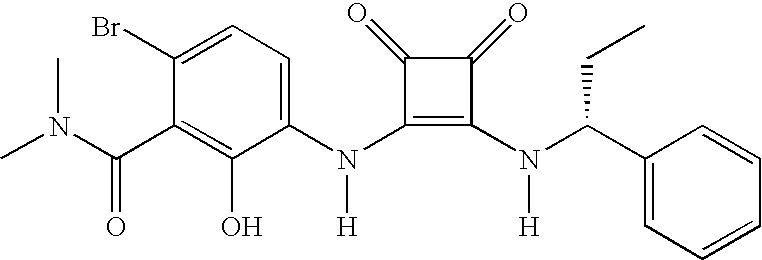
1. 43% 2. 472 3. 206-209 378.4 3 23.16 
1. 69% 2. 438.1 3. 116 378.5 3 23.17 
1. 73% 2. 438.1 3. 116 378.6 13.4 87 
1. 10% 2. 470 3. 198-201 DEC 378.7 13.5 87 
1. 16% 2. 471 3. 246-248 378.8 13.3 23.16 
1. 30% 2. 516/518 3. 234-240 DEC 378.9 13.19 23.16 
1. 65% 2. 444.1 378.10 3 23.20 
1. 78% 2. 488 3. 137-140 378.11 
88.1 
1. 24% 2. 371 3. 254-260 DEC 378.12 13.6 88.1 
1. 3% 2. 542 378.13 13.7 88.1 
1. 9% 2. 542 378.14 
88.1 
1. 48% 2. 434 3. 150-152 378.15 3 23.19 
1. 71% 2. 488 3. 136-138 378.16 3 23.22 
1. 35% 2. 424.1 3. 132 378.17 13.9 88.1 
1. 13% 2. 440 3. 219-223 378.18 13.10 88.1 
1. 26% 2. 406 3. 242-249 DEC 378.19 13.8 88.1 
1. 18% 2. 395 378.20 3 23.18 
1. 53% 2. 478.1 3. 126 378.21 3 23.21 
1. 66% 2. 466 3. 106 378.22 3 23.24 
1. 73% 2. 502.1 3. 121 378.23 3 23.23 
1. 57% 2. 458.1 3. 129 - Following the procedure set forth in Example 210 but using the cyclobutenedione intermediate from Preparative Example indicated and the amine from the Preparative Example indicated in the Table below, the following cyclobutenedione products were obtained.
Prep Ex of Cyclo- butene Prep Ex Inter- 1. Yield (%) Ex. of Amine mediate Product 2. MH+ 378.25 11.10 87.1 
1. 71% 2. 480.0 378.26 10.28 87.1 
1. 60% 2. 449.9 378.27 11.11 88.4 
1. 25% 2. 540.1 [M + Na+] 378.28 10.36 87.1 
1. 16% 2. 465.0 378.29 10.7 88.5 
1. 46% 2. 440.4 378.30 10.9 88.4 
1. 43% 2. 934.9 [dimer + 1]+ 378.31 11.12 88.4 
1. 48% 2. 464.0 378.32 10.35 87.1 
1. 17% 2. 437 378.33 10.8 87.1 
1. 10% 2. 481.9 378.34 11.13 87.1 
1. 55% 2. 463.9 378.35 10.29 87.1 
1. 34% 2. 471.9 378.36 10.48 87.1 
1. 4% 2. 433.9 378.36 10.10 87.1 
1. 85% 2. 451.9 378.37 10.31 87.1 
1. 36% 2. 423.8 378.38 10.17 87.1 
1. 85% 2. 521.1 378.39 10.32 87.1 
1. 63% 2. 409.9 378.40 
87.1 
1. 44% 2. 323.1 378.41 10.33 87.1 
1. 20% 2. 486.0 378.42 10.13 87.1 
1. 47% 2. 520.1 378.43 10.34 87.1 
1. 18% 2. 449.9 378.44 11.14 87.1 
1. 13% 2. 424.0 378.45 2.13 87.1 
1. 13% 2. 423.8 378.46 12.1 87.1 
1. 51% 2. 487.1 378.47 10.38 88.4 
1. 72% 2. 437.7 378.48 11.15 87.1 
1. 29% 2. 477.9 378.49 10.14 87.1 
1. 61% 2. 560.2 378.50 11.18 87.1 
1. 25% 2. 480.0 378.51 10.18 87.1 
1. 51% 2. 466.0 378.52 12.2 87.1 
1. 32% 2. 380.9 378.53 10.19 87.1 
1. 14% 2. 461.4 378.54 11.1 87.1 
1. 41% 2. 463.9 378.55 11.2 87.1 
1. 5% 2. 409.9 378.56 10.20 87.1 
1. 70% 2. 478.1 378.57 10.49 87.1 
1. 17% 2. 421.9 378.58 10.15 87.1 
1. 51% 2. 582.1 378.59 10.46 87.1 
1. 18% 2. 477.9 378.60 11.16 88.4 
1. 54% 2. 455.1 378.61 10.21 87.1 
1. 84% 2. 485.9 378.62 10.40 87.1 
1. 4% 2. 506.1 378.65 2.8 87.1 
1. 34% 2. 480 378.66 10.22 87.1 
1. 16% 2. 486.0 378.67 2.10 87.1 
1. 44% 2. 545 378.68 10.23 87.1 
1. 26% 2. 493.9 378.69 2.14 87.1 
1. 60% 2. 437.9 378.70 10.24 87.1 
1.64% 2. 469.9 378.71 10.18 88.4 
1. 64% 2. 471.1 378.72 10.39 88.4 
1. 41% 2. 451.7 378.73 10.30 87.1 
1. 60% 2. 464.0 378.74 10.25 87.1 
1. 63% 2. 470.1 378.75 10.26 87.1 
1. 10% 2. 448.0 378.76 10.50 87.1 
1. 5% 2. 477.0 378.77 10.42 88.4 
1. 57% 2. 467.7 378.78 11.17 87.1 
1. 75% 2. 478.0 378.79 2.9 87.1 
1. 21% 2. 561 378.80 10.43 87.1 
1. 69% 2. 437.9 378.81 10.41 87.1 
1. 3% 2. 436.0 378.82 10.44 87.1 
1. 90% 2. 454.0 378.83 10.13 88.4 
1. 29% 2. 524.1 378.84 10.45 88.4 
1. 29% 2. 511.7 378.86 10.37 87.1 
1. 53% 2. 452.0 378.88 10.47 87.1 
1. 61% 2. 506.1 378.89 10.16 87.1 
1. 30% 2. 568.1 -

- The above compound from Preparative Example 378.68 was stirred with 4N HCl/dioxane to yield the product (23%, MH+=437.9).
-

- Using the procedure set forth in Preparative Example 2, Step A, but using Preparative Example 2.16 and Preparative Example 2.15, the title compound was prepared (20%, MH+=472.9).
- Following the procedure set forth in Example 210 but using the amine from the Preparative Example indicated and the ethoxy squarate intermediate from Preparative Example 87, the following cyclobutenedione products were obtained.
1. Yield (%) Ex. Aniline Product 2. (MH+) 379 109 
1. 29% 2. 436.0 380 105 
1. 6.3% 2. 550.0 381 106 
1. 12% 2. 557.0 382 107 
1. 8.6% 2. 573.0 383 143 
1. 3.2% 2. 497.0 384 135 
1. 36% 2. 529.0 385 130 
1. 33% 2. 506.1 387 145 
1. 27% 2. 449.1 388 140 
1. 25% 2. 477.0 389 98 
1. 66% 2. 542.1 390 96 
1. 60% 2. 545.0 391 97 
1. 66% 2. 540.1 392 100 
1. 47% 2. 512.1 393 99 
1. 60% 2. 528.1 - Following the procedure set forth in Example 261 but using the amines from the Preparative Examples indicated in the table below and the cyclobutenedione derivative from Preparative Example 19, the following cyclobutenedione products were obtained as racemic mixtures.
1. Yield (%) Prep Ex. 2. MH+ Ex. of Amine Product 3. mp (° C.) 394 147 
1. 64% 2. 358.1 3. 137 395 148 
1. 23% 2. 372.1 3. 126 396 149 
1. 94% 2. 386.1 3. 108 397 150 
1. 86% 2. 386.1 3. 134 398 146 
1. 87% 2. 420.1 3. 136 399 151 
1. 84% 2. 434.1 3. 129 400 152 
1. 90% 2. 372.1 3. 154 401 153 
1. 86% 2. 386.1 3. 156 402 154 
1. 90% 2. 400.1 3. 153 403 155 
1. 91 2. 400.1 3. 153 404 156 
1. 83% 2. 448.1 3. 138 404.1 

1. 30% 2. 426.1 3. 132 404.2 

1. 74% 2. 412.1 3. 127 404.3 

1. 73.4% 2. 372.1 3. 128 404.4 

1. 72% 2. 372.1 3. 128 -

- To a solution of the amine from Preparative Example 75.1 (11.3 g) in EtOH (100 mL) at room temperature was added the product from Preparative Example 19 (16.4 g) in one portion. The resulting mixture was stirred at reflux overnight and then concentrated under reduced pressure. The crude residue was redissolved in CH 2Cl2 (80 mL) and was washed with 10% KH2PO4 (120 mL). The solid precipitate that was generated was filtered, washed with water and dried under vacuo. The residue was recrystallized from methanol-methylene chloride to give a cream colored solid (16 g, 75% yield). (mp 105-108° C., MH+398.1).
- If one were to follow the procedure set forth in Example 210 but using the ethoxysquarate from the Preparative Example indicated and the amines from the Preparative Example indicated in the Table below, the following cyclobutenedione products can be obtained.
Prep Ex of Prep Ex of Ex. Amine Squarate Product 1101 15 87 
1102 15 88 
1103 16 87 
1104 16 88 
1105 17 87 
1106 17 88 
1107 18 87 
1108 18 88 
1109 157 87 
1110 157 88 
1111 158 87 
1112 158 88 
1112.1 500.3 or 500.4 88.1 
1112.2 500.1 or 500.2 88.1 
1112.3 500.0 19 
1112.4 75.9 23.11 
1112.5 10.19 88.4 
1112.6 75.44 23.14 
1112.7 75.49 23.14 
1112.8 75.50 23.14 
1112.9 75.44 500.6 
1112.10 75.49 500.6 
- Following the procedure set forth in Example 210 but using the amine from the Preparative Example indicated and the ethoxy squarate intermediate from the Preparative Example indicated, the following cyclobutenedione products were obtained.
Prep Ex 1. Yield (%) Prep Ex of of 2. MH+ Ex. Amine Squarate Product 3. mp (° C.) 1120.1 156.16 87 
1. 9% 2. 393.1 3. 154-158 1120.2 
88.1 
1. 55% 2. 355.1 3. 199-201 1120.3 156.12 88.1 
1. 37% 2. 355.1 3. 210-213 1120.4 
88.1 
1. 30% 2. 391.1 3. 70-73 1120.5 156.14 88.1 
1. 73% 2. 466 3. 105-108 1120.6 
88.1 
1. 21% 2. 391 3. 79-82 1120.7 
88.1 
1. 15% 2. 369 3. 167-170 1120.8 
88.1 
1. 47% 2. 354 3. 121-124 1120.9 
88.1 
1. 15% 2. 356 3. 200-202 1120.10 
88.1 
1. 25% 2. 468 3. 154-156 1120.11 156.13 88.1 
1. 57% 2. 404 3. 92-94 1120.12 156.15 88.1 
1. 61% 2. 351 3. 155-157 -


- Step A
- If one were to use a similar procedure to that used in Preparative Example 13.3 Step B, except using the hydroxy acid from Bioorg. Med. Chem. Lett. 6(9), 1996, 1043, one would obtain the desired methoxy compound.
- Step B
- If one were to use a similar procedure to that used in Preparative Example 13.19 Step B, except using the product from Step A above, one would obtain the desired compound.
- Step C
- If one were to use a similar procedure to that used in Synth. Commun. 1980, 10, p. 107, except using the product from Step B above and t-butanol, one would obtain the desired compound.
- Step D
- If one were to use a similar procedure to that used in Synthesis, 1986, 1031, except using the product from Step C above, one would obtain the desired sulfonamide compound.
- Step E
- If one were to use a similar procedure to that used in Preparative Example 13.19 Step E, except using the product from Step D above, one would obtain the desired compound.
- Step F
- If one were to use a similar procedure to that used in Preparative Example 19, except using the product from Step E above and adding potassium carbonate as base, one would obtain the desired compound.
- Step G
- If one were to follow the procedure set forth in Example 210, except using the product from Step F above and the amine from Preparative Example 75.9, then one would obtain the title compound.
-

- Step A
- If one were to treat the product from Step C of Example 1125 with BuLi (2.2 eq.) in THF followed by quenching of the reaction mixture with N,N′-dimethylsulfamoyl chloride (1.1 eq.) then one would obtain

- Step B
- If one were to use the product of Step A above and one were to follow Steps E, F and G of Example 1125, except using the amine from Preparative Example 75.49 in Step G, then one would obtain the title compound.
-


- Step A
- To a solution of 3-methoxythiophene (3 g) in dichloromethane (175 mL) at −78° C. was added chlorosulfonic acid (8.5 mL) dropwise. The mixture was stirred for 15 min at −78° C. and 1.5 h at room temp. Afterwards, the mixture was poured carefully into crushed ice, and extracted with dichloromethane. The extracts were washed with brine, dried over magnesium sulfate, filtered through a 1-in silica gel pad. The filtrate was concentrated in vacuo to give the desired compound (4.2 g).
- Step B
- The product from Step A above (4.5 g) was dissolved in dichloromethane (140 mL) and added with triethylamine (8.8 mL) followed by diethyl amine in THF (2M, 21 mL). The resulting mixture was stirred at room temperature overnight. The mixture was washed with brine and saturated bicarbonate (aq) and brine again, dried over sodium sulfate, filtered through a 1-in silica gel pad. The filtrate was concentrated in vacuo to give the desired compound (4.4 g).
- Step C
- The product from Step B above (4.3 g) was dissolved in dichloromethane (125 mL) and cooled in a −78° C. bath. A solution of boron tribromide (1.0 M in dichloromethane, 24.3 mL) was added. The mixture was stirred for 4 h while the temperature was increased slowly from −78° C. to 10° C. H 2O was added, the two layers were separated, and the aqueous layer was extracted with dichloro- methane. The combined organic layer and extracts were wahed with brine, dried over magnesium sulfate, filtered, and concentrated in vacuo to give 3.96 g of the desired hydroxy-compound.
- Step D
- The product from step C above (3.96 g) was dissolved in 125 mL of dichloromethane, and added with potassium carbonate (6.6 g) followed by bromine (2 mL). The mixture was stirred for 5 h at room temperature, quenched with 100 mL of H 2O. The aqueous mixture was addjusted to pH˜5 using a 0.5N hydrogen chloride aqueous solution, and extracted with dichloromethane. The extracts were washed with brine, dried over sodium sulfate, and filtered through a celite pad. The filtrate was concentrated in vacuo to afford 4.2 g of the desired bromo-compound.
- Step E
- The product from Step D (4.2 g) was dissolved in 100 mL of acetone and added with potassium carbonate (10 g) followed by iodomethane (9 mL). The mixture was heated to reflux and continued for 3.5 h. After cooled to room temperature, the mixture was filtered through a Celite pad. The filtrate was concentrated in vacuo to a dark brown residue, which was purified by flash column chromatography eluting with dichloromethane-hexanes (1:1, v/v) to give 2.7 g of the desired product.
- Step F
- The product from step E (2.7 g) was converted to the desired imine compound (3 g), following the similar procedure to that of Preparative Example 13.19 step D.
- Step G
- The imine product from step F (3 g) was dissolved in 80 mL of dichloromethane and cooled in a −78° C. bath. A solution of boron tribromide (1.0 M in dichloromethane, 9.2 mL) was added dropwise. The mixture was stirred for 4.25 h from −78° C. to 5° C. H 2O (50 mL) was added, and the layers were separated. The aqueous layer was extracted with dichloromethane. The organic layer and extracts were combined, washed with brine, and concentrated to an oily residue. The residue was dissolved in 80 mL of methanol, stirred with sodium acetate (1.5 g) and hydroxyamine hydrochloride (0.95 g) at room temperature for 2 h. The mixture was poured into an aqueous mixture of sodium hydroxide (1.0 M aq, 50 mL) and ether (100 mL). The two layers were separated. The aqueous layer was washed with ether three times. The combined ether washings were re-extracted with H2O once. The aqueous layers were combined, washed once with dichloromethane, adjusted to pH˜6 using 3.0 M and 0.5 M hydrogen chloride aqueous solutions, and extracted with dichloromethane. The organic extracts were combined, washed with brine, dried over sodium sulfate, and concentrated in vacuo to give 1.2 g of desired amine compound.
- Step H
- The product from step F (122 mg) was stirred with diethyoxysquarate (0.25 mL) and potassium carbonate (75 mg) in 5 mL of ethanol at room temperature for 5 h. The mixture was diluted with dichloromethane, filtered through a Celite pad, and concentrated to an oily residue, which was separated by preparative TLC (CH 2Cl2-MeOH=15:1, v/v) to give 91 mg of the desired product.
- Step I
- Following the procedure set forth in Example 210, and using the amine from Preparative Example 75.9, the product (43 mg) from Step H was converted to the desired compound (20 mg).
- While the present invention has been described in conjunction with specific embodiments set forth above, many alternatives, modifications and variations thereof will be apparent to those of ordinary skill in the art. All such alternatives, modifications and variations are intended to fall within the spirit and scope of the present invention.
Claims (111)


Priority Applications (28)
| Application Number | Priority Date | Filing Date | Title |
|---|---|---|---|
| US10/208,412 US20040097547A1 (en) | 2001-04-16 | 2002-07-30 | 3,4-Di-substituted cyclobutene-1,2-diones as CXC-chemokine receptor ligands |
| US10/241,326 US20040106794A1 (en) | 2001-04-16 | 2002-09-11 | 3,4-Di-substituted cyclobutene-1,2-diones as CXC-chemokine receptor ligands |
| PE2003000751A PE20040746A1 (en) | 2002-07-30 | 2003-07-30 | CYCLOBUTEN-1,2-DIONAS 3,4-DI-SUBSTITUTED AS LIGANDS OF THE CXC CHEMOKIN RECEPTOR |
| IL16642703A IL166427A0 (en) | 2002-07-30 | 2003-07-30 | 3,4-di-substituted cyclobutene-1,2-diones as cxc-chemokine receptor ligands |
| PCT/US2003/023785 WO2004011418A1 (en) | 2002-07-30 | 2003-07-30 | 3,4-di-substituted cyclobutene-1, 2-diones as cxc-chemokine receptor ligands |
| PL03374876A PL374876A1 (en) | 2002-07-30 | 2003-07-30 | 3,4-di-substituted cyclobutene-1, 2-diones as cxc-chemokine receptor ligands |
| US10/630,258 US7132445B2 (en) | 2001-04-16 | 2003-07-30 | 3,4-Di-substituted cyclobutene-1,2-diones as CXC-chemokine receptor ligands |
| TW095140972A TW200716520A (en) | 2002-07-30 | 2003-07-30 | 3,4-di-substituted cyclobutene-1,2-diones as CXC-chemokine receptor ligands |
| TW092120797A TWI330174B (en) | 2002-07-30 | 2003-07-30 | 3,4-di-substituted cyclobutene-1,2-diones as cxc-chemokine receptor ligands |
| NZ538521A NZ538521A (en) | 2002-07-30 | 2003-07-30 | 3,4-Di-substituted cyclobutene-1, 2-diones as cxc-chemokine receptor ligands |
| RU2005105692/04A RU2005105692A (en) | 2002-07-30 | 2003-07-30 | 3,4-DISPLACED CYCLOBUTENE-1,2-DIONES AS CXC-CHEMOKINE RECEPTOR LIGANDS |
| MXPA05001274A MXPA05001274A (en) | 2002-07-30 | 2003-07-30 | 3,4-di-substituted cyclobutene-1, 2-diones as cxc-chemokine receptor ligands. |
| JP2004524185A JP2005534684A (en) | 2002-07-30 | 2003-07-30 | 3,4-Disubstituted cyclobutene-1,2-diones as CXC chemokine receptor ligands |
| CA2496676A CA2496676C (en) | 2002-07-30 | 2003-07-30 | 3,4-di-substituted cyclobutene-1,2-diones as cxc-chemokine receptor ligands |
| AR20030102737A AR040734A1 (en) | 2002-07-30 | 2003-07-30 | CICLOBUTEN 1,2- DIONAS 3, 4- DI-REPLACED AS LIGANDS OF THE CXC CHEMIOKIN RECEIVER |
| KR1020057001672A KR20050026060A (en) | 2002-07-30 | 2003-07-30 | 3,4-di-substituted cyclobutene-1,2-diones as cxc-chemokine receptor ligands |
| EP03772075A EP1539678B1 (en) | 2002-07-30 | 2003-07-30 | 3,4-di-substituted cyclobutene-1, 2-diones as cxc-chemokine receptor ligands |
| CNB038231603A CN100338032C (en) | 2002-07-30 | 2003-07-30 | 3,4-di-substituted cyclobutene-1,2-diones as CXC-chemokine receptor ligands |
| BR0313109-2A BR0313109A (en) | 2002-07-30 | 2003-07-30 | Cyclobutene-1,2-diones 3,4-disubstituted as cxc chemokine receptor ligands |
| AU2003259302A AU2003259302B2 (en) | 2002-07-30 | 2003-07-30 | 3,4-di-substituted cyclobutene-1, 2-diones as CXC-chemokine receptor ligands |
| EC2005005581A ECSP055581A (en) | 2002-07-30 | 2005-01-27 | "CICLOBUTEN-1,2-DIONAS 3,4-DI-SUBSTITUTED AS LIGANDS OF THE CXC CHEMIOKIN RECEPTOR" |
| ZA200500837A ZA200500837B (en) | 2002-07-30 | 2005-01-27 | 3,4-Di-substituted cyclobutene-1,2-diones as CXC-chemokine receptor ligands |
| CO05007006A CO5680474A2 (en) | 2002-07-30 | 2005-01-28 | CICLOBUTEN-1,2-DIONAS 3,4-DI-SUBSTITUTED AS LINGANDOS OF THE CXC CHEMIOKIN RECEIVER |
| NO20051036A NO20051036L (en) | 2002-07-30 | 2005-02-25 | 3,4-disubstituted cyclobutene-1,2-dione as CXC chemokine receptor ligands |
| US11/500,739 US7964646B2 (en) | 2001-04-16 | 2006-08-08 | 3,4-DI-substituted cyclobutene-1,2-diones as CXC-chemokine receptor ligands |
| US12/352,781 US7947720B2 (en) | 2001-04-16 | 2009-01-13 | 3,4-di-substituted cyclobutene-1,2-diones as CXC-chemokine receptor ligands |
| JP2010217953A JP2011063591A (en) | 2002-07-30 | 2010-09-28 | 3,4-disubstituted cyclobutene-1, 2-dione as cxc-chemokine receptor ligand |
| US13/102,554 US20110213029A1 (en) | 2001-04-16 | 2011-05-06 | 3,4-Di-Substituted Cyclobutene-1,2-Diones as CXC-Chemokine Receptor Ligands |
Applications Claiming Priority (3)
| Application Number | Priority Date | Filing Date | Title |
|---|---|---|---|
| US28402601P | 2001-04-16 | 2001-04-16 | |
| US12284102A | 2002-04-15 | 2002-04-15 | |
| US10/208,412 US20040097547A1 (en) | 2001-04-16 | 2002-07-30 | 3,4-Di-substituted cyclobutene-1,2-diones as CXC-chemokine receptor ligands |
Related Parent Applications (1)
| Application Number | Title | Priority Date | Filing Date |
|---|---|---|---|
| US12284102A Continuation-In-Part | 2001-04-16 | 2002-04-15 |
Related Child Applications (1)
| Application Number | Title | Priority Date | Filing Date |
|---|---|---|---|
| US10/241,326 Continuation-In-Part US20040106794A1 (en) | 2001-04-16 | 2002-09-11 | 3,4-Di-substituted cyclobutene-1,2-diones as CXC-chemokine receptor ligands |
Publications (1)
| Publication Number | Publication Date |
|---|---|
| US20040097547A1 true US20040097547A1 (en) | 2004-05-20 |
Family
ID=46204548
Family Applications (1)
| Application Number | Title | Priority Date | Filing Date |
|---|---|---|---|
| US10/208,412 Abandoned US20040097547A1 (en) | 2001-04-16 | 2002-07-30 | 3,4-Di-substituted cyclobutene-1,2-diones as CXC-chemokine receptor ligands |
Country Status (1)
| Country | Link |
|---|---|
| US (1) | US20040097547A1 (en) |
Cited By (19)
| Publication number | Priority date | Publication date | Assignee | Title |
|---|---|---|---|---|
| US20060223849A1 (en) * | 2005-03-14 | 2006-10-05 | Mjalli Adnan M | Benzazole derivatives, compositions, and methods of use as beta-secretase inhibitors |
| WO2006105865A1 (en) * | 2005-04-04 | 2006-10-12 | Merck Patent Gmbh | Indazole squaric acid derivatives as chk1-, chk2- and sgk- inhibitors |
| US20070021494A1 (en) * | 2001-04-16 | 2007-01-25 | Schering Corporation And Pharmacopeia, Inc. | 3,4-Di-substituted cyclobutene-1,2-diones as CXC-chemokine receptor ligands |
| US20100256131A1 (en) * | 2003-04-03 | 2010-10-07 | Christos Tsaklakidis | Carbonyl compounds |
| WO2012080456A1 (en) | 2010-12-17 | 2012-06-21 | Boehringer Ingelheim International Gmbh | Bicyclic ring system substituted amide functionalised phenols as medicaments |
| US8293738B2 (en) | 2010-05-12 | 2012-10-23 | Abbott Laboratories | Indazole inhibitors of kinase |
| US8486398B2 (en) | 2010-01-20 | 2013-07-16 | Boehringer Ingelheim International Gmbh | Anticoagulant antidotes comprising antibodies that bind dabigatran and/or related compounds |
| US8648070B2 (en) | 2010-12-17 | 2014-02-11 | Boehringer Ingelheim International Gmbh | Bicyclic ring system substituted sulfonamide functionalised phenols as medicaments |
| US8821871B2 (en) | 2011-03-30 | 2014-09-02 | Boehringer Ingelheim International Gmbh | Anticoagulant antidotes comprising antibodies that bind dabigatran and/or related compounds and methods of use thereof |
| US8916555B2 (en) | 2012-03-16 | 2014-12-23 | Axikin Pharmaceuticals, Inc. | 3,5-diaminopyrazole kinase inhibitors |
| US9018261B2 (en) | 2011-09-02 | 2015-04-28 | Novartis Ag | Choline salt of an anti-inflammatory substituted cyclobutenedione compound |
| US9540351B2 (en) | 2013-09-18 | 2017-01-10 | Axikin Pharmaceuticals, Inc. | Pharmaceutically acceptable salts of 3,5-diaminopyrazole kinase inhibitors |
| US9546163B2 (en) | 2014-12-23 | 2017-01-17 | Axikin Pharmaceuticals, Inc. | 3,5-diaminopyrazole kinase inhibitors |
| US9809581B2 (en) | 2015-11-19 | 2017-11-07 | Chemocentryx, Inc. | Inhibitors of CXCR2 |
| US9834545B2 (en) | 2015-11-19 | 2017-12-05 | Chemocentryx, Inc. | Modulators of chemokine receptors |
| WO2019036374A1 (en) * | 2017-08-14 | 2019-02-21 | Allergan, Inc. | 3,4-disubstituted 3-cyclobutene-1,2-diones and use thereof |
| US10351522B2 (en) | 2015-06-12 | 2019-07-16 | University Of Tsukuba | Sulfonamide derivative and pharmaceutically acceptable acid addition salt thereof |
| US11207294B2 (en) | 2018-01-08 | 2021-12-28 | Chemocentryx, Inc. | Methods of treating generalized pustular psoriasis with an antagonist of CCR6 or CXCR2 |
| CN114437363A (en) * | 2022-01-26 | 2022-05-06 | 青岛科技大学 | Squaramide derivative group covalent triazine skeleton polymer and application thereof in preparation of cyclic carbonate by catalyzing coupling of carbon dioxide and epoxide |
-
2002
- 2002-07-30 US US10/208,412 patent/US20040097547A1/en not_active Abandoned
Cited By (45)
| Publication number | Priority date | Publication date | Assignee | Title |
|---|---|---|---|---|
| US20070021494A1 (en) * | 2001-04-16 | 2007-01-25 | Schering Corporation And Pharmacopeia, Inc. | 3,4-Di-substituted cyclobutene-1,2-diones as CXC-chemokine receptor ligands |
| US7964646B2 (en) * | 2001-04-16 | 2011-06-21 | Schering Corporation | 3,4-DI-substituted cyclobutene-1,2-diones as CXC-chemokine receptor ligands |
| US20090306079A1 (en) * | 2001-04-16 | 2009-12-10 | Schering Corporation | 3,4-di-substituted cyclobutene-1,2-diones as cxc-chemokine receptor ligands |
| US7947720B2 (en) * | 2001-04-16 | 2011-05-24 | Schering Corporation | 3,4-di-substituted cyclobutene-1,2-diones as CXC-chemokine receptor ligands |
| US7906516B2 (en) | 2003-04-03 | 2011-03-15 | Merck Patent Gmbh | Carbonyl compounds |
| US8129373B2 (en) | 2003-04-03 | 2012-03-06 | Merck Patent Gmbh | Carbonyl compounds |
| US20100256131A1 (en) * | 2003-04-03 | 2010-10-07 | Christos Tsaklakidis | Carbonyl compounds |
| US20090326006A1 (en) * | 2005-03-14 | 2009-12-31 | Mjalli Adnan M M | Benzazole Derivatives, Compositions, and Methods of Use as Beta-Secretase Inhibitors |
| US8598353B2 (en) | 2005-03-14 | 2013-12-03 | High Point Pharmaceuticals, Llc | Benzazole derivatives, compositions, and methods of use as β-secretase inhibitors |
| US20110065713A1 (en) * | 2005-03-14 | 2011-03-17 | High Point Pharmaceuticals, Llc | Benzazole Derivatives, Compositions, and Methods of Use as B-Secretase Inhibitors |
| US20060223849A1 (en) * | 2005-03-14 | 2006-10-05 | Mjalli Adnan M | Benzazole derivatives, compositions, and methods of use as beta-secretase inhibitors |
| US7893267B2 (en) | 2005-03-14 | 2011-02-22 | High Point Pharmaceuticals, Llc | Benzazole derivatives, compositions, and methods of use as β-secretase inhibitors |
| US20090036449A1 (en) * | 2005-04-04 | 2009-02-05 | Werner Mederski | Indazolesquaric Acid Derivatives as Chk1, Chk2 and Sgk Inhibitors |
| WO2006105865A1 (en) * | 2005-04-04 | 2006-10-12 | Merck Patent Gmbh | Indazole squaric acid derivatives as chk1-, chk2- and sgk- inhibitors |
| US9034822B2 (en) | 2010-01-20 | 2015-05-19 | Boehringer Igelheim International Gmbh | Methods of using antibodies during anticoagulant therapy of dabigatran and/or related compounds |
| US8486398B2 (en) | 2010-01-20 | 2013-07-16 | Boehringer Ingelheim International Gmbh | Anticoagulant antidotes comprising antibodies that bind dabigatran and/or related compounds |
| US8293738B2 (en) | 2010-05-12 | 2012-10-23 | Abbott Laboratories | Indazole inhibitors of kinase |
| JP2013545789A (en) * | 2010-12-17 | 2013-12-26 | ベーリンガー インゲルハイム インターナショナル ゲゼルシャフト ミット ベシュレンクテル ハフツング | Bicyclic substituted amide functionalized phenols as pharmaceuticals |
| US8648070B2 (en) | 2010-12-17 | 2014-02-11 | Boehringer Ingelheim International Gmbh | Bicyclic ring system substituted sulfonamide functionalised phenols as medicaments |
| US8648118B2 (en) | 2010-12-17 | 2014-02-11 | Boehringer Ingelheim International Gmbh | Bicyclic ring system substituted amide functionalised phenols as medicaments |
| WO2012080456A1 (en) | 2010-12-17 | 2012-06-21 | Boehringer Ingelheim International Gmbh | Bicyclic ring system substituted amide functionalised phenols as medicaments |
| US8821871B2 (en) | 2011-03-30 | 2014-09-02 | Boehringer Ingelheim International Gmbh | Anticoagulant antidotes comprising antibodies that bind dabigatran and/or related compounds and methods of use thereof |
| US9018261B2 (en) | 2011-09-02 | 2015-04-28 | Novartis Ag | Choline salt of an anti-inflammatory substituted cyclobutenedione compound |
| US8916555B2 (en) | 2012-03-16 | 2014-12-23 | Axikin Pharmaceuticals, Inc. | 3,5-diaminopyrazole kinase inhibitors |
| US9346792B2 (en) | 2012-03-16 | 2016-05-24 | Axikin Pharmaceuticals, Inc. | 3,5-diaminopyrazole kinase inhibitors |
| US9365556B2 (en) | 2012-03-16 | 2016-06-14 | Axikin Pharmaceuticals, Inc. | 3,5-diaminopyrazole kinase inhibitors |
| US9382237B2 (en) | 2012-03-16 | 2016-07-05 | Axikin Pharmaceuticals, Inc. | 3,5-diaminopyrazole kinase inhibitors |
| US9540351B2 (en) | 2013-09-18 | 2017-01-10 | Axikin Pharmaceuticals, Inc. | Pharmaceutically acceptable salts of 3,5-diaminopyrazole kinase inhibitors |
| US9546163B2 (en) | 2014-12-23 | 2017-01-17 | Axikin Pharmaceuticals, Inc. | 3,5-diaminopyrazole kinase inhibitors |
| US9730914B2 (en) | 2014-12-23 | 2017-08-15 | Axikin Pharmaceuticals | 3,5-diaminopyrazole kinase inhibitors |
| US10351522B2 (en) | 2015-06-12 | 2019-07-16 | University Of Tsukuba | Sulfonamide derivative and pharmaceutically acceptable acid addition salt thereof |
| US10336736B2 (en) | 2015-11-19 | 2019-07-02 | Chemocentryx, Inc. | Modulators of chemokine receptors |
| US11040960B2 (en) | 2015-11-19 | 2021-06-22 | Chemocentryx, Inc. | Inhibitors of CXCR2 |
| US9834545B2 (en) | 2015-11-19 | 2017-12-05 | Chemocentryx, Inc. | Modulators of chemokine receptors |
| US9809581B2 (en) | 2015-11-19 | 2017-11-07 | Chemocentryx, Inc. | Inhibitors of CXCR2 |
| US10370363B2 (en) | 2015-11-19 | 2019-08-06 | Chemocentryx, Inc. | Inhibitors of CXCR2 |
| US11945805B2 (en) | 2015-11-19 | 2024-04-02 | Chemocentryx, Inc | Inhibitors of CXCR2 |
| US10988464B2 (en) | 2015-11-19 | 2021-04-27 | Chemocentryx, Inc. | Modulators of chemokine receptors |
| US11820759B2 (en) | 2015-11-19 | 2023-11-21 | Chemocentryx, Inc. | Modulators of chemokine receptors |
| US11208377B2 (en) | 2017-08-14 | 2021-12-28 | Allergan, Inc. | 3,4-disubstituted 3-cyclobutene-1,2-diones and use thereof |
| WO2019036374A1 (en) * | 2017-08-14 | 2019-02-21 | Allergan, Inc. | 3,4-disubstituted 3-cyclobutene-1,2-diones and use thereof |
| CN111225900A (en) * | 2017-08-14 | 2020-06-02 | 阿勒根公司 | 3,4-Disubstituted 3-cyclobutene-1,2-diones and their uses |
| US11207294B2 (en) | 2018-01-08 | 2021-12-28 | Chemocentryx, Inc. | Methods of treating generalized pustular psoriasis with an antagonist of CCR6 or CXCR2 |
| US11684606B2 (en) | 2018-01-08 | 2023-06-27 | Chemocentryx, Inc. | Methods of treating generalized pustular psoriasis with an antagonist of CCR6 or CXCR2 |
| CN114437363A (en) * | 2022-01-26 | 2022-05-06 | 青岛科技大学 | Squaramide derivative group covalent triazine skeleton polymer and application thereof in preparation of cyclic carbonate by catalyzing coupling of carbon dioxide and epoxide |
Similar Documents
| Publication | Publication Date | Title |
|---|---|---|
| US7964646B2 (en) | 3,4-DI-substituted cyclobutene-1,2-diones as CXC-chemokine receptor ligands | |
| US20040147559A1 (en) | 3,4-Di-substituted cyclobutene-1,2-diones as CXC-chemokine receptor ligands | |
| EP1381590B1 (en) | 3,4-di-substituted cyclobutene-1,2-diones as cxc-chemokine receptor ligands | |
| AU2002311841A1 (en) | 3,4-di-substituted cyclobutene-1,2-diones as cxc-chemokine receptor ligands | |
| US20030097004A1 (en) | 3,4-Di-substituted cyclobutene-1,2-diones as CXC chemokine receptor antagonists | |
| US20040186142A1 (en) | Thiadiazoledioxides and thiadiazoleoxides as CXC- and CC- chemokine receptor ligands | |
| US20030204085A1 (en) | 3, 4-Di-substituted cyclobutene-1,2-diones as CXC-chemokine receptor antagonists | |
| US20040063709A1 (en) | 3,4-di-substituted pyridazinediones as CXC chemokine receptor antagonists | |
| HK1057538B (en) | 3,4-di-substituted cyclobutene-1,2-diones as cxc-chemokine receptor ligands | |
| HK1107818B (en) | 3,4-di-substituted cyclobutene-1,2-diones as cxc-chemokine receptor ligands |
Legal Events
| Date | Code | Title | Description |
|---|---|---|---|
| AS | Assignment |
Owner name: SCHERING CORPORATION, NEW JERSEY Free format text: ASSIGNMENT OF ASSIGNORS INTEREST;ASSIGNOR:CHAO, JIANPING;REEL/FRAME:015070/0639 Effective date: 20021112 Owner name: PHARMACOPEIA, INC., NEW JERSEY Free format text: ASSIGNMENT OF ASSIGNORS INTEREST;ASSIGNOR:KAISER, BERND;REEL/FRAME:015070/0577 Effective date: 20021028 Owner name: PHARMACOPEIA, INC., NEW JERSEY Free format text: ASSIGNMENT OF ASSIGNORS INTEREST;ASSIGNORS:MERRITT,J. ROBERT;ROKOSZ, LAURA;REEL/FRAME:015072/0790 Effective date: 20021003 Owner name: PHARMACOPEIA, INC., NEW JERSEY Free format text: ASSIGNMENT OF ASSIGNORS INTEREST;ASSIGNOR:NELSON, KINGSLEY H., JR.;REEL/FRAME:015072/0690 Effective date: 20021007 Owner name: SCHERING CORPORATION, NEW JERSEY Free format text: ASSIGNMENT OF ASSIGNORS INTEREST;ASSIGNOR:FERREIRA, JOHAN A.;REEL/FRAME:015070/0609 Effective date: 20020927 Owner name: SCHERING CORPORATION, NEW JERSEY Free format text: ASSIGNMENT OF ASSIGNORS INTEREST;ASSIGNORS:TAVERAS, ARTHUR G.;AKI, CYNTHIA J.;BOND, RICHARD W.;AND OTHERS;REEL/FRAME:015070/0754;SIGNING DATES FROM 20021104 TO 20021115 Owner name: PHARMACOPEIA, INC., NEW JERSEY Free format text: ASSIGNMENT OF ASSIGNORS INTEREST;ASSIGNOR:LI, GE;REEL/FRAME:015072/0694 Effective date: 20020925 Owner name: PHARMACOPEIA, INC., NEW JERSEY Free format text: ASSIGNMENT OF ASSIGNORS INTEREST;ASSIGNOR:BALDWIN, JOHN J.;REEL/FRAME:015070/0581 Effective date: 20021009 |
|
| STCB | Information on status: application discontinuation |
Free format text: ABANDONED -- FAILURE TO RESPOND TO AN OFFICE ACTION |
|
| AS | Assignment |
Owner name: PHARMACOPEIA DRUG DISCOVERY, NEW JERSEY Free format text: ASSIGNMENT OF ASSIGNORS INTEREST;ASSIGNOR:PHARMACOPEIA INC.;REEL/FRAME:015144/0745 Effective date: 20040330 |