US20030225232A1 - Hyperbranched polymers - Google Patents
Hyperbranched polymers Download PDFInfo
- Publication number
- US20030225232A1 US20030225232A1 US10/109,316 US10931602A US2003225232A1 US 20030225232 A1 US20030225232 A1 US 20030225232A1 US 10931602 A US10931602 A US 10931602A US 2003225232 A1 US2003225232 A1 US 2003225232A1
- Authority
- US
- United States
- Prior art keywords
- optionally substituted
- group
- linear
- cyclic
- heteroarylene
- Prior art date
- Legal status (The legal status is an assumption and is not a legal conclusion. Google has not performed a legal analysis and makes no representation as to the accuracy of the status listed.)
- Abandoned
Links
- 229920000587 hyperbranched polymer Polymers 0.000 title claims abstract description 83
- 238000000034 method Methods 0.000 claims abstract description 78
- 238000006243 chemical reaction Methods 0.000 claims abstract description 49
- 230000000670 limiting effect Effects 0.000 claims abstract description 45
- 239000000463 material Substances 0.000 claims abstract description 19
- 230000005540 biological transmission Effects 0.000 claims abstract description 9
- -1 carbazylene Chemical group 0.000 claims description 50
- 239000000178 monomer Substances 0.000 claims description 46
- 125000000217 alkyl group Chemical group 0.000 claims description 29
- 125000005549 heteroarylene group Chemical group 0.000 claims description 29
- 125000004432 carbon atom Chemical group C* 0.000 claims description 28
- 125000003118 aryl group Chemical group 0.000 claims description 26
- 125000000732 arylene group Chemical group 0.000 claims description 25
- 125000000843 phenylene group Chemical group C1(=C(C=CC=C1)*)* 0.000 claims description 20
- 125000001997 phenyl group Chemical group [H]C1=C([H])C([H])=C(*)C([H])=C1[H] 0.000 claims description 19
- 125000001072 heteroaryl group Chemical group 0.000 claims description 17
- 229910052739 hydrogen Inorganic materials 0.000 claims description 16
- 239000001257 hydrogen Substances 0.000 claims description 16
- 125000004122 cyclic group Chemical group 0.000 claims description 15
- 125000004435 hydrogen atom Chemical group [H]* 0.000 claims description 15
- 150000003839 salts Chemical class 0.000 claims description 15
- 125000005567 fluorenylene group Chemical group 0.000 claims description 14
- 125000000547 substituted alkyl group Chemical group 0.000 claims description 14
- 125000003107 substituted aryl group Chemical group 0.000 claims description 14
- 125000004450 alkenylene group Chemical group 0.000 claims description 12
- 125000002947 alkylene group Chemical group 0.000 claims description 12
- UFHFLCQGNIYNRP-UHFFFAOYSA-N Hydrogen Chemical compound [H][H] UFHFLCQGNIYNRP-UHFFFAOYSA-N 0.000 claims description 8
- 125000002496 methyl group Chemical group [H]C([H])([H])* 0.000 claims description 7
- 125000002529 biphenylenyl group Chemical group C1(=CC=CC=2C3=CC=CC=C3C12)* 0.000 claims description 6
- 239000011203 carbon fibre reinforced carbon Substances 0.000 claims description 6
- 125000000623 heterocyclic group Chemical group 0.000 claims description 6
- 150000002431 hydrogen Chemical group 0.000 claims description 6
- 125000001624 naphthyl group Chemical group 0.000 claims description 6
- 125000004169 (C1-C6) alkyl group Chemical group 0.000 claims description 5
- 125000004104 aryloxy group Chemical group 0.000 claims description 5
- 125000000524 functional group Chemical group 0.000 claims description 5
- 125000001280 n-hexyl group Chemical group C(CCCCC)* 0.000 claims description 5
- 125000005649 substituted arylene group Chemical group 0.000 claims description 5
- OKTJSMMVPCPJKN-UHFFFAOYSA-N Carbon Chemical group [C] OKTJSMMVPCPJKN-UHFFFAOYSA-N 0.000 claims description 4
- 125000004653 anthracenylene group Chemical group 0.000 claims description 4
- 125000001495 ethyl group Chemical group [H]C([H])([H])C([H])([H])* 0.000 claims description 4
- 125000004957 naphthylene group Chemical group 0.000 claims description 4
- 125000005560 phenanthrenylene group Chemical group 0.000 claims description 4
- 125000001436 propyl group Chemical group [H]C([*])([H])C([H])([H])C([H])([H])[H] 0.000 claims description 4
- 125000001544 thienyl group Chemical group 0.000 claims description 4
- 125000005556 thienylene group Chemical group 0.000 claims description 4
- 125000000609 carbazolyl group Chemical group C1(=CC=CC=2C3=CC=CC=C3NC12)* 0.000 claims description 3
- 125000005548 pyrenylene group Chemical group 0.000 claims description 3
- 125000004076 pyridyl group Chemical group 0.000 claims description 3
- 125000005551 pyridylene group Chemical group 0.000 claims description 3
- 125000000168 pyrrolyl group Chemical group 0.000 claims description 3
- 125000000026 trimethylsilyl group Chemical group [H]C([H])([H])[Si]([*])(C([H])([H])[H])C([H])([H])[H] 0.000 claims description 3
- 125000000008 (C1-C10) alkyl group Chemical group 0.000 claims description 2
- 125000001140 1,4-phenylene group Chemical group [H]C1=C([H])C([*:2])=C([H])C([H])=C1[*:1] 0.000 claims description 2
- 125000002178 anthracenyl group Chemical group C1(=CC=CC2=CC3=CC=CC=C3C=C12)* 0.000 claims description 2
- CREMABGTGYGIQB-UHFFFAOYSA-N carbon carbon Chemical compound C.C CREMABGTGYGIQB-UHFFFAOYSA-N 0.000 claims description 2
- 125000001792 phenanthrenyl group Chemical group C1(=CC=CC=2C3=CC=CC=C3C=CC12)* 0.000 claims description 2
- 125000005156 substituted alkylene group Chemical group 0.000 claims description 2
- 229920000642 polymer Polymers 0.000 description 131
- YXFVVABEGXRONW-UHFFFAOYSA-N Toluene Chemical compound CC1=CC=CC=C1 YXFVVABEGXRONW-UHFFFAOYSA-N 0.000 description 68
- OKKJLVBELUTLKV-UHFFFAOYSA-N Methanol Chemical compound OC OKKJLVBELUTLKV-UHFFFAOYSA-N 0.000 description 66
- YMWUJEATGCHHMB-UHFFFAOYSA-N Dichloromethane Chemical compound ClCCl YMWUJEATGCHHMB-UHFFFAOYSA-N 0.000 description 63
- 230000003287 optical effect Effects 0.000 description 49
- UEXCJVNBTNXOEH-UHFFFAOYSA-N Ethynylbenzene Chemical group C#CC1=CC=CC=C1 UEXCJVNBTNXOEH-UHFFFAOYSA-N 0.000 description 24
- 238000003756 stirring Methods 0.000 description 21
- 239000003054 catalyst Substances 0.000 description 18
- VLKZOEOYAKHREP-UHFFFAOYSA-N n-Hexane Chemical compound CCCCCC VLKZOEOYAKHREP-UHFFFAOYSA-N 0.000 description 18
- 0 *C.*C#C.*C#C.*C#C.*C1=CC=CC(*)=C1 Chemical compound *C.*C#C.*C#C.*C#C.*C1=CC=CC(*)=C1 0.000 description 16
- HEDRZPFGACZZDS-UHFFFAOYSA-N Chloroform Chemical compound ClC(Cl)Cl HEDRZPFGACZZDS-UHFFFAOYSA-N 0.000 description 14
- ZMANZCXQSJIPKH-UHFFFAOYSA-N Triethylamine Chemical compound CCN(CC)CC ZMANZCXQSJIPKH-UHFFFAOYSA-N 0.000 description 14
- 229920001577 copolymer Polymers 0.000 description 14
- DBFJVXARVMMGNH-UHFFFAOYSA-N CC1=CC2=C(C=C1)CC1=C(C=C(C)C=C1)C2 Chemical compound CC1=CC2=C(C=C1)CC1=C(C=C(C)C=C1)C2 DBFJVXARVMMGNH-UHFFFAOYSA-N 0.000 description 13
- ZUOUZKKEUPVFJK-UHFFFAOYSA-N diphenyl Chemical compound C1=CC=CC=C1C1=CC=CC=C1 ZUOUZKKEUPVFJK-UHFFFAOYSA-N 0.000 description 12
- 239000000843 powder Substances 0.000 description 11
- MXJJMQSKDPNPSX-UHFFFAOYSA-N 1-ethynyl-4-(4-ethynylphenyl)benzene Chemical group C1=CC(C#C)=CC=C1C1=CC=C(C#C)C=C1 MXJJMQSKDPNPSX-UHFFFAOYSA-N 0.000 description 10
- IJGRMHOSHXDMSA-UHFFFAOYSA-N Atomic nitrogen Chemical group N#N IJGRMHOSHXDMSA-UHFFFAOYSA-N 0.000 description 10
- RZTDESRVPFKCBH-UHFFFAOYSA-N CC1=CC=C(C2=CC=C(C)C=C2)C=C1 Chemical compound CC1=CC=C(C2=CC=C(C)C=C2)C=C1 RZTDESRVPFKCBH-UHFFFAOYSA-N 0.000 description 10
- 229910004537 TaCl5 Inorganic materials 0.000 description 10
- 125000001424 substituent group Chemical group 0.000 description 10
- OEIMLTQPLAGXMX-UHFFFAOYSA-I tantalum(v) chloride Chemical compound Cl[Ta](Cl)(Cl)(Cl)Cl OEIMLTQPLAGXMX-UHFFFAOYSA-I 0.000 description 10
- CSCPPACGZOOCGX-UHFFFAOYSA-N Acetone Chemical compound CC(C)=O CSCPPACGZOOCGX-UHFFFAOYSA-N 0.000 description 9
- 125000001931 aliphatic group Chemical group 0.000 description 9
- 238000002189 fluorescence spectrum Methods 0.000 description 9
- 239000002904 solvent Substances 0.000 description 9
- UJOBWOGCFQCDNV-UHFFFAOYSA-N 9H-carbazole Chemical compound C1=CC=C2C3=CC=CC=C3NC2=C1 UJOBWOGCFQCDNV-UHFFFAOYSA-N 0.000 description 8
- 229920000742 Cotton Polymers 0.000 description 8
- 125000003342 alkenyl group Chemical group 0.000 description 8
- 238000002360 preparation method Methods 0.000 description 8
- YVXHZKKCZYLQOP-UHFFFAOYSA-N hept-1-yne Chemical compound CCCCCC#C YVXHZKKCZYLQOP-UHFFFAOYSA-N 0.000 description 7
- 238000004020 luminiscence type Methods 0.000 description 7
- 239000000203 mixture Substances 0.000 description 7
- 239000002244 precipitate Substances 0.000 description 7
- 230000008569 process Effects 0.000 description 7
- MVLGANVFCMOJHR-UHFFFAOYSA-N 1,4-diethynylbenzene Chemical compound C#CC1=CC=C(C#C)C=C1 MVLGANVFCMOJHR-UHFFFAOYSA-N 0.000 description 6
- UHOVQNZJYSORNB-UHFFFAOYSA-N Benzene Chemical compound C1=CC=CC=C1 UHOVQNZJYSORNB-UHFFFAOYSA-N 0.000 description 6
- RTZKZFJDLAIYFH-UHFFFAOYSA-N Diethyl ether Chemical compound CCOCC RTZKZFJDLAIYFH-UHFFFAOYSA-N 0.000 description 6
- LFQSCWFLJHTTHZ-UHFFFAOYSA-N Ethanol Chemical compound CCO LFQSCWFLJHTTHZ-UHFFFAOYSA-N 0.000 description 6
- 229920000265 Polyparaphenylene Polymers 0.000 description 6
- WYURNTSHIVDZCO-UHFFFAOYSA-N Tetrahydrofuran Chemical group C1CCOC1 WYURNTSHIVDZCO-UHFFFAOYSA-N 0.000 description 6
- HSFWRNGVRCDJHI-UHFFFAOYSA-N alpha-acetylene Natural products C#C HSFWRNGVRCDJHI-UHFFFAOYSA-N 0.000 description 6
- 230000015572 biosynthetic process Effects 0.000 description 6
- 235000010290 biphenyl Nutrition 0.000 description 6
- 239000004305 biphenyl Substances 0.000 description 6
- 239000012043 crude product Substances 0.000 description 6
- 125000000753 cycloalkyl group Chemical group 0.000 description 6
- 230000005284 excitation Effects 0.000 description 6
- 239000010408 film Substances 0.000 description 6
- NIHNNTQXNPWCJQ-UHFFFAOYSA-N fluorene Chemical compound C1=CC=C2CC3=CC=CC=C3C2=C1 NIHNNTQXNPWCJQ-UHFFFAOYSA-N 0.000 description 6
- 229910052757 nitrogen Inorganic materials 0.000 description 6
- DSOJWVLXZNRKCS-UHFFFAOYSA-N octa-1,7-diyne Chemical compound C#CCCCCC#C DSOJWVLXZNRKCS-UHFFFAOYSA-N 0.000 description 6
- 229920001197 polyacetylene Polymers 0.000 description 6
- 238000001228 spectrum Methods 0.000 description 6
- JEYQHNSKALGTDI-UHFFFAOYSA-N CC#CC#CC#CC#CC#CN1C2=C(C=CC(C)=C2)CC2=C1C=C(C)C=C2.[HH].[HH].[HH].[HH].[HH].[HH].[HH].[HH].[HH].[HH].[HH] Chemical compound CC#CC#CC#CC#CC#CN1C2=C(C=CC(C)=C2)CC2=C1C=C(C)C=C2.[HH].[HH].[HH].[HH].[HH].[HH].[HH].[HH].[HH].[HH].[HH] JEYQHNSKALGTDI-UHFFFAOYSA-N 0.000 description 5
- URLKBWYHVLBVBO-UHFFFAOYSA-N CC1=CC=C(C)C=C1 Chemical compound CC1=CC=C(C)C=C1 URLKBWYHVLBVBO-UHFFFAOYSA-N 0.000 description 5
- 125000000304 alkynyl group Chemical group 0.000 description 5
- 229920006395 saturated elastomer Polymers 0.000 description 5
- 238000010189 synthetic method Methods 0.000 description 5
- 239000010409 thin film Substances 0.000 description 5
- RFMSIVGKBOVYMW-UHFFFAOYSA-N 2,5-diethynylthiophene Chemical compound C#CC1=CC=C(C#C)S1 RFMSIVGKBOVYMW-UHFFFAOYSA-N 0.000 description 4
- NINIDFKCEFEMDL-UHFFFAOYSA-N Sulfur Chemical group [S] NINIDFKCEFEMDL-UHFFFAOYSA-N 0.000 description 4
- 238000010521 absorption reaction Methods 0.000 description 4
- 125000003545 alkoxy group Chemical group 0.000 description 4
- QVGXLLKOCUKJST-UHFFFAOYSA-N atomic oxygen Chemical group [O] QVGXLLKOCUKJST-UHFFFAOYSA-N 0.000 description 4
- 230000021615 conjugation Effects 0.000 description 4
- 238000007334 copolymerization reaction Methods 0.000 description 4
- NNBZCPXTIHJBJL-UHFFFAOYSA-N decalin Chemical compound C1CCCC2CCCCC21 NNBZCPXTIHJBJL-UHFFFAOYSA-N 0.000 description 4
- 125000001188 haloalkyl group Chemical group 0.000 description 4
- 125000005843 halogen group Chemical group 0.000 description 4
- GOQJMMHTSOQIEI-UHFFFAOYSA-N hex-5-yn-1-ol Chemical compound OCCCCC#C GOQJMMHTSOQIEI-UHFFFAOYSA-N 0.000 description 4
- 238000004519 manufacturing process Methods 0.000 description 4
- DMOVPHYFYSASTC-UHFFFAOYSA-N nona-1,8-diyne Chemical compound C#CCCCCCC#C DMOVPHYFYSASTC-UHFFFAOYSA-N 0.000 description 4
- UMIPWJGWASORKV-UHFFFAOYSA-N oct-1-yne Chemical compound CCCCCCC#C UMIPWJGWASORKV-UHFFFAOYSA-N 0.000 description 4
- 229910052760 oxygen Inorganic materials 0.000 description 4
- 239000001301 oxygen Substances 0.000 description 4
- 238000006116 polymerization reaction Methods 0.000 description 4
- 238000012545 processing Methods 0.000 description 4
- 239000000047 product Substances 0.000 description 4
- 229910052723 transition metal Inorganic materials 0.000 description 4
- 150000003624 transition metals Chemical class 0.000 description 4
- 125000000391 vinyl group Chemical group [H]C([*])=C([H])[H] 0.000 description 4
- 230000004580 weight loss Effects 0.000 description 4
- 125000004178 (C1-C4) alkyl group Chemical group 0.000 description 3
- QPUYECUOLPXSFR-UHFFFAOYSA-N CC1=C2C=CC=CC2=CC=C1 Chemical compound CC1=C2C=CC=CC2=CC=C1 QPUYECUOLPXSFR-UHFFFAOYSA-N 0.000 description 3
- QDHVTNJQSJJGSC-UHFFFAOYSA-N Cc1cc(N(C)c2cc(C)ccc2C2)c2cc1 Chemical compound Cc1cc(N(C)c2cc(C)ccc2C2)c2cc1 QDHVTNJQSJJGSC-UHFFFAOYSA-N 0.000 description 3
- RWRDLPDLKQPQOW-UHFFFAOYSA-N Pyrrolidine Chemical group C1CCNC1 RWRDLPDLKQPQOW-UHFFFAOYSA-N 0.000 description 3
- 238000004639 Schlenk technique Methods 0.000 description 3
- VYPSYNLAJGMNEJ-UHFFFAOYSA-N Silicium dioxide Chemical compound O=[Si]=O VYPSYNLAJGMNEJ-UHFFFAOYSA-N 0.000 description 3
- YTPLMLYBLZKORZ-UHFFFAOYSA-N Thiophene Chemical compound C=1C=CSC=1 YTPLMLYBLZKORZ-UHFFFAOYSA-N 0.000 description 3
- 125000003302 alkenyloxy group Chemical group 0.000 description 3
- 125000004453 alkoxycarbonyl group Chemical group 0.000 description 3
- 125000002877 alkyl aryl group Chemical group 0.000 description 3
- 125000004644 alkyl sulfinyl group Chemical group 0.000 description 3
- 125000004390 alkyl sulfonyl group Chemical group 0.000 description 3
- 125000004414 alkyl thio group Chemical group 0.000 description 3
- 125000003710 aryl alkyl group Chemical group 0.000 description 3
- 125000004391 aryl sulfonyl group Chemical group 0.000 description 3
- GDTBXPJZTBHREO-UHFFFAOYSA-N bromine Chemical compound BrBr GDTBXPJZTBHREO-UHFFFAOYSA-N 0.000 description 3
- 125000003917 carbamoyl group Chemical group [H]N([H])C(*)=O 0.000 description 3
- 125000001589 carboacyl group Chemical group 0.000 description 3
- 125000003178 carboxy group Chemical group [H]OC(*)=O 0.000 description 3
- 238000004440 column chromatography Methods 0.000 description 3
- 125000000000 cycloalkoxy group Chemical group 0.000 description 3
- ILVDYAGPHFWNQI-UHFFFAOYSA-N deca-1,9-diyne Chemical compound C#CCCCCCCC#C ILVDYAGPHFWNQI-UHFFFAOYSA-N 0.000 description 3
- YNHIGQDRGKUECZ-UHFFFAOYSA-N dichloropalladium;triphenylphosphanium Chemical compound Cl[Pd]Cl.C1=CC=CC=C1[PH+](C=1C=CC=CC=1)C1=CC=CC=C1.C1=CC=CC=C1[PH+](C=1C=CC=CC=1)C1=CC=CC=C1 YNHIGQDRGKUECZ-UHFFFAOYSA-N 0.000 description 3
- ZVDBUOGYYYNMQI-UHFFFAOYSA-N dodec-1-yne Chemical compound CCCCCCCCCCC#C ZVDBUOGYYYNMQI-UHFFFAOYSA-N 0.000 description 3
- 125000003983 fluorenyl group Chemical group C1(=CC=CC=2C3=CC=CC=C3CC12)* 0.000 description 3
- XPFVYQJUAUNWIW-UHFFFAOYSA-N furfuryl alcohol Chemical compound OCC1=CC=CO1 XPFVYQJUAUNWIW-UHFFFAOYSA-N 0.000 description 3
- 125000004438 haloalkoxy group Chemical group 0.000 description 3
- RAXXELZNTBOGNW-UHFFFAOYSA-N imidazole Natural products C1=CNC=N1 RAXXELZNTBOGNW-UHFFFAOYSA-N 0.000 description 3
- 238000010348 incorporation Methods 0.000 description 3
- 239000012299 nitrogen atmosphere Substances 0.000 description 3
- 239000011541 reaction mixture Substances 0.000 description 3
- 239000007787 solid Substances 0.000 description 3
- YLQBMQCUIZJEEH-UHFFFAOYSA-N tetrahydrofuran Natural products C=1C=COC=1 YLQBMQCUIZJEEH-UHFFFAOYSA-N 0.000 description 3
- 238000002834 transmittance Methods 0.000 description 3
- CWMFRHBXRUITQE-UHFFFAOYSA-N trimethylsilylacetylene Chemical group C[Si](C)(C)C#C CWMFRHBXRUITQE-UHFFFAOYSA-N 0.000 description 3
- FKKNTXVGHXTKPZ-UHFFFAOYSA-N undeca-2,9-diyne Chemical group CC#CCCCCCC#CC FKKNTXVGHXTKPZ-UHFFFAOYSA-N 0.000 description 3
- CBYDUPRWILCUIC-UHFFFAOYSA-N 1,2-diethynylbenzene Chemical compound C#CC1=CC=CC=C1C#C CBYDUPRWILCUIC-UHFFFAOYSA-N 0.000 description 2
- WQADWIOXOXRPLN-UHFFFAOYSA-N 1,3-dithiane Chemical compound C1CSCSC1 WQADWIOXOXRPLN-UHFFFAOYSA-N 0.000 description 2
- RCHDLEVSZBOHOS-UHFFFAOYSA-N 1,4-dichlorobut-2-yne Chemical compound ClCC#CCCl RCHDLEVSZBOHOS-UHFFFAOYSA-N 0.000 description 2
- 125000001494 2-propynyl group Chemical group [H]C#CC([H])([H])* 0.000 description 2
- ZCYVEMRRCGMTRW-UHFFFAOYSA-N 7553-56-2 Chemical group [I] ZCYVEMRRCGMTRW-UHFFFAOYSA-N 0.000 description 2
- KDCGOANMDULRCW-UHFFFAOYSA-N 7H-purine Chemical compound N1=CNC2=NC=NC2=C1 KDCGOANMDULRCW-UHFFFAOYSA-N 0.000 description 2
- CJZCOGUNPFYWES-UHFFFAOYSA-N CCCCCCC1(CCCCCC)C2=C(C=CC(C)=C2)CC2=C1C=C(C)C=C2 Chemical compound CCCCCCC1(CCCCCC)C2=C(C=CC(C)=C2)CC2=C1C=C(C)C=C2 CJZCOGUNPFYWES-UHFFFAOYSA-N 0.000 description 2
- 229910021012 Co2(CO)8 Inorganic materials 0.000 description 2
- PXGOKWXKJXAPGV-UHFFFAOYSA-N Fluorine Chemical compound FF PXGOKWXKJXAPGV-UHFFFAOYSA-N 0.000 description 2
- SIKJAQJRHWYJAI-UHFFFAOYSA-N Indole Chemical compound C1=CC=C2NC=CC2=C1 SIKJAQJRHWYJAI-UHFFFAOYSA-N 0.000 description 2
- CSNNHWWHGAXBCP-UHFFFAOYSA-L Magnesium sulfate Chemical compound [Mg+2].[O-][S+2]([O-])([O-])[O-] CSNNHWWHGAXBCP-UHFFFAOYSA-L 0.000 description 2
- YNAVUWVOSKDBBP-UHFFFAOYSA-N Morpholine Chemical compound C1COCCN1 YNAVUWVOSKDBBP-UHFFFAOYSA-N 0.000 description 2
- 229910019804 NbCl5 Inorganic materials 0.000 description 2
- PXHVJJICTQNCMI-UHFFFAOYSA-N Nickel Chemical compound [Ni] PXHVJJICTQNCMI-UHFFFAOYSA-N 0.000 description 2
- KDLHZDBZIXYQEI-UHFFFAOYSA-N Palladium Chemical compound [Pd] KDLHZDBZIXYQEI-UHFFFAOYSA-N 0.000 description 2
- GLUUGHFHXGJENI-UHFFFAOYSA-N Piperazine Chemical group C1CNCCN1 GLUUGHFHXGJENI-UHFFFAOYSA-N 0.000 description 2
- NQRYJNQNLNOLGT-UHFFFAOYSA-N Piperidine Chemical group C1CCNCC1 NQRYJNQNLNOLGT-UHFFFAOYSA-N 0.000 description 2
- KYQCOXFCLRTKLS-UHFFFAOYSA-N Pyrazine Chemical compound C1=CN=CC=N1 KYQCOXFCLRTKLS-UHFFFAOYSA-N 0.000 description 2
- JUJWROOIHBZHMG-UHFFFAOYSA-N Pyridine Chemical compound C1=CC=NC=C1 JUJWROOIHBZHMG-UHFFFAOYSA-N 0.000 description 2
- KAESVJOAVNADME-UHFFFAOYSA-N Pyrrole Chemical compound C=1C=CNC=1 KAESVJOAVNADME-UHFFFAOYSA-N 0.000 description 2
- SMWDFEZZVXVKRB-UHFFFAOYSA-N Quinoline Chemical compound N1=CC=CC2=CC=CC=C21 SMWDFEZZVXVKRB-UHFFFAOYSA-N 0.000 description 2
- XUIMIQQOPSSXEZ-UHFFFAOYSA-N Silicon Chemical group [Si] XUIMIQQOPSSXEZ-UHFFFAOYSA-N 0.000 description 2
- ISAKRJDGNUQOIC-UHFFFAOYSA-N Uracil Chemical compound O=C1C=CNC(=O)N1 ISAKRJDGNUQOIC-UHFFFAOYSA-N 0.000 description 2
- 239000002253 acid Substances 0.000 description 2
- 238000004220 aggregation Methods 0.000 description 2
- 230000002776 aggregation Effects 0.000 description 2
- 150000001345 alkine derivatives Chemical class 0.000 description 2
- 125000003368 amide group Chemical group 0.000 description 2
- 125000003277 amino group Chemical group 0.000 description 2
- 239000012298 atmosphere Substances 0.000 description 2
- 230000002238 attenuated effect Effects 0.000 description 2
- YNHIGQDRGKUECZ-UHFFFAOYSA-L bis(triphenylphosphine)palladium(ii) dichloride Chemical compound [Cl-].[Cl-].[Pd+2].C1=CC=CC=C1P(C=1C=CC=CC=1)C1=CC=CC=C1.C1=CC=CC=C1P(C=1C=CC=CC=1)C1=CC=CC=C1 YNHIGQDRGKUECZ-UHFFFAOYSA-L 0.000 description 2
- 229910052794 bromium Inorganic materials 0.000 description 2
- FFFMSANAQQVUJA-UHFFFAOYSA-N but-1-ynylbenzene Chemical compound CCC#CC1=CC=CC=C1 FFFMSANAQQVUJA-UHFFFAOYSA-N 0.000 description 2
- GDELZQKEFMWYKA-UHFFFAOYSA-N but-3-en-1-ynylbenzene Chemical compound C=CC#CC1=CC=CC=C1 GDELZQKEFMWYKA-UHFFFAOYSA-N 0.000 description 2
- AEVRNKXPLOTCBW-UHFFFAOYSA-N carbon monoxide;cobalt;cyclopenta-1,3-diene Chemical compound [Co].[O+]#[C-].[O+]#[C-].C=1C=C[CH-]C=1 AEVRNKXPLOTCBW-UHFFFAOYSA-N 0.000 description 2
- 239000000460 chlorine Substances 0.000 description 2
- 229910052801 chlorine Inorganic materials 0.000 description 2
- MVPPADPHJFYWMZ-UHFFFAOYSA-N chlorobenzene Chemical compound ClC1=CC=CC=C1 MVPPADPHJFYWMZ-UHFFFAOYSA-N 0.000 description 2
- 150000001875 compounds Chemical class 0.000 description 2
- 229920000547 conjugated polymer Polymers 0.000 description 2
- 125000002993 cycloalkylene group Chemical group 0.000 description 2
- 125000000113 cyclohexyl group Chemical group [H]C1([H])C([H])([H])C([H])([H])C([H])(*)C([H])([H])C1([H])[H] 0.000 description 2
- 238000006006 cyclotrimerization reaction Methods 0.000 description 2
- OPTASPLRGRRNAP-UHFFFAOYSA-N cytosine Chemical compound NC=1C=CNC(=O)N=1 OPTASPLRGRRNAP-UHFFFAOYSA-N 0.000 description 2
- 229960004132 diethyl ether Drugs 0.000 description 2
- SLQXYOMUNKJHRV-UHFFFAOYSA-N dodeca-3,9-diyne Chemical compound CCC#CCCCCC#CCC SLQXYOMUNKJHRV-UHFFFAOYSA-N 0.000 description 2
- 238000000295 emission spectrum Methods 0.000 description 2
- JBKVHLHDHHXQEQ-UHFFFAOYSA-N epsilon-caprolactam Chemical compound O=C1CCCCCN1 JBKVHLHDHHXQEQ-UHFFFAOYSA-N 0.000 description 2
- 239000000706 filtrate Substances 0.000 description 2
- 238000001914 filtration Methods 0.000 description 2
- 229910052731 fluorine Inorganic materials 0.000 description 2
- 239000011737 fluorine Substances 0.000 description 2
- 125000002485 formyl group Chemical group [H]C(*)=O 0.000 description 2
- HYBBIBNJHNGZAN-UHFFFAOYSA-N furfural Chemical compound O=CC1=CC=CO1 HYBBIBNJHNGZAN-UHFFFAOYSA-N 0.000 description 2
- UYTPUPDQBNUYGX-UHFFFAOYSA-N guanine Chemical compound O=C1NC(N)=NC2=C1N=CN2 UYTPUPDQBNUYGX-UHFFFAOYSA-N 0.000 description 2
- 238000010438 heat treatment Methods 0.000 description 2
- JZYKFLLRVPPISG-UHFFFAOYSA-N hex-5-ynenitrile Chemical compound C#CCCCC#N JZYKFLLRVPPISG-UHFFFAOYSA-N 0.000 description 2
- IKXNIQJDNKPPCH-UHFFFAOYSA-N hydron;prop-2-yn-1-amine;chloride Chemical compound [Cl-].[NH3+]CC#C IKXNIQJDNKPPCH-UHFFFAOYSA-N 0.000 description 2
- 238000011835 investigation Methods 0.000 description 2
- AWJUIBRHMBBTKR-UHFFFAOYSA-N isoquinoline Chemical compound C1=NC=CC2=CC=CC=C21 AWJUIBRHMBBTKR-UHFFFAOYSA-N 0.000 description 2
- 125000002347 octyl group Chemical group [H]C([*])([H])C([H])([H])C([H])([H])C([H])([H])C([H])([H])C([H])([H])C([H])([H])C([H])([H])[H] 0.000 description 2
- CRWVOXFUXPYTRK-UHFFFAOYSA-N pent-4-yn-1-ol Chemical compound OCCCC#C CRWVOXFUXPYTRK-UHFFFAOYSA-N 0.000 description 2
- YHBDIEWMOMLKOO-UHFFFAOYSA-I pentachloroniobium Chemical compound Cl[Nb](Cl)(Cl)(Cl)Cl YHBDIEWMOMLKOO-UHFFFAOYSA-I 0.000 description 2
- 125000006340 pentafluoro ethyl group Chemical group FC(F)(F)C(F)(F)* 0.000 description 2
- 238000000103 photoluminescence spectrum Methods 0.000 description 2
- SIOXPEMLGUPBBT-UHFFFAOYSA-N picolinic acid Chemical compound OC(=O)C1=CC=CC=N1 SIOXPEMLGUPBBT-UHFFFAOYSA-N 0.000 description 2
- 239000010453 quartz Substances 0.000 description 2
- 230000005855 radiation Effects 0.000 description 2
- 230000002829 reductive effect Effects 0.000 description 2
- 229910052710 silicon Inorganic materials 0.000 description 2
- 239000000126 substance Substances 0.000 description 2
- RWQNBRDOKXIBIV-UHFFFAOYSA-N thymine Chemical compound CC1=CNC(=O)NC1=O RWQNBRDOKXIBIV-UHFFFAOYSA-N 0.000 description 2
- PXXNTAGJWPJAGM-UHFFFAOYSA-N vertaline Natural products C1C2C=3C=C(OC)C(OC)=CC=3OC(C=C3)=CC=C3CCC(=O)OC1CC1N2CCCC1 PXXNTAGJWPJAGM-UHFFFAOYSA-N 0.000 description 2
- 229920002554 vinyl polymer Polymers 0.000 description 2
- XLYOFNOQVPJJNP-UHFFFAOYSA-N water Substances O XLYOFNOQVPJJNP-UHFFFAOYSA-N 0.000 description 2
- VWRQCJRTHKUVNF-UHFFFAOYSA-N 1,1,3-triphenylprop-2-yn-1-ol Chemical compound C=1C=CC=CC=1C(C=1C=CC=CC=1)(O)C#CC1=CC=CC=C1 VWRQCJRTHKUVNF-UHFFFAOYSA-N 0.000 description 1
- 125000006002 1,1-difluoroethyl group Chemical group 0.000 description 1
- SMCLTAARQYTXLW-UHFFFAOYSA-N 1,1-diphenylprop-2-yn-1-ol Chemical compound C=1C=CC=CC=1C(C#C)(O)C1=CC=CC=C1 SMCLTAARQYTXLW-UHFFFAOYSA-N 0.000 description 1
- BGJSXRVXTHVRSN-UHFFFAOYSA-N 1,3,5-trioxane Chemical group C1OCOCO1 BGJSXRVXTHVRSN-UHFFFAOYSA-N 0.000 description 1
- RYHBNJHYFVUHQT-UHFFFAOYSA-N 1,4-Dioxane Chemical group C1COCCO1 RYHBNJHYFVUHQT-UHFFFAOYSA-N 0.000 description 1
- SWJPEBQEEAHIGZ-UHFFFAOYSA-N 1,4-dibromobenzene Chemical compound BrC1=CC=C(Br)C=C1 SWJPEBQEEAHIGZ-UHFFFAOYSA-N 0.000 description 1
- 125000004973 1-butenyl group Chemical group C(=CCC)* 0.000 description 1
- 125000004972 1-butynyl group Chemical group [H]C([H])([H])C([H])([H])C#C* 0.000 description 1
- GDKOYYDQISQOMH-UHFFFAOYSA-N 1-ethynylcyclohexan-1-amine Chemical compound C#CC1(N)CCCCC1 GDKOYYDQISQOMH-UHFFFAOYSA-N 0.000 description 1
- QYLFHLNFIHBCPR-UHFFFAOYSA-N 1-ethynylcyclohexan-1-ol Chemical compound C#CC1(O)CCCCC1 QYLFHLNFIHBCPR-UHFFFAOYSA-N 0.000 description 1
- DKFHWNGVMWFBJE-UHFFFAOYSA-N 1-ethynylcyclohexene Chemical compound C#CC1=CCCCC1 DKFHWNGVMWFBJE-UHFFFAOYSA-N 0.000 description 1
- MCZUXEWWARACSP-UHFFFAOYSA-N 1-ethynylnaphthalene Chemical compound C1=CC=C2C(C#C)=CC=CC2=C1 MCZUXEWWARACSP-UHFFFAOYSA-N 0.000 description 1
- GPYDMVZCPRONLW-UHFFFAOYSA-N 1-iodo-4-(4-iodophenyl)benzene Chemical group C1=CC(I)=CC=C1C1=CC=C(I)C=C1 GPYDMVZCPRONLW-UHFFFAOYSA-N 0.000 description 1
- 125000001637 1-naphthyl group Chemical group [H]C1=C([H])C([H])=C2C(*)=C([H])C([H])=C([H])C2=C1[H] 0.000 description 1
- UIGLAZDLBZDVBL-UHFFFAOYSA-N 1-phenylprop-2-yn-1-ol Chemical compound C#CC(O)C1=CC=CC=C1 UIGLAZDLBZDVBL-UHFFFAOYSA-N 0.000 description 1
- UTISCLIDFORRJP-UHFFFAOYSA-N 1-prop-1-ynylcyclohexan-1-ol Chemical compound CC#CC1(O)CCCCC1 UTISCLIDFORRJP-UHFFFAOYSA-N 0.000 description 1
- 125000000530 1-propynyl group Chemical group [H]C([H])([H])C#C* 0.000 description 1
- OAOUTNMJEFWJPO-UHFFFAOYSA-N 10-undecynoic acid Chemical compound OC(=O)CCCCCCCCC#C OAOUTNMJEFWJPO-UHFFFAOYSA-N 0.000 description 1
- BFPYWIDHMRZLRN-UHFFFAOYSA-N 17alpha-ethynyl estradiol Natural products OC1=CC=C2C3CCC(C)(C(CC4)(O)C#C)C4C3CCC2=C1 BFPYWIDHMRZLRN-UHFFFAOYSA-N 0.000 description 1
- YBYIRNPNPLQARY-UHFFFAOYSA-N 1H-indene Natural products C1=CC=C2CC=CC2=C1 YBYIRNPNPLQARY-UHFFFAOYSA-N 0.000 description 1
- PNYWRAHWEIOAGK-UHFFFAOYSA-N 2,5-diiodothiophene Chemical compound IC1=CC=C(I)S1 PNYWRAHWEIOAGK-UHFFFAOYSA-N 0.000 description 1
- YWZACOPYIXYBNQ-UHFFFAOYSA-N 2,7-diethynyl-9,9-dihexylfluorene Chemical compound C1=C(C#C)C=C2C(CCCCCC)(CCCCCC)C3=CC(C#C)=CC=C3C2=C1 YWZACOPYIXYBNQ-UHFFFAOYSA-N 0.000 description 1
- 125000004974 2-butenyl group Chemical group C(C=CC)* 0.000 description 1
- 125000000069 2-butynyl group Chemical group [H]C([H])([H])C#CC([H])([H])* 0.000 description 1
- IZDJJYRXECMSLX-UHFFFAOYSA-N 2-chloro-5-methylpyridine-3-carbaldehyde Chemical compound CC1=CN=C(Cl)C(C=O)=C1 IZDJJYRXECMSLX-UHFFFAOYSA-N 0.000 description 1
- NHUBNHMFXQNNMV-UHFFFAOYSA-N 2-ethynylpyridine Chemical compound C#CC1=CC=CC=N1 NHUBNHMFXQNNMV-UHFFFAOYSA-N 0.000 description 1
- BOFLDKIFLIFLJA-UHFFFAOYSA-N 2-methylbut-1-en-3-yne Chemical compound CC(=C)C#C BOFLDKIFLIFLJA-UHFFFAOYSA-N 0.000 description 1
- CEBKHWWANWSNTI-UHFFFAOYSA-N 2-methylbut-3-yn-2-ol Chemical compound CC(C)(O)C#C CEBKHWWANWSNTI-UHFFFAOYSA-N 0.000 description 1
- BSKHPKMHTQYZBB-UHFFFAOYSA-N 2-methylpyridine Chemical compound CC1=CC=CC=N1 BSKHPKMHTQYZBB-UHFFFAOYSA-N 0.000 description 1
- 125000003903 2-propenyl group Chemical group [H]C([*])([H])C([H])=C([H])[H] 0.000 description 1
- KIVLWUSZLIXYHR-UHFFFAOYSA-N 2-trimethylsilyl-1-[4-(2-trimethylsilylacetyl)phenyl]ethanone Chemical compound C[Si](C)(C)CC(=O)C1=CC=C(C(=O)C[Si](C)(C)C)C=C1 KIVLWUSZLIXYHR-UHFFFAOYSA-N 0.000 description 1
- PPWNCLVNXGCGAF-UHFFFAOYSA-N 3,3-dimethylbut-1-yne Chemical compound CC(C)(C)C#C PPWNCLVNXGCGAF-UHFFFAOYSA-N 0.000 description 1
- DFHRVHXNPFDRGT-UHFFFAOYSA-N 3,6-diethynyl-9-undecylcarbazole Chemical compound C#CC1=CC=C2N(CCCCCCCCCCC)C3=CC=C(C#C)C=C3C2=C1 DFHRVHXNPFDRGT-UHFFFAOYSA-N 0.000 description 1
- ZGIQBFYFHNSHMH-UHFFFAOYSA-N 3,6-diethynyl-9h-fluorene Chemical compound C1=C(C#C)C=C2C3=CC(C#C)=CC=C3CC2=C1 ZGIQBFYFHNSHMH-UHFFFAOYSA-N 0.000 description 1
- 125000004975 3-butenyl group Chemical group C(CC=C)* 0.000 description 1
- 125000000474 3-butynyl group Chemical group [H]C#CC([H])([H])C([H])([H])* 0.000 description 1
- TXCLTIFWSNGTIK-UHFFFAOYSA-N 3-ethylhept-1-yn-3-ol Chemical compound CCCCC(O)(CC)C#C TXCLTIFWSNGTIK-UHFFFAOYSA-N 0.000 description 1
- JVQIKJMSUIMUDI-UHFFFAOYSA-N 3-pyrroline Chemical compound C1NCC=C1 JVQIKJMSUIMUDI-UHFFFAOYSA-N 0.000 description 1
- KSZVOXHGCKKOLL-UHFFFAOYSA-N 4-Ethynyltoluene Chemical compound CC1=CC=C(C#C)C=C1 KSZVOXHGCKKOLL-UHFFFAOYSA-N 0.000 description 1
- UXFIKVWAAMKFQE-UHFFFAOYSA-N 5-chloropent-1-yne Chemical compound ClCCCC#C UXFIKVWAAMKFQE-UHFFFAOYSA-N 0.000 description 1
- GFFGJBXGBJISGV-UHFFFAOYSA-N Adenine Chemical compound NC1=NC=NC2=C1N=CN2 GFFGJBXGBJISGV-UHFFFAOYSA-N 0.000 description 1
- 229930024421 Adenine Natural products 0.000 description 1
- WKBOTKDWSSQWDR-UHFFFAOYSA-N Bromine atom Chemical compound [Br] WKBOTKDWSSQWDR-UHFFFAOYSA-N 0.000 description 1
- VKAMAMGLWRWIOM-UHFFFAOYSA-N C#CC(C)CCC.C#CC1=CC=C(C#C)S1.CCCCCC1=CC=C(C2=CC=C(C3=C(C4=CC=C(CC)S4)C=CC(C4=CC=C(C5=C(C6=CC=C(C7=CC=C(CCCCC)C(CCCCC)=C7)S6)C=C(CC)C=C5)S4)=C3)S2)C=C1CC Chemical compound C#CC(C)CCC.C#CC1=CC=C(C#C)S1.CCCCCC1=CC=C(C2=CC=C(C3=C(C4=CC=C(CC)S4)C=CC(C4=CC=C(C5=C(C6=CC=C(C7=CC=C(CCCCC)C(CCCCC)=C7)S6)C=C(CC)C=C5)S4)=C3)S2)C=C1CC VKAMAMGLWRWIOM-UHFFFAOYSA-N 0.000 description 1
- WXCZEVWZOKANQI-UHFFFAOYSA-N C#CC.C#CC.C#CC.C#CC.C#CC.C#CC Chemical compound C#CC.C#CC.C#CC.C#CC.C#CC.C#CC WXCZEVWZOKANQI-UHFFFAOYSA-N 0.000 description 1
- XBGIGTHXURYXEP-UHFFFAOYSA-N C#CC1=CC=C(C#C)C=C1.C#CC1=CC=CC=C1.CCC1=CC=C(C2=CC=CC=C2)C(C2=CC(C3=CC=C(C4=C(C5=CC=C(C6=C(CC)C=C(CC)C=C6)C=C5)C=CC(CC)=C4)C=C3)=CC(C3=CC=C(C4=C(C5=CC=CC=C5)C=CC(CC)=C4)C=C3)=C2)=C1 Chemical compound C#CC1=CC=C(C#C)C=C1.C#CC1=CC=CC=C1.CCC1=CC=C(C2=CC=CC=C2)C(C2=CC(C3=CC=C(C4=C(C5=CC=C(C6=C(CC)C=C(CC)C=C6)C=C5)C=CC(CC)=C4)C=C3)=CC(C3=CC=C(C4=C(C5=CC=CC=C5)C=CC(CC)=C4)C=C3)=C2)=C1 XBGIGTHXURYXEP-UHFFFAOYSA-N 0.000 description 1
- GQIJDCNVDPOWIB-UHFFFAOYSA-N C.CC(=O)O.COC(=O)C1=CC=C(C2=CC=C(OC(C)=O)C=C2)C=C1.COC(=O)C1=CC=C(C2=CC=C(OC)C=C2)C=C1.COC1=CC=C(C2=CC=C(C(=O)OCOC(C)=O)C=C2)C=C1.COC1=CC=C(C2=CC=C(O)C=C2)C=C1.COC1=CC=C(OC(=O)C2=CC=C(OC(C)=O)C=C2)C=C1.COC1=CC=C(OC(=O)C2=CC=C(OC)C=C2)C=C1 Chemical compound C.CC(=O)O.COC(=O)C1=CC=C(C2=CC=C(OC(C)=O)C=C2)C=C1.COC(=O)C1=CC=C(C2=CC=C(OC)C=C2)C=C1.COC1=CC=C(C2=CC=C(C(=O)OCOC(C)=O)C=C2)C=C1.COC1=CC=C(C2=CC=C(O)C=C2)C=C1.COC1=CC=C(OC(=O)C2=CC=C(OC(C)=O)C=C2)C=C1.COC1=CC=C(OC(=O)C2=CC=C(OC)C=C2)C=C1 GQIJDCNVDPOWIB-UHFFFAOYSA-N 0.000 description 1
- 125000006538 C11 alkyl group Chemical group [H]C([H])([H])C([H])([H])C([H])([H])C([H])([H])C([H])([H])C([H])([H])C([H])([H])C([H])([H])C([H])([H])C([H])([H])C([H])([H])* 0.000 description 1
- NDVORHDUOBXOCG-UHFFFAOYSA-N CCCCCCCOC1=CC=C(C2=CC=C(C(=O)OC)C=C2)C=C1 Chemical compound CCCCCCCOC1=CC=C(C2=CC=C(C(=O)OC)C=C2)C=C1 NDVORHDUOBXOCG-UHFFFAOYSA-N 0.000 description 1
- CRKSGQKJSMFWDE-UHFFFAOYSA-N CCCCCCN1C2=C(C=CC(C)=C2)CC2=C1C=C(C)C=C2 Chemical compound CCCCCCN1C2=C(C=CC(C)=C2)CC2=C1C=C(C)C=C2 CRKSGQKJSMFWDE-UHFFFAOYSA-N 0.000 description 1
- WSEVGDGUMJVFJC-UHFFFAOYSA-N CCCCOC1=CC2=C(C=C1)C1=C(C=CC=C1)N2CC1=CC=CC=C1 Chemical compound CCCCOC1=CC2=C(C=C1)C1=C(C=CC=C1)N2CC1=CC=CC=C1 WSEVGDGUMJVFJC-UHFFFAOYSA-N 0.000 description 1
- BWRAYPKCXCXQRM-UHFFFAOYSA-N COC(=O)C1=CC=C(C2=CC=C(OC(C)=O)C=C2)C=C1.COC(=O)C1=CC=C(C2=CC=C(OC)C=C2)C=C1.COC1=CC=C(C2=CC=C(C(=O)OCOC(C)=O)C=C2)C=C1.COC1=CC=C(C2=CC=C(OCOC(C)=O)C=C2)C=C1.COC1=CC=C(OC(=O)C2=CC=C(OC(C)=O)C=C2)C=C1.COC1=CC=C(OC(=O)C2=CC=C(OC)C=C2)C=C1 Chemical compound COC(=O)C1=CC=C(C2=CC=C(OC(C)=O)C=C2)C=C1.COC(=O)C1=CC=C(C2=CC=C(OC)C=C2)C=C1.COC1=CC=C(C2=CC=C(C(=O)OCOC(C)=O)C=C2)C=C1.COC1=CC=C(C2=CC=C(OCOC(C)=O)C=C2)C=C1.COC1=CC=C(OC(=O)C2=CC=C(OC(C)=O)C=C2)C=C1.COC1=CC=C(OC(=O)C2=CC=C(OC)C=C2)C=C1 BWRAYPKCXCXQRM-UHFFFAOYSA-N 0.000 description 1
- OYPRJOBELJOOCE-UHFFFAOYSA-N Calcium Chemical compound [Ca] OYPRJOBELJOOCE-UHFFFAOYSA-N 0.000 description 1
- KZBUYRJDOAKODT-UHFFFAOYSA-N Chlorine Chemical compound ClCl KZBUYRJDOAKODT-UHFFFAOYSA-N 0.000 description 1
- ZAMOUSCENKQFHK-UHFFFAOYSA-N Chlorine atom Chemical compound [Cl] ZAMOUSCENKQFHK-UHFFFAOYSA-N 0.000 description 1
- BFPYWIDHMRZLRN-SLHNCBLASA-N Ethinyl estradiol Chemical compound OC1=CC=C2[C@H]3CC[C@](C)([C@](CC4)(O)C#C)[C@@H]4[C@@H]3CCC2=C1 BFPYWIDHMRZLRN-SLHNCBLASA-N 0.000 description 1
- DGAQECJNVWCQMB-PUAWFVPOSA-M Ilexoside XXIX Chemical compound C[C@@H]1CC[C@@]2(CC[C@@]3(C(=CC[C@H]4[C@]3(CC[C@@H]5[C@@]4(CC[C@@H](C5(C)C)OS(=O)(=O)[O-])C)C)[C@@H]2[C@]1(C)O)C)C(=O)O[C@H]6[C@@H]([C@H]([C@@H]([C@H](O6)CO)O)O)O.[Na+] DGAQECJNVWCQMB-PUAWFVPOSA-M 0.000 description 1
- 241001082241 Lythrum hyssopifolia Species 0.000 description 1
- ZOKXTWBITQBERF-UHFFFAOYSA-N Molybdenum Chemical compound [Mo] ZOKXTWBITQBERF-UHFFFAOYSA-N 0.000 description 1
- ZCQWOFVYLHDMMC-UHFFFAOYSA-N Oxazole Chemical compound C1=COC=N1 ZCQWOFVYLHDMMC-UHFFFAOYSA-N 0.000 description 1
- PCNDJXKNXGMECE-UHFFFAOYSA-N Phenazine Natural products C1=CC=CC2=NC3=CC=CC=C3N=C21 PCNDJXKNXGMECE-UHFFFAOYSA-N 0.000 description 1
- ZLMJMSJWJFRBEC-UHFFFAOYSA-N Potassium Chemical compound [K] ZLMJMSJWJFRBEC-UHFFFAOYSA-N 0.000 description 1
- WTKZEGDFNFYCGP-UHFFFAOYSA-N Pyrazole Chemical compound C=1C=NNC=1 WTKZEGDFNFYCGP-UHFFFAOYSA-N 0.000 description 1
- CZPWVGJYEJSRLH-UHFFFAOYSA-N Pyrimidine Chemical compound C1=CN=CN=C1 CZPWVGJYEJSRLH-UHFFFAOYSA-N 0.000 description 1
- KJTLSVCANCCWHF-UHFFFAOYSA-N Ruthenium Chemical compound [Ru] KJTLSVCANCCWHF-UHFFFAOYSA-N 0.000 description 1
- 239000005864 Sulphur Substances 0.000 description 1
- RAHZWNYVWXNFOC-UHFFFAOYSA-N Sulphur dioxide Chemical group O=S=O RAHZWNYVWXNFOC-UHFFFAOYSA-N 0.000 description 1
- DHXVGJBLRPWPCS-UHFFFAOYSA-N Tetrahydropyran Chemical compound C1CCOCC1 DHXVGJBLRPWPCS-UHFFFAOYSA-N 0.000 description 1
- FZWLAAWBMGSTSO-UHFFFAOYSA-N Thiazole Chemical compound C1=CSC=N1 FZWLAAWBMGSTSO-UHFFFAOYSA-N 0.000 description 1
- HCHKCACWOHOZIP-UHFFFAOYSA-N Zinc Chemical compound [Zn] HCHKCACWOHOZIP-UHFFFAOYSA-N 0.000 description 1
- IUHFWCGCSVTMPG-UHFFFAOYSA-N [C].[C] Chemical class [C].[C] IUHFWCGCSVTMPG-UHFFFAOYSA-N 0.000 description 1
- 150000007513 acids Chemical class 0.000 description 1
- 125000000641 acridinyl group Chemical group C1(=CC=CC2=NC3=CC=CC=C3C=C12)* 0.000 description 1
- 239000000654 additive Substances 0.000 description 1
- 229960000643 adenine Drugs 0.000 description 1
- 150000001412 amines Chemical class 0.000 description 1
- 238000000137 annealing Methods 0.000 description 1
- 125000004429 atom Chemical group 0.000 description 1
- ZSIQJIWKELUFRJ-UHFFFAOYSA-N azepane Chemical compound C1CCCNCC1 ZSIQJIWKELUFRJ-UHFFFAOYSA-N 0.000 description 1
- APLHDUWNMGJBFD-UHFFFAOYSA-N azepane-2-thione Chemical compound S=C1CCCCCN1 APLHDUWNMGJBFD-UHFFFAOYSA-N 0.000 description 1
- HONIICLYMWZJFZ-UHFFFAOYSA-N azetidine Chemical compound C1CNC1 HONIICLYMWZJFZ-UHFFFAOYSA-N 0.000 description 1
- 125000003828 azulenyl group Chemical group 0.000 description 1
- 125000004196 benzothienyl group Chemical group S1C(=CC2=C1C=CC=C2)* 0.000 description 1
- JRXXLCKWQFKACW-UHFFFAOYSA-N biphenylacetylene Chemical group C1=CC=CC=C1C#CC1=CC=CC=C1 JRXXLCKWQFKACW-UHFFFAOYSA-N 0.000 description 1
- 125000001246 bromo group Chemical group Br* 0.000 description 1
- DLDJFQGPPSQZKI-UHFFFAOYSA-N but-2-yne-1,4-diol Chemical compound OCC#CCO DLDJFQGPPSQZKI-UHFFFAOYSA-N 0.000 description 1
- OTJZCIYGRUNXTP-UHFFFAOYSA-N but-3-yn-1-ol Chemical compound OCCC#C OTJZCIYGRUNXTP-UHFFFAOYSA-N 0.000 description 1
- QDEOKXOYHYUKMS-UHFFFAOYSA-N but-3-ynylbenzene Chemical compound C#CCCC1=CC=CC=C1 QDEOKXOYHYUKMS-UHFFFAOYSA-N 0.000 description 1
- 125000000484 butyl group Chemical group [H]C([*])([H])C([H])([H])C([H])([H])C([H])([H])[H] 0.000 description 1
- YTIVTFGABIZHHX-UHFFFAOYSA-N butynedioic acid Chemical compound OC(=O)C#CC(O)=O YTIVTFGABIZHHX-UHFFFAOYSA-N 0.000 description 1
- 239000011575 calcium Substances 0.000 description 1
- 229910052791 calcium Inorganic materials 0.000 description 1
- 125000002915 carbonyl group Chemical group [*:2]C([*:1])=O 0.000 description 1
- 238000005266 casting Methods 0.000 description 1
- 230000008859 change Effects 0.000 description 1
- 239000003638 chemical reducing agent Substances 0.000 description 1
- 125000001309 chloro group Chemical group Cl* 0.000 description 1
- VZWXIQHBIQLMPN-UHFFFAOYSA-N chromane Chemical compound C1=CC=C2CCCOC2=C1 VZWXIQHBIQLMPN-UHFFFAOYSA-N 0.000 description 1
- 125000004230 chromenyl group Chemical group O1C(C=CC2=CC=CC=C12)* 0.000 description 1
- 125000000259 cinnolinyl group Chemical group N1=NC(=CC2=CC=CC=C12)* 0.000 description 1
- 238000000576 coating method Methods 0.000 description 1
- 229910017052 cobalt Inorganic materials 0.000 description 1
- 239000010941 cobalt Substances 0.000 description 1
- GUTLYIVDDKVIGB-UHFFFAOYSA-N cobalt atom Chemical compound [Co] GUTLYIVDDKVIGB-UHFFFAOYSA-N 0.000 description 1
- 239000002131 composite material Substances 0.000 description 1
- 239000000039 congener Substances 0.000 description 1
- 238000010276 construction Methods 0.000 description 1
- 238000004132 cross linking Methods 0.000 description 1
- 125000004093 cyano group Chemical group *C#N 0.000 description 1
- 125000006165 cyclic alkyl group Chemical group 0.000 description 1
- 125000001995 cyclobutyl group Chemical group [H]C1([H])C([H])([H])C([H])(*)C1([H])[H] 0.000 description 1
- 125000004976 cyclobutylene group Chemical group 0.000 description 1
- 125000000582 cycloheptyl group Chemical group [H]C1([H])C([H])([H])C([H])([H])C([H])([H])C([H])(*)C([H])([H])C1([H])[H] 0.000 description 1
- 125000004977 cycloheptylene group Chemical group 0.000 description 1
- 125000004956 cyclohexylene group Chemical group 0.000 description 1
- 125000000640 cyclooctyl group Chemical group [H]C1([H])C([H])([H])C([H])([H])C([H])([H])C([H])(*)C([H])([H])C([H])([H])C1([H])[H] 0.000 description 1
- 125000004978 cyclooctylene group Chemical group 0.000 description 1
- 125000001511 cyclopentyl group Chemical group [H]C1([H])C([H])([H])C([H])([H])C([H])(*)C1([H])[H] 0.000 description 1
- 125000004979 cyclopentylene group Chemical group 0.000 description 1
- 125000001559 cyclopropyl group Chemical group [H]C1([H])C([H])([H])C1([H])* 0.000 description 1
- 125000004980 cyclopropylene group Chemical group 0.000 description 1
- 229940104302 cytosine Drugs 0.000 description 1
- 230000001627 detrimental effect Effects 0.000 description 1
- 238000011161 development Methods 0.000 description 1
- 125000001028 difluoromethyl group Chemical group [H]C(F)(F)* 0.000 description 1
- 239000006185 dispersion Substances 0.000 description 1
- 239000003480 eluent Substances 0.000 description 1
- 125000005677 ethinylene group Chemical group [*:2]C#C[*:1] 0.000 description 1
- FMVJYQGSRWVMQV-UHFFFAOYSA-N ethyl propiolate Chemical compound CCOC(=O)C#C FMVJYQGSRWVMQV-UHFFFAOYSA-N 0.000 description 1
- WADKYPSVXRWORK-UHFFFAOYSA-N ethynyl(triphenyl)silane Chemical group C=1C=CC=CC=1[Si](C=1C=CC=CC=1)(C#C)C1=CC=CC=C1 WADKYPSVXRWORK-UHFFFAOYSA-N 0.000 description 1
- KZGWPHUWNWRTEP-UHFFFAOYSA-N ethynyl-tri(propan-2-yl)silane Chemical group CC(C)[Si](C#C)(C(C)C)C(C)C KZGWPHUWNWRTEP-UHFFFAOYSA-N 0.000 description 1
- 238000002474 experimental method Methods 0.000 description 1
- 125000001153 fluoro group Chemical group F* 0.000 description 1
- 125000004216 fluoromethyl group Chemical group [H]C([H])(F)* 0.000 description 1
- 125000003838 furazanyl group Chemical group 0.000 description 1
- 125000002541 furyl group Chemical group 0.000 description 1
- RSPZSDWVQWRAEF-UHFFFAOYSA-N hepta-1,6-diyne Chemical compound C#CCCCC#C RSPZSDWVQWRAEF-UHFFFAOYSA-N 0.000 description 1
- 125000005842 heteroatom Chemical group 0.000 description 1
- SFCRJYVNDZSYCT-UHFFFAOYSA-N hex-1-ynyl(trimethyl)silane Chemical compound CCCCC#C[Si](C)(C)C SFCRJYVNDZSYCT-UHFFFAOYSA-N 0.000 description 1
- VPFMEXRVUOPYRG-UHFFFAOYSA-N hex-5-ynoic acid Chemical compound OC(=O)CCCC#C VPFMEXRVUOPYRG-UHFFFAOYSA-N 0.000 description 1
- UFLJPANUONDNPT-UHFFFAOYSA-N hexadec-7-yn-1-ol Chemical compound CCCCCCCCC#CCCCCCCO UFLJPANUONDNPT-UHFFFAOYSA-N 0.000 description 1
- 125000004051 hexyl group Chemical group [H]C([H])([H])C([H])([H])C([H])([H])C([H])([H])C([H])([H])C([H])([H])* 0.000 description 1
- 229920006158 high molecular weight polymer Polymers 0.000 description 1
- 150000003840 hydrochlorides Chemical class 0.000 description 1
- 125000002883 imidazolyl group Chemical group 0.000 description 1
- 125000003453 indazolyl group Chemical group N1N=C(C2=C1C=CC=C2)* 0.000 description 1
- 125000003454 indenyl group Chemical group C1(C=CC2=CC=CC=C12)* 0.000 description 1
- PZOUSPYUWWUPPK-UHFFFAOYSA-N indole Natural products CC1=CC=CC2=C1C=CN2 PZOUSPYUWWUPPK-UHFFFAOYSA-N 0.000 description 1
- RKJUIXBNRJVNHR-UHFFFAOYSA-N indolenine Natural products C1=CC=C2CC=NC2=C1 RKJUIXBNRJVNHR-UHFFFAOYSA-N 0.000 description 1
- 125000003406 indolizinyl group Chemical group C=1(C=CN2C=CC=CC12)* 0.000 description 1
- 125000001041 indolyl group Chemical group 0.000 description 1
- 229910052740 iodine Inorganic materials 0.000 description 1
- 125000002346 iodo group Chemical group I* 0.000 description 1
- 229910052741 iridium Inorganic materials 0.000 description 1
- GKOZUEZYRPOHIO-UHFFFAOYSA-N iridium atom Chemical compound [Ir] GKOZUEZYRPOHIO-UHFFFAOYSA-N 0.000 description 1
- 125000001977 isobenzofuranyl group Chemical group C=1(OC=C2C=CC=CC12)* 0.000 description 1
- HEBMCVBCEDMUOF-UHFFFAOYSA-N isochromane Chemical compound C1=CC=C2COCCC2=C1 HEBMCVBCEDMUOF-UHFFFAOYSA-N 0.000 description 1
- GWVMLCQWXVFZCN-UHFFFAOYSA-N isoindoline Chemical compound C1=CC=C2CNCC2=C1 GWVMLCQWXVFZCN-UHFFFAOYSA-N 0.000 description 1
- 125000000904 isoindolyl group Chemical group C=1(NC=C2C=CC=CC12)* 0.000 description 1
- 238000002955 isolation Methods 0.000 description 1
- 125000001449 isopropyl group Chemical group [H]C([H])([H])C([H])(*)C([H])([H])[H] 0.000 description 1
- 125000005956 isoquinolyl group Chemical group 0.000 description 1
- 125000001786 isothiazolyl group Chemical group 0.000 description 1
- CTAPFRYPJLPFDF-UHFFFAOYSA-N isoxazole Chemical compound C=1C=NOC=1 CTAPFRYPJLPFDF-UHFFFAOYSA-N 0.000 description 1
- 125000000842 isoxazolyl group Chemical group 0.000 description 1
- 239000007788 liquid Substances 0.000 description 1
- 230000007774 longterm Effects 0.000 description 1
- 229920002521 macromolecule Polymers 0.000 description 1
- 159000000003 magnesium salts Chemical class 0.000 description 1
- 229910052943 magnesium sulfate Inorganic materials 0.000 description 1
- 235000019341 magnesium sulphate Nutrition 0.000 description 1
- 238000003760 magnetic stirring Methods 0.000 description 1
- 230000014759 maintenance of location Effects 0.000 description 1
- 229910052751 metal Inorganic materials 0.000 description 1
- 239000002184 metal Substances 0.000 description 1
- JFGWPXKGINUNDH-UHFFFAOYSA-N methyl 3-phenylprop-2-ynoate Chemical compound COC(=O)C#CC1=CC=CC=C1 JFGWPXKGINUNDH-UHFFFAOYSA-N 0.000 description 1
- QXLPXWSKPNOQLE-UHFFFAOYSA-N methylpentynol Chemical compound CCC(C)(O)C#C QXLPXWSKPNOQLE-UHFFFAOYSA-N 0.000 description 1
- 239000003607 modifier Substances 0.000 description 1
- 229910052750 molybdenum Inorganic materials 0.000 description 1
- 239000011733 molybdenum Substances 0.000 description 1
- ILBIXZPOMJFOJP-UHFFFAOYSA-N n,n-dimethylprop-2-yn-1-amine Chemical compound CN(C)CC#C ILBIXZPOMJFOJP-UHFFFAOYSA-N 0.000 description 1
- 150000002790 naphthalenes Chemical class 0.000 description 1
- 125000004626 naphthothienyl group Chemical group C1(=CSC2=C1C1=CC=CC=C1C=C2)* 0.000 description 1
- 125000004593 naphthyridinyl group Chemical group N1=C(C=CC2=CC=CN=C12)* 0.000 description 1
- 238000006386 neutralization reaction Methods 0.000 description 1
- 229910052759 nickel Inorganic materials 0.000 description 1
- 239000010955 niobium Substances 0.000 description 1
- 229910052758 niobium Inorganic materials 0.000 description 1
- GUCVJGMIXFAOAE-UHFFFAOYSA-N niobium atom Chemical compound [Nb] GUCVJGMIXFAOAE-UHFFFAOYSA-N 0.000 description 1
- 125000000449 nitro group Chemical group [O-][N+](*)=O 0.000 description 1
- 125000004433 nitrogen atom Chemical group N* 0.000 description 1
- TZZVRLFUTNYDEG-UHFFFAOYSA-N non-3-yn-1-ol Chemical compound CCCCCC#CCCO TZZVRLFUTNYDEG-UHFFFAOYSA-N 0.000 description 1
- LRZGRGVRZSDRTK-UHFFFAOYSA-N oct-3-yn-1-ol Chemical compound CCCCC#CCCO LRZGRGVRZSDRTK-UHFFFAOYSA-N 0.000 description 1
- 239000011368 organic material Substances 0.000 description 1
- 229920000620 organic polymer Polymers 0.000 description 1
- 239000003960 organic solvent Substances 0.000 description 1
- 125000001181 organosilyl group Chemical group [SiH3]* 0.000 description 1
- 229910052763 palladium Inorganic materials 0.000 description 1
- IDYNOORNKYEHHO-UHFFFAOYSA-N pent-3-yn-1-ol Chemical compound CC#CCCO IDYNOORNKYEHHO-UHFFFAOYSA-N 0.000 description 1
- NIZKVZYBUGUDTI-UHFFFAOYSA-N pent-3-ynoic acid Chemical compound CC#CCC(O)=O NIZKVZYBUGUDTI-UHFFFAOYSA-N 0.000 description 1
- MLBYLEUJXUBIJJ-UHFFFAOYSA-N pent-4-ynoic acid Chemical compound OC(=O)CCC#C MLBYLEUJXUBIJJ-UHFFFAOYSA-N 0.000 description 1
- 125000005327 perimidinyl group Chemical group N1C(=NC2=CC=CC3=CC=CC1=C23)* 0.000 description 1
- 125000004934 phenanthridinyl group Chemical group C1(=CC=CC2=NC=C3C=CC=CC3=C12)* 0.000 description 1
- 125000004625 phenanthrolinyl group Chemical group N1=C(C=CC2=CC=C3C=CC=NC3=C12)* 0.000 description 1
- 125000005561 phenanthryl group Chemical group 0.000 description 1
- 125000001791 phenazinyl group Chemical group C1(=CC=CC2=NC3=CC=CC=C3N=C12)* 0.000 description 1
- 125000001484 phenothiazinyl group Chemical group C1(=CC=CC=2SC3=CC=CC=C3NC12)* 0.000 description 1
- 125000005954 phenoxathiinyl group Chemical group 0.000 description 1
- 125000001644 phenoxazinyl group Chemical group C1(=CC=CC=2OC3=CC=CC=C3NC12)* 0.000 description 1
- 229910052698 phosphorus Inorganic materials 0.000 description 1
- 238000005424 photoluminescence Methods 0.000 description 1
- 125000004592 phthalazinyl group Chemical group C1(=NN=CC2=CC=CC=C12)* 0.000 description 1
- 229940081066 picolinic acid Drugs 0.000 description 1
- 229920000553 poly(phenylenevinylene) Polymers 0.000 description 1
- 229920000412 polyarylene Polymers 0.000 description 1
- 150000004291 polyenes Chemical group 0.000 description 1
- 229920006254 polymer film Polymers 0.000 description 1
- 239000011591 potassium Substances 0.000 description 1
- 229910052700 potassium Inorganic materials 0.000 description 1
- GHUURDQYRGVEHX-UHFFFAOYSA-N prop-1-ynylbenzene Chemical compound CC#CC1=CC=CC=C1 GHUURDQYRGVEHX-UHFFFAOYSA-N 0.000 description 1
- TVDSBUOJIPERQY-UHFFFAOYSA-N prop-2-yn-1-ol Chemical compound OCC#C TVDSBUOJIPERQY-UHFFFAOYSA-N 0.000 description 1
- RAGBYXLIHQFIPK-UHFFFAOYSA-N prop-2-ynyl benzenesulfonate Chemical compound C#CCOS(=O)(=O)C1=CC=CC=C1 RAGBYXLIHQFIPK-UHFFFAOYSA-N 0.000 description 1
- UARFKZSJGDQRLF-UHFFFAOYSA-N prop-2-ynylcyclohexane Chemical compound C#CCC1CCCCC1 UARFKZSJGDQRLF-UHFFFAOYSA-N 0.000 description 1
- LJZPPWWHKPGCHS-UHFFFAOYSA-N propargyl chloride Chemical compound ClCC#C LJZPPWWHKPGCHS-UHFFFAOYSA-N 0.000 description 1
- UORVCLMRJXCDCP-UHFFFAOYSA-N propynoic acid Chemical compound OC(=O)C#C UORVCLMRJXCDCP-UHFFFAOYSA-N 0.000 description 1
- 125000001042 pteridinyl group Chemical group N1=C(N=CC2=NC=CN=C12)* 0.000 description 1
- 125000000561 purinyl group Chemical group N1=C(N=C2N=CNC2=C1)* 0.000 description 1
- 125000004309 pyranyl group Chemical group O1C(C=CC=C1)* 0.000 description 1
- 125000003373 pyrazinyl group Chemical group 0.000 description 1
- USPWKWBDZOARPV-UHFFFAOYSA-N pyrazolidine Chemical compound C1CNNC1 USPWKWBDZOARPV-UHFFFAOYSA-N 0.000 description 1
- 125000003226 pyrazolyl group Chemical group 0.000 description 1
- 125000002098 pyridazinyl group Chemical group 0.000 description 1
- UMJSCPRVCHMLSP-UHFFFAOYSA-N pyridine Natural products COC1=CC=CN=C1 UMJSCPRVCHMLSP-UHFFFAOYSA-N 0.000 description 1
- 125000000714 pyrimidinyl group Chemical group 0.000 description 1
- 238000005956 quaternization reaction Methods 0.000 description 1
- 230000000171 quenching effect Effects 0.000 description 1
- 125000002294 quinazolinyl group Chemical group N1=C(N=CC2=CC=CC=C12)* 0.000 description 1
- 125000005493 quinolyl group Chemical group 0.000 description 1
- SBYHFKPVCBCYGV-UHFFFAOYSA-N quinuclidine Chemical compound C1CC2CCN1CC2 SBYHFKPVCBCYGV-UHFFFAOYSA-N 0.000 description 1
- 150000003254 radicals Chemical class 0.000 description 1
- 238000011160 research Methods 0.000 description 1
- 239000013557 residual solvent Substances 0.000 description 1
- 229920005989 resin Polymers 0.000 description 1
- 239000011347 resin Substances 0.000 description 1
- 230000002441 reversible effect Effects 0.000 description 1
- 229910052703 rhodium Inorganic materials 0.000 description 1
- 239000010948 rhodium Substances 0.000 description 1
- MHOVAHRLVXNVSD-UHFFFAOYSA-N rhodium atom Chemical compound [Rh] MHOVAHRLVXNVSD-UHFFFAOYSA-N 0.000 description 1
- 125000006413 ring segment Chemical group 0.000 description 1
- 229910052707 ruthenium Inorganic materials 0.000 description 1
- 125000002914 sec-butyl group Chemical group [H]C([H])([H])C([H])([H])C([H])(*)C([H])([H])[H] 0.000 description 1
- 239000000741 silica gel Substances 0.000 description 1
- 229910002027 silica gel Inorganic materials 0.000 description 1
- 125000003808 silyl group Chemical group [H][Si]([H])([H])[*] 0.000 description 1
- 150000003384 small molecules Chemical class 0.000 description 1
- 239000011734 sodium Substances 0.000 description 1
- 229910052708 sodium Inorganic materials 0.000 description 1
- 241000894007 species Species 0.000 description 1
- 230000003595 spectral effect Effects 0.000 description 1
- 238000004528 spin coating Methods 0.000 description 1
- 238000010561 standard procedure Methods 0.000 description 1
- 239000007858 starting material Substances 0.000 description 1
- 230000003068 static effect Effects 0.000 description 1
- 230000003335 steric effect Effects 0.000 description 1
- 238000000859 sublimation Methods 0.000 description 1
- 230000008022 sublimation Effects 0.000 description 1
- 239000000758 substrate Substances 0.000 description 1
- 238000003786 synthesis reaction Methods 0.000 description 1
- 229910052715 tantalum Inorganic materials 0.000 description 1
- GUVRBAGPIYLISA-UHFFFAOYSA-N tantalum atom Chemical compound [Ta] GUVRBAGPIYLISA-UHFFFAOYSA-N 0.000 description 1
- 125000000999 tert-butyl group Chemical group [H]C([H])([H])C(*)(C([H])([H])[H])C([H])([H])[H] 0.000 description 1
- 238000002411 thermogravimetry Methods 0.000 description 1
- 125000004627 thianthrenyl group Chemical group C1(=CC=CC=2SC3=CC=CC=C3SC12)* 0.000 description 1
- 229930192474 thiophene Natural products 0.000 description 1
- 125000005730 thiophenylene group Chemical group 0.000 description 1
- 229940113082 thymine Drugs 0.000 description 1
- 125000003866 trichloromethyl group Chemical group ClC(Cl)(Cl)* 0.000 description 1
- 125000002023 trifluoromethyl group Chemical group FC(F)(F)* 0.000 description 1
- 239000013638 trimer Substances 0.000 description 1
- UZIXCCMXZQWTPB-UHFFFAOYSA-N trimethyl(2-phenylethynyl)silane Chemical group C[Si](C)(C)C#CC1=CC=CC=C1 UZIXCCMXZQWTPB-UHFFFAOYSA-N 0.000 description 1
- DCGLONGLPGISNX-UHFFFAOYSA-N trimethyl(prop-1-ynyl)silane Chemical compound CC#C[Si](C)(C)C DCGLONGLPGISNX-UHFFFAOYSA-N 0.000 description 1
- ASZOZZMGMNVKDV-UHFFFAOYSA-N trimethyl-[2-[3-(2-trimethylsilylethynyl)phenyl]ethynyl]silane Chemical compound C[Si](C)(C)C#CC1=CC=CC(C#C[Si](C)(C)C)=C1 ASZOZZMGMNVKDV-UHFFFAOYSA-N 0.000 description 1
- CMTMWEXUJQSPCA-UHFFFAOYSA-N trimethyl-[2-[4-(2-trimethylsilylethynyl)phenyl]ethynyl]silane Chemical compound C[Si](C)(C)C#CC1=CC=C(C#C[Si](C)(C)C)C=C1 CMTMWEXUJQSPCA-UHFFFAOYSA-N 0.000 description 1
- RFNUBABDRYPWME-UHFFFAOYSA-N trimethyl-[2-[4-[4-(2-trimethylsilylethynyl)phenyl]phenyl]ethynyl]silane Chemical group C1=CC(C#C[Si](C)(C)C)=CC=C1C1=CC=C(C#C[Si](C)(C)C)C=C1 RFNUBABDRYPWME-UHFFFAOYSA-N 0.000 description 1
- RAPGDWBCCYLGCE-UHFFFAOYSA-N trimethyl-[2-[5-(2-trimethylsilylethynyl)thiophen-2-yl]ethynyl]silane Chemical compound C[Si](C)(C)C#CC1=CC=C(C#C[Si](C)(C)C)S1 RAPGDWBCCYLGCE-UHFFFAOYSA-N 0.000 description 1
- WFKWXMTUELFFGS-UHFFFAOYSA-N tungsten Chemical compound [W] WFKWXMTUELFFGS-UHFFFAOYSA-N 0.000 description 1
- 229910052721 tungsten Inorganic materials 0.000 description 1
- 239000010937 tungsten Substances 0.000 description 1
- YUQZOUNRPZBQJK-UHFFFAOYSA-N undec-10-yn-1-ol Chemical compound OCCCCCCCCCC#C YUQZOUNRPZBQJK-UHFFFAOYSA-N 0.000 description 1
- 229940035893 uracil Drugs 0.000 description 1
- 238000005406 washing Methods 0.000 description 1
- 125000001834 xanthenyl group Chemical group C1=CC=CC=2OC3=CC=CC=C3C(C12)* 0.000 description 1
- 229910052727 yttrium Inorganic materials 0.000 description 1
- 229910052725 zinc Inorganic materials 0.000 description 1
- 239000011701 zinc Substances 0.000 description 1
- PAPBSGBWRJIAAV-UHFFFAOYSA-N ε-Caprolactone Chemical compound O=C1CCCCCO1 PAPBSGBWRJIAAV-UHFFFAOYSA-N 0.000 description 1
Images


Classifications
-
- C—CHEMISTRY; METALLURGY
- C08—ORGANIC MACROMOLECULAR COMPOUNDS; THEIR PREPARATION OR CHEMICAL WORKING-UP; COMPOSITIONS BASED THEREON
- C08G—MACROMOLECULAR COMPOUNDS OBTAINED OTHERWISE THAN BY REACTIONS ONLY INVOLVING UNSATURATED CARBON-TO-CARBON BONDS
- C08G83/00—Macromolecular compounds not provided for in groups C08G2/00 - C08G81/00
- C08G83/002—Dendritic macromolecules
- C08G83/005—Hyperbranched macromolecules
-
- C—CHEMISTRY; METALLURGY
- C08—ORGANIC MACROMOLECULAR COMPOUNDS; THEIR PREPARATION OR CHEMICAL WORKING-UP; COMPOSITIONS BASED THEREON
- C08F—MACROMOLECULAR COMPOUNDS OBTAINED BY REACTIONS ONLY INVOLVING CARBON-TO-CARBON UNSATURATED BONDS
- C08F138/00—Homopolymers of compounds having one or more carbon-to-carbon triple bonds
Definitions
- the invention relates to hyperbranched polymers formed via polycyclotrimerization reactions, and methods for limiting the transmission of light or of emitting light involving the use of such polymers.
- Polycyclotrimerization reactions involve multifunctional monomers reacting to form macromolecular, hyperbranched polymer structures. For example:
- a variety of diynes are suitable for use in polycyclotrimerization reactions, with the central region between the two carbon-carbon triple bonds being, for example, a saturated, linear carbon chain.
- Hyperbranched poly(alkenephenylenes) may also be produced via the reaction of a diyne and a monoyne. Reactions of this type are known as copolycyclotrimerization reactions.
- earlier publication Polymer Preprints, 2000, Vol. 41(2), pp1318-1319 discloses the copolycyclotrimerization reactions of aliphatic diynes 1,7-octadiyne, 1,8-nonadiyne and 1,9-decadiyne with aliphatic monoynes such as 1-octyne. Again, the resulting polymers are described as thermally stable.
- Hyperbranched polymers formed from aromatic monomers are also known, for example earlier publications J. Poly. Sci., Vol. 10, pp2033-2043 (Chalk et al) and pp2097-2101 (Bracke) both relate to polymers formed via the copolycyclotrimerization of phenylacetylene and diethynylbenzene. The resulting, highly branched polymers are soluble in benzene and chlorinated solvents, and have high thermal stability.
- U.S. Pat. No. 5,594,058 and U.S. Pat. No. 5,576,375 describe polyphenylene resins formed by copolycyclotrimerization reactions of vinylethynylbenzene, diethynylbenzene and, optionally, phenylacetylene. In both cases, polymerization is carried out under conditions which result in the retention of unreacted vinyl groups from the vinylethynylbenzene component. These vinyl groups are then susceptible to cross-linking.
- the polymers are described as useful in the formation of high-performance carbon-carbon composites, producing an unusually high char yield with advantageous handling and processing characteristics.
- the present invention seeks to provide hyperbranched polymers which can be used in a variety of new methods, as well as a range of new hyperbranched polymers per se.
- a method for limiting the transmission of light comprising interposing a layer composed of a hyperbranched polymer formed from copolycyclotrimerization of monomers of general formulae (I) and (II) between a light source and another material, wherein the monomers are:
- X is selected from the group consisting of linear or cyclic optionally substituted alkylene, and optionally substituted arylene or heteroarylene;
- R 1 , R 2 , R 3 and Y are independently selected from the group consisting of optionally substituted, optionally interrupted linear or cyclic alkyl, and optionally substituted aryl or heteroaryl;
- a second embodiment of the invention provides a method for emitting light comprising exciting a hyperbranched polymer formed by copolycyclotrimerization of monomers of general formulae (I) and (II), wherein the monomers are:
- X is selected from the group consisting of linear or cyclic optionally substituted alkylene, and optionally substituted arylene or heteroarylene;
- R 1 , R 2 , R 3 and Y are independently selected from the group consisting of optionally substituted, optionally interrupted linear or cyclic alkyl, and optionally substituted aryl or heteroaryl;
- the invention provides a method for limiting the transmission of light comprising interposing a layer composed of a hyperbranched polymer formed from homopolycyclotrimerization of monomers of general formula (I) between a light source and another material, wherein the monomers are:
- X is selected from the group consisting of linear or cyclic optionally substituted alkylene, and optionally substituted arylene or heteroarylene;
- R 1 and R 2 are independently selected from the group consisting of optionally substituted, optionally interrupted linear or cyclic alkyl, and optionally substituted aryl or;
- a fourth embodiment of the invention provides a method for emitting light comprising exciting a hyperbranched polymer formed by homopolycyclotrimerization of monomers of general formula (I):
- X is selected from the group consisting of linear or cyclic optionally substituted alkylene, and optionally substituted arylene or heteroarylene;
- R 1 and R 2 are independently selected from the group consisting of optionally substituted, optionally interrupted linear or cyclic alkyl, and optionally substituted aryl or;
- hyperbranched polymer structures A range of new hyperbranched polymer structures has also been developed and comprises a fifth embodiment of the invention.
- the hyperbranched polymer structures are produced by reaction of monomers having the following general formulae:
- X is an optionally substituted arylene or heteroarylene
- R 1 , R 2 , R 3 and Y are independently selected from the group consisting of optionally substituted, optionally interrupted linear or cyclic alkyl, and optionally substituted aryl or heteroaryl;
- X is a phenylene group or —CH 2 OC 6 H 4 OCH 2 —; R 1 , R 2 and R 3 are all hydrogen; and n and m are both equal to 0, Y is other than unsubstituted phenyl or a vinyl-substituted phenyl.
- FIGS. 1 - 8 are graphs (transmitted fluence (J/cm 2 ) vs. incident fluence (J/cm 2 )) illustrating the optical limiting properties of the hyperbranched polymers described herein, in accordance with the present invention.
- FIGS. 9 - 15 are fluorescence spectra (intensity vs. wavelength) showing the light-emitting properties of the hyperbranched polymers described herein, in accordance with the present invention.
- the present invention as defined in the five embodiments described briefly above, relates both to new methods involving known hyperbranched polymers, and to a range of new hyperbranched polymer structures perse.
- the novel hyperbranched polymer structures may also be employed in the same methods as the known hyperbranched polymers.
- the hyperbranched polymers which are the subject of this invention may be employed in a variety of methods for which they were previously unknown, such as optical limiting devices and light emitting devices (LEDs).
- LEDs light emitting devices
- Optical limiting materials show a non-linear transmittance of light, with transmission varying with the intensity of the incident radiation. Transmission is high at normal intensity, but low for intensive beams. Such materials are useful to protect, inter alia, optical elements, sensors, or the human eye.
- hyperbranched polymer structures formed from copolycyclotrimerization reactions of diynes and monoynes, or homopolycyclotrimerization reactions of diynes alone exhibit good optical limiting properties, and may therefore be useful in optical limiting devices.
- a layer of material comprising the hyperbranched polymers of the invention may be interposed between a light source and another material which is to be guarded from intense light (e.g. the human eye).
- intense light e.g. the human eye
- a series of hyperbranched polymers has now been synthesised via copolycyclotrimerization of diynes with monoynes or via homopolycyclotrimerization of diynes alone, and it has been found that such hyperbranched structures display unexpected light emitting properties such as high luminescence efficiency, as well as good solubility and excellent thermal stability. These properties make the polymers useful in methods for emitting light, emitting light at wavelengths of between 350 and 700 nm, more preferably between 380 and 450 nm (i.e. blue/violet light).
- the hyperbranched structures have been shown to emit strong deep-blue light at ⁇ 400 nm while remaining thermally stable, and emit light of an intensity greater than that emitted by poly(1-phenyl-1-octyne), a well-known highly luminescent disubstituted polyacetylene.
- poly(1-phenyl-1-octyne) a well-known highly luminescent disubstituted polyacetylene.
- the high efficiency and bright blue emission of the polymers makes them good candidates for commercially-viable blue LEDs.
- thin films of the polymers may be produced, and surprisingly show little aggregate formation. This is in contrast to macromolecular chromophores in other polymers, which often aggregate to form less or non-emissive species such as excimers, whose luminescence spectra are normally red-shifted in comparison to those of the polymer solutions. Such shifts are clearly detrimental when the polymers are utilised as thin films in LED applications.
- thin films of polymers of the invention show photoluminescence spectra similar to those of the polymer solutions, with little or no decrease in emission intensity or red-shift in emission peaks, indicating little aggregation.
- the combination of the optical-limiting and light-emitting properties described above with the previously known properties makes the hyperbranched polymers desirable for use in a number of applications.
- they can be used in high performance composites, thermally stable coatings, light emitting devices and optical limiting devices, or as surface modifiers, tougheners, additives, viscosity reducing agents, and in other industrial applications.
- alkyl and alkylene represent a monovalent alkyl or a divalent alkylene group respectively, either of which may be linear or cyclic, may be straight-chain or branched, and may contain up to 20 carbon atoms.
- alkyl represents a linear, uninterrupted group, it preferably contains from 3 to 10, more preferably from 3 to 6 carbon atoms.
- alkyl represents a linear, interrupted group, it preferably contains between 2 and 20 carbon atoms, especially between 5 and 16 carbon atoms.
- alkyl represents a cyclic group, it preferably contains from 3 to 10, more preferably from 3 to 8, most preferably from 3 to 6 carbon atoms.
- cyclic alkyl (cycloalkyl) groups include cyclopropyl, cyclobutyl, cyclopentyl, cyclohexyl, cycloheptyl and cyclooctyl groups, as well as the cycloalkyl group formed by removal of one hydrogen atom from decalin or cholestryl.
- alkylene When alkylene represents a linear group, it preferably contains from 1 to 12 carbon atoms, more preferably between 3 and 8 carbon atoms. When alkylene represents a cyclic group, it preferably contains from 3 to 10, more preferably from 3 to 8, most preferably from 3 to 6 carbon atoms.
- Some preferred cyclic alkylene (cycloalkylene) groups include cyclopropylene, cyclobutylene, cyclopentylene, cyclohexylene, cycloheptylene and cyclooctylene, as well as the cycloalkylene group formed by removal of two hydrogen atoms from decalin or cholestryl.
- Alkenyl and alkenylene represent a monovalent alkenyl or a divalent alkenylene group respectively, either of which may be straight-chain or branched, linear or cyclic, and may contain from 2 to 20 carbon atoms. When they represent a linear group, they preferably contain from 2 to 6, more preferably from 2 to 4, most preferably 2 carbon atoms. When they represent a cyclic group, they preferably contain from 5 to 8 carbon atoms.
- Aryl or arylene represent a monovalent aryl or divalent arylene group respectively, comprising at least one aromatic ring, either of which may contain from 5 to 18, preferably from 6 to 14, more preferably from 6 to 10, and most preferably 6 carbon atoms.
- Typical aryl groups include phenyl, naphthyl, phenanthryl, anthracyl, indenyl, azulenyl, biphenylenyl, and fluorenyl groups. Particularly preferred aryl groups are phenyl, naphthyl and fluorenyl.
- Typical arylene groups include phenylene, naphthylene, phenanthrenylene, anthracenylene, indenylene, azulenylene, biphenylenylene and fluorenylene groups.
- Particularly preferred arylene groups include phenylene, biphenylene, naphthylene, fluorenylene, anthracenylene and phenanthrenylene.
- Heteroaryl or heteroarylene represent a monovalent heteroaryl or divalent heteroarylene group respectively, either of which may contain from 3 to 14 ring atoms and 1, 2 or 3 heteroatoms selected from oxygen, nitrogen and sulphur atoms.
- heteroaryl groups are thienyl, benzothienyl, naphthothienyl, thianthrenyl, furyl, pyranyl, isobenzofuranyl, chromenyl, xanthenyl, phenoxathiinyl, pyrrolyl, imidazolyl, pyrazolyl, pyridyl, pyrazinyl, pyrimidinyl, pyridazinyl, indolizinyl, isoindolyl, indolyl, indazolyl, purinyl, quinolizinyl, isoquinolyl, quinolyl, phthalazinyl, naphthyridinyl, quinazolinyl, cinnolinyl, pteridinyl, carbazolyl, carbonlinyl, phenanthridinyl, acridinyl, perimidinyl, phenanthrolinyl, pyr
- heteroarylene groups include the divalent derivatives of the heteroaryl groups listed above (i.e. the heteroaryl groups listed above having a further hydrogen atom removed in order to form a divalent group).
- Particularly preferred heteroarylene groups include thienylene, carbazylene, pyrenylene and pyridylene.
- the substituent groups may include halogen atoms, hydroxy, cyano, amino, silyl, nitro, alkyl, cycloalkyl, haloalkyl, cycloalkyloxy, alkoxy, haloalkoxy, formyl, alkoxycarbonyl, carboxyl, alkanoyl, alkylthio, alkylsulphinyl, alkylsulphonyl, alkylsulphonato, aryl, arylalkyl, alkaryl, aryloxy, arylsulphinyl, arylsulphonyl, arylsulphonato, carbamoyl, carbamido, alkylamido, alkenyl, alkenyloxy and alkynyl, as well as heterocyclic groups.
- the silicon atom is preferably substituted with hydrogen, a C 1 -C 6 alkyl group, or a phenyl group.
- Particularly preferred groups include trimethylsilyl and dimethylphenylsilyl.
- Interrupting groups include atoms such as oxygen or sulphur, or functional groups which are divalent radicals derived from groups such as amino, silyl, cyano, amido, formyl, alkoxycarbonyl, carboxy, alkanoyl, alkylthio, cycloalkyl, haloalkyl, cycloalkyloxy, alkoxy, haloalkoxy, alkylsulphinyl, alkylsulphonyl, alkylsulphonato, aryl, arylalkyl, alkaryl, aryloxy, arylsulphinyl, arylsulphonyl, arylsulphonato, carbamoyl, carbamido, alkylamido, alkenyl, alkenyloxy and alkynyl, as well as heterocyclic groups.
- alkyl When used to describe an optional substituent or an optional interrupting group, or when forming a part of the conjugate substituent or interrupting groups described above (e.g. when forming the alkyl part of an alkylamido group), alkyl preferably represents a straight-chain or branched alkyl group having from 1 to 15, more preferably 1 to 10, most preferably 1 to 6 carbon atoms. Typical alkyl groups include methyl, ethyl, propyl, isopropyl, butyl, sec-butyl and tert-butyl, with methyl, ethyl and propyl being especially preferred.
- cycloalkyl preferably represents a cyclic alkyl group having from 3 to 8, preferably 3 to 6 carbon atoms. Cyclohexyl is particularly preferred.
- alkenyl preferably represents a straight-chain or branched alkenyl group having from 2 to 6, more preferably from 2 to 4, carbon atoms.
- Typical alkenyl groups include vinyl, allyl, 1-butenyl, 2-butenyl, 3-butenyl, and isobutenyl groups, with vinyl being especially preferred.
- aryl is preferably an aryl group containing from 5 to 18, preferably from 6 to 14, more preferably from 6 to 10, and most preferably 6 carbon atoms.
- Particularly preferred aryl groups include phenyl and biphenyl.
- Alkynyl typically represents an alkynyl group having from 2 to 6, more preferably from 2 to 4, carbon atoms.
- Typical alkynyl groups include propargyl, 1-propynyl, 2-propynyl, 1-butynyl, 2-butynyl, and 3-butynyl.
- Heterocyclic represents groups having between 3 and 10 carbon atoms and having one or more 4, 5, 6 or 7 member saturated or unsaturated rings containing 1, 2 or 3 oxygen, nitrogen or sulphur atoms.
- heterocycles include tetrahydrofuran, 1,4-dioxane, 1,3,5-trioxane, pyrrolidine, piperidine, piperazine, imadazoline, isoindoline, chromane, isochromane, pyrazolidine, quinuclidine, pyridine, pyrrole, oxazole, indole, purine, pyrimidine, 1,3-dithiane, azetidine, tetrahydropyran, imidazole, thiazole, isoxazole, pyrazole, quinoline, cytosine, thymine, uracil, adenine, guanine, pyrazine, picolinic acid, picoline
- Alkaryl represents any of the aryl groups defined above substituted by one or more alkyl groups.
- Aralkyl represents any of the alkyl groups defined above substituted by one or more aryl groups.
- Halo represents a chlorine, fluorine, bromine or iodine atom.
- a group containing a halo group, e.g. haloalkyl, may contain one or more of these halogen atoms.
- Typical haloalkyl groups include C 1 -C 4 alkyl groups substituted by one or more of fluorine, chlorine, bromine, or iodine atoms, e.g. fluoromethyl, difluoromethyl, trifluoromethyl, pentafluoroethyl, 1,1-difluoroethyl, and trichloromethyl groups.
- Alkoxy, alkenyloxy, aryloxy and cycloalkyloxy represent any of the alkyl, alkenyl, aryl and cycloalkyl groups respectively as described above and linked by an oxygen.
- Alkoxycarbonyl represents the group —C(O)OR, where R is hydrogen or any of the alkyl groups described above.
- Haloalkoxy represents any of the alkoxy groups described above and substituted by one or more fluoro, chloro, bromo, or iodo groups, e.g. trifluoromethoxy, trichloromethoxy, 2-chloroethoxy, 2-bromoethoxy, pentafluoroethyl, 3,3,3-trichloropropoxy and 4,4,4-trichlorobutoxy.
- Typical amino groups include NH 2 , NHR, and NRR′, wherein R and R′ are C 1 -C 4 alkyl groups.
- Carbamido represents groups of the formula —NHC(O)NH 2 .
- Carbamoyl represents groups of the formula —C(O)NH 2 .
- Alkanoyl represents any of the alkyl groups described above and linked by a carbonyl group, i.e. —C(O)R, where R is alkyl.
- Alkylthio represents an alkyl group as described above linked by a sulphur atom.
- Alkylamido represents an alkyl group as described above and linked by an amido group, for example —C(O)NRR′, where at least one of R and R′ is a C 1 -C 4 alkyl group.
- Alkylsulphinyl and arylsulphinyl represent an alkyl group or an aryl group respectively and as described above, being linked by a sulphinyl, i.e. —S(O)—, group.
- Alkylsulphonyl and arylsulphonyl represent an alkyl group or an aryl group respectively and as described above, being linked by a sulphonyl, i.e. —SO 2 —, group.
- Alkylsulphonato and arylsulphonato represent an alkyl group or an aryl group respectively and as described above, being linked by a sulphonato, i.e. —SO 2 —O—, group.
- salts e.g. organic or metallic salts
- Suitable salts will be known to those skilled in the art.
- salts include compounds such as hydrochloride salts.
- One possible commercially available monomer within the scope of the invention is propargylamine hydrochloride, formed from quaternization of the amine group and having the formula HC ⁇ CCH 2 NH 2 .HCl.
- the monomers may be present as metal salts, for example as sodium, potassium, calcium or magnesium salts thereof.
- the first and second embodiments of the invention relate to methods employing polymers formed via the copolycyclotrimerization of a diyne and a monoyne as defined above.
- Suitable monomers for use in these embodiments include those containing, as the X and Y groups, purely aliphatic groups, purely aromatic groups, or a mixture of the two.
- X may be a linear or cyclic optionally substituted alkylene group, preferably having the general formula —(CH 2 ) k — where k is an integer between 1 and 12, preferably between 3 and 8.
- the other groups including P, Q and Y
- the other groups may also contain aliphatic groups, or may alternatively contain aromatic moieties, such as phenyl rings.
- X has the general formula —(CH 2 ) k —, m and n are zero, thus neither P nor Q are present.
- X may be an optionally substituted arylene or heteroarylene group, for example one selected from phenylene, biphenylene, naphthylene, fluorenylene, anthracenylene, phenanthrenylene, thienylene, carbazylene, pyrenylene and pyridylene.
- X is a phenylene group
- a preferred polymer structure is produced when one of m or n is one, and the other is zero, such that one of the groups, P or Q, is present. In this case, it is preferred if the one of P or Q which is present, is a phenylene group.
- X is a substituted arylene or heteroarylene group, it is preferably substituted by one or more C 1 -C 10 alkyl groups.
- some preferred groups include a phenylene group substituted by between 1 and 4, preferably 4, methyl groups; a fluorenylene group substituted at the 9-position by two alkyl groups, preferably C 1 -C 8 , more preferably C 1 -C 6 , most preferably C 6 alkyl groups; or a carbazylene substituted on the nitrogen atom by an alkyl group which is preferably a C 1 -C 16 , more preferably a C 11 alkyl group.
- X is an arylene or a heteroarylene group
- it will be attached to P and Q (or, in their absence, to the two carbon-carbon triple bonds) by any suitable attachment points.
- a phenylene group may be attached at any two carbon atoms, but is preferably in a 1,4-conformation (i.e. attached at two carbon atoms which are opposite to each other in the ring).
- a fluorenylene group will be similarly attached at two convenient carbon atoms, but is preferably attached at either the 2 and 7, or the 3 and 6 positions.
- X is selected from the following specific groups: 1,4-phenylene, 1,4-(2,3,5,6-tetramethyl)phenylene, 4,4′-biphenylene, 2,7-fluorenylene, 3,6-fluorenylene, 2,7-[9,9-bis(n-hexyl)]fluorenylene, 3,6-[9,9-bis(n-hexyl)]fluorenylene, 3,6-(N-hexyl)carbazylene, 3,6-(N-undecyl)carbazylene, 2,7-(N-hexyl)carbazylene and 2,7-(N-undecyl)carbazylene.
- Y may be an aliphatic or an aromatic group.
- Y is an optionally interrupted, optionally substituted alkyl group, preferably having from 1 to 20 carbon atoms. If Y is an uninterrupted group, it preferably contains from 3 to 10 carbon atoms in its carbon backbone. When Y is an uninterrupted but substituted group, it may be substituted by any of the optional substituents described above. However, it is preferred that Y is substituted with a functional group selected from aryl, aryloxy and heterocyclic groups.
- Y is a linear alkyl group having between 1 and 20 carbon atoms, and being interrupted by a group of the general formula:
- W represents a carbon-carbon single bond or a group of the formula —C(O)—O— or —O—C(O)—; and R 5 and R 6 independently represent —O—, —C(O)—, —C(O)—O—, —O—C(O)— or a group of the formula —C(O)—O—(CH 2 ) h —O—(CO) i — where h is an integer between 1 and 10, and i is 0 or 1.
- Y is more preferably interrupted by one of the following groups:
- h is an integer between 1 and 1 0, and is preferably 6.
- Y when Y is not an aliphatic group, it may be an optionally substituted aryl or heteroaryl group.
- the aromatic ring(s) is(are) preferably selected from phenyl, naphthyl, flurorenyl, anthracenyl, phenanthrenyl, carbazolyl, thienyl, pyrrolyl or pyridinyl groups, with phenyl and naphthyl being particularly preferred.
- m and n may be zero, 1, 2 or 3, although in some instances it is preferred that at least one of m or n is 1. In this case it is preferred that P and/or Q are optionally substituted aryl or heteroaryl groups. In a preferred case, m is 1 and n is zero, and P is phenylene. Alternatively, m is zero and n is one, with Q being phenylene. These two alternatives are particularly preferred when X is a single phenylene group. However, the most preferred arrangement is where m and n are both zero.
- R 1 , R 2 and R 3 can be aliphatic or aromatic groups, as defined in the first definition of this embodiment. However, it is generally preferred that they are independently selected from hydrogen and optionally interrupted C 1 -C 6 alkyl groups.
- a preferred example of an interrupted C 1 -C 6 alkyl group is a trimethylsilyl group, which can be considered as a methyl group which is interrupted by a —Si(Me) 2 - group.
- Other preferred examples of R 1 , R 2 and R 3 groups include hydrogen, methyl, ethyl and propyl, with hydrogen being particularly preferred for each of these R groups.
- the third and fourth embodiments of the invention relates to methods employing polymers formed via the homopolycyclotrimerization of a diyne.
- the diyne is defined in the same way as in the first embodiment above, with the preferred X, P, Q, R 1 and R 2 groups and the preferred values of m and n being as for the first and second embodiments.
- m and n are both zero
- R 1 and R 2 are both hydrogen
- X is selected from phenylene and groups having the general formula —(CH 2 ) j — where j is an integer between 2 and 15, preferably between 3 and 9.
- the fifth embodiment of the invention there is provided a range of new polymers formed via the copolycyclotrimerization of a diyne and a monoyne, where the diyne contains at least one aromatic ring between the two carbon-carbon triple bonds.
- the preferred X, Y, P, Q, R 1 , R 2 and R 3 groups and the preferred values of m and n are the same as those in the first embodiment, but with the requirement that the X group is an optionally substituted arylene or heteroarylene group.
- X is selected from phenylene, biphenylene, fluorenylene or thiophenylene. It is also preferred that Y is either phenyl, or —(CH 2 ) h CH 3 where h is an integer between 1 and 10, preferably between 3 and 9.
- the hyperbranched polymer structures according to this fifth embodiment of the invention are, like those defined in the other embodiments, suitable for use as optical limiters or light-emitting materials.
- the hyperbranched polymers according to this embodiment emit ultra-violet light at a wavelength around 400 nm, making them useful for light-emitting applications.
- the emission colour can be tuned by changing the molecular structure of the polymer.
- the polymers can be made by any conventional process known to the person skilled in the art. Particularly suitable processes are disclosed in earlier papers, Polymer Preprints, 2000, 41(2), pp1245-1246 and pp1318-1319 (both Xu et al).
- Monomers for use in these processes may be commercially available.
- a transition metal catalyst is used in the processes for preparing the hyperbranched polymers.
- Suitable catalysts include those having, as the transition metal, niobium, tantalum, molybdenum, tungsten, cobalt, nickel, zinc, rhodium, palladium, ruthenium and iridium.
- Specific transition metal complexes useful in the processes include NbCl 5 and TaCl 5 , both of which may be used with or without Ph 4 Sn as a cocatalyst; [Mo(CO) 3 cp] 2 ; [W(CO) 3 cp] 2 , Co(CO) 2 cp and Co 2 (CO) 8 . Of these, NbCl 5 , TaCl 5 , Co(CO) 2 cp and Co 2 (CO) 8 are preferred. When Co(CO) 2 cp is used, it can be activated with UV radiation.
- Examples 1 to 9 describe synthetic routes to produce hyperbranched polymers according to the teaching of the invention.
- the synthetic routes encompass a range of different diynes and monoynes, and describe both homopolycyclotrimerization and copolycyclotrimerization reactions.
- Scheme 1 represents a scheme according to the third and fourth embodiments of the invention where R 1 and R 2 are the same (and are represented by “R”), and m and n are both zero (so P and Q are absent).
- X is a —(CH 2 ) 5 — group, and R is methyl (i.e. the monomer is 2,9-undecadiyne).
- Scheme 2 represents a scheme according to the first, second and fifth embodiments of the invention where R 1 , R 2 and R 3 are all hydrogen, and m and n are both zero (so P and Q are absent).
- the X group is —(CH 2 ) 4 — (i.e. the diyne is 1,7-octadiyne) and the Y group is:
- the monoyne is therefore described as a carbazole-containing monoacetylene (CzA).
- Scheme 3 represents a scheme according to the first, second and fifth embodiments of the invention where R 1 , R 2 and R 3 are all hydrogen; m and n are both zero (so P and Q are absent); X is phenylene and Y is phenyl. It will be appreciated that Scheme 3 falls within the scope of Scheme 2, but simply specifies the nature of the X and Y groups.
- the precipitate was separated and washed with Et 3 N slowly until its colour became white.
- the Et 3 N solutions were collected and the solvent was removed.
- a black solid with some crystal-like substance was obtained.
- the crude product was purified through a silica gel column using hexane and dichloromethane (1:1 v/v) as eluent.
- the thus obtained 1,4-bis(trimethylsilylacetyl)benzene (2.25 g, 8.3 mmol) was refluxed with 5.73 g (102 mmol) of KOH in 143 mL ethanol for 6 hours.
- the solution was poured to 880 mL of 1M HCl solution. Some yellow flocculates were formed, which were collected and dried.
- the crude product was further purified by sublimation at 90-100° C. A white powdery product 1,4-diethynylbenzene was obtained in 39% yield.
- Copolymerization of the 1,4-diethynylbenzene was carried out in a dry nitrogen atmosphere by a standard Schlenk technique.
- 18 mg TaCl 5 (0.05 mmol) and 21.3 mg Ph 4 Sn (0.05 mmol) were added in a glovebox.
- the catalysts were mixed with 1.0 mL freshly distilled toluene and aged at room temperature for 15 minutes.
- This example demonstrates the preparation of a diyne (4,4′-diethynylbiphenyl) followed by production of a hyperbranched polymer via copolycyclotrimerization of the diyne with a monoyne (phenylacetylene).
- the general reaction scheme for the polymerization reaction is the same as that shown in Example 2, except in this specific example X is 4,4′-biphenylene and Y is phenyl.
- Copolymerization was carried out in a dry nitrogen atmosphere using a standard Schlenk technique.
- a typical procedure for the polymerization of 4,4′-diethynylbiphenyl and phenylacetylene comprises placing 18.0 mg TaCl 5 (0.05 mmol) and 21.3 mg Ph 4 Sn (0.05 mmol) in a thoroughly baked and moisture excluded Schlenk tube in a glovebox.
- the catalysts were mixed with 1.0 mL toluene and aged at room temperature for 15 minutes.
- Scheme 4 is a scheme according to the first, second and fifth embodiments of the invention where R 1 , R 2 and R 3 are all hydrogen; m and n are both zero (so P and Q are absent) and Y is a substituted alkyl group, represented by the group —(CH 2 ) m —R.
- the R group was selected from carbazyl, oxynaphthalene and —OCO—C 6 H 4 —C 6 H 4 —O(CH 2 ) 7 CH 3 , and m was selected from 3, 4 or 9.
- X is —(CH 2 ) 4 —
- m is 3
- R is —OCO—C 6 H 4 —C 6 H 4 —O(CH 2 ) 7 CH 3 .
- the polymer solution was dropped into 150 mL acetone via a cotton filter under stirring.
- the precipitated polymer was collected, washed with acetone several times, and then dried in a vacuum to give the hyperbranched polymer as a light yellow powder.
- the yield was 188.7 mg (96.3%).
- This example demonstrates the preparation of hyperbranched polymer using a heteroaryl-containing diyne (2,5-diethynylthiophene) and a monoyne (1-heptyne).
- the reaction scheme is as follows:
- Scheme 5 is a scheme according to the first, second and fifth embodiments of the invention where R 1 , R 2 and R 3 are all hydrogen; m and n are zero (so P and Q are absent), X is thienylene and Y is an alkyl group, —(CH 2 ) 4 CH 3 . It will be appreciated that Scheme 5 falls within the scope of general Scheme 2, but specifies the nature of the X and Y groups.
- 2,5-bis(trimethylsilylethynyl)thiophene was purified by column chromatography and thus hydrolysed with 3 g KOH (53.6 mmol) in 70 mL methanol for 2 hours. The solution was poured into a large amount of water, and extracted with diethyl ether twice. The resultant solution was washed with water three times, dried over magnesium sulphate, and then the solvent was removed under reduced pressure to give 2,5-diethynylthiophene as a pale yellow liquid (0.71 g, 72%).
- Copolymerization was carried out in a dry nitrogen atmosphere using a standard Schlenk technique. Into a thoroughly baked and moisture excluded Schlenk tube were placed 18.0 mg of TaCl 5 (0.05 mmol) and 21.3 mg of Ph 4 Sn (0.05 mmol) in a glovebox. The catalysts were mixed with 1.0 mL toluene and aged at room temperature for 15 minutes. A solution of 33 mg (0.25 mmol) 2,5-diethynylthiophene and 30 ⁇ L 1-heptyne in 1.45 mL toluene was then added dropwise into the catalyst solution. After stirring at room temperature for 20 hours, the reaction was quenched by the addition of a small amount of methanol.
- the polymer solution was dropped into 300 mL methanol via a cotton filter under stirring to precipitate the polymer, and pouring its chloroform solution into hexane further purified the crude product. A brown powder was collected and dried under vacuum overnight. The yield was 36 mg (65.5%).
- This example demonstrates the preparation of a hyperbranched polymer from 4,4′-diethynylbiphenyl and 1-heptyne.
- the general reaction scheme is that used in Example 2 (Scheme 2), wherein X is 4,4′-biphenylene and Y is —(CH 2 ) 4 CH 3 .
- the polymer solution was dropped into 250 mL methanol via a cotton filter under stirring to precipitate the polymer, and pouring its chloroform solution into hexane further purified the crude product. A light yellow powder was collected and dried under vacuum overnight. The yield was 53 mg (68.9%).
- This example demonstrates the preparation of a hyperbranched polymer via copolycyclotrimerization of diynes with monoynes in the presence of a dicarbonylcyclopentadienylcobalt (CpCo(CO) 2 ) catalyst.
- the general reaction scheme is the same as that used in Example 2 (Scheme 2), but in the following specific reaction X is 3,6-(n-undecyl)carbazylene and Y is —(CH 2 ) 9 CH 3 .
- the polymerization reaction was quenched by the addition of a small amount of methanol.
- the polymer solution was dropped into 250 mL methanol via a cotton filter under vigorous stirring to precipitate the polymer.
- the precipitate was redissolved in chloroform, which was poured into hexane to further purify the polymer product. After washing the precipitate with methanol, acetone, diethylether and hexane subsequently, a light yellow powder was collected, which was dried under vacuum overnight to a constant weight (66.7 mg, 100% yield).
- This method is also applicable to a wide range of other monomers.
- Examples 10 to 14 relate to the optical-limiting properties of the hyperbranched polymers described in the invention.
- optical-limiting properties were measured in accordance with standard procedures.
- the optical limiting experiments were performed at 532 nm, using 8-ns optical pulses generated from a frequency-doubled Q-switched Nd:YAG laser (Quanta Ray GCR-3) operating in a near-Gaussian transverse mode with a repetition rate of 10 Hz.
- the pulsed laser beam was focused onto a 1 cm square quartz cell filled with the polymer solution to be tested (dichloromethane used as solvent).
- Incident and transmitted energies were measured by an OPHIR detector (30-A-P-Diff-SH), and every point of the optical limiting data was the average of at least 15 laser shots.
- a hyperbranched polymer (1) was made according to the synthetic procedure described in Example 3, using 1,4-diethynylbenzene as the diyne and phenylacetylene as the monoyne.
- the optical limiting behavior of the hyperbranched polymer was investigated and is shown graphically in FIG. 1.
- the transmitted fluence initially increased with incident fluence linearly. It started to deviate from linearity at an incident fluence of ⁇ 0.7 J/cm 2 . In the high fluence region, the transmitted fluence reached a plateau and saturated at ⁇ 1.1 J/cm 2 . This shows that the absorption coefficient of the solutions increases with increasing incident fluence.
- the hyperbranched polymer exhibits optical limiting properties.
- C 60 possesses an assembly of polybenzene ring structures and is a well known optical limiting material due to its reverse saturable absorption behavior. Without wishing to be bound by theory, it is postulated that the clusters of polybenzene ring structures present in Polymer 1 may be a factor in the optical limiting properties of this polymer.
- a hyperbranched polymer (2) was prepared according to the synthetic procedure in Example 6 using 2,5-diethynylthiophene as the diyne and 1-heptyne as the monoyne.
- Hyperbranched polymers were prepared according to the general synthetic procedures described in Examples 1 to 9 and following the general reaction scheme shown in Example 2 (Scheme 2).
- the optical limiting behavior of the hyperbranched polymers was investigated and is shown in FIG. 3.
- the optical limiting properties of C 60 are also shown in the Figure for reference. It can be seem that the transmitted fluence initially increased with incident fluence linearly. It started to deviate from linearity at an incident fluence of ⁇ 500 mJ/cm 2 , and the transmitted fluence reached a plateau and saturated at ⁇ 200-350 mJ/cm 2 . All the hyperbranched polymers effectively limit the 8-nm pulses of 532 nm laser light.
- Hyperbranched polymers were prepared according to the general synthetic procedures described in the earlier Examples.
- the general reaction scheme is the same as that given in Example 2 (Scheme 2), but using the following X and Y groups: Polymer Number X Y 6 —(CH 2 ) 4 CH 3 7 —(CH 2 ) 4 LC 8 —(CH 2 ) 4 CH 3
- Hyperbranched polymers were prepared according to the general synthetic procedures described in Example 9.
- the general reaction scheme is the same as that given in Example 2 (Scheme 2), but using the following X and Y groups: Polymer Number X Y 9 —(CH 2 ) 5 CH 3 10 —(CH 2 ) 9 CH 3
- Hyperbranched polymers were prepared according to the general synthetic procedures described in Example 8.
- the general reaction scheme is the same as that given in Example 2 (Scheme 2), but using the following X and Y groups: Polymer Number X Y 11 —(CH 2 ) 4 CH 3 12 —(CH 2 ) 4 LC* 13 —(CH 2 ) 4 CH 3 14 —(CH 2 ) 4 CH 3 15 —(CH 2 ) 9 CH 3 16 17 —(CH 2 ) 4 CH 3
- FIG. 6 shows the optical limiting behavior of polymers 11, 13 and 14. All of the polymers effectively limit the 8-nm pulses of 532 nm laser light.
- the transmitted fluence initially increases with incident fluence linearly. It starts to deviate from linearity at an incident fluence of ⁇ 250 mJ/cm 2 and the transmitted fluence reaches a plateau and saturates at ⁇ 200-600 mJ/cm 2 .
- polymer 13 exhibits a much better optical limiting effect, which is also far better than C 60 , a well-known optical limiter.
- the enhanced optical limiting power of 13 may be attributed to the incorporation of fluorene groups into the polymer structure, which leads to longer effective conjugation length and higher electron density.
- FIG. 7 shows the optical limiting behavior of carbazole-based polymers, with polymers 15, 16 and 17 showing similar optical limiting behavior.
- FIG. 8 shows the optical limiting behavior of polymers 11 and 12, and shows that the optical limiting effect of 11 is better than that of 12.
- Examples 16 to 23 relate to the light-emitting properties of the hyperbranched polymers described in the invention. Fluorescence spectra of the polymer solutions were recorded at room temperature in quartz cells on an SLM 8000C spectrofluorometer. Photoluminescence spectra of thin films of the polymers were obtained on a Kollmorgen Instrument PR650 photospectrometer, using a He—Ne laser generator Monichrome 56 as the excitation source.
- Hyperbranched polymers were prepared according to the synthetic method described in Example 4.
- the general reaction scheme is the same as that used in Example 2 (Scheme 2), but using the following X and Y groups: Polymer Number X Y 18 19 20 21
- Hyperbranched polymers were prepared according to the synthetic method described in Example 5.
- the general reaction scheme is the same as that used in Example 5 (Scheme 4), but having the following X and R groups and values of m: Polymer Number m X Y 22 3 —(CH 2 ) 4 — 23 9 —(CH 2 ) 4 —
- Hyperbranched polymers were prepared according to the general synthetic methods described above, and in particular in accordance with Scheme 2.
- the particular X and Y groups used were as follows: Polymer Number X Y 24 25 —(CH 2 ) 5 CH 3 26 —(CH 2 ) 9 CH 3
- Thin films of the polymers were prepared by static casting or spin coating the solutions in solvents such as toluene and chlorobenzene onto flat non-absorbing and non-emitting substrates. The residual solvents were further expelled by annealing the polymer films at elevated temperatures under reduced pressures.
- the fluorescence spectra of the copolymer solutions display sharp bands at 400 nm, while for annealed film, two slightly split peaks respectively at 408 and 416 nm are observed. In comparison to the polymer solutions, the emission maximums of the cast films are less than 20 nm bathochromically shifted, and this minor shift is a sign of little aggregation formation in the solid film of 26.
- a hyperbranched polymer (27) was prepared according to the synthetic method described in Example 7, using 4,4′-diethynylbiphenyl as the diyne and 1-heptyne as the monoyne.
- the light-emitting properties of the polymer in chloroform were investigated, and both the absorption and the emission spectra can be seen in FIG. 13.
- the emission spectrum for the annealed film of polymer 27 is also shown.
- the hyperbranched structure emits strong deep-blue light at ⁇ 400 nm.
- the spectrum shows a sharp band at 400 nm, while for the annealed film, two slightly split peaks at 404 and 416 nm respectively are observed.
- the interesting phenomenon may come from the “imperfect” hyperbranched structure of the polymer, i.e. the coexistence of dendritic and linear units, which is universally inevitable in a one step process for preparing hyperbranched polymers.
- the emission maximum at 404 nm of the casted films is only 4 nm bathochromically shifted, and this minor shift is a sign of little aggregate formation in solid states of the polymer.
- the dendritic units in the polymer provide a nanoenvironment for effective site isolation. Meanwhile, a 16-nm shift, contributed by the linear segments in the polymer, is still lower than those of the linear polymer counterparts with even more alkyl side chains (for example, as shown in Prog. Polym. Sci. 2000, 25, 1089 and J. Am. Chem. Soc. 2001,123, 946).
- the fluorescence spectra of the resulting polymers was obtained using an excitation wavelengths of 334 nm (for polymer 12), 343 nm (for polymer 11), 347 nm (for polymers 14 and 17) and 352 nm (for polymer 13).
- the polymers were present in 0.002 mg/mL solutions of dichloromethane (DCM). The spectra can be seen in FIG. 14.
- Hyperbranched polymers were prepared according to the general synthetic procedures described in Example 9.
- the general reaction scheme is the same as that given in Example 2 (Scheme 2), but using the following X and Y groups: Polymer Number X Y 28 —(CH 2 ) 5 CH 3 29 —(CH 2 ) 9 CH 3 30 —(CH 2 ) 9 CH 3
- This Example demonstrates the overall suitability of the present hyperbranched polymers for synthetic applications such as light-emitting materials (LEDs) or optical limiting materials.
- LEDs light-emitting materials
- optical limiting materials optical limiting materials
- Example 8 A number of polymers were prepared according to the general synthetic procedure outlined in Example 8. The reaction scheme is the same as that shown in Example 2 (Scheme 2), but using the following X and Y groups: Polymer Number X Y 31 —(CH 2 ) 4 CH 3 32 —(CH 2 ) 4 LC* 33 —(CH 2 ) 4 CH 3 34 35 —(CH 2 ) 4 CH 3
- Polymer 31 lost little weight at 585° C. and carbonized in high yield upon further heating. All its structural congeners 32-35 were also thermally stable. Their stabilities are similar to that of poly(p-phenylene) (stable up to ⁇ 550° C.) but different from those of polyacetylenes [e.g. poly(phenylacetylene) (PPA) and poly(1-hexyne) (PH) which start to lose weight at 220 and 150° C. respectively]. This is obviously because the polyarylenes tested in this example are structurally similar to polyphenylene (stable aromatic repeating units) but different from polyacetylene (labile polyene backbone).
- PPA poly(phenylacetylene)
- PH poly(1-hexyne)
- Example 23 Similarly to Example 23, a number of polymers were prepared as shown in Scheme 2. The general synthetic procedure is that described in Example 2, using TaCl 5 -Ph 4 Sn as the catalyst system, and using the following X and Y groups: Polymer Number X Y 36 —(CH 2 ) 5 CH 3 37 —(CH 2 ) 9 CH 3 38 —(CH 2 ) 9 CH 3 39 —(CH 2 ) 5 CH 3 40 —(CH 2 ) 5 CH 3
Landscapes
- Chemical & Material Sciences (AREA)
- Health & Medical Sciences (AREA)
- Chemical Kinetics & Catalysis (AREA)
- Medicinal Chemistry (AREA)
- Polymers & Plastics (AREA)
- Organic Chemistry (AREA)
- Polyoxymethylene Polymers And Polymers With Carbon-To-Carbon Bonds (AREA)
Abstract
Description
- The invention relates to hyperbranched polymers formed via polycyclotrimerization reactions, and methods for limiting the transmission of light or of emitting light involving the use of such polymers.
- Cyclotrimerization reactions of alkynes were discovered by Berthelot in 1864. For example, three monofunctional alkynes may be reacted in the presence of a transition-metal catalyst in order to form a trifunctional benzene-based trimer, as shown in the following scheme:

- Although cyclotrimerization reactions have been intensively investigated, attention has mainly focused on low molecular weight compounds, such as cyclodimers and cyclotrimers. Up to now, there have only been a few scattered investigations concerning polymers of diynes prepared via polycyclotrimerization reactions.
- Polycyclotrimerization reactions involve multifunctional monomers reacting to form macromolecular, hyperbranched polymer structures. For example:

- A variety of diynes are suitable for use in polycyclotrimerization reactions, with the central region between the two carbon-carbon triple bonds being, for example, a saturated, linear carbon chain.
- The present inventors have investigated such reactions over the past few years. Reactions of this type where identical monomers are used are known as homopolycyclotrimerization reactions and are disclosed, for example, in earlier publication Polymer Preprints, 2000, Vol. 41(1), pp500-501 (Xu et al). This paper specifically discloses the homopolycyclotrimerization of an aliphatic diyne, 1,8-nonadiyne, to form a hyperbranched poly(alkenephenylene). The polymer is highly thermally stable, showing a 5% weight loss at approximately 500° C.
- Hyperbranched poly(alkenephenylenes) may also be produced via the reaction of a diyne and a monoyne. Reactions of this type are known as copolycyclotrimerization reactions. For example, earlier publication Polymer Preprints, 2000, Vol. 41(2), pp1318-1319 (Xu et al) discloses the copolycyclotrimerization reactions of
aliphatic diynes 1,7-octadiyne, 1,8-nonadiyne and 1,9-decadiyne with aliphatic monoynes such as 1-octyne. Again, the resulting polymers are described as thermally stable. - Hyperbranched polymers formed from aromatic monomers are also known, for example earlier publications J. Poly. Sci., Vol. 10, pp2033-2043 (Chalk et al) and pp2097-2101 (Bracke) both relate to polymers formed via the copolycyclotrimerization of phenylacetylene and diethynylbenzene. The resulting, highly branched polymers are soluble in benzene and chlorinated solvents, and have high thermal stability.
- U.S. Pat. No. 5,594,058 and U.S. Pat. No. 5,576,375 describe polyphenylene resins formed by copolycyclotrimerization reactions of vinylethynylbenzene, diethynylbenzene and, optionally, phenylacetylene. In both cases, polymerization is carried out under conditions which result in the retention of unreacted vinyl groups from the vinylethynylbenzene component. These vinyl groups are then susceptible to cross-linking. The polymers are described as useful in the formation of high-performance carbon-carbon composites, producing an unusually high char yield with advantageous handling and processing characteristics.
- Thus, while hyperbranched polymer structures formed via co- and homo-polycyclotrimerization reactions are known, previous investigations have concentrated on their high chemical and thermal stability, high strength, good solubility and ease of processing.
- The present invention seeks to provide hyperbranched polymers which can be used in a variety of new methods, as well as a range of new hyperbranched polymers per se.
- According to a first embodiment of the present invention there is provided a method for limiting the transmission of light comprising interposing a layer composed of a hyperbranched polymer formed from copolycyclotrimerization of monomers of general formulae (I) and (II) between a light source and another material, wherein the monomers are:

- or salts thereof;
- X is selected from the group consisting of linear or cyclic optionally substituted alkylene, and optionally substituted arylene or heteroarylene;
- R 1, R2, R3 and Y are independently selected from the group consisting of optionally substituted, optionally interrupted linear or cyclic alkyl, and optionally substituted aryl or heteroaryl;
- P and Q are independently selected from the group consisting of optionally substituted arylene or heteroarylene, optionally substituted linear or cyclic alkylene, and optionally substituted alkenylene of formula —(CR 4=Z)p- or -(Z=CR4)p— where Z represents CR5 or N, R4 and R5 each independently represent a hydrogen atom or an optionally substituted alkyl group, and p≧1;
- and wherein m and n are independently 0, 1, 2 or 3.
- A second embodiment of the invention provides a method for emitting light comprising exciting a hyperbranched polymer formed by copolycyclotrimerization of monomers of general formulae (I) and (II), wherein the monomers are:

- or salts thereof;
- X is selected from the group consisting of linear or cyclic optionally substituted alkylene, and optionally substituted arylene or heteroarylene;
- R 1, R2, R3 and Y are independently selected from the group consisting of optionally substituted, optionally interrupted linear or cyclic alkyl, and optionally substituted aryl or heteroaryl;
- P and Q are independently selected from the group consisting of optionally substituted arylene or heteroarylene, optionally substituted linear or cyclic alkylene, and optionally substituted alkenylene of formula —(CR 4=Z)p- or -(Z=CR4)p— where Z represents CR5 or N, R4 and R5 each independently represent a hydrogen atom or an optionally substituted alkyl group, and p≧1;
- and wherein m and n are independently 0, 1, 2 or 3.
- Also, according to a third embodiment, the invention provides a method for limiting the transmission of light comprising interposing a layer composed of a hyperbranched polymer formed from homopolycyclotrimerization of monomers of general formula (I) between a light source and another material, wherein the monomers are:

- or salts thereof;
- X is selected from the group consisting of linear or cyclic optionally substituted alkylene, and optionally substituted arylene or heteroarylene;
- R 1 and R2 are independently selected from the group consisting of optionally substituted, optionally interrupted linear or cyclic alkyl, and optionally substituted aryl or;
- P and Q are independently selected from the group consisting of optionally substituted arylene or, optionally substituted linear or cyclic alkylene, and optionally substituted alkenylene of formula —(CR 4=Z)p- or -(Z=CR4)p— where Z represents CR5 or N, R4 and R5 each independently represent a hydrogen atom or an optionally substituted alkyl group, and p≧1;
- and wherein m and n are independently 0, 1, 2 or 3.
- A fourth embodiment of the invention provides a method for emitting light comprising exciting a hyperbranched polymer formed by homopolycyclotrimerization of monomers of general formula (I):

- or salts thereof;
- X is selected from the group consisting of linear or cyclic optionally substituted alkylene, and optionally substituted arylene or heteroarylene;
- R 1 and R2 are independently selected from the group consisting of optionally substituted, optionally interrupted linear or cyclic alkyl, and optionally substituted aryl or;
- P and Q are independently selected from the group consisting of optionally substituted arylene or heteroarylene, optionally substituted linear or cyclic alkylene, and optionally substituted alkenylene of formula —(CR 4=Z)p- or -(Z=CR4)p— where Z represents CR5 or N, R4 and R5 each independently represent a hydrogen atom or an optionally substituted alkyl group, and p≧1;
- and wherein m and n are independently 0, 1, 2 or 3.
- A range of new hyperbranched polymer structures has also been developed and comprises a fifth embodiment of the invention. The hyperbranched polymer structures are produced by reaction of monomers having the following general formulae:
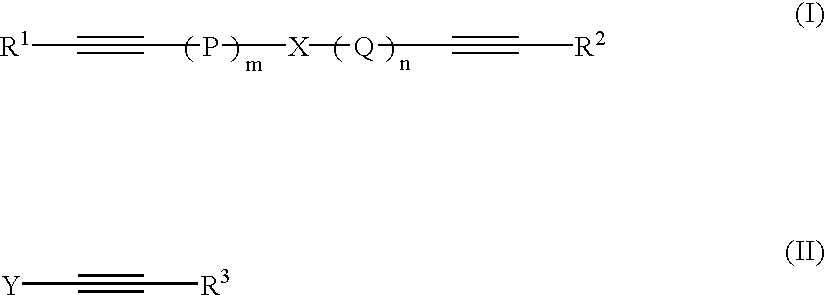
- or salts thereof;
- wherein X is an optionally substituted arylene or heteroarylene;
- R 1, R2, R3 and Y are independently selected from the group consisting of optionally substituted, optionally interrupted linear or cyclic alkyl, and optionally substituted aryl or heteroaryl;
- P and Q are independently selected from the group consisting of optionally substituted arylene or heteroarylene, optionally substituted linear or cyclic alkylene, and optionally substituted alkenylene of formula —(CR 4=Z)p- or -(Z=CR4)p— where Z represents CR5 or N, R4 and R5 each independently represent a hydrogen atom or an optionally substituted alkyl group, and p≧1;
- and wherein m and n are independently 0, 1, 2 or 3;
- with the proviso that where X is a phenylene group or —CH 2OC6H4OCH2—; R1, R2 and R3 are all hydrogen; and n and m are both equal to 0, Y is other than unsubstituted phenyl or a vinyl-substituted phenyl.
- FIGS. 1-8 are graphs (transmitted fluence (J/cm2 ) vs. incident fluence (J/cm2)) illustrating the optical limiting properties of the hyperbranched polymers described herein, in accordance with the present invention.
- FIGS. 9-15 are fluorescence spectra (intensity vs. wavelength) showing the light-emitting properties of the hyperbranched polymers described herein, in accordance with the present invention.
- The present invention, as defined in the five embodiments described briefly above, relates both to new methods involving known hyperbranched polymers, and to a range of new hyperbranched polymer structures perse. The novel hyperbranched polymer structures may also be employed in the same methods as the known hyperbranched polymers.
- The new methods employing the hyperbranched polymers (both the known polymers and the novel polymers) will be discussed first, following which the structures of the polymers will be discussed.
- The hyperbranched polymers which are the subject of this invention may be employed in a variety of methods for which they were previously unknown, such as optical limiting devices and light emitting devices (LEDs).
- a) Optical Limiting Properties
- Optical limiting materials show a non-linear transmittance of light, with transmission varying with the intensity of the incident radiation. Transmission is high at normal intensity, but low for intensive beams. Such materials are useful to protect, inter alia, optical elements, sensors, or the human eye.
- The inventors have surprisingly found that hyperbranched polymer structures formed from copolycyclotrimerization reactions of diynes and monoynes, or homopolycyclotrimerization reactions of diynes alone exhibit good optical limiting properties, and may therefore be useful in optical limiting devices. For example, in order to limit the path of light, a layer of material comprising the hyperbranched polymers of the invention may be interposed between a light source and another material which is to be guarded from intense light (e.g. the human eye). The optical limiting properties of such hyperbranched polymer structures have never previously been known.
- b) Light Emitting Properties
- The development of blue-light emitting polymers has been the subject of intense academic and industrial research directed towards the fabrication of full colour organic displays. However, as yet no organic polymer fully meets the desired criteria of long-term stability, high efficiency, and bright blue emission that are essential for commercially viable light emitting diodes (LEDs). So far, the majority of work on polymer LEDs has been focused on linear, one-dimensional polymers. Although a few three-dimensional conjugated polymers, such as hyperbranched polymers, have been reported to exhibit charge transferring and processing properties comparable to those of their linear counterparts, three-dimensional light-emitting materials have been less discussed in the literature.
- Conventional linear polymers, such as poly(p-phenylenevinylene)s have a strong tendency to form aggregates due to the interchain π-stacking, and the resultant red-shifted and less efficient emission restricts the potential applications of these molecules. Also, while poly(p-phenylene) (PPP), a thermally robust conjugated polymer, has attracted much attention as a promising candidate for use in the construction of blue LEDs, its comparatively low solubility in organic solvents precludes the formation of a high molecular weight polymer. Thus, low solubility of known organic materials restricts their potential applications as advance materials such as in LEDs.
- A series of hyperbranched polymers has now been synthesised via copolycyclotrimerization of diynes with monoynes or via homopolycyclotrimerization of diynes alone, and it has been found that such hyperbranched structures display unexpected light emitting properties such as high luminescence efficiency, as well as good solubility and excellent thermal stability. These properties make the polymers useful in methods for emitting light, emitting light at wavelengths of between 350 and 700 nm, more preferably between 380 and 450 nm (i.e. blue/violet light). For example, the hyperbranched structures have been shown to emit strong deep-blue light at ˜400 nm while remaining thermally stable, and emit light of an intensity greater than that emitted by poly(1-phenyl-1-octyne), a well-known highly luminescent disubstituted polyacetylene. The high efficiency and bright blue emission of the polymers makes them good candidates for commercially-viable blue LEDs.
- In addition, thin films of the polymers may be produced, and surprisingly show little aggregate formation. This is in contrast to macromolecular chromophores in other polymers, which often aggregate to form less or non-emissive species such as excimers, whose luminescence spectra are normally red-shifted in comparison to those of the polymer solutions. Such shifts are clearly detrimental when the polymers are utilised as thin films in LED applications. However, thin films of polymers of the invention show photoluminescence spectra similar to those of the polymer solutions, with little or no decrease in emission intensity or red-shift in emission peaks, indicating little aggregation.
- In summary, the combination of the optical-limiting and light-emitting properties described above with the previously known properties (e.g. excellent solubility and processability; high thermal stability; tuneable composition and properties (e.g. by changing the monomers and their respective concentrations)) makes the hyperbranched polymers desirable for use in a number of applications. For example, they can be used in high performance composites, thermally stable coatings, light emitting devices and optical limiting devices, or as surface modifiers, tougheners, additives, viscosity reducing agents, and in other industrial applications.
- Having discussed technical areas in which the hyperbranched polymers may be employed, their structures will now be considered in more detail. The following list of possible functional groups, substituents and interrupting groups are those which are generally applicable to the invention. Particularly preferred groups, substituents and interrupting groups in each of the three embodiments will be described later.
- When used to describe the monomers used in the homopolycyclotrimerization and copolycyclotrimerization reactions above, alkyl and alkylene represent a monovalent alkyl or a divalent alkylene group respectively, either of which may be linear or cyclic, may be straight-chain or branched, and may contain up to 20 carbon atoms.
- When alkyl represents a linear, uninterrupted group, it preferably contains from 3 to 10, more preferably from 3 to 6 carbon atoms. When alkyl represents a linear, interrupted group, it preferably contains between 2 and 20 carbon atoms, especially between 5 and 16 carbon atoms. When alkyl represents a cyclic group, it preferably contains from 3 to 10, more preferably from 3 to 8, most preferably from 3 to 6 carbon atoms. Some preferred cyclic alkyl (cycloalkyl) groups include cyclopropyl, cyclobutyl, cyclopentyl, cyclohexyl, cycloheptyl and cyclooctyl groups, as well as the cycloalkyl group formed by removal of one hydrogen atom from decalin or cholestryl.
- When alkylene represents a linear group, it preferably contains from 1 to 12 carbon atoms, more preferably between 3 and 8 carbon atoms. When alkylene represents a cyclic group, it preferably contains from 3 to 10, more preferably from 3 to 8, most preferably from 3 to 6 carbon atoms. Some preferred cyclic alkylene (cycloalkylene) groups include cyclopropylene, cyclobutylene, cyclopentylene, cyclohexylene, cycloheptylene and cyclooctylene, as well as the cycloalkylene group formed by removal of two hydrogen atoms from decalin or cholestryl.
- Alkenyl and alkenylene represent a monovalent alkenyl or a divalent alkenylene group respectively, either of which may be straight-chain or branched, linear or cyclic, and may contain from 2 to 20 carbon atoms. When they represent a linear group, they preferably contain from 2 to 6, more preferably from 2 to 4, most preferably 2 carbon atoms. When they represent a cyclic group, they preferably contain from 5 to 8 carbon atoms.
- Aryl or arylene represent a monovalent aryl or divalent arylene group respectively, comprising at least one aromatic ring, either of which may contain from 5 to 18, preferably from 6 to 14, more preferably from 6 to 10, and most preferably 6 carbon atoms. Typical aryl groups include phenyl, naphthyl, phenanthryl, anthracyl, indenyl, azulenyl, biphenylenyl, and fluorenyl groups. Particularly preferred aryl groups are phenyl, naphthyl and fluorenyl. Typical arylene groups include phenylene, naphthylene, phenanthrenylene, anthracenylene, indenylene, azulenylene, biphenylenylene and fluorenylene groups. Particularly preferred arylene groups include phenylene, biphenylene, naphthylene, fluorenylene, anthracenylene and phenanthrenylene.
- Heteroaryl or heteroarylene represent a monovalent heteroaryl or divalent heteroarylene group respectively, either of which may contain from 3 to 14 ring atoms and 1, 2 or 3 heteroatoms selected from oxygen, nitrogen and sulphur atoms. Examples of heteroaryl groups are thienyl, benzothienyl, naphthothienyl, thianthrenyl, furyl, pyranyl, isobenzofuranyl, chromenyl, xanthenyl, phenoxathiinyl, pyrrolyl, imidazolyl, pyrazolyl, pyridyl, pyrazinyl, pyrimidinyl, pyridazinyl, indolizinyl, isoindolyl, indolyl, indazolyl, purinyl, quinolizinyl, isoquinolyl, quinolyl, phthalazinyl, naphthyridinyl, quinazolinyl, cinnolinyl, pteridinyl, carbazolyl, carbonlinyl, phenanthridinyl, acridinyl, perimidinyl, phenanthrolinyl, phenazinyl, isothiazolyl, phenothiazinyl, isoxazolyl, furazanyl and phenoxazinyl. Particularly preferred heteroaryl groups include carbazyl and thienyl.
- Examples of heteroarylene groups include the divalent derivatives of the heteroaryl groups listed above (i.e. the heteroaryl groups listed above having a further hydrogen atom removed in order to form a divalent group). Particularly preferred heteroarylene groups include thienylene, carbazylene, pyrenylene and pyridylene.
- Where any of the groups defined above are described as being optionally substituted, the substituent groups may include halogen atoms, hydroxy, cyano, amino, silyl, nitro, alkyl, cycloalkyl, haloalkyl, cycloalkyloxy, alkoxy, haloalkoxy, formyl, alkoxycarbonyl, carboxyl, alkanoyl, alkylthio, alkylsulphinyl, alkylsulphonyl, alkylsulphonato, aryl, arylalkyl, alkaryl, aryloxy, arylsulphinyl, arylsulphonyl, arylsulphonato, carbamoyl, carbamido, alkylamido, alkenyl, alkenyloxy and alkynyl, as well as heterocyclic groups. When the substituent group is silyl, the silicon atom is preferably substituted with hydrogen, a C 1-C6 alkyl group, or a phenyl group. Particularly preferred groups include trimethylsilyl and dimethylphenylsilyl.
- Where any of the groups defined above are described as being optionally interrupted, this means that functional groups are present as interruptions in the carbon backbone. Interrupting groups include atoms such as oxygen or sulphur, or functional groups which are divalent radicals derived from groups such as amino, silyl, cyano, amido, formyl, alkoxycarbonyl, carboxy, alkanoyl, alkylthio, cycloalkyl, haloalkyl, cycloalkyloxy, alkoxy, haloalkoxy, alkylsulphinyl, alkylsulphonyl, alkylsulphonato, aryl, arylalkyl, alkaryl, aryloxy, arylsulphinyl, arylsulphonyl, arylsulphonato, carbamoyl, carbamido, alkylamido, alkenyl, alkenyloxy and alkynyl, as well as heterocyclic groups. When the interrupting group is a silyl group, the silicon atom is preferably substituted with hydrogen, a C 1-C6 alkyl group or a phenyl group. A particularly preferred group is —Si(Me)2-.
- When used to describe an optional substituent or an optional interrupting group, or when forming a part of the conjugate substituent or interrupting groups described above (e.g. when forming the alkyl part of an alkylamido group), alkyl preferably represents a straight-chain or branched alkyl group having from 1 to 15, more preferably 1 to 10, most preferably 1 to 6 carbon atoms. Typical alkyl groups include methyl, ethyl, propyl, isopropyl, butyl, sec-butyl and tert-butyl, with methyl, ethyl and propyl being especially preferred.
- When used to describe an optional substituent or an optional interrupting group, cycloalkyl preferably represents a cyclic alkyl group having from 3 to 8, preferably 3 to 6 carbon atoms. Cyclohexyl is particularly preferred.
- When used to describe an optional substituent or an optional interrupting group, alkenyl preferably represents a straight-chain or branched alkenyl group having from 2 to 6, more preferably from 2 to 4, carbon atoms. Typical alkenyl groups include vinyl, allyl, 1-butenyl, 2-butenyl, 3-butenyl, and isobutenyl groups, with vinyl being especially preferred.
- When used to describe an optional substituent or optional interrupting group, aryl is preferably an aryl group containing from 5 to 18, preferably from 6 to 14, more preferably from 6 to 10, and most preferably 6 carbon atoms. Particularly preferred aryl groups include phenyl and biphenyl.
- Alkynyl typically represents an alkynyl group having from 2 to 6, more preferably from 2 to 4, carbon atoms. Typical alkynyl groups include propargyl, 1-propynyl, 2-propynyl, 1-butynyl, 2-butynyl, and 3-butynyl.
- Heterocyclic represents groups having between 3 and 10 carbon atoms and having one or more 4, 5, 6 or 7 member saturated or unsaturated rings containing 1, 2 or 3 oxygen, nitrogen or sulphur atoms. Examples of heterocycles include tetrahydrofuran, 1,4-dioxane, 1,3,5-trioxane, pyrrolidine, piperidine, piperazine, imadazoline, isoindoline, chromane, isochromane, pyrazolidine, quinuclidine, pyridine, pyrrole, oxazole, indole, purine, pyrimidine, 1,3-dithiane, azetidine, tetrahydropyran, imidazole, thiazole, isoxazole, pyrazole, quinoline, cytosine, thymine, uracil, adenine, guanine, pyrazine, picolinic acid, picoline, furoic acid, furfural, furfuryl alcohol, carbazole, isoquinoline, 3-pyrroline, thiophene, furan, hexamethyleneimine, ε-caprolactone, ε-caprolactam, omega-thiocaprolactam and morpholine.
- Alkaryl represents any of the aryl groups defined above substituted by one or more alkyl groups.
- Aralkyl represents any of the alkyl groups defined above substituted by one or more aryl groups.
- Halo represents a chlorine, fluorine, bromine or iodine atom. A group containing a halo group, e.g. haloalkyl, may contain one or more of these halogen atoms.
- Typical haloalkyl groups include C 1-C4 alkyl groups substituted by one or more of fluorine, chlorine, bromine, or iodine atoms, e.g. fluoromethyl, difluoromethyl, trifluoromethyl, pentafluoroethyl, 1,1-difluoroethyl, and trichloromethyl groups.
- Alkoxy, alkenyloxy, aryloxy and cycloalkyloxy represent any of the alkyl, alkenyl, aryl and cycloalkyl groups respectively as described above and linked by an oxygen.
- Alkoxycarbonyl represents the group —C(O)OR, where R is hydrogen or any of the alkyl groups described above.
- Haloalkoxy represents any of the alkoxy groups described above and substituted by one or more fluoro, chloro, bromo, or iodo groups, e.g. trifluoromethoxy, trichloromethoxy, 2-chloroethoxy, 2-bromoethoxy, pentafluoroethyl, 3,3,3-trichloropropoxy and 4,4,4-trichlorobutoxy.
- Typical amino groups include NH 2, NHR, and NRR′, wherein R and R′ are C1-C4 alkyl groups.
- Carbamido represents groups of the formula —NHC(O)NH 2. Carbamoyl represents groups of the formula —C(O)NH2.
- Alkanoyl represents any of the alkyl groups described above and linked by a carbonyl group, i.e. —C(O)R, where R is alkyl.
- Alkylthio represents an alkyl group as described above linked by a sulphur atom.
- Alkylamido represents an alkyl group as described above and linked by an amido group, for example —C(O)NRR′, where at least one of R and R′ is a C 1-C4 alkyl group.
- Alkylsulphinyl and arylsulphinyl represent an alkyl group or an aryl group respectively and as described above, being linked by a sulphinyl, i.e. —S(O)—, group.
- Alkylsulphonyl and arylsulphonyl represent an alkyl group or an aryl group respectively and as described above, being linked by a sulphonyl, i.e. —SO 2—, group.
- Alkylsulphonato and arylsulphonato represent an alkyl group or an aryl group respectively and as described above, being linked by a sulphonato, i.e. —SO 2—O—, group.
- When monomers are described as being according to general formulae (I) or (II), also encompassed are the salts (e.g. organic or metallic salts) of such compounds. Suitable salts will be known to those skilled in the art. For example, when the monomer is basic (e.g. when R 1, R2, R3 or Y are amines of formula —NH2, —NHR or —NRR′), salts include compounds such as hydrochloride salts. One possible commercially available monomer within the scope of the invention is propargylamine hydrochloride, formed from quaternization of the amine group and having the formula HC≡CCH2NH2.HCl. Alternatively, when the monomers are acids (e.g. where R1, R2, R3 or Y contain —COOH as a terminal group), the monomers may be present as metal salts, for example as sodium, potassium, calcium or magnesium salts thereof.
- Each of the three embodiments of the invention will now be described separately in more detail.
- The first and second embodiments of the invention relate to methods employing polymers formed via the copolycyclotrimerization of a diyne and a monoyne as defined above. Suitable monomers for use in these embodiments include those containing, as the X and Y groups, purely aliphatic groups, purely aromatic groups, or a mixture of the two.
- X may be a linear or cyclic optionally substituted alkylene group, preferably having the general formula —(CH 2)k— where k is an integer between 1 and 12, preferably between 3 and 8. When X is such a group, the other groups (including P, Q and Y) may also contain aliphatic groups, or may alternatively contain aromatic moieties, such as phenyl rings. However, it is preferred that when X has the general formula —(CH2)k—, m and n are zero, thus neither P nor Q are present.
- Alternatively, X may be an optionally substituted arylene or heteroarylene group, for example one selected from phenylene, biphenylene, naphthylene, fluorenylene, anthracenylene, phenanthrenylene, thienylene, carbazylene, pyrenylene and pyridylene. When X is a phenylene group, a preferred polymer structure is produced when one of m or n is one, and the other is zero, such that one of the groups, P or Q, is present. In this case, it is preferred if the one of P or Q which is present, is a phenylene group.
- If X is a substituted arylene or heteroarylene group, it is preferably substituted by one or more C 1-C10 alkyl groups. For example, some preferred groups include a phenylene group substituted by between 1 and 4, preferably 4, methyl groups; a fluorenylene group substituted at the 9-position by two alkyl groups, preferably C1-C8, more preferably C1-C6, most preferably C6 alkyl groups; or a carbazylene substituted on the nitrogen atom by an alkyl group which is preferably a C1-C16, more preferably a C11 alkyl group.
- When X is an arylene or a heteroarylene group, it will be attached to P and Q (or, in their absence, to the two carbon-carbon triple bonds) by any suitable attachment points. For example, a phenylene group may be attached at any two carbon atoms, but is preferably in a 1,4-conformation (i.e. attached at two carbon atoms which are opposite to each other in the ring). A fluorenylene group will be similarly attached at two convenient carbon atoms, but is preferably attached at either the 2 and 7, or the 3 and 6 positions.
- In preferred embodiments, X is selected from the following specific groups: 1,4-phenylene, 1,4-(2,3,5,6-tetramethyl)phenylene, 4,4′-biphenylene, 2,7-fluorenylene, 3,6-fluorenylene, 2,7-[9,9-bis(n-hexyl)]fluorenylene, 3,6-[9,9-bis(n-hexyl)]fluorenylene, 3,6-(N-hexyl)carbazylene, 3,6-(N-undecyl)carbazylene, 2,7-(N-hexyl)carbazylene and 2,7-(N-undecyl)carbazylene.
- Similarly to X, Y may be an aliphatic or an aromatic group. In one embodiment, Y is an optionally interrupted, optionally substituted alkyl group, preferably having from 1 to 20 carbon atoms. If Y is an uninterrupted group, it preferably contains from 3 to 10 carbon atoms in its carbon backbone. When Y is an uninterrupted but substituted group, it may be substituted by any of the optional substituents described above. However, it is preferred that Y is substituted with a functional group selected from aryl, aryloxy and heterocyclic groups.
- In another preferred embodiment, Y is a linear alkyl group having between 1 and 20 carbon atoms, and being interrupted by a group of the general formula:

- wherein W represents a carbon-carbon single bond or a group of the formula —C(O)—O— or —O—C(O)—; and R 5 and R6 independently represent —O—, —C(O)—, —C(O)—O—, —O—C(O)— or a group of the formula —C(O)—O—(CH2)h—O—(CO)i— where h is an integer between 1 and 10, and i is 0 or 1. Y is more preferably interrupted by one of the following groups:

- In these formulae, h is an integer between 1 and 1 0, and is preferably 6.
- Alternatively, when Y is not an aliphatic group, it may be an optionally substituted aryl or heteroaryl group. The aromatic ring(s) is(are) preferably selected from phenyl, naphthyl, flurorenyl, anthracenyl, phenanthrenyl, carbazolyl, thienyl, pyrrolyl or pyridinyl groups, with phenyl and naphthyl being particularly preferred.
- The numbers m and n may be zero, 1, 2 or 3, although in some instances it is preferred that at least one of m or n is 1. In this case it is preferred that P and/or Q are optionally substituted aryl or heteroaryl groups. In a preferred case, m is 1 and n is zero, and P is phenylene. Alternatively, m is zero and n is one, with Q being phenylene. These two alternatives are particularly preferred when X is a single phenylene group. However, the most preferred arrangement is where m and n are both zero.
- R 1, R2 and R3 can be aliphatic or aromatic groups, as defined in the first definition of this embodiment. However, it is generally preferred that they are independently selected from hydrogen and optionally interrupted C1-C6 alkyl groups. A preferred example of an interrupted C1-C6 alkyl group is a trimethylsilyl group, which can be considered as a methyl group which is interrupted by a —Si(Me)2- group. Other preferred examples of R1, R2 and R3 groups include hydrogen, methyl, ethyl and propyl, with hydrogen being particularly preferred for each of these R groups.
- The third and fourth embodiments of the invention relates to methods employing polymers formed via the homopolycyclotrimerization of a diyne. In these embodiments the diyne is defined in the same way as in the first embodiment above, with the preferred X, P, Q, R 1 and R2 groups and the preferred values of m and n being as for the first and second embodiments. However, it is particularly preferred in the third and fourth embodiments that m and n are both zero, R1 and R2 are both hydrogen, and X is selected from phenylene and groups having the general formula —(CH2)j— where j is an integer between 2 and 15, preferably between 3 and 9. The most preferable values of j are odd integers between 3 and 9, i.e. j=3, 5, 7 or 9.
- According to the fifth embodiment of the invention, there is provided a range of new polymers formed via the copolycyclotrimerization of a diyne and a monoyne, where the diyne contains at least one aromatic ring between the two carbon-carbon triple bonds. The preferred X, Y, P, Q, R 1, R2 and R3 groups and the preferred values of m and n are the same as those in the first embodiment, but with the requirement that the X group is an optionally substituted arylene or heteroarylene group.
- However, in particularly preferred cases, X is selected from phenylene, biphenylene, fluorenylene or thiophenylene. It is also preferred that Y is either phenyl, or —(CH 2)hCH3 where h is an integer between 1 and 10, preferably between 3 and 9.
- The hyperbranched polymer structures according to this fifth embodiment of the invention are, like those defined in the other embodiments, suitable for use as optical limiters or light-emitting materials. For example, the hyperbranched polymers according to this embodiment emit ultra-violet light at a wavelength around 400 nm, making them useful for light-emitting applications. The emission colour can be tuned by changing the molecular structure of the polymer.
- The polymers can be made by any conventional process known to the person skilled in the art. Particularly suitable processes are disclosed in earlier papers, Polymer Preprints, 2000, 41(2), pp1245-1246 and pp1318-1319 (both Xu et al).
- Monomers for use in these processes may be commercially available. For example, suitable commercially available monomers include monomers of the general formula HC≡C—(CH 2)m—C≡CH, where m=2, 4, 6, 8, 10, 12, 16, acetylenedicarboxylic acid, 1,3-bis(trimethylsilylethynyl)benzene, 1,4-bis(trimethylsilylethynyl)benzene, 3-butyn-1-ol, 3-butynoic acid, 2-butyne-1,4-diol, 3-cyclohexyl-1-propyne, 5-chloro-1-pentyne, 5-cyano-1-pentyne, 1,1-diphenyl-2-propyn-1-ol, 1,4-dichloro-2-butyne, 1-dimethylamino-2-propyne, 3,3-dimethyl-1-butyne, diphenylacetylene, 1,4-dichloro-2-butyne, 1,9-decadiyne, 1-ethynyl-1-cyclohexanol, 1- ethynylcyclohexene, 1-ethynylcyclohexylamine, 17α-ethynylestradiol, 2-ethynylpyridine, 3-ethyl-1-heptyn-3-ol, 4-ethynyltoluene, 9-ethynyl-9-fluoroenol, ethyl propiolate, 5-hexyn-1-ol, 5-hexynenitrile, 5-hexynoic acid, 7-hexadecyn-1-ol, 5-hexyn-1-ol, 1,6-heptadiyne, 2-methyl-1-buten-3-yne, 2-methyl-3-butyn-2-ol, 3-methyl-1-pentyn-3-ol, methyl phenylpropiolate, 1,8-nonadiyne, 3-nonyn-1-ol, 1-octyne, 3-octyn-1-ol, 1-phenyl-1-butyne, 1-butynylbenzene, 1-phenyl-1-propyne, 1-phenyl-2-(trimethylsilyl)acetylene, 1-phenyl-2-propyn-1-ol, 1-propynyl-1-cyclohexanol, 3-pentyn-1-ol, 4-pentyne-1-ol, 4-pentynoicacid, 4-phenyl-1-butyne, phenylacetylene, propargyl alcohol, propargyl benzenesulfonate, propargyl chloride, propargylamine hydrochloride, propiolic acid, 3-pentynoic acid, 4-pentyn-1-ol, triethylsilyl)acetylene, (triisopropylsilyl)acetylene, (triphenylsilyl)acetylene, 1,1,3-triphenylpropargyl alcohol, 1-(trimethylsilyl)-1-propyne, 1-trimethylsilyl-1-hexyne, 10-undecynoic acid, 10-undecyn-1-ol and 3,9-dodecadiyne. Alternatively, the monomers may be prepared from commercially available starting materials by conventional processes. For instance, the
monomer - A transition metal catalyst is used in the processes for preparing the hyperbranched polymers. Suitable catalysts include those having, as the transition metal, niobium, tantalum, molybdenum, tungsten, cobalt, nickel, zinc, rhodium, palladium, ruthenium and iridium. Specific transition metal complexes useful in the processes include NbCl 5 and TaCl5, both of which may be used with or without Ph4Sn as a cocatalyst; [Mo(CO)3cp]2; [W(CO)3cp]2, Co(CO)2cp and Co2(CO)8. Of these, NbCl5, TaCl5, Co(CO)2cp and Co2(CO)8 are preferred. When Co(CO)2cp is used, it can be activated with UV radiation.
- The following Examples are intended to illustrate the present invention, and are not intended to limit the invention in any way.
- Examples 1 to 9 describe synthetic routes to produce hyperbranched polymers according to the teaching of the invention. The synthetic routes encompass a range of different diynes and monoynes, and describe both homopolycyclotrimerization and copolycyclotrimerization reactions.
- This example demonstrates the preparation of a hyperbranched polymer via homopolycyclotrimerization of a diyne according to the following general scheme:

-
Scheme 1 represents a scheme according to the third and fourth embodiments of the invention where R1 and R2 are the same (and are represented by “R”), and m and n are both zero (so P and Q are absent). In this specific example, X is a —(CH2)5— group, and R is methyl (i.e. the monomer is 2,9-undecadiyne). - Method:
- To a well baked Schlenk tube, 18.0 mg of TaCl 5 (0.05 mmol) and 21.3 mg Ph4Sn (0.05 mmol) were added under an inert atmosphere in a glovebox. The catalysts were mixed with 2.0 mL freshly distilled toluene and aged at room temperature for 15 minutes. A solution of 0.2 mL 2,9-undecadiyne (160 mg, 1.08 mmol) in 2.8 mL toluene was then added dropwise via a syringe over 3-5 minutes under stirring. An immediate exothermic reaction took place and the colour of the reaction mixture changed from light yellow to deep brown. After stirring at room temperature for 2 hours, the reaction was quenched by the addition of a small amount of methanol. The polymer solution was dropped into 150 mL methanol via a cotton filter while stirring. The precipitated polymer was then allowed to stand in methanol overnight, decanted gently, washed with methanol several times, and dried in a vacuum at room temperature to a constant weight. The yield was 132.0 mg (82.5%), and the product was a colourless powder which was completely soluble in solvents such as toluene, dichloromethane, chloroform and THF. TGA analysis (performed on a
Perkin Elmer TGA 7 at a heating rate of 20° C./min under nitrogen) shows that the resulting polymer possesses high thermal stability, having a 5% weight loss at 480° C. - While this method has been described using 2,9-undecadiyne as the diyne, it is equally applicable to other monomers. For example 3,9-dodecadiyne has also been used in the method described above in order to form a hyperbranched polymer. The method is also suitable for the homopolycyclotrimerization of terminal diynes.
- This example demonstrates the preparation of a hyperbranched polymer via copolycyclotrimerization of a diyne with a monoyne, as shown in the following general scheme:

- Scheme 2 represents a scheme according to the first, second and fifth embodiments of the invention where R 1, R2 and R3 are all hydrogen, and m and n are both zero (so P and Q are absent). In the specific example below, the X group is —(CH2)4— (i.e. the diyne is 1,7-octadiyne) and the Y group is:

- The monoyne is therefore described as a carbazole-containing monoacetylene (CzA).
- Method:
- To a thoroughly baked and moisture excluded Schlenk tube, 18.0 mg of TaCl 5 (0.05 mmol) and 21.3 mg Ph4Sn (0.05 mmol) were added under an inert atmosphere in a glovebox. The catalysts were mixed with 1.0 mL freshly distilled toluene and aged at room temperature for 15 minutes. A mixture solution of 0.2 mL (160 mg, 1.51 mmol) 1,7-octadiyne and 30 mg (0.09 mmol) carbazole-containing monoacetylene (CzA, see below) in 1.3 mL toluene prepared in another dry tube was then added dropwise via a syringe over 3-5 minutes under stirring. An immediate exothermic reaction took place and the colour of the reaction mixture changed from light yellow to dark brown. After stirring at room temperature for 12 hours, the reaction was quenched by the addition of a small amount of methanol. The polymer solution was dropped into 150 mL methanol via a cotton filter under stirring. The precipitated polymer was then allowed to stand in methanol overnight, and then the methanol was decanted gently. The polymer was isolated, washed with methanol several times, and dried in a vacuum at room temperature to a constant weight. The yield was 128 mg (67%) and the product was a light grey powder which was completely soluble in solvents such as toluene, dichloromethane, chloroform and THF.
- While this method has been described using 1,7-octadiyne as the diyne and CzA as the monoyne, it is equally applicable to other monomers. For example 1,8-nonadiyne and 1,9-decadiyne have also been used as the diynes, and 1-octyne and phenylacetylene have all been used as the monoynes in order to form hyperbranched polymers.
- This example describes the production of a diyne (1,4-diethynylbenzene) followed by copolycyclotrimerization of the diyne with a monoyne (phenylacetylene). The general reaction scheme is shown below:

-
Scheme 3 represents a scheme according to the first, second and fifth embodiments of the invention where R1, R2 and R3 are all hydrogen; m and n are both zero (so P and Q are absent); X is phenylene and Y is phenyl. It will be appreciated thatScheme 3 falls within the scope of Scheme 2, but simply specifies the nature of the X and Y groups. - Method:
- To a 250 mL backed two-necked flask were added 2.36 g (10 mmol) of 1,4-dibromobenzene, 20 mg of Cul and 280 mg or dichlorobis(triphenylphosphine) palladium(ii) [Pd(Ph 3P)2Cl2]. Then 38 mL of dried Et3N was injected in under nitrogen and magnetic stirring. Yellow turbidious dispersion was formed immediately. Following by adding 3.6 mL (2.45 g, 25 mmol) of trimethylsilylacetylene. The colour was changed from yellow to deep brown. Stirring was continued at room temperature for 24 hours. A mixture of grey precipitate was formed. The precipitate was separated and washed with Et3N slowly until its colour became white. The Et3N solutions were collected and the solvent was removed. A black solid with some crystal-like substance was obtained. The crude product was purified through a silica gel column using hexane and dichloromethane (1:1 v/v) as eluent. The thus obtained 1,4-bis(trimethylsilylacetyl)benzene (2.25 g, 8.3 mmol) was refluxed with 5.73 g (102 mmol) of KOH in 143 mL ethanol for 6 hours. The solution was poured to 880 mL of 1M HCl solution. Some yellow flocculates were formed, which were collected and dried. The crude product was further purified by sublimation at 90-100° C. A white
powdery product 1,4-diethynylbenzene was obtained in 39% yield. - Copolymerization of the 1,4-diethynylbenzene was carried out in a dry nitrogen atmosphere by a standard Schlenk technique. To a thoroughly baked and moisture-excluded Schlenk tube, 18 mg TaCl 5 (0.05 mmol) and 21.3 mg Ph4Sn (0.05 mmol) were added in a glovebox. The catalysts were mixed with 1.0 mL freshly distilled toluene and aged at room temperature for 15 minutes. A mixture solution of 40 mg (0.32 mmol) 1,4-diethynylbenzene with 0.1 mL (0.88 mmol) phenylacetylene in 1.4 mL toluene prepared in another dry tube was then added dropwise via a syringe over 3-5 minutes under stirring. An immediate exothermic reaction took place and the colour of the mixture changed from light yellow to dark brown. The copolymerization was allowed to continue for 6 hours. A completely soluble copolymer was obtained as a light beige powder in a yield of 76 mg (57%). TGA revealed that the copolymer is thermally stable with a 5% weight loss at 500° C.
- This example demonstrates the preparation of a diyne (4,4′-diethynylbiphenyl) followed by production of a hyperbranched polymer via copolycyclotrimerization of the diyne with a monoyne (phenylacetylene). The general reaction scheme for the polymerization reaction is the same as that shown in Example 2, except in this specific example X is 4,4′-biphenylene and Y is phenyl.
- Method:
- To a 250 mL two-necked flask were added 4.06 g of 4,4′-diiodobiphenyl (10 mmol), 20 mg of Cul and 280 mg of [Pd(Ph 3P)2Cl2]. Then 100 mL of Et3N and 3.6 mL of trimethylsilylacetylene (2.45 g, 25 mmol) was injected subsequently. The reaction was allowed to continue at room temperature for 24 hours. The precipitate was removed by filtration and the solvent of the filtrate was evaporated. The crude intermediate, i.e. 4,4′-bis(trimethylsilylethynyl)biphenyl, was purified by column chromatography and then refluxed with 9.93 g of KOH (177 mmol) in 150 mL ethanol for 24 hours. After neutralisation with HCl solution, the precipitate was collected and the crude product was purified by column chromatography to afford 4,4′-diethynylbiphenyl as a light yellow powder. The yield was 1.692 g (55.2%).
- Copolymerization was carried out in a dry nitrogen atmosphere using a standard Schlenk technique. A typical procedure for the polymerization of 4,4′-diethynylbiphenyl and phenylacetylene comprises placing 18.0 mg TaCl 5 (0.05 mmol) and 21.3 mg Ph4Sn (0.05 mmol) in a thoroughly baked and moisture excluded Schlenk tube in a glovebox. The catalysts were mixed with 1.0 mL toluene and aged at room temperature for 15 minutes. A solution of 40.2 mg (0.199 mmol) 4,4′-diethynylbiphenyl and 0.05 mL (46.5 mg, 0.46 mmol) of phenylacetylene in 1.45 mL toluene was then added dropwise into the solution of the catalyst. After stirring at room temperature for 21 hours, the reaction was quenched by the addition of a small amount of methanol. The polymer solution was dropped into 150 mL methanol via a cotton filter under stirring. The precipitated polymer was collected, washed with methanol several times, and then dried in vacuum to give the hyperbranched polymer as a light grey powder in a yield of 44.9 mg (51.8%).
- As with the previous examples, while this synthetic method has been described with relation to a specific diyne and a specific monoyne, it is equally applicable to the preparation of other diynes and to copolycyclotrimerization reactions of other monomers. For example, a process has been carried out using 1,4-diethynylbenzene as the diyne and 1-ethynylnaphthalene as the monoyne. The hyperbranched polymers produced according to this method all show high thermal stability, with 5% weight loss occurring at ˜500° C. or higher.
- This example demonstrates the copolycyclotrimerization of 1,7-octadiyne with various monoynes. A number of polymers were synthesised, all according to the following reaction scheme:

-
Scheme 4 is a scheme according to the first, second and fifth embodiments of the invention where R1, R2 and R3 are all hydrogen; m and n are both zero (so P and Q are absent) and Y is a substituted alkyl group, represented by the group —(CH2)m—R. The R group was selected from carbazyl, oxynaphthalene and —OCO—C6H4—C6H4—O(CH2)7CH3, and m was selected from 3, 4 or 9. - In this specific example which follows, X is —(CH 2)4—, m is 3 and R is —OCO—C6H4—C6H4—O(CH2)7CH3.
- Method:
- Into a thoroughly baked and moisture excluded Schlenk tube were placed 18.0 mg of TaCl 5 (0.05 mmol) and 21.3 mg Ph4Sn (0.05 mmol) in a glovebox. The catalysts were mixed with 1.0 mL of toluene and aged at room temperature for 15 minutes. A solution of 36.0 mg (0.092 mmol) of the monoyne and 0.2 mL (160 mg, 1.51 mmol) 1,7-octadiyne in 1.3 mL toluene was then added dropwise into the catalyst solution. After stirring at room temperature for 12 hours, the reaction was quenched by the addition of a small amount of methanol. The polymer solution was dropped into 150 mL acetone via a cotton filter under stirring. The precipitated polymer was collected, washed with acetone several times, and then dried in a vacuum to give the hyperbranched polymer as a light yellow powder. The yield was 188.7 mg (96.3%).
- This example demonstrates the preparation of hyperbranched polymer using a heteroaryl-containing diyne (2,5-diethynylthiophene) and a monoyne (1-heptyne). The reaction scheme is as follows:

-
Scheme 5 is a scheme according to the first, second and fifth embodiments of the invention where R1, R2 and R3 are all hydrogen; m and n are zero (so P and Q are absent), X is thienylene and Y is an alkyl group, —(CH2)4CH3. It will be appreciated thatScheme 5 falls within the scope of general Scheme 2, but specifies the nature of the X and Y groups. - Method:
- To a 250 mL flask were added 2.5 g of 2,5-diiodothiophene (7.44 mmol), 100 mg of Cul, and 220 mg of Pd(Ph 3P)2Cl2 under nitrogen. Then 100 mL of triethylamine (TEA) and 5.0 mL of trimethylsilylacetylene (3.40 g, 35 mmol) were injected. The reaction mixture was allowed to stir at room temperature for 12 hours. The precipitate was removed by filtration and the solvent of the filtrate was evaporated. The crude intermediate, i.e. 2,5-bis(trimethylsilylethynyl)thiophene, was purified by column chromatography and thus hydrolysed with 3 g KOH (53.6 mmol) in 70 mL methanol for 2 hours. The solution was poured into a large amount of water, and extracted with diethyl ether twice. The resultant solution was washed with water three times, dried over magnesium sulphate, and then the solvent was removed under reduced pressure to give 2,5-diethynylthiophene as a pale yellow liquid (0.71 g, 72%).
- Copolymerization was carried out in a dry nitrogen atmosphere using a standard Schlenk technique. Into a thoroughly baked and moisture excluded Schlenk tube were placed 18.0 mg of TaCl 5 (0.05 mmol) and 21.3 mg of Ph4Sn (0.05 mmol) in a glovebox. The catalysts were mixed with 1.0 mL toluene and aged at room temperature for 15 minutes. A solution of 33 mg (0.25 mmol) 2,5-diethynylthiophene and 30 μL 1-heptyne in 1.45 mL toluene was then added dropwise into the catalyst solution. After stirring at room temperature for 20 hours, the reaction was quenched by the addition of a small amount of methanol. The polymer solution was dropped into 300 mL methanol via a cotton filter under stirring to precipitate the polymer, and pouring its chloroform solution into hexane further purified the crude product. A brown powder was collected and dried under vacuum overnight. The yield was 36 mg (65.5%).
- This example demonstrates the preparation of a hyperbranched polymer from 4,4′-diethynylbiphenyl and 1-heptyne. The general reaction scheme is that used in Example 2 (Scheme 2), wherein X is 4,4′-biphenylene and Y is —(CH 2)4CH3.
- Method:
- Into a thoroughly baked and moisture excluded Schlenk tube were placed 18.0 mg of TaCl 5 (0.05 mmol) and 21.3 mg of Ph4Sn (0.05 mmol) in a glovebox. The catalysts were mixed with 1.0 mL toluene and aged at room temperature for 15 minutes. A solution of 50.5 mg (0.25 mmol) of 4,4′-diethynylbiphenyl and 36 μL (0.275 mmol) of 1-heptyne in 1.45 mL toluene was then added dropwise into the solution of the catalyst. After stirring at room temperature for 20 hours, the reaction was quenched by the addition of a small amount of methanol. The polymer solution was dropped into 250 mL methanol via a cotton filter under stirring to precipitate the polymer, and pouring its chloroform solution into hexane further purified the crude product. A light yellow powder was collected and dried under vacuum overnight. The yield was 53 mg (68.9%).
- This example demonstrates the preparation of a hyperbranched polymer via copolycyclotrimerization of diynes with monoynes in the presence of a dicarbonylcyclopentadienylcobalt (CpCo(CO) 2) catalyst. The general reaction scheme is the same as that used in Example 2 (Scheme 2), but in the following specific reaction X is 3,6-(n-undecyl)carbazylene and Y is —(CH2)9CH3.
- Method:
- Into a thoroughly baked and moisture excluded Schlenk tube was placed 46 mg (0.125 mmol) of 3,6-diethynyl-9-undecyl-9H-carbazole in a glovebox. A solution of 1-dodecyne (27 μL, 0.125 mmol) in toluene (0.223 mL) was added to the tube, followed by the addition of a solution of CpCo(CO) 2 (2.25 mg, 0.0125 mmol) in toluene (1.0 mL). The mixture was irradiated under stirring with a 200W Hg lamp operating at 100V placed approximately 5 cm from the centre of the Schlenk tube. The irradiation continued for 6 hours at 65° C. The polymerization reaction was quenched by the addition of a small amount of methanol. The polymer solution was dropped into 250 mL methanol via a cotton filter under vigorous stirring to precipitate the polymer. The precipitate was redissolved in chloroform, which was poured into hexane to further purify the polymer product. After washing the precipitate with methanol, acetone, diethylether and hexane subsequently, a light yellow powder was collected, which was dried under vacuum overnight to a constant weight (66.7 mg, 100% yield).
- Although this example has been described using a specific diyne and a specific monoyne, it is equally applicable to other diynes and monoynes. For example, instead of a substituted carbazylene group between the two carbon-carbon triple bonds, a fluorenylene group (e.g. 2,7-fluorenylene) or a biphenylene group (e.g. 4,4′-biphenylene) can be used. Instead of a 1-dodecyne monomer as the monoyne, phenylacetylene, 1-heptyne, —(CH 2)4—OOC—C2H4—C2H4—O(CH2)6CH3 or other such monomers can be used. Other possible monomers will be apparent to those skilled in the art.
- This example demonstrates the preparation of poly[phenylen-alt-2,7-fluorene]s from fluorenylene-containing diynes and aliphatic monoynes. Again, the general reaction scheme is that shown in Example 2 (Scheme 2), but in the particular Example given below X is 2,7-[9,9-bis(n-hexyl)]fluorenylene and Y is —(CH 2)9CH3.
- Method:
- Into a thoroughly baked and moisture excluded Schlenk tube were placed 18.0 mg of TaCl 5 (0.05 mmol) and 21.3 mg of Ph4Sn (0.05 mmol) in a glovebox. The catalysts were mixed with 1.0 mL toluene and aged at room temperature for 15 minutes. A solution of 68.9 mg (0.318 mmol) 3,6-diethynyl-9H-fluorene and 46 μL (0.22 mmol) 1-dodecyne in 1.45 mL toluene was then added dropwise into the catalyst solution. After stirring at room temperature for 12 hours, the reaction was quenched by the addition of a small amount of methanol via a cotton filter under stirring to precipitate the polymer, and pouring its chloroform solution into hexane further purified the crude product. A light yellow powder was collected and dried under vacuum overnight. The yield was 81.1 mg (77.4%).
- This method is also applicable to a wide range of other monomers. For example, we have used the method to form hyperbranched polymers from monomers such as 2,7-diethynyl-9,9-bis(n-hexyl)-9H-fluorene as the diyne and 1-octyne as the monoyne.
- Examples 10 to 14 relate to the optical-limiting properties of the hyperbranched polymers described in the invention.
- In each Example, the optical-limiting properties were measured in accordance with standard procedures. The optical limiting experiments were performed at 532 nm, using 8-ns optical pulses generated from a frequency-doubled Q-switched Nd:YAG laser (Quanta Ray GCR-3) operating in a near-Gaussian transverse mode with a repetition rate of 10 Hz. The pulsed laser beam was focused onto a 1 cm square quartz cell filled with the polymer solution to be tested (dichloromethane used as solvent). Incident and transmitted energies were measured by an OPHIR detector (30-A-P-Diff-SH), and every point of the optical limiting data was the average of at least 15 laser shots.
- A hyperbranched polymer (1) was made according to the synthetic procedure described in Example 3, using 1,4-diethynylbenzene as the diyne and phenylacetylene as the monoyne.
- The optical limiting behavior of the hyperbranched polymer was investigated and is shown graphically in FIG. 1. The transmitted fluence initially increased with incident fluence linearly. It started to deviate from linearity at an incident fluence of ˜0.7 J/cm 2. In the high fluence region, the transmitted fluence reached a plateau and saturated at ˜1.1 J/cm2. This shows that the absorption coefficient of the solutions increases with increasing incident fluence. Thus, the hyperbranched polymer exhibits optical limiting properties.
- It is known that C 60 possesses an assembly of polybenzene ring structures and is a well known optical limiting material due to its reverse saturable absorption behavior. Without wishing to be bound by theory, it is postulated that the clusters of polybenzene ring structures present in
Polymer 1 may be a factor in the optical limiting properties of this polymer. - A hyperbranched polymer (2) was prepared according to the synthetic procedure in Example 6 using 2,5-diethynylthiophene as the diyne and 1-heptyne as the monoyne.
- Optical limiting properties of 2 were investigated at two concentrations, 0.172 mg/mL and 0.860 mg/mL, and the results are shown in FIG. 2.
- In the solution of higher concentration (0.86 mg/mL) the transmitted fluence of the sample initially elevates with a linear transmittance of 47.5%, and reaches a plateau at an incident fluence of ˜400 mJ/cm 2. The saturated output fluence is determined to be ˜220 mJ/cm2. This particular polymer exhibits a better optical limiting effect than, for example, the branched oligo(phenylenes) described in earlier publication Polymer Preprints, 2001, 42(1) (Xu et al). Without wishing to be bound by theory, it is postulated that this enhanced optical limiting powder may be attributed to the incorporation of the thiophene ring into the polymer structure, which leads to longer effective conjugation length and higher electron density.
- Hyperbranched polymers were prepared according to the general synthetic procedures described in Examples 1 to 9 and following the general reaction scheme shown in Example 2 (Scheme 2).
- Three hyperbranched polymers were synthesised, having the following X and Y groups:
Polymer Number X Y 3 
—(CH2)5 CH 34 
—(CH2)5 CH 35 
—(CH2)5CH3 - The optical limiting behavior of the hyperbranched polymers was investigated and is shown in FIG. 3. The optical limiting properties of C 60, a well-known optical limiter, are also shown in the Figure for reference. It can be seem that the transmitted fluence initially increased with incident fluence linearly. It started to deviate from linearity at an incident fluence of ˜500 mJ/cm2, and the transmitted fluence reached a plateau and saturated at ˜200-350 mJ/cm2. All the hyperbranched polymers effectively limit the 8-nm pulses of 532 nm laser light.
- Hyperbranched polymers were prepared according to the general synthetic procedures described in the earlier Examples. The general reaction scheme is the same as that given in Example 2 (Scheme 2), but using the following X and Y groups:
Polymer Number X Y 6 
—(CH2)4 CH 37 
—(CH2)4 LC 8 
—(CH2)4CH3 - where LC represents the group:

- The optical limiting behavior of the hyperbranched polymers was investigated and is shown in FIG. 4. While poly(phenylacetylene (PPA) photodegrades under harsh laser shots (see Macromolecules, 1999, 32, 2569),
polymer 6 strongly attenuated the power of intense laser light. The optical limiting power of 6 is comparable to that of C60, a well-known optical limiter. When the monomers used to obtain the hyperbranched polymer were changed (seepolymer 7 and polymer 8), the performance of the corresponding polymers were respectively improved and worsened, indicating that the non-linear optical properties of the polymers can be manipulated by molecular engineering. - Hyperbranched polymers were prepared according to the general synthetic procedures described in Example 9. The general reaction scheme is the same as that given in Example 2 (Scheme 2), but using the following X and Y groups:
Polymer Number X Y 9 
—(CH2)5 CH 310 
—(CH2)9CH3 - The optical limiting behavior of the hyperbranched polymers was investigated and is shown in FIG. 5. It can be seen that both polymers effectively limit the 8-ns pulses of 532 nm laser light. The transmitted fluence initially increases with incident fluence linearly. It starts to deviate from linearity at an incident fluence of ˜500 mJ/cm 2 and the transmitted fluence reaches a plateau and saturates at ˜200-350 mJ/cm2. Surprisingly,
polymer 9 has higher linear transmittance (T=46.3%) but a lower limiting threshold than those of C60. Without wishing to be bound by theory, it is postulated that, for these specific polymers, the clusters of benzene ring structures may be a factor in providing good optical limiting properties. - Hyperbranched polymers were prepared according to the general synthetic procedures described in Example 8. The general reaction scheme is the same as that given in Example 2 (Scheme 2), but using the following X and Y groups:
Polymer Number X Y 11 
—(CH2)4 CH 312 
—(CH2)4LC* 13 
—(CH2)4 CH 314 
—(CH2)4 CH 315 
—(CH2)9 CH 316 

17 
—(CH2)4CH3 - The optical limiting behavior of the hyperbranched polymers was investigated and is shown in FIGS. 6 to 8. FIG. 6 shows the optical limiting behavior of
polymers polymers polymer 13 exhibits a much better optical limiting effect, which is also far better than C60, a well-known optical limiter. The enhanced optical limiting power of 13 may be attributed to the incorporation of fluorene groups into the polymer structure, which leads to longer effective conjugation length and higher electron density. - FIG. 7 shows the optical limiting behavior of carbazole-based polymers, with
polymers - FIG. 8 shows the optical limiting behavior of
polymers - Examples 16 to 23 relate to the light-emitting properties of the hyperbranched polymers described in the invention. Fluorescence spectra of the polymer solutions were recorded at room temperature in quartz cells on an SLM 8000C spectrofluorometer. Photoluminescence spectra of thin films of the polymers were obtained on a Kollmorgen Instrument PR650 photospectrometer, using a He—Ne laser generator Monichrome 56 as the excitation source.
- Hyperbranched polymers were prepared according to the synthetic method described in Example 4. The general reaction scheme is the same as that used in Example 2 (Scheme 2), but using the following X and Y groups:
Polymer Number X Y 18 

19 

20 

21 

- Solutions of the polymers in dichloromethane (DCM) were prepared at a concentration of 0.01 mg/mL. An excitation wavelength of 350 nm was used and the luminescence spectra of these polymers were recorded, which can be seen in FIG. 9. The fluorescence spectrum of the
monomer - Strong fluorescence is emitted when the solutions of the polymers in DCM are excited at 350 nm, and the fluorescence intensity is much higher than that of poly(1-phenyl-1-octyne), a well-known highly fluorescent material. The fluorescence intensities of the biphenyl-based copolymers (i.e. 18 and 19) are also several times higher than those of the
monomer copolymer 18 gives stronger luminescence thancopolymer 19, despite the fact that naphthalene derivatives have been known to show photoluminescence behavior superior to the benzoid counterpart. This suggests that the steric effect of the terminal 1-naphthyl group may damage the conjugation between benzene rings, making them twisted and non-coplanar. - Hyperbranched polymers were prepared according to the synthetic method described in Example 5. The general reaction scheme is the same as that used in Example 5 (Scheme 4), but having the following X and R groups and values of m:
Polymer Number m X Y 22 3 —(CH2)4— 
23 9 —(CH2)4— 
- Solutions of the
polymers 22 and 23, and of poly(1-phenyl-1-octyne), in dichloromethane (DCM), at a concentration of 0.06 mg/mL, were prepared. An excitation wavelength of 303 nm was used to produce the fluorescence spectra of the polymers, which can be seen in FIG. 10. The spectrum of poly(1-phenyl-1-octyne) (PPO) is given for reference purposes. - Strong fluorescence is emitted when the copolymers are excited at 303nm, and the fluorescence intensity is much higher than that of PPO, a well-known highly fluorescent material.
- Hyperbranched polymers were prepared according to the general synthetic methods described above, and in particular in accordance with Scheme 2. The particular X and Y groups used were as follows:
Polymer Number X Y 24 

25 
—(CH2)5 CH 326 
—(CH2)9CH3 - Solutions of the polymers in dichloromethane (DCM), at a concentration of 0.0025 mg/mL, were prepared. An excitation wavelength of 352 nm was used to produce the fluorescence spectra, which can be seen in FIG. 11. The spectrum for PPO is again given for reference.
- Strong fluorescence is emitted when the DCM solutions of the polymers are excited at 352 nm and the fluorescence intensity is much higher than that of PPO. The fluorescence intensity of 24 with terminal phenyl group is three times higher than those of
copolymers - Thin films of the polymers were prepared by static casting or spin coating the solutions in solvents such as toluene and chlorobenzene onto flat non-absorbing and non-emitting substrates. The residual solvents were further expelled by annealing the polymer films at elevated temperatures under reduced pressures. The fluorescence spectra of the copolymer solutions display sharp bands at 400 nm, while for annealed film, two slightly split peaks respectively at 408 and 416 nm are observed. In comparison to the polymer solutions, the emission maximums of the cast films are less than 20 nm bathochromically shifted, and this minor shift is a sign of little aggregation formation in the solid film of 26.
- The light-emitting properties of the three hyperbranched polymers described in Example 12 (3, 4 and 5) were investigated using solutions of the polymers in dichloromethane (DCM) at a concentration of 0.0025 mg/mL. A similar solution of poly(1-phenyl-1-octyne) (PPO) was also prepared. Excitation wavelengths of 333 nm (for polymer 3), 342 nm (for polymer 4), and 352 nm (for polymer 5) were used to produce the fluorescence spectra of the polymers, which can be seen in FIG. 12.
- Strong fluorescence is emitted when the DCM solutions of the copolymers are excited. The fluorescence intensities of 4 and 5 are much higher than that of PPO, a well-known highly fluorescent polyacetylene. Without wishing to be bound by theory, the excellent luminescent behavior of the copolymers may arise from their unique structure containing the biphenyl and fluorene chromophores.
- A hyperbranched polymer (27) was prepared according to the synthetic method described in Example 7, using 4,4′-diethynylbiphenyl as the diyne and 1-heptyne as the monoyne. The light-emitting properties of the polymer in chloroform were investigated, and both the absorption and the emission spectra can be seen in FIG. 13. The emission spectrum for the annealed film of polymer 27 is also shown.
- It can be seen that the hyperbranched structure emits strong deep-blue light at ˜400 nm. The spectrum shows a sharp band at 400 nm, while for the annealed film, two slightly split peaks at 404 and 416 nm respectively are observed. The interesting phenomenon may come from the “imperfect” hyperbranched structure of the polymer, i.e. the coexistence of dendritic and linear units, which is universally inevitable in a one step process for preparing hyperbranched polymers. In comparison to the wavelength of the polymer solution, the emission maximum at 404 nm of the casted films is only 4 nm bathochromically shifted, and this minor shift is a sign of little aggregate formation in solid states of the polymer. Undoubtedly, the dendritic units in the polymer provide a nanoenvironment for effective site isolation. Meanwhile, a 16-nm shift, contributed by the linear segments in the polymer, is still lower than those of the linear polymer counterparts with even more alkyl side chains (for example, as shown in Prog. Polym. Sci. 2000, 25, 1089 and J. Am. Chem. Soc. 2001,123, 946).
- The light-emitting properties of the
hyperbranched polymers - The fluorescence spectra of the resulting polymers was obtained using an excitation wavelengths of 334 nm (for polymer 12), 343 nm (for polymer 11), 347 nm (for
polymers 14 and 17) and 352 nm (for polymer 13). The polymers were present in 0.002 mg/mL solutions of dichloromethane (DCM). The spectra can be seen in FIG. 14. - Strong fluorescence is emitted when DCM solutions of the
copolymers - Hyperbranched polymers were prepared according to the general synthetic procedures described in Example 9. The general reaction scheme is the same as that given in Example 2 (Scheme 2), but using the following X and Y groups:
Polymer Number X Y 28 
—(CH2)5CH3 29 
—(CH2)9CH3 30 
—(CH2)9CH3 - Solutions of the polymers in dichloromethane (DCM) at a concentration of 0.0025 mg/mL were prepared, and the fluorescence spectra of the polymers, as well as that for PPO, are shown in FIG. 15.
- Strong deep-blue light of ˜400 nm is emitted when the DCM solutions of the copolymers are excited at 352 nm. The fluorescence intensity of all polymers is much higher than that of PPO, a well-known highly fluorescent polyacetylene. The excellent luminescent behavior of these particular polymers may arise from their unique structure containing the fluorene chromophore.
- This Example demonstrates the overall suitability of the present hyperbranched polymers for synthetic applications such as light-emitting materials (LEDs) or optical limiting materials.
- A number of polymers were prepared according to the general synthetic procedure outlined in Example 8. The reaction scheme is the same as that shown in Example 2 (Scheme 2), but using the following X and Y groups:
Polymer Number X Y 31 
—(CH2)4CH3 32 
—(CH2)4LC* 33 
—(CH2)4CH3 34 

35 
—(CH2)4CH3 - The optical and thermal properties of the soluble hyperbranched polymers were investigated by the methods described in the previous Examples and the results are shown in Chart I. As shown in the chart, polymer 31 emits strong UV light at 398 nm, and has a Φ F value (0.49) which is higher than that of poly(1-phenyl-1-octyne) (0.43), a highly luminescent disubstituted polyacetylene. The emission from polymer 32 was weaker (ΦF=0.09), which was possibly quenched by its own absorption in the same spectral region. The luminescence efficiency of other polymers also changed with the change in the combination of monomer/comonomer pairs; that is, the emission property of the polymers can be tuned by altering their molecular structures.
CHART I Feed ratio Polymer Polymer [monoyne]/ yield μcm c Td e Wr f FL g Ft,m/ No. [diyne]a (wt %) Mw b Mw/Mn b (nm) ΦF d (° C.) (wt %) (mJ/cm2) Fi,m h 32 1.3 76.0 20350 2.24 398 0.49 585 86.0 343 0.21 33 1.2 84.9 28570 5.78 397 0.09 412 50.3 900 0.53 34 2.2 83.5 16240 3.40 400 0.31 467 75.0 126 0.11 35 1.0 91.8 6370 1.58 399 0.20 474 63.7 577 0.35 36 1.0 72.6 13420 2.15 398 0.10 404 83.0 635 0.36 - Polymer 31 lost little weight at 585° C. and carbonized in high yield upon further heating. All its structural congeners 32-35 were also thermally stable. Their stabilities are similar to that of poly(p-phenylene) (stable up to ˜550° C.) but different from those of polyacetylenes [e.g. poly(phenylacetylene) (PPA) and poly(1-hexyne) (PH) which start to lose weight at 220 and 150° C. respectively]. This is obviously because the polyarylenes tested in this example are structurally similar to polyphenylene (stable aromatic repeating units) but different from polyacetylene (labile polyene backbone).
- With regard to optical limiting power, while PPA photodegrades under harsh laser shots, the hyperbranched polymers tested strongly attenuated the power of intense 532-nm optical pulses, and show optical limiting properties comparable to those of C 60, a well-known optical limiter. When one of the monomers was changed, the optical limiting performance was also changed, indicating that the nonlinear optical properties can be manipulated by molecular engineering. This is further verified by the data in Chart I: the limiting power of the polymers varied according to their molecular structure. Among all the polymers, 32 worked best. It limited the laser pulses at a low threshold (126 mJ/cm2) and suppressed the optical signals to a great extent (0.11; Table 1, no. 4), which are respectively 2.8- and 2.5-fold better than those achievable by C60 under comparable conditions.
- The excellent optical limiting properties of the polymers, coupled with their thermal stability and processing advantages, make the hyperbranched polymers promising candidate materials for innovative high-tech applications.
- Similarly to Example 23, a number of polymers were prepared as shown in Scheme 2. The general synthetic procedure is that described in Example 2, using TaCl 5-Ph4Sn as the catalyst system, and using the following X and Y groups:
Polymer Number X Y 36 
—(CH2)5CH3 37 
—(CH2)9CH3 38 
—(CH2)9CH3 39 
—(CH2)5CH3 40 
—(CH2)5CH3 - Again, the optical and thermal properties of the soluble hyperbranched polymers were investigated by the methods described in the previous Examples and the results are shown in Chart II.
CHART II Feed ratio Polymer Polymer [monoyne]/ yield λcm c λem d Td f Wr g Ft,m/ No. [diyne]a (wt %) Mw b MwMn b (nm) (nm) ΦF e (° C.) (wt %) Fi,m h 36 1.57 81.9 41120 5.6 331 400 0.86 451 68 (892) 0.15 37 1.57 70.1 72270 5.7 333 400 0.98 459 63 (900) 0.19 38 1.28 74.1 93370 8.7 337 400 0.91 438 47 (909) ndi 39 1.15 93.7 37990 4.0 292 400 0.94 452 71 (750) 0.15 40 1.20 68.9 183100 5.6 311 400 0.74 463 64 (900) 0.15
Claims (27)


Priority Applications (2)
| Application Number | Priority Date | Filing Date | Title |
|---|---|---|---|
| US10/109,316 US20030225232A1 (en) | 2002-03-28 | 2002-03-28 | Hyperbranched polymers |
| US11/088,135 US7659353B2 (en) | 2002-03-28 | 2005-03-22 | Hyperbranched polymers |
Applications Claiming Priority (1)
| Application Number | Priority Date | Filing Date | Title |
|---|---|---|---|
| US10/109,316 US20030225232A1 (en) | 2002-03-28 | 2002-03-28 | Hyperbranched polymers |
Related Child Applications (1)
| Application Number | Title | Priority Date | Filing Date |
|---|---|---|---|
| US11/088,135 Continuation US7659353B2 (en) | 2002-03-28 | 2005-03-22 | Hyperbranched polymers |
Publications (1)
| Publication Number | Publication Date |
|---|---|
| US20030225232A1 true US20030225232A1 (en) | 2003-12-04 |
Family
ID=29581976
Family Applications (2)
| Application Number | Title | Priority Date | Filing Date |
|---|---|---|---|
| US10/109,316 Abandoned US20030225232A1 (en) | 2002-03-28 | 2002-03-28 | Hyperbranched polymers |
| US11/088,135 Expired - Fee Related US7659353B2 (en) | 2002-03-28 | 2005-03-22 | Hyperbranched polymers |
Family Applications After (1)
| Application Number | Title | Priority Date | Filing Date |
|---|---|---|---|
| US11/088,135 Expired - Fee Related US7659353B2 (en) | 2002-03-28 | 2005-03-22 | Hyperbranched polymers |
Country Status (1)
| Country | Link |
|---|---|
| US (2) | US20030225232A1 (en) |
Cited By (7)
| Publication number | Priority date | Publication date | Assignee | Title |
|---|---|---|---|---|
| US20060247410A1 (en) * | 2005-05-02 | 2006-11-02 | Tang Ben Z | Soluble branched triaroylbenzene-based polymer and its synthetic method |
| US20060252906A1 (en) * | 2003-02-20 | 2006-11-09 | Godschalx James P | Method of synthesis of polyarylenes and the polyarylenes made by such method |
| JP2019206676A (en) * | 2018-05-30 | 2019-12-05 | 日立化成株式会社 | Polymer compound, polymer compound production method, and applications thereof |
| CN113667132A (en) * | 2021-07-31 | 2021-11-19 | 华南理工大学 | Hyperbranched polyallylamine compound, preparation method thereof, post-functionalization method and application |
| WO2023248892A1 (en) | 2022-06-23 | 2023-12-28 | 信越化学工業株式会社 | Curable silicone composition and method for producing same and method for curing same, silicone cured product and method for producing same, and [2+2+2] cycloaddition reaction product and method for producing same |
| WO2025126719A1 (en) * | 2023-12-14 | 2025-06-19 | 信越化学工業株式会社 | Curable silicone composition containing diyne-containing amino-modified organopolysiloxane compound |
| WO2026053737A1 (en) * | 2024-09-04 | 2026-03-12 | 信越化学工業株式会社 | Two-pack curable silicone composition containing diyne-containing-amino-modified organopolysiloxane compound, and cured object thereof |
Families Citing this family (2)
| Publication number | Priority date | Publication date | Assignee | Title |
|---|---|---|---|---|
| US20060199928A1 (en) * | 2005-03-07 | 2006-09-07 | Tang Ben Z | Hyber-branched diacetylene polymers and their use in ceramics, photonic devices and coating films |
| US8704254B2 (en) * | 2006-12-22 | 2014-04-22 | Philips Lumileds Lighting Company, Llc | Light emitting device including a filter |
Family Cites Families (2)
| Publication number | Priority date | Publication date | Assignee | Title |
|---|---|---|---|---|
| US5594058A (en) * | 1988-06-15 | 1997-01-14 | Aerojet- General Corporation | Polyphenylene resins from vinylethynylbenzene, diethynylbenzene and phenylacetylene |
| US5576375A (en) * | 1988-06-15 | 1996-11-19 | Aerojet- General Corporation | Poly (phenylene-vinylene) resins from vinylethynylbenzene and diethynylbenzene |
-
2002
- 2002-03-28 US US10/109,316 patent/US20030225232A1/en not_active Abandoned
-
2005
- 2005-03-22 US US11/088,135 patent/US7659353B2/en not_active Expired - Fee Related
Cited By (10)
| Publication number | Priority date | Publication date | Assignee | Title |
|---|---|---|---|---|
| US20060252906A1 (en) * | 2003-02-20 | 2006-11-09 | Godschalx James P | Method of synthesis of polyarylenes and the polyarylenes made by such method |
| US20060247410A1 (en) * | 2005-05-02 | 2006-11-02 | Tang Ben Z | Soluble branched triaroylbenzene-based polymer and its synthetic method |
| US8143465B2 (en) * | 2005-05-02 | 2012-03-27 | The Hong Kong University Of Science & Technology | Soluble branched triaroylbenzene-based polymer and its synthetic method |
| JP2019206676A (en) * | 2018-05-30 | 2019-12-05 | 日立化成株式会社 | Polymer compound, polymer compound production method, and applications thereof |
| JP7107553B2 (en) | 2018-05-30 | 2022-07-27 | 学校法人神奈川大学 | Polymer compound, method for producing polymer compound, and use thereof |
| CN113667132A (en) * | 2021-07-31 | 2021-11-19 | 华南理工大学 | Hyperbranched polyallylamine compound, preparation method thereof, post-functionalization method and application |
| WO2023248892A1 (en) | 2022-06-23 | 2023-12-28 | 信越化学工業株式会社 | Curable silicone composition and method for producing same and method for curing same, silicone cured product and method for producing same, and [2+2+2] cycloaddition reaction product and method for producing same |
| KR20250026180A (en) | 2022-06-23 | 2025-02-25 | 신에쓰 가가꾸 고교 가부시끼가이샤 | Curable silicone composition, its preparation method and curing method, silicone cured product and its preparation method, and [2+2+2] cyclization addition reaction product and its preparation method |
| WO2025126719A1 (en) * | 2023-12-14 | 2025-06-19 | 信越化学工業株式会社 | Curable silicone composition containing diyne-containing amino-modified organopolysiloxane compound |
| WO2026053737A1 (en) * | 2024-09-04 | 2026-03-12 | 信越化学工業株式会社 | Two-pack curable silicone composition containing diyne-containing-amino-modified organopolysiloxane compound, and cured object thereof |
Also Published As
| Publication number | Publication date |
|---|---|
| US7659353B2 (en) | 2010-02-09 |
| US20050164899A1 (en) | 2005-07-28 |
Similar Documents
| Publication | Publication Date | Title |
|---|---|---|
| Núñez et al. | Icosahedral boron clusters: a perfect tool for the enhancement of polymer features | |
| Franc et al. | Diels–Alder “click” chemistry in designing dendritic macromolecules | |
| Wong et al. | Recent Progress on the Photonic Properties of Conjugated Organometallic Polymers Built Upon the trans‐Bis (para‐ethynylbenzene) bis (phosphine) platinum (II) Chromophore and Related Derivatives | |
| Chawdhury et al. | Synthesis and electronic structure of platinum-containing poly-ynes with aromatic and heteroaromatic rings | |
| JP5543064B2 (en) | Use of polymers for upconversion and devices for upconversion | |
| JP3886381B2 (en) | Polymers and their production and use | |
| Taranekar et al. | Investigating carbazole jacketed precursor dendrimers: sonochemical synthesis, characterization, and electrochemical crosslinking properties | |
| Nagai et al. | Aromatic ring-fused BODIPY-based conjugated polymers exhibiting narrow near-infrared emission bands | |
| Neilson et al. | Advances in bis (N‐heterocyclic carbene) chemistry: new classes of structurally dynamic materials | |
| Adachi et al. | Hybrid conjugated polymers with alternating dithienosilole or dithienogermole and tricoordinate boron units | |
| Wong et al. | Harvesting of Organic Triplet Emissions in Metal Diynes and Polyynes of Group 10− 12 Transition Elements Containing the Conjugation-Interrupting Diphenylfluorene Unit | |
| Wong et al. | Triplet emission in platinum-containing poly (alkynylsilanes) | |
| Aly et al. | Intrachain Electron and Energy Transfers in Metal Diynes and Polyynes of Group 10− 11 Transition Elements Containing Various Carbazole and Fluorene Hybrids | |
| Alahmadi et al. | Highly luminescent ladderized fluorene copolymers based on B–N lewis pair functionalization | |
| Takahashi et al. | Preparation and characterization of poly (4-alkyltriphenylamine) by chemical oxidative polymerization | |
| US7659353B2 (en) | Hyperbranched polymers | |
| Donuru et al. | Deep‐red emissive conjugated poly (2, 6‐BODIPY‐ethynylene) s bearing alkyl side chains | |
| Cheng et al. | Synthesis, Light‐Harvesting and Energy‐Transfer Properties of Regioregular Silylene‐Spaced Alternating [(Donor‐SiMe2‐) n= 1–3‐(Acceptor‐SiMe2)] Copolymers | |
| Nakamura et al. | UV-to-NIR wavelength conversion of π-conjugated polymers based on pyrene-substituted boron-fused azobenzene complexes | |
| Çulhaoğlu et al. | Synthesis of phosphate and silane-based conjugated polymers derived from bis-azomethine: Photophysical and thermal characterization | |
| Liu et al. | Exploring 9‐arylcarbazole moiety as the building block for the synthesis of photoluminescent group 10–12 heavy metal diynes and polyynes with high‐energy triplet states | |
| Wong et al. | Synthesis and light‐emitting properties of platinum‐containing oligoynes and polyynes derived from oligo (fluorenyleneethynylenesilylene) s | |
| Wong et al. | Synthesis, optical properties, and photoluminescence of organometallic acetylide polymers of platinum functionalized with Si and Ge-bridged bis (3, 6-diethynyl-9-butylcarbazole) | |
| Pautzsch et al. | Design and synthesis of Ru (II‐bipyridyl‐containing conjugated polymers | |
| Wong et al. | Low‐Band Gap Polyplatinaynes with Electron‐Accepting Silole Units |
Legal Events
| Date | Code | Title | Description |
|---|---|---|---|
| AS | Assignment |
Owner name: HONG KONG UNIV. OF SCIENCE & TECHNOLOGY, HONG KONG Free format text: ASSIGNMENT OF ASSIGNORS INTEREST;ASSIGNORS:TANG, BEN ZHONG;XU, KAITIAN;PENG, HAN;AND OTHERS;REEL/FRAME:013134/0610;SIGNING DATES FROM 20020531 TO 20020603 Owner name: HONG KONG UNIV. OF SCIENCE & TECHNOLOGY, HONG KONG Free format text: INVALID ASSIGNMENT;ASSIGNORS:TANG, BEN ZHONG;XU, KAITIAN;PENG, HAN;AND OTHERS;REEL/FRAME:013075/0123;SIGNING DATES FROM 20020531 TO 20020603 |
|
| AS | Assignment |
Owner name: HONG KONG UNIVERSITY OF SCIENCE & TECHNOLOGY, THE, Free format text: RE-RECORD TO CORRECT THE NAME OF THE ASSIGNEE, PREVIOUSLY RECORDED ON REEL 013134 FRAME 0610, ASSIGNOR CONFIRMS THE ASSIGNMENT OF THE ENTIRE INTEREST.;ASSIGNORS:TANG, BEN ZHONG;XU, KAITIAN;PENG, HAN;AND OTHERS;REEL/FRAME:013577/0984;SIGNING DATES FROM 20020531 TO 20020603 |
|
| STCB | Information on status: application discontinuation |
Free format text: ABANDONED -- FAILURE TO RESPOND TO AN OFFICE ACTION |