US20030004286A1 - Alkaryl-substituted Group 4 metal complexes, catalysts and olefin polymerization process - Google Patents
Alkaryl-substituted Group 4 metal complexes, catalysts and olefin polymerization process Download PDFInfo
- Publication number
- US20030004286A1 US20030004286A1 US10/154,534 US15453402A US2003004286A1 US 20030004286 A1 US20030004286 A1 US 20030004286A1 US 15453402 A US15453402 A US 15453402A US 2003004286 A1 US2003004286 A1 US 2003004286A1
- Authority
- US
- United States
- Prior art keywords
- silanaminato
- phenyl
- titanium
- inden
- butyl
- Prior art date
- Legal status (The legal status is an assumption and is not a legal conclusion. Google has not performed a legal analysis and makes no representation as to the accuracy of the status listed.)
- Granted
Links
- 239000003054 catalyst Substances 0.000 title claims abstract description 54
- 238000006116 polymerization reaction Methods 0.000 title claims abstract description 41
- 229910052751 metal Inorganic materials 0.000 title claims abstract description 36
- 239000002184 metal Substances 0.000 title claims abstract description 36
- 150000001336 alkenes Chemical class 0.000 title description 10
- JRZJOMJEPLMPRA-UHFFFAOYSA-N olefin Natural products CCCCCCCC=C JRZJOMJEPLMPRA-UHFFFAOYSA-N 0.000 title description 6
- 239000010936 titanium Substances 0.000 claims description 258
- 229910052719 titanium Inorganic materials 0.000 claims description 256
- -1 hydrocarbyloxy Chemical group 0.000 claims description 136
- 125000003963 dichloro group Chemical group Cl* 0.000 claims description 62
- 239000000203 mixture Substances 0.000 claims description 53
- JFLKFZNIIQFQBS-FNCQTZNRSA-N trans,trans-1,4-Diphenyl-1,3-butadiene Chemical compound C=1C=CC=CC=1\C=C\C=C\C1=CC=CC=C1 JFLKFZNIIQFQBS-FNCQTZNRSA-N 0.000 claims description 51
- VGGSQFUCUMXWEO-UHFFFAOYSA-N Ethene Chemical compound C=C VGGSQFUCUMXWEO-UHFFFAOYSA-N 0.000 claims description 35
- 239000005977 Ethylene Substances 0.000 claims description 35
- 229920000642 polymer Polymers 0.000 claims description 34
- 239000000047 product Substances 0.000 claims description 34
- 125000001183 hydrocarbyl group Chemical group 0.000 claims description 30
- 239000000178 monomer Substances 0.000 claims description 30
- 230000003213 activating effect Effects 0.000 claims description 29
- 238000000034 method Methods 0.000 claims description 29
- 150000001875 compounds Chemical class 0.000 claims description 24
- 150000004696 coordination complex Chemical class 0.000 claims description 23
- 239000003446 ligand Substances 0.000 claims description 19
- 239000004711 α-olefin Substances 0.000 claims description 19
- 150000001993 dienes Chemical class 0.000 claims description 18
- 239000001257 hydrogen Substances 0.000 claims description 18
- 229910052739 hydrogen Inorganic materials 0.000 claims description 18
- 230000008569 process Effects 0.000 claims description 17
- 125000004429 atom Chemical group 0.000 claims description 15
- 125000004435 hydrogen atom Chemical group [H]* 0.000 claims description 14
- 125000001181 organosilyl group Chemical group [SiH3]* 0.000 claims description 13
- 125000003118 aryl group Chemical group 0.000 claims description 12
- 230000003647 oxidation Effects 0.000 claims description 12
- 238000007254 oxidation reaction Methods 0.000 claims description 12
- 125000000217 alkyl group Chemical group 0.000 claims description 10
- 230000007935 neutral effect Effects 0.000 claims description 10
- 125000004432 carbon atom Chemical group C* 0.000 claims description 9
- UFHFLCQGNIYNRP-UHFFFAOYSA-N Hydrogen Chemical compound [H][H] UFHFLCQGNIYNRP-UHFFFAOYSA-N 0.000 claims description 8
- 125000004122 cyclic group Chemical group 0.000 claims description 7
- 125000001997 phenyl group Chemical group [H]C1=C([H])C([H])=C(*)C([H])=C1[H] 0.000 claims description 6
- 238000012644 addition polymerization Methods 0.000 claims description 5
- 125000000129 anionic group Chemical group 0.000 claims description 5
- 125000003903 2-propenyl group Chemical group [H]C([*])([H])C([H])=C([H])[H] 0.000 claims description 4
- 239000007795 chemical reaction product Substances 0.000 claims description 4
- 125000000008 (C1-C10) alkyl group Chemical group 0.000 claims description 3
- 125000002877 alkyl aryl group Chemical group 0.000 claims description 3
- 125000000732 arylene group Chemical class 0.000 claims description 3
- 125000001797 benzyl group Chemical group [H]C1=C([H])C([H])=C(C([H])=C1[H])C([H])([H])* 0.000 claims description 3
- 230000000379 polymerizing effect Effects 0.000 claims description 3
- 125000004433 nitrogen atom Chemical group N* 0.000 claims description 2
- QYZLKGVUSQXAMU-UHFFFAOYSA-N penta-1,4-diene Chemical compound C=CCC=C QYZLKGVUSQXAMU-UHFFFAOYSA-N 0.000 claims description 2
- BLRPTPMANUNPDV-UHFFFAOYSA-N Silane Chemical group [SiH4] BLRPTPMANUNPDV-UHFFFAOYSA-N 0.000 abstract description 4
- 229910000077 silane Inorganic materials 0.000 abstract description 4
- VLKZOEOYAKHREP-UHFFFAOYSA-N n-Hexane Chemical compound CCCCCC VLKZOEOYAKHREP-UHFFFAOYSA-N 0.000 description 156
- WYURNTSHIVDZCO-UHFFFAOYSA-N Tetrahydrofuran Chemical compound C1CCOC1 WYURNTSHIVDZCO-UHFFFAOYSA-N 0.000 description 94
- 239000000243 solution Substances 0.000 description 65
- YXFVVABEGXRONW-UHFFFAOYSA-N Toluene Chemical compound CC1=CC=CC=C1 YXFVVABEGXRONW-UHFFFAOYSA-N 0.000 description 48
- YLQBMQCUIZJEEH-UHFFFAOYSA-N tetrahydrofuran Natural products C=1C=COC=1 YLQBMQCUIZJEEH-UHFFFAOYSA-N 0.000 description 47
- UHOVQNZJYSORNB-MZWXYZOWSA-N benzene-d6 Chemical compound [2H]C1=C([2H])C([2H])=C([2H])C([2H])=C1[2H] UHOVQNZJYSORNB-MZWXYZOWSA-N 0.000 description 46
- 239000002904 solvent Substances 0.000 description 44
- 239000007787 solid Substances 0.000 description 36
- RTZKZFJDLAIYFH-UHFFFAOYSA-N Diethyl ether Chemical compound CCOCC RTZKZFJDLAIYFH-UHFFFAOYSA-N 0.000 description 34
- BTBUEUYNUDRHOZ-UHFFFAOYSA-N Borate Chemical compound [O-]B([O-])[O-] BTBUEUYNUDRHOZ-UHFFFAOYSA-N 0.000 description 32
- 125000000538 pentafluorophenyl group Chemical group FC1=C(F)C(F)=C(*)C(F)=C1F 0.000 description 31
- 238000002360 preparation method Methods 0.000 description 31
- NFHFRUOZVGFOOS-UHFFFAOYSA-N palladium;triphenylphosphane Chemical compound [Pd].C1=CC=CC=C1P(C=1C=CC=CC=1)C1=CC=CC=C1.C1=CC=CC=C1P(C=1C=CC=CC=1)C1=CC=CC=C1.C1=CC=CC=C1P(C=1C=CC=CC=1)C1=CC=CC=C1.C1=CC=CC=C1P(C=1C=CC=CC=1)C1=CC=CC=C1 NFHFRUOZVGFOOS-UHFFFAOYSA-N 0.000 description 28
- 0 **c1c(**)c(**)c(CCC)c1**.**c1c(**)c(**)c(Cc2c(**)c(**)c(**)c2**)c1**.CC(C)(C)C Chemical compound **c1c(**)c(**)c(CCC)c1**.**c1c(**)c(**)c(Cc2c(**)c(**)c(**)c2**)c1**.CC(C)(C)C 0.000 description 20
- 150000001450 anions Chemical class 0.000 description 20
- 238000003756 stirring Methods 0.000 description 16
- RTAQQCXQSZGOHL-UHFFFAOYSA-N Titanium Chemical compound [Ti] RTAQQCXQSZGOHL-UHFFFAOYSA-N 0.000 description 15
- 150000001412 amines Chemical class 0.000 description 15
- 239000013078 crystal Substances 0.000 description 15
- OJOWICOBYCXEKR-KRXBUXKQSA-N (5e)-5-ethylidenebicyclo[2.2.1]hept-2-ene Chemical group C1C2C(=C/C)/CC1C=C2 OJOWICOBYCXEKR-KRXBUXKQSA-N 0.000 description 14
- IMNFDUFMRHMDMM-UHFFFAOYSA-N N-Heptane Chemical compound CCCCCCC IMNFDUFMRHMDMM-UHFFFAOYSA-N 0.000 description 12
- KWKAKUADMBZCLK-UHFFFAOYSA-N 1-octene Chemical compound CCCCCCC=C KWKAKUADMBZCLK-UHFFFAOYSA-N 0.000 description 11
- 238000005160 1H NMR spectroscopy Methods 0.000 description 10
- 239000003085 diluting agent Substances 0.000 description 10
- 239000002879 Lewis base Substances 0.000 description 9
- PPBRXRYQALVLMV-UHFFFAOYSA-N Styrene Chemical group C=CC1=CC=CC=C1 PPBRXRYQALVLMV-UHFFFAOYSA-N 0.000 description 9
- 150000007527 lewis bases Chemical class 0.000 description 9
- MZRVEZGGRBJDDB-UHFFFAOYSA-N n-Butyllithium Substances [Li]CCCC MZRVEZGGRBJDDB-UHFFFAOYSA-N 0.000 description 9
- OFBQJSOFQDEBGM-UHFFFAOYSA-N n-pentane Natural products CCCCC OFBQJSOFQDEBGM-UHFFFAOYSA-N 0.000 description 9
- IJGRMHOSHXDMSA-UHFFFAOYSA-N Atomic nitrogen Chemical compound N#N IJGRMHOSHXDMSA-UHFFFAOYSA-N 0.000 description 8
- YMWUJEATGCHHMB-UHFFFAOYSA-N Dichloromethane Chemical compound ClCCl YMWUJEATGCHHMB-UHFFFAOYSA-N 0.000 description 8
- HEDRZPFGACZZDS-MICDWDOJSA-N Trichloro(2H)methane Chemical compound [2H]C(Cl)(Cl)Cl HEDRZPFGACZZDS-MICDWDOJSA-N 0.000 description 8
- 229910052782 aluminium Inorganic materials 0.000 description 8
- 238000006243 chemical reaction Methods 0.000 description 8
- 239000011541 reaction mixture Substances 0.000 description 8
- 150000003839 salts Chemical class 0.000 description 8
- OBAJXDYVZBHCGT-UHFFFAOYSA-N tris(pentafluorophenyl)borane Chemical compound FC1=C(F)C(F)=C(F)C(F)=C1B(C=1C(=C(F)C(F)=C(F)C=1F)F)C1=C(F)C(F)=C(F)C(F)=C1F OBAJXDYVZBHCGT-UHFFFAOYSA-N 0.000 description 8
- XAGFODPZIPBFFR-UHFFFAOYSA-N aluminium Chemical compound [Al] XAGFODPZIPBFFR-UHFFFAOYSA-N 0.000 description 7
- GYNNXHKOJHMOHS-UHFFFAOYSA-N methyl-cycloheptane Natural products CC1CCCCCC1 GYNNXHKOJHMOHS-UHFFFAOYSA-N 0.000 description 7
- 239000002244 precipitate Substances 0.000 description 7
- XWJBRBSPAODJER-UHFFFAOYSA-N 1,7-octadiene Chemical class C=CCCCCC=C XWJBRBSPAODJER-UHFFFAOYSA-N 0.000 description 6
- VXNZUUAINFGPBY-UHFFFAOYSA-N 1-Butene Chemical compound CCC=C VXNZUUAINFGPBY-UHFFFAOYSA-N 0.000 description 6
- LIKMAJRDDDTEIG-UHFFFAOYSA-N 1-hexene Chemical compound CCCCC=C LIKMAJRDDDTEIG-UHFFFAOYSA-N 0.000 description 6
- ZWEHNKRNPOVVGH-UHFFFAOYSA-N 2-Butanone Chemical compound CCC(C)=O ZWEHNKRNPOVVGH-UHFFFAOYSA-N 0.000 description 6
- WSSSPWUEQFSQQG-UHFFFAOYSA-N 4-methyl-1-pentene Chemical compound CC(C)CC=C WSSSPWUEQFSQQG-UHFFFAOYSA-N 0.000 description 6
- WEVYAHXRMPXWCK-UHFFFAOYSA-N Acetonitrile Chemical compound CC#N WEVYAHXRMPXWCK-UHFFFAOYSA-N 0.000 description 6
- UHOVQNZJYSORNB-UHFFFAOYSA-N Benzene Chemical compound C1=CC=CC=C1 UHOVQNZJYSORNB-UHFFFAOYSA-N 0.000 description 6
- ZOXJGFHDIHLPTG-UHFFFAOYSA-N Boron Chemical compound [B] ZOXJGFHDIHLPTG-UHFFFAOYSA-N 0.000 description 6
- KFZMGEQAYNKOFK-UHFFFAOYSA-N Isopropanol Chemical compound CC(C)O KFZMGEQAYNKOFK-UHFFFAOYSA-N 0.000 description 6
- 150000001335 aliphatic alkanes Chemical class 0.000 description 6
- 229910052796 boron Inorganic materials 0.000 description 6
- QARVLSVVCXYDNA-UHFFFAOYSA-N bromobenzene Chemical compound BrC1=CC=CC=C1 QARVLSVVCXYDNA-UHFFFAOYSA-N 0.000 description 6
- 150000001768 cations Chemical class 0.000 description 6
- 229960004132 diethyl ether Drugs 0.000 description 6
- SMBQBQBNOXIFSF-UHFFFAOYSA-N dilithium Chemical class [Li][Li] SMBQBQBNOXIFSF-UHFFFAOYSA-N 0.000 description 6
- JLTDJTHDQAWBAV-UHFFFAOYSA-O dimethyl(phenyl)azanium Chemical compound C[NH+](C)C1=CC=CC=C1 JLTDJTHDQAWBAV-UHFFFAOYSA-O 0.000 description 6
- 239000000706 filtrate Substances 0.000 description 6
- 229930195733 hydrocarbon Natural products 0.000 description 6
- 150000002500 ions Chemical class 0.000 description 6
- 239000007788 liquid Substances 0.000 description 6
- DLEDOFVPSDKWEF-UHFFFAOYSA-N lithium butane Chemical compound [Li+].CCC[CH2-] DLEDOFVPSDKWEF-UHFFFAOYSA-N 0.000 description 6
- 239000011777 magnesium Substances 0.000 description 6
- 239000000463 material Substances 0.000 description 6
- UAEPNZWRGJTJPN-UHFFFAOYSA-N methylcyclohexane Chemical compound CC1CCCCC1 UAEPNZWRGJTJPN-UHFFFAOYSA-N 0.000 description 6
- WYURNTSHIVDZCO-SVYQBANQSA-N oxolane-d8 Chemical compound [2H]C1([2H])OC([2H])([2H])C([2H])([2H])C1([2H])[2H] WYURNTSHIVDZCO-SVYQBANQSA-N 0.000 description 6
- 239000002685 polymerization catalyst Substances 0.000 description 6
- 239000002002 slurry Substances 0.000 description 6
- ANEFWEBMQHRDLH-UHFFFAOYSA-N tris(2,3,4,5,6-pentafluorophenyl) borate Chemical compound FC1=C(F)C(F)=C(F)C(F)=C1OB(OC=1C(=C(F)C(F)=C(F)C=1F)F)OC1=C(F)C(F)=C(F)C(F)=C1F ANEFWEBMQHRDLH-UHFFFAOYSA-N 0.000 description 6
- PRBHEGAFLDMLAL-GQCTYLIASA-N (4e)-hexa-1,4-diene Chemical compound C\C=C\CC=C PRBHEGAFLDMLAL-GQCTYLIASA-N 0.000 description 5
- 238000004009 13C{1H}-NMR spectroscopy Methods 0.000 description 5
- 241000349731 Afzelia bipindensis Species 0.000 description 5
- 229920000089 Cyclic olefin copolymer Polymers 0.000 description 5
- 239000002841 Lewis acid Substances 0.000 description 5
- 229910007161 Si(CH3)3 Inorganic materials 0.000 description 5
- VYPSYNLAJGMNEJ-UHFFFAOYSA-N Silicium dioxide Chemical compound O=[Si]=O VYPSYNLAJGMNEJ-UHFFFAOYSA-N 0.000 description 5
- PNEYBMLMFCGWSK-UHFFFAOYSA-N aluminium oxide Inorganic materials [O-2].[O-2].[O-2].[Al+3].[Al+3] PNEYBMLMFCGWSK-UHFFFAOYSA-N 0.000 description 5
- 238000004458 analytical method Methods 0.000 description 5
- 239000012298 atmosphere Substances 0.000 description 5
- 239000003638 chemical reducing agent Substances 0.000 description 5
- 238000010528 free radical solution polymerization reaction Methods 0.000 description 5
- 150000007517 lewis acids Chemical class 0.000 description 5
- 229910052744 lithium Inorganic materials 0.000 description 5
- IHLVCKWPAMTVTG-UHFFFAOYSA-N lithium;carbanide Chemical compound [Li+].[CH3-] IHLVCKWPAMTVTG-UHFFFAOYSA-N 0.000 description 5
- 125000002496 methyl group Chemical group [H]C([H])([H])* 0.000 description 5
- TVMXDCGIABBOFY-UHFFFAOYSA-N n-Octanol Natural products CCCCCCCC TVMXDCGIABBOFY-UHFFFAOYSA-N 0.000 description 5
- 238000010992 reflux Methods 0.000 description 5
- 239000000126 substance Substances 0.000 description 5
- 239000003039 volatile agent Substances 0.000 description 5
- 125000004209 (C1-C8) alkyl group Chemical group 0.000 description 4
- QGZKDVFQNNGYKY-UHFFFAOYSA-O Ammonium Chemical compound [NH4+] QGZKDVFQNNGYKY-UHFFFAOYSA-O 0.000 description 4
- XKRFYHLGVUSROY-UHFFFAOYSA-N Argon Chemical compound [Ar] XKRFYHLGVUSROY-UHFFFAOYSA-N 0.000 description 4
- 239000007848 Bronsted acid Substances 0.000 description 4
- OWYWGLHRNBIFJP-UHFFFAOYSA-N Ipazine Chemical compound CCN(CC)C1=NC(Cl)=NC(NC(C)C)=N1 OWYWGLHRNBIFJP-UHFFFAOYSA-N 0.000 description 4
- WHXSMMKQMYFTQS-UHFFFAOYSA-N Lithium Chemical compound [Li] WHXSMMKQMYFTQS-UHFFFAOYSA-N 0.000 description 4
- 229910007275 Si2Ti Inorganic materials 0.000 description 4
- 229910010062 TiCl3 Inorganic materials 0.000 description 4
- 150000001342 alkaline earth metals Chemical class 0.000 description 4
- 229940077464 ammonium ion Drugs 0.000 description 4
- 150000003863 ammonium salts Chemical class 0.000 description 4
- 230000015572 biosynthetic process Effects 0.000 description 4
- 125000002091 cationic group Chemical group 0.000 description 4
- 229920001577 copolymer Polymers 0.000 description 4
- 238000012937 correction Methods 0.000 description 4
- DMEGYFMYUHOHGS-UHFFFAOYSA-N cycloheptane Chemical compound C1CCCCCC1 DMEGYFMYUHOHGS-UHFFFAOYSA-N 0.000 description 4
- 238000013480 data collection Methods 0.000 description 4
- JZZIHCLFHIXETF-UHFFFAOYSA-N dimethylsilicon Chemical group C[Si]C JZZIHCLFHIXETF-UHFFFAOYSA-N 0.000 description 4
- 239000007789 gas Substances 0.000 description 4
- 150000002430 hydrocarbons Chemical class 0.000 description 4
- 230000001976 improved effect Effects 0.000 description 4
- NNPPMTNAJDCUHE-UHFFFAOYSA-N isobutane Chemical compound CC(C)C NNPPMTNAJDCUHE-UHFFFAOYSA-N 0.000 description 4
- HWSZZLVAJGOAAY-UHFFFAOYSA-L lead(II) chloride Chemical compound Cl[Pb]Cl HWSZZLVAJGOAAY-UHFFFAOYSA-L 0.000 description 4
- 238000004519 manufacturing process Methods 0.000 description 4
- VFLWKHBYVIUAMP-UHFFFAOYSA-N n-methyl-n-octadecyloctadecan-1-amine Chemical compound CCCCCCCCCCCCCCCCCCN(C)CCCCCCCCCCCCCCCCCC VFLWKHBYVIUAMP-UHFFFAOYSA-N 0.000 description 4
- 229910052757 nitrogen Inorganic materials 0.000 description 4
- SJYNFBVQFBRSIB-UHFFFAOYSA-N norbornadiene Chemical compound C1=CC2C=CC1C2 SJYNFBVQFBRSIB-UHFFFAOYSA-N 0.000 description 4
- 239000003921 oil Substances 0.000 description 4
- 235000019198 oils Nutrition 0.000 description 4
- YWAKXRMUMFPDSH-UHFFFAOYSA-N pentene Chemical compound CCCC=C YWAKXRMUMFPDSH-UHFFFAOYSA-N 0.000 description 4
- 125000001424 substituent group Chemical group 0.000 description 4
- 239000000725 suspension Substances 0.000 description 4
- YONPGGFAJWQGJC-UHFFFAOYSA-K titanium(iii) chloride Chemical compound Cl[Ti](Cl)Cl YONPGGFAJWQGJC-UHFFFAOYSA-K 0.000 description 4
- 238000007514 turning Methods 0.000 description 4
- PMJHHCWVYXUKFD-SNAWJCMRSA-N (E)-1,3-pentadiene Chemical group C\C=C\C=C PMJHHCWVYXUKFD-SNAWJCMRSA-N 0.000 description 3
- GYHNNYVSQQEPJS-UHFFFAOYSA-N Gallium Chemical compound [Ga] GYHNNYVSQQEPJS-UHFFFAOYSA-N 0.000 description 3
- OAICVXFJPJFONN-UHFFFAOYSA-N Phosphorus Chemical compound [P] OAICVXFJPJFONN-UHFFFAOYSA-N 0.000 description 3
- ZMANZCXQSJIPKH-UHFFFAOYSA-N Triethylamine Chemical compound CCN(CC)CC ZMANZCXQSJIPKH-UHFFFAOYSA-N 0.000 description 3
- 239000007983 Tris buffer Substances 0.000 description 3
- 238000002441 X-ray diffraction Methods 0.000 description 3
- 239000012190 activator Substances 0.000 description 3
- 229910052783 alkali metal Inorganic materials 0.000 description 3
- 229910052784 alkaline earth metal Inorganic materials 0.000 description 3
- 150000001491 aromatic compounds Chemical class 0.000 description 3
- 239000001273 butane Substances 0.000 description 3
- 239000003795 chemical substances by application Substances 0.000 description 3
- BOXSCYUXSBYGRD-UHFFFAOYSA-N cyclopenta-1,3-diene;iron(3+) Chemical class [Fe+3].C=1C=C[CH-]C=1.C=1C=C[CH-]C=1 BOXSCYUXSBYGRD-UHFFFAOYSA-N 0.000 description 3
- 150000002170 ethers Chemical class 0.000 description 3
- 229940052303 ethers for general anesthesia Drugs 0.000 description 3
- 238000001914 filtration Methods 0.000 description 3
- 229910052733 gallium Inorganic materials 0.000 description 3
- 238000012685 gas phase polymerization Methods 0.000 description 3
- 150000004820 halides Chemical class 0.000 description 3
- 125000005842 heteroatom Chemical group 0.000 description 3
- 229920001519 homopolymer Polymers 0.000 description 3
- 125000004464 hydroxyphenyl group Chemical group 0.000 description 3
- JBFYUZGYRGXSFL-UHFFFAOYSA-N imidazolide Chemical compound C1=C[N-]C=N1 JBFYUZGYRGXSFL-UHFFFAOYSA-N 0.000 description 3
- 125000003454 indenyl group Chemical group C1(C=CC2=CC=CC=C12)* 0.000 description 3
- 150000002738 metalloids Chemical group 0.000 description 3
- 125000001570 methylene group Chemical group [H]C([H])([*:1])[*:2] 0.000 description 3
- IJDNQMDRQITEOD-UHFFFAOYSA-N n-butane Chemical compound CCCC IJDNQMDRQITEOD-UHFFFAOYSA-N 0.000 description 3
- KCMTVIZYKDBFFS-UHFFFAOYSA-N n-hexadecyl-n-methylhexadecan-1-amine Chemical compound CCCCCCCCCCCCCCCCN(C)CCCCCCCCCCCCCCCC KCMTVIZYKDBFFS-UHFFFAOYSA-N 0.000 description 3
- KUFYUMSBZMUWAN-UHFFFAOYSA-N n-methyl-n-tetradecyltetradecan-1-amine Chemical compound CCCCCCCCCCCCCCN(C)CCCCCCCCCCCCCC KUFYUMSBZMUWAN-UHFFFAOYSA-N 0.000 description 3
- 239000007800 oxidant agent Substances 0.000 description 3
- 230000000737 periodic effect Effects 0.000 description 3
- 229910052698 phosphorus Inorganic materials 0.000 description 3
- 239000011574 phosphorus Substances 0.000 description 3
- PMJHHCWVYXUKFD-UHFFFAOYSA-N piperylene Chemical group CC=CC=C PMJHHCWVYXUKFD-UHFFFAOYSA-N 0.000 description 3
- 229920000098 polyolefin Polymers 0.000 description 3
- 239000000843 powder Substances 0.000 description 3
- 239000002243 precursor Substances 0.000 description 3
- 238000004983 proton decoupled 13C NMR spectroscopy Methods 0.000 description 3
- 150000003254 radicals Chemical class 0.000 description 3
- SCABQASLNUQUKD-UHFFFAOYSA-N silylium Chemical compound [SiH3+] SCABQASLNUQUKD-UHFFFAOYSA-N 0.000 description 3
- 238000006467 substitution reaction Methods 0.000 description 3
- YBRBMKDOPFTVDT-UHFFFAOYSA-N tert-butylamine Chemical compound CC(C)(C)N YBRBMKDOPFTVDT-UHFFFAOYSA-N 0.000 description 3
- CZDYPVPMEAXLPK-UHFFFAOYSA-N tetramethylsilane Chemical compound C[Si](C)(C)C CZDYPVPMEAXLPK-UHFFFAOYSA-N 0.000 description 3
- ZWYDDDAMNQQZHD-UHFFFAOYSA-L titanium(ii) chloride Chemical compound [Cl-].[Cl-].[Ti+2] ZWYDDDAMNQQZHD-UHFFFAOYSA-L 0.000 description 3
- 125000003944 tolyl group Chemical group 0.000 description 3
- MYRTYDVEIRVNKP-UHFFFAOYSA-N 1,2-Divinylbenzene Chemical class C=CC1=CC=CC=C1C=C MYRTYDVEIRVNKP-UHFFFAOYSA-N 0.000 description 2
- AFFLGGQVNFXPEV-UHFFFAOYSA-N 1-decene Chemical compound CCCCCCCCC=C AFFLGGQVNFXPEV-UHFFFAOYSA-N 0.000 description 2
- 238000001644 13C nuclear magnetic resonance spectroscopy Methods 0.000 description 2
- YBYIRNPNPLQARY-UHFFFAOYSA-N 1H-indene Natural products C1=CC=C2CC=CC2=C1 YBYIRNPNPLQARY-UHFFFAOYSA-N 0.000 description 2
- LDTAOIUHUHHCMU-UHFFFAOYSA-N 3-methylpent-1-ene Chemical compound CCC(C)C=C LDTAOIUHUHHCMU-UHFFFAOYSA-N 0.000 description 2
- BBDKZWKEPDTENS-UHFFFAOYSA-N 4-Vinylcyclohexene Chemical class C=CC1CCC=CC1 BBDKZWKEPDTENS-UHFFFAOYSA-N 0.000 description 2
- OKTJSMMVPCPJKN-UHFFFAOYSA-N Carbon Chemical compound [C] OKTJSMMVPCPJKN-UHFFFAOYSA-N 0.000 description 2
- 239000005046 Chlorosilane Substances 0.000 description 2
- XDTMQSROBMDMFD-UHFFFAOYSA-N Cyclohexane Chemical compound C1CCCCC1 XDTMQSROBMDMFD-UHFFFAOYSA-N 0.000 description 2
- 229920002943 EPDM rubber Polymers 0.000 description 2
- OTMSDBZUPAUEDD-UHFFFAOYSA-N Ethane Chemical compound CC OTMSDBZUPAUEDD-UHFFFAOYSA-N 0.000 description 2
- YNQLUTRBYVCPMQ-UHFFFAOYSA-N Ethylbenzene Chemical compound CCC1=CC=CC=C1 YNQLUTRBYVCPMQ-UHFFFAOYSA-N 0.000 description 2
- DGAQECJNVWCQMB-PUAWFVPOSA-M Ilexoside XXIX Chemical compound C[C@@H]1CC[C@@]2(CC[C@@]3(C(=CC[C@H]4[C@]3(CC[C@@H]5[C@@]4(CC[C@@H](C5(C)C)OS(=O)(=O)[O-])C)C)[C@@H]2[C@]1(C)O)C)C(=O)O[C@H]6[C@@H]([C@H]([C@@H]([C@H](O6)CO)O)O)O.[Na+] DGAQECJNVWCQMB-PUAWFVPOSA-M 0.000 description 2
- FYYHWMGAXLPEAU-UHFFFAOYSA-N Magnesium Chemical compound [Mg] FYYHWMGAXLPEAU-UHFFFAOYSA-N 0.000 description 2
- KWYHDKDOAIKMQN-UHFFFAOYSA-N N,N,N',N'-tetramethylethylenediamine Chemical compound CN(C)CCN(C)C KWYHDKDOAIKMQN-UHFFFAOYSA-N 0.000 description 2
- CTQNGGLPUBDAKN-UHFFFAOYSA-N O-Xylene Chemical compound CC1=CC=CC=C1C CTQNGGLPUBDAKN-UHFFFAOYSA-N 0.000 description 2
- ISWSIDIOOBJBQZ-UHFFFAOYSA-N Phenol Chemical compound OC1=CC=CC=C1 ISWSIDIOOBJBQZ-UHFFFAOYSA-N 0.000 description 2
- JKIJEFPNVSHHEI-UHFFFAOYSA-N Phenol, 2,4-bis(1,1-dimethylethyl)-, phosphite (3:1) Chemical compound CC(C)(C)C1=CC(C(C)(C)C)=CC=C1OP(OC=1C(=CC(=CC=1)C(C)(C)C)C(C)(C)C)OC1=CC=C(C(C)(C)C)C=C1C(C)(C)C JKIJEFPNVSHHEI-UHFFFAOYSA-N 0.000 description 2
- 239000004698 Polyethylene Substances 0.000 description 2
- ZLMJMSJWJFRBEC-UHFFFAOYSA-N Potassium Chemical compound [K] ZLMJMSJWJFRBEC-UHFFFAOYSA-N 0.000 description 2
- ATUOYWHBWRKTHZ-UHFFFAOYSA-N Propane Chemical compound CCC ATUOYWHBWRKTHZ-UHFFFAOYSA-N 0.000 description 2
- JUJWROOIHBZHMG-UHFFFAOYSA-N Pyridine Chemical compound C1=CC=NC=C1 JUJWROOIHBZHMG-UHFFFAOYSA-N 0.000 description 2
- CJUKVXLUNSKXBA-UHFFFAOYSA-N [Li]C1C(C)=CC2=C1C=CC=C2C1=CC=CC=C1 Chemical compound [Li]C1C(C)=CC2=C1C=CC=C2C1=CC=CC=C1 CJUKVXLUNSKXBA-UHFFFAOYSA-N 0.000 description 2
- 238000010521 absorption reaction Methods 0.000 description 2
- 125000001931 aliphatic group Chemical group 0.000 description 2
- 150000001340 alkali metals Chemical class 0.000 description 2
- 239000003963 antioxidant agent Substances 0.000 description 2
- 230000003078 antioxidant effect Effects 0.000 description 2
- 229910052786 argon Inorganic materials 0.000 description 2
- QVGXLLKOCUKJST-UHFFFAOYSA-N atomic oxygen Chemical compound [O] QVGXLLKOCUKJST-UHFFFAOYSA-N 0.000 description 2
- 150000001639 boron compounds Chemical class 0.000 description 2
- 150000001642 boronic acid derivatives Chemical class 0.000 description 2
- 230000003197 catalytic effect Effects 0.000 description 2
- 239000012986 chain transfer agent Substances 0.000 description 2
- WBLIXGSTEMXDSM-UHFFFAOYSA-N chloromethane Chemical compound Cl[CH2] WBLIXGSTEMXDSM-UHFFFAOYSA-N 0.000 description 2
- KOPOQZFJUQMUML-UHFFFAOYSA-N chlorosilane Chemical compound Cl[SiH3] KOPOQZFJUQMUML-UHFFFAOYSA-N 0.000 description 2
- 238000010924 continuous production Methods 0.000 description 2
- 238000001816 cooling Methods 0.000 description 2
- 239000002178 crystalline material Substances 0.000 description 2
- 125000000753 cycloalkyl group Chemical group 0.000 description 2
- 125000000058 cyclopentadienyl group Chemical group C1(=CC=CC1)* 0.000 description 2
- LPIQUOYDBNQMRZ-UHFFFAOYSA-N cyclopentene Chemical compound C1CC=CC1 LPIQUOYDBNQMRZ-UHFFFAOYSA-N 0.000 description 2
- NLDGJRWPPOSWLC-UHFFFAOYSA-N deca-1,9-diene Chemical compound C=CCCCCCCC=C NLDGJRWPPOSWLC-UHFFFAOYSA-N 0.000 description 2
- 238000000151 deposition Methods 0.000 description 2
- 150000001983 dialkylethers Chemical class 0.000 description 2
- NAPSCFZYZVSQHF-UHFFFAOYSA-N dimantine Chemical compound CCCCCCCCCCCCCCCCCCN(C)C NAPSCFZYZVSQHF-UHFFFAOYSA-N 0.000 description 2
- 238000001035 drying Methods 0.000 description 2
- 230000000694 effects Effects 0.000 description 2
- HEAMQYHBJQWOSS-UHFFFAOYSA-N ethene;oct-1-ene Chemical compound C=C.CCCCCCC=C HEAMQYHBJQWOSS-UHFFFAOYSA-N 0.000 description 2
- HQQADJVZYDDRJT-UHFFFAOYSA-N ethene;prop-1-ene Chemical group C=C.CC=C HQQADJVZYDDRJT-UHFFFAOYSA-N 0.000 description 2
- LDLDYFCCDKENPD-UHFFFAOYSA-N ethenylcyclohexane Chemical class C=CC1CCCCC1 LDLDYFCCDKENPD-UHFFFAOYSA-N 0.000 description 2
- 229910002804 graphite Inorganic materials 0.000 description 2
- 239000010439 graphite Substances 0.000 description 2
- 125000005843 halogen group Chemical group 0.000 description 2
- 238000010438 heat treatment Methods 0.000 description 2
- 239000002638 heterogeneous catalyst Substances 0.000 description 2
- MTNDZQHUAFNZQY-UHFFFAOYSA-N imidazoline Chemical class C1CN=CN1 MTNDZQHUAFNZQY-UHFFFAOYSA-N 0.000 description 2
- 238000011065 in-situ storage Methods 0.000 description 2
- 238000010348 incorporation Methods 0.000 description 2
- 230000001939 inductive effect Effects 0.000 description 2
- 239000001282 iso-butane Substances 0.000 description 2
- 239000007791 liquid phase Substances 0.000 description 2
- 229910003002 lithium salt Inorganic materials 0.000 description 2
- 159000000002 lithium salts Chemical class 0.000 description 2
- 229910052749 magnesium Inorganic materials 0.000 description 2
- 239000011159 matrix material Substances 0.000 description 2
- 150000002739 metals Chemical class 0.000 description 2
- VYWVKXZQIDLBNP-UHFFFAOYSA-N n-[bis(2-methylphenyl)-(2-methyl-4-phenyl-1h-inden-1-yl)silyl]-2-methylpropan-2-amine Chemical compound C=1C=CC=C(C)C=1[Si](NC(C)(C)C)(C=1C(=CC=CC=1)C)C1C(C)=CC2=C1C=CC=C2C1=CC=CC=C1 VYWVKXZQIDLBNP-UHFFFAOYSA-N 0.000 description 2
- 239000012299 nitrogen atmosphere Substances 0.000 description 2
- OXUCOTSGWGNWGC-UHFFFAOYSA-N octane Chemical compound CCCCCCC[CH2-] OXUCOTSGWGNWGC-UHFFFAOYSA-N 0.000 description 2
- 125000002524 organometallic group Chemical group 0.000 description 2
- 239000001301 oxygen Substances 0.000 description 2
- 229910052760 oxygen Inorganic materials 0.000 description 2
- 239000012071 phase Substances 0.000 description 2
- 229920000573 polyethylene Polymers 0.000 description 2
- 229910052700 potassium Inorganic materials 0.000 description 2
- 239000011591 potassium Substances 0.000 description 2
- 125000002924 primary amino group Chemical group [H]N([H])* 0.000 description 2
- 238000012545 processing Methods 0.000 description 2
- 125000004805 propylene group Chemical group [H]C([H])([H])C([H])([*:1])C([H])([H])[*:2] 0.000 description 2
- 238000000425 proton nuclear magnetic resonance spectrum Methods 0.000 description 2
- 229920006395 saturated elastomer Polymers 0.000 description 2
- 239000000377 silicon dioxide Substances 0.000 description 2
- 239000011734 sodium Substances 0.000 description 2
- 239000003381 stabilizer Substances 0.000 description 2
- 239000003760 tallow Substances 0.000 description 2
- 229920001897 terpolymer Polymers 0.000 description 2
- 125000000999 tert-butyl group Chemical group [H]C([H])([H])C(*)(C([H])([H])[H])C([H])([H])[H] 0.000 description 2
- ITMCEJHCFYSIIV-UHFFFAOYSA-M triflate Chemical compound [O-]S(=O)(=O)C(F)(F)F ITMCEJHCFYSIIV-UHFFFAOYSA-M 0.000 description 2
- YWWDBCBWQNCYNR-UHFFFAOYSA-N trimethylphosphine Chemical compound CP(C)C YWWDBCBWQNCYNR-UHFFFAOYSA-N 0.000 description 2
- RIOQSEWOXXDEQQ-UHFFFAOYSA-N triphenylphosphine Chemical compound C1=CC=CC=C1P(C=1C=CC=CC=1)C1=CC=CC=C1 RIOQSEWOXXDEQQ-UHFFFAOYSA-N 0.000 description 2
- POHPFVPVRKJHCR-UHFFFAOYSA-N tris(2,3,4,5,6-pentafluorophenyl)alumane Chemical compound FC1=C(F)C(F)=C(F)C(F)=C1[Al](C=1C(=C(F)C(F)=C(F)C=1F)F)C1=C(F)C(F)=C(F)C(F)=C1F POHPFVPVRKJHCR-UHFFFAOYSA-N 0.000 description 2
- 125000000391 vinyl group Chemical group [H]C([*])=C([H])[H] 0.000 description 2
- 229920002554 vinyl polymer Polymers 0.000 description 2
- 238000004260 weight control Methods 0.000 description 2
- 239000008096 xylene Substances 0.000 description 2
- QXALIERKYGCHHA-UHFFFAOYSA-N (2,3,4,5,6-pentafluorophenyl)borane Chemical compound BC1=C(F)C(F)=C(F)C(F)=C1F QXALIERKYGCHHA-UHFFFAOYSA-N 0.000 description 1
- APPOKADJQUIAHP-GGWOSOGESA-N (2e,4e)-hexa-2,4-diene Chemical group C\C=C\C=C\C APPOKADJQUIAHP-GGWOSOGESA-N 0.000 description 1
- 125000003837 (C1-C20) alkyl group Chemical group 0.000 description 1
- 125000004178 (C1-C4) alkyl group Chemical group 0.000 description 1
- 125000004169 (C1-C6) alkyl group Chemical group 0.000 description 1
- OXLSQEBSVIGFPB-UHFFFAOYSA-N 1,2,2-tris(2,3,4,5,6-pentafluorophenyl)aluminane Chemical compound FC1=C(F)C(F)=C(F)C(F)=C1[Al]1C(C=2C(=C(F)C(F)=C(F)C=2F)F)(C=2C(=C(F)C(F)=C(F)C=2F)F)CCCC1 OXLSQEBSVIGFPB-UHFFFAOYSA-N 0.000 description 1
- OMIVCRYZSXDGAB-UHFFFAOYSA-N 1,4-butanediyl Chemical group [CH2]CC[CH2] OMIVCRYZSXDGAB-UHFFFAOYSA-N 0.000 description 1
- ZPJURDXVHOYDGB-UHFFFAOYSA-N 1-(3h-inden-1-yl)pyrrolidine Chemical compound C1CCCN1C1=CCC2=CC=CC=C12 ZPJURDXVHOYDGB-UHFFFAOYSA-N 0.000 description 1
- BRGVKVZXDWGJBX-UHFFFAOYSA-N 1-bromo-4-butylbenzene Chemical compound CCCCC1=CC=C(Br)C=C1 BRGVKVZXDWGJBX-UHFFFAOYSA-N 0.000 description 1
- CYXMOAZSOPXQOD-UHFFFAOYSA-N 1-methyl-2-(2-methylphenoxy)benzene Chemical compound CC1=CC=CC=C1OC1=CC=CC=C1C CYXMOAZSOPXQOD-UHFFFAOYSA-N 0.000 description 1
- BDAJBOIAMYRWFR-UHFFFAOYSA-N 1-methyl-2-(2-methylphenyl)sulfanylbenzene Chemical compound CC1=CC=CC=C1SC1=CC=CC=C1C BDAJBOIAMYRWFR-UHFFFAOYSA-N 0.000 description 1
- HBXWUCXDUUJDRB-UHFFFAOYSA-N 1-octadecoxyoctadecane Chemical compound CCCCCCCCCCCCCCCCCCOCCCCCCCCCCCCCCCCCC HBXWUCXDUUJDRB-UHFFFAOYSA-N 0.000 description 1
- 238000004293 19F NMR spectroscopy Methods 0.000 description 1
- NMXLXQGHBSPIDR-UHFFFAOYSA-N 2-(2-methylpropyl)oxaluminane Chemical compound CC(C)C[Al]1CCCCO1 NMXLXQGHBSPIDR-UHFFFAOYSA-N 0.000 description 1
- WIWIYCUBSVLHGU-UHFFFAOYSA-N 2-heptadecyl-1H-imidazole tris(2,3,4,5,6-pentafluorophenyl)borane Chemical compound C(CCCCCCCCCCCCCCCC)C=1NC=CN1.FC1=C(C(=C(C(=C1B(C1=C(C(=C(C(=C1F)F)F)F)F)C1=C(C(=C(C(=C1F)F)F)F)F)F)F)F)F.FC1=C(C(=C(C(=C1B(C1=C(C(=C(C(=C1F)F)F)F)F)C1=C(C(=C(C(=C1F)F)F)F)F)F)F)F)F WIWIYCUBSVLHGU-UHFFFAOYSA-N 0.000 description 1
- ASGNRCDZSRNHOP-UHFFFAOYSA-N 2-methyl-4-phenyl-1h-indene Chemical compound C1C(C)=CC2=C1C=CC=C2C1=CC=CC=C1 ASGNRCDZSRNHOP-UHFFFAOYSA-N 0.000 description 1
- AQZWEFBJYQSQEH-UHFFFAOYSA-N 2-methyloxaluminane Chemical compound C[Al]1CCCCO1 AQZWEFBJYQSQEH-UHFFFAOYSA-N 0.000 description 1
- LPDGFTQFZFPTAU-UHFFFAOYSA-N 4,5-di(heptadecyl)-1H-imidazole tris(2,3,4,5,6-pentafluorophenyl)borane Chemical compound C(CCCCCCCCCCCCCCCC)C=1N=CNC1CCCCCCCCCCCCCCCCC.FC1=C(C(=C(C(=C1B(C1=C(C(=C(C(=C1F)F)F)F)F)C1=C(C(=C(C(=C1F)F)F)F)F)F)F)F)F.FC1=C(C(=C(C(=C1B(C1=C(C(=C(C(=C1F)F)F)F)F)C1=C(C(=C(C(=C1F)F)F)F)F)F)F)F)F LPDGFTQFZFPTAU-UHFFFAOYSA-N 0.000 description 1
- UBLAKNRDFHFPHO-UHFFFAOYSA-N 4,5-di(heptadecyl)-1h-imidazole;tris(2,3,4,5,6-pentafluorophenyl)alumane Chemical compound FC1=C(F)C(F)=C(F)C(F)=C1[Al](C=1C(=C(F)C(F)=C(F)C=1F)F)C1=C(F)C(F)=C(F)C(F)=C1F.FC1=C(F)C(F)=C(F)C(F)=C1[Al](C=1C(=C(F)C(F)=C(F)C=1F)F)C1=C(F)C(F)=C(F)C(F)=C1F.CCCCCCCCCCCCCCCCCC=1N=CNC=1CCCCCCCCCCCCCCCCC UBLAKNRDFHFPHO-UHFFFAOYSA-N 0.000 description 1
- TUPCVFAUMCDZQR-UHFFFAOYSA-N 4,5-di(heptadecyl)-4,5-dihydro-1h-imidazole;tris(2,3,4,5,6-pentafluorophenyl)alumane Chemical compound FC1=C(F)C(F)=C(F)C(F)=C1[Al](C=1C(=C(F)C(F)=C(F)C=1F)F)C1=C(F)C(F)=C(F)C(F)=C1F.FC1=C(F)C(F)=C(F)C(F)=C1[Al](C=1C(=C(F)C(F)=C(F)C=1F)F)C1=C(F)C(F)=C(F)C(F)=C1F.CCCCCCCCCCCCCCCCCC1NC=NC1CCCCCCCCCCCCCCCCC TUPCVFAUMCDZQR-UHFFFAOYSA-N 0.000 description 1
- NVMXZDYAGJNUHO-UHFFFAOYSA-N 4,5-di(heptadecyl)-4,5-dihydro-1h-imidazole;tris(2,3,4,5,6-pentafluorophenyl)borane Chemical compound FC1=C(F)C(F)=C(F)C(F)=C1B(C=1C(=C(F)C(F)=C(F)C=1F)F)C1=C(F)C(F)=C(F)C(F)=C1F.FC1=C(F)C(F)=C(F)C(F)=C1B(C=1C(=C(F)C(F)=C(F)C=1F)F)C1=C(F)C(F)=C(F)C(F)=C1F.CCCCCCCCCCCCCCCCCC1NC=NC1CCCCCCCCCCCCCCCCC NVMXZDYAGJNUHO-UHFFFAOYSA-N 0.000 description 1
- IMJNOGYDELWMCS-UHFFFAOYSA-N 4,5-di(undecyl)-1H-imidazole tris(2,3,4,5,6-pentafluorophenyl)borane Chemical compound C(CCCCCCCCCC)C=1N=CNC1CCCCCCCCCCC.FC1=C(C(=C(C(=C1B(C1=C(C(=C(C(=C1F)F)F)F)F)C1=C(C(=C(C(=C1F)F)F)F)F)F)F)F)F.FC1=C(C(=C(C(=C1B(C1=C(C(=C(C(=C1F)F)F)F)F)C1=C(C(=C(C(=C1F)F)F)F)F)F)F)F)F IMJNOGYDELWMCS-UHFFFAOYSA-N 0.000 description 1
- GLKJUVUPWZVQJL-UHFFFAOYSA-N 4,5-di(undecyl)-4,5-dihydro-1H-imidazole tris(2,3,4,5,6-pentafluorophenyl)alumane Chemical compound CCCCCCCCCCCC1NC=NC1CCCCCCCCCCC.FC1=C(F)C(F)=C(F)C(F)=C1[Al](C=1C(=C(F)C(F)=C(F)C=1F)F)C1=C(F)C(F)=C(F)C(F)=C1F.FC1=C(F)C(F)=C(F)C(F)=C1[Al](C=1C(=C(F)C(F)=C(F)C=1F)F)C1=C(F)C(F)=C(F)C(F)=C1F GLKJUVUPWZVQJL-UHFFFAOYSA-N 0.000 description 1
- DLLSFRXUQJKHBJ-UHFFFAOYSA-N 4,5-di(undecyl)-4,5-dihydro-1h-imidazole;tris(2,3,4,5,6-pentafluorophenyl)borane Chemical compound CCCCCCCCCCCC1NC=NC1CCCCCCCCCCC.FC1=C(F)C(F)=C(F)C(F)=C1B(C=1C(=C(F)C(F)=C(F)C=1F)F)C1=C(F)C(F)=C(F)C(F)=C1F.FC1=C(F)C(F)=C(F)C(F)=C1B(C=1C(=C(F)C(F)=C(F)C=1F)F)C1=C(F)C(F)=C(F)C(F)=C1F DLLSFRXUQJKHBJ-UHFFFAOYSA-N 0.000 description 1
- NNYMYAMOJLOKMI-UHFFFAOYSA-N 5,6-dimethyl-1h-benzimidazole;tris(2,3,4,5,6-pentafluorophenyl)alumane Chemical compound C1=C(C)C(C)=CC2=C1NC=N2.FC1=C(F)C(F)=C(F)C(F)=C1[Al](C=1C(=C(F)C(F)=C(F)C=1F)F)C1=C(F)C(F)=C(F)C(F)=C1F.FC1=C(F)C(F)=C(F)C(F)=C1[Al](C=1C(=C(F)C(F)=C(F)C=1F)F)C1=C(F)C(F)=C(F)C(F)=C1F NNYMYAMOJLOKMI-UHFFFAOYSA-N 0.000 description 1
- TUXQITIXMRGYQY-UHFFFAOYSA-N 5,6-dimethyl-1h-benzimidazole;tris(2,3,4,5,6-pentafluorophenyl)borane Chemical compound C1=C(C)C(C)=CC2=C1NC=N2.FC1=C(F)C(F)=C(F)C(F)=C1B(C=1C(=C(F)C(F)=C(F)C=1F)F)C1=C(F)C(F)=C(F)C(F)=C1F.FC1=C(F)C(F)=C(F)C(F)=C1B(C=1C(=C(F)C(F)=C(F)C=1F)F)C1=C(F)C(F)=C(F)C(F)=C1F TUXQITIXMRGYQY-UHFFFAOYSA-N 0.000 description 1
- 229910000497 Amalgam Inorganic materials 0.000 description 1
- QGZKDVFQNNGYKY-UHFFFAOYSA-N Ammonia Chemical compound N QGZKDVFQNNGYKY-UHFFFAOYSA-N 0.000 description 1
- 229910000897 Babbitt (metal) Inorganic materials 0.000 description 1
- ROFVEXUMMXZLPA-UHFFFAOYSA-N Bipyridyl Chemical compound N1=CC=CC=C1C1=CC=CC=N1 ROFVEXUMMXZLPA-UHFFFAOYSA-N 0.000 description 1
- RKYBWUNRSUYSGB-UHFFFAOYSA-N C(CCCCCCCCCC)C1=CC2=C(N=CN2)C=C1CCCCCCCCCCC.FC1=C(C(=C(C(=C1B(C1=C(C(=C(C(=C1F)F)F)F)F)C1=C(C(=C(C(=C1F)F)F)F)F)F)F)F)F.FC1=C(C(=C(C(=C1B(C1=C(C(=C(C(=C1F)F)F)F)F)C1=C(C(=C(C(=C1F)F)F)F)F)F)F)F)F Chemical compound C(CCCCCCCCCC)C1=CC2=C(N=CN2)C=C1CCCCCCCCCCC.FC1=C(C(=C(C(=C1B(C1=C(C(=C(C(=C1F)F)F)F)F)C1=C(C(=C(C(=C1F)F)F)F)F)F)F)F)F.FC1=C(C(=C(C(=C1B(C1=C(C(=C(C(=C1F)F)F)F)F)C1=C(C(=C(C(=C1F)F)F)F)F)F)F)F)F RKYBWUNRSUYSGB-UHFFFAOYSA-N 0.000 description 1
- GZVCLWMMXROEKO-UHFFFAOYSA-N C(CCCCCCCCCC)C1=CC2=C(N=CN2)C=C1CCCCCCCCCCC.FC1=C(C(=C(C(=C1[Al](C1=C(C(=C(C(=C1F)F)F)F)F)C1=C(C(=C(C(=C1F)F)F)F)F)F)F)F)F.FC1=C(C(=C(C(=C1[Al](C1=C(C(=C(C(=C1F)F)F)F)F)C1=C(C(=C(C(=C1F)F)F)F)F)F)F)F)F Chemical compound C(CCCCCCCCCC)C1=CC2=C(N=CN2)C=C1CCCCCCCCCCC.FC1=C(C(=C(C(=C1[Al](C1=C(C(=C(C(=C1F)F)F)F)F)C1=C(C(=C(C(=C1F)F)F)F)F)F)F)F)F.FC1=C(C(=C(C(=C1[Al](C1=C(C(=C(C(=C1F)F)F)F)F)C1=C(C(=C(C(=C1F)F)F)F)F)F)F)F)F GZVCLWMMXROEKO-UHFFFAOYSA-N 0.000 description 1
- ODWQJTAVWQOFGZ-UHFFFAOYSA-N C(CCCCCCCCCCCCCCCC)C=1NCCN1.FC1=C(C(=C(C(=C1B(C1=C(C(=C(C(=C1F)F)F)F)F)C1=C(C(=C(C(=C1F)F)F)F)F)F)F)F)F.FC1=C(C(=C(C(=C1B(C1=C(C(=C(C(=C1F)F)F)F)F)C1=C(C(=C(C(=C1F)F)F)F)F)F)F)F)F Chemical compound C(CCCCCCCCCCCCCCCC)C=1NCCN1.FC1=C(C(=C(C(=C1B(C1=C(C(=C(C(=C1F)F)F)F)F)C1=C(C(=C(C(=C1F)F)F)F)F)F)F)F)F.FC1=C(C(=C(C(=C1B(C1=C(C(=C(C(=C1F)F)F)F)F)C1=C(C(=C(C(=C1F)F)F)F)F)F)F)F)F ODWQJTAVWQOFGZ-UHFFFAOYSA-N 0.000 description 1
- ITSCMJJQQRVSRD-UHFFFAOYSA-N CC1=CC=C([Si](NC(C)(C)C)(C2=CC=C(C)C=C2)C2C=C(N3CC4=C(C=CC=C4)C3)C3=C2C=CC=C3)C=C1 Chemical compound CC1=CC=C([Si](NC(C)(C)C)(C2=CC=C(C)C=C2)C2C=C(N3CC4=C(C=CC=C4)C3)C3=C2C=CC=C3)C=C1 ITSCMJJQQRVSRD-UHFFFAOYSA-N 0.000 description 1
- IHNFYFJYMBCVJY-UHFFFAOYSA-N CCCCC1=CC=C([Si](NC(C)(C)C)(C2=CC=C(CCCC)C=C2)C2C=C(N3CC4=CC=CC=C4C3)C3=C2C=CC=C3)C=C1 Chemical compound CCCCC1=CC=C([Si](NC(C)(C)C)(C2=CC=C(CCCC)C=C2)C2C=C(N3CC4=CC=CC=C4C3)C3=C2C=CC=C3)C=C1 IHNFYFJYMBCVJY-UHFFFAOYSA-N 0.000 description 1
- VQSJPZNVOGMWDC-UHFFFAOYSA-N CCCCCCCCCCCC1=C(CCCCCCCCCCC)N=CN1.FC(C(F)=C(C([Al](C(C(F)=C(C(F)=C1F)F)=C1F)C(C(F)=C(C(F)=C1F)F)=C1F)=C1F)F)=C1F.FC(C(F)=C(C([Al](C(C(F)=C(C(F)=C1F)F)=C1F)C(C(F)=C(C(F)=C1F)F)=C1F)=C1F)F)=C1F Chemical compound CCCCCCCCCCCC1=C(CCCCCCCCCCC)N=CN1.FC(C(F)=C(C([Al](C(C(F)=C(C(F)=C1F)F)=C1F)C(C(F)=C(C(F)=C1F)F)=C1F)=C1F)F)=C1F.FC(C(F)=C(C([Al](C(C(F)=C(C(F)=C1F)F)=C1F)C(C(F)=C(C(F)=C1F)F)=C1F)=C1F)F)=C1F VQSJPZNVOGMWDC-UHFFFAOYSA-N 0.000 description 1
- IPNXHVRSEMKUBA-UHFFFAOYSA-N CCCCCCCCCCCCCCCCCC1=NC=CN1.FC(C(F)=C(C([Al](C(C(F)=C(C(F)=C1F)F)=C1F)C(C(F)=C(C(F)=C1F)F)=C1F)=C1F)F)=C1F.FC(C(F)=C(C([Al](C(C(F)=C(C(F)=C1F)F)=C1F)C(C(F)=C(C(F)=C1F)F)=C1F)=C1F)F)=C1F Chemical compound CCCCCCCCCCCCCCCCCC1=NC=CN1.FC(C(F)=C(C([Al](C(C(F)=C(C(F)=C1F)F)=C1F)C(C(F)=C(C(F)=C1F)F)=C1F)=C1F)F)=C1F.FC(C(F)=C(C([Al](C(C(F)=C(C(F)=C1F)F)=C1F)C(C(F)=C(C(F)=C1F)F)=C1F)=C1F)F)=C1F IPNXHVRSEMKUBA-UHFFFAOYSA-N 0.000 description 1
- NHQFGAAOJSPBJN-UHFFFAOYSA-N CCCCCCCCCCCCCCCCCC1=NCCN1.FC(C(F)=C(C([Al](C(C(F)=C(C(F)=C1F)F)=C1F)C(C(F)=C(C(F)=C1F)F)=C1F)=C1F)F)=C1F.FC(C(F)=C(C([Al](C(C(F)=C(C(F)=C1F)F)=C1F)C(C(F)=C(C(F)=C1F)F)=C1F)=C1F)F)=C1F Chemical compound CCCCCCCCCCCCCCCCCC1=NCCN1.FC(C(F)=C(C([Al](C(C(F)=C(C(F)=C1F)F)=C1F)C(C(F)=C(C(F)=C1F)F)=C1F)=C1F)F)=C1F.FC(C(F)=C(C([Al](C(C(F)=C(C(F)=C1F)F)=C1F)C(C(F)=C(C(F)=C1F)F)=C1F)=C1F)F)=C1F NHQFGAAOJSPBJN-UHFFFAOYSA-N 0.000 description 1
- YDOGANYRYBOFKU-UHFFFAOYSA-N CN(CC1=CC=CC=C1)CC1=CC=CC=C1.CN1CC2=C(C1)C1=C(C=CC=C1)C=C2.CN1CC2=C(C=C3C=CC=CC3=C2)C1.CN1CC2=C(C=CC=C2)C1.CN1CC2=CC=CC3=C2C(=CC=C3)C1.CN1CCC2=C(C=CC=C2)C1.CN1CCC2=C3/C=C\C=C/C3=CC=C2C1.CN1CCC2=CC3=C(C=CC=C3)C=C2C1.CN1CCC2=CC=C3C=CC=CC3=C2C1 Chemical compound CN(CC1=CC=CC=C1)CC1=CC=CC=C1.CN1CC2=C(C1)C1=C(C=CC=C1)C=C2.CN1CC2=C(C=C3C=CC=CC3=C2)C1.CN1CC2=C(C=CC=C2)C1.CN1CC2=CC=CC3=C2C(=CC=C3)C1.CN1CCC2=C(C=CC=C2)C1.CN1CCC2=C3/C=C\C=C/C3=CC=C2C1.CN1CCC2=CC3=C(C=CC=C3)C=C2C1.CN1CCC2=CC=C3C=CC=CC3=C2C1 YDOGANYRYBOFKU-UHFFFAOYSA-N 0.000 description 1
- UGFAIRIUMAVXCW-UHFFFAOYSA-N Carbon monoxide Chemical compound [O+]#[C-] UGFAIRIUMAVXCW-UHFFFAOYSA-N 0.000 description 1
- RWSOTUBLDIXVET-UHFFFAOYSA-N Dihydrogen sulfide Chemical class S RWSOTUBLDIXVET-UHFFFAOYSA-N 0.000 description 1
- VQTUBCCKSQIDNK-UHFFFAOYSA-N Isobutene Chemical group CC(C)=C VQTUBCCKSQIDNK-UHFFFAOYSA-N 0.000 description 1
- 229910000799 K alloy Inorganic materials 0.000 description 1
- 238000005481 NMR spectroscopy Methods 0.000 description 1
- 229910000528 Na alloy Inorganic materials 0.000 description 1
- 235000019502 Orange oil Nutrition 0.000 description 1
- XYFCBTPGUUZFHI-UHFFFAOYSA-N Phosphine Chemical compound P XYFCBTPGUUZFHI-UHFFFAOYSA-N 0.000 description 1
- 239000004743 Polypropylene Substances 0.000 description 1
- 239000004793 Polystyrene Substances 0.000 description 1
- 229910003910 SiCl4 Inorganic materials 0.000 description 1
- XUIMIQQOPSSXEZ-UHFFFAOYSA-N Silicon Chemical compound [Si] XUIMIQQOPSSXEZ-UHFFFAOYSA-N 0.000 description 1
- HCHKCACWOHOZIP-UHFFFAOYSA-N Zinc Chemical compound [Zn] HCHKCACWOHOZIP-UHFFFAOYSA-N 0.000 description 1
- 230000002378 acidificating effect Effects 0.000 description 1
- 239000000654 additive Substances 0.000 description 1
- 230000000996 additive effect Effects 0.000 description 1
- 239000004964 aerogel Substances 0.000 description 1
- 150000001298 alcohols Chemical class 0.000 description 1
- 150000007824 aliphatic compounds Chemical class 0.000 description 1
- 150000001338 aliphatic hydrocarbons Chemical class 0.000 description 1
- 229910000573 alkali metal alloy Inorganic materials 0.000 description 1
- 229910000941 alkaline earth metal alloy Inorganic materials 0.000 description 1
- 125000005037 alkyl phenyl group Chemical group 0.000 description 1
- 229910000323 aluminium silicate Inorganic materials 0.000 description 1
- 150000001449 anionic compounds Chemical class 0.000 description 1
- 150000004945 aromatic hydrocarbons Chemical class 0.000 description 1
- 125000003710 aryl alkyl group Chemical group 0.000 description 1
- 230000008901 benefit Effects 0.000 description 1
- KLTWGRFNJPLFDA-UHFFFAOYSA-N benzimidazolide Chemical class C1=CC=C2[N-]C=NC2=C1 KLTWGRFNJPLFDA-UHFFFAOYSA-N 0.000 description 1
- 230000008033 biological extinction Effects 0.000 description 1
- DNVXMKXNGVYVRL-UHFFFAOYSA-N bis(4-butylphenyl)-dichlorosilane Chemical compound C1=CC(CCCC)=CC=C1[Si](Cl)(Cl)C1=CC=C(CCCC)C=C1 DNVXMKXNGVYVRL-UHFFFAOYSA-N 0.000 description 1
- 229910000085 borane Inorganic materials 0.000 description 1
- RDHPKYGYEGBMSE-UHFFFAOYSA-N bromoethane Chemical compound CCBr RDHPKYGYEGBMSE-UHFFFAOYSA-N 0.000 description 1
- 238000006758 bulk electrolysis reaction Methods 0.000 description 1
- 125000005517 carbenium group Chemical group 0.000 description 1
- 229910002091 carbon monoxide Inorganic materials 0.000 description 1
- 125000005626 carbonium group Chemical group 0.000 description 1
- 230000008859 change Effects 0.000 description 1
- 239000002738 chelating agent Substances 0.000 description 1
- 239000003153 chemical reaction reagent Substances 0.000 description 1
- 150000001805 chlorine compounds Chemical group 0.000 description 1
- 239000012230 colorless oil Substances 0.000 description 1
- 238000007334 copolymerization reaction Methods 0.000 description 1
- 150000001923 cyclic compounds Chemical class 0.000 description 1
- 150000004292 cyclic ethers Chemical class 0.000 description 1
- CFBGXYDUODCMNS-UHFFFAOYSA-N cyclobutene Chemical compound C1CC=C1 CFBGXYDUODCMNS-UHFFFAOYSA-N 0.000 description 1
- 125000000113 cyclohexyl group Chemical group [H]C1([H])C([H])([H])C([H])([H])C([H])(*)C([H])([H])C1([H])[H] 0.000 description 1
- 125000005131 dialkylammonium group Chemical group 0.000 description 1
- JRAHXNQYHZPMCW-UHFFFAOYSA-N dichloro-bis(4-methylphenyl)silane Chemical compound C1=CC(C)=CC=C1[Si](Cl)(Cl)C1=CC=C(C)C=C1 JRAHXNQYHZPMCW-UHFFFAOYSA-N 0.000 description 1
- GGSUCNLOZRCGPQ-UHFFFAOYSA-O diethyl(phenyl)azanium Chemical compound CC[NH+](CC)C1=CC=CC=C1 GGSUCNLOZRCGPQ-UHFFFAOYSA-O 0.000 description 1
- 239000000539 dimer Substances 0.000 description 1
- 125000002147 dimethylamino group Chemical group [H]C([H])([H])N(*)C([H])([H])[H] 0.000 description 1
- HKUFIYBZNQSHQS-UHFFFAOYSA-O dioctadecylazanium Chemical compound CCCCCCCCCCCCCCCCCC[NH2+]CCCCCCCCCCCCCCCCCC HKUFIYBZNQSHQS-UHFFFAOYSA-O 0.000 description 1
- USIUVYZYUHIAEV-UHFFFAOYSA-N diphenyl ether Chemical compound C=1C=CC=CC=1OC1=CC=CC=C1 USIUVYZYUHIAEV-UHFFFAOYSA-N 0.000 description 1
- WEHWNAOGRSTTBQ-UHFFFAOYSA-N dipropylamine Chemical compound CCCNCCC WEHWNAOGRSTTBQ-UHFFFAOYSA-N 0.000 description 1
- 239000002270 dispersing agent Substances 0.000 description 1
- 239000006185 dispersion Substances 0.000 description 1
- 238000012674 dispersion polymerization Methods 0.000 description 1
- 238000004821 distillation Methods 0.000 description 1
- 229920001971 elastomer Polymers 0.000 description 1
- 239000000806 elastomer Substances 0.000 description 1
- ZSWFCLXCOIISFI-UHFFFAOYSA-N endo-cyclopentadiene Natural products C1C=CC=C1 ZSWFCLXCOIISFI-UHFFFAOYSA-N 0.000 description 1
- BXOUVIIITJXIKB-UHFFFAOYSA-N ethene;styrene Chemical compound C=C.C=CC1=CC=CC=C1 BXOUVIIITJXIKB-UHFFFAOYSA-N 0.000 description 1
- 125000001033 ether group Chemical group 0.000 description 1
- 125000001495 ethyl group Chemical group [H]C([H])([H])C([H])([H])* 0.000 description 1
- 239000000284 extract Substances 0.000 description 1
- 125000003983 fluorenyl group Chemical group C1(=CC=CC=2C3=CC=CC=C3CC12)* 0.000 description 1
- 239000012634 fragment Substances 0.000 description 1
- 239000011521 glass Substances 0.000 description 1
- 239000003365 glass fiber Substances 0.000 description 1
- 150000004795 grignard reagents Chemical class 0.000 description 1
- 229910021482 group 13 metal Inorganic materials 0.000 description 1
- 229920006158 high molecular weight polymer Polymers 0.000 description 1
- 238000004896 high resolution mass spectrometry Methods 0.000 description 1
- 239000002815 homogeneous catalyst Substances 0.000 description 1
- 150000004678 hydrides Chemical group 0.000 description 1
- 125000005027 hydroxyaryl group Chemical group 0.000 description 1
- 150000007928 imidazolide derivatives Chemical class 0.000 description 1
- 230000006872 improvement Effects 0.000 description 1
- 229910052738 indium Inorganic materials 0.000 description 1
- APFVFJFRJDLVQX-UHFFFAOYSA-N indium atom Chemical compound [In] APFVFJFRJDLVQX-UHFFFAOYSA-N 0.000 description 1
- 239000011261 inert gas Substances 0.000 description 1
- 239000004615 ingredient Substances 0.000 description 1
- 230000000977 initiatory effect Effects 0.000 description 1
- 150000002484 inorganic compounds Chemical class 0.000 description 1
- 229910010272 inorganic material Inorganic materials 0.000 description 1
- 239000002198 insoluble material Substances 0.000 description 1
- 230000010354 integration Effects 0.000 description 1
- 125000001449 isopropyl group Chemical group [H]C([H])([H])C([H])(*)C([H])([H])[H] 0.000 description 1
- 229920001684 low density polyethylene Polymers 0.000 description 1
- 239000004702 low-density polyethylene Substances 0.000 description 1
- VXWPONVCMVLXBW-UHFFFAOYSA-M magnesium;carbanide;iodide Chemical compound [CH3-].[Mg+2].[I-] VXWPONVCMVLXBW-UHFFFAOYSA-M 0.000 description 1
- 238000005259 measurement Methods 0.000 description 1
- 229910052753 mercury Inorganic materials 0.000 description 1
- QSHDDOUJBYECFT-UHFFFAOYSA-N mercury Chemical compound [Hg] QSHDDOUJBYECFT-UHFFFAOYSA-N 0.000 description 1
- 229910052752 metalloid Inorganic materials 0.000 description 1
- 125000005394 methallyl group Chemical group 0.000 description 1
- CAKOOJUEUVRZLR-UHFFFAOYSA-N methyl(dioctadecyl)phosphane Chemical compound CCCCCCCCCCCCCCCCCCP(C)CCCCCCCCCCCCCCCCCC CAKOOJUEUVRZLR-UHFFFAOYSA-N 0.000 description 1
- 125000002757 morpholinyl group Chemical group 0.000 description 1
- JZBZLRKFJWQZHU-UHFFFAOYSA-N n,n,2,4,6-pentamethylaniline Chemical compound CN(C)C1=C(C)C=C(C)C=C1C JZBZLRKFJWQZHU-UHFFFAOYSA-N 0.000 description 1
- SRLHDBRENZFCIN-UHFFFAOYSA-N n,n-di(butan-2-yl)butan-2-amine Chemical compound CCC(C)N(C(C)CC)C(C)CC SRLHDBRENZFCIN-UHFFFAOYSA-N 0.000 description 1
- NHLUVTZJQOJKCC-UHFFFAOYSA-N n,n-dimethylhexadecan-1-amine Chemical compound CCCCCCCCCCCCCCCCN(C)C NHLUVTZJQOJKCC-UHFFFAOYSA-N 0.000 description 1
- SFBHPFQSSDCYSL-UHFFFAOYSA-N n,n-dimethyltetradecan-1-amine Chemical compound CCCCCCCCCCCCCCN(C)C SFBHPFQSSDCYSL-UHFFFAOYSA-N 0.000 description 1
- SZEGKVHRCLBFKJ-UHFFFAOYSA-N n-methyloctadecan-1-amine Chemical compound CCCCCCCCCCCCCCCCCCNC SZEGKVHRCLBFKJ-UHFFFAOYSA-N 0.000 description 1
- 229910052758 niobium Inorganic materials 0.000 description 1
- 239000010955 niobium Substances 0.000 description 1
- GUCVJGMIXFAOAE-UHFFFAOYSA-N niobium atom Chemical compound [Nb] GUCVJGMIXFAOAE-UHFFFAOYSA-N 0.000 description 1
- 150000002825 nitriles Chemical class 0.000 description 1
- JFNLZVQOOSMTJK-KNVOCYPGSA-N norbornene Chemical compound C1[C@@H]2CC[C@H]1C=C2 JFNLZVQOOSMTJK-KNVOCYPGSA-N 0.000 description 1
- 150000002848 norbornenes Chemical class 0.000 description 1
- 125000002347 octyl group Chemical group [H]C([*])([H])C([H])([H])C([H])([H])C([H])([H])C([H])([H])C([H])([H])C([H])([H])C([H])([H])[H] 0.000 description 1
- 239000010502 orange oil Substances 0.000 description 1
- 239000011368 organic material Substances 0.000 description 1
- 230000001590 oxidative effect Effects 0.000 description 1
- 150000002923 oximes Chemical class 0.000 description 1
- RGSFGYAAUTVSQA-UHFFFAOYSA-N pentamethylene Natural products C1CCCC1 RGSFGYAAUTVSQA-UHFFFAOYSA-N 0.000 description 1
- FVZVCSNXTFCBQU-UHFFFAOYSA-N phosphanyl Chemical group [PH2] FVZVCSNXTFCBQU-UHFFFAOYSA-N 0.000 description 1
- 150000003003 phosphines Chemical class 0.000 description 1
- 230000000704 physical effect Effects 0.000 description 1
- 230000010287 polarization Effects 0.000 description 1
- 125000003367 polycyclic group Chemical group 0.000 description 1
- 229920002959 polymer blend Polymers 0.000 description 1
- 229920001155 polypropylene Polymers 0.000 description 1
- 229920002223 polystyrene Polymers 0.000 description 1
- 229920001343 polytetrafluoroethylene Polymers 0.000 description 1
- 239000001294 propane Substances 0.000 description 1
- QQONPFPTGQHPMA-UHFFFAOYSA-N propylene Natural products CC=C QQONPFPTGQHPMA-UHFFFAOYSA-N 0.000 description 1
- UMJSCPRVCHMLSP-UHFFFAOYSA-N pyridine Natural products COC1=CC=CN=C1 UMJSCPRVCHMLSP-UHFFFAOYSA-N 0.000 description 1
- 125000000719 pyrrolidinyl group Chemical group 0.000 description 1
- 230000005855 radiation Effects 0.000 description 1
- 150000005839 radical cations Chemical class 0.000 description 1
- 239000012429 reaction media Substances 0.000 description 1
- 230000009257 reactivity Effects 0.000 description 1
- 238000011084 recovery Methods 0.000 description 1
- 239000013557 residual solvent Substances 0.000 description 1
- 229930195734 saturated hydrocarbon Natural products 0.000 description 1
- FZHAPNGMFPVSLP-UHFFFAOYSA-N silanamine Chemical compound [SiH3]N FZHAPNGMFPVSLP-UHFFFAOYSA-N 0.000 description 1
- 150000004819 silanols Chemical class 0.000 description 1
- 239000000741 silica gel Substances 0.000 description 1
- 229910002027 silica gel Inorganic materials 0.000 description 1
- 229910052710 silicon Inorganic materials 0.000 description 1
- 239000010703 silicon Substances 0.000 description 1
- FDNAPBUWERUEDA-UHFFFAOYSA-N silicon tetrachloride Chemical compound Cl[Si](Cl)(Cl)Cl FDNAPBUWERUEDA-UHFFFAOYSA-N 0.000 description 1
- QRUBYZBWAOOHSV-UHFFFAOYSA-M silver trifluoromethanesulfonate Chemical compound [Ag+].[O-]S(=O)(=O)C(F)(F)F QRUBYZBWAOOHSV-UHFFFAOYSA-M 0.000 description 1
- 229910052708 sodium Inorganic materials 0.000 description 1
- QLUMLEDLZDMGDW-UHFFFAOYSA-N sodium;1h-naphthalen-1-ide Chemical compound [Na+].[C-]1=CC=CC2=CC=CC=C21 QLUMLEDLZDMGDW-UHFFFAOYSA-N 0.000 description 1
- 241000894007 species Species 0.000 description 1
- 238000005507 spraying Methods 0.000 description 1
- 238000010561 standard procedure Methods 0.000 description 1
- 238000003860 storage Methods 0.000 description 1
- 150000003440 styrenes Chemical class 0.000 description 1
- 238000003786 synthesis reaction Methods 0.000 description 1
- 229910052715 tantalum Inorganic materials 0.000 description 1
- GUVRBAGPIYLISA-UHFFFAOYSA-N tantalum atom Chemical compound [Ta] GUVRBAGPIYLISA-UHFFFAOYSA-N 0.000 description 1
- 238000012546 transfer Methods 0.000 description 1
- 125000005208 trialkylammonium group Chemical group 0.000 description 1
- WYXIGTJNYDDFFH-UHFFFAOYSA-Q triazanium;borate Chemical compound [NH4+].[NH4+].[NH4+].[O-]B([O-])[O-] WYXIGTJNYDDFFH-UHFFFAOYSA-Q 0.000 description 1
- IMFACGCPASFAPR-UHFFFAOYSA-N tributylamine Chemical compound CCCCN(CCCC)CCCC IMFACGCPASFAPR-UHFFFAOYSA-N 0.000 description 1
- CYRMSUTZVYGINF-UHFFFAOYSA-N trichlorofluoromethane Chemical compound FC(Cl)(Cl)Cl CYRMSUTZVYGINF-UHFFFAOYSA-N 0.000 description 1
- ZMANZCXQSJIPKH-UHFFFAOYSA-O triethylammonium ion Chemical compound CC[NH+](CC)CC ZMANZCXQSJIPKH-UHFFFAOYSA-O 0.000 description 1
- RXJKFRMDXUJTEX-UHFFFAOYSA-N triethylphosphine Chemical compound CCP(CC)CC RXJKFRMDXUJTEX-UHFFFAOYSA-N 0.000 description 1
- CXKQHHJKHZXXPZ-UHFFFAOYSA-N triethylsilanylium Chemical compound CC[Si+](CC)CC CXKQHHJKHZXXPZ-UHFFFAOYSA-N 0.000 description 1
- UORVGPXVDQYIDP-UHFFFAOYSA-N trihydridoboron Substances B UORVGPXVDQYIDP-UHFFFAOYSA-N 0.000 description 1
- GETQZCLCWQTVFV-UHFFFAOYSA-N trimethylamine Chemical compound CN(C)C GETQZCLCWQTVFV-UHFFFAOYSA-N 0.000 description 1
- VOYMPSZBODLRKS-UHFFFAOYSA-N trimethylsilanylium Chemical compound C[Si+](C)C VOYMPSZBODLRKS-UHFFFAOYSA-N 0.000 description 1
- 125000000026 trimethylsilyl group Chemical group [H]C([H])([H])[Si]([*])(C([H])([H])[H])C([H])([H])[H] 0.000 description 1
- RIOQSEWOXXDEQQ-UHFFFAOYSA-O triphenylphosphanium Chemical compound C1=CC=CC=C1[PH+](C=1C=CC=CC=1)C1=CC=CC=C1 RIOQSEWOXXDEQQ-UHFFFAOYSA-O 0.000 description 1
- YFTHZRPMJXBUME-UHFFFAOYSA-N tripropylamine Chemical compound CCCN(CCC)CCC YFTHZRPMJXBUME-UHFFFAOYSA-N 0.000 description 1
- ZDMNAVSJDAXTBD-UHFFFAOYSA-N tris(2,3,4,5,6-pentafluorophenyl)alumane 2-undecyl-4,5-dihydro-1H-imidazole Chemical compound CCCCCCCCCCCC1=NCCN1.FC1=C(F)C(F)=C(F)C(F)=C1[Al](C=1C(=C(F)C(F)=C(F)C=1F)F)C1=C(F)C(F)=C(F)C(F)=C1F.FC1=C(F)C(F)=C(F)C(F)=C1[Al](C=1C(=C(F)C(F)=C(F)C=1F)F)C1=C(F)C(F)=C(F)C(F)=C1F ZDMNAVSJDAXTBD-UHFFFAOYSA-N 0.000 description 1
- QEPDENOFSCCDEA-UHFFFAOYSA-N tris(2,3,4,5,6-pentafluorophenyl)alumane;2-undecyl-1h-imidazole Chemical compound CCCCCCCCCCCC1=NC=CN1.FC1=C(F)C(F)=C(F)C(F)=C1[Al](C=1C(=C(F)C(F)=C(F)C=1F)F)C1=C(F)C(F)=C(F)C(F)=C1F.FC1=C(F)C(F)=C(F)C(F)=C1[Al](C=1C(=C(F)C(F)=C(F)C=1F)F)C1=C(F)C(F)=C(F)C(F)=C1F QEPDENOFSCCDEA-UHFFFAOYSA-N 0.000 description 1
- NVBHDPLKAHDQDC-UHFFFAOYSA-N tris(2,3,4,5,6-pentafluorophenyl)borane;2-undecyl-1h-imidazole Chemical compound CCCCCCCCCCCC1=NC=CN1.FC1=C(F)C(F)=C(F)C(F)=C1B(C=1C(=C(F)C(F)=C(F)C=1F)F)C1=C(F)C(F)=C(F)C(F)=C1F.FC1=C(F)C(F)=C(F)C(F)=C1B(C=1C(=C(F)C(F)=C(F)C=1F)F)C1=C(F)C(F)=C(F)C(F)=C1F NVBHDPLKAHDQDC-UHFFFAOYSA-N 0.000 description 1
- MDYARPNTSPYOED-UHFFFAOYSA-N tris(2,3,4,5,6-pentafluorophenyl)borane;2-undecyl-4,5-dihydro-1h-imidazole Chemical compound CCCCCCCCCCCC1=NCCN1.FC1=C(F)C(F)=C(F)C(F)=C1B(C=1C(=C(F)C(F)=C(F)C=1F)F)C1=C(F)C(F)=C(F)C(F)=C1F.FC1=C(F)C(F)=C(F)C(F)=C1B(C=1C(=C(F)C(F)=C(F)C=1F)F)C1=C(F)C(F)=C(F)C(F)=C1F MDYARPNTSPYOED-UHFFFAOYSA-N 0.000 description 1
- RERMPCBBVZEPBS-UHFFFAOYSA-N tris(2,6-dimethylphenyl)phosphane Chemical compound CC1=CC=CC(C)=C1P(C=1C(=CC=CC=1C)C)C1=C(C)C=CC=C1C RERMPCBBVZEPBS-UHFFFAOYSA-N 0.000 description 1
- OLFPYUPGPBITMH-UHFFFAOYSA-N tritylium Chemical group C1=CC=CC=C1[C+](C=1C=CC=CC=1)C1=CC=CC=C1 OLFPYUPGPBITMH-UHFFFAOYSA-N 0.000 description 1
- 125000002348 vinylic group Chemical group 0.000 description 1
- XLYOFNOQVPJJNP-UHFFFAOYSA-N water Substances O XLYOFNOQVPJJNP-UHFFFAOYSA-N 0.000 description 1
- 238000002424 x-ray crystallography Methods 0.000 description 1
- 229910052725 zinc Inorganic materials 0.000 description 1
- 239000011701 zinc Substances 0.000 description 1
Images

Classifications
-
- C—CHEMISTRY; METALLURGY
- C07—ORGANIC CHEMISTRY
- C07F—ACYCLIC, CARBOCYCLIC OR HETEROCYCLIC COMPOUNDS CONTAINING ELEMENTS OTHER THAN CARBON, HYDROGEN, HALOGEN, OXYGEN, NITROGEN, SULFUR, SELENIUM OR TELLURIUM
- C07F17/00—Metallocenes
-
- C—CHEMISTRY; METALLURGY
- C07—ORGANIC CHEMISTRY
- C07C—ACYCLIC OR CARBOCYCLIC COMPOUNDS
- C07C13/00—Cyclic hydrocarbons containing rings other than, or in addition to, six-membered aromatic rings
- C07C13/02—Monocyclic hydrocarbons or acyclic hydrocarbon derivatives thereof
- C07C13/08—Monocyclic hydrocarbons or acyclic hydrocarbon derivatives thereof with a five-membered ring
- C07C13/15—Monocyclic hydrocarbons or acyclic hydrocarbon derivatives thereof with a five-membered ring with a cyclopentadiene ring
-
- C—CHEMISTRY; METALLURGY
- C08—ORGANIC MACROMOLECULAR COMPOUNDS; THEIR PREPARATION OR CHEMICAL WORKING-UP; COMPOSITIONS BASED THEREON
- C08F—MACROMOLECULAR COMPOUNDS OBTAINED BY REACTIONS ONLY INVOLVING CARBON-TO-CARBON UNSATURATED BONDS
- C08F10/00—Homopolymers and copolymers of unsaturated aliphatic hydrocarbons having only one carbon-to-carbon double bond
-
- C—CHEMISTRY; METALLURGY
- C07—ORGANIC CHEMISTRY
- C07C—ACYCLIC OR CARBOCYCLIC COMPOUNDS
- C07C2601/00—Systems containing only non-condensed rings
- C07C2601/06—Systems containing only non-condensed rings with a five-membered ring
- C07C2601/10—Systems containing only non-condensed rings with a five-membered ring the ring being unsaturated
-
- C—CHEMISTRY; METALLURGY
- C08—ORGANIC MACROMOLECULAR COMPOUNDS; THEIR PREPARATION OR CHEMICAL WORKING-UP; COMPOSITIONS BASED THEREON
- C08F—MACROMOLECULAR COMPOUNDS OBTAINED BY REACTIONS ONLY INVOLVING CARBON-TO-CARBON UNSATURATED BONDS
- C08F210/00—Copolymers of unsaturated aliphatic hydrocarbons having only one carbon-to-carbon double bond
- C08F210/02—Ethene
-
- C—CHEMISTRY; METALLURGY
- C08—ORGANIC MACROMOLECULAR COMPOUNDS; THEIR PREPARATION OR CHEMICAL WORKING-UP; COMPOSITIONS BASED THEREON
- C08F—MACROMOLECULAR COMPOUNDS OBTAINED BY REACTIONS ONLY INVOLVING CARBON-TO-CARBON UNSATURATED BONDS
- C08F210/00—Copolymers of unsaturated aliphatic hydrocarbons having only one carbon-to-carbon double bond
- C08F210/16—Copolymers of ethene with alpha-alkenes, e.g. EP rubbers
-
- C—CHEMISTRY; METALLURGY
- C08—ORGANIC MACROMOLECULAR COMPOUNDS; THEIR PREPARATION OR CHEMICAL WORKING-UP; COMPOSITIONS BASED THEREON
- C08F—MACROMOLECULAR COMPOUNDS OBTAINED BY REACTIONS ONLY INVOLVING CARBON-TO-CARBON UNSATURATED BONDS
- C08F210/00—Copolymers of unsaturated aliphatic hydrocarbons having only one carbon-to-carbon double bond
- C08F210/16—Copolymers of ethene with alpha-alkenes, e.g. EP rubbers
- C08F210/18—Copolymers of ethene with alpha-alkenes, e.g. EP rubbers with non-conjugated dienes, e.g. EPT rubbers
-
- C—CHEMISTRY; METALLURGY
- C08—ORGANIC MACROMOLECULAR COMPOUNDS; THEIR PREPARATION OR CHEMICAL WORKING-UP; COMPOSITIONS BASED THEREON
- C08F—MACROMOLECULAR COMPOUNDS OBTAINED BY REACTIONS ONLY INVOLVING CARBON-TO-CARBON UNSATURATED BONDS
- C08F2420/00—Metallocene catalysts
- C08F2420/02—Cp or analog bridged to a non-Cp X anionic donor
-
- C—CHEMISTRY; METALLURGY
- C08—ORGANIC MACROMOLECULAR COMPOUNDS; THEIR PREPARATION OR CHEMICAL WORKING-UP; COMPOSITIONS BASED THEREON
- C08F—MACROMOLECULAR COMPOUNDS OBTAINED BY REACTIONS ONLY INVOLVING CARBON-TO-CARBON UNSATURATED BONDS
- C08F4/00—Polymerisation catalysts
- C08F4/42—Metals; Metal hydrides; Metallo-organic compounds; Use thereof as catalyst precursors
- C08F4/44—Metals; Metal hydrides; Metallo-organic compounds; Use thereof as catalyst precursors selected from light metals, zinc, cadmium, mercury, copper, silver, gold, boron, gallium, indium, thallium, rare earths or actinides
- C08F4/60—Metals; Metal hydrides; Metallo-organic compounds; Use thereof as catalyst precursors selected from light metals, zinc, cadmium, mercury, copper, silver, gold, boron, gallium, indium, thallium, rare earths or actinides together with refractory metals, iron group metals, platinum group metals, manganese, rhenium technetium or compounds thereof
- C08F4/62—Refractory metals or compounds thereof
- C08F4/64—Titanium, zirconium, hafnium or compounds thereof
- C08F4/659—Component covered by group C08F4/64 containing a transition metal-carbon bond
- C08F4/65908—Component covered by group C08F4/64 containing a transition metal-carbon bond in combination with an ionising compound other than alumoxane, e.g. (C6F5)4B-X+
Definitions
- This invention relates to a class of metal complexes, the ligands used to prepare these metal complexes, polymerization catalysts derived therefrom, and the resulting polymerization processes using the same. More particularly, such metal complexes are characterized by a nitrogen containing aliphatic or cycloaliphatic moiety that is substituted with one or more aryl groups, an aryl-substituted silane bridging group, or one or more Group 14 organometalloid substituents on the metal.
- EP-A-923,589 which is equivalent to WO98/06727, published Feb. 19, 1998, disclosed Group 4 metal complexes containing a heteroatom substituent at the 3-position of the cyclopentadienyl, especially indenyl, ligand groups.
- Particular heteroatom containing substituents included dihydrocarbylamino substituents including dimethylamino, diethylamino, methylethylamino, methylphenylamino, dipropylamino, dibutylamino, piperidinyl, morpholinyl, pyrrolidinyl, hexahydro-1H-azepin-1-yl, hexahydro-1 (2H)-azocinyl, octahydro-1H-azonin-1-yl, and octahydro-1 (2H)-aphonenyl.
- dihydrocarbylamino substituents including dimethylamino, diethylamino, methylethylamino, methylphenylamino, dipropylamino, dibutylamino, piperidinyl, morpholinyl, pyrrolidinyl, hexahydro-1H-azepin-1-yl, hex
- EP-A-577,581 discloses unsymmetrical bis-Cp metallocenes containing a fluorenyl ligand with heteroatom substituents.
- M is a Group 4 metal that is in the +2, +3 or +4 formal oxidation state
- R A independently each occurrence is hydrogen, or a hydrocarbyl, halohydrocarbyl, hydrocarbyloxyhydrocarbyl, dihydrocarbylaminohydrocarbyl, dihydrocarbylamino, hydrocarbyloxy, hydrocarbylsilyl, or trihydrocarbylsilylhydrocarbyl group of from 1 to 80 atoms, not counting hydrogen, or further optionally, two or more R A groups may be covalently linked together;
- Y is bonded to M and Z and is selected from the group consisting of —O—, —S—, —NR E —, and —PR E —; wherein, R E independently each occurrence is hydrogen, or a member selected from hydrocarbyl, hydrocarbyloxy, silyl, halogenated alkyl, halogenated aryl, and combinations thereof, said R E having up to 20 nonhydrogen atoms
- X is an anionic or dianionic ligand group having up to 60 atoms exclusive of the class of ligands that are cyclic, delocalized, ⁇ -bound ligand groups;
- X′ independently each occurrence is a neutral ligand having up to 40 atoms
- p is zero, 1 or 2, and is two less than the formal oxidation state of M when X is an anionic ligand, and when X is a dianionic ligand group, p is 1;
- q is zero, 1 or 2.
- the above complexes may exist as isolated crystals optionally in pure form or as a mixture with other complexes, in the form of a solvated adduct, optionally in a solvent, especially an organic liquid, in the form of a dimer or chelated derivative thereof, wherein the chelating agent is an organic material, preferably a Lewis base, especially a dihydrocarbylether, cyclic aliphatic ether, trihydrocarbylamine, trihydrocarbylphosphine, or halogenated derivative thereof, or as a polymeric or crosslinked polymeric product, wherein one or more R A groups are polymerized with one another or copolymerized with an ethylenically unsaturated comomomer.
- a Lewis base especially a dihydrocarbylether, cyclic aliphatic ether, trihydrocarbylamine, trihydrocarbylphosphine, or halogenated derivative thereof, or as a polymeric or crosslinked polymeric product
- a catalyst composition useful, inter alia, for the polymerization of addition polymerizable monomers, comprising the following components or the reaction product thereof:
- Another embodiment of this invention is the foregoing catalyst composition wherein the metal complex is in the form of a radical cation.
- a polymerization process comprising contacting one or more addition polymerizable monomers under polymerization conditions with one of the aforementioned catalyst compositions.
- a preferred process of this invention is a high temperature solution polymerization process comprising contacting one or more addition polymerizable monomers under polymerization conditions with one of the aforementioned catalyst systems at a temperature from 50° C. to 250° C., preferably from 150° C. to 250° C., most preferably from 175° C. to 220° C.
- a temperature from 50° C. to 250° C., preferably from 150° C. to 250° C., most preferably from 175° C. to 220° C.
- This invention also includes the precursor of the delocalized electron containing, cyclic moiety of the metal complex of formula (I), said precursor corresponding to the formula:
- Y′ is —OR C , —SR C , —NR C R E , —PR C R E ;
- R C independently each occurrence is hydrogen, an alkali metal cation, or a magnesium halide cation, or both R C groups together are an alkaline earth metal dication;
- R A and R E are as previously defined.
- the final embodiment of the invention is the use of one of the foregoing compounds of formula (IA) or (IIA) in a synthesis to produce a Group 4 metal complex of formula (I) or (II).
- the present catalysts and processes are especially suited for use in the production of high molecular weight polymers of olefin monomers, over a wide range of polymerization conditions, and especially at elevated temperatures, with exceptionally high catalyst efficiencies. They are especially useful for the solution polymerization of ethylene homopolymers, copolymers of ethylene with an ⁇ -olefin other than ethylene (ethylene/ ⁇ -olefin copolymers), and ethylene/propylene/diene interpolymers (EPDM polymers) wherein the diene is ethylidenenorbornene, 1,4-hexadiene or similar nonconjugated diene.
- the use of elevated temperatures dramatically increases the productivity of such processes due to the fact that increased polymer solubility at elevated temperatures allows the use of increased conversions (higher concentration of polymer product) without exceeding solution viscosity limitations of the polymerization equipment as well as reduced energy costs needed to devolatilize the reaction product.
- the present catalyst compositions incorporate relatively large quantities of non-ethylene comomomer compared to catalysts comprising a conventional metal.
- ethylene/1-octene copolymers having reduced density due to increased incorporation of 1-octene therein may be made using the present catalyst compositions.
- the metal complexes of this invention may also be supported on a support material and used in olefin polymerization processes in a slurry or in the gas phase. Additionally, those complexes wherein R A is ethylenically unsaturated may be used to form polymeric reaction products via polymerization of copolymerization of such ethylenic unsaturation in the R A moiety. Such products may be employed in a slurry or gas phase polymerization without need for an additional support material.
- Such a polymeric catalyst may be formed by prepolymerization of the functionalized metal complex, optionally with one or more ethylenically unsaturated monomers, in situ in a polymerization reactor or in a separate reactor with recovery of the prepolymerized catalyst prior to the primary polymerization process.
- FIG. 1 shows the single crystal structure derived by X-ray analysis (ORTEP) of (N-(1,1-dimethylethyl)-1,1-di(4-methylphenyl)-1-((1,2,3,3a,7a-, ⁇ )-3-(1,3-dihydro-2H-isoindol-2-yl)-1H-inden-1-yl)silanaminato-(2-)-N-)-[(dimethylsilylene)bis(methylene)] titanium (Example 7).
- FIG. 2 shows the single crystal structure derived by X-ray analysis (ORTEP) of (N-(1,1-dimethylethyl)-1,1-di(4-methylphenyl)-1-((1,2,3,3a,7a- ⁇ )-3-(1,3-dihydro-2H-isoindol-2-yl)-1H-inden-1-yl)silanaminato-(2-)-N-)-titanium bis(trimethylsilylmethyl) (Example 8).
- R D is C 1-10 alkyl substituted phenyl group, preferably a C 4-10 alkyl substituted phenyl group.
- R D is substituted in the para position or is a mixture of C 1-10 alkylphenyl substitution isomers.
- a most preferred R D group is p-n-butylphenyl.
- Preferred compounds according to the invention are those compounds of formula (I) corresponding to the formula:
- R B corresponds to the formula N(R B ) 2 , wherein R B each occurrence is C 1-10 hydrocarbyl, or a halo- or tri(C 1-4 hydrocarbyl)silyl-substituted derivative thereof, or two R B groups together form a divalent hydrocarbon moiety, or a halo- or tri(C 1-4 hydrocarbyl)silyl-substituted derivative thereof, said divalent group containing from 4 to 40 atoms not counting hydrogen; and
- R A , Z, M, X, X′, p and q are as previously defined.
- N(R B ) 2 is dibenzylamino or two R B groups together with the nitrogen atom form a cycloaliphatic group, optionally substituted with an aromatic group.
- the cycloaliphatic group is substituted with an aromatic group, which more preferably still, is a benzannulated ligand, which, together with both R B groups forms a multiple ring, fused heteroatomic group.
- —N(R B ) 2 is in the form of a multiple ring, fused, aza-cyclic group.
- —N(R B ) 2 groups include: 1,3-dihydro-2H-isoindol-2-yl, 1,2,3,4-tetrahydro-2H-isoquinoline-2-yl, 1,3-dihydro-2H-benzo[f]isoindol-2-yl, 1,3-dihydro-2H-benzo[e]isoindol-2-yl, 1,2,3,4-tetrahydro-2H-benzo[g]isoquinoline-2-yl, 1,2,3,4-tetrahydro-2H-benzo[f]isoquinoline-2-yl, 1,2,3,4-tetrahydro-2H-benzo[h]isoquinoline-2-yl, 1H-benzo[de]isoquinolin-2 (3H)-yl, and dibenzylamino groups, corresponding to the following formulas:
- a preferred Group 4 metal for all of the present metal complexes is titanium.
- Preferred X groups are halo, C 1-10 hydrocarbyl or trialkylsilylalkyl groups of up to 20 caarbons, or two such X groups together form a divalent ligand group.
- Most preferred X groups are chloro, methyl, trimethylsilylmethyl, or two X groups together are (dimethylsilylene)bis-(methylene), most preferably trimethylsilylmethyl, or two X groups together are (dimethylsilylene)bis(methylene).
- X is trimethylsilylmethyl
- the complexes possess improved catalytic activity.
- two X groups together are (dimethylsilylene)bis(methylene)
- the metal complexes additionally are particularly stable (robust) under typical storage and use conditions.
- R A groups are hydrogen, or an alkyl, aryl or aralkyl group of up to 10 carbons.
- Y is —NR E — where R E is C 1-6 alkyl or cycloalkyl, preferably isopropyl, cyclohexyl, or t-butyl.
- Preferred X′ groups in all of the foregoing embodiments of the invention are carbon monoxide; phosphines, especially trimethylphosphine, triethylphosphine, triphenylphosphine and bis(1,2-dimethylphosphino)ethane; P(OR K ) 3 , wherein R K , independently each occurrence, is hydrocarbyl, silyl or silylhydrocarbyl; ethers, especially tetrahydrofuran; amines, especially pyridine, bipyridine, tetramethylethylenediamine (TMEDA), or triethylamine; olefins; and conjugated dienes having from 4 to 40 carbon atoms.
- Complexes including the latter X′ groups, especially terminally hydrocarbyl substituted-1,3-butadienes include those wherein the metal is in the +2 formal oxidation state.
- X independently each occurrence preferably is chloride, methyl, benzyl, trimethylsilylmethyl, allyl, pyrollyl or two X groups together are 1,4-butane-diyl, 2-butene-1,4-diyl, 2,3-dimethyl-2-butene-1,4-diyl, 2-methyl-2-butene-1,4-diyl, xylyldiyl, or (dimethylsilylene)bis(methylene).
- X is preferably, 2-(N,N-dimethyl)aminobenzyl, 2-(N,N-dimethylaminomethyl)phenyl, allyl, or methallyl.
- X′ is 1,4-diphenyl-1,3-butadiene, 1,3-pentadiene or 2,4-hexadiene.
- R F is C 1-10 alkyl substituted phenyl, preferably C 4-10 alkyl substituted phenyl, most preferably n-butylphenyl, most highly preferably para-n-butylphenyl;
- R I is chloro, methyl, benzyl, trimethylsilylmethyl or two R I groups together are (dimethylsilylene)bis(methylene);
- R J is allyl, 2-(dimethylamino)benzyl, 1,4-pentadiene or 1,4-diphenyl-1,3-butadiene.
- Illustrative metal complexes according to the present invention include:
- the complexes can be prepared by use of well known synthetic techniques.
- the reactions are conducted in a suitable noninterfering solvent at a temperature from ⁇ 100 to 300° C., preferably from ⁇ 78 to 1001C, most preferably from 0 to 50° C.
- Suitable reaction media for the formation of the complexes include aliphatic and aromatic hydrocarbons, ethers, and cyclic ethers, particularly branched-chain hydrocarbons such as isobutane, butane, pentane, hexane, heptane, octane, and mixtures thereof, cyclic and alicyclic hydrocarbons such as cyclohexane, cycloheptane, methylcyclohexane, methylcycloheptane, and mixtures thereof, aromatic and hydrocarbyl-substituted aromatic compounds such as benzene, toluene, and xylene, C 1-4 dialkyl ethers, C 1-4 dialkyl ether derivatives of (poly)alkylene glycols, and tetrahydrofuran. Mixtures of the foregoing are also suitable.
- a reducing agent can be employed to produce the lower oxidation state complexes.
- reducing agent herein is meant a metal or compound which, under reducing conditions causes the metal M, to be reduced from a higher to a lower oxidation state.
- suitable metal reducing agents are alkali metals, alkaline earth metals, aluminum and zinc, alloys of alkali metals or alkaline earth metals such as sodium/mercury amalgam and sodium/potassium alloy.
- suitable reducing agent compounds are sodium naphthalenide, potassium graphite, lithium alkyls, lithium or potassium alkadienyls; and Grignard reagents.
- reducing agents are the alkali metals or alkaline earth metals, especially lithium and magnesium metal.
- Suitable techniques for preparing complexes of the present invention are well known to the skilled artisan and may be readily derived from techniques taught, for example, in the previously mentioned publication, WO98/06727 (U.S. Ser. No. 230,185, filed Jul. 28, 1997).
- the complexes are rendered catalytically active by combination with an activating cocatalyst or use of an activating technique, such as those that are previously known in the art for use with Group 4 metal olefin polymerization complexes.
- Suitable activating cocatalysts for use herein include polymeric or oligomeric alumoxanes, especially methylalumoxane, triisobutyl aluminum modified methylalumoxane, or isobutylalumoxane; neutral Lewis acids, such as C 1-30 hydrocarbyl substituted Group 13 compounds, especially tri(hydrocarbyl)aluminum- or tri(hydrocarbyl)boron compounds and halogenated (including perhalogenated) derivatives thereof, having from 1 to 10 carbons in each hydrocarbyl or halogenated hydrocarbyl group, more especially perfluorinated tri(aryl)boron compounds, and most especially tris(pentafluorophenyl)borane; non
- Combinations of neutral Lewis acids especially the combination of a trialkylaluminum compound having from 1 to 4 carbons in each alkyl group and a halogenated tri(hydrocarbyl)boron compound having from 1 to 20 carbons in each hydrocarbyl group, especially tris(pentafluorophenyl)borane, further combinations of such neutral Lewis acid mixtures with a polymeric or oligomeric alumoxane, and combinations of a single neutral Lewis acid, especially tris(pentafluorophenyl)borane with a polymeric or oligomeric alumoxane are especially desirable activating cocatalysts.
- Preferred molar ratios of Group 4 metal complex:tris(pentafluoro-phenylborane:alumoxane are from 1:1:1 to 1:10:30, more preferably from 1:1:1.5 to 1:5:10.
- Suitable ion forming compounds useful as cocatalysts in one embodiment of the present invention comprise a cation which is a Bronsted acid capable of donating a proton, and a compatible, noncoordinating anion, A ⁇ .
- noncoordinating means an anion or substance which either does not coordinate to the Group 4 metal containing precursor complex and the catalytic derivative derived therefrom, or which is only weakly coordinated to such complexes thereby remaining sufficiently labile to be displaced by a neutral Lewis base.
- a noncoordinating anion specifically refers to an anion which when functioning as a charge balancing anion in a cationic metal complex does not transfer an anionic substituent or fragment thereof to said cation thereby forming neutral complexes.
- “Compatible anions” are anions which are not degraded to neutrality when the initially formed complex decomposes and are noninterfering with desired subsequent polymerization or other uses of the complex.
- Preferred anions are those containing a single coordination complex comprising a charge-bearing metal or metalloid core which anion is capable of balancing the charge of the active catalyst species (the metal cation) which may be formed when the two components are combined. Also, said anion should be sufficiently labile to be displaced by olefinic, diolefinic and acetylenically unsaturated compounds or other neutral Lewis bases such as ethers or nitriles.
- Suitable metals include, but are not limited to, aluminum, gallium, niobium or tantalum.
- Suitable metalloids include, but are not limited to, boron, phosphorus, and silicon.
- Compounds containing anions which comprise coordination complexes containing a single metal or metalloid atom are, of course, well known and many, particularly such compounds containing a single boron atom in the anion portion, are available commercially.
- cocatalysts may be represented by the following general formula:
- L* is a neutral Lewis base
- a d ⁇ is a noncoordinating, compatible anion having a charge of d ⁇
- d is an integer from 1 to 3.
- a d ⁇ corresponds to the formula: [M′Q 4 ] ⁇ ;
- M′ is boron or aluminum in the +3 formal oxidation state
- Q independently each occurrence is selected from hydride, dialkylamido, halide, hydrocarbyl, hydrocarbyloxide, halo-substituted hydrocarbyl, halo-substituted hydrocarbyloxy, and halo-substituted silylhydrocarbyl radicals (including perhalogenated hydrocarbyl-perhalogenated hydrocarbyloxy- and perhalogenated silylhydrocarbyl radicals), said Q having up to 20 carbons with the proviso that in not more than one occurrence is Q halide.
- suitable hydrocarbyloxide Q groups are disclosed in U.S. Pat. No. 5,296,433.
- d is one, that is, the counter ion has a single negative charge and is A ⁇ .
- Activating cocatalysts comprising boron which are particularly useful in the preparation of catalysts of this invention may be represented by the following general formula:
- B is boron in a formal oxidation state of 3;
- Q is a hydrocarbyl-, hydrocarbyloxy-, fluorohydrocarbyl-, fluorohydrocarbyloxy-, hydroxyfluorohydrocarbyl-, dihydrocarbylaluminumoxyfluorohydrocarbyl-, or fluorinated silylhydrocarbyl-group of up to 20 nonhydrogen atoms, with the proviso that in not more than one occasion is Q hydrocarbyl.
- Q is each occurrence a fluorinated aryl group, especially, a pentafluorophenyl group.
- Preferred Lewis base salts are ammonium salts, more preferably trialkylammonium salts containing one or more C 12-40 alkyl groups.
- tri-substituted ammonium salts such as:
- dialkyl ammonium salts such as:
- di-substituted oxonium salts such as:
- di-substituted sulfonium salts such as:
- Preferred (L* ⁇ H) + cations are methyldioctadecylammonium and dimethyloctadecylammonium.
- Another suitable ion forming, activating cocatalyst comprises a salt of a cationic oxidizing agent and a noncoordinating, compatible anion represented by the formula:
- Ox e+ is a cationic oxidizing agent having a charge of e+
- e is an integer from 1 to 3;
- a d ⁇ and d are as previously defined.
- Examples of cationic oxidizing agents include: ferrocenium, hydrocarbyl-substituted ferrocenium, Ag + , or Pb +2 .
- Preferred embodiments of A d ⁇ are those anions previously defined with respect to the Bronsted acid containing activating cocatalysts, especially tetrakis(pentafluorophenyl)borate.
- activating cocatalysts for addition polymerization catalysts is known in the art, having been disclosed in U.S. Pat. No. 5,321,106.
- Another suitable ion forming, activating cocatalyst comprises a compound which is a salt of a carbenium ion and a noncoordinating, compatible anion represented by the formula:
- ⁇ + is a C 1-20 carbenium ion
- a ⁇ is as previously defined.
- a preferred carbenium ion is the trityl cation, that is triphenylmethylium.
- the use of the above carbenium salts as activating cocatalysts for addition polymerization catalysts is known in the art, having been disclosed in U.S. Pat. No. 5,350,723.
- a further suitable ion forming, activating cocatalyst comprises a compound which is a salt of a silylium ion and a noncoordinating, compatible anion represented by the formula:
- R is C 1-10 hydrocarbyl, and X′, q and A ⁇ are as previously defined.
- Preferred silylium salt activating cocatalysts are trimethylsilylium tetrakispentafluorophenylborate, triethylsilylium tetrakispentafluorophenylborate and ether substituted adducts thereof.
- the use of the above silylium salts as activating cocatalysts for addition polymerization catalysts is known in the art, having been disclosed in U.S. Pat. No. 5,625,087.
- a 1 is a cation of charge +a 1 ,
- Z 1 is an anion group of from 1 to 50, preferably 1 to 30 atoms, not counting hydrogen atoms, further containing two or more Lewis base sites;
- J 1 independently each occurrence is a Lewis acid coordinated to at least one Lewis base site of Z 1 , and optionally two or more such J 1 groups may be joined together in a moiety having multiple Lewis acidic functionality,
- j 1 is a number from 2 to 12 and
- a 1 , b 1 , c 1 , and d 1 are integers from 1 to 3, with the proviso that a 1 ⁇ b 1 is equal to c 1 ⁇ d 1 .
- a 1+ is a monovalent cation as previously defined, and preferably is a trihydrocarbyl ammonium cation, containing one or two C 10-40 alkyl groups, especially the methylbis(tetradecyl)ammonium- or methylbis(octadecyl)ammonium-cation,
- R 8 independently each occurrence, is hydrogen or a halo, hydrocarbyl, halocarbyl, halohydrocarbyl, silylhydrocarbyl, or silyl, (including mono-, di- and tri(hydrocarbyl)silyl) group of up to 30 atoms not counting hydrogen, preferably C 1-20 alkyl, and
- J 1 is tris(pentafluorophenyl)borane or tris(pentafluorophenyl)aluminane.
- catalyst activators include the trihydrocarbylammonium-, especially, methylbis(tetradecyl)ammonium- or methylbis(octadecyl)ammonium-salts of:
- a further class of suitable activating cocatalysts include cationic Group 13 salts corresponding to the formula:
- M′′ is aluminum, gallium, or indium
- M′ is boron or aluminum
- Q 1 is C 1-20 hydrocarbyl, optionally substituted with one or more groups which independently each occurrence are hydrocarbyloxy, hydrocarbylsiloxy, hydrocarbylsilylamino, di(hydrocarbylsilyl)amino, hydrocarbylamino, di(hydrocarbyl)amino, di(hydrocarbyl)phosphino, or hydrocarbylsulfido groups having from 1 to 20 atoms other than hydrogen, or, optionally, two or more Q 1 groups may be covalently linked with each other to form one or more fused rings or ring systems;
- Q 2 is an alkyl group, optionally substituted with one or more cycloalkyl or aryl groups, said Q 2 having from 1 to 30 carbons;
- L′ is a monodentate or polydentate Lewis base, preferably L′ is reversibly coordinated to the metal complex such that it may be displaced by an olefin monomer, more preferably L′ is a monodentate Lewis base;
- 1′ is a number greater than zero indicating the number of Lewis base moieties, L′, and
- Ar f independently each occurrence is an anionic ligand group; preferably Ar f is selected from the group consisting of halide, C 1-20 halohydrocarbyl, and Q 1 ligand groups, more preferably Ar f is a fluorinated hydrocarbyl moiety of from 1 to 30 carbon atoms, most preferably Ar f is a fluorinated aromatic hydrocarbyl moiety of from 6 to 30 carbon atoms, and most highly preferably Ar f is a perfluorinated aromatic hydrocarbyl moiety of from 6 to 30 carbon atoms.
- Group 13 metal salts are alumicinium tris(fluoroaryl)borates or gallicinium tris(fluoroaryl)borates corresponding to the formula: [M′′Q 1 2 L′ 1′ ] + (Ar f 3 BQ 2 ) ⁇ , wherein M′′ is aluminum or gallium; Q 1 is C 1-20 hydrocarbyl, preferably C 1-8 alkyl; Ar f is perfluoroaryl, preferably pentafluorophenyl; and Q 2 is C 1-8 alkyl, preferably C 1-8 alkyl. More preferably, Q 1 and Q 2 are identical C 1-8 alkyl groups, most preferably, methyl, ethyl or octyl.
- the foregoing activating cocatalysts may also be used in combination.
- An especially preferred combination is a mixture of a tri(hydrocarbyl)aluminum or tri(hydrocarbyl)borane compound having from 1 to 4 carbons in each hydrocarbyl group or an ammonium borate with an oligomeric or polymeric alumoxane compound.
- the molar ratio of catalyst/cocatalyst employed preferably ranges from 1:10,000 to 100:1, more preferably from 1:5000 to 10:1, most preferably from 1:1000 to 1:1.
- Alumoxane when used by itself as an activating cocatalyst, is employed in large quantity, generally at least 100 times the quantity of metal complex on a molar basis.
- Tris(pentafluorophenyl)borane, where used as an activating cocatalyst is employed in a molar ratio to the metal complex of form 0.5:1 to 10: 1, more preferably from 1:1 to 6:1 most preferably from 1:1 to 5:1.
- the remaining activating cocatalysts are generally employed in approximately equimolar quantity with the metal complex.
- the catalysts may be used to polymerize ethylenically unsaturated monomers having from 2 to 100,000 carbon atoms either alone or in combination.
- Preferred addition polymerizable monomers for use herein include olefins, diolefins and mixtures thereof.
- Preferred olefins are aliphatic or aromatic compounds containing vinylic unsaturation as well as cyclic compounds containing ethylenic unsaturation. Examples of the latter include cyclobutene, cyclopentene, norbornene, and norbornene derivatives that are substituted in the 5- and 6-positions with C 1-20 hydrocarbyl groups.
- Preferred diolefins are C 4-40 diolefin compounds, including ethylidene norbornene, 1,4-hexadiene, norbornadiene, and the like.
- the catalysts and processes herein are especially suited for use in preparation of ethylene/1-butene, ethylene/1-hexene, ethylene/styrene, ethylene/propylene, ethylene/1-pentene, ethylene/4-methyl-1-pentene and ethylene/1-octene copolymers as well as terpolymers of ethylene, propylene and a nonconjugated diene, such as, for example, EPDM terpolymers.
- Most preferred monomers include the C 2 20 ⁇ -olefins, especially ethylene, propylene, isobutylene, 1-butene, 1-pentene, 1-hexene, 3-methyl-1-pentene, 4-methyl-1-pentene, 1-octene, 1-decene, long chain macromolecular ⁇ -olefins, and mixtures thereof.
- Other preferred monomers include styrene, C 1-4 alkyl substituted styrene, ethylidenenorbornene, 1,4-hexadiene, 1,7-octadiene, vinylcyclohexane, 4-vinylcyclohexene, divinylbenzene, and mixtures thereof with ethylene.
- Long chain macromolecular ⁇ -olefins are vinyl terminated polymeric remnants formed in situ during continuous solution polymerization reactions. Under suitable processing conditions such long chain macromolecular units are readily polymerized into the polymer product along with ethylene and other short chain olefin monomers to give small quantities of long chain branching in the resulting polymer.
- Preferred monomers include a combination of ethylene and one or more comonomers selected from monovinyl aromatic monomers, 4-vinylcyclohexene, vinylcyclohexane, norbornadiene, ethylidene-norbornene, C 3-10 aliphatic ⁇ -olefins (especially propylene, isobutylene, 1-butene, 1-hexene, 3-methyl-1-pentene, 4-methyl-1-pentene, and 1-octene), and C 4-40 dienes.
- monovinyl aromatic monomers 4-vinylcyclohexene, vinylcyclohexane, norbornadiene, ethylidene-norbornene, C 3-10 aliphatic ⁇ -olefins (especially propylene, isobutylene, 1-butene, 1-hexene, 3-methyl-1-pentene, 4-methyl-1-pentene, and 1-octene)
- C 4-40 dienes especially
- Most preferred monomers are mixtures of ethylene and styrene; mixtures of ethylene, propylene and styrene; mixtures of ethylene, styrene and a nonconjugated diene, especially ethylidenenorbornene or 1,4-hexadiene, and mixtures of ethylene, propylene and a nonconjugated diene, especially ethylidenenorbornene or 1,4-hexadiene.
- the polymerization may be accomplished at conditions well known in the prior art for Ziegler-Natta or Kaminsky-Sinn type polymerization reactions, that is, temperatures from 0-250° C., preferably 30 to 200° C. and pressures from atmospheric to 10,000 atmospheres. Suspension, solution, slurry, gas phase, solid state powder polymerization or other process condition may be employed if desired.
- a support especially silica, alumina, or a polymer (especially poly(tetrafluoroethylene) or a polyolefin) may be employed, and desirably is employed when the catalysts are used in a gas phase polymerization process.
- the support is preferably employed in an amount to provide a weight ratio of catalyst (based on metal):support from 1:10 6 to 1:10 3 , more preferably from 1:10 6 to 1:10 4 .
- the molar ratio of catalyst:polymerizable compounds employed is from 10 ⁇ 12 :1 to 10 ⁇ 1 :1, more preferably from 10 ⁇ 9 :1 to 10 ⁇ 5 :1.
- Suitable solvents use for solution polymerization are liquids that are substantially inert under process conditions encountered in their usage.
- Examples include straight and branched-chain hydrocarbons such as isobutane, butane, pentane, hexane, heptane, octane, and mixtures thereof; cyclic and alicyclic hydrocarbons such as cyclohexane, cycloheptane, methylcyclohexane, methylcycloheptane, and mixtures thereof; perfluorinated hydrocarbons such as perfluorinated C 4-10 alkanes, and alkyl-substituted aromatic compounds such as benzene, toluene, xylene, and ethylbenzene.
- Suitable solvents also include liquid olefins which may act as monomers or comonomers.
- the catalysts may be utilized in combination with at least one additional homogeneous or heterogeneous polymerization catalyst in the same reactor or in separate reactors connected in series or in parallel to prepare polymer blends having desirable properties.
- An example of such a process is disclosed in WO 94/00500.
- the catalysts of the present invention are particularly advantageous for the production of ethylene homopolymers and ethylene/ ⁇ -olefin copolymers having high levels of long chain branching.
- the use of the catalysts of the present invention in continuous polymerization processes, especially continuous, solution polymerization processes, allows for elevated reactor temperatures which favor the formation of vinyl terminated polymer chains that may be incorporated into a growing polymer, thereby giving a long chain branch.
- the use of the present catalyst compositions advantageously allows for the economical production of ethylene/ ⁇ -olefin copolymers having processability similar to high pressure, free radical produced low density polyethylene.
- the present catalyst compositions may be advantageously employed to prepare olefin polymers having improved processing properties by polymerizing ethylene alone or ethylene/ ⁇ -olefin mixtures with low levels of a “H” branch inducing diene, such as norbornadiene, 1,7-octadiene, or 1,9-decadiene.
- a “H” branch inducing diene such as norbornadiene, 1,7-octadiene, or 1,9-decadiene.
- the unique combination of elevated reactor temperatures, high molecular weight (or low melt indices) at high reactor temperatures and high comonomer reactivity advantageously allows for the economical production of polymers having excellent physical properties and processability.
- such polymers comprise ethylene, a C 3-20 ⁇ -olefin and a “H”-branching comonomer.
- such polymers are produced in a solution process, most preferably a continuous solution process.
- the catalyst composition may be prepared as a homogeneous catalyst by addition of the requisite components to a solvent or diluent in which polymerization will be conducted.
- the catalyst composition may also be prepared and employed as a heterogeneous catalyst by adsorbing, depositing or chemically attaching the requisite components on an inorganic or organic particulated solid.
- examples of such solids include, silica, silica gel, alumina, clays, expanded clays (aerogels), aluminosilicates, trialkylaluminum compounds, and organic or inorganic polymeric materials, especially polyolefins.
- a heterogeneous catalyst is prepared by reacting an inorganic compound, preferably a tri(C 1-4 alkyl)aluminum compound, with an activating cocatalyst, especially an ammonium salt of a hydroxyaryl(trispentafluorophenyl)borate, such as an ammonium salt of (4-hydroxy-3,5-ditertiarybutylphenyl)tris-(pentafluorophenyl)borate or (4-hydroxyphenyl)-tris(pentafluorophenyl)borate.
- an activating cocatalyst especially an ammonium salt of a hydroxyaryl(trispentafluorophenyl)borate, such as an ammonium salt of (4-hydroxy-3,5-ditertiarybutylphenyl)tris-(pentafluorophenyl)borate or (4-hydroxyphenyl)-tris(pentafluorophenyl)borate.
- This activating cocatalyst is deposited onto the support by coprecipitating, imbibing, spraying, or similar technique, and thereafter removing any solvent or diluent.
- the metal complex is added to the support, also by adsorbing, depositing or chemically attaching the same to the support, either subsequently, simultaneously or prior to addition of the activating cocatalyst.
- the catalyst composition is employed in a slurry or gas phase polymerization.
- slurry polymerization takes place in liquid diluents in which the polymer product is substantially insoluble.
- the diluent for slurry polymerization is one or more hydrocarbons with less than 5 carbon atoms.
- saturated hydrocarbons such as ethane, propane or butane may be used in whole or part as the diluent.
- the ⁇ -olefin monomer or a mixture of different ⁇ -olefin monomers may be used in whole or part as the diluent.
- the diluent comprises the ⁇ -olefin monomer or monomers to be polymerized.
- a dispersant, particularly an elastomer may be dissolved in the diluent utilizing techniques known in the art, if desired.
- the individual ingredients as well as the recovered catalyst components must be protected from oxygen and moisture. Therefore, the catalyst components and catalysts must be prepared and recovered in an oxygen and moisture free atmosphere. Preferably, therefore, the reactions are performed in the presence of an dry, inert gas, such as, for example, nitrogen.
- the polymerization may be carried out as a batchwise or a continuous polymerization process.
- a continuous process is preferred, in which event catalyst, ethylene, comonomer, and optionally solvent, are continuously supplied to the reaction zone, and polymer product continuously removed therefrom.
- one means for carrying out such a polymerization process is as follows: In a stirred-tank reactor, the monomers to be polymerized are introduced continuously, together with solvent and an optional chain transfer agent.
- the reactor contains a liquid phase composed substantially of monomers, together with any solvent or additional diluent and dissolved polymer. If desired, a small amount of a “H”-branch inducing diene such as norbornadiene, 1,7-octadiene or 1,9-decadiene may also be added.
- Catalyst and cocatalyst are continuously introduced in the reactor liquid phase.
- the reactor temperature and pressure may be controlled by adjusting the solvent/monomer ratio, the catalyst addition rate, as well as by cooling or heating coils, jackets or both.
- the polymerization rate is controlled by the rate of catalyst addition.
- the ethylene content of the polymer product is determined by the ratio of ethylene to comonomer in the reactor, which is controlled by manipulating the respective feed rates of these components to the reactor.
- the polymer product molecular weight is controlled, optionally, by controlling other polymerization variables such as the temperature, monomer concentration, or by the previously mention chain transfer agent, such as a stream of hydrogen introduced to the reactor, as is well known in the art.
- the reactor effluent is contacted with a catalyst kill agent such as water.
- the polymer solution is optionally heated, and the polymer product is recovered by flashing off gaseous monomers as well as residual solvent or diluent at reduced pressure, and, if necessary, conducting further devolatilization in equipment such as a devolatilizing extruder.
- the mean residence time of the catalyst and polymer in the reactor generally is from about 5 minutes to 8 hours, and preferably from 10 minutes to 6 hours.
- Ethylene homopolymers and ethylene/ ⁇ -olefin copolymers are particularly suited for preparation according to the invention.
- such polymers have densities from 0.85 to 0.96 g/ml.
- the molar ratio of ⁇ -olefin comonomer to ethylene used in the polymerization may be varied in order to adjust the density of the resulting polymer.
- the comonomer to monomer ratio is less than 0.2, preferably less than 0.05, even more preferably less than 0.02, and may even be less than 0.01.
- hydrogen has been found to effectively control the molecular weight of the resulting polymer.
- the molar ratio of hydrogen to monomer is less than about 0.5, preferably less than 0.2, more preferably less than 0.05, even more preferably less than 0.02 and may even be less than 0.01.
- the polymerization of ethylene in combination with a diene, especially conjugated dienes and polycyclic bulky dienes such as ethylidene norbornene, optionally in the presence of a third monomer, especially a C 3-12 ⁇ -olefin, is particularly advantageously accomplished by the use of metal complexes according to the present invention according to formula (I) containing a 2-alkyl-4-arylinden-1-yl substituent of up to 30 total carbon atoms, especially a 2-methyl-4-phenylinden-1-yl or 2-methyl-4-naphthylinden-1-yl group. That is, preferred metal complexes are those of formula (I) wherein:
- [0310] is a 2-alkyl-4-arylinden-1-yl group of up to 30 total carbon atoms.
- Program SMART (available from Bruker AXS, Inc., Madison, Wis., USA) was used for diffractometer control, frame scans, indexing, orientation matrix calculations, least squares refinement of cell parameters, crystal faces measurements and the actual data collection.
- Program ASTRO (available from Bruker AXS, Inc., Madison, Wis., USA) was used to set up data collection strategy.
- Raw data frames were read by. program SAINT (available from Bruker AXS, Inc., Madison, Wis., USA) and integrated using 3D profiling algorithms. The resulting data were reduced to produce hkl reflections and their intensities and estimated standard deviations. The data were corrected for Lorentz and polarization effects. Sufficient reflections were collected to represent a range of 1.51 to 2.16 redundancy level with an Rsym value range of 2.5 percent, at the lowest 20 shell of reflections, to 3.0 percent at the highest 20 shell of reflections (550). Crystal decay correction was applied and was less than 1 percent. The unit cell parameters were refined by least squares of the setting angles of the reflections.
- R 1 is calculated to provide a reference to the conventional R value but its function is not minimized. Additionally, wR 2 is the function that is minimized, and not R 1 .
- R 1 ⁇ ( ⁇ F o
- n is the number of reflections and p is the total number of parameters refined
- N-(tert-butyl)-N-(1,1-di(4-methylphenyl)-1-(3-tetrahydro-1H-1-pyrrolyl-1H-1-indenyl)silyl)amine, dilithium salt (1.52 g, 3.26 mmol) was added as a solid to a 80 mL solution of THF containing TiCl 3 (THF) 3 (1.21 g 3.26 mmol). After 45 min, PbCl 2 (0.45 g, 1.63 mmol) was added as a solid. The reaction mixture was then stirred an additional hour. The solvent was removed under reduced pressure. The residue was extracted with toluene and filtered.
- Metal complex as dilute toluene solution and cocatalyst as dilute solutions in toluene or methylcyclohexane were mixed in a 1:1 molar ratio and transferred to a catalyst addition tank and injected into the reactor.
- the cocatalyst was methyldi(octadecyl)ammonium tetrakis(pentafluorophenyl)borate, the ammonium cation of which is derived from a mixture of amines available commercially as methyl bis(tallow)amine.
- the polymerization conditions were maintained for 15 minutes with ethylene added on demand.
- the resulting solution was removed from the reactor, quenched with isopropyl alcohol, and stabilized by addition of a toluene solution containing about 67 mg/100 g polymer of a hindered phenol antioxidant (IrganoxTM 1010 from Ciba Geigy Corporation) and about 133 mg/100 g polymer of a phosphorus stabilizer (Irgafos 168 from Ciba Geigy Corporation).
- a toluene solution containing about 67 mg/100 g polymer of a hindered phenol antioxidant (IrganoxTM 1010 from Ciba Geigy Corporation) and about 133 mg/100 g polymer of a phosphorus stabilizer (Irgafos 168 from Ciba Geigy Corporation).
- the reactor is heated to 100° C. and saturated with ethylene at 500 psig (3.5 MPa).
- Metal complex as dilute toluene solution and cocatalyst as dilute solutions in toluene were mixed in a 1:1 molar ratio and transferred to a catalyst addition tank and injected into the reactor.
- the cocatalyst was methyldi(octadecyl)ammonium tetrakis(pentafluoro-phenyl)borate, the ammonium cation of which is derived from a mixture of amines available commercially as methyl bis(tallow)amine.
- the polymerization conditions were maintained for 15 minutes with ethylene added on demand.
- the resulting solution was removed from the reactor, quenched with isopropyl alcohol, and stabilized by addition of a toluene solution containing about 67 mg/100 g polymer of a hindered phenol antioxidant (IrganoxTM 1010 from Ciba Geigy Corporation) and about 133 mg/100 g polymer of a phosphorus stabilizer (Irgafos 168 from Ciba Geigy Corporation).
- a toluene solution containing about 67 mg/100 g polymer of a hindered phenol antioxidant (IrganoxTM 1010 from Ciba Geigy Corporation) and about 133 mg/100 g polymer of a phosphorus stabilizer (Irgafos 168 from Ciba Geigy Corporation).
Landscapes
- Chemical & Material Sciences (AREA)
- Organic Chemistry (AREA)
- Health & Medical Sciences (AREA)
- Chemical Kinetics & Catalysis (AREA)
- Medicinal Chemistry (AREA)
- Polymers & Plastics (AREA)
- Transition And Organic Metals Composition Catalysts For Addition Polymerization (AREA)
Abstract
Description
- This application is a continuation-in-part of U.S. Ser. No. 09/715,380, filed Nov. 17, 2000, which claims benefit of priority from provisional application Nos. 60/170,178, 60/170,177, and 60/170,175, all filed on Dec. 10, 1999.
- This invention relates to a class of metal complexes, the ligands used to prepare these metal complexes, polymerization catalysts derived therefrom, and the resulting polymerization processes using the same. More particularly, such metal complexes are characterized by a nitrogen containing aliphatic or cycloaliphatic moiety that is substituted with one or more aryl groups, an aryl-substituted silane bridging group, or one or more Group 14 organometalloid substituents on the metal.
- EP-A-923,589, which is equivalent to WO98/06727, published Feb. 19, 1998, disclosed Group 4 metal complexes containing a heteroatom substituent at the 3-position of the cyclopentadienyl, especially indenyl, ligand groups. Particular heteroatom containing substituents included dihydrocarbylamino substituents including dimethylamino, diethylamino, methylethylamino, methylphenylamino, dipropylamino, dibutylamino, piperidinyl, morpholinyl, pyrrolidinyl, hexahydro-1H-azepin-1-yl, hexahydro-1 (2H)-azocinyl, octahydro-1H-azonin-1-yl, and octahydro-1 (2H)-azecinyl.
- EP-A-577,581 discloses unsymmetrical bis-Cp metallocenes containing a fluorenyl ligand with heteroatom substituents. E. Barsties; S. Schaible; M. -H. Prosenc; U. Rief; W. Roll; O. Weyland; B. Dorerer; H. -H. Brintzinger J. Organometallic Chem. 1996, 520, 63-68, and H. Plenio; D. Birth J. Organometallic Chem. 1996, 519, 269-272 disclose systems in which the cyclopentadienyl ring of the indenyl is substituted with a dimethylamino group in non-bridged and Si-bridged bis-indenyl complexes useful for the formation of isotactic polypropylene and polyethylene.
- Disclosure of random heteroatom substitution in mono-Cp metallocenes is found in EP-A-416,815, WO 95/07942, WO 96/13529, and U.S. Pat. Nos. 5,096,867 and 5,621,126. Specific heteroatom substitution of the 3- and 2-position of indenyl complexes of group 4 metals was disclosed in WO98/06727 and WO/98/06728 respectively.
- Despite the advance in the art, particular higher use temperature, obtained by such prior art metal complexes as were disclosed in the foregoing reference, there remains a desire for improved metal complexes capable of even further increase in use temperature that are still capable of forming catalyst compositions useful in producing polymers having high molecular weights and, for ethylene/higher α-olefin copolymers, high incorporation of comonomer. The subject compositions of this invention show unexpected improvement in these desirable features.
- According to the present invention there are provided metal complexes corresponding to the formula:

- where M is a Group 4 metal that is in the +2, +3 or +4 formal oxidation state;
- R A independently each occurrence is hydrogen, or a hydrocarbyl, halohydrocarbyl, hydrocarbyloxyhydrocarbyl, dihydrocarbylaminohydrocarbyl, dihydrocarbylamino, hydrocarbyloxy, hydrocarbylsilyl, or trihydrocarbylsilylhydrocarbyl group of from 1 to 80 atoms, not counting hydrogen, or further optionally, two or more RA groups may be covalently linked together;
- Z is (R D)2Si=, wherein RD independently each occurrence is C7-20 alkaryl or two RD groups together are alkyl-or polyalkyl-substituted arylene of up to 40 carbons; and
- Y is bonded to M and Z and is selected from the group consisting of —O—, —S—, —NR E—, and —PRE—; wherein, RE independently each occurrence is hydrogen, or a member selected from hydrocarbyl, hydrocarbyloxy, silyl, halogenated alkyl, halogenated aryl, and combinations thereof, said RE having up to 20 nonhydrogen atoms
- X is an anionic or dianionic ligand group having up to 60 atoms exclusive of the class of ligands that are cyclic, delocalized, π-bound ligand groups;
- X′ independently each occurrence is a neutral ligand having up to 40 atoms;
- p is zero, 1 or 2, and is two less than the formal oxidation state of M when X is an anionic ligand, and when X is a dianionic ligand group, p is 1; and
- q is zero, 1 or 2.
- The above complexes may exist as isolated crystals optionally in pure form or as a mixture with other complexes, in the form of a solvated adduct, optionally in a solvent, especially an organic liquid, in the form of a dimer or chelated derivative thereof, wherein the chelating agent is an organic material, preferably a Lewis base, especially a dihydrocarbylether, cyclic aliphatic ether, trihydrocarbylamine, trihydrocarbylphosphine, or halogenated derivative thereof, or as a polymeric or crosslinked polymeric product, wherein one or more R A groups are polymerized with one another or copolymerized with an ethylenically unsaturated comomomer.
- Also, according to the present invention, there is provided a catalyst composition, useful, inter alia, for the polymerization of addition polymerizable monomers, comprising the following components or the reaction product thereof:
- (A) one or more metal complexes of formula (I) or (II); and
- (B) an activating cocatalyst, wherein the molar ratio of (A) to (B) is from 1:10,000 to 100:1.
- Another embodiment of this invention is the foregoing catalyst composition wherein the metal complex is in the form of a radical cation.
- Further according to the present invention there is provided a polymerization process comprising contacting one or more addition polymerizable monomers under polymerization conditions with one of the aforementioned catalyst compositions.
- A preferred process of this invention is a high temperature solution polymerization process comprising contacting one or more addition polymerizable monomers under polymerization conditions with one of the aforementioned catalyst systems at a temperature from 50° C. to 250° C., preferably from 150° C. to 250° C., most preferably from 175° C. to 220° C. Within the scope of this invention are the polymeric products produced by the aforementioned processes.
- This invention also includes the precursor of the delocalized electron containing, cyclic moiety of the metal complex of formula (I), said precursor corresponding to the formula:

- wherein, Y′ is —OR C, —SRC, —NRCRE, —PRCRE;
- R C independently each occurrence is hydrogen, an alkali metal cation, or a magnesium halide cation, or both RC groups together are an alkaline earth metal dication;
- Z* is (R D)2Si=, wherein RD independently each occurrence is C7-20 alkaryl or two RD groups together are alkyl- or polyalkyl-substituted arylene of up to 40 carbons; and
- R A and RE are as previously defined.
- It is to be understood that the foregoing formulas (IA) and (IIA) depict one of several equivalent interannular, double bond isomers, and that all such isomeric structures are intended to be included by the formulas.
- The final embodiment of the invention is the use of one of the foregoing compounds of formula (IA) or (IIA) in a synthesis to produce a Group 4 metal complex of formula (I) or (II).
- The present catalysts and processes are especially suited for use in the production of high molecular weight polymers of olefin monomers, over a wide range of polymerization conditions, and especially at elevated temperatures, with exceptionally high catalyst efficiencies. They are especially useful for the solution polymerization of ethylene homopolymers, copolymers of ethylene with an α-olefin other than ethylene (ethylene/α-olefin copolymers), and ethylene/propylene/diene interpolymers (EPDM polymers) wherein the diene is ethylidenenorbornene, 1,4-hexadiene or similar nonconjugated diene. The use of elevated temperatures dramatically increases the productivity of such processes due to the fact that increased polymer solubility at elevated temperatures allows the use of increased conversions (higher concentration of polymer product) without exceeding solution viscosity limitations of the polymerization equipment as well as reduced energy costs needed to devolatilize the reaction product. In the preparation particularly of copolymers of ethylene and at least one α-olefin comonomer, the present catalyst compositions incorporate relatively large quantities of non-ethylene comomomer compared to catalysts comprising a conventional metal. In particular, ethylene/1-octene copolymers having reduced density due to increased incorporation of 1-octene therein, may be made using the present catalyst compositions.
- The metal complexes of this invention may also be supported on a support material and used in olefin polymerization processes in a slurry or in the gas phase. Additionally, those complexes wherein R A is ethylenically unsaturated may be used to form polymeric reaction products via polymerization of copolymerization of such ethylenic unsaturation in the RA moiety. Such products may be employed in a slurry or gas phase polymerization without need for an additional support material. Such a polymeric catalyst may be formed by prepolymerization of the functionalized metal complex, optionally with one or more ethylenically unsaturated monomers, in situ in a polymerization reactor or in a separate reactor with recovery of the prepolymerized catalyst prior to the primary polymerization process.
- FIG. 1 shows the single crystal structure derived by X-ray analysis (ORTEP) of (N-(1,1-dimethylethyl)-1,1-di(4-methylphenyl)-1-((1,2,3,3a,7a-,η)-3-(1,3-dihydro-2H-isoindol-2-yl)-1H-inden-1-yl)silanaminato-(2-)-N-)-[(dimethylsilylene)bis(methylene)] titanium (Example 7).
- FIG. 2 shows the single crystal structure derived by X-ray analysis (ORTEP) of (N-(1,1-dimethylethyl)-1,1-di(4-methylphenyl)-1-((1,2,3,3a,7a-η)-3-(1,3-dihydro-2H-isoindol-2-yl)-1H-inden-1-yl)silanaminato-(2-)-N-)-titanium bis(trimethylsilylmethyl) (Example 8).
- All reference to the Periodic Table of the Elements herein shall refer to the Periodic Table of the Elements, published and copyrighted by CRC Press, Inc., 1997. Also, any reference to a Group or Groups shall be to the Group or Groups as reflected in this Periodic Table of the Elements using the IUPAC system for numbering groups. As used herein the term “comprising” is not intended to exclude any additional component, additive or step. For purposes of United States patent practice, the contents of any patent, patent application or publication referenced herein are hereby incorporated by reference in their entirety, especially with respect to the disclosure of synthetic techniques and general knowledge in the art.
- In a preferred embodiment of the invention, R D is C1-10 alkyl substituted phenyl group, preferably a C4-10 alkyl substituted phenyl group. In addition, it is independently highly desirable that RD is substituted in the para position or is a mixture of C1-10 alkylphenyl substitution isomers. A most preferred RD group is p-n-butylphenyl.
- Preferred compounds according to the invention are those compounds of formula (I) corresponding to the formula:

- where R B corresponds to the formula N(RB)2, wherein RB each occurrence is C1-10 hydrocarbyl, or a halo- or tri(C1-4 hydrocarbyl)silyl-substituted derivative thereof, or two RB groups together form a divalent hydrocarbon moiety, or a halo- or tri(C1-4 hydrocarbyl)silyl-substituted derivative thereof, said divalent group containing from 4 to 40 atoms not counting hydrogen; and
- R A, Z, M, X, X′, p and q are as previously defined.
- Most preferably, N(R B)2, is dibenzylamino or two RB groups together with the nitrogen atom form a cycloaliphatic group, optionally substituted with an aromatic group. In a most preferred embodiment, the cycloaliphatic group is substituted with an aromatic group, which more preferably still, is a benzannulated ligand, which, together with both RB groups forms a multiple ring, fused heteroatomic group. Thus, most preferably, —N(RB)2 is in the form of a multiple ring, fused, aza-cyclic group. Examples of the foregoing, —N(RB)2 groups include: 1,3-dihydro-2H-isoindol-2-yl, 1,2,3,4-tetrahydro-2H-isoquinoline-2-yl, 1,3-dihydro-2H-benzo[f]isoindol-2-yl, 1,3-dihydro-2H-benzo[e]isoindol-2-yl, 1,2,3,4-tetrahydro-2H-benzo[g]isoquinoline-2-yl, 1,2,3,4-tetrahydro-2H-benzo[f]isoquinoline-2-yl, 1,2,3,4-tetrahydro-2H-benzo[h]isoquinoline-2-yl, 1H-benzo[de]isoquinolin-2 (3H)-yl, and dibenzylamino groups, corresponding to the following formulas:

- A preferred Group 4 metal for all of the present metal complexes is titanium.
- Preferred X groups are halo, C 1-10 hydrocarbyl or trialkylsilylalkyl groups of up to 20 caarbons, or two such X groups together form a divalent ligand group. Most preferred X groups are chloro, methyl, trimethylsilylmethyl, or two X groups together are (dimethylsilylene)bis-(methylene), most preferably trimethylsilylmethyl, or two X groups together are (dimethylsilylene)bis(methylene). In the embodiments wherein X is trimethylsilylmethyl the complexes possess improved catalytic activity. In the embodiments wherein two X groups together are (dimethylsilylene)bis(methylene) the metal complexes additionally are particularly stable (robust) under typical storage and use conditions.
- Preferred R A groups (other than the —NRB groups previously disclosed at the 3 position of compounds of formula (I)) are hydrogen, or an alkyl, aryl or aralkyl group of up to 10 carbons.
- Preferably in all embodiments of the invention, Y is —NR E— where RE is C1-6 alkyl or cycloalkyl, preferably isopropyl, cyclohexyl, or t-butyl.
- Preferred X′ groups in all of the foregoing embodiments of the invention are carbon monoxide; phosphines, especially trimethylphosphine, triethylphosphine, triphenylphosphine and bis(1,2-dimethylphosphino)ethane; P(OR K)3, wherein RK, independently each occurrence, is hydrocarbyl, silyl or silylhydrocarbyl; ethers, especially tetrahydrofuran; amines, especially pyridine, bipyridine, tetramethylethylenediamine (TMEDA), or triethylamine; olefins; and conjugated dienes having from 4 to 40 carbon atoms. Complexes including the latter X′ groups, especially terminally hydrocarbyl substituted-1,3-butadienes, include those wherein the metal is in the +2 formal oxidation state.
- In the foregoing compounds when p is 2, q is zero, M is in the+3 or +4 formal oxidation state, and X independently each occurrence preferably is chloride, methyl, benzyl, trimethylsilylmethyl, allyl, pyrollyl or two X groups together are 1,4-butane-diyl, 2-butene-1,4-diyl, 2,3-dimethyl-2-butene-1,4-diyl, 2-methyl-2-butene-1,4-diyl, xylyldiyl, or (dimethylsilylene)bis(methylene). Additionally, when p is 1, q is zero, M is in the +3 formal oxidation state, and X is preferably, 2-(N,N-dimethyl)aminobenzyl, 2-(N,N-dimethylaminomethyl)phenyl, allyl, or methallyl. Finally, when p is 0, q is 1, M is in the +2 formal oxidation state, and X′ is 1,4-diphenyl-1,3-butadiene, 1,3-pentadiene or 2,4-hexadiene.
- Highly preferred complexes according to the invention correspond to the formulas:

- where R F is C1-10 alkyl substituted phenyl, preferably C4-10 alkyl substituted phenyl, most preferably n-butylphenyl, most highly preferably para-n-butylphenyl;
- R I is chloro, methyl, benzyl, trimethylsilylmethyl or two RI groups together are (dimethylsilylene)bis(methylene); and
- R J is allyl, 2-(dimethylamino)benzyl, 1,4-pentadiene or 1,4-diphenyl-1,3-butadiene.
- Illustrative metal complexes according to the present invention include:
- dichloro(N-(1,1-dimethylethyl)-1,1-di(4-n-butyl)phenyl-1-(tetramethyl-η-cyclopentadienyl)silanaminato-(2-)-N-)-titanium;
- (N-(1,1-dimethylethyl)-1,1-di(4-n-butyl)phenyl-1-(tetramethyl-η-cyclopentadienyl)silanaminato-(2-)-N-)-titanium dimethyl;
- (N-(1,1-dimethylethyl)-1,1-di(4-n-butyl)phenyl-1-(tetramethyl-η-cyclopentadienyl)silanaminato-(2-)-N-)-titanium bis(trimethylsilylmethyl);
- (N-(1,1-dimethylethyl)-1,1-di(4-n-butyl)phenyl-1-(tetramethyl-η-cyclopentadienyl)silanaminato-(2-)-N-)-titanium (dimethylsilylene)bis(methylene);
- (N-(1,1-dimethylethyl)-1,1-di(4-n-butyl)phenyl-1-(tetramethyl-η-cyclopentadienyl)silanaminato-(2-)-N-)-titanium (III) 2-(N,N-dimethylamino)benzyl;
- (N-(1,1-dimethylethyl)-1,1-di(4-n-butyl)phenyl-1-(tetramethyl-η-cyclopentadienyl)silanaminato-(2-)-N-)-titanium (II) 1,4-diphenyl-1,3-butadiene;
- dichloro(N-(cyclohexyl)-1,1-di(4-n-butyl)phenyl-1-(tetramethyl-η-cyclopentadienyl)silanaminato-(2-)-N-)-titanium;
- (N-(cyclohexyl)-1,1-di(4-n-butyl)phenyl-1-(tetramethyl-η-cyclopentadienyl)silanaminato-(2-)-N-)-titaniumdimethyl;
- (N-(cyclohexyl)-1,1-di(4-n-butyl)phenyl-1-(tetramethyl-η-cyclopentadienyl)silanaminato-(2-)-N-)-titanium bis(trimethylsilylmethyl);
- (N-(cyclohexyl)-1,1-di(4-n-butyl)phenyl-1-(tetramethyl-η-cyclopentadienyl)silanaminato-(2-)-N-)-titanium (dimethylsilylene)bis(methylene);
- (N-(cyclohexyl)-1,1-di(4-n-butyl)phenyl-1-(tetramethyl-η-cyclopentadienyl)silanaminato-(2-)-N-)-titanium (III) 2-(N,N-dimethylamino)benzyl;
- (N-(cyclohexyl)-1,1-di(4-n-butyl)phenyl-1-(tetramethyl-η-cyclopentadienyl)silanaminato-(2-)-N-)-titanium (II) 1,4-diphenyl-1,3-butadiene;
- dichloro(N-(1,1-dimethylethyl)-1,1-di(4-n-butylphenyl)-1-((1,2,3,3a,7a-η)-2-methyl-4-phenyl-1H-inden-1-yl)silanaminato-(2-)-N-)-titanium;
- (N-(1,1-dimethylethyl)-1,1-di(4-n-butylphenyl)-1-((1,2,3,3a,7a-η)-2-methyl-4-phenyl-1H-inden-1-yl)silanaminato-(2-)-N-)-titanium dimethyl;
- (N-(1,1-dimethylethyl)-1,1-di(4-n-butylphenyl)-1-((1,2,3,3a,7a-η)-2-methyl-4-phenyl-1H-inden-1-yl)silanaminato-(2-)-N-)-titanium bis(trimethylsilylmethyl);
- (N-(1,1-dimethylethyl)-1,1-di(4-n-butylphenyl)-1-((1,2,3,3a,7a-η)-2-methyl-4-phenyl-1H-inden-1-yl)silanaminato-(2-)-N-)-titanium (dimethylsilylene)bis(methylene);
- (N-(1,1-dimethylethyl)-1,1-di(4-n-butylphenyl)-1-((1,2,3,3a,7a-η)-2-methyl-4-phenyl-1H-inden-1-yl)silanaminato-(2-)-N-)-titanium (III) 2-(N,N-dimethylamino)benzyl;
- (N-(1,1-dimethylethyl)-1,1-di(4-n-butylphenyl)-1-((1,2,3,3a,7a-η)-2-methyl-4-phenyl-1H-inden-1-yl)silanaminato-(2-)-N-)-titanium (II)1,4-diphenyl-1,3-butadiene;
- dichloro(N-(cyclohexyl)-1,1-di(4-n-butylphenyl)-1-((1,2,3,3a,7a-η)-2-methyl-4-phenyl-1H-inden-1-yl)silanaminato-(2-)-N-)-titanium;
- (N-(cyclohexyl)-1,1-di(4-n-butylphenyl)-1-((1,2,3,3a,7a-η)-2-methyl-4-phenyl-1H-inden-1-yl)silanaminato-(2-)-N-)-titanium dimethyl;
- (N-(cyclohexyl)-1,1,di(4-n-butylphenyl)-1-((1,2,3,3a,7a-η)-2-methyl-4-phenyl-1H-inden-1-yl)silanaminato-(2-)-N-)-titanium bis(trimethylsilylmethyl);
- (N-(cyclohexyl)-1,1-di(4-n-butylphenyl)-1-((1,2,3,3a,7a-η)-2-methyl-4-phenyl-1H-inden-1-yl)silanaminato-(2-)-N-)-titanium (dimethylsilylene)bis(methylene);
- (N-(cyclohexyl)-1,1-di(4-n-butylphenyl)-1-((1,2,3,3a,7a-η)-2-methyl-4-phenyl-1H-inden-1-yl)silanaminato-(2-)-N-)-titanium (III) 2-(N,N-dimethylamino)benzyl;
- (N-(cyclohexyl)-1,1-di(4-n-butylphenyl)-1-((1,2,3,3a,7a-η)-2-methyl-4-phenyl-1H-inden-1-yl)silanaminato-(2-)-N-)-titanium (II)1,4-diphenyl-1,3-butadiene;
- dichloro(N-(1,1-dimethylethyl)-1,1-di(4-methylphenyl)-1-((1,2,3,3a,7a-η)-2-methyl-4-phenyl-1H-inden-1-yl)silanaminato-(2-)-N-)-titanium;
- (N-(1,1-dimethylethyl)-1,1-di(4-methylphenyl)-1-((1,2,3,3a,7a-η)-2-methyl-4-phenyl-1H-inden-1-yl)silanaminato-(2-)-N-)-titanium dimethyl;
- (N-(1,1-dimethylethyl)-1,1-di(4-methylphenyl)-1-((1,2,3,3a,7a-η)-2-methyl-4-phenyl-1H-inden-1-yl)silanaminato-(2-)-N-)-titanium bis(trimethylsilylmethyl);
- (N-(1,1-dimethylethyl)-1,1-di(4-methylphenyl)-1-((1,2,3,3a,7a-η)-2-methyl-4-phenyl-1H-inden-1-yl)silanaminato-(2-)-N-)-titanium (dimethylsilylene)bis(methylene);
- (N-(1,1-dimethylethyl)-1,1-di(4-methylphenyl)-1-((1,2,3,3a,7a-η)-2-methyl-4-phenyl-1H-inden-1-yl)silanaminato-(2-)-N-)-titanium (III) 2-(N,N-dimethylamino)benzyl;
- (N-(1,1-dimethylethyl)-1,1-di(4-methylphenyl)-1-((1,2,3,3a,7a-η)-2-methyl-4-phenyl-1H-inden-1-yl)silanaminato-(2-)-N-)-titanium (II)1,4-diphenyl-1,3-butadiene;
- dichloro(N-(cyclohexyl)-1,1-di(4-methylphenyl)-1-((1,2,3,3a,7a-η)-2-methyl-4-phenyl-1H-inden-1-yl)silanaminato-(2-)-N-)-titanium;
- (N-(cyclohexyl)-1,1-di(4-methylphenyl)-1-((1,2,3,3a,7a-η)-2-methyl-4-phenyl-1H-inden-1-yl)silanaminato-(2-)-N-)-titanium dimethyl;
- (N-(cyclohexyl)-1,1-di(4-methylphenyl)-1-((1,2,3,3a,7a-η)-2-methyl-4-phenyl-1H-inden-1-yl)silanaminato-(2-)-N-)-titanium bis(trimethylsilylmethyl);
- (N-(cyclohexyl)-1,1-di(4-methylphenyl)-1-((1,2,3,3a,7a-η)-2-methyl-4-phenyl-1H-inden-1-yl)silanaminato-(2-)-N-)-titanium (dimethylsilylene)bis(methylene);
- (N-(cyclohexyl)-1,1-di(4-methylphenyl)-1-((1,2,3,3a,7a-η)-2-methyl-4-phenyl-1H-inden-1-yl)silanaminato-(2-)-N-)-titanium (III) 2-(N,N-dimethylamino)benzyl;
- (N-(cyclohexyl)-1,1-di(4-methylphenyl)-1-((1,2,3,3a,7a-η)-2-methyl-4-phenyl-1H-inden-1-yl)silanaminato-(2-)-N-)-titanium (II) 1,4-diphenyl-1,3-butadiene;
- dichloro(N-(1,1-dimethylethyl)-1,1-di(4-n-butyl)phenyl-1-((1,2,3,3a,7a-η)-3-(1-pyrrolidinyl)-1H-inden-1-yl)silanaminato-(2-)-N-)-titanium;
- (N-(,4-dimethylethyl)-1,1-di(4-n-butyl)phenyl-1-((1,2,3,3a,7a-η)-3-(1-pyrrolidinyl)-1H-inden-1-yl)silanaminato-(2-)-N-)-titanium dimethyl;
- (N-(1,1-dimethylethyl)-1,1-di(4-n-butyl)phenyl-1-((1,2,3,3a,7a-η)-3-(1-pyrrolidinyl)-1H-inden-1-yl)silanaminato-(2-)-N-)-titanium bis(trimethylsilylmethyl);
- (N-(,4-dimethylethyl)-1,1-di(4-n-butyl)phenyl-1-((1,2,3,3a,7a-η)-3-(1-pyrrolidinyl)-1H-inden-1-yl)silanaminato-(2-)-N-)-titanium (dimethylsilylene)bis(methylene);
- (N-(1,1-dimethylethyl)-11,1-di(4-n-butyl)phenyl-1-((1,2,3,3a,7a-η)-3-(1-pyrrolidinyl)-1H-inden-1-yl)silanaminato-(2-)-N-)-titanium (III) 2-(N,N-dimethylamino)benzyl;
- (N-(1,1-dimethylethyl)-1,1-di(4-n-butyl)phenyl-1-((1,2,3,3a,7a-η)-3-(1-pyrrolidinyl)-1H-inden-1-yl)silanaminato-(2-)—N)-titanium (II) 1,4-diphenyl-1,3-butadiene;
- dichloro(N-(cyclohexyl)-1,1-di(4-n-butyl)phenyl-1-((1,2,3,3a,7a-η)-3-(1-pyrrolidinyl)-1H-inden-1-yl)silanaminato-(2-)-N-)-titanium;
- (N-(cyclohexyl)-1,1-di(4-n-butyl)phenyl-1-((1,2,3,3a,7a-η)-3-(1-pyrrolidinyl)-1H-inden-1-yl)silanaminato-(2-)-N-)-titaniumdimethyl;
- (N-(cyclohexyl)-1,1-di(4-n-butyl)phenyl-1-((1,2,3,3a,7a-η)-3-(1-pyrrolidinyl)-1H-inden-1-yl)silanaminato-(2-)-N-)-titanium bis(trimethylsilylmethyl);
- (N-(cyclohexyl)-1,1-di(4-n-butyl)phenyl-1-((1,2,3,3a,7a-η)-3-(1-pyrrolidinyl)-1H-inden-1-yl)silanaminato-(2-)-N-)-titanium (dimethylsilylene)bis(methylene);
- (N-(cyclohexyl)-1,1-di(4-n-butyl)phenyl-1-((1,2,3,3a,7a-η)-3-(1-pyrrolidinyl)-1H-inden-1-yl)silanaminato-(2-)-N-)-titanium (III) 2-(N,N-dimethylamino)benzyl;
- (N-(cyclohexyl)-1,1-di(4-n-butyl)phenyl-1-((1,2,3,3a,7a-η)-3-(1-pyrrolidinyl)-1H-inden-1-yl)silanaminato-(2-)-N-)-titanium (II)1,4-diphenyl-1,3-butadiene;
- dichloro(N-(1,1-dimethylethyl)-1,1-di(4-n-butyl)phenyl-1-((1,2,3,3a,7a-η)-3-(2,3,4,5-tetrahydro-1-pyridinyl)-1H-inden-1-yl)silanaminato-(2-)-N-)-titanium;
- (N-(1,1-dimethylethyl)-1,1-di(4-n-butyl)phenyl-1-((1,2,3,3a,7a-η)-3-(2,3,4,5-tetrahydro-1-pyridinyl)-1H-inden-1-yl)silanaminato-(2-)-N-)-titanium dimethyl;
- (N-(1,1-dimethylethyl)-1,1-di(4-n-butyl)phenyl-1-((1,2,3,3a,7a-η)-3-(2,3,4,5-tetrahydro-1-pyridinyl)-1H-inden-1-yl)silanaminato-(2-)-N-)-titanium bis(trimethylsilylmethyl);
- (N-(1,1-dimethylethyl)-1,1-di(4-n-butyl)phenyl-1-((1,2,3,3a,7a-η)-3-(2,3,4,5-tetrahydro-1-pyridinyl)-1H-inden-1-yl)silanaminato-(2-)-N-)-titanium (dimethylsilylene)bis(methylene);
- (N-(1,1-dimethylethyl)-1,1-di(4-n-butyl)phenyl-1-((1,2,3,3a,7a-η)-3-(2,3,4,5-tetrahydro-1-pyridinyl)-1H-inden-1-yl)silanaminato-(2-)-N-)-titanium (III) 2-(N,N-dimethylamino)benzyl;
- (N-(1,1-dimethylethyl)-1,1-di(4-n-butyl)phenyl-1-((1,2,3,3a,7a-η)-3-(2,3,4,5-tetrahydro-1-pyridinyl)-1H-inden-1-yl)silanaminato-(2-)-N-)-titanium (II)1,4-diphenyl-1,3-butadiene;
- dichloro(N-(cyclohexyl)-1,1-di(4-n-butyl)phenyl-1-((1,2,3,3a,7a-η)-3-(2,3,4,5-tetrahydro-1-pyridinyl)-1H-inden-1-yl)silanaminato-(2-)-N-)-titanium;
- (N-(cyclohexyl)-1,1-di(4-n-butyl)phenyl-1-((1,2,3,3a,7a-η)-3-(2,3,4,5-tetrahydro-1-pyridinyl)-1H-inden-1-yl)silanaminato-(2-)-N-)-titanium dimethyl;
- (N-(cyclohexyl)-1,1-di(4-n-butyl)phenyl-1-((1,2,3,3a,7a-η)-3-(2,3,4,5-tetrahydro-1-pyridinyl)-1H-inden-1-yl)silanaminato-(2-)-N-)-titanium bis(trimethylsilylmethyl);
- (N-(cyclohexyl)-1,1-di(4-n-butyl)phenyl-1-((1,2,3,3a,7a-η)-3-(2,3,4,5-tetrahydro-1-pyridinyl)-1H-inden-1-yl)silanaminato-(2-)-N-)-titanium (dimethylsilylene)bis(methylene);
- (N-(cyclohexyl)-1,1-di(4-n-butyl)phenyl-1-((1,2,3,3a,7a-η)-3-(2,3,4,5-tetrahydro-1-pyridinyl)-1H-inden-1-yl)silanaminato-(2-)-N-)-titanium (III) 2-(N,N-dimethylamino)benzyl;
- (N-(cyclohexyl)-1,1-di(4-n-butyl)phenyl-1-((1,2,3,3a,7a-η)-3-(2,3,4,5-tetrahydro-1-pyridinyl)-1H-inden-1-yl)silanaminato-(2-)-N-)-titanium (II)1,4-diphenyl-1,3-butadiene;
- dichloro(N-(1,1-dimethylethyl)-1,1-di(4-n-butyl)phenyl-1-((1,2,3,3a,7a-η)-3-(1,3-dihydro-2H-isoindol-2-yl)-1H-inden-1-yl)silanaminato-(2-)-N-)-titanium;
- (N-(1,1-dimethylethyl)-1,1-di(4-n-butyl)phenyl-1-((1,2,3,3a,7a-η)-3-(1,3-dihydro-2H-isoindol-2-yl)-1H-inden-1-yl)silanaminato-(2-)-N-)-titanium dimethyl;
- (N-(1,1-dimethylethyl)-1,1-di(4-n-butyl)phenyl-1-((1,2,3,3a,7a-η)-3-(1,3-dihydro-2H-isoindol-2-yl)-1H-inden-1-yl)silanaminato-(2-)-N-)-titanium bis(trimethylsilylmethyl);
- (N-(1,1-dimethylethyl)-1,1-di(4-n-butyl)phenyl-1-((1,2,3,3a,7a-η)-3-(1,3-dihydro-2H-isoindol-2-yl)-1H-inden-1-yl)silanaminato-(2-)-N-)-titanium (dimethylsilylene)bis(methylene);
- (N-(1,1-dimethylethyl)-1,1-di(4-n-butyl)phenyl-1-((1,2,3,3a,7a-η)-3-(1,3-dihydro-2H-isoindol-2-yl)-1H-inden-1-yl)silanaminato-(2-)-N-)-titanium (III) 2-(N,N-dimethylamino)benzyl;
- (N-(1,1-dimethylethyl)-1,1-di(4-n-butyl)phenyl-1-((1,2,3,3a,7a-η)-3-(1,3-dihydro-2H-isoindol-2-yl)-1H-inden-1-yl)silanaminato-(2-)-N-)-titanium (II)1,4-diphenyl-1,3-butadiene;
- dichloro(N-(cyclohexyl)-1,1-di(4-n-butyl)phenyl-1-((1,2,3,3a,7a-η)-3-(1,3-dihydro-2H-isoindol-2-yl)-1H-inden-1-yl)silanaminato-(2-)-N-)-titanium;
- (N-(cyclohexyl)-1,1-di(4-n-butyl)phenyl-1-((1,2,3,3a,7a-7)-3-(1,3-dihydro-2H-isoindol-2-yl)-1H-inden-1-yl)silanaminato-(2-)-N-)-titaniumdimethyl;
- (N-(cyclohexyl)-1,1-di(4-n-butyl)phenyl-1-((1,2,3,3a,7a-η)-3-(1,3-dihydro-2H-isoindol-2-yl)-1H-inden-1-yl)silanaminato-(2-)-N-)-titanium bis(trimethylsilylmethyl);
- (N-(cyclohexyl)-1,1-di(4-n-butyl)phenyl-1-((1,2,3,3a,7a-η)-3-(1,3-dihydro-2H-isoindol-2-yl)-1H-inden-1-yl)silanaminato-(2-)-N-)-titanium (dimethylsilylene)bis(methylene);
- (N-(cyclohexyl)-1,1-di(4-n-butyl)phenyl-1-((1,2,3,3a,7a-η)-3-(1,3-dihydro-2H-isoindol-2-yl)-1H-inden-1-yl)silanaminato-(2-)-N-)-titanium (III) 2-(N,N-dimethylamino)benzyl;
- (N-(cyclohexyl)-1,1-di(4-n-butyl)phenyl-1-((1,2,3,3a,7a-η)-3-(1,3-dihydro-2H-isoindol-2-yl)-1H-inden-1-yl)silanaminato-(2-)-N-)-titanium (II)1,4-diphenyl-1,3-butadiene;
- dichloro(N-(1,1-dimethylethyl)-1,1-di(4-n-butyl)phenyl-1-((1,2,3,3a,7a-η)-3-(1,2,3,4-tetrahydro-2 (1H)-isoquinolinyl)-1H-inden-1-yl)silanaminato-(2-)-N-)-titanium;
- (N-(1,1-dimethylethyl)-1,1-di(4-n-butyl)phenyl-1-((1,2,3,3a,7a-η)-3-(1,2,3,4-tetrahydro-2 (1H)-isoquinolinyl)-1H-inden-1-yl)silanaminato-(2-)-N-)-titanium dimethyl;
- (N-(1,1-dimethylethyl)-1,1-di(4-n-butyl)phenyl-1-((1,2,3,3a,7a-η)-3-(1,2,3,4-tetrahydro-2 (1H)-isoquinolinyl)-1H-inden-1-yl)silanaminato-(2-)-N-)-titanium bis(trimethylsilylmethyl);
- (N-(1,1-dimethylethyl)-1,1-di(4-n-butyl)phenyl-1-((1,2,3,3a,7a-η)-3-(1,2,3,4-tetrahydro-2 (1H)-isoquinolinyl)-1H-inden-1-yl)silanaminato-(2-)-N-)-titanium (dimethylsilylene)bis(methylene);
- (N-(1,1-dimethylethyl)-1,1-di(4-n-butyl)phenyl-1-((1,2,3,3a,7a-η)-3-(1,2,3,4-tetrahydro-2 (1H)-isoquinolinyl))-1H-inden-1-yl)silanaminato-(2-)-N-)-titanium (III) 2-(N,N-dimethylamino)benzyl;
- (N-(1,1-dimethylethyl)-1,1-di(4-n-butyl)phenyl-1-((1,2,3,3a,7a-η)-3-(1,2,3,4-tetrahydro-2 (1H)-isoquinolinyl)-1H-inden-1-yl)silanaminato-(2-)-N-)-titanium (II)1,4-diphenyl-1,3-butadiene;
- dichloro(N-(cyclohexyl)-1,1-di(4-n-butyl)phenyl-1-((1,2,3,3a,7a-η)-3-(1,2,3,4-tetrahydro-2 (1H)-isoquinolinyl)-1H-inden-1-yl)silanaminato-(2-)-N-)-titanium;
- (N-(cyclohexyl)-1,1-di(4-n-butyl)phenyl-1-((1,2,3,3a,7a-η)-3-(1,2,3,4-tetrahydro-2 (1H)-isoquinolinyl)-1H-inden-1-yl)silanaminato-(2-)-N-)-titanium dimethyl;
- (N-(cyclohexyl)-1,1-di(4-n-butyl)phenyl-1-((1,2,3,3a,7a-η)-3-(1,2,3,4-tetrahydro-2 (1H)-isoquinolinyl)-1H-inden-1-yl)silanaminato-(2-)-N-)-titanium bis(trimethylsilylmethyl);
- (N-(cyclohexyl)-1,1-di(4-n-butyl)phenyl-1-((1,2,3,3a,7a-η)-3-(1,2,3,4-tetrahydro-2 (1H)-isoquinolinyl)-1H-inden-1-yl)silanaminato-(2-)-N-)-titanium (dimethylsilylene)bis(methylene);
- (N-(cyclohexyl)-,4-di(4-n-butyl)phenyl-1-((1,2,3,3a,7a-η)-3-(1,2,3,4-tetrahydro-2 (1H)-isoquinolinyl)-1H-inden-1-yl)silanaminato-(2-)-N-)-titanium (III) 2-(N,N-dimethylamino)benzyl;
- (N-(cyclohexyl)-1,1-di(4-n-butyl)phenyl-1-((1,2,3,3a,7a-η)-3-(1,2,3,4-tetrahydro-2 (1H)-isoquinolinyl)-1H-inden-1-yl)silanaminato-(2-)-N-)-titanium (II) 1,4-diphenyl-1,3-butadiene;
- dichloro(N-(1,1-dimethylethyl)-1,1-di(4-n-butyl)phenyl-1-((1,2,3,3a,7a-η)-3-(1,3-dihydro-2H-benzo[e]isoindol-2-yl)-1H-inden-1-yl)silanaminato-(2-)-N-)-titanium;
- (N-(1,1-dimethylethyl)-1,1-di(4-n-butyl)phenyl-1-((1,2,3,3a,7a-η)-3-(1,3-dihydro-2H-benzo[e]isoindol-2-yl)-1H-inden-1-yl)silanaminato-(2-)-N-)-titanium dimethyl;
- (N-(1,1-dimethylethyl)-1,1-di(4-n-butyl)phenyl-1-((1,2,3,3a,7a-η)-3-(1,3-dihydro-2H-benzo[e]isoindol-2-yl)-1H-inden-1-yl)silanaminato-(2-)-N-)-titanium bis(trimethylsilylmethyl);
- (N-(1,1-dimethylethyl)-1,1-di(4-n-butyl)phenyl-1-((1,2,3,3a,7a-η)-3-(1,3-dihydro-2H-benzo[e]isoindol-2-yl)-1H-inden-1-yl)silanaminato-(2-)-N-)-titanium (dimethylsilylene)bis(methylene);
- (N-(1,1-dimethylethyl)-1,1-di(4-n-butyl)phenyl-1-((1,2,3,3a,7a-η)-3-(1,3-dihydro-2H-benzo[e]isoindol-2-yl)-1H-inden-1-yl)silanaminato-(2-)-N-)-titanium (III) 2-(N,N-dimethylamino)benzyl;
- (N-(1,1-dimethylethyl)-1,1-di(4-n-butyl)phenyl-1-((1,2,3,3a,7a-1)-3-(1,3-dihydro-2H-benzo[e]isoindol-2-yl)-1H-inden-1-yl)silanaminato-(2-)-N-)-titanium (II)1,4-diphenyl-1,3-butadiene;
- dichloro(N-(cyclohexyl)-1,1-di(4-n-butyl)phenyl-1-((1,2,3,3a,7a-η)-3-(1,3-dihydro-2H-benzo[e]isoindol-2-yl)-1H-inden-1-yl)silanaminato-(2-)-N-)-titanium;
- (N-(cyclohexyl)-1,1-di(4-n-butyl)phenyl-1-((1,2,3,3a,7a-η)-3-(1,3-dihydro-2H-benzo[e]isoindol-2-yl)-1H-inden-1-yl)silanaminato-(2-)-N-)-titanium dimethyl;
- (N-(cyclohexyl)-1,1-di(4-n-butyl)phenyl-1-((1,2,3,3a,7a-η)-3-(1,3-dihydro-2H-benzo[e]isoindol-2-yl)-1H-inden-1-yl)silanaminato-(2-)-N-)-titanium bis(trimethylsilylmethyl);
- N-(cyclohexyl)-1,1-di(4-n-butyl)phenyl-1-((1,2,3,3a,7a-η)-3-(1,3-dihydro-2H-benzo[e]isoindol-2-yl)-1H-inden-1-yl)silanaminato-(2-)-N-)-titanium (dimethylsilylene)bis(methylene);
- (N-(cyclohexyl)-1,1-di(4-n-butyl)phenyl-1-((1,2,3,3a,7a-η)-3-(1,3-dihydro-2H-benzo[e]isoindol-2-yl)-1H-inden-1-yl)silanaminato-(2-)-N-)-titanium (III) 2-(N,N-dimethylamino)benzyl;
- (N-(cyclohexyl)-1,1-di(4-n-butyl)phenyl-1-((1,2,3,3a,7a-η)-3-(1,3-dihydro-2H-benzo[e]isoindol-2-yl)-1H-inden-1-yl)silanaminato-(2-)-N-)-titanium (II)1,4-diphenyl-1,3-butadiene;
- dichloro(N-(1,1-dimethylethyl)-1,1-di(4-n-butyl)phenyl-1-((1,2,3,3a,7a-η)-3-(1,3-dihydro-2H-benzo[e]isoindol-2-yl)-1H-inden-1-yl)silanaminato-(2-)-N-)-titanium;
- (N-(1,1-dimethylethyl)-1,1-di(4-n-butyl)phenyl-1-((1,2,3,3a,7a-η)-3-(1,3-dihydro-2H-benzo[e]isoindol-2-yl)-1H-inden-1-yl)silanaminato-(2-)-N-)-titanium dimethyl;
- (N-(1,1-dimethylethyl)-1,1-di(4-n-butyl)phenyl-1-((1,2,3,3a,7a-η)-3-(1,3-dihydro-2H-benzo[e]isoindol-2-yl)-1H-inden-1-yl)silanaminato-(2-)-N-)-titanium bis(trimethylsilylmethyl);
- (N-(1,1-dimethylethyl)-1,1-di(4-n-butyl)phenyl-1-((1,2,3,3a,7a-η)-3-(1,3-dihydro-2H-benzo[e]isoindol-2-yl)-1H-inden-1-yl)silanaminato-(2-)-N-)-titanium (dimethylsilylene)bis(methylene);
- (N-(1,1-dimethylethyl)-1,1-di(4-n-butyl)phenyl-1-((1,2,3,3a,7a-η)-3-(1,3-dihydro-2H-benzo[e]isoindol-2-yl)-1H-inden-1-yl)silanaminato-(2-)-N-)-titanium (III) 2-(N,N-dimethylamino)benzyl;
- (N-(1,1-dimethylethyl)-1,1-di(4-n-butyl)phenyl-1-((1,2,3,3a,7a-η)-3-(1,3-dihydro-2H-benzo[e]isoindol-2-yl)-1H-inden-1-yl)silanaminato-(2-)-N-)-titanium (II)1,4-diphenyl-1,3-butadiene;
- dichloro(N-(cyclohexyl)-1,1-di(4-n-butyl)phenyl-1-((1,2,3,3a,7a-η)-3-(1,3-dihydro-2H-benzo[e]isoindol-2-yl)-1H-inden-1-yl)silanaminato-(2-)-N-)-titanium;
- (N-(cyclohexyl)-1,1-di(4-n-butyl)phenyl-1-((1,2,3,3a,7a-η)-3-(1,3-dihydro-2H-benzo[e]isoindol-2-yl)-1H-inden-1-yl)silanaminato-(2-)-N-)-titanium dimethyl;
- (N-(cyclohexyl)-1,1-di(4-n-butyl)phenyl-1-((1,2,3,3a,7a-η)-3-(1,3-dihydro-2H-benzo[e]isoindol-2-yl)-1H-inden-1-yl)silanaminato-(2-)-N-)-titanium bis(trimethylsilylmethyl);
- (N-(cyclohexyl)-1,1-di(4-n-butyl)phenyl-1-((1,2,3,3a,7a-η)-3-(1,3-dihydro-2H-benzo[e]isoindol-2-yl)-1H-inden-1-yl)silanaminato-(2-)-N-)-titanium (dimethylsilylene)bis(methylene);
- (N-(cyclohexyl)-1,1-di(4-n-butyl)phenyl-1-((1,2,3,3a,7a-η)-3-(1,3-dihydro-2H-benzo[e]isoindol-2-yl)-1H-inden-1-yl)silanaminato-(2-)-N-)-titanium (III) 2-(N,N-dimethylamino)benzyl;
- (N-(cyclohexyl)-1,1-di(4-n-butyl)phenyl-1-((1,2,3,3a,7a-η)-3-(1,3-dihydro-2H-benzo[e]isoindol-2-yl)-1H-inden-1-yl)silanaminato-(2-)-N-)-titanium (II)1,4-diphenyl-1,3-butadiene;
- dichloro(N-(1,1-dimethylethyl)-1,1-di(4-n-butyl)phenyl-1-((1,2,3,3a,7a-η)-3-(N,N-dibenzylamino)-1H-inden-1-yl)silanaminato-(2-)-N-)-titanium;
- (N-(1,1-dimethylethyl)-1,1-di(4-n-butyl)phenyl-1-((1,2,3,3a,7a-η)-3-(N,N-dibenzylamino)-1H-inden-1-yl)silanaminato-(2-)-N-)-titanium dimethyl;
- (N-(1,1-dimethylethyl)-,4-di(4-n-butyl)phenyl-1-((1,2,3,3a,7a-η)-3-(N,N-dibenzylamino)-1H-inden-1-yl)silanaminato-(2-)-N-)-titanium bis(trimethylsilylmethyl);
- (N-(1,1-dimethylethyl)-1,1-di(4-n-butyl)iphenyl-1-((1,2,3,3a,7a-η)-3-(N,N-dibenzylamino)-1H-inden-1-yl)silanaminato-(2-)-N-)-titanium (dimethylsilylene)bis(methylene);
- (N-(1,1-dimethylethyl)-1,1-di(4-n-butyl)phenyl-1-((1,2,3,3a,7a-η)-3-(N,N-dibenzylamino)-1H-inden-1-yl)silanaminato-(2-)-N-)-titanium (III) 2-(N,N-dimethylamino)benzyl;
- (N-(1,1-dimethylethyl)-1,1-di(4-n-butyl)phenyl-1-((1,2,3,3a,7a-η)-3-(N,N-dibenzylamino)-1H-indene-1-yl)silanaminato-(2-)-N-)-titanium (II)1,4-diphenyl-1,3-butadiene;
- dichloro(N-(cyclohexyl)-1,1-di(4-n-butyl)phenyl-1-((1,2,3,3a,7a-η)-3-(N,N-dibenzylamino)-1H-inden-1-yl)silanaminato-(2-)-N-)-titanium;
- (N-(cyclohexyl)-1,1-di(4-n-butyl)phenyl-1-((1,2,3,3a,7a-η)-3-(N,N-dibenzylamino)-1H-inden-1-yl)silanaminato-(2-)-N-)-titanium dimethyl;
- (N-(cyclohexyl)-1,1-di(4-n-butyl)phenyl-1-((1,2,3,3a,7a-η)-3-(N,N-dibenzylamino)-1H-inden-1-yl)silanaminato-(2-)-N-)-titanium bis(trimethylsilylmethyl);
- N-(cyclohexyl)-1,1-di(4-n-butyl)phenyl-1-((1,2,3,3a,7a-η)-3-(N,N-dibenzylamino)-1H-inden-1-yl)silanaminato-(2-)-N-)-titanium (dimethylsilylene)bis(methylene);
- (N-(cyclohexyl)-1,1-di(4-n-butyl)phenyl-1-((1,2,3,3a,7a-η)-3-(N,N-dibenzylamino)-1H-inden-1-yl)silanaminato-(2-)-N-)-titanium (III) 2-(N,N-dimethylamino)benzyl; and
- (N-(cyclohexyl)-1,1-di(4-n-butyl)phenyl-1-((1,2,3,3a,7a-η)-3-(N,N-dibenzylamino)-1H-inden-1-yl)silanaminato-(2-)-N-)-titanium (II) 1,4-diphenyl-1,3-butadiene.
- The complexes can be prepared by use of well known synthetic techniques. The reactions are conducted in a suitable noninterfering solvent at a temperature from −100 to 300° C., preferably from −78 to 1001C, most preferably from 0 to 50° C. Suitable reaction media for the formation of the complexes include aliphatic and aromatic hydrocarbons, ethers, and cyclic ethers, particularly branched-chain hydrocarbons such as isobutane, butane, pentane, hexane, heptane, octane, and mixtures thereof, cyclic and alicyclic hydrocarbons such as cyclohexane, cycloheptane, methylcyclohexane, methylcycloheptane, and mixtures thereof, aromatic and hydrocarbyl-substituted aromatic compounds such as benzene, toluene, and xylene, C 1-4 dialkyl ethers, C1-4 dialkyl ether derivatives of (poly)alkylene glycols, and tetrahydrofuran. Mixtures of the foregoing are also suitable.
- Optionally a reducing agent can be employed to produce the lower oxidation state complexes. By the term “reducing agent” herein is meant a metal or compound which, under reducing conditions causes the metal M, to be reduced from a higher to a lower oxidation state. Examples of suitable metal reducing agents are alkali metals, alkaline earth metals, aluminum and zinc, alloys of alkali metals or alkaline earth metals such as sodium/mercury amalgam and sodium/potassium alloy. Examples of suitable reducing agent compounds are sodium naphthalenide, potassium graphite, lithium alkyls, lithium or potassium alkadienyls; and Grignard reagents. Most preferred reducing agents are the alkali metals or alkaline earth metals, especially lithium and magnesium metal. Suitable techniques for preparing complexes of the present invention are well known to the skilled artisan and may be readily derived from techniques taught, for example, in the previously mentioned publication, WO98/06727 (U.S. Ser. No. 230,185, filed Jul. 28, 1997).
- The complexes are rendered catalytically active by combination with an activating cocatalyst or use of an activating technique, such as those that are previously known in the art for use with Group 4 metal olefin polymerization complexes. Suitable activating cocatalysts for use herein include polymeric or oligomeric alumoxanes, especially methylalumoxane, triisobutyl aluminum modified methylalumoxane, or isobutylalumoxane; neutral Lewis acids, such as C 1-30 hydrocarbyl substituted Group 13 compounds, especially tri(hydrocarbyl)aluminum- or tri(hydrocarbyl)boron compounds and halogenated (including perhalogenated) derivatives thereof, having from 1 to 10 carbons in each hydrocarbyl or halogenated hydrocarbyl group, more especially perfluorinated tri(aryl)boron compounds, and most especially tris(pentafluorophenyl)borane; nonpolymeric, compatible, noncoordinating, ion forming compounds (including the use of such compounds under oxidizing conditions), especially the use of ammonium-, phosphonium-, oxonium-, carbonium-, silylium- or sulfonium-salts of compatible, noncoordinating anions, or ferrocenium salts of compatible, noncoordinating anions; bulk electrolysis (explained in more detail hereinafter); and combinations of the foregoing activating cocatalysts and techniques. The foregoing activating cocatalysts and activating techniques have been previously taught with respect to different metal complexes in the following references: EP-A-277,003, U.S. Pat. Nos. 5,153,157, 5,064,802, 5,321,106, 5,721,185, 5,350,723, 5,425,872, 5,625,087, 5,883,204, 5,919,983, 5,783,512, WO 99/15534, and U.S. Ser. No. 09/251,664, filed Feb. 17, 1999.
- Combinations of neutral Lewis acids, especially the combination of a trialkylaluminum compound having from 1 to 4 carbons in each alkyl group and a halogenated tri(hydrocarbyl)boron compound having from 1 to 20 carbons in each hydrocarbyl group, especially tris(pentafluorophenyl)borane, further combinations of such neutral Lewis acid mixtures with a polymeric or oligomeric alumoxane, and combinations of a single neutral Lewis acid, especially tris(pentafluorophenyl)borane with a polymeric or oligomeric alumoxane are especially desirable activating cocatalysts. Preferred molar ratios of Group 4 metal complex:tris(pentafluoro-phenylborane:alumoxane are from 1:1:1 to 1:10:30, more preferably from 1:1:1.5 to 1:5:10.
- Suitable ion forming compounds useful as cocatalysts in one embodiment of the present invention comprise a cation which is a Bronsted acid capable of donating a proton, and a compatible, noncoordinating anion, A −. As used herein, the term “noncoordinating” means an anion or substance which either does not coordinate to the Group 4 metal containing precursor complex and the catalytic derivative derived therefrom, or which is only weakly coordinated to such complexes thereby remaining sufficiently labile to be displaced by a neutral Lewis base. A noncoordinating anion specifically refers to an anion which when functioning as a charge balancing anion in a cationic metal complex does not transfer an anionic substituent or fragment thereof to said cation thereby forming neutral complexes. “Compatible anions” are anions which are not degraded to neutrality when the initially formed complex decomposes and are noninterfering with desired subsequent polymerization or other uses of the complex.
- Preferred anions are those containing a single coordination complex comprising a charge-bearing metal or metalloid core which anion is capable of balancing the charge of the active catalyst species (the metal cation) which may be formed when the two components are combined. Also, said anion should be sufficiently labile to be displaced by olefinic, diolefinic and acetylenically unsaturated compounds or other neutral Lewis bases such as ethers or nitriles. Suitable metals include, but are not limited to, aluminum, gallium, niobium or tantalum. Suitable metalloids include, but are not limited to, boron, phosphorus, and silicon. Compounds containing anions which comprise coordination complexes containing a single metal or metalloid atom are, of course, well known and many, particularly such compounds containing a single boron atom in the anion portion, are available commercially.
- Preferably such cocatalysts may be represented by the following general formula:
- (L*−H)d +(A)d−
- wherein:
- L* is a neutral Lewis base;
- (L*−H) + is a conjugate Bronsted acid of L*;
- A d− is a noncoordinating, compatible anion having a charge of d−, and
- d is an integer from 1 to 3.
- More preferably A d− corresponds to the formula: [M′Q4]−;
- wherein:
- M′ is boron or aluminum in the +3 formal oxidation state; and
- Q independently each occurrence is selected from hydride, dialkylamido, halide, hydrocarbyl, hydrocarbyloxide, halo-substituted hydrocarbyl, halo-substituted hydrocarbyloxy, and halo-substituted silylhydrocarbyl radicals (including perhalogenated hydrocarbyl-perhalogenated hydrocarbyloxy- and perhalogenated silylhydrocarbyl radicals), said Q having up to 20 carbons with the proviso that in not more than one occurrence is Q halide. Examples of suitable hydrocarbyloxide Q groups are disclosed in U.S. Pat. No. 5,296,433.
- In a more preferred embodiment, d is one, that is, the counter ion has a single negative charge and is A −. Activating cocatalysts comprising boron which are particularly useful in the preparation of catalysts of this invention may be represented by the following general formula:
- (L*−H)+(BQ4)−;
- wherein:
- L* is as previously defined;
- B is boron in a formal oxidation state of 3; and
- Q is a hydrocarbyl-, hydrocarbyloxy-, fluorohydrocarbyl-, fluorohydrocarbyloxy-, hydroxyfluorohydrocarbyl-, dihydrocarbylaluminumoxyfluorohydrocarbyl-, or fluorinated silylhydrocarbyl-group of up to 20 nonhydrogen atoms, with the proviso that in not more than one occasion is Q hydrocarbyl. Most preferably, Q is each occurrence a fluorinated aryl group, especially, a pentafluorophenyl group.
- Preferred Lewis base salts are ammonium salts, more preferably trialkylammonium salts containing one or more C 12-40 alkyl groups.
- Illustrative, but not limiting, examples of boron compounds which may be used as an activating cocatalyst in the preparation of the improved catalysts of this invention are
- tri-substituted ammonium salts such as:
- trimethylammonium tetrakis(pentafluorophenyl) borate,
- triethylammonium tetrakis(pentafluorophenyl) borate,
- tripropylammonium tetrakis(pentafluorophenyl) borate,
- tri(n-butyl)ammonium tetrakis(pentafluorophenyl) borate,
- tri(sec-butyl)ammonium tetrakis(pentafluorophenyl) borate,
- N,N-dimethylanilinium tetrakis(pentafluorophenyl) borate,
- N,N-dimethylanilinium n-butyltris(pentafluorophenyl) borate,
- N,N-dimethylanilinium benzyltris(pentafluorophenyl) borate,
- N,N-dimethylanilinium tetrakis(4-(t-butyldimethylsilyl)-2,3,5,6-tetrafluorophenyl) borate,
- N,N-dimethylanilinium tetrakis(4-(triisopropylsilyl)-2,3,5,6-tetrafluorophenyl) borate,
- N,N-dimethylanilinium pentafluorophenoxytris(pentafluorophenyl) borate,
- N,N-diethylanilinium tetrakis(pentafluorophenyl) borate,
- N,N-dimethyl-2,4,6-trimethylanilinium tetrakis(pentafluorophenyl) borate,
- dimethyltetradecylammonium tetrakis(pentafluorophenyl) borate,
- dimethylhexadecylammonium tetrakis(pentafluorophenyl) borate,
- dimethyloctadecylammonium tetrakis(pentafluorophenyl) borate,
- methylditetradecylammonium tetrakis(pentafluorophenyl) borate,
- methylditetradecylammonium (hydroxyphenyl)tris(pentafluorophenyl) borate,
- methylditetradecylammonium (diethylaluminoxyphenyl)tris(pentafluorophenyl) borate,
- methyldihexadecylammonium tetrakis(pentafluorophenyl) borate,
- methyldihexadecylammonium (hydroxyphenyl)tris(pentafluorophenyl) borate,
- methyldihexadecylammonium (diethylaluminoxyphenyl)tris(pentafluorophenyl) borate,
- methyldioctadecylammonium tetrakis(pentafluorophenyl) borate,
- methyldioctadecylammonium (hydroxyphenyl)tris(pentafluorophenyl) borate,
- methyldioctadecylammonium (diethylaluminoxyphenyl)tris(pentafluorophenyl) borate,
- mixtures of the foregoing,
- dialkyl ammonium salts such as:
- di-(i-propyl)ammonium tetrakis(pentafluorophenyl) borate,
- methyloctadecylammonium tetrakis(pentafluorophenyl) borate,
- methyloctadodecylammonium tetrakis(pentafluorophenyl) borate, and
- dioctadecylammonium tetrakis(pentafluorophenyl) borate;
- tri-substituted phosphonium salts such as:
- triphenylphosphonium tetrakis(pentafluorophenyl) borate,
- methyldioctadecylphosphonium tetrakis(pentafluorophenyl) borate, and
- tri(2,6-dimethylphenyl)phosphonium tetrakis(pentafluorophenyl) borate;
- di-substituted oxonium salts such as:
- diphenyloxonium tetrakis(pentafluorophenyl) borate,
- di(o-tolyl)oxonium tetrakis(pentafluorophenyl) borate, and
- di(octadecyl)oxonium tetrakis(pentafluorophenyl) borate;
- di-substituted sulfonium salts such as:
- di(o-tolyl)sulfonium tetrakis(pentafluorophenyl) borate, and
- methylcotadecylsulfonium tetrakis(pentafluorophenyl) borate.
- Preferred (L*−H) + cations are methyldioctadecylammonium and dimethyloctadecylammonium. The use of the above Bronsted acid salts as activating cocatalysts for addition polymerization catalysts is known in the art, having been disclosed in U.S. Pat. Nos. 5,064,802, 5,919,983, 5,783,512 and elsewhere.
- Another suitable ion forming, activating cocatalyst comprises a salt of a cationic oxidizing agent and a noncoordinating, compatible anion represented by the formula:
- (Oxe+)d(Ad−)e.
- wherein:
- Ox e+ is a cationic oxidizing agent having a charge of e+;
- e is an integer from 1 to 3; and
- A d− and d are as previously defined.
- Examples of cationic oxidizing agents include: ferrocenium, hydrocarbyl-substituted ferrocenium, Ag +, or Pb+2. Preferred embodiments of Ad− are those anions previously defined with respect to the Bronsted acid containing activating cocatalysts, especially tetrakis(pentafluorophenyl)borate. The use of the above salts as activating cocatalysts for addition polymerization catalysts is known in the art, having been disclosed in U.S. Pat. No. 5,321,106.
- Another suitable ion forming, activating cocatalyst comprises a compound which is a salt of a carbenium ion and a noncoordinating, compatible anion represented by the formula:
- ©+A−
- wherein:
- © + is a C1-20 carbenium ion; and
- A − is as previously defined. A preferred carbenium ion is the trityl cation, that is triphenylmethylium. The use of the above carbenium salts as activating cocatalysts for addition polymerization catalysts is known in the art, having been disclosed in U.S. Pat. No. 5,350,723.
- A further suitable ion forming, activating cocatalyst comprises a compound which is a salt of a silylium ion and a noncoordinating, compatible anion represented by the formula:
- R3Si(X′)q +A−
- wherein:
- R is C 1-10 hydrocarbyl, and X′, q and A− are as previously defined.
- Preferred silylium salt activating cocatalysts are trimethylsilylium tetrakispentafluorophenylborate, triethylsilylium tetrakispentafluorophenylborate and ether substituted adducts thereof. The use of the above silylium salts as activating cocatalysts for addition polymerization catalysts is known in the art, having been disclosed in U.S. Pat. No. 5,625,087.
- Certain complexes of alcohols, mercaptans, silanols, and oximes with tris(pentafluorophenyl)borane are also effective catalyst activators and may be used according to the present invention. Such cocatalysts are disclosed in U.S. Pat. No. 5,296,433.
- Another class of suitable catalyst activators are expanded anionic compounds corresponding to the formula:
- (A1+a
1 )b 1 (Z1J1 j 1 )−c1 d 1 , - wherein:
- A 1 is a cation of charge +a1,
- Z 1 is an anion group of from 1 to 50, preferably 1 to 30 atoms, not counting hydrogen atoms, further containing two or more Lewis base sites;
- J 1 independently each occurrence is a Lewis acid coordinated to at least one Lewis base site of Z1, and optionally two or more such J1 groups may be joined together in a moiety having multiple Lewis acidic functionality,
- j 1 is a number from 2 to 12 and
- a 1, b1, c1, and d1 are integers from 1 to 3, with the proviso that a1×b1 is equal to c1×d1.
- The foregoing cocatalysts (illustrated by those having imidazolide, substituted imidazolide, imidazolinide, substituted imidazolinide, benzimidazolide, or substituted benzimidazolide anions) may be depicted schematically as follows:

- wherein:
- A 1+ is a monovalent cation as previously defined, and preferably is a trihydrocarbyl ammonium cation, containing one or two C10-40 alkyl groups, especially the methylbis(tetradecyl)ammonium- or methylbis(octadecyl)ammonium-cation,
- R 8, independently each occurrence, is hydrogen or a halo, hydrocarbyl, halocarbyl, halohydrocarbyl, silylhydrocarbyl, or silyl, (including mono-, di- and tri(hydrocarbyl)silyl) group of up to 30 atoms not counting hydrogen, preferably C1-20 alkyl, and
- J 1 is tris(pentafluorophenyl)borane or tris(pentafluorophenyl)aluminane.
- Examples of these catalyst activators include the trihydrocarbylammonium-, especially, methylbis(tetradecyl)ammonium- or methylbis(octadecyl)ammonium-salts of:
- bis(tris(pentafluorophenyl)borane)imidazolide,
- bis(tris(pentafluorophenyl)borane)-2-undecylimidazolide, bis(tris(pentafluorophenyl)borane)-2-heptadecylimidazolide, bis(tris(pentafluorophenyl)borane)-4,5-bis(undecyl)imidazolide,
- bis(tris(pentafluorophenyl)borane)-4,5-bis(heptadecyl)imidazolide,
- bis(tris(pentafluorophenyl)borane)imidazolinide,
- bis(tris(pentafluorophenyl)borane)-2-undecylimidazolinide, bis(tris(pentafluorophenyl)borane)-2-heptadecylimidazolinide, bis(tris(pentafluorophenyl)borane)-4,5-bis(undecyl)imidazolinide,
- bis(tris(pentafluorophenyl)borane)-4,5-bis(heptadecyl)imidazolinide,
- bis(tris(pentafluorophenyl)borane)-5,6-dimethylbenzimidazolide,
- bis(tris(pentafluorophenyl)borane)-5,6-bis(undecyl)benzimidazolide,
- bis(tris(pentafluorophenyl)alumane)imidazolide,
- bis(tris(pentafluorophenyl)alumane)-2-undecylimidazolide, bis(tris(pentafluorophenyl)alumane)-2-heptadecylimidazolide, bis(tris(pentafluorophenyl)alumane)-4,5-bis(undecyl)imidazolide,
- bis(tris(pentafluorophenyl)alumane)-4,5-bis(heptadecyl)imidazolide,
- bis(tris(pentafluorophenyl)alumane)imidazolinide,
- bis(tris(pentafluorophenyl)alumane)-2-undecylimidazolinide, bis(tris(pentafluorophenyl)alumane)-2-heptadecylimidazolinide, bis(tris(pentafluorophenyl)alumane)-4,5-bis(undecyl)imidazolinide,
- bis(tris(pentafluorophenyl)alumane)-4,5-bis(heptadecyl)imidazolinide,
- bis(tris(pentafluorophenyl)alumane)-5,6-dimethylbenzimidazolide, and
- bis(tris(pentafluorophenyl)alumane)-5,6-bis(undecyl)benzimidazolide.
- A further class of suitable activating cocatalysts include cationic Group 13 salts corresponding to the formula:
- [M″Q1 2L′1′]+(Arf 3M′Q2)−
- wherein:
- M″ is aluminum, gallium, or indium;
- M′ is boron or aluminum;
- Q 1 is C1-20 hydrocarbyl, optionally substituted with one or more groups which independently each occurrence are hydrocarbyloxy, hydrocarbylsiloxy, hydrocarbylsilylamino, di(hydrocarbylsilyl)amino, hydrocarbylamino, di(hydrocarbyl)amino, di(hydrocarbyl)phosphino, or hydrocarbylsulfido groups having from 1 to 20 atoms other than hydrogen, or, optionally, two or more Q1 groups may be covalently linked with each other to form one or more fused rings or ring systems;
- Q 2 is an alkyl group, optionally substituted with one or more cycloalkyl or aryl groups, said Q2 having from 1 to 30 carbons;
- L′ is a monodentate or polydentate Lewis base, preferably L′ is reversibly coordinated to the metal complex such that it may be displaced by an olefin monomer, more preferably L′ is a monodentate Lewis base;
- 1′ is a number greater than zero indicating the number of Lewis base moieties, L′, and
- Ar f independently each occurrence is an anionic ligand group; preferably Arf is selected from the group consisting of halide, C1-20 halohydrocarbyl, and Q1 ligand groups, more preferably Arf is a fluorinated hydrocarbyl moiety of from 1 to 30 carbon atoms, most preferably Arf is a fluorinated aromatic hydrocarbyl moiety of from 6 to 30 carbon atoms, and most highly preferably Arf is a perfluorinated aromatic hydrocarbyl moiety of from 6 to 30 carbon atoms.
- Examples of the foregoing Group 13 metal salts are alumicinium tris(fluoroaryl)borates or gallicinium tris(fluoroaryl)borates corresponding to the formula: [M″Q 1 2L′1′]+(Arf 3BQ2)−, wherein M″ is aluminum or gallium; Q1 is C1-20 hydrocarbyl, preferably C1-8 alkyl; Arf is perfluoroaryl, preferably pentafluorophenyl; and Q2 is C1-8 alkyl, preferably C1-8 alkyl. More preferably, Q1 and Q2 are identical C1-8 alkyl groups, most preferably, methyl, ethyl or octyl.
- The foregoing activating cocatalysts may also be used in combination. An especially preferred combination is a mixture of a tri(hydrocarbyl)aluminum or tri(hydrocarbyl)borane compound having from 1 to 4 carbons in each hydrocarbyl group or an ammonium borate with an oligomeric or polymeric alumoxane compound.
- The molar ratio of catalyst/cocatalyst employed preferably ranges from 1:10,000 to 100:1, more preferably from 1:5000 to 10:1, most preferably from 1:1000 to 1:1. Alumoxane, when used by itself as an activating cocatalyst, is employed in large quantity, generally at least 100 times the quantity of metal complex on a molar basis. Tris(pentafluorophenyl)borane, where used as an activating cocatalyst is employed in a molar ratio to the metal complex of form 0.5:1 to 10: 1, more preferably from 1:1 to 6:1 most preferably from 1:1 to 5:1. The remaining activating cocatalysts are generally employed in approximately equimolar quantity with the metal complex.
- The catalysts, whether or not supported in any suitable manner, may be used to polymerize ethylenically unsaturated monomers having from 2 to 100,000 carbon atoms either alone or in combination. Preferred addition polymerizable monomers for use herein include olefins, diolefins and mixtures thereof. Preferred olefins are aliphatic or aromatic compounds containing vinylic unsaturation as well as cyclic compounds containing ethylenic unsaturation. Examples of the latter include cyclobutene, cyclopentene, norbornene, and norbornene derivatives that are substituted in the 5- and 6-positions with C 1-20 hydrocarbyl groups. Preferred diolefins are C4-40 diolefin compounds, including ethylidene norbornene, 1,4-hexadiene, norbornadiene, and the like. The catalysts and processes herein are especially suited for use in preparation of ethylene/1-butene, ethylene/1-hexene, ethylene/styrene, ethylene/propylene, ethylene/1-pentene, ethylene/4-methyl-1-pentene and ethylene/1-octene copolymers as well as terpolymers of ethylene, propylene and a nonconjugated diene, such as, for example, EPDM terpolymers.
- Most preferred monomers include the C 2 20 α-olefins, especially ethylene, propylene, isobutylene, 1-butene, 1-pentene, 1-hexene, 3-methyl-1-pentene, 4-methyl-1-pentene, 1-octene, 1-decene, long chain macromolecular α-olefins, and mixtures thereof. Other preferred monomers include styrene, C1-4 alkyl substituted styrene, ethylidenenorbornene, 1,4-hexadiene, 1,7-octadiene, vinylcyclohexane, 4-vinylcyclohexene, divinylbenzene, and mixtures thereof with ethylene. Long chain macromolecular α-olefins are vinyl terminated polymeric remnants formed in situ during continuous solution polymerization reactions. Under suitable processing conditions such long chain macromolecular units are readily polymerized into the polymer product along with ethylene and other short chain olefin monomers to give small quantities of long chain branching in the resulting polymer.
- Preferred monomers include a combination of ethylene and one or more comonomers selected from monovinyl aromatic monomers, 4-vinylcyclohexene, vinylcyclohexane, norbornadiene, ethylidene-norbornene, C 3-10 aliphatic α-olefins (especially propylene, isobutylene, 1-butene, 1-hexene, 3-methyl-1-pentene, 4-methyl-1-pentene, and 1-octene), and C4-40 dienes. Most preferred monomers are mixtures of ethylene and styrene; mixtures of ethylene, propylene and styrene; mixtures of ethylene, styrene and a nonconjugated diene, especially ethylidenenorbornene or 1,4-hexadiene, and mixtures of ethylene, propylene and a nonconjugated diene, especially ethylidenenorbornene or 1,4-hexadiene.
- In general, the polymerization may be accomplished at conditions well known in the prior art for Ziegler-Natta or Kaminsky-Sinn type polymerization reactions, that is, temperatures from 0-250° C., preferably 30 to 200° C. and pressures from atmospheric to 10,000 atmospheres. Suspension, solution, slurry, gas phase, solid state powder polymerization or other process condition may be employed if desired. A support, especially silica, alumina, or a polymer (especially poly(tetrafluoroethylene) or a polyolefin) may be employed, and desirably is employed when the catalysts are used in a gas phase polymerization process. The support is preferably employed in an amount to provide a weight ratio of catalyst (based on metal):support from 1:10 6 to 1:103, more preferably from 1:106 to 1:104.
- In most polymerization reactions the molar ratio of catalyst:polymerizable compounds employed is from 10 −12:1 to 10−1:1, more preferably from 10−9:1 to 10−5:1.
- Suitable solvents use for solution polymerization are liquids that are substantially inert under process conditions encountered in their usage. Examples include straight and branched-chain hydrocarbons such as isobutane, butane, pentane, hexane, heptane, octane, and mixtures thereof; cyclic and alicyclic hydrocarbons such as cyclohexane, cycloheptane, methylcyclohexane, methylcycloheptane, and mixtures thereof; perfluorinated hydrocarbons such as perfluorinated C 4-10 alkanes, and alkyl-substituted aromatic compounds such as benzene, toluene, xylene, and ethylbenzene. Suitable solvents also include liquid olefins which may act as monomers or comonomers.
- The catalysts may be utilized in combination with at least one additional homogeneous or heterogeneous polymerization catalyst in the same reactor or in separate reactors connected in series or in parallel to prepare polymer blends having desirable properties. An example of such a process is disclosed in WO 94/00500.
- The catalysts of the present invention are particularly advantageous for the production of ethylene homopolymers and ethylene/α-olefin copolymers having high levels of long chain branching. The use of the catalysts of the present invention in continuous polymerization processes, especially continuous, solution polymerization processes, allows for elevated reactor temperatures which favor the formation of vinyl terminated polymer chains that may be incorporated into a growing polymer, thereby giving a long chain branch. The use of the present catalyst compositions advantageously allows for the economical production of ethylene/α-olefin copolymers having processability similar to high pressure, free radical produced low density polyethylene.
- The present catalyst compositions may be advantageously employed to prepare olefin polymers having improved processing properties by polymerizing ethylene alone or ethylene/α-olefin mixtures with low levels of a “H” branch inducing diene, such as norbornadiene, 1,7-octadiene, or 1,9-decadiene. The unique combination of elevated reactor temperatures, high molecular weight (or low melt indices) at high reactor temperatures and high comonomer reactivity advantageously allows for the economical production of polymers having excellent physical properties and processability. Preferably such polymers comprise ethylene, a C 3-20 α-olefin and a “H”-branching comonomer. Preferably, such polymers are produced in a solution process, most preferably a continuous solution process.
- The catalyst composition may be prepared as a homogeneous catalyst by addition of the requisite components to a solvent or diluent in which polymerization will be conducted. The catalyst composition may also be prepared and employed as a heterogeneous catalyst by adsorbing, depositing or chemically attaching the requisite components on an inorganic or organic particulated solid. Examples of such solids include, silica, silica gel, alumina, clays, expanded clays (aerogels), aluminosilicates, trialkylaluminum compounds, and organic or inorganic polymeric materials, especially polyolefins. In a preferred embodiment, a heterogeneous catalyst is prepared by reacting an inorganic compound, preferably a tri(C 1-4 alkyl)aluminum compound, with an activating cocatalyst, especially an ammonium salt of a hydroxyaryl(trispentafluorophenyl)borate, such as an ammonium salt of (4-hydroxy-3,5-ditertiarybutylphenyl)tris-(pentafluorophenyl)borate or (4-hydroxyphenyl)-tris(pentafluorophenyl)borate. This activating cocatalyst is deposited onto the support by coprecipitating, imbibing, spraying, or similar technique, and thereafter removing any solvent or diluent. The metal complex is added to the support, also by adsorbing, depositing or chemically attaching the same to the support, either subsequently, simultaneously or prior to addition of the activating cocatalyst.
- When prepared in heterogeneous or supported form, the catalyst composition is employed in a slurry or gas phase polymerization. As a practical limitation, slurry polymerization takes place in liquid diluents in which the polymer product is substantially insoluble. Preferably, the diluent for slurry polymerization is one or more hydrocarbons with less than 5 carbon atoms. If desired, saturated hydrocarbons such as ethane, propane or butane may be used in whole or part as the diluent. Likewise, the α-olefin monomer or a mixture of different α-olefin monomers may be used in whole or part as the diluent. Most preferably, at least a major part of the diluent comprises the α-olefin monomer or monomers to be polymerized. A dispersant, particularly an elastomer, may be dissolved in the diluent utilizing techniques known in the art, if desired.
- At all times, the individual ingredients as well as the recovered catalyst components must be protected from oxygen and moisture. Therefore, the catalyst components and catalysts must be prepared and recovered in an oxygen and moisture free atmosphere. Preferably, therefore, the reactions are performed in the presence of an dry, inert gas, such as, for example, nitrogen.
- The polymerization may be carried out as a batchwise or a continuous polymerization process. A continuous process is preferred, in which event catalyst, ethylene, comonomer, and optionally solvent, are continuously supplied to the reaction zone, and polymer product continuously removed therefrom.
- Without limiting in any way the scope of the invention, one means for carrying out such a polymerization process is as follows: In a stirred-tank reactor, the monomers to be polymerized are introduced continuously, together with solvent and an optional chain transfer agent. The reactor contains a liquid phase composed substantially of monomers, together with any solvent or additional diluent and dissolved polymer. If desired, a small amount of a “H”-branch inducing diene such as norbornadiene, 1,7-octadiene or 1,9-decadiene may also be added. Catalyst and cocatalyst are continuously introduced in the reactor liquid phase. The reactor temperature and pressure may be controlled by adjusting the solvent/monomer ratio, the catalyst addition rate, as well as by cooling or heating coils, jackets or both. The polymerization rate is controlled by the rate of catalyst addition. The ethylene content of the polymer product is determined by the ratio of ethylene to comonomer in the reactor, which is controlled by manipulating the respective feed rates of these components to the reactor. The polymer product molecular weight is controlled, optionally, by controlling other polymerization variables such as the temperature, monomer concentration, or by the previously mention chain transfer agent, such as a stream of hydrogen introduced to the reactor, as is well known in the art. The reactor effluent is contacted with a catalyst kill agent such as water. The polymer solution is optionally heated, and the polymer product is recovered by flashing off gaseous monomers as well as residual solvent or diluent at reduced pressure, and, if necessary, conducting further devolatilization in equipment such as a devolatilizing extruder. In a continuous process the mean residence time of the catalyst and polymer in the reactor generally is from about 5 minutes to 8 hours, and preferably from 10 minutes to 6 hours.
- Ethylene homopolymers and ethylene/α-olefin copolymers are particularly suited for preparation according to the invention. Generally such polymers have densities from 0.85 to 0.96 g/ml. Typically the molar ratio of α-olefin comonomer to ethylene used in the polymerization may be varied in order to adjust the density of the resulting polymer. When producing materials with a density range of from 0.91 to 0.93 the comonomer to monomer ratio is less than 0.2, preferably less than 0.05, even more preferably less than 0.02, and may even be less than 0.01. In the above polymerization process hydrogen has been found to effectively control the molecular weight of the resulting polymer. Typically, the molar ratio of hydrogen to monomer is less than about 0.5, preferably less than 0.2, more preferably less than 0.05, even more preferably less than 0.02 and may even be less than 0.01.
- The polymerization of ethylene in combination with a diene, especially conjugated dienes and polycyclic bulky dienes such as ethylidene norbornene, optionally in the presence of a third monomer, especially a C 3-12 α-olefin, is particularly advantageously accomplished by the use of metal complexes according to the present invention according to formula (I) containing a 2-alkyl-4-arylinden-1-yl substituent of up to 30 total carbon atoms, especially a 2-methyl-4-phenylinden-1-yl or 2-methyl-4-naphthylinden-1-yl group. That is, preferred metal complexes are those of formula (I) wherein:

- is a 2-alkyl-4-arylinden-1-yl group of up to 30 total carbon atoms.
- Surprisingly, the activity of catalysts comprising the foregoing metal complexes is relatively unaffected by the diene in comparison with similar metal complexes lacking in the foregoing structure, and the resulting polymers contain relative large quantities of the polymerized diene. Especially preferred metal complexes for the foregoing polymerization are:
- dichloro(N-(1,1-dimethylethyl)-1,1-di(4-n-butylphenyl)-1-((1,2,3,3a,7a-η)-2-methyl-4-phenyl-1H-inden-1-yl)silanaminato-(2-)-N-)-titanium;
- (N-(1,1-dimethylethyl)-1,1-di(4-n-butylphenyl)-1-((1,2,3,3a,7a-η)-2-methyl-4-phenyl-1H-inden-1-yl)silanaminato-(2-)-N-)-titanium dimethyl;
- (N-(1,1-dimethylethyl)-1,1-di(4-n-butylphenyl)-1-((1,2,3,3a,7a-η)-2-methyl-4-phenyl-1H-inden-1-yl)silanaminato-(2-)-N-)-titanium bis(trimethylsilylmethyl);
- (N-(1,1-dimethylethyl)-1,1-di(4-n-butylphenyl)-1-((1,2,3,3a,7a-η)-2-methyl-4-phenyl-1H-inden-1-yl)silanaminato-(2-)-N-)-titanium (dimethylsilylene)bis(methylene);
- (N-(1,1-dimethylethyl)-1,1-di(4-n-butylphenyl)-1-((1,2,3,3a,7a-η)-2-methyl-4-phenyl-1H-inden-1-yl)silanaminato-(2-)-N-)-titanium (III) 2-(N,N-dimethylamino)benzyl;
- (N-(1,1-dimethylethyl)-1,1-di(4-n-butylphenyl)-1-((1,2,3,3a,7a-η)-2-methyl-4-phenyl-1H-inden-1-yl)silanaminato-(2-)-N-)-titanium (II) 1,4-diphenyl-1,3-butadiene;
- dichloro(N-(cyclohexyl)-1,1-di(4-n-butylphenyl)-1-((1,2,3,3a,7a-η)-2-methyl-4-phenyl-1H-inden-1-yl)silanaminato-(2-)-N-)-titanium;
- (N-(cyclohexyl)-1,1-di(4-n-butylphenyl)-1-((1,2,3,3a,7a-η)-2-methyl-4-phenyl-1H-inden-1-yl)silanaminato-(2-)-N-)-titanium dimethyl;
- (N-(cyclohexyl)-1,1-di(4-n-butylphenyl)-1-((1,2,3,3a,7a-η)-2-methyl-4-phenyl-1H-inden-1-yl)silanaminato-(2-)-N-)-titanium bis(trimethylsilylmethyl);
- (N-(cyclohexyl)-1,1-di(4-n-butylphenyl)-1-((1,2,3,3a,7a-η)-2-methyl-4-phenyl-1H-inden-1-yl)silanaminato-(2-)-N-)-titanium (dimethylsilylene)bis(methylene);
- (N-(cyclohexyl)-1,1-di(4-n-butylphenyl)-1-((1,2,3,3a,7a-η)-2-methyl-4-phenyl-1H-inden-1-yl)silanaminato-(2-)-N-)-titanium (III) 2-(N,N-dimethylamino)benzyl;
- (N-(cyclohexyl)-1,1-di(4-n-butylphenyl)-1-((1,2,3,3a,7a-η)-2-methyl-4-phenyl-1H-inden-1-yl)silanaminato-(2-)-N-)-titanium (II) 1,4-diphenyl-1,3-butadiene;
- dichloro(N-(1,1-dimethylethyl)-1,1-di(4-methylphenyl)-1-((1,2,3,3a,7a-η)-2-methyl-4-phenyl-1H-inden-1-yl)silanaminato-(2-)-N-)-titanium;
- (N-(1,1-dimethylethyl)-1,1-di(4-methylphenyl)-1-((1,2,3,3a,7a-η)-2-methyl-4-phenyl-1H-inden-1-yl)silanaminato-(2-)-N-)-titanium dimethyl;
- (N-(1,1-dimethylethyl)-1,1-di(4-methylphenyl)-1-((1,2,3,3a,7a-η)-2-methyl-4-phenyl-1H-inden-1-yl)silanaminato-(2-)-N-)-titanium bis(trimethylsilylmethyl);
- (N-(1,1-dimethylethyl)-1,1-di(4-methylphenyl)-1-((1,2,3,3a,7a-η)-2-methyl-4-phenyl-11H-inden-1-yl)silanaminato-(2-)-N-)-titanium (dimethylsilylene)bis(methylene);
- (N-(1,1-dimethylethyl)-1,1-di(4-methylphenyl)-1-((1,2,3,3a,7a-η)-2-methyl-4-phenyl-1H-inden-1-yl)silanaminato-(2-)-N-)-titanium (III) 2-(N,N-dimethylamino)benzyl;
- (N-(1,1-dimethylethyl)-1,1-di(4-methylphenyl)-1-((1,2,3,3a,7a-η)-2-methyl-4-phenyl-1H-inden-1-yl)silanaminato-(2-)-N-)-titanium (II) 1,4-diphenyl-1,3-butadiene;
- dichloro(N-(cyclohexyl)-1,1-di(4-methylphenyl)-1-((1,2,3,3a,7a-η)-2-methyl-4-phenyl-1H-inden-1-yl)silanaminato-(2-)-N-)-titanium;
- (N-(cyclohexyl)-1,1-di(4-methylphenyl)-1-((1,2,3,3a,7a-η)-2-methyl-4-phenyl-1H-inden-1-yl)silanaminato-(2-)-N-)-titanium dimethyl;
- (N-(cyclohexyl)-1,1-di(4-methylphenyl)-1-((1,2,3,3a,7a-η)-2-methyl-4-phenyl-1H-inden-1-yl)silanaminato-(2-)-N-)-titanium bis(trimethylsilylmethyl);
- (N-(cyclohexyl)-1,1-di(4-methylphenyl)-1-((1,2,3,3a,7a-η)-2-methyl-4-phenyl-1H-inden-1-yl)silanaminato-(2-)-N-)-titanium (dimethylsilylene)bis(methylene);
- (N-(cyclohexyl)-1,1-di(4-methylphenyl)-1-((1,2,3,3a,7a-η)-2-methyl-4-phenyl-1H-inden-1-yl)silanaminato-(2-)-N-)-titanium (III) 2-(N,N-dimethylamino)benzyl; and
- (N-(cyclohexyl)-1,1-di(4-methylphenyl)-1-((1,2,3,3a,7a-η)-2-methyl-4-phenyl-1H-inden-1-yl)silanaminato-(2-)-N-)-titanium (II) 1,4-diphenyl-1,3-butadiene.
- It is understood that the present invention is operable in the absence of any component which has not been specifically disclosed. The following examples are provided in order to further illustrate the invention and are not to be construed as limiting. Unless stated to the contrary, all parts and percentages are expressed on a weight basis. The term “overnight”, if used, refers to a time of approximately 16-18 hours, “room temperature”, if used, refers to a temperature of about 20-25° C., and “mixed alkanes” refers to a mixture of hydrogenated propylene oligomers, mostly C 6-C12 isoalkanes, available commercially under the trademark Isopar E™ from Exxon Chemicals Inc. HRMS refers to high resolution mass spectroscopy.
- All solvents were purified using the technique disclosed by Pangborn et al, Organometallics, 15, 1518-1520, (1996). All compounds, solutions, and reactions were handled under an inert atmosphere (dry box). 1H and 13C NMR shifts were referenced to internal solvent resonances and are reported relative to TMS.
- X-ray analysis was performed in the following manner:
- Data Collection: A single crystal of suitable dimensions was immersed in oil, Paratone N™, available from Exxon Chemicals, Inc., and mounted on a thin glass fiber. The crystal was transferred to a Bruker SMART PLATFORM diffractometer equipped with a graphite monochromatic crystal, a MoKox radiation source (λ=0.71073 Å), and a CCD (charge coupled device) area detector. The crystal was bathed in a cold nitrogen stream for the duration of data collection (−100° C.).
- Program SMART (available from Bruker AXS, Inc., Madison, Wis., USA) was used for diffractometer control, frame scans, indexing, orientation matrix calculations, least squares refinement of cell parameters, crystal faces measurements and the actual data collection. Program ASTRO (available from Bruker AXS, Inc., Madison, Wis., USA) was used to set up data collection strategy.
- Raw data frames were read by. program SAINT (available from Bruker AXS, Inc., Madison, Wis., USA) and integrated using 3D profiling algorithms. The resulting data were reduced to produce hkl reflections and their intensities and estimated standard deviations. The data were corrected for Lorentz and polarization effects. Sufficient reflections were collected to represent a range of 1.51 to 2.16 redundancy level with an Rsym value range of 2.5 percent, at the lowest 20 shell of reflections, to 3.0 percent at the highest 20 shell of reflections (550). Crystal decay correction was applied and was less than 1 percent. The unit cell parameters were refined by least squares of the setting angles of the reflections.
- Absorption corrections were applied by integration based on indexed measured faces. Data preparation was carried out using program XPREP (available from Bruker AXS, Inc., Madison, Wis., USA). The structure was solved by direct methods in SHELXTL5.1 (available from Bruker AXS, Inc., Madison, Wis., USA) from which the positions of all of the non-H atoms were obtained. The structure was refined, also in SHELXTL5.1, using full-matrix least-squares refinement. The non-H atoms were refined with anisotropic thermal parameters and all of the H atoms were calculated in idealized positions and refined riding on their parent atoms, or were obtained from a Difference Fourier map and refined without any constraints. A correction for secondary extinction was not applied. The final refinement was carried out using F 2 rather than F values. R1 is calculated to provide a reference to the conventional R value but its function is not minimized. Additionally, wR2 is the function that is minimized, and not R1.
- The linear absorption coefficient, atomic scattering factors and anomalous-dispersion corrections were calculated from values from the International Tables for X-ray Crystallography (1974). Vol. IV, p. 55. Birmingham: Kynoch Press (Present distributor, D. Reidel, Dordrecht.).
- Relevant functions:
- R1=Σ(∥F o |−|F c∥)/Σ|F o|
- wR2 =[Σ[w(F o 2 −F c 2)2)]/Σ[wF o 22]]1/2
- Rint. =Σ|F o 2 −F o 2(mean)|2 /Σ[F o 2]
- S=[Σ[w(F o 2 −F c 2)2]/(n−p)]1/2
- where n is the number of reflections and p is the total number of parameters refined
- w=1/[σ2(F o 2)+(0.0370*p)2+0.31*p], p=[max(F o 2,0)+2*F c 2]/3
- Preparation of dichloro(N-(1,1-dimethylethyl)-1,1-di(p-tolyl)-1-((1,2,3,3a,7a-η)-3-(1,3-dihydro-2H-isoindol-2-yl)-1H-inden-1-yl)silanaminato-(2-)-N-)-titanium
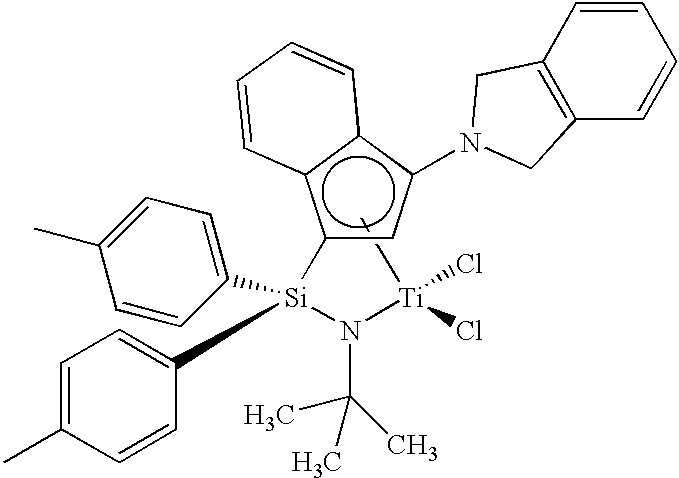
- (A) Preparation of N-(tert-butyl)-N-(1,1-p-tolyl)-1-(3-(1,3-dihydro-2H-isoindol-2-yl)-1H-indenyl)silyl)amine

- To a 1.70 g (5.35 mmol) of N-(tert-butyl)-N-(1-chloro-1,1-di(3-p-tolyl)silylamine dissolved in 20 mL of THF was added 1.279 g (5.35 mmol) of 1-(1H-3-indenyl)-1-(2,3-dihydro-1H-isoindolinyl) lithium salt dissolved in 20 mL of THF. After the reaction mixture was stirred for 9 h and then solvent was removed under reduced pressure. The residue was extracted with 40 mL of hexane and filtered. Solvent was removed under reduced pressure giving 2.806 of product as a gray solid. Yield 101.9 percent.
- 1H(C6D6) δ: 1.10 (s, 9H), 2.01 (s, 3H), 2.08 (s, 3H), 4.12 (d, 1H, 3JH-H=1.5 Hz), 4.39 (d, 1H, 2JH-H=11.1 Hz), 4.57 (d, 1H, 2JH-H=11.7 Hz), 5.55 (d, 1H, 3JH-H=2.1 Hz), 6.9-7.22 (m, 10H), 7.56 (d, 1H, 3JH-H=7.8 Hz), 7.62 (d, 1H, 3JH-H=6.9 Hz), 7.67 (d, 1H, 3JH-H=7.8 Hz), 7.83 (d, 1H, 3JH-H=7.8 Hz).
- 13C{1H} (C6D6) δ: 21.37, 21.43, 33.78, 41.09, 50.05, 56.56, 104.28, 120.98, 122.46, 123.84, 124.71, 124.84, 126.98, 128.29, 128.52, 129.05, 132.99, 133.68, 135.08, 135.90, 136.01, 138.89, 139.05, 139.09, 141.27, 146.39, 148.48.
- (B) Preparation of N-(tert-butyl)-N-(1,1-p-tolyl)-1-(1,3-dihydro-2H-isoindol-2-yl)-1H-indenyl)silyl)amine, Dilithium Salt
- To a 50 mL hexane solution containing 2.726 g (5.61 mmol) of the N-(tert-butyl)-N-(1,1-p-tolyl)-1-(3-(1,3-dihydro-2H-isoindol-2-yl)-1H-indenyl)silyl)amine was added 7.4 mL of 1.6 M n-BuLi solution. During addition of the n-BuLi, a yellow precipitate appeared. After stirring for 6 h, the yellow precipitate was collected on a frit, washed with 2×25 mL of hexane, and dried under reduced pressure to give 2.262 g of the product as a yellow powder. Yield was 76.6 percent.
- 1H(C6D6) δ: 1.17 (s, 9H), 2.30 (s, 6H), 4.51 (s, 4H), 6.21 (s, 1H), 6.47 (m, 2H), 6.97 (d, 4H, 3JH-H=8.1 Hz), 7.15 (m, 2H), 7.23 (m, 2H), 7.50 (m, 1H), 7.81 (d, 4H, 3JH-H=7.8 Hz), 8.07 (d, 1H, 3JH-H=7.2 Hz). 13C{1H} (C6D6) δ: 21.65, 38.83, 52.46, 59.82, 95.33, 112.93, 114.15, 115.78, 118.29, 122.05, 122.60, 124.16, 124.78, 126.94, 127.30, 133.06, 134.75, 137.30, 141.98, 148.17.
- (C) Preparation of dichloro(N-(1,1-dimethylethyl)-1,1-di-p-tolyl-1-((1,2,3,3a,7a-η)-3-(1,3-dihydro-2H-isoindol-2-yl)-1H-inden-1-yl)silanaminato-(2-)-N-)titanium
- In the drybox 1.552 g (4.19 mmol) of TiCl 3(THF)3 was suspended in 20 mL of THF. To this solution, 2.206 g (4.19 mmol) of N-(tert-butyl)-N-(1,1-p-tolyl)-1-(1,3-dihydro-2H-isoindol-2-yl)-1H-indenyl)silyl)amine, dilithium salt dissolved in 30 mL of THF was added within 1 min. The solution was then stirred for 60 min. After this time, 0.76 g of PbCl2 (2.75 mmol) was added and the solution was stirred for 60 min. The THF was then removed under reduced pressure. The residue was first extracted with 60 mL of methylene chloride and filtered. Solvent was removed under reduced pressure leaving a black crystalline solid. Hexane was added (30 mL) and the black suspension was stirred for 10 hour. The solids were collected on a frit, washed with 30 mL of hexane and dried under reduced pressure to give 2.23 g of the desired product as a deep purple solid. Yield was 88.2 percent.
- 1H (THF-d8) δ: 1.40 (s, 9H), 2.46 (s, 3H), 2.48 (s, 3H), 5.07 (d, 2H, 2JH-H=12.3 Hz), 5.45 (d, 2H, 2JH-H=12.6 Hz), 5.93 (s, 1H), 6.95 (d, 1H, 3JH-H=9.0 Hz), 7.08 (d, 1H, 3JH-H=7.8 Hz), 7.15-7.4 (m, 9H), 7.76 (d, 1H, 3JH-H=7.8 Hz), 7.82 (d, 1H, 3JH-H=7.5 Hz), 8.05 (d, 1H, 3JH-H=8.7 Hz). 13C{1H} (THF-d8) δ: 21.71, 21.76, 33.38, 56.87, 61.41, 94.5, 107.95, 122.86, 125.77, 126.68, 127.84, 127.92, 128.40, 128.49, 129.36, 129.79, 131.23, 131.29, 135.79, 136.43, 136.73, 141.02, 141.22, 150.14.
- Preparation of(N-(1,1-dimethylethyl)-1,1-di-p-tolyl-1-((1,2,3,3a,7a-η)-3-(1,3-dihydro-2H-isoindol-2-yl)-1H-inden-1-yl)silanaminato-(2-)-N-)dimethyltitanium

- In the drybox 0.50 g of dichloro(N-(1,1-dimethylethyl)-1,1-di-p-tolyl-1-((1,2,3,3a,7a-η)-3-(1,3-dihydro-2H-isoindol-2-yl)-1H-inden-1-yl)silanaminato-(2-)-N-)titanium complex (0.79 mmol) was dissolved in 30 mL of diethyl ether. To this solution, 1.14 mL (1.6 mmol) of MeLi (1.6 M in ether) was added dropwise while stirring over a 1 minute period. After the addition of MeLi was completed, the solution was stirred for 1.5 hour. Diethyl ether was removed under reduced pressure and the residue extracted with 45 mL of hexane. Hexane was removed under reduced pressure giving a red crystalline material. This solid was dissolved in about 7 mL of loluene and 25 mL of hexane, filtered, and the solution was put into the freezer (−27° C.) for 2 days. The solvent was then decanted and the resulting crystals were washed with cold hexane and dried under reduced pressure to give 156 mg of product. Yield was 33.3 percent
- 1H(C6D6) δ: 0.25 (s, 3H), 0.99 (3H), 1.72 (s, 9H), 2.12 (s, 3H), 2.15 (s, 3H), 4.53 (d, 2H, 2JH-H=11.7 Hz), 4.83 (d, 2H, 2JH-H=11.7 Hz), 5.68 (s, 1H), 6.72 (dd, 1H, 3JH-H=8.6 Hz, 3JH-H=6.6 Hz), 6.9-7.2 (m, 11H), 7.30 (d, 1H, 3JH-H=8.6 Hz).7.71 (d, 1H, 3JH-H=8.5 Hz), 7.93 (d, 1H, 3JH-H=7.8 Hz), 8.11 (d, 1H, 3JH-H=7.8 Hz). 13C{1H} (C6D6) δ: 21.45, 21.52, 35.30, 50.83, 56.03, 56.66, 57.65, 83.80, 105.64, 122.69, 124.51, 124.56, 125.06, 125.35, 127.33, 128.98, 129.06, 129.22, 133.51, 134.02, 134.62, 136.49, 136.84, 137.69, 139.72, 139.87, 143.84.
-

- A) Tetramethylsilane[MgCl] 2 (THF)6
- To 40 mL diethyl ether solution of 2.5 g, 15.9 mmol of Me 2Si(CH2Cl)2 was added 0.851 g, 35.0 mmol of Mg turnings. After stirring overnight, a large amount of white solid was visible. Solvent was removed under reduced pressure and replaced with 40 mL of tetrahydrofuran (THF). Upon addition of THF, all of the white solid dissolved. After stirring an additional 24 h., about 20 mL of hexane was added and the solution was filtered. The filtrate was put into a freezer (−27° C.) overnight. Solvent was decanted and large colorless crystals were washed with cold hexane (2×20 mL). The solid was then dried under reduced pressure to give 2.753 g of product as the THF hexa-adduct. Yield was 27.1 percent
- 1H NMR (THF-d8): δ −1.81 (s, 4H), −0.21 (s, 6H), 1.77 (m, 28H, THF), 3.66 (m, 28H, THF)
- 13C{1H} NMR (THF-d8): δ −2.50, 9.14, 26.37 (THF), 68.46 (THF).
- B) dichloro(N-(1,1-dimethylethyl)-1,1-di(4-methylphenyl)-1-((1,2,3,3a,7a-η)-3-(1,3-dihydro-2H-isoindol-2-yl)-1H-inden-1-yl)silanaminato-(2-)-N-)titanium
- i) Preparation of (p-Bu-Ph) 2SiCl2.
- To a three-necked 250 mL round-bottom flask under a nitrogen atmosphere equipped with a reflux condenser and a 250 mL dropping funnel 4.87 g of Mg turnings (0.200 moles) were introduced. 1-bromo-4-butyl benzene (42.6 g, 0.200 moles) and 80 mL of THF were then added to the dropping funnel. At this time 10 mL of the bromobenzene/THF solution was added to the Mg turnings with a small amount of ethyl bromide. The solution was then stirred until initiation occurred. The rest of the bromo benzene/THF solution was then added dropwise to allow refluxing to occur. After addition of the bromo benzene/THF solution, the mixture was heated at reflux until the magnesium was consumed.
- The resulting Grignard solution was then transferred to a 250 mL dropping funnel which was attached to a three-necked 250 mL round-bottom flask under a nitrogen atmosphere equipped with a reflux condenser. To the round bottomed flask, 100 mL of heptane was introduced followed by SiCl 4 (15.3 g, 0.090 moles). To this solution, the Grignard solution was added dropwise. After addition was complete the resulting mixture was refluxed for 2 h and then allowed to cool to room temperature. Under an inert atmosphere the solution was filtered. The remaining salts were further washed with heptane (3×40 mL), filtered and combined with the original heptane solution.
- The heptane was then removed via distillation at atmospheric pressure. The resulting viscous oil was then vacuum distilled with collection of the product at 1 mm Hg, (133 Pa) at 210° C. giving 19.3 g (58 percent) of the desired product.
- ii) Preparation of bis(4-n-butylphenyl)(t-butylamido)chlorosilane
- Dichloro-di(4-n-butylphenyl)silane (4.572 g, 12.51 mmol) was dissolved in 45 mL of methylene chloride. To this solution was added 1.83 g, 25.03 mmol of t-BuNH 2. After stirring overnight, the solvent was removed under reduced pressure. The residue was extracted with 45 mL of hexane and filtered. Solvent was removed under reduced pressure leaving 4.852 g of the desired product.
- iii) Preparation of (4-n-Bu-Ph) 2Si(3-isoindolino-indenyl)(NH-t-Bu)

- To a 4.612 g (11.47 mmol) of (4-n-Bu-Ph) 2Si(Cl)(NH-t-Bu) dissolved in 20 mL of THF was added 2.744 g (8.37 mmol) of lithium 1-isoindolino-indenide dissolved in 30 mL of THF. After the reaction mixture was stirred overnight solvent was removed under reduced pressure. The residue was extracted with 50 mL of hexane and filtered. Solvent removal gave 6.870 g of product as a very viscous red-brown oil. Yield was 91.0 percent.
- iv) Preparation of Dilithium Salt of (4-n-Bu-Ph) 2Si(3-isoindolino-indenyl)(NH-t-Bu)
- To a 50 mL of hexane solution containing 6.186 g (10.33 mmol) of (4-n-Bu-Ph) 2Si(3-isoindolino-indenyl)(NH-t-Bu) was added 13.5 mL of 1.6 M n-BuLi solution. A few minutes after n-BuLi addition, a yellow precipitate appeared. After stirring overnight, the yellow precipitate was collected on the frit, washed with 4×20 mL of hexane and dried under reduced pressure to give 4.42 g of the desired product as a yellow powder. Yield was 70.0 percent.
- v) Preparation of dichloro(N-1,1-dimethylethyl)-1,1-(4-butyl-phenyl)-1-((1,2,3,3a,7a-η)-3-(1,3-dihydro-2H-isoindol-2-yl)-1H-inden-1-yl)silanaminato-(2-)-N-)titanium
- In the drybox, 2.62 g (7.10 mmol) of TiCl 3(THF)3 was suspended in 40 mL of THF. To this solution, 4.32 g (7.07 mmol) of dilithium salt of (4-n-Bu-Ph)2Si(3-isoindolino-indenyl)(NH-t-Bu) dissolved in 60 mL of THF was added within 2 minutes. The solution was then stirred for 60 minutes. After this time, 1.28 g of PbCl2 (4.60 mmol) was added and the solution was stirred for 60 minutes. The THF was then removed under reduced pressure. The residue was extracted with 50 mL of toluene and filtered. Solvent was removed under reduced pressure leaving a black crystalline solid. Hexane was added (35 mL) and the black suspension was stirred for 0.5 hour. The solids were collected on the frit, washed with 2×30 mL of hexane and dried under reduced pressure to give 4.68 g of the desired product as a black-blue, crystalline solid. Yield was 92.4 percent.
- Preparation of (N-1,1-dimethylethyl)-1,1-(4-n-butylphenyl)-1-((1,2,3,3a,7a-η)-3-(1,3-dihydro-2H-isoindol-2-yl)-1H-inden-1-yl)silanaminato-(2-)-N-)-dimethyltitanium

- Dichloro(N-1,1-dimethylethyl)-1,1-(4-n-butylphenyl)-1-((1,2,3,3a,7a-η)-3-(1,3-dihydro-2H-isoindol-2-yl)-1H-inden-1-yl)silanaminato-(2-)-N-)titanium (1.61 g, 2.25 mmol, Example 14) was suspended in 35 mL of toluene. To this suspension was added 3 mL (4.75 mmol) of 1.6 M MeLi ether solution. The reaction color changed at once from dark green-black to dark red. After stirring for 1 hour, the solvent was removed under reduced pressure. The residue was extracted with 55 mL of hexane and filtered. Solvent was removed leaving 1.46 g of the desired product as a red solid.
- Preparation of (N-1,1-dimethylethyl)-1,1-(4-n-butylphenyl)-1-((1,2,3,3a,7a-η)-3-(1,3-dihydro-2H-isoindol-2-yl)-1H-inden-1-yl)silanaminato-(2-)-N-)-titanium (II) 1,3-pentadiene
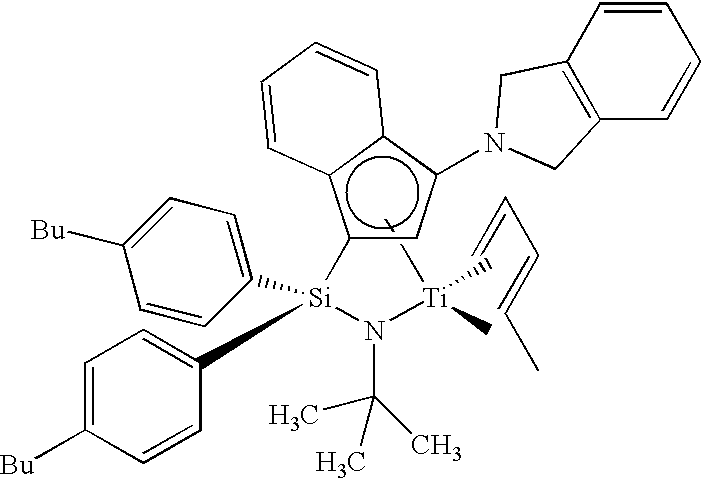
- Dichloro(N-1,1-dimethylethyl)-1,1-(4-butyl-phenyl)-1-((1,2,3,3a,7a-η)-3-(1,3-dihydro-2H-isoindol-2-yl)-1H-inden-1-yl)silanaminato-(2-)-N-)titanium (1.266 g, 1.77 mmol, Example 14) was suspended in 60 mL of hexane. The mixture was brought to gentle reflux and then 0.9 mL (0.89 mmol) of piperylene was added followed by 1.86 mL (3.72 mmol) of BrMgBu (2 M in THF). The reaction mixture was refluxed for 2.5 hour. After cooling to room temperature the solution was filtered and solvent was removed under reduced pressure leaving 1.30 g of the desired product as a black glassy solid.
- Preparation of (N-(1,1-dimethylethyl)-1,1-di(4-n-butylphenyl)-1-((1,2,3,3a,7a-η)-3-(1,3-dihydro-2H-isoindol-2-yl)-1H-inden-1-yl)silanaminato-(2-)-N-)-[(dimethylsilylene)bis(methylene)]anium

- To a 50 mL toluene solution containing 2.33 g, (3.26 mmol) of dichloro(N-(1,1-dimethylethyl)-1,1-di(4-n-butyl-phenyl)-1-((1,2,3,3a,7a-η)-3-(1,3-dihydro-2H-isoindol-2-yl)-1H-inden-1-yl)silanaminato-(2-)-N-)titanium (Example 14) was added 3.62 g, 4.23 mmol of Me 2Si(CH2MgCl)2(THF)9 as a solid. After stirring overnight at room temperature, the solution color changed from green-black to red. Solvent was removed under reduced pressure. The residue was extracted with 40 mL of hexane and filtered. The solvent was removed under reduced pressure to give a red glassy solid. This material was dissolved in 40 mL of hexane and filtered thought a fine frit. Solvent removal gave 2.16 g of product as a red glassy solid. Yield was 89.0 percent.
- 1H NMR (C6D6): 6-0.03 (s, 3H), 0.44 (s, 3H), 0.62 (d, 1H, 2JH-H=12.6 Hz), 0.83 (q, 6H, 3JH-H=7.9 Hz), 1.24 (m, 4H), 1.52 (m, 4H), 1.54 (s, 9H), 2.34 (s, 2H), 2.45 (d, 1H, 2JH-H=13.4 Hz), 2.52 (t, 4H, 3JH-H=7.8 Hz), 4.61 (m, 4H), 5.84 (s, 1H), 6.74 (t, 1H, 3JH-H=7.7 Hz), 6.89 (d, 1H, 3JH-H=8.7 Hz), 6.94 (m, 2H), 7.05 (m, 2H), 7.15 (d, 2H, 3JH-H=7.5 Hz), 7.26 (d, 2H13JH-H=7.8 Hz), 7.31 (d, 1H, 3JH-H=9.0 Hz), 7.57 (d, 1H, 3JH-H=8.7 Hz), 8.13 (d, 2H, 3JH-H=7.8 Hz), 8.17 (d, 2H, 3JH-H=7.8 Hz).
- 13C{1H} NMR (C6D6): δ −1.08, −0.28, 14.11, 14.15, 33.70, 33.78, 35.91, 36.06, 56.63, 56.88, 80.31, 84.35, 85.24, 103.81, 122.61, 122.81, 122.82, 124.27, 124.36, 127.34, 128.47, 128.51, 129.72, 131.03, 134.87, 135.00, 136.66, 137.16, 137.79, 143.36, 144.66, 144.85.
- HRMS (EI): calculated for C 39H46N2Si2Ti (M)+646.2679, found 646.2640.
- Analysis: Calculated for C 39H46N2Si2Ti: C, 72.42; H, 7.17; N, 4.33. Found: C, 72.78; H, 7.53; N, 4.13.
- Preparation of (N-1,1-dimethylethyl)-1,1-(4-methylphenyl)-1-((1,2,3,3a,7a-η)-3-(1,3-dihydro-2H-isoindol-2-yl)-,H-inden-1-yl)silanaminato-(2-)-N-)-bis[(trimethylsilyl)methyl]-titanium.

- In the drybox 3.42 g of dichloro(N-1,1-dimethylethyl)-1,1-(4-methylphenyl)-1-((1,2,3,3a,7a-η)-3-(1,3-dihydro-2H-isoindol-2-yl)-1H-inden-1-yl)silanaminato-(2-)-N-)titanium (5.42 mmol) (prepared substantially according to example 5) was partly dissolved in 70 mL of toluene. To this solution 11.6 mL (11.6 mmol) of LiCH 2TMS (1 M in pentane) was added dropwise while stirring over a one minute period. After the addition of lithium reagent was completed, the solution was stirred for 15 hours at room temperature. The reaction mixture was filtered and solvent was removed under reduced pressure. The resulting solid was dissolved in 15 mL of toluene followed by addition of 45 mL of hexane. The solution was filtered and solvent removed under reduced pressure leaving a red-brown crystalline solid. Hexane was added (25 mL) and the mixture was stirred for 10 min. and then put into freezer for 24 hours. Red crystalline solid was collected by filtration, washed with 2×8 mL of cold hexane, and then dried under reduced pressure to give 2.722 g of the desired product.
- 1H NMR (C6D6): δ −0.67 (d, 2H, 2JH-H=11.7 Hz, —CH2Si(CH3)3), 0.14 (s, 9H, —CH2Si(CH3)3), 0.20 (s, 9H, —CH2Si(CH3)3), 1.10 (d, 2H, 2JH-H=12.0 Hz, —CH2Si(CH3)3), 1.31 (m, 2H, —CH2Si(CH3)3), 1.71 (s, 9H, C(CH3)3), 2.13 (s, 6H), 4.77 (d, 2H, 2JH-H=12.0 Hz), 4.91 (d, 2H, 2JH-H=12.0 Hz), 5.78 (s, 1H), 6.73 (t, 1H, 3JH-H=7.7 Hz), 6.98 (m, 3H), 7.05 (m, 2H), 7.13 (d, 2H, 3JH-H=7.8 Hz), 7.20 (d, 2H, 3JH-H=7.8 Hz), 7.33 (d, 1H, 3JH-H=8.4 Hz), 7.78 (d, 1H, 3JH-H=90 Hz), 7.98 (d, 2H, 3JH-H=7.5 Hz), 8.06 (d, 2H, 3JH-H=7.8 Hz).
- 13C{1H} NMR (C6D6): δ 2.74, 3.52, 21.47, 21.50, 35.33, 57.03, 58.74, 69.08, 80.50, 84.92, 102.34, 122.57, 124.42, 124.78, 124.92, 125.12, 127.55, 128.92, 129.09, 129.49, 133.99, 134.30, 134.60, 136.65, 137.09, 137.43, 139.72, 139.83, 146.11.
- HRMS (EI): calculated for C 43H58N2Si3Ti (M)+735.3465, found 735.3461.
- Analysis Calculated for C 43H58N2Si3Ti: C, 70.26; H, 7.95; N, 3.81. Found: C, 65.96; H, 8.74; N, 2.11.
- The X-ray structure (ORTEP) for the compound is provided in FIG. 1.
- Preparation of (N-(1,1-dimethylethyl)-1,1-di(4-methylphenyl)-1-((1,2,3,3a,7a-η)-3-(1,3-dihydro-2H-isoindol-2-yl)-1H-inden-1-yl)silanaminato-(2-)-N-)-[(dimethylsilylene)bis(methylene)]titanium

- A) Tetramethylsilane[MgCl] 2 (THF)6
- To 40 mL diethyl ether solution of 2.5 g, 15.9 mmol of Me 2Si(CH2Cl)2 was added 0.851 g, 35.0 mmol of Mg turnings. After stirring overnight large amount of white solid was visible. Solvent was removed under reduced pressure and replaced with 40 mL of tetrahydrofuran (THF). Upon addition of THF all of the white solid dissolved. After stirring an additional 24 hr, about 20 mL of hexane was added and the solution was filtered. The filtrate was put into a freezer (−27° C.) overnight. Solvent was decanted and large colorless crystals were washed with cold hexane (2×20 mL). The solid was then dried under reduced pressure to give 2.753 g of product as the THF hexa-adduct. Yield was 27.1 percent.
- 1H NMR (THF-d8): δ −1.81 (s, 4H), −0.21 (s, 6H), 1.77 (m, 28H, THF), 3.66 (m, 28H, THF).
- 13C{1H} NMR (THF-d8): δ −2.50, 9.14, 26.37 (THF), 68.46 (THF).
- B) Preparation of (N-(1,1-dimethylethyl)-1,1-di(4-methylphenyl)-1-((1,2,3,3a,7a-η)-3-(1,3-dihydro-2H-isoindol-2-yl)-1H-inden-1-yl)silanaminato-(2-)-N-)-[(dimethylsilylene)bis-(methylene)]titanium
- To a 50 mL toluene solution containing 0.60 g, 0.95 mmol of dichloro(N-(1,1-dimethylethyl)-1,1-di(4-methyl-phenyl)-1-((1,2,3,3a,7a-η)-3-(1,3-dihydro-2H-isoindol-2-yl)-1H-inden-1-yl)silanaminato-(2-)-N-)titanium (prepared substantially according to the technique of Example 5) was added 0.667 g, 1.05 mmol of Me 2Si(CH2MgCl)2(THF)6 as a solid. After stirring for 2 hours at room temperature, proton NMR analysis showed about 70 percent conversion to the product. After stirring an additional 2 days, the 1H NMR spectrum did not change. An additional 0.25 g of the diGrigniard was added. Within minutes the reaction mixture turned from green-yellow to red. After stirring an additional 6 hours, the solvent was removed under reduced pressure. The residue was extracted with 40 mL of hexane and filtered. Solvent was removed under reduced pressure to give a red glassy solid. This solid was dissolved back in 15 mL of hexane. After standing at room temperature overnight, the solvent was decanted and red crystals were washed with cold hexane (2×2 mL). These crystals were dried under reduced pressure to give 0.448 g of the desired product. Yield was 72.9 percent.
- 1H NMR (C6D6): δ −0.04 (s, 3H), 0.44 (s, 3H), 0.63 (d, 1H, 2JH-H=12.9 Hz), 1.52 (s, 9H), 2.15 (s, 6H), 2.34 (m, 2H), 2.45 (d, 1H, 2JH-H=12.9 Hz), 4.61 (m, 4H), 5.81 (s, 1H), 6.74 (t, 1H, 3JH-H=7.8 Hz), 6.88 (d, 1H, 3JH-H=6.6 Hz), 6.92 (m, 2H), 7.05 (m, 2H), 7.15 (d, 2H, 3JH-H=8.1 Hz), 7.21 (d, 2H, 3JH-H=8.1 Hz), 7.37 (d, 1H, 3JH-H=8.4 Hz), 7.56 (d, 1H, 3JH-H=8.4 Hz), 8.09 (d, 2H, 3JH-H=6.9 Hz), 8.11 (d, 2H, 3JH-H=7.2 Hz).
- 13C{1H} NMR (C6D6): δ −1.10, −0.30, 21.50, 21.56, 35.87, 56.62, 56.88, 80.27, 84.40, 85.15, 103.75, 122.61, 122.81, 123.83, 124.29, 124.37, 127.35, 129.12, 129.68, 130.98, 134.58, 134.61, 136.65, 137.14, 137.78, 139.66, 139.86, 143.33.
- HRMS (EI): calculated for C 39H46N2Si2Ti (M)+646.2679, found 646.2640.
- Analysis: Calculated for C 39H46N2Si2Ti: C, 72.42; H, 7.17; N, 4.33. Found: C, 72.78; Hi 7.53; N, 4.13.
- The X-ray structure (ORTEP) for the compound is provided in FIG. 2.
- Preparation of dichloro(N-(1,1-dimethylethyl)-1,1-di(4-methylphenyl)-1-((1,2,3,3a,7a-η)-3-(1-pyrrolidinyl)-1H-inden-1-yl)silanaminato-(2-)-N-)-titanium.

- (A) Preparation of N-(tert-butyl)-N-(1-chloro-1,1-di-p-tolylsilyl)amine.
- To a solution of of 10.0 g (35.6 mmol) of dichloro-p-ditolylsilane in 300 mL of hexane was added 5.20 g (71.1 mmol) of t-butyl amine. The reaction mixture was stirred overnight, then filtered. The hexane was removed under reduced pressure to give the product as a viscous, colorless oil. The yield was 10.83 g (96 percent).
- 1H(C6D6) δ: 1.12 (s, 9H), 2.04 (s, 6H), 7.01 (d, 4H), 7.82 (d, 2H). 13C{1H}(C6D6) δ: 21.4, 33.2, 50.80, 129.06, 132.67, 135.09, 140.46.
- (B) Preparation of N-(tert-butyl)-N-(1,1-di(4-methylphenyl)-1-(3-tetrahydro-1H-1-pyrrolyl-1H-1-indenyl)silyl)amine.
- A solution of 1-(1H-3-indenyl)pyrrolidine, lithium salt (1.00 g, 5.23 mmol) in 40 mL of THF was added dropwise to a 80 mL THF solution N-(tert-butyl)-N-(1-chloro-1,1-di-p-tolylsilyl)amine (1.66 g, 5.23 mmol). After the addition was complete the reaction mixture was stirred overnight. The solvent was then removed under reduced pressure. The residue was extracted with hexane and the solution filtered. The solvent was then removed under reduced pressure leaving 2.41 g of product. Yield was 99 percent.
- 1H(C6D6) δ 1.07 (s, 9H), 1.52 (bs, 4H), 2.04 (s, 3H), 2.09 (s, 3H), 3.00 (bs, 2H), 3.14 (bs, 2H), 4.07 (s, 1H), 5.52 (s, 1H), 7.00-7.84 (m, 12H).
- (C) Preparation of N-(tert-butyl)-N-(1,1-di(4-methylphenyl)-1-(3-tetrahydro-1H-1-pyrrolyl-1H-1-indenyl)silyl)amine, Dilithium Salt.
- In the drybox, 2.41 g (5.16 mmol) of N-(tert-butyl)-N-(1,1-di(4-methylphenyl)-1-1-(3-tetrahydro-1H-1-pyrrolyl-1H-1-indenyl)silyl)amine was combined with 80 mL of hexane. To this solution, 6.45 mL (10.33 mmol) of n-BuLi (1.6 M in hexanes) was added dropwise. Upon complete addition of the n-BuLi, the solution was stirred overnight. The resulting precipitate was collected via filtration, washed with hexane and dried under reduced pressure to give 1.52 g of product. Yield was 61 percent.
- (D) Preparation of dichloro(N-(1,1-dimethylethyl)-1,1-di(4-methylphenyl)-1-((1,2,3,3a,7a-η)-3-(1-pyrrolidinyl)-1H-inden-1-yl)silanaminato-(2-)-N-)-titanium
- N-(tert-butyl)-N-(1,1-di(4-methylphenyl)-1-(3-tetrahydro-1H-1-pyrrolyl-1H-1-indenyl)silyl)amine, dilithium salt (1.52 g, 3.26 mmol) was added as a solid to a 80 mL solution of THF containing TiCl 3(THF)3 (1.21 g 3.26 mmol). After 45 min, PbCl2 (0.45 g, 1.63 mmol) was added as a solid. The reaction mixture was then stirred an additional hour. The solvent was removed under reduced pressure. The residue was extracted with toluene and filtered. Toluene was removed under reduced pressure and the residue was triturated with hexane. The solid was collected by filtration, washed with hexane and then dried under reduced pressure. 1.40 g of product was obtained. Yield was 73 percent.
- 1H (CDCl3) δ 1.33 (s, 9H), 1.99 (br s, 4H), 2.36 (s, 3H), 2.39 (s 3H), 3.65 (br s, 2H), 3.87 (br s, 2H), 5.74 (s, 11H), 7.10 (m, 11H), 7.25 (bs, 5H), 7.60 (m, 2H), 7.77 (s, 2H) 7.82 (d, 11H).
- 13C{1H}(CDCl3) δ: 21.01, 21.68, 25.73, 333.35, 50.70, 60.86, 83.69, 107.91, 125.58, 126.81, 127.23, 127.98, 128.95, 128.99, 129.37, 131.23, 135.48, 136.08, 136.36, 140.33, 140.53, 150.38.
- Preparation of (N-(1,1-dimethylethyl)-1,1-di(4-methylphenyl)-1-((1,2,3,3a,7a-η)-3-(1-pyrrolidinyl)-1H-inden-1-yl)silanaminato-(2-)-N-)dimethyltitanium

- In the drybox 0.444 g dichloro(N-(1,1-dimethylethyl)-1,1-di(4-methylphenyl)-1-((1,2,3,3a,7a-η)-3-(1-pyrrolidinyl)-1H-inden-1-yl)silanaminato-(2-)-N-)titanium complex (0.76 mmol) was dissolved in 30 mL of diethylether. To this solution 1.00 mL (1.6 mmol) of MeLi (1.6 M in ether) was added dropwise while stirring over a 2 minute period. After the addition of MeLi was completed, the solution was stirred for 1.5 hour. Et 2O was removed under reduced pressure and the residue extracted with 45 mL of hexane. Hexane was removed under reduced pressure giving 0.348 mg of red, crystalline material. This red solid was dissolved in about 5 mL of hexane (heating was used) and then the vial was put into freezer overnight at −27° C., giving 75 mg of red crystals.
- 1H(C6D6) δ: 0.26 (s, 3H), 1.01 (s, 3H), 1.44 (m, 4H), 1.72 (s, 9H), 2.01 (s, 3H), 2.14 (s, 3H), 3.12 (m, 2H), 3.36 (m, 2H), 5.60 (s, 11H), 6.70 (ddd, 11H, 3JH-H=8.7 Hz, 3JH-H=6.6 Hz, 4JH-H=0.9 Hz), 6.96 (ddd, 1H, 3JH-H=8.6 Hz, 3JH-H=6.6 Hz, 4JH-H=0.9 Hz), 7.12 (m, 4H), 7.68 (d, 1H, 3JH-H=8.7 Hz), 7.68 (d, 1H, 3JH-H=9.0 Hz), 7.89 (d, 2H, 3JH-H=7.8 Hz), 8.11 (d, 2H, 3JH-H=7.8 Hz).
- 13C{1H} (C6D6) δ: 21.43, 21.50, 25.82, 35.31, 49.87, 50.45, 55.53, 57.45, 83.28, 105.28, 124.31, 124.86, 125.00, 125.50, 128.86, 128.96, 129.20, 133.65, 134.08, 134.77, 136.46, 136.81, 139.57, 139.76, 144.86.
- Preparation of (N-(1,1-dimethylethyl)-1,1-di(4-methylphenyl)-1-((1,2,3,3a,7a-η)-2-methyl-3-phenyl-1H-inden-1-yl)silanaminato-(2-)-N-)titanium Dichloride

- (A) 2-methyl-4-phenyl indenyl lithium
- In a 400 mL jar were placed 10.6 g (51.4 mmoles) of 2-methyl-4-phenyl indene and 200 mL of hexanes. Then, 33 mL of a 1.6 M hexane solution of butyl lithium (52.4 mmoles) were added at room temperature; the mixture was stirred overnight. The precipitate was filtered and washed with hexane and dried to give 10.60 (97 percent) of a pale yellow solid.
- (B) di(tolyl)(t-butylamido)chlorosilane
- To a vigorously stirred solution of di(p-tolyl)dichlorosilane (7.5 g, 27 mmoles) in 180 mL of hexane, was added a solution of tert-butyl amine in 30 mL of hexane (3.9 g, 53.3 mmoles) over a period of five minutes followed by stirring of the mixture overnight. The mixture was filtered and the filtrate dried under reduced pressure to give 4.7 grams (55 percent yield) of the desired product.
- 1H NMR (C6D6): δ 7.8 (d, 4H), 7.0 (d, 4H), 2.0 (s, 6H), 1.55 (s, 1H), 1.1 (s, 9H).
- 13C {1H} NMR(C6D6): δ 140.4, 135.1, 132.7, 129.0, 50.8, 33.2, 21.4.
- (C) di(tolyl)(t-butylamido)(triflate)silane
- To a mixture of 6.4 g (25 mmoles) of silver triflate in 100 mL of acetonitrile was added over a period of five minutes a solution of the di(tolyl)t-butylamidochlorosilane dissolved in 80 mL of acetonitrile. A white precipitate formed immediately. The mixture was stirred for one hour and decanted, after which the volatiles were removed. The residue was treated with hexane, filtered and the volatiles were removed to leave 9.64 g (95 percent yield) of a pale yellow viscous oil.
- 1H NMR (CDCl3): δ 7.58 (d, 4H), 7.2 (d, 4H), 2.4 (s, 6H), 2.2 (s, 1H), 1.24 (s, 9H);
- 13C {1H} NMR (C6D6): δ 141.7, 134.7, 129.1, 127.0, 50.9, 33.0, 21.6;
- 19F NMR (CDCl3): −77.0 δ (CCl3F=0 δ).
- (D) (2-Methyl-4-phenyl inden-1-yl)-N-(1,1-dimethylethyl) bis(tolyl)silanamine
- To a mixture of di(tolyl)(t-butylamido)(triflate)silane (9.64 g, 22.3 mmoles) in 60 mL of THF was added a solution of 2-methyl-4-phenylindenyl lithium (5.0 g, 23.5 mmoles; 5 percent molar excess) in 100 mL of THF. The mixture was stirred for one hour at room temperature, the volatiles were removed under reduced pressure, and the residue was extracted with hexanes and filtered. The filtrate was dried in vacuo to give 11.5 g (105 percent) of a very viscous, sticky pale orange oil. THF was still evident by NMR analysis.
- (E) (2-Methyl-4-phenylinden-1-yl)-N—(1,1-dimethylethyl)di(tolyl)silanamidetitanium dichloride also referred to as (N-(1,1-dimethylethyl)-1,1-di(4-methylphenyl)-1-((1,2,3,3a,7a-η)-2-methyl-3-phenyl-1H-inden-1-yl)silanaminato-(2-)-N-)titanium Dichloride
- In a 500 mL glass jar were placed 10.76 g (22.0 mmoles) of (2-methyl-4-phenylinden-1-yl)-N-(1,1-dimethylethyl)di(tolyl)silanamine, 300 mL of hexane, and then 28.2 mL of a 1.6 M hexane solution of BuLi (2.04 equiv., 45 mmoles) were added. The mixture was stirred for two hours, about {fraction (2/3)} of the solvent was removed and then 200 mL of THF were added to the mixture. Then 8.2 g (22.0 mmoles) of TiCl 3·3THF was added; the mixture was stirred for thirty minutes, followed by addition of PbCl2 (4.2 g, 1.3 electron equivalents), and 10 mL of CH2Cl2. After thirty minutes the volatiles were removed in vacuo, the residue repeatedly extracted with hexane, and the extracts filtered. The filtrate was dried to give 5.0 g (37 percent) of a dark orange-red solid.
- 1H NMR (C6D6): δ 7.8 (d), 7.6 (d), 7.2 (m), 7.1 (br s), 7.05 (m), 6.8 (m), 2.1 (s, 6H), 1.95 (s, 3H), 1.65 (s, 9H).
- Preparation of (N-(1,1-dimethylethyl)-1,1-di(4-methylphenyl)-1-((1,2,3,3a,7a-η)-2-methyl-3-phenyl-1H-inden-1-yl)silanaminato-(2-)-N-)titanium Dimethyl
- In a 50 mL jar were placed 0.54 g (0.9 mmoles) of (N-(1,1-dimethylethyl)-1,1-di(4-methylphenyl)-1-((1,2,3,3a,7a-η)-2-methyl-3-phenyl-1H-inden-1-yl)silanaminato-(2-)-N-)titanium dichloride and 20 mL of ether. Then, 0.6 mL of a 3 M diethylether solution of methyl magnesium iodide (1.8 mmoles) were added and the mixture was stirred for one hour. The volatiles were removed under reduced pressure and the residue (0.3 g) was redissolved in hexane, filtered and the filtrate dried again; this process (redissolve-filter-dry) was repeated three times to remove insoluble material. The semi-solid residue was treated with about 0.3 mL of ether, and the ether was quickly removed under reduced pressure to give a brownish-golden glassy solid (0.22 g, 43 precent yield).
- 1H NMR (C6D6): δ 7.9 (d), 7.75 (d), 7.6 (d), 7.2 (m), 7.1 (br s), 7.05 (m), 6.8 (m), 2.1 (s, 3H), 2.08 (s, 3H), 1.8 (s, 3H), 1.75 (s, 9H), 1.0 (s, 3H), 0.2 (s, 3H).
- 13C {1H} NMR (C6D6): δ 142.9, 141.0, 139.9, 139.5, 138.7, 137.0, 136.0, 135.2, 135.0, 134.5, 131.0, 129.0, 128.9, 128.6, 127.74, 127.67, 127.3, 125.6, 125.4, 116.0, 89.9, 66.5, 57.9, 57.7, 53.4, 35.0, 34.8, 31.8, 25.5, 22.9, 21.4, 20.7, 19.0, 14.2, 13.9.
- Ethylene/1-Octene Polymerization Conditions I
- All liquid and gas feeds were passed through columns of alumina and a decontaminant (Q5™ catalyst available from Englehardt Chemicals Inc.) prior to introduction into the reactor. Catalyst components are handled in a glovebox containing an atmosphere of argon or nitrogen. A stirred 2.0 liter reactor is charged with about 740 g of mixed alkanes solvent and 118 g of 1-octene comonomer. Hydrogen (25 psi, 170 kPa) is added as a molecular weight control agent by differential pressure expansion from a 75 mL addition tank. The reactor is heated to 140° C. and saturated with ethylene at 500 psig (3.4 MPa). Metal complex as dilute toluene solution and cocatalyst as dilute solutions in toluene or methylcyclohexane, were mixed in a 1:1 molar ratio and transferred to a catalyst addition tank and injected into the reactor. The cocatalyst was methyldi(octadecyl)ammonium tetrakis(pentafluorophenyl)borate, the ammonium cation of which is derived from a mixture of amines available commercially as methyl bis(tallow)amine. The polymerization conditions were maintained for 15 minutes with ethylene added on demand. The resulting solution was removed from the reactor, quenched with isopropyl alcohol, and stabilized by addition of a toluene solution containing about 67 mg/100 g polymer of a hindered phenol antioxidant (Irganox™ 1010 from Ciba Geigy Corporation) and about 133 mg/100 g polymer of a phosphorus stabilizer (Irgafos 168 from Ciba Geigy Corporation).
- Between sequential polymerization runs, a wash cycle was conducted in which 850 g of mixed alkanes was added to the reactor and the reactor was heated to 150° C. The reactor was then emptied of the heated solvent immediately before beginning a new polymerization run.
- Polymers were recovered by drying in a vacuum oven programmed to reach 140° C. over a period of about 20 hours. Density values are derived by determining the polymer's mass when in air and when immersed in methylethyl ketone. Micro melt index values (MMI) are obtained using a Custom Scientific Instrument Inc. Model CS-127MF-015 apparatus at 190° C., and are unit less values calculated as follows: MMI=1/(0.00343 t−0.00251), where t=time in seconds as measured by the instrument. Results are contained in Table 1.
TABLE 1 Catalyst Yield Density Mw (× Run (μmol) (g) Eff.1 (g/ml) 103) Mw/ Mn MMI 2 1 Ex. 2 (0.3) 18.8 1.31 0.897 <0.1 2 Ex. 4 (0.3) 40.9 2.85 0.892 <0.1 3 Ex. 10 (0.15) 19.5 2.7 0.901 331 1.96 — 4 Ex. 10 (0.25) 46.7 3.9 0.902 — — <0.1 5 Ex 12 (0.40) 21.1 1.1 0.874 125 2.28 0.7 A* DSAT3 (0.4) 76.1 4.0 0.897 67 2.23 8.9 - Ethylene/1-Octene/Ethylidenenorbornene Polymerization Conditions
- All liquid except ethylidenenorbornene (ENB) and gas feeds were passed through columns of alumina and a decontaminant (Q5™ catalyst available from Englehardt Chemicals Inc.) prior to introduction into the reactor. ENB was passed through a short column (3×10 cm) of alumina prior to introduction to the reactor. Catalyst components are handled in a glovebox containing an atmosphere of argon or nitrogen. A stirred 2.0 liter reactor is charged with about 640 g of mixed alkanes solvent, 150 g of 1-octene and 16 g of ENB. Hydrogen (20 psi, 140 kPa) is added as a molecular weight control agent by differential pressure expansion from a 75 mL addition tank. The reactor is heated to 100° C. and saturated with ethylene at 500 psig (3.5 MPa). Metal complex as dilute toluene solution and cocatalyst as dilute solutions in toluene were mixed in a 1:1 molar ratio and transferred to a catalyst addition tank and injected into the reactor. The cocatalyst was methyldi(octadecyl)ammonium tetrakis(pentafluoro-phenyl)borate, the ammonium cation of which is derived from a mixture of amines available commercially as methyl bis(tallow)amine. The polymerization conditions were maintained for 15 minutes with ethylene added on demand. The resulting solution was removed from the reactor, quenched with isopropyl alcohol, and stabilized by addition of a toluene solution containing about 67 mg/100 g polymer of a hindered phenol antioxidant (Irganox™ 1010 from Ciba Geigy Corporation) and about 133 mg/100 g polymer of a phosphorus stabilizer (Irgafos 168 from Ciba Geigy Corporation).
- Between sequential polymerization runs, a wash cycle was conducted in which 850 g of mixed alkanes was added to the reactor and the reactor was heated to 130° C. The reactor was then emptied of the heated solvent immediately before beginning a new polymerization run.
- Polymers were recovered by drying in a vacuum oven set at 140° C. for about 20 hours. Density values are derived by determining the polymer's mass when in air and when immersed in methylethyl ketone. GPC results are determined by standard methods and are reported relative to a polystyrene/polyethylene universal calibration. The percent ethylene, octene and ENB for the polymer were determined by 13C NMR analysis of the material. Results are contained in Table 2.
TABLE 2 Per cent Per Catalyst Yield Density Mw (× oct- cent Run (μmol) (g) Eff.1 (g/ml) 103) Mw/Mn ene ENB 6 Ex. 12 33.2 0.73 0.860 407 2.3 41 2.5 (0.95) B* ID2 59.1 1.23 0.874 317 2.0 33 2.8 (1.0)
Claims (10)


Priority Applications (7)
| Application Number | Priority Date | Filing Date | Title |
|---|---|---|---|
| US10/154,534 US6825295B2 (en) | 1999-12-10 | 2002-05-23 | Alkaryl-substituted group 4 metal complexes, catalysts and olefin polymerization process |
| EP03726205A EP1501843B1 (en) | 2002-04-23 | 2003-04-08 | Alkaryl-substituted group 4 metal complexes, catalysts and olefin polymerization process |
| JP2003587823A JP4490115B2 (en) | 2002-04-23 | 2003-04-08 | Alkaryl-substituted group 4 metal complex, catalyst, and olefin polymerization method |
| CA2483326A CA2483326C (en) | 2002-04-23 | 2003-04-08 | Alkaryl-substituted group 4 metal complexes, catalysts and olefin polymerization process |
| PCT/US2003/010543 WO2003091265A1 (en) | 2002-04-23 | 2003-04-08 | Alkaryl-substituted group 4 metal complexes, catalysts and olefin polymerization process |
| AU2003228452A AU2003228452A1 (en) | 2002-04-23 | 2003-04-08 | Alkaryl-substituted group 4 metal complexes, catalysts and olefin polymerization process |
| DE60306147T DE60306147T2 (en) | 2002-04-23 | 2003-04-08 | ALKARYL SUBSTITUTED COMPLEXES OF GROUP 4 METALS, CATALYSTS, AND METHOD FOR POLYMERIZING OLEFINES |
Applications Claiming Priority (5)
| Application Number | Priority Date | Filing Date | Title |
|---|---|---|---|
| US17017799P | 1999-12-10 | 1999-12-10 | |
| US17017599P | 1999-12-10 | 1999-12-10 | |
| US17017899P | 1999-12-10 | 1999-12-10 | |
| US09/715,380 US6515155B1 (en) | 1999-12-10 | 2000-11-17 | Substituted group 4 metal complexes, catalysts and olefin polymerization process |
| US10/154,534 US6825295B2 (en) | 1999-12-10 | 2002-05-23 | Alkaryl-substituted group 4 metal complexes, catalysts and olefin polymerization process |
Related Parent Applications (1)
| Application Number | Title | Priority Date | Filing Date |
|---|---|---|---|
| US09/715,380 Continuation-In-Part US6515155B1 (en) | 1999-12-10 | 2000-11-17 | Substituted group 4 metal complexes, catalysts and olefin polymerization process |
Publications (2)
| Publication Number | Publication Date |
|---|---|
| US20030004286A1 true US20030004286A1 (en) | 2003-01-02 |
| US6825295B2 US6825295B2 (en) | 2004-11-30 |
Family
ID=27496900
Family Applications (1)
| Application Number | Title | Priority Date | Filing Date |
|---|---|---|---|
| US10/154,534 Expired - Lifetime US6825295B2 (en) | 1999-12-10 | 2002-05-23 | Alkaryl-substituted group 4 metal complexes, catalysts and olefin polymerization process |
Country Status (1)
| Country | Link |
|---|---|
| US (1) | US6825295B2 (en) |
Cited By (77)
| Publication number | Priority date | Publication date | Assignee | Title |
|---|---|---|---|---|
| US20030195299A1 (en) * | 2001-11-06 | 2003-10-16 | Stevens James C. | Impact resistant polymer blends of crystalline polypropylene and partially crystalline, low molecular weight impact modifiers |
| US20030195300A1 (en) * | 2001-11-06 | 2003-10-16 | Stevens James C. | Crystallization of polypropylene using a semi-crystalline, branched or coupled nucleating agent |
| US20030194575A1 (en) * | 2001-11-06 | 2003-10-16 | Li-Min Tau | Films comprising isotactic propylene copolymers |
| US20040087751A1 (en) * | 2002-11-05 | 2004-05-06 | Li-Min Tau | Thermoplastic elastomer compositions |
| US20040236042A1 (en) * | 1997-08-12 | 2004-11-25 | Sudhin Datta | Propylene ethylene polymers and production process |
| US20040236026A1 (en) * | 1998-07-01 | 2004-11-25 | Exxonmobil Chemical Patents Inc. | Elastic blends comprising crystalline polymer and crystallizable polymers of propylene |
| US6825295B2 (en) * | 1999-12-10 | 2004-11-30 | Dow Global Technologies Inc. | Alkaryl-substituted group 4 metal complexes, catalysts and olefin polymerization process |
| US20040242784A1 (en) * | 2002-11-05 | 2004-12-02 | Lin-Min Tau | Thermoplastic elastomer compositions |
| US6906160B2 (en) | 2001-11-06 | 2005-06-14 | Dow Global Technologies Inc. | Isotactic propylene copolymer fibers, their preparation and use |
| US20050137343A1 (en) * | 1997-08-12 | 2005-06-23 | Sudhin Datta | Thermoplastic polymer blends of isotactic polypropylene and alpha-olefin/propylene copolymers |
| US6960635B2 (en) | 2001-11-06 | 2005-11-01 | Dow Global Technologies Inc. | Isotactic propylene copolymers, their preparation and use |
| WO2005014601A3 (en) * | 2003-08-04 | 2005-11-03 | Dsm Ip Assets Bv | Process for the preparation of a polyolefin |
| WO2005014674A3 (en) * | 2003-08-04 | 2005-11-17 | Dsm Ip Assets Bv | Process for the preparation of a polyolefin |
| WO2006007094A2 (en) | 2004-06-16 | 2006-01-19 | Dow Global Technologies Inc. | Technique for selecting polymerization modifiers |
| US20060122334A1 (en) * | 1997-08-12 | 2006-06-08 | Cozewith Charles C | Blends made from propylene ethylene polymers |
| WO2007035493A2 (en) | 2005-09-15 | 2007-03-29 | Dow Global Technologies Inc. | Control of polymer architecture and molecular weight distribution via multi-centered shuttling agent |
| US20070244276A1 (en) * | 2001-04-12 | 2007-10-18 | Sudhin Datta | Propylene ethylene polymers and production process |
| US20080081854A1 (en) * | 2006-09-06 | 2008-04-03 | Dow Global Technologies Inc. | Fibers and Knit Fabrics Comprising Olefin Block Interpolymers |
| US20080138599A1 (en) * | 2006-11-30 | 2008-06-12 | Dow Global Technologies Inc. | Olefin block compositions for stretch fabrics with wrinkle resistance |
| US20080171167A1 (en) * | 2007-01-16 | 2008-07-17 | Dow Global Technologies Inc. | Cone dyed yarns of olefin block compositions |
| US20080176473A1 (en) * | 2006-11-30 | 2008-07-24 | Dow Global Technologies Inc. | Molded fabric articles of olefin block interpolymers |
| US20080182473A1 (en) * | 2007-01-16 | 2008-07-31 | Dow Global Technologies Inc. | Stretch fabrics and garments of olefin block polymers |
| WO2008137520A1 (en) | 2007-05-02 | 2008-11-13 | The Dow Chemical Company | Multi-block copolymer process using polar solvents |
| WO2008137524A1 (en) | 2007-05-02 | 2008-11-13 | Dow Global Technologies Inc. | Tactic polymer polymerization process using chiral catalysts |
| US20080299857A1 (en) * | 2006-11-30 | 2008-12-04 | Dow Global Technologies Inc. | Olefin block compositions for heavy weight stretch fabrics |
| WO2009012215A1 (en) | 2007-07-13 | 2009-01-22 | Dow Global Technologies Inc. | Ethylene/a-olefin interpolymers containing low crystallinity hard blocks |
| WO2009012152A1 (en) | 2007-07-13 | 2009-01-22 | Dow Global Technologies Inc. | Catalytic olefin block copolymers with controlled block sequence distribution and at least one low crystallinity hard block |
| US20090068427A1 (en) * | 2005-10-26 | 2009-03-12 | Dow Global Technologies Inc. | Multi-layer, elastic articles |
| US20090068436A1 (en) * | 2007-07-09 | 2009-03-12 | Dow Global Technologies Inc. | Olefin block interpolymer composition suitable for fibers |
| US20090105374A1 (en) * | 2007-09-28 | 2009-04-23 | Dow Global Technologies Inc. | Thermoplastic olefin composition with improved heat distortion temperature |
| WO2009105938A1 (en) | 2008-02-29 | 2009-09-03 | Dow Global Technologies Inc. | Oriented films comprising ethylene/α-olefin block interpolymer |
| US20090275690A1 (en) * | 2006-11-01 | 2009-11-05 | Weaver Laura B | Articles Comprising Nonpolar Polyolefin and Polyurethane, and Methods for Their Preparation and Use |
| CN100558768C (en) | 2003-08-04 | 2009-11-11 | 帝斯曼知识产权资产管理有限公司 | Process for preparing polyolefins |
| US20100093942A1 (en) * | 2006-12-21 | 2010-04-15 | Dow Global Technlogies Inc. | Functionalized olefin polymers, compositions and articles prepared therefrom, and method of making the same |
| US20100152361A1 (en) * | 2007-04-24 | 2010-06-17 | Weaver Laura B | Thermoforming, scratch-resistant, low gloss compositions comprising interpolymers of ethylene/alpha-olefins |
| EP2221329A1 (en) | 2004-03-17 | 2010-08-25 | Dow Global Technologies Inc. | Catalyst composition comprising shuttling agent for ethylene multi-block copolymer formation |
| WO2010098932A1 (en) | 2009-02-25 | 2010-09-02 | Dow Global Technologies Inc. | PHYLON PROCESSES OF MAKING FOAM ARTICLES COMPRISING ETHYLENE/α-OLEFINS BLOCK INTERPOLYMERS |
| US7858707B2 (en) | 2005-09-15 | 2010-12-28 | Dow Global Technologies Inc. | Catalytic olefin block copolymers via polymerizable shuttling agent |
| WO2010151433A1 (en) | 2009-06-26 | 2010-12-29 | Dow Global Technologies Inc. | Process selectively polymerizing ethylene and catalyst therefor |
| WO2011014533A1 (en) | 2009-07-29 | 2011-02-03 | Dow Global Technologies Inc. | Multifunctional chain shuttling agents |
| WO2011016991A2 (en) | 2009-07-29 | 2011-02-10 | Dow Global Technologies Inc. | Dual- or multi-headed chain shuttling agents and their use for the preparation of block copolymers |
| US20110054122A1 (en) * | 2009-08-31 | 2011-03-03 | Jerzy Klosin | Catalyst and process for polymerizing an olefin and polyolefin prepared thereby |
| US20110086963A1 (en) * | 2008-06-18 | 2011-04-14 | Dow Global Technologies | Processes to Control Fouling and Improve Compositions |
| EP2327727A1 (en) | 2004-03-17 | 2011-06-01 | Dow Global Technologies LLC | Catalyst composition comprising shuttling agent for ethylene copolymer formation |
| EP2357206A2 (en) | 2005-03-17 | 2011-08-17 | Dow Global Technologies LLC | Catalyst composition comprising shuttling agent for tactic/atactic multi-block copolymer formation |
| EP2357203A2 (en) | 2004-03-17 | 2011-08-17 | Dow Global Technologies LLC | Catalyst composition comprising shuttling agent for higher olefin multi-block copolymer formation |
| WO2011102989A1 (en) | 2010-02-19 | 2011-08-25 | Dow Global Technologies Llc | Metal-ligand complexes and catalysts |
| WO2011102990A2 (en) | 2010-02-19 | 2011-08-25 | Dow Global Technologies Llc | Process for polymerizing an olefin monomer and catalyst therefor |
| WO2011119486A1 (en) | 2010-03-26 | 2011-09-29 | Dow Global Technologies Llc | IMPACT MODIFICATION OF THERMOPLASTICS WITH ETHYLENE/α-OLEFIN INTERPOLYMERS |
| EP2392611A2 (en) | 2005-03-17 | 2011-12-07 | Dow Global Technologies LLC | Functionalized ethylene/alpha-olefin interpolymer compositions |
| WO2012027448A1 (en) | 2010-08-25 | 2012-03-01 | Dow Global Technologies Llc | Process for polymerizing a polymerizable olefin and catalyst therefor |
| WO2012103080A1 (en) | 2011-01-26 | 2012-08-02 | Dow Global Technologies Llc | Process for making a polyolefin-polysiloxane block copolymer |
| WO2012155022A1 (en) | 2011-05-12 | 2012-11-15 | Dow Global Technologies Llc | Non-cyclopentadienyl-based chromium catalysts for olefin polymerization |
| WO2013061974A1 (en) | 2011-10-24 | 2013-05-02 | 三菱化学株式会社 | Thermoplastic elastomer composition and method for producing same |
| US20140324388A1 (en) * | 2010-03-15 | 2014-10-30 | KLATU Networks, LLC | Systems and methods for monitoring, inferring state of health, and optimizing efficiency of refrigeration systems |
| EP2894176A1 (en) | 2005-03-17 | 2015-07-15 | Dow Global Technologies LLC | Catalyst composition comprising shuttling agent for regio-irregular multi-block copolymer formation |
| WO2016105973A1 (en) | 2014-12-23 | 2016-06-30 | Dow Global Technologies Llc | Thermoplastic Vulcanizate Including Rubber Block Interpolymer |
| WO2017106166A1 (en) | 2015-12-15 | 2017-06-22 | Dow Global Technologies Llc | Cross-linked foams made from interpolymers of ethylene/alpha-olefins |
| WO2018064540A1 (en) | 2016-09-30 | 2018-04-05 | Dow Global Technologies Llc | Process for preparing multi- or dual-headed compositions useful for chain shuttling |
| WO2018064553A1 (en) | 2016-09-30 | 2018-04-05 | Dow Global Technologies Llc | Multi- or dual-headed compositions useful for chain shuttling and process to prepare the same |
| WO2018064546A1 (en) | 2016-09-30 | 2018-04-05 | Dow Global Technologies Llc | Capped multi- or dual-headed compositions useful for chain shuttling and process to prepare the same |
| WO2018170248A1 (en) | 2017-03-15 | 2018-09-20 | Dow Global Technologies Llc | Catalyst system for multi-block copolymer formation |
| WO2018170227A1 (en) | 2017-03-15 | 2018-09-20 | Dow Global Technologies Llc | Catalyst system for multi-block copolymer formation |
| WO2018170138A1 (en) | 2017-03-15 | 2018-09-20 | Dow Global Technologies Llc | Catalyst system for multi-block copolymer formation |
| WO2018170208A1 (en) | 2017-03-15 | 2018-09-20 | Dow Global Technologies Llc | Catalyst system for multi-block copolymer formation |
| WO2018170056A1 (en) | 2017-03-15 | 2018-09-20 | Dow Global Technologies Llc | Catalyst system for multi-block copolymer formation |
| KR20190038387A (en) * | 2017-09-29 | 2019-04-08 | 사빅 에스케이 넥슬렌 컴퍼니 피티이 엘티디 | A novel indene-based transition metal complexes, catalysts composition containing the same, and methods for preparing ethylene homopolymers or copolymers of ethylene and α-olefins using the same |
| US10344154B2 (en) | 2014-12-23 | 2019-07-09 | Dow Global Technologies Llc | Thermoplastic vulcanizate including a block composite |
| KR20190086989A (en) * | 2018-01-15 | 2019-07-24 | 주식회사 엘지화학 | Transition metal compound, and catalystic composition comprising the same |
| WO2019182988A1 (en) | 2018-03-19 | 2019-09-26 | Dow Global Technologies Llc | Silicon-terminated organo-metal compounds and processes for preparing the same |
| WO2020140067A1 (en) | 2018-12-28 | 2020-07-02 | Dow Global Technologies Llc | Curable compositions comprising unsaturated polyolefins |
| WO2020140061A1 (en) | 2018-12-28 | 2020-07-02 | Dow Global Technologies Llc | Curable compositions comprising telechelic polyolefins |
| WO2020140058A1 (en) | 2018-12-28 | 2020-07-02 | Dow Global Technologies Llc | Telechelic polyolefins and processes for preparing the same |
| WO2020140064A1 (en) | 2018-12-28 | 2020-07-02 | Dow Global Technologies Llc | Organometallic chain transfer agents |
| US10723816B2 (en) | 2015-09-30 | 2020-07-28 | Dow Global Technologies Llc | Multi- or dual-headed compositions useful for chain shuttling and process to prepare the same |
| RU2783400C2 (en) * | 2017-09-29 | 2022-11-14 | Сабик Ск Некслен Компани Пте. Лтд. | NEW COMPOUND OF TRANSITION METAL BASED ON INDENE, CATALYTIC COMPOSITION BASED ON TRANSITION METAL, CONTAINING SPECIFIED COMPOUND, AND METHOD FOR PRODUCTION OF ETHYLENE HOMOPOLYMER OR COPOLYMER OF ETHYLENE AND α-OLEFIN, USING SPECIFIED COMPOSITION |
| EP4234594A1 (en) | 2018-12-28 | 2023-08-30 | Dow Global Technologies LLC | Curable compositions comprising unsaturated polyolefins |
Families Citing this family (3)
| Publication number | Priority date | Publication date | Assignee | Title |
|---|---|---|---|---|
| US8287949B2 (en) * | 2005-07-07 | 2012-10-16 | Dow Global Technologies Inc. | Aqueous dispersions |
| US8785531B2 (en) * | 2006-07-06 | 2014-07-22 | Dow Global Technologies Llc | Dispersions of olefin block copolymers |
| US8476326B2 (en) * | 2006-09-22 | 2013-07-02 | Dow Global Technologies Llc | Fibrillated polyolefin foam |
Citations (4)
| Publication number | Priority date | Publication date | Assignee | Title |
|---|---|---|---|---|
| US6225426B1 (en) * | 1996-04-10 | 2001-05-01 | Uniroyal Chemical Company, Inc. | Process for producing polyolefin elastomer employing a metallocene catalyst |
| US6300433B1 (en) * | 1998-10-23 | 2001-10-09 | Exxonmobil Chemical Patents Inc. | Olefin copolymerization process with bridged hafnocenes |
| US20020165329A1 (en) * | 1999-12-10 | 2002-11-07 | Jerzy Klosin | Alkylphenyl-substituted group 4 metal complexes, catalysts and olefin polymerization process |
| US6713582B2 (en) * | 2001-12-14 | 2004-03-30 | Uniroyal Chemical Company, Inc. | Process for the oligomerization of α-olefins having low unsaturation, the resulting polymers, and lubricants containing same |
Family Cites Families (19)
| Publication number | Priority date | Publication date | Assignee | Title |
|---|---|---|---|---|
| US5096867A (en) | 1990-06-04 | 1992-03-17 | Exxon Chemical Patents Inc. | Monocyclopentadienyl transition metal olefin polymerization catalysts |
| US5621126A (en) | 1987-01-30 | 1997-04-15 | Exxon Chemical Patents Inc. | Monocyclopentadienyl metal compounds for ethylene-α-olefin-copolymer production catalysts |
| NZ235032A (en) | 1989-08-31 | 1993-04-28 | Dow Chemical Co | Constrained geometry complexes of titanium, zirconium or hafnium comprising a substituted cyclopentadiene ligand; use as olefin polymerisation catalyst component |
| US5710222A (en) | 1992-06-22 | 1998-01-20 | Fina Technology, Inc. | Method for controlling the melting points and molecular weights of syndiotactic polyolefins using metallocene catalyst systems |
| ES2139757T3 (en) | 1993-09-17 | 2000-02-16 | Dow Chemical Co | OLEPHINE GASEOUS POLYMERIZATION. |
| US5504224A (en) * | 1994-03-14 | 1996-04-02 | The Dow Chemical Company | Preparation of monocyclopentadienyl metal complexes by nucleophilic substitution of bis(cyclopentadienyl) metal complexes |
| ATE164858T1 (en) | 1994-10-31 | 1998-04-15 | Dsm Nv | CATALYTIC COMPOSITION AND METHOD FOR OLEFIN POLYMERIZATION |
| PL331526A1 (en) | 1996-08-08 | 1999-07-19 | Dow Chemical Co | Metal complexes containing cyclopentadienyl substututed with a heteroatom at position 2 and method of polymerising olefins |
| CZ42399A3 (en) * | 1996-08-08 | 1999-07-14 | The Dow Chemical Company | Metal complexes containing a 3-heteroatom-substituted cyclopentadienyl, a catalyst system containing the metal complex, a polymerization process, a cyclopentadienyl ligand, and the use of this ligand |
| US6015868A (en) | 1996-10-03 | 2000-01-18 | The Dow Chemical Company | Substituted indenyl containing metal complexes and olefin polymerization process |
| US5965756A (en) * | 1996-12-19 | 1999-10-12 | The Dow Chemical Company | Fused ring substituted indenyl metal complexes and polymerization process |
| US6150297A (en) * | 1997-09-15 | 2000-11-21 | The Dow Chemical Company | Cyclopentaphenanthrenyl metal complexes and polymerization process |
| DE19809159A1 (en) * | 1998-03-04 | 1999-09-09 | Bayer Ag | Organometallic compounds |
| US6245868B1 (en) * | 1998-05-29 | 2001-06-12 | Univation Technologies | Catalyst delivery method, a catalyst feeder and their use in a polymerization process |
| DE60000831T2 (en) * | 1999-04-29 | 2003-08-28 | Dow Global Technologies Inc | BIS (N, N-DIHYDROCARBYLAMINO) SUBSTITUTED CYCLOPENTADIENE AND METAL COMPLEXES CONTAINING THEM |
| US6646071B1 (en) * | 1999-05-13 | 2003-11-11 | The Dow Chemical Company | Metal complexes containing bridging heteroatom for olefin-polymerization-process |
| US6825295B2 (en) * | 1999-12-10 | 2004-11-30 | Dow Global Technologies Inc. | Alkaryl-substituted group 4 metal complexes, catalysts and olefin polymerization process |
| CA2393793C (en) | 1999-12-10 | 2009-09-29 | Jerzy Klosin | Substituted group 4 metal complexes, catalysts and olefin polymerization process |
| EP1253158A1 (en) | 1999-12-10 | 2002-10-30 | Dow Global Technologies Inc. | Substituted group 4 metal complexes, catalysts and olefin polymerization process |
-
2002
- 2002-05-23 US US10/154,534 patent/US6825295B2/en not_active Expired - Lifetime
Patent Citations (4)
| Publication number | Priority date | Publication date | Assignee | Title |
|---|---|---|---|---|
| US6225426B1 (en) * | 1996-04-10 | 2001-05-01 | Uniroyal Chemical Company, Inc. | Process for producing polyolefin elastomer employing a metallocene catalyst |
| US6300433B1 (en) * | 1998-10-23 | 2001-10-09 | Exxonmobil Chemical Patents Inc. | Olefin copolymerization process with bridged hafnocenes |
| US20020165329A1 (en) * | 1999-12-10 | 2002-11-07 | Jerzy Klosin | Alkylphenyl-substituted group 4 metal complexes, catalysts and olefin polymerization process |
| US6713582B2 (en) * | 2001-12-14 | 2004-03-30 | Uniroyal Chemical Company, Inc. | Process for the oligomerization of α-olefins having low unsaturation, the resulting polymers, and lubricants containing same |
Cited By (182)
| Publication number | Priority date | Publication date | Assignee | Title |
|---|---|---|---|---|
| US6992160B2 (en) | 1997-08-12 | 2006-01-31 | Exxonmobil Chemical Patents Inc. | Polymerization processes for alpha-olefin/propylene copolymers |
| US7232871B2 (en) | 1997-08-12 | 2007-06-19 | Exxonmobil Chemical Patents Inc. | Propylene ethylene polymers and production process |
| US7205371B2 (en) | 1997-08-12 | 2007-04-17 | Exxonmobil Chemical Patents Inc. | Blends made from propylene ethylene polymers |
| US7157522B2 (en) | 1997-08-12 | 2007-01-02 | Exxonmobil Chemical Patents Inc. | Alpha-olefin/propylene copolymers and their use |
| US20040236042A1 (en) * | 1997-08-12 | 2004-11-25 | Sudhin Datta | Propylene ethylene polymers and production process |
| US7135528B2 (en) | 1997-08-12 | 2006-11-14 | Exxonmobil Chemical Patents Inc. | Thermoplastic polymer blends of isotactic polypropylene and alpha-olefin/propylene copolymers |
| US7122603B2 (en) | 1997-08-12 | 2006-10-17 | Exxonmobil Chemical Patents Inc. | Alpha-Olefin/propylene copolymers and their use |
| US7105609B2 (en) | 1997-08-12 | 2006-09-12 | Exxonmobil Chemical Patents Inc. | Alpha-olefin/propylene copolymers and their use |
| US20060189762A1 (en) * | 1997-08-12 | 2006-08-24 | Sudhin Datta | Thermoplastic polymer blends of isotactic polypropylene and alpha-olefin/propylene copolymers |
| US7084218B2 (en) | 1997-08-12 | 2006-08-01 | Exxonmobil Chemical Patents Inc. | Thermoplastic polymer blends of isotactic polypropylene and alpha-olefin/propylene copolymers |
| US20060160966A9 (en) * | 1997-08-12 | 2006-07-20 | Sudhin Datta | Propylene ethylene polymers and production process |
| US20060128898A1 (en) * | 1997-08-12 | 2006-06-15 | Sudhin Datta | Alpha-olefin/propylene copolymers and their use |
| US20060128897A1 (en) * | 1997-08-12 | 2006-06-15 | Sudhin Datta | Alpha-Olefin/Propylene Copolymers and Their Use |
| US20050137343A1 (en) * | 1997-08-12 | 2005-06-23 | Sudhin Datta | Thermoplastic polymer blends of isotactic polypropylene and alpha-olefin/propylene copolymers |
| US20060122334A1 (en) * | 1997-08-12 | 2006-06-08 | Cozewith Charles C | Blends made from propylene ethylene polymers |
| US7056982B2 (en) | 1997-08-12 | 2006-06-06 | Exxonmobil Chemical Patents Inc. | Thermoplastic polymer blends of isotactic polypropylene and alpha-olefin/propylene copolymers |
| US7056993B2 (en) | 1997-08-12 | 2006-06-06 | Exxonmobil Chemical Patents Inc. | Process for producing propylene alpha-olefin polymers |
| US7056992B2 (en) | 1997-08-12 | 2006-06-06 | Exxonmobil Chemical Patents Inc. | Propylene alpha-olefin polymers |
| US7053164B2 (en) | 1997-08-12 | 2006-05-30 | Exxonmobil Chemical Patents Inc. | Thermoplastic polymer blends of isotactic polypropropylene and alpha-olefin/propylene copolymers |
| US20050203252A1 (en) * | 1997-08-12 | 2005-09-15 | Sudhin Datta | Thermoplastic polymer blends of isotactic polypropylene and alpha-olefin/propylene copolymers |
| US7049372B2 (en) | 1997-08-12 | 2006-05-23 | Exxonmobil Chemical Patents Inc. | Propylene alpha-olefin polymer blends |
| US20060094826A1 (en) * | 1997-08-12 | 2006-05-04 | Sudhin Datta | Propylene alpha-olefin polymers |
| US20060089471A1 (en) * | 1997-08-12 | 2006-04-27 | Sudhin Datta | Process for producing propylene alpha-olefin polymers |
| US20060089460A1 (en) * | 1997-08-12 | 2006-04-27 | Sudhin Datta | Propylene alpha-olefin polymer blends |
| US20050282964A1 (en) * | 1997-08-12 | 2005-12-22 | Sudhin Datta | Thermoplastic polymer blends of isotactic polypropylene and alpha-olefin/propylene copolymers |
| US6982310B2 (en) | 1997-08-12 | 2006-01-03 | Exxonmobil Chemical Patents Inc. | Alpha-olefin/propylene copolymers and their use |
| US20060004145A1 (en) * | 1997-08-12 | 2006-01-05 | Sudhin Datta | Thermoplastic polymer blends of isotactic polypropylene and alpha-olefin/propylene copolymers |
| US20060004146A1 (en) * | 1997-08-12 | 2006-01-05 | Sudhin Datta | Thermoplastic polymer blends of isotactic polypropylene and alpha-olefin/propylene copolymers |
| US7019081B2 (en) | 1997-08-12 | 2006-03-28 | Exxonmobil Chemical Patents Inc. | Thermoplastic polymer blends of isotactic polypropylene and alpha-olefin/propylene copolymers |
| US6992158B2 (en) | 1997-08-12 | 2006-01-31 | Exxonmobil Chemical Patents Inc. | Alpha-olefin/propylene copolymers and their use |
| US6992159B2 (en) | 1997-08-12 | 2006-01-31 | Exxonmobil Chemical Patents Inc. | Alpha-olefin/propylene copolymers and their use |
| US20050197461A1 (en) * | 1998-07-01 | 2005-09-08 | Sudhin Datta | Elastic blends comprising crystalline polymer and crystallizable polymers of propylene |
| US20050043489A1 (en) * | 1998-07-01 | 2005-02-24 | Exxonmobil Chemical Patents Inc. | Elastic blends comprising crystalline polymer and crystallizable polymers of propylene |
| US7482418B2 (en) | 1998-07-01 | 2009-01-27 | Exxonmobil Chemical Patents Inc. | Crystalline propylene-hexene and propylene-octene copolymers |
| US7855258B2 (en) | 1998-07-01 | 2010-12-21 | Exxonmobil Chemical Patents Inc. | Propylene olefin copolymers |
| US20060142496A1 (en) * | 1998-07-01 | 2006-06-29 | Sudhin Datta | Elastic blends comprising crystalline polymer and crystallizable polymers of propylene |
| US20050131157A1 (en) * | 1998-07-01 | 2005-06-16 | Sudhin Datta | Elastic blends comprising crystalline polymer and crystallizabe polymers of propylene |
| US20060100383A1 (en) * | 1998-07-01 | 2006-05-11 | Sudhin Datta | Propylene olefin copolymers |
| US7202305B2 (en) | 1998-07-01 | 2007-04-10 | Exxonmobil Chemical Patents Inc. | Elastic blends comprising crystalline polymer and crystallizable polymers of propylene |
| US20060128899A1 (en) * | 1998-07-01 | 2006-06-15 | Sudhin Datta | Propylene olefin copolymers |
| US7166674B2 (en) | 1998-07-01 | 2007-01-23 | Exxonmobil Chemical Patents Inc. | Elastic blends comprising crystalline polymer and crystallizable polymers of propylene |
| US6927258B2 (en) | 1998-07-01 | 2005-08-09 | Exxonmobil Chemical Patents Inc. | Elastic blends comprising crystalline polymer and crystallizable polymers of propylene |
| US20040236026A1 (en) * | 1998-07-01 | 2004-11-25 | Exxonmobil Chemical Patents Inc. | Elastic blends comprising crystalline polymer and crystallizable polymers of propylene |
| US20050131150A1 (en) * | 1998-07-01 | 2005-06-16 | Exxonmobil Chemical Patents Inc. | Elastic blends comprising crystalline polymer and crystallizable polymers of propylene |
| US6867260B2 (en) | 1998-07-01 | 2005-03-15 | Exxonmobil Chemical Patents, Inc. | Elastic blends comprising crystalline polymer and crystallizable polymers of propylene |
| US6825295B2 (en) * | 1999-12-10 | 2004-11-30 | Dow Global Technologies Inc. | Alkaryl-substituted group 4 metal complexes, catalysts and olefin polymerization process |
| US8501892B2 (en) | 2001-04-12 | 2013-08-06 | Exxonmobil Chemical Patents Inc. | Propylene ethylene polymers and production process |
| US20070244276A1 (en) * | 2001-04-12 | 2007-10-18 | Sudhin Datta | Propylene ethylene polymers and production process |
| US8026323B2 (en) | 2001-04-12 | 2011-09-27 | Exxonmobil Chemical Patents Inc. | Propylene ethylene polymers and production process |
| US20030195300A1 (en) * | 2001-11-06 | 2003-10-16 | Stevens James C. | Crystallization of polypropylene using a semi-crystalline, branched or coupled nucleating agent |
| US6906160B2 (en) | 2001-11-06 | 2005-06-14 | Dow Global Technologies Inc. | Isotactic propylene copolymer fibers, their preparation and use |
| US7060754B2 (en) | 2001-11-06 | 2006-06-13 | Dow Global Technologies Inc. | Crystallization of polypropylene using a semi-crystalline, branched or coupled nucleating agent |
| US6960635B2 (en) | 2001-11-06 | 2005-11-01 | Dow Global Technologies Inc. | Isotactic propylene copolymers, their preparation and use |
| US7109269B2 (en) | 2001-11-06 | 2006-09-19 | Dow Global Technologies Inc. | Impact resistant polymer blends of crystalline polypropylene and partially crystalline, low molecular weight impact modifiers |
| US6919407B2 (en) | 2001-11-06 | 2005-07-19 | Dow Global Technologies Inc. | Blends and sealant compositions comprising isotactic propylene copolymers |
| US6927256B2 (en) | 2001-11-06 | 2005-08-09 | Dow Global Technologies Inc. | Crystallization of polypropylene using a semi-crystalline, branched or coupled nucleating agent |
| US7041765B2 (en) | 2001-11-06 | 2006-05-09 | Dow Global Technologies Inc. | Films comprising isotactic propylene copolymers |
| US7344775B2 (en) | 2001-11-06 | 2008-03-18 | Dow Global Technologies Inc. | Isotactic propylene copolymer fibers, their preparation and use |
| US6943215B2 (en) | 2001-11-06 | 2005-09-13 | Dow Global Technologies Inc. | Impact resistant polymer blends of crystalline polypropylene and partially crystalline, low molecular weight impact modifiers |
| US7199203B2 (en) | 2001-11-06 | 2007-04-03 | Dow Global Technologies, Inc. | Isotactic propylene copolymer fibers, their preparation and use |
| US6946535B2 (en) | 2001-11-06 | 2005-09-20 | Dow Global Technologies Inc. | Films comprising isotactic propylene copolymers |
| US20030194575A1 (en) * | 2001-11-06 | 2003-10-16 | Li-Min Tau | Films comprising isotactic propylene copolymers |
| US20030195299A1 (en) * | 2001-11-06 | 2003-10-16 | Stevens James C. | Impact resistant polymer blends of crystalline polypropylene and partially crystalline, low molecular weight impact modifiers |
| US7250471B2 (en) | 2001-11-06 | 2007-07-31 | Dow Global Technologies Inc. | Impact resistance polymer blends of crystalline polypropylene and partially crystalline, low molecular weight impact modifiers |
| US7250470B2 (en) | 2001-11-06 | 2007-07-31 | Dow Global Technologies Inc. | Crystallization of polypropylene using a semi-crystalline, branched or coupled nucleating agent |
| US20040087751A1 (en) * | 2002-11-05 | 2004-05-06 | Li-Min Tau | Thermoplastic elastomer compositions |
| US7459500B2 (en) | 2002-11-05 | 2008-12-02 | Dow Global Technologies Inc. | Thermoplastic elastomer compositions |
| US20040242784A1 (en) * | 2002-11-05 | 2004-12-02 | Lin-Min Tau | Thermoplastic elastomer compositions |
| US7579407B2 (en) | 2002-11-05 | 2009-08-25 | Dow Global Technologies Inc. | Thermoplastic elastomer compositions |
| WO2005014601A3 (en) * | 2003-08-04 | 2005-11-03 | Dsm Ip Assets Bv | Process for the preparation of a polyolefin |
| US20080153999A1 (en) * | 2003-08-04 | 2008-06-26 | Edwin Ijpeij | Process For the Preparation of a Polyolefin |
| CN1860142B (en) * | 2003-08-04 | 2010-12-01 | 帝斯曼知识产权资产管理有限公司 | Process for preparing polyolefins |
| CN100558768C (en) | 2003-08-04 | 2009-11-11 | 帝斯曼知识产权资产管理有限公司 | Process for preparing polyolefins |
| US7547751B2 (en) | 2003-08-04 | 2009-06-16 | Dsm Ip Assets B.V. | Process for the preparation of a polyolefin |
| WO2005014674A3 (en) * | 2003-08-04 | 2005-11-17 | Dsm Ip Assets Bv | Process for the preparation of a polyolefin |
| EP2792690A1 (en) | 2004-03-17 | 2014-10-22 | Dow Global Technologies LLC | Catalyst composition comprising shuttling agent for ethylene multi-block copolymer formation |
| EP2221329A1 (en) | 2004-03-17 | 2010-08-25 | Dow Global Technologies Inc. | Catalyst composition comprising shuttling agent for ethylene multi-block copolymer formation |
| EP2327727A1 (en) | 2004-03-17 | 2011-06-01 | Dow Global Technologies LLC | Catalyst composition comprising shuttling agent for ethylene copolymer formation |
| EP2357203A2 (en) | 2004-03-17 | 2011-08-17 | Dow Global Technologies LLC | Catalyst composition comprising shuttling agent for higher olefin multi-block copolymer formation |
| EP2221328A2 (en) | 2004-03-17 | 2010-08-25 | Dow Global Technologies Inc. | Catalyst composition comprising shuttling agent for ethylene multi-block copolymer formation |
| EP2345677A2 (en) | 2004-06-16 | 2011-07-20 | Dow Global Technologies LLC | Technique for selecting polymerization modifiers |
| EP3009459A1 (en) | 2004-06-16 | 2016-04-20 | Dow Global Technologies LLC | Olefin polymerization process using a modifier |
| WO2006007094A2 (en) | 2004-06-16 | 2006-01-19 | Dow Global Technologies Inc. | Technique for selecting polymerization modifiers |
| EP2345677A3 (en) * | 2004-06-16 | 2014-04-16 | Dow Global Technologies LLC | Technique for selecting polymerization modifiers |
| EP3424966A1 (en) | 2005-03-17 | 2019-01-09 | Dow Global Technologies Llc | Catalyst composition comprising shuttling agent for tactic/ atactic multi-block copolymer formation |
| EP2357206A2 (en) | 2005-03-17 | 2011-08-17 | Dow Global Technologies LLC | Catalyst composition comprising shuttling agent for tactic/atactic multi-block copolymer formation |
| EP2392611A2 (en) | 2005-03-17 | 2011-12-07 | Dow Global Technologies LLC | Functionalized ethylene/alpha-olefin interpolymer compositions |
| EP2894176A1 (en) | 2005-03-17 | 2015-07-15 | Dow Global Technologies LLC | Catalyst composition comprising shuttling agent for regio-irregular multi-block copolymer formation |
| US8415434B2 (en) | 2005-09-15 | 2013-04-09 | Dow Global Technologies Llc | Catalytic olefin block copolymers via polymerizable shuttling agent |
| WO2007035493A2 (en) | 2005-09-15 | 2007-03-29 | Dow Global Technologies Inc. | Control of polymer architecture and molecular weight distribution via multi-centered shuttling agent |
| US7947787B2 (en) | 2005-09-15 | 2011-05-24 | Dow Global Technologies Llc | Control of polymer architecture and molecular weight distribution via multi-centered shuttling agent |
| US20080275189A1 (en) * | 2005-09-15 | 2008-11-06 | Dow Global Technologies Inc. | Control of Polymer Architecture and Molecular Weight Distribution Via Multi-Centered Shuttling Agent |
| US7858707B2 (en) | 2005-09-15 | 2010-12-28 | Dow Global Technologies Inc. | Catalytic olefin block copolymers via polymerizable shuttling agent |
| EP3428329A1 (en) | 2005-10-26 | 2019-01-16 | Dow Global Technologies Llc | A fiber comprising a low crystallinity polymer and a high crystallinity polymer |
| EP3216899A1 (en) | 2005-10-26 | 2017-09-13 | Dow Global Technologies Llc | A fiber comprising a low crystallinity polymer and a high crystallinity polymer |
| US20090068427A1 (en) * | 2005-10-26 | 2009-03-12 | Dow Global Technologies Inc. | Multi-layer, elastic articles |
| US20080081854A1 (en) * | 2006-09-06 | 2008-04-03 | Dow Global Technologies Inc. | Fibers and Knit Fabrics Comprising Olefin Block Interpolymers |
| US8124234B2 (en) | 2006-11-01 | 2012-02-28 | Dow Global Technologies Llc | Polyurethane compositions and articles prepared therefrom, and methods for making the same |
| US20090275690A1 (en) * | 2006-11-01 | 2009-11-05 | Weaver Laura B | Articles Comprising Nonpolar Polyolefin and Polyurethane, and Methods for Their Preparation and Use |
| US8404780B2 (en) | 2006-11-01 | 2013-03-26 | Dow Global Technologies Llc | Articles comprising nonpolar polyolefin and polyurethane, and methods for their preparation and use |
| US20100055358A1 (en) * | 2006-11-01 | 2010-03-04 | Weaver Laura B | Polyurethane Compositions and Articles Prepared Therefrom, and Methods for Making the Same |
| US20100028568A1 (en) * | 2006-11-01 | 2010-02-04 | Weaver Laura B | Polyurethane Compositions and Articles Prepared Therefrom, and Methods for Making the Same |
| US20080176473A1 (en) * | 2006-11-30 | 2008-07-24 | Dow Global Technologies Inc. | Molded fabric articles of olefin block interpolymers |
| US7842627B2 (en) | 2006-11-30 | 2010-11-30 | Dow Global Technologies Inc. | Olefin block compositions for stretch fabrics with wrinkle resistance |
| US20080138599A1 (en) * | 2006-11-30 | 2008-06-12 | Dow Global Technologies Inc. | Olefin block compositions for stretch fabrics with wrinkle resistance |
| US7776770B2 (en) | 2006-11-30 | 2010-08-17 | Dow Global Technologies Inc. | Molded fabric articles of olefin block interpolymers |
| US7928022B2 (en) | 2006-11-30 | 2011-04-19 | Dow Global Technologies Llc | Olefin block compositions for heavy weight stretch fabrics |
| US20080299857A1 (en) * | 2006-11-30 | 2008-12-04 | Dow Global Technologies Inc. | Olefin block compositions for heavy weight stretch fabrics |
| EP2527374A1 (en) | 2006-12-21 | 2012-11-28 | Dow Global Technologies LLC | Functionalized olefin polymers, compositions and articles prepared therefrom, and methods for making the same |
| US8450430B2 (en) | 2006-12-21 | 2013-05-28 | Dow Global Technologies, Llc | Functionalized olefin polymers, compositions and articles prepared therefrom, and method of making the same |
| US20100093942A1 (en) * | 2006-12-21 | 2010-04-15 | Dow Global Technlogies Inc. | Functionalized olefin polymers, compositions and articles prepared therefrom, and method of making the same |
| EP2527375A2 (en) | 2006-12-21 | 2012-11-28 | Dow Global Technologies LLC | Functionalized olefin polymers, compositions and articles prepared therefrom, and methods for making the same |
| US20080171167A1 (en) * | 2007-01-16 | 2008-07-17 | Dow Global Technologies Inc. | Cone dyed yarns of olefin block compositions |
| US20080182473A1 (en) * | 2007-01-16 | 2008-07-31 | Dow Global Technologies Inc. | Stretch fabrics and garments of olefin block polymers |
| WO2008089224A1 (en) | 2007-01-16 | 2008-07-24 | Dow Global Technologies Inc. | Cone dyed yarns of olefin block compositions |
| US9006380B2 (en) | 2007-04-24 | 2015-04-14 | Dow Global Technologies Llc | Thermoforming, scratch-resistant, low gloss compositions comprising interpolymers of ethylene/α-olefins |
| US20100152361A1 (en) * | 2007-04-24 | 2010-06-17 | Weaver Laura B | Thermoforming, scratch-resistant, low gloss compositions comprising interpolymers of ethylene/alpha-olefins |
| WO2008137520A1 (en) | 2007-05-02 | 2008-11-13 | The Dow Chemical Company | Multi-block copolymer process using polar solvents |
| US20100222516A1 (en) * | 2007-05-02 | 2010-09-02 | Vicenzo Busico | Tactic polymer polymerization process using chiral catalysts |
| WO2008137524A1 (en) | 2007-05-02 | 2008-11-13 | Dow Global Technologies Inc. | Tactic polymer polymerization process using chiral catalysts |
| US8148482B2 (en) | 2007-05-02 | 2012-04-03 | Dow Global Technologies Llc | Tactic polymer polymerization process using chiral catalysts |
| US20090068436A1 (en) * | 2007-07-09 | 2009-03-12 | Dow Global Technologies Inc. | Olefin block interpolymer composition suitable for fibers |
| WO2009012152A1 (en) | 2007-07-13 | 2009-01-22 | Dow Global Technologies Inc. | Catalytic olefin block copolymers with controlled block sequence distribution and at least one low crystallinity hard block |
| WO2009012215A1 (en) | 2007-07-13 | 2009-01-22 | Dow Global Technologies Inc. | Ethylene/a-olefin interpolymers containing low crystallinity hard blocks |
| US20090105374A1 (en) * | 2007-09-28 | 2009-04-23 | Dow Global Technologies Inc. | Thermoplastic olefin composition with improved heat distortion temperature |
| WO2009105938A1 (en) | 2008-02-29 | 2009-09-03 | Dow Global Technologies Inc. | Oriented films comprising ethylene/α-olefin block interpolymer |
| US20110039082A1 (en) * | 2008-02-29 | 2011-02-17 | Yun Xiaobing B | Oriented Films Comprising Ethylene/a-Olefin Block Interpolymer |
| US20110086963A1 (en) * | 2008-06-18 | 2011-04-14 | Dow Global Technologies | Processes to Control Fouling and Improve Compositions |
| US9932425B2 (en) | 2008-06-18 | 2018-04-03 | Dow Global Technologies Llc | Processes to control fouling and improve compositions |
| US8933156B2 (en) | 2008-06-18 | 2015-01-13 | Dow Global Technologies Llc | Processes to control fouling and improve compositions |
| WO2010098932A1 (en) | 2009-02-25 | 2010-09-02 | Dow Global Technologies Inc. | PHYLON PROCESSES OF MAKING FOAM ARTICLES COMPRISING ETHYLENE/α-OLEFINS BLOCK INTERPOLYMERS |
| WO2010151433A1 (en) | 2009-06-26 | 2010-12-29 | Dow Global Technologies Inc. | Process selectively polymerizing ethylene and catalyst therefor |
| US8318874B2 (en) | 2009-06-26 | 2012-11-27 | Dow Global Technologies Llc | Process of selectively polymerizing ethylene and catalyst therefor |
| US20100331492A1 (en) * | 2009-06-26 | 2010-12-30 | Jerzy Klosin | Process of selectively polymerizing ethylene and catalyst therefor |
| WO2011016991A2 (en) | 2009-07-29 | 2011-02-10 | Dow Global Technologies Inc. | Dual- or multi-headed chain shuttling agents and their use for the preparation of block copolymers |
| EP3243846A2 (en) | 2009-07-29 | 2017-11-15 | Dow Global Technologies Llc | Multi-headed chain shuttling agents and their use for the preparation of block copolymers |
| EP3489264A1 (en) | 2009-07-29 | 2019-05-29 | Dow Global Technologies Llc | Chain shuttling agents and their use for the preparation of block copolymers |
| WO2011014533A1 (en) | 2009-07-29 | 2011-02-03 | Dow Global Technologies Inc. | Multifunctional chain shuttling agents |
| WO2011025784A1 (en) | 2009-08-31 | 2011-03-03 | Dow Global Technologies Inc. | Catalyst and process for polymerizing an olefin and polyolefin prepared thereby |
| US20110054122A1 (en) * | 2009-08-31 | 2011-03-03 | Jerzy Klosin | Catalyst and process for polymerizing an olefin and polyolefin prepared thereby |
| EP3549960A1 (en) | 2010-02-19 | 2019-10-09 | Dow Global Technologies Llc | Process for polymerizing an olefin monomer and catalyst therefor |
| WO2011102989A1 (en) | 2010-02-19 | 2011-08-25 | Dow Global Technologies Llc | Metal-ligand complexes and catalysts |
| WO2011102990A2 (en) | 2010-02-19 | 2011-08-25 | Dow Global Technologies Llc | Process for polymerizing an olefin monomer and catalyst therefor |
| US20140324388A1 (en) * | 2010-03-15 | 2014-10-30 | KLATU Networks, LLC | Systems and methods for monitoring, inferring state of health, and optimizing efficiency of refrigeration systems |
| WO2011119486A1 (en) | 2010-03-26 | 2011-09-29 | Dow Global Technologies Llc | IMPACT MODIFICATION OF THERMOPLASTICS WITH ETHYLENE/α-OLEFIN INTERPOLYMERS |
| US9029487B2 (en) | 2010-08-25 | 2015-05-12 | Dow Global Technologies Llc | Process for polymerizing a polymerizable olefin and catalyst therefor |
| WO2012027448A1 (en) | 2010-08-25 | 2012-03-01 | Dow Global Technologies Llc | Process for polymerizing a polymerizable olefin and catalyst therefor |
| WO2012103080A1 (en) | 2011-01-26 | 2012-08-02 | Dow Global Technologies Llc | Process for making a polyolefin-polysiloxane block copolymer |
| US9296836B2 (en) | 2011-05-12 | 2016-03-29 | Dow Global Technologies Llc | Non-cyclopentadienyl-based chromium catalysts for olefin polymerization |
| WO2012155022A1 (en) | 2011-05-12 | 2012-11-15 | Dow Global Technologies Llc | Non-cyclopentadienyl-based chromium catalysts for olefin polymerization |
| WO2013061974A1 (en) | 2011-10-24 | 2013-05-02 | 三菱化学株式会社 | Thermoplastic elastomer composition and method for producing same |
| WO2016105973A1 (en) | 2014-12-23 | 2016-06-30 | Dow Global Technologies Llc | Thermoplastic Vulcanizate Including Rubber Block Interpolymer |
| US10155862B2 (en) | 2014-12-23 | 2018-12-18 | Dow Global Technologies Llc | Thermoplastic vulcanizate including rubber block interpolymer |
| US10344154B2 (en) | 2014-12-23 | 2019-07-09 | Dow Global Technologies Llc | Thermoplastic vulcanizate including a block composite |
| US10723816B2 (en) | 2015-09-30 | 2020-07-28 | Dow Global Technologies Llc | Multi- or dual-headed compositions useful for chain shuttling and process to prepare the same |
| WO2017106166A1 (en) | 2015-12-15 | 2017-06-22 | Dow Global Technologies Llc | Cross-linked foams made from interpolymers of ethylene/alpha-olefins |
| WO2018064540A1 (en) | 2016-09-30 | 2018-04-05 | Dow Global Technologies Llc | Process for preparing multi- or dual-headed compositions useful for chain shuttling |
| WO2018064546A1 (en) | 2016-09-30 | 2018-04-05 | Dow Global Technologies Llc | Capped multi- or dual-headed compositions useful for chain shuttling and process to prepare the same |
| WO2018064553A1 (en) | 2016-09-30 | 2018-04-05 | Dow Global Technologies Llc | Multi- or dual-headed compositions useful for chain shuttling and process to prepare the same |
| EP4435013A2 (en) | 2016-09-30 | 2024-09-25 | Dow Global Technologies LLC | Process for preparing multi- or dual-headed compositions useful for chain shuttling |
| US11174329B2 (en) | 2016-09-30 | 2021-11-16 | Dow Global Technologies Llc | Multi- or dual-headed compositions useful for chain shuttling and process to prepare the same |
| WO2018170056A1 (en) | 2017-03-15 | 2018-09-20 | Dow Global Technologies Llc | Catalyst system for multi-block copolymer formation |
| WO2018170248A1 (en) | 2017-03-15 | 2018-09-20 | Dow Global Technologies Llc | Catalyst system for multi-block copolymer formation |
| WO2018170208A1 (en) | 2017-03-15 | 2018-09-20 | Dow Global Technologies Llc | Catalyst system for multi-block copolymer formation |
| WO2018170138A1 (en) | 2017-03-15 | 2018-09-20 | Dow Global Technologies Llc | Catalyst system for multi-block copolymer formation |
| WO2018170227A1 (en) | 2017-03-15 | 2018-09-20 | Dow Global Technologies Llc | Catalyst system for multi-block copolymer formation |
| CN111148748A (en) * | 2017-09-29 | 2020-05-12 | 沙特基础工业爱思开Nexlene私人有限公司 | Novel indene-based transition metal compound, transition metal catalyst composition comprising the same, and method for preparing ethylene homopolymer or copolymer of ethylene and α -olefin by using the same |
| TWI754776B (en) * | 2017-09-29 | 2022-02-11 | 新加坡商沙特基礎工業愛思開奈克斯林恩私人有限公司 | A NOVEL INDENE-BASED TRANSITION METAL COMPLEXES, CATALYSTS COMPOSITION CONTAINING THE SAME, AND METHODS FOR PREPARING ETHYLENE HOMOPOLYMERS OR COPOLYMERS OF ETHYLENE AND α-OLEFINS USING THE SAME |
| KR20190038387A (en) * | 2017-09-29 | 2019-04-08 | 사빅 에스케이 넥슬렌 컴퍼니 피티이 엘티디 | A novel indene-based transition metal complexes, catalysts composition containing the same, and methods for preparing ethylene homopolymers or copolymers of ethylene and α-olefins using the same |
| KR102643986B1 (en) | 2017-09-29 | 2024-03-07 | 사빅 에스케이 넥슬렌 컴퍼니 피티이 엘티디 | A novel indene-based transition metal complexes, catalysts composition containing the same, and methods for preparing ethylene homopolymers or copolymers of ethylene and α-olefins using the same |
| JP7177148B2 (en) | 2017-09-29 | 2022-11-22 | サビック エスケー ネクスレン カンパニー ピーティーイー. エルティーディー. | Novel indene-based transition metal compound, transition metal catalyst composition containing the same, and method for producing ethylene homopolymer or copolymer of ethylene and α-olefin using the same |
| RU2783400C2 (en) * | 2017-09-29 | 2022-11-14 | Сабик Ск Некслен Компани Пте. Лтд. | NEW COMPOUND OF TRANSITION METAL BASED ON INDENE, CATALYTIC COMPOSITION BASED ON TRANSITION METAL, CONTAINING SPECIFIED COMPOUND, AND METHOD FOR PRODUCTION OF ETHYLENE HOMOPOLYMER OR COPOLYMER OF ETHYLENE AND α-OLEFIN, USING SPECIFIED COMPOSITION |
| JP2020535251A (en) * | 2017-09-29 | 2020-12-03 | サビック エスケー ネクスレン カンパニー ピーティーイー. エルティーディー.Sabic Sk Nexlene Company Pte. Ltd. | A novel inden-based transition metal compound, a transition metal catalyst composition containing the same, and a method for producing an ethylene homopolymer or a copolymer of ethylene and α-olefin using the same. |
| EP3689884A4 (en) * | 2017-09-29 | 2021-02-24 | Sabic Sk Nexlene Company Pte. Ltd. | Novel indene-based transition metal compound, transition metal catalyst composition comprising same, and method for preparing ethylene homopolymer or copolymer of ethylene and -olefin by using same |
| KR102411597B1 (en) * | 2018-01-15 | 2022-06-22 | 주식회사 엘지화학 | Transition metal compound, and catalystic composition comprising the same |
| KR20190086989A (en) * | 2018-01-15 | 2019-07-24 | 주식회사 엘지화학 | Transition metal compound, and catalystic composition comprising the same |
| WO2019182988A1 (en) | 2018-03-19 | 2019-09-26 | Dow Global Technologies Llc | Silicon-terminated organo-metal compounds and processes for preparing the same |
| WO2020140067A1 (en) | 2018-12-28 | 2020-07-02 | Dow Global Technologies Llc | Curable compositions comprising unsaturated polyolefins |
| WO2020140064A1 (en) | 2018-12-28 | 2020-07-02 | Dow Global Technologies Llc | Organometallic chain transfer agents |
| EP4234594A1 (en) | 2018-12-28 | 2023-08-30 | Dow Global Technologies LLC | Curable compositions comprising unsaturated polyolefins |
| WO2020140058A1 (en) | 2018-12-28 | 2020-07-02 | Dow Global Technologies Llc | Telechelic polyolefins and processes for preparing the same |
| WO2020140061A1 (en) | 2018-12-28 | 2020-07-02 | Dow Global Technologies Llc | Curable compositions comprising telechelic polyolefins |
Also Published As
| Publication number | Publication date |
|---|---|
| US6825295B2 (en) | 2004-11-30 |
Similar Documents
| Publication | Publication Date | Title |
|---|---|---|
| US6825295B2 (en) | Alkaryl-substituted group 4 metal complexes, catalysts and olefin polymerization process | |
| EP1242471B1 (en) | Substituted group 4 metal complexes, catalysts and olefin polymerization process | |
| US6376406B1 (en) | Catalyst compositions comprising bridged metal complexes and an activating cocatalyst | |
| US6613921B2 (en) | Polycyclic, fused ring compounds, metal complexes and polymerization process | |
| CA2477776C (en) | Substituted indenyl metal complexes and polymerization process | |
| US6825147B2 (en) | 3-aryl-substituted cyclopentadienyl metal complexes and polymerization process | |
| US20050010039A1 (en) | Polycyclic fused heteroring compounds metal complexes and polymerization process | |
| US20020165329A1 (en) | Alkylphenyl-substituted group 4 metal complexes, catalysts and olefin polymerization process | |
| WO2001058912A1 (en) | Dinuclear group 4 metal boron or aluminum bridge containing ansa-complexes | |
| CA2483326C (en) | Alkaryl-substituted group 4 metal complexes, catalysts and olefin polymerization process | |
| US20020098973A1 (en) | Bridged gallium or indium containing group 4 metal complexes | |
| EP1253158A1 (en) | Substituted group 4 metal complexes, catalysts and olefin polymerization process | |
| US6946531B2 (en) | Low molecular weight ethylene interpolymers and polymerization process | |
| US6872844B2 (en) | Metal complexes containing acetylenic ligands, polymerization catalysts and addition polymerization process | |
| US7074865B2 (en) | Azaborolyl group 4 metal complexes, catalysts and olefin polymerization process | |
| US20040010102A1 (en) | Bridged ylide group containning metal complexes | |
| ZA200303941B (en) | Substituted group 4 metal complexes, catalysts and olefin polymerization process. |
Legal Events
| Date | Code | Title | Description |
|---|---|---|---|
| AS | Assignment |
Owner name: DOW GLOBAL TECHNOLOGIES INC., MICHIGAN Free format text: ASSIGNMENT OF ASSIGNORS INTEREST;ASSIGNORS:KLOSIN, JERZY;KRUPER, JR., WILLIAM J.;NICKIAS, PETER N.;AND OTHERS;REEL/FRAME:015247/0739;SIGNING DATES FROM 20020606 TO 20020708 |
|
| STCF | Information on status: patent grant |
Free format text: PATENTED CASE |
|
| FPAY | Fee payment |
Year of fee payment: 4 |
|
| FPAY | Fee payment |
Year of fee payment: 8 |
|
| FPAY | Fee payment |
Year of fee payment: 12 |
|
| AS | Assignment |
Owner name: DOW GLOBAL TECHNOLOGIES LLC, MICHIGAN Free format text: CHANGE OF NAME;ASSIGNOR:DOW GLOBAL TECHNOLOGIES INC.;REEL/FRAME:043410/0844 Effective date: 20101231 |