US184932A - Improvement in dry electric piles - Google Patents
Improvement in dry electric piles Download PDFInfo
- Publication number
- US184932A US184932A US184932DA US184932A US 184932 A US184932 A US 184932A US 184932D A US184932D A US 184932DA US 184932 A US184932 A US 184932A
- Authority
- US
- United States
- Prior art keywords
- chloride
- silver
- improvement
- piles
- zinc
- Prior art date
- Legal status (The legal status is an assumption and is not a legal conclusion. Google has not performed a legal analysis and makes no representation as to the accuracy of the status listed.)
- Expired - Lifetime
Links
- 229910052709 silver Inorganic materials 0.000 description 11
- 239000004332 silver Substances 0.000 description 11
- VEXZGXHMUGYJMC-UHFFFAOYSA-M Chloride anion Chemical compound [Cl-] VEXZGXHMUGYJMC-UHFFFAOYSA-M 0.000 description 9
- HCHKCACWOHOZIP-UHFFFAOYSA-N Zinc Chemical compound [Zn] HCHKCACWOHOZIP-UHFFFAOYSA-N 0.000 description 9
- BQCADISMDOOEFD-UHFFFAOYSA-N Silver Chemical compound [Ag] BQCADISMDOOEFD-UHFFFAOYSA-N 0.000 description 8
- 229910052725 zinc Inorganic materials 0.000 description 7
- 239000011701 zinc Substances 0.000 description 7
- 230000005611 electricity Effects 0.000 description 6
- 239000007788 liquid Substances 0.000 description 6
- BASFCYQUMIYNBI-UHFFFAOYSA-N platinum Chemical compound [Pt] BASFCYQUMIYNBI-UHFFFAOYSA-N 0.000 description 6
- 229920001971 elastomer Polymers 0.000 description 5
- 239000000463 material Substances 0.000 description 4
- 229920001875 Ebonite Polymers 0.000 description 3
- 230000002745 absorbent Effects 0.000 description 2
- 239000002250 absorbent Substances 0.000 description 2
- 230000003190 augmentative effect Effects 0.000 description 2
- 238000010276 construction Methods 0.000 description 2
- 239000011810 insulating material Substances 0.000 description 2
- 239000004576 sand Substances 0.000 description 2
- 229920006395 saturated elastomer Polymers 0.000 description 2
- 238000005728 strengthening Methods 0.000 description 2
- 239000000899 Gutta-Percha Substances 0.000 description 1
- 240000000342 Palaquium gutta Species 0.000 description 1
- 244000068666 Smyrnium olusatrum Species 0.000 description 1
- 239000011358 absorbing material Substances 0.000 description 1
- 210000000988 bone and bone Anatomy 0.000 description 1
- 239000004568 cement Substances 0.000 description 1
- 238000002144 chemical decomposition reaction Methods 0.000 description 1
- 210000003414 extremity Anatomy 0.000 description 1
- 239000007789 gas Substances 0.000 description 1
- 229920000588 gutta-percha Polymers 0.000 description 1
- 238000009413 insulation Methods 0.000 description 1
- 238000004519 manufacturing process Methods 0.000 description 1
- 229910052697 platinum Inorganic materials 0.000 description 1
- 150000003839 salts Chemical class 0.000 description 1
- 239000012047 saturated solution Substances 0.000 description 1
- 210000001364 upper extremity Anatomy 0.000 description 1
Images

Classifications
-
- H—ELECTRICITY
- H01—ELECTRIC ELEMENTS
- H01M—PROCESSES OR MEANS, e.g. BATTERIES, FOR THE DIRECT CONVERSION OF CHEMICAL ENERGY INTO ELECTRICAL ENERGY
- H01M50/00—Constructional details or processes of manufacture of the non-active parts of electrochemical cells other than fuel cells, e.g. hybrid cells
- H01M50/10—Primary casings; Jackets or wrappings
- H01M50/116—Primary casings; Jackets or wrappings characterised by the material
- H01M50/117—Inorganic material
- H01M50/119—Metals
-
- Y—GENERAL TAGGING OF NEW TECHNOLOGICAL DEVELOPMENTS; GENERAL TAGGING OF CROSS-SECTIONAL TECHNOLOGIES SPANNING OVER SEVERAL SECTIONS OF THE IPC; TECHNICAL SUBJECTS COVERED BY FORMER USPC CROSS-REFERENCE ART COLLECTIONS [XRACs] AND DIGESTS
- Y02—TECHNOLOGIES OR APPLICATIONS FOR MITIGATION OR ADAPTATION AGAINST CLIMATE CHANGE
- Y02E—REDUCTION OF GREENHOUSE GAS [GHG] EMISSIONS, RELATED TO ENERGY GENERATION, TRANSMISSION OR DISTRIBUTION
- Y02E60/00—Enabling technologies; Technologies with a potential or indirect contribution to GHG emissions mitigation
- Y02E60/10—Energy storage using batteries
Definitions
- chloride of silver within'which I place a coil of zinc wire, or a perforated sheet of zinc, re-
- I fill with blotting-paper, sawdust, sand, or other absorbent material.
- the exciting liquid which I make use of is chloride of zinc at from five to ten' per cent, or a saturated solution of marine salt.
- My new pile can be made of any shape or size within reasonable limits; however, in order to produce an available practical result, the inner surface of the chloride-of-silver case 'quence of such intermittent action.
- Figure 1 being a plan thereof with the circuit open; Fig. 2, a similar plan with the circuit closed; Fig. 3, a lateral elevation; Fig. 4, a similar elevation, in section, through A A, Fig. 1; Fig. 5, a plan,
- a is the outer shell, in chloride of silver b, its first insulating-envelope, in paper; and 0-, its outer insulating-envelope, in soft rubber; d, the lower cover with its plug d,
- f is the inner element, consisting in a coilof zinc wire placed centrally v with the chloride-of-silver case a, and 'sepa rated therefrom by an absorbent material, v such as blotting-paper, sawdust, sand, or sim-.
- ilar product, g inserted in the space existing between a and f.
- h and i are the poles passing through the cover 0, the one h being'connected with the chloride case a, and the one iwith the zinc coil, as shown in Fig. 6.-
- I order to intercept the passage of the liquid where these wires h and 13 pass through the cap, I place around each end, on the upper surface of the cap, soft-rubber washers h and i and on these rubber washers metallic washers 72. and i.
- the wires bcing screwthreaded, I run down thereon, by means of pliers or otherwise, small nuts in and i which, by compressing the metallic and the soft-rubber washers, produce a tight joint, as required.
- the pole 71. forms, as aforesaid, the upper ex tremity of an undulated silver or platinum wire, which is wound round in the chloride of silver from bottom to top, and which is thus plate It in its place.
- the slide Z is passed under a guide, I, and is slotted at the place where it is passed over the pole h, so that it can be pushed forward (seeFig. 2) until the hook of 1' comes in contact with the metallic cap on the poled, at which instant, the current being closed, the coil n is heated to redness by the passage of the electricity, whereby fire or light may be produced, and, by the removal of this upper mechanism, employed for industrial or scientific purposes.
Landscapes
- Chemical & Material Sciences (AREA)
- Inorganic Chemistry (AREA)
- Chemical Kinetics & Catalysis (AREA)
- Electrochemistry (AREA)
- General Chemical & Material Sciences (AREA)
- Toys (AREA)
Description
C. L. VAN TENAC.
1am; ELECTRIC PILES.
No.184,932. Patented Nov. 28,1876.
FIQJQ HE GRAPHIC C0.N.Y-
Unrrnn STATES PATENT, OFFICE.
CHARLES LOUIS V'All TENAO, OF PARIS, FRANCE, ASSIGNOR TO ALEXAN- DER M. HAYS, OF NEW YORK, N. Y.
IMPROVEMENT IN DRY ELECTRIC PILES.
Specification forming part of Letters Patent No. 184,932, dated November 28, 1876; application filed- October 24, 1876.
chloride of silver, within'which I place a coil of zinc wire, or a perforated sheet of zinc, re-
serving a certain space between these two elements, which I fill with blotting-paper, sawdust, sand, or other absorbent material. For the purpose of better insulation, I cover this outer shell with one 01' two rounds of paper, preferably pasted thereto, and over the paper I pass a tube of soft rubber or other insulating material. I close the two ends with hard-rubber covers, or other hard insulating material, in one of which I make a small opening, which I close hermetically byv means of a plug, and through the other I- pass two small wires, one of which is the continuation of an undulated silver or platinum wire, incorporated in the chloride-of-silver shell, in which it is wound from bottom to top, and the other constitutes the upper extremity of a similar wire, which runs up from the bottom of the zinc element, in contact with each individual coil of which the latter is composed. Both protrude to a certain distance outside the hard-rubber cover, and are, when required, connected together by a small sliding mechanism attached to the cover aforesaid, and as hereafter described.
The exciting liquid which I make use of is chloride of zinc at from five to ten' per cent, or a saturated solution of marine salt. For the purpose of charging my pile after having withdrawn the plug aforesaid, I fill the battery therewith, allowing it to remain therein until the absorbing material aforementioned has been entirely saturated, and then pour out all the remaining liquid and reinsert the plug.
My new pile can be made of any shape or size within reasonable limits; however, in order to produce an available practical result, the inner surface of the chloride-of-silver case 'quence of such intermittent action.
should not be less than six square inches, and of that size it is capable of reddening a platinum coil for industrial or other purposes. As it is only brought into action when the circuit is closed, it is of very long duration in conse- For instance, it can be made available thirty thousand times, and even more, for producing a light, as it is hereafter explained, without its being necessary to recharge it with the excit- I ing liquid.
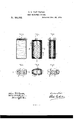
In the accompanying drawing I have represented one of my new piles, Figure 1 being a plan thereof with the circuit open; Fig. 2, a similar plan with the circuit closed; Fig. 3, a lateral elevation; Fig. 4, a similar elevation, in section, through A A, Fig. 1; Fig. 5, a plan,
in section, through B B, Fig. 4; and Fig. 6, a
front elevation, in section, through 0 C, Fig. 4.
In these figures, a is the outer shell, in chloride of silver b, its first insulating-envelope, in paper; and 0-, its outer insulating-envelope, in soft rubber; d, the lower cover with its plug d,
and e the upper cover, both of which are sealed hermetically in their places by means of gutta-percha, cement, or other similar and appropriate material. f is the inner element, consisting in a coilof zinc wire placed centrally v with the chloride-of-silver case a, and 'sepa rated therefrom by an absorbent material, v such as blotting-paper, sawdust, sand, or sim-.
ilar product, g, inserted in the space existing between a and f. h and i are the poles passing through the cover 0, the one h being'connected with the chloride case a, and the one iwith the zinc coil, as shown in Fig. 6.- In I order to intercept the passage of the liquid where these wires h and 13 pass through the cap, I place around each end, on the upper surface of the cap, soft-rubber washers h and i and on these rubber washers metallic washers 72. and i. The wires bcing screwthreaded, I run down thereon, by means of pliers or otherwise, small nuts in and i which, by compressing the metallic and the soft-rubber washers, produce a tight joint, as required. The pole 71. forms, as aforesaid, the upper ex tremity of an undulated silver or platinum wire, which is wound round in the chloride of silver from bottom to top, and which is thus plate It in its place.
coiled in a mold, wherein the chloride of sil: ver is poured in a liquid state, and when solidified, the undulations of the Wire, both on the outer and inner surfaces of the shell, form numerous points of contact, thereby augmenting the development of the electricity, and strengthening the chloride of silver shell. For the purpose of further developing the generation of the electricity, I prefer, before placing the covers or wrappers I) and c aforesaid, to cover externally the shell (I, with a sheet of silver-foil. In order to make and break contact, I place on the cover of the pile a plate, 70, in hard rubber, bone, ivory, or any other appropriate material, fixing itthereto by piercing two small holes therein, through which the poles h and 1; pass. A metallic washer, h, screwed on h, and a metallic cappinned or soldered on i, serve to maintain this On this plate It I adapt a metallic slide, l, to which I attach a nonconducting cross-bar, m, and I pass through this barthe metallic continuation h in the shape of a wire, 11. and a wire, i terminated at its rear in the shape of a hook, and I connect 71. and t with a fine platinum wire or coil, n. The slide Z is passed under a guide, I, and is slotted at the place where it is passed over the pole h, so that it can be pushed forward (seeFig. 2) until the hook of 1' comes in contact with the metallic cap on the poled, at which instant, the current being closed, the coil n is heated to redness by the passage of the electricity, whereby fire or light may be produced, and, by the removal of this upper mechanism, employed for industrial or scientific purposes. A spiral spring, 0, one extremity of which is attached to the cross-bar m, and the other to a book, 12, fixed to the plate k, serves to bring the parts inthe position shown at Fig. 1, thereby breaking the contact.
' I wish it specially to be remarked that in my new pile I reserve a central space or chamber within the zinc coil, for the purpose of receiving or housing the gases formed by the chemical decompositions ofthe elements of the pile, allowing such to combine in order to react on the elements, thus insuring a long period of duration of the pile and a greater power. I further remark that, by placing the chloride externally and the zinc internally, contrary to previous practice, I obtain a relatively much larger surface of chloride than of zinc, whereby I obtain, in a relatively yery small volume, the same power as actually obtained with piles of a considerably larger volume. Again, these piles, being perfectly hermetic and dry, are available for being carried in the pocket, and. for producing flame by contact with a wick saturated with an inflammable liquid, or fire by contact with a dry fibrous wick.
Thanks to the general mode of construction of these piles, as above described, they can be made to assume any form or size, and thereby produce any intensity of electricity requisite for any industrial, military, naval, or other purposes, under a smaller compass than other dry piles hitherto known. Having thus explained the nature of my.
improvements, and the best means I am ac-n quainted with for carrying the same into prac-. "tical operation, I claimments, as shown and described, and for intensifying the electricity produced.
2. The construction of the external chlorideof-silver shell a with an internal undnlated silver or platinum wire, for the purpose of augmenting the production of the electricity, and of strengthening the shell itself, as above described and illustrated.
3. The bottom (1, provided with the hole, and with plug d, for chargiugand recharging the pile, as above describedand illustrated.
4. The combination of the parts h, Z, m, 71. 6 n, l, 0, and p, for the purpose of making or breaking contact, as above described and il- 4 lustrated.
CHARLES LOUIS VAN TENAO.
Witnesses: V
F. ELIPPOT,
J. GUENOT.
Publications (1)
| Publication Number | Publication Date |
|---|---|
| US184932A true US184932A (en) | 1876-11-28 |
Family
ID=2254337
Family Applications (1)
| Application Number | Title | Priority Date | Filing Date |
|---|---|---|---|
| US184932D Expired - Lifetime US184932A (en) | Improvement in dry electric piles |
Country Status (1)
| Country | Link |
|---|---|
| US (1) | US184932A (en) |
-
0
- US US184932D patent/US184932A/en not_active Expired - Lifetime
Similar Documents
| Publication | Publication Date | Title |
|---|---|---|
| JPWO2007116872A1 (en) | HYDROGEN POWER ALLOY, HYDROPOWER DEVICE USING THE ALLOY, AND HYDRAULIC POWER | |
| JP2009062217A (en) | Hydrogen generator and fuel stick | |
| JPS58152373A (en) | Silver peroxide cell | |
| JPS59203376A (en) | Nonaqeuous solvent battery | |
| US274110A (en) | Felix de lalande | |
| US1016874A (en) | Means and method for preventing depletion of electrolyte. | |
| US3443907A (en) | Gas-generating device utilizing a chemical composition candle | |
| US881264A (en) | Electrical signal device. | |
| US732842A (en) | Secondary battery. | |
| US2646458A (en) | Galvanic cell | |
| US2823244A (en) | Electric accumulators | |
| US1851122A (en) | Blasting cartridge | |
| US2636059A (en) | Electric accumulator with zinc electrodes | |
| GB271581A (en) | An improved electric generator or gas battery | |
| US741675A (en) | Accumulator. | |
| US976092A (en) | Reversible galvanic battery. | |
| US2829187A (en) | Deferred-action battery | |
| US1621518A (en) | Electric cell with constant intensity | |
| US454598A (en) | Philip hathaway | |
| US1233204A (en) | Electric battery. | |
| US1342322A (en) | Flash-light | |
| US1733334A (en) | Method and means of storage-battery electrolyte control | |
| US725992A (en) | Electric lighter. | |
| JPH01115065A (en) | Thermal battery | |
| US326033A (en) | Emil g |