US1827139A - Taximeter - Google Patents
Taximeter Download PDFInfo
- Publication number
- US1827139A US1827139A US587319A US58731922A US1827139A US 1827139 A US1827139 A US 1827139A US 587319 A US587319 A US 587319A US 58731922 A US58731922 A US 58731922A US 1827139 A US1827139 A US 1827139A
- Authority
- US
- United States
- Prior art keywords
- pinion
- wheel
- disc
- members
- drum
- Prior art date
- Legal status (The legal status is an assumption and is not a legal conclusion. Google has not performed a legal analysis and makes no representation as to the accuracy of the status listed.)
- Expired - Lifetime
Links
- 230000033001 locomotion Effects 0.000 description 29
- 230000007246 mechanism Effects 0.000 description 21
- 230000009471 action Effects 0.000 description 12
- 101100326341 Drosophila melanogaster brun gene Proteins 0.000 description 7
- 150000002500 ions Chemical class 0.000 description 4
- 230000005540 biological transmission Effects 0.000 description 3
- 238000010276 construction Methods 0.000 description 3
- 238000006073 displacement reaction Methods 0.000 description 3
- 230000004048 modification Effects 0.000 description 3
- 238000012986 modification Methods 0.000 description 3
- 238000004804 winding Methods 0.000 description 2
- 241000512294 Thais Species 0.000 description 1
- 238000013459 approach Methods 0.000 description 1
- 230000008859 change Effects 0.000 description 1
- 230000006835 compression Effects 0.000 description 1
- 238000007906 compression Methods 0.000 description 1
- 238000010586 diagram Methods 0.000 description 1
- 239000005357 flat glass Substances 0.000 description 1
- 230000006870 function Effects 0.000 description 1
- XEEYBQQBJWHFJM-UHFFFAOYSA-N iron Substances [Fe] XEEYBQQBJWHFJM-UHFFFAOYSA-N 0.000 description 1
- 229910052742 iron Inorganic materials 0.000 description 1
- 238000000034 method Methods 0.000 description 1
- 238000012856 packing Methods 0.000 description 1
- 238000012546 transfer Methods 0.000 description 1
Images




Definitions
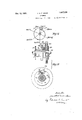
- Figs. 13, 14 and 15 represent the mechanism actuating the upper integrating devices.
- Fig. 16 represents in elevation and in plan s the mechanism for controlling the extras.
- Figs. 25, 26,27 and 28 represent in diierent positions a modified construction of the mechanism for returning to zero.
- Fig. 29 represents on face and on side a modification of the members carrying the drums and the sliding element and also of the grooved cylindrical casing.
- Fig. 30 shows another method of mounting these members.
- Fig. 31 shows a modification of the releasing arrangement of the rotary movement of the ⁇ drum indicating the cents for the fare to be paid.
- Fig. 32 shows end elevation and a side view of a modification of this mechanism.
- Fig. 33 shows in the same manner a device called lost time movement and intended to increase the duration of the time of engagement.
- Fig. 34 is a diagram showing the manipulation of the iag in the case in which the arrangement of Figs. 25-28 for returning to zero is used.
- Fig. 35 shows an elevation and a side View of another lost time arrangement for the taking into engagement.
- Fig. 36 shows diagrammatically at a greater scale a longitudinal section of the whole of members surrounding the shaft of the flag and the change-speed mechanism.
- the position of the levers, of the pawls and the packing up of the cams are shown with the best manner for facilitating the description of the apparatus.
- Fig. 36a shows a socket intended to be located at one of the ends of the main shaft carrying the fiag and which is integral with this shaft by tenons engaged in the grooves of said shaft.
- Fig. 36b shows a ring intended to be fixed at the outer end of one of the sockets located at the ends of the shaft carrying the flag.
- Fig. 37 shows in perspective the Whole of the levers actuating the sliding sleeves of the change-speed mechanism.
- Fig. 38 shows how the tube 25 and its radial projection 25 are integral in rotation with the member 24. This device is corresponding to the mechanism shown in the Figs. 25 to 28.
- Figs. 39 to 42 are detail views of some members.
- Fig. 43 is a section on the line G-H of Fig. 42.
- Fig. 44 is a section on the line I-J of Fig. 42.
- Figs. 45, 46, 47 are diagrammatic views of explication of the movement of the fare numeral drums.
- the box of the hereinafter described apparatus is constituted by a sheet-iron plate B0 having the shape of an inverted U riveted on a base Baa
- the box acts as a frame for the mounting of the different mechanisms supported by rings or squares riveted on the sides of the. U or on the base of the box.
- the closing of the box is obtained with two panels sliding into grooves R provided in the U (Fig. 6).
- the panel located on the side where the indications of the drums are to be read is provided with a plate-glass covering a plate pierced with windows through which appear the different indications of the tariff used the tare of the travel, the extras and the difierent integrating charges.
- the taximeter is provided with sets of easily detachable mechanisms having between them only a few points of contact, the determination of which does not necessitate any adjustment.
- the shaft 1 (Figs. 2, 4 and 36) extends through all the apparatus and engages by tenons and mortises 1a a cam' 6 rotating in the ring 5 riveted on one of the sides of the box B0.
- the other end of the shaft 1 rotates in a tube 89 also riveted on the box B0.
- the cam 6 is provided with notches or recesses in which the end of a lever 7 engages, which lever is under the action of a powerful spring 8 (Fig. 8) and swings on a spindle 21 (Fig. 4) carried by the casing Bo.
- the object of this arrangement is to determine accurately "H35 press dow-n again the flag.
- the ratchet wheel 11 is provided with teeth onlyfalong aL portion ofitsgperiphery (Fig.
- r4'Allt1-hese members are connected 'the' one to 'fthe' other fitting rby n tenons 1T, rnd 'more v tises so that last' memberf-Bli on 12,5 el, fthe handk is integrlwith thediscf'2'7"y
- the flag 2 is secureidby tenons and mor-- Pavment Extras or For'hire 'Fi .i3
- the plates 34 serve as guides to sliding 'members 35 (Figs.'4,.23 and 24and 36,).1maintained by pins 48 Jfixed on 35 :and sliding into recesses 48a 01:34, the hu-b '34" of 34 sel'vO ing as supports to the/numeral 'drums v45 to 49 which turn loosely on they hubs 34 of plates 34. They are, fromvthe rightto the n left (Figs. 4 and 36.) a ten dollars drum-45, a
- d cllars drum 46 a -centsdrum 47 (these th reeW drumsfor indicating the fare ⁇ vr of-rthecharge) a disc 57, a toothed wheel 64I loosely mounted fon the hub 51n of the toothing starry member 51, a: ten dollars ⁇ drum ,14S/for extras, a
- Each slide 35 carries'also a small pinion 41 having alternately long and-short teeth.
- This pinion ⁇ comes into contact, -at the engaged position, -onlyby its longrteeth with a smooth circular part of the ⁇ correspondingH10 drums 45to 49 engaging by its long and short teeth with'l'the continuous internal gearing Y De (Figs.123,24 and-47) of the nextfdrnm, A
- the pinion 41 is maintained in the correct position by a spring 42 and a recess n on the plates 34, so that there is always a short tooth of 41 which occupies the diametral position determined by a line connecting the shaft 1 and the spindle of the pinion 41 (Figs. 23-24-40 and 41).
- drums 45 to 49 or discs 57, 64, 65 carry different devices or members, the mounting, the function and the Working of which will be hereinafter described.
- a drum 75 on the periphery of which are the indications given through the tariff window and stating the position of working occupied by the taximeter.
- This drum 75 (Figs. 12 and 36) comprises a web 75a,l connecting its outer part with a hub 75a. he drum 7 5 is in egral in rotation with the shaft 1 by means of a key 7 5.
- the drum is provided with a circular edge formed as a cam at 7 7 acting on a. lever 105, pivoted in 106 (Fig. 12) and engaging and disengaging the time movement.
- the cam surface 76 dressed on the circular inner part of the drum 75 acts on a pin 103 of a lever 101 Which, pivoting about a spindle 102 mounted on a plate 94 (Fig. 12), applies a spring 104 to the balance wheel 100 of the time movement which is of an usual known system. In this Way, it stops the balance Wheel 100 and restores it when the lever 101, returned by means of a spring 101 (Fig. 12), leaves the balance Wheel.
- the barrel 86 For preventing the spring 88 from being overwound, the barrel 86 carries a member 84 pivoted at- 84 on 86 and comprising a pin 85 traversing an aperture of the vert-ical Wall of the barrel 86. vThis pin 85 engages between the two last spires of the spring 88 so that when, in consequence of the winding up, the convolutions approach the shaft 1, the member 84 oscillates about its pivot 84 and rests on the tail of the pawl 83, thus liberating the i, ratchet Wheel 82.
- the d rum 75 with the ratchet wheel 82 and the shaft 1 may then rotate without carryinaway the barrel 86.
- a spindle 92a (Figs. 2, 6 and 7) of the 'i clockwork drives the pinion 108 always in engagement with a pinion 113 integral with a sliding sleeve 114 integral itself with a ratchet Wheel 115 and transmitting its movef 5 ment by means of a pawl 117 integral with a hub 118 integral itself with the wheel 124. All these members are loosely mounted on the spindle 112 and the hub 118 is maintained in position by the ring 116 keyed on 112 andlgso the Wheel 124 is always in engagement with the wheel 64 (Fig. 36).
- the flexible drive 172 coming from the g5 Wheel of the vehicle is integral with a member 173 driving, by tenon and mort-iso, a hollow spindle 166 rotatable in a ring 167 fixed on the base Bw of the casing Bo by means of screws 167.
- the spindle 166 is integral with a pin 165 of the Worm 164, the upper end of which rotates in a square bearing 163 (Figs. 2 and 4) fixed on its base on the ring 167, a corresponding hole being provided 1n the base Bw of the box Bo.
- the Worm 164 drives the toothed Wheel 161 the number of teeth of which is corresponding to the diameter of the tvre-wheel of the vehicle.
- the wheel 161 is integral with the conical pinion 160, rotating about the spindle 162 fixed on the bearing 163.
- the taXimeter can be actuated by a running Wheel of any suitable diameter; to this purpose, Without removing any internal number of the taximeter nor any closing members of the casing, it is sucient to dismount the screws 167, to withdraw the ring 167 secured to the worm 164 and to the bearing 163, to unscrew the spindle 162 and to replace the worm wheel 161 or the pinion 160 by another Wheel of a different number of teeth, to change as required the worm 164 and to remount these parts.
- the pinion149 is engaged with the pinion 4Q 12.8 (Tai-itl III) andthe pinion 146 with the pinion 129 ⁇ (Tariiil These pinions 128 and 129 are integral with a hub 127 secured'to a ratchet. .wheel1126 and to 'pawls 136.
- the ratchet wheel 126 engages with the pawls 125' 4.5 integral with the wheel124 ⁇ . The' whole can rotate about the spindle 112.
- the movement' ofthe spindle 157' is-so transmitted, by means 'et one ⁇ orf another of' the pinions B16-129; "14a-12e, 14e+ 1a2,t0the wmf-,18,124 and-64 to when-:the vehicle is running.
- a The wheel124 canibeaetuatedeither bythe time movement (clockwork) orfbyfthe movea mentir of the -tyrewheel ofthe-vehicle ⁇ according as one or another of these movements is in C5 adva nce ⁇ of. the. other..
- Thespindles: 112 and i 157 swing, on thel oneside, on the'plate ofthe clockwork, Arotate atthe kother end in a hearing, provided with two pai-,tvs A158, the one of which isriveted to the casing B0 andthe c@ upper part of' which, secured by means Yof the screw. 159. allows the both spindles yto he quickly removed ⁇ (-Fig.'4). Y
- the wheel 124 enga witha wkh'eel'64c;c a' mechanismA comprising a 'coifnhination'lk of members adapted to produce a sharpdisen- The latter isalways engaged with'.
- Thewhecl64 is connectedtoa disc 57 (Figs.
- thefwheel' 64 becomes loose, while-the timingfandmileage drivinglmechanisms are ⁇ disengaged; ⁇ the i tozerp, the wheel 64" must first travel over '3" thisdetermined-Panglebefore 6'2comes' and disengages the pawl 52 causing thus ytheirst startingof thefdruml ".'f
- the quick movenientofthe disc 57 isti-xms-V mitted to -the Yfirst drumA 47 (cents drums) by the pinion 41 actuated bythetransfer sectors zwith four teeth, fixed on the circularpart of the disc-57
- the cents drum47. actuates,by means of its sector z., the dollars-.drum46, which in. turn actuates the drum45 ⁇ corresponding to the ten dollars.
- This transmission device byf-means of'pin ions 41 with alternatelylong and short teeth is w'el-l'known but, in thistaximeterpthis device is characterized by the factthat in priniso with a pin 71 integral with the disc 65.
- the drum 47 bearing 10 numerals and two graduations 15, 35, 55, 75, 95. carries two sectors 7L with 4 teeth op- 47 a rotation corresponding to ⁇ posite each other and transmits, for each halfrevolution, a rotation of 1-10 of revolution to the dollars drum 46.
- the latter bears also 10 numerals 0 to 9 and transmits, at each revolution by means of a sector k provided with 2 teeth, a rotation of bears 2O numerals (0 to 19).
- cents drum 47 would bear a double numbering, 00, 25, 50, 75 it would be only provid-ed with 8 numerals and should be rotated through l/g of revolution.
- the star 51 might be only provided with 6 or 5 teeth and the rotary motion would-decrease from the disc 57 (rotating through or 1g of revolution) to the drum 45 (rotating of revolution to the drum which through of revolution).
- Extras mechanism The mechanism for registering the extras is also controlled by the manipulation of the flag. It is arranged between the wheel 64 and the tariff drum 75 (Figs. 2, 4, 12, 16, 16 and 36).
- This mechanism comprises a disc 65 loosely mounted onA the hub 34 of the last left meinber 34 (Figs. 16n and 36) and two connecting drums, the one of which 49 is loosely mounted on the hub of a member 34, and the other 48 loosely mounted on the hub of the star wheel 51 (Fig. 36).
- the drums 48, 49 and the members 34 are of the same construction than that a-lreadv described for the registering of the tare. i
- the tariff drum (Figs. 12 and 16) carries on its flat surface 7 5X a pin 7 2 engaging the hub ⁇ 75a ofthe drum 75, a ring 73 can rotate under the action of a spring 7 4( Fig. 12) fixed, on the one hand, on the ring 73 and, on the other hand, on 75. This ring constantly tends to apply the pin 7l against the pin 72.
- the disc 65 carries a. pawl 66 and a curved lever 68.
- the pawl 66 is placed under the action of a spring 67 and can oscillate in a diametrical plane of the disc 65; the lever 68 is placed under the action of a spring 69 and can be displaced in the plane of the said disc.
- Figs: 21 and 22. are on line-X of".
- each brake may either rnbr on its drvm, or do not touch theltter, but be on the travelof a. pin 50 (Figs. 723 and 24) integral with the drum.
- n f As the movement of the fia gcontirrnes, the small cam 14 releases. entirely the Dart 20 ot the lever 19 from the groove e of the disc 27-whieh is'thurs'released. ⁇ r The latter; driving vc25 orrithe'members# and 35 rotates mn the action ofg the spring 23, Whiehiy rotation is stopped by the contact: between ythie member' 25a andthe pinl7- integralwith 13. The members are in the position shown in Fig. 18.
- the-*flag ⁇ should' loe-always driven in thefsarne direction, i.fe. that the flag, starting from' the .vertical positions (Fig. .13),l is driften to thepositionl shownv inlFig. 19. ⁇
- the l'part20 voffthelever 19 enters again the/grooveeL of'27.y The movement offv the ⁇ y isfstopped by,A the pin-18 integralA with 13lv which ⁇ comes into contact with ,they saidf-'pa-rtl).
- Biitthe screen 32 hidesa-lways the windows behindfwhieh appears the saidlindication -ofl the'i'nti'a-l fareof enigjegement (Fig. 19).
- the numeral device for the engaged miles (Fig. 6) is driven by the pinion 151 when the latter is in engagement with the clutch 152 of the pinion 153.
- the transmission is effected by a train of pinions 176, mounted loosely on a spindle 177 which train gearing with the first disc 183 indicating the hectometers.
- the device for registering the time Not recording or Payment is actuated in the following manner (Figs. 12, 6 and 7).
- Pin- 1 ions 109 and 110 connected together by a pin g are loosely mounted on the hub of a pinion 108.
- the pinion 109, the teeth of which are rounded on their flange or end, is of the same diameter as pinion 108, and pinion 110 gears with a pinion 111 which is in engagement with the first disc 187 of the device for registering the time of payment, when 113 is engaged with 109 by lateral displacement of 113.
- the device for registering the total fare l acts as follows (Figs. 13, 14 and 15) the disc pin 199 integral with the four teeth 57 carries blocks or side projections 59, each followed by a recess m, and engages with a pinion with four teeth 197 connected by a inion 196 byv means of a spring 198.
- the pm 199 engages in a recess of the pinion 197 and when the both pinions are unwedged relatively one to another through Ll5 degrees, they form in ,l plan a pinion with eight teeth.
- Said device avoids any smuggling, the teeth of the pinion 196, rubbing on the disc 57, oppose indeed any motion of rotation of the members 196-197 and consequently, of the pinion p.
- a lamellar spring 200 fixed in 200 on the cross-bar 191 (Figs. 2 and 12), acts on a square part c (Figs. 13 and 15) integral with the pinions 196 and p and prevents the teeth of the pinion 196 from being accidentally introduced in the recesses m of the disc 57.
- This device permits ⁇ on the one hand, the driving of the integrating device in a direction and ⁇ on the yother hand, the backwards return of the disc 57 without driving in the contrary direction the integrating device which remains held.
- the device for actuating the Extras is controlled by a mechanism similar to the mechanism described for registering the fare.
- a dog or side projection (Fig. 16) and a corresponding recess m of the disc 65 act on a train of pinions similar to that of pinions 196-197 described above, the pinion p of this train 196-197 actuating the small first drum 185 (Fig. 2).
- the registering device of the number of engagements is actuated (Fig. 2) by a dog 78 (with a corresponding recess m) fixed on the tariff drum 7 5 which controls a train similar to that of train 196-197.
- a dog 78 with a corresponding recess m fixed on the tariff drum 7 5 which controls a train similar to that of train 196-197.
- the elastic connections between the two pinions 196, 197 can be cancelled.
- the pinions p of this train 196-197 meshes with the first drum 186 of the integrating device of the number of engagements or trips.
- ⁇ pin 141 drives the sleeve 142 (Fig. 36) and disengages the pinion 151 from the pin 152 of the pinion 153, the pinion 151, having also disengaged the ratchet wheel 126 vfrom the pawl 125 integral with the wheel 124 by the pressure on the sliding Awhole 150, 149, 148,
- the pin 141 has moved the sleeve 142 and pushed ⁇ the pinion 151 against the members 152 which enter the teeth-of 151.
- the pawl 144 bearing on the ratchet wheel 145 pushes, by meansofthe members 147 -149, the sleeve l127 against the -pin 116 of theshaft 112 and engages simultaneously theratehetwheel 126 with the pawl 125 of the Wheel ⁇ 124. If the 4ear is running, the motion is transmitted from fthe flexible 172 to the wheel 124 through kthe pinion 146 in-engagement-.with the pinion 129 (Tariff 1).
- the pinion 124 drives the Wheel 64 on theshaft 1,v which Wheel is moved e throughy ⁇ they angular yspace corre# spending to the time of engagement either' for the distance of the ycourse or forthe duraoi' its spring 135?.
- the pin- 134 Through the pin- 134, the
- lever 135 drives onthe sleeve 133 the ratchet Wheel v131 of which .comes in Contact Withthe pawl 130 of .127, 129.
- the displacement of the tyre-Wheel of the car is transmitted to the pinions 143 and 132.
- the diameter kof the pinion 143 greater than that of the -pinf i ion 146 and consequently the rotation of the pavvl 144 being greater :than tliauof the ratchetgwheel 145, this pawl ksprings ony the teeth of 145 (Fig. 36).
- the cam 10 allows the 'lever 137 to be moved ,towards the outside (Fig. 5) driving the sleeve 142-151 4).
- Wing to the member 152. the 4pinion 153 remains in engagement With the pinion 151.
- the sleeve 127 remaining always pushed towards 124 bythesleeve 133 of the Tari 3 has not been ⁇ moved and has heldin their position the members 1500, 149, 148 and 147., 146, 145.
- a quicker transmission of the rotation to the Wheel 124 isr ensured'by means of the pinions 149-128.
Landscapes
- Time Recorders, Dirve Recorders, Access Control (AREA)
Description
. Oct. 13, 1931. J, A F, BRUN i 1,827,139
TAXIMETER Filed sept. 11, 1922 11 sheets-sheet 2 OCt. 13, 1931. 1 A F, BRUN 1,827,139
TAXIMETER Filed Sept. 1l, 1922 v l1 Sheets-Shea?l 3 far y E11/ffl mm www ma" far/w @Hf/2 MM2/#MUM Oct. 13, 1931. J, A, F, BRUN 1,827,139
TAXIMETER Filed Sept. 1l, 1922 11 Sheets-Sheetl 4 Oct. 13, 1931. J. A. F. BRUN TAXIMETER Filed Sept. l1, 1922 l1 Sheets-Sheet 5 Oct. 13, 1931. J. A. F. BRUN' 1,827,139 t l TAXIMETER Filed Sept. 11, 1922 11 Sheets-Sheet 6 @Y am @fm oct. 13,'1931. J, A F, BRUN 1,827,139
TAXIMETER Filed Sept. ll, 1922 11 Sheets-Sheet '7 Odi. 13, 1931.' 1, A, F, BRUN 1,827,139
TAXIMETER Filed Sept. 11, 1922 ll Sheets-Sheet. 8
Fay. 27 A f3 Oct. 13, 19731. y 1 A F, BRUN 1,827,139
TAXIMETER Filed sept. 11, 1922 11 sheets-sheet 9 .1. A` F. BRUN Oct 13, 1931.
TAXIMETER Filed Sept. ll, 1922 ll Sheets-Sheet l0 Oct. 13, 1931. J, A, F, BRUN 1,827,139
TAXIMETER Filed sept. 11, 1922 11 sheets-sheet 11 nism, the means for registering the extras, the arrangement ofthe clockwork movement, the time stopping and disengaging device and iinally the mechanism of control of the devices for integrating the number of engagements and the time of payment.
Figs. 13, 14 and 15 represent the mechanism actuating the upper integrating devices.
Fig. 16 represents in elevation and in plan s the mechanism for controlling the extras.
engagement) Figs. 25, 26,27 and 28 represent in diierent positions a modified construction of the mechanism for returning to zero.
Fig. 29 represents on face and on side a modification of the members carrying the drums and the sliding element and also of the grooved cylindrical casing.
Fig. 30 shows another method of mounting these members.
Fig. 31 shows a modification of the releasing arrangement of the rotary movement of the `drum indicating the cents for the fare to be paid.
Fig. 32 shows end elevation and a side view of a modification of this mechanism.
Fig. 33 shows in the same manner a device called lost time movement and intended to increase the duration of the time of engagement.
Fig. 34 is a diagram showing the manipulation of the iag in the case in which the arrangement of Figs. 25-28 for returning to zero is used.
Fig. 35 shows an elevation and a side View of another lost time arrangement for the taking into engagement.
Fig. 36 shows diagrammatically at a greater scale a longitudinal section of the whole of members surrounding the shaft of the flag and the change-speed mechanism. On this explicative figure of the mounting ot the members, the position of the levers, of the pawls and the packing up of the cams are shown with the best manner for facilitating the description of the apparatus.
Fig. 36a shows a socket intended to be located at one of the ends of the main shaft carrying the fiag and which is integral with this shaft by tenons engaged in the grooves of said shaft.
Fig. 36b shows a ring intended to be fixed at the outer end of one of the sockets located at the ends of the shaft carrying the flag.
Fig. 37 shows in perspective the Whole of the levers actuating the sliding sleeves of the change-speed mechanism.
Fig. 38 shows how the tube 25 and its radial projection 25 are integral in rotation with the member 24. This device is corresponding to the mechanism shown in the Figs. 25 to 28.
Figs. 39 to 42 are detail views of some members.
Fig. 43 is a section on the line G-H of Fig. 42.
Fig. 44 is a section on the line I-J of Fig. 42.
Figs. 45, 46, 47 are diagrammatic views of explication of the movement of the fare numeral drums.
lIn these dilerent figures, the springs are sometimes replaced by arrows lndicating their direction of action.
Casing On the contrary to the arrangements habitually used in the construction of taximeters, the box of the hereinafter described apparatus is constituted by a sheet-iron plate B0 having the shape of an inverted U riveted on a base Baa The box acts as a frame for the mounting of the different mechanisms supported by rings or squares riveted on the sides of the. U or on the base of the box. The closing of the box is obtained with two panels sliding into grooves R provided in the U (Fig. 6).
The panel located on the side where the indications of the drums are to be read is provided with a plate-glass covering a plate pierced with windows through which appear the different indications of the tariff used the tare of the travel, the extras and the difierent integrating charges.
Mounting of the flag The taximeter is provided with sets of easily detachable mechanisms having between them only a few points of contact, the determination of which does not necessitate any adjustment. l
The shaft 1 (Figs. 2, 4 and 36) extends through all the apparatus and engages by tenons and mortises 1a a cam' 6 rotating in the ring 5 riveted on one of the sides of the box B0. The other end of the shaft 1 rotates in a tube 89 also riveted on the box B0. The cam 6 is provided with notches or recesses in which the end of a lever 7 engages, which lever is under the action of a powerful spring 8 (Fig. 8) and swings on a spindle 21 (Fig. 4) carried by the casing Bo. The object of this arrangement is to determine accurately "H35 press dow-n again the flag.
trols lthe movement of at-screen 532 by a, pin tfixed-on an yarm 30 ,pivoted on the spindle 4 21.1!The'screenf32 falls down and hides the 4 servirse 5thefshaft lfmake'stheimembers 1,6 and 2 "iiitegralfeach other. AThe flag may,`v under 'the-saine conditions, be secured on the other fof the shaft 1 for replacing ring v2*" s' enfga'g'edby tenons vand mortises with the memi' lolber 6bf(iFig. vv36). safety lead f4', mainftained by -agcover 4, avoids the dishonest dis- V lmonnti-ngoflthe members by the chauii'eur. This flag `enablesto be ksuccessively in the positions`1Tariii' 1, Tariii 2, Tariff 3, *iis 'Tariffa/mc Referring torFig.h36,-ifthe cam 6,asfshown, :is secured on aV-disc9(1bymeans of a screw zo @Eyelid ion this discare secured (by means lof screws-9b) rings 10, 11and13. The Irings 19 andi() y'are for-med as camsnear their. pe-
ripheryforactuating the levers135 and 137 controlling the Vengagement ofthe miles motion-and ofthe adjustmentof the taximeter fto one of the three tariffs. y
The ratchet wheel 11 is provided with teeth onlyfalong aL portion ofitsgperiphery (Fig.
20a) and is adapted to prevent, by means vof a pawl12 cscillatinggon the spindle2l, the
frombeing moved backwards at thef 'momenten whichthe return to-zero is being A"comn'ienced and to oblige the chauffeurv to iinishffthis Aoperation before being 'able to fare when the `flag isturned for beginning taxime'teris `at the Tariii' l.
The whole of these members constitutes a drnmfat the interioroffwhich is located aA spring 23 fixed, on one hand, onl 22 on the 1 disc 9 anch/on the 'other hand,jon`24 on a sleeve 24 loosely 'mounted on the shaft 1; this spring ensures the return to zero of the numeral drums. i
blockV "*with 'a tubular part or hub 36', three identical' members provided with a' part l34A and a. tubu! lar part `K? 4"(I*"ig. 40), a, toothing star member 5,1 (Fig. 39) and further members 3434.-
r4'Allt1-hese members;are connected 'the' one to 'fthe' other fitting rby n tenons 1T, rnd 'more v tises so that last' memberf-Bli on 12,5 el, fthe handk is integrlwith thediscf'2'7"y The flag 2 is secureidby tenons and mor-- Pavment Extras or For'hire 'Fi .i3
'Y p., v 3
the return to zero andis'only raisedwhen the 27 located'on .the` rightV hand A' (see :Fig 136) e All 'these members f are in'fengwgementfby means cfa mit S0 screwed "onthe end nf the tube :25. y p 'Thelmenrber 25 isfable to receivera certainy 70 movement off rotationirelatively tothe fdisc 27, which movement is .limited rby wslot 226'* provided in the disc` 27,1i'n :whichfsslotuaf .pin
26 on the sleeve 25, 24 is engaged. f
A strong spring 29,*fastened', son" theionef-"I'l hand, to the pin 26 on the part 25?', 241ml, on 'the' ot'herfhand, to vapin`28 on? the *disca27, tends to brin g1 the parts 124, .25;1an`du2t')a into the position show-n in Fig.';21 (disengagement) i F1380 lever 19 pivoted on the spindle21-11nider the actionof a spring shown bysan .arrow (Figs-117 i019) rests rconstantly by` itsfbent part20 'againstthe disc 27 .and can enter, more or less deeplyland .by .its.part=20,` W5 notch of this disc. y
The plates 34 serve as guides to sliding 'members 35 (Figs.'4,.23 and 24and 36,).1maintained by pins 48 Jfixed on 35 :and sliding into recesses 48a 01:34, the hu-b '34" of 34 sel'vO ing as supports to the/numeral 'drums v45 to 49 which turn loosely on they hubs 34 of plates 34. They are, fromvthe rightto the n left (Figs. 4 and 36.) a ten dollars drum-45, a
d cllars drum 46, a -centsdrum 47 (these th reeW drumsfor indicating the fare`vr of-rthecharge) a disc 57, a toothed wheel 64I loosely mounted fon the hub 51n of the toothing starry member 51, a: ten dollars `drum ,14S/for extras, a
cents vdrum 49 for extras and finally. a disc 653100 The sliding members 35 receive a transverse or 'radial displacement relatively. to the shaft @1, euch of themhavinga projection 37 which can engage in a longitudinal groove 1' ofthe v`:member v25-fand drive the said sliding member M06 f 35.
Each slide 35 carries'also a small pinion 41 having alternately long and-short teeth. This pinion` comes into contact, -at the engaged position, -onlyby its longrteeth with a smooth circular part of the `correspondingH10 drums 45to 49 engaging by its long and short teeth with'l'the continuous internal gearing Y De (Figs.123,24 and-47) of the nextfdrnm, A
transfer sectori, integral with the' preceding l drum andhaving two or fourteeth adaptedfll to engage with the longandshort teeth of thepinion 41, actuate periodically the pinion which rotating rotates the next succeeding drum, the said rotation corresponding to the number of teeth of the toothed sector h of' 120 Abythe"sliding members 35 when carrled 'on by lthe zeroiZ-ing device, as will be explained hereinafterpins 44 ofthe 1drums being'en- 'gaged yley projection `38fand- 'pawls 39fof the sliding members 35,V 130 The pawl 39 carried by the sliding member is under the action of a spring 40 and a spring 36 tends always to bring the member 35 into the position of disengagement (Fig. 23), that isvto say into the posltion in which the pinion 41 does not engage with the internal teeth of the drums -49 and in which the projection 37 is in the groove 1' of the sleeve 25.
At each of these positions, the pinion 41 is maintained in the correct position by a spring 42 and a recess n on the plates 34, so that there is always a short tooth of 41 which occupies the diametral position determined by a line connecting the shaft 1 and the spindle of the pinion 41 (Figs. 23-24-40 and 41).
All these drums 45 to 49 or discs 57, 64, 65 carry different devices or members, the mounting, the function and the Working of which will be hereinafter described.
Tarif drums On the projecting part of the shaft 1, out
This drum 75 (Figs. 12 and 36) comprises a web 75a,l connecting its outer part with a hub 75a. he drum 7 5 is in egral in rotation with the shaft 1 by means of a key 7 5. The drum is provided with a circular edge formed as a cam at 7 7 acting on a. lever 105, pivoted in 106 (Fig. 12) and engaging and disengaging the time movement. By the cam surface 76 dressed on the circular inner part of the drum 75, the latter acts on a pin 103 of a lever 101 Which, pivoting about a spindle 102 mounted on a plate 94 (Fig. 12), applies a spring 104 to the balance wheel 100 of the time movement which is of an usual known system. In this Way, it stops the balance Wheel 100 and restores it when the lever 101, returned by means of a spring 101 (Fig. 12), leaves the balance Wheel.
Winding up 0f the clock lwork spring On the drum (Fig. 12) is secured at 82 a ratchet Wheel 82 which is in contact with a pawl 83 secured on the barrel 86 loosely mounted on the tube 89. When the flag 2 is i'nanipulated in the normal direction of rotation, the barrel spring 88 is Wound up.
For preventing the spring 88 from being overwound, the barrel 86 carries a member 84 pivoted at- 84 on 86 and comprising a pin 85 traversing an aperture of the vert-ical Wall of the barrel 86. vThis pin 85 engages between the two last spires of the spring 88 so that when, in consequence of the winding up, the convolutions approach the shaft 1, the member 84 oscillates about its pivot 84 and rests on the tail of the pawl 83, thus liberating the i, ratchet Wheel 82.
The d rum 75 with the ratchet wheel 82 and the shaft 1 may then rotate without carryinaway the barrel 86.
he movement of the spring 88 is transmitted by means of a large pinion 90 (Figs. 2, 7o 4, 6, 36) and by means of a number of intermediate pinions 91 to the escape mechanism mounted in a cage 98 (Fig. 6) and fastened on one of the plates 94 of the clockwork. The other plate 93 of this system bea against the casing Bo of the a paratus an the Whole is fixed in osition y means of struts 96 (Fig. 2) gui ed on pins 95 riveted on the casing Bo, the whole being tightened up by nut-s 97. 30
A spindle 92a (Figs. 2, 6 and 7) of the 'i clockwork drives the pinion 108 always in engagement with a pinion 113 integral with a sliding sleeve 114 integral itself with a ratchet Wheel 115 and transmitting its movef 5 ment by means of a pawl 117 integral with a hub 118 integral itself with the wheel 124. All these members are loosely mounted on the spindle 112 and the hub 118 is maintained in position by the ring 116 keyed on 112 andlgso the Wheel 124 is always in engagement with the wheel 64 (Fig. 36).
Removable bearing of the worm The flexible drive 172 coming from the g5 Wheel of the vehicle is integral with a member 173 driving, by tenon and mort-iso, a hollow spindle 166 rotatable in a ring 167 fixed on the base Bw of the casing Bo by means of screws 167. The spindle 166 is integral with a pin 165 of the Worm 164, the upper end of which rotates in a square bearing 163 (Figs. 2 and 4) fixed on its base on the ring 167, a corresponding hole being provided 1n the base Bw of the box Bo.
The Worm 164 drives the toothed Wheel 161 the number of teeth of which is corresponding to the diameter of the tvre-wheel of the vehicle.
The wheel 161 is integral with the conical pinion 160, rotating about the spindle 162 fixed on the bearing 163.
Besides the taXimeter can be actuated by a running Wheel of any suitable diameter; to this purpose, Without removing any internal number of the taximeter nor any closing members of the casing, it is sucient to dismount the screws 167, to withdraw the ring 167 secured to the worm 164 and to the bearing 163, to unscrew the spindle 162 and to replace the worm wheel 161 or the pinion 160 by another Wheel of a different number of teeth, to change as required the worm 164 and to remount these parts.
Fastening of the taan'mter 125 The taximeter is fixed to the vehicle in such a manner to be oriented at will in the direction which allows to the client to read the most easily the indication of the' dial. For 130 this purpose (Fig. 4) the ring167-zis tight-y ened' up(` onthe support 169, withy the interposition of a soft washer 168',`by meansjofaf speedy mechanismwhich provides different" taritsfbr the drive (three in this case), Thismechanism is represented in Figs. 4 andr36 '2 for the positionofi Tariff Bland inFig.'` 6'for the positionl of' Tariff" 1`, andcompvises the if'ollowi'ngl members. y p
A pinion 153 (Figs. 4; 6 and 36) secured,E
to the-lowerspindle157`carries1a1 clutch 152 whichx can be'engaged with 'pinion 151'E inf,
tegralwith'a'sleeve 142carrying also a pinion 143". n pinion 132" securedon a; sleeve 1331 and a' ratchet'wheel 131 andloosely mountedon they 3 spindle 112. These pinions 143 ,and` 132 arek furthe Tariff 2;
On the sleeve 142' are'looseljy` mountedV two independent! arrangements, onecomprising.fa`
35, mtchetfwheel145,.a,pinion\ 146 yand i a washer` f 147-, all seeurelyvconnected together ,the other arrangement. comprises a washer-148, a pinion.
149 :india clutch -15O1also connectedtogether. The pinion149 is engaged with the pinion 4Q 12.8 (Tai-itl III) andthe pinion 146 with the pinion 129` (Tariiil These pinions 128 and 129 are integral with a hub 127 secured'to a ratchet. .wheel1126 and to 'pawls 136. The ratchet wheel 126 engages with the pawls 125' 4.5 integral with the wheel124`. The' whole can rotate about the spindle 112. The movement' ofthe spindle 157'is-so transmitted, by means 'et one` orf another of' the pinions B16-129; "14a-12e, 14e+ 1a2,t0the wmf-,18,124 and-64 to when-:the vehicle is running. A The wheel124 canibeaetuatedeither bythe time movement (clockwork) orfbyfthe movea mentir of the -tyrewheel ofthe-vehicle `according as one or another of these movements is in C5 adva nce` of. the. other.. Thespindles: 112 and i 157 swing, on thel oneside, on the'plate ofthe clockwork, Arotate atthe kother end in a hearing, provided with two pai-,tvs A158, the one of which isriveted to the casing B0 andthe c@ upper part of' which, secured by means Yof the screw. 159. allows the both spindles yto he quickly removed`(-Fig.'4). Y
The wheel 124 enga witha wkh'eel'64c;c a' mechanismA comprising a 'coifnhination'lk of members adapted to produce a sharpdisen- The latter isalways engaged with'. a
gagement of the numeral drums 47, 46 and indicatin the 'fare tobe paid"Y the travelling: K `e wheel: 64: allows 'alsothe returni'tozerojrofthesaiddrumS; p v Working' (starting of i the drums-45 to .//7
Thewhecl64 is connectedtoa disc 57 (Figs.
11 and 36) by'a' spring 61 hooked to a pin 62,V
on the wheel 64 and U01 a (in 58 on the disc 57. In this' manner an opposite to; the usual arrangements, the two members, wheel 64 and disc 57, are-'never4 rigidly connected together. The disc 57 is there constantly urged by thespring 61 in theL samedirectionas the wheel 64but a pawlf 52, hinged on the disc 57y is maintained'lby spring'vin engagementwith t-l`1`e`-teeth of the starwheel4 51 and is opposed to lthe motion of the disc 57 until' thepawl" has ,been raised`- by the,l p'iny 62` which rotates with the wheel 64 in the direc-` ,vi--
tion of the arrowv (Eig. 1-1),.' rlhe wheel 64' is driven inL rotation bythe wheel 124A,` as clearly shown on Figs.. 11""and 36.` At this time, the pawl 52 escapes from the'teethV of' the star` wheel 51the disc 57 rotates thnougli a fractionofrevolution'under the action oi?V the spring 61 and the pawl 52 engages again with the following't'ooth.
A detent 56, maintainedby the springfif),
tends to maintainthe disc 57I ina fined posi-y tion relatively to theteeth ofthe starwhe'el 51 at the moment'ofthereturntoze'rd* y f i fof. engagement- The mechanism aforesaiddseribedensures f also the control ofthe duration` of the'time of engagement. As itwill be 'hereinafterseen atv thetimeofthereturn to zero, thefwheel' 64 becomes loose, while-the timingfandmileage drivinglmechanisms are` disengaged; `the i tozerp, the wheel 64" must first travel over '3" thisdetermined-Panglebefore 6'2comes' and disengages the pawl 52 causing thus ytheirst startingof thefdruml ".'f The quick movenientofthe disc 57 isti-xms-V mitted to -the Yfirst drumA 47 (cents drums) by the pinion 41 actuated bythetransfer sectors zwith four teeth, fixed on the circularpart of the disc-57 The cents drum47.actuates,by means of its sector z., the dollars-.drum46, which in. turn actuates the drum45` corresponding to the ten dollars. Y, l
This transmission device byf-means of'pin ions 41 with alternatelylong and short teeth is w'el-l'known but, in thistaximeterpthis device is characterized by the factthat in priniso with a pin 71 integral with the disc 65.
-l of a 40 10 revolution. The drum 47, bearing 10 numerals and two graduations 15, 35, 55, 75, 95. carries two sectors 7L with 4 teeth op- 47 a rotation corresponding to `posite each other and transmits, for each halfrevolution, a rotation of 1-10 of revolution to the dollars drum 46.
The latter bears also 10 numerals 0 to 9 and transmits, at each revolution by means of a sector k provided with 2 teeth, a rotation of bears 2O numerals (0 to 19).
All the drums 45, 46 and 47 and the disc 57, having not the same angular space to travel, do not begin their rotation simultaneously, which allows the use of a smaller spring 61 than necessary if all these members would be driven simultaneously in rotation.
If the cents drum 47 would bear a double numbering, 00, 25, 50, 75 it would be only provid-ed with 8 numerals and should be rotated through l/g of revolution. In this case, the star 51 might be only provided with 6 or 5 teeth and the rotary motion would-decrease from the disc 57 (rotating through or 1g of revolution) to the drum 45 (rotating of revolution to the drum which through of revolution).
Extras mechanism The mechanism for registering the extras is also controlled by the manipulation of the flag. It is arranged between the wheel 64 and the tariff drum 75 (Figs. 2, 4, 12, 16, 16 and 36).
This mechanism comprises a disc 65 loosely mounted onA the hub 34 of the last left meinber 34 (Figs. 16n and 36) and two connecting drums, the one of which 49 is loosely mounted on the hub of a member 34, and the other 48 loosely mounted on the hub of the star wheel 51 (Fig. 36).
The drums 48, 49 and the members 34 are of the same construction than that a-lreadv described for the registering of the tare. i
The tariff drum (Figs. 12 and 16) carries on its flat surface 7 5X a pin 7 2 engaging the hub` 75a ofthe drum 75, a ring 73 can rotate under the action of a spring 7 4( Fig. 12) fixed, on the one hand, on the ring 73 and, on the other hand, on 75. This ring constantly tends to apply the pin 7l against the pin 72.
The disc 65 carries a. pawl 66 and a curved lever 68. The pawl 66 is placed under the action of a spring 67 and can oscillate in a diametrical plane of the disc 65; the lever 68 is placed under the action of a spring 69 and can be displaced in the plane of the said disc.
When the flag is coming from the position Payment to the position Extras (Figs. 3, 1
16 and 16) the inclined edge of the pawl 66 meets the short tooth of the pinion 41 carried bv the sliding member 35 of the drum 49 and the pawl 66, sliding on this tooth of the pinion 41. falls behind this tooth (see Fig. 16).
In order to indicate the extras, it is necessary then to move the flag in the opposite direction between the position Extras and the position Pavment. This retrograde motion of the flag is transmitted to the pinion 41 by the shaft 1. the drum 75 and the pins 71, 7 2, the ring 73. the spring 74. the disc 65 and the pawl 66. In order that the extras should be registered impulsively and not in a continuous manner, the following members come into action.
Bv reason of the rotation of the shaft 1 in the direction stated by the arrow F1- (Figs. 10. 12. 16) the back of the pawl 66 (that is to sav the part opposite to the inclined edge of the latter) engages with a short tooth of ther pinion 41 and cannot rotate the latter becausev the following long tooth of the said pinion does not find a corresponding aperture on the internal circular and fiat face 65' of a disc 65 (Fig. 9). Consequently the disc 65 remains stationary although, the tariff drum 75 receiving a backward movement in the direction indicated by the arrow F1, the pin 72 leaves the pin 71 on which the ring 73 with the spring 74 acts. When the pin 72 is into contact with the'raised part or projection 1 of the lever 68 (Fig. 16). the latter oscillates (Fig. 10) and in this manner leaves between its end 68Il and the pawl 66 a passage 68 (Fig. 10) for the long tooth of the pinion 41. The latter (Fig. 12). under the action of the spring 74 on the ring 73 and the block 71 in` tegral with the disc 65 which rotates. can then turn through a few teeth and registers a unit of the extras by means of a drum 49. The same movement is repeated at each registration, that is to say every time that the Hag is brought from the position Payment to the position Extras and backwards. If th(` drum 49 carries for instance the numerals 00. then v50, then 00, the chauffeur has been obliged fo work twenty five times the flag from Payment to Extras in order that v55 the screen 32.
1; new
Re tum to zeroff 5-1' 'In order'to efacethef amountofifareand extras registered lby thel drums 45A to 49, Nthe arrangement i for returning tof zero' is actuated. alweysfby means ofthe .flag 'driven to.
a vertical position. 11N Figs.' 17, 18.L and i19fare'seetionsvon the line X" of Figs. 2t) and j'36 4looking 'in the directiony statedby the arrows.v
Figs: 21 and 22. are on line-X of". Figs-2O and 362,l looking the dise=27`by thefriee-V 15" oppositeto this shownfomaFigs: 171019.
In;y :the operating positiolfls.l ofthe fdiierent mechanisms,- thatfy isly in those corresponding toith'e'position-f off theflagdenoteek Ibv Tari;
1, 2 Zorl 3, payment'or extras v1.7),ntl1e 2W' leveri'19fpressed bye-,spring asfshomrs byfa little f-arrolw drawrrona Vthis lever: 19:, kis.` fully" engaged-'in thefrecesse ofthe diseanrd stops the projection'25 of the sleeve25 'which time remains stationary (Ffigs.` f and f 22); The
28"' projections 37fof'the sliding'members 35eme.
has'reached a: position ati/45.* rekitivey to the; vertical plane,r thepew 12.. 18 vand: f enterstlref rstutooth of 'the toothed 11e-4 854 of the ratchet Wheel v11.. Inothe' Same time; the pin. 3`1enters the onterigrooveoffthecavm 135 and thek sereeni 32` closes tlie through Whichappear the fire andthe extras; to be" paid.. The2 flsig' towards the 4G vertical linefthefcamlintegral iwith 13laets moves oirt"ofthef9g1'oove e ythe end-2() of.' tliev lever@V 19 I and thais allowsrztlresleewe QE-i to rotate only in accorda-neet() the length of the aperture 26*L of 27y and to take the `position shown in `dottexlliries: inFig.' 17 Under the-'action ofsprinigs'lt and 231,1that is to say-a position in the prxeetions'f-of the/sliding',y members. 35 lfaill finto )the f groove 1"- ofthe sleeverl25\(Figs. 21 and 23);.. The pinonsf4l`are thus. ontof engegementfrom tlredrums 45 to 49, which arethen loose-reletively kto eaeh other. and aire. helelintheir position Abyfnneanssfof .the member. 3.3 vintegral. Witlrthe lever 30` carryingf,v therpin. 31 and The number ofbrakes 33`Fs equal to that of thedrums. Itwill be noted that each brake may either rnbr on its drvm, or do not touch theltter, but be on the travelof a. pin 50 (Figs. 723 and 24) integral with the drum. n f As the movement of the fia gcontirrnes, the small cam 14 releases. entirely the Dart 20 ot the lever 19 from the groove e of the disc 27-whieh is'thurs'released.`r The latter; driving vc25 orrithe'members# and 35 rotates mn the action ofg the spring 23, Whiehiy rotation is stopped by the contact: between ythie member' 25a andthe pinl7- integralwith 13. The members are in the position shown in Fig. 18.
In order to have @complete `revolution of the-dise 27, the-*flag` should' loe-always driven in thefsarne direction, i.fe. that the flag, starting from' the .vertical positions (Fig. .13),l is driften to thepositionl shownv inlFig. 19.` At this time, the l'part20 voffthelever 19 enters again the/grooveeL of'27.y The movement offv the`y isfstopped by,A the pin-18 integralA with 13lv which` comes into contact with ,they saidf-'pa-rtl).
During the rotation o the members 24, 25,1v 2505,27; 1, 2,? 6,9, 10i, 11, 13, 35 and 36, a pin 44.@ ofleaeh `drum 45 to 49 is-metby a. pawl y39*Y of eazeh slidingmember35`. This pawl, after beingraised, falls behind lthepin'M4-Which is noWim-prisened, bet-Weeny 39 andthe projeotion 38 olf themember` 35 (Fig. 23). From` thistimefforthf, ezieh drum follows the rota@v tion of its sliding member 35 and isdriven to 4a' positionv corresponding to the indication ofthe-fare of theL engagement. This indica-l tion corresponds-in ythe eppleons taximeter to thefeliectiveposition of the return to zero."-
It is tobe noted that, contrary to therme-- tionin known apparatus in which thefnumeral drums# are stopped ati theend ofthereturn` to zero by aboltfacting on a. pin, the-pn150 only acts in' thiscasein order to prevent the! sa'ididi'urnsfrontfollowing,v friction on" the hubs 34', thev movementvof theretorn to zero until the extension 38 meets the `block-44; at this moment, each drn-mis-v actuated afnd the pirr50 escapes-from the spring 33.3` f
In order thatv the flag muy *bei then pressec downto' the position Tariif 1, .it isenecessary to' raiseit againto the` position For hire. This backwards movementlisepossible' owingto the-position ofthe pawl`12on the flatpart (from a to b, Fig. 20a) ofthe ratchety wheel r 11,' vwhich part iscomprised i between the^two toothedy sectors llafand'llb.
Dnringfthis "movement, the sleeve 25, 25
is rotated'backward's by the block 17 pressing.
on tli'espring 29:(Fig. ,22). Thismovement being completelyefected, the'projection 25a is removed vand the leverv 19, 20fall's into the bottom of the groove e of the dise, which is, thus held fixedtogether with the starl 51 andthe sliding members 35` At the same time, .the` sleeve25 (Fig. 22)`havingrotated relatively to the members 35 (Fig. 24),.tlie
the part of the lever 19 being not located on the travel of the pin 18 (Fig. 19).
[a taf/rater: y Zeer/lifes The different integrating devices are 4'mounted in frame comprising two horiions as 189 (Fig. 12). The whole may be easily removed by unsci'ewing only the screws o. The numeral device for the total miles (Figs. 6 and 11) 1s driven by the pinion 153 on the spindle 157 engaging by means of a train of pinions 175 with a clutch wheel 178 (Fig. 6), which, at each revolution, moves a pinion 179 through the space of two teeth, transmitting by a spindle 180 and a pinion 181 the movement to the front disc 182 of the numeral device, thus registering the total miles wandered over by the vehicle, the wheel 153 being indeed keyed on the spindle 157 (Fig. 36).
The numeral device for the engaged miles (Fig. 6) is driven by the pinion 151 when the latter is in engagement with the clutch 152 of the pinion 153. The transmission is effected by a train of pinions 176, mounted loosely on a spindle 177 which train gearing with the first disc 183 indicating the hectometers.
The device for registering the time Not recording or Payment is actuated in the following manner (Figs. 12, 6 and 7). Pin- 1 ions 109 and 110, connected together by a pin g are loosely mounted on the hub of a pinion 108. The pinion 109, the teeth of which are rounded on their flange or end, is of the same diameter as pinion 108, and pinion 110 gears with a pinion 111 which is in engagement with the first disc 187 of the device for registering the time of payment, when 113 is engaged with 109 by lateral displacement of 113.
The device for registering the total fare l acts as follows (Figs. 13, 14 and 15) the disc pin 199 integral with the four teeth 57 carries blocks or side projections 59, each followed by a recess m, and engages with a pinion with four teeth 197 connected by a inion 196 byv means of a spring 198. The pm 199 engages in a recess of the pinion 197 and when the both pinions are unwedged relatively one to another through Ll5 degrees, they form in ,l plan a pinion with eight teeth.
At each disengagement or rotation of the disc 57, one of the blocks 59, meeting a tooth of the pinion 197, drives tlie latter, that` permitting the following tooth of the pinion 196 i to engage with the recess m. The motion of the disc 57 continuing, the following tooth of the pnion 196 runs against the flat'periphery of the disc 57 and the motion of the pinions 196-197 is stopped, the members 196-197' being rotated through two teeth, that is a fourth of revolution. The pinion 196 drives; by means of a pinion p, the first disc 184 of the integrating device of the number of disengagements (Fig. 2).
Said device avoids any smuggling, the teeth of the pinion 196, rubbing on the disc 57, oppose indeed any motion of rotation of the members 196-197 and consequently, of the pinion p.
At the time of the return to zero, the disc 57, driven by the pawl 52 in contact with a tooth of the star 51, rotates through a backward revolution. This motion would be impossible if one of the teeth (197a for instance) of the pinion 197 met by the block 59 would not disengage before it by compression of the spring 198 and would not be in line with the tooth 196 of the pinion 196. As soon as' the block 59 is passed away, the tooth 197l takes again its position under the action of the spring 198 in order to be again thrown back` as aforesaid described, by the succeeding block 59 (Fig. 14).
A lamellar spring 200, fixed in 200 on the cross-bar 191 (Figs. 2 and 12), acts on a square part c (Figs. 13 and 15) integral with the pinions 196 and p and prevents the teeth of the pinion 196 from being accidentally introduced in the recesses m of the disc 57.
This device permits` on the one hand, the driving of the integrating device in a direction and` on the yother hand, the backwards return of the disc 57 without driving in the contrary direction the integrating device which remains held.
The device for actuating the Extras is controlled by a mechanism similar to the mechanism described for registering the fare. A dog or side projection (Fig. 16) and a corresponding recess m of the disc 65 act on a train of pinions similar to that of pinions 196-197 described above, the pinion p of this train 196-197 actuating the small first drum 185 (Fig. 2).
The registering device of the number of engagements (trips) is actuated (Fig. 2) by a dog 78 (with a corresponding recess m) fixed on the tariff drum 7 5 which controls a train similar to that of train 196-197. However, as the movement is only effected at the moment at which the flag 2 is displaced between the position Extras and the position Vacant and can only rotate in one direction (the lever 12 engaging with the teeth 11a of the ratchet 11), the elastic connections between the two pinions 196, 197 can be cancelled. The pinions p of this train 196-197 meshes with the first drum 186 of the integrating device of the number of engagements or trips.
General working and the screen 32 is dropped. The disc27 Vand 'the cylindrical whole comprising the drums to 49 and the sliding members35 are disengaged, see Figs. 18 and 23. The pin 63 of thewheel 64 is in Contact With .the Jin 58 of the dise 57. The cam76 of thetari drum bearing against the pin 103 of the lever 101 pushesthe spring 104 against the member (Figs. 4, 12 andl 36). The lever 105, drawn by thespring 105 towards the bottom of the cam 77 disengages, by means of the pin 107 (Fig. 4), theratchet wheel 115 from the flexible `pavvl 117. The levers kk137 and 135, being kon the cams 9 and 10 in the position corresponding to Vacant (Figs. 4, 8 and 37), the lever 137 draws, by means of the crank shaft 138 and vtowards theside of the casing, the .lever 139 pivotally mounted at 140 on a member secured to the l'casing B0. The
j 147,128, 127, 129. At this position, the clock- Work mechanism is stopped and, the car is ruiming, thetotal mileage integrating device, driven by the pinions 153, 175, is aloneregis- 'l tering.
In order to put the taximeter at Tariff 1, the flag should be first lowered through 30 and then taken back to Vacant, in order to end the `return to zero and to enga-ge the pinions 41 with the teeth De of the drums 45 to 49. The fla" should finally taken forto be paid and Ext-ras (Fig. 17).T But before the end of this movement, the mileages and time registering devices have Worked as follows: The lever 137, hinged on the shaft 136 and driven by the spring 142, slides along the inclinedplan of the cams 9 and 10 and comes into contact with the cam 11.
A Tariff 1 The pin 141has moved the sleeve 142 and pushed `the pinion 151 against the members 152 which enter the teeth-of 151. The pawl 144 bearing on the ratchet wheel 145, pushes, by meansofthe members 147 -149, the sleeve l127 against the -pin 116 of theshaft 112 and engages simultaneously theratehetwheel 126 with the pawl 125 of the Wheel`124. If the 4ear is running, the motion is transmitted from fthe flexible 172 to the wheel 124 through kthe pinion 146 in-engagement-.with the pinion 129 (Tariff 1). vThe mileage integrating ldevice for the time of engagement is then actuated together with the total mileage integrat- ,ing device by the rpinion l151 kintegral with Simultaneously the inclined edge of the cam 77 of 75, ushing the lever 105 to-k wards the centre o` the apparatus, causes the ratchet wheel 115, through the fin r 107, to
be engaged VWith the pawllll 'o 117,118, 124. The clockwork mechanism is thus allowed to attuate, by means of 923,108,113,
the Wheel 124, because the cam 76 of 75 hasv caused the lever 101l to fall, the .spring 104" of which lever is dravvnaway fromthe member 10() ofthe clockwork mechanism.
'Consequently according to the'runnino' or thestopping of the car, the pinion 124 drives the Wheel 64 on theshaft 1,v which Wheel is moved e throughy `they angular yspace corre# spending to the time of engagement either' for the distance of the ycourse or forthe duraoi' its spring 135?. Through the pin- 134, the
lever 135 drives onthe sleeve 133 the ratchet Wheel v131 of which .comes in Contact Withthe pawl 130 of .127, 129. The displacement of the tyre-Wheel of the car is transmitted to the pinions 143 and 132. The diameter kof the pinion 143 greater than that of the -pinf i ion 146 and consequently the rotation of the pavvl 144 being greater :than tliauof the ratchetgwheel 145, this pawl ksprings ony the teeth of 145 (Fig. 36). e l
i e .Teef 3 y The vflag being at thisposition, the cam 10 allows the 'lever 137 to be moved ,towards the outside (Fig. 5) driving the sleeve 142-151 4). Wing to the member 152., the 4pinion 153 remains in engagement With the pinion 151. But the sleeve 127 remaining always pushed towards 124 bythesleeve 133 of the Tari 3, has not been `moved and has heldin their position the members 1500, 149, 148 and 147., 146, 145. A quicker transmission of the rotation to the Wheel 124 isr ensured'by means of the pinions 149-128. The pawl 130 slides on the teeth of the ratchet-,Wheel 131., The pawl 144 y(Tari 1) is completely disengagedfrom thewheel 145. y f. Owing to the above arrangement, during the Workingat Tariff 2, the Tarils 1 and 2 are simultaneously in engagement and during. the Working'at Tariif, the Tariffs 2`and Sare simultaneously in engagementi`l Neither intermediate position takes place during which neither tariff is in engagement. j e
Pay/ment 07' time not recording-After the end of the course of the car, the flag is ydriven to the position Payment. The cam 77 of the drum 75 is drawn avvay from the lever 105 which disengages the ratchet Wheel from through 138, 139, 141 (position shown in Fig.
Applications Claiming Priority (1)
| Application Number | Priority Date | Filing Date | Title |
|---|---|---|---|
| FR1827139X | 1921-09-19 |
Publications (1)
| Publication Number | Publication Date |
|---|---|
| US1827139A true US1827139A (en) | 1931-10-13 |
Family
ID=9681448
Family Applications (1)
| Application Number | Title | Priority Date | Filing Date |
|---|---|---|---|
| US587319A Expired - Lifetime US1827139A (en) | 1921-09-19 | 1922-09-11 | Taximeter |
Country Status (1)
| Country | Link |
|---|---|
| US (1) | US1827139A (en) |
Cited By (3)
| Publication number | Priority date | Publication date | Assignee | Title |
|---|---|---|---|---|
| US2596164A (en) * | 1947-10-27 | 1952-05-13 | Rockwell Register Corp | Taximeter |
| US2650757A (en) * | 1947-08-30 | 1953-09-01 | Weisinger Joseph George | Taximeter |
| US2709039A (en) * | 1954-11-02 | 1955-05-24 | Rockwell Register Corp | Universal escapement type automatic taximeter |
-
1922
- 1922-09-11 US US587319A patent/US1827139A/en not_active Expired - Lifetime
Cited By (3)
| Publication number | Priority date | Publication date | Assignee | Title |
|---|---|---|---|---|
| US2650757A (en) * | 1947-08-30 | 1953-09-01 | Weisinger Joseph George | Taximeter |
| US2596164A (en) * | 1947-10-27 | 1952-05-13 | Rockwell Register Corp | Taximeter |
| US2709039A (en) * | 1954-11-02 | 1955-05-24 | Rockwell Register Corp | Universal escapement type automatic taximeter |
Similar Documents
| Publication | Publication Date | Title |
|---|---|---|
| US2213240A (en) | Meter | |
| US1794808A (en) | Taximeter | |
| US1744307A (en) | Taximeter construction | |
| US1891335A (en) | Automatic lubrication annunciator for motor vehicles | |
| US1637606A (en) | Registering device | |
| US1312747A (en) | Columhia plaxogra | |
| US3015208A (en) | Parking meter and time release mechanism therefor | |
| US556890A (en) | jondet | |
| US1436646A (en) | Fare indicator for vehicles | |
| US805111A (en) | Automobile-cyclometer. | |
| US1856403A (en) | Fare indicator | |
| US1239095A (en) | Time-controlled fare-indicator. | |
| US1851982A (en) | Clock | |
| US3069839A (en) | Parking meter | |
| US1295110A (en) | Recorder. | |
| US1438853A (en) | Taximeter | |
| US1718340A (en) | Taximeter | |
| US1449757A (en) | Neckar | |
| US1413713A (en) | Ration | |
| US588726A (en) | Cyclometer | |
| US1654730A (en) | Maximum-demand meter | |
| US1550132A (en) | Taximeter | |
| US1753547A (en) | Positive speed gauge | |
| US1932670A (en) | Interlocking mechanism | |
| US1635698A (en) | Driving means for taximeters |