US1688576A - Reclining chair - Google Patents
Reclining chair Download PDFInfo
- Publication number
- US1688576A US1688576A US109007A US10900726A US1688576A US 1688576 A US1688576 A US 1688576A US 109007 A US109007 A US 109007A US 10900726 A US10900726 A US 10900726A US 1688576 A US1688576 A US 1688576A
- Authority
- US
- United States
- Prior art keywords
- seat
- chair
- frame
- leg rest
- friction
- Prior art date
- Legal status (The legal status is an assumption and is not a legal conclusion. Google has not performed a legal analysis and makes no representation as to the accuracy of the status listed.)
- Expired - Lifetime
Links
- 238000010276 construction Methods 0.000 description 5
- 230000033001 locomotion Effects 0.000 description 3
- BHELIUBJHYAEDK-OAIUPTLZSA-N Aspoxicillin Chemical compound C1([C@H](C(=O)N[C@@H]2C(N3[C@H](C(C)(C)S[C@@H]32)C(O)=O)=O)NC(=O)[C@H](N)CC(=O)NC)=CC=C(O)C=C1 BHELIUBJHYAEDK-OAIUPTLZSA-N 0.000 description 1
- 230000008933 bodily movement Effects 0.000 description 1
- 230000002301 combined effect Effects 0.000 description 1
- 238000006073 displacement reaction Methods 0.000 description 1
- 230000000694 effects Effects 0.000 description 1
- 230000005484 gravity Effects 0.000 description 1
- 208000018883 loss of balance Diseases 0.000 description 1
- 238000004519 manufacturing process Methods 0.000 description 1
- 230000001105 regulatory effect Effects 0.000 description 1
Images

Classifications
-
- A—HUMAN NECESSITIES
- A47—FURNITURE; DOMESTIC ARTICLES OR APPLIANCES; COFFEE MILLS; SPICE MILLS; SUCTION CLEANERS IN GENERAL
- A47C—CHAIRS; SOFAS; BEDS
- A47C1/00—Chairs adapted for special purposes
- A47C1/02—Reclining or easy chairs
- A47C1/031—Reclining or easy chairs having coupled concurrently adjustable supporting parts
- A47C1/034—Reclining or easy chairs having coupled concurrently adjustable supporting parts the parts including a leg-rest or foot-rest
- A47C1/035—Reclining or easy chairs having coupled concurrently adjustable supporting parts the parts including a leg-rest or foot-rest in combination with movably coupled seat and back-rest, i.e. the seat and back-rest being movably coupled in such a way that the extension mechanism of the foot-rest is actuated at least by the relative movements of seat and backrest
Definitions
- HARRY F DOYLE, 0F AURORA, ILLINOIS, ASSIGNOR T0 KROEHLER MFG. C0.7 OF NAPER- VILLE, ILLINOIS, A
- This invention relates to improvements in reclinino ⁇ chairs, and more particularly to the so-called easy chairs, characterized by an ladjustable back and a foot or leg rest which may be extended from the front of the chair andu at approximately the same angle to the horizontal as theback.
- the object of the present invention is to provide an improved construction for a chair embodying the characteristics above mentionedin such a way that the leg rest is operated by and movable simultaneously with the reclining back of the chair.
- further object of the invention is to provide an improved construction for a chair having a leg rest so constructed and arranged as to partially fold and disappear beneath the chair seat when the back is shifted forward to an upright sitting position.
- Figure 2 is a view in side elevation of the chair in reclining position.
- Figure 3 is a front view-of the chairv partially in vertical section as taken on line 8 3 of Figure 2.
- Figure 4 is an enlarged detail view of one of the friction regulating devices taken on line 4-4t of Figure 3;
- Figure 5 is an enlarged detail View inV side elevation of one of the friction regulatingdevices.
- the chair embodying the improved features of construction is illustrated in skeleton form, that is, with ⁇ the springs and upliolstering removed soas to show inorejclearly the frame structure.
- the chair is preferably yof the deeploung-v ing type, and consists generally of aV rela-v tively stationary chair frame and a tilting seat 'and back, pivotally mounted in the stationary frame.
- the Vseat and back are integral and therefore remain at a fixed angle to eachother.
- the chair frame is of the usual construction, being made up of a rectangular main frame l, consisting of side frame members lrl and front and rear cross members lb and le, respectively, the front cross members being spaced back some six or eight inchcs'from the forward ends of th side frame members.
- Atvthe corners of the main frame are legs 2, and also the frontand rear lateral uprights 3, 3 and 4, 4 between the upper ends of which, extend the arms 5, 5.
- the seat and back frames 6 and 7 are sim.l
- the vertical kor longitudinal lrails T, ⁇ 7 of the back framer are extended below the seat frame to form downwardly extending arms 10, l() which are braced by triangu'larly Shaped blocks Il, 11. Nailed to the inside face of the side frame members and forward-v ly of the pivot points are stop yblocks 12,12
- leg rest 13 Hinged to the forward edge of the seat frame and more accurately, to the front rail 6b thereof, is the leg rest 13.
- This leg rest consists of two hinged-together sections 13a and 13b, the upper section in its normal position extending vertically downward from the top edge of the main chair frame 1.
- Hinges 14 connect the top edge of the section 13 to the rail 6b.
- arms 16, 16 Secured to the back face of the lower section 13b of the leg rest are two arms 16, 16 preferably in the form of triangular plates attached lengthwise along the edges of said section. Extending from the lower ends of the armsy 10, 10 at the rear of the seat frame, tothe ends of the arms. 16, 16 are bars 17, 17 having pivotal connections at each end, said bars in the upright position of the seat ( Figure 1) extending ⁇ upwardly at an angle of ⁇ about 30 to the horizontal from back to front, just clearing the top edge of the front cross' member 1b, which, as already pointed out, is spaced some distance tothe rear of vthe front edge of the seat frame. Secured to the rear face of the cross member 1b are two friction clutch members 18, 18 projecting above the cross members in line with the bars17, 17.
- Each clutch member has a fiange 18a bearing iiatwise against one face of each bar, and a corresponding adjustable plate 19 secured thereto by means of bolts 20, 20 and bearing'against the opposite face of the bar.
- these bolts are coiled springs 21 and wing nuts 22 which may be tightened or loosened to Vary the tension exerted by the springs against the plate 19, and hence the frictional resistance offered by the clutch members to the endwise movement of the bars 17, 17.
- the friction clutches are adjustable so that the friction can be varied to secure said chair fra-me and formingv seat and back ⁇ portions, a leg rest hinged to the forward edge of said seat, a bar extending from front to rear of said chair frame beneath said seat and pivotally connected at its rear end to said tiltable frame and at its front end with. said leg rest, said chair frame having a transverse,
- a reclining chair comprising a ch-air frame, a seat pivotally mounted in said frame, a leg rest hinged to the front edge of said seat, and consisting of an. upper portion adapt-ed to swing relative to said seat, and a lower portion adapted to extend beneath the seat in the upright position thereof and to swing outwardly/'into the plane of said upper ⁇ section, an arm extending downwardly vfrom said seat adjacent the rear thereof, a bar extending forwardly from said arm and operatively connected with the lower portion of said leg rest, and friction members mounted on said cha-ir frame intermediate the ends of said bar and adapted to embrace said bar.
Landscapes
- Health & Medical Sciences (AREA)
- Dentistry (AREA)
- General Health & Medical Sciences (AREA)
- Chairs For Special Purposes, Such As Reclining Chairs (AREA)
Description
Oct. 23, 1928. f 1,688,576
H. F. DoYLE RECLINING CHAIR I Filed May 14, 192e 2 sheets-sheet 1 d4 6l' 16?@ -9` Y 13% @l y LW IWI H )HW i 5 j@ I9 i UH J5 l I J 8 I Hwy/QW@ WM WS.
Oct. 23, 1928.` 1,688,576
. H. F. DOYLE REGLINING CHAIR 2 Smets-Sheet 2 Filed May 14, 1926 Patented Unt. 23, 1923.
UNITED STA-TES PATENT OFFICE.
HARRY F. DOYLE, 0F AURORA, ILLINOIS, ASSIGNOR T0 KROEHLER MFG. C0.7 OF NAPER- VILLE, ILLINOIS, A
OORPOEATIDN OF ILLINOIS.
RECLINING CHAIR.
This invention relates to improvements in reclinino` chairs, and more particularly to the so-called easy chairs, characterized by an ladjustable back and a foot or leg rest which may be extended from the front of the chair andu at approximately the same angle to the horizontal as theback.
The object of the present invention is to provide an improved construction for a chair embodying the characteristics above mentionedin such a way that the leg rest is operated by and movable simultaneously with the reclining back of the chair.
further object of the invention is to provide an improved construction for a chair having a leg rest so constructed and arranged as to partially fold and disappear beneath the chair seat when the back is shifted forward to an upright sitting position.
While I am aware that the general features of construction above outlined have` been the subject matter of prior applications for Letters Patent, there are certain improved features which are thought essential te the practical manufacture and use of such a chair, and it is to these improvements thatthe present disclosure is directed. For instance, it is proposed that the shifting of the seat to the desired reclining position shall be accomplished entirely by theshifting of the weight of the occupant from a sitting or reclining vposture, thus doing away entirely with springs and manually controlled adjusting devices. This result is accomplished by mounting the seat on pivots located substantially in the vertical line of the weight of the occupant when-sitting upright in the chair, and by the application of friction, to permit the seat to tilt backwardlywithout loss of balance. y
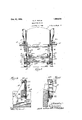
A preferred embodiment of the invention is disclosed in the accompanying drawings,
in which' y Figure 1 is a view in side elevation of the chair in upright position.
Figure 2 is a view in side elevation of the chair in reclining position.
Figure 3 is a front view-of the chairv partially in vertical section as taken on line 8 3 of Figure 2.
Figure 4 is an enlarged detail view of one of the friction regulating devices taken on line 4-4t of Figure 3; and
Application filed May 14, 1926. Serial No. 109,007.
Figure 5 is an enlarged detail View inV side elevation of one of the friction regulatingdevices.
For convenience, the chair embodying the improved features of construction is illustrated in skeleton form, that is, with` the springs and upliolstering removed soas to show inorejclearly the frame structure.
The chair is preferably yof the deeploung-v ing type, and consists generally of aV rela-v tively stationary chair frame and a tilting seat 'and back, pivotally mounted in the stationary frame. The Vseat and back are integral and therefore remain at a fixed angle to eachother. i y The chair frame is of the usual construction, being made up of a rectangular main frame l, consisting of side frame members lrl and front and rear cross members lb and le, respectively, the front cross members being spaced back some six or eight inchcs'from the forward ends of th side frame members. Atvthe corners of the main frame are legs 2, and also the frontand rear lateral uprights 3, 3 and 4, 4 between the upper ends of which, extend the arms 5, 5.
The seat and back frames 6 and 7 are sim.l
The vertical kor longitudinal lrails T, `7 of the back framer are extended below the seat frame to form downwardly extending arms 10, l() which are braced by triangu'larly Shaped blocks Il, 11. Nailed to the inside face of the side frame members and forward-v ly of the pivot points are stop yblocks 12,12
which lie inthe pathl of the arms "10, 10 and act to limit the rearward tilting of the seat.
Hinged to the forward edge of the seat frame and more accurately, to the front rail 6b thereof, is the leg rest 13. This leg rest consists of two hinged-together sections 13a and 13b, the upper section in its normal position extending vertically downward from the top edge of the main chair frame 1. Hinges 14 connect the top edge of the section 13 to the rail 6b. Connected by meansof hinges 15 to the bottom edge of the leg rest seetion 18, is the other section 13b considerably greater in width than the upper section, and normally extending at right angles thereto, and rearwardly beneath the seat frame, in fact, its width is somewhat greater than the distance from the lower edge of the section 1BEL to the floor.
Secured to the back face of the lower section 13b of the leg rest are two arms 16, 16 preferably in the form of triangular plates attached lengthwise along the edges of said section. Extending from the lower ends of the armsy 10, 10 at the rear of the seat frame, tothe ends of the arms. 16, 16 are bars 17, 17 having pivotal connections at each end, said bars in the upright position of the seat (Figure 1) extending` upwardly at an angle of` about 30 to the horizontal from back to front, just clearing the top edge of the front cross' member 1b, which, as already pointed out, is spaced some distance tothe rear of vthe front edge of the seat frame. Secured to the rear face of the cross member 1b are two friction clutch members 18, 18 projecting above the cross members in line with the bars17, 17. Each clutch member has a fiange 18a bearing iiatwise against one face of each bar, and a corresponding adjustable plate 19 secured thereto by means of bolts 20, 20 and bearing'against the opposite face of the bar. n these bolts are coiled springs 21 and wing nuts 22 which may be tightened or loosened to Vary the tension exerted by the springs against the plate 19, and hence the frictional resistance offered by the clutch members to the endwise movement of the bars 17, 17.
From the foregoing description, it will be seen that in the backward tilting of the seat and back, the leg rest 13 is simultaneously extended, its extension partalzing of a com bined downward swinging of the lower sec-l tion 13 into the planeof the upper section 13, and a bodily movement of both sections relative to the seat frame in an outward direction. This movement is manifestly transmitted to the leg rest through the bars 17, 17 which move endwise, with but a limited trans-verse displacement.
In the fully reclined position, as shown in Figure 2, the seat is tilted upwardly and the back downwardly while the leg rest extends outwardly and downwardly in approximately parallel relation to the back, thus affording of insecurity, and' for this reason the friction v clutches are employed, which act on the bars to resist the sudden shifting of weight and permit the seat to be brought tol rest in an intermediate position without effort on the part of the occupant to maintain the seat in equilibrium.
An added advantage of the friction clutches is the compensating effect of the frictional resistance to the unstability of the seat, being pivoted, as it is, below the center of gravity of the weight of the occupant. Hence, it is possible to use a single and inexpensive type of trunnion which can `be wholly concealed from view, depending on the clutch members to control the tilting movement. y For obvious reasons, the clutch members are adjustable so that the friction can be varied to secure said chair fra-me and formingv seat and back` portions, a leg rest hinged to the forward edge of said seat, a bar extending from front to rear of said chair frame beneath said seat and pivotally connected at its rear end to said tiltable frame and at its front end with. said leg rest, said chair frame having a transverse,
frame member below said seat and reark wardly of the leg rest, friction plates mounted on said frame members and embracing said bar and adjustable tension means acting on said plates. l
2. A reclining chair comprising a ch-air frame, a seat pivotally mounted in said frame, a leg rest hinged to the front edge of said seat, and consisting of an. upper portion adapt-ed to swing relative to said seat, and a lower portion adapted to extend beneath the seat in the upright position thereof and to swing outwardly/'into the plane of said upper` section, an arm extending downwardly vfrom said seat adjacent the rear thereof, a bar extending forwardly from said arm and operatively connected with the lower portion of said leg rest, and friction members mounted on said cha-ir frame intermediate the ends of said bar and adapted to embrace said bar. Y
Signed at Naperville, Ill., this 11th day of May, 1926. l
HARRY F. DOYLE.
Priority Applications (1)
| Application Number | Priority Date | Filing Date | Title |
|---|---|---|---|
| US109007A US1688576A (en) | 1926-05-14 | 1926-05-14 | Reclining chair |
Applications Claiming Priority (1)
| Application Number | Priority Date | Filing Date | Title |
|---|---|---|---|
| US109007A US1688576A (en) | 1926-05-14 | 1926-05-14 | Reclining chair |
Publications (1)
| Publication Number | Publication Date |
|---|---|
| US1688576A true US1688576A (en) | 1928-10-23 |
Family
ID=22325305
Family Applications (1)
| Application Number | Title | Priority Date | Filing Date |
|---|---|---|---|
| US109007A Expired - Lifetime US1688576A (en) | 1926-05-14 | 1926-05-14 | Reclining chair |
Country Status (1)
| Country | Link |
|---|---|
| US (1) | US1688576A (en) |
Cited By (19)
| Publication number | Priority date | Publication date | Assignee | Title |
|---|---|---|---|---|
| US2491898A (en) * | 1945-06-11 | 1949-12-20 | Frank J Luketa | Chair |
| US2604141A (en) * | 1951-08-11 | 1952-07-22 | Kenmar Mfg Company | Adjustable chair with leg supporting platform |
| US2647559A (en) * | 1952-07-28 | 1953-08-04 | Richardson Franklin | Reclining article of furniture |
| US2746521A (en) * | 1952-09-12 | 1956-05-22 | Lorenz Anton | Article of repose for supporting the body of a person |
| US2760554A (en) * | 1954-01-11 | 1956-08-28 | Lorenz Anton | Reclining chair with back rest, seat, and leg rest, movable |
| US2774412A (en) * | 1953-07-08 | 1956-12-18 | Norman P Martin | Reclining chair with extensible sectional leg rest |
| US2798534A (en) * | 1953-07-14 | 1957-07-09 | John J Curtis | Reclining chair |
| US2844189A (en) * | 1952-10-22 | 1958-07-22 | Lorenz Anton | Article of repose for supporting the body of a person |
| US2879833A (en) * | 1956-02-09 | 1959-03-31 | Anton Lorenz | Adjustable chairs |
| US2917753A (en) * | 1957-02-01 | 1959-12-22 | Robert B Portis | Device for supporting a human body |
| US2921624A (en) * | 1954-11-26 | 1960-01-19 | Lorenz Anton | Article of repose for supporting the body of a person |
| US2942650A (en) * | 1956-03-19 | 1960-06-28 | Gen Steel Products Company Inc | Reclining chair with frictional resistance adjustment |
| US2945533A (en) * | 1956-04-23 | 1960-07-19 | Anton Lorenz | Improved leg-rest and actuating mechanism |
| US2948330A (en) * | 1955-08-05 | 1960-08-09 | Lorenz Anton | Article of repose for supporting the body of a person |
| US3001817A (en) * | 1958-02-14 | 1961-09-26 | Anton Lorenz | Leg-rest and actuating mechanism |
| US3100668A (en) * | 1960-02-17 | 1963-08-13 | Gen Steel Products Inc | Reclining chair |
| US3163464A (en) * | 1963-08-19 | 1964-12-29 | Dual Mfg & Eng | Mechanism for recliner-rocker type of chair |
| US20110248530A1 (en) * | 2010-04-07 | 2011-10-13 | Ferdinand Lusch Gmbh & Co. Kg | Seating Furniture with a Seat Which can be Pivoted into a Standing Up Assistance Position |
| WO2016062702A1 (en) * | 2014-10-22 | 2016-04-28 | Curt Würstl Vermögensverwaltungs-Gmbh & Co. Kg | Seat for a pushchair and/or doll's pram |
-
1926
- 1926-05-14 US US109007A patent/US1688576A/en not_active Expired - Lifetime
Cited By (20)
| Publication number | Priority date | Publication date | Assignee | Title |
|---|---|---|---|---|
| US2491898A (en) * | 1945-06-11 | 1949-12-20 | Frank J Luketa | Chair |
| US2604141A (en) * | 1951-08-11 | 1952-07-22 | Kenmar Mfg Company | Adjustable chair with leg supporting platform |
| US2647559A (en) * | 1952-07-28 | 1953-08-04 | Richardson Franklin | Reclining article of furniture |
| US2746521A (en) * | 1952-09-12 | 1956-05-22 | Lorenz Anton | Article of repose for supporting the body of a person |
| US2844189A (en) * | 1952-10-22 | 1958-07-22 | Lorenz Anton | Article of repose for supporting the body of a person |
| US2774412A (en) * | 1953-07-08 | 1956-12-18 | Norman P Martin | Reclining chair with extensible sectional leg rest |
| US2798534A (en) * | 1953-07-14 | 1957-07-09 | John J Curtis | Reclining chair |
| US2760554A (en) * | 1954-01-11 | 1956-08-28 | Lorenz Anton | Reclining chair with back rest, seat, and leg rest, movable |
| US2921624A (en) * | 1954-11-26 | 1960-01-19 | Lorenz Anton | Article of repose for supporting the body of a person |
| US2948330A (en) * | 1955-08-05 | 1960-08-09 | Lorenz Anton | Article of repose for supporting the body of a person |
| US2879833A (en) * | 1956-02-09 | 1959-03-31 | Anton Lorenz | Adjustable chairs |
| US2942650A (en) * | 1956-03-19 | 1960-06-28 | Gen Steel Products Company Inc | Reclining chair with frictional resistance adjustment |
| US2945533A (en) * | 1956-04-23 | 1960-07-19 | Anton Lorenz | Improved leg-rest and actuating mechanism |
| US2917753A (en) * | 1957-02-01 | 1959-12-22 | Robert B Portis | Device for supporting a human body |
| US3001817A (en) * | 1958-02-14 | 1961-09-26 | Anton Lorenz | Leg-rest and actuating mechanism |
| US3100668A (en) * | 1960-02-17 | 1963-08-13 | Gen Steel Products Inc | Reclining chair |
| US3163464A (en) * | 1963-08-19 | 1964-12-29 | Dual Mfg & Eng | Mechanism for recliner-rocker type of chair |
| US20110248530A1 (en) * | 2010-04-07 | 2011-10-13 | Ferdinand Lusch Gmbh & Co. Kg | Seating Furniture with a Seat Which can be Pivoted into a Standing Up Assistance Position |
| WO2016062702A1 (en) * | 2014-10-22 | 2016-04-28 | Curt Würstl Vermögensverwaltungs-Gmbh & Co. Kg | Seat for a pushchair and/or doll's pram |
| CN107074261A (en) * | 2014-10-22 | 2017-08-18 | 柯特维思特尔资产管理有限责任两合公司 | For perambulator and/or the seat of doll's stroller |
Similar Documents
| Publication | Publication Date | Title |
|---|---|---|
| US1688576A (en) | Reclining chair | |
| US2174622A (en) | Aircraft furniture | |
| US2532025A (en) | Resiliently mounted reclining chair | |
| US2182598A (en) | Reclining chair | |
| US2135833A (en) | Chair | |
| US2227597A (en) | Adjustable reclining chair | |
| US1626069A (en) | Reclining chair | |
| US2634796A (en) | Reclining chair | |
| US2509739A (en) | Theater chair | |
| US2288775A (en) | Reclining chair | |
| US2271440A (en) | Glider chair | |
| US1823248A (en) | Examining table leg rest | |
| US1896048A (en) | Reclining chair | |
| US1662378A (en) | Seat | |
| US1846797A (en) | Chair | |
| US1795202A (en) | Article of furniture | |
| US2535138A (en) | Resiliently supported reclining chair | |
| US2281085A (en) | Chair bed | |
| US1732169A (en) | Adjustable seat | |
| US2292618A (en) | Convertible chair | |
| US3095238A (en) | Seat or other articles such as couch | |
| US2430356A (en) | Theater chair | |
| US2171189A (en) | Chair | |
| US2541938A (en) | Reclining chair | |
| US1837911A (en) | Glider |