US12356195B2 - Re-establishing a connection between a user controller device and a wireless device - Google Patents
Re-establishing a connection between a user controller device and a wireless device Download PDFInfo
- Publication number
- US12356195B2 US12356195B2 US16/643,891 US201716643891A US12356195B2 US 12356195 B2 US12356195 B2 US 12356195B2 US 201716643891 A US201716643891 A US 201716643891A US 12356195 B2 US12356195 B2 US 12356195B2
- Authority
- US
- United States
- Prior art keywords
- communications
- wireless device
- user
- controller device
- attacking
- Prior art date
- Legal status (The legal status is an assumption and is not a legal conclusion. Google has not performed a legal analysis and makes no representation as to the accuracy of the status listed.)
- Active, expires
Links
Images




Classifications
-
- H—ELECTRICITY
- H04—ELECTRIC COMMUNICATION TECHNIQUE
- H04L—TRANSMISSION OF DIGITAL INFORMATION, e.g. TELEGRAPHIC COMMUNICATION
- H04L63/00—Network architectures or network communication protocols for network security
- H04L63/14—Network architectures or network communication protocols for network security for detecting or protecting against malicious traffic
- H04L63/1441—Countermeasures against malicious traffic
- H04L63/145—Countermeasures against malicious traffic the attack involving the propagation of malware through the network, e.g. viruses, trojans or worms
-
- H—ELECTRICITY
- H04—ELECTRIC COMMUNICATION TECHNIQUE
- H04W—WIRELESS COMMUNICATION NETWORKS
- H04W12/00—Security arrangements; Authentication; Protecting privacy or anonymity
- H04W12/12—Detection or prevention of fraud
- H04W12/121—Wireless intrusion detection systems [WIDS]; Wireless intrusion prevention systems [WIPS]
- H04W12/122—Counter-measures against attacks; Protection against rogue devices
-
- H—ELECTRICITY
- H04—ELECTRIC COMMUNICATION TECHNIQUE
- H04L—TRANSMISSION OF DIGITAL INFORMATION, e.g. TELEGRAPHIC COMMUNICATION
- H04L63/00—Network architectures or network communication protocols for network security
- H04L63/14—Network architectures or network communication protocols for network security for detecting or protecting against malicious traffic
- H04L63/1441—Countermeasures against malicious traffic
- H04L63/1491—Countermeasures against malicious traffic using deception as countermeasure, e.g. honeypots, honeynets, decoys or entrapment
-
- H—ELECTRICITY
- H04—ELECTRIC COMMUNICATION TECHNIQUE
- H04W—WIRELESS COMMUNICATION NETWORKS
- H04W12/00—Security arrangements; Authentication; Protecting privacy or anonymity
- H04W12/06—Authentication
-
- H—ELECTRICITY
- H04—ELECTRIC COMMUNICATION TECHNIQUE
- H04W—WIRELESS COMMUNICATION NETWORKS
- H04W12/00—Security arrangements; Authentication; Protecting privacy or anonymity
- H04W12/12—Detection or prevention of fraud
-
- H—ELECTRICITY
- H04—ELECTRIC COMMUNICATION TECHNIQUE
- H04W—WIRELESS COMMUNICATION NETWORKS
- H04W12/00—Security arrangements; Authentication; Protecting privacy or anonymity
- H04W12/12—Detection or prevention of fraud
- H04W12/128—Anti-malware arrangements, e.g. protection against SMS fraud or mobile malware
-
- H—ELECTRICITY
- H04—ELECTRIC COMMUNICATION TECHNIQUE
- H04W—WIRELESS COMMUNICATION NETWORKS
- H04W76/00—Connection management
- H04W76/10—Connection setup
- H04W76/19—Connection re-establishment
-
- H—ELECTRICITY
- H04—ELECTRIC COMMUNICATION TECHNIQUE
- H04L—TRANSMISSION OF DIGITAL INFORMATION, e.g. TELEGRAPHIC COMMUNICATION
- H04L2463/00—Additional details relating to network architectures or network communication protocols for network security covered by H04L63/00
- H04L2463/144—Detection or countermeasures against botnets
Definitions
- the embodiments described herein relate to re-establishing a connection between a user controller device and a wireless device in a wireless communications network.
- the wireless device may have been corrupted such that it will only accept communications which appear to originate from an attacking controller device.
- Stand-alone cellular devices like sensors or other Internet of Things (IoT) devices may be deployed within a network, and are often connected through the radio network to a server. A user can access and use the devices through this server. The user relies on this means of connection, and often the only alternative, if the connection is lost, is to physically get to the device and establish a physical connection.
- IoT Internet of Things
- the user and the user controller device have access to the core network and its features through the operator's Internet Protocol (IP) Services.
- IP Internet Protocol
- the operator's IP services pass communications through the core network to the deployed wireless devices as shown for example in FIG. 1 .
- FIG. 1 illustrates an example network 100 .
- the user 101 is operating a user controller device 102 which is capable of controlling a wireless device 103 .
- the wireless device 103 may be a stand-alone cellular device such as a sensor or other remote device.
- the user controller device 102 is connected to the core network 104 via the operator's IP services 105 .
- the user controller device 102 connects over the internet 106 via an Access Point Name (APN) gateway 107 to the operator's IP services 105 .
- APN Access Point Name
- the core network 104 comprises a Packet Data Network Gateway (PGW) 108 which is a gateway which acts as an “anchor” of mobility between Long Term Evolution (LTE) technologies and other packet data networks. Data connections exist between the operator's IP services 105 and the PGW 108 .
- PGW Packet Data Network Gateway
- the core network 104 further comprises at least one Serving Gateway (SGW) 109 .
- the core network 104 may also comprise a Mobility Management Entity (MME) 110 and a Home Subscriber Server (HSS) 111 as well as a Policy and Charging Rules Function (PCRF) 112 .
- MME Mobility Management Entity
- HSS Home Subscriber Server
- PCRF Policy and Charging Rules Function
- FIG. 2 illustrates a lost connection between the user controller device 102 and the wireless device 103 .
- the wireless device 103 has been corrupted by an attacker 201 .
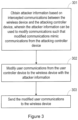
- FIG. 3 illustrates a method in a network node of re-establishing a connection between a user controller device and a wireless device in a wireless communications network.
- the wireless device has been corrupted such that it will only accept communications which appear to originate from an attacking controller device.
- the method may further comprise intercepting communications between the wireless device 103 and the attacking controller device 202 , for example, when the method of FIG. 3 is performed by a predetermined network gateway, for example, a Device Isolator Box (DI-Box) as described with reference to FIGS. 4 and 5 .
- a predetermined network gateway for example, a Device Isolator Box (DI-Box) as described with reference to FIGS. 4 and 5 .
- the interception of communication may be performed by routing all communications to and from the wireless device 103 to the predetermined network gateway.
- DI-Box Device Isolator Box
- the predetermined network gateway may be a DI-Box 401 as illustrated in FIG. 4 .
- the method of FIG. 3 may in some embodiments be performed in the predetermined network gateway, such as the DI-Box 401 illustrated in FIG. 4 .
- the attacker information may comprise information relating to a source address, for example an IP, Port and/or Mac Address, of the attacking controller device 202 .
- the knowledge of the source address of the attacking controller device 202 may then be used to modify other communications such that they appear to any receiving device to have originated at the attacking controller device 202 . Such modifications may therefore cause the modified communications to mimic communications from the attacking controller device 202 .
- the communications between the attacking controller device 202 and the wireless device 103 may be secured by specific content, for example usernames, passwords and/or a shared secret.
- specific content for example usernames, passwords and/or a shared secret.
- Analysis of the intercepted communications using for example a Deep Packet Inspection feature, may allow for the extraction of such secured specific content which may then be used to modify communications such that they mimic this specific content.
- step 301 may comprise analysing the intercepted communications to determine an encryption model to be used to mimic attacking communications from the attacking controller device.
- the attacker information may therefore comprise an encryption model.
- Some methods of tamper detection based on the monitoring of discrepancies of the response times between the attacking controller device 202 and the wireless device 103 , could result in the modification of the communications not effectively masking the communications. However, given that it is possible to delay communications at the predetermined gateway before any isolation is initiated, the tamper detection may be deceived.
- the mean values and expected values which are expected might be changed. For example if the mean response time is measured over an hour, delaying the response times/message for an hour by some time, changes the mean time and the expected threshold. This can be performed if such a time related monitoring is active. In some embodiments, by “loosening” the expected timings by a certain amount, this can create enough space for the interception/isolation not to be detected.
- the user may in some cases be unable to regain the control without physically accessing the wireless device 103
- the network node may identify, in the intercepted communications, a trigger signal necessary to maintain proper operation of the wireless device 103 .
- the attacking controller device 202 may have corrupted the wireless device 103 in such a way that, if the wireless device 103 no longer receives this trigger signal, for example a kill signal, the wireless device 103 may be rendered destroyed or damaged. Therefore, in some embodiments, the network node may transmit a signal derived from the trigger signal to the wireless device 103 .
- the trigger signal may be recreated at the user controller device 102 and modified such that it appears to have originated at the attacking controller device 202 .
- the network node may forward the trigger signal to the wireless device 103 .
- the attacking controller device 202 probes the wireless device 103 with an encrypted question, the wireless device 103 is seen as answering this encrypted riddle and the attacking controller 202 is still assured to be in control of the wireless device 103 .
- the virtual wireless device it may be necessary to monitor a threshold number of signals, to be sure one is able to answer the riddle.
- the attacking controller device 202 communicates to the DI-Box 401 , the DI-Box 401 forwards the riddle/test to the wireless device 103 .
- the wireless device 103 answers to the DI-Box 401 , which forwards the response to the attacking controller device 202 .
- the network node analyses the intercepted communications to generate the attacker information. In some embodiments, the network node transmits the intercepted communications to an analysing node; and receives the attacker information from the analysing node. For example, a third party provider may provide decryption services in order to determine an encryption model be used to mimic attacking communications from the attacking controller device 202 .
- the network node modifies user communications from the user controller device 102 to the wireless device 103 with the attacker information to provide modified user communications.
- the network node applies a device isolation mask (DI-Mask) to the communications originating from the user controller device 102 so that they mimic the communications from the attacking controller device 202 .
- the attacker information comprises a source address of the attacking controller device 202
- the network node may replace a source address of the user controller device 102 with the determined source address of the attacking controller device 202 in the modified user communications.
- the network node sends the modified user communications to the wireless device 103 .
- These modified communications will appear as though they originate from the attacking controller device 202 and will therefore be accepted by the wireless device 103 .
- the connection between the user controller device 102 and the wireless device 103 may therefore be re-established.
- the corruption of the wireless device 103 may be reversed such that the wireless device 103 will no longer only accept communications which appear to originate from the attacking controller device 202 .
- the communications from the user controller device 102 may therefore no longer need to be modified by the attacker information in order to be accepted by the wireless device 103 , and normal communications may resume.
- some embodiments of this disclosure may require that the network node first obtains user authentication confirming that a user 101 of the user controller device 102 is the rightful owner of the wireless device 103 .
- the user authentication mechanism may comprise a user login.
- a user 101 may register to a web service of the operator with a token provided by the operator.
- the token may be sent digitally or by physical post to the user 101 .
- the user 101 may be able to set up an account with the operator and register his/her wireless device(s) 103 .
- the user authentication mechanism may comprise paper based authentication.
- the user 101 may provide a document as a proof of his ownership of the wireless device 103 . This kind of document may be specified and be accepted by the operator.
- the user 101 is already aware that it is unable to connect to the wireless device 103 .
- the user 101 connects to the user's server and requests feedback as to whether the wireless device 103 is corrupted.
- the DI-Box 401 may take over the PGW functionality of the core network for the wireless device 103 .
- the HSS may register the DI-Box 401 as the PGW for the wireless device 103 and may force an update to register the DI-Box 401 as the new PGW).
- the device isolator interface 403 may therefore connect through the operator's IP services 105 to the DI-Box 401 .
- the attacker 201 may be accessing his/her own server 203 using the attacking controller device 202 .
- the operator's IP services may then, in signaling 608 , relay the communications to the wireless device 103 via the PGW 108 .
- the wireless device 103 may then respond to the attacker's communications, again via the PGW 108 which may, in signaling 610 , relay the response back to the attacker's server 203 .
- the Attacker's Server 203 may then forward the wireless device's 103 response to the attacking controller device 202 .
- the signaling 608 to 610 may not occur.
- the operator's IP services 105 may, in signaling 612 , connect to a virtual wireless device, registered by the DI-Box 401 .
- the traffic may be forwarded to the wireless device 103 , for example, if a trigger signal is needed to be maintained. However, in this example, the traffic is terminated at the DI-Box 401 .
- the DI-Box 401 may then reply to the attacking controller device 202 via the attacker's server 203 with an appropriate response to the attacking communication. By responding in some appropriate way, the DI-Box 401 may hide the detection of the attack from the attacking controller device 202 .
- the attacker's server 203 may then relay the response to the attacking controller device 202 in a similar way.
- the wireless device 103 may, in signaling 614 , send data through the SGW 109 to the PGW 108 .
- the PGW 108 may then relay this data to the attacker's server 203 .
- the DI-Box 401 when the DI-Box 401 is reconfigured as the PGW for the communications to and from the wireless device 103 , the signaling 614 and 615 may not occur. Instead, the DI-Box 401 acts as the PGW and the wireless device 103 , in signaling 616 , sends data to the DI-Box 401 .
- the DI-Box 401 may then either forward the traffic to the device isolator interface, which may analyze the intercepted communications to generate the attacker information, or the DI-Box 401 may analyze the intercepted communication to generate the attacker information.
- the device isolator interface 403 may then forward either the intercepted communications, or the attacker information to the user's server 204 .
- the DI-Box 401 may simply address the data received from the wireless device 103 to the user's server 204 and may, in signaling 619 , relay the data to the operator's IP servers 105 , to, in signaling 620 , forward to the user's server 204 .
- FIG. 7 illustrates a network node 700 according to some embodiments.
- the network node 700 is configured to re-establish a connection between a user controller device and a wireless device in a wireless communications network, wherein the wireless device has been corrupted such that it will only accept communications which appear to originate from an attacking controller device.
- the network node comprises an obtaining module 710 configured to obtain attacker information based on intercepted communications between the wireless device and the attacking controller device, wherein the attacker information can be used to modify communications such that modified communications mimic communications from the attacking controller device.
- the network node 700 also comprises a modification module 720 configured to modify user communications from the user controller device to the wireless device with the attacker information.
- the network node 700 further comprises a transmission module 730 configured to send the modified user communications to the wireless device.
- FIG. 8 illustrates a network node according to some embodiments.
- the network node 800 is configured to re-establish a connection between a user controller device and a wireless device in a wireless communications network, wherein the wireless device has been corrupted such that it will only accept communications which appear to originate from an attacking controller device.
- the network node 800 comprises a processor 810 and a memory 830 , said memory 830 containing instructions executable by said processor 810 , wherein said processor 810 is operative to: obtain attacker information based on intercepted communications between the wireless device and the attacking controller device, wherein the attacker information can be used to modify communications such that modified communications mimic communications from the attacking controller device.
- the processor 810 being further operable to modify user communications from the user controller device to the wireless device with the attacker information; and send the modified user communications to the wireless device.
- a DI-Box or any predetermined network gateway, may then capture the wireless devices outgoing and ingoing communications and enable the user to reroute the wireless device's traffic as well as the ingoing traffic.
Landscapes
- Engineering & Computer Science (AREA)
- Computer Security & Cryptography (AREA)
- Computer Networks & Wireless Communication (AREA)
- Signal Processing (AREA)
- Computer Hardware Design (AREA)
- Computing Systems (AREA)
- General Engineering & Computer Science (AREA)
- Health & Medical Sciences (AREA)
- General Health & Medical Sciences (AREA)
- Virology (AREA)
- Mobile Radio Communication Systems (AREA)
Abstract
Description
Claims (20)
Applications Claiming Priority (1)
| Application Number | Priority Date | Filing Date | Title |
|---|---|---|---|
| PCT/EP2017/072589 WO2019048052A1 (en) | 2017-09-08 | 2017-09-08 | Re-establishing a connection between a user controller device and a wireless device |
Publications (2)
| Publication Number | Publication Date |
|---|---|
| US20200275280A1 US20200275280A1 (en) | 2020-08-27 |
| US12356195B2 true US12356195B2 (en) | 2025-07-08 |
Family
ID=59887240
Family Applications (1)
| Application Number | Title | Priority Date | Filing Date |
|---|---|---|---|
| US16/643,891 Active 2040-05-03 US12356195B2 (en) | 2017-09-08 | 2017-09-08 | Re-establishing a connection between a user controller device and a wireless device |
Country Status (3)
| Country | Link |
|---|---|
| US (1) | US12356195B2 (en) |
| EP (1) | EP3679698B1 (en) |
| WO (1) | WO2019048052A1 (en) |
Citations (8)
| Publication number | Priority date | Publication date | Assignee | Title |
|---|---|---|---|---|
| US20100162396A1 (en) | 2008-12-22 | 2010-06-24 | At&T Intellectual Property I, L.P. | System and Method for Detecting Remotely Controlled E-mail Spam Hosts |
| US20120151033A1 (en) * | 2010-12-08 | 2012-06-14 | At&T Intellectual Property I, L.P. | Mobile botnet mitigation |
| US8561177B1 (en) * | 2004-04-01 | 2013-10-15 | Fireeye, Inc. | Systems and methods for detecting communication channels of bots |
| US20150271194A1 (en) * | 2012-10-11 | 2015-09-24 | Nokia Solutions And Networks Yo | Fake Base Station Detection with Core Network Support |
| US20160255106A1 (en) * | 2011-05-11 | 2016-09-01 | At&T Mobility Ii Llc | Dynamic and selective response to cyber attack for telecommunications carrier networks |
| US20160330172A1 (en) * | 2013-11-25 | 2016-11-10 | Mcafee, Inc. | Secure proxy to protect private data |
| US20170189803A1 (en) * | 2016-01-04 | 2017-07-06 | Sphero, Inc. | Task-oriented feedback using a modular sensing device |
| US20170311185A1 (en) * | 2013-05-09 | 2017-10-26 | Sharp Kabushiki Kaisha | Systems and methods for re-establishing a connection |
-
2017
- 2017-09-08 WO PCT/EP2017/072589 patent/WO2019048052A1/en not_active Ceased
- 2017-09-08 EP EP17768062.6A patent/EP3679698B1/en active Active
- 2017-09-08 US US16/643,891 patent/US12356195B2/en active Active
Patent Citations (8)
| Publication number | Priority date | Publication date | Assignee | Title |
|---|---|---|---|---|
| US8561177B1 (en) * | 2004-04-01 | 2013-10-15 | Fireeye, Inc. | Systems and methods for detecting communication channels of bots |
| US20100162396A1 (en) | 2008-12-22 | 2010-06-24 | At&T Intellectual Property I, L.P. | System and Method for Detecting Remotely Controlled E-mail Spam Hosts |
| US20120151033A1 (en) * | 2010-12-08 | 2012-06-14 | At&T Intellectual Property I, L.P. | Mobile botnet mitigation |
| US20160255106A1 (en) * | 2011-05-11 | 2016-09-01 | At&T Mobility Ii Llc | Dynamic and selective response to cyber attack for telecommunications carrier networks |
| US20150271194A1 (en) * | 2012-10-11 | 2015-09-24 | Nokia Solutions And Networks Yo | Fake Base Station Detection with Core Network Support |
| US20170311185A1 (en) * | 2013-05-09 | 2017-10-26 | Sharp Kabushiki Kaisha | Systems and methods for re-establishing a connection |
| US20160330172A1 (en) * | 2013-11-25 | 2016-11-10 | Mcafee, Inc. | Secure proxy to protect private data |
| US20170189803A1 (en) * | 2016-01-04 | 2017-07-06 | Sphero, Inc. | Task-oriented feedback using a modular sensing device |
Also Published As
| Publication number | Publication date |
|---|---|
| WO2019048052A1 (en) | 2019-03-14 |
| EP3679698A1 (en) | 2020-07-15 |
| US20200275280A1 (en) | 2020-08-27 |
| EP3679698B1 (en) | 2020-12-23 |
Similar Documents
| Publication | Publication Date | Title |
|---|---|---|
| Kim et al. | Touching the untouchables: Dynamic security analysis of the LTE control plane | |
| Golde et al. | Weaponizing Femtocells: The Effect of Rogue Devices on Mobile Telecommunications. | |
| Jover | LTE security, protocol exploits and location tracking experimentation with low-cost software radio | |
| Schneider et al. | Towards 5G security | |
| Mantas et al. | Security for 5G communications | |
| TWI492654B (en) | Method and apparatus for securing wireless relay nodes | |
| KR101262405B1 (en) | Method, system and apparatus for providing security in an unlicensed mobile access network or a generic access network | |
| EP3574621B1 (en) | Rogue access point detection using multi-path verification | |
| EP3108679B1 (en) | Method and devices for protection of control plane functionality | |
| Oniga et al. | Analysis, design and implementation of secure LoRaWAN sensor networks | |
| US20200053567A1 (en) | Security architecture for machine type communications | |
| US20250063364A1 (en) | Communication method and network element device | |
| CN110754101B (en) | Methods, systems, and computer-readable storage media for protecting subscriber information associated with user equipment | |
| Tabiban et al. | Signaling storm in o-ran: Challenges and research opportunities | |
| Ahmad et al. | Design principles for 5G security | |
| Xing et al. | On the criticality of integrity protection in 5G fronthaul networks | |
| US12113783B2 (en) | Wireless-network attack detection | |
| Xenakis et al. | An advanced persistent threat in 3G networks: Attacking the home network from roaming networks | |
| Raza et al. | On key reinstallation attacks over 4G LTE control-plane: Feasibility and negative impact | |
| US11463880B2 (en) | Dynamic security analysis method for control plane and system therefore | |
| US12356195B2 (en) | Re-establishing a connection between a user controller device and a wireless device | |
| EP4302505A1 (en) | Diameter spoofing detection and post-spoofing attack prevention | |
| Borgaonkar et al. | Femtocells: a Poisonous Needle in the Operator's Hay Stack | |
| Rajavelsamy et al. | A novel method of determining an authentic cell in next generation cellular communication system | |
| Borgaonkar | Security analysis of femtocell-enabled cellular network architecture |
Legal Events
| Date | Code | Title | Description |
|---|---|---|---|
| AS | Assignment |
Owner name: TELEFONAKTIEBOLAGET LM ERICSSON (PUBL), SWEDEN Free format text: ASSIGNMENT OF ASSIGNORS INTEREST;ASSIGNOR:BIRKMEIER, MARTIN;REEL/FRAME:051990/0267 Effective date: 20170920 |
|
| FEPP | Fee payment procedure |
Free format text: ENTITY STATUS SET TO UNDISCOUNTED (ORIGINAL EVENT CODE: BIG.); ENTITY STATUS OF PATENT OWNER: LARGE ENTITY |
|
| STPP | Information on status: patent application and granting procedure in general |
Free format text: DOCKETED NEW CASE - READY FOR EXAMINATION |
|
| STPP | Information on status: patent application and granting procedure in general |
Free format text: NON FINAL ACTION MAILED |
|
| STPP | Information on status: patent application and granting procedure in general |
Free format text: RESPONSE TO NON-FINAL OFFICE ACTION ENTERED AND FORWARDED TO EXAMINER |
|
| STPP | Information on status: patent application and granting procedure in general |
Free format text: FINAL REJECTION MAILED |
|
| STPP | Information on status: patent application and granting procedure in general |
Free format text: RESPONSE AFTER FINAL ACTION FORWARDED TO EXAMINER |
|
| STPP | Information on status: patent application and granting procedure in general |
Free format text: DOCKETED NEW CASE - READY FOR EXAMINATION |
|
| STPP | Information on status: patent application and granting procedure in general |
Free format text: NON FINAL ACTION MAILED |
|
| STPP | Information on status: patent application and granting procedure in general |
Free format text: RESPONSE TO NON-FINAL OFFICE ACTION ENTERED AND FORWARDED TO EXAMINER |
|
| STCF | Information on status: patent grant |
Free format text: PATENTED CASE |