US12354589B2 - Movement sound generation system - Google Patents
Movement sound generation system Download PDFInfo
- Publication number
- US12354589B2 US12354589B2 US18/248,018 US202118248018A US12354589B2 US 12354589 B2 US12354589 B2 US 12354589B2 US 202118248018 A US202118248018 A US 202118248018A US 12354589 B2 US12354589 B2 US 12354589B2
- Authority
- US
- United States
- Prior art keywords
- sound
- movement
- moving body
- contacting portion
- virtual space
- Prior art date
- Legal status (The legal status is an assumption and is not a legal conclusion. Google has not performed a legal analysis and makes no representation as to the accuracy of the status listed.)
- Active, expires
Links
Images



Classifications
-
- G—PHYSICS
- G10—MUSICAL INSTRUMENTS; ACOUSTICS
- G10K—SOUND-PRODUCING DEVICES; METHODS OR DEVICES FOR PROTECTING AGAINST, OR FOR DAMPING, NOISE OR OTHER ACOUSTIC WAVES IN GENERAL; ACOUSTICS NOT OTHERWISE PROVIDED FOR
- G10K15/00—Acoustics not otherwise provided for
- G10K15/02—Synthesis of acoustic waves
-
- A—HUMAN NECESSITIES
- A63—SPORTS; GAMES; AMUSEMENTS
- A63F—CARD, BOARD, OR ROULETTE GAMES; INDOOR GAMES USING SMALL MOVING PLAYING BODIES; VIDEO GAMES; GAMES NOT OTHERWISE PROVIDED FOR
- A63F13/00—Video games, i.e. games using an electronically generated display having two or more dimensions
- A63F13/50—Controlling the output signals based on the game progress
- A63F13/54—Controlling the output signals based on the game progress involving acoustic signals, e.g. for simulating revolutions per minute [RPM] dependent engine sounds in a driving game or reverberation against a virtual wall
-
- A—HUMAN NECESSITIES
- A63—SPORTS; GAMES; AMUSEMENTS
- A63F—CARD, BOARD, OR ROULETTE GAMES; INDOOR GAMES USING SMALL MOVING PLAYING BODIES; VIDEO GAMES; GAMES NOT OTHERWISE PROVIDED FOR
- A63F13/00—Video games, i.e. games using an electronically generated display having two or more dimensions
- A63F13/55—Controlling game characters or game objects based on the game progress
- A63F13/57—Simulating properties, behaviour or motion of objects in the game world, e.g. computing tyre load in a car race game
- A63F13/577—Simulating properties, behaviour or motion of objects in the game world, e.g. computing tyre load in a car race game using determination of contact between game characters or objects, e.g. to avoid collision between virtual racing cars
-
- G—PHYSICS
- G10—MUSICAL INSTRUMENTS; ACOUSTICS
- G10K—SOUND-PRODUCING DEVICES; METHODS OR DEVICES FOR PROTECTING AGAINST, OR FOR DAMPING, NOISE OR OTHER ACOUSTIC WAVES IN GENERAL; ACOUSTICS NOT OTHERWISE PROVIDED FOR
- G10K15/00—Acoustics not otherwise provided for
- G10K15/08—Arrangements for producing a reverberation or echo sound
- G10K15/12—Arrangements for producing a reverberation or echo sound using electronic time-delay networks
-
- H—ELECTRICITY
- H04—ELECTRIC COMMUNICATION TECHNIQUE
- H04S—STEREOPHONIC SYSTEMS
- H04S7/00—Indicating arrangements; Control arrangements, e.g. balance control
Definitions
- the present invention relates to a movement sound generation system which generates a movement sound in a case where a moving body moves in a virtual space.
- a system which generates a movement sound in a case where a moving body moves in a virtual space.
- a method has been suggested in which in order to express movement of a moving object (such as a non-player character, a non-commercial product, or a vehicle) in a virtual space, a sound source is moved at a predetermined speed in a certain direction (for example, see Patent Literature 1).
- Another aspect of the present invention provides a method of generating a movement sound in a case where a moving body moves on a predetermined movement surface in a virtual space, the method being executed in a movement sound generation system, the method including: a step of deciding a sound volume of the movement sound based on a mass of the moving body in the virtual space; a step of deciding a sound quality of the movement sound based on material information of a ground contacting portion of the moving body which contacts a movement surface in the virtual space, and on material information of the movement surface contacted by the ground contacting portion of the moving body; a step of deciding a sound production timing of the movement sound based on a timing at which the ground contacting portion of the moving body contacts the movement surface; and a step of playing the movement sound of the moving body with a sound volume, with a sound quality, and at a sound production timing, which are decided in the steps, in the virtual space.
- FIG. 1 is a block diagram illustrating a configuration of a movement sound generation system in an embodiment of the present invention.
- FIG. 4 is an explanatory diagram illustrating an example of installation of virtual speakers.
- FIG. 6 is a sequence diagram for explaining an action of the movement sound generation system in the embodiment of the present invention.
- a movement sound generation system of the present invention is a movement sound generation system generating a movement sound in a case where a moving body moves on a predetermined movement surface in a virtual space
- the movement sound generation system including: a sound volume decision unit which decides a sound volume of the movement sound based on a mass of the moving body in the virtual space; a sound quality decision unit that decides a sound quality of the movement sound based on material information of a ground contacting portion of the moving body which contacts a movement surface in the virtual space, and on material information of the movement surface contacted by the ground contacting portion of the moving body; a sound production timing decision unit which decides a sound production timing of the movement sound based on a timing at which the ground contacting portion of the moving body contacts the movement surface; and a movement sound playing unit which plays the movement sound of the moving body with a sound volume decided by the movement sound decision unit, with a sound quality decided by the sound quality decision unit, and at a sound production timing decided by the sound production timing decision unit in the virtual space.
- the movement sound in a case where the moving body (such as an avatar, for example) moves on the predetermined movement surface (such as a ground surface or a floor surface, for example) in the virtual space (such as a VR space, for example) is automatically generated.
- the sound volume of the movement sound is decided based on the mass of the moving body
- the sound quality of the movement sound is decided based on the material information of the ground contacting portion of the moving body and of the movement surface
- the sound production timing of the movement sound is decided based on the timing at which the ground contacting portion of the moving body contacts the movement surface.
- the movement sounds with reality can be generated for individual moving bodies (including a moving body operated by a user) in the virtual space, and bodily sensation in the user in the virtual space is thereby improved.
- the movement sound with reality can be generated such that analogy and recognition in a real space can also be recreated in the virtual space.
- the movement sound which is produced by the moving body itself is generated, and reality can be improved.
- movement sounds of all of moving bodies are produced, and sound images of sound sources of the other moving bodies can thereby be located and analogized.
- the sound quality decision unit may predict a contacting portion of the movement surface to be contacted by the ground contacting portion of the moving body, and may read in advance only material information of the predicted contacting portion of the movement surface.
- the contacting portion of the movement surface to be contacted by the ground contacting portion of the moving body is predicted, and only the material information of the contacting portion of the movement surface is read in advance.
- the movement sound playing unit may install a virtual speaker, which plays the movement sound of the moving body, in a contacting portion of the movement surface contacted by the ground contacting portion of the moving body.
- the virtual speaker which plays the movement sound of the moving body is installed in the contacting portion of the movement surface contacted by the ground contacting portion of the moving body.
- the movement sound of the moving body is played from the virtual speaker which is installed as described above, and the movement sound with reality can thereby be generated.
- the sound volume decision unit may estimate the mass of the moving body based on a volume of the moving body.
- the sound production timing decision unit may make a determination about the timing at which the ground contacting portion of the moving body contacts the movement surface based on a timing at which potential energy of the ground contacting portion of the moving body becomes a minimum.
- a method of the present invention is a method of generating a movement sound in a case where a moving body moves on a predetermined movement surface in a virtual space, the method being executed in a movement sound generation system, the method including: a step of deciding a sound volume of the movement sound based on a mass of the moving body in the virtual space; a step of deciding a sound quality of the movement sound based on material information of a ground contacting portion of the moving body which contacts a movement surface in the virtual space, and on material information of the movement surface contacted by the ground contacting portion of the moving body; a step of deciding a sound production timing of the movement sound based on a timing at which the ground contacting portion of the moving body contacts the movement surface; and a step of playing the movement sound of the moving body with a sound volume, with a sound quality, and at a sound production timing, which are decided in the steps, in the virtual space.
- a program of the present invention is a program for generating a movement sound in a case where a moving body moves on a predetermined movement surface in a virtual space, the program causing a computer to execute: a process of deciding a sound volume of the movement sound based on a mass of the moving body in the virtual space; a process of deciding a sound quality of the movement sound based on material information of a ground contacting portion of the moving body which contacts a movement surface in the virtual space, and on material information of the movement surface contacted by the ground contacting portion of the moving body; a process of deciding a sound production timing of the movement sound based on a timing at which the ground contacting portion of the moving body contacts the movement surface; and a process of playing the movement sound of the moving body with a sound volume, with a sound quality, and at a sound production timing, which are decided in the processes, in the virtual space.
- the movement sounds with reality can be generated for the individual moving bodies (including the moving body operated by the user) in the virtual space, and bodily sensation in the user in the virtual space is thereby improved.
- the movement sound with reality can be generated, and bodily sensation in the user in the virtual space can be improved.
- a movement sound generation system of an embodiment of the present invention will hereinafter be described with reference to the drawings.
- a case of a system will be raised as an example, the system generating a movement sound in a case where a moving body (such as an avatar) moves on a predetermined movement surface (such as a ground surface or a floor surface) in a virtual reality space.
- a moving body such as an avatar
- a predetermined movement surface such as a ground surface or a floor surface
- FIG. 1 is a block diagram illustrating a configuration of the movement sound generation system of the present embodiment.
- a movement sound generation system 1 is configured with a user device 2 and a server device 3 which are connected with each other by a network N.
- the controller 5 is an input interface which accepts an operation input from the user.
- the controller 5 has at least one operation button and various sensors which are built therein and detect directions and motions (such as acceleration and rotation) of the controller 5 .
- the operation input from the controller 5 the user can move the avatar in the virtual reality space.
- the avatar may be moved while being synchronized with movement of the user himself/herself in an actual environment.
- the control unit 6 includes a sound volume decision unit 8 , a sound quality decision unit 9 , a sound production timing decision unit 10 , and a movement sound playing unit 11 .
- the storage unit 7 stores user information (such as user account information, for example), avatar information (such as a kind, a size, a mass of the avatar and a material of a ground contacting portion, for example), movement information (such as a position (coordinates), a movement direction, a movement speed, and a movement posture (such as bipedal walking, bipedal running, quadrupedal walking, quadrupedal running, and wheel running) of the avatar, for example), world information (such as gravitational acceleration and a material of the movement surface, for example).
- user information such as user account information, for example
- avatar information such as a kind, a size, a mass of the avatar and a material of a ground contacting portion, for example
- movement information such as a position (coordinates), a movement direction, a movement speed, and
- Materials of movement surfaces include asphalt, concrete, tile, stone pavement, a puddle, earth, sand, gravel, a rock, a swamp, a grass field, a tree, grass, moss, frost, snow, hail, a fallen leaf, and so forth, for example in a case of an outdoor environment and include flooring, a carpet, a tile carpet, a tatami mat, cork, a runner, a rug, a mat, and so forth, for example in a case of an indoor environment.
- the sound volume decision unit 8 may estimate the mass of the moving body based on the volume of the moving body. For example, it is estimated that the mass of the moving body becomes larger as the volume of the moving body becomes larger, and the sound volume can thereby be decided such that the sound volume becomes larger as the volume becomes larger.
- the sound quality decision unit 9 decides a sound quality of the movement sound based on material information of the ground contacting portion of the moving body (the foot of the avatar) which contacts the movement surface in the virtual space and on material information of the movement surface (the ground surface or the floor surface) contacted by the ground contacting portion of the moving body.
- the sound quality of the movement sound may be calculated at each time.
- the sound quality decision unit 9 may predict a contacting portion of the movement surface to be contacted by the ground contacting portion of the moving body and may read in advance only the material information of the predicted contacting portion of the movement surface.
- FIG. 3 is an explanatory diagram illustrating an example of the sound quality decision of the movement sound.
- FIG. 3 illustrates, as R 1 , the contacting portion of the movement surface with which the left foot of a moving body (avatar A) is contacting and illustrates, as R 2 , the contacting portion of the movement surface with which the right foot is contacting.
- R 1 the contacting portion of the movement surface with which the left foot of a moving body (avatar A) is contacting
- R 2 the contacting portion of the movement surface with which the right foot is contacting.
- the movement information such as the position, the movement direction, the movement speed, and the movement posture of the avatar
- contacting portions R 3 , R 4 , and R 5 of the movement surface with which the ground contacting portions of the moving body contact can be predicted.
- only the material information of the predicted contacting portions R 3 , R 4 , and R 5 is read in advance.
- the sound production timing decision unit 10 decides a sound production timing of the movement sound based on a timing at which the ground contacting portion of the moving body contacts the movement surface. For example, the sound production timing decision unit 10 may determine whether or not the ground contacting portion of the moving body contacts the movement surface and may thereby decide the sound production timing of the movement sound based on a determination result.
- the sound production timing decision unit 10 may make a determination about the timing at which the ground contacting portion of the moving body contacts the movement surface based on a timing at which the potential energy of the ground contacting portion of the moving body becomes a minimum.
- the height of the ground contacting portion of the moving body represents the z coordinate of the lowest point or the center of gravity of the ground contacting portion of the moving body (each of the left and right feet, for example).
- the sound production timing decision unit 10 may make a determination about the timing at which the ground contacting portion of the moving body contacts the movement surface based on the timing at which the height of the ground contacting portion of the moving body becomes a minimum.
- the movement sound playing unit 11 plays the movement sound of the moving body with the sound volume decided by a sound volume decision unit, with the sound quality decided by the sound quality decision unit 9 , and at the sound production timing decided by the sound production timing decision unit 10 in the virtual space.
- virtual speakers which reproduce the movement sounds of the moving body are installed in the contacting portions of the movement surface with which the ground contacting portions of the moving body contact, and the movement sounds of the moving body can thereby be played.
- FIG. 4 is an explanatory diagram illustrating an example of installation of the virtual speakers.
- virtual speakers S are respectively installed in the contacting portion R 1 of the movement surface with which the left foot of the moving body (avatar A) is contacting and in the contacting portion R 2 of the movement surface with which the right foot is contacting.
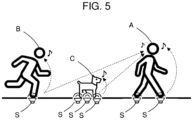
- FIG. 5 is an explanatory diagram illustrating another example of installation of the virtual speakers.
- the virtual speakers S are respectively installed in the contacting portions of the movement surface with which both feet of the avatar A performing bipedal walking are contacting, a contacting portion of the movement surface with which one foot of an avatar B performing bipedal running is contacting, and contact portions of the movement surface with which feet of an avatar C performing quadrupedal walking are contacting.
- login information is first input by the user device 2 (S 1 ), the input login information is then transmitted from the user device 2 to the server device 3 (S 2 ), and a process of user authentication is performed in the server device 3 (S 3 ).
- login permission is sent from the server device 3 to the user device 2 (S 4 ).
- the sound volume of the movement sound is decided based on the mass of the moving body in the virtual space (S 8 ), and the sound quality of the movement sound is decided based on the material information of the ground contacting portion of the moving body which contacts the movement surface in the virtual space and the material information of the movement surface contacted by the ground contacting portion of the moving body (S 9 ).
- the sound production timing of the movement sound is decided (S 10 ).
- the movement sound in a case where the moving body (such as an avatar, for example) moves on the predetermined movement surface (such as a ground surface or a floor surface, for example) in the virtual space (such as a VR space, for example) is automatically generated.
- the sound volume of the movement sound is decided based on the mass of the moving body
- the sound quality of the movement sound is decided based on the material information of the ground contacting portion of the moving body and of the movement surface
- the sound production timing of the movement sound is decided based on the timing at which the ground contacting portion of the moving body contacts the movement surface. Consequently, the movement sounds with reality can be generated for individual moving bodies (including the moving body operated by the user) in the virtual space, and bodily sensation in the user in the virtual space is thereby improved (see FIG. 5 ).
- the contacting portion of the movement surface to be contacted by the ground contacting portion of the moving body is predicted, and only the material information of the contacting portion of the movement surface is read in advance. Consequently, compared to a case where the material information of the whole movement surface is read, a processing load for generating the movement sound can be reduced.
- the virtual speaker which plays the movement sound of the moving body is installed in the contacting portion of the movement surface contacted by the ground contacting portion of the moving body.
- the movement sound of the moving body is played from the virtual speaker which is installed as described above, and the movement sound with reality can thereby be generated.
- the mass of the moving body in the virtual space is not set, the mass of the moving body is estimated based on the volume of the moving body, and the sound volume of the movement sound can thereby appropriately be decided.
Landscapes
- Engineering & Computer Science (AREA)
- Multimedia (AREA)
- Acoustics & Sound (AREA)
- Physics & Mathematics (AREA)
- Health & Medical Sciences (AREA)
- Audiology, Speech & Language Pathology (AREA)
- General Health & Medical Sciences (AREA)
- Signal Processing (AREA)
- Theoretical Computer Science (AREA)
- Human Computer Interaction (AREA)
- Stereophonic System (AREA)
- Processing Or Creating Images (AREA)
- Reverberation, Karaoke And Other Acoustics (AREA)
Abstract
A movement sound generation system (1) generates a movement sound when a moving body moves on a predetermined movement surface in a virtual space. A sound volume of the movement sound is decided based on a mass of the moving body in the virtual space. A sound quality of the movement sound is decided based on material information of a ground contacting portion of the moving body which contacts a movement surface in the virtual space, and on material information of the movement surface contacted by the ground contacting portion of the moving body. A sound production timing of the movement sound is decided based on a timing at which the ground contacting portion of the moving body contacts the movement surface. The movement sound of the moving body is played in the virtual space, with a sound volume, with a sound quality, and at a sound production timing.
Description
The present invention relates to a movement sound generation system which generates a movement sound in a case where a moving body moves in a virtual space.
In related art, a system has been suggested which generates a movement sound in a case where a moving body moves in a virtual space. For example, a method has been suggested in which in order to express movement of a moving object (such as a non-player character, a non-commercial product, or a vehicle) in a virtual space, a sound source is moved at a predetermined speed in a certain direction (for example, see Patent Literature 1).
However, in the method of the related art, although movement sounds of moving objects around a moving body (character) which is operated by a user are played and reality can be obtained to some extent, because movement sounds which are produced by the moving body (character) itself operated by the user and other moving bodies are not played, bodily sensation in the user in the virtual space has been low. For example, in a real space, a person hears sound volumes, sound qualities, and rhythms of movement sounds of the person himself/herself when he/she is moving, thereby analogizes distinctions among situations about what kinds of ground surface environment are given and how fast he/she is moving, and recognizes those situations. Further, as for approach and passage of other persons and cars also, a person locates and analogizes sound images of sound sources from movement sounds without resort to visual perception.
- Patent Literature 1: Japanese Patent Laid-Open No. 2018-201790
The present invention has been made based on the above background. An object of the present invention is to provide a movement sound generation system which can generate a movement sound with reality such that analogy and recognition in a real space can also be recreated in a virtual space and can improve bodily sensation in a user in the virtual space.
One aspect of the present invention provides a movement sound generation system, and the movement sound generation system is a movement sound generation system generating a movement sound in a case where a moving body moves on a predetermined movement surface in a virtual space, the movement sound generation system including: a sound volume decision unit which decides a sound volume of the movement sound based on a mass of the moving body in the virtual space; a sound quality decision unit that decides a sound quality of the movement sound based on material information of a ground contacting portion of the moving body which contacts a movement surface in the virtual space, and on material information of the movement surface contacted by the ground contacting portion of the moving body; a sound production timing decision unit which decides a sound production timing of the movement sound based on a timing at which the ground contacting portion of the moving body contacts the movement surface; and a movement sound playing unit which plays the movement sound of the moving body with a sound volume decided by the sound volume decision unit, with a sound quality decided by the sound quality decision unit, and at a sound production timing decided by the sound production timing decision unit in the virtual space.
Another aspect of the present invention provides a method of generating a movement sound in a case where a moving body moves on a predetermined movement surface in a virtual space, the method being executed in a movement sound generation system, the method including: a step of deciding a sound volume of the movement sound based on a mass of the moving body in the virtual space; a step of deciding a sound quality of the movement sound based on material information of a ground contacting portion of the moving body which contacts a movement surface in the virtual space, and on material information of the movement surface contacted by the ground contacting portion of the moving body; a step of deciding a sound production timing of the movement sound based on a timing at which the ground contacting portion of the moving body contacts the movement surface; and a step of playing the movement sound of the moving body with a sound volume, with a sound quality, and at a sound production timing, which are decided in the steps, in the virtual space.
Another aspect of the present invention provides a program for generating a movement sound in a case where a moving body moves on a predetermined movement surface in a virtual space, the program causing a computer to execute: a process of deciding a sound volume of the movement sound based on a mass of the moving body in the virtual space; a process of deciding a sound quality of the movement sound based on material information of a ground contacting portion of the moving body which contacts a movement surface in the virtual space, and on material information of the movement surface contacted by the ground contacting portion of the moving body; a process of deciding a sound production timing of the movement sound based on a timing at which the ground contacting portion of the moving body contacts the movement surface; and a process of playing the movement sound of the moving body with a sound volume, with a sound quality, and at a sound production timing, which are decided in the processes, in the virtual space.
As described in the following, other aspects are present in the present invention. Consequently, this disclosure of the invention is intended to provide a part of aspects of the present invention and is not intended to restrict the scope of the invention which is described and claimed herein.
The present invention will hereinafter be described in detail. However, the following detailed descriptions and the attached drawings do not limit the invention.
A movement sound generation system of the present invention is a movement sound generation system generating a movement sound in a case where a moving body moves on a predetermined movement surface in a virtual space, the movement sound generation system including: a sound volume decision unit which decides a sound volume of the movement sound based on a mass of the moving body in the virtual space; a sound quality decision unit that decides a sound quality of the movement sound based on material information of a ground contacting portion of the moving body which contacts a movement surface in the virtual space, and on material information of the movement surface contacted by the ground contacting portion of the moving body; a sound production timing decision unit which decides a sound production timing of the movement sound based on a timing at which the ground contacting portion of the moving body contacts the movement surface; and a movement sound playing unit which plays the movement sound of the moving body with a sound volume decided by the movement sound decision unit, with a sound quality decided by the sound quality decision unit, and at a sound production timing decided by the sound production timing decision unit in the virtual space.
In this configuration, the movement sound in a case where the moving body (such as an avatar, for example) moves on the predetermined movement surface (such as a ground surface or a floor surface, for example) in the virtual space (such as a VR space, for example) is automatically generated. In this case, the sound volume of the movement sound is decided based on the mass of the moving body, the sound quality of the movement sound is decided based on the material information of the ground contacting portion of the moving body and of the movement surface, and the sound production timing of the movement sound is decided based on the timing at which the ground contacting portion of the moving body contacts the movement surface.
Consequently, the movement sounds with reality can be generated for individual moving bodies (including a moving body operated by a user) in the virtual space, and bodily sensation in the user in the virtual space is thereby improved.
That is, in this configuration, the movement sound with reality can be generated such that analogy and recognition in a real space can also be recreated in the virtual space. In this case, the movement sound which is produced by the moving body itself is generated, and reality can be improved. Further, movement sounds of all of moving bodies are produced, and sound images of sound sources of the other moving bodies can thereby be located and analogized.
Further, in the movement sound generation system of the present invention, based on movement information of the moving body, the sound quality decision unit may predict a contacting portion of the movement surface to be contacted by the ground contacting portion of the moving body, and may read in advance only material information of the predicted contacting portion of the movement surface.
In this configuration, when the sound quality of the movement sound is decided, the contacting portion of the movement surface to be contacted by the ground contacting portion of the moving body is predicted, and only the material information of the contacting portion of the movement surface is read in advance.
Consequently, compared to a case where the material information of the whole movement surface is read, a processing load for generating the movement sound can be reduced.
Further, in the movement sound generation system of the present invention, the movement sound playing unit may install a virtual speaker, which plays the movement sound of the moving body, in a contacting portion of the movement surface contacted by the ground contacting portion of the moving body.
In this configuration, the virtual speaker which plays the movement sound of the moving body is installed in the contacting portion of the movement surface contacted by the ground contacting portion of the moving body. The movement sound of the moving body is played from the virtual speaker which is installed as described above, and the movement sound with reality can thereby be generated.
Further, in the movement sound generation system of the present invention, in a case where the mass of the moving body in the virtual space is not set, the sound volume decision unit may estimate the mass of the moving body based on a volume of the moving body.
In this configuration, even in a case where the mass of the moving body in the virtual space is not set, the mass of the moving body is estimated based on the volume of the moving body, and the sound volume of the movement sound can thereby appropriately be decided.
Further, in the movement sound generation system of the present invention, the sound production timing decision unit may make a determination about the timing at which the ground contacting portion of the moving body contacts the movement surface based on a timing at which potential energy of the ground contacting portion of the moving body becomes a minimum.
In this configuration, a determination can appropriately be made about the timing at which the ground contacting portion of the moving body contacts the movement surface based on the timing at which the potential energy of the ground contacting portion of the moving body becomes the minimum, and the sound production timing of the movement sound can thus appropriately be decided.
A method of the present invention is a method of generating a movement sound in a case where a moving body moves on a predetermined movement surface in a virtual space, the method being executed in a movement sound generation system, the method including: a step of deciding a sound volume of the movement sound based on a mass of the moving body in the virtual space; a step of deciding a sound quality of the movement sound based on material information of a ground contacting portion of the moving body which contacts a movement surface in the virtual space, and on material information of the movement surface contacted by the ground contacting portion of the moving body; a step of deciding a sound production timing of the movement sound based on a timing at which the ground contacting portion of the moving body contacts the movement surface; and a step of playing the movement sound of the moving body with a sound volume, with a sound quality, and at a sound production timing, which are decided in the steps, in the virtual space.
By this method also, similarly to the above system, the movement sounds with reality can be generated for the individual moving bodies (including the moving body operated by the user) in the virtual space, and bodily sensation in the user in the virtual space is thereby improved.
A program of the present invention is a program for generating a movement sound in a case where a moving body moves on a predetermined movement surface in a virtual space, the program causing a computer to execute: a process of deciding a sound volume of the movement sound based on a mass of the moving body in the virtual space; a process of deciding a sound quality of the movement sound based on material information of a ground contacting portion of the moving body which contacts a movement surface in the virtual space, and on material information of the movement surface contacted by the ground contacting portion of the moving body; a process of deciding a sound production timing of the movement sound based on a timing at which the ground contacting portion of the moving body contacts the movement surface; and a process of playing the movement sound of the moving body with a sound volume, with a sound quality, and at a sound production timing, which are decided in the processes, in the virtual space.
By this program also, similarly to the above system, the movement sounds with reality can be generated for the individual moving bodies (including the moving body operated by the user) in the virtual space, and bodily sensation in the user in the virtual space is thereby improved.
In the present invention, the movement sound with reality can be generated, and bodily sensation in the user in the virtual space can be improved.
A movement sound generation system of an embodiment of the present invention will hereinafter be described with reference to the drawings. In the present embodiment, a case of a system will be raised as an example, the system generating a movement sound in a case where a moving body (such as an avatar) moves on a predetermined movement surface (such as a ground surface or a floor surface) in a virtual reality space.
A configuration of the movement sound generation system of the present embodiment will be described with reference to the drawings. FIG. 1 is a block diagram illustrating a configuration of the movement sound generation system of the present embodiment. As illustrated in FIG. 1 , a movement sound generation system 1 is configured with a user device 2 and a server device 3 which are connected with each other by a network N.
The user device 2 is a device which is operated by a user and includes a head mounted display 4 (HMD) and a controller 5, for example. Note that the user device 2 is not limited to a device which includes the head mounted display 4. The user device 2 may include a personal computer, a smartphone, a tablet terminal, or the like, for example.
The head mounted display 4 is a display device of a type which is mounted on the head of the user and covers visual fields of both eyes of the user. The user on whom the head mounted display is mounted can view a picture which is displayed on the head mounted display 4. A display form of the head mounted display 4 is not particularly restricted and may be a form in which an object is displayed in an arbitrary position in a virtual space (virtual reality space) with a depth or may be a form in which an object is displayed in an arbitrary position in a virtual plane.
The controller 5 is an input interface which accepts an operation input from the user. Although not illustrated here, for example, the controller 5 has at least one operation button and various sensors which are built therein and detect directions and motions (such as acceleration and rotation) of the controller 5. By the operation input from the controller 5, the user can move the avatar in the virtual reality space. Further, by other than the operation by the controller, the avatar may be moved while being synchronized with movement of the user himself/herself in an actual environment.
The server device 3 includes a control unit 6 and a storage unit 7. For example, the control unit 6 is configured with a processor or the like, and the storage unit 7 is configured with a large capacity memory or the like.
The control unit 6 includes a sound volume decision unit 8, a sound quality decision unit 9, a sound production timing decision unit 10, and a movement sound playing unit 11. The storage unit 7 stores user information (such as user account information, for example), avatar information (such as a kind, a size, a mass of the avatar and a material of a ground contacting portion, for example), movement information (such as a position (coordinates), a movement direction, a movement speed, and a movement posture (such as bipedal walking, bipedal running, quadrupedal walking, quadrupedal running, and wheel running) of the avatar, for example), world information (such as gravitational acceleration and a material of the movement surface, for example).
Kinds of avatars include a human type, an animal type, an insect type, a plant type, a food type, an imaginary creature type (such as a dragon, a Pegasus, or a yeti), a robot type, an object type having wheels (such as a car character), and so forth, for example.
Materials of ground contacting portions of the avatars include a bare foot, a fabric (a fabric of a sock, a fabric of a Japanese sock (tabi), or a fabric of a slipper), rubber (such as rubber of a shoe, a rubber of a running shoe, rubber of a rubber boot, or rubber of a tire), a plant such as wood or grass (such as wood of a wooden clog (geta) or straw of a straw sandal), leather (such as leather of a leather shoe or leather of a slipper), metal (such as metal of a wheel), and so forth, for example.
Materials of movement surfaces include asphalt, concrete, tile, stone pavement, a puddle, earth, sand, gravel, a rock, a swamp, a grass field, a tree, grass, moss, frost, snow, hail, a fallen leaf, and so forth, for example in a case of an outdoor environment and include flooring, a carpet, a tile carpet, a tatami mat, cork, a runner, a rug, a mat, and so forth, for example in a case of an indoor environment.
The sound volume decision unit 8 decides a sound volume of the movement sound based on the mass of the moving body (avatar) in the virtual space. For example, the sound volume can be decided such that the sound volume becomes larger as the mass becomes larger. Further, the sound volume decision unit 8 may decide the sound volume of the movement sound based on the weight (=mass×gravitational acceleration) of the moving body (avatar) in the virtual space. For example, the sound volume can be decided such that the sound volume becomes larger as the weight becomes larger. In addition, the sound volume decision unit 8 may decide the sound volume of the movement sound based on a swung-up position (z coordinate) of a ground contacting portion of the moving body (a foot of the avatar). For example, the sound volume can be decided such that the sound volume becomes larger as the swung-up position becomes higher.
Further, in a case where the mass of the moving body in the virtual space is not set, the sound volume decision unit 8 may estimate the mass of the moving body based on the volume of the moving body. For example, it is estimated that the mass of the moving body becomes larger as the volume of the moving body becomes larger, and the sound volume can thereby be decided such that the sound volume becomes larger as the volume becomes larger.
The sound quality decision unit 9 decides a sound quality of the movement sound based on material information of the ground contacting portion of the moving body (the foot of the avatar) which contacts the movement surface in the virtual space and on material information of the movement surface (the ground surface or the floor surface) contacted by the ground contacting portion of the moving body.
Further, based on the movement information of the moving body, the sound quality decision unit 9 may predict a contacting portion of the movement surface to be contacted by the ground contacting portion of the moving body and may read in advance only the material information of the predicted contacting portion of the movement surface.
The sound production timing decision unit 10 decides a sound production timing of the movement sound based on a timing at which the ground contacting portion of the moving body contacts the movement surface. For example, the sound production timing decision unit 10 may determine whether or not the ground contacting portion of the moving body contacts the movement surface and may thereby decide the sound production timing of the movement sound based on a determination result.
Further, the sound production timing decision unit 10 may make a determination about the timing at which the ground contacting portion of the moving body contacts the movement surface based on a timing at which the potential energy of the ground contacting portion of the moving body becomes a minimum. In this case, the potential energy of the ground contacting portion of the moving body can be calculated based on the following formula.
Potential energy=mass of avatar×gravitational acceleration×height of ground contacting portion of moving body
Potential energy=mass of avatar×gravitational acceleration×height of ground contacting portion of moving body
Here, the height of the ground contacting portion of the moving body represents the z coordinate of the lowest point or the center of gravity of the ground contacting portion of the moving body (each of the left and right feet, for example).
Note that in a case where the mass of the avatar and the gravitational acceleration are fixed, the sound production timing decision unit 10 may make a determination about the timing at which the ground contacting portion of the moving body contacts the movement surface based on the timing at which the height of the ground contacting portion of the moving body becomes a minimum.
The movement sound playing unit 11 plays the movement sound of the moving body with the sound volume decided by a sound volume decision unit, with the sound quality decided by the sound quality decision unit 9, and at the sound production timing decided by the sound production timing decision unit 10 in the virtual space. For example, virtual speakers which reproduce the movement sounds of the moving body are installed in the contacting portions of the movement surface with which the ground contacting portions of the moving body contact, and the movement sounds of the moving body can thereby be played.
A description will be made, with reference to a sequence diagram in FIG. 6 , about an action of the movement sound generation system 1 which is configured as described above.
In a case where the movement sound generation system 1 of the present embodiment is used, login information is first input by the user device 2 (S1), the input login information is then transmitted from the user device 2 to the server device 3 (S2), and a process of user authentication is performed in the server device 3 (S3). When the user authentication succeeds, login permission is sent from the server device 3 to the user device 2 (S4).
Next, when a user who is given the login permission operates the user device 2, thereby generates an avatar in the virtual reality space (S5), and moves the avatar in the virtual space (S6), the movement information of the avatar is sent from the user device 2 to the server device 3 (S7).
In the server device 3, the sound volume of the movement sound is decided based on the mass of the moving body in the virtual space (S8), and the sound quality of the movement sound is decided based on the material information of the ground contacting portion of the moving body which contacts the movement surface in the virtual space and the material information of the movement surface contacted by the ground contacting portion of the moving body (S9). In addition, based on the timing at which the ground contacting portion of the moving body contacts the movement surface, the sound production timing of the movement sound is decided (S10).
Next, an installation request for the virtual speaker is sent from the server device 3 to the user device 2 (S11), and the virtual speaker which plays the movement sound of the moving body is installed in the contacting portion of the movement surface contacted by the ground contacting portion of the moving body (S12).
Then, at a time point of the sound production timing decided in step S10 (S13), a playing request for the movement sound is sent from the server device 3 to the user device 2 (S14). Thus, the movement sound with the sound volume and the sound quality, which are decided in steps S8 and S9, is played by the virtual speaker which is installed in step S12 (S15).
In the movement sound generation system 1 of the above present embodiment, the movement sound in a case where the moving body (such as an avatar, for example) moves on the predetermined movement surface (such as a ground surface or a floor surface, for example) in the virtual space (such as a VR space, for example) is automatically generated. In this case, the sound volume of the movement sound is decided based on the mass of the moving body, the sound quality of the movement sound is decided based on the material information of the ground contacting portion of the moving body and of the movement surface, and the sound production timing of the movement sound is decided based on the timing at which the ground contacting portion of the moving body contacts the movement surface. Consequently, the movement sounds with reality can be generated for individual moving bodies (including the moving body operated by the user) in the virtual space, and bodily sensation in the user in the virtual space is thereby improved (see FIG. 5 ).
That is, in the movement sound generation system 1 of the present embodiment, the movement sound with reality can be generated such that analogy and recognition in a real space can also be recreated in the virtual space. In this case, the movement sound which is produced by the moving body itself is generated, and reality can be improved. Further, movement sounds of all of moving bodies are produced, and sound images of sound sources of the other moving bodies can thereby be located and analogized.
Further, in the present embodiment, when the sound quality of the movement sound is decided, the contacting portion of the movement surface to be contacted by the ground contacting portion of the moving body is predicted, and only the material information of the contacting portion of the movement surface is read in advance. Consequently, compared to a case where the material information of the whole movement surface is read, a processing load for generating the movement sound can be reduced.
Further, in the present embodiment, the virtual speaker which plays the movement sound of the moving body is installed in the contacting portion of the movement surface contacted by the ground contacting portion of the moving body. The movement sound of the moving body is played from the virtual speaker which is installed as described above, and the movement sound with reality can thereby be generated.
Further, in the present embodiment, even in a case where the mass of the moving body in the virtual space is not set, the mass of the moving body is estimated based on the volume of the moving body, and the sound volume of the movement sound can thereby appropriately be decided.
Further, in the present embodiment, a determination can appropriately be made about the timing at which the ground contacting portion of the moving body contacts the movement surface based on the timing at which the potential energy of the ground contacting portion of the moving body becomes the minimum, and the sound production timing of the movement sound can thus appropriately be decided.
In the foregoing, an embodiment of the present invention has been described by giving examples. However, the scope of the present invention is not limited thereto but it is possible to make variations and modifications in accordance with purposes within the scope of the claims.
In the foregoing, a description has been made about a preferable embodiment, which is conceivable at the present time, of the present invention; however, it is intended to be understood that various modifications are possible for the present embodiment, and it is intended that the attached claims include all of such modifications within the scope of the true spirit of the present invention.
As described in the foregoing, a movement sound generation system according to the present invention can generate a movement sound with reality, has an effect of enabling bodily sensation in a user in a virtual space to be improved, and is useful as a virtual reality space system or the like.
-
- 1 movement sound generation system
- 2 user device
- 3 server device
- 4 head mounted display
- 5 controller
- 6 control unit
- 7 storage unit
- 8 sound volume decision unit
- 9 sound quality decision unit
- 10 sound production timing decision unit
- 11 movement sound playing unit
- N network
Claims (6)
1. A movement sound generation system generating a movement sound in a case where a moving body moves on a predetermined movement surface in a virtual space, the movement sound generation system comprising:
a sound volume decision unit which decides a sound volume of the movement sound based on a mass of the moving body in the virtual space;
a sound quality decision unit that decides a sound quality of the movement sound based on material information of a ground contacting portion of the moving body which contacts a movement surface in the virtual space, and on material information of the movement surface contacted by the ground contacting portion of the moving body;
a sound production timing decision unit which decides a sound production timing of the movement sound based on a timing at which the ground contacting portion of the moving body contacts the movement surface; and
a movement sound playing unit which plays the movement sound of the moving body with a sound volume decided by the sound volume decision unit, with a sound quality decided by the sound quality decision unit, and at a sound production timing decided by the sound production timing decision unit in the virtual space,
wherein based on movement information of the moving body, the sound quality decision unit predicts a contacting portion of the movement surface to be contacted by the ground contacting portion of the moving body, and reads in advance only material information of the predicted contacting portion of the movement surface.
2. The movement sound generation system according to claim 1 , wherein
the movement sound playing unit installs a virtual speaker, which plays the movement sound of the moving body, in a contacting portion of the movement surface contacted by the ground contacting portion of the moving body.
3. The movement sound generation system according to claim 1 , wherein
in a case where the mass of the moving body in the virtual space is not set, the sound volume decision unit estimates the mass of the moving body based on a volume of the moving body.
4. The movement sound generation system according to claim 1 , wherein
the sound production timing decision unit makes a determination about the timing at which the ground contacting portion of the moving body contacts the movement surface based on a timing at which potential energy of the ground contacting portion of the moving body becomes a minimum.
5. A method of generating a movement sound in a case where a moving body moves on a predetermined movement surface in a virtual space, the method being executed in a movement sound generation system, the method comprising:
a step of deciding a sound volume of the movement sound based on a mass of the moving body in the virtual space;
a step of deciding a sound quality of the movement sound based on material information of a ground contacting portion of the moving body which contacts a movement surface in the virtual space, and on material information of the movement surface contacted by the ground contacting portion of the moving body;
a step of deciding a sound production timing of the movement sound based on a timing at which the ground contacting portion of the moving body contacts the movement surface; and
a step of playing the movement sound of the moving body with a sound volume, with a sound quality, and at a sound production timing, which are decided in the steps, in the virtual space,
wherein based on movement information of the moving body, the step of deciding includes predicting a contacting portion of the movement surface to be contacted by the ground contacting portion of the moving body, and reading in advance only material information of the predicted contacting portion of the movement surface.
6. A non-transitory computer-readable medium having embodied therein a program for generating a movement sound in a case where a moving body moves on a predetermined movement surface in a virtual space, the program causing a computer to execute:
a process of deciding a sound volume of the movement sound based on a mass of the moving body in the virtual space;
a process of deciding a sound quality of the movement sound based on material information of a ground contacting portion of the moving body which contacts a movement surface in the virtual space, and on material information of the movement surface contacted by the ground contacting portion of the moving body;
a process of deciding a sound production timing of the movement sound based on a timing at which the ground contacting portion of the moving body contacts the movement surface; and
a process of playing the movement sound of the moving body with a sound volume, with a sound quality, and at a sound production timing, which are decided in the processes, in the virtual space,
wherein based on movement information of the moving body, the process of deciding includes predicting a contacting portion of the movement surface to be contacted by the ground contacting portion of the moving body, and reading in advance only material information of the predicted contacting portion of the movement surface.
Applications Claiming Priority (3)
| Application Number | Priority Date | Filing Date | Title |
|---|---|---|---|
| JP2020168890A JP7478640B2 (en) | 2020-10-06 | 2020-10-06 | Moving sound generation system |
| JP2020-168890 | 2020-10-06 | ||
| PCT/JP2021/030497 WO2022074943A1 (en) | 2020-10-06 | 2021-08-20 | Movement sound generation system |
Publications (2)
| Publication Number | Publication Date |
|---|---|
| US20230377555A1 US20230377555A1 (en) | 2023-11-23 |
| US12354589B2 true US12354589B2 (en) | 2025-07-08 |
Family
ID=81125822
Family Applications (1)
| Application Number | Title | Priority Date | Filing Date |
|---|---|---|---|
| US18/248,018 Active 2042-05-01 US12354589B2 (en) | 2020-10-06 | 2021-08-20 | Movement sound generation system |
Country Status (4)
| Country | Link |
|---|---|
| US (1) | US12354589B2 (en) |
| JP (2) | JP7478640B2 (en) |
| CN (1) | CN116210235B (en) |
| WO (1) | WO2022074943A1 (en) |
Citations (7)
| Publication number | Priority date | Publication date | Assignee | Title |
|---|---|---|---|---|
| WO2000045387A1 (en) | 1999-01-29 | 2000-08-03 | Kent Ridge Digital Labs | A method of labelling a sound or a representation thereof |
| JP2005218706A (en) | 2004-02-06 | 2005-08-18 | Nintendo Co Ltd | Game apparatus and game program |
| JP2008200255A (en) | 2007-02-20 | 2008-09-04 | Copcom Co Ltd | GAME DEVICE, GAME PROGRAM, AND STORAGE MEDIUM |
| US20100022305A1 (en) * | 2008-07-22 | 2010-01-28 | Namco Bandai Games Inc. | Program, information storage medium, image generation system, and image/sound control method |
| CN107277736A (en) | 2016-03-31 | 2017-10-20 | 株式会社万代南梦宫娱乐 | Simulation System, Sound Processing Method And Information Storage Medium |
| WO2018186178A1 (en) | 2017-04-04 | 2018-10-11 | ソニー株式会社 | Information processing device, information processing method, and program |
| JP2018201790A (en) | 2017-06-02 | 2018-12-27 | 株式会社カプコン | Game program and game device |
Family Cites Families (3)
| Publication number | Priority date | Publication date | Assignee | Title |
|---|---|---|---|---|
| JP2007212635A (en) | 2006-02-08 | 2007-08-23 | Copcom Co Ltd | Sound effect producing device, video game device equipped with the same, and program and recording medium for attaining the same |
| JP5147253B2 (en) | 2007-02-06 | 2013-02-20 | 株式会社カプコン | GAME DEVICE, GAME PROGRAM, AND STORAGE MEDIUM |
| JP2010162403A (en) * | 2010-04-30 | 2010-07-29 | Sanyo Product Co Ltd | Game machine |
-
2020
- 2020-10-06 JP JP2020168890A patent/JP7478640B2/en active Active
-
2021
- 2021-08-20 WO PCT/JP2021/030497 patent/WO2022074943A1/en not_active Ceased
- 2021-08-20 US US18/248,018 patent/US12354589B2/en active Active
- 2021-08-20 CN CN202180064084.3A patent/CN116210235B/en active Active
-
2022
- 2022-05-12 JP JP2022078595A patent/JP7579823B2/en active Active
Patent Citations (10)
| Publication number | Priority date | Publication date | Assignee | Title |
|---|---|---|---|---|
| WO2000045387A1 (en) | 1999-01-29 | 2000-08-03 | Kent Ridge Digital Labs | A method of labelling a sound or a representation thereof |
| JP2002536680A (en) | 1999-01-29 | 2002-10-29 | ケント・リッジ・デジタル・ラブス | How to label sound or its display |
| JP2005218706A (en) | 2004-02-06 | 2005-08-18 | Nintendo Co Ltd | Game apparatus and game program |
| JP2008200255A (en) | 2007-02-20 | 2008-09-04 | Copcom Co Ltd | GAME DEVICE, GAME PROGRAM, AND STORAGE MEDIUM |
| US20100022305A1 (en) * | 2008-07-22 | 2010-01-28 | Namco Bandai Games Inc. | Program, information storage medium, image generation system, and image/sound control method |
| JP2010022646A (en) | 2008-07-22 | 2010-02-04 | Namco Bandai Games Inc | Program, information storage medium, and image generation system |
| CN107277736A (en) | 2016-03-31 | 2017-10-20 | 株式会社万代南梦宫娱乐 | Simulation System, Sound Processing Method And Information Storage Medium |
| WO2018186178A1 (en) | 2017-04-04 | 2018-10-11 | ソニー株式会社 | Information processing device, information processing method, and program |
| US20200230494A1 (en) | 2017-04-04 | 2020-07-23 | Sony Corporation | Information processing device, information processing method, and program |
| JP2018201790A (en) | 2017-06-02 | 2018-12-27 | 株式会社カプコン | Game program and game device |
Non-Patent Citations (6)
| Title |
|---|
| "Notice of Reasons for Refusal" Office Action issued in JP 2020-168890; mailed by the Japanese Patent Office on Dec. 20, 2022. |
| "Notice of Reasons for Refusal" Office Action issued in JP 2020-168890; mailed by the Japanese Patent Office on Mar. 22, 2022. |
| "Notice of Reasons for Refusal" Office Action issued in JP 2020-168890; mailed by the Japanese Patent Office on Nov. 2, 2021. |
| "Notice of Termination of Reconsideration by Examiners before Appeal Proceedings" Office Action issued in JP 2020-168890; mailed by the Japanese Patent Office on Jun. 21, 2022. |
| An Office Action mailed by China National Intellectual Property Administration on May 19, 2025, which corresponds to Chinese Patent Application No. 202180064084.3 and is related to U.S. Appl. No. 18/248,018; with English language translation. |
| International Search Report issued in PCT/JP2021/030497; mailed Nov. 2, 2021. |
Also Published As
| Publication number | Publication date |
|---|---|
| JP7478640B2 (en) | 2024-05-07 |
| JP2022097681A (en) | 2022-06-30 |
| US20230377555A1 (en) | 2023-11-23 |
| WO2022074943A1 (en) | 2022-04-14 |
| JP7579823B2 (en) | 2024-11-08 |
| CN116210235B (en) | 2026-02-13 |
| JP2022061113A (en) | 2022-04-18 |
| CN116210235A (en) | 2023-06-02 |
Similar Documents
| Publication | Publication Date | Title |
|---|---|---|
| US12059624B2 (en) | Generation of an artificial intelligence (AI) model for automatic control of characters during game plays of gaming applications | |
| US12274948B2 (en) | Help system via hand held controller | |
| CN110769906B (en) | Simulation system, image processing method, and information storage medium | |
| US10062213B2 (en) | Augmented reality spaces with adaptive rules | |
| JP7431955B2 (en) | Virtual character control method, device and computer program in virtual environment | |
| US9804696B2 (en) | User-input control device toggled motion tracking | |
| CN109069928B (en) | Simulation system and game system | |
| US20170354886A1 (en) | Game apparatus, game controlling method and storage medium | |
| JP2019524212A (en) | Automatic Artificial Intelligence (AI) personal assistant | |
| CN102103408A (en) | Gesture style recognition and reward | |
| US12354589B2 (en) | Movement sound generation system | |
| KR20110114979A (en) | Virtual World Processing Unit and Methods | |
| US20120129595A1 (en) | Apparatus and method for providing agent-based game service | |
| HK40087130A (en) | Movement sound generation system | |
| CN119868928A (en) | Balance training data processing method and device in ship riding simulation scene | |
| CN114247132B (en) | Control processing method, device, equipment, medium and program product for virtual object | |
| KR102106200B1 (en) | Realistic biathlon simulator system | |
| JP5785844B2 (en) | Information processing program, information processing apparatus, information processing system, and information processing method | |
| CN115629671B (en) | Method, device, equipment and medium for controlling shoe body resistance in a VR scene | |
| JP6974750B2 (en) | Voice control program and voice control device | |
| CN118234550A (en) | Feature similarity scoring of physical environments for augmented reality gameplay | |
| HK40069949B (en) | Control processing method of virtual object, device, equipment, medium and program product | |
| HK40069949A (en) | Control processing method of virtual object, device, equipment, medium and program product | |
| Sari¹ et al. | VR-Fit: Walking-in-Place Locomotion | |
| GB2611786A (en) | Content generation system and method |
Legal Events
| Date | Code | Title | Description |
|---|---|---|---|
| AS | Assignment |
Owner name: DENTSU INC., JAPAN Free format text: ASSIGNMENT OF ASSIGNORS INTEREST;ASSIGNOR:HOTTA, MIHOKO;REEL/FRAME:063234/0624 Effective date: 20230221 |
|
| FEPP | Fee payment procedure |
Free format text: ENTITY STATUS SET TO UNDISCOUNTED (ORIGINAL EVENT CODE: BIG.); ENTITY STATUS OF PATENT OWNER: LARGE ENTITY |
|
| STPP | Information on status: patent application and granting procedure in general |
Free format text: DOCKETED NEW CASE - READY FOR EXAMINATION |
|
| STPP | Information on status: patent application and granting procedure in general |
Free format text: NON FINAL ACTION MAILED |
|
| STCF | Information on status: patent grant |
Free format text: PATENTED CASE |