US12353559B2 - Agentless attestation as a service - Google Patents
Agentless attestation as a service Download PDFInfo
- Publication number
- US12353559B2 US12353559B2 US18/460,237 US202318460237A US12353559B2 US 12353559 B2 US12353559 B2 US 12353559B2 US 202318460237 A US202318460237 A US 202318460237A US 12353559 B2 US12353559 B2 US 12353559B2
- Authority
- US
- United States
- Prior art keywords
- monitored device
- attestation
- bmc
- cloud
- measurement value
- Prior art date
- Legal status (The legal status is an assumption and is not a legal conclusion. Google has not performed a legal analysis and makes no representation as to the accuracy of the status listed.)
- Active, expires
Links
Images



Classifications
-
- G—PHYSICS
- G06—COMPUTING OR CALCULATING; COUNTING
- G06F—ELECTRIC DIGITAL DATA PROCESSING
- G06F21/00—Security arrangements for protecting computers, components thereof, programs or data against unauthorised activity
- G06F21/50—Monitoring users, programs or devices to maintain the integrity of platforms, e.g. of processors, firmware or operating systems
- G06F21/57—Certifying or maintaining trusted computer platforms, e.g. secure boots or power-downs, version controls, system software checks, secure updates or assessing vulnerabilities
- G06F21/575—Secure boot
-
- G—PHYSICS
- G06—COMPUTING OR CALCULATING; COUNTING
- G06F—ELECTRIC DIGITAL DATA PROCESSING
- G06F2221/00—Indexing scheme relating to security arrangements for protecting computers, components thereof, programs or data against unauthorised activity
- G06F2221/03—Indexing scheme relating to G06F21/50, monitoring users, programs or devices to maintain the integrity of platforms
- G06F2221/034—Test or assess a computer or a system
Definitions
- Enterprise computer devices such as servers, are often maintained and managed by a remote data center that installs an agent software application executed by the operating system of the enterprise computer devices.
- the agent can measure and verify the hardware configuration throughout the operational life of the system. This is relevant for edge locations where the risk of hardware tampering may be high.
- FIG. 1 is a block diagram comprising a cloud-based management system, cloud services platform, computer system, and a set of electronic devices, according to some examples of the system.
- FIG. 2 is a block diagram comprising a cloud-based management system configured to perform cloud-based management of electronic devices, according to some examples of the system.
- FIG. 3 is a flow diagram of a cloud-based management onboarding process, according to some examples of the system.
- FIG. 4 is a high-level view of the workflow that takes place when a customer registers a server for integrity verification by the Security Platform, according to some examples of the system.
- FIG. 5 is a high-level view of the workflow that takes place to attest and verify the server when the attestation job is scheduled by the Scheduling Service COM, according to some examples of the system.
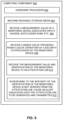
- FIG. 6 illustrates an example computing component that may be used to implement agentless attestation as a service in accordance with various embodiments.
- FIG. 7 is an example computing component that may be used to implement various features of embodiments described in the present disclosure.
- a maintenance burden is created between the customer and the data center. For example, the customer is required to download, install, configure, and patch the agent software application for any of its enterprise computer devices. As such, when the customer relies on the data center for maintenance and management of its computer devices, additional work and procedures are required by the customer to initiate and maintain the communications between the data center and the enterprise computer devices.
- Agent-based monitoring can cause several issues. For example, traditional systems require that a customer install an agent to monitor the devices. Generally, the customer supplies, installs, and manages the operating systems running on proprietary servers, which will require the customer to install an agent on its proprietary servers. There is a significant barrier for the entities involved. For the customers, there is the burden of downloading, installing, configuring, and patching the agent on any of the proprietary servers. For the entity that provides the agent to the customer, the functionality of the agent must be updated and maintained for any of the operating systems used by the customers. Other technical issues may involve how to securely access the customer's use of access to management technology. The management technology has total control over the proprietary server, so access to any interferences into the environment may be tightly controlled.
- Platform Certificates correspond with industry-standard signed attestations of the principal hardware components in the chassis: memory modules, network and storage controllers, disk drives, power supplies, and more.
- PCIe Peripheral Component Interconnect Express
- the data center may forego installing the agent software application on the enterprise computer devices and instead implement a series of Application Programming Interface (API) calls to register the enterprise computer devices and monitor their real-time status.
- API Application Programming Interface
- This process is referred to as “agentless attestation,” associated with an attestation job, where the integrity of servers is monitored without installing the agent or other monitoring software on the devices.
- Agentless attestation associated with an attestation job can measure the integrity of customer devices without requiring an agent software program to be downloaded to any of the enterprise computer devices.
- the system can integrate several standalone components to measure the integrity of the enterprise computer devices. This also allows the data center to authenticate, verify, audit, and update any hardware change, including a Platform Certificate.
- the system can assess and ultimately attest to the integrity of the monitored devices without having to exchange data/trust between different entities (e.g., a zero trust model) during the attestation job. For example, the system can measure and compare a cryptographic hash of firmware of the device with known (correct) reference values of the firmware of the device to validate that the firmware is the correct firmware to load and execute. In some examples, the expected reference values are published by a trusted authority. The system can move one layer up the firmware chain to the operating system during the attestation job to confirm the authenticity of the operating system as well. In this sense, the system can attest to the low level software that will start execution of the monitored devices and hand off the attested software to run the rest of the system. The customer can be confident that the operating system is running on firmware that is accurate and not malware that has been injected into the monitored devices. The system can cryptographically verify the state of the monitored devices.
- a zero trust model e.g., the system can measure and compare a cryptographic hash of firmware of the device with known (correct) reference
- Examples described herein are also distinct from typical agentless attestation system and also distinct from attestation using an agent installed on the monitored device.
- the examples described herein may not require operating system services to be running on the monitored device because the attestation may be implemented and executed out-of-band entirely through a management processor associated with the cloud-based management system.
- Other agentless management systems may require the ability to login to the operating system of the monitored device to, for example, initiate machine-readable instructions or other commands. The examples described herein may not require this interaction with the operating system of the monitored device.
- FIG. 1 is a block diagram comprising a cloud-based management system, cloud services platform, computer system, and a set of electronic devices, according to some examples of the system.
- cloud-based management system 102 that is to perform cloud-based management of electronic devices 104 - 1 to 104 -N, where N is 1.
- Key store 134 , trust store 138 , and certificate store 140 can be contained in separate non-volatile memories or in the same non-volatile memory.
- Cloud-based management system 102 can be part of a cloud environment that is separate from the customer premises where electronic devices 104 - 1 to 104 -N are located.
- the customer premises can be operated by a first entity, while the cloud-based management system can be operated by a second entity that is different from the first entity.
- entities that operate and/or own customer premises can include business concerns, government agencies, educational organizations, individuals, so forth. Additional features of cloud-based management system 102 are provided in FIG. 2 .
- Electronic device 104 may comprise baseboard management controller (BMC) 128 in electronic device 104 .
- BMC 128 includes a network interface 129 that allows BMC 128 to communicate over network 106 .
- BMC 128 is also configured to enable electronic device 104 to interact with BMC UI 126 at computer system 108 .
- BMC 128 is communicatively coupled to certificate manager 132 over a network, such as the network 106 or a different network.
- Electronic device 104 further includes processor 150 , memory 152 , and input/output (I/O) device 154 (or multiple processors, multiple memories, and/or multiple I/O devices).
- I/O input/output
- electronic device 104 comprises security co-processor 156 .
- security co-processor 156 is a Trusted Platform Module (TPM).
- TPM Trusted Platform Module
- Security co-processor 156 may be implemented as a separate chip from processor 150 or may be implemented within a “super-chip” that includes both security co-processor 156 and processor 150 .
- Security co-processor 156 may be discrete from processor 150 and the operating system of electronic device 104 .
- security co-processor 156 may comprise Platform Configuration Registers (PCR).
- PCRs may each store a different type of measurement values or data.
- the measurement values are collected from electronic device 104 , they can be stored at the appropriate security co-processor PCR (e.g., corresponding with computer-implemented rules) or appended to pre-existing values (e.g., to extend the values).
- new measurement values may be concatenated with old measurement values that are previously stored in the security co-processor PCR.
- the system may execute a hash function to generate a new measurement value to store in the PCR (e.g., new_value is a hash of an old_value and an argument_to_extend).
- new_value is a hash of an old_value and an argument_to_extend.
- electronic device 104 comprises a bootloader shim (not shown).
- the bootloader shim may be automatically executed to open an execute a second application.
- the second application may include, for example, a process to embed a particular certificate, like a Platform Certificate.
- the bootloader shim may be periodically updated to identify an up-to-date certificate.
- Measurement values corresponding with the bootloader shim may include a date or version number of the certificate, an identifier or location of the second application, or other values of the bootloader shim.
- electronic device 104 comprises a boot configuration (not shown).
- the boot configuration may be automatically updated to identify key-value data when booting the kernel of the device.
- the process may expand a current kernel command line to support additional key-value data.
- the boot configuration may correspond with a command line process that identifies various measurement values, including a startup configuration identifier, a boot image of the device, or location of any of the above.
- electronic device 104 comprises a boot device (not shown).
- the boot device may comprise a storage medium or other location on the device where it identifies and loads the operating system or firmware during startup or reboot.
- Measurement values corresponding with the boot device may identify a location of the operating system or firmware, or corresponding identifier.
- electronic device 104 comprises a server motherboard (not shown).
- the server motherboard may aggregate several server components into one system, including memory capacity, processor speed, expansion capability, and networking components to enable the device to communicate via a network of computers, any of the above values may correspond with measurement values of the device.
- Measurement values from any of the chassis, the bootloader shim, the boot configuration, the boot device, or the server motherboard may be determined.
- BMC 128 may determine any of these measurement values associated with electronic device 104 .
- the measurement values When the measurement values are transmitted to a different device (e.g., API gateway illustrated in FIG. 2 ), the measurement values (e.g., only new measurement values or concatenated new/old measurement values, or a hash of either value) may be accessed at the relevant security co-processor PCR, which previously authenticates the data, and transmitted to cloud-based management system.
- a different device e.g., API gateway illustrated in FIG. 2
- the measurement values e.g., only new measurement values or concatenated new/old measurement values, or a hash of either value
- the relevant security co-processor PCR which previously authenticates the data
- boot interface 158 (e.g., UEFI, BIOS) sends security co-processor 156 messages to record measurement values in PCRs at a first time. At a second time, boot interface 158 sends security co-processor 156 a first message to read the values of its PCRs and a second message to authenticate the measurement values by signing the values of its PCRS to the measurements.
- boot interface 158 may correspond with Unified Extensible Firmware Interface (UEFI), Basic Input/Output System (BIOS), or other interface associated with the boot procedure of electronic device 104 .
- BIOS may initiate a boot procedure based on firmware stored on an EPROM (Erasable Programmable Read-Only Memory) and UEFI may initiate a boot procedure based on a computer-readable instructions in a file (*.efi file) stored with the bootloader, instead of storing it in EPROM.
- EPROM Erasable Programmable Read-Only Memory
- BMC 128 can refer to a specialized service controller that monitors the physical state of a computing node (e.g., any of electronic devices 104 - 1 to 104 -N) using sensors and communicates with a remote management system (e.g., the cloud-based management system 102 ) (that is remote from the computing node) through an independent “out-of-band” connection.
- BMC 128 has management capabilities to manage components of the computing node.
- Examples of management capabilities of BMC 128 can include any or some combination of the following: power control to perform power management of the computing node (such as to transition the computing node between different power consumption states in response to detected events), thermal monitoring and control of the computing node (such as to monitor temperatures of the computing node and to control thermal management devices of the computing node), fan control of fans in the computing node, system health monitoring based on monitoring measurement values of various sensors of the computing node, remote access of the computing node (to access the computing node over a network, for example), remote reboot of the computing node (to trigger the computing node to reboot using a remote command), system setup and deployment of the computing node, system security to implement security procedures in the computing node, and so forth.
- power control to perform power management of the computing node (such as to transition the computing node between different power consumption states in response to detected events)
- thermal monitoring and control of the computing node such as to monitor temperatures of the computing node and to control thermal management devices of the computing node
- BMC 128 can provide so-called “lights-out” functionality for computing nodes.
- the lights out functionality may allow a user, such as a systems administrator, to perform management operations on the computing node even if an operating system (OS) is not installed or not functional on the computing node.
- OS operating system
- BMC 128 can run on auxiliary power provided by an auxiliary power supply (e.g., a battery). As a result, the computing node does not have to be powered on to allow BMC 128 to perform the BMC's operations.
- the auxiliary power supply is separate from a main power supply that supplies powers to other components (e.g., main processor 150 , memory 152 , I/O device 154 , etc.) of the computing node.
- Electronic devices 104 - 1 to 104 -N can be deployed on the customer premises and coupled to cloud-based management system 102 over network 106 .
- customer premises can refer to any arrangement of electronic devices, such as within a data center, a cloud environment, a storage area network, a third party co-location, or any other location (whether private or public). Note that customer premises can be located at a single geographic location or multiple geographic locations.
- Computer system 108 can communicate with cloud services platform 112 and electronic devices 104 - 1 to 104 -N over a network, such as network 106 .
- Cloud-based management system 102 can manage electronic devices 104 over network 106 , such as a local area network (LAN), a wide area network (WAN), a public network (e.g., the Internet), and so forth.
- Examples of electronic devices 104 can include any or some combination of the following: server computers, desktop computers, notebook computers, tablet computers, smartphones, game appliances, Internet-of-Things (IoT) devices, home appliances, storage devices, communication nodes, vehicles, vehicle controllers, and so forth.
- IoT Internet-of-Things
- Secure connection 146 may be initiated over network 106 .
- Secure connection 146 can include a WebSocket connection over Mutual Transport Layer Security (mTLS).
- the secure connection can be a different type of connection.
- techniques or mechanisms can be provided to keep the secure connection 146 alive and/or to retry the establishment of secure connection 146 in case secure connection 146 is dropped.
- Computer system 108 can be used to enable cloud-based management of electronic devices, including electronic devices 104 - 1 to 104 -N.
- Computer system 108 can include a desktop computer, a notebook computer, a tablet computer, or any other type of computer system.
- computer system 108 can be used by a user (e.g., systems administrator or another user) to onboard electronic devices to be subject to cloud-based management.
- a user e.g., systems administrator or another user
- a program or machine can initiate the onboarding of electronic devices 104 - 1 to 104 -N for cloud-based management.
- Computer system 108 allows a user to interact with onboarding portal 110 of cloud services platform 112 .
- a “platform” can refer to a single computer or a collection of computers.
- cloud services platform 112 provides a collection of cloud services such as user management, account management, authentication, authorization, and a portal, such as onboarding portal 110 .
- cloud services platform 112 can provide different services.
- a “portal” refers to a point of access of a device or service. For example, the portal can be at a specified uniform resource locator (URL), a network address (e.g., an Internet Protocol (IP) address), and so forth.
- URL uniform resource locator
- IP Internet Protocol
- computer system 108 can present onboarding user interface (UI) 114 when accessing onboarding portal 110 .
- UI onboarding user interface
- the user at computer system 108 can use onboarding UI 114 to log into onboarding portal 110 using credentials of the user, such as a username and password or another credential.
- computer system 108 can present onboarding UI 114 when accessing cloud-based management system 102 to initiate an agentless attestation process as a service for various purposes, including for Compute Ops Management (COM).
- COM Compute Ops Management
- the user at computer system 108 can use onboarding UI 114 to onboard and identify devices to track using cloud-based management system 102 .
- FIG. 2 is a block diagram comprising a cloud-based management system configured to perform cloud-based management of electronic devices, according to some examples of the system.
- cloud-based management system 102 can comprise API gateway module 210 , workflow engine 220 , communication service module 230 , scheduling service module 240 , and attestation service 250 .
- API gateway module 210 is configured to provide an interface between the customer device and the system described herein. For example, the user may access onboarding UI 114 to select hardware devices to onboard and track. API gateway 210 may route the request to workflow engine 220 , which has limited access to other engines and components of cloud-based management system 102 . Additional information about the onboarding process is provided with FIG. 3 .
- API gateway module 210 is also configured to provide authorization and route requests to internal services cloud-based management system 102 that calculates various responses.
- Workflow engine 220 is configured to orchestrate a number of processes to receive, determine, gather, merge, or transform data to fulfill the incoming request.
- workflow engine 220 is configured to initiate or execute jobs on cloud-based management system 102 .
- workflow engine 220 runs pre-defined software programs that can access internal APIs, including the API associated with communication service module 230 to interact with BMC 128 .
- the jobs associated with workflow engine 220 are inspected and trusted code.
- the registration job invokes a credential verification process that comprises executing a series of automated requests to retrieve the platform and attestation key certificates from BMC 128 prior to initiating the attestation job of the electronic device or prior to receiving the measurement value of the electronic device.
- workflow engine 220 registers the server with attestation service 250 , passing the certificates and other information retrieved from BMC 128 .
- Communication service module 230 is configured to direct communications to appropriate locations when communications are transmitted between the monitored device and cloud-based system.
- the communications may be protected or otherwise authenticated and encrypted.
- authentication may be required to communicate with electronic device 104 - 1 , another monitored device, or other endpoint, like mTLS. Any communication without the proper authentication may automatically be dropped without connecting to the service.
- Scheduling service module 240 is configured to determine a schedule of a service or other job. For example, scheduling service module 240 may determine a scheduled time to automatically initiate a periodic attestation of an electronic device (e.g., electronic device 104 - 1 once every 24 hours). A system-wide clock may be compared with the scheduled time and when the two sources of time match, the job may be initiated by scheduling service module 240 .
- an electronic device e.g., electronic device 104 - 1 once every 24 hours.
- a system-wide clock may be compared with the scheduled time and when the two sources of time match, the job may be initiated by scheduling service module 240 .
- the periodic attestation of the electronic device may correspond with a notification from BMC 128 .
- the notification may identify that a measurement value has changed and the attestation process should be initiated.
- Workflow engine 220 may initiate the attestation of the electronic device based on the notification from BMC 128 and, in some examples, scheduling service module 240 may automatically schedule the attestation in real-time.
- Attestation service 250 is configured to provide integrity verification services for electronic devices 104 . This can check the software (e.g., operating system) running on proprietary servers to build a chain of trust from the hardware incorporated with the proprietary servers (e.g., Root of Trust and network interface card (NIC), etc.) to the workload. Attestation service 250 is also configured to verify the authenticity of the platform and attestation certificates.
- software e.g., operating system
- proprietary servers e.g., Root of Trust and network interface card (NIC), etc.
- NIC network interface card
- Attestation service 250 is also configured to register for any change events on electronic device 104 - 1 .
- the change events may comprise, for example, reboot, hardware changes, etc.
- Attestation service 250 is also configured to transmit an alert. For example, if the hardware inventory is different from the expected inventory, verification fails, and attestation service module 250 issues an alert through API gateway module 210 .
- FIG. 3 is a flow diagram of a cloud-based management onboarding process, according to some examples of the system.
- the onboarding process may be implemented with a proxy device (prior to implementing agentless attestation) or implemented without an agent.
- the proxy device (implemented using hardware or machine-readable instructions) can be deployed on customer premises for purposes other than attestation.
- the proxy device provides a communication channel between electronic devices to be managed and a cloud-based management system to perform onboarding operations.
- “Onboarding” an electronic device for cloud-based management can refer to performing tasks to allow the electronic device to establish a connection with a cloud-based management system so that remote management of the electronic device by the cloud-based management system can occur.
- electronic devices on customer premises can initiate the connection with the cloud-based management system.
- an electronic device can publish information associated with the electronic device to the proxy device.
- the proxy device can send, in response to a device discovery request from the cloud-based management system, a response containing the information associated with the electronic device (as published by the electronic device) to the cloud-based management system.
- the security of the onboarding process depends upon a security mechanism used between the proxy device and the cloud-based management system.
- TLS mutual Transport Layer Security
- TLS can be used to ensure mutual authentication between the two sides, and traffic is encrypted to secure communications.
- security for the onboarding of electronic devices for cloud-based management can be complex and/or a suffer from vulnerabilities.
- the proxy device may be used for implementing various onboarding techniques or mechanisms to onboard electronic devices for cloud-based management by a cloud-based management system in coordination with agentless attestation described in FIGS. 4 and 5 .
- the onboarding techniques or mechanisms use the proxy device with the electronic devices and a cloud service that provides information identifying electronic devices to be onboarded to the cloud-based management system.
- the cloud-based management system may attest to the status of the electronic device without an additional agent (e.g., agentless).
- the user at computer system 108 initiates a process to identify electronic devices to be onboarded for cloud-based management.
- the process includes tasks 302 - 1 to 302 - 5 .
- onboarding portal 110 can receive, from onboarding portal 110 , a list of electronic devices that are associated with a customer account.
- a “customer account” can refer to an account of a customer (e.g., a business concern, an educational organization, a government agency, and individual, etc.). The customer may have registered with the customer account to list electronic devices that are eligible for cloud-based management.
- the electronic devices associated with the customer account may be identified based on device inventory information 116 stored in a cloud services database 118 .
- Device inventory information 116 can include device identification information such as any or some combination of: a serial number of an electronic device, a product identifier of the electronic device, a universally unique identifier (UUID), and so forth.
- Device inventory information 116 can associate different subsets of electronic devices with different customer accounts.
- Cloud services database 118 can be stored in a collection of storage devices, where a “collection of storage devices” can refer to a single storage device or multiple storage devices.
- Computer system 108 can present, in onboarding UI 114 , the list of electronic devices that are associated with a customer account.
- the user at computer system 108 can select, from the list presented in onboarding UI 114 , electronic devices to be onboarded for cloud-based management by cloud-based management system 102 .
- the electronic devices in the list may have checkboxes or other user-selectable items next to respective identifiers of the electronic devices.
- the identifiers can include names of the electronic devices, and/or serial numbers and product identifiers of the electronic devices.
- a product identifier can identify a line or category of products, whereas a serial number identifies a specific electronic device.
- the user can select a checkbox for any electronic device that is to be subject to cloud-based management.
- the user can upload a list of electronic devices that are to be onboarded for cloud-based management.
- Other techniques for selecting electronic devices for onboarding can be employed.
- computer system 108 receives, based on the user selection, device identification information identifying the selected electronic devices.
- computer system 108 sends the device identification information identifying the selected electronic devices to onboarding portal 110 .
- the device identification information can include any or some combination of: serial numbers, product identifiers, UUIDs, etc.
- the device identification information can include other types of electronic device identification data.
- cloud services platform 112 can send a respective event to cloud-based management system 102 .
- the event sent to cloud-based management system 102 can include device identification information for the respective electronic device.
- an event can be associated with multiple electronic devices, in which case the event can include device identification information of the multiple electronic devices.
- the event can also contain customer identification information to identify a customer with which the electronic devices are associated.
- cloud onboarding engine 120 in cloud-based management system 102 can add information associated with the selected electronic devices to a cloud-based management database 122 .
- the information may be added in response to receiving a collection of events (including a single event or multiple events) relating to the selected electronic devices.
- the information added may be represented as selected electronic device information 124 in cloud-based management database 122 .
- the selected electronic device information 124 can include device identification information and possibly other information.
- the selected electronic device information 124 can also associate a state with any selected electronic device, where the state can be set to a first value to indicate that the electronic device is to be managed by cloud-based management system 102 , and to a different second value if the electronic device is not to be managed by cloud-based management system 102 .
- the user at computer system 108 initiates a process to enable a selected electronic device 104 - 1 to be monitored via cloud-based management.
- a similar process can be performed for any of the selected electronic device(s).
- the process includes tasks 304 - 1 to 304 - 7 .
- BMC 128 includes BMC onboarding engine 130 that receives an indication through BMC UI 126 that cloud-based management for electronic device 104 - 1 is to be enabled.
- the indication can be provided in response to the user at the computer system 108 selecting a control item in BMC UI 126 , entering a command in BMC UI 126 , and so forth.
- the user at computer system 108 uses BMC UI 126 to enable cloud-based management for an electronic device.
- computer system 108 can enable cloud-based management for an electronic device in a different manner, such as by interaction through an interface (e.g., a Representational State Transfer (REST) interface or another type of interface, such as an application programming interface (API) or a different interface).
- REST Representational State Transfer
- API application programming interface
- BMC 128 can auto-initiate a connection with computer system 108 when BMC 128 is powered on or otherwise started.
- BMC onboarding engine 130 initiates a process to obtain a certificate from a certificate manager 132 , which can include a computer or a collection of computers, for example.
- certificate manager 132 manages the provision of Public Key Infrastructure (PKI) certificates, which are digital certificates used to authenticate users or devices.
- PKI Public Key Infrastructure
- electronic device 104 - 1 can be shipped from the factory with an unalterable certificate embedded in the hardware (e.g., in the BMC's certificate store 140 ) that provides similar functionality to the certificate obtained from certificate manager 132 .
- BMC onboarding engine 130 may establish a secure connection with certificate manager 132 . This process may be triggered once BMC onboarding engine 130 verifies certificate manager 132 .
- BMC 128 is communicatively coupled to certificate manager 132 over a network, such as network 106 or a different network.
- BMC 128 can establish the secure connection with the certificate manager 132 using the certificate manager CA chain.
- the secure connection between BMC 128 and certificate manager 132 can include a Transport Layer Security (TLS) connection.
- TLS Transport Layer Security
- other types of secure connections can be established between BMC 128 and certificate manager 132 .
- BMC onboarding engine 130 sends a certificate signing request (CSR) to certificate manager 132 over the secure connection.
- the CSR includes a public key of a public-private key pair and the device identification information (e.g., any or some combination of the serial number, product identifier, UUID, etc.) of electronic device 104 - 1 .
- the public-private key pair (which includes the public key and a private key of the BMC 128 ) may be generated by cloud connect engine 148 in BMC 128 .
- Cloud connect engine 148 is to establish a connection with a cloud service.
- BMC 128 can include another entity, such as a security manager (not shown), that can be requested by cloud connect engine 148 to generate the public key and the private key of the public-private key pair.
- the private key can be encrypted and stored in key store 134 , which can be stored in a non-volatile memory of BMC 128 .
- the generation of the public-private key pair can be performed by another module in BMC 128 (e.g., BMC onboarding engine 130 ) or by a trusted entity outside BMC 128 or can be preloaded in BMC 128 at the factory.
- certificate manager 132 may verify the CSR in response to receiving the CSR.
- certificate manager 132 sends a signed certificate to electronic device 104 - 1 .
- the signed certificate refers to the certificate signed with a private key of certificate manager 132 .
- the signed certificate can include device identification information (e.g., any or some combination of the serial number, the product identifier, the UUID, etc., of the electronic device 104 - 1 ) of electronic device 104 - 1 .
- BMC onboarding engine 130 can store the signed certificate in certificate store 140 as certificate 142 , in response to receiving the signed certificate.
- Certificate store 140 can be contained in a non-volatile memory of BMC 128 .
- BMC onboarding engine 130 next initiates a device activation process 306 to activate electronic device 104 - 1 for establishing a connection with the cloud-based management system 102 .
- the device activation process is performed with device activation engine 144 that is part of cloud services platform 112 .
- device activation engine 144 can be part of cloud-based management system 102 .
- the process includes tasks 306 - 1 to 306 - 6 . Note that the device activation process can be performed by any of electronic devices 104 - 1 to 104 -N.
- BMC 128 is provisioned with device endpoint information that refers to an endpoint that BMC 128 is to access for performing device activation of electronic device 104 - 1 for cloud-based management.
- the device endpoint information e.g., URL such as device.cloud.company.com or a network address, etc.
- URL such as device.cloud.company.com or a network address, etc.
- BMC onboarding engine 130 establishes, using certificate 142 , a secure connection with device activation engine 144 over a network, such as network 106 .
- BMC onboarding engine 130 verifies device activation engine 144 using a cloud services CA chain that is stored as part of CA chain information 136 in trust store 138 .
- the secure connection is an mTLS connection.
- mTLS refers to an extension of TLS to provide mutual authentication or Mutual Transport Layer Security (mTLS).
- BMC onboarding engine 130 can establish a different type of secure connection with device activation engine 144 .
- cloud onboarding engine 120 would reject the establishment of secure connection 146 , such that onboarding of electronic device 104 - 1 for cloud-based management by cloud-based management system 102 would fail.
- attestation service module 250 register change events with workflow engine 220 .
- attestation service module 250 registers for any change events on the servers: reboot, hardware changes, etc.
- an attestation job process may be initiated by workflow engine 220 .
- the attestation job started at a second time after the process illustrated in FIG. 4 .
- communication service 230 may contact BMC 128 of electronic device 104 to retrieve the measurement logs.
- the quote is also requested by workflow engine 220 (not shown) from BMC 128 .
- BMC 128 may provide boot interface 158 with a nonce value when boot interface 158 requests attestation and boot interface 158 may provide the nonce value to a signature process executed by security co-processor 156 to generate a quote or other form of data signature.
- the quote, stored measurement log, and hardware data may be posted to attestation service module 250 .
- the authentication process executed by attestation service module 250 also verifies that the values in the measurement logs and hardware data correspond to their respective PCRs, for example, the hardware data is authenticated by PCR 6 .
- attestation service module 250 may verify the reported hardware inventory is the same as the expected hardware inventory, held in cloud-based management database 122 .
- different PCRs can authenticate different parts of the measurement log.
- a process to retrieve the signed measurement values is executed (e.g., TPMGetSignedMeasurements), referencing measurements from BMC 128 .
- a process to retrieve the SPDM measurements is executed (e.g., SPDMGetSignedMeasurements), referencing measurements from BMC 128 .
- attestation service module 250 may transmit an alert to API gateway module 210 . For example, if the hardware inventory is different from the expected inventory, verification fails because the integrity of the monitored device may be compromised, and attestation service module 250 issues an alert through API gateway module 210 .
- workflow engine 220 “Hardware Status” job which uses attestation service module 250 to render the found hardware inventory, the expected hardware inventory, and the delta in the customer's user interface.
- the customer can choose to accept the found hardware inventory, in which case, a job execution process may be initiated to update the list of hardware.
- the process uses attestation service module 250 to accept the current hardware inventory as authorized and expected.
- Platform Certificates are X.509 attribute certificates bound to the security co-processor. Since attestation service module 250 already has the hardware and security co-processor details and has authenticated the security co-processor by the process of attestation, there is no need for a separate certificate signing request (or CSR). Attestation service module 250 issues the certificate on-demand, certifying that the change is authorized by an authorized channel partner.
- the system may support attestation of the bootloader, boot configuration, and firmware. This can provide deeper attestation, including the operating system kernel and components which is not possible using just UEFI.
- FIG. 6 illustrates an example computing component that may be used to implement agentless attestation as a service in accordance with various embodiments.
- computing component 600 may be, for example, a server computer, a controller, or any other similar computing component capable of processing data.
- computing component 600 includes hardware processor 602 and machine-readable storage medium 604 .
- Hardware processor 604 may execute instruction 606 to receive a measurement value of the monitored device associated with a chassis, a bootloader shim, a boot configuration, a boot device, or a server motherboard.
- the measurement value may be received from a baseboard management controller (BMC) of a monitored device. Receiving the measurement value may be triggered prior to providing control of the monitored device to the bootloader shim.
- BMC baseboard management controller
- multiple hardware processors are implemented, including a main CPU that executes processing operations at the monitored device and a second processor corresponding with BMC 128 in FIG. 1 .
- hardware processor 604 and BMC of the monitored device may execute separate operations.
- Hardware processor 604 may execute instruction 608 to receive a nonce value that triggered a quote operation with a security co-processor of the monitored device.
- security co-processor 156 is a Trusted Platform Module (TPM).
- TPM Trusted Platform Module
- the nonce value may be received from the BMC.
- the nonce value may be received prior to providing control of the monitored device to the bootloader shim.
- the measurement value may be stored at the BMC and the nonce value may be transmitted to a boot interface of the monitored device.
- Hardware processor 604 may execute instruction 610 to receive the measurement value of the monitored device from BMC and identification of the monitored device to an attestation job.
- BMC may execute an instruction to provide the measurement value of the monitored device to hardware processor 604 .
- the measurement value may be transmitted via secure connection 146 between BMC 128 and cloud-based management system 102 as illustrated in FIG. 1 .
- the attestation job may be initiated by workflow engine 220 of cloud-based management system 102 and pass through communication service 230 and contact BMC 128 of electronic device 104 to retrieve the measurement values, each of which are illustrated in FIGS. 1 - 2 .
- Hardware processor 604 may execute instruction 612 to cause an alert associated with the attestation job to be generated and transmitted.
- the alert may be generated and transmitted by attestation service 250 of cloud-based management system 102 as illustrated in FIGS. 1 - 2 .
- the alert may be transmitted to an entity associated with the monitored device (e.g., systems administrator or another user) when the integrity of the monitored device is not verified from the attestation job.
- the alert may be generated when the attestation job cannot verify the integrity of the state of the monitored device, or the attestation job verifies that the integrity of the state of the monitored device is compromised.
- the verification of the integrity of the monitored device may fail based on information associated with, for example, the launched (expected) bootloader shim, the expected boot configuration, the boot device, the expected firmware, or the present hardware at the monitored device.
- An alert may be generated if the integrity is determined to be faulty or verification has failed.
- FIG. 7 depicts a block diagram of an example computer system 700 in which various of the embodiments described herein may be implemented.
- the computer system 700 includes a bus 702 or other communication mechanism for communicating information, one or more hardware processors 704 coupled with bus 702 for processing information.
- Hardware processor(s) 704 may be, for example, one or more general purpose microprocessors.
- the computer system 700 also includes a main memory 706 , such as a random access memory (RAM), cache and/or other dynamic storage devices, coupled to bus 702 for storing information and instructions to be executed by processor 704 .
- Main memory 706 also may be used for storing temporary variables or other intermediate information during execution of instructions to be executed by processor 704 .
- Such instructions when stored in storage media accessible to processor 704 , render computer system 700 into a special-purpose machine that is customized to perform the operations specified in the instructions.
- the computer system 700 further includes a read-only memory (ROM) 708 or other static storage device coupled to bus 702 for storing static information and instructions for processor 704 .
- ROM read-only memory
- a storage device 710 such as a magnetic disk, optical disk, or USB thumb drive (Flash drive), etc., is provided and coupled to bus 702 for storing information and instructions.
- the computer system 700 may be coupled via bus 702 to a display 712 , such as a liquid crystal display (LCD) (or touch screen), for displaying information to a computer user.
- a display 712 such as a liquid crystal display (LCD) (or touch screen)
- An input device 714 is coupled to bus 702 for communicating information and command selections to processor 704 .
- cursor control 716 is Another type of user input device
- cursor control 716 such as a mouse, a trackball, or cursor direction keys for communicating direction information and command selections to processor 704 and for controlling cursor movement on display 712 .
- the same direction information and command selections as cursor control may be implemented via receiving touches on a touch screen without a cursor.
- the word “component,” “engine,” “system,” “database,” data store,” and the like, as used herein, can refer to logic embodied in hardware or firmware, or to a collection of software instructions, possibly having entry and exit points, written in a programming language, such as, for example, Java, C or C++.
- a software component may be compiled and linked into an executable program, installed in a dynamic link library, or may be written in an interpreted programming language such as, for example, BASIC, Perl, or Python. It will be appreciated that software components may be callable from other components or from themselves, and/or may be invoked in response to detected events or interrupts.
- the computer system 700 may implement the techniques described herein using customized hard-wired logic, one or more ASICs or FPGAs, firmware and/or program logic which in combination with the computer system causes or programs computer system 700 to be a special-purpose machine. According to one embodiment, the techniques herein are performed by computer system 700 in response to processor(s) 704 executing one or more sequences of one or more instructions contained in main memory 706 . Such instructions may be read into main memory 706 from another storage medium, such as storage device 710 . Execution of the sequences of instructions contained in main memory 706 causes processor(s) 704 to perform the process steps described herein. In alternative embodiments, hard-wired circuitry may be used in place of or in combination with software instructions.
Landscapes
- Engineering & Computer Science (AREA)
- Computer Hardware Design (AREA)
- General Engineering & Computer Science (AREA)
- Computer Security & Cryptography (AREA)
- Software Systems (AREA)
- Theoretical Computer Science (AREA)
- Physics & Mathematics (AREA)
- General Physics & Mathematics (AREA)
- Management, Administration, Business Operations System, And Electronic Commerce (AREA)
Abstract
Description
Claims (20)
Priority Applications (1)
| Application Number | Priority Date | Filing Date | Title |
|---|---|---|---|
| US18/460,237 US12353559B2 (en) | 2023-06-16 | 2023-09-01 | Agentless attestation as a service |
Applications Claiming Priority (2)
| Application Number | Priority Date | Filing Date | Title |
|---|---|---|---|
| US202363508712P | 2023-06-16 | 2023-06-16 | |
| US18/460,237 US12353559B2 (en) | 2023-06-16 | 2023-09-01 | Agentless attestation as a service |
Publications (2)
| Publication Number | Publication Date |
|---|---|
| US20240419802A1 US20240419802A1 (en) | 2024-12-19 |
| US12353559B2 true US12353559B2 (en) | 2025-07-08 |
Family
ID=93844246
Family Applications (1)
| Application Number | Title | Priority Date | Filing Date |
|---|---|---|---|
| US18/460,237 Active 2044-01-08 US12353559B2 (en) | 2023-06-16 | 2023-09-01 | Agentless attestation as a service |
Country Status (1)
| Country | Link |
|---|---|
| US (1) | US12353559B2 (en) |
Families Citing this family (2)
| Publication number | Priority date | Publication date | Assignee | Title |
|---|---|---|---|---|
| US12339969B2 (en) * | 2023-06-21 | 2025-06-24 | Cisco Technology, Inc. | System method for fractional secure boot by validating secure enclave using instructions of pre-drivers stored in memory by manufacturer |
| CN120835010A (en) * | 2024-04-19 | 2025-10-24 | 戴尔产品有限公司 | Method, device, and computer program product for authenticating an Internet of Things device |
Citations (9)
| Publication number | Priority date | Publication date | Assignee | Title |
|---|---|---|---|---|
| US20130263205A1 (en) * | 2012-03-29 | 2013-10-03 | Cisco Technology, Inc. | System and method for trusted platform attestation |
| US20210409223A1 (en) * | 2020-06-30 | 2021-12-30 | Vmware, Inc. | Remote attestation based on runtime configuration |
| US11290471B2 (en) * | 2019-08-27 | 2022-03-29 | Hewlett Packard Enterprise Development Lp | Cross-attestation of electronic devices |
| US11531760B1 (en) * | 2020-11-25 | 2022-12-20 | American Megatrends International, Llc | Baseboard management controller (BMC)-based security processor |
| US20230063428A1 (en) * | 2021-09-02 | 2023-03-02 | Hewlett Packard Enterprise Development Lp | Onboarding for cloud-based management |
| US20230325509A1 (en) * | 2022-04-11 | 2023-10-12 | Extreme Networks, Inc. | Trust chain preservation for remote attestation |
| US20240020387A1 (en) * | 2022-07-15 | 2024-01-18 | Dell Products L.P. | Secure boot attestation in a cloud platform |
| US11995450B2 (en) * | 2022-07-15 | 2024-05-28 | Hewlett Packard Enterprise Development Lp | Cloud-based provisioning of UEFI-enabled systems |
| US12086258B1 (en) * | 2021-12-23 | 2024-09-10 | American Megatrends International, Llc | Firmware attestation on system reset |
-
2023
- 2023-09-01 US US18/460,237 patent/US12353559B2/en active Active
Patent Citations (9)
| Publication number | Priority date | Publication date | Assignee | Title |
|---|---|---|---|---|
| US20130263205A1 (en) * | 2012-03-29 | 2013-10-03 | Cisco Technology, Inc. | System and method for trusted platform attestation |
| US11290471B2 (en) * | 2019-08-27 | 2022-03-29 | Hewlett Packard Enterprise Development Lp | Cross-attestation of electronic devices |
| US20210409223A1 (en) * | 2020-06-30 | 2021-12-30 | Vmware, Inc. | Remote attestation based on runtime configuration |
| US11531760B1 (en) * | 2020-11-25 | 2022-12-20 | American Megatrends International, Llc | Baseboard management controller (BMC)-based security processor |
| US20230063428A1 (en) * | 2021-09-02 | 2023-03-02 | Hewlett Packard Enterprise Development Lp | Onboarding for cloud-based management |
| US12086258B1 (en) * | 2021-12-23 | 2024-09-10 | American Megatrends International, Llc | Firmware attestation on system reset |
| US20230325509A1 (en) * | 2022-04-11 | 2023-10-12 | Extreme Networks, Inc. | Trust chain preservation for remote attestation |
| US20240020387A1 (en) * | 2022-07-15 | 2024-01-18 | Dell Products L.P. | Secure boot attestation in a cloud platform |
| US11995450B2 (en) * | 2022-07-15 | 2024-05-28 | Hewlett Packard Enterprise Development Lp | Cloud-based provisioning of UEFI-enabled systems |
Non-Patent Citations (5)
| Title |
|---|
| DMTF, "Security Protocol and Data Model (SPDM) Specification", Version: 1.2.1, Jun. 23, 2022, 191 pages. |
| Keylime Contributors, "What is Keylime", available online at <https://web.archive.org/web/20210222205353/https://keylime.dev/>, Feb. 22, 2021, 4 pages. |
| Redfish, "Redfish Data Model Specification", Document Identifier: DSP0268 , Version: 2022.2, Sep. 15, 2022, 1297 pages. |
| Trusted Computing Group, "TCG Platform Certificate Profile", available online at <https://trustedcomputinggroup.org/resource/tcg-platform-certificate-profile/>, 2023, 1 page. |
| Trusted Computing Group, "TCG Server Management Domain Firmware Profile Specification", Revision 1.00 , May 1, 2020 , 53 pages. |
Also Published As
| Publication number | Publication date |
|---|---|
| US20240419802A1 (en) | 2024-12-19 |
Similar Documents
| Publication | Publication Date | Title |
|---|---|---|
| JP7703528B2 (en) | Remote attestation method and device for composite devices - Patents.com | |
| US10601807B2 (en) | Systems and methods for providing container security | |
| EP2196933B1 (en) | Server-to-server integrity checking | |
| US20170230183A1 (en) | Systems and methods for implementing computer security | |
| US20050120106A1 (en) | System and method for distributing software updates to a network appliance | |
| CN112134692B (en) | Remote certification mode negotiation method and device | |
| US20140250215A1 (en) | Configuration and verification by trusted provider | |
| CN112527912A (en) | Data processing method and device based on block chain network and computer equipment | |
| US11637822B2 (en) | Onboarding for cloud-based management | |
| US20240419802A1 (en) | Agentless attestation as a service | |
| CN116781359A (en) | Portal security design method using network isolation and cryptograph | |
| US11321494B2 (en) | Platform configurations | |
| US12602507B2 (en) | Data center monitoring and management operation including configuration for customer sensitive data | |
| US12225124B2 (en) | Data center asset onboarding authentication for a data center asset via an onboarding operation | |
| US12625970B2 (en) | Providing bios features in a pre-boot environment for a client computer system | |
| Johnson et al. | Recommendations for distributed energy resource patching | |
| US11997073B2 (en) | Secure certificate storage when a connectivity management system client is running on an operating system | |
| US20240296235A1 (en) | Systems and methods for collective attestation of spdm-enabled devices in an information handling system (ihs) | |
| US12225140B2 (en) | Method and apparatus for external control planes to cryptographically trust software artifacts launched at public cloud providers | |
| US12052142B2 (en) | Connectivity management system which optimizes embedded connectivity management system operations | |
| US12003963B2 (en) | Mobile provisioning of a data center asset in a data center connectivity management environment | |
| US12003382B2 (en) | Data center asset client module authentication via a connectivity management authentication operation | |
| US11924045B2 (en) | Connectivity management system client inventory and configuration operation for interconnected connectivity management clients | |
| US12225072B2 (en) | Connectivity management system client software distribution operation | |
| AOKI et al. | ZT-OTA Software Update Framework for IoT Devices |
Legal Events
| Date | Code | Title | Description |
|---|---|---|---|
| AS | Assignment |
Owner name: HEWLETT PACKARD ENTERPRISE DEVELOPMENT LP, TEXAS Free format text: ASSIGNMENT OF ASSIGNORS INTEREST;ASSIGNORS:SOUTHAM, BLAINE R.;LUCIANI, LUIS E., JR;HASKELL, DARRELL R.;AND OTHERS;SIGNING DATES FROM 20230825 TO 20230901;REEL/FRAME:064779/0001 Owner name: HEWLETT-PACKARD LIMITED, UNITED KINGDOM Free format text: ASSIGNMENT OF ASSIGNORS INTEREST;ASSIGNOR:EDWARDS, NIGEL JOHN;REEL/FRAME:064778/0846 Effective date: 20230824 |
|
| FEPP | Fee payment procedure |
Free format text: ENTITY STATUS SET TO UNDISCOUNTED (ORIGINAL EVENT CODE: BIG.); ENTITY STATUS OF PATENT OWNER: LARGE ENTITY |
|
| STPP | Information on status: patent application and granting procedure in general |
Free format text: DOCKETED NEW CASE - READY FOR EXAMINATION |
|
| STPP | Information on status: patent application and granting procedure in general |
Free format text: NOTICE OF ALLOWANCE MAILED -- APPLICATION RECEIVED IN OFFICE OF PUBLICATIONS |
|
| AS | Assignment |
Owner name: HEWLETT PACKARD ENTERPRISE DEVELOPMENT LP, TEXAS Free format text: ASSIGNMENT OF ASSIGNORS INTEREST;ASSIGNOR:HEWLETT-PACKARD LIMITED;REEL/FRAME:071270/0425 Effective date: 20210701 |
|
| STCF | Information on status: patent grant |
Free format text: PATENTED CASE |