US12351780B2 - Peptide acetals for stabilising enzymes - Google Patents

Peptide acetals for stabilising enzymes Download PDF

Info

Publication number
US12351780B2
US12351780B2 US17/621,807 US202017621807A US12351780B2 US 12351780 B2 US12351780 B2 US 12351780B2 US 202017621807 A US202017621807 A US 202017621807A US 12351780 B2 US12351780 B2 US 12351780B2
Authority
US
United States
Prior art keywords
ala
val
gly
fmoc
cbz
Prior art date
Legal status (The legal status is an assumption and is not a legal conclusion. Google has not performed a legal analysis and makes no representation as to the accuracy of the status listed.)
Active, expires
Application number
US17/621,807
Other versions
US20220267699A1 (en
Inventor
Allan F. CUNNINGHAM
Stefan Jenewein
Gabriele Boenemann
Current Assignee (The listed assignees may be inaccurate. Google has not performed a legal analysis and makes no representation or warranty as to the accuracy of the list.)
BASF SE
Original Assignee
BASF SE
Priority date (The priority date is an assumption and is not a legal conclusion. Google has not performed a legal analysis and makes no representation as to the accuracy of the date listed.)
Filing date
Publication date
Application filed by BASF SE filed Critical BASF SE
Assigned to BASF SE reassignment BASF SE ASSIGNMENT OF ASSIGNORS INTEREST (SEE DOCUMENT FOR DETAILS). Assignors: BASF SCHWEIZ AG
Assigned to BASF SCHWEIZ AG reassignment BASF SCHWEIZ AG ASSIGNMENT OF ASSIGNORS INTEREST (SEE DOCUMENT FOR DETAILS). Assignors: CUNNINGHAM, Allan F.
Assigned to BASF SE reassignment BASF SE ASSIGNMENT OF ASSIGNORS INTEREST (SEE DOCUMENT FOR DETAILS). Assignors: JENEWEIN, STEFAN, BOENEMANN, Gabriele
Publication of US20220267699A1 publication Critical patent/US20220267699A1/en
Application granted granted Critical
Publication of US12351780B2 publication Critical patent/US12351780B2/en
Active legal-status Critical Current
Adjusted expiration legal-status Critical

Links

Classifications

    • CCHEMISTRY; METALLURGY
    • C11ANIMAL OR VEGETABLE OILS, FATS, FATTY SUBSTANCES OR WAXES; FATTY ACIDS THEREFROM; DETERGENTS; CANDLES
    • C11DDETERGENT COMPOSITIONS; USE OF SINGLE SUBSTANCES AS DETERGENTS; SOAP OR SOAP-MAKING; RESIN SOAPS; RECOVERY OF GLYCEROL
    • C11D3/00Other compounding ingredients of detergent compositions covered in group C11D1/00
    • C11D3/16Organic compounds
    • C11D3/26Organic compounds containing nitrogen
    • C11D3/32Amides; Substituted amides
    • CCHEMISTRY; METALLURGY
    • C07ORGANIC CHEMISTRY
    • C07KPEPTIDES
    • C07K5/00Peptides containing up to four amino acids in a fully defined sequence; Derivatives thereof
    • C07K5/04Peptides containing up to four amino acids in a fully defined sequence; Derivatives thereof containing only normal peptide links
    • C07K5/06Dipeptides
    • C07K5/06008Dipeptides with the first amino acid being neutral
    • C07K5/06017Dipeptides with the first amino acid being neutral and aliphatic
    • C07K5/06026Dipeptides with the first amino acid being neutral and aliphatic the side chain containing 0 or 1 carbon atom, i.e. Gly or Ala
    • CCHEMISTRY; METALLURGY
    • C07ORGANIC CHEMISTRY
    • C07KPEPTIDES
    • C07K1/00General methods for the preparation of peptides, i.e. processes for the organic chemical preparation of peptides or proteins of any length
    • C07K1/107General methods for the preparation of peptides, i.e. processes for the organic chemical preparation of peptides or proteins of any length by chemical modification of precursor peptides
    • C07K1/1072General methods for the preparation of peptides, i.e. processes for the organic chemical preparation of peptides or proteins of any length by chemical modification of precursor peptides by covalent attachment of residues or functional groups
    • C07K1/1075General methods for the preparation of peptides, i.e. processes for the organic chemical preparation of peptides or proteins of any length by chemical modification of precursor peptides by covalent attachment of residues or functional groups by covalent attachment of amino acids or peptide residues
    • CCHEMISTRY; METALLURGY
    • C07ORGANIC CHEMISTRY
    • C07KPEPTIDES
    • C07K5/00Peptides containing up to four amino acids in a fully defined sequence; Derivatives thereof
    • C07K5/04Peptides containing up to four amino acids in a fully defined sequence; Derivatives thereof containing only normal peptide links
    • C07K5/06Dipeptides
    • C07K5/06008Dipeptides with the first amino acid being neutral
    • C07K5/06017Dipeptides with the first amino acid being neutral and aliphatic
    • C07K5/06034Dipeptides with the first amino acid being neutral and aliphatic the side chain containing 2 to 4 carbon atoms
    • CCHEMISTRY; METALLURGY
    • C07ORGANIC CHEMISTRY
    • C07KPEPTIDES
    • C07K5/00Peptides containing up to four amino acids in a fully defined sequence; Derivatives thereof
    • C07K5/04Peptides containing up to four amino acids in a fully defined sequence; Derivatives thereof containing only normal peptide links
    • C07K5/06Dipeptides
    • C07K5/06008Dipeptides with the first amino acid being neutral
    • C07K5/06017Dipeptides with the first amino acid being neutral and aliphatic
    • C07K5/06034Dipeptides with the first amino acid being neutral and aliphatic the side chain containing 2 to 4 carbon atoms
    • C07K5/06043Leu-amino acid
    • CCHEMISTRY; METALLURGY
    • C07ORGANIC CHEMISTRY
    • C07KPEPTIDES
    • C07K5/00Peptides containing up to four amino acids in a fully defined sequence; Derivatives thereof
    • C07K5/04Peptides containing up to four amino acids in a fully defined sequence; Derivatives thereof containing only normal peptide links
    • C07K5/06Dipeptides
    • C07K5/06008Dipeptides with the first amino acid being neutral
    • C07K5/06017Dipeptides with the first amino acid being neutral and aliphatic
    • C07K5/06034Dipeptides with the first amino acid being neutral and aliphatic the side chain containing 2 to 4 carbon atoms
    • C07K5/06052Val-amino acid
    • CCHEMISTRY; METALLURGY
    • C07ORGANIC CHEMISTRY
    • C07KPEPTIDES
    • C07K5/00Peptides containing up to four amino acids in a fully defined sequence; Derivatives thereof
    • C07K5/04Peptides containing up to four amino acids in a fully defined sequence; Derivatives thereof containing only normal peptide links
    • C07K5/06Dipeptides
    • C07K5/06086Dipeptides with the first amino acid being basic
    • C07K5/06095Arg-amino acid
    • CCHEMISTRY; METALLURGY
    • C07ORGANIC CHEMISTRY
    • C07KPEPTIDES
    • C07K5/00Peptides containing up to four amino acids in a fully defined sequence; Derivatives thereof
    • C07K5/04Peptides containing up to four amino acids in a fully defined sequence; Derivatives thereof containing only normal peptide links
    • C07K5/06Dipeptides
    • C07K5/06139Dipeptides with the first amino acid being heterocyclic
    • C07K5/06147Dipeptides with the first amino acid being heterocyclic and His-amino acid; Derivatives thereof
    • CCHEMISTRY; METALLURGY
    • C07ORGANIC CHEMISTRY
    • C07KPEPTIDES
    • C07K5/00Peptides containing up to four amino acids in a fully defined sequence; Derivatives thereof
    • C07K5/04Peptides containing up to four amino acids in a fully defined sequence; Derivatives thereof containing only normal peptide links
    • C07K5/08Tripeptides
    • C07K5/0802Tripeptides with the first amino acid being neutral
    • C07K5/0804Tripeptides with the first amino acid being neutral and aliphatic
    • C07K5/0806Tripeptides with the first amino acid being neutral and aliphatic the side chain containing 0 or 1 carbon atoms, i.e. Gly, Ala
    • CCHEMISTRY; METALLURGY
    • C07ORGANIC CHEMISTRY
    • C07KPEPTIDES
    • C07K5/00Peptides containing up to four amino acids in a fully defined sequence; Derivatives thereof
    • C07K5/04Peptides containing up to four amino acids in a fully defined sequence; Derivatives thereof containing only normal peptide links
    • C07K5/08Tripeptides
    • C07K5/0802Tripeptides with the first amino acid being neutral
    • C07K5/0804Tripeptides with the first amino acid being neutral and aliphatic
    • C07K5/0808Tripeptides with the first amino acid being neutral and aliphatic the side chain containing 2 to 4 carbon atoms, e.g. Val, Ile, Leu
    • CCHEMISTRY; METALLURGY
    • C07ORGANIC CHEMISTRY
    • C07KPEPTIDES
    • C07K5/00Peptides containing up to four amino acids in a fully defined sequence; Derivatives thereof
    • C07K5/04Peptides containing up to four amino acids in a fully defined sequence; Derivatives thereof containing only normal peptide links
    • C07K5/08Tripeptides
    • C07K5/0815Tripeptides with the first amino acid being basic
    • C07K5/0817Tripeptides with the first amino acid being basic the first amino acid being Arg
    • CCHEMISTRY; METALLURGY
    • C07ORGANIC CHEMISTRY
    • C07KPEPTIDES
    • C07K5/00Peptides containing up to four amino acids in a fully defined sequence; Derivatives thereof
    • C07K5/04Peptides containing up to four amino acids in a fully defined sequence; Derivatives thereof containing only normal peptide links
    • C07K5/08Tripeptides
    • C07K5/0821Tripeptides with the first amino acid being heterocyclic, e.g. His, Pro, Trp
    • CCHEMISTRY; METALLURGY
    • C11ANIMAL OR VEGETABLE OILS, FATS, FATTY SUBSTANCES OR WAXES; FATTY ACIDS THEREFROM; DETERGENTS; CANDLES
    • C11DDETERGENT COMPOSITIONS; USE OF SINGLE SUBSTANCES AS DETERGENTS; SOAP OR SOAP-MAKING; RESIN SOAPS; RECOVERY OF GLYCEROL
    • C11D3/00Other compounding ingredients of detergent compositions covered in group C11D1/00
    • C11D3/16Organic compounds
    • C11D3/26Organic compounds containing nitrogen
    • C11D3/33Amino carboxylic acids
    • CCHEMISTRY; METALLURGY
    • C11ANIMAL OR VEGETABLE OILS, FATS, FATTY SUBSTANCES OR WAXES; FATTY ACIDS THEREFROM; DETERGENTS; CANDLES
    • C11DDETERGENT COMPOSITIONS; USE OF SINGLE SUBSTANCES AS DETERGENTS; SOAP OR SOAP-MAKING; RESIN SOAPS; RECOVERY OF GLYCEROL
    • C11D3/00Other compounding ingredients of detergent compositions covered in group C11D1/00
    • C11D3/16Organic compounds
    • C11D3/38Products with no well-defined composition, e.g. natural products
    • C11D3/386Preparations containing enzymes, e.g. protease or amylase
    • CCHEMISTRY; METALLURGY
    • C11ANIMAL OR VEGETABLE OILS, FATS, FATTY SUBSTANCES OR WAXES; FATTY ACIDS THEREFROM; DETERGENTS; CANDLES
    • C11DDETERGENT COMPOSITIONS; USE OF SINGLE SUBSTANCES AS DETERGENTS; SOAP OR SOAP-MAKING; RESIN SOAPS; RECOVERY OF GLYCEROL
    • C11D3/00Other compounding ingredients of detergent compositions covered in group C11D1/00
    • C11D3/16Organic compounds
    • C11D3/38Products with no well-defined composition, e.g. natural products
    • C11D3/386Preparations containing enzymes, e.g. protease or amylase
    • C11D3/38663Stabilised liquid enzyme compositions
    • CCHEMISTRY; METALLURGY
    • C11ANIMAL OR VEGETABLE OILS, FATS, FATTY SUBSTANCES OR WAXES; FATTY ACIDS THEREFROM; DETERGENTS; CANDLES
    • C11DDETERGENT COMPOSITIONS; USE OF SINGLE SUBSTANCES AS DETERGENTS; SOAP OR SOAP-MAKING; RESIN SOAPS; RECOVERY OF GLYCEROL
    • C11D7/00Compositions of detergents based essentially on non-surface-active compounds
    • C11D7/02Inorganic compounds
    • C11D7/04Water-soluble compounds
    • C11D7/10Salts
    • CCHEMISTRY; METALLURGY
    • C11ANIMAL OR VEGETABLE OILS, FATS, FATTY SUBSTANCES OR WAXES; FATTY ACIDS THEREFROM; DETERGENTS; CANDLES
    • C11DDETERGENT COMPOSITIONS; USE OF SINGLE SUBSTANCES AS DETERGENTS; SOAP OR SOAP-MAKING; RESIN SOAPS; RECOVERY OF GLYCEROL
    • C11D7/00Compositions of detergents based essentially on non-surface-active compounds
    • C11D7/22Organic compounds
    • C11D7/26Organic compounds containing oxygen
    • C11D7/261Alcohols; Phenols
    • CCHEMISTRY; METALLURGY
    • C11ANIMAL OR VEGETABLE OILS, FATS, FATTY SUBSTANCES OR WAXES; FATTY ACIDS THEREFROM; DETERGENTS; CANDLES
    • C11DDETERGENT COMPOSITIONS; USE OF SINGLE SUBSTANCES AS DETERGENTS; SOAP OR SOAP-MAKING; RESIN SOAPS; RECOVERY OF GLYCEROL
    • C11D7/00Compositions of detergents based essentially on non-surface-active compounds
    • C11D7/22Organic compounds
    • C11D7/32Organic compounds containing nitrogen
    • C11D7/3263Amides or imides
    • CCHEMISTRY; METALLURGY
    • C12BIOCHEMISTRY; BEER; SPIRITS; WINE; VINEGAR; MICROBIOLOGY; ENZYMOLOGY; MUTATION OR GENETIC ENGINEERING
    • C12NMICROORGANISMS OR ENZYMES; COMPOSITIONS THEREOF; PROPAGATING, PRESERVING, OR MAINTAINING MICROORGANISMS; MUTATION OR GENETIC ENGINEERING; CULTURE MEDIA
    • C12N9/00Enzymes; Proenzymes; Compositions thereof; Processes for preparing, activating, inhibiting, separating or purifying enzymes
    • C12N9/14Hydrolases (3)
    • C12N9/48Hydrolases (3) acting on peptide bonds (3.4)
    • C12N9/50Proteinases, e.g. Endopeptidases (3.4.21-3.4.25)
    • C12N9/52Proteinases, e.g. Endopeptidases (3.4.21-3.4.25) derived from bacteria or Archaea
    • C12N9/54Proteinases, e.g. Endopeptidases (3.4.21-3.4.25) derived from bacteria or Archaea bacteria being Bacillus
    • CCHEMISTRY; METALLURGY
    • C12BIOCHEMISTRY; BEER; SPIRITS; WINE; VINEGAR; MICROBIOLOGY; ENZYMOLOGY; MUTATION OR GENETIC ENGINEERING
    • C12NMICROORGANISMS OR ENZYMES; COMPOSITIONS THEREOF; PROPAGATING, PRESERVING, OR MAINTAINING MICROORGANISMS; MUTATION OR GENETIC ENGINEERING; CULTURE MEDIA
    • C12N9/00Enzymes; Proenzymes; Compositions thereof; Processes for preparing, activating, inhibiting, separating or purifying enzymes
    • C12N9/96Stabilising an enzyme by forming an adduct or a composition; Forming enzyme conjugates
    • CCHEMISTRY; METALLURGY
    • C12BIOCHEMISTRY; BEER; SPIRITS; WINE; VINEGAR; MICROBIOLOGY; ENZYMOLOGY; MUTATION OR GENETIC ENGINEERING
    • C12YENZYMES
    • C12Y304/00Hydrolases acting on peptide bonds, i.e. peptidases (3.4)
    • C12Y304/21Serine endopeptidases (3.4.21)
    • C12Y304/21062Subtilisin (3.4.21.62)
    • AHUMAN NECESSITIES
    • A61MEDICAL OR VETERINARY SCIENCE; HYGIENE
    • A61KPREPARATIONS FOR MEDICAL, DENTAL OR TOILETRY PURPOSES
    • A61K38/00Medicinal preparations containing peptides

Definitions

  • the present invention relates to a compound for stabilizing enzymes, the use of said compound for stabilizing an enzyme, a composition comprising said compound, a method of preparing the composition comprising said compound, a detergent composition comprising said compound and a method of preparing said compound.
  • WO 98/13458, WO 94/04651, WO 98/13460, WO 95/25791, and WO 2009/118375 disclose liquid detergents with a subtilisin-type protease stabilized by a peptide aldehyde.
  • WO 2011/036153 discloses that the addition of a peptide aldehyde to a particulate subtilisin-containing detergent can improve the detergency.
  • WO 2013/004636 discloses a composition comprising a subtilisin and a peptide aldehyde hydrosulfite adduct.
  • Aldehydes, particularly peptide aldehydes, used for enzyme stabilization are prone to inactivation by chemical reactions.
  • the inventors have found that the acetal form of an aldehyde, particularly the acetal form of a peptide aldehyde, is itself effective as an enzyme inhibitor and stabilizer, particularly as a protease inhibitor and stabilizer, and that it can also stabilize a second enzyme, if present.
  • the inventors have found that said acetal is effective as enzyme inhibitor, particularly as protease inhibitor, and that it maintains its inhibitory and stabilizing effect in a liquid detergent during storage.
  • the addition of said acetals may also improve the detergency (wash performance) of a protease-containing detergent, particularly a subtilisin-containing detergent.
  • the present invention relates to compound of formula (I) or a salt thereof wherein
  • R 4 and R 5 are each independently selected from the group consisting of hydrogen, optionally substituted C 1-8 alkyl, optionally substituted C 2-6 alkenyl, optionally substituted C 1-8 alkoxy, optionally substituted C 1-4 acyl, optionally substituted C 1-8 alkyl phenyl, and optionally substituted 6- to 10-membered aryl; or wherein R 4 and R 5 are joined to form an optionally substituted 5- to 12-membered ring;
  • Z is selected from hydrogen, an N-terminal protection group, and one or more amino acid residues optionally comprising an N-terminal protection group.
  • R 3 is a group such that NH—CHR 3 —CO is an L or D-amino acid residue of Gly, Ala, Val, Leu, He, Met, Pro, Phe, Trp, Ser, Thr, Asp, Gln, Tyr, Cys, Lys, Arg, His, Asn, Glu, m-tyrosine, 3,4-dihydroxyphenylalanine, Nva, or Nle, or wherein R 3 is (CH 3 ) 3 SiCH 2 .
  • R 1 is a group such that NH—CHR 1 —CO is an L or D-amino acid residue of Ala, Val, Gly, Arg, Leu, Phe or Thr.
  • R 4 and R 5 are each independently selected from methyl (Me), ethyl (Et), isopropyl (iPr) or isobutyl (iBu), preferably from methyl or ethyl.
  • the composition comprises at least a second enzyme different from the first enzyme, preferably a lipase, protease, cutinase, amylase, carbohydrase, cellulase, pectinase, pectate lyase, mannanase, arabinase, galactanase, xylanase, oxidase, laccase or peroxidase.
  • a lipase protease, cutinase, amylase, carbohydrase, cellulase, pectinase, pectate lyase, mannanase, arabinase, galactanase, xylanase, oxidase, laccase or peroxidase.
  • the present invention further relates to a method of preparing the composition as disclosed herein comprising the step of mixing the enzyme, preferably the hydrolase, more preferably the protease, the compound of formula (I) as disclosed herein.
  • the present invention further relates to a detergent composition
  • a detergent composition comprising the compound as disclosed herein or the composition as disclosed herein and optionally a surfactant.
  • the present invention further relates to a method of preparing a compound of formula (I) comprising the steps:
  • step b) converting the compound of step a) to
  • step b) reacting the compound or the corresponding salt thereof obtained in step b) with
  • step d) optionally, converting the compound obtained in step c) to
  • X is selected from F, Cl, Br and I; and wherein R 1 to R 5 and Z are as defined herein.
  • first”, “second”, “third” or “(a)”, “(b)”, “(c)”, “(d)” etc. and the like in the description and in the claims, are used for distinguishing between similar elements and not necessarily for describing a sequential or chronological order. It is to be understood that the terms so used are interchangeable under appropriate circumstances and that the embodiments of the invention described herein are capable of operation in other sequences than described or illustrated herein.
  • first”, “second”, “third” or “(a)”, “(b)”, “(c)”, “(d)”, “i”, “ii” etc. relate to steps of a method or use or assay there is no time or time interval coherence between the steps, i.e. the steps may be carried out simultaneously or there may be time intervals of seconds, minutes, hours, days, weeks, months or even years between such steps, unless otherwise indicated in the application as set forth herein above or below.
  • alkyl refers to a straight- or branched-chain aliphatic hydrocarbon containing one to eight carbon atoms (i.e., C 1-8 alkyl) or the number of carbon atoms designated (i.e., a C 1 alkyl such as methyl, a C 2 alkyl such as ethyl, a C 3 alkyl such as propyl or isopropyl, etc.).
  • the alkyl group is chosen from a straight chain C 1-8 alkyl group.
  • the alkyl group is chosen from a branched chain C 3-8 alkyl group.
  • strain SD 705 (WO 95/06720 and WO 96/27002), P. wisconsinensis (WO 96/12012), a Bacillus lipase ,e.g. from B. subtilis (Dartois et al., 1993, Biochemica et Biophysica Acta, 1131: 253-360), B. stearothermophilus (JP 64/744992) or B. pumilus (WO 91/16422).
  • Preferred polymers, copolymers or derivates thereof are selected polyacrylates, and water-soluble acrylate copolymers, methyl cellulose, carboxy methyl cellulose, sodium dextrin, ethyl cellulose, hydroxyethyl cellulose, hydroxypropyl methyl cellulose, malto dextrin, poly methacrylates, most preferably polyvinyl alcohol copolymers and, hydroxypropyl methyl cellulose (HPMC).
  • the level of polymer in the film for example PVA is at least about 60%.
  • Preferred average molecular weight will typically be about 20,000 to about 150,000.
  • anionic surfactants include sulfates and sulfonates, in particular, linear alkylbenzenesulfonates (LAS), isomers of LAS, branched alkylbenzenesulfonates (BABS), phenylalkanesulfonates, alpha-olefinsulfonates (AOS), olefin sulfonates, alkene sulfonates, alkane-2,3-diyIbis(sulfates), hydroxyalkanesulfonates and disulfonates, alkyl sulfates (AS) such as sodium dodecyl sulfate (SDS), fatty alcohol sulfates (FAS), primary alcohol sulfates (PAS), alcohol ethersulfates (AES or AEOS or FES, also known as alcohol ethoxysulfates or fatty alcohol ether sulfates, including sodium lauryl ether sulfate (S)
  • non-ionic surfactants include alcohol ethoxylates (AE or AEO), alcohol propoxylates, propoxylated fatty alcohols (PEA), alkoxylated fatty acid alkyl esters, such as ethoxylated and/or propoxylated fatty acid alkyl esters, alkylphenol ethoxylates (APE), nonylphenol ethoxylates (NPE), alkylpolyglycosides (APG), alkoxylated amines, fatty acid monoethanolamides (FAM), fatty acid diethanolamides (FADA), ethoxylated fatty acid monoethanolamides (EFAM), propoxylated fatty acid monoethanolamide (PFAM), polyhydroxy alkyl fatty acid amides, or N-acyl N-alkyl derivatives of glucosamine (glucamides, GA, or fatty acid glucamide, FAGA), as well as products available under the trade names SPAN and TWEEN, and combinations thereof.
  • the detergent composition will usually contain from about 0.2% to about 40% by weight of a non-ionic surfactant, for example from about 0.5% to about 30%, in particular from about 1% to about 20%, from about 3% to about 10%, such as from about 3% to about 5%, or from about 8% to about 12%.
  • a non-ionic surfactant for example from about 0.5% to about 30%, in particular from about 1% to about 20%, from about 3% to about 10%, such as from about 3% to about 5%, or from about 8% to about 12%.
  • the detergent composition may contain about 0-65% by weight of a builder or co-builder, or a mixture thereof.
  • the level of builder is typically 40-65%, particularly 50-65%.
  • the builder and/or co-builder may particularly be a chelating agent that forms water-soluble complexes with Ca and Mg. Any builder and/or co-builder known in the art for use in laundry detergents may be utilized. Examples of builders that can be included are in particular silicates, aluminum silicates (in particular zeolites), carbonates, salts of organic di- and polycarboxylic acids and mixtures of these substances.
  • Non-limiting examples of builders include zeolites, diphosphates (pyrophosphates), triphosphates such as sodium triphosphate (STP or STPP), nitrilotriacetic acid, ethylenediaminetetraacetic acid (EDTA), diethylenetriaminepentaacetic acid, alkyl- or alkenylsuccinic acid, carbonates such as sodium carbonate, soluble silicates such as sodium metasilicate, layered silicates (e.g., SKS-6 from Hoechst), ethanolamines such as 2-aminoethan-1-ol (MEA), iminodiethanol (DEA) and 2,2′,2′′-nitrilotriethanol (TEA), and carboxymethylinulin (CMI), and combinations thereof.
  • zeolites diphosphates (pyrophosphates), triphosphates such as sodium triphosphate (STP or STPP), nitrilotriacetic acid, ethylenediaminetetraacetic acid (ED
  • Polymeric polycarboxylates are also suitable as builders. These are for example the alkali metal salts of polyacrylic acid or polymethacrylic acid, for example those having a relative molar mass of 600 to 750,000 g/mol.
  • Suitable polymers are in particular polyacrylates, which preferably have a molar mass of 1000 to 15,000 g/mol. Of this group, owing to their superior solubility, preference can in turn be given to the short-chain polyacrylates having molar masses of 1000 to 10,000 g/mol and particularly preferably of 1000 to 5000 g/mol.
  • copolymeric polycarboxylates in particular those of acrylic acid with methacrylic acid and of acrylic acid or methacrylic acid with maleic acid.
  • the polymers can also contain allyl sulfonic acids, such as all yloxybenzenesulfonic acid and methallyl sulfonic acid, as monomers.
  • soluble builders such as for example citric acid, or acrylic polymers having a molar mass of 1000 to 5000 g/mol are preferably used.
  • the molar masses specified for the polymeric polycarboxylates are weight-average molar masses M w of the individual acid form, which were determined in principle by gel permeation chromatography (GPC) using a UV detector. The measurement was carried out against an external polyacrylic acid standard, which because of its structural affinity to the polymers under investigation delivers realistic molar mass values. These figures differ markedly from the molar mass values obtained using polystyrene sulfonic acids as the standard. The molar masses measured against polystyrene sulfonic acids are generally significantly higher than the molar masses given in this publication.
  • Such organic builder substances can be included if desired in amounts of up to 40 wt.-%, in particular up to 25 wt.-% and preferably from 1 wt.-% to 8 wt.-%. Amounts close to the cited upper limit are preferably used in paste-form or liquid, in particular water-containing, detergent compositions.
  • the solvents are preferably selected from ethanol, n-propanol, isopropanol, butanols, glycol, propanediol, butanediol, glycerol, diglycol, propyl diglycol, butyl diglycol, hexylene glycol, ethylene glycol methyl ether, ethylene glycol ethyl ether, ethylene glycol propyl ether, ethylene glycol mono-n-butyl ether, diethylene glycol methyl ether, diethylene glycol ethyl ether, propylene glycol methyl ether, propylene glycol ethyl ether, propylene glycol propyl ether, dipropylene glycol monomethyl ether, dipropylene glycol monoethyl ether, diisopropylene glycol monomethyl ether, diisopropylene glycol monoethyl ether, methoxytriglycol, ethoxytriglycol, butoxy
  • the method comprises the step of mixing the enzyme, preferably protease, the compound of formula (I) and optionally one or more surfactants.
  • the present invention is further directed to a method of preparing a compound of formula (I) or a salt thereof.
  • the method comprises the following steps:
  • step d) optionally, converting the compound obtained in step c) to
  • X is selected from F, Cl, Br and I and R 1 to R 5 and Z are defined as hereinabove.
  • compositions as depicted in Table 1 with the ingredients given in w/w were prepared:

Landscapes

  • Chemical & Material Sciences (AREA)
  • Organic Chemistry (AREA)
  • Life Sciences & Earth Sciences (AREA)
  • Health & Medical Sciences (AREA)
  • Genetics & Genomics (AREA)
  • Biochemistry (AREA)
  • General Health & Medical Sciences (AREA)
  • Molecular Biology (AREA)
  • Medicinal Chemistry (AREA)
  • Engineering & Computer Science (AREA)
  • Wood Science & Technology (AREA)
  • Proteomics, Peptides & Aminoacids (AREA)
  • Biophysics (AREA)
  • Bioinformatics & Cheminformatics (AREA)
  • Zoology (AREA)
  • Chemical Kinetics & Catalysis (AREA)
  • Oil, Petroleum & Natural Gas (AREA)
  • General Engineering & Computer Science (AREA)
  • Biotechnology (AREA)
  • Microbiology (AREA)
  • Biomedical Technology (AREA)
  • Analytical Chemistry (AREA)
  • General Chemical & Material Sciences (AREA)
  • Emergency Medicine (AREA)
  • Inorganic Chemistry (AREA)
  • Detergent Compositions (AREA)
  • Peptides Or Proteins (AREA)
  • Enzymes And Modification Thereof (AREA)
  • Organic Low-Molecular-Weight Compounds And Preparation Thereof (AREA)
  • Medicines That Contain Protein Lipid Enzymes And Other Medicines (AREA)

Abstract

The present invention relates to a compound for stabilizing enzymes, the use of said compound for stabilizing an enzyme, a composition comprising said compound, a method of preparing the composition comprising said compound, a detergent composition comprising said compound and a method of preparing said compound.

Description

CROSS-REFERENCE TO RELATED APPLICATIONS
This is the U.S. national phase of International Application No. PCT/EP2020/067722, filed Jun. 24, 2020, which claims priority to European Patent Application No. 19183669.1, filed Jul. 1, 2019.
INCORPORATION BY REFERENCE OF MATERIAL SUBMITTED ELECTRONICALLY
The Sequence Listing, which is a part of the present disclosure, is submitted concurrently with the specification as a text file. The name of the text file containing the Sequence Listing is “180982_Seqlisting.txt”, which was created on Dec. 6, 2021 and is 2,638 bytes in size. The subject matter of the Sequence Listing is incorporated herein in its entirety by reference.
The present invention relates to a compound for stabilizing enzymes, the use of said compound for stabilizing an enzyme, a composition comprising said compound, a method of preparing the composition comprising said compound, a detergent composition comprising said compound and a method of preparing said compound.
BACKGROUND OF THE INVENTION
WO 98/13458, WO 94/04651, WO 98/13460, WO 95/25791, and WO 2009/118375 disclose liquid detergents with a subtilisin-type protease stabilized by a peptide aldehyde. WO 2011/036153 discloses that the addition of a peptide aldehyde to a particulate subtilisin-containing detergent can improve the detergency. WO 2013/004636 discloses a composition comprising a subtilisin and a peptide aldehyde hydrosulfite adduct.
WO 98/47523 and U.S. Pat. No. 6,500,802 disclose peptidyl-2-amino-1-hydroxyalkanesulfonic acids and their use as protease inhibitors. U.S. Pat. No. 5,436,229 discloses bisulfite adducts of L-arginine aldehyde derivatives and their use as thrombin inhibitors. US 4,691,007 discloses bisulfite adducts of tetrapeptide aldehydes useful as human leukocyte elastase inhibitors.
U.S. Pat. Nos. 4,703,036, 4,478,745 and 5,578,574 disclose methods of preparing peptide aldehydes in dry form.
However, there is still a need for compounds which efficiently stabilize enzymes.
SUMMARY OF THE INVENTION
Aldehydes, particularly peptide aldehydes, used for enzyme stabilization are prone to inactivation by chemical reactions. The inventors have found that the acetal form of an aldehyde, particularly the acetal form of a peptide aldehyde, is itself effective as an enzyme inhibitor and stabilizer, particularly as a protease inhibitor and stabilizer, and that it can also stabilize a second enzyme, if present. The inventors have found that said acetal is effective as enzyme inhibitor, particularly as protease inhibitor, and that it maintains its inhibitory and stabilizing effect in a liquid detergent during storage. The addition of said acetals may also improve the detergency (wash performance) of a protease-containing detergent, particularly a subtilisin-containing detergent.
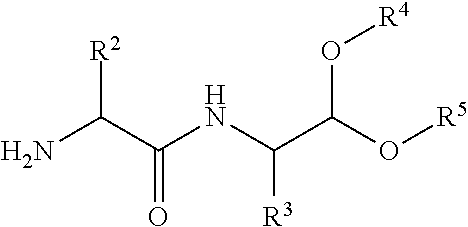
Accordingly, the present invention relates to compound of formula (I) or a salt thereof wherein
Figure US12351780-20250708-C00001
R1, R2 and R3 are each independently selected from the group consisting of hydrogen, optionally substituted C1-8alkyl, optionally substituted C2-6 alkenyl, optionally substituted C1-8 alkoxy, optionally substituted 3- to 12-membered cycloalkyl, and optionally substituted 6- to 10-membered aryl; or wherein each R1, R2 and R3 is independently selected as —(CH2)3— which is also attached to the nitrogen atom of —NH—C(H)— so that —N—C(H)R1,2 or 3— forms a 5-membered heterocyclic ring;
R4 and R5 are each independently selected from the group consisting of hydrogen, optionally substituted C1-8 alkyl, optionally substituted C2-6 alkenyl, optionally substituted C1-8 alkoxy, optionally substituted C1-4acyl, optionally substituted C1-8alkyl phenyl, and optionally substituted 6- to 10-membered aryl; or wherein R4 and R5 are joined to form an optionally substituted 5- to 12-membered ring;
Z is selected from hydrogen, an N-terminal protection group, and one or more amino acid residues optionally comprising an N-terminal protection group.
In one embodiment R1 and R2 is a group such that NH—CHR1—CO and NH—CHR2—CO is an L or D-amino acid residue of Gly, Ala, Val, Leu, He, Met, Pro, Phe, Trp, Ser, Thr, Asp, Gln, Tyr, Cys, Lys, Arg, His, Asn, Glu, m-tyrosine, 3,4-dihydroxyphenylalanine, Nva, or Nle.
In one embodiment R3 is a group such that NH—CHR3—CO is an L or D-amino acid residue of Gly, Ala, Val, Leu, He, Met, Pro, Phe, Trp, Ser, Thr, Asp, Gln, Tyr, Cys, Lys, Arg, His, Asn, Glu, m-tyrosine, 3,4-dihydroxyphenylalanine, Nva, or Nle, or wherein R3 is (CH3)3SiCH2.
In one embodiment R1 is a group such that NH—CHR1—CO is an L or D-amino acid residue of Ala, Val, Gly, Arg, Leu, Phe or Thr.
In one embodiment R2 is a group such that NH—CHR2—CO is an L or D-amino acid residue of Ala, Cys, Gly, Pro, Ser, Thr, Val, Nva or Nle.
In one embodiment R3 is a group such that NH—CHR3—CO is an L or D-amino acid residue of Tyr, m-tyrosine, 3,4-dihydroxyphenylalanine, Phe, Val, Ala, Met, Nva, Leu, He or Nle.
In one embodiment R4 and R5 are each independently selected from methyl (Me), ethyl (Et), isopropyl (iPr) or isobutyl (iBu), preferably from methyl or ethyl.
In one embodiment R4 and R5 are both methyl, ethyl, or isopropyl.
In one embodiment Z is an N-terminal protection group.
In one embodiment the N-terminal protection group is selected from benzyloxycarbonyl (Cbz), p-methoxybenzyl carbonyl (MOZ), benzyl (Bn), benzoyl (Bz), p-methoxybenzyl (PMB), p-methoxyphenyl (PMP), formyl, acetyl (Ac), methyloxy, alkoxycarbonyl, methoxycarbonyl (Moc), fluorenylmethyloxycarbonyl (Fmoc) or tert-butyloxycarbonyl (t-Boc). The present invention further relates to the use of the compound as disclosed herein for stabilizing an enzyme. In one embodiment the enzyme is a hydrolase, preferably a protease.
The present invention further relates to a composition comprising a compound as disclosed herein and an enzyme, preferably a hydrolase, more preferably a protease. In one embodiment the protease is a serine protease and preferably is a subtilisin protease. In one embodiment the composition further comprises a surfactant. In one embodiment the composition is in liquid or granular form. In one embodiment the composition comprises at least a second enzyme different from the first enzyme, preferably a lipase, protease, cutinase, amylase, carbohydrase, cellulase, pectinase, pectate lyase, mannanase, arabinase, galactanase, xylanase, oxidase, laccase or peroxidase.
The present invention further relates to a method of preparing the composition as disclosed herein comprising the step of mixing the enzyme, preferably the hydrolase, more preferably the protease, the compound of formula (I) as disclosed herein.
The present invention further relates to a detergent composition comprising the compound as disclosed herein or the composition as disclosed herein and optionally a surfactant.
The present invention further relates to a method of preparing a compound of formula (I) comprising the steps:
a) providing a compound according to formula
Figure US12351780-20250708-C00002
b) converting the compound of step a) to
Figure US12351780-20250708-C00003

or the corresponding salt thereof having the formula
Figure US12351780-20250708-C00004
c) reacting the compound or the corresponding salt thereof obtained in step b) with
Figure US12351780-20250708-C00005

to obtain
Figure US12351780-20250708-C00006
d) optionally, converting the compound obtained in step c) to
Figure US12351780-20250708-C00007

if Z is not hydrogen;
e) reacting the compound obtained in step c) or d) with
Figure US12351780-20250708-C00008

to obtain a compound according to formula (I)
Figure US12351780-20250708-C00009

wherein X is selected from F, Cl, Br and I; and
wherein R1 to R5 and Z are as defined herein.
DETAILED DESCRIPTION OF THE INVENTION
Although the present invention will be described with respect to particular embodiments, this description is not to be construed in a limiting sense.
Before describing in detail exemplary embodiments of the present invention, definitions important for understanding the present invention are given. Unless stated otherwise or apparent from the nature of the definition, the definitions apply to all methods and uses described herein.
As used in this specification and in the appended claims, the singular forms of “a” and “an” also include the respective plurals unless the context clearly dictates otherwise. In the context of the present invention, the terms “about” and “approximately” denote an interval of accuracy that a person skilled in the art will understand to still ensure the technical effect of the feature in question. The term typically indicates a deviation from the indicated numerical value of ±20%, preferably ±15%, more preferably ±10%, and even more preferably ±5%.
It is to be understood that the term “comprising” is not limiting. For the purposes of the present invention the term “consisting of” is considered to be a preferred embodiment of the term “comprising”. If hereinafter a group is defined to comprise at least a certain number of embodiments, this is meant to also encompass a group which preferably consists of these embodiments only.
Furthermore, the terms “first”, “second”, “third” or “(a)”, “(b)”, “(c)”, “(d)” etc. and the like in the description and in the claims, are used for distinguishing between similar elements and not necessarily for describing a sequential or chronological order. It is to be understood that the terms so used are interchangeable under appropriate circumstances and that the embodiments of the invention described herein are capable of operation in other sequences than described or illustrated herein. In case the terms “first”, “second”, “third” or “(a)”, “(b)”, “(c)”, “(d)”, “i”, “ii” etc. relate to steps of a method or use or assay there is no time or time interval coherence between the steps, i.e. the steps may be carried out simultaneously or there may be time intervals of seconds, minutes, hours, days, weeks, months or even years between such steps, unless otherwise indicated in the application as set forth herein above or below.
It is to be understood that this invention is not limited to the particular methodology, protocols, reagents etc. described herein as these may vary. It is also to be understood that the terminology used herein is for the purpose of describing particular embodiments only, and is not intended to limit the scope of the present invention that will be limited only by the appended claims. Unless defined otherwise, all technical and scientific terms used herein have the same meanings as commonly understood by one of ordinary skill in the art.
The term “alkyl” as used by itself or as part of another group refers to a straight- or branched-chain aliphatic hydrocarbon containing one to eight carbon atoms (i.e., C1-8 alkyl) or the number of carbon atoms designated (i.e., a C1 alkyl such as methyl, a C2 alkyl such as ethyl, a C3 alkyl such as propyl or isopropyl, etc.). In one embodiment, the alkyl group is chosen from a straight chain C1-8 alkyl group. In another embodiment, the alkyl group is chosen from a branched chain C3-8 alkyl group. In another embodiment, the alkyl group is chosen from a straight chain C1-6 alkyl group. In another embodiment, the alkyl group is chosen from a branched chain C3-6 alkyl group. In another embodiment, the alkyl group is chosen from a straight chain C1-4 alkyl group. In another embodiment, the alkyl group is chosen from a branched chain C3-4 alkyl group. In another embodiment, the alkyl group is chosen from a straight or branched chain C3-4 alkyl group. Non-limiting exemplary C1-8 alkyl groups include methyl, ethyl, propyl, isopropyl, butyl, sec-butyl, tert-butyl, iso-butyl, 3-pentyl, hexyl, heptyl, and octyl. Non-limiting exemplary C1-4alkyl groups include methyl, ethyl, propyl, isopropyl, butyl, sec-butyl, tert-butyl, and iso-butyl.
The term “optionally substituted alkyl” as used herein by itself or as part of another group means that the alkyl as defined above is either unsubstituted or substituted with one or more (e.g., one, two, or three) substituents independently selected from the group consisting of amino, (alkyl)amino, (alkyl)carbonyl, (aryl)carbonyl, (alkoxy)carbonyl, [(alkoxy)carbony]amino, carboxy, aryl, heteroaryl, ureido, guanidino, halogen, sulfonamido, hydroxyl, (alkyl)sulfanyl, nitro, haloalkoxy, aryloxy, aralkyloxy, (alkyl)sulfonyl, (cycloalkyl)sulfonyl, (aryl)sulfonyl, cycloalkyl, sulfanyl, caboxamido, heterocyclyl, (heterocyclyl) sulfonyl, amides, (alkyl)phosphates, nitrile, (alkyl)ethers, (alkyl)esters, and silyl, such as alkyl silyl. In one embodiment, the optionally substituted alkyl is substituted with two substituents. In another embodiment, the optionally substituted alkyl is substituted with one substituent. Non-limiting exemplary optionally substituted alkyl groups include CH(CH3)CONH2, —CH2CH2NO2, —CH(OH)CH2(OH), —CH(OH)CH(OH)CONH2, —CF3, —CH2CH2CO2H, —CH2Ph-OH, —CH2SH, —CH2CO2H, —CH(CH3)OH, —CH2CH2CH2NC(═NH)NH2, —CH2CH2SCH3, —CH2CH2COPh, and —CH2C6H11.
As used herein, the term “cycloalkyl” by itself or as part of another group refers to saturated or partially unsaturated (containing one or two double bonds) cyclic aliphatic hydrocarbons containing one to three rings having from three to twelve carbon atoms (i.e., C3-12 cycloalkyl) or the number of carbons designated. In one embodiment, the cycloalkyl group has two rings. In one embodiment, the cycloalkyl group has one ring. In another embodiment, the cycloalkyl group is a saturated or unsaturated C3-8 cycloalkyl group. In another embodiment, the cycloalkyl group is a saturated or unsaturated C5-6 cycloalkyl group. Non-limiting exemplary cycloalkyl groups include cyclopropyl, cyclobutyl, cyclopentyl, cyclohexyl, cycloheptyl, cyclooctyl, norbornyl, decalin, adamantyl, cyclohexenyl, cyclopentenyl, and cyclohexenyl.
As used herein, the term “optionally substituted cycloalkyl” by itself or as part of another group means that the cycloalkyl as defined above is either unsubstituted or substituted with one, two, or three substituents independently selected from the group consisting of halo, nitro, cyano, hydroxyl, amino, (alkyl)amino, (dialkyl)amino, haloalkyl, (hydroxyl)alkyl, (dihydroxy)alkyl, alkoxy, haloalkoxy, aryloxy, aralkyloxy, alkylthio, carboxamido, sulfonamido, (alkyl)carbonyl, (aryl)carbonyl, (alkyl)sulfonyl, arylsulfonyl, ureido, guanidino, carboxy, (carboxy)alkyl, alkyl, cycloalkyl, alkenyl, alkynyl, aryl, heteroaryl, heterocyclyl, (alkoxy)alkyl, (amino)alkyl, (hydroxyl)alkylamino, (alkylamino)alkyl, (dialkylamino)alkyl, (cyano)alkyl, (carboxamido)alkyl, (alkyl)sulfanyl, (heterocyclo)alkyl, (heteroaryl)alkyl, (alkoxy)carbonyl, mercaptoalkyl, amides, (alkyl)phosphates, nitrile, (alkyl)ethers, (alkyl)esters, and silyl, such as alkyl silyl. In one embodiment, the optionally substituted cycloalkyl is substituted with two substituents. In another embodiment, the optionally substituted cycloalkyl is substituted with one substituent. Non-limiting exemplary optionally substituted cycloalkyl groups include:
Figure US12351780-20250708-C00010
As used herein, the term “alkoxy” by itself or as part of another group refers to an optionally substituted alkyl, optionally substituted cycloalkyl, optionally substituted alkenyl, or optionally substituted alkynyl attached to a terminal oxygen atom. In one embodiment, the alkoxy group is chosen from a C1-8 alkoxy group. In another embodiment, the alkoxy group is chosen from a C1-8 alkyl attached to a terminal oxygen atom, e.g., methoxy, ethoxy, butoxy, and tert-butoxy.
As used herein, the term “alkenyl” by itself or as part of another group refers to an alkyl group as defined above containing one, two or three carbon-to-carbon double bonds. In one embodiment, the alkenyl group is chosen from a C2-6 alkenyl group. In another embodiment, the alkenyl group is chosen from a C2-4 alkenyl group. Non-limiting exemplary alkenyl groups include ethenyl, propenyl, isopropenyl, butenyl, sec-butenyl, pentenyl, and hexenyl.
As used herein, the term “optionally substituted alkenyl” by itself or as part of another group means the alkenyl as defined above is either unsubstituted or substituted with one, two or three substituents independently selected from the group consisting of halo, nitro, cyano, hydroxyl, amino, (alkyl)amino, (dialkyl)amino, haloalkyl, (hydroxy)alkyl, (dihydroxy)alkyl, alkoxy, haloalkoxy, aryloxy, aralkyloxy, (alkyl)sulfanyl, carboxamido, sulfonamido, (alkyl)carbonyl, (aryl)carbonyl, (alkyl)sulfonyl, (aryl)sulfonyl, ureido, guanidino, carboxy, (carboxy)alkyl, alkyl, cycloalkyl, alkenyl, alkynyl, aryl, heteroaryl, heterocyclyl, amides, (alkyl)phosphates, nitrile, (alkyl)ethers, (alkyl)esters, and silyl, such as alkyl silyl.
As used herein, the term “alkynyl” by itself or as part of another group refers to an alkyl group as defined above containing one to three carbon-to-carbon triple bonds. In one embodiment, the alkynyl has one carbon-to-carbon triple bond. In one embodiment, the alkynyl group is chosen from a C2-6 alkynyl group. In another embodiment, the alkynyl group is chosen from a C2-4 alkynyl group. Non-limiting exemplary alkynyl groups include ethynyl, propynyl, butynyl, 2-butynyl, pentynyl, and hexynyl groups.
As used herein, the term “optionally substituted alkynyl” by itself or as part of another group means the alkynyl as defined above is either unsubstituted or substituted with one, two or three substituents independently selected from the group consisting of halo, nitro, cyano, hydroxyl, amino, alkylamino, dialkylamino, haloalkyl, (hydroxy)alkyl, (dihydroxy)alkyl, alkoxy, haloalkoxy, alkeneoxy, aryloxy, aralkyloxy, (alkyl)sulfanyl, carboxamido, sulfonamido, alkylcarbonyl, arylcarbonyl, alkylsulfonyl, arylsulfonyl, ureido, guanidino, carboxy, (carboxy)alkyl, alkyl, cycloalkyl, alkenyl, alkynyl, aryl, heteroaryl, heterocyclyl, amides, (alkyl)phosphates, nitrile, (alkyl)ethers, (alkyl)esters, and silyl, such as alkyl silyl.
As used herein, the term “aryl” by itself or as part of another group refers to a monocyclic or bicyclic aromatic ring system having from six to fourteen carbon atoms (i.e., C6-C14 aryl). Non-limiting exemplary aryl groups include phenyl (abbreviated as “Ph”), naphthyl, phenanthryl, anthracyl, indenyl, azulenyl, biphenyl, biphenylenyl, and fluorenyl groups. In one embodiment, the aryl group is chosen from phenyl or naphthyl.
As used herein, the term “optionally substituted aryl” by itself or as part of another group means that the aryl as defined above is either unsubstituted or substituted with one to five substituents independently selected from the group consisting of halo, nitro, cyano, hydroxyl, amino, alkylamino, dialkylamino, haloalkyl, (hydroxy)alkyl, (dihydroxy)alkyl, alkoxy, haloalkoxy, aryloxy, heteroaryloxy, aralkyloxy, alkylthio, carboxamido, sulfonamido, (alkyl)carbonyl, (aryl)carbonyl, (alkyl)sulfonyl, (aryl)sulfonyl, ureido, guanidino, carboxy, car-boxyalkyl, alkyl, cycloalkyl, alkenyl, alkynyl, aryl, heteroaryl, heterocyclo, (alkoxy)alkyl, (amino)alkyl, [(hydroxyl)alkyl]amino, [(alkyl)amino]alkyl, [(dialkyl)amino)alkyl, (cyano)alkyl, (carboxamido)alkyl, mercaptoalkyl, (heterocyclo)alkyl, (cycloalkylamino)alkyl, (halo(C1-C4)alkoxy)alkyl, (heteroaryl)alkyl, amides, (alkyl)phosphates, nitrile, (alkyl)ethers, (alkyl)esters, and silyl, such as alkyl silyl. In one embodiment, the optionally substituted aryl is an optionally substituted phenyl. In one embodiment, the optionally substituted phenyl has four substituents. In another embodiment, the optionally substituted phenyl has three substituents. In another embodiment, the optionally substituted phenyl has two substituents. In another embodiment, the optionally substituted phenyl has one substituent. Non-limiting exemplary substituted aryl groups include 2-methylphenyl, 2-methoxyphenyl, 2-fluorophenyl, 2-chlorophenyl, 2-bromophenyl, 3-methylphenyl, 3-methoxyphenyl, 3-fluorophenyl, 3-chlorophenyl, 4-methylphenyl, 4-ethylphenyl, 4-methoxyphenyl, 4-fluorophenyl, 4-chlorophenyl, 2,6-di-fluorophenyl, 2,6-di-chlorophenyl, 2-methyl, 3-methoxyphenyl, 2-ethyl, 3-methoxyphenyl, 3,4-di-methoxyphenyl, 3,5-di-fluorophenyl 3,5-di-methylphenyl, 3,5-di-methoxy, 4-methylphenyl, 2-fluoro-3-chlorophenyl, and 3-chloro-4-fluorophenyl. The term optionally substituted aryl is meant to include groups having fused optionally substituted cycloalkyl and fused optionally substituted heterocyclo rings. Examples include:
Figure US12351780-20250708-C00011
As used herein, the term “heteroaryl” or “heteroaromatic” refers to monocyclic and bicyclic aromatic ring systems having 5 to 14 ring atoms (i.e., C5-C14 heteroaryl) and 1, 2, 3, or 4 heteroatoms independently chosen from oxygen, nitrogen and sulfur. In one embodiment, the heteroaryl has three heteroatoms. In another embodiment, the heteroaryl has two heteroatoms. In another embodiment, the heteroaryl has one heteroatom. In one embodiment, the heteroaryl is a C5 heteroaryl. In another embodiment, the heteroaryl is a C6 heteroaryl. Non-limiting exemplary heteroaryl groups include thienyl, benzo[b]thienyl, naphtho[2,3-b]thienyl, thianthrenyl, furyl, benzofuryl, pyranyl, isobenzofuranyl, benzooxazonyl, chromenyl, xanthenyl, 2H-pyrrolyl, pyrrolyl, imidazolyl, pyrazolyl, pyridyl, pyrazinyl, pyrimidinyl, pyridazinyl, isoindolyl, 3H-indolyl, indolyl, indazolyl, purinyl, isoquinolyl, quinolyl, phthalazinyl, naphthyridinyl, cinnolinyl, quinazolinyl, pteridinyl, 4aH-carbazolyl, carbazolyl, β-carbolinyl, phenanthridinyl, acridinyl, pyrimidinyl, phenanthrolinyl, phenazinyl, thiazolyl, isothiazolyl, phenothiazolyl, isoxazolyl, furazanyl, and phenoxazinyl. In one embodiment, the heteroaryl is chosen from thienyl (e.g., thien-2-yl and thien-3-yl), furyl (e.g., 2-furyl and 3-furyl), pyrrolyl (e.g., 1H-pyrrol-2-yl and 1H-pyrrol-3-yl), imidazolyl (e.g., 2H-imidazol-2-yl and 2H-imidazol-4-yl), pyrazolyl (e.g., 1H-pyrazol-3-yl, 1H-pyrazol-4-yl, and 1H-pyrazol-5-yl), pyridyl (e.g., pyridin-2-yl, pyridin-3-yl, and pyridin-4-yl), pyrimidinyl (e.g., pyrimidin-2-yl, pyrimidin-4-yl, and pyrimidin-5-yl), thiazolyl (e.g., thiazol-2-yl, thiazol-4-yl, and thiazol-5-yl), isothiazolyl (e.g., isothiazol-3-yl, isothiazol-4-yl, and isothiazol-5-yl), oxazolyl (e.g., oxazol-2-yl, oxazol-4-yl, and oxazol-5-yl) and isoxazolyl (e.g., isoxazol-3-yl, isoxazol-4-yl, and isoxazol-5-yl). The term “heteroaryl” is also meant to include possible N-oxides. Exemplary N-oxides include pyridyl N-oxide and the like.
As used herein, the term “optionally substituted heteroaryl” by itself or as part of another group means that the heteroaryl as defined above is either unsubstituted or substituted with one to four substituents, e.g., one or two substituents, independently selected from the group consisting of halo, nitro, cyano, hydroxy, amino, (alkyl)amino, (dialkyl)amino, haloalkyl, (hydroxy)alkyl, (dihydroxy)alkyl, alkoxy, haloalkoxy, aryloxy, aralkyloxy, alkylthio, carboxamido, sulfonamido, (alkyl)carbonyl, (aryl)carbonyl, (alkyl)sulfonyl, (aryl)sulfonyl, ureido, guanidino, carboxy, (carboxy)alkyl, alkyl, cycloalkyl, alkenyl, alkynyl, aryl, heteroaryl, heterocyclo, (alkoxy)alkyl, (amino)alkyl, [(hydroxyl)alkyl]amino, [(alkyl)amino]alkyl, [(dialkyl)amino]alkyl, (cyano)alkyl, (carboxamido)alkyl, mercaptoalkyl, (heterocyclo)alkyl, (heteroaryl)alkyl, and the like. In one embodiment, the optionally substituted heteroaryl has one substituent.
For the purpose of the present invention, compounds comprising a stereocenter are considered to encompass and disclose both enantiomers, unless specifically indicated. In case that a compound comprises more than one stereocenter, all diastereomers as well as enantiomers are considered to be encompassed and disclosed, unless specifically indicated. If reference is made to a composition or mixture comprising a compound according to the present invention, it is understood that the compound can be present either as enantiomerically and/or diastereomerically pure compound or as a mixture of enantiomers and/or diastereomers, for example as a racemic mixture of the L or D-enantiomers of the amino acid residues as defined hereinafter. The same applies with regard to the synthesis of the compounds of the present invention, which compounds can be obtained either as enantiomerically and/or diastereomerically pure compounds or as a mixture of enantiomers and/or diastereomers, for example as a racemic mixture of the L or D-enantiomers of the amino acid residue as defined hereinafter.
As discussed above, the present invention relates to a compound of formula (I) or a salt thereof wherein
Figure US12351780-20250708-C00012
R1, R2 and R3are each independently selected from the group consisting of hydrogen, optionally substituted C1-8alkyl, optionally substituted C2-6 alkenyl, optionally substituted C1-8 alkoxy, optionally substituted 3- to 12-membered cycloalkyl, and optionally substituted 6- to 10-membered aryl; or wherein each R1, R2 and R3 is independently selected as —(CH2)3— which is also attached to the nitrogen atom of —NH—C(H)— so that —N—C(H)R1,2 or 3— forms a 5-membered heterocyclic ring;
R4and R5 are each independently selected from the group consisting of hydrogen, optionally substituted C1-8 alkyl, optionally substituted C2-6 alkenyl, optionally substituted C1-8 alkoxy, optionally substituted C1-4 acyl, optionally substituted C1-8 alkyl phenyl (e.g. benzyl), and optionally substituted 6- to 10-membered aryl; or wherein R4 and R5 are joined to form an optionally substituted 5- or 6-membered ring;
Z is selected from hydrogen, an N-terminal protection group, and one or more amino acid residues optionally comprising an N-terminal protection group.
Preferably, each of R1 and R2 is a group such that NH—CHR1—CO and NH—CHR2—CO is an L or D-amino acid residue. L or D-amino acid residues include the L or D-form of glycine (Gly), alanine (Ala), valine (Val), leucine (Leu), isoleucine (He), methionine (Met), proline (Pro), phenylalanine (Phe), tryptophane (Trp), serine (Ser), threonine (Thr), aspartic acid (Asp), glutamine (Gln), tyrosine (Tyr), cysteine (Cys), lysine (Lys), arginine (Arg), histidine (His), asparagine (Asn), glutamic acid (Glu), m-tyrosine, 3,4-dihydroxyphenylalanine, norvaline (Nva) and norleucine (Nle).
Preferably, R1 is a group such that NH—CHR1—CO is an L or D-amino acid residue of Gly, Ala, Val, Leu, He, Met, Pro, Phe, Trp, Ser, Thr, Asp, Gln, Tyr, Cys, Lys, Arg, His, Asn, Glu, m-tyrosine, 3,4-dihydroxyphenylalanine, Nva, or Nle. More preferably, R1 is a group such that NH—CHR1—CO is an L or D-amino acid residue of Ala, Val, Gly, Arg, Leu, Phe, He, His or Thr. Even more preferably, R1 is a group such that NH—CHR1—CO is an L or D-amino acid residue of Ala, Val, Gly, Arg, Leu, He or His.
Preferably, R2 is a group such that NH—CHR2—CO is an L or D-amino acid residue of Gly, Ala, Val, Leu, He, Met, Pro, Phe, Trp, Ser, Thr, Asp, Gln, Tyr, Cys, Lys, Arg, His, Asn, Glu, m-tyrosine, 3,4-dihydroxyphenylalanine, Nva, or Nle. More preferably, R2 is a group such that NH—CHR2—CO is an L or D-amino acid residue of Ala, Cys, Gly, Pro, Ser, Thr, Val, Nva or Nle. Even more preferably, R2 is a group such that NH—CHR2—CO is an L or D-amino acid residue of Ala, Gly, Pro or Val.
In one embodiment, each of R1 and R2 is a group such that NH—CHR1—CO and NH—CHR2—CO is an L or D-amino acid residue of Gly, Ala, Val, Leu, He, Met, Pro, Phe, Trp, Ser, Thr, Asp, Gln, Tyr, Cys, Lys, Arg, His, Asn, Glu, m-tyrosine, 3,4-dihydroxyphenylalanine, Nva or Nle.
In one embodiment R1 is a group such that NH—CHR1—CO is an L or D-amino acid residue of Ala, Val, Gly, Arg, Leu, He or His and R2 is a group such that NH—CHR2—CO is an L or D-amino acid residue of Ala. In one embodiment R1 is a group such that NH—CHR1—CO is an L or D-amino acid residue of Ala, Val, Gly, Arg, Leu, He or His and R2 is a group such that NH—CHR2—CO is an L or D-amino acid residue of Gly. In one embodiment R1 is a group such that NH—CHR1—CO is an L or D-amino acid residue of Ala, Val, Gly, Arg, Leu, He or His and R2 is a group such that NH—CHR2—CO is an L or D-amino acid residue of Pro. In one embodiment R1 is a group such that NH—CHR1—CO is an L or D-amino acid residue of Ala, Val, Gly, Arg, Leu, He or His and R2 is a group such that NH—CHR2—CO is an L or D-amino acid residue of Val.
In one embodiment R1 is a group such that NH—CHR1—CO is an L or D-amino acid residue of Ala and R2 is a group such that NH—CHR2—CO is an L or D-amino acid residue of Ala, Gly, Pro or Val. In one embodiment R1 is a group such that NH—CHR1—CO is an L or D-amino acid residue of Val and R2 is a group such that NH—CHR2—CO is an L or D-amino acid residue of Ala, Gly, Pro or Val. In one embodiment R1 is a group such that NH—CHR1—CO is an L or D-amino acid residue of Gly and R2 is a group such that NH—CHR2—CO is an L or D-amino acid residue of Ala, Gly, Pro or Val. In one embodiment R1 is a group such that NH—CHR1—CO is an L or D-amino acid residue of Arg and R2 is a group such that NH—CHR2—CO is an L or D-amino acid residue of Ala, Gly, Pro or Val. In one embodiment R1 is a group such that NH—CHR1—CO is an L or D-amino acid residue of Leu and R2 is a group such that NH—CHR2—CO is an L or D-amino acid residue of Ala, Gly, Pro or Val. In one embodiment R1 is a group such that NH—CHR1—CO is an L or D-amino acid residue of He and R2 is a group such that NH—CHR2—CO is an L or D-amino acid residue of Ala, Gly, Pro or Val. In one embodiment R1 is a group such that NH—CHR1—CO is an L or D-amino acid residue of His and R2 is a group such that NH—CHR2—CO is an L or D-amino acid residue of Ala, Gly, Pro or Val.
In one embodiment R1 is a group such that NH—CHR1—CO is an L or D-amino acid residue of Gly and R2 is a group such that NH—CHR2—CO is an L or D-amino acid residue of Ala. In one embodiment R1 is a group such that NH—CHR1—CO is an L or D-amino acid residue of Val and R2 is a group such that NH—CHR2—CO is an L or D-amino acid residue of Ala. In one embodiment R1 is a group such that NH—CHR1—CO is an L or D-amino acid residue of Arg and R2 is a group such that NH—CHR2—CO is an L or D-amino acid residue of Ala. In one embodiment R1 is a group such that NH—CHR1—CO is an L or D-amino acid residue of Gly and R2 is a group such that NH—CHR2—CO is an L or D-amino acid residue of Gly. In one embodiment R1 is a group such that NH—CHR1—CO is an L or D-amino acid residue of Arg and R2 is a group such that NH—CHR2—CO is an L or D-amino acid residue of Val. In one embodiment R1 is a group such that NH—CHR1—CO is an L or D-amino acid residue of Leu and R2 is a group such that NH—CHR2—CO is an L or D-amino acid residue of Val. In one embodiment R1 is a group such that NH—CHR1—CO is an L or D-amino acid residue of Ala and R2 is a group such that NH—CHR2—CO is an L or D-amino acid residue of Val. In one embodiment R1 is a group such that NH—CHR1—CO is an L or D-amino acid residue of His and R2 is a group such that NH—CHR2—CO is an L or D-amino acid residue of Ala. In one embodiment R1 is a group such that NH—CHR1—CO is an L or D-amino acid residue of He and R2 is a group such that NH—CHR2—CO is an L or D-amino acid residue of Pro. In one embodiment R1 is a group such that NH—CHR1—CO is an L or D-amino acid residue of He and R2 is a group such that NH—CHR2—CO is an L or D-amino acid residue of Gly.
In one embodiment, R3 is a group selected from optionally substituted C1-8 alkyl, such as CH2Si(CH3)3, C1-8 alkylphosphates such as (CH2)nPO(OR)2, alkylnitriles such as CH2CN, C1-8 alkylsulfones such as CH2SO2R, C1-8 alkylethers such as (CH2)nOR, C1-8 alkylesters such as CH2CO2R, and C1-8 alkylamides; optionally substituted C1-8 alkoxy, optionally substituted 3- to 12-membered cycloalkyl, such as cyclohexylmethyl; and optionally substituted 6- to 10-membered aryl, wherein R is independently selected from the group consisting of hydrogen, optionally substituted C1-8 alkyl, optionally substituted C1-8 alkoxy, optionally substituted 3- to 12-membered cycloalkyl, optionally substituted 6- to 10-membered aryl, and optionally substituted 6- to 10-membered heteroaryl and n is an integer from 1 to 8, i.e. 1, 2, 3, 4, 5, 6, 7 or 8.
Preferably, R3 is a group such that NH—CHR3—CO is an L or D-amino acid residue of Tyr, m-tyrosine, 3,4-dihydroxyphenylalanine, Phe, Val, Ala, Met, Nva, Leu, He or Nle or other non-natural amino acids carrying alkyl groups. More preferably, R3 is a group such that NH—CHR3—CO is an L or D-amino acid residue of Tyr, Phe, Val, Ala or Leu.
In one embodiment, R2 and R3 is a group such that NH—CHR1—CO, NH—CHR2—CO and NH—CHR3—CO each is an L or D-amino acid residue of Gly, Ala, Val, Leu, He, Met, Pro, Phe, Trp, Ser, Thr, Asp, Gln, Tyr, Cys, Lys, Arg, His, Asn, Glu, m-tyrosine, 3,4-dihydroxyphenylalanine, Nva or Nle.
In a preferred embodiment, R1 and R2 is a group such that NH—CHR1—CO and NH—CHR2—CO each is an L or D-amino acid residue of Ala, Cys, Gly, Pro, Ser, Thr, Val, Nva or Nle, and R3 is a group such that NH—CHR3—CO is an L or D-amino acid residue of Tyr, m-tyrosine, 3,4-dihydroxyphenylalanine, Phe, Val, Ala, Met, Nva, Leu, He or Nle.
In a preferred embodiment, R1 is a group such that NH—CHR1—CO is an L or D-amino acid residue of Gly or Val, R2 is a group such that NH—CHR2—CO is an L or D-amino acid residue of Ala, and R3 is a group such that NH—CHR3—CO is an L or D-amino acid residue of Tyr, Ala, or Leu.
In a particularly preferred embodiment, R1 is a group such that NH—CHR1—CO is an L or D-amino acid residue of Val, R2 is a group such that NH—CHR2—CO is an L or D-amino acid residue of Ala, and R3 is a group such that NH—CHR3—CO is an L or D-amino acid residue of Leu.
In another particularly preferred embodiment, R1 is a group such that NH—CHR1—CO is an L or D-amino acid residue of Gly, R2 is a group such that NH—CHR2—CO is an L or D-amino acid residue of Ala, and R3 is a group such that NH—CHR3—CO is an L or D-amino acid residue of Tyr.
In another particularly preferred embodiment, R1 is a group such that NH—CHR1—CO is an L or D-amino acid residue of Val, R2 is a group such that NH—CHR2—CO is an L or D-amino acid residue of Ala, and R3 is a group such that NH—CHR3—CO is an L or D-amino acid residue of Ala.
In a particularly preferred embodiment, R1 is a group such that NH—CHR1—CO is an L or D-amino acid residue of Val, R2 is a group such that NH—CHR2—CO is an L or D-amino acid residue of Ala, and R3 is a group such that NH—CHR3—CO is an L or D-amino acid residue of Norleucine.
In a particularly preferred embodiment, R1 is a group such that NH—CHR1—CO is an L or D-amino acid residue of Val, R2 is a group such that NH—CHR2—CO is an L or D-amino acid residue of Ala, and R3 is a group such that NH—CHR3—CO is an L or D-amino acid residue of Norvaline.
In one embodiment, Wand Ware each independently selected from hydrogen, methyl, ethyl, i-propyl, n-propyl, i-butyl, s-butyl, n-butyl, i-pentyl, 2-pentyl, 3-pentyl, neopentyl, cyclopentyl, cyclohexyl, and benzyl.
Preferably, R4 and R5 are each independently selected from methyl, ethyl, isopropyl, 2-butyl or 3-pentyl. More preferably, R4 and R5 are both methyl, ethyl, isopropyl, 2-butyl or 3-pentyl.
In another embodiment, Wand Ware joined to form an optionally substituted 5- to 12-membered ring. Examples of the resulting ring are substituted or unsubstituted dioxolanes, dioxanes, trioxanes. Preferably, the resulting ring is 1,3-dioxolane, 4-methyl-1,3-dioxolane, 4-hydroxymethyl-1,3-dioxolane 4,4-dimethyl-1,3-dioxolane, 4,5-dimethyl-1,3-dioxolane, 4,4,5-trimethyl-1,3-dioxolane, 4,4,5,5-tetramethyl-1,3-dioxolane, substituted or unsubstituted 1,3-dioxane, 1,3,5-trioxane.
Z is selected from hydrogen, an N-terminal protection group, and one or more amino acid residues optionally comprising an N-terminal protection group. Preferably, Z is an N-terminal protection group.
The N-terminal protection group may be selected from formyl, acetyl (Ac), benzoyl (Bz), trifluoroacetyl, fluorenylmethyloxycarbonyl (Fmoc), methoxysuccinyl, aromatic and aliphatic urethane protecting groups, benzyloxycarbonyl (Cbz), tert-butyloxycarbonyl (Boc), adaman-tyloxycarbonyl, p-methoxybenzyl carbonyl (MOZ), benzyl (Bn), p-methoxybenzyl (PMB) or p-methoxyphenyl (PMP), methoxycarbonyl (Moc); methoxyacetyl (Mac); methyl carbamate, a methylamino carbonyl/methyl urea group, tityl (Trt), 3,5-dimethoxyphenylisoproxycarbonyl (Ddz), 2-(4-biphenyl)isopropoxycarbonyl (Bpoc), 2-nitrophenylsulfenyl (Nps), 2-(4-nitrophenylsulfonyl)ethoxycarbonyl (Nsc), 1,1-dioxobenzo[b]thiophene-2-ylmethyloxycarbonyl (Bsmoc), (1,1-dioxonaphtho[1,2-b]thiophene-2-yl)methyloxycarbonyl (α-Nsmoc), 1-(4,4-dimethyl-2,6-dioxocyclohex-1-ylidene)-3-methylbutyl (ivDde), 2,7-di-tert-butyl-Fmoc (Fmoc*), 2-fluoro-Fmoc (Fmoc(2F)), 2-monoisooctyl-Fmoc (mio-Fmoc) and 2,7-diisooctyl-Fmoc (dio-Fmoc), tetrachlorophthaloyl (TCP), 2-phenyl(methyl)sulfonio)ethyloxycarbonyl tetrafluoroborate (Pms), ethanesulfonylethoxycarbonyl (Esc), 2-(4-sulfophenylsulfonyl)ethoxycarbonyl (Sps), allyloxycarbonyl (Alloc), o-nitrobenzenesulfonyl (oNBS), 2,4-dinitrobenzenesulfonyl (dNBS), Benzothiazole-2-sulfonyl (Bts), 2,2,2-trichloroethyloxycarbonyl (Troc), dithiasuccinoyl (Dts), p-nitrobenzyloxycarbonyl (pNZ), α-Azidoacids, Propargyloxycarbonyl (Poc), o-Nitrobenzyloxycarbonyl (oNZ), 4-Nitroveratryloxycarbonyl (NVOC), 2-(2-Nitrophenyl)propyloxycarbonyl (NPPOC), 2-(3,4-Methylenedioxy-6-nitrophenyl)propyloxycarbonyl (MNPPOC), 9-(4-Bromophenyl)-9-fluorenyl (BrPhF), Azidomethyloxycarbonyl (Azoc), Hexafluoroacetone (HFA), 2-Chlorobenzyloxycarbonyl (CI-Z), Trifluoroacetyl (tfa), 2-(Methylsulfonyl)ethoxycarbonyl (Msc), Tetrachlorophthaloyl (TCP), Phenyldisulphanylethyloxycarbonyl (Phdec), 2-Pyridyldisulphanylethyloxycarbonyl (Pydec), or 4-Methyltrityl (Mtt).
If Z is one or more amino acid residue(s) comprising an N-terminal protection group, the N-terminal protection group is preferably a small aliphatic group, e.g., formyl, acetyl, fluorenylmethyloxycarbonyl (Fmoc), tert-butyloxycarbonyl (Boc), methoxycarbonyl (Moc); methoxyacetyl (Mac); methyl carbamate or a methylamino carbonyl/methyl urea group. In the case of a tripeptide, the N-terminal protection group is preferably a bulky aromatic group such as benzoyl (Bz), benzyloxycarbonyl (Cbz), p-methoxybenzyl carbonyl (MOZ), benzyl (Bn), p-methoxybenzyl (PMB) or p-methoxyphenyl (PMP).
Further suitable N-terminal protection groups are described in Greene's Protective Groups in Organic Synthesis, Fifth Edition by Peter G. M. Wuts, published in 2014 by John Wiley & Sons, Inc and in Isidro-Llobet et al., Amino Acid-Protecting Groups, Chem. Rev. 2009 109(6), 2455-2504.
Preferably, the N-terminal protection group is selected from benzyloxycarbonyl (Cbz), p-methoxybenzyl carbonyl (MOZ), benzyl (Bn), benzoyl (Bz), p-methoxybenzyl (PMB), p-methoxyphenyl (PMP), formyl, acetyl (Ac), methyloxy, alkoxycarbonyl, methoxycarbonyl, fluorenylmethyloxycarbonyl (Fmoc), or tert-butyloxycarbonyl (Boc).
As discussed above, the present invention further relates to the use of the compound according to formula (I) for stabilizing an enzyme.
In one embodiment, the enzyme is a hydrolase. Hydrolases are a class of enzymes that is commonly used as biochemical catalysts that utilize water to break a chemical bond. In a preferred embodiment, the enzyme is selected from a lipase, protease, cutinase, amylase, carbohydrase, cellulase, pectinase, pectate lyase, mannanase, arabinase, galactanase, xylanase, oxidase, laccase, and peroxidase. Preferred hydrolases include esterases, such as nucleases, phosphodiesterases, lipases, and phosphatases; proteases, such as serine proteases; and glycoside hydrolases, such as cellulases and amylases.
In a preferred embodiment, the enzyme is a protease or a lipase.
Proteases (also known as proteinases or peptidases) hydrolyze the peptide bond between amino acid residues in a polypeptide chain. Proteases may be specific and limited to one or more recognition sites within a protein, or they may be nonspecific, digesting proteins into individual amino acids.
Proteases are members of class EC 3.4. Proteases include aminopeptidases (EC 3.4.11), dipeptidases (EC 3.4.13), dipeptidyl-peptidases and tripeptidyl-peptidases (EC 3.4.14), peptidyl-dipeptidases (EC 3.4.15), serine-type carboxypeptidases (EC 3.4.16), metallocarboxypeptidases (EC 3.4.17), cysteine-type carboxypeptidases (EC 3.4.18), omega peptidases (EC
3.4.19), serine endopeptidases (EC 3.4.21), cysteine endopeptidases (EC 3.4.22), aspartic endopeptidases (EC 3.4.23), metallo-endopeptidases (EC 3.4.24), threonine endopeptidases (EC 3.4.25), endopeptidases of unknown catalytic mechanism (EC 3.4.99).
Commercially available protease enzymes include but are not limited to LAVERGY™ Pro (BASF); ALCALASER®, BLAZER®, DURALASE™, DURAZYM™, RELASE®, RELASE® ULTRA, SAVINASE®, SAVINASE® ULTRA, PRIMASE®, POLARZYME®, KANNASE®, LIQUANASE®, LIQUANASE® ULTRA, OVOZYME®, CORONASE®, CORONASE® ULTRA, NEUTRASE®, EVERLASE® AND ESPERASE® (Novozymes A/S), those sold under the tradename MAXATASE®, MAXACAL®, MAXAPEM®, PURAFECT®, PURA-FECT® PRIME, PURAFECT MA®, PURAFECT OX®, PURAFECT OXP®, PURAMAX®, PROPERASE®, FN2®, FN3®, FN4®, EXCELLASE®, ERASER®, ULTIMASE®, OPTICLEAN®, EFFECTENZ®, PREFERENZ® AND O PTI-MASE® (Danisco/DuPont), AXAPEM™ (Gist-Brocases N.V.), Bacillus lentus Alkaline Protease, and KAP (Bacillus alkalophilus subtilisin) from Kao.
Proteases can be classified by three criteria: the reaction catalyzed, the chemical nature of the catalytic site, and their evolutionary relationships. Endopeptidases cleave the target protein internally. Exopeptidases remove single amino acids from either the amino- or carboxyterminal end of a protein. Exopeptidases are divided into carboxypeptidases or aminopeptidases depending on whether they digest proteins from the carboxy- or amino-terminus, respectively.
Proteases are also classified based on their catalytic site architecture. In that regard, proteases can be classified into seven broad groups comprising serine proteases, cysteine proteases, threonine proteases, aspartic proteases, glutamic proteases, metalloproteases, and asparagine peptide lyases. Serine proteases have a serine in their active site that covalently attaches to one of the protein fragments as an enzymatic intermediate. This class includes the chymotrypsin family (chymotrypsin, trypsin, and elastase) and the subtilisin family. Cysteine proteases have a similar mechanism as serine proteases, but use cysteine rather than serine. They include plant proteases (papain from papaya, and bromelain from pineapple) as well as mammalian proteases such as calpains. Aspartic proteases have two essential aspartic acid residues that are close together in the active site although far apart in the protein sequence. This family includes the digestive enzymes pepsin and chymosin. Metalloproteases use metal ion cofactors to facilitate protein digestion and include thermolysin. Threonine proteases have threonine in the active site.
At least one protease may be selected from serine proteases (EC 3.4.21). Serine proteases or serine peptidases (EC 3.4.21) are characterized by having a serine in the catalytically active site, which forms a covalent adduct with the substrate during the catalytic reaction. A serine protease may be selected from the group consisting of chymotrypsin (e.g., EC 3.4.21.1), elastase (e.g., EC 3.4.21.36), elastase (e.g., EC 3.4.21.37 or EC 3.4.21.71), granzyme (e.g., EC 3.4.21.78 or EC 3.4.21.79), kallikrein (e.g., EC 3.4.21.34, EC 3.4.21.35, EC 3.4.21.118, or EC 3.4.21.119,) plasmin (e.g., EC 3.4.21.7), trypsin (e.g., EC 3.4.21.4), thrombin (e.g., EC 3.4.21.5,) and subtilisin (also known as subtilopeptidase, e.g., EC 3.4.21.62), the latter hereinafter also being referred to as “subtilisin”.
A sub-group of the serine proteases tentatively designated subtilases has been proposed by Siezen et al. (1991), Protein Eng. 4:719-737 and Siezen et al. (1997), Protein Science 6:501-523. They are defined by homology analysis of more than 170 amino acid sequences of serine proteases previously referred to as subtilisin-like proteases. A subtilisin was previously often defined as a serine protease produced by Gram-positive bacteria or fungi, and according to
Siezen et al. now is a subgroup of the subtilases. A wide variety of subtilases have been identified, and the amino acid sequence of a number of subtilases has been determined. For a more detailed description of such subtilases and their amino acid sequences reference is made to Siezen et al. (1997), Protein Science 6:501-523.
The subtilases may be divided into 6 sub-divisions, i.e. the subtilisin family, thermitase family, the proteinase K family, the lantibiotic peptidase family, the kexin family and the pyrolysin family.
A subgroup of the subtilases are the subtilisins which are serine proteases from the family S8 as defined by the MEROPS database (merops.sanger.ac.uk). Peptidase family S8 contains the serine endopeptidase subtilisin and its homologues.
Prominent members of family S8, subfamily A are: Subtilisin Carlsberg (S08.001), Subtilisin lentus (S08.003), Thermitase (S08.007), Subtilisin BPN′ (S08.034), Subtilisin DY (S08.037), Alkaline peptidase (S08.038), Subtilisin ALP 1 (S08.045), Subtilisin sendai (S08.098) and Alkaline elastase YaB (S08.157).
Parent proteases of the subtilisin type (EC 3.4.21.62) and variants may be bacterial proteases. Said bacterial protease may be a Gram-positive bacterial polypeptide such as a Bacillus, Clostridium, Enterococcus, Geobacillus, Lactobacillus, Lactococcus, Oceanobacillus, Staphylococcus, Streptococcus, or Streptomyces protease, or a Gram-negative bacterial polypeptide such as a Campylobacter, E. coli, Flavobacterium, Fusobacterium, Helicobacter, Ilyobacter, Neisseria, Pseudomonas, Salmonella, or Ureaplasma protease. A review of this family is provided, for example, in “Subtilases: Subtilisin-like Proteases” by R. Siezen, pages 75-95 in “Subtilisin enzymes”, edited by R. Bott and C. Betzel, New York, 1996.
At least one protease may be selected from the following: subtilisin from Bacillus amyloliquefaciens BPN′ (described by Vasantha et al. (1984) J. Bacteriol. 159, p. 811-819 and J A Wells et al. (1983) in Nucleic Acids Research, 11, p. 7911-7925); subtilisin from Bacillus licheniformis (subtilisin Carlsberg; disclosed in E L Smith et al. (1968) J. Biol Chem, 243, pp. 2184-2191, and Jacobs et al. (1985) in Nucl. Acids Res, 13, p. 8913-8926); subtilisin PB92 (original sequence of the alkaline protease PB92 is described in EP 283075 A2); subtilisin 147 and/or 309 (Esperase®, Savinase®, respectively) as disclosed in WO 89/06279; subtilisin from Bacillus lentus as disclosed in WO 91/02792, such as from Bacillus lentus DSM 5483 or the variants of Bacillus lentus DSM 5483 as described in WO 95/23221; subtilisin from Bacillus alcalophilus (DSM 11233) disclosed in DE 10064983; subtilisin from Bacillus gibsonii (DSM 14391) as disclosed in WO 2003/054184; subtilisin from Bacillus sp. (DSM 14390) disclosed in WO 2003/056017; subtilisin from Bacillus sp. (DSM 14392) disclosed in WO 2003/055974; subtilisin from Bacillus gibsonii (DSM 14393) disclosed in WO 2003/054184; subtilisin having SEQ ID Na: 4 as described in WO 2005/063974; subtilisin having SEQ ID Na: 4 as described in WO 2005/103244; subtilisin having SEQ ID Na: 7 as described in WO 2005/103244; and subtilisin having SEQ ID Na: 2 as described in application DE 102005028295.4.
At least one subtilisin may be subtilisin 309 (which might be called Savinase® herein) as disclosed as sequence a) in Table I of WO 89/06279 or a variant which is at least 80% identical thereto and has proteolytic activity.
Proteases are known as comprising the variants described in: WO 92/19729, WO 95/23221, WO 96/34946, WO 98/20115, WO 98/20116, WO 99/11768, WO 01/44452, WO 02/088340, WO 03/006602, WO 2004/03186, WO 2004/041979, WO 2007/006305, WO 2011/036263, WO 2011/036264, and WO 2011/072099. Suitable examples comprise especially protease variants of subtilisin protease derived from SEQ ID NO:22 as described in EP 1921147 (with amino acid substitutions in one or more of the following positions: 3, 4, 9, 15, 24, 27, 33, 36, 57, 68, 76, 77, 87, 95, 96, 97, 98, 99, 100, 101, 102, 103, 104, 106, 118, 120, 123, 128, 129, 130, 131, 154, 160, 167, 170, 194, 195, 199, 205, 206, 217, 218, 222, 224, 232, 235, 236, 245, 248, 252 and 274 which have proteolytic activity. In addition, a subtilisin protease is not mutated at positions Asp32, His64 and Ser221.
At least one subtilisin may have SEQ ID NO:22 as described in EP 1921147, or is a variant thereof which is at least 80%, at least 90%, at least 95% or at least 98% identical SEQ ID NO:22 as described in EP 1921147 and has proteolytic activity. In one embodiment, a subtilisin is at least 80%, at least 90%, at least 95% or at least 98% identical to SEQ ID NO:22 as described in EP 1921147 and is characterized by having amino acid glutamic acid (E), or aspartic acid (D), or asparagine (N), or glutamine (Q), or alanine (A), or glycine (G), or serine (S) at position 101 (according to BPN′ numbering) and has proteolytic activity. In one embodiment, subtilisin is at least 80%, at least 90%, at least 95% or at least 98% identical to SEQ ID NO:22 as described in EP 1921147 and is characterized by having amino acid glutamic acid (E) or aspartic acid (D), preferably glutamic acid (E), at position 101 (according to BPN′ numbering) and has proteolytic activity. Such a subtilisin variant may comprise an amino acid substitution at position 101, such as R101E or R101D, alone or in combination with one or more substitutions at positions 3, 4, 9, 15, 24, 27, 33, 36, 57, 68, 76, 77, 87, 95, 96, 97, 98, 99, 100, 101, 102, 103, 104, 106, 118, 120, 123, 128, 129, 130, 131, 154, 160, 167, 170, 194, 195, 199, 205, 206, 217, 218, 222, 224, 232, 235, 236, 245, 248, 252 and/or 274 (according to BPN′ numbering) and has proteolytic activity. In a preferred embodiment, the subtilisin protease is identical to SEQ ID NO:22 as described in EP 1921147 except that the protease is characterized by having amino acid glutamic acid (E) at position 101 (according to BPN′ numbering). In one embodiment, said protease comprises one or more further substitutions: (a) threonine at position 3 (3T), (b) isoleucine at position 4 (4I), (c) alanine, threonine or arginine at position 63 (63A, 63T, or 63R), (d) aspartic acid or glutamic acid at position 156 (156D or 156E), (e) proline at position 194 (194P), (f) methionine at position 199 (199M), (g) isoleucine at position 205 (2051), (h) aspartic acid, glutamic acid or glycine at position 217 (217D, 217E or 217G), (i) combinations of two or more amino acids according to (a) to (h).
A suitable subtilisin may be at least 80% identical to SEQ ID NO:22 as described in EP 1921147 and is characterized by comprising one amino acid (according to (a)-(h)) or combinations according to (i) together with the amino acid 101E, 101D, 101N, 101Q, 101A, 101G, or 101S (according to BPN′ numbering) and has proteolytic activity.
In one embodiment, a subtilisin is at least 80% identical to SEQ ID NO:22 as described in EP 1921147 and is characterized by comprising the mutation (according to BPN′ numbering) R101E, or S3T+V4I+V205I, or S3T+V4I+R101E+V205I or S3T+V4I+V199M+V205I+L217D, and has proteolytic activity. If secretion of these proteases into the fermentation medium is desired the use of the signal peptide of the AprE protein from Bacillus subtilis is preferred.
In another embodiment, the subtilisin comprises an amino acid sequence having at least 80% identity to SEQ ID NO:22 as described in EP 1921147 and being further characterized by comprising S3T+V4I+S9R+A15T+V68A+D99S+R101S+A103S+I104V+N218D (according to the BPN′ numbering) and has proteolytic activity.
A subtilisin may have an amino acid sequence being at least 80% identical to SEQ ID NO:22 as described in EP 1921147 and being further characterized by comprising R101E, and one or more substitutions selected from the group consisting of S156D, L262E, Q137H, S3T, R45E,D,Q, P55N, T58W,Y,L, Q59D,M,N,T, G61 D,R, S87E, G97S, A98D,E,R, S106A,W, N117E, H120V,D,K,N, S125M, P129D, E136Q, S144W, S161T, S163A,G, Y171 L, A172S, N185Q, V199M, Y209W, M222Q, N238H, V244T, N261T,D and L262N,Q,D (as described in WO 2016/096711 and according to the BPN′ numbering), and has proteolytic activity.
In one embodiment the subtilisin has the amino acid sequence according to SEQ ID NO:1 of the present sequence listing.
The subtilisin may be of animal, vegetable or microbial origin, including chemically or genetically modified mutants (protein engineered variants). Examples of subtilisins are those derived from Bacillus, e.g. subtilisin Novo, subtilisin Carlsberg, subtilisin BPN′, subtilisin 309, subtilisin 147 and subtilisin 168 (described in WO 89/06279) and Protease PD138 (WO 93/18140). Further examples of subtilisins are described in WO 98/020115, WO 01/44452, WO 01/58275, WO 01/58276, WO 03/006602 and WO 04/099401. Other examples of subtilisins are the variants described in WO 92/19729, WO 98/20115, WO 98/20116, WO 98/34946, WO 2011/036263 and mixtures of proteases.
Examples of commercially available subtilisins include Kannase™, Everlase™, Relase™, Esperase™, Alcalase™ Durazym™, Savinase™, Ovozyme™, Liquanase™, Coronase™, PoIarzyme™, Pyrase™, Pancreatic Trypsin NOVO (PIN), Bio-Feed™ Pro and Clear-Lens™ Pro; Blaze (all available from Novozymes A/S, Bagsvaerd, Denmark). Other commercially available subtilisins include Ronozyme™ Pro, Maxatase™, Maxacal™, Maxapem™, Opticlean™ Properase™, Purafast™ Purafect™ Purafect Ox™, Purafact Prime™, Excellase™, FN2™, FN3™ and FN4™ (available from Genencor International Inc., Gist-Brocades, BASF, or DSM). Other examples are Primase™ and Duralase™. Blap R, Blap S and Blap X available from Henkel.
In another embodiment, the enzyme is a lipase. Lipases or triacylglycerol hydrolases are a class of enzymes that catalyze the hydrolysis of lipids.
Suitable lipases include those of bacterial or fungal origin. Chemically modified or protein engineered mutants are included. Examples include lipase from Thermomyces, e.g. from T. lanuginosus (previously named Humicola lanuginosa) as described in EP 258 068 and EP 305 216, a Pseudomonas lipase,e.g. from P. alcaligenes or P. pseudo alcaligenes (EP 218 272), P. cepacia (EP 331 376), P. stutzeri(GB 1,372,034), P. fluorescens, Pseudomonas sp. strain SD 705 (WO 95/06720 and WO 96/27002), P. wisconsinensis (WO 96/12012), a Bacillus lipase,e.g. from B. subtilis (Dartois et al., 1993, Biochemica et Biophysica Acta, 1131: 253-360), B. stearothermophilus (JP 64/744992) or B. pumilus (WO 91/16422).
Other examples are lipase variants such as those described in WO 92/05249, WO 94/01541, EP 407 225, EP 260 105, WO 95/35381, WO 96/00292, WO 95/30744, WO 94/25578, WO 95/14783, WO 95/22615, WO 97/04079, WO 97/07202, WO 00/060063, WO 2007/087508 and WO 2009/109500.
Preferred commercially available lipase enzymes include Lipolase™, Lipolase Ultra™, and Lipex™; Lecitase™, Lipolex™; Lipoclean™ Lipoprime™ (Novozymes A/S). Other commercially available lipases include Lumafast (Genencor Int Inc); Lipomax (Gist-Bro-cades/Genencor Int Inc) and Bacillus sp lipase from Solvay.
In another embodiment, the enzyme is an amylase.
Suitable amylases (α and/or β) include those of bacterial or fungal origin. Chemically modified or protein engineered mutants are included. Amylases include, for example, α-amylases obtained from Bacillus, e.g. a special strain of Bacillus licheniformis, described in more detail in GB 1,296,839.
Examples of useful amylases are the variants described in WO 94/02597, WO 94/18314, WO 96/23873, and WO 97/43424, especially the variants with substitutions in one or more of the following positions: 15, 23, 105, 106, 124, 128, 133, 154, 156, 181, 188, 190, 197, 202, 208, 209, 243, 264, 304, 305, 391, 408, and 444.
Commercially available amylases are Stainzyme; Stainzyme Plus; Duramyl™, Termamyl™, Termamyl Ultra; Natalase, Fungamyl™ and BAN™ (Novozymes A/S), Rapidase™ and Purastar™ (from Genencor International Inc.).
Suitable cutinases include those of bacterial or fungal origin. Chemically modified or protein engineered mutants are included. Examples include cutinase from Humicola, e.g. H. insolensas described in WO 96/13580.
The pectate lyase may be a wild-type enzyme derived from Bacillus, particularly B. licheniformis or, B. agaradhaerens, or a variant derived of any of these, e.g. as described in U.S. Pat. No. 6,124,127, WO 99/027083, WO 99/027084, WO 2002/006442, WO 2002/092741, and WO 2003/095638. Commercially available pectate lyases include XPect, Pectawash and Pectaway (Novozymes A/S).
The mannanase may be an alkaline mannanase of Family 5 or 26. It may be a wild-type from Bacillus or Humicola, particularly from B. agaradhaerens, B. licheniformis, B. halodurans, B. clausii, or H. insolens. Suitable mannanases are described in WO 99/064619. A commercially available mannanase is Mannaway (Novozymes A/S).
Suitable cellulases include those of bacterial or fungal origin. Chemically modified or protein engineered mutants are included. Suitable cellulases include cellulases from the genera Bacillus, Pseudomonas, Humicola, Fusarium, Thielavia, Acremonium, e.g. the fungal cellulases produced from Humicola insolens, Myceliophthora thermophile and Fusarium oxysporum disclosed in U.S. Pat. Nos. 4,435,307, 5,648,263, 5,691,178, 5,776,757 and WO 89/09259.
Especially suitable cellulases are the alkaline or neutral cellulases having color care bene-fits. Examples of such cellulases are cellulases described in EP 0 495 257, EP 0 531 372, WO 96/11262, WO 96/29397, WO 98/08940. Other examples are cellulase variants such as those described in WO 94/07998, EP 0 531 315, U.S. Pat. Nos. 5,457,046, 5,686,593, 5,763,254, WO 95/24471, WO 98/12307 and WO 99/01544.
Commercially available cellulases are Celluzyme, Celluclean, Endolase, Carezyme, Renozyme, and whitezyme (Novozymes A/S) or Biotouch (AB Enzymes).
As discussed above, the present invention further relates a composition comprising a compound according to formula (I) and an enzyme, preferably a hydrolase, more preferably a protease and most preferably a subtilisin.
The composition can be provided in liquid or granular form. The composition may be added to a detergent composition, which further comprises one or more surfactants. The detergent composition may, e.g. be a laundry detergent composition or a dishwashing detergent composition.
The liquid detergent composition is in a physical form, which is not solid (or gas). It may be a pourable liquid, a pourable gel or a non-pourable gel. It may be either isotropic or structured, preferably it is isotropic. It includes formulations useful for washing in automatic washing machines or for hand washing. The detergent composition contains at least one surfactant. The detergent composition may also include a builder.
The particulate detergent composition may be a granulate or powder, or a powder/granulate pressed to a tablet, briquette. The detergent composition may be in the form of a tablet, bar or pouch, including multi-compartment pouches. The detergent composition can be in the form of a powder, for example a free-flowing powder, such as an agglomerate, spray-dried powder, encapsulate, extrudate, needle, noodle, flake, or any combination thereof.
Pouches can be of any form, shape and material which is suitable for holding the composition, e.g. without allowing the release of the composition from the pouch prior to water contact. The pouch is made from water-soluble film, which encloses an inner volume. Said inner volume can be divided into compartments of the pouch. Preferred films are polymeric materials preferably polymers which are formed into a film or sheet. Preferred polymers, copolymers or derivates thereof are selected polyacrylates, and water-soluble acrylate copolymers, methyl cellulose, carboxy methyl cellulose, sodium dextrin, ethyl cellulose, hydroxyethyl cellulose, hydroxypropyl methyl cellulose, malto dextrin, poly methacrylates, most preferably polyvinyl alcohol copolymers and, hydroxypropyl methyl cellulose (HPMC). Preferably, the level of polymer in the film for example PVA is at least about 60%. Preferred average molecular weight will typically be about 20,000 to about 150,000. Films can also be a blend compositions comprising hydrolytically degradable and water-soluble polymer blends such as polyactide and polyvinyl alcohol (known under the Trade reference M8630 as sold by Chris Craft In. Prod. Of Gary, Ind., US) plus plasticizers like glycerol, ethylene glycerol, Propylene glycol, sorbitol and mixtures thereof. The pouches can comprise a solid laundry cleaning composition or part components and/or a liquid cleaning composition or part components separated by the water-soluble film. The compartment for liquid components can be different in composition from compartments containing solids (see e.g. US 2009/0011970).
In one embodiment, the composition according to the present invention may be added to a detergent composition in an amount corresponding to 0.001-100 mg of protein, such as 0.01-100 mg of protein, preferably 0.005-50 mg of protein, more preferably 0.01-25 mg of protein, even more preferably 0.05-10 mg of protein, most preferably 0.05-5 mg of protein, and even most preferably 0.01-1 mg of protein per liter of detergent composition. In a composition such as a liquid or granular detergent, the amount of each enzyme (e.g. subtilisin and optionally a second or more enzymes) will typically be 0.04-80 μM (or μmol/kg), in particular 0.2-30 μM, especially 0.4-20 μM (generally 1-2000 mg/l or mg/kg, in particular 5-750 mg/l, especially 10-500 mg/l) calculated as pure enzyme protein. In a composition such as an enzyme concentrate the amount of each enzyme will typically be 0.01-20 mM, in particular 0.04-10 mM, especially 0.1-5 mM (generally 0.3-500 g/I, in particular 1-300 g/l, especially 3-150 g/l) calculated as pure enzyme protein.
The molar ratio of a compound according to formula (I) to the enzyme (e.g. subtilisin) is at least 1:1 or 1.5:1, and it is less than 1000:1, more preferred less than 500:1, even more preferred from 100:1 to 2:1 or from 20:1 to 2:1, or most preferred, the molar ratio is from 10:1 to 2:1.
In one embodiment, the composition comprises at least one further enzyme which is also called the second enzyme. In a preferred embodiment, the at least one further enzyme is selected from a lipase, protease, cutinase, amylase, carbohydrase, cellulase, pectinase, pectate lyase, mannanase, arabinase, galactanase, xylanase, oxidase, laccase, peroxidase and combinations thereof. Preferably, the second enzyme is an enzyme as described herein. The composition may contain one or more additional proteases, if the first enzyme is a protease. The composition may contain one, two or more non-subtilisin enzymes. The composition may contain one or more additional subtilisins, if the first enzyme is a subtilisin.
As described above, the detergent composition may comprise one or more surfactants, which may be anionic and/or cationic and/or non-ionic and/or semi-polar and/or zwitterionic, or a mixture thereof. In one embodiment, the detergent composition includes a mixture of one or more non-ionic surfactants and one or more anionic surfactants.
The surfactant(s) is typically present from about 0.1% to 60% by weight, such as from about 1% to about 40%, or from about 3% to about 20%, or from about 3% to about 10%. The surfactant(s) is chosen based on the desired cleaning application, and includes any conventional surfactant(s) known in the art. Any surfactant known in the art for use in detergents may be utilized.
Examples of anionic surfactants include sulfates and sulfonates, in particular, linear alkylbenzenesulfonates (LAS), isomers of LAS, branched alkylbenzenesulfonates (BABS), phenylalkanesulfonates, alpha-olefinsulfonates (AOS), olefin sulfonates, alkene sulfonates, alkane-2,3-diyIbis(sulfates), hydroxyalkanesulfonates and disulfonates, alkyl sulfates (AS) such as sodium dodecyl sulfate (SDS), fatty alcohol sulfates (FAS), primary alcohol sulfates (PAS), alcohol ethersulfates (AES or AEOS or FES, also known as alcohol ethoxysulfates or fatty alcohol ether sulfates, including sodium lauryl ether sulfate (SLES), soaps or fatty acids; secondary alkanesulfonates (SAS), paraffin sulfonates (PS), ester sulfonates, sulfonated fatty acid glycerol esters, alpha-sulfo fatty acid methyl esters (alpha-SFMe or SES) including methyl ester sulfonate (MES), alkyl- or alkenylsuccinic acid, dodecenyl/tetradecenyl succinic acid (DTSA), fatty acid derivatives of amino acids, diesters and monoesters of sulfo-succinic acid or soap, and combinations thereof.
When included therein the detergent composition will usually contain from about 1% to about 40% by weight, such as from about 5% to about 30%, including from about 5% to about 15%, or from about 20% to about 25% of an anionic surfactant.
Examples of non-ionic surfactants include alcohol ethoxylates (AE or AEO), alcohol propoxylates, propoxylated fatty alcohols (PEA), alkoxylated fatty acid alkyl esters, such as ethoxylated and/or propoxylated fatty acid alkyl esters, alkylphenol ethoxylates (APE), nonylphenol ethoxylates (NPE), alkylpolyglycosides (APG), alkoxylated amines, fatty acid monoethanolamides (FAM), fatty acid diethanolamides (FADA), ethoxylated fatty acid monoethanolamides (EFAM), propoxylated fatty acid monoethanolamide (PFAM), polyhydroxy alkyl fatty acid amides, or N-acyl N-alkyl derivatives of glucosamine (glucamides, GA, or fatty acid glucamide, FAGA), as well as products available under the trade names SPAN and TWEEN, and combinations thereof.
When included therein the detergent composition will usually contain from about 0.2% to about 40% by weight of a non-ionic surfactant, for example from about 0.5% to about 30%, in particular from about 1% to about 20%, from about 3% to about 10%, such as from about 3% to about 5%, or from about 8% to about 12%.
The detergent composition may contain about 0-65% by weight of a builder or co-builder, or a mixture thereof. In a dish wash detergent, the level of builder is typically 40-65%, particularly 50-65%. The builder and/or co-builder may particularly be a chelating agent that forms water-soluble complexes with Ca and Mg. Any builder and/or co-builder known in the art for use in laundry detergents may be utilized. Examples of builders that can be included are in particular silicates, aluminum silicates (in particular zeolites), carbonates, salts of organic di- and polycarboxylic acids and mixtures of these substances. Non-limiting examples of builders include zeolites, diphosphates (pyrophosphates), triphosphates such as sodium triphosphate (STP or STPP), nitrilotriacetic acid, ethylenediaminetetraacetic acid (EDTA), diethylenetriaminepentaacetic acid, alkyl- or alkenylsuccinic acid, carbonates such as sodium carbonate, soluble silicates such as sodium metasilicate, layered silicates (e.g., SKS-6 from Hoechst), ethanolamines such as 2-aminoethan-1-ol (MEA), iminodiethanol (DEA) and 2,2′,2″-nitrilotriethanol (TEA), and carboxymethylinulin (CMI), and combinations thereof.
The builder may be a strong builder such as methyl glycine diacetic acid (“MGDA”) or N,N-Dicarboxymethyl glutamic acid tetrasodium salt (GLDA); it may be a medium builder such as sodium tri-poly-phosphate (STPP), or it may be a weak builder such as sodium citrate.
Organic builders that can be present in the detergent composition are for example the polycarboxylic acids that can be used in the form of their sodium salts, polycarboxylic acids being understood to be carboxylic acids bearing more than one acid function. These are for example citric acid, adipic acid, succinic acid, glutaric acid, malic acid, tartaric acid, maleic acid, fumaric acid, sugar acids, aminocarboxylic acids, nitrilotriacetic acid (NTA), methyl glycine diacetic acid (MGDA) and derivatives and mixtures thereof. Preferred salts are the salts of polycarboxylic acids such as citric acid, adipic acid, succinic acid, glutaric acid, tartaric acid, sugar acids and mixtures thereof.
Polymeric polycarboxylates are also suitable as builders. These are for example the alkali metal salts of polyacrylic acid or polymethacrylic acid, for example those having a relative molar mass of 600 to 750,000 g/mol.
Suitable polymers are in particular polyacrylates, which preferably have a molar mass of 1000 to 15,000 g/mol. Of this group, owing to their superior solubility, preference can in turn be given to the short-chain polyacrylates having molar masses of 1000 to 10,000 g/mol and particularly preferably of 1000 to 5000 g/mol.
Also suitable are copolymeric polycarboxylates, in particular those of acrylic acid with methacrylic acid and of acrylic acid or methacrylic acid with maleic acid. To improve their solubility the polymers can also contain allyl sulfonic acids, such as all yloxybenzenesulfonic acid and methallyl sulfonic acid, as monomers.
However, soluble builders, such as for example citric acid, or acrylic polymers having a molar mass of 1000 to 5000 g/mol are preferably used.
Within the meaning of this application the molar masses specified for the polymeric polycarboxylates are weight-average molar masses Mw of the individual acid form, which were determined in principle by gel permeation chromatography (GPC) using a UV detector. The measurement was carried out against an external polyacrylic acid standard, which because of its structural affinity to the polymers under investigation delivers realistic molar mass values. These figures differ markedly from the molar mass values obtained using polystyrene sulfonic acids as the standard. The molar masses measured against polystyrene sulfonic acids are generally significantly higher than the molar masses given in this publication.
Such organic builder substances can be included if desired in amounts of up to 40 wt.-%, in particular up to 25 wt.-% and preferably from 1 wt.-% to 8 wt.-%. Amounts close to the cited upper limit are preferably used in paste-form or liquid, in particular water-containing, detergent compositions.
In the case that the compositions according to the invention are provided in liquid form, they contain preferably water as the main solvent. Non-aqueous solvents can also or additionally be used. Suitable non-aqueous solvents encompass mono- or polyhydric alcohols, alkanolamines or glycol ethers, provided they are miscible with water in the specified concentration range. The solvents are preferably selected from ethanol, n-propanol, isopropanol, butanols, glycol, propanediol, butanediol, glycerol, diglycol, propyl diglycol, butyl diglycol, hexylene glycol, ethylene glycol methyl ether, ethylene glycol ethyl ether, ethylene glycol propyl ether, ethylene glycol mono-n-butyl ether, diethylene glycol methyl ether, diethylene glycol ethyl ether, propylene glycol methyl ether, propylene glycol ethyl ether, propylene glycol propyl ether, dipropylene glycol monomethyl ether, dipropylene glycol monoethyl ether, diisopropylene glycol monomethyl ether, diisopropylene glycol monoethyl ether, methoxytriglycol, ethoxytriglycol, butoxytriglycol, 1-butoxyethoxy-2-propanol, 3-methyl-3-methoxybutanol, propylene glycol t-butyl ether, di-n-octyl ether and mixtures of these solvents. It is however preferable for the composition to contain a polyol as the non-aqueous solvent. The polyol can in particular encompass glycerol, 1,2-propanediol, 1,3-propanediol, ethylene glycol, diethylene glycol and/or dipropylene glycol. The composition preferably contains in particular a mixture of a polyol and a monohydric alcohol. Non-aqueous solvents can be used in amounts of between 0.5 and 15 wt.-%, but preferably below 12 wt.-%.
To set a desired pH that is not established automatically by mixing the other components, the composition can contain system-compatible and environmentally compatible acids, in particular citric acid, acetic acid, tartaric acid, malic acid, lactic acid, glycolic acid, succinic acid, glutaric acid and/or adipic acid, but also mineral acids, in particular sulfuric acid, or bases, in particular ammonium or alkali hydroxides. Such pH regulators are included in the agents in amounts preferably not exceeding 20 wt.-%, in particular from 1.2 wt.-% to 17 wt.-%.
A composition according to the invention can furthermore contain one or more water-soluble salts, which serve the purpose of viscosity adjustment for example. They can be inorganic and/or organic salts. Inorganic salts that can be used are preferably selected from the group comprising colorless water-soluble halides, sulfates, sulfites, carbonates, hydrogen carbonates, nitrates, nitrites, phosphates and/or oxides of alkali metals, alkaline-earth metals, aluminum and/or transition metals; ammonium salts can also be used. Halides and sulfates of alkali metals are particularly preferred; the inorganic salt is therefore preferably selected from the group comprising sodium chloride, potassium chloride, sodium sulfate, potassium sulfate and mixtures thereof. Organic salts that can be used are for example colorless water-soluble alkali metal, alkaline-earth metal, ammonium, aluminum and/or transition metal salts of carboxylic acids. The salts are preferably selected from the group comprising formate, acetate, propionate, citrate, malate, tartrate, succinate, malonate, oxalate, lactate and mixtures thereof.
The composition can contain one or more thickening agents for thickening purposes. The thickening agent is preferably selected from the group comprising xanthan gum, guar gum, carrageenan, agar agar, gellan, pectin, carob seed meal and mixtures thereof. These compounds are effective thickening agents even in the presence of inorganic salts. The thickening agent additionally stabilizes the continuous, low-surfactant phase and prevents a macroscopic phase separation.
The composition may comprise further enzyme inhibitors or stabilizers. Examples of such enzyme inhibitors or stabilizers are boric acid and boronic acids. Examples of boronic acids are alkyl boronic acids such as methylboronic acid, butylboronic acid, and 2-cyclohexylethylboronic acid; and aryl boronic acids such as phenylboronic acid, 4-methoxyphenylboronic acid, 3,5-dichlorophenylboronic acid, and 4-formylphenylboronic acid (4-FPBA).
The present invention is further directed to a method of preparing the composition according to the invention.
In one embodiment, the method comprises the step of mixing the enzyme, preferably protease, the compound of formula (I) and optionally one or more surfactants.
The present invention is further directed to a cleaning agent comprising the compound according to formula (I) or the composition according to the invention.
The present invention is further directed to a method of preparing a compound of formula (I) or a salt thereof. The method comprises the following steps:
a) providing a compound according to formula
Figure US12351780-20250708-C00013
b) converting the compound of step a) to
Figure US12351780-20250708-C00014

or the corresponding salt thereof having the formula
Figure US12351780-20250708-C00015
c) reacting the compound or the corresponding salt thereof obtained in step b) with
Figure US12351780-20250708-C00016

to obtain
Figure US12351780-20250708-C00017
d) optionally, converting the compound obtained in step c) to
Figure US12351780-20250708-C00018

if Z in the compound of step c) is not hydrogen;
e) reacting the compound obtained in step c) or d) with
Figure US12351780-20250708-C00019

to obtain a compound according to formula (I)
Figure US12351780-20250708-C00020

or a salt thereof.
X is selected from F, Cl, Br and I and R1 to R5 and Z are defined as hereinabove.
The following examples are provided for illustrative purposes. It is thus understood that the examples are not to be construed as limiting. The skilled person will clearly be able to envisage further modifications of the principles laid out herein.
EXAMPLES A. Synthesis Examples Example 1: Preparation of Z-Val-Ala-Ala-(OMe)2
Figure US12351780-20250708-C00021
To a solution of 50 ml (49 g, 0.46 mol) benzylamine in 250 ml heptane in a 20° C. water bath was added 64.5 ml (63 g, 0.53 mol) pyruvic aldehyde dimethylacetal. Temperature rose to ˜30° C. 20 g anhydrous MgSO4 was added and the suspension was allowed to stir for 16 h at 20° C. The suspension was concentrated before the unreacted starting materials were removed under high vacuum at 35° C. 81.6 g (86%) of a colorless oil was obtained. 1H NMR (CDCl3) 7.22-7.38 (m, 5), 4.573 (br s, 2), 4.567 (s, 1), 3.45 (s, 6) and 1.55 (s, 3) ppm.
Figure US12351780-20250708-C00022
81.6 g (0.39 mol) of the above compound was dissolved in 430 ml methanol and cooled to 5° C. in an ice-salt bath. 17.04 g NaBH4 (0.45 mol) was added to the clear solution in ˜15 portions. The first 5 portions caused a rise in temperature to 10-12° C. and much H2 evolved. The resulting suspension was allowed to stir overnight and warm to RT. The light yellow solution formed was concentrated in vacuo. 150 ml toluene and 200 ml water were added to the residue. The organic phase was separated and aqueous phase extracted with 100 ml toluene. The combined organic phases were dried over MgSO4 and concentrated in vacuo to give 77.5 g (94%) of a pale yellow oil. 1H NMR (CDCl3) 7.43-7.17 (m, 5), 4.17 (d, 1), 3.82 (dd, 2), 3.41 (s, 3), 3.38 (s, 3), 2.86 (pentet, 1), 1.76 (br s, 1), and 1.13 (d, 3) ppm.
Figure US12351780-20250708-C00023
76.7 g (0.37 mol) of the above compound was hydrogenated in 430 ml methanol with 7.5 g 10% Pd/C and 3 bar H2 for 26 h. The solution was then filtered and concentrated and dissolved in 300 ml ether. The ethereal solution was cooled to 4° C. and 11.0 g gaseous HCl were introduced over 1.5 h. At the end of the addition, the suspension was allowed to warm to RT and stir for 3 h. The suspension was filtered, washed with 2×50 ml ether, then dried under high vacuum to afford 42.5 g (0.27 mol, 74%) of a white solid. 1H NMR (D2O) 4.70 (br s, 3), 4.46 (d, 1), 3.49 (s, 3), 3.46 (s, 3), 3.44 (dq, 1), and 1.25 (d, 3) ppm.
Figure US12351780-20250708-C00024
To a suspension of 7.68 g (49 mmol) of the above compound in 100 ml ethyl acetate in a water bath at RT was added 26.6 ml (19.4 g, 150 mmol) diisopropylethylamine via syringe. Temperature decreased slightly and the suspension became lighter. 11.67 g (52 mmol) Z-Ala-OH was added as a solid followed by 35.2 ml 50% (59 mmol) propylphosphonic acid anhydride (PPAA) over 30 min by means of a syringe pump. Temperature decreased slightly. The resulting pale yellow suspension was allowed to stir at RT for 5 h. The Reaction mixture was poured into 100 ml sat'd NaHCO3. Organic phase was separated and washed with 50 ml water, 50 ml brine, then dried over MgSO4 and concentrated in vacuo to give 14.85 g (93%) of an off-white solid. 1HNMR (CDCl3) 7.42-7.30 (m, 5), 6.19 (br s, 1), 5.49 (br s, 1), 5.12 (br s, 2), 4.30-4.08 (m, 3), 3.45-3.36 (4s, 6), 1.39 (d, 3) and 1.12 (br d, 3) ppm.
Figure US12351780-20250708-C00025
14.0 g (43 mmol) of the above compound was hydrogenated in 140 ml methanol with 1.5 g 10% Pd/C and 3 bar H2 for 17 h. The solution was then filtered and concentrated in vacuo to provide 7.63 g (64 mmol, 93%) of pale yellow oil. 1HNMR (CDCl3) 7.34 (m, 1), 4.24-4.07 (m, 2), 3.49 (dq, 1), 3.45-3.42 (4s, 6), 1.50 (br s, 2), 1.34 (dd, 3), and 1.14 (dd, 3) ppm.
Figure US12351780-20250708-C00026
To a solution of 4.06 g (21.3 mmol) of the above compound in 75 ml methyl-t-butylether at RT was added 7.6 ml (5.65 g, 44 mmol) diisopropylethylamine via syringe. Temperature decreased slightly and the suspension became lighter. 5.68 g (22.6 mmol) Z-Val-OH was added as a solid followed by 15.3 ml 50% (26 mmol) propylphosphonic acid anhydride (PPAA) over 40 min by means of a syringe pump. The resulting suspension was allowed to stir overnight at RT. The suspension was treated with 100 ml sat'd NaHCO3 and filtered washing the solid with water and methyl-t-butylether. Drying under high vacuum gave 7.65 g (85%) of a fluffy white solid. 1HNMR (CDCl3) 7.47-7.29 (m, 5), 6.58 (br s, 1), 6.22 (br s, 1), 5.14 (m, 2), 4.48 (pentet, 1), 4.24-4.10 (m, 2), 4.05 (br t, 1), 3.46-3.38 (4s, 6), 2.14 (septet, 1), 1.39 (d, 3), 1.18-1.08 (m, 3) and 1.03-0.87 (3d, 6) ppm.
Example 2: Preparation of Z-Val-Ala-Leu-(OMe)2
Figure US12351780-20250708-C00027
Z-Val-Ala-Leu-(OMe)2 was obtained via steps analogous to steps a) to 1) of Example 1.
Example 3: Preparation of Z-Val-Ala-Leu-(OEt)2
Figure US12351780-20250708-C00028
Z-Val-Ala-Leu-(OEt)2 was obtained via steps analogous to steps a) to f) of Example 1.
Example 4: Preparation of Z-Val-Ala-Nva-(OEt)2
Figure US12351780-20250708-C00029
Z-Val-Ala-Nva-(OEt)2 was obtained via steps analogous to steps a) to f) of Example 1.
Example 5: Preparation of Z-Val-Ala-Phe-(OMe)2
Figure US12351780-20250708-C00030
Z-Val-Ala-Phe-(OMe)2 was obtained via steps analogous to steps a) to f) of Example 1.
Example 6: Preparation of Z-Val-Ala-Nva-(O-iPr)2
Figure US12351780-20250708-C00031
A mixture of 6.77 g (15 mmol) Cbz-Val-Ala-Nva-(0E02 from Example 6 above and 0.38 g (1.5 mmol) pyridinium tosylate in 60 ml isopropanol was heated under reflux overnight. After cooling, the thick suspension was filtered, the solid washed with 20 ml cold isopropanol. Recrystallization of the solid in isopropanol gave 1.06 (14%) of a white solid. 1H NMR (CDCl3) 7.45-7.30 (m, 5), 6.65-6.39 (m, 1), 6.02-5.79 (m, 1), 5.43-5.26 (br d, 1), 5.14 (m, 2), 4.56-4.38 (m, 2), 4.12-3.92 (m, 2), 3.92-3.39 (m, 2), 2.13 (septet, 1) and 1.72-0.84 (multiple m, 28) ppm.
Example 7: Preparation of Z-Val-Ala-Leu-(O-iPr)2
Figure US12351780-20250708-C00032
Z-Val-Ala-Leu-(O-iPr)2 was obtained analogous to Example 6.
Example 8: Preparation of Z-Val-Ala-Leu-(O-iBu)2
Figure US12351780-20250708-C00033
Z-Val-Ala-Leu-(O-iBu)2 was obtained was obtained analogous to Example 6.
Example 9: Preparation of Z-Val-Ala-Phe-(O-iPr)2
Figure US12351780-20250708-C00034
Z-Val-Ala-Phe-(O-Pr)2 was obtained analogous to Example 6.
Example 10: Preparation of Z-Val-Ala-Leu-(O-3-pentyl)2
Figure US12351780-20250708-C00035
Z-Val-Ala-Leu-(O-3-pentyl)2 was obtained analogous to Example 6.
Example 11: Preparation of Z-Val-Ala-Phe-(O-neopentyl)2
Figure US12351780-20250708-C00036
Z-Val-Ala-Phe-(O-neopentyl)2 was obtained was obtained analogous to Example 6.
B. Storage and Proteases Stability
To assess the ability of synthesized peptides to stabilize a protease storage trials were performed using a subtilisin according to SEQ ID NO:1 being the BLAP WT and being characterized by comprising the mutation (according to BPN′ numbering) R101E.
For the storage trials compositions as depicted in Table 1 with the ingredients given in w/w were prepared:
Formula- Formula- Formula- Formula-
tion 1 tion 2 tion 3 tion 4
Protease BLAP R101E  5%  5%  5%  5%
Propylenglycol 53% 53% 53% 53%
CaCl2 0.3  0.3  0.3  0.3 
Stabilizer
(1) Cbz-Val-Ala-Ala-(OMe)2 (Example 1) (molecular x X
weight: 377 g/mol)
(2) Cbz-Val-Ala-Ala-H (molecular weight 407 g/mol) x x
pH 4.50 5.50 4.50 5.50
H2O to 100% to 100% to 100% to 100%
stabilizers were added in 10 fold molar excess over
protease
The compositions were stored at a temperature of 30° for 31, 60 and 119 days and the residual protease activity after storage was analyzed by measuring the reactivity towards the peptidic substrate Suc-AAPF-pNA. Here pNA is cleaved from the substrate molecule at 30° C., pH 8.6 using 100 mM TRIS buffer. The rate of cleavage, directly proportional to the protease activity, can be determined by the increase of the yellow color of free pNA in the solution by measuring OD405, the optical density at 405 nm.
In Table 2 the residual activity is given referenced to the initial value. It can be seen that the stabilizer according to the invention (Formulations 1 and 2) is superior over its reference molecule tested in formulations 3 and 4 under the two different pH conditions, i.e., pH 4.5 and pH 5.5.
0 days 31 days 60 days 119 days
Formulation 1 100% 103% 105% 108%
Formulation 2 100% 101% 100%  95%
Formulation 3 100%  88%  71%  42%
Formulation 4 100%  56%  28%  10%

Claims (19)

The invention claimed is:
1. A compound of formula (I) or a salt thereof
Figure US12351780-20250708-C00037
wherein:
R1 is a group such that NH—CHR1—CO is an L or D-amino acid residue of Gly or Val, R2 is a group such that NH—CHR2—CO is an L or D-amino acid residue of Ala, and R3 is a group such that NH—CHR3—CO is an L or D-amino acid residue of Tyr, Ala, or Leu;
R4 and R5 are each independently selected from the group consisting of hydrogen, optionally substituted C1-8 alkyl, optionally substituted C2-6 alkenyl, optionally substituted C1-8 alkoxy, optionally substituted C1-4 acyl, optionally substituted C1-8 alkyl phenyl, and optionally substituted 6- to 10-membered aryl; or wherein R4 and R5 are joined to form an optionally substituted 5- to 12-membered ring; and
Z is selected from hydrogen, an N-terminal protection group, or one or more amino acid residues optionally comprising an N-terminal protection group.
2. The compound of claim 1, wherein R4 and R5 are each independently selected from methyl (Me), ethyl (Et), isopropyl (iPr) or isobutyl (iBu).
3. The compound of claim 2, wherein R4 and R5 are each independently selected from methyl or ethyl.
4. The compound of claim 1, wherein R4 and R5 are both methyl, ethyl, or isopropyl.
5. The compound of claim 1, wherein Z is an N-terminal protection group.
6. The compound of claim 5, wherein the N-terminal protection group is selected from benzyloxycarbonyl (Cbz), p-methoxybenzyl carbonyl (MOZ), benzyl (Bn), benzoyl (Bz), p-methoxybenzyl (PMB), p-methoxyphenyl (PMP), formyl, acetyl (Ac), methyloxy, alkoxycarbonyl, methoxycarbonyl (Moc), fluorenylmethyloxycarbonyl (Fmoc) or tert-butyloxycarbonyl (t-Boc).
7. The compound of claim 1, wherein the compound is selected from:
Cbz-Gly-Ala-Tyr-(OMe)2,
Cbz-Gly-Ala-Tyr-(OEt)2,
Ac-Gly-Ala-Tyr-(OMe)2,
Ac-Gly-Ala-Tyr-(OEt)2,
Cbz-Gly-Ala-Tyr-(OiPr)2,
Cbz-Gly-Ala-Tyr-(OiBu)2,
Ac-Gly-Ala-Tyr-(OiPr)2,
Ac-Gly-Ala-Tyr-(OiBu)2,
Bz-Gly-Ala-Tyr-(OMe)2,
Bz-Gly-Ala-Tyr-(OEt)2,
Fmoc-Gly-Ala-Tyr-(OMe)2,
Fmoc-Gly-Ala-Tyr-(OEt)2,
Bz-Gly-Ala-Tyr-(OiPr)2,
Bz-Gly-Ala-Tyr-(OiBu)2,
Fmoc-Gly-Ala-Tyr-(OiPr)2,
Fmoc-Gly-Ala-Tyr-(OiBu)2,
Cbz-Gly-Ala-Leu-(OMe)2,
Cbz-Gly-Ala-Leu-(OEt)2,
Ac-Gly-Ala-Leu-(OMe)2,
Ac-Gly-Ala-Leu-(OEt)2,
Cbz-Gly-Ala-Leu-(OiPr)2,
Cbz-Gly-Ala-Leu-(OiBu)2,
Ac-Gly-Ala-Leu-(OiPr)2,
Ac-Gly-Ala-Leu-(OiBu)2,
Bz-Gly-Ala-Leu-(OMe)2,
Bz-Gly-Ala-Leu-(OEt)2,
Fmoc-Gly-Ala-Leu-(OMe)2,
Fmoc-Gly-Ala-Leu-(OEt)2,
Bz-Gly-Ala-Leu-(OiPr)2,
Bz-Gly-Ala-Leu-(OiBu)2,
Fmoc-Gly-Ala-Leu-(OiPr)2,
Fmoc-Gly-Ala-Leu-(OiBu)2,
Cbz-Val-Ala-Leu-(OMe)2,
Cbz-Val-Ala-Leu-(OEt)2,
Ac-Val-Ala-Leu-(OMe)2,
Ac-Val-Ala-Leu-(OEt)2,
Cbz-Val-Ala-Leu-(OiPr)2,
Cbz-Val-Ala-Leu-(OiBu)2,
Ac-Val-Ala-Leu-(OiPr)2,
Ac-Val-Ala-Leu-(OiBu)2,
Bz-Val-Ala-Leu-(OMe)2,
Bz-Val-Ala-Leu-(OEt)2,
Fmoc-Val-Ala-Leu-(OMe)2,
Fmoc-Val-Ala-Leu-(OEt)2,
Bz-Val-Ala-Leu-(OiPr)2,
Bz-Val-Ala-Leu-(OiBu)2,
Fmoc-Val-Ala-Leu-(OiPr)2,
Fmoc-Val-Ala-Leu-(OiBu)2,
Cbz-Val-Ala-Ala-(OMe)2,
Cbz-Val-Ala-Ala-(OEt)2,
Ac-Val-Ala-Ala-(OMe)2,
Ac-Val-Ala-Ala-(OEt)2,
Cbz-Val-Ala-Ala-(OiPr)2,
Cbz-Val-Ala-Ala-(OiBu)2,
Ac-Val-Ala-Ala-(OiPr)2,
Ac-Val-Ala-Ala-(OiBu)2,
Bz-Val-Ala-Ala-(OMe)2,
Bz-Val-Ala-Ala-(OEt)2,
Fmoc-Val-Ala-Ala-(OMe)2,
Fmoc-Val-Ala-Ala-(OEt)2,
Bz-Val-Ala-Ala-(OiPr)2,
Bz-Val-Ala-Ala-(OiBu)2,
Fmoc-Val-Ala-Ala-(OiPr)2, or
Fmoc-Val-Ala-Ala-(OiBu)2; and wherein Cbz is benzyloxycarbonyl, Ac is acetyl, Bz is benzyl, and Fmoc is fluorenylmethyloxycarbonyl.
8. A composition comprising a compound according to claim 1 and an enzyme.
9. The composition according to claim 8, wherein the enzyme is a protease.
10. The composition according to claim 9, wherein the protease is a serine protease.
11. The composition according to claim 8, wherein the composition further comprises a surfactant.
12. The composition according to claim 8, wherein the composition is in liquid or granular form.
13. The composition according to claim 8, wherein the composition comprises at least two different enzymes.
14. A method of preparing a composition, wherein the method comprises mixing the compound according to claim 1 and an enzyme.
15. A detergent composition comprising the compound according to claim 1 and a surfactant.
16. A method of preparing a compound of formula (I) as defined in claim 1, wherein the method comprises:
a) providing a compound according to formula
Figure US12351780-20250708-C00038
b) converting the compound of step a) to
Figure US12351780-20250708-C00039
or the corresponding salt thereof having the formula
Figure US12351780-20250708-C00040
c) reacting the compound or the corresponding salt thereof obtained in step b) with
Figure US12351780-20250708-C00041
to obtain
Figure US12351780-20250708-C00042
d) optionally, converting the compound obtained in step c) to
Figure US12351780-20250708-C00043
if Z is not hydrogen; and
e) reacting the compound obtained in step c) or d) with
Figure US12351780-20250708-C00044
to obtain a compound according to formula (I)
Figure US12351780-20250708-C00045
wherein X is selected from F, Cl, Br or I; and
wherein R1 to R5 and Z are defined as in claim 1.
17. A compound selected from:
Cbz-Gly-Ala-Val-(OMe)2,
Cbz-Gly-Ala-Val-(OEt)2,
Ac-Gly-Ala-Val-(OMe)2,
Ac-Gly-Ala-Val-(OEt)2,
Cbz-Gly-Ala-Val-(OiPr)2,
Cbz-Gly-Ala-Val-(OiBu)2,
Ac-Gly-Ala-Val-(OiPr)2,
Ac-Gly-Ala-Val-(OiBu)2,
Bz-Gly-Ala-Val-(OMe)2,
Bz-Gly-Ala-Val-(OEt)2,
Fmoc-Gly-Ala-Val-(OMe)2,
Fmoc-Gly-Ala-Val-(OEt)2,
Bz-Gly-Ala-Val-(OiPr)2,
Bz-Gly-Ala-Val-(OiBu)2,
Fmoc-Gly-Ala-Val-(OiPr)2, or
Fmoc-Gly-Ala-Val-(OiBu)2,
wherein Cbz is benzyloxycarbonyl, Ac is acetyl, Bz is benzyl, and Fmoc is fluorenylmethyloxycarbonyl.
18. A compound selected from:
Cbz-Val-Ala-Norvaline-(OMe)2,
Cbz-Val-Ala-Norvaline-(OEt)2,
Ac-Val-Ala-Norvaline-(OMe)2,
Ac-Val-Ala-Norvaline-(OEt)2,
Cbz-Val-Ala-Norvaline-(OiPr)2,
Cbz-Val-Ala-Norvaline-(OiBu)2,
Ac-Val-Ala-Norvaline-(OiPr)2,
Ac-Val-Ala-Norvaline-(OiBu)2,
Bz-Val-Ala-Norvaline-(OMe)2,
Bz-Val-Ala-Norvaline-(OEt)2,
Fmoc-Val-Ala-Norvaline-(OMe)2,
Fmoc-Val-Ala-Norvaline-(OEt)2,
Bz-Val-Ala-Norvaline-(OiPr)2,
Bz-Val-Ala-Norvaline-(OiBu)2,
Fmoc-Val-Ala-Norvaline-(OiPr)2, or
Fmoc-Val-Ala-Norvaline-(OiBu)2,
wherein Cbz is benzyloxycarbonyl, Ac is acetyl, Bz is benzyl, and Fmoc is fluorenylmethyloxycarbonyl.
19. A compound selected from:
Cbz-Val-Ala-Trimethylsilyl-Ala-(OMe)2,
Cbz-Val-Ala-Trimethylsilyl-Ala-(OEt)2,
Ac-Val-Ala-Trimethylsilyl-Ala-(OMe)2,
Ac-Val-Ala-Trimethylsilyl-Ala-(OEt)2,
Cbz-Val-Ala-Trimethylsilyl-Ala-(OiPr)2,
Cbz-Val-Ala-Trimethylsilyl-Ala-(OiBu)2,
Ac-Val-Ala-Trimethylsilyl-Ala-(OiPr)2,
Ac-Val-Ala-Trimethylsilyl-Ala-(OiBu)2,
Bz-Val-Ala-Trimethylsilyl-Ala-(OMe)2,
Bz-Val-Ala-Trimethylsilyl-Ala-(OEt)2,
Fmoc-Val-Ala-Trimethylsilyl-Ala-(OMe)2,
Fmoc-Val-Ala-Trimethylsilyl-Ala-(OEt)2,
Bz-Val-Ala-Trimethylsilyl-Ala-(OiPr)2,
Bz-Val-Ala-Trimethylsilyl-Ala-(OiBu)2,
Fmoc-Val-Ala-Trimethylsilyl-Ala-(OiPr)2,
Fmoc-Val-Ala-Trimethylsilyl-Ala-(OiBu)2,
Cbz-Val-Ala-Cyclohexyl-Ala-(OMe)2,
Cbz-Val-Ala-Cyclohexyl-Ala-(OEt)2,
Ac-Val-Ala-Cyclohexyl-Ala-(OMe)2,
Ac-Val-Ala-Cyclohexyl-Ala-(OEt)2,
Cbz-Val-Ala-Cyclohexyl-Ala-(OiPr)2,
Cbz-Val-Ala-Cyclohexyl-Ala-(OiBu)2,
Ac-Val-Ala-Cyclohexyl-Ala-(OiPr)2,
Ac-Val-Ala-Cyclohexyl-Ala-(OiBu)2,
Bz-Val-Ala-Cyclohexyl-Ala-(OMe)2,
Bz-Val-Ala-Cyclohexyl-Ala-(OEt)2,
Fmoc-Val-Ala-Cyclohexyl-Ala-(OMe)2,
Fmoc-Val-Ala-Cyclohexyl-Ala-(OEt)2,
Bz-Val-Ala-Cyclohexyl-Ala-(OiPr)2,
Bz-Val-Ala-Cyclohexyl-Ala-(OiBu)2,
Fmoc-Val-Ala-Cyclohexyl-Ala-(OiPr)2, or
Fmoc-Val-Ala-Cyclohexyl-Ala-(OiBu)2,
wherein Cbz is benzyloxycarbonyl, Ac is acetyl, Bz is benzyl, and Fmoc is fluorenylmethyloxycarbonyl.
US17/621,807 2019-07-01 2020-06-24 Peptide acetals for stabilising enzymes Active 2042-05-22 US12351780B2 (en)

Applications Claiming Priority (4)

Application Number Priority Date Filing Date Title
EP19183669 2019-07-01
EP19183669.1 2019-07-01
PCT/EP2020/067722 WO2021001244A1 (en) 2019-07-01 2020-06-24 Peptide acetals for stabilising enzymes

Publications (2)

Publication Number Publication Date
US20220267699A1 US20220267699A1 (en) 2022-08-25
US12351780B2 true US12351780B2 (en) 2025-07-08

Family

ID=67137852

Family Applications (1)

Application Number Title Priority Date Filing Date
US17/621,807 Active 2042-05-22 US12351780B2 (en) 2019-07-01 2020-06-24 Peptide acetals for stabilising enzymes

Country Status (7)

Country Link
US (1) US12351780B2 (en)
EP (1) EP3994148A1 (en)
JP (1) JP2022538360A (en)
CN (1) CN114008068A (en)
BR (1) BR112021023457A2 (en)
MX (1) MX2021015894A (en)
WO (1) WO2021001244A1 (en)

Families Citing this family (70)

* Cited by examiner, † Cited by third party
Publication number Priority date Publication date Assignee Title
EP4217454A1 (en) 2020-09-24 2023-08-02 Unilever IP Holdings B.V. Composition
CN116601276B (en) 2020-12-14 2025-02-07 联合利华知识产权控股有限公司 Composition
WO2022128368A1 (en) 2020-12-14 2022-06-23 Unilever Ip Holdings B.V. Composition
EP4305140B1 (en) 2021-03-09 2024-07-17 Unilever IP Holdings B.V. Composition
WO2022228950A1 (en) 2021-04-30 2022-11-03 Unilever Ip Holdings B.V. Composition
AU2022265194B2 (en) 2021-04-30 2024-10-24 Unilever Global Ip Limited Composition
WO2022228903A1 (en) 2021-04-30 2022-11-03 Unilever Ip Holdings B.V. Composition
WO2022228832A1 (en) 2021-04-30 2022-11-03 Unilever Ip Holdings B.V. Composition
EP4330366B1 (en) 2021-04-30 2024-09-25 Unilever IP Holdings B.V. Composition
WO2022248108A1 (en) 2021-05-28 2022-12-01 Unilever Ip Holdings B.V. A liquid laundry detergent composition comprising c16 and c18 alcohol ethoxylate surfactant and/or c16 and c18 alkyl ether sulphate
WO2023012093A1 (en) 2021-08-05 2023-02-09 Unilever Ip Holdings B.V. Method
EP4381036B1 (en) 2021-08-05 2024-10-02 Unilever IP Holdings B.V. Composition
US20250101339A1 (en) 2021-08-05 2025-03-27 Conopco, Inc. Method
EP4408960A1 (en) 2021-09-29 2024-08-07 Unilever IP Holdings B.V. Composition
US20230129953A1 (en) 2021-10-26 2023-04-27 Conopco, Inc., D/B/A Unilever Composition
WO2023152092A1 (en) 2022-02-14 2023-08-17 Unilever Ip Holdings B.V. A concentrated liquid composition premix
WO2023152067A1 (en) 2022-02-14 2023-08-17 Unilever Ip Holdings B.V. A concentrated liquid composition premix
EP4532659B1 (en) 2022-05-27 2025-12-17 Unilever IP Holdings B.V. Laundry liquid composition comprising a surfactant, an aminocarboxylate, an organic acid and a fragrance
WO2023227421A1 (en) 2022-05-27 2023-11-30 Unilever Ip Holdings B.V. Laundry liquid composition comprising a surfactant, an alkoxylated zwitterionic polyamine polymer, and a fragrance
EP4532652B1 (en) 2022-05-27 2025-12-03 Unilever IP Holdings B.V. Composition comprising a specific methyl ester ethoxylate surfactant and a lipase
US20250354088A1 (en) 2022-05-27 2025-11-20 Conopco Inc., D/B/A Unilever Composition
CN119173619A (en) 2022-05-27 2024-12-20 联合利华知识产权控股有限公司 Laundry liquid composition comprising surfactant, alkoxylated zwitterionic polyamine polymer and protease
WO2023233025A1 (en) 2022-06-03 2023-12-07 Unilever Ip Holdings B.V. Liquid detergent product
EP4544017A1 (en) 2022-06-09 2025-04-30 Unilever IP Holdings B.V. A concentrated liquid detergent composition
WO2024017614A1 (en) 2022-07-18 2024-01-25 Unilever Ip Holdings B.V. A concentrated liquid composition
WO2024017623A1 (en) 2022-07-18 2024-01-25 Unilever Ip Holdings B.V. A concentrated liquid composition
CN119768495A (en) 2022-08-30 2025-04-04 联合利华知识产权控股有限公司 Detergent products
EP4587545A1 (en) 2022-09-13 2025-07-23 Unilever IP Holdings B.V. Washing machine and washing method
WO2024056334A1 (en) 2022-09-13 2024-03-21 Unilever Ip Holdings B.V. Washing machine and washing method
WO2024056333A1 (en) 2022-09-13 2024-03-21 Unilever Ip Holdings B.V. Washing machine and washing method
CN119895017A (en) 2022-09-13 2025-04-25 联合利华知识产权控股有限公司 Washing machine and washing method
EP4349943A1 (en) 2022-10-05 2024-04-10 Unilever IP Holdings B.V. Laundry liquid composition
EP4349944A1 (en) 2022-10-05 2024-04-10 Unilever IP Holdings B.V. Laundry liquid composition
EP4349945A1 (en) 2022-10-05 2024-04-10 Unilever IP Holdings B.V. Laundry liquid composition
EP4349942A1 (en) 2022-10-05 2024-04-10 Unilever IP Holdings B.V. Laundry liquid composition
EP4349946A1 (en) 2022-10-05 2024-04-10 Unilever IP Holdings B.V. Unit dose fabric treatment product
EP4349948A1 (en) 2022-10-05 2024-04-10 Unilever IP Holdings B.V. Laundry liquid composition
EP4349947A1 (en) 2022-10-05 2024-04-10 Unilever IP Holdings B.V. Laundry liquid composition
EP4361239A1 (en) 2022-10-25 2024-05-01 Unilever IP Holdings B.V. Laundry liquid composition
AU2023369590A1 (en) 2022-10-25 2025-04-03 Unilever Global Ip Limited Composition
CN120092075A (en) 2022-10-25 2025-06-03 联合利华知识产权控股有限公司 Composition
EP4627028A1 (en) 2022-11-29 2025-10-08 Unilever IP Holdings B.V. Composition
WO2024194098A1 (en) 2023-03-21 2024-09-26 Unilever Ip Holdings B.V. Detergent unit dose
CN120882844A (en) 2023-04-11 2025-10-31 联合利华知识产权控股有限公司 Composition
WO2024213376A1 (en) 2023-04-11 2024-10-17 Unilever Ip Holdings B.V. Composition
WO2024213428A1 (en) 2023-04-11 2024-10-17 Unilever Ip Holdings B.V. Composition
WO2024213430A1 (en) 2023-04-11 2024-10-17 Unilever Ip Holdings B.V. Composition
CN120835924A (en) 2023-04-11 2025-10-24 联合利华知识产权控股有限公司 Composition
WO2024223218A1 (en) 2023-04-25 2024-10-31 Unilever Ip Holdings B.V. Composition
WO2025011886A1 (en) 2023-07-11 2025-01-16 Unilever Ip Holdings B.V. Method for treating fabric
WO2025011808A1 (en) 2023-07-11 2025-01-16 Unilever Ip Holdings B.V. Method for treating fabric
WO2025012293A1 (en) 2023-07-13 2025-01-16 Unilever Ip Holdings B.V. Washing machine and method
WO2025016669A1 (en) 2023-07-19 2025-01-23 Unilever Ip Holdings B.V. Laundry capsule
WO2025026734A1 (en) 2023-08-02 2025-02-06 Unilever Ip Holdings B.V. Composition
WO2025031925A1 (en) 2023-08-04 2025-02-13 Unilever Ip Holdings B.V. Composition
WO2025031752A1 (en) 2023-08-04 2025-02-13 Unilever Ip Holdings B.V. Composition
EP4509589A1 (en) 2023-08-16 2025-02-19 Unilever IP Holdings B.V. Unit dose product
WO2025124811A1 (en) 2023-12-14 2025-06-19 Unilever Ip Holdings B.V. Composition
EP4570890A1 (en) 2023-12-14 2025-06-18 Unilever IP Holdings B.V. Composition
WO2025153645A1 (en) 2024-01-18 2025-07-24 Unilever Ip Holdings B.V. Use for fabric shape retention
WO2025153644A1 (en) 2024-01-18 2025-07-24 Unilever Ip Holdings B.V. Composition
WO2025168557A1 (en) 2024-02-08 2025-08-14 Unilever Ip Holdings B.V. Detection method for microbial contaminants in detergents
WO2025214720A1 (en) 2024-04-11 2025-10-16 Unilever Ip Holdings B.V. Washing machine and washing method
WO2025214659A1 (en) 2024-04-11 2025-10-16 Unilever Ip Holdings B.V. Washing method
EP4663737A1 (en) 2024-06-13 2025-12-17 Unilever IP Holdings B.V. Laundry unit dose product
EP4663729A1 (en) 2024-06-13 2025-12-17 Unilever IP Holdings B.V. Method for treating fabrics
EP4663728A1 (en) 2024-06-13 2025-12-17 Unilever IP Holdings B.V. Method for treating fabrics
EP4663738A1 (en) 2024-06-13 2025-12-17 Unilever IP Holdings B.V. Laundry unit dose product
WO2026012789A1 (en) 2024-07-08 2026-01-15 Unilever Ip Holdings B.V. Composition
WO2026012788A1 (en) 2024-07-08 2026-01-15 Unilever Ip Holdings B.V. Composition

Citations (20)

* Cited by examiner, † Cited by third party
Publication number Priority date Publication date Assignee Title
US4478745A (en) 1981-01-13 1984-10-23 Richter Gedeon Vegyeszeti Gyar R.T. T-Butyloxy-carbonyl-D-phenylalanyl-L-prolyl-L-arginine aldehyde hemisulfate, D-phenylalanyl-L-prolyl-L-arginine aldehyde sulfate and process for the preparation thereof
US4623639A (en) 1983-07-12 1986-11-18 Hoffmann-La Roche Inc. Peptide derivatives
US4691007A (en) 1983-04-27 1987-09-01 Ici Americas Inc. Proline derivatives
US4703036A (en) 1984-12-21 1987-10-27 Richter Gedeon Vegyeszeti Gyar Rt Peptide-aldehydes, process for the preparation thereof and pharmaceutical compositions containing the same
US4708944A (en) 1984-07-06 1987-11-24 Nippon Kayaku Kabushiki Kaisha Protease adsorbent and process for purifying TPA utilizing the same
US4742081A (en) 1986-01-06 1988-05-03 Alfred Stracher Carnitine coupled pharmaceutical agents
US4880780A (en) 1985-06-07 1989-11-14 Ici Americas Inc. Selected difluoro derivatives
WO1994004651A1 (en) 1992-08-14 1994-03-03 The Procter & Gamble Company Liquid detergents containing a peptide aldehyde
US5436229A (en) 1994-03-04 1995-07-25 Eli Lilly And Company Bisulfite adducts of arginine aldehydes
WO1995025791A1 (en) 1994-03-22 1995-09-28 The Procter & Gamble Company Protease enzyme manufacture using non-protein protease inhibitors
US5508385A (en) 1990-09-05 1996-04-16 Nitto Boseki Co., Ltd. Tripeptide derivatives containing pyroglutamic acid residue
WO1996030395A2 (en) 1995-03-31 1996-10-03 Takeda Chemical Industries, Ltd. Cysteine protease inhibitor
US5578574A (en) 1994-03-04 1996-11-26 Eli Lilly And Company Antithrombotic agents
WO1998013458A1 (en) 1996-09-24 1998-04-02 The Procter & Gamble Company Liquid detergents containing proteolytic enzyme and protease inhibitors
WO1998013460A1 (en) 1996-09-24 1998-04-02 The Procter & Gamble Company Liquid detergents containing proteolytic enzyme and protease inhibitors
WO1998047523A1 (en) 1997-04-18 1998-10-29 Cephalon Inc. Peptidyl-2-amino-1-hydroxyalkanesulfonic acid cysteine protease inhibitors
EP1921147A2 (en) 1994-02-24 2008-05-14 Henkel Kommanditgesellschaft auf Aktien Improved enzymes and detergents containing them
WO2009118375A2 (en) 2008-03-26 2009-10-01 Novozymes A/S Stabilized liquid enzyme compositions
WO2011036153A1 (en) 2009-09-25 2011-03-31 Novozymes A/S Detergent composition
WO2013004636A1 (en) 2011-07-01 2013-01-10 Novozymes A/S Stabilized subtilisin composition

Family Cites Families (79)

* Cited by examiner, † Cited by third party
Publication number Priority date Publication date Assignee Title
GB1296839A (en) 1969-05-29 1972-11-22
GB1372034A (en) 1970-12-31 1974-10-30 Unilever Ltd Detergent compositions
DK187280A (en) 1980-04-30 1981-10-31 Novo Industri As RUIT REDUCING AGENT FOR A COMPLETE LAUNDRY
JPH0697997B2 (en) 1985-08-09 1994-12-07 ギスト ブロカデス ナ−ムロ−ゼ フエンノ−トチヤツプ New enzymatic detergent additive
ES2058119T3 (en) 1986-08-29 1994-11-01 Novo Nordisk As ENZYMATIC DETERGENT ADDITIVE.
NZ221627A (en) 1986-09-09 1993-04-28 Genencor Inc Preparation of enzymes, modifications, catalytic triads to alter ratios or transesterification/hydrolysis ratios
EP0479396B1 (en) 1987-02-27 1999-06-09 Genencor International, Inc. Transformation of alkalophilic bacillus strains
DE3854249T2 (en) 1987-08-28 1996-02-29 Novonordisk As Recombinant Humicola Lipase and Process for the Production of Recombinant Humicola Lipases.
DK6488D0 (en) 1988-01-07 1988-01-07 Novo Industri As ENZYMES
JP3079276B2 (en) 1988-02-28 2000-08-21 天野製薬株式会社 Recombinant DNA, Pseudomonas sp. Containing the same, and method for producing lipase using the same
EP0406314B1 (en) 1988-03-24 1993-12-01 Novo Nordisk A/S A cellulase preparation
US5776757A (en) 1988-03-24 1998-07-07 Novo Nordisk A/S Fungal cellulase composition containing alkaline CMC-endoglucanase and essentially no cellobiohydrolase and method of making thereof
GB8915658D0 (en) 1989-07-07 1989-08-23 Unilever Plc Enzymes,their production and use
DE69033388T2 (en) 1989-08-25 2000-05-11 Henkel Research Corp., Santa Rosa ALKALINE PROTEOLYTIC ENZYME AND METHOD FOR PRODUCING THE SAME
KR100236540B1 (en) 1990-04-14 2000-01-15 레클로우크스 라우에르 Alkaline bacillus lipases, coding dna sequences thereof and bacilli which produce these lipases
AU639570B2 (en) 1990-05-09 1993-07-29 Novozymes A/S A cellulase preparation comprising an endoglucanase enzyme
DK115890D0 (en) 1990-05-09 1990-05-09 Novo Nordisk As ENZYME
DK0548228T3 (en) 1990-09-13 1999-05-10 Novo Nordisk As lipase variants
SG52693A1 (en) 1991-01-16 1998-09-28 Procter & Gamble Detergent compositions with high activity cellulase and softening clays
ES2121014T3 (en) 1991-05-01 1998-11-16 Novo Nordisk As STABILIZED ENZYMES AND DETERGENT COMPOSITIONS.
DK28792D0 (en) 1992-03-04 1992-03-04 Novo Nordisk As NEW ENZYM
DK88892D0 (en) 1992-07-06 1992-07-06 Novo Nordisk As CONNECTION
DE69334295D1 (en) 1992-07-23 2009-11-12 Novo Nordisk As MUTIER -g (a) -AMYLASE, DETERGENT AND DISHWASHER
EP1431389A3 (en) 1992-10-06 2004-06-30 Novozymes A/S Cellulase variants
ATE175235T1 (en) 1993-02-11 1999-01-15 Genencor Int OXIDATIVELY STABLE ALPHA-AMYLASE
AU673078B2 (en) 1993-04-27 1996-10-24 Genencor International, Inc. New lipase variants for use in detergent applications
JP2859520B2 (en) 1993-08-30 1999-02-17 ノボ ノルディスク アクティーゼルスカブ Lipase, microorganism producing the same, method for producing lipase, and detergent composition containing lipase
JPH07143883A (en) 1993-11-24 1995-06-06 Showa Denko Kk Lipase gene and mutant lipase
ATE222604T1 (en) 1994-02-22 2002-09-15 Novozymes As METHOD FOR PRODUCING A VARIANT OF A LIPOLYTIC ENZYME
DE69536145D1 (en) 1994-03-08 2011-04-07 Novozymes As Novel alkaline cellulases
WO1995030744A2 (en) 1994-05-04 1995-11-16 Genencor International Inc. Lipases with improved surfactant resistance
WO1995035381A1 (en) 1994-06-20 1995-12-28 Unilever N.V. Modified pseudomonas lipases and their use
WO1996000292A1 (en) 1994-06-23 1996-01-04 Unilever N.V. Modified pseudomonas lipases and their use
EP1995303A3 (en) 1994-10-06 2008-12-31 Novozymes A/S Enzyme preparation with endoglucanase activity
BE1008998A3 (en) 1994-10-14 1996-10-01 Solvay Lipase, microorganism producing the preparation process for the lipase and uses thereof.
AU3697995A (en) 1994-10-26 1996-05-23 Novo Nordisk A/S An enzyme with lipolytic activity
AR000862A1 (en) 1995-02-03 1997-08-06 Novozymes As VARIANTS OF A MOTHER-AMYLASE, A METHOD TO PRODUCE THE SAME, A DNA STRUCTURE AND A VECTOR OF EXPRESSION, A CELL TRANSFORMED BY SUCH A DNA STRUCTURE AND VECTOR, A DETERGENT ADDITIVE, DETERGENT COMPOSITION, A COMPOSITION FOR AND A COMPOSITION FOR THE ELIMINATION OF
JPH08228778A (en) 1995-02-27 1996-09-10 Showa Denko Kk Novel lipase gene and method for producing lipase using the same
CN1182451A (en) 1995-03-17 1998-05-20 诺沃挪第克公司 Novel endoglucanases
BR9608149B1 (en) 1995-05-05 2012-01-24 processes for effecting mutation in DNA encoding a subtilase enzyme or its pre- or pre-enzyme and for the manufacture of a mutant subtilase enzyme.
WO1997007202A1 (en) 1995-08-11 1997-02-27 Novo Nordisk A/S Novel lipolytic enzymes
WO1997004078A1 (en) 1995-07-14 1997-02-06 Novo Nordisk A/S A modified enzyme with lipolytic activity
US5763385A (en) 1996-05-14 1998-06-09 Genencor International, Inc. Modified α-amylases having altered calcium binding properties
WO1998008940A1 (en) 1996-08-26 1998-03-05 Novo Nordisk A/S A novel endoglucanase
DE69735767T2 (en) 1996-09-17 2007-04-05 Novozymes A/S cellulase
AU4772697A (en) 1996-11-04 1998-05-29 Novo Nordisk A/S Subtilase variants and compositions
CN1530443A (en) 1996-11-04 2004-09-22 ŵ����÷�����޹�˾ subtilase variants and compositions
US6159731A (en) 1997-02-12 2000-12-12 Massachusetts Institute Of Technology Daxx, a Fas-binding protein that activates JNK and apoptosis
EP1002061A1 (en) 1997-07-04 2000-05-24 Novo Nordisk A/S FAMILY 6 ENDO-1,4-$g(b)-GLUCANASE VARIANTS AND CLEANING COMPOSIT IONS CONTAINING THEM
DE69839076T2 (en) 1997-08-29 2009-01-22 Novozymes A/S PROTEASE VERSIONS AND COMPOSITIONS
WO1999027084A1 (en) 1997-11-24 1999-06-03 Novo Nordisk A/S Novel pectate lyases
WO1999027083A1 (en) 1997-11-24 1999-06-03 Novo Nordisk A/S PECTIN DEGRADING ENZYMES FROM $i(BACILLUS LICHENIFORMIS)
US6124127A (en) 1997-11-24 2000-09-26 Novo Nordisk A/S Pectate lyase
CN100497614C (en) 1998-06-10 2009-06-10 诺沃奇梅兹有限公司 Mannanase
KR20010108379A (en) 1999-03-31 2001-12-07 피아 스타르 Lipase variant
CN101974375B (en) 1999-12-15 2014-07-02 诺沃奇梅兹有限公司 Subtilase variants having an improved wash performance on egg stains
DK1257176T3 (en) 2000-02-08 2008-08-18 Dsm Ip Assets Bv Use of acid-stable proteases in animal feed
AU2001281736A1 (en) 2000-07-19 2002-01-30 Novozymes A/S Cell-wall degrading enzyme variants
DE10064983A1 (en) 2000-12-23 2002-07-18 Henkel Kgaa New subtilisin protease from Bacillus alcalophilus, useful e.g. in washing and cleaning compositions, comprises at positions 230, 256 and 259 amino acids Val, Gly and Asn
DE10121463A1 (en) 2001-05-02 2003-02-27 Henkel Kgaa New alkaline protease variants and washing and cleaning agents containing these new alkaline protease variants
EP1389228B1 (en) 2001-05-14 2009-03-11 Novozymes A/S Detergent compositions comprising bacillus subtilis pectate lyases
DK200101090A (en) 2001-07-12 2001-08-16 Novozymes As Subtilase variants
DE10162728A1 (en) 2001-12-20 2003-07-10 Henkel Kgaa New alkaline protease from Bacillus gibsonii (DSM 14393) and washing and cleaning agents containing this new alkaline protease
DE10163883A1 (en) 2001-12-22 2003-07-10 Henkel Kgaa New alkaline protease from Bacillus sp. (DSM 14390) and detergents and cleaning agents containing this new alkaline protease
DE10163884A1 (en) 2001-12-22 2003-07-10 Henkel Kgaa New alkaline protease from Bacillus sp. (DSM 14392) and detergents and cleaning agents containing this new alkaline protease
WO2003095638A1 (en) 2002-05-14 2003-11-20 Novozymes A/S Pectate lyase variants
CN101597601B (en) 2002-06-26 2013-06-05 诺维信公司 Subtilases and subtilase variants having altered immunogenicity
TWI319007B (en) 2002-11-06 2010-01-01 Novozymes As Subtilase variants
DE602004016314D1 (en) 2003-05-07 2008-10-16 Maxygen Inc ENZYM VARIANTS OF SUBTILISIN (SUBTILASES)
DE10360805A1 (en) 2003-12-23 2005-07-28 Henkel Kgaa New alkaline protease and detergents containing this novel alkaline protease
DE102004019751A1 (en) 2004-04-23 2005-11-17 Henkel Kgaa Novel Alkaline Proteases and Detergents Containing These Novel Alkaline Proteases
CN101218343B (en) 2005-07-08 2013-11-06 诺维信公司 subtilisin variant
ES2629332T3 (en) 2006-01-23 2017-08-08 Novozymes A/S Lipase variants
ATE503826T1 (en) 2007-07-02 2011-04-15 Procter & Gamble MULTI-CHAMBER BAGS CONTAINING DETERGENT
EP2250259B1 (en) 2008-02-29 2016-08-31 Novozymes A/S Polypeptides having lipase activity and polynucleotides encoding same
CA2775045A1 (en) 2009-09-25 2011-03-31 Novozymes A/S Subtilase variants for use in detergent and cleaning compositions
US20120252106A1 (en) 2009-09-25 2012-10-04 Novozymes A/S Use of Protease Variants
CA2782891C (en) 2009-12-09 2022-01-11 Danisco Us Inc. Compositions and methods comprising protease variants
CN107002058B (en) 2014-12-15 2026-01-27 诺维信公司 Subtilase variants

Patent Citations (21)

* Cited by examiner, † Cited by third party
Publication number Priority date Publication date Assignee Title
US4478745A (en) 1981-01-13 1984-10-23 Richter Gedeon Vegyeszeti Gyar R.T. T-Butyloxy-carbonyl-D-phenylalanyl-L-prolyl-L-arginine aldehyde hemisulfate, D-phenylalanyl-L-prolyl-L-arginine aldehyde sulfate and process for the preparation thereof
US4691007A (en) 1983-04-27 1987-09-01 Ici Americas Inc. Proline derivatives
US4623639A (en) 1983-07-12 1986-11-18 Hoffmann-La Roche Inc. Peptide derivatives
US4708944A (en) 1984-07-06 1987-11-24 Nippon Kayaku Kabushiki Kaisha Protease adsorbent and process for purifying TPA utilizing the same
US4703036A (en) 1984-12-21 1987-10-27 Richter Gedeon Vegyeszeti Gyar Rt Peptide-aldehydes, process for the preparation thereof and pharmaceutical compositions containing the same
US4880780A (en) 1985-06-07 1989-11-14 Ici Americas Inc. Selected difluoro derivatives
US4742081A (en) 1986-01-06 1988-05-03 Alfred Stracher Carnitine coupled pharmaceutical agents
US5508385A (en) 1990-09-05 1996-04-16 Nitto Boseki Co., Ltd. Tripeptide derivatives containing pyroglutamic acid residue
WO1994004651A1 (en) 1992-08-14 1994-03-03 The Procter & Gamble Company Liquid detergents containing a peptide aldehyde
EP1921147A2 (en) 1994-02-24 2008-05-14 Henkel Kommanditgesellschaft auf Aktien Improved enzymes and detergents containing them
US5436229A (en) 1994-03-04 1995-07-25 Eli Lilly And Company Bisulfite adducts of arginine aldehydes
US5578574A (en) 1994-03-04 1996-11-26 Eli Lilly And Company Antithrombotic agents
WO1995025791A1 (en) 1994-03-22 1995-09-28 The Procter & Gamble Company Protease enzyme manufacture using non-protein protease inhibitors
WO1996030395A2 (en) 1995-03-31 1996-10-03 Takeda Chemical Industries, Ltd. Cysteine protease inhibitor
WO1998013460A1 (en) 1996-09-24 1998-04-02 The Procter & Gamble Company Liquid detergents containing proteolytic enzyme and protease inhibitors
WO1998013458A1 (en) 1996-09-24 1998-04-02 The Procter & Gamble Company Liquid detergents containing proteolytic enzyme and protease inhibitors
WO1998047523A1 (en) 1997-04-18 1998-10-29 Cephalon Inc. Peptidyl-2-amino-1-hydroxyalkanesulfonic acid cysteine protease inhibitors
US6500802B1 (en) 1997-04-18 2002-12-31 Cephalon, Inc. Peptidyl-2-amino-1-hydroxyalkanesulfonic acid cysteine protease inhibitors
WO2009118375A2 (en) 2008-03-26 2009-10-01 Novozymes A/S Stabilized liquid enzyme compositions
WO2011036153A1 (en) 2009-09-25 2011-03-31 Novozymes A/S Detergent composition
WO2013004636A1 (en) 2011-07-01 2013-01-10 Novozymes A/S Stabilized subtilisin composition

Non-Patent Citations (9)

* Cited by examiner, † Cited by third party
Title
Bringmann, et al., A Simple, Chiral-Pool-Independent Synthesis of Enantiomerically Pure Alanine-Derived α-Amino Aldehyde Acetals, Synthesis, Issue 8, 1989, pp. 608-610.
European Search Report for EP Patent Application No. 19183669.1, Issued on Jan. 7, 2020, 6 pages.
Grobelny et al., Aldehyde and ketone substrate analogues inhibit the collagenase of Clostridium histolyticum, Biochemistry, 24(22):6145-52 (1985).
Harer, et al., "Proteasome inhibitors mechanism; source for design of newer therapeutic agents", The Journal Of Antibiotics, vol. 65, Issue 8, Apr. 18, 2012, pp. 279-288.
International Application No. PCT/EP2020/067722, International Search Report and Written Opinion, mailed Sep. 9, 2020.
Konno, et al., Synthetic study of peptide aldehyde via acetal/thioacetal transformation: application for Lys/Ser-containing peptides, Tetrahedron, vol. 71, Issue 21, May 27, 2015, pp. 3433-3438.
Nomoto et al., Syntheses of capreomycin analogs in relation to their antibacterial activities, Bulletin of the Chemical Society of Japan, 52(6):1709-15 (1979).
Someno et al., A simple method for semi-synthesis of peptidyl argininals as potent inhibitors of trypsin-like proteases, Chem. Pharm. Bull., 34(4):1748-54 (1986).
Teshima et al., Chemical studies on tuberactinomycin. XIII. Syntheses and antimicrobial activities of [Ala 3, Ala 4]-, [Ala 3]-, and [Ala 4]-tuberactinomycin O, Bulletin of the Chemical Society of Japan, 50(12):3372-80 (1977).

Also Published As

Publication number Publication date
US20220267699A1 (en) 2022-08-25
CN114008068A (en) 2022-02-01
WO2021001244A1 (en) 2021-01-07
JP2022538360A (en) 2022-09-01
BR112021023457A2 (en) 2022-01-25
MX2021015894A (en) 2022-02-03
EP3994148A1 (en) 2022-05-11

Similar Documents

Publication Publication Date Title
US12351780B2 (en) Peptide acetals for stabilising enzymes
EP2726592B1 (en) Stabilized subtilisin composition
CN1113089C (en) Liquid detergents containing proteolytic enzyme and protease inhibitors
KR101293498B1 (en) Subtilase variants
CN103649289A (en) Liquid detergent composition
WO2002016547A2 (en) Subtilase enzymes
AU2001279614A1 (en) Subtilase enzymes
CZ126196A3 (en) Alkali liquid detergent
CN1238004A (en) Liquid detergents containing proteases and protease inhibitors
US7109016B2 (en) Subtilase enzymes
EP2914734A1 (en) Process for the enzymatic formation of amide bonds
Nwankwo et al. Extracellular proteases from halophiles: diversity and application challenges
WO2022265069A1 (en) Enzyme-stabilizing agent for detergents
Miyazawa et al. Utilization of proteases from Aspergillus species for peptide synthesis via the kinetically controlled approach
US20040038845A1 (en) Method for production of a protease-inhibitor complex
US20170253863A1 (en) Proteases with enhanced water hardness tolerance
Miyazawa et al. Peptide synthesis using carbamoylmethyl esters as acyl donors mediated by Bacillus amyloliquefaciens protease
NO157706B (en) PROCEDURE FOR ENZYMATIC PREPARATION OF PEPTIDES.
DK155613B (en) Process for the enzymatic preparation of peptides

Legal Events

Date Code Title Description
AS Assignment

Owner name: BASF SE, GERMANY

Free format text: ASSIGNMENT OF ASSIGNORS INTEREST;ASSIGNOR:BASF SCHWEIZ AG;REEL/FRAME:058457/0682

Effective date: 20191015

Owner name: BASF SCHWEIZ AG, SWITZERLAND

Free format text: ASSIGNMENT OF ASSIGNORS INTEREST;ASSIGNOR:CUNNINGHAM, ALLAN F.;REEL/FRAME:058457/0633

Effective date: 20191007

Owner name: BASF SE, GERMANY

Free format text: ASSIGNMENT OF ASSIGNORS INTEREST;ASSIGNORS:JENEWEIN, STEFAN;BOENEMANN, GABRIELE;SIGNING DATES FROM 20190919 TO 20191029;REEL/FRAME:058457/0584

FEPP Fee payment procedure

Free format text: ENTITY STATUS SET TO UNDISCOUNTED (ORIGINAL EVENT CODE: BIG.); ENTITY STATUS OF PATENT OWNER: LARGE ENTITY

STPP Information on status: patent application and granting procedure in general

Free format text: DOCKETED NEW CASE - READY FOR EXAMINATION

STPP Information on status: patent application and granting procedure in general

Free format text: NON FINAL ACTION MAILED

STPP Information on status: patent application and granting procedure in general

Free format text: RESPONSE TO NON-FINAL OFFICE ACTION ENTERED AND FORWARDED TO EXAMINER

STPP Information on status: patent application and granting procedure in general

Free format text: NON FINAL ACTION MAILED

STPP Information on status: patent application and granting procedure in general

Free format text: RESPONSE TO NON-FINAL OFFICE ACTION ENTERED AND FORWARDED TO EXAMINER

STPP Information on status: patent application and granting procedure in general

Free format text: NOTICE OF ALLOWANCE MAILED -- APPLICATION RECEIVED IN OFFICE OF PUBLICATIONS

STCF Information on status: patent grant

Free format text: PATENTED CASE