US12351573B2 - Compounds for use in synthesis of peptidomimetics - Google Patents
Compounds for use in synthesis of peptidomimetics Download PDFInfo
- Publication number
- US12351573B2 US12351573B2 US17/860,148 US202217860148A US12351573B2 US 12351573 B2 US12351573 B2 US 12351573B2 US 202217860148 A US202217860148 A US 202217860148A US 12351573 B2 US12351573 B2 US 12351573B2
- Authority
- US
- United States
- Prior art keywords
- acid
- aza
- group
- formula
- amino acid
- Prior art date
- Legal status (The legal status is an assumption and is not a legal conclusion. Google has not performed a legal analysis and makes no representation as to the accuracy of the status listed.)
- Active
Links
Images


Classifications
-
- C—CHEMISTRY; METALLURGY
- C07—ORGANIC CHEMISTRY
- C07D—HETEROCYCLIC COMPOUNDS
- C07D403/00—Heterocyclic compounds containing two or more hetero rings, having nitrogen atoms as the only ring hetero atoms, not provided for by group C07D401/00
- C07D403/02—Heterocyclic compounds containing two or more hetero rings, having nitrogen atoms as the only ring hetero atoms, not provided for by group C07D401/00 containing two hetero rings
- C07D403/12—Heterocyclic compounds containing two or more hetero rings, having nitrogen atoms as the only ring hetero atoms, not provided for by group C07D401/00 containing two hetero rings linked by a chain containing hetero atoms as chain links
-
- C—CHEMISTRY; METALLURGY
- C07—ORGANIC CHEMISTRY
- C07K—PEPTIDES
- C07K1/00—General methods for the preparation of peptides, i.e. processes for the organic chemical preparation of peptides or proteins of any length
- C07K1/02—General methods for the preparation of peptides, i.e. processes for the organic chemical preparation of peptides or proteins of any length in solution
-
- C—CHEMISTRY; METALLURGY
- C07—ORGANIC CHEMISTRY
- C07K—PEPTIDES
- C07K1/00—General methods for the preparation of peptides, i.e. processes for the organic chemical preparation of peptides or proteins of any length
- C07K1/04—General methods for the preparation of peptides, i.e. processes for the organic chemical preparation of peptides or proteins of any length on carriers
-
- C—CHEMISTRY; METALLURGY
- C07—ORGANIC CHEMISTRY
- C07K—PEPTIDES
- C07K1/00—General methods for the preparation of peptides, i.e. processes for the organic chemical preparation of peptides or proteins of any length
- C07K1/06—General methods for the preparation of peptides, i.e. processes for the organic chemical preparation of peptides or proteins of any length using protecting groups or activating agents
- C07K1/061—General methods for the preparation of peptides, i.e. processes for the organic chemical preparation of peptides or proteins of any length using protecting groups or activating agents using protecting groups
Definitions
- the present invention is directed to compounds for use in synthesis of azapeptides and other aza-amino acid conjugates; synthesis of azapeptides and other aza-amino acid conjugates, and uses of azapeptides and other aza-amino acid conjugates in drug discovery, diagnosis, prevention, inhibition, and treatment of diseases.
- Azapeptides are analogs of peptides.
- An azapeptide contains a substituted semicarbazide instead of one or more of the amino acid residue(s) of the parent peptide.
- one or more of ⁇ -carbon atom(s) of the parent peptide are replaced with a nitrogen atom in the azapeptide.
- azapeptides are hydrolysed and degraded by enzymes at a slower rate.
- a compound of Formula (IA) is a compound in which
- a compound of Formula (IA) is a compound in which
- a compound of Formula (IA) is a compound in which X is imidazolyl or benzotriazolyl, and
- a compound of Formula (IA) is a compound in which X is imidazolyl substituted with —CF 3 , —CHF 2 , —CH 2 F, —CBr 3 , —CHBr 2 , —CH 2 Br, —CCl 3 , —CHCl 2 , - or —CH 2 Cl, and
- compound of Formula (IA) is a compound in which R 1 and R are CH 2 CH 2 CH 2 , and R 2 is tert-butoxycarbonyl, 9-fluorenylmethoxycarbonyl, 2-(3,5-dimethoxyphenyl)propan-2-yloxycarbonyl, and X is imidazolyl or benzotriazolyl.
- R 2 is a protecting group (e.g., tert-butoxycarbonyl, 9-fluorenylmethoxycarbonyl, 2-(3,5-dimethoxyphenyl)propan-2-yloxycarbonyl), and X is imidazolyl or benzotriazolyl.
- R 2 is a protecting group (e.g., tert-butoxycarbonyl, 9-fluorenylmethoxycarbonyl, 2-(3,5-dimethoxyphenyl)propan-2-yloxycarbonyl)
- X is imidazolyl or benzotriazolyl.
- Compounds of Formula (IB) could be used in drug discovery and/or as building blocks or synthons for synthesis of azapeptides and other peptidomimetics.
- R is selected from the group consisting of side chain radicals of aspartic acid, phenylalanine, alanine, histidine, glutamic acid, tryptophan, valine, leucine, lysine, methionine, tyrosine, threonine, isoleucine (including, R-isoleucine, S-isoleucine and RS-isoleucine), arginine, glycine, asparagine, serine, and glutamine; and M is an optional substituent selected from the group consisting of a halogen (Cl, F, or Br), a C 1 -C 6 alkyl (e.g., methyl), hydroxyl, —COOH, —COH, methoxyl, ethoxyl, propoxyl, a C 1 -C 6 haloalkyl (e.g., —CF 3 , —CHF 2 , —CH 2 F, —CBr 3 , —CHCH
- R is selected from the group consisting of side chain radicals of aspartic acid, phenylalanine, alanine, histidine, glutamic acid, tryptophan, threonine, valine, leucine, lysine, methionine, tyrosine, isoleucine (including, R-isoleucine, S-isoleucine and RS-isoleucine), arginine, glycine, asparagine, serine, and glutamine.
- the side chain radicals may be unsubstituted or substituted with one or more of the following: a halogen (Cl, F, or Br), a C 1 -C 6 alkyl (e.g., methyl), hydroxyl, —COOH, —COH, methoxyl, ethoxyl, propoxyl, a C 1 -C 6 haloalkyl (e.g., a chloromethyl, a fluromethyl, etc.) or a protecting group (e.g., N-Phth, N-Boc, N-Fmoc, N-Ddz, etc.).
- R is selected from the group consisting of H, methyl, isopropyl, isobutyl, benzyl, and side chain radicals of aspartic acid, histidine, glutamic acid, tryptophan, lysine, methionine, tyrosine, isoleucine (including, R-isoleucine, S-isoleucine and RS-isoleucine), arginine, asparagine, and glutamine.
- Compounds of Formula (III) could be used in drug discovery, diagnosis, prevention and treatment of diseases, or as building blocks or synthons for synthesis of azapeptides and other peptidomimetics.
- the invention is also directed to compounds of Formula (IV):
- R is selected from the group consisting of side chain radicals of aspartic acid, phenylalanine, alanine, histidine, glutamic acid, tryptophan, threonine, valine, leucine, lysine, methionine, tyrosine, isoleucine (including, R-isoleucine, S-isoleucine and RS-isoleucine), arginine, glycine, asparagine, serine, and glutamine.
- the invention is further directed to the use of compounds of Formulas (IA), (IB), (II), (III), and (IV) in the preparation of compounds of Formula (V):
- R is selected from the group consisting of side chain radicals of aspartic acid, phenylalanine, alanine, histidine, glutamic acid, tryptophan, valine, leucine, lysine, methionine, tyrosine, isoleucine (including, R-isoleucine, S-isoleucine and RS-isoleucine), arginine, glycine, asparagine, serine, threonine, cysteine, and glutamine.
- B is selected from the group consisting of hydrogen, —NH 2 , —NNH 2 , —CONH 2 , —COOR 3 , —COOH, —COH, —COC 1 -C 4 alkyl, —COC 1 -C 4 haloalkyl, —OH, an amino acid, an aza amino acid, a 2 to 60-mer peptide, a 2 to 60-mer aza peptide, a 2 to 60-mer azatide;
- the invention is further directed to the use of compounds of Formulas (IA), (IB), (II), (III), and (IV) in the preparation of compounds of Formula (V):
- B of each compound is independently selected from the group consisting of hydrogen, —NH 2 , —NNH 2 , —CONH 2 , —COOR 3 , —COC 1 -C 4 alkyl, —COC 1 -C 4 haloalkyl, —OH, an amino acid, an aza amino acid, a 2 to 60-mer peptide, a 2 to 60-mer aza peptide, a 2 to 60-mer azatide;
- the invention is further directed to the use of compounds of Formulas (IA), (IB), (II), (III), and (IV) in the preparation of azabradykinin, including, e.g., aza-7 bradykinin, aza-2,8 bradykinin, aza-2 bradykinin, and aza-8 bradykinin:
- the invention is also directed in part to a method of preparing a compound of Formula (V), the method comprising a step of activating a compound of Formula (IA), Formula (IB), Formula (II), Formula (III) or Formula (IV) to form an activated compound of Formula (IA), Formula (IB), Formula (II), Formula (III), or Formula (IV), a step of coupling the activated compound of Formula (IA), Formula (IB), Formula (II), Formula (III), or Formula (IV) with N-terminal of an amino acid, N-terminal of an aza-mino acid, provided that, if a side chain of the amino acid or aza-amino acid contains a group selected from amino, amide, guanidino N, carboxyl, sulfhydryl, carboxyl, hydroxyl, indole, imidazole phenol, the group is protected with a protecting group selected from tert-butoxycarbonyl (Boc), 9-fluorenylmeth
- compounds of Formula (IA), Formula (IB) and Formula (IV) are activated by iodomethane (MeI).
- the compound of Formula (IA), Formula (IB) and Formula (III) are activated by DIPEA in acetonitrile.
- the invention is also directed to a method of preparing an azapeptide comprising a step of activating a compound according to Formula (I); and a step of coupling the activated compound with N-terminal of an amino acid, N-terminal of an aza-mino acid; wherein the azapeptide is a compound of Formula (V).
- the compound of Formula (I) may be unsubstituted or substituted with one or more of the following: a halogen, a C 1 -C 6 alkyl, hydroxyl, —COOH, —COH, methoxyl, ethoxyl, propoxyl, or a C 1 -C 6 haloalkyl.
- the compound of Formula (I) in the compound of Formula (V) may be at the N-terminus and/or the C-terminus of the compound of Formula (V), is adjacent to the N-terminus and/or the C-terminus of the compound of Formula (V) or hydrolysis site of the compound of Formula (V).
- the compound of Formula (I) is activated by iodomethane, the coupling is in acetonitrile and comprises addition of DIPEA, and is during solid phase azapeptide synthesis.
- the compound of Formula (I) is activated by iodomethane, the coupling is in acetonitrile and comprises addition of DIPEA, and is during liquid phase azapeptide synthesis.
- the azapeptide is preferably prepared in a yield of at least about 40% (by weight) (e.g., from about 45% to about 65%, from about 50% to about 65%, or from about 55% to about 65%, etc.). In certain embodiments, the yield is greater than about 45%, about 50%, about 55%, or about 60%. Thus, the yield may, e.g., be about about 50%, about 55%, about 60%, or about 65%. In certain embodiments, the azapeptide is a di-azapeptide and is synthesized in a yield from about 80% to about 98%.
- the invention is also directed in part to a method of preparing a compound of Formula (V), the method comprising a step of coupling a compound of Formula (IA), (IB), (II), (III), or (IV) with an aza-amino acid to form a protected di-azatide, and a step of deprotecting the protected di-azatide, e.g., with hydrazine, TFA, acetic acid, thioanisole, EDT, anisole, a mixture of any of the foregoing, or another de-protecting compound, to form a compound of Formula (V).
- the invention is also directed in part to a method of preparing a compound of Formula (V), the method comprising a step of coupling a first compound of Formula (IA), (IB), (II), (III), or (IV) with an amino acid, a second compound of Formula (IA), (IB), (II), (III), or (IV), a peptide, or an azatide in acetonitrile at a temperature from 15° C. to 35° C., wherein the coupling is for a time period from about 20 minutes to about 6 hours, from about 30 minutes to about 5 hours, from about 40 minutes to about 4 hours, from about 50 minutes to about 3 hours, from about 50 minutes to about 2 hours.
- the coupling is for a time period from about 30 minutes to about 90 minutes at a temperature from about 18° C. to about 25° C.
- From about 1 to about 3 equivalents of DIPEA and from about 1 equivalents to about 1.4 equivalents (preferably, about 1.1 equivalent) of the amino acid, the second compound of Formula (IA), (IB), (II), (III), or (IV), the peptide, or the azatide may be added to the acetonitrile for the coupling reaction.
- no additional reagents are added during the coupling step.
- a compound that is being coupled is an azapeptides with activated carbamoyl imidazole moiety and about 1.5 eq of an amino acid and about 1.0 eq of DIPEA are used, and the coupling is at room temperature under nitrogen for about 20 hours.
- a compound that is being coupled is an azatide with activated carbamoyl imidazole moiety and about 1.5 eq hydrazines and about 1.0 eq DIPEA are used, and the coupling is at about 40° C. under nitrogen for about 20 hours.
- a compound that is being coupled is an azapeptides with carbamoyl benzotriazole (HBt) moiety and about 1.5 eq.
- a compound that is being coupled is an azapeptide with carbamoyl 1-O-benzotriazole (HOBt) moiety and about 1.1 eq. of an amino acid and about 2.0 eq DIPEA are used, and the coupling is at about 25° C. under nitrogen for 1 hour.
- HOBt carbamoyl 1-O-benzotriazole
- the invention is further directed in part to a solid phase synthesis of the compounds of Formula (V), the solid phase synthesis comprising a step of coupling a protected compound of Formula (IA), (IB), (II), (III), or (IV) to a support, a step of deprotecting the protected compound of Formula (IA), (IB), (II), (III), or (IV), a step of coupling the deprotected compound of Formula (IA), (IB), (II), (III), or (IV) to an additional protected compound of Formula (IA), (IB), (II), (III), or (IV), an additional protected amino acid, or an additional protected aza-amino acid to form a protected peptide, and a step of deprotecting and cleaving the protected peptide to provide a compound of Formula (V).
- the invention is also directed in part to a process of preparing a compound of Formula (V) comprising a step of cleaving a peptide at its N-terminus and/or C-terminus, and a step of coupling the cleaved peptide with a compound of Formula (IA), (IB), (II), (III), or (IV) to form a compound of Formula (V).
- the compound of Formula (IA), (IB), (II), (III), or (IV) is activated prior to the coupling with the cleaved peptide.
- the invention is also directed in part to a process of preparing a compound of Formula (V) comprising a step of cleaving a peptide at its cleavage site to form two smaller peptides, a step of replacing the last amino acid of at least one of the smaller peptides with an aza-amino acid to form an azapeptide, and a step of conjugating the azapeptide with the remaining smaller peptide to provide a compound of Formula (V).
- the invention is also directed in part to a process of preparing a compound of Formula (V) comprising hydrolizing a peptide at its cleavage site, and reacting the cleaved peptide with a compound of Formula (IA), (IB), (II), (III), or (IV) to provide a compound of Formula (V).
- the compounds of Formula (IA), (IB), (II), (III), or (IV) and process of the invention allow, e.g., for preparation of a compound of Formula (V) in yields (% by weight) of at least about 40% (e.g., from about 45% to about 65%, from about 50% to about 65%, or from about 55% to about 65%, etc.).
- the yield is greater than about 45%, about 50%, about 55%, or about 60%.
- the yield may, e.g., be about 50%, about 55%, about 60%, or about 65%.
- the compound of Formula (V) is a di-azapeptide and is synthesized in a yield from about 80% to about 98%.
- the term “about” in the present specification means a value within 15% ( ⁇ 15%) of the value recited immediately after the term “about,” including the value equal to the upper limit (i.e., +15%) and the value equal to the lower limit (i.e., ⁇ 15%) of this range.
- the phrase “about 100” encompasses any numeric value that is between 85 and 115, including 85 and 115.
- azapeptide means a peptide in which one or more ⁇ -carbon(s) are replaced by nitrogen trivalent atom(s).
- azatide means a peptide in which all ⁇ -carbons are replaced by nitrogen trivalent atoms.
- ⁇ -nitrogen means a nitrogen atom bonded to a carbonyl group in an azapeptide or an azatide.
- the carbon atom next to the ⁇ -nitrogen is called the ⁇ -carbon.
- aza-amino acid is defined as an amino acid where the chiral ⁇ -carbon atom is replaced by a nitrogen atom.
- an “azapeptide analogue” means a compound which differs from a peptide that it is an analogue of in that one or more ⁇ -carbon atoms of the peptide have been replaced by a nitrogen atom with or without additional structural modification(s) to the side chain(s) of the amino acid residues of the peptide.
- the one or more ⁇ -carbon atoms that are replaced may, e.g., be at the N-termini of the peptide (i.e., the first residue of the peptide), at the second residue of the peptide, the C-termini of the peptide (i.e., the last residue of the peptide), the residue covalently bound to the C-termini of the peptide, and/or at another residue of the peptide (e.g., at the site of hydrolysis of the peptide).
- the azapeptide analogue preserves, extends and/or improves functional activity of the peptide.
- the azapeptide analogue is more resistant to degradation than the peptide and/or has an improved therapeutic activity than the peptide and/or has an improved selectivity for a biological receptor than the peptide and/or improved affinity to a biological receptor and/or reversed activity at a biological receptor (agonistic activity instead of antagonist activity or antagonistic activity instead of agonistic activity).
- heteroaryl includes all aryl compounds with atoms other than C and H.
- protected means that one or more group(s) (e.g., —OH) in an amino acid, an aza-amino acid, a peptide, an azapeptide, or a compound is protected with a protecting group (e.g., Phth, Ddz, etc.).
- a protecting group e.g., Phth, Ddz, etc.
- protecting group or “protective group,” when used to refer to part of a molecule subjected to a chemical reaction means a chemical moiety that is not reactive under the conditions of that chemical reaction, and which may be removed to provide a moiety that is reactive under those conditions.
- Protecting groups include, for example, nitrogen protecting groups and hydroxy-protecting groups.
- protective group examples include, e.g., benzyl, diphenylmethyl, trityl, Cbz, Boc, Fmoc, methoxycarbonyl, ethoxycarbonyl, Phth, Ddz, as well as other protective groups known to those skilled in the art.
- a “side chain radical of proline” is a secondary amine, in that the alpha-amino group is attached directly to the main chain, making the ⁇ carbon a direct substituent of the side chain:
- Amino acids which can be used in the present invention are L- and D-amino acids.
- the terms “prevent,” “preventing” and “prevention” contemplate an action that occurs before a patient begins to suffer from the symptoms of specified disease or disorder, which inhibits or reduces the severity of the disease or disorder or of one or more of its symptoms.
- the terms encompass prophylaxis.
- the compounds of the invention can be used in the form of pharmaceutically acceptable salts derived from inorganic or organic acids.
- pharmaceutically acceptable salt[s] generally refers to salts prepared from pharmaceutically acceptable acids or bases including inorganic acids and bases and organic acids and bases.
- Suitable pharmaceutically acceptable base addition salts include, e.g., metallic salts made from aluminum, calcium, lithium, magnesium, potassium, sodium and zinc or organic salts made from lysine, N,N′-dibenzylethylenediamine, chloroprocaine, choline, diethanolamine, ethylenediamine, meglumine (N-methylglucamine) and procaine.
- Suitable non-toxic acids include inorganic and organic acids such as acetic, alginic, anthranilic, benzenesulfonic, benzoic, camphorsulfonic, citric, ethenesulfonic, formic, fumaric, furoic, galacturonic, gluconic, glucuronic, glutamic, glycolic, hydrobromic, hydrochloric, isethionic, lactic, maleic, malic, mandelic, methanesulfonic, mucic, nitric, pamoic, pantothenic, phenylacetic, phosphoric, propionic, salicylic, stearic, succinic, sulfanilic, sulfuric, tartaric acid, and p-toluenesulfonic acid.
- inorganic and organic acids such as acetic, alginic, anthranilic, benzenesulfonic, benzoic, camphorsulfonic, citric, ethe
- Specific acids include, e.g., hydrochloric, hydrobromic, phosphoric, sulfuric, and methanesulfonic acids.
- Examples of specific salts include, e.g., hydrochloride and mesylate salts.
- Others are well-known in the art. See, e.g., Remington's Pharmaceutical Sciences, 18th ed. (Mack Publishing, Easton Pa.: 1990) and Remington: The Science and Practice of Pharmacy, 19th ed. (Mack Publishing, Easton Pa.: 1995).
- acid addition salts, carboxylate salts, amino acid addition salts, and zwitterion salts of compounds of the present invention may also be considered pharmaceutically acceptable if they are, within the scope of sound medical judgment, suitable for use in contact with the tissues of humans and lower animals without undue toxicity, irritation, allergic response, and the like, are commensurate with a reasonable benefit/risk ratio, and are effective for their intended use.
- Such salts may also include various solvates and hydrates of the compound of the present invention.
- Certain compounds of the present invention may be isotopically labelled, e.g., with various isotopes of carbon, fluorine, or iodine, as applicable when the compound in question contains at least one such atom.
- methods of diagnosis of the present invention comprise administration of such an isotopically labelled compound.
- “deprotection” refers to a process of removing the protecting groups (e.g., phthaloyl, Boc, Cbz, Fmoc, etc) by a chemical agent.
- Boc protecting group could be removed under acidic conditions (e.g., 4M HCl, or neat trifluoroacetic acid TFA);
- Fmoc protecting group could be removed under basic conditions when pH is higher than 12 (20% pipyridine/DMF or DCM); and Phthaloyl group can be cleaved, e.g., under basic conditions or by the use of hydrazine.
- Azapeptides and azatides are peptidomimetics and are generally more resistant to enzymatic hydrolysis than corresponding peptides.
- the increase in resistance to enzymatic degradation may lead to increased metabolic stability of the compounds and/or an improved receptor binding (e.g., an improved affinity to the receptor). Therefore, azapeptides and azatides are useful tools for drug design, applications in medicinal chemistry, and in diagnosis, prevention and treatment of diseases, and may be used, e.g., instead of peptides, as azapeptide analogues (“peptidomimetics”).
- Compounds of Formula (IA), (IB), (II), and (III) may be used as building blocks or synthons for synthesis of azapeptides and other peptidomimetics and aza-amino acid conjugates.
- the resulting azapeptides and peptidomimetics may have utility in drug discovery, diagnosis, prevention, inhibition, and treatment of diseases.
- compounds of Formula (IA), (IB), (II), and (III) are selected from the group consisting of:
- PG is H or a protecting group (e.g., Phth, Boc, Fmoc, Ddz, etc.).
- Compound of Formula (IV) may be used as building blocks or synthons for synthesis of azapeptides and other peptidomimetics.
- the resulting azapeptides and peptidomimetics may have utility in drug discovery, diagnosis, prevention, inhibition, and treatment of diseases.
- compounds of Formula (IV) are selected from the group consisting of:
- PG is H or a protecting group (e.g., Phth, Boc, Fmoc, Ddz, etc.).
- Compounds of Formula (IA), (IB), (II), (III), and (IV) can be coupled in a linear, stepwise, chain-lengthening fashion to each other, amino acids, aza-amino acids, peptides, azapeptides, and azatides by solution or liquid phase, solid-phase and mixed solution/solid phase synthetic methodologies to construct compounds of Formulas (V).
- Compounds of Formula (IA), (IB), (II), (III), and (IV) can also be used, e.g., as sub-monomers to elongate and/or cap peptides and azapeptides.
- compounds of Formula (IA), (IB), (II), and (IV) may be activated by iodomethane, and the activated compound may be coupled, e.g., a protected or unprotected aza-amino acid; a protected or unprotected peptide; a protected or unprotected azapeptide; a protected or unprotected azatide; or a protected or unprotected compound of Formula (IA), Formula (IB) Formula (II), Formula (III), or Formula (IV); or a protected or unprotected hydrazine, by either solution or liquid phase synthetic methodologies, e.g., to form a compound of Formula (V).
- the amino acid, the aza-amino acid, the peptide, the azapeptide, compound of Formula (IA), (IB), (II), (III), and (IV) may each be unsubstituted or substituted with one or more of the following: a halogen (Cl, F, or Br), a C 1 -C 6 alkyl (e.g., methyl), hydroxyl, —COOH, —COH, methoxyl, ethoxyl, propoxyl, a C 1 -C 6 haloalkyl (e.g., a chloromethyl, a fluromethyl, etc.).
- the coupling may, e.g., be for up to about 20 hours. In certain embodiments, the coupling may be completed in about 30 minutes, about 40 minutes, about 50 minutes, about 60 minutes, about 70 minutes, about 80 minutes, about 90 minutes, about 100 minutes, about 110 minutes, or about 120 minutes.
- the methods of the invention may be used to synthesize azapeptides and azatides from 2 to 200 mers in length, e.g., di-azatides, tri-azatides, tetra-azapeptides, penta-azapeptides, etc.
- the peptide is 9 mers in length.
- the method of preparing an azapeptide or an azatide comprises hydrolysing a peptide, e.g., a compound of Formula (VI) into fragments and reacting one or more fragments with a compound of Formula (IA), (IB), (II), (III), or (VI).
- a peptide e.g., a compound of Formula (VI) into fragments and reacting one or more fragments with a compound of Formula (IA), (IB), (II), (III), or (VI).
- the method of preparing an azapeptide or an azatide comprises cleaving a peptide, e.g., a compound of Formula (VI), into fragments and reacting one or more fragments with a compound of Formula (IA), (IB), (II), (III), or (VI).
- the method of preparing an azapeptide or an azatide comprises cleaving an end of a peptide, e.g., a compound of Formula (VI), and reacting the cleaved peptide with a compound of Formula (IA), (IB), (II), (III), or (VI).
- the method of preparing an azapeptide or an azatide comprises reacting a compound of Formula (IA), (IB), (II), (III), or (VI) with a truncated peptide.
- the method of preparing an azapeptide or an azatide comprises conjugating a compound of Formula (IA), (IB), (II), (III), or (VI) with a truncated peptide, e.g., a compound of Formula (VI).
- a method of azapeptide or azatide synthesis comprises reacting (i) a benzotriazole derivative of an aza-amino acid comprising an aza-amino acid covalently bound (conjugated) to a protecting group at its N-terminus and to benzotriazole at its C-terminus with (ii) a peptide to form the azapeptide or azatide, wherein the benzotriazole derivative of the aza-amino acid azapeptide or azatide is a compound of Formula (IA), (IB), (II) or (III).
- a method of azapeptide or azatide synthesis comprises reacting (i) an imidazole derivative of an aza-amino acid comprising an aza-amino acid covalently bound (conjugated) to a protecting group at its N-terminus and to imidazole at its C-terminus, wherein the aza-amino acid is selected from the group consisting of aza-glycine, aza-alanine, aza-valine, aza-leucine, aza-isoleucine, aza-proline, aza-phenylalanine, aza-tyrosine, aza-tryptophan, aza-aspartic acid, aza-glutamic acid, aza-aspargine, aza-glutamine, aza-histidine, aza-lysine, and aza-arginine with (ii) a hydrazide to form an azapeptide.
- the imidazole derivative is selected from the group consisting of
- Compounds of Formula (V) are azapeptide analogues of compounds of Formula (VI). In the preferred embodiments, compounds of Formula (V) are more resistant to hydrolysis and/or enzymatic degradation than compounds of Formula (VI).
- Compounds of Formula (V) may be used to inhibit peptidases, both in vitro and in vivo.
- the peptidase may, e.g., be an endopeptidase, an exopeptidase, an aspartic protease, a glutamic protease, an asparagine peptide lyase, or a retroviral protease.
- compounds of Formula (V) are more potent than compounds of Formula (VI), e.g., due to a better fit into a biological receptor.
- Compounds of Formula (V) could be used, e.g., in drug discovery, diagnosis, prevention, inhibition, and treatment of diseases.
- Compounds of Formulas (V) may each comprise from 2 to 200 carbonyl group(s).
- compounds of Formula (V) may each comprise 2, 3, 4, 5, 6, 7, 8, 9, 10, 11, 12, 13, 14, 15, 16, 17, 18, 19, 20, 22, 23, 24, 25, 26, 27, 28, 29, 30, 31, 32, 33, 34, 36, 37, 38, 39, 40, 41, 43, 44, 56, or 166 carbonyl groups.
- compounds of Formula (V) comprise from 2 to 60 carbonyl groups, from 2 to 50 carbonyl groups, from 2 to 40 carbonyl groups, from 2 to 30 carbonyl groups, from 2 to 25 carbonyl groups, from 2 to 20 carbonyl groups, from 2 to 15 carbonyl groups, from 2 to 12 carbonyl groups, from 2 to 10 carbonyl groups, from 2 to 9 carbonyl groups, from 3 to 40 carbonyl groups, from 3 to 30 carbonyl groups, from 3 to 25 carbonyl groups, from 3 to 20 carbonyl groups, from 3 to 15 carbonyl groups, from 3 to 12 carbonyl groups, from 3 to 10 carbonyl groups, or from 3 to 9 carbonyl groups.
- compounds of Formula (V) comprise from 2 to 200 carbonyl groups and at least one ⁇ -nitrogen covalently bound to at least one of said carbonyl groups, and have a greater bioavailability (e.g., oral, transdermal, and/or intranasal) than a peptide structurally different from the compounds of Formula (V) only in that that the peptide comprises ⁇ -carbon instead of said ⁇ -nitrogen.
- the ⁇ -nitrogen is at the N-termini or C-termini of the compounds of Formula (V).
- the ⁇ -nitrogen is at the N-termini and the C-termini of the compounds of Formula (V).
- the ⁇ -nitrogen is not at the N-termini and not at the C-termini of the compounds of Formula (V), rather it is at a cleavage or hydrolysis site(s) of the peptide.
- compounds of Formula (V) comprise at least one, at least two or at least three aza-glycine(s).
- compounds of Formula (V) comprise at least one, at least two or at least three aza-phenylalanine(s).
- compounds of Formula (V) comprise at least one, at least two or at least three aza-tyrosine(s).
- compounds of Formula (V) comprise at least one, at least two or at least three aza-glutamic acid(s).
- compounds of Formula (V) comprise at least one, at least two or at least three aza-histidine(s).
- compounds of Formula (V) comprise at least one, at least two or at least three aza-arginine(s).
- compounds of Formula (V) comprise aza-glycine, aza-alanine, aza-valine, aza-leucine, aza-isoleucine, aza-proline, aza-phenylalanine, aza-tyrosine, aza-tryptophan, aza-aspartic acid, aza-glutamic acid, aza-aspargine, aza-glutamine, aza-histidine, aza-lysine, or aza-arginine on their N-termini and/or C-termini, and are aza-analogues of a therapeutic peptide, and have a greater bioavailability (e.g., oral, transdermal, and/or intranasal) than the therapeutic peptide (in its unaltered state).
- a greater bioavailability e.g., oral, transdermal, and/or intranasal
- compounds of Formula (V) comprise aza-glycine, aza-alanine, aza-valine, aza-leucine, aza-isoleucine, aza-proline, aza-phenylalanine, aza-tyrosine, aza-tryptophan, aza-aspartic acid, aza-glutamic acid, aza-aspargine, aza-glutamine, aza-histidine, aza-lysine, or aza-arginine on their N-termini and/or C-termini, and are aza-analogues of a therapeutic peptide, maintain the therapeutic efficacy of the therapeutic peptide and have an in vivo half-life greater than the in vivo half-life of the therapeutic peptide.
- compounds of Formula (V) comprise aza-glycine, aza-alanine, aza-valine, aza-leucine, aza-isoleucine, aza-proline, aza-phenylalanine, aza-tyrosine, aza-tryptophan, aza-aspartic acid, aza-glutamic acid, aza-aspargine, aza-glutamine, aza-histidine, aza-lysine, or aza-arginine on their N-termini and/or C-termini, are aza-analogues of a therapeutic peptide and are more resistant to protease degradation than the therapeutic peptide.
- a compound of Formula (V) is a di-azatide of a compound of Formula (IX)
- R is selected from the group consisting of unsubstituted and substituted side chain radicals of aspartic acid, phenylalanine, alanine, histidine, glutamic acid, tryptophan, valine, leucine, lysine, methionine, tyrosine, isoleucine (including, R-isoleucine, S-isoleucine and RS-isoleucine), arginine, glycine, asparagine, and glutamine.
- R is selected from the group consisting of unsubstituted and substituted side chain radicals of aspartic acid, phenylalanine, alanine, histidine, glutamic acid, tryptophan, valine, leucine, lysine, methionine, tyrosine, isoleucine (including, R-isoleucine, S-isoleucine and RS-isoleucine), arginine, glycine, asparagine, and glutamine.
- the di-azatides may, e.g., be prepared by a solution phase or a solid phase synthesis.
- the yield (in % by weight) is from about 80% to about 98%.
- the di-azatides may be prepared both with C-to-N terminal construction and N-to-C terminal construction.
- R is selected from the group consisting of unsubstituted and substituted side chain radicals of aspartic acid, phenylalanine, alanine, histidine, glutamic acid, tryptophan, valine, leucine, lysine, methionine, tyrosine, isoleucine (including, R-isoleucine, S-isoleucine and RS-isoleucine), arginine, glycine, asparagine, proline, and glutamine.
- R is selected from the group consisting of unsubstituted and substituted side chain radicals of aspartic acid, phenylalanine, alanine, histidine, glutamic acid, tryptophan, valine, leucine, lysine, methionine, tyrosine, isoleucine (including, R-isoleucine, S-isoleucine and RS-isoleucine), arginine, glycine, asparagine, pro
- the tri-azatides may, e.g., be prepared by a solution phase or a solid phase synthesis.
- the tri-azatides may be prepared both with C-to-N terminal construction and N-to-C terminal construction.
- a compound of Formula (V) is a compound of formula:
- a compound of Formula (V) is a compound of formula:
- the tetra-azatides may, e.g., be prepared by a solution phase or a solid phase synthesis.
- the tetra-azatides may be prepared both with C-to-N terminal construction and N-to-C terminal construction.
- a compound of Formula (V) is a compound of formula:
Landscapes
- Chemical & Material Sciences (AREA)
- Organic Chemistry (AREA)
- General Health & Medical Sciences (AREA)
- Life Sciences & Earth Sciences (AREA)
- Biochemistry (AREA)
- Biophysics (AREA)
- Health & Medical Sciences (AREA)
- Genetics & Genomics (AREA)
- Medicinal Chemistry (AREA)
- Molecular Biology (AREA)
- Proteomics, Peptides & Aminoacids (AREA)
- Analytical Chemistry (AREA)
- Peptides Or Proteins (AREA)
- Medicines That Contain Protein Lipid Enzymes And Other Medicines (AREA)
- Indole Compounds (AREA)
Abstract
Description

wherein A is N-phthalimidyl (NPhth) or NR1R2,
-
- R1 is H,
- R2 is tert-butoxycarbonyl (Boc), 9-fluorenylmethoxycarbonyl (Fmoc), 2-(3,5-dimethoxyphenyl)propan-2-yloxycarbonyl (Ddz), or
- R and R1 or R2 are connected and together form a side chain radical of proline;
- X is a heteroaryl; and
- R is selected from the group consisting of side chain radicals of aspartic acid, phenylalanine, alanine, histidine, glutamic acid, tryptophan, threonine, valine, leucine, lysine, methionine, tyrosine, isoleucine (including, R-isoleucine, S-isoleucine and RS-isoleucine), arginine, glycine, asparagine, serine, and glutamine. The heteroaryl may be unsubstituted or substituted with one or more of the following: a halogen (Cl, F, or Br), a C1-C6 alkyl (e.g., methyl), hydroxyl, —COOH, —COH, methoxyl, ethoxyl, propoxyl, a C1-C6 haloalkyl (e.g., —CF3, —CHF2, —CH2F, —CBr3, —CHBr2, —CH2Br, —CCl3, —CHCl2, —CH2Cl), —NH2, or —NH3. In certain embodiments, the heteroaryl is substituted with —CF3. The side chain radicals may be unsubstituted or substituted with one or more of the following: a halogen (Cl, F, or Br), a C1-C6 alkyl (e.g., methyl), hydroxyl, —COOH, —COH, methoxyl, ethoxyl, propoxyl, a C1-C6 haloalkyl (e.g., a chloromethyl, a fluromethyl, etc.) or a protecting group (e.g., Phth, Boc, Fmoc, Ddz, etc.). In certain embodiments, R is selected from the group consisting of H, methyl, isopropyl, isobutyl, benzyl, and side chain radicals of aspartic acid, histidine, glutamic acid, tryptophan, lysine, methionine, tyrosine, isoleucine (including, R-isoleucine, S-isoleucine and RS-isoleucine), arginine, asparagine, and glutamine. In certain embodiments, the heteroaryl is an imidazolyl or a benzotriazolyl. Imidazolyl or benzotriazolyl may be unsubstituted or substituted with one or more of the following: a halogen (Cl, F, or Br), a C1-C6 alkyl (e.g., methyl), hydroxyl, —COOH, —COH, methoxyl, ethoxyl, propoxyl, a C1-C6 haloalkyl (e.g., —CF3, —CHF2, —CH2F, —CBr3, —CHBr2, —CH2Br, —CCl3, —CHCl2, —CH2Cl), —NH2, or —NH3. In certain embodiments, imidazolyl or benzotriazolyl is substituted with —CF3. Compounds of Formula (IA) could be used as building blocks or synthons for synthesis of azapeptides and other peptidomimetics.
-
- A is N-phthalimidyl or NR1R2,
- R1 is H,
- R2 is tert-butoxycarbonyl, 9-fluorenylmethoxycarbonyl, 2-(3,5-dimethoxyphenyl)propan-2-yloxycarbonyl;
- X is imidazolyl or benzotriazolyl; and
- R is selected from the group consisting of side chain radicals of aspartic acid, phenylalanine, alanine, histidine, glutamic acid, tryptophan, threonine, valine, leucine, lysine, methionine, tyrosine, isoleucine (including, R-isoleucine, S-isoleucine and RS-isoleucine), arginine, glycine, asparagine, and glutamine. Imidazolyl and benzotriazolyl may be unsubstituted or substituted with one or more of the following: a halogen (Cl, F, or Br), a C1-C6 alkyl (e.g., methyl), hydroxyl, —COOH, —COH, methoxyl, ethoxyl, propoxyl, a C1-C6 haloalkyl (e.g., —CF3, —CHF2, —CH2F, —CBr3, —CHBr2, —CH2Br, —CCl3, —CHCl2, —CH2Cl), —NH2, or —NH3. In certain embodiments, the imidazolyl and benzotriazolyl are substituted with —CF3. The side chain radicals may be unsubstituted or substituted with one or more of the following: a halogen (Cl, F, or Br), a C1-C6 alkyl (e.g., methyl), hydroxyl, —COOH, —COH, methoxyl, ethoxyl, propoxyl, a C1-C6 haloalkyl (e.g., a chloromethyl, a fluromethyl, etc.) or a protecting group (e.g., Phth, Boc, Fmoc, Ddz, etc.). In certain embodiments, R is selected from the group consisting of H, methyl, isopropyl, isobutyl, benzyl, and side chain radicals of aspartic acid, histidine, glutamic acid, tryptophan, lysine, methionine, tyrosine, isoleucine (including, R-isoleucine, S-isoleucine and RS-isoleucine), arginine, asparagine, and glutamine.
-
- A is N-phthalimidyl or NR1R2,
- R1 is H,
- R2 is tert-butoxycarbonyl, 9-fluorenylmethoxycarbonyl, 2-(3,5-dimethoxyphenyl)propan-2-yloxycarbonyl;
- X is imidazolyl substituted with —CF3, —CHF2, —CH2F, —CBr3, —CHBr2, —CH2Br, —CCl3, —CHCl2, —CH2Cl; and
- R is selected from the group consisting of side chain radicals of aspartic acid, phenylalanine, alanine, histidine, glutamic acid, tryptophan, threonine, valine, leucine, lysine, methionine, tyrosine, isoleucine (including, R-isoleucine, S-isoleucine and RS-isoleucine), arginine, glycine, asparagine, and glutamine. The side chain radicals may be unsubstituted or substituted with one or more of the following: a halogen (Cl, F, or Br), a C1-C6 alkyl (e.g., methyl), hydroxyl, —COOH, —COH, methoxyl, ethoxyl, propoxyl, a C1-C6 haloalkyl (e.g., a chloromethyl, a fluromethyl, etc.) or a protecting group (e.g., Phth, Boc, Fmoc, Ddz, etc.). In certain embodiments, R is selected from the group consisting of H, methyl, isopropyl, isobutyl, benzyl, and side chain radicals of aspartic acid, histidine, glutamic acid, tryptophan, lysine, methionine, tyrosine, isoleucine (including, R-isoleucine, S-isoleucine and RS-isoleucine), arginine, asparagine, and glutamine.
-
- A is N-phthalimidyl or NR1R2,
- R1 is H,
- R2 is tert-butoxycarbonyl, 9-fluorenylmethoxycarbonyl, 2-(3,5-dimethoxyphenyl)propan-2-yloxycarbonyl;
- X is benzotriazolyl substituted with —CF3, —CHF2, —CH2F, —CBr3, —CHBr2, —CH2Br, —CCl3, —CHCl2, or —CH2Cl; and
- R is selected from the group consisting of side chain radicals of aspartic acid, phenylalanine, alanine, histidine, glutamic acid, tryptophan, threonine, valine, leucine, lysine, methionine, tyrosine, isoleucine (including, R-isoleucine, S-isoleucine and RS-isoleucine), arginine, glycine, asparagine, and glutamine. The side chain radicals may be unsubstituted or substituted with one or more of the following: a halogen (Cl, F, or Br), a C1-C6 alkyl (e.g., methyl), hydroxyl, —COOH, —COH, methoxyl, ethoxyl, propoxyl, a C1-C6 haloalkyl (e.g., a chloromethyl, a fluromethyl, etc.) or a protecting group (e.g., Phth, Boc, Fmoc, Ddz, etc.). In certain embodiments, R is selected from the group consisting of H, methyl, isopropyl, isobutyl, benzyl, and side chain radicals of aspartic acid, histidine, glutamic acid, tryptophan, lysine, methionine, tyrosine, isoleucine (including, R-isoleucine, S-isoleucine and RS-isoleucine), arginine, asparagine, and glutamine.
-
- (i) A and R are connected and form a side chain of proline, or
- (ii) A is hydrogen, or a protecting group comprising phthalimidyl, tert-butoxycarbonyl, 9-fluorenylmethoxycarbonyl, 2-(3,5-dimethoxyphenyl)propan-2-yloxycarbonyl, and R is selected from the group consisting of side chain radicals of aspartic acid, phenylalanine, alanine, histidine, glutamic acid, tryptophan, valine, leucine, lysine, methionine, tyrosine, isoleucine (including, R-isoleucine, S-isoleucine and RS-isoleucine), arginine, glycine, asparagine, cysteine, serine, threonine, and glutamine. The side chain radicals may be unsubstituted or substituted with one or more of the following: a halogen (Cl, F, or Br), a C1-C6 alkyl (e.g., methyl), hydroxyl, —COOH, —COH, methoxyl, ethoxyl, propoxyl, a C1-C6 haloalkyl (e.g., a chloromethyl, a fluromethyl, etc.) or a protecting group (e.g., Phth, Boc, Fmoc, Ddz, etc.).
-
- (i) A and R are connected and form a side chain of proline, or
- (ii) A is hydrogen, or a protecting group comprising phthalimidyl, tert-butoxycarbonyl, 9-fluorenylmethoxycarbonyl, 2-(3,5-dimethoxyphenyl)propan-2-yloxycarbonyl, and R is selected from the group consisting of side chain radicals of aspartic acid, phenylalanine, alanine, histidine, glutamic acid, tryptophan, valine, leucine, lysine, methionine, tyrosine, isoleucine (including, R-isoleucine, S-isoleucine and RS-isoleucine), arginine, glycine, asparagine, cysteine, serine, threonine, and glutamine. The side chain radicals may be unsubstituted or substituted with one or more of the following: a halogen (Cl, F, or Br), a C1-C6 alkyl (e.g., methyl), hydroxyl, —COOH, —COH, methoxyl, ethoxyl, propoxyl, a C1-C6 haloalkyl (e.g., a chloromethyl, a fluromethyl, etc.) or a protecting group (e.g., Phth, Boc, Fmoc, Ddz, etc.).
-
- (i) A and R are connected and form a side chain of proline, or
- (ii) A is hydrogen, or a protecting group comprising phthalimidyl, tert-butoxycarbonyl, 9-fluorenylmethoxycarbonyl, 2-(3,5-dimethoxyphenyl)propan-2-yloxycarbonyl, and R is selected from the group consisting of side chain radicals of aspartic acid, phenylalanine, alanine, histidine, glutamic acid, tryptophan, valine, leucine, lysine, methionine, tyrosine, isoleucine (including, R-isoleucine, S-isoleucine and RS-isoleucine), arginine, glycine, asparagine, cysteine, serine, threonine, and glutamine. The side chain radicals may be unsubstituted or substituted with one or more of the following: a halogen (Cl, F, or Br), a C1-C6 alkyl (e.g., methyl), hydroxyl, —COOH, —COH, methoxyl, ethoxyl, propoxyl, a C1-C6 haloalkyl (e.g., a chloromethyl, a fluromethyl, etc.) or a protecting group (e.g., Phth, Boc, Fmoc, Ddz, etc.).

wherein
-
- (i) A and R are connected and form a side chain of proline, or
- (ii) A is hydrogen, or a protecting group comprising phthalimidyl, tert-butoxycarbonyl, 9-fluorenylmethoxycarbonyl, 2-(3,5-dimethoxyphenyl)propan-2-yloxycarbonyl; and R is selected from the group consisting of side chain radicals of aspartic acid, phenylalanine, alanine, histidine, glutamic acid, tryptophan, valine, leucine, lysine, methionine, tyrosine, isoleucine (including, R-isoleucine, S-isoleucine and RS-isoleucine), arginine, glycine, asparagine, cysteine, serine, threonine, and glutamine.

wherein R2 is a protecting group (e.g., tert-butoxycarbonyl, 9-fluorenylmethoxycarbonyl, 2-(3,5-dimethoxyphenyl)propan-2-yloxycarbonyl), and X is imidazolyl or benzotriazolyl. Compounds of Formula (IB) could be used in drug discovery and/or as building blocks or synthons for synthesis of azapeptides and other peptidomimetics.

wherein R is selected from the group consisting of side chain radicals of aspartic acid, phenylalanine, alanine, histidine, glutamic acid, tryptophan, valine, leucine, lysine, methionine, tyrosine, threonine, isoleucine (including, R-isoleucine, S-isoleucine and RS-isoleucine), arginine, glycine, asparagine, serine, and glutamine; and M is an optional substituent selected from the group consisting of a halogen (Cl, F, or Br), a C1-C6 alkyl (e.g., methyl), hydroxyl, —COOH, —COH, methoxyl, ethoxyl, propoxyl, a C1-C6 haloalkyl (e.g., —CF3, —CHF2, —CH2F, —CBr3, —CHBr2, —CH2Br, —CCl3, —CHCl2, —CH2Cl), —NH2, or —NH3. In certain embodiments, M is —CF3. The side chain radicals may be unsubstituted or substituted with one or more of the following: a halogen (Cl, F, or Br), a C1-C6 alkyl (e.g., methyl), hydroxyl, —COOH, —COH, methoxyl, ethoxyl, propoxyl, a C1-C6 haloalkyl (e.g., a chloromethyl, a fluromethyl, etc.) or a protecting group (e.g., Phth, Boc, Fmoc, Ddz, etc.). In certain embodiments, R is selected from the group consisting of H, methyl, isopropyl, isobutyl, benzyl, and side chain radicals of aspartic acid, histidine, glutamic acid, tryptophan, lysine, methionine, tyrosine, isoleucine (including, R-isoleucine, S-isoleucine and RS-isoleucine), arginine, asparagine, and glutamine. Compounds of Formula (II) could be used in drug discovery and/or as building blocks or synthons for synthesis of azapeptides and other peptidomimetics.

wherein R is selected from the group consisting of side chain radicals of aspartic acid, phenylalanine, alanine, histidine, glutamic acid, tryptophan, threonine, valine, leucine, lysine, methionine, tyrosine, isoleucine (including, R-isoleucine, S-isoleucine and RS-isoleucine), arginine, glycine, asparagine, serine, and glutamine. The side chain radicals may be unsubstituted or substituted with one or more of the following: a halogen (Cl, F, or Br), a C1-C6 alkyl (e.g., methyl), hydroxyl, —COOH, —COH, methoxyl, ethoxyl, propoxyl, a C1-C6 haloalkyl (e.g., a chloromethyl, a fluromethyl, etc.) or a protecting group (e.g., N-Phth, N-Boc, N-Fmoc, N-Ddz, etc.). In certain embodiments, R is selected from the group consisting of H, methyl, isopropyl, isobutyl, benzyl, and side chain radicals of aspartic acid, histidine, glutamic acid, tryptophan, lysine, methionine, tyrosine, isoleucine (including, R-isoleucine, S-isoleucine and RS-isoleucine), arginine, asparagine, and glutamine. Compounds of Formula (III) could be used in drug discovery, diagnosis, prevention and treatment of diseases, or as building blocks or synthons for synthesis of azapeptides and other peptidomimetics.

wherein R is selected from the group consisting of side chain radicals of aspartic acid, phenylalanine, alanine, histidine, glutamic acid, tryptophan, threonine, valine, leucine, lysine, methionine, tyrosine, isoleucine (including, R-isoleucine, S-isoleucine and RS-isoleucine), arginine, glycine, asparagine, serine, and glutamine. The side chain radicals may be unsubstituted or substituted with one or more of the following: a halogen (Cl, F, or Br), a C1-C6 alkyl (e.g., methyl), hydroxyl, —COOH, —COH, methoxyl, ethoxyl, propoxyl, a C1-C6 haloalkyl (e.g., a chloromethyl, a fluromethyl, etc.) or a protecting group (e.g., N-Phth, N-Boc, N-Fmoc, N-Ddz, etc.). In certain embodiments, R is selected from the group consisting of H, methyl, isopropyl, isobutyl, benzyl, and side chain radicals of aspartic acid, histidine, glutamic acid, tryptophan, lysine, methionine, tyrosine, isoleucine (including, R-isoleucine, S-isoleucine and RS-isoleucine), arginine, asparagine, and glutamine. Compounds of Formula (IV) could be used in drug discovery, diagnosis, prevention and treatment of diseases, or as building blocks or synthons for synthesis of azapeptides, e.g., for use in drug discovery, diagnosis, prevention and treatment of diseases.

wherein

is at the N-terminus and/or the C-terminus and/or at or adjacent to a cleavage or a hydrolysis site of the compound of Formula (V);
-
- wherein B is selected from the group consisting of hydrogen, —NH2, —NNH2, —CONH2, —COOR3, —COOH, —COH, —COC1-C4 alkyl, —COC1-C4 haloalkyl, —OH, an amino acid, an aza amino acid, a 2 to 60-mer peptide, a 2 to 60-mer aza peptide, a 2 to 60-mer azatide;

wherein B is selected from the group consisting of hydrogen, —NH2, —NNH2, —CONH2, —COOR3, —COOH, —COH, —COC1-C4 alkyl, —COC1-C4 haloalkyl, —OH, an amino acid, an aza amino acid, a 2 to 60-mer peptide, a 2 to 60-mer aza peptide, a 2 to 60-mer azatide;
-
- D is selected from the group consisting of —OR4, —OH, —NH2, —NNH2, —NHCOCH3, —NHCH3, —N(CH3)2, —CONH2, —COOH, —COH, —COC1-C4 alkyl, —COC1-C4 haloalkyl, an amino acid, an aza amino acid, a 2 to 60-mer peptide, a 2 to 60-mer aza peptide, a 2 to 60-mer azatide;
- R3 and R4 is each independently selected from the group consisting of C1-C6 alkyl (e.g., methyl), methoxyl, ethoxyl, propoxyl, a C1-C6 haloalkyl (e.g., a chloromethyl, a fluromethyl, etc.) or a protecting group (e.g., Phth, Boc, Fmoc, Ddz, etc.);
- R is selected from the group consisting of side chain radicals of aspartic acid, phenylalanine, alanine, histidine, glutamic acid, tryptophan, valine, leucine, lysine, methionine, tyrosine, isoleucine (including, R-isoleucine, S-isoleucine and RS-isoleucine), arginine, glycine, asparagine, serine, threonine, cysteine, and glutamine. The side chain radical of aspartic acid, phenylalanine, alanine, histidine, glutamic acid, tryptophan, valine, leucine, lysine, methionine, tyrosine, isoleucine (including, R-isoleucine, S-isoleucine and RS-isoleucine), arginine, glycine, asparagine, serine, threonine, cysteine and glutamine may be unsubstituted or substituted with one or more of the following: a halogen (Cl, F, or Br), a C1-C6 alkyl (e.g., methyl), hydroxyl, —COOH, —COH, methoxyl, ethoxyl, propoxyl, a C1-C6 haloalkyl (e.g., a chloromethyl, a fluromethyl, etc.) or a protecting group (e.g., Phth, Boc, Fmoc, Ddz, etc.). In the preferred embodiments, compounds of Formula (V) are more resistant to hydrolysis and/or enzymatic degradation than compounds of Formula (VI). In some of these preferred embodiments, compounds of Formula (V) are more potent than compounds of Formula (VI), e.g., due to a better fit into a biological receptor. Compounds of Formula (V) could be used, e.g., in drug discovery, diagnosis, prevention and treatment of diseases.

wherein

is adjacent to the N-terminus and/or the C-terminus of the compound of Formula (V);
-
- wherein B is selected from the group consisting of hydrogen, —NH2, —NNH2, —CONH2, —COOR3, —COOH, —COH, —COC1-C4 alkyl, —COC1-C4 haloalkyl, —OH, an amino acid, an aza amino acid, a 2 to 60-mer peptide, a 2 to 60-mer aza peptide, a 2 to 60-mer azatide;
- D is selected from the group consisting of —OR4, —OH, —NH2, —NNH2, —NHCOCH3, —NHCH3, —N(CH3)2, —CONH2, —COOH, —COH, —COC1-C4 alkyl, —COC1-C4 haloalkyl, an amino acid, an aza amino acid, a 2 to 60-mer peptide, a 2 to 60-mer aza peptide, a 2 to 6-mer azatide;
- R3 and R4 is each independently selected from the group consisting of C1-C6 alkyl (e.g., methyl), methoxyl, ethoxyl, propoxyl, a C1-C6 haloalkyl (e.g., a chloromethyl, a fluromethyl, etc.) or a protecting group (e.g., Phth, Boc, Fmoc, Ddz, etc.);
- R is selected from the group consisting of side chain radicals of aspartic acid, phenylalanine, alanine, histidine, glutamic acid, tryptophan, valine, leucine, lysine, methionine, tyrosine, isoleucine (including, R-isoleucine, S-isoleucine and RS-isoleucine), arginine, glycine, asparagine, serine, threonine, cysteine, and glutamine. The side chain radical of aspartic acid, phenylalanine, alanine, histidine, glutamic acid, tryptophan, valine, leucine, lysine, methionine, tyrosine, isoleucine (including, R-isoleucine, S-isoleucine and RS-isoleucine), arginine, glycine, asparagine, serine, threonine, cysteine and glutamine may be unsubstituted or substituted with one or more of the following: a halogen (Cl, F, or Br), a C1-C6 alkyl (e.g., methyl), hydroxyl, —COOH, —COH, methoxyl, ethoxyl, propoxyl, a C1-C6 haloalkyl (e.g., a chloromethyl, a fluromethyl, etc.) or a protecting group (e.g., Phth, Boc, Fmoc, Ddz, etc.) Compounds of Formula (V) are azapeptide analogues of compounds of Formula (VI):

-
- wherein B is selected from the group consisting of hydrogen, —NH2, —NNH2, —CONH2, —COOR3, —COOH, —COH, —COC1-C4 alkyl, —COC1-C4 haloalkyl, —OH, an amino acid, an aza amino acid, a 2 to 60-mer peptide, a 2 to 60-mer aza peptide, a 2 to 60-mer azatide;
- D is selected from the group consisting of —OR4, —OH, —NH2, —NNH2, —NHCOCH3, —NHCH3, —N(CH3)2, —CONH2, —COOH, —COH, —COC1-C4 alkyl, —COC1-C4 haloalkyl, an amino acid, an aza amino acid, a 2 to 60-mer peptide, a 2 to 60-mer aza peptide, a 2 to 60-mer azatide;
- R3 and R4 is each independently selected from the group consisting of C1-C6 alkyl (e.g., methyl), methoxyl, ethoxyl, propoxyl, a C1-C6 haloalkyl (e.g., a chloromethyl, a fluromethyl, etc.) or a protecting group (e.g., Phth, Boc, Fmoc, Ddz, etc.);
- R is selected from the group consisting of side chain radicals of aspartic acid, phenylalanine, alanine, histidine, glutamic acid, tryptophan, valine, leucine, lysine, methionine, tyrosine, isoleucine (including, R-isoleucine, S-isoleucine and RS-isoleucine), arginine, glycine, asparagine, serine, threonine, cysteine, and glutamine. The side chain radical of aspartic acid, phenylalanine, alanine, histidine, glutamic acid, tryptophan, valine, leucine, lysine, methionine, tyrosine, isoleucine (including, R-isoleucine, S-isoleucine and RS-isoleucine), arginine, glycine, asparagine, serine, threonine, cysteine and glutamine may be unsubstituted or substituted with one or more of the following: a halogen (Cl, F, or Br), a C1-C6 alkyl (e.g., methyl), hydroxyl, —COOH, —COH, methoxyl, ethoxyl, propoxyl, a C1-C6 haloalkyl (e.g., a chloromethyl, a fluromethyl, etc.) or a protecting group (e.g., Phth, Boc, Fmoc, Ddz, etc.). In the preferred embodiments, compounds of Formula (V) are more resistant to hydrolysis and/or enzymatic degradation than compounds of Formula (VI). In some of these preferred embodiments, compounds of Formula (V) are more potent than compounds of Formula (VI), e.g., due to a better fit into a biological receptor. Compounds of Formula (V) could be used, e.g., in drug discovery, diagnosis, prevention, inhibition, and treatment of diseases.
-
- D of each compound is independently selected from the group consisting of —OR4, —NH2, —NNH2, —NHCOCH3, —NHCH3, —N(CH3)2, —CONH2, —COOH, —COH, —COC1-C4 alkyl, —COC1-C4 haloalkyl, an amino acid, an aza amino acid, a 2 to 60-mer peptide, a 2 to 60-mer aza peptide, a 2 to 60-mer azatide;
- R3 and R4 is each independently selected from the group consisting of C1-C6 alkyl (e.g., methyl), methoxyl, ethoxyl, propoxyl, a C1-C6 haloalkyl (e.g., a chloromethyl, a fluromethyl, etc.) or a protecting group (e.g., Phth, Boc, Fmoc, Ddz, etc.); and
- R of each compound is independently selected from the group consisting of side chain radicals of aspartic acid, phenylalanine, alanine, histidine, glutamic acid, tryptophan, valine, leucine, lysine, serine, threoinine, methionine, tyrosine, isoleucine (including, R-isoleucine, S-isoleucine and RS-isoleucine), arginine, glycine, asparagine, and glutamine. The side chain radical of aspartic acid, phenylalanine, alanine, histidine, glutamic acid, tryptophan, valine, leucine, lysine, methionine, tyrosine, isoleucine (including, R-isoleucine, S-isoleucine and RS-isoleucine), arginine, glycine, asparagine, may be unsubstituted or substituted with one or more of the following: a halogen (Cl, F, or Br), a C1-C6 alkyl (e.g., methyl), hydroxyl, —COOH, —COH, methoxyl, ethoxyl, propoxyl, a C1-C6 haloalkyl (e.g., a chloromethyl, a fluromethyl, etc.) or a protecting group (e.g., Phth, Boc, Fmoc, Ddz, etc.).


in the compound of Formula (V) may be at the N-terminus and/or the C-terminus of the compound of Formula (V), is adjacent to the N-terminus and/or the C-terminus of the compound of Formula (V) or hydrolysis site of the compound of Formula (V). In some embodiments, the compound of Formula (I) is activated by iodomethane, the coupling is in acetonitrile and comprises addition of DIPEA, and is during solid phase azapeptide synthesis. In additional embodiments, the compound of Formula (I) is activated by iodomethane, the coupling is in acetonitrile and comprises addition of DIPEA, and is during liquid phase azapeptide synthesis.


and pharmaceutically acceptable salts thereof, wherein “PG” is H or a protecting group (e.g., Phth, Boc, Fmoc, Ddz, etc.).

and pharmaceutically acceptable salts thereof, wherein “PG” is H or a protecting group (e.g., Phth, Boc, Fmoc, Ddz, etc.).

or a pharmaceutically acceptable salt thereof, wherein R is selected from the group consisting of unsubstituted and substituted side chain radicals of aspartic acid, phenylalanine, alanine, histidine, glutamic acid, tryptophan, valine, leucine, lysine, methionine, tyrosine, isoleucine (including, R-isoleucine, S-isoleucine and RS-isoleucine), arginine, glycine, asparagine, and glutamine.

or a pharmaceutically acceptable salt thereof, wherein R is selected from the group consisting of unsubstituted and substituted side chain radicals of aspartic acid, phenylalanine, alanine, histidine, glutamic acid, tryptophan, valine, leucine, lysine, methionine, tyrosine, isoleucine (including, R-isoleucine, S-isoleucine and RS-isoleucine), arginine, glycine, asparagine, proline, and glutamine.

or a pharmaceutically acceptable salt thereof.

or a pharmaceutically acceptable salt thereof.

or a pharmaceutically acceptable salt thereof.

or a pharmaceutically acceptable salt thereof.

or a pharmaceutically acceptable salt thereof.

or a pharmaceutically acceptable salt thereof.

or a pharmaceutically acceptable salt thereof.

| Isolated Yield | ||
| R = | Reaction Conditions | (% wt) |
| HBt | 1.5 eq Amino acid | 70% |
 |
2.0 eq DIPEA Acetonitrile 40° C., 20 hours | |
| 5-CF3-HBt | 1.5 eq Amino acid | 80% |
 |
2.0 eq DIPEA Acetonitrile 40° C., 20 hours | |
| HOBt | 1.1 eq Amino acid | 91% |
 |
2.0 eq DIPEA Acetonitrile 25° C., 1 hour | |

| Reaction | Isolated Yield | |
| Product | Conditions | and Stability |
| R = | 1.5 eq HOBt | 90% |
 |
1.5 eq DIPEA DCM with 4% DMF 25° C., 0.5 hr | |
| R = | 1.5 eq HOBt | 75% |
 |
1.5 eq DIPEA DCM with 4% DMF 25° C., 0.5 hr | |
| R = | 1.5 eq HOBt | 77% |
 |
1.5 eq DIPEA DCM with 4% DMF 25° C., 0.5 hr | |
| R = | 1.5 eq HOBt | 47% (the yield |
 |
1.5 eq DIPEA DCM with 4% DMF 25° C., 0.5 hr | is reduced due to the deprotection of Boc groups on the molecule) |

| Product | Reaction Conditions | Isolated Yield and Stability |
| R = Boc; R′ = H | 1.5 eq HOBt | 94% |
 |
1.5 eq DIPEA DCM with 4% DMF 25° C., 0.5 hr | Stable white solid Partially stable in solution that comprised yield of coupling |
| R = Fmoc; R′ = H | 1.5 eq HOBt | 89% |
 |
1.5 eq DIPEA DCM with 4% DMF 25° C., 0.5 hr | Stable white solid Partially stable in solution that comprised yield of coupling |
| R, R′ = Phth | 1.5 eq HOBt | 90% |
 |
1.5 eq DIPEA DCM with 4% DMF 25° C., 0.5 hr | Stable white solid Stable in organic solvents such as acetone, dichloromethane, acetonitrile, DMF at room temperature for weeks |

| Product | Reaction Conditions | Isolated Yield |
| R = Boc; R′ = H | 1.1 eq Amino acid | 86% |
 |
2.0 eq DIPEA Acetonitrile 25° C., 6 hours | |
| R = Fmoc; R′ = H | 1.1 eq Amino acid | 67% |
 |
2.0 eq DIPEA Acetonitrile 25° C., 2 hours | multiple by products/ complicated purification and not attractive for solid phase synthesis |
| R, R′ = Phth | 1.1 eq Amino acid | 91% |
 |
2.0 eq DIPEA Acetonitrile 25° C., 1 hour | |

| Product | Reaction Conditions | Isolated Yield |
| R = Boc; R′ = H | 1.1 eq Amino acid | 78% |
 |
2.0 eq DIPEA Acetonitrile 25° C., 5 hrs | |
| R, R′ = Phth | 1.1 eq Amino acid | 96% |
 |
2.0 eq DIPEA Acetonitrile 25° C., 1 hr | |
 |
| (91% yield) |
| m/z 458.47 (M + H)+ |
| m/z 480.47 (M + Na)+ |
 |
| (94% yield) |
| m/z 466.33 (M + H)+ |
| m/z 488.40 (M + Na)+ |
 |
| (95% yield) |
| m/z 424.33 (M + H)+ |
| m/z 446.53 (M + Na)+ |
 |
| (96% yield) |
| m/z 452.27 (M + H)+ |
| m/z 474.27 (M + Na)+ |
 |
| (90% yield) |
| m/z 467.33 (M + H)+ |
| m/z 489.27 (M + Na)+ |
 |
| (97% yield) |
| m/z 408.40 (M + H)+ |
| m/z 430.47 (M + Na)+ |
 |
| (92% yield) |
| m/z 508.20 (M + H)+ |
| m/z 530.40 (M + Na)+ |
 |
| (96% yield) |
| m/z 497.40 (M + H)+ |
| m/z 519.60 (M + Na)+ |
 |
| (90% yield) |
| m/z 442.33 (M + H)+ |
| m/z 464.33 (M + Na)+ |
 |
| (81% yield) |
| m/z 539.20 (M + H)+ |
| m/z 561.33 (M + Na)+ |
 |
| (94% yield) |
| m/z 719.47 (M + H)+ |
| m/z 741.33 (M + Na)+ |
 |
| (87% yield) |
| m/z 476.07 (M + H)+ |
| m/z 498.13 (M + Na)+ |
 |
| (92% yield) |
| m/z 591.07 (M + H)+ |
| m/z 613.33 (M + Na)+ |
 |
| (94% yield) |
| m/z 761.20 (M + H)+ |
| m/z 783.27 (M + Na)+ |


| TABLE 1 |
 |
 |
 |
|
| 22: | compound | yield | compound | yield |
 |
8 (X = X1) | 91% | 7 (X = X1) | 67% (2 hrs RXN) |
 |
15 (X = X1) 20 (X = X2) 19 (X = X3) 21 (X = X4) | 96% 94% 87% 92% | ||
 |
|
| 22: | compound | yield |
 |
5 (X = X1) | 86% (6 hrs RXN) |
 |
6 (X = X1) | 78% (5 hrs RXN) |
| “RXN” = reaction time | ||
| TABLE 2 |
 |
| Aa (23) | compound | yield |
 |
9 | 95% |
 |
10 | 97% |
 |
11 | 90% |
 |
12 | 96% |
 |
13 | 81% |
 |
16 | 94% |
 |
17 | 90% |
 |
18 | 92% |
 |
14 | 94% |
-
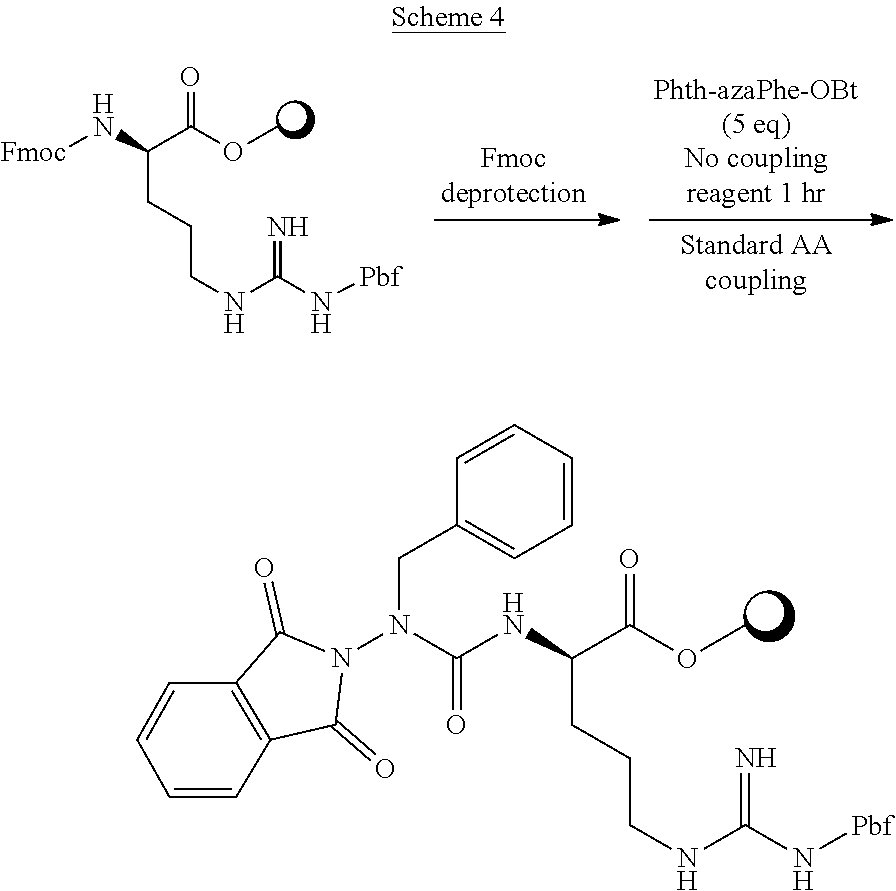
- Resin loading: ˜100 mg per mL in DMF
- Swelling: DMF 10 min for 3 cycles
- Fmoc Deprotection: 20% piperdine/DMF 2.5 min for 2 cycles
- Coupling cycle: resin substitution:amino acid:coupling reagent:base (1:5:5:10) for 10 min 1 cycle
- Washing: DMF 0.5 min for 5 cycles; DCM 0.5 min for 6 cycles
- Capping: 50 eq. Acetic anhydride and 50 eq. Pyridine in DMF for 30 minutes (repeated cycle if needed)
- Cleavage: TFA:water:triisopropylsilane (95:2.5:2.5) for 2 hours




Claims (29)


Priority Applications (2)
| Application Number | Priority Date | Filing Date | Title |
|---|---|---|---|
| US17/860,148 US12351573B2 (en) | 2019-05-09 | 2022-07-08 | Compounds for use in synthesis of peptidomimetics |
| US19/225,455 US20260070894A1 (en) | 2019-05-09 | 2025-06-02 | Compounds for use in synthesis of peptidomimetics |
Applications Claiming Priority (4)
| Application Number | Priority Date | Filing Date | Title |
|---|---|---|---|
| US201962845617P | 2019-05-09 | 2019-05-09 | |
| US16/869,794 US10919882B2 (en) | 2019-05-09 | 2020-05-08 | Compounds for use in synthesis of peptidomimetics |
| US17/143,409 US11414405B2 (en) | 2019-05-09 | 2021-01-07 | Compounds for use in synthesis of peptidomimetics |
| US17/860,148 US12351573B2 (en) | 2019-05-09 | 2022-07-08 | Compounds for use in synthesis of peptidomimetics |
Related Parent Applications (1)
| Application Number | Title | Priority Date | Filing Date |
|---|---|---|---|
| US17/143,409 Continuation US11414405B2 (en) | 2019-05-09 | 2021-01-07 | Compounds for use in synthesis of peptidomimetics |
Related Child Applications (1)
| Application Number | Title | Priority Date | Filing Date |
|---|---|---|---|
| US19/225,455 Division US20260070894A1 (en) | 2019-05-09 | 2025-06-02 | Compounds for use in synthesis of peptidomimetics |
Publications (2)
| Publication Number | Publication Date |
|---|---|
| US20220372022A1 US20220372022A1 (en) | 2022-11-24 |
| US12351573B2 true US12351573B2 (en) | 2025-07-08 |
Family
ID=73045961
Family Applications (4)
| Application Number | Title | Priority Date | Filing Date |
|---|---|---|---|
| US16/869,794 Active US10919882B2 (en) | 2019-05-09 | 2020-05-08 | Compounds for use in synthesis of peptidomimetics |
| US17/143,409 Active US11414405B2 (en) | 2019-05-09 | 2021-01-07 | Compounds for use in synthesis of peptidomimetics |
| US17/860,148 Active US12351573B2 (en) | 2019-05-09 | 2022-07-08 | Compounds for use in synthesis of peptidomimetics |
| US19/225,455 Pending US20260070894A1 (en) | 2019-05-09 | 2025-06-02 | Compounds for use in synthesis of peptidomimetics |
Family Applications Before (2)
| Application Number | Title | Priority Date | Filing Date |
|---|---|---|---|
| US16/869,794 Active US10919882B2 (en) | 2019-05-09 | 2020-05-08 | Compounds for use in synthesis of peptidomimetics |
| US17/143,409 Active US11414405B2 (en) | 2019-05-09 | 2021-01-07 | Compounds for use in synthesis of peptidomimetics |
Family Applications After (1)
| Application Number | Title | Priority Date | Filing Date |
|---|---|---|---|
| US19/225,455 Pending US20260070894A1 (en) | 2019-05-09 | 2025-06-02 | Compounds for use in synthesis of peptidomimetics |
Country Status (6)
| Country | Link |
|---|---|
| US (4) | US10919882B2 (en) |
| EP (1) | EP3965770A4 (en) |
| CN (1) | CN114126619B (en) |
| AU (1) | AU2020268409B2 (en) |
| IL (1) | IL287499B2 (en) |
| WO (1) | WO2020227594A1 (en) |
Families Citing this family (6)
| Publication number | Priority date | Publication date | Assignee | Title |
|---|---|---|---|---|
| CA3139103A1 (en) * | 2019-05-09 | 2020-11-12 | The Feinstein Institutes For Medical Research | Peptidomimetic agents, synthesis and uses thereof |
| CN113924290A (en) | 2019-05-09 | 2022-01-11 | 范因斯坦医学研究院 | Thiohydrazinocarboxylic acid esters and their use |
| US11684652B2 (en) | 2019-05-09 | 2023-06-27 | The Feinstein Institutes For Medical Research | HMGB1 antagonist treatment of acute lung injury |
| WO2020227594A1 (en) | 2019-05-09 | 2020-11-12 | The Feinstein Institutes For Medical Research | Compounds for use in synthesis of peptidomimetics |
| US11883461B2 (en) | 2019-05-09 | 2024-01-30 | The Feinstein Institutes For Medical Research | HMGB1 antagonist treatment of severe sepsis |
| CN115515937A (en) | 2020-05-08 | 2022-12-23 | 范因斯坦医学研究院 | Dimers for the synthesis of peptidomimetics |
Citations (13)
| Publication number | Priority date | Publication date | Assignee | Title |
|---|---|---|---|---|
| US5602231A (en) * | 1991-06-14 | 1997-02-11 | Zeneca Limited | Process for making peptides |
| WO2001040515A1 (en) | 1999-11-12 | 2001-06-07 | Isis Pharmaceuticals, Inc. | Gapped oligomers having site specific chiral phosphorothioate internucleoside linkages |
| US20060281686A1 (en) | 2002-12-02 | 2006-12-14 | Lopez Areiza John J | Aza-peptides |
| US20110086836A1 (en) | 2006-04-07 | 2011-04-14 | Santhera Pharmaceuticals (Schweiz) Ag | Substituted Phenylpiperidine Derivatives As Melanocortin-4 Receptor Modulators |
| US8563565B2 (en) | 2011-10-07 | 2013-10-22 | Eisai R&D Management Co., Ltd. | Pyrazoloquinoline derivatives |
| US9186371B2 (en) | 2010-09-17 | 2015-11-17 | Japan Science And Technology Agency | Inhibitor of HMGB protein-mediated immune response activation, and screening method |
| WO2016094899A2 (en) | 2014-12-12 | 2016-06-16 | The Feinstein Institute For Medical Research | Treatment of hmgb1-mediated inflammation |
| US20180344808A1 (en) | 2017-06-01 | 2018-12-06 | The Feinstein Institute For Medical Research | Haptoglobin derivative for treatment of sepsis and acetaminophen-induced liver damage |
| US20190055283A1 (en) | 2016-02-29 | 2019-02-21 | Ohio State Innovation Foundation | Aza-peptide aldehydes and ketones |
| US20200354318A1 (en) | 2019-05-09 | 2020-11-12 | The Feinstein Institutes For Medical Research | Thiosemicarbazates and uses thereof |
| US20200353037A1 (en) | 2019-05-09 | 2020-11-12 | The Feinstein Institutes For Medical Research | Hmgb1 antagonist treatment of diabetic peripheral neuropathy |
| US20200354404A1 (en) | 2019-05-09 | 2020-11-12 | The Feinstein Institutes For Medical Research | Peptidomimetic agents, synthesis and uses thereof |
| US10919882B2 (en) | 2019-05-09 | 2021-02-16 | The Feinstein Institutes For Medical Research | Compounds for use in synthesis of peptidomimetics |
-
2020
- 2020-05-08 WO PCT/US2020/031998 patent/WO2020227594A1/en not_active Ceased
- 2020-05-08 IL IL287499A patent/IL287499B2/en unknown
- 2020-05-08 CN CN202080034690.6A patent/CN114126619B/en active Active
- 2020-05-08 EP EP20801513.1A patent/EP3965770A4/en active Pending
- 2020-05-08 AU AU2020268409A patent/AU2020268409B2/en active Active
- 2020-05-08 US US16/869,794 patent/US10919882B2/en active Active
-
2021
- 2021-01-07 US US17/143,409 patent/US11414405B2/en active Active
-
2022
- 2022-07-08 US US17/860,148 patent/US12351573B2/en active Active
-
2025
- 2025-06-02 US US19/225,455 patent/US20260070894A1/en active Pending
Patent Citations (17)
| Publication number | Priority date | Publication date | Assignee | Title |
|---|---|---|---|---|
| US5602231A (en) * | 1991-06-14 | 1997-02-11 | Zeneca Limited | Process for making peptides |
| WO2001040515A1 (en) | 1999-11-12 | 2001-06-07 | Isis Pharmaceuticals, Inc. | Gapped oligomers having site specific chiral phosphorothioate internucleoside linkages |
| US20060281686A1 (en) | 2002-12-02 | 2006-12-14 | Lopez Areiza John J | Aza-peptides |
| US20110086836A1 (en) | 2006-04-07 | 2011-04-14 | Santhera Pharmaceuticals (Schweiz) Ag | Substituted Phenylpiperidine Derivatives As Melanocortin-4 Receptor Modulators |
| US9186371B2 (en) | 2010-09-17 | 2015-11-17 | Japan Science And Technology Agency | Inhibitor of HMGB protein-mediated immune response activation, and screening method |
| US8563565B2 (en) | 2011-10-07 | 2013-10-22 | Eisai R&D Management Co., Ltd. | Pyrazoloquinoline derivatives |
| WO2016094899A2 (en) | 2014-12-12 | 2016-06-16 | The Feinstein Institute For Medical Research | Treatment of hmgb1-mediated inflammation |
| US20190055283A1 (en) | 2016-02-29 | 2019-02-21 | Ohio State Innovation Foundation | Aza-peptide aldehydes and ketones |
| US20180344808A1 (en) | 2017-06-01 | 2018-12-06 | The Feinstein Institute For Medical Research | Haptoglobin derivative for treatment of sepsis and acetaminophen-induced liver damage |
| US20200354318A1 (en) | 2019-05-09 | 2020-11-12 | The Feinstein Institutes For Medical Research | Thiosemicarbazates and uses thereof |
| US20200353037A1 (en) | 2019-05-09 | 2020-11-12 | The Feinstein Institutes For Medical Research | Hmgb1 antagonist treatment of diabetic peripheral neuropathy |
| US20200352887A1 (en) | 2019-05-09 | 2020-11-12 | The Feinstein Institutes For Medical Research | Hmgb1 antagonist |
| US20200354418A1 (en) | 2019-05-09 | 2020-11-12 | The Feinstein Institutes For Medical Research | Hmgb1 antagonist treatment of acute lung injury |
| US20200354404A1 (en) | 2019-05-09 | 2020-11-12 | The Feinstein Institutes For Medical Research | Peptidomimetic agents, synthesis and uses thereof |
| US20210000908A1 (en) | 2019-05-09 | 2021-01-07 | The Feinstein Institutes For Medical Research | Hmgb1 antagonist treatment of severe sepsis |
| US10919882B2 (en) | 2019-05-09 | 2021-02-16 | The Feinstein Institutes For Medical Research | Compounds for use in synthesis of peptidomimetics |
| US20210130331A1 (en) | 2019-05-09 | 2021-05-06 | The Feinstein Institutes For Medical Research | Compounds for use in synthesis of peptidomimetics |
Non-Patent Citations (27)
| Title |
|---|
| Abo-Dya, N.E., Biswas, S., Basak, A., Avan, I., Alamry, K.A., and Katritzky, A.R., Benzotriazole-Mediated Synthesis of Aza-peptides: En Route to an Aza-Leuenkephalin Analogue. The Journal of Organic Chemistry 78, 3541-3552 (2013). |
| Avan, I., Hall, C.D., and Katritzky, A.R., Peptidomimetics via modifications of amino acids and peptide bonds. Chemical Society Reviews 43, 3575-3594 (2014). |
| Branka Zorc et al., "Benzotriazole as a Synthetic Auxiliary", Croatica Chemica Acta, 85(4), pp. 959-601, 2012. |
| Carine B. Bourguet et al., "Solution-phase submonomer diversification of the aza-dipeptide building blocks and their application in aza-peptide and aza-DKP synthesis", Journal of Peptide Science, vol. 16, No. 6, Jun. 1, 2010, pp. 284-296. |
| Cécile Abbas et al., "Original and efficient synthesis of 2:1-[α/aza]-oligomer precursors", Tetrahedron Letters, vol. 50, No. 28, pp. 4158-4160, Jul. 15, 2009. |
| European Search Report issued on Dec. 19, 2022, in corresponding European Application No. EP 20 80 1513. |
| Heffeter et al. "Anticancer Thiosemicarbazones: Chemical Properties, Interaction with Iron Metabolism, and Resistance Development" Antioxidants & Redox Signaling; vol. 30, No. 8, 2019. |
| International Search Report issued on Jul. 31, 2020, from corresponding International Application No. PCT/US20/32025. |
| International Search Report issued on Sep. 10, 2020, from corresponding International Application No. PCT/US20/31992. |
| International Search Report issued on Sep. 16, 2020, from corresponding International Application No. PCT/US20/31988. |
| International Search Report issued on Sep. 2, 2020, from corresponding International Application No. PCT/US20/31998. |
| Mariappan Anbazhagan et al., "Conversion of carbonimidodithioates into unsymmetrical Di- and Tri-substituted ureas including urea dipeptides", Tetrahedron Letters, vol. 39, No. 21, pp. 3609-3612, 1998. |
| Nathalie Ollivier et al., "Silver Catalyzed azaGly Ligation. Application to the Synthesis of Azapeptides and of Lipid-Peptide Conjugates", Bioconjugate Chem, vol. 20, pp. 1397-1403, 2009. |
| PubChem CID-1089188 "(2s)-1-(1-Imidazolylcarbonyl)pyrrolidine-2-carboxylic acid benzyl ester" Created on Oct. 26, 2006. |
| PubChem CID-132255576 "(2S)-2-(Imidazole-1-carbonylamino)pentanedioic acid" Created on Jan. 29, 2018. |
| PubChem CID-136595533 "(2,5-Dioxopyrrol-1-yl) N-(2,5-dihydroxypyrrol-1-yl)-N-(1,3-dioxoisoindol-2-yl)carbamate" Created on Jan. 4, 2019. |
| PubChem CID-519335 "Methanethioic S-acid" Created on Mar. 27, 2005. |
| PubChem CID-67548889 "Methyl (2S)-1-(imidazole-1-carbonyl)pyrrolidine-2-carboxylate" Created on Nov. 30, 2012. |
| Ramesh Chingle et al., "Azapeptide Synthesis Methods for Expanding Side-Chain Diversity for Biomedical Applications", Accounts of Chemical Research, vol. 50, pp. 1541-1556, 2017. |
| Sabatino et al., "Exploring Side-Chain Diversity by Submonomer Solid-Phase Aza-Peptide Synthesis" Org. Lett. 2009, 11, 16, 3650-3653 (Year: 2009). * |
| Sun et al. "Folic acid derived-P5779 mimetics regulate DAMP-mediated inflammation through disruption of HMGB1: TLR4: MD-2 axes" PLOS One; Published on Feb. 15, 2018; vol. 13; p. 1-14. |
| Written Opinion of the International Searching Authority issued on Jul. 31, 2020, from corresponding International Application No. PCT/US20/32025. |
| Written Opinion of the International Searching Authority issued on Sep. 10, 2020, from corresponding International Application No. PCT/US20/31992. |
| Written Opinion of the International Searching Authority issued on Sep. 16, 2020, from corresponding International Application No. PCT/US20/31988. |
| Written Opinion of the International Searching Authority issued on Sep. 2, 2020, from corresponding International Application No. PCT/US20/31998. |
| Yang et al. "MD-2 is required for disulfide HMGB1-dependent TLR4 signaling" The Journal of Experimental Medicine; Published on Jan. 5, 2015; vol. 212; p. 5-14. |
| Ye Che et al., "Impact of Cis-Proline Analogs Peptide Conformation", Biopolymers, vol. 81, pp. 392-406, 2006. |
Also Published As
| Publication number | Publication date |
|---|---|
| CN114126619B (en) | 2024-03-15 |
| CA3139106A1 (en) | 2020-11-12 |
| US20210130331A1 (en) | 2021-05-06 |
| AU2020268409B2 (en) | 2026-03-12 |
| WO2020227594A1 (en) | 2020-11-12 |
| AU2020268409A1 (en) | 2021-11-25 |
| IL287499B1 (en) | 2025-07-01 |
| US10919882B2 (en) | 2021-02-16 |
| US11414405B2 (en) | 2022-08-16 |
| CN114126619A (en) | 2022-03-01 |
| US20200354344A1 (en) | 2020-11-12 |
| EP3965770A4 (en) | 2023-01-18 |
| IL287499B2 (en) | 2025-11-01 |
| EP3965770A1 (en) | 2022-03-16 |
| IL287499A (en) | 2021-12-01 |
| US20220372022A1 (en) | 2022-11-24 |
| US20260070894A1 (en) | 2026-03-12 |
Similar Documents
| Publication | Publication Date | Title |
|---|---|---|
| US20260070894A1 (en) | Compounds for use in synthesis of peptidomimetics | |
| US12595233B2 (en) | Thiosemicarbazates and uses thereof | |
| US20200354404A1 (en) | Peptidomimetic agents, synthesis and uses thereof | |
| CN115925790A (en) | Method for the synthesis of α4β7 peptide antagonists | |
| WO1999031121A2 (en) | Branched building units for synthesizing cyclic peptides | |
| CA3139106C (en) | Compounds for use in synthesis of peptidomimetics | |
| US12624002B2 (en) | Dimers for use in synthesis of peptidomimetics | |
| US5942601A (en) | Peptide synthesis with sulfonyl protecting groups | |
| Hall | Poster presentation abstracts |
Legal Events
| Date | Code | Title | Description |
|---|---|---|---|
| FEPP | Fee payment procedure |
Free format text: ENTITY STATUS SET TO UNDISCOUNTED (ORIGINAL EVENT CODE: BIG.); ENTITY STATUS OF PATENT OWNER: SMALL ENTITY |
|
| FEPP | Fee payment procedure |
Free format text: ENTITY STATUS SET TO SMALL (ORIGINAL EVENT CODE: SMAL); ENTITY STATUS OF PATENT OWNER: SMALL ENTITY |
|
| STPP | Information on status: patent application and granting procedure in general |
Free format text: DOCKETED NEW CASE - READY FOR EXAMINATION |
|
| STPP | Information on status: patent application and granting procedure in general |
Free format text: RESPONSE TO NON-FINAL OFFICE ACTION ENTERED AND FORWARDED TO EXAMINER |
|
| STPP | Information on status: patent application and granting procedure in general |
Free format text: NON FINAL ACTION MAILED |
|
| STPP | Information on status: patent application and granting procedure in general |
Free format text: RESPONSE TO NON-FINAL OFFICE ACTION ENTERED AND FORWARDED TO EXAMINER |
|
| STPP | Information on status: patent application and granting procedure in general |
Free format text: FINAL REJECTION MAILED |
|
| STPP | Information on status: patent application and granting procedure in general |
Free format text: RESPONSE AFTER FINAL ACTION FORWARDED TO EXAMINER |
|
| STPP | Information on status: patent application and granting procedure in general |
Free format text: ADVISORY ACTION MAILED |
|
| STPP | Information on status: patent application and granting procedure in general |
Free format text: DOCKETED NEW CASE - READY FOR EXAMINATION |
|
| STPP | Information on status: patent application and granting procedure in general |
Free format text: NON FINAL ACTION MAILED |
|
| STPP | Information on status: patent application and granting procedure in general |
Free format text: RESPONSE TO NON-FINAL OFFICE ACTION ENTERED AND FORWARDED TO EXAMINER |
|
| STPP | Information on status: patent application and granting procedure in general |
Free format text: EX PARTE QUAYLE ACTION MAILED |
|
| STPP | Information on status: patent application and granting procedure in general |
Free format text: RESPONSE TO EX PARTE QUAYLE ACTION ENTERED AND FORWARDED TO EXAMINER |
|
| STPP | Information on status: patent application and granting procedure in general |
Free format text: NOTICE OF ALLOWANCE MAILED -- APPLICATION RECEIVED IN OFFICE OF PUBLICATIONS |
|
| STCF | Information on status: patent grant |
Free format text: PATENTED CASE |