US12347531B2 - Method and apparatus of chemistry education - Google Patents
Method and apparatus of chemistry education Download PDFInfo
- Publication number
- US12347531B2 US12347531B2 US17/200,281 US202117200281A US12347531B2 US 12347531 B2 US12347531 B2 US 12347531B2 US 202117200281 A US202117200281 A US 202117200281A US 12347531 B2 US12347531 B2 US 12347531B2
- Authority
- US
- United States
- Prior art keywords
- adaptive
- grid
- bond
- user
- hexagon
- Prior art date
- Legal status (The legal status is an assumption and is not a legal conclusion. Google has not performed a legal analysis and makes no representation as to the accuracy of the status listed.)
- Active, expires
Links
Images




Classifications
-
- G—PHYSICS
- G09—EDUCATION; CRYPTOGRAPHY; DISPLAY; ADVERTISING; SEALS
- G09B—EDUCATIONAL OR DEMONSTRATION APPLIANCES; APPLIANCES FOR TEACHING, OR COMMUNICATING WITH, THE BLIND, DEAF OR MUTE; MODELS; PLANETARIA; GLOBES; MAPS; DIAGRAMS
- G09B7/00—Electrically-operated teaching apparatus or devices working with questions and answers
- G09B7/02—Electrically-operated teaching apparatus or devices working with questions and answers of the type wherein the student is expected to construct an answer to the question which is presented or wherein the machine gives an answer to the question presented by a student
- G09B7/04—Electrically-operated teaching apparatus or devices working with questions and answers of the type wherein the student is expected to construct an answer to the question which is presented or wherein the machine gives an answer to the question presented by a student characterised by modifying the teaching programme in response to a wrong answer, e.g. repeating the question, supplying a further explanation
-
- G—PHYSICS
- G16—INFORMATION AND COMMUNICATION TECHNOLOGY [ICT] SPECIALLY ADAPTED FOR SPECIFIC APPLICATION FIELDS
- G16C—COMPUTATIONAL CHEMISTRY; CHEMOINFORMATICS; COMPUTATIONAL MATERIALS SCIENCE
- G16C20/00—Chemoinformatics, i.e. ICT specially adapted for the handling of physicochemical or structural data of chemical particles, elements, compounds or mixtures
- G16C20/80—Data visualisation
-
- G—PHYSICS
- G06—COMPUTING OR CALCULATING; COUNTING
- G06F—ELECTRIC DIGITAL DATA PROCESSING
- G06F3/00—Input arrangements for transferring data to be processed into a form capable of being handled by the computer; Output arrangements for transferring data from processing unit to output unit, e.g. interface arrangements
- G06F3/01—Input arrangements or combined input and output arrangements for interaction between user and computer
- G06F3/048—Interaction techniques based on graphical user interfaces [GUI]
- G06F3/0484—Interaction techniques based on graphical user interfaces [GUI] for the control of specific functions or operations, e.g. selecting or manipulating an object, an image or a displayed text element, setting a parameter value or selecting a range
-
- G—PHYSICS
- G09—EDUCATION; CRYPTOGRAPHY; DISPLAY; ADVERTISING; SEALS
- G09B—EDUCATIONAL OR DEMONSTRATION APPLIANCES; APPLIANCES FOR TEACHING, OR COMMUNICATING WITH, THE BLIND, DEAF OR MUTE; MODELS; PLANETARIA; GLOBES; MAPS; DIAGRAMS
- G09B23/00—Models for scientific, medical, or mathematical purposes, e.g. full-sized devices for demonstration purposes
- G09B23/24—Models for scientific, medical, or mathematical purposes, e.g. full-sized devices for demonstration purposes for chemistry
-
- G—PHYSICS
- G09—EDUCATION; CRYPTOGRAPHY; DISPLAY; ADVERTISING; SEALS
- G09B—EDUCATIONAL OR DEMONSTRATION APPLIANCES; APPLIANCES FOR TEACHING, OR COMMUNICATING WITH, THE BLIND, DEAF OR MUTE; MODELS; PLANETARIA; GLOBES; MAPS; DIAGRAMS
- G09B5/00—Electrically-operated educational appliances
- G09B5/02—Electrically-operated educational appliances with visual presentation of the material to be studied, e.g. using film strip
Definitions
- FIGS. 3 A- 3 C illustrate the adaptive nature of an exemplary adaptive grid that may be employed by a chemistry education application and/or system
- FIGS. 5 A- 5 D illustrate exemplary situations in which exemplary adaptive grids of a chemistry education application and/or system may be manipulated
- FIGS. 6 A- 6 B illustrate the adaptive nature of an additional exemplary adaptive grid of a chemistry education application and/or system
- FIGS. 7 A- 7 B illustrate the adaptive nature of another exemplary adaptive grid of a chemistry education application and/or system
- FIGS. 8 A- 8 B illustrate the adaptive nature of yet another exemplary adaptive grid of a chemistry education application and/or system
- FIG. 9 C illustrates an exemplary notification that may be employed by a chemistry education application
- FIG. 10 illustrates an exemplary computing device or system having an exemplary chemistry education application operating thereon
- FIG. 11 illustrates an exemplary technique to provide chemistry education to a user.
- the adaptive grid 110 shown in FIG. 1 A is an exemplary adaptive hexagon grid 114 including a plurality of conjoined hexagons, where at least one hexagon of the plurality of conjoined hexagons is conjoined with at least six adjacent hexagons of the plurality of conjoined hexagons.
- a first hexagon 116 is conjoined with six adjacent hexagons 118 .
- the adaptive grid 110 when the adaptive grid 110 is first displayed it is free of chemical bond lines. As will be discussed below, the adaptive grid 110 is effectively a skeletal grid or scaffold on which the user 112 creates a chemical structure.
- the adaptive grid 110 may instead include a different type of adaptive grid.
- the adaptive grid 110 of FIG. 1 A could instead include one or more of the following: an exemplary adaptive Fischer projection grid 120 including a skeleton of a molecular Fischer conformer (see, e.g., FIG. 1 B ); an exemplary adaptive Newman projection grid 122 including a skeleton of a molecular Newman conformer (see, e.g., FIG. 1 C ); or an exemplary adaptive chair projection grid 124 including a skeleton of a molecular chair conformer (see, e.g., FIG. 1 D ).
- an exemplary adaptive Fischer projection grid 120 including a skeleton of a molecular Fischer conformer see, e.g., FIG. 1 B
- an exemplary adaptive Newman projection grid 122 including a skeleton of a molecular Newman conformer
- an exemplary adaptive chair projection grid 124 including a skeleton of a molecular chair conformer see, e.g.,
- the exemplary adaptive grids 120 - 124 of FIGS. 1 B- 1 D are effectively skeletal grids or scaffolds on which the user 112 creates a chemical structure.
- Other exemplary adaptive grids will be discussed below with respect to FIGS. 5 B- 8 B .
- the smart suggestion keyboard 106 includes a plurality of atomic bond representations associated either with a single atom or functional group.
- the plurality of atomic bond representations include one or more representations of a single covalent bond 126 , a double covalent bond 128 , and a triple covalent bond 130 .
- the single covalent bond representation may also include a wedge bond 132 and/or dash bond 133 .
- the single covalent NH 2 bond 230 will be placed at the first location selection 240 .
- the exemplary prompt 216 of FIG. 2 A directs the user 208 to “Draw the bond-line structure for (R)-2-hydroxypentanoic acid.”
- the bond-line structure of (R)-2-hydroxypentanoic acid does not include an NH 2 functional group. As such, the (R)-2-hydroxypentanoic acid does not include the single covalent NH 2 bond 230 .
- the second time point 204 represented in FIG. 2 B also illustrates that the user has selected a second location selection 242 on the adaptive grid 212 .
- the second location 242 is selected, the previously offered selections 222 - 234 , 238 of FIG. 2 A are no longer displayed.
- a second plurality of atomic bond representations 244 FIG. 2 B ) associated with a single atom or functional group is displayed on the smart suggestion keyboard 214 .
- a ring extension 245 is also displayed on the smart suggestion keyboard 214 .
- the second plurality of atomic bond representations 244 , 245 replaces the first plurality of atomic bond representations 220 , 236 after the user 208 has made the second location selection 242 .
- Single covalent bonds e.g., a single covalent carbon bond
- organic chemistry are often employed to build chemical structures.
- defaulting to a single covalent bond may save user time.
- the user 208 may still be given the opportunity to make a different selection from the keyboard 214 to replace the defaulted single covalent bond. Further details regarding the aforementioned exemplary default bonds are set forth below with respect to FIGS. 9 A- 9 B .
- the selection of the double covalent oxygen bond 274 at the sixth location selection 276 illustrates an adaptive nature of the adaptive grid 212 .
- the adaptive grid 212 is adapted to remove a first unused grid line (a.k.a., first extension line 278 of FIG. 2 B ) and a second unused grid line (a.k.a. second extension line 280 of FIG. 2 B ). Accordingly, the user 208 cannot add structure to these two regions ( 282 , 284 ) shown in FIG. 2 C .
- the double covalent oxygen (O) bond 274 serves as a terminal grid point in which no further bond structure can be added thereto by the user 208 .
- the chemistry education application 200 need not notify the user 208 as to what particular bond selections (e.g., one or more of bond selections 224 , 252 , 262 , 266 , 270 , 274 ) or not accurate. Instead, the chemistry education application 200 may simply notify the user 208 that the user created structure is not accurate or provide hints to guide the user 208 to the correct solution/structure.
- bond selections e.g., one or more of bond selections 224 , 252 , 262 , 266 , 270 , 274
- the chemistry education application 200 may initially present the adaptive grid 212 with one or more bond representations already presented thereon. That is, the initial adaptive grid (e.g., adaptive hexagon grid 218 ) may be presented to the user with one or more bond representations already shown or preloaded thereon.
- FIG. 2 B could serve as the initial hexagon grid 218 having the single covalent bond 224 preloaded on the gird 218 .
- Other examples, may include additional or different bond representations preloaded on the grid 212 .
- preloaded bond representation(s) onto the adaptive grid may serve a variety of purposes. For example, preloaded bond representation(s) may ease the user's task of creating the chemical structure set forth in the prompt. Alternatively, a preloaded adaptive grid may include an inaccurate chemical structure(s) thereon and the prompt may direct the user to correct the preloaded chemical structure(s).
- the chemistry education application 200 may employ this strategy to, for example, help the user identify common mistakes.
- the user may employ functionality already described above (e.g., utilizing the undo 286 or remove 288 functions).
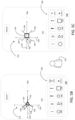
- FIGS. 3 A- 3 C additional examples of the adaptive nature of an adaptive grid 300 are illustrated.
- the adaptive grids 300 illustrated are adaptive hexagon grids 302 .
- a user 304 has already created a carbon atom having three single covalent bonds (i.e., a first, second, and third covalent carbon bond 306 , 308 , 310 , respectively) coupled thereto.
- a node e.g., node 312
- no atomic symbol it is understood that a carbon atom is at that node (e.g., node 312 ).
- FIG. 3 A also illustrates that the user 304 has selected a next location selection 314 on the adaptive hexagon grid 302 and is ready to make a selection from a smart suggestion keyboard 316 .
- the situation illustrated in in FIG. 3 A is merely exemplary. In other examples the user may have selected different bond selections and/or grid locations. Further, as discussed above with respect to FIGS. 2 A- 2 C , in some examples a grid selection (e.g., location selection 314 ) may cause a default single covalent bond to be presented at that selected location.
- an appended grid line 320 stemming from the node 312 may be added.
- the appended grid line 320 is shown at an interior location 322 of a first hexagon 324 of the adaptive hexagon grid 302 . Accordingly, the user 304 is offered the opportunity to select the appended grid line 320 in order to add a fourth bond to the node 312 .
- FIG. 3 B illustrates that an appended grid line may be added to an adaptive grid when three single covalent bonds meet at a node. That is, the appended grid line 320 is presented on the adaptive hexagonal grid 302 after the user 304 has caused a set of three atomic bond representations (i.e., bond representations 308 , 310 , 318 ) to appear on the adaptive hexagonal grid 302 such that the set of three atomic bond representations 308 , 310 , 318 meet at a node (e.g., node 312 ).
- a node e.g., node 312
- a node is where two or more lines of the adaptive hexagon grid (e.g., adaptive grid 302 ) meet.
- FIG. 3 B illustrates the implementation of adding an appended grid line (e.g., appended grid line 320 )
- the user 304 may also cause the removal of the appended grid line 320 .
- the appended grid line 320 would be removed.
- Other examples may also cause the addition or removal of appended grid line(s).
- FIG. 3 C illustrates an example where the user 304 chose not to input a bond at the interior location 322 of the hexagon 324 . Rather, the user 304 proceeded to add additional bonds 326 , 328 , 330 , 332 around the hexagon 324 , thus creating a six-membered carbon ring ( 308 , 310 , 326 , 328 , 330 , 332 ). The bond selections were made in much the same manner as described above, and at time points not shown. The user 304 has also employed a remove function 334 to remove the single covalent carbon bond 306 represented in FIG. 2 B (compare FIG. 2 B with FIG. 2 C ).
- the creation of the six-member ring ( 308 , 310 , 326 , 328 , 330 , 332 ) caused the appended grid line 320 to move from the interior location 322 of the first hexagon 324 ( FIG. 4 B ) to an interior location 336 of a second hexagon 338 ( FIG. 4 C ) of the adaptive hexagon grid 400 .
- the appended grid line 320 does not appear inside a six-membered chemical ring (e.g., the ring comprised of bonds 308 , 310 , 326 , 328 , 330 , 332 ) since that would create a chemically infeasible structure.
- FIGS. 4 A through 4 C other examples where appended lines may be added to an adaptive hexagonal grid 400 are illustrated. For simplicity, no smart suggestion keyboard is shown.
- FIG. 4 A illustrates an appended grid line 402 at an interior location 404 of a first hexagon 406 of the adaptive hexagon grid 400 .
- FIGS. 4 A and 3 B illustrates two exemplary types of structures where appended grid lines may arise.
- the structure in FIG. 3 B is a concave linear structure 408 and the structure illustrated in FIG. 4 A is a convex linear structure 410 .
- Each appended grid line 320 , 402 appears generally opposite the respective vertical bond line (i.e., bond line 411 of FIG. 4 A and bond line 318 of FIG. 3 B ).
- FIGS. 4 B and 4 C illustrate yet further examples where appended grid lines may be employed.
- FIG. 4 B illustrates a first appended grid line 412 stemming from a first node 414 of a first set of three bond lines 416 and a second appended grid line 418 stemming from a second node 420 of a second set of three bond lines 422 .
- FIG. 4 C illustrates appended grid lines stemming from a six-membered ring 424 . That is, a first appended grid line 426 was added to the six-membered ring 424 as well as a second appended grid line 428 .
- FIGS. 5 A- 5 D additional exemplary situations where an adaptive grid 500 may be manipulated are illustrated.
- an exemplary computing device 502 having an exemplary chemistry education application 504 operating thereon is shown.
- the chemistry education application 504 presents the adaptive grid 500 and an exemplary smart suggestion keyboard 506 on a display 508 .
- the adaptive grid 500 illustrated in FIG. 5 is an exemplary adaptive hexagon grid 510 .
- FIGS. 5 B- 5 D illustrate additional exemplary adaptive grids 500 .
- the adaptive grid 500 of FIG. 5 B is an adaptive triangle extension grid 512
- the adaptive grid 500 of FIG. 5 C is an adaptive square extension grid 514
- the adaptive grid 500 of FIG. 5 D is an adaptive pentagon extension grid 516 .
- a user 518 has selected a first location selection 520 (i.e., has selected a grid line) on the adaptive hexagon grid 510 and is provided a plurality of inputs 522 from an exemplary smart suggestion keyboard 506 .
- a pair of orthogonal axes 524 are shown for illustrative purposes. That is, the orthogonal axes 524 are not represented on the display 508 .
- the two orthogonal axes 524 cross each other at a location (i.e., a display location 526 ) on the display 508 .
- the display location 522 generally bisects the first location selection 520 .
- the user 518 selected a three-carbon extension ring 528 from the smart suggestion keyboard 506 of FIG. 5 A .
- the three-carbon extension ring 528 is presented on the adaptive triangle extension grid 512 of FIG. 5 B at the first location selection 520 .
- the first location selection 520 of FIG. 5 A is at substantially the same location on the display 508 as the first location selection 520 illustrated in FIG. 5 B .
- three potential selection lines 530 , 532 , 534 remain as shown in FIG. 5 B .
- the user 518 may employ the smart suggestion keyboard 506 to add atomic structural components to one or more of the three potential selection lines 530 - 534 .
- the plurality of inputs 522 and their orientation on the smart suggestion keyboard 506 may change depending on the grid line 530 - 534 selected by the user 518 .
- process control proceeds to block 1124 , where notifying the user of the accuracy of the user created chemical structure occurs.
- the user may, for example, be notified that the structure is accurate or is not accurate. Further, if the user created chemical structure is not accurate, process control may merely notify the user of the inaccuracy without notifying the user what component(s) of the structure is inaccurate. After the user is notified, process control proceeds to an end. In other exemplary techniques, however, the user may be given one or more opportunities to correct the user created chemical structure.
- process control may carry out additional operations.
- process control may provide for orienting each of the first plurality of atomic bond representations on the display such that each atomic bond representation of the first plurality of atomic bond representations is substantially parallel to the first location of the adaptive hexagon grid after the first location selection is selected by the user.
- the first plurality of atomic bond representations may be free of ring extension representations.
- Process control may continue with replacing the first plurality of atomic bond representations on the display with a second plurality of atomic bond representations after the user selects a second or additional location on the adaptive hexagon grid that is non-parallel to the first location.
- the second plurality of atomic bond representations may be oriented such that each atomic bond representation of the second plurality of atom bond representations is substantially parallel to the second location.
- process control may provide for presenting a first appended grid line on the adaptive hexagonal grid after the user has caused a set of three atomic bond representations to appear on the adaptive hexagonal grid such that the set of three atomic bond representations meet at a first node.
- the first node is where two or more lines of the adaptive hexagon grid meet.
- the first appended grid line may appear within an interior of a second hexagon of the adaptive hexagon grid and has a first end at the first node.
- process control may also provide for removing a grid line that conjoins two faces of two hexagons of the adaptive hexagon grid when the user causes, for example, a double covalent bond oxygen (O) bond representation, a single covalent bond chlorine (Cl) bond representation, or a single covalent bond hydrogen (H) bond representation to appear on the adaptive hexagon grid.
- O oxygen
- Cl covalent bond chlorine
- H covalent bond hydrogen
- the exemplary system(s), device(s), and items therein may take many different forms and include multiple and/or alternate components. While exemplary systems, devices, and modules are shown in the Figures, the exemplary components illustrated in the Figures are not intended to be limiting. Indeed, additional or alternative components and/or implementations may be used, and thus the above examples should not be construed as limiting.
- the processor or the microprocessor e.g., CPUs 1002 of computing systems and/or devices receives instructions from the memory (e.g., memory 1004 ) and executes these instructions, thereby performing one or more processes, including one or more of the processes described herein.
- Such instructions and other data may be stored and transmitted using a variety of computer-readable mediums (e.g., memory 1004 ).
- a CPU or processor may include processes comprised from any hardware, software, or combination of hardware or software that carries out instructions of a computer programs by performing logical and arithmetical calculations, such as adding or subtracting two or more numbers, comparing numbers, or jumping to a different part of the instructions.
- the CPU 1002 of FIG. 10 may be any one of, but not limited to single, dual, triple, or quad core processors (on one single chip), graphics processing units, visual processing units, and virtual processors.
- Memory may be, in general, any computer-readable medium (also referred to as a processor-readable medium) that may include any non-transitory (e.g., tangible) medium that participates in providing data (e.g., instructions) that may be read by a computer (e.g., by CPUs 1002 of exemplary mobile device 1000 ).
- a medium may take many forms, including, but not limited to, non-volatile media and volatile media.
- Non-volatile media may include, for example, optical or magnetic disks and other persistent memory.
- Volatile media may include, for example, dynamic random access memory (DRAM), which typically constitutes a main memory.
- DRAM dynamic random access memory
- Such instructions may be transmitted by one or more transmission media, including radio waves, metal wire, fiber optics, and the like, including the wires that comprise a system bus coupled to a processor of a computer.
- Common forms of computer-readable media include, for example, a floppy disk, a flexible disk, hard disk, magnetic tape, any other magnetic medium, a CD-ROM, DVD, any other optical medium, punch cards, paper tape, any other physical medium with patterns of holes, a RAM, a PROM, an EPROM, a FLASH-EEPROM, any other memory chip or cartridge, or any other medium from which a computer can read.
Landscapes
- Engineering & Computer Science (AREA)
- Theoretical Computer Science (AREA)
- Physics & Mathematics (AREA)
- General Physics & Mathematics (AREA)
- Educational Administration (AREA)
- Educational Technology (AREA)
- Business, Economics & Management (AREA)
- Chemical & Material Sciences (AREA)
- General Engineering & Computer Science (AREA)
- Mathematical Physics (AREA)
- Pure & Applied Mathematics (AREA)
- Algebra (AREA)
- Computational Mathematics (AREA)
- Mathematical Analysis (AREA)
- Mathematical Optimization (AREA)
- Health & Medical Sciences (AREA)
- Medicinal Chemistry (AREA)
- General Health & Medical Sciences (AREA)
- Crystallography & Structural Chemistry (AREA)
- Human Computer Interaction (AREA)
- Data Mining & Analysis (AREA)
- Life Sciences & Earth Sciences (AREA)
- Bioinformatics & Cheminformatics (AREA)
- Bioinformatics & Computational Biology (AREA)
- Computing Systems (AREA)
- Electrically Operated Instructional Devices (AREA)
- Spectroscopy & Molecular Physics (AREA)
- User Interface Of Digital Computer (AREA)
Abstract
Description
Claims (20)
Priority Applications (2)
| Application Number | Priority Date | Filing Date | Title |
|---|---|---|---|
| US17/200,281 US12347531B2 (en) | 2021-03-12 | 2021-03-12 | Method and apparatus of chemistry education |
| US29/787,056 USD1087975S1 (en) | 2021-03-12 | 2021-06-03 | Display screen, or portion thereof, with a graphical user interface for a chemistry education application |
Applications Claiming Priority (1)
| Application Number | Priority Date | Filing Date | Title |
|---|---|---|---|
| US17/200,281 US12347531B2 (en) | 2021-03-12 | 2021-03-12 | Method and apparatus of chemistry education |
Related Child Applications (1)
| Application Number | Title | Priority Date | Filing Date |
|---|---|---|---|
| US29/787,056 Continuation USD1087975S1 (en) | 2021-03-12 | 2021-06-03 | Display screen, or portion thereof, with a graphical user interface for a chemistry education application |
Publications (2)
| Publication Number | Publication Date |
|---|---|
| US20220293012A1 US20220293012A1 (en) | 2022-09-15 |
| US12347531B2 true US12347531B2 (en) | 2025-07-01 |
Family
ID=83194342
Family Applications (2)
| Application Number | Title | Priority Date | Filing Date |
|---|---|---|---|
| US17/200,281 Active 2044-05-02 US12347531B2 (en) | 2021-03-12 | 2021-03-12 | Method and apparatus of chemistry education |
| US29/787,056 Active USD1087975S1 (en) | 2021-03-12 | 2021-06-03 | Display screen, or portion thereof, with a graphical user interface for a chemistry education application |
Family Applications After (1)
| Application Number | Title | Priority Date | Filing Date |
|---|---|---|---|
| US29/787,056 Active USD1087975S1 (en) | 2021-03-12 | 2021-06-03 | Display screen, or portion thereof, with a graphical user interface for a chemistry education application |
Country Status (1)
| Country | Link |
|---|---|
| US (2) | US12347531B2 (en) |
Cited By (1)
| Publication number | Priority date | Publication date | Assignee | Title |
|---|---|---|---|---|
| US20240169852A1 (en) * | 2022-11-21 | 2024-05-23 | 101 Edu, Inc. | Method and appratus for chemistry education |
Citations (5)
| Publication number | Priority date | Publication date | Assignee | Title |
|---|---|---|---|---|
| US20140173475A1 (en) * | 2012-12-13 | 2014-06-19 | Cambridgesoft Corporation | Draw-ahead feature for chemical structure drawing applications |
| US20140337725A1 (en) * | 2013-05-08 | 2014-11-13 | Cambridgesoft Corporation | Systems and Methods for Providing Feedback Cues for Touch Screen Interface Interaction with Chemical and Biological Structure Drawing Applications |
| US20190236244A1 (en) * | 2018-01-30 | 2019-08-01 | Perkinelmer Informatics, Inc. | Context-aware virtual keyboard for chemical structure drawing applications |
| US10424399B2 (en) | 2011-08-17 | 2019-09-24 | Integrated Chemistry Design, Inc. | Systems and methods of editing a polygonal-shaped chemical structure having a set number of vertices |
| US10790046B2 (en) | 2012-02-24 | 2020-09-29 | Perkinelmer Informatics, Inc. | Systems, methods, and apparatus for drawing and editing chemical structures on a user interface via user gestures |
Family Cites Families (26)
| Publication number | Priority date | Publication date | Assignee | Title |
|---|---|---|---|---|
| US5903255A (en) * | 1996-01-30 | 1999-05-11 | Microsoft Corporation | Method and system for selecting a color value using a hexagonal honeycomb |
| US6670535B2 (en) * | 2002-05-09 | 2003-12-30 | Clifton L. Anderson | Musical-instrument controller with triad-forming note-trigger convergence points |
| US8316015B2 (en) * | 2007-12-21 | 2012-11-20 | Lemi Technology, Llc | Tunersphere |
| USD606089S1 (en) * | 2008-09-03 | 2009-12-15 | Sony Corporation | Computer screen showing icon shape and arrangement |
| USD606083S1 (en) * | 2008-12-03 | 2009-12-15 | Microsoft Corporation | User interface for a display screen |
| USD606081S1 (en) * | 2008-12-03 | 2009-12-15 | Microsoft Corporation | User interface for a display screen |
| US10416839B2 (en) * | 2012-10-10 | 2019-09-17 | Synabee, Inc. | Decision-oriented hexagonal array graphic user interface |
| US20140248590A1 (en) * | 2013-03-01 | 2014-09-04 | Learning Circle Kids LLC | Keyboard for entering text and learning to read, write and spell in a first language and to learn a new language |
| USD862502S1 (en) * | 2013-10-30 | 2019-10-08 | Learning Circle Kids LLC | Touch screen display with hexagonal keys |
| USD772929S1 (en) * | 2014-10-06 | 2016-11-29 | Vixlet LLC | Display screen with icons |
| USD777201S1 (en) * | 2014-12-24 | 2017-01-24 | Tencent Technology (Shenzhen) Company Limited | Display screen or portion thereof with animated graphical user interface |
| USD766975S1 (en) * | 2015-06-30 | 2016-09-20 | Samsung Electronics Co., Ltd. | Display screen or portion thereof with icon |
| USD824921S1 (en) * | 2015-12-15 | 2018-08-07 | Johnson Controls Technology Company | Display screen or portion thereof with graphical user interface |
| USD816693S1 (en) * | 2015-12-21 | 2018-05-01 | Samsung Electronics Co., Ltd. | Display screen or portion thereof with graphical user interface |
| USD825607S1 (en) * | 2016-04-18 | 2018-08-14 | Mx Technologies, Inc. | Display screen with a graphical user interface |
| USD829756S1 (en) * | 2016-04-18 | 2018-10-02 | Mx Technologies, Inc. | Display screen or portion thereof with animated graphical user interface |
| USD829757S1 (en) * | 2016-04-18 | 2018-10-02 | Mx Technologies, Inc. | Display screen or portion thereof with animated graphical user interface |
| USD872093S1 (en) * | 2018-08-01 | 2020-01-07 | Shenzhenshi Weimeijuguang Technology Co., Ltd | Tablet case |
| USD894640S1 (en) * | 2019-04-24 | 2020-09-01 | Yajun Hu | Gaming desk with z shaped legs |
| USD965025S1 (en) * | 2020-06-30 | 2022-09-27 | Genelec Oy | Computer display screen or portion thereof with graphical user interface |
| USD965629S1 (en) * | 2020-06-30 | 2022-10-04 | Genelec Oy | Computer display screen or portion thereof with graphical user interface |
| USD1063968S1 (en) * | 2023-10-11 | 2025-02-25 | Fusion Holdings Limited | Display screen or portion thereof with animated graphical user interface |
| USD1063971S1 (en) * | 2023-10-11 | 2025-02-25 | Fusion Holdings Limited | Display screen or portion thereof with animated graphical user interface |
| USD1063969S1 (en) * | 2023-10-11 | 2025-02-25 | Fusion Holdings Limited | Display screen or portion thereof with animated graphical user interface |
| USD1065238S1 (en) * | 2023-10-11 | 2025-03-04 | Fusion Holdings Limited | Display screen or portion thereof with animated graphical user interface |
| USD1063970S1 (en) * | 2023-10-11 | 2025-02-25 | Fusion Holdings Limited | Display screen or portion thereof with animated graphical user interface |
-
2021
- 2021-03-12 US US17/200,281 patent/US12347531B2/en active Active
- 2021-06-03 US US29/787,056 patent/USD1087975S1/en active Active
Patent Citations (9)
| Publication number | Priority date | Publication date | Assignee | Title |
|---|---|---|---|---|
| US10424399B2 (en) | 2011-08-17 | 2019-09-24 | Integrated Chemistry Design, Inc. | Systems and methods of editing a polygonal-shaped chemical structure having a set number of vertices |
| US10790046B2 (en) | 2012-02-24 | 2020-09-29 | Perkinelmer Informatics, Inc. | Systems, methods, and apparatus for drawing and editing chemical structures on a user interface via user gestures |
| US20140173475A1 (en) * | 2012-12-13 | 2014-06-19 | Cambridgesoft Corporation | Draw-ahead feature for chemical structure drawing applications |
| US9535583B2 (en) | 2012-12-13 | 2017-01-03 | Perkinelmer Informatics, Inc. | Draw-ahead feature for chemical structure drawing applications |
| US20140337725A1 (en) * | 2013-05-08 | 2014-11-13 | Cambridgesoft Corporation | Systems and Methods for Providing Feedback Cues for Touch Screen Interface Interaction with Chemical and Biological Structure Drawing Applications |
| US9430127B2 (en) | 2013-05-08 | 2016-08-30 | Cambridgesoft Corporation | Systems and methods for providing feedback cues for touch screen interface interaction with chemical and biological structure drawing applications |
| US20190236244A1 (en) * | 2018-01-30 | 2019-08-01 | Perkinelmer Informatics, Inc. | Context-aware virtual keyboard for chemical structure drawing applications |
| US10453560B2 (en) | 2018-01-30 | 2019-10-22 | Perkinelmer Informatics, Inc. | Context-aware virtual keyboard for chemical structure drawing applications |
| US20200035334A1 (en) * | 2018-01-30 | 2020-01-30 | Perkinelmer Informatics, Inc. | Context-Aware Virtual Keyboard for Chemical Structure Drawing Applications |
Cited By (1)
| Publication number | Priority date | Publication date | Assignee | Title |
|---|---|---|---|---|
| US20240169852A1 (en) * | 2022-11-21 | 2024-05-23 | 101 Edu, Inc. | Method and appratus for chemistry education |
Also Published As
| Publication number | Publication date |
|---|---|
| USD1087975S1 (en) | 2025-08-12 |
| US20220293012A1 (en) | 2022-09-15 |
Similar Documents
| Publication | Publication Date | Title |
|---|---|---|
| JP2572471B2 (en) | Method and apparatus for dynamically changing icons | |
| US9501219B2 (en) | 2D line data cursor | |
| EP2564325B1 (en) | Temporary formatting and charting of selected data | |
| US20150373178A1 (en) | Visual voice mail application variations | |
| US6904565B1 (en) | Graphical control system, method, and product for task navigation | |
| US8205165B2 (en) | Apparatus to create, save and format text documents using gaze control and method associated based on the optimized positioning of cursor | |
| US20130111406A1 (en) | Visually Representing a Menu Structure | |
| JP2009037583A (en) | Space-limited marking menu for mobile devices | |
| JPH07104877B2 (en) | Drawing method in computer-aided drawing system | |
| US12347531B2 (en) | Method and apparatus of chemistry education | |
| JP2014530411A (en) | Formula input for limited display devices | |
| CN106155539A (en) | For the alarm clock setting method of smart machine, device and electronic equipment | |
| JP2015533239A (en) | Method and system for visualizing algorithm guidelines | |
| US20210149691A1 (en) | Contextual deep expansion in user-interface trees | |
| CN106843663A (en) | For the localization method of pre- jump location, device and readable storage medium storing program for executing in the page | |
| JP4390371B2 (en) | Menu selection apparatus and method, and computer-readable recording medium on which menu selection program is recorded | |
| US20130249810A1 (en) | Text entry mode selection | |
| CN115794980A (en) | Data display method, equipment, device and medium | |
| US9552145B2 (en) | System and method for planning tasks based on a graphical representation of time | |
| US8434017B2 (en) | Computer user interface having selectable historical and default values | |
| CN109901778A (en) | A kind of page object rotation Zoom method, memory and smart machine | |
| CN101978364A (en) | Operating system for consistent operation across multiple input devices | |
| JP2010061669A (en) | User interface action processing using freshness status | |
| US20240169852A1 (en) | Method and appratus for chemistry education | |
| JP5287588B2 (en) | Graphic display device and program |
Legal Events
| Date | Code | Title | Description |
|---|---|---|---|
| AS | Assignment |
Owner name: 101 EDU, INC., NEW YORK Free format text: ASSIGNMENT OF ASSIGNORS INTEREST;ASSIGNORS:WEINBERG, JUSTIN;BELYAYEV, IGOR;KUTNEY, AMANDA;AND OTHERS;SIGNING DATES FROM 20210310 TO 20210311;REEL/FRAME:055579/0155 |
|
| FEPP | Fee payment procedure |
Free format text: ENTITY STATUS SET TO UNDISCOUNTED (ORIGINAL EVENT CODE: BIG.); ENTITY STATUS OF PATENT OWNER: SMALL ENTITY |
|
| FEPP | Fee payment procedure |
Free format text: ENTITY STATUS SET TO SMALL (ORIGINAL EVENT CODE: SMAL); ENTITY STATUS OF PATENT OWNER: SMALL ENTITY |
|
| STPP | Information on status: patent application and granting procedure in general |
Free format text: DOCKETED NEW CASE - READY FOR EXAMINATION |
|
| AS | Assignment |
Owner name: TOP HAT (US) GROUP CORP., CANADA Free format text: MERGER;ASSIGNOR:101 EDU, INC.;REEL/FRAME:062614/0940 Effective date: 20221213 |
|
| AS | Assignment |
Owner name: TOPHATMONOCLE (US) CORP., CANADA Free format text: ASSIGNMENT OF ASSIGNORS INTEREST;ASSIGNOR:TOP HAT (US) GROUP CORP.;REEL/FRAME:064044/0202 Effective date: 20230623 |
|
| STPP | Information on status: patent application and granting procedure in general |
Free format text: NON FINAL ACTION MAILED |
|
| STPP | Information on status: patent application and granting procedure in general |
Free format text: RESPONSE TO NON-FINAL OFFICE ACTION ENTERED AND FORWARDED TO EXAMINER |
|
| STPP | Information on status: patent application and granting procedure in general |
Free format text: NOTICE OF ALLOWANCE MAILED -- APPLICATION RECEIVED IN OFFICE OF PUBLICATIONS |
|
| STCF | Information on status: patent grant |
Free format text: PATENTED CASE |