US12346715B2 - Data protection management of application instance executing in accordance with virtual volume-based storage system - Google Patents
Data protection management of application instance executing in accordance with virtual volume-based storage system Download PDFInfo
- Publication number
- US12346715B2 US12346715B2 US17/103,184 US202017103184A US12346715B2 US 12346715 B2 US12346715 B2 US 12346715B2 US 202017103184 A US202017103184 A US 202017103184A US 12346715 B2 US12346715 B2 US 12346715B2
- Authority
- US
- United States
- Prior art keywords
- processing device
- virtual
- application instance
- storage system
- data
- Prior art date
- Legal status (The legal status is an assumption and is not a legal conclusion. Google has not performed a legal analysis and makes no representation as to the accuracy of the status listed.)
- Active, expires
Links
Images


Classifications
-
- G—PHYSICS
- G06—COMPUTING OR CALCULATING; COUNTING
- G06F—ELECTRIC DIGITAL DATA PROCESSING
- G06F3/00—Input arrangements for transferring data to be processed into a form capable of being handled by the computer; Output arrangements for transferring data from processing unit to output unit, e.g. interface arrangements
- G06F3/06—Digital input from, or digital output to, record carriers, e.g. RAID, emulated record carriers or networked record carriers
- G06F3/0601—Interfaces specially adapted for storage systems
- G06F3/0668—Interfaces specially adapted for storage systems adopting a particular infrastructure
- G06F3/067—Distributed or networked storage systems, e.g. storage area networks [SAN], network attached storage [NAS]
-
- G—PHYSICS
- G06—COMPUTING OR CALCULATING; COUNTING
- G06F—ELECTRIC DIGITAL DATA PROCESSING
- G06F3/00—Input arrangements for transferring data to be processed into a form capable of being handled by the computer; Output arrangements for transferring data from processing unit to output unit, e.g. interface arrangements
- G06F3/06—Digital input from, or digital output to, record carriers, e.g. RAID, emulated record carriers or networked record carriers
- G06F3/0601—Interfaces specially adapted for storage systems
- G06F3/0602—Interfaces specially adapted for storage systems specifically adapted to achieve a particular effect
- G06F3/0614—Improving the reliability of storage systems
- G06F3/0619—Improving the reliability of storage systems in relation to data integrity, e.g. data losses, bit errors
-
- G—PHYSICS
- G06—COMPUTING OR CALCULATING; COUNTING
- G06F—ELECTRIC DIGITAL DATA PROCESSING
- G06F3/00—Input arrangements for transferring data to be processed into a form capable of being handled by the computer; Output arrangements for transferring data from processing unit to output unit, e.g. interface arrangements
- G06F3/06—Digital input from, or digital output to, record carriers, e.g. RAID, emulated record carriers or networked record carriers
- G06F3/0601—Interfaces specially adapted for storage systems
- G06F3/0628—Interfaces specially adapted for storage systems making use of a particular technique
- G06F3/0646—Horizontal data movement in storage systems, i.e. moving data in between storage devices or systems
- G06F3/065—Replication mechanisms
-
- G—PHYSICS
- G06—COMPUTING OR CALCULATING; COUNTING
- G06F—ELECTRIC DIGITAL DATA PROCESSING
- G06F3/00—Input arrangements for transferring data to be processed into a form capable of being handled by the computer; Output arrangements for transferring data from processing unit to output unit, e.g. interface arrangements
- G06F3/06—Digital input from, or digital output to, record carriers, e.g. RAID, emulated record carriers or networked record carriers
- G06F3/0601—Interfaces specially adapted for storage systems
- G06F3/0628—Interfaces specially adapted for storage systems making use of a particular technique
- G06F3/0662—Virtualisation aspects
- G06F3/0665—Virtualisation aspects at area level, e.g. provisioning of virtual or logical volumes
-
- G—PHYSICS
- G06—COMPUTING OR CALCULATING; COUNTING
- G06F—ELECTRIC DIGITAL DATA PROCESSING
- G06F3/00—Input arrangements for transferring data to be processed into a form capable of being handled by the computer; Output arrangements for transferring data from processing unit to output unit, e.g. interface arrangements
- G06F3/06—Digital input from, or digital output to, record carriers, e.g. RAID, emulated record carriers or networked record carriers
- G06F3/0601—Interfaces specially adapted for storage systems
- G06F3/0668—Interfaces specially adapted for storage systems adopting a particular infrastructure
- G06F3/0671—In-line storage system
- G06F3/0673—Single storage device
-
- G—PHYSICS
- G06—COMPUTING OR CALCULATING; COUNTING
- G06F—ELECTRIC DIGITAL DATA PROCESSING
- G06F9/00—Arrangements for program control, e.g. control units
- G06F9/06—Arrangements for program control, e.g. control units using stored programs, i.e. using an internal store of processing equipment to receive or retain programs
- G06F9/44—Arrangements for executing specific programs
- G06F9/455—Emulation; Interpretation; Software simulation, e.g. virtualisation or emulation of application or operating system execution engines
- G06F9/45533—Hypervisors; Virtual machine monitors
- G06F9/45558—Hypervisor-specific management and integration aspects
-
- G—PHYSICS
- G06—COMPUTING OR CALCULATING; COUNTING
- G06F—ELECTRIC DIGITAL DATA PROCESSING
- G06F9/00—Arrangements for program control, e.g. control units
- G06F9/06—Arrangements for program control, e.g. control units using stored programs, i.e. using an internal store of processing equipment to receive or retain programs
- G06F9/44—Arrangements for executing specific programs
- G06F9/455—Emulation; Interpretation; Software simulation, e.g. virtualisation or emulation of application or operating system execution engines
- G06F9/45533—Hypervisors; Virtual machine monitors
- G06F9/45558—Hypervisor-specific management and integration aspects
- G06F2009/45579—I/O management, e.g. providing access to device drivers or storage
Definitions
- storage device as used herein is intended to be broadly construed, so as to encompass, for example, a logical storage device such as a LUN or other logical storage volume (e.g., virtual volumes as will be further explained herein).
- a logical storage device can be defined in the storage array 106 - 1 to include different portions of one or more physical storage devices. Storage devices 108 may therefore be viewed as comprising respective LUNs or other logical storage volumes.
- the host devices 102 and storage arrays 106 in the FIG. 1 embodiment are assumed to be implemented using at least one processing platform, with each processing platform comprising one or more processing devices each having a processor coupled to a memory.
- processing devices can illustratively include particular arrangements of compute, storage and network resources.
- processing devices in some embodiments are implemented at least in part utilizing virtual resources such as virtual machines (VMs) or Linux containers (LXCs), or combinations of both as in an arrangement in which Docker containers or other types of LXCs are configured to run on VMs.
- VMs and containers are examples of what are more generally refer to as “virtual processing devices.”
- the host devices 102 and the storage arrays 106 may be implemented on respective distinct processing platforms, although numerous other arrangements are possible. For example, in some embodiments at least portions of the host devices 102 and the storage arrays 106 are implemented on the same processing platform. One or more of the storage arrays 106 can therefore be implemented at least in part within at least one processing platform that implements at least a subset of the host devices 102 .
- the network 104 may be implemented using multiple networks of different types to interconnect storage system components.
- the network 104 may comprise a SAN that is a portion of a global computer network such as the Internet, although other types of networks can be part of the SAN, including a wide area network (WAN), a local area network (LAN), a satellite network, a telephone or cable network, a cellular network, a wireless network such as a WiFi or WiMAX network, or various portions or combinations of these and other types of networks.
- the network 104 in some embodiments therefore comprises combinations of multiple different types of networks each comprising processing devices configured to communicate using Internet Protocol (IP) or other related communication protocols.
- IP Internet Protocol
- some embodiments may utilize one or more high-speed local networks in which associated processing devices communicate with one another utilizing Peripheral Component Interconnect express (PCIe) cards of those devices, and networking protocols such as InfiniBand, Gigabit Ethernet or Fibre Channel.
- PCIe Peripheral Component Interconnect express
- Numerous alternative networking arrangements are possible in a given embodiment, as will be appreciated by those skilled in the art.
- the storage array 106 - 1 in the present embodiment is assumed to comprise a persistent memory that is implemented using a flash memory or other type of non-volatile memory of the storage array 106 - 1 . More particular examples include NAND-based flash memory or other types of non-volatile memory such as resistive RAM, phase change memory, spin torque transfer magneto-resistive RAM (STT-MRAM) and Intel OptaneTM devices based on 3D XPointTM memory.
- the persistent memory is further assumed to be separate from the storage devices 108 of the storage array 106 - 1 , although in other embodiments the persistent memory may be implemented as a designated portion or portions of one or more of the storage devices 108 .
- the storage devices 108 may comprise flash-based storage devices, as in embodiments involving all-flash storage arrays, or may be implemented in whole or in part using other types of non-volatile memory.
- the storage arrays 106 in some embodiments may be implemented as part of a cloud-based system.
- the storage devices 108 of the storage array 106 - 1 can be implemented using solid state drives (SSDs). Such SSDs are implemented using non-volatile memory (NVM) devices such as flash memory. Other types of NVM devices that can be used to implement at least a portion of the storage devices 108 include non-volatile random access memory (NVRAM), phase-change RAM (PC-RAM) and magnetic RAM (MRAM). These and various combinations of multiple different types of NVM devices or other storage devices may also be used. For example, hard disk drives (HDDs) can be used in combination with or in place of SSDs or other types of NVM devices. Accordingly, numerous other types of electronic or magnetic media can be used in implementing at least a subset of the storage devices 108 .
- SSDs solid state drives
- NVM non-volatile memory
- NVRAM non-volatile random access memory
- PC-RAM phase-change RAM
- MRAM magnetic RAM
- HDDs hard disk drives
- numerous other types of electronic or magnetic media can be used in implementing at least
- the storage arrays 106 may additionally or alternatively be configured to implement multiple distinct storage tiers of a multi-tier storage system.
- a given multi-tier storage system may comprise a fast tier or performance tier implemented using flash storage devices or other types of SSDs, and a capacity tier implemented using HDDs, possibly with one or more such tiers being server based.
- a wide variety of other types of storage devices and multi-tier storage systems can be used in other embodiments, as will be apparent to those skilled in the art.
- the particular storage devices used in a given storage tier may be varied depending on the particular needs of a given embodiment, and multiple distinct storage device types may be used within a single storage tier.
- storage device as used herein is intended to be broadly construed, and so may encompass, for example, SSDs, HDDs, flash drives, hybrid drives or other types of storage products and devices, or portions thereof, and illustratively include logical storage devices such as LUNs.
- At least a portion of the storage arrays 106 may be used to implement one or more storage nodes in a cluster storage system comprising a plurality of storage nodes interconnected by one or more networks.
- At least a portion of the storage arrays 106 may additionally or alternatively be configured to provide network-attached storage (NAS).
- NAS network-attached storage
- storage array as used herein is intended to be broadly construed, and may encompass multiple distinct instances of a commercially-available storage array.
- Other types of storage products that can be used in implementing a given storage system in illustrative embodiments include software-defined storage, cloud storage, object-based storage and scale-out storage. Combinations of multiple ones of these and other storage types can also be used in implementing a given storage system in an illustrative embodiment.
- processing platform comprising one or more processing devices each comprising a processor coupled to a memory.
- a given such processing device may correspond to one or more virtual machines or other types of virtualization infrastructure such as Docker containers or other types of LXCs.
- communications between such elements of system 100 may take place over one or more networks.
- processing platform as used herein is intended to be broadly construed so as to encompass, by way of illustration and without limitation, multiple sets of processing devices and one or more associated storage systems that are configured to communicate over one or more networks.
- distributed implementations of the host devices 102 are possible, in which certain ones of the host devices 102 reside in one data center in a first geographic location while other ones of the host devices 102 reside in one or more other data centers in one or more other geographic locations that are potentially remote from the first geographic location.
- the storage arrays 106 can also be implemented in a distributed manner across multiple data centers.
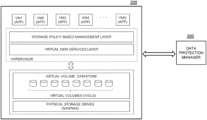
- FIG. 2 depicts an information processing system 200 with which one or more embodiments can be implemented. It is to be appreciated that information storage system 200 can implemented as part of information processing system 100 . More particularly, information processing system 200 implements the concept of virtual volumes or vVols.
- the virtual volume framework is an integration and management framework for external storage (storage area network (SAN) and network attached storage (NAS)).
- SAN storage area network
- NAS network attached storage
- One commercial implementation of virtual volumes is available in the hypervisor platform vSphere® available from VMware® (Palo Alto, CA).
- a set of virtual machines (VMs) 202 - 1 , 202 - 2 , 202 - 3 , 202 - 4 , . . . 202 -Q each execute an application instance (APP).
- An application instance can be an instantiation of an application program or part of an instantiation of part of an application program.
- An instance or instantiation is an executable or executing piece of software code.
- Each of the set of VMs 202 may execute instances of the same application or a subset of one or more VMs 202 may implement instances of applications different from instances of applications implemented on other subsets of one or more VMs 202 .
- This framework allows customers (e.g., administrators, tenants, owners of the applications) to assign and manage storage capabilities on a per-application (per-VM) basis at the hypervisor level using a storage policy-based management (SPBM) layer 204 .
- Virtual volumes allow customers to leverage the unique capabilities of their current storage investments and transition without disruption to a simpler and more efficient operational model optimized for virtual environments that works across all storage types.
- SPBM layer 204 interacts with virtual data services layer 206 . Parts or all of the SPBM layer 204 and virtual data services 206 may be implemented as part of a hypervisor layer 208 .
- Virtual data services layer 206 is operatively coupled to third party backup services 220 and third party data services (e.g., encryption, caching, replication, etc.) 230 .
- third party services 220 and 230
- third party services can be implemented via one or more cloud-based platforms (i.e., public, private, and/or hybrid).
- the set of VMs 202 , SPBM layer 204 , virtual data services layer 206 and hypervisor 208 can be implemented as part of one or more of the host devices 102 (also referred to as hosts, host servers, or application servers) in FIG. 1 . That is, a given host device 102 may host more than one application instance (APP) executing in more than one VM 202 , while in other embodiments, each application instance and VM is hosted by a different host device 102 .
- APP application instance
- information storage system 200 comprises a storage system 210 .
- the vVols framework virtualizes SAN and NAS devices by abstracting the physical hardware resources (physical storage drives 214 ) into logical pools of capacity called a virtual volume datastore 212 .
- Virtual volume datastore 212 comprises a set of virtual volumes devices (vVols) as shown in FIG. 2 .
- the vVols can be flexibly consumed and configured to span a portion, one or several storage arrays (e.g., storage arrays 106 in FIG. 1 ).
- the virtual volume datastore 212 defines capacity boundaries, access logic, and exposes a set of data services accessible to the VMs 202 provisioned in the pool.
- vVols of virtual volume datastore 212 are logical constructs that can be configured on the fly (in real-time), when needed, without disruption and without being formatted with a new file system.
- Native VM representation vVols define a new virtual disk container (virtual volume) that is specific to a VM and independent of the underlying physical storage representations (e.g., logical unit (LUN), file system, object, etc.).
- the virtual disk becomes the primary unit of data management at the array level.
- This turns the virtual volume datastore 212 into a VM-centric pool of capacity, enabling execution of storage operations with VM granularity and provisioning of native array-based data services to individual VMs 202 . Administrators can ensure the appropriate storage service levels are provided to each individual VM 202 .
- the SPBM layer 204 of the vVol framework depicted in FIG. 2 enables hypervisor 208 to no longer need to implement any storage abstraction such as a virtual machine file system (VMFS) and takes on the burden of managing virtual machine storage, e.g., vmdk (a file format that describes containers for virtual hard disk drives to be used in virtual machines), snapshots, etc. and offloads all storage management tasks to the underlying storage system 210 .
- VMFS virtual machine file system
- vmdk a file format that describes containers for virtual hard disk drives to be used in virtual machines
- snapshots etc.
- the hypervisor 208 provides snapshot capability (which is offloaded to storage system snapshot) but the granularity of this snapshot is at the VM level. This means that when a goal is to just protect the application instance inside the virtual machine, this goal is unachievable since, with the existing vVol framework in FIG. 2 , the entire virtual machine still needs to be protected. This results in a waste of snapshot capacity. Also, the number of backup copies created via the vSphere® hypervisor is limited to only 32 copies.
- Illustrative embodiments provide an improved method to protect an application instance executing inside a virtual machine on a virtual volume type storage system at the granularity of application-level with a non-limited number of snapshots. In illustrative embodiments, this is accomplished by adapting the vVol framework of FIG. 2 .
- One illustrative benefit of this improved method is reduction in snapshot capacity usage as the protection volume is limited to just the volumes on which application data is stored. As such, a greater number of protection copies are available resulting in better protection service level agreements (SLAs) and better recovery point objectives (RPOs).
- SLAs protection service level agreements
- RPOs recovery point objectives
- FIG. 3 depicts a data protection manager (DPM) 300 operatively coupled to information processing system 200 .
- DPM 300 is shown in FIG. 3 as functionally separate from information processing system 200 , in some embodiments DPM 300 is implemented on one or more processing devices remote from processing devices of information processing system 200 , while in other embodiments DPM 300 is implemented on one or more processing devices that are part of (local to) information processing system 200 .
- DPM 300 which will be explained further below, automatically pushes an application-aware agent module (agent) to the host device that employs the vVol framework.
- agent application-aware agent module
- An unmanaged vVol snapshot application programming interface (API) is exposed by the storage array controller to create off-the-hypervisor snapshots of vVols. Details of the data protection management functionalities according to illustrative embodiments will be further described in the context of FIGS. 4 and 5 .
- FIG. 4 illustrates an information processing system 400 with data protection management functionalities according to an illustrative embodiment. More particularly, FIG. 4 depicts details of an adaptation of the vVol framework of information processing system 200 in FIG. 2 with respect to data protection manager 300 .
- each VM 202 has an agent 402 running therein that is operatively coupled with DPM 300 .
- an unmanaged snapshot application programming interface (API) 404 is used to generate application instance data snapshots 406 in accordance with storage system 210 as will be further explained.
- API application programming interface
- each snapshot is a copy of data of the application instance which is stored as part of a vVol in virtual volume datastore 212 during execution of the application instance on a given VM 202 .
- a methodology for providing data protection management functionalities in accordance with information processing system 400 will now be described in the context of FIG. 5 . It is to be understood that DPM 300 causes steps 502 through 518 of methodology 500 to be performed as will be further explained below.
- DPM 300 first pushes application-aware agents 402 inside VMs 202 .
- an API associated with the hypervisor 208 which is typically used for providing files to the VMs 202 can be used here to receive and insert the agent 402 into each VM 202 .
- insertion can be facilitated using one or more tools installed inside the VMs 202 when the VMs are provisioned.
- agent module software embedded into the agent code is configured to discover the application and communicate with the application via an application-specific API to perform tasks such as quiescing and un-quiescing the application (i.e., quiescing is halting, pausing or altering a device or application to achieve a consistent state, usually in preparation for a backup or other maintenance, while un-quiescing is the reverse of quiescing), recovering the application, etc.
- quiescing is halting, pausing or altering a device or application to achieve a consistent state, usually in preparation for a backup or other maintenance, while un-quiescing is the reverse of quiescing
- recovering the application etc.
- step 504 when an application protection operation is started, DPM 300 initiates communication with each agent 402 inside each VM 202 . Once a communication link is established between DPM 300 and a given agent 402 , DPM 300 gathers information from the given agent 402 . Such information includes, but is not limited to:
- step 506 using the specific vVol identifiers obtained in step 504 , DPM 300 queries agents 402 to find further detailed information about the identified vVols.
- step 504 may perform a high-level application discovery, e.g., application instance information and high level layout (e.g., file and filesystem information).
- step 506 can then take information obtained in step 504 and perform a deeper discovery of information to gather detailed mapping information about the application layout, e.g., files->filesystem->volume groups->physical disks->SCSI disk information. It is to be appreciated that, in alternative embodiments, steps 504 and 506 can be combined depending on the information being obtained.
- DPM 300 freezes (quiesces or halts) the IO operations of the application instance (APP) executing in each VM 202 so that application data is brought to a consistent state.
- DPM 300 freezes IO operations via the agent 402 , i.e., agent 402 is instructed by DPM 300 to cause the VM 202 to halt the application instance.
- step 510 after a successful freeze operation (e.g., halt regular IO operations), DPM 300 initiates a connection link to storage system 210 (e.g., this could be to a storage controller in the storage system, e.g., 110 in FIG. 1 ), and once established, DPM 300 issues a command to unmanaged snapshot API 404 to create an unmanaged snapshot of all the vVols identified as part of step 506 .
- the difference between unmanaged and managed snapshot is that managed snapshots are created by the hypervisor 208 (e.g., the above-mentioned vSphere® hypervisor platform) whereas unmanaged snapshots are created without involvement of the hypervisor.
- DPM 300 communicates directly with the storage system 210 and creates the unmanaged snapshots.
- DPM 300 calls the hypervisor 208 and the hypervisor 208 communicates with the storage system 210 and creates snapshots.
- Unmanaged snapshots are depicted in FIG. 4 in block 406 .
- hypervisor 208 is completely unaware of this snapshot operation, i.e., generation of the snapshots is independent of (e.g., transparent to) the hypervisor (virtualization layer) of the host device. Due to the fact that the hypervisor-enforced limitation of snapshots (e.g., 32 as mentioned above for the existing vVol framework) does not apply, a backup administrator/application owner can request creation of essentially an un-limited number of copies of this type.
- step 514 for long term retention, the snapshot copies are masked/exported to VMs and data is copied to secondary storage or an archive location, e.g., cloud storage, such as depicted in third party data services 230 in FIG. 2 . More particularly, for masking, unmanaged snapshots are first imported to the hypervisor 208 using a hypervisor-provided API. Once the snapshots are successfully imported, they are hot added to the VM 202 .
- DPM 300 makes use of hypervisor APIs to convert the unmanaged snapshot to a managed snapshot.
- the hypervisor 208 needs to be made aware of those snapshot copies.
- the hypervisor 208 knows nothing about it.
- “conversion(import)” of an unmanaged snapshot to a managed snapshot is the process of making the hypervisor 208 aware of those snapshots.
- the conversion process comprises: (i) storing and importing the unmanaged vVol information into the vStorage APIs for Storage Awareness (VASA) repository of the vSphere® hypervisor platform; (ii) binding the imported vVols snapshot to the appropriate protocol endpoint; and (iii) creating a new vmdk path file which references that vVol in the virtual volume datastore 212 .
- VASA Storage Awareness
- the snapshot can be attached to any VM as a regular vVol (e.g., part of virtual volume datastore 212 ) and data inside the snapshot can be mounted back to (made accessible to) the VM where it is attached.
- step 518 after mounting and extracting the data to a secondary storage, the volume is unmounted and vVol is detached from the VM.
- steps performed above that are described as being caused by DPM 300 are initiated by DPM 300 by DPM 300 sending an instruction or command to one or more components in the host device and/or storage system that causes or triggers an operation to be performed therein in a manner that the host device and/or storage system is configured to perform.
- the cloud infrastructure further comprises sets of applications running on respective ones of the virtual machines and/or container sets.
- cloud infrastructure can be used to provide what is also referred to herein as a multi-tenant environment.
- One or more system components described herein can be implemented for use by tenants of such a multi-tenant environment.
- cloud infrastructure as disclosed herein can include cloud-based systems.
- Virtual machines provided in such systems can be used to implement illustrative embodiments.
- These and other cloud-based systems in illustrative embodiments can include object stores.
- processing platforms will now be described in greater detail with reference to FIGS. 6 and 7 . Although described in the context of system 400 , these platforms may also be used to implement at least portions of other information processing systems in other embodiments.
- FIG. 6 shows an example processing platform comprising cloud infrastructure 600 .
- the cloud infrastructure 600 comprises a combination of physical and virtual processing resources that may be utilized to implement at least a portion of the information processing system 100 .
- the cloud infrastructure 600 comprises multiple virtual machines (VMs) and/or container sets 602 - 1 , 602 - 2 , . . . 602 -L implemented using virtualization infrastructure 604 .
- the virtualization infrastructure 604 runs on physical infrastructure 605 , and illustratively comprises one or more hypervisors and/or operating system level virtualization infrastructure.
- the operating system level virtualization infrastructure illustratively comprises kernel control groups of a Linux operating system or other type of operating system.
- the VMs/container sets 602 comprise respective containers implemented using virtualization infrastructure 604 that provides operating system level virtualization functionality, such as support for Docker containers running on bare metal hosts, or Docker containers running on VMs.
- the containers are illustratively implemented using respective kernel control groups of the operating system.
- one or more of the processing modules or other components of system 400 may each run on a computer, server, storage device or other processing platform element.
- a given such element may be viewed as an example of what is more generally referred to herein as a “processing device.”
- the cloud infrastructure 600 shown in FIG. 6 may represent at least a portion of one processing platform.
- processing platform 700 shown in FIG. 7 is another example of such a processing platform.
- the processing platform 700 in this embodiment comprises a portion of system 400 and includes a plurality of processing devices, denoted 702 - 1 , 702 - 2 , 702 - 3 , . . . 702 -N, which communicate with one another over a network 704 .
- the network 704 may comprise any type of network, including by way of example a global computer network such as the Internet, a WAN, a LAN, a satellite network, a telephone or cable network, a cellular network, a wireless network such as a WiFi or WiMAX network, or various portions or combinations of these and other types of networks.
- the processing device 702 - 1 in the processing platform 700 comprises a processor 710 coupled to a memory 712 .
- the processor 710 may comprise a microprocessor, a microcontroller, an application-specific integrated circuit (ASIC), a field-programmable gate array (FPGA), a central processing unit (CPU), a graphical processing unit (GPU), a tensor processing unit (TPU), a video processing unit (VPU) or other type of processing circuitry, as well as portions or combinations of such circuitry elements.
- ASIC application-specific integrated circuit
- FPGA field-programmable gate array
- CPU central processing unit
- GPU graphical processing unit
- TPU tensor processing unit
- VPU video processing unit
- Articles of manufacture comprising such processor-readable storage media are considered illustrative embodiments.
- a given such article of manufacture may comprise, for example, a storage array, a storage disk or an integrated circuit containing RAM, ROM, flash memory or other electronic memory, or any of a wide variety of other types of computer program products.
- the term “article of manufacture” as used herein should be understood to exclude transitory, propagating signals. Numerous other types of computer program products comprising processor-readable storage media can be used.
- the other processing devices 702 of the processing platform 700 are assumed to be configured in a manner similar to that shown for processing device 702 - 1 in the figure.
- processing platform 700 shown in the figure is presented by way of example only, and system 400 may include additional or alternative processing platforms, as well as numerous distinct processing platforms in any combination, with each such platform comprising one or more computers, servers, storage devices or other processing devices.
- processing platforms used to implement illustrative embodiments can comprise converged infrastructure.
- components of an information processing system as disclosed herein can be implemented at least in part in the form of one or more software programs stored in memory and executed by a processor of a processing device.
- a processor of a processing device For example, at least portions of the functionality of one or more components of the FIG. 4 system as disclosed herein are illustratively implemented in the form of software running on one or more processing devices.
Landscapes
- Engineering & Computer Science (AREA)
- Theoretical Computer Science (AREA)
- Physics & Mathematics (AREA)
- General Engineering & Computer Science (AREA)
- General Physics & Mathematics (AREA)
- Human Computer Interaction (AREA)
- Software Systems (AREA)
- Computer Security & Cryptography (AREA)
- Information Retrieval, Db Structures And Fs Structures Therefor (AREA)
Abstract
Description
-
- (i) Detailed application instance and application layout information, e.g., application file system volumes, volume groups and physical disks layout information. In some illustrative embodiments, only physical disks information on which application data (e.g., database files, logs etc.) resides is collected.
- (ii) For each of the physical disks involved in the application protection operation, the application-
aware agent 402 performs a Small Computer System Interface (SCSI) inquiry operation which returns the underlying virtual volumes (vVols) unique identifiers (IDs). More particularly, a SCSI inquiry operation is performed by theagent 402 to find out details of the SCSI disks, e.g., vendor information, disk unique identifier, storage system identifier, etc. vVol IDs are created and managed by the hypervisor 208 (e.g., the vSphere® hypervisor platform) for each of the vVol disks and, when a SCSI inquiry call is performed on a vVol disk which is created and managed by thehypervisor 208, it returns the details of the vVol disk which includes its vVol ID. Typically, the vVol ID is unique in the hypervisor environment and is used to uniquely identify any vVol disk.
Claims (20)
Priority Applications (1)
| Application Number | Priority Date | Filing Date | Title |
|---|---|---|---|
| US17/103,184 US12346715B2 (en) | 2020-11-24 | 2020-11-24 | Data protection management of application instance executing in accordance with virtual volume-based storage system |
Applications Claiming Priority (1)
| Application Number | Priority Date | Filing Date | Title |
|---|---|---|---|
| US17/103,184 US12346715B2 (en) | 2020-11-24 | 2020-11-24 | Data protection management of application instance executing in accordance with virtual volume-based storage system |
Publications (2)
| Publication Number | Publication Date |
|---|---|
| US20220164211A1 US20220164211A1 (en) | 2022-05-26 |
| US12346715B2 true US12346715B2 (en) | 2025-07-01 |
Family
ID=81658302
Family Applications (1)
| Application Number | Title | Priority Date | Filing Date |
|---|---|---|---|
| US17/103,184 Active 2043-01-02 US12346715B2 (en) | 2020-11-24 | 2020-11-24 | Data protection management of application instance executing in accordance with virtual volume-based storage system |
Country Status (1)
| Country | Link |
|---|---|
| US (1) | US12346715B2 (en) |
Families Citing this family (2)
| Publication number | Priority date | Publication date | Assignee | Title |
|---|---|---|---|---|
| US12253919B2 (en) * | 2022-12-12 | 2025-03-18 | Netapp, Inc. | Methods and systems for protecting and restoring virtual machines |
| US12235807B2 (en) | 2023-02-15 | 2025-02-25 | Pure Storage, Inc. | Backend storage system implementing multiple data management models |
Citations (8)
| Publication number | Priority date | Publication date | Assignee | Title |
|---|---|---|---|---|
| US8140480B1 (en) * | 2009-03-31 | 2012-03-20 | Symantec Corporation | Off-host cataloging of backup information |
| US20150378849A1 (en) * | 2014-06-30 | 2015-12-31 | International Business Machines Corporation | Method and device for backing up, restoring a virtual machine |
| US10270796B1 (en) * | 2016-03-25 | 2019-04-23 | EMC IP Holding Company LLC | Data protection analytics in cloud computing platform |
| US20190163578A1 (en) * | 2017-11-28 | 2019-05-30 | Entit Software Llc | Application-aware virtual machine backup |
| US20190228087A1 (en) * | 2018-01-25 | 2019-07-25 | Citrix Systems, Inc. | Instant hyper-v streaming |
| US20200034250A1 (en) * | 2016-06-09 | 2020-01-30 | Nutanix, Inc. | Saving and restoring storage devices using application-consistent snapshots |
| US20210011627A1 (en) * | 2017-11-30 | 2021-01-14 | Veritas Technologies Llc | Performing Backup Operations Using Replicas |
| US10922132B1 (en) * | 2017-12-11 | 2021-02-16 | Amazon Technologies, Inc. | Secure migration of servers from customer networks to service provider systems |
-
2020
- 2020-11-24 US US17/103,184 patent/US12346715B2/en active Active
Patent Citations (8)
| Publication number | Priority date | Publication date | Assignee | Title |
|---|---|---|---|---|
| US8140480B1 (en) * | 2009-03-31 | 2012-03-20 | Symantec Corporation | Off-host cataloging of backup information |
| US20150378849A1 (en) * | 2014-06-30 | 2015-12-31 | International Business Machines Corporation | Method and device for backing up, restoring a virtual machine |
| US10270796B1 (en) * | 2016-03-25 | 2019-04-23 | EMC IP Holding Company LLC | Data protection analytics in cloud computing platform |
| US20200034250A1 (en) * | 2016-06-09 | 2020-01-30 | Nutanix, Inc. | Saving and restoring storage devices using application-consistent snapshots |
| US20190163578A1 (en) * | 2017-11-28 | 2019-05-30 | Entit Software Llc | Application-aware virtual machine backup |
| US20210011627A1 (en) * | 2017-11-30 | 2021-01-14 | Veritas Technologies Llc | Performing Backup Operations Using Replicas |
| US10922132B1 (en) * | 2017-12-11 | 2021-02-16 | Amazon Technologies, Inc. | Secure migration of servers from customer networks to service provider systems |
| US20190228087A1 (en) * | 2018-01-25 | 2019-07-25 | Citrix Systems, Inc. | Instant hyper-v streaming |
Non-Patent Citations (3)
| Title |
|---|
| NVM Express, "NVM Express, Revision 1.3," NVM Express, May 1, 2017, 282 pages. |
| VMware, Inc., "VMware vSphere Virtual Volumes (vVols): Getting Started Guide," Hyperconverged Infrastructure Business Unit, Technical Documentation v 1.3, Sep. 2019, 40 pages. |
| VMware, Inc., "VMware vSphere Virtual Volumes," https://www.vmware.com/content/dam/digitalmarketing/vmware/en/pdf/solutionoverview/products/virtualvolumes/vmware_virtual_volumes_solutionsoverview.pdf, Sep. 2015, 2 pages. |
Also Published As
| Publication number | Publication date |
|---|---|
| US20220164211A1 (en) | 2022-05-26 |
Similar Documents
| Publication | Publication Date | Title |
|---|---|---|
| US11467778B2 (en) | Creating high availability storage volumes for software containers | |
| CN103765372B (en) | Configure an object storage system for I/O operations | |
| US10050850B2 (en) | Rack awareness data storage in a cluster of host computing devices | |
| CN103748545B (en) | Data storage system and data storage control method | |
| CN103140842B (en) | For the system and method for flexible storage and retrieval snapshot archives is provided | |
| US8473692B2 (en) | Operating system image management | |
| US9613039B2 (en) | File system snapshot data management in a multi-tier storage environment | |
| US9946565B2 (en) | Management of cloud-computing facility through a virtual infrastructure management server | |
| US20200036575A1 (en) | Methods and systems to troubleshoot and localize storage failures for a multitenant application run in a distributed computing system | |
| US11994960B2 (en) | Data recovery in virtual desktop infrastructure environments | |
| CN103765371A (en) | Data storage system exporting logical volumes as storage objects | |
| US10572271B1 (en) | Efficient instantiation of encrypted guests | |
| US10664415B2 (en) | Quality of service enforcement and data security for containers accessing storage | |
| US8495178B1 (en) | Dynamic bandwidth discovery and allocation to improve performance for backing up data | |
| US9417997B1 (en) | Automated policy based scheduling and placement of storage resources | |
| US20220164211A1 (en) | Data protection management of application instance executing in accordance with virtual volume-based storage system | |
| US11226851B1 (en) | Execution of multipath operation triggered by container application | |
| US11537555B2 (en) | Managing network shares utilizing filesystem snapshots comprising metadata characterizing network shares | |
| US11803425B2 (en) | Managing storage resources allocated to copies of application workloads | |
| US11880606B2 (en) | Moving virtual volumes among storage nodes of a storage cluster based on determined likelihood of designated virtual machine boot conditions | |
| US11461188B2 (en) | Automated failover backup reconfiguration management for storage systems | |
| US12417113B2 (en) | Configuring storage resources based on service levels | |
| US12326950B2 (en) | Intelligent policy module | |
| US11556430B2 (en) | Selecting restore processes for applications hosted on storage volumes that are part of group replication sessions | |
| US12081389B1 (en) | Resource retention rules encompassing multiple resource types for resource recovery service |
Legal Events
| Date | Code | Title | Description |
|---|---|---|---|
| AS | Assignment |
Owner name: EMC IP HOLDING COMPANY LLC, MASSACHUSETTS Free format text: ASSIGNMENT OF ASSIGNORS INTEREST;ASSIGNOR:KUMAR, SUNIL;REEL/FRAME:054460/0448 Effective date: 20201123 |
|
| FEPP | Fee payment procedure |
Free format text: ENTITY STATUS SET TO UNDISCOUNTED (ORIGINAL EVENT CODE: BIG.); ENTITY STATUS OF PATENT OWNER: LARGE ENTITY |
|
| AS | Assignment |
Owner name: CREDIT SUISSE AG, CAYMAN ISLANDS BRANCH, NORTH CAROLINA Free format text: SECURITY AGREEMENT;ASSIGNORS:EMC IP HOLDING COMPANY LLC;DELL PRODUCTS L.P.;REEL/FRAME:055408/0697 Effective date: 20210225 |
|
| AS | Assignment |
Owner name: THE BANK OF NEW YORK MELLON TRUST COMPANY, N.A., AS NOTES COLLATERAL AGENT, TEXAS Free format text: SECURITY INTEREST;ASSIGNORS:EMC IP HOLDING COMPANY LLC;DELL PRODUCTS L.P.;REEL/FRAME:055479/0051 Effective date: 20210225 Owner name: THE BANK OF NEW YORK MELLON TRUST COMPANY, N.A., AS NOTES COLLATERAL AGENT, TEXAS Free format text: SECURITY INTEREST;ASSIGNORS:EMC IP HOLDING COMPANY LLC;DELL PRODUCTS L.P.;REEL/FRAME:055479/0342 Effective date: 20210225 Owner name: THE BANK OF NEW YORK MELLON TRUST COMPANY, N.A., AS NOTES COLLATERAL AGENT, TEXAS Free format text: SECURITY INTEREST;ASSIGNORS:EMC IP HOLDING COMPANY LLC;DELL PRODUCTS L.P.;REEL/FRAME:056136/0752 Effective date: 20210225 |
|
| STPP | Information on status: patent application and granting procedure in general |
Free format text: DOCKETED NEW CASE - READY FOR EXAMINATION |
|
| AS | Assignment |
Owner name: EMC IP HOLDING COMPANY LLC, TEXAS Free format text: RELEASE OF SECURITY INTEREST AT REEL 055408 FRAME 0697;ASSIGNOR:CREDIT SUISSE AG, CAYMAN ISLANDS BRANCH;REEL/FRAME:058001/0553 Effective date: 20211101 Owner name: DELL PRODUCTS L.P., TEXAS Free format text: RELEASE OF SECURITY INTEREST AT REEL 055408 FRAME 0697;ASSIGNOR:CREDIT SUISSE AG, CAYMAN ISLANDS BRANCH;REEL/FRAME:058001/0553 Effective date: 20211101 |
|
| AS | Assignment |
Owner name: DELL PRODUCTS L.P., TEXAS Free format text: RELEASE OF SECURITY INTEREST IN PATENTS PREVIOUSLY RECORDED AT REEL/FRAME (055479/0051);ASSIGNOR:THE BANK OF NEW YORK MELLON TRUST COMPANY, N.A., AS NOTES COLLATERAL AGENT;REEL/FRAME:062021/0663 Effective date: 20220329 Owner name: EMC IP HOLDING COMPANY LLC, TEXAS Free format text: RELEASE OF SECURITY INTEREST IN PATENTS PREVIOUSLY RECORDED AT REEL/FRAME (055479/0051);ASSIGNOR:THE BANK OF NEW YORK MELLON TRUST COMPANY, N.A., AS NOTES COLLATERAL AGENT;REEL/FRAME:062021/0663 Effective date: 20220329 Owner name: DELL PRODUCTS L.P., TEXAS Free format text: RELEASE OF SECURITY INTEREST IN PATENTS PREVIOUSLY RECORDED AT REEL/FRAME (055479/0342);ASSIGNOR:THE BANK OF NEW YORK MELLON TRUST COMPANY, N.A., AS NOTES COLLATERAL AGENT;REEL/FRAME:062021/0460 Effective date: 20220329 Owner name: EMC IP HOLDING COMPANY LLC, TEXAS Free format text: RELEASE OF SECURITY INTEREST IN PATENTS PREVIOUSLY RECORDED AT REEL/FRAME (055479/0342);ASSIGNOR:THE BANK OF NEW YORK MELLON TRUST COMPANY, N.A., AS NOTES COLLATERAL AGENT;REEL/FRAME:062021/0460 Effective date: 20220329 Owner name: DELL PRODUCTS L.P., TEXAS Free format text: RELEASE OF SECURITY INTEREST IN PATENTS PREVIOUSLY RECORDED AT REEL/FRAME (056136/0752);ASSIGNOR:THE BANK OF NEW YORK MELLON TRUST COMPANY, N.A., AS NOTES COLLATERAL AGENT;REEL/FRAME:062021/0771 Effective date: 20220329 Owner name: EMC IP HOLDING COMPANY LLC, TEXAS Free format text: RELEASE OF SECURITY INTEREST IN PATENTS PREVIOUSLY RECORDED AT REEL/FRAME (056136/0752);ASSIGNOR:THE BANK OF NEW YORK MELLON TRUST COMPANY, N.A., AS NOTES COLLATERAL AGENT;REEL/FRAME:062021/0771 Effective date: 20220329 |
|
| STPP | Information on status: patent application and granting procedure in general |
Free format text: NON FINAL ACTION MAILED |
|
| STPP | Information on status: patent application and granting procedure in general |
Free format text: RESPONSE TO NON-FINAL OFFICE ACTION ENTERED AND FORWARDED TO EXAMINER |
|
| STPP | Information on status: patent application and granting procedure in general |
Free format text: FINAL REJECTION MAILED |
|
| STPP | Information on status: patent application and granting procedure in general |
Free format text: RESPONSE AFTER FINAL ACTION FORWARDED TO EXAMINER |
|
| STPP | Information on status: patent application and granting procedure in general |
Free format text: ADVISORY ACTION MAILED |
|
| STPP | Information on status: patent application and granting procedure in general |
Free format text: DOCKETED NEW CASE - READY FOR EXAMINATION |
|
| STPP | Information on status: patent application and granting procedure in general |
Free format text: NON FINAL ACTION MAILED |
|
| STPP | Information on status: patent application and granting procedure in general |
Free format text: RESPONSE TO NON-FINAL OFFICE ACTION ENTERED AND FORWARDED TO EXAMINER |
|
| STPP | Information on status: patent application and granting procedure in general |
Free format text: FINAL REJECTION MAILED |
|
| STPP | Information on status: patent application and granting procedure in general |
Free format text: ADVISORY ACTION MAILED |
|
| STPP | Information on status: patent application and granting procedure in general |
Free format text: DOCKETED NEW CASE - READY FOR EXAMINATION |
|
| STCF | Information on status: patent grant |
Free format text: PATENTED CASE |