US12346330B2 - Efficient merge of tabular data using mixing - Google Patents
Efficient merge of tabular data using mixing Download PDFInfo
- Publication number
- US12346330B2 US12346330B2 US17/895,882 US202217895882A US12346330B2 US 12346330 B2 US12346330 B2 US 12346330B2 US 202217895882 A US202217895882 A US 202217895882A US 12346330 B2 US12346330 B2 US 12346330B2
- Authority
- US
- United States
- Prior art keywords
- files
- rows
- matching
- target table
- job
- Prior art date
- Legal status (The legal status is an assumption and is not a legal conclusion. Google has not performed a legal analysis and makes no representation as to the accuracy of the status listed.)
- Active, expires
Links
Images




Classifications
-
- G—PHYSICS
- G06—COMPUTING OR CALCULATING; COUNTING
- G06F—ELECTRIC DIGITAL DATA PROCESSING
- G06F16/00—Information retrieval; Database structures therefor; File system structures therefor
- G06F16/20—Information retrieval; Database structures therefor; File system structures therefor of structured data, e.g. relational data
- G06F16/24—Querying
- G06F16/245—Query processing
- G06F16/2455—Query execution
- G06F16/24553—Query execution of query operations
- G06F16/24558—Binary matching operations
- G06F16/2456—Join operations
-
- G—PHYSICS
- G06—COMPUTING OR CALCULATING; COUNTING
- G06F—ELECTRIC DIGITAL DATA PROCESSING
- G06F16/00—Information retrieval; Database structures therefor; File system structures therefor
- G06F16/20—Information retrieval; Database structures therefor; File system structures therefor of structured data, e.g. relational data
- G06F16/22—Indexing; Data structures therefor; Storage structures
- G06F16/2282—Tablespace storage structures; Management thereof
Definitions
- a system for big data processing comprises a system for deployments of applications, configurations, one or more datasets, and model(s) used in connection with analyzing the data. Updating datasets at scale is very computationally expensive and takes significant amount of time to complete.
- FIG. 1 is a block diagram of a system for merging data according to various embodiments of the present application.
- FIG. 2 is a block diagram of a data merging service according to various embodiments of the present application.
- FIG. 3 is an illustration of an example of files created in connection with merging target data and source data according to various embodiments of the present application.
- FIG. 4 is a flow diagram of a method for updating data according to various embodiments of the present application.
- FIG. 6 is a flow diagram of a method for updating data according to various embodiments of the present application.
- FIG. 7 is a flow diagram of a method for updating data according to various embodiments of the present application.
- FIG. 8 is a flow diagram of a method for merging target data and source data according to various embodiments of the present application.
- FIG. 9 is a flow diagram of a method for performing a first job in connection with merging target data and source data according to various embodiments of the present application.
- FIG. 10 is a flow diagram of a method for performing a second job in connection with merging target data and source data according to various embodiments of the present application.
- FIG. 11 is a flow diagram of a method for performing a third job in connection with merging target data and source data according to various embodiments of the present application.
- FIG. 12 is a flow diagram of a method for performing a fourth job in connection with merging target data and source data according to various embodiments of the present application.
- FIG. 13 is a flow diagram of a method for merging target data and source data according to various embodiments of the present application.
- FIG. 14 is a flow diagram of a method for merging target data and source data according to various embodiments of the present application.
- FIG. 15 is a flow diagram of a method for merging target data and source data according to various embodiments of the present application.
- FIG. 17 is a flow diagram of a method for persisting deletion vectors according to various embodiments of the present application.
- source data (or also referred to herein as a source table) is a set of data indicating one or more of (i) a new state of data to which the existing data is to be modified, or (ii) a change to be made to corresponding data in the existing data (e.g., the target table).
- Source data can be a source table, data that is keyed (e.g., such as keyed in accordance with an indexing of a corresponding target table), etc.
- the source data can be a source table, and each row in the source table can correspond to (e.g., match, be keyed to, etc.) a row in the target table to be merged.
- merging data can include contemporaneous updating of existing data and inserting new data.
- Merging data can further include deletion of existing data.
- merging data can include (i) updating one or more rows of the target table based on data in a corresponding row(s) of the source table and (ii) inserting a row in the target table for rows in the source table that have no corresponding rows in the existing target table.
- an unmatched row of the target table includes a row that is to be deleted from the target table.
- a row to be deleted from the target table can be deemed an unmatched row depending on the rules for the corresponding merge command.
- syntax for such an unmatched row in connection with a merge command is a MERGE INTO command as “WHEN NOT MATCHED BY SOURCE AND ⁇ extra condition> THEN DELETE”.
- syntax for the merge command is “WHEN MATCHED AND ⁇ extra condition> THEN DELETE”
- such rows may be deemed matched rows.
- compaction includes performance of one or more re-arrangement transactions that reduce the number of files.
- compaction of data includes taking a plurality of files and combining those files into a single file. Compaction is believed to improve data clustering and enables more efficient use/modification of the data.
- An example of compaction of data is described in U.S. patent application Ser. No. 17/580,475, the entirety of which is hereby incorporated by reference for all purposes.
- the system determines an extent of the target data to be merged, determines whether to reconfigure the target data before performing the merge of the target data, and in response to determining that the target data is to be reconfigured, reconfiguring the data. For example, the system determines the size of file(s) to be processed in connection with performing the merge and determines whether to adjust the size of the file(s), such as based on a data processing policy or other parameters associated with efficient processing of the target data. Adjusting the size of the files can include compacting various subsets of relatively smaller files into various compacted files, or splitting relatively larger files into various smaller files.
- an ideal/preferred file size or an ideal/preferred range(s) of file sizes can be between 256 MB and 512 MB.
- the system adjusts the sizes of files to be processed to enable efficient processing of data in batches.
- the size of files can be controlled (e.g., reduced) to minimize the cost of rewriting files or the cost of transferring the file(s) across a network, etc.
- the system determines an extent of the target data that was merged, determines whether to reconfigure the target data after performing the merge of the target data, and in response to determining that the target data is to be reconfigured, reconfiguring the data. For example, the system determines whether the target data after the merge operation (e.g., the resulting table or resulting files obtained in response to the merge) is stored in a suboptimal way or otherwise deviates from an ideal data configuration, and in response to determining that such data is stored in a suboptimal way or is different from the ideal data configuration, the system reconfigures the data.
- target data e.g., a target table
- Related art systems update data in a target table using a merge operation, such as a “MERGE INTO” SQL statement.
- the merge operation according to related art systems obtains a target table and merges a set of changes into the target table using a source table that generally includes different data to drive the change(s).
- the target table and the source table are merged in accordance with a merge condition, which can specify the source table row that applies to a particular target table row.
- a merge condition can specify the source table row that applies to a particular target table row.
- only one source table row can be applied as a change to any one particular target table row.
- multiple target table rows can be applied (e.g., modified based on) using a particular source table row.
- a target table In response to determining that a target table is to be merged with a source data (e.g., a source table), related art systems obtain (e.g., retrieve) the target table, scan the records/rows of the target table, and perform a merge operation (e.g., a right outer join or inner join) using the target table and the source data.
- the merge operation can include performing a matching action in accordance with a matching condition being satisfied (e.g., in response to determining that a source table row corresponds to a particular target table row).
- a matching action can include updating the target table row or deleting the target table row.
- Updating the target table row can include modifying values for one or more columns of the target table (e.g., modifying the values in accordance with the corresponding source data).
- the system For source table rows that do not have a corresponding target table row (e.g., for unmatched rows), the system performs a non-matched action, which can include inserting the source table row into the target table.
- the related art systems apply the changes based on the source data and write resulting records (e.g., the merged data) to one or more files.
- the system performs a non-matched action, which can include updating the target table row or deleting the target table row (e.g., in accordance with the specified rules).
- the system obtains the files corresponding to the records from storage.
- Obtaining the files generally requires the transfer of the entire target table/corresponding files across a network.
- target tables include a significant number of records.
- transferring the data to merge the target table with the source data can be expensive (e.g., computationally expensive, significant bandwidths, latency, etc.).
- related art systems perform a merge operation with respect to the target table and source table.
- the related art systems perform a computationally expensive join operation on rows of the target table and the source table.
- Related art systems may perform the join operation with respect to all rows of the target table and the source table, which at scale is extremely expensive.
- the join operation can include performing hash matching.
- various embodiments selectively transfer parts of the target table (or corresponding information) across a network for merging with the source data.
- the system selectively determines target table rows or records for which information is to be transferred across the network.
- the system can determine the target table rows or records for which information is to be transferred across the network based at least in part on a determination of matched rows.
- the system can transfer information for matched rows across a network for merging with corresponding source data and performing a merge with respect to unmatched rows without requiring transfer of information for the unmatched rows across the network.
- Various embodiments merge a target table and source data based on a determination of matched rows. For example, the system determines matched rows based at least in part on a target table key (e.g., an index for target table records). In response to determining/obtaining source data, the system can determine whether the source data is keyed (e.g., indexed in a similar manner to the target table with which the source data is to be merged). If the source data is keyed, then the system uses the source data keys and target table keys to determine matched rows and unmatched rows.
- a target table key e.g., an index for target table records
- the system in response to determining that the source data is not keyed (e.g., the data can be a complex query, which may be a combination of tables), uses the source data to instantiate a source table that is keyed/indexed in accordance with the keying/indexing of the target table.
- the target table can be keyed based on including a column in the target table that includes a key for the various records (e.g., key identifiers).
- the system can then use the source table in connection with merging the target table with the source data.
- the system performs a first job based at least in part on the target table and the source data to be merged.
- the first job is performed in connection with determining matched rows and/or unmatched rows.
- performing the first job includes (i) reading the target table and the source data, (ii) joining the target table and the source data (e.g., a source table) in connection with determining files in the target table (e.g., in the case of a file-based table) that have at least one matching record with a record in the source data.
- the system can store an indication of whether a record in the target table or source data is a matched row (or matched record).
- the system stores an indication of only those rows or records that are matched rows/matched records.
- the system determines which target table files had a record that matched a record in the source data. For example, for each target table row, the system remembers (e.g., stores an indication of) the file from which the row was obtained, and after the join operation performed with respect to the source data, the system remembers which target table files are invoked in the output of the join operation.
- the system determines, based at least in part on results of the first job, the rows/records that are to be transferred across a network for merging the target table and the source data. For example, the system queries a mapping of files/records corresponding to matched rows and performs a merging of the matched rows of target table and source data.
- the merging of the matched rows of the target table and the source data can include performing a join operation with respect to the matched rows of the target table and a source table.
- the system performs a second job (also referred to herein as the primary second job) based at least in part on certain rows of the target table and certain records of the source data to be merged.
- the second job can be performed based at least in part on the results of performing the first job.
- the system uses the indications of matched rows in connection with determining rows of the target table and records of the source data for which the second job is to be performed.
- the system can obtain the indication of matched rows and indication of which file from which the matched row of the target table originate to determine the files to be subject to the second job.
- Performing the second job can include transferring files corresponding to the matched rows across the network (e.g., the compute resource(s) performing the second job obtains the files for which a join operation is to be performed).
- performing the second job includes scanning the matched target table rows and the corresponding records of the source data (e.g., matched rows of the source table) and performing a join operation with respect to such matched rows.
- the join operation can be a right outer join or an inner join.
- the scanning of the matched target table rows can include reading all the rows for the matching target table files (e.g., the files corresponding to the matched rows of the target table).
- performing the second job includes only performing the join operation on the matched rows.
- the second job is only performed with respect to matching rows of matching files (e.g., matched rows of the files corresponding to matched rows of the target table). For example, unmatched rows are not scanned and joined in connection with the second job.
- the system applies the applicable changes. For example, the system merges the data in the matched target table rows in accordance with the source data. In response to merging the data in the matched rows, the system stores the resulting data (e.g., the data changed in accordance with the source data) in corresponding resulting files (e.g., second job resulting files). As an example, if files A, B, and C correspond to matched table rows, the system stores files E, D, and F respectively corresponding to files, A, B, and C modified in accordance with the source data. In some embodiments, performing the second job includes storing, for each file corresponding to a matched row, a corresponding resulting file.
- performing the second job includes redistributing the data from the matched rows among a set of second job resulting files. For example, for rows comprised in a single target table file, performing the second job can include storing data for the single target table file across a plurality of second job resulting files.
- Performing the second job can include filtering out one or more of (i) unmatched source data records (e.g., unmatched rows of the source table) from the source data, and (ii) unmatched rows of matched target table rows (e.g., rows in the files of the matched target table rows for which the source data has no corresponding record).
- the system scans the source table to obtain only matched source data records (e.g., rows in the source table having a corresponding row in the target table), which can thus eliminate the need to filter out the unmatched source data records after the join operation (e.g., the join operation is only performed with respect to the matched source data records).
- the system also stores an indication of matched source data records so the system can later determine the matched source data records when performing the second job and avoiding performing the join operation of the second job on the unmatched source data records.
- a target table is to be merged with source data
- three types of records can exist: (i) matched rows across the target table and source data; (ii) target table rows/records for which the source data has no corresponding row/record, and (iii) source data rows/records for which the target table has no corresponding row/record. If the second job is only performed with respect to the matched rows, then other records can remain (e.g., records under (ii) and (iii)) for which merging is to be performed.
- the system performs a third job based at least in part on certain rows of the target table and certain records of the source data to be merged.
- the system performs the third job with respect to one or more records/rows that were not subject to the second job.
- the third job is performed with respect to unmatched rows.
- the third job is performed with respect to unmatched rows of matched target table files (e.g., target table files having at least one matching row).
- the third job is performed with respect to unmatched target table rows (e.g., only unmatched target table rows). The system determines the unmatched target table rows based on the results of the first job.
- the system can use an indication of whether a target table row is a matched row if the indication is stored based on results of the first job.
- the system determines the remaining records (e.g., the unmatched target table rows) based on the indication of matched target table rows if the indication is stored based on the results of the first job.
- the system can determine the unmatched target table rows based on subtracting the matched target table rows from the set of all target table rows.
- unmatched target table files e.g., target table files that do not have a row that matches a source data
- the information in such unmatched target table files can be reorganized in a post-processing step, such as a compaction operation.
- performing the third job includes scanning the target table for unmatched rows in matching files.
- the system uses the results from the first job to determine target table rows having corresponding source data records (e.g., matched target table rows), the system then determines those rows of the files for the matched target table rows that are unmodified, and the system then performs the third job with respect to such rows of the files for the matched target table rows that are unmodified (e.g., for which the source data does not include any corresponding record).
- scanning e.g., obtaining
- the system stores the unmatched rows to one or more third job resulting files.
- the system stores a third job resulting file. For example, the system stores a third job resulting file for each file scanned in connection with performing the third job. As another example, the system can store a plurality of third job resulting file for each file scanned in connection with performing the third job. As another example, the system can store a single third job resulting file for a plurality of files scanned in connection with performing the third job.
- the system stores the third job resulting files as A′, B′, and C′. Accordingly, after performing the second job and the third job, the resulting files include the second job resulting files (e.g., E, D, and F) and the third job resulting files (e.g., A′, B′, and C′).
- the second job resulting files e.g., E, D, and F
- the third job resulting files e.g., A′, B′, and C′.
- the system may perform a fourth job based at least in part on certain rows of the source data.
- the system performs the fourth job with respect to unmatched source data records. For example, the system determines source table rows that do not have a corresponding/matching target table row and performs the fourth job.
- Performing the fourth job can include scanning the source data to obtain the unmatched source data records and re-writing such unmatched source data records into one or more new files (e.g., one or more fourth job resulting files).
- the system writes out all the unmatched source data records into a single fourth job resulting file or multiple fourth job resulting files.
- the unmatched source data records can correspond to records that are to be inserted into the target table in connection with performing the merging of the target table and source data.
- Performing the first, second, third, and fourth jobs with respect to target files can result in an increase in the number of files for the modified data.
- performing first, second, third, and fourth jobs on the target table corresponding to files A, B, and C can result in files D, E, F, A′, B′, C′, and the fourth job resulting file (e.g., file G).
- the number of files increases too much, the foregoing can lead to difficulties in scaling the merging.
- Various embodiments implement counter measures to reduce the number of resulting files or to limit the number of resulting files being created.
- the counter-measures can include performing a post-processing with respect to a plurality of the resulting files or performing a secondary second job and modified third job, which are configured to reduce the number of resulting files being created across the second job and the third job.
- the system performs a post-processing of the resulting files (e.g., the files resulting from the second job, the third job, and the fourth job).
- the post-processing of the resulting files can include performing a compaction with respect to two or more of the resulting files.
- the system can create a single file comprising the information of a plurality of files.
- the system may perform a compaction of files B′ and C′ to obtain file H, and a compaction of files E, F, and G to obtain file I. Accordingly, the resulting files is reduced to A′, H, and I.
- the system performs the compaction with respect to the plurality of resulting files based at least in part on one or more predefined compaction thresholds.
- the one or more compaction thresholds can include a large file threshold and/or a small file threshold.
- the system can determine to compact a set of files having a file size less than the predefined compaction threshold(s) (e.g., the small file threshold).
- the system can exclude files having a file size higher than a predefined compaction threshold(s) (e.g., the large file threshold).
- the system uses one or more post-processing heuristics in connection with determining whether to perform a post-processing of the resulting files (e.g., performing a compaction with respect to one or more resulting files, etc.).
- the one or more post-processing heuristics include (i) clustering property preservation (e.g., combining only files that include similar data, combining files that are adjacent in a total or partial ordering of files), (ii) bin packing files according to a predefined bin packing scheme (e.g., to achieve files that are as close as possible to a predetermined size), (iii) determining not to combine files if a number of resulting files is less than a predetermined resulting file threshold (e.g., to avoid performing unnecessary work), (iv) combining files based on when the files were created (e.g., based on the files having a similar age, or an age within a threshold age difference, etc.), (v) combining files based on a determination
- the system performs a secondary second job based at least in part on certain rows of the target table and certain records of the source data to be merged.
- the second job discussed above e.g., the primary second job
- the second job described above limits the amount of information transferred across the network and subject to the join operation by only obtaining and computing a join operation with respect to matching rows of matching files (e.g., matched rows of the files corresponding to matched rows of the target table).
- the secondary second job can include scanning (e.g., obtaining) unmatched rows in matching target table files and performing a union operation with respect to the output from the performing the primary second job (e.g., the changes being applied with respect to the matching rows of matching target table files). The result of the union operation are then written to second job resulting files.
- only a subset of the unmatched rows in matching files are input to the secondary second job.
- the system can determine/select the unmatched rows in matching files to be input to the secondary second job based on a policy or one or more rules or heuristics.
- the unmatched rows in the matching files that are input to the secondary second job can be determined based on a file size of a file storing the unmatched rows.
- the system may select files, from among the matching files, having a file size less than a file size threshold and perform the secondary second job with respect to all rows in the selected files.
- the resulting files include D, E, F, as second job resulting files (where D, E, and F may respectively correspond to the matched rows of matching files A, B, and C) and A′, B′, C′ as third job resulting files.
- the files resulting from the second job resulting files include A′, J, C′, where J may correspond to the union of B′ and E.
- the secondary second job (as compared to the related art systems) save on the cost associated with performing a join operation on all rows in the files (e.g., the join operation of the secondary second job is only performed with respect to matched rows of the matching files).
- the system selects a threshold number of files for which the secondary second job is performed with respect to all rows in the selected files (e.g., which may avoid instances where all files are less than a file size threshold used to select files which would then result in all files being subject to the secondary second job.
- Examples of the one or more mixing heuristics include (i) determining to mix a threshold number of files, (ii) determining to mix in files that combine up to a predefined maximum size threshold (e.g., the aggregated size of the files to be mixed in is less than the maximum size threshold), (iii) determining to mix in files that combine to be less than a predefined minimum size threshold), (iv) selecting a set of smallest files first (e.g., the files to be mixed in are selected based on an order of file size from smallest to largest up to a threshold number of files or otherwise based on another mixing heuristic), (v) having a preference to mix in a set of smallest files that combine up to a predefined maximum size threshold, (vi) selecting a set of files to mix in such that the files to be mixed in combine to exceed a predefined minimum size threshold by as little as possible, (vii) selecting files to be mixed in based on a determination that a mixed-in unmodified data and the modified data are expected
- a modified third job is similarly implemented.
- the modified third job only performs the processing with respect to unmatched rows that are not to be processed by the secondary second job.
- the system determines whether a file of the target table is greater than a predefined file size threshold. For example, some files can be extremely large such as on the order of 1 GB. If the file(s) to be written via the second job and third job are significantly large and a small number of files are to be written, then the utilization of the compute resources allocated to performing the merge of the target table with the source data is suboptimal. Further, allocating additional compute resources will not improve processing the single file because each file is processed by a single compute resource. The system can use the predefined file size threshold to determine whether to segment the file into a set of smaller files, which can then be processed in parallel by the compute resources.
- a predefined file size threshold For example, some files can be extremely large such as on the order of 1 GB. If the file(s) to be written via the second job and third job are significantly large and a small number of files are to be written, then the utilization of the compute resources allocated to performing the merge of the target table with the source data is suboptimal. Further, allocating additional compute resources will not
- the segmentation of the file(s) into smaller files and parallel processing of the files can improve the perceived latency for performing the merge. For example, if a single large file of file size 1 GB would be written, the segmentation of the file into five smaller files and parallel processing of the smaller files (e.g., among 5 concurrent processes) can lead to an improvement in cost/efficiency of five times the cost/efficiency of processing the single large file.
- the segmentation of a larger file and parallel processing the smaller files can be implemented for those file formats that support segmentation (e.g., files having the Apache Parquet file format).
- the system performs a change tracking of data.
- the system maintains a log indicating changes made to the target table data.
- Examples of the change tracking include (i) the system can log the rows that are deleted, (ii) the system can log the rows that are deleted and the values in such rows, (iii) the system can log rows that are updated, and (iv) the system can log rows that are updated and values in the row before the updated and/or values in the row after the update.
- Various embodiments merge a target table and source data based at least in part on a set of deletion vectors.
- the deletion vectors are associated with one or more previously removed rows of the target table files (e.g., the matching target table files).
- a deletion vector may also be associated with a row to be removed from a target table file.
- Information pertaining to the deletion vector(s) is stored in association with the target table or resulting table after the merge.
- the information pertaining to the deletion vector is stored as metadata comprised in (or associated with) the target table or resulting table, as applicable.
- the system maintains a log of deletion vectors for all rows that are deleted from the target table.
- metadata associated with the target table and resulting table may become invalid or outdated.
- the system stores metadata indicating a set of statistics for the target table, the resulting table, or corresponding files.
- the statistics may include a minimum value, a maximum value, and a null value (e.g., a number of nulls for a particular column).
- the system generates resulting files from the various jobs (e.g., second job resulting files, third job resulting files, fourth job resulting files, etc.), the range of values in the files may change, etc.
- the method includes determining to merge a target table and a source table, wherein the source table has one or more files that are different from one or more files in the target table, and in response to determining to merge the target table and the source table, performing a first job, a second job, and a third job, and obtaining a resulting table.
- the method includes determining to merge a target table and a source table, wherein the source table has one or more records that are different from the target table, in response to determining to merge the target table and the source table, performing a first job and a second job, obtaining one or more other resulting files, obtaining a set of processed files based at least in part on performing a post-processing operation with respect to a set of resulting files, and obtaining a resulting table based at least in part on the set of processed files.
- the one or more resulting files are obtained based at least in part on unmatched rows among the target table and the source table.
- the set of resulting files comprises (x) the one or more second job resulting files and (y) the one or more other resulting files, wherein the post-processing operation reduces a number of corresponding files in the set of processed files such that the set of processed files has less files than the set of resulting files.
- Various embodiments improve the latency and cost for performing the merge and can preserve data locality. For example, various embodiments preserve an ordering of data in files, provide good data clustering, and store data in efficient file sizes. The foregoing can further improve read performance because of data locality and size of files.
- data merging service 110 (e.g., control layer 114 ) obtains an indication that a merge or update is to be performed, such as from client system 140 or another data requesting (or consumption) service.
- data merging service 110 e.g., data layer 112
- data layer 112 uses the second job to perform a matching action with respect to (i) matching rows of the matching target table files and (ii) the source data.
- Data layer 112 can obtain an indication of the matching rows of the matching target table files based on results from the first job.
- the performing the second job may be optimized to reduce an amount of source data that is transferred across the network for data layer 112 to implement the second job.
- data layer 112 can obtain an indication of matched source data records (e.g., matching files in the source table and/or matching rows in the source table files), such as based on results from the first job.
- data layer 112 performs a matching action.
- data layer 112 performs a right outer join or an inner join with respect to the matching rows of the matching target table files and the corresponding source data and then applies the changes made by merging the matching rows of the target table files with the source data.
- Data layer 112 stores results from the second job in one or more second job resulting files.
- data layer 112 implements another version of the second job (also referred to herein as the secondary second job) in which certain unmatched rows in matching target table files are processed in the second job.
- data layer 112 performs a matching action. For example, data layer 112 performs a right outer join or an inner join with respect to the matching rows of the matching target table files and the corresponding source data, and then applies the changes made by merging the matching rows of the target table files with the source data.
- Data layer 112 also obtains a subset of the unmatched rows of the matching target table files and performs a union with respect to the applied changes obtained by merging the matching rows of the target table files with the source data.
- Data layer 112 stores results from the secondary second job in one or more second job resulting files. In some embodiments, data layer 112 selects the subset of the unmatched rows of the matching target table files based at least in part on a predefined mixing policy.
- data layer 112 performs a fourth job.
- the fourth job includes determining unmatching rows of the source data, reading the unmatched rows of the source data, and writing the unmatched rows of the source data to a fourth job resulting file.
- data layer 112 persists deletion vectors for rows deleted from the target table (e.g., rows from various target table files). In connection with persisting the deletion vectors, data layer 112 performs a fifth job.
- the fifth job can include determining one or more deletion vectors for rows that have been deleted and one or more deletion vectors for rows that are newly deleted (e.g., to be deleted during the merge or update).
- data layer 112 performs the first job instead of the fifth job in connection with persisting the deletion vectors; and the first job can include determining one or more deletion vectors for rows that have been deleted and one or more deletion vectors for rows that are newly deleted (e.g., to be deleted during the merge or update).
- data layer 112 stores the deletion vectors in one or more deletion vector files.
- Data layer 112 can store the deletion vectors across the one or more deletion vector files based on a predefined deletion vector policy.
- data layer 112 in response to performing the jobs in connection with the merge of the target table with the source data, obtains a resulting table (e.g., corresponding to an output of the merge).
- Data layer 112 can obtain the resulting table based at least in part on the resulting files from the jobs performed in association with the merge (e.g., second job resulting files, third job resulting files, fourth job resulting files, and/or deletion vector file(s)).
- the resulting table can be used as a target table in a subsequent merge operation (e.g., with new/different source data).
- system 100 comprises data store 120 .
- System 100 uses data store 120 to store one or more datasets comprising data entities and data for the data entities.
- Data store 120 can store datasets for a plurality of tenants or customers serviced by data merging service 110 .
- Data store 120 can store a target table and/or source data to be used in a merge.
- system 100 comprises administrator system 130 for use by an administrator such as an administrator of data merging service 110 or an administrator of a user associated with data store 120 and/or an instance of data merging service 110 .
- administrator system 130 comprises a system for communication, data access, computation, etc.
- An administrator uses administrator system 130 to maintain a dataset stored in data store 120 , to define and manage applications provided by system 100 , to set data management policies, to set data merging policies, to set compaction policies, to set deletion vector policies, to provide various system configurations or settings, etc.
- data merging service 110 comprises business application layer 116 .
- Data merging service 110 uses business application layer 116 to provide an interface via which a user (e.g., using administrator system 130 , client system 140 , etc.) may interact with various applications such as a development application for developing a feature or model for analyzing the data stored in the data store 120 , an application for querying a dataset stored in data store 120 , an application for analyzing/manipulating a data entity (e.g., a table, the dataset, etc.), an application to access files stored in a dataset (e.g., a dataset stored in data store 120 ), an application to perform dataset cleanup such as compaction operations, an application to review a resulting table obtained from a merge operation, etc.
- a development application for developing a feature or model for analyzing the data stored in the data store 120
- an application for querying a dataset stored in data store 120 e.g., an application for analyzing/manipulating a data entity (e.g., a
- a user queries data layer 112 by sending a query/request to business application layer 116 , which interfaces with data layer 112 to obtain information responsive to the query (e.g., business application layer 116 formats the query according to the applicable syntax and sends the formatted query to data layer 112 ).
- an administrator uses an interface provided/configured by business application layer 116 to configure (e.g., define) one or more security policies including configuring access permissions to files, data entities, and/or one or more data management policies.
- system 100 comprises client system 140 .
- Client system 140 is used by a user such as a user corresponding to a data recipient (e.g., a developer such as a developer of code, a developer of a model, a user consuming the information ingested by data merging service 110 processing a file, a user of an organization associated with a one or more datasets stored at data store 120 , etc.) to communicate with data merging service 110 (e.g., business application layer 116 .) and/or data stored in data store 120 .
- client system 140 communicates with data merging service 110 via a web-interface.
- client system 140 communicates with data merging service 110 via an application or service running on client system 140 (e.g., a module such as a connector or API that interfaces with data merging service 110 ).
- client system 140 uses client system 140 to develop code on business application layer 116 , which makes a call to with respect to data exposed via data merging service 110 , or to invoke a task to be performed with respect to certain data stored in data store 120 (e.g., to update a target table, to merge a target table with source data, etc.), to modify code at a business application (e.g., to execute code against data stored in data store 120 ), to query data store 120 or a data share corresponding to a subset of data (e.g., data objects) within data store 120 (e.g., in connection with discovering code, a library, a module, etc.), etc.
- business application layer 116 which makes a call to with respect to data exposed via data merging service 110 , or to invoke a task to be performed with respect to certain
- system 100 comprises data source 150 .
- Data source 150 can provide data to be processed by data merging service 110 and stored in datasets on data store 120 .
- data merging service 110 can ingest data provided by data source 150 .
- file configuration module 229 determines whether the source data is keyed (e.g., indexed in a similar manner to the target table with which the source data is to be merged). If the source data is keyed, then file configuration module 229 can determine that the source data does not require further configuration, and system 200 uses the source data keys and target table keys to perform the merge (e.g., to determine matched rows and unmatched rows). Conversely, in response to determining that the source data is not keyed (e.g., the data can be a complex query, which may be a combination of tables), file configuration module 229 uses the source data to instantiate a source table that is keyed/indexed in accordance with the keying/indexing of the target table.
- the source data e.g., indexed in a similar manner to the target table with which the source data is to be merged. If the source data is keyed, then file configuration module 229 can determine that the source data does not require further configuration, and system 200 uses the source data keys and target table keys
- deletion vector module 233 determines the deletion vectors while performing the first job so that system 200 knows which rows to not pass to the second job. For example, a modified first job is performed, wherein the first job includes (x) determining a set of matching target table files comprising the one or more target table files for which the source table has one or more matching source table records, (y) performing the first job further comprises determining a set of deletion vectors corresponding to the one or more target table files, and (z) storing target table information indicating the set of matching target table files, and for each of the set of matching target table files, a particular set of rows having matching rows in the one or more matching source table records.
- deletion vector module 233 In addition to determining the deletion vectors for previously deleted rows in the target table files, deletion vector module 233 (e.g., in connection with performing the first job) can determine a set of deletion vectors, if any, for rows that are to be deleted from the target table.
- deletion vector module 233 persists the deletion vectors associated with a target table and/or a resulting table obtained based on the merging of the target table and source data.
- Deletion vector module 233 can persist the deletion vectors in one or more deletion vector files.
- the deletion vectors can be stored across one or more deletion vector files in accordance with a predefined deletion vector policy.
- the predefined deletion vector policy can indicate one or more of (i) a maximum size threshold for the one or more deletion vector files, (ii) a minimum size threshold for the one or more deletion vector files, and/or (iii) a particular target table file is to be stored in a particular deletion vector file.
- the predefined deletion vector policy can be implemented on a compute-resource basis such that each compute resource stores deletion vectors for parts of the target table being processed by the compute resource in a different set of one or more deletion vector files.
- Deletion vector module 233 can persist the deletion vectors based on performing a fifth job.
- the fifth job can include storing in the one or more deletion vector files an indication of deletion vectors associated with one or more target table files.
- deletion vector module 233 can persist the deletion vectors based on performing a first job; and the first job can include storing in the one or more deletion vector files an indication of deletion vectors associated with one or more target table files.
- system 200 comprises matched target row merge module 235 .
- System 200 uses matched target row merge module 235 to perform a merging of the matched rows (e.g., matched rows of matching target table files and matched records of the source data).
- Matched target row merge module 235 can be invoked in connection with performing the second job (e.g., the primary second job, or the secondary second job modified to include a mix in of certain unmatched rows).
- Matched target row merge module 235 performs a second job (also referred to herein as the primary second job) based at least in part on certain rows of the target table and certain records of the source data to be merged.
- Matched target row merge module 235 performs the matching action based at least in part on the results of performing the first job.
- matched target row merge module 235 uses the indications of matched rows in connection with determining rows of the target table and records of the source data for which the matching action is to be performed.
- Matched target row merge module 235 can obtain the indication of matched rows and indication of which file from which the matched row of the target table to determine the target table files and source data records to be subject to the second job.
- matched target row merge module 235 applies the applicable changes. For example, matched target row merge module 235 merges the data in the matched target table rows in accordance with the source data. In response to merging the data in the matched rows, matched target row merge module 235 stores the resulting data (e.g., the data changed in accordance with the source data) in corresponding resulting files (e.g., second job resulting files). As an example, if files A, B, and C correspond to matched table rows, the system stores files E, D, and F respectively corresponding to files, A, B, and C modified in accordance with the source data. In some embodiments, performing the merging of matched rows of matching target table files and matched records of the source data includes storing, for each file corresponding to a matched row, a corresponding resulting file(s).
- matched target row merge module 235 performs the matching action based on pre-filtering out one or more of (i) unmatched source data records (e.g., unmatched rows of the source table) from the source data, and (ii) unmatched rows of matched target table rows (e.g., rows in the files of the matched target table rows for which the source data has no corresponding record). In some embodiments, matched target row merge module 235 scans the source table to obtain only matched source data records (e.g., rows in the source table having a corresponding row in the target table.
- system 200 comprises unmatched target row merge module 237 .
- System 200 uses unmatched target row merge module 237 to store information pertaining to unmatched rows of the matching target table files and/or unmatched rows of unmatched target table files.
- unmatched target row merge module 237 is invoked in connection with system 200 performing a third job.
- the third job is performed with respect to one or more records/rows that were not subject to the second job.
- the third job is performed with respect to unmatched rows.
- the third job is performed with respect to unmatched rows of matched target table files (e.g., target table files having at least one matching row).
- the third job is performed with respect to unmatched target table rows (e.g., only unmatched target table rows).
- Unmatched target row merge module 237 determines the unmatched target table rows based on the results of the first job.
- unmatched target row merge module 237 processes the remaining unmatched rows, or unmatched rows that were not otherwise processed by such second job.
- system 200 comprises unmatched target row merge module 237 .
- System 200 uses mix target row merge module 239 in connection with implementing the secondary second job in which certain unmatched rows of matching target table files are processed under the second job.
- Mix target row merge module 239 can perform such second job based at least in part on a predefined mixing policy.
- the predefined mixing policy indicates one or more mixing rules or mixing heuristics according to which a set of unmatched rows of matching target table files are selected to be processed in such second job (e.g., rather than the third job).
- Mix target row merge module 239 scans (e.g., obtains) unmatched rows in matching target table files, and performing a union operation with respect to the output from process of the primary second job (e.g., the changes being applied with respect to the matching rows of matching target table files).
- system 200 implements matched target row merge module 235 to perform the matching action with respect to matched rows of the matching target table files and implements mix target row merge module 239 to select the unmatched rows of certain matched target table files to be processed under a second job.
- Mix target row merge module 239 performs a union operation for (i) the information obtained from the matching action with respect to matched rows of the matching target table files, and (ii) the selected unmatched rows of certain matched target table files to be processed under a second job.
- Examples of the one or more mixing heuristics include (i) determining to mix a threshold number of files, (ii) determining to mix in files that combine up to a predefined maximum size threshold (e.g., the aggregated size of the files to be mixed in is less than the maximum size threshold), (iii) determining to mix in files that chat combine to be less than a predefined minimum size threshold), (iv) selecting a set of smallest files first (e.g., the files to be mixed in are selected based on an order of file size from smallest to largest up to a threshold number of files or otherwise based on another mixing heuristic), (v) having a preference to mix in a set of smallest files that combine up to a predefined maximum size threshold, (vi) selecting a set of files to mix such that the files to be mixed in combine to exceed a predefined minimum size threshold by as little as possible, (vii) selecting files to be mixed in based on a determination that a mixed-in unmodified data and the modified data are expected
- system 200 comprises source row writing module 241 .
- System 200 uses source row writing module 241 to store information for unmatched rows/records of the source data.
- system 200 uses source row writing module 241 to perform the fourth job.
- Source row writing module 241 performs the fourth job with respect to unmatched source data records.
- source row writing module 241 determines source table rows that do not have a corresponding/matching target table row and performs the fourth job.
- Source row writing module 241 scans the source data to obtain the unmatched source data records and re-writes such unmatched source data records into one or more new files (e.g., one or more fourth job resulting files).
- source row writing module 241 writes out all the unmatched source data records into a single fourth job resulting file.
- the re-written records is transformed—for example, the output records may be different from the source rows so that writing module 241 writes records into one or more new files in accordance with the unmatched source data records (e.g., written to match schema or format or syntax).
- system 200 comprises post-processing module 243 .
- System 200 uses post-processing module 243 to perform a post-processing with respect to files resulting from the second job, the third job, the fourth job, and/or the fifth job.
- Post-processing module 243 can determine whether to perform a compaction of two or more resulting files, and in response to determining that a compaction is to be performed, post-processing module 243 performs the compaction with respect to two or more of the resulting files. For example, post-processing module 243 creates a single file comprising the information of a plurality of files.
- post-processing module 243 performs a compaction of files B′ and C′ to obtain file H, and a compaction of files E, F, and G to obtain file I. Accordingly, the resulting files is reduced to A′, H, and I.
- post-processing module 243 performs the compaction with respect to the plurality of resulting files based at least in part on one or more predefined compaction thresholds.
- the one or more compaction thresholds can include a large file threshold and/or a small file threshold.
- post-processing module 243 can determine to compact a set of files having a file size less than the predefined compaction threshold(s) (e.g., the small file threshold). As another example, post-processing module 243 can exclude files having a file size higher than a predefined compaction threshold(s) (e.g., the large file threshold).
- Examples of the one or more post-processing heuristics include (i) clustering property preservation (e.g., combining only files that include similar data, combining files that are adjacent in a total or partial ordering of files), (ii) bin packing files according to a predefined bin packing scheme (e.g., to achieve files that are as close as possible to a predetermined size), (iii) determining not to combine files if a number of resulting files is less than a predetermined resulting file threshold (e.g., to avoid performing unnecessary work), (iv) combining files based on when the files were created (e.g., based on the files having a similar age, or an age within a threshold age difference, etc.), (v) combining files based on a determination that the files to be combined are comprised in a same partition of the resulting table (e.g., if the resulting table is partitioned into multiple partitions), (vi) determining not to combine a first file with a second file if the first file
- system 200 comprises file statistics updating module 245 .
- System 200 uses file statistics updating module 245 to update statistics of the resulting table or the one or more resulting files obtained based on the second job, the third job, the fourth job, and/or the fifth job.
- file statistics updating module 245 is integrated with post-processing module 243 .
- System 200 stores metadata indicating a set of statistics for the target table, resulting table, or corresponding files.
- the statistics may include a minimum value, a maximum value, and a null value (e.g., a number of nulls for a particular column).
- a null value e.g., a number of nulls for a particular column.
- file statistics updating module 245 performs a post-processing operation to update metadata statistics for files of the resulting table.
- File statistics updating module 245 can determine the min/max for each file of the resulting table and update the metadata associated with such files/resulting table, accordingly.
- file statistics updating module 245 determines whether the deletion vector associated with file A changes the min/max value(s) for file A. In response to determining that the deletion vector associated with file A changes the min/max value(s) for file A, file statistics updating module 245 updates the metadata associated with file A to reflect the state of file A as modified by the deletion vector.
- system 200 comprises user interface module 247 .
- System 200 uses user interface module 247 to provide a user interface to a user (e.g., via a client system, etc.) via which the user configures, defines, develops data entities, policies, target data, source data, access permissions with respect to the data recipients and/or data entities, and/or request merging or updating of a target table, etc.
- storage 215 comprises one or more of file system data 260 , matching data 265 .
- Storage 215 comprises a shared storage (e.g., a network storage system) and/or database data, and/or user activity data.
- memory 220 comprises executing application data 275 .
- Executing application data 275 comprises data obtained or used in connection with executing an application such as an application executing in connection with managing data entities, an application executing to process jobs, an application that processes and/or responds to queries, an application that merges target data and source data, an application that executes code being developed in a workspace, etc.
- the application comprises one or more applications that perform one or more of receive and/or execute a query or command, generate a report and/or configure information that is responsive to an executed query or command, and/or to provide to a user information that is responsive to a query or command.
- Other applications comprise any other appropriate applications (e.g., an index maintenance application, a communications application, a chat application, a web browser application, a document preparation application, a report preparation application, a user interface application, a data analysis application, an anomaly detection application, a user authentication application, a security policy enforcement application, a code analysis application, a code development application, etc.).
- an index maintenance application e.g., a communications application, a chat application, a web browser application, a document preparation application, a report preparation application, a user interface application, a data analysis application, an anomaly detection application, a user authentication application, a security policy enforcement application, a code analysis application, a code development application, etc.
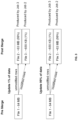
- FIG. 3 is an illustration of an example of files created in connection with merging target data and source data according to various embodiments of the present application.
- the file 2 generated in connection with performing the third job will have a size of about 655 KB
- the file 3 generated in connection with performing the second job will have a size of about 63 MB. Accordingly, in the case that 99% of the data in the initial file is updated, the second job will be much more computationally intensive than in the case that 1% of the data in the initial file is updated.
- the system performs a second job.
- the second job includes scanning applicable portions of the target table and the scan source and performing a matching action.
- the system scans matching rows of matching target table files and the source data.
- the system scans only matching rows of the matching target table files and the source data.
- the source data scanned in the second job can include all records in the source data, or only those matched records of the source data that match a row of a matching target table file.
- the system performs a right outer join or an inner join and applies the changes. The system then writes the rows (e.g., the updated/modified rows) to one or more second job resulting files.
- the system performs a third job (e.g., in serial or parallel with performing the second job).
- the third job includes scanning unmatched rows of the matching target files and writing such unmatched rows of the matching target files to one or more corresponding third job resulting files.
- the third job writes a third job resulting file for each matching target file processed by the third job.
- the system performs a first job to determine one or more matching rows for matching target table files.
- the first job includes scanning the keys for the target table, scanning the keys for the source data, and performing an inner join to determine the matching rows for the target table files. For example, matched rows are determined to be those rows for which an index of the target table has the same value as an index for the source data.
- the system stores an indication (e.g., an identifier) for the one or more matching rows and/or matching target table files.
- the system performs a second job.
- the second job includes scanning applicable portions of the target table and the scan source and performing a matching action.
- the system scans matching rows of matching target table files and the source data.
- the system scans only matching rows of the matching target table files and the source data.
- the source data scanned in the second job can include all records in the source data, or only those matched records of the source data that match a row of a matching target table file.
- the system performs a right outer join or an inner join and applies the changes. The system then writes the rows (e.g., the updated/modified rows) to one or more second job resulting files.
- the system performs a third job (e.g., in serial or parallel with performing the second job and/or fourth job).
- the third job includes scanning unmatched rows of the matching target files, and writing such unmatched rows of the matching target files to one or more corresponding third job resulting files.
- the third job writes a third job resulting file for each matching target file processed by the third job.
- FIG. 6 is a flow diagram of a method for updating data according to various embodiments of the present application.
- process 600 is implemented by data merging service 110 of system 100 of FIG. 1 and/or system 200 of FIG. 2 .
- the system performs a third job (e.g., in serial or parallel with performing the second job, fourth job, and/or fifth job).
- the third job includes scanning unmatched rows of the matching target files, and writing such unmatched rows of the matching target files to one or more corresponding third job resulting files.
- the third job writes a third job resulting file for each matching target file processed by the third job.
- the system performs a fourth job (e.g., in serial or parallel with performing the second job, third job, and/or fifth job).
- the fourth job includes scanning the source data for the unmatched source records (e.g., the unmatched source rows) and writing such unmatched source records to a fourth job resulting file.
- the fourth job processes the records (e.g., rows) of the source data that was not processed by the second job. For example, if the second job is optimized to only read the matched source records (e.g., to reduce the amount of source data to be transferred across the network of the second job and to reduce the amount of data subject to the computationally intensive join operations), the fourth job can process the unmatched source records.
- the system performs a fifth job (e.g., in serial or parallel with performing the second job, third job, and/or fourth job).
- the fifth job is integrated into the first job.
- the fifth job can be performed in the case that the system persists deletion vectors associated with the target table and/or resulting table.
- the fifth job includes scanning the one or more deletion vectors associated with the target table and storing the one or more deletion vectors across one or more deletion vector files.
- the system can store the one or more deletion vectors across one or more deletion vector files based at least in part on a deletion vector policy.
- the one or more deletion vectors stored across the one or more deletion vector files can include an existing deletion vector that is associated with the target table and a new deletion vector corresponding to a new deletion to be performed during the update of the target table.
- the system implements a modified first job in which the system determines the one or more deletion vectors associated with the target table (e.g., existing deletion vectors, new deletion vectors, etc.) and stores an indication of such deletion vectors, which is then used by the fifth job to write the one or more deletion vector files.
- FIG. 7 is a flow diagram of a method for updating data according to various embodiments of the present application.
- process 700 is implemented by data merging service 110 of system 100 of FIG. 1 and/or system 200 of FIG. 2 .
- the system is further optimized by implementing a modified second job (e.g., a secondary second job) and a modified third job to reduce the number of files being written and/or to improve data locality.
- a modified second job e.g., a secondary second job
- a modified third job to reduce the number of files being written and/or to improve data locality.
- the system implements a mixing policy according to which the system mixes in certain unmatched rows of matching target table files to the second job.
- the system performs a first job to determine one or more matching rows for matching target table files.
- the first job includes scanning the keys for the target table, scanning the keys for the source data, and performing an inner join to determine the matching rows for the target table files. For example, matched rows are determined to be those rows for which an index of the target table has the same value as an index for the source data.
- the system stores an indication (e.g., an identifier) for the one or more matching rows and/or matching target table files.
- the system performs a second job such as the modified second job according to which certain unmatched rows of matching target table files are processed under the second job.
- the system selects one or more unmatched rows of matching target table files to process under the second job based at least in part on a mixing policy.
- the second job includes the second job scanning applicable portions of the target table and the scan source and performing a matching action. For example, the system scans matching rows of matching target table files and the source data. As another example, the system scans only matching rows of the matching target table files and the source data.
- the source data scanned in the second job can include all records in the source data, or only those matched records of the source data that match a row of a matching target table file.
- the system performs a right outer join or an inner join and applies the changes.
- the system scans in the selected unmatched rows of matching target table files.
- the system performs a union operation with respect to the selected unmatched rows of the matching target table files and the results of the matching action between the matched rows of the matching target table files and the source data.
- the system then writes the rows (e.g., the updated/modified rows and the selected unmatched rows in the matching target table files) to one or more second job resulting files.
- the system performs a third job (e.g., in serial or parallel with performing the second job).
- the third job includes scanning unmatched rows of the matching target files that were not processed under the second job and writing such unmatched rows of the matching target files to one or more corresponding third job resulting files.
- the third job writes a third job resulting file for each matching target file processed by the third job. If certain unmatched rows of matching target table files are processed under the second job, then the remainder of unmatched rows of matching target table files are processed under the third job.
- FIG. 8 is a flow diagram of a method for merging target data and source data according to various embodiments of the present application.
- process 800 is implemented by data merging service 110 of system 100 of FIG. 1 and/or system 200 of FIG. 2 .
- the system may determine to merge the target table and the source table based on a request received from a user, or another service or system.
- process 900 is determined to be complete in response to a determination that no further tables are to be merged, no further rows or files are to be subject to first job processing. (e.g., within a threshold period of time), no further source data is received (e.g., within a threshold period of time), a user has exited the system, an administrator indicates that process 900 is to be paused or stopped, etc.
- process 900 ends.
- process 900 returns to 910 .
- FIG. 10 is a flow diagram of a method for performing a second job in connection with merging target data and source data according to various embodiments of the present application.
- process 1000 is implemented by data merging service 110 of system 100 of FIG. 1 and/or system 200 of FIG. 2 .
- process 1000 is invoked by 830 of process 800 of FIG. 8 .
- a matching action for each of the set of matching files is performed.
- the system performs a merge with respect to the matching rows of matching target table files and corresponding source data records.
- the system obtains the identifiers of the matching rows of the matching target table files, scans such rows from the corresponding target table files and applicable source data, and performs a join operation with respect to such information.
- one or more second job resulting files are stored.
- process 1000 is determined to be complete in response to a determination that no further tables are to be merged, no further rows or files are to be subject to second job processing. (e.g., within a threshold period of time), no further source data is received (e.g., within a threshold period of time), a user has exited the system, an administrator indicates that process 1000 is to be paused or stopped, etc.
- process 1000 ends.
- process 1000 returns to 1010 .
- FIG. 11 is a flow diagram of a method for performing a third job in connection with merging target data and source data according to various embodiments of the present application.
- process 1100 is implemented by data merging service 110 of system 100 of FIG. 1 and/or system 200 of FIG. 2 .
- process 1100 is invoked by 840 of process 800 of FIG. 8 .
- one or more third resulting files based on the unmatched rows are stored.
- process 1100 is determined to be complete in response to a determination that no further tables are to be merged, no further rows or files are to be subject to third job processing. (e.g., within a threshold period of time), no further source data is received (e.g., within a threshold period of time), a user has exited the system, an administrator indicates that process 1100 is to be paused or stopped, etc.
- process 1100 ends.
- process 1100 returns to 1110 .
- FIG. 12 is a flow diagram of a method for performing a fourth job in connection with merging target data and source data according to various embodiments of the present application.
- process 1200 is implemented by data merging service 110 of system 100 of FIG. 1 and/or system 200 of FIG. 2 .
- process 1200 is invoked by process 800 of FIG. 8 .
- unmatched rows of a source table are determined.
- the system determines unmatched records for the source data, such as based on obtaining identifiers for matched records of the source data and determining a remainder of records.
- a fourth job resulting file is stored based at least in part on the unmatched rows of the source table.
- the fourth job produces multiple resulting files.
- process 1200 is determined to be complete in response to a determination that no further tables are to be merged, no further rows or files are to be subject to fourth job processing. (e.g., within a threshold period of time), no further source data is received (e.g., within a threshold period of time), a user has exited the system, an administrator indicates that process 1200 is to be paused or stopped, etc.
- process 1200 ends.
- process 1200 returns to 1210 .
- a first job is performed.
- performing the first job includes invoking process 900 of FIG. 9 .
- a post-processing operation on at least the one or more resulting files includes invoking process 1400 of FIG. 14 .
- the system can determine to perform the post-processing operation based at least in part on a post-processing policy such as a compaction policy.
- the system determines whether to perform the post-processing operation with respect to the resulting files based on one or more characteristics associated with the resulting files such as file size, etc.
- a set of processed files is obtained based at least in part on the performing the post-processing operation.
- the post-processing include compaction
- the system obtains a compacted resulting file based on compacting two or more smaller resulting files.
- process 1300 is determined to be complete in response to a determination that no further tables are to be merged, no further source data is received (e.g., within a threshold period of time), a user has exited the system, an administrator indicates that process 1300 is to be paused or stopped, etc.
- process 1300 ends.
- process 1300 returns to 1310 .
- FIG. 14 is a flow diagram of a method for merging target data and source data according to various embodiments of the present application.
- process 1400 is implemented by data merging service 110 of system 100 of FIG. 1 and/or system 200 of FIG. 2 .
- process 1400 is invoked by 1350 of process 1300 of FIG. 13 .
- the system determines to perform the post-processing with respect to at least the subset of the resulting files based on a compaction policy and one or more characteristics associated with the subset of the resulting files (e.g., corresponding file sizes of the resulting files), etc.
- one or more parameters for compacting the subset of resulting files are obtained.
- the system obtains the one or more parameters based on the compaction policy.
- the compaction policy may include rules or heuristics according to which a set of resulting files are to be compacted.
- a plurality of the subset of resulting files are selected.
- the system uses the one or more parameters for compacting the subset of resulting files to select the plurality of resulting files to be compacted.
- the plurality of the subset of resulting files is compacted to obtain a compacted file.
- the system obtains a single file comprising the information for a plurality of smaller resulting files.
- the system obtains a plurality of compacted files which are each obtained based on compacting a plurality of files.
- the compacted file is stored.
- process 1400 In response to determining that an additional plurality of resulting files is to be compacted at 1460 , process 1400 returns to 1430 and process 1400 iterates over 1430 - 1460 until no further resulting files are to be compacted.
- process 1400 proceeds to process 1470 .
- an indication of the compacted file(s) is provided.
- the indication of the compacted file(s) is provided to the process, services, or other system that invoked process 1400 .
- the indication of the compacted file(s) is provided to 1350 and/or 1360 or process 1300 of FIG. 13 .
- FIG. 15 is a flow diagram of a method for merging target data and source data according to various embodiments of the present application.
- process 1500 is implemented by data merging service 110 of system 100 of FIG. 1 and/or system 200 of FIG. 2 .
- 1505 is similar to, or corresponds to 810 of process 800 of FIG. 8 .
- a first job is performed.
- performing the first job includes invoking process 1000 of FIG. 10 .
- matched rows are determined based on a result of the first job.
- the system obtains the results of the first job and from the results obtains identifiers for the matched rows of the matching target table files.
- a subset of unmatched rows are selected.
- the system selects a set of unmatched rows of matching target table files to be processed under the second job (e.g., the secondary second job). For example, the system uses a mixing policy in connection with selecting the subset of unmatched rows.
- other resulting files are obtained based on another subset of unmatched rows.
- the system can obtain the other resulting files based on performing a third job with respect to the unmatched rows of the matching target table files that are not processed under the second job.
- the system may also obtain other resulting files based on unmatched rows of the source table, such as by performing a fourth job.
- FIG. 16 is a flow diagram of a method for merging target data and source data according to various embodiments of the present application.
- process 1600 is implemented by data merging service 110 of system 100 of FIG. 1 and/or system 200 of FIG. 2 .
- 1610 is similar to, or corresponds to 810 of process 800 of FIG. 8 .
- a first job is performed.
- performing the first job includes invoking process 900 of FIG. 9 .
- a second job is performed.
- the performing the second job includes reading at least matched rows of matching target table files based at least in part on one or more deletion vectors.
- performing the second job includes, or is similar to, process 1000 of FIG. 10 . If the system determines that the target table has corresponding deletion vectors, the system can exclude reading rows corresponding to the deletion vectors as part of the second job.
- one or more resulting files are obtained based at least in part on unmatched rows.
- the system can obtain the one or more resulting files by performing other jobs, such as a third job (e.g., to process unmatched rows of matching target table files) and a fourth job (e.g., to process unmatched records of the source data), etc.
- deletion vectors are written to one or more deletion vector files.
- performing 1650 includes invoking process 1700 of FIG. 17 .
- the deletion vectors are written to the one or more deletion vector files based on a deletion vector policy.
- process 1600 is determined to be complete in response to a determination that no further tables are to be merged, no further source data is received (e.g., within a threshold period of time), a user has exited the system, an administrator indicates that process 1600 is to be paused or stopped, etc.
- process 1600 ends.
- process 1600 returns to 1610 .
- FIG. 17 is a flow diagram of a method for persisting deletion vectors according to various embodiments of the present application.
- process 1700 is implemented by data merging service 110 of system 100 of FIG. 1 and/or system 200 of FIG. 2 .
- process 1700 is invoked by 1650 of process 1600 of FIG. 16 .
- one or more existing deletion vectors are determined.
- the system can determine the deletion vectors based on metadata associated with the target table and/or the merge operation.
- one or more deletion vectors associated with a merging of the target table and the source table are determined.
- a deletion vector policy is obtained.
- properties according to which deletion vectors files are to be written are determined.
- the system uses the deletion vector policy to determine a manner by which the deletion vector files are to be stored across one or more deletion vector files.
- the properties can include a number of deletion vector files, a maximum size of deletion vector files, a minimum size of deletion vector files, etc.
- deletion vectors are written to one or more deletion vector files.
- process 1700 is determined to be complete in response to a determination that no further tables are to be merged, no further deletion vectors are to be persisted (e.g., within a threshold period of time), no further deletion vectors exist, a user has exited the system, an administrator indicates that process 1700 is to be paused or stopped, etc.
- process 1700 ends.
- process 1700 returns to 1710 .
- FIG. 18 is a flow diagram of a method for merging target data and source data according to various embodiments of the present application.
- process 1800 is implemented by data merging service 110 of system 100 of FIG. 1 and/or system 200 of FIG. 2 .
- 1810 a determination to merge a target table and a source table is made.
- 1810 is similar to, or corresponds to, 810 of process 800 of FIG. 8 .
- performing the first job includes invoking process 900 of FIG. 9 .
Landscapes
- Engineering & Computer Science (AREA)
- Theoretical Computer Science (AREA)
- Data Mining & Analysis (AREA)
- Databases & Information Systems (AREA)
- Physics & Mathematics (AREA)
- General Engineering & Computer Science (AREA)
- General Physics & Mathematics (AREA)
- Computational Linguistics (AREA)
- Software Systems (AREA)
- Information Retrieval, Db Structures And Fs Structures Therefor (AREA)
Abstract
Description
Claims (22)
Priority Applications (1)
| Application Number | Priority Date | Filing Date | Title |
|---|---|---|---|
| US17/895,882 US12346330B2 (en) | 2022-08-25 | 2022-08-25 | Efficient merge of tabular data using mixing |
Applications Claiming Priority (1)
| Application Number | Priority Date | Filing Date | Title |
|---|---|---|---|
| US17/895,882 US12346330B2 (en) | 2022-08-25 | 2022-08-25 | Efficient merge of tabular data using mixing |
Publications (2)
| Publication Number | Publication Date |
|---|---|
| US20240070155A1 US20240070155A1 (en) | 2024-02-29 |
| US12346330B2 true US12346330B2 (en) | 2025-07-01 |
Family
ID=89999877
Family Applications (1)
| Application Number | Title | Priority Date | Filing Date |
|---|---|---|---|
| US17/895,882 Active 2042-11-16 US12346330B2 (en) | 2022-08-25 | 2022-08-25 | Efficient merge of tabular data using mixing |
Country Status (1)
| Country | Link |
|---|---|
| US (1) | US12346330B2 (en) |
Families Citing this family (1)
| Publication number | Priority date | Publication date | Assignee | Title |
|---|---|---|---|---|
| US12056126B2 (en) * | 2022-08-25 | 2024-08-06 | Databricks, Inc. | Efficient merging of tabular data with post-processing compaction |
Citations (8)
| Publication number | Priority date | Publication date | Assignee | Title |
|---|---|---|---|---|
| US7188334B1 (en) * | 2001-11-20 | 2007-03-06 | Ncr Corp. | Value-ordered primary index and row hash match scan |
| US20180068008A1 (en) * | 2016-09-02 | 2018-03-08 | Snowflake Computing, Inc. | Incremental Clustering Maintenance Of A Table |
| US20180081946A1 (en) * | 2016-09-16 | 2018-03-22 | Oracle International Corporation | Duplicate reduction or elimination with hash join operations |
| US20200142987A1 (en) * | 2018-11-06 | 2020-05-07 | Snowflake Inc. | Tracking Intermediate Changes In Database Data |
| US20210056090A1 (en) * | 2015-10-14 | 2021-02-25 | Dr Holdco 2, Inc. | Cache optimization for data preparation |
| US20210124742A1 (en) * | 2019-10-29 | 2021-04-29 | Oracle International Corporation | Materialized view rewrite technique for one-sided outer-join queries |
| US20220318243A1 (en) * | 2021-04-06 | 2022-10-06 | Thoughtspot, Inc. | Distributed Pseudo-Random Subset Generation |
| US11868331B1 (en) * | 2018-05-21 | 2024-01-09 | Pattern Computer, Inc. | Systems and methods for aligning big data tables in linear time |
-
2022
- 2022-08-25 US US17/895,882 patent/US12346330B2/en active Active
Patent Citations (8)
| Publication number | Priority date | Publication date | Assignee | Title |
|---|---|---|---|---|
| US7188334B1 (en) * | 2001-11-20 | 2007-03-06 | Ncr Corp. | Value-ordered primary index and row hash match scan |
| US20210056090A1 (en) * | 2015-10-14 | 2021-02-25 | Dr Holdco 2, Inc. | Cache optimization for data preparation |
| US20180068008A1 (en) * | 2016-09-02 | 2018-03-08 | Snowflake Computing, Inc. | Incremental Clustering Maintenance Of A Table |
| US20180081946A1 (en) * | 2016-09-16 | 2018-03-22 | Oracle International Corporation | Duplicate reduction or elimination with hash join operations |
| US11868331B1 (en) * | 2018-05-21 | 2024-01-09 | Pattern Computer, Inc. | Systems and methods for aligning big data tables in linear time |
| US20200142987A1 (en) * | 2018-11-06 | 2020-05-07 | Snowflake Inc. | Tracking Intermediate Changes In Database Data |
| US20210124742A1 (en) * | 2019-10-29 | 2021-04-29 | Oracle International Corporation | Materialized view rewrite technique for one-sided outer-join queries |
| US20220318243A1 (en) * | 2021-04-06 | 2022-10-06 | Thoughtspot, Inc. | Distributed Pseudo-Random Subset Generation |
Also Published As
| Publication number | Publication date |
|---|---|
| US20240070155A1 (en) | 2024-02-29 |
Similar Documents
| Publication | Publication Date | Title |
|---|---|---|
| US11550763B2 (en) | Versioning schemas for hierarchical data structures | |
| CN113626525B (en) | System and method for implementing scalable data storage services | |
| US11822554B2 (en) | Symmetric query processing in a database clean room | |
| US12204948B2 (en) | Elastic data partitioning of a database | |
| US12284225B2 (en) | Context-aware content object security | |
| US11651287B1 (en) | Privacy-preserving multi-party machine learning using a database cleanroom | |
| US20070078914A1 (en) | Method, apparatus and program storage device for providing a centralized policy based preallocation in a distributed file system | |
| US20200233861A1 (en) | Elastic data partitioning of a database | |
| US20230252189A1 (en) | Tag-based application of masking policy | |
| US11960616B2 (en) | Virtual data sources of data virtualization-based architecture | |
| US12314258B2 (en) | Runtime join pruning to improve join performance for tables | |
| US20200233848A1 (en) | Elastic data partitioning of a database | |
| US12045220B2 (en) | Efficient merge of tabular data with deletion indications | |
| US20240070155A1 (en) | Efficient merge of tabular data using mixing | |
| US11803568B1 (en) | Replicating changes from a database to a destination and modifying replication capacity | |
| US11989173B2 (en) | Query validation and processing in data clean rooms | |
| US10997160B1 (en) | Streaming committed transaction updates to a data store | |
| US12056126B2 (en) | Efficient merging of tabular data with post-processing compaction | |
| US12353843B2 (en) | Efficient merge of tabular data using a processing filter | |
| US11687513B2 (en) | Virtual data source manager of data virtualization-based architecture | |
| US11263026B2 (en) | Software plugins of data virtualization-based architecture | |
| US12417217B2 (en) | Multi-tenant database resource utilization | |
| US12189628B2 (en) | Scan parsing | |
| US20260064678A1 (en) | Generating high-performance queries using optimized subqueries | |
| US20260044616A1 (en) | Systems and Methods for Cloud-Based Database System Account Management Operations Tracking |
Legal Events
| Date | Code | Title | Description |
|---|---|---|---|
| FEPP | Fee payment procedure |
Free format text: ENTITY STATUS SET TO UNDISCOUNTED (ORIGINAL EVENT CODE: BIG.); ENTITY STATUS OF PATENT OWNER: LARGE ENTITY |
|
| AS | Assignment |
Owner name: DATABRICKS, INC., CALIFORNIA Free format text: ASSIGNMENT OF ASSIGNORS INTEREST;ASSIGNORS:SAMWEL, BART;SOMPOLSKI, JULIUSZ;KROLL, LARS;AND OTHERS;SIGNING DATES FROM 20230112 TO 20230127;REEL/FRAME:064303/0404 |
|
| STPP | Information on status: patent application and granting procedure in general |
Free format text: NON FINAL ACTION MAILED |
|
| STPP | Information on status: patent application and granting procedure in general |
Free format text: RESPONSE TO NON-FINAL OFFICE ACTION ENTERED AND FORWARDED TO EXAMINER |
|
| STPP | Information on status: patent application and granting procedure in general |
Free format text: RESPONSE TO NON-FINAL OFFICE ACTION ENTERED AND FORWARDED TO EXAMINER |
|
| STPP | Information on status: patent application and granting procedure in general |
Free format text: FINAL REJECTION MAILED |
|
| STPP | Information on status: patent application and granting procedure in general |
Free format text: DOCKETED NEW CASE - READY FOR EXAMINATION |
|
| AS | Assignment |
Owner name: JPMORGAN CHASE BANK, N.A., AS COLLATERAL AGENT, ILLINOIS Free format text: SECURITY INTEREST;ASSIGNOR:DATABRICKS, INC.;REEL/FRAME:069825/0419 Effective date: 20250103 |
|
| STPP | Information on status: patent application and granting procedure in general |
Free format text: NOTICE OF ALLOWANCE MAILED -- APPLICATION RECEIVED IN OFFICE OF PUBLICATIONS |
|
| STCF | Information on status: patent grant |
Free format text: PATENTED CASE |