US12344631B2 - C17 polar-substituted heteroaromatic synthetic triterpenoids and methods of use thereof - Google Patents
C17 polar-substituted heteroaromatic synthetic triterpenoids and methods of use thereof Download PDFInfo
- Publication number
- US12344631B2 US12344631B2 US16/933,635 US202016933635A US12344631B2 US 12344631 B2 US12344631 B2 US 12344631B2 US 202016933635 A US202016933635 A US 202016933635A US 12344631 B2 US12344631 B2 US 12344631B2
- Authority
- US
- United States
- Prior art keywords
- compound
- mmol
- mixture
- etoac
- room temperature
- Prior art date
- Legal status (The legal status is an assumption and is not a legal conclusion. Google has not performed a legal analysis and makes no representation as to the accuracy of the status listed.)
- Active, expires
Links
Images

Classifications
-
- C—CHEMISTRY; METALLURGY
- C07—ORGANIC CHEMISTRY
- C07J—STEROIDS
- C07J53/00—Steroids in which the cyclopenta(a)hydrophenanthrene skeleton has been modified by condensation with a carbocyclic rings or by formation of an additional ring by means of a direct link between two ring carbon atoms, including carboxyclic rings fused to the cyclopenta(a)hydrophenanthrene skeleton are included in this class
- C07J53/002—Carbocyclic rings fused
-
- C—CHEMISTRY; METALLURGY
- C07—ORGANIC CHEMISTRY
- C07J—STEROIDS
- C07J63/00—Steroids in which the cyclopenta(a)hydrophenanthrene skeleton has been modified by expansion of only one ring by one or two atoms
- C07J63/008—Expansion of ring D by one atom, e.g. D homo steroids
-
- A—HUMAN NECESSITIES
- A61—MEDICAL OR VETERINARY SCIENCE; HYGIENE
- A61K—PREPARATIONS FOR MEDICAL, DENTAL OR TOILETRY PURPOSES
- A61K31/00—Medicinal preparations containing organic active ingredients
- A61K31/56—Compounds containing cyclopenta[a]hydrophenanthrene ring systems; Derivatives thereof, e.g. steroids
- A61K31/58—Compounds containing cyclopenta[a]hydrophenanthrene ring systems; Derivatives thereof, e.g. steroids containing heterocyclic rings, e.g. danazol, stanozolol, pancuronium or digitogenin
-
- A—HUMAN NECESSITIES
- A61—MEDICAL OR VETERINARY SCIENCE; HYGIENE
- A61P—SPECIFIC THERAPEUTIC ACTIVITY OF CHEMICAL COMPOUNDS OR MEDICINAL PREPARATIONS
- A61P1/00—Drugs for disorders of the alimentary tract or the digestive system
-
- A—HUMAN NECESSITIES
- A61—MEDICAL OR VETERINARY SCIENCE; HYGIENE
- A61P—SPECIFIC THERAPEUTIC ACTIVITY OF CHEMICAL COMPOUNDS OR MEDICINAL PREPARATIONS
- A61P1/00—Drugs for disorders of the alimentary tract or the digestive system
- A61P1/18—Drugs for disorders of the alimentary tract or the digestive system for pancreatic disorders, e.g. pancreatic enzymes
-
- A—HUMAN NECESSITIES
- A61—MEDICAL OR VETERINARY SCIENCE; HYGIENE
- A61P—SPECIFIC THERAPEUTIC ACTIVITY OF CHEMICAL COMPOUNDS OR MEDICINAL PREPARATIONS
- A61P11/00—Drugs for disorders of the respiratory system
-
- A—HUMAN NECESSITIES
- A61—MEDICAL OR VETERINARY SCIENCE; HYGIENE
- A61P—SPECIFIC THERAPEUTIC ACTIVITY OF CHEMICAL COMPOUNDS OR MEDICINAL PREPARATIONS
- A61P11/00—Drugs for disorders of the respiratory system
- A61P11/06—Antiasthmatics
-
- A—HUMAN NECESSITIES
- A61—MEDICAL OR VETERINARY SCIENCE; HYGIENE
- A61P—SPECIFIC THERAPEUTIC ACTIVITY OF CHEMICAL COMPOUNDS OR MEDICINAL PREPARATIONS
- A61P13/00—Drugs for disorders of the urinary system
- A61P13/12—Drugs for disorders of the urinary system of the kidneys
-
- A—HUMAN NECESSITIES
- A61—MEDICAL OR VETERINARY SCIENCE; HYGIENE
- A61P—SPECIFIC THERAPEUTIC ACTIVITY OF CHEMICAL COMPOUNDS OR MEDICINAL PREPARATIONS
- A61P17/00—Drugs for dermatological disorders
- A61P17/06—Antipsoriatics
-
- A—HUMAN NECESSITIES
- A61—MEDICAL OR VETERINARY SCIENCE; HYGIENE
- A61P—SPECIFIC THERAPEUTIC ACTIVITY OF CHEMICAL COMPOUNDS OR MEDICINAL PREPARATIONS
- A61P19/00—Drugs for skeletal disorders
- A61P19/02—Drugs for skeletal disorders for joint disorders, e.g. arthritis, arthrosis
-
- A—HUMAN NECESSITIES
- A61—MEDICAL OR VETERINARY SCIENCE; HYGIENE
- A61P—SPECIFIC THERAPEUTIC ACTIVITY OF CHEMICAL COMPOUNDS OR MEDICINAL PREPARATIONS
- A61P21/00—Drugs for disorders of the muscular or neuromuscular system
-
- A—HUMAN NECESSITIES
- A61—MEDICAL OR VETERINARY SCIENCE; HYGIENE
- A61P—SPECIFIC THERAPEUTIC ACTIVITY OF CHEMICAL COMPOUNDS OR MEDICINAL PREPARATIONS
- A61P25/00—Drugs for disorders of the nervous system
-
- A—HUMAN NECESSITIES
- A61—MEDICAL OR VETERINARY SCIENCE; HYGIENE
- A61P—SPECIFIC THERAPEUTIC ACTIVITY OF CHEMICAL COMPOUNDS OR MEDICINAL PREPARATIONS
- A61P25/00—Drugs for disorders of the nervous system
- A61P25/08—Antiepileptics; Anticonvulsants
-
- A—HUMAN NECESSITIES
- A61—MEDICAL OR VETERINARY SCIENCE; HYGIENE
- A61P—SPECIFIC THERAPEUTIC ACTIVITY OF CHEMICAL COMPOUNDS OR MEDICINAL PREPARATIONS
- A61P25/00—Drugs for disorders of the nervous system
- A61P25/14—Drugs for disorders of the nervous system for treating abnormal movements, e.g. chorea, dyskinesia
-
- A—HUMAN NECESSITIES
- A61—MEDICAL OR VETERINARY SCIENCE; HYGIENE
- A61P—SPECIFIC THERAPEUTIC ACTIVITY OF CHEMICAL COMPOUNDS OR MEDICINAL PREPARATIONS
- A61P25/00—Drugs for disorders of the nervous system
- A61P25/14—Drugs for disorders of the nervous system for treating abnormal movements, e.g. chorea, dyskinesia
- A61P25/16—Anti-Parkinson drugs
-
- A—HUMAN NECESSITIES
- A61—MEDICAL OR VETERINARY SCIENCE; HYGIENE
- A61P—SPECIFIC THERAPEUTIC ACTIVITY OF CHEMICAL COMPOUNDS OR MEDICINAL PREPARATIONS
- A61P25/00—Drugs for disorders of the nervous system
- A61P25/18—Antipsychotics, i.e. neuroleptics; Drugs for mania or schizophrenia
-
- A—HUMAN NECESSITIES
- A61—MEDICAL OR VETERINARY SCIENCE; HYGIENE
- A61P—SPECIFIC THERAPEUTIC ACTIVITY OF CHEMICAL COMPOUNDS OR MEDICINAL PREPARATIONS
- A61P25/00—Drugs for disorders of the nervous system
- A61P25/22—Anxiolytics
-
- A—HUMAN NECESSITIES
- A61—MEDICAL OR VETERINARY SCIENCE; HYGIENE
- A61P—SPECIFIC THERAPEUTIC ACTIVITY OF CHEMICAL COMPOUNDS OR MEDICINAL PREPARATIONS
- A61P25/00—Drugs for disorders of the nervous system
- A61P25/28—Drugs for disorders of the nervous system for treating neurodegenerative disorders of the central nervous system, e.g. nootropic agents, cognition enhancers, drugs for treating Alzheimer's disease or other forms of dementia
-
- A—HUMAN NECESSITIES
- A61—MEDICAL OR VETERINARY SCIENCE; HYGIENE
- A61P—SPECIFIC THERAPEUTIC ACTIVITY OF CHEMICAL COMPOUNDS OR MEDICINAL PREPARATIONS
- A61P27/00—Drugs for disorders of the senses
- A61P27/02—Ophthalmic agents
-
- A—HUMAN NECESSITIES
- A61—MEDICAL OR VETERINARY SCIENCE; HYGIENE
- A61P—SPECIFIC THERAPEUTIC ACTIVITY OF CHEMICAL COMPOUNDS OR MEDICINAL PREPARATIONS
- A61P29/00—Non-central analgesic, antipyretic or antiinflammatory agents, e.g. antirheumatic agents; Non-steroidal antiinflammatory drugs [NSAID]
-
- A—HUMAN NECESSITIES
- A61—MEDICAL OR VETERINARY SCIENCE; HYGIENE
- A61P—SPECIFIC THERAPEUTIC ACTIVITY OF CHEMICAL COMPOUNDS OR MEDICINAL PREPARATIONS
- A61P3/00—Drugs for disorders of the metabolism
- A61P3/08—Drugs for disorders of the metabolism for glucose homeostasis
- A61P3/10—Drugs for disorders of the metabolism for glucose homeostasis for hyperglycaemia, e.g. antidiabetics
-
- A—HUMAN NECESSITIES
- A61—MEDICAL OR VETERINARY SCIENCE; HYGIENE
- A61P—SPECIFIC THERAPEUTIC ACTIVITY OF CHEMICAL COMPOUNDS OR MEDICINAL PREPARATIONS
- A61P35/00—Antineoplastic agents
-
- A—HUMAN NECESSITIES
- A61—MEDICAL OR VETERINARY SCIENCE; HYGIENE
- A61P—SPECIFIC THERAPEUTIC ACTIVITY OF CHEMICAL COMPOUNDS OR MEDICINAL PREPARATIONS
- A61P37/00—Drugs for immunological or allergic disorders
- A61P37/02—Immunomodulators
- A61P37/06—Immunosuppressants, e.g. drugs for graft rejection
-
- A—HUMAN NECESSITIES
- A61—MEDICAL OR VETERINARY SCIENCE; HYGIENE
- A61P—SPECIFIC THERAPEUTIC ACTIVITY OF CHEMICAL COMPOUNDS OR MEDICINAL PREPARATIONS
- A61P9/00—Drugs for disorders of the cardiovascular system
-
- A—HUMAN NECESSITIES
- A61—MEDICAL OR VETERINARY SCIENCE; HYGIENE
- A61P—SPECIFIC THERAPEUTIC ACTIVITY OF CHEMICAL COMPOUNDS OR MEDICINAL PREPARATIONS
- A61P9/00—Drugs for disorders of the cardiovascular system
- A61P9/10—Drugs for disorders of the cardiovascular system for treating ischaemic or atherosclerotic diseases, e.g. antianginal drugs, coronary vasodilators, drugs for myocardial infarction, retinopathy, cerebrovascula insufficiency, renal arteriosclerosis
-
- A—HUMAN NECESSITIES
- A61—MEDICAL OR VETERINARY SCIENCE; HYGIENE
- A61K—PREPARATIONS FOR MEDICAL, DENTAL OR TOILETRY PURPOSES
- A61K9/00—Medicinal preparations characterised by special physical form
- A61K9/0012—Galenical forms characterised by the site of application
- A61K9/0014—Skin, i.e. galenical aspects of topical compositions
-
- A—HUMAN NECESSITIES
- A61—MEDICAL OR VETERINARY SCIENCE; HYGIENE
- A61K—PREPARATIONS FOR MEDICAL, DENTAL OR TOILETRY PURPOSES
- A61K9/00—Medicinal preparations characterised by special physical form
- A61K9/0012—Galenical forms characterised by the site of application
- A61K9/0019—Injectable compositions; Intramuscular, intravenous, arterial, subcutaneous administration; Compositions to be administered through the skin in an invasive manner
-
- A—HUMAN NECESSITIES
- A61—MEDICAL OR VETERINARY SCIENCE; HYGIENE
- A61K—PREPARATIONS FOR MEDICAL, DENTAL OR TOILETRY PURPOSES
- A61K9/00—Medicinal preparations characterised by special physical form
- A61K9/0012—Galenical forms characterised by the site of application
- A61K9/0053—Mouth and digestive tract, i.e. intraoral and peroral administration
-
- C—CHEMISTRY; METALLURGY
- C07—ORGANIC CHEMISTRY
- C07J—STEROIDS
- C07J71/00—Steroids in which the cyclopenta(a)hydrophenanthrene skeleton is condensed with a heterocyclic ring
- C07J71/0036—Nitrogen-containing hetero ring
- C07J71/0057—Nitrogen and oxygen
- C07J71/0063—Nitrogen and oxygen at position 2(3)
Definitions
- the compound is further defined as:
- the compound is further defined as:
- the compound is further defined as:
- the compound is further defined as:
- the compound is further defined as:
- the compound is further defined as:
- the compound is further defined as:
- the compound is further defined as:
- the compound is further defined as:
- the compound is further defined as:
- the present disclosure provides:
- the present disclosure provides pharmaceutical compositions comprising a compound of the present disclosure and an excipient.
- the pharmaceutical composition is formulated for administration orally, intraadiposally, intraarterially, intraarticularly, intracranially, intradermally, intralesionally, intramuscularly, intranasally, intraocularly, intrapericardially, intraperitoneally, intrapleurally, intraprostatically, intrarectally, intrathecally, intratracheally, intratumorally, intraumbilically, intravaginally, intravenously, intravesicularlly, intravitreally, liposomally, locally, mucosally, parenterally, rectally, subconjunctival, subcutaneously, sublingually, topically, transbuccally, transdermally, vaginally, in crèmes, in lipid compositions, via a catheter, via a lavage, via continuous infusion, via infusion, via inhalation, via injection, via local delivery, or via localized perfusion.
- the pharmaceutical composition is formulated for oral administration. In other embodiments, the pharmaceutical composition is formulated for administration via injection. In some embodiments, the pharmaceutical composition is formulated for intraarterial administration, intramuscular administration, intraperitoneal administration, or intravenous administration. In some embodiments, the pharmaceutical composition is formulated for administration topically. In some embodiments, the pharmaceutical composition is formulated for topical administration to the skin or to the eye. In some embodiments, the pharmaceutical composition is formulated as a unit dose.
- the present disclosure provides methods of treating or preventing a disease or disorder in a patient in need thereof comprising administering to the patient a pharmaceutically effective amount of a compound or composition of the present disclosure.
- the patient is a mammal, such as a human.
- the disease or disorder is a condition associated with inflammation and/or oxidative stress.
- the disease or disorder is cancer.
- the disease or disorder is a cardiovascular disease, such as atherosclerosis.
- the disease or disorder is an autoimmune disease, such as Crohn's disease, rheumatoid arthritis, lupus, or psoriasis.
- the disease or disorder is a neurodegenerative disease, such as Alzheimer's disease, Parkinson's disease, amyotrophic lateral sclerosis, or Huntington's disease.
- the disease or disorder is chronic kidney disease, diabetes, mucositis, inflammatory bowel disease, dermatitis, sepsis, ischemia-reperfusion injury (including complications from sickle cell anemia), influenza, osteoarthritis, osteoporosis, pancreatitis, asthma, chronic obstructive pulmonary disease, cystic fibrosis, idiopathic pulmonary fibrosis, multiple sclerosis, muscular dystrophy, cachexia, or graft-versus-host disease.
- the disease or disorder is an eye disease, such as uveitis, glaucoma, macular degeneration, or retinopathy.
- the disease or disorder is neuropsychiatric, such as schizophrenia, depression, bipolar disorder, epilepsy, post-traumatic stress disorder, attention deficit disorder, autism, or anorexia nervosa.
- the disease or disorder is associated with mitochondrial dysfunction, such as Friedreich's ataxia.
- the disease or disorder is chronic pain.
- the disease or disorder is neuropathic pain.
- the present disclosure provides methods of inhibiting nitric oxide production comprising administering to a patient in need thereof an amount of a compound or composition of the present disclosure sufficient to cause inhibition of IFN- ⁇ -induced nitric oxide production in one or more cells of the patient.
- Disclosed herein are new compounds and compositions with antioxidant and/or anti-inflammatory properties, methods for their manufacture, and methods for their use, including for the treatment and/or prevention of disease.
- the compounds of the present invention are shown, for example, above, in the summary of the invention section, the Examples below, Table 1, and in the claims below. They may be made using the synthetic methods outlined in the Examples section. These methods can be further modified and optimized using the principles and techniques of organic chemistry as applied by a person skilled in the art. Such principles and techniques are taught, for example, in Smith, March's Advanced Organic Chemistry: Reactions, Mechanisms, and Structure , (2013), which is incorporated by reference herein.
- the synthetic methods may be further modified and optimized for preparative, pilot- or large-scale production, either batch or continuous, using the principles and techniques of process chemistry as applied by a person skilled in the art.
- Such principles and techniques are taught, for example, in Anderson, Practical Process Research & Development—A Guide for Organic Chemists (2012), which is incorporated by reference herein.
- the compounds of the present invention have the advantage that they may be more efficacious than, be less toxic than, be longer acting than, be more potent than, produce fewer side effects than, be more easily absorbed than, more metabolically stable than, more lipophilic than, more hydrophilic than, and/or have a better pharmacokinetic profile (e.g., higher oral bioavailability and/or lower clearance) than, and/or have other useful pharmacological, physical, or chemical properties over, compounds known in the prior art, whether for use in the indications stated herein or otherwise.
- a better pharmacokinetic profile e.g., higher oral bioavailability and/or lower clearance
- Compounds of the present disclosure may contain one or more asymmetrically-substituted carbon or nitrogen atom and may be isolated in optically active or racemic form. Thus, all chiral, diastereomeric, racemic form, epimeric form, and all geometric isomeric forms of a chemical formula are intended, unless the specific stereochemistry or isomeric form is specifically indicated. Compounds may occur as racemates and racemic mixtures, single enantiomers, diastereomeric mixtures and individual diastereomers. In some embodiments, a single diastereomer is obtained.
- the chiral centers of the compounds of the present invention can have the S or the R configuration. In some embodiments, the present compounds may contain two or more atoms which have a defined stereochemical orientation.
- Chemical formulas used to represent compounds of the present invention will typically only show one of possibly several different tautomers. For example, many types of ketone groups are known to exist in equilibrium with corresponding enol groups. Similarly, many types of imine groups exist in equilibrium with enamine groups. Regardless of which tautomer is depicted for a given compound, and regardless of which one is most prevalent, all tautomers of a given chemical formula are intended.
- atoms making up the compounds of the present invention are intended to include all isotopic forms of such atoms.
- Isotopes include those atoms having the same atomic number but different mass numbers.
- isotopes of hydrogen include tritium and deuterium
- isotopes of carbon include 13 C and 14 C.
- compounds of the present invention function as prodrugs or can be derivatized to function as prodrugs.
- prodrugs are known to enhance numerous desirable qualities of pharmaceuticals (e.g., solubility, bioavailability, manufacturing, etc.)
- the compounds employed in some methods of the invention may, if desired, be delivered in prodrug form.
- the invention contemplates prodrugs of compounds of the present invention as well as methods of delivering prodrugs.
- Prodrugs of the compounds employed in the invention may be prepared by modifying functional groups present in the compound in such a way that the modifications are cleaved, either in routine manipulation or in vivo, to the parent compound.
- the IC 50 values for hydroxy-substituted T13 and acetoxy-substituted T14 were 88% and 90% lower (0.56 nM and 0.48 nM, respectively vs. 4.85 nM) than the corresponding unsubstituted compound, T23.
- the IC 50 values for fluoro-substituted T1, amino-substituted T2, and hydroxy-substituted T4 are 67%, 70%, and 52% lower (1.24 nM, 1.15 nM, and 1.82 nM, respectively vs. 3.79 nM) than the corresponding unsubstituted compound, T20.
- the compounds of the present disclosure exhibit reduced inhibition of cytochrome P450 3A4 (CYP3A4) relative to known compounds.
- CYP3A4 is an important enzyme in the body, which oxidizes small foreign organic molecules (xenobiotics), such as toxins or drugs, so that they can be removed from the body. Modulation of CYP3A4 may amplify or weaken the action of drugs that are modified by CYP3A4. Inhibition of CYP3A4 may have negative side effects (e.g. reduced drug clearance, amplification of the action of the drug, and/or increase the probability of drug-drug interactions) and may complicate dosing. Therefore, drugs that do not inhibit CYP3A4 are often more desirable.
- the CYP3A4 inhibition values for fluoro-substituted T1, amino-substituted T2, and fluoro-substituted T12 were 36%, 53%, and 35% lower (29.1%, 21.4%, and 29.7% inhibition, respectively, vs. 45.8% inhibition) than the corresponding unsubstituted compound, CC2 (TX63501; U.S. Pat. No. 9,512,094).
- the CYP3A4 inhibition for fluoro-substituted T11 was 15% lower (17.7% inhibition vs. 20.7% inhibition) than the corresponding unsubstituted compound, CC1 (TX63384; U.S. Pat. No.
- Inflammation is a biological process that provides resistance to infectious or parasitic organisms and the repair of damaged tissue. Inflammation is commonly characterized by localized vasodilation, redness, swelling, and pain, the recruitment of leukocytes to the site of infection or injury, production of inflammatory cytokines such as TNF- ⁇ and IL-1, and production of reactive oxygen or nitrogen species such as hydrogen peroxide, superoxide and peroxynitrite. In later stages of inflammation, tissue remodeling, angiogenesis, and scar formation (fibrosis) may occur as part of the wound healing process. Under normal circumstances, the inflammatory response is regulated and temporary and is resolved in an orchestrated fashion once the infection or injury has been dealt with adequately. However, acute inflammation can become excessive and life-threatening if regulatory mechanisms fail. Alternatively, inflammation can become chronic and cause cumulative tissue damage or systemic complications. Based at least on the evidence presented above, the compounds of the present disclosure may be used in the treatment or prevention of inflammation or diseases associated with inflammation.
- Atherosclerosis long viewed as a disorder of lipid metabolism, is now understood to be primarily an inflammatory condition, with activated macrophages playing an important role in the formation and eventual rupture of atherosclerotic plaques. Activation of inflammatory signaling pathways has also been shown to play a role in the development of insulin resistance, as well as in the peripheral tissue damage associated with diabetic hyperglycemia.
- Autoimmune diseases such as rheumatoid arthritis, lupus, psoriasis, and multiple sclerosis involve inappropriate and chronic activation of inflammatory processes in affected tissues, arising from dysfunction of self vs. non-self-recognition and response mechanisms in the immune system.
- the compounds provided herein may be used in the treatment and/or prevention of autoimmune diseases, such as rheumatoid arthritis, lupus, psoriasis, or multiple sclerosis.
- autoimmune diseases such as rheumatoid arthritis, lupus, psoriasis, or multiple sclerosis.
- neurodegenerative diseases such as Alzheimer's and Parkinson's diseases, neural damage is correlated with activation of microglia and elevated levels of pro-inflammatory proteins such as inducible nitric oxide synthase (iNOS).
- iNOS inducible nitric oxide synthase
- Oxidative stress in vascular endothelial cells which line major and minor blood vessels, can lead to endothelial dysfunction and is believed to be an important contributing factor in the development of systemic cardiovascular disease, complications of diabetes, chronic kidney disease and other forms of organ failure, and a number of other aging-related diseases including degenerative diseases of the central nervous system and the retina.
- the compounds provided herein may be used in the treatment and/or prevention of systemic cardiovascular disease, complications of diabetes, chronic kidney disease and other forms of organ failure, and a number of other aging-related diseases including degenerative diseases of the central nervous system and the retina.
- oxidative stress and inflammation in affected tissues including inflammatory bowel disease; inflammatory skin diseases; mucositis related to radiation therapy and chemotherapy; eye diseases such as uveitis, glaucoma, macular degeneration, and various forms of retinopathy; transplant failure and rejection; ischemia-reperfusion injury; chronic pain; degenerative conditions of the bones and joints including osteoarthritis and osteoporosis; asthma and cystic fibrosis; seizure disorders; and neuropsychiatric conditions including schizophrenia, depression, bipolar disorder, post-traumatic stress disorder, attention deficit disorders, autism-spectrum disorders, and eating disorders such as anorexia nervosa.
- the compounds provided herein may be used in the treatment and/or prevention of inflammatory bowel disease; inflammatory skin diseases; mucositis related to radiation therapy and chemotherapy; eye diseases such as uveitis, glaucoma, macular degeneration, and various forms of retinopathy; transplant failure and rejection; ischemia-reperfusion injury (including complications of sickle cell anemia); chronic pain; degenerative conditions of the bones and joints including osteoarthritis and osteoporosis; asthma and cystic fibrosis; seizure disorders; and neuropsychiatric conditions including schizophrenia, depression, bipolar disorder, post-traumatic stress disorder, attention deficit disorders, autism-spectrum disorders, or eating disorders such as anorexia nervosa.
- Dysregulation of inflammatory signaling pathways is believed to be a major factor in the pathology of muscle wasting diseases including muscular dystrophy and various forms of cachexia.
- the compounds provided herein may be used in the treatment and/or prevention of muscle wasting diseases, such as muscular dystrophy and various forms of cachexia.
- a variety of life-threatening acute disorders also involve dysregulated inflammatory signaling, including acute organ failure involving the pancreas, kidneys, liver, or lungs, myocardial infarction or acute coronary syndrome, stroke, septic shock, trauma, severe burns, and anaphylaxis.
- autoimmune diseases cardiovascular diseases including atherosclerosis, ischemia-reperfusion injury (including complications of sickle cell anemia), acute and chronic organ failure including renal failure and heart failure, respiratory diseases, diabetes and complications of diabetes, severe allergies, transplant rejection, graft-versus-host disease, neurodegenerative diseases, diseases of the eye and retina, acute and chronic pain, degenerative bone diseases including osteoarthritis and osteoporosis, inflammatory bowel diseases, dermatitis and other skin diseases, sepsis, burns, seizure disorders, and neuropsychiatric disorders.
- the compounds provided herein may be used in the treatment and/or prevention of cancer, complications from localized or total-body exposure to ionizing radiation, mucositis resulting from radiation therapy or chemotherapy, autoimmune diseases, cardiovascular diseases including atherosclerosis, ischemia-reperfusion injury (including complications of sickle cell anemia), acute and chronic organ failure including renal failure and heart failure, respiratory diseases, diabetes and complications of diabetes, severe allergies, transplant rejection, graft-versus-host disease, neurodegenerative diseases, diseases of the eye and retina, acute and chronic pain, degenerative bone diseases including osteoarthritis and osteoporosis, inflammatory bowel diseases, dermatitis and other skin diseases, sepsis, burns, seizure disorders, or neuropsychiatric disorders.
- autoimmune diseases cardiovascular diseases including atherosclerosis, ischemia-reperfusion injury (including complications of sickle cell anemia), acute and chronic organ failure including renal failure and heart failure, respiratory diseases, diabetes and complications of diabetes, severe allergies, transplant rejection, graft-versus-host disease, neurodegenerative diseases,
- compounds disclosed herein may be used for treating a subject having a condition caused by elevated levels of oxidative stress in one or more tissues.
- Oxidative stress results from abnormally high or prolonged levels of reactive oxygen species such as superoxide, hydrogen peroxide, nitric oxide, and peroxynitrite (formed by the reaction of nitric oxide and superoxide).
- the oxidative stress may be accompanied by either acute or chronic inflammation.
- heme oxygenase a target gene of the Nrf2 pathway
- HO-1 inducible heme oxygenase
- a target gene of the Nrf2 pathway has been shown to have a significant therapeutic effect including models of myocardial infarction, renal failure, transplant failure and rejection, stroke, cardiovascular disease, and autoimmune disease (e.g., Sacerdoti et al., 2005; Abraham & Kappas, 2005; Bach, 2006; Araujo et al., 2003; Liu et al., 2006; Ishikawa et al., 2001; Kruger et al., 2006; Satoh et al., 2006; Zhou et al., 2005; Morse and Choi, 2005; Morse and Choi, 2002).
- HO-1 inducible heme oxygenase
- This enzyme breaks free heme down into iron, carbon monoxide (CO), and biliverdin (which is subsequently converted to the potent antioxidant molecule, bilirubin).
- Carbon monoxide has been shown to have signaling functions
- biliverdin reductase the enzyme that catalyzes the conversion of biliverdin to bilirubin, has been shown to function as a dual-specificity kinase as well as modulate HO-1 expression (Motterlini & Foresti, 2017; Florczyk et al., 2008).
- compounds of the present disclosure may be used in preventing or treating tissue damage or organ failure, acute and chronic, resulting from oxidative stress exacerbated by inflammation.
- diseases that fall in this category include: heart failure, liver failure, transplant failure and rejection, renal failure, pancreatitis, fibrotic lung diseases (cystic fibrosis, COPD, and idiopathic pulmonary fibrosis, among others), diabetes (including complications), atherosclerosis, ischemia-reperfusion injury including complications of sickle cell anemia, glaucoma, stroke, autoimmune disease, autism, macular degeneration, and muscular dystrophy.
- diseases that fall in this category include: heart failure, liver failure, transplant failure and rejection, renal failure, pancreatitis, fibrotic lung diseases (cystic fibrosis, COPD, and idiopathic pulmonary fibrosis, among others), diabetes (including complications), atherosclerosis, ischemia-reperfusion injury including complications of sickle cell anemia, glaucoma, stroke, autoimmune disease
- psychiatric disorders such as psychosis, major depression, post-traumatic stress disorder (PTSD), and bipolar disorder
- seizure disorders such as epilepsy
- pain and sensory syndromes such as migraine, neuropathic pain or tinnitus
- behavioral syndromes such as the attention deficit disorders.
- the compounds provided herein may be used in the treatment and/or prevention of disorders of the central nervous system, including psychiatric disorders such as psychosis, major depression, post-traumatic stress disorder (PTSD), and bipolar disorder; seizure disorders such as epilepsy; pain and sensory syndromes such as migraine, neuropathic pain or tinnitus; or behavioral syndromes such as the attention deficit disorders.
- psychiatric disorders such as psychosis, major depression, post-traumatic stress disorder (PTSD), and bipolar disorder
- seizure disorders such as epilepsy
- pain and sensory syndromes such as migraine, neuropathic pain or tinnitus
- behavioral syndromes such as the attention deficit disorders.
- treatment may comprise administering to a subject a therapeutically effective amount of a compound of the present disclosure, such as those described above or throughout this specification.
- Treatment may be administered preventively, in advance of a predictable state of oxidative stress (e.g., organ transplantation or the administration of radiation therapy to a cancer patient), or it may be administered therapeutically in settings involving established oxidative stress and inflammation.
- the compounds disclosed herein may be generally applied to the treatment of inflammatory conditions, such as sepsis, dermatitis, autoimmune disease and osteoarthritis.
- the compounds of the present disclosure may be used to treat inflammatory pain and/or neuropathic pain, for example, by inducing Nrf2 and/or inhibiting NF- ⁇ B.
- Another aspect of inflammation is the production of inflammatory prostaglandins such as prostaglandin E.
- These molecules promote vasodilation, plasma extravasation, localized pain, elevated temperature, and other symptoms of inflammation.
- the inducible form of the enzyme COX-2 is associated with their production, and high levels of COX-2 are found in inflamed tissues. Consequently, inhibition of COX-2 may relieve many symptoms of inflammation, and a number of important anti-inflammatory drugs (e.g., ibuprofen and celecoxib) act by inhibiting COX-2 activity.
- ibuprofen and celecoxib important anti-inflammatory drugs
- PGJ2 plays a role in stimulating the orchestrated resolution of inflammation (e.g., Rajakariar et al., 2007).
- COX-2 is also associated with the production of cyclopentenone prostaglandins. Consequently, inhibition of COX-2 may interfere with the full resolution of inflammation, potentially promoting the persistence of activated immune cells in tissues and leading to chronic, “smoldering” inflammation. This effect may be responsible for the increased incidence of cardiovascular disease in patients using selective COX-2 inhibitors for long periods of time.
- the compounds disclosed herein may be used to control the production of pro-inflammatory cytokines within the cell by selectively activating regulatory cysteine residues (RCRs) on proteins that regulate the activity of redox-sensitive transcription factors.
- RCRs regulatory cysteine residues
- Activation of RCRs by cyPGs has been shown to initiate a pro-resolution program in which the activity of the antioxidant and cytoprotective transcription factor Nrf2 is potently induced and the activities of the pro-oxidant and pro-inflammatory transcription factors NF- ⁇ B and the STATs are suppressed.
- this increases the production of antioxidant and reductive molecules (NQO1, HO-1, SOD1, ⁇ -GCS) and decreases oxidative stress and the production of pro-oxidant and pro-inflammatory molecules (iNOS, COX-2, TNF- ⁇ ).
- the compounds of the present disclosure may cause the cells that host the inflammatory event to revert to a non-inflammatory state by promoting the resolution of inflammation and limiting excessive tissue damage to the host.
- pharmaceutical formulations for administration to a patient in need of such treatment, comprise a therapeutically effective amount of a compound disclosed herein formulated with one or more excipients and/or drug carriers appropriate to the indicated route of administration.
- the compounds disclosed herein are formulated in a manner amenable for the treatment of human and/or veterinary patients.
- compositions may be administered by a variety of methods, e.g., orally or by injection (e.g. subcutaneous, intravenous, and intraperitoneal).
- the compounds disclosed herein may be coated in a material to protect the compound from the action of acids and other natural conditions which may inactivate the compound.
- To administer the active compound by other than parenteral administration it may be necessary to coat the compound with, or co-administer the compound with, a material to prevent its inactivation.
- the active compound may be administered to a patient in an appropriate carrier, for example, liposomes, or a diluent.
- Pharmaceutically acceptable diluents include saline and aqueous buffer solutions. Liposomes include water-in-oil-in-water CGF emulsions as well as conventional liposomes.
- Prevention of the action of microorganisms can be achieved by various antibacterial and antifungal agents, for example, parabens, chlorobutanol, phenol, ascorbic acid, thimerosal, and the like.
- isotonic agents for example, sugars, sodium chloride, or polyalcohols such as mannitol and sorbitol, in the composition.
- Prolonged absorption of the injectable compositions can be brought about by including in the composition an agent which delays absorption, for example, aluminum monostearate or gelatin.
- the compounds disclosed herein can be administered orally, for example, with an inert diluent or an assimilable edible carrier.
- the compounds and other ingredients may also be enclosed in a hard or soft-shell gelatin capsule, compressed into tablets, or incorporated directly into the patient's diet.
- the compounds disclosed herein may be incorporated with excipients and used in the form of ingestible tablets, buccal tablets, troches, capsules, elixirs, suspensions, syrups, wafers, and the like.
- the percentage of the therapeutic compound in the compositions and preparations may, of course, be varied. The amount of the therapeutic compound in such pharmaceutical formulations is such that a suitable dosage will be obtained.
- Ophthalmic topical administration can be formulated as a solution, suspension, ointment, gel, or emulsion.
- topical administration may also include administration to the mucosa membranes such as the inside of the mouth. Such administration can be directly to a particular location within the mucosal membrane such as a tooth, a sore, or an ulcer.
- the therapeutic compound may be administered by inhalation in a dry-powder or aerosol formulation.
- Dosage unit form refers to physically discrete units suited as unitary dosages for the patients to be treated; each unit containing a predetermined quantity of therapeutic compound calculated to produce the desired therapeutic effect in association with the required pharmaceutical carrier.
- the specification for the dosage unit forms of the invention are dictated by and directly dependent on (a) the unique characteristics of the therapeutic compound and the particular therapeutic effect to be achieved, and (b) the limitations inherent in the art of compounding such a therapeutic compound for the treatment of a selected condition in a patient.
- active compounds are administered at a therapeutically effective dosage sufficient to treat a condition associated with a condition in a patient.
- the efficacy of a compound can be evaluated in an animal model system that may be predictive of efficacy in treating the disease in a human or another animal.
- HED dose Precise amounts of the therapeutic composition depend on the judgment of the practitioner and are specific to each individual. Nonetheless, a calculated HED dose provides a general guide. Other factors affecting the dose include the physical and clinical state of the patient, the route of administration, the intended goal of treatment and the potency, stability and toxicity of the particular therapeutic formulation.
- the amount of the active compound in the pharmaceutical formulation is from about 2 to about 75 weight percent. In some of these embodiments, the amount is from about 25 to about 60 weight percent.
- Desired time intervals for delivery of multiple doses can be determined by one of ordinary skill in the art employing no more than routine experimentation.
- patients may be administered two doses daily at approximately 12-hour intervals.
- the agent is administered once a day.
- the agent(s) may be administered on a routine schedule.
- a routine schedule refers to a predetermined designated period of time.
- the routine schedule may encompass periods of time which are identical, or which differ in length, as long as the schedule is predetermined.
- the routine schedule may involve administration twice a day, every day, every two days, every three days, every four days, every five days, every six days, a weekly basis, a monthly basis or any set number of days or weeks there-between.
- the predetermined routine schedule may involve administration on a twice daily basis for the first week, followed by a daily basis for several months, etc.
- the invention provides that the agent(s) may be taken orally and that the timing of which is or is not dependent upon food intake.
- the agent can be taken every morning and/or every evening, regardless of when the patient has eaten or will eat.
- the compounds of the present disclosure may also be used in combination therapies.
- compounds of the present disclosure may be combined with one or more agents that promote proper folding or assembly of CFTR (correctors) or that enhance the function of CFTR (potentiators).
- combinations can include a compound of the invention combined with one or more correctors, one or more potentiators, a corrector and a potentiator.
- the combination includes an amplifier either with just one of the compounds of the present invention or in combination with a compound of the present invention and the above described combinations of correctors and potentiators.
- CFTR modulators such as “amplifiers” that increase the steady-state levels of CFTR, may become available and may also be used as part of a polytherapy.
- hydroxo means —O
- carbonyl means —C( ⁇ O)—
- carbboxy means —C( ⁇ O)OH (also written as —COOH or —CO 2 H);
- halo means independently —F, —Cl, —Br or —I;
- amino means —NH 2 ;
- hydroxyamino means —NHOH;
- nitro means —NO 2 ;
- imino means ⁇ NH;
- cyano means —CN;
- isocyanyl means —N ⁇ C ⁇ O;
- zido means —N 3 ; in a monovalent context “phosphate” means —OP(O)(OH) 2 or a deprotonated form thereof; in a divalent context “phosphate” means —OP(O)(OH)O— or a deprotonated form thereof; “mercapto
- variable may replace any hydrogen atom attached to any of the ring atoms, including a depicted, implied, or expressly defined hydrogen, so long as a stable structure is formed.
- a variable is depicted as a “floating group” on a fused ring system, as for example the group “R” in the formula:
- variable may replace any hydrogen attached to any of the ring atoms of either of the fused rings unless specified otherwise.
- Replaceable hydrogens include depicted hydrogens (e.g., the hydrogen attached to the nitrogen in the formula above), implied hydrogens (e.g., a hydrogen of the formula above that is not shown but understood to be present), expressly defined hydrogens, and optional hydrogens whose presence depends on the identity of a ring atom (e.g., a hydrogen attached to group X, when X equals —CH—), so long as a stable structure is formed.
- R may reside on either the 5-membered or the 6-membered ring of the fused ring system.
- the subscript letter “y” immediately following the R enclosed in parentheses represents a numeric variable. Unless specified otherwise, this variable can be 0, 1, 2, or any integer greater than 2, only limited by the maximum number of replaceable hydrogen atoms of the ring or ring system.
- the minimum number of carbon atoms in the groups “alkyl (C ⁇ 8) ”, “alkanediyl (C ⁇ 8) ”, “heteroaryl (C ⁇ 8) ”, and “acyl (C ⁇ 8) ” is one
- the minimum number of carbon atoms in the groups “alkenyl (C ⁇ 8) ”, “alkynyl (C ⁇ 8) ”, and “heterocycloalkyl (C ⁇ 8) ” is two
- the minimum number of carbon atoms in the group “cycloalkyl (C ⁇ 8) ” is three
- the minimum number of carbon atoms in the groups “aryl (C ⁇ 8) ” and “arenediyl (C ⁇ 8) ” is six.
- the group dihexylamino is an example of a dialkylamino (C12) group; however, it is not an example of a dialkylamino (C6) group.
- any of the chemical groups or compound classes defined herein is modified by the term “substituted”, any carbon atom in the moiety replacing the hydrogen atom is not counted.
- methoxyhexyl which has a total of seven carbon atoms, is an example of a substituted alkyl (C1-6) .
- any chemical group or compound class listed in a claim set without a carbon atom limit has a carbon atom limit of less than or equal to twelve.
- aliphatic signifies that the compound or chemical group so modified is an acyclic or cyclic, but non-aromatic compound or group.
- the carbon atoms can be joined together in straight chains, branched chains, or non-aromatic rings (alicyclic).
- Aliphatic compounds/groups can be saturated, that is joined by single carbon-carbon bonds (alkanes/alkyl), or unsaturated, with one or more carbon-carbon double bonds (alkenes/alkenyl) or with one or more carbon-carbon triple bonds (alkynes/alkynyl).
- aromatic signifies that the compound or chemical group so modified has a planar unsaturated ring of atoms with 4n+2 electrons in a fully conjugated cyclic ⁇ system.
- An aromatic compound or chemical group may be depicted as a single resonance structure; however, depiction of one resonance structure is taken to also refer to any other resonance structure. For example:
- a stock solution of compound 35 ( ⁇ 0.183 M) and trimethylamine (0.735 M) in CH 2 Cl 2 was prepared by dissolving compound 35 (prepared from 11.11 mmol of compound 34) and triethylamine (6.20 mL, 44.5 mmol) in CH 2 Cl 2 (52 mL). The total volume of the solution was 60.5 mL. The stock solution was used in the synthesis of compound 40 and 41.
- T13 A mixture of compound 40 (604.4 mmol, 1.046 mmol) and tetrabutylammonium hydroxide (40% w/w in water, 2.1 mL, 3.2 mmol) in THF (8.4 mL) was stirred at room temperature under N 2 overnight. The resultant mixture was diluted with EtOAc; washed with water, sat. aq. NaHCO 3 and brine. The organic extract was dried with Na 2 SO 4 ; filtered and concentrated. The residue was purified by column chromatography (silica gel, eluting with 0 to 100% EtOAc in hexanes) to give compound T13 (265.5 mg, 45% yield) as a white solid.
- T14 A mixture of compound T13 (101.2 mg, 0.1808 mmol) and HCl (12 M aq, 0.5 mL, 6.0 mmol) in glacial acetic acid (10 mL) was stirred at 75° C. under N 2 for 20 h. The resultant mixture was azeotroped with toluene (60 mL, then 50 mL), and the residue was purified by column chromatography (silica gel, eluting with 0 to 100% EtOAc in hexanes) to give compound T14 (48.0 mg, 44% yield) as a white solid.
- T15 A mixture of compound 41 contaminated with compound 34 (1.22 g, ⁇ 2.5:1-41:34) and tetrabutylammonium hydroxide (40% w/w in water, 4.2 mL, 6.4 mmol) in THF (17 mL) was stirred at room temperature under N 2 overnight. The resultant mixture was diluted with EtOAc; washed with water, sat. aq. NaHCO 3 and brine. The organic extract was dried with Na 2 SO 4 ; filtered and concentrated. The residue was purified by column chromatography (silica gel, eluting with 0 to 100% EtOAc in hexanes) to give compound T15 (494.7 mg, 37% yield from compound 34) as a white solid.
- T16 A mixture of compound 44 (61 mg, 0.093 mmol) and HCl (12 M aq., 0.25 mL, 3.0 mmol) in MeOH (2.5 mL) was stirred at room temperature. Additional HCl (12 M aq., 0.75 mL, 9.0 mmol) was added after 3.5 h, and stirring continued at room temperature for a total of 24 h. The resultant mixture was diluted with EtOAc (50 mL) and washed with sat. aq. NaHCO 3 (25 mL). The organic extract was dried with Na 2 SO 4 , filtered and concentrated.
- T17 Methyl chloroformate (12 ⁇ L, 0.16 mmol) was added to a solution of compound T16 (51.7 mg, 0.0926 mmol) and triethylamine (42 ⁇ L, 0.301 mmol) in CH 2 Cl 2 (1 mL), and was stirred at room temperature for 2 h. Additional methyl chloroformate (30 ⁇ L, 0.39 mmol) was added, and stirring continued overnight. The mixture was diluted with CH 2 Cl 2 (35 mL), and washed with HCl (1M aq., 15 mL) and brine (15 mL). The organic extract was dried with Na 2 SO 4 , filtered and concentrated.
- T18 Ethyl isocyanate (8 ⁇ L, 0.101 mmol) was added to a solution of compound T16 (55.8 mg, 0.0999 mmol) and triethylamine (0.14 mL, 1.0 mmol) in CH 2 Cl 2 (1 mL), and was stirred at room temperature for 1 h. The resultant mixture was diluted with CH 2 Cl 2 (35 mL), and washed with HCl (1M aq., 15 mL) and brine (15 mL). The organic extract was dried with Na 2 SO 4 , filtered and concentrated.
- T20 Compound 46 (43.5 mg, 0.082 mmol) and 1,3-dibromo-5,5-dimethylhydantoin (13 mg, 0.045 mmol) were mixed with anhydrous DMF (0.8 mL) at 0° C. under N 2 . The mixture was stirred at 0° C. for 1 h, and treated with pyridine (20 ⁇ L, 0.25 mmol). The mixture was heated at 55° C. for 6 h; cooled to room temperature; diluted with EtOAc (25 mL); and washed with 1 N aq. HCl (10 mL) and water (2 ⁇ 15 mL). The organic extract was dried with Na 2 SO 4 , filtered and concentrated.
- Compound 48 A mixture compound 47 (137 mg, 0.27 mmol) in ethyl formate (0.65 mL, 8.08 mmol) was cooled to 0° C. under N 2 and treated dropwise with sodium methoxide solution (4.37 M in methanol, 0.62 mL, 2.71 mmol). The reaction mixture was stirred at 0° C. for 1 h, and then treated with 6 N aq. HCl (0.45 mL, 2.7 mmol), followed by EtOH (2.7 mL) and hydroxylamine hydrochloride (28 mg, 0.40 mmol). The reaction mixture was heated at 60° C. for 6 h; cooled to room temperature; diluted with EtOAc; and washed with water.
- a stock solution of compound 35 ( ⁇ 0.113 M) and trimethylamine (0.453 M) in CH 2 Cl 2 was prepared by dissolving compound 35 (prepared from 28.92 mmol of compound 34) and triethylamine (16.1 mL, 116 mmol) in CH 2 Cl 2 (230 mL). The total volume of the solution was 256 mL. The stock solution is used for the synthesis of compound 50 and 52.
- T22 A mixture of impure compound 50 (353 mg) and tetrabutylammonium hydroxide (40% w/w in water, 1.25 mL, 1.9 mmol) in THF (5 mL) was stirred at room temperature under N 2 overnight. The resultant mixture was diluted with EtOAc; washed with water, sat. aq. NaHCO 3 and brine. The organic extract was dried with Na 2 SO 4 , filtered and concentrated. The residue was purified by column chromatography (silica gel, eluting with 0 to 100% EtOAc in hexanes) to give compound T22 (63.3 mg, 10% yield from compound 34) as a white solid.
- T23 A mixture of impure compound 51 (346.2 mg) and tetrabutylammonium hydroxide (40% w/w in water, 1.25 mL, 1.9 mmol) in THF (5 mL) was stirred at room temperature under N 2 overnight. The resultant mixture was diluted with EtOAc; washed with water, sat. aq. NaHCO 3 and brine. The organic extract was dried with Na 2 SO 4 , filtered and concentrated. The residue was purified by column chromatography (silica gel, eluting with 0 to 100% EtOAc in hexanes) to give compound T23 (209.9 mg, 36% yield from compound 34) as a white solid.
- T24 Compound 54a (65 mg, 0.12 mmol) and 1,3-dibromo-5,5-dimethylhydantoin (18.7 mg, 0.066 mmol) were mixed with anhydrous DMF (0.6 mL) at 0° C. under N 2 . The mixture was stirred at 0° C. for 1 h, and treated with pyridine (38 ⁇ L, 0.48 mmol). The mixture was heated at 55° C. for 2 h, and at 60° C. for 4 h; cooled to room temperature; diluted with EtOAc (25 mL); and washed with 1 N aq. HCl (10 mL) and water (2 ⁇ 15 mL).
- T29 Using the same procedure as described for the synthesis of compound T23, compound T29 (white solid, 129.3 mg, 36% yield from 35) was synthesized from compound 55d (279.1 mg) and tetrabutylammonium hydroxide (40% w/w in water, 1 mL, 1.5 mmol).
- T34 Compound 61 (217 mg, 0.41 mmol) was dissolved in DMF (1 mL) and cooled to 0° C. under N 2 . 1,3-Dibromo-5,5-dimethylhydantoin (58 mg, 0.20 mmol) in DMF (1 mL) was added dropwise. The mixture was stirred at 0° C. for 2 h. Pyridine (98 ⁇ L, 1.21 mmol) was then added. The reaction was heated at 60° C. for 4 h. After cooled to room temperature, the mixture was diluted with EtOAc (20 mL) and washed with 1 N aq. HCl (10 mL), water (2 ⁇ 15 mL) and brine (10 mL).
- Triethylamine (0.58 mL, 4.16 mmol) and 2,2-difluoro-N′-hydroxyethanimidamide (173 mg, 1.57 mmol) were added. The reaction was stirred at room temperature for overnight. LC-MS indicates that the reaction was complete. The reaction was concentrated, and the residue was partitioned between ethyl acetate (20 mL) and sat. aq. NaHCO 3 (10 mL). The organic layer was separated and washed with sat. aq. NaHCO 3 (10 mL). The combined aqueous washes were extracted with ethyl acetate (20 mL).
- T35 To a solution of compound 62 (100 mg, 0.176 mmol) THF (4 mL) at 0° C., was added tetrabutylammonium hydroxide (40 wt. % in water, 0.36 mL, 0.55 mmol) dropwise. The reaction was stirred at room temperature for overnight. LC-MS indicates that the reaction was complete. The mixture was partitioned between ethyl acetate (20 mL) and water (20 mL). The organic layer was separated and washed with water (2 ⁇ 10 mL). The combined aqueous washes were extracted with ethyl acetate (20 mL).
- T36 A mixture of compound 64 (615 mg, ⁇ 1.04 mmol) and tetrabutylammonium hydroxide (40 wt. % in water, 2.16 mL, 3.31 mmol) in THF (20 mL) was stirred at room temperature for 20 h under N 2 . The reaction mixture was concentrated. The residue was diluted with EtOAc (40 mL). The mixture was washed with water (20 mL). The aqueous phase was separated and extracted with EtOAc (2 ⁇ 20 mL). The combined organic extracts were washed with brine (20 mL), dried with Na 2 SO 4 , filtered and concentrated.
- T37 A mixture of compound 65 (520 mg, 0.95 mmol) and tetrabutylammonium hydroxide (40% w/w in water, 1.98 mL, 3.04 mmol) in THF (15 mL) was stirred at room temperature for 15 h under N 2 . The reaction mixture was concentrated. The residue was diluted with EtOAc (30 mL) and washed with water (20 mL). The aqueous phase was separated and extracted with EtOAc (2 ⁇ 20 mL). The combined organic extracts were washed with brine (20 mL), dried with Na 2 SO 4 , filtered and concentrated.
- T38 Compound 67 (70 mg, 0.13 mmol) and p-toluenesulfonic acid monohydrate (12 mg, 0.063 mmol) in toluene (7 mL) was heated at reflux while removing water by Dean-Stark apparatus for 5 h. The mixture was cooled to room temperature; diluted with EtOAc (10 mL); and washed with water (2 ⁇ 15 mL). The organic extract was dried with MgSO 4 , filtered and concentrated. The residue was purified by column chromatography (silica gel, eluting with acetone in hexanes) to give compound T38 (33 mg, 49% yield) as a white solid.
- Compound 70 Compound 69 (863 mg, 1.80 mmol) in MeCN (9 mL) was cooled to ⁇ 10° C. 12 N aq. HCl (30 ⁇ L, 0.36 mmol), and a solution of N-chlorosuccinimide (241 mg, 1.80 mmol) in MeCN (9 mL) were added sequentially. The reaction was run at ⁇ 10° C. for 30 min, and then ammonium hydroxide (28 wt. % aqueous, 3 mL, 21.5 mmol) was added. The reaction was stirred at room temperature for overnight. Ethyl acetate (30 mL) and water (20 mL) were added. The layers were separated.
- T39 Compound 73 (134 mg, 0.25 mmol) was dissolved in DMF (3 mL) and cooled to 0° C. under N 2 . A solution of 1,3-Dibromo-5,5-dimethylhydantoin (38 mg, 0.13 mmol) in DMF (1 mL) was added dropwise. The mixture was stirred at 0° C. for 2 h. Pyridine (61 ⁇ L, 0.75 mmol) was then added and the reaction was heated at 60° C. for 4 h. After cooled to room temperature, the mixture was diluted with EtOAc (20 mL) and washed with 1 N aq.
- T40 Compound 75 (82 mg, 0.14 mmol) was dissolved in DMF (0.7 mL) and cooled to 0° C. under N 2 . A solution of 1,3-Dibromo-5,5-dimethylhydantoin (20 mg, 0.070 mmol) in DMF (0.2 mL) was added dropwise. The mixture was stirred at 0° C. for 1 h. DMF (0.5 mL) was added to dissolve the white solid precipitated during the reaction. The reaction was stirred at room temperature for 10 min. Pyridine (45 ⁇ L, 0.56 mmol) was then added and the reaction was heated at 55° C. for 5 h.
- T41 Compound 77 (66 mg, 0.12 mmol) and 1,3-dibromo-5,5-dimethylhydantoin (17 mg, 0.058 mmol) were weighed in a round-bottom flask, and cooled to 0° C. DMF (1.2 mL) was added under N 2 . The mixture was stirred at 0° C. for 1 h. Pyridine (38 ⁇ L, 0.47 mmol) was then added and the reaction was heated at 55° C. for 5 h. After cooled to room temperature, the mixture was diluted with EtOAc (20 mL) and washed with 1 N aq. HCl (10 mL), water (2 ⁇ 10 mL) and brine (10 mL).
- T42 A solution of compound 80 (258 mg, 0.428 mmol) in CH 2 Cl 2 (10 mL) was treated with trifluoroacetic acid (1 mL, 12.98 mmol) at room temperature. The reaction was stirred for 22 h, and then was concentrated. The residue was dissolved in toluene and concentrated. The residue was purified by column chromatography (silica gel, eluting with 30-100% EtOAc in hexanes) give compound T42 (178 mg, 76% yield) as a white solid.
- T43 To a solution of compound 81 (136.0 mg, 0.23 mmol) in anhydrous THF (10 mL) was added of tetrabutylammonium fluoride (1.0 M in THF, 0.70 mL, 0.70 mmol) at room temperature under N 2 . The mixture was stirred at reflux for 5.5 h, and then was concentrated. The residue was partitioned between EtOAc (40 mL) and water (40 mL). The aqueous layer was separated and extracted with EtOAc (3 ⁇ 30 mL). The combined organic extracts were washed with brine, dried Na 2 SO 4 , filtered and concentrated.
- T44 p-Toluenesulfonic acid monohydrate (13 mg, 0.068 mmol) was added to a mixture of compound 82 (80.0 mg, 0.14 mmol) in toluene (8 mL) at room temperature. The reaction was heated at reflux while removing water by Dean-Stark apparatus for 3 h. After cooled to room temperature, the mixture was partitioned between EtOAc (30 mL) and water (10 mL). The organic extract was washed with water (2 ⁇ 10 mL) and brine (10 mL); dried with Na 2 SO 4 ; filtered and concentrated.
- Compound 90 Compound 89 (2.754 g, 5.010 mmol) in MeOH (50 mL) was treated with sodium methoxide (25 wt. % in MeOH, 2.29 mL, 10.0 mmol) at room temperature under N 2 . The mixture was heated at 55° C. for 1.5 h; cooled to 0° C.; and treated with 10% aq. NaH 2 PO 4 (30 mL). The mixture was partitioned between EtOAc (50 mL) and brine (30 mL). The aqueous phase was separated and extracted with EtOAc (50 mL). The combined organic extracts were dried with MgSO 4 , filtered and concentrated.
- T12 Compound 90 (2.570 g, 4.675 mmol) was dissolved in DMF (12 mL) and cooled to 0° C. under N 2 . 1,3-Dibromo-5,5-dimethylhydantoin (735 mg, 2.57 mmol) was added, followed by additional amount of DMF (11 mL). The mixture was stirred at 0° C. for 2 h. Pyridine (1.51 mL, 18.7 mmol) was added. The mixture was heated at 60° C. for 4 h, and then was cooled to room temperature. The mixture was diluted with EtOAc (50 mL), and washed sequentially with 1 N aq.
- RAW 264.7 a mouse macrophage cell line
- RPMI 1640 Roswell Park Memorial Institute Medium 1640
- FBS heat inactivated fetal bovine serum
- penicillin-streptomycin 1% penicillin-streptomycin.
- Cells were cultured and maintained in a humidified incubator at 37° C. under 5% CO 2 . Cells were sub-cultured every 3 days.
- Alpha Mouse Liver (AML-12) cells were purchased from ATCC and cultured in DMEM/F12 medium supplemented with 10% FBS, 1% penicillin/streptomycin. All cell culture supplies were obtained from Life Technologies (Grand Island, NY) and VWR (Radnor, PA).
- RAW 264.7 cells were plated 1 day in advance of experimental treatments at a concentration of 30,000 cells per well onto Falcon-96 well clear bottom plates (Corning, NY) in a total volume of 200 ⁇ L per well using RPMI 1640 supplemented with 0.5% fetal bovine serum and 1% penicillin-streptomycin. The next day, cells were pretreated with compounds serially diluted from 1000 ⁇ stocks. All compounds were dissolved in dimethyl sulfoxide (DMSO) at 10 mM stock solutions. Compounds were subsequently diluted in DMSO and RPMI 1640. Each well received a final concentration of 0.1% DMSO.
- DMSO dimethyl sulfoxide
- Nitrite was measured as surrogate for nitric oxide using Promega's Griess Detection Kit #G2930 (Madison, WI) which involves the addition of 50 ⁇ L of the provided sulfanilamide solution to each well of the transferred cell culture supernatant and standards, followed by a 10-minute incubation at room temperature. Next, 50 ⁇ L of the provided N-1-napthylethylenediamine dihydrochloride (NED) solution was added to the sulfanilamide reaction and incubated for 10 minutes at room temperature in the dark. Afterwards, air bubbles were removed using ethanol vapor and absorbance was measured using a Spectramax M2e plate reader with a wavelength set to 525 nm.
- NED N-1-napthylethylenediamine dihydrochloride
- WST-1 cell proliferation reagent from Roche (Basel, Switzerland). After media was removed for the Nitric Oxide suppression assay, 15 ⁇ L of WST-1 reagent was added to each well of cells. Plates were briefly mixed on an orbital shaker and the cells were incubated at 37° C. for 30 minutes. Absorbance was measured using a Spectramax M2e plate reader with wavelengths set to 440 nm and 700 nm.
- NO IC 50 Relative to Comparison Compounds NO IC 50 Relative to Comparison Compound in Comparison Same # of ID # Structure Compound Experiment b Repeats CC2 CC2 1.00 N/A T1 CC2 0.67 ⁇ 0.10 5 T2 CC2 0.69 ⁇ 0.04 4 T12 CC2 0.65 ⁇ 0.04 5 T13 CC2 0.30 ⁇ 0.07 4 T20 CC2 1.85 ⁇ 0.49 6 CC1 CC1 1.00 N/A T11 CC1 0.40 ⁇ 0.09 4 T44 CC1 1.55 ⁇ 0.16 4 CC3 CC3 1.00 N/A T34 CC3 0.70 ⁇ 0.11 4 b Average of ratios from experiments with direct comparisons.
- CYP3A4 inhibition was tested using an in vitro assay as generally described in Dierks et al. (Drug Metabolism Deposition, 29:23-29, 2001, which is incorporated by reference herein). Each sample, containing 0.1 mg/mL human liver microsomes, 5 ⁇ M midazolam as substrate, and 1 ⁇ M of test compound, was incubated at 37° C. for 10 min. Following incubation, the metabolite 1-hydroxymidazolam was measured using HPLC-MS/MS. Peak areas corresponding to the metabolite of the substrate were recorded.
- the percent of control activity was then calculated by comparing the peak area obtained in the presence of the test compound to that obtained in the absence of the test compound. Subsequently, the percent inhibition was calculated by subtracting the percent control activity from 100 for each compound.
- the results of the CYP3A4 assays are show below in Tables 4-7.
- Comparison compound CC1 and T11 both comprising a 1,3,4-oxadiazole-2,5-diyl moiety, were also tested for CYP3A4 inhibition.
- the results of the CYP3A4 assay are shown below in Table 5.
- Comparison compound CC2 and T12 both comprising a 1,2,4-oxadiazole-3,5-diyl moiety, were also tested for CYP3A4 inhibition.
- the results of the CYP3A4 assay are shown below in Table 6.
- Comparison compound CC3 and T34 both comprising a 1,2,4-oxadiazole-3,5-diyl moiety and monomethyl substitution at C4, were also tested for CYP3A4 inhibition. The results are shown below in Table 7.
- Glutathione a tripeptide consisting of cysteine, glutamate, and glycine—is the major thiol-containing protein within the cell and regulates cellular redox balance. Glutathione also plays important roles in detoxification, protein glutathionylation, and iron-sulfur cluster biogenesis (Bachhawat and Yadav, 2018).
- Nrf2 regulates the expression of many genes involved in glutathione synthesis and metabolism, including both subunits of glutamate cysteine ligase (GCL), the enzyme that catalyzes the rate limiting step of glutathione biosynthesis (Thimmulappa et al., 2002).
- GCL glutamate cysteine ligase
- AML-12 cells were plated in white, clear-bottom 96-well plates at a density of 8,000 cells/well in 200 ⁇ L of DMEM/F12 medium supplemented with 10% FBS and 1% penicillin/streptomycin. The next day, cells were treated with vehicle (DMSO) or test compound (0.03 nM to 1000 nM). Each well received a final concentration of 0.1% DMSO. Cells were incubated at 37° C., 5% CO 2 for 24 hours. Total glutathione concentrations were measured using the GSH-Glo Glutathione Assay kit (Promega) according to the manufacturer's instructions. Briefly, a standard curve was prepared by serially diluting the provided glutathione solution.
Landscapes
- Health & Medical Sciences (AREA)
- Chemical & Material Sciences (AREA)
- Organic Chemistry (AREA)
- General Health & Medical Sciences (AREA)
- Engineering & Computer Science (AREA)
- Bioinformatics & Cheminformatics (AREA)
- Animal Behavior & Ethology (AREA)
- Pharmacology & Pharmacy (AREA)
- Veterinary Medicine (AREA)
- Public Health (AREA)
- Medicinal Chemistry (AREA)
- Life Sciences & Earth Sciences (AREA)
- Nuclear Medicine, Radiotherapy & Molecular Imaging (AREA)
- General Chemical & Material Sciences (AREA)
- Chemical Kinetics & Catalysis (AREA)
- Neurology (AREA)
- Neurosurgery (AREA)
- Biomedical Technology (AREA)
- Immunology (AREA)
- Psychiatry (AREA)
- Diabetes (AREA)
- Pulmonology (AREA)
- Hospice & Palliative Care (AREA)
- Urology & Nephrology (AREA)
- Heart & Thoracic Surgery (AREA)
- Cardiology (AREA)
- Psychology (AREA)
- Orthopedic Medicine & Surgery (AREA)
- Pain & Pain Management (AREA)
- Physical Education & Sports Medicine (AREA)
- Rheumatology (AREA)
- Vascular Medicine (AREA)
- Epidemiology (AREA)
- Ophthalmology & Optometry (AREA)
- Endocrinology (AREA)
- Dermatology (AREA)
- Transplantation (AREA)
- Obesity (AREA)
- Hematology (AREA)
- Emergency Medicine (AREA)
Abstract

wherein the variables are defined herein. Also provided are pharmaceutical compositions thereof. In some aspects, the compounds and compositions provided herein may be used as antioxidant inflammation modulators. In some aspects, the present disclosure provides methods wherein the compounds and composition described herein are used for the treatment of diseases and disorders, including those associated with inflammation and cancer.
Description

wherein:

wherein:

wherein:


R1 is aminomethyl, fluoromethyl, or hydroxymethyl, R2 is hydrogen or methyl, and R2′ is methyl. In some of these embodiments, -A1-R1 is

R1 is fluoromethyl, R2 is hydrogen or methyl, and R2′ is methyl.


or a pharmaceutically acceptable salt of any of these formulas.

or a pharmaceutically acceptable salt of any of these formulas.

or a pharmaceutically acceptable salt of any of these formulas.

or a pharmaceutically acceptable salt thereof.

or a pharmaceutically acceptable salt thereof.

or a pharmaceutically acceptable salt thereof.

or a pharmaceutically acceptable salt thereof.

or a pharmaceutically acceptable salt thereof.

or a pharmaceutically acceptable salt thereof.
- (4aR,6aS,6bR,8aS,12aS,12bR,14bS)-8a-(5-(fluoromethyl)-1,3,4-oxadiazol-2-yl)-4,4,6a,6b,11,11,14b-heptamethyl-3,13-dioxo-3,4,4a,5,6,6a,6b,7,8,8a,9,10,11,12,12a,12b,13,14b-octadecahydropicene-2-carbonitrile;
- (4aR,6aS,6bR,8aS,12aS,12bR,14bS)-8a-(5-(fluoromethyl)-1,2,4-oxadiazol-3-yl)-4,4,6a,6b,11,11,14b-heptamethyl-3,13-dioxo-3,4,4a,5,6,6a,6b,7,8,8a,9,10,11,12,12a,12b,13,14b-octadecahydropicene-2-carbonitrile;
- (4aR,6aS,6bR,8aS,12aS,12bR,14bS)-8a-(5-(aminomethyl)-1,2,4-oxadiazol-3-yl)-4,4,6a,6b,11,11,14b-heptamethyl-3,13-dioxo-3,4,4a,5,6,6a,6b,7,8,8a,9,10,11,12,12a,12b,13,14b-octadecahydropicene-2-carbonitrile;
- (4aR,6aS,6bR,8aS,12aS,12bR,14bS)-8a-(5-(2-aminoethyl)-1,2,4-oxadiazol-3-yl)-4,4,6a,6b,11,11,14b-heptamethyl-3,13-dioxo-3,4,4a,5,6,6a,6b,7,8,8a,9,10,11,12,12a,12b,13,14b-octadecahydropicene-2-carbonitrile;
- (4aR,6aS,6bR,8aS,12aS,12bR,14bS)-8a-(5-(hydroxymethyl)-1,2,4-oxadiazol-3-yl)-4,4,6a,6b,11,11,14b-heptamethyl-3,13-dioxo-3,4,4a,5,6,6a,6b,7,8,8a,9,10,11,12,12a,12b,13,14b-octadecahydropicene-2-carbonitrile;
- (4aR,6aS,6bR,8aS,12aS,12bR,14bS)-8a-(5-(2-hydroxyethyl)-1,2,4-oxadiazol-3-yl)-4,4,6a,6b,11,11,14b-heptamethyl-3,13-dioxo-3,4,4a,5,6,6a,6b,7,8,8a,9,10,11,12,12a,12b,13,14b-octadecahydropicene-2-carbonitrile;
- (4aR,6aS,6bR,8aS,12aS,12bR,14bS)-8a-(2-(2-hydroxyethyl)-2H-tetrazol-5-yl)-4,4,6a,6b,11,11,14b-heptamethyl-3,13-dioxo-3,4,4a,5,6,6a,6b,7,8,8a,9,10,11,12,12a,12b,13,14b-octadecahydropicene-2-carbonitrile;
- 2-(5-((4aS,6aR,6bS,8aR,12aS,14aR,14bS)-11-cyano-2,2,6a,6b,9,9,12a-heptamethyl-10,14-dioxo-1,3,4,5,6,6a,6b,7,8,8a,9,10,12a,14,14a,14b-hexadecahydropicen-4a(2H)-yl)-2H-tetrazol-2-yl)ethyl acetate;
- (4aR,6aS,6bR,8aS,12aS,12bR,14bS)-8a-(2-(2-fluoroethyl)-2H-tetrazol-5-yl)-4,4,6a,6b,11,11,14b-heptamethyl-3,13-dioxo-3,4,4a,5,6,6a,6b,7,8,8a,9,10,11,12,12a,12b,13,14b-octadecahydropicene-2-carbonitrile;
- (4aR,6aS,6bR,8aS,12aS,12bR,14bS)-8a-(3-(fluoromethyl)-1,2,4-oxadiazol-5-yl)-4,4,6a,6b,11,11,14b-heptamethyl-3,13-dioxo-3,4,4a,5,6,6a,6b,7,8,8a,9,10,11,12,12a,12b,13,14b-octadecahydropicene-2-carbonitrile;
- (4aR,6aS,6bR,8aS,12aS,12bR,14bS)-8a-(3-(2-hydroxyethyl)-1,2,4-oxadiazol-5-yl)-4,4,6a,6b,11,11,14b-heptamethyl-3,13-dioxo-3,4,4a,5,6,6a,6b,7,8,8a,9,10,11,12,12a,12b,13,14b-octadecahydropicene-2-carbonitrile;
- 2-(5-((4aS,6aR,6bS,8aR,12aS,14aR,14bS)-11-cyano-2,2,6a,6b,9,9,12a-heptamethyl-10,14-dioxo-1,3,4,5,6,6a,6b,7,8,8a,9,10,12a,14,14a,14b-hexadecahydropicen-4a(2H)-yl)-1,2,4-oxadiazol-3-yl)ethyl acetate;
- (4aR,6aS,6bR,8aS,12aS,12bR,14bS)-8a-(3-(2-aminoethyl)-1,2,4-oxadiazol-5-yl)-4,4,6a,6b,11,11,14b-heptamethyl-3,13-dioxo-3,4,4a,5,6,6a,6b,7,8,8a,9,10,11,12,12a,12b,13,14b-octadecahydropicene-2-carbonitrile;
- methyl (2-(5-((4aS,6aR,6bS,8aR,12aS,14aR,14bS)-11-cyano-2,2,6a,6b,9,9,12a-heptamethyl-10,14-dioxo-1,3,4,5,6,6a,6b,7,8,8a,9,10,12a,14,14a,14b-hexadecahydropicen-4a(2H)-yl)-1,2,4-oxadiazol-3-yl)ethyl)carbamate;
- 1-(2-(5-((4aS,6aR,6bS,8aR,12aS,14aR,14bS)-11-cyano-2,2,6a,6b,9,9,12a-heptamethyl-10,14-dioxo-1,3,4,5,6,6a,6b,7,8,8a,9,10,12a,14,14a,14b-hexadecahydropicen-4a(2H)-yl)-1,2,4-oxadiazol-3-yl)ethyl)-3-ethylurea;
- N-(2-(5-((4aS,6aR,6bS,8aR,12aS,14aR,14bS)-11-cyano-2,2,6a,6b,9,9,12a-heptamethyl-10,14-dioxo-1,3,4,5,6,6a,6b,7,8,8a,9,10,12a,14,14a,14b-hexadecahydropicen-4a(2H)-yl)-1,2,4-oxadiazol-3-yl)ethyl)acetamide;
- (4S,4aS,6aS,6bR,8aS,12aS,12bR,14bR)-8a-(3-(fluoromethyl)-1,2,4-oxadiazol-5-yl)-4,6a,6b,11,11,14b-hexamethyl-3,13-dioxo-3,4,4a,5,6,6a,6b,7,8,8a,9,10,11,12,12a,12b,13,14b-octadecahydropicene-2-carbonitrile;
- (4S,4aS,6aS,6bR,8aS,12aS,12bR,14bR)-8a-(3-(difluoromethyl)-1,2,4-oxadiazol-5-yl)-4,6a,6b,11,11,14b-hexamethyl-3,13-dioxo-3,4,4a,5,6,6a,6b,7,8,8a,9,10,11,12,12a,12b,13,14b-octadecahydropicene-2-carbonitrile;
- (4S,4aS,6aS,6bR,8aS,12aS,12bR,14bR)-8a-(5-(fluoromethyl)-1,3,4-oxadiazol-2-yl)-4,6a,6b,11,11,14b-hexamethyl-3,13-dioxo-3,4,4a,5,6,6a,6b,7,8,8a,9,10,11,12,12a,12b,13,14b-octadecahydropicene-2-carbonitrile;
- (4S,4aS,6aS,6bR,8aS,12aS,12bR,14bR)-8a-(5-(fluoromethyl)-1,2,4-oxadiazol-3-yl)-4,6a,6b,11,11,14b-hexamethyl-3,13-dioxo-3,4,4a,5,6,6a,6b,7,8,8a,9,10,11,12,12a,12b,13,14b-octadecahydropicene-2-carbonitrile;
- (4aR,6aS,6bR,8aS,12aS,12bR,14bS)-8a-(5-(difluoromethyl)-1,2,4-oxadiazol-3-yl)-4,4,6a,6b,11,11,14b-heptamethyl-3,13-dioxo-3,4,4a,5,6,6a,6b,7,8,8a,9,10,11,12,12a,12b,13,14b-octadecahydropicene-2-carbonitrile;
- (4aR,6aS,6bR,8aS,12aS,12bR,14bS)-8a-(3-(hydroxymethyl)-1,2,4-oxadiazol-5-yl)-4,4,6a,6b,11,11,14b-heptamethyl-3,13-dioxo-3,4,4a,5,6,6a,6b,7,8,8a,9,10,11,12,12a,12b,13,14b-octadecahydropicene-2-carbonitrile;
- (4aR,6aS,6bR,8aS,12aS,12bR,14bS)-8a-(3-(difluoromethyl)-1,2,4-oxadiazol-5-yl)-4,4,6a,6b,11,11,14b-heptamethyl-3,13-dioxo-3,4,4a,5,6,6a,6b,7,8,8a,9,10,11,12,12a,12b,13,14b-octadecahydropicene-2-carbonitrile; or
- (4aR,6aS,6bR,8aS,12aS,12bR,14bS)-8a-(5-(difluoromethyl)-1,3,4-oxadiazol-2-yl)-4,4,6a,6b,11,11,14b-heptamethyl-3,13-dioxo-3,4,4a,5,6,6a,6b,7,8,8a,9,10,11,12,12a,12b,13,14b-octadecahydropicene-2-carbonitrile.
- (4aR,6aS,6bR,8aS,12aS,12bR,14bS)-8a-(5-(fluoromethyl)-1,3,4-oxadiazol-2-yl)-4,4,6a,6b,11,11,14b-heptamethyl-3,13-dioxo-3,4,4a,5,6,6a,6b,7,8,8a,9,10,11,12,12a,12b,13,14b-octadecahydropicene-2-carbonitrile;
- (4aR,6aS,6bR,8aS,12aS,12bR,14bS)-8a-(5-(fluoromethyl)-1,2,4-oxadiazol-3-yl)-4,4,6a,6b,11,11,14b-heptamethyl-3,13-dioxo-3,4,4a,5,6,6a,6b,7,8,8a,9,10,11,12,12a,12b,13,14b-octadecahydropicene-2-carbonitrile;
- (4aR,6aS,6bR,8aS,12aS,12bR,14bS)-8a-(5-(aminomethyl)-1,2,4-oxadiazol-3-yl)-4,4,6a,6b,11,11,14b-heptamethyl-3,13-dioxo-3,4,4a,5,6,6a,6b,7,8,8a,9,10,11,12,12a,12b,13,14b-octadecahydropicene-2-carbonitrile;
- (4aR,6aS,6bR,8aS,12aS,12bR,14bS)-8a-(3-(fluoromethyl)-1,2,4-oxadiazol-5-yl)-4,4,6a,6b,11,11,14b-heptamethyl-3,13-dioxo-3,4,4a,5,6,6a,6b,7,8,8a,9,10,11,12,12a,12b,13,14b-octadecahydropicene-2-carbonitrile;
- (4S,4aS,6aS,6bR,8aS,12aS,12bR,14bR)-8a-(3-(fluoromethyl)-1,2,4-oxadiazol-5-yl)-4,6a,6b,11,11,14b-hexamethyl-3,13-dioxo-3,4,4a,5,6,6a,6b,7,8,8a,9,10,11,12,12a,12b,13,14b-octadecahydropicene-2-carbonitrile; or
- (4aR,6aS,6bR,8aS,12aS,12bR,14bS)-8a-(3-(2-hydroxyethyl)-1,2,4-oxadiazol-5-yl)-4,4,6a,6b,11,11,14b-heptamethyl-3,13-dioxo-3,4,4a,5,6,6a,6b,7,8,8a,9,10,11,12,12a,12b,13,14b-octadecahydropicene-2-carbonitrile.
- (4aR,6aS,6bR,8aS,12aS,12bR,14bS)-8a-(5-(fluoromethyl)-1,3,4-oxadiazol-2-yl)-4,4,6a,6b,11,11,14b-heptamethyl-3,13-dioxo-3,4,4a,5,6,6a,6b,7,8,8a,9,10,11,12,12a,12b,13,14b-octadecahydropicene-2-carbonitrile;
- (4aR,6aS,6bR,8aS,12aS,12bR,14bS)-8a-(5-(fluoromethyl)-1,2,4-oxadiazol-3-yl)-4,4,6a,6b,11,11,14b-heptamethyl-3,13-dioxo-3,4,4a,5,6,6a,6b,7,8,8a,9,10,11,12,12a,12b,13,14b-octadecahydropicene-2-carbonitrile;
- (4aR,6aS,6bR,8aS,12aS,12bR,14bS)-8a-(5-(aminomethyl)-1,2,4-oxadiazol-3-yl)-4,4,6a,6b,11,11,14b-heptamethyl-3,13-dioxo-3,4,4a,5,6,6a,6b,7,8,8a,9,10,11,12,12a,12b,13,14b-octadecahydropicene-2-carbonitrile;
- (4aR,6aS,6bR,8aS,12aS,12bR,14bS)-8a-(3-(fluoromethyl)-1,2,4-oxadiazol-5-yl)-4,4,6a,6b,11,11,14b-heptamethyl-3,13-dioxo-3,4,4a,5,6,6a,6b,7,8,8a,9,10,11,12,12a,12b,13,14b-octadecahydropicene-2-carbonitrile; or
- (4S,4aS,6aS,6bR,8aS,12aS,12bR,14bR)-8a-(3-(fluoromethyl)-1,2,4-oxadiazol-5-yl)-4,6a,6b,11,11,14b-hexamethyl-3,13-dioxo-3,4,4a,5,6,6a,6b,7,8,8a,9,10,11,12,12a,12b,13,14b-octadecahydropicene-2-carbonitrile.
- (4aR,6aS,6bR,8aS,12aS,12bR,14bS)-8a-(5-(fluoromethyl)-1,3,4-oxadiazol-2-yl)-4,4,6a,6b,11,11,14b-heptamethyl-3,13-dioxo-3,4,4a,5,6,6a,6b,7,8,8a,9,10,11,12,12a,12b,13,14b-octadecahydropicene-2-carbonitrile.
- (4aR,6aS,6bR,8aS,12aS,12bR,14bS)-8a-(5-(fluoromethyl)-1,2,4-oxadiazol-3-yl)-4,4,6a,6b,11,11,14b-heptamethyl-3,13-dioxo-3,4,4a,5,6,6a,6b,7,8,8a,9,10,11,12,12a,12b,13,14b-octadecahydropicene-2-carbonitrile.
- (4aR,6aS,6bR,8aS,12aS,12bR,14bS)-8a-(5-(aminomethyl)-1,2,4-oxadiazol-3-yl)-4,4,6a,6b,11,11,14b-heptamethyl-3,13-dioxo-3,4,4a,5,6,6a,6b,7,8,8a,9,10,11,12,12a,12b,13,14b-octadecahydropicene-2-carbonitrile.
- (4aR,6aS,6bR,8aS,12aS,12bR,14bS)-8a-(3-(fluoromethyl)-1,2,4-oxadiazol-5-yl)-4,4,6a,6b,11,11,14b-heptamethyl-3,13-dioxo-3,4,4a,5,6,6a,6b,7,8,8a,9,10,11,12,12a,12b,13,14b-octadecahydropicene-2-carbonitrile.
- (4S,4aS,6aS,6bR,8aS,12aS,12bR,14bR)-8a-(3-(fluoromethyl)-1,2,4-oxadiazol-5-yl)-4,6a,6b,11,11,14b-hexamethyl-3,13-dioxo-3,4,4a,5,6,6a,6b,7,8,8a,9,10,11,12,12a,12b,13,14b-octadecahydropicene-2-carbonitrile.
- (4aR,6aS,6bR,8aS,12aS,12bR,14bS)-8a-(3-(2-hydroxyethyl)-1,2,4-oxadiazol-5-yl)-4,4,6a,6b,11,11,14b-heptamethyl-3,13-dioxo-3,4,4a,5,6,6a,6b,7,8,8a,9,10,11,12,12a,12b,13,14b-octadecahydropicene-2-carbonitrile.


or a pharmaceutically acceptable salt of any of these formulas.
- (4aR,6aS,6bR,8aS,12aS,12bR,14bS)-8a-(5-(2-methoxyethyl)-1,2,4-oxadiazol-3-yl)-4,4,6a,6b,11,11,14b-heptamethyl-3,13-dioxo-3,4,4a,5,6,6a,6b,7,8,8a,9,10,11,12,12a,12b,13,14b-octadecahydropicene-2-carbonitrile;
- (4aR,6aS,6bR,8aS,12aS,12bR,14bS)-8a-(2-(2-methoxyethyl)-2H-tetrazol-5-yl)-4,4,6a,6b,11,11,14b-heptamethyl-3,13-dioxo-3,4,4a,5,6,6a,6b,7,8,8a,9,10,11,12,12a,12b,13,14b-octadecahydropicene-2-carbonitrile;
- (4aR,6aS,6bR,8aS,12aS,12bR,14bS)-8a-(3-(2-methoxyethyl)-1,2,4-oxadiazol-5-yl)-4,4,6a,6b,11,11,14b-heptamethyl-3,13-dioxo-3,4,4a,5,6,6a,6b,7,8,8a,9,10,11,12,12a,12b,13,14b-octadecahydropicene-2-carbonitrile;
- (4aR,6aS,6bR,8aS,12aS,12bR,14bS)-4,4,6a,6b,11,11,14b-heptamethyl-8a-(5-methyl-1,2,4-oxadiazol-3-yl)-3,13-dioxo-3,4,4a,5,6,6a,6b,7,8,8a,9,10,11,12,12a,12b,13,14b-octadecahydropicene-2-carbonitrile;
- (4aR,6aS,6bR,8aS,12aS,12bR,14bS)-4,4,6a,6b,11,11,14b-heptamethyl-8a-(2-methyl-2H-tetrazol-5-yl)-3,13-dioxo-3,4,4a,5,6,6a,6b,7,8,8a,9,10,11,12,12a,12b,13,14b-octadecahydropicene-2-carbonitrile;
- (4aR,6aS,6bR,8aS,12aS,12bR,14bS)-4,4,6a,6b,11,11,14b-heptamethyl-3,13-dioxo-8a-(3-(trifluoromethyl)-1,2,4-oxadiazol-5-yl)-3,4,4a,5,6,6a,6b,7,8,8a,9,10,11,12,12a,12b,13,14b-octadecahydropicene-2-carbonitrile;
- (4aR,6aS,6bR,8aS,12aS,12bR,14bS)-8a-(3-ethyl-1,2,4-oxadiazol-5-yl)-4,4,6a,6b,11,11,14b-heptamethyl-3,13-dioxo-3,4,4a,5,6,6a,6b,7,8,8a,9,10,11,12,12a,12b,13,14b-octadecahydropicene-2-carbonitrile;
- (4aR,6aS,6bR,8aS,12aS,12bR,14bS)-8a-(5-ethyl-1,2,4-oxadiazol-3-yl)-4,4,6a,6b,11,11,14b-heptamethyl-3,13-dioxo-3,4,4a,5,6,6a,6b,7,8,8a,9,10,11,12,12a,12b,13,14b-octadecahydropicene-2-carbonitrile;
- (4aR,6aS,6bR,8aS,12aS,12bR,14bS)-4,4,6a,6b,11,11,14b-heptamethyl-3,13-dioxo-8a-(3-propyl-1,2,4-oxadiazol-5-yl)-3,4,4a,5,6,6a,6b,7,8,8a,9,10,11,12,12a,12b,13,14b-octadecahydropicene-2-carbonitrile;
- (4aR,6aS,6bR,8aS,12aS,12bR,14bS)-8a-(3-isopropyl-1,2,4-oxadiazol-5-yl)-4,4,6a,6b,11,11,14b-heptamethyl-3,13-dioxo-3,4,4a,5,6,6a,6b,7,8,8a,9,10,11,12,12a,12b,13,14b-octadecahydropicene-2-carbonitrile;
- (4aR,6aS,6bR,8aS,12aS,12bR,14bS)-8a-(3-(tert-butyl)-1,2,4-oxadiazol-5-yl)-4,4,6a,6b,11,11,14b-heptamethyl-3,13-dioxo-3,4,4a,5,6,6a,6b,7,8,8a,9,10,11,12,12a,12b,13,14b-octadecahydropicene-2-carbonitrile;
- (4aR,6aS,6bR,8aS,12aS,12bR,14bS)-8a-(3-cyclopropyl-1,2,4-oxadiazol-5-yl)-4,4,6a,6b,11,11,14b-heptamethyl-3,13-dioxo-3,4,4a,5,6,6a,6b,7,8,8a,9,10,11,12,12a,12b,13,14b-octadecahydropicene-2-carbonitrile;
- (4aR,6aS,6bR,8aS,12aS,12bR,14bS)-8a-(5-cyclopropyl-1,2,4-oxadiazol-3-yl)-4,4,6a,6b,11,11,14b-heptamethyl-3,13-dioxo-3,4,4a,5,6,6a,6b,7,8,8a,9,10,11,12,12a,12b,13,14b-octadecahydropicene-2-carbonitrile;
- (4aR,6aS,6bR,8aS,12aS,12bR,14bS)-8a-(3-(cyclopropylmethyl)-1,2,4-oxadiazol-5-yl)-4,4,6a,6b,11,11,14b-heptamethyl-3,13-dioxo-3,4,4a,5,6,6a,6b,7,8,8a,9,10,11,12,12a,12b,13,14b-octadecahydropicene-2-carbonitrile;
- (4aR,6aS,6bR,8aS,12aS,12bR,14bS)-8a-(3-cyclobutyl-1,2,4-oxadiazol-5-yl)-4,4,6a,6b,11,11,14b-heptamethyl-3,13-dioxo-3,4,4a,5,6,6a,6b,7,8,8a,9,10,11,12,12a,12b,13,14b-octadecahydropicene-2-carbonitrile;
- (4aR,6aS,6bR,8aS,12aS,12bR,14bS)-8a-(3-cyclopentyl-1,2,4-oxadiazol-5-yl)-4,4,6a,6b,11,11,14b-heptamethyl-3,13-dioxo-3,4,4a,5,6,6a,6b,7,8,8a,9,10,11,12,12a,12b,13,14b-octadecahydropicene-2-carbonitrile;
- (4aR,6aS,6bR,8aS,12aS,12bR,14bS)-8a-(3-cyclohexyl-1,2,4-oxadiazol-5-yl)-4,4,6a,6b,11,11,14b-heptamethyl-3,13-dioxo-3,4,4a,5,6,6a,6b,7,8,8a,9,10,11,12,12a,12b,13,14b-octadecahydropicene-2-carbonitrile;
- (4S,4aS,6aS,6bR,8aS,12aS,12bR,14bR)-4,6a,6b,11,11,14b-hexamethyl-3,13-dioxo-8a-(3-(trifluoromethyl)-1,2,4-oxadiazol-5-yl)-3,4,4a,5,6,6a,6b,7,8,8a,9,10,11,12,12a,12b,13,14b-octadecahydropicene-2-carbonitrile;
- (4S,4aS,6aS,6bR,8aS,12aS,12bR,14bR)-8a-(3-ethyl-1,2,4-oxadiazol-5-yl)-4,6a,6b,11,11,14b-hexamethyl-3,13-dioxo-3,4,4a,5,6,6a,6b,7,8,8a,9,10,11,12,12a,12b,13,14b-octadecahydropicene-2-carbonitrile;
- (4aR,6aS,6bR,8aS,12aS,12bR,14bS)-4,4,6a,6b,11,11,14b-heptamethyl-3,13-dioxo-8a-(5-(trifluoromethyl)-1,2,4-oxadiazol-3-yl)-3,4,4a,5,6,6a,6b,7,8,8a,9,10,11,12,12a,12b,13,14b-octadecahydropicene-2-carbonitrile;
- (4aR,6aS,6bR,8aS,12aS,12bR,14bS)-4,4,6a,6b,11,11,14b-heptamethyl-3,13-dioxo-8a-(5-(trifluoromethyl)-1,3,4-oxadiazol-2-yl)-3,4,4a,5,6,6a,6b,7,8,8a,9,10,11,12,12a,12b,13,14b-octadecahydropicene-2-carbonitrile; or
- (4aR,6aS,6bR,8aS,12aS,12bR,14bS)-8a-(5-ethyl-1,3,4-oxadiazol-2-yl)-4,4,6a,6b,11,11,14b-heptamethyl-3,13-dioxo-3,4,4a,5,6,6a,6b,7,8,8a,9,10,11,12,12a,12b,13,14b-octadecahydropicene-2-carbonitrile.
| TABLE 1 |
| Examples of Synthetic Triterpenoid Derivatives Provided Herein |
| Compound | |
| ID | Structural Formula |
| T1 |
 |
| T2 |
 |
| T3 |
 |
| T4 |
 |
| T5 |
 |
| T6 |
 |
| T7 |
 |
| T8 |
 |
| T9 |
 |
| T10 |
 |
| T11 |
 |
| T12 |
 |
| T13 |
 |
| T14 |
 |
| T15 |
 |
| T16 |
 |
| T17 |
 |
| T18 |
 |
| T19 |
 |
| T20 |
 |
| T21 |
 |
| T22 |
 |
| T23 |
 |
| T24 |
 |
| T25 |
 |
| T26 |
 |
| T27 |
 |
| T28 |
 |
| T29 |
 |
| T30 |
 |
| T31 |
 |
| T32 |
 |
| T33 |
 |
| T34 |
 |
| T35 |
 |
| T36 |
 |
| T37 |
 |
| T38 |
 |
| T39 |
 |
| T40 |
 |
| T41 |
 |
| T42 |
 |
| T43 |
 |
| T44 |
 |
| T45 |
 |
| T46 |
 |
HED (mg/kg)=Animal dose (mg/kg)×(Animal K m/Human K m)
Use of the Km factors in conversion results in HED values based on body surface area (BSA) rather than only on body mass. Km values for humans and various animals are well known. For example, the Km for an average 60 kg human (with a BSA of 1.6 m2) is 37, whereas a 20 kg child (BSA 0.8 m2) would have a Km of 25. Km for some relevant animal models are also well known, including: mice Km of 3 (given a weight of 0.02 kg and BSA of 0.007); hamster Km of 5 (given a weight of 0.08 kg and BSA of 0.02); rat Km of 6 (given a weight of 0.15 kg and BSA of 0.025) and monkey Km of 12 (given a weight of 3 kg and BSA of 0.24).


covers, for example,

And it is understood that no one such ring atom forms part of more than one double bond. Furthermore, it is noted that the covalent bond symbol “—”, when connecting one or two stereogenic atoms, does not indicate any preferred stereochemistry. Instead, it covers all stereoisomers as well as mixtures thereof. The symbol “


for methyl) indicates a point of attachment of the group. It is noted that the point of attachment is typically only identified in this manner for larger groups in order to assist the reader in unambiguously identifying a point of attachment. The symbol “


then the variable may replace any hydrogen atom attached to any of the ring atoms, including a depicted, implied, or expressly defined hydrogen, so long as a stable structure is formed. When a variable is depicted as a “floating group” on a fused ring system, as for example the group “R” in the formula:

then the variable may replace any hydrogen attached to any of the ring atoms of either of the fused rings unless specified otherwise. Replaceable hydrogens include depicted hydrogens (e.g., the hydrogen attached to the nitrogen in the formula above), implied hydrogens (e.g., a hydrogen of the formula above that is not shown but understood to be present), expressly defined hydrogens, and optional hydrogens whose presence depends on the identity of a ring atom (e.g., a hydrogen attached to group X, when X equals —CH—), so long as a stable structure is formed. In the example depicted, R may reside on either the 5-membered or the 6-membered ring of the fused ring system. In the formula above, the subscript letter “y” immediately following the R enclosed in parentheses, represents a numeric variable. Unless specified otherwise, this variable can be 0, 1, 2, or any integer greater than 2, only limited by the maximum number of replaceable hydrogen atoms of the ring or ring system.

is also taken to refer to

Aromatic compounds may also be depicted using a circle to represent the delocalized nature of the electrons in the fully conjugated cyclic π system, two non-limiting examples of which are shown below:


is a non-limiting example of cycloalkanediyl group. A “cycloalkane” refers to the class of compounds having the formula H—R, wherein R is cycloalkyl as this term is defined above.


An “arene” refers to the class of compounds having the formula H—R, wherein R is aryl as that term is defined above. Benzene and toluene are non-limiting examples of arenes.


C. Characterization Data
| TABLE 2 |
| Nitric Oxide Inhibition (NO IC50) and NO IC50 Relative to |
| NO IC50 | ||||
| NO IC50 | Relative to | |||
| (nM) | RTA 402 | |||
| (Mean ± | (fold)a | # of | ||
| ID # | Structure | SD) | (Mean ± SD) | Repeats |
| CC2 |
 |
1.98 ± 0.56 | 0.70 ± 0.18 | 13 |
| T1 |
 |
1.24 ± 0.38 | 0.52 ± 0.12 | 8 |
| T41 |
 |
9.84 ± 3.52 | 2.79 ± 0.64 | 4 |
| T40 |
 |
24.25 ± 7.64 | 7.76 ± 2.19 | 5 |
| T24 |
 |
9.21 ± 2.66 | 2.56 ± 0.62 | 6 |
| T2 |
 |
1.15 ± 0.44 | 0.38 ± 0.09 | 10 |
| T12 |
 |
1.27 ± 0.34 | 0.52 ± 0.12 | 8 |
| T43 |
 |
6.45 ± 1.29 | 1.90 ± 0.49 | 4 |
| T22 |
 |
23.95 ± 10.04 | 7.71 ± 2.33 | 5 |
| T23 |
 |
4.85 ± 2.61 | 1.93 ± 0.54 | 7 |
| CC1 |
 |
2.05 ± 1.36 | 0.78 ± 0.10 | 10 |
| T11 |
 |
0.98 ± 0.54 | 0.37 ± 0.07 | 10 |
| T44 |
 |
4.24 ± 2.23 | 1.24 ± 0.04 | 4 |
| T45 |
 |
12.90 ± 6.38 | 3.81 ± 0.34 | 4 |
| T46 |
 |
5.44 ± 2.81 | 1.60 ± 0.29 | 4 |
| CC3 |
 |
1.34 ± 0.52 | 0.40 ± 0.06 | 11 |
| T34 |
 |
0.93 ± 0.52 | 0.28 ± 0.06 | 9 |
| T35 |
 |
5.48 ± 3.04 | 1.21 ± 0.21 | 4 |
| T36 |
 |
17.79 ± 9.89 | 3.95 ± 0.84 | 4 |
| T37 |
 |
3.45 ± 1.87 | 0.76 ± 0.12 | 4 |
| CC4 |
 |
0.66 ± 0.06 | 0.51 ± 0.02 | 3 |
| T38 |
 |
0.46 ± 0.02 | 0.20 ± 0.02 | 2 |
| T3 |
 |
2.60 ± 0.03 | 0.69 ± 0.22 | 2 |
| T4 |
 |
1.82 ± 0.13 | 0.48 ± 0.13 | 2 |
| T5 |
 |
1.57 ± 0.05 | 0.42 ± 0.15 | 2 |
| T6 |
 |
2.95 ± 0.11 | 0.79 ± 0.29 | 2 |
| T7 |
 |
1.13 ± 0.18 | 0.43 ± 0.13 | 7 |
| T8 |
 |
0.64 | 0.41 | 1 |
| T9 |
 |
1.27 | 0.82 | 1 |
| T10 |
 |
2.20 ± 0.20 | 1.62 ± 0.16 | 3 |
| T13 |
 |
0.56 ± 0.26 | 0.22 ± 0.07 | 5 |
| T14 |
 |
0.48 | 0.31 | 1 |
| T15 |
 |
0.60 ± 0.05 | 0.38 ± 0.04 | 2 |
| T16 |
 |
1.26 ± 0.12 | 0.94 ± 0.19 | 3 |
| T17 |
 |
0.75 | 0.48 | 1 |
| T18 |
 |
1.33 | 0.86 | 1 |
| T19 |
 |
0.94 | 0.60 | 1 |
| T20 |
 |
3.79 ± 1.58 | 1.30 ± 0.26 | 6 |
| T21 |
 |
1.89 ± 0.67 | 0.76 ± 0.36 | 8 |
| T25 |
 |
11.22 ± 2.09 | 3.08 ± 1.54 | 2 |
| T26 |
 |
7.82 | 4.83 | 1 |
| T27 |
 |
6.03 | 3.72 | 1 |
| T28 |
 |
22.27 | 13.75 | 1 |
| T29 |
 |
4.03 | 2.49 | 1 |
| T30 |
 |
4.82 | 2.97 | 1 |
| T31 |
 |
9.34 | 5.76 | 1 |
| T32 |
 |
20.80 | 12.84 | 1 |
| T33 |
 |
25.62 | 15.81 | 1 |
| T39 |
 |
1.98 | 0.42 | 1 |
| T42 |
 |
0.44 | 0.32 | 1 |
| aAverage of ratios from replicate experiments. | ||||
| TABLE 3 |
| NO IC50 Relative to Comparison Compounds. |
| NO IC50 Relative | ||||
| to Comparison | ||||
| Compound in | ||||
| Comparison | Same | # of | ||
| ID # | Structure | Compound | Experimentb | Repeats |
| CC2 |
 |
CC2 | 1.00 | N/A |
| T1 |
 |
CC2 | 0.67 ± 0.10 | 5 |
| T2 |
 |
CC2 | 0.69 ± 0.04 | 4 |
| T12 |
 |
CC2 | 0.65 ± 0.04 | 5 |
| T13 |
 |
CC2 | 0.30 ± 0.07 | 4 |
| T20 |
 |
CC2 | 1.85 ± 0.49 | 6 |
| CC1 |
 |
CC1 | 1.00 | N/A |
| T11 |
 |
CC1 | 0.40 ± 0.09 | 4 |
| T44 |
 |
CC1 | 1.55 ± 0.16 | 4 |
| CC3 |
 |
CC3 | 1.00 | N/A |
| T34 |
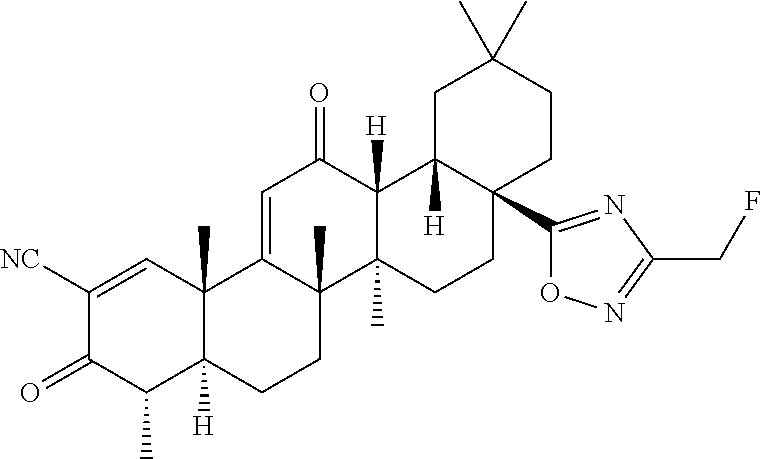 |
CC3 | 0.70 ± 0.11 | 4 |
| bAverage of ratios from experiments with direct comparisons. | ||||
| TABLE 4 |
| CYP3A4 (Midazolam) Inhibition. |
| Compound ID | Structure | |
| RTA | ||
| 402 |
 |
48.4 |
| |
 |
56.6 |
| T1 |
 |
29.1 |
| T2 |
 |
21.4 |
| T11 |
 |
17.7 |
| T12 |
 |
29.7 |
| T34 |
 |
29.4 |
| TABLE 5 |
| CYP3A4 (Midazolam) Inhibition of T11 Compared with CC1. |
| Compound ID | Structure | % Inhibition |
| CC1 |
 |
20.7 |
| T11 |
 |
17.7 |
| TABLE 6 |
| CYP3A4 (Midazolam) Inhibition of T12 Compared with CC2. |
| Compound ID | Structure | % Inhibition |
| CC2 |
 |
45.8 |
| T12 |
 |
29.7 |
| TABLE 7 |
| CYP3A4 (Midazolam) Inhibition of T34 Compared with CC3. |
| Compound ID | Structure | % Inhibition |
| CC3 |
 |
37.7 |
| T34 |
 |
29.4 |
| TABLE 8 |
| Glutathione (GSH) EC50 and EC50 Relative to |
| GSH EC50 | ||||
| Relative to | ||||
| GSH EC50 | RTA 402 | |||
| (nM) | (fold)c | # of | ||
| ID # | Structure | (Mean ± SD) | (Mean ± SD) | Repeats |
| CC2 |
 |
2.00 ± 1.24 | 0.80 ± 0.16 | 8 |
| T1 |
 |
0.57 ± 0.22 | 0.35 ± 0.12 | 4 |
| T41 |
 |
4.85 ± 0.36 | 2.38 ± 0.29 | 2 |
| T40 |
 |
18.33 ± 2.19 | 8.96 ± 0.68 | 2 |
| T24 |
 |
6.11 ± 2.23 | 2.53 ± 0.52 | 4 |
| T2 |
 |
1.21 ± 1.15 | 0.47 ± 0.38 | 4 |
| T12 |
 |
0.82 ± 0.40 | 0.50 ± 0.19 | 4 |
| T43 |
 |
3.29 ± 0.55 | 1.60 ± 0.05 | 2 |
| T22 |
 |
17.59 ± 0.59 | 8.72 ± 1.98 | 2 |
| T23 |
 |
3.26 ± 0.51 | 2.05 ± 0.44 | 4 |
| CC1 |
 |
1.09 ± 0.13 | 0.70 ± 0.12 | 4 |
| T11 |
 |
0.54 ± 0.29 | 0.32 ± 0.13 | 4 |
| T44 |
 |
2.05 ± 0.64 | 1.04 ± 0.06 | 2 |
| T45 |
 |
8.00 ± 1.37 | 4.14 ± 0.35 | 2 |
| T46 |
 |
2.39 ± 0.29 | 1.24 ± 0.17 | 2 |
| CC3 |
 |
1.16 ± 0.53 | 0.43 ± 0.14 | 6 |
| T34 |
 |
0.35 ± 0.06 | 0.18 ± 0.02 | 2 |
| T35 |
 |
1.99 ± 0.42 | 1.02 ± 0.04 | 2 |
| T36 |
 |
10.43 ± 1.62 | 5.40 ± 0.54 | 2 |
| T37 |
 |
1.69 ± 0.19 | 0.88 ± 0.13 | 2 |
| T3 |
 |
1.45 ± 0.28 | 0.54 ± 0.06 | 2 |
| T4 |
 |
2.46 ± 1.80 | 0.89 ± 0.61 | 2 |
| T5 |
 |
1.77 ± 0.98 | 0.65 ± 0.32 | 2 |
| T6 |
 |
2.90 ± 0.96 | 1.07 ± 0.28 | 2 |
| T7 |
 |
2.87 ± 3.17 | 0.80 ± 0.59 | 4 |
| T10 |
 |
1.45 ± 0.17 | 1.14 ± 0.03 | 2 |
| T13 |
 |
2.04 ± 1.94 | 0.55 ± 0.33 | 4 |
| T16 |
 |
0.58 ± 0.04 | 0.46 ± 0.09 | 2 |
| T20 |
 |
1.66 ± 0.66 | 0.96 ± 0.15 | 4 |
| T21 |
 |
3.18 ± 2.22 | 0.95 ± 0.34 | 4 |
| T25 |
 |
9.07 ± 1.55 | 3.36 ± 0.34 | 2 |
| TABLE 9 |
| Glutathione (GSH) EC50 Relative to Comparison Compounds. |
| GSH EC50 | ||||
| Relative to | ||||
| Comparison | CC in Same | |||
| Compound | Experimentd | # of | ||
| ID # | Structure | (CC) | (Mean ± SD) | Repeats |
| CC2 |
 |
CC2 | 1.00 | N/A |
| T1 |
 |
CC2 | 0.50 ± 0.09 | 4 |
| T2 |
 |
CC2 | 0.41 ± 0.09 | 2 |
| T12 |
 |
CC2 | 0.69 ± 0.20 | 4 |
| CC1 |
 |
CC1 | 1.00 | N/A |
| T11 |
 |
CC1 | 0.42 ± 0.02 | 2 |
| T44 |
 |
CC1 | 1.72 ± 0.32 | 2 |
| CC3 |
 |
CC3 | 1.00 | N/A |
| T34 |
 |
CC3 | 0.58 ± 0.02 | 2 |
| T13 |
 |
CC2 | 0.62 ± 0.36 | 4 |
| T20 |
 |
CC2 | 1.41 ± 0.33 | 4 |
| dAverage of ratios from experiments with direct comparisons. | ||||
| TABLE 10 |
| AREc32 EC2X and EC2X Relative to |
| AREc32 EC2X | ||||
| AREc32 | Relative to | |||
| EC2X | RTA 402 | |||
| (nM) | (fold)e | # of | ||
| ID # | Structure | (Mean ± SD) | (Mean ± SD) | Repeats |
| CC2 |
 |
8.59 ± 1.88 | 0.74 ± 0.16 | 11 |
| T1 |
 |
6.20 ± 1.37 | 0.46 ± 0.13 | 7 |
| T41 |
 |
24.18 ± 3.36 | 1.52 ± 0.19 | 3 |
| T40 |
 |
64.93 ± 12.64 | 4.76 ± 0.93 | 4 |
| T24 |
 |
32.20 ± 2.59 | 2.50 ± 0.66 | 5 |
| T2 |
 |
3.67 ± 0.28 | 0.28 ± 0.04 | 7 |
| T12 |
 |
6.87 ± 1.57 | 0.53 ± 0.12 | 8 |
| T43 |
 |
9.92 ± 2.32 | 0.62 ± 0.09 | 3 |
| T22 |
 |
54.63 ± 8.83 | 3.45 ± 0.69 | 3 |
| T23 |
 |
20.25 ± 2.51 | 1.43 ± 0.26 | 5 |
| CC1 |
 |
10.63 ± 2.73 | 0.79 ± 0.24 | 5 |
| T11 |
 |
3.23 ± 0.77 | 0.25 ± 0.08 | 8 |
| T44 |
 |
8.62 ± 0.45 | 0.57 ± 0.12 | 3 |
| T45 |
 |
29.09 ± 2.09 | 1.95 ± 0.57 | 3 |
| T46 |
 |
24.02 ± 1.50 | 1.60 ± 0.44 | 3 |
| CC3 |
 |
7.11 ± 1.15 | 0.66 ± 0.21 | 9 |
| T34 |
 |
4.50 ± 0.66 | 0.36 ± 0.05 | 8 |
| T35 |
 |
10.74 ± 1.02 | 0.73 ± 0.14 | 3 |
| T36 |
 |
33.72 ± 6.99 | 2.25 ± 0.31 | 3 |
| T37 |
 |
10.33 ± 1.35 | 0.69 ± 0.06 | 3 |
| CC4 |
 |
8.12 ± 3.53 | N/A | 3f |
| T38 |
 |
3.95 ± 1.12 | 0.43 ± 0.14 | 2 |
| T3 |
 |
9.21 ± 3.66 | 0.91 ± 0.29 | 2 |
| T4 |
 |
10.48 ± 1.03 | 1.04 ± 0.02 | 2 |
| T5 |
 |
11.68 ± 2.80 | 1.16 ± 0.19 | 2 |
| T6 |
 |
17.66 ± 0.10 | 1.77 ± 0.15 | 2 |
| T7 |
 |
10.46 ± 3.66 | 1.10 ± 0.33 | 5 |
| T10 |
 |
28.41 ± 9.42 | 2.41 ± 0.98 | 2 |
| T13 |
 |
3.53 ± 0.98 | 0.37 ± 0.04 | 5 |
| T16 |
 |
3.56 ± 0.31 | 0.30 ± 0.00 | 2 |
| T20 |
 |
21.50 ± 2.85 | 1.50 ± 0.18 | 5 |
| T21 |
 |
16.17 ± 4.20 | 1.67 ± 0.15 | 5 |
| T25 |
 |
43.96 ± 1.20 | 4.39 ± 0.23 | 2 |
| T29 |
 |
43.70 | 2.84 | 1 |
| T30 |
 |
64.54 | 4.19 | 1 |
| T39 |
 |
1.88 | 0.20 | 1 |
| T42 |
 |
2.58 | 0.26 | 1 |
| eAverage of ratios from replicate experiments. | ||||
| f# of repeats in this case refers only to AREc32 EC2x measurement. This compound was not run side by side by side against |
||||
| TABLE 11 |
| AREc32 EX2X Relative to Comparison Compounds. |
| AREc32 Relative | ||||
| Comparison | to CC in Same | |||
| Compound | Experimentg | # of | ||
| ID # | Structure | (CC) | (Mean ± SD) | Repeats |
| CC2 |
 |
CC2 | 1.00 | N/A |
| T1 |
 |
CC2 | 0.62 ± 0.07 | 5 |
| T2 |
 |
CC2 | 0.43 ± 0.00 | 3 |
| T12 |
 |
CC2 | 0.75 ± 0.05 | 5 |
| T43 |
 |
CC2 | 1.09 ± 0.09 | 3 |
| T23 |
 |
CC2 | 2.41 ± 0.42 | 3 |
| CC1 |
 |
CC1 | 1.00 | N/A |
| T11 |
 |
CC1 | 0.27 ± 0.03 | 3 |
| T44 |
 |
CC1 | 0.91 ± 0.21 | 3 |
| CC3 |
 |
CC3 | 1.00 | N/A |
| T34 |
 |
CC3 | 0.76 ± 0.14 | 3 |
| T35 |
 |
CC3 | 1.66 ± 0.31 | 3 |
| T37 |
 |
CC3 | 1.58 ± 0.16 | 3 |
| T13 |
 |
CC2 | 0.44 ± 0.07 | 5 |
| gAverage of ratios from experiments with direct comparisons. | ||||
- U.S. Pat. No. 6,326,507
- U.S. Pat. No. 6,974,801
- U.S. Pat. No. 7,435,755
- U.S. Pat. No. 7,795,305
- U.S. Pat. No. 7,863,327
- U.S. Pat. No. 7,915,402
- U.S. Pat. No. 7,943,778
- U.S. Pat. No. 8,034,955
- U.S. Pat. No. 8,071,632
- U.S. Pat. No. 8,124,656
- U.S. Pat. No. 8,124,799
- U.S. Pat. No. 8,129,429
- U.S. Pat. No. 8,338,618
- U.S. Pat. No. 8,394,967
- U.S. Pat. No. 8,440,820
- U.S. Pat. No. 8,440,854
- U.S. Pat. No. 8,455,544
- U.S. Pat. No. 8,586,775
- U.S. Pat. No. 8,993,640
- U.S. Pat. No. 9,090,574
- U.S. Pat. No. 9,102,681
- U.S. Pat. No. 9,249,089
- U.S. Pat. No. 9,278,912
- U.S. Pat. No. 9,278,913
- U.S. Pat. No. 9,290,536
- U.S. Pat. No. 9,512,094
- U.S. Pat. No. 9,556,222
- U.S. Pat. No. 9,593,074
- U.S. Pat. No. 9,670,147
- U.S. Pat. No. 9,701,709
- U.S. Pat. No. 9,757,359
- U.S. Pat. No. 9,856,286
- U.S. Pat. No. 9,889,143
- U.S. Pat. No. 10,093,614
- U.S. Pat. No. 10,105,372
- U.S. Pat. No. 10,398,711
- U.S. Pat. No. 10,501,489
- U.S. Pat. No. 10,556,858
- WO 2012/125488
- WO 2014/040056
- WO 2017/053868
- WO 2018/089539
- Abraham and Kappas, Free Radical Biol. Med., 39:1-25, 2005.
- Ahmad et al., Cancer Res., 68:2920-2926, 2008.
- Ahmad et al., J. Biol. Chem., 281:35764-35769, 2006.
- Anderson, Practical Process Research & Development—A Guide for Organic Chemists, 2nd ed., Academic Press, New York, 2012.
- Araujo et al., J. Immunol., 171(3):1572-1580, 2003.
- Bach, Hum. Immunol., 67(6):430-432, 2006.
- Bachhawat and Yadav, IUBMB Life, 70(7):585-592, 2018.
- Chauhan and Chauhan, Pathophysiology, 13(3):171-181 2006.
- Dickerson et al., Prog Neuropsychopharmacol Biol. Psychiatry, Mar. 6, 2007.
- Dinkova-Kostova et al., Proc. Natl. Acad. Sci. USA, 102(12):4584-4589, 2005.
- Dudhgaonkar et al., Eur. J. Pain, 10(7):573-579, 2006.
- Favaloro, et al., J. Med. Chem., 45:4801-4805, 2002.
- Florczyk et al., Pharmacol. Rep., 60(1):38-48, 2008.
- Forstermann, Biol. Chem., 387:1521, 2006.
- Frilling et al., Proc Natl Acad Sci USA, 87(16):6258-6262, 1990.
- Handbook of Pharmaceutical Salts: Properties, and Use, Stahl and Wermuth Eds., Verlag Helvetica Chimica Acta, 2002.
- Hanson et al., BMC Medical Genetics, 6(7), 2005.
- Honda et al. Bioorg. Med. Chem. Lett., 12:1027-1030, 2002.
- Honda et al., Bioorg. Med. Chem. Lett., 16(24):6306-6309, 2006.
- Honda et al., Bioorg. Med. Chem. Lett., 7:1623-1628, 1997.
- Honda et al., Bioorg. Med. Chem. Lett., 8(19):2711-2714, 1998.
- Honda et al., Bioorg. Med. Chem. Lett., 9(24):3429-3434, 1999.
- Honda et al., J. Med. Chem., 43:4233-4246, 2000a.
- Honda et al., Org. Biomol. Chem., 1:4384-4391, 2003.
- Honda et al., J. Med. Chem., 43:1866-1877, 2000b.
- Honda et al., Bioorg. Med. Chem. Lett., 12(7):1027-1030, 2002.
- Honda et al., J. Med. Chem., 54(6):1762-1778, 2011.
- Hong et al., Clin. Cancer Res., 18(12):3396-3406, 2012.
- Ishikawa et al., Circulation, 104(15):1831-1836, 2001.
- Kawakami et al., Brain Dev 28(4):243-246, 2006.
- Kendall-Tackett, Trauma Violence Abuse, 8(2):117-126, 2007.
- Kruger et al., J. Pharmacol. Exp. Ther., 319(3):1144-1152, 2006.
- Lee et al., Glia., 55(7):712-22, 2007.
- Lencz et al., Mol. Psychiatry, 12(6):572-80, 2007.
- Liby et al., Cancer Res., 65(11):4789-4798, 2005.
- Liby et al., Mol. Cancer Ther., 6(7):2113-9, 2007b.
- Liby et al., Nat. Rev. Cancer, 7(5):357-356, 2007a.
- Liu et al., FASEB J., 20(2):207-216, 2006.
- Lu et al., J. Clin. Invest., 121(10):4015-29, 2011.
- McIver et al., Pain, 120 (1-2):161-9, 2005.
- Morris et al., J. Mol. Med., 80(2):96-104, 2002.
- Morse and Choi, Am. J. Respir. Crit. Care Med., 172(6):660-670, 2005.
- Morse and Choi, Am. J. Respir. Crit. Care Med., 27(1):8-16, 2002.
- Motterlini and Foresti, Am. J. Physiol. Cell Physiol., 312:C302-C313, 2017.
- Pall, Med. Hypoth., 69:821-825, 2007.
- Pergola et al., N. Engl. J. Med., 365:327-336, 2011.
- Place et al., Clin. Cancer Res., 9(7):2798-806, 2003.
- Rajakariar et al., Proc. Natl. Acad. Sci. USA, 104(52):20979-84, 2007.
- Reagan-Shaw et al., FASEB J., 22(3):659-661, 2008
- Reisman et al., Arch. Dermatol. Res., 306(5):447-454, 2014.
- Ross et al., Am. J. Clin. Pathol., 120 (Suppl):S53-71, 2003.
- Ross et al., Expert Rev. Mol. Diagn., 3(5):573-585, 2003.
- Ruster et al., Scand. J. Rheumatol., 34(6):460-3, 2005.
- Sacerdoti et al., Curr Neurovasc Res. 2(2):103-111, 2005.
- Salvemini et al., J. Clin. Invest., 93(5):1940-1947, 1994.
- Sarchielli et al., Cephalalgia, 26(9):1071-1079, 2006.
- Satoh et al., Proc. Natl. Acad. Sci. USA, 103(3):768-773, 2006.
- Schulz et al., Antioxid. Redox. Sig., 10:115, 2008.
- Smith, March's Advanced Organic Chemistry: Reactions, Mechanisms, and Structure, 7th Ed., Wiley, 2013.
- Sporn et al J. Exp. Med., 184(4):1425-1433, 1996.
- Suh et al., Cancer Res., 58:717-723, 1998.
- Suh et al., Cancer Res., 59(2):336-341, 1999.
- Szabo et al., Nature Rev. Drug Disc., 6:662-680, 2007.
- Takahashi et al., Cancer Res., 57:1233-1237, 1997.
- Tamir and Tannebaum, Chem. Res. Toxicol., 9(5):821-827, 1996.
- Thimmulappa et al., Cancer Res., 62(18):5196-5203, 2002.
- Tamir and Tannebaum, Biochim. Biophys. Acta, 1288:F31-F36, 1996.
- Xie et al., J Biol Chem. 270(12):6894-6900, 1995.
- Zhou et al., Am. J Pathol., 166(1):27-37, 2005.
Claims (9)


Priority Applications (2)
| Application Number | Priority Date | Filing Date | Title |
|---|---|---|---|
| US16/933,635 US12344631B2 (en) | 2019-07-19 | 2020-07-20 | C17 polar-substituted heteroaromatic synthetic triterpenoids and methods of use thereof |
| US19/231,055 US20250361263A1 (en) | 2019-07-19 | 2025-06-06 | C17 polar-substituted heteroaromatic synthetic triterpenoids and methods of use thereof |
Applications Claiming Priority (3)
| Application Number | Priority Date | Filing Date | Title |
|---|---|---|---|
| US201962876467P | 2019-07-19 | 2019-07-19 | |
| US201962952048P | 2019-12-20 | 2019-12-20 | |
| US16/933,635 US12344631B2 (en) | 2019-07-19 | 2020-07-20 | C17 polar-substituted heteroaromatic synthetic triterpenoids and methods of use thereof |
Related Child Applications (1)
| Application Number | Title | Priority Date | Filing Date |
|---|---|---|---|
| US19/231,055 Continuation US20250361263A1 (en) | 2019-07-19 | 2025-06-06 | C17 polar-substituted heteroaromatic synthetic triterpenoids and methods of use thereof |
Publications (2)
| Publication Number | Publication Date |
|---|---|
| US20210040142A1 US20210040142A1 (en) | 2021-02-11 |
| US12344631B2 true US12344631B2 (en) | 2025-07-01 |
Family
ID=74192606
Family Applications (2)
| Application Number | Title | Priority Date | Filing Date |
|---|---|---|---|
| US16/933,635 Active 2042-07-23 US12344631B2 (en) | 2019-07-19 | 2020-07-20 | C17 polar-substituted heteroaromatic synthetic triterpenoids and methods of use thereof |
| US19/231,055 Pending US20250361263A1 (en) | 2019-07-19 | 2025-06-06 | C17 polar-substituted heteroaromatic synthetic triterpenoids and methods of use thereof |
Family Applications After (1)
| Application Number | Title | Priority Date | Filing Date |
|---|---|---|---|
| US19/231,055 Pending US20250361263A1 (en) | 2019-07-19 | 2025-06-06 | C17 polar-substituted heteroaromatic synthetic triterpenoids and methods of use thereof |
Country Status (10)
| Country | Link |
|---|---|
| US (2) | US12344631B2 (en) |
| EP (1) | EP3999522B1 (en) |
| JP (2) | JP7695229B2 (en) |
| KR (1) | KR102891865B1 (en) |
| CN (2) | CN120248001A (en) |
| AU (1) | AU2020316351A1 (en) |
| CA (2) | CA3144603C (en) |
| MX (2) | MX2022000781A (en) |
| TW (1) | TWI861163B (en) |
| WO (1) | WO2021016191A1 (en) |
Families Citing this family (5)
| Publication number | Priority date | Publication date | Assignee | Title |
|---|---|---|---|---|
| ES2703274T3 (en) | 2008-04-18 | 2019-03-07 | Reata Pharmaceuticals Inc | Antioxidant modulators of inflammation: oleanolic acid derivatives with amino and other modifications in C-17 |
| EA201890767A1 (en) | 2015-09-23 | 2019-09-30 | Рита Фармасьютикалз, Инк. | C4-MODIFIED OLEANOLIC ACID DERIVATIVES FOR INHIBITION OF IL-17 AND OTHER APPLICATIONS |
| EP3810141A1 (en) | 2018-06-20 | 2021-04-28 | Reata Pharmaceuticals, Inc. | Cysteine-dependent inverse agonists of nuclear receptors ror-gamma/ror-gamma-t and methods of treating diseases or disorders therewith |
| KR102891865B1 (en) * | 2019-07-19 | 2025-11-26 | 리아타 파마슈티컬즈, 아이엔씨. | C17 polar-substituted heteroaromatic synthetic triterpenoid and method of using the same |
| CN120349366A (en) * | 2025-03-07 | 2025-07-22 | 国科大杭州高等研究院 | Pentacyclic triterpene derivative, preparation method and medical application thereof |
Citations (62)
| Publication number | Priority date | Publication date | Assignee | Title |
|---|---|---|---|---|
| US4395423A (en) | 1978-10-10 | 1983-07-26 | Sterling Drug Inc. | Polycyclic cyanoketones |
| US5064823A (en) | 1988-08-24 | 1991-11-12 | Research Triangle Institute | Pentacyclic triterpenoid compounds as topoisomerase inhibitors or cell differentiation inducers |
| WO1999065478A1 (en) | 1998-06-19 | 1999-12-23 | Trustees Of Dartmouth College | Therapeutic compositions and methods of use |
| WO2000073253A1 (en) | 1999-05-14 | 2000-12-07 | Nereus Pharmaceuticals, Inc. | NOVEL INTERLEUKIN-1 AND TUMOR NECROSIS FACTOR-α MODULATORS, SYNTHESES OF SAID MODULATORS AND METHODS OF USING SAID MODULATORS |
| WO2002003996A1 (en) | 2000-07-12 | 2002-01-17 | RAJKUMAR, Sujatha | Use of dammarane-type tritepenoid saporins |
| WO2002026762A1 (en) | 2000-09-29 | 2002-04-04 | Regents Of The University Of Minnesota | Triterpenes having antibacterial activity |
| WO2002026761A1 (en) | 2000-09-29 | 2002-04-04 | Regents Of The University Of Minnesota | Triterpenes having fungicidal activity against yeast |
| US6369101B1 (en) | 1999-02-26 | 2002-04-09 | Regents Of The University Of Minnesota | Therapeutic method to treat herpes virus infection |
| WO2002047611A2 (en) | 2000-11-28 | 2002-06-20 | Board Of Regents, The University Of Texas System | Cddo-compounds and combination therapies thereof |
| US6503913B1 (en) | 1998-04-18 | 2003-01-07 | Bayer Aktiengesellschaft | 2-heterocyclically substituted dihydropyrimidines |
| US20030119732A1 (en) | 2000-11-28 | 2003-06-26 | Board Of | CDDO-compounds and combination therapies thereof |
| WO2003059339A1 (en) | 2002-01-15 | 2003-07-24 | Trustees Of Dartmouth College | Tricyclic-bis-enone derivatives and methods of use thereof |
| WO2003062260A1 (en) | 2002-01-18 | 2003-07-31 | Regents Of The University Of Minnesota | Triterpene quaternary salts as biologically active surfactants |
| US6649654B1 (en) | 1999-11-23 | 2003-11-18 | The Regents Of The University Of California | Methods for identifying and using IKK inhibitors |
| US20040002463A1 (en) | 2002-05-13 | 2004-01-01 | The Trustees Of Dartmouth College | Inhibitors and methods of use thereof |
| WO2005042002A2 (en) | 2003-10-30 | 2005-05-12 | Entelos, Inc. | Treatment of rhematoid arthritis with flip antagonists |
| WO2005046732A2 (en) | 2003-11-04 | 2005-05-26 | THE UNITED SATES OF AMERICA as represented by THE SECRETARY OF HEALTH AND HUMAN SERVICES, NIH | Methods and compositions for the inhibition of hiv-1 replication |
| US6951847B2 (en) | 2000-09-29 | 2005-10-04 | Regents Of The University Of Minnesota | Methods of treating fungal infections using lupeol |
| WO2006029221A2 (en) | 2004-09-07 | 2006-03-16 | Pacific Arrow Limited | Anti-tumor compounds with angeloyl groups |
| US20060258752A1 (en) | 2004-02-12 | 2006-11-16 | Vander Jagt David L | Method and compounds for cancer treatment utilizing NFkB as a direct or ultimate target for small molecule inhibitors |
| WO2007005879A2 (en) | 2005-07-01 | 2007-01-11 | The Johns Hopkins University | Compositions and methods for the treatment or prevention of disorders relating to oxidative stress |
| WO2007112043A2 (en) | 2006-03-23 | 2007-10-04 | Advanced Life Sciences Inc. | Synthetic pentacyclic triterpenoids and derivatives of betulinic acid and betulin |
| US20070249561A1 (en) | 2006-04-25 | 2007-10-25 | Taylor Bradley K | Pharmacological method for treatment of neuropathic pain |
| WO2008000070A1 (en) | 2006-06-27 | 2008-01-03 | Wellington Laboratories Inc. | Glycyrrhetinic acid derivatives |
| WO2008016095A1 (en) | 2006-08-02 | 2008-02-07 | Santen Pharmaceutical Co., Ltd. | PREVENTIVE OR REMEDY FOR KERATOCONJUNCTIVAL DISORDERS CONTAINING Nrf2 ACTIVATOR AS THE ACTIVE INGREDIENT |
| WO2008064132A2 (en) | 2006-11-17 | 2008-05-29 | Trustees Of Dartmouth College | Synthetic triterpenoids and tricyclic-bis-enones for use in stimulating bone and cartilage growth |
| WO2008064133A1 (en) | 2006-11-17 | 2008-05-29 | Trustees Of Dartmouth College | Synthesis and biological activities of new tricyclic-bis-enones (tbes) |
| WO2008097596A2 (en) | 2007-02-08 | 2008-08-14 | Biogen Idec Ma Inc. | Nrf2 screening assays and related methods and compositions |
| WO2008111497A1 (en) | 2007-03-08 | 2008-09-18 | Santen Pharmaceutical Co., Ltd. | Prophylactic or therapeutic agent for ophthalmic disease associated with oxidative stress, comprising triterpenoid as active ingredient |
| WO2008136838A1 (en) | 2007-05-04 | 2008-11-13 | Trustees Of Dartmouth College | Novel amide derivatives of cddo and methods of use thereof |
| WO2009023232A1 (en) | 2007-08-15 | 2009-02-19 | Reata Pharmaceuticals, Inc. | Novel forms of cddo methyl ester |
| US20090048205A1 (en) | 2007-08-15 | 2009-02-19 | Colin Meyer | Combination therapy with synthetic triterpenoids and gemcitabine |
| WO2009058849A1 (en) | 2007-10-29 | 2009-05-07 | University Of Rochester | Use of electrophilic compounds for inducing platelet production or maintaining platelet function |
| WO2009089545A1 (en) | 2008-01-11 | 2009-07-16 | Reata Pharmaceuticals, Inc. | Synthetic triterpenoids and methods of use in the treatment of disease |
| WO2009129548A1 (en) | 2008-04-18 | 2009-10-22 | Reata Pharmaceuticals, Inc. | Antioxidant inflammation modulators: c-17 homologated oleanolic acid derivatives |
| WO2009129545A1 (en) | 2008-04-18 | 2009-10-22 | Reata Pharmaceuticals, Inc. | Antioxidant inflammation modulators: oleanolic acid derivatives with saturation in the c-ring |
| WO2009129546A1 (en) | 2008-04-18 | 2009-10-22 | Reata Pharmaceuticals, Inc. | Antioxidant inflammation modulators: oleanolic acid derivatives with amino and other modifications at c-17 |
| WO2009146218A2 (en) | 2008-04-18 | 2009-12-03 | Reata Pharmaceuticals, Inc. | Compounds including an anti-inflammatory pharmacore and methods of use |
| WO2009146216A2 (en) | 2008-04-18 | 2009-12-03 | Reata Pharmaceuticals. Inc. | Antioxidant inflammation modulators: novel derivatives of oleanolic acid |
| WO2010011782A1 (en) | 2008-07-22 | 2010-01-28 | Trustees Of Dartmouth College | Monocyclic cyanoenones and methods of use thereof |
| WO2010053817A1 (en) | 2008-11-04 | 2010-05-14 | Trustees Of Dartmouth College | Betulinic acid derivatives and methods of use thereof |
| WO2010093944A2 (en) | 2009-02-13 | 2010-08-19 | Reata Pharmaceuticals, Inc. | Delayed release, oral dosage compositions that contain amorphous cddo-me |
| WO2011130302A2 (en) | 2010-04-12 | 2011-10-20 | Reata Pharmaceuticals, Inc. | Method of treating obesity using antioxidant inflammation modulators |
| WO2012096718A2 (en) | 2011-01-14 | 2012-07-19 | Heptiva LLC | Composition comprising hepatic therapeutic active for treating liver diseases, certain cancers, and liver health maintenance |
| WO2012106190A1 (en) | 2011-01-31 | 2012-08-09 | Bristol-Myers Squibb Company | C-17 and c-3 modified triterpenoids with hiv maturation inhibitory activity |
| WO2012125488A1 (en) | 2011-03-11 | 2012-09-20 | Reata Pharmaceuticals, Inc. | C4-monomethyl triterpenoid derivatives and methods of use thereof |
| WO2013163344A1 (en) | 2012-04-27 | 2013-10-31 | Reata Pharmaceuticals, Inc. | 2.2-difluoropropionamide derivatives of bardoxolone methyl, polymorphic forms and methods of use thereof |
| US20130303607A1 (en) | 2012-05-08 | 2013-11-14 | Trustees Of Dartmouth College | Triterpenoids and Compositions Containing the Same |
| WO2013169740A2 (en) | 2012-05-08 | 2013-11-14 | Trustees Of Dartmouth College | Synthetic triterpenoids and methods for modulating stem/progenitor cell gene expression |
| WO2013188818A1 (en) | 2012-06-15 | 2013-12-19 | Reata Pharmaceuticals, Inc. | A-ring epoxidized triterpenoid-based anti-inflammation modulators and methods of use thereof |
| WO2014040052A2 (en) | 2012-09-10 | 2014-03-13 | Abbvie Inc. | Glycyrrhetinic acid derivatives and methods of use thereof |
| WO2014040060A1 (en) | 2012-09-10 | 2014-03-13 | Reata Pharmaceuticals, Inc. | C17-alkanediyl and alkenediyl derivatives of oleanolic acid and methods of use thereof |
| WO2014040056A1 (en) | 2012-09-10 | 2014-03-13 | Reata Pharmaceuticals, Inc. | C17-heteroaryl derivatives of oleanolic acid and methods of use thereof |
| WO2014040073A1 (en) | 2012-09-10 | 2014-03-13 | Reata Pharmaceuticals, Inc. | C13-hydroxy derivatives of oleanolic acid and methods of use thereof |
| CN103665087A (en) | 2012-09-03 | 2014-03-26 | 上海源力生物技术有限公司 | Terpenoid and application thereof in medicine |
| WO2014176415A1 (en) | 2013-04-24 | 2014-10-30 | Abbvie Inc. | 2,2-difluoropropionamide derivatives of bardoxolone methyl, polymorphic forms and methods of use thereof |
| WO2015027206A1 (en) | 2013-08-23 | 2015-02-26 | Reata Pharmaceuticals, Inc. | Methods of treating and preventing endothelial dysfunction using bardoxololone methyl or analogs thereof |
| US20150152071A1 (en) | 2012-09-10 | 2015-06-04 | Reata Pharmaceuticals, Inc. | C17-heteroaryl derivatives of oleanolic acid and methods of use thereof |
| WO2016033132A1 (en) | 2014-08-26 | 2016-03-03 | Trustees Of Dartmouth College | Pyridyl analogs of 1-(2-cyano-3,12-dioxooleana-1,9(11)dien-28-oyl) imidazole |
| WO2017053868A1 (en) | 2015-09-23 | 2017-03-30 | Reata Pharmaceutical, Inc. | C4-modified oleanolic acid derivatives for inhibition of il-17 and other uses |
| WO2018089539A1 (en) | 2016-11-08 | 2018-05-17 | Reata Pharmaceuticals, Inc. | Methods of treating alport syndrome using bardoxolone methyl or analogs thereof |
| WO2021016191A1 (en) | 2019-07-19 | 2021-01-28 | Reata Pharmaceuticals, Inc. | C17 polar-substituted heteroaromatic synthetic triterpenoids and methods of use thereof |
-
2020
- 2020-07-20 KR KR1020227001950A patent/KR102891865B1/en active Active
- 2020-07-20 US US16/933,635 patent/US12344631B2/en active Active
- 2020-07-20 JP JP2022503439A patent/JP7695229B2/en active Active
- 2020-07-20 CN CN202411704605.9A patent/CN120248001A/en active Pending
- 2020-07-20 TW TW109124425A patent/TWI861163B/en active
- 2020-07-20 EP EP20758383.2A patent/EP3999522B1/en active Active
- 2020-07-20 CA CA3144603A patent/CA3144603C/en active Active
- 2020-07-20 CA CA3249188A patent/CA3249188A1/en active Pending
- 2020-07-20 WO PCT/US2020/042788 patent/WO2021016191A1/en not_active Ceased
- 2020-07-20 MX MX2022000781A patent/MX2022000781A/en unknown
- 2020-07-20 CN CN202080063672.0A patent/CN114641483B/en active Active
- 2020-07-20 AU AU2020316351A patent/AU2020316351A1/en active Pending
-
2022
- 2022-01-18 MX MX2025007184A patent/MX2025007184A/en unknown
-
2025
- 2025-06-06 US US19/231,055 patent/US20250361263A1/en active Pending
- 2025-06-06 JP JP2025094850A patent/JP2025131767A/en active Pending
Patent Citations (188)
| Publication number | Priority date | Publication date | Assignee | Title |
|---|---|---|---|---|
| US4395423A (en) | 1978-10-10 | 1983-07-26 | Sterling Drug Inc. | Polycyclic cyanoketones |
| US5064823A (en) | 1988-08-24 | 1991-11-12 | Research Triangle Institute | Pentacyclic triterpenoid compounds as topoisomerase inhibitors or cell differentiation inducers |
| US6503913B1 (en) | 1998-04-18 | 2003-01-07 | Bayer Aktiengesellschaft | 2-heterocyclically substituted dihydropyrimidines |
| US20140275618A1 (en) | 1998-06-19 | 2014-09-18 | Trustees Of Dartmouth College | Therapeutic compounds and methods of use |
| US7863327B2 (en) | 1998-06-19 | 2011-01-04 | Trustees Of Dartmouth College | Therapeutic compounds and methods of use |
| WO1999065478A1 (en) | 1998-06-19 | 1999-12-23 | Trustees Of Dartmouth College | Therapeutic compositions and methods of use |
| US20050288363A1 (en) | 1998-06-19 | 2005-12-29 | Trustees Of Dartmouth College | Therapeutic compositions and methods of use |
| US8034955B2 (en) | 1998-06-19 | 2011-10-11 | Trustees Of Dartmouth College | Therapeutic compounds and methods of use |
| US20130237721A1 (en) | 1998-06-19 | 2013-09-12 | Gordon W. Gribble | Therapeutic compounds and methods of use |
| US20020042535A1 (en) | 1998-06-19 | 2002-04-11 | Trustees Of Dartmouth College | Therapeutic compounds and methods of use |
| US8586775B2 (en) | 1998-06-19 | 2013-11-19 | Trustees Of Dartmouth College | Therapeutic compounds and methods of use |
| US20030236303A1 (en) | 1998-06-19 | 2003-12-25 | Trustees Of Darmouth College | Therapeutic compositions and methods of use |
| US6552075B2 (en) | 1998-06-19 | 2003-04-22 | Trustees Of Dartmouth College | Therapeutic compounds and methods of use |
| US20080220057A1 (en) | 1998-06-19 | 2008-09-11 | Trustees Of Dartmouth College | Therapeutic compounds and methods of use |
| US9278913B2 (en) | 1998-06-19 | 2016-03-08 | Trustees Of Dartmouth College | Therapeutic compounds and methods of use |
| US7288568B2 (en) | 1998-06-19 | 2007-10-30 | Trustees Of Dartmouth College | Therapeutic compositions and methods of use |
| US6326507B1 (en) | 1998-06-19 | 2001-12-04 | Trustees Of Dartmouth College | Therapeutic compounds and methods of use |
| US6369101B1 (en) | 1999-02-26 | 2002-04-09 | Regents Of The University Of Minnesota | Therapeutic method to treat herpes virus infection |
| WO2000073253A1 (en) | 1999-05-14 | 2000-12-07 | Nereus Pharmaceuticals, Inc. | NOVEL INTERLEUKIN-1 AND TUMOR NECROSIS FACTOR-α MODULATORS, SYNTHESES OF SAID MODULATORS AND METHODS OF USING SAID MODULATORS |
| US6649654B1 (en) | 1999-11-23 | 2003-11-18 | The Regents Of The University Of California | Methods for identifying and using IKK inhibitors |
| US7399606B2 (en) | 1999-11-23 | 2008-07-15 | The Regents Of The University Of California | Methods for identifying IκB Kinase (IKK) inhibitors |
| US7053119B2 (en) | 1999-11-23 | 2006-05-30 | The Regents Of The University Of California | Methods for identifying and using IKK inhibitors |
| WO2002003996A1 (en) | 2000-07-12 | 2002-01-17 | RAJKUMAR, Sujatha | Use of dammarane-type tritepenoid saporins |
| WO2002026761A1 (en) | 2000-09-29 | 2002-04-04 | Regents Of The University Of Minnesota | Triterpenes having fungicidal activity against yeast |
| US20040097436A1 (en) | 2000-09-29 | 2004-05-20 | Regents Of The University Of Minnesota | Triterpenes having antibacterial activity |
| US6642217B2 (en) | 2000-09-29 | 2003-11-04 | Naturtek, Llc | Triterpenes having human antifungal and antiyeast activity |
| US6951847B2 (en) | 2000-09-29 | 2005-10-04 | Regents Of The University Of Minnesota | Methods of treating fungal infections using lupeol |
| US7144875B2 (en) | 2000-09-29 | 2006-12-05 | Regents Of The University Of Minnesota | Methods of treating fungal infections using lupeol |
| WO2002026762A1 (en) | 2000-09-29 | 2002-04-04 | Regents Of The University Of Minnesota | Triterpenes having antibacterial activity |
| US20030119732A1 (en) | 2000-11-28 | 2003-06-26 | Board Of | CDDO-compounds and combination therapies thereof |
| US20090093447A1 (en) | 2000-11-28 | 2009-04-09 | Marina Konopleva | Cddo-compounds and combination therapies thereof |
| WO2002047611A2 (en) | 2000-11-28 | 2002-06-20 | Board Of Regents, The University Of Texas System | Cddo-compounds and combination therapies thereof |
| US7795305B2 (en) | 2000-11-28 | 2010-09-14 | Board Of Regents, The University Of Texas System | CDDO-compounds and combination therapies thereof |
| US7435755B2 (en) | 2000-11-28 | 2008-10-14 | The Trustees Of Dartmouth College | CDDO-compounds and combination therapies thereof |
| US8067465B2 (en) | 2002-01-15 | 2011-11-29 | The Trustees Of Dartmouth College | Tricyclic-bis-enone derivatives and methods of use thereof |
| US7176237B2 (en) | 2002-01-15 | 2007-02-13 | The Trustees Of Dartmouth College | Tricyclic-bis-enone derivatives and methods of use thereof |
| US20070155742A1 (en) | 2002-01-15 | 2007-07-05 | Tadashi Honda | Tricyclic-bis-enone derivatives and methods of use thereof |
| US20100261930A1 (en) | 2002-01-15 | 2010-10-14 | Tadashi Honda | Tricyclic-Bis-Enone Derivatives and Methods of Use Thereof |
| US7678830B2 (en) | 2002-01-15 | 2010-03-16 | Trustees Of Dartmouth College | Tricyclic-bis-enone derivatives and methods of use thereof |
| US20030232786A1 (en) | 2002-01-15 | 2003-12-18 | Tadashi Honda | Tricyclic-bis-enone derivatives and methods of use thereof |
| WO2003059339A1 (en) | 2002-01-15 | 2003-07-24 | Trustees Of Dartmouth College | Tricyclic-bis-enone derivatives and methods of use thereof |
| US20070244081A1 (en) | 2002-01-18 | 2007-10-18 | Regents Of The University Of Minnestoa | Triterpene quaternary salts as biologically active surfactants |
| US20070259842A1 (en) | 2002-01-18 | 2007-11-08 | Regents Of The University Of Minnesota | Triterpene quaternary salts as biologically active surfactants |
| US20070259839A1 (en) | 2002-01-18 | 2007-11-08 | Regents Of The University Of Minnesota | Triterpene quaternary salts as biologically active surfactants |
| WO2003062260A1 (en) | 2002-01-18 | 2003-07-31 | Regents Of The University Of Minnesota | Triterpene quaternary salts as biologically active surfactants |
| US7410958B2 (en) | 2002-01-18 | 2008-08-12 | Regents Of The University Of Minnesota | Triterpene quaternary salts as biologically active surfactants |
| WO2004064723A2 (en) | 2002-05-13 | 2004-08-05 | Trustees Of Dartmouth College | Inhibitors and methods of use thereof |
| US20040002463A1 (en) | 2002-05-13 | 2004-01-01 | The Trustees Of Dartmouth College | Inhibitors and methods of use thereof |
| US6974801B2 (en) | 2002-05-13 | 2005-12-13 | The Trustees Of Dartmounth College | Inhibitors and methods of use thereof |
| WO2005042002A2 (en) | 2003-10-30 | 2005-05-12 | Entelos, Inc. | Treatment of rhematoid arthritis with flip antagonists |
| US20050208151A1 (en) | 2003-10-30 | 2005-09-22 | Entelos, Inc. | Treatment of rheumatoid arthritis with FLIP antagonists |
| WO2005046732A2 (en) | 2003-11-04 | 2005-05-26 | THE UNITED SATES OF AMERICA as represented by THE SECRETARY OF HEALTH AND HUMAN SERVICES, NIH | Methods and compositions for the inhibition of hiv-1 replication |
| US20060258752A1 (en) | 2004-02-12 | 2006-11-16 | Vander Jagt David L | Method and compounds for cancer treatment utilizing NFkB as a direct or ultimate target for small molecule inhibitors |
| WO2006029221A2 (en) | 2004-09-07 | 2006-03-16 | Pacific Arrow Limited | Anti-tumor compounds with angeloyl groups |
| WO2007005879A2 (en) | 2005-07-01 | 2007-01-11 | The Johns Hopkins University | Compositions and methods for the treatment or prevention of disorders relating to oxidative stress |
| US20070232577A1 (en) | 2006-03-23 | 2007-10-04 | Advanced Life Sciences, Inc. | Synthetic pentacyclic triterpenoids and derivatives of betulinic acid and betulin |
| WO2007112043A2 (en) | 2006-03-23 | 2007-10-04 | Advanced Life Sciences Inc. | Synthetic pentacyclic triterpenoids and derivatives of betulinic acid and betulin |
| WO2007127791A2 (en) | 2006-04-25 | 2007-11-08 | The Administrators Of The Tulane Educational Fund | New pharmacological method for treatment of neuropathic pain |
| US20070249561A1 (en) | 2006-04-25 | 2007-10-25 | Taylor Bradley K | Pharmacological method for treatment of neuropathic pain |
| WO2008000068A1 (en) | 2006-06-27 | 2008-01-03 | Wellington Laboratories Inc. | Method for preparing 2-iodo triterpenoid compounds |
| WO2008000070A1 (en) | 2006-06-27 | 2008-01-03 | Wellington Laboratories Inc. | Glycyrrhetinic acid derivatives |
| WO2008016095A1 (en) | 2006-08-02 | 2008-02-07 | Santen Pharmaceutical Co., Ltd. | PREVENTIVE OR REMEDY FOR KERATOCONJUNCTIVAL DISORDERS CONTAINING Nrf2 ACTIVATOR AS THE ACTIVE INGREDIENT |
| US8067394B2 (en) | 2006-11-17 | 2011-11-29 | Trustees Of Dartmouth College | Synthesis and biological activities of new tricyclic-bis-enones (TBEs) |
| US20080261985A1 (en) | 2006-11-17 | 2008-10-23 | Trustees Of Dartmouth College | Synthesis and biological activities of new tricyclic-bis-enones (tbes) |
| US20080233195A1 (en) | 2006-11-17 | 2008-09-25 | Trustees Of Dartmouth College | Synthetic triterpenoids and tricyclic-bis-enones for use in stimulating bone and cartilage growth |
| US20110009363A1 (en) | 2006-11-17 | 2011-01-13 | Tadashi Honda | Synthesis and biological activities of new tricyclic-bis-enones (tbes) |
| WO2008064132A2 (en) | 2006-11-17 | 2008-05-29 | Trustees Of Dartmouth College | Synthetic triterpenoids and tricyclic-bis-enones for use in stimulating bone and cartilage growth |
| WO2008064133A1 (en) | 2006-11-17 | 2008-05-29 | Trustees Of Dartmouth College | Synthesis and biological activities of new tricyclic-bis-enones (tbes) |
| US7714012B2 (en) | 2006-11-17 | 2010-05-11 | Trustees Of Dartmouth University | Synthesis and biological activities of new tricyclic-bis-enones (TBEs) |
| US8299046B2 (en) | 2006-11-17 | 2012-10-30 | Trustees Of Dartmouth College | Synthetic triterpenoids and tricyclic-bis-enones for use in stimulating bone and cartilage growth |
| WO2008097596A2 (en) | 2007-02-08 | 2008-08-14 | Biogen Idec Ma Inc. | Nrf2 screening assays and related methods and compositions |
| WO2008111497A1 (en) | 2007-03-08 | 2008-09-18 | Santen Pharmaceutical Co., Ltd. | Prophylactic or therapeutic agent for ophthalmic disease associated with oxidative stress, comprising triterpenoid as active ingredient |
| WO2008136838A1 (en) | 2007-05-04 | 2008-11-13 | Trustees Of Dartmouth College | Novel amide derivatives of cddo and methods of use thereof |
| US20090060873A1 (en) | 2007-05-04 | 2009-03-05 | Reata Pharmaceuticals, Inc. | Novel synthetic triterpenoids and methods of use in the treatment and prevention of multiple scleroris |
| US20120071684A1 (en) | 2007-08-15 | 2012-03-22 | Reata Pharmaceuticals, Inc. | Novel forms of cddo methyl ester |
| WO2009023232A1 (en) | 2007-08-15 | 2009-02-19 | Reata Pharmaceuticals, Inc. | Novel forms of cddo methyl ester |
| US20120330050A1 (en) | 2007-08-15 | 2012-12-27 | Reata Pharmaceuticals, Inc. | Novel forms of cddo methyl ester |
| US8088824B2 (en) | 2007-08-15 | 2012-01-03 | Reata Pharmaceuticals Inc. | Forms of CDDO methyl ester |
| US20090048204A1 (en) | 2007-08-15 | 2009-02-19 | Reata Pharmaceuticals, Inc. | Novel forms of cddo methyl ester |
| US20090048205A1 (en) | 2007-08-15 | 2009-02-19 | Colin Meyer | Combination therapy with synthetic triterpenoids and gemcitabine |
| WO2009023845A2 (en) | 2007-08-15 | 2009-02-19 | The Board Of Regents Of The University Of Texas System | Combination therapy with synthetic triterpenoids and gemcitabine |
| WO2009058849A1 (en) | 2007-10-29 | 2009-05-07 | University Of Rochester | Use of electrophilic compounds for inducing platelet production or maintaining platelet function |
| US9757359B2 (en) | 2008-01-11 | 2017-09-12 | Reata Pharmaceuticals, Inc. | Synthetic triterpenoids and methods of use in the treatment of disease |
| US20120220652A1 (en) | 2008-01-11 | 2012-08-30 | Sporn Michael B | Synthetic Triterpenoids and Methods of Use in the Treatment of Disease |
| US20130345276A1 (en) | 2008-01-11 | 2013-12-26 | Trustees Of Dartmouth College | Synthetic triterpenoids and methods of use in the treatment of disease |
| US8455544B2 (en) | 2008-01-11 | 2013-06-04 | Reata Pharmaecuticals, Inc. | Synthetic triterpenoids and methods of use in the treatment of disease |
| US20180161311A1 (en) | 2008-01-11 | 2018-06-14 | Reata Pharmaceuticals, Inc. | Synthetic triterpenoids and methods of use in the treatment of disease |
| US8129429B2 (en) | 2008-01-11 | 2012-03-06 | Reata Pharmaceuticals, Inc. | Synthetic triterpenoids and methods of use in the treatment of disease |
| US20090326063A1 (en) | 2008-01-11 | 2009-12-31 | Sporn Michael B | Synthetic triterpenoids and methods of use in the treatment of disease |
| WO2009089545A1 (en) | 2008-01-11 | 2009-07-16 | Reata Pharmaceuticals, Inc. | Synthetic triterpenoids and methods of use in the treatment of disease |
| US20130317007A1 (en) | 2008-04-18 | 2013-11-28 | Reata Pharmaceuticals, Inc. | Antioxidant inflammation modulators: oleanolic acid derivatives with amino and other modifications at c-17 |
| WO2009146218A2 (en) | 2008-04-18 | 2009-12-03 | Reata Pharmaceuticals, Inc. | Compounds including an anti-inflammatory pharmacore and methods of use |
| US10556858B2 (en) | 2008-04-18 | 2020-02-11 | Reata Pharmaceuticals, Inc. | Antioxidant inflammation modulators: oleanolic acid derivatives with amino and other modifications at C-17 |
| US10093614B2 (en) | 2008-04-18 | 2018-10-09 | Reata Pharmaceuticals, Inc. | Antioxidant Inflamation modulators: oleanolic acid derivatives with amino and other modifications at C-17 |
| US20110245206A1 (en) | 2008-04-18 | 2011-10-06 | Xin Jiang | Antioxidant inflammation modulators: c-17 homologated oleanolic acid derivatives |
| US20180237383A1 (en) | 2008-04-18 | 2018-08-23 | Reata Pharmaceuticals, Inc. | Natural product analogs including an anti-inflammatory cyanoenone pharmacore and methods of use |
| US8071632B2 (en) | 2008-04-18 | 2011-12-06 | Reata Pharmaceuticals, Inc. | Antioxidant inflammation modulators: novel derivatives of oleanolic acid |
| US7943778B2 (en) | 2008-04-18 | 2011-05-17 | Reata Pharmaceuticals, Inc. | Antioxidant inflammation modulators: C-17 homologated oleanolic acid derivatives |
| WO2009129548A1 (en) | 2008-04-18 | 2009-10-22 | Reata Pharmaceuticals, Inc. | Antioxidant inflammation modulators: c-17 homologated oleanolic acid derivatives |
| US8124656B2 (en) | 2008-04-18 | 2012-02-28 | Reata Pharmaceuticals, Inc. | Antioxidant inflammation modulators: oleanolic acid derivatives with saturation in the C-ring |
| US8124799B2 (en) | 2008-04-18 | 2012-02-28 | Reata Pharmaceuticals, Inc. | Antioxidant inflammation modulators: oleanolic acid derivatives with amino and other modifications at C-17 |
| US7915402B2 (en) | 2008-04-18 | 2011-03-29 | Reata Pharmaceuticals, Inc. | Antioxidant inflammation modulators: oleanolic acid derivatives with saturation in the C-ring |
| US20180002277A1 (en) | 2008-04-18 | 2018-01-04 | Reata Pharmaceuticals, Inc. | Antioxidant inflammation modulators: oleanolic acid derivatives with amino and other modifications at c-17 |
| US9796668B2 (en) | 2008-04-18 | 2017-10-24 | Reata Pharmaceuticals, Inc. | Natural product analogs including an anti-inflammatory cyanoenone pharmacore and methods of use |
| WO2009129545A1 (en) | 2008-04-18 | 2009-10-22 | Reata Pharmaceuticals, Inc. | Antioxidant inflammation modulators: oleanolic acid derivatives with saturation in the c-ring |
| US20120214814A1 (en) | 2008-04-18 | 2012-08-23 | Eric Anderson | Antioxidant inflammation modulators: oleanolic acid derivatives with amino acid and other modifications at c-17 |
| US9670147B2 (en) | 2008-04-18 | 2017-06-06 | Reata Pharmaceuticals, Inc. | Antioxidant inflammation modulators: oleanolic acid derivatives with amino and other modifications at C-17 |
| US8258329B2 (en) | 2008-04-18 | 2012-09-04 | Reata Pharmaceuticals, Inc. | Dehydroandrosterone analogs including an anti-inflammatory pharmacore and methods of use |
| US20120238767A1 (en) | 2008-04-18 | 2012-09-20 | Xin Jiang | Antioxidant inflammation modulators: novel derivatives of oleanolic acid |
| US20160145200A1 (en) | 2008-04-18 | 2016-05-26 | Reata Pharmaceuticals, Inc. | Natural product analogs including an anti-inflammatory cyanoenone pharmacore and methods of use |
| US20120245374A1 (en) | 2008-04-18 | 2012-09-27 | Reata Pharmaceuticals, Inc. | Antioxidant Inflammation Modulators: Oleanolic Acid Derivatives with Saturation in the C-Ring |
| WO2009129546A1 (en) | 2008-04-18 | 2009-10-22 | Reata Pharmaceuticals, Inc. | Antioxidant inflammation modulators: oleanolic acid derivatives with amino and other modifications at c-17 |
| US20100056777A1 (en) | 2008-04-18 | 2010-03-04 | Eric Anderson | Antioxidant inflammation modulators: oleanolic acid derivatives with saturation in the c-ring |
| US20120283450A1 (en) | 2008-04-18 | 2012-11-08 | Eric Anderson | Compounds including an anti-inflammatory pharmacore and methods of use |
| US8338618B2 (en) | 2008-04-18 | 2012-12-25 | Reata Pharmaceuticals, Inc. | Antioxidant inflammation modulators: novel derivatives of oleanolic acid |
| US20100048911A1 (en) | 2008-04-18 | 2010-02-25 | Xin Jiang | Antioxidant inflammation modulators: novel derivatives of oleanolic acid |
| US8394967B2 (en) | 2008-04-18 | 2013-03-12 | Reata Pharmaceuticals, Inc. | Antioxidant inflammation modulators: C-17 homologated oleanolic acid derivatives |
| US8440820B2 (en) | 2008-04-18 | 2013-05-14 | Reata Pharmaceuticals, Inc. | Antioxidant inflammation modulators: oleanolic acid derivatives with saturation in the C-ring |
| US8440854B2 (en) | 2008-04-18 | 2013-05-14 | Reata Pharmaceuticals, Inc. | Antioxidant inflammation modulators: oleanolic acid derivatives with amino acid and other modifications at C-17 |
| US20100048887A1 (en) | 2008-04-18 | 2010-02-25 | Eric Anderson | Compounds including an anti-inflammatory pharmacore and methods of use |
| US20100048892A1 (en) | 2008-04-18 | 2010-02-25 | Eric Anderson | Antioxidant inflammation modulators: oleanolic acid derivatives with amino and other modifications at c-17 |
| US9249089B2 (en) | 2008-04-18 | 2016-02-02 | Reata Pharmaceuticals, Inc. | Antioxidant inflammation modulators: C-17 homologated oleanolic acid derivatives |
| US9233998B2 (en) | 2008-04-18 | 2016-01-12 | Reata Pharmaceuticals, Inc. | Natural product analogs including an anti-inflammatory cyanoenone pharmacore and methods of use |
| US20150376121A1 (en) | 2008-04-18 | 2015-12-31 | Reata Pharmaceuticals, Inc. | Antioxidant inflammation modulators: oleanolic acid derivatives with amino and other modifications at c-17 |
| US20100041904A1 (en) | 2008-04-18 | 2010-02-18 | Xin Jiang | Antioxidant inflammation modulators: c-17 homologated oleanolic acid derivatives |
| US9102681B2 (en) | 2008-04-18 | 2015-08-11 | Reata Pharmaceuticals, Inc. | Antioxidant inflammation modulators: oleanolic acid derivatives with amino and other modifications at C-17 |
| US9090574B2 (en) | 2008-04-18 | 2015-07-28 | Reata Pharmaceuticals, Inc. | Antioxidant inflammation modulators: oleanolic acid derivatives with saturation in the C-ring |
| USRE45325E1 (en) | 2008-04-18 | 2015-01-06 | Reata Pharmaceuticals, Inc. | Antioxidant inflammation modulators: oleanolic acid derivatives with saturation in the C-ring |
| WO2009146216A2 (en) | 2008-04-18 | 2009-12-03 | Reata Pharmaceuticals. Inc. | Antioxidant inflammation modulators: novel derivatives of oleanolic acid |
| US20140066408A1 (en) | 2008-04-18 | 2014-03-06 | Reata Pharmaceuticals, Inc. | Antioxidant inflammation modulators: c-17 homologated oleanolic acid derivatives |
| USRE45288E1 (en) | 2008-04-18 | 2014-12-09 | Reata Pharmaceuticals, Inc. | Antioxidant inflammation modulators: oleanolic acid derivatives with saturation in the C-ring |
| US20110245233A1 (en) | 2008-04-18 | 2011-10-06 | Eric Anderson | Antioxidant inflammation modulators: oleanolic acid derivatives with saturation in the c-ring |
| US20140179928A1 (en) | 2008-04-18 | 2014-06-26 | Reata Pharmaceuticals, Inc. | Antioxidant inflammation modulators: oleanolic acid derivatives with saturation in the c-ring |
| WO2010011782A1 (en) | 2008-07-22 | 2010-01-28 | Trustees Of Dartmouth College | Monocyclic cyanoenones and methods of use thereof |
| US20110196007A1 (en) | 2008-07-22 | 2011-08-11 | Tadashi Honda | Monocyclic cyanoenones and methods of use thereof |
| WO2010053817A1 (en) | 2008-11-04 | 2010-05-14 | Trustees Of Dartmouth College | Betulinic acid derivatives and methods of use thereof |
| US20120022156A1 (en) | 2009-02-13 | 2012-01-26 | Reata Pharmaceuticals, Inc. | Delayed release, oral dosage compositions that contain amorphous cddo-me |
| WO2010093944A2 (en) | 2009-02-13 | 2010-08-19 | Reata Pharmaceuticals, Inc. | Delayed release, oral dosage compositions that contain amorphous cddo-me |
| WO2011130302A2 (en) | 2010-04-12 | 2011-10-20 | Reata Pharmaceuticals, Inc. | Method of treating obesity using antioxidant inflammation modulators |
| US10105372B2 (en) | 2010-04-12 | 2018-10-23 | Reata Pharmaceuticals, Inc. | Methods of treating obesity using antioxidant inflammation modulators |
| US20110281955A1 (en) | 2010-04-12 | 2011-11-17 | Reata Pharmaceuticals | Methods of treating obesity using antioxidant inflammation modulators |
| WO2012096718A2 (en) | 2011-01-14 | 2012-07-19 | Heptiva LLC | Composition comprising hepatic therapeutic active for treating liver diseases, certain cancers, and liver health maintenance |
| WO2012106190A1 (en) | 2011-01-31 | 2012-08-09 | Bristol-Myers Squibb Company | C-17 and c-3 modified triterpenoids with hiv maturation inhibitory activity |
| US9290536B2 (en) | 2011-03-11 | 2016-03-22 | Reata Pharmaceuticals, Inc. | C4 monomethyl triterpenoid derivatives and methods of use thereof |
| US20120252776A1 (en) | 2011-03-11 | 2012-10-04 | Eric Anderson | C4 Monomethyl Triterpenoid Derivatives and Methods of Use Thereof |
| WO2012125488A1 (en) | 2011-03-11 | 2012-09-20 | Reata Pharmaceuticals, Inc. | C4-monomethyl triterpenoid derivatives and methods of use thereof |
| US20150259377A1 (en) | 2012-04-27 | 2015-09-17 | Reata Pharmaceuticals, Inc. | 2,2-difluoropropionamide derivatives of bardoxolone methyl, polymorphic forms and methods of use thereof |
| US8993640B2 (en) | 2012-04-27 | 2015-03-31 | Reata Pharmaceuticals, Inc. | 2,2-difluoropropionamide derivatives of bardoxolone methyl, polymorphic forms and methods of use thereof |
| US20180009839A1 (en) | 2012-04-27 | 2018-01-11 | Reata Pharmaceuticals, Inc. | 2,2-difluoropropionamide derivatives of bardoxolone methyl, polymorphic forms and methods of use thereof |
| US20130324599A1 (en) | 2012-04-27 | 2013-12-05 | Reata Pharmaceuticals, Inc. | 2,2-difluoropropionamide derivatives of bardoxolone methyl, polymorphic forms and methods of use thereof |
| US9701709B2 (en) | 2012-04-27 | 2017-07-11 | Reata Pharmaceuticals, Inc. | 2,2-difluoropropionamide derivatives of bardoxolone methyl, polymorphic forms and methods of use thereof |
| WO2013163344A1 (en) | 2012-04-27 | 2013-10-31 | Reata Pharmaceuticals, Inc. | 2.2-difluoropropionamide derivatives of bardoxolone methyl, polymorphic forms and methods of use thereof |
| US8921419B2 (en) | 2012-05-08 | 2014-12-30 | Trustees Of Dartmouth College | Triterpenoids and compositions containing the same |
| WO2013169740A2 (en) | 2012-05-08 | 2013-11-14 | Trustees Of Dartmouth College | Synthetic triterpenoids and methods for modulating stem/progenitor cell gene expression |
| US20130303607A1 (en) | 2012-05-08 | 2013-11-14 | Trustees Of Dartmouth College | Triterpenoids and Compositions Containing the Same |
| US20150148384A1 (en) | 2012-06-15 | 2015-05-28 | Reata Pharmaceuticals, Inc. | A-ring epoxidized triterpenoid-based anti-inflammation modulators and methods of use thereof |
| US9556222B2 (en) | 2012-06-15 | 2017-01-31 | Reata Pharmaceuticals, Inc. | A-ring epoxidized triterpenoid-based anti-inflammation modulators and methods of use thereof |
| WO2013188818A1 (en) | 2012-06-15 | 2013-12-19 | Reata Pharmaceuticals, Inc. | A-ring epoxidized triterpenoid-based anti-inflammation modulators and methods of use thereof |
| CN103665087A (en) | 2012-09-03 | 2014-03-26 | 上海源力生物技术有限公司 | Terpenoid and application thereof in medicine |
| US20140100227A1 (en) | 2012-09-10 | 2014-04-10 | Reata Pharmaceuticals, Inc. | C17-alkanediyl and alkenediyl derivatives of oleanolic acid and methods of use thereof |
| US20150152071A1 (en) | 2012-09-10 | 2015-06-04 | Reata Pharmaceuticals, Inc. | C17-heteroaryl derivatives of oleanolic acid and methods of use thereof |
| US9278912B2 (en) | 2012-09-10 | 2016-03-08 | Reata Pharmaceuticals, Inc. | C13-hydroxy derivatives of oleanolic acid and methods of use thereof |
| US9512094B2 (en) | 2012-09-10 | 2016-12-06 | Reata Pharmaceuticals, Inc. | C17-heteroaryl derivatives of oleanolic acid and methods of use thereof |
| WO2014040073A1 (en) | 2012-09-10 | 2014-03-13 | Reata Pharmaceuticals, Inc. | C13-hydroxy derivatives of oleanolic acid and methods of use thereof |
| US9593074B2 (en) | 2012-09-10 | 2017-03-14 | Reata Pharmaceuticals, Inc. | C17-alkanediyl and alkenediyl derivatives of oleanolic acid and methods of use thereof |
| US10501489B2 (en) | 2012-09-10 | 2019-12-10 | Reata Pharmaceuticals, Inc. | C17-alkanediyl and alkenediyl derivatives of oleanolic acid and methods of use thereof |
| US10398711B2 (en) | 2012-09-10 | 2019-09-03 | Reata Pharmaceuticals, Inc. | C17-heteroaryl derivatives of oleanolic acid and methods of use thereof |
| US20170165278A1 (en) | 2012-09-10 | 2017-06-15 | Reata Pharmaceuticals, Inc. | C17-heteroaryl derivatives of oleanolic acid and methods of use thereof |
| WO2014040052A2 (en) | 2012-09-10 | 2014-03-13 | Abbvie Inc. | Glycyrrhetinic acid derivatives and methods of use thereof |
| US20140088188A1 (en) | 2012-09-10 | 2014-03-27 | Reata Pharmaceuticals, Inc. | C13-hydroxy derivatives of oleanolic acid and methods of use thereof |
| US20170260227A1 (en) | 2012-09-10 | 2017-09-14 | Reata Pharmaceuticals, Inc. | C17-alkanediyl and alkenediyl derivatives of oleanolic acid and methods of use thereof |
| WO2014040060A1 (en) | 2012-09-10 | 2014-03-13 | Reata Pharmaceuticals, Inc. | C17-alkanediyl and alkenediyl derivatives of oleanolic acid and methods of use thereof |
| US20180235981A1 (en) | 2012-09-10 | 2018-08-23 | Reata Pharmaceuticals, Inc. | C17-heteroaryl derivatives of oleanolic acid and methods of use thereof |
| WO2014040056A1 (en) | 2012-09-10 | 2014-03-13 | Reata Pharmaceuticals, Inc. | C17-heteroaryl derivatives of oleanolic acid and methods of use thereof |
| US20140073700A1 (en) | 2012-09-10 | 2014-03-13 | Abbvie Inc. | Glycyrrhetinic acid derivatives and methods of use thereof |
| US9889143B2 (en) | 2012-09-10 | 2018-02-13 | Reata Pharmaceuticals, Inc. | C17-heteroaryl derivatives of oleanolic acid and methods of use thereof |
| US20140088163A1 (en) | 2012-09-10 | 2014-03-27 | Reata Pharmaceuticals, Inc. | C17-heteroaryl derivatives of oleanolic acid and methods of use thereof |
| US9856286B2 (en) | 2013-04-24 | 2018-01-02 | Abbvie Inc. | 2,2-difluoropropionamide derivatives of bardoxolone methyl, polymorphic forms and methods of use thereof |
| WO2014176415A1 (en) | 2013-04-24 | 2014-10-30 | Abbvie Inc. | 2,2-difluoropropionamide derivatives of bardoxolone methyl, polymorphic forms and methods of use thereof |
| US20140323579A1 (en) | 2013-04-24 | 2014-10-30 | Abbvie Inc. | 2,2-difluoropropionamide derivatives of bardoxolone methyl, polymorphic forms and methods of use thereof |
| US20150080465A1 (en) | 2013-08-23 | 2015-03-19 | Reata Pharmaceuticals, Inc. | Methods of treating and preventing endothelial dysfunction using bardoxolone methyl or analogs thereof |
| WO2015027206A1 (en) | 2013-08-23 | 2015-02-26 | Reata Pharmaceuticals, Inc. | Methods of treating and preventing endothelial dysfunction using bardoxololone methyl or analogs thereof |
| WO2016033132A1 (en) | 2014-08-26 | 2016-03-03 | Trustees Of Dartmouth College | Pyridyl analogs of 1-(2-cyano-3,12-dioxooleana-1,9(11)dien-28-oyl) imidazole |
| US20190153022A1 (en) | 2015-09-23 | 2019-05-23 | Reata Pharmaceuticals, Inc. | C4-modified oleanolic acid derivatives for inhibition of il-17 and other uses |
| WO2017053868A1 (en) | 2015-09-23 | 2017-03-30 | Reata Pharmaceutical, Inc. | C4-modified oleanolic acid derivatives for inhibition of il-17 and other uses |
| WO2018089539A1 (en) | 2016-11-08 | 2018-05-17 | Reata Pharmaceuticals, Inc. | Methods of treating alport syndrome using bardoxolone methyl or analogs thereof |
| US20190350941A1 (en) | 2016-11-08 | 2019-11-21 | Reata Pharmaceuticals, Inc. | Methods of treating alport syndrome using bardoxolone methyl or analogs thereof |
| WO2021016191A1 (en) | 2019-07-19 | 2021-01-28 | Reata Pharmaceuticals, Inc. | C17 polar-substituted heteroaromatic synthetic triterpenoids and methods of use thereof |
Non-Patent Citations (281)
Also Published As
| Publication number | Publication date |
|---|---|
| CA3144603A1 (en) | 2021-01-28 |
| JP7695229B2 (en) | 2025-06-18 |
| MX2025007184A (en) | 2025-07-01 |
| TWI861163B (en) | 2024-11-11 |
| MX2022000781A (en) | 2022-04-26 |
| JP2025131767A (en) | 2025-09-09 |
| US20210040142A1 (en) | 2021-02-11 |
| EP3999522B1 (en) | 2025-09-03 |
| CN114641483A (en) | 2022-06-17 |
| CN114641483B (en) | 2024-12-06 |
| US20250361263A1 (en) | 2025-11-27 |
| CA3249188A1 (en) | 2025-06-05 |
| AU2020316351A1 (en) | 2022-02-17 |
| CN120248001A (en) | 2025-07-04 |
| TW202116327A (en) | 2021-05-01 |
| CA3144603C (en) | 2025-10-21 |
| EP3999522A1 (en) | 2022-05-25 |
| WO2021016191A1 (en) | 2021-01-28 |
| KR102891865B1 (en) | 2025-11-26 |
| KR20220044942A (en) | 2022-04-12 |
| JP2022541545A (en) | 2022-09-26 |
Similar Documents
| Publication | Publication Date | Title |
|---|---|---|
| US20250361263A1 (en) | C17 polar-substituted heteroaromatic synthetic triterpenoids and methods of use thereof | |
| US20120252776A1 (en) | C4 Monomethyl Triterpenoid Derivatives and Methods of Use Thereof | |
| US11059792B2 (en) | Imidazolyl tricyclic enones as antioxidant inflammation modulators | |
| TWI889738B (en) | Synthetic triterpenoids with nitrogen-based substituents at c-17 and methods of use thereof | |
| US20240140986A1 (en) | Synthetic ursolic acid derivatives and methods of use thereof | |
| HK40073498A (en) | C17 polar-substituted heteroaromatic synthetic triterpenoids and methods of use thereof | |
| HK40073498B (en) | C17 polar-substituted heteroaromatic synthetic triterpenoids and methods of use thereof | |
| EA049347B1 (en) | SYNTHETIC TRITERPENOIDS WITH SUBSTITUTETS BASED ON NITROGEN AT THE C-17 ATOM AND METHODS OF THEIR APPLICATION | |
| HK40080975A (en) | Synthetic triterpenoids with nitrogen-based substituents at c-17 and methods of use thereof |
Legal Events
| Date | Code | Title | Description |
|---|---|---|---|
| FEPP | Fee payment procedure |
Free format text: ENTITY STATUS SET TO UNDISCOUNTED (ORIGINAL EVENT CODE: BIG.); ENTITY STATUS OF PATENT OWNER: LARGE ENTITY |
|
| AS | Assignment |
Owner name: REATA PHARMACEUTICALS, INC., TEXAS Free format text: ASSIGNMENT OF ASSIGNORS INTEREST;ASSIGNORS:JIANG, XIN;BENDER, CHRISTOPHER F.;VISNICK, MELEAN;AND OTHERS;REEL/FRAME:053408/0192 Effective date: 20200804 |
|
| STPP | Information on status: patent application and granting procedure in general |
Free format text: APPLICATION DISPATCHED FROM PREEXAM, NOT YET DOCKETED |
|
| STPP | Information on status: patent application and granting procedure in general |
Free format text: DOCKETED NEW CASE - READY FOR EXAMINATION |
|
| STPP | Information on status: patent application and granting procedure in general |
Free format text: NON FINAL ACTION MAILED |
|
| STPP | Information on status: patent application and granting procedure in general |
Free format text: NON FINAL ACTION MAILED |
|
| AS | Assignment |
Owner name: BIOPHARMA CREDIT PLC, UNITED KINGDOM Free format text: PATENT SECURITY AGREEMENT;ASSIGNORS:REATA PHARMACEUTICALS HOLDINGS, LLC;REATA PHARMACEUTICALS GLOBAL, INC.;REATA PHARMACEUTICALS, INC.;REEL/FRAME:063697/0461 Effective date: 20230512 |
|
| STPP | Information on status: patent application and granting procedure in general |
Free format text: NON FINAL ACTION MAILED |
|
| AS | Assignment |
Owner name: BIOPHARMA CREDIT PLC, UNITED KINGDOM Free format text: AMENDED AND RESTATED PATENT SECURITY AGREEMENT;ASSIGNORS:REATA PHARMACEUTICALS HOLDINGS, LLC;REATA PHARMACEUTICALS GLOBAL, INC.;REATA PHARMACEUTICALS, INC.;REEL/FRAME:064264/0557 Effective date: 20230710 |
|
| STPP | Information on status: patent application and granting procedure in general |
Free format text: RESPONSE TO NON-FINAL OFFICE ACTION ENTERED AND FORWARDED TO EXAMINER |
|
| STPP | Information on status: patent application and granting procedure in general |
Free format text: FINAL REJECTION MAILED |
|
| STPP | Information on status: patent application and granting procedure in general |
Free format text: RESPONSE AFTER FINAL ACTION FORWARDED TO EXAMINER |
|
| STPP | Information on status: patent application and granting procedure in general |
Free format text: ADVISORY ACTION MAILED |
|
| STCV | Information on status: appeal procedure |
Free format text: NOTICE OF APPEAL FILED |
|
| STPP | Information on status: patent application and granting procedure in general |
Free format text: DOCKETED NEW CASE - READY FOR EXAMINATION |
|
| STPP | Information on status: patent application and granting procedure in general |
Free format text: NOTICE OF ALLOWANCE MAILED -- APPLICATION RECEIVED IN OFFICE OF PUBLICATIONS |
|
| AS | Assignment |
Owner name: REATA PHARMACEUTICALS, INC., MASSACHUSETTS Free format text: RELEASE BY SECURED PARTY;ASSIGNOR:BIOPHARMA CREDIT PLC;REEL/FRAME:070793/0130 Effective date: 20250407 Owner name: REATA PHARMACEUTICALS GLOBAL, INC., MASSACHUSETTS Free format text: RELEASE BY SECURED PARTY;ASSIGNOR:BIOPHARMA CREDIT PLC;REEL/FRAME:070793/0130 Effective date: 20250407 Owner name: REATA PHARMACEUTICALS HOLDINGS, LLC, MASSACHUSETTS Free format text: RELEASE BY SECURED PARTY;ASSIGNOR:BIOPHARMA CREDIT PLC;REEL/FRAME:070793/0130 Effective date: 20250407 Owner name: REATA PHARMACEUTICALS, INC., MASSACHUSETTS Free format text: RELEASE BY SECURED PARTY;ASSIGNOR:BIOPHARMA CREDIT PLC;REEL/FRAME:070793/0228 Effective date: 20250407 Owner name: REATA PHARMACEUTICALS GLOBAL, INC., MASSACHUSETTS Free format text: RELEASE BY SECURED PARTY;ASSIGNOR:BIOPHARMA CREDIT PLC;REEL/FRAME:070793/0228 Effective date: 20250407 Owner name: REATA PHARMACEUTICALS HOLDINGS, LLC, MASSACHUSETTS Free format text: RELEASE BY SECURED PARTY;ASSIGNOR:BIOPHARMA CREDIT PLC;REEL/FRAME:070793/0228 Effective date: 20250407 Owner name: REATA PHARMACEUTICALS HOLDINGS, LLC, MASSACHUSETTS Free format text: RELEASE OF SECURITY INTEREST;ASSIGNOR:BIOPHARMA CREDIT PLC;REEL/FRAME:070793/0130 Effective date: 20250407 Owner name: REATA PHARMACEUTICALS GLOBAL, INC., MASSACHUSETTS Free format text: RELEASE OF SECURITY INTEREST;ASSIGNOR:BIOPHARMA CREDIT PLC;REEL/FRAME:070793/0130 Effective date: 20250407 Owner name: REATA PHARMACEUTICALS, INC., MASSACHUSETTS Free format text: RELEASE OF SECURITY INTEREST;ASSIGNOR:BIOPHARMA CREDIT PLC;REEL/FRAME:070793/0130 Effective date: 20250407 Owner name: REATA PHARMACEUTICALS HOLDINGS, LLC, MASSACHUSETTS Free format text: RELEASE OF SECURITY INTEREST;ASSIGNOR:BIOPHARMA CREDIT PLC;REEL/FRAME:070793/0228 Effective date: 20250407 Owner name: REATA PHARMACEUTICALS GLOBAL, INC., MASSACHUSETTS Free format text: RELEASE OF SECURITY INTEREST;ASSIGNOR:BIOPHARMA CREDIT PLC;REEL/FRAME:070793/0228 Effective date: 20250407 Owner name: REATA PHARMACEUTICALS, INC., MASSACHUSETTS Free format text: RELEASE OF SECURITY INTEREST;ASSIGNOR:BIOPHARMA CREDIT PLC;REEL/FRAME:070793/0228 Effective date: 20250407 |
|
| STCF | Information on status: patent grant |
Free format text: PATENTED CASE |