US12342416B2 - Methods, nodes and computer readable medium for solving dual VLR issue - Google Patents
Methods, nodes and computer readable medium for solving dual VLR issue Download PDFInfo
- Publication number
- US12342416B2 US12342416B2 US17/795,098 US202017795098A US12342416B2 US 12342416 B2 US12342416 B2 US 12342416B2 US 202017795098 A US202017795098 A US 202017795098A US 12342416 B2 US12342416 B2 US 12342416B2
- Authority
- US
- United States
- Prior art keywords
- vlr
- mme
- msc
- hss
- hlr
- Prior art date
- Legal status (The legal status is an assumption and is not a legal conclusion. Google has not performed a legal analysis and makes no representation as to the accuracy of the status listed.)
- Active, expires
Links
Images




Classifications
-
- H—ELECTRICITY
- H04—ELECTRIC COMMUNICATION TECHNIQUE
- H04W—WIRELESS COMMUNICATION NETWORKS
- H04W8/00—Network data management
- H04W8/02—Processing of mobility data, e.g. registration information at HLR [Home Location Register] or VLR [Visitor Location Register]; Transfer of mobility data, e.g. between HLR, VLR or external networks
- H04W8/04—Registration at HLR or HSS [Home Subscriber Server]
-
- H—ELECTRICITY
- H04—ELECTRIC COMMUNICATION TECHNIQUE
- H04W—WIRELESS COMMUNICATION NETWORKS
- H04W68/00—User notification, e.g. alerting and paging, for incoming communication, change of service or the like
- H04W68/005—Transmission of information for alerting of incoming communication
-
- H—ELECTRICITY
- H04—ELECTRIC COMMUNICATION TECHNIQUE
- H04W—WIRELESS COMMUNICATION NETWORKS
- H04W8/00—Network data management
- H04W8/02—Processing of mobility data, e.g. registration information at HLR [Home Location Register] or VLR [Visitor Location Register]; Transfer of mobility data, e.g. between HLR, VLR or external networks
- H04W8/06—Registration at serving network Location Register, VLR or user mobility server
-
- H—ELECTRICITY
- H04—ELECTRIC COMMUNICATION TECHNIQUE
- H04W—WIRELESS COMMUNICATION NETWORKS
- H04W8/00—Network data management
- H04W8/02—Processing of mobility data, e.g. registration information at HLR [Home Location Register] or VLR [Visitor Location Register]; Transfer of mobility data, e.g. between HLR, VLR or external networks
- H04W8/08—Mobility data transfer
-
- H—ELECTRICITY
- H04—ELECTRIC COMMUNICATION TECHNIQUE
- H04W—WIRELESS COMMUNICATION NETWORKS
- H04W24/00—Supervisory, monitoring or testing arrangements
- H04W24/04—Arrangements for maintaining operational condition
-
- H—ELECTRICITY
- H04—ELECTRIC COMMUNICATION TECHNIQUE
- H04W—WIRELESS COMMUNICATION NETWORKS
- H04W68/00—User notification, e.g. alerting and paging, for incoming communication, change of service or the like
-
- H—ELECTRICITY
- H04—ELECTRIC COMMUNICATION TECHNIQUE
- H04W—WIRELESS COMMUNICATION NETWORKS
- H04W88/00—Devices specially adapted for wireless communication networks, e.g. terminals, base stations or access point devices
- H04W88/18—Service support devices; Network management devices
Definitions
- the present disclosure generally relates to the technical field of communication technologies, and particularly to methods, nodes and computer readable medium for solving a dual Visitor Location Register (VLR) issue.
- VLR Visitor Location Register
- CS Circuit Switch
- EPS Evolved Packet System
- An SGs interface connecting a Mobile Switch Center/Visitor Location Register (MSC/VLR) and a Mobility Management Entity (MME), is used for registration in the MSC/VLR of a User Equipment (UE) by performing combined procedures, to page the UE on behalf of the MSC/VLR, and to convey CS-related services.
- MSC/VLR Mobile Switch Center/Visitor Location Register
- MME Mobility Management Entity
- WCDMA Wideband Code Division Multiple Access
- GSM Global System for Mobile Communications
- a Long Term Evolution (LTE) network may have a dual VLR registration issue, also called a dual VLR issue herein.
- the dual VLR issue refers to a situation where both of two MSC/VLRs regard the UE registered on the node itself, which may be caused by several reasons. The reasons for the dual VLR issue are not intended to be discussed in detail in the present disclosure. Here, only an exemplary scenario where the dual VLR issue occurs will be briefly described below for illustration.
- FIG. 1 illustrates an exemplary scenario where an exemplary dual VLR issue occurs.
- a UE via MME (represented by MME 1 in FIG. 1 ) and an SGs interface between the MME and MSC/VLR (represented by VLR 2 in FIG. 1 ), is associated to the MSC/VLR (i.e., VLR 2 ).
- MME represented by MME 1 in FIG. 1
- MSC/VLR represented by VLR 2 in FIG. 1
- MSC/VLR MSC/VLR
- HLR/HSS Base Station Controller/Radio Network Controller
- the UE falls back to 2G/3G due to e.g. Circuit Switched fallback (CSFB), no matter a Mobile Origination (MO) or an MT call.
- the UE gets registered in the HLR/HSS with the other MSC/VLR (i.e., VLR 1 ). But the VLR 2 has not received a Cancel Location message from the HLR/HSS due to the transport network failure. Then the dual VLR issue occurs, because both the VLR 1 and the VLR 2 regard the UE registered on the node itself.
- the UE when the communication towards the VLR 2 is restored and after the CS call finishes, the UE returns to LTE, it makes a new Tracking Area/Location Area (TA/LA) Update, and the MME will re-select the VLR 2 for serving the UE.
- TA/LA Tracking Area/Location Area
- the VLR 2 As the UE registration in the VLR 2 remains, the VLR 2 considers that it served the UE before and now it should still serve the UE. Thus, the VLR 2 will not send an Update Location Request to the HLR/HSS, and there will be no update from the VLR 2 to the HLR/HSS. However, since the HLR/HSS does not receive any Update Location Request (from the VLR 2 ), it considers that the VLR 1 still serves the UE.
- TA/LA Tracking Area/Location Area
- TMSI Temporal Mobile Subscriber Identity
- NRI Network Resource Indicator
- the VLR 2 may find in the TMSI based NRI that it is the VLR 1 that served the UE before. Then, the VLR 2 sends an Update Location Request message to the HSS/HLR, even if the VLR 2 does not receive a Cancel Location message from the HSS/HLR.
- the HSS/HLR will update the location information of the UE to establish a connection between the VLR 2 and the HSS/HLR, and send a Cancel Location message to the VLR 1 to disconnect the connection between the VLR 1 and the HSS/HLR, so that the dual VLR issue is solved, and the subsequent paging for an MT CS call or an MT SMS will not fail any more.
- the method for the UE Release 11 or subsequent releases requires that the UE is upgraded to support the IE ‘TMSI based NRI’, but cannot be applied to the legacy UE, e.g., Pre-Release 11 UEs, or the UE of Release 11 (or subsequent releases) but not supporting this IE.
- the MME determines that the MSC/VLR serving the UE is changed from VLR 1 to VLR 2 , the MME will fill an IE “old Location Area Identification (LAI)” with a Non-Broadcasted (NB) LAI value in a Location Update Request message to the VLR 2 selected by the MME, which will force the VLR 2 to send an Update Location Request message to the HSS/HLR and update the UE's information.
- LAI Location Area Identification
- NB Non-Broadcasted
- the HSS/HLR will update the location information of the UE to establish a connection between the VLR 2 and the HSS/HLR, and send a Cancel Location message to the VLR 1 to disconnect the connection between the VLR 1 and the HSS/HLR, so that the dual VLR issue is solved, and the subsequent paging for an MT CS call or an MT SMS will not fail any more.
- This method has its own drawback, either.
- This method requires that the MME can determine if the MSC/VLR serving the UE is changed or not. However, it is generally difficult for the MME to determine if the serving MSC/VLR is changed or not.
- the dual VLR issue can be solved efficiently without the strict requirements on the MME and/or the UE, such as the UE capable of supporting the IE ‘TMSI based NRI’, or the MME capable of determining if the serving MSC/VLR is changed.
- the present disclosure provides technical solutions for solving the dual VLR issue as follows.
- a method at a first MSC/VLR includes: determining that a dual VLR issue occurs; and transmitting a dual VLR indication to a HSS/HLR for the HSS/HLR to trigger an MME that is serving a UE to initiate a process of solving the dual VLR issue.
- the dual VLR indication is contained in an Update Location Request message.
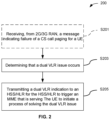
- the method further includes: receiving, from a 2G/3G RAN, a message indicating failure of a CS call paging for the UE, wherein the dual VLR issue is determined to occur based on the received message indicating failure of the CS call paging.
- a method at an HSS/HLR includes: receiving, from a first MSC/VLR, a dual VLR indication indicating that a dual VLR issue occurs; retrieving information of an MME that is serving a UE; and transmitting a VLR registration indication to the MME indicated by the information of the MME to trigger the MME to initiate a process of solving the dual VLR issue.
- the dual VLR indication is contained in an Update Location Request message.
- the VLR registration indication is contained in an Insert Subscriber Data Request (IDR) message.
- IDR Insert Subscriber Data Request
- the method further includes: receiving, from a second MSC/VLR that is currently selected by the MME, an Update Location Request message for updating a current location of the UE in the HSS/HLR to establish a connection between the second MSC/VLR and the HSS/HLR; and transmitting a Cancel Location message to the first MSC/VLR to disconnect a connection between the first MSC/VLR and the HSS/HLR.
- a method at an MME includes: receiving a VLR registration indication from an HSS/HLR; and initiating a process of solving a dual VLR issue in response to the received VLR registration indication.
- the VLR registration indication is contained in an IDR message.
- the process of solving the dual VLR issue includes: transmitting a Location Update Request message with an NB-LAI to a second MSC/VLR that is currently selected by the MME to make the second MSC/VLR to update a location of the UE in the HSS/HLR.
- a method at a first MSC/VLR includes: determining that a dual VLR issue occurs; transmitting, to an HSS/HLR, a message for querying information of an MME that is serving a UE; receiving the information of the MME from the HSS/HLR; and transmitting a VLR registration indication to the MME indicated by the information of the MME to trigger the MME to initiate a process of solving the dual VLR issue.
- the message for querying information of the MME is a Send Routing Information message with an International Mobile Subscriber Identity (IMSI) of the UE; and the information of the MME includes an SGs interface address of the MME, and is contained in a Send Routing Information Answer message.
- IMSI International Mobile Subscriber Identity
- the VLR registration indication is contained in an SGsAP-PAGING-REQUEST message.
- the method further includes: receiving, from a 2G/3G RAN, a message indicating failure of CS call paging for the UE, wherein the dual VLR issue is determined to occur based on the received message indicating failure of CS call paging.
- a method at an HSS/HLR includes: receiving, from a first MSC/VLR, a message for querying information of an MME that is serving a UE, in response to the first MSC/VLR determining that a dual VLR issue occurs; retrieving the information of the MME; and transmitting the information of the MME to the first MSC/VLR.
- the message for querying information of the MME is a Send Routing Information message with an IMSI of the UE; and the information of the MME includes an SGs interface address of the MME, and is contained in a Send Routing Information Answer message.
- the method further includes: receiving, from a second MSC/VLR that is currently selected by the MME, an Update Location Request message for updating a current location of the UE in the HSS/HLR to establish a connection between the second MSC/VLR and the HSS/HLR; and transmitting a Cancel Location message to the first MSC/VLR to disconnect a connection between the first MSC/VLR and the HSS/HLR.
- a method at an MME includes: receiving a VLR registration indication from a first MSC/VLR; and initiating a process of solving a dual VLR issue in response to the received VLR registration indication.
- the VLR registration indication is contained in an SGsAP-PAGING-REQUEST message.
- the process of solving the dual VLR issue includes: transmitting a Location Update Request message with an NB-LAI to a second MSC/VLR that is currently selected by the MME to make the second MSC/VLR to update a location of the UE in the HSS/HLR.
- a first MSC/VLR includes: at least one processor, and at least one memory, storing instructions which, when executed on the at least one processor, cause the first MSC/VLR to perform the method according to the first or fourth aspect of the present disclosure.
- an HSS/HLR includes: at least one processor, and at least one memory, storing instructions which, when executed on the at least one processor, cause the HSS/HLR to perform the method according to the second or fifth aspect of the present disclosure.
- an MME includes: at least one processor, and at least one memory, storing instructions which, when executed on the at least one processor, cause the MME to perform the method according to the third or sixth aspect of the present disclosure.
- a computer readable storage medium has computer program instructions stored thereon, the computer program instructions, when executed by at least one processor, causing the at least one processor to perform the method according to any of the first to sixth aspects of the present disclosure.
- the technical solutions of the present disclosure may solve the dual VLR issue efficiently without the strict requirements on the MME and/or the UE, such as the UE capable of supporting the IE ‘TMSI based NRI’, or the MME capable of determining if the serving MSC/VLR is changed.
- FIG. 1 schematically shows an exemplary scenario where a dual VLR issue occurs to which a method for solving a dual VLR issue according to embodiments of the present disclosure is applied;
- FIG. 2 schematically shows a method for solving a dual VLR issue at a first MSC/VLR according to a first exemplary embodiment of the present disclosure
- FIG. 3 schematically shows a method for solving a dual VLR issue at an HSS/HLR according to the first exemplary embodiment of the present disclosure
- FIG. 4 schematically shows a method for solving a dual VLR issue at an MME according to the first exemplary embodiment of the present disclosure
- FIG. 5 schematically shows a signaling sequence diagram to which a method for solving a dual VLR issue according to the first embodiment of the present disclosure is applied;
- FIG. 7 schematically shows a method for solving a dual VLR issue at an HSS/HLR according to the second exemplary embodiment of the present disclosure
- FIG. 8 schematically shows a method for solving a dual VLR issue at an MME according to the second exemplary embodiment of the present disclosure
- FIG. 9 schematically shows a signaling sequence diagram to which a method for solving a dual VLR issue according to the second embodiment of the present disclosure is applied;
- FIG. 10 schematically shows a block diagram of a first MSC/VLR for solving a dual VLR issue according to the first exemplary embodiment of the present disclosure
- FIG. 11 schematically shows another block diagram of a first MSC/VLR for solving a dual VLR issue according to the first exemplary embodiment of the present disclosure
- FIG. 12 schematically shows a block diagram of an HSS/HLR for solving a dual VLR issue according to the first exemplary embodiment of the present disclosure
- FIG. 13 schematically shows another block diagram of an HSS/HLR for solving a dual VLR issue according to the first exemplary embodiment of the present disclosure
- FIG. 14 schematically shows a block diagram of an MME for solving a dual VLR issue according to the first exemplary embodiment of the present disclosure
- FIG. 15 schematically shows another block diagram of an MME for solving a dual VLR issue according to the first exemplary embodiment of the present disclosure
- FIG. 16 schematically shows a block diagram of a first MSC/VLR for solving a dual VLR issue according to the second exemplary embodiment of the present disclosure
- FIG. 17 schematically shows another block diagram of a first MSC/VLR for solving a dual VLR issue according to the second exemplary embodiment of the present disclosure
- FIG. 18 schematically shows a block diagram of an HSS/HLR for solving a dual VLR issue according to the second exemplary embodiment of the present disclosure
- FIG. 19 schematically shows another block diagram of an HSS/HLR for solving a dual VLR issue according to the second exemplary embodiment of the present disclosure
- FIG. 20 schematically shows a block diagram of an MME for solving a dual VLR issue according to the second exemplary embodiment of the present disclosure.
- FIG. 21 schematically shows another block diagram of an MME for solving a dual VLR issue according to the second exemplary embodiment of the present disclosure.
- references in the specification to “one embodiment,” “an embodiment,” “an example embodiment,” etc. indicate that the embodiment described may include a particular feature, structure, or characteristic, but it is not necessary that every embodiment includes the particular feature, structure, or characteristic. Moreover, such phrases are not necessarily referring to the same embodiment. Further, when a particular feature, structure, or characteristic is described in connection with an embodiment, it is submitted that it is within the knowledge of one skilled in the art to affect such feature, structure, or characteristic in connection with other embodiments whether or not explicitly described.
- the present disclosure intends to solve the dual VLR issue.
- the dual VLR issue refers to a situation where both of two MSC/VLRs regard the UE registered on the node itself, which may be caused by several reasons. It should be understood that the present disclosure does not focus on the reasons for the dual VLR issue, but aims at solutions for solving the dual VLR issue occurred.
- the technical solutions of the present disclosure can be applied to solve the dual VLR issue caused by various reasons.
- the technical solutions of the present disclosure will be described in an exemplary scenario where the dual VLR issue occurs in a CSFB to 2G/3G procedure as shown in FIG. 1 , only for illustration but not for any limitation.
- a UE via MME (represented by MME 1 in FIG. 1 ) and an SGs interface between the MME and a second MSC/VLR (represented by VLR 2 in FIG. 1 ), is associated to the second MSC/VLR (i.e., VLR 2 ).
- the second MSC/VLR i.e., VLR 2
- HLR/HSS HLR/HSS
- BSC/RNC BSC/RNC in FIG. 1
- CSFB no matter an MO or an MT call.
- the UE gets registered in the HLR/HSS with the first MSC/VLR (i.e., VLR 1 ).
- the second MSC/VLR i.e., VLR 2
- the dual VLR issue occurs, because both the first MSC/VLR and the second MSC/VLR regard the UE registered on the node itself.
- the UE when the communication towards the second MSC/VLR (i.e., VLR 2 ) is restored and after the CS call finishes, the UE returns to LTE, it makes a new Tracking Area/Location Area (TA/LA) Update, and the MME will re-select the second MSC/VLR (i.e., VLR 2 ) for serving the UE.
- the second MSC/VLR i.e., VLR 2
- the second MSC/VLR i.e., VLR 2
- the second MSC/VLR considers that it served the UE before and now it should still serve the UE.
- the second MSC/VLR i.e., VLR 2
- VLR 2 the second MSC/VLR
- the HLR/HSS does not receive any Update Location Request (from the second MSC/VLR (i.e., VLR 2 ))
- the first MSC/VLR i.e., VLR 1
- the basic idea of the technical solutions of the present disclosure mainly consist in relying on the first MSC/VLR that is considered by the HSS/VLR to be serving the UE (but is actually not serving the UE) to determine the dual VLR issue by receiving a message indicating failure of the CS call paging for the UE, so as to trigger an MME serving the UE to initiate a process of solving the dual VLR issue, i.e., to force the MME to transmit an NB-LAI to the second MSC/VLR that is currently selected by the MME for serving the UE to make the second MSC/VLR to update the location of the UE in the HSS/HLR.
- the HSS/HLR may establish a connection between the second MSC/VLR and the HSS/HLR, and disconnect the connection between the first MSC/VLR and the HSS/HLR.
- the dual VLR issue can be solved, and the subsequent paging for an MT CS call or an MT SMS will be directed to the correct MSC/VLR that is currently serving the UE, and will not fail.
- Solution 1 after CS call paging is failed, the first MSC/VLR (e.g., VLR 1 in FIG. 1 ) determines that the dual VLR issue occurs, and informs the HLR/HSS. Then, the HLR/HSS finds the serving MME (e.g., MME 1 in FIG. 1 ) for this UE, which has registered UE information in the HLR/HSS in the TAU procedure after the CS call is finished. And the HLR/HSS tells the MME its registered/serving VLR for this UE is the first MSC/VLR (e.g., VLR 1 in FIG. 1 ), i.e. asking the MME to determine whether the MSC/VLR serving the UE is changed.
- the serving MME e.g., MME 1 in FIG. 1
- the MME may initiate an IMSI detach to the UE, which in turn transmits a combined TAU request to the MME.
- the MME will fill an IE “old LAI” with an NB-LAI value in a Location Update Request message to the second MSC/VLR (e.g., VLR 2 in FIG. 1 ) selected by the MME, which will force the second MSC/VLR to send an Update Location Request message to the HSS/HLR and update the UE's information.
- the second MSC/VLR e.g., VLR 2 in FIG. 1
- the HSS/HLR will update the location information of the UE to establish a connection between the second MSC/VLR and the HSS/HLR, and send a Cancel Location message to the first MSC/VLR to disconnect the connection between the first MSC/VLR and the HSS/HLR, so that the dual VLR issue is solved, and the subsequent paging for an MT CS call or an MT SMS will be directed to the correct MSC/VLR that is currently serving the UE, and will not fail.
- Solution 2 after CS call paging is failed, the first MSC/VLR (e.g., VLR 1 in FIG. 1 ) determines that the dual VLR issue occurs, and queries the HSS/HLR for information (e.g., SGs interface address) of an MME that is serving the UE by transmitting a message for querying the information of the MME to the HLR/HSS.
- the first MSC/VLR e.g., VLR 1 in FIG. 1
- the HSS/HLR for information (e.g., SGs interface address) of an MME that is serving the UE by transmitting a message for querying the information of the MME to the HLR/HSS.
- the HLR/HSS tells the first MSC/VLR about the information of the serving MME for this UE, which is registered in the HLR/HSS in Update Location Request of TAU procedure after the CS call is finished
- the first MSC/VLR informs the MME that the first MSC/VLR is registered in the HLR/HSS, i.e., asking the MME to determine whether the MSC/VLR serving the UE is changed.
- the MME may initiate an IMSI detach to the UE, which in turn transmits a combined TAU request to the MME.
- the MME will fill an IE “old LAI” with an NB-LAI value in a Location Update Request message to the second MSC/VLR (e.g., VLR 2 in FIG. 1 ) selected by the MME, which will force the second MSC/VLR to send an Update Location Request message to the HSS/HLR and update the UE's information.
- the second MSC/VLR e.g., VLR 2 in FIG. 1
- the HSS/HLR will update the location information of the UE to establish a connection between the second MSC/VLR and the HSS/HLR, and send a Cancel Location message to the first MSC/VLR to disconnect the connection between the first MSC/VLR and the HSS/HLR, so that the dual VLR issue is solved, and the subsequent paging for an MT CS call or an MT SMS will be directed to the correct MSC/VLR that is currently serving the UE, and will not fail.
- Solution 1 and Solution 2 it is the first MSC/VLR that is considered by the HSS/VLR to be serving the UE (but actually is not serving the UE) to determine the occurrence of the dual VLR issue by receiving the message indicating failure of a CS call paging for the UE, so as to trigger an MME serving the UE to initiate a process of solving the dual VLR issue.
- the only difference between Solution 1 and Solution 2 consists in who informs the MME to initiate the process of solving the dual VLR issue.
- Solution 1 it is the HSS/HLR that informs the MME serving the UE to initiate the process of solving the dual VLR issue; while in Solution 2, it is the first MSC/VLR that informs the MME serving the UE to initiate the process of solving the dual VLR issue by retrieving the information of the MME from the HSS/HLR.
- the UE gets registered in the HLR/HSS with the first MSC/VLR (i.e., VLR 1 ), but the second MSC/VLR (i.e., VLR 2 ) has not received a Cancel Location message from the HLR/HSS due to the transport network failure. Then the dual VLR issue occurs.
- the communication towards the second MSC/VLR i.e., VLR 2
- the UE returns to LTE from 2G/3G, and the MME will re-select the second MSC/VLR (i.e., VLR 2 in FIG. 1 ) for serving the UE.
- the second MSC/VLR (i.e., VLR 2 in FIG. 1 ) considers that it served the UE before and now it should still serve the UE.
- the second MSC/VLR i.e., VLR 2 in FIG. 1
- the second MSC/VLR will not send an Update Location Request to the HLR/HSS, and there will be no update from the second MSC/VLR (i.e., VLR 2 in FIG. 1 ) to the HLR/HSS.
- the HLR/HSS does not receive any Update Location Request (from the second MSC/VLR (i.e., VLR 2 in FIG.
- the first MSC/VLR i.e., VLR 1 in FIG. 1
- the first MSC/VLR still serves the UE. Consequently, a subsequent paging for an MT CS call or an MT SMS will still be directed from the HLR/HSS towards the first MSC/VLR (i.e., VLR 1 in FIG. 1 ), and the UE is always not reachable, which will make the MT CS call or MT SMS paging failed.
- the first MSC/VLR is an MSC/VLR that is considered by the HSS/VLR to be serving the UE, but is actually not serving the UE.
- the method 200 includes steps S 201 ⁇ S 205 .
- the first MSC/VLR may receive, from a 2G/3G RAN, a message indicating failure of a CS call paging for a UE, since the first MSC/VLR is actually not serving the UE.
- the first MSC/VLR may determine that a dual VLR issue occurs based on the received message indicating failure of the CS call paging.
- the first MSC/VLR may generate a dual VLR indication indicating that the dual VLR issue occurs.
- the first MSC/VLR may transmit the dual VLR indication indicating that the dual VLR issue occurs to a HSS/HLR for the HSS/HLR to trigger an MME that is serving the UE to initiate a process of solving the dual VLR issue.
- the first MSC/VLR may inform the HSS/HLR that the dual VLR issue occurs, and that the HSS/HLR needs to find an MSC/VLR that is currently serving the UE by finding an MME that is serving the UE to initiate the process of solving the dual VLR issue, which will be described in detail later.
- the method 300 includes steps S 301 -S 305 .
- the HSS/HLR may receive, from the first MSC/VLR, a dual VLR indication indicating that a dual VLR issue occurs.
- the dual VLR indication is generated by the first MSC/VLR upon determining that the dual VLR issue occurs based on the message, received by the first MSC/VLR, indicating failure of the CS call paging for a UE.
- the HSS/HLR may retrieve information of an MME that is serving the UE.
- the HSS/HLR is a combined node and has data communication between the HSS and the HLR internally, wherein the HLR serves in 2G/3G, and the HSS serves in LTE.
- the serving MME may tell its information, such as registration information, location information, to the HSS.
- the HSS knows the MME that is currently serving the UE.
- the HLR may retrieve the information of the serving MME from the HSS.
- the VLR registration indication is contained in an IDR message.
- the VLR registration indication may be in a form of a new bit “Perform VLR Registration” contained in IDR flags in the IDR message.
- the dual VLR issue can be solved, and the subsequent paging for an MT CS call or an MT SMS will be directed to the correct MSC/VLR that is currently serving the UE, and will not fail.
- the MME may initiate the process of solving the dual VLR issue in response to the received VLR registration indication.
- the MME may be triggered to transmit an NB-LAI to the second MSC/VLR that is currently selected by the MME for serving the UE to make the second MSC/VLR to update the location of the UE in the HSS/HLR.
- the MME receiving the received VLR registration indication knows that the dual VLR issue occurs and determines that the MSC/VLR serving the UE is changed. Then, the MME may initiate an IMSI detach to the UE, which in turn transmits a combined TAU request to the MME. During the combined TAU, the MME will fill an IE “old LAI” with an NB-LAI value in a Location Update Request message, and transmit the Location Update Request message the NB-LAI value to the second MSC/VLR selected by the MME, which will force the second MSC/VLR to send an Update Location Request message to the HSS/HLR and update the UE's information.
- step S 403 may further include a step S 4031 of transmitting a Location Update Request message with an NB-LAI to a second MSC/VLR that is currently selected by the MME for serving the UE to make the second MSC/VLR to update a location of the UE in the HSS/HLR.
- the HSS/HLR will update the location information of the UE to establish a connection between the second MSC/VLR and the HSS/HLR, and transmit a Cancel Location message to the first MSC/VLR to disconnect the connection between the first MSC/VLR and the HSS/HLR, so that the dual VLR issue is solved, and the subsequent paging for an MT CS call or an MT SMS will be directed to the correct MSC/VLR that is currently serving the UE, and will not fail.
- the first MSC/VLR is an MSC/VLR that is considered by the HSS/VLR to be serving the UE, but is actually not serving the UE. Therefore, when the first MSC/VLR transmits a CS Paging Request message to 2G/3G RAN in Signaling 5-1, the 2G/3G RAN cannot find the UE, and thus transmits a CS Paging Failed message to the first MSC/VLR in Signaling 5-2.
- the first MSC/VLR may determine that the dual VLR issue occurs based on the received CS Paging Failed message, and thus may generate a dual VLR indication indicating that the dual VLR issue occurs.
- the first MSC/VLR may transmit the dual VLR indication, e.g., in an Update Location Request message, indicating that the dual VLR issue occurs to the HSS/HLR, for the HSS/HLR to trigger the MME that is serving the UE to initiate the process of solving the dual VLR issue.
- the dual VLR indication e.g., in an Update Location Request message, indicating that the dual VLR issue occurs to the HSS/HLR, for the HSS/HLR to trigger the MME that is serving the UE to initiate the process of solving the dual VLR issue.
- the HSS/HLR that receives the dual VLR indication may retrieve information of the MME that is serving the UE.
- the HSS/HLR may transmit a VLR registration indication, e.g., in an IDR message, to the MME indicated by the information of the MME to trigger the MME to initiate the process of solving the dual VLR issue.
- a VLR registration indication e.g., in an IDR message
- the HSS/HLR may transmit an IDR message with IDR flags containing a new bit “Perform VLR Registration”.
- Solution 1 and Solution 2 it is the first MSC/VLR that is considered by the HSS/VLR to be serving the UE (but actually is not serving the UE) to determine the occurrence of the dual VLR issue by receiving the message indicating failure of a CS call paging for the UE, so as to trigger an MME serving the UE to initiate a process of solving the dual VLR issue.
- the only difference between Solution 1 and Solution 2 consists in who informs the MME to initiate the process of solving the dual VLR issue.
- the first MSC/VLR may receive, from a 2G/3G RAN, a message indicating failure of a CS call paging for a UE, since the first MSC/VLR is actually not serving the UE.
- the first MSC/VLR may determine that a dual VLR issue occurs based on the received message indicating failure of the CS call paging.
- the first MSC/VLR may transmit, to an HSS/HLR, the message for querying information of an MME that is serving the UE. That is, the first MSC/VLR lets the HSS/HLR query the information of the MME that is serving the UE.
- the message for querying information of the MME may be a Send Routing Information message with an IMSI of the UE.
- the first MSC/VLR may receive the information of the MME from the HSS/HLR.
- the information of the MME may include an SGs interface address of the MME, and may be contained in a Send Routing Information Answer message.
- the first MSC/VLR may transmit a VLR registration indication to the MME indicated by the information of the MME to trigger the MME to initiate the process of solving the dual VLR issue.
- the VLR registration indication is contained in an SGsAP-PAGING-REQUEST message.
- the VLR registration indication may be in a form of a new bit “Perform VLR Registration” contained in the SGsAP-PAGING-REQUEST message.
- the HSS/HLR may receive, from the first MSC/VLR, a message for querying information of the MME that is serving the UE, in response to the first MSC/VLR determining that the dual VLR issue occurs.
- the message for querying information of the MME that is serving the UE is generated by the first MSC/VLR upon determining that the dual VLR issue occurs based on the message, received by the first MSC/VLR, indicating failure of the CS call paging for a UE.
- the message for querying information of the MME may be a Send Routing Information message with an IMSI of the UE.
- the HSS/HLR may retrieve the information of the MME that is serving the UE.
- the HSS/HLR is a combined node and has data communication between the HSS and the HLR internally, wherein the HLR serves in 2G/3G, and the HSS serves in LTE.
- the serving MME may tell its information, such as registration information, location information, to the HSS.
- the HSS knows the MME that is currently serving the UE.
- the HLR may retrieve the information of the serving MME from the HSS.
- the information of the MME includes an SGs interface address of the MME.
- the HSS/HLR may transmit the information of the MME to the first MSC/VLR.
- the information of the MME is contained in a Send Routing Information Answer message.
- the method 700 may further includes steps S 707 and S 709 .
- the HSS/HLR may receive, from a second MSC/VLR that is currently selected by the MME for serving the UE, an Update Location Request message for updating a current location of the UE in the HSS/HLR to establish a connection between the second MSC/VLR and the HSS/HLR.
- the HSS/HLR may transmit a Cancel Location message to the first MSC/VLR to disconnect a connection between the first MSC/VLR and the HSS/HLR.
- the dual VLR issue can be solved, and the subsequent paging for an MT CS call or an MT SMS will be directed to the correct MSC/VLR that is currently serving the UE, and will not fail.
- the method 800 includes steps S 801 and S 803 .
- the MME may receive the VLR registration indication from the first MSC/VLR for trigger the MME to initiate the process of solving the dual VLR issue.
- the VLR registration indication is contained in an SGsAP-PAGING-REQUEST message.
- the VLR registration indication may be in a form of a new bit “Perform VLR Registration” contained in the SGsAP-PAGING-REQUEST message.
- the MME may initiate the process of solving the dual VLR issue in response to the received VLR registration indication.
- the MME may be triggered to transmit an NB-LAI to the second MSC/VLR that is currently selected by the MME for serving the UE to make the second MSC/VLR to update the location of the UE in the HSS/HLR.
- step S 803 may further include a step S 8031 of transmitting a Location Update Request message with an NB-LAI to a second MSC/VLR that is currently selected by the MME for serving the UE to make the second MSC/VLR to update a location of the UE in the HSS/HLR.
- the HSS/HLR will update the location information of the UE to establish a connection between the second MSC/VLR and the HSS/HLR, and transmit a Cancel Location message to the first MSC/VLR to disconnect the connection between the first MSC/VLR and the HSS/HLR, so that the dual VLR issue is solved, and the subsequent paging for an MT CS call or an MT SMS will be directed to the correct MSC/VLR that is currently serving the UE, and will not fail.
- the method for solving the dual VLR issue according to the second exemplary embodiment (i.e., Solution 2) of the present disclosure will be described in detail in conjunction with a signaling sequence diagram as shown in FIG. 9 .
- the method for solving the dual VLR issue according to the second exemplary embodiment (i.e., Solution 2) of the present disclosure as previously described will be understood better.
- FIG. 9 schematically shows a signaling sequence diagram to which a method for solving a dual VLR issue according to the second embodiment of the present disclosure is applied. It should be noted that the description below only focuses on signaling related to Solution 2, and other signaling is omitted to avoid obscuring the principle of the present disclosure. In FIG. 9 , modification on the signaling related to Solution 2 is shown in Bold Italics.
- the first MSC/VLR is an MSC/VLR that is considered by the HSS/VLR to be serving the UE, but is actually not serving the UE. Therefore, when the first MSC/VLR transmits a CS Paging Request message to 2G/3G RAN in Signaling 9-1, the 2G/3G RAN cannot find the UE, and thus transmits a CS Paging Failed message to the first MSC/VLR in Signaling 9-2.
- the first MSC/VLR may determine that the dual VLR issue occurs based on the received CS Paging Failed message, and thus may generate a message for querying information of an MME that is serving the UE upon determining that the dual VLR issue occurs.
- the first MSC/VLR may transmit the message for querying information of an MME that is serving the UE, e.g., in a form of a Send Routing Information message with an IMSI of the UE, to the HSS/HLR.
- the HSS/HLR that receives the dual VLR indication may retrieve information of the MME that is serving the UE, e.g., an SGs interface address of the MME.
- the HSS/HLR may update the location information of the UE to establish a connection between the second MSC/VLR and the HSS/HLR.
- the determination unit 1001 may determine that a dual VLR issue occurs.
- the transmission unit 1003 may transmit a dual VLR indication indicating that the dual VLR issue occurs to the HSS/HLR for the HSS/HLR to trigger the MME that is serving the UE to initiate the process of solving the dual VLR issue.
- the dual VLR indication is contained in an Update Location Request message.
- the first MSC/VLR 1000 may further include a reception unit 1005 .
- the reception unit 1005 may receive, from the 2G/3G RAN, a message indicating failure of a CS call paging for the UE.
- FIG. 11 schematically shows another block diagram of the first MSC/VLR 1100 according to the first exemplary embodiment of the present disclosure.
- the first MSC/VLR 1100 in FIG. 11 may perform the method 200 as described previously with reference to FIG. 2 . Accordingly, some detailed description on the first MSC/VLR 1100 may refer to the corresponding description of the method 200 in FIG. 2 and the signaling sequence diagrams of FIG. 5 as previously discussed, and thus will be omitted here for simplicity.
- the first MSC/VLR 1100 includes at least one processor 1101 and at least one memory 1103 .
- the at least one processor 1101 includes e.g., any suitable CPU (Central Processing Unit), microcontroller, DSP (Digital Signal Processor), etc., capable of executing computer program instructions.
- the at least one memory 1103 may be any combination of a RAM (Random Access Memory) and a ROM (Read Only Memory).
- the at least one processor memory 1103 may also include persistent storage, which, for example, can be any single one or combination of magnetic memory, optical memory, or solid state memory or even remotely mounted memory.
- the at least one memory 1103 stores instructions executable by the at least one processor 1101 , whereby the first MSC/VLR 1100 is operative to perform the actions, e.g., of the procedures as described earlier respectively in conjunction with FIG. 2 .
- the instructions when loaded from the at least one memory 1103 and executed on the at least one processor 1101 , may cause the first MSC/VLR 1100 to determine that a dual VLR issue occurs; and transmit a dual VLR indication indicating that the dual VLR issue occurs to a HSS/HLR for the HSS/HLR to trigger the MME that is serving the UE to initiate the process of solving the dual VLR issue.
- the dual VLR indication is contained in an Update Location Request message.
- the instructions when loaded from the at least one memory 1103 and executed on the at least one processor 1101 , may further cause the first MSC/VLR 1100 to receive, from the 2G/3G RAN, a message indicating failure of a CS call paging for the UE, wherein the dual VLR issue is determined to occur based on the received message indicating failure of the CS call paging.
- FIG. 12 schematically shows a block diagram of the HSS/HLR 1200 according to the first exemplary embodiment of the present disclosure.
- the HSS/HLR 1200 in FIG. 12 may perform the method 300 as described previously with reference to FIG. 3 . Accordingly, some detailed description on the HSS/HLR 1200 may refer to the corresponding description of the method 300 in FIG. 3 and the signaling sequence diagram of FIG. 5 as previously discussed, and thus will be omitted here for simplicity.
- the HSS/HLR 1200 includes a reception 1201 , a retrieval unit 1203 , and a transmission unit 1203 .
- the reception unit 1201 may receive, from the first MSC/VLR, the dual VLR indication indicating that the dual VLR issue occurs.
- the retrieval unit 1203 may retrieve information of the MME that is serving the UE.
- the transmission unit 1203 may transmit a VLR registration indication to the MME indicated by the information of the MME to trigger the MME to initiate the process of solving the dual VLR issue.
- the dual VLR indication is contained in an Update Location Request message.
- the VLR registration indication is contained in an IDR message.
- the reception unit 1201 may further receive, from a second MSC/VLR that is currently selected by the MME for serving the UE, an Update Location Request message for updating the current location of the UE in the HSS/HLR to establish a connection between the second MSC/VLR and the HSS/HLR.
- the transmission unit 1203 may transmit a Cancel Location message to the first MSC/VLR to disconnect the connection between the first MSC/VLR and the HSS/HLR.
- FIG. 13 schematically shows another block diagram of the HSS/HLR 1300 according to the first exemplary embodiment of the present disclosure.
- the HSS/HLR 1300 in FIG. 13 may perform the method 300 as described previously with reference to FIG. 3 . Accordingly, some detailed description on the HSS/HLR 1300 may refer to the corresponding description of the method 300 in FIG. 3 and the signaling sequence diagrams of FIG. 5 as previously discussed, and thus will be omitted here for simplicity.
- the HSS/HLR 1300 includes at least one processor 1301 and at least one memory 1303 .
- the at least one processor 1301 includes e.g., any suitable CPU (Central Processing Unit), microcontroller, DSP (Digital Signal Processor), etc., capable of executing computer program instructions.
- the at least one memory 1303 may be any combination of a RAM (Random Access Memory) and a ROM (Read Only Memory).
- the at least one processor memory 1303 may also include persistent storage, which, for example, can be any single one or combination of magnetic memory, optical memory, or solid state memory or even remotely mounted memory.
- the at least one memory 1303 stores instructions executable by the at least one processor 1301 , whereby the HSS/HLR 1300 is operative to perform the actions, e.g., of the procedures as described earlier respectively in conjunction with FIG. 3 .
- the instructions when loaded from the at least one memory 1303 and executed on the at least one processor 1301 , may cause the HSS/HLR 1300 to receive, from the first MSC/VLR, the dual VLR indication indicating that the dual VLR issue occurs; retrieve information of the MME that is serving the UE; and transmit the VLR registration indication to the MME indicated by the information of the MME to trigger the MME to initiate the process of solving the dual VLR issue.
- the dual VLR indication is contained in an Update Location Request message.
- the VLR registration indication is contained in an Insert Subscriber Data Request (IDR) message.
- IDR Insert Subscriber Data Request
- the instructions when loaded from the at least one memory 1303 and executed on the at least one processor 1301 , may further cause the HSS/HLR 1300 to receive, from the second MSC/VLR that is currently selected by the MME for serving the UE, an Update Location Request message for updating a current location of the UE in the HSS/HLR to establish a connection between the second MSC/VLR and the HSS/HLR; and transmitting a Cancel Location message to the first MSC/VLR to disconnect the connection between the first MSC/VLR and the HSS/HLR.
- FIG. 14 schematically shows a block diagram of the MME 1400 according to the first exemplary embodiment of the present disclosure.
- the MME 1400 in FIG. 14 may perform the method 400 as described previously with reference to FIG. 4 . Accordingly, some detailed description on the MME 1400 may refer to the corresponding description of the method 400 in FIG. 4 and the signaling sequence diagram of FIG. 5 as previously discussed, and thus will be omitted here for simplicity.
- the MME 1400 includes a reception unit 1401 and a dual VLR solving unit 1403 .
- the reception unit 1401 may receive the VLR registration indication from the HSS/HLR.
- the VLR registration indication is contained in an IDR message.
- the dual VLR solving unit 1403 may transmit a Location Update Request message with an NB-LAI to the second MSC/VLR that is currently selected by the MME for serving the UE to make the second MSC/VLR to update a location of the UE in the HSS/HLR.
- the MME 1500 includes at least one processor 1501 and at least one memory 1503 .
- the at least one processor 1501 includes e.g., any suitable CPU (Central Processing Unit), microcontroller, DSP (Digital Signal Processor), etc., capable of executing computer program instructions.
- the at least one memory 1503 may be any combination of a RAM (Random Access Memory) and a ROM (Read Only Memory).
- the at least one processor memory 1503 may also include persistent storage, which, for example, can be any single one or combination of magnetic memory, optical memory, or solid state memory or even remotely mounted memory.
- the at least one memory 1503 stores instructions executable by the at least one processor 1501 , whereby the MME 1500 is operative to perform the actions, e.g., of the procedures as described earlier respectively in conjunction with FIG. 4 .
- the instructions when loaded from the at least one memory 1503 and executed on the at least one processor 1501 , may cause the MME 1500 to receive the VLR registration indication from the HSS/HLR; and initiating the process of solving the dual VLR issue in response to the received VLR registration indication.
- the VLR registration indication is contained in an IDR message.
- the process of solving the dual VLR issue includes: transmitting a Location Update Request message with an NB-LAI to a second MSC/VLR that is currently selected by the MME for serving the UE to make the second MSC/VLR to update a location of the UE in the HSS/HLR.
- FIG. 16 schematically shows a block diagram of the first MSC/VLR 1600 according to the second exemplary embodiment of the present disclosure.
- the first MSC/VLR 1600 in FIG. 16 may perform the method 200 as described previously with reference to FIG. 6 . Accordingly, some detailed description on the first MSC/VLR 1600 may refer to the corresponding description of the method 600 in FIG. 6 and the signaling sequence diagram of FIG. 9 as previously discussed, and thus will be omitted here for simplicity.
- the first MSC/VLR 1600 includes a determination 1601 , a transmission unit 1603 , and a reception unit 1605 .
- the determination unit 1601 may determine that a dual VLR issue occurs.
- the transmission unit 1603 may transmit, to the HSS/HLR, a message for querying information of the MME that is serving the UE.
- the reception unit 1605 may receive the information of the MME from the HSS/HLR.
- the transmission unit 1603 may transmit a VLR registration indication to the MME indicated by the information of the MME to trigger the MME to initiate the process of solving the dual VLR issue.
- the message for querying information of the MME is a Send Routing Information message with an International Mobile Subscriber Identity (IMSI) of the UE; and the information of the MME includes an SGs interface address of the MME, and is contained in a Send Routing Information Answer message.
- IMSI International Mobile Subscriber Identity
- the VLR registration indication is contained in an SGsAP-PAGING-REQUEST message.
- the reception unit 1605 may further receive, from the 2G/3G RAN, a message indicating failure of CS call paging for the UE.
- the determination unit 1601 may determine that the dual VLR issue occurs based on the received message indicating failure of CS call paging.
- FIG. 17 schematically shows another block diagram of the first MSC/VLR 1700 according to the second exemplary embodiment of the present disclosure.
- the first MSC/VLR 1700 in FIG. 17 may perform the method 600 as described previously with reference to FIG. 6 . Accordingly, some detailed description on the first MSC/VLR 1700 may refer to the corresponding description of the method 600 in FIG. 6 and the signaling sequence diagrams of FIG. 9 as previously discussed, and thus will be omitted here for simplicity.
- the first MSC/VLR 1700 includes at least one processor 1701 and at least one memory 1703 .
- the at least one processor 1701 includes e.g., any suitable CPU (Central Processing Unit), microcontroller, DSP (Digital Signal Processor), etc., capable of executing computer program instructions.
- the at least one memory 1703 may be any combination of a RAM (Random Access Memory) and a ROM (Read Only Memory).
- the at least one processor memory 1703 may also include persistent storage, which, for example, can be any single one or combination of magnetic memory, optical memory, or solid state memory or even remotely mounted memory.
- the at least one memory 1703 stores instructions executable by the at least one processor 1701 , whereby the first MSC/VLR 1700 is operative to perform the actions, e.g., of the procedures as described earlier respectively in conjunction with FIG. 6 .
- the instructions when loaded from the at least one memory 1703 and executed on the at least one processor 1701 , may cause the first MSC/VLR 1700 to determine that a dual VLR issue occurs; transmitting, to the HSS/HLR, a message for querying information of the MME that is serving the UE; receive the information of the MME from the HSS/HLR; and transmit a VLR registration indication to the MME indicated by the information of the MME to trigger the MME to initiate the process of solving the dual VLR issue.
- the message for querying information of the MME is a Send Routing Information message with an IMSI of the UE; and the information of the MME includes an SGs interface address of the MME, and is contained in a Send Routing Information Answer message.
- the VLR registration indication is contained in an SGsAP-PAGING-REQUEST message.
- FIG. 18 schematically shows a block diagram of the HSS/HLR 1800 according to the second exemplary embodiment of the present disclosure.
- the HSS/HLR 1800 in FIG. 18 may perform the method 700 as described previously with reference to FIG. 7 . Accordingly, some detailed description on the HSS/HLR 1800 may refer to the corresponding description of the method 700 in FIG. 7 and the signaling sequence diagram of FIG. 9 as previously discussed, and thus will be omitted here for simplicity.
- the HSS/HLR 1800 includes a reception 1801 , a retrieval unit 1803 , and a transmission unit 1803 .
- the reception unit 1801 may receive, from the first MSC/VLR, a message for querying information of the MME that is serving the UE, in response to the first MSC/VLR determining that the dual VLR issue occurs.
- the retrieval unit 1803 may retrieve information of the MME that is serving the UE.
- the transmission unit 1803 may transmit the information of the MME to the first MSC/VLR.
- the message for querying information of the MME is a Send Routing Information message with an IMSI of the UE; and the information of the MME includes an SGs interface address of the MME, and is contained in a Send Routing Information Answer message.
- FIG. 19 schematically shows another block diagram of the HSS/HLR 1900 according to the second exemplary embodiment of the present disclosure.
- the HSS/HLR 1900 in FIG. 19 may perform the method 700 as described previously with reference to FIG. 7 . Accordingly, some detailed description on the HSS/HLR 1900 may refer to the corresponding description of the method 700 in FIG. 7 and the signaling sequence diagrams of FIG. 9 as previously discussed, and thus will be omitted here for simplicity.
- the HSS/HLR 1900 includes at least one processor 1901 and at least one memory 1903 .
- the at least one processor 1901 includes e.g., any suitable CPU (Central Processing Unit), microcontroller, DSP (Digital Signal Processor), etc., capable of executing computer program instructions.
- the at least one memory 1903 may be any combination of a RAM (Random Access Memory) and a ROM (Read Only Memory).
- the at least one processor memory 1903 may also include persistent storage, which, for example, can be any single one or combination of magnetic memory, optical memory, or solid state memory or even remotely mounted memory.
- the at least one memory 1903 stores instructions executable by the at least one processor 1901 , whereby the HSS/HLR 1900 is operative to perform the actions, e.g., of the procedures as described earlier respectively in conjunction with FIG. 7 .
- the instructions when loaded from the at least one memory 1903 and executed on the at least one processor 1901 , may cause the HSS/HLR 1900 to receive, from a first MSC/VLR, a message for querying information of the MME that is serving the UE, in response to the first MSC/VLR determining that the dual VLR issue occurs; retrieve the information of the MME; and transmit the information of the MME to the first MSC/VLR.
- the message for querying information of the MME is a Send Routing Information message with an IMSI of the UE; and the information of the MME includes an SGs interface address of the MME, and is contained in a Send Routing Information Answer message.
- the instructions when loaded from the at least one memory 1903 and executed on the at least one processor 1901 , may further cause the HSS/HLR 1900 to receive, from a second MSC/VLR that is currently selected by the MME, an Update Location Request message for updating a current location of the UE in the HSS/HLR to establish a connection between the second MSC/VLR and the HSS/HLR; and transmit a Cancel Location message to the first MSC/VLR to disconnect the connection between the first MSC/VLR and the HSS/HLR.
- FIG. 20 schematically shows a block diagram of the MME 2000 according to the second exemplary embodiment of the present disclosure.
- the MME 2000 in FIG. 20 may perform the method 800 as described previously with reference to FIG. 8 . Accordingly, some detailed description on the MME 2000 may refer to the corresponding description of the method 800 in FIG. 8 and the signaling sequence diagram of FIG. 9 as previously discussed, and thus will be omitted here for simplicity.
- the MME 2000 includes a reception unit 2001 and a dual VLR solving unit 2003 .
- the reception unit 2001 may receive the VLR registration indication from the first MSC/VLR.
- the dual VLR solving unit 2003 may initiate the process of solving the dual VLR issue in response to the received VLR registration indication.
- the dual VLR solving unit 2003 may transmit a Location Update Request message with an NB-LAI to a second MSC/VLR that is currently selected by the MME to make the second MSC/VLR to update a location of the UE in the HSS/HLR.
- FIG. 21 schematically shows another block diagram of the MME 2100 according to the second exemplary embodiment of the present disclosure.
- the MME 2100 in FIG. 21 may perform the method 800 as described previously with reference to FIG. 8 . Accordingly, some detailed description on the MME 2100 may refer to the corresponding description of the method 800 in FIG. 8 and the signaling sequence diagrams of FIG. 9 as previously discussed, and thus will be omitted here for simplicity.
- the MME 2100 includes at least one processor 2101 and at least one memory 2103 .
- the at least one processor 2101 includes e.g., any suitable CPU (Central Processing Unit), microcontroller, DSP (Digital Signal Processor), etc., capable of executing computer program instructions.
- the at least one memory 2103 may be any combination of a RAM (Random Access Memory) and a ROM (Read Only Memory).
- the at least one processor memory 2103 may also include persistent storage, which, for example, can be any single one or combination of magnetic memory, optical memory, or solid state memory or even remotely mounted memory.
- the at least one memory 2103 stores instructions executable by the at least one processor 2101 , whereby the MME 2100 is operative to perform the actions, e.g., of the procedures as described earlier respectively in conjunction with FIG. 8 .
- the VLR registration indication is contained in an SGsAP-PAGING-REQUEST message.
- the process of solving the dual VLR issue includes: transmitting a Location Update Request message with an NB-LAI to a second MSC/VLR that is currently selected by the MME to make the second MSC/VLR to update a location of the UE in the HSS/HLR.
- the present disclosure also provides at least one computer program product in the form of a non-volatile or volatile memory, e.g., a non-transitory computer readable storage medium, an Electrically Erasable Programmable Read-Only Memory (EEPROM), a flash memory and a hard drive.
- the computer program product includes a computer program.
- the computer program product may be configured as a computer program code structured in computer program modules.
- the computer program modules could essentially perform the actions of the flow illustrated in any of FIGS. 2 to 4 and 6 - 8 .
Landscapes
- Engineering & Computer Science (AREA)
- Computer Networks & Wireless Communication (AREA)
- Signal Processing (AREA)
- Databases & Information Systems (AREA)
- Mobile Radio Communication Systems (AREA)
Abstract
Description
Claims (13)
Applications Claiming Priority (1)
| Application Number | Priority Date | Filing Date | Title |
|---|---|---|---|
| PCT/CN2020/075980 WO2021163949A1 (en) | 2020-02-20 | 2020-02-20 | Methods, nodes and computer readable medium for solving dual vlr issue |
Publications (2)
| Publication Number | Publication Date |
|---|---|
| US20220377525A1 US20220377525A1 (en) | 2022-11-24 |
| US12342416B2 true US12342416B2 (en) | 2025-06-24 |
Family
ID=77390360
Family Applications (1)
| Application Number | Title | Priority Date | Filing Date |
|---|---|---|---|
| US17/795,098 Active 2041-01-18 US12342416B2 (en) | 2020-02-20 | 2020-02-20 | Methods, nodes and computer readable medium for solving dual VLR issue |
Country Status (3)
| Country | Link |
|---|---|
| US (1) | US12342416B2 (en) |
| EP (1) | EP4107978A4 (en) |
| WO (1) | WO2021163949A1 (en) |
Citations (7)
| Publication number | Priority date | Publication date | Assignee | Title |
|---|---|---|---|---|
| US20130044709A1 (en) * | 2011-08-19 | 2013-02-21 | Interdigital Patent Holdings, Inc. | Method and apparatus for using non-access stratum procedures in a mobile station to access resources of component carriers belonging to different radio access technologies |
| EP2680625A2 (en) | 2011-05-03 | 2014-01-01 | Huawei Technologies Co., Ltd. | Method and device for receiving or transmitting short message |
| US20150098394A1 (en) | 2013-10-08 | 2015-04-09 | Mavenir Systems, Inc. | Ims centralized services (ics) interworking function (iwf) system and method |
| WO2019127431A1 (en) | 2017-12-29 | 2019-07-04 | Telefonaktiebolaget Lm Ericsson (Publ) | Locating serving msc for mt voice call service recovery |
| CN110351800A (en) | 2019-07-19 | 2019-10-18 | 中国联合网络通信集团有限公司 | A kind of method and system of redundancy joint attachment |
| WO2020033189A1 (en) | 2018-08-08 | 2020-02-13 | Cisco Technology, Inc. | Network-initiated recovery from a text message delivery failure |
| US20210022101A1 (en) * | 2018-04-04 | 2021-01-21 | Huawei Technologies Co., Ltd. | Event Subscription Method, Apparatus, and System |
-
2020
- 2020-02-20 US US17/795,098 patent/US12342416B2/en active Active
- 2020-02-20 EP EP20914764.4A patent/EP4107978A4/en active Pending
- 2020-02-20 WO PCT/CN2020/075980 patent/WO2021163949A1/en not_active Ceased
Patent Citations (7)
| Publication number | Priority date | Publication date | Assignee | Title |
|---|---|---|---|---|
| EP2680625A2 (en) | 2011-05-03 | 2014-01-01 | Huawei Technologies Co., Ltd. | Method and device for receiving or transmitting short message |
| US20130044709A1 (en) * | 2011-08-19 | 2013-02-21 | Interdigital Patent Holdings, Inc. | Method and apparatus for using non-access stratum procedures in a mobile station to access resources of component carriers belonging to different radio access technologies |
| US20150098394A1 (en) | 2013-10-08 | 2015-04-09 | Mavenir Systems, Inc. | Ims centralized services (ics) interworking function (iwf) system and method |
| WO2019127431A1 (en) | 2017-12-29 | 2019-07-04 | Telefonaktiebolaget Lm Ericsson (Publ) | Locating serving msc for mt voice call service recovery |
| US20210022101A1 (en) * | 2018-04-04 | 2021-01-21 | Huawei Technologies Co., Ltd. | Event Subscription Method, Apparatus, and System |
| WO2020033189A1 (en) | 2018-08-08 | 2020-02-13 | Cisco Technology, Inc. | Network-initiated recovery from a text message delivery failure |
| CN110351800A (en) | 2019-07-19 | 2019-10-18 | 中国联合网络通信集团有限公司 | A kind of method and system of redundancy joint attachment |
Non-Patent Citations (8)
| Title |
|---|
| 3GPP, Technical Specification Group Core Network and Terminals, Evolved Packet System (EPS), Mobility Management Entity (MME) and Serving GPRS Support Node (SGSN) Related Interfaces Based on Diameter Protocol (Release 14), 3GPP TS 29.272 V14.8.0 (Sep. 2018), Valbonne, France, 166 pages. |
| 3GPP, Technical Specification Group Core Network and Terminals, Mobile Application Part (MAP) Specification (Release 14), 3GPP TS 29.002 V14.5.0 (Jun. 2019), Valbonne, France, 1021 pages. |
| 3GPP, Technical Specification Group Core Network and Terminals, Mobility Management Entity (MME)—Visitor Location Register (VLR) SGs Interface Specification (Release 14), 3GPP TS 29.118 V14.2.0 (Dec. 2017), Valbonne, France, 77 pages. |
| Ericsson, "Avoiding Dual VLR Registration for Legacy UEs, Alternative 2", 3GPP TSG CT4 Meeting #68bis, C4-150526, Apr. 13-17, 2015, Bratislava, Slovakia, 7 pages. |
| Ericsson, "Avoiding Dual VLR Registration for Legacy UEs, Alternative", 3GPP TSG-CT WG1 Meeting #68, C4-150501, Apr. 13-17, 2015, Bratisalva, Slovakia, 11 pages. |
| Ericsson, Nokia Networks, "Discussion on Avoiding Dual VLR Registration for Legacy Ues", 3GPP TSG CT WG1 Meeting #90, C1-150213, Feb. 2-6, 2015, Sorrento, Italy, 15 pages. |
| Extended European Search Report for European Patent Application No. 20914764.4, dated Oct. 9, 2023, 13 pages. |
| PCT International Search Report and Written Opinion mailed Nov. 23, 2020 for International Application No. PCT/CN2020/075980, 6 pages. |
Also Published As
| Publication number | Publication date |
|---|---|
| US20220377525A1 (en) | 2022-11-24 |
| WO2021163949A1 (en) | 2021-08-26 |
| EP4107978A1 (en) | 2022-12-28 |
| EP4107978A4 (en) | 2023-11-08 |
Similar Documents
| Publication | Publication Date | Title |
|---|---|---|
| CN102098655B (en) | Method and system for controlling activation of ISR (Idle mode Signaling Reduction) and UE (user equipment) | |
| EP2526637B1 (en) | Voice transmission technology selection | |
| JP5680077B2 (en) | Method and apparatus for transmission of short messages in an evolved packet system providing an interconnect function | |
| CN107852645B (en) | Wireless communication methods and devices | |
| US9055503B2 (en) | Selecting a target cell for CS fallback | |
| US8537748B2 (en) | Technique for performing GSM/WCDMA circuit switched services over a long term evolution radio access | |
| US8264999B2 (en) | Method and device for realizing paging in mobile switching center pool | |
| US9949110B2 (en) | Avoiding formation of a call loop resulting from handling of a mobile terminated call in parallel with a location update in a wireless communication network | |
| CN102076085B (en) | A kind of method and system for obtaining position information of user's terminal | |
| US12526700B2 (en) | Methods, entities and computer readable medium for emergency handling | |
| US9730055B2 (en) | Signalling in a wireless network | |
| EP3954100B1 (en) | Methods and apparatuses for implementing mobile terminating call | |
| US20130223369A1 (en) | Method, public land mobile network and user equipment | |
| US12342416B2 (en) | Methods, nodes and computer readable medium for solving dual VLR issue | |
| WO2019127431A1 (en) | Locating serving msc for mt voice call service recovery | |
| KR102129901B1 (en) | Mobile communication system and method for circuit switched fallback | |
| CN103477659B (en) | Method and apparatus for short message transmission |
Legal Events
| Date | Code | Title | Description |
|---|---|---|---|
| AS | Assignment |
Owner name: TELEFONAKTIEBOLAGET LM ERICSSON (PUBL), SWEDEN Free format text: ASSIGNMENT OF ASSIGNORS INTEREST;ASSIGNORS:QU, ZHIWEI;XIA, LEI;REEL/FRAME:060606/0217 Effective date: 20200310 |
|
| FEPP | Fee payment procedure |
Free format text: ENTITY STATUS SET TO UNDISCOUNTED (ORIGINAL EVENT CODE: BIG.); ENTITY STATUS OF PATENT OWNER: LARGE ENTITY |
|
| STPP | Information on status: patent application and granting procedure in general |
Free format text: DOCKETED NEW CASE - READY FOR EXAMINATION |
|
| STPP | Information on status: patent application and granting procedure in general |
Free format text: NON FINAL ACTION MAILED |
|
| STPP | Information on status: patent application and granting procedure in general |
Free format text: RESPONSE TO NON-FINAL OFFICE ACTION ENTERED AND FORWARDED TO EXAMINER |
|
| STPP | Information on status: patent application and granting procedure in general |
Free format text: FINAL REJECTION MAILED |
|
| STPP | Information on status: patent application and granting procedure in general |
Free format text: NOTICE OF ALLOWANCE MAILED -- APPLICATION RECEIVED IN OFFICE OF PUBLICATIONS |
|
| STCF | Information on status: patent grant |
Free format text: PATENTED CASE |