US12338382B2 - Surfactants having non-conventional hydrophobes - Google Patents
Surfactants having non-conventional hydrophobes Download PDFInfo
- Publication number
- US12338382B2 US12338382B2 US16/500,250 US201816500250A US12338382B2 US 12338382 B2 US12338382 B2 US 12338382B2 US 201816500250 A US201816500250 A US 201816500250A US 12338382 B2 US12338382 B2 US 12338382B2
- Authority
- US
- United States
- Prior art keywords
- surfactants
- surfactant
- groups
- compound
- present
- Prior art date
- Legal status (The legal status is an assumption and is not a legal conclusion. Google has not performed a legal analysis and makes no representation as to the accuracy of the status listed.)
- Active, expires
Links
Images




Classifications
-
- C—CHEMISTRY; METALLURGY
- C11—ANIMAL OR VEGETABLE OILS, FATS, FATTY SUBSTANCES OR WAXES; FATTY ACIDS THEREFROM; DETERGENTS; CANDLES
- C11D—DETERGENT COMPOSITIONS; USE OF SINGLE SUBSTANCES AS DETERGENTS; SOAP OR SOAP-MAKING; RESIN SOAPS; RECOVERY OF GLYCEROL
- C11D1/00—Detergent compositions based essentially on surface-active compounds; Use of these compounds as a detergent
- C11D1/02—Anionic compounds
- C11D1/37—Mixtures of compounds all of which are anionic
-
- C—CHEMISTRY; METALLURGY
- C07—ORGANIC CHEMISTRY
- C07C—ACYCLIC OR CARBOCYCLIC COMPOUNDS
- C07C217/00—Compounds containing amino and etherified hydroxy groups bound to the same carbon skeleton
- C07C217/02—Compounds containing amino and etherified hydroxy groups bound to the same carbon skeleton having etherified hydroxy groups and amino groups bound to acyclic carbon atoms of the same carbon skeleton
- C07C217/04—Compounds containing amino and etherified hydroxy groups bound to the same carbon skeleton having etherified hydroxy groups and amino groups bound to acyclic carbon atoms of the same carbon skeleton the carbon skeleton being acyclic and saturated
- C07C217/28—Compounds containing amino and etherified hydroxy groups bound to the same carbon skeleton having etherified hydroxy groups and amino groups bound to acyclic carbon atoms of the same carbon skeleton the carbon skeleton being acyclic and saturated having one amino group and at least two singly-bound oxygen atoms, with at least one being part of an etherified hydroxy group, bound to the carbon skeleton, e.g. ethers of polyhydroxy amines
-
- C—CHEMISTRY; METALLURGY
- C07—ORGANIC CHEMISTRY
- C07C—ACYCLIC OR CARBOCYCLIC COMPOUNDS
- C07C305/00—Esters of sulfuric acids
- C07C305/02—Esters of sulfuric acids having oxygen atoms of sulfate groups bound to acyclic carbon atoms of a carbon skeleton
- C07C305/04—Esters of sulfuric acids having oxygen atoms of sulfate groups bound to acyclic carbon atoms of a carbon skeleton being acyclic and saturated
- C07C305/10—Esters of sulfuric acids having oxygen atoms of sulfate groups bound to acyclic carbon atoms of a carbon skeleton being acyclic and saturated being further substituted by singly-bound oxygen atoms
-
- C—CHEMISTRY; METALLURGY
- C07—ORGANIC CHEMISTRY
- C07C—ACYCLIC OR CARBOCYCLIC COMPOUNDS
- C07C59/00—Compounds having carboxyl groups bound to acyclic carbon atoms and containing any of the groups OH, O—metal, —CHO, keto, ether, groups, groups, or groups
- C07C59/125—Saturated compounds having only one carboxyl group and containing ether groups, groups, groups, or groups
-
- C—CHEMISTRY; METALLURGY
- C09—DYES; PAINTS; POLISHES; NATURAL RESINS; ADHESIVES; COMPOSITIONS NOT OTHERWISE PROVIDED FOR; APPLICATIONS OF MATERIALS NOT OTHERWISE PROVIDED FOR
- C09K—MATERIALS FOR MISCELLANEOUS APPLICATIONS, NOT PROVIDED FOR ELSEWHERE
- C09K23/00—Use of substances as emulsifying, wetting, dispersing, or foam-producing agents
-
- C—CHEMISTRY; METALLURGY
- C09—DYES; PAINTS; POLISHES; NATURAL RESINS; ADHESIVES; COMPOSITIONS NOT OTHERWISE PROVIDED FOR; APPLICATIONS OF MATERIALS NOT OTHERWISE PROVIDED FOR
- C09K—MATERIALS FOR MISCELLANEOUS APPLICATIONS, NOT PROVIDED FOR ELSEWHERE
- C09K23/00—Use of substances as emulsifying, wetting, dispersing, or foam-producing agents
- C09K23/16—Amines or polyamines
-
- C—CHEMISTRY; METALLURGY
- C09—DYES; PAINTS; POLISHES; NATURAL RESINS; ADHESIVES; COMPOSITIONS NOT OTHERWISE PROVIDED FOR; APPLICATIONS OF MATERIALS NOT OTHERWISE PROVIDED FOR
- C09K—MATERIALS FOR MISCELLANEOUS APPLICATIONS, NOT PROVIDED FOR ELSEWHERE
- C09K23/00—Use of substances as emulsifying, wetting, dispersing, or foam-producing agents
- C09K23/42—Ethers, e.g. polyglycol ethers of alcohols or phenols
-
- C—CHEMISTRY; METALLURGY
- C09—DYES; PAINTS; POLISHES; NATURAL RESINS; ADHESIVES; COMPOSITIONS NOT OTHERWISE PROVIDED FOR; APPLICATIONS OF MATERIALS NOT OTHERWISE PROVIDED FOR
- C09K—MATERIALS FOR MISCELLANEOUS APPLICATIONS, NOT PROVIDED FOR ELSEWHERE
- C09K8/00—Compositions for drilling of boreholes or wells; Compositions for treating boreholes or wells, e.g. for completion or for remedial operations
- C09K8/58—Compositions for enhanced recovery methods for obtaining hydrocarbons, i.e. for improving the mobility of the oil, e.g. displacing fluids
- C09K8/584—Compositions for enhanced recovery methods for obtaining hydrocarbons, i.e. for improving the mobility of the oil, e.g. displacing fluids characterised by the use of specific surfactants
-
- C—CHEMISTRY; METALLURGY
- C11—ANIMAL OR VEGETABLE OILS, FATS, FATTY SUBSTANCES OR WAXES; FATTY ACIDS THEREFROM; DETERGENTS; CANDLES
- C11D—DETERGENT COMPOSITIONS; USE OF SINGLE SUBSTANCES AS DETERGENTS; SOAP OR SOAP-MAKING; RESIN SOAPS; RECOVERY OF GLYCEROL
- C11D1/00—Detergent compositions based essentially on surface-active compounds; Use of these compounds as a detergent
- C11D1/02—Anionic compounds
- C11D1/04—Carboxylic acids or salts thereof
- C11D1/06—Ether- or thioether carboxylic acids
-
- C—CHEMISTRY; METALLURGY
- C11—ANIMAL OR VEGETABLE OILS, FATS, FATTY SUBSTANCES OR WAXES; FATTY ACIDS THEREFROM; DETERGENTS; CANDLES
- C11D—DETERGENT COMPOSITIONS; USE OF SINGLE SUBSTANCES AS DETERGENTS; SOAP OR SOAP-MAKING; RESIN SOAPS; RECOVERY OF GLYCEROL
- C11D1/00—Detergent compositions based essentially on surface-active compounds; Use of these compounds as a detergent
- C11D1/02—Anionic compounds
- C11D1/12—Sulfonic acids or sulfuric acid esters; Salts thereof
- C11D1/29—Sulfates of polyoxyalkylene ethers
-
- C—CHEMISTRY; METALLURGY
- C11—ANIMAL OR VEGETABLE OILS, FATS, FATTY SUBSTANCES OR WAXES; FATTY ACIDS THEREFROM; DETERGENTS; CANDLES
- C11D—DETERGENT COMPOSITIONS; USE OF SINGLE SUBSTANCES AS DETERGENTS; SOAP OR SOAP-MAKING; RESIN SOAPS; RECOVERY OF GLYCEROL
- C11D1/00—Detergent compositions based essentially on surface-active compounds; Use of these compounds as a detergent
- C11D1/66—Non-ionic compounds
- C11D1/722—Ethers of polyoxyalkylene glycols having mixed oxyalkylene groups; Polyalkoxylated fatty alcohols or polyalkoxylated alkylaryl alcohols with mixed oxyalkylele groups
-
- E—FIXED CONSTRUCTIONS
- E21—EARTH OR ROCK DRILLING; MINING
- E21B—EARTH OR ROCK DRILLING; OBTAINING OIL, GAS, WATER, SOLUBLE OR MELTABLE MATERIALS OR A SLURRY OF MINERALS FROM WELLS
- E21B43/00—Methods or apparatus for obtaining oil, gas, water, soluble or meltable materials or a slurry of minerals from wells
- E21B43/16—Enhanced recovery methods for obtaining hydrocarbons
-
- C—CHEMISTRY; METALLURGY
- C11—ANIMAL OR VEGETABLE OILS, FATS, FATTY SUBSTANCES OR WAXES; FATTY ACIDS THEREFROM; DETERGENTS; CANDLES
- C11D—DETERGENT COMPOSITIONS; USE OF SINGLE SUBSTANCES AS DETERGENTS; SOAP OR SOAP-MAKING; RESIN SOAPS; RECOVERY OF GLYCEROL
- C11D1/00—Detergent compositions based essentially on surface-active compounds; Use of these compounds as a detergent
- C11D1/66—Non-ionic compounds
- C11D1/72—Ethers of polyoxyalkylene glycols
-
- C—CHEMISTRY; METALLURGY
- C11—ANIMAL OR VEGETABLE OILS, FATS, FATTY SUBSTANCES OR WAXES; FATTY ACIDS THEREFROM; DETERGENTS; CANDLES
- C11D—DETERGENT COMPOSITIONS; USE OF SINGLE SUBSTANCES AS DETERGENTS; SOAP OR SOAP-MAKING; RESIN SOAPS; RECOVERY OF GLYCEROL
- C11D2111/00—Cleaning compositions characterised by the objects to be cleaned; Cleaning compositions characterised by non-standard cleaning or washing processes
- C11D2111/10—Objects to be cleaned
- C11D2111/14—Hard surfaces
- C11D2111/20—Industrial or commercial equipment, e.g. reactors, tubes or engines
Definitions
- the invention is directed to the field of surfactants, which are suitable for enhanced oil recovery and other surfactant applications.
- ACP Alkali co-solvent polymer
- a surfactant is a surface-active compound that can lower the interfacial tension between two phases by acting as the bridge between the interfaces.
- a surfactant consists of a hydrophilic head (which prefers the aqueous phase) and a lipophilic tail (which prefers an organic or gas phase).
- the hydrophilic-lipophilic balance (HLB) determines the solubility of surfactants in aqueous or organic (oil) phases.
- Anionic surfactants have been used for surfactant floods because these surfactants have shown to lower the interfacial tension with oil-brine system to ultralow values (10 ⁇ 3 dynes/cm).
- anionic surfactants include alkyl benzene sulfonates (ABS), alpha olefin sulfonates (AOS), internal olefin sulfonates (IOS) and alcohol sulfates. These surfactants show limited stability (solubility) at high temperature/salinity/hardness environment. In addition, these surfactants are not suitable for crude oils with high equivalent alkane carbon numbers (EACN). Large hydrophobe alcohol alkoxy carboxylates and alcohol alkoxy sulfates, typically longer than C 11-12 , were developed as the main hydrophobe. The addition of propylene oxide (PO) and ethylene oxide (EO) groups was performed to achieve higher performance and better tolerance at high temperature and salinity (hardness) conditions.
- ABS alkyl benzene sulfonates
- AOS alpha olefin sulfonates
- IOS internal olefin sulfonates
- alcohol sulfates show
- surfactants of the present invention generally have the formula: X-((A 1 x -A 2 y )-Y) n (I)
- X is an alcohol, an amine, or an alkyl- or alkoxy-amine having from 1 to 8 total carbons; one of A 1 and A 2 is PO, butylene oxide (BO) and/or a combination of PO and BO, and the other of A 1 and A 2 is EO, and independent A 1 and A 2 groups may be in blocks and/or in random order; x or y are 7-100 when A 1 or A 2 , as applicable, is PO or BO; x or y are 0-250 when A 1 or A 2 , as applicable, is EO; n is 1 to 4 or 1 to 3; Y is an ionic group, a zwitterionic group or H; and PO is —CH 2 CH(CH 3 )—O—, BO is —CH 2 CH(CH 2 CH 3 )—O— or —CH 2 CH 2 CH(CH 3 )—O— and EO is —CH 2 —CH 2 —O—.
- PO is —CH 2 CH(CH 3 )—O
- alkoxy polyalkoxylate surfactants of the present invention have the formula: R 1 —O-(A 1 x -A 2 y )-Z (II)
- R 1 is C 1 to C 8 alkyl
- a 1 , A 2 , x, and y are as defined in formula (I); and Z is an ionic group or H.
- polyol alkoxylate surfactants of the invention have the formula: R 1 a —CH b —(CH 2 —O-(A 1 x -A 2 y )-Z) n ,
- R 1 is C 1 to C 6 alkyl
- a 1 , A 2 , x, or y is as described above with respect to formula (I); and Z is an ionic group or H.
- the total carbon atoms in a R 1 a —CH b —(CH 2 —O—) n group is equal to or less than 8.
- polyol alkoxylate surfactants of the invention have the following formula: polyol-((A 1 x -A 2 y )Z) n (IV)
- amine, alkoxyamine and alkylamine polyalkoxylate surfactants of the invention have the formula: R 1 a —NH m ((R 3 O) d (A 1 x -A 2 y )Y) n (V)
- R 3 and R 1 are independently C 1 to C 8 alkyl, with a combined total of 8 or fewer carbons;
- a 1 , A 2 , x, and y are as described above with respect to formula (I); and
- Y is H, an ionic group, a zwitterionic group, or a cationic when the nitrogen atom is quaternary, with a positive charge, and a negatively charged anion as a counterion.
- polyamine polyalkoxylate surfactants of the invention have the formula: polyamine-((A 1 x -A 2 y )Y) n (VI)
- one or more polyalkoxy groups (A 1 x -A 2 y )Y are attached to one or more of the nitrogen atoms of the polyamine, and A 1 , A 2 , x, and y are as described above with respect to formula (I);
- Y is H, an ionic group, a zwitterionic group, or a cationic when the nitrogen atom is quaternary, with a positive charge, and a negatively charged anion as a counterion; and n is equal to or less than the number of displaceable hydrogens on the nitrogen atoms.
- Another aspect of the invention is directed to an aqueous composition comprising a compound described herein, for example a compound of formula (I), (II), (III), (IV), (V) or (VI).
- Another aspect of the invention is directed to an emulsion comprising such aqueous composition and a hydrocarbon material.
- Another aspect of the invention is directed to a method of using a compound described herein, for example a compound of formula (I), (II), (III), (IV), (V) or (VI), in an enhanced oil recovery method comprising contacting a hydrocarbon with the compound when the hydrocarbon is in contact with a solid material in a petroleum reservoir and allowing the hydrocarbon material to separate from the solid material.
- Another aspect of the invention is directed to a method of using a compound described herein, for example a compound of formula (I), (II), (III), (IV), (V) or (VI) in household, institutional or industrial cleaning comprising contacting a household, institutional or industrial surface with the compound.
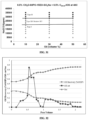
- FIG. 1 depicts surface tension measurements of CH 3 O-40PO-20EO-carboxylate and CH 3 O-40PO-20EO-sulfate.
- FIG. 2 depicts surface tension measurements of CH 3 O-60PO-30EO-carboxylate.
- FIG. 3 depicts surface tension measurements of CH 3 O-21PO-15EO-sulfate.
- FIG. 4 depicts surface tension measurements of C 12-13 -7PO-sulfate.
- FIG. 5 depicts surface tension measurements of C 15-18 IOS.
- FIG. 6 depicts surface tension measurements of C 20-24 IOS and a 1:1 blend of C 20-24 MS with CH 3 O-21PO-15EO-sulfate.
- FIG. 7 depicts tension measurements of CH 3 O-60PO-15EO-SO 3 Na, C 20-24 IOS and 1:1 (wt:wt) blend.
- FIG. 8 depicts tension measurements of CH 3 —O-60PO-30EO—COONa/SO 4 .
- FIG. 9 depicts tension measurements of CH 3 —O-60PO-30EO—COO ⁇ with and without calcium ions.
- FIG. 10 depicts tension measurements of CH 3 —O-70PO-100EO (Mm).
- FIG. 11 depicts surface tension measurements of N-(EO-30PO) 3 .
- FIG. 12 depicts aqueous stability results of CH 3 O-21PO-xEO-sulfate surfactants at 25° C. and 40° C.
- FIG. 13 depicts aqueous stability results of CH 3 O-21PO-xEO-sulfate with C 19-23 IOS (0.5 wt % each) at 40° C.
- FIG. 14 depicts aqueous stability results of various surfactants at 0.5%.
- FIG. 15 depicts aqueous stability results of AS-40 (C 14-16 AOS) and CH 3 —O-60PO-20EO—SO 3 .
- FIG. 16 depicts aqueous stability results of CH 3 O-60PO-15EO—SO 3 Na, C 20-24 MS and 1:1 blend.
- FIG. 17 depicts aqueous stability results of N-(EO—POy) 3 .
- FIG. 18 depicts solubilization ratios for phase behavior tubes of 0.5% CH 3 —O-21PO-10EO-sulfate, 0.5% C 19-23 IOS, 1% TEGBE at 40° C.
- FIG. 19 depicts solubilization ratios for phase ultraflow IFT tubes of 0.5% CH 3 —O-21PO-10EO sulfate, 0.5% C 19-23 IOS, 1% TEGBE at 40° C.
- FIG. 20 depicts solubilization ratios for phase behavior tubes of 0.4% CH 3 —O-60PO-20EO carboxylate, 0.6% C 15-18 MS at 65° C.
- FIG. 21 depicts solubilization ratios for phase behavior tubes of 0.5% CH 3 —O-21PO-sulfate, 0.5% C 19-23 IOS, 1% TEGBE.
- FIG. 22 depicts solubilization ratios for phase behavior tubes of 0.5% C 12-13 -7PO-sulfate, 0.5% C 19-23 MS.
- FIG. 23 depicts solubilization ratios for phase behavior tubes of 0.5% CH 3 —O-60PO-30EO-carboxylate, 0.5% C 15-18 MS at 65° C.
- FIG. 24 depicts solubilization ratios for phase behavior tubes of 0.5% C 18 -45PO-30EO-carboxylate, 0.5% C 15-18 MS at 65° C.
- the C 18 is oleyl based, having a bent double bond, which results in extra-large hydrophobe behavior.
- FIG. 25 depicts solubilization ratios for phase behavior tubes of 0.5% C 28 -45PO-30EO-carboxylate, 0.5% C 15-18 MS at 65° C.
- FIG. 26 depicts solubilization ratios for phase behavior tubes of 0.5% 2EH—O-40PO-40EO—COO ⁇ , 0.5% C 19-23 IOS, 1% TEGBE 65° C.
- FIG. 27 depicts solubilization ratios for phase behavior tubes of 0.5% 2EH—O-40PO-40EO, 0.5% C 19-23 MS, 1% TEGBE 65° C.
- FIG. 28 depicts solubilization ratios for phase behavior tubes of 0.5% CH 3 —O-21PO—SO 4 , 0.5% C 15-18 MS.
- FIG. 29 depicts solubilization ratios for phase behavior tubes of 0.5% CH 3 —O-21PO-10EO-SO 0 , 0.5% C 15-18 MS.
- FIG. 30 depicts solubilization ratios for phase behavior tubes of 0.5% 2EH—O-60PO-60EO—COO ⁇ , 0.5% C 15-18 MS.
- FIG. 31 depicts alkali surfactant phase behavior results for CH 3 —O-60PO-15EO—SO 3 Na, 0.5% C 20-24 MS.
- FIG. 32 depicts surfactant polymer oil recovery coreflood results conducted in a Boise sandstone core for 0.5 wt % CH 3 O-21PO-10EO—SO 4 and 0.5 wt % C 20-24 IOS.
- FIG. 33 depicts surfactant polymer oil recovery coreflood results conducted in a Berea sandstone core for 0.5 wt % CH 3 O-21PO-10EO—SO 4 , 0.5 wt % C 19-23 IOS and 1 wt % TEGBE.
- FIG. 34 depicts effect of crude oil on foam half-life with AS-40 at high salinity.
- FIG. 35 depicts effect of crude oil on foam half-life with 0.5% C 14-16 AOS, 0.5% CH 3 —O-60PO-20EO—SO 4 Na.
- FIG. 36 depicts hardness tolerance for AS-40 and surfactant blends.
- FIG. 37 depicts Stability of cylindrical micelles of 2% CH 3 —O-70PO-100EO.
- FIG. 38 depicts stability of micelles in presence of crude oil P of 2% CH 3 —O-70PO-100EO.
- FIG. 39 depicts stability of micelles in presence of crude oil K of 2% CH 3 —O-70PO-100EO.
- FIG. 40 depicts stability of micelles in presence of alkanes of 2% CH 3 —O-70PO-100EO.
- the present invention is directed to surfactants with smaller hydrophobes, which are of non-conventional hydrophobe size, and are herein referred to as non-conventional hydrophobes.
- Conventional hydrophobes are sometimes referred to as “hard” hydrophobes, i.e. a compound that shows no compatibility with water.
- the surfactants of the present invention utilize a small hydrophobic moiety with a polyalkoxylate chain.
- the surfactants of the present invention may also contain varying amounts of EO groups to achieve the desired hydrophilic-lipophilic balance (HLB).
- the PO, BO and EO groups not only provide tolerance under harsh conditions, but they surprisingly also impart high surface activity, even without the large hydrophobe group previously thought necessary.
- the PO and BO chains are very compatible with oil and somewhat compatible with water.
- the EO chain is very compatible with water and somewhat compatible with oil.
- the surfactants of the present invention lack a hard hydrophobe, it was surprisingly found the surfactants of the present invention performed similar to, or in some instances better than, conventional surfactants having a hard hydrophobe group.
- the present invention is further directed to formulations comprising the surfactants of the invention, and methods of using the surfactants of the invention.
- alkyl embraces branched, cyclic or unbranched carbon chains, which may be fully saturated, mono- or polyunsaturated, and substituted or unsubstituted, having the designated number of carbon atoms.
- saturated alkyls included, but are not limited to, methyl, ethyl, n-propyl, isopropyl, n-butyl, isobutyl, t-butyl, sec-butyl, pentyl, hexyl, heptyl and octyl, and their isomers (e.g. iso or branched versions).
- the term “unsaturated alkyl” refers to alkyl groups having one or more double bonds or triple bonds.
- alkoxy embraces an alkyl group which has an oxygen atom attached thereto.
- Representative alkoxy groups include ethoxy, propoxy, iso-propoxy, sec-propoxy, butoxy, iso-butoxy, sec-butoxy, tert-butoxy, and the like.
- alcohol embraces an alkyl group, which may be saturated or unsaturated, having one or more hydroxy (—OH) substituents.
- Primary and secondary alcohols are contemplated, such as mono-alcohols as well as polyhydroxy variants.
- Lower alcohols are those containing from about 1 to 4 carbon atoms.
- Exemplary alcohols include methanol, ethanol, 1-propanol, 2-propanol, 2-propen-1-ol, 1-butanol, 2-butanol, 2-methyl-2-propanol, 1-pentanol, 2-pentanol, 3-pentanol, and 3-methyl-1-butanol and their isomers.
- polyamine embraces organic groups having more than two amino groups and ending with two primary amino groups.
- polyols embraces polyhydric alcohols having 2 or more hydroxyl groups in both their monomeric and polymeric forms.
- Representative polyols include diols, such as ethylene glycol, propylene glycol, diethylene glycol, glycerol, pentaerythritol, di- and trihydroxymethyl alkanes, buanediols, 1-3 propanediols, alkyl glucosides (e.g. butyl), sorbitols, and polymers of the foregoing and other polyols, including polyglycerols, alkyl polyglucosides and polysaccharides, such as starches (e.g. CMC) and cycodextrins.
- diols such as ethylene glycol, propylene glycol, diethylene glycol, glycerol, pentaerythritol, di- and trihydroxymethyl alkanes, buanediols, 1-3 propanedi
- polystyrene resin As used herein, the term “poloxamers” embraces nonionic triblock copolymers comprising a central PO chain flanked by two chains of EO, as well as the reverse arrangement, including those sold under the tradenames Pluronics, Synperonics and Kolliphor.
- ionic embraces cations, anions and ionic groups.
- ionic would embrace both —CO 2 ⁇ and —CO 2 H.
- zwitterionic embraces groups having separate positively and negatively charged groups.
- Representative zwitterionic groups include betaines, sultaines, hydroxysultaines, sulfitobetaines, sulfatobetaines, phosphinate betaines, phosphonate betaines, phosphitobetaines, phosphatobetaines, and the like.
- surfactants of the present invention generally have the formula: X-((A 1 x -A 2 y )—Y) n (I)
- X is an alcohol, an amine, or an alkyl- or alkoxy-amine having from 1 to 8 total carbons;
- a 1 and A 2 is PO, butylene oxide (BO) and/or a combination of PO and BO, and the other of A 1 and A 2 is EO, and independent A 1 and A 2 groups may be in blocks and/or in random order;
- x or y is 7-100 when A 1 or A 2 , as applicable, is PO or BO;
- x or y is 0-250 when A 1 or A 2 , as applicable, is EO;
- n 1 to 4, or 1 to 3;
- Y is an ionic group, a zwitterionic group or H
- PO is —CH 2 CH(CH 3 )—O—
- BO is —CH 2 CH(CH 2 CH 3 )—O— or —CH 2 CH 2 CH(CH 3 )—O—
- EO is —CH 2 —CH 2 —O—.
- the surfactants of the invention do not contain a traditional size hydrophobe. Instead, the total number of carbon atoms in the X group is from 1 to 8, but may be 1, 2, 3, 4, 5, 6, 7 or 8 or any range therebetween.
- the X group may comprise 1-7, 1-6, 1-5, 1-4, 1-3 or 1-2 carbons.
- a 1 and A 2 are preferably independently PO and EO, wherein A 1 and A 2 are not the same, and independent A 1 and A 2 groups may be in PO blocks, EO blocks, PO-EO blocks, EO-PO blocks, other repeating blocks and/or in random order. However, one or more PO groups, or all PO groups, may be replaced by BO.
- the surfactants of the present invention comprise a block of PO groups, followed by a block of EO groups.
- a 1 or A 2 is PO and/or BO
- x or y represents the total number of PO and BO groups and is an integer from 7-90, from 7-80, from 7-70, from 7-60, from 7-50, from 7-40, from 7-30, from 7-20, from 7-15, from 90-100, from 80-100, from 70-100, from 60-100, from 50-100, from 40-100, from 30-100, from 20-100, from 15-100, from 10-100, from 5-100, from 15-25, from 25-35, from 35-45, from 45-55, from 55-65, from 65-75, from 75-85, from 85-95, or any values or ranges therebetween.
- x or y is an integer from 0-250, from 0-230, from 0-210, from 0-190, from 0-170, from 0-150, from 0-130, from 0-110, from 0-90, from 0-70, from 0-50, from 0-30, from 0-15, from 230-250, from 210-250, from 190-250, from 170-250, from 150-250, from 130-250, from 110-250, from 90-250, from 70-250, from 50-250, from 30-250, from 15-250, from 10-250, from 5-250, 5-25, from 25-45, from 45-65, from 65-85, from 85-105, from 105-125, from 125-145, from 145-165, from 165-185, from 185-205, from 205-225, from 225-250.
- alkoxy polyalkoxylate surfactants of the present invention have the formula: R 1 —O-(A 1 x -A 2 y )-Z (II)
- R 1 is C 1 to C 8 alkyl
- a 1 , A 2 , x, and y are as defined in formula (I); and Z is an ionic group or H.
- R 1 C 1 to C 8 , linear, cyclic or branched, saturated or unsaturated alkyl (e.g. allyl, alkenyl or alkynyl), optionally substituted with 1 primary or secondary —OH group.
- R 1 may be selected from a methyl, ethyl, n-propyl, isopropyl, n-butyl, isobutyl, t-butyl, sec-butyl, pentyl, hexyl, heptyl and octyl and their isomers (e.g. iso or branched versions).
- R 1 may include C 1 -C 8 , C 1 -C 7 , C 1 -C 6 , C 1 -C 5 , C 1 -C 4 , C 1 -C 3 , C 1 -C 2 or methyl.
- exemplary R 1 groups include methanol, phenol, propanol dimer alcohol, methylpentyl, or ethylhexyl (EH).
- a 1 and A 2 are preferably independently PO and EO, wherein A 1 and A 2 are not the same, and independent A 1 and A 2 groups may be in PO blocks, BO blocks, PO-EO blocks, EO-PO blocks, other repeating blocks and/or in random order. However, one or more PO groups, or all PO groups, may be replaced by BO.
- the alkoxy polyalkoxylate surfactants of the present invention comprise a block of PO groups, followed by a block of EO groups.
- x or y is an integer from 7-90, from 7-80, from 7-70, from 7-60, from 7-50, from 7-40, from 7-30, from 7-20, from 7-15, from 90-100, from 80-100, from 70-100, from 60-100, from 50-100, from 40-100, from 30-100, from 20-100, from 15-100, from 10-100, from 5-100, from 15-25, from 25-35, from 35-45, from 45-55, from 55-65, from 65-75, from 75-85, from 85-95, or any values or ranges therebetween.
- x or y is an integer from 0-250, from 0-230, from 0-210, from 0-190, from 0-170, from 0-150, from 0-130, from 0-110, from 0-90, from 0-70, from 0-50, from 0-30, from 0-15, from 230-250, from 210-250, from 190-250, from 170-250, from 150-250, from 130-250, from 110-250, from 90-250, from 70-250, from 50-250, from 30-250, from 15-250, from 10-250, from 5-250, 5-25, from 25-45, from 45-65, from 65-85, from 85-105, from 105-125, from 125-145, from 145-165, from 165-185, from 185-205, from 205-225, from 225-250.
- Z is preferably selected from the group consisting of H, sulfate (e.g. OSO 3 ⁇ M + ), carboxylate (e.g. —CH 2 C(O)OH, —CH 2 C(O)O ⁇ M + , —CH 2 CH 2 —CO 2 H or —CH 2 CH 2 —CO 2 ⁇ or M + ), and sulfonate (—R 2 SO 3 H or —R 2 SO 3 ⁇ M + wherein R 2 is a C 1 -C 3 alkyl), optionally substituted with one hydroxyl group; wherein M + is a monovalent, divalent or trivalent cation.
- sulfate e.g. OSO 3 ⁇ M +
- carboxylate e.g. —CH 2 C(O)OH, —CH 2 C(O)O ⁇ M + , —CH 2 CH 2 —CO 2 H or —CH 2 CH 2 —CO 2 ⁇ or M +
- M + may be a metal cation, and in some embodiments is NH 4 + , Na + or K + .
- the oxygen of the EO or PO group may contribute to the sulfate group, such that unless otherwise specified, as used herein, R 1 —PO x -EO y —SO 4 H and R 1 —O—PO x -EO y —SO 3 H, for example, both refer to the sulfate.
- a sulfate, carboxylate or sulfonate group needs to be present to give hydrophilicity to the surfactant.
- Z if there is no EO group, Z is not H.
- Z is not H.
- Z is not H.
- Z is not H.
- Z is not H.
- Z is not H.
- alkoxy polyalkoxylate surfactants of the invention include those described above, in the examples, and the following:
- R 1 —O-7PO-xEO-Z x: 0, 5, 10, 15, 20, 30, 45, 60, 75, 100, 120, 140, 160, 180, 200, 225, 250.
- R 1 O-10PO-xEO-Z; x: 0, 5, 10, 15, 20, 30, 45, 60, 75, 100, 120, 140, 160, 180, 200, 225, 250.
- R 1 O-21PO-xEO-Z; x: 0, 5, 10, 15, 20, 30, 45, 60, 75, 100, 120, 140, 160, 180, 200, 225, 250.
- R 1 O-40PO-xEO-Z; x: 0, 5, 10, 15, 20, 30, 45, 60, 75, 100, 120, 140, 160, 180, 200, 225, 250.
- R 1 O-45PO-xEO-Z; x: 0, 5, 10, 15, 20, 30, 45, 60, 75, 100, 120, 140, 160, 180, 200, 225, 250.
- R 1 O-60PO-xEO-Z; x: 0, 5, 10, 15, 20, 30, 45, 60, 75, 100, 120, 140, 160, 180, 200, 225, 250.
- R 1 O-70PO-xEO-Z; x: 0, 5, 10, 15, 20, 30, 45, 60, 75, 100, 120, 140, 160, 180, 200, 225, 250.
- R 1 O-80PO-xEO-Z; x: 0, 5, 10, 15, 20, 30, 45, 60, 75, 100, 120, 140, 160, 180, 200, 225, 250.
- R 1 O-100PO-xEO-Z; x: 0, 5, 10, 15, 20, 30, 45, 60, 75, 100, 120, 140, 160, 180, 200, 225, 250.
- the PO and EO numbers may be the values listed, or the ranges defined by consecutive values. For example, 7-10PO, 10-21PO, etc., and 0-5EO, 5-10EO, etc.
- the order of the PO and EO groups may be reversed, or the PO and EO groups may be in random order, with the total number of groups as listed.
- polyol alkoxylate surfactants of the invention have the formula: R 1 a —CH b —(CH 2 —O-(A 1 x -A 2 y )-Z) n , (III)
- R 1 is C 1 to C 6 alkyl
- a 1 , A 2 , x, and y are as described above with respect to formula (I); and Z is an ionic group or H.
- R 1 C 1 to C 6 , linear, cyclic or branched, saturated or unsaturated alkyl (e.g. allyl, alkenyl or alkynyl), optionally substituted with 1 primary or secondary —OH group.
- R 1 may be selected from a methyl, ethyl, n-propyl, isopropyl, n-butyl, isobutyl, t-butyl, sec-butyl, pentyl, hexyl, and their isomers (e.g. iso or branched versions).
- R 1 may include C 1 -C 6 , C 1 -C 5 , C 1 -C 4 , C 1 -C 3 , C 1 -C 2 , or methyl or may not be present.
- Exemplary surfactants include CH 3 CH 2 —C—(CH 2 —O—PO x -EO y ) 3 from trimethylol propane.
- a 1 and A 2 are preferably independently PO and EO, wherein A 1 and A 2 are not the same, and independent A 1 and A 2 groups may be in PO blocks, BO blocks, PO-EO blocks, EO-PO blocks, other repeating blocks and/or in random order. However, one or more PO groups, or all PO groups, may be replaced by BO.
- the alkoxy polyalkoxylate surfactants of the present invention comprise a block of PO groups, followed by a block of EO groups.
- x or y is an integer from 7-90, from 7-80, from 7-70, from 7-60, from 7-50, from 7-40, from 7-30, from 7-20, from 7-15, from 90-100, from 80-100, from 70-100, from 60-100, from 50-100, from 40-100, from 30-100, from 20-100, from 15-100, from 10-100, from 5-100, from 15-25, from 25-35, from 35-45, from 45-55, from 55-65, from 65-75, from 75-85, from 85-95, or any values or ranges therebetween.
- x or y is an integer from 0-250, from 0-230, from 0-210, from 0-190, from 0-170, from 0-150, from 0-130, from 0-110, from 0-90, from 0-70, from 0-50, from 0-30, from 0-15, from 230-250, from 210-250, from 190-250, from 170-250, from 150-250, from 130-250, from 110-250, from 90-250, from 70-250, from 50-250, from 30-250, from 15-250, from 10-250, from 5-250, 5-25, from 25-45, from 45-65, from 65-85, from 85-105, from 105-125, from 125-145, from 145-165, from 165-185, from 185-205, from 205-225, from 225-250.
- Z is preferably selected from the group consisting of H, sulfate (e.g. OSO 3 ⁇ M + ), carboxylate (e.g. —CH 2 C(O)OH, —CH 2 C(O)O ⁇ M + , —CH 2 CH 2 —CO 2 H or —CH 2 CH 2 —CO 2 ⁇ or M + ), and sulfonate (—R 2 SO 3 H or —R 2 SO 3 ⁇ M + wherein R 2 is a C 1 -C 3 alkyl), optionally substituted with one hydroxyl group; wherein M + is a monovalent, divalent or trivalent cation.
- sulfate e.g. OSO 3 ⁇ M +
- carboxylate e.g. —CH 2 C(O)OH, —CH 2 C(O)O ⁇ M + , —CH 2 CH 2 —CO 2 H or —CH 2 CH 2 —CO 2 ⁇ or M +
- M + may be a metal cation, and in some embodiments is NH 4 + , Na + or K + .
- Z is not H.
- there are 5 or more, 7 or more or 21 or more PO groups without an EO group Z is not H.
- alkoxy polyalkoxylate surfactants of the invention include those described above, in the examples, and the following:
- R 1 a CH b —(CH 2 —O-7PO-xEO-Z)n; x: 0, 5, 10, 15, 20, 30, 45, 60, 75, 100, 120, 140, 160, 180, 200, 225, 250.
- R 1 a CH b —(CH 2 —O-10PO-xEO-Z)n; x: 0, 5, 10, 15, 20, 30, 45, 60, 75, 100, 120, 140, 160, 180, 200, 225, 250.
- R 1 a CH b —(CH 2 —O-21PO-xEO-Z)n; x: 0, 5, 10, 15, 20, 30, 45, 60, 75, 100, 120, 140, 160, 180, 200, 225, 250.
- R 1 a CH b —(CH 2 —O-40PO-xEO-Z)n; x: 0, 5, 10, 15, 20, 30, 45, 60, 75, 100, 120, 140, 160, 180, 200, 225, 250.
- R 1 a CH b —(CH 2 —O-45PO-xEO-Z)n; x: 0, 5, 10, 15, 20, 30, 45, 60, 75, 100, 120, 140, 160, 180, 200, 225, 250.
- R 1 a CH b —(CH 2 —O-60PO-xEO-Z)n; x: 0, 5, 10, 15, 20, 30, 45, 60, 75, 100, 120, 140, 160, 180, 200, 225, 250.
- R 1 a CH b —(CH 2 —O-70PO-xEO-Z)n; x: 0, 5, 10, 15, 20, 30, 45, 60, 75, 100, 120, 140, 160, 180, 200, 225, 250.
- R 1 a CH b —(CH 2 —O-80PO-xEO-Z)n; x: 0, 5, 10, 15, 20, 30, 45, 60, 75, 100, 120, 140, 160, 180, 200, 225, 250.
- R 1 a CH b —(CH 2 —O-100PO-xEO-Z)n; x: 0, 5, 10, 15, 20, 30, 45, 60, 75, 100, 120, 140, 160, 180, 200, 225, 250.
- polyol alkoxylate surfactants of the invention have the following formula: polyol-((A 1 x -A 2 y )Z) n (IV)
- Suitable polyols include monomeric or polymeric polyols, including diols, such as ethylene glycol, propylene glycol, diethylene glycol, glycerol, pentaerythritol, di- and trihydroxymethyl alkanes, buanediols, 1-3 propanediols, alkyl glucosides (e.g. butyl), sorbitols, and polymers of the foregoing and other polyols, including polyglycerols, alkyl polyglucosides and polysaccharides, such as starches (e.g. CMC) and cyclodextrins, and poloxamers (e.g.
- diols such as ethylene glycol, propylene glycol, diethylene glycol, glycerol, pentaerythritol, di- and trihydroxymethyl alkanes, buanediols, 1-3 propanediols, alkyl glu
- Pluronics and reverse Pluronics in each case preferably comprising C 1 to C 5 linear, cyclic (e.g. phenyl) or branched alkyl groups.
- the alkyl groups will preferably have 5 or fewer carbons, the total number of carbons in the polyol may be greater than 8.
- a 1 and A 2 are preferably independently PO and EO, wherein A 1 and A 2 are not the same, and independent A 1 and A 2 groups may be in PO blocks, BO blocks, PO-EO blocks, EO-PO blocks, other repeating blocks and/or in random order. However, one or more PO groups, or all PO groups, may be replaced by BO.
- the alkoxy polyalkoxylate surfactants of the present invention comprise a block of PO groups, followed by a block of EO groups.
- x or y is an integer from 7-100 when A 1 or A 2 , as applicable, is PO, x or y is an integer from 0-250 when A 1 or A 2 , as applicable, is EO.
- x or y is an integer from 7-90, from 7-80, from 7-70, from 7-60, from 7-50, from 7-40, from 7-30, from 7-20, from 7-15, from 90-100, from 80-100, from 70-100, from 60-100, from 50-100, from 40-100, from 30-100, from 20-100, from 15-100, from 10-100, from 5-100, from 15-25, from 25-35, from 35-45, from 45-55, from 55-65, from 65-75, from 75-85, from 85-95, or any values or ranges therebetween.
- x or y is an integer from 0-250, from 0-230, from 0-210, from 0-190, from 0-170, from 0-150, from 0-130, from 0-110, from 0-90, from 0-70, from 0-50, from 0-30, from 0-15, from 230-250, from 210-250, from 190-250, from 170-250, from 150-250, from 130-250, from 110-250, from 90-250, from 70-250, from 50-250, from 30-250, from 15-250, from 10-250, from 5-250, 5-25, from 25-45, from 45-65, from 65-85, from 85-105, from 105-125, from 125-145, from 145-165, from 165-185, from 185-205, from 205-225, from 225-250.
- Z is preferably selected from the group consisting of H, sulfate (e.g. OSO 3 ⁇ M + ), carboxylate (e.g. —CH 2 C(O)OH, —CH 2 C(O)O ⁇ M + , —CH 2 CH 2 —CO 2 H or —CH 2 CH 2 —CO 2 ⁇ or M + ), and sulfonate (—R 2 SO 3 H or —R 2 SO 3 ⁇ M + wherein R 2 is a C 1 -C 3 alkyl), optionally substituted with one hydroxyl group; wherein M + is a monovalent, divalent or trivalent cation.
- sulfate e.g. OSO 3 ⁇ M +
- carboxylate e.g. —CH 2 C(O)OH, —CH 2 C(O)O ⁇ M + , —CH 2 CH 2 —CO 2 H or —CH 2 CH 2 —CO 2 ⁇ or M +
- M + may be a metal cation, and in some embodiments is NH 4 + , Na + or K + .
- Z is not H.
- there are 5 or more, 7 or more or 21 or more PO groups without an EO group Z is not H.
- polyol polyalkoxylate surfactants of the invention include those described above, in the examples, and the following:
- Polyol-(7PO-xEO-Z)n x: 0, 5, 10, 15, 20, 30, 45, 60, 75, 100, 120, 140, 160, 180, 200, 225, 250.
- Polyol-(10PO-xEO-Z)n x: 0, 5, 10, 15, 20, 30, 45, 60, 75, 100, 120, 140, 160, 180, 200, 225, 250.
- Polyol-(21PO-xEO-Z)n x: 0, 5, 10, 15, 20, 30, 45, 60, 75, 100, 120, 140, 160, 180, 200, 225, 250.
- Polyol-(40PO-xEO-Z)n x: 0, 5, 10, 15, 20, 30, 45, 60, 75, 100, 120, 140, 160, 180, 200, 225, 250.
- Polyol-(45PO-xEO-Z)n x: 0, 5, 10, 15, 20, 30, 45, 60, 75, 100, 120, 140, 160, 180, 200, 225, 250.
- Polyol-(60PO-xEO-Z)n x: 0, 5, 10, 15, 20, 30, 45, 60, 75, 100, 120, 140, 160, 180, 200, 225, 250.
- Polyol-(70PO-xEO-Z)n x: 0, 5, 10, 15, 20, 30, 45, 60, 75, 100, 120, 140, 160, 180, 200, 225, 250.
- Polyol-(80PO-xEO-Z)n x: 0, 5, 10, 15, 20, 30, 45, 60, 75, 100, 120, 140, 160, 180, 200, 225, 250.
- Polyol-(100PO-xEO-Z)n x: 0, 5, 10, 15, 20, 30, 45, 60, 75, 100, 120, 140, 160, 180, 200, 225, 250.
- the PO and EO numbers may be the values listed, or the ranges defined by consecutive values. For example, 7-10PO, 10-21PO, etc., and 0-5EO, 5-10EO, etc.
- the order of the PO and EO groups may be reversed, or the PO and EO groups may be in random order, with the total number of groups as listed.
- amine, alkoxyamine and alkylamine polyalkoxylate surfactants of the invention have the formula: R 1 a —NH m ((R 3 O) d (A 1 x -A 2 y )Y) n (V)
- R 1 and R 3 may be selected from a methyl, ethyl, n-propyl, isopropyl, n-butyl, isobutyl, t-butyl, sec-butyl, pentyl, hexyl, heptyl and octyl and their isomers (e.g. iso or branched versions), provided the total number of carbons does not exceed 8.
- a 1 and A 2 are preferably independently PO and EO, wherein A 1 and A 2 are not the same, and independent A 1 and A 2 groups may be in PO blocks, BO blocks, PO-EO blocks, EO-PO blocks, other repeating blocks and/or in random order. However, one or more PO groups, or all PO groups, may be replaced by BO.
- the alkoxy polyalkoxylate surfactants of the present invention comprise a block of PO groups, followed by a block of EO groups.
- x or y is an integer from 7-90, from 7-80, from 7-70, from 7-60, from 7-50, from 7-40, from 7-30, from 7-20, from 7-15, from 90-100, from 80-100, from 70-100, from 60-100, from 50-100, from 40-100, from 30-100, from 20-100, from 15-100, from 10-100, from 5-100, from 15-25, from 25-35, from 35-45, from 45-55, from 55-65, from 65-75, from 75-85, from 85-95, or any values or ranges therebetween.
- x or y is an integer from 0-250, from 0-230, from 0-210, from 0-190, from 0-170, from 0-150, from 0-130, from 0-110, from 0-90, from 0-70, from 0-50, from 0-30, from 0-15, from 230-250, from 210-250, from 190-250, from 170-250, from 150-250, from 130-250, from 110-250, from 90-250, from 70-250, from 50-250, from 30-250, from 15-250, from 10-250, from 5-250, 5-25, from 25-45, from 45-65, from 65-85, from 85-105, from 105-125, from 125-145, from 145-165, from 165-185, from 185-205, from 205-225, from 225-250.
- Amine, alkoxyamine and alkylamine polyalkoxylate surfactants of the present invention can behave as switchable surfactants, depending on the pH of the formulation, as well as betaines.
- Y is preferably selected from the group consisting of H, a zwitterionic group and a cationic when the nitrogen atom is quaternary, with a positive charge, and a negatively charged anion as a counterion.
- Certain exemplary amine, alkoxyamine and alkylamine polyalkoxylate surfactants of the invention include those described above, in the examples, and the following:
- (21PO-xEO-Y) x: 0, 5, 10, 15, 20, 30, 45, 60, 75, 100, 120, 140, 160, 180, 200, 225, 250.
- (40PO-xEO-Y) x: 0, 5, 10, 15, 20, 30, 45, 60, 75, 100, 120, 140, 160, 180, 200, 225, 250.
- (45PO-xEO-Y) x: 0, 5, 10, 15, 20, 30, 45, 60, 75, 100, 120, 140, 160, 180, 200, 225, 250.
- (60PO-xEO-Y) x: 0, 5, 10, 15, 20, 30, 45, 60, 75, 100, 120, 140, 160, 180, 200, 225, 250.
- (70PO-xEO-Y) x: 0, 5, 10, 15, 20, 30, 45, 60, 75, 100, 120, 140, 160, 180, 200, 225, 250.
- (80PO-xEO-Y) x: 0, 5, 10, 15, 20, 30, 45, 60, 75, 100, 120, 140, 160, 180, 200, 225, 250.
- (100PO-xEO-Y) x: 0, 5, 10, 15, 20, 30, 45, 60, 75, 100, 120, 140, 160, 180, 200, 225, 250.
- the PO and EO numbers may be the values listed, or the ranges defined by consecutive values. For example, 7-10PO, 10-21PO, etc., and 0-5EO, 5-10EO, etc.
- the order of the PO and EO groups may be reversed, or the PO and EO groups may be in random order, with the total number of groups as listed.
- polyamine polyalkoxylate surfactants of the invention have the formula: polyamine-((A 1 x -A 2 y )Y) n (VI)
- one or more polyalkoxy groups (A 1 x -A 2 y )Y are attached to one or more of the nitrogen atoms of the polyamine, and A 1 , A 2 , x, and y are as described above with respect to formula (I);
- Y is H, an ionic group, a zwitterionic group, or a cationic when the nitrogen atom is quaternary, with a positive charge, and a negatively charged anion as a counterion; and n is equal to or less than the number of displaceable hydrogens on the nitrogen atoms.
- TETA triethylene tetramine
- one or more of the hydrogen atoms attached to one or more of the nitrogen atoms may be replaced with (A 1 x -A 2 y )Y.
- the polyamine comprise up to 9 nitrogen atoms and up to 8 carbon atoms.
- the polyamine may comprise 1, 2, 3, 4, 5, 6, 7 or 8 carbon atoms, or any range therebetween.
- the polyamine group may comprise 1-7, 1-6, 1-5, 1-4, 1-3 or 1-2 carbons.
- Polyamine polyalkoxylate surfactants of the present invention can behave as switchable surfactants, depending on the pH of the formulation, as well as betaines.
- Y is preferably selected from the group consisting of H, a zwitterionic group and a cationic when the nitrogen atom is quaternary, with a positive charge, and a negatively charged anion as a counterion.
- Suitable zwitterionic groups include betaines, sultaines, and hydroxysultaines.
- a 1 and A 2 are preferably independently PO and EO, wherein A 1 and A 2 are not the same, and independent A 1 and A 2 groups may be in PO blocks, BO blocks, PO-EO blocks, EO-PO blocks, other repeating blocks and/or in random order. However, one or more PO groups, or all PO groups, may be replaced by BO.
- the alkoxy polyalkoxylate surfactants of the present invention comprise a block of PO groups, followed by a block of EO groups.
- x or y is an integer from 7-100 when A 1 or A 2 , as applicable, is PO, x or y is an integer from 0-250 when A 1 or A 2 , as applicable, is EO.
- x or y is an integer from 7-90, from 7-80, from 7-70, from 7-60, from 7-50, from 7-40, from 7-30, from 7-20, from 7-15, from 90-100, from 80-100, from 70-100, from 60-100, from 50-100, from 40-100, from 30-100, from 20-100, from 15-100, from 10-100, from 5-100, from 15-25, from 25-35, from 35-45, from 45-55, from 55-65, from 65-75, from 75-85, from 85-95, or any values or ranges therebetween.
- x or y is an integer from 0-250, from 0-230, from 0-210, from 0-190, from 0-170, from 0-150, from 0-130, from 0-110, from 0-90, from 0-70, from 0-50, from 0-30, from 0-15, from 230-250, from 210-250, from 190-250, from 170-250, from 150-250, from 130-250, from 110-250, from 90-250, from 70-250, from 50-250, from 30-250, from 15-250, from 10-250, from 5-250, 5-25, from 25-45, from 45-65, from 65-85, from 85-105, from 105-125, from 125-145, from 145-165, from 165-185, from 185-205, from 205-225, from 225-250.
- polyamine polyalkoxylate surfactants of the invention include those described above, in the examples, and the following:
- Polyamine-(7PO-xEO-Y)n x: 0, 5, 10, 15, 20, 30, 45, 60, 75, 100, 120, 140, 160, 180, 200, 225, 250.
- Polyamine-(10PO-xEO-Y)n x: 0, 5, 10, 15, 20, 30, 45, 60, 75, 100, 120, 140, 160, 180, 200, 225, 250.
- Polyamine-(21PO-xEO-Y)n x: 0, 5, 10, 15, 20, 30, 45, 60, 75, 100, 120, 140, 160, 180, 200, 225, 250.
- Polyamine-(40PO-xEO-Y)n x: 0, 5, 10, 15, 20, 30, 45, 60, 75, 100, 120, 140, 160, 180, 200, 225, 250.
- Polyamine-(45PO-xEO-Y)n x: 0, 5, 10, 15, 20, 30, 45, 60, 75, 100, 120, 140, 160, 180, 200, 225, 250.
- Polyamine-(60PO-xEO-Y)n x: 0, 5, 10, 15, 20, 30, 45, 60, 75, 100, 120, 140, 160, 180, 200, 225, 250.
- Polyamine-(70PO-xEO-Y)n x: 0, 5, 10, 15, 20, 30, 45, 60, 75, 100, 120, 140, 160, 180, 200, 225, 250.
- Polyamine-(80PO-xEO-Y)n x: 0, 5, 10, 15, 20, 30, 45, 60, 75, 100, 120, 140, 160, 180, 200, 225, 250.
- Polyamine-(100PO-xEO-Y)n x: 0, 5, 10, 15, 20, 30, 45, 60, 75, 100, 120, 140, 160, 180, 200, 225, 250.
- the PO and EO numbers may be the values listed, or the ranges defined by consecutive values. For example, 7-10PO, 10-21PO, etc., and 0-5EO, 5-10EO, etc.
- the order of the PO and EO groups may be reversed, or the PO and EO groups may be in random order, with the total number of groups as listed.
- the surfactants of the present invention have advantages over conventional surfactants. For example, because they do not require use of high cost long carbon chain alcohols as a raw material, much cheaper and versatile alcohols, such as methanol, phenol, and 2ethylhexanol, can be used. Due to the lower hydrophobicity of PO groups at room conditions, they form clear aqueous solutions at such conditions, which can be injected into oil reservoirs in EOR applications. This can be particularly helpful for high-temperature/high-salinity reservoirs. In addition, the surfactants of the present invention are likely to have lower adsorption on the rock since they do not have a hard (large) hydrophobe.
- the surfactants of the present invention were found to have very low CMC values, and lowered the surface tension to about 32 dynes/cm, similar to conventional surfactants such as C 12-13 -7PO-sulfate, C 20-24 IOS and C 15-18 IOS. This shows that these surfactant molecules were surface active even though they did not have a hard hydrophobe.
- the CMC values of the novel surfactants were much lower than that of conventional surfactants.
- aqueous stability (solubility) of the surfactants of the present invention at a given temperature was found to be dependent on the number of PO and EO groups. As EO increases, aqueous stability increases without affecting the oil-brine-surfactant phase behavior. The surfactants of the present invention showed higher hydrophobicity at higher temperatures. Aqueous stability improved with co-surfactants. The aqueous stability results are comparable with conventional surfactants.
- Phase behavior experiments of the surfactants of the present invention showed low IFT formulations with different crude oils at 40° C. and 60° C. by using these surfactants by themselves and ultralow IFT when used as in combination with internal olefin sulfonates (IOS).
- the solubilization ratios around their respective optimum salinities were in the range of 9-12 cc/cc. Most formulations tested were aqueous stable at their respective optimum salinities.
- the optimum salinities (and the respective solubilization ratios) of the surfactants of the invention were similar to that of the conventional surfactants tested. In some cases, the solubilization ratios (at the optimum salinity) were higher with the conventional surfactants due to the presence of a hard hydrophobe.
- the surfactants of the present invention can be used in conjunction with hard hydrophobe surfactants to maximize the efficiencies.
- the surfactants showed enhanced foam stability in the presence of crude oil under high salinity/high temperature conditions.
- the surfactants further showed viscoelastic behavior at temperatures ranging from 25° C. to 100° C. The viscoelastic behavior was maintained in the presence of small amounts (5-10%) of crude oils and alkanes.
- the present invention is directed to formulations comprising one or more surfactants of the present invention, which may be selected from any of the surfactant compounds described herein, for example a compound of formula (I), (II), (III), (IV), (V) or (VI).
- the formulations of the invention may comprise the surfactant of the present invention either alone or in combination with other compounds.
- the formulations of the present invention are aqueous compositions comprising a surfactant of the invention, for example a compound of formula (I), (II), (III), (IV), (V) or (VI).
- a surfactant of the present invention for example a compound of formula (I), (II), (III), (IV), (V) or (VI)
- the other phase may be a hydrocarbon phase, such as an unrefined petroleum phase.
- the formulations of the present invention comprise the surfactants of the present in invention, for example a compound of formula (I), (II), (III), (IV), (V) or (VI), and one or more co-surfactants.
- Suitable co-surfactants may include conventional surfactants for the intended use of the formulation, for example detergent-type surfactants.
- Suitable co-surfactants may be anionic, non-ionic, zwitterionic or cationic surfactants.
- the co-surfactant comprises one or more of an alfa olefin sulfonate (AOS), an internal olefin sulfonate (IOS), triethylene glycol mono butyl ester (TEGBE), an alkyl aryl sulfonate (ARS), an alkyl benzene sulfonate (ABS), an alkane sulfonate, a petroleum sulfonate, an alkyl diphenyl oxide (di)sulfonate, an alcohol sulfate, an alkoxy sulfate, an alkoxy sulfonate, an alcohol phosphate, an alkoxy phosphate, a sulfosuccinate ester, an alcohol ethoxylate, an alkyl phenol ethoxylate, a quaternary ammonium salt, a betaine or a sultaine (including hydroxysultaines).
- AOS alfa olef
- formulations of the present invention comprise the surfactants of the present invention, for example a compound of formula (I), (II), (III), (IV), (V) or (VI), are present with a co-surfactant in amounts sufficient to produce synergistic benefits over the surfactant and co-surfactant alone with respect to surface activity (e.g. interfacial tension lowering effect and/or surface tension lowering effect), stability, and/or solubility.
- the surfactants of the present invention have demonstrated good synergy with various co-surfactants and enhanced solubility at higher temperatures.
- the total surfactant concentration is preferably from 0.25 to 2.0 wt %, and may be from 0.25 to 0.5 wt %, 0.25 to 1.0 wt %, 0.25 to 1.5 wt %, 0.5% to 1%, 0.5 to 1.5%, or 0.5% to 2 wt % all values and ranges therebetween.
- formulations of the present invention comprise one or more surfactants of the present invention, for example a compound of formula (I), (II), (III), (IV), (V) or (VI), and an alkali agent.
- Suitable alkali agents comprise basic, ionic salts of alkali metals (e.g. lithium, sodium, potassium) or alkaline earth metals (e.g. magnesium, calcium, barium, radium).
- formulations of the present invention comprise a surfactant of the present invention, for example a compound of formula (I), (II), (III), (IV), (V) or (VI), and a polymer.
- a surfactant of the present invention for example a compound of formula (I), (II), (III), (IV), (V) or (VI), and a polymer.
- Polymers may be employed as viscosity enhancers and/or mobility control agents. Suitable polymers include acrylamide polymers or co-polymers, and bio-polymers, such as those based on polysaccharides (e.g. xanthan gum) or hydroxyalkyl cellulose. Where polymers cannot be employed for mobility control, stable foam may be employed as an alternative.
- formulations of the present invention comprise a surfactant of the present invention, for example a compound of formula (I), (II), (III), (IV), (V) or (VI), and a co-solvent.
- Suitable co-solvents include alcohols, alcohol ethoxylates, glycol ethers, glycols and glycerol.
- formulations of the present invention comprise a surfactant of the present invention, for example a compound of formula (I), (II), (III), (IV), (V) or (VI), and a gas, a pH modifier and/or a salinity enhancing agent.
- a surfactant of the present invention for example a compound of formula (I), (II), (III), (IV), (V) or (VI), and a gas, a pH modifier and/or a salinity enhancing agent.
- formulations of the present invention may comprise a surfactant of the present invention, for example a compound of formula (I), (II), (III), (IV), (V) or (VI), and combinations of one or more of the co-surfactants, polymers, co-solvents, alkali agents, gasses, pH modifiers and salinity enhancing agents discussed above in any combination, in an aqueous composition or the aqueous phase of an emulsion.
- a formulation of the present invention may comprise a surfactant of the present invention with a co-surfactant but without a co-solvent.
- formulations of the present invention comprising a surfactant of the present invention, for example a compound of formula (I), (II), (III), (IV), (V) or (VI), have a pH of 4 to 10, including a pH of 4, 5, 6, 7, 8, 9, or 10 and all values and ranges therebetween.
- Formulations of the amine based surfactants of the present invention could be buffered to a pH of 10 or less for hard brine environments to prevent divalent ion precipitation as hydroxides. In soft brine, the pH greater than 11 of the amine functionality can be used advantageously in alkaline formulations.
- the surfactants of the present invention are used in enhanced oil recovery (EOR) applications.
- EOR applications may include surfactant flooding, e.g. alkali surfactant polymer (ASP) floods, alkali co-solvent polymer (ACP) floods, surfactant polymer (SP) floods, and low salinity floods, steam assisted gravity drainage (SAGD), wettability alteration, enhanced imbibition, foam floods, hot water injection, and injectivity enhancement.
- surfactant flooding e.g. alkali surfactant polymer (ASP) floods, alkali co-solvent polymer (ACP) floods, surfactant polymer (SP) floods, and low salinity floods, steam assisted gravity drainage (SAGD), wettability alteration, enhanced imbibition, foam floods, hot water injection, and injectivity enhancement.
- ASP alkali surfactant polymer
- ACP alkali co-solvent polymer
- SP surfactant polymer
- low salinity floods e.
- the surfactants of the present invention may be suitable for use, in a wide variety of rock environments, including in shale applications. Further, because surfactants of the invention do not contain a ‘hard’ hydrophobe, they are therefore likely to show lower retention in the porous media during oil recovery floods.
- the formulations of the surfactants of the present invention for example a compound of formula (I), (II), (III), (IV), (V) or (VI), having high viscosity, such as those comprising betaines and hydroxysultaines, can be used in EOR applications in areas with very low permeability. Such areas do not allow the use of high viscosity polymers, which are too large to pass through the pores. However, the combined high viscosity and small size of certain surfactants of the present invention allow the formulation to be pushed through the pores.
- the surfactants of the present invention are used to displace a hydrocarbon material, such as unrefined petroleum, that is in contact with a solid material, such as a rock.
- the process includes contacting the hydrocarbon material with a compound of the present invention, for example a compound of formula (I), (II), (III), (IV), (V) or (VI), when the hydrocarbon material is in contact with the solid material.
- the hydrocarbon material is allowed to separate from the solid material, which displaces the hydrocarbon material in contact with the solid material.
- the solid material may also be contacted with the compound of the present invention.
- the surfactants of the present invention for example a compound of formula (I), (II), (III), (IV), (V) or (VI), have oil field uses applicable both within and outside the field of EOR.
- the surfactants of the present invention may be used as emulsion breakers, foam application (including using CO 2 as gas) for switchable surfactants, and water-in-gas (including CO 2 ) emulsions.
- the surfactants of the present invention may also be used in emulsion polymerization, as polymerizable surfactants.
- the unsaturated surfactants of the present invention can be used to make homo or co-polymers.
- the surfactants of the present invention for example a compound of formula (I), (II), (III), (IV), (V) or (VI), can be used in combination with, in part replacement of or in place of, most conventional surfactants.
- the surfactants of the present invention can be used for various detergency and cleaning applications, which may include, cleaning of crude oil storage tanks, and household, institutional and industrial cleaning, such as foaming, hard surface cleaning, and hard water applications.
- the surfactants of the present invention may also be used in emulsions for organic chemicals for agricultural applications, paper deinking, organic and inorganic pigment dispersion, and textile and leather processing.
- the materials used in the examples consisted of surfactants, polymers, and common salts.
- the novel surfactants were synthesized by Harcros Chemicals (Kansas, USA). Evaluation work was performed at The University of Texas.
- the IOS surfactants were obtained from Shell chemicals.
- the polymers were obtained in powdered form from SNF (Cedex, France).
- Common salts such as sodium chloride, calcium chloride and magnesium chloride were obtained from Thermo Fisher Scientific.
- the borosilicate tubes used in surfactant phase behavior studies were also obtained from Thermo Fisher Scientific.
- the outcrop sandstone cores used in the oil recovery corefloods were obtained from Kocurek Industries (Caldwell, Tex.).
- the crude oil used in the corefloods had the viscosity of about 4 cP at 40° C. and 2.7 cP at 65° C.
- ST Surface tension
- FIGS. 1 & 2 ST measurements of CH 3 O-xPO-yEO-sulfate/carboxylate surfactants were performed, and compared with conventional surfactants. The results obtained for CH 3 O-40PO-20EO-sulfate, CH 3 O-40PO-20EO-carboxylate and CH 3 O-60PO-30EO-carboxylate surfactants are shown in FIGS. 1 & 2 . ST lowered to about 31-32 dynes/cm, and the CMC values were found to be about 0.01-0.02 mM. The ST lowered only to about 38 dynes/cm with CH 3 O-21PO-15EO-sulfate, and the CMC value was found to be about 0.07 mM ( FIG. 3 ).
- FIG. 7 - FIG. 10 Additional surface tension measurements are shown in FIG. 7 - FIG. 10 as follows:
- FIG. 7 Surface tension measurements of CH 3 O-60PO-15EO-SO 3 Na, C 20-24 IOS and 1:1 (wt:wt) blend
- FIG. 8 Surface tension measurements of CH 3 —O-60PO-30EO-COONa/ SO 4
- FIG. 9 Surface tension measurements of CH 3 —O-60PO-30EO-COO ⁇ with and without calcium ions
- FIG. 10 Surface tension measurements of CH 3 —O-70PO-100EO
- FIG. 11 Surface tension measurements of 2 wt % N-(EO-30PO) 3
- aqueous solutions containing fixed amounts of surfactants typically 1 wt %) were prepared, and salinity was systematically increased by adding sodium chloride (with and without hardness). Sodium carbonate was used for performing salinity scans in some cases.
- CH 3 O-21PO-5EO-sulfate and CH 3 O-21PO-10EO-sulfate surfactants were found to be aqueous stable up to 1 wt % NaCl and 4 wt % NaCl, respectively. Further addition of EO groups showed better aqueous stability results (>7 wt % NaCl).
- the experiments were repeated at 40° C. to study the effect of temperature. Lower aqueous stability, as compared to 25° C., was observed at 40° C. due to the increased hydrophobicity of PO groups with increasing temperature.
- the aqueous stability of these surfactants improved greatly when they were blended with TOS surfactants ( FIG. 13 ). These results shown in FIG. 13 were obtained by blending CH 3 O-21PO-xEO-sulfate surfactants with C 19-23 IOS. From FIG. 13 , it can be seen that the blend showed better aqueous stability due to good synergy.
- Aqueous stability experiments were performed for Amino-n(PO) surfactants, using triethanolamine. 1 wt % surfactant was added to DI water and equilibrated at various temperatures. The surfactant solution was found to be aqueous stable up to 30 POs at room temperature. However, in acidic conditions, the surfactant solutions containing up to 75 POs were found to be aqueous stable in DI water.
- FIGS. 15 - 17 and Table 2 show additional aqueous stability data.
- FIG. 15 Aqueous stability results of AS-40 (C 14-16 AOS) and CH 3 —O-60PO-20-EOSO 3
- FIG. 16 Aqueous stability results of CH 3 O-60PO-15EO-SO 3 Na, C 20-24 IOS and 1:1 blend
- FIG. 17 Aqueous stability results of Aqueous stability results of N-(EO-nPO) 3
- phase behavior tubes obtained with 1 wt % CH 3 O-60PO-30EO-carboxylate surfactant were measured using the Krüss spinning drop tensiometer and were found to be as low as 0.005 dynes/cm. These surfactants themselves lowered the IFT significantly with the crude oil and were aqueous stable up to 4% NaCl.
- An alkali surfactant polymer (ASP) formulation was also developed by using 0.5 wt % CH 3 O-21PO-10EO-sulfate, 0.5 wt % C 19-23 IOS and 1 wt % TEGBE ( FIG. 19 ) at 40° C.
- salinity scan was performed by adding Na 2 CO 3 to 2.0 wt % NaCl base brine. Ultralow IFT was observed between 5.5-6.5 wt % TDS, and a solubilization ratio of 12 cc/cc was obtained at the optimum salinity. Note that these samples equilibrated much faster due to the presence of an alkali.
- phase behavior experiments were performed to compare the performance of novel surfactants with conventional ones for a given crude oil. Experiments were performed at 40° C. with soft brine and at 65° C. with high salinity/hardness brine. A comparison between CH 3 O-21PO—SO 4 surfactant with C 12-13 -7PO—SO 4 and C 12-13 -13PO—SO 4 was made.
- Surfactant phase behavior experiments were performed with the same crude oil at 40° C. using 0.5 wt % of these surfactants in combination with 0.5 wt % C 19-23 IOS. The results obtained by using 0.5 wt % CH 3 O-21PO—SO 4 , 0.5 wt % C 19-23 IOS and 1 wt % TEGBE are shown in FIG.
- the optimum salinity for this formulation was at about 5.75 wt % NaCl and the corresponding solubilization ratio was about 11 cc/cc.
- the aqueous stability limit of the surfactant formulation was slightly less than the optimum salinity.
- Similar experiment using 0.5 wt % C 12-13 -13PO—SO 4 and 0.5 wt % C 19-23 IOS showed ultralow IFT at around 3.5 wt % NaCl and aqueous stability up to about 4.5 wt % NaCl. The solubilization ratios could not be obtained for these samples due to a long equilibration time.
- phase behavior experiments were performed to compare new surfactants with conventional surfactants at 65° C. with high salinity/hardness brine.
- the surfactant blends in these experiments consisted of 0.5 wt % of new (or conventional) surfactant and 0.5 wt % C 15-18 IOS.
- the conventional surfactants were chosen such that they closely resembled the novel surfactant they were compared with.
- the conventional surfactant contained a hard hydrophobe chain of 18 and 28 carbons, respectively.
- Phase behavior experiment with 0.5 wt % CH 3 O-60PO-30EO-carboxylate and 0.5 wt % C 15-18 IOS showed classical behavior at harsh reservoir conditions with ultralow IFT region between 72,500 77,500 ppm TDS with 2,500 ppm hardness, as shown in FIG. 23 .
- the aqueous stability limit of this formulation was about 90,000 ppm at the reservoir conditions.
- the estimated IFT value at the optimal salinity was about 0.003 dynes/cm based on the solubilization ratio.
- solubilization ratios at the respective optimum salinities were about 11-12 using conventional surfactants due to the presence of hydrocarbon chains. Note that all three formulations discussed above were aqueous stable above the optimum salinity. The ultralow IFT windows obtained using the novel surfactants were in between that of the conventional surfactants discussed above.
- FIGS. 26 - 30 show additional phase behavior results, as follows:
- FIG. 26 Solubilization ratios for phase behavior tubes 0.5% 2EH-O- 40PO-40EO-COO—, 0.5% C 19-23 IOS, 1% TEGBE 65 C.
- FIG. 27 Solubilization ratios for phase behavior tubes 0.5% 2EH-O- 40PO-40EOH 0.5% C 19-23 IOS, 1% TEGBE 65 C.
- FIG. 28 Solubilization ratios for phase behavior tubes 0.5% CH 3 —O-21PO-SO 4 , 0.5% C 15-18 IOS
- FIG. 29 Solubilization ratios for phase behavior tubes 0.5% CH 3 —O-21PO-10EO-SO 4 , 0.5% C 15-18 IOS
- FIG. 30 Solubilization ratios for phase behavior tubes 0.5% 2EH-O-60PO-60EO-COO ⁇ , 0.5% C 15-18 IOS
- FIG. 31 shows the ultralow IFT region using this formulation for 10%, 30% and 50% oil (by volume). Ultralow IFT was observed between 2.25-2.75% Na 2 CO 3 in these formulations. The formulation was found to be aqueous stable at these conditions.
- Oil recovery corefloods were conducted in Boise and Berea sandstone cores to test the ultralow IFT surfactant formulations in terms of their effectiveness in improving oil recovery from waterflooded oil reservoirs.
- a 1 ft long and 1.5-inch diameter cylindrical core was dried (at 80° C.) and placed in a coreholder.
- An overburden pressure of about 1000 psi was applied; air porosity and air permeability were obtained.
- a vacuum was then applied to remove the air from the core.
- a desired initial oil saturation typically 80-85%, was obtained by injecting a given amount of brine followed by the oil. This method of achieving the initial oil saturation is also known as vacuum saturation method. Oil was injected at different flow rates to obtain the oil permeability at the reservoir temperature.
- the results of coreflood C1 are shown in FIG. 32 .
- the properties of the core are given in Table 4.
- the injection scheme for this coreflood is given in Table 5.
- the core was waterflooded with 5 wt % NaCl brine, which resulted in a residual oil saturation of about 34.6%.
- 0.3 PV of SP slug was injected followed by 0.3 PV of polymer drive 1 and 1.5 PV of polymer drive 2 at 1 ft/d.
- the SP slug was injected based on the surfactant phase behavior obtained from prior experiments.
- the surfactant formulation consisted of 0.5 wt % CH 3 O-21PO-10EO-sulfate and 0.5 wt % C 20-24 IOS.
- the ultralow IFT region was observed at around 3.5 wt % NaCl at 40° C.
- the surfactant solution was, however, aqueous stable only up to 1.5 wt % NaCl at 40° C.
- the injection scheme shown in Table 5 was used.
- the core was waterflooded with the formation brine, corresponding to Winsor type II region in phase behavior B3.
- the SP slug was injected at 1.5 wt % NaCl, which corresponds to salinity in Winsor type I region, since this was the aqueous stability limit of this surfactant formulation.
- the idea was to obtain the ultralow IFT region due to the mixing of SP slug with the formation brine.
- the SP slug was followed up with polymer drive I prepared in 3.5 wt % NaCl. The idea was to again increase the salinity at the end of the SP slug into type III region due to mixing.
- the last polymer slug was prepared in 1.5 wt % NaCl, corresponding to Winsor type I region.
- the oil recovery results obtained from this coreflood is shown in FIG. 32 .
- the oil recovery increased from about 54% OOIP (after waterflood) to about 85% OOIP after the SP flood.
- the residual oil saturation lowered from about 34% to about 10% and a good oil bank was observed.
- the surfactant formulation used in the previous coreflood was not aqueous stable at the optimum salinity. Therefore, an improved surfactant formulation was developed. In this formulation, C 20-24 IOS was replaced with C 16-23 IOS. Ultralow IFT from this formulation was observed at around 4.5 wt % NaCl. The surfactant formulation was aqueous stable at this salinity.
- Another SP coreflood (coreflood C2) was conducted in a Berea sandstone core using this formulation at 40° C. The core was waterflooded with 7 wt % NaCl brine after which 0.4 PV of SP slug was injected at 1 ft/d. 2 PV of polymer drive was injected next.
- the injection scheme used in this coreflood is given in Table 5.
- the oil recovery results obtained from this coreflood are shown in Figure. 33.
- the coreflood resulted in increasing the oil recovery from about 54% OOIP to about 83% OOIP.
- the oil saturation was lowered from about 39% to about 14%. Note that although a good oil bank was observed in this coreflood, the oil cut dropped earlier than expected, possibly due to a steep salinity gradient.
- FIG. 35 shows the summary of bulk foam stability tests performed at 60° C. The detrimental effect of crude oil was observed at higher salinities, only.
- the surfactants of the present invention were blended with AS-40, as set forth in Table 6.
- the surfactants of the present invention demonstrated increased critical hardness limits when blended with AS-40, as shown in FIG. 36 .
- Viscoelastic behavior was measured for 2% CH 3 —O-70PO-100EOH. Under favorable salinity and temperature, the surfactant forms cylindrical micelles and the solution becomes viscous. Without any salinity, the solution is viscous around 110° C., and with very high concentrated salt solution ( ⁇ 25% NaCl) the solution is viscous at room temperature. The viscosity at 7% NaCl at 65° C. is shown in FIG. 37 . The 2% surfactant solution in 7% NaCl was mixed with crude oil P, K and alkanes and occasionally shaken. The viscosity was measured after two days, as shown in FIG. 38 , FIG. 39 , and FIG. 40 , respectively.
Landscapes
- Chemical & Material Sciences (AREA)
- Organic Chemistry (AREA)
- Engineering & Computer Science (AREA)
- Life Sciences & Earth Sciences (AREA)
- Materials Engineering (AREA)
- Oil, Petroleum & Natural Gas (AREA)
- Wood Science & Technology (AREA)
- Chemical Kinetics & Catalysis (AREA)
- Geology (AREA)
- Mining & Mineral Resources (AREA)
- General Life Sciences & Earth Sciences (AREA)
- Geochemistry & Mineralogy (AREA)
- Fluid Mechanics (AREA)
- Environmental & Geological Engineering (AREA)
- Physics & Mathematics (AREA)
- Organic Low-Molecular-Weight Compounds And Preparation Thereof (AREA)
- Emulsifying, Dispersing, Foam-Producing Or Wetting Agents (AREA)
Abstract
Description
X-((A1 x-A2 y)-Y)n (I)
R1—O-(A1 x-A2 y)-Z (II)
R1 a—CHb—(CH2—O-(A1 x-A2 y)-Z)n,
polyol-((A1 x-A2 y)Z)n (IV)
R1 a—NHm((R3O)d(A1 x-A2 y)Y)n (V)
polyamine-((A1 x-A2 y)Y)n (VI)
X-((A1 x-A2 y)—Y)n (I)
R1—O-(A1 x-A2 y)-Z (II)
R1 a—CHb—(CH2—O-(A1 x-A2 y)-Z)n, (III)
polyol-((A1 x-A2 y)Z)n (IV)
R1 a—NHm((R3O)d(A1 x-A2 y)Y)n (V)
polyamine-((A1 x-A2 y)Y)n (VI)
| FIG. 7 | Surface tension measurements of CH3O-60PO-15EO-SO3Na, |
| C20-24 IOS and 1:1 (wt:wt) blend | |
| FIG. 8 | Surface tension measurements of CH3—O-60PO-30EO-COONa/ |
| SO4 | |
| FIG. 9 | Surface tension measurements of CH3—O-60PO-30EO-COO− |
| with and without calcium ions | |
| FIG. 10 | Surface tension measurements of CH3—O-70PO-100EO |
| FIG. 11 | Surface tension measurements of 2 wt % N-(EO-30PO)3 |
| TABLE 1 |
| FIGS. 15-17. |
| FIG. 15 | Aqueous stability results of AS-40 (C14-16 AOS) and |
| CH3—O-60PO-20-EOSO3 | |
| FIG. 16 | Aqueous stability results of CH3O-60PO-15EO-SO3Na, |
| C20-24 IOS and 1:1 blend | |
| FIG. 17 | Aqueous stability results of Aqueous stability results of |
| N-(EO-nPO)3 | |
| TABLE 2 |
| Aqueous stability data. |
| 0.5% Surfactant |
| % wt. | |||||||
| | NaCl | RT | 50 C. | 65 C. | 80 C. | 90 C. | |
| CH3—O- | 1 | Clear | Hazy | Ppt | Ppt | Ppt | |
| 70PO- | 2 | S. Hazy | Hazy | Ppt | | Ppt | |
| 30EO | |||||||
| 3 | S. Hazy | Hazy | | Ppt | Ppt | ||
| 4 | S. Hazy | Hazy | Ppt | Ppt | Ppt | ||
| CH3—O- | 1 | Clear | V. S. hazy | V. S. hazy | Ppt | Ppt | |
| 70PO- | 2 | Clear | V. S. hazy | V. S. hazy | | Ppt | |
| 45EO | |||||||
| 3 | Clear | V. S. hazy | V. S. | Ppt | Ppt | ||
| 4 | Clear | V. S. hazy | V. S. hazy | Ppt | Ppt | ||
| CH3—O- | 1 | Clear | Clear | Clear | v. s. hazy | Ppt | |
| 70PO- | 2 | Clear | Clear | Clear | v. s. | Ppt | |
| 75EO | |||||||
| 3 | Clear | Clear | Clear | v. s. | Ppt | ||
| 4 | Clear | Clear | v. s. hazy | s. hazy | Ppt | ||
| CH3—O- | 1 | Clear | Clear | Clear | Clear | Thick, | |
| 70PO- | | ||||||
| 100EO | |||||||
| 2 | Clear | Clear | Clear | Clear | Thick, | ||
| |
|||||||
| 3 | Clear | Clear | Clear | Clear | Hazy | ||
| 4 | Clear | Clear | Clear | v. s. hazy | Hazy | ||
| TABLE 3 |
| FIGS. 26-30. |
| FIG. 26 | Solubilization ratios for phase behavior tubes 0.5% 2EH-O- |
| 40PO-40EO-COO—, 0.5% C19-23 IOS, 1 |
|
| FIG. 27 | Solubilization ratios for phase behavior tubes 0.5% 2EH-O- |
| 40PO-40EOH 0.5% C19-23 IOS, 1 |
|
| FIG. 28 | Solubilization ratios for phase behavior tubes 0.5% |
| CH3—O-21PO-SO4, 0.5% C15-18 IOS | |
| FIG. 29 | Solubilization ratios for phase behavior tubes 0.5% |
| CH3—O-21PO-10EO-SO4, 0.5% C15-18 IOS | |
| FIG. 30 | Solubilization ratios for phase behavior tubes 0.5% |
| 2EH-O-60PO-60EO-COO−, 0.5% C15-18 IOS | |
| TABLE 4 |
| Properties of the cores used in oil recovery corefloods |
| SP coreflood C1 | SP coreflood C2 | ||
| Core | Boise Sandstone | Berea Sandstone | ||
| Diameter(cm) × | 3.7 × 29.9 | 3.7 × 29.6 | ||
| Length (cm) | ||||
| Porosity (%) | 28 | 21.0 | ||
| Permeability (md) | 900 | 220 | ||
| TABLE 5 |
| Injections scheme in corefloods C1 and C2 |
| SP coreflood C1 | SP coreflood C2 | ||
| SP/ASP | 0.3 PV | 0.3 PV |
| slug | 0.5 wt % CH3O-21PO-10EO- | 0.5 wt % CH3O-21PO-10EO- |
| sulfate + 0.5 wt % C20-24 IOS | sulfate + 0.5 wt % C19-23 IOS | |
| 1.5 wt % NaCl | 4.5 wt % NaCl | |
| 3250 ppm FP 3330S | 3500 ppm FP 3330S | |
| Polymer | 0.3 |
2 |
| drive | ||
| 1 | 3.5 wt % NaCl | 2.5 wt % NaCl |
| 3500 ppm FP 3330S | 3500 ppm FP 3330S | |
| Polymer | 1.5 PV | n.a. |
| drive 2 | 1.5 wt % NaCl | |
| 3500 ppm FP 3330S | ||
| TABLE 6 |
| Surfactant Formulations |
| Surfactant | Viscosity (cP) | ||
| Type | Surfactant Formulation | HLB | (25° C.) |
| Blend A | 0.5% C14-16 AOS + 0.5% | 6.714 | 1.12 |
| CH3O-60PO-20EO-SO3Na | |||
| Blend B | 0.5% C14-16 AOS + 0.5% | 6.655 | 1.15 |
| CH3O-60PO-15EO-SO3Na | |||
| Blend C | 0.5% C14-16 AOS + 0.5% | 5.921 | 1.25 |
| CH3O-21PO-SO3Na | |||
| AS-40 | 1% C14-16 AOS | 6.867 | 2.0 |
Claims (18)
R1—O—(POx-EOy) —Z
R1—O—(POx-EOy) —Z
R1—O—(POx-EOy) —Z
Priority Applications (1)
| Application Number | Priority Date | Filing Date | Title |
|---|---|---|---|
| US16/500,250 US12338382B2 (en) | 2017-04-04 | 2018-04-04 | Surfactants having non-conventional hydrophobes |
Applications Claiming Priority (3)
| Application Number | Priority Date | Filing Date | Title |
|---|---|---|---|
| US201762481393P | 2017-04-04 | 2017-04-04 | |
| PCT/US2018/026073 WO2018187463A1 (en) | 2017-04-04 | 2018-04-04 | Surfactants having non-conventional hydrophobes |
| US16/500,250 US12338382B2 (en) | 2017-04-04 | 2018-04-04 | Surfactants having non-conventional hydrophobes |
Publications (2)
| Publication Number | Publication Date |
|---|---|
| US20210039060A1 US20210039060A1 (en) | 2021-02-11 |
| US12338382B2 true US12338382B2 (en) | 2025-06-24 |
Family
ID=63713153
Family Applications (1)
| Application Number | Title | Priority Date | Filing Date |
|---|---|---|---|
| US16/500,250 Active 2039-07-21 US12338382B2 (en) | 2017-04-04 | 2018-04-04 | Surfactants having non-conventional hydrophobes |
Country Status (3)
| Country | Link |
|---|---|
| US (1) | US12338382B2 (en) |
| CA (1) | CA3058962A1 (en) |
| WO (1) | WO2018187463A1 (en) |
Families Citing this family (6)
| Publication number | Priority date | Publication date | Assignee | Title |
|---|---|---|---|---|
| WO2018187463A1 (en) | 2017-04-04 | 2018-10-11 | Harcros Chemicals, Inc. | Surfactants having non-conventional hydrophobes |
| CA3096041A1 (en) * | 2018-04-04 | 2019-10-10 | Board Of Regents, The University Of Texas System | Methods for hydrocarbon recovery using alkoxylate emulsions |
| CN113354804B (en) * | 2020-12-31 | 2022-06-28 | 山东金智瑞新材料发展有限公司 | A kind of fatty alcohol polyoxypropylene ether oxyacid and salt thereof |
| US20240368453A1 (en) * | 2021-08-27 | 2024-11-07 | Ultimate Eor Services Llc | Ultra-short hydrophobe alkoxylates as surfactants |
| US12129421B2 (en) | 2022-08-31 | 2024-10-29 | Dow Global Technologies Llc | Surfactant formulations for aqueous foam stability at high temperature and high salinity conditions |
| US12534686B2 (en) | 2023-08-25 | 2026-01-27 | Reckitt & Colman (Overseas) Hygiene Home Limited | Cooktop cleaning formulations |
Citations (29)
| Publication number | Priority date | Publication date | Assignee | Title |
|---|---|---|---|---|
| US3485879A (en) | 1967-06-19 | 1969-12-23 | Atlantic Richfield Co | Separation of alcohols from olefinic and paraffinic hydrocarbons |
| US3906027A (en) * | 1972-08-05 | 1975-09-16 | Bayer Ag | N-(perfluoroalkyl-sulphonyl)-carbamic acid esters of polyalkylene oxides |
| GB2088863A (en) * | 1980-11-28 | 1982-06-16 | Sandoz Ltd | Novel Alkyl-polyoxyalkylene Carboxylate Surfactants |
| JPS5969135A (en) * | 1982-10-12 | 1984-04-19 | Nippon Oil & Fats Co Ltd | Solubilizing or emulsifying agent |
| US5484597A (en) | 1993-07-30 | 1996-01-16 | Chesebrough-Pond's Usa Co. | Clear hydroalcholic cosmetic microemulsions |
| JPH11228198A (en) * | 1998-02-19 | 1999-08-24 | Taiheiyo Cement Corp | Cement composition |
| US5990206A (en) | 1996-02-28 | 1999-11-23 | Kao Corporation | Asphalt modifier composition and asphalt composition |
| JP3339907B2 (en) * | 1993-03-15 | 2002-10-28 | 竹本油脂株式会社 | Collapse type pesticide granule composition |
| US6562875B1 (en) * | 2001-08-30 | 2003-05-13 | Ondeo Nalco Company | Aqueous defoamer composition |
| JP3993679B2 (en) * | 1997-03-31 | 2007-10-17 | 太平洋セメント株式会社 | Shrinkage reducing agent for cement |
| US20090124525A1 (en) | 2007-06-12 | 2009-05-14 | Rhodia Inc. | Hard surface cleaning composition with hydrophilizing agent and method for cleaning hard surfaces |
| US20090186981A1 (en) * | 2004-12-21 | 2009-07-23 | Noveon Inc. | Compositions |
| US20100184603A1 (en) * | 2007-04-25 | 2010-07-22 | Basf Se | Alcohol alkoxylates, compositions containing these, and use of the alcohol alkoxylates as adjuvants for the agrochemical field |
| US20110190175A1 (en) * | 2008-04-21 | 2011-08-04 | Basf Se | Use of surfactant mixtures for tertiary mineral oil extraction |
| WO2012002738A2 (en) | 2010-06-30 | 2012-01-05 | Kolon Industries, Inc. | Optical sheet with elasticity |
| US20120252987A1 (en) | 2009-12-16 | 2012-10-04 | Basf Se | Functionalized highly branched melamine-polyamine polymers |
| WO2012154376A2 (en) | 2011-04-22 | 2012-11-15 | Board Of Regents, The University Of Texas System | Large hydrophobe surfactants |
| US20130281327A1 (en) * | 2012-04-19 | 2013-10-24 | Board Of Regents, The University Of Texas System | Alkyl hydrophobe surfactants |
| US20140100318A1 (en) * | 2012-10-04 | 2014-04-10 | Samsung Total Petrochemicals Co., Ltd. | Polylactic acid-polyalkylene glycol copolymer with fast crystallization rate and composition comprising the same |
| US20140209322A1 (en) | 2008-05-02 | 2014-07-31 | Francis Services, Inc. | Torque wrench system having multiple torque stations |
| WO2014139027A1 (en) | 2013-03-15 | 2014-09-18 | University Of New Brunswick | Use of sequestering agents for the controlled release of a surfactant in a hydrocarbon recovery operation |
| US20150105301A1 (en) * | 2010-08-27 | 2015-04-16 | Board Of Regents, The University Of Texas System | Alkoxy carboxylate surfactants |
| WO2015138444A1 (en) | 2014-03-10 | 2015-09-17 | Board Of Regents, The University Of Texas System | Ammonia nh4x compositions for use with hard brine |
| US20150291872A1 (en) * | 2012-10-29 | 2015-10-15 | Jorge M. Fernandez | Activators for Use in the Viscosification of Non-Aqueous Fluids |
| US20160152883A1 (en) * | 2013-07-19 | 2016-06-02 | Jorge M. Fernandez | Composition for Use in Conducting Downhole Operations in Oil and Gas Wells |
| US20160264847A1 (en) | 2015-03-10 | 2016-09-15 | Board Of Regents, The University Of Texas System | Short Hydrophobe Anionic Surfactants |
| WO2018187463A1 (en) | 2017-04-04 | 2018-10-11 | Harcros Chemicals, Inc. | Surfactants having non-conventional hydrophobes |
| WO2019195606A1 (en) | 2018-04-04 | 2019-10-10 | Board Of Regents, The University Of Texas System | Alkoxylate emulsions |
| JP2025069135A (en) * | 2013-03-15 | 2025-04-30 | ナノバイオシム・インコーポレイテッド | Systems and methods for mobile device analysis of nucleic acids and proteins |
Family Cites Families (1)
| Publication number | Priority date | Publication date | Assignee | Title |
|---|---|---|---|---|
| US8404108B2 (en) * | 2007-09-20 | 2013-03-26 | Green Source Energy Llc | Extraction of hydrocarbons from hydrocarbon-containing materials and/or processing of hydrocarbon-containing materials |
-
2018
- 2018-04-04 WO PCT/US2018/026073 patent/WO2018187463A1/en not_active Ceased
- 2018-04-04 US US16/500,250 patent/US12338382B2/en active Active
- 2018-04-04 CA CA3058962A patent/CA3058962A1/en active Pending
Patent Citations (32)
| Publication number | Priority date | Publication date | Assignee | Title |
|---|---|---|---|---|
| US3485879A (en) | 1967-06-19 | 1969-12-23 | Atlantic Richfield Co | Separation of alcohols from olefinic and paraffinic hydrocarbons |
| US3906027A (en) * | 1972-08-05 | 1975-09-16 | Bayer Ag | N-(perfluoroalkyl-sulphonyl)-carbamic acid esters of polyalkylene oxides |
| GB2088863A (en) * | 1980-11-28 | 1982-06-16 | Sandoz Ltd | Novel Alkyl-polyoxyalkylene Carboxylate Surfactants |
| JPS5969135A (en) * | 1982-10-12 | 1984-04-19 | Nippon Oil & Fats Co Ltd | Solubilizing or emulsifying agent |
| JP3339907B2 (en) * | 1993-03-15 | 2002-10-28 | 竹本油脂株式会社 | Collapse type pesticide granule composition |
| US5484597A (en) | 1993-07-30 | 1996-01-16 | Chesebrough-Pond's Usa Co. | Clear hydroalcholic cosmetic microemulsions |
| US5990206A (en) | 1996-02-28 | 1999-11-23 | Kao Corporation | Asphalt modifier composition and asphalt composition |
| JP3993679B2 (en) * | 1997-03-31 | 2007-10-17 | 太平洋セメント株式会社 | Shrinkage reducing agent for cement |
| JPH11228198A (en) * | 1998-02-19 | 1999-08-24 | Taiheiyo Cement Corp | Cement composition |
| US6562875B1 (en) * | 2001-08-30 | 2003-05-13 | Ondeo Nalco Company | Aqueous defoamer composition |
| US20090186981A1 (en) * | 2004-12-21 | 2009-07-23 | Noveon Inc. | Compositions |
| US20100184603A1 (en) * | 2007-04-25 | 2010-07-22 | Basf Se | Alcohol alkoxylates, compositions containing these, and use of the alcohol alkoxylates as adjuvants for the agrochemical field |
| US20090124525A1 (en) | 2007-06-12 | 2009-05-14 | Rhodia Inc. | Hard surface cleaning composition with hydrophilizing agent and method for cleaning hard surfaces |
| US20110190175A1 (en) * | 2008-04-21 | 2011-08-04 | Basf Se | Use of surfactant mixtures for tertiary mineral oil extraction |
| US20140209322A1 (en) | 2008-05-02 | 2014-07-31 | Francis Services, Inc. | Torque wrench system having multiple torque stations |
| US20120252987A1 (en) | 2009-12-16 | 2012-10-04 | Basf Se | Functionalized highly branched melamine-polyamine polymers |
| WO2012002738A2 (en) | 2010-06-30 | 2012-01-05 | Kolon Industries, Inc. | Optical sheet with elasticity |
| US20150105301A1 (en) * | 2010-08-27 | 2015-04-16 | Board Of Regents, The University Of Texas System | Alkoxy carboxylate surfactants |
| WO2012154376A2 (en) | 2011-04-22 | 2012-11-15 | Board Of Regents, The University Of Texas System | Large hydrophobe surfactants |
| US20170334840A1 (en) | 2011-04-22 | 2017-11-23 | Upali P. Weerasooriya | Large hydrophobe surfactants |
| US20130281327A1 (en) * | 2012-04-19 | 2013-10-24 | Board Of Regents, The University Of Texas System | Alkyl hydrophobe surfactants |
| US9862877B2 (en) | 2012-04-19 | 2018-01-09 | Board Of Regents, The University Of Texas System | Alkyl hydrophobe surfactants |
| US20140100318A1 (en) * | 2012-10-04 | 2014-04-10 | Samsung Total Petrochemicals Co., Ltd. | Polylactic acid-polyalkylene glycol copolymer with fast crystallization rate and composition comprising the same |
| US20150291872A1 (en) * | 2012-10-29 | 2015-10-15 | Jorge M. Fernandez | Activators for Use in the Viscosification of Non-Aqueous Fluids |
| JP2025069135A (en) * | 2013-03-15 | 2025-04-30 | ナノバイオシム・インコーポレイテッド | Systems and methods for mobile device analysis of nucleic acids and proteins |
| WO2014139027A1 (en) | 2013-03-15 | 2014-09-18 | University Of New Brunswick | Use of sequestering agents for the controlled release of a surfactant in a hydrocarbon recovery operation |
| US20160152883A1 (en) * | 2013-07-19 | 2016-06-02 | Jorge M. Fernandez | Composition for Use in Conducting Downhole Operations in Oil and Gas Wells |
| WO2015138444A1 (en) | 2014-03-10 | 2015-09-17 | Board Of Regents, The University Of Texas System | Ammonia nh4x compositions for use with hard brine |
| US20160264847A1 (en) | 2015-03-10 | 2016-09-15 | Board Of Regents, The University Of Texas System | Short Hydrophobe Anionic Surfactants |
| WO2018187463A1 (en) | 2017-04-04 | 2018-10-11 | Harcros Chemicals, Inc. | Surfactants having non-conventional hydrophobes |
| WO2019195606A1 (en) | 2018-04-04 | 2019-10-10 | Board Of Regents, The University Of Texas System | Alkoxylate emulsions |
| WO2019195604A1 (en) | 2018-04-04 | 2019-10-10 | Board Of Regents, The University Of Texas System | Methods for hydrocarbon recovery using alkoxylate emulsions |
Non-Patent Citations (11)
| Title |
|---|
| Bahadur, P., "Block copolymers - Their microdomain formulation (in solid tate) and surfactant behaviour (in solution)", Current Science, vol. 80, No. 8, Apr. 25, 2001, pp. 1002-1007 (6 pgs). |
| English Language Translation of Japanese Patent Application Publication No. S59-69315, 4 pages. |
| International Search Report and Written Opinion dated Aug. 1, 2019 for application PCT/US2019/025873 (9 pgs). |
| International Search Report and Written Opinion dated Aug. 7, 2019 for application PCT/US2019/025871 (9 pgs). |
| International Search Report and Written Opinion dated Jul. 20, 2018 for related application PCT/US2018/026073 (16 pgs). |
| JP 3339907 Eng trans (Year: 2002). * |
| JP-11228198-A Eng trans (Year: 1998). * |
| JP-11228198-A translation (Year: 1998). * |
| JP-3993679-B2 Eng trans (Year: 1999). * |
| JP-59069135-A Eng Translation (Year: 1984). * |
| Wu et al., "Effect of EO and PO positions in nonionic surfactants on surfactant properties and demulsification performance", Colloids and Surfaces A:Physicochem. Eng. Aspects 252, Jan. 3, 2005, (13 pgs). |
Also Published As
| Publication number | Publication date |
|---|---|
| CA3058962A1 (en) | 2018-10-11 |
| WO2018187463A1 (en) | 2018-10-11 |
| US20210039060A1 (en) | 2021-02-11 |
Similar Documents
| Publication | Publication Date | Title |
|---|---|---|
| US12338382B2 (en) | Surfactants having non-conventional hydrophobes | |
| US8188012B2 (en) | Process of using hard brine at high alkalinity for enhanced oil recovery (EOR) applications | |
| US20220025247A1 (en) | Methods for hydrocarbon recovery using alkoxylate emulsions | |
| US7629299B2 (en) | Process for recovering residual oil employing alcohol ether sulfonates | |
| US20070191633A1 (en) | Mixed anionic surfactant composition for oil recovery | |
| US9862877B2 (en) | Alkyl hydrophobe surfactants | |
| US9988346B2 (en) | Large hydrophobe surfactants | |
| US20080196893A1 (en) | Process for oil recovery using mixed surfactant composition | |
| Sharma et al. | Surfactant-less alkali-cosolvent-polymer floods for an acidic crude oil | |
| US10221348B2 (en) | Method of recovering oil from a subterranean formation | |
| RU2630509C2 (en) | Method of oil recovery from the underground formation | |
| US20200239762A1 (en) | Method for extracting petroleum from underground deposits having high temperature and salinity | |
| US20130252855A1 (en) | Novel use of a mild alkaline agent in chemical eor | |
| CN106590586A (en) | Oil displacement agent for tertiary oil recovery | |
| EP3652268B1 (en) | Solubility enhancers on basis of allyl alcohol for aqueous surfactant formulations for enhanced oil recovery | |
| Jamaloei | Insight into the chemistry of surfactant-based enhanced oil recovery processes | |
| US11390794B2 (en) | Robust alkyl ether sulfate mixture for enhanced oil recovery | |
| CN102712840A (en) | Method for tertiary oil production using surfactant mixtures | |
| US20110120707A1 (en) | Process for oil recovery using multifunctional anionic surfactants | |
| US20200157411A1 (en) | Alcohol alkoxy sulfate composition | |
| US20200157409A1 (en) | Solubility enhancers on basis of allyl alcohol for aqueous surfactant formulations for enhanced oil recovery | |
| RU2772807C2 (en) | Solubility enhancers based on allyl alcohol for aqueous compositions of surfactants for enhancing oil extraction | |
| US20220002614A1 (en) | Method for extracting petroleum from underground deposits having high salinity |
Legal Events
| Date | Code | Title | Description |
|---|---|---|---|
| AS | Assignment |
Owner name: HARCROS CHEMICALS, INC., KANSAS Free format text: ASSIGNMENT OF ASSIGNORS INTEREST;ASSIGNORS:WEERASOORIYA, UPALI;RADFORD, PETER;SIKKEMA, KEVIN;AND OTHERS;SIGNING DATES FROM 20180529 TO 20180619;REEL/FRAME:050604/0001 Owner name: BOARD OF REGENTS, THE UNIVERSITY OF TEXAS SYSTEM, TEXAS Free format text: ASSIGNMENT OF ASSIGNORS INTEREST;ASSIGNORS:GHOSH, PINAKI;MOHANTY, KISHORE K.;PANTHI, KRISHNA;AND OTHERS;SIGNING DATES FROM 20180525 TO 20180702;REEL/FRAME:050604/0169 |
|
| FEPP | Fee payment procedure |
Free format text: ENTITY STATUS SET TO UNDISCOUNTED (ORIGINAL EVENT CODE: BIG.); ENTITY STATUS OF PATENT OWNER: LARGE ENTITY |
|
| STPP | Information on status: patent application and granting procedure in general |
Free format text: APPLICATION DISPATCHED FROM PREEXAM, NOT YET DOCKETED |
|
| STPP | Information on status: patent application and granting procedure in general |
Free format text: DOCKETED NEW CASE - READY FOR EXAMINATION |
|
| STPP | Information on status: patent application and granting procedure in general |
Free format text: NON FINAL ACTION MAILED |
|
| STPP | Information on status: patent application and granting procedure in general |
Free format text: RESPONSE TO NON-FINAL OFFICE ACTION ENTERED AND FORWARDED TO EXAMINER |
|
| STPP | Information on status: patent application and granting procedure in general |
Free format text: NON FINAL ACTION MAILED |
|
| STPP | Information on status: patent application and granting procedure in general |
Free format text: NOTICE OF ALLOWANCE MAILED -- APPLICATION RECEIVED IN OFFICE OF PUBLICATIONS |
|
| ZAAA | Notice of allowance and fees due |
Free format text: ORIGINAL CODE: NOA |
|
| ZAAB | Notice of allowance mailed |
Free format text: ORIGINAL CODE: MN/=. |
|
| STPP | Information on status: patent application and granting procedure in general |
Free format text: RESPONSE TO NON-FINAL OFFICE ACTION ENTERED AND FORWARDED TO EXAMINER |
|
| STPP | Information on status: patent application and granting procedure in general |
Free format text: NON FINAL ACTION MAILED |
|
| STPP | Information on status: patent application and granting procedure in general |
Free format text: RESPONSE TO NON-FINAL OFFICE ACTION ENTERED AND FORWARDED TO EXAMINER |
|
| STPP | Information on status: patent application and granting procedure in general |
Free format text: DOCKETED NEW CASE - READY FOR EXAMINATION |
|
| STPP | Information on status: patent application and granting procedure in general |
Free format text: NON FINAL ACTION MAILED |
|
| STPP | Information on status: patent application and granting procedure in general |
Free format text: RESPONSE TO NON-FINAL OFFICE ACTION ENTERED AND FORWARDED TO EXAMINER |
|
| STPP | Information on status: patent application and granting procedure in general |
Free format text: FINAL REJECTION MAILED |
|
| STPP | Information on status: patent application and granting procedure in general |
Free format text: RESPONSE AFTER FINAL ACTION FORWARDED TO EXAMINER |
|
| STPP | Information on status: patent application and granting procedure in general |
Free format text: ADVISORY ACTION MAILED |
|
| STPP | Information on status: patent application and granting procedure in general |
Free format text: DOCKETED NEW CASE - READY FOR EXAMINATION |
|
| STPP | Information on status: patent application and granting procedure in general |
Free format text: NON FINAL ACTION MAILED |
|
| STPP | Information on status: patent application and granting procedure in general |
Free format text: RESPONSE TO NON-FINAL OFFICE ACTION ENTERED AND FORWARDED TO EXAMINER |
|
| STPP | Information on status: patent application and granting procedure in general |
Free format text: FINAL REJECTION MAILED |
|
| STPP | Information on status: patent application and granting procedure in general |
Free format text: RESPONSE AFTER FINAL ACTION FORWARDED TO EXAMINER |
|
| STPP | Information on status: patent application and granting procedure in general |
Free format text: NOTICE OF ALLOWANCE MAILED -- APPLICATION RECEIVED IN OFFICE OF PUBLICATIONS |
|
| STCF | Information on status: patent grant |
Free format text: PATENTED CASE |