US12338217B2 - Nitrogen-containing compound, electronic element and electronic device - Google Patents
Nitrogen-containing compound, electronic element and electronic device Download PDFInfo
- Publication number
- US12338217B2 US12338217B2 US18/728,862 US202318728862A US12338217B2 US 12338217 B2 US12338217 B2 US 12338217B2 US 202318728862 A US202318728862 A US 202318728862A US 12338217 B2 US12338217 B2 US 12338217B2
- Authority
- US
- United States
- Prior art keywords
- substituted
- unsubstituted
- independently selected
- nitrogen
- group
- Prior art date
- Legal status (The legal status is an assumption and is not a legal conclusion. Google has not performed a legal analysis and makes no representation as to the accuracy of the status listed.)
- Active
Links
Images


Classifications
-
- C—CHEMISTRY; METALLURGY
- C07—ORGANIC CHEMISTRY
- C07D—HETEROCYCLIC COMPOUNDS
- C07D209/00—Heterocyclic compounds containing five-membered rings, condensed with other rings, with one nitrogen atom as the only ring hetero atom
- C07D209/56—Ring systems containing three or more rings
- C07D209/80—[b, c]- or [b, d]-condensed
- C07D209/90—Benzo [c, d] indoles; Hydrogenated benzo [c, d] indoles
-
- C—CHEMISTRY; METALLURGY
- C07—ORGANIC CHEMISTRY
- C07B—GENERAL METHODS OF ORGANIC CHEMISTRY; APPARATUS THEREFOR
- C07B59/00—Introduction of isotopes of elements into organic compounds ; Labelled organic compounds per se
-
- C—CHEMISTRY; METALLURGY
- C07—ORGANIC CHEMISTRY
- C07B—GENERAL METHODS OF ORGANIC CHEMISTRY; APPARATUS THEREFOR
- C07B59/00—Introduction of isotopes of elements into organic compounds ; Labelled organic compounds per se
- C07B59/004—Acyclic, carbocyclic or heterocyclic compounds containing elements other than carbon, hydrogen, halogen, oxygen, nitrogen, sulfur, selenium or tellurium
-
- C—CHEMISTRY; METALLURGY
- C07—ORGANIC CHEMISTRY
- C07D—HETEROCYCLIC COMPOUNDS
- C07D209/00—Heterocyclic compounds containing five-membered rings, condensed with other rings, with one nitrogen atom as the only ring hetero atom
- C07D209/56—Ring systems containing three or more rings
-
- C—CHEMISTRY; METALLURGY
- C07—ORGANIC CHEMISTRY
- C07D—HETEROCYCLIC COMPOUNDS
- C07D403/00—Heterocyclic compounds containing two or more hetero rings, having nitrogen atoms as the only ring hetero atoms, not provided for by group C07D401/00
- C07D403/02—Heterocyclic compounds containing two or more hetero rings, having nitrogen atoms as the only ring hetero atoms, not provided for by group C07D401/00 containing two hetero rings
- C07D403/12—Heterocyclic compounds containing two or more hetero rings, having nitrogen atoms as the only ring hetero atoms, not provided for by group C07D401/00 containing two hetero rings linked by a chain containing hetero atoms as chain links
-
- C—CHEMISTRY; METALLURGY
- C07—ORGANIC CHEMISTRY
- C07D—HETEROCYCLIC COMPOUNDS
- C07D405/00—Heterocyclic compounds containing both one or more hetero rings having oxygen atoms as the only ring hetero atoms, and one or more rings having nitrogen as the only ring hetero atom
- C07D405/02—Heterocyclic compounds containing both one or more hetero rings having oxygen atoms as the only ring hetero atoms, and one or more rings having nitrogen as the only ring hetero atom containing two hetero rings
- C07D405/04—Heterocyclic compounds containing both one or more hetero rings having oxygen atoms as the only ring hetero atoms, and one or more rings having nitrogen as the only ring hetero atom containing two hetero rings directly linked by a ring-member-to-ring-member bond
-
- C—CHEMISTRY; METALLURGY
- C07—ORGANIC CHEMISTRY
- C07D—HETEROCYCLIC COMPOUNDS
- C07D405/00—Heterocyclic compounds containing both one or more hetero rings having oxygen atoms as the only ring hetero atoms, and one or more rings having nitrogen as the only ring hetero atom
- C07D405/02—Heterocyclic compounds containing both one or more hetero rings having oxygen atoms as the only ring hetero atoms, and one or more rings having nitrogen as the only ring hetero atom containing two hetero rings
- C07D405/12—Heterocyclic compounds containing both one or more hetero rings having oxygen atoms as the only ring hetero atoms, and one or more rings having nitrogen as the only ring hetero atom containing two hetero rings linked by a chain containing hetero atoms as chain links
-
- C—CHEMISTRY; METALLURGY
- C07—ORGANIC CHEMISTRY
- C07D—HETEROCYCLIC COMPOUNDS
- C07D405/00—Heterocyclic compounds containing both one or more hetero rings having oxygen atoms as the only ring hetero atoms, and one or more rings having nitrogen as the only ring hetero atom
- C07D405/14—Heterocyclic compounds containing both one or more hetero rings having oxygen atoms as the only ring hetero atoms, and one or more rings having nitrogen as the only ring hetero atom containing three or more hetero rings
-
- C—CHEMISTRY; METALLURGY
- C07—ORGANIC CHEMISTRY
- C07D—HETEROCYCLIC COMPOUNDS
- C07D409/00—Heterocyclic compounds containing two or more hetero rings, at least one ring having sulfur atoms as the only ring hetero atoms
- C07D409/02—Heterocyclic compounds containing two or more hetero rings, at least one ring having sulfur atoms as the only ring hetero atoms containing two hetero rings
- C07D409/12—Heterocyclic compounds containing two or more hetero rings, at least one ring having sulfur atoms as the only ring hetero atoms containing two hetero rings linked by a chain containing hetero atoms as chain links
-
- C—CHEMISTRY; METALLURGY
- C09—DYES; PAINTS; POLISHES; NATURAL RESINS; ADHESIVES; COMPOSITIONS NOT OTHERWISE PROVIDED FOR; APPLICATIONS OF MATERIALS NOT OTHERWISE PROVIDED FOR
- C09K—MATERIALS FOR MISCELLANEOUS APPLICATIONS, NOT PROVIDED FOR ELSEWHERE
- C09K11/00—Luminescent materials, e.g. electroluminescent or chemiluminescent
- C09K11/06—Luminescent materials, e.g. electroluminescent or chemiluminescent containing organic luminescent materials
-
- H—ELECTRICITY
- H10—SEMICONDUCTOR DEVICES; ELECTRIC SOLID-STATE DEVICES NOT OTHERWISE PROVIDED FOR
- H10K—ORGANIC ELECTRIC SOLID-STATE DEVICES
- H10K50/00—Organic light-emitting devices
- H10K50/10—OLEDs or polymer light-emitting diodes [PLED]
- H10K50/14—Carrier transporting layers
- H10K50/15—Hole transporting layers
-
- H—ELECTRICITY
- H10—SEMICONDUCTOR DEVICES; ELECTRIC SOLID-STATE DEVICES NOT OTHERWISE PROVIDED FOR
- H10K—ORGANIC ELECTRIC SOLID-STATE DEVICES
- H10K85/00—Organic materials used in the body or electrodes of devices covered by this subclass
- H10K85/60—Organic compounds having low molecular weight
-
- H—ELECTRICITY
- H10—SEMICONDUCTOR DEVICES; ELECTRIC SOLID-STATE DEVICES NOT OTHERWISE PROVIDED FOR
- H10K—ORGANIC ELECTRIC SOLID-STATE DEVICES
- H10K85/00—Organic materials used in the body or electrodes of devices covered by this subclass
- H10K85/60—Organic compounds having low molecular weight
- H10K85/615—Polycyclic condensed aromatic hydrocarbons, e.g. anthracene
-
- H—ELECTRICITY
- H10—SEMICONDUCTOR DEVICES; ELECTRIC SOLID-STATE DEVICES NOT OTHERWISE PROVIDED FOR
- H10K—ORGANIC ELECTRIC SOLID-STATE DEVICES
- H10K85/00—Organic materials used in the body or electrodes of devices covered by this subclass
- H10K85/60—Organic compounds having low molecular weight
- H10K85/631—Amine compounds having at least two aryl rest on at least one amine-nitrogen atom, e.g. triphenylamine
-
- H—ELECTRICITY
- H10—SEMICONDUCTOR DEVICES; ELECTRIC SOLID-STATE DEVICES NOT OTHERWISE PROVIDED FOR
- H10K—ORGANIC ELECTRIC SOLID-STATE DEVICES
- H10K85/00—Organic materials used in the body or electrodes of devices covered by this subclass
- H10K85/60—Organic compounds having low molecular weight
- H10K85/631—Amine compounds having at least two aryl rest on at least one amine-nitrogen atom, e.g. triphenylamine
- H10K85/636—Amine compounds having at least two aryl rest on at least one amine-nitrogen atom, e.g. triphenylamine comprising heteroaromatic hydrocarbons as substituents on the nitrogen atom
-
- H—ELECTRICITY
- H10—SEMICONDUCTOR DEVICES; ELECTRIC SOLID-STATE DEVICES NOT OTHERWISE PROVIDED FOR
- H10K—ORGANIC ELECTRIC SOLID-STATE DEVICES
- H10K85/00—Organic materials used in the body or electrodes of devices covered by this subclass
- H10K85/60—Organic compounds having low molecular weight
- H10K85/649—Aromatic compounds comprising a hetero atom
- H10K85/657—Polycyclic condensed heteroaromatic hydrocarbons
- H10K85/6572—Polycyclic condensed heteroaromatic hydrocarbons comprising only nitrogen in the heteroaromatic polycondensed ring system, e.g. phenanthroline or carbazole
-
- H—ELECTRICITY
- H10—SEMICONDUCTOR DEVICES; ELECTRIC SOLID-STATE DEVICES NOT OTHERWISE PROVIDED FOR
- H10K—ORGANIC ELECTRIC SOLID-STATE DEVICES
- H10K85/00—Organic materials used in the body or electrodes of devices covered by this subclass
- H10K85/60—Organic compounds having low molecular weight
- H10K85/649—Aromatic compounds comprising a hetero atom
- H10K85/657—Polycyclic condensed heteroaromatic hydrocarbons
- H10K85/6574—Polycyclic condensed heteroaromatic hydrocarbons comprising only oxygen in the heteroaromatic polycondensed ring system, e.g. cumarine dyes
-
- H—ELECTRICITY
- H10—SEMICONDUCTOR DEVICES; ELECTRIC SOLID-STATE DEVICES NOT OTHERWISE PROVIDED FOR
- H10K—ORGANIC ELECTRIC SOLID-STATE DEVICES
- H10K85/00—Organic materials used in the body or electrodes of devices covered by this subclass
- H10K85/60—Organic compounds having low molecular weight
- H10K85/649—Aromatic compounds comprising a hetero atom
- H10K85/657—Polycyclic condensed heteroaromatic hydrocarbons
- H10K85/6576—Polycyclic condensed heteroaromatic hydrocarbons comprising only sulfur in the heteroaromatic polycondensed ring system, e.g. benzothiophene
-
- C—CHEMISTRY; METALLURGY
- C07—ORGANIC CHEMISTRY
- C07B—GENERAL METHODS OF ORGANIC CHEMISTRY; APPARATUS THEREFOR
- C07B2200/00—Indexing scheme relating to specific properties of organic compounds
- C07B2200/05—Isotopically modified compounds, e.g. labelled
-
- Y—GENERAL TAGGING OF NEW TECHNOLOGICAL DEVELOPMENTS; GENERAL TAGGING OF CROSS-SECTIONAL TECHNOLOGIES SPANNING OVER SEVERAL SECTIONS OF THE IPC; TECHNICAL SUBJECTS COVERED BY FORMER USPC CROSS-REFERENCE ART COLLECTIONS [XRACs] AND DIGESTS
- Y02—TECHNOLOGIES OR APPLICATIONS FOR MITIGATION OR ADAPTATION AGAINST CLIMATE CHANGE
- Y02E—REDUCTION OF GREENHOUSE GAS [GHG] EMISSIONS, RELATED TO ENERGY GENERATION, TRANSMISSION OR DISTRIBUTION
- Y02E10/00—Energy generation through renewable energy sources
- Y02E10/50—Photovoltaic [PV] energy
- Y02E10/549—Organic PV cells
Definitions
- the present disclosure belongs to the technical field of organic materials, and in particular provides a nitrogen-containing compound, an electronic element and an electronic device.
- Organic electroluminescent devices also known as organic light-emitting diodes, refer to the phenomenon that organic light-emitting materials emit light when excited by current under the action of an electric field. It is a process of converting electrical energy into light energy.
- organic light emitting diodes OLEDs have the advantages of active light emission, large optical path range, low driving voltage, high brightness, high efficiency, low energy consumption and simple manufacturing process. It is precisely because of these advantages that organic light-emitting materials and devices have become one of the most popular scientific research topics in the scientific community and industry.
- Organic electroluminescent devices generally comprise an anode, a hole transport layer, an electron blocking layer, an organic light emitting layer, an electron transport layer, an electron injection layer and a cathode that are stacked in sequence.
- a voltage is applied to the cathode and anode, the two electrodes generate an electric field.
- the electrons on the cathode side move toward the organic light emitting layer, and the holes on the anode side also move toward the organic light emitting layer.
- the electrons and holes combine in the organic light emitting layer to form excitons, and the excitons in an excited state release energy outwards, thereby causing the organic light emitting layer to emit light.
- the present disclosure aims at providing a nitrogen-containing compound, an electronic element and an electronic device using the same.
- the nitrogen-containing compound when used in an electronic element, can improve the performance of the electronic element.
- the first aspect of the present disclosure provides a nitrogen-containing compound having a structure as shown in the following Formula 1:
- a second aspect of the present disclosure provides an electronic element, comprising an anode and a cathode disposed opposite to each other, and a functional layer disposed between the anode and the cathode; wherein the functional layer comprises the nitrogen-containing compound described in the first aspect of the present disclosure.
- a third aspect of the present disclosure provides an electronic device, comprising the electronic element described in the second aspect of the present disclosure.
- FIG. 1 is a schematic structural diagram of an organic electroluminescent device according to an embodiment of the present disclosure.
- FIG. 3 is a schematic structural diagram of a photoelectric conversion device according to an embodiment of the present disclosure.
- the “substituted” functional group can be substituted by one or more of the above Rc; when two Rc are linked to the same atom, the two Rc can exist independently or link to each other to form a spiro ring with the atom; when there are two adjacent Rc on the functional group, the two adjacent Rc can exist independently or be fused to form a ring with the functional group to which they linked.
- the number of carbon atoms of a substituted or unsubstituted functional group is the total number of all carbon atoms. For example, if L 1 is a substituted arylene having 20 carbon atoms, then the total number of all carbon atoms of the arylene and substituent(s) thereof is 20.
- aryl refers to any functional group or substituent derived from an aromatic carbon ring.
- An aryl may be a monocyclic aryl (e.g., phenyl) or a polycyclic aryl.
- an aryl may be a monocyclic aryl, a fused aryl, two or more monocyclic aryls linked by carbon-carbon bond conjugation, a monocyclic aryl and a fused aryl linked by carbon-carbon bond conjugation, or two or more fused aryls linked by carbon-carbon bond conjugation. That is, unless otherwise specified, two or more aromatic groups linked by carbon-carbon bond conjugation may also be regarded as an aryl in the present disclosure.
- fused aryl may include, for example, bicyclic fused aryl (e.g., naphthyl), tricyclic fused aryl (e.g., phenanthryl, fluorenyl, anthryl), etc.
- An aryl does not contain heteroatoms such as B, N, O, S, P, Se, Si, etc.
- naphthyl, terphenyl, etc. are aryl.
- aryl may include, but are not limited to, phenyl, naphthyl, fluorenyl, anthryl, phenanthryl, biphenyl, terphenyl, tetraphenyl, pentaphenyl, benzo[9,10]phenanthryl, pyrenyl, benzofluoranthenyl, chrysenyl, etc.
- arylene refers to a divalent group formed by further removing one hydrogen atom from an aryl.
- the substituted aryl may be the aryl in which one or more hydrogen atom(s) are substituted by deuterium, halogen, cyano, aryl, heteroaryl, trialkylsilyl, alkyl, etc.
- a deuterated aryl may be the aryl in which one or more hydrogen atom(s) are substituted by deuterium.
- heteroaryl-substituted aryl include, but are not limited to, dibenzofuranyl-substituted phenyl, dibenzothienyl-substituted phenyl, pyridyl-substituted phenyl, carbazolyl-substituted phenyl, etc.
- the number of carbon atoms of a substituted aryl refers to the total number of carbon atoms of the aryl and substituent(s) on the aryl.
- a substituted aryl having 30 carbon numbers means that the total number of carbon atoms in the aryl and substituent(s) thereof is 30.
- “More” means one, two or more than two.
- the number of carbon atoms of substituted or unsubstituted aryl may be 6 to 30.
- the number of carbon atoms of substituted or unsubstituted aryl is 6, 7, 8, 9, 10, 11, 12, 13, 14, 15, 16, 17, 18, 19, 20, 21, 22, 23, 24, 25, 26, 27, 28, 29, or 30.
- heteroaryl refers to a monovalent aromatic ring or a derivative thereof containing at least 1 heteroatom.
- the heteroatom(s) may be one or more selected from B, O, N, P, Si, Se, and S.
- a heteroaryl may be a monocyclic heteroaryl or polycyclic heteroaryl.
- a heteroaryl may be a single aromatic ring system, or a plurality of aromatic ring systems linked by carbon-carbon bond conjugation, with any one of the aromatic ring systems being an aromatic monocyclic ring or a fused aromatic ring.
- heteroaryl may include, but are not limited to, thienyl, furyl, pyrrolyl, imidazolyl, thiazolyl, oxazolyl, oxadiazolyl, triazolyl, pyridyl, bipyridyl, pyrimidinyl, triazinyl, acridinyl, pyridazinyl, pyrazinyl, quinolyl, quinazolinyl, quinoxalinyl, phenoxazinyl, phthalazinyl, pyridopyrimidinyl, pyridopyrazinyl, pyrazinopyrazinyl, isoquinolyl, indolyl, carbazolyl, benzoxazolyl, benzimidazolyl, benzothiazolyl, benzocarbazolyl, benzothienyl, dibenzothienyl, thienothienyl, benzofur
- heteroarylene refers to a divalent group formed by further removing one hydrogen atom from a heteroaryl.
- the substituted heteroaryl may be the heteroaryl in which one or more hydrogen atom(s) are substituted by deuterium, halogen, aryl, heteroaryl, trialkylsilyl, alkyl, haloalkyl, deuterated alkyl, etc.
- aryl-substituted heteroaryl include, but are not limited to, phenyl-substituted dibenzofuranyl, phenyl-substituted dibenzothienyl, phenyl-substituted pyridyl, etc. It should be understood that the number of carbon atoms of a substituted heteroaryl refers to the total number of carbon atoms of the heteroaryl and substituent(s) on the heteroaryl.
- the number of carbon atoms of substituted or unsubstituted heteroaryl may be 5 to 30.
- the number of carbon atoms of substituted or unsubstituted heteroaryl may be 5, 6, 7, 8, 9, 10, 11, 12, 13, 14, 15, 16, 17, 18, 19, 20, 21, 22, 23, 24, 25, 26, 27, 28, 29, or 30.
- a non-positional linkage bond is single bond “ ” extending from a ring system, and it indicates that one end of the linkage bond can be linked to any position in the ring system through which the bond passes, and the other end is linked to the rest of the compound molecule.
- the naphthyl represented by Formula (f) is linked to other positions of the molecule via two non-positional bonds passing through the two rings, which indicates any of possible linkages shown in Formulae (f-1) to (f-10):
- dibenzofuranyl represented by Formula (X′) is linked to other positions of the molecule via a non-positional bond extending from the center of a side benzene ring, which indicates any of possible linkages shown in Formulae (X′-1) to (X′-4):
- a non-positional substituent of the present disclosure refers to a substituent linked via single bond extending from the center of a ring system, and it means that the substituent may be linked to any possible position in the ring system.
- the substituent R′ represented by Formula (Y) is linked to a quinoline ring via a non-positional bond, which indicates any of possible linkages shown in Formulae (Y-1) to (Y-7):
- an alkyl having 1 to 10 carbon atoms may include a linear alkyl having 1 to 10 carbon atoms and a branched alkyl having 3 to 10 carbon atoms.
- the number of carbon atoms may be, for example, 1, 2, 3, 4, 5, 6, 7, 8, 9, or 10.
- alkyl with 1 to 10 carbon atoms include, but are not limited to, methyl, ethyl, n-propyl, isopropyl, n-butyl, isobutyl, tert-butyl, n-pentyl, isopentyl, neopentyl, cyclopentyl, n-hexyl, heptyl, n-octyl, 2-ethylhexyl, nonyl, decyl, 3,7-dimethyloctyl, etc.
- halogen may be, for example, fluorine, chlorine, bromine, iodine, etc.
- the number of carbon atoms of the trialkylsilyl as a substituent may be 3 to 12, for example, 3, 6, 7, 8, 9, 10, 11, or 12.
- Specific examples of trialkylsilyl include, but are not limited to, trimethylsilyl, ethyldimethylsilyl, triethylsilyl, etc.
- the number of carbon atoms of the haloalkyl as a substituent may be 1 to 10, and the number of carbon atoms may be, for example, 1, 2, 3, 4, 5, 6, 7, 8, 9, or 10.
- the haloalkyl may be a fluoroalkyl having 1 to 5 carbon atoms. Specific examples of haloalkyl include, but are not limited to, trifluoromethyl.
- the number of carbon atoms of the aryl as a substituent may be 6 to 18, and the number of carbon atoms may be, for example, 6, 10, 12, 13, 14, 15, 18, etc.
- Specific examples of aryl as substituent(s) include, but are not limited to, phenyl, naphthyl, biphenyl, fluorenyl, phenanthryl, etc.
- the number of carbon atoms of the heteroaryl as a substituent may be 5 to 18, and the number of carbon atoms may be, for example, 5, 6, 8, 9, 10, 11, 12, 18, etc.
- Specific examples of heteroaryl as substituent(s) include, but are not limited to, pyridyl, quinolyl, dibenzofuranyl, dibenzothienyl, carbazolyl, etc.
- the present disclosure provides a nitrogen-containing compound having a structure as shown in the following Formula 1:
- R 1 is group A, and R 2 to R 10 are each independently hydrogen or deuterium.
- R 10 is group A, and R 1 to R 9 are each independently hydrogen or deuterium.
- group A is selected from a deuterium-substituted or unsubstituted phenyl, a deuterium-substituted or unsubstituted naphthyl, and a deuterium-substituted or unsubstituted biphenyl.
- group A is selected from the group consisting of the following groups:
- Ar 1 and Ar 2 may each be independently selected from: a substituted or unsubstituted aryl having 6, 7, 8, 9, 10, 11, 12, 13, 14, 15, 16, 17, 18, 19, 20, 21, 22, 23, 24, or 25 carbon atoms, and a substituted or unsubstituted heteroaryl having 5, 6, 7, 8, 9, 10, 11, 12, 13, 14, 15, 16, 17, 18, 19, 20, 21, 22, 23, 24, or 25 carbon atoms.
- Ar 1 and Ar 2 are identical or different, and each is independently selected from a substituted or unsubstituted aryl having 6 to 25 carbon atoms, and a substituted or unsubstituted heteroaryl having 12 to 25 carbon atoms.
- Ar 1 and Ar 2 are each independently selected from a substituted or unsubstituted phenyl, a substituted or unsubstituted naphthyl, a substituted or unsubstituted biphenyl, a substituted or unsubstituted terphenyl, a substituted or unsubstituted phenanthryl, a substituted or unsubstituted anthryl, a substituted or unsubstituted fluorenyl, a substituted or unsubstituted triphenylene, a substituted or unsubstituted pyridyl, a substituted or unsubstituted dibenzofuranyl, a substituted or substituted dibenzothienyl, and a substituted or unsubstituted carbazolyl.
- substituent(s) in Ar 1 and Ar 2 are identical or different, and are each independently selected from deuterium, fluorine, cyano, an alkyl having 1 to 5 carbon atoms, an aryl having 6 to 12 carbon atoms, a heteroaryl having 5 to 12 carbon atoms, a deuterated alkyl having 1 to 5 carbon atoms, a haloalkyl having 1 to 5 carbon atoms, and a trialkylsilyl having 3 to 7 carbon atoms; optionally, in Ar 1 and Ar 2 , any two adjacent substituents form a saturated or unsaturated ring having 5 to 15 carbon atoms.
- substituent(s) in Ar 1 and Ar 2 are each independently selected from deuterium, fluorine, cyano, methyl, ethyl, n-propyl, isopropyl, tert-butyl, phenyl, naphthyl, biphenyl, pyridyl, dibenzothienyl, dibenzofuranyl, carbazolyl, trideuteromethyl, trifluoromethyl, and trimethylsilyl; optionally, in Ar 1 and Ar 2 , any two adjacent substituents form a benzene ring, a cyclopentane, a cyclohexane, or a fluorene ring.
- Ar 1 and Ar 2 are each independently selected from a substituted or unsubstituted group V, the unsubstituted group V is selected from the following groups:
- Ar 1 and Ar 2 are each independently selected from the following groups:
- Ar 1 and Ar 2 are each independently selected from the group consisting of the following groups:
- each L is independently selected from a substituted or unsubstituted arylene having 6 to 15 carbon atoms, and a substituted or unsubstituted heteroarylene having 10 to 18 carbon atoms.
- L 1 and L 2 may be selected from, for example: a single bond, a substituted or unsubstituted arylene having 6, 7, 8, 9, 10, 11, 12, 13, 14, 15, 16, 17, 18, 19, or 20 carbon atoms, and a heteroarylene having 5, 6, 7, 8, 9, 10, 11, 12, 13, 14, 15, 16, 17, 18, 19, or 20 carbon atoms.
- L 1 and L 2 are identical or different, and each is independently selected from a single bond, a substituted or unsubstituted arylene having 6 to 18 carbon atoms, and a substituted or unsubstituted heteroarylene having 10 to 18 carbon atoms.
- L is selected from a substituted or unsubstituted phenylene, a substituted or unsubstituted naphthylene, a substituted or unsubstituted biphenylene, a substituted or unsubstituted phenanthrylene, a substituted or unsubstituted fluorenylene, a substituted or unsubstituted pyridylene, a substituted or unsubstituted dibenzothienylene, a substituted or unsubstituted dibenzofuranylene, and a substituted or unsubstituted carbazolylene.
- L 1 and L 2 are each independently selected from a single bond, a substituted or unsubstituted phenylene, a substituted or unsubstituted naphthylene, a substituted or unsubstituted biphenylene, a substituted or unsubstituted phenanthrylene, a substituted or unsubstituted fluorenylene, a substituted or unsubstituted pyridylene, a substituted or unsubstituted dibenzothienylene, a substituted or unsubstituted dibenzofuranylene, and a substituted or unsubstituted carbazolylene.
- substituent(s) in L, L 1 , and L 2 are identical or different, and are each independently selected from deuterium, fluorine, cyano, an alkyl having 1 to 4 carbon atoms, and an aryl having 6 to 10 carbon atoms.
- substituent(s) in L, L 1 , and L 2 are identical or different, and are each independently selected from deuterium, fluorine, cyano, methyl, ethyl, isopropyl, tert-butyl, phenyl, and naphthyl.
- the two L may be identical or different.
- one of the two L is a substituted or unsubstituted phenylene, and the other is a substituted or unsubstituted phenylene, or a substituted or unsubstituted naphthylene.
- each L is independently selected from a substituted or unsubstituted group W, and L 1 and L 2 are each independently selected from a single bond, and a substituted or unsubstituted group W, wherein, the unsubstituted group W is selected from the following groups:
- the substituted group W has one or more substituent(s), and each substituent is independently selected from deuterium, fluorine, cyano, an alkyl having 1 to 4 carbon atoms, phenyl, trimethylsilyl, trideuteromethyl, and trifluoromethyl.
- each L is independently selected from the group consisting of the following groups:
- L 1 and L 2 are each independently selected from the group consisting of a single bond and the following groups:
- L 1 and L 2 are each independently selected from the group consisting of a single bond and the following groups:
- the nitrogen-containing compound is selected from the group consisting of the following compounds:
- the synthesis method of the nitrogen-containing compound provided in this disclosure is not particularly limited. Those skilled in the art can determine the appropriate synthesis method based on the preparation method provided in the synthesis examples section of the nitrogen-containing compound in this disclosure. In other words, the synthesis examples of the present disclosure exemplarily provide methods for synthesizing nitrogen-containing compounds, and the raw materials used can be obtained through commercial purchases or methods well known in the art. Those skilled in the art can obtain all nitrogen-containing compounds provided in this disclosure based on these exemplary synthesis methods. All specific preparation methods for preparing the nitrogen-containing compounds will not be described in detail here. Those skilled in the art should understand that the present disclosure is not limited thereto.
- a second aspect of the present disclosure provides an electronic element, comprising an anode and a cathode disposed opposite to each other, and a functional layer disposed between the anode and the cathode; wherein the functional layer comprises the nitrogen-containing compound described in the first aspect of the present disclosure.
- the functional layer comprises a hole transport layer
- the hole transport layer comprises the nitrogen-containing compound provided by the present disclosure.
- the electronic element is selected from an organic electroluminescent device and a photoelectric conversion device.
- the electronic element is an organic electroluminescent device, as shown in FIG. 1 , the organic electroluminescent device comprises an anode 100 , a hole transport layer 320 , an organic light emitting layer 330 , an electron transport layer 340 , and a cathode 200 that are stacked in sequence.
- the anode 100 comprises an anode material, which is preferably a large work-function material contributing to injection of holes into the functional layer.
- the anode material include, but are not limited to: metals such as nickel, platinum, vanadium, chromium, copper, zinc, and gold, or alloys thereof; metal oxides such as zinc oxide, indium oxide, indium tin oxide (ITO), and indium zinc oxide (IZO); combinations of metals and oxides, such as ZnO:Al or SnO 2 :Sb; and conductive polymers such as but not limited to poly(3-methylthiophene), poly[3,4-(ethylene-1,2-dioxy)thiophene](PEDT), polypyrrole, and polyaniline.
- a transparent electrode comprising indium tin oxide (ITO) is included as the anode.
- the hole transport layer 320 comprises the nitrogen-containing compound of the present disclosure.
- the hole transport layer 320 comprises a first hole transport layer 321 and a second hole transport layer 322 which are stacked in sequence, and relative to the second hole transport layer 322 , the first hole transport layer 321 is closer to the anode.
- the second hole transport layer is also called an electron blocking layer.
- the material of the first hole transport layer 321 may be selected from phthalocyanine derivatives, naphthalocyanine derivatives, porphyrin derivatives, benzidine-type triarylamines, styrylamine-type triarylamines, diamine-type triarylamines, and other types of materials, which may be selected by those skilled in the art with reference to the prior arts.
- the material of the first hole transport layer 321 is selected from the group consisting of the following compounds:
- the material of the first hole transport layer 321 is HT-1.
- the second hole transport layer 322 comprises the nitrogen-containing compound of the present disclosure.
- the organic light emitting layer 330 is composed of a host material and a guest material. Holes injected into the organic light emitting layer 330 and electrons injected into the organic light emitting layer 330 can recombine in the organic light emitting layer 330 to form excitons. The excitons transmit energy to the host material, and the host material transmits the energy to the guest material, thereby enabling the guest material to emit light.
- the host material of the organic light emitting layer 330 may comprise metal chelating compounds, stilbene derivatives, aromatic amine derivatives, dibenzofuran derivatives, anthracene derivatives or other types of materials.
- the host material is selected from one or more of the following compounds:
- the host material of the organic light emitting layer 330 is BH-1.
- the guest material of the organic light emitting layer 330 may be a compound having a condensed aryl ring or a derivative thereof, a compound having a heteroaryl ring or a derivative thereof, a bisarylamine derivative with a condensed aromatic subunit, or other materials, and the present disclosure is not particularly restricted in this respect.
- the guest material is selected from at least one of the following compounds:
- the guest material of the organic light emitting layer 330 is BD-1.
- the electron transport layer 340 may be a single-layer structure or a multi-layer structure, and may comprise one or more electron transport material(s).
- the electron transport materials may generally comprise metal complexes and/or nitrogen-containing heterocyclic derivatives, wherein, the metal complex material can be selected from, for example, LiQ, Alq 3 , Bepq 2 , etc.; the nitrogen-containing heterocyclic derivative can be an aromatic ring with a nitrogen-containing six-membered ring or a five-membered ring skeleton, fused aromatic ring compounds with a six-membered ring or a five-membered ring skeleton, etc. Specific examples include but are not limited to 1,10-phenanthroline compounds such as BCP, Bphen, NBphen, DBimiBphen, BimiBphen, etc., or at least one of the following compounds:
- the electron transport layer 340 is composed of ET-1 and LiQ.
- the cathode 200 may comprise a cathode material, which is a low work-function material contributing to injection of electrons into the functional layer.
- the cathode material include, but are not limited to, metals such as magnesium, calcium, sodium, potassium, titanium, indium, yttrium, lithium, gadolinium, aluminum, silver, tin and plumbum, or alloys thereof; or multilayer materials such as LiF/Al, Liq/Al, LiO 2 /Al, LiF/Ca, LiF/Al and BaF 2 /Ca.
- a metal electrode comprising magnesium and silver is included as the cathode.
- a hole injection layer 310 is further disposed between the anode 100 and the first hole transport layer 321 so as to enhance the ability to inject holes into the first hole transport layer 321 .
- the hole injection layer 310 may be selected from benzidine derivatives, starburst arylamine compounds, phthalocyanine derivatives, and other materials, and the present disclosure is not particularly restricted in this respect.
- the material of the hole injection layer 310 is, for example, selected from the following compounds and any combinations thereof:
- the hole injection layer 310 is composed of F4-TCNQ.
- an electron injection layer 350 is further disposed between the cathode 200 and the electron transport layer 340 so as to enhance the ability to inject electrons into the electron transport layer 340 .
- the electron injection layer 350 may comprise an inorganic material such as an alkali metal sulfide, an alkali metal halide, and the like, or may comprise a complex of an alkali metal and an organic compound.
- the electron injection layer 350 comprises LiQ or Yb, or the composition of Mg and LiF.
- the organic electroluminescent device may be a blue organic electroluminescent device, a red organic electroluminescent device or a green organic electroluminescent device, preferably a blue organic electroluminescent device.
- the electronic element is a photoelectric conversion device.
- the photoelectric conversion device may comprise an anode 100 and a cathode 200 disposed opposite to each other, and a functional layer 300 disposed between the anode 100 and the cathode 200 .
- the photoelectric conversion device may comprise an anode 100 , a hole transport layer 320 , an organic light emitting layer 330 , an electron transport layer 340 and a cathode 200 that are stacked in sequence.
- the hole transport layer 320 comprises the nitrogen-containing compound provided by the present disclosure.
- the photoelectric conversion device is a solar cell, especially an organic thin film solar cell.
- a third aspect of the present disclosure provides an electronic device, comprising the electronic element described in the second aspect of the present disclosure.
- the electronic device is a first electronic device 400
- the first electronic device 400 comprises the organic electroluminescent device described above.
- the first electronic device 400 is, for example, a display device, a lighting device, an optical communication device, or other types of electronic devices, including, but not limited to, for example, a computer screen, a mobile phone screen, a television, electronic paper, emergency lighting, an optical module, etc.
- the electronic device is a second electronic device 500
- the second electronic device 500 comprises the photoelectric conversion device described above.
- the second electronic device 500 is, for example, a solar power generation device, a light detector, a fingerprint identification device, an optical module, a CCD camera or another type of electronic device.
- IM I-A was Taken as an Example to Illustrate the Synthesis of IM I-X
- IM I-g to IM I-i were synthesized with reference to the synthesis method of IM I-f (the above step (3)), with the difference that phenylboronic acid was replaced by Raw Material 3 to react with IM I-f-2, and other conditions remained unchanged, the intermediates synthesized and yield thereof are shown in Table 2.
- IM I-k was synthesized using the same synthesis method as IM I-j, with the difference that (2-bromophenyl-3,4,5,6-d4)boronic acid was replaced by phenylboronic acid, and other conditions remained unchanged, and IM I-k (13.17 g, yield in the last step 62.1%) was obtained.
- IM I-A (15 g, 51.13 mmol), p-chlorobromobenzene (9.79 g, 51.13 mmol), copper iodide (0.19 g, 1.02 mmol), potassium carbonate (14.12 g, 102.26 mmol), 1,10-phenanthroline (5.07 g, 25.56 mmol) and 18-crown ether-6 (0.13 g, 0.51 mmol) were added to a 1 L three-necked flask, followed by addition of 150 mL of DMF; nitrogen was purged continuously for 20 minutes, and the resulting mixture was slowly heated to reflux and stirred for 24 h.
- IM I-k-L (20 g, 48.04 mmol), 1-bromo-2-nitronaphthalene (13.79 g, 57.65 mmol), potassium carbonate (15.27 g, 110.50 mmol), tetrabutylammonium bromide (3.1 g, 9.61 mmol), toluene (160 mL), ethanol (60 mL) and deionized water (40 mL) were added to a three-necked flask.
- Preparing anode of the device A glass substrate coated with ITO/Ag/ITO three-layer materials (with a thicknesses of 70 ⁇ , 1000 ⁇ , and 100 ⁇ , respectively) was cut to dimensions of 40 mm ⁇ 40 mm ⁇ 0.7 mm, and then fabricated, by a photoetching process, into an experimental substrate with a cathode, an anode, and patterns of an insulation layer, and the surface was first cleaned by using ultrapure water and isopropanol to clean the pollutants on the surface of the substrate; then 02: N 2 plasma gas was used to treat the surface of the substrate.
- HIL hole injection layer
- HTL-1 first hole transport layer
- Compound 6 was deposited by vacuum evaporation on the first hole transport layer to form a second hole transport layer (HTL-2) with a thickness of 50 ⁇ .
- HTL-2 second hole transport layer
- the compounds BD-1 and BH-1 were deposited at a weight ratio of 2%:98% to form an organic light emitting layer (EML) with a thickness of 200 ⁇ .
- EML organic light emitting layer
- the compounds ET-1 and LiQ were co-deposited at a weight ratio of 1:1 to form an electron transport layer (ETL) with a thickness of 350 ⁇ .
- ETL electron transport layer
- Ytterbium (Yb) was deposited on the electron transport layer to form an electron injection layer (EIL) with a thickness of 20 ⁇ .
- magnesium (Mg) and silver (Ag) were co-deposited at a weight ratio of 1:9 to form a cathode with a thickness of 130 ⁇ .
- CPL organic coating layer
- Organic electroluminescent devices were fabricated by the same method as used in Example 1, except that Compound 6 in Example 1 was replaced by the Compounds shown in Table 6 (column “HTL-2”) when a second hole transport layer was formed.
- Organic electroluminescent devices were fabricated respectively by the same method as used in Example 1, except that Compound 6 in Example 1 was replaced by Compound A, Compound B, Compound C and Compound D respectively when a second hole transport layer was formed.
- the organic electroluminescent devices fabricated in Examples 1 to 35 and Comparative Examples 1 to 4 were tested for their performance. Specifically, the IVL characteristics of the devices were tested under the condition of 10 mA/cm 2 , and the T 95 lifetime of the devices was tested under the condition of 15 mA/cm 2 . Test results are shown in Table 6.
- the material can maintain a high degree of amorphousness during the device manufacturing process, thereby improving the lifetime of the OLED device.
- the compound of the present disclosure when used as a second hole transport layer material to prepare an organic electroluminescent device, it can effectively prolong the lifetime of the organic electroluminescent device and improve the luminescence efficiency of the organic electroluminescent device.
Landscapes
- Chemical & Material Sciences (AREA)
- Organic Chemistry (AREA)
- Physics & Mathematics (AREA)
- Engineering & Computer Science (AREA)
- Materials Engineering (AREA)
- Spectroscopy & Molecular Physics (AREA)
- Optics & Photonics (AREA)
- Electroluminescent Light Sources (AREA)
- Thin Film Transistor (AREA)
- Nitrogen Condensed Heterocyclic Rings (AREA)
Abstract
The present disclosure belongs to the technical field of organic materials, and relates to a nitrogen-containing compound, an electronic element and an electronic device. The compound has a structure as shown in formula (1) below. The nitrogen-containing compound of the present disclosure can improve the performance of an electronic element.

Description
This application is the U.S. National Stage of International Patent Application No. PCT/CN2023/094373, filed on May 15, 2023, which claims the benefit and priority of Chinese patent disclosure No. 202210988201.1 filed on Aug. 17, 2022, the contents of each of which are incorporated herein by reference in their entireties.
The present disclosure belongs to the technical field of organic materials, and in particular provides a nitrogen-containing compound, an electronic element and an electronic device.
Organic electroluminescent devices, also known as organic light-emitting diodes, refer to the phenomenon that organic light-emitting materials emit light when excited by current under the action of an electric field. It is a process of converting electrical energy into light energy. Compared with inorganic light emitting materials, organic light emitting diodes OLEDs have the advantages of active light emission, large optical path range, low driving voltage, high brightness, high efficiency, low energy consumption and simple manufacturing process. It is precisely because of these advantages that organic light-emitting materials and devices have become one of the most popular scientific research topics in the scientific community and industry.
Organic electroluminescent devices generally comprise an anode, a hole transport layer, an electron blocking layer, an organic light emitting layer, an electron transport layer, an electron injection layer and a cathode that are stacked in sequence. When a voltage is applied to the cathode and anode, the two electrodes generate an electric field. Under the action of the electric field, the electrons on the cathode side move toward the organic light emitting layer, and the holes on the anode side also move toward the organic light emitting layer. The electrons and holes combine in the organic light emitting layer to form excitons, and the excitons in an excited state release energy outwards, thereby causing the organic light emitting layer to emit light.
Currently, there are problems such as reduced luminous efficiency and shortened lifespan during the use of organic electroluminescent devices, resulting in a decline in the performance of organic electroluminescent devices.
In view of the above problems existing in the prior art, the present disclosure aims at providing a nitrogen-containing compound, an electronic element and an electronic device using the same. The nitrogen-containing compound, when used in an electronic element, can improve the performance of the electronic element.
In order to achieve the above object, the first aspect of the present disclosure provides a nitrogen-containing compound having a structure as shown in the following Formula 1:

-
- wherein, R2 to R9 are identical or different, and each is independently hydrogen or deuterium;
- R1 and R10 are identical or different, and each is independently selected from hydrogen, deuterium, and group A, and only one of R1 and R10 is selected from group A, and the group A is selected from an aryl having 6 to 12 carbon atoms, and a deuterated aryl having 6 to 12 carbon atoms;
- Ar1 and Ar2 are identical or different, and each is independently selected from a substituted or unsubstituted aryl having 6 to 30 carbon atoms, and a substituted or unsubstituted heteroaryl having 5 to 30 carbon atoms;
- each L is independently selected from a substituted or unsubstituted arylene having 6 to 30 carbon atoms, and a substituted or unsubstituted heteroarylene having 5 to 30 carbon atoms, n represents the number of L, n is selected from 1 and 2, and when n is 2, each L is identical or different;
- L1 and L2 are identical or different, and each is independently selected from a single bond, a substituted or unsubstituted arylene having 6 to 30 carbon atoms, and a substituted or unsubstituted heteroarylene having 5 to 30 carbon atoms;
- substituent(s) in L, L1, L2, Ar1, and Ar2 are identical or different, and each is independently selected from deuterium, a halogen, cyano, an alkyl having 1 to 10 carbon atoms, an aryl having 6 to 18 carbon atoms, a heteroaryl having 5 to 18 carbon atoms, a deuterated alkyl having 1 to 10 carbon atoms, a haloalkyl having 1 to 10 carbon atoms, and a trialkylsiyl having 3 to 12 carbon atoms; in Ar1 and Ar2, optionally, any two adjacent substituents form a saturated or unsaturated ring having 3 to 15 carbon atoms.
A second aspect of the present disclosure provides an electronic element, comprising an anode and a cathode disposed opposite to each other, and a functional layer disposed between the anode and the cathode; wherein the functional layer comprises the nitrogen-containing compound described in the first aspect of the present disclosure.
A third aspect of the present disclosure provides an electronic device, comprising the electronic element described in the second aspect of the present disclosure.
The nitrogen-containing compound of the present disclosure has a specific benzocarbazolyl

as the parent nucleus, and the position a or position b of the parent nucleus linked with a smaller aryl such as phenyl, biphenyl, or naphthyl (hereinafter collectively referred to as small-structure aryl), the conjugation of these small-structure aryl with benzocarbazolyl rings will make the electron cloud density distribution wider and increase the hole mobility of the molecule, thereby improving the efficiency of the obtained OLED device.
The accompanying drawings are intended to provide a further understanding of the present disclosure and form a part of the specification. The accompanying drawings, together with the following specific embodiments, are used to illustrate the present disclosure, but do not constitute any limitation to the present disclosure.
-
- 100: anode; 200: cathode; 300: functional layer; 310: hole injection layer; 320: hole transport layer; 321: first hole transport layer; 322: second hole transport layer; 330: organic light emitting layer; 340: electron transport layer; 350: electron injection layer; 360: photoelectric conversion layer; 400: first electronic device; 500: second electronic device.
Specific embodiments of the present disclosure will be described in detail below with reference to the accompanying drawings. It should be understood that the specific embodiments described here are only used to illustrate and explain the present disclosure, and are not intended to limit the present disclosure.
Exemplary embodiments will now be described more comprehensively with reference to the accompanying drawings. The exemplary embodiments, however, can be implemented in a variety of forms and should not be interpreted as being limited to the examples set forth herein. On the contrary, these embodiments are provided to make the present disclosure more comprehensive and complete, and to communicate the concepts of these exemplary embodiments fully to those skilled in the art. Features, structures, or characteristics described can be combined in one or more embodiment(s) in any suitable manner. In the following description, many specific details are provided to give a full understanding of the embodiments of the present disclosure.
In the present disclosure, the expression “each . . . independently” may be used interchangeably with the expressions “ . . . respectively and independently”, and “ . . . each independently”, and all these expressions should be interpreted in a broad sense. They can not only mean that, in different groups, specific options expressed between the same symbols do not affect each other, but also mean that in a same group, specific options expressed between the same symbols do not affect each other. For example, the meaning of “

where each q is independently 0, 1, 2, or 3, and each R″ is independently selected from hydrogen, deuterium, fluorine and chlorine” is as follows: Formula Q-1 represents that q substituents R″ exist on a benzene ring, each R″ can be identical or different, and options of each R″ do not affect each other; and Formula Q-2 represents that each benzene ring of biphenyl has q substituents R″, the number q of substituents R″ on the two benzene rings can be identical or different, each R″ can be identical or different, and options of each R″ do not affect each other.
In the present disclosure, the term “optional” or “optionally” means that the subsequently described event or circumstance may but not need to occur, and the description includes instances where the event or circumstance does or does not occur. As an example, “optionally, any two adjacent substituents form a ring” means that the two substituents may but not need to form a ring, i.e., including instance where the two adjacent substituents form a ring and instance where the two adjacent substituents do not form a ring.
In the present disclosure, the term “substituted or unsubstituted” means that the functional group defined by the term may or may not have a substituent (hereinafter referred to as Rc for ease of description). For example, “substituted or unsubstituted aryl” refers to an aryl with a substituent Rc or an aryl without a substituent. The above substituent Rc, may be, for example, deuterium (D), halogen, cyano, alkyl, aryl, heteroaryl, deuterated alkyl, haloalkyl, trialkylsilyl, etc. In the present disclosure, the “substituted” functional group can be substituted by one or more of the above Rc; when two Rc are linked to the same atom, the two Rc can exist independently or link to each other to form a spiro ring with the atom; when there are two adjacent Rc on the functional group, the two adjacent Rc can exist independently or be fused to form a ring with the functional group to which they linked.
In the present disclosure, the number of carbon atoms of a substituted or unsubstituted functional group is the total number of all carbon atoms. For example, if L1 is a substituted arylene having 20 carbon atoms, then the total number of all carbon atoms of the arylene and substituent(s) thereof is 20.
In the present disclosure, aryl refers to any functional group or substituent derived from an aromatic carbon ring. An aryl may be a monocyclic aryl (e.g., phenyl) or a polycyclic aryl. In other words, an aryl may be a monocyclic aryl, a fused aryl, two or more monocyclic aryls linked by carbon-carbon bond conjugation, a monocyclic aryl and a fused aryl linked by carbon-carbon bond conjugation, or two or more fused aryls linked by carbon-carbon bond conjugation. That is, unless otherwise specified, two or more aromatic groups linked by carbon-carbon bond conjugation may also be regarded as an aryl in the present disclosure. Among them, fused aryl may include, for example, bicyclic fused aryl (e.g., naphthyl), tricyclic fused aryl (e.g., phenanthryl, fluorenyl, anthryl), etc. An aryl does not contain heteroatoms such as B, N, O, S, P, Se, Si, etc. For example, In the present disclosure, naphthyl, terphenyl, etc. are aryl. Examples of aryl may include, but are not limited to, phenyl, naphthyl, fluorenyl, anthryl, phenanthryl, biphenyl, terphenyl, tetraphenyl, pentaphenyl, benzo[9,10]phenanthryl, pyrenyl, benzofluoranthenyl, chrysenyl, etc. In the present disclosure, arylene refers to a divalent group formed by further removing one hydrogen atom from an aryl.
In the present disclosure, the substituted aryl may be the aryl in which one or more hydrogen atom(s) are substituted by deuterium, halogen, cyano, aryl, heteroaryl, trialkylsilyl, alkyl, etc. A deuterated aryl may be the aryl in which one or more hydrogen atom(s) are substituted by deuterium. Specific examples of heteroaryl-substituted aryl include, but are not limited to, dibenzofuranyl-substituted phenyl, dibenzothienyl-substituted phenyl, pyridyl-substituted phenyl, carbazolyl-substituted phenyl, etc. It should be understood that the number of carbon atoms of a substituted aryl refers to the total number of carbon atoms of the aryl and substituent(s) on the aryl. For example, a substituted aryl having 30 carbon numbers means that the total number of carbon atoms in the aryl and substituent(s) thereof is 30. “More” means one, two or more than two.
In the present disclosure, the number of carbon atoms of substituted or unsubstituted aryl may be 6 to 30. For example, the number of carbon atoms of substituted or unsubstituted aryl is 6, 7, 8, 9, 10, 11, 12, 13, 14, 15, 16, 17, 18, 19, 20, 21, 22, 23, 24, 25, 26, 27, 28, 29, or 30.
In the present disclosure, heteroaryl refers to a monovalent aromatic ring or a derivative thereof containing at least 1 heteroatom. The heteroatom(s) may be one or more selected from B, O, N, P, Si, Se, and S. A heteroaryl may be a monocyclic heteroaryl or polycyclic heteroaryl. In other words, a heteroaryl may be a single aromatic ring system, or a plurality of aromatic ring systems linked by carbon-carbon bond conjugation, with any one of the aromatic ring systems being an aromatic monocyclic ring or a fused aromatic ring. For example, heteroaryl may include, but are not limited to, thienyl, furyl, pyrrolyl, imidazolyl, thiazolyl, oxazolyl, oxadiazolyl, triazolyl, pyridyl, bipyridyl, pyrimidinyl, triazinyl, acridinyl, pyridazinyl, pyrazinyl, quinolyl, quinazolinyl, quinoxalinyl, phenoxazinyl, phthalazinyl, pyridopyrimidinyl, pyridopyrazinyl, pyrazinopyrazinyl, isoquinolyl, indolyl, carbazolyl, benzoxazolyl, benzimidazolyl, benzothiazolyl, benzocarbazolyl, benzothienyl, dibenzothienyl, thienothienyl, benzofuranyl, phenanthrolinyl, isoxazolyl, thiadiazolyl, phenothiazinyl, silafluorenyl, dibenzofuranyl and N-arylcarbazolyl (such as N-phenylcarbazolyl), N-heteroarylcarbazolyl (such as N-pyridylcarbazolyl), N-alkylcarbazolyl (such as N-methylcarbazolyl), etc., but are not limited thereto. Among them, thienyl, furyl, phenanthrolinyl, etc. are heteroaryl with a single aromatic ring system type, and N-arylcarbazolyl and N-heteroarylcarbazolyl are plurality of aromatic ring system types linked by carbon-carbon bond conjugation. In the present disclosure, the heteroarylene refers to a divalent group formed by further removing one hydrogen atom from a heteroaryl.
In the present disclosure, the substituted heteroaryl may be the heteroaryl in which one or more hydrogen atom(s) are substituted by deuterium, halogen, aryl, heteroaryl, trialkylsilyl, alkyl, haloalkyl, deuterated alkyl, etc. Specific examples of aryl-substituted heteroaryl include, but are not limited to, phenyl-substituted dibenzofuranyl, phenyl-substituted dibenzothienyl, phenyl-substituted pyridyl, etc. It should be understood that the number of carbon atoms of a substituted heteroaryl refers to the total number of carbon atoms of the heteroaryl and substituent(s) on the heteroaryl.
In the present disclosure, the number of carbon atoms of substituted or unsubstituted heteroaryl may be 5 to 30. For example, the number of carbon atoms of substituted or unsubstituted heteroaryl may be 5, 6, 7, 8, 9, 10, 11, 12, 13, 14, 15, 16, 17, 18, 19, 20, 21, 22, 23, 24, 25, 26, 27, 28, 29, or 30.
In the present disclosure, a non-positional linkage bond is single bond “ ” extending from a ring system, and it indicates that one end of the linkage bond can be linked to any position in the ring system through which the bond passes, and the other end is linked to the rest of the compound molecule. For example, as shown in Formula (f) below, the naphthyl represented by Formula (f) is linked to other positions of the molecule via two non-positional bonds passing through the two rings, which indicates any of possible linkages shown in Formulae (f-1) to (f-10):


As another example, as shown in Formula (X′) below, dibenzofuranyl represented by Formula (X′) is linked to other positions of the molecule via a non-positional bond extending from the center of a side benzene ring, which indicates any of possible linkages shown in Formulae (X′-1) to (X′-4):

A non-positional substituent of the present disclosure refers to a substituent linked via single bond extending from the center of a ring system, and it means that the substituent may be linked to any possible position in the ring system. For example, as shown in Formula (Y) below, the substituent R′ represented by Formula (Y) is linked to a quinoline ring via a non-positional bond, which indicates any of possible linkages shown in Formulae (Y-1) to (Y-7):

In the present disclosure, an alkyl having 1 to 10 carbon atoms may include a linear alkyl having 1 to 10 carbon atoms and a branched alkyl having 3 to 10 carbon atoms. The number of carbon atoms may be, for example, 1, 2, 3, 4, 5, 6, 7, 8, 9, or 10. Specific examples of alkyl with 1 to 10 carbon atoms include, but are not limited to, methyl, ethyl, n-propyl, isopropyl, n-butyl, isobutyl, tert-butyl, n-pentyl, isopentyl, neopentyl, cyclopentyl, n-hexyl, heptyl, n-octyl, 2-ethylhexyl, nonyl, decyl, 3,7-dimethyloctyl, etc.
In the present disclosure, halogen may be, for example, fluorine, chlorine, bromine, iodine, etc.
In the present disclosure, the number of carbon atoms of the trialkylsilyl as a substituent may be 3 to 12, for example, 3, 6, 7, 8, 9, 10, 11, or 12. Specific examples of trialkylsilyl include, but are not limited to, trimethylsilyl, ethyldimethylsilyl, triethylsilyl, etc.
In the present disclosure, the number of carbon atoms of the haloalkyl as a substituent may be 1 to 10, and the number of carbon atoms may be, for example, 1, 2, 3, 4, 5, 6, 7, 8, 9, or 10. For example, the haloalkyl may be a fluoroalkyl having 1 to 5 carbon atoms. Specific examples of haloalkyl include, but are not limited to, trifluoromethyl.
In the present disclosure, the number of carbon atoms of the aryl as a substituent may be 6 to 18, and the number of carbon atoms may be, for example, 6, 10, 12, 13, 14, 15, 18, etc. Specific examples of aryl as substituent(s) include, but are not limited to, phenyl, naphthyl, biphenyl, fluorenyl, phenanthryl, etc.
In the present disclosure, the number of carbon atoms of the heteroaryl as a substituent may be 5 to 18, and the number of carbon atoms may be, for example, 5, 6, 8, 9, 10, 11, 12, 18, etc. Specific examples of heteroaryl as substituent(s) include, but are not limited to, pyridyl, quinolyl, dibenzofuranyl, dibenzothienyl, carbazolyl, etc.
In a first aspect, the present disclosure provides a nitrogen-containing compound having a structure as shown in the following Formula 1:

-
- wherein, R2 to R9 (R2, R3, R4, R5, R6, R7, R8, and R9) are identical or different, and each is independently hydrogen (H) or deuterium (D);
- R1 and R10 are identical or different, and each is independently selected from hydrogen, deuterium, and group A, and only one of R1 and R10 is selected from group A, and the group A is selected from an aryl having 6 to 12 carbon atoms, and a deuterated aryl having 6 to 12 carbon atoms;
- Ar1 and Ar2 are identical or different, and each is independently selected from a substituted or unsubstituted aryl having 6 to 30 carbon atoms, and a substituted or unsubstituted heteroaryl having 5 to 30 carbon atoms;
- each L is independently selected from a substituted or unsubstituted arylene having 6 to 30 carbon atoms, and a substituted or unsubstituted heteroarylene having 5 to 30 carbon atoms, n represents the number of L, and n is selected from 1 and 2, when n is 2, each L is identical or different;
- L1 and L2 are identical or different, and each is independently selected from a single bond, a substituted or unsubstituted arylene having 6 to 30 carbon atoms, and a substituted or unsubstituted heteroarylene having 5 to 30 carbon atoms;
- substituent(s) in L, L1, L2, Ar1, and Ar2 are identical or different, and each is independently selected from deuterium, a halogen, cyano, an alkyl having 1 to 10 carbon atoms, an aryl having 6 to 18 carbon atoms, a heteroaryl having 5 to 18 carbon atoms, a deuterated alkyl having 1 to 10 carbon atoms, a haloalkyl having 1 to 10 carbon atoms, and a trialkylsiyl having 3 to 12 carbon atoms; in Arm and Ar2, optionally, any two adjacent substituents form a saturated or unsaturated ring having 3 to 15 carbon atoms.
In some embodiments, R1 is group A, and R2 to R10 are each independently hydrogen or deuterium.
In other embodiments, R10 is group A, and R1 to R9 are each independently hydrogen or deuterium.
Optionally, group A is selected from a deuterium-substituted or unsubstituted phenyl, a deuterium-substituted or unsubstituted naphthyl, and a deuterium-substituted or unsubstituted biphenyl.
Further optionally, group A is selected from the group consisting of the following groups:

In the present disclosure, Ar1 and Ar2, for example, may each be independently selected from: a substituted or unsubstituted aryl having 6, 7, 8, 9, 10, 11, 12, 13, 14, 15, 16, 17, 18, 19, 20, 21, 22, 23, 24, or 25 carbon atoms, and a substituted or unsubstituted heteroaryl having 5, 6, 7, 8, 9, 10, 11, 12, 13, 14, 15, 16, 17, 18, 19, 20, 21, 22, 23, 24, or 25 carbon atoms.
Optionally, Ar1 and Ar2 are identical or different, and each is independently selected from a substituted or unsubstituted aryl having 6 to 25 carbon atoms, and a substituted or unsubstituted heteroaryl having 12 to 25 carbon atoms.
In some embodiments, Ar1 and Ar2 are each independently selected from a substituted or unsubstituted phenyl, a substituted or unsubstituted naphthyl, a substituted or unsubstituted biphenyl, a substituted or unsubstituted terphenyl, a substituted or unsubstituted phenanthryl, a substituted or unsubstituted anthryl, a substituted or unsubstituted fluorenyl, a substituted or unsubstituted triphenylene, a substituted or unsubstituted pyridyl, a substituted or unsubstituted dibenzofuranyl, a substituted or substituted dibenzothienyl, and a substituted or unsubstituted carbazolyl.
Optionally, substituent(s) in Ar1 and Ar2 are identical or different, and are each independently selected from deuterium, fluorine, cyano, an alkyl having 1 to 5 carbon atoms, an aryl having 6 to 12 carbon atoms, a heteroaryl having 5 to 12 carbon atoms, a deuterated alkyl having 1 to 5 carbon atoms, a haloalkyl having 1 to 5 carbon atoms, and a trialkylsilyl having 3 to 7 carbon atoms; optionally, in Ar1 and Ar2, any two adjacent substituents form a saturated or unsaturated ring having 5 to 15 carbon atoms.
In some embodiments, substituent(s) in Ar1 and Ar2 are each independently selected from deuterium, fluorine, cyano, methyl, ethyl, n-propyl, isopropyl, tert-butyl, phenyl, naphthyl, biphenyl, pyridyl, dibenzothienyl, dibenzofuranyl, carbazolyl, trideuteromethyl, trifluoromethyl, and trimethylsilyl; optionally, in Ar1 and Ar2, any two adjacent substituents form a benzene ring, a cyclopentane, a cyclohexane, or a fluorene ring.
In some embodiments, Ar1 and Ar2 are each independently selected from a substituted or unsubstituted group V, the unsubstituted group V is selected from the following groups:

-
- the substituted group V has one or more substituent(s), and each substituent is independently selected from deuterium, fluorine, cyano, methyl, ethyl, isopropyl, tert-butyl, trimethylsilyl, trideuteromethyl, trifluoromethyl, phenyl, naphthyl, and pyridyl.
Optionally, Ar1 and Ar2 are each independently selected from the following groups:

Further optionally, Ar1 and Ar2 are each independently selected from the group consisting of the following groups:


In the present disclosure, L may be selected from, for example: a substituted or unsubstituted arylene having 6, 7, 8, 9, 10, 11, 12, 13, 14, 15, 16, 17, 18, 19, or 20 carbon atoms, and a heteroarylene having 5, 6, 7, 8, 9, 10, 11, 12, 13, 14, 15, 16, 17, 18, 19, or 20 carbon atoms.
In some embodiments, each L is independently selected from a substituted or unsubstituted arylene having 6 to 15 carbon atoms, and a substituted or unsubstituted heteroarylene having 10 to 18 carbon atoms.
In the present disclosure, L1 and L2 may be selected from, for example: a single bond, a substituted or unsubstituted arylene having 6, 7, 8, 9, 10, 11, 12, 13, 14, 15, 16, 17, 18, 19, or 20 carbon atoms, and a heteroarylene having 5, 6, 7, 8, 9, 10, 11, 12, 13, 14, 15, 16, 17, 18, 19, or 20 carbon atoms.
Optionally, L1 and L2 are identical or different, and each is independently selected from a single bond, a substituted or unsubstituted arylene having 6 to 18 carbon atoms, and a substituted or unsubstituted heteroarylene having 10 to 18 carbon atoms.
In some embodiments, L is selected from a substituted or unsubstituted phenylene, a substituted or unsubstituted naphthylene, a substituted or unsubstituted biphenylene, a substituted or unsubstituted phenanthrylene, a substituted or unsubstituted fluorenylene, a substituted or unsubstituted pyridylene, a substituted or unsubstituted dibenzothienylene, a substituted or unsubstituted dibenzofuranylene, and a substituted or unsubstituted carbazolylene.
In some embodiments, L1 and L2 are each independently selected from a single bond, a substituted or unsubstituted phenylene, a substituted or unsubstituted naphthylene, a substituted or unsubstituted biphenylene, a substituted or unsubstituted phenanthrylene, a substituted or unsubstituted fluorenylene, a substituted or unsubstituted pyridylene, a substituted or unsubstituted dibenzothienylene, a substituted or unsubstituted dibenzofuranylene, and a substituted or unsubstituted carbazolylene.
Optionally, substituent(s) in L, L1, and L2 are identical or different, and are each independently selected from deuterium, fluorine, cyano, an alkyl having 1 to 4 carbon atoms, and an aryl having 6 to 10 carbon atoms.
Optionally, substituent(s) in L, L1, and L2 are identical or different, and are each independently selected from deuterium, fluorine, cyano, methyl, ethyl, isopropyl, tert-butyl, phenyl, and naphthyl.
In the present disclosure, when n is equal to 2, the structure of

is

the two L may be identical or different.
In some embodiments, when n is equal to 2, one of the two L is a substituted or unsubstituted phenylene, and the other is a substituted or unsubstituted phenylene, or a substituted or unsubstituted naphthylene.
In some embodiments, each L is independently selected from a substituted or unsubstituted group W, and L1 and L2 are each independently selected from a single bond, and a substituted or unsubstituted group W, wherein, the unsubstituted group W is selected from the following groups:

the substituted group W has one or more substituent(s), and each substituent is independently selected from deuterium, fluorine, cyano, an alkyl having 1 to 4 carbon atoms, phenyl, trimethylsilyl, trideuteromethyl, and trifluoromethyl.
Optionally, each L is independently selected from the group consisting of the following groups:

Optionally,

is selected from the group consisting of the following groups:

Optionally,

is selected from the group consisting of the following groups:


Optionally, L1 and L2 are each independently selected from the group consisting of a single bond and the following groups:

Further optionally, L1 and L2 are each independently selected from the group consisting of a single bond and the following groups:


In some embodiments,

and

are each independently selected from the group consisting of the following groups:


In some more specific embodiments, the nitrogen-containing compound is selected from the group consisting of the following compounds:


The synthesis method of the nitrogen-containing compound provided in this disclosure is not particularly limited. Those skilled in the art can determine the appropriate synthesis method based on the preparation method provided in the synthesis examples section of the nitrogen-containing compound in this disclosure. In other words, the synthesis examples of the present disclosure exemplarily provide methods for synthesizing nitrogen-containing compounds, and the raw materials used can be obtained through commercial purchases or methods well known in the art. Those skilled in the art can obtain all nitrogen-containing compounds provided in this disclosure based on these exemplary synthesis methods. All specific preparation methods for preparing the nitrogen-containing compounds will not be described in detail here. Those skilled in the art should understand that the present disclosure is not limited thereto.
A second aspect of the present disclosure provides an electronic element, comprising an anode and a cathode disposed opposite to each other, and a functional layer disposed between the anode and the cathode; wherein the functional layer comprises the nitrogen-containing compound described in the first aspect of the present disclosure.
Optionally, the functional layer comprises a hole transport layer, and the hole transport layer comprises the nitrogen-containing compound provided by the present disclosure.
Optionally, the electronic element is selected from an organic electroluminescent device and a photoelectric conversion device.
Optionally, the electronic element is an organic electroluminescent device, as shown in FIG. 1 , the organic electroluminescent device comprises an anode 100, a hole transport layer 320, an organic light emitting layer 330, an electron transport layer 340, and a cathode 200 that are stacked in sequence.
Optionally, the anode 100 comprises an anode material, which is preferably a large work-function material contributing to injection of holes into the functional layer. Specific examples of the anode material include, but are not limited to: metals such as nickel, platinum, vanadium, chromium, copper, zinc, and gold, or alloys thereof; metal oxides such as zinc oxide, indium oxide, indium tin oxide (ITO), and indium zinc oxide (IZO); combinations of metals and oxides, such as ZnO:Al or SnO2:Sb; and conductive polymers such as but not limited to poly(3-methylthiophene), poly[3,4-(ethylene-1,2-dioxy)thiophene](PEDT), polypyrrole, and polyaniline. Preferably, a transparent electrode comprising indium tin oxide (ITO) is included as the anode.
Optionally, the hole transport layer 320 comprises the nitrogen-containing compound of the present disclosure.
Optionally, the hole transport layer 320 comprises a first hole transport layer 321 and a second hole transport layer 322 which are stacked in sequence, and relative to the second hole transport layer 322, the first hole transport layer 321 is closer to the anode. The second hole transport layer is also called an electron blocking layer.
In the present disclosure, the material of the first hole transport layer 321 may be selected from phthalocyanine derivatives, naphthalocyanine derivatives, porphyrin derivatives, benzidine-type triarylamines, styrylamine-type triarylamines, diamine-type triarylamines, and other types of materials, which may be selected by those skilled in the art with reference to the prior arts. For example, the material of the first hole transport layer 321 is selected from the group consisting of the following compounds:

In a specific embodiment, the material of the first hole transport layer 321 is HT-1.
Optionally, the second hole transport layer 322 comprises the nitrogen-containing compound of the present disclosure.
Optionally, the organic light emitting layer 330 is composed of a host material and a guest material. Holes injected into the organic light emitting layer 330 and electrons injected into the organic light emitting layer 330 can recombine in the organic light emitting layer 330 to form excitons. The excitons transmit energy to the host material, and the host material transmits the energy to the guest material, thereby enabling the guest material to emit light.
The host material of the organic light emitting layer 330 may comprise metal chelating compounds, stilbene derivatives, aromatic amine derivatives, dibenzofuran derivatives, anthracene derivatives or other types of materials. For example, the host material is selected from one or more of the following compounds:


In a specific embodiment, the host material of the organic light emitting layer 330 is BH-1.
The guest material of the organic light emitting layer 330 may be a compound having a condensed aryl ring or a derivative thereof, a compound having a heteroaryl ring or a derivative thereof, a bisarylamine derivative with a condensed aromatic subunit, or other materials, and the present disclosure is not particularly restricted in this respect. For example, the guest material is selected from at least one of the following compounds:


In a specific embodiment, the guest material of the organic light emitting layer 330 is BD-1.
The electron transport layer 340 may be a single-layer structure or a multi-layer structure, and may comprise one or more electron transport material(s). The electron transport materials may generally comprise metal complexes and/or nitrogen-containing heterocyclic derivatives, wherein, the metal complex material can be selected from, for example, LiQ, Alq3, Bepq2, etc.; the nitrogen-containing heterocyclic derivative can be an aromatic ring with a nitrogen-containing six-membered ring or a five-membered ring skeleton, fused aromatic ring compounds with a six-membered ring or a five-membered ring skeleton, etc. Specific examples include but are not limited to 1,10-phenanthroline compounds such as BCP, Bphen, NBphen, DBimiBphen, BimiBphen, etc., or at least one of the following compounds:

In a specific embodiment, the electron transport layer 340 is composed of ET-1 and LiQ.
In the present disclosure, the cathode 200 may comprise a cathode material, which is a low work-function material contributing to injection of electrons into the functional layer. Specific examples of the cathode material include, but are not limited to, metals such as magnesium, calcium, sodium, potassium, titanium, indium, yttrium, lithium, gadolinium, aluminum, silver, tin and plumbum, or alloys thereof; or multilayer materials such as LiF/Al, Liq/Al, LiO2/Al, LiF/Ca, LiF/Al and BaF2/Ca. Preferably, a metal electrode comprising magnesium and silver is included as the cathode.
Optionally, as shown in FIG. 1 , a hole injection layer 310 is further disposed between the anode 100 and the first hole transport layer 321 so as to enhance the ability to inject holes into the first hole transport layer 321. The hole injection layer 310 may be selected from benzidine derivatives, starburst arylamine compounds, phthalocyanine derivatives, and other materials, and the present disclosure is not particularly restricted in this respect. The material of the hole injection layer 310 is, for example, selected from the following compounds and any combinations thereof:

In a specific embodiment, the hole injection layer 310 is composed of F4-TCNQ.
Optionally, as shown in FIG. 1 , an electron injection layer 350 is further disposed between the cathode 200 and the electron transport layer 340 so as to enhance the ability to inject electrons into the electron transport layer 340. The electron injection layer 350 may comprise an inorganic material such as an alkali metal sulfide, an alkali metal halide, and the like, or may comprise a complex of an alkali metal and an organic compound. For example, the electron injection layer 350 comprises LiQ or Yb, or the composition of Mg and LiF.
In the present disclosure, the organic electroluminescent device may be a blue organic electroluminescent device, a red organic electroluminescent device or a green organic electroluminescent device, preferably a blue organic electroluminescent device.
According to another embodiment, the electronic element is a photoelectric conversion device. As shown in FIG. 3 , the photoelectric conversion device may comprise an anode 100 and a cathode 200 disposed opposite to each other, and a functional layer 300 disposed between the anode 100 and the cathode 200.
According to a specific embodiment, as shown in FIG. 3 , the photoelectric conversion device may comprise an anode 100, a hole transport layer 320, an organic light emitting layer 330, an electron transport layer 340 and a cathode 200 that are stacked in sequence. Optionally, the hole transport layer 320 comprises the nitrogen-containing compound provided by the present disclosure.
Optionally, the photoelectric conversion device is a solar cell, especially an organic thin film solar cell.
A third aspect of the present disclosure provides an electronic device, comprising the electronic element described in the second aspect of the present disclosure.
According to one embodiment, as shown in FIG. 2 , the electronic device is a first electronic device 400, and the first electronic device 400 comprises the organic electroluminescent device described above. The first electronic device 400 is, for example, a display device, a lighting device, an optical communication device, or other types of electronic devices, including, but not limited to, for example, a computer screen, a mobile phone screen, a television, electronic paper, emergency lighting, an optical module, etc.
According to another embodiment, as shown in FIG. 4 , the electronic device is a second electronic device 500, and the second electronic device 500 comprises the photoelectric conversion device described above. The second electronic device 500 is, for example, a solar power generation device, a light detector, a fingerprint identification device, an optical module, a CCD camera or another type of electronic device.
Hereinafter, the present disclosure will be further described in detail through examples. However, the following examples are only examples of the present disclosure but not limitations of the present disclosure.
Compounds for which a synthesis method is not mentioned in the present disclosure are all raw material products obtained commercially.
I. Synthesis of Intermediate IM I-X
1. IM I-A was Taken as an Example to Illustrate the Synthesis of IM I-X

-
- (1) Under the protection of N2, 1,8-naphthalenediboric acid (40.00 g, 185.36 mmol), bromobenzene (29.1 g, 185.36 mmol), potassium carbonate (56.1 g, 405.93 mmol), tetrbutylammonium bromide (11.9 g, 37.06 mmol), toluene (300 mL), ethanol (120 mL) and deionized water (80 mL) were added to a three-necked flask. The resulting mixture was stirred for 15 minutes, followed by addition of tetrakis(triphenylphosphine)palladium (4.3 g, 3.71 mmol), and then was heated to 75° C.-80° C. and stirred for 8 hours. The resulting solution was cooled to room temperature and then extracted with toluene (200 mL). The resulting organic phases were combined and dried with anhydrous magnesium sulfate, and the organic phase was passed through a silica gel chromatography column to remove the catalyst and was proceeded twice with ethyl acetate/anhydrous ethanol for recrystallization; to obtain a white solid, which is the intermediate IM I-A-1 (38.2 g, yield 83.1%).

-
- (2) Under the protection of N2, IM I-A-1 (38.0 g, 153.17 mmol), o-bromonitrobenzene (30.9 g, 153.17 mmol), potassium carbonate (46.4 g, 335.75 mmol), tetrabutylammonium bromide (10.0 g, 31.09 mmol), toluene (300 mL), ethanol (120 mL) and deionized water (80 mL) were added to a three-necked flask. The resulting mixture was stirred for 15 minutes, followed by addition of tetrakis(triphenylphosphine)palladium (3.5 g, 3.05 mmol), and then was heated to 75° C.-80° C. and stirred for 40 hours. The resulting solution was cooled to room temperature and then extracted with toluene (200 mL). The resulting organic phases were combined and dried with anhydrous magnesium sulfate, and then the organic phase was passed through a silica gel chromatography column to remove the catalyst and was concentrated under reduced pressure to remove the solvent, to obtain a yellow oil, which is IM I-A-2 (32.8 g, yield 65.8%).

-
- (3) Under the protection of N2, IM I-A-2 (32.0 g, 98.35 mmol), triphenylphosphine (59.3 g, 226.10 mmol) and 300 mL of o-dichlorobenzene were added to a three-necked flask. The resulting mixture was heated to 150° C. to react for 18 h under stirring. The resulting solution was concentrated under reduced pressure to remove the o-dichlorobenzene, and the resulting black residue was extracted with n-hexane for three times. The extract was collected and passed through a silica gel column, and then was concentrated under reduced pressure to remove the solvent, to obtain a silver-gray scale-like solid, which is IM I-A (17.1 g, yield 59.3%).
2. Other IM I-X were synthesized with reference to the method of synthesizing IM I-A, with difference that, bromobenzene was replaced by Raw Material 1, and o-bromonitrobenzene was replaced by Raw Material 2. The intermediates synthesized in each step and the yield of the last step are shown in Table 1.
| TABLE 1 | |||||
| Raw | Raw | ||||
| Material 1 | IM I-X-1 | Material 2 | IM I-X-2 | IM I-X | Yield/% |
 |  |  |  |  | 42.3 |
 |  |  |  |  | 46.7 |
 |  |  |  |  | 47.9 |
 |  |  |  |  | 39.8 |
 |  |  |  |  | 26.3 |
II. Synthesis of Intermediates IM I-f to IM I-i:
1. Synthesis of IM I-f

-
- (1) IM I-f-1 was prepared using the same synthesis method as IM I-A-2, with the difference that IM I-A-1 was replaced by 1-naphthaleneboronic acid and o-bromonitrobenzene was replaced by 2,3-dibromonitrobenzene, respectively, and other conditions remained unchanged, to obtain IM I-f-1 (28.5 g, yield 72.4%).

-
- (2) IM I-f-2 was prepared using the same synthesis method as IM I-A, with the difference that IM I-A-2 was replaced by IM I-f-1, and other conditions remained unchanged, to obtain IM I-f-2 (15.7 g, yield 62.2%).

-
- (3) Under the protection of N2, IM I-f-2 (15 g, 50.65 mmol), phenylboronic acid (6.48 g, 53.18 mmol), potassium carbonate (16.09 g, 116.49 mmol), tetrabutylammonium bromide (3.26 g, 10.13 mmol), toluene (90 mL), ethanol (45 mL), and deionized water (30 mL) were added to a three-necked flask. The resulting mixture was stirred for 15 minutes, followed by addition of tetrakis(triphenylphosphine)palladium (2.93 g, 2.53 mmol), and then was heated to 75° C.-80° C., and stirred for 16 hours; the resulting solution was cooled to room temperature and then extracted with toluene (200 mL). The resulting organic phases were combined and dried with anhydrous magnesium sulfate, and the organic phase was passed through a silica gel chromatography column to remove the catalyst and was concentrated under reduced pressure to remove the solvent; to obtain a yellow oil, which is IM I-f (10.8 g, yield 72.7%).
2. Synthesis of IM I-g to IM I-i
- (3) Under the protection of N2, IM I-f-2 (15 g, 50.65 mmol), phenylboronic acid (6.48 g, 53.18 mmol), potassium carbonate (16.09 g, 116.49 mmol), tetrabutylammonium bromide (3.26 g, 10.13 mmol), toluene (90 mL), ethanol (45 mL), and deionized water (30 mL) were added to a three-necked flask. The resulting mixture was stirred for 15 minutes, followed by addition of tetrakis(triphenylphosphine)palladium (2.93 g, 2.53 mmol), and then was heated to 75° C.-80° C., and stirred for 16 hours; the resulting solution was cooled to room temperature and then extracted with toluene (200 mL). The resulting organic phases were combined and dried with anhydrous magnesium sulfate, and the organic phase was passed through a silica gel chromatography column to remove the catalyst and was concentrated under reduced pressure to remove the solvent; to obtain a yellow oil, which is IM I-f (10.8 g, yield 72.7%).
IM I-g to IM I-i were synthesized with reference to the synthesis method of IM I-f (the above step (3)), with the difference that phenylboronic acid was replaced by Raw Material 3 to react with IM I-f-2, and other conditions remained unchanged, the intermediates synthesized and yield thereof are shown in Table 2.
| TABLE 2 | ||
| Raw Material 3 | Intermediate | Yield/ % |
 |  | 71.6 |
 |  | 69.8 |
 |  | 66.9 |
III. Synthesis of IM I-j to IM I-k
1. Synthesis of IM I-j

-
- (1) Under the protection of N2, (2-bromophenyl-3, 4, 5, 6-d4)boronic acid (50 g, 244.02 mmol), deuterophenylboronic acid (46.49 g, 366.02 mmol), potassium carbonate (77.56 g, 561.25 mmol), tetrabutylammonium bromide (15.73 g, 48.80 mmol), toluene (400 mL), ethanol (150 mL) and deionized water (100 mL) were added to a three-necked flask. The resulting mixture was stirred for 15 minutes, followed by addition of tetrakis(triphenylphosphine)palladium (14.10 g, 12.20 mmol), and then heated to 75° C.-80° C. and stirred for 8 hours. Subsequently, the resulting solution was cooled to room temperature and washed with water to neutral. The resulting organic phases were combined and dried with anhydrous magnesium sulfate, and then the organic phase was passed through a silica gel column to remove the catalyst and was concentrated under reduced pressure to remove the solvent; to obtain a yellow oil, which is I-J-1 (24.23 g, yield 48.0%).

-
- (2) Under the protection of N2, I-J-1 (24 g, 115.87 mmol), 1-bromo-2-nitronaphthalene (43.82 g, 173.83 mmol), potassium carbonate (36.83 g, 266.54 mmol), tetrabutylammonium bromide (7.47 g, 23.18 mmol), toluene (280 mL), ethanol (80 mL) and deionized water (60 mL) were added to a three-necked flask. The resulting mixture was stirred for 30 minutes, followed by addition of tetrakis(triphenylphosphine)palladium (6.7 g, 5.79 mmol), and then was heated to 75° C.-80° C. and stirred for 36 hours. Subsequently, the resulting solution was cooled to room temperature and washed with water to neutral; and the resulting organic phases were combined and dried with anhydrous magnesium sulfate, and the organic phase was passed through a silica gel column (petroleum ether:dichloromethane=2:1, v/v), the eluent containing the product was collected, and concentrated under reduced pressure to remove the solvent, to obtain a white powdery solid, which is I-J-2 (22.15 g, yield 57.2%).

-
- (3) IM I-j was prepared using the same synthesis method as IM I-A, with the difference that IM I-A-2 was replaced by I-J-2, and other conditions remained unchanged, and IM I-j (12.31 g, yield 56.9%) was obtained.
2. Synthesis of IM I-k
- (3) IM I-j was prepared using the same synthesis method as IM I-A, with the difference that IM I-A-2 was replaced by I-J-2, and other conditions remained unchanged, and IM I-j (12.31 g, yield 56.9%) was obtained.

IM I-k was synthesized using the same synthesis method as IM I-j, with the difference that (2-bromophenyl-3,4,5,6-d4)boronic acid was replaced by phenylboronic acid, and other conditions remained unchanged, and IM I-k (13.17 g, yield in the last step 62.1%) was obtained.
IV. Synthesis of Intermediate IM I-X-Y
1. Synthesis of IM I-A-L1

Under the protection of N2, IM I-A (15 g, 51.13 mmol), p-chlorobromobenzene (9.79 g, 51.13 mmol), copper iodide (0.19 g, 1.02 mmol), potassium carbonate (14.12 g, 102.26 mmol), 1,10-phenanthroline (5.07 g, 25.56 mmol) and 18-crown ether-6 (0.13 g, 0.51 mmol) were added to a 1 L three-necked flask, followed by addition of 150 mL of DMF; nitrogen was purged continuously for 20 minutes, and the resulting mixture was slowly heated to reflux and stirred for 24 h. The resulting solution was cooled to room temperature, and was added to 1 L of water to remove DMF, and extracted with dichloromethane and then dried with anhydrous magnesium sulfate for 30 minutes, and then concentrated under reduced pressure to remove the solvent, and passed through silica gel chromatography column with a mixture of dichloromethane/petroleum ether (volume ratio 1:2) as the eluent, to obtain an off-white solid, which is IM I-A-L1 (15.18 g, yield 73.5%).
-
- 2. Other IM I-X-Y were synthesized with reference to the synthesis method of IM I-A-L1, with the difference that IM I-A was replaced by Raw Material 4, and p-chlorobromobenzene was replaced by Raw Material 5, and the main raw materials used, intermediates synthesized and yields thereof are shown in Table 3.
| TABLE 3 | |||
| Raw Material 4 | Raw Material 5 | IM I-X-Y | Yield/% |
 |  |  | 42.3 |
 |  |  | 46.7 |
 |  |  | 47.9 |
 |  |  | 50.2 |
 |  |  | 39.8 |
 |  |  | 44.5 |
 |  |  | 47.1 |
 |  |  | 55.2 |
 |  |  | 49.6 |
 |  |  | 44.7 |
 |  |  | 41.4 |
 |  |  | 38.6 |
 |  |  | 49.1 |
 |  |  | 47.3 |
 |  |  | 44.3 |
 |  |  | 47.8 |
 |  |  | 41.1 |
 |  |  | 45.4 |
 |  |  | 37.6 |
 |  |  | 46.4 |
 |  |  | 45.8 |
 |  |  | 52.9 |
 |  |  | 49.1 |
 |  |  | 46.7 |
 |  |  | 47.2 |
 |  |  | 41.7 |
V. Synthesis of Intermediate IM I-k-L1

Under the protection of N2, IM I-k-L (20 g, 48.04 mmol), 1-bromo-2-nitronaphthalene (13.79 g, 57.65 mmol), potassium carbonate (15.27 g, 110.50 mmol), tetrabutylammonium bromide (3.1 g, 9.61 mmol), toluene (160 mL), ethanol (60 mL) and deionized water (40 mL) were added to a three-necked flask. The resulting mixture was stirred for 30 minutes, followed by addition of tetrakis(triphenylphosphine)palladium (2.78 g, 2.40 mmol), and then was heated to 75° C.-80° C., and stirred for 36 hours; and subsequently, the resulting solution was cooled to room temperature, and washed with water to neutral, and the resulting organic phases were combined and dried with anhydrous magnesium sulfate, and the organic phase was passed through a silica gel column (petroleum ether:dichloromethane=2:1, v/v), the eluent containing the product was collected, and concentrated under reduced pressure to remove the solvent, to obtain a white powdery solid, which is IM I-k-L1 (15.23 g, yield 59.6%).

-
- (1) IM I-A-L1 (15 g, 37.14 mmol), 4-aminobiphenyl (6.16 g, 36.3 mmol), tris(dibenzylideneacetone)dipalladium (0.34 g, 0.37 mmol), 2-bicyclo hexylphosphine-2′,4′,6′-triisopropylbiphenyl (0.35 g, 0.74 mmol) and sodium tert-butoxide (5.35 g, 55.71 mmol) were added to toluene (150 mL), and the resulting mixture was heated to 108° C. and stirred for 4 hours under the protection of nitrogen; then the resulting solution was cooled to room temperature, and was washed with water and then dried by adding magnesium sulfate and filtered. The resulting filtrate was concentrated under reduced pressure to remove the solvent, obtaining a yellow solid crude product; the crude product was then purified by re-crystallization form a toluene system to obtain IM I-A-N (12.69 g, 64.6% yield).

-
- (2) IM I-A-N (10 g, 18.63 mmol), 4-bromobiphenyl (4.56 g, 19.56 mmol), tris(dibenzylideneacetone)dipalladium (0.17 g, 0.19 mmol), 2-dicyclohexylphosphine-2′,6′-dimethoxybiphenyl (0.15 g, 0.38 mmol) and sodium tert-butoxide (2.69 g, 27.95 mmol) were added to toluene (100 mL), and the resulting mixture was heated to 108° C. and stirred for 1 hour under the protection of nitrogen; then the resulting solution was cooled to room temperature, and washed with water and dried by adding magnesium sulfate and filtered. The resulting filtrate was concentrated under reduced pressure to remove the solvent; the crude product was purified by re-crystallization from a toluene system to obtain a white solid compound 6 (6.96 g, yield 54.2%), mass spectrum: m/z=689.3[M+H]+.
Other compounds were synthesize with reference to the method for synthesizing compound 6, with the difference that IM I-A-L1 was replaced by raw material 6, 4-aminobiphenyl was replaced by Raw Material 7, and 4-bromobiphenyl was replaced by Raw Material 8, and the main raw materials used, the compounds synthesized, the yield of the last step, and the mass spectrometry characterization results are shown in Table 4.
| TABLE 4 | |||
| Synthesis | Raw | Raw | Raw |
| Example | Material 6 | Material 7 | Material 8 |
| 2 |
 |
 |
 |
| 3 |
 |
 |
 |
| 4 |
 |
 |
 |
| 5 |
 |
 |
 |
| 6 |
 |
 |
 |
| 7 |
 |
 |
 |
| 8 |
 |
 |
 |
| 9 |
 |
 |
 |
| 10 |
 |
 |
 |
| 11 |
 |
 |
 |
| 12 |
 |
 |
 |
| 13 |
 |
 |
 |
| 14 |
 |
 |
 |
| 15 |
 |
 |
 |
| 16 |
 |
 |
 |
| 17 |
 |
 |
 |
| 18 |
 |
 |
 |
| 19 |
 |
 |
 |
| 20 |
 |
 |
 |
| 21 |
 |
 |
 |
| 22 |
 |
 |
 |
| 23 |
 |
 |
 |
| 24 |
 |
 |
 |
| 25 |
 |
 |
 |
| 26 |
 |
 |
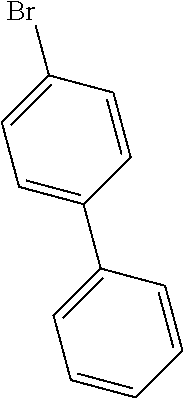 |
| 27 |
 |
 |
 |
| 28 |
 |
 |
 |
| 29 |
 |
 |
 |
| 30 |
 |
 |
 |
| 31 |
 |
 |
 |
| 32 |
 |
 |
 |
| 33 |
 |
 |
 |
| 34 |
 |
 |
 |
| 35 |
 |
 |
 |
| Mass | |||
| Synthesis | Spectrometry m/z | ||
| Example | Compound | Yield/% | [M + H]+ |
| 2 |
 |
42.3 | 703.3 |
| 3 |
 |
46.7 | 663.3 |
| 4 |
 |
47.9 | 805.4 |
| 5 |
 |
50.2 | 855.3 |
| 6 |
 |
39.8 | 819.3 |
| 7 |
 |
42.7 | 783.4 |
| 8 |
 |
56.1 | 793.4 |
| 9 |
 |
49.4 | 789.3 |
| 10 | 52.8 | 663.3 | |
| 11 | 51.6 | 815.3 | |
| 12 | 43.9 | 779.3 | |
| 13 | 46.7 | 743.3 | |
| 14 | 55.6 | 753.3 | |
| 15 | 51.9 | 803.3 | |
| 16 | 59.5 | 779.3 | |
| 17 | 56.8 | 769.3 | |
| 18 |
 |
60.1 | 779.3 |
| 19 |
 |
59.2 | 765.3 |
| 20 |
 |
42.0 | 689.3 |
| 21 |
 |
42.3 | 779.3 |
| 22 |
 |
46.7 | 803.3 |
| 23 |
 |
47.9 | 815.3 |
| 24 |
 |
50.2 | 769.3 |
| 25 |
 |
39.8 | 779.3 |
| 26 |
 |
63.5 | 737.4 |
| 27 |
 |
46.3 | 772.4 |
| 28 |
 |
44.9 | 689.3 |
| 29 |
 |
51.1 | 707.3 |
| 30 |
 |
41.8 | 689.3 |
| 31 |
 |
43.2 | 669.3 |
| 32 |
 |
42.0 | 739.3 |
| 33 |
 |
39.7 | 642.3 |
| 34 |
 |
44.8 | 775.3 |
| 35 |
 |
43.6 | 703.3 |
The NMR data of some compounds are shown in Table 5.
| TABLE 5 | |
| Compound | NMR data 1H-NMR (400 MHZ, CD2Cl2) δ ppm |
| Compound 6 | 8.28 (d, 1H),7.92 (d, 1H), 7.78 (d, 1H), 7.68-7.64 (m, |
| 2H), 7.62 (d, 2H), 7.69-7.58 (m, 8H), 7.52 (d, 1H), | |
| 7.49-7.45 (m, 2H), 7.43-7.39 (m, 7H), 7.37-7.3 4 (m, | |
| 2H), 7.24 (t, 1H), 7.12 (d, 2H), 7.04 (d, 2H), 6.92 (d, | |
| 4H). | |
| Compound 80 | 8.16 (d, 1H), 8.02 (d, 1H), 7.98 (d, 1H), 7.88 (d, 1H), |
| 7.79-7.75 (m, 2H), 7.72 (d, 1H), 7.69-7.64 (m, 4H), | |
| 7.62-7.58 (m, 5H), 7.55-7.47 (m, 9H), 7.46-7.42 | |
| (m, 4H), 7.39-7.34 (m, 5H), 7.30 (d, 1H), 7.21 | |
| (t, 1H), 7.08-7.04 (m, 4H), 6.94 (d, 2H). | |
| | 8.21 (d, 1H), 8.07-8.02 (m, 3H), 7.98-7.92 (m, 5H), |
| 7.89-7.85 (m, 2H), 7.68 (s, 1H), 7.65-7.62 (m, 1H), | |
| 7.58-7.50 (m, 9H), 7.46-7.42 (m, 4H), 7.39-7.32 (m, | |
| 5H), 7.09 (d, 1H), 6.98 (d, 2H), 6.95 (d, 1H), 6.93 | |
| (s, 1H). | |
Examples of Fabrication and Evaluation of Organic Electroluminescent Devices
Preparing anode of the device: A glass substrate coated with ITO/Ag/ITO three-layer materials (with a thicknesses of 70 Å, 1000 Å, and 100 Å, respectively) was cut to dimensions of 40 mm×40 mm×0.7 mm, and then fabricated, by a photoetching process, into an experimental substrate with a cathode, an anode, and patterns of an insulation layer, and the surface was first cleaned by using ultrapure water and isopropanol to clean the pollutants on the surface of the substrate; then 02: N2 plasma gas was used to treat the surface of the substrate.
Compound F4-TCNQ was deposited on the experimental substrate (anode) to form a hole injection layer (HIL) with a thickness of 100 Å, and HT-1 was deposited on the surface of the hole injection layer to form a first hole transport layer (HTL-1) with a thickness of 950 Å.
Compound 6 was deposited by vacuum evaporation on the first hole transport layer to form a second hole transport layer (HTL-2) with a thickness of 50 Å.
On the second hole transport layer, the compounds BD-1 and BH-1 were deposited at a weight ratio of 2%:98% to form an organic light emitting layer (EML) with a thickness of 200 Å.
On the organic light emitting layer, the compounds ET-1 and LiQ were co-deposited at a weight ratio of 1:1 to form an electron transport layer (ETL) with a thickness of 350 Å.
Ytterbium (Yb) was deposited on the electron transport layer to form an electron injection layer (EIL) with a thickness of 20 Å.
On the electron injection layer, magnesium (Mg) and silver (Ag) were co-deposited at a weight ratio of 1:9 to form a cathode with a thickness of 130 Å.
Finally, CP-05 was deposited on the above cathode to form an organic coating layer (CPL) with a thickness of 750 Å, thereby completing the preparation of the organic light emitting device.
Organic electroluminescent devices were fabricated by the same method as used in Example 1, except that Compound 6 in Example 1 was replaced by the Compounds shown in Table 6 (column “HTL-2”) when a second hole transport layer was formed.
Organic electroluminescent devices were fabricated respectively by the same method as used in Example 1, except that Compound 6 in Example 1 was replaced by Compound A, Compound B, Compound C and Compound D respectively when a second hole transport layer was formed.
Structures of the main materials used in the Examples and Comparative Examples are as follows:


The organic electroluminescent devices fabricated in Examples 1 to 35 and Comparative Examples 1 to 4 were tested for their performance. Specifically, the IVL characteristics of the devices were tested under the condition of 10 mA/cm2, and the T95 lifetime of the devices was tested under the condition of 15 mA/cm2. Test results are shown in Table 6.
| TABLE 6 | |||||
| Operating | Luminescence | Color | T95 | ||
| Voltage | Efficiency | Coordinate | Lifetime | ||
| NO. | HTL-2 | (V) | Cd/A | CIEy | (h) |
| Example 1 | Compound 6 | 4.00 | 5.97 | 0.05 | 178 |
| Example 2 | Compound 27 | 3.97 | 6.21 | 0.05 | 182 |
| Example 3 | Compound 44 | 3.95 | 6.19 | 0.05 | 174 |
| Example 4 | Compound 64 | 3.97 | 6.23 | 0.05 | 181 |
| Example 5 | Compound 80 | 4.01 | 6.11 | 0.05 | 166 |
| Example 6 | Compound 66 | 3.98 | 6.23 | 0.05 | 171 |
| Example 7 | Compound 94 | 3.79 | 6.10 | 0.05 | 178 |
| Example 8 | Compound 99 | 3.93 | 6.04 | 0.05 | 168 |
| Example 9 | Compound 101 | 3.93 | 6.13 | 0.05 | 174 |
| Example 10 | Compound 123 | 4.00 | 6.18 | 0.05 | 184 |
| Example 11 | Compound 129 | 3.96 | 6.04 | 0.05 | 175 |
| Example 12 | Compound 131 | 4.00 | 6.07 | 0.05 | 187 |
| Example 13 | Compound 395 | 4.06 | 5.89 | 0.05 | 177 |
| Example 14 | Compound 366 | 3.92 | 6.12 | 0.05 | 182 |
| Example 15 | Compound 148 | 4.01 | 6.03 | 0.05 | 184 |
| Example 16 | Compound 173 | 3.92 | 6.30 | 0.05 | 173 |
| Example 17 | Compound 184 | 3.91 | 6.11 | 0.05 | 176 |
| Example 18 | Compound 193 | 3.99 | 5.99 | 0.05 | 172 |
| Example 19 | Compound 210 | 3.93 | 6.20 | 0.05 | 167 |
| Example 20 | Compound 224 | 3.94 | 6.04 | 0.05 | 172 |
| Example 21 | Compound 12 | 3.91 | 6.06 | 0.05 | 167 |
| Example 22 | Compound 13 | 3.95 | 5.98 | 0.05 | 170 |
| Example 23 | Compound 35 | 3.86 | 6.12 | 0.05 | 176 |
| Example 24 | Compound 14 | 3.89 | 5.97 | 0.05 | 182 |
| Example 25 | Compound 9 | 3.86 | 5.98 | 0.05 | 174 |
| Example 26 | Compound 26 | 3.85 | 6.19 | 0.05 | 173 |
| Example 27 | Compound 258 | 3.92 | 5.99 | 0.05 | 184 |
| Example 28 | Compound 275 | 3.81 | 5.87 | 0.05 | 176 |
| Example 29 | Compound 285 | 3.87 | 5.94 | 0.05 | 172 |
| Example 20 | Compound 300 | 3.89 | 5.79 | 0.05 | 176 |
| Example 31 | Compound 320 | 3.83 | 6.01 | 0.05 | 175 |
| Example 32 | Compound 353 | 3.86 | 5.68 | 0.05 | 179 |
| Example 33 | Compound 383 | 3.88 | 5.76 | 0.05 | 172 |
| Example 34 | Compound 390 | 3.89 | 5.88 | 0.05 | 182 |
| Example 35 | Compound 11 | 3.87 | 5.93 | 0.05 | 177 |
| Comparative | Compound A | 4.10 | 4.42 | 0.05 | 107 |
| Example 1 | |||||
| Comparative | Compound B | 4.11 | 4.35 | 0.05 | 132 |
| Example 2 | |||||
| Comparative | Compound C | 4.13 | 4.61 | 0.05 | 128 |
| Example 3 | |||||
| Comparative | Compound D | 4.08 | 4.29 | 0.05 | 116 |
| Example 4 | |||||
As can be seen from Table 6 above, compared with the organic electroluminescent devices prepared in Comparative Examples 1 to 4, performance of the organic electroluminescent devices prepared in Examples 1 to 35 using the nitrogen-containing compound of the present disclosure as the second hole transport layer material are improved, mainly as the luminescence efficiency of the device is increased by at least 23.2%, and the T95 lifetime is prolonged by at least 25.8%.
According to the test results of Comparative Example 4, it can be seen that compared to the triphenylene aryl with a large conjugation plane, the small structure aryl is connected at the position a or position b of

which increases the distortion of molecule in the spatial structure. Therefore, the material can maintain a high degree of amorphousness during the device manufacturing process, thereby improving the lifetime of the OLED device.
In summary, when the compound of the present disclosure is used as a second hole transport layer material to prepare an organic electroluminescent device, it can effectively prolong the lifetime of the organic electroluminescent device and improve the luminescence efficiency of the organic electroluminescent device.
The preferred embodiments of the present disclosure have been described in detail above with reference to the accompanying drawings. However, the present disclosure is not limited to the specific details of the above-mentioned embodiments. Within the scope of the technical concept of the present disclosure, various simple modifications can be made to the technical solution of the present disclosure. These simple modifications all belong to the protection scope of this disclosure. In addition, it should be noted that each of the specific technical features described in the above-mentioned specific embodiments can be combined in any suitable manner without conflict. In order to avoid unnecessary repetition, this disclosure describes various possible combinations. The combination method will not be further explained.
Claims (11)
1. A nitrogen-containing compound having a structure shown in the following Formula 1:

wherein, R2 to R9 are identical or different, and each is independently hydrogen or deuterium;
R1 and R10 are identical or different, and each is independently selected from hydrogen, deuterium, and group A, and only one of R1 and R10 is selected from group A, and the group A is selected from an aryl having 6 to 12 carbon atoms, and a deuterated aryl having 6 to 12 carbon atoms;
Ar1 and Ar2 are identical or different, and each is independently selected from a substituted or unsubstituted phenyl, a substituted or unsubstituted naphthyl, a substituted or unsubstituted biphenyl, a substituted or unsubstituted terphenyl, a substituted or unsubstituted phenanthryl, a substituted or unsubstituted anthryl, a substituted or unsubstituted fluorenyl, a substituted or unsubstituted dibenzofuranyl, a substituted or substituted dibenzothienyl, and a substituted or unsubstituted carbazolyl;
substituent(s) in Ar1 and Ar2 are each independently selected from deuterium, fluorine, cyano, methyl, ethyl, n-propyl, isopropyl, tert-butyl, phenyl, naphthyl, trideuteromethyl, trifluoromethyl, and trimethylsilyl; optionally, any two adjacent substituents form a benzene ring, or a fluorene ring;
each L is independently selected from a substituted or unsubstituted phenylene, a substituted or unsubstituted naphthylene, a substituted or unsubstituted biphenylene, a substituted or unsubstituted fluorenylene, a substituted or unsubstituted dibenzothienylene, a substituted or unsubstituted dibenzofuranylene, and a substituted or unsubstituted carbazolylene, n represents 1 or 2, and when n is 2, each L is identical or different;
substituent(s) in L are identical or different, and each is independently selected from deuterium, fluorine, cyano, methyl, ethyl, isopropyl, and tert-butyl;
L1 and L2 are identical or different, and each is independently selected from a single bond, a substituted or unsubstituted phenylene, and a substituted or unsubstituted naphthylene;
substituent(s) in L1 and L2 are identical or different, and each is independently selected from deuterium, fluorine, cyano, methyl, ethyl, isopropyl, tert-butyl, and phenyl.
2. The nitrogen-containing compound according to claim 1 , wherein group A is selected from a deuterium-substituted or unsubstituted phenyl, a deuterium-substituted or unsubstituted naphthyl, and a deuterium-substituted or unsubstituted biphenyl.
3. The nitrogen-containing compound according to claim 1 , wherein Ar1 and Ar2 are each independently selected from a substituted or unsubstituted group V, and the unsubstituted group V is selected from the following groups:

the substituted group V has one or more substituent(s), and each substituent is independently selected from deuterium, fluorine, cyano, methyl, ethyl, isopropyl, tert-butyl, trimethylsilyl, trideuteromethyl, trifluoromethyl, phenyl, and naphthyl.
4. The nitrogen-containing compound according to claim 1 , wherein Ar1 and Ar2 are each independently selected from the group consisting of the following groups:

5. The nitrogen-containing compound according to claim 1 , wherein each L is independently selected from the group consisting of the following groups:

L1 and L2 are each independently selected from the group consisting of a single bond and the following groups:

6. The nitrogen-containing compound according to claim 1 , wherein the nitrogen-containing compound is selected from the group consisting of the following compounds:


7. An electronic element, comprising an anode and a cathode disposed opposite to each other, and a functional layer disposed between the anode and the cathode; wherein the functional layer comprises the nitrogen-containing compound according to claim 1 .
8. The electronic element according to claim 7 , wherein the functional layer comprises a hole transport layer, and the hole transport layer comprises the nitrogen-containing compound.
9. The electronic element according to claim 7 , wherein the electronic element is an organic electroluminescent device, and the hole transport layer comprises a first hole transport layer and a second hole transport layer that are stacked in sequence, and relative to the second hole transport layer, the first hole transport layer is closer to the anode; wherein the second hole transport layer comprises the nitrogen-containing compound.
10. An electronic device, comprising the electronic element according to claim 7 .
11. The electronic element according to claim 7 , wherein the electronic element is selected from an organic electroluminescent device and a photoelectric conversion device.
Applications Claiming Priority (3)
| Application Number | Priority Date | Filing Date | Title |
|---|---|---|---|
| CN202210988201.1A CN115650899B (en) | 2022-08-17 | 2022-08-17 | Nitrogen-containing compound, electronic component and electronic device |
| CN202210988201.1 | 2022-08-17 | ||
| PCT/CN2023/094373 WO2024037073A1 (en) | 2022-08-17 | 2023-05-15 | Nitrogen-containing compound, electronic element and electronic device |
Publications (2)
| Publication Number | Publication Date |
|---|---|
| US20250115554A1 US20250115554A1 (en) | 2025-04-10 |
| US12338217B2 true US12338217B2 (en) | 2025-06-24 |
Family
ID=85023954
Family Applications (1)
| Application Number | Title | Priority Date | Filing Date |
|---|---|---|---|
| US18/728,862 Active US12338217B2 (en) | 2022-08-17 | 2023-05-15 | Nitrogen-containing compound, electronic element and electronic device |
Country Status (3)
| Country | Link |
|---|---|
| US (1) | US12338217B2 (en) |
| CN (1) | CN115650899B (en) |
| WO (1) | WO2024037073A1 (en) |
Families Citing this family (2)
| Publication number | Priority date | Publication date | Assignee | Title |
|---|---|---|---|---|
| CN115650899B (en) | 2022-08-17 | 2024-05-10 | 陕西莱特光电材料股份有限公司 | Nitrogen-containing compound, electronic component and electronic device |
| CN119143742A (en) * | 2023-06-15 | 2024-12-17 | 京东方科技集团股份有限公司 | Functional layer material, light emitting device, and display panel |
Citations (8)
| Publication number | Priority date | Publication date | Assignee | Title |
|---|---|---|---|---|
| CN103827257A (en) | 2012-02-27 | 2014-05-28 | 株式会社Lg化学 | Organic light emitting diode |
| KR20160029721A (en) | 2014-09-05 | 2016-03-15 | 주식회사 엘지화학 | Multicyclic compound including nitrogen and organic electronic device using the same |
| CN105980521A (en) | 2014-08-20 | 2016-09-28 | 株式会社Lg化学 | organic light emitting device |
| KR20170058177A (en) | 2015-11-18 | 2017-05-26 | 주식회사 두산 | Organic compounds and organic electro luminescence device comprising the same |
| CN108780853A (en) | 2016-04-18 | 2018-11-09 | 罗门哈斯电子材料韩国有限公司 | A variety of material of main parts and organic electroluminescence device comprising it |
| CN112300053A (en) | 2019-07-15 | 2021-02-02 | 罗门哈斯电子材料韩国有限公司 | Multiple host materials and organic electroluminescent device comprising the same |
| CN115650899A (en) | 2022-08-17 | 2023-01-31 | 陕西莱特光电材料股份有限公司 | Nitrogen-containing compound, electronic component, and electronic device |
| CN116947735A (en) | 2022-04-12 | 2023-10-27 | 北京鼎材科技有限公司 | Organic electroluminescent material, organic electroluminescent device and application thereof |
-
2022
- 2022-08-17 CN CN202210988201.1A patent/CN115650899B/en active Active
-
2023
- 2023-05-15 US US18/728,862 patent/US12338217B2/en active Active
- 2023-05-15 WO PCT/CN2023/094373 patent/WO2024037073A1/en not_active Ceased
Patent Citations (8)
| Publication number | Priority date | Publication date | Assignee | Title |
|---|---|---|---|---|
| CN103827257A (en) | 2012-02-27 | 2014-05-28 | 株式会社Lg化学 | Organic light emitting diode |
| CN105980521A (en) | 2014-08-20 | 2016-09-28 | 株式会社Lg化学 | organic light emitting device |
| KR20160029721A (en) | 2014-09-05 | 2016-03-15 | 주식회사 엘지화학 | Multicyclic compound including nitrogen and organic electronic device using the same |
| KR20170058177A (en) | 2015-11-18 | 2017-05-26 | 주식회사 두산 | Organic compounds and organic electro luminescence device comprising the same |
| CN108780853A (en) | 2016-04-18 | 2018-11-09 | 罗门哈斯电子材料韩国有限公司 | A variety of material of main parts and organic electroluminescence device comprising it |
| CN112300053A (en) | 2019-07-15 | 2021-02-02 | 罗门哈斯电子材料韩国有限公司 | Multiple host materials and organic electroluminescent device comprising the same |
| CN116947735A (en) | 2022-04-12 | 2023-10-27 | 北京鼎材科技有限公司 | Organic electroluminescent material, organic electroluminescent device and application thereof |
| CN115650899A (en) | 2022-08-17 | 2023-01-31 | 陕西莱特光电材料股份有限公司 | Nitrogen-containing compound, electronic component, and electronic device |
Also Published As
| Publication number | Publication date |
|---|---|
| WO2024037073A1 (en) | 2024-02-22 |
| CN115650899B (en) | 2024-05-10 |
| US20250115554A1 (en) | 2025-04-10 |
| CN115650899A (en) | 2023-01-31 |
Similar Documents
| Publication | Publication Date | Title |
|---|---|---|
| US11718583B2 (en) | Nitrogen-containing compound, electronic component using same and electronic device | |
| US20230322656A1 (en) | Organic compound, and electronic component and electronic device having same | |
| US11655206B2 (en) | Nitrogen-containing compound, electronic element, and electronic device | |
| US9102616B2 (en) | Organic compound, organic electronic device using same, and terminal for same | |
| US12457900B2 (en) | Organic compound, and electronic element and electronic device using same | |
| US20230269958A1 (en) | Organic compound, and electronic component and electronic device having same | |
| US20230200224A1 (en) | Nitrogen-containing compound, and electronic element and electronic device having same | |
| US11444252B2 (en) | Nitrogen-containing compound, organic electroluminescent device and electronic apparatus | |
| US12108660B2 (en) | Organic compound, electronic component, and electronic apparatus | |
| US12144247B2 (en) | Organic compound and electronic device and electronic apparatus thereof | |
| US20230146030A1 (en) | Arylamine compound, electronic component using same and electronic device | |
| US11492314B2 (en) | Organic compound, organic electroluminescent device and electronic apparatus | |
| US20230242484A1 (en) | Nitrogen-containing compound, and electronic element and electronic apparatus using same | |
| US20240244961A1 (en) | Organic compound, electronic element and electronic apparatus | |
| US20220388944A1 (en) | Nitrogen-containing compound, organic electroluminescent device, and electronic apparatus | |
| US20250109091A1 (en) | Nitrogen-containing compound, electronic element, and electronic device | |
| US11849637B2 (en) | Nitrogen-containing compound, electronic component comprising same, and electronic apparatus | |
| US11795389B2 (en) | Nitrogen-containing compound, electronic component, and electronic device | |
| US11098022B2 (en) | Nitrogen-containing compound, electronic component and electronic device | |
| US20240217956A1 (en) | Organic compounds, organic electroluminescent device and electronic apparatus | |
| US20230200225A1 (en) | Nitrogen-containing compound, electronic component, and electronic device | |
| US20230320205A1 (en) | Nitrogen-containing compound, organic electroluminescent device, and electronic apparatus | |
| US20240114775A1 (en) | Nitrogen-containing compound, and electronic element and electronic device comprising same | |
| US20230183191A1 (en) | Nitrogen-containing compound, electronic element, and electronic device | |
| US12048240B2 (en) | Organic compound, electronic component and electronic apparatus comprising the same |
Legal Events
| Date | Code | Title | Description |
|---|---|---|---|
| FEPP | Fee payment procedure |
Free format text: ENTITY STATUS SET TO UNDISCOUNTED (ORIGINAL EVENT CODE: BIG.); ENTITY STATUS OF PATENT OWNER: SMALL ENTITY |
|
| FEPP | Fee payment procedure |
Free format text: ENTITY STATUS SET TO SMALL (ORIGINAL EVENT CODE: SMAL); ENTITY STATUS OF PATENT OWNER: SMALL ENTITY |
|
| AS | Assignment |
Owner name: SHAANXI LIGHTE OPTOELECTRONICS MATERIAL CO., LTD., CHINA Free format text: ASSIGNMENT OF ASSIGNORS INTEREST;ASSIGNORS:YUE, FUMIN;LI, CHAOCHAO;XU, JIACONG;REEL/FRAME:070341/0034 Effective date: 20240606 |
|
| STCF | Information on status: patent grant |
Free format text: PATENTED CASE |