US12337301B2 - Iron nanoparticles and methods of production - Google Patents
Iron nanoparticles and methods of production Download PDFInfo
- Publication number
- US12337301B2 US12337301B2 US17/214,161 US202117214161A US12337301B2 US 12337301 B2 US12337301 B2 US 12337301B2 US 202117214161 A US202117214161 A US 202117214161A US 12337301 B2 US12337301 B2 US 12337301B2
- Authority
- US
- United States
- Prior art keywords
- nanoparticles
- iron
- polyphenol
- suspension
- average diameter
- Prior art date
- Legal status (The legal status is an assumption and is not a legal conclusion. Google has not performed a legal analysis and makes no representation as to the accuracy of the status listed.)
- Active, expires
Links
Images




Classifications
-
- B—PERFORMING OPERATIONS; TRANSPORTING
- B01—PHYSICAL OR CHEMICAL PROCESSES OR APPARATUS IN GENERAL
- B01J—CHEMICAL OR PHYSICAL PROCESSES, e.g. CATALYSIS OR COLLOID CHEMISTRY; THEIR RELEVANT APPARATUS
- B01J23/00—Catalysts comprising metals or metal oxides or hydroxides, not provided for in group B01J21/00
- B01J23/70—Catalysts comprising metals or metal oxides or hydroxides, not provided for in group B01J21/00 of the iron group metals or copper
- B01J23/74—Iron group metals
- B01J23/745—Iron
-
- B—PERFORMING OPERATIONS; TRANSPORTING
- B01—PHYSICAL OR CHEMICAL PROCESSES OR APPARATUS IN GENERAL
- B01J—CHEMICAL OR PHYSICAL PROCESSES, e.g. CATALYSIS OR COLLOID CHEMISTRY; THEIR RELEVANT APPARATUS
- B01J35/00—Catalysts, in general, characterised by their form or physical properties
- B01J35/20—Catalysts, in general, characterised by their form or physical properties characterised by their non-solid state
- B01J35/23—Catalysts, in general, characterised by their form or physical properties characterised by their non-solid state in a colloidal state
-
- B—PERFORMING OPERATIONS; TRANSPORTING
- B01—PHYSICAL OR CHEMICAL PROCESSES OR APPARATUS IN GENERAL
- B01J—CHEMICAL OR PHYSICAL PROCESSES, e.g. CATALYSIS OR COLLOID CHEMISTRY; THEIR RELEVANT APPARATUS
- B01J35/00—Catalysts, in general, characterised by their form or physical properties
- B01J35/30—Catalysts, in general, characterised by their form or physical properties characterised by their physical properties
-
- B—PERFORMING OPERATIONS; TRANSPORTING
- B01—PHYSICAL OR CHEMICAL PROCESSES OR APPARATUS IN GENERAL
- B01J—CHEMICAL OR PHYSICAL PROCESSES, e.g. CATALYSIS OR COLLOID CHEMISTRY; THEIR RELEVANT APPARATUS
- B01J35/00—Catalysts, in general, characterised by their form or physical properties
- B01J35/30—Catalysts, in general, characterised by their form or physical properties characterised by their physical properties
- B01J35/391—Physical properties of the active metal ingredient
- B01J35/393—Metal or metal oxide crystallite size
-
- B—PERFORMING OPERATIONS; TRANSPORTING
- B01—PHYSICAL OR CHEMICAL PROCESSES OR APPARATUS IN GENERAL
- B01J—CHEMICAL OR PHYSICAL PROCESSES, e.g. CATALYSIS OR COLLOID CHEMISTRY; THEIR RELEVANT APPARATUS
- B01J35/00—Catalysts, in general, characterised by their form or physical properties
- B01J35/40—Catalysts, in general, characterised by their form or physical properties characterised by dimensions, e.g. grain size
-
- B—PERFORMING OPERATIONS; TRANSPORTING
- B01—PHYSICAL OR CHEMICAL PROCESSES OR APPARATUS IN GENERAL
- B01J—CHEMICAL OR PHYSICAL PROCESSES, e.g. CATALYSIS OR COLLOID CHEMISTRY; THEIR RELEVANT APPARATUS
- B01J35/00—Catalysts, in general, characterised by their form or physical properties
- B01J35/40—Catalysts, in general, characterised by their form or physical properties characterised by dimensions, e.g. grain size
- B01J35/45—Nanoparticles
-
- B—PERFORMING OPERATIONS; TRANSPORTING
- B01—PHYSICAL OR CHEMICAL PROCESSES OR APPARATUS IN GENERAL
- B01J—CHEMICAL OR PHYSICAL PROCESSES, e.g. CATALYSIS OR COLLOID CHEMISTRY; THEIR RELEVANT APPARATUS
- B01J35/00—Catalysts, in general, characterised by their form or physical properties
- B01J35/70—Catalysts, in general, characterised by their form or physical properties characterised by their crystalline properties, e.g. semi-crystalline
-
- B—PERFORMING OPERATIONS; TRANSPORTING
- B01—PHYSICAL OR CHEMICAL PROCESSES OR APPARATUS IN GENERAL
- B01J—CHEMICAL OR PHYSICAL PROCESSES, e.g. CATALYSIS OR COLLOID CHEMISTRY; THEIR RELEVANT APPARATUS
- B01J37/00—Processes, in general, for preparing catalysts; Processes, in general, for activation of catalysts
- B01J37/02—Impregnation, coating or precipitation
- B01J37/0215—Coating
- B01J37/0221—Coating of particles
-
- B—PERFORMING OPERATIONS; TRANSPORTING
- B01—PHYSICAL OR CHEMICAL PROCESSES OR APPARATUS IN GENERAL
- B01J—CHEMICAL OR PHYSICAL PROCESSES, e.g. CATALYSIS OR COLLOID CHEMISTRY; THEIR RELEVANT APPARATUS
- B01J37/00—Processes, in general, for preparing catalysts; Processes, in general, for activation of catalysts
- B01J37/16—Reducing
-
- C—CHEMISTRY; METALLURGY
- C01—INORGANIC CHEMISTRY
- C01B—NON-METALLIC ELEMENTS; COMPOUNDS THEREOF; METALLOIDS OR COMPOUNDS THEREOF NOT COVERED BY SUBCLASS C01C
- C01B21/00—Nitrogen; Compounds thereof
- C01B21/06—Binary compounds of nitrogen with metals, with silicon, or with boron, or with carbon, i.e. nitrides; Compounds of nitrogen with more than one metal, silicon or boron
- C01B21/064—Binary compounds of nitrogen with metals, with silicon, or with boron, or with carbon, i.e. nitrides; Compounds of nitrogen with more than one metal, silicon or boron with boron
-
- C—CHEMISTRY; METALLURGY
- C01—INORGANIC CHEMISTRY
- C01B—NON-METALLIC ELEMENTS; COMPOUNDS THEREOF; METALLOIDS OR COMPOUNDS THEREOF NOT COVERED BY SUBCLASS C01C
- C01B32/00—Carbon; Compounds thereof
- C01B32/15—Nano-sized carbon materials
- C01B32/158—Carbon nanotubes
- C01B32/16—Preparation
- C01B32/162—Preparation characterised by catalysts
-
- C—CHEMISTRY; METALLURGY
- C23—COATING METALLIC MATERIAL; COATING MATERIAL WITH METALLIC MATERIAL; CHEMICAL SURFACE TREATMENT; DIFFUSION TREATMENT OF METALLIC MATERIAL; COATING BY VACUUM EVAPORATION, BY SPUTTERING, BY ION IMPLANTATION OR BY CHEMICAL VAPOUR DEPOSITION, IN GENERAL; INHIBITING CORROSION OF METALLIC MATERIAL OR INCRUSTATION IN GENERAL
- C23C—COATING METALLIC MATERIAL; COATING MATERIAL WITH METALLIC MATERIAL; SURFACE TREATMENT OF METALLIC MATERIAL BY DIFFUSION INTO THE SURFACE, BY CHEMICAL CONVERSION OR SUBSTITUTION; COATING BY VACUUM EVAPORATION, BY SPUTTERING, BY ION IMPLANTATION OR BY CHEMICAL VAPOUR DEPOSITION, IN GENERAL
- C23C16/00—Chemical coating by decomposition of gaseous compounds, without leaving reaction products of surface material in the coating, i.e. chemical vapour deposition [CVD] processes
- C23C16/22—Chemical coating by decomposition of gaseous compounds, without leaving reaction products of surface material in the coating, i.e. chemical vapour deposition [CVD] processes characterised by the deposition of inorganic material, other than metallic material
- C23C16/26—Deposition of carbon only
-
- B—PERFORMING OPERATIONS; TRANSPORTING
- B01—PHYSICAL OR CHEMICAL PROCESSES OR APPARATUS IN GENERAL
- B01J—CHEMICAL OR PHYSICAL PROCESSES, e.g. CATALYSIS OR COLLOID CHEMISTRY; THEIR RELEVANT APPARATUS
- B01J2235/00—Indexing scheme associated with group B01J35/00, related to the analysis techniques used to determine the catalysts form or properties
- B01J2235/10—Infrared [IR]
-
- B—PERFORMING OPERATIONS; TRANSPORTING
- B01—PHYSICAL OR CHEMICAL PROCESSES OR APPARATUS IN GENERAL
- B01J—CHEMICAL OR PHYSICAL PROCESSES, e.g. CATALYSIS OR COLLOID CHEMISTRY; THEIR RELEVANT APPARATUS
- B01J2235/00—Indexing scheme associated with group B01J35/00, related to the analysis techniques used to determine the catalysts form or properties
- B01J2235/15—X-ray diffraction
-
- B—PERFORMING OPERATIONS; TRANSPORTING
- B01—PHYSICAL OR CHEMICAL PROCESSES OR APPARATUS IN GENERAL
- B01J—CHEMICAL OR PHYSICAL PROCESSES, e.g. CATALYSIS OR COLLOID CHEMISTRY; THEIR RELEVANT APPARATUS
- B01J2235/00—Indexing scheme associated with group B01J35/00, related to the analysis techniques used to determine the catalysts form or properties
- B01J2235/30—Scanning electron microscopy; Transmission electron microscopy
-
- B—PERFORMING OPERATIONS; TRANSPORTING
- B82—NANOTECHNOLOGY
- B82Y—SPECIFIC USES OR APPLICATIONS OF NANOSTRUCTURES; MEASUREMENT OR ANALYSIS OF NANOSTRUCTURES; MANUFACTURE OR TREATMENT OF NANOSTRUCTURES
- B82Y40/00—Manufacture or treatment of nanostructures
-
- Y—GENERAL TAGGING OF NEW TECHNOLOGICAL DEVELOPMENTS; GENERAL TAGGING OF CROSS-SECTIONAL TECHNOLOGIES SPANNING OVER SEVERAL SECTIONS OF THE IPC; TECHNICAL SUBJECTS COVERED BY FORMER USPC CROSS-REFERENCE ART COLLECTIONS [XRACs] AND DIGESTS
- Y10—TECHNICAL SUBJECTS COVERED BY FORMER USPC
- Y10S—TECHNICAL SUBJECTS COVERED BY FORMER USPC CROSS-REFERENCE ART COLLECTIONS [XRACs] AND DIGESTS
- Y10S977/00—Nanotechnology
- Y10S977/70—Nanostructure
- Y10S977/734—Fullerenes, i.e. graphene-based structures, such as nanohorns, nanococoons, nanoscrolls or fullerene-like structures, e.g. WS2 or MoS2 chalcogenide nanotubes, planar C3N4, etc.
- Y10S977/742—Carbon nanotubes, CNTs
-
- Y—GENERAL TAGGING OF NEW TECHNOLOGICAL DEVELOPMENTS; GENERAL TAGGING OF CROSS-SECTIONAL TECHNOLOGIES SPANNING OVER SEVERAL SECTIONS OF THE IPC; TECHNICAL SUBJECTS COVERED BY FORMER USPC CROSS-REFERENCE ART COLLECTIONS [XRACs] AND DIGESTS
- Y10—TECHNICAL SUBJECTS COVERED BY FORMER USPC
- Y10S—TECHNICAL SUBJECTS COVERED BY FORMER USPC CROSS-REFERENCE ART COLLECTIONS [XRACs] AND DIGESTS
- Y10S977/00—Nanotechnology
- Y10S977/84—Manufacture, treatment, or detection of nanostructure
- Y10S977/842—Manufacture, treatment, or detection of nanostructure for carbon nanotubes or fullerenes
- Y10S977/843—Gas phase catalytic growth, i.e. chemical vapor deposition
-
- Y—GENERAL TAGGING OF NEW TECHNOLOGICAL DEVELOPMENTS; GENERAL TAGGING OF CROSS-SECTIONAL TECHNOLOGIES SPANNING OVER SEVERAL SECTIONS OF THE IPC; TECHNICAL SUBJECTS COVERED BY FORMER USPC CROSS-REFERENCE ART COLLECTIONS [XRACs] AND DIGESTS
- Y10—TECHNICAL SUBJECTS COVERED BY FORMER USPC
- Y10S—TECHNICAL SUBJECTS COVERED BY FORMER USPC CROSS-REFERENCE ART COLLECTIONS [XRACs] AND DIGESTS
- Y10S977/00—Nanotechnology
- Y10S977/84—Manufacture, treatment, or detection of nanostructure
- Y10S977/89—Deposition of materials, e.g. coating, cvd, or ald
- Y10S977/891—Vapor phase deposition
Definitions
- This disclosure relates to nanoparticles, and more particularly to iron nanoparticle catalysts for production of nanotubes.
- Metal nanoparticles can be used as catalysts for a variety of chemical processes, including the production of carbon or boron nitride nanotubes.
- Metallic nanoparticles may also function as catalysts for the Fisher Trope Process, where carbon monoxide is transformed into hydrocarbons, for drug attachment, and for delivering drugs to the body where magnetic fields can assist particle motion and insure accurate placement.
- One example embodiment of the present disclosure provides a plurality of nanoparticles, each nanoparticle including an elemental iron core coated with a polyphenol that isolates the core from oxygen, the plurality of nanoparticles having an average diameter of less than or equal to 50 nanometers.
- the nanoparticles have an average diameter within a range from 5 to 25 nm. In other cases, the nanoparticles have an average diameter of 15.8 nm.
- the polyphenol is one of epigallocatechin gallate, epicatechin, epigallocatechin, and gallocatechin.
- the elemental iron core further includes a secondary metal to form an iron-alloy. In some such cases, the secondary metal is a transition metal.
- the nanoparticles have an average diameter of less than or equal to 8.5 nm. In some cases, the nanoparticles have an average diameter of less than 10 nm with a standard deviation of less than 3 nm. In other cases, the nanoparticles have an average diameter within a range from 5 to 25 nm and a standard deviation within a range from 1 to 4 nm. In yet some other cases, the nanoparticles have a face centered cubic (FFC) crystalline structure.
- FFC face centered cubic
- Another example embodiment of the present disclosure provides a suspension of iron nanoparticles including a plurality of independent, non-agglomerated iron nanoparticles, the nanoparticles comprising elemental iron and having an average diameter of less than 50 nm.
- the iron nanoparticles are suspended in an alcohol.
- the nanoparticle diameter distribution has a standard deviation of less than 3 nm.
- the nanoparticle diameter distribution has a standard deviation within a range from 1 to 3 nm.
- the iron nanoparticles include a polyphenol coating. In some such cases, the polyphenol is present in the suspension at a concentration of less than 1.5 g/L.
- the polyphenol is present in the suspension at a concentration within a range of 0.5 to 1.5 g/L.
- the nanoparticles further comprise copper.
- the nanoparticles have an average diameter of less than or equal to 6.1 nm.
- the nanoparticles include copper and have a diameter distribution that has a standard deviation of less than 1 nm.
- Another example embodiment of the present disclosure provides a method of producing iron nanoparticles, the method including mixing an iron salt comprising a ferrous or ferric ion with a long chain amine, thiol or polyphenol in a solvent comprising alcohol to produce a solution; reducing the ferric or ferrous ion to zero valence iron; initializing nucleation of iron nanoparticles; and capping the iron nanoparticles to retard nanoparticle growth.
- the alcohol comprises at least one of methanol and ethanol.
- the iron nanoparticles have an average diameter of less than or equal to 50 nm. In some such cases, the diameter distribution of the iron nanoparticles has a standard deviation of less than or equal to 3.7 nm.
- the diameter distribution of the iron nanoparticles has a standard deviation within a range from 1 to 3 nm.
- the solution comprises iron at a concentration of less than or equal to 2.5 g/L. In other cases, the solution comprises iron at a concentration within a range from 0.1 to 2.5 g/L. In yet other cases, the solution includes polyphenol at a concentration of less than or equal to 1.5 g/L. In some other cases, the solution includes iron at a concentration of greater than or equal to 0.5 g/L.
- the long chain amine, thiol or polyphenol is a polyphenol. In some such cases, the polyphenol is selected from epigallocatechin gallate, epicatechin, epigallocatechin, and gallocatechin.
- the method further includes adding copper to the solution to produce iron nanoparticles comprising copper.
- the nanoparticles have an average diameter of less than or equal to 15.8 nm. In some cases, the nanoparticles have an average diameter within a range from 5 to 25 nm. In yet other cases, the nanoparticles have an average diameter of less than or equal to 5.8 nm.
- Another example embodiment of the present disclosure provides a method of producing a nanotube, the method includes providing a plurality of nanoparticles to a furnace, the nanoparticles comprising an elemental iron core coated with a polyphenol that isolates the core from oxygen, the nanoparticles having an average diameter of less than or equal to 50 nanometers; removing the polyphenol from the plurality of nanoparticles to expose an iron surface of the nanoparticles; and catalyzing nanotube growth on the exposed surface of the nanoparticles.
- the plurality of nanoparticles is delivered to the furnace via an alcoholic suspension.
- the plurality of nanoparticles is deposited onto a substrate prior to the nanoparticles being provided to the furnace.
- the nanotubes are carbon nanotubes. In yet other cases, the nanotubes are boron nitride nanotubes. In some cases, the nanoparticles have an average diameter of less than 6.2 nm. In some other cases, the nanoparticles have an average diameter within a range from 5 to 25. In yet other cases, the nanoparticles have an average diameter of 15 nm.
- FIG. 1 is a schematic diagram of a reaction of FeCl2 and NaBH4 in ethanol to form iron nanoparticles, in accordance with an embodiment of the present disclosure.
- FIG. 2 is a schematic diagram of a reflux apparatus, in accordance with an embodiment of the present disclosure.
- FIG. 3 is a transmission electron microscope (TEM) image of polyphenol coated iron nanoparticles, in accordance with one embodiment of the present disclosure.
- FIG. 4 is a histogram illustrating a size distribution of 50 Chinese Green Tea (CGT) polyphenol coated iron nanoparticles from 0.5 g/L iron solution, in accordance with an embodiment of the present disclosure.
- CCT Chinese Green Tea
- FIG. 5 is a TEM image of 0.5 g/l iron nanoparticles created at 0° C. in Bigelow-Ethanol Tea (BET), in accordance with another embodiment of the present disclosure.
- FIG. 6 is a histogram illustrating a size distribution of 0.5 g/l iron nanoparticles at 0° C. in BET, in accordance with an embodiment of the present disclosure.
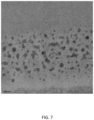
- FIG. 7 is a TEM image of 0.5 g/l iron nanoparticles at 25° C. in BET, in accordance with another embodiment of the present disclosure.
- FIG. 8 is a histogram illustrating a size distribution of 0.5 g/l iron nanoparticles at 25° C. in BET, in accordance with an embodiment of the present disclosure.
- FIG. 9 is a TEM image of 0.5 g/l iron nanoparticles at 70° C. in BET, in accordance with another embodiment of the present disclosure.
- FIG. 10 is a histogram illustrating a size distribution of 0.5 g/l iron nanoparticles at 70° C. in BET, in accordance with an embodiment of the present disclosure.
- FIG. 11 is a TEM image of nanoparticles made from 0.1 g/L iron with 0.94 g/L CGT polyphenols, in accordance with another embodiment of the present disclosure.
- FIG. 12 is a histogram illustrating a size distribution of nanoparticles made from 0.1 g/L iron with 0.94 g/L CGT polyphenols, in accordance with an embodiment of the present disclosure.
- FIG. 13 is a TEM image of nanoparticles made from 0.5 g/L iron with 0.94 g/L CGT polyphenols, in accordance with another embodiment of the present disclosure.
- FIG. 14 is a histogram illustrating a size distribution of nanoparticles made from 0.5 g/L iron with CGT 0.94 g/L polyphenols, in accordance with an embodiment of the present disclosure.
- FIG. 15 is a TEM image of nanoparticles made from 2.5 g/L iron with 0.94 g/L CGT polyphenols, in accordance with another embodiment of the present disclosure.
- FIG. 16 is a histogram illustrating a size distribution of nanoparticles made from 2.5 g/L iron with 0.94 g/L CGT polyphenols, in accordance with an embodiment of the present disclosure.
- FIG. 17 is a TEM image of nanoparticles made from 0.5 g/L iron with 1.5 g/L CGT polyphenols, in accordance with another embodiment of the present disclosure.
- FIG. 18 is a histogram illustrating a size distribution of nanoparticles made from 0.5 g/L with 1.5 g/L CGT polyphenols, in accordance with an embodiment of the present disclosure.
- FIG. 19 is a TEM image of nanoparticles made from 2.5 g/L iron with 1.5 g/L CGT polyphenols, in accordance with an embodiment of the present disclosure.
- FIG. 20 is a histogram illustrating a size distribution of nanoparticles made from 2.5 g/L Iron with 1.5 g/L CGT polyphenols, in accordance with an embodiment of the present disclosure.
- FIG. 21 is an infrared transmittance spectra of polyphenol coated nanoparticles, in accordance with an embodiment of the present disclosure.
- FIG. 22 provides x-ray diffraction data for 10 g/L iron nanoparticles at 25° C. on a linear scale, in accordance with an embodiment of the present disclosure.
- FIG. 23 provides x-ray diffraction data for 10 g/L iron nanoparticles at 25° C., in log scale, in accordance with an embodiment of the present disclosure.
- FIG. 24 provides x-ray diffraction data for 10 g/L iron nanoparticles at 250° C. in standard linear scale, in accordance with an embodiment of the present disclosure.
- FIG. 25 provides x-ray diffraction data for 10 g/L iron nanoparticles at 250° C. in log scale, in accordance with an embodiment of the present disclosure.
- the method can include mixing an iron salt including a ferrous or ferric ion with a long chain amine, thiol or polyphenol in a solvent comprising alcohol to produce a solution.
- Ferric or ferrous ion of the solution can be reduced to zero valence iron.
- Nucleation of iron nanoparticles is initialized to produce the particles.
- the produced nanoparticles can be iron nanoparticles that include an elemental iron core coated with a polyphenol. The polyphenol coating isolates the core of the iron nanoparticle to prevent the particle from reacting with oxygen present in the air of the surrounding environment.
- the nanoparticles include an average diameter of less than or equal to 15.8 nanometers, and thus are a suitable size for use as a catalyst to grow carbon or boron nitride nanotubes.
- the iron core may further include a secondary metal (e.g., a transition metal, such as copper) to form an iron-alloy.
- the secondary metal reduces the size of the nanoparticles so that the particles are properly sized to grow nanotubes such as carbon nanotubes or boron nitride nanotubes.
- the catalyst can be a nanoparticle made of a transition metal (e.g., iron, nickel or cobalt) or an alloy thereof. In some instances, the catalyst can also be more exotic and expensive transition metals (e.g., ruthenium, rhodium, palladium, gold, and silver) and non-transition metals (e.g., magnesium, boron, and silicon). Other metals, such as cobalt and nickel, can also be used as a catalyst, but these metals are potentially mutagenic.
- the catalyst is typically placed into a reaction chamber in which to grow the nanotubes. Thermal energy can be applied to the chamber to reduce the catalyst to an elemental state to support nanotube growth. In one example, nanotubes can be produced by heating ferrocene within a reaction chamber to reduce the ferrocene to iron nanoparticles on which nanotubes can grow. Thus, the catalyst and nanotube are produced together within the reaction chamber.
- Nanoparticle synthesis has garnered attention for technological applications, such as industrial processing and biomedical applications (e.g., cancer treatments).
- the size ranges of particles for these applications are in the nanostructural domain.
- Pure iron nanoparticles have been of particular interest for their reactivity and relative biological inertness.
- pure iron nanoparticles are difficult to manufacture outside a reaction chamber because oxide forms on the surface of the iron nanoparticles when the particles are exposed to air.
- iron nanoparticles also clump together over time to form larger particles that are not suitable for nanotube production.
- the iron nanoparticles can have a diameter suitable to grow nanotubes in a system, for example a catalyst chemical vapor deposition (CVD) system.
- the produced nanoparticles can have a narrow size distribution.
- the nanoparticles can also include a polyphenol coating that prevents the particles from reacting with air in the environment.
- polyphenol coated iron nanoparticles can be produced separately from nanotubes (e.g., the particles can be produced outside a reaction chamber in which the nanotubes are grown).
- the nanoparticles can include a secondary metal, such as copper, to reduce nanoparticle size.
- the nanoparticles can be substantially mono-modal in diameter distribution.
- the nanoparticles can be sub-10 nm diameter size iron nanoparticles, with a narrow size distribution.
- the small size of the nanoparticles causes the particles to experience a large amount of internal pressure that can affect the particle's crystal structure.
- Synthesis techniques control the particle size distribution.
- handling and surface purity are particularly important processes as the surface is sensitive to contamination. This is especially true for nanoparticles that form an oxide in air. Oxidation is enhanced by the small particle radius because there is an increased surface area for the smaller particles on which oxygen can form a bond.
- a capping agent can be included in a solution to create nanoparticles.
- Capping agents such as anionic surfactants and large chain amines (e.g., dodecylamine and hexadecylamine), can limit the size of the nanoparticle by inhibiting nanoparticle growth.
- Many naturally occurring compounds, such as polyphenols, can be used as a capping agent. Solutions that include capping agents can produce nanoparticles having a size on the order of single nanometers.
- the concentration of iron used can have an effect on the particle size. Increasing the concentration of iron within the reaction media produces smaller nanoparticles, (e.g., particle size was reduced from 5.95 nm to 5.76 nm) along with a decrease in the standard deviation (e.g., from 1.83 nm to 1.23 nm).
- X-ray diffraction is useful in determining the phase of the iron that comprises the nanoparticles.
- the x-ray spectra show that iron is present, but that it is in a distorted Face Centered Cubic (FCC) phase, believed to be caused by carbon impurities in the polyphenols.
- FCC Face Centered Cubic
- the lattice distortion resulted in a growth of crystal in the x-direction, but a reduction of crystalline growth in the y-direction. Crystalline growth in the z-direction remained constant.
- crystalline growth of the iron nanoparticles indicated that the impurities were present on the octahedral sites of the iron crystals (e.g., on any edge that was parallel to the x-axis).
- Nanoparticles can be used in a variety of applications, including biomedical applications and in the production of carbon and boron nitride nanotubes.
- the production of fixed chirality or fixed diameter nanotubes has proven elusive.
- the use of nanotubes is limited for some applications, such as in semi-conductors or as a replacement for copper wiring.
- nanoparticles as a catalyst for nanotubes, one can measure the diameter distribution of the catalysts prior to growth and predict the diameter of nanotubes grown from the catalyst.
- the size of the nanoparticles and the consistency of the size of the nanoparticles are important considerations.
- the ratio of the diameter of a nanoparticle to the diameter of a resulting nanotube can be, for example, between 1/0.7 and 1/0.9.
- the band gap of the nanotube is related to the inverse of the nanotube diameter.
- the nanotube diameter also affects its electrical properties. Oxides readily form on the surface of almost all metals, which can increase the size of these nanoparticles. It can also change the usefulness of the nanoparticles as the surface will react differently in comparison with the non-oxide metal surface.
- the rates of oxidation of nanoparticles can be very high due to, for example, thermal effects and high surface area.
- Reactions with other species such as hydroxide, sulfur and nitrogen can also occur. While the oxygen and other impurities can be removed by other means later in the process, it may limit the use of the nanoparticles in some applications. For example, in non-forest nanotube growth, where time is a factor for growth, there may not be sufficient time to reduce the iron-oxide nanoparticles to the metallic state, which is required for catalytic activity.
- One technique to help limit the size of the nanoparticles is to add in a secondary metal to the nanoparticle.
- the secondary metal will diffuse into the primary metal and often form an alloy.
- the secondary metal will increase the number of defects in the nanocrystal which may make it more energetically favorable to form new nanoparticles than to continue growing.
- the relative size distribution of the nanoparticles produced using a secondary metal may expand, and the chemical properties of the nanoparticles may also be altered. Additionally, large amounts of a secondary metal can increase the diameter of the nanoparticles.
- the magnetic and energetic properties of the nanoparticles cause them to cluster together to form macrostructures. These agglomerations are time dependent. Over a given period of time, these nanoparticles may lose their spherical structure and form crystalline, bulk like structures.
- an ionic surfactant can be added to the solution used to produce the nanoparticles. The surfactant binds to the nanoparticle and repels like coated particles. Although the ionic surfactant prevents the nanoparticles from clumping, it also causes a similar problem to that which is found with oxidation. The removal of the surfactant from the surface of the nanoparticles takes time, which can limit the usefulness of the nanoparticles in specific applications.
- capping agents such as long chain carbon molecules
- Appropriate capping agents include, for example, a long chain amine, thiol, or polyphenol. These long chain carbon molecules, such as hexadecylamine or octadecylamine, bind to the surface of the iron nanoparticles at locations where other iron atoms could attach to the particles. By preventing the attachment of nanoparticles to each other, particle growth is reduced and the iron cores remain separate from each other. In addition, the long chain carbon molecules repel each other, and thus limit or otherwise eliminate iron nanoparticle conglomerations.
- the nanoparticles can be capped iron-platinum particles having a size of, for example, 5 ⁇ 2 nm, or 7 ⁇ 1 nm.
- FIG. 1 is a schematic diagram illustrating the reduction of ferrous ion (FeCl 2 ) with NaBH 4 in ethanol to form iron nanoparticles, in accordance with an embodiment of the present disclosure.
- the reaction proceeds as shown in equation 1 provided below.
- iron can change state between the Fe0 and Fe2+, as shown by the double arrow in FIG. 1 .
- a capping agent is applied to the nanoparticle (as indicated by the serrated like boundaries shown in FIG. 1 ).
- Alcohols such as ethanol can be used as a solvent to grow nanoparticles.
- Ethanol can solubilize a variety of metal salts and reacts with a reducing agent such as sodium borohydride at a slower rate than water.
- a reducing agent such as sodium borohydride
- nanoparticles in the solvent can remain reduced in size for a longer period of time even if the system is exposed to oxygen.
- ethanol is a fuel source for growing carbon nanotubes and thus can serve the dual purpose of providing a solvent for iron reduction and a fuel source for carbon nanotubes.
- Ethanol reacts with sodium borohydride in the following reaction: NaBH 4 +4C 2 H 5 OH ⁇ NaB(OC 2 H 5 ) 4 +4H 2 +Heat (equation 2)
- alcohols such as butanol and methanol can be used as a solvent to grow metallic nanoparticles.
- the reducing agents include polyphenols. Polyphenols are a category of chemicals that contain multiple carbon rings with hydroxide groups attached. An example of a polyphenol is epigallocatechin gallate (EGCG), as shown below.
- EGCG epigallocatechin gallate
- polyphenols are environmentally safe and are naturally occurring in many plants, such as trees and shrubs whose leaves are used to produce tea.
- Polyphenols can be used to reduce ferric ion to ferrous ion.
- the polyphenols are flavanols, such as epicatechin, and EGCG. Flavanols are the most abundant of the polyphenols, accounting for up to 13% of the weight of green tea.
- flavanols are among the most reactive of the polyphenols, and can produce a +3 or +2 reduction of iron.
- polyphenols can selectively reduce iron, while remaining inert to other metals. The energy levels inside the orbitals of the polyphenols match the energy levels needed to reduce the iron to its zero-valance state.
- polyphenols can also be used as a capping agent.
- temperature can also influence nanoparticle synthesis.
- the higher the temperature of the solvent the faster the reaction rate.
- These reactions can be first order, and the rates follow an exponential-temperature dependence.
- an increase in agglomeration size can occur at higher temperatures as the nanoparticles will be more likely to merge during the initial nucleation and growth processes.
- Iron nanoparticles can be prepared by reducing iron salts in an appropriate solvent.
- ferrous chloride and ferric nitrate can be reduced to iron nanoparticles using a polyphenol.
- reducing agents include Chinese Green Tea (CGT), Bigelow Green Tea, Polyphenon-60 and sodium borohydride.
- FIG. 2 is a schematic diagram of a reflux apparatus, in accordance with an embodiment of the present disclosure.
- the single neck flask can be filled with a mixture of ferric nitrate nonahydrate and hexadecylamine in a 1:5 molar ratio.
- a water-cooled condenser is placed in the neck of the flask, and the inlet and outlet of the condenser can be connected to a water chiller.
- the water chiller can be set to a temperature slightly above the freezing point.
- the apparatus is placed inside a half spherical mantel with a thermocouple positioned underneath the three-neck flask.
- the base of the flask can be wrapped in fiberglass insulation.
- the remaining necks of the flask and the top of the condenser are capped with a septum.
- the apparatus is purged with nitrogen, and the heating mantel turned on.
- the flask is heated to 340-360° C. After 30 to 60 minutes, the heating mantel is turned off and the flask cooled to room temperature.
- the nanoparticles appear as a black, waxy substance.
- a solvent such as methanol, ethanol or hexane, can be added to the wax, causing the particles to go into suspension.
- a polyphenol source for example green tea, green tea extract, or polyphenon-60
- a solvent for example water, and stirred to form a solution.
- the solution is filtered several times to remove any large solid contaminates.
- some of the solvent can be boiled off to increase the concentration of the polyphenols within the solution.
- An iron salt for example ferric or ferrous chloride, can then be added to the solution causing it to turn black in color with a green tint.
- the solution can be filtered to ready it for characterization and application.
- a nanoparticle suspension is pumped into a vented tube furnace.
- the solution can include a sulfur source, such as thiophene or carbon disulfide.
- the suspension can be nebulized to form a spray of droplets using, for example, a combination of hydrogen, nitrogen, ammonia, helium and/or argon.
- the hydrogen and ammonia reduce oxygen or organic compounds on the surface of the nanoparticles.
- ethanol or another carbon source breaks down thermally into carbon subspecies (CH 3 , C 2 H 3 , etc.)
- the subspecies absorb onto the surface of the nanoparticles
- hydrogen is released
- the catalysts become saturated with carbon until the growth of the carbon nanotube commences.
- Forest growth of nanotubes is another method that is similar to CVD growth.
- catalysts are deposited onto a substrate prior to entering a reaction chamber.
- a hydrogen gas, mixed with argon, is used to reduce the catalysts on the substrate and purge the chamber of oxygen.
- the substrate is then heated to 750° C. to 1000° C.
- a fuel source, such as ethanol, is added in gaseous form. As the fuel is broken down, it is deposited onto the surface of the catalysts and the nanotubes grow attached to the substrate.
- the nanotubes can grow in the same direction and appear to look like a forest.
- FIG. 3 is a transmission electron microscope (TEM) image of polyphenol coated iron nanoparticles, in accordance with one embodiment of the present disclosure.
- FIG. 4 is a histogram illustrating a size distribution of 50 Chinese Green Tea (CGT) polyphenol coated iron nanoparticles produced from a solution containing 0.5 g/L of iron.
- CCT Chinese Green Tea
- nanoparticles, as shown in FIG. 3 were formed using ferrous chloride and a polyphenol reducing agent mixture at an iron concentration of 0.5 g/L iron. Unlike nanoparticles produced using hexadecylamine, these nanoparticles did not agglomerate or otherwise collect together. The nanoparticles exhibited a darker core, followed by a lighter band along the outside.
- the nanoparticles can include bright spots that indicate a crystalline nature of the particles.
- the average size of the nanoparticles produced was 6.1 nanometers (nm) in diameter with a standard deviation of 1.6 nm, as shown in FIG. 4 .
- FIG. 5 is a TEM image of (0.5 g/L Fe) iron nanoparticles created at 0° C. using BET as a reducing and capping agent.
- FIG. 6 is a histogram illustrating a size distribution of the nanoparticles shown in FIG. 5 .
- the shape of the nanoparticles shown in FIG. 5 is different from the nanoparticles shown in FIG. 3 that appear to be more rod-like.
- the nanoparticles have an average diameter of 15.78 nm with a standard deviation of 3.60 nm.
- FIG. 7 is a TEM image of the 0.5 g/l iron nanoparticles produced at 25° C. in BET, in accordance with another embodiment of the present disclosure.
- FIG. 8 is a histogram illustrating a size distribution of these iron nanoparticles.
- the nanoparticles are less rod like in shape and include some aggregation of nanoparticles. As illustrated in FIG. 8 , the nanoparticles have an average diameter of 15.2 nm and a standard deviation of 3.6 nm.
- FIG. 9 is a TEM image of the 0.5 g/l iron nanoparticles produced at 70° C. in BET, in accordance with another embodiment of the present disclosure.
- FIG. 10 is a histogram illustrating a size distribution of 0.5 g/l iron nanoparticles at 70° C. in BET. The nanoparticles are smaller than either of the particles shown in FIG. 5 and FIG. 7 and include some minor agglomerations of nanoparticles. As shown in FIG. 10 , the nanoparticles have an average diameter of 13.1 nm and a standard deviation of 3.7 nm.
- FIG. 11 is a TEM image of nanoparticles made from 0.1 g/L iron with 0.94 g/L CGT polyphenols, in accordance with another embodiment of the present disclosure.
- FIG. 12 is a histogram illustrating a size distribution of these nanoparticles. As can be seen in FIG. 11 , several large nanoparticles, above 20 nm in diameter, are surrounded by smaller nanoparticles. The smaller nanoparticles have a substantially similar appearance. In particular, the nanoparticles have no internal patterns, or grain boundaries, and thus appear to be single domain nanoparticles. As shown in FIG.
- the nanoparticles have an average size of 6.0 nm and a standard deviation of 1.8 nm. Note, nanoparticles with a size larger than 12 nm were removed in this analysis because the size of these particles was likely caused by a ripening process resulting in agglomeration of some of the nanoparticles.
- FIG. 13 is a TEM image of nanoparticles made from 0.5 g/L iron with 0.94 g/L CGT polyphenols, in accordance with another embodiment of the present disclosure.
- FIG. 14 is a histogram illustrating a size distribution of these nanoparticles. As shown in FIG. 13 , larger nanoparticles are surrounded by much smaller nanoparticles. The smaller nanoparticles are substantially uniform in appearance with a few nanoparticles being darker in color than the others. However, the larger nanoparticles include patterns, such as dark lines running down the center and double triangles that are indicative of multi-domain nanoparticles and different crystal orientations. As illustrated in FIG. 14 , the nanoparticles have an average diameter of 5.8 nm and a standard deviation of 1.2 nm.
- FIG. 15 is a TEM image of nanoparticles made from 2.5 g/L iron with 0.94 g/L CGT polyphenols, in accordance with another embodiment of the present disclosure.
- FIG. 16 is a histogram illustrating a size distribution of these nanoparticles. As shown in FIG. 15 , these nanoparticles are multi-domain particles and represent cryptographic twinning. Some of these nanoparticles have three-fold symmetry and appear triangular in shape compared to the nanoparticles produced above. The nanoparticles have an average diameter of 16.3 nm and a standard deviation of 2.8 nm, as shown by FIG. 16 . Thus, the nanoparticles are larger in size and distribution than nanoparticles produced from other solutions that included the same amount of polyphenols but lower concentrations of iron.
- FIG. 17 is a TEM image of nanoparticles made from 0.5 g/L iron (ferrous chloride) with 1.5 g/L CGT polyphenols, in accordance with another embodiment of the present disclosure.
- FIG. 18 is a histogram illustrating a size distribution of these nanoparticles made from 0.5 g/L with 1.5 g/L CGT polyphenols.
- the medium sized (e.g., about 10 nm particles) nanoparticles are evenly spaced with the smaller nanoparticles and the larger nanoparticles (e.g., 20 nm particles) are absent.
- the larger sized nanoparticles have dark lines, and spots inside of them, while the smaller nanoparticles are mostly uniform.
- the nanoparticles have an average particle size of 8.5 nm and a standard deviation of 2.9 nm. The large majority of the nanoparticles, however, are about 6 nm in diameter.
- FIG. 19 is a TEM image of nanoparticles made from 2.5 g/L iron (ferrous chloride) with 1.5 g/L CGT polyphenols, in accordance with an embodiment of the present disclosure.
- FIG. 20 is a histogram illustrating a size distribution of these nanoparticles. As illustrated in FIG. 20 , the nanoparticles have an average diameter of 7.4 nm and a standard deviation of 1.4 nm.
- FIG. 21 is an infrared transmittance spectra of polyphenol coated nanoparticles, made using 0.5 g/L iron with 1.5 g/L CGT, in accordance with an embodiment of the present disclosure.
- the spectrum indicates that there is a lack of C ⁇ O bonds. This bond is present in ECGC and many other polyphenols and would normally appear at around 1750 cm ⁇ 1 .
- the four bonds that are most present are the O—H bond at 3300 cm ⁇ 1 , the C—H bond at 3000 cm ⁇ 1 , the aromatic C ⁇ C bonds between 1500 and 1250 cm ⁇ 1 , and the very strong C—O bond peak at 1000 cm ⁇ 1 .
- the infrared absorption spectrum of 0.5 g/L iron with 1.5 g/L CGT suggests a lack of carbon double bonded to oxygen. These bonds are very prominent in many of the polyphenols such as EGCG and are believed to aid in reducing the iron salt.
- the lack of a strong absorption peak in this spectrum indicates a reduction in the number of carbon oxygen double bonds that may result from the reduction of the iron by the polyphenol.
- FIG. 22 is an x-ray diffraction pattern of iron nanoparticles produced using 10 g/L iron and 3.3 g/L of Polyphenon-60 green tea polyphenols (Sigma Aldrich) at 25° C. in accordance with an embodiment of the present disclosure.
- FIG. 23 is an x-ray diffraction pattern (log) for particles produced using 10 g/L iron and 3.3 g/L Polyphenon-60 at 25° C. The nanoparticles in this experiment were centrifuged from solution and washed with ethanol to remove excess ferrous chloride. As can be seen in FIGS. 22 and 23 , the x-ray diffraction spectrum does not show any peaks for BCC iron.
- the figures illustrate three peaks indicative of FCC iron, at 43.54, 49.80, and 74.26 2 ⁇ degrees.
- the other peaks in the spectrum are likely from aluminum oxide. These peaks include an overlap on the 43.38 and the shoulder on the 74.25 peaks.
- FIG. 24 is an x-ray diffraction pattern of nanoparticles produced from 10 g/L iron and 3.3 g/L of Polyphenon-60, in accordance with an embodiment of the present disclosure. After production, the nanoparticles were baked at 250° C. for fifteen minutes.
- FIG. 25 is an x-ray diffraction pattern of the same nanoparticles in log scale. During the baking process, the polyphenol oxidized causing apparent oxidation of some of the iron nanoparticles. As can be seen in FIGS. 24 and 25 , some iron oxide peaks are evident at 44.70 and 54.19. In addition, there are fewer FCC peaks and several other new peaks not shown in the FIGS. 22 and 23 . The new peaks indicate the presence of iron oxide which formed because the polyphenols were no longer capping the iron particles.
- the data indicate that as the temperature is increased from 0° C. to 70° C. the nanoparticles become smaller with a slight increase in standard deviation.
Landscapes
- Chemical & Material Sciences (AREA)
- Organic Chemistry (AREA)
- Engineering & Computer Science (AREA)
- Materials Engineering (AREA)
- Chemical Kinetics & Catalysis (AREA)
- Inorganic Chemistry (AREA)
- Nanotechnology (AREA)
- Mechanical Engineering (AREA)
- Metallurgy (AREA)
- General Chemical & Material Sciences (AREA)
- Catalysts (AREA)
- Crystallography & Structural Chemistry (AREA)
- Dispersion Chemistry (AREA)
- Carbon And Carbon Compounds (AREA)
Abstract
Description
FeCl2+2NaBH4+6C2H6O→Fe+2NaCl+2B(OH)3+5H2+12CH4+Heat (equation 1)
NaBH4+4C2H5OH→NaB(OC2H5)4+4H2+Heat (equation 2)

| TABLE 1 |
| Average diameters, standard deviation and |
| size error of nanoparticle samples |
| Average | Standard | Error in | |
| Diameter | Deviation | Diameter | |
| Sample | (nm) | (nm) | (nm) |
| Hexadecylamine | 6.45 | 1.29 | 0.18 |
| 0.5g/L Fe-Polyphenol 0.94 | 6.07 | 1.59 | 0.22 |
| g/L (1) | |||
| |
15.78 | 3.60 | 0.51 |
| |
15.20 | 3.64 | 0.51 |
| |
13.20 | 3.72 | 0.53 |
| 0.1 g/L Fe-0.94 g/L | 5.95 | 1.83 | 0.26 |
| Polyphenol | |||
| 0.5 g/L Fe-0.94 g/L | 5.76 | 1.23 | 0.17 |
| Polyphenol (2) | |||
| 2.5 g/L Fe-0.94 g/L | 16.27 | 2.83 | 0.40 |
| Polyphenol | |||
| 0.5 g/L Fe-1.5 g/L | 8.46 | 2.90 | 0.41 |
| Polyphenol | |||
| 2.5 g/L Fe-1.5 g/L | 7.37 | 1.44 | 0.20 |
| Polyphenol | |||
| 0.5 g/L Fe-Sodium | 4.81 | 0.64 | 0.09 |
| Borohydride | |||
| 0.5 g/L Fe 3wt % Cu-Sodium | 3.86 | 0.66 | 0.09 |
| Borohydride | |||
Claims (23)
Priority Applications (1)
| Application Number | Priority Date | Filing Date | Title |
|---|---|---|---|
| US17/214,161 US12337301B2 (en) | 2016-09-01 | 2021-03-26 | Iron nanoparticles and methods of production |
Applications Claiming Priority (3)
| Application Number | Priority Date | Filing Date | Title |
|---|---|---|---|
| US201662382637P | 2016-09-01 | 2016-09-01 | |
| US15/693,992 US20180056279A1 (en) | 2016-09-01 | 2017-09-01 | Iron nanoparticles and methods of production |
| US17/214,161 US12337301B2 (en) | 2016-09-01 | 2021-03-26 | Iron nanoparticles and methods of production |
Related Parent Applications (1)
| Application Number | Title | Priority Date | Filing Date |
|---|---|---|---|
| US15/693,992 Division US20180056279A1 (en) | 2016-09-01 | 2017-09-01 | Iron nanoparticles and methods of production |
Publications (2)
| Publication Number | Publication Date |
|---|---|
| US20210213427A1 US20210213427A1 (en) | 2021-07-15 |
| US12337301B2 true US12337301B2 (en) | 2025-06-24 |
Family
ID=61241348
Family Applications (2)
| Application Number | Title | Priority Date | Filing Date |
|---|---|---|---|
| US15/693,992 Abandoned US20180056279A1 (en) | 2016-09-01 | 2017-09-01 | Iron nanoparticles and methods of production |
| US17/214,161 Active 2038-11-23 US12337301B2 (en) | 2016-09-01 | 2021-03-26 | Iron nanoparticles and methods of production |
Family Applications Before (1)
| Application Number | Title | Priority Date | Filing Date |
|---|---|---|---|
| US15/693,992 Abandoned US20180056279A1 (en) | 2016-09-01 | 2017-09-01 | Iron nanoparticles and methods of production |
Country Status (1)
| Country | Link |
|---|---|
| US (2) | US20180056279A1 (en) |
Families Citing this family (3)
| Publication number | Priority date | Publication date | Assignee | Title |
|---|---|---|---|---|
| US20180056279A1 (en) | 2016-09-01 | 2018-03-01 | University Of New Hampshire | Iron nanoparticles and methods of production |
| CN109967023A (en) * | 2019-04-10 | 2019-07-05 | 苏州科技大学 | A kind of reverse dripping green tea extract to synthesize nano-zero valent iron and in situ repair method |
| CN114177848B (en) * | 2021-12-09 | 2022-08-12 | 四川大学 | A carbon@iron nanocomposite and its preparation method |
Citations (6)
| Publication number | Priority date | Publication date | Assignee | Title |
|---|---|---|---|---|
| US20080041270A1 (en) * | 2006-07-10 | 2008-02-21 | Samsung Electro-Mechanics Co., Ltd. | Method for manufacturing metal nanoparticles |
| US20100034725A1 (en) * | 2008-07-29 | 2010-02-11 | Harutyunyan Avetik R | Preferential Growth of Single-Walled Carbon Nanotubes with Metallic Conductivity |
| US20100200501A1 (en) | 2008-05-16 | 2010-08-12 | Verutek Technologies ,Inc. | Green synthesis of nanometals using plant extracts and use thereof |
| US20130309473A1 (en) * | 2010-11-02 | 2013-11-21 | Cambridge Enterprise Limited | Carbon Materials Comprising Carbon Nanotubes and Methods of Making Carbon Nanotubes |
| US20150204444A1 (en) * | 2013-07-18 | 2015-07-23 | Halliburton Energy Services, Inc. | Joints comprising carbon nanoforests |
| US20180056279A1 (en) | 2016-09-01 | 2018-03-01 | University Of New Hampshire | Iron nanoparticles and methods of production |
-
2017
- 2017-09-01 US US15/693,992 patent/US20180056279A1/en not_active Abandoned
-
2021
- 2021-03-26 US US17/214,161 patent/US12337301B2/en active Active
Patent Citations (6)
| Publication number | Priority date | Publication date | Assignee | Title |
|---|---|---|---|---|
| US20080041270A1 (en) * | 2006-07-10 | 2008-02-21 | Samsung Electro-Mechanics Co., Ltd. | Method for manufacturing metal nanoparticles |
| US20100200501A1 (en) | 2008-05-16 | 2010-08-12 | Verutek Technologies ,Inc. | Green synthesis of nanometals using plant extracts and use thereof |
| US20100034725A1 (en) * | 2008-07-29 | 2010-02-11 | Harutyunyan Avetik R | Preferential Growth of Single-Walled Carbon Nanotubes with Metallic Conductivity |
| US20130309473A1 (en) * | 2010-11-02 | 2013-11-21 | Cambridge Enterprise Limited | Carbon Materials Comprising Carbon Nanotubes and Methods of Making Carbon Nanotubes |
| US20150204444A1 (en) * | 2013-07-18 | 2015-07-23 | Halliburton Energy Services, Inc. | Joints comprising carbon nanoforests |
| US20180056279A1 (en) | 2016-09-01 | 2018-03-01 | University Of New Hampshire | Iron nanoparticles and methods of production |
Non-Patent Citations (4)
| Title |
|---|
| Ago (J. Phys. Chem. B 2001, 105, 43, 10453-10456) (Year: 2001). * |
| Chang, C. et al., "Simultaneous adsorption and degradation of y-HCH by nZVI/Cu bimetallic nanoparticles with activated carbon support," 159 Environmental Pollution, pp. 2507-2514 (2011). |
| Hoag, G. et al., "Degradation of bromothymol blue by ‘greener’ nano-scale zero-valent iron synthesized using tea polyphenols," 19 J. Mater. Chem., pp. 8671-8677 (2009). |
| Sanna, V. et al., "Targeted Biocompatible Nanoparticles for the Delivery of (-)-Epigallocatechin 3-Gallate to Prostate Cancer Cells," 54 J. Med. Chem., pp. 1321-1332 (2011). |
Also Published As
| Publication number | Publication date |
|---|---|
| US20180056279A1 (en) | 2018-03-01 |
| US20210213427A1 (en) | 2021-07-15 |
Similar Documents
| Publication | Publication Date | Title |
|---|---|---|
| Yamamoto et al. | Size-controlled synthesis of monodispersed silver nanoparticles capped by long-chain alkyl carboxylates from silver carboxylate and tertiary amine | |
| US20210213427A1 (en) | Iron nanoparticles and methods of production | |
| Liu et al. | Monodisperse gold–copper bimetallic nanocubes: facile one‐step synthesis with controllable size and composition | |
| Tan et al. | Advances of Ag, Cu, and Ag–Cu alloy nanoparticles synthesized via chemical reduction route | |
| Khan et al. | Starch-directed green synthesis, characterization and morphology of silver nanoparticles | |
| Parameshwaran et al. | Green synthesis of silver nanoparticles using Beta vulgaris: Role of process conditions on size distribution and surface structure | |
| Kashiwagi et al. | Facile size-regulated synthesis of silver nanoparticles by controlled thermolysis of silver alkylcarboxylates in the presence of alkylamines with different chain lengths | |
| Dong et al. | Synthesis and characterization of monodisperse copper nanoparticles using gum acacia | |
| US20130192423A1 (en) | Method of producing silver nanowires | |
| Barman et al. | Bio-fabrication of gold nanoparticles using aqueous extract of red tomato and its use as a colorimetric sensor | |
| De et al. | Surfactant-assisted shape control of copper nanostructures | |
| Wang et al. | Synthesis of silver nanoparticles with flake-like shapes | |
| Titkov et al. | Synthesis of silver nanoparticles stabilized by carboxylated methoxypolyethylene glycols: the role of carboxyl terminal groups in the particle size and morphology | |
| Wang et al. | Synthesis of High‐Yield Gold Nanoplates: Fast Growth Assistant with Binary Surfactants | |
| Olajire et al. | Green synthesis of bimetallic PdcoreAushell nanoparticles for enhanced solid-phase photodegradation of low-density polyethylene film | |
| Pinkas et al. | Synthesis, structure, stability and phase diagrams of selected bimetallic silver-and nickel-based nanoparticles | |
| Gurmen et al. | Synthesis of nano-crystalline spherical cobalt–iron (Co–Fe) alloy particles by ultrasonic spray pyrolysis and hydrogen reduction | |
| Chandran et al. | Interfacial deposition of Ag on Au seeds leading to AucoreAgshell in organic media | |
| Wang et al. | Controllable synthesis of nearly monodisperse spherical aggregates of CeO2 nanocrystals and their catalytic activity for HCHO oxidation | |
| Gioria et al. | Size, Shape, and Composition Control of Metallic Colloidal Nanoparticles for the Design of Heterogeneous Catalysts | |
| Arora et al. | Monodispersity and stability: case of ultrafine aluminium nanoparticles (< 5 nm) synthesized by the solvated metal atom dispersion approach | |
| Chen et al. | Size controlled synthesis of Co nanoparticles by combination of organic solvent and surfactant | |
| Bhaskar et al. | Digestive ripening: a synthetic method par excellence for core–shell, alloy, and composite nanostructured materials | |
| Larios-Rodríguez et al. | Green-chemical synthesis of monodisperse Au, Pd and bimetallic (core–shell) Au–Pd, Pd–Au nanoparticles | |
| Li et al. | Preparation and stability of silver/kerosene nanofluids |
Legal Events
| Date | Code | Title | Description |
|---|---|---|---|
| FEPP | Fee payment procedure |
Free format text: ENTITY STATUS SET TO UNDISCOUNTED (ORIGINAL EVENT CODE: BIG.); ENTITY STATUS OF PATENT OWNER: SMALL ENTITY |
|
| AS | Assignment |
Owner name: UNIVERSITY OF NEW HAMPSHIRE, NEW HAMPSHIRE Free format text: ASSIGNMENT OF ASSIGNORS INTEREST;ASSIGNORS:LASHMORE, DAVID S.;BENNETT, TYLER;REEL/FRAME:055786/0171 Effective date: 20161220 |
|
| FEPP | Fee payment procedure |
Free format text: ENTITY STATUS SET TO SMALL (ORIGINAL EVENT CODE: SMAL); ENTITY STATUS OF PATENT OWNER: SMALL ENTITY |
|
| STPP | Information on status: patent application and granting procedure in general |
Free format text: APPLICATION DISPATCHED FROM PREEXAM, NOT YET DOCKETED |
|
| STPP | Information on status: patent application and granting procedure in general |
Free format text: DOCKETED NEW CASE - READY FOR EXAMINATION |
|
| STPP | Information on status: patent application and granting procedure in general |
Free format text: NON FINAL ACTION MAILED |
|
| STPP | Information on status: patent application and granting procedure in general |
Free format text: NON FINAL ACTION MAILED |
|
| STPP | Information on status: patent application and granting procedure in general |
Free format text: RESPONSE TO NON-FINAL OFFICE ACTION ENTERED AND FORWARDED TO EXAMINER |
|
| STPP | Information on status: patent application and granting procedure in general |
Free format text: FINAL REJECTION MAILED |
|
| STPP | Information on status: patent application and granting procedure in general |
Free format text: AMENDMENT AFTER NOTICE OF APPEAL |
|
| STCV | Information on status: appeal procedure |
Free format text: NOTICE OF APPEAL FILED |
|
| STCV | Information on status: appeal procedure |
Free format text: APPEAL BRIEF (OR SUPPLEMENTAL BRIEF) ENTERED AND FORWARDED TO EXAMINER |
|
| STPP | Information on status: patent application and granting procedure in general |
Free format text: NOTICE OF ALLOWANCE MAILED -- APPLICATION RECEIVED IN OFFICE OF PUBLICATIONS |
|
| STCF | Information on status: patent grant |
Free format text: PATENTED CASE |