US12331067B2 - Method for preparing 18F-BPA and intermediate - Google Patents
Method for preparing 18F-BPA and intermediate Download PDFInfo
- Publication number
- US12331067B2 US12331067B2 US18/132,479 US202318132479A US12331067B2 US 12331067 B2 US12331067 B2 US 12331067B2 US 202318132479 A US202318132479 A US 202318132479A US 12331067 B2 US12331067 B2 US 12331067B2
- Authority
- US
- United States
- Prior art keywords
- group
- protecting group
- protecting
- amino
- boric acid
- Prior art date
- Legal status (The legal status is an assumption and is not a legal conclusion. Google has not performed a legal analysis and makes no representation as to the accuracy of the status listed.)
- Active
Links
Images


Classifications
-
- C—CHEMISTRY; METALLURGY
- C07—ORGANIC CHEMISTRY
- C07F—ACYCLIC, CARBOCYCLIC OR HETEROCYCLIC COMPOUNDS CONTAINING ELEMENTS OTHER THAN CARBON, HYDROGEN, HALOGEN, OXYGEN, NITROGEN, SULFUR, SELENIUM OR TELLURIUM
- C07F5/00—Compounds containing elements of Groups 3 or 13 of the Periodic Table
- C07F5/02—Boron compounds
- C07F5/025—Boronic and borinic acid compounds
-
- C—CHEMISTRY; METALLURGY
- C07—ORGANIC CHEMISTRY
- C07F—ACYCLIC, CARBOCYCLIC OR HETEROCYCLIC COMPOUNDS CONTAINING ELEMENTS OTHER THAN CARBON, HYDROGEN, HALOGEN, OXYGEN, NITROGEN, SULFUR, SELENIUM OR TELLURIUM
- C07F5/00—Compounds containing elements of Groups 3 or 13 of the Periodic Table
- C07F5/02—Boron compounds
- C07F5/027—Organoboranes and organoborohydrides
-
- C—CHEMISTRY; METALLURGY
- C07—ORGANIC CHEMISTRY
- C07B—GENERAL METHODS OF ORGANIC CHEMISTRY; APPARATUS THEREFOR
- C07B59/00—Introduction of isotopes of elements into organic compounds ; Labelled organic compounds per se
- C07B59/004—Acyclic, carbocyclic or heterocyclic compounds containing elements other than carbon, hydrogen, halogen, oxygen, nitrogen, sulfur, selenium or tellurium
-
- C—CHEMISTRY; METALLURGY
- C07—ORGANIC CHEMISTRY
- C07C—ACYCLIC OR CARBOCYCLIC COMPOUNDS
- C07C229/00—Compounds containing amino and carboxyl groups bound to the same carbon skeleton
- C07C229/02—Compounds containing amino and carboxyl groups bound to the same carbon skeleton having amino and carboxyl groups bound to acyclic carbon atoms of the same carbon skeleton
- C07C229/34—Compounds containing amino and carboxyl groups bound to the same carbon skeleton having amino and carboxyl groups bound to acyclic carbon atoms of the same carbon skeleton the carbon skeleton containing six-membered aromatic rings
-
- C—CHEMISTRY; METALLURGY
- C07—ORGANIC CHEMISTRY
- C07C—ACYCLIC OR CARBOCYCLIC COMPOUNDS
- C07C249/00—Preparation of compounds containing nitrogen atoms doubly-bound to a carbon skeleton
- C07C249/02—Preparation of compounds containing nitrogen atoms doubly-bound to a carbon skeleton of compounds containing imino groups
-
- C—CHEMISTRY; METALLURGY
- C07—ORGANIC CHEMISTRY
- C07C—ACYCLIC OR CARBOCYCLIC COMPOUNDS
- C07C251/00—Compounds containing nitrogen atoms doubly-bound to a carbon skeleton
- C07C251/02—Compounds containing nitrogen atoms doubly-bound to a carbon skeleton containing imino groups
- C07C251/24—Compounds containing nitrogen atoms doubly-bound to a carbon skeleton containing imino groups having carbon atoms of imino groups bound to carbon atoms of six-membered aromatic rings
-
- C—CHEMISTRY; METALLURGY
- C07—ORGANIC CHEMISTRY
- C07C—ACYCLIC OR CARBOCYCLIC COMPOUNDS
- C07C269/00—Preparation of derivatives of carbamic acid, i.e. compounds containing any of the groups, the nitrogen atom not being part of nitro or nitroso groups
-
- C—CHEMISTRY; METALLURGY
- C07—ORGANIC CHEMISTRY
- C07C—ACYCLIC OR CARBOCYCLIC COMPOUNDS
- C07C271/00—Derivatives of carbamic acids, i.e. compounds containing any of the groups, the nitrogen atom not being part of nitro or nitroso groups
- C07C271/06—Esters of carbamic acids
- C07C271/08—Esters of carbamic acids having oxygen atoms of carbamate groups bound to acyclic carbon atoms
- C07C271/10—Esters of carbamic acids having oxygen atoms of carbamate groups bound to acyclic carbon atoms with the nitrogen atoms of the carbamate groups bound to hydrogen atoms or to acyclic carbon atoms
- C07C271/22—Esters of carbamic acids having oxygen atoms of carbamate groups bound to acyclic carbon atoms with the nitrogen atoms of the carbamate groups bound to hydrogen atoms or to acyclic carbon atoms to carbon atoms of hydrocarbon radicals substituted by carboxyl groups
-
- C—CHEMISTRY; METALLURGY
- C07—ORGANIC CHEMISTRY
- C07B—GENERAL METHODS OF ORGANIC CHEMISTRY; APPARATUS THEREFOR
- C07B2200/00—Indexing scheme relating to specific properties of organic compounds
- C07B2200/05—Isotopically modified compounds, e.g. labelled
-
- Y—GENERAL TAGGING OF NEW TECHNOLOGICAL DEVELOPMENTS; GENERAL TAGGING OF CROSS-SECTIONAL TECHNOLOGIES SPANNING OVER SEVERAL SECTIONS OF THE IPC; TECHNICAL SUBJECTS COVERED BY FORMER USPC CROSS-REFERENCE ART COLLECTIONS [XRACs] AND DIGESTS
- Y02—TECHNOLOGIES OR APPLICATIONS FOR MITIGATION OR ADAPTATION AGAINST CLIMATE CHANGE
- Y02P—CLIMATE CHANGE MITIGATION TECHNOLOGIES IN THE PRODUCTION OR PROCESSING OF GOODS
- Y02P20/00—Technologies relating to chemical industry
- Y02P20/50—Improvements relating to the production of bulk chemicals
- Y02P20/55—Design of synthesis routes, e.g. reducing the use of auxiliary or protecting groups
Definitions
- the present disclosure relates to the field of pharmaceutical and chemical synthesis, and more particularly to a method for preparing 18 F-BPA and an intermediate.
- BNCT Boron neutron capture therapy
- the LET and range of ⁇ particles are 150 keV/ ⁇ m and 8 ⁇ m respectively, while the LET and range of 7 Li heavy charged particles are 175 keV/ ⁇ m and 5 ⁇ m respectively.
- the total range of the two particles is about the size of a cell, and therefore the radiation damage to organisms can be limited to a cellular level.
- the boron-containing drugs are selectively aggregated in tumor cells, the tumor cells can be locally killed by selecting an appropriate neutron radiation source, without causing too much damage to normal tissues. Because the effect of BNCT depends on the concentration of the boron-containing drugs and the number of the thermal neutrons at tumor cell sites, BNCT is also referred to as a binary cancer therapy.
- L- 10 BPA 4-( 10 B)borono-L-phenylalanine
- BNCT 2-fluoro-4-borono-L-phenylalanine
- CN105916836A discloses a method for preparing 2-fluoro-4-borono-L-phenylalanine and a precursor of 2-fluoro-4-borono-L-phenylalanine.
- This patent application describes the preparation of 18 F-BPA by substituting a 18 F ion for the leaving group on benzene ring to obtain 18 F-labeled halogen-substituted phenylalanine compound, followed by a coupling reaction.
- 18 F-BPA is obtained by the reaction of an aldehyde group on the benzene ring with phenylazolinone.
- 18 F-BPA is obtained by substituting a 18 F ion for the nitro group on benzene ring to provide a 18 F-labeled iodine-substituted phenylalanine compound, followed by a coupling reaction.
- the substitution reactions of boric esters are all performed after 18 F labeling, which have many reaction steps and a long preparation time.
- An object of the present disclosure is to provide a method and intermediate for preparing 2-fluoro-4-borono-L-phenylalanine ( 18 F-BPA, F-BPA).
- the method for synthesizing 18 F-BPA simplifies the synthesis steps after 18 F labeling.
- the method is simple and efficient, has high yield and high product purity, and improves the radiochemical yield of the synthesis.
- the present disclosure provides a method for preparing 18 F-BPA having the structure:
- intermediate I including using intermediate I, the intermediate I having the structure
- R 1 or R 2 represents halogens, boric acid groups or substituents that is hydrolyzable to boric acid groups
- R 3 or R 4 independently represents hydrogen, an amino-protecting group, or an imino group combined with an amino group for protecting the amino group
- R 5 represents hydrogen or a carboxyl-protecting group
- Implementations of this aspect may include one or more of the following features.
- the intermediate I includes intermediate I-1 and intermediate I-2, where
- the intermediate I-1 has the structure:
- both of X 1 and X 2 are halogens, and preferably, X 1 and X 2 represent Cl, Br, or I;
- R 10 and R 20 are OH, or taken together with the boron atom to which they are attached, represent a substituent that is hydrolyzable to a boric acid group;
- R 3 or R 4 independently represents hydrogen, an amino-protecting group, or an imino group combined with an amino group for protecting the amino group; and
- R 5 represents hydrogen or a carboxyl-protecting group.
- R 3 or R 4 as an amino-protecting group includes an alkoxycarbonyl protecting group, an acyl protecting group, and an alkyl protecting group.
- R 3 or R 4 as an amino-protecting group further includes substituents selected from the group consisting of benzyloxycarbonyl, tert-butyloxycarbonyl, fluorenylmethoxycarbonyl, allyloxycarbonyl, trimethylsilyl ethoxycarbonyl, methoxy (or ethoxy) carbonyl, phthaloyl, tosy, trifluoroacetyl, o- (or p-) nitrobenzenesulfonyl, pivaloyl, benzoyl, trityl, 2,4-dimethoxybenzyl, p-methoxybenzyl, and benzyl.
- the substituent that is hydrolyzable to a boric acid group is a boric ester group. More preferably, —BR 10 R 20 is a boric acid pinacol ester group, B is preferably 10 B.
- the carboxyl-protecting group includes a substituted or unsubstituted C1-20 alkyl group.
- the substituent includes phenyl, halogen, nitro, hydroxy, and methoxy.
- the carboxyl-protecting group is a C1-10 alkyl, phenyl, and benzyl.
- the carboxyl-protecting group includes a substituted or unsubstituted C1-C20 alkyl group; and the substituent includes phenyl, halogen, nitro, hydroxy, and methoxy, preferably, a C1-C10 alkyl, phenyl, and benzyl.
- the carboxyl-protecting group further includes methyl, ethyl, isopropyl, tert-butyl, benzhydryl, benzyl, p-nitrobenzyl, p-methoxybenzyl, 4-pyridylbenzyl, trichloroethyl, methylthioethyl, p-toluenesulfonyl ethyl, p-nitrophenylthioethyl, phenyl, and benzyl.
- the intermediate I is selected from the following compounds:
- the method includes reacting the intermediate I-2 with a 18 F ion to obtain a 18 F-substituted compound
- R 10 and R 20 are OH, or taken together with the boron atom to which they are attached, represent a substituent that is hydrolyzable to a boric acid group;
- R 3 or R 4 independently represents hydrogen, an amino-protecting group, or an imino group combined with an amino group for protecting the amino group;
- R 5 represents hydrogen or a carboxyl-protecting group.
- the method includes deprotecting the 18 F-substituted compound to obtain the 18 F-BPA
- reaction of the intermediate I-2 with the 18 F ion further includes using a copper catalyst, with the copper catalyst preferably including Cu(OTf) 2 Py 4 or Cu(OTf) 2 .
- reaction of the intermediate I-2 with the 18 F ion is carried out at a temperature of 20-150° C., preferably, at 100-130° C.
- reaction of the intermediate I-2 with the 18 F ion is carried out in a solvent including water, methanol, DMF, DMA, DMSO, acetonitrile, n-butanol, ethanol, dichloromethane, or any mixed solvents thereof.
- the intermediate I-1 is reacted with a boric acid or boric ester to obtain the intermediate I-2
- both of X 1 and X 2 are halogens, and preferably, X 1 and X 2 represent Cl, Br, or I;
- R 10 and R 20 are OH, or taken together with the boron atom to which they are attached, represent a substituent that is hydrolyzable to a boric acid group;
- R 3 or R 4 independently represents hydrogen, an amino-protecting group, or an imino group combined with an amino group for protecting the amino group; and
- R 5 represents hydrogen or a carboxyl-protecting group.
- the intermediate I-1 is reacted with a boric acid or boric ester under nitrogen protection.
- the intermediate I-1 is reacted with a boric acid or boric ester at 20-100° C., preferably, at 50-100° C.
- a palladium catalyst is not particularly limited.
- the palladium catalyst is selected from the group consisting of tris(dibenzylideneacetone)dipalladium (Pd 2 (dba) 3 ), tetrakis(triphenylphosphine)palladium (Pd(PPh 3 ) 4 ), palladium acetate, palladium chloride, dichlorobis(triphenylphosphine), palladium trifluoroacetate, palladium triphenylphosphine, [1,1′-bis(diphenylphosphino)ferrocene] palladium dichloride, bis(tri-o-tolylphosphine) palladium dichloride, [1,2-Bis(diphenylphosphino)ethane] palladium dichloride, or a combination thereof.
- the boric ester is not particularly limited.
- the boric ester is selected from the group consisting of bis(pinacolato)diboron, bis(catecholato)diboron, bis(3,3-dimethyl-2,4-pentanediol)boric ester, triethanolamine boric ester, trimethyl boric ester, triisopropyl boric ester, triethyl boric ester, tributyl boric ester, bis(neopentyl glycolato)diboron, or a combination thereof.
- the method further includes chirally resolving the intermediate I-1 to obtain compound I-la in L configuration and compound I-1b in D configuration, and then reacting the compound I-1a and the compound I-1b with a boric acid or boric ester respectively.
- the method further includes i) reacting intermediate II with intermediate III to obtain the intermediate I-1
- X 1 , X 2 , and X 3 are each independently halogens, preferably, X 1 , X 2 , and X 3 represent Cl, Br, or I; R 3 or R 4 independently represents hydrogen or an amino-protecting group, or an imino group combined with an amino group for protecting the amino group; and R 5 represents hydrogen or a carboxyl-protecting group.
- the intermediate III is N-(2-aminoethyl)-2-aminoethyl-N-(2-aminoethyl)-2-aminoethyl-N-(2-aminoethyl)-2-aminoethyl-N-(2-aminoethyl)-2-aminoethyl-N-(2-aminoethyl)-2-aminoethyl-N-phenyl
- X 1 and X 2 are halogens, preferably, X 1 and X 2 represent Cl, Br, or I; and R 5 represents hydrogen or a carboxyl-protecting group.
- the method further includes deprotecting the amino group in the intermediate I-1 by hydrolyzing under acidic conditions, reacting with Boc 2 O under basic conditions, protecting the amino group in the intermediate I-1 with Boc to obtain the compound
- R 5 represents preferably a C1-10 alkyl group.
- the present disclosure provides an intermediate I, having the structure
- R 1 or R 2 represents halogens, boric acid groups or substituents that are hydrolyzable to boric acid groups
- R 3 or R 4 independently represents hydrogen, an amino-protecting group, or an imino group combined with an amino group for protecting the amino group
- R 5 represents hydrogen or a carboxyl-protecting group
- Implementations of this aspect may include one or more of the following features.
- the intermediate I includes intermediate I-1 and intermediate I-2, where the intermediate I-1 has the structure:
- X 1 and X 2 are halogens
- B represents boron, preferably, 10 B
- R 10 and R 20 are OH, or taken together with the boron atom to which they are attached, represent a substituent that is hydrolyzable to a boric acid group
- R 3 or R 4 independently represents hydrogen, an amino-protecting group, or an imino group combined with an amino group for protecting the amino group
- R 5 represents hydrogen or a carboxyl-protecting group.
- the substituent that is hydrolyzable to a boric acid group is a boric ester group, preferably, a boric acid pinacol ester group;
- R 3 or R 4 includes an alkoxycarbonyl protecting group, an acyl protecting group, and an alkyl protecting group;
- R 5 includes a substituted or unsubstituted C1-20 alkyl, preferably, tert-butyl.
- the intermediate I is selected from the following compounds:
- the present disclosure provides a use of the intermediate I according to the second aspect for preparing 18 F-BPA, wherein the 18 F-BPA has the structure:
- FIG. 1 is the 1 H-NMR spectrum of N,N-bis(tert-butoxycarbonyl)-2,4-bis(4,4,5,5-tetramethyl-1,3,2-dioxaborolan-2-yl)-phenylalanine tert-butyl ester prepared in Example 6;
- FIG. 2 is the Radio-HPLC chromatogram of 18 F-BPA according to the present disclosure.
- FIG. 3 is the Radio-HPLC chromatogram of 18 F-BPA according to the present disclosure mixed with the standard 19 F-BPA.
- the intermediate includes a bis(pinacolato)diboron-substituted phenylalanine intermediate.
- 18 F-BPA may be obtained by substituting 18 F for a boric acid pinacol ester group at the ortho position of the alanine group.
- the method shortens the steps of preparing 18 F-BPA after 18 F labeling, which is simple and efficient, has high yield and high product purity, and improves the radiochemical yield of the synthesis.
- the present disclosure is made on such basis.
- substituent When a substituent is described by a conventional chemical formula written from left to right, the substituent also includes chemically equivalent substituents obtained when the structural formula is written from right to left. For example, —CH 2 O— is equivalent to —OCH 2 —.
- halogen refers to F, Cl, Br, and I.
- F refers to fluorine, including radioactive and non-radioactive fluorine, such as 18 F and 19 F, preferably, 18 F.
- B refers to boron, including radioactive and non-radioactive boron, preferably, 10 B.
- N refers to nitrogen.
- Ni refers to —NO 2 group.
- Amino refers to —NH 2 group.
- Boic acid group refers to —B(OH) 2 group.
- alkyl refers to a straight or branched hydrocarbon chain group consisting only of carbon and hydrogen atoms, without unsaturated bonds, having, for example, 1 to 10 carbon atoms, and connected to the rest of the molecule by a single bond.
- alkyl group include, but are not limited to methyl, ethyl, n-propyl, isopropyl, n-butyl, and the like.
- C1-10 alkyl group refers to the alkyl group having 1-10 carbon atoms, such as methyl, ethyl, propyl, isopropyl, pentyl, and the like.
- the inert solvent is selected from the group consisting of toluene, benzene, water, methanol, ethanol, isopropanol, ethylene glycol, N-methylpyrrolidone, dimethyl sulfoxide, tetrahydrofuran, dichloromethane, chloroform, 1,2-dichloroethane, acetonitrile, N,N-dimethylformamide, N,N-dimethylacetamide, dioxane, or a combination thereof. More preferably, the inert solvent is a mixed solvent of benzene and water.
- substituted silica represents a substituent that may generate a boric acid group (—B(OH) 2 ) after hydrolysis, for example, a boric ester group.
- the substituent includes, but is not limited to the following substituents:
- R 3 or R 4 as an amino-protecting group may be independently protecting groups, including but not limited to, an alkoxycarbonyl protecting group, an acyl protecting group, and an alkyl protecting group, or R 3 or R 4 may also combine with N to form imino (C ⁇ N) for protecting the amino group, for example,
- the alkoxycarbonyl protecting group includes, but is not limited to: benzyloxycarbonyl (Cbz), tert-butyloxycarbonyl (Boc), fluorenylmethoxycarbonyl (Fmoc), allyloxycarbonyl (Alloc), trimethylsilyl ethoxycarbonyl (Teoc), and methoxycarbonyl or ethoxycarbonyl.
- the acyl protecting group includes, but is not limited to: phthaloyl (Pht), tosyl (Tos), trifluoroacetyl (Tfa), o-(p-) nitrobenzenesulfonyl (Ns), pivaloyl, and benzoyl.
- the alkyl protecting group includes, but is not limited to: trityl (Trt), 2,4-dimethoxybenzyl (Dmb), p-methoxybenzyl (PMB), and benzyl (Bn).
- carboxyl-protecting group refers to a protecting group that may combine with carboxyl to form ester group, amide, or hydrazide, including but not limited to alkyl, phenyl, and alkyl-substituted amino.
- Alkyl is preferably a straight or branched and substituted or unsubstituted alkyl with a substituent having 1-20 carbon atoms, such as methyl, ethyl, isopropyl, tert-butyl, benzhydryl, benzyl, p-nitrobenzylp, p-methoxybenzyl, 4-pyridylbenzyl, trichloroethyl, methylthioethyl, p-toluenesulfonylethyl, p-nitrophenylthioethyl, and the like.
- “optional” or “optionally” represents that the event or condition described later may or may not occur, and the description includes both the occurrence and non-occurrence of the event or condition.
- “optionally substituted aryl group” represents that the aryl group is substituted or unsubstituted, and the description includes both the substituted aryl group and the unsubstituted aryl group.
- the present disclosure will include various stereoisomers and mixtures thereof.
- the “stereoisomers” refer to compounds consisting of the same atoms bonded by the same bonds, but having different three-dimensional structures. All tautomeric forms of the compounds of the present disclosure will also be included in the scope of the present disclosure. “Tautomer” refers to an isomer formed by transferring a proton from one atom of a molecule to another atom of the same molecule.
- the intermediate compounds of the present disclosure contain chiral carbon atoms, and therefore may generate enantiomers, diastereomers, and other stereoisomeric forms. Each chiral carbon atom may be defined as (R)- or (S)-based on stereochemistry.
- the present disclosure is intended to include all possible isomers, as well as their racemates and optically pure forms.
- racemates, diastereomers, or enantiomers may be selected as raw materials or intermediates.
- Optically active isomers may be prepared by using chiral synthons or chiral reagents, or resolved by using conventional techniques, such as crystallization and chiral chromatography.
- the “intermediate” of the present disclosure has both L-configuration phenylalanine structure and D-configuration phenylalanine structure, which are encompassed within the protection scope of the present disclosure.
- the present disclosure describes a new method for preparing 18 F-BPA, for example, by using the methods shown in following examples, but is not limited to the exemplary methods.
- the amino- and carboxyl-protecting groups, and the boric ester group used in the following reaction scheme may be appropriately changed, and are not limited to the exemplary method.
- the method includes reacting the intermediate I-2 with a 18 F ion to obtain a 18 F-substituted compound
- deprotecting the 18 F-substituted compound for example, by hydrolyzing the amino- and carboxyl-protecting group, and the boric ester group to obtain the 18 F-BPA
- the reaction temperature may be appropriately selected depending on solvents, starting materials, and reagents
- the reaction time may also be appropriately selected depending on reaction temperatures, solvents, starting materials, and reagents.
- a target compound may be separated and purified from a reaction system by conventional methods, such as filtration, extraction, recrystallization, washing, silica gel column chromatography, and the like. Without affecting the next reactions, the target compound may also directly used in the next steps without separation and purification.
- the 18 F ion ([ 18 F]F ⁇ ) used may be obtained by bombarding H 2 18 O with a proton beam through 18 O(p, n) reaction, or by using methods known in the art.
- the 18 F ion is captured on an ion exchange column, eluted with a K2.2.2/K 2 CO 3 mixed solution, dried to remove water and then used for a labeling reaction.
- Intermediate I-2 is reacted with the 18 F ion, and the resulting mixed solution is purified by a cation column, dried, and hydrolyzed to remove the amino- and carboxyl-protecting group, thereby obtaining the 18 F-BPA.
- the reagent used includes hydrogen fluoride and potassium fluoride.
- the solvent used includes water, methanol, DMF, DMA, DMSO, acetonitrile, n-butanol, ethanol, dichloromethane, or any mixed solvents thereof.
- the reaction temperature is preferably 20-150° C., and more preferably, 100-130° C.
- the reaction time is preferably 5-60 minutes, and more preferably, 10-30 minutes.
- the drying may azeotropically remove water by adding a dry organic solvent.
- the organic solvent that may be used includes, but is not limited to: acetonitrile, dimethyl sulfoxide (DMSO), dimethylformamide (DMF), dimethylacetamide (DMA), or any combinations thereof.
- a copper catalyst may be added to the reaction of the intermediate I and the 18 F ion.
- the copper catalyst that may be used includes, but is not limited to: Cu(OTf) 2 Py 4 , Cu(OTf) 2 , or a combination thereof.
- intermediate I and 18 F-BPA in the present disclosure include all optical isomers thereof, including an isomer with an L-configuration phenylalanine structure and an isomer with a D-configuration phenylalanine structure.
- 18 F-BPA includes 18 F-L-BPA having the L-configuration phenylalanine structure or 18 F-D-BPA having the D-configuration phenylalanine structure.
- intermediate I may undergo chiral resolution to obtain a single-configuration compound for use in the reaction, or directly used in the reaction without resolution, to obtain 18 F-BPA.
- N-diphenylmethylene-glycine tert-butyl ester 40 g, 135.42 mmol, 1 eq
- 1,4-dibromobenzyl bromide 44.53 g, 135.42 mmol, 1 eq
- TBAB tetra-n-butylammonium bromide
- the reaction mixture was diluted with 100 mL of ethyl acetate, and then extracted with 400 mL (200 mL ⁇ 2) of ethyl acetate.
- the organic phases were mixed, washed with 600 mL (300 mL ⁇ 2) of saturated brine, dried with Na 2 SO 4 , and filtered to obtain a solid.
- N-diphenylmethylene-2,4-dibromophenylalanine tert-butyl ester (30 g, 55.22 mmol, 1 eq) was dissolved in THE (70 mL), and 20 mL aqueous citric acid (31.83 g, 165.66 mmol, 31.86 mL, 3 eq) was added, and stirred at 25° C. for 12 h. 50 mL of a solution of Na 2 CO 3 (29.26 g, 276.10 mmol, 5 eq) in water and Boc 2 O (13.26 g, 60.74 mmol, 13.95 mL, 1.1 eq) were added and stirred for additional 4 h.
- reaction mixture was extracted with 400 mL (200 mL ⁇ 2) of ethyl acetate.
- the organic phases were mixed, washed with 400 mL (200 mL ⁇ 2) of saturated brine, dried with Na 2 SO 4 , and filtered to obtain a solid.
- N-tert-butyloxycarbonyl-2,4-dibromophenylalanine tert-butyl ester (7.50 g, 15.6 mmol, 1.00 eq), bis(pinacolato)diboron (19.8 g, 78.2 mmol, 5.00 eq), KOAc (6.14 g, 62.6 mmol, 4.00 eq), Pd(dppf)Cl 2 (1.15 g, 1.57 mmol, 0.10 eq), and dioxane (75.0 mL) were stirred under nitrogen protection at 90° C. for 1 h. After the reaction was complete, the resulting reaction mixture was filtered, and 200 mL of water was added.
- reaction mixture was extracted with 300 mL (100 mL ⁇ 3) of ethyl acetate.
- the organic phases were mixed, washed with 200 mL (100 mL ⁇ 2) of saturated brine, dried with Na 2 SO 4 , and filtered to obtain a solid.
- the crude product was purified by HPLC to obtain 6.5 g of product (96.3% purity).
- O-tert-butyloxycarbonyl-2,4-dibromophenylalanine tert-butyl ester (7.00 g, 14.6 mmol, 1.00 eq), bis(pinacolato)diboron (18.5 g, 73.0 mmol, 5.00 eq), KOAc (5.73 g, 58.4 mmol, 4.00 eq), Pd(dppf)Cl 2 (5.73 g, 58.4 mmol, 4.00 eq), and dioxane (70.0 mL) were stirred under nitrogen protection at 90° C. for 3 h. After the reaction was complete, the resulting reaction mixture was filtered, and 200 mL of water was added.
- reaction mixture was extracted with 300 mL (100 mL ⁇ 3) of ethyl acetate.
- the organic phases were mixed, washed with 200 mL (100 mL ⁇ 2) of saturated brine, dried with Na 2 SO 4 , and filtered to obtain a solid.
- the crude product was purified by HPLC to obtain 5.37 g of product (97.35% purity).
- N-tert-butyloxycarbonyl-2,4-dibromophenylalanine tert-butyl ester (7.00 g, 14.6 mmol, 1.00 eq), bis(pinacolato)diboron (18.5 g, 73.0 mmol, 5.00 eq), KOAc (5.73 g, 58.4 mmol, 4.00 eq), Pd(dppf)Cl 2 (5.73 g, 58.4 mmol, 4.00 eq), and dioxane (70.0 mL) were stirred under nitrogen protection at 90° C. for 3 h. After the reaction was complete, the resulting reaction mixture was filtered, and 200 mL of water was added.
- reaction mixture was extracted with 300 mL (100 mL ⁇ 3) of ethyl acetate.
- the organic phases were mixed, washed with 200 mL (100 mL ⁇ 2) of saturated brine, dried with Na 2 SO 4 , and filtered to obtain a solid.
- the crude product was purified by HPLC to obtain 5.37 g of product (97.35% purity). 1 H NMR spectrum was shown in FIG. 1 .
- H 2 18 O was irradiated with accelerated protons to obtain 18 F ions through 18 O(p, n) reaction.
- the ions were captured on an ion exchange column, eluted with a K2.2.2/K 2 CO 3 mixed solution, dried to remove water and then used for a labeling reaction.
- the compound obtained in Example 5 was reacted with the 18 F ions in DMA solution in the presence of Cu(OTf) 2 Py 4 for 15 min. After the reaction was complete, the mixed solution was purified by a cation column and dried. The reaction was performed in HCl solution at 110° C. for 10 min, and NaOH solution was added for neutralization. The amino- and carboxyl-protecting groups were removed by hydrolyzation to obtain the crude product.
- the crude product was purified by HPLC to obtain 18 F-BPA with a purity higher than 99%.
- Radio-HPLC chromatogram was shown in FIG. 2 .
- the product was mixed with a small amount of standard 19 F-BPA and co-injected into the HPLC column. Under the same conditions, a peak appeared at the retention time (retention time 11 min ⁇ 1 min), suggesting that the labeled product was 18 F-BPA. See FIG. 3 .
- 18 F-BPA was prepared from the compound obtained in Example 6, and 18 F-BPA with a purity higher than 99% may also be obtained.
Landscapes
- Chemical & Material Sciences (AREA)
- Organic Chemistry (AREA)
- Organic Low-Molecular-Weight Compounds And Preparation Thereof (AREA)
- Low-Molecular Organic Synthesis Reactions Using Catalysts (AREA)
Abstract
Description

including using intermediate I, the intermediate I having the structure

where R1 or R2 represents halogens, boric acid groups or substituents that is hydrolyzable to boric acid groups; R3 or R4 independently represents hydrogen, an amino-protecting group, or an imino group combined with an amino group for protecting the amino group; and R5 represents hydrogen or a carboxyl-protecting group.

and the intermediate I-2 has the structure:
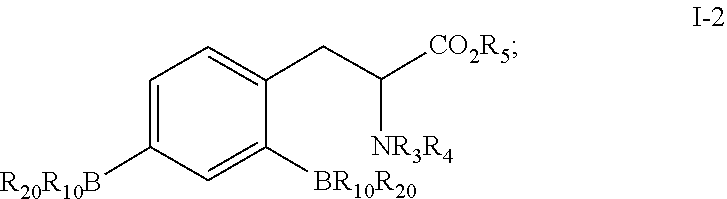
where both of X1 and X2 are halogens, and preferably, X1 and X2 represent Cl, Br, or I; R10 and R20 are OH, or taken together with the boron atom to which they are attached, represent a substituent that is hydrolyzable to a boric acid group; R3 or R4 independently represents hydrogen, an amino-protecting group, or an imino group combined with an amino group for protecting the amino group; and R5 represents hydrogen or a carboxyl-protecting group.


where R10 and R20 are OH, or taken together with the boron atom to which they are attached, represent a substituent that is hydrolyzable to a boric acid group; R3 or R4 independently represents hydrogen, an amino-protecting group, or an imino group combined with an amino group for protecting the amino group; and R5 represents hydrogen or a carboxyl-protecting group.


where both of X1 and X2 are halogens, and preferably, X1 and X2 represent Cl, Br, or I; R10 and R20 are OH, or taken together with the boron atom to which they are attached, represent a substituent that is hydrolyzable to a boric acid group; R3 or R4 independently represents hydrogen, an amino-protecting group, or an imino group combined with an amino group for protecting the amino group; and R5 represents hydrogen or a carboxyl-protecting group.


where X1, X2, and X3 are each independently halogens, preferably, X1, X2, and X3 represent Cl, Br, or I; R3 or R4 independently represents hydrogen or an amino-protecting group, or an imino group combined with an amino group for protecting the amino group; and R5 represents hydrogen or a carboxyl-protecting group.

and the intermediate I-1 is

where X1 and X2 are halogens, preferably, X1 and X2 represent Cl, Br, or I; and R5 represents hydrogen or a carboxyl-protecting group.

and then reacting with a boric acid or boric ester, where the reaction is preferably performed at room temperature, and R5 represents preferably a C1-10 alkyl group.

where R1 or R2 represents halogens, boric acid groups or substituents that are hydrolyzable to boric acid groups;
R3 or R4 independently represents hydrogen, an amino-protecting group, or an imino group combined with an amino group for protecting the amino group; and
R5 represents hydrogen or a carboxyl-protecting group.

and the intermediate I-2 has the structure:

where both of X1 and X2 are halogens; B represents boron, preferably, 10B; R10 and R20 are OH, or taken together with the boron atom to which they are attached, represent a substituent that is hydrolyzable to a boric acid group; R3 or R4 independently represents hydrogen, an amino-protecting group, or an imino group combined with an amino group for protecting the amino group; and R5 represents hydrogen or a carboxyl-protecting group.


and preferably, a boric acid pinacol ester group.

The above two forms of protecting groups should fall within the scope of the “amino-protecting group” in the present disclosure. Among those protecting groups, the alkoxycarbonyl protecting group includes, but is not limited to: benzyloxycarbonyl (Cbz), tert-butyloxycarbonyl (Boc), fluorenylmethoxycarbonyl (Fmoc), allyloxycarbonyl (Alloc), trimethylsilyl ethoxycarbonyl (Teoc), and methoxycarbonyl or ethoxycarbonyl. The acyl protecting group includes, but is not limited to: phthaloyl (Pht), tosyl (Tos), trifluoroacetyl (Tfa), o-(p-) nitrobenzenesulfonyl (Ns), pivaloyl, and benzoyl. The alkyl protecting group includes, but is not limited to: trityl (Trt), 2,4-dimethoxybenzyl (Dmb), p-methoxybenzyl (PMB), and benzyl (Bn).

deprotecting the 18F-substituted compound, for example, by hydrolyzing the amino- and carboxyl-protecting group, and the boric ester group to obtain the 18F-BPA


Claims (20)


Priority Applications (1)
| Application Number | Priority Date | Filing Date | Title |
|---|---|---|---|
| US18/132,479 US12331067B2 (en) | 2018-08-17 | 2023-04-10 | Method for preparing 18F-BPA and intermediate |
Applications Claiming Priority (9)
| Application Number | Priority Date | Filing Date | Title |
|---|---|---|---|
| CN201810940708.3 | 2018-08-17 | ||
| CN201810940708 | 2018-08-17 | ||
| CN201811478614 | 2018-12-05 | ||
| CN201811478615.X | 2018-12-05 | ||
| CN201811478615 | 2018-12-05 | ||
| CN201811478614.5 | 2018-12-05 | ||
| PCT/CN2019/100678 WO2020035011A1 (en) | 2018-08-17 | 2019-08-15 | Method for preparing 18f-bpa and intermediate |
| US17/171,224 US11655261B2 (en) | 2018-08-17 | 2021-02-09 | Method for preparing 18F-BPA and intermediate |
| US18/132,479 US12331067B2 (en) | 2018-08-17 | 2023-04-10 | Method for preparing 18F-BPA and intermediate |
Related Parent Applications (1)
| Application Number | Title | Priority Date | Filing Date |
|---|---|---|---|
| US17/171,224 Continuation US11655261B2 (en) | 2018-08-17 | 2021-02-09 | Method for preparing 18F-BPA and intermediate |
Publications (2)
| Publication Number | Publication Date |
|---|---|
| US20230242555A1 US20230242555A1 (en) | 2023-08-03 |
| US12331067B2 true US12331067B2 (en) | 2025-06-17 |
Family
ID=69524676
Family Applications (2)
| Application Number | Title | Priority Date | Filing Date |
|---|---|---|---|
| US17/171,224 Active US11655261B2 (en) | 2018-08-17 | 2021-02-09 | Method for preparing 18F-BPA and intermediate |
| US18/132,479 Active US12331067B2 (en) | 2018-08-17 | 2023-04-10 | Method for preparing 18F-BPA and intermediate |
Family Applications Before (1)
| Application Number | Title | Priority Date | Filing Date |
|---|---|---|---|
| US17/171,224 Active US11655261B2 (en) | 2018-08-17 | 2021-02-09 | Method for preparing 18F-BPA and intermediate |
Country Status (6)
| Country | Link |
|---|---|
| US (2) | US11655261B2 (en) |
| EP (1) | EP3838890B1 (en) |
| JP (2) | JP7292375B2 (en) |
| CN (2) | CN110835352B (en) |
| TW (1) | TWI723496B (en) |
| WO (1) | WO2020035011A1 (en) |
Families Citing this family (7)
| Publication number | Priority date | Publication date | Assignee | Title |
|---|---|---|---|---|
| CN110835352B (en) * | 2018-08-17 | 2022-05-24 | 南京中硼联康医疗科技有限公司 | Preparation method18Process for F-BPA |
| CN113354669B (en) | 2020-03-03 | 2022-07-08 | 北京大学 | Boron carrier for tumor diagnosis and treatment integration, preparation method and application thereof |
| CN113773337A (en) * | 2020-06-05 | 2021-12-10 | 南京中硼联康医疗科技有限公司 | Radiolabeled boron-containing compounds, methods of preparation and uses |
| CN114685599A (en) * | 2020-12-30 | 2022-07-01 | 南京江原安迪科正电子研究发展有限公司 | PSMA (patterned beam mosaic Virus inhibitor) targeted inhibitor, radionuclide-labeled PSMA targeted inhibitor, preparation method and application |
| CN115724866B (en) * | 2021-09-02 | 2026-03-17 | 北京大学 | Boron carriers for integrated tumor diagnosis and treatment, their preparation methods and applications |
| EP4566700A1 (en) | 2022-08-10 | 2025-06-11 | Canon Kabushiki Kaisha | Manufacturing method and manufacturing device for liquid containing fine bubbles |
| CN116655670A (en) * | 2023-05-22 | 2023-08-29 | 中国科学院近代物理研究所 | Compound based on action mechanism of amino acid transporter, and synthetic method and application thereof |
Citations (14)
| Publication number | Priority date | Publication date | Assignee | Title |
|---|---|---|---|---|
| US5935944A (en) | 1993-09-10 | 1999-08-10 | Neutron Technology Corporation | Formulation for I.V. administration of the boron delivery drug, boronophenylalanine (BPA) |
| US20070178554A1 (en) | 2006-02-01 | 2007-08-02 | Nima Shiva | Orthogonal Aminoacyl Synthetase-tRNA Pairs for Incorporating Unnatural Amino Acids Into Proteins |
| WO2007096186A1 (en) * | 2006-02-23 | 2007-08-30 | Santhera Pharmaceuticals (Schweiz) Ag | Substituted phenylpiperidine derivatives as melanocortin-4 receptor modulators |
| JP2009051766A (en) | 2007-08-27 | 2009-03-12 | Stella Pharma Corp | Liquid composition containing p-boronophenylalanine and sorbitol |
| WO2014061508A1 (en) | 2012-10-15 | 2014-04-24 | ステラファーマ株式会社 | Chiral 4-boronophenylalanine (bpa) derivative and method for producing same, and method for producing 18f-labeled bpa using said derivative |
| CN102887913B (en) | 2012-10-08 | 2015-02-25 | 南京江原安迪科正电子研究发展有限公司 | Method for synthesizing 4-dihydroxyborane-2-fluorophenylalanine |
| WO2015093469A1 (en) | 2013-12-17 | 2015-06-25 | ステラファーマ株式会社 | Production method for 2-fluoro-4-borono-l-phenylalanine, and precursor of 2-fluoro-4-borono-l-phenylalanine |
| JP2016204314A (en) | 2015-04-23 | 2016-12-08 | 国立研究開発法人理化学研究所 | Compound and method for producing 4-boronophenylalanine derivative |
| CN105348309B (en) | 2015-11-19 | 2017-05-17 | 中国原子能科学研究院 | F-BPA nucleophilic synthesis method |
| EP3251698A1 (en) | 2015-02-15 | 2017-12-06 | Jiangsu Hengrui Medicine Co. Ltd. | Ligand-cytotoxicity drug conjugate, preparing method therefor, and application thereof |
| CN108299479A (en) | 2017-01-11 | 2018-07-20 | 南京中硼联康医疗科技有限公司 | The preparation method of F-BPA |
| CN109384806A (en) | 2017-08-03 | 2019-02-26 | 王璐 | A kind of [18F] FBPA novel processing step |
| WO2021244529A1 (en) * | 2020-06-05 | 2021-12-09 | 南京中硼联康医疗科技有限公司 | Radiolabeled boron-containing compound, preparation method and application |
| US11655261B2 (en) * | 2018-08-17 | 2023-05-23 | Neuboron Medtech Ltd. | Method for preparing 18F-BPA and intermediate |
Family Cites Families (1)
| Publication number | Priority date | Publication date | Assignee | Title |
|---|---|---|---|---|
| US7761066B2 (en) * | 2006-01-27 | 2010-07-20 | Marvell World Trade Ltd. | Variable power adaptive transmitter |
-
2019
- 2019-08-14 CN CN201910748805.7A patent/CN110835352B/en active Active
- 2019-08-14 CN CN201910749281.3A patent/CN110835310B/en active Active
- 2019-08-15 WO PCT/CN2019/100678 patent/WO2020035011A1/en not_active Ceased
- 2019-08-15 TW TW108129152A patent/TWI723496B/en active
- 2019-08-15 EP EP19850683.4A patent/EP3838890B1/en active Active
- 2019-08-15 JP JP2021507794A patent/JP7292375B2/en active Active
-
2021
- 2021-02-09 US US17/171,224 patent/US11655261B2/en active Active
-
2023
- 2023-04-10 US US18/132,479 patent/US12331067B2/en active Active
- 2023-06-06 JP JP2023092978A patent/JP7621418B2/en active Active
Patent Citations (19)
| Publication number | Priority date | Publication date | Assignee | Title |
|---|---|---|---|---|
| US5935944A (en) | 1993-09-10 | 1999-08-10 | Neutron Technology Corporation | Formulation for I.V. administration of the boron delivery drug, boronophenylalanine (BPA) |
| US20070178554A1 (en) | 2006-02-01 | 2007-08-02 | Nima Shiva | Orthogonal Aminoacyl Synthetase-tRNA Pairs for Incorporating Unnatural Amino Acids Into Proteins |
| WO2007096186A1 (en) * | 2006-02-23 | 2007-08-30 | Santhera Pharmaceuticals (Schweiz) Ag | Substituted phenylpiperidine derivatives as melanocortin-4 receptor modulators |
| JP2009051766A (en) | 2007-08-27 | 2009-03-12 | Stella Pharma Corp | Liquid composition containing p-boronophenylalanine and sorbitol |
| CN102887913B (en) | 2012-10-08 | 2015-02-25 | 南京江原安迪科正电子研究发展有限公司 | Method for synthesizing 4-dihydroxyborane-2-fluorophenylalanine |
| WO2014061508A1 (en) | 2012-10-15 | 2014-04-24 | ステラファーマ株式会社 | Chiral 4-boronophenylalanine (bpa) derivative and method for producing same, and method for producing 18f-labeled bpa using said derivative |
| RU2660433C2 (en) | 2012-10-15 | 2018-07-06 | Стелла Фарма Корпорейшн | Chiral 4-boronophenylalanine (bpa) derivative and method for producing same, and method for producing 18f-labeled bpa using said derivative |
| EP2907818A1 (en) | 2012-10-15 | 2015-08-19 | Stella Pharma Corporation | Chiral 4-boronophenylalanine (bpa) derivative and method for producing same, and method for producing 18f-labeled bpa using said derivative |
| CN105916836A (en) | 2013-12-17 | 2016-08-31 | 斯特拉制药公司 | Process for producing 2-fluoro-4-dihydroxyboryl-L-phenylalanine and precursor of 2-fluoro-4-dihydroxyboryl-L-phenylalanine |
| EP3085687A1 (en) | 2013-12-17 | 2016-10-26 | Stella Pharma Corporation | Production method for 2-fluoro-4-borono-l-phenylalanine, and precursor of 2-fluoro-4-borono-l-phenylalanine |
| US20160311836A1 (en) * | 2013-12-17 | 2016-10-27 | Stella Pharma Corporation | Production method for 2-fluoro-4-borono-l-phenylalanine, and precursor of 2-fluoro-4-borono-l-phenylalanine |
| WO2015093469A1 (en) | 2013-12-17 | 2015-06-25 | ステラファーマ株式会社 | Production method for 2-fluoro-4-borono-l-phenylalanine, and precursor of 2-fluoro-4-borono-l-phenylalanine |
| EP3251698A1 (en) | 2015-02-15 | 2017-12-06 | Jiangsu Hengrui Medicine Co. Ltd. | Ligand-cytotoxicity drug conjugate, preparing method therefor, and application thereof |
| JP2016204314A (en) | 2015-04-23 | 2016-12-08 | 国立研究開発法人理化学研究所 | Compound and method for producing 4-boronophenylalanine derivative |
| CN105348309B (en) | 2015-11-19 | 2017-05-17 | 中国原子能科学研究院 | F-BPA nucleophilic synthesis method |
| CN108299479A (en) | 2017-01-11 | 2018-07-20 | 南京中硼联康医疗科技有限公司 | The preparation method of F-BPA |
| CN109384806A (en) | 2017-08-03 | 2019-02-26 | 王璐 | A kind of [18F] FBPA novel processing step |
| US11655261B2 (en) * | 2018-08-17 | 2023-05-23 | Neuboron Medtech Ltd. | Method for preparing 18F-BPA and intermediate |
| WO2021244529A1 (en) * | 2020-06-05 | 2021-12-09 | 南京中硼联康医疗科技有限公司 | Radiolabeled boron-containing compound, preparation method and application |
Non-Patent Citations (7)
| Title |
|---|
| Adelphe M. Mfuh et al., Additive- and Metal-Free, Predictably 1,2- and 1,3-Regioselective, Photoinduced Dual C-H/C-X-Borylation of Haloarenes, J. Am. Chem. Soc., 2016. |
| Andrew V. Mossine et al., Synthesis of [18F]Arenes via the Copper-Mediated [18F]Fluorination of Boronic Acids, Org. Lett., 2015, 17, 23, 5780-5783. |
| CN 2020-10505139, priority document for WO 2021244529 A1 filed Jun. 5, 2020. (Year: 2020). * |
| Falco-Magnus et al. Organic Letters 2010 12 (17), 3870-3873 (Year: 2010). * |
| Kiichi Ishiwata et al., Synthesis and Radiation Dosimetry of 4-Borono-2-r Flfluoro-D, L-phenylalanine: a Target Compound for PET and Boron Neutron Capture Therapy, Appl. Radiat. Isot. vol. 42, No. 4, pp. 325-328, 1991. |
| Kiichi Ishiwata et al., Synthesis and Radiation Dosimetry of 4-Borono-2-r Flfluoro-D,L-phenylalanine: a Target Compound for PET and Boron Neutron Capture Therapy, Appl. Radiat. Isot. vol. 42, No. 4, pp. 325-328, 1991, Int. J. Radial. Appl. Instrum. Part A. |
| Tert-butyl 2-amino-3-(2,4-difluorophenyl)propanoate, D6 PubChem CID 83225402, Oct. 20, 2014, found in the PubChem database on Dec. 21, 2021. |
Also Published As
| Publication number | Publication date |
|---|---|
| JP2021533176A (en) | 2021-12-02 |
| TWI723496B (en) | 2021-04-01 |
| CN110835352A (en) | 2020-02-25 |
| EP3838890A1 (en) | 2021-06-23 |
| US20230242555A1 (en) | 2023-08-03 |
| JP7621418B2 (en) | 2025-01-24 |
| JP7292375B2 (en) | 2023-06-16 |
| EP3838890A4 (en) | 2021-12-22 |
| US11655261B2 (en) | 2023-05-23 |
| TW202021935A (en) | 2020-06-16 |
| CN110835310B (en) | 2022-09-20 |
| US20210230192A1 (en) | 2021-07-29 |
| JP2023105067A (en) | 2023-07-28 |
| WO2020035011A1 (en) | 2020-02-20 |
| EP3838890B1 (en) | 2023-10-04 |
| CN110835352B (en) | 2022-05-24 |
| CN110835310A (en) | 2020-02-25 |
Similar Documents
| Publication | Publication Date | Title |
|---|---|---|
| US20230242555A1 (en) | Method for preparing 18f-bpa and intermediate | |
| US9149547B2 (en) | Process for production of heterodimers of glutamic acid | |
| TW202146058A (en) | Radiolabeled boron-containing compound, preparation method and application capable of being used as imaging agent for medical imaging and drug for boron neutron capture therapy | |
| US9815855B2 (en) | Method for producing 4-borono-L-phenylalanine having 18F atom introduced thereinto, and precursor of 4-borono-L-phenylalanine having 18F atom introduced thereinto | |
| CN112979684B (en) | Preparation 18 F-BPA process | |
| AU2015237282B2 (en) | Radioiodinated compounds | |
| JP2016204314A (en) | Compound and method for producing 4-boronophenylalanine derivative | |
| RU2776178C1 (en) | Method for producing 18f-bpa and an intermediate compound | |
| CA2518934C (en) | Boronated metal-phthalocyanines, process for their preparation, pharmaceutical compositions comprising them and use thereof | |
| CN113045592A (en) | 18Process for the preparation of F-BPA | |
| KR102906980B1 (en) | Development of Novel Synthetic Route for 18F-Rucaparib | |
| US20240124496A1 (en) | Boronic acid compound and method for producing same | |
| DiMagno et al. | Radioiodinated compounds | |
| JP2020011928A (en) | 4-boronophenylalanine precursor, method for producing 2-[18f]fluoro-4-boronophenylalanine precursor, and method for producing 2-[18f]fluoro-4-boronophenylalanine | |
| Calzavara | Investigations Into The Chemoselective Modification Of THAM Directed Towards Biological Applications |
Legal Events
| Date | Code | Title | Description |
|---|---|---|---|
| AS | Assignment |
Owner name: NEUBORON MEDTECH LTD., CHINA Free format text: ASSIGNMENT OF ASSIGNORS INTEREST;ASSIGNORS:LI, SHI-HONG;HE, JING;YAN, HENG;AND OTHERS;SIGNING DATES FROM 20210209 TO 20210223;REEL/FRAME:063270/0751 |
|
| FEPP | Fee payment procedure |
Free format text: ENTITY STATUS SET TO UNDISCOUNTED (ORIGINAL EVENT CODE: BIG.); ENTITY STATUS OF PATENT OWNER: SMALL ENTITY |
|
| FEPP | Fee payment procedure |
Free format text: ENTITY STATUS SET TO SMALL (ORIGINAL EVENT CODE: SMAL); ENTITY STATUS OF PATENT OWNER: SMALL ENTITY |
|
| STPP | Information on status: patent application and granting procedure in general |
Free format text: DOCKETED NEW CASE - READY FOR EXAMINATION |
|
| STPP | Information on status: patent application and granting procedure in general |
Free format text: NON FINAL ACTION MAILED |
|
| STPP | Information on status: patent application and granting procedure in general |
Free format text: RESPONSE TO NON-FINAL OFFICE ACTION ENTERED AND FORWARDED TO EXAMINER |
|
| STPP | Information on status: patent application and granting procedure in general |
Free format text: NON FINAL ACTION MAILED |
|
| STPP | Information on status: patent application and granting procedure in general |
Free format text: RESPONSE TO NON-FINAL OFFICE ACTION ENTERED AND FORWARDED TO EXAMINER |
|
| STPP | Information on status: patent application and granting procedure in general |
Free format text: NOTICE OF ALLOWANCE MAILED -- APPLICATION RECEIVED IN OFFICE OF PUBLICATIONS |
|
| STCF | Information on status: patent grant |
Free format text: PATENTED CASE |