US12328432B2 - Implicit multiple transform set signaling in video coding - Google Patents

Implicit multiple transform set signaling in video coding Download PDF

Info

Publication number
US12328432B2
US12328432B2 US17/939,717 US202217939717A US12328432B2 US 12328432 B2 US12328432 B2 US 12328432B2 US 202217939717 A US202217939717 A US 202217939717A US 12328432 B2 US12328432 B2 US 12328432B2
Authority
US
United States
Prior art keywords
block
video block
video
current video
coefficients
Prior art date
Legal status (The legal status is an assumption and is not a legal conclusion. Google has not performed a legal analysis and makes no representation as to the accuracy of the status listed.)
Active, expires
Application number
US17/939,717
Other versions
US20230017146A1 (en
Inventor
Li Zhang
Kai Zhang
Yuhuai Zhang
Hongbin Liu
Yue Wang
Siwei Ma
Current Assignee (The listed assignees may be inaccurate. Google has not performed a legal analysis and makes no representation or warranty as to the accuracy of the list.)
Beijing ByteDance Network Technology Co Ltd
ByteDance Inc
Original Assignee
Beijing ByteDance Network Technology Co Ltd
ByteDance Inc
Priority date (The priority date is an assumption and is not a legal conclusion. Google has not performed a legal analysis and makes no representation as to the accuracy of the date listed.)
Filing date
Publication date
Application filed by Beijing ByteDance Network Technology Co Ltd, ByteDance Inc filed Critical Beijing ByteDance Network Technology Co Ltd
Publication of US20230017146A1 publication Critical patent/US20230017146A1/en
Assigned to BEIJING ZITIAO NETWORK TECHNOLOGY CO., LTD. reassignment BEIJING ZITIAO NETWORK TECHNOLOGY CO., LTD. ASSIGNMENT OF ASSIGNORS INTEREST (SEE DOCUMENT FOR DETAILS). Assignors: LIU, HONGBIN, WANG, YUE, ZHANG, Yuhuai
Assigned to BEIJING BYTEDANCE NETWORK TECHNOLOGY CO., LTD. reassignment BEIJING BYTEDANCE NETWORK TECHNOLOGY CO., LTD. ASSIGNMENT OF ASSIGNORS INTEREST (SEE DOCUMENT FOR DETAILS). Assignors: BEIJING ZITIAO NETWORK TECHNOLOGY CO., LTD.
Assigned to BEIJING BYTEDANCE NETWORK TECHNOLOGY CO., LTD. reassignment BEIJING BYTEDANCE NETWORK TECHNOLOGY CO., LTD. ASSIGNMENT OF ASSIGNORS INTEREST (SEE DOCUMENT FOR DETAILS). Assignors: MA, SIWEI
Assigned to BYTEDANCE INC. reassignment BYTEDANCE INC. ASSIGNMENT OF ASSIGNORS INTEREST (SEE DOCUMENT FOR DETAILS). Assignors: ZHANG, KAI, ZHANG, LI
Application granted granted Critical
Publication of US12328432B2 publication Critical patent/US12328432B2/en
Active legal-status Critical Current
Adjusted expiration legal-status Critical

Links

Images

Classifications

    • HELECTRICITY
    • H04ELECTRIC COMMUNICATION TECHNIQUE
    • H04NPICTORIAL COMMUNICATION, e.g. TELEVISION
    • H04N19/00Methods or arrangements for coding, decoding, compressing or decompressing digital video signals
    • H04N19/10Methods or arrangements for coding, decoding, compressing or decompressing digital video signals using adaptive coding
    • H04N19/102Methods or arrangements for coding, decoding, compressing or decompressing digital video signals using adaptive coding characterised by the element, parameter or selection affected or controlled by the adaptive coding
    • H04N19/12Selection from among a plurality of transforms or standards, e.g. selection between discrete cosine transform [DCT] and sub-band transform or selection between H.263 and H.264
    • HELECTRICITY
    • H04ELECTRIC COMMUNICATION TECHNIQUE
    • H04NPICTORIAL COMMUNICATION, e.g. TELEVISION
    • H04N19/00Methods or arrangements for coding, decoding, compressing or decompressing digital video signals
    • H04N19/10Methods or arrangements for coding, decoding, compressing or decompressing digital video signals using adaptive coding
    • H04N19/134Methods or arrangements for coding, decoding, compressing or decompressing digital video signals using adaptive coding characterised by the element, parameter or criterion affecting or controlling the adaptive coding
    • H04N19/136Incoming video signal characteristics or properties
    • HELECTRICITY
    • H04ELECTRIC COMMUNICATION TECHNIQUE
    • H04NPICTORIAL COMMUNICATION, e.g. TELEVISION
    • H04N19/00Methods or arrangements for coding, decoding, compressing or decompressing digital video signals
    • H04N19/10Methods or arrangements for coding, decoding, compressing or decompressing digital video signals using adaptive coding
    • H04N19/102Methods or arrangements for coding, decoding, compressing or decompressing digital video signals using adaptive coding characterised by the element, parameter or selection affected or controlled by the adaptive coding
    • H04N19/103Selection of coding mode or of prediction mode
    • H04N19/105Selection of the reference unit for prediction within a chosen coding or prediction mode, e.g. adaptive choice of position and number of pixels used for prediction
    • HELECTRICITY
    • H04ELECTRIC COMMUNICATION TECHNIQUE
    • H04NPICTORIAL COMMUNICATION, e.g. TELEVISION
    • H04N19/00Methods or arrangements for coding, decoding, compressing or decompressing digital video signals
    • H04N19/10Methods or arrangements for coding, decoding, compressing or decompressing digital video signals using adaptive coding
    • H04N19/102Methods or arrangements for coding, decoding, compressing or decompressing digital video signals using adaptive coding characterised by the element, parameter or selection affected or controlled by the adaptive coding
    • H04N19/132Sampling, masking or truncation of coding units, e.g. adaptive resampling, frame skipping, frame interpolation or high-frequency transform coefficient masking
    • HELECTRICITY
    • H04ELECTRIC COMMUNICATION TECHNIQUE
    • H04NPICTORIAL COMMUNICATION, e.g. TELEVISION
    • H04N19/00Methods or arrangements for coding, decoding, compressing or decompressing digital video signals
    • H04N19/10Methods or arrangements for coding, decoding, compressing or decompressing digital video signals using adaptive coding
    • H04N19/169Methods or arrangements for coding, decoding, compressing or decompressing digital video signals using adaptive coding characterised by the coding unit, i.e. the structural portion or semantic portion of the video signal being the object or the subject of the adaptive coding
    • H04N19/17Methods or arrangements for coding, decoding, compressing or decompressing digital video signals using adaptive coding characterised by the coding unit, i.e. the structural portion or semantic portion of the video signal being the object or the subject of the adaptive coding the unit being an image region, e.g. an object
    • H04N19/176Methods or arrangements for coding, decoding, compressing or decompressing digital video signals using adaptive coding characterised by the coding unit, i.e. the structural portion or semantic portion of the video signal being the object or the subject of the adaptive coding the unit being an image region, e.g. an object the region being a block, e.g. a macroblock
    • HELECTRICITY
    • H04ELECTRIC COMMUNICATION TECHNIQUE
    • H04NPICTORIAL COMMUNICATION, e.g. TELEVISION
    • H04N19/00Methods or arrangements for coding, decoding, compressing or decompressing digital video signals
    • H04N19/10Methods or arrangements for coding, decoding, compressing or decompressing digital video signals using adaptive coding
    • H04N19/169Methods or arrangements for coding, decoding, compressing or decompressing digital video signals using adaptive coding characterised by the coding unit, i.e. the structural portion or semantic portion of the video signal being the object or the subject of the adaptive coding
    • H04N19/18Methods or arrangements for coding, decoding, compressing or decompressing digital video signals using adaptive coding characterised by the coding unit, i.e. the structural portion or semantic portion of the video signal being the object or the subject of the adaptive coding the unit being a set of transform coefficients
    • HELECTRICITY
    • H04ELECTRIC COMMUNICATION TECHNIQUE
    • H04NPICTORIAL COMMUNICATION, e.g. TELEVISION
    • H04N19/00Methods or arrangements for coding, decoding, compressing or decompressing digital video signals
    • H04N19/70Methods or arrangements for coding, decoding, compressing or decompressing digital video signals characterised by syntax aspects related to video coding, e.g. related to compression standards
    • HELECTRICITY
    • H04ELECTRIC COMMUNICATION TECHNIQUE
    • H04NPICTORIAL COMMUNICATION, e.g. TELEVISION
    • H04N19/00Methods or arrangements for coding, decoding, compressing or decompressing digital video signals
    • H04N19/10Methods or arrangements for coding, decoding, compressing or decompressing digital video signals using adaptive coding
    • H04N19/102Methods or arrangements for coding, decoding, compressing or decompressing digital video signals using adaptive coding characterised by the element, parameter or selection affected or controlled by the adaptive coding
    • H04N19/103Selection of coding mode or of prediction mode
    • H04N19/11Selection of coding mode or of prediction mode among a plurality of spatial predictive coding modes
    • HELECTRICITY
    • H04ELECTRIC COMMUNICATION TECHNIQUE
    • H04NPICTORIAL COMMUNICATION, e.g. TELEVISION
    • H04N19/00Methods or arrangements for coding, decoding, compressing or decompressing digital video signals
    • H04N19/10Methods or arrangements for coding, decoding, compressing or decompressing digital video signals using adaptive coding
    • H04N19/102Methods or arrangements for coding, decoding, compressing or decompressing digital video signals using adaptive coding characterised by the element, parameter or selection affected or controlled by the adaptive coding
    • H04N19/119Adaptive subdivision aspects, e.g. subdivision of a picture into rectangular or non-rectangular coding blocks
    • HELECTRICITY
    • H04ELECTRIC COMMUNICATION TECHNIQUE
    • H04NPICTORIAL COMMUNICATION, e.g. TELEVISION
    • H04N19/00Methods or arrangements for coding, decoding, compressing or decompressing digital video signals
    • H04N19/10Methods or arrangements for coding, decoding, compressing or decompressing digital video signals using adaptive coding
    • H04N19/102Methods or arrangements for coding, decoding, compressing or decompressing digital video signals using adaptive coding characterised by the element, parameter or selection affected or controlled by the adaptive coding
    • H04N19/129Scanning of coding units, e.g. zig-zag scan of transform coefficients or flexible macroblock ordering [FMO]

Definitions

  • This patent document relates to image and video coding and decoding.
  • Digital video accounts for the largest bandwidth use on the internet and other digital communication networks. As the number of connected user devices capable of receiving and displaying video increases, it is expected that the bandwidth demand for digital video usage will continue to grow.
  • the present document discloses techniques that can be used by video encoders and decoders for processing coded representation of video using control information useful for decoding of the coded representation.
  • a video processing method includes determining, for a conversion between a current video block of a video and a bitstream of the video, a usage of an identity transform mode for the conversion of the current video block according to a rule specifying that the usage is based on representative coefficients of one or more representative blocks of the video. The method also includes performing the conversion based on the determining.
  • a video processing method includes determining, for a conversion between a current video block of a video and a bitstream of the video, a default transform that is applicable to the current video block according to a rule specifying that an identity transform is not used for the conversion of the current video block. The method also includes performing the conversion based on the determining.
  • a video processing method includes performing a conversion between a video and a bitstream of the video according to a rule.
  • the rule specifies that an indication is included at a video region level.
  • the indication indicates whether a zero-out operation in which some residual coefficients are set to zero is applied to a transform block of a video block in the video region.
  • a video processing method includes performing a conversion between a current video block of a video and a bitstream of the video according to a rule.
  • An identity transform mode is applied to the current video block during the conversion, and the rule specifies that a zero-out operation during which non-zero coefficients are restricted to be within a sub-region of the current video block is enabled.
  • a video processing method includes determining, for a conversion between a current video block of a video and a bitstream of the video, a zero-out type of the current video block of a zero-out operation. The method also includes performing the conversion according to the determining.
  • the current video block is coded by applying an identity transform to the current video block.
  • the zero-out type of the video block defines a sub-region of the video block within which non-zero coefficients are restricted to be for the zero-out operation.
  • a video processing method includes performing a conversion between a current video block of a video and a bitstream of the video according to a rule.
  • the rule specifies that a usage of an identity transform mode for the conversion of the current video block is disabled in case at least one non-zero coefficient is located outside of a zero-out region determined by the identity transform mode.
  • the zero-out region comprises a region within which non-zero coefficients are restricted to be for a zero-out operation.
  • a video processing method includes making a determination, for a conversion between a video block of a video and a coded representation of the video, whether a horizontal or a vertical identity transform is applied to the video block, based on a rule; and performing the conversion based on the determination.
  • the rule specifies a relationship between the determination and representative coefficients from decoded coefficients of one or more representative blocks of the video.
  • another video processing method includes making a determination, for a conversion between a video block of a video and a coded representation of the video, whether a horizontal or a vertical identity transform is applied to the video block, based on a rule; and performing the conversion based on the determination.
  • the rule specifies a relationship between the determination and decoded luma coefficients of the video block.
  • another video processing method includes making a determination, for a conversion between a video block of a video and a coded representation of the video, whether a horizontal or a vertical identity transform is applied to the video block, based on a rule; and performing the conversion based on the determination.
  • the rule specifies a relationship between the determination and a value V associates with representative coefficients of decoded coefficients or a representative block.
  • another video processing method includes determining that one or more syntax fields are present in a coded representation of a video where the video contains one or more video blocks; making a determination, based on the one or more syntax fields, whether a horizontal or a vertical identity transform is enabled for video blocks in the video.
  • another video processing method includes making a first determination regarding whether use of an identity transform is enabled for a conversion between a video block of a video and a coded representation of the video; making a second determination regarding whether a zero-out operation is enabled during the conversion; and performing the conversion based on the first determination and the second determination.
  • another video processing method includes performing a conversion between a video block of a video and a coded representation of the video; where the video block is represented in the coded representation as a coded block, where non-zero coefficients of the coded block are restricted to be within one or more sub-regions; and where an identity transform is applied for generating the coded block.
  • a video encoder apparatus comprising a processor configured to implement above-described methods.
  • a video decoder apparatus comprising a processor configured to implement above-described methods.
  • a computer readable medium having code stored thereon is disclose.
  • the code embodies one of the methods described herein in the form of processor-executable code.
  • FIG. 1 shows an example video encoder block diagram
  • FIG. 2 shows an example of 67 intra prediction modes.
  • FIG. 3 A shows an example of reference samples for wide-angular intra prediction
  • FIG. 3 B shows another example of reference samples for wide-angular intra prediction.
  • FIG. 4 illustrates a problem of discontinuity in case of directions beyond 45 degree.
  • FIG. 5 A shows an example definition of samples used by Position Dependent Intra Prediction Combination (PDPC) applied to diagonal and adjacent angular intra modes.
  • PDPC Position Dependent Intra Prediction Combination
  • FIG. 5 B shows another example definition of samples used by PDPC applied to diagonal and adjacent angular intra modes.
  • FIG. 5 C shows another example definition of samples used by PDPC applied to diagonal and adjacent angular intra modes.
  • FIG. 5 D show yet another example definition of samples used by PDPC applied to diagonal and adjacent angular intra modes.
  • FIG. 6 shows an example of division of 4 ⁇ 8 and 8 ⁇ 4 blocks.
  • FIG. 7 shows an example of division of all blocks except 4 ⁇ 8, 8 ⁇ 4 and 4 ⁇ 4.
  • FIG. 8 shows an example of a secondary transform in Joint Exploration Model (JEM).
  • FIG. 9 shows an example of reduced secondary transform Low-Frequency Non-Separable Transform (LFNST).
  • FIG. 10 A shows an example of a forward reduced transform.
  • FIG. 10 B shows an example of an invert reduced transform.
  • FIG. 11 shows an example of forward LFNST 8 ⁇ 8 process with 16 ⁇ 48 matrix.
  • FIG. 12 illustrates an example of scanning position 17 to 64 for non-zero element.
  • FIG. 13 is an example Illustration of sub-block transform modes Sub-Block Transform Vertical (SBT-V) and Sub-Block Transform Horizontal (SBT-H).
  • SBT-V Sub-Block Transform Vertical
  • SBT-H Sub-Block Transform Horizontal
  • FIG. 14 A illustrates an example of Scan Region Based Coefficient Coding (SRCC).
  • SRCC Scan Region Based Coefficient Coding
  • FIG. 14 B illustrates another example of Scan Region Based Coefficient Coding (SRCC).
  • SRCC Scan Region Based Coefficient Coding
  • FIG. 15 A illustrates an example restriction of (Implicit Selection of Transform) IST according to positions of non-zero coefficients.
  • FIG. 15 B illustrates another example restriction of IST according to positions of non-zero coefficients.
  • FIG. 16 A shows an example zero-out type of Transform Skip (TS) coded blocks.
  • FIG. 16 B shows another example zero-out type of TS coded blocks.
  • FIG. 16 C shows another example zero-out type of TS coded blocks.
  • FIG. 16 D shows yet another zero-out type of TS coded blocks.
  • FIG. 17 is a block diagram of an example video processing system.
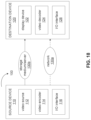
  • FIG. 18 is a block diagram that illustrates a video coding system in accordance with some embodiments of the present disclosure.
  • FIG. 19 is a block diagram that illustrates an encoder in accordance with some embodiments of the present disclosure.
  • FIG. 20 is a block diagram that illustrates a decoder in accordance with some embodiments of the present disclosure.
  • FIG. 21 is a block diagram of a video processing apparatus.
  • FIG. 22 is a flowchart for an example method of video processing.
  • FIG. 23 is a flowchart representation of a method for video processing in accordance with the present technology.
  • FIG. 24 is a flowchart representation of another method for video processing in accordance with the present technology.
  • FIG. 25 is a flowchart representation of another method for video processing in accordance with the present technology.
  • FIG. 26 is a flowchart representation of another method for video processing in accordance with the present technology.
  • FIG. 27 is a flowchart representation of another method for video processing in accordance with the present technology.
  • FIG. 28 is a flowchart representation of another method for video processing in accordance with the present technology.
  • FIG. 29 is a flowchart representation of another method for video processing in accordance with the present technology.
  • Section headings are used in the present document for ease of understanding and do not limit the applicability of techniques and embodiments disclosed in each section only to that section.
  • H.266 terminology is used in some description only for ease of understanding and not for limiting scope of the disclosed techniques. As such, the techniques described herein are applicable to other video codec protocols and designs also.
  • This document is related to video coding technologies. Specifically, it is related to transform skip mode and transform types (e.g., including identity transform) in video coding. It may be applied to the existing video coding standard like High Efficiency Video Coding (HEVC), or the standard Versatile Video Coding (VVC) to be finalized. It may be also applicable to future video coding standards or video codec.
  • HEVC High Efficiency Video Coding
  • VVC Versatile Video Coding
  • Video coding standards have evolved primarily through the development of the well-known International Telecommunication Union Telecommunication Standardization Sector (ITU-T) and International Organization for Standardization (ISO)/International Electrotechnical Commission (IEC) standards.
  • ITU-T International Telecommunication Union Telecommunication Standardization Sector
  • ISO International Organization for Standardization
  • ISO International Electrotechnical Commission
  • the ITU-T produced H.261 and H.263, ISO/IEC produced Moving Picture Experts Group (MPEG)-1 and MPEG-4 Visual, and the two organizations jointly produced the H.262/MPEG-2 Video and H.264/MPEG-4 Advanced Video Coding (AVC) and H.265/High Efficiency Video Coding (HEVC) standards.
  • AVC H.264/MPEG-4 Advanced Video Coding
  • HEVC High Efficiency Video Coding
  • the video coding standards are based on the hybrid video coding structure where temporal prediction plus transform coding are utilized.
  • JVET Joint Video Exploration Team
  • JEM Joint Exploration Model
  • FIG. 1 shows an example of encoder block diagram of VVC, which contains three in-loop filtering blocks: deblocking filter (DF), sample adaptive offset (SAO) and Adaptive Loop Filter (ALF).
  • DF deblocking filter
  • SAO sample adaptive offset
  • ALF Adaptive Loop Filter
  • SAO and ALF utilize the original samples of the current picture to reduce the mean square errors between the original samples and the reconstructed samples by adding an offset and by applying a finite impulse response (FIR) filter, respectively, with coded side information signaling the offsets and filter coefficients.
  • FIR finite impulse response
  • ALF is located at the last processing stage of each picture and can be regarded as a tool trying to catch and fix artifacts created by the previous stages.
  • the number of directional intra modes is extended from 33, as used in HEVC, to 65.
  • the additional directional modes are depicted as red dotted arrows in FIG. 2 , and the planar and DC modes remain the same.
  • These denser directional intra prediction modes apply for all block sizes and for both luma and chroma intra predictions.
  • VTM2 VVC Test Model 2
  • VTM2 VVC Test Model 2
  • every intra-coded block has a square shape and the length of each of its side is a power of 2. Thus, no division operations are required to generate an intra-predictor using DC mode.
  • blocks can have a rectangular shape that necessitates the use of a division operation per block in the general case. To avoid division operations for DC prediction, only the longer side is used to compute the average for non-square blocks.
  • Conventional angular intra prediction directions are defined from 45 degrees to ⁇ 135 degrees in clockwise direction.
  • VTM2 several conventional angular intra prediction modes are adaptively replaced with wide-angle intra prediction modes for non-square blocks.
  • the replaced modes are signaled using the original method and remapped to the indexes of wide angular modes after parsing.
  • the total number of intra prediction modes for a certain block is unchanged, e.g., 67, and the intra mode coding is unchanged.
  • the top reference with length 2 W+1, and the left reference with length 2H+1 are defined as shown in FIG. 3 A- 3 B .
  • the mode number of replaced mode in wide-angular direction mode is dependent on the aspect ratio of a block.
  • the replaced intra prediction modes are illustrated in Table 1.
  • two vertically-adjacent predicted samples may use two non-adjacent reference samples in the case of wide-angle intra prediction.
  • low-pass reference samples filter and side smoothing are applied to the wide-angle prediction to reduce the negative effect of the increased gap ⁇ p ⁇ .
  • PDPC position dependent intra prediction combination
  • PDPC is an intra prediction method which invokes a combination of the un-filtered boundary reference samples and HEVC style intra prediction with filtered boundary reference samples.
  • PDPC is applied to the following intra modes without signaling: planar, DC, horizontal, vertical, bottom-left angular mode and its eight adjacent angular modes, and top-right angular mode and its eight adjacent angular modes.
  • R x, ⁇ 1 , R ⁇ 1,y represent the reference samples located at the top and left of current sample (x, y), respectively, and R ⁇ 1, ⁇ 1 represents the reference sample located at the top-left corner of the current block.
  • FIG. 5 A- 5 D illustrate the definition of reference samples (R x, ⁇ 1 , R ⁇ 1,y and R ⁇ 1, ⁇ 1 ) for PDPC applied over various prediction modes.
  • the prediction sample pred (x′, y′) is located at (x′, y′) within the prediction block.
  • FIG. 5 A shows a diagonal top-right mode.
  • FIG. 5 B shows a diagonal bottom-left mode.
  • FIG. 5 C shows an adjacent diagonal top-right mode.
  • FIG. 5 D shows an adjacent diagonal bottom-left mode.
  • the PDPC weights are dependent on prediction modes and are shown in Table 2.
  • ISP is proposed, which divides luma intra-predicted blocks vertically or horizontally into 2 or 4 sub-partitions depending on the block size dimensions, as shown in Table 3.
  • FIG. 6 and FIG. 7 show examples of the two possibilities. All sub-partitions fulfill the condition of having at least 16 samples.
  • Block Size Number of Sub-Partitions 4 ⁇ 4 Not divided 4 ⁇ 8 and 8 ⁇ 4 2 All other cases 4
  • a residual signal is generated by entropy decoding the coefficients sent by the encoder and then invert quantizing and invert transforming them. Then, the sub-partition is intra predicted and finally the corresponding reconstructed samples are obtained by adding the residual signal to the prediction signal. Therefore, the reconstructed values of each sub-partition will be available to generate the prediction of the next one, which will repeat the process and so on. All sub-partitions share the same intra mode.
  • the first sub-partition to be processed is the one containing the top-left sample of the Coding Unit (CU) and then continuing downwards (horizontal split) or rightwards (vertical split).
  • CU Coding Unit
  • the reverse processing order either starts with the sub-partition containing the bottom-left sample of the CU and continues upwards or starts with sub-partition containing the top-right sample of the CU and continues leftwards.
  • a Multiple Transform Selection (MTS) scheme is used for residual coding both inter and intra coded blocks. It uses multiple selected transforms from the DCT8/DST7.
  • the newly introduced transform matrices are DST-VII and DCT-VIII. Table 4 shows the basis functions of the selected DST/DCT.
  • MTS There are two ways to enable MTS, one is explicit MTS; and the other is implicit MTS.
  • Implicit MTS is a recent tool in VVC.
  • the variable implicitMtsEnabled is derived as follows:
  • variable implicitMtsEnabled Whether to enable implicit MTS is dependent on the value of a variable implicitMtsEnabled.
  • the variable implicitMtsEnabled is derived as follows:
  • one flag is used to specify whether explicit MTS for intra/inter is present in a bitstream.
  • two separate enabling flags are specified at Sequence Parameter Set (SPS) level for intra and inter, respectively to indicate whether explicit MTS is enabled.
  • SPS Sequence Parameter Set
  • a CU level transform index may be signaled to indicate whether MTS is applied or not.
  • MTS is applied only for luma.
  • the MTS CU level index (denoted by mts_idx) is signaled when the following conditions are satisfied.
  • High frequency transform coefficients are zeroed out for the DST-7 and DCT-8 blocks with size (width or height, or both width and height) equal to 32. Only the coefficients within the 16 ⁇ 16 lower-frequency region are retained.
  • the residual of a block can be coded with transform skip mode.
  • the transform skip flag is not signaled when the CU level MTS CU flag is not equal to zero.
  • the block size limitation for transform skip is the same to that for MTS in JEM4, which indicate that transform skip is applicable for a CU when both block width and height are equal to or less than 32.
  • VTM8 large block-size transforms, up to 64 ⁇ 64 in size, are enabled, which is primarily useful for higher resolution video, e.g., 1080p and 4K sequences.
  • High frequency transform coefficients of blocks with DCT2 transform applied are zeroed out for the transform blocks with size (width or height, or both width and height) no smaller than 64, so that only the lower-frequency coefficients are retained, all other coefficients are forced to be zeros without being signaled.
  • M ⁇ N transform block with M as the block width and N as the block height
  • M is no smaller than 64
  • N when N is no smaller than 64, only the top 32 rows of transform coefficients are kept.
  • High frequency transform coefficients of blocks with DCT8 or DST7 transform applied are zeroed out for the transform blocks with size (width or height, or both width and height) no smaller than 32, so that only the lower-frequency coefficients are retained, all other coefficients are forced to be zeros without being signaled.
  • size width or height, or both width and height
  • secondary transform is applied between forward primary transform and quantization (at encoder) and between de-quantization and invert primary transform (at decoder side).
  • 4 ⁇ 4 (or 8 ⁇ 8) secondary transform is performed depends on block size.
  • 4 ⁇ 4 secondary transform is applied for small blocks (e.g., min (width, height) ⁇ 8) and 8 ⁇ 8 secondary transform is applied for larger blocks (e.g., min (width, height)>4) per 8 ⁇ 8 block.
  • non-separable transform Application of a non-separable transform is described as follows using input as an example. To apply the non-separable transform, the 4 ⁇ 4 input block X
  • the 16 ⁇ 1 coefficient vector ⁇ right arrow over (F) ⁇ is subsequently re-organized as 4 ⁇ 4 block using the scanning order for that block (horizontal, vertical or diagonal). The coefficients with smaller index will be placed with the smaller scanning index in the 4 ⁇ 4 coefficient block.
  • the mapping from the intra prediction mode to the transform set is pre-defined.
  • the selected non-separable secondary transform candidate is further specified by the explicitly signaled secondary transform index.
  • the index is signaled in a bit-stream once per Intra CU after transform coefficients.
  • the LFNST was introduced and 4 transform set (instead of 35 transform sets) mapping has been used in some embodiments.
  • 16 ⁇ 64 (may further be reduced to 16 ⁇ 48) and 16 ⁇ 16 matrices are employed for 8 ⁇ 8 and 4 ⁇ 4 blocks, respectively.
  • the 16 ⁇ 64 (may further be reduced to 16 ⁇ 48) transform is denoted as LFNST8 ⁇ 8 and the 16 ⁇ 16 one as LFNST4 ⁇ 4.
  • FIG. 9 shows an example of LFNST.
  • RT Reduced Transform
  • the RT matrix is an R ⁇ N matrix as follows:
  • T R ⁇ N [ t 11 t 12 t 13 ... t 1 ⁇ N t 21 t 22 t 23 t 2 ⁇ N ⁇ ⁇ ⁇ t R1 t R ⁇ 2 t R ⁇ 3 ⁇ t RN ]
  • the invert transform matrix for RT is the transpose of its forward transform.
  • the forward and invert RT are depicted in FIGS. 10 A, 10 B .
  • the LFNST8 ⁇ 8 with a reduction factor of 4 (1 ⁇ 4 size) is applied.
  • 64 ⁇ 64 which is conventional 8 ⁇ 8 non-separable transform matrix size
  • 16 ⁇ 64 direct matrix is used.
  • the 64 ⁇ 16 invert LFNST matrix is used at the decoder side to generate core (primary) transform coefficients in 8 ⁇ 8 top-left regions.
  • the forward LFNST8 ⁇ 8 uses 16 ⁇ 64 (or 8 ⁇ 64 for 8 ⁇ 8 block) matrices so that it produces non-zero coefficients only in the top-left 4 ⁇ 4 region within the given 8 ⁇ 8 region. In other words, if LFNST is applied then the 8 ⁇ 8 region except the top-left 4 ⁇ 4 region will have only zero coefficients.
  • 16 ⁇ 16 (or 8 ⁇ 16 for 4 ⁇ 4 block) direct matrix multiplication is applied.
  • An invert LFNST is conditionally applied when the following two conditions are satisfied:
  • width (W) and height (H) of a transform coefficient block is greater than 4, then the LFNST8 ⁇ 8 is applied to the top-left 8 ⁇ 8 region of the transform coefficient block. Otherwise, the LFNST4 ⁇ 4 is applied on the top-left min(8, W) ⁇ min(8, H) region of the transform coefficient block.
  • LFNST index is equal to 0, LFNST is not applied. Otherwise, LFNST is applied, of which kernel is chosen with the LFNST index.
  • LFNST selection method and coding of the LFNST index are explained later.
  • LFNST is applied for intra CU in both intra and inter slices, and for both Luma and Chroma. If a dual tree is enabled, LFNST indices for Luma and Chroma are signaled separately. For inter slice (the dual tree is disabled), a single LFNST index is signaled and used for both Luma and Chroma.
  • ISP Intra Sub-Partitions
  • a LFNST matrix is chosen from four transform sets, each of which consists of two transforms. Which transform set is applied is determined from intra prediction mode as the following:
  • IntraPredMode The index to access the Table, denoted as IntraPredMode, have a range of [ ⁇ 14, 83], which is a transformed mode index used for wide angle intra prediction.
  • 16 ⁇ 48 matrices are applied instead of 16 ⁇ 64 with the same transform set configuration, each of which takes 48 input data from three 4 ⁇ 4 blocks in a top-left 8 ⁇ 8 block excluding right-bottom 4 ⁇ 4 block ( FIG. 11 ).
  • LFNST index is not coded when any non-zero element is detected within 8 ⁇ 8 block region other than top-left 4 ⁇ 4 (which is depicted in FIG. 12 ) because it implies that LFNST was not applied. In such a case, LFNST index is inferred to be zero.
  • any coefficient in the 4 ⁇ 4 sub-block may be non-zero. However, it is constrained that in some cases, some coefficients in the 4 ⁇ 4 sub-block must be zero before invert LFNST is applied on the sub-block.
  • nonZeroSize be a variable. It is required that any coefficient with the index no smaller than nonZeroSize when it is rearranged into a 1-D array before the invert LFNST must be zero.
  • nonZeroSize when the current block size is 4 ⁇ 4 or 8 ⁇ 8, nonZeroSize is set equal to 8. For other block dimensions, nonZeroSize is set equal to 16.
  • Affine Linear Weighted Intra Prediction (ALWIP, a.k.a. Matrix Based Intra Prediction)
  • Affine linear weighted intra prediction (ALWIP, a.k.a. Matrix based intra prediction (MIP)) is used in some embodiments.
  • test 1 ALWIP is designed with a memory restriction of 8K bytes and at most 4 multiplications per sample.
  • Test 2 is similar to test 1, but further simplifies the design in terms of memory requirement and model architecture.
  • cu_sbt_flag may be signaled to indicate whether the whole residual block or a sub-part of the residual block is decoded.
  • inter MTS information is further parsed to determine the transform type of the CU.
  • a part of the residual block is coded with inferred adaptive transform and the other part of the residual block is zeroed out.
  • the SBT is not applied to the combined inter-intra mode.
  • sub-block transform position-dependent transform is applied on luma transform blocks in SBT-V and SBT-H (chroma transform block (TB) always using DCT-2).
  • the two positions of SBT-H and SBT-V are associated with different core transforms.
  • the horizontal and vertical transforms for each SBT position is specified in FIG. 13 .
  • the horizontal and vertical transforms for SBT-V position 0 is DCT-8 and DST-7, respectively.
  • the sub-block transform jointly specifies the TU tiling, cbf, and horizontal and vertical transforms of a residual block, which may be considered a syntax shortcut for the cases that the major residual of a block is at one side of the block.
  • SRCC Scan Region Based Coefficient Coding
  • the proposed method is applied to luma component of intra coded blocks excluding those blocks coded with DT, and the allowed block sizes are from 4 ⁇ 4 to 32 ⁇ 32.
  • the transform type is hidden in the transform coefficients. Specifically, the parity of the number of significant coefficients (e.g., non-zero coefficients) in one block is employed to represent the transform types. Odd number indicates DST-VII is applied, while even number indicates DCT-II is applied.
  • each non-zero coefficient needs checking. IST is disallowed when either x- or y-coordinate of one non-zero coefficient position is no smaller than 16.
  • min(x, y) returns the smaller one of x and y.
  • IT horizontal and/or vertical identity transform
  • TS transform skip
  • the ‘block’ may be a transform unit (TU)/prediction unit (PU)/coding unit (CU)/transform block (TB)/prediction block (PB)/coding block (CB).
  • the TU/PU/CU may include one or multiple color components, such as only luma component for the dual tree partitioning and current coded color component is luma; and two chroma components for the dual tree partitioning and current coded color component is chroma; or three color components for the single tree case.
  • FIG. 17 is a block diagram showing an example video processing system 1700 in which various techniques disclosed herein may be implemented. Various implementations may include some or all of the components of the system 1700 .
  • the system 1700 may include input 1702 for receiving video content.
  • the video content may be received in a raw or uncompressed format, e.g., 8 or 10 bit multi-component pixel values, or may be in a compressed or encoded format.
  • the input 1702 may represent a network interface, a peripheral bus interface, or a storage interface. Examples of network interface include wired interfaces such as Ethernet, passive optical network (PON), etc. and wireless interfaces such as wireless fidelity (WI-FI) or cellular interfaces.
  • WI-FI wireless fidelity
  • the system 1700 may include a coding component 1704 that may implement the various coding or encoding methods described in the present document.
  • the coding component 1704 may reduce the average bitrate of video from the input 1702 to the output of the coding component 1704 to produce a coded representation of the video.
  • the coding techniques are therefore sometimes called video compression or video transcoding techniques.
  • the output of the coding component 1704 may be either stored, or transmitted via a communication connected, as represented by the component 1706 .
  • the stored or communicated bitstream (or coded) representation of the video received at the input 1702 may be used by the component 1708 for generating pixel values or displayable video that is sent to a display interface 1710 .
  • the process of generating user-viewable video from the bitstream representation is sometimes called video decompression.
  • video processing operations are referred to as “coding” operations or tools, it will be appreciated that the coding tools or operations are used at an encoder and corresponding decoding tools or operations that reverse the results of the coding will be performed by a decoder.
  • peripheral bus interface or a display interface may include universal serial bus (USB) or high definition multimedia interface (HDMI) or Displayport, and so on.
  • storage interfaces include SATA (serial advanced technology attachment), peripheral component interconnect (PCI), integrated drive electronics (IDE) interface, and the like.
  • SATA serial advanced technology attachment
  • PCI peripheral component interconnect
  • IDE integrated drive electronics
  • FIG. 21 is a block diagram of a video processing apparatus 2100 .
  • the apparatus 2100 may be used to implement one or more of the methods described herein.
  • the apparatus 2100 may be embodied in a smartphone, tablet, computer, Internet of Things (IoT) receiver, and so on.
  • the apparatus 2100 may include one or more processors 2102 , one or more memories 2104 and video processing hardware 2106 .
  • the processor(s) 2102 may be configured to implement one or more methods described in the present document.
  • the memory (memories) 2104 may be used for storing data and code used for implementing the methods and techniques described herein.
  • the video processing hardware 2106 may be used to implement, in hardware circuitry, some techniques described in the present document.
  • FIG. 18 is a block diagram that illustrates an example video coding system 100 that may utilize the techniques of this disclosure.
  • video coding system 100 may include a source device 110 and a destination device 120 .
  • Source device 110 generates encoded video data which may be referred to as a video encoding device.
  • Destination device 120 may decode the encoded video data generated by source device 110 which may be referred to as a video decoding device.
  • Source device 110 may include a video source 112 , a video encoder 114 , and an input/output (I/O) interface 116 .
  • Video source 112 may include a source such as a video capture device, an interface to receive video data from a video content provider, and/or a computer graphics system for generating video data, or a combination of such sources.
  • the video data may comprise one or more pictures.
  • Video encoder 114 encodes the video data from video source 112 to generate a bitstream.
  • the bitstream may include a sequence of bits that form a coded representation of the video data.
  • the bitstream may include coded pictures and associated data.
  • the coded picture is a coded representation of a picture.
  • the associated data may include sequence parameter sets, picture parameter sets, and other syntax structures.
  • I/O interface 116 may include a modulator/demodulator (modem) and/or a transmitter.
  • the encoded video data may be transmitted directly to destination device 120 via I/O interface 116 through network 130 a .
  • the encoded video data may also be stored onto a storage medium/server 130 b for access by destination device 120 .
  • Destination device 120 may include an I/O interface 126 , a video decoder 124 , and a display device 122 .
  • I/O interface 126 may include a receiver and/or a modem. I/O interface 126 may acquire encoded video data from the source device 110 or the storage medium/server 130 b . Video decoder 124 may decode the encoded video data. Display device 122 may display the decoded video data to a user. Display device 122 may be integrated with the destination device 120 , or may be external to destination device 120 which be configured to interface with an external display device.
  • Video encoder 114 and video decoder 124 may operate according to a video compression standard, such as the High Efficiency Video Coding (HEVC) standard, Versatile Video Coding (VVC) standard and other current and/or further standards.
  • HEVC High Efficiency Video Coding
  • VVC Versatile Video Coding
  • FIG. 19 is a block diagram illustrating an example of video encoder 200 , which may be video encoder 114 in the system 100 illustrated in FIG. 18 .
  • Video encoder 200 may be configured to perform any or all of the techniques of this disclosure.
  • video encoder 200 includes a plurality of functional components. The techniques described in this disclosure may be shared among the various components of video encoder 200 .
  • a processor may be configured to perform any or all of the techniques described in this disclosure.
  • the functional components of video encoder 200 may include a partition unit 201 , a prediction unit 202 which may include a mode select unit 203 , a motion estimation unit 204 , a motion compensation unit 205 and an intra prediction unit 206 , a residual generation unit 207 , a transform unit 208 , a quantization unit 209 , an inverse quantization unit 210 , an inverse transform unit 211 , a reconstruction unit 212 , a buffer 213 , and an entropy encoding unit 214 .
  • a partition unit 201 may include a mode select unit 203 , a motion estimation unit 204 , a motion compensation unit 205 and an intra prediction unit 206 , a residual generation unit 207 , a transform unit 208 , a quantization unit 209 , an inverse quantization unit 210 , an inverse transform unit 211 , a reconstruction unit 212 , a buffer 213 , and an entropy encoding unit 214 .
  • video encoder 200 may include more, fewer, or different functional components.
  • prediction unit 202 may include an intra block copy (IBC) unit.
  • the IBC unit may perform predication in an IBC mode in which at least one reference picture is a picture where the current video block is located.
  • IBC intra block copy
  • motion estimation unit 204 and motion compensation unit 205 may be highly integrated, but are represented in the example of FIG. 19 separately for purposes of explanation.
  • Partition unit 201 may partition a picture into one or more video blocks.
  • Video encoder 200 and video decoder 300 may support various video block sizes.
  • Mode select unit 203 may select one of the coding modes, intra or inter, e.g., based on error results, and provide the resulting intra- or inter-coded block to a residual generation unit 207 to generate residual block data and to a reconstruction unit 212 to reconstruct the encoded block for use as a reference picture.
  • Mode select unit 203 may select a combination of intra and inter predication (CIIP) mode in which the predication is based on an inter predication signal and an intra predication signal.
  • CIIP intra and inter predication
  • Mode select unit 203 may also select a resolution for a motion vector (e.g., a sub-pixel or integer pixel precision) for the block in the case of inter-predication.
  • motion estimation unit 204 may generate motion information for the current video block by comparing one or more reference frames from buffer 213 to the current video block.
  • Motion compensation unit 205 may determine a predicted video block for the current video block based on the motion information and decoded samples of pictures from buffer 213 other than the picture associated with the current video block.
  • Motion estimation unit 204 and motion compensation unit 205 may perform different operations for a current video block, for example, depending on whether the current video block is in an I slice, a P slice, or a B slice.
  • motion estimation unit 204 may perform uni-directional prediction for the current video block, and motion estimation unit 204 may search reference pictures of list 0 or list 1 for a reference video block for the current video block. Motion estimation unit 204 may then generate a reference index that indicates the reference picture in list 0 or list 1 that contains the reference video block and a motion vector that indicates a spatial displacement between the current video block and the reference video block. Motion estimation unit 204 may output the reference index, a prediction direction indicator, and the motion vector as the motion information of the current video block. Motion compensation unit 205 may generate the predicted video block of the current block based on the reference video block indicated by the motion information of the current video block.
  • motion estimation unit 204 may perform bi-directional prediction for the current video block, motion estimation unit 204 may search the reference pictures in list 0 for a reference video block for the current video block and may also search the reference pictures in list 1 for another reference video block for the current video block. Motion estimation unit 204 may then generate reference indexes that indicate the reference pictures in list 0 and list 1 containing the reference video blocks and motion vectors that indicate spatial displacements between the reference video blocks and the current video block. Motion estimation unit 204 may output the reference indexes and the motion vectors of the current video block as the motion information of the current video block. Motion compensation unit 205 may generate the predicted video block of the current video block based on the reference video blocks indicated by the motion information of the current video block.
  • motion estimation unit 204 may output a full set of motion information for decoding processing of a decoder.
  • motion estimation unit 204 may do not output a full set of motion information for the current video. Rather, motion estimation unit 204 may signal the motion information of the current video block with reference to the motion information of another video block. For example, motion estimation unit 204 may determine that the motion information of the current video block is sufficiently similar to the motion information of a neighboring video block.
  • motion estimation unit 204 may indicate, in a syntax structure associated with the current video block, a value that indicates to the video decoder 300 that the current video block has the same motion information as another video block.
  • motion estimation unit 204 may identify, in a syntax structure associated with the current video block, another video block and a motion vector difference (MVD).
  • the motion vector difference indicates a difference between the motion vector of the current video block and the motion vector of the indicated video block.
  • the video decoder 300 may use the motion vector of the indicated video block and the motion vector difference to determine the motion vector of the current video block.
  • video encoder 200 may predictively signal the motion vector.
  • Two examples of predictive signaling techniques that may be implemented by video encoder 200 include advanced motion vector prediction (AMVP) and merge mode signaling.
  • AMVP advanced motion vector prediction
  • merge mode signaling merge mode signaling
  • Intra prediction unit 206 may perform intra prediction on the current video block. When intra prediction unit 206 performs intra prediction on the current video block, intra prediction unit 206 may generate prediction data for the current video block based on decoded samples of other video blocks in the same picture.
  • the prediction data for the current video block may include a predicted video block and various syntax elements.
  • Residual generation unit 207 may generate residual data for the current video block by subtracting (e.g., indicated by the minus sign) the predicted video block(s) of the current video block from the current video block.
  • the residual data of the current video block may include residual video blocks that correspond to different sample components of the samples in the current video block.
  • residual generation unit 207 may not perform the subtracting operation.
  • Transform processing unit 208 may generate one or more transform coefficient video blocks for the current video block by applying one or more transforms to a residual video block associated with the current video block.
  • quantization unit 209 may quantize the transform coefficient video block associated with the current video block based on one or more quantization parameter (QP) values associated with the current video block.
  • QP quantization parameter
  • Inverse quantization unit 210 and inverse transform unit 211 may apply inverse quantization and inverse transforms to the transform coefficient video block, respectively, to reconstruct a residual video block from the transform coefficient video block.
  • Reconstruction unit 212 may add the reconstructed residual video block to corresponding samples from one or more predicted video blocks generated by the prediction unit 202 to produce a reconstructed video block associated with the current block for storage in the buffer 213 .
  • loop filtering operation may be performed reduce video blocking artifacts in the video block.
  • Entropy encoding unit 214 may receive data from other functional components of the video encoder 200 . When entropy encoding unit 214 receives the data, entropy encoding unit 214 may perform one or more entropy encoding operations to generate entropy encoded data and output a bitstream that includes the entropy encoded data.
  • FIG. 20 is a block diagram illustrating an example of video decoder 300 which may be video decoder 114 in the system 100 illustrated in FIG. 18 .
  • the video decoder 300 may be configured to perform any or all of the techniques of this disclosure.
  • the video decoder 300 includes a plurality of functional components.
  • the techniques described in this disclosure may be shared among the various components of the video decoder 300 .
  • a processor may be configured to perform any or all of the techniques described in this disclosure.
  • video decoder 300 includes an entropy decoding unit 301 , a motion compensation unit 302 , an intra prediction unit 303 , an inverse quantization unit 304 , an inverse transformation unit 305 , and a reconstruction unit 306 and a buffer 307 .
  • Video decoder 300 may, in some examples, perform a decoding pass generally reciprocal to the encoding pass described with respect to video encoder 200 ( FIG. 19 ).
  • Entropy decoding unit 301 may retrieve an encoded bitstream.
  • the encoded bitstream may include entropy coded video data (e.g., encoded blocks of video data).
  • Entropy decoding unit 301 may decode the entropy coded video data, and from the entropy decoded video data, motion compensation unit 302 may determine motion information including motion vectors, motion vector precision, reference picture list indexes, and other motion information. Motion compensation unit 302 may, for example, determine such information by performing the AMVP and merge mode.
  • Motion compensation unit 302 may produce motion compensated blocks, possibly performing interpolation based on interpolation filters. Identifiers for interpolation filters to be used with sub-pixel precision may be included in the syntax elements.
  • Motion compensation unit 302 may use interpolation filters as used by video encoder 20 during encoding of the video block to calculate interpolated values for sub-integer pixels of a reference block. Motion compensation unit 302 may determine the interpolation filters used by video encoder 200 according to received syntax information and use the interpolation filters to produce predictive blocks.
  • Motion compensation unit 302 may uses some of the syntax information to determine sizes of blocks used to encode frame(s) and/or slice(s) of the encoded video sequence, partition information that describes how each macroblock of a picture of the encoded video sequence is partitioned, modes indicating how each partition is encoded, one or more reference frames (and reference frame lists) for each inter-encoded block, and other information to decode the encoded video sequence.
  • Intra prediction unit 303 may use intra prediction modes for example received in the bitstream to form a prediction block from spatially adjacent blocks.
  • Inverse quantization unit 304 inverse quantizes, e.g., de-quantizes, the quantized video block coefficients provided in the bitstream and decoded by entropy decoding unit 301 .
  • Inverse transform unit 305 applies an inverse transform.
  • Reconstruction unit 306 may sum the residual blocks with the corresponding prediction blocks generated by motion compensation unit 302 or intra-prediction unit 303 to form decoded blocks. If desired, a deblocking filter may also be applied to filter the decoded blocks in order to remove blockiness artifacts.
  • the decoded video blocks are then stored in buffer 307 , which provides reference blocks for subsequent motion compensation/intra predication and also produces decoded video for presentation on a display device.
  • a video processing method comprising: making a determination ( 2202 ), for a conversion between a video block of a video and a coded representation of the video, whether a horizontal or a vertical identity transform is applied to the video block, based on a rule; and performing ( 2204 ) the conversion based on the determination, wherein the rule specifies a relationship between the determination and representative coefficients from decoded coefficients of one or more representative blocks of the video.
  • a video processing method comprising: making a determination, for a conversion between a video block of a video and a coded representation of the video, whether a horizontal or a vertical identity transform is applied to the video block, based on a rule; and performing the conversion based on the determination, wherein the rule specifies a relationship between the determination and decoded luma coefficients of the video block.
  • a video processing method comprising: making a determination, for a conversion between a video block of a video and a coded representation of the video, whether a horizontal or a vertical identity transform is applied to the video block, based on a rule; and performing the conversion based on the determination, wherein the rule specifies a relationship between the determination and a value V associates with representative coefficients of decoded coefficients or a representative block.
  • a video processing method comprising: determining that one or more syntax fields are present in a coded representation of a video wherein the video contains one or more video blocks; making a determination, based on the one or more syntax fields, whether a horizontal or a vertical identity transform is enabled for video blocks in the video.
  • the first video block is coded with intra mode but not a derived tree (DT) mode.
  • DT derived tree
  • the determination is based on the parity of number of non-zero coefficients in the first video block.
  • a method of video processing comprising: making a first determination regarding whether use of an identity transform is enabled for a conversion between a video block of a video and a coded representation of the video; making a second determination regarding whether a zero-out operation is enabled during the conversion; and performing the conversion based on the first determination and the second determination.
  • a video processing method comprising: performing a conversion between a video block of a video and a coded representation of the video; wherein the video block is represented in the coded representation as a coded block, wherein non-zero coefficients of the coded block are restricted to be within one or more sub-regions; and wherein an identity transform is applied for generating the coded block.
  • a video decoding apparatus comprising a processor configured to implement a method recited in one or more of solutions 1 to 51.
  • a video encoding apparatus comprising a processor configured to implement a method recited in one or more of solutions 1 to 51.
  • a computer program product having computer code stored thereon, the code, when executed by a processor, causes the processor to implement a method recited in any of solutions 1 to 51.
  • FIG. 23 is a flowchart representation of a method for video processing in accordance with the present technology.
  • the method 2300 includes, at operation 2310 , determining, for a conversion between a current video block of a video and a bitstream of the video, a usage of an identity transform mode for the conversion of the current video block according to a rule.
  • the rule specifies that the usage is based on representative coefficients of one or more representative blocks of the video.
  • the method 2300 also includes, at operation 2320 , performing the conversion based on the determining.
  • the identity transform mode comprises a transform skip mode.
  • the transform skip mode a residual of a prediction error between the current video block and a reference video block is represented in the bitstream without applying a transformation.
  • the transform skip mode comprises a horizontal transform mode and/or a vertical transform mode in response to the transform skip mode being applied for the conversion of the current video block.
  • determining the usage of the identity transform mode comprises an implicit determination of an identity transform.
  • the one or more representative blocks belong to a same color component.
  • the color component comprises a luma component.
  • the one or more representative blocks belong to different color components.
  • the video block belongs to a luma component of the video, and the one or more representative blocks belong to a chroma component of the video.
  • the one or more representative blocks and the video block are in a same coding unit.
  • the one or more representative blocks are positioned at collocated locations of a picture of the video block.
  • the one or more representative blocks include the current video block, and the usage of the identity transform mode on the current video block is based on representative coefficients associated with the current video block. In some embodiments, the usage of the identity transform mode for the current video block is based on representative coefficients of the one or more representative blocks in which at least one representative block is not identical to the video block. In some embodiments, the one or more representative blocks include the current video block. In some embodiments, the one or more representative blocks include a neighboring block of the current video block. In some embodiments, the one or more representative blocks include at least N blocks that satisfy a condition with respect to the video block, where N is an integer greater than 1.
  • the condition is satisfied in case the at least N blocks are coded using a same prediction mode as the video block. In some embodiments, the condition is satisfied in case the at least N blocks have a same dimension as the video block. In some embodiments, the representative coefficients used for determining the usage of the identity transform mode for the current video block include decoded coefficients.
  • the representative coefficients only include non-zero coefficients. In some embodiments, the non-zero coefficients are denoted as significant coefficients. In some embodiments, the representative coefficients are modified before being used to determine the usage of the identity transform mode for the current video block. In some embodiments, at least one of the representative coefficients is modified based on (1) clipping the at least one of the representative coefficients, (2) scaling the at least one of the representative coefficients, (3) adding an offset to the at least one of the representative coefficients, (4) filtering the at least one of the representative coefficients, or (5) mapping the at least one of the representative coefficients to another value.
  • the representative coefficients include all the non-zero coefficients in the one or more representative blocks. In some embodiments, the representative coefficients include part of the non-zero coefficients in the one or more representative blocks. In some embodiments, the representative coefficients include even non-zero coefficients in the one or more representative blocks. In some embodiments, the representative coefficients include odd non-zero coefficients in the one or more representative blocks. In some embodiments, the representative coefficients include part of the non-zero coefficients whose absolute values are greater than or equal to a threshold. In some embodiments, the representative coefficients include part of the non-zero coefficients whose absolute values are smaller than or equal to a threshold.
  • the position (xPos, yPos) is based on a dimension of the video block.
  • the representative coefficients include coefficients before a last non-zero coefficient. In some embodiments, the representative coefficients include coefficients before a last non-zero coefficient and the last non-zero coefficient.
  • the representative coefficients include both zero coefficients and non-zero coefficients. In some embodiments, the representative coefficients are derived based on modifying decoded coefficients. In some embodiments, the representative coefficients comprise representative coefficients associated with a luma component of the current video block. In some embodiments, the usage of the identity transform mode for the current video block is only applied to the luma component of the current video block. In some embodiments, discrete cosine transform 2 (DCT-2) is applied to one or more chroma components of the current video block. In some embodiments, the usage of the identity transform mode for the current video block is applied to all color components of the current video block.
  • DCT-2 discrete cosine transform 2
  • the usage of the identity transform mode for the current video block is determined based on a function of the representative coefficients that outputs a value V.
  • the value V is derived based on a number of the representative coefficients.
  • the value V is derived based on a number of the representative coefficients whose levels are event numbers.
  • the value V is derived based on (1) a sum of levels of the representative coefficients, (2) one level of a representative coefficient, or (3) a number of the representative coefficients whose levels are odd numbers.
  • the function of the representative coefficients defines residual energy distribution.
  • the function returns a ratio of (1) a sum of absolute values of part of the representative coefficients to (2) an absolute value of all of the representative coefficients. In some embodiments, the function returns a ratio of (1) a sum of square of absolute values of part of the representative coefficients to (2) a sum of square of absolute values of all of the representative coefficients.
  • the value V is determined based on whether at least on representative coefficient is located outside of a subregion of a representative block. In some embodiments, the usage of the identity transform mode for the current video block is based on a parity of the value V. In some embodiments, the identity transform mode is used in case the value V is an even value, and the identity transform mode is not used in case the value V is an odd value.
  • the identity transform mode is used in case the value V is smaller than a first threshold, and the identity transform mode is not used in case the value V is greater than a second threshold. In some embodiments, the identity transform mode is used in case the value V is smaller than a third threshold, and the identity transform mode is not used in case the value V is greater than a fourth threshold.
  • the usage of the identity transform mode is further based on coding information of the current video block.
  • the coding information comprises at least one of a prediction mode, a slice type, a picture type, block dimension, a flag at a sequence level indicating whether the identity transform mode is enabled, or a flag at a picture header indicating whether the identity transform mode is enabled.
  • the coding information comprises information about a coding mode of the current video block.
  • the coding information comprises information of a scan region that is a smallest rectangular area covering all of the representative coefficients.
  • a default transform is used in case a dimension of the scan region is larger than a threshold.
  • the dimension comprises a width, a height, or a size that is equal to the width multiplied by the height.
  • whether the rule is applicable to the current video block is based on a coding characteristic of the current video block.
  • the coding characteristic of the current video block comprises a coding mode of the block, the coding mode comprising at least an intra-block-copy coding mode or an intra coding mode.
  • the coding characteristic of the current video block comprises a constraint on coefficients of the block. In some embodiments, the constraint is satisfied in case all coefficients of a rectangular area of the current video block are zero. In some embodiments, the constraint is satisfied in case a last non-zero coefficient is smaller or equal to threshold. In some embodiments, the coding characteristic of the current video block comprises a dimension of the coding block.
  • FIG. 24 is a flowchart representation of a method for video processing in accordance with the present technology.
  • the method 2400 includes, at operation 2410 , for a conversion between a current video block of a video and a bitstream of the video, a default transform that is applicable to the current video block according to a rule.
  • the rule specifies that an identity transform is not used for the conversion of the current video block.
  • the method 2400 includes, at operation 2420 , performing the conversion based on the determining.
  • the identity transform mode comprises a transform skip mode.
  • the transform skip mode a residual of a prediction error between the current video block and a reference video block is represented in the bitstream without applying a transformation.
  • the default transform comprises discrete cosine transform 2 (DCT-2) or discrete sine transform 7 (DST-7).
  • the default transform is selected from multiple default transform candidates.
  • whether the determining is applicable is indicated at a video region level.
  • the video region comprises a sequence, a picture, a slice, a tile group, or a tile.
  • whether the determining is applicable to the video block is indicated in a sequence header, a picture header, a sequence parameter set, a video parameter set, a decoder parameter set, a picture parameter set, an adaptation parameter set, a slice header, or a tile group header.
  • one or more syntax elements are used to indicate whether the determining is applicable to the video block.
  • a first syntax element is used in the video region level for blocks that are coded in an intra-block-copy coding mode.
  • a second syntax element is used in the video region level for blocks that are coded in an intra coding mode.
  • a second syntax element is used in the video region level for blocks that are coded in an inter coding mode.
  • a second syntax element is used in the video region level for blocks that are coded in an intra coding mode and blocks that are coded in an inter coding mode.
  • a second syntax element is used in the video region level for blocks that are coded in an intra-block-copy coding mode and blocks that are coded in an inter coding mode.
  • the transform-skip mode is applied to the block.
  • DCT-2 or DST-7 is determined for the conversion.
  • FIG. 25 is a flowchart representation of a method for video processing in accordance with the present technology.
  • the method 2500 includes, at operation 2510 , performing a conversion between a video and a bitstream of the video according to a rule.
  • the rule specifies that an indication is included at a video region level. The indication indicates whether a zero-out operation in which some residual coefficients are set to zero is applied to a transform block of a video block in the video region.
  • the video region comprises a sequence, a picture, a slice, a tile group, or a tile.
  • the video region level comprises a sequence header, a picture header, a sequence parameter set, a video parameter set, a decoder parameter set, a picture parameter set, an adaptation parameter set, a slice header, or a tile group header.
  • only identity transforms are allowed in case the zero-out operation is enabled, and only non-identity transforms are allowed in case the zero-out operation is disabled.
  • information for scan region based coefficient coding tool is based on the indication.
  • the conversion is performed according to a second rule specifying whether a transform type for the video block, where the transform type excludes the identify transform.
  • the rule is defined as a residual energy distribution rule, and the second rule is defined as a parity of the representative coefficients.
  • a determination of a transform matrix is made at a coding unit level, a coding block level, or a transform unit level. In some embodiments, the determination is made at the coding unit level in case all transform units share a same transform matrix. In some embodiments, whether the determination is made at the coding unit level or the transform unit level is based on coding information of the video block.
  • applicability of one of the above methods is based on coding information of the current video block.
  • the coding information comprises a dimension of the video block.
  • the method is applicable in case a width and/or a height of the current video block is smaller than or equal to a threshold.
  • the method is applicable in case a width and/or a height of the current video block is smaller than a threshold.
  • the threshold is equal to 32.
  • the coding information comprises partitioning method applied to the current video block.
  • the partitioning method includes a single tree and/or a dual tree.
  • the coding information comprises a coding mode of the video block.
  • the coding mode includes an inter prediction mode, an intra prediction mode or an intra block copy prediction mode.
  • the coding information comprises a quantization parameter, a picture or a slice type, a coding method, a color component, an intra-prediction mode, or motion information associated with the video block.
  • the coding information comprises a profile, a level, or a tier of a video coding standard.
  • FIG. 26 is a flowchart representation of a method 2600 for video processing in accordance with the present technology.
  • the method 2600 includes, at operation 2610 , performing a conversion between a current video block of a video and a bitstream of the video according to a rule.
  • An identity transform mode is applied to the current video block during the conversion, and the rule specifies that a zero-out operation during which non-zero coefficients are restricted to be within a sub-region of the current video block is enabled.
  • the identity transform mode comprises a transform skip mode.
  • the transform skip mode a residual of a prediction error between the current video block and a reference video block is represented in the bitstream without applying a transformation.
  • the current video block is a prediction residual block.
  • the sub-region is set to a top-right region of size K ⁇ L.
  • K is equal to min(T1, 2) and L is equal to min (T2, H)
  • W represents a width of the video block
  • H represents a height of the video block
  • T1 and T2 represent two thresholds.
  • T1 is equal to 16 or 32
  • T2 is equal to 16 or 32.
  • a last non-zero coefficient of the current video block is located within the sub-region.
  • a bottom-right position denoted as (SRx, SRy) used in a scan region based coefficient coding tool is located within the sub-region.
  • FIG. 27 is a flowchart representation of a method 2700 for video processing in accordance with the present technology.
  • the method 2700 includes, at operation 2710 , determining, for a conversion between a current video block of a video and a bitstream of the video, a zero-out type of the current video block of a zero-out operation.
  • the method 2700 also includes, at operation 2720 , performing the conversion according to the determining.
  • the current video block is coded by applying an identity transform to the current video block.
  • the zero-out type of the video block defines a sub-region of the video block within which non-zero coefficients are restricted to be for the zero-out operation.
  • the zero-out type comprises a first type of a video block that includes a top-left subregion of size K0 ⁇ L0. In some embodiments, the zero-out type comprises a second type of a video block that includes a top-right subregion of size K1 ⁇ L1. In some embodiments, the zero-out type comprises a third type of a video block that includes a bottom-left subregion of size K2 ⁇ L2. In some embodiments, the zero-out type comprises a fourth type of a video block that includes a bottom-right subregion of size K3 ⁇ L3. In some embodiments, a position of the sub-region is indicated in the bitstream. In some embodiments, the zero-out type of the video block is determined during the conversion.
  • FIG. 28 is a flowchart representation of a method 2800 for video processing in accordance with the present technology.
  • the method 2800 includes, at operation 2810 , performing a conversion between a current video block of a video and a bitstream of the video according to a rule.
  • the rule specifies that a usage of an identity transform mode for the conversion of the current video block is disabled in case at least one non-zero coefficient is located outside of a zero-out region determined by the identity transform mode.
  • the zero-out region comprises a region within which non-zero coefficients are restricted to be for a zero-out operation.
  • a default transform is used in the video block.
  • FIG. 29 is a flowchart representation of a method 2900 for video processing in accordance with the present technology.
  • the method 2900 includes, at operation 2910 , performing a conversion between a video block of a video and a bitstream of the video according to a rule.
  • the rule specifies that a usage of an identity transform mode during the conversion of the video block is enabled in case at least one non-zero coefficient is located outside of a zero-out region determined by a transform matrix that is not an identity transform.
  • the zero-out region comprises a region within which non-zero coefficients are restricted to be for a zero-out operation.
  • the transform matrix comprises discrete sine transform 7 (DST7), discrete cosine transform 2 (DCT2), or discrete cosine transform 8 (DCT8).
  • DST7 discrete sine transform 7
  • DCT2 discrete cosine transform 2
  • DCT8 discrete cosine transform 8
  • a transform-skip mode is used in the video block.
  • the conversion comprises encoding the video into the bitstream. In some embodiments, the conversion comprises decoding the bitstream to generate the video.
  • video processing may refer to video encoding, video decoding, video compression or video decompression.
  • video compression algorithms may be applied during conversion from pixel representation of a video to a corresponding bitstream representation or vice versa.
  • the bitstream representation of a current video block may, for example, correspond to bits that are either co-located or spread in different places within the bitstream, as is defined by the syntax.
  • a macroblock may be encoded in terms of transformed and coded error residual values and also using bits in headers and other fields in the bitstream.
  • a decoder may parse a bitstream with the knowledge that some fields may be present, or absent, based on the determination, as is described in the above solutions.
  • an encoder may determine that certain syntax fields are or are not to be included and generate the coded representation accordingly by including or excluding the syntax fields from the coded representation.
  • the disclosed and other solutions, examples, embodiments, modules and the functional operations described in this document can be implemented in digital electronic circuitry, or in computer software, firmware, or hardware, including the structures disclosed in this document and their structural equivalents, or in combinations of one or more of them.
  • the disclosed and other embodiments can be implemented as one or more computer program products, e.g., one or more modules of computer program instructions encoded on a computer readable medium for execution by, or to control the operation of, data processing apparatus.
  • the computer readable medium can be a machine-readable storage device, a machine-readable storage substrate, a memory device, a composition of matter effecting a machine-readable propagated signal, or a combination of one or more them.
  • data processing apparatus encompasses all apparatus, devices, and machines for processing data, including by way of example a programmable processor, a computer, or multiple processors or computers.
  • the apparatus can include, in addition to hardware, code that creates an execution environment for the computer program in question, e.g., code that constitutes processor firmware, a protocol stack, a database management system, an operating system, or a combination of one or more of them.
  • a propagated signal is an artificially generated signal, e.g., a machine-generated electrical, optical, or electromagnetic signal, that is generated to encode information for transmission to suitable receiver apparatus.
  • a computer program (also known as a program, software, software application, script, or code) can be written in any form of programming language, including compiled or interpreted languages, and it can be deployed in any form, including as a stand-alone program or as a module, component, subroutine, or other unit suitable for use in a computing environment.
  • a computer program does not necessarily correspond to a file in a file system.
  • a program can be stored in a portion of a file that holds other programs or data (e.g., one or more scripts stored in a markup language document), in a single file dedicated to the program in question, or in multiple coordinated files (e.g., files that store one or more modules, sub programs, or portions of code).
  • a computer program can be deployed to be executed on one computer or on multiple computers that are located at one site or distributed across multiple sites and interconnected by a communication network.
  • the processes and logic flows described in this document can be performed by one or more programmable processors executing one or more computer programs to perform functions by operating on input data and generating output.
  • the processes and logic flows can also be performed by, and apparatus can also be implemented as, special purpose logic circuitry, e.g., a field programmable gate array (FPGA) or an application specific integrated circuit (ASIC).
  • FPGA field programmable gate array
  • ASIC application specific integrated circuit
  • processors suitable for the execution of a computer program include, by way of example, both general and special purpose microprocessors, and any one or more processors of any kind of digital computer.
  • a processor will receive instructions and data from a read only memory or a random-access memory or both.
  • the essential elements of a computer are a processor for performing instructions and one or more memory devices for storing instructions and data.
  • a computer will also include, or be operatively coupled to receive data from or transfer data to, or both, one or more mass storage devices for storing data, e.g., magnetic, magneto optical disks, or optical disks.
  • mass storage devices for storing data, e.g., magnetic, magneto optical disks, or optical disks.
  • a computer need not have such devices.
  • Computer readable media suitable for storing computer program instructions and data include all forms of non-volatile memory, media and memory devices, including by way of example semiconductor memory devices, e.g., erasable programmable read-only memory (EPROM), electrically erasable programmable read-only memory (EEPROM), and flash memory devices; magnetic disks, e.g., internal hard disks or removable disks; magneto optical disks; and compact disc, read-only memory (CD ROM) and digital versatile disc read-only memory (DVD-ROM) disks.
  • semiconductor memory devices e.g., erasable programmable read-only memory (EPROM), electrically erasable programmable read-only memory (EEPROM), and flash memory devices
  • magnetic disks e.g., internal hard disks or removable disks
  • magneto optical disks magneto optical disks
  • CD ROM compact disc, read-only memory
  • DVD-ROM digital versatile disc read-only memory

Landscapes

  • Engineering & Computer Science (AREA)
  • Multimedia (AREA)
  • Signal Processing (AREA)
  • Physics & Mathematics (AREA)
  • Discrete Mathematics (AREA)
  • General Physics & Mathematics (AREA)
  • Compression Or Coding Systems Of Tv Signals (AREA)

Abstract

Methods, system and apparatus for video processing are described. One example video processing method includes determining, for a conversion between a current video block of a video and a bitstream of the video, a usage of an identity transform mode for the conversion of the current video block according to a rule. The rule specifies that the usage is based on representative coefficients of one or more representative blocks of the video. The method also includes performing the conversion based on the determining.

Description

CROSS REFERENCE TO RELATED APPLICATIONS
This application is a continuation of International Application No. PCT/CN2021/079495, filed on Mar. 8, 2021, which claims the priority to and benefits of International Patent Application No. PCT/CN2020/078334, filed on Mar. 7, 2020. All the aforementioned patent applications are hereby incorporated by reference in their entireties.
TECHNICAL FIELD
This patent document relates to image and video coding and decoding.
BACKGROUND
Digital video accounts for the largest bandwidth use on the internet and other digital communication networks. As the number of connected user devices capable of receiving and displaying video increases, it is expected that the bandwidth demand for digital video usage will continue to grow.
SUMMARY
The present document discloses techniques that can be used by video encoders and decoders for processing coded representation of video using control information useful for decoding of the coded representation.
In one example aspect, a video processing method is disclosed. The method includes determining, for a conversion between a current video block of a video and a bitstream of the video, a usage of an identity transform mode for the conversion of the current video block according to a rule specifying that the usage is based on representative coefficients of one or more representative blocks of the video. The method also includes performing the conversion based on the determining.
In another example aspect, a video processing method is disclosed. The method includes determining, for a conversion between a current video block of a video and a bitstream of the video, a default transform that is applicable to the current video block according to a rule specifying that an identity transform is not used for the conversion of the current video block. The method also includes performing the conversion based on the determining.
In another example aspect, a video processing method is disclosed. The method includes performing a conversion between a video and a bitstream of the video according to a rule. The rule specifies that an indication is included at a video region level. The indication indicates whether a zero-out operation in which some residual coefficients are set to zero is applied to a transform block of a video block in the video region.
In another example aspect, a video processing method is disclosed. The method includes performing a conversion between a current video block of a video and a bitstream of the video according to a rule. An identity transform mode is applied to the current video block during the conversion, and the rule specifies that a zero-out operation during which non-zero coefficients are restricted to be within a sub-region of the current video block is enabled.
In another example aspect, a video processing method is disclosed. The method includes determining, for a conversion between a current video block of a video and a bitstream of the video, a zero-out type of the current video block of a zero-out operation. The method also includes performing the conversion according to the determining. The current video block is coded by applying an identity transform to the current video block. The zero-out type of the video block defines a sub-region of the video block within which non-zero coefficients are restricted to be for the zero-out operation.
In another example aspect, a video processing method is disclosed. The method includes performing a conversion between a current video block of a video and a bitstream of the video according to a rule. The rule specifies that a usage of an identity transform mode for the conversion of the current video block is disabled in case at least one non-zero coefficient is located outside of a zero-out region determined by the identity transform mode. The zero-out region comprises a region within which non-zero coefficients are restricted to be for a zero-out operation.
In another example aspect, a video processing method is disclosed. The method includes making a determination, for a conversion between a video block of a video and a coded representation of the video, whether a horizontal or a vertical identity transform is applied to the video block, based on a rule; and performing the conversion based on the determination. The rule specifies a relationship between the determination and representative coefficients from decoded coefficients of one or more representative blocks of the video.
In another example aspect, another video processing method is disclosed. The method includes making a determination, for a conversion between a video block of a video and a coded representation of the video, whether a horizontal or a vertical identity transform is applied to the video block, based on a rule; and performing the conversion based on the determination. The rule specifies a relationship between the determination and decoded luma coefficients of the video block.
In another example aspect, another video processing method is disclosed. The method includes making a determination, for a conversion between a video block of a video and a coded representation of the video, whether a horizontal or a vertical identity transform is applied to the video block, based on a rule; and performing the conversion based on the determination. The rule specifies a relationship between the determination and a value V associates with representative coefficients of decoded coefficients or a representative block.
In another example aspect, another video processing method is disclosed. The method includes determining that one or more syntax fields are present in a coded representation of a video where the video contains one or more video blocks; making a determination, based on the one or more syntax fields, whether a horizontal or a vertical identity transform is enabled for video blocks in the video.
In another example aspect, another video processing method is disclosed. The method includes making a first determination regarding whether use of an identity transform is enabled for a conversion between a video block of a video and a coded representation of the video; making a second determination regarding whether a zero-out operation is enabled during the conversion; and performing the conversion based on the first determination and the second determination.
In another example aspect, another video processing method is disclosed. The method includes performing a conversion between a video block of a video and a coded representation of the video; where the video block is represented in the coded representation as a coded block, where non-zero coefficients of the coded block are restricted to be within one or more sub-regions; and where an identity transform is applied for generating the coded block.
In yet another example aspect, a video encoder apparatus is disclosed. The video encoder comprises a processor configured to implement above-described methods.
In yet another example aspect, a video decoder apparatus is disclosed. The video decoder comprises a processor configured to implement above-described methods.
In yet another example aspect, a computer readable medium having code stored thereon is disclose. The code embodies one of the methods described herein in the form of processor-executable code.
These, and other, features are described throughout the present document.
BRIEF DESCRIPTION OF DRAWINGS
FIG. 1 shows an example video encoder block diagram.
FIG. 2 shows an example of 67 intra prediction modes.
FIG. 3A shows an example of reference samples for wide-angular intra prediction
FIG. 3B shows another example of reference samples for wide-angular intra prediction.
FIG. 4 illustrates a problem of discontinuity in case of directions beyond 45 degree.
FIG. 5A shows an example definition of samples used by Position Dependent Intra Prediction Combination (PDPC) applied to diagonal and adjacent angular intra modes.
FIG. 5B shows another example definition of samples used by PDPC applied to diagonal and adjacent angular intra modes.
FIG. 5C shows another example definition of samples used by PDPC applied to diagonal and adjacent angular intra modes.
FIG. 5D show yet another example definition of samples used by PDPC applied to diagonal and adjacent angular intra modes.
FIG. 6 shows an example of division of 4×8 and 8×4 blocks.
FIG. 7 shows an example of division of all blocks except 4×8, 8×4 and 4×4.
FIG. 8 shows an example of a secondary transform in Joint Exploration Model (JEM).
FIG. 9 shows an example of reduced secondary transform Low-Frequency Non-Separable Transform (LFNST).
FIG. 10A shows an example of a forward reduced transform.
FIG. 10B shows an example of an invert reduced transform.
FIG. 11 shows an example of forward LFNST 8×8 process with 16×48 matrix.
FIG. 12 illustrates an example of scanning position 17 to 64 for non-zero element.
FIG. 13 is an example Illustration of sub-block transform modes Sub-Block Transform Vertical (SBT-V) and Sub-Block Transform Horizontal (SBT-H).
FIG. 14A illustrates an example of Scan Region Based Coefficient Coding (SRCC).
FIG. 14B illustrates another example of Scan Region Based Coefficient Coding (SRCC).
FIG. 15A illustrates an example restriction of (Implicit Selection of Transform) IST according to positions of non-zero coefficients.
FIG. 15B illustrates another example restriction of IST according to positions of non-zero coefficients.
FIG. 16A shows an example zero-out type of Transform Skip (TS) coded blocks.
FIG. 16B shows another example zero-out type of TS coded blocks.
FIG. 16C shows another example zero-out type of TS coded blocks.
FIG. 16D shows yet another zero-out type of TS coded blocks.
FIG. 17 is a block diagram of an example video processing system.
FIG. 18 is a block diagram that illustrates a video coding system in accordance with some embodiments of the present disclosure.
FIG. 19 is a block diagram that illustrates an encoder in accordance with some embodiments of the present disclosure.
FIG. 20 is a block diagram that illustrates a decoder in accordance with some embodiments of the present disclosure.
FIG. 21 is a block diagram of a video processing apparatus.
FIG. 22 is a flowchart for an example method of video processing.
FIG. 23 is a flowchart representation of a method for video processing in accordance with the present technology.
FIG. 24 is a flowchart representation of another method for video processing in accordance with the present technology.
FIG. 25 is a flowchart representation of another method for video processing in accordance with the present technology.
FIG. 26 is a flowchart representation of another method for video processing in accordance with the present technology.
FIG. 27 is a flowchart representation of another method for video processing in accordance with the present technology.
FIG. 28 is a flowchart representation of another method for video processing in accordance with the present technology.
FIG. 29 is a flowchart representation of another method for video processing in accordance with the present technology.
DETAILED DESCRIPTION
Section headings are used in the present document for ease of understanding and do not limit the applicability of techniques and embodiments disclosed in each section only to that section. Furthermore, H.266 terminology is used in some description only for ease of understanding and not for limiting scope of the disclosed techniques. As such, the techniques described herein are applicable to other video codec protocols and designs also.
1. Overview
This document is related to video coding technologies. Specifically, it is related to transform skip mode and transform types (e.g., including identity transform) in video coding. It may be applied to the existing video coding standard like High Efficiency Video Coding (HEVC), or the standard Versatile Video Coding (VVC) to be finalized. It may be also applicable to future video coding standards or video codec.
2. Initial Discussion
Video coding standards have evolved primarily through the development of the well-known International Telecommunication Union Telecommunication Standardization Sector (ITU-T) and International Organization for Standardization (ISO)/International Electrotechnical Commission (IEC) standards. The ITU-T produced H.261 and H.263, ISO/IEC produced Moving Picture Experts Group (MPEG)-1 and MPEG-4 Visual, and the two organizations jointly produced the H.262/MPEG-2 Video and H.264/MPEG-4 Advanced Video Coding (AVC) and H.265/High Efficiency Video Coding (HEVC) standards. Since H.262, the video coding standards are based on the hybrid video coding structure where temporal prediction plus transform coding are utilized. To explore the future video coding technologies beyond HEVC, Joint Video Exploration Team (JVET) was founded by VCEG and MPEG jointly in 2015. Since then, many new methods have been adopted by JVET and put into the reference software named Joint Exploration Model (JEM). In April 2018, the Joint Video Expert Team (JVET) between VCEG (Q6/16) and ISO/IEC JTC1 SC29/WG11 (MPEG) was created to work on the VVC standard targeting at 50% bitrate reduction compared to HEVC.
2.1. Coding Flow of a Typical Video Codec
FIG. 1 shows an example of encoder block diagram of VVC, which contains three in-loop filtering blocks: deblocking filter (DF), sample adaptive offset (SAO) and Adaptive Loop Filter (ALF). Unlike DF, which uses predefined filters, SAO and ALF utilize the original samples of the current picture to reduce the mean square errors between the original samples and the reconstructed samples by adding an offset and by applying a finite impulse response (FIR) filter, respectively, with coded side information signaling the offsets and filter coefficients. ALF is located at the last processing stage of each picture and can be regarded as a tool trying to catch and fix artifacts created by the previous stages.
2.2. Intra Mode Coding with 67 Intra Prediction Modes
To capture the arbitrary edge directions presented in natural video, the number of directional intra modes is extended from 33, as used in HEVC, to 65. The additional directional modes are depicted as red dotted arrows in FIG. 2 , and the planar and DC modes remain the same. These denser directional intra prediction modes apply for all block sizes and for both luma and chroma intra predictions.
Conventional angular intra prediction directions are defined from 45 degrees to −135 degrees in clockwise direction as shown in FIG. 2 . In VVC Test Model 2 (VTM2), several conventional angular intra prediction modes are adaptively replaced with wide-angle intra prediction modes for the non-square blocks. The replaced modes are signaled using the original method and remapped to the indexes of wide angular modes after parsing. The total number of intra prediction modes is unchanged, e.g., 67, and the intra mode coding is unchanged.
In the HEVC, every intra-coded block has a square shape and the length of each of its side is a power of 2. Thus, no division operations are required to generate an intra-predictor using DC mode. In VVV2, blocks can have a rectangular shape that necessitates the use of a division operation per block in the general case. To avoid division operations for DC prediction, only the longer side is used to compute the average for non-square blocks.
2.3. Wide-Angle Intra Prediction for Non-Square Blocks
Conventional angular intra prediction directions are defined from 45 degrees to −135 degrees in clockwise direction. In VTM2, several conventional angular intra prediction modes are adaptively replaced with wide-angle intra prediction modes for non-square blocks. The replaced modes are signaled using the original method and remapped to the indexes of wide angular modes after parsing. The total number of intra prediction modes for a certain block is unchanged, e.g., 67, and the intra mode coding is unchanged.
To support these prediction directions, the top reference with length 2 W+1, and the left reference with length 2H+1, are defined as shown in FIG. 3A-3B. The mode number of replaced mode in wide-angular direction mode is dependent on the aspect ratio of a block. The replaced intra prediction modes are illustrated in Table 1.
TABLE 1
Intra prediction modes replaced by wide-angular modes
Condition Replaced intra prediction modes
W/H == 2 Modes 2, 3, 4, 5, 6, 7
W/H > 2 Modes 2, 3, 4, 5, 6, 7, 8, 9, 10, 11
W/H == 1 None
H/W == 1/2 Modes 61, 62, 63, 64, 65, 66
H/W < 1/2 Mode 57, 58, 59, 60, 61, 62, 63, 64, 65, 66
As shown in FIG. 4 , two vertically-adjacent predicted samples may use two non-adjacent reference samples in the case of wide-angle intra prediction. Hence, low-pass reference samples filter and side smoothing are applied to the wide-angle prediction to reduce the negative effect of the increased gap Δpα.
2.4. Position Dependent Intra Prediction Combination
In the VTM2, the results of intra prediction of planar mode are further modified by a position dependent intra prediction combination (PDPC) method. PDPC is an intra prediction method which invokes a combination of the un-filtered boundary reference samples and HEVC style intra prediction with filtered boundary reference samples. PDPC is applied to the following intra modes without signaling: planar, DC, horizontal, vertical, bottom-left angular mode and its eight adjacent angular modes, and top-right angular mode and its eight adjacent angular modes.
The prediction sample pred(x,y) is predicted using an intra prediction mode (DC, planar, angular) and a linear combination of reference samples according to the Equation as follows:
pred(x,y)=(wL×R −1,y +wT×R x,−1 −wTL×R −1,−1+(64−wL−wT+wTL)×pred(x,y)+32)>>6
where Rx,−1, R−1,y represent the reference samples located at the top and left of current sample (x, y), respectively, and R−1,−1 represents the reference sample located at the top-left corner of the current block.
If PDPC is applied to DC, planar, horizontal, and vertical intra modes, additional boundary filters are not needed, as required in the case of HEVC DC mode boundary filter or horizontal/vertical mode edge filters.
FIG. 5A-5D illustrate the definition of reference samples (Rx,−1, R−1,y and R−1,−1) for PDPC applied over various prediction modes. The prediction sample pred (x′, y′) is located at (x′, y′) within the prediction block. The coordinate x of the reference sample Rx,−1 is given by: x=x′+y′+1, and the coordinate y of the reference sample R−1,y is similarly given by: y=x′+y′+1. FIG. 5A shows a diagonal top-right mode. FIG. 5B shows a diagonal bottom-left mode. FIG. 5C shows an adjacent diagonal top-right mode. FIG. 5D shows an adjacent diagonal bottom-left mode.
The PDPC weights are dependent on prediction modes and are shown in Table 2.
TABLE 2
Example of PDPC weights according to prediction modes
Prediction modes wT wL wTL
Diagonal top-right 16 >> ((y′ << 1) >> 16 >> ((x′ << 1) >> 0
shift) shift)
Diagonal bottom- 16 >> ((y′ << 1) >> 16 >> ((x′ << 1) >> 0
left shift) shift)
Adjacent diagonal 32 >> ((y′ << 1) >> 0 0
top-right shift)
Adjacent diagonal 0 32 >> ((x′ << 1) >> 0
bottom-left shift)

2.5. Intra Sub-Partitions (ISP)
In some embodiments, ISP is proposed, which divides luma intra-predicted blocks vertically or horizontally into 2 or 4 sub-partitions depending on the block size dimensions, as shown in Table 3. FIG. 6 and FIG. 7 show examples of the two possibilities. All sub-partitions fulfill the condition of having at least 16 samples.
TABLE 3
Number of sub-partitions depending on the block size.
Block Size Number of Sub-Partitions
4 × 4 Not divided
4 × 8 and 8 × 4 2
All other cases 4
For each of these sub-partitions, a residual signal is generated by entropy decoding the coefficients sent by the encoder and then invert quantizing and invert transforming them. Then, the sub-partition is intra predicted and finally the corresponding reconstructed samples are obtained by adding the residual signal to the prediction signal. Therefore, the reconstructed values of each sub-partition will be available to generate the prediction of the next one, which will repeat the process and so on. All sub-partitions share the same intra mode.
Based on the intra mode and the split utilized, two different classes of processing orders are used, which are referred to as normal and reversed order. In the normal order, the first sub-partition to be processed is the one containing the top-left sample of the Coding Unit (CU) and then continuing downwards (horizontal split) or rightwards (vertical split). As a result, reference samples used to generate the sub-partitions prediction signals are only located at the left and above sides of the lines. On the other hand, the reverse processing order either starts with the sub-partition containing the bottom-left sample of the CU and continues upwards or starts with sub-partition containing the top-right sample of the CU and continues leftwards.
2.6. Multiple Transform Selection (MTS)
In addition to DCT-II which has been employed in HEVC, a Multiple Transform Selection (MTS) scheme is used for residual coding both inter and intra coded blocks. It uses multiple selected transforms from the DCT8/DST7. The newly introduced transform matrices are DST-VII and DCT-VIII. Table 4 shows the basis functions of the selected DST/DCT.
TABLE 4
transform types and basis functions
Transform Type Basis function Ti(j), i, j = 0, 1, . . . , N − 1
DCT-II (DCT2) T i ( j ) = ω 0 · 2 N · cos ( π · i · ( 2 j + 1 ) 2 N )
where , ω 0 = { 2 N i = 0 1 i 0
DCT-VIII (DCT8) T i ( j ) = 4 2 N + 1 · cos ( π · ( 2 i + 1 ) · ( 2 j + 1 ) 4 N + 2 )
DST-VII (DST7) T i ( j ) = 4 2 N + 1 · sin ( π · ( 2 i + 1 ) · ( j + 1 ) 2 N + 1 )
There are two ways to enable MTS, one is explicit MTS; and the other is implicit MTS.
2.6.1. Implicit MTS
Implicit MTS is a recent tool in VVC. The variable implicitMtsEnabled is derived as follows:
Whether to enable implicit MTS is dependent on the value of a variable implicitMtsEnabled. The variable implicitMtsEnabled is derived as follows:
    • If sps_mts_enabled_flag is equal to 1 and one or more of the following conditions are true, implicitMtsEnabled is set equal to 1:
      • IntraSubPartitionsSplitType is not equal to ISP_NO_SPLIT (that is, ISP is enabled)
      • cu_sbt_flag is equal to 1 (that is, ISP is enabled) and Max(nTbW, nTbH) is less than or equal to 32
      • sps_explicit_mts_intra_enabled_flag is equal to 0 (that is, explicitly MTS is disabled) and CuPredMode[0][xTbY][yTbY] is equal to MODE_INTRA and lfnst_idx[x0][y0] is equal to 0 and intra_mip_flag[x0][y0] is equal to 0
    • Otherwise, implicitMtsEnabled is set equal to 0.
      The variable trTypeHor specifying the horizontal transform kernel and the variable trTypeVer specifying the vertical transform kernel are derived as follows:
    • If one or more of the following conditions are true, trTypeHor and trTypeVer are set equal to 0 (e.g., DCT2).
      • cIdx is greater than 0 (that is, for a chroma component)
      • IntraSubPartitionsSplitType is not equal to ISP_NO_SPLIT and lfnst_idx is not equal to 0
    • Otherwise, if implicitMtsEnabled is equal to 1, the following applies:
      • If cu_sbt_flag is equal to 1, trTypeHor and trTypeVer are specified in Table 40 depending on cu_sbt_horizontal_flag and cu_sbt_pos_flag.
      • Otherwise (cu_sbt_flag is equal to 0), trTypeHor and trTypeVer are derived as follows:
        trTypeHor=(nTbW>=4&& nTbW<=16)?1:0  (1188)
        trTypeVer=(nTbH>=4&&nTbH<=16)?1:0  (1189)
    • Otherwise, trTypeHor and trTypeVer are specified in Table 39 depending on mts_idx.
      The variables nonZeroW and nonZeroH are derived as follows:—
    • If ApplyLfnstFlag is equal to 1 and nTbW is greater than or equal to 4 and nTbH is greater than or equal to 4, the following applies:
      nonZeroW=(nTbW==4∥nTbH==4)?4:8  (1190)
      nonZeroH=(nTbW==4∥nTbH==4)?4:8  (1191)
    • Otherwise, the following applies:
      nonZeroW=Min(nTbW,(trTypeHor>0)?16:32)  (1192)
      nonZeroH=Min(nTbH,(trTypeVer>0)?16:32)  (1193)
      2.6.2. Explicit MTS
In order to control MTS scheme, one flag is used to specify whether explicit MTS for intra/inter is present in a bitstream. In addition, two separate enabling flags are specified at Sequence Parameter Set (SPS) level for intra and inter, respectively to indicate whether explicit MTS is enabled. When MTS is enabled at SPS, a CU level transform index may be signaled to indicate whether MTS is applied or not. Here, MTS is applied only for luma. The MTS CU level index (denoted by mts_idx) is signaled when the following conditions are satisfied.
    • Both width and height smaller than or equal to 32
    • Coded Block Flag (CBF) luma flag is equal to one
    • Non-Transform Skip (TS)
    • Non-Intra Sub-Partitions (ISP)
    • Non-Sub-Block Transform (SBT)
    • Low-Frequency Non-Separable Transform (LFNST) is disabled
    • Non-zero coefficient is existing which is not in the DC position (top-left position of a block)
    • There are no non-zero coefficients outside the top-left 16×16 region
If 1st bin of mts_idx is equal to zero, then DCT2 is applied in both directions. However, if 1st bin of the mts_idx is equal to one, then two more bins are additionally signaled to indicate the transform type for the horizontal and vertical directions, respectively. Transform and signaling mapping table as shown in Table 5. When it comes to transform matrix precision, 8-bit primary transform cores are used. Therefore, all the transform cores used in HEVC are kept as the same, including 4-point DCT-2 and Discrete Sine Transform (DST)-7, 8-point, 16-point and 32-point DCT-2. Also, other transform cores including 64-point DCT-2, 4-point DCT-8, 8-point, 16-point, 32-point DST-7 and DCT-8, use 8-bit primary transform cores.
TABLE 5
signaling of MTS
Intra/inter
0th-bin 1st-bin 2nd-bin Horizontal Vertical mts_idx
0 DCT2 0
1 0 0 DST7 DST7 1
0 1 DCT8 DST7 2
1 0 DST7 DCT8 3
1 1 DCT8 DCT8 4
To reduce the complexity of large size DST-7 and DCT-8, High frequency transform coefficients are zeroed out for the DST-7 and DCT-8 blocks with size (width or height, or both width and height) equal to 32. Only the coefficients within the 16×16 lower-frequency region are retained.
As in HEVC, the residual of a block can be coded with transform skip mode. To avoid the redundancy of syntax coding, the transform skip flag is not signaled when the CU level MTS CU flag is not equal to zero. The block size limitation for transform skip is the same to that for MTS in JEM4, which indicate that transform skip is applicable for a CU when both block width and height are equal to or less than 32.
2.6.3. Zero-out in MTS
In VTM8, large block-size transforms, up to 64×64 in size, are enabled, which is primarily useful for higher resolution video, e.g., 1080p and 4K sequences. High frequency transform coefficients of blocks with DCT2 transform applied are zeroed out for the transform blocks with size (width or height, or both width and height) no smaller than 64, so that only the lower-frequency coefficients are retained, all other coefficients are forced to be zeros without being signaled. For example, for an M×N transform block, with M as the block width and N as the block height, when M is no smaller than 64, only the left 32 columns of transform coefficients are kept. Similarly, when N is no smaller than 64, only the top 32 rows of transform coefficients are kept.
High frequency transform coefficients of blocks with DCT8 or DST7 transform applied are zeroed out for the transform blocks with size (width or height, or both width and height) no smaller than 32, so that only the lower-frequency coefficients are retained, all other coefficients are forced to be zeros without being signaled. For example, for an M×N transform block, with M as the block width and N as the block height, when M is no smaller than 32, only the left 16 columns of transform coefficients are kept. Similarly, when N is no smaller than 32, only the top 16 rows of transform coefficients are kept.
2.7. Low Frequency Non-Separable Secondary Transform (LFNST)
2.7.1. Non-Separable Secondary Transform (NSST) in JEM
In JEM, secondary transform is applied between forward primary transform and quantization (at encoder) and between de-quantization and invert primary transform (at decoder side). As shown in FIG. 8 , 4×4 (or 8×8) secondary transform is performed depends on block size. For example, 4×4 secondary transform is applied for small blocks (e.g., min (width, height)<8) and 8×8 secondary transform is applied for larger blocks (e.g., min (width, height)>4) per 8×8 block.
Application of a non-separable transform is described as follows using input as an example. To apply the non-separable transform, the 4×4 input block X
X = [ X 0 0 X 0 1 X 0 2 X 0 3 X 1 0 X 1 1 X 1 2 X 1 3 X 2 0 X 2 1 X 2 2 X 2 3 X 3 0 X 3 1 X 3 2 X 3 3 ]
is first represented as a vector {right arrow over (X)}:
{right arrow over (X)}=[X 00 X 01 X 02 X 03 X 10 X 11 X 12 X 13 X 20 X 21 X 22 X 23 X 30 X 31 X 32 X 33]T
The non-separable transform is calculated as {right arrow over (F)}=T·{right arrow over (X)}, where {right arrow over (F)} indicates the transform coefficient vector, and T is a 16×16 transform matrix. The 16×1 coefficient vector {right arrow over (F)} is subsequently re-organized as 4×4 block using the scanning order for that block (horizontal, vertical or diagonal). The coefficients with smaller index will be placed with the smaller scanning index in the 4×4 coefficient block. There are totally 35 transform sets and 3 non-separable transform matrices (kernels) per transform set are used. The mapping from the intra prediction mode to the transform set is pre-defined. For each transform set, the selected non-separable secondary transform candidate is further specified by the explicitly signaled secondary transform index. The index is signaled in a bit-stream once per Intra CU after transform coefficients.
2.7.2. Reduced Secondary Transform (LFNST)
The LFNST was introduced and 4 transform set (instead of 35 transform sets) mapping has been used in some embodiments. In some implementations, 16×64 (may further be reduced to 16×48) and 16×16 matrices are employed for 8×8 and 4×4 blocks, respectively. For notational convenience, the 16×64 (may further be reduced to 16×48) transform is denoted as LFNST8×8 and the 16×16 one as LFNST4×4. FIG. 9 shows an example of LFNST.
LFNST Computation
The main idea of a Reduced Transform (RT) is to map an N dimensional vector to an R dimensional vector in a different space, where R/N (R<N) is the reduction factor.
The RT matrix is an R×N matrix as follows:
T R × N = [ t 11 t 12 t 13 t 1 N t 21 t 22 t 23 t 2 N t R1 t R 2 t R 3 t RN ]
where the R rows of the transform are R bases of the N dimensional space. The invert transform matrix for RT is the transpose of its forward transform. The forward and invert RT are depicted in FIGS. 10A, 10B.
In this contribution, the LFNST8×8 with a reduction factor of 4 (¼ size) is applied. Hence, instead of 64×64, which is conventional 8×8 non-separable transform matrix size, 16×64 direct matrix is used. In other words, the 64×16 invert LFNST matrix is used at the decoder side to generate core (primary) transform coefficients in 8×8 top-left regions. The forward LFNST8×8 uses 16×64 (or 8×64 for 8×8 block) matrices so that it produces non-zero coefficients only in the top-left 4×4 region within the given 8×8 region. In other words, if LFNST is applied then the 8×8 region except the top-left 4×4 region will have only zero coefficients. For LFNST4×4, 16×16 (or 8×16 for 4×4 block) direct matrix multiplication is applied.
An invert LFNST is conditionally applied when the following two conditions are satisfied:
    • a. Block size is greater than or equal to the given threshold (W>=4 && H>=4)
    • b. Transform skip mode flag is equal to zero
If both width (W) and height (H) of a transform coefficient block is greater than 4, then the LFNST8×8 is applied to the top-left 8×8 region of the transform coefficient block. Otherwise, the LFNST4×4 is applied on the top-left min(8, W)×min(8, H) region of the transform coefficient block.
If LFNST index is equal to 0, LFNST is not applied. Otherwise, LFNST is applied, of which kernel is chosen with the LFNST index. The LFNST selection method and coding of the LFNST index are explained later.
Furthermore, LFNST is applied for intra CU in both intra and inter slices, and for both Luma and Chroma. If a dual tree is enabled, LFNST indices for Luma and Chroma are signaled separately. For inter slice (the dual tree is disabled), a single LFNST index is signaled and used for both Luma and Chroma.
In 13th JVET meeting, Intra Sub-Partitions (ISP), as a new intra prediction mode, was adopted. When ISP mode is selected, LFNST is disabled and LFNST index is not signaled, because performance improvement was marginal even if LFNST is applied to every feasible partition block. Furthermore, disabling LFNST for ISP-predicted residual could reduce encoding complexity.
LFNST Selection
A LFNST matrix is chosen from four transform sets, each of which consists of two transforms. Which transform set is applied is determined from intra prediction mode as the following:
    • 1) If one of three Cross-Component Linear Model (CCLM) modes is indicated, transform set 0 is selected.
    • 2) Otherwise, transform set selection is performed according to Table 6.
TABLE 6
transform set selection table
Tr. set
IntraPredMode index
IntraPredMode < 0 1
0 <= IntraPredMode <= 1 0
2 <= IntraPredMode <= 12 1
13 <= IntraPredMode <= 23 2
24 <= IntraPredMode <= 44 3
45 <= IntraPredMode <= 55 2
56 <= IntraPredMode 1
The index to access the Table, denoted as IntraPredMode, have a range of [−14, 83], which is a transformed mode index used for wide angle intra prediction.
LFNST Matrices of Reduced Dimension
As a further simplification, 16×48 matrices are applied instead of 16×64 with the same transform set configuration, each of which takes 48 input data from three 4×4 blocks in a top-left 8×8 block excluding right-bottom 4×4 block (FIG. 11 ).
LFNST Signaling
The forward LFNST8×8 with R=16 uses 16×64 matrices so that it produces non-zero coefficients only in the top-left 4×4 region within the given 8×8 region. In other words, if LFNST is applied then the 8×8 region except the top-left 4×4 region generates only zero coefficients. As a result, LFNST index is not coded when any non-zero element is detected within 8×8 block region other than top-left 4×4 (which is depicted in FIG. 12 ) because it implies that LFNST was not applied. In such a case, LFNST index is inferred to be zero.
Zero-Out Range
Usually, before applying the invert LFNST on a 4×4 sub-block, any coefficient in the 4×4 sub-block may be non-zero. However, it is constrained that in some cases, some coefficients in the 4×4 sub-block must be zero before invert LFNST is applied on the sub-block.
Let nonZeroSize be a variable. It is required that any coefficient with the index no smaller than nonZeroSize when it is rearranged into a 1-D array before the invert LFNST must be zero.
When nonZeroSize is equal to 16, there is no zero-out constrain on the coefficients in the top-left 4×4 sub-block.
In some embodiments, when the current block size is 4×4 or 8×8, nonZeroSize is set equal to 8. For other block dimensions, nonZeroSize is set equal to 16.
2.8. Affine Linear Weighted Intra Prediction (ALWIP, a.k.a. Matrix Based Intra Prediction)
Affine linear weighted intra prediction (ALWIP, a.k.a. Matrix based intra prediction (MIP)) is used in some embodiments.
In some embodiments, two tests are conducted. In test 1, ALWIP is designed with a memory restriction of 8K bytes and at most 4 multiplications per sample. Test 2 is similar to test 1, but further simplifies the design in terms of memory requirement and model architecture.
    • Single set of matrices and offset vectors for all block shapes.
    • Reduction of number of modes to 19 for all block shapes.
    • Reduction of memory requirement to 5760 10-bit values, that is 7.20 Kilobyte.
    • Linear interpolation of predicted samples is carried out in a single step per direction replacing iterative interpolation as in the first test.
      2.9. Sub-Block Transform
For an inter-predicted CU with cu_cbf equal to 1, cu_sbt_flag may be signaled to indicate whether the whole residual block or a sub-part of the residual block is decoded. In the former case, inter MTS information is further parsed to determine the transform type of the CU. In the latter case, a part of the residual block is coded with inferred adaptive transform and the other part of the residual block is zeroed out. The SBT is not applied to the combined inter-intra mode.
In sub-block transform, position-dependent transform is applied on luma transform blocks in SBT-V and SBT-H (chroma transform block (TB) always using DCT-2). The two positions of SBT-H and SBT-V are associated with different core transforms. More specifically, the horizontal and vertical transforms for each SBT position is specified in FIG. 13 . For example, the horizontal and vertical transforms for SBT-V position 0 is DCT-8 and DST-7, respectively. When one side of the residual TU is greater than 32, the corresponding transform is set as DCT-2. Therefore, the sub-block transform jointly specifies the TU tiling, cbf, and horizontal and vertical transforms of a residual block, which may be considered a syntax shortcut for the cases that the major residual of a block is at one side of the block.
2.10. Scan Region Based Coefficient Coding (SRCC)
Scan Region Based Coefficient Coding (SRCC) has been adopted into AVS-3. With SRCC, a bottom-right position (SRx, SRy) as shown in FIGS. 14A-14B is signaled, and only coefficients inside a rectangle with four corners (0, 0), (SRx, 0), (0, SRy), (SRx, SRy) are scanned and signaled. All coefficients out of the rectangle are zero.
2.11. Implicit Selection of Transform (IST)
As disclosed in PCT/CN2019/090261 (incorporated herein by reference), an implicit selection of transform solution is given where the selection of transform matrices (either DCT2 for both horizontal and vertical transform or DST7 for both) is determined by the parity of non-zero coefficients in the transform block.
The proposed method is applied to luma component of intra coded blocks excluding those blocks coded with DT, and the allowed block sizes are from 4×4 to 32×32. The transform type is hidden in the transform coefficients. Specifically, the parity of the number of significant coefficients (e.g., non-zero coefficients) in one block is employed to represent the transform types. Odd number indicates DST-VII is applied, while even number indicates DCT-II is applied.
To remove the 32-point DST-7 introduced by IST, it is proposed to restrict the usage of IST based on the range of residual scanning region when SRCC is used. As shown in FIGS. 15A-15B, IST is disallowed when either x- or y-coordinate of the bottom-right position in the residual scanning region is no smaller than 16. That is, for this case, DCT-II is directly applied.
For another case when run-length coefficient coding is used, each non-zero coefficient needs checking. IST is disallowed when either x- or y-coordinate of one non-zero coefficient position is no smaller than 16.
The corresponding syntax changes are indicated using bold italicized and underlined texts as follows:
Transform blocks definition
Descriptor
block(i, blockWidth, blockHeight, CuCtp, isChroma, isPcm, component) {
...
 if (! isPcm) {
  if (CuCtp & (1 << i)) {
   if (SrccEnableFlag) {
    scan_region_x ae(v)
    scan_region_y ae(v)
    initScanOrder( ScanOrder, scan_region_x + 1, scan_region_y + 1, blockWidth )
    lastScanPos = ( (scan_region_x + 1) * (scan_region_y + 1) ) − 1
    lastSet = lastScanPos >> 4
    is_last_x = 0
    is_last_y = 0
    escapeDataPresent = 0
    
Figure US12328432-20250610-P00001
    for(i = lastset; i >= 0; i−− ) {
     setPos = i << 4
     firstSigScanPos =16
     lastSigScanPos = −1
     set_nz[i] = 0
     for( n = ( i = = lastSet ? lastScanPos − setPos : 15); n >= 0; n− − ) {
      blkpos = ScanOrder[ setPos + n ];
      sx = blkpos & (blockWidth − 1)
      sy = blkpos >> log2width
      if(( sx = = 0 && sy = = scan_region_y && is_last_y = =0 ) | | (sy = = 0 &&
sx = =     scan_region_x && is_last_x = = 0 ) ) {
       sig_flag[ blkpos ] = 1
      }
      else {
       sig_flag[ blkpos ] ae(v)
      }
      if( sig_flag[ blkpos ] ) {
       if( sx = = scan_region_x) is_last_x = 1
       if( sy = = scan_region_y ) is_last_y = 1
       if( lastSigScanPos = = −1) lastSigScanPos = n
       firstSigScanPos = n
       
Figure US12328432-20250610-P00002
       set_nz[i]++
      }
     } // for
     if (set_nz[i]) {
      escapeDataPresent = 0
      for( n = (i = = lastSet ? lastScanPos − setPos : 15); n >= 0; n− − ) {
       blkpos = ScanOrder[ setPos + n ]
       if( sig_flag[ blkpos ] ) {
        coeff_abs_level_greater1_flag[ blkpos ] ae(v)
        if(coeff_abs_level_greater1_flag[ blkpos ]) {
         coeff_abs_level_greater2_flag[ blkpos ] ae(v)
        if( coeff_abs_level_greater2_flag[ blkpos ] ) {
         escapeDataPresent = 1
        }
       }
      } // if(sig_flag)
     } // for
    } // if(set_nz[i))
    if( escapeDataPresent) {
     for( n =( i = = lastSet ? lastScanPos − setPos: 15); n >= 0; n− − ) {
      blkpos = ScanOrder[ setPos + n ];
      if( sig_flag[ blkpos ] ) {
       base_level = 3
       abs_coef[ blkpos ] = 1 + coeff_abs_level_greater1_flag[ blkpos ]
+ coeff_abs_level_greater2_flag[ blkpos ]
       if( abs_coef[ blkpos ] = = base_level ) {
        coeff_abs_level_remaining[ blkpos ] ue(v)
        abs_coef[ blkpos ]  +=  coeff_abs_level_remaining
[ blkpos ]
       }
      }
     } // for
    } // if(escapeDataPresent)
    for( n = (i = = lastSet ? lastScanPos − setPos : 15); n >= 0; n− − ) {
     blkpos = ScanOrder[ setPos + n ]
     if( sig_flag[ blkpos ] ) {
      coeff_sign [ blkpos ] ae(v)
     }
    } // for
   }
  
Figure US12328432-20250610-P00003
   
Figure US12328432-20250610-P00004
Figure US12328432-20250610-P00005
Figure US12328432-20250610-P00006
Figure US12328432-20250610-P00007
Figure US12328432-20250610-P00008
  
Figure US12328432-20250610-P00009
  else {
   blockWidth = isChroma ? blockWidth / 2 : blockWidth
   blockHeight = isChroma ? blockHeight / 2 : blockHeight
   idxW = Log(blockWidth) − 1
   idxH = Log(blockHeight) − 1
   NumOf Coeff = blockWidth * blockHeight
   NumNonZeroCoeff = 0
   IstTuFlag = 0
    ScanPosOffset = 0
    
Figure US12328432-20250610-P00010
    do {
     coeff_run
     coeff_level_minus1
     coeff_sign
     AbsLevel = coeff_level_minusl + 1
     if (AbsLevel != 0) {
      NumNonZeroCoeff ++
     }
     ScanPosOffset = ScanPosOffset + coeff_run
     PosxInBIk = InvScanCoeffInBlk[idxW][idxH][ScanPosOffset][0]
     PosyInBlk = InvScanCoeffInBlk[idxW][idxH][ScanPosOffset][1]
     
Figure US12328432-20250610-P00011
Figure US12328432-20250610-P00012
      
Figure US12328432-20250610-P00013
     
Figure US12328432-20250610-P00014
     QuantCoeffMatrix[PosxInB Ik][PosylnBlk] = coeff_sign ? −AbsLevel :
AbsLevel
     if (ScanPosOffset >= NumOf Coeff − 1) {
      break
     }
     coeff_last
     ScanPosOffset = ScanPosOffset + 1
    } while (! Coeff_last)
   }
   if (IstEnableFlag && ! DtSplitFlag) {
    IstTuFlag = NumNonZeroCoeff % 2 ? 1 : 0
   }
   
Figure US12328432-20250610-P00015
    
Figure US12328432-20250610-P00016
   
Figure US12328432-20250610-P00017
  }
3. Examples of Technical Problems Addressed by Disclosed Technical Solutions
The current design of IST and MTS has the following problems:
    • 1. TS mode in VVC is signaled in block level. However, DCT2 and DST7 are working well for residual blocks in camera captured sequences while for videos with screen content, transform skip (TS) mode is more frequently used compared to DST7. How to determine the usage of TS mode in a more efficient way needs to be studied.
    • 2. In VVC, the maximum allowed TS block size is set to 32×32. How to support TS for large blocks needs to be further studied.
4. Example Techniques and Embodiments
The items listed below should be considered as examples to explain general concepts. These items should not be interpreted in a narrow way. Furthermore, these items can be combined in any manner.
min(x, y) returns the smaller one of x and y.
Implicit Determination of Transform Skip Mode/Identity Transform
It is proposed to determine whether horizontal and/or vertical identity transform (IT) (e.g., the transform skip mode) is applied to a current first block according to decoded coefficients of one or multiple representative blocks. Such a method is called ‘implicit determination of IT’. When horizontal and vertical transforms are both ITs, transform skip (TS) mode is used for the current first block.
The ‘block’ may be a transform unit (TU)/prediction unit (PU)/coding unit (CU)/transform block (TB)/prediction block (PB)/coding block (CB). The TU/PU/CU may include one or multiple color components, such as only luma component for the dual tree partitioning and current coded color component is luma; and two chroma components for the dual tree partitioning and current coded color component is chroma; or three color components for the single tree case.
    • 1. The decoded coefficients may be associated with one or multiple representative blocks in the same color component or different color components to the current block.
      • a. In one example, the representative block is the first block, and the decoded coefficients associated with the first block are used to determine the usage of IT on the first block.
      • b. In one example, the determination on the usage of IT to the first block may depend on the decoded coefficients of multiple blocks comprising at least one block not identical to the first block.
        • i. In one example, multiple blocks may comprise the first block.
        • ii. In one example, multiple blocks may comprise one block or plurality of blocks neighboring to the first block.
        • iii. In one example, multiple blocks may comprise one block or plurality of blocks with the same block dimensions as the first block.
        • iv. In one example, multiple blocks may comprise last N decoded block satisfying certain conditions, such as with the same prediction mode (e.g., all are intra-coded or Intra Block Copy (IBC)-coded) or the same dimensions to the current block, before the first block in the decoding order. N is an integer larger than 1.
        • v. In one example, multiple blocks may comprise one block or plurality of blocks not in the same color component as the first block.
          • 1) In one example, the first block may be in the luma component. Multiple blocks may comprise blocks in chroma components (e.g., a second block in the Cb/B component, and a third block in the Cr/R component).
          •  a) In one example, the three blocks are in the same coding unit.
          •  b) Alternatively, furthermore, implicit MTS is applied only to the luma blocks, not to chroma blocks.
          • 2) In one example, the first block in the first color component and the plurality of blocks not in the first component color component comprised in the multiple blocks may be at the corresponding or collocated locations of a picture.
    • 2. The decoded coefficients utilized for determination of usage of IT are called representative coefficients.
      • a. In one example, representative coefficients only include coefficients unequal to zero (denoted as significant coefficients)
      • b. In one example, the representative coefficients may be modified before being used to determine the usage of IT.
        • i. For example, a representative coefficient may be clipped before being used to derive the transforms.
        • ii. For example, a representative coefficient may be scaled before being used to derive the transforms.
        • iii. For example, a representative coefficient may be added by an offset before being used to derive the transforms.
        • iv. For example, representative coefficients may be filtered before being used to derive the transforms.
        • v. For example, a coefficient or representative coefficients may be mapped to other values (e.g., via look up tables or dequantized) before being used to derive the transforms.
      • c. In one example, representative coefficients are all the significant coefficients in the representative blocks.
      • d. Alternatively, representative coefficients are partial of significant coefficients in the representative blocks.
        • i. In one example, representative coefficients are those decoded significant coefficients which are odd.
          • 1) Alternatively, representative coefficients are those decoded significant coefficients which are even.
        • ii. In one example, representative coefficients are those decoded significant coefficients which are larger than or no smaller than a threshold.
          • 1) Alternatively, representative coefficients are those decoded significant coefficients wherein magnitudes of which are larger than or no smaller than a threshold.
        • iii. In one example, representative coefficients are those decoded significant coefficients which are smaller than or no greater than a threshold.
          • 1) Alternatively, representative coefficients are those decoded significant coefficients wherein magnitudes of which are smaller than or no greater than a threshold.
        • iv. In one example, representative coefficients are the first K (K>=1) decoded significant coefficients in the decoding order.
        • v. In one example, representative coefficients are the last K (K>=1) decoded significant coefficients in the decoding order.
        • vi. In one example, representative coefficients may be those at a predefined location in a block.
          • 1) In one example, representative coefficients may comprise only one coefficient located at (xPos, yPos) coordinate relative to the representative block. E.g. xPos=yPos=0.
          • 2) In one example, representative coefficients may comprise only one coefficient located at (xPos, yPos) coordinate relative to the representative block. And xPos and/or yPos satisfy the following conditions:
          •  a) In one example, xPos is no greater than a threshold Tx (e.g., 31) and/or yPos is no greater than a threshold Ty (e.g., 31).
          •  b) In one example, xPos is no smaller than a threshold Tx (e.g., 32) and/or yPos is no smaller than a threshold Ty (e.g., 32).
          • 3) For example, the positions may depend on the dimensions of the block.
        • vii. In one example, representative coefficients may be those at a predefined position in the coefficient scanning order.
      • e. Alternatively, representative coefficients may also comprise those zero coefficients.
      • f. Alternatively, representative coefficients may be those derived from decoded coefficients, such as via clipping to a range, via quantization.
      • g. In one example, representative coefficients may be coefficients before the last significant coefficient (may include the last significant coefficient).
    • 3. The determination on the usage of IT to the first block may depend on the decoded luma coefficients of the first block.
      • a. Alternatively, furthermore, the determined usage of IT is only applied to the luma component of the first block while DCT2 is always used for chroma components of the first block.
      • b. Alternatively, furthermore, the determined usage of IT is applied to all color components of the first block. That is, the same transform matrix is applied to all color components of the first block.
    • 4. The determination of usage of IT may depend on a function of representative coefficients, such as a function with a value V as the output, using representative coefficients as inputs.
      • a. In one example, V is derived as the number of representative coefficients.
        • i. Alternatively, V is derived as the sum of representative coefficients.
          • 1) Alternatively, V is derived as the sum of levels (or their absolute values) of representative coefficients.
          • 2) Alternatively, V may be derived as the level (or its absolute value) of one representative coefficient (such as the last one).
          • 3) Alternatively, V may be derived as the number of representative coefficients whose levels are even numbers.
          • 4) Alternatively, V may be derived as the number of representative coefficients whose levels are odd numbers.
          • 5) Alternatively, furthermore, the sum may be clipped to derive V.
        • ii. Alternatively, V is derived as the output of a function wherein the function defines residual energy distribution.
          • 1) In one example, the function returns the ratio of sum of absolute values of partial of representative coefficients compared to the absolute values of all representative coefficients.
          • 2) In one example, the function returns the ratio of sum of square of absolute values of partial of representative coefficients compared to the sum of square of absolute values of all representative coefficients.
        • iii. Alternatively, V is derived as whether at least one representative coefficient is located outside a sub-region of a representative block.
          • 1) In one example, the sub-region is defined as the top-left sub-region of the representative block, e.g., the top-left quarter of the representative block.
      • b. In one example, the determination of usage of IT may be dependent on the parity of V.
        • i. For example, if V is even, IT is used; and if V is odd, IT is not used.
          • 1) Alternatively, if V is even, IT is used; and if V is odd, IT is not used.
        • ii. In one example, if V is smaller than a threshold T1, IT is used; and if V is larger than a threshold T2, IT is not used.
          • 1) Alternatively, if V is greater than a threshold T1, IT is used; and if V is smaller than a threshold T2, IT is not used.
        • iii. For example, the thresholds may depend on the coded information, such as block dimensions, prediction mode.
        • iv. For example, the threshold may depend on the Quantization Parameter (QP).
      • c. In one example, the determination of usage of IT may depend on a combination of V and other coding information (e.g., prediction mode, slice/picture types, block dimension).
    • 5. The determination of usage of IT may further depend on the coded information of current block.
      • a. In one example, the determination may further depend on the mode information (e.g., intra, intra or IBC).
      • b. In one example, the transform determination may depend on a scan region which is a smallest rectangular covering all the significant coefficients (e.g., as depicted FIG. 14 ).
        • i. In one example, if the size of the scan region (e.g. width multiplied with height) associated with current block is larger than a given threshold, a default transform (such as DCT-2), including horizontal and vertical transform, may be utilized. Otherwise, the rules, such as defined in bullet 3 (e.g., IT when V is even and DCT-2 when V is odd) may be utilized.
        • ii. In one example, if the width of the scan region associated with current block is larger (or lower) than a given maximum width (e.g., 16), a default horizontal transform (such as DCT-2) may be utilized. Otherwise, the rules, such as defined in bullet 3 may be utilized.
        • iii. In one example, if the height of the scan region associated with current block is larger (or lower) than a given maximum height (e.g., 16), a default vertical transform (such as DCT-2) may be utilized. Otherwise, the rules, such as defined in bullet 3 may be utilized.
        • iv. In one example, the given size is L×K wherein L and K are integers, such as 16.
        • v. In one example, the default transform matrix may be DCT-2 or DST-7.
    • 6. One or multiple of the methods disclosed in bullet 1-bullet 5 can only be applied to specific blocks.
      • a. For example, one or multiple of the methods disclosed in bullet 1-bullet 5 can only be applied to IBC-coded blocks and/or intra-coded blocks excluding DT.
      • b. For example, one or multiple of the methods disclosed in bullet 1-bullet 5 can only be applied to blocks with specific constrains on the coefficients.
        • i. A rectangle with four corners (0, 0), (CRx, 0), (0, CRy), (CRx, CRy) is defined as the constrained rectangle, e.g., in the SRCC method. In one example, one or multiple of the methods disclosed in bullet 1-bullet 5 can be applied only if all coefficients out of the constrained rectangle are zero. E.g., CRx=CRy=16.
          • 1) For example, CRx=SRx and CRy=SRy, where (SRx, SRy) is defined in SRCC as described in section 2.14.
          • 2) Alternatively, furthermore, the above method is only applied when either block width or block height is greater than K.
          •  a) In one example, K is equal to 16.
          •  b) In one example, the above method is only applied when the block width is greater than K1 and K1 is equal to CRx; or when the block height is greater than K2 and K2 is equal to CRy.
        • ii. One or multiple of the methods may be applied only when the last non-zero coefficients (in forward scanning order) satisfies certain conditions, e.g., when the horizontal/vertical coordinator is no greater than a threshold (e.g., 16/32).
    • 7. When IT is determined to be not used, a default transform such as DCT-2 or DST-7 may be used instead.
      • a. Alternatively, multiple default transforms such as DCT-2 or DST-7 may be chosen from, when IT is determined to be not used.
    • 8. Whether to and/or how to apply the disclosed methods above may be signaled at a video region level, such as sequence level/picture level/slice level/tile group level/tile level.
      • a. In one example, it may be signaled (e.g., a flag) in sequence header/picture header/SP S/Video Parameter Set (VP S)/Decoding Capability Information (DCI)/Decoding Parameter Set (DPS)/Picture Parameter Set (PPS)/Adaptation Parameter Set (APS)/slice header/tile group header.
        • i. Alternatively, furthermore, one or multiple syntax elements (e.g., one or multiple flags) may be signaled to specify whether the method of implicit determination of IT is enabled or not.
          • 1) In one example, a first flag may be signaled to control the usage of the method of implicit determination of IT for IBC coded blocks in the video region level.
          •  a) Alternatively, furthermore, the flag may be signaled under the condition check of whether IBC is enabled.
          • 2) In one example, a second flag may be signaled to control the usage of the method of implicit determination of IT for intra coded blocks (e.g., may exclude blocks with Derived Tree (DT) mode) in the video region level.
          • 3) In one example, a second flag may be signaled to control the usage of the method of implicit determination of IT for inter coded blocks (e.g., may exclude blocks with DT mode) in the video region level.
          • 4) In one example, a second flag may be signaled to control the usage of the method of implicit determination of IT for intra coded blocks and inter coded blocks (e.g., may exclude blocks with DT mode) in the video region level.
          • 5) In one example, a second flag may be signaled to control the usage of the method of implicit determination of IT for IBC coded blocks and inter coded blocks (e.g., may exclude blocks with DT mode) in the video region level.
        • ii. Alternatively, furthermore, when the method of implicit determination of IT is enabled for a video region, the following may be further applied:
          • 1) In one example, for IBC coded blocks, if IT is used for a block, TS mode is applied; otherwise, DCT2 is used.
          • 2) In one example, for intra coded blocks (e.g., may exclude blocks with DT mode), if IT is used for a block, TS mode is applied; otherwise, DCT2 is used.
        • iii. Alternatively, furthermore, when the method of implicit determination of IT is disabled for a video region, the following may be further applied:
          • 1) In one example, for IBC coded blocks, DCT-2 is used.
          • 2) In one example, for intra coded blocks (e.g., excluding blocks with DT mode), DCT-2 or DST-7 may be determined on-the-fly, such as by IST.
    • 9. An indication of whether zero-out is applied to a transform block (including identity transform) is signaled in at a video region level, such as sequence level/picture level/slice level/tile group level/tile level.
      • a. In one example, it may be signaled (e.g., a flag) in sequence header/picture header/SPS/VPS/DCI/DPS/PPS/APS/slice header/tile group header.
      • b. In one example, when it specifies zero-out is enabled, then only IT transforms are allowed.
      • c. In one example, when it specifies zero-out is disabled, then only non-IT transforms are allowed.
      • d. Alternatively, furthermore, the binarization/context modeling/allowed range of last significant coefficient/bottom-right position (e.g., maximum X/Y coordinate relative to the top-left position of the block) in SRCC may be dependent on the indication.
    • 10. A first rule (e.g., in above bullets 1-7) may be used to determine the usage of IT for a first block, and a second rule may be used to determine the transform type excluding IT.
      • a. In one example, the first rule may be defined as the residual energy distribution.
      • b. In one example, the second rule may be defined as the parity of representative coefficients.
        Transform Skip
    • 11. Zero-out is applied to IT (e.g. TS) coded blocks, wherein the non-zero coefficients are restricted to be within certain sub-regions of a block.
      • a. In one example, the zero-out range for IT (e.g. TS) coded blocks is set to the top-right K*L sub-region of a block, wherein K is set to min(T1, W) and L is set to min(T2, H) wherein W and H are the block width/height, respectively and T1/T2 are two thresholds.
        • i. In one example, T1 and/or T2 may be set to 32 or 16.
        • ii. Alternatively, furthermore, the last non-zero coefficient shall be located within the K*L sub-region.
        • iii. Alternatively, furthermore, the bottom-right position (SRx, SRy) in the SRCC method shall be located within the K*L sub-region.
    • 12. Multiple zero-out types of IT (e.g. TS) coded blocks are defined wherein each type corresponds to a sub-region of a block wherein non-zero coefficients are only existing in the sub-region.
      • a. In one example, non-zero coefficients are only existing in the top-left K0*L0 sub-region of a block.
      • b. In one example, non-zero coefficients are only existing in the top-right K1*L1 sub-region of a block.
        • i. Alternatively, furthermore, indication of the bottom-left position of the sub-region with non-zero coefficients may be signalled.
      • c. In one example, non-zero coefficients are only existing in the bottom-left K2*L2 sub-region of a block.
        • i. Alternatively, furthermore, indication of the top-right position of the sub-region with non-zero coefficients may be signalled.
      • d. In one example, non-zero coefficients are only existing in the bottom-right K3*L3 sub-region of a block.
        • i. Alternatively, furthermore, indication of the top-left position of the sub-region with non-zero coefficients may be signalled.
      • e. Alternatively, furthermore, an indication of the zero-out type of IT may be further explicitly signaled or derived on-the-fly.
    • 13. IT (e.g. TS) is not used in a block when there is at least one significant coefficient outside the zero-out region defined by IT (e.g. TS), for example, outside of the top-left K0*L0 sub-region of a block.
      • a. Alternatively, furthermore, for this case, a default transform is used.
    • 14. IT (e.g. TS) is used in a block when there is at least one significant coefficient outside the zero-out region defined by another transform matrix (e.g. DST7/DCT2/DCT8), for example, outside of the top-left K0*L0 sub-region of a block.
      • a. Alternatively, furthermore, for this case, TS mode is inferred to be used. FIG. 16A-16D show multiple zero-out types of TS coded blocks. FIG. 16A shows top-left K0*L0 sub-region. FIG. 16B shows top-right K1*L1 sub-region. FIG. 16C shows bottom-left K2*L2 sub-region. FIG. 16D shows bottom-right K3*L3 sub-region.
        General
    • 15. The decision of transform matrix may be done in CU/CB-level or TU-level.
      • a. In one example, the decision is made in CU level wherein all TUs share the same transform matrix.
        • i. Alternatively, furthermore, when one CU is split to multiple TUs, coefficients in one TU (e.g., the first or the last TU) or partial or all TUs may be utilized to determine the transform matrix.
      • b. Whether to use the CU-level solution or TU-level solution may depend on the block size and/or Virtual Pipeline Data Unit (VPDU) size and/or maximum CTU size and/or coded information of one block.
        • i. In one example, when the block size is larger than the VPDU size, CU-level determination method may be applied.
    • 16. Whether to and/or how to apply the disclosed methods above may depend on coding information which may include:
      • a. Block dimensions.
        • i. In one example, for blocks with both width and height no greater than a threshold (e.g., 32), the above-mentioned implicit MTS method may be applied.
      • b. QPs
      • c. Picture or slice type (such as I-frame or P/B-frame, I-slice or P/B-slice)
        • i. In one example, the proposed method may be enabled on I-frames but be disabled on P/B frames.
      • d. Structure partitioning method (single tree or dual tree)
        • i. In one example, for single tree partitioning applied slices/pictures/bricks/tiles, the above-mentioned implicit MTS method may be applied.
      • e. Coding mode (such as inter mode/intra mode/IBC mode etc.)
        • i. In one example, for intra-coded blocks, the above-mentioned implicit MTS method may be applied.
      • f. Coding methods (such as Intra Sub-block partition, Derived Tree (DT) method, etc.)
        • i. In one example, for intra-coded blocks with DT applied, the above-mentioned implicit MTS method may be disabled.
        • ii. In one example, for intra-coded blocks with ISP applied, the above-mentioned implicit MTS method may be disabled.
      • g. Color components
        • i. In one example, for luma blocks, the above-mentioned implicit MTS method may be applied while for chroma blocks, it is not applied.
        • h. Intra-prediction mode (such as DC, vertical, horizontal, etc.)
        • i. Motion information (such as MV and reference index).
        • j. Standard Profiles/Levels/Tiers
FIG. 17 is a block diagram showing an example video processing system 1700 in which various techniques disclosed herein may be implemented. Various implementations may include some or all of the components of the system 1700. The system 1700 may include input 1702 for receiving video content. The video content may be received in a raw or uncompressed format, e.g., 8 or 10 bit multi-component pixel values, or may be in a compressed or encoded format. The input 1702 may represent a network interface, a peripheral bus interface, or a storage interface. Examples of network interface include wired interfaces such as Ethernet, passive optical network (PON), etc. and wireless interfaces such as wireless fidelity (WI-FI) or cellular interfaces.
The system 1700 may include a coding component 1704 that may implement the various coding or encoding methods described in the present document. The coding component 1704 may reduce the average bitrate of video from the input 1702 to the output of the coding component 1704 to produce a coded representation of the video. The coding techniques are therefore sometimes called video compression or video transcoding techniques. The output of the coding component 1704 may be either stored, or transmitted via a communication connected, as represented by the component 1706. The stored or communicated bitstream (or coded) representation of the video received at the input 1702 may be used by the component 1708 for generating pixel values or displayable video that is sent to a display interface 1710. The process of generating user-viewable video from the bitstream representation is sometimes called video decompression. Furthermore, while certain video processing operations are referred to as “coding” operations or tools, it will be appreciated that the coding tools or operations are used at an encoder and corresponding decoding tools or operations that reverse the results of the coding will be performed by a decoder.
Examples of a peripheral bus interface or a display interface may include universal serial bus (USB) or high definition multimedia interface (HDMI) or Displayport, and so on. Examples of storage interfaces include SATA (serial advanced technology attachment), peripheral component interconnect (PCI), integrated drive electronics (IDE) interface, and the like. The techniques described in the present document may be embodied in various electronic devices such as mobile phones, laptops, smartphones or other devices that are capable of performing digital data processing and/or video display.
FIG. 21 is a block diagram of a video processing apparatus 2100. The apparatus 2100 may be used to implement one or more of the methods described herein. The apparatus 2100 may be embodied in a smartphone, tablet, computer, Internet of Things (IoT) receiver, and so on. The apparatus 2100 may include one or more processors 2102, one or more memories 2104 and video processing hardware 2106. The processor(s) 2102 may be configured to implement one or more methods described in the present document. The memory (memories) 2104 may be used for storing data and code used for implementing the methods and techniques described herein. The video processing hardware 2106 may be used to implement, in hardware circuitry, some techniques described in the present document.
FIG. 18 is a block diagram that illustrates an example video coding system 100 that may utilize the techniques of this disclosure.
As shown in FIG. 18 , video coding system 100 may include a source device 110 and a destination device 120. Source device 110 generates encoded video data which may be referred to as a video encoding device. Destination device 120 may decode the encoded video data generated by source device 110 which may be referred to as a video decoding device.
Source device 110 may include a video source 112, a video encoder 114, and an input/output (I/O) interface 116.
Video source 112 may include a source such as a video capture device, an interface to receive video data from a video content provider, and/or a computer graphics system for generating video data, or a combination of such sources. The video data may comprise one or more pictures. Video encoder 114 encodes the video data from video source 112 to generate a bitstream. The bitstream may include a sequence of bits that form a coded representation of the video data. The bitstream may include coded pictures and associated data. The coded picture is a coded representation of a picture. The associated data may include sequence parameter sets, picture parameter sets, and other syntax structures. I/O interface 116 may include a modulator/demodulator (modem) and/or a transmitter. The encoded video data may be transmitted directly to destination device 120 via I/O interface 116 through network 130 a. The encoded video data may also be stored onto a storage medium/server 130 b for access by destination device 120.
Destination device 120 may include an I/O interface 126, a video decoder 124, and a display device 122.
I/O interface 126 may include a receiver and/or a modem. I/O interface 126 may acquire encoded video data from the source device 110 or the storage medium/server 130 b. Video decoder 124 may decode the encoded video data. Display device 122 may display the decoded video data to a user. Display device 122 may be integrated with the destination device 120, or may be external to destination device 120 which be configured to interface with an external display device.
Video encoder 114 and video decoder 124 may operate according to a video compression standard, such as the High Efficiency Video Coding (HEVC) standard, Versatile Video Coding (VVC) standard and other current and/or further standards.
FIG. 19 is a block diagram illustrating an example of video encoder 200, which may be video encoder 114 in the system 100 illustrated in FIG. 18 .
Video encoder 200 may be configured to perform any or all of the techniques of this disclosure. In the example of FIG. 19 , video encoder 200 includes a plurality of functional components. The techniques described in this disclosure may be shared among the various components of video encoder 200. In some examples, a processor may be configured to perform any or all of the techniques described in this disclosure.
The functional components of video encoder 200 may include a partition unit 201, a prediction unit 202 which may include a mode select unit 203, a motion estimation unit 204, a motion compensation unit 205 and an intra prediction unit 206, a residual generation unit 207, a transform unit 208, a quantization unit 209, an inverse quantization unit 210, an inverse transform unit 211, a reconstruction unit 212, a buffer 213, and an entropy encoding unit 214.
In other examples, video encoder 200 may include more, fewer, or different functional components. In an example, prediction unit 202 may include an intra block copy (IBC) unit. The IBC unit may perform predication in an IBC mode in which at least one reference picture is a picture where the current video block is located.
Furthermore, some components, such as motion estimation unit 204 and motion compensation unit 205 may be highly integrated, but are represented in the example of FIG. 19 separately for purposes of explanation.
Partition unit 201 may partition a picture into one or more video blocks. Video encoder 200 and video decoder 300 may support various video block sizes.
Mode select unit 203 may select one of the coding modes, intra or inter, e.g., based on error results, and provide the resulting intra- or inter-coded block to a residual generation unit 207 to generate residual block data and to a reconstruction unit 212 to reconstruct the encoded block for use as a reference picture. In some example, Mode select unit 203 may select a combination of intra and inter predication (CIIP) mode in which the predication is based on an inter predication signal and an intra predication signal. Mode select unit 203 may also select a resolution for a motion vector (e.g., a sub-pixel or integer pixel precision) for the block in the case of inter-predication.
To perform inter prediction on a current video block, motion estimation unit 204 may generate motion information for the current video block by comparing one or more reference frames from buffer 213 to the current video block. Motion compensation unit 205 may determine a predicted video block for the current video block based on the motion information and decoded samples of pictures from buffer 213 other than the picture associated with the current video block.
Motion estimation unit 204 and motion compensation unit 205 may perform different operations for a current video block, for example, depending on whether the current video block is in an I slice, a P slice, or a B slice.
In some examples, motion estimation unit 204 may perform uni-directional prediction for the current video block, and motion estimation unit 204 may search reference pictures of list 0 or list 1 for a reference video block for the current video block. Motion estimation unit 204 may then generate a reference index that indicates the reference picture in list 0 or list 1 that contains the reference video block and a motion vector that indicates a spatial displacement between the current video block and the reference video block. Motion estimation unit 204 may output the reference index, a prediction direction indicator, and the motion vector as the motion information of the current video block. Motion compensation unit 205 may generate the predicted video block of the current block based on the reference video block indicated by the motion information of the current video block.
In other examples, motion estimation unit 204 may perform bi-directional prediction for the current video block, motion estimation unit 204 may search the reference pictures in list 0 for a reference video block for the current video block and may also search the reference pictures in list 1 for another reference video block for the current video block. Motion estimation unit 204 may then generate reference indexes that indicate the reference pictures in list 0 and list 1 containing the reference video blocks and motion vectors that indicate spatial displacements between the reference video blocks and the current video block. Motion estimation unit 204 may output the reference indexes and the motion vectors of the current video block as the motion information of the current video block. Motion compensation unit 205 may generate the predicted video block of the current video block based on the reference video blocks indicated by the motion information of the current video block.
In some examples, motion estimation unit 204 may output a full set of motion information for decoding processing of a decoder.
In some examples, motion estimation unit 204 may do not output a full set of motion information for the current video. Rather, motion estimation unit 204 may signal the motion information of the current video block with reference to the motion information of another video block. For example, motion estimation unit 204 may determine that the motion information of the current video block is sufficiently similar to the motion information of a neighboring video block.
In one example, motion estimation unit 204 may indicate, in a syntax structure associated with the current video block, a value that indicates to the video decoder 300 that the current video block has the same motion information as another video block.
In another example, motion estimation unit 204 may identify, in a syntax structure associated with the current video block, another video block and a motion vector difference (MVD). The motion vector difference indicates a difference between the motion vector of the current video block and the motion vector of the indicated video block. The video decoder 300 may use the motion vector of the indicated video block and the motion vector difference to determine the motion vector of the current video block.
As discussed above, video encoder 200 may predictively signal the motion vector. Two examples of predictive signaling techniques that may be implemented by video encoder 200 include advanced motion vector prediction (AMVP) and merge mode signaling.
Intra prediction unit 206 may perform intra prediction on the current video block. When intra prediction unit 206 performs intra prediction on the current video block, intra prediction unit 206 may generate prediction data for the current video block based on decoded samples of other video blocks in the same picture. The prediction data for the current video block may include a predicted video block and various syntax elements.
Residual generation unit 207 may generate residual data for the current video block by subtracting (e.g., indicated by the minus sign) the predicted video block(s) of the current video block from the current video block. The residual data of the current video block may include residual video blocks that correspond to different sample components of the samples in the current video block.
In other examples, there may be no residual data for the current video block for the current video block, for example in a skip mode, and residual generation unit 207 may not perform the subtracting operation.
Transform processing unit 208 may generate one or more transform coefficient video blocks for the current video block by applying one or more transforms to a residual video block associated with the current video block.
After transform processing unit 208 generates a transform coefficient video block associated with the current video block, quantization unit 209 may quantize the transform coefficient video block associated with the current video block based on one or more quantization parameter (QP) values associated with the current video block.
Inverse quantization unit 210 and inverse transform unit 211 may apply inverse quantization and inverse transforms to the transform coefficient video block, respectively, to reconstruct a residual video block from the transform coefficient video block. Reconstruction unit 212 may add the reconstructed residual video block to corresponding samples from one or more predicted video blocks generated by the prediction unit 202 to produce a reconstructed video block associated with the current block for storage in the buffer 213.
After reconstruction unit 212 reconstructs the video block, loop filtering operation may be performed reduce video blocking artifacts in the video block.
Entropy encoding unit 214 may receive data from other functional components of the video encoder 200. When entropy encoding unit 214 receives the data, entropy encoding unit 214 may perform one or more entropy encoding operations to generate entropy encoded data and output a bitstream that includes the entropy encoded data.
FIG. 20 is a block diagram illustrating an example of video decoder 300 which may be video decoder 114 in the system 100 illustrated in FIG. 18 .
The video decoder 300 may be configured to perform any or all of the techniques of this disclosure. In the example of FIG. 20 , the video decoder 300 includes a plurality of functional components. The techniques described in this disclosure may be shared among the various components of the video decoder 300. In some examples, a processor may be configured to perform any or all of the techniques described in this disclosure.
In the example of FIG. 20 , video decoder 300 includes an entropy decoding unit 301, a motion compensation unit 302, an intra prediction unit 303, an inverse quantization unit 304, an inverse transformation unit 305, and a reconstruction unit 306 and a buffer 307. Video decoder 300 may, in some examples, perform a decoding pass generally reciprocal to the encoding pass described with respect to video encoder 200 (FIG. 19 ).
Entropy decoding unit 301 may retrieve an encoded bitstream. The encoded bitstream may include entropy coded video data (e.g., encoded blocks of video data). Entropy decoding unit 301 may decode the entropy coded video data, and from the entropy decoded video data, motion compensation unit 302 may determine motion information including motion vectors, motion vector precision, reference picture list indexes, and other motion information. Motion compensation unit 302 may, for example, determine such information by performing the AMVP and merge mode.
Motion compensation unit 302 may produce motion compensated blocks, possibly performing interpolation based on interpolation filters. Identifiers for interpolation filters to be used with sub-pixel precision may be included in the syntax elements.
Motion compensation unit 302 may use interpolation filters as used by video encoder 20 during encoding of the video block to calculate interpolated values for sub-integer pixels of a reference block. Motion compensation unit 302 may determine the interpolation filters used by video encoder 200 according to received syntax information and use the interpolation filters to produce predictive blocks.
Motion compensation unit 302 may uses some of the syntax information to determine sizes of blocks used to encode frame(s) and/or slice(s) of the encoded video sequence, partition information that describes how each macroblock of a picture of the encoded video sequence is partitioned, modes indicating how each partition is encoded, one or more reference frames (and reference frame lists) for each inter-encoded block, and other information to decode the encoded video sequence.
Intra prediction unit 303 may use intra prediction modes for example received in the bitstream to form a prediction block from spatially adjacent blocks. Inverse quantization unit 304 inverse quantizes, e.g., de-quantizes, the quantized video block coefficients provided in the bitstream and decoded by entropy decoding unit 301. Inverse transform unit 305 applies an inverse transform.
Reconstruction unit 306 may sum the residual blocks with the corresponding prediction blocks generated by motion compensation unit 302 or intra-prediction unit 303 to form decoded blocks. If desired, a deblocking filter may also be applied to filter the decoded blocks in order to remove blockiness artifacts. The decoded video blocks are then stored in buffer 307, which provides reference blocks for subsequent motion compensation/intra predication and also produces decoded video for presentation on a display device.
A listing of solutions preferred by some embodiments is provided next.
The following solutions show example embodiments of techniques discussed in the previous section (e.g., item 1).
1. A video processing method (e.g., method 2200 depicted in FIG. 22 ) comprising: making a determination (2202), for a conversion between a video block of a video and a coded representation of the video, whether a horizontal or a vertical identity transform is applied to the video block, based on a rule; and performing (2204) the conversion based on the determination, wherein the rule specifies a relationship between the determination and representative coefficients from decoded coefficients of one or more representative blocks of the video.
2. The method of solution 1, wherein the one or more representative blocks belong to a color component to which the video block belongs.
3. The method of solution 1, wherein the one or more representative blocks belong to a different color component than that of the video block.
4. The method of any of solutions 1-3, wherein the one or more representative blocks correspond to the video block.
5. The method of any of solutions 1-3, wherein the one or more representative blocks exclude the video block.
The following solutions show example embodiments of techniques discussed in the previous section (e.g., items 1 and 2).
6. The method of any of solutions 1-5, wherein the representative coefficients comprise decoded coefficients having non-zero values.
7. The method of any of solutions 1-6, wherein the relationship specifies to use the representative coefficients based on modified coefficients that are determined by modifying the representative coefficients.
8. The method of any of solutions 1-7, wherein the representative coefficients correspond to significant coefficients of the decoded coefficients.
The following solutions show example embodiments of techniques discussed in the previous section (e.g., item 3).
9. A video processing method, comprising: making a determination, for a conversion between a video block of a video and a coded representation of the video, whether a horizontal or a vertical identity transform is applied to the video block, based on a rule; and performing the conversion based on the determination, wherein the rule specifies a relationship between the determination and decoded luma coefficients of the video block.
10. The method of solution 1, wherein performing the conversion comprises applying the horizontal or the vertical identity transform luma component of the video block and applying DCT2 to chroma components of the video block.
The following solutions show example embodiments of techniques discussed in the previous section (e.g., items 1 and 4).
11. A video processing method, comprising: making a determination, for a conversion between a video block of a video and a coded representation of the video, whether a horizontal or a vertical identity transform is applied to the video block, based on a rule; and performing the conversion based on the determination, wherein the rule specifies a relationship between the determination and a value V associates with representative coefficients of decoded coefficients or a representative block.
12. The method of solution 11, wherein V is equal to a number of representative coefficients.
13. The method of solution 11, wherein V is equal to a sum of values of the representative coefficients.
14. The method of solution 11, wherein Visa function of residual energy distribution of the representative coefficients.
15. The method of any of solutions 11-14, wherein the relationship is defined with respect to a parity of the value V.
The following solutions show example embodiments of techniques discussed in the previous section (e.g., item 5).
16. The method of any of above solutions, wherein the rule specifies that the relationship is further dependent on a coded information of the video block.
17. The method of solution 16, wherein the coded information is a coding mode of the video block.
18. The method of solution 16, wherein the coded information includes a smallest rectangular region that covers all significant coefficients of the video block.
The following solutions show example embodiments of techniques discussed in the previous section (e.g., item 6).
19. The method of any of above solutions, wherein the determination is performed due to the video block having a mode or a constraint on coefficients.
20. The method of solution 19, wherein the type corresponds to an intra-block copy (IBC) mode.
21. The method of solution 19, wherein the constraint on coefficients is such that coefficients outside a rectangular interior of the current block are zero.
The following solutions show example embodiments of techniques discussed in the previous section (e.g., item 7).
22. The method of any of solutions 1-21, wherein, in case that the determination is not to use the horizontal and the vertical identity transform, the conversion is performed using a DCT-2 or a DST-7 transform.
The following solutions show example embodiments of techniques discussed in the previous section (e.g., items 9).
23. The method of any of solutions 1-22, wherein one or more syntax fields in the coded representation is indicative of whether the method is enabled for the video block.
24. The method of solution 23, wherein the one or more syntax fields are included at a sequence level or a picture level or a slice level or a tile group level or a tile level or subpicture level.
25. The method of any of solutions 23-24, wherein the one or more syntax fields are included in a slice header or a picture header.
The following solutions show example embodiments of techniques discussed in the previous section (e.g., items 1 and 8).
26. A video processing method, comprising: determining that one or more syntax fields are present in a coded representation of a video wherein the video contains one or more video blocks; making a determination, based on the one or more syntax fields, whether a horizontal or a vertical identity transform is enabled for video blocks in the video.
27. The method of solution 1, wherein in response that the one or more syntax fields indications implicit determination of transform skip mode is enabled, making a determination, for a conversion between a first video block of the video and the coded representation of the video, whether a horizontal or a vertical identity transform is applied to the video block, based on a rule; and performing the conversion based on the determination, wherein the rule specifies a relationship between the determination and representative coefficients from decoded coefficients of one or more representative blocks of the video.
28. The method of solution 27, the first video block is coded with an intra block copy mode.
29. The method of solution 27, the first video block is coded with an intra mode.
30. The method of solution 27, the first video block is coded with intra mode but not a derived tree (DT) mode.
31. The method of solution 27, the determination is based on the parity of number of non-zero coefficients in the first video block.
32. The method of solution 27, when the parity of number of non-zero coefficients in the first video block is even, horizontal and vertical identity transform is applied to the first video block.
33. The method of solution 27, when the parity of number of non-zero coefficients in the first video block is even, horizontal and vertical identity transform is not applied to the first video block.
34. The method of solution 33, DCT-2 is applied to the first video block.
35. The method of solution 32, further including in response that the one or more syntax fields indications implicit determination of transform skip mode is disabled, horizontal and vertical identity transform is not applied to the first video block.
36. The method of solution 32, wherein DCT-2 is applied to the first video block.
The following solutions show example embodiments of techniques discussed in the previous section (e.g., items 9, 10).
37. A method of video processing, comprising: making a first determination regarding whether use of an identity transform is enabled for a conversion between a video block of a video and a coded representation of the video; making a second determination regarding whether a zero-out operation is enabled during the conversion; and performing the conversion based on the first determination and the second determination.
38. The method of solution 37, wherein one or more syntax fields at a first level in the coded representation are indicative of the first determination.
39. The method of any of solutions 37-38, wherein one or more syntax fields at a second level in the coded representation are indicative of the second determination.
40. The method of any of solutions 38-39, wherein the first level and the second level correspond to a header field at sequence or picture level or a parameter set at a sequence level or a picture level or an adaptation parameter set.
41. The method of any of solutions 37-40, wherein the conversion uses either the identify transform or the zero-out operation but not both.
The following solutions show example embodiments of techniques discussed in the previous section (e.g., items 12 and 13).
42. A video processing method, comprising: performing a conversion between a video block of a video and a coded representation of the video; wherein the video block is represented in the coded representation as a coded block, wherein non-zero coefficients of the coded block are restricted to be within one or more sub-regions; and wherein an identity transform is applied for generating the coded block.
43. The method of solution 1, wherein the one or more sub-regions comprises a top-right sub-region of the video block having a dimension K×L, where K and L are integers, and K is min(T1, W) and L is min(T2, H) wherein W and H are width and height of the video block, respectively and T1 and T2 are thresholds.
44. The method of any of solutions 42-43, wherein the coded representation indicates the one or more sub-regions.
The following solutions show example embodiments of techniques discussed in the previous section (e.g., items 16 and 17).
45. The method of any of solutions 1-44, wherein the video region comprises a video coding unit.
46. The method of solutions 1-45, wherein the video region is a prediction unit or a transform unit.
47. The method of any of solutions 1-46, wherein the video block meets a certain dimension condition.
48. The method of any of solutions 1-47, wherein the video block is coded using a pre-specified quantization parameter range.
49. The method of any of solutions 1-48, wherein the video region comprises a video picture.
50. The method of any of solutions 1 to 49, wherein the conversion comprises encoding the video into the coded representation.
51. The method of any of solutions 1 to 49, wherein the conversion comprises decoding the coded representation to generate pixel values of the video.
52. A video decoding apparatus comprising a processor configured to implement a method recited in one or more of solutions 1 to 51.
53. A video encoding apparatus comprising a processor configured to implement a method recited in one or more of solutions 1 to 51.
54. A computer program product having computer code stored thereon, the code, when executed by a processor, causes the processor to implement a method recited in any of solutions 1 to 51.
55. A method, apparatus or system described in the present document.
FIG. 23 is a flowchart representation of a method for video processing in accordance with the present technology. The method 2300 includes, at operation 2310, determining, for a conversion between a current video block of a video and a bitstream of the video, a usage of an identity transform mode for the conversion of the current video block according to a rule. The rule specifies that the usage is based on representative coefficients of one or more representative blocks of the video. The method 2300 also includes, at operation 2320, performing the conversion based on the determining.
In some embodiments, the identity transform mode comprises a transform skip mode. In the transform skip mode, a residual of a prediction error between the current video block and a reference video block is represented in the bitstream without applying a transformation. In some embodiments, the transform skip mode comprises a horizontal transform mode and/or a vertical transform mode in response to the transform skip mode being applied for the conversion of the current video block.
In some embodiments, determining the usage of the identity transform mode comprises an implicit determination of an identity transform. In some embodiments, the one or more representative blocks belong to a same color component. In some embodiments, the color component comprises a luma component. In some embodiments, the one or more representative blocks belong to different color components. In some embodiments, the video block belongs to a luma component of the video, and the one or more representative blocks belong to a chroma component of the video. In some embodiments, the one or more representative blocks and the video block are in a same coding unit. In some embodiments, the one or more representative blocks are positioned at collocated locations of a picture of the video block.
In some embodiments, the one or more representative blocks include the current video block, and the usage of the identity transform mode on the current video block is based on representative coefficients associated with the current video block. In some embodiments, the usage of the identity transform mode for the current video block is based on representative coefficients of the one or more representative blocks in which at least one representative block is not identical to the video block. In some embodiments, the one or more representative blocks include the current video block. In some embodiments, the one or more representative blocks include a neighboring block of the current video block. In some embodiments, the one or more representative blocks include at least N blocks that satisfy a condition with respect to the video block, where N is an integer greater than 1. In some embodiments, the condition is satisfied in case the at least N blocks are coded using a same prediction mode as the video block. In some embodiments, the condition is satisfied in case the at least N blocks have a same dimension as the video block. In some embodiments, the representative coefficients used for determining the usage of the identity transform mode for the current video block include decoded coefficients.
In some embodiments, the representative coefficients only include non-zero coefficients. In some embodiments, the non-zero coefficients are denoted as significant coefficients. In some embodiments, the representative coefficients are modified before being used to determine the usage of the identity transform mode for the current video block. In some embodiments, at least one of the representative coefficients is modified based on (1) clipping the at least one of the representative coefficients, (2) scaling the at least one of the representative coefficients, (3) adding an offset to the at least one of the representative coefficients, (4) filtering the at least one of the representative coefficients, or (5) mapping the at least one of the representative coefficients to another value.
In some embodiments, the representative coefficients include all the non-zero coefficients in the one or more representative blocks. In some embodiments, the representative coefficients include part of the non-zero coefficients in the one or more representative blocks. In some embodiments, the representative coefficients include even non-zero coefficients in the one or more representative blocks. In some embodiments, the representative coefficients include odd non-zero coefficients in the one or more representative blocks. In some embodiments, the representative coefficients include part of the non-zero coefficients whose absolute values are greater than or equal to a threshold. In some embodiments, the representative coefficients include part of the non-zero coefficients whose absolute values are smaller than or equal to a threshold. In some embodiments, the representative coefficients include first or last K of the non-zero coefficients in a decoding order, where K is greater than or equal to 1. In some embodiments, the representative coefficients include coefficients at a predefined location in the one or more representative blocks. In some embodiments, the representative coefficients include only one coefficient located at position (xPos, yPos) relative to a representative block, where xPos and yPos satisfy a condition. In some embodiments, the condition specifies that xPos is smaller than or equal to a first threshold. In some embodiments, the condition specifies that yPos is greater than a second threshold. In some embodiments, xPos=0 and yPos=0. In some embodiments, the position (xPos, yPos) is based on a dimension of the video block. In some embodiments, the representative coefficients include coefficients before a last non-zero coefficient. In some embodiments, the representative coefficients include coefficients before a last non-zero coefficient and the last non-zero coefficient.
In some embodiments, the representative coefficients include both zero coefficients and non-zero coefficients. In some embodiments, the representative coefficients are derived based on modifying decoded coefficients. In some embodiments, the representative coefficients comprise representative coefficients associated with a luma component of the current video block. In some embodiments, the usage of the identity transform mode for the current video block is only applied to the luma component of the current video block. In some embodiments, discrete cosine transform 2 (DCT-2) is applied to one or more chroma components of the current video block. In some embodiments, the usage of the identity transform mode for the current video block is applied to all color components of the current video block.
In some embodiments, the usage of the identity transform mode for the current video block is determined based on a function of the representative coefficients that outputs a value V. In some embodiments, the value V is derived based on a number of the representative coefficients. In some embodiments, the value V is derived based on a number of the representative coefficients whose levels are event numbers. In some embodiments, the value V is derived based on (1) a sum of levels of the representative coefficients, (2) one level of a representative coefficient, or (3) a number of the representative coefficients whose levels are odd numbers. In some embodiments, the function of the representative coefficients defines residual energy distribution. In some embodiments, the function returns a ratio of (1) a sum of absolute values of part of the representative coefficients to (2) an absolute value of all of the representative coefficients. In some embodiments, the function returns a ratio of (1) a sum of square of absolute values of part of the representative coefficients to (2) a sum of square of absolute values of all of the representative coefficients. In some embodiments, the value V is determined based on whether at least on representative coefficient is located outside of a subregion of a representative block. In some embodiments, the usage of the identity transform mode for the current video block is based on a parity of the value V. In some embodiments, the identity transform mode is used in case the value V is an even value, and the identity transform mode is not used in case the value V is an odd value. In some embodiments, the identity transform mode is used in case the value V is smaller than a first threshold, and the identity transform mode is not used in case the value V is greater than a second threshold. In some embodiments, the identity transform mode is used in case the value V is smaller than a third threshold, and the identity transform mode is not used in case the value V is greater than a fourth threshold.
In some embodiments, the usage of the identity transform mode is further based on coding information of the current video block. In some embodiments, the coding information comprises at least one of a prediction mode, a slice type, a picture type, block dimension, a flag at a sequence level indicating whether the identity transform mode is enabled, or a flag at a picture header indicating whether the identity transform mode is enabled. In some embodiments, the coding information comprises information about a coding mode of the current video block. In some embodiments, the coding information comprises information of a scan region that is a smallest rectangular area covering all of the representative coefficients. In some embodiments, a default transform is used in case a dimension of the scan region is larger than a threshold. In some embodiments, the dimension comprises a width, a height, or a size that is equal to the width multiplied by the height.
In some embodiments, whether the rule is applicable to the current video block is based on a coding characteristic of the current video block. In some embodiments, the coding characteristic of the current video block comprises a coding mode of the block, the coding mode comprising at least an intra-block-copy coding mode or an intra coding mode. In some embodiments, the coding characteristic of the current video block comprises a constraint on coefficients of the block. In some embodiments, the constraint is satisfied in case all coefficients of a rectangular area of the current video block are zero. In some embodiments, the constraint is satisfied in case a last non-zero coefficient is smaller or equal to threshold. In some embodiments, the coding characteristic of the current video block comprises a dimension of the coding block.
FIG. 24 is a flowchart representation of a method for video processing in accordance with the present technology. The method 2400 includes, at operation 2410, for a conversion between a current video block of a video and a bitstream of the video, a default transform that is applicable to the current video block according to a rule. The rule specifies that an identity transform is not used for the conversion of the current video block. The method 2400 includes, at operation 2420, performing the conversion based on the determining.
In some embodiments, the identity transform mode comprises a transform skip mode. In the transform skip mode, a residual of a prediction error between the current video block and a reference video block is represented in the bitstream without applying a transformation. In some embodiments, the default transform comprises discrete cosine transform 2 (DCT-2) or discrete sine transform 7 (DST-7). In some embodiments, the default transform is selected from multiple default transform candidates. In some embodiments, whether the determining is applicable is indicated at a video region level. In some embodiments, the video region comprises a sequence, a picture, a slice, a tile group, or a tile. In some embodiments, whether the determining is applicable to the video block is indicated in a sequence header, a picture header, a sequence parameter set, a video parameter set, a decoder parameter set, a picture parameter set, an adaptation parameter set, a slice header, or a tile group header.
In some embodiments, one or more syntax elements are used to indicate whether the determining is applicable to the video block. In some embodiments, a first syntax element is used in the video region level for blocks that are coded in an intra-block-copy coding mode. In some embodiments, a second syntax element is used in the video region level for blocks that are coded in an intra coding mode. In some embodiments, a second syntax element is used in the video region level for blocks that are coded in an inter coding mode. In some embodiments, a second syntax element is used in the video region level for blocks that are coded in an intra coding mode and blocks that are coded in an inter coding mode. In some embodiments, a second syntax element is used in the video region level for blocks that are coded in an intra-block-copy coding mode and blocks that are coded in an inter coding mode.
In some embodiments, in case an identity transform is used for a block that is coded using an intra-block-copy coding mode or an intra coding mode, the transform-skip mode is applied to the block. In some embodiments, in case an identify transform is disable for the block, DCT-2 or DST-7 is determined for the conversion.
FIG. 25 is a flowchart representation of a method for video processing in accordance with the present technology. The method 2500 includes, at operation 2510, performing a conversion between a video and a bitstream of the video according to a rule. The rule specifies that an indication is included at a video region level. The indication indicates whether a zero-out operation in which some residual coefficients are set to zero is applied to a transform block of a video block in the video region.
In some embodiments, the video region comprises a sequence, a picture, a slice, a tile group, or a tile. In some embodiments, the video region level comprises a sequence header, a picture header, a sequence parameter set, a video parameter set, a decoder parameter set, a picture parameter set, an adaptation parameter set, a slice header, or a tile group header. In some embodiments, only identity transforms are allowed in case the zero-out operation is enabled, and only non-identity transforms are allowed in case the zero-out operation is disabled. In some embodiments, information for scan region based coefficient coding tool is based on the indication.
In some embodiments, the conversion is performed according to a second rule specifying whether a transform type for the video block, where the transform type excludes the identify transform. In some embodiments, the rule is defined as a residual energy distribution rule, and the second rule is defined as a parity of the representative coefficients.
In some embodiments, a determination of a transform matrix is made at a coding unit level, a coding block level, or a transform unit level. In some embodiments, the determination is made at the coding unit level in case all transform units share a same transform matrix. In some embodiments, whether the determination is made at the coding unit level or the transform unit level is based on coding information of the video block.
In some embodiments, applicability of one of the above methods is based on coding information of the current video block. In some embodiments, the coding information comprises a dimension of the video block. In some embodiments, the method is applicable in case a width and/or a height of the current video block is smaller than or equal to a threshold. In some embodiments, the method is applicable in case a width and/or a height of the current video block is smaller than a threshold. In some embodiments, the threshold is equal to 32. In some embodiments, the coding information comprises partitioning method applied to the current video block. In some embodiments, the partitioning method includes a single tree and/or a dual tree. In some embodiments, the coding information comprises a coding mode of the video block. In some embodiments, the coding mode includes an inter prediction mode, an intra prediction mode or an intra block copy prediction mode. In some embodiments, the coding information comprises a quantization parameter, a picture or a slice type, a coding method, a color component, an intra-prediction mode, or motion information associated with the video block. In some embodiments, the coding information comprises a profile, a level, or a tier of a video coding standard.
FIG. 26 is a flowchart representation of a method 2600 for video processing in accordance with the present technology. The method 2600 includes, at operation 2610, performing a conversion between a current video block of a video and a bitstream of the video according to a rule. An identity transform mode is applied to the current video block during the conversion, and the rule specifies that a zero-out operation during which non-zero coefficients are restricted to be within a sub-region of the current video block is enabled.
In some embodiments, the identity transform mode comprises a transform skip mode. In the transform skip mode, a residual of a prediction error between the current video block and a reference video block is represented in the bitstream without applying a transformation. In some embodiments, the current video block is a prediction residual block.
In some embodiments, during the zero-out operation, the sub-region is set to a top-right region of size K×L. K is equal to min(T1, 2) and L is equal to min (T2, H), W represents a width of the video block, H represents a height of the video block, and T1 and T2 represent two thresholds. In some embodiments, T1 is equal to 16 or 32, and T2 is equal to 16 or 32.
In some embodiments, a last non-zero coefficient of the current video block is located within the sub-region. In some embodiments, a bottom-right position denoted as (SRx, SRy) used in a scan region based coefficient coding tool is located within the sub-region.
FIG. 27 is a flowchart representation of a method 2700 for video processing in accordance with the present technology. The method 2700 includes, at operation 2710, determining, for a conversion between a current video block of a video and a bitstream of the video, a zero-out type of the current video block of a zero-out operation. The method 2700 also includes, at operation 2720, performing the conversion according to the determining. The current video block is coded by applying an identity transform to the current video block. The zero-out type of the video block defines a sub-region of the video block within which non-zero coefficients are restricted to be for the zero-out operation.
In some embodiments, the zero-out type comprises a first type of a video block that includes a top-left subregion of size K0×L0. In some embodiments, the zero-out type comprises a second type of a video block that includes a top-right subregion of size K1×L1. In some embodiments, the zero-out type comprises a third type of a video block that includes a bottom-left subregion of size K2×L2. In some embodiments, the zero-out type comprises a fourth type of a video block that includes a bottom-right subregion of size K3×L3. In some embodiments, a position of the sub-region is indicated in the bitstream. In some embodiments, the zero-out type of the video block is determined during the conversion.
FIG. 28 is a flowchart representation of a method 2800 for video processing in accordance with the present technology. The method 2800 includes, at operation 2810, performing a conversion between a current video block of a video and a bitstream of the video according to a rule. The rule specifies that a usage of an identity transform mode for the conversion of the current video block is disabled in case at least one non-zero coefficient is located outside of a zero-out region determined by the identity transform mode. The zero-out region comprises a region within which non-zero coefficients are restricted to be for a zero-out operation. In some embodiments, a default transform is used in the video block.
FIG. 29 is a flowchart representation of a method 2900 for video processing in accordance with the present technology. The method 2900 includes, at operation 2910, performing a conversion between a video block of a video and a bitstream of the video according to a rule. The rule specifies that a usage of an identity transform mode during the conversion of the video block is enabled in case at least one non-zero coefficient is located outside of a zero-out region determined by a transform matrix that is not an identity transform. The zero-out region comprises a region within which non-zero coefficients are restricted to be for a zero-out operation.
In some embodiments, the transform matrix comprises discrete sine transform 7 (DST7), discrete cosine transform 2 (DCT2), or discrete cosine transform 8 (DCT8). In some embodiments, a transform-skip mode is used in the video block.
In some embodiments, the conversion comprises encoding the video into the bitstream. In some embodiments, the conversion comprises decoding the bitstream to generate the video.
In the present document, the term “video processing” may refer to video encoding, video decoding, video compression or video decompression. For example, video compression algorithms may be applied during conversion from pixel representation of a video to a corresponding bitstream representation or vice versa. The bitstream representation of a current video block may, for example, correspond to bits that are either co-located or spread in different places within the bitstream, as is defined by the syntax. For example, a macroblock may be encoded in terms of transformed and coded error residual values and also using bits in headers and other fields in the bitstream. Furthermore, during conversion, a decoder may parse a bitstream with the knowledge that some fields may be present, or absent, based on the determination, as is described in the above solutions. Similarly, an encoder may determine that certain syntax fields are or are not to be included and generate the coded representation accordingly by including or excluding the syntax fields from the coded representation.
The disclosed and other solutions, examples, embodiments, modules and the functional operations described in this document can be implemented in digital electronic circuitry, or in computer software, firmware, or hardware, including the structures disclosed in this document and their structural equivalents, or in combinations of one or more of them. The disclosed and other embodiments can be implemented as one or more computer program products, e.g., one or more modules of computer program instructions encoded on a computer readable medium for execution by, or to control the operation of, data processing apparatus. The computer readable medium can be a machine-readable storage device, a machine-readable storage substrate, a memory device, a composition of matter effecting a machine-readable propagated signal, or a combination of one or more them. The term “data processing apparatus” encompasses all apparatus, devices, and machines for processing data, including by way of example a programmable processor, a computer, or multiple processors or computers. The apparatus can include, in addition to hardware, code that creates an execution environment for the computer program in question, e.g., code that constitutes processor firmware, a protocol stack, a database management system, an operating system, or a combination of one or more of them. A propagated signal is an artificially generated signal, e.g., a machine-generated electrical, optical, or electromagnetic signal, that is generated to encode information for transmission to suitable receiver apparatus.
A computer program (also known as a program, software, software application, script, or code) can be written in any form of programming language, including compiled or interpreted languages, and it can be deployed in any form, including as a stand-alone program or as a module, component, subroutine, or other unit suitable for use in a computing environment. A computer program does not necessarily correspond to a file in a file system. A program can be stored in a portion of a file that holds other programs or data (e.g., one or more scripts stored in a markup language document), in a single file dedicated to the program in question, or in multiple coordinated files (e.g., files that store one or more modules, sub programs, or portions of code). A computer program can be deployed to be executed on one computer or on multiple computers that are located at one site or distributed across multiple sites and interconnected by a communication network.
The processes and logic flows described in this document can be performed by one or more programmable processors executing one or more computer programs to perform functions by operating on input data and generating output. The processes and logic flows can also be performed by, and apparatus can also be implemented as, special purpose logic circuitry, e.g., a field programmable gate array (FPGA) or an application specific integrated circuit (ASIC).
Processors suitable for the execution of a computer program include, by way of example, both general and special purpose microprocessors, and any one or more processors of any kind of digital computer. Generally, a processor will receive instructions and data from a read only memory or a random-access memory or both. The essential elements of a computer are a processor for performing instructions and one or more memory devices for storing instructions and data. Generally, a computer will also include, or be operatively coupled to receive data from or transfer data to, or both, one or more mass storage devices for storing data, e.g., magnetic, magneto optical disks, or optical disks. However, a computer need not have such devices. Computer readable media suitable for storing computer program instructions and data include all forms of non-volatile memory, media and memory devices, including by way of example semiconductor memory devices, e.g., erasable programmable read-only memory (EPROM), electrically erasable programmable read-only memory (EEPROM), and flash memory devices; magnetic disks, e.g., internal hard disks or removable disks; magneto optical disks; and compact disc, read-only memory (CD ROM) and digital versatile disc read-only memory (DVD-ROM) disks. The processor and the memory can be supplemented by, or incorporated in, special purpose logic circuitry.
While this patent document contains many specifics, these should not be construed as limitations on the scope of any subject matter or of what may be claimed, but rather as descriptions of features that may be specific to particular embodiments of particular techniques. Certain features that are described in this patent document in the context of separate embodiments can also be implemented in combination in a single embodiment. Conversely, various features that are described in the context of a single embodiment can also be implemented in multiple embodiments separately or in any suitable subcombination. Moreover, although features may be described above as acting in certain combinations and even initially claimed as such, one or more features from a claimed combination can in some cases be excised from the combination, and the claimed combination may be directed to a subcombination or variation of a subcombination.
Similarly, while operations are depicted in the drawings in a particular order, this should not be understood as requiring that such operations be performed in the particular order shown or in sequential order, or that all illustrated operations be performed, to achieve desirable results. Moreover, the separation of various system components in the embodiments described in this patent document should not be understood as requiring such separation in all embodiments.
Only a few implementations and examples are described and other implementations, enhancements and variations can be made based on what is described and illustrated in this patent document.

Claims (19)

What is claimed is:
1. A method of processing video data, comprising:
determining, for a conversion between a current video block of a video and a bitstream of the video, a usage of an implicitly selected transform skip mode for the conversion of the current video block according to a rule, wherein the rule specifies that the usage is based on a number of representative coefficients in the current video block; and
performing the conversion based on the determining,
wherein in the implicitly selected transform skip mode, a prediction residual between the current video block and a reference video block is presented in the bitstream without applying a transformation, and
wherein the usage of the implicitly selected transform skip mode for the current video block is based on a parity of the number of the representative coefficients.
2. The method of claim 1, wherein the implicitly selected transform skip mode is used at least based on that the number of the representative coefficients is an even value, and the implicitly selected transform skip mode is not used in response to the number of the representative coefficients being an odd value.
3. The method of claim 1, wherein the usage of the implicitly selected transform skip mode is further based on coding information of the current video block.
4. The method of claim 3, wherein the coding information comprises at least one of a prediction mode, a block dimension, or a flag at a picture header indicating whether the transform skip mode is enabled.
5. The method of claim 4, wherein the implicitly selected transform skip mode is used at least based on that the block dimension satisfies that a width and a height of the current video block is smaller than or equal to a threshold.
6. The method of claim 5, wherein the threshold is equal to 32.
7. The method of claim 4, wherein the implicitly selected transform skip mode is used at least based on that the prediction mode of the current video block is an intra-block-copy coding mode, an intra coding mode or an inter coding mode.
8. The method of claim 1, wherein the implicitly selected transform skip mode is only applied to a luma video block and is not applied to a chroma video block.
9. The method of claim 1, wherein the representative coefficients are even coefficients in the current video block.
10. The method of claim 1, wherein the usage of the implicitly selected transform skip mode for the current video block is further based on whether a zero-out operation is applied.
11. The method of claim 10, wherein a zero-out range of the zero-out operation is set to outside of a top-left K*L sub-region of the current video block, wherein K is set to min (T1, W) and L is set to min (T2, H) wherein W and H are a block width and a block height for the current video block, respectively, and T1 and T2 are equal to 16.
12. The method of claim 11, wherein a bottom-right position (SRx, SRy) of a scan region of a scan region based coefficient coding (SRCC) tool for the current video block is located within the K*L sub-region.
13. The method of claim 1, wherein the conversion comprises encoding the video into the bitstream.
14. The method of claim 1, wherein the conversion comprises decoding the video from the bitstream.
15. An apparatus for processing video data comprising a processor and a non-transitory memory with instructions thereon, wherein the instructions upon execution by the processor, cause the processor to:
determine, for a conversion between a current video block of a video and a bitstream of the video, a usage of an implicitly selected transform skip mode for the conversion of the current video block according to a rule, wherein the rule specifies that the usage is based on a number of representative coefficients in the current video block; and
perform the conversion based on the determining,
wherein in implicitly selected the transform skip mode, a prediction residual between the current video block and a reference video block is presented in the bitstream without applying a transformation, and
wherein the usage of the implicitly selected transform skip mode for the current video block is based on a parity of the number of the representative coefficients.
16. The apparatus of claim 15,
wherein the implicitly selected transform skip mode is used at least based on that the number of the representative coefficients is an even value, and the implicitly selected transform skip mode is not used in response to the number of the representative coefficients being an odd value.
17. A non-transitory computer-readable storage medium storing instructions that cause a processor to:
determine, for a conversion between a current video block of a video and a bitstream of the video, a usage of an implicitly selected transform skip mode for the conversion of the current video block according to a rule, wherein the rule specifies that the usage is based on a number of representative coefficients in the current video block; and
perform the conversion based on the determining,
wherein in the implicitly selected transform skip mode, a prediction residual between the current video block and a reference video block is presented in the bitstream without applying a transformation, and
wherein the usage of the implicitly selected transform skip mode for the current video block is based on a parity of the number of the representative coefficients.
18. A method for storing a bitstream of a video, comprising:
determining, for a current video block of the video, a usage of an implicitly selected transform skip mode for the current video block according to a rule, wherein the rule specifies that the usage is based on a number of representative coefficients in the current video block;
generating the bitstream based on the determining; and
storing the bitstream in a non-transitory computer-readable recording medium,
wherein in the implicitly selected transform skip mode, a prediction residual between the current video block and a reference video block is presented in the bitstream without applying a transformation, and
wherein the usage of the implicitly selected transform skip mode for the current video block is based on a parity of the number of the representative coefficients.
19. The method of claim 18,
wherein the implicitly selected transform skip mode is used at least based on that the number of the representative coefficients is an even value, and the implicitly selected transform skip mode is not used in response to the number of the representative coefficients being an odd value.
US17/939,717 2020-03-07 2022-09-07 Implicit multiple transform set signaling in video coding Active 2041-07-15 US12328432B2 (en)

Applications Claiming Priority (4)

Application Number Priority Date Filing Date Title
CNPCT/CN2020/078334 2020-03-07
CN2020078334 2020-03-07
WOPCT/CN2020/078334 2020-03-07
PCT/CN2021/079495 WO2021180020A1 (en) 2020-03-07 2021-03-08 Implicit multiple transform set signaling in video coding

Related Parent Applications (1)

Application Number Title Priority Date Filing Date
PCT/CN2021/079495 Continuation WO2021180020A1 (en) 2020-03-07 2021-03-08 Implicit multiple transform set signaling in video coding

Publications (2)

Publication Number Publication Date
US20230017146A1 US20230017146A1 (en) 2023-01-19
US12328432B2 true US12328432B2 (en) 2025-06-10

Family

ID=77670457

Family Applications (1)

Application Number Title Priority Date Filing Date
US17/939,717 Active 2041-07-15 US12328432B2 (en) 2020-03-07 2022-09-07 Implicit multiple transform set signaling in video coding

Country Status (3)

Country Link
US (1) US12328432B2 (en)
CN (2) CN115315944B (en)
WO (2) WO2021180020A1 (en)

Families Citing this family (5)

* Cited by examiner, † Cited by third party
Publication number Priority date Publication date Assignee Title
CN114079773B (en) * 2020-08-21 2022-12-27 腾讯科技(深圳)有限公司 Video decoding method and device, computer readable medium and electronic equipment
CN112533000B (en) * 2020-10-16 2022-08-05 腾讯科技(深圳)有限公司 Video decoding method and device, computer readable medium and electronic equipment
CN114979642B (en) * 2021-02-22 2025-07-25 腾讯科技(深圳)有限公司 Video encoding and decoding method and device, computer readable medium and electronic equipment
CN116233428A (en) * 2023-02-20 2023-06-06 北京达佳互联信息技术有限公司 Video coding method, device, electronic device and storage medium
EP4652734A1 (en) * 2023-02-20 2025-11-26 Douyin Vision Co., Ltd. Transform for intra block copy

Citations (237)

* Cited by examiner, † Cited by third party
Publication number Priority date Publication date Assignee Title
US20050111545A1 (en) 2003-11-25 2005-05-26 Ram Prabhakar Dynamic packet size control for MPEG-4 data partition mode
CN101083767A (en) 2006-05-30 2007-12-05 华为技术有限公司 Video coding/decoding method
US20080163383A1 (en) 2006-12-29 2008-07-03 Kumar Mohan J Methods and apparatus for authenticating components of processing systems
CN101415121A (en) 2007-10-15 2009-04-22 华为技术有限公司 Self-adapting method and apparatus for forecasting frame
US20090196342A1 (en) 2006-08-02 2009-08-06 Oscar Divorra Escoda Adaptive Geometric Partitioning For Video Encoding
EP2173100A2 (en) 2008-10-06 2010-04-07 Lg Electronics Inc. A method and an apparatus for decoding a video signal
US20100124286A1 (en) 2008-11-18 2010-05-20 Industrial Technology Research Institute Decoding Method and Apparatus
CN101822064A (en) 2007-10-16 2010-09-01 汤姆逊许可公司 Method and apparatus for video encoding and decoding of geometrically partitioned super-blocks
US20110176613A1 (en) 2010-01-18 2011-07-21 Mediatek Inc. Motion Prediction Method and Video Encoding Method
US20110200110A1 (en) 2010-02-18 2011-08-18 Qualcomm Incorporated Smoothing overlapped regions resulting from geometric motion partitioning
US20110228854A1 (en) 2008-11-24 2011-09-22 Electronics And Telecommunications Research Institute Apparatus and method for encoding/decoding a video signal
TW201201526A (en) 2010-01-20 2012-01-01 Semiconductor Energy Lab Portable electronic device
US20120177114A1 (en) 2011-01-10 2012-07-12 Qualcomm Incorporated Adaptively performing smoothing operations
WO2012097740A1 (en) 2011-01-19 2012-07-26 华为技术有限公司 Encoding/decoding method and device for identifying geometric division mode of image block
US20120207227A1 (en) 2011-02-16 2012-08-16 Mediatek Inc. Method and Apparatus for Slice Common Information Sharing
WO2013001278A1 (en) 2011-06-27 2013-01-03 British Broadcasting Corporation Video encoding and decoding using transforms
US20130084147A1 (en) 2011-10-03 2013-04-04 Denton Vacuum, L.L.C. Semiconductor wafer treatment system
CN103081467A (en) 2010-09-01 2013-05-01 高通股份有限公司 Filter description signaling for multi-filter adaptive filtering
US20130107973A1 (en) 2011-10-28 2013-05-02 Qualcomm Incorporated Loop filtering control over tile boundaries
US20130114730A1 (en) * 2011-11-07 2013-05-09 Qualcomm Incorporated Coding significant coefficient information in transform skip mode
JP2013085234A (en) 2011-09-28 2013-05-09 Jvc Kenwood Corp Moving image encoder, moving image encoding method, moving image encoding program, transmitter, transmission method and transmission program
US20130188733A1 (en) 2012-01-19 2013-07-25 Qualcomm Incorporated Signaling of deblocking filter parameters in video coding
US20130272414A1 (en) 2012-04-14 2013-10-17 Qualcomm Incorporated Group flag in transform coefficient coding for video coding
WO2013159643A1 (en) 2012-04-24 2013-10-31 Mediatek Inc. Method and apparatus of motion vector derivation for 3d video coding
WO2013166395A2 (en) 2012-05-04 2013-11-07 Qualcomm Incorporated Transform skipping and lossless coding unification
US20130294513A1 (en) 2012-05-07 2013-11-07 Qualcomm Incorporated Inter layer merge list construction for video coding
US20130329007A1 (en) 2012-06-06 2013-12-12 Qualcomm Incorporated Redundancy removal for advanced motion vector prediction (amvp) in three-dimensional (3d) video coding
US20130336406A1 (en) 2012-06-14 2013-12-19 Qualcomm Incorporated Redundancy removal for merge/skip mode motion information candidate list construction
US20140050266A1 (en) 2012-08-15 2014-02-20 Wenhao Zhang Size based transform unit context derivation
CN103636225A (en) 2011-06-30 2014-03-12 高通股份有限公司 Syntax element for signaling transform coefficients for a subset of leaf-level coding units
US20140071235A1 (en) 2012-09-13 2014-03-13 Qualcomm Incorporated Inter-view motion prediction for 3d video
WO2014052775A1 (en) 2012-09-29 2014-04-03 Motorola Mobility Llc Adaptive transform options for scalable extension
US20140092978A1 (en) 2012-10-01 2014-04-03 Nokia Corporation Method and apparatus for video coding
JP2014096638A (en) 2012-11-07 2014-05-22 Nippon Hoso Kyokai <Nhk> Image encoder, image encoding method, image encoding program, image decoder, image decoding method and image decoding program
US20140169452A1 (en) 2012-12-14 2014-06-19 Electronics And Telecommunications Research Institute Video encoding method and apparatus using the same
CN103942793A (en) 2014-04-16 2014-07-23 上海交通大学 Video consistent motion area detection method based on thermal diffusion
WO2014110652A1 (en) 2013-01-16 2014-07-24 Blackberry Limited Context determination for entropy coding of run-length encoded transform coefficients
US20140294067A1 (en) 2011-11-01 2014-10-02 Ming Li Method and device for encoding and decoding parameter sets at slice level
CN104094605A (en) 2012-02-08 2014-10-08 高通股份有限公司 Prediction units in B slices are limited to unidirectional inter prediction
CN104126302A (en) 2011-11-07 2014-10-29 高通股份有限公司 Generating additional merge candidates
CN104205838A (en) 2012-03-22 2014-12-10 联发科技股份有限公司 Method and device for scalable video coding
WO2015038877A1 (en) 2013-09-13 2015-03-19 Qualcomm Incorporated Representation format signaling in multi-layer video coding
CN104469378A (en) 2013-09-19 2015-03-25 黑莓有限公司 Used to encode the position data of the last nonzero transform coefficient in a coefficient group
US20150085929A1 (en) 2013-09-26 2015-03-26 Qualcomm Incorporated Sub-prediction unit (pu) based temporal motion vector prediction in hevc and sub-pu design in 3d-hevc
US20150110180A1 (en) 2012-06-07 2015-04-23 Mediatek Singapore Pte. Ltd. Method and apparatus for intra transform skip mode
WO2015106121A1 (en) 2014-01-10 2015-07-16 Qualcomm Incorporated Block vector coding for intra block copy in video coding
GB201509938D0 (en) 2015-06-08 2015-07-22 Canon Kk Schemes for handling an AMVP flag when implementing intra block copy coding mode
CN104838657A (en) 2012-12-07 2015-08-12 高通股份有限公司 Advanced Residual Prediction in Scalable and Multi-view Video Decoding
US20150264403A1 (en) 2014-03-17 2015-09-17 Qualcomm Incorporated Systems and methods for low complexity forward transforms using zeroed-out coefficients
KR20150116134A (en) 2014-04-04 2015-10-15 주식회사 에스원 Improvement Method of Video Compression Rate by Expression Condition of Quantization Information
WO2015180014A1 (en) 2014-05-26 2015-12-03 Mediatek Singapore Pte. Ltd. An improved merge candidate list construction method for intra block copy
CN105141957A (en) 2015-07-31 2015-12-09 广东中星电子有限公司 Method and device for coding and decoding image and video data
US20150373359A1 (en) 2014-06-19 2015-12-24 Vid Scale, Inc. Methods and systems for intra block copy search enhancement
CN105264891A (en) 2013-06-05 2016-01-20 高通股份有限公司 Residual differential pulse code modulation (DPCM) extensions and harmonization with transform skip, rotation, and scans
CN105308960A (en) 2013-05-30 2016-02-03 苹果公司 Adaptive color space transform coding
CN105325003A (en) 2013-04-17 2016-02-10 诺基亚技术有限公司 Apparatus, method and computer program for video encoding and decoding
CN105379282A (en) 2013-06-21 2016-03-02 高通股份有限公司 More accurate advanced residual prediction (ARP) for texture coding
US20160100186A1 (en) 2014-10-06 2016-04-07 Canon Kabushiki Kaisha Method and apparatus for vector encoding in video coding and decoding
US20160100189A1 (en) 2014-10-07 2016-04-07 Qualcomm Incorporated Intra bc and inter unification
US20160105670A1 (en) 2014-10-14 2016-04-14 Qualcomm Incorporated Amvp and merge candidate list derivation for intra bc and inter prediction unification
US9357214B2 (en) 2012-12-07 2016-05-31 Qualcomm Incorporated Advanced merge/skip mode and advanced motion vector prediction (AMVP) mode for 3D video
CN105794206A (en) 2013-11-15 2016-07-20 联发科技股份有限公司 Block-Based Adaptive Loop Filtering Method
US20160212438A1 (en) 2013-10-11 2016-07-21 Telefonaktiebolaget Lm Ericsson (Publ) Method and Arrangement for Transcoding
US20160219278A1 (en) 2015-01-26 2016-07-28 Qualcomm Incorporated Sub-prediction unit based advanced temporal motion vector prediction
US20160219290A1 (en) 2015-01-26 2016-07-28 Qualcomm Incorporated Enhanced multiple transforms for prediction residual
US20160234492A1 (en) 2015-02-11 2016-08-11 Qualcomm Incorporated Coding tree unit (ctu) level adaptive loop filter (alf)
US9432685B2 (en) 2013-12-06 2016-08-30 Qualcomm Incorporated Scalable implementation for parallel motion estimation regions
WO2016138854A1 (en) 2015-03-02 2016-09-09 Mediatek Inc. Method and apparatus for intrabc mode with fractional-pel block vector resolution in video coding
US9491461B2 (en) 2012-09-27 2016-11-08 Qualcomm Incorporated Scalable extensions to HEVC and temporal motion vector prediction
US20160337661A1 (en) 2015-05-11 2016-11-17 Qualcomm Incorporated Search region determination for inter coding within a particular picture of video data
US20160358312A1 (en) 2015-06-05 2016-12-08 Mindaptiv LLC Digital quaternion logarithm signal processing system and method for images and other data types
US9538180B2 (en) 2012-12-17 2017-01-03 Qualcomm Incorporated Motion vector prediction in video coding
US20170013269A1 (en) 2014-02-12 2017-01-12 Chips & Media, Inc Method and apparatus for processing video
US9549180B2 (en) 2012-04-20 2017-01-17 Qualcomm Incorporated Disparity vector generation for inter-view prediction for video coding
CN106464874A (en) 2014-06-19 2017-02-22 高通股份有限公司 Systems and methods for intra-block replication
US20170054976A1 (en) 2014-04-29 2017-02-23 Microsoft Technology Licensing, Llc Encoder-side decisions for sample adaptive offset filtering
US9609347B2 (en) 2013-04-04 2017-03-28 Qualcomm Incorporated Advanced merge mode for three-dimensional (3D) video coding
US20170094311A1 (en) 2015-09-30 2017-03-30 Apple Inc. Memory-to-memory low resolution motion estimation systems and methods
WO2017082670A1 (en) 2015-11-12 2017-05-18 엘지전자 주식회사 Method and apparatus for coefficient induced intra prediction in image coding system
US20170150186A1 (en) 2015-11-25 2017-05-25 Qualcomm Incorporated Flexible transform tree structure in video coding
US9699450B2 (en) 2012-10-04 2017-07-04 Qualcomm Incorporated Inter-view predicted motion vector for 3D video
CN106961606A (en) 2017-01-26 2017-07-18 浙江工业大学 The HEVC intra-frame encoding mode systems of selection of feature are divided based on texture
US9716899B2 (en) 2013-06-27 2017-07-25 Qualcomm Incorporated Depth oriented inter-view motion vector prediction
US20170238020A1 (en) 2016-02-15 2017-08-17 Qualcomm Incorporated Geometric transforms for filters for video coding
CN107079161A (en) 2014-09-01 2017-08-18 寰发股份有限公司 Method for intra picture block copying for screen content and video coding
US9749645B2 (en) 2012-06-22 2017-08-29 Microsoft Technology Licensing, Llc Coded-block-flag coding and derivation
FI20165257L (en) 2016-03-24 2017-09-25 Nokia Technologies Oy Device, method and computer program for video coding and decoding
US20170289566A1 (en) 2014-09-26 2017-10-05 Vid Scale, Inc. Intra block copy coding with temporal block vector prediction
CN107277514A (en) 2011-10-19 2017-10-20 株式会社Kt The method of decoding video signal
US20170332075A1 (en) 2016-05-16 2017-11-16 Qualcomm Incorporated Confusion of multiple filters in adaptive loop filtering in video coding
WO2017197126A1 (en) 2016-05-13 2017-11-16 Qualcomm Incorporated Merge candidates for motion vector prediction for video coding
US20180041779A1 (en) 2016-08-02 2018-02-08 Qualcomm Incorporated Geometry transformation-based adaptive loop filtering
CN107690810A (en) 2015-06-09 2018-02-13 高通股份有限公司 It is determined that the system and method for the illumination compensation state for video coding
US20180063543A1 (en) 2016-08-31 2018-03-01 Microsoft Technology Licensing, Llc Selective use of start code emulation prevention
US9924168B2 (en) 2012-10-05 2018-03-20 Hfi Innovation Inc. Method and apparatus of motion vector derivation 3D video coding
CN108028939A (en) 2015-09-02 2018-05-11 联发科技股份有限公司 Method and apparatus for decoder-side motion derivation for video coding
TW201820872A (en) 2016-11-29 2018-06-01 聯發科技股份有限公司 Method and apparatus of merge mode derivation for video coding
CN108141597A (en) 2015-09-29 2018-06-08 高通股份有限公司 For having the non-separable quadratic transformation of the video coding of recombination
CN108141605A (en) 2015-10-02 2018-06-08 高通股份有限公司 Intra block replicates merging patterns and unavailable intra block replicates the filling of reference zone
US20180184127A1 (en) 2016-12-22 2018-06-28 Qualcomm Incorporated Determining neighboring samples for bilateral filtering in video coding
WO2018124843A1 (en) 2017-01-02 2018-07-05 한국전자통신연구원 Image encoding/decoding method, apparatus, and recording medium for storing bitstream
US20180205946A1 (en) 2017-01-13 2018-07-19 Qualcomm Incorporated Coding video data using derived chroma mode
CN108353184A (en) 2015-11-05 2018-07-31 联发科技股份有限公司 Method and apparatus for inter prediction using average motion vector for video coding and decoding
US10045014B2 (en) 2013-07-15 2018-08-07 Mediatek Singapore Pte. Ltd. Method of disparity derived depth coding in 3D video coding
US10057594B2 (en) 2013-04-02 2018-08-21 Vid Scale, Inc. Enhanced temporal motion vector prediction for scalable video coding
CN108449599A (en) 2018-03-23 2018-08-24 安徽大学 Video coding and decoding method based on surface transmission transformation
CN108462873A (en) 2017-02-21 2018-08-28 联发科技股份有限公司 Method and apparatus for candidate set decision for quadtree plus binary tree split block
WO2018155986A2 (en) 2017-02-24 2018-08-30 주식회사 케이티 Video signal processing method and apparatus
US20180255295A1 (en) 2015-09-11 2018-09-06 Kt Corporation Method and device for processing video signal
WO2018161954A1 (en) 2017-03-10 2018-09-13 Mediatek Inc. Method and apparatus of implicit intra coding tool settings with intra directional prediction modes for video coding
WO2018166357A1 (en) 2017-03-16 2018-09-20 Mediatek Inc. Method and apparatus of motion refinement based on bi-directional optical flow for video coding
US20180288439A1 (en) 2017-03-31 2018-10-04 Mediatek Inc. Multiple Transform Prediction
CN108702515A (en) 2016-02-25 2018-10-23 联发科技股份有限公司 Method and device for video coding and decoding
CN108713320A (en) 2016-03-16 2018-10-26 联发科技股份有限公司 Method and apparatus for processing video data with block size limitation in video coding
CN108886620A (en) 2016-03-24 2018-11-23 诺基亚技术有限公司 Apparatus, method and computer program for video encoding and decoding
US20180352223A1 (en) 2017-05-31 2018-12-06 Mediatek Inc. Split Based Motion Vector Operation Reduction
US10165252B2 (en) 2013-07-12 2018-12-25 Hfi Innovation Inc. Method of sub-prediction unit inter-view motion prediction in 3D video coding
US10171818B2 (en) 2013-07-24 2019-01-01 Microsoft Technology Licensing, Llc Scanning orders for non-transform coding
WO2019004283A1 (en) 2017-06-28 2019-01-03 シャープ株式会社 Video encoding device and video decoding device
WO2019001734A1 (en) 2017-06-30 2019-01-03 Huawei Technologies Co., Ltd. Encoder, decoder, computer program and computer program product for processing a frame of a video sequence
KR20190013380A (en) 2017-07-31 2019-02-11 에스케이텔레콤 주식회사 Method and Apparatus for Expressing Position of Non-zero Coefficients
US20190052886A1 (en) 2017-08-08 2019-02-14 Mediatek Inc. Intra Merge Prediction
US10218975B2 (en) 2015-09-29 2019-02-26 Qualcomm Incorporated Transform precision manipulation in video coding
CN109479139A (en) 2016-07-28 2019-03-15 联发科技股份有限公司 Method and apparatus for reference quantization parameter derivation in video processing system
CN109496430A (en) 2016-05-13 2019-03-19 Vid拓展公司 System and method for generalized multi-hypothesis prediction for video coding
US20190104303A1 (en) 2016-05-05 2019-04-04 Vid Scale, Inc. Control-point based intra direction representation for intra coding
US20190116374A1 (en) 2017-10-17 2019-04-18 Qualcomm Incorporated Coding motion information of video data using coding structure-based candidate list construction
WO2019079611A1 (en) 2017-10-18 2019-04-25 Huawei Technologies Co., Ltd. Neighbor block availability dependent motion vector candidate list generation
WO2019077197A1 (en) 2017-10-16 2019-04-25 Nokia Technologies Oy A method and an apparatus and a computer program product for video encoding and decoding
CN109743576A (en) 2018-12-28 2019-05-10 杭州海康威视数字技术股份有限公司 Coding method, coding/decoding method and device
CN109792515A (en) 2016-08-01 2019-05-21 韩国电子通信研究院 Image encoding/decoding method and apparatus, and recording medium storing bit stream
WO2019107927A1 (en) 2017-11-28 2019-06-06 한국전자통신연구원 Bidirectional intra prediction method and apparatus
US10326986B2 (en) 2016-08-15 2019-06-18 Qualcomm Incorporated Intra video coding using a decoupled tree structure
US20190191163A1 (en) * 2016-08-31 2019-06-20 Kt Corporation Method and device for processing video signal
US20190208225A1 (en) 2018-01-02 2019-07-04 Qualcomm Incorporated Sign prediction in video coding
US20190208203A1 (en) * 2016-09-30 2019-07-04 Sony Corporation Image processing apparatus and method
US10362330B1 (en) 2018-07-30 2019-07-23 Tencent America LLC Combining history-based motion vector prediction and non-adjacent merge prediction
US20190238845A1 (en) 2018-01-26 2019-08-01 Qualcomm Incorporated Adaptive loop filtering on deblocking filter results in video coding
US10397603B1 (en) 2018-05-08 2019-08-27 Tencent America LLC Method and apparatus for video coding
US20190281304A1 (en) 2012-06-26 2019-09-12 Velos Media, Llc Modified Coding for Transform Skipping
US20190306536A1 (en) 2016-07-13 2019-10-03 Electronics And Telecommunications Research Institute Image encoding/decoding method and device
US20190306502A1 (en) 2018-04-02 2019-10-03 Qualcomm Incorporated System and method for improved adaptive loop filtering
US10448010B2 (en) 2016-10-05 2019-10-15 Qualcomm Incorporated Motion vector prediction for affine motion models in video coding
US10462439B2 (en) 2015-10-02 2019-10-29 Vid Scale, Inc. Color correction with a lookup table
US10469847B2 (en) 2014-09-12 2019-11-05 Vid Scale, Inc. Inter-component de-correlation for video coding
US20190349599A1 (en) 2018-05-08 2019-11-14 Tencent America LLC Method and apparatus for video coding
US10484686B2 (en) 2015-01-29 2019-11-19 Vid Scale, Inc. Palette coding modes and palette flipping
US10506230B2 (en) 2017-01-04 2019-12-10 Qualcomm Incorporated Modified adaptive loop filter temporal prediction for temporal scalability support
US10523963B1 (en) 2018-07-30 2019-12-31 Tencent America LLC Method and apparatus for merge mode in video coding
US20200007864A1 (en) 2018-07-02 2020-01-02 Tencent America LLC Method and apparatus for video coding
WO2020013532A1 (en) 2018-07-13 2020-01-16 한국전자통신연구원 Method and device for image encoding/decoding, and recording medium having bitstream stored thereon
US20200029073A1 (en) 2018-07-18 2020-01-23 Mediatek Inc. Merge Candidates With Multiple Hypothesis
JP2020017970A (en) 2010-04-09 2020-01-30 三菱電機株式会社 Video encoded data
US10567799B2 (en) 2014-03-07 2020-02-18 Qualcomm Incorporated Simplified sub-prediction unit (sub-PU) motion parameter inheritance (MPI)
US10567789B2 (en) 2014-06-16 2020-02-18 Qualcomm Incorporated Simplified shifting merge candidate and merge list derivation in 3D-HEVC
CN110839158A (en) 2018-08-16 2020-02-25 北京字节跳动网络技术有限公司 Coefficient-dependent encoding of transformation matrix selection
US20200092555A1 (en) 2018-09-14 2020-03-19 Tencent America LLC Method and apparatus for identity transform in mulitple transform selection
US20200177893A1 (en) 2003-07-18 2020-06-04 Microsoft Technology Licensing, Llc Decoding jointly coded transform type and subblock pattern information
US10687079B2 (en) 2014-03-13 2020-06-16 Qualcomm Incorporated Constrained depth intra mode coding for 3D video coding
US20200195959A1 (en) 2018-06-29 2020-06-18 Beijing Bytedance Network Technology Co., Ltd. Concept of using one or multiple look up tables to store motion information of previously coded in order and use them to code following blocks
US10721469B2 (en) 2017-11-28 2020-07-21 Qualcomm Incorporated Line buffer reduction for adaptive loop filtering in video coding
US10721489B2 (en) 2016-09-06 2020-07-21 Qualcomm Incorporated Geometry-based priority for the construction of candidate lists
US20200236384A1 (en) 2019-01-22 2020-07-23 Tencent America LLC Method and apparatus for video coding
US20200244995A1 (en) 2019-01-28 2020-07-30 Mediatek Inc. Methods and Apparatuses for Coding Transform Blocks
US20200260116A1 (en) * 2017-11-13 2020-08-13 Interdigital Vc Holdings, Inc. Method and apparatus for generating quantization matrices in video encoding and decoding
US20200260078A1 (en) * 2019-02-08 2020-08-13 Tencent America LLC Method and apparatus for harmonization between transform skip mode and multiple transform selection
US20200267381A1 (en) 2017-11-01 2020-08-20 Vid Scale, Inc. Methods for simplifying adaptive loop filter in video coding
US10778974B2 (en) 2017-07-05 2020-09-15 Qualcomm Incorporated Adaptive loop filter with enhanced classification methods
WO2020184555A1 (en) 2019-03-11 2020-09-17 パナソニック インテレクチュアル プロパティ コーポレーション オブ アメリカ Encoding device, decoding device, encoding method, and decoding method
US10785494B2 (en) 2017-10-11 2020-09-22 Qualcomm Incorporated Low-complexity design for FRUC
US20200322628A1 (en) 2017-10-10 2020-10-08 Electronics And Telecommunications Research Institute Method and device using inter prediction information
US20200344494A1 (en) 2019-04-23 2020-10-29 Qualcomm Incorporated Adaptive loop filter set index signaling
US20200366891A1 (en) 2019-05-17 2020-11-19 Qualcomm Incorporated Multiple adaptive loop filter sets for video coding
US20200374542A1 (en) 2018-06-29 2020-11-26 Beijing Bytedance Network Technology Co., Ltd. Partial/full pruning when adding a hmvp candidate to merge/amvp
US20200382813A1 (en) * 2019-05-31 2020-12-03 Qualcomm Incorporated Coefficient coding for transform skip mode in video coding
US20200389655A1 (en) 2019-06-06 2020-12-10 Qualcomm Incorporated Adaptation parameter set in access unit in video coding
US20200404263A1 (en) 2019-06-21 2020-12-24 Qualcomm Incorporated Adaptive loop filter signalling
US20200413044A1 (en) 2018-09-12 2020-12-31 Beijing Bytedance Network Technology Co., Ltd. Conditions for starting checking hmvp candidates depend on total number minus k
US20200413038A1 (en) 2019-01-13 2020-12-31 Beijing Bytedance Network Technology Co., Ltd. Interaction between look up table and shared merge list
US20210006787A1 (en) 2018-11-02 2021-01-07 Beijing Bytedance Network Technology Co., Ltd. Table maintenance for hmvp candidate storage
US20210006790A1 (en) 2018-11-06 2021-01-07 Beijing Bytedance Network Technology Co., Ltd. Condition dependent inter prediction with geometric partitioning
US20210006788A1 (en) 2018-11-06 2021-01-07 Beijing Bytedance Network Technology Co., Ltd. Position dependent storage of motion information
US20210014527A1 (en) 2018-03-29 2021-01-14 Nippon Hoso Kyokai Image encoding device, image decoding device and program
US20210021856A1 (en) 2018-04-02 2021-01-21 SZ DJI Technology Co., Ltd. Method and device for video image processing
US20210021811A1 (en) 2018-11-28 2021-01-21 Beijing Bytedance Network Technology Co., Ltd. Independent construction method for block vector list in intra block copy mode
US20210029374A1 (en) 2018-07-02 2021-01-28 Beijing Bytedance Network Technology Co., Ltd. Order of rounding and pruning in lamvr
US20210076029A1 (en) 2018-01-11 2021-03-11 Qualcomm Incorporated Video coding using local illumination compensation
US20210084325A1 (en) 2017-08-29 2021-03-18 Sk Telecom Co., Ltd. Motion Compensation Method and Device Using Bi-directional Optical Flow
US20210092379A1 (en) 2018-11-22 2021-03-25 Beijing Bytedance Network Technology Co., Ltd. Construction method for inter prediction with geometry partition
US20210092436A1 (en) 2018-10-24 2021-03-25 Beijing Bytedance Network Technology Co., Ltd. Motion candidate derivation based on spatial neighboring block in sub-block motion vector prediction
US20210105482A1 (en) 2018-06-29 2021-04-08 Beijing Bytedance Network Technology Co., Ltd. Tmvp derivation
US20210120242A1 (en) 2018-02-22 2021-04-22 Lg Electronics Inc. Image decoding method and apparatus according to block division structure in image coding system
US20210127129A1 (en) 2018-07-01 2021-04-29 Beijing Bytedance Network Technology Co., Ltd. Priority-based non-adjacent merge design
US20210136407A1 (en) 2017-10-20 2021-05-06 Sharp Kabushiki Kaisha Video coding apparatus and video decoding apparatus
US20210152846A1 (en) 2018-11-10 2021-05-20 Beijing Bytedance Network Technology Co., Ltd. Rounding in pairwise average candidate calculations
US20210160529A1 (en) 2018-11-13 2021-05-27 Beijing Bytedance Network Technology Co., Ltd. Construction method for a spatial motion candidate list
US20210176501A1 (en) 2019-12-05 2021-06-10 Mediatek Inc. Methods and Apparatuses of Syntax Signaling Constraint for Cross-Component Adaptive Loop Filter in Video Coding System
US20210185342A1 (en) 2018-08-26 2021-06-17 Beijing Bytedance Network Technology Co., Ltd. Pruning in multi-motion model based skip and direct mode coded video blocks
US20210195234A1 (en) 2017-11-14 2021-06-24 Qualcomm Incorporated Unified merge candidate list usage
US20210211647A1 (en) 2018-09-23 2021-07-08 Beijing Bytedance Network Technology Co., Ltd. Utilization of non-sub block spatial-temporal motion vector prediction in inter mode
US20210235073A1 (en) 2019-01-17 2021-07-29 Beijing Bytedance Network Technology Co., Ltd. Use of virtual candidate prediction and weighted prediction in video processing
US20210235108A1 (en) 2019-01-10 2021-07-29 Beijing Bytedance Network Technology Co., Ltd. Invoke of lut updating
US20210250602A1 (en) 2018-12-03 2021-08-12 Beijing Bytedance Network Technology Co., Ltd. Indication method of maximum number of candidates
US20210281859A1 (en) 2018-11-13 2021-09-09 Beijing Bytedance Network Technology Co., Ltd. Multiple hypothesis for sub-block prediction blocks
US20210281877A1 (en) 2019-02-17 2021-09-09 Beijing Bytedance Network Technology Co., Ltd. Motion candidate list construction for intra block copy (ibc) mode and non-ibc inter mode
US20210281875A1 (en) 2018-11-17 2021-09-09 Beijing Bytedance Network Technology Co., Ltd. Construction of affine candidates in video processing
US20210314628A1 (en) 2019-03-24 2021-10-07 Beijing Bytedance Network Technology Co., Ltd. Multi-parameter adaptive loop filtering in video processing
US20210314623A1 (en) 2020-04-02 2021-10-07 Qualcomm Incorporated General constraint information syntax in video coding
US20210321136A1 (en) * 2019-04-23 2021-10-14 Wilus Institute Of Standards And Technology Inc. Video signal processing method and apparatus using multiple transform kernel
US20210321121A1 (en) 2019-03-14 2021-10-14 Beijing Bytedance Network Technology Co., Ltd. Signaling and syntax for in-loop reshaping information
US20210321092A1 (en) 2018-12-28 2021-10-14 Beijing Bytedance Network Technology Co., Ltd. Modified history based motion prediction
US20210329227A1 (en) 2018-12-29 2021-10-21 SZ DJI Technology Co., Ltd. Video processing method and device thereof
US11159793B2 (en) 2017-10-16 2021-10-26 Digitalinsights Inc. Method, device, and recording medium storing bit stream, for encoding/decoding image
US20210337232A1 (en) 2019-01-03 2021-10-28 SZ DJI Technology Co., Ltd. Video processing method and device
US20210337235A1 (en) * 2019-01-14 2021-10-28 Lg Electronics Inc. Video decoding method using residual information in video coding system, and apparatus thereof
US20210368171A1 (en) 2019-04-15 2021-11-25 Beijing Bytedance Network Technology Co., Ltd. Temporal prediction of parameters in non-linear adaptive loop filter
US20210385446A1 (en) 2019-04-16 2021-12-09 Beijing Bytedance Network Technology Co., Ltd. Adaptive loop filtering for video coding
US20210392333A1 (en) 2019-02-28 2021-12-16 Lg Electronics Inc. Aps signaling-based video or image coding
US20210392381A1 (en) 2019-02-27 2021-12-16 Huawei Technologies Co., Ltd. Adaptation Parameter Set Types in Video Coding
US20210409720A1 (en) 2019-03-13 2021-12-30 SZ DJI Technology Co., Ltd. Video processing method and device
US20210409684A1 (en) 2019-03-11 2021-12-30 Huawei Technologies Co., Ltd. Sub-Picture Motion Vectors In Video Coding
US20220007053A1 (en) 2018-09-27 2022-01-06 Vid Scale, Inc. Sample Derivation For 360-degree Video Coding
US20220007022A1 (en) * 2018-10-05 2022-01-06 Electronics And Telecommunications Research Institute Image encoding/decoding method and apparatus, and recording medium storing bitstream
US20220014791A1 (en) 2019-04-01 2022-01-13 Beijing Bytedance Network Technology Co., Ltd. Alternative interpolation filters in video coding
US20220030226A1 (en) 2018-09-19 2022-01-27 Electronics And Telecommunications Research Institute Image encoding/decoding method and device, and recording medium in which bitstream is stored
US20220053186A1 (en) 2019-05-14 2022-02-17 Lg Electronics Inc. Adaptive loop filter-based video or image coding
US20220078455A1 (en) 2018-12-27 2022-03-10 Lg Electronics Inc. Video decoding method and apparatus using residual rearrangement in video coding system
US20220086444A1 (en) * 2019-05-21 2022-03-17 Samsung Electronics Co., Ltd. Image encoding method and device, and image decoding method and device
US20220086433A1 (en) 2019-06-04 2022-03-17 Beijing Bytedance Network Technology Co., Ltd. Conditional implementation of motion candidate list construction process
US20220103834A1 (en) 2019-06-04 2022-03-31 Beijing Bytedance Network Technology Co., Ltd. Motion candidate list construction using neighboring block information
US20220132118A1 (en) 2019-07-14 2022-04-28 Beijing Bytedance Network Technology Co., Ltd. Indication of adaptive loop filtering in adaptation parameter set
US20220159300A1 (en) 2019-04-16 2022-05-19 Mediatek Inc. Methods and Apparatuses for Coding Video Data with Adaptive Secondary Transform Signaling Depending on TB Level Syntax
US20220224897A1 (en) 2019-09-28 2022-07-14 Beijing Bytedance Network Technology Co., Ltd. Geometric partitioning mode in video coding
US20220286691A1 (en) * 2019-08-23 2022-09-08 Lg Electronics Inc. Method and apparatus for deriving rice parameter in video/image coding system
US20220400266A1 (en) 2019-11-11 2022-12-15 Lg Electronics Inc. Transformation-based image coding method and device therefor
US20230007263A1 (en) * 2019-10-10 2023-01-05 Electronics And Telecommunications Research Institute Image encoding/decoding method and apparatus, and recording medium storing bitstream
US20230319259A1 (en) 2020-06-05 2023-10-05 Hangzhou Hikvision Digital Technology Co., Ltd. Coding and decoding methods and apparatuses

Patent Citations (296)

* Cited by examiner, † Cited by third party
Publication number Priority date Publication date Assignee Title
US20200177893A1 (en) 2003-07-18 2020-06-04 Microsoft Technology Licensing, Llc Decoding jointly coded transform type and subblock pattern information
US20050111545A1 (en) 2003-11-25 2005-05-26 Ram Prabhakar Dynamic packet size control for MPEG-4 data partition mode
CN101083767A (en) 2006-05-30 2007-12-05 华为技术有限公司 Video coding/decoding method
US20090196342A1 (en) 2006-08-02 2009-08-06 Oscar Divorra Escoda Adaptive Geometric Partitioning For Video Encoding
US20080163383A1 (en) 2006-12-29 2008-07-03 Kumar Mohan J Methods and apparatus for authenticating components of processing systems
CN101415121A (en) 2007-10-15 2009-04-22 华为技术有限公司 Self-adapting method and apparatus for forecasting frame
CN101822064A (en) 2007-10-16 2010-09-01 汤姆逊许可公司 Method and apparatus for video encoding and decoding of geometrically partitioned super-blocks
EP2173100A2 (en) 2008-10-06 2010-04-07 Lg Electronics Inc. A method and an apparatus for decoding a video signal
US20100124286A1 (en) 2008-11-18 2010-05-20 Industrial Technology Research Institute Decoding Method and Apparatus
US20110228854A1 (en) 2008-11-24 2011-09-22 Electronics And Telecommunications Research Institute Apparatus and method for encoding/decoding a video signal
US9008182B2 (en) 2010-01-18 2015-04-14 Mediatek Inc. Motion prediction method and video encoding method
US20110176613A1 (en) 2010-01-18 2011-07-21 Mediatek Inc. Motion Prediction Method and Video Encoding Method
TW201201526A (en) 2010-01-20 2012-01-01 Semiconductor Energy Lab Portable electronic device
US20110200110A1 (en) 2010-02-18 2011-08-18 Qualcomm Incorporated Smoothing overlapped regions resulting from geometric motion partitioning
US8879632B2 (en) 2010-02-18 2014-11-04 Qualcomm Incorporated Fixed point implementation for geometric motion partitioning
JP2020017970A (en) 2010-04-09 2020-01-30 三菱電機株式会社 Video encoded data
CN103081467A (en) 2010-09-01 2013-05-01 高通股份有限公司 Filter description signaling for multi-filter adaptive filtering
US20120177114A1 (en) 2011-01-10 2012-07-12 Qualcomm Incorporated Adaptively performing smoothing operations
WO2012097740A1 (en) 2011-01-19 2012-07-26 华为技术有限公司 Encoding/decoding method and device for identifying geometric division mode of image block
US20120207227A1 (en) 2011-02-16 2012-08-16 Mediatek Inc. Method and Apparatus for Slice Common Information Sharing
WO2013001278A1 (en) 2011-06-27 2013-01-03 British Broadcasting Corporation Video encoding and decoding using transforms
CN103636225A (en) 2011-06-30 2014-03-12 高通股份有限公司 Syntax element for signaling transform coefficients for a subset of leaf-level coding units
JP2013085234A (en) 2011-09-28 2013-05-09 Jvc Kenwood Corp Moving image encoder, moving image encoding method, moving image encoding program, transmitter, transmission method and transmission program
US20130084147A1 (en) 2011-10-03 2013-04-04 Denton Vacuum, L.L.C. Semiconductor wafer treatment system
CN107277514A (en) 2011-10-19 2017-10-20 株式会社Kt The method of decoding video signal
US20130107973A1 (en) 2011-10-28 2013-05-02 Qualcomm Incorporated Loop filtering control over tile boundaries
US20140294067A1 (en) 2011-11-01 2014-10-02 Ming Li Method and device for encoding and decoding parameter sets at slice level
CN104126302A (en) 2011-11-07 2014-10-29 高通股份有限公司 Generating additional merge candidates
US20130114730A1 (en) * 2011-11-07 2013-05-09 Qualcomm Incorporated Coding significant coefficient information in transform skip mode
US20130188733A1 (en) 2012-01-19 2013-07-25 Qualcomm Incorporated Signaling of deblocking filter parameters in video coding
CN104094605A (en) 2012-02-08 2014-10-08 高通股份有限公司 Prediction units in B slices are limited to unidirectional inter prediction
CN104205838A (en) 2012-03-22 2014-12-10 联发科技股份有限公司 Method and device for scalable video coding
US20130272414A1 (en) 2012-04-14 2013-10-17 Qualcomm Incorporated Group flag in transform coefficient coding for video coding
US9549180B2 (en) 2012-04-20 2017-01-17 Qualcomm Incorporated Disparity vector generation for inter-view prediction for video coding
WO2013159643A1 (en) 2012-04-24 2013-10-31 Mediatek Inc. Method and apparatus of motion vector derivation for 3d video coding
WO2013166395A2 (en) 2012-05-04 2013-11-07 Qualcomm Incorporated Transform skipping and lossless coding unification
US20130294513A1 (en) 2012-05-07 2013-11-07 Qualcomm Incorporated Inter layer merge list construction for video coding
US20130329007A1 (en) 2012-06-06 2013-12-12 Qualcomm Incorporated Redundancy removal for advanced motion vector prediction (amvp) in three-dimensional (3d) video coding
US20150110180A1 (en) 2012-06-07 2015-04-23 Mediatek Singapore Pte. Ltd. Method and apparatus for intra transform skip mode
US20130336406A1 (en) 2012-06-14 2013-12-19 Qualcomm Incorporated Redundancy removal for merge/skip mode motion information candidate list construction
US20200336748A1 (en) 2012-06-22 2020-10-22 Microsoft Technology Licensing, Llc Coded-block-flag coding and derivation
US10735749B2 (en) 2012-06-22 2020-08-04 Microsoft Technology Licensing, Llc Coded-block-flag coding and derivation
US10264271B2 (en) 2012-06-22 2019-04-16 Microsoft Technology Licensing, Llc Coded-block-flag coding and derivation
US9749645B2 (en) 2012-06-22 2017-08-29 Microsoft Technology Licensing, Llc Coded-block-flag coding and derivation
US20190281304A1 (en) 2012-06-26 2019-09-12 Velos Media, Llc Modified Coding for Transform Skipping
US20140050266A1 (en) 2012-08-15 2014-02-20 Wenhao Zhang Size based transform unit context derivation
US9948953B2 (en) 2012-08-15 2018-04-17 Intel Corporation Size based transform unit context derivation
US20210314614A1 (en) 2012-08-15 2021-10-07 Intel Corporation Size based transform unit context derivation
US9088770B2 (en) 2012-08-15 2015-07-21 Intel Corporation Size based transform unit context derivation
US20180234701A1 (en) 2012-08-15 2018-08-16 Intel Corporation Size based transform unit context derivation
US20140071235A1 (en) 2012-09-13 2014-03-13 Qualcomm Incorporated Inter-view motion prediction for 3d video
US9491461B2 (en) 2012-09-27 2016-11-08 Qualcomm Incorporated Scalable extensions to HEVC and temporal motion vector prediction
WO2014052775A1 (en) 2012-09-29 2014-04-03 Motorola Mobility Llc Adaptive transform options for scalable extension
US20140092978A1 (en) 2012-10-01 2014-04-03 Nokia Corporation Method and apparatus for video coding
US9699450B2 (en) 2012-10-04 2017-07-04 Qualcomm Incorporated Inter-view predicted motion vector for 3D video
US9924168B2 (en) 2012-10-05 2018-03-20 Hfi Innovation Inc. Method and apparatus of motion vector derivation 3D video coding
JP2014096638A (en) 2012-11-07 2014-05-22 Nippon Hoso Kyokai <Nhk> Image encoder, image encoding method, image encoding program, image decoder, image decoding method and image decoding program
CN104838657A (en) 2012-12-07 2015-08-12 高通股份有限公司 Advanced Residual Prediction in Scalable and Multi-view Video Decoding
US9357214B2 (en) 2012-12-07 2016-05-31 Qualcomm Incorporated Advanced merge/skip mode and advanced motion vector prediction (AMVP) mode for 3D video
US20140169452A1 (en) 2012-12-14 2014-06-19 Electronics And Telecommunications Research Institute Video encoding method and apparatus using the same
US9538180B2 (en) 2012-12-17 2017-01-03 Qualcomm Incorporated Motion vector prediction in video coding
WO2014110652A1 (en) 2013-01-16 2014-07-24 Blackberry Limited Context determination for entropy coding of run-length encoded transform coefficients
US20180343463A1 (en) 2013-04-02 2018-11-29 Vid Scale, Inc. Enhanced temporal motion vector prediction for scalable video coding
US10057594B2 (en) 2013-04-02 2018-08-21 Vid Scale, Inc. Enhanced temporal motion vector prediction for scalable video coding
US9609347B2 (en) 2013-04-04 2017-03-28 Qualcomm Incorporated Advanced merge mode for three-dimensional (3D) video coding
CN105325003A (en) 2013-04-17 2016-02-10 诺基亚技术有限公司 Apparatus, method and computer program for video encoding and decoding
CN105308960A (en) 2013-05-30 2016-02-03 苹果公司 Adaptive color space transform coding
CN105264891A (en) 2013-06-05 2016-01-20 高通股份有限公司 Residual differential pulse code modulation (DPCM) extensions and harmonization with transform skip, rotation, and scans
CN105379282A (en) 2013-06-21 2016-03-02 高通股份有限公司 More accurate advanced residual prediction (ARP) for texture coding
US9716899B2 (en) 2013-06-27 2017-07-25 Qualcomm Incorporated Depth oriented inter-view motion vector prediction
US9800895B2 (en) 2013-06-27 2017-10-24 Qualcomm Incorporated Depth oriented inter-view motion vector prediction
US10165252B2 (en) 2013-07-12 2018-12-25 Hfi Innovation Inc. Method of sub-prediction unit inter-view motion prediction in 3D video coding
US10045014B2 (en) 2013-07-15 2018-08-07 Mediatek Singapore Pte. Ltd. Method of disparity derived depth coding in 3D video coding
US10171818B2 (en) 2013-07-24 2019-01-01 Microsoft Technology Licensing, Llc Scanning orders for non-transform coding
US20200145674A1 (en) 2013-07-24 2020-05-07 Microsoft Technology Licensing, Llc Scanning orders for non-transform coding
US10560704B2 (en) 2013-07-24 2020-02-11 Microsoft Technology Licensing, Llc Scanning orders for non-transform coding
US20210195216A1 (en) 2013-07-24 2021-06-24 Microsoft Technology Licensing, Llc Scanning orders for non-transform coding
US20150078457A1 (en) 2013-09-13 2015-03-19 Qualcomm Incorporated Representation format signaling in multi-layer video coding
WO2015038877A1 (en) 2013-09-13 2015-03-19 Qualcomm Incorporated Representation format signaling in multi-layer video coding
CN104469378A (en) 2013-09-19 2015-03-25 黑莓有限公司 Used to encode the position data of the last nonzero transform coefficient in a coefficient group
US20150085929A1 (en) 2013-09-26 2015-03-26 Qualcomm Incorporated Sub-prediction unit (pu) based temporal motion vector prediction in hevc and sub-pu design in 3d-hevc
US20160212438A1 (en) 2013-10-11 2016-07-21 Telefonaktiebolaget Lm Ericsson (Publ) Method and Arrangement for Transcoding
CN105794206A (en) 2013-11-15 2016-07-20 联发科技股份有限公司 Block-Based Adaptive Loop Filtering Method
US9432685B2 (en) 2013-12-06 2016-08-30 Qualcomm Incorporated Scalable implementation for parallel motion estimation regions
WO2015106121A1 (en) 2014-01-10 2015-07-16 Qualcomm Incorporated Block vector coding for intra block copy in video coding
US20150271515A1 (en) 2014-01-10 2015-09-24 Qualcomm Incorporated Block vector coding for intra block copy in video coding
US20170013269A1 (en) 2014-02-12 2017-01-12 Chips & Media, Inc Method and apparatus for processing video
US10567799B2 (en) 2014-03-07 2020-02-18 Qualcomm Incorporated Simplified sub-prediction unit (sub-PU) motion parameter inheritance (MPI)
US10687079B2 (en) 2014-03-13 2020-06-16 Qualcomm Incorporated Constrained depth intra mode coding for 3D video coding
CN106105206A (en) 2014-03-17 2016-11-09 高通股份有限公司 Systems and methods for low-complexity forward transforms using zeroed coefficients
US20150264403A1 (en) 2014-03-17 2015-09-17 Qualcomm Incorporated Systems and methods for low complexity forward transforms using zeroed-out coefficients
KR20150116134A (en) 2014-04-04 2015-10-15 주식회사 에스원 Improvement Method of Video Compression Rate by Expression Condition of Quantization Information
KR101622122B1 (en) 2014-04-04 2016-05-19 주식회사 에스원 Improvement Method of Video Compression Rate by Expression Condition of Quantization Information
CN103942793A (en) 2014-04-16 2014-07-23 上海交通大学 Video consistent motion area detection method based on thermal diffusion
US20170054976A1 (en) 2014-04-29 2017-02-23 Microsoft Technology Licensing, Llc Encoder-side decisions for sample adaptive offset filtering
WO2015180014A1 (en) 2014-05-26 2015-12-03 Mediatek Singapore Pte. Ltd. An improved merge candidate list construction method for intra block copy
US10567789B2 (en) 2014-06-16 2020-02-18 Qualcomm Incorporated Simplified shifting merge candidate and merge list derivation in 3D-HEVC
US20150373359A1 (en) 2014-06-19 2015-12-24 Vid Scale, Inc. Methods and systems for intra block copy search enhancement
CN106464874A (en) 2014-06-19 2017-02-22 高通股份有限公司 Systems and methods for intra-block replication
CN107079161A (en) 2014-09-01 2017-08-18 寰发股份有限公司 Method for intra picture block copying for screen content and video coding
US10469847B2 (en) 2014-09-12 2019-11-05 Vid Scale, Inc. Inter-component de-correlation for video coding
US20170289566A1 (en) 2014-09-26 2017-10-05 Vid Scale, Inc. Intra block copy coding with temporal block vector prediction
US20160100186A1 (en) 2014-10-06 2016-04-07 Canon Kabushiki Kaisha Method and apparatus for vector encoding in video coding and decoding
CN106797476A (en) 2014-10-07 2017-05-31 高通股份有限公司 Frame in BC and interframe are unified
US20160100189A1 (en) 2014-10-07 2016-04-07 Qualcomm Incorporated Intra bc and inter unification
CN106797477A (en) 2014-10-14 2017-05-31 高通股份有限公司 Unified AMVP and merge candidate list export for intra BC and inter prediction
US20160105670A1 (en) 2014-10-14 2016-04-14 Qualcomm Incorporated Amvp and merge candidate list derivation for intra bc and inter prediction unification
WO2016061245A1 (en) 2014-10-14 2016-04-21 Qualcomm Incorporated Amvp and merge candidate list derivation for intra bc and inter prediction unification
JP2017535180A (en) 2014-10-14 2017-11-24 クアルコム,インコーポレイテッド AMVP and merge candidate list derivation for intra BC and inter prediction integration
US20160219278A1 (en) 2015-01-26 2016-07-28 Qualcomm Incorporated Sub-prediction unit based advanced temporal motion vector prediction
CN107211156A (en) 2015-01-26 2017-09-26 高通股份有限公司 Advanced Temporal Motion Vector Prediction Based on Sub-prediction Units
US20160219290A1 (en) 2015-01-26 2016-07-28 Qualcomm Incorporated Enhanced multiple transforms for prediction residual
US10484686B2 (en) 2015-01-29 2019-11-19 Vid Scale, Inc. Palette coding modes and palette flipping
US20160234492A1 (en) 2015-02-11 2016-08-11 Qualcomm Incorporated Coding tree unit (ctu) level adaptive loop filter (alf)
US10057574B2 (en) 2015-02-11 2018-08-21 Qualcomm Incorporated Coding tree unit (CTU) level adaptive loop filter (ALF)
CN107211154A (en) 2015-02-11 2017-09-26 高通股份有限公司 Decoding tree cell level auto-adaptive loop filter
US20180048909A1 (en) 2015-03-02 2018-02-15 Hfi Innovation Inc. Method and apparatus for intrabc mode with fractional-pel block vector resolution in video coding
WO2016138854A1 (en) 2015-03-02 2016-09-09 Mediatek Inc. Method and apparatus for intrabc mode with fractional-pel block vector resolution in video coding
US20160337661A1 (en) 2015-05-11 2016-11-17 Qualcomm Incorporated Search region determination for inter coding within a particular picture of video data
US20160358312A1 (en) 2015-06-05 2016-12-08 Mindaptiv LLC Digital quaternion logarithm signal processing system and method for images and other data types
GB201509938D0 (en) 2015-06-08 2015-07-22 Canon Kk Schemes for handling an AMVP flag when implementing intra block copy coding mode
CN107690810A (en) 2015-06-09 2018-02-13 高通股份有限公司 It is determined that the system and method for the illumination compensation state for video coding
CN105141957A (en) 2015-07-31 2015-12-09 广东中星电子有限公司 Method and device for coding and decoding image and video data
CN108028939A (en) 2015-09-02 2018-05-11 联发科技股份有限公司 Method and apparatus for decoder-side motion derivation for video coding
US20180255295A1 (en) 2015-09-11 2018-09-06 Kt Corporation Method and device for processing video signal
US10218975B2 (en) 2015-09-29 2019-02-26 Qualcomm Incorporated Transform precision manipulation in video coding
CN108141597A (en) 2015-09-29 2018-06-08 高通股份有限公司 For having the non-separable quadratic transformation of the video coding of recombination
US20170094311A1 (en) 2015-09-30 2017-03-30 Apple Inc. Memory-to-memory low resolution motion estimation systems and methods
CN108141605A (en) 2015-10-02 2018-06-08 高通股份有限公司 Intra block replicates merging patterns and unavailable intra block replicates the filling of reference zone
JP2018530249A (en) 2015-10-02 2018-10-11 クアルコム,インコーポレイテッド Intra block copy merge mode and padding of unavailable IBC reference areas
US10462439B2 (en) 2015-10-02 2019-10-29 Vid Scale, Inc. Color correction with a lookup table
CN108353184A (en) 2015-11-05 2018-07-31 联发科技股份有限公司 Method and apparatus for inter prediction using average motion vector for video coding and decoding
CN108370441A (en) 2015-11-12 2018-08-03 Lg 电子株式会社 Method and apparatus in image compiling system for intra prediction caused by coefficient
WO2017082670A1 (en) 2015-11-12 2017-05-18 엘지전자 주식회사 Method and apparatus for coefficient induced intra prediction in image coding system
US20170150186A1 (en) 2015-11-25 2017-05-25 Qualcomm Incorporated Flexible transform tree structure in video coding
US10200719B2 (en) 2015-11-25 2019-02-05 Qualcomm Incorporated Modification of transform coefficients for non-square transform units in video coding
CN108605126A (en) 2016-02-15 2018-09-28 高通股份有限公司 From the fixed filters predictive filter coefficient for video coding
US20170238020A1 (en) 2016-02-15 2017-08-17 Qualcomm Incorporated Geometric transforms for filters for video coding
CN108702515A (en) 2016-02-25 2018-10-23 联发科技股份有限公司 Method and device for video coding and decoding
CN108713320A (en) 2016-03-16 2018-10-26 联发科技股份有限公司 Method and apparatus for processing video data with block size limitation in video coding
US20190075328A1 (en) 2016-03-16 2019-03-07 Mediatek Inc. Method and apparatus of video data processing with restricted block size in video coding
CN108886620A (en) 2016-03-24 2018-11-23 诺基亚技术有限公司 Apparatus, method and computer program for video encoding and decoding
FI20165257L (en) 2016-03-24 2017-09-25 Nokia Technologies Oy Device, method and computer program for video coding and decoding
WO2017162911A1 (en) 2016-03-24 2017-09-28 Nokia Technologies Oy An apparatus, a method and a computer program for video coding and decoding
US20190104303A1 (en) 2016-05-05 2019-04-04 Vid Scale, Inc. Control-point based intra direction representation for intra coding
US10560718B2 (en) 2016-05-13 2020-02-11 Qualcomm Incorporated Merge candidates for motion vector prediction for video coding
CN109496430A (en) 2016-05-13 2019-03-19 Vid拓展公司 System and method for generalized multi-hypothesis prediction for video coding
WO2017197126A1 (en) 2016-05-13 2017-11-16 Qualcomm Incorporated Merge candidates for motion vector prediction for video coding
CN109076236A (en) 2016-05-13 2018-12-21 高通股份有限公司 Merging candidates for motion vector prediction for video coding
CN109076218A (en) 2016-05-16 2018-12-21 高通股份有限公司 Multiple filters in video coding in adaptive loop filter are obscured
US20170332075A1 (en) 2016-05-16 2017-11-16 Qualcomm Incorporated Confusion of multiple filters in adaptive loop filtering in video coding
US20190306536A1 (en) 2016-07-13 2019-10-03 Electronics And Telecommunications Research Institute Image encoding/decoding method and device
CN109479139A (en) 2016-07-28 2019-03-15 联发科技股份有限公司 Method and apparatus for reference quantization parameter derivation in video processing system
CN109792515A (en) 2016-08-01 2019-05-21 韩国电子通信研究院 Image encoding/decoding method and apparatus, and recording medium storing bit stream
US20180041778A1 (en) 2016-08-02 2018-02-08 Qualcomm Incorporated Geometry transformation-based adaptive loop filtering
US20180041779A1 (en) 2016-08-02 2018-02-08 Qualcomm Incorporated Geometry transformation-based adaptive loop filtering
US10326986B2 (en) 2016-08-15 2019-06-18 Qualcomm Incorporated Intra video coding using a decoupled tree structure
US20180063543A1 (en) 2016-08-31 2018-03-01 Microsoft Technology Licensing, Llc Selective use of start code emulation prevention
US20190191163A1 (en) * 2016-08-31 2019-06-20 Kt Corporation Method and device for processing video signal
US10721489B2 (en) 2016-09-06 2020-07-21 Qualcomm Incorporated Geometry-based priority for the construction of candidate lists
US20190208203A1 (en) * 2016-09-30 2019-07-04 Sony Corporation Image processing apparatus and method
US10448010B2 (en) 2016-10-05 2019-10-15 Qualcomm Incorporated Motion vector prediction for affine motion models in video coding
TW201820872A (en) 2016-11-29 2018-06-01 聯發科技股份有限公司 Method and apparatus of merge mode derivation for video coding
US20180184127A1 (en) 2016-12-22 2018-06-28 Qualcomm Incorporated Determining neighboring samples for bilateral filtering in video coding
WO2018124843A1 (en) 2017-01-02 2018-07-05 한국전자통신연구원 Image encoding/decoding method, apparatus, and recording medium for storing bitstream
US10855985B2 (en) 2017-01-04 2020-12-01 Qualcomm Incorporated Modified adaptive loop filter temporal prediction for temporal scalability support
US10506230B2 (en) 2017-01-04 2019-12-10 Qualcomm Incorporated Modified adaptive loop filter temporal prediction for temporal scalability support
US20180205946A1 (en) 2017-01-13 2018-07-19 Qualcomm Incorporated Coding video data using derived chroma mode
CN106961606A (en) 2017-01-26 2017-07-18 浙江工业大学 The HEVC intra-frame encoding mode systems of selection of feature are divided based on texture
CN108462873A (en) 2017-02-21 2018-08-28 联发科技股份有限公司 Method and apparatus for candidate set decision for quadtree plus binary tree split block
WO2018155986A2 (en) 2017-02-24 2018-08-30 주식회사 케이티 Video signal processing method and apparatus
WO2018161954A1 (en) 2017-03-10 2018-09-13 Mediatek Inc. Method and apparatus of implicit intra coding tool settings with intra directional prediction modes for video coding
WO2018166357A1 (en) 2017-03-16 2018-09-20 Mediatek Inc. Method and apparatus of motion refinement based on bi-directional optical flow for video coding
US20180288439A1 (en) 2017-03-31 2018-10-04 Mediatek Inc. Multiple Transform Prediction
US20180352223A1 (en) 2017-05-31 2018-12-06 Mediatek Inc. Split Based Motion Vector Operation Reduction
WO2019004283A1 (en) 2017-06-28 2019-01-03 シャープ株式会社 Video encoding device and video decoding device
WO2019001734A1 (en) 2017-06-30 2019-01-03 Huawei Technologies Co., Ltd. Encoder, decoder, computer program and computer program product for processing a frame of a video sequence
US10778974B2 (en) 2017-07-05 2020-09-15 Qualcomm Incorporated Adaptive loop filter with enhanced classification methods
KR20190013380A (en) 2017-07-31 2019-02-11 에스케이텔레콤 주식회사 Method and Apparatus for Expressing Position of Non-zero Coefficients
US20190052886A1 (en) 2017-08-08 2019-02-14 Mediatek Inc. Intra Merge Prediction
US20210084325A1 (en) 2017-08-29 2021-03-18 Sk Telecom Co., Ltd. Motion Compensation Method and Device Using Bi-directional Optical Flow
US20200322628A1 (en) 2017-10-10 2020-10-08 Electronics And Telecommunications Research Institute Method and device using inter prediction information
US10785494B2 (en) 2017-10-11 2020-09-22 Qualcomm Incorporated Low-complexity design for FRUC
US11159793B2 (en) 2017-10-16 2021-10-26 Digitalinsights Inc. Method, device, and recording medium storing bit stream, for encoding/decoding image
WO2019077197A1 (en) 2017-10-16 2019-04-25 Nokia Technologies Oy A method and an apparatus and a computer program product for video encoding and decoding
US20190116374A1 (en) 2017-10-17 2019-04-18 Qualcomm Incorporated Coding motion information of video data using coding structure-based candidate list construction
WO2019079611A1 (en) 2017-10-18 2019-04-25 Huawei Technologies Co., Ltd. Neighbor block availability dependent motion vector candidate list generation
US20210136407A1 (en) 2017-10-20 2021-05-06 Sharp Kabushiki Kaisha Video coding apparatus and video decoding apparatus
US20200267381A1 (en) 2017-11-01 2020-08-20 Vid Scale, Inc. Methods for simplifying adaptive loop filter in video coding
US20200260116A1 (en) * 2017-11-13 2020-08-13 Interdigital Vc Holdings, Inc. Method and apparatus for generating quantization matrices in video encoding and decoding
US20210195234A1 (en) 2017-11-14 2021-06-24 Qualcomm Incorporated Unified merge candidate list usage
US10721469B2 (en) 2017-11-28 2020-07-21 Qualcomm Incorporated Line buffer reduction for adaptive loop filtering in video coding
WO2019107927A1 (en) 2017-11-28 2019-06-06 한국전자통신연구원 Bidirectional intra prediction method and apparatus
US20190208225A1 (en) 2018-01-02 2019-07-04 Qualcomm Incorporated Sign prediction in video coding
US20210076029A1 (en) 2018-01-11 2021-03-11 Qualcomm Incorporated Video coding using local illumination compensation
US20190238845A1 (en) 2018-01-26 2019-08-01 Qualcomm Incorporated Adaptive loop filtering on deblocking filter results in video coding
US20210120242A1 (en) 2018-02-22 2021-04-22 Lg Electronics Inc. Image decoding method and apparatus according to block division structure in image coding system
CN108449599A (en) 2018-03-23 2018-08-24 安徽大学 Video coding and decoding method based on surface transmission transformation
US20210014527A1 (en) 2018-03-29 2021-01-14 Nippon Hoso Kyokai Image encoding device, image decoding device and program
US20190306502A1 (en) 2018-04-02 2019-10-03 Qualcomm Incorporated System and method for improved adaptive loop filtering
US20210021856A1 (en) 2018-04-02 2021-01-21 SZ DJI Technology Co., Ltd. Method and device for video image processing
US10397603B1 (en) 2018-05-08 2019-08-27 Tencent America LLC Method and apparatus for video coding
US20190349599A1 (en) 2018-05-08 2019-11-14 Tencent America LLC Method and apparatus for video coding
US20210105482A1 (en) 2018-06-29 2021-04-08 Beijing Bytedance Network Technology Co., Ltd. Tmvp derivation
US20210352312A1 (en) 2018-06-29 2021-11-11 Beijing Bytedance Network Technology Co., Ltd. Partial/full pruning when adding a hmvp candidate to merge/amvp
US20200195959A1 (en) 2018-06-29 2020-06-18 Beijing Bytedance Network Technology Co., Ltd. Concept of using one or multiple look up tables to store motion information of previously coded in order and use them to code following blocks
US20200374542A1 (en) 2018-06-29 2020-11-26 Beijing Bytedance Network Technology Co., Ltd. Partial/full pruning when adding a hmvp candidate to merge/amvp
US20210127129A1 (en) 2018-07-01 2021-04-29 Beijing Bytedance Network Technology Co., Ltd. Priority-based non-adjacent merge design
US20200007864A1 (en) 2018-07-02 2020-01-02 Tencent America LLC Method and apparatus for video coding
US20210029374A1 (en) 2018-07-02 2021-01-28 Beijing Bytedance Network Technology Co., Ltd. Order of rounding and pruning in lamvr
WO2020013532A1 (en) 2018-07-13 2020-01-16 한국전자통신연구원 Method and device for image encoding/decoding, and recording medium having bitstream stored thereon
US20200029073A1 (en) 2018-07-18 2020-01-23 Mediatek Inc. Merge Candidates With Multiple Hypothesis
US10523963B1 (en) 2018-07-30 2019-12-31 Tencent America LLC Method and apparatus for merge mode in video coding
US10362330B1 (en) 2018-07-30 2019-07-23 Tencent America LLC Combining history-based motion vector prediction and non-adjacent merge prediction
CN110839158A (en) 2018-08-16 2020-02-25 北京字节跳动网络技术有限公司 Coefficient-dependent encoding of transformation matrix selection
US20210185342A1 (en) 2018-08-26 2021-06-17 Beijing Bytedance Network Technology Co., Ltd. Pruning in multi-motion model based skip and direct mode coded video blocks
US20200413044A1 (en) 2018-09-12 2020-12-31 Beijing Bytedance Network Technology Co., Ltd. Conditions for starting checking hmvp candidates depend on total number minus k
US20210297659A1 (en) 2018-09-12 2021-09-23 Beijing Bytedance Network Technology Co., Ltd. Conditions for starting checking hmvp candidates depend on total number minus k
US20200092555A1 (en) 2018-09-14 2020-03-19 Tencent America LLC Method and apparatus for identity transform in mulitple transform selection
US20220030226A1 (en) 2018-09-19 2022-01-27 Electronics And Telecommunications Research Institute Image encoding/decoding method and device, and recording medium in which bitstream is stored
US20210211647A1 (en) 2018-09-23 2021-07-08 Beijing Bytedance Network Technology Co., Ltd. Utilization of non-sub block spatial-temporal motion vector prediction in inter mode
US20220007053A1 (en) 2018-09-27 2022-01-06 Vid Scale, Inc. Sample Derivation For 360-degree Video Coding
US20220007022A1 (en) * 2018-10-05 2022-01-06 Electronics And Telecommunications Research Institute Image encoding/decoding method and apparatus, and recording medium storing bitstream
US20210092436A1 (en) 2018-10-24 2021-03-25 Beijing Bytedance Network Technology Co., Ltd. Motion candidate derivation based on spatial neighboring block in sub-block motion vector prediction
US20210006787A1 (en) 2018-11-02 2021-01-07 Beijing Bytedance Network Technology Co., Ltd. Table maintenance for hmvp candidate storage
US20210385451A1 (en) 2018-11-02 2021-12-09 Beijing Bytedance Network Technology Co., Ltd. Table maintenance for hmvp candidate storage
US20210006790A1 (en) 2018-11-06 2021-01-07 Beijing Bytedance Network Technology Co., Ltd. Condition dependent inter prediction with geometric partitioning
US20210051324A1 (en) 2018-11-06 2021-02-18 Beijing Bytedance Network Technology Co., Ltd. Motion candidates for inter prediction
US20210258575A1 (en) 2018-11-06 2021-08-19 Beijing Bytedance Network Technology Co., Ltd. Multiple merge lists and orders for inter prediction with geometric partitioning
US20210006788A1 (en) 2018-11-06 2021-01-07 Beijing Bytedance Network Technology Co., Ltd. Position dependent storage of motion information
US20210266537A1 (en) 2018-11-06 2021-08-26 Beijing Bytedance Network Technology Co., Ltd. Using inter prediction with geometric partitioning for video processing
US20210152846A1 (en) 2018-11-10 2021-05-20 Beijing Bytedance Network Technology Co., Ltd. Rounding in pairwise average candidate calculations
US20210160529A1 (en) 2018-11-13 2021-05-27 Beijing Bytedance Network Technology Co., Ltd. Construction method for a spatial motion candidate list
US20210160532A1 (en) 2018-11-13 2021-05-27 Beijing Bytedance Network Technology Co., Ltd. History based motion candidate list construction for intra block copy
US20210281859A1 (en) 2018-11-13 2021-09-09 Beijing Bytedance Network Technology Co., Ltd. Multiple hypothesis for sub-block prediction blocks
US11128884B2 (en) 2018-11-17 2021-09-21 Beijing Bytedance Network Technology Co., Ltd. Construction of merge with motion vector difference candidates
US20210281875A1 (en) 2018-11-17 2021-09-09 Beijing Bytedance Network Technology Co., Ltd. Construction of affine candidates in video processing
US20210092379A1 (en) 2018-11-22 2021-03-25 Beijing Bytedance Network Technology Co., Ltd. Construction method for inter prediction with geometry partition
US20210266562A1 (en) 2018-11-22 2021-08-26 Beijing Bytedance Network Technology Co., Ltd. Blending method for inter prediction with geometry partition
US20210021811A1 (en) 2018-11-28 2021-01-21 Beijing Bytedance Network Technology Co., Ltd. Independent construction method for block vector list in intra block copy mode
US20210250602A1 (en) 2018-12-03 2021-08-12 Beijing Bytedance Network Technology Co., Ltd. Indication method of maximum number of candidates
US20220078455A1 (en) 2018-12-27 2022-03-10 Lg Electronics Inc. Video decoding method and apparatus using residual rearrangement in video coding system
US20210321092A1 (en) 2018-12-28 2021-10-14 Beijing Bytedance Network Technology Co., Ltd. Modified history based motion prediction
CN109743576A (en) 2018-12-28 2019-05-10 杭州海康威视数字技术股份有限公司 Coding method, coding/decoding method and device
US20210329227A1 (en) 2018-12-29 2021-10-21 SZ DJI Technology Co., Ltd. Video processing method and device thereof
US20210337232A1 (en) 2019-01-03 2021-10-28 SZ DJI Technology Co., Ltd. Video processing method and device
US20210235108A1 (en) 2019-01-10 2021-07-29 Beijing Bytedance Network Technology Co., Ltd. Invoke of lut updating
US20200413038A1 (en) 2019-01-13 2020-12-31 Beijing Bytedance Network Technology Co., Ltd. Interaction between look up table and shared merge list
US20210337235A1 (en) * 2019-01-14 2021-10-28 Lg Electronics Inc. Video decoding method using residual information in video coding system, and apparatus thereof
US20210235073A1 (en) 2019-01-17 2021-07-29 Beijing Bytedance Network Technology Co., Ltd. Use of virtual candidate prediction and weighted prediction in video processing
US20200236384A1 (en) 2019-01-22 2020-07-23 Tencent America LLC Method and apparatus for video coding
US20200244995A1 (en) 2019-01-28 2020-07-30 Mediatek Inc. Methods and Apparatuses for Coding Transform Blocks
US20200260078A1 (en) * 2019-02-08 2020-08-13 Tencent America LLC Method and apparatus for harmonization between transform skip mode and multiple transform selection
US20210281877A1 (en) 2019-02-17 2021-09-09 Beijing Bytedance Network Technology Co., Ltd. Motion candidate list construction for intra block copy (ibc) mode and non-ibc inter mode
US20210392381A1 (en) 2019-02-27 2021-12-16 Huawei Technologies Co., Ltd. Adaptation Parameter Set Types in Video Coding
US20210392333A1 (en) 2019-02-28 2021-12-16 Lg Electronics Inc. Aps signaling-based video or image coding
US20210409684A1 (en) 2019-03-11 2021-12-30 Huawei Technologies Co., Ltd. Sub-Picture Motion Vectors In Video Coding
WO2020184555A1 (en) 2019-03-11 2020-09-17 パナソニック インテレクチュアル プロパティ コーポレーション オブ アメリカ Encoding device, decoding device, encoding method, and decoding method
US20210409720A1 (en) 2019-03-13 2021-12-30 SZ DJI Technology Co., Ltd. Video processing method and device
US20210321121A1 (en) 2019-03-14 2021-10-14 Beijing Bytedance Network Technology Co., Ltd. Signaling and syntax for in-loop reshaping information
US20210321095A1 (en) 2019-03-24 2021-10-14 Beijing Bytedance Network Technology Co., Ltd. Nonlinear adaptive loop filtering in video processing
US20210314628A1 (en) 2019-03-24 2021-10-07 Beijing Bytedance Network Technology Co., Ltd. Multi-parameter adaptive loop filtering in video processing
US20220014791A1 (en) 2019-04-01 2022-01-13 Beijing Bytedance Network Technology Co., Ltd. Alternative interpolation filters in video coding
US20210377524A1 (en) 2019-04-15 2021-12-02 Beijing Bytedance Network Technology Co., Ltd. Clipping parameter derivation in adaptive loop filter
US20210368171A1 (en) 2019-04-15 2021-11-25 Beijing Bytedance Network Technology Co., Ltd. Temporal prediction of parameters in non-linear adaptive loop filter
US20220159300A1 (en) 2019-04-16 2022-05-19 Mediatek Inc. Methods and Apparatuses for Coding Video Data with Adaptive Secondary Transform Signaling Depending on TB Level Syntax
US20210385446A1 (en) 2019-04-16 2021-12-09 Beijing Bytedance Network Technology Co., Ltd. Adaptive loop filtering for video coding
US20200344494A1 (en) 2019-04-23 2020-10-29 Qualcomm Incorporated Adaptive loop filter set index signaling
US20210321136A1 (en) * 2019-04-23 2021-10-14 Wilus Institute Of Standards And Technology Inc. Video signal processing method and apparatus using multiple transform kernel
US20220053186A1 (en) 2019-05-14 2022-02-17 Lg Electronics Inc. Adaptive loop filter-based video or image coding
US20200366891A1 (en) 2019-05-17 2020-11-19 Qualcomm Incorporated Multiple adaptive loop filter sets for video coding
US20220086444A1 (en) * 2019-05-21 2022-03-17 Samsung Electronics Co., Ltd. Image encoding method and device, and image decoding method and device
US20200382813A1 (en) * 2019-05-31 2020-12-03 Qualcomm Incorporated Coefficient coding for transform skip mode in video coding
US12120314B2 (en) 2019-06-04 2024-10-15 Beijing Bytedance Network Technology Co., Ltd. Motion candidate list construction using neighboring block information
JP2022535544A (en) 2019-06-04 2022-08-09 北京字節跳動網絡技術有限公司 Construction of Motion Candidate List Using Neighboring Block Information
JP7346599B2 (en) 2019-06-04 2023-09-19 北京字節跳動網絡技術有限公司 Video data processing method, device, storage medium and storage method
US20220086433A1 (en) 2019-06-04 2022-03-17 Beijing Bytedance Network Technology Co., Ltd. Conditional implementation of motion candidate list construction process
US20220094914A1 (en) 2019-06-04 2022-03-24 Beijing Bytedance Network Technology Co., Ltd. Motion candidate list with geometric partition mode coding
US20220103834A1 (en) 2019-06-04 2022-03-31 Beijing Bytedance Network Technology Co., Ltd. Motion candidate list construction using neighboring block information
US11575911B2 (en) 2019-06-04 2023-02-07 Beijing Bytedance Network Technology Co., Ltd. Motion candidate list construction using neighboring block information
US11463687B2 (en) 2019-06-04 2022-10-04 Beijing Bytedance Network Technology Co., Ltd. Motion candidate list with geometric partition mode coding
US20200389655A1 (en) 2019-06-06 2020-12-10 Qualcomm Incorporated Adaptation parameter set in access unit in video coding
US20200404263A1 (en) 2019-06-21 2020-12-24 Qualcomm Incorporated Adaptive loop filter signalling
US20220132118A1 (en) 2019-07-14 2022-04-28 Beijing Bytedance Network Technology Co., Ltd. Indication of adaptive loop filtering in adaptation parameter set
US11509893B2 (en) 2019-07-14 2022-11-22 Beijing Bytedance Network Technology Co., Ltd. Indication of adaptive loop filtering in adaptation parameter set
US20220132119A1 (en) 2019-07-14 2022-04-28 Beijing Bytedance Network Technology Co., Ltd. Transform block size restriction in video coding
JP7568352B2 (en) 2019-07-14 2024-10-16 北京字節跳動網絡技術有限公司 Transform Block Size Constraints in Video Coding
KR102736117B1 (en) 2019-07-14 2024-12-02 두인 비전 컴퍼니 리미티드 Transform block size limitations in video coding
US20220286691A1 (en) * 2019-08-23 2022-09-08 Lg Electronics Inc. Method and apparatus for deriving rice parameter in video/image coding system
US20220224897A1 (en) 2019-09-28 2022-07-14 Beijing Bytedance Network Technology Co., Ltd. Geometric partitioning mode in video coding
CN114450959B (en) 2019-09-28 2024-08-02 北京字节跳动网络技术有限公司 Geometric partitioning modes in video coding and decoding
US20230007263A1 (en) * 2019-10-10 2023-01-05 Electronics And Telecommunications Research Institute Image encoding/decoding method and apparatus, and recording medium storing bitstream
US20220400266A1 (en) 2019-11-11 2022-12-15 Lg Electronics Inc. Transformation-based image coding method and device therefor
US20210176501A1 (en) 2019-12-05 2021-06-10 Mediatek Inc. Methods and Apparatuses of Syntax Signaling Constraint for Cross-Component Adaptive Loop Filter in Video Coding System
US20210314623A1 (en) 2020-04-02 2021-10-07 Qualcomm Incorporated General constraint information syntax in video coding
US20230319259A1 (en) 2020-06-05 2023-10-05 Hangzhou Hikvision Digital Technology Co., Ltd. Coding and decoding methods and apparatuses

Non-Patent Citations (117)

* Cited by examiner, † Cited by third party
Title
"VVCSoftware_VTM," Aug. 13, 2021, 1 Page, Retrieved from URL: https://vcgit.hhi.fraunhofer.de/jvet/VVCSoftware_VTM/tags/VTM-3.0rc1.
Blasi S., et al., "Non-CE4: CIIP Using Triangular Partitions," Joint Video Experts Team (JVET) of ITU-T SG 16 WP 3 and ISO/IEC JTC 1/SC 29/WG 11, 15th Meeting: Gothenburg, SE, Jul. 3-12, 2019, Document: JVET-O0522, 35 Pages.
Bossen F., "VTM-5.0," 2 Pages, Retrieved from URL: https://vcgit.hhi.fraunhofer.de/jvet/VVCSoftware_VTM/tags/VTM-5.0, Mar. 5, 2022, 2 pages.
Bross B., et al., "Versatile Video Coding (Draft 5)," Joint Video Experts Team (JVET) of ITU-T SG 16 WP 3 and ISO/IEC JTC 1/SC 29/WG 11, 14th Meeting: Geneva, CH, Mar. 19-27, 2019, Document: JVET-N1001-v2, 361 Pages.
Bross B., et al., "Versatile Video Coding (Draft 5)," Joint Video Experts Team (JVET) of ITU-T SG 16 WP 3 and ISO/IEC JTC 1/SC 29/WG 11, 14th Meeting: Geneva, CH, Mar. 19-27, 2019, Document: JVET-N1001-v5, 374 Pages.
Bross B., et al., "Versatile Video Coding (Draft 5)," Joint Video Experts Team (JVET) of ITU-T SG 16 WP 3 and ISO/IEC JTC 1/SC 29/WG 11, 14th Meeting: Geneva, CH, Mar. 19-27, 2019, Document: JVET-N1001-v6, 384 Pages.
Bross B., et al., "Versatile Video Coding (Draft 5)," Joint Video Experts Team (JVET) of ITU-T SG 16 WP 3 and ISO/IEC JTC 1/SC 29/WG 11, 14th Meeting: Geneva, CH, Mar. 19-27, 2019, Document: JVET-N1001-v7, 384 Pages.
Bross B., et al., "Versatile Video Coding (Draft 5)," Joint Video Experts Team (JVET) of ITU-T SG 16 WP 3 and ISO/IEC JTC 1/SC 29/WG 11, 14th Meeting: Geneva, CH, Mar. 19-27, 2019, Document: JVET-N1001-v8, 400 Pages.
Bross B., et al., "Versatile Video Coding (Draft 5)", Joint Video Experts Team (JVET) of ITU-T SG 16 WP 3 and ISO/IEC JTC 1/SC 29/WG 11, 14 Meeting: Geneva, CH, Mar. 19-27, 2019, Document: JVET-N1001-v10, 407 Pages.
Bross B., et al., "Versatile Video Coding (Draft 6)," Joint Video Experts Team (JVET) of ITU-T SG 16 WP 3 and ISO/IEC JTC 1/SC 29/WG 11, 15th Meeting: Gothenburg, SE, Jul. 3-12, 2019, Document: JVET-O2001-vE, 474 Pages.
Bross B., et al., "Versatile Video Coding (Draft 6)," The Joint Video Exploration Team of ISO/IEC JTC1/SC29/WG11 and ITU-T SG.16, 15. JVET Meeting, Gothenburg, Jul. 3-12, 2019, Document: JVET-O2001-v2, XP030293932, (Jul. 13, 2019), Retrieved from URL: https://jvet-experts.org/doc_end_user/documents/15_Gothenburg/wg11/JVET-O2001-v2.zip_JVET-O2001-v2.docx.
Chen C-C., et al., "BoG Report on CE4 Inter Prediction with Merge Modifications," Joint Video Experts Team (JVET) of ITU-T SG 16 WP 3 and ISO/IEC JTC 1/SC 29/WG 11, 15th Meeting: Gothenburg, SE, Jul. 3-17, 2019, Document JVET-O1039-v5, 41 Pages.
Chen C-C., et al., "Non-CE4/8: On Disabling Blending Process in TPM," Joint Video Experts Team (JVET) of ITU-T SG 16 WP 3 and ISO/IEC JTC 1/SC 29/WG 11, 15th Meeting: Gothenburg, SE, Jul. 3-17, 2019, Document: JVET-O1172-v3, 31 Pages.
Chen J., et al., "Algorithm description for Versatile Video Coding and Test Model 5 (VTM 5)," Joint Video Experts Team (JVET) of ITU-T SG 16 WP 3 and ISO/IEC JTC 1/SC 29/WG 11, 14th Meeting: Geneva, CH, Mar. 19-27, 2019, Document: JVET-N1002-v1, 71 Pages.
Chen J., et al., "Algorithm Description for Versatile Video Coding and Test Model 5 (VTM 5)," Joint Video Experts Team (JVET) of ITU-T SG 16 WP 3 and ISO/IEC JTC 1/SC 29/WG 11, 14th Meeting: Geneva, CH, Mar. 19-27, 2019, Document: JVET-N1002-v2, 80 Pages.
Chen J., et al., "Algorithm Description of Joint Exploration Test Model 7 (JEM 7)," Joint Video Exploration Team (JVET) of ITU-T SG 16 WP 3 and ISO/IEC JTC 1/SC 29/WG 11, 7th Meeting: Torino, IT, Jul. 13-21, 2017, Document: JVET-G1001, 51 Pages.
Chen J., et al., "Test Model 6 of Versatile Video Coding (VTM 6)," Joint Video Experts Team (JVET) of ITU-T SG 16 WP 3 and ISO/IEC JTC 1/SC 29/WG 11, 15th Meeting: Gothenburg, SE, Jul. 3-12, 2019, Document: JVET-O2002-v1, 82 pages.
Chiang M-S., et al., "CE10.1.1: Multi-hypothesis Prediction for Improving AMVP Mode, Skip or Merge Mode, and Intra Mode," Joint Video Experts Team (JVET) of ITU-T SG 16 WP 3 and ISO/IEC JTC 1/SC 29/WG 11 12th Meeting: Macao, CN, Oct. 3-12, 2018, Document: JVET-L0100-v1, 13 Pages.
Chiang M-S., et al., "CE10.1.1: Multi-Hypothesis Prediction for Improving AMVP Mode, Skip or Merge Mode, and Intra Mode," Joint Video Experts Team (JVET) of ITU-T SG 16 WP 3 and ISO/IEC JTC 1/SC 29/WG 11, 12th Meeting: Macao, CN, Oct. 3-12, 2018, Document: JVET-L0100-v3, 14 Pages.
Chien W-J., et al., "Methodology and reporting template for tool testing," Joint Video Experts Team (JVET) of ITU-T SG 16 WP 3 and ISO/IEC JTC 1/SC 29/WG 11, 15th Meeting: Gothenburg, SE, Jul. 3-12, 2019, Document: JVET-O2005, pp. 1-6, (6 Pages), XP030208574.
Chinese Office Action for Chinese Application No. 202080068176.4, mailed Apr. 9, 2024, 33 Pages, (With English Translation).
Chujoh T., et al., "Non-CE9: An Improvement of BDOF," Joint Video Experts Team (JVET) of ITU-T SG 16 WP 3 and ISO/IEC JTC 1/SC 29/WG 11, 13th Meeting: Marrakech, MA, Jan. 9-18, 2019, Document: JVET-M0063-v3, 237 Pages.
Deng Z., et al., "Non-CE6: Cleanups of Maximum Transform Size Related Syntax Elements," Joint Video Experts Team (JVET) of ITU-T SG 16 WP 3 and ISO/IEC JTC 1/SC 29/WG 11, 16th Meeting: Geneva, CH, Oct. 1-11, 2019, Document: JVET-P0405, 3 Pages.
Document: JCTVC-J0093, He, D., et al., "Rotation of Residual Block for Transform Skipping," Joint Collaborative Team on Video Coding (JCT-VC) of ITU-T SG 16 WP 3 and ISO/IEC JTC 1/SC 29/WG 11 10th Meeting: Stockholm, SE, Jul. 11-20, 2012, 8 pages.
Document: JVET-K0099, Salehifar, M., et al., "CE 6.2.6: Reduced Secondary Transform (RST)," Joint Video Experts Team (JVET) of ITU-T SG 16 WP 3 and ISO/IEC JTC 1/SC 29/WG 11 11th Meeting: Ljubljana, SI, Jul. 10-18, 2018, 12 pages.
Document: JVET-L0133, Koo, M., "CE 6-2.1: Reduced Secondary Transform (RST)," Joint Video Experts Team (JVET) of ITU-T SG 16 WP 3 and ISO/IEC JTC 1/SC 29/WG 11 12th Meeting: Macao, CN, Oct. 3-12, 2018, 8 pages.
Document: JVET-M0102-v5, De-Luxan-Hernandez, S., et al., "CE3: Intra Sub-Partitions Coding Mode (Tests 1.1.1 and 1.1.2)," Joint Video Experts Team (JVET) of ITU-T SG 16 WP 3 and ISO/IEC JTC 1/SC 29/WG 11 13th Meeting: Marrakech, MA, Jan. 9-18, 2019, 9 pages.
Document: JVET-M0464-v4, Bross, B., et al., "Non-CE8: Unified Transform Type Signalling and Residual Coding for Transform Skip," Joint Video Experts Team (JVET) of ITU-T SG 16 WP 3 and ISO/IEC JTC 1/SC 29/WG 11 13th Meeting: Marrakech, MA, Jan. 9-18, 2019, 13 pages.
Document: JVET-N0123-v2, Tsukuba, T., et al., "AHG13/Non-CE6/CE8: Chroma Transform Skip," Joint Video Experts Team (JVET) of ITU-T SG 16 WP 3 and ISO/IEC JTC 1/SC 29/WG 11 14th Meeting: Geneva, CH, Mar. 19-27, 2019, 6 pages.
Document: JVET-N0193, Koo, M., et al., "CE6: Reduced Secondary Transform (RST) (CE6-3.1)," Joint Video Experts Team (JVET) of ITU-T SG 16 WP 3 and ISO/IEC JTC 1/SC 29/WG 11 14th Meeting: Geneva, CH, Mar. 19-27, 2019, 19 pages.
Document: JVET-N0217, Pfaff, J., et al., "CE3: Affine linear weighted intra prediction (CE3-4.1, CE3-4.2)," Joint Video Experts Team (JVET) of ITU-T SG 16 WP 3 and ISO/IEC JTC 1/SC 29/WG 11 14th Meeting: Geneva, CH, Mar. 19-27, 2019, 17 pages.
Document: JVET-O0288-v1, Chubach, O., et al., "CE5-related: On the syntax constraints of ALF APS," Joint Video Experts Team (JVET) of ITU-T SG 16 WP 3 and ISO/IEC JTC 1/SC 29/WG 11 15th Meeting: Gothenburg, SE, Jul. 3-12, 2019, 5 pages.
Document: JVET-O0309, Ko, G., et al., "Non-CE4: Merge mode signalling overhead reduction," Joint Video Experts Team (JVET) of ITU-T SG 16 WP 3 and ISO/IEC JTC 1/SC 29/WG 11 15th Meeting: Gothenburg, SE, Jul. 3-12, 2019, 8 pages.
Document: JVET-P0068-v2, Gao, H., et al., "CE4: CE4-1.1, CE4-1.2 and CE4-1.14: Geometric Merge Mode (GEO)," Joint Video Experts Team (JVET) of ITU-T SG 16 WP 3 and ISO/IEC JTC 1/SC 29/WG11 16th Meeting: Geneva, CH, Oct. 1-11, 2019, 7 pages.
Document: JVET-P0495-v2, Wang, Y., et al., "Non-CE6: On implicit MTS," Joint Video Experts Team (JVET) of ITU-T SG 16 WP 3 and ISO/IEC JTC 1/SC 29/WG 11 16th Meeting: Geneva, CH, Oct. 1-11, 2019, 6 pages.
Document: JVET-P0569-v2, Egilmez, H., et al., "AHG17/Non-CE6: High-level syntax for MTS and Implicit Transform Derivations," Joint Video Experts Team (JVET) of ITU-T SG 16 WP 3 and ISO/IEC JTC 1/SC 29/WG 11 16th Meeting: Geneva, CH, Oct. 1-11, 2019, 10 pages.
Document: JVET-Q0183-v2, Hsiang, S., et al., "AHG9: High-level syntax related to transform skip mode," Joint Video Experts Team (JVET) of ITU-T SG 16 WP 3 and ISO/IEC JTC 1/SC 29/WG 11 17th Meeting: Brussels, BE, Jan. 7-17, 2020, 6 pages.
Document: JVET-Q0448-v1, De-Luxan-Hernandez, S., et al., "MTS dependent coefficient subblock scanning for zero-out," Joint Video Experts Team (JVET) of ITU-T SG 16 WP 3 and ISO/IEC JTC 1/SC 29/WG 11 17th Meeting: Brussels, BE, Jan. 7-17, 2020, 8 pages.
Document: JVET-Q2001-vE, Bross, B., et al., "Versatile Video Coding (Draft 8)," Joint Video Experts Team (JVET) of ITU-T SG 16 WP 3 and ISO/IEC JTC 1/SC 29/WG 11 17th Meeting: Brussels, BE, Jan. 7-17, 2020, 512 pages.
Esenlik S., "BoG Report on CE9 Decoder Motion Vector Derivation Related Contributions," Joint Video Experts Team (JVET) of ITU-T SG 16 WP 3 and ISO/IEC JTC 1/SC 29/WG 11, 14th Meeting: Geneva, CH, Mar. 19-27, 2019, Document: JVET-N0815-v3, 19 Pages.
Esenlik S., et al. "BoG Report on CE9 Decoder Motion Vector Derivation Related Contributions," Joint Video Experts Team (JVET) of ITU-T SG 16 WP 3 and ISO/IEC JTC 1/SC 29/WG 11 15th Meeting: Gothenburg, SE, Jul. 3-12, 2019, document JVET-O1100, 20 Pages.
Ex Parte Quayle Office Action from U.S. Appl. No. 17/540,068 dated Feb. 22, 2022.
Examination Report from Indian Patent Application No. 202127056138 dated May 10, 2022.
Examination Report from Indian Patent Application No. 202127056150 dated May 10, 2022.
Extended European Search Report for European Application No. 20817785.7, mailed Jan. 2, 2023, 19 Pages.
Extended European Search Report for European Application No. 20817988.7, mailed Oct. 4, 2022, 07 pages.
Extended European Search Report from European Patent Application No. 20840562.1 dated Jul. 25, 2022 (9 pages).
Final Office Action for U.S. Appl. No. 17/572,833, mailed Sep. 1, 2022, 18 Pages.
First Office Action for Chinese Application No. 202180019494.6, mailed on Mar. 5, 2025, 15 pages.
Foreign Communication from a Related Counterpart Application, Extended European Search Report for European Application No. 20818357.4, mailed May 11, 2023, 15 Pages.
Foreign Communication From A Related Counterpart Application, PCT Application No. PCT/CN2021/079495, English Translation of International Search Report dated Jun. 8, 2021, 13 pages.
Foreign Communication From A Related Counterpart Application, PCT Application No. PCT/CN2021/079497, English Translation of International Search Report dated Jun. 8, 2021, 11 pages.
Foreign Communication From A Related Counterpart Application, PCT Application No. PCT/CN2021/082963, English Translation of International Search Report dated Jun. 17, 2021, 14 pages.
Foreign Communication From A Related Counterpart Application, PCT Application No. PCT/CN2021/113978 English Translation of International Search Report dated Nov. 23, 2021, 10 pages.
Foreign Communication From A Related Counterpart Application, PCT Application No. PCT/CN2021/113979, English Translation of International Search Report dated Nov. 23, 2021, 10 pages.
Foreign Communication From A Related Counterpart Application, PCT Application No. PCT/CN2021/132697, English Translation of International Search Report dated Feb. 15, 2022, 11 pages.
Foreign Communication From A Related Counterpart Application, PCT Application No. PCT/CN2021/132697, English Translation of International Search Report dated Nov. 23, 2021, 10 pages.
Gao H., et al., "Non-CE8: IBC Merge List Simplification," Joint Video Experts Team (JVET) of ITU-T SG 16 WP 3 and ISO/IEC JTC 1/SC 29/WG 11, 14th Meeting: Geneva, CH, Mar. 19-27, 2019, Document: JVET-N0176, 19 Pages, XP030202874.
Gao H., et al., "Non-CE8: IBC Merge List Simplification," Joint Video Experts Team (JVET) of ITU-T SG 16 WP 3 and ISO/IEC JTC 1/SC 29/WG 11, 14th Meeting: Geneva, CH, Mar. 19-27, 2019, Document: JVET-N0176-v2, 19 Pages.
Huang et al. "Non-CE4: Merge Modes Signaling," Joint Video Experts Team (JVET)of ITU-T SG 16 WP 3 and ISO/ IEC JTC 1/SC 29/WG 1115th Meeting: Gothenburg, SE, Jul. 3-12, 2019, document JVET-00249, 2019.
Ikeda M., "Crosscheck of JVET-N0150 (AHG12: One CTU Delay Wavefront Parallel Processing)," Joint Video Experts Team (JVET) of ITU-T SG 16 WP 3 and ISO/IEC JTC 1/SC 29/WG 11, 14th Meeting: Geneva, CH, Mar. 19-27, 2019, Document: JVET-N0646-v2, 2 Pages.
International Search Report and Written Opinion for International Application No. PCT/CN2020/094305, mailed Sep. 10, 2020, 16 Pages.
International Search Report and Written Opinion for International Application No. PCT/CN2020/094306, mailedAug. 31, 2020, 13 Pages.
International Search Report and Written Opinion for International Application No. PCT/CN2020/094310, mailed Sep. 3, 2020, 13 Pages.
International Search Report and Written Opinion for International Application No. PCT/CN2020/101805, mailed Oct. 13, 2020, 11 Pages.
International Search Report and Written Opinion for International Application No. PCT/CN2020/101819 dated Oct. 15, 2020, 9 Pages.
International Search Report and Written Opinion for International Application No. PCT/CN2020/101820, mailed Oct. 20, 2020, 10 Pages.
International Search Report and Written Opinion from International Patent Application No. PCT/CN2020/118293 dated Dec. 30, 2020 (10 pages).
ITU-T: "Information Technology-High Efficiency Coding and Media Delivery in Heterogeneous Environments—Part 2: High Efficiency Video Coding," ISO/IEC JTC 1/SC 29/WG 11 N17661, Rec. ITU-T H.265, ISO/IEC DIS 23008-2:201x (4th Edition), Apr. 20, 2018, 8 Pages.
IVET-Q0136-v1, Koo, M., et al., "Alignment of MTS index signalling condition with MTS zero-out," Joint Video Experts Team (JVET) of ITU-T SG 16 WP 3 and ISO/IEC JTC 1/SC 29/WG 11 17th Meeting: Brussels, BE, Jan. 7-17, 2020, 6 pages.
Japanese Office Action for Japanese Application No. 2023-117437, mailed Apr. 23, 2024, 12 Pages, (With English Translation).
Japanese Office Action from Japanese Patent Application No. 2023-144057 dated Jul. 2, 2024, 23 pages.
JCTVC-AA1002-v1, Rosewarne, C., "High Efficiency Video Coding (HEVC) Test Model 16 (HM 16) Improved Encoder Description Update 8," Joint Collaborative Team on Video Coding (JCT-VC) of ITU-T SG16 WP3 and ISO/IEC JTC1/SC29/WG11, 27th meeting: Hobart, AU, Mar. 31-Apr. 7, 2017, 16 pages.
JEM-7.0: "svn_HMJEMSoftware—Revision 603: /tags/HM-16.6-JEM-7.0," Apache Subversion Version 1.9.7 (r1800392), 1 Page, Retrieved from URL: https://jvet.hhi.fraunhofer.de/svn/svn_HMJEMSoftware/tags/HM-16.6-JEM-7.0, Jul. 30, 2021, 1 page.
Jeong S., et al., "CE4 Ultimate Motion Vector Expression (Test 4.5.4)," Joint Video Experts Team (JVET) of ITU-T SG 16 WP 3 and ISO/IEC JTC 1/SC 29/WG 11, 12th Meeting: Macao, CN, Oct. 3-12, 2018, Document JVET-L0054, 28 Pages.
Korean Office Action for Korean Application No. 10-2022-7000455, mailed Feb. 16, 2024, 12 Pages, (With English Translation).
Murakami A., et al., "High-Efficiency Image Symbolization Technology," High Efficiency Video Coding, HEVC/H.265, Nose, May 26, 2022, 39 Pages.
Nam J., et al., "CE8: Block Vector Prediction for CPR (Test 8.1.1a and Test 8.1.1b)," Joint Video Experts Team (JVET) of ITU-T SG 16 WP 3 and ISO/IEC JTC 1/SC 29/WG 11, 13th Meeting: Marrakech, MA, Jan. 9, 2019-Jan. 18, 2019, Document: JVET-M0332, pp. 1-8.
Nam, Junghak et al., "CE8-1.1: Block vector prediction for IBC", Joint Video Experts Team (JVET) of ITU-T SG 16 WP 3 and ISO/IEC JTC 1/SC 29/WG 11, 14th Meeting: Geneva, CH, Mar. 19-27, 2019, document JVET-N0457, 2019.
Nam, Junghak et al., "CE8-related: Default candidates for IBC merge mode", Joint Video Experts Team (JVET) of ITU-T SG 16 WP 3 and ISO/IEC JTC 1/SC 29/WG 11, 14th Meeting: Geneva, CH, Mar. 19-27, 2019, document: JVET-N0460, 2019.
Nam., et al., "CE8: Block Vector Prediction for CPR (Test 8.1.1a and Test 8.1.1b)," Joint Video Exploration Team of ISO/IEC JTC 1/SC 29/WG 11 and ITU-T SG 16, Jan. 9-18, 2019, Document: JVET-M0332, 29 Pages.
Non Final Office Action from U.S. Appl. No. 17/538,947 dated Feb. 17, 2022.
Non Final Office Action from U.S. Appl. No. 17/572,785 dated Mar. 30, 2022.
Non Final Office Action from U.S. Appl. No. 17/572,833 dated Apr. 28, 2022.
Non Final Office Action from U.S. Appl. No. 17/705,509 dated Jun. 27, 2022.
Non-Final Office Action for U.S. Appl. No. 17/538,916, mailed Feb. 16, 2022, 14 Pages.
Non-Final Office Action for U.S. Appl. No. 18/173,306, mailed Feb. 1, 2024, 67 Pages.
Non-Final Office Action from U.S. Appl. No. 18/172,110 dated Sep. 18, 2024, 21 pages.
Notice of Allowance for U.S. Appl. No. 17/572,833, mailed Nov. 16, 2022, 15 Pages.
Notice of Allowance for U.S. Appl. No. 17/705,509, mailed Mar. 29, 2023, 10 Pages.
Notice of Allowance from U.S. Appl. No. 18/171,818 dated Apr. 10, 2024, 16 pages.
Notification to Grant Patent Right for Invention for Chinese Application No. 202180020117.4, mailed Mar. 28, 2025, 8 pages.
Office Action for Japanese Application No. 2023-117437, mailed Apr. 18, 2024, 12 Pages.
Paluri et al. "AH17 Simplification of ALF Coefficients in the APS," Joint Video Experts Team {JVET) of ITU-T SG 16 WP 3 and ISO/IEC JTC 1/SC 29/WG 11 15th Meeting: Gothenburg, SE, Jul. 3-12, 2019, document JVET-O0302, 2019.
Panusopone K., et al., "Simplification of MV Storage for Blending Blocks in Triangle Mode," Joint Video Experts Team (JVET) of ITU-T SG 16 WP 3 and ISO/IEC JTC 1/SC 29/WG 11, 15th Meeting: Gothenburg, SE, Jul. 3-12, 2019, Document: JVET-O0660-r1, 6 Pages.
Partial European Search Report for European Application No. 20817785.7, mailed Sep. 21, 2022, 16 Pages.
Reuze K., et al., "Non-CE4: Simplification of Bi-Prediction MV Generation for Triangle Partition Mode Storage," Joint Video Experts Team (JVET) of ITU-T SG 16 WP 3 and ISO/IEC JTC 1/SC 29/WG 11, 15th Meeting: Gothenburg, SE, Jul. 3-12, 2019, Document: JVET-O0411-v2, 5 Pages.
Rosewarne C., et al., "High Efficiency Video Coding (HEVC) Test Model 16 (HM 16) Improved Encoder Description Update 7," Joint Collaborative Team on Video Coding (JCT-VC) of ITU-T SG16 WP3 and ISO/IEC JTC1/SC29/WG11, 25th Meeting: Chengdu, CN, Oct. 14-21, 2016, Document: JCTVC-Y1002, 70 Pages.
Sarwer M.G., et al., "AHG9: Transform and Transform-Skip Related HLS Clean-Up," Joint Video Experts Team (JVET) of ITU-T SG 16 WP 3 and ISO/IEC JTC 1/SC 29/WG 11, 18th Meeting, by teleconference, Apr. 15-24, 2020, Document: JVET-R0097-v2, 3 Pages.
Sethuraman S., "CE9: Results of DMVR Related Tests CE9.2.1 and CE9.2.2," Joint Video Experts Team (JVET) of ITU-T SG 16 WP 3 and ISO/IEC JTC 1/SC 29/WG 11, 13th Meeting: Marrakech, MA, Jan. 9-18, 2019, Document: JVET-M0147-v7, 251 Pages.
Suehring, K., VTM version 8.0, Retrieved from the internet: https://vcgit.hhi.fraunhofer.de/jvet/VVCSoftware_VTM/tags/VTM-8.0, Nov. 30, 2022, 2 pages.
Wang X., et al., "CE4-Related: An Improved Method for Triangle Merge List Construction," Joint Video Experts Team (JVET) of ITU-T SG 16 WP 3 and ISO/IEC JTC 1/SC 29/WG 11, 14th Meeting: Geneva, CH, Mar. 19-27, 2019, Document: JVET-N0340, 321 Pages.
Wang Z., et al., "Non-CE4: Construction of Spatial Merge Candidates," Joint Video Experts Team (JVET) of ITU-T SG 16 WP 3 and ISO/IEC JTC 1/SC 29/WG 11, 16th Meeting: Geneva, CH, Oct. 1-11, 2019, Document: JVET-P0325-v1, 3 Pages.
Xiu X., et al., "CE9.1: Simplification of Bi-Directional Optical Flow," Joint Video Experts Team (JVET) of ITU-T SG 16 WP 3 and ISO/IEC JTC 1/SC 29/WG 11, 13th Meeting: Marrakech, MA, Jan. 9-18, 2019, Document: JVET-M0487, 13 Pages.
Xiu X., et al., "CE9-Related: Complexity Reduction and Bit-Width Control for Bi-Directional Optical Flow (BIO)," Joint Video Experts Team (JVET) of ITU-T SG 16 WP 3 and ISO/IEC JTC 1/SC 29/WG 11, 12th Meeting: Macao, CN, Oct. 3-12, 2018, document JVET-L0256-v2, 2018, 177 Pages.
Xu X., et al., "CE4-Related: Simplified Merge Candidate List for Small Blocks," Joint Video Exploration Team (JVET) of ITU-T SG 16 WP 3 and ISO/IEC JTC 1/SC 29/WG 11, 13th Meeting: Marrakesh, MA, Jan. 9-18, 2019, Document: JVET-M0405-v1, 3 Pages.
Xu X., et al., "CE8-Related Combination Test of JVET-N0176/JVET-N0317/JVET-N0382 on Simplification of IBC Vector Prediction," Joint Video Experts Team (JVET) of ITU-T SG 16 WP 3 and ISO/IEC JTC 1/SC 29/WG 11, 14th Meeting, Geneva, CH, Mar. 19-27, 2019, document JVET-N0843-v1, 23 Pages.
Yang H., et al., "CE4: Summary Report on Inter Prediction and Motion Vector Coding," Joint Video Experts Team (JVET) of ITU-T SG 16 WP 3 and ISO/IEC JTC 1/SC 29/WG 11, 14th Meeting: Geneva, CH, Mar. 19-27, 2019, Document: JVET-N0024-v2, 21 Pages.
Yu., R., et al., "CE4-related: On MVP candidate list generation for AMVP," Joint Video Experts Team (JVET) of ITU-T SG 16 WP 3 and ISO/IEC JTC 1/SC 29/WG 11, 13th Meeting: Marrakech, MA, Jan. 9-18, 2019, document JVET-M0117, 251 Pages.
Zhang K., et al., "Non-CE4: Cleanups on Syntax Design for Sub-Block Coding Tools," Joint Video Experts Team (JVET) of ITU-T SG 16 WP 3 and ISO/IEC JTC 1/SC 29/WG 11 15th Meeting: Gothenburg, SE, Jul. 3-12, 2019, Document: JVET-O0263, 2 Pages.
Zhang L., et al., "CE4: History-Based Motion Vector Prediction (Test 4.4.7)," Joint Video Experts Team (JVET) of ITU-T SG 16 WP 3 and ISO/IEC JTC 1/SC 29/WG 11 12th Meeting: Macao, CN, Oct. 3-12, 2018, Document: JVET-L0266-v1, 4 Pages.
Zhang L., et al., "CE4: History-Based Motion Vector Prediction (Test 4.4.7)," Joint Video Experts Team (JVET) of ITU-T SG 16 WP 3 and ISO/IEC JTC 1/SC 29/WG 11, 12th Meeting: Macao, CN, Oct. 3, 2018-Oct. 12, 2018, Document: JVET-L0266-v2, 8 pages.
Zhang L., et al., "Non-CE8: Fixes of IBC BV Candidate List," Joint Video Experts Team (JVET) of ITU-T SG 16 WP 3 and ISO/IEC JTC 1/SC 29/WG 11 15th Meeting: Gothenburg, SE, Jul. 3-12, 2019, Document: JVET-O0574, 5 Pages.
Zhang L., et al., "Non-CE8: Simplified IBC BV Candidate List Construction Process," Joint Video Experts Team (JVET) of ITU-T SG 16 WP 3 and ISO/IEC JTC 1/SC 29/WG 11 15th Meeting: Gothenburg, SE, Jul. 3-12, 2019, Document: JVET-O0626-v1, 40 Pages.
Zhao J., et al., "CE2: History Based Affine Motion Candidate (Test 2.2.3)," Joint Video Experts Team (JVET) of ITU-T SG 16 WP 3 and ISO/IEC JTC 1/SC 29/WG 11, 13th Meeting: Marrakech, MA, Jan. 9-18, 2019, Document: JVET-M0125, 8 Pages, DOI:20200401134129A, XP030200187.
Zhao X., "Non-CE6: Configurable Max Transform Size in VVC," Joint Video Experts Team (JVET) of ITU-T SG 16 WP 3 and ISO/IEC JTC 1/SC 29/WG 11, 14th Meeting: Geneva, CH, Mar. 19-27, 2019, Document: JVET-N0362-v2, 24 Pages.
Zhao X., et al. "Non-CE6: Configurable Max Transform Size in VVC," Joint Video Experts Team (JVET) of ITU-T SG 16 WP 3 and ISO/IEC JTC 1/SC 29/WG 11 15th Meeting: Gothenburg, SE, Jul. 3-12, 2019, Document: JVET-O0545-v2, 8 Pages.

Also Published As

Publication number Publication date
WO2021180022A1 (en) 2021-09-16
CN115362676B (en) 2025-10-28
CN115362676A (en) 2022-11-18
WO2021180020A1 (en) 2021-09-16
CN115315944B (en) 2025-06-13
US20230017146A1 (en) 2023-01-19
CN115315944A (en) 2022-11-08

Similar Documents

Publication Publication Date Title
US12389037B2 (en) Use of secondary transform in coded video
US12219138B2 (en) Simplified transform coding tools
US12328432B2 (en) Implicit multiple transform set signaling in video coding
US11991358B2 (en) Indication of multiple transform matrices in coded video
US11490086B2 (en) Block dimension settings of transform skip mode
US20220094987A1 (en) Implicit selection of transform candidates
US20230199185A1 (en) Coefficient reordering in video coding
US11546595B2 (en) Sub-block based use of transform skip mode
US12166984B2 (en) Applicability of implicit transform selection
WO2021110018A1 (en) Separable secondary transform processing of coded video
US20230300334A1 (en) Position dependent coefficient reordering in coded video
US12382041B2 (en) Coded video processing using enhanced secondary transform
WO2020228718A1 (en) Interaction between transform skip mode and other coding tools
WO2020253642A1 (en) Block size dependent use of secondary transforms in coded video
WO2021190594A1 (en) Implicit determination of transform skip mode
WO2020253810A1 (en) Coding tools for chroma components

Legal Events

Date Code Title Description
FEPP Fee payment procedure

Free format text: ENTITY STATUS SET TO UNDISCOUNTED (ORIGINAL EVENT CODE: BIG.); ENTITY STATUS OF PATENT OWNER: LARGE ENTITY

STPP Information on status: patent application and granting procedure in general

Free format text: DOCKETED NEW CASE - READY FOR EXAMINATION

AS Assignment

Owner name: BEIJING ZITIAO NETWORK TECHNOLOGY CO., LTD., CHINA

Free format text: ASSIGNMENT OF ASSIGNORS INTEREST;ASSIGNORS:ZHANG, YUHUAI;LIU, HONGBIN;WANG, YUE;REEL/FRAME:062688/0121

Effective date: 20210219

Owner name: BEIJING BYTEDANCE NETWORK TECHNOLOGY CO., LTD., CHINA

Free format text: ASSIGNMENT OF ASSIGNORS INTEREST;ASSIGNOR:BEIJING ZITIAO NETWORK TECHNOLOGY CO., LTD.;REEL/FRAME:062636/0295

Effective date: 20211222

Owner name: BEIJING BYTEDANCE NETWORK TECHNOLOGY CO., LTD., CHINA

Free format text: ASSIGNMENT OF ASSIGNORS INTEREST;ASSIGNOR:MA, SIWEI;REEL/FRAME:062636/0207

Effective date: 20210219

Owner name: BYTEDANCE INC., CALIFORNIA

Free format text: ASSIGNMENT OF ASSIGNORS INTEREST;ASSIGNORS:ZHANG, LI;ZHANG, KAI;REEL/FRAME:062635/0939

Effective date: 20210219

STPP Information on status: patent application and granting procedure in general

Free format text: NON FINAL ACTION MAILED

STPP Information on status: patent application and granting procedure in general

Free format text: RESPONSE TO NON-FINAL OFFICE ACTION ENTERED AND FORWARDED TO EXAMINER

STPP Information on status: patent application and granting procedure in general

Free format text: NON FINAL ACTION MAILED

STPP Information on status: patent application and granting procedure in general

Free format text: RESPONSE TO NON-FINAL OFFICE ACTION ENTERED AND FORWARDED TO EXAMINER

STPP Information on status: patent application and granting procedure in general

Free format text: NOTICE OF ALLOWANCE MAILED -- APPLICATION RECEIVED IN OFFICE OF PUBLICATIONS

STPP Information on status: patent application and granting procedure in general

Free format text: AWAITING TC RESP., ISSUE FEE NOT PAID

STPP Information on status: patent application and granting procedure in general

Free format text: NOTICE OF ALLOWANCE MAILED -- APPLICATION RECEIVED IN OFFICE OF PUBLICATIONS

STCF Information on status: patent grant

Free format text: PATENTED CASE