US12325721B2 - Organic compound, application thereof, and organic electroluminescent device - Google Patents

Organic compound, application thereof, and organic electroluminescent device Download PDF

Info

Publication number
US12325721B2
US12325721B2 US17/623,319 US202017623319A US12325721B2 US 12325721 B2 US12325721 B2 US 12325721B2 US 202017623319 A US202017623319 A US 202017623319A US 12325721 B2 US12325721 B2 US 12325721B2
Authority
US
United States
Prior art keywords
carbon atoms
unsubstituted
ring
same
different
Prior art date
Legal status (The legal status is an assumption and is not a legal conclusion. Google has not performed a legal analysis and makes no representation as to the accuracy of the status listed.)
Active, expires
Application number
US17/623,319
Other versions
US20220306655A1 (en
Inventor
Qiqi NIE
Tiantian MA
Jiamei CAO
Current Assignee (The listed assignees may be inaccurate. Google has not performed a legal analysis and makes no representation or warranty as to the accuracy of the list.)
Shaanxi Lighte Optoelectronics Material Co Ltd
Original Assignee
Shaanxi Lighte Optoelectronics Material Co Ltd
Priority date (The priority date is an assumption and is not a legal conclusion. Google has not performed a legal analysis and makes no representation as to the accuracy of the date listed.)
Filing date
Publication date
Application filed by Shaanxi Lighte Optoelectronics Material Co Ltd filed Critical Shaanxi Lighte Optoelectronics Material Co Ltd
Assigned to SHAANXI LIGHTE OPTOELECTRONICS MATERIAL CO., LTD. reassignment SHAANXI LIGHTE OPTOELECTRONICS MATERIAL CO., LTD. ASSIGNMENT OF ASSIGNORS INTEREST (SEE DOCUMENT FOR DETAILS). Assignors: CAO, Jiamei, MA, Tiantian, NIE, Qiqi
Publication of US20220306655A1 publication Critical patent/US20220306655A1/en
Application granted granted Critical
Publication of US12325721B2 publication Critical patent/US12325721B2/en
Active legal-status Critical Current
Adjusted expiration legal-status Critical

Links

Images

Classifications

    • CCHEMISTRY; METALLURGY
    • C07ORGANIC CHEMISTRY
    • C07FACYCLIC, CARBOCYCLIC OR HETEROCYCLIC COMPOUNDS CONTAINING ELEMENTS OTHER THAN CARBON, HYDROGEN, HALOGEN, OXYGEN, NITROGEN, SULFUR, SELENIUM OR TELLURIUM
    • C07F5/00Compounds containing elements of Groups 3 or 13 of the Periodic Table
    • C07F5/02Boron compounds
    • C07F5/027Organoboranes and organoborohydrides
    • CCHEMISTRY; METALLURGY
    • C07ORGANIC CHEMISTRY
    • C07FACYCLIC, CARBOCYCLIC OR HETEROCYCLIC COMPOUNDS CONTAINING ELEMENTS OTHER THAN CARBON, HYDROGEN, HALOGEN, OXYGEN, NITROGEN, SULFUR, SELENIUM OR TELLURIUM
    • C07F7/00Compounds containing elements of Groups 4 or 14 of the Periodic Table
    • C07F7/02Silicon compounds
    • C07F7/08Compounds having one or more C—Si linkages
    • C07F7/0803Compounds with Si-C or Si-Si linkages
    • C07F7/081Compounds with Si-C or Si-Si linkages comprising at least one atom selected from the elements N, O, halogen, S, Se or Te
    • C07F7/0812Compounds with Si-C or Si-Si linkages comprising at least one atom selected from the elements N, O, halogen, S, Se or Te comprising a heterocyclic ring
    • C07F7/0816Compounds with Si-C or Si-Si linkages comprising at least one atom selected from the elements N, O, halogen, S, Se or Te comprising a heterocyclic ring said ring comprising Si as a ring atom
    • CCHEMISTRY; METALLURGY
    • C09DYES; PAINTS; POLISHES; NATURAL RESINS; ADHESIVES; COMPOSITIONS NOT OTHERWISE PROVIDED FOR; APPLICATIONS OF MATERIALS NOT OTHERWISE PROVIDED FOR
    • C09KMATERIALS FOR MISCELLANEOUS APPLICATIONS, NOT PROVIDED FOR ELSEWHERE
    • C09K11/00Luminescent, e.g. electroluminescent, chemiluminescent materials
    • C09K11/06Luminescent, e.g. electroluminescent, chemiluminescent materials containing organic luminescent materials
    • HELECTRICITY
    • H10SEMICONDUCTOR DEVICES; ELECTRIC SOLID-STATE DEVICES NOT OTHERWISE PROVIDED FOR
    • H10KORGANIC ELECTRIC SOLID-STATE DEVICES
    • H10K50/00Organic light-emitting devices
    • H10K50/10OLEDs or polymer light-emitting diodes [PLED]
    • H10K50/11OLEDs or polymer light-emitting diodes [PLED] characterised by the electroluminescent [EL] layers
    • H10K50/12OLEDs or polymer light-emitting diodes [PLED] characterised by the electroluminescent [EL] layers comprising dopants
    • HELECTRICITY
    • H10SEMICONDUCTOR DEVICES; ELECTRIC SOLID-STATE DEVICES NOT OTHERWISE PROVIDED FOR
    • H10KORGANIC ELECTRIC SOLID-STATE DEVICES
    • H10K85/00Organic materials used in the body or electrodes of devices covered by this subclass
    • H10K85/30Coordination compounds
    • H10K85/321Metal complexes comprising a group IIIA element, e.g. Tris (8-hydroxyquinoline) gallium [Gaq3]
    • H10K85/322Metal complexes comprising a group IIIA element, e.g. Tris (8-hydroxyquinoline) gallium [Gaq3] comprising boron
    • HELECTRICITY
    • H10SEMICONDUCTOR DEVICES; ELECTRIC SOLID-STATE DEVICES NOT OTHERWISE PROVIDED FOR
    • H10KORGANIC ELECTRIC SOLID-STATE DEVICES
    • H10K85/00Organic materials used in the body or electrodes of devices covered by this subclass
    • H10K85/40Organosilicon compounds, e.g. TIPS pentacene
    • HELECTRICITY
    • H10SEMICONDUCTOR DEVICES; ELECTRIC SOLID-STATE DEVICES NOT OTHERWISE PROVIDED FOR
    • H10KORGANIC ELECTRIC SOLID-STATE DEVICES
    • H10K85/00Organic materials used in the body or electrodes of devices covered by this subclass
    • H10K85/60Organic compounds having low molecular weight
    • H10K85/615Polycyclic condensed aromatic hydrocarbons, e.g. anthracene
    • HELECTRICITY
    • H10SEMICONDUCTOR DEVICES; ELECTRIC SOLID-STATE DEVICES NOT OTHERWISE PROVIDED FOR
    • H10KORGANIC ELECTRIC SOLID-STATE DEVICES
    • H10K85/00Organic materials used in the body or electrodes of devices covered by this subclass
    • H10K85/60Organic compounds having low molecular weight
    • H10K85/615Polycyclic condensed aromatic hydrocarbons, e.g. anthracene
    • H10K85/624Polycyclic condensed aromatic hydrocarbons, e.g. anthracene containing six or more rings
    • HELECTRICITY
    • H10SEMICONDUCTOR DEVICES; ELECTRIC SOLID-STATE DEVICES NOT OTHERWISE PROVIDED FOR
    • H10KORGANIC ELECTRIC SOLID-STATE DEVICES
    • H10K85/00Organic materials used in the body or electrodes of devices covered by this subclass
    • H10K85/60Organic compounds having low molecular weight
    • H10K85/631Amine compounds having at least two aryl rest on at least one amine-nitrogen atom, e.g. triphenylamine
    • H10K85/636Amine compounds having at least two aryl rest on at least one amine-nitrogen atom, e.g. triphenylamine comprising heteroaromatic hydrocarbons as substituents on the nitrogen atom
    • HELECTRICITY
    • H10SEMICONDUCTOR DEVICES; ELECTRIC SOLID-STATE DEVICES NOT OTHERWISE PROVIDED FOR
    • H10KORGANIC ELECTRIC SOLID-STATE DEVICES
    • H10K85/00Organic materials used in the body or electrodes of devices covered by this subclass
    • H10K85/60Organic compounds having low molecular weight
    • H10K85/649Aromatic compounds comprising a hetero atom
    • H10K85/657Polycyclic condensed heteroaromatic hydrocarbons
    • HELECTRICITY
    • H10SEMICONDUCTOR DEVICES; ELECTRIC SOLID-STATE DEVICES NOT OTHERWISE PROVIDED FOR
    • H10KORGANIC ELECTRIC SOLID-STATE DEVICES
    • H10K85/00Organic materials used in the body or electrodes of devices covered by this subclass
    • H10K85/60Organic compounds having low molecular weight
    • H10K85/649Aromatic compounds comprising a hetero atom
    • H10K85/657Polycyclic condensed heteroaromatic hydrocarbons
    • H10K85/6572Polycyclic condensed heteroaromatic hydrocarbons comprising only nitrogen in the heteroaromatic polycondensed ring system, e.g. phenanthroline or carbazole
    • HELECTRICITY
    • H10SEMICONDUCTOR DEVICES; ELECTRIC SOLID-STATE DEVICES NOT OTHERWISE PROVIDED FOR
    • H10KORGANIC ELECTRIC SOLID-STATE DEVICES
    • H10K85/00Organic materials used in the body or electrodes of devices covered by this subclass
    • H10K85/60Organic compounds having low molecular weight
    • H10K85/649Aromatic compounds comprising a hetero atom
    • H10K85/657Polycyclic condensed heteroaromatic hydrocarbons
    • H10K85/6574Polycyclic condensed heteroaromatic hydrocarbons comprising only oxygen in the heteroaromatic polycondensed ring system, e.g. cumarine dyes
    • HELECTRICITY
    • H10SEMICONDUCTOR DEVICES; ELECTRIC SOLID-STATE DEVICES NOT OTHERWISE PROVIDED FOR
    • H10KORGANIC ELECTRIC SOLID-STATE DEVICES
    • H10K85/00Organic materials used in the body or electrodes of devices covered by this subclass
    • H10K85/60Organic compounds having low molecular weight
    • H10K85/649Aromatic compounds comprising a hetero atom
    • H10K85/657Polycyclic condensed heteroaromatic hydrocarbons
    • H10K85/6576Polycyclic condensed heteroaromatic hydrocarbons comprising only sulfur in the heteroaromatic polycondensed ring system, e.g. benzothiophene
    • HELECTRICITY
    • H10SEMICONDUCTOR DEVICES; ELECTRIC SOLID-STATE DEVICES NOT OTHERWISE PROVIDED FOR
    • H10KORGANIC ELECTRIC SOLID-STATE DEVICES
    • H10K85/00Organic materials used in the body or electrodes of devices covered by this subclass
    • H10K85/60Organic compounds having low molecular weight
    • H10K85/658Organoboranes
    • CCHEMISTRY; METALLURGY
    • C07ORGANIC CHEMISTRY
    • C07BGENERAL METHODS OF ORGANIC CHEMISTRY; APPARATUS THEREFOR
    • C07B2200/00Indexing scheme relating to specific properties of organic compounds
    • C07B2200/05Isotopically modified compounds, e.g. labelled
    • CCHEMISTRY; METALLURGY
    • C09DYES; PAINTS; POLISHES; NATURAL RESINS; ADHESIVES; COMPOSITIONS NOT OTHERWISE PROVIDED FOR; APPLICATIONS OF MATERIALS NOT OTHERWISE PROVIDED FOR
    • C09KMATERIALS FOR MISCELLANEOUS APPLICATIONS, NOT PROVIDED FOR ELSEWHERE
    • C09K2211/00Chemical nature of organic luminescent or tenebrescent compounds
    • C09K2211/10Non-macromolecular compounds
    • C09K2211/1003Carbocyclic compounds
    • C09K2211/1007Non-condensed systems
    • CCHEMISTRY; METALLURGY
    • C09DYES; PAINTS; POLISHES; NATURAL RESINS; ADHESIVES; COMPOSITIONS NOT OTHERWISE PROVIDED FOR; APPLICATIONS OF MATERIALS NOT OTHERWISE PROVIDED FOR
    • C09KMATERIALS FOR MISCELLANEOUS APPLICATIONS, NOT PROVIDED FOR ELSEWHERE
    • C09K2211/00Chemical nature of organic luminescent or tenebrescent compounds
    • C09K2211/10Non-macromolecular compounds
    • C09K2211/1003Carbocyclic compounds
    • C09K2211/1011Condensed systems
    • CCHEMISTRY; METALLURGY
    • C09DYES; PAINTS; POLISHES; NATURAL RESINS; ADHESIVES; COMPOSITIONS NOT OTHERWISE PROVIDED FOR; APPLICATIONS OF MATERIALS NOT OTHERWISE PROVIDED FOR
    • C09KMATERIALS FOR MISCELLANEOUS APPLICATIONS, NOT PROVIDED FOR ELSEWHERE
    • C09K2211/00Chemical nature of organic luminescent or tenebrescent compounds
    • C09K2211/10Non-macromolecular compounds
    • C09K2211/1003Carbocyclic compounds
    • C09K2211/1014Carbocyclic compounds bridged by heteroatoms, e.g. N, P, Si or B
    • CCHEMISTRY; METALLURGY
    • C09DYES; PAINTS; POLISHES; NATURAL RESINS; ADHESIVES; COMPOSITIONS NOT OTHERWISE PROVIDED FOR; APPLICATIONS OF MATERIALS NOT OTHERWISE PROVIDED FOR
    • C09KMATERIALS FOR MISCELLANEOUS APPLICATIONS, NOT PROVIDED FOR ELSEWHERE
    • C09K2211/00Chemical nature of organic luminescent or tenebrescent compounds
    • C09K2211/10Non-macromolecular compounds
    • C09K2211/1018Heterocyclic compounds
    • C09K2211/1025Heterocyclic compounds characterised by ligands
    • C09K2211/1029Heterocyclic compounds characterised by ligands containing one nitrogen atom as the heteroatom
    • CCHEMISTRY; METALLURGY
    • C09DYES; PAINTS; POLISHES; NATURAL RESINS; ADHESIVES; COMPOSITIONS NOT OTHERWISE PROVIDED FOR; APPLICATIONS OF MATERIALS NOT OTHERWISE PROVIDED FOR
    • C09KMATERIALS FOR MISCELLANEOUS APPLICATIONS, NOT PROVIDED FOR ELSEWHERE
    • C09K2211/00Chemical nature of organic luminescent or tenebrescent compounds
    • C09K2211/10Non-macromolecular compounds
    • C09K2211/1018Heterocyclic compounds
    • C09K2211/1025Heterocyclic compounds characterised by ligands
    • C09K2211/1044Heterocyclic compounds characterised by ligands containing two nitrogen atoms as heteroatoms
    • C09K2211/1055Heterocyclic compounds characterised by ligands containing two nitrogen atoms as heteroatoms with other heteroatoms
    • CCHEMISTRY; METALLURGY
    • C09DYES; PAINTS; POLISHES; NATURAL RESINS; ADHESIVES; COMPOSITIONS NOT OTHERWISE PROVIDED FOR; APPLICATIONS OF MATERIALS NOT OTHERWISE PROVIDED FOR
    • C09KMATERIALS FOR MISCELLANEOUS APPLICATIONS, NOT PROVIDED FOR ELSEWHERE
    • C09K2211/00Chemical nature of organic luminescent or tenebrescent compounds
    • C09K2211/10Non-macromolecular compounds
    • C09K2211/1018Heterocyclic compounds
    • C09K2211/1025Heterocyclic compounds characterised by ligands
    • C09K2211/1088Heterocyclic compounds characterised by ligands containing oxygen as the only heteroatom
    • CCHEMISTRY; METALLURGY
    • C09DYES; PAINTS; POLISHES; NATURAL RESINS; ADHESIVES; COMPOSITIONS NOT OTHERWISE PROVIDED FOR; APPLICATIONS OF MATERIALS NOT OTHERWISE PROVIDED FOR
    • C09KMATERIALS FOR MISCELLANEOUS APPLICATIONS, NOT PROVIDED FOR ELSEWHERE
    • C09K2211/00Chemical nature of organic luminescent or tenebrescent compounds
    • C09K2211/10Non-macromolecular compounds
    • C09K2211/1018Heterocyclic compounds
    • C09K2211/1025Heterocyclic compounds characterised by ligands
    • C09K2211/1092Heterocyclic compounds characterised by ligands containing sulfur as the only heteroatom
    • CCHEMISTRY; METALLURGY
    • C09DYES; PAINTS; POLISHES; NATURAL RESINS; ADHESIVES; COMPOSITIONS NOT OTHERWISE PROVIDED FOR; APPLICATIONS OF MATERIALS NOT OTHERWISE PROVIDED FOR
    • C09KMATERIALS FOR MISCELLANEOUS APPLICATIONS, NOT PROVIDED FOR ELSEWHERE
    • C09K2211/00Chemical nature of organic luminescent or tenebrescent compounds
    • C09K2211/10Non-macromolecular compounds
    • C09K2211/1018Heterocyclic compounds
    • C09K2211/1025Heterocyclic compounds characterised by ligands
    • C09K2211/1096Heterocyclic compounds characterised by ligands containing other heteroatoms
    • HELECTRICITY
    • H10SEMICONDUCTOR DEVICES; ELECTRIC SOLID-STATE DEVICES NOT OTHERWISE PROVIDED FOR
    • H10KORGANIC ELECTRIC SOLID-STATE DEVICES
    • H10K50/00Organic light-emitting devices
    • H10K50/10OLEDs or polymer light-emitting diodes [PLED]
    • H10K50/11OLEDs or polymer light-emitting diodes [PLED] characterised by the electroluminescent [EL] layers
    • YGENERAL TAGGING OF NEW TECHNOLOGICAL DEVELOPMENTS; GENERAL TAGGING OF CROSS-SECTIONAL TECHNOLOGIES SPANNING OVER SEVERAL SECTIONS OF THE IPC; TECHNICAL SUBJECTS COVERED BY FORMER USPC CROSS-REFERENCE ART COLLECTIONS [XRACs] AND DIGESTS
    • Y02TECHNOLOGIES OR APPLICATIONS FOR MITIGATION OR ADAPTATION AGAINST CLIMATE CHANGE
    • Y02EREDUCTION OF GREENHOUSE GAS [GHG] EMISSIONS, RELATED TO ENERGY GENERATION, TRANSMISSION OR DISTRIBUTION
    • Y02E10/00Energy generation through renewable energy sources
    • Y02E10/50Photovoltaic [PV] energy
    • Y02E10/549Organic PV cells

Definitions

  • the present disclosure relates to the technical field of organic light-emitting materials, in particular to an organic compound, application thereof and an organic electroluminescent device.
  • Electronic components of this type typically each include a cathode and an anode which are oppositely disposed, and a functional layer disposed between the cathode and the anode.
  • the functional layer consists of multiple organic or inorganic film layers and generally includes an energy conversion layer, a hole transporting layer between the energy conversion layer and the anode, and an electron transporting layer between the energy conversion layer and the cathode.
  • the organic electroluminescent device generally includes an anode, a hole transporting layer, an electroluminescent layer as an energy conversion layer, an electron transporting layer, and a cathode which are stacked in sequence.
  • an electric voltage is applied to the anode and the cathode, the two electrodes generate an electric field, under the action of the electric field, electrons on the cathode side move towards the electroluminescent layer and holes on the anode side also move towards the light-emitting layer, electrons and holes are combined to form excitons in the electroluminescent layer, and the excitons are in an excited state to release energy outwards, thereby causing the electroluminescent layer to emit light outwards.
  • Organic light-emitting diodes have self-luminous properties, and materials that dominate their light emission are mainly electroluminescent materials, however, current electroluminescent materials have low luminous efficacy, which often leads to failure of organic light-emitting diodes.
  • the present disclosure aims to increase the luminous efficacy of electroluminescent devices and prolong the service life of electroluminescent devices.
  • a first aspect of the present disclosure provides a compound having a structure as represented by the following formula (1):
  • a second aspect of the present disclosure provides the application of the organic compound provided by the first aspect of the present disclosure in an organic electroluminescent device.
  • a third aspect of the present disclosure provides an organic electroluminescent device, comprising an anode, a cathode and at least one functional layer between the anode and the cathode, where the functional layer includes a hole injecting layer, a hole transporting layer, an organic electroluminescent layer, an electron transporting layer and an electron injecting layer; the organic electroluminescent layer contains the organic compound of the first aspect of the present disclosure.
  • the organic compound of the present disclosure has an adamantane-six-membered ring-based structure, and the structure is combined with a solid ring centered on a boron element, which is advantageous to improve the electron stability, prevent the disappearance of excitons, promote host energy transfer, and can significantly improve the stability of carriers and improve the luminescent properties of organic light-emitting devices. And the driving voltage of the organic electroluminescent device containing the organic compound of the present disclosure can be reduced.
  • FIG. 1 is a structural schematic diagram of an organic electroluminescent device according to the embodiments of the present disclosure.
  • FIG. 2 is a structural schematic diagram of an electronic device according to the embodiments of the present disclosure.
  • a first aspect of the present disclosure provides an organic compound, having a structure as represented by the following formula (1):
  • R 1 , R 2 , R 3 , R 4 , and R 5 are the same or different, and are respectively independently selected from deuterium, cyano, halogen, an unsubstituted alkyl having 1 to 30 carbon atoms, an unsubstituted cycloalkyl having 3 to 30 carbon atoms, an unsubstituted heterocycloalkyl having 2 to 30 carbon atoms, an aryl having 6 to 30 carbon atoms optionally substituted with an alkyl having 1 to 5 carbon atoms, an unsubstituted heteroaryl having 1 to 30 carbon atoms, an unsubstituted alkoxy having 1 to 30 carbon atoms, an unsubstituted arylamine having 6 to 30 carbon atoms, an unsubstituted alkylsilyl having 1 to 30 carbon atoms, or an unsubstituted arylsilyl having 6 to 30 carbon atoms.
  • the aryl having 6 to 30 carbon atoms optionally substituted with the alkyl having 1 to 5 carbon atoms means that the aryl may be substituted with the alkyl having 1 to 5 carbon atoms, or may not be substituted with the alkyl having 1 to 5 carbon atoms.
  • the dashed line “ - - - ” in Formula (1) indicates that a connective bond may be formed at the dashed line, or may not be formed at the dashed line.
  • the dashed line at Q 3 indicates that Q 3 may form a connective bond at this dashed line to be connected with the benzene rings to form a ring, or may not form a connective bond and not be connected with the benzene rings to form a ring;
  • the dashed line at Q 2 indicates that Q 2 may form a connective bond at this dashed line to be connected with the benzene rings to form a ring, or may not form a connective bond and not be connected with the benzene rings to form a ring;
  • the dashed line at Q 1 indicates that Q 1 may form a connective bond at this dashed line to be connected with the benzene rings to form a ring, or may not form a connective bond and not be connected with the benzene rings to
  • the dashed line in Formula (1) means that one of Q 1 , Q 2 and Q 3 does not exist when it is not “
  • n 1 , n 2 , n 3 , n 4 , or n 5 are selected from 0, the connected benzene ring is not substituted.
  • n 1 is the number of substituent R 1 , and when n 1 is greater than or equal to 2, any two R 1 are the same or different;
  • n 2 is the number of substituent R 2 , when n 2 is greater than or equal to 2, any two R 2 are the same or different;
  • n 3 is the number of substituent R 3 , when n 3 is greater than or equal to 2, any two R 3 are the same or different;
  • n 4 is the number of substituent R 4 , when n 4 is greater than or equal to 2, any two R 4 are the same or different;
  • n 5 is the number of substituent R 5 , and when n 5 is greater than or equal to 2, any two R 5 are the same or different.
  • the boron element in the organic compound forms a solid ring structure with the central arylamine.
  • the combination of the borylamine and electron-rich spiroarylamine can improve the electron stability, prevent the disappearance of excitons, and facilitate energy transfer of the host, thus maximizing the efficiency.
  • Linking the adamantane-six-membered ring with the solid ring centered on the boron element, due to the alkane structure of adamantane can greatly reduce the 7 E- 7 E stacking effect of the molecules, and significantly improve the stability of carriers, thus improving the luminescent properties of organic light-emitting devices.
  • the organic electroluminescent device containing the organic compound has higher luminous efficacy and longer service life.
  • the number of carbon atoms of R 1 , R 2 , R 3 , R 4 and R 5 refers to the number of all carbon atoms.
  • R 1 , R 2 , R 3 , R 4 and R 5 are selected from a substituted aryl having 18 carbon atoms, the number of all carbon atoms of the aryl and the substituents thereon are 18; if R 1 , R 2 , R 3 , R 4 and R 5 are selected from a substituted alkyl having 10 carbon atoms, the number of all carbon atoms of the alkyl and the substituents thereon is 10; if R 1 , R 2 , R 3 , R 4 and R 5 are selected from a substituted heteroaryl having 10 carbon atoms, the number of all carbon atoms of the heteroaryl and the substituents thereon is 10; if R 1 , R 2 , R 3 , R 4 and R 5 are selected from a substituted arylamine having 10 carbon
  • each q is independently 0, 1, 2 or 3, and each R′′ is independently selected from hydrogen, deuterium, fluorine, or chlorine” means that the formula Q-1 indicates that there are q substituents R′′ on the benzene ring, each R′′ may be the same or different, and the options of each R′′ do not affect each other; the formula Q-2 indicates that there are q substituents R′′ on each benzene ring of biphenyl, the number q of R′′ substituents on both benzene rings may be the same or different from each other, each R′′ may be the same or different, and the options of each R′′ do not affect each other.
  • substituted or unsubstituted means that the functional groups described after the term may have or may not have substituents (substituents are collectively referred to as Rc hereinafter for ease of description).
  • the substituted or unsubstituted aryl refers to an aryl with a substituent Rc or an unsubstituted aryl.
  • Rc substituents
  • Rc may be deuterium, halogen, cyano, a heteroaryl having 3 to 20 carbon atoms, an aryl having 6 to 20 carbon atoms, a trialkylsilyl having 3 to 12 carbon atoms, a triarylsilyl having 18 to 30 carbon atoms, an alkyl having 1 to 10 carbon atoms, a haloalkyl having 1 to 10 carbon atoms, an alkenyl having 2 to 6 carbon atoms, an alkynyl having 2 to 6 carbon atoms, a cycloalkyl having 3 to 10 carbon atoms, a heterocycloalkyl having 2 to 10 carbon atoms, a cycloalkenyl having 5 to 10 carbon atoms, a heterocycloalkenyl having 4 to 10 carbon atoms, an alkoxy having 1 to 10 carbon atoms, an alkamine having 1 to 10 carbon atoms, an alkylthio having 1 to 10 carbon atoms, an aryl
  • any adjacent substituents may include both substituents on the same atom and one substituent on each of two adjacent atoms; when there are two substituents on the same atom, the two substituents may form a saturated or unsaturated ring (e.g., a 3- to 18-membered saturated or unsaturated ring) with the atom to which they are jointly connected; when two adjacent atoms have one substituent on each, the two substituents may be fused to a ring, e.g., a naphthalene ring, a phenanthrene ring, or an anthracene ring.
  • a ring e.g., a naphthalene ring, a phenanthrene ring, or an anthracene ring.
  • hetero means that at least one heteroatom such as B, O, N, P, Si, Se, or S is included in one functional group and the remaining atoms are carbon and hydrogen.
  • An unsubstituted alkyl may be a “saturated alkyl” without any double or triple bonds.
  • alkyl may include a linear alkyl or a branched alkyl.
  • the alkyl may have 1 to 20 carbon atoms, and in the present disclosure, a numerical range such as “1 to 20” refers to each integer in the given range.
  • “1 to 20 carbon atoms” refers to an alkyl that may include 1 carbon atom, 2 carbon atoms, 3 carbon atoms, 4 carbon atoms, 5 carbon atoms, 6 carbon atoms, 7 carbon atoms, 8 carbon atoms, 9 carbon atoms, 10 carbon atoms, 11 carbon atoms, 12 carbon atoms, 13 carbon atoms, 14 carbon atoms, 15 carbon atoms, 16 carbon atoms, 17 carbon atoms, 18 carbon atoms, 19 carbon atoms, or 20 carbon atoms.
  • the alkyl may also be a medium-sized alkyl having 1 to 10 carbon atoms.
  • the alkyl may also be a lower alkyl having 1 to 6 carbon atoms.
  • alkyl may be substituted or unsubstituted.
  • specific examples of the alkyl having 1 to 10 carbon atoms include, but are not limited to, methyl, ethyl, n-propyl, isopropyl, n-butyl, isobutyl, tert-butyl, n-pentyl, isopentyl, neopentyl, n-hexyl, n-heptyl, n-octyl, 2-ethylhexyl, nonyl, decyl, and the like.
  • the aryl refers to an optional functional or substituent derived from an aromatic hydrocarbon ring.
  • the aryl may be a monocyclic aryl or a polycyclic aryl, in other words, the aryl may be a monocyclic aryl, a fused aryl, two or more monocyclic aryl conjugated by a carbon-carbon bond, a monocyclic aryl and a fused aryl conjugated by a carbon-carbon bond, and two or more fused aryl conjugated by a carbon-carbon bond. That is, two or more aromatic groups conjugated by a carbon-carbon bond may also be considered the aryl of the present disclosure. Where the aryl does not contain heteroatoms such as B, O, N, P, Si, Se, or S.
  • phenyl, biphenyl, and the like are aryl.
  • the aryl may include phenyl, naphthyl, fluorenyl, anthryl, phenanthryl, biphenyl, terphenyl, quaterphenyl, quinquephenyl, hexaphenyl, benzo[9,10]phenanthryl, pyrenyl, benzofluoranthenyl, chrysenyl, and the like, but are not limited thereto.
  • the substituted aryl means that one or more hydrogen atoms of the aryl are substituted with other groups.
  • at least one hydrogen atom is substituted with deuterium atom, F, Cl, Br, I, CN, hydroxyl, amino, branched alkyl, linear alkyl, cycloalkyl, alkoxy, alkylamine, aryl, heteroaryl, or other groups.
  • a substituted aryl having 18 carbon atoms means that the total number of carbon atoms of the aryl and the substituents on the aryl is 18.
  • 9,9-dimethylfluorenyl has 15 carbon atoms.
  • the aryl as a substituent is exemplified by, but not limited to, phenyl, biphenyl, naphthyl, 9,9-dimethylfluorenyl, 9,9-diphenylfluorenyl, phenanthryl, anthryl, and the like.
  • the heteroaryl may be a heteroaryl including at least one of B, O, N, P, Si, Se and S as a heteroatom.
  • the heteroaryl may be a monocyclic or polycyclic heteroaryl, that is, the heteroaryl may be a single aromatic ring system or multiple aromatic ring systems conjugated via carbon-carbon bonds, and either aromatic ring system is an aromatic monocyclic ring or an aromatic fused ring.
  • the heteroaryl may include thienyl, furanyl, pyrrolyl, imidazolyl, thiazolyl, oxazolyl, oxadiazolyl, triazolyl, pyridyl, bipyridyl, pyrimidinyl, triazinyl, acridinyl, pyridazinyl, pyrazinyl, quinolyl, quinazolinyl, quinoxalinyl, phenoxazinyl, phthalazinyl, pyridopyrimidinyl, pyridopyrazinyl, pyrazinopyrazinyl, isoquinolyl, indolyl, carbazolyl, N-arylcarbazolyl, N-heteroarylcarbazolyl, N-alkylcarbazolyl, benzoxazolyl, benzimidazolyl, benzothiazolyl, benzocarb
  • thienyl, furanyl, phenanthrolinyl, etc. are heteroaryl of the single aromatic ring system
  • N-arylcarbazolyl, N-heteroarylcarbazolyl, phenyl-substituted dibenzofuranyl, dibenzofuranyl-substituted phenyl, etc. are heteroaryl of the multiple aromatic ring systems conjugated via carbon-carbon bonds.
  • the heteroaryl may be carbazolyl, dibenzofuranyl, and the like.
  • the heteroaryl as a substituent is exemplified by, but not limited to, pyridyl, carbazolyl, pyrimidinyl, pyridazinyl, triazinyl, quinolyl, isoquinolyl, quinazolinyl, pyrazinyl, dibenzothienyl, dibenzofuranyl, 9,9-dimethyl-9H-9-silafluorenyl, and the like.
  • the arylamine is a group formed by substituting at least one hydrogen in an amine (—NH 2 ) with an aromatic hydrocarbon.
  • an arylamine in which two hydrogens in an amine (—NH 2 ) are substituted by benzene is a diphenylamine.
  • the arylamine may be selected from anilino, diphenylamino, benzylamino, N-methylanilino, dimethyl aniline, N-p-toluenediamine and N-m-toluenediamine, and the like.
  • the arylamine may be selected from diphenylamino, and dinaphthylamino.
  • the compound has a structure as represented by the following formula (1):
  • R 1 and R 2 may be connected to form a ring
  • R 2 and R 3 may be connected to form a ring
  • R 3 and R 5 may be connected to form a ring
  • R 1 and R 4 may be connected to form a ring
  • R 4 and R 5 may be connected to form a ring
  • the rings are independently a fused aromatic ring or a fused heteroaromatic ring, such as xanthene ring, a fluorene ring, 10-phenyl-9,10-dihydroacridine ring, and the like.
  • xanthene ring such as xanthene ring, a fluorene ring, 10-phenyl-9,10-dihydroacridine ring, and the like.
  • R 3 and R 5 form a 10-phenyl-9,10-dihydroacridine ring.
  • a and B “may be connected to form a ring” is that A and B are independently of each other, and the two are not connected; or is that A and B are connected with each other to form a ring.
  • R 1 and R 2 may be connected to form a ring, which means that R 1 and R 2 are independent of each other and are not connected, or R 1 and R 2 are connected with each other to form a ring
  • R 2 and R 3 may be connected to form a ring, which means that R 2 and R 3 are independent of each other and are not connected, or R 2 and R 3 are connected with each other to form a ring
  • R 3 and R 5 may be connected to form a ring, which means R 3 and R 5 are independently of each other and are not connected, or R 3 and R 5 are connected with each other to form a ring
  • R 1 and R 4 may be connected to form a ring, which means R 1 and R 4 are independent of each other and are not connected, or R 1 and R 4 are connected with each
  • the ring formed by connecting R 1 with R 2 may be saturated, e.g. cyclopentane or cyclohexane, and may also be unsaturated.
  • the ring formed by connecting R 2 with R 3 , the ring formed by connecting R 1 with R 4 , the ring formed by connecting R 4 with R 5 , and the ring formed by connecting R 3 with R 5 are similar in meaning to the ring formed by connecting R 1 with R 2 .
  • the ring is a saturated or unsaturated 3- to 7-membered ring.
  • the non-positioned connective bond in the present disclosure refers to a single bond “
  • the naphthyl represented by the formula (f) is connected to the other positions of the molecule by two non-positioned connective bonds penetrating the bicyclic ring, which represents the meaning including any of the possible connecting modes as shown in formulas (f-1) to (f-10).
  • the phenanthrenyl represented by the formula (X′) is connected to the other positions of the molecule by a non-positioned connective bond extending from the middle of the benzene ring on one side, which represents the meaning including any of the possible connecting modes as shown in formulas (X′-1) to (X′-4).
  • the non-positioned substituent in the present disclosure refers to a substituent which is connected by a single bond extending from the center of the ring system, which indicates that the substituent may be connected at any possible position in the ring system.
  • the substituent R′ group represented by the formula (Y) is connected to the quinoline ring by a non-positioned connective bond, which represents the meaning including any of the possible connecting modes as shown in formulas (Y-1) to (Y-7).
  • the halogen may be, for example, fluorine, chlorine, bromine, or iodine.
  • trialkylsilyl include, but are not limited to, trimethylsilyl, triethylsilyl, and the like.
  • triarylsilyl examples include, but are not limited to, triphenylsilyl, and the like.
  • haloalkyl examples include, but are not limited to, trifluoromethyl.
  • R 1 , R 2 , R 3 , R 4 , and R 5 are the same or different, and are respectively independently selected from deuterium, cyano, fluorine, an unsubstituted alkyl having 1 to 5 carbon atoms, a substituted or unsubstituted aryl having 6 to 20 carbon atoms, a substituted or unsubstituted heteroaryl having 3 to 30 carbon atoms, or a substituted or unsubstituted arylamine having 10 to 20 carbon atoms.
  • the substituents of R 1 , R 2 , R 3 , R 4 , and R 5 are the same or different, and are respectively independently selected from deuterium, cyano, fluorine, an alkyl having 1 to 5 carbon atoms, a substituted or unsubstituted aryl having 6 to 20 carbon atoms, an unsubstituted heteroaryl having 3 to 20 carbon atoms, or an unsubstituted arylamine having 12 to 20 carbon atoms.
  • the substituents of R 1 , R 2 , R 3 , R 4 , and R 5 are the same or different, and are respectively independently selected from deuterium; cyan; fluorine; an alkyl having 1 to 5 carbon atoms; an aryl having 6 to 15 carbon atoms optionally substituted with methyl, ethyl, isopropyl or tert-butyl; or a heteroaryl having 5 to 12 carbon atoms.
  • the substituents of R 1 , R 2 , R 3 , R 4 , and R 5 are the same or different, and are respectively independently selected from deuterium, cyano, fluorine, methyl, ethyl, isopropyl, tert-butyl, phenyl, naphthyl, biphenyl, pyridyl, dibenzothienyl, 9,9-dimethyl-9H-9-silafluorenyl, dibenzofuranyl, 9,9-dimethylfluorenyl, carbazolyl, or phenyl substituted with tert-butyl.
  • said R 1 , R 2 , R 3 , R 4 , and R 5 are the same or different, and are respectively independently selected from deuterium, cyano, halogen, an alkyl having 1 to 10 carbon atoms, or the group consisting of the following groups:
  • b 1 is the number of substituent E 1 , and when b 1 is greater than or equal to 2, any two E 1 are the same or different;
  • b 2 is the number of substituent E 2 , and when b 2 is greater than or equal to 2, any two E 2 are the same or different;
  • b 3 is the number of substituent E 3 , and when b 3 is greater than or equal to 2, any two E 3 are the same or different;
  • b 4 is the number of substituent E 4 , and when b 4 is greater than or equal to 2, any two E 4 are the same or different;
  • b 5 is the number of substituent E 5 , and when b 5 is greater than or equal to 2, any two E 5 are the same or different;
  • b 6 is the number of substituent E 6 , and when b 6 is greater than or equal to 2, any two E 6 are the same or different;
  • b 7 is the number of substituent E 7 , and when b 7 is greater than or equal to 2, any two E 7 are the same
  • E 6 and E 7 are fused with the phenyl to which they are connected to form an aromatic ring, for example, E 6 and E 7 are fused with the benzene ring to which they are connected to form a naphthyl.
  • Adjacent E′ may be connected to form a ring, which means that Z 1 and Z 2 form a ring, or Z 2 and Z 3 form a ring, or Z 3 and Z 4 form a ring, or Z 4 and Z 6 form a ring, or Z 5 and Z 6 form a ring, Z 6 and Z 1 form a ring, of course also including Z 2 and Z 3 form a ring and Z 5 and Z 6 form a ring, etc.
  • a and B “may be connected to form a ring” is that A and B are independently of each other and are not connected; or A and B are connected with each other to form a ring.
  • E 20 and E 21 may be connected to form a ring
  • E 20 and E 21 are independent of each other and are not connected, or E 20 and E 21 are connected with each other to form a ring.
  • E 22 and E 23 may be connected to form a ring, for example, E 22 and E 23 are independent of each other and are not connected, or E 22 and E 23 are connected with each other to form a ring.
  • Z 3 and Z 4 may be connected to form a ring.
  • E′ of Z 3 and E′ of Z 4 are independent of each other and are not connected, or E′ of Z 3 and E′ of Z 4 and the atom to which E′ is connected are connected to form a ring, the ring refers to a saturated or unsaturated ring.
  • the number of carbon atoms of the ring may be 5, for example
  • the number of carbon atoms forming the ring may also be other values, which will not be listed one by one here, and the number of carbon atoms in the ring is not specifically defined in the present disclosure.
  • said R 1 , R 2 , R 3 , R 4 , and R 5 are the same or different, and are respectively independently selected from the group consisting of the following group: deuterium, cyano, fluorine, an alkyl having 1 to 5 carbon atoms, a substituted or unsubstituted aryl having 6 to 25 carbon atoms, a substituted or unsubstituted heteroaryl having 3 to 20 carbon atoms, and a substituted or unsubstituted arylamine having 12 to 20 carbon atoms, where the number of carbon atoms of the aryl in the aryl having 6 to 25 carbon atoms may be selected from 6, 8, 10, 12, 14, 16, 18, 20, or 25, and the number of carbon atoms of the heteroaryl in the heteroaryl having 3 to 20 carbon atoms may be selected from 3, 4, 5, 9, 12, 18, or 20.
  • said R 1 , R 2 , R 3 , R 4 , and R 5 are the same or different, and are respectively independently selected from the group consisting of deuterium, cyano, fluorine, an alkyl having 1 to 5 carbon atoms, a substituted or unsubstituted aryl having 6 to 10 carbon atoms, a substituted or unsubstituted heteroaryl having 3 to 12 carbon atoms, and a substituted or unsubstituted arylamine having 12 to 15 carbon atoms.
  • said R 1 , R 2 , R 3 , R 4 , and R 5 are the same or different, and are respectively independently selected from the group consisting of the following groups: deuterium, cyano, fluorine, an alkyl having 1 to 5 carbon atoms, and a substituted or unsubstituted W; and the unsubstituted W is selected from the groups below:
  • the substituents of W are selected from deuterium, fluorine, cyano, methyl, ethyl, isopropyl, tert-butyl, phenyl, naphthyl, carbazolyl, dibenzofuranyl, dibenzothienyl, biphenyl, pyridyl, 9,9-dimethylfluorenyl, or 9,9-dimethyl-9H-9-silafluorenyl; when W has a plurality of substituents, the plurality of the substituents are the same or different.
  • said R 1 , R 2 , R 3 , R 4 , and R 5 are the same or different, and are respectively independently selected from the group consisting of the following groups: deuterium, cyano, fluorine, methyl, ethyl, n-propyl, isopropyl, n-butyl, sec-butyl, tert-butyl, and the groups below,
  • said R 1 , R 2 , R 3 , R 4 , and R 5 are the same or different, and are respectively independently selected from the group consisting of the following groups: deuterium, cyano, fluorine, methyl, ethyl, n-propyl, isopropyl, n-butyl, sec-butyl, tert-butyl, and the groups below,
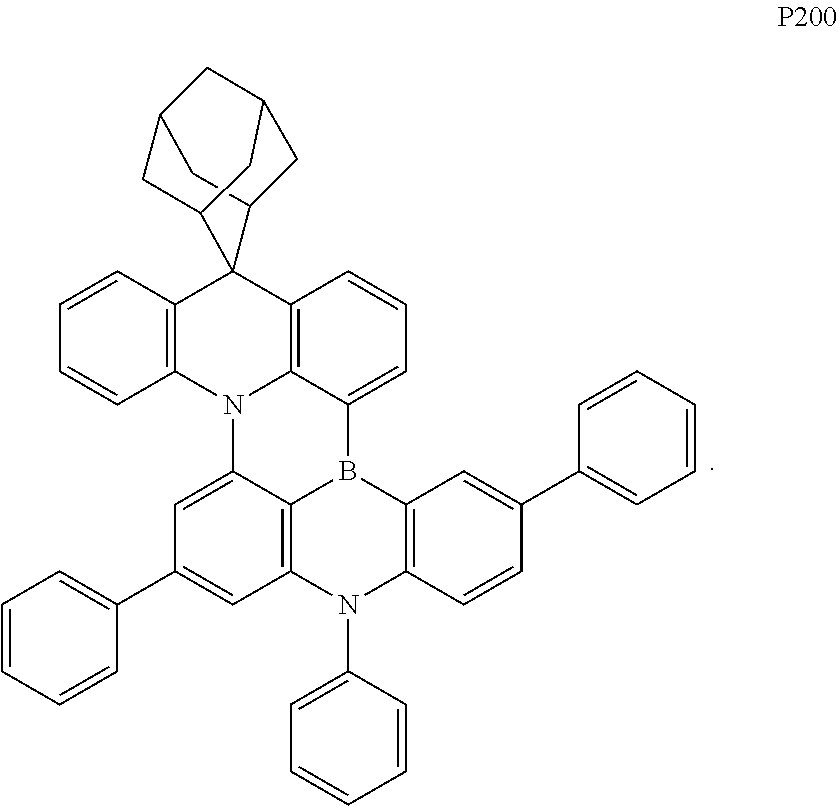
  • the organic compound is selected from one or more of the following compounds P1 to P200:
  • a second aspect of the present disclosure provides application of the organic compound provided by the first aspect of the present disclosure in an organic electroluminescent device.
  • the organic compound can be used as an organic electroluminescent layer material of the organic electroluminescent device.
  • a third aspect of the present disclosure provides an organic electroluminescent device, comprising an anode, a cathode and at least one functional layer between the anode and the cathode, wherein the functional layer includes a hole injecting layer, a hole transporting layer, an organic electroluminescent layer, an electron transporting layer and an electron injecting layer; the organic electroluminescent layer comprises the organic compound provided by the first aspect of the present disclosure, optionally comprises at least one of the compounds P1 to P184.
  • the organic electroluminescent device includes an anode 100 and a cathode 200 which are oppositely disposed, and a functional layer 300 disposed between the anode 100 and the cathode 200 ; the functional layer 300 comprises the compound provided by the present disclosure.
  • the compound provided by the present disclosure is used to form at least one organic film layer in the functional layer 300 to improve the life characteristics, efficiency characteristics, and reduce the driving voltage of the organic electroluminescent device.
  • the mass production stability of the organic electroluminescent device can also be improved.
  • the functional layer 300 includes an organic electroluminescent layer 330 , the organic electroluminescent layer 330 contains the compound provided by the present disclosure.
  • the organic electroluminescent layer 330 may be composed of the compound provided by the present disclosure, or may be composed of the compound provided by the present disclosure together with other materials.
  • the organic electroluminescent device includes an anode 100 , a hole injecting layer 310 , a hole transporting layer 320 , an organic electroluminescent layer 330 , an electron transporting layer 340 , an electron injecting layer 350 , and a cathode 200 which are stacked in sequence.
  • the compound provided by the present disclosure may be applied to the organic electroluminescent layer 330 of the organic electroluminescent device, and can effectively improve electron transporting properties of the organic electroluminescent device.
  • the anode 100 includes the following anode materials, which is preferably the material having a large work function that facilitates hole injection into the functional layer.
  • the anode material include metals such as nickel, platinum, vanadium, chromium, copper, zinc, and gold or alloys thereof, metal oxides such as zinc oxide, indium oxide, indium tin oxide (ITO), and indium zinc oxide (IZO); combination of metals and oxides such as ZnO:Al or SnO 2 :Sb; or conductive polymers such as poly(3-methylthiophene), poly[3,4-(ethylene-1,2-dioxy)thiophene] (PEDT), polypyrrole, and polyaniline, but are not limited thereto.
  • a transparent electrode containing indium tin oxide (ITO) as an anode is preferably included.
  • the organic electroluminescent layer 330 consists of a single light-emitting material, or also contains a host material and a guest material.
  • the organic electroluminescent layer 330 consists of a host material and a guest material. Holes injected into the organic electroluminescent layer 330 and electrons injected into the organic electroluminescent layer 330 may be combined in the organic electroluminescent layer 330 to form excitons, the excitons transfer energy to the host material, and the host material transfers energy to the guest material, thereby enabling the guest material to emit light.
  • the guest material of the organic electroluminescent layer 330 may be a compound having a condensed aryl ring or a derivative thereof, a compound having a heteroaryl ring or a derivative thereof, an aromatic amine derivative, or other materials, which is not particularly limited in the present disclosure.
  • the guest material of the organic electroluminescent layer 330 may be Ir(piq) 2 (acac).
  • the guest material of the organic electroluminescent layer 330 may be BD-1, or may also be the compound provided by the present disclosure.
  • the electron transporting layer 340 may be of a single-layer structure, or may also be a multi-layer structure, which may include one or more electron transporting materials.
  • the electron transporting materials may be selected from a benzimidazole derivative, an oxadiazole derivative, a quinoxaline derivative, or other electron transporting materials, which is not particularly limited in the present disclosure.
  • the electron transporting layer 340 may be composed of DBimiBphen and LiQ.
  • the cathode 200 includes a cathode material, which is a material with a small work function that facilitates electron injection into the functional layer.
  • the cathode material include metals such as magnesium, calcium, sodium, potassium, titanium, indium, yttrium, lithium, gadolinium, aluminum, silver, tin and lead or alloys thereof; or multilayer materials such as LiF/Al, Liq/Al, LiO 2 /Al, LiF/Ca, LiF/Al and BaF 2 /Ca, but not limited thereto.
  • a metal electrode containing aluminium as a cathode is preferably included.
  • a hole injecting layer 310 is also arranged between the anode 100 and the hole transporting layer 320 to enhance the capability of injecting holes into the hole transporting layer 320 .
  • the hole injecting layer 310 may adopt a benzidine derivative, a starburst arylamine compound, a phthalocyanine derivative, or other materials, which is not particularly limited in the present disclosure.
  • the hole injecting layer 310 may consist of m-MTDATA.
  • the hole transporting layer 320 includes a first hole transporting layer 321 and a second hole transporting layer 322 , and the first hole transporting layer 321 is disposed to be closer to the surface of the anode 100 than the second hole transporting layer 322 ; and the first hole transporting layer 321 or the second hole transporting layer 322 comprises the organic compound provided by the present disclosure.
  • one of the first hole transporting layer 321 or the second hole transporting layer 322 may contain the organic compound provided by the present disclosure, or both the first hole transporting layer 321 and the second hole transporting layer 322 may contain the organic compound provided by the present disclosure.
  • the first hole transporting layer 321 or the second hole transporting layer 322 may also contain other materials or may not contain other materials.
  • the second hole transporting layer 322 may be considered as an electron blocking layer of the organic electroluminescent device.
  • an electron injecting layer 350 is also be disposed between the cathode 200 and the electron transporting layer 340 to enhance the capability of injecting electrons into the electron transporting layer 340 .
  • the electron injecting layer 350 may include inorganic materials such as alkali metal sulfide or alkali metal halide, or may include complexs of alkali metal and organic substance.
  • the electron injecting layer 350 includes LiQ.
  • the organic electroluminescent device of the present disclosure is based on the excellent properties of the organic compound of the present disclosure, has good carrier conduction efficiency and life, reduces the driving voltage of the organic electroluminescent device, and improves light-emitting properties.
  • nBuLi (2.5 M) (96.7 mL, 241.8 mmol) was started to be added dropwise while keeping the temperature constant, a solution of adamantanone (30 g, 199.7 mmol) in tetrahydrofuran THE (100 mL) was added dropwise into the system after stirring for 1 h, the mixture was naturally heated to room temperature after adding dropwise was finished, methanesulfonic acid (46.5 g, 483.6 mmol) was added, and the mixture was heated to reflux for 1 h under stirring.
  • the organic compounds were prepared by the same method as in Synthesis Example 1 except that the raw material 1 in Table 1 was used instead of diphenylamine in step (3) in Example 1. Structures and characterization data of the finally prepared organic compounds are shown in Table 1.
  • reaction was quenched by the addition of aqueous solution of ammonium chloride, and subjected to extraction with ethyl acetate to obtain the organic phase, which was dried over anhydrous magnesium sulfate and filtered, and the solvent was removed under reduced pressure.
  • the resulting residue was purified by silica column chromatography purification with dichloromethane/n-heptane (1:2) to obtain Intermediate 1-A-5 (1.13 g, a yield of 44.7%) as a white solid.
  • the organic compounds were prepared by the same method as in Example 9 except that the intermediates listed in Table 2 were synthesized by using a raw material 2 in Table 2 instead of p-methylaniline in step (1) in Example 9 and using a raw material 3 instead of 9-(4-bromophenyl)-9H-carbazole. Then by using the intermediates in Table 2 instead of the Intermediate I-B of step (2) in Example 9, the structures and characterization data of the finally prepared organic compounds are shown in Table 3.
  • reaction was quenched by the addition of aqueous solution of ammonium chloride, and subjected to extraction with ethyl acetate to obtain the organic phase, which was dried over anhydrous magnesium sulfate and filtered, and the solvent was removed under reduced pressure.
  • the resulting was purified by silica column chromatography purification with dichloromethane/n-heptane (1:2) to obtain Intermediate I-K-1 (7.13 g, a yield of 52.5%) as a white solid.
  • the organic compounds were prepared by the same method as in Example 18 except that the intermediates listed in Table 4 were synthesized by using a raw material 4 in Table 4 instead of 9-fluorenone in step (1) in Example 18 and using a raw material 5 instead of 2-bromo-N-phenylaniline. Then the intermediates in Table 4 were used instead of Intermediate I-K of step (1) in Example 18. Structures and characterization data of the finally prepared compounds are shown in Table 5.
  • a TOP substrate manufactured by Corning
  • ITO thickness of 1500 ⁇ was cut into a dimension of 40 mm (length) ⁇ 40 mm (width) ⁇ 0.7 mm (thickness), and was prepared into an experimental substrate with a cathode overlap, an anode and an insulation layer pattern by using the photoetching process, and surface treatment was performed with UV ozone and O 2 :N 2 plasma to increase the work function of the anode (the experimental substrate) and remove scum.
  • m-MTDATA (4,4′,4′′-tris(N-3-methylphenyl-N-phenylamino)triphenylamine) was subjected to vacuum evaporation on the experimental substrate (the anode) to form a hole injecting layer (HIL) having a thickness of 100 ⁇ , and NPB was subjected to vacuum evaporation on the hole injecting layer to form a first hole transporting layer (HTL1) having a thickness of 1000 ⁇ .
  • HIL hole injecting layer
  • HTL1 first hole transporting layer
  • TCTA 4,4′,4′′-tris(carbazol-9-yl)triphenylamine
  • ⁇ , ⁇ -ADN was used as a host, and doped with the organic compound P1 prepared by Synthesis Example 1, and the host and the dopant formed an organic electroluminescent layer (EML) having a thickness of 220 ⁇ according to a film thickness ratio of 30:3.
  • EML organic electroluminescent layer
  • DBimiBphene (4,7-Diphenyl-2,9-bis(4-(1-phenyl-1H-benzo[d]imidazol-2-yl)phenyl)-1,10-phenanthraline) and LiQ (8-hydroxyquinoline lithium) were mixed at a weight ratio of 1:1 and evaporated to form an electron transporting layer (ETL) having a thickness of 300 ⁇
  • metal Yb was evaporated on the electron transporting layer to form an electron injecting layer (EIL) having a thickness of 10 ⁇
  • magnesium (Mg) and silver (Ag) were mixed at an evaporation rate of 1:9 and were subjected to vacuum evaporation on the electron injecting layer to form a cathode having a thickness of 120 ⁇ .
  • CPL organic capping layer
  • the organic electroluminescent devices were prepared by employing the same method as in Device Example 1, except that the organic compound P1 in Device Example 1 was sequentially replaced by compounds other than compounds A to E listed in Table 8 to prepare the organic electroluminescent devices.
  • the organic electroluminescent devices were prepared by employing the same method as in Device Example 1, except that compounds A to E listed below were used instead of the organic compound 1 in Device Example 1 to prepare the organic electroluminescent devices.
  • the organic electroluminescent devices were prepared in the Device Examples and Device Comparative Examples were tested for IVL (Current-Voltage-Brightness) performance of the devices under conditions of 10 mA/cm 2 , and T95 lifetime of the devices was tested at 15 mA/cm 2 .
  • IVL Current-Voltage-Brightness

Landscapes

  • Chemical & Material Sciences (AREA)
  • Engineering & Computer Science (AREA)
  • Materials Engineering (AREA)
  • Physics & Mathematics (AREA)
  • Spectroscopy & Molecular Physics (AREA)
  • Organic Chemistry (AREA)
  • Optics & Photonics (AREA)
  • Inorganic Chemistry (AREA)
  • Electroluminescent Light Sources (AREA)

Abstract

The present disclosure provides an organic compound, said compound having a structure as represented by Formula (1) below, in which at least one among Q1, Q2, and Q3 is (aa), and (bb) indicates a connective bond; n1 and n2 are the same or different, and are respectively independently selected from 0, 1, 2, 3, or 4; n3 and n4 are the same or different, and are respectively independently selected from 0, 1, 2, 3, 4, or 5; n5 is selected from 0, 1, 2, or 3; R1, R2, R3, R4, and R5 are the same or different, and are respectively independently selected from deuterium, cyano, halogen, a substituted or unsubstituted alkyl having 1 to 10 carbon atoms, a substituted or unsubstituted aryl having 6 to 40 carbon atoms, a substituted or unsubstituted heteroaryl having 2 to 40 carbon atoms, or a substituted or unsubstituted arylamine having 6 to 40 carbon atoms. The organic compound in the present disclosure used for organic electroluminescent devices can significantly improve luminous efficacy and prolong the life of organic electroluminescent devices.
Figure US12325721-20250610-C00001

Description

CROSS REFERENCE TO RELATED APPLICATIONS
This application claims priority to Chinese Patent Application No. CN201911416572.7, filed on Dec. 31, 2019, and Chinese Patent Application No. CN202011133615.3, filed on Oct. 21, 2020, the disclosures of which are incorporated herein by reference in their entirety as part of this application.
TECHNICAL FIELD
The present disclosure relates to the technical field of organic light-emitting materials, in particular to an organic compound, application thereof and an organic electroluminescent device.
BACKGROUND
With the development of electronic technology and the advancement of material science, the range of applications of electronic components for realizing electroluminescence or photoelectric conversion is increasingly widespread. Electronic components of this type typically each include a cathode and an anode which are oppositely disposed, and a functional layer disposed between the cathode and the anode. The functional layer consists of multiple organic or inorganic film layers and generally includes an energy conversion layer, a hole transporting layer between the energy conversion layer and the anode, and an electron transporting layer between the energy conversion layer and the cathode.
Taking an organic electroluminescent device as an example, the organic electroluminescent device generally includes an anode, a hole transporting layer, an electroluminescent layer as an energy conversion layer, an electron transporting layer, and a cathode which are stacked in sequence. When an electric voltage is applied to the anode and the cathode, the two electrodes generate an electric field, under the action of the electric field, electrons on the cathode side move towards the electroluminescent layer and holes on the anode side also move towards the light-emitting layer, electrons and holes are combined to form excitons in the electroluminescent layer, and the excitons are in an excited state to release energy outwards, thereby causing the electroluminescent layer to emit light outwards. Organic light-emitting diodes have self-luminous properties, and materials that dominate their light emission are mainly electroluminescent materials, however, current electroluminescent materials have low luminous efficacy, which often leads to failure of organic light-emitting diodes.
SUMMARY
The present disclosure aims to increase the luminous efficacy of electroluminescent devices and prolong the service life of electroluminescent devices.
In order to achieve the above object, a first aspect of the present disclosure provides a compound having a structure as represented by the following formula (1):
Figure US12325721-20250610-C00002
    • wherein at least one among Q1, Q2, and Q3 is
Figure US12325721-20250610-C00003
    •  and
Figure US12325721-20250610-C00004
    •  indicates a connective bond;
    • n1 and n2 are the same or different, and are respectively independently selected from 0, 1, 2, 3, or 4;
    • n3 and n4 are the same or different, and are respectively independently selected from 0, 1, 2, 3, 4, or 5;
    • n5 is selected from 0, 1, 2, or 3;
    • R1, R2, R3, R4, and R5 are the same or different, and are respectively independently selected from deuterium, cyano, halogen, a substituted or unsubstituted alkyl having 1 to 10 carbon atoms, a substituted or unsubstituted aryl having 6 to 40 carbon atoms, a substituted or unsubstituted heteroaryl having 2 to 40 carbon atoms, and a substituted or unsubstituted arylamine having 6 to 40 carbon atoms;
    • alternatively, two adjacent R1 and R2 are connected with each other to form a ring, or two adjacent R2 and R3 are connected with each other to form a ring, or two adjacent R3 and R4 are connected with each other to form a ring, or two adjacent R4 and R5 are connected with each other to form a ring, or two adjacent R1 and R4 are connected with each other to form a ring;
    • the substituents of R1, R2, R3, R4, and R5 are the same or different, and are respectively independently selected from deuterium, cyano, halogen, an unsubstituted alkyl having 1 to 30 carbon atoms, an unsubstituted cycloalkyl having 3 to 30 carbon atoms, an unsubstituted heterocycloalkyl having 2 to 30 carbon atoms, an aryl having 6 to 30 carbon atoms optionally substituted with an alkyl having 1 to 5 carbon atoms, an unsubstituted heteroaryl having 1 to 30 carbon atoms, an unsubstituted alkoxy having 1 to 30 carbon atoms, an unsubstituted arylamine having 6 to 30 carbon atoms, an unsubstituted alkylsilyl having 1 to 30 carbon atoms, or an unsubstituted arylsilyl having 6 to 30 carbon atoms.
A second aspect of the present disclosure provides the application of the organic compound provided by the first aspect of the present disclosure in an organic electroluminescent device.
A third aspect of the present disclosure provides an organic electroluminescent device, comprising an anode, a cathode and at least one functional layer between the anode and the cathode, where the functional layer includes a hole injecting layer, a hole transporting layer, an organic electroluminescent layer, an electron transporting layer and an electron injecting layer; the organic electroluminescent layer contains the organic compound of the first aspect of the present disclosure.
By the above technical solution, the organic compound of the present disclosure has an adamantane-six-membered ring-based structure, and the structure is combined with a solid ring centered on a boron element, which is advantageous to improve the electron stability, prevent the disappearance of excitons, promote host energy transfer, and can significantly improve the stability of carriers and improve the luminescent properties of organic light-emitting devices. And the driving voltage of the organic electroluminescent device containing the organic compound of the present disclosure can be reduced.
Other features and advantages of the present disclosure will be described in detail in the subsequent Detailed Description.
BRIEF DESCRIPTION OF THE DRAWINGS
The above and other features and advantages of the present disclosure will become more apparent by describing in detail exemplary embodiments thereof with reference to the accompanying drawings.
FIG. 1 is a structural schematic diagram of an organic electroluminescent device according to the embodiments of the present disclosure.
FIG. 2 is a structural schematic diagram of an electronic device according to the embodiments of the present disclosure.
The reference signs of main elements in the drawings are illustrated below:
    • 100, anode; 200, cathode; 300, functional layer; 310, hole injecting layer; 320, hole transporting layer; 321, first hole transporting layer; 322, second hole transporting layer; 330, organic electroluminescent layer; 340, electron transporting layer; 350, electron injecting layer; 400, electronic device.
DETAILED DESCRIPTION
Exemplary embodiments will now be described more fully with reference to the accompanying drawings. Exemplary embodiments can, however, be implemented in many forms and should not be construed as limited to the embodiments set forth herein; on the contrary, these embodiments are provided so that the present disclosure will be thorough and complete, and the concept of the exemplary embodiments is fully conveyed to those skilled in the art. The described features, structures, or characteristics may be combined in any suitable manner in one or more embodiments. In the following description, numerous specific details are provided to provide a thorough understanding of embodiments of the present disclosure.
In the drawings, the area and layer thickness may be exaggerated for clarity. The same reference signs in the drawings denote the same or similar structures, and thus their detailed description will be omitted.
The described features, structures, or characteristics may be combined in any suitable manner in one or more embodiments. In the following description, numerous specific details are provided to provide a thorough understanding of embodiments of the present disclosure. One skilled in the art will recognize, however, that the technical solution of the present disclosure may be practiced without one or more of the specific details, or that other methods, elements, materials, etc. may be employed. In other instances, well-known structures, materials, or operations are not shown or described in detail to avoid obscuring the principal technical creatives of the present disclosure.
The terms “the” and “said” are used to indicate the presence of one or more elements/components/etc.; the terms “including” and “having” are used in an open, inclusive sense and mean that additional elements/components/etc. may be present in addition to the listed elements/components/etc.
A first aspect of the present disclosure provides an organic compound, having a structure as represented by the following formula (1):
Figure US12325721-20250610-C00005
    • wherein at least one among Q1, Q2, and Q3 is
Figure US12325721-20250610-C00006
    •  indicates a connective bond;
    • n1 and n2 are the same or different, and are respectively independently selected from 0, 1, 2, 3, or 4;
    • n3 and n4 are the same or different, and are respectively independently selected from 0, 1, 2, 3, 4, or 5;
    • n5 is selected from 0, 1, 2, or 3;
    • R1, R2, R3, R4, and R5 are the same or different, and are respectively independently selected from deuterium, cyano, halogen, a substituted or unsubstituted alkyl having 1 to 10 carbon atoms, a substituted or unsubstituted aryl having 6 to 40 carbon atoms, a substituted or unsubstituted heteroaryl having 2 to 40 carbon atoms, or a substituted or unsubstituted arylamine having 6 to 40 carbon atoms;
    • alternatively, two adjacent R1 and R2 are connected with each other to form a ring, or two adjacent R2 and R3 are connected with each other to form a ring, or two adjacent R3 and R4 are connected with each other to form a ring, or two adjacent R4 and R5 are connected with each other to form a ring, or two adjacent R1 and R4 are connected with each other to form a ring. It should be noted that “two adjacent R1 and R2 are connected with each other to form a ring” means that R1 and R2 may be present in a saturated or unsaturated cyclic form, or may be present independently of each other. For example, when two adjacent R1 and R2, two adjacent R2 and R3, two adjacent R3 and R4, and two adjacent R4 and R5 form rings, the ring-forming ways are, for example,
Figure US12325721-20250610-C00007
The substituents of R1, R2, R3, R4, and R5 are the same or different, and are respectively independently selected from deuterium, cyano, halogen, an unsubstituted alkyl having 1 to 30 carbon atoms, an unsubstituted cycloalkyl having 3 to 30 carbon atoms, an unsubstituted heterocycloalkyl having 2 to 30 carbon atoms, an aryl having 6 to 30 carbon atoms optionally substituted with an alkyl having 1 to 5 carbon atoms, an unsubstituted heteroaryl having 1 to 30 carbon atoms, an unsubstituted alkoxy having 1 to 30 carbon atoms, an unsubstituted arylamine having 6 to 30 carbon atoms, an unsubstituted alkylsilyl having 1 to 30 carbon atoms, or an unsubstituted arylsilyl having 6 to 30 carbon atoms. In the present disclosure, “the aryl having 6 to 30 carbon atoms optionally substituted with the alkyl having 1 to 5 carbon atoms” means that the aryl may be substituted with the alkyl having 1 to 5 carbon atoms, or may not be substituted with the alkyl having 1 to 5 carbon atoms.
In the present disclosure, “at least one among Q1, Q2, and Q3 is
Figure US12325721-20250610-C00008

means that one of Q1, Q2, and Q3 is
Figure US12325721-20250610-C00009

or two of Q1, Q2, and Q3 are
Figure US12325721-20250610-C00010

or three of Q1, Q2, and Q3 are
Figure US12325721-20250610-C00011
In the present disclosure, the dashed line “ - - - ” in Formula (1) indicates that a connective bond may be formed at the dashed line, or may not be formed at the dashed line. Specifically, the dashed line at Q3 indicates that Q3 may form a connective bond at this dashed line to be connected with the benzene rings to form a ring, or may not form a connective bond and not be connected with the benzene rings to form a ring; the dashed line at Q2 indicates that Q2 may form a connective bond at this dashed line to be connected with the benzene rings to form a ring, or may not form a connective bond and not be connected with the benzene rings to form a ring; the dashed line at Q1 indicates that Q1 may form a connective bond at this dashed line to be connected with the benzene rings to form a ring, or may not form a connective bond and not be connected with the benzene rings to form a ring.
In the present disclosure, the dashed line in Formula (1) means that one of Q1, Q2 and Q3 does not exist when it is not “
Figure US12325721-20250610-C00012

”. For example, Q1 does not exist when it is not “
Figure US12325721-20250610-C00013

”, Q2 does not exist when it is not “
Figure US12325721-20250610-C00014

”, Q3 does not exist when it is not
Figure US12325721-20250610-C00015

”.
In the present disclosure, when n1, n2, n3, n4, or n5 are selected from 0, the connected benzene ring is not substituted.
In the present disclosure, n1 is the number of substituent R1, and when n1 is greater than or equal to 2, any two R1 are the same or different; n2 is the number of substituent R2, when n2 is greater than or equal to 2, any two R2 are the same or different; n3 is the number of substituent R3, when n3 is greater than or equal to 2, any two R3 are the same or different; n4 is the number of substituent R4, when n4 is greater than or equal to 2, any two R4 are the same or different; n5 is the number of substituent R5, and when n5 is greater than or equal to 2, any two R5 are the same or different.
In the molecular structure of the organic compound of the present disclosure, the boron element in the organic compound forms a solid ring structure with the central arylamine. And the combination of the borylamine and electron-rich spiroarylamine can improve the electron stability, prevent the disappearance of excitons, and facilitate energy transfer of the host, thus maximizing the efficiency. Linking the adamantane-six-membered ring with the solid ring centered on the boron element, due to the alkane structure of adamantane, can greatly reduce the 7E-7E stacking effect of the molecules, and significantly improve the stability of carriers, thus improving the luminescent properties of organic light-emitting devices. The organic electroluminescent device containing the organic compound has higher luminous efficacy and longer service life.
In the present disclosure, the number of carbon atoms of R1, R2, R3, R4 and R5 refers to the number of all carbon atoms. For example, if R1, R2, R3, R4 and R5 are selected from a substituted aryl having 18 carbon atoms, the number of all carbon atoms of the aryl and the substituents thereon are 18; if R1, R2, R3, R4 and R5 are selected from a substituted alkyl having 10 carbon atoms, the number of all carbon atoms of the alkyl and the substituents thereon is 10; if R1, R2, R3, R4 and R5 are selected from a substituted heteroaryl having 10 carbon atoms, the number of all carbon atoms of the heteroaryl and the substituents thereon is 10; if R1, R2, R3, R4 and R5 are selected from a substituted arylamine having 10 carbon atoms, the number of all carbon atoms of the arylamine and the substituents thereon is 10.
In the present disclosure, the descriptions used “are each independently . . . ”, “ . . . are respectively independently“and” . . . are independently selected from” may interchangeable, and should be understood in a broad sense, which means that specific options expressed between identical symbols in different groups do not affect each other, or means that specific options expressed between identical symbols in the same group do not affect each other. For example, “
Figure US12325721-20250610-C00016

where each q is independently 0, 1, 2 or 3, and each R″ is independently selected from hydrogen, deuterium, fluorine, or chlorine” means that the formula Q-1 indicates that there are q substituents R″ on the benzene ring, each R″ may be the same or different, and the options of each R″ do not affect each other; the formula Q-2 indicates that there are q substituents R″ on each benzene ring of biphenyl, the number q of R″ substituents on both benzene rings may be the same or different from each other, each R″ may be the same or different, and the options of each R″ do not affect each other.
In the present disclosure, the term “substituted or unsubstituted” means that the functional groups described after the term may have or may not have substituents (substituents are collectively referred to as Rc hereinafter for ease of description). For example, “the substituted or unsubstituted aryl” refers to an aryl with a substituent Rc or an unsubstituted aryl. The above substituent, i.e. Rc, for example, may be deuterium, halogen, cyano, a heteroaryl having 3 to 20 carbon atoms, an aryl having 6 to 20 carbon atoms, a trialkylsilyl having 3 to 12 carbon atoms, a triarylsilyl having 18 to 30 carbon atoms, an alkyl having 1 to 10 carbon atoms, a haloalkyl having 1 to 10 carbon atoms, an alkenyl having 2 to 6 carbon atoms, an alkynyl having 2 to 6 carbon atoms, a cycloalkyl having 3 to 10 carbon atoms, a heterocycloalkyl having 2 to 10 carbon atoms, a cycloalkenyl having 5 to 10 carbon atoms, a heterocycloalkenyl having 4 to 10 carbon atoms, an alkoxy having 1 to 10 carbon atoms, an alkamine having 1 to 10 carbon atoms, an alkylthio having 1 to 10 carbon atoms, an aryloxy having 6 to 18 carbon atoms, an arylthio having 6 to 18 carbon atoms, an alkylsulfonyl having 6 to 18 carbon atoms, a trialkylphosphino having 3 to 18 carbon atoms, or a trialkylboryl having 3 to 18 carbon atoms.
In the present disclosure, in the expression “any two adjacent substituents form a ring”, “any adjacent substituents” may include both substituents on the same atom and one substituent on each of two adjacent atoms; when there are two substituents on the same atom, the two substituents may form a saturated or unsaturated ring (e.g., a 3- to 18-membered saturated or unsaturated ring) with the atom to which they are jointly connected; when two adjacent atoms have one substituent on each, the two substituents may be fused to a ring, e.g., a naphthalene ring, a phenanthrene ring, or an anthracene ring.
In the present disclosure, when a specific definition is not otherwise provided, “hetero” means that at least one heteroatom such as B, O, N, P, Si, Se, or S is included in one functional group and the remaining atoms are carbon and hydrogen. An unsubstituted alkyl may be a “saturated alkyl” without any double or triple bonds.
In the present disclosure, “alkyl” may include a linear alkyl or a branched alkyl. The alkyl may have 1 to 20 carbon atoms, and in the present disclosure, a numerical range such as “1 to 20” refers to each integer in the given range. For example, “1 to 20 carbon atoms” refers to an alkyl that may include 1 carbon atom, 2 carbon atoms, 3 carbon atoms, 4 carbon atoms, 5 carbon atoms, 6 carbon atoms, 7 carbon atoms, 8 carbon atoms, 9 carbon atoms, 10 carbon atoms, 11 carbon atoms, 12 carbon atoms, 13 carbon atoms, 14 carbon atoms, 15 carbon atoms, 16 carbon atoms, 17 carbon atoms, 18 carbon atoms, 19 carbon atoms, or 20 carbon atoms. The alkyl may also be a medium-sized alkyl having 1 to 10 carbon atoms. The alkyl may also be a lower alkyl having 1 to 6 carbon atoms. In addition, the alkyl may be substituted or unsubstituted. Specific examples of the alkyl having 1 to 10 carbon atoms include, but are not limited to, methyl, ethyl, n-propyl, isopropyl, n-butyl, isobutyl, tert-butyl, n-pentyl, isopentyl, neopentyl, n-hexyl, n-heptyl, n-octyl, 2-ethylhexyl, nonyl, decyl, and the like.
In the present disclosure, the aryl refers to an optional functional or substituent derived from an aromatic hydrocarbon ring. The aryl may be a monocyclic aryl or a polycyclic aryl, in other words, the aryl may be a monocyclic aryl, a fused aryl, two or more monocyclic aryl conjugated by a carbon-carbon bond, a monocyclic aryl and a fused aryl conjugated by a carbon-carbon bond, and two or more fused aryl conjugated by a carbon-carbon bond. That is, two or more aromatic groups conjugated by a carbon-carbon bond may also be considered the aryl of the present disclosure. Where the aryl does not contain heteroatoms such as B, O, N, P, Si, Se, or S.
For example, in the present disclosure, phenyl, biphenyl, and the like are aryl. Examples of the aryl may include phenyl, naphthyl, fluorenyl, anthryl, phenanthryl, biphenyl, terphenyl, quaterphenyl, quinquephenyl, hexaphenyl, benzo[9,10]phenanthryl, pyrenyl, benzofluoranthenyl, chrysenyl, and the like, but are not limited thereto.
In the present disclosure, the substituted aryl means that one or more hydrogen atoms of the aryl are substituted with other groups. For example, at least one hydrogen atom is substituted with deuterium atom, F, Cl, Br, I, CN, hydroxyl, amino, branched alkyl, linear alkyl, cycloalkyl, alkoxy, alkylamine, aryl, heteroaryl, or other groups. It can be understood that a substituted aryl having 18 carbon atoms means that the total number of carbon atoms of the aryl and the substituents on the aryl is 18. For example, 9,9-dimethylfluorenyl has 15 carbon atoms.
In the present disclosure, the aryl as a substituent is exemplified by, but not limited to, phenyl, biphenyl, naphthyl, 9,9-dimethylfluorenyl, 9,9-diphenylfluorenyl, phenanthryl, anthryl, and the like.
In the present disclosure, the heteroaryl may be a heteroaryl including at least one of B, O, N, P, Si, Se and S as a heteroatom. The heteroaryl may be a monocyclic or polycyclic heteroaryl, that is, the heteroaryl may be a single aromatic ring system or multiple aromatic ring systems conjugated via carbon-carbon bonds, and either aromatic ring system is an aromatic monocyclic ring or an aromatic fused ring. By way of example, the heteroaryl may include thienyl, furanyl, pyrrolyl, imidazolyl, thiazolyl, oxazolyl, oxadiazolyl, triazolyl, pyridyl, bipyridyl, pyrimidinyl, triazinyl, acridinyl, pyridazinyl, pyrazinyl, quinolyl, quinazolinyl, quinoxalinyl, phenoxazinyl, phthalazinyl, pyridopyrimidinyl, pyridopyrazinyl, pyrazinopyrazinyl, isoquinolyl, indolyl, carbazolyl, N-arylcarbazolyl, N-heteroarylcarbazolyl, N-alkylcarbazolyl, benzoxazolyl, benzimidazolyl, benzothiazolyl, benzocarbazolyl, benzothienyl, dibenzothienyl, thienothienyl, benzofuranyl, phenanthrolinyl, isoxazolyl, thiadiazolyl, benzothiazolyl, phenothiazinyl, dibenzosilyl, dibenzofuranyl, phenyl-substituted dibenzofuranyl, dibenzofuranyl-substituted phenyl, etc., but is not limited thereto. Among them, thienyl, furanyl, phenanthrolinyl, etc., are heteroaryl of the single aromatic ring system, and N-arylcarbazolyl, N-heteroarylcarbazolyl, phenyl-substituted dibenzofuranyl, dibenzofuranyl-substituted phenyl, etc., are heteroaryl of the multiple aromatic ring systems conjugated via carbon-carbon bonds. In the present disclosure, the heteroaryl may be carbazolyl, dibenzofuranyl, and the like.
In the present disclosure, the heteroaryl as a substituent is exemplified by, but not limited to, pyridyl, carbazolyl, pyrimidinyl, pyridazinyl, triazinyl, quinolyl, isoquinolyl, quinazolinyl, pyrazinyl, dibenzothienyl, dibenzofuranyl, 9,9-dimethyl-9H-9-silafluorenyl, and the like.
In the present disclosure, the arylamine is a group formed by substituting at least one hydrogen in an amine (—NH2) with an aromatic hydrocarbon. For example, an arylamine in which two hydrogens in an amine (—NH2) are substituted by benzene is a diphenylamine. Exemplarily, the arylamine may be selected from anilino, diphenylamino, benzylamino, N-methylanilino, dimethyl aniline, N-p-toluenediamine and N-m-toluenediamine, and the like. In the present disclosure, the arylamine may be selected from diphenylamino, and dinaphthylamino.
In one specific embodiment of the present disclosure, the compound has a structure as represented by the following formula (1):
Figure US12325721-20250610-C00017
    • wherein at least one among Q1, Q2, and Q3 is
Figure US12325721-20250610-C00018
    •  indicates a connective bond;
    • n1 and n2 are the same or different, and are respectively independently 0, 1, 2, 3, or 4;
    • n3 and n4 are the same or different, and are respectively independently 0, 1, 2, 3, 4, or 5;
    • n5 is selected from 0, 1, 2, or 3;
    • R1, R2, R3, R4, and R5 are the same or different, and are respectively independently selected from deuterium, cyano, halogen, an unsubstituted alkyl having 1 to 10 carbon atoms, a substituted or unsubstituted aryl having 6 to 40 carbon atoms, a substituted or unsubstituted heteroaryl having 2 to 40 carbon atoms, or a substituted or unsubstituted arylamine having 6 to 40 carbon atoms;
    • the substituents of R1, R2, R3, R4, and R5 are the same or different, and are respectively independently selected from deuterium, cyano, halogen, an unsubstituted alkyl having 1 to 30 carbon atoms, an unsubstituted cycloalkyl having 3 to 30 carbon atoms, an unsubstituted heterocycloalkyl having 2 to 30 carbon atoms, a substituted or unsubstituted aryl having 6 to 30 carbon atoms, an unsubstituted heteroaryl having 1 to 30 carbon atoms, an unsubstituted alkoxy having 1 to 30 carbon atoms, an unsubstituted arylamine having 6 to 30 carbon atoms, an unsubstituted alkylsilyl having 1 to 30 carbon atoms, or an unsubstituted arylsilyl having 6 to 30 carbon atoms.
In one specific embodiment of the present disclosure, R1 and R2 may be connected to form a ring, R2 and R3 may be connected to form a ring, R3 and R5 may be connected to form a ring, R1 and R4 may be connected to form a ring, and R4 and R5 may be connected to form a ring, wherein the rings are independently a fused aromatic ring or a fused heteroaromatic ring, such as xanthene ring, a fluorene ring, 10-phenyl-9,10-dihydroacridine ring, and the like. For example, in compound
Figure US12325721-20250610-C00019

R3 and R5 form a 10-phenyl-9,10-dihydroacridine ring.
In the present disclosure, the meaning of A and B “may be connected to form a ring” is that A and B are independently of each other, and the two are not connected; or is that A and B are connected with each other to form a ring. For example, R1 and R2 may be connected to form a ring, which means that R1 and R2 are independent of each other and are not connected, or R1 and R2 are connected with each other to form a ring; R2 and R3 may be connected to form a ring, which means that R2 and R3 are independent of each other and are not connected, or R2 and R3 are connected with each other to form a ring; R3 and R5 may be connected to form a ring, which means R3 and R5 are independently of each other and are not connected, or R3 and R5 are connected with each other to form a ring; R1 and R4 may be connected to form a ring, which means R1 and R4 are independent of each other and are not connected, or R1 and R4 are connected with each other to form a ring; R4 and R5 may be connected to form a ring, which means that R4 and R5 are independent of each other and are not connected, or R4 and R5 are connected to each other to form a ring.
Further, the ring formed by connecting R1 with R2 may be saturated, e.g. cyclopentane or cyclohexane, and may also be unsaturated. The ring formed by connecting R2 with R3, the ring formed by connecting R1 with R4, the ring formed by connecting R4 with R5, and the ring formed by connecting R3 with R5 are similar in meaning to the ring formed by connecting R1 with R2.
Optionally, the ring is a saturated or unsaturated 3- to 7-membered ring.
The non-positioned connective bond in the present disclosure refers to a single bond “
Figure US12325721-20250610-C00020

extending from a ring system, which indicates that one end of the connective bond may be connected to any position in the ring system through which the bond penetrates, and the other end is connected to the remainder of the compound molecule.
For example, as shown in the formula (f) below, the naphthyl represented by the formula (f) is connected to the other positions of the molecule by two non-positioned connective bonds penetrating the bicyclic ring, which represents the meaning including any of the possible connecting modes as shown in formulas (f-1) to (f-10).
Figure US12325721-20250610-C00021
Figure US12325721-20250610-C00022
By way of further example, as shown in the formula (X′) below, the phenanthrenyl represented by the formula (X′) is connected to the other positions of the molecule by a non-positioned connective bond extending from the middle of the benzene ring on one side, which represents the meaning including any of the possible connecting modes as shown in formulas (X′-1) to (X′-4).
Figure US12325721-20250610-C00023
The non-positioned substituent in the present disclosure refers to a substituent which is connected by a single bond extending from the center of the ring system, which indicates that the substituent may be connected at any possible position in the ring system. For example, as shown in the formula (Y) below, the substituent R′ group represented by the formula (Y) is connected to the quinoline ring by a non-positioned connective bond, which represents the meaning including any of the possible connecting modes as shown in formulas (Y-1) to (Y-7).
Figure US12325721-20250610-C00024
In the present disclosure, the halogen may be, for example, fluorine, chlorine, bromine, or iodine.
In the present disclosure, specific examples of the trialkylsilyl include, but are not limited to, trimethylsilyl, triethylsilyl, and the like.
In the present disclosure, specific examples of the triarylsilyl include, but are not limited to, triphenylsilyl, and the like.
In the present disclosure, specific examples of the haloalkyl include, but are not limited to, trifluoromethyl.
Hereinafter, the meaning for non-positionally connected or non-positionally substituted is the same as here and will not be repeated later.
In one specific embodiment of the present disclosure, R1, R2, R3, R4, and R5 are the same or different, and are respectively independently selected from deuterium, cyano, fluorine, an unsubstituted alkyl having 1 to 5 carbon atoms, a substituted or unsubstituted aryl having 6 to 20 carbon atoms, a substituted or unsubstituted heteroaryl having 3 to 30 carbon atoms, or a substituted or unsubstituted arylamine having 10 to 20 carbon atoms.
In one specific embodiment of the present disclosure, the substituents of R1, R2, R3, R4, and R5 are the same or different, and are respectively independently selected from deuterium, cyano, fluorine, an alkyl having 1 to 5 carbon atoms, a substituted or unsubstituted aryl having 6 to 20 carbon atoms, an unsubstituted heteroaryl having 3 to 20 carbon atoms, or an unsubstituted arylamine having 12 to 20 carbon atoms.
In one specific embodiment of the present disclosure, the substituents of R1, R2, R3, R4, and R5 are the same or different, and are respectively independently selected from deuterium; cyan; fluorine; an alkyl having 1 to 5 carbon atoms; an aryl having 6 to 15 carbon atoms optionally substituted with methyl, ethyl, isopropyl or tert-butyl; or a heteroaryl having 5 to 12 carbon atoms.
In one specific embodiment of the present disclosure, the substituents of R1, R2, R3, R4, and R5 are the same or different, and are respectively independently selected from deuterium, cyano, fluorine, methyl, ethyl, isopropyl, tert-butyl, phenyl, naphthyl, biphenyl, pyridyl, dibenzothienyl, 9,9-dimethyl-9H-9-silafluorenyl, dibenzofuranyl, 9,9-dimethylfluorenyl, carbazolyl, or phenyl substituted with tert-butyl.
In one specific embodiment of the present disclosure, said R1, R2, R3, R4, and R5 are the same or different, and are respectively independently selected from deuterium, cyano, halogen, an alkyl having 1 to 10 carbon atoms, or the group consisting of the following groups:
Figure US12325721-20250610-C00025
Figure US12325721-20250610-C00026
    • wherein
Figure US12325721-20250610-C00027
    •  represents a chemical bond,
    • M1 is selected from single bond or
Figure US12325721-20250610-C00028
    • b1, b6, b7, b13 and b16 are the same or different, and are respectively independently 1, 2, 3, 4, or 5;
    • b2, b3, b4, b5, b8, b9, b11, b12, b14, b17, b18 and b19 are the same or different, and are respectively independently 1, 2, 3, or 4;
    • b10 is 1, 2, or 3;
    • b15 is 1, 2, 3, 4, 5, 6, or 7;
    • X is selected from O, S, Si(E20E21), C(E22E23), N(E24), or Se;
    • Y is selected from O, S, or N(E25);
    • Z1 to Z6 are the same or different, and are each independently selected from C(E′) or N, and at least one of Z1 to Z6 is N, where E′ in said Z1 to Z6 are the same or different, and are respectively independently selected from hydrogen, an alkyl having 1 to 10 carbon atoms, an aryl having 6 to 18 carbon atoms, a heteroaryl having 3 to 18 carbon atoms, or a cycloalkyl having 3 to 10 carbon atoms, or adjacent E′ may be connected to form a ring;
    • E1 to E25 are the same or different, and are respectively independently selected hydrogen, deuterium, halogen, cyano, an alkyl having 1 to 10 carbon atoms, an aryl having 6 to 18 carbon atoms, a heteroaryl having 3 to 18 carbon atoms, a cycloalkyl having 3 to 10 carbon atoms, or an aryl having 6 to 18 carbon atoms substituted with alkyl; or E20 and E21 may be connected to form a ring, or E22 and E23 may be connected to form a ring, or any two E6 may be fused with the phenyl to which they are connected to form an aromatic ring, or any two E7 may be fused with phenyl to which they are connected to form an aromatic ring, where E1, E13, E14 and E19 are not aryl.
In the present disclosure, b1 is the number of substituent E1, and when b1 is greater than or equal to 2, any two E1 are the same or different; b2 is the number of substituent E2, and when b2 is greater than or equal to 2, any two E2 are the same or different; b3 is the number of substituent E3, and when b3 is greater than or equal to 2, any two E3 are the same or different; b4 is the number of substituent E4, and when b4 is greater than or equal to 2, any two E4 are the same or different; b5 is the number of substituent E5, and when b5 is greater than or equal to 2, any two E5 are the same or different; b6 is the number of substituent E6, and when b6 is greater than or equal to 2, any two E6 are the same or different; b7 is the number of substituent E7, and when b7 is greater than or equal to 2, any two E7 are the same or different; b8 is the number of substituent E8, and when b8 is greater than or equal to 2, any two E8 are the same or different; b9 is the number of substituent E9, and when b9 is greater than or equal to 2, any two E9 are the same or different; b10 is the number of substituent E10, and when b10 is greater than or equal to 2, any two E10 are the same or different; b11 is the number of substituent E11, and when b11 is greater than or equal to 2, any two E11 are the same or different; b12 is the number of substituent E12, and when b12 is greater than or equal to 2, any two E12 are the same or different; b13 is the number of substituent E13, and when b13 is greater than or equal to 2, any two E13 are the same or different; b14 is the number of substituent E14, and when b14 is greater than or equal to 2, any two E14 are the same or different; b15 is the number of substituent E15, and when bis is greater than or equal to 2, any two E15 are the same or different; b16 is the number of substituent E16, and when b16 is greater than or equal to 2, any two E16 are the same or different; b17 is the number of substituent E17, and when b17 is greater than or equal to 2, any two E17 are the same or different; bis is the number of substituent E18, and when b18 is greater than or equal to 2, any two E18 are the same or different; big is the number of substituent E19, and when big is greater than or equal to 2, any two E19 are the same or different.
In the present disclosure, when b1 to bis are selected from 0, the benzene ring is not substituted.
Optionally, E6 and E7 are fused with the phenyl to which they are connected to form an aromatic ring, for example, E6 and E7 are fused with the benzene ring to which they are connected to form a naphthyl.
Adjacent E′ may be connected to form a ring, which means that Z1 and Z2 form a ring, or Z2 and Z3 form a ring, or Z3 and Z4 form a ring, or Z4 and Z6 form a ring, or Z5 and Z6 form a ring, Z6 and Z1 form a ring, of course also including Z2 and Z3 form a ring and Z5 and Z6 form a ring, etc.
In the present disclosure, the meaning of A and B “may be connected to form a ring” is that A and B are independently of each other and are not connected; or A and B are connected with each other to form a ring. For instance, E20 and E21 may be connected to form a ring For example, E20 and E21 are independent of each other and are not connected, or E20 and E21 are connected with each other to form a ring. E22 and E23 may be connected to form a ring, for example, E22 and E23 are independent of each other and are not connected, or E22 and E23 are connected with each other to form a ring.
For instance, Z3 and Z4 may be connected to form a ring. For example, E′ of Z3 and E′ of Z4 are independent of each other and are not connected, or E′ of Z3 and E′ of Z4 and the atom to which E′ is connected are connected to form a ring, the ring refers to a saturated or unsaturated ring. Optionally, the number of carbon atoms of the ring may be 5, for example
Figure US12325721-20250610-C00029

or is 6, for example
Figure US12325721-20250610-C00030

and may also be 13, for example
Figure US12325721-20250610-C00031

Of course, the number of carbon atoms forming the ring may also be other values, which will not be listed one by one here, and the number of carbon atoms in the ring is not specifically defined in the present disclosure.
In one specific embodiment of the present disclosure, said R1, R2, R3, R4, and R5 are the same or different, and are respectively independently selected from the group consisting of the following group: deuterium, cyano, fluorine, an alkyl having 1 to 5 carbon atoms, a substituted or unsubstituted aryl having 6 to 25 carbon atoms, a substituted or unsubstituted heteroaryl having 3 to 20 carbon atoms, and a substituted or unsubstituted arylamine having 12 to 20 carbon atoms, where the number of carbon atoms of the aryl in the aryl having 6 to 25 carbon atoms may be selected from 6, 8, 10, 12, 14, 16, 18, 20, or 25, and the number of carbon atoms of the heteroaryl in the heteroaryl having 3 to 20 carbon atoms may be selected from 3, 4, 5, 9, 12, 18, or 20.
In one specific embodiment of the present disclosure, said R1, R2, R3, R4, and R5 are the same or different, and are respectively independently selected from the group consisting of deuterium, cyano, fluorine, an alkyl having 1 to 5 carbon atoms, a substituted or unsubstituted aryl having 6 to 10 carbon atoms, a substituted or unsubstituted heteroaryl having 3 to 12 carbon atoms, and a substituted or unsubstituted arylamine having 12 to 15 carbon atoms.
In one specific embodiment of the present disclosure, said R1, R2, R3, R4, and R5 are the same or different, and are respectively independently selected from the group consisting of the following groups: deuterium, cyano, fluorine, an alkyl having 1 to 5 carbon atoms, and a substituted or unsubstituted W; and the unsubstituted W is selected from the groups below:
Figure US12325721-20250610-C00032
Figure US12325721-20250610-C00033
Figure US12325721-20250610-C00034
when W group is substituted, the substituents of W are selected from deuterium, fluorine, cyano, methyl, ethyl, isopropyl, tert-butyl, phenyl, naphthyl, carbazolyl, dibenzofuranyl, dibenzothienyl, biphenyl, pyridyl, 9,9-dimethylfluorenyl, or 9,9-dimethyl-9H-9-silafluorenyl; when W has a plurality of substituents, the plurality of the substituents are the same or different.
In one specific embodiment of the present disclosure, said R1, R2, R3, R4, and R5 are the same or different, and are respectively independently selected from the group consisting of the following groups: deuterium, cyano, fluorine, methyl, ethyl, n-propyl, isopropyl, n-butyl, sec-butyl, tert-butyl, and the groups below,
Figure US12325721-20250610-C00035
Figure US12325721-20250610-C00036
Figure US12325721-20250610-C00037
Figure US12325721-20250610-C00038
In one specific embodiment of the present disclosure, said R1, R2, R3, R4, and R5 are the same or different, and are respectively independently selected from the group consisting of the following groups: deuterium, cyano, fluorine, methyl, ethyl, n-propyl, isopropyl, n-butyl, sec-butyl, tert-butyl, and the groups below,
Figure US12325721-20250610-C00039
Figure US12325721-20250610-C00040
Figure US12325721-20250610-C00041
Figure US12325721-20250610-C00042
Figure US12325721-20250610-C00043
In one specific embodiment of the present disclosure, the organic compound is selected from one or more of the following compounds P1 to P200:
Figure US12325721-20250610-C00044
Figure US12325721-20250610-C00045
Figure US12325721-20250610-C00046
Figure US12325721-20250610-C00047
Figure US12325721-20250610-C00048
Figure US12325721-20250610-C00049
Figure US12325721-20250610-C00050
Figure US12325721-20250610-C00051
Figure US12325721-20250610-C00052
Figure US12325721-20250610-C00053
Figure US12325721-20250610-C00054
Figure US12325721-20250610-C00055
Figure US12325721-20250610-C00056
Figure US12325721-20250610-C00057
Figure US12325721-20250610-C00058
Figure US12325721-20250610-C00059
Figure US12325721-20250610-C00060
Figure US12325721-20250610-C00061
Figure US12325721-20250610-C00062
Figure US12325721-20250610-C00063
Figure US12325721-20250610-C00064
Figure US12325721-20250610-C00065
Figure US12325721-20250610-C00066
Figure US12325721-20250610-C00067
Figure US12325721-20250610-C00068
Figure US12325721-20250610-C00069
Figure US12325721-20250610-C00070
Figure US12325721-20250610-C00071
Figure US12325721-20250610-C00072
Figure US12325721-20250610-C00073
Figure US12325721-20250610-C00074
Figure US12325721-20250610-C00075
Figure US12325721-20250610-C00076
Figure US12325721-20250610-C00077
Figure US12325721-20250610-C00078
Figure US12325721-20250610-C00079
Figure US12325721-20250610-C00080
Figure US12325721-20250610-C00081
Figure US12325721-20250610-C00082
Figure US12325721-20250610-C00083
Figure US12325721-20250610-C00084
Figure US12325721-20250610-C00085
Figure US12325721-20250610-C00086
Figure US12325721-20250610-C00087
Figure US12325721-20250610-C00088
Figure US12325721-20250610-C00089
Figure US12325721-20250610-C00090
Figure US12325721-20250610-C00091
Figure US12325721-20250610-C00092
Figure US12325721-20250610-C00093
Figure US12325721-20250610-C00094
Figure US12325721-20250610-C00095
Figure US12325721-20250610-C00096
Figure US12325721-20250610-C00097
Figure US12325721-20250610-C00098
Figure US12325721-20250610-C00099
Figure US12325721-20250610-C00100
Figure US12325721-20250610-C00101
Figure US12325721-20250610-C00102
Figure US12325721-20250610-C00103
Figure US12325721-20250610-C00104
Figure US12325721-20250610-C00105
Figure US12325721-20250610-C00106
Figure US12325721-20250610-C00107
Figure US12325721-20250610-C00108
Figure US12325721-20250610-C00109
Figure US12325721-20250610-C00110
Figure US12325721-20250610-C00111
A second aspect of the present disclosure provides application of the organic compound provided by the first aspect of the present disclosure in an organic electroluminescent device. According to the present disclosure, the organic compound can be used as an organic electroluminescent layer material of the organic electroluminescent device.
A third aspect of the present disclosure provides an organic electroluminescent device, comprising an anode, a cathode and at least one functional layer between the anode and the cathode, wherein the functional layer includes a hole injecting layer, a hole transporting layer, an organic electroluminescent layer, an electron transporting layer and an electron injecting layer; the organic electroluminescent layer comprises the organic compound provided by the first aspect of the present disclosure, optionally comprises at least one of the compounds P1 to P184.
For example, as shown in FIG. 1 , the organic electroluminescent device includes an anode 100 and a cathode 200 which are oppositely disposed, and a functional layer 300 disposed between the anode 100 and the cathode 200; the functional layer 300 comprises the compound provided by the present disclosure.
Optionally, the compound provided by the present disclosure is used to form at least one organic film layer in the functional layer 300 to improve the life characteristics, efficiency characteristics, and reduce the driving voltage of the organic electroluminescent device. In certain embodiments, the mass production stability of the organic electroluminescent device can also be improved.
Optionally, the functional layer 300 includes an organic electroluminescent layer 330, the organic electroluminescent layer 330 contains the compound provided by the present disclosure. Where the organic electroluminescent layer 330 may be composed of the compound provided by the present disclosure, or may be composed of the compound provided by the present disclosure together with other materials.
In one embodiment of the present disclosure, as shown in FIG. 1 , the organic electroluminescent device includes an anode 100, a hole injecting layer 310, a hole transporting layer 320, an organic electroluminescent layer 330, an electron transporting layer 340, an electron injecting layer 350, and a cathode 200 which are stacked in sequence. The compound provided by the present disclosure may be applied to the organic electroluminescent layer 330 of the organic electroluminescent device, and can effectively improve electron transporting properties of the organic electroluminescent device.
Optionally, the anode 100 includes the following anode materials, which is preferably the material having a large work function that facilitates hole injection into the functional layer. Specific examples of the anode material include metals such as nickel, platinum, vanadium, chromium, copper, zinc, and gold or alloys thereof, metal oxides such as zinc oxide, indium oxide, indium tin oxide (ITO), and indium zinc oxide (IZO); combination of metals and oxides such as ZnO:Al or SnO2:Sb; or conductive polymers such as poly(3-methylthiophene), poly[3,4-(ethylene-1,2-dioxy)thiophene] (PEDT), polypyrrole, and polyaniline, but are not limited thereto. A transparent electrode containing indium tin oxide (ITO) as an anode is preferably included.
Optionally, the organic electroluminescent layer 330 consists of a single light-emitting material, or also contains a host material and a guest material. Optionally, the organic electroluminescent layer 330 consists of a host material and a guest material. Holes injected into the organic electroluminescent layer 330 and electrons injected into the organic electroluminescent layer 330 may be combined in the organic electroluminescent layer 330 to form excitons, the excitons transfer energy to the host material, and the host material transfers energy to the guest material, thereby enabling the guest material to emit light.
The guest material of the organic electroluminescent layer 330 may be a compound having a condensed aryl ring or a derivative thereof, a compound having a heteroaryl ring or a derivative thereof, an aromatic amine derivative, or other materials, which is not particularly limited in the present disclosure. In one embodiment of the present disclosure, the guest material of the organic electroluminescent layer 330 may be Ir(piq)2(acac). In another embodiment of the present disclosure, the guest material of the organic electroluminescent layer 330 may be BD-1, or may also be the compound provided by the present disclosure.
The electron transporting layer 340 may be of a single-layer structure, or may also be a multi-layer structure, which may include one or more electron transporting materials. The electron transporting materials may be selected from a benzimidazole derivative, an oxadiazole derivative, a quinoxaline derivative, or other electron transporting materials, which is not particularly limited in the present disclosure. For example, in one embodiment of the present disclosure, the electron transporting layer 340 may be composed of DBimiBphen and LiQ.
Optionally, the cathode 200 includes a cathode material, which is a material with a small work function that facilitates electron injection into the functional layer. Specific examples of the cathode material include metals such as magnesium, calcium, sodium, potassium, titanium, indium, yttrium, lithium, gadolinium, aluminum, silver, tin and lead or alloys thereof; or multilayer materials such as LiF/Al, Liq/Al, LiO2/Al, LiF/Ca, LiF/Al and BaF2/Ca, but not limited thereto. A metal electrode containing aluminium as a cathode is preferably included.
Optionally, as shown in FIG. 1 , a hole injecting layer 310 is also arranged between the anode 100 and the hole transporting layer 320 to enhance the capability of injecting holes into the hole transporting layer 320. The hole injecting layer 310 may adopt a benzidine derivative, a starburst arylamine compound, a phthalocyanine derivative, or other materials, which is not particularly limited in the present disclosure. In one embodiment of the present disclosure, the hole injecting layer 310 may consist of m-MTDATA.
Optionally, the hole transporting layer 320 includes a first hole transporting layer 321 and a second hole transporting layer 322, and the first hole transporting layer 321 is disposed to be closer to the surface of the anode 100 than the second hole transporting layer 322; and the first hole transporting layer 321 or the second hole transporting layer 322 comprises the organic compound provided by the present disclosure. Here, one of the first hole transporting layer 321 or the second hole transporting layer 322 may contain the organic compound provided by the present disclosure, or both the first hole transporting layer 321 and the second hole transporting layer 322 may contain the organic compound provided by the present disclosure. It can be understood that the first hole transporting layer 321 or the second hole transporting layer 322 may also contain other materials or may not contain other materials. It can be understood that in another embodiment of the present disclosure, the second hole transporting layer 322 may be considered as an electron blocking layer of the organic electroluminescent device.
Optionally, as shown in FIG. 1 , an electron injecting layer 350 is also be disposed between the cathode 200 and the electron transporting layer 340 to enhance the capability of injecting electrons into the electron transporting layer 340. The electron injecting layer 350 may include inorganic materials such as alkali metal sulfide or alkali metal halide, or may include complexs of alkali metal and organic substance. In one embodiment of the present disclosure, the electron injecting layer 350 includes LiQ.
The organic electroluminescent device of the present disclosure is based on the excellent properties of the organic compound of the present disclosure, has good carrier conduction efficiency and life, reduces the driving voltage of the organic electroluminescent device, and improves light-emitting properties.
The present disclosure is further illustrated below by way of examples, but the present disclosure is not limited in any way thereby.
All of the compounds of the synthetic methods not mentioned in the present disclosure are raw products obtained by commercial routes.
Synthesis Example 1 (Organic Compound P1)
Synthesis of Intermediate I-A-1
Figure US12325721-20250610-C00112
(1) 2-bromo-N-phenylaniline (50 g, 199.7 mmol) was dissolved in tetrahydrofuran THE (300 mL) to be clear, then the obtained solution was placed in a dry round-bottom flask under nitrogen protection, and was cooled to the system temperature of −78° C. with liquid nitrogen, nBuLi (2.5 M) (96.7 mL, 241.8 mmol) was started to be added dropwise while keeping the temperature constant, a solution of adamantanone (30 g, 199.7 mmol) in tetrahydrofuran THE (100 mL) was added dropwise into the system after stirring for 1 h, the mixture was naturally heated to room temperature after adding dropwise was finished, methanesulfonic acid (46.5 g, 483.6 mmol) was added, and the mixture was heated to reflux for 1 h under stirring. The reaction solution was cooled to room temperature, deionized water was added thereto to be stirred for 0.5 h, followed by extraction with ethyl acetate (200 mL), and the organic phases were mixed, dried over anhydrous magnesium sulfate, filtered, and the solvent was removed under reduced pressure; the resulting crude product was purified by recrystallization using ethyl acetate/ethanol (1:2) to obtain Intermediate I-A-1 (43 g, a yield of 71%) as a white solid.
Synthesis of Intermediate I-A-3
Figure US12325721-20250610-C00113
(2) Intermediate I-A-1 (5.1 g, 16.9 mmol) was added to a round-bottom flask containing xylene (50 mL), followed by addition of sodium tert-butoxide (2.3 g, 23.8 mmol), the system was heated to 180° C., followed by addition of 2,3-dichlorobromobenzene (3.8 g, 16.9 mmol) and tetra-n-butyl titanate BTP (0.08 g, 0.238 mmol), stirring was performed for 12 h, then the system was cooled to room temperature, the reaction was quenched with aqueous solution of ammonium chloride, and subjected to extraction with ethyl acetate to obtain organic phase, which was dried over anhydrous magnesium sulfate, filtered and the solvent was removed under reduced pressure; the resulting crude product was purified by silica column chromatography with dichloromethane/n-heptane (1:2) to obtain Intermediate I-A-2 (3.18 g, a yield of 42%) as a white solid and the yellow Intermediate I-A-3 (2.3 g, a yield of 19%).
Synthesis of Intermediate I-A-4
Figure US12325721-20250610-C00114
(3) Under the protection of nitrogen, Intermediate I-A-2 (2.5 g, 5.64 mmol) was dissolved in a round-bottom flask containing 50 mL toluene, and sodium tert-butoxide (1.18 g, 12.3 mmol) was added, stirring was turned on, and the system temperature was raised to 110° C., then diphenylamine (1.0 g, 6.11 mmol) and tetra-n-butyl titanate BTP (0.06 g, 0.18 mmol) were added sequentially, stirring was performed for 12 h and then the stirred product was cooled to room temperature. The reaction was quenched by the addition of aqueous solution of ammonium chloride, and subjected to extraction with ethyl acetate to obtain the organic phase, which was dried over anhydrous magnesium sulfate and filtered, and the solvent was removed under reduced pressure. The resulting residue was purified by silica column chromatography purification with dichloromethane/n-heptane (1:2) to obtain Intermediate I-A-4 (2.56 g, a yield of 78%) as a white solid.
Synthesis of the Organic Compound P1
Figure US12325721-20250610-C00115
(4) Under the protection of nitrogen, Intermediate I-A-4 (2.03 g, 3.52 mmol) was dissolved in a round-bottom flask containing tert-butylbenzene (20 mL), after n-butyllithium (2.5 M, 0.83 mL) was added dropwise, the mixture was heated to 200° C. and kept for 6 h, the system was cooled to room temperature, and then was cooled to −78° C. with liquid nitrogen, boron tribromide (1 M, 1.6 mL) was added slowly dropwise, after dropwise addition was finished, the reaction was reheated to 180° C., and after 2 h, the reaction mixture was quenched with aqueous solution of sodium thiosulfate, then subjected to extraction with toluene to obtain the organic phase, which was dried over anhydrous magnesium sulfate and filtered, and the solvent was removed under reduced pressure. The resulting residue was recrystallized for purification with toluene to obtain the organic compound P1 (0.87 g, a yield of 44.7%) as solid. Mass spectrometry: m/z=553.3 [M+H]+.
Nuclear magnetic resonance data for the organic compound P1
1H NMR (400 MHz, CD2Cl2): 8.24 (d, 1H), 7.98 (dd, 1H), 7.72-7.56 (m, 6H), 7.31 (t, 1H), 7.11-6.97 (m, 5H), 6.88-6.74 (m, 4H), 6.68 (dd, 1H), 2.35-2.13 (m, 8H), 1.91 (s, 2H), 1.73 (d, 2H), 1.56 (s, 2H).
Synthesis Example 2 (Organic Compound P12)
Synthesis of the Organic Compound P12
Figure US12325721-20250610-C00116
Under the protection of nitrogen, Intermediate I-A-3 (2.3 g, 3.25 mmol) was dissolved in a round-bottom flask containing tert-butylbenzene (50 mL), after n-butyllithium (2.5 M, 1.13 mL) was added dropwise, the mixture was heated to 200° C. and kept for 6 h, the system was cooled to room temperature, and was cooled to −78° C. with liquid nitrogen, boron tribromide (1 M, 1.6 mL) was added slowly dropwise, after dropwise addition was finished, the reaction was reheated to 180° C., and after 2 h, the reaction mixture was quenched with aqueous solution of sodium thiosulfate, and then subjected to extraction with toluene to obtain the organic phase, which was dried over anhydrous magnesium sulfate and filtered, and the solvent was removed under reduced pressure. The resulting residue was recrystallized for purification with toluene to obtain the organic compound P12 (1.37 g, a yield of 61.6%) as solid, Mass spectrometry: m/z=685.4 [M+H]+.
Synthesis Examples 3 to 8
The organic compounds were prepared by the same method as in Synthesis Example 1 except that the raw material 1 in Table 1 was used instead of diphenylamine in step (3) in Example 1. Structures and characterization data of the finally prepared organic compounds are shown in Table 1.
TABLE 1
Mass
spec-
Com- trom-
pound etry
Synthesis Com- Organic Final (m/z),
Example pound Compound Yield, [M +
No. No. Raw material 1 Structure % H]+
3 P2
Figure US12325721-20250610-C00117
Figure US12325721-20250610-C00118
69 567.3
4 P23
Figure US12325721-20250610-C00119
Figure US12325721-20250610-C00120
72 609.3
5 P33
Figure US12325721-20250610-C00121
Figure US12325721-20250610-C00122
74 581.3
6 P56
Figure US12325721-20250610-C00123
Figure US12325721-20250610-C00124
60 609.3
7 P73
Figure US12325721-20250610-C00125
Figure US12325721-20250610-C00126
68 609.3
8 P99
Figure US12325721-20250610-C00127
Figure US12325721-20250610-C00128
69 651.4
Synthesis Example 9 (Organic Compound P122)
Synthesis of Intermediate I-B
Figure US12325721-20250610-C00129
(1) p-methylaniline (4.1 g, 38.0 mmol), 9-(4-bromophenyl)-9H-carbazole (11.54 g, 35.8 mmol), tris(dibenzylideneacetone)dipalladium (0.35 g, 0.38 mmol), 2-dicyclohexylphosphino-2′,4′,6′-triisopropylbiphenyl (0.36 g, 0.76 mmol) and sodium tert-butoxide (5.48 g, 57.0 mmol) were added to toluene (80 mL), and heated to 108° C. under nitrogen protection and stirred for 2 h; after cooling to room temperature, the reaction solution was washed with water, then dried over magnesium sulfate, and filtered, and the filtrate was decompressed to remove the solvent; the obtained crude product was purified by recrystallization with dichloromethane/ethyl acetate system to obtain Intermediate I-B (11.5 g, 92%) as a pale yellow solid.
Synthesis of Intermediate I-A-5
Figure US12325721-20250610-C00130
Under the protection of nitrogen, Intermediate I-A-2 (1.5 g, 3.33 mmol, prepared in Synthesis Example 1) was dissolved in a round-bottom flask containing 100 mL toluene, and sodium tert-butoxide (1.2 g, 12.7 mmol) was added, stirring was turned on, and the system temperature was raised to 150° C., followed by sequential addition of Intermediate I-B (3.25 g, 9.33 mmol) and BTP (0.1 g, 0.18 mmol), and after stirring was performed for 12 hours, the system was cooled to room temperature. The reaction was quenched by the addition of aqueous solution of ammonium chloride, and subjected to extraction with ethyl acetate to obtain the organic phase, which was dried over anhydrous magnesium sulfate and filtered, and the solvent was removed under reduced pressure. The resulting residue was purified by silica column chromatography purification with dichloromethane/n-heptane (1:2) to obtain Intermediate 1-A-5 (1.13 g, a yield of 44.7%) as a white solid.
Synthesis of the Organic Compound P122
Figure US12325721-20250610-C00131
(3) Under the protection of nitrogen, Intermediate I-A-5 (6.67 g, 8.8 mmol) was dissolved in a round-bottom flask containing tert-butylbenzene (20 mL), after n-butyllithium (2.5 M, 0.83 mL) was added dropwise, the mixture was heated to 200° C. and kept for 6 h, the system was cooled to room temperature, and was cooled to −78° C. with liquid nitrogen, boron tribromide (1 M, 1.6 mL) was added slowly dropwise, after dropwise addition was finished, the reaction was reheated to 180° C., and after 2 h, the reaction mixture was quenched with aqueous solution of sodium thiosulfate, and subjected to extraction with toluene to obtain the organic phase, which was dried over anhydrous magnesium sulfate and filtered, and the solvent was removed under reduced pressure. The resulting residue was recrystallized for purification with toluene to obtain the organic compound P122 (0.97 g, a yield of 15%) as a solid and mass spectrometry: m/z=732.4 [M+H]+.
Synthesis Examples 10 to 17
The organic compounds were prepared by the same method as in Example 9 except that the intermediates listed in Table 2 were synthesized by using a raw material 2 in Table 2 instead of p-methylaniline in step (1) in Example 9 and using a raw material 3 instead of 9-(4-bromophenyl)-9H-carbazole. Then by using the intermediates in Table 2 instead of the Intermediate I-B of step (2) in Example 9, the structures and characterization data of the finally prepared organic compounds are shown in Table 3.
TABLE 2
Inter-
medi-
ate
No. Raw material 2 Raw material 3 Intermediate
I-C
Figure US12325721-20250610-C00132
Figure US12325721-20250610-C00133
Figure US12325721-20250610-C00134
I-D
Figure US12325721-20250610-C00135
Figure US12325721-20250610-C00136
I-E
Figure US12325721-20250610-C00137
Figure US12325721-20250610-C00138
I-F
Figure US12325721-20250610-C00139
Figure US12325721-20250610-C00140
Figure US12325721-20250610-C00141
I-G
Figure US12325721-20250610-C00142
Figure US12325721-20250610-C00143
Figure US12325721-20250610-C00144
I-H
Figure US12325721-20250610-C00145
Figure US12325721-20250610-C00146
Figure US12325721-20250610-C00147
I-I
Figure US12325721-20250610-C00148
Figure US12325721-20250610-C00149
Figure US12325721-20250610-C00150
I-J
Figure US12325721-20250610-C00151
Figure US12325721-20250610-C00152
Figure US12325721-20250610-C00153
TABLE 3
Mass
spec-
trom-
etry
Synthesis Com- (m/z),
Example pound Organic Compound Yield, [M +
No. No. Intermediate and Number thereof Structure % H]+
10 P128
Figure US12325721-20250610-C00154
  I-C
Figure US12325721-20250610-C00155
50 776.4
11 P130
Figure US12325721-20250610-C00156
  I-D
Figure US12325721-20250610-C00157
38 804.4
12 P147
Figure US12325721-20250610-C00158
  I-E
Figure US12325721-20250610-C00159
41 775.5
13 P155
Figure US12325721-20250610-C00160
  I-F
Figure US12325721-20250610-C00161
43 761.4
14 P157
Figure US12325721-20250610-C00162
  I-G
Figure US12325721-20250610-C00163
56 620.3
15 P158
Figure US12325721-20250610-C00164
  I-H
Figure US12325721-20250610-C00165
47 627.3
16 P160
Figure US12325721-20250610-C00166
  I-I
Figure US12325721-20250610-C00167
49 795.4
17 P167
Figure US12325721-20250610-C00168
  I-J
Figure US12325721-20250610-C00169
32 878.4
Synthesis Example 18 (Organic Compound P170)
Synthesis of Intermediates I-K
Figure US12325721-20250610-C00170
(1) After 2-bromo-N-phenylaniline (30 g, 120.9 mmol) was dissolved in 300 mL of THF under nitrogen, the system was cooled to 78° C. with liquid nitrogen, and nBuLi (241.8 mmol, 96.7 mL) was added thereto. After stirring was performed for 1 h while heat preservation, 9-fluorenone (21.8 g, 120.9 mmol) was added slowly dropwise to the system, and after stirring was performed for 12 h while heat preservation, the reaction was heated to room temperature and methanesulfonic acid (46.5 g, 483.6 mmol) was added, and the mixture was refluxed and stirred. After the reaction was carried out for 1 h, the mixture was quenched with water, subjected to extraction with ethyl acetate, dried over anhydrous magnesium sulfate, filtered, and concentrated under reduced pressure. The obtained concentrate was purified by recrystallization with an ethyl acetate and ethanol system (1:3) to obtain Intermediate 1-K (28.05 g, a yield of 70%) as solid.
Synthesis of Intermediate I-K-1
Figure US12325721-20250610-C00171
(2) Under the protection of nitrogen, Intermediate I-A-2 (8.2 g, 18.33 mmol) was dissolved in a round-bottom flask containing 100 mL toluene, sodium tert-butoxide (3.5 g, 36.7 mmol) was added, stirring was turned on, and the system temperature was raised to 150° C., followed by sequential addition of Intermediate I-K (6.1 g, 18.33 mmol) and BTP (0.1 g, 0.18 mmol), and after stirring for 12 h, the system was cooled to room temperature. The reaction was quenched by the addition of aqueous solution of ammonium chloride, and subjected to extraction with ethyl acetate to obtain the organic phase, which was dried over anhydrous magnesium sulfate and filtered, and the solvent was removed under reduced pressure. The resulting was purified by silica column chromatography purification with dichloromethane/n-heptane (1:2) to obtain Intermediate I-K-1 (7.13 g, a yield of 52.5%) as a white solid.
Synthesis of the Organic Compound P170
Figure US12325721-20250610-C00172
(3) Under the protection of nitrogen, Intermediate I-K-1 (6.5 g, 8.8 mmol) was dissolved in a round-bottom flask containing tert-butylbenzene (50 mL), after n-butyllithium (2.5 M, 3.83 mL) was added dropwise, the mixture was heated to 200° C. and kept for 6 h, the system was cooled to room temperature, and was cooled to −78° C. with liquid nitrogen, boron tribromide (1 M, 9.6 mL) was added slowly dropwise, after dropwise addition was finished, the reaction was reheated to 180° C., and after 2 h, the reaction mixture was quenched with aqueous solution of sodium thiosulfate, subjected to extraction with toluene to obtain the organic phase, which was dried over anhydrous magnesium sulfate and filtered, and the solvent was removed under reduced pressure. The resulting was recrystallized for purification with toluene to obtain the organic compound P170 (2.08 g, a yield of 33%) as solid. Mass spectrometry: m/z=715.72 [M+H]+.
Synthesis Examples 19 to 20
The organic compounds were prepared by the same method as in Example 18 except that the intermediates listed in Table 4 were synthesized by using a raw material 4 in Table 4 instead of 9-fluorenone in step (1) in Example 18 and using a raw material 5 instead of 2-bromo-N-phenylaniline. Then the intermediates in Table 4 were used instead of Intermediate I-K of step (1) in Example 18. Structures and characterization data of the finally prepared compounds are shown in Table 5.
TABLE 4
Intermediate Raw material 4 Raw material 5 Intermediate Structure
I-L
Figure US12325721-20250610-C00173
Figure US12325721-20250610-C00174
Figure US12325721-20250610-C00175
I-M
Figure US12325721-20250610-C00176
Figure US12325721-20250610-C00177
Figure US12325721-20250610-C00178
TABLE 5
Mass
spec-
trom-
Synthetic Com- etry
Example pound Compound Yield, (m/z)
No. No. Intermediate and number thereof Structure % [M + H]+
19 P169
Figure US12325721-20250610-C00179
  I-L
Figure US12325721-20250610-C00180
51 731.3
20 P171
Figure US12325721-20250610-C00181
  I-M
Figure US12325721-20250610-C00182
43 806.4
Synthesis Example 21 (Organic Compound P182)
Synthesis of Intermediate II-1
Figure US12325721-20250610-C00183
(1) Magnesium ribbons (13.54 g, 564 mmol) and diethyl ether (100 mL) were placed in a dry round-bottom flask under nitrogen protection, and iodine (100 mg) was added. Then a solution of m-chlorobromobenzene (36 g, 187.0 mmol) in diethyl ether (200 mL) was slowly dropped into the flask, and after dropwise addition was finished, the mixture was heated to 35° C. and stirred for 3 h; the reaction solution was cooled to 0° C. and a solution of adamantanone (22.4 g, 149 mmol) in diethyl ether (200 mL) was slowly added dropwise into the cooled reaction solution, after dropwise addition was finished, the mixture was heated to 35° C. and stirred for 6 h; the reaction solution was cooled to room temperature, 5% hydrochloric acid was added to the cooled reaction solution until pH was smaller than 7, stirring was performed for 1 h, diethyl ether (200 mL) was added for extraction, the obtained organic phases were mixed, dried over anhydrous magnesium sulfate, and filtered, and the solvent was removed under reduced pressure; the resulting crude product was purified by silica column chromatography using n-heptane as a mobile phase to obtain Intermediate II-1 (24 g, a yield of 61%) as solid.
Synthesis of Intermediate II-2
Figure US12325721-20250610-C00184
(2) Intermediate II-1 (10.74 g, 40.9 mmol), pyridine (6.2 g, 78 mmol) and dichloromethane (150 mL) were added into a round-bottom flask, and cooled to −10° C. under nitrogen atmosphere, trifluoromethanesulfonic anhydride (11.0 g, 39 mmol) was added slowly dropwise at −10° C. to −5° C., and stirring was performed for 3 hours while heat preservation; then the reaction solution was washed with diluted hydrochloric acid until the pH was equal to 8, liquid separation was performed, the organic phase was dried over anhydrous magnesium sulfate, and filtered, and the solvent was removed under reduced pressure; the obtained crude product was purified by silica gel column chromatography with dichloromethane/n-heptane (1:2) to obtained Intermediate II-2 (14.6 g, a yield of 90.4%) as a white solid.
Synthesis of Intermediate II-3
Figure US12325721-20250610-C00185
(3) Intermediate II-2 (12.3 g, 31.17 mmol), m-chlorophenylboronic acid (3.89 g, 24.93 mmol), tetrakis(triphenylphosphine)palladium (0.72 g, 0.62 mmol), potassium carbonate (6.45 g, 46.75 mmol), tetrabutylammonium chloride (1.73 g, 6.23 mmol), toluene (80 mL), ethanol (20 mL) and deionized water (20 mL) were added into a round-bottom flask and heated to 78° C. under nitrogen protection and stirred for 6 h; the reaction solution was cooled to room temperature, toluene (100 mL) was added for extraction, the obtained organic phases were mixed, dried over anhydrous magnesium sulfate, and filtered, and the solvent was removed under reduced pressure; the resulting crude product was purified by silica column chromatography using n-heptane as a mobile phase, followed by recrystallization with a dichloromethane/ethyl acetate system to obtain Intermediate II-3 (7.5 g, a yield of 84.2%) as a white solid.
Synthesis of Intermediate II-4
Figure US12325721-20250610-C00186
(4) 2,6-dibromo-1-chlorobenzene (6.9 g, 25.5 mmol), aniline (2.4 g, 25.9 mmol), tris(dibenzylideneacetone)dipalladium (0.23 g, 0.25 mmol), 2-dicyclohexylphosphino-2′,4′,6′-triisopropylbiphenyl (0.24 g, 0.50 mmol) and sodium tert-butoxide (3.67 g, 38.22 mmol) were added into toluene (40 mL) and heated to 108° C. under nitrogen protection and stirred for 2 h; after cooling to room temperature, the reaction solution was washed with water, dried over magnesium sulfate, and filtered, and the solvent was removed from the filtrate under reduced pressure; the crude product was purified by recrystallization with a dichloromethane/ethyl acetate system to obtain Intermediate II-4 (3.2 g, a yield of 42.6%) as a pale yellow solid.
Synthesis of Intermediate II-5
Figure US12325721-20250610-C00187
(5) Intermediate II-3 (4.6 g, 12.77 mmol), Intermediate II-4 (3.8 g, 12.77 mmol), tris(dibenzylideneacetone)dipalladium (0.12 g, 0.13 mmol), 2-dicyclohexylphosphino-2′,6′-dimethoxybiphenyl (0.10 g, 0.25 mmol) and sodium tert-butoxide (1.84 g, 19.17 mmol) were added to toluene (40 mL), and heated to 108° C. under nitrogen protection and stirred for 1 h; after cooling to room temperature, the reaction solution was washed with water, dried over magnesium sulfate, and filtered, and the solvent was removed from the filtrate under reduced pressure; the crude product was purified by recrystallization with toluene system to obtain Intermediate II-5 (4.35 g, a yield of 58.8%) as a white solid.
Synthesis of the Compound P182
Figure US12325721-20250610-C00188
(6) Under the protection of nitrogen, Intermediate II-5 (5.1 g, 8.8 mmol) was dissolved in a round-bottom flask containing tert-butylbenzene (50 mL), after n-butyllithium (2.5 M, 3.83 mL) was added dropwise, the mixture was heated to 200° C. and kept for 6 h, the system was cooled to room temperature, and was cooled −78° C. with liquid nitrogen, boron tribromide (1 M, 9.6 mL) was added slowly dropwise, after dropwise addition was finished, the reaction was reheated to 180° C., and after 2 h, the reaction mixture was quenched with aqueous solution of sodium thiosulfate, subjected to extraction with toluene to obtain the organic phase was, which was dried over anhydrous magnesium sulfate and filtered, and the solvent was removed under reduced pressure. The resulting residue was purified by recrystallization with toluene to obtained the organic compound P182 (2.07 g, a yield of 42.6%) as solid. Mass spectrometry: m/z=553.3 [M+H]+.
Device Example 1
Preparation of an anode: a TOP substrate (manufactured by Corning) with an ITO thickness of 1500 Å was cut into a dimension of 40 mm (length)×40 mm (width)×0.7 mm (thickness), and was prepared into an experimental substrate with a cathode overlap, an anode and an insulation layer pattern by using the photoetching process, and surface treatment was performed with UV ozone and O2:N2 plasma to increase the work function of the anode (the experimental substrate) and remove scum.
m-MTDATA (4,4′,4″-tris(N-3-methylphenyl-N-phenylamino)triphenylamine) was subjected to vacuum evaporation on the experimental substrate (the anode) to form a hole injecting layer (HIL) having a thickness of 100 Å, and NPB was subjected to vacuum evaporation on the hole injecting layer to form a first hole transporting layer (HTL1) having a thickness of 1000 Å.
TCTA (4,4′,4″-tris(carbazol-9-yl)triphenylamine) was subjected to evaporation on the first hole transporting layer to form a second hole transporting layer (HTL2) having a thickness of 150 Å.
α,β-ADN was used as a host, and doped with the organic compound P1 prepared by Synthesis Example 1, and the host and the dopant formed an organic electroluminescent layer (EML) having a thickness of 220 Å according to a film thickness ratio of 30:3.
DBimiBphene (4,7-Diphenyl-2,9-bis(4-(1-phenyl-1H-benzo[d]imidazol-2-yl)phenyl)-1,10-phenanthraline) and LiQ (8-hydroxyquinoline lithium) were mixed at a weight ratio of 1:1 and evaporated to form an electron transporting layer (ETL) having a thickness of 300 Å, metal Yb was evaporated on the electron transporting layer to form an electron injecting layer (EIL) having a thickness of 10 Å, and then magnesium (Mg) and silver (Ag) were mixed at an evaporation rate of 1:9 and were subjected to vacuum evaporation on the electron injecting layer to form a cathode having a thickness of 120 Å.
CP-1 was evaporated on the above cathode to form an organic capping layer (CPL) with a thickness of 670 Å, thereby the preparation of an organic electroluminescent device was completed.
Where the structural formulas of m-MTDATA, NPB, TCTA, α,β-ADN, DBimiBphen, CP-1, and LiQ are shown below.
Figure US12325721-20250610-C00189
Figure US12325721-20250610-C00190
Device Examples 2 to 21
The organic electroluminescent devices were prepared by employing the same method as in Device Example 1, except that the organic compound P1 in Device Example 1 was sequentially replaced by compounds other than compounds A to E listed in Table 8 to prepare the organic electroluminescent devices.
Device Comparative Examples 1 to 5
The organic electroluminescent devices were prepared by employing the same method as in Device Example 1, except that compounds A to E listed below were used instead of the organic compound 1 in Device Example 1 to prepare the organic electroluminescent devices.
Figure US12325721-20250610-C00191
Figure US12325721-20250610-C00192
Test Examples
The organic electroluminescent devices were prepared in the Device Examples and Device Comparative Examples were tested for IVL (Current-Voltage-Brightness) performance of the devices under conditions of 10 mA/cm2, and T95 lifetime of the devices was tested at 15 mA/cm2. The test results for the above tests are shown in Table 8.
TABLE 8
Operating External T95
Device Organic Voltage luminous Quantum device Color
Example Compound Volt efficacy Efficiency EQE lifetime Coordinates,
No. No. (V) (Cd/A) (%) (h) CIEy
Example 1 Organic 3.92 6.4 12.7 167 0.049
compound P1
Example 2 Organic 3.93 6.3 12.7 165 0.049
compound P12
Example 3 Organic 3.95 6.3 12.9 170 0.048
compound P2
Example 4 Organic 4.01 6.5 12.6 164 0.049
compound P23
Example 5 Organic 4.00 6.2 12.0 172 0.048
compound P33
Example 6 Organic 3.99 6.2 12.9 173 0.048
compound P56
Example 7 Organic 3.93 6.4 12.7 165 0.049
compound P73
Example 8 Organic 4.01 6.5 12.6 166 0.049
compound P99
Example 9 Organic 4.01 6.2 12.0 170 0.048
compound
P122
Example 10 Organic 3.98 6.3 12.7 167 0.049
compound
P128
Example 11 Organic 3.99 6.5 12.9 163 0.048
compound
P130
Example 12 Organic 3.93 6.4 12.7 165 0.049
compound
P147
Example 13 Organic 3.96 6.5 12.6 163 0.049
compound
P155
Example 14 Organic 4.02 6.2 12.0 170 0.048
Compound
P157
Example 15 Organic 3.99 6.2 12.9 173 0.048
compound
P158
Example 16 Organic 3.95 6.4 12.7 165 0.049
compound
P160
Example 17 Organic 4.01 6.5 12.6 163 0.049
compound
P167
Example 18 Organic 4.01 6.5 12.6 161 0.049
compound
P170
Example 19 Organic 4.01 6.2 12.0 169 0.048
compound
P169
Example 20 Organic 3.99 6.4 12.5 168 0.048
compound
P171
Example 21 Organic 3.97 6.5 12.4 170 0.048
compound
P182
Comparative Organic 4.37 4.8 9.2 145 0.048
Example 1 Compound A
Comparative Organic 4.38 4.4 11.2 130 0.049
Example 2 Compound B
Comparative Organic 4.40 5.7 10.8 105 0.048
Example 3 Compound C
Comparative Organic 4.41 4.3 9.7 123 0.049
Example 4 Compound D
Comparative Organic 4.39 4.9 10.5 139 0.048
Example 5 Compound E
It can be known From Table 8 that the performance of organic electroluminescent devices of Device Examples 1 to 21 was substantially improved compared with that of the organic electroluminescent devices of Device Comparative Examples 1 to 5, which is mainly reflected in that the operating voltage of the device is reduced by at least 8.000, the luminous efficacy is increased by at least 8.8%, and the lifetime is increased by at least 11.03%. This is due to the adamantane-six-membered ring-based structure included in the organic compound of the present disclosure, and the structure can increase the carrier conduction efficiency and the life of organic electroluminescent devices by increasing the electron density of the conjugated system throughout the organic compound and increasing the hole conduction efficiency of the organic compound. And combining a compound formed by the adamantane-six-membered ring with a solid ring centered on the boron element can greatly improve carrier stability and improve the luminescent performance of organic light-emitting devices.
Preferred embodiments of the present disclosure have been described in detail above, but the present disclosure is not limited to the specific details in the above-described embodiments, and the technical solutions of the present disclosure may be subjected to many simple modifications within the technical idea of the present disclosure, and these simple modifications are within the protection scope of the present disclosure.
In addition, it should be noted that each specific technical feature described in the above detailed embodiments may be combined in any suitable manner without contradiction, and various possible combinations are not further described in the present disclosure in order to avoid unnecessary repetition.
In addition, any combination between the various different embodiments of the present disclosure is also possible, and should likewise be considered as the contents disclosed by the present disclosure as long as they do not depart from the idea of the present disclosure.

Claims (14)

What is claimed is:
1. An organic compound, having a structure as represented by the following formula (1):
Figure US12325721-20250610-C00193
wherein at least one among Q1, Q2, or Q3 is
Figure US12325721-20250610-C00194
 indicates a connective bond;
n1 and n2 are the same or different, and are respectively independently 0, 1, 2, 3, or 4;
n3 and n4 are the same or different, and are respectively independently 0, 1, 2, 3, 4, or 5;
n5 is selected from 0, 1, 2, or 3;
R1, R2, R3, R4, and R5 are the same or different, and are respectively independently selected from deuterium, cyano, halogen, a substituted or unsubstituted alkyl having 1 to 10 carbon atoms, a substituted or unsubstituted aryl having 6 to 40 carbon atoms, a substituted or unsubstituted heteroaryl having 2 to 40 carbon atoms, or a substituted or unsubstituted arylamine having 6 to 40 carbon atoms,
alternatively, two adjacent R1 and R2 are connected with each other to form a ring, or two adjacent R2 and R3 are connected with each other to form a ring, or two adjacent R3 and R4 are connected with each other to form a ring, or two adjacent R4 and R5 are connected with each other to form a ring, or two adjacent R1 and R4 are connected with each other to form a ring;
the substituents of R1, R2, R3, R4, and R5 are the same or different, and are respectively independently selected from deuterium, cyano, halogen, an unsubstituted alkyl having 1 to 30 carbon atoms, an unsubstituted cycloalkyl having 3 to 30 carbon atoms, an unsubstituted heterocycloalkyl having 2 to 30 carbon atoms, an aryl having 6 to 30 carbon atoms optionally substituted with an alkyl having 1 to 5 carbon atoms, an unsubstituted heteroaryl having 1 to 30 carbon atoms, an unsubstituted alkoxy having 1 to 30 carbon atoms, an unsubstituted arylamine having 6 to 30 carbon atoms, an unsubstituted alkylsilyl having 1 to 30 carbon atoms, or an unsubstituted arylsilyl having 6 to 30 carbon atoms.
2. The organic compound according to claim 1, wherein the organic compound has the structure as represented by the following formula (1):
Figure US12325721-20250610-C00195
wherein at least one among Q1, Q2, or Q3 is
Figure US12325721-20250610-C00196
 indicates a connective bond;
n1 and n2 are the same or different, and are respectively independently 0, 1, 2, 3 or 4;
n3 and n4 are the same or different, and are respectively independently 0, 1, 2, 3, 4 or 5;
n5 is selected from 0, 1, 2, or 3;
R1, R2, R3, R4, and R5 are the same or different, and are respectively independently selected from deuterium, cyano, halogen, the unsubstituted alkyl having 1 to 10 carbon atoms, the substituted or unsubstituted aryl having 6 to 40 carbon atoms, the substituted or unsubstituted heteroaryl having 2 to 40 carbon atoms, or the substituted or unsubstituted arylamine having 6 to 40 carbon atoms; and
the substituents of R1, R2, R3, R4, and R5 are the same or different, and are respectively independently selected from deuterium, cyano, halogen, the unsubstituted alkyl having 1 to 30 carbon atoms, the unsubstituted cycloalkyl having 3 to 30 carbon atoms, the unsubstituted heterocycloalkyl having 2 to 30 carbon atoms, the substituted or unsubstituted aryl having 6 to 30 carbon atoms, the unsubstituted heteroaryl having 1 to 30 carbon atoms, the unsubstituted alkoxy having 1 to 30 carbon atoms, the unsubstituted arylamine having 6 to 30 carbon atoms, the unsubstituted alkylsilyl having 1 to 30 carbon atoms, or the unsubstituted arylsilyl having 6 to 30 carbon atoms.
3. The organic compound according to claim 1, wherein one or more of:
R1 and R2 are connected to form a ring,
R2 and R3 are connected to form a ring,
R3 and R5 are connected to form a ring,
R1 and R4 are connected to form a ring, and/or
R4 and R5 are connected to form a ring.
4. The organic compound according to claim 1, wherein the substituents of R1, R2, R3, R4, and R5 are the same or different, and are respectively independently selected from deuterium, cyano, fluorine, an alkyl having 1 to 5 carbon atoms, a substituted or unsubstituted aryl having 6 to 20 carbon atoms, an unsubstituted heteroaryl having 3 to 20 carbon atoms, or an unsubstituted arylamine having 12 to 20 carbon atoms.
5. The organic compound according to claim 1, wherein the substituents of R1, R2, R3, R4, and R5 are the same or different, and are respectively independently selected from deuterium, cyano, fluorine, an alkyl having 1 to 5 carbon atoms, an aryl having 6 to 15 carbon atoms optionally substituted with methyl, ethyl, isopropyl or tert-butyl, or a heteroaryl having 5 to 12 carbon atoms.
6. The organic compound according to claim 1, wherein said R1, R2, R3, R4, and R5 are the same or different, and are respectively independently selected from deuterium, cyano, halogen, an alkyl having 1 to 10 carbon atoms, or the group consisting of the following groups:
Figure US12325721-20250610-C00197
Figure US12325721-20250610-C00198
wherein
Figure US12325721-20250610-C00199
 represents a chemical bond,
M1 is selected from single bond or
Figure US12325721-20250610-C00200
b1, b6, b7, b13 and b16 are the same or different, and are respectively independently 1, 2, 3, 4 or 5;
b2, b3, b4, b5, b8, b9, b11, b12, b14, b17, b18 and b19 are the same or different, and are respectively independently 1, 2, 3 or 4;
b10 is 1, 2 or 3;
b15 is 1, 2, 3, 4, 5, 6 or 7;
X is selected from O, S, Si(E20E21), C(E22E23), N(E24), or Se;
Y is selected from O, S, or N(E25);
Z1 to Z6 are the same or different, and are each independently selected from C(E′) or N, and at least one of Z1 to Z6 is N, wherein E′ in said Z1 to Z6 are the same or different, and are respectively independently selected from hydrogen, an alkyl having 1 to 10 carbon atoms, an aryl having 6 to 18 carbon atoms, a heteroaryl having 3 to 18 carbon atoms, or a cycloalkyl having 3 to 10 carbon atoms, or adjacent E′ are connected to form a ring; and
E1 to E25 are the same or different, and are respectively independently selected from hydrogen, deuterium, halogen, a cyano, an alkyl having 1 to 10 carbon atoms, an aryl having 6 to 18 carbon atoms, a heteroaryl having 3 to 18 carbon atoms, a cycloalkyl having 3 to 10 carbon atoms, or an aryl having 6 to 18 carbon atoms substituted with an alkyl; or E20 and E21 are connected to form a ring, or E22 and E23 are connected to form a ring, or any two E6 are fused with the phenyl to which they are connected to form an aromatic ring, or any two E7 are fused with the phenyl to which they are connected to form an aromatic ring.
7. The organic compound according to claim 1, wherein said R1, R2, R3, R4, and R5 are the same or different, and are respectively independently selected from the group consisting of the following groups: deuterium, cyano, fluorine, an alkyl having 1 to 5 carbon atoms, a substituted or unsubstituted aryl having 6 to 25 carbon atoms, a substituted or unsubstituted heteroaryl having 3 to 20 carbon atoms, and a substituted or unsubstituted arylamine having 12 to 20 carbon atoms.
8. The organic compound according to claim 1, wherein said R1, R2, R3, R4, and R5 are the same or different, and are respectively independently selected from the group consisting of the following groups: deuterium, cyano, fluorine, an alkyl having 1 to 5 carbon atoms, and a substituted or unsubstituted W; wherein the unsubstituted W is selected from the groups below:
Figure US12325721-20250610-C00201
Figure US12325721-20250610-C00202
Figure US12325721-20250610-C00203
when the W group is substituted, the substituents of W are selected from deuterium, fluorine, cyano, methyl, ethyl, isopropyl, tert-butyl, phenyl, naphthyl, carbazolyl, dibenzofuranyl, dibenzothienyl, biphenyl, pyridyl, 9,9-dimethylfluorenyl, or 9,9-dimethyl-9H-9-silafluorenyl;
when W has a plurality of substituents, the substituents of the plurality of substituents are the same or different.
9. The organic compound according to claim 1, wherein said R1, R2, R3, R4, and R5 are the same or different, and are respectively independently selected from the group consisting of the following groups: deuterium, cyano, fluorine, methyl, ethyl, n-propyl, isopropyl, n-butyl, sec-butyl, tert-butyl and the groups below:
Figure US12325721-20250610-C00204
Figure US12325721-20250610-C00205
Figure US12325721-20250610-C00206
Figure US12325721-20250610-C00207
10. The organic compound according to claim 1, wherein said R1, R2, R3, Ra, and R5 are the same or different, and are respectively independently selected from the group consisting of the following groups: deuterium, cyano, fluorine, methyl, ethyl, n-propyl, isopropyl, n-butyl, sec-butyl, tert-butyl and the groups below:
Figure US12325721-20250610-C00208
Figure US12325721-20250610-C00209
Figure US12325721-20250610-C00210
Figure US12325721-20250610-C00211
Figure US12325721-20250610-C00212
11. The organic compound according to claim 1, wherein the organic compound is selected from one or more of the following compounds P1 to P200:
Figure US12325721-20250610-C00213
Figure US12325721-20250610-C00214
Figure US12325721-20250610-C00215
Figure US12325721-20250610-C00216
Figure US12325721-20250610-C00217
Figure US12325721-20250610-C00218
Figure US12325721-20250610-C00219
Figure US12325721-20250610-C00220
Figure US12325721-20250610-C00221
Figure US12325721-20250610-C00222
Figure US12325721-20250610-C00223
Figure US12325721-20250610-C00224
Figure US12325721-20250610-C00225
Figure US12325721-20250610-C00226
Figure US12325721-20250610-C00227
Figure US12325721-20250610-C00228
Figure US12325721-20250610-C00229
Figure US12325721-20250610-C00230
Figure US12325721-20250610-C00231
Figure US12325721-20250610-C00232
Figure US12325721-20250610-C00233
Figure US12325721-20250610-C00234
Figure US12325721-20250610-C00235
Figure US12325721-20250610-C00236
Figure US12325721-20250610-C00237
Figure US12325721-20250610-C00238
Figure US12325721-20250610-C00239
Figure US12325721-20250610-C00240
Figure US12325721-20250610-C00241
Figure US12325721-20250610-C00242
Figure US12325721-20250610-C00243
Figure US12325721-20250610-C00244
Figure US12325721-20250610-C00245
Figure US12325721-20250610-C00246
Figure US12325721-20250610-C00247
Figure US12325721-20250610-C00248
Figure US12325721-20250610-C00249
Figure US12325721-20250610-C00250
Figure US12325721-20250610-C00251
Figure US12325721-20250610-C00252
Figure US12325721-20250610-C00253
Figure US12325721-20250610-C00254
Figure US12325721-20250610-C00255
Figure US12325721-20250610-C00256
Figure US12325721-20250610-C00257
Figure US12325721-20250610-C00258
Figure US12325721-20250610-C00259
Figure US12325721-20250610-C00260
Figure US12325721-20250610-C00261
Figure US12325721-20250610-C00262
Figure US12325721-20250610-C00263
Figure US12325721-20250610-C00264
Figure US12325721-20250610-C00265
Figure US12325721-20250610-C00266
Figure US12325721-20250610-C00267
Figure US12325721-20250610-C00268
Figure US12325721-20250610-C00269
Figure US12325721-20250610-C00270
Figure US12325721-20250610-C00271
Figure US12325721-20250610-C00272
Figure US12325721-20250610-C00273
Figure US12325721-20250610-C00274
Figure US12325721-20250610-C00275
Figure US12325721-20250610-C00276
Figure US12325721-20250610-C00277
Figure US12325721-20250610-C00278
Figure US12325721-20250610-C00279
Figure US12325721-20250610-C00280
12. An organic electroluminescent device, comprising;
an anode;
a cathode; and
at least one functional layer between the anode and the cathode, wherein the functional layer comprises a hole injecting layer, a hole transporting layer, an organic electroluminescent layer, an electron transporting layer and an electron injecting layer,
wherein a dopant of the organic electroluminescent layer comprises the organic compound of claim 1.
13. A method of preparing an organic electroluminescence device, comprising;
applying the organic compound of claim 1 to the organic electroluminescence device, wherein the organic electroluminescence device comprises an organic electroluminescent layer.
14. The method according to claim 13, wherein the applied organic compound is used to prepare the organic electroluminescent layer of the organic electroluminescent device.
US17/623,319 2019-12-31 2020-11-26 Organic compound, application thereof, and organic electroluminescent device Active 2043-01-18 US12325721B2 (en)

Applications Claiming Priority (5)

Application Number Priority Date Filing Date Title
CN201911416572.7 2019-12-31
CN201911416572 2019-12-31
CN202011133615.3 2020-10-21
CN202011133615.3A CN112028918B (en) 2019-12-31 2020-10-21 Organic compound, application thereof and organic electroluminescent device
PCT/CN2020/131873 WO2021135750A1 (en) 2019-12-31 2020-11-26 Organic compound, application thereof, and organic electroluminescent device

Publications (2)

Publication Number Publication Date
US20220306655A1 US20220306655A1 (en) 2022-09-29
US12325721B2 true US12325721B2 (en) 2025-06-10

Family

ID=73573326

Family Applications (1)

Application Number Title Priority Date Filing Date
US17/623,319 Active 2043-01-18 US12325721B2 (en) 2019-12-31 2020-11-26 Organic compound, application thereof, and organic electroluminescent device

Country Status (4)

Country Link
US (1) US12325721B2 (en)
KR (1) KR102631942B1 (en)
CN (1) CN112028918B (en)
WO (1) WO2021135750A1 (en)

Families Citing this family (8)

* Cited by examiner, † Cited by third party
Publication number Priority date Publication date Assignee Title
KR102213030B1 (en) * 2018-11-19 2021-02-08 에스에프씨주식회사 Novel boron compounds and Organic light emitting diode including the same
WO2021187507A1 (en) * 2020-03-18 2021-09-23 株式会社Kyulux Compound, light-emitting material, and organic light-emitting device
KR102877612B1 (en) * 2020-05-07 2025-10-29 삼성디스플레이 주식회사 Heterocyclic compound and light emitting device including the same
KR102859213B1 (en) * 2020-06-09 2025-09-12 삼성디스플레이 주식회사 Heterocyclic compound and light emitting device including the same
CN113045595A (en) * 2021-02-05 2021-06-29 吉林奥来德光电材料股份有限公司 Polycyclic aromatic compound, preparation method thereof, light-emitting material, light-emitting layer and organic electroluminescent device
JP7790162B2 (en) * 2021-07-12 2025-12-23 東レ株式会社 Compound, light-emitting element using the same, and color-converting composition
WO2024012365A1 (en) * 2022-07-14 2024-01-18 清华大学 Organic compound and use thereof
KR20240049743A (en) * 2022-10-07 2024-04-17 삼성디스플레이 주식회사 Light emitting device including organometallic compound, electronic apparatus and electronic equipment including the light emitting device and the organometallic compound

Citations (22)

* Cited by examiner, † Cited by third party
Publication number Priority date Publication date Assignee Title
CN105308026A (en) 2013-07-09 2016-02-03 东曹株式会社 Cyclic azine compound having adamantyl group, production method, and organic electroluminescent element containing said compound as constituent
CN106467553A (en) 2016-07-29 2017-03-01 江苏三月光电科技有限公司 A boron-containing organic electroluminescent compound and its application in OLED devices
WO2017195669A1 (en) 2016-05-13 2017-11-16 コニカミノルタ株式会社 Organic electroluminescence element material, organic electroluminescence element, display apparatus and illumination apparatus
WO2018150832A1 (en) 2017-02-16 2018-08-23 学校法人関西学院 Organic electroluminescence element
WO2018186396A1 (en) 2017-04-03 2018-10-11 出光興産株式会社 Organic electroluminescence element and electronic apparatus
KR20180127918A (en) 2017-05-22 2018-11-30 머티어리얼사이언스 주식회사 Organic compound and organic electroluminescent device comprising the same
WO2019004247A1 (en) 2017-06-30 2019-01-03 住友化学株式会社 Light emitting element and polymer compound which is useful for production of same
CN109438350A (en) 2018-11-19 2019-03-08 深圳市华星光电技术有限公司 Small organic molecule luminescent material and organic electroluminescence device
CN109575059A (en) 2018-12-19 2019-04-05 武汉华星光电半导体显示技术有限公司 Thermal activation delayed fluorescence material, preparation method and electroluminescent device
CN109593042A (en) 2018-12-24 2019-04-09 陕西莱特迈思光电材料有限公司 A kind of electroluminescent organic material and the organic electroluminescence device comprising it
WO2019074093A1 (en) 2017-10-13 2019-04-18 学校法人関西学院 Polycyclic aromatic dimeric compound
CN110028459A (en) 2019-05-24 2019-07-19 上海天马有机发光显示技术有限公司 Compound, display panel and display device
CN110128279A (en) 2019-06-14 2019-08-16 陕西莱特光电材料股份有限公司 Electroluminescent organic material and organic electroluminescence device comprising the material
CN110156756A (en) 2019-05-27 2019-08-23 上海天马有机发光显示技术有限公司 Compound, display panel and display device
WO2019162332A1 (en) 2018-02-20 2019-08-29 Cynora Gmbh Organic molecules for optoelectronic devices
CN110183333A (en) 2019-06-19 2019-08-30 陕西莱特光电材料股份有限公司 A kind of electroluminescent organic material and the organic electroluminescence device comprising the material
US20190280209A1 (en) 2018-03-08 2019-09-12 Jnc Corporation Organic electroluminescent element
WO2019194298A1 (en) 2018-04-05 2019-10-10 出光興産株式会社 Organic electroluminescence element and electronic device
WO2019198699A1 (en) 2018-04-12 2019-10-17 学校法人関西学院 Cycloalkyl-substituted polycyclic aromatic compound
CN110563647A (en) 2019-08-27 2019-12-13 陕西莱特光电材料股份有限公司 nitrogen-containing compound, organic electroluminescent device, and photoelectric conversion device
US20200223873A1 (en) * 2017-09-12 2020-07-16 Cynora Gmbh Organic molecules for use in optoelectronic devices
US20230104248A1 (en) * 2019-12-19 2023-04-06 Merck Patent Gmbh Polycyclic compounds for organic electroluminescent devices

Patent Citations (22)

* Cited by examiner, † Cited by third party
Publication number Priority date Publication date Assignee Title
CN105308026A (en) 2013-07-09 2016-02-03 东曹株式会社 Cyclic azine compound having adamantyl group, production method, and organic electroluminescent element containing said compound as constituent
WO2017195669A1 (en) 2016-05-13 2017-11-16 コニカミノルタ株式会社 Organic electroluminescence element material, organic electroluminescence element, display apparatus and illumination apparatus
CN106467553A (en) 2016-07-29 2017-03-01 江苏三月光电科技有限公司 A boron-containing organic electroluminescent compound and its application in OLED devices
WO2018150832A1 (en) 2017-02-16 2018-08-23 学校法人関西学院 Organic electroluminescence element
WO2018186396A1 (en) 2017-04-03 2018-10-11 出光興産株式会社 Organic electroluminescence element and electronic apparatus
KR20180127918A (en) 2017-05-22 2018-11-30 머티어리얼사이언스 주식회사 Organic compound and organic electroluminescent device comprising the same
WO2019004247A1 (en) 2017-06-30 2019-01-03 住友化学株式会社 Light emitting element and polymer compound which is useful for production of same
US20200223873A1 (en) * 2017-09-12 2020-07-16 Cynora Gmbh Organic molecules for use in optoelectronic devices
WO2019074093A1 (en) 2017-10-13 2019-04-18 学校法人関西学院 Polycyclic aromatic dimeric compound
WO2019162332A1 (en) 2018-02-20 2019-08-29 Cynora Gmbh Organic molecules for optoelectronic devices
US20190280209A1 (en) 2018-03-08 2019-09-12 Jnc Corporation Organic electroluminescent element
WO2019194298A1 (en) 2018-04-05 2019-10-10 出光興産株式会社 Organic electroluminescence element and electronic device
WO2019198699A1 (en) 2018-04-12 2019-10-17 学校法人関西学院 Cycloalkyl-substituted polycyclic aromatic compound
CN109438350A (en) 2018-11-19 2019-03-08 深圳市华星光电技术有限公司 Small organic molecule luminescent material and organic electroluminescence device
CN109575059A (en) 2018-12-19 2019-04-05 武汉华星光电半导体显示技术有限公司 Thermal activation delayed fluorescence material, preparation method and electroluminescent device
CN109593042A (en) 2018-12-24 2019-04-09 陕西莱特迈思光电材料有限公司 A kind of electroluminescent organic material and the organic electroluminescence device comprising it
CN110028459A (en) 2019-05-24 2019-07-19 上海天马有机发光显示技术有限公司 Compound, display panel and display device
CN110156756A (en) 2019-05-27 2019-08-23 上海天马有机发光显示技术有限公司 Compound, display panel and display device
CN110128279A (en) 2019-06-14 2019-08-16 陕西莱特光电材料股份有限公司 Electroluminescent organic material and organic electroluminescence device comprising the material
CN110183333A (en) 2019-06-19 2019-08-30 陕西莱特光电材料股份有限公司 A kind of electroluminescent organic material and the organic electroluminescence device comprising the material
CN110563647A (en) 2019-08-27 2019-12-13 陕西莱特光电材料股份有限公司 nitrogen-containing compound, organic electroluminescent device, and photoelectric conversion device
US20230104248A1 (en) * 2019-12-19 2023-04-06 Merck Patent Gmbh Polycyclic compounds for organic electroluminescent devices

Non-Patent Citations (2)

* Cited by examiner, † Cited by third party
Title
International Search Report from corresponding International Application No. PCT/CN2020/131873, mailed on Mar. 3, 2021, 6 pages.
Office Action from corresponding Korean Application No. 10-2021-7043405; dated Oct. 17, 2023, 10 pages with translation.

Also Published As

Publication number Publication date
WO2021135750A1 (en) 2021-07-08
CN112028918B (en) 2023-04-28
KR102631942B1 (en) 2024-02-01
KR20220007702A (en) 2022-01-18
CN112028918A (en) 2020-12-04
US20220306655A1 (en) 2022-09-29

Similar Documents

Publication Publication Date Title
US12325721B2 (en) Organic compound, application thereof, and organic electroluminescent device
US11827615B2 (en) Nitrogen-containing compound, electronic element and electronic device
US11718583B2 (en) Nitrogen-containing compound, electronic component using same and electronic device
US11444252B2 (en) Nitrogen-containing compound, organic electroluminescent device and electronic apparatus
US20230322656A1 (en) Organic compound, and electronic component and electronic device having same
US12144247B2 (en) Organic compound and electronic device and electronic apparatus thereof
US20230146030A1 (en) Arylamine compound, electronic component using same and electronic device
US20230269958A1 (en) Organic compound, and electronic component and electronic device having same
US20230200224A1 (en) Nitrogen-containing compound, and electronic element and electronic device having same
US11492314B2 (en) Organic compound, organic electroluminescent device and electronic apparatus
US11482677B2 (en) Compound and organic electronic device comprising same
US12120950B2 (en) Organic compound, electronic element and electronic apparatus
US12108660B2 (en) Organic compound, electronic component, and electronic apparatus
US11849637B2 (en) Nitrogen-containing compound, electronic component comprising same, and electronic apparatus
US20220388944A1 (en) Nitrogen-containing compound, organic electroluminescent device, and electronic apparatus
US11098022B2 (en) Nitrogen-containing compound, electronic component and electronic device
US20240196746A1 (en) Organic compound, organic electroluminescent device, and electronic apparatus
US20250109091A1 (en) Nitrogen-containing compound, electronic element, and electronic device
US20240217956A1 (en) Organic compounds, organic electroluminescent device and electronic apparatus
US20230320205A1 (en) Nitrogen-containing compound, organic electroluminescent device, and electronic apparatus
US20230183191A1 (en) Nitrogen-containing compound, electronic element, and electronic device
US11450818B2 (en) Organic compound, use thereof and organic electroluminescent device using same
US12048240B2 (en) Organic compound, electronic component and electronic apparatus comprising the same
US11535602B1 (en) Nitrogen-containing compound, electronic element and electronic apparatus
US12338217B2 (en) Nitrogen-containing compound, electronic element and electronic device

Legal Events

Date Code Title Description
AS Assignment

Owner name: SHAANXI LIGHTE OPTOELECTRONICS MATERIAL CO., LTD., CHINA

Free format text: ASSIGNMENT OF ASSIGNORS INTEREST;ASSIGNORS:NIE, QIQI;MA, TIANTIAN;CAO, JIAMEI;REEL/FRAME:058489/0898

Effective date: 20211207

FEPP Fee payment procedure

Free format text: ENTITY STATUS SET TO UNDISCOUNTED (ORIGINAL EVENT CODE: BIG.); ENTITY STATUS OF PATENT OWNER: SMALL ENTITY

STPP Information on status: patent application and granting procedure in general

Free format text: APPLICATION UNDERGOING PREEXAM PROCESSING

FEPP Fee payment procedure

Free format text: ENTITY STATUS SET TO SMALL (ORIGINAL EVENT CODE: SMAL); ENTITY STATUS OF PATENT OWNER: SMALL ENTITY

STPP Information on status: patent application and granting procedure in general

Free format text: DOCKETED NEW CASE - READY FOR EXAMINATION

STPP Information on status: patent application and granting procedure in general

Free format text: NOTICE OF ALLOWANCE MAILED -- APPLICATION RECEIVED IN OFFICE OF PUBLICATIONS

STCF Information on status: patent grant

Free format text: PATENTED CASE