US12319273B2 - Turning behavior control device for vehicle - Google Patents

Turning behavior control device for vehicle Download PDF

Info

Publication number
US12319273B2
US12319273B2 US18/363,436 US202318363436A US12319273B2 US 12319273 B2 US12319273 B2 US 12319273B2 US 202318363436 A US202318363436 A US 202318363436A US 12319273 B2 US12319273 B2 US 12319273B2
Authority
US
United States
Prior art keywords
turning
wheels
rear wheel
front wheel
turning inner
Prior art date
Legal status (The legal status is an assumption and is not a legal conclusion. Google has not performed a legal analysis and makes no representation as to the accuracy of the status listed.)
Active, expires
Application number
US18/363,436
Other versions
US20240051518A1 (en
Inventor
Nozomi KOSAKA
Masahiro Saito
Koji Matsuno
Yoshinori Maeda
Toyoyuki MOTOMURA
Current Assignee (The listed assignees may be inaccurate. Google has not performed a legal analysis and makes no representation or warranty as to the accuracy of the list.)
Subaru Corp
Toyota Motor Corp
Original Assignee
Subaru Corp
Toyota Motor Corp
Priority date (The priority date is an assumption and is not a legal conclusion. Google has not performed a legal analysis and makes no representation as to the accuracy of the date listed.)
Filing date
Publication date
Application filed by Subaru Corp, Toyota Motor Corp filed Critical Subaru Corp
Assigned to TOYOTA JIDOSHA KABUSHIKI KAISHA, Subaru Corporation reassignment TOYOTA JIDOSHA KABUSHIKI KAISHA ASSIGNMENT OF ASSIGNORS INTEREST (SEE DOCUMENT FOR DETAILS). Assignors: KOSAKA, Nozomi, MATSUNO, KOJI, SAITO, MASAHIRO, MAEDA, YOSHINORI, MOTOMURA, TOYOYUKI
Publication of US20240051518A1 publication Critical patent/US20240051518A1/en
Application granted granted Critical
Publication of US12319273B2 publication Critical patent/US12319273B2/en
Active legal-status Critical Current
Adjusted expiration legal-status Critical

Links

Images

Classifications

    • BPERFORMING OPERATIONS; TRANSPORTING
    • B60VEHICLES IN GENERAL
    • B60WCONJOINT CONTROL OF VEHICLE SUB-UNITS OF DIFFERENT TYPE OR DIFFERENT FUNCTION; CONTROL SYSTEMS SPECIALLY ADAPTED FOR HYBRID VEHICLES; ROAD VEHICLE DRIVE CONTROL SYSTEMS FOR PURPOSES NOT RELATED TO THE CONTROL OF A PARTICULAR SUB-UNIT
    • B60W30/00Purposes of road vehicle drive control systems not related to the control of a particular sub-unit, e.g. of systems using conjoint control of vehicle sub-units
    • B60W30/02Control of vehicle driving stability
    • B60W30/045Improving turning performance
    • BPERFORMING OPERATIONS; TRANSPORTING
    • B60VEHICLES IN GENERAL
    • B60WCONJOINT CONTROL OF VEHICLE SUB-UNITS OF DIFFERENT TYPE OR DIFFERENT FUNCTION; CONTROL SYSTEMS SPECIALLY ADAPTED FOR HYBRID VEHICLES; ROAD VEHICLE DRIVE CONTROL SYSTEMS FOR PURPOSES NOT RELATED TO THE CONTROL OF A PARTICULAR SUB-UNIT
    • B60W30/00Purposes of road vehicle drive control systems not related to the control of a particular sub-unit, e.g. of systems using conjoint control of vehicle sub-units
    • B60W30/18Propelling the vehicle
    • B60W30/18009Propelling the vehicle related to particular drive situations
    • B60W30/18145Cornering
    • BPERFORMING OPERATIONS; TRANSPORTING
    • B60VEHICLES IN GENERAL
    • B60WCONJOINT CONTROL OF VEHICLE SUB-UNITS OF DIFFERENT TYPE OR DIFFERENT FUNCTION; CONTROL SYSTEMS SPECIALLY ADAPTED FOR HYBRID VEHICLES; ROAD VEHICLE DRIVE CONTROL SYSTEMS FOR PURPOSES NOT RELATED TO THE CONTROL OF A PARTICULAR SUB-UNIT
    • B60W10/00Conjoint control of vehicle sub-units of different type or different function
    • B60W10/04Conjoint control of vehicle sub-units of different type or different function including control of propulsion units
    • BPERFORMING OPERATIONS; TRANSPORTING
    • B60VEHICLES IN GENERAL
    • B60WCONJOINT CONTROL OF VEHICLE SUB-UNITS OF DIFFERENT TYPE OR DIFFERENT FUNCTION; CONTROL SYSTEMS SPECIALLY ADAPTED FOR HYBRID VEHICLES; ROAD VEHICLE DRIVE CONTROL SYSTEMS FOR PURPOSES NOT RELATED TO THE CONTROL OF A PARTICULAR SUB-UNIT
    • B60W10/00Conjoint control of vehicle sub-units of different type or different function
    • B60W10/18Conjoint control of vehicle sub-units of different type or different function including control of braking systems
    • BPERFORMING OPERATIONS; TRANSPORTING
    • B60VEHICLES IN GENERAL
    • B60WCONJOINT CONTROL OF VEHICLE SUB-UNITS OF DIFFERENT TYPE OR DIFFERENT FUNCTION; CONTROL SYSTEMS SPECIALLY ADAPTED FOR HYBRID VEHICLES; ROAD VEHICLE DRIVE CONTROL SYSTEMS FOR PURPOSES NOT RELATED TO THE CONTROL OF A PARTICULAR SUB-UNIT
    • B60W10/00Conjoint control of vehicle sub-units of different type or different function
    • B60W10/18Conjoint control of vehicle sub-units of different type or different function including control of braking systems
    • B60W10/184Conjoint control of vehicle sub-units of different type or different function including control of braking systems with wheel brakes
    • BPERFORMING OPERATIONS; TRANSPORTING
    • B60VEHICLES IN GENERAL
    • B60WCONJOINT CONTROL OF VEHICLE SUB-UNITS OF DIFFERENT TYPE OR DIFFERENT FUNCTION; CONTROL SYSTEMS SPECIALLY ADAPTED FOR HYBRID VEHICLES; ROAD VEHICLE DRIVE CONTROL SYSTEMS FOR PURPOSES NOT RELATED TO THE CONTROL OF A PARTICULAR SUB-UNIT
    • B60W10/00Conjoint control of vehicle sub-units of different type or different function
    • B60W10/18Conjoint control of vehicle sub-units of different type or different function including control of braking systems
    • B60W10/184Conjoint control of vehicle sub-units of different type or different function including control of braking systems with wheel brakes
    • B60W10/188Conjoint control of vehicle sub-units of different type or different function including control of braking systems with wheel brakes hydraulic brakes
    • BPERFORMING OPERATIONS; TRANSPORTING
    • B60VEHICLES IN GENERAL
    • B60WCONJOINT CONTROL OF VEHICLE SUB-UNITS OF DIFFERENT TYPE OR DIFFERENT FUNCTION; CONTROL SYSTEMS SPECIALLY ADAPTED FOR HYBRID VEHICLES; ROAD VEHICLE DRIVE CONTROL SYSTEMS FOR PURPOSES NOT RELATED TO THE CONTROL OF A PARTICULAR SUB-UNIT
    • B60W40/00Estimation or calculation of non-directly measurable driving parameters for road vehicle drive control systems not related to the control of a particular sub unit, e.g. by using mathematical models
    • B60W40/10Estimation or calculation of non-directly measurable driving parameters for road vehicle drive control systems not related to the control of a particular sub unit, e.g. by using mathematical models related to vehicle motion
    • BPERFORMING OPERATIONS; TRANSPORTING
    • B60VEHICLES IN GENERAL
    • B60WCONJOINT CONTROL OF VEHICLE SUB-UNITS OF DIFFERENT TYPE OR DIFFERENT FUNCTION; CONTROL SYSTEMS SPECIALLY ADAPTED FOR HYBRID VEHICLES; ROAD VEHICLE DRIVE CONTROL SYSTEMS FOR PURPOSES NOT RELATED TO THE CONTROL OF A PARTICULAR SUB-UNIT
    • B60W40/00Estimation or calculation of non-directly measurable driving parameters for road vehicle drive control systems not related to the control of a particular sub unit, e.g. by using mathematical models
    • B60W40/10Estimation or calculation of non-directly measurable driving parameters for road vehicle drive control systems not related to the control of a particular sub unit, e.g. by using mathematical models related to vehicle motion
    • B60W40/114Yaw movement
    • BPERFORMING OPERATIONS; TRANSPORTING
    • B60VEHICLES IN GENERAL
    • B60WCONJOINT CONTROL OF VEHICLE SUB-UNITS OF DIFFERENT TYPE OR DIFFERENT FUNCTION; CONTROL SYSTEMS SPECIALLY ADAPTED FOR HYBRID VEHICLES; ROAD VEHICLE DRIVE CONTROL SYSTEMS FOR PURPOSES NOT RELATED TO THE CONTROL OF A PARTICULAR SUB-UNIT
    • B60W2510/00Input parameters relating to a particular sub-units
    • B60W2510/20Steering systems
    • B60W2510/207Oversteer or understeer
    • BPERFORMING OPERATIONS; TRANSPORTING
    • B60VEHICLES IN GENERAL
    • B60WCONJOINT CONTROL OF VEHICLE SUB-UNITS OF DIFFERENT TYPE OR DIFFERENT FUNCTION; CONTROL SYSTEMS SPECIALLY ADAPTED FOR HYBRID VEHICLES; ROAD VEHICLE DRIVE CONTROL SYSTEMS FOR PURPOSES NOT RELATED TO THE CONTROL OF A PARTICULAR SUB-UNIT
    • B60W2520/00Input parameters relating to overall vehicle dynamics
    • B60W2520/10Longitudinal speed
    • BPERFORMING OPERATIONS; TRANSPORTING
    • B60VEHICLES IN GENERAL
    • B60WCONJOINT CONTROL OF VEHICLE SUB-UNITS OF DIFFERENT TYPE OR DIFFERENT FUNCTION; CONTROL SYSTEMS SPECIALLY ADAPTED FOR HYBRID VEHICLES; ROAD VEHICLE DRIVE CONTROL SYSTEMS FOR PURPOSES NOT RELATED TO THE CONTROL OF A PARTICULAR SUB-UNIT
    • B60W2520/00Input parameters relating to overall vehicle dynamics
    • B60W2520/14Yaw
    • BPERFORMING OPERATIONS; TRANSPORTING
    • B60VEHICLES IN GENERAL
    • B60WCONJOINT CONTROL OF VEHICLE SUB-UNITS OF DIFFERENT TYPE OR DIFFERENT FUNCTION; CONTROL SYSTEMS SPECIALLY ADAPTED FOR HYBRID VEHICLES; ROAD VEHICLE DRIVE CONTROL SYSTEMS FOR PURPOSES NOT RELATED TO THE CONTROL OF A PARTICULAR SUB-UNIT
    • B60W2720/00Output or target parameters relating to overall vehicle dynamics
    • B60W2720/14Yaw
    • BPERFORMING OPERATIONS; TRANSPORTING
    • B60VEHICLES IN GENERAL
    • B60WCONJOINT CONTROL OF VEHICLE SUB-UNITS OF DIFFERENT TYPE OR DIFFERENT FUNCTION; CONTROL SYSTEMS SPECIALLY ADAPTED FOR HYBRID VEHICLES; ROAD VEHICLE DRIVE CONTROL SYSTEMS FOR PURPOSES NOT RELATED TO THE CONTROL OF A PARTICULAR SUB-UNIT
    • B60W2720/00Output or target parameters relating to overall vehicle dynamics
    • B60W2720/30Wheel torque
    • BPERFORMING OPERATIONS; TRANSPORTING
    • B60VEHICLES IN GENERAL
    • B60WCONJOINT CONTROL OF VEHICLE SUB-UNITS OF DIFFERENT TYPE OR DIFFERENT FUNCTION; CONTROL SYSTEMS SPECIALLY ADAPTED FOR HYBRID VEHICLES; ROAD VEHICLE DRIVE CONTROL SYSTEMS FOR PURPOSES NOT RELATED TO THE CONTROL OF A PARTICULAR SUB-UNIT
    • B60W2720/00Output or target parameters relating to overall vehicle dynamics
    • B60W2720/40Torque distribution
    • B60W2720/403Torque distribution between front and rear axle
    • BPERFORMING OPERATIONS; TRANSPORTING
    • B60VEHICLES IN GENERAL
    • B60WCONJOINT CONTROL OF VEHICLE SUB-UNITS OF DIFFERENT TYPE OR DIFFERENT FUNCTION; CONTROL SYSTEMS SPECIALLY ADAPTED FOR HYBRID VEHICLES; ROAD VEHICLE DRIVE CONTROL SYSTEMS FOR PURPOSES NOT RELATED TO THE CONTROL OF A PARTICULAR SUB-UNIT
    • B60W2720/00Output or target parameters relating to overall vehicle dynamics
    • B60W2720/40Torque distribution
    • B60W2720/406Torque distribution between left and right wheel

Definitions

  • the present disclosure relates to a turning behavior control device for a vehicle that efficiently reduces understeer when a high degree of understeer is detected during turning.
  • travel trajectory control also referred to as “lane keeping control” as automatic steering control
  • steered wheels are steered, and feedback control is performed such that the actual travel trajectory converges to the target travel trajectory.
  • a steering control device attempts to steer the steered wheels in a turning-increasing direction to correct the turning radius to the turning radius set as the target travel trajectory.
  • JP-A Japanese Unexamined Patent Application Publication
  • JP2020-050024 discloses a technique in which, when a deviation between a reference yaw rate (target yaw rate) of a vehicle and an actual yaw rate exceeds a predetermined deviation reference value and a time change rate of the deviation exceeds a start reference value during turning, a braking force is applied to a turning inner-side drive wheel and load transfer from a turning outer-side drive wheel to the turning inner-side drive wheel is generated, thereby increasing a ground contact load of the turning inner-side drive wheel.
  • target yaw rate target yaw rate
  • time change rate of the deviation exceeds a start reference value during turning
  • An aspect of the present disclosure provides a turning behavior control device for a vehicle in which left and right front wheels are steered wheels.
  • the turning behavior control device includes a yaw rate detection unit, a brake unit, a drive source, a travel control unit.
  • the yaw rate detection unit is configured to detect an actual yaw rate acting on a vehicle.
  • the brake unit is configured to independently apply a braking force to the left and right front wheels and left and right rear wheels.
  • the drive source is configured to drive the left and right front wheels and the left and right rear wheels.
  • the travel control unit configured to control the braking force of the brake unit and an output of the drive source.
  • the travel control unit includes a deviation value calculation unit configured to calculate a deviation between a reference yaw rate for determining the degree of understeer during turning of the vehicle and the actual yaw rate detected by the yaw rate detection unit, a braking force control unit configured to output, to the brake unit, a first signal for applying the braking force to one of a turning inner-side rear wheel and a turning inner-side front wheel when determining that the deviation calculated by the deviation value calculation unit exceeds a predetermined deviation reference value, and a driving force control unit configured to output, to the drive source, a signal for applying a driving force to one of a turning outer-side rear wheel and a turning outer-side front wheel when the braking force control unit outputs the first signal.
  • FIG. 1 is a schematic configuration diagram of a driving assistance device
  • FIG. 2 is a flowchart showing a turning behavior control routine
  • FIG. 3 is an explanatory diagram showing load transfer when four wheels are not driven and a turning inner-side front wheel is braked;
  • FIG. 4 is an explanatory diagram showing load transfer when four wheels are not driven and a turning inner-side rear wheel is braked;
  • FIG. 5 is an explanatory diagram showing load transfer when four wheels are not driven and a turning outer-side front wheel is braked;
  • FIG. 6 is an explanatory diagram showing load transfer when four wheels are not driven and a turning outer-side rear wheel is braked;
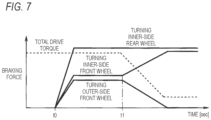
  • FIG. 7 is a time chart showing changes in a braking force and a total drive torque applied to the turning inner-side front and rear wheels and the turning outer-side front wheel immediately after a high degree of understeer is detected;
  • FIG. 8 is an explanatory diagram showing load transfer when only the turning inner-side front wheel is driven
  • FIG. 9 is an explanatory diagram showing load transfer when only the turning inner-side rear wheel is driven.
  • FIG. 10 is an explanatory diagram showing load transfer when only the turning outer-side front wheel is driven
  • FIG. 11 is an explanatory diagram showing load transfer when only the turning outer-side rear wheel is driven
  • FIG. 12 is an explanatory diagram showing a state in which rear wheels are drive wheels and the turning inner-side rear wheel is braked;
  • FIG. 13 is an explanatory diagram showing a state in which rear wheels are drive wheels and the turning inner-side front and rear wheels are braked;
  • FIG. 14 is an explanatory diagram showing a state in which front wheels are drive wheels and the turning inner-side front and rear wheels are braked;
  • FIG. 15 is an explanatory diagram showing a state in which the turning inner-side rear wheel is braked and the turning outer-side rear wheel is driven;
  • FIG. 16 is an explanatory diagram showing a state in which the turning inner-side front wheel is braked and the turning outer-side rear wheel is driven;
  • FIG. 17 is an explanatory diagram showing a state in which the turning outer-side front wheel is driven and the turning inner-side rear wheel is braked, and
  • FIG. 18 is an explanatory diagram showing a state in which the turning inner-side front wheel is braked and the turning outer-side front wheel is driven.
  • the degree of understeer in an initial stage in which a high degree of understeer is detected, by applying transient load transfer to the turning inner-side drive wheel, the degree of understeer can be efficiently reduced.
  • JP-A No. JP2020-050024 when a high degree of understeer is detected, a constant braking force is continuously applied to the turning inner-side drive wheel, and static load transfer is simply generated from the turning outer-side drive wheel to the turning inner-side drive wheel, and therefore, it may be difficult to efficiently reduce the degree of understeer in the initial stage. As a result, a delay occurs in the control for reducing the degree of understeer, which may make occupants including a driver uncomfortable.
  • a vehicle M shown in FIG. 1 is a four-wheel drive vehicle in which front wheels Fl, Fr and rear wheels Rl, Rr, which are steered wheels, are driven by different drive sources (engines or electric motors) 1 and 6 .
  • An output shaft 1 a of a front drive source (FPU) 1 is coupled to drive shafts (front wheel drive shafts) 3 l , 3 r of the front wheels Fl, Fr via a front differential 2 .
  • An output shaft 6 a of a rear drive source (RPU) 6 is coupled to drive shafts (rear wheel drive shafts) 8 l , 8 r of the rear wheels Rl, Rr via a rear differential 7 .
  • left and right front wheels Fl, Fr are respectively supported by front wheel suspensions
  • left and right rear wheels Rl, Rr are respectively supported by rear wheel suspensions.
  • the left and right front wheels Fl, Fr and the left and right rear wheels Rl, Rr are each provided with a hydraulic brake mechanism 9 .
  • the hydraulic brake mechanism 9 is a well-known friction brake device such as a disc brake or a drum brake, and a piston of a wheel cylinder of the hydraulic brake mechanism 9 is operated by a hydraulic brake pressure supplied from a hydraulic control unit (HCU) 11 as a brake unit to apply a hydraulic braking (friction braking) force.
  • HCU hydraulic control unit
  • the HCU 11 includes actuators and valves such as a hydraulic pressure generating device including a booster pump, an accumulator, and the like, a pressure control valve that adjusts a hydraulic pressure during brake differential operation and supplies the adjusted hydraulic pressure to the wheel cylinder of the hydraulic brake mechanism 9 , and an opening and closing control valve that opens and closes a hydraulic circuit that supplies the hydraulic brake pressure to the hydraulic brake mechanism 9 .
  • actuators and valves such as a hydraulic pressure generating device including a booster pump, an accumulator, and the like, a pressure control valve that adjusts a hydraulic pressure during brake differential operation and supplies the adjusted hydraulic pressure to the wheel cylinder of the hydraulic brake mechanism 9 , and an opening and closing control valve that opens and closes a hydraulic circuit that supplies the hydraulic brake pressure to the hydraulic brake mechanism 9 .
  • the front drive source 1 , the rear drive source 6 , and the HCU 11 are operated by a control signal from a travel control unit 12 as a travel control unit.
  • the travel control unit 12 includes a microcontroller provided with a CPU, a RAM, a ROM, a rewritable nonvolatile memory (flash memory or EEPROM), and peripheral devices.
  • the ROM stores programs, fixed data, and the like necessary for the CPU to execute various types of processing.
  • the RAM is provided as a work area of the CPU and temporarily stores various types of data in the CPU.
  • the CPU is also called a microprocessor (MPU) or a processor.
  • a graphics processing unit (GPU) or a graph streaming processor (GSP) may be used.
  • the CPU, the GPU, and the GSP may be selectively used in combination.
  • the travel control unit 12 has a turning behavior control function of restoring a ground contact load of the turning inner-side front wheel and increasing a lateral force of the turning inner-side front wheel to reduce the degree of understeer.
  • Sensors that detect a driving state of the vehicle M such as a steering angle sensor 21 that detects a steering angle of the left and right front wheels Fl, Fr, a vehicle speed sensor 22 that detects a vehicle speed (host vehicle speed) of the vehicle M, a yaw rate sensor 23 serving as a yaw rate detection unit that detects an actual yaw rate acting on a vehicle body, torque sensors 24 a , 24 b that individually detect shaft torques acting on the output shafts 1 a , 6 a of the drive sources 1 , 6 , and the like are coupled to an input side of the travel control unit 12 .
  • a braking force or a driving force is selectively applied to the wheels Fl, Fr, Rl, Rr according to a traveling state of the vehicle M to reduce the degree of understeer.
  • the braking force and the driving force may be collectively referred to as a “braking/driving force”.
  • the travel control unit 12 can apply a braking (regenerative braking) force to the wheels by a regenerative operation of the electric motor. Further, the travel control unit 12 can apply a braking force to the wheels driven by the electric motor through the cooperation of friction braking and regenerative braking. In this case, the electric motor serves as a brake unit.
  • the front wheel suspensions have an anti-dive geometry
  • the rear wheel suspensions have an anti-lift geometry. That is, instantaneous centers of the left and right front wheels Fl, Fr suspended from the vehicle body by the left and right front wheel suspensions are set to be located above ground contact points of the left and right front wheels Fl, Fr and on a rear side of the vehicle body. Therefore, the left and right front wheel suspensions have the anti-dive geometry.
  • a braking force when a braking force is applied to a turning outer-side front wheel, an upward force is generated on a turning outer side of a front portion of the vehicle body of the vehicle M, the roll of the vehicle body is prevented, and the ground contact load of the turning inner-side front wheel further increases.
  • a braking force is applied to a turning outer-side rear wheel, a downward force is generated on a turning outer side of a rear portion of the vehicle body, and the ground contact load of the turning inner-side front wheel located diagonally cannot be sufficiently increased.
  • step S 1 sensor outputs such as a steering angle detected by the steering angle sensor 21 , a vehicle speed detected by the vehicle speed sensor 22 , and an actual yaw rate detected by the yaw rate sensor 23 are read.
  • step S 2 a reference yaw rate acting on the vehicle M is calculated based on the steering angle and the vehicle speed, and a yaw rate deviation ⁇ Yr is obtained based on a difference between the reference yaw rate and the actual yaw rate detected by the yaw rate sensor 23 .
  • the processing in step S 2 corresponds to a deviation value calculation unit of the present disclosure.
  • step S 3 it is checked whether the vehicle M is in a non-braking state and is turning. Whether the vehicle M is in the non-braking state is determined based on whether a braking signal is output from the travel control unit 12 to the HCU 11 . Whether the vehicle M is turning is determined based on an output value of the yaw rate sensor 23 .
  • step S 4 When it is determined that the vehicle M is in the non-braking state and is turning, the process proceeds to step S 4 .
  • the routine is exited.
  • the deviation reference value Yrc is a reference value for checking whether the degree of understeer occurring in the vehicle M is high, and is set in advance based on an experiment or the like.
  • step S 5 a target yaw moment Myt for ensuring the traveling stability of the vehicle M is obtained based on the yaw rate deviation ⁇ Yr by referring to a map or the like.
  • step S 6 a target deceleration Gxt for reducing a current yaw moment to the target yaw moment Myt is obtained.
  • step S 7 in which it is determined to which of the wheels Fl, Fr, Rl, and Rr a braking/driving force is applied based on the target yaw moment Myt and the target deceleration Gxt, and a target braking force Fbti or a target driving force Fdti of the wheels Fl, Fr, Rl, and Rr to which the braking/driving force is applied is obtained.
  • the processing in steps S 4 to S 8 corresponds to a braking force control unit and a driving force control unit of the present disclosure.
  • Load transfer amounts in a roll direction that is, a load transfer amount ⁇ W f from the turning inner-side front wheel (Fl) to the turning outer-side front wheel (Fr) and a load transfer amount ⁇ W r from a turning inner-side rear wheel (Rl) to the turning outer-side rear wheel (Rr) are expressed by the following formula (1) and (2):
  • ⁇ f is an angle formed by a line segment connecting a ground contact point and an instantaneous center of the left front wheel Fl and the right front wheel Fr in a neutral position with respect to a horizontal direction
  • the angle ⁇ f is an anti-dive angle when the left front wheel Fl and the right front wheel Fr are in the neutral position
  • ⁇ r is an angle formed by a line segment connecting a ground contact point and an instantaneous center of the left rear wheel Rl and the right rear wheel Rr in a neutral position with respect to the horizontal direction
  • the angle ⁇ r is an anti-lift angle when the left rear wheel Rl and the right rear wheel Rr are in the neutral position.
  • load transfer occurs from the turning outer-side front wheel (Fr) to the turning inner-side front wheel (Fl), a ground contact load of the turning outer-side front wheel (Fr) decreases, and a ground contact load of the turning inner-side front wheel (Fl) increases.
  • load transfer occurs from the turning inner-side rear wheel (Rl) to the turning outer-side rear wheel (Rr) between the left and right rear wheels Rl, Rr as indicated by a broken line arrow, a ground contact load of the turning inner-side rear wheel (Rl) decreases, and a ground contact load of the turning outer-side rear wheel (Rr) increases.
  • the left turning has been described as an example, but the load transfer between the turning inner-side and outer-side wheels occurs regardless of a turning direction of the vehicle M. Therefore, in the case of right turning, the right and left wheels are applied in reverse.
  • the braking force Fb is applied to the turning inner-side front and rear wheels (Fl, Rl).
  • the ground contact load of the turning inner-side front wheel (Fl) increases, and a resulting lateral force can cause the vehicle M to generate a yaw moment in the turning direction.
  • the ground contact load of the turning inner-side front wheel (Fl) can be increased by applying the braking force Fb to the turning inner-side rear wheel (Rl). Conversely, it can be seen that by applying the braking force Fb to the turning outer-side rear wheel (Rr), the ground contact load of the turning inner-side front wheel (Fl) is reduced most.
  • Table 1 described above takes into consideration the transient load transfer immediately after a braking force starts to be applied to any one of the wheels Fl, Fr, Rl, Rr.
  • a predetermined time (t 1 ) elapses after braking force control is started elapsed time t 0
  • a braking force applied to the turning outer-side front wheel (Fr) is decreased and a braking force applied to the turning inner-side front wheel (Fl) is increased
  • the yaw moment generated in the vehicle M in the turning direction can be gradually increased.
  • a total drive torque can be reduced.
  • Driving forces generated in the left and right front wheels Fl, Fr and the left and right rear wheels Rl, Rr can be calculated based on shaft torques acting on the output shafts 1 a , 6 a of the drive sources 1 , 6 detected by the front shaft torque sensor 24 a and the rear shaft torque sensor 24 b , respectively.
  • the static load transfer amount ⁇ W f from the turning inner-side front wheel (Fl) to the turning outer-side front wheel (Fr) increases, and the static load transfer amount ⁇ W r from the turning inner-side rear wheel (Rl) to the turning outer-side rear wheel (Rr) decreases (in other words, the load transfer amount from the turning outer-side rear wheel (Rr) to the turning inner-side rear wheel (Rl) increases).
  • the static load transfer amount ⁇ W f from the turning inner-side front wheel (Fl) to the turning outer-side front wheel (Fr) increases, and the static load transfer amount ⁇ W r from the turning inner-side rear wheel (Rl) to the turning outer-side rear wheel (Rr) decreases (in other words, the load transfer amount from the turning outer-side rear wheel (Rr) to the turning inner-side rear wheel (Rl) increases).
  • the static load transfer amount ⁇ W f from the turning inner-side front wheel (Fl) to the turning outer-side front wheel (Fr) decreases (in other words, the static load transfer amount ⁇ W f from the turning outer-side front wheel (Fr) to the turning inner-side front wheel (Fl) increases).
  • the static load transfer amount ⁇ W r from the turning inner-side rear wheel (Rl) to the turning outer-side rear wheel (Rr) increases.
  • the static load transfer amount ⁇ W f from the turning inner-side front wheel (Fl) to the turning outer-side front wheel (Fr) decreases (in other words, the static load transfer amount ⁇ W f from the turning outer-side front wheel (Fr) to the turning inner-side front wheel (Fl) increases).
  • the static load transfer amount ⁇ W r from the turning inner-side rear wheel (Rl) to the turning outer-side rear wheel (Rr) increases.
  • the driving force Fd is applied to the left and right rear wheels Rl, Rr from the rear drive source 6 via the rear differential 7 . Therefore, as shown in FIG. 12 , to drive the turning outer-side rear wheel Rr with the driving force Fd, the braking force Fb that cancels the driving force Fd is applied to the turning inner-side rear wheel Rl. Further, the braking force Fb is generated on the turning inner-side rear wheel Rl in a way that the braking force Fb to be applied to the turning inner-side rear wheel Rl is set to satisfy Fd ⁇ Fb. In this case, when the degree of understeer is high, the braking force Fb is adjusted according to the degree of understeer, for example, by increasing the braking force Fb.
  • the driving force Fd is applied to the left and right rear wheels Rl, Rr from the rear drive source 6 via the rear differential 7 . Therefore, as shown in FIG. 13 , to drive the turning outer-side rear wheel Rr with the driving force Fd, the braking force Fb that cancels the driving force Fd is applied to the turning inner-side rear wheel Rl. Further, the braking force Fb is applied to the turning inner-side front wheel (Fl).
  • the braking force Fb to be applied to the turning inner-side rear wheel (Rl) is adjusted according to the degree of understeer, for example, by increasing the braking force Fb.
  • the driving force Fd is applied to the left and right front wheel Fl, Fr from the front drive source 1 via the front differential 2 . Therefore, as shown in FIG. 14 , to drive the turning outer-side front wheel Fr with the driving force Fd, the braking force Fb that cancels the driving force Fd is applied to the turning inner-side front wheel Fl.
  • the braking force Fb is adjusted according to the degree of understeer, for example, by increasing the braking force Fb so that Fd ⁇ Fb.
  • the controls of 1 to 3 described above are switched in the order of 3 to 2 to 1 as the degree of understeer increases (the yaw rate deviation ⁇ Yr increases).
  • the ground contact load of the turning inner-side front wheel (Fl) can be increased according to the degree of understeer, and the degree of understeer can be reduced.
  • a driving assistance control unit 11 a applies the braking force Fb to the turning inner-side front and rear wheels (Fl, Rl) after a predetermined time elapses to apply a maximum yaw moment in the turning direction and shifts to control for gradually reducing the driving force Fd to be applied to all four wheels.
  • the ground contact load of the turning inner-side front wheel (Fl) can be restored.
  • the driving assistance control unit 11 a can individually apply the driving force Fd to the wheels Fl, Fr, Rl, and Rr. Therefore, when the driving force Fb is applied to one wheel, it is not necessary to apply the braking force Fb for canceling the driving force Fd to the other wheel as in the case where the front wheel drive shafts 3 l , 3 r and the rear wheel drive shafts 8 l , 8 r shown in FIG. 1 are respectively driven by the front drive source 1 and the rear drive source 6 .
  • a braking force in the four-wheel independent motors is generated by friction braking or regenerative braking, or by cooperation between friction braking and regenerative braking. Therefore, the electric motor functions as a brake unit.
  • the driving assistance control unit 11 a increases a ground contact load with respect to a turning inner-side front wheel (Fl) by the cooperation of the driving force Fd from the drive sources 1 , 6 and the braking force Fb from the HCU 11 , and efficiently reduces the degree of understeer by balancing a yaw moment in a turning direction and a total driving force. As a result, discomfort given to occupants including a driver can be reduced early.
  • the travel control unit applies a braking force to one of the turning inner-side rear wheel and the turning inner-side front wheel.
  • a driving force is applied to one of the turning outer-side rear wheel and the turning outer-side front wheel, when a high degree of understeer is detected, the degree of understeer can be efficiently reduced by the cooperation of the braking force and the driving force, and the discomfort given to occupants including a driver can be reduced.
  • one of the front drive source 1 and the rear drive source 6 may be an electric motor and the other may be an engine.
  • a three-motor system may be used in which one of the front drive source and the rear drive source is an electric motor, and left and right wheels driven by the other drive source are driven by independent electric motors.

Landscapes

  • Engineering & Computer Science (AREA)
  • Transportation (AREA)
  • Mechanical Engineering (AREA)
  • Chemical & Material Sciences (AREA)
  • Combustion & Propulsion (AREA)
  • Automation & Control Theory (AREA)
  • Physics & Mathematics (AREA)
  • Mathematical Physics (AREA)
  • Regulating Braking Force (AREA)
  • Control Of Driving Devices And Active Controlling Of Vehicle (AREA)

Abstract

A turning behavior control device for a vehicle includes a yaw rate detection unit, a brake unit, a drive source, and a travel control unit. The travel control unit includes a deviation value calculation unit that calculates a deviation between a reference yaw rate for determining the degree of understeer during turning of the vehicle and an actual yaw rate detected by the yaw rate detection unit, a braking force control unit that outputs, to the brake unit, a first signal for applying the braking force to a turning inner-side rear wheel or a turning inner-side front wheel when determining that the deviation exceeds a predetermined deviation reference value, and a driving force control unit that outputs, to the drive source, a signal for applying a driving force to a turning outer-side rear wheel or a turning outer-side front wheel when the braking force control unit outputs the signal.

Description

CROSS-REFERENCE TO RELATED APPLICATIONS
The present application claims priority from Japanese Patent Application No. 2022-128903 filed on Aug. 12, 2022, the entire contents of which are hereby incorporated by reference.
BACKGROUND Technical Field
The present disclosure relates to a turning behavior control device for a vehicle that efficiently reduces understeer when a high degree of understeer is detected during turning.
Related Art
In travel trajectory control (also referred to as “lane keeping control”) as automatic steering control, when a deviation between a target travel trajectory of a vehicle and an actual travel trajectory of the vehicle increases, steered wheels are steered, and feedback control is performed such that the actual travel trajectory converges to the target travel trajectory. For example, as the degree of understeer acting on the vehicle increases when a turning radius of the actual travel trajectory of the vehicle is larger than a turning radius set as the target travel trajectory and a difference therebetween is large, a steering control device attempts to steer the steered wheels in a turning-increasing direction to correct the turning radius to the turning radius set as the target travel trajectory.
However, for example, when front wheels are the steered wheels and drive wheels, a ground contact load of a turning inner-side front wheel decreases due to load transfer in a lateral direction acting on the vehicle along with the turning. Therefore, even when the turning inner-side front wheel is turned in the turning-increasing direction, a lateral force of the turning inner-side front wheel may not increase sufficiently, and a necessary yaw moment cannot be applied to the vehicle. As a result, it is difficult to converge the actual travel trajectory of the vehicle to the target travel trajectory.
As a countermeasure against this, for example, Japanese Unexamined Patent Application Publication (JP-A) No. JP2020-050024 discloses a technique in which, when a deviation between a reference yaw rate (target yaw rate) of a vehicle and an actual yaw rate exceeds a predetermined deviation reference value and a time change rate of the deviation exceeds a start reference value during turning, a braking force is applied to a turning inner-side drive wheel and load transfer from a turning outer-side drive wheel to the turning inner-side drive wheel is generated, thereby increasing a ground contact load of the turning inner-side drive wheel.
SUMMARY
An aspect of the present disclosure provides a turning behavior control device for a vehicle in which left and right front wheels are steered wheels. The turning behavior control device includes a yaw rate detection unit, a brake unit, a drive source, a travel control unit. The yaw rate detection unit is configured to detect an actual yaw rate acting on a vehicle. The brake unit is configured to independently apply a braking force to the left and right front wheels and left and right rear wheels. The drive source is configured to drive the left and right front wheels and the left and right rear wheels. The travel control unit configured to control the braking force of the brake unit and an output of the drive source. The travel control unit includes a deviation value calculation unit configured to calculate a deviation between a reference yaw rate for determining the degree of understeer during turning of the vehicle and the actual yaw rate detected by the yaw rate detection unit, a braking force control unit configured to output, to the brake unit, a first signal for applying the braking force to one of a turning inner-side rear wheel and a turning inner-side front wheel when determining that the deviation calculated by the deviation value calculation unit exceeds a predetermined deviation reference value, and a driving force control unit configured to output, to the drive source, a signal for applying a driving force to one of a turning outer-side rear wheel and a turning outer-side front wheel when the braking force control unit outputs the first signal.
BRIEF DESCRIPTION OF DRAWINGS
The accompanying drawings are included to provide a further understanding of the disclosure and are incorporated in and constitute a part of this specification. The drawings illustrate embodiments and, together with the specification, serve to describe the principles of the disclosure.
FIG. 1 is a schematic configuration diagram of a driving assistance device;
FIG. 2 is a flowchart showing a turning behavior control routine;
FIG. 3 is an explanatory diagram showing load transfer when four wheels are not driven and a turning inner-side front wheel is braked;
FIG. 4 is an explanatory diagram showing load transfer when four wheels are not driven and a turning inner-side rear wheel is braked;
FIG. 5 is an explanatory diagram showing load transfer when four wheels are not driven and a turning outer-side front wheel is braked;
FIG. 6 is an explanatory diagram showing load transfer when four wheels are not driven and a turning outer-side rear wheel is braked;
FIG. 7 is a time chart showing changes in a braking force and a total drive torque applied to the turning inner-side front and rear wheels and the turning outer-side front wheel immediately after a high degree of understeer is detected;
FIG. 8 is an explanatory diagram showing load transfer when only the turning inner-side front wheel is driven;
FIG. 9 is an explanatory diagram showing load transfer when only the turning inner-side rear wheel is driven;
FIG. 10 is an explanatory diagram showing load transfer when only the turning outer-side front wheel is driven;
FIG. 11 is an explanatory diagram showing load transfer when only the turning outer-side rear wheel is driven;
FIG. 12 is an explanatory diagram showing a state in which rear wheels are drive wheels and the turning inner-side rear wheel is braked;
FIG. 13 is an explanatory diagram showing a state in which rear wheels are drive wheels and the turning inner-side front and rear wheels are braked;
FIG. 14 is an explanatory diagram showing a state in which front wheels are drive wheels and the turning inner-side front and rear wheels are braked;
FIG. 15 is an explanatory diagram showing a state in which the turning inner-side rear wheel is braked and the turning outer-side rear wheel is driven;
FIG. 16 is an explanatory diagram showing a state in which the turning inner-side front wheel is braked and the turning outer-side rear wheel is driven;
FIG. 17 is an explanatory diagram showing a state in which the turning outer-side front wheel is driven and the turning inner-side rear wheel is braked, and
FIG. 18 is an explanatory diagram showing a state in which the turning inner-side front wheel is braked and the turning outer-side front wheel is driven.
DESCRIPTION OF EMBODIMENTS
Incidentally, in an initial stage in which a high degree of understeer is detected, by applying transient load transfer to the turning inner-side drive wheel, the degree of understeer can be efficiently reduced.
However, in the technique disclosed in JP-A No. JP2020-050024, when a high degree of understeer is detected, a constant braking force is continuously applied to the turning inner-side drive wheel, and static load transfer is simply generated from the turning outer-side drive wheel to the turning inner-side drive wheel, and therefore, it may be difficult to efficiently reduce the degree of understeer in the initial stage. As a result, a delay occurs in the control for reducing the degree of understeer, which may make occupants including a driver uncomfortable.
It is desirable to provide a turning behavior control device for a vehicle capable of efficiently reducing understeer when a high degree of understeer is detected and capable of reducing discomfort given to occupants including a driver.
Hereinafter, an embodiment of the present disclosure will be described with reference to the drawings. Note that the following description is directed to illustrative examples of the disclosure and not to be construed as limiting to the disclosure. Factors including, without limitation, numerical values, shapes, materials, components, positions of the components, and how the components are coupled to each other are illustrative only and not to be construed as limiting to the disclosure. Further, elements in the following example embodiments which are not recited in a most-generic independent claim of the disclosure are optional and may be provided on an as-needed basis. The drawings are schematic and are not intended to be drawn to scale. Throughout the present specification and the drawings, elements having substantially the same function and configuration are denoted with the same numerals to avoid any redundant description.
A vehicle M shown in FIG. 1 is a four-wheel drive vehicle in which front wheels Fl, Fr and rear wheels Rl, Rr, which are steered wheels, are driven by different drive sources (engines or electric motors) 1 and 6. An output shaft 1 a of a front drive source (FPU) 1 is coupled to drive shafts (front wheel drive shafts) 3 l, 3 r of the front wheels Fl, Fr via a front differential 2. An output shaft 6 a of a rear drive source (RPU) 6 is coupled to drive shafts (rear wheel drive shafts) 8 l, 8 r of the rear wheels Rl, Rr via a rear differential 7. Although not shown, left and right front wheels Fl, Fr are respectively supported by front wheel suspensions, and left and right rear wheels Rl, Rr are respectively supported by rear wheel suspensions.
The left and right front wheels Fl, Fr and the left and right rear wheels Rl, Rr are each provided with a hydraulic brake mechanism 9. The hydraulic brake mechanism 9 is a well-known friction brake device such as a disc brake or a drum brake, and a piston of a wheel cylinder of the hydraulic brake mechanism 9 is operated by a hydraulic brake pressure supplied from a hydraulic control unit (HCU) 11 as a brake unit to apply a hydraulic braking (friction braking) force. The HCU 11 includes actuators and valves such as a hydraulic pressure generating device including a booster pump, an accumulator, and the like, a pressure control valve that adjusts a hydraulic pressure during brake differential operation and supplies the adjusted hydraulic pressure to the wheel cylinder of the hydraulic brake mechanism 9, and an opening and closing control valve that opens and closes a hydraulic circuit that supplies the hydraulic brake pressure to the hydraulic brake mechanism 9.
The front drive source 1, the rear drive source 6, and the HCU 11 are operated by a control signal from a travel control unit 12 as a travel control unit. The travel control unit 12 includes a microcontroller provided with a CPU, a RAM, a ROM, a rewritable nonvolatile memory (flash memory or EEPROM), and peripheral devices. The ROM stores programs, fixed data, and the like necessary for the CPU to execute various types of processing. The RAM is provided as a work area of the CPU and temporarily stores various types of data in the CPU. The CPU is also called a microprocessor (MPU) or a processor. Instead of the CPU, a graphics processing unit (GPU) or a graph streaming processor (GSP) may be used. Alternatively, the CPU, the GPU, and the GSP may be selectively used in combination.
In addition to normal travel control, the travel control unit 12 has a turning behavior control function of restoring a ground contact load of the turning inner-side front wheel and increasing a lateral force of the turning inner-side front wheel to reduce the degree of understeer.
Sensors that detect a driving state of the vehicle M, such as a steering angle sensor 21 that detects a steering angle of the left and right front wheels Fl, Fr, a vehicle speed sensor 22 that detects a vehicle speed (host vehicle speed) of the vehicle M, a yaw rate sensor 23 serving as a yaw rate detection unit that detects an actual yaw rate acting on a vehicle body, torque sensors 24 a, 24 b that individually detect shaft torques acting on the output shafts 1 a, 6 a of the drive sources 1, 6, and the like are coupled to an input side of the travel control unit 12.
In the turning behavior control by the travel control unit 12, in a case where a high degree of understeer occurs when the vehicle M is traveling on a curved road, a braking force or a driving force is selectively applied to the wheels Fl, Fr, Rl, Rr according to a traveling state of the vehicle M to reduce the degree of understeer. Hereinafter, the braking force and the driving force may be collectively referred to as a “braking/driving force”. When at least one of the drive sources 1 and 6 is an electric motor, the travel control unit 12 can apply a braking (regenerative braking) force to the wheels by a regenerative operation of the electric motor. Further, the travel control unit 12 can apply a braking force to the wheels driven by the electric motor through the cooperation of friction braking and regenerative braking. In this case, the electric motor serves as a brake unit.
In this case, in the vehicle M, to reduce a change in pitch attitude of the vehicle M during braking deceleration, the front wheel suspensions have an anti-dive geometry, and the rear wheel suspensions have an anti-lift geometry. That is, instantaneous centers of the left and right front wheels Fl, Fr suspended from the vehicle body by the left and right front wheel suspensions are set to be located above ground contact points of the left and right front wheels Fl, Fr and on a rear side of the vehicle body. Therefore, the left and right front wheel suspensions have the anti-dive geometry.
On the other hand, instantaneous centers of the left and right rear wheels Rl, Rr suspended from the vehicle body by the left and right rear wheel suspensions are set to be located above ground contact points of the left and right rear wheels Rl, Rr and on a front side of the vehicle body. Therefore, the rear wheel suspensions have the anti-lift geometry. Accordingly, when a braking/driving force is applied to the wheels, vertical forces are applied from the wheels to the vehicle body.
For example, when a braking force is applied to a turning outer-side front wheel, an upward force is generated on a turning outer side of a front portion of the vehicle body of the vehicle M, the roll of the vehicle body is prevented, and the ground contact load of the turning inner-side front wheel further increases. Conversely, when a braking force is applied to a turning outer-side rear wheel, a downward force is generated on a turning outer side of a rear portion of the vehicle body, and the ground contact load of the turning inner-side front wheel located diagonally cannot be sufficiently increased.
Specifically, the turning behavior control by the travel control unit 12 is executed according to a turning behavior control routine shown in FIG. 2 . This routine is executed at every predetermined calculation cycle after the travel control unit 12 is activated. First, in step S1, sensor outputs such as a steering angle detected by the steering angle sensor 21, a vehicle speed detected by the vehicle speed sensor 22, and an actual yaw rate detected by the yaw rate sensor 23 are read.
Next, the process proceeds to step S2, a reference yaw rate acting on the vehicle M is calculated based on the steering angle and the vehicle speed, and a yaw rate deviation ΔYr is obtained based on a difference between the reference yaw rate and the actual yaw rate detected by the yaw rate sensor 23. The processing in step S2 corresponds to a deviation value calculation unit of the present disclosure.
Thereafter, the process proceeds to step S3, and it is checked whether the vehicle M is in a non-braking state and is turning. Whether the vehicle M is in the non-braking state is determined based on whether a braking signal is output from the travel control unit 12 to the HCU 11. Whether the vehicle M is turning is determined based on an output value of the yaw rate sensor 23.
When it is determined that the vehicle M is in the non-braking state and is turning, the process proceeds to step S4. When it is determined that the vehicle M is in a braking state or is not turning, the routine is exited.
When proceeding to S4, the yaw rate deviation ΔYr is compared with a predetermined deviation reference value Yrc. The deviation reference value Yrc is a reference value for checking whether the degree of understeer occurring in the vehicle M is high, and is set in advance based on an experiment or the like.
When ΔYr>Yrc, it is determined that the degree of understeer is high, and the process proceeds to step S5. On the other hand, when ΔYr≤Yrc, it is determined that a high degree of understeer has not occurred, and the routine is exited.
When the process proceeds to step S5, a target yaw moment Myt for ensuring the traveling stability of the vehicle M is obtained based on the yaw rate deviation ΔYr by referring to a map or the like. Next, the process proceeds to step S6, and a target deceleration Gxt for reducing a current yaw moment to the target yaw moment Myt is obtained.
Thereafter, the process proceeds to step S7, in which it is determined to which of the wheels Fl, Fr, Rl, and Rr a braking/driving force is applied based on the target yaw moment Myt and the target deceleration Gxt, and a target braking force Fbti or a target driving force Fdti of the wheels Fl, Fr, Rl, and Rr to which the braking/driving force is applied is obtained. Then, the process proceeds to step S8, in which the travel control unit 12 controls the HCU 11 and the front drive source 1 or the rear drive source 6 such that the wheels Fl, Fr, Rl, Rr to which the braking/driving force is applied have the corresponding target braking force Fbti or target driving force Fdti (where i=Fl, Fr, Rl, Rr), and the routine is exited. The processing in steps S4 to S8 corresponds to a braking force control unit and a driving force control unit of the present disclosure.
Next, a behavior when a braking/driving force is selectively applied to the wheels Fl, Fr, Rl, Rr will be described.
Load Transfer Amount in Roll Direction
Load transfer amounts in a roll direction, that is, a load transfer amount ΔWf from the turning inner-side front wheel (Fl) to the turning outer-side front wheel (Fr) and a load transfer amount ΔWr from a turning inner-side rear wheel (Rl) to the turning outer-side rear wheel (Rr) are expressed by the following formula (1) and (2):
Δ W f = a y m s d [ K φ f h s K φ f + K φ r + L r L h f ] + 1 2 [ ( F xfi - F xfo ) K φ r K φ f + K φ r tan θ f + ( F xri - F xro ) K φ f K φ f + K φ r tan θ r ] ( 1 ) Δ W r = a y m s d [ K φ r h s K φ f + K φ r + L f L h r ] - 1 2 [ ( F xfi - F xfo ) K φ r K φ f + K φ r tan θ f + ( F xri - F xro ) K φ f K φ f + K φ r tan θ r ] ( 2 )
where ms is a sprung mass of the vehicle body; d is a tread; hs is a height of a center of gravity G of the vehicle M; and Kφf and Kφr are the roll stiffness of the vehicle body at positions of the front wheels and the rear wheels in a vehicle longitudinal direction; φ is a roll angle of the vehicle M; ay is a lateral acceleration of the vehicle M, and the roll angle φ and the lateral acceleration ay have positive values when the vehicle M is turning left and have negative values when the vehicle M is turning right; Fxfi and Fxfo are longitudinal forces of the turning inner-side front wheel and the turning outer-side front wheel, Fxri and Fxro are longitudinal forces of the turning inner-side rear wheel and the turning outer-side rear wheel, and the longitudinal forces have positive values for the driving force and negative values for the braking force. Further, θf is an angle formed by a line segment connecting a ground contact point and an instantaneous center of the left front wheel Fl and the right front wheel Fr in a neutral position with respect to a horizontal direction, and the angle θf is an anti-dive angle when the left front wheel Fl and the right front wheel Fr are in the neutral position. θr is an angle formed by a line segment connecting a ground contact point and an instantaneous center of the left rear wheel Rl and the right rear wheel Rr in a neutral position with respect to the horizontal direction, and the angle θr is an anti-lift angle when the left rear wheel Rl and the right rear wheel Rr are in the neutral position.
First, load transfer due to the application of a braking force to a wheel will be described.
Load Transfer Due to Application of Braking Force to Turning Inner-Side Front Wheel
As shown in FIG. 3 , when the wheels Fl, Fr, Rl, Rr of the vehicle M are in the non-braking state during turning (left turning in the drawing), the longitudinal forces Fxfi, Fxfo (positive values for the driving force and negative values for the braking force) acting on the left and right front wheels Fl, Fr are the same, and the longitudinal forces Fxri, Fxro (positive values for the driving force and negative values for the braking force) acting on the left and right rear wheels Rl, Rr are the same, a constant braking force Fb (a negative value) is continuously applied to the turning inner-side front wheel (Fl) as indicated by a solid line arrow.
Then, since the longitudinal forces Fxri, Fxro, acting on the left and right rear wheels Rl, Rr are the same, a difference ΔFr (=Fxri−Fxro) between the longitudinal forces Fxri, Fxro remains 0. However, since the braking force Fb is applied to the turning inner-side front wheel (Fl), the difference ΔFf (=Fxfi−Fxfo) between the longitudinal forces Fxfi, Fxfo of the left and right front wheels Fl, Fr has a negative value (ΔFf<0).
As a result, as indicated by a broken line arrow in FIG. 3 , load transfer occurs from the turning outer-side front wheel (Fr) to the turning inner-side front wheel (Fl), a ground contact load of the turning outer-side front wheel (Fr) decreases, and a ground contact load of the turning inner-side front wheel (Fl) increases. On the other hand, load transfer occurs from the turning inner-side rear wheel (Rl) to the turning outer-side rear wheel (Rr) between the left and right rear wheels Rl, Rr as indicated by a broken line arrow, a ground contact load of the turning inner-side rear wheel (Rl) decreases, and a ground contact load of the turning outer-side rear wheel (Rr) increases.
This is a case of static load transfer in which the constant braking force Fb is continuously applied to the turning inner-side front wheel (Fl), and a different behavior is exhibited in transient load transfer immediately (about 0.5 [sec]) after the braking force Fb starts to be applied to the turning inner-side front wheel (Fl). That is, immediately after the braking force Fb starts to be applied to the turning inner-side front wheel (Fl), first, an upward anti-dive force is generated in the front wheel suspension of the turning inner-side front wheel (Fl), causing an increase in the roll angle of the vehicle body. Therefore, the load transfer from the turning outer-side front wheel (Fr) to the turning inner-side front wheel (Fl) temporarily decreases. Conversely, the load transfer from the turning inner-side rear wheel (Rl) to the turning outer-side rear wheel (Rr) further increases.
Load Transfer Due to Application of Braking Force to Turning Inner-Side Rear Wheel
As indicated by a solid line arrow in FIG. 4 , when the vehicle M continues to apply the constant braking force Fb to the turning inner-side rear wheel (Rl) during turning, the difference ΔFr between the longitudinal force of the turning outer-side rear wheel (Rr) and the longitudinal force of the turning inner-side rear wheel (Rl) has a negative value. Therefore, since the load transfer amount between the left and right front wheels Fl and Fr decreases, as indicated by a broken line arrow, load transfer occurs from the turning outer-side front wheel (Fr) to the turning inner-side front wheel (Fl). Then, the ground contact load of the turning outer-side front wheel (Fr) decreases, and the ground contact load of the turning inner-side front wheel (Fl) increases. On the other hand, since the load transfer amount between the left and right rear wheels Rl and Rr increases, as indicated by a broken line arrow, load transfer occurs from the turning inner-side rear wheel (Rl) to the turning outer-side rear wheel (Rr), the ground contact load of the turning inner-side rear wheel (Rl) decreases, and the ground contact load of the turning outer-side rear wheel (Rr) increases.
In this case, a different behavior is exhibited in transient load transfer immediately after the braking force Fb starts to be applied to the turning inner-side rear wheel (Rl). That is, immediately after the braking force Fb starts to be applied to the turning inner-side rear wheel (Rl), a downward anti-lift force is generated in the rear wheel suspension of the turning inner-side rear wheel (Rl), causing a decrease in the roll angle of the vehicle body. As a result, the load is transferred to a front shaft, the load transfer from the turning outer-side front wheel (Fr) to the turning inner-side front wheel (Fl) temporarily increases, and the ground contact load of the turning inner-side front wheel (Fl) increases. On the other hand, the load transfer from the turning inner-side rear wheel (Rl) to the turning outer-side rear wheel (Rr) decreases.
Load Transfer Due to Application of Braking Force to Turning Outer-Side Front Wheel
As indicated by a solid line arrow in FIG. 5 , when the constant braking force Fb is continuously applied to the turning outer-side front wheel (Fr), the longitudinal forces Fxri, Fxro of the left and right rear wheels Rl, Rr are the same (ΔFr=0), but the difference ΔFf between the longitudinal forces Fxfi, Fxfo of the left and right front wheels Fl, Fr has a positive value (ΔFf>0). Therefore, the load transfer amount between the left and right front wheels Fl and Fr increases, and as indicated by a broken line arrow, load transfer occurs from the turning inner-side front wheel (Fl) to the turning outer-side front wheel (Fr). As a result, the ground contact load of the turning inner-side front wheel (Fl) decreases, and the ground contact load of the turning outer-side front wheel (Fr) increases. On the other hand, since the load transfer amount between the left and right rear wheels Rl, Rr decreases, as indicated by a broken line arrow, load transfer occurs from the turning outer-side rear wheel (Rr) to the turning inner-side rear wheel (Rl), the ground contact load of the turning outer-side rear wheel (Rr) decreases, and the ground contact load of the turning inner-side rear wheel (Rl) increases.
In this case as well, a different behavior is exhibited in transient load transfer immediately (about 0.5 [sec]) after the braking force Fb starts to be applied to the turning outer-side front wheel (Fr). That is, immediately after the braking force Fb is applied to the turning outer-side front wheel (Fr), an upward anti-dive force is generated in the front wheel suspension of the turning outer-side front wheel (Fr), causing a decrease in the roll angle of the vehicle body. Therefore, the load transfer from the turning inner-side front wheel (Fl) to the turning outer-side front wheel (Fr) temporarily decreases, and the load transfer from the turning outer-side rear wheel (Rr) to the turning inner-side rear wheel (Rl) further increases.
Load Transfer Due to Application of Braking Force to Turning Outer-Side Rear Wheel
As indicated by a solid line arrow in FIG. 6 , when the constant braking force Fb is continuously applied to the turning outer-side rear wheel (Rr) of the vehicle M during turning, the difference ΔFr between the longitudinal force of the turning outer-side rear wheel (Rr) and the longitudinal force of the turning inner-side rear wheel (Rl) has a positive value. Therefore, the load transfer amount between the left and right front wheels Fl and Fr increases, and as indicated by a broken line arrow, load transfer occurs from the turning inner-side front wheel (Fl) to the turning outer-side front wheel (Fr), the ground contact load of the turning inner-side front wheel (Fl) decreases, and the ground contact load of the turning outer-side front wheel (Fr) increases. On the other hand, since the load transfer amount between the left and right rear wheels Rl, Rr decreases, as indicated by a broken line arrow, load transfer occurs from the turning outer-side rear wheel (Rr) to the turning inner-side rear wheel (Rl), the ground contact load of the turning outer-side rear wheel (Rr) decreases, and the ground contact load of the turning inner-side rear wheel (Rl) increases.
In this case as well, in transient load transfer immediately after the braking force Fb starts to be applied to the turning outer-side rear wheel (Rr), a downward anti-lift force is generated in the rear wheel suspension of the turning outer-side rear wheel (Rr), causing an increase in the roll angle of the vehicle body. Therefore, the load transfer from the turning inner-side front wheel (Fl) to the turning outer-side front wheel (Fr) temporarily increases, and the load transfer from the turning outer-side rear wheel (Rr) to the turning inner-side rear wheel (Rl) decreases.
In the drawings, the left turning has been described as an example, but the load transfer between the turning inner-side and outer-side wheels occurs regardless of a turning direction of the vehicle M. Therefore, in the case of right turning, the right and left wheels are applied in reverse.
Reduction of Degree of Understeer Due to Application of Braking Force
As described above, when the turning behavior of the vehicle M is in a state in which the degree of understeer is high, the braking force Fb is applied to the turning inner-side front and rear wheels (Fl, Rl). As a result, it can be seen that the ground contact load of the turning inner-side front wheel (Fl) increases, and a resulting lateral force can cause the vehicle M to generate a yaw moment in the turning direction.
Incidentally, when the degree of understeer is high, in particular, the lateral force of the turning inner-side front wheel (Fl) is insufficient compared to a necessary lateral force, and thus it is necessary to maximize the load transfer to the turning inner-side front wheel (Fl) due to deceleration of the vehicle M caused by the application of a braking force.
Here, the load transfer to the turning inner-side front wheel (Fl) in consideration of a transient change immediately after a braking force starts to be applied to any one of the wheels Fl, Fr, Rl, Rr is summarized in Table 1.
TABLE 1
Wheel to which braking Change in ground contact load of
force is applied turning inner-side front wheel
Turning inner-side front wheel Decrease once and then
increase statically (small)
Turning inner-side rear wheel Increase once and then
increase statically (large)
Turning outer-side front wheel Increase once and then
decrease statically (small)
Turning outer-side rear wheel Decrease once and then
decrease statically (large)
As is clear from Table 1, the ground contact load of the turning inner-side front wheel (Fl) can be increased by applying the braking force Fb to the turning inner-side rear wheel (Rl). Conversely, it can be seen that by applying the braking force Fb to the turning outer-side rear wheel (Rr), the ground contact load of the turning inner-side front wheel (Fl) is reduced most.
Table 1 described above takes into consideration the transient load transfer immediately after a braking force starts to be applied to any one of the wheels Fl, Fr, Rl, Rr. In this case, as shown in FIG. 7 , when a predetermined time (t1) elapses after braking force control is started (elapsed time t0), when a braking force applied to the turning outer-side front wheel (Fr) is decreased and a braking force applied to the turning inner-side front wheel (Fl) is increased, the yaw moment generated in the vehicle M in the turning direction can be gradually increased. As a result, a total drive torque can be reduced.
Driving forces generated in the left and right front wheels Fl, Fr and the left and right rear wheels Rl, Rr can be calculated based on shaft torques acting on the output shafts 1 a, 6 a of the drive sources 1, 6 detected by the front shaft torque sensor 24 a and the rear shaft torque sensor 24 b, respectively.
That is, the driving force can be obtained according to:
driving force=shaft torque×final reduction gear ratio×transmission efficiency/movable radius of tire
where, if the final reduction gear ratio, the transmission efficiency, and the movable radius of tire are fixed values, the driving force is determined by a variable of the shaft torque, and the torque sensors 24 a, 24 b function as a driving force detection unit of the present disclosure.
Next, load transfer due to application of a driving force will be described.
Load Transfer Due to Application of Driving Force to Turning Inner-Side Front Wheel
As shown in FIG. 8 , when the wheels Fl, Fr, Rl, Rr of the vehicle M are in the non-braking state during turning (left turning in the drawing), the longitudinal forces Fxfi, Fxfo acting on the left and right front wheels Fl, Fr are the same, and the longitudinal forces Fxri, Fxro acting on the left and right rear wheels Rl, Rr are the same, a constant driving Force Fd (a positive value) is continuously applied to the turning inner-side front wheel (Fl) as indicated by a solid line arrow.
Then, since the longitudinal forces Fxri, Fxro acting on the left and right rear wheels Rl, Rr are the same, the difference ΔFr between the longitudinal forces Fxri, Fxro remains 0. However, since the driving force Fd is applied to the turning inner-side front wheel (Fl), the difference ΔFf between the longitudinal forces Fxfi, Fxfo of the left and right front wheels Fl, Fr has a positive value (ΔFf>0).
Therefore, as indicated by a broken line arrow in FIG. 8 , in the static load transfer amounts ΔWf, ΔWr when the constant driving force Fd is applied to the turning inner-side front wheel (Fl), the static load transfer amount ΔWf from the turning inner-side front wheel (Fl) to the turning outer-side front wheel (Fr) increases, and the static load transfer amount ΔWr from the turning inner-side rear wheel (Rl) to the turning outer-side rear wheel (Rr) decreases (in other words, the load transfer amount from the turning outer-side rear wheel (Rr) to the turning inner-side rear wheel (Rl) increases).
As a result, the ground contact load of the turning inner-side front wheel (Fl) decreases, and the ground contact load of the turning outer-side front wheel (Fr) increases. On the other hand, since the load transfer amount between the left and right rear wheels Rl, Rr decreases, as indicated by a broken line arrow, load transfer occurs from the turning outer-side rear wheel (Rr) to the turning inner-side rear wheel (Rl), the ground contact load of the turning outer-side rear wheel (Rr) decreases, and the ground contact load of the turning inner-side rear wheel (Rl) increases.
This is a case of static load transfer in which the constant driving force Fd is continuously applied to the turning inner-side front wheel (Fl), and a different behavior is exhibited in transient load transfer immediately (about 0.5 [sec]) after the driving force Fd starts to be applied to the turning inner-side front wheel (Fl). That is, in the transient load transfer immediately after the driving force Fd starts to be applied to the turning inner-side front wheel (Fl), a downward anti-lift force acts on the front wheel suspension of the turning inner-side front wheel (Fl), causing a decrease in the roll angle of the vehicle body. Therefore, the load transfer from the turning inner-side front wheel (Fl) to the turning outer-side front wheel (Fr) temporarily decreases. Conversely, the load transfer from the turning outer-side rear wheel (Rr) to the turning inner-side rear wheel (Rl) further increases.
Load Transfer Due to Application of Driving Force to Turning Inner-Side Rear Wheel
As indicated by a solid line arrow in FIG. 9 , when the vehicle M continues to apply the constant driving force Fd (a positive value) to the turning inner-side rear wheel (Rl) during turning, the longitudinal forces Fxfi, Fxfo acting on the left and right front wheels Fl, Fr are the same, and thus the difference ΔFf remains 0. However, since the driving force Fd is applied to the turning inner-side rear wheel (Rl), the difference ΔFr between the longitudinal forces Fxri, Fxro of the left and right rear wheels Rl, Rr has a positive value (ΔFr>0).
Therefore, as indicated by a broken line arrow, the static load transfer amount ΔWf from the turning inner-side front wheel (Fl) to the turning outer-side front wheel (Fr) increases, and the static load transfer amount ΔWr from the turning inner-side rear wheel (Rl) to the turning outer-side rear wheel (Rr) decreases (in other words, the load transfer amount from the turning outer-side rear wheel (Rr) to the turning inner-side rear wheel (Rl) increases).
In this case, in the transient load transfer immediately after the driving force Fd is applied to the turning inner-side front wheel (Fl), an upward anti-squat force acts on the rear wheel suspension of the turning inner-side rear wheel (Rl), causing an increase in the roll angle of the vehicle body. Therefore, the load transfer from the turning inner-side front wheel (Fl) to the turning outer-side front wheel (Fr) further increases. Conversely, the load transfer from the turning outer-side rear wheel (Rr) to the turning inner-side rear wheel (Rl) temporarily decreases.
Load Transfer Due to Application of Driving Force to Turning Outer-Side Front Wheel
As indicated by a solid line arrow in FIG. 10 , when the constant driving force Fd is continuously applied to the turning outer-side front wheel (Fr), the longitudinal forces Fxri, Fxro of the left and right rear wheels Rl, Rr are the same (ΔFr=0), but the difference ΔFf between the longitudinal forces Fxfi, Fxfo of the left and right front wheels Fl, Fr has a negative value (ΔFf<0).
Therefore, as indicated by a broken line arrow, the static load transfer amount ΔWf from the turning inner-side front wheel (Fl) to the turning outer-side front wheel (Fr) decreases (in other words, the static load transfer amount ΔWf from the turning outer-side front wheel (Fr) to the turning inner-side front wheel (Fl) increases). The static load transfer amount ΔWr from the turning inner-side rear wheel (Rl) to the turning outer-side rear wheel (Rr) increases.
In this case, in the transient load transfer immediately after the driving force Fd starts to be applied to the turning inner-side front wheel (Fl), a downward anti-lift force acts on the front wheel suspension of the turning outer-side front wheel (Fr), causing an increase in the roll angle of the vehicle body. Therefore, the load transfer from the turning outer-side front wheel (Fr) to the turning inner-side front wheel (Fl) temporarily decreases. Conversely, the load transfer from the turning inner-side rear wheel (Rl) to the turning outer-side rear wheel (Rr) further increases.
Load Transfer Due to Application of Driving Force to Turning Outer-Side Rear Wheel
As indicated by a solid line arrow in FIG. 11 , when the constant driving force Fd is continuously applied to the turning outer-side rear wheel (Rr) of the vehicle M during turning, the longitudinal forces Fxfi, Fxfo of the left and right front wheels Fl, Fr are the same (ΔFf=0), but the difference ΔFf between the longitudinal forces Fxri, Fxro of the left and right rear wheels Rl, Rr has a negative value (ΔFf<0).
Therefore, as indicated by a broken line arrow, the static load transfer amount ΔWf from the turning inner-side front wheel (Fl) to the turning outer-side front wheel (Fr) decreases (in other words, the static load transfer amount ΔWf from the turning outer-side front wheel (Fr) to the turning inner-side front wheel (Fl) increases). The static load transfer amount ΔWr from the turning inner-side rear wheel (Rl) to the turning outer-side rear wheel (Rr) increases.
In this case, in transient load transfer immediately after the driving force Fd is applied to the turning inner-side rear wheel (Rl), an upward anti-squat force acts on the rear wheel suspension of the turning outer-side rear wheel (Rr), causing a decrease in the roll angle of the vehicle body. Therefore, the load transfer from the turning outer-side front wheel (Fr) to the turning inner-side front wheel (Fl) further increases. Conversely, the load transfer from the turning inner-side rear wheel (Rl) to the turning outer-side rear wheel (Rr) temporarily decreases.
Here, the load transfer to the turning inner-side front wheel (Fl) in consideration of a transient change immediately after a driving force starts to be applied to any one of the wheels Fl, Fr, Rl, Rr is summarized in Table 2.
TABLE 2
Wheel to which driving Change in ground contact load of
force is to be applied turning inner-side front wheel
Turning inner-side front wheel Decrease once and then
decrease statically (small)
Turning inner-side rear wheel Increase once and then
decrease statically (large)
Turning outer-side front wheel Increase once and then
increase statically (small)
Turning outer-side rear wheel Decrease once and then
increase statically (large)

As is clear from Table 2, the ground contact load of the turning inner-side front wheel (Fl) can be increased by applying the driving force Fd to the turning outer-side rear wheel (Rr). Conversely, it can be seen that by applying the driving force Fd to the turning inner-side rear wheel (Rl), the ground contact load of the turning inner-side front wheel (Fl) is reduced most.
Combination of Braking and Driving Forces for Increasing Ground Contact Load of Turning Inner-Side Front Wheel
Based on changes in the ground contact load of the turning inner-side front wheel (Fl) shown in Tables 1 and 2, a combination of braking and driving forces for increasing the ground contact load of the turning inner-side front wheel (Fl) is shown below. In a state before braking and driving forces are applied during turning, the wheels Fl, Fr, Rl, and Rr of the vehicle M are in the non-braking state, the longitudinal forces Fxfi, Fxfo acting on the left and right front wheels Fl, Fr are the same, and the longitudinal forces Fxri, Fxro acting on the left and right rear wheels Rl, Rr are the same.
1 an Aspect in which Turning Inner-Side Rear Wheel is Braked and Turning Outer-Side Rear Wheel is Driven
The driving force Fd is applied to the left and right rear wheels Rl, Rr from the rear drive source 6 via the rear differential 7. Therefore, as shown in FIG. 12 , to drive the turning outer-side rear wheel Rr with the driving force Fd, the braking force Fb that cancels the driving force Fd is applied to the turning inner-side rear wheel Rl. Further, the braking force Fb is generated on the turning inner-side rear wheel Rl in a way that the braking force Fb to be applied to the turning inner-side rear wheel Rl is set to satisfy Fd<Fb. In this case, when the degree of understeer is high, the braking force Fb is adjusted according to the degree of understeer, for example, by increasing the braking force Fb.
In this way, by applying the braking force Fb to the turning inner-side rear wheel (Rl) and applying the driving force Fd to the turning outer-side rear wheel (Rr), the sinking of the turning outer-side rear wheel (Rr) is prevented by the action of the anti-squat force of the rear wheel suspension. As a result, the turning inner-side front wheel (Fl) located diagonally sinks, the ground contact load of the turning inner-side front wheel (Fl) increases, and the degree of understeer can be reduced.
2 an Aspect in which Turning Inner-Side Front Wheel is Braked and Turning Outer-Side Rear Wheel is Driven
The driving force Fd is applied to the left and right rear wheels Rl, Rr from the rear drive source 6 via the rear differential 7. Therefore, as shown in FIG. 13 , to drive the turning outer-side rear wheel Rr with the driving force Fd, the braking force Fb that cancels the driving force Fd is applied to the turning inner-side rear wheel Rl. Further, the braking force Fb is applied to the turning inner-side front wheel (Fl).
In this case, when the degree of understeer is high, the braking force Fb to be applied to the turning inner-side rear wheel (Rl) is adjusted according to the degree of understeer, for example, by increasing the braking force Fb.
3 an Aspect in which Turning Inner-Side Rear Wheel is Braked and Turning Outer-Side Front Wheel is Driven
The driving force Fd is applied to the left and right front wheel Fl, Fr from the front drive source 1 via the front differential 2. Therefore, as shown in FIG. 14 , to drive the turning outer-side front wheel Fr with the driving force Fd, the braking force Fb that cancels the driving force Fd is applied to the turning inner-side front wheel Fl. In this case, in an initial stage in which understeer is detected, the braking force Fb to be applied to the turning inner-side front wheel (Fl) is set to satisfy braking force Fb<driving force Fd to reduce the roll angle, and then set to satisfy braking force Fb=driving force Fd to cancel the driving force Fd. Further, when the degree of understeer is high, the braking force Fb is adjusted according to the degree of understeer, for example, by increasing the braking force Fb so that Fd<Fb.
In this way, by applying the braking force Fb to the turning inner-side rear wheel (Rl) and the driving force Fd to the turning outer-side front wheel (Fr), although the roll angle increases due to the anti-lift of the front wheel suspension, a stroke extension of the turning outer-side front wheel (Fr) can be prevented. As a result, an increase in the ground contact load of the turning outer-side front wheel (Fr) is prevented, the ground contact load of the turning inner-side front wheel (Fl) relatively increases, and the degree of understeer can be reduced.
4 Aspects 1 to 3 Described Above are Switched According to the Degree of Understeer
The controls of 1 to 3 described above are switched in the order of 3 to 2 to 1 as the degree of understeer increases (the yaw rate deviation ΔYr increases). As a result, the ground contact load of the turning inner-side front wheel (Fl) can be increased according to the degree of understeer, and the degree of understeer can be reduced.
When the degree of understeer further increases despite the execution of the control of 1 to 4 described above, a driving assistance control unit 11 a applies the braking force Fb to the turning inner-side front and rear wheels (Fl, Rl) after a predetermined time elapses to apply a maximum yaw moment in the turning direction and shifts to control for gradually reducing the driving force Fd to be applied to all four wheels. As a result, the ground contact load of the turning inner-side front wheel (Fl) can be restored.
Aspect in Four-Wheel Independent Motors
When four-wheel independent motors that independently drive the wheels Fl, Fr, Rl, and Rr of the vehicle M are adopted as the drive source, the driving assistance control unit 11 a can individually apply the driving force Fd to the wheels Fl, Fr, Rl, and Rr. Therefore, when the driving force Fb is applied to one wheel, it is not necessary to apply the braking force Fb for canceling the driving force Fd to the other wheel as in the case where the front wheel drive shafts 3 l, 3 r and the rear wheel drive shafts 8 l, 8 r shown in FIG. 1 are respectively driven by the front drive source 1 and the rear drive source 6. A braking force in the four-wheel independent motors is generated by friction braking or regenerative braking, or by cooperation between friction braking and regenerative braking. Therefore, the electric motor functions as a brake unit.
1′ an Aspect in which Turning Inner-Side Rear Wheel is Braked and Turning Outer-Side Rear Wheel is Driven
As shown in FIG. 15 , when the driving force Fd is applied to the turning outer-side rear wheel (Rr), it is not necessary to apply the braking force Fb for canceling the driving force Fd to the turning inner-side rear wheel (Rl). Therefore, only the original braking force Fb may be applied to the turning inner-side rear wheel (Rl).
2′ an Aspect in which Turning Inner-Side Front Wheel is Braked and Turning Outer-Side Rear Wheel is Driven
As shown in FIG. 16 , when the driving force Fd is applied to the turning outer-side rear wheel (Rr) and the braking force Fb is applied to the turning inner-side front wheel (Fl), it is not necessary to apply the braking force Fb for canceling the driving force Fd to the turning inner-side rear wheel (Rl).
3′ an Aspect in which Turning Inner-Side Rear Wheel is Braked and Turning Outer-Side Front Wheel is Driven
As shown in FIG. 17 , when the driving force Fd is applied to the turning outer-side front wheel (Fr) and the braking force Fb is applied to the turning inner-side rear wheel (Rl), it is not necessary to apply the braking force Fb for canceling the driving force Fd to the turning outer-side rear wheel (Rr).
4′ an Aspect in which Turning Inner-Side Front Wheel is Braked and Turning Outer-Side Front Wheel is Driven
As shown in FIG. 18 , when the driving force Fd is applied to the turning outer-side front wheel (Fr), it is not necessary to apply the braking force Fb for canceling the driving force Fd to the turning inner-side front wheel (Fl). Therefore, it is possible to easily combine the above aspects shown in FIGS. 3 and 10 for control.
As described above, in the present embodiment, when a high degree of understeer is detected during turning in a four-wheel drive vehicle, the driving assistance control unit 11 a increases a ground contact load with respect to a turning inner-side front wheel (Fl) by the cooperation of the driving force Fd from the drive sources 1, 6 and the braking force Fb from the HCU 11, and efficiently reduces the degree of understeer by balancing a yaw moment in a turning direction and a total driving force. As a result, discomfort given to occupants including a driver can be reduced early.
According to the present disclosure, when the braking force control unit determines that the deviation between the reference yaw rate for determining the degree of understeer during turning of the vehicle and the actual yaw rate detected by the yaw rate detection unit exceeds the predetermined deviation reference value, the travel control unit applies a braking force to one of the turning inner-side rear wheel and the turning inner-side front wheel. At this time, since a driving force is applied to one of the turning outer-side rear wheel and the turning outer-side front wheel, when a high degree of understeer is detected, the degree of understeer can be efficiently reduced by the cooperation of the braking force and the driving force, and the discomfort given to occupants including a driver can be reduced.
The present disclosure is not limited to the embodiment described above, for example, one of the front drive source 1 and the rear drive source 6 may be an electric motor and the other may be an engine. Further, a three-motor system may be used in which one of the front drive source and the rear drive source is an electric motor, and left and right wheels driven by the other drive source are driven by independent electric motors.

Claims (5)

What is claimed is:
1. A turning behavior control device for a vehicle in which left and right front wheels are steered wheels, the turning behavior control device comprising:
a yaw rate sensor configured to detect an actual yaw rate acting on a vehicle;
a brake unit configured to independently apply a braking force to the left and right front wheels and left and right rear wheels;
drive sources configured to drive the left and right front wheels and the left and right rear wheels, wherein the drive sources being an engine or electric motor of the vehicle; and
a travel control unit including:
a processor; and
a memory storing programs that, when executed by the processor, cause the processor to:
control the braking force of the brake unit and an output of the drive sources;
calculate a deviation between a reference yaw rate for determining a degree of understeer during turning of the vehicle and the actual yaw rate detected by the yaw rate sensor;
output, to the brake unit, a first signal for applying the braking force to one of a turning inner-side rear wheel and a turning inner-side front wheel when determining that the calculated deviation exceeds a predetermined deviation reference value; and
output, to the drive sources, a signal for applying a driving force to one of a turning outer-side rear wheel and a turning outer-side front wheel when the first signal is output.
2. The turning behavior control device for a vehicle according to claim 1, wherein
the drive sources includes a front drive source that drives the left and right front wheels and a rear drive source that drives the left and right rear wheels, and
when determining that the deviation exceeds the predetermined deviation reference value, the travel control unit outputs, to the rear drive source, a signal for applying the driving force to the left and right rear wheels, and the travel control unit outputs, to the brake unit, a signal for applying the braking force to the turning inner-side rear wheel.
3. The turning behavior control device for a vehicle according to claim 2, further comprising:
a torque sensor configured to detect the driving force acting on each of the wheels, wherein
when determining that the deviation exceeds the predetermined deviation reference value, the travel control unit outputs, to the brake unit, a signal for applying, to the turning inner-side rear wheel, the braking force that cancels the driving force acting on the turning inner-side rear wheel detected by the torque sensor.
4. The turning behavior control device for a vehicle according to claim 2, further comprising:
a torque sensor configured to detect the driving force acting on each of the wheels, wherein
when determining that the deviation exceeds the predetermined deviation reference value, the travel control unit outputs, to the brake unit, a signal for applying, to the turning inner-side rear wheel, the braking force greater than the driving force acting on the turning inner-side rear wheel detected by the torque sensor.
5. The turning behavior control device for a vehicle according to claim 1, further comprising:
a torque sensor configured to detect the driving force acting on each of the wheels, wherein
the drive sources includes a front drive source that drives the left and right front wheels and a rear drive source that drives the left and right rear wheels, and
when determining that the deviation exceeds the predetermined deviation reference value, the travel control unit outputs, to the front drive source, a signal for applying the driving force to the left and right front wheels, the travel control unit outputs, to the brake unit, a signal for applying a braking force to the turning inner-side front wheel.
US18/363,436 2022-08-12 2023-08-01 Turning behavior control device for vehicle Active 2043-09-27 US12319273B2 (en)

Applications Claiming Priority (2)

Application Number Priority Date Filing Date Title
JP2022-128903 2022-08-12
JP2022128903A JP2024025446A (en) 2022-08-12 2022-08-12 Vehicle turning behavior control device

Publications (2)

Publication Number Publication Date
US20240051518A1 US20240051518A1 (en) 2024-02-15
US12319273B2 true US12319273B2 (en) 2025-06-03

Family

ID=89846631

Family Applications (1)

Application Number Title Priority Date Filing Date
US18/363,436 Active 2043-09-27 US12319273B2 (en) 2022-08-12 2023-08-01 Turning behavior control device for vehicle

Country Status (3)

Country Link
US (1) US12319273B2 (en)
JP (1) JP2024025446A (en)
CN (1) CN117584961A (en)

Citations (7)

* Cited by examiner, † Cited by third party
Publication number Priority date Publication date Assignee Title
JPH1044960A (en) 1996-07-30 1998-02-17 Honda Motor Co Ltd Vehicle yaw moment control method
US20050102085A1 (en) * 2003-09-30 2005-05-12 Kunio Sakata Stability factor learning method and apparatus for a vehicle and control apparatus for a vehicle
US20050216164A1 (en) * 2004-03-25 2005-09-29 Kunio Sakata Automatic slowdown control apparatus for a vehicle
JP2014043213A (en) * 2012-08-28 2014-03-13 Fuji Heavy Ind Ltd Control device for four-wheel-drive vehicle
US20190126976A1 (en) * 2017-10-30 2019-05-02 Toyota Jidosha Kabushiki Kaisha Vehicular behavior control apparatus
US20200094797A1 (en) 2018-09-25 2020-03-26 Toyota Jidosha Kabushiki Kaisha Turning behavior control apparatus for a vehicle
JP2022110907A (en) * 2021-01-19 2022-07-29 株式会社デンソーテン Vehicle control device and control method

Patent Citations (8)

* Cited by examiner, † Cited by third party
Publication number Priority date Publication date Assignee Title
JPH1044960A (en) 1996-07-30 1998-02-17 Honda Motor Co Ltd Vehicle yaw moment control method
US20050102085A1 (en) * 2003-09-30 2005-05-12 Kunio Sakata Stability factor learning method and apparatus for a vehicle and control apparatus for a vehicle
US20050216164A1 (en) * 2004-03-25 2005-09-29 Kunio Sakata Automatic slowdown control apparatus for a vehicle
JP2014043213A (en) * 2012-08-28 2014-03-13 Fuji Heavy Ind Ltd Control device for four-wheel-drive vehicle
US20190126976A1 (en) * 2017-10-30 2019-05-02 Toyota Jidosha Kabushiki Kaisha Vehicular behavior control apparatus
US20200094797A1 (en) 2018-09-25 2020-03-26 Toyota Jidosha Kabushiki Kaisha Turning behavior control apparatus for a vehicle
JP2020050024A (en) 2018-09-25 2020-04-02 トヨタ自動車株式会社 Vehicular turn behavior control apparatus
JP2022110907A (en) * 2021-01-19 2022-07-29 株式会社デンソーテン Vehicle control device and control method

Also Published As

Publication number Publication date
JP2024025446A (en) 2024-02-26
CN117584961A (en) 2024-02-23
US20240051518A1 (en) 2024-02-15

Similar Documents

Publication Publication Date Title
US8050818B2 (en) Roll stiffness control apparatus of vehicle
CN105882631B (en) Vehicle travel controlling apparatus
US7643922B2 (en) Turning behavior control device for vehicle
JP6844500B2 (en) Vehicle behavior control device
CN104417564B (en) Vehicle Behavior Control Device
US9573591B2 (en) System and method utilizing detected load for vehicle handling
US11040706B2 (en) Turning behavior control apparatus for a vehicle
JPH1024819A (en) Braking force control device
KR102881929B1 (en) Electronic stability control method for vehicle
EP3738816B1 (en) Vehicle control method, and control device for vehicle system and vehicle
CN108263372A (en) Controlling device for vehicle running
US11958384B2 (en) Vehicle action control device
JP5505177B2 (en) Brake control device for vehicle
US7949454B2 (en) Driving dynamics control system having an expanded braking function
US12319273B2 (en) Turning behavior control device for vehicle
US20250018950A1 (en) Method for controlling driving force of vehicle
US12509060B2 (en) Turning behavior control device for vehicle
JP4412476B2 (en) Travel control device for a four-wheel independent drive vehicle
JP4978447B2 (en) Vehicle motion control system
JP7523366B2 (en) Vehicle control device and control method
JP2002137721A (en) Vehicle motion control device
JP5176732B2 (en) Vehicle motion control system
EP4032738A1 (en) Vehicle control system

Legal Events

Date Code Title Description
FEPP Fee payment procedure

Free format text: ENTITY STATUS SET TO UNDISCOUNTED (ORIGINAL EVENT CODE: BIG.); ENTITY STATUS OF PATENT OWNER: LARGE ENTITY

AS Assignment

Owner name: TOYOTA JIDOSHA KABUSHIKI KAISHA, JAPAN

Free format text: ASSIGNMENT OF ASSIGNORS INTEREST;ASSIGNORS:KOSAKA, NOZOMI;SAITO, MASAHIRO;MATSUNO, KOJI;AND OTHERS;SIGNING DATES FROM 20230413 TO 20230511;REEL/FRAME:064461/0674

Owner name: SUBARU CORPORATION, JAPAN

Free format text: ASSIGNMENT OF ASSIGNORS INTEREST;ASSIGNORS:KOSAKA, NOZOMI;SAITO, MASAHIRO;MATSUNO, KOJI;AND OTHERS;SIGNING DATES FROM 20230413 TO 20230511;REEL/FRAME:064461/0674

STPP Information on status: patent application and granting procedure in general

Free format text: DOCKETED NEW CASE - READY FOR EXAMINATION

STPP Information on status: patent application and granting procedure in general

Free format text: NON FINAL ACTION MAILED

STPP Information on status: patent application and granting procedure in general

Free format text: RESPONSE TO NON-FINAL OFFICE ACTION ENTERED AND FORWARDED TO EXAMINER

STPP Information on status: patent application and granting procedure in general

Free format text: NOTICE OF ALLOWANCE MAILED -- APPLICATION RECEIVED IN OFFICE OF PUBLICATIONS

STCF Information on status: patent grant

Free format text: PATENTED CASE