CROSS-REFERENCE TO RELATED APPLICATIONS
The present application claims priority under 37 U.S.C. § 371 to International Patent Application No. PCT/JP2019/040710, filed Oct. 16, 2019, which claims priority to and the benefit of Japanese Patent Application No. 2018-194950, filed on Oct. 16, 2018. The contents of these applications are hereby incorporated by reference in their entireties.
TECHNICAL FIELD
The invention relates to an organic electroluminescence device and an electronic apparatus.
BACKGROUND ART
When voltage is applied to an organic electroluminescence device (hereinafter, referred to as an organic EL device), holes and electrons are injected into an emitting layer from an anode and a cathode, respectively. Then, thus injected holes and electrons are recombined in the emitting layer, and excitons are formed therein.
The organic EL device includes the emitting layer between the anode and the cathode. Further, the organic EL device has a stacked structure including an organic layer such as a hole-injecting layer, a hole-transporting layer, an electron-injecting layer, and an electron-transporting layer in several cases.
Patent Documents 1 to 4 disclose deuterated aryl-anthracene compounds useful for electronic applications, and electronic devices in which the active layer contains such deuterated compound.
RELATED ART DOCUMENTS
Patent Documents
-
- [Patent Document 1] WO 2010/099534 A1
- [Patent Document 2] WO 2010/135395 A1
- [Patent Document 3] WO 2011/028216 A1
- [Patent Document 4] WO 2010/071362 A1
SUMMARY OF THE INVENTION
It is an object of the invention to provide a long-lifetime organic electroluminescence device and electronic apparatus, by using a deuterated material.
According to an aspect of the invention, the following organic electroluminescence device is provided.
An organic electroluminescence device comprising: an anode, a cathode, and at least one emitting layer between the cathode and the anode, wherein
-
- the emitting layer comprises a first host material, a second host material, and a dopant material,
- the first host material is a compound having at least one deuterium atom, and
- the emitting layer comprises the first host material in the proportion of 1% by mass or more.
According to another aspect of the invention, a composition for an emitting layer of an organic electroluminescence device, comprising: a first host material, a second host material, and a dopant material, wherein, the first host material is a compound having at least one deuterium atom, and the first host material is comprised in the proportion of 1% by mass or more is provided.
According to another aspect of the invention, an electronic apparatus, equipped with the organic electroluminescence device is provided.
According to the invention, a long-lifetime organic electroluminescence device and electronic apparatus can be provided by using a deuterated material.
BRIEF DESCRIPTION OF THE DRAWINGS
FIG. 1 shows a schematic configuration of an organic EL device according to a first aspect of the invention.
FIG. 2 shows a schematic configuration of an organic EL device according to a second aspect of the invention.
FIG. 3 shows a schematic configuration of an organic EL device according to a third aspect of the invention.
MODE FOR CARRYING OUT THE INVENTION
Definition
In this specification, a hydrogen atom means an atom including isotopes different in the number of neutrons, namely, a protium, a deuterium and a tritium.
In this specification, to a bondable position in which a symbol such as “R”, or “D” representing a deuterium atom is not specified in a chemical formula, a hydrogen atom, that is, a protium atom, a deuterium atom, or a tritium atom is bonded thereto.
In this specification, a term “ring carbon atoms” represents the number of carbon atoms among atoms forming a subject ring itself of a compound having a structure in which atoms are bonded in a ring form (for example, a monocyclic compound, a fused ring compound, a cross-linked compound, a carbocyclic compound or a heterocyclic compound). When the subject ring is substituted by a substituent, the carbon contained in the substituent is not included in the number of ring carbon atoms. The same shall apply to the “ring carbon atoms” described below, unless otherwise noted. For example, a benzene ring has 6 ring carbon atoms, a naphthalene ring has 10 ring carbon atoms, a pyridine ring has 5 ring carbon atoms, and a furan ring has 4 ring carbon atoms. Further, for example, a 9,9-diphenylfluorenyl group has 13 ring carbon atoms, and a 9,9′-spirobifluorenyl group has 25 ring carbon atoms.
Further, when the benzene ring or the naphthalene ring is substituted by an alkyl group as a substituent, for example, the number of carbon atoms of the alkyl group is not included in the ring carbon atoms.
In this specification, a term “ring atoms” represents the number of atoms forming a subject ring itself of a compound having a structure in which atoms are bonded in a ring form (for example, a monocycle, a fused ring and a ring assembly) (for example, a monocyclic compound, a fused ring compound, a cross-linked compound, a carbocyclic compound or a heterocyclic compound). The term “ring atoms” does not include atoms which do not form the ring (for example, a hydrogen atom which terminates a bond of the atoms forming the ring) or atoms contained in a substituent when the ring is substituted by the substituent. The same shall apply to the “ring atoms” described below, unless otherwise noted. For example, a pyridine ring has 6 ring atoms, a quinazoline ring has 10 ring atoms, and a furan ring has 5 ring atoms. A hydrogen atom bonded with a carbon atom of the pyridine ring or the quinazoline ring or an atom forming the substituent is not included in the number of the ring atoms.
In this specification, a term “XX to YY carbon atoms” in an expression of “substituted or unsubstituted ZZ group including XX to YY carbon atoms” represents the number of carbon atoms when the ZZ group is unsubstituted. The number of carbon atoms of a substituent when the ZZ group is substituted is not included. Here, “YY” is larger than “XX”, and “XX” and “YY” each mean an integer of 1 or more.
In this specification, a term “XX to YY atoms” in an expression of “substituted or unsubstituted ZZ group including XX to YY atoms” represents the number of atoms when the ZZ group is unsubstituted. The number of atoms of a substituent when the group is substituted is not included. Here, “YY” is larger than “XX”, and “XX” and “YY” each mean an integer of 1 or more.
A term “unsubstituted” in the case of “substituted or unsubstituted ZZ group” means that the ZZ group is not substituted by a substituent, and a hydrogen atom is bonded therewith. Alternatively, a term “substituted” in the case of “substituted or unsubstituted ZZ group” means that one or more hydrogen atoms in the ZZ group are substituted by a substituent. Similarly, a term “substituted” in the case of “BB group substituted by an AA group” means that one or more hydrogen atoms in the BB group are substituted by the AA group.
Hereinafter, the substituent described herein will be described.
The number of the ring carbon atoms of the “unsubstituted aryl group” described herein is 6 to 50, preferably 6 to 30, and more preferably 6 to 18, unless otherwise specified.
The number of the ring carbon atoms of the “unsubstituted heterocyclic group” described herein is 5 to 50, preferably 5 to 30, and more preferably 5 to 18, unless otherwise specified.
The number of the carbon atoms of the “unsubstituted alkyl group” described herein is 1 to 50, preferably 1 to 20, and more preferably 1 to 6, unless otherwise specified.
The number of the carbon atoms of the “unsubstituted alkenyl group” described herein is 2 to 50, preferably 2 to 20, and more preferably 2 to 6, unless otherwise specified.
The number of the carbon atoms of the “unsubstituted alkynyl group” described herein is 2 to 50, preferably 2 to 20, and more preferably 2 to 6, unless otherwise specified.
The number of the ring carbon atoms of the “unsubstituted cycloalkyl group” described herein is 3 to 50, preferably 3 to 20, and more preferably 3 to 6, unless otherwise specified.
The number of the ring carbon atoms of the “unsubstituted arylene group” described herein is 6 to 50, preferably 6 to 30, and more preferably 6 to 18, unless otherwise specified.
The number of the ring atoms of the “unsubstituted divalent heterocyclic group” described herein is 5 to 50, preferably 5 to 30, and more preferably 5 to 18, unless otherwise specified.
The number of the carbon atoms of the “unsubstituted alkylene group” described herein is 1 to 50, preferably 1 to 20, and more preferably 1 to 6, unless otherwise specified.
Specific examples (specific example group G1) of the “substituted or unsubstituted aryl group” described herein include an unsubstituted aryl group and a substituted aryl group described below. (Here, a term “unsubstituted aryl group” refers to a case where the “substituted or unsubstituted aryl group” is the “unsubstituted aryl group,” and a term “substituted aryl group” refers to a case where the “substituted or unsubstituted aryl group” is the “substituted aryl group”. Hereinafter, a case of merely “aryl group” includes both the “unsubstituted aryl group” and the “substituted aryl group”.
The “substituted aryl group” refers to a case where the “unsubstituted aryl group” has a substituent, and specific examples thereof include a group in which the “unsubstituted aryl group” has the substituent, and a substituted aryl group described below. It should be noted that examples of the “unsubstituted aryl group” and examples of the “substituted aryl group” listed herein are only one example, and the “substituted aryl group” described herein also includes a group in which a group in which “unsubstituted aryl group” has a substituent further has a substituent, and a group in which “substituted aryl group” further has a substituent, and the like.
An unsubstituted aryl group:
- a phenyl group,
- a p-biphenyl group,
- a m-biphenyl group,
- an o-biphenyl group,
- a p-terphenyl-4-yl group,
- a p-terphenyl-3-yl group,
- a p-terphenyl-2-yl group,
- a m-terphenyl-4-yl group,
- a m-terphenyl-3-yl group,
- a m-terphenyl-2-yl group,
- an o-terphenyl-4-yl group,
- an o-terphenyl-3-yl group,
- an o-terphenyl-2-yl group,
- a 1-naphthyl group,
- a 2-naphthyl group,
- an anthryl group,
- a benzanthryl group,
- a phenanthryl group,
- a benzophenanthryl group,
- a phenalenyl group,
- a pyrenyl group,
- a chrysenyl group,
- a benzochrysenyl group,
- a triphenylenyl group,
- a benzotriphenylenyl group,
- a tetracenyl group,
- a pentacenyl group,
- a fluorenyl group,
- a 9,9′-spirobifluorenyl group,
- a benzofluorenyl group,
- a dibenzofluorenyl group,
- a fluoranthenyl group,
- a benzofluoranthenyl group, and
- a perylenyl group.
A substituted aryl group:
- an o-tolyl group,
- a m-tolyl group,
- a p-tolyl group,
- a p-xylyl group,
- a m-xylyl group,
- an o-xylyl group,
- a p-isopropyl phenyl group,
- a m-isopropyl phenyl group,
- an o-isopropyl phenyl group,
- a p-t-butylphenyl group,
- a m-t-butylphenyl group,
- an o-t-butylphenyl group,
- a 3,4,5-trimethylphenyl group,
- a 9,9-dimethylfluorenyl group,
- a 9,9-diphenylfluorenyl group
- a 9,9-di(4-methylphenyl)fluorenyl group,
- a 9,9-di(4-isopropylphenyl)fluorenyl group,
- a 9,9-di(4-t-butylphenyl)fluorenyl group,
- a cyanophenyl group,
- a triphenylsilylphenyl group,
- a trimethylsilylphenyl group,
- a phenylnaphthyl group, and
- a naphthylphenyl group.
The “heterocyclic group” described herein is a ring group including at least one hetero atom in the ring atom. Specific examples of the hetero atom include a nitrogen atom, an oxygen atom, a sulfur atom, a silicon atom, a phosphorus atom and a boron atom.
The “heterocyclic group” described herein may be a monocyclic group, or a fused ring group.
The “heterocyclic group” described herein may be an aromatic heterocyclic group, or an aliphatic heterocyclic group.
Specific examples (specific example group G2) of the “substituted or unsubstituted heterocyclic group” include an unsubstituted heterocyclic group and a substituted heterocyclic group described below. (Here, the unsubstituted heterocyclic group refers to a case where the “substituted or unsubstituted heterocyclic group” is the “unsubstituted heterocyclic group,” and the substituted heterocyclic group refers to a case where the “substituted or unsubstituted heterocyclic group” is the “substituted heterocyclic group”. Hereinafter, the case of merely “heterocyclic group” includes both the “unsubstituted heterocyclic group” and the “substituted heterocyclic group”.
The “substituted heterocyclic group” refers to a case where the “unsubstituted heterocyclic group” has a substituent, and specific examples thereof include a group in which the “unsubstituted heterocyclic group” has a substituent, and a substituted heterocyclic group described below. It should be noted that examples of the “unsubstituted heterocyclic group” and examples of the “substituted heterocyclic group” listed herein are merely one example, and the “substituted heterocyclic group” described herein also includes a group in which “unsubstituted heterocyclic group” which has a substituent further has a substituent, and a group in which “substituted heterocyclic group” further has a substituent, and the like.
An unsubstituted heterocyclic group including a nitrogen atom:
- a pyrrolyl group,
- an imidazolyl group,
- a pyrazolyl group,
- a triazolyl group,
- a tetrazolyl group,
- an oxazolyl group,
- an isoxazolyl group,
- an oxadiazolyl group,
- a thiazolyl group,
- an isothiazolyl group,
- a thiadiazolyl group,
- a pyridyl group,
- a pyridazinyl group,
- a pyrimidinyl group,
- a pyrazinyl group,
- a triazinyl group,
- an indolyl group,
- an isoindolyl group,
- an indolizinyl group,
- a quinolizinyl group,
- a quinolyl group,
- an isoquinolyl group,
- a cinnolyl group,
- a phthalazinyl group,
- a quinazolinyl group,
- a quinoxalinyl group,
- a benzimidazolyl group,
- an indazolyl group,
- a phenanthrolinyl group,
- a phenanthridinyl group
- an acridinyl group,
- a phenazinyl group,
- a carbazolyl group,
- a benzocarbazolyl group,
- a morpholino group,
- a phenoxazinyl group,
- a phenothiazinyl group,
- an azacarbazolyl group, and
- a diazacarbazolyl group.
An unsubstituted heterocyclic group including an oxygen atom:
- a furyl group,
- an oxazolyl group,
- an isoxazolyl group,
- an oxadiazolyl group,
- a xanthenyl group,
- a benzofuranyl group,
- an isobenzofuranyl group,
- a dibenzofuranyl group,
- a naphthobenzofuranyl group,
- a benzoxazolyl group,
- a benzisoxazolyl group,
- a phenoxazinyl group,
- a morpholino group,
- a dinaphthofuranyl group,
- an azadibenzofuranyl group,
- a diazadibenzofuranyl group,
- an azanaphthobenzofuranyl group, and
- a diazanaphthobenzofuranyl group.
An unsubstituted heterocyclic group including a sulfur atom:
- a thienyl group,
- a thiazolyl group,
- an isothiazolyl group,
- a thiadiazolyl group,
- a benzothiophenyl group,
- an isobenzothiophenyl group,
- a dibenzothiophenyl group,
- a naphthobenzothiophenyl group,
- a benzothiazolyl group,
- a benzisothiazolyl group,
- a phenothiazinyl group,
- a dinaphthothiophenyl group,
- an azadibenzothiophenyl group,
- a diazadibenzothiophenyl group,
- an azanaphthobenzothiophenyl group, and
- a diazanaphthobenzothiophenyl group.
A substituted heterocyclic group including a nitrogen atom:
- a (9-phenyl)carbazolyl group,
- a (9-biphenylyl)carbazolyl group,
- a (9-phenyl)phenylcarbazolyl group,
- a (9-naphthyl)carbazolyl group,
- a diphenylcarbazol-9-yl group,
- a phenylcarbazol-9-yl group,
- a methylbenzimidazolyl group,
- an ethylbenzimidazolyl group,
- a phenyltriazinyl group,
- a biphenylyltriazinyl group,
- a diphenyltriazinyl group,
- a phenylquinazolinyl group, and
- a biphenylylquinazolinyl group.
A substituted heterocyclic group including an oxygen atom:
- a phenyldibenzofuranyl group,
- a methyldibenzofuranyl group,
- a t-butyldibenzofuranyl group, and
- a monovalent residue of spiro[9H-xanthene-9,9′-[9H]fluorene].
A substituted heterocyclic group including a sulfur atom:
- a phenyldibenzothiophenyl group,
- a methyldibenzothiophenyl group,
- a t-butyldibenzothiophenyl group, and
- a monovalent residue of spiro[9H-thioxantene-9,9′-[9H]fluorene].
A monovalent group derived from the following unsubstituted heterocyclic ring containing at least one of a nitrogen atom, an oxygen atom and a sulfur atom by removal of one hydrogen atom bonded to the ring atoms thereof, and a monovalent group in which a monovalent group derived from the following unsubstituted heterocyclic ring has a substituent by removal of one hydrogen atom bonded to the ring atoms thereof:
In the formulas (XY-1) to (XY-18), XA and YA are independently an oxygen atom, a sulfur atom, NH or CH2. However, at least one of XA and YA is an oxygen atom, a sulfur atom or NH.
The heterocyclic ring represented by the formulas (XY-1) to (XY-18) becomes a monovalent heterocyclic group including a bond at an arbitrary position.
An expression “the monovalent group derived from the unsubstituted heterocyclic ring represented by the formulas (XY-1) to (XY-18) has a substituent” refers to a case where the hydrogen atom bonded with the carbon atom which constitutes a skeleton of the formulas is substituted by a substituent, or a state in which XA or YA is NH or CH2, and the hydrogen atom in the NH or CH2 is replaced with a substituent.
Specific examples (specific example group G3) of the “substituted or unsubstituted alkyl group” include an unsubstituted alkyl group and a substituted alkyl group described below. (Here, the unsubstituted alkyl group refers to a case where the “substituted or unsubstituted alkyl group” is the “unsubstituted alkyl group,” and the substituted alkyl group refers to a case where the “substituted or unsubstituted alkyl group” is the “substituted alkyl group”). Hereinafter, the case of merely “alkyl group” includes both the “unsubstituted alkyl group” and the “substituted alkyl group”.
The “substituted alkyl group” refers to a case where the “unsubstituted alkyl group” has a substituent, and specific examples thereof include a group in which the “unsubstituted alkyl group” has a substituent, and a substituted alkyl group described below. It should be noted that examples of the “unsubstituted alkyl group” and examples of the “substituted alkyl group” listed herein are merely one example, and the “substituted alkyl group” described herein also includes a group in which “unsubstituted alkyl group” has a substituent further has a substituent, a group in which “substituted alkyl group” further has a substituent, and the like.
An unsubstituted alkyl group:
- a methyl group,
- an ethyl group,
- a n-propyl group,
- an isopropyl group,
- a n-butyl group,
- an isobutyl group,
- a s-butyl group, and
- a t-butyl group.
A substituted alkyl group:
- a heptafluoropropyl group (including an isomer),
- a pentafluoroethyl group,
- a 2,2,2-trifluoroethyl group, and
- a trifluoromethyl group.
Specific examples (specific example group G4) of the “substituted or unsubstituted alkenyl group” include an unsubstituted alkenyl group and a substituted alkenyl group described below. (Here, the unsubstituted alkenyl group refers to a case where the “substituted or unsubstituted alkenyl group” is the “unsubstituted alkenyl group,” and the substituted alkenyl group refers to a case where the “substituted or unsubstituted alkenyl group” is the “substituted alkenyl group”). Hereinafter, the case of merely “alkenyl group” includes both the “unsubstituted alkenyl group” and the “substituted alkenyl group”.
The “substituted alkenyl group” refers to a case where the “unsubstituted alkenyl group” has a substituent, and specific examples thereof include a group in which the “unsubstituted alkenyl group” has a substituent, and a substituted alkenyl group described below. It should be noted that examples of the “unsubstituted alkenyl group” and examples of the “substituted alkenyl group” listed herein are merely one example, and the “substituted alkenyl group” described herein also includes a group in which “unsubstituted alkenyl group” has a substituent further has a substituent, a group in which “substituted alkenyl group” further has a substituent, and the like.
An unsubstituted alkenyl group and a substituted alkenyl group:
- a vinyl group,
- an allyl group,
- a 1-butenyl group,
- a 2-butenyl group,
- a 3-butenyl group,
- a 1,3-butanedienyl group,
- a 1-methylvinyl group,
- a 1-methylallyl group,
- a 1,1-dimethylallyl group,
- a 2-methylallyl group, and
- a 1,2-dimethylallylgroup.
Specific examples (specific example group G5) of the “substituted or unsubstituted alkynyl group” include an unsubstituted alkynyl group described below. (Here, the unsubstituted alkynyl group refers to a case where the “substituted or unsubstituted alkynyl group” is the “unsubstituted alkynyl group”). Hereinafter, a case of merely “alkynyl group” includes both the “unsubstituted alkynyl group” and the “substituted alkynyl group”.
The “substituted alkynyl group” refers to a case where the “unsubstituted alkynyl group” has a substituent, and specific examples thereof include a group in which the “unsubstituted alkynyl group” described below has a substituent.
An unsubstituted alkynyl group:
Specific examples (specific example group G6) of the “substituted or unsubstituted cycloalkyl group” described herein include an unsubstituted cycloalkyl group and a substituted cycloalkyl group described below. (Here, the unsubstituted cycloalkyl group refers to a case where the “substituted or unsubstituted cycloalkyl group” is the “unsubstituted cycloalkyl group,” and the substituted cycloalkyl group refers to a case where the “substituted or unsubstituted cycloalkyl group” is the “substituted cycloalkyl group”). Hereinafter, a case of merely “cycloalkyl group” includes both the “unsubstituted cycloalkyl group” and the “substituted cycloalkyl group”.
The “substituted cycloalkyl group” refers to a case where the “unsubstituted cycloalkyl group” a the substituent, and specific examples thereof include a group in which the “unsubstituted cycloalkyl group” has a substituent, and a substituted cycloalkyl group described below. It should be noted that examples of the “unsubstituted cycloalkyl group” and examples of the “substituted cycloalkyl group” listed herein are merely one example, and the “substituted cycloalkyl group” described herein also includes a group in which “unsubstituted cycloalkyl group” has a substituent further has a substituent, a group in which “substituted cycloalkyl group” further has a substituent, and the like.
An unsubstituted aliphatic ring group:
- a cyclopropyl group,
- a cyclobutyl group,
- a cyclopentyl group,
- a cyclohexyl group,
- a 1-adamantyl group,
- a 2-adamantyl group,
- a 1-norbornyl group, and
- a 2-norbornyl group.
A substituted cycloalkyl group:
- a 4-methylcyclohexyl group.
Specific examples (specific example group G7) of the group represented by —Si(R901)(R902)(R903) described herein include
-
- —Si(G1)(G1)(G1),
- —Si(G1)(G2)(G2),
- —Si(G1)(G1)(G2),
- —Si(G2)(G2)(G2),
- —Si(G3)(G3)(G3),
- —Si(G5)(G5)(G5) and
- —Si(G6)(G6)(G6).
In which,
G1 is the “aryl group” described in the specific example group G1.
G2 is the “heterocyclic group” described in the specific example group G2.
G3 is the “alkyl group” described in the specific example group G3.
G5 is the “alkynyl group” described in the specific example group G5.
G6 is the “cycloalkyl group” described in the specific example group G6.
Specific examples (specific example group G8) of the group represented by —O—(R904) described herein include
-
- —O(G1),
- —O(G2),
- —O(G3) and
- —O(G6).
In which,
G1 is the “aryl group” described in the specific example group G1.
G2 is the “heterocyclic group” described in the specific example group G2.
G3 is the “alkyl group” described in the specific example group G3.
G6 is the “cycloalkyl group” described in the specific example group G6.
Specific examples (specific example group G9) of the group represented by —S—(R905) described herein include
-
- —S(G1),
- —S(G2),
- —S(G3) and
- —S(G6).
In which,
G1 is the “aryl group” described in the specific example group G1.
G2 is the “heterocycle group” described in the specific example group G2.
G3 is the “alkyl group” described in the specific example group G3.
G6 is the “cycloalkyl group” described in the specific example group G6.
Specific examples (specific example group G10) of the group represented by —N(R906)(R907) described herein include
-
- —N(G1)(G1),
- —N(G2)(G2),
- —N(G1)(G2),
- —N(G3)(G3) and
- —N(G6)(G6).
In which,
G1 is the “aryl group” described in the specific example group G1.
G2 is the “heterocycle group” described in the specific example group G2.
G3 is the “alkyl group” described in the specific example group G3.
G6 is the “cycloalkyl group” described in the specific example group G6.
Specific examples (specific example group G11) of the “halogen atom” described herein include a fluorine atom, a chlorine atom, a bromine atom and an iodine atom.
Specific examples of the “alkoxy group” described herein include a group represented by —O(G3), where G3 is the “alkyl group” described in the specific example group G3. The number of carbon atoms of the “unsubstituted alkoxy group” are 1 to 50, preferably 1 to 30, and more preferably 1 to 18, unless otherwise specified.
Specific examples of the “alkylthio group” described herein include a group represented by —S(G3), where G3 is the “alkyl group” described in the specific example group G3. The number of carbon atoms of the “unsubstituted alkylthio group” are 1 to 50, preferably 1 to 30, and more preferably 1 to 18, unless otherwise specified.
Specific examples of the “aryloxy group” described herein include a group represented by —O(G1), where G1 is the “aryl group” described in the specific example group G1. The number of ring carbon atoms of the “unsubstituted aryloxy group” are 6 to 50, preferably 6 to 30, and more preferably 6 to 18, unless otherwise specified.
Specific examples of the “arylthio group” described herein include a group represented by —S(G1), where G1 is the “aryl group” described in the specific example group G1. The number of ring carbon atoms of the “unsubstituted arylthio group” are 6 to 50, preferably 6 to 30, and more preferably 6 to 18, unless otherwise specified.
Specific examples of the “aralkyl group” described herein include a group represented by -(G3)-(G1), where G3 is the “alkyl group” described in the specific example group G3, and G1 is the “aryl group” described in the specific example group G1. Accordingly, the “aralkyl group” is one embodiment of the “substituted alkyl group” substituted by the “aryl group”. The number of carbon atoms of the “unsubstituted aralkyl group,” which is the “unsubstituted alkyl group” substituted by the “unsubstituted aryl group,” are 7 to 50, preferably 7 to 30, and more preferably 7 to 18, unless otherwise specified.
Specific example of the “aralkyl group” include a benzyl group, a 1-phenylethyl group, a 2-phenylethyl group, a 1-phenylisopropyl group, a 2-phenylisopropyl group, a phenyl-t-butyl group, an α-naphthylmethyl group, a 1-α-naphthylethyl group, a 2-α-naphthylethyl group, a 1-α-naphthylisopropyl group, a 2-α-naphthylisopropyl group, a β-naphthylmethyl group, a 1-β-naphthylethyl group, a 2-β-naphthylethyl group, a 1-β-naphthylisopropyl group, and a 2-β-naphthylisopropyl group.
The substituted or unsubstituted aryl group described herein is, unless otherwise specified, preferably a phenyl group, a p-biphenyl group, a m-biphenyl group, an o-biphenyl group, a p-terphenyl-4-yl group, a p-terphenyl-3-yl group, a p-terphenyl-2-yl group, a m-terphenyl-4-yl group, a m-terphenyl-3-yl group, a m-terphenyl-2-yl group, an o-terphenyl-4-yl group, an o-terphenyl-3-yl group, an o-terphenyl-2-yl group, a 1-naphthyl group, a 2-naphthyl group, an anthryl group, a phenanthryl group, a pyrenyl group, a chrysenyl group, a triphenylenyl group, a fluorenyl group, a 9,9′-spirobifluorenyl group, a 9,9-diphenylfluorenyl group, or the like.
The substituted or unsubstituted heterocyclic group described herein is, unless otherwise specified, preferably a pyridyl group, a pyrimidinyl group, a triazinyl group, a quinolyl group, an isoquinolyl group, a quinazolinyl group, a benzimidazolyl group, a phenanthrolinyl group, a carbazolyl group (a 1-carbazolyl group, a 2-carbazolyl group, a 3-carbazolyl group, a 4-carbazolyl group, or a 9-carbazolyl group), a benzocarbazolyl group, an azacarbazolyl group, a diazacarbazolyl group, a dibenzofuranyl group, a naphthobenzofuranyl group, an azadibenzofuranyl group, a diazadibenzofuranyl group, a dibenzothiophenyl group, a naphthobenzothiophenyl group, an azadibenzothiophenyl group, a diazadibenzothiophenyl group, a (9-phenyl)carbazolyl group (a (9-phenyl)carbazol-1-yl group, a (9-phenyl)carbazol-2-yl group, a (9-phenyl)carbazol-3-yl group, or a (9-phenyl)carbazol-4-yl group), a (9-biphenylyl)carbazolyl group, a (9-phenyl)phenylcarbazolyl group, a diphenylcarbazole-9-yl group, a phenylcarbazol-9-yl group, a phenyltriazinyl group, a biphenylyltriazinyl group, diphenyltriazinyl group, a phenyldibenzofuranyl group, a phenyldibenzothiophenyl group, an indrocarbazolyl group, a pyrazinyl group, a pyridazinyl group, a quinazolinyl group, a cinnolinyl group, a phthalazinyl group, a quinoxalinyl group, a pyrrolyl group, an indolyl group, a pyrrolo[3,2,1-jk]carbazolyl group, a furanyl group, a benzofuranyl group, a thiophenyl group, a benzothiophenyl group, a pyrazolyl group, an imidazolyl group, a benzimidazolyl group, a triazolyl group, an oxazolyl group, a benzoxazolyl group, a thiazolyl group, a benzothiazolyl group, an isothiazolyl group, a benzisothiazolyl group, a thiadiazolyl group, an isoxazolyl group, a benzisoxazolyl group, a pyrrolidinyl group, a piperidinyl group, a piperazinyl group, an imidazolidinyl group, an indro[3,2,1-jk]carbazolyl group, a dibenzothiophenyl group, or the like.
The dibenzofuranyl group and the dibenzothiophenyl group as described above are specifically any group described below, unless otherwise specified.
In the formulas (XY-76) to (XY-79), XB is an oxygen atom or a sulfur atom.
The substituted or unsubstituted alkyl group described herein is, unless otherwise specified, preferably a methyl group, an ethyl group, a propyl group, an isopropyl group, a n-butyl group, an isobutyl group, a t-butyl group, or the like.
The “substituted or unsubstituted arylene group” descried herein refers to a group in which the above-described “aryl group” is converted into divalence, unless otherwise specified. Specific examples (specific example group G12) of the “substituted or unsubstituted arylene group” include a group in which the “aryl group” described in the specific example group G1 is converted into divalence. Namely, specific examples (specific example group G12) of the “substituted or unsubstituted arylene group” refer to a group derived from the “aryl group” described in specific example group G1 by removal of one hydrogen atom bonded to the ring carbon atoms thereof.
Specific examples (specific example group G13) of the “substituted or unsubstituted divalent heterocyclic group” include a group in which the “heterocyclic group” described in the specific example group G2 is converted into divalence. Namely, specific examples (specific example group G13) of the “substituted or unsubstituted divalent heterocyclic group” refer to a group derived from the “heterocyclic group” described in specific example group G2 by removal of one hydrogen atom bonded to the ring atoms thereof.
Specific examples (specific example group G14) of the “substituted or unsubstituted alkylene group” include a group in which the “alkyl group” described in the specific example group G3 is converted into divalence. Namely, specific examples (specific example group G14) of the “substituted or unsubstituted alkylene group” refer to a group derived from the “alkyl group” described in specific example group G3 by removal of one hydrogen atom bonded to the carbon atoms constituting the alkane structure thereof.
The substituted or unsubstituted arylene group described herein is any group described below, unless otherwise specified.
In the formulas (XY-20) to (XY-29), (XY-83) and (XY-84), R908 is a substituent.
Then, m901 is an integer of 0 to 4, and when m901 is 2 or more, a plurality of R908 may be the same with or different from each other.
In the formulas (XY-30) to (XY-40), R909 is independently a hydrogen atom or a substituent. Two of R909 may form a ring by bonding with each other through a single bond.
In the formulas (XY-41) to (XY-46), R910 is a substituent.
Then, m902 is an integer of 0 to 6. When m902 is 2 or more, a plurality of R910 may be the same with or different from each other.
The substituted or unsubstituted divalent heterocyclic group described herein is preferably any group described below, unless otherwise specified.
In the formulas (XY-50) to (XY-60), R911 is a hydrogen atom or a substituent.
In the formulas (XY-65) to (XY-75), XB is an oxygen atom or a sulfur atom.
Herein, a case where “one or more sets of two or more groups adjacent to each other form a substituted or unsubstituted and saturated or unsaturated ring by bonding with each other” will be described by taking, as an example, a case of an anthracene compound represented by the following formula (XY-80) in which a mother skeleton is an anthracene ring.
For example, two adjacent to each other into one set when “one or more sets of two or more groups adjacent to each other form the ring by bonding with each other” among R921 to R930 include R921 and R922, R922 and R923, R923 and R924, R924 and R930, R930 and R925, R925 and R926, R926 and R927, R927 and R928, R928 and R929, and R929 and R921.
The above-described “one or more sets” means that two or more sets of two groups adjacent to each other may simultaneously form the ring. For example, a case where R921 and R922 form a ring A by bonding with each other, and simultaneously R925 and R926 form a ring B by bonding with each other is represented by the following formula (XY-81).
A case where “two or more groups adjacent to each other” form a ring means that, for example, R921 and R922 form a ring A by bonding with each other, and R922 and R923 form a ring C by bonding with each other. A case where the ring A and ring C sharing R922 are formed, in which the ring A and the ring C are fused to the anthracene mother skeleton by three of R921 to R923 adjacent to each other, is represented by the following (XY-82).
The rings A to C formed in the formulas (XY-81) and (XY-82) are a saturated or unsaturated ring.
A term “unsaturated ring” means an aromatic hydrocarbon ring or an aromatic heterocyclic ring. A term “saturated ring” means an aliphatic hydrocarbon ring or an aliphatic heterocyclic ring.
For example, the ring A formed by R921 and R922 being bonded with each other, represented by the formula (XY-81), means a ring formed by a carbon atom of the anthracene skeleton bonded with R921, a carbon atom of the anthracene skeleton bonded with R922, and one or more arbitrary elements. Specific examples include, when the ring A is formed by R921 and R922, a case where an unsaturated ring is formed of a carbon atom of an anthracene skeleton bonded with R921, a carbon atom of the anthracene skeleton bonded with R922, and four carbon atoms, in which a ring formed by R921 and R922 is formed into a benzene ring. Further, when a saturated ring is formed, the ring is formed into a cyclohexane ring.
Here, “arbitrary elements” are preferably a C element, a N element, an O element and a S element. In the arbitrary elements (for example, a case of the C element or the N element), the bond(s) that is(are) not involved in the formation of the ring may be terminated by a hydrogen atom, or may be substituted by an arbitrary substituent. When the ring contains the arbitrary elements other than the C element, the ring to be formed is a heterocyclic ring.
The number of “one or more arbitrary elements” forming the saturated or unsaturated ring is preferably 2 or more and 15 or less, more preferably 3 or more and 12 or less, and further preferably 3 or more and 5 or less.
As specific examples of the aromatic hydrocarbon ring, a structure in which the aryl group described in specific example group G1 is terminated with a hydrogen atom may be mentioned.
As specific examples of the aromatic heterocyclic ring, a structure in which the aromatic heterocyclic group described in specific example group G2 is terminated with a hydrogen atom may be mentioned.
As specific examples of the aliphatic hydrocarbon ring, a structure in which the cycloalkyl group described in specific example group G6 is terminated with a hydrogen atom may be mentioned.
When the above-described “saturated or unsaturated ring” has a substituent, the substituent is an “arbitrary substituent” as described below, for example. When the above-mentioned “saturated or unsaturated ring” has a substituent, specific examples of the substituent refer to the substituents described in above-mentioned “the substituent described herein”.
In one embodiment of this specification, the substituent (hereinafter, referred to as an “arbitrary substituent” in several cases) in the case of the “substituted or unsubstituted” is a group selected from the group consisting of
-
- an unsubstituted alkyl group including 1 to 50 carbon atoms,
- an unsubstituted alkenyl group including 2 to 50 carbon atoms,
- an unsubstituted alkynyl group including 2 to 50 carbon atoms,
- an unsubstituted cycloalkyl group including 3 to 50 ring carbon atoms,
- —Si(R901)(R902)(R903),
- —O—(R904),
- —S—(R905)
- —N(R906)(R907)
- wherein,
- R901 to R907 are independently
- a hydrogen atom,
- a substituted or unsubstituted alkyl group including 1 to 50 carbon atoms,
- a substituted or unsubstituted cycloalkyl group including 3 to 50 ring carbon atoms,
- a substituted or unsubstituted aryl group including 6 to 50 ring carbon atoms, or
- a substituted or unsubstituted monovalent heterocyclic group including 5 to 50 ring atoms; and when two or more of R901 to R907 exist, two or more of R901 to R907 may be the same with or different from each other,
- a halogen atom, a cyano group, a nitro group,
- an unsubstituted aryl group including 6 to 50 ring carbon atoms, and
- an unsubstituted monovalent heterocyclic group including 5 to 50 ring atoms.
In one embodiment, the substituent in the case of “substituted or unsubstituted” is a group selected from the group consisting of
-
- an alkyl group including 1 to 50 carbon atoms,
- an aryl group including 6 to 50 ring carbon atoms, and
- a monovalent heterocyclic group including 5 to 50 ring atoms.
In one embodiment, the substituent in the case of “substituted or unsubstituted” is a group selected from the group consisting of
-
- an alkyl group including 1 to 18 carbon atoms,
- an aryl group including 6 to 18 ring carbon atoms, and
- a monovalent heterocyclic group including 5 to 18 ring atoms.
Specific examples of each group of the arbitrary substituent described above are as described above.
Herein, unless otherwise specified, the saturated or unsaturated ring (preferably substituted or unsubstituted and saturated or unsaturated five-membered or six-membered ring, more preferably a benzene ring) may be formed by the arbitrary substituents adjacent to each other.
Herein, unless otherwise specified, the arbitrary substituent may further have the substituent. Specific examples of the substituent that the arbitrary substituent further has include to the ones same as the arbitrary substituent described above.
[Organic Electroluminescence Device]
An organic electroluminescence device of an aspect of the invention includes: an anode, a cathode, and at least one emitting layer between the cathode and the anode,
-
- the emitting layer contains a first host material, a second host material, and a dopant material,
- the first host material is a compound having at least one deuterium atom, and
- the emitting layer contains the first host material in the proportion of 1% by mass or more.
Schematic configuration of the organic EL device according to a first aspect of the invention will be explained referring to FIG. 1 .
An organic EL device 1A according to an aspect of the invention includes a substrate 2, an anode 3, a cathode 4, and organic layers 10 between the anode 3 and the cathode 4. The organic layers 10 include an emitting layer 5, an organic thin film layer 6 (a hole-injecting/-transporting layer) between the anode 3 and the emitting layer 5, and an organic thin film layer 7 (an electron-injecting/-transporting layer) between the emitting layer 5 and the cathode 4.
The emitting layer 5 contains a first host material, a second host material, and a dopant material. The dopant material is preferably a blue emitting dopant.
The first host material has at least one deuterium atom, and the content of the first host material in the entire emitting layer is in the proportion of 1% by mass or more. Since the content of the host material having at least one deuterium atom is 1% by mass or more, the content of the “host material having at least one deuterium atom” contained in the emitting layer produced using only a single host material synthesized using a natural hydrogen atom (containing deuterium atoms at the natural abundance ratio) is greatly exceeded. This content can be measured using, for example, mass spectrometry or 1H-NMR analysis.
The inventors found that a configuration of a so-called co-host in which a first host material having a deuterium atom and a second host material are contained in one emitting layer increases the lifetime of an organic EL device.
In one embodiment, the second host material is a compound that does not substantially contain a deuterium atom. Here, the expression “does not substantially contain a deuterium atom” means that no deuterium atom is contained or deuterium atoms may be contained to the natural abundance ratio degree. The natural abundance ratio of deuterium atoms is, for example, 0.015% or less.
In one embodiment, the emitting layer contains a second host material in the proportion of 1% by mass or more as the content relative to the entire emitting layer. In one embodiment, the emitting layer contains a second host material having no deuterium atom in the proportion of 1% by mass or more as the content relative to the entire emitting layer
In one embodiment, the emitting layer contains the first host material in the proportion of 10% by mass or more as the content relative to the entire emitting layer. This content is, for example, 20% by mass or more, 50% by mass or more, and 60% by mass or more.
Further, in one embodiment, the emitting layer contains the first host material in the proportion of 99% by mass or less as the content relative to the entire emitting layer.
In one embodiment, the emitting layer contains the second host material in the proportion of 10% by mass or more as the content relative to the entire emitting layer.
Further, in one embodiment, the emitting layer contains the second host material in the proportion of 99 mass % or less as the content relative to the entire emitting layer.
The mass ratio of the first host material having at least one deuterium atom and the second host material having no deuterium atom is in the range of 1:99 to 99:1, preferably in the range of 10:90 to 90:10, and more preferably in the range of 15:85 to 85:15. The mass ratio is, for example, 20:80 to 80:20, 50:50 to 80:20, or 60:40 to 80:20.
The total content of the first and second host material in the emitting layer is preferably 80% by mass or more and 99% by mass or less based on the entire emitting layer.
The content of the dopant material in the emitting layer is preferably 1% by mass or more and 20% by mass or less based on the entire emitting layer.
The number of deuterium atoms in the first host material, which is a compound having at least one deuterium atom, is preferably from 1 to 50, and more preferably from 1 to 40.
The dopant material contained in the emitting layer is not limited, but the emitting layer preferably does not contain a phosphorescent dopant material. In this case, since the emitting layer contains a fluorescent dopant as a dopant, the emitting layer will be an emitting layer that emits fluorescent light.
Examples of the “phosphorescent dopant materials” include a phosphorescent emissive metallic complex such as an iridium complex.
In one embodiment, the emitting layer does not contain a metallic complex.
In one embodiment, the emitting layer does not contain a phosphorescent emissive metallic complex.
In one embodiment, the emitting layer does not contain an iridium complex.
Examples of the dopant materials suitable for an organic EL device of an aspect of the invention will be described later.
In one embodiment, the first host material is a compound having at least one of an anthracene skeleton, a pyrene skeleton, a chrysene skeleton, and a fluorene skeleton.
In one embodiment, the first host material is a compound having an anthracene skeleton.
For example, in the case when the first host material having at least one deuterium atom is a compound having an anthracene skeleton, a deuterium atom may be at any position of the compound. In other words, a deuterium atom may be bonded with any atom contained in the compound.
In one embodiment, the first host material is a compound having an anthracene skeleton, and having at least one deuterium atom bonded with a carbon atom on the anthracene skeleton.
In one embodiment, the first host material is a compound having an anthracene skeleton, and having at least one deuterium atom bonded with a carbon atom other than carbon atoms on the anthracene skeleton.
In one embodiment, the second host material is a compound having at least one of an anthracene skeleton, a pyrene skeleton, a chrysene skeleton, and a fluorene skeleton.
In one embodiment, the chemical structure when all of the deuterium atoms of the first host material are replaced with protium atoms is identical to the chemical structure of the second host material.
The expression “the chemical structure when all of the deuterium atoms of the first host material are replaced with protium atoms is identical to the chemical structure of the second host material” means that, for example, a first host material having a deuterium atom and a second host material having no deuterium atom are represented by the same chemical structure except for the difference between a protium atom and a deuterium atom. For example, in two host materials of the following example, the chemical structure when deuterium atoms of the first host material are replaced with protium atoms is identical to the chemical structure of the second host material. In the first host material of the following example, 8 deuterium atoms are bonded with carbon atoms on the anthracene skeleton, whereas in the second host material, no deuterium atom is bonded with carbon atoms of the same position on anthracene skeleton, and protium atoms are instead bonded therewith, but the second host material has otherwise the same chemical structure. However, the first host material and the second host material are not the same material but different materials, like the following example.
In one embodiment, the emitting layer may contain a first host material, a second host material, and a dopant material, and may further contain a third host material.
In one embodiment, the chemical structure when all of the deuterium atoms of the first host material are replaced with protium atoms is different from the chemical structure of the second host material.
An organic EL device according to a second aspect of the invention further contains another emitting layer different from the emitting layer.
In one embodiment, the organic EL device contains another emitting layer different from the emitting layer, wherein the emitting layer and the another emitting layer are directly adjacent to each other. Here, “the emitting layer” contains a first host material, a second host material, and a dopant material described above, wherein the first host material has at least one deuterium atom, and the first host material is contained in the proportion of 1% by mass or more.
Another emitting layer may contain the same host material and dopant material as the emitting layer, or may contain a host material and a dopant material different from those contained in the emitting layer. Further, another emitting layer may be an emitting layer having different content and/or a different film thickness even if it contains the same host material and dopant material.
Another emitting layer preferably does not contain a host material having at least one deuterium atom.
Referring to FIG. 2 , a schematic configuration of one embodiment of an organic EL device according to a second aspect of the invention will be described.
An organic EL device 1B according to a second aspect of the invention shown in FIG. 2 has a substrate 2, an anode 3, a cathode 4, and organic layers 10 between the anode 3 and the cathode 4. The organic layers 10 include an emitting layer 5, an organic thin film layer 6 (a hole-injecting/-transporting layer) between the anode 3 and the emitting layer 5, and an organic thin film layer 7 (an electron-injecting/-transporting layer) between the emitting layer 5 and the cathode 4.
In the organic EL device 1B shown in FIG. 2 , another emitting layer 9 is provided on the cathode side of the emitting layer 5, and the emitting layer 5 and the another emitting layer 9 are directly adjacent to each other. The another emitting layer 9 may be provided directly adjacent to the anode side of the emitting layer 5.
The emitting layer 5 contains a first host material having at least one deuterium atom.
The another emitting layer 9 is preferably an emitting layer containing no compound having at least one deuterium atom.
An organic EL device according to a third aspect of the invention contains two or more of the emitting layers.
In one embodiment, the organic EL device includes two of the emitting layers and a charge-generating layer between the two of the emitting layers.
Referring to FIG. 3 , a schematic configuration of one embodiment of an organic EL device according to a third aspect of the invention will be described.
An organic EL device 1C according to a third aspect of the invention shown in FIG. 3 has a substrate 2, an anode 3, a cathode 4, and organic layers 10 between the anode 3 and the cathode 4. The organic layers 10 include a first emitting layer 5A, a second emitting layer 5B between the first emitting layer 5A and the cathode 3, an organic thin film layer 6 (a hole-injecting/-transporting layer) between the anode 3 and the first emitting layer 5A, and an organic thin film layer 7 (an electron-injecting/-transporting layer) between the second emitting layer 5B and the cathode 4. A charge-generating layer 8 is provided between the first emitting layer and the second emitting layer.
Both the first emitting layer 5A and the second emitting layer 5B contains a first host material, a second host material, and a dopant material, wherein the first host material has at least one deuterium atom and the emitting layer contains the first host material in the proportion of 1% by mass or more.
An organic EL device according to the third aspect of the invention has a so-called tandem-type configuration, which has two or more emitting layers. By having such a tandem-type configuration, the effect of high brightness and long lifetime can be expected. It is also possible to produce a white emitting device of simple structure.
In one embodiment, the host material having at least one deuterium atom is a compound represented by the following formula (1).
In the formula (1),
-
- R1 to R8 are independently
a hydrogen atom,
a substituted or unsubstituted alkyl group including 1 to 50 carbon atoms,
a substituted or unsubstituted alkenyl group including 2 to 50 carbon atoms,
a substituted or unsubstituted alkynyl group including 2 to 50 carbon atoms,
a substituted or unsubstituted cycloalkyl group including 3 to 50 ring carbon atoms,
—Si(R901)(R902)(R903),
—O—(R904),
—S—(R905),
—N(R906)(R907),
a halogen atom, a cyano group, a nitro group,
a substituted or unsubstituted aryl group including 6 to 50 ring carbon atoms, or
a substituted or unsubstituted monovalent heterocyclic group including 5 to 50 ring atoms;
- R901 to R907 are independently
a hydrogen atom,
a substituted or unsubstituted alkyl group including 1 to 50 carbon atoms,
a substituted or unsubstituted cycloalkyl group including 3 to 50 ring carbon atoms,
a substituted or unsubstituted aryl group including 6 to 50 ring carbon atoms, or
a substituted or unsubstituted monovalent heterocyclic group including 5 to 50 ring atoms;
- when two or more of each of R901 to R907 are present, the two or more of each of R901 to R907 are the same as or different from each other,
- adjacent two or more of R1 to R4, and adjacent two or more of R5 to R8 do not form a ring by bonding with each other;
- L1 and L2 are independently
a single bond,
a substituted or unsubstituted arylene group including 6 to 30 ring carbon atoms, or
a substituted or unsubstituted divalent heterocyclic group including 5 to 30 ring atoms;
- Ar1 and Ar2 are independently
a substituted or unsubstituted aryl group including 6 to 50 ring carbon atoms, or
a substituted or unsubstituted monovalent heterocyclic group including 5 to 50 ring atoms;
- at least one hydrogen atom selected from the following is a deuterium atom:
- hydrogen atoms of R1 to R8 in the case where they are hydrogen atoms, and
- hydrogen atoms possessed by one or more groups selected from R1 to R8 which are not hydrogen atoms, L1 which is not a single bond, L2 which is not a single bond, and Ar1 and Ar2.
The compound represented by the formula (1) has one or more deuterium atoms in any position in the molecule.
In the formula (1), at least one of R1 to R8 is a deuterium atom, or at least one hydrogen atom possessed by one or more groups selected from R1 to R8 which are not hydrogen atoms, L1 which is not a single bond, L2 which is not a single bond, Ar1, and Ar2 is a deuterium atom. Alternatively, at least one of R1 to R8 is a deuterium atom, as well as at least one hydrogen atom possessed by one or more groups selected from R1 to R8 which are not hydrogen atoms, L1 which is not a single bond, L2 which is not a single bond, Ar1 and Ar2 is a deuterium atom.
The presence of a deuterium atom in a compound is confirmed by mass spectrometry or 1H-NMR analysis. The bonding position of the deuterium atom in the compound is identified by 1H-NMR analysis. Specifically, it can be confirmed by the following method.
A target compound is subjected to mass spectrometry, and if the molecular weight is increased by 1 compared to the reference compound in which all hydrogen atoms are protium atoms, it can be confirmed that the target compound contains one deuterium atom. In addition, the number of deuterium atoms in the molecule can be confirmed by the integral value obtained by 1H-NMR analysis of the target compound, since a deuterium atom gives no signal in 1H-NMR analysis. In addition, the binding position of a deuterium atom can be identified by subjecting the target compound to 1H-NMR analysis, and assigning the obtained signals.
In an organic EL device according to an aspect of the invention, based on the total amount of a compound represented by the formula (1) and a compound having the same structure as the compound represented by the formula (1) except that only protium atoms are contained as hydrogen atoms (hereinafter also referred to as a “protium compound”), the content proportion of the latter in the emitting layer is preferably 99 mol % or less. The proportion of the protium compound is confirmed by mass spectrometry.
All of R1 to R8 may be deuterium atoms, or some (e.g. one or two) of R1 to R8 may be deuterium atoms.
R1 to R8 which are not deuterium atoms are preferably protium atoms.
A first aspect of the compound represented by the formula (1) is a compound represented by the following formula (1A).
In the formula (1A),
R1 to R8 are independently
a hydrogen atom,
a substituted or unsubstituted alkyl group including 1 to 50 carbon atoms,
a substituted or unsubstituted alkenyl group including 2 to 50 carbon atoms,
a substituted or unsubstituted alkynyl group including 2 to 50 carbon atoms,
a substituted or unsubstituted cycloalkyl group including 3 to 50 ring carbon atoms,
—Si(R901)(R902)(R903),
—O—(R904),
—S—(R905),
—N(R906)(R907),
a halogen atom, a cyano group, a nitro group,
a substituted or unsubstituted aryl group including 6 to 50 ring carbon atoms, or
a substituted or unsubstituted monovalent heterocyclic group including 5 to 50 ring atoms.
R901 to R907 are independently
a hydrogen atom,
a substituted or unsubstituted alkyl group including 1 to 50 carbon atoms,
a substituted or unsubstituted cycloalkyl group including 3 to 50 ring carbon atoms,
a substituted or unsubstituted aryl group including 6 to 50 ring carbon atoms, or
a substituted or unsubstituted monovalent heterocyclic group including 5 to 50 ring atoms.
When two or more of each of R901 to R907 are present, the two or more of each of R901 to R907 may be the same as or different from each other.
At least one of R1 to R8 is a deuterium atom.
Adjacent two or more of R1 to R4, and adjacent two or more of R5 to R8 do not form a ring by bonding with each other.
L1A and L2A are independently
a single bond,
a substituted or unsubstituted phenylene group,
a substituted or unsubstituted naphthylene group,
a substituted or unsubstituted biphenyldiyl group,
a substituted or unsubstituted terphenylene group,
a substituted or unsubstituted anthrylene group, or
a substituted or unsubstituted phenanthrylene group.
Ar1A and Ar2A are independently
a substituted or unsubstituted phenyl group,
a substituted or unsubstituted naphthyl group,
a substituted or unsubstituted biphenyl group,
a substituted or unsubstituted terphenyl group,
a substituted or unsubstituted anthryl group, or
a substituted or unsubstituted phenanthryl group.
The substituent when L1A, L2A, Ar1A, and Ar2A have a substituent is
an alkyl group including 1 to 50 carbon atoms,
an alkenyl group including 2 to 50 carbon atoms,
an alkynyl group including 2 to 50 carbon atoms,
a cycloalkyl group including 3 to 50 ring carbon atoms,
an alkylsilyl group including 1 to 50 carbon atoms,
a halogen atom, or
a cyano group.
All of R1 to R8 may be deuterium atoms, or some (e.g. one or two) of R1 to R8 may be deuterium atoms.
R1 to R8 which are not deuterium atoms are preferably hydrogen atoms (protium atoms).
In one embodiment, at least one hydrogen atom possessed by one or more selected from the group consisting of L1A and L2A is a deuterium atom. Specifically, in one embodiment, one or more selected from the group consisting of L1A and L2A is
an unsubstituted phenylene group in which at least one of the hydrogen atom is a deuterium atom,
an unsubstituted naphthylene group in which at least one of the hydrogen atom is a deuterium atom,
an unsubstituted biphenyldiyl group in which at least one of the hydrogen atom is a deuterium atom,
an unsubstituted terphenylene group in which at least one of the hydrogen atom is a deuterium atom,
an unsubstituted anthrylene group in which at least one of the hydrogen atom is a deuterium atom, or
an unsubstituted phenanthrylene group in which at least one of the hydrogen atom is a deuterium atom.
In one embodiment, L1A and L2A are independently a single bond, a substituted or unsubstituted phenylene group, or a substituted or unsubstituted naphthylene group. Preferably, at least one of L1A and L2A is a single bond.
In one embodiment, at least one hydrogen atom possessed by one or more selected from the group consisting of Ar1A and Ar2A is deuterium atom. Specifically, in one embodiment, one or more selected from the group consisting of Ar1A and Ar2A is
-
- an unsubstituted phenyl group in which at least one of the hydrogen atoms is a deuterium atom,
- an unsubstituted naphthyl group in which at least one of the hydrogen atoms is a deuterium atom,
- an unsubstituted biphenyl group in which at least one of the hydrogen atoms is a deuterium atom,
- an unsubstituted terphenyl group in which at least one of the hydrogen atoms is a deuterium atom,
- an unsubstituted anthryl group in which at least one of the hydrogen atoms is a deuterium atom, or
- an unsubstituted phenanthryl group in which at least one of the hydrogen atoms is a deuterium atom.
In one embodiment, Ar1A and Ar2A are independently a substituted or unsubstituted phenyl group, a substituted or unsubstituted naphthyl group, or a substituted or unsubstituted phenanthryl group.
The compound represented by the formula (1A) within the scope of the invention can be synthesized in accordance with the synthetic methods described in Examples by using known alternative reactions or raw materials tailored to the target compound.
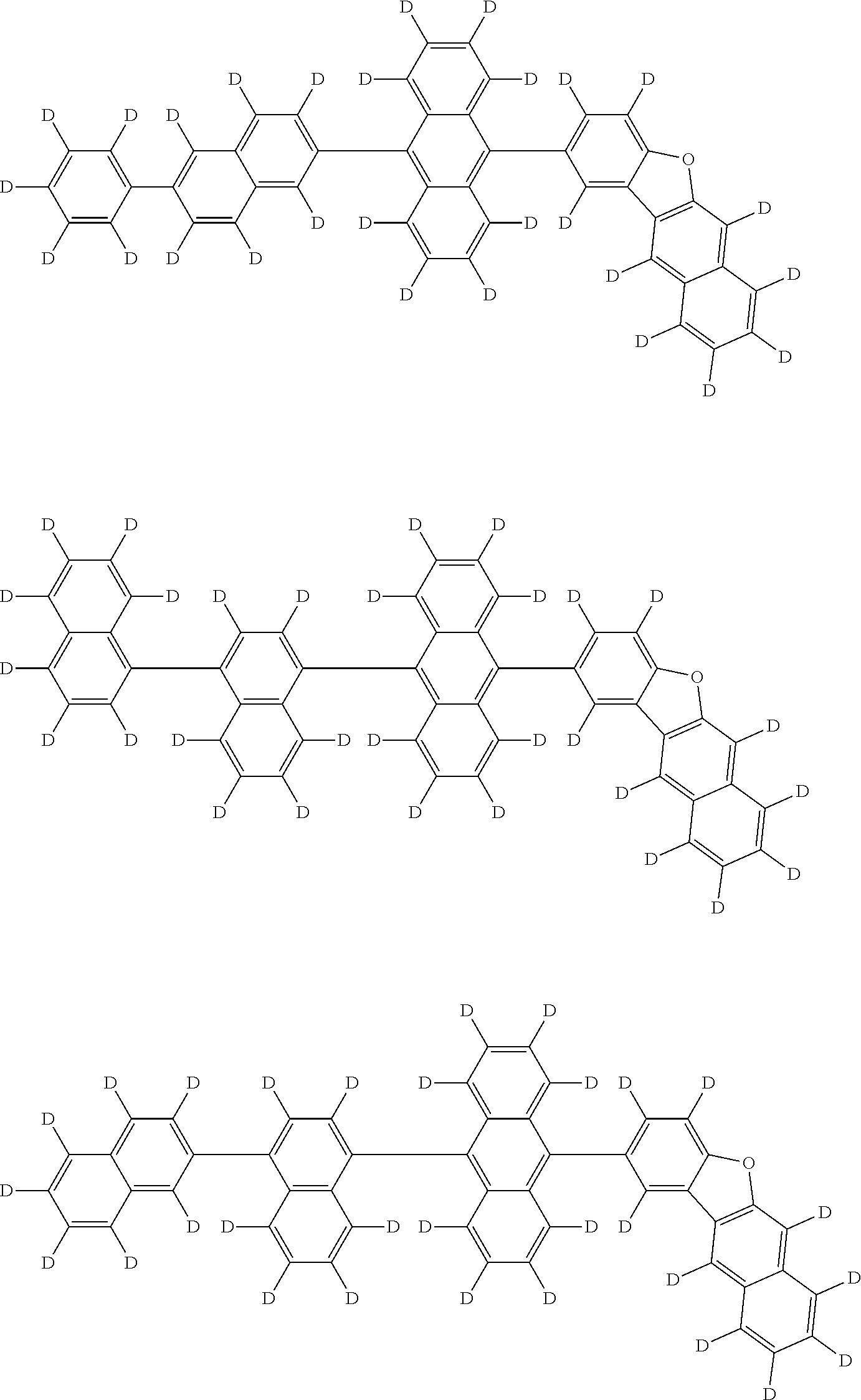
Specific examples of the compound represented by the formula (1A) include the following compounds. In the following specific compound, “D” represents a deuterium atom.
A second aspect of the compound represented by the formula (1) is a compound represented by the following formula (1B).
In the formula (1B),
-
- R1 to R8 are independently
- a hydrogen atom,
- a substituted or unsubstituted alkyl group including 1 to 50 carbon atoms,
- a substituted or unsubstituted alkenyl group including 2 to 50 carbon atoms,
- a substituted or unsubstituted alkynyl group including 2 to 50 carbon atoms,
- a substituted or unsubstituted cycloalkyl group including 3 to 50 ring carbon atoms,
- —Si(R901)(R902)(R903),
- —O—(R904),
- —S—(R905),
- —N(R906)(R907),
- a halogen atom, a cyano group, a nitro group,
- a substituted or unsubstituted aryl group including 6 to 50 ring carbon atoms, or
- a substituted or unsubstituted monovalent heterocyclic group including 5 to 50 ring atoms.
- R901 to R907 are independently
- a hydrogen atom,
- a substituted or unsubstituted alkyl group including 1 to 50 carbon atoms,
- a substituted or unsubstituted cycloalkyl group including 3 to 50 ring carbon atoms,
- a substituted or unsubstituted aryl group including 6 to 50 ring carbon atoms, or
- a substituted or unsubstituted monovalent heterocyclic group including 5 to 50 ring atoms.
When two or more of each of R901 to R907 are present, the two or more of each of R901 to R907 may be the same as or different from each other.
At least one of R1 to R8 is a deuterium atom.
Adjacent two or more of R1 to R4, and adjacent two or more of R5 to R8 do not form a ring by bonding with each other.
L1B and L2B are independently
a single bond,
a substituted or unsubstituted arylene group including 6 to 30 ring carbon atoms, or
a substituted or unsubstituted divalent heterocyclic group including 5 to 30 ring atoms.
Ar2B is
a substituted or unsubstituted aryl group including 6 to 50 ring carbon atoms, or
a substituted or unsubstituted monovalent heterocyclic group including 5 to 50 ring atoms.
One of R11B to R18B is a single bond which bonds with L1B.
R11B to R18B which are not a single bond which bonds with L1B are independently a hydrogen atom,
a substituted or unsubstituted alkyl group including 1 to 50 carbon atoms,
a substituted or unsubstituted alkenyl group including 2 to 50 carbon atoms,
a substituted or unsubstituted alkynyl group including 2 to 50 carbon atoms,
a substituted or unsubstituted cycloalkyl group including 3 to 50 ring carbon atoms,
—Si(R901)(R902)(R903),
—O—(R904),
—S—(R905),
—N(R906)(R907),
a halogen atom, a cyano group, a nitro group,
a substituted or unsubstituted aryl group including 6 to 50 ring carbon atoms, or
a substituted or unsubstituted monovalent heterocyclic group including 5 to 50 ring atoms.
R901 to R907 are as defined in R1 to R8.
Adjacent two or more of R11B to R18B do not form a ring by bonding with each other.
All of R1 to R8 may be deuterium atoms, or some (e.g. one or two) of R1 to R8 may be deuterium atoms.
R1 to R8 that are not deuterium atoms are preferably hydrogen atoms (protium atoms).
In one embodiment, at least one hydrogen atom of one or more selected from the group consisting of L1B and L2B is a deuterium atom. Specifically, in one embodiment, one or more selected from the group consisting of L1B and L2B is an unsubstituted arylene group including 6 to 30 ring carbon atoms in which at least one of the hydrogen atoms is a deuterium atom, or an unsubstituted divalent heterocyclic group including 5 to 30 ring atoms in which at least one of the hydrogen atoms is a deuterium atom.
In one embodiment, L1B and L2B are independently a single bond, or a substituted or unsubstituted arylene group including 6 to 14 ring carbon atoms. Preferably, at least one of L1B and L2B is a single bond.
In one embodiment, R11B to R18B which are not a single bond which bonds with L1B are hydrogen atoms.
In one embodiment, at least one of R11B to R18B which are not a single bond which bonds with L1B is a deuterium atom.
In one embodiment, at least one hydrogen atom possessed by Ar2B is a deuterium atom. Specifically, in one embodiment, Ar2B is an unsubstituted aryl group including 6 to 50 ring carbon atoms in which at least one of the hydrogen atoms is a deuterium atom, or an unsubstituted monovalent heterocyclic group including 5 to 50 ring atoms in which at least one of the hydrogen atoms is a deuterium atom.
Ar2B is preferably a substituted or unsubstituted aryl group including 6 to 50 ring carbon atoms, and more preferably selected from the groups represented by each of the following formulas (a1B) to (a4B).
In the formulas (a1B) to (a4B), “*” is a single bond which bonds with L2B.
R21B is
a halogen atom, a cyano group, a nitro group,
a substituted or unsubstituted alkyl group including 1 to 50 carbon atoms,
a substituted or unsubstituted alkenyl group including 2 to 50 carbon atoms,
a substituted or unsubstituted alkynyl group including 2 to 50 carbon atoms,
a substituted or unsubstituted cycloalkyl group including 3 to 50 ring carbon atoms,
—Si(R901)(R902)(R903),
—O—(R904),
—S—(R905),
—N(R906)(R907),
a substituted or unsubstituted aryl group including 6 to 50 ring carbon atoms, or
a substituted or unsubstituted monovalent heterocyclic group including 5 to 50 ring atoms.
R901 to R907 are as defined in the formula (1).
m1B is an integer of 0 to 4.
m2B is an integer of 0 to 5.
m3B is an integer of 0 to 7.
When m1B to m3B are each 2 or more, a plurality of R21B's may be the same as or different from each other.
When m1B to m3B are each 2 or more, a plurality of adjacent R21B's form a substituted or unsubstituted, saturated or unsaturated ring by bonding with each other, or do not form a substituted or unsubstituted saturated or unsaturated ring.
L1B and L2B are preferably independently a single bond, or a substituted or unsubstituted arylene group including 6 to 14 ring carbon atoms. Preferably, at least one of L1B and L2B is a single bond.
In one embodiment, the compound represented by the formula (1B) is a compound represented by the following formula (1B-1).
In the formula (1B-1), R1 to R8, Ar2B, L1B and L2B are as defined in the formula (1B).
In one embodiment, the compound represented by the formula (1B) is a compound represented by the following formula (1B-2).
In the formula (1B-2), Ar2B, L1B, and L2B are as defined in the formula (1B).
The compound represented by the formula (1B) can be synthesized in accordance with the synthetic methods described in Examples by using known alternative reactions or raw materials tailored to the target compound.
Specific examples of the compound represented by the formula (1B) are shown below. In the following specific examples, “D” represents a deuterium atom.
A third aspect of the compound represented by the formula (1) is a compound represented by the following formula (1C).
In the formula (1C),
R1 to R8 are independently
a hydrogen atom,
a substituted or unsubstituted alkyl group including 1 to 50 carbon atoms,
a substituted or unsubstituted alkenyl group including 2 to 50 carbon atoms,
a substituted or unsubstituted alkynyl group including 2 to 50 carbon atoms,
a substituted or unsubstituted cycloalkyl group including 3 to 50 ring carbon atoms,
—Si(R901)(R902)(R903),
—O—(R904),
—S—(R905),
—N(R906)(R907),
a halogen atom, a cyano group, a nitro group,
a substituted or unsubstituted aryl group including 6 to 50 ring carbon atoms, or
a substituted or unsubstituted monovalent heterocyclic group including 5 to 50 ring atoms.
R901 to R907 are independently
a hydrogen atom,
a substituted or unsubstituted alkyl group including 1 to 50 carbon atoms,
a substituted or unsubstituted cycloalkyl group including 3 to 50 ring carbon atoms,
a substituted or unsubstituted aryl group including 6 to 50 ring carbon atoms, or
a substituted or unsubstituted monovalent heterocyclic group including 5 to 50 ring atoms.
When two or more of each of R901 to R907 are present, the two or more of each of R901 to R907 may be the same as or different from each other
At least one of R1 to R8 is a deuterium atom.
Adjacent two or more of R1 to R4, and adjacent two or more of R5 to R8 do not form a ring by bonding with each other.
L1C and L2C are independently
a single bond,
a substituted or unsubstituted arylene group including 6 to 30 ring carbon atoms, or
a substituted or unsubstituted divalent heterocyclic group including 5 to 30 ring atoms.
Ar2C is
a substituted or unsubstituted aryl group including 6 to 50 ring carbon atoms, or
a substituted or unsubstituted monovalent heterocyclic group including 5 to 50 ring atoms.
Ar1C is a monovalent group represented by the following formula (2C), (3C) or (4C).
In the formulas (2C) to (4C),
one or more sets of adjacent two of R15C to R20C form a substituted or unsubstituted, saturated or unsaturated ring by bonding with each other, or do not form a substituted or unsubstituted, saturated or unsaturated ring.
In the case when one or more sets of adjacent two of R15C to R20C do not form a substituted or unsubstituted, saturated or unsaturated ring by bonding with each other, one of R11C to R20C is a single bond which bonds with L1C.
In the case when one or more sets of adjacent two of R15C to R20C form a substituted or unsubstituted, saturated or unsaturated ring by bonding with each other, one of R15C to R20C and R11C to R14C which do not form the substituted or unsubstituted, saturated or unsaturated ring is a single bond which bonds with L1C.
R11C to R20C which do not form the substituted or unsubstituted, saturated or unsaturated ring, and which is not a single bond which bonds with L1C are independently
a hydrogen atom,
a substituted or unsubstituted alkyl group including 1 to 50 carbon atoms,
a substituted or unsubstituted alkenyl group including 2 to 50 carbon atoms,
a substituted or unsubstituted alkynyl group including 2 to 50 carbon atoms,
a substituted or unsubstituted cycloalkyl group including 3 to 50 ring carbon atoms,
—Si(R901)(R902)(R903),
—O—(R904),
—S—(R905),
—N(R906)(R907),
a halogen atom, a cyano group, a nitro group,
a substituted or unsubstituted aryl group including 6 to 50 ring carbon atoms, or
a substituted or unsubstituted monovalent heterocyclic group including 5 to 50 ring atoms.
R901 to R907 are as defined in the formula (1C).
All of R1 to R8 may be deuterium atoms, or some (e.g. one or two) of R1 to R8 may be deuterium atoms.
R1 to R8 which are not deuterium atoms are preferably hydrogen atoms (protium atoms).
In one embodiment, at least one hydrogen atom possessed by one or more selected from the group consisting of L1C and L2C is a deuterium atom. Specifically, in one embodiment, one or more selected from the group consisting of L1C and L2C is an unsubstituted arylene group including 6 to 30 ring carbon atoms in which at least one of the hydrogen atoms is a deuterium atom, or an unsubstituted divalent heterocyclic group including 5 to 30 ring atoms in which at least one of the hydrogen atoms is a deuterium atom.
In one embodiment, L1C and L2C are independently a single bond, or a substituted or unsubstituted arylene group including 6 to 14 ring carbon atoms. Preferably, at least one of L1C and L2C is a single bond.
In one embodiment, any of R11C to R14C in the formulas (2C) to (4C) is a single bond which bonds with L1C.
In one embodiment, one or more sets of two adjacent of R15C to R20C in the formulas (2C) to (4C) do not form a substituted or unsubstituted, saturated or unsaturated ring by bonding with each other.
In one embodiment, R11C to R20C in the formulas (2C) to (4C), which are not a single bond which bonds with L1C and do not contribute to ring formation, are preferably hydrogen atoms.
In one embodiment, at least one of R11C to R20C in the formulas (2C) to (4C), which are not a single bond which bonds with L1C and do not contribute to ring formation, is a deuterium atom.
In one embodiment, at least one hydrogen atom possessed by Ar2C is a deuterium atom. Specifically, in one embodiment, Ar2C is an unsubstituted aryl group including 6 to 50 ring carbon atoms in which at least one of the hydrogen atoms is a deuterium atom, or an unsubstituted monovalent heterocyclic group including 5 to 50 ring atoms in which at least one of the hydrogen atoms is a deuterium atom.
A2C is preferably a substituted or unsubstituted aryl group including 6 to 50 ring carbon atoms, and more preferably selected from the groups represented by each of the following formulas (a1C) to (a4C).
In the formulas (a1C) to (a4C), “*” is a single bond which bonds with L2C.
R21C is
a halogen atom, a cyano group, a nitro group,
a substituted or unsubstituted alkyl group including 1 to 50 carbon atoms,
a substituted or unsubstituted alkenyl group including 2 to 50 carbon atoms,
a substituted or unsubstituted alkynyl group including 2 to 50 carbon atoms,
a substituted or unsubstituted cycloalkyl group including 3 to 50 ring carbon atoms,
—Si(R901)(R902)(R903),
—O—(R904),
—S—(R905),
—N(R906)(R907),
a substituted or unsubstituted aryl group including 6 to 50 ring carbon atoms, or
a substituted or unsubstituted monovalent heterocyclic group including 5 to 50 ring atoms.
R901 to R907 are as defined in the formula (1C).
m1C is an integer of 0 to 4.
m2C is an integer of 0 to 5.
m3C is an integer of 0 to 7.
When m1C to m3C are each 2 or more, a plurality of R21C's may be the same as or different from each other.
When m1C to m3C are each 2 or more, a plurality of adjacent R21C's form a substituted or unsubstituted, saturated or unsaturated ring by bonding with each other, or do not form a substituted or unsubstituted, saturated or unsaturated ring.
L1C and L2C are preferably independently a single bond, or a substituted or unsubstituted arylene group including 6 to 14 ring carbon atoms. Preferably, at least one of L1C and L2C is a single bond.
In one embodiment, the compound represented by the formula (1C) is a compound represented by any one of the following formulas (1C-1) to (1C-3).
In the formula (1C-1) to (1C-3), R1 to R8, Ar2C, L1C, and L2C are as defined in the formula (1C).
In one embodiment, the compound represented by the formula (1C) is a compound represented by any one of the following formulas (1C-11) to (1C-13).
In the formula (1C-11) to (1C-13), Ar2C, L1C, and L2C are as defined in the formula (1C).
The compound represented by the formula (1C) can be synthesized in accordance with the synthetic methods described in Examples by using known alternative reactions or raw materials tailored to the target compound.
Specific examples of the compound represented by the formula (1C) are shown below. In the following specific examples, “D” represents a deuterium atom.
The dopant material is not particularly limited, but preferably does not include a phosphorescent dopant material as described above.
Examples of the dopant materials include compounds represented by each of the following formulas (11), (21), (31), (41), (51), (61), (71), (81), and (91), and the like. Preferably, the dopant material is a compound represented by the following formula (11).
(Compound Represented by the Formula (11))
A compound represented by the formula (11) will be described.
In the formula (11),
one or more sets of adjacent two or more of R101 to R110 form a substituted or unsubstituted, saturated or unsaturated ring by bonding with each other, or do not form a substituted or unsubstituted, saturated or unsaturated ring.
At least one of R101 to R110 is a monovalent group represented by the following formula (12).
R101 to R110 which do not form a substituted or unsubstituted, saturated or unsaturated ring, and are not a monovalent group represented by the following formula (12) are independently
a hydrogen atom,
a substituted or unsubstituted alkyl group including 1 to 50 carbon atoms,
a substituted or unsubstituted alkenyl group including 2 to 50 carbon atoms,
a substituted or unsubstituted alkynyl group including 2 to 50 carbon atoms,
a substituted or unsubstituted cycloalkyl group including 3 to 50 ring carbon atoms,
—Si(R901)(R902)(R903),
—O—(R904),
—S—(R905),
—N(R906)(R907),
a halogen atom, a cyano group, a nitro group,
a substituted or unsubstituted aryl group including 6 to 50 ring carbon atoms, or
a substituted or unsubstituted monovalent heterocyclic group including 5 to 50 ring atoms.
R901 to R907 are as defined in the formula (1).
In the formula (12), Ar101 and Ar102 are independently
a substituted or unsubstituted aryl group including 6 to 50 ring carbon atoms, or
a substituted or unsubstituted monovalent heterocyclic group including 5 to 50 ring atoms.
L101 to L103 are independently
a single bond,
a substituted or unsubstituted arylene group including 6 to 30 ring carbon atoms, or
a substituted or unsubstituted divalent heterocyclic group including 5 to 30 ring atoms.
In the formula (11), it is preferable that two of R101 to R110 be groups represented by the formula (12).
In one embodiment, the compound represented by the formula (11) is a compound represented by the following formula (13).
In the formula (13), R111 to R118 is the same as R101 to R110 in the formula (11) which are not a monovalent group represented by the formula (12). Ar101, Ar102, L101, L102, and L103 are as defined in the formula (12).
In the formula (11), L101 is preferably a single bond, and L102 and L103 are preferably single bonds.
In one embodiment, the compound represented by the formula (11) is a compound represented by the following formula (14) or (15).
In the formula (14), R111 to R118 are as defined in the formula (13). Ar101, Ar102, L102, and L103 are as defined in the formula (12).
In the formula (15), R111 to R118 are as defined in the formula (13). Ar101 and Ar102 are as defined in the formula (12).
In the formula (12) in the formula (11), at least one of Ar101 and Ar102 is preferably a group represented by the following formula (16).
In the formula (16),
X101 represents an oxygen atom or a sulfur atom.
one or more sets of adjacent two or more of R121 to R127 form a substituted or unsubstituted, saturated or unsaturated ring by bonding with each other, or do not form a substituted or unsubstituted, saturated or unsaturated ring.
R121 to R127 which do not form the substituted or unsubstituted, saturated or unsaturated ring are independently
a hydrogen atom,
a substituted or unsubstituted alkyl group including 1 to 50 carbon atoms,
a substituted or unsubstituted alkenyl group including 2 to 50 carbon atoms,
a substituted or unsubstituted alkynyl group including 2 to 50 carbon atoms,
a substituted or unsubstituted cycloalkyl group including 3 to 50 ring carbon atoms,
—Si(R901)(R902)(R903),
—O—(R904),
—S—(R905),
—N(R906)(R907),
a halogen atom, a cyano group, a nitro group,
a substituted or unsubstituted aryl group including 6 to 50 ring carbon atoms, or
a substituted or unsubstituted monovalent heterocyclic group including 5 to 50 ring atoms.
R901 to R907 are as defined in the formula (1).
Preferably, X101 is an oxygen atom.
At least one of R121 to R127 is
a substituted or unsubstituted alkyl group including 1 to 50 carbon atoms,
a substituted or unsubstituted alkenyl group including 2 to 50 carbon atoms,
a substituted or unsubstituted alkynyl group including 2 to 50 carbon atoms,
a substituted or unsubstituted cycloalkyl group including 3 to 50 ring carbon atoms,
a substituted or unsubstituted aryl group including 6 to 50 ring carbon atoms, or
a substituted or unsubstituted monovalent heterocyclic group including 5 to 50 ring atoms.
In the formula (11) (formula (12)), it is preferable that Ar101 be a group represented by the formula (16), and that Ar102 be a substituted or unsubstituted aryl group including 6 to 50 ring carbon atoms.
In one embodiment, the compound represented by the formula (11) is a compound represented by the following formula (17).
In the formula (17), R111 to R118 are as defined in the formula (13). R121 to R127 is as defined in the formula (16).
R131 to R135 are independently
a hydrogen atom,
a substituted or unsubstituted alkyl group including 1 to 50 carbon atoms,
a substituted or unsubstituted alkenyl group including 2 to 50 carbon atoms,
a substituted or unsubstituted alkynyl group including 2 to 50 carbon atoms,
a substituted or unsubstituted cycloalkyl group including 3 to 50 ring carbon atoms,
—Si(R901)(R902)(R903),
—O—(R904),
—S—(R905),
—N(R906)(R907),
a halogen atom, a cyano group, a nitro group,
a substituted or unsubstituted aryl group including 6 to 50 ring carbon atoms, or
a substituted or unsubstituted monovalent heterocyclic group including 5 to 50 ring atoms.
R901 to R907 are as defined in the formula (1).
Specific examples of the compound represented by the formula (11) include, for example, compounds shown below. In the following specific examples, “Me” represents a methyl group.
(Compound Represented by the Formula (21))
A compound represented by the formula (21) will be described.
In the formula (21),
Z's are independently CRa or N.
Ring A1 and ring A2 are independently a substituted or unsubstituted aromatic hydrocarbon ring including 6 to 50 ring carbon atoms, or a substituted or unsubstituted heterocyclic ring including 5 to 50 ring atoms.
When a plurality of Ra's are present, one or more sets of adjacent two or more of the plurality of Ra's form a substituted or unsubstituted, saturated or unsaturated ring by bonding with each other, or do not form a substituted or unsubstituted, saturated or unsaturated ring.
When a plurality of Rb's are present, one or more sets of adjacent two or more of the plurality of Rb's form a substituted or unsubstituted, saturated or unsaturated ring by bonding with each other, or do not form a substituted or unsubstituted, saturated or unsaturated ring.
When a plurality of Rc's are present, one or more sets of adjacent two or more of the plurality of Rc's form a substituted or unsubstituted, saturated or unsaturated ring by bonding with each other, or do not form a substituted or unsubstituted, saturated or unsaturated ring.
n21 and n22 are independently an integer of 0 to 4.
Ra to Rc which do not form the substituted or unsubstituted, saturated or unsaturated ring are independently
a hydrogen atom,
a substituted or unsubstituted alkyl group including 1 to 50 carbon atoms,
a substituted or unsubstituted alkenyl group including 2 to 50 carbon atoms,
a substituted or unsubstituted alkynyl group including 2 to 50 carbon atoms,
a substituted or unsubstituted cycloalkyl group including 3 to 50 ring carbon atoms,
—Si(R901)(R902)(R903),
—O—(R904),
—S—(R905),
—N(R906)(R907),
a halogen atom, a cyano group, a nitro group,
a substituted or unsubstituted aryl group including 6 to 50 ring carbon atoms, or
a substituted or unsubstituted monovalent heterocyclic group including 5 to 50 ring atoms.
R901 to R907 are as defined in the formula (1).
The “aromatic hydrocarbon rings” for the ring A1 and the ring A2 each have the same structure as the compound in which a hydrogen atom is introduced into the “aryl group” described above. The “aromatic hydrocarbon rings” for the ring A1 and the ring A2 each include two carbon atoms on the central fused bicyclic structure of the formula (21) as ring atoms. Specific examples of the “substituted or unsubstituted aromatic hydrocarbon rings including 6 to 50 ring carbon atoms” include compounds in which the hydrogen atom is introduced into the “aryl group” described in the specific example group G1, and the like.
The “heterocyclic rings” for the ring A1 and the ring A2 each have the same structure as the compound in which a hydrogen atom is introduced into the “heterocyclic group” described above. The “heterocyclic ring” of the ring A1 and the ring A2 contains two carbon atoms on the central fused bicyclic structure of the formula (21) as ring atoms. Specific examples of the “substituted or unsubstituted heterocyclic ring including 5 to 50 ring atoms” include compounds in which the hydrogen atom is introduced into the “heterocyclic group” described in the specific example group G2, and the like.
Rb is bonded with either carbon atom, which forms aromatic hydrocarbon ring of the ring A1, or with either atom, which forms heterocyclic ring of the ring A1.
Rc is bonded with either carbon atom, which forms aromatic hydrocarbon ring of the ring A2, or with either atom, which forms heterocyclic ring of the ring A2.
It is preferable that at least one (preferably two) of Ra to Rc be a group represented by the following formula (21a).
-L201-Ar201 (21a)
In the formula (21a),
L201 is
a single bond,
a substituted or unsubstituted arylene group including 6 to 30 ring carbon atoms, or
a substituted or unsubstituted divalent heterocyclic group including 5 to 30 ring atoms.
Ar201 is
a substituted or unsubstituted aryl group including 6 to 50 ring carbon atoms,
a substituted or unsubstituted monovalent heterocyclic group including 5 to 50 ring atoms, or
a group represented by the following formula (21b).
In the formula (21b),
L211 and L212 are independently
a single bond,
a substituted or unsubstituted arylene group including 6 to 30 ring carbon atoms, or
a substituted or unsubstituted divalent heterocyclic group including 5 to 30 ring atoms.
Ar211 and Ar212 form a substituted or unsubstituted, saturated or unsaturated ring by bonding with each other, or do not form a substituted or unsubstituted, saturated or unsaturated ring.
Ar211 and Ar212 which do not form a substituted or unsubstituted, saturated or unsaturated ring are independently
a substituted or unsubstituted aryl group including 6 to 50 ring carbon atoms, or
a substituted or unsubstituted monovalent heterocyclic group including 5 to 50 ring atoms.
In one embodiment, the compound represented by the formula (21) is a compound represented by the following formula (22).
In the formula (22),
one or more sets of adjacent two or more of R201 to R211 form a substituted or unsubstituted, saturated or unsaturated ring by bonding with each other, or do not form a substituted or unsubstituted, saturated or unsaturated ring.
R201 to R211 which do not form the substituted or unsubstituted, saturated or unsaturated ring are independently
a hydrogen atom,
a substituted or unsubstituted alkyl group including 1 to 50 carbon atoms,
a substituted or unsubstituted alkenyl group including 2 to 50 carbon atoms,
a substituted or unsubstituted alkynyl group including 2 to 50 carbon atoms,
a substituted or unsubstituted cycloalkyl group including 3 to 50 ring carbon atoms,
—Si(R901)(R902)(R903),
—O—(R904),
—S—(R905),
—N(R906)(R907),
a halogen atom, a cyano group, a nitro group,
a substituted or unsubstituted aryl group including 6 to 50 ring carbon atoms, or
a substituted or unsubstituted monovalent heterocyclic group including 5 to 50 ring atoms.
R901 to R907 are as defined in the formula (1).
It is preferable that at least one (preferably two) of R201 to R211 be a group represented by the formula (21a). Preferably, R204 and R211 are groups represented by the formula (21a).
In one embodiment, the compound represented by the formula (21) is a compound in which a structure represented by the following formula (21-1) or (21-2) is bonded with the ring A1. In one embodiment, the compound represented by the formula (22) is a compound in which a structure represented by the following formula (21-1) or (21-2) is bonded with the ring with which R204 to R207 are bonded.
In the formula (21-1), the two of “*” are respectively bonded with the ring carbon atoms of the aromatic hydrocarbon ring or the ring atoms of the heterocyclic ring of the ring A1 in the formula (21), or with either R204 to R207 in the formula (22).
The three of “*” in the formula (21-2) are respectively bonded with the ring carbon atoms of the aromatic hydrocarbon ring or the ring atoms of the heterocyclic ring of the ring A1 in the formula (22), or with either R204 to R207 in the formula (22).
One or more sets of adjacent two or more of R221 to R227 and R231 to R239 form a substituted or unsubstituted, saturated or unsaturated ring by bonding with each other, or do not form a substituted or unsubstituted, saturated or unsaturated ring.
R221 to R227 and R231 to R239 which do not form a substituted or unsubstituted, saturated or unsaturated ring are independently
a hydrogen atom,
a substituted or unsubstituted alkyl group including 1 to 50 carbon atoms,
a substituted or unsubstituted alkenyl group including 2 to 50 carbon atoms,
a substituted or unsubstituted alkynyl group including 2 to 50 carbon atoms,
a substituted or unsubstituted cycloalkyl group including 3 to 50 ring carbon atoms,
—Si(R901)(R902)(R903),
—O—(R904),
—S—(R905),
—N(R906)(R907),
a halogen atom, a cyano group, a nitro group,
a substituted or unsubstituted aryl group including 6 to 50 ring carbon atoms, or
a substituted or unsubstituted monovalent heterocyclic group including 5 to 50 ring atoms.
R901 to R907 are as defined in the formula (1).
In one embodiment, the compound represented by the formula (21) is a compound represented by the following formula (21-3), formula (21-4), or formula (21-5).
In the formula (21-3), formula (21-4), and formula (21-5),
-
- the ring A1 is as defined in the formula (21).
R2401 to R2407 are the same as R221 to R227 in the formula (21-1) and (21-2). R2410 to R2417 are the same as R201 to R211 in the formula (22).
In one embodiment, the substituted or unsubstituted aromatic hydrocarbon ring including 6 to 50 ring carbon atoms of the ring A1 in the formula (21-5) is a substituted or unsubstituted naphthalene ring or a substituted or unsubstituted fluorene ring.
In one embodiment, the substituted or unsubstituted heterocyclic ring including 5 to 50 ring atoms of the ring A1 in the formula (21-5) is a substituted or unsubstituted dibenzofuran ring, a substituted or unsubstituted carbazole ring, or a substituted or unsubstituted dibenzothiophene ring.
In one embodiment, the compound represented by the formula (21) or formula (22) is selected from the group consisting of compounds represented by each of the following formulas (21-6-1) to (21-6-7).
In the formulas (21-6-1) to (21-6-7),
R2421 to 82427 is the same as R221 to R227 in the formulas (21-1) and (21-2). R2430 to R2437 and R2441 to R2444 are the same as R201 to R211 in the formula (22).
X is O, NR901, or C(R902)(R903).
R901 to R903 are as defined in the formula (1).
In one embodiment, in the compound represented by the formula (22), one or more sets of adjacent two or more of R201 to R211 form a substituted or unsubstituted, saturated or unsaturated ring by bonding with each other. This embodiment will be described in detail below as the formula (25).
(Compound Represented by the Formula (25))
A compound represented by the formula (25) will be described.
In the formula (25),
-
- two or more of the sets selected from the group consisting of R251 and R252, R252 and R253, R254 and R255, R255 and R256, R256 and R257, R258 and R259, R259 and R260, and R260 and R261 form a substituted or unsubstituted, saturated or unsaturated ring by bonding with each other, and
- provided that a set of R251 and R252 and a set of R252 and R253; a set of R254 and R255 and a set of R255 and R256; a set of R255 and R256 and a set of R256 and R257; a set of R258 and R259 and a set of R259 and R260; and a set of R259 and R260 and a set of R260 and R261 do not form rings at the same time.
The two or more rings formed by R251 to R261 may be the same as or different from each other.
R251 to R261 which do not form the substituted or unsubstituted, saturated or unsaturated ring are independently
a hydrogen atom,
a substituted or unsubstituted alkyl group including 1 to 50 carbon atoms,
a substituted or unsubstituted alkenyl group including 2 to 50 carbon atoms,
a substituted or unsubstituted alkynyl group including 2 to 50 carbon atoms,
a substituted or unsubstituted cycloalkyl group including 3 to 50 ring carbon atoms,
—Si(R901)(R902)(R903),
—O—(R904),
—S—(R905),
—N(R906)(R907),
a halogen atom, a cyano group, a nitro group,
a substituted or unsubstituted aryl group including 6 to 50 ring carbon atoms, or
a substituted or unsubstituted monovalent heterocyclic group including 5 to 50 ring atoms.
R901 to R907 are as defined in the formula (1).
In the formula (25), Rn and Rn+1 (n represents an integer selected from 251, 252, 254 to 256, and 258 to 260) form a substituted or unsubstituted, saturated or unsaturated ring, together with the two ring carbon atoms with which Rn and Rn+1 are bonded, by bonding with each other. The ring is preferably composed of atoms selected from C atom, O atom, S atom, and N atom, and the number of atoms is preferably 3 to 7, and more preferably 5 or 6.
The number of ring structures described above in the compound represented by the formula (25) is, for example, 2, 3, or 4. The two or more ring structures may be present on the same benzene ring of the mother skeleton in the formula (25), respectively, or may be present on the different benzene rings. For example, when the compound has three ring structures, a ring structure may be present in each of the three benzene rings in the formula (25) one by one.
Examples of the above-mentioned ring structure in the compound represented by the formula (25) include structures represented by each of the following formulas (251) to (260), and the like.
In the formula (251) to (257), each of *1 and *2, *3 and *4, *5 and *6, *7 and *8, *9 and *10, *11 and *12, and *13 and *14 represents the two ring carbon atoms with which Rn and Rn+1 are bound, and ring carbon atoms with which Rn is bonded may be any of the two ring carbon atoms represented by *1 and *2, *3 and *4, *5 and *6, *7 and *8, *9 and *10, *11 and *12, and *13 and *14.
X2501 is C(R2512) (R2513), NR2514, O, or S.
One or more sets of adjacent two or more of R2501 to R2506 and R2512 to R2513 form a substituted or unsubstituted, saturated or unsaturated ring by bonding with each other, or do not form a substituted or unsubstituted, saturated or unsaturated ring.
R2501 to R2514 which do not form the substituted or unsubstituted, saturated or unsaturated ring are the same as R251 to R261.
In the formulas (258) to (260), *1 and *2, and *3 and *4 each represent the two ring carbon atoms with which Rn and Rn+1 are bonded, and ring carbon atoms with which Rn is bonded may be either two ring carbon atoms represented by *1 and *2, or*3 and *4.
X2501 is C(R2512) (R2513), NR2514, O, or S.
One or more sets of adjacent two or more of R2515 to R2525 form a substituted or unsubstituted, saturated or unsaturated ring by bonding with each other, or do not form a substituted or unsubstituted, saturated or unsaturated ring.
R2515 to R2521 and R2522 to R2525 which do not form a substituted or unsubstituted, saturated or unsaturated ring are the same as R251 to R261.
In the formula (25), at least one of R252, R254, R255, R260, and R261 (preferably at least one of R252, R255, and R260, and more preferably R252) is preferably a group which does not form a ring structure.
Preferably,
(i) the substituent when the ring formed by Rn and Rn+1 in the formula (25) has a substituent,
(ii) R251 to R261 which do not form a ring structure in the formula (25), and
(iii) R2501 to R2514 and R2515 to R2525 in the formulas (251) to (260) are independently
a hydrogen atom,
a substituted or unsubstituted alkyl group including 1 to 50 carbon atoms,
a substituted or unsubstituted alkenyl group including 2 to 50 carbon atoms,
a substituted or unsubstituted alkynyl group including 2 to 50 carbon atoms,
a substituted or unsubstituted cycloalkyl group including 3 to 50 ring carbon atoms,
—N(R906)(R907),
a substituted or unsubstituted aryl group including 6 to 50 ring carbon atoms,
a substituted or unsubstituted monovalent heterocyclic group including 5 to 50 ring atoms, or
any of the groups selected from the following groups.
In the formulas (261) to (264), Rd's are independently
a hydrogen atom,
a substituted or unsubstituted alkyl group including 1 to 50 carbon atoms,
a substituted or unsubstituted alkenyl group including 2 to 50 carbon atoms,
a substituted or unsubstituted alkynyl group including 2 to 50 carbon atoms,
a substituted or unsubstituted cycloalkyl group including 3 to 50 ring carbon atoms,
—Si(R901)(R902)(R903),
—O—(R904),
—S—(R905),
—N(R906)(R907),
a halogen atom, a cyano group, a nitro group,
a substituted or unsubstituted aryl group including 6 to 50 ring carbon atoms, or
a substituted or unsubstituted monovalent heterocyclic group including 5 to 50 ring atoms.
X is C(R901)(R902), NR903, O, or S.
R901 to R907 are as defined in the formula (1).
p1's are independently an integer of 0 to 5, p2's are independently an integer of 0 to 4, p3 is an integer of 0 to 3, and p4 is an integer of 0 to 7.
In one embodiment, the compound represented by the formula (25) is a compound represented by any of the following formulas (25-1) to (25-6).
In the formulas (25-1) to (25-6), rings d to i are independently a substituted or unsubstituted, saturated or unsaturated ring; and R251 to R261 are the same as in the formula (25).
In one embodiment, the compound represented by the formula (25) is a compound represented by any of the following formulas (25-7) to (25-12).
In the formulas (25-7) to (25-12), rings d to f, k, and j are independently a substituted or unsubstituted, saturated or unsaturated ring; and R251 to R261 are the same as in the formula (25).
In one embodiment, the compound represented by the formula (25) is a compound represented by any of the following formulas (25-13) to (25-21).
In the formulas (25-13) to (25-21), rings d to k are independently a substituted or unsubstituted, saturated or unsaturated ring; and R251 to R261 are the same as in the formula (25).
Examples of the substituent when the ring g or h further has a substituent include, for example, a substituted or unsubstituted alkyl group including 1 to 50 carbon atoms, a substituted or unsubstituted aryl group including 6 to 50 ring carbon atoms, or the group represented by the formula (261), (263), or (264).
In one embodiment, the compound represented by the formula (25) is a compound represented by any of the following formulas (25-22) to (25-25).
In the formulas (25-22) to (25-25), X250's are independently C(R901)(R902), NR903, O, or S. R251 to R261, and R271 to R278 are the same as R251 to R261 in the formula (25). R901 to R903 are as defined in the formula (1).
In one embodiment, the compound represented by the formula (25) is a compound represented by the following formula (25-26).
In the formula (25-26), X250 is C(R931) (R932), NR903, O, or S. R253, R254, R257, R258, R261, and R271 to R282 are the same as R251 to R261 in the formula (25). R931 to R933 are as defined in the formula (1).
Examples of the compound represented by the formula (21) include, for example, compounds shown below as specific examples. In the following specific examples, “Me” represents a methyl group.
(Compound Represented by the Formula (31))
A compound represented by the formula (31) will be described. The compound represented by the formula (31) is a compound corresponding to the compound represented by the formula (21-3) described above.
In the formula (31),
one or more sets of adjacent two or more of R301 to R307 and R311 to R317 form a substituted or unsubstituted, saturated or unsaturated ring, or do not form a substituted or unsubstituted, saturated or unsaturated ring;
R301 to R307 and R311 to R317 which do not form the substituted or unsubstituted, saturated or unsaturated ring are independently
a hydrogen atom,
a substituted or unsubstituted alkyl group including 1 to 50 carbon atoms,
a substituted or unsubstituted alkenyl group including 2 to 50 carbon atoms,
a substituted or unsubstituted alkynyl group including 2 to 50 carbon atoms,
a substituted or unsubstituted cycloalkyl group including 3 to 50 ring carbon atoms,
—Si(R901)(R902)(R903),
—O—(R904),
—S—(R905),
—N(R906)(R907),
a halogen atom, a cyano group, a nitro group,
a substituted or unsubstituted aryl group including 6 to 50 ring carbon atoms, or
a substituted or unsubstituted monovalent heterocyclic group including 5 to 50 ring atoms.
R321 and R322 are independently
a hydrogen atom,
a substituted or unsubstituted alkyl group including 1 to 50 carbon atoms,
a substituted or unsubstituted alkenyl group including 2 to 50 carbon atoms,
a substituted or unsubstituted alkynyl group including 2 to 50 carbon atoms,
a substituted or unsubstituted cycloalkyl group including 3 to 50 ring carbon atoms,
—Si(R901)(R902)(R903),
—O—(R904),
—S—(R905),
—N(R906)(R907),
a halogen atom, a cyano group, a nitro group,
a substituted or unsubstituted aryl group including 6 to 50 ring carbon atoms, or
a substituted or unsubstituted monovalent heterocyclic group including 5 to 50 ring atoms.
R901 to R907 are as defined in the formula (1).
The “set of adjacent two or more of R301 to R307 and R311 to R317” includes, for example, sets of R301 and R302, R302 and R303, R303 and R304, R305 and R306, and 8306 and R307, and a set of R301, R302 and R303, and the like.
In one embodiment, at least one, with preferably two, of R301 to R307 and R311 to R317 are a group represented by —N(R906)(R907).
In one embodiment, R301 to R307 and R311 to R317 are independently a hydrogen atom, a substituted or unsubstituted aryl group including 6 to 50 ring carbon atoms, or a substituted or unsubstituted monovalent heterocyclic group including 5 to 50 ring atoms.
In one embodiment, the compound represented by the formula (31) is a compound represented by the following formula (32).
In the formula (32),
one or more sets of adjacent two or more of R331 to R334 and R341 to R344 form a substituted or unsubstituted, saturated or unsaturated ring, or do not form a substituted or unsubstituted, saturated or unsaturated ring;
R331 to R334 and R341 to R344 which do not form the substituted or unsubstituted, saturated or unsaturated ring, and R351 and R352 are independently
a hydrogen atom,
a substituted or unsubstituted aryl group including 6 to 50 ring carbon atoms, or
a substituted or unsubstituted monovalent heterocyclic group including 5 to 50 ring atoms.
R361 to R364 are independently
a substituted or unsubstituted aryl group including 6 to 50 ring carbon atoms, or
a substituted or unsubstituted monovalent heterocyclic group including 5 to 50 ring atoms.
In one embodiment, the compound represented by the formula (31) is a compound represented by the following formula (33).
In the formula (33), R351, R352, and R361 to R364 are as defined in the formula (32).
In one embodiment, R361 to R364 in the formulas (32) and (33) are independently a substituted or unsubstituted aryl group including 6 to 50 ring carbon atoms (preferably a phenyl group).
In one embodiment, R321 and R322 in the formula (31) and R351 and 8352 in the formulas (32) and (33) are hydrogen atoms.
In one embodiment, the substituent in the case of “substituted or unsubstituted” in the formulas (31) to (33) is
a substituted or unsubstituted alkyl group including 1 to 50 carbon atoms,
a substituted or unsubstituted alkenyl group including 2 to 50 carbon atoms,
a substituted or unsubstituted alkynyl group including 2 to 50 carbon atoms,
a substituted or unsubstituted cycloalkyl group including 3 to 50 ring carbon atoms,
a substituted or unsubstituted aryl group including 6 to 50 ring carbon atoms, or
a substituted or unsubstituted monovalent heterocyclic group including 5 to 50 ring atoms.
Specific examples of the compound represented by the formula (31) include the following compounds. In the following specific examples, “Me” represents a methyl group.
(Compound Represented by the Formula (41))
A compound represented by the formula (41) will be described.
In the formula (41),
ring a, ring b and ring c are independently
a substituted or unsubstituted aromatic hydrocarbon ring including 6 to 50 ring carbon atoms, or
a substituted or unsubstituted heterocyclic ring including 5 to 50 ring atoms.
R401 and R402 independently form a substituted or unsubstituted heterocyclic ring by bonding with the ring a, the ring b, or the ring c, or do not form a substituted or unsubstituted heterocyclic ring.
R401 and R402 which do not form the substituted or unsubstituted heterocyclic ring are independently
a substituted or unsubstituted alkyl group including 1 to 50 carbon atoms,
a substituted or unsubstituted alkenyl group including 2 to 50 carbon atoms,
a substituted or unsubstituted alkynyl group including 2 to 50 carbon atoms,
a substituted or unsubstituted cycloalkyl group including 3 to 50 ring carbon atoms,
a substituted or unsubstituted aryl group including 6 to 50 ring carbon atoms, or
a substituted or unsubstituted monovalent heterocyclic group including 5 to 50 ring atoms.
The ring a, the ring b, and the ring c are a ring (a substituted or unsubstituted aromatic hydrocarbon ring including 6 to 50 ring carbon atoms, or a substituted or unsubstituted heterocyclic ring including 5 to 50 ring atoms) fused to the central fused bicyclic structure composed of a B atom and two N atoms in the formula (41).
The “aromatic hydrocarbon ring” for the ring a, the ring b, and the ring c has the structure same as the compound in which a hydrogen atom is introduced into the “aryl group” described above. The “aromatic hydrocarbon ring” for the ring a contains three carbon atoms on the central fused bicyclic structure in the formula (41) as ring atoms. The “aromatic hydrocarbon ring” for the ring b and the ring c contains two carbon atoms on the central fused bicyclic structure in the formula (41) as ring atoms. Specific examples of the “substituted or unsubstituted aromatic hydrocarbon ring including 6 to 50 ring carbon atoms” include compounds in which the hydrogen atom is introduced into the “aryl group” described in the specific example group G1, and the like.
The “heterocyclic ring” for the ring a, the ring b, and the ring c has the structure same as the compound in which a hydrogen atom is introduced into the “heterocyclic group” described above. The “heterocyclic ring” for the ring a contains three carbon atoms on the central fused bicyclic structure in the formula (41) as ring atoms. The “heterocyclic ring” for the ring b and the ring c contains two carbon atoms on the central fused bicyclic structure in the formula (41) as the ring atoms. Specific examples of the “substituted or unsubstituted heterocyclic ring including 5 to 50 ring atoms” include compounds in which the hydrogen atom is introduced into the “heterocyclic group” described in the specific example group G2, and the like.
R401 and R402 may independently form a substituted or unsubstituted heterocyclic ring by bonding with the ring a, the ring b, or the ring c. The heterocyclic ring in this case contains the nitrogen atom on the central fused bicyclic structure in the formula (41). The heterocyclic ring in this case may contain a hetero atom other than the nitrogen atom. The expression “R401 and R402 being bonded with the ring a, the ring b, or the ring c” specifically means that the atoms forming the ring a, the ring b, or the ring c are bonded with the atoms forming R401 and R402. For example, 8401 may be bonded with the ring a to form a fused bicyclic (or a fused tricyclic or more polycyclic) nitrogen-containing heterocyclic ring in which the ring containing R401 is fused with the ring a. Specific examples of the nitrogen-containing heterocyclic ring include a compound corresponding to a fused heterocyclic group composed of two or more rings which contains nitrogen in the specific example group G2.
The same applies when R401 is bonded with the ring b, when R402 is bonded with the ring a, and when R402 is bonded with the ring c.
In one embodiment, the ring a, the ring b, and the ring c in the formula (41) are independently a substituted or unsubstituted aromatic hydrocarbon ring including 6 to 50 ring carbon atoms.
In one embodiment, the ring a, the ring b, and the ring c in the formula (41) are independently a substituted or unsubstituted benzene ring or a substituted or unsubstituted naphthalene ring.
In one embodiment, R401 and R402 in the formula (41) are independently a substituted or unsubstituted aryl group including 6 to 50 ring carbon atoms, or a substituted or unsubstituted monovalent heterocyclic group including 5 to 50 ring atoms, and preferably a substituted or unsubstituted aryl group including 6 to 50 ring carbon atoms.
In one embodiment, the compound represented by the formula (41) is a compound represented by the following formula (42).
In the formula (42),
R401A forms a substituted or unsubstituted heterocyclic ring by bonding with one or more selected from the group consisting of R411 and R421, or does not form a substituted or unsubstituted heterocyclic ring. R402A forms a substituted or unsubstituted heterocyclic ring by bonding with one or more selected from the group consisting of R413 and R414, or does not form a substituted or unsubstituted heterocyclic ring.
R401A and R402A which do not form the substituted or unsubstituted heterocyclic ring are independently
a substituted or unsubstituted alkyl group including 1 to 50 carbon atoms,
a substituted or unsubstituted alkenyl group including 2 to 50 carbon atoms,
a substituted or unsubstituted alkynyl group including 2 to 50 carbon atoms,
a substituted or unsubstituted cycloalkyl group including 3 to 50 ring carbon atoms,
a substituted or unsubstituted aryl group including 6 to 50 ring carbon atoms, or
a substituted or unsubstituted monovalent heterocyclic group including 5 to 50 ring atoms.
One or more sets of adjacent two or more of R411 to R421 form a substituted or unsubstituted, saturated or unsaturated ring by bonding with each other, or do not form a substituted or unsubstituted, saturated or unsaturated ring.
R411 to R421 which do not form the substituted or unsubstituted heterocyclic ring or the substituted or unsubstituted, saturated or unsaturated ring are independently
a hydrogen atom,
a substituted or unsubstituted alkyl group including 1 to 50 carbon atoms,
a substituted or unsubstituted alkenyl group including 2 to 50 carbon atoms,
a substituted or unsubstituted alkynyl group including 2 to 50 carbon atoms,
a substituted or unsubstituted cycloalkyl group including 3 to 50 ring carbon atoms,
—Si(R901)(R902)(R903),
—O—(R904),
—S—(R905),
—N(R906)(R907),
a halogen atom, a cyano group, a nitro group,
a substituted or unsubstituted aryl group including 6 to 50 ring carbon atoms, or
a substituted or unsubstituted monovalent heterocyclic group including 5 to 50 ring atoms.
R901 to R907 are as defined in the formula (1).
R401A and R402A in the formula (42) are groups corresponding to R401 and R402 in the formula (41). For example, R401A and R411 may be bonded with each other to form a fused bicyclic (or fused tricyclic or more polycyclic) nitrogen-containing heterocyclic ring in which a benzene ring corresponding to the ring a is fused with a ring containing them. Specific examples of the nitrogen-containing heterocyclic ring include a compound corresponding to a fused bicyclic or more polycyclicheterocyclic group which contains nitrogen in the specific example group G2. The same applies when R401A and R412 are bonded with each other, when R402A and R413 are bonded with each other, and when R402A and R414 are bonded with each other.
One or more sets of adjacent two or more of R411 to R421 may form a substituted or unsubstituted, saturated or unsaturated ring by bonding with each other. For example, R411 and R412 may form a structure in which a benzene ring, an indole ring, a pyrrole ring, a benzofuran ring, a benzothiophene ring, and the like are fused to a 6-membered ring with which they are bonded, and the formed fused ring is a naphthalene ring, a carbazole ring, an indole ring, a dibenzofuran ring, or a dibenzothiophene ring.
In one embodiment, R411 to R421 which do not contribute to ring formation are independently a hydrogen atom, a substituted or unsubstituted alkyl group including 1 to 50 carbon atoms, a substituted or unsubstituted aryl group including 6 to 50 ring carbon atoms, or a substituted or unsubstituted monovalent heterocyclic group including 5 to 50 ring atoms.
In one embodiment, R411 to R421 which do not contribute to ring formation are independently a hydrogen atom, a substituted or unsubstituted aryl group including 6 to 50 ring carbon atoms, or a substituted or unsubstituted monovalent heterocyclic group including 5 to 50 ring atoms.
In one embodiment, R411 to R421 which do not contribute to ring formation are independently a hydrogen atom, or a substituted or unsubstituted alkyl group including 1 to 50 carbon atoms.
In one embodiment, R411 to R421 which do not contribute to ring formation are independently a hydrogen atom, or a substituted or unsubstituted alkyl group including 1 to 50 carbon atoms, and at least one of R411 to R421 is a substituted or unsubstituted alkyl group including 1 to 50 carbon atoms.
In one embodiment, the compound represented by the formula (42) is a compound represented by the following formula (43).
In the formula (43),
R431 forms a substituted or unsubstituted heterocyclic ring by bonding with R446, or does not form a substituted or unsubstituted heterocyclic ring. R401 forms a substituted or unsubstituted heterocyclic ring by bonding with R447, or does not form a substituted or unsubstituted heterocyclic ring. R434 forms a substituted or unsubstituted heterocyclic ring by bonding with R451, or does not form a substituted or unsubstituted heterocyclic ring. R441 forms a substituted or unsubstituted heterocyclic ring by bonding with R442, or does not form a substituted or unsubstituted heterocyclic ring.
One or more sets of adjacent two or more of R431 to R451 form a substituted or unsubstituted, saturated or unsaturated ring by bonding with each other, or do not form a substituted or unsubstituted, saturated or unsaturated ring.
R431 to R451 which do not form the substituted or unsubstituted heterocyclic ring or the substituted or unsubstituted, saturated or unsaturated ring are independently
a hydrogen atom,
a substituted or unsubstituted alkyl group including 1 to 50 carbon atoms,
a substituted or unsubstituted alkenyl group including 2 to 50 carbon atoms,
a substituted or unsubstituted alkynyl group including 2 to 50 carbon atoms,
a substituted or unsubstituted cycloalkyl group including 3 to 50 ring carbon atoms,
—Si(R901)(R902)(R903),
—O—(R904),
—S—(R905),
—N(R906)(R907),
a halogen atom, a cyano group, a nitro group,
a substituted or unsubstituted aryl group including 6 to 50 ring carbon atoms, or
a substituted or unsubstituted monovalent heterocyclic group including 5 to 50 ring atoms.
R901 to R907 are as defined in the formula (1).
R431 may form a substituted or unsubstituted heterocyclic ring by bonding with R446. For example, R431 and R446 may be bonded with each other to form a fused tricyclic or more polycyclic nitrogen-containing heterocyclic ring in which the benzene ring with which R46 is bonded, the ring containing N, and the benzene ring corresponding to the ring a are fused to each other. Specific examples of the nitrogen-containing heterocyclic ring include a compound corresponding to a fused tricyclic or more polycyclic heterocyclic group which contains nitrogen in the specific example group G2. The same applies when R433 and R447 are bonded with each other, when R434 and R451 are bonded with each other, and when R441 and R442 are bonded with each other.
In one embodiment, R431 to R451 which do not contribute to ring formation are independently a hydrogen atom, a substituted or unsubstituted alkyl group including 1 to 50 carbon atoms, a substituted or unsubstituted aryl group including 6 to 50 ring carbon atoms, or a substituted or unsubstituted monovalent heterocyclic group including 5 to 50 ring atoms.
In one embodiment, R431 to R451 which do not contribute to ring formation are independently a hydrogen atom, a substituted or unsubstituted aryl group including 6 to 50 ring carbon atoms, or a substituted or unsubstituted monovalent heterocyclic group including 5 to 50 ring atoms.
In one embodiment, R431 to R451 which do not contribute to ring formation are independently a hydrogen atom, or a substituted or unsubstituted alkyl group including 1 to 50 carbon atoms.
In one embodiment, R431 to R451 which do not contribute to ring formation are independently a hydrogen atom, or a substituted or unsubstituted alkyl group including 1 to 50 carbon atoms, and at least one of R431 to R451 is a substituted or unsubstituted alkyl group including 1 to 50 carbon atoms.
In one embodiment, the compound represented by the formula (43) is a compound represented by the following formula (43A).
In the formula (43A),
R461 is
a hydrogen atom,
a substituted or unsubstituted alkyl group including 1 to 50 carbon atoms,
a substituted or unsubstituted alkenyl group including 2 to 50 carbon atoms,
a substituted or unsubstituted alkynyl group including 2 to 50 carbon atoms,
a substituted or unsubstituted cycloalkyl group including 3 to 50 ring carbon atoms, or
a substituted or unsubstituted aryl group including 6 to 50 ring carbon atoms.
R462 to R465 are independently
a substituted or unsubstituted alkyl group including 1 to 50 carbon atoms,
a substituted or unsubstituted alkenyl group including 2 to 50 carbon atoms,
a substituted or unsubstituted alkynyl group including 2 to 50 carbon atoms,
a substituted or unsubstituted cycloalkyl group including 3 to 50 ring carbon atoms, or
a substituted or unsubstituted aryl group including 6 to 50 ring carbon atoms.
In one embodiment, R461 to R465 are independently a substituted or unsubstituted alkyl group including 1 to 50 carbon atoms, or a substituted or unsubstituted aryl group including 6 to 50 ring carbon atoms.
In one embodiment, R461 to R465 are independently a substituted or unsubstituted alkyl group including 1 to 50 carbon atoms.
In one embodiment, the compound represented by the formula (43) is a compound represented by the following formula (43B).
In the formula (43B),
R471 and R472 are independently
a hydrogen atom,
a substituted or unsubstituted alkyl group including 1 to 50 carbon atoms,
a substituted or unsubstituted alkenyl group including 2 to 50 carbon atoms,
a substituted or unsubstituted alkynyl group including 2 to 50 carbon atoms,
a substituted or unsubstituted cycloalkyl group including 3 to 50 ring carbon atoms,
—N(R906)(R907), or
a substituted or unsubstituted aryl group including 6 to 50 ring carbon atoms.
R473 to R475 are independently
a substituted or unsubstituted alkyl group including 1 to 50 carbon atoms,
a substituted or unsubstituted alkenyl group including 2 to 50 carbon atoms,
a substituted or unsubstituted alkynyl group including 2 to 50 carbon atoms,
a substituted or unsubstituted cycloalkyl group including 3 to 50 ring carbon atoms,
—N(R906)(R907), or
a substituted or unsubstituted aryl group including 6 to 50 ring carbon atoms.
R906 and R907 are as defined in the formula (1).
In one embodiment, the compound represented by the formula (43) is a compound represented by the following formula (43B′).
In the formula (43B′), R472 to R475 are as defined in the formula (43B).
In one embodiment, at least one of R471 to R475 is
a substituted or unsubstituted alkyl group including 1 to 50 carbon atoms,
a substituted or unsubstituted alkenyl group including 2 to 50 carbon atoms,
a substituted or unsubstituted alkynyl group including 2 to 50 carbon atoms,
a substituted or unsubstituted cycloalkyl group including 3 to 50 ring carbon atoms,
—N(R906)(R907), or
a substituted or unsubstituted aryl group including 6 to 50 ring carbon atoms.
In one embodiment,
R472 is
a hydrogen atom,
a substituted or unsubstituted alkyl group including 1 to 50 carbon atoms,
—N(R906)(R907), or
a substituted or unsubstituted aryl group including 6 to 50 ring carbon atoms.
R471 and R473 to R475 are independently
a substituted or unsubstituted alkyl group including 1 to 50 carbon atoms,
—N(R906)(R907), or
a substituted or unsubstituted aryl group including 6 to 50 ring carbon atoms.
In one embodiment, the compound represented by the formula (43) is a compound represented by the following formula (43C).
In the formula (43C),
R481 and R482 are independently
a hydrogen atom,
a substituted or unsubstituted alkyl group including 1 to 50 carbon atoms,
a substituted or unsubstituted alkenyl group including 2 to 50 carbon atoms,
a substituted or unsubstituted alkynyl group including 2 to 50 carbon atoms,
a substituted or unsubstituted cycloalkyl group including 3 to 50 ring carbon atoms, or
a substituted or unsubstituted aryl group including 6 to 50 ring carbon atoms.
R483 to R486 are independently
a substituted or unsubstituted alkyl group including 1 to 50 carbon atoms,
a substituted or unsubstituted alkenyl group including 2 to 50 carbon atoms,
a substituted or unsubstituted alkynyl group including 2 to 50 carbon atoms,
a substituted or unsubstituted cycloalkyl group including 3 to 50 ring carbon atoms, or
a substituted or unsubstituted aryl group including 6 to 50 ring carbon atoms.
In one embodiment, the compound represented by the formula (43) is a compound represented by the following formula (43C′).
In the formula (43C′), R483 to R486 are as defined in the formula (43C).
In one embodiment, R481 to R486 are independently a substituted or unsubstituted alkyl group including 1 to 50 carbon atoms, or a substituted or unsubstituted aryl group including 6 to 50 ring carbon atoms.
In one embodiment, R481 to R486 are independently a substituted or unsubstituted aryl group including 6 to 50 ring carbon atoms.
In the compound represented by the formula (41), for example, an intermediate is prepared by first bonding the ring a, the ring b, and the ring c via linking groups (a group containing N—R1 and a group containing N—R2) (first reaction), and a final product can be prepared by bonding the ring a, the ring b, and the ring c via a linking group (a group containing B) (second reaction). In the first reaction, an amination reaction such as a Buchwald-Hartwig reaction or the like can be applied. In the second reaction, a tandem hetero-Friedel-Crafts reaction or the like can be applied.
Hereinafter, specific examples of the compound represented by the formula (41) will be described, but are illustrative only, and the compound represented by the formula (41) is not limited to the following specific examples. In the following specific examples, “Me” represents a methyl group, and “tBu” represents a tert-butyl group.
(Compound Represented by the Formula (51))
A compound represented by formula (51) will be described.
In the formula (51),
-
- a ring r is a ring represented by the formula (52) or formula (53) which is fused with an adjacent ring at an arbitrary position.
A ring q and a ring s are independently a ring represented by the formula (54) which is fused with an adjacent ring at an arbitrary position.
A ring p and a ring t are independently a structure represented by the formula (55) or the formula (56) which is fused with an adjacent ring at an arbitrary position.
When a plurality of R501's are present, the plurality of adjacent R501's form a substituted or unsubstituted, saturated or unsaturated ring by bonding with each other, or do not form a substituted or unsubstituted saturated or unsaturated ring.
X501 is an oxygen atom, a sulfur atom, or NR502.
R501 and R502 which do not form the substituted or unsubstituted, saturated or unsaturated ring are independently
a hydrogen atom,
a substituted or unsubstituted alkyl group including 1 to 50 carbon atoms,
a substituted or unsubstituted alkenyl group including 2 to 50 carbon atoms,
a substituted or unsubstituted alkynyl group including 2 to 50 carbon atoms,
a substituted or unsubstituted cycloalkyl group including 3 to 50 ring carbon atoms,
—Si(R901)(R902)(R903),
—O—(R904),
—S—(R905),
—N(R906)(R907),
a halogen atom, a cyano group, a nitro group,
a substituted or unsubstituted aryl group including 6 to 50 ring carbon atoms, or
a substituted or unsubstituted monovalent heterocyclic group including 5 to 50 ring atoms.
R901 to R907 are as defined in the formula (1).
Ar501 and Ar502 are independently
a substituted or unsubstituted alkyl group including 1 to 50 carbon atoms,
a substituted or unsubstituted alkenyl group including 2 to 50 carbon atoms,
a substituted or unsubstituted alkynyl group including 2 to 50 carbon atoms,
a substituted or unsubstituted cycloalkyl group including 3 to 50 ring carbon atoms,
a substituted or unsubstituted aryl group including 6 to 50 ring carbon atoms, or
a substituted or unsubstituted monovalent heterocyclic group including 5 to 50 ring atoms.
L501 is
a substituted or unsubstituted alkylene group including 1 to 50 carbon atoms,
a substituted or unsubstituted alkenylene group including 2 to 50 carbon atoms,
a substituted or unsubstituted alkynylene group including 2 to 50 carbon atoms,
a substituted or unsubstituted cycloalkylene group including 3 to 50 ring carbon atoms,
a substituted or unsubstituted arylene group including 6 to 50 ring carbon atoms, or
a substituted or unsubstituted divalent heterocyclic group including 5 to 50 ring atoms.
m1's are independently an integer of 0 to 2, m2's are independently an integer of 0 to 4, m3's are independently an integer of 0 to 3, and m4's are independently an integer of 0 to 5. When a plurality of R501's are present, the plurality of R501's may be the same as or different from each other.
In the formula (51), each ring of the ring p to the ring t is fused with the adjacent ring by sharing two carbon atoms. The fused position and the fused direction are not limited, and the fusion can be performed in arbitrary position and direction.
In one embodiment, in the formula (52) or formula (53) of the ring r, R501 is a hydrogen atom.
In one embodiment, the compound represented by the formula (51) is represented by any of the following formulas (51-1) to (51-6).
In the formulas (51-1) to (51-6), R501, X501, Ar501, Ar502, L501, m1, and m3 are as defined in the formula (51).
In one embodiment, the compound represented by the formula (51) is a compound represented by any of the following formulas (51-11) to (51-13).
In the formulas (51-11) to (51-13), R501, X501, Ar501, Ar502, L501, m1, m3, and m4 are as defined in the formula (51).
In one embodiment, the compound represented by the formula (51) is a compound represented by any of the following formulas (51-21) to (51-25).
In the formulas (51-21) to (51-25), R501, X501, Ar501, Ar502, L501, m1, and m4 are as defined in the formula (51).
In one embodiment, the compound represented by the formula (51) is a compound represented by any of the following formulas (51-31) to (51-33).
In the formulas (51-31) to (51-33), R501, X501, Ar501, Ar502, L501, and m2 to m4 are as defined in the formula (51).
In one embodiment, Ar501 and Ar502 are independently a substituted or unsubstituted aryl group including 6 to 50 ring carbon atoms.
In one embodiment, one of Ar501 and Ar502 is a substituted or unsubstituted aryl group including 6 to 50 ring carbon atoms and the other is a substituted or unsubstituted monovalent heterocyclic group including 5 to 50 ring atoms.
Specific examples of the compound represented by the formula (51) include the following compounds. In the following specific examples, “Me” represents a methyl group.
(Compound Represented by the Formula (61))
A compound represented by the formula (61) will be described.
In the formula (61),
-
- at least one set of R601 and R602, R602 and R603, and R603 and R604 forms a divalent group represented by the following formula (62) by bonding with each other.
At least one set of R605 and R606, R606 and R607, and R607 and R608 forms a divalent group represented by the following formula (63) by bonding with each other.
At least one of R601 to R604 which do not form a divalent group represented by the formula (62), and R611 to R614 is a monovalent group represented by the following formula (64).
At least one of R605 to R606 which do not form a divalent group represented by the formula (63), and R621 to R624 is a monovalent group represented by the following formula (64).
X601 is an oxygen atom, a sulfur atom, or NR609.
R601 to R606 which do not form a divalent group represented by any of the formulas (62) and (63) and which are not a monovalent group represented by the formula (64), R611 to R614 and R621 to R624 which are not a monovalent group represented by the formula (64), and R609 are independently
a hydrogen atom,
a substituted or unsubstituted alkyl group including 1 to 50 carbon atoms,
a substituted or unsubstituted alkenyl group including 2 to 50 carbon atoms,
a substituted or unsubstituted alkynyl group including 2 to 50 carbon atoms,
a substituted or unsubstituted cycloalkyl group including 3 to 50 ring carbon atoms,
—Si(R901)(R902)(R903),
—O—(R904),
—S—(R905),
—N(R906)(R907),
a halogen atom, a cyano group, a nitro group,
a substituted or unsubstituted aryl group including 6 to 50 ring carbon atoms, or
a substituted or unsubstituted monovalent heterocyclic group including 5 to 50 ring atoms.
R901 to R907 are as defined in the formula (1).
In the formula (64), Ar601 and Ar602 are independently
a substituted or unsubstituted aryl group including 6 to 50 ring carbon atoms, or
a substituted or unsubstituted monovalent heterocyclic group including 5 to 50 ring atoms.
L601 to L603 are independently
a single bond,
a substituted or unsubstituted arylene group including 6 to 30 ring carbon atoms,
a substituted or unsubstituted divalent heterocyclic group including 5 to 30 ring atoms, or
a divalent linking group formed by bonding two to four of these.
In the formula (61), the positions in which the divalent group represented by the formula (62) and the divalent group represented by the formula (63) are formed are not particularly limited, and these groups can be formed in any possible position of R601 to R608.
In one embodiment, the compound represented by the formula (61) is a compound represented by any of the following formulas (61-1) to (61-6).
In the formulas (61-1) to (61-6), X601 is as defined in the formula (61).
At least two of R601 to R624 are a monovalent group represented by the formula (64).
R601 to R624 which are not a monovalent group represented by the formula (64) are independently a hydrogen atom,
a substituted or unsubstituted alkyl group including 1 to 50 carbon atoms,
a substituted or unsubstituted alkenyl group including 2 to 50 carbon atoms,
a substituted or unsubstituted alkynyl group including 2 to 50 carbon atoms,
a substituted or unsubstituted cycloalkyl group including 3 to 50 ring carbon atoms,
—Si(R901)(R902)(R903),
—O—(R904),
—S—(R905),
—N(R906)(R907),
a halogen atom, a cyano group, a nitro group,
a substituted or unsubstituted aryl group including 6 to 50 ring carbon atoms, or
a substituted or unsubstituted monovalent heterocyclic group including 5 to 50 ring atoms.
R901 to R907 are as defined in the formula (1).
In one embodiment, the compound represented by the formula (61) is a compound represented by any of the following formulas (61-7) to (61-18).
In the formulas (61-7) to (61-18), X601 is as defined in the formula (61); “*” is a single bond which bonds with a monovalent group represented by the formula (64); and R601 to R624 are the same as R601 to R624 which are not a monovalent group represented by the formula (64).
R601 to R668 which do not form a divalent group represented by any of the formulas (62) and (63) and which are not a monovalent group represented by the formula (64), and R611 to R614 and R621 to R624 which are not a monovalent group represented by the formula (64) are independently
a hydrogen atom,
a substituted or unsubstituted alkyl group including 1 to 50 carbon atoms,
a substituted or unsubstituted alkenyl group including 2 to 50 carbon atoms,
a substituted or unsubstituted alkynyl group including 2 to 50 carbon atoms,
a substituted or unsubstituted cycloalkyl group including 3 to 50 ring carbon atoms,
a substituted or unsubstituted aryl group including 6 to 50 ring carbon atoms, or
a substituted or unsubstituted monovalent heterocyclic group including 5 to 50 ring atoms.
The monovalent group represented by the formula (64) is preferably represented by the following formula (65) or (66).
In the formula (65), R631 to R640 are independently
a hydrogen atom,
a substituted or unsubstituted alkyl group including 1 to 50 carbon atoms,
a substituted or unsubstituted alkenyl group including 2 to 50 carbon atoms,
a substituted or unsubstituted alkynyl group including 2 to 50 carbon atoms,
a substituted or unsubstituted cycloalkyl group including 3 to 50 ring carbon atoms,
—Si(R901)(R902)(R903),
—O—(R904),
—S—(R905),
—N(R906)(R907),
a halogen atom, a cyano group, a nitro group,
a substituted or unsubstituted aryl group including 6 to 50 ring carbon atoms, or
a substituted or unsubstituted monovalent heterocyclic group including 5 to 50 ring atoms.
R901 to R907 are as defined in the formula (1).
In the formula (66), Ar601, L601, and L603 are as defined in the formula (64). HAr601 is a structure represented by the following formula (67).
In the formula (67), X602 is an oxygen atom or a sulfur atom.
Any one of R641 to R648 is a single bond which bonds with L603.
R641 to R648 which are not a single bond are independently
a hydrogen atom,
a substituted or unsubstituted alkyl group including 1 to 50 carbon atoms,
a substituted or unsubstituted alkenyl group including 2 to 50 carbon atoms,
a substituted or unsubstituted alkynyl group including 2 to 50 carbon atoms,
a substituted or unsubstituted cycloalkyl group including 3 to 50 ring carbon atoms,
—Si(R901)(R902)(R903),
—O—(R904),
—S—(R905),
—N(R906)(R907),
a halogen atom, a cyano group, a nitro group,
a substituted or unsubstituted aryl group including 6 to 50 ring carbon atoms, or
a substituted or unsubstituted monovalent heterocyclic group including 5 to 50 ring atoms.
R901 to R907 are as defined in the formula (1).
Specific examples of the compound represented by the formula (61) include the following compounds, in addition to compounds described in WO 2014/104144 A1. In the following specific examples, “Me” represents a methyl group.
(Compound Represented by the Formula (71))
A compound represented by the formula (71) will be described.
In the formula (71),
-
- a ring A701 and a ring A702 are independently
a substituted or unsubstituted aromatic hydrocarbon ring including 6 to 50 ring carbon atoms, or
a substituted or unsubstituted heterocyclic ring including 5 to 50 ring atoms.
One or more selected from the group consisting of the ring Ami and the ring A702 are bonded with “*” in the structure represented by the following formula (72).
In the formula (72),
-
- a ring A703 is
a substituted or unsubstituted aromatic hydrocarbon ring including 6 to 50 ring carbon atoms, or
a substituted or unsubstituted heterocyclic ring including 5 to 50 ring atoms.
X701 is NR703, C(R704)(R705), Si(R706)(R707), Ge(R708)(R709), O, S, or Se.
R701 and R702 form a substituted or unsubstituted, saturated or unsaturated ring by bonding with each other, or do not form a substituted or unsubstituted, saturated or unsaturated ring.
R701 and R702 which do not form the substituted or unsubstituted, saturated or unsaturated ring, and R703 to R709 are independently
a hydrogen atom,
a substituted or unsubstituted alkyl group including 1 to 50 carbon atoms,
a substituted or unsubstituted alkenyl group including 2 to 50 carbon atoms,
a substituted or unsubstituted alkynyl group including 2 to 50 carbon atoms,
a substituted or unsubstituted cycloalkyl group including 3 to 50 ring carbon atoms,
—Si(R901)(R902)(R903),
—O—(R904),
—S—(R905),
—N(R906)(R907),
a halogen atom, a cyano group, a nitro group,
a substituted or unsubstituted aryl group including 6 to 50 ring carbon atoms, or
a substituted or unsubstituted monovalent heterocyclic group including 5 to 50 ring atoms.
R901 to R907 are as defined in the formula (1).
One or more selected from the group consisting of the ring A701 and the ring A702 are bonded with “*” in the structure represented by the formula (72). In other words, in one embodiment, ring carbon atoms of the aromatic hydrocarbon ring or ring atoms of the heterocyclic ring of the ring A701 is bonded with “*” in the structure represented by the formula (72). In addition, in one embodiment, ring carbon atoms of the aromatic hydrocarbon ring or ring atoms of the heterocyclic ring of the ring A702 is bonded with “*” in the structure represented by the formula (72).
In one embodiment, a group represented by the following formula (73) is bonded with either or both of the ring A701 and the ring A702.
In the formula (73), Ar701 and Ar702 are independently
a substituted or unsubstituted aryl group including 6 to 50 ring carbon atoms, or
a substituted or unsubstituted monovalent heterocyclic group including 5 to 50 ring atoms.
L701 to L703 are independently
a single bond,
a substituted or unsubstituted arylene group including 6 to 30 ring carbon atoms,
a substituted or unsubstituted divalent heterocyclic group including 5 to 30 ring atoms, or
a divalent linking group formed by bonding two to four of these.
In one embodiment, in addition to the ring A701, ring carbon atoms of the aromatic hydrocarbon ring or ring atoms of the heterocyclic ring of the ring A702 is bonded with “*” in the structure represented by the formula (72). In this case, the structures represented by the formula (72) may be the same or different.
In one embodiment, R701 and R702 are independently and a substituted or unsubstituted aryl group including 6 to 50 ring carbon atoms.
In one embodiment, R701 and R702 form a fluorene structure by bonding with each other.
In one embodiment, the ring A701 and the ring A702 are substituted or unsubstituted aromatic hydrocarbon rings including 6 to 50 ring carbon atoms, and for example, substituted or unsubstituted benzene rings.
In one embodiment, the ring A703 is a substituted or unsubstituted aromatic hydrocarbon ring including 6 to 50 ring carbon atoms, and for example, a substituted or unsubstituted benzene ring.
In one embodiment, X701 is O or S.
Specific examples of the compound represented by the formula (71) include the following compounds. In the following specific examples, “Me” represents a methyl group.
(Compound Represented by the Formula (81))
A compound represented by the formula (81) will be described.
In the formula (81),
-
- a ring A801 is a ring represented by the formula (82) which is fused with the adjacent ring at an arbitrary position.
A ring A802 is a ring represented by the formula (83) which is fused with the adjacent ring at an arbitrary position. The two of “*” are bonded with the ring A803 at arbitrary positions.
X801 and X802 are independently C(R803)(R804), Si(R805)(R806), an oxygen atom, a sulfur atom.
The ring A803 is a substituted or unsubstituted aromatic hydrocarbon ring including 6 to 50 ring carbon atoms or a substituted or unsubstituted heterocyclic ring including 5 to 50 ring atoms.
Ar801 is a substituted or unsubstituted aryl group including 6 to 50 ring carbon atoms, or a substituted or unsubstituted monovalent heterocyclic group including 5 to 50 ring atoms.
R801 to R806 are independently
a hydrogen atom,
a substituted or unsubstituted alkyl group including 1 to 50 carbon atoms,
a substituted or unsubstituted alkenyl group including 2 to 50 carbon atoms,
a substituted or unsubstituted alkynyl group including 2 to 50 carbon atoms,
a substituted or unsubstituted cycloalkyl group including 3 to 50 ring carbon atoms,
—Si(R901)(R902)(R903),
—O—(R904),
—S—(R905),
—N(R906)(R907),
a halogen atom, a cyano group, a nitro group,
a substituted or unsubstituted aryl group including 6 to 50 ring carbon atoms, or
a substituted or unsubstituted monovalent heterocyclic group including 5 to 50 ring atoms.
R901 to R907 are as defined in the formula (1).
m801 and m802 are independently an integer of 0 to 2. When m801 and m802 are 2, the plurality of each of R801 or R802 may be the same as or different from each other.
a801 is an integer of 0 to 2. When a801 is 0 or 1, the structures in parentheses, which exist in number indicated by “3−a801 (3 subtract a801)” may be the same as or different from each other. When a801 is 2, Ar801 may be the same as or different from each other.
In one embodiment, Ar801 is a substituted or unsubstituted aryl group including 6 to 50 ring carbon atoms.
In one embodiment, the ring A803 is a substituted or unsubstituted aromatic hydrocarbon ring including 6 to 50 ring carbon atoms, and is, for example, a substituted or unsubstituted benzene ring, a substituted or unsubstituted naphthalene ring, or a substituted or unsubstituted anthracene ring.
In one embodiment, R803 and R804 are independently a substituted or unsubstituted alkyl group including 1 to 50 carbon atoms.
In one embodiment, a801 is 1.
Specific examples of the compound represented by the formula (81) include the following compounds.
Specific examples of the above groups are as described in the section of [Definitions] of this specification.
(Compound Represented by the Formula (91))
A compound represented by formula (91) will be described.
In the formula (91),
-
- any one or more sets selected from the group consisting of:
one or more sets of adjacent two or more of R951 to R960,
one or more sets of adjacent two or more of Ra1 to Ra5, and
one or more sets of adjacent two or more of Ra6 to Ra10
form a substituted or unsubstituted, saturated or unsaturated ring including 3 to 30 ring atoms.
R951 to R960, Ra1 to Ra5, and Ra6 to Ra10 which are not involved in ring formation are independently
a hydrogen atom,
a substituted or unsubstituted alkyl group including 1 to 30 carbon atoms,
a substituted or unsubstituted cycloalkyl group including 3 to 30 ring carbon atoms,
a substituted or unsubstituted alkoxy group including 1 to 30 carbon atoms,
a substituted or unsubstituted alkylthio group including 1 to 30 carbon atoms,
a substituted or unsubstituted amino group,
a substituted or unsubstituted aryl group including 6 to 30 ring carbon atoms,
a substituted or unsubstituted heterocyclic group including 5 to 30 ring atoms,
a substituted or unsubstituted alkenyl group including 2 to 30 carbon atoms,
a substituted or unsubstituted aryloxy group including 6 to 30 ring carbon atoms,
a substituted or unsubstituted arylthio group including 6 to 30 ring carbon atoms,
a substituted or unsubstituted phosphanyl group,
a substituted or unsubstituted phosphoryl group,
a substituted or unsubstituted silyl group,
a substituted or unsubstituted arylcarbonyl group including 6 to 30 ring carbon atoms,
a cyano group, a nitro group, a carboxyl group, or
a halogen atom.
At least one set of adjacent two or more of R951 to R956, R957 to R960, Ra1 to Ra5, and Ra6 to Ra10 form a ring by bonding with each other.
Specific examples are described in which “one or more sets of adjacent two or more of R951 to R960, one or more sets of adjacent two or more of Ra1 to Ra5, and one or more sets of adjacent two or more of Ra6 to Ra10” form a substituted or unsubstituted, saturated or unsaturated ring including 3 to 30 ring atoms.
A specific example in which adjacent two or more forms a ring by bonding with each other, for example, includes the following substructure, by taking R957 to R960 in the formula (91) as an example. In the following partial structure, adjacent three of R958 and R959 and R960 form a ring by bonding with each other.
A specific example in which “one or more sets of adjacent two or more” forms a ring by bonding with each other, for example, includes the following substructure, by taking R951 to R956 in the formula (91) as an example. In the following partial structure, two sets of R952 and R953, and R954 and R955 form two separate rings by bonding with each other.
In one embodiment, R952 and R953 in the formula (91) form a substituted or unsubstituted, saturated or unsaturated ring including 3 to 30 ring atoms by bonding with each other.
In one embodiment, the compound represented by the formula (91) is a compound represented by the following formula (91-1).
In the formula (91-1), R951, and R954 to R960 are as defined in the formula (91).
Rc1 and Rc2 are independently
a hydrogen atom,
an unsubstituted alkyl group including 1 to 50 carbon atoms,
an unsubstituted alkenyl group including 2 to 50 carbon atoms,
an unsubstituted alkynyl group including 2 to 50 carbon atoms,
an unsubstituted cycloalkyl group including 3 to 50 ring carbon atoms,
—Si(R901)(R902)(R903),
—O—(R904),
—S—(R905),
—N(R906)(R907),
a halogen atom, a cyano group, a nitro group,
an unsubstituted aryl group including 6 to 50 ring carbon atoms, or
an unsubstituted monovalent heterocyclic group including 5 to 50 ring atoms.
R901 to R907 are independently
a hydrogen atom,
a substituted or unsubstituted alkyl group including 1 to 50 carbon atoms,
a substituted or unsubstituted cycloalkyl group including 3 to 50 ring carbon atoms,
a substituted or unsubstituted aryl group including 6 to 50 ring carbon atoms, or
a substituted or unsubstituted monovalent heterocyclic group including 5 to 50 ring atoms;
When two or more of each of R901 to R907 are present, the two or more of each of R901 to R907 may be the same as or different from each other.
In one embodiment, two or more of R958 to R960 in the formula (91) form a substituted or unsubstituted, saturated or unsaturated ring including 3 to 30 ring atoms by bonding with each other.
In one embodiment, the compound represented by the formula (91) is a compound represented by the following formula (91-2).
In the formula (91-2), R951 to 8957 are as defined in the formula (91).
In one embodiment, R951 to R960, Ra1 to Ra5, and Ra6 to Ra10 which are not involved in ring formation in the formula (91) are independently
a hydrogen atom,
an unsubstituted aryl group including 6 to 50 ring carbon atoms, or
an unsubstituted monovalent heterocyclic group including 5 to 50 ring atoms.
Hereinafter, specific examples of the compound represented by the formula (91) will be described, but are illustrative only, and the compound represented by the formula (91) is not limited to the following specific examples.
[Composition for Emitting Layer of Organic Electroluminescence Device]
Another aspect of the invention of a composition for an emitting layer of an organic electroluminescence device (hereinafter, abbreviated as a composition for an emitting layer) contains
-
- a first host material,
- a second host material,
- a dopant material, wherein
- the first host material is a compound having at least one deuterium atom, and
- the first host material is comprised in the proportion of 1% by mass or more.
The composition for an emitting layer can be preferably applied to form an emitting layer in the organic electroluminescence device described above, which contains the first host material, the second host material, and the dopant material wherein
-
- the first host material has at least one deuterium atom, and
- the first host material is comprised in the proportion of 1% by mass or more.
Details of the first host material, the second host material, and the dopant material contained in the composition for an emitting layer are described above.
As described above, the organic EL device according to an aspect of the invention includes
-
- an anode,
- a cathode, and
- at least one emitting layer between the anode and the cathode, wherein
- the emitting layer contains a first host material, a second host material, and a dopant material,
- the first host material is a compound having at least one deuterium atom, and
- known materials and known device configurations may be applied to the emitting layer, as long as the first host material is contained in a ratio of 1% by mass or more and the effect of the invention is not impaired.
Hereinafter, a layer configuration of the organic EL device according to one aspect of the invention will be described.
The organic EL device according to one aspect of the invention has an organic layer between a pair of electrodes of a cathode and an anode. The organic layer contains at least one layer containing an organic compound. Alternatively, the organic layer is formed by stacking a plurality of layers containing an organic compound. The organic layer may have a layer consisting only of one or more organic compounds. The organic layer may have a layer containing an organic compound and an inorganic compound together. The organic layer may have a layer consisting only of one or more inorganic compounds.
At least one of the layers contained by the organic layer is an emitting layer. The organic layer may be formed, for example, as one layer of the emitting layer, or may contain other layers which can be adopted in the layer configuration of an organic EL device. Layers that can be employed in the layer configuration of an organic EL device include, but are not limited to, a hole-transporting region (a hole-transporting layer, a hole-injecting layer, an electron-blocking layer, an exciton-blocking layer, etc.) provided between an anode and an emitting layer; an emitting layer, a spacing layer, an electron-transporting region (an electron-transporting layer, an electron-injecting layer, a hole-blocking layer, etc.) provided between a cathode and an emitting layer, and the like.
The organic EL device according to one aspect of the invention may be, for example, a monochromatic emitting device of a fluorescent or phosphorescent type, or a white emitting device of a fluorescent/phosphorescent hybrid type. In addition, it may be a simple type containing a single light emitting unit or a tandem type containing a plurality of light emitting units.
The “emitting unit” refers to the smallest unit which contains organic layers, in which at least one of the organic layers is an emitting layer, and which emits light by recombination of injected holes and electrons.
The “emitting layer” described in this specification is an organic layer having an emitting function. The emitting layer is, for example, a phosphorescent emitting layer, a fluorescent emitting layer, or the like, and may be a single layer or a plurality of layers.
The light-emitting unit may be of a stacked type containing a plurality of a phosphorescent emitting layer and a fluorescent emitting layer, and in this case, for example, may contain a spacing layer between the emitting layers for preventing excitons generated by the phosphorescent emitting layer from diffusing into the fluorescent emitting layer.
The simple type organic EL device includes, for example, a device configuration such as anode/emitting unit/cathode.
Typical layer configurations of the emitting unit are shown below. The layers in parentheses are optional layers.
-
- (a) (hole-injecting layer/) hole-transporting layer/fluorescent emitting layer (/electron-transporting layer/electron-injecting layer)
- (b) (hole-injecting layer/) hole-transporting layer/phosphorescent emitting layer (/electron-transporting layer/electron-injecting layer)
- (c) (hole-injecting layer/) hole-transporting layer/first fluorescent emitting layer/second fluorescent emitting layer (/electron-transporting layer/electron-injecting layer)
- (d) (hole-injecting layer/) hole-transporting layer/first phosphorescent emitting layer/second phosphorescent emitting layer (/electron-transporting layer/electron-injecting layer)
- (e) (hole-injecting layer/) hole-transporting layer/phosphorescent emitting layer/spacing layer/fluorescent emitting layer (/electron-transporting layer/electron-injecting layer)
- (f) (hole-injecting layer/) hole-transporting layer/first phosphorescent emitting layer/second phosphorescent emitting layer/spacing layer/fluorescent emitting layer (/electron-transporting layer/electron-injecting layer)
- (g) (hole-injecting layer/) hole-transporting layer/first phosphorescent layer/spacing layer/second phosphorescent emitting layer/spacing layer/fluorescent emitting layer (/electron-transporting layer/electron-injecting layer)
- (h) (hole-injecting layer/) hole-transporting layer/phosphorescent emitting layer/spacing layer/first fluorescent emitting layer/second fluorescent emitting layer (/electron-transporting layer/electron-injecting layer)
- (i) (hole-injecting layer/) hole-transporting layer/electron-blocking layer/fluorescent emitting layer (/electron-transporting layer/electron-injecting layer)
- (j) (hole-injecting layer/) hole-transporting layer/electron-blocking layer/phosphorescent emitting layer (/electron-transporting layer/electron-injecting layer)
- (k) (hole-injecting layer/) hole-transporting layer/exciton-blocking layer/fluorescent emitting layer (/electron-transporting layer/electron-injecting layer)
- (l) (hole-injecting layer/) hole-transporting layer/exciton-blocking layer/phosphorescent emitting layer (/electron-transporting layer/electron-injecting layer)
- (m) (hole-injecting layer/) first hole-transporting layer/second hole-transporting layer/fluorescent emitting layer (/electron-transporting layer/electron-injecting layer)
- (n) (hole-injecting layer/) first hole-transporting layer/second hole-transporting layer/fluorescent emitting layer (/first electron-transporting layer/second electron-transporting layer/electron-injecting layer)
- (o) (hole-injecting layer/) first hole-transporting layer/second hole-transporting layer/phosphorescent emitting layer (/electron-transporting layer/electron-injecting layer)
- (p) (hole-injecting layer/) first hole-transporting layer/second hole-transporting layer/phosphorescent emitting layer (/first electron-transporting layer/second electron-transporting layer/electron-injecting layer)
- (q) (hole-injecting layer/) hole-transporting layer/fluorescent emitting layer/hole-blocking layer (/electron-transporting layer/electron-injecting layer)
- (r) (hole-injecting layer/) hole-transporting layer/phosphorescent emitting layer/hole-blocking layer (/electron-transporting layer/electron-injecting layer)
- (s) (hole-injecting layer/) hole-transporting layer/fluorescent emitting layer/exciton-blocking layer (/electron-transporting layer/electron-injecting layer)
- (t) (hole-injecting layer/) hole-transporting layer/phosphorescent emitting layer/exciton-blocking layer (/electron-transporting layer/electron-injecting layer)
However, the layer configuration of the organic EL device according to one aspect of the invention is not limited thereto. For example, when the organic EL device has a hole-injecting layer and a hole-transporting layer, it is preferred that a hole-injecting layer be provided between the hole-transporting layer and the anode. Further, when the organic EL device has an electron-injecting layer and an electron-transporting layer, it is preferred that an electron-injecting layer be provided between the electron-transporting layer and the cathode. Further, each of the hole-injecting layer, the hole-transporting layer, the electron-transporting layer and the electron-injecting layer may be constituted of a single layer or of a plurality of layers.
The plurality of phosphorescent emitting layers, and the plurality of the phosphorescent emitting layer and the fluorescent emitting layer may be emitting layers that emit mutually different colors. For example, the emitting unit (f) may contain a hole-transporting layer/first phosphorescent layer (red light emission)/second phosphorescent emitting layer (green light emission)/spacing layer/fluorescent emitting layer (blue light emission)/electron-transporting layer.
An electron-blocking layer may be provided between each light emitting layer and the hole-transporting layer or the spacing layer. Further, a hole-blocking layer may be provided between each emitting layer and the electron-transporting layer. By providing the electron-blocking layer or the hole-blocking layer, it is possible to confine electrons or holes in the emitting layer, thereby to improve the recombination probability of carriers in the emitting layer, and to improve luminous efficiency.
As a representative device configuration of a tandem type organic EL device, for example, a device configuration such as anode/first emitting unit/intermediate layer/second emitting unit/cathode can be given.
The first emitting unit and the second emitting unit are independently selected from the above-mentioned emitting units, for example.
The intermediate layer is also generally referred to as an intermediate electrode, an intermediate conductive layer, a charge generating layer, an electron withdrawing layer, a connecting layer, a connector layer, or an intermediate insulating layer. The intermediate layer is a layer that supplies electrons to the first emitting unit and holes to the second emitting unit, and can be formed of known materials.
Hereinbelow, an explanation will be made on function, materials, etc. of each layer constituting the organic EL device described in this specification.
(Substrate)
The substrate is used as a support of the organic EL device. The substrate preferably has a light transmittance of 50% or more in the visible light region within a wavelength of 400 to 700 nm, and a smooth substrate is preferable. Examples of the material of the substrate include soda-lime glass, aluminosilicate glass, quartz glass, plastic and the like. As the substrate, a flexible substrate can be used. The flexible substrate means a substrate that can be bent (flexible), and examples thereof include a plastic substrate and the like. Specific examples of the material for forming the plastic substrate include polycarbonate, polyallylate, polyether sulfone, polypropylene, polyester, polyvinyl fluoride, polyvinyl chloride, polyimide, polyethylene naphthalate and the like. Also, an inorganic vapor deposited film can be used.
(Anode)
As the anode, for example, it is preferable to use a metal, an alloy, a conductive compound, a mixture thereof or the like, which has a high work function (specifically, 4.0 eV or more). Specific examples of the material of the anode include indium oxide-tin oxide (ITO: Indium Tin Oxide), indium oxide-tin oxide containing silicon or silicon oxide, indium oxide-zinc oxide, indium oxide containing tungsten oxide or zinc oxide, graphene and the like. In addition, it is possible to use gold, silver, platinum, nickel, tungsten, chromium, molybdenum, iron, cobalt, copper, palladium, titanium, nitrides of these metals (e.g. titanium nitride) and the like.
The anode is normally formed by depositing these materials on the substrate by a sputtering method. For example, indium oxide-zinc oxide can be formed by a sputtering method by using a target in which 1 to 10 mass % zinc oxide is added to indium oxide. Further, indium oxide containing tungsten oxide or zinc oxide can be formed by a sputtering method by using a target in which 0.5 to 5 mass % of tungsten oxide or 0.1 to 1 mass % of zinc oxide is added to indium oxide.
As the other methods for forming the anode, a vacuum deposition method, a coating method, an inkjet method, a spin coating method or the like can be given. When silver paste or the like is used, it is possible to use a coating method, an inkjet method or the like.
The hole-injecting layer formed in contact with the anode is formed by using a material that allows easy hole injection regardless of the work function of the anode. For this reason, in the anode, it is possible to use a common electrode material, for example, a metal, an alloy, a conductive compound and a mixture thereof. Specifically, materials having a small work function such as alkaline metals such as lithium and cesium; magnesium; alkaline earth metals such as calcium and strontium; alloys containing these metals (for example, magnesium-silver and aluminum-lithium); rare earth metals such as europium and ytterbium; and an alloy containing rare earth metals can also be used for the anode.
(Hole-Injecting Layer)
A hole-injecting layer is a layer that contains a substance having a high hole-injecting property and has a function of injecting holes from the anode to the organic layer. As the substance having a high hole-injecting property, molybdenum oxide, titanium oxide, vanadium oxide, rhenium oxide, ruthenium oxide, chromium oxide, zirconium oxide, hafnium oxide, tantalum oxide, silver oxide, tungsten oxide, manganese oxide, an aromatic amine compound, an electron-attracting (acceptor) compound, a polymeric compound (oligomer, dendrimer, polymer, etc.) and the like can be given. Among these, an aromatic amine compound and an acceptor compound are preferable, with an acceptor compound being more preferable.
Specific examples of the aromatic amine compound include 4,4′,4″-tris(N,N-diphenylamino)triphenylamine (abbreviation: TDATA), 4,4′,4″-tris[N-(3-methylphenyl)-N-phenylamino]triphenylamine (abbreviation: MTDATA), 4,4′-bis[N-(4-diphenylaminophenyl)-N-phenylamino]biphenyl (abbreviation: DPAB), 4,4′-bis(N-{4-[N′-(3-methylphenyl)-N′-phenylamino]phenyl}-N-phenylamino)biphenyl (abbreviation: DNTPD), 1,3,5-tris[N-(4-diphenylaminophenyl)-N-phenylamino]benzene (abbreviation: DPA3B), 3-[N-(9-phenylcarbazol-3-yl)-N-phenylamino]-9-phenylcarbazole (abbreviation: PCzPCA1), 3,6-bis[N-(9-phenylcarbazol-3-yl)-N-phenylamino]-9-phenylcarbazole (abbreviation: PCzPCA2), 3-[N-(1-naphthyl)-N-(9-phenylcarbazol-3-yl)amino]-9-phenylcarbazole (abbreviation: PCzPCN1), and the like.
The acceptor compound is preferably, for example, a heterocyclic ring derivative having an electron-attracting group, a quinone derivative having an electron-attracting group, an arylborane derivative, a heteroarylborane derivative, and the like, and specific examples include hexacyanohexaazatriphenylene, 2,3,5,6-tetrafluoro-7,7,8,8-tetracyanoquinodimethane (abbreviation: F4TCNQ), 1,2,3-tris[(cyano)(4-cyano-2,3,5,6-tetrafluorophenyl)methylene]cyclopropane, and the like.
When the acceptor compound is used, it is preferred that the hole-injecting layer further comprise a matrix material. As the matrix material, a material known as the material for an organic EL device can be used. For example, an electron-donating (donor) compound is preferable.
(Hole-Transporting Layer)
The hole-transporting layer is a layer that comprises a high hole-transporting property, and has a function of transporting holes from the anode to the organic layer.
As the substance having a high hole-transporting property, a substance having a hole mobility of 10−6 cm2/(V·s) or more is preferable. For example, an aromatic amine compound, a carbazole derivative, an anthracene derivative, a polymeric compound, and the like can be given.
Specific examples of the aromatic amine compound include 4,4′-bis[N-(1-naphthyl)-N-phenylamino]biphenyl (abbreviation: NPB), N,N′-bis(3-methylphenyl)-N,N′-diphenyl-[1,1′-biphenyl]-4,4′-diamine (abbreviation: TPD), 4-phenyl-4′-(9-phenylfluoren-9-yl)triphenylamine (abbreviation: BAFLP), 4,4′-bis[N-(9,9-dimethylfluoren-2-yl)-N-phenylamino]biphenyl (abbreviation: DFLDPBi), 4,4′,4″-tris(N,N-diphenylamino)triphenylamine (abbreviation: TDATA), 4,4′,4″-tris[N-(3-methylphenyl)-N-phenylamino]triphenylamine (abbreviation: MTDATA), 4,4′-bis[N-(spiro-9,9′-bifluoren-2-yl)-N-phenylamino]biphenyl (abbreviation: BSPB), and the like.
Specific examples of the carbazole derivative include 4,4′-di(9-carbazolyl)biphenyl (abbreviation: CBP), 9-[4-(9-carbazolyl)phenyl]-10-phenylanthracene (abbreviation: CzPA), 9-phenyl-3-[4-(10-phenyl-9-anthryl)phenyl]-9H-carbazole (abbreviation: PCzPA) and the like.
Specific examples of the anthracene derivative include 2-t-butyl-9,10-di(2-naphthyl)anthracene (t-BuDNA), 9,10-di(2-naphthyl)anthracene (DNA), 9,10-diphenylanthracene (DPAnth), and the like.
Specific examples of the polymeric compound include poly(N-vinylcarbazole) (abbreviation: PVK), poly(4-vinyltriphenylamine) (abbreviation: PVTPA) and the like.
As long as a compound other than those mentioned above, that has a higher hole-transporting property as compared with electron-transporting property, such a compound can be used for the hole-transporting layer.
The hole-transporting layer may be a single layer or may be a stacked layer of two or more layers. In this case, it is preferred to arrange a layer that contains a substance having a larger energy gap among substances having a higher hole-transporting property, on a side nearer to the emitting layer.
(Emitting Layer)
The emitting layer is a layer containing a substance having a high emitting property (dopant material). As the dopant material, various types of material can be used. For example, a fluorescent emitting compound (fluorescent dopant), a phosphorescent emitting compound (phosphorescent dopant) or the like can be used. A fluorescent emitting compound is a compound capable of emitting light from the singlet excited state, and an emitting layer containing a fluorescent emitting compound is called as a fluorescent emitting layer. Further, a phosphorescent emitting compound is a compound capable of emitting light from the triplet excited state, and an emitting layer containing a phosphorescent emitting compound is called as a phosphorescent emitting layer.
The emitting layer contains a dopant material and a host material that allows the dopant material to emit light efficiently. In some literatures, a dopant material is called as a guest material, an emitter or an emitting material. In some literatures, a host material is called as a matrix material.
A single emitting layer may comprise plural dopant materials. Further, plural emitting layers may be present.
In this specification, a host material combined with the fluorescent dopant is referred to as a “fluorescent host” and a host material combined with the phosphorescent dopant is referred to as the “phosphorescent host”. Note that the fluorescent host and the phosphorescent host are not classified only by the molecular structure. The phosphorescent host is a material for forming a phosphorescent emitting layer containing a phosphorescent dopant, but it does not mean that it cannot be used as a material for forming a fluorescent emitting layer. The same can be applied to the fluorescent host.
The content of the dopant material in the emitting layer is not particularly limited, but from the viewpoint of adequate luminescence and concentration quenching, it is preferable, for example, to be 0.1 to 70 mass %, more preferably 0.1 to 30 mass %, more preferably 1 to 30 mass %, still more preferably 1 to 20 mass %, and particularly preferably 1 to 10 mass %.
<Fluorescent Dopant>
As the fluorescent dopant, a fused polycyclic aromatic derivative, a styrylamine derivative, a fused ring amine derivative, a boron-containing compound, a pyrrole derivative, an indole derivative, a carbazole derivative can be given, for example. Among these, a fused ring amine derivative, a boron-containing compound, and a carbazole derivative are preferable.
As the fused ring amine derivative, a diaminopyrene derivative, a diaminochrysene derivative, a diaminoanthracene derivative, a diaminofluorene derivative, a diaminofluorene derivative with which one or more benzofuro skeletons are fused, and the like can be given.
As the boron-containing compound, a pyrromethene derivative, a triphenylborane derivative and the like can be given.
Examples of the blue fluorescent dopant include a pyrene derivative, a styrylamine derivative, a chrysene derivative, a fluoranthene derivative, a fluorene derivative, a diamine derivative, a triarylamine derivative, and the like. Specifically, N,N′-bis[4-(9H-carbazol-9-yl)phenyl]-N,N′-diphenylstilbene-4,4′-diamine (abbreviation: YGA2S), 4-(9H-carbazol-9-yl)-4′-(10-phenyl-9-anthryl)triphenylamine (abbreviation: YGAPA), 4-(10-phenyl-9-anthryl)-4′-(9-phenyl-9H-carbazol-3-yl)triphenylamine (abbreviation: PCBAPA) and the like can be given.
As the green fluorescent dopant, an aromatic amine derivative and the like can be given, for example. Specifically, N-(9,10-diphenyl-2-anthryl)-N,9-diphenyl-9H-carbazol-3-amine (abbreviation: 2PCAPA), N-[9,10-bis(1,1′-biphenyl-2-yl)-2-anthryl]-N,9-diphenyl-9H-carbazol-3-amine (abbreviation: 2PCABPhA), N-(9,10-diphenyl-2-anthryl)-N,N′,N′-triphenyl-1,4-phenylenediamine (abbreviation: 2DPAPA), N-[9,10-bis(1,1′-biphenyl-2-yl)-2-anthryl]-N,N′,N′-triphenyl-1,4-phenylenediamine (abbreviation: 2DPABPhA), N-[9,10-bis(1,1′-biphenyl-2-yl)]-N-[4-(9H-carbazol-9-yl)phenyl]-N-phenylanthracene-2-amine (abbreviation: 2YGABPhA), N,N,9-triphenylanthracene-9-amine (abbreviation: DPhAPhA), and the like can be given.
As the red fluorescent dopant, a tetracene derivative, a diamine derivative or the like can be given. Specifically, N,N,N′,N′-tetrakis(4-methylphenyl)tetracen-5,11-diamine (abbreviation: p-mPhTD), 7,14-diphenyl-N,N,N′,N′-tetrakis(4-methylphenyl)acenaphtho[1,2-a]fluoranthen-3,10-diamine (abbreviation: p-mPhAFD) and the like can be given.
<Phosphorescent Dopant>
As the phosphorescent dopant, a phosphorescent light-emitting heavy metal complex and a phosphorescent light-emitting rare earth metal complex can be given.
As the heavy metal complex, an iridium complex, an osmium complex, a platinum complex and the like can be given. As the heavy metal complex, an ortho-metalated complex of a metal selected from iridium, osmium and platinum.
As the rare earth metal complexes include a terbium complex, a europium complex and the like. Specifically, tris(acetylacetonate)(monophenanthroline)terbium (III) (abbreviation: Tb(acac)3(Phen)), tris(1,3-diphenyl-1,3-propandionate)(monophenanthroline)europium (III) (abbreviation: Eu(DBM)3(Phen)), tris[1-(2-thenoyl)-3,3,3-trifluoroacetonate](monophenanthroline)europium (III) (abbreviation: Eu(TTA)3(Phen)) and the like can be given. These rare earth metal complexes are preferable as phosphorescent dopants since rare earth metal ions emit light due to electronic transition between different multiplicity.
As the blue phosphorescent dopant, an iridium complex, an osmium complex, a platinum complex, or the like can be given, for example. Specific examples include bis[2(4′,6′-difluorophenyl)pyridinato-N,C3′]iridium (III) tetrakis(1-pyrazolyl)borate (abbreviation: FIr6), bis[2(4′,6′-difluorophenyl)pyridinato-N,C2′]iridium (III) picolinate (abbreviation: Flrpic), bis[2-(3′,5′-bistrofluoromethylphenyl)pyridinato-N,C2′]iridium (III) picolinate (abbreviation: Ir(CF3ppy)2(pic)), bis[2(4′,6′-difluorophenyl)pyridinato-N,C2′]iridium (III) acetylacetonate (abbreviation: Flracac), and the like.
As the green phosphorescent dopant, an iridium complex or the like can be given, for example. Specific examples include tris(2-phenylpyridinato-N,C2′)iridium (III) (abbreviation: Ir(ppy)3), bis(2-phenylpyridinato-N,C2′)iridium (III) acetylacetonate (abbreviation: Ir(ppy)2(acac)), bis(1,2-diphenyl-1H benzimidazolate)iridium (III) acetylacetonate (abbreviation: Ir(pbi)2(acac)), bis(benzo[h]quinolinato)iridium (III) acetylacetonate (abbreviation: Ir(bzq)2(acac)), and the like.
As the red phosphorescent dopant, an iridium complex, a platinum complex, a terbium complex, a europium complex and the like can be given. Specifically, bis[2-(Z-benzo[4,5-a]thienyl)pyridinato-N,C3′]iridium (III) acetylacetonate (abbreviation: Ir(btp)2(acac)), bis(1-phenylisoquinolinato-N,C2′)iridium (III) acetylacetonate (abbreviation: Ir(piq)2(acac)), (acetylacetonate)bis[2,3-bis(4-fluorophenyl)quinoxalinato]iridium (III) (abbreviation: Ir(Fdpq)2(acac)), 2,3,7,8,12,13,17,18-octaethyl-21H,23H-porphyrin platinum (II) (abbreviation: PtOEP), and the like.
<Host Material>
Examples of the host material include metal complexes such as an aluminum complex, a beryllium complex, and a zinc complex; heterocyclic compounds such as an indole derivative, a pyridine derivative, a pyrimidine derivative, a triazine derivative, a quinoline derivative, an isoquinoline derivative, a quinazoline derivative, a dibenzofuran derivative, a dibenzothiophene derivative, an oxadiazole derivative, a benzimidazole derivative, a phenanthroline derivative; fused aromatic compounds such as a naphthalene derivative, a triphenylene derivative, a carbazole derivative, an anthracene derivative, a phenanthrene derivative, a pyrene derivative, a chrysene derivative, a naphthacene derivative, and a fluoranthene derivative; and aromatic amine compounds such as a triarylamine derivative, and a fused polycyclic aromatic amine derivative, and the like. Plural types of host materials can be used in combination.
Specific examples of the metal complex include tris(8-quinolinolato)aluminum(III) (abbreviation: Alq), tris(4-methyl-8-quinolinolato)aluminum(III) (abbreviation: Almq3), bis(10-hydroxybenzo[h]quinolinato)beryllium(II) (abbreviation: BeBq2), bis(2-methyl-8-quinolinolato)(4-phenylphenolato)aluminum(III) (abbreviation: BAlq), bis(8-quinolinolato)zinc(II) (abbreviation: Znq), bis[2-(2-benzoxazolyl)phenolato]zinc(II) (abbreviation: ZnPBO), bis[2-(2-benzothiazolyl) phenolato]zinc(II) (abbreviation: ZnBTZ), and the like.
Specific examples of the heterocyclic compound include 2-(4-biphenylyl)-5-(4-tert-butylphenyl)-1,3,4-oxadiazole (abbreviation: PBD), 1,3-bis[5-(p-tert-butylphenyl)-1,3,4-oxadiazol-2-yl]benzene (abbreviation: OXD-7), 3-(4-biphenylyl)-4-phenyl-5-(4-tert-butylphenyl)-1,2,4-triazole (abbreviation: TAZ), 2,2′,2″-(1,3,5-benzenetriyl)tris(1-phenyl-1H-benzimidazole) (abbreviation: TPBI), bathophenanthroline (abbreviation: BPhen), bathocuproine (abbreviation: BCP), and the like.
Specific examples of the fused aromatic compound include 9-[4-(10-phenyl-9-anthryl)phenyl]-9H-carbazole (abbreviation: CzPA), 3,6-diphenyl-9-[4-(10-phenyl-9-anthryl)phenyl]-9H-carbazole (abbreviation: DPCzPA), 9,10-bis(3,5-diphenylphenyl)anthracene (abbreviation: DPPA), 9,10-di(2-naphthyl)anthracene (abbreviation: DNA), 2-tert-butyl-9,10-di(2-naphthyl)anthracene (abbreviation: t-BuDNA), 9,9′-bianthryl (abbreviation: BANT), 9,9′-(stilbene-3,3′-diyl)diphenanthrene (abbreviation: DPNS), 9,9′-(stilbene-4,4′-diyl)diphenanthrene (abbreviation: DPNS2), 3,3′,3″-(benzene-1,3,5-triyl)tripyrene (abbreviation: TPB3), 9,10-diphenylanthracene (abbreviation: DPAnth), 6,12-dimethoxy-5,11-diphenylchrysene, and the like.
Specific examples of the aromatic amine compound include N,N-diphenyl-9-[4-(10-phenyl-9-anthryl)phenyl]-9H-carbazol-3-amine (abbreviation: CzA1PA), 4-(10-phenyl-9-anthryl)triphenylamine (abbreviation: DPhPA), N,9-diphenyl-N-[4-(10-phenyl-9-anthryl)phenyl]-9H-carbazol-3-amine (abbreviation: PCAPA), N,9-diphenyl-N-{4-[4-(10-phenyl-9-anthryl)phenyl]phenyl}-9H-carbazol-3-amine (abbreviation: PCAPBA), N-(9,10-diphenyl-2-anthryl)-N,9-diphenyl-9H-carbazol-3-amine (abbreviation: 2PCAPA), 4,4′-bis[N-(1-naphthyl)-N-phenylamino]biphenyl (abbreviation: NPB or α-NPD), N,N′-bis(3-methylphenyl)-N,N′-diphenyl-[1,1′-biphenyl]-4,4′-diamine (abbreviation: TPD), 4,4′-bis[N-(9,9-dimethylfluoren-2-yl)-N-phenylamino]biphenyl (abbreviation: DFLDPBi), 4,4′-bis[N-(spiro-9,9′-bifluoren-2-yl)-N-phenylamino]biphenyl (abbreviation: BSPB), and the like.
As the fluorescent host, a compound having a higher singlet energy level as compared with a fluorescent dopant is preferable. For example, a heterocyclic compound, a fused aromatic compound and the like can be given.
As the phosphorescent host, a compound having a higher triplet energy level as compared with a phosphorescent dopant is preferable. For example, a metal complex, a heterocyclic compound, a fused aromatic compound and the like can be given. Among these, an indole derivative, a carbazole derivative, a pyridine derivative, a pyrimidine derivative, a triazine derivative, a quinoline derivative, an isoquinoline derivative, a quinazoline derivative, a dibenzofuran derivative, a dibenzothiophene derivative, a naphthalene derivative, a triphenylene derivative, a phenanthrene derivative, a fluoranthene derivative and the like are preferable.
(Electron-Transporting Layer)
An electron-transporting layer is a layer that comprises a substance having a high electron-transporting property. As the substance having a high electron-transporting property, a substance having an electron mobility of 10−6 cm2/Vs or more is preferable. For example, a metal complex, an aromatic heterocyclic compound, an aromatic hydrocarbon compound, a polymeric compound and the like can be given.
As the metal complex, an aluminum complex, a beryllium complex, a zinc complex and the like can be given. Specific examples of the metal complex include tris(8-quinolinolato)aluminum (III) (abbreviation: Alq), tris(4-methyl-8-quinolinolato)aluminum (abbreviation: Almq3), bis(10-hydroxybenzo[h]quinolinato)beryllium (abbreviation: BeBq2), bis(2-methyl-8-quinolinolato)(4-phenylphenolato)aluminum (III) (abbreviation: BAlq), bis(8-quinolinolato)zinc (II) (abbreviation: Znq), bis[2-(2-benzoxazolyl)phenolato]zinc (II) (abbreviation: ZnPBO), bis[2-(2-benzothiazolyl) phenolato]zinc(II) (abbreviation: ZnBTZ), and the like.
As the aromatic heterocyclic compound, imidazole derivatives such as a benzimidazole derivative, an imidazopyridine derivative and a benzimidazophenanthridine derivative; azine derivatives such as a pyrimidine derivative and a triazine derivative; compounds having a nitrogen-containing 6-membered ring structure such as a quinoline derivative, an isoquinoline derivative, and a phenanthroline derivative (also including one having a phosphine oxide-based substituent on the heterocyclic ring) and the like can be given. Specifically, 2-(4-biphenylyl)-5-(4-tert-butylphenyl)-1,3,4-oxadiazole (abbreviation: PBD), 1,3-bis[5-(p-tert-butylphenyl)-1,3,4-oxadiazol-2-yl]benzene (abbreviation: OXD-7), 3-(4-tert-butylphenyl)-4-phenyl-5-(4-biphenylyl)-1,2,4-triazole (abbreviation: TAZ), 3-(4-tert-butylphenyl)-4-(4-ethylphenyl)-5-(4-biphenylyl)-1,2,4-triazole (abbreviation: p-EtTAZ), bathophenanthroline (abbreviation: BPhen), bathocuproine (abbreviation: BCP), 4,4′-bis(5-methylbenzoxazol-2-yl)stilbene (abbreviation: BzOs), and the like can be given.
As the aromatic hydrocarbon compound, an anthracene derivative, a fluoranthene derivative and the like can be given, for example.
As specific examples of the polymeric compound, poly[(9,9-dihexylfluoren-2,7-diyl)-co-(pyridine-3,5-diyl)] (abbreviation: PF-Py), poly[(9,9-dioctylfluoren-2,7-diyl)-co-(2,2′-bipyridin-6,6′-diyl)] (abbreviation: PF-BPy) and the like can be given.
As long as a compound other than those mentioned above, that has a higher electron-transporting property as compared with hole-transporting property, such a compound may be used in the electron-transporting layer.
The electron-transporting layer may be a single layer, or a stacked layer of two or more layers. In this case, it is preferable to arrange a layer that contains a substance having a larger energy gap, among substances having a high electron-transporting property, on the side nearer to the emitting layer.
The electron-transporting layer may contain a metal such as an alkali metal, magnesium, an alkaline earth metal, or an alloy containing two or more of these metals; a metal compound such as an alkali metal compound such as 8-quinolinolato lithium (Liq), or an alkaline earth metal compound. When a metal such as an alkali metal, magnesium, an alkaline earth metal, or an alloy containing two or more of these metals is contained in the electron-transporting layer, the content of the metal is not particularly limited, but is preferably from 0.1 to 50 mass %, more preferably from 0.1 to 20 mass %, further preferably from 1 to 10 mass %.
When a metal compound such as an alkali metal compound or an alkaline earth metal compound is contained in the electron-transporting layer, the content of the metal compound is preferably from 1 to 99 mass %, more preferably from 10 to 90 mass %. When plural electron-transporting layers are provided, the layer on the emitting layer side can be formed only from the metal compound as mentioned above.
(Electron-Injecting Layer)
The electron-injecting layer is a layer that contains a substance having a high electron-injecting property, and has the function of efficiently injecting electrons from a cathode to an emitting layer. Examples of the substance that has a high electron-injecting property include an alkali metal, magnesium, an alkaline earth metal, a compound thereof, and the like. Specific examples thereof include lithium, cesium, calcium, lithium fluoride, cesium fluoride, calcium fluoride, lithium oxide, and the like. In addition, a material in which an alkali metal, magnesium, an alkaline earth metal, or a compound thereof is incorporated to an electron-transporting substance having an electron-transporting property, for example, Alq incorporated with magnesium, may also be used.
Alternatively, a composite material that includes an organic compound and a donor compound may also be used in the electron-injecting layer. Such a composite material is excellent in the electron-injecting property and the electron-transporting property since the organic compound receives electrons from the donor compound.
The organic compound is preferably a substance excellent in transporting property of the received electrons, and specifically, for example, the metal complex, the aromatic heterocyclic compound, and the like, which are a substance that has a high electron-transporting property as mentioned above, can be used.
Any material capable of donating electrons to an organic compound can be used as the donor compound. Examples thereof include an alkali metal, magnesium, an alkaline earth metal, a rare earth metal and the like. Specific examples thereof include lithium, cesium, magnesium, calcium, erbium, ytterbium, and the like. Further, an alkali metal oxide and an alkaline earth metal oxide are preferred, and examples thereof include lithium oxide, calcium oxide, barium oxide, and the like. Lewis bases such as magnesium oxide can also be used. Alternatively, an organic compound such as tetrathiafulvalene (abbreviation: TTF) can be used.
(Cathode)
For the cathode, a metal, an alloy, an electrically conductive compound, and a mixture thereof, each having a small work function (specifically, a work function of 3.8 eV or less) are preferably used. Specific examples of the material for the cathode include alkali metals such as lithium and cesium; magnesium; alkaline earth metals such as calcium, and strontium; alloys containing these metals (for example, magnesium-silver, and aluminum-lithium); rare earth metals such as europium and ytterbium; alloys containing a rare earth metal, and the like.
The cathode is usually formed by a vacuum vapor deposition or a sputtering method. Further, in the case of using a silver paste or the like, a coating method, an inkjet method, or the like can be employed.
In the case where the electron-injecting layer is provided, a cathode can be formed from a substance selected from various electrically conductive materials such as aluminum, silver, ITO, graphene, indium oxide-tin oxide containing silicon or silicon oxide, regardless of the work function value. These electrically conductive materials are made into films by using a sputtering method, an inkjet method, a spin coating method, or the like.
(Insulating Layer)
In the organic EL device, pixel defects based on leakage or a short circuit are easily generated since an electric field is applied to a thin film. In order to prevent this, an insulating thin layer may be inserted between a pair of electrodes.
Examples of substances used for the insulating layer include aluminum oxide, lithium fluoride, lithium oxide, cesium fluoride, cesium oxide, magnesium oxide, magnesium fluoride, calcium oxide, calcium fluoride, aluminum nitride, titanium oxide, silicon oxide, germanium oxide, silicon nitride, boron nitride, molybdenum oxide, ruthenium oxide, vanadium oxide, and the like. A mixture thereof may be used in the insulating layer, and a stacked body of a plurality of layers that include these substances can be also used for the insulating layer.
(Spacing Layer)
The spacing layer is a layer provided between a fluorescent emitting layer and a phosphorescent emitting layer when the fluorescent emitting layer and the phosphorescent emitting layer are stacked, in order to prevent diffusion of excitons generated in the phosphorescent emitting layer to the fluorescent emitting layer or in order to adjust the carrier balance. Further, the spacing layer can be provided between plural phosphorescent emitting layers.
Since the spacing layer is provided between the emitting layers, the material used for the spacing layer is preferably a substance that has both electron-transporting property and hole-transporting property. In order to prevent diffusion of the triplet energy in adjacent phosphorescent emitting layers, it is preferred that the material used for the spacing layer have a triplet energy of 2.6 eV or more.
As the material used for the spacing layer, the same materials as those used in the above-mentioned hole-transporting layer can be given.
(Electron-Blocking Layer, Hole-Blocking Layer, Exciton-Blocking Layer)
An electron-blocking layer, a hole-blocking layer, an exciton (triplet)-blocking layer, and the like may be provided in adjacent to the emitting layer.
The electron-blocking layer has a function of preventing leakage of electrons from the emitting layer to the hole-transporting layer. The hole-blocking layer has a function of preventing leakage of holes from the emitting layer to the electron-transporting layer. The exciton-blocking layer has a function of preventing diffusion of excitons generated in the emitting layer to the adjacent layers to confine the excitons within the emitting layer.
(Intermediate Layer)
In tandem-type organic EL device, an intermediate layer is provided.
(Method for Forming a Layer)
The method for forming each layer of the organic EL device is not particularly limited unless otherwise specified. As the film forming method, a known film-forming method such as a dry film-forming method, a wet film-forming method or the like can be used. Specific examples of the dry film-forming method include a vacuum deposition method, a sputtering method, a plasma method, an ion plating method, and the like. Specific examples of the wet film-forming method include various coating methods such as a spin coating method, a dipping method, a flow coating method, and an inkjet method.
(Film Thickness)
The film thickness of each layer of the organic EL device is not particularly limited unless otherwise specified. If the film thickness is too small, defects such as pinholes are likely to occur to make it difficult to obtain an enough luminance. On the other hand, if the film thickness is too large, a high driving voltage is required to be applied, leading to a lowering in efficiency. In this respect, the film thickness is preferably 1 nm to 10 μm, and more preferably 1 nm to 0.2 μm.
[Electronic Apparatus]
The electronic apparatus according to one aspect of the invention includes the above-described organic EL device according to one aspect of the invention. Examples of the electronic apparatus include display parts such as an organic EL panel module; display devices of television sets, mobile phones, smart phones, personal computers, and the like; and emitting devices of a lighting device and a vehicle lighting device.
EXAMPLES
Next, the invention will be described in more detail by referring to Examples and Comparative Examples, but the invention is not limited in any way to the description of these Examples.
<Compounds>
The compounds represented by the formula (1) having a deuterium atom (host materials), which were used for fabrication of the organic EL devices of Examples 1 to 19 are as follows:
The compounds having no deuterium atom (host materials), which were used for fabrication of the organic EL devices of Examples 1 to 19 and Comparative Examples 1 to 12 are as follows:
The dopant materials used for fabrication of the organic EL devices of Examples 1 to 19 and Comparative Examples 1 to 12 are shown below.
Other compounds used for fabrication of the organic EL devices of Examples 1 to 19 and Comparative Examples 1 to 12 are shown below.
<Fabrication 1 of Organic EL Device>
An organic EL device was fabricated and evaluated as follows.
Example 1
A 25 mm×75 mm×1.1 mm-thick glass substrate with an ITO transparent electrode (anode) (manufactured by GEOMATEC Co., Ltd.) was subjected to ultrasonic cleaning in isopropyl alcohol for 5 minutes, and then subjected to UV-ozone cleaning for 30 minutes. The thickness of the ITO film was 130 nm.
The glass substrate with the transparent electrode after being cleaned was mounted onto a substrate holder in a vacuum vapor deposition apparatus. First, a compound HI was deposited on a surface on the side on which the transparent electrode was formed so as to cover the transparent electrode to form a compound HI film having a thickness of 5 nm. This HI film functions as a hole-injecting layer.
Following the formation of the HI film, a compound HT was deposited to form a HT film having a thickness of 80 nm on the HI film. The HT film functions as a first hole-transporting layer.
Following the formation of the HT film, a compound EBL was deposited to form an EBL film having a thickness of 10 nm on the HT film. The EBL film functions as a second hole-transporting layer.
BH-1 (second host material) D-BH-1 (first host material), and BD-1 (dopant material) were co-deposited on the EBL film to be 29:67:4% in the proportion (% by mass) of BH-1:D-BH-1:BD-1 to form an emitting layer having a thickness of 25 nm.
HBL was deposited on the emitting layer to form an electron-transporting layer having a thickness of 10 nm. ET as an electron-injecting material was deposited on the electron-transporting layer to form an electron-injecting layer having a thickness of 15 nm. LiF was deposited on the electron-injecting layer to form a LiF film having a thickness of 1 nm. Metal Al was deposited on the LiF film to form a metal cathode having a thickness of 80 nm.
As described above, an organic EL device was fabricated. The layer configuration of the device is as follows.
ITO(130 nm)/HI(5 nm)/HT(80 nm)/EBL(10 nm)/BH-1:D-BH-1:BD-1(25 nm: 29, 67, 4%)/HBL(10 nm)/ET(15 nm)/LiF(1 nm)/Al(80 nm)
In parentheses, the numerical values in percentage indicate the proportions (% by mass) of the respective materials in the emitting layer.
(Evaluation 1 of Organic EL Device)
A voltage was applied to the obtained organic EL device so that the current density became 50 mA/cm2, and the time until the luminance became 90% of the initial luminance (LT90 (unit: hours)) was measured. The results are shown in Table 1.
Comparative Examples 1 and 2
The organic EL devices were fabricated and evaluated in the same manner as in Example 1 except that the compounds shown in Table 1 were used as the host materials of the emitting layer. The results are shown in Table 1.
| |
TABLE 1 |
| |
|
| |
|
|
|
Proportion of |
|
| |
First |
Second |
|
D-BH-1 in the |
| |
host |
host |
Dopant |
emitting layer |
LT90 |
| |
material |
material |
material |
(% by mass) |
(h) |
| |
|
| |
| Example 1 |
D-BH-1 |
BH-1 |
BD-1 |
70 |
372 |
| Comparative |
— |
BH-1 |
BD-1 |
0 |
291 |
| Example 1 |
| Comparative |
D-BH-1 |
— |
BD-1 |
100 |
372 |
| Example 2 |
| |
From the results shown in Table 1, it can be seen that Example 1 and Comparative Example 2 using the host material having a deuterium atom greatly increase the device lifetime as compared with Comparative Example 1 using the host material having no deuterium atom.
Further, it can be seen that the device lifetime is equivalent between Comparative Example 2 using only the host material having a deuterium atom, and Example 1 using a first host material having a deuterium atom and a second host material having the same chemical structure as the first host material except having no deuterium atom are used in combination. In other words, it is possible to obtain an effect of prolonging the lifetime while reducing the amount of the host material having a deuterium atom by adopting a co-host configuration using two kinds of host materials having a deuterium atom and having no deuterium atom rather than the configuration using the host material having a deuterium atom alone.
As a reason for prolonging the lifetime of Example 1, it is considered that, by using a host material having a deuterium atom, deteriorate of the host material accompanying recombine of holes and electrons is suppressed.
Example 2 and Comparative Example 3
The organic EL devices were fabricated and evaluated in the same manner as in Example 1 except that the compounds shown in Table 2 were used as the first host material and the second host material of the emitting layer. The results are shown in Table 2.
| |
TABLE 2 |
| |
|
| |
|
|
|
Proportion of |
|
| |
First |
Second |
|
D-BH in the |
| |
host |
host |
Dopant |
emitting layer |
LT90 |
| |
material |
material |
material |
(% by mass) |
(h) |
| |
|
| |
| Example 2 |
D-BH-2 |
BH-2 |
BD-1 |
70 |
336 |
| Comparative |
BH-2 |
— |
BD-1 |
0 |
299 |
| Example 3 |
| |
From the results shown in Table 2, it can be seen that the device lifetime is increased by using the first host material having a deuterium atom and the second host material having no deuterium atom in combination.
<Fabrication 2 of Organic EL Device>
Example 3
A 25 mm×75 mm×1.1 mm-thick glass substrate with an ITO transparent electrode (anode) (manufactured by GEOMATEC Co., Ltd.) was subjected to ultrasonic cleaning in isopropyl alcohol for 5 minutes, and then subjected to UV-ozone cleaning for 30 minutes. The thickness of the ITO film was 130 nm.
The glass substrate with the transparent electrode after being cleaned was mounted onto a substrate holder in a vacuum vapor deposition apparatus. First, a compound HI was deposited on a surface on the side on which the transparent electrode was formed so as to cover the transparent electrode to form a compound HI film having a thickness of 5 nm. This HI film functions as a hole-injecting layer.
Following the formation of the HI film, a compound HT was deposited to form a HT film having a thickness of 80 nm on the HI film. The HT film functions as a first hole-transporting layer.
Following the formation of the HT film, a compound EBL-2 was deposited to form a EBL-2 film having a thickness of 10 nm on the HT film. The EBL-2 film functions as a second hole-transporting layer.
BH-2 (second host material), D-BH-2 (first host material), and BD-1 (dopant material) were co-deposited on the EBL-2 film to be 56:40:4% in the proportion (% by mass) of BH-2:D-BH-2:BD-1 to form an emitting layer having a thickness of 25 nm.
HBL-2 was deposited on this emitting layer to form an electron-transporting layer having a thickness of 10 nm. ET of an electron-injecting material was deposited on the electron-transporting layer to form an electron-injecting layer having a thickness of 15 nm. LiF was deposited on the electron-injecting layer to form a LiF film having a thickness of 1 nm. Metal Al was deposited on the LiF film to form a metal cathode having a thickness of 80 nm.
As described above, an organic EL device was fabricated. The layer configuration of the device is as follows.
ITO(130 nm)/HI(5 nm)/HT(80 nm)/EBL-2(10 nm)/BH-2:D-BH-2:BD-1(25 nm: 56, 40, 4%)/HBL-2(10 nm)/ET(15 nm)/LiF(1 nm)/Al(80 nm)
In parentheses, the numerical values in percentage indicate the proportion (% by mass) of the first compound, the second compound, and the third compound in the layer.
Examples 4 to 8, and Comparative Examples 4 and 5
The organic EL devices were fabricated in the same manner as in Example 3 except that the compounds shown in Table 3 were used as the host material of the emitting layer and the proportion (% by mass) of the first host material in the emitting layer was changed as shown in Table 3.
(Evaluation 2 of Organic EL Device)
A voltage was applied to the obtained organic EL device so that the current density became 50 mA/cm2, and the time until the luminance became 90% of the initial luminance (LT90 (unit: hours)) was measured. The relative values of LT90 of Examples and Comparative Examples are shown in Table 3, with the value of LT90 of the device of Comparative Example 4, which has a single emitting layer containing a host material having no deuterium atom, as 1.
| |
TABLE 3 |
| |
|
| |
|
|
|
Proportion |
|
| |
First |
Second |
|
of the first |
Relative |
| |
host |
host |
Dopant |
host material |
value |
| |
material |
material |
material |
(% by mass) |
LT90 |
| |
|
| |
| Example 3 |
D-BH-2 |
BH-2 |
BD-1 |
40 |
1.07 |
| Example 4 |
D-BH-2 |
BH-2 |
BD-1 |
50 |
1.07 |
| Example 5 |
D-BH-2 |
BH-2 |
BD-1 |
60 |
1.07 |
| Example 6 |
D-BH-2 |
BH-2 |
BD-1 |
70 |
1.25 |
| Example 7 |
D-BH-2 |
BH-2 |
BD-1 |
80 |
1.25 |
| Example 8 |
D-BH-2 |
BH-2 |
BD-1 |
90 |
1.25 |
| Comparative |
— |
BH-2 |
BD-1 |
0 |
1.00 |
| Example 4 |
| Comparative |
D-BH-2 |
— |
BD-1 |
100 |
1.25 |
| Example 5 |
| |
From the results shown in Table 3, it can be seen that the devices of Examples 3 to 8 in which the emitting layer containing the first host material D-BH-2 having a deuterium atom and the second host material BH-2 having no deuterium atom are stacked have increased lifetime compared with the device of Comparative Example 4 in which the emitting layer containing only the host material BH-2 having no deuterium atom is provided.
In addition, it can be seen that the devices of Examples 6 to 8 have a lifetime equivalent to that of the device of Comparative Example 5 having an emitting layer containing only the host material D-BH-2 having a deuterium atom.
Example 9
The organic EL devices were fabricated and evaluated in the same manner as in Example 3 except that the compounds shown in Table 4 were used as the host material of the emitting layer and the proportion (% by mass) of the first host material in the emitting layer was changed as shown in Table 4. The results are shown in Table 4.
The layer configuration of the device fabricated as described above is as follows.
ITO(130 nm)/HI(5 nm)/HT(80 nm)/EBL-2(10 nm)/BH-2:D-BH-2:BD-2(25 nm:26,70,2%)/HBL-2 (10 nm)/ET(15 nm)/LiF(1 nm)/Al(80 nm)
Examples 10 and 11, and Comparative Example 6
The organic EL devices were fabricated and evaluated in the same manner as in Example 9 except that the proportion (% by mass) of the first host material in the emitting layer was changed as shown in Table 4. The results are shown in Table 4.
| |
TABLE 4 |
| |
|
| |
|
|
|
Proportion |
|
| |
First |
Second |
|
of the first |
Relative |
| |
host |
host |
Dopant |
host material |
value |
| |
material |
material |
material |
(% by mass) |
LT90 |
| |
|
| |
| Example 9 |
D-BH-2 |
BH-2 |
BD-2 |
70 |
1.15 |
| Example 10 |
D-BH-2 |
BH-2 |
BD-2 |
80 |
1.15 |
| Example 11 |
D-BH-2 |
BH-2 |
BD-2 |
90 |
1.15 |
| Comparative |
— |
BH-2 |
BD-2 |
0 |
1.00 |
| Example 6 |
| |
From the results shown in Table 4, it can be seen that the devices of Examples 9 to 11 in which the emitting layer containing the first host material D-BH-2 having a deuterium atom and the second host material BH-2 having no deuterium atom are stacked have increased lifetime compared with the device of Comparative Example 6 in which the emitting layer containing only the host material BH-2 having no deuterium atom is provided.
Example 12
The organic EL devices were fabricated and evaluated in the same manner as in Example 3 except that the compounds shown in Table 5 were used as the host materials of the emitting layer and the proportion (% by mass) of the first host material in the emitting layer was changed as shown in Table 5. The results are shown in Table 5.
The layer configuration of the device fabricated as described above is as follows.
ITO(130 nm)/HI(5 nm)/HT(80 nm)/EBL-2(10 nm)/BH-1:D-BH-1:BD-3(25 nm: 28,70,2%)/HBL-2(10 nm)/ET(15 nm)/LiF(1 nm)/Al(80 nm)
Examples 13 and 14, and Comparative Example 7
The organic EL devices were fabricated and evaluated in the same manner as in Example 12 except that the proportion (% by mass) of the first host material in the emitting layer was changed as shown in Table 5. The results are shown in Table 5.
| |
TABLE 5 |
| |
|
| |
|
|
|
Proportion |
|
| |
First |
Second |
|
of the first |
Relative |
| |
host |
host |
Dopant |
host material |
value |
| |
material |
material |
material |
(% by mass) |
LT90 |
| |
|
| |
| Example 12 |
D-BH-1 |
BH-1 |
BD-3 |
70 |
1.06 |
| Example 13 |
D-BH-1 |
BH-1 |
BD-3 |
80 |
1.06 |
| Example 14 |
D-BH-1 |
BH-1 |
BD-3 |
90 |
1.06 |
| Comparative |
— |
BH-1 |
BD-3 |
0 |
1.00 |
| Example 7 |
| |
From the results shown in Table 5, it can be seen that the devices of Examples 12 to 14 in which the emitting layer containing the first host material D-BH-1 having a deuterium atom and the second host material BH-1 having no deuterium atom are stacked have increased lifetime compared with the device of Comparative Example 7 in which the emitting layer containing only the host material BH-1 having no deuterium atom is provided.
Example 15
The organic EL device was fabricated and evaluated in the same manner as in Example 3 except that the compounds shown in Table 6 were used as the host material and the dopant material of the emitting layer and the proportion (% by mass) of the first host material in the emitting layer was changed as shown in Table 6. The results are shown in Table 6.
The layer configuration of the device fabricated as described above is as follows.
ITO(130 nm)/HI(5 nm)/HT(80 nm)/EBL-2(10 nm)/BH-2:D-BH-1:BD-1(25 nm: 26,70,4%)/HBL-2(10 nm)/ET(15 nm)/LiF(1 nm)/Al(80 nm)
Comparative Example 8
The organic EL device was fabricated and evaluated in the same manner as in Example 15 except that the proportion (% by mass) of the first host material in the emitting layer was changed as shown in Table 6. The results are shown in Table 6.
| |
TABLE 6 |
| |
|
| |
|
|
|
Proportion |
|
| |
First |
Second |
|
of the first |
Relative |
| |
host |
host |
Dopant |
host material |
value |
| |
material |
material |
material |
(% by mass) |
LT90 |
| |
|
| |
| Example 15 |
D-BH-1 |
BH-2 |
BD-1 |
70 |
1.05 |
| Comparative |
BH-1 |
BH-2 |
BD-1 |
70 |
1.00 |
| Example 8 |
| |
From the results shown in Table 6, it can be seen that the device of Example 15 in which the emitting layer containing the first host material D-BH-1 having a deuterium atom and the second host material BH-2 having no deuterium atom are stacked has increased lifetime compared with the device of Comparative Example 8 in which the emitting layer containing the host material BH-1 and BH-2 having no deuterium atom is provided.
Example 16
The organic EL device was fabricated and evaluated in the same manner as in Example 3 except that the compounds shown in Table 7 were used as the host material and the dopant material of the emitting layer and the proportion (% by mass) of the first host material in the emitting layer was changed as shown in Table 7. The results are shown in Table 7.
The layer configuration of the device fabricated as described above is as follows.
ITO(130 nm)/HI(5 nm)/HT(80 nm)/EBL-2(10 nm)/BH-1:D-BH-2:BD-1(25 nm: 26,70,4%)/HBL-2(10 nm)/ET(15 nm)/LiF(1 nm)/Al(80 nm)
Comparative Example 9
The organic EL device was fabricated and evaluated in the same manner as in Example 16 except that the proportion (% by mass) of the first host material in the emitting layer was changed as shown in Table 7. The results are shown in Table 7.
| |
TABLE 7 |
| |
|
| |
|
|
|
Proportion |
|
| |
First |
Second |
|
of the first |
Relative |
| |
host |
host |
Dopant |
host material |
value |
| |
material |
material |
material |
(% by mass) |
LT90 |
| |
|
| |
| Example 16 |
D-BH-2 |
BH-1 |
BD-1 |
70 |
1.18 |
| Comparative |
BH-2 |
BH-1 |
BD-1 |
70 |
1.00 |
| Example 9 |
| |
From the results shown in Table 7, it can be seen that the device of Example 16 in which the emitting layer containing the first host material D-BH-2 having a deuterium atom and the second host material BH-1 having no deuterium atom are stacked has increased lifetime compared with the device of Comparative Example 9 in which the emitting layer containing the host material BH-1 and BH-2 having no deuterium atom is provided.
Example 17
The organic EL device was fabricated and evaluated in the same manner as in Example 3 except that the compounds shown in Table 8 were used as the host material and the dopant material of the emitting layer and the proportion (% by mass) of the first host material in the emitting layer was changed as shown in Table 8. The results are shown in Table 8.
The layer configuration of the device fabricated as described above is as follows.
ITO(130 nm)/HI(5 nm)/HT(80 nm)/EBL-2(10 nm)/BH-4:D-BH-4:BD-1(25 nm: 26,70,4%)/HBL-2(10 nm)/ET(15 nm)/LiF(1 nm)/Al(80 nm)
Comparative Example 10
The organic EL device was fabricated and evaluated in the same manner as in Example 17 except that the proportion (% by mass) of the first host material in the emitting layer was changed as shown in Table 8. The results are shown in Table 8.
| |
TABLE 8 |
| |
|
| |
|
|
|
Proportion |
|
| |
First |
Second |
|
of the first |
Relative |
| |
host |
host |
Dopant |
host material |
value |
| |
material |
material |
material |
(% by mass) |
LT90 |
| |
|
| |
| Example 17 |
D-BH-4 |
BH-4 |
BD-1 |
70 |
1.30 |
| Comparative |
— |
BH-4 |
BD-1 |
0 |
1.00 |
| Example 10 |
| |
From the results shown in Table 8, it can be seen that the device of Example 17 in which the emitting layer containing the first host material D-BH-4 having a deuterium atom and the second host material BH-4 having no deuterium atom are stacked has increased lifetime compared with the device of Comparative Example 10 in which the emitting layer containing only the host material BH-4 having no deuterium atom is provided.
Example 18
The organic EL device was fabricated and evaluated in the same manner as in Example 3 except that the compounds shown in Table 9 were used as the host material and the dopant material of the emitting layer and the proportion (% by mass) of the first host material in the emitting layer was changed as shown in Table 9. The results are shown in Table 9.
The layer configuration of the device fabricated as described above is as follows.
ITO(130 nm)/HI(5 nm)/HT(80 nm)/EBL-2(10 nm)/BH-2:D-BH-4:BD-1(25 nm: 26,70,4%)/HBL-2(10 nm)/ET(15 nm)/LiF(1 nm)/Al(80 nm)
Comparative Example 11
The organic EL device was fabricated and evaluated in the same manner as in Example 18 except that the proportion (% by mass) of the first host material in the emitting layer was changed as shown in Table 9. The results are shown in Table 9.
| |
TABLE 9 |
| |
|
| |
|
|
|
Proportion |
|
| |
First |
Second |
|
of the first |
Relative |
| |
host |
host |
Dopant |
host material |
value |
| |
material |
material |
material |
(% by mass) |
LT90 |
| |
|
| |
| Example 18 |
D-BH-4 |
BH-2 |
BD-1 |
70 |
1.27 |
| Comparative |
BH-4 |
BH-2 |
BD-1 |
70 |
1.00 |
| Example 11 |
| |
From the results shown in Table 9, it can be seen that the device of Example 18 in which the emitting layer containing the first host material D-BH-4 having a deuterium atom and the second host material BH-2 having no deuterium atom are stacked has increased lifetime compared with the device of Comparative Example 11 in which the emitting layer containing the host materials BH-4 and BH-2 having no deuterium atom is provided.
Example 19
The organic EL device was fabricated and evaluated in the same manner as in Example 3 except that the compounds shown in Table 10 were used as the host material and the dopant material of the emitting layer and the proportion (% by mass) of the first host material in the emitting layer was changed as shown in Table 10. The results are shown in Table 10.
The layer configuration of the device fabricated as described above is as follows.
ITO(130 nm)/HI(5 nm)/HT(80 nm)/EBL-2(10 nm)/BH-4:D-BH-2:BD-1(25 nm: 26,70,4%)/HBL-2(10 nm)/ET(15 nm)/LiF(1 nm)/Al(80 nm)
Comparative Example 12
The organic EL device was fabricated and evaluated in the same manner as in Example 19 except that the proportion (% by mass) of the first host material in the emitting layer was changed as shown in Table 10. The results are shown in Table 10.
| |
TABLE 10 |
| |
|
| |
|
|
|
Proportion |
|
| |
First |
Second |
|
of the first |
Relative |
| |
host |
host |
Dopant |
host material |
value |
| |
material |
material |
material |
(% by mass) |
LT90 |
| |
|
| |
| Example 19 |
D-BH-2 |
BH-4 |
BD-1 |
70 |
1.16 |
| Comparative |
BH-2 |
BH-4 |
BD-1 |
70 |
1.00 |
| Example 12 |
| |
From the results shown in Table 10, it can be seen that the device of Example 19 in which the emitting layer containing the first host material D-BH-2 having a deuterium atom and the second host material BH-4 having no deuterium atom are stacked has increased lifetime compared with the device of Comparative Example 12 in which the emitting layer containing the host materials BH-2 and BH-4 having no deuterium atom is provided.
Although only some exemplary embodiments and/or examples of this invention have been described in detail above, those skilled in the art will readily appreciate that many modifications are possible in the exemplary embodiments and/or examples without materially departing from the novel teachings and advantages of this invention. Accordingly, all such modifications are intended to be included within the scope of this invention.