US12311119B2 - Methods of urging a catheter from a closed urinary catheter system - Google Patents

Methods of urging a catheter from a closed urinary catheter system Download PDF

Info

Publication number
US12311119B2
US12311119B2 US17/703,284 US202217703284A US12311119B2 US 12311119 B2 US12311119 B2 US 12311119B2 US 202217703284 A US202217703284 A US 202217703284A US 12311119 B2 US12311119 B2 US 12311119B2
Authority
US
United States
Prior art keywords
catheter
outlet
collection bag
bag
internal channel
Prior art date
Legal status (The legal status is an assumption and is not a legal conclusion. Google has not performed a legal analysis and makes no representation as to the accuracy of the status listed.)
Active, expires
Application number
US17/703,284
Other versions
US20220211973A1 (en
Inventor
Timothy A. Palmer
Current Assignee (The listed assignees may be inaccurate. Google has not performed a legal analysis and makes no representation or warranty as to the accuracy of the list.)
Convatec Inc
Original Assignee
Convatec Inc
Priority date (The priority date is an assumption and is not a legal conclusion. Google has not performed a legal analysis and makes no representation as to the accuracy of the date listed.)
Filing date
Publication date
Priority claimed from US15/902,793 external-priority patent/US10226594B1/en
Application filed by Convatec Inc filed Critical Convatec Inc
Priority to US17/703,284 priority Critical patent/US12311119B2/en
Assigned to CURE MEDICAL LLC reassignment CURE MEDICAL LLC ASSIGNMENT OF ASSIGNORS INTEREST (SEE DOCUMENT FOR DETAILS). Assignors: PALMER, TIMOTHY A.
Publication of US20220211973A1 publication Critical patent/US20220211973A1/en
Assigned to CONVATEC, INC reassignment CONVATEC, INC ASSIGNMENT OF ASSIGNORS INTEREST (SEE DOCUMENT FOR DETAILS). Assignors: CURE MEDICAL, LLC
Application granted granted Critical
Publication of US12311119B2 publication Critical patent/US12311119B2/en
Active legal-status Critical Current
Adjusted expiration legal-status Critical

Links

Images

Classifications

    • AHUMAN NECESSITIES
    • A61MEDICAL OR VETERINARY SCIENCE; HYGIENE
    • A61MDEVICES FOR INTRODUCING MEDIA INTO, OR ONTO, THE BODY; DEVICES FOR TRANSDUCING BODY MEDIA OR FOR TAKING MEDIA FROM THE BODY; DEVICES FOR PRODUCING OR ENDING SLEEP OR STUPOR
    • A61M25/00Catheters; Hollow probes
    • A61M25/002Packages specially adapted therefor ; catheter kit packages
    • AHUMAN NECESSITIES
    • A61MEDICAL OR VETERINARY SCIENCE; HYGIENE
    • A61FFILTERS IMPLANTABLE INTO BLOOD VESSELS; PROSTHESES; DEVICES PROVIDING PATENCY TO, OR PREVENTING COLLAPSING OF, TUBULAR STRUCTURES OF THE BODY, e.g. STENTS; ORTHOPAEDIC, NURSING OR CONTRACEPTIVE DEVICES; FOMENTATION; TREATMENT OR PROTECTION OF EYES OR EARS; BANDAGES, DRESSINGS OR ABSORBENT PADS; FIRST-AID KITS
    • A61F5/00Orthopaedic methods or devices for non-surgical treatment of bones or joints; Nursing devices ; Anti-rape devices
    • AHUMAN NECESSITIES
    • A61MEDICAL OR VETERINARY SCIENCE; HYGIENE
    • A61FFILTERS IMPLANTABLE INTO BLOOD VESSELS; PROSTHESES; DEVICES PROVIDING PATENCY TO, OR PREVENTING COLLAPSING OF, TUBULAR STRUCTURES OF THE BODY, e.g. STENTS; ORTHOPAEDIC, NURSING OR CONTRACEPTIVE DEVICES; FOMENTATION; TREATMENT OR PROTECTION OF EYES OR EARS; BANDAGES, DRESSINGS OR ABSORBENT PADS; FIRST-AID KITS
    • A61F5/00Orthopaedic methods or devices for non-surgical treatment of bones or joints; Nursing devices ; Anti-rape devices
    • A61F5/44Devices worn by the patient for reception of urine, faeces, catamenial or other discharge; Colostomy devices
    • A61F5/4404Details or parts
    • AHUMAN NECESSITIES
    • A61MEDICAL OR VETERINARY SCIENCE; HYGIENE
    • A61MDEVICES FOR INTRODUCING MEDIA INTO, OR ONTO, THE BODY; DEVICES FOR TRANSDUCING BODY MEDIA OR FOR TAKING MEDIA FROM THE BODY; DEVICES FOR PRODUCING OR ENDING SLEEP OR STUPOR
    • A61M25/00Catheters; Hollow probes
    • A61M25/01Introducing, guiding, advancing, emplacing or holding catheters
    • A61M25/0105Steering means as part of the catheter or advancing means; Markers for positioning
    • A61M25/0113Mechanical advancing means, e.g. catheter dispensers
    • AHUMAN NECESSITIES
    • A61MEDICAL OR VETERINARY SCIENCE; HYGIENE
    • A61MDEVICES FOR INTRODUCING MEDIA INTO, OR ONTO, THE BODY; DEVICES FOR TRANSDUCING BODY MEDIA OR FOR TAKING MEDIA FROM THE BODY; DEVICES FOR PRODUCING OR ENDING SLEEP OR STUPOR
    • A61M27/00Drainage appliance for wounds or the like, i.e. wound drains, implanted drains
    • A61M27/002Implant devices for drainage of body fluids from one part of the body to another
    • A61M27/008Implant devices for drainage of body fluids from one part of the body to another pre-shaped, for use in the urethral or ureteral tract
    • AHUMAN NECESSITIES
    • A61MEDICAL OR VETERINARY SCIENCE; HYGIENE
    • A61MDEVICES FOR INTRODUCING MEDIA INTO, OR ONTO, THE BODY; DEVICES FOR TRANSDUCING BODY MEDIA OR FOR TAKING MEDIA FROM THE BODY; DEVICES FOR PRODUCING OR ENDING SLEEP OR STUPOR
    • A61M27/00Drainage appliance for wounds or the like, i.e. wound drains, implanted drains
    • A61M27/002Implant devices for drainage of body fluids from one part of the body to another
    • A61M2027/004Implant devices for drainage of body fluids from one part of the body to another with at least a part of the circuit outside the body
    • AHUMAN NECESSITIES
    • A61MEDICAL OR VETERINARY SCIENCE; HYGIENE
    • A61MDEVICES FOR INTRODUCING MEDIA INTO, OR ONTO, THE BODY; DEVICES FOR TRANSDUCING BODY MEDIA OR FOR TAKING MEDIA FROM THE BODY; DEVICES FOR PRODUCING OR ENDING SLEEP OR STUPOR
    • A61M2202/00Special media to be introduced, removed or treated
    • A61M2202/04Liquids
    • A61M2202/0496Urine
    • AHUMAN NECESSITIES
    • A61MEDICAL OR VETERINARY SCIENCE; HYGIENE
    • A61MDEVICES FOR INTRODUCING MEDIA INTO, OR ONTO, THE BODY; DEVICES FOR TRANSDUCING BODY MEDIA OR FOR TAKING MEDIA FROM THE BODY; DEVICES FOR PRODUCING OR ENDING SLEEP OR STUPOR
    • A61M2205/00General characteristics of the apparatus
    • A61M2205/58Means for facilitating use, e.g. by people with impaired vision
    • A61M2205/586Ergonomic details therefor, e.g. specific ergonomics for left or right-handed users
    • AHUMAN NECESSITIES
    • A61MEDICAL OR VETERINARY SCIENCE; HYGIENE
    • A61MDEVICES FOR INTRODUCING MEDIA INTO, OR ONTO, THE BODY; DEVICES FOR TRANSDUCING BODY MEDIA OR FOR TAKING MEDIA FROM THE BODY; DEVICES FOR PRODUCING OR ENDING SLEEP OR STUPOR
    • A61M2210/00Anatomical parts of the body
    • A61M2210/10Trunk
    • A61M2210/1078Urinary tract
    • A61M2210/1089Urethra
    • A61M2210/1096Male
    • AHUMAN NECESSITIES
    • A61MEDICAL OR VETERINARY SCIENCE; HYGIENE
    • A61MDEVICES FOR INTRODUCING MEDIA INTO, OR ONTO, THE BODY; DEVICES FOR TRANSDUCING BODY MEDIA OR FOR TAKING MEDIA FROM THE BODY; DEVICES FOR PRODUCING OR ENDING SLEEP OR STUPOR
    • A61M25/00Catheters; Hollow probes
    • A61M25/01Introducing, guiding, advancing, emplacing or holding catheters
    • A61M25/0105Steering means as part of the catheter or advancing means; Markers for positioning
    • A61M25/0111Aseptic insertion devices
    • AHUMAN NECESSITIES
    • A61MEDICAL OR VETERINARY SCIENCE; HYGIENE
    • A61MDEVICES FOR INTRODUCING MEDIA INTO, OR ONTO, THE BODY; DEVICES FOR TRANSDUCING BODY MEDIA OR FOR TAKING MEDIA FROM THE BODY; DEVICES FOR PRODUCING OR ENDING SLEEP OR STUPOR
    • A61M25/00Catheters; Hollow probes
    • A61M25/01Introducing, guiding, advancing, emplacing or holding catheters
    • A61M25/0105Steering means as part of the catheter or advancing means; Markers for positioning
    • A61M25/013One-way gripping collars

Definitions

  • the present invention relates to a closed intermittent catheter system and, more particularly, to a closed system with a shaped bag that facilitates gripping and advancement of a catheter therein.
  • a closed system catheter is a self-contained, sterile, pre-lubricated catheter housed within a collection bag.
  • the collection bag eliminates the need to void the urine into a receptacle or toilet, and since it's self-contained, it eliminates the need to hook up any other kind of bag or container.
  • the closed system is also critical for a sterile intermittent catheter insertion technique whereby the catheter is inserted without human touch.
  • the present application discloses a sterile closed intermittent urinary catheter system which is an easier to use by virtue of ergonomic shaping to facilitate advancement and retrieval of the catheter from the collection bag.
  • a closed internal hole in the bag adjacent an indent in one edge creates a narrow channel through which the catheter passes.
  • the narrow channel is located near to and in alignment with an outlet assembly so that the catheter extends from the narrow channel directly to the outlet.
  • a user may easily grasp the catheter from outside the bag at the narrow channel and urge the catheter forward or backward to alternately extend and retract it through the outlet.
  • a flexible pusher sleeve with gripper features may be added around the narrow channel to further facilitate catheter advancement.
  • a catheter closed urinary catheter system comprises a flexible generally rectangular collection bag defining a collection volume therein.
  • the collection bag is substantially flat when empty and has an outlet in one longitudinal end.
  • the collection bag further has an internal through hole in its middle portion and an indent in one lateral side adjacent the through hole that creates a narrow internal channel close to and generally aligned with the outlet.
  • An intermittent urinary catheter sealed within the collection bag has a forward end located at the outlet and an adjacent portion passing through the narrow channel of the bag so that a user may grip the catheter from outside the bag at the narrow channel and urge the catheter forward or backward to alternately extend and retract it through the outlet.
  • the internal through hole may be an oval shape with a long axis aligned with the narrow internal channel.
  • a flexible sleeve may be fitted around the narrow channel and having frictional features thereon for enhanced gripping of the catheter.
  • Another closed urinary catheter system comprises a flexible generally rectangular collection bag defining a collection volume therein.
  • the collection bag is substantially flat when empty and has an outlet in one longitudinal end.
  • the collection bag further defines a narrow bridge close to and generally aligned with the outlet and having an open passage therethrough.
  • An intermittent urinary catheter sealed within the collection bag has a forward end located at the outlet and an adjacent portion passing through the open passage defined by the narrow bridge.
  • a flexible sleeve fits around the narrow channel and has frictional features thereon for enhanced gripping of the catheter, wherein a user may grip the catheter from outside the bag using the sleeve and urge the catheter forward or backward to alternately extend and retract it through the outlet.
  • the flexible sleeve is desirably silicone and is formed in an open tubular structure with two free edges; which edges may overlap.
  • the frictional features may include grooves which define circumferential raised regions therebetween or a roughened or textured outer surface.
  • a feed lock may be included within the outlet of the bag of either system which allows free forward passage of the catheter out of the bag but hinders retraction of the catheter.
  • the outlet comprises a relatively rigid gripping hub through which the catheter passes.
  • an introducer tip may extend from an outer end of the outlet through which the catheter passes, with a sterile cap secured over the introducer tip.
  • a gel reservoir may be secured within the hub that lubricates the catheter as it passes through the reservoir.
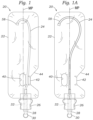
  • FIG. 1 is a front view of an exemplary sterile closed intermittent urinary catheter system having a narrow channel formed in a collection bag to facilitate feeding of a catheter therefrom;
  • FIG. 1 A is a front view of a catheter system similar to FIG. 1 with a through hole moved to permit alignment of the catheter with an outlet assembly;
  • FIG. 1 B is a front view of a catheter system similar to FIG. 1 with two through holes flanking a centered channel through which the catheter passes;
  • FIG. 2 is a front view of an alternative sterile closed intermittent urinary catheter system similar to that shown in FIG. 1 with an ergonomic sleeve positioned around the narrow channel to further facilitate feeding of a catheter therefrom;
  • FIGS. 3 A and 3 B are front views of the system of FIG. 2 illustrating two stages in the use thereof;
  • FIG. 4 A is a sectional view taken along line 4 - 4 in FIG. 2 showing one embodiment of the ergonomic sleeve
  • FIG. 4 B is a similar view showing an alternative ergonomic sleeve
  • FIG. 5 is an exploded view of exemplary components provided at an outlet of the closed intermittent urinary catheter systems disclosed herein.
  • the present application provides a sterile closed intermittent urinary catheter system which is an easier to use by virtue of ergonomic shaping to facilitate advancement and retrieval of the catheter from the collection bag.
  • the catheter is advanced by hand through manipulation from outside the bag.
  • FIG. 1 is a front view of an exemplary sterile closed intermittent urinary catheter system 20 having a flexible, preferably transparent, collection bag 22 with a generally rectangular profile and defining a collection volume therein.
  • the shape has a length dimension L between longitudinal ends and a width dimension W between lateral sides, as shown in FIG. 2 .
  • An intermittent catheter 24 is stored in the bag, and may be 14 or 16 inches in length.
  • the collection bag 22 is generally shorter in length than the catheter 24 so that the catheter is curled or coiled therein.
  • the length dimension L is about 415-425 mm
  • the width dimension W is about 125-135 mm, or in other words the bag 22 is roughly 3-4 times longer than it is wide.
  • the collection bag 22 has an outlet at one longitudinal end including an outlet hub 26 .
  • the bag 22 is formed of a suitable flexible polymer such as polyethylene, while the hub 26 is a rigid polymer and has a larger and easy-to-grip external shape as shown.
  • the bag 22 is desirably formed by heat-sealing or otherwise affixing peripheral edges of two faces or panels together, as well as around the hub 26 , in a manner which ensures sterility of the internal collection volume or cavity thus formed.
  • the two panels are identical (matching). Securing the two faces together at their edges thus results in a relatively flat, 2D bag when empty, though of course the bag expands to a 3D shape when the collection volume fills with urine.
  • a sterile closure 28 affixes over an outlet opening (not shown) in the hub 26 and may be provided with a grip, handle or ring such as shown at 30 for easy removal.
  • a distal tip 32 of the catheter is seen in phantom located within the hub 26 , just inside the outlet opening, which is its shipped position prior to use.
  • the collection bag 22 also has an internal through hole 40 (internal meaning closed to the outer edges of the bag) defined by inner edges of the bag material secured together in an oval shape such as by heat sealing.
  • the through hole 40 terminates near to the longitudinal outlet end of the bag 22 , preferably within an inch or two, and may be centered (or approximately centered) along midplane MP of the width dimension W of bag.
  • a narrow bridge 42 is formed in the collection bag 22 by the through hole 40 and an adjacent seam formed by the two matching panels sealed together; in this embodiment an indented section 44 in one lateral side of the bag 22 .
  • the faces of the bag 22 are not attached to each other along the bridge 42 so that a narrow open channel or passage in the collection volume is thus formed.
  • the oval internal through hole 40 has a long axis aligned with the narrow internal channel.
  • the indented section 44 may comprise a generally trapezoidal indent as shown, or may be more rectangular or more rounded, as desired.
  • the catheter 24 passes through the narrow channel formed in the bridge 42 which facilitates feeding of the catheter from the bag 22 , as will be described. First, a complete description of the preferred system components is helpful.
  • FIG. 1 A is a front view of a catheter system similar to FIG. 1 with the through hole 40 moved farther away from the indented section 44 to permit longitudinal alignment of the narrow open channel or passage and catheter 24 with the outlet hub 26 .
  • the through hole 40 is still adjacent the midplane MP, and the outlet hub 26 is now centered along the midplane MP. Aligning the catheter 24 with the outlet hub 26 in this manner facilitates movement of the catheter out of the collection bag 22 by reducing any frictional impediment from misalignment or bending of the catheter through the narrow channel.
  • the collection bag 22 is the same as described above so that like elements are given like part numbers.
  • FIG. 1 B is a front view of a catheter system similar to FIG. 1 with two through holes 40 , 41 flanking the bridge 42 to form the narrow open channel or passage in the collection volume along the midplane MP.
  • the outlet hub 26 is again centered along the midplane MP.
  • the two through holes 40 , 41 both form seams between the matching panels, and the two closest or adjacent seams define the narrow bridge 42 and channel.
  • the two through holes 40 , 41 are identical and spaced equidistantly across the longitudinally-extending midplane M of the collection bag.
  • the through holes 40 , 41 also provide handles of sorts for the user to manipulate the collection bag 22 .
  • the collection bag 22 is the same as described above so that like elements are given like part numbers.
  • FIG. 2 is a front view of an alternative sterile closed intermittent urinary catheter system 20 ′ similar to that shown in FIG. 1 .
  • the only change from the system 20 in FIG. 1 is the addition of an ergonomic pusher sleeve 46 having grooves 48 positioned around the narrow bridge 42 to further facilitate feeding of the catheter 24 from the bag 22 .
  • FIG. 2 shows the closure 28 removed from the hub 26 to expose an introducer tip 50 .
  • the distal tip 32 of the catheter preferably resides just inside the introducer tip 50 when packaged.
  • Internal components of the outlet end of the bag 22 are shown exploded in FIG. 5 and include a rigid sleeve 52 through which the catheter 24 passes, a catheter feed lock 54 , and a lubricating gel reservoir 56 . Prior to exiting the bag 22 , the catheter passes through all three of these components.
  • the catheter 24 may be pre-lubricated along its length, or may be provided with a dry hydrophilic coating which, when wetted, becomes lubricious. In the latter case, a small sachet of water is provided within the bag 22 which, when ruptured, wets the catheter 24 .
  • FIGS. 3 A and 3 B are front views of the system 20 ′ of FIG. 2 illustrating two stages in the use thereof.
  • the user inserts the introducer tip 50 into the urethra (men or women).
  • the user advances the catheter 24 forward, as indicated by the arrow, by pinching it with the relatively flexible pusher sleeve 46 through the bag 22 and urging it forward while holding the outlet hub 26 steady.
  • the introducer tip 50 is made of a flexible elastomer which has petals that the catheter tip 32 spreads apart upon passage therethrough.
  • the introducer tip 50 helps prevent any bacteria that may be around the urethra opening from contacting the catheter tip 32 , which in turn helps reduce instances of infection.
  • the user continues to slowly push the catheter 24 through the introducer tip 50 and into the urethra until the catheter reaches the bladder and urine begins to flow.
  • the catheter 24 has one or more small eyelets 34 at its distal tip 32 into which the urine flows. The lubricated nature of the catheter 24 eases the insertion.
  • the system 20 ′ When fully inserted, the system 20 ′ may be in the configuration shown in FIG. 3 B with the catheter 24 nearly fully extended out of the bag 22 .
  • the double-headed arrow shown on the pusher sleeve 46 indicates the ability to adjust the final longitudinal position of the catheter 24 .
  • An enlarged collar 58 attached to a rear end of the catheter 24 is sized so as to be unable to pass through the rigid sleeve 52 on the inner end of the outlet assembly which serves as a safety measure to prevent full extraction of the catheter 24 from the bag 22 .
  • the pusher sleeve 46 acts as a grip of sorts around the catheter 24 within the bag.
  • the pusher sleeve 46 is desirably made of a soft elastomer so that it may be easily squeezed and deform around the catheter 24 .
  • the sleeve 46 desirably has circumferential grooves that create circumferential raised regions therebetween which enhance the friction between the user's hand and the sleeve.
  • other means of doing the same thing are contemplated, such as a roughened or textured outer surface, bumps, extremely soft foam, etc.
  • the sleeve 46 is added merely to enhance the grip of the user on the catheter 24 , but that it is the shape of the collection bag 24 in the first place that facilitates catheter advancement.
  • passage of the catheter 24 through the narrow channel formed in the bridge 42 seen in FIG. 1 close to the outlet end of the bag is the main improvement.
  • the channel formed in the bridge 42 is generally aligned with the central axis of the outlet hub 26 and its components, so that the catheter 24 can easily be advanced from the bag 22 by gripping it at the channel and urging it forward relative to the hub.
  • FIG. 4 A is a sectional view taken along line 4 - 4 in FIG. 2 showing one embodiment of the ergonomic pusher sleeve 46 .
  • the sleeve 46 may be formed in generally an oval tube with two abutting free edges coming together at 60 .
  • the tube of the sleeve 46 fits closely around the lenticular-shaped portion of the bag 22 that forms the bridge 42 , with the catheter 24 shown therein.
  • FIG. 4 B is an alternative ergonomic sleeve 46 which also defines an oval-shaped tube with two somewhat overlapping free edges 62 .
  • variations of these configurations are well within the level of skill in the art.
  • FIG. 5 shows a few more details of the components at the outlet of the closed systems 20 disclosed herein.
  • a generally cylindrical rigid housing 64 may attach to the inner end of the hub 26 and provide a cavity therein for the feed lock 54 .
  • the feed lock 54 functions to permit one-way forward advancement of the catheter 24 , but inhibits rearward movement thereof.
  • a cylindrical housing with a throughbore provides support for a thin flap 72 that attaches to the housing via a living hinge.
  • the flap 72 has a throughbore as well and receives the tubular catheter 24 therethrough. When the catheter 24 advances forward, the flap 72 is pushed to an orientation perpendicular to the longitudinal direction, which eases passage of the catheter through its therethrough.
  • FIG. 5 also illustrates an internal chamber 74 of the lubricating gel reservoir 56 which resides between two end openings 76 sized slightly larger than the tubular catheter 24 .
  • the distal tip 32 of the catheter 24 preferably sits within the lubricating medium in the chamber 74 prior to use.
  • other reservoirs are contemplated, such as the resilient reservoirs disclosed in U.S. Pat. No. 9,833,592, the contents of which are hereby expressly incorporated by reference.

Landscapes

  • Health & Medical Sciences (AREA)
  • Life Sciences & Earth Sciences (AREA)
  • Public Health (AREA)
  • General Health & Medical Sciences (AREA)
  • Biomedical Technology (AREA)
  • Heart & Thoracic Surgery (AREA)
  • Engineering & Computer Science (AREA)
  • Veterinary Medicine (AREA)
  • Animal Behavior & Ethology (AREA)
  • Hematology (AREA)
  • Anesthesiology (AREA)
  • Nursing (AREA)
  • Orthopedic Medicine & Surgery (AREA)
  • Biophysics (AREA)
  • Pulmonology (AREA)
  • Vascular Medicine (AREA)
  • Epidemiology (AREA)
  • Urology & Nephrology (AREA)
  • Ophthalmology & Optometry (AREA)
  • Otolaryngology (AREA)
  • External Artificial Organs (AREA)

Abstract

A sterile closed intermittent urinary catheter system which is an easier to use by virtue of ergonomic shaping to facilitate advancement and retrieval of the catheter from the collection bag. The bag may have a closed internal hole adjacent an indent in one edge that creates a narrow channel through which the catheter passes. The narrow channel is located near to and in alignment with an outlet assembly so that the catheter extends from the narrow channel directly to the outlet. A user may easily grasp the catheter from outside the bag at the narrow channel and urge the catheter forward or backward to alternately extend and retract it through the outlet. A flexible pusher sleeve with gripper features may be added around the narrow channel to further facilitate catheter advancement.

Description

RELATED APPLICATIONS
The present application is a continuation of U.S. Ser. No. 16/295,733, filed Mar. 7, 2019, under the same title, now issued as U.S. Pat. No. 11,285,292, which is a continuation-in-part of U.S. Ser. No. 15/902,793, filed Feb. 22, 2018, under the same title, now issued as U.S. Pat. No. 10,226,594, the contents of which are expressly incorporated herein.
NOTICE OF COPYRIGHTS AND TRADE DRESS
A portion of the disclosure of this patent document contains material which is subject to copyright protection. This patent document may show and/or describe matter which is or may become trade dress of the owner. The copyright and trade dress owner has no objection to the facsimile reproduction by anyone of the patent disclosure as it appears in the Patent and Trademark Office patent files or records, but otherwise reserves all copyright and trade dress rights whatsoever.
FIELD
The present invention relates to a closed intermittent catheter system and, more particularly, to a closed system with a shaped bag that facilitates gripping and advancement of a catheter therein.
BACKGROUND
People with neurogenic bladder disorders like spinal cord injury, spina bifida or multiple sclerosis, and non-neurogenic bladder disorders like obstruction due to prostate enlargement, urethral strictures or post-operative urinary retention, need to be continuously catheterized to empty their urinary bladders. But such continuous catheterization can lead to problems like urinary tract infections (UTI), urethral strictures or male infertility. Intermittent catheterization at regular intervals avoids such negative effects of continuous long term catheterization. Research has shown that intermittent self-catheterization helps reduce urinary tract infections, control urinary leakage (incontinence) and prevent urinary tract damage.
In our highly mobile culture, the ability to have the freedom to leave home for the day or longer is an important part of life. To accommodate this need, single use intermittent urinary catheters have been developed to allow patients to perform self-catheterization. Many intermittent catheters are designed to be inserted into the bladder while the back end is suspended over a toilet or other waste receptacle. A closed system catheter is a self-contained, sterile, pre-lubricated catheter housed within a collection bag. The collection bag eliminates the need to void the urine into a receptacle or toilet, and since it's self-contained, it eliminates the need to hook up any other kind of bag or container. The closed system is also critical for a sterile intermittent catheter insertion technique whereby the catheter is inserted without human touch.
Despite numerous products on the market, there remains a need for an easier to use sterile closed intermittent urinary catheter system.
SUMMARY OF THE INVENTION
The present application discloses a sterile closed intermittent urinary catheter system which is an easier to use by virtue of ergonomic shaping to facilitate advancement and retrieval of the catheter from the collection bag. In a preferred embodiment, a closed internal hole in the bag adjacent an indent in one edge creates a narrow channel through which the catheter passes. The narrow channel is located near to and in alignment with an outlet assembly so that the catheter extends from the narrow channel directly to the outlet. A user may easily grasp the catheter from outside the bag at the narrow channel and urge the catheter forward or backward to alternately extend and retract it through the outlet. A flexible pusher sleeve with gripper features may be added around the narrow channel to further facilitate catheter advancement.
In one embodiment, a catheter closed urinary catheter system comprises a flexible generally rectangular collection bag defining a collection volume therein. The collection bag is substantially flat when empty and has an outlet in one longitudinal end. The collection bag further has an internal through hole in its middle portion and an indent in one lateral side adjacent the through hole that creates a narrow internal channel close to and generally aligned with the outlet. An intermittent urinary catheter sealed within the collection bag has a forward end located at the outlet and an adjacent portion passing through the narrow channel of the bag so that a user may grip the catheter from outside the bag at the narrow channel and urge the catheter forward or backward to alternately extend and retract it through the outlet.
The internal through hole may be an oval shape with a long axis aligned with the narrow internal channel. A flexible sleeve may be fitted around the narrow channel and having frictional features thereon for enhanced gripping of the catheter.
Another closed urinary catheter system comprises a flexible generally rectangular collection bag defining a collection volume therein. The collection bag is substantially flat when empty and has an outlet in one longitudinal end. The collection bag further defines a narrow bridge close to and generally aligned with the outlet and having an open passage therethrough. An intermittent urinary catheter sealed within the collection bag has a forward end located at the outlet and an adjacent portion passing through the open passage defined by the narrow bridge. A flexible sleeve fits around the narrow channel and has frictional features thereon for enhanced gripping of the catheter, wherein a user may grip the catheter from outside the bag using the sleeve and urge the catheter forward or backward to alternately extend and retract it through the outlet.
In either system outlined above, the flexible sleeve is desirably silicone and is formed in an open tubular structure with two free edges; which edges may overlap. The frictional features may include grooves which define circumferential raised regions therebetween or a roughened or textured outer surface.
A feed lock may be included within the outlet of the bag of either system which allows free forward passage of the catheter out of the bag but hinders retraction of the catheter. Preferably, the outlet comprises a relatively rigid gripping hub through which the catheter passes. Further, an introducer tip may extend from an outer end of the outlet through which the catheter passes, with a sterile cap secured over the introducer tip. Finally, a gel reservoir may be secured within the hub that lubricates the catheter as it passes through the reservoir.
BRIEF DESCRIPTION OF THE DRAWINGS
FIG. 1 is a front view of an exemplary sterile closed intermittent urinary catheter system having a narrow channel formed in a collection bag to facilitate feeding of a catheter therefrom;
FIG. 1A is a front view of a catheter system similar to FIG. 1 with a through hole moved to permit alignment of the catheter with an outlet assembly;
FIG. 1B is a front view of a catheter system similar to FIG. 1 with two through holes flanking a centered channel through which the catheter passes;
FIG. 2 is a front view of an alternative sterile closed intermittent urinary catheter system similar to that shown in FIG. 1 with an ergonomic sleeve positioned around the narrow channel to further facilitate feeding of a catheter therefrom;
FIGS. 3A and 3B are front views of the system of FIG. 2 illustrating two stages in the use thereof;
FIG. 4A is a sectional view taken along line 4-4 in FIG. 2 showing one embodiment of the ergonomic sleeve, and FIG. 4B is a similar view showing an alternative ergonomic sleeve; and
FIG. 5 is an exploded view of exemplary components provided at an outlet of the closed intermittent urinary catheter systems disclosed herein.
DETAILED DESCRIPTION OF A PREFERRED EMBODIMENT
The present application provides a sterile closed intermittent urinary catheter system which is an easier to use by virtue of ergonomic shaping to facilitate advancement and retrieval of the catheter from the collection bag. The catheter is advanced by hand through manipulation from outside the bag.
FIG. 1 is a front view of an exemplary sterile closed intermittent urinary catheter system 20 having a flexible, preferably transparent, collection bag 22 with a generally rectangular profile and defining a collection volume therein. The shape has a length dimension L between longitudinal ends and a width dimension W between lateral sides, as shown in FIG. 2 . An intermittent catheter 24 is stored in the bag, and may be 14 or 16 inches in length. The collection bag 22 is generally shorter in length than the catheter 24 so that the catheter is curled or coiled therein. In one embodiment, the length dimension L is about 415-425 mm, and the width dimension W is about 125-135 mm, or in other words the bag 22 is roughly 3-4 times longer than it is wide.
The collection bag 22 has an outlet at one longitudinal end including an outlet hub 26. The bag 22 is formed of a suitable flexible polymer such as polyethylene, while the hub 26 is a rigid polymer and has a larger and easy-to-grip external shape as shown. The bag 22 is desirably formed by heat-sealing or otherwise affixing peripheral edges of two faces or panels together, as well as around the hub 26, in a manner which ensures sterility of the internal collection volume or cavity thus formed. Preferably, the two panels are identical (matching). Securing the two faces together at their edges thus results in a relatively flat, 2D bag when empty, though of course the bag expands to a 3D shape when the collection volume fills with urine.
A sterile closure 28 affixes over an outlet opening (not shown) in the hub 26 and may be provided with a grip, handle or ring such as shown at 30 for easy removal. A distal tip 32 of the catheter is seen in phantom located within the hub 26, just inside the outlet opening, which is its shipped position prior to use.
The collection bag 22 also has an internal through hole 40 (internal meaning closed to the outer edges of the bag) defined by inner edges of the bag material secured together in an oval shape such as by heat sealing. The through hole 40 terminates near to the longitudinal outlet end of the bag 22, preferably within an inch or two, and may be centered (or approximately centered) along midplane MP of the width dimension W of bag. A narrow bridge 42 is formed in the collection bag 22 by the through hole 40 and an adjacent seam formed by the two matching panels sealed together; in this embodiment an indented section 44 in one lateral side of the bag 22. The faces of the bag 22 are not attached to each other along the bridge 42 so that a narrow open channel or passage in the collection volume is thus formed. The oval internal through hole 40 has a long axis aligned with the narrow internal channel. The indented section 44 may comprise a generally trapezoidal indent as shown, or may be more rectangular or more rounded, as desired. The catheter 24 passes through the narrow channel formed in the bridge 42 which facilitates feeding of the catheter from the bag 22, as will be described. First, a complete description of the preferred system components is helpful.
FIG. 1A is a front view of a catheter system similar to FIG. 1 with the through hole 40 moved farther away from the indented section 44 to permit longitudinal alignment of the narrow open channel or passage and catheter 24 with the outlet hub 26. The through hole 40 is still adjacent the midplane MP, and the outlet hub 26 is now centered along the midplane MP. Aligning the catheter 24 with the outlet hub 26 in this manner facilitates movement of the catheter out of the collection bag 22 by reducing any frictional impediment from misalignment or bending of the catheter through the narrow channel. In all other respects, the collection bag 22 is the same as described above so that like elements are given like part numbers.
FIG. 1B is a front view of a catheter system similar to FIG. 1 with two through holes 40, 41 flanking the bridge 42 to form the narrow open channel or passage in the collection volume along the midplane MP. The outlet hub 26 is again centered along the midplane MP. In this embodiment there is no indented section 44 in one lateral side wall, both lateral side walls are straight. Instead, the two through holes 40, 41 both form seams between the matching panels, and the two closest or adjacent seams define the narrow bridge 42 and channel. Desirably, the two through holes 40, 41 are identical and spaced equidistantly across the longitudinally-extending midplane M of the collection bag. The through holes 40, 41 also provide handles of sorts for the user to manipulate the collection bag 22. In all other respects, the collection bag 22 is the same as described above so that like elements are given like part numbers.
FIG. 2 is a front view of an alternative sterile closed intermittent urinary catheter system 20′ similar to that shown in FIG. 1 . The only change from the system 20 in FIG. 1 is the addition of an ergonomic pusher sleeve 46 having grooves 48 positioned around the narrow bridge 42 to further facilitate feeding of the catheter 24 from the bag 22.
FIG. 2 shows the closure 28 removed from the hub 26 to expose an introducer tip 50. The distal tip 32 of the catheter preferably resides just inside the introducer tip 50 when packaged. Internal components of the outlet end of the bag 22 are shown exploded in FIG. 5 and include a rigid sleeve 52 through which the catheter 24 passes, a catheter feed lock 54, and a lubricating gel reservoir 56. Prior to exiting the bag 22, the catheter passes through all three of these components. It should be noted that rather than providing the lubricating gel reservoir 56, the catheter 24 may be pre-lubricated along its length, or may be provided with a dry hydrophilic coating which, when wetted, becomes lubricious. In the latter case, a small sachet of water is provided within the bag 22 which, when ruptured, wets the catheter 24.
FIGS. 3A and 3B are front views of the system 20′ of FIG. 2 illustrating two stages in the use thereof. After removal of the outlet closure 28 and prior to longitudinal advancement of the catheter 24 from the bag 22, the user inserts the introducer tip 50 into the urethra (men or women). The user then advances the catheter 24 forward, as indicated by the arrow, by pinching it with the relatively flexible pusher sleeve 46 through the bag 22 and urging it forward while holding the outlet hub 26 steady. The introducer tip 50 is made of a flexible elastomer which has petals that the catheter tip 32 spreads apart upon passage therethrough. The introducer tip 50 helps prevent any bacteria that may be around the urethra opening from contacting the catheter tip 32, which in turn helps reduce instances of infection. The user continues to slowly push the catheter 24 through the introducer tip 50 and into the urethra until the catheter reaches the bladder and urine begins to flow. The catheter 24 has one or more small eyelets 34 at its distal tip 32 into which the urine flows. The lubricated nature of the catheter 24 eases the insertion.
When fully inserted, the system 20′ may be in the configuration shown in FIG. 3B with the catheter 24 nearly fully extended out of the bag 22. The double-headed arrow shown on the pusher sleeve 46 indicates the ability to adjust the final longitudinal position of the catheter 24. An enlarged collar 58 attached to a rear end of the catheter 24 is sized so as to be unable to pass through the rigid sleeve 52 on the inner end of the outlet assembly which serves as a safety measure to prevent full extraction of the catheter 24 from the bag 22.
The pusher sleeve 46 acts as a grip of sorts around the catheter 24 within the bag. The pusher sleeve 46 is desirably made of a soft elastomer so that it may be easily squeezed and deform around the catheter 24. In the configuration shown, the sleeve 46 desirably has circumferential grooves that create circumferential raised regions therebetween which enhance the friction between the user's hand and the sleeve. Of course, other means of doing the same thing are contemplated, such as a roughened or textured outer surface, bumps, extremely soft foam, etc.
Furthermore, it should be noted that the sleeve 46 is added merely to enhance the grip of the user on the catheter 24, but that it is the shape of the collection bag 24 in the first place that facilitates catheter advancement. In particular, passage of the catheter 24 through the narrow channel formed in the bridge 42 seen in FIG. 1 close to the outlet end of the bag is the main improvement. With reference back to FIG. 1 , the channel formed in the bridge 42 is generally aligned with the central axis of the outlet hub 26 and its components, so that the catheter 24 can easily be advanced from the bag 22 by gripping it at the channel and urging it forward relative to the hub. Although bags without the through hole 40, bridge 42 and indent 44 are available and the general process of advancing a catheter therefrom is the same (gripping the catheter through the bag), certain difficulties arise. First, the user may grip the catheter too far from the outlet, which may cause the catheter to bend and reduces pushing force. Second, the user may not push the catheter 24 in alignment with the outlet, which also reduces leverage. Finally, the mere task of gripping the catheter between two generally flat bag panels may not be easy, especially for those with dexterity challenges. The narrow bridge 42 located close to and in alignment with the outlet hub 26 greatly reduces these potential hindrances, and may be a big improvement for some users.
The pusher sleeve 46 is preferably a loose part that fits around the narrow bridge 42, though it may also be adhered thereto. Since the sleeve 46 passes through the closed through hole 40, it cannot prior to assembly on the bag 22 be formed as a closed tube. There are several solutions in this regard. FIG. 4A is a sectional view taken along line 4-4 in FIG. 2 showing one embodiment of the ergonomic pusher sleeve 46. The sleeve 46 may be formed in generally an oval tube with two abutting free edges coming together at 60. The tube of the sleeve 46 fits closely around the lenticular-shaped portion of the bag 22 that forms the bridge 42, with the catheter 24 shown therein. FIG. 4B is an alternative ergonomic sleeve 46 which also defines an oval-shaped tube with two somewhat overlapping free edges 62. Of course, variations of these configurations are well within the level of skill in the art.
Finally, FIG. 5 shows a few more details of the components at the outlet of the closed systems 20 disclosed herein. First, a generally cylindrical rigid housing 64 may attach to the inner end of the hub 26 and provide a cavity therein for the feed lock 54. The feed lock 54 functions to permit one-way forward advancement of the catheter 24, but inhibits rearward movement thereof. In one embodiment, a cylindrical housing with a throughbore provides support for a thin flap 72 that attaches to the housing via a living hinge. Although not shown, the flap 72 has a throughbore as well and receives the tubular catheter 24 therethrough. When the catheter 24 advances forward, the flap 72 is pushed to an orientation perpendicular to the longitudinal direction, which eases passage of the catheter through its therethrough. Conversely, when the catheter 24 is displaced rearward, the flap 72 assumes the angled orientation shown which tends to resist movement of the catheter by virtue of the now-angled throughbore. A latch may be provided to enable a user to fix the flap 72 against the housing 70 to permit retraction of the catheter 24. Similar devices are disclosed in co-pending U.S. patent application Ser. No. 15/671,341, the contents of which are hereby expressly incorporated by reference.
FIG. 5 also illustrates an internal chamber 74 of the lubricating gel reservoir 56 which resides between two end openings 76 sized slightly larger than the tubular catheter 24. As seen in FIG. 1 , the distal tip 32 of the catheter 24 preferably sits within the lubricating medium in the chamber 74 prior to use. Of course, other reservoirs are contemplated, such as the resilient reservoirs disclosed in U.S. Pat. No. 9,833,592, the contents of which are hereby expressly incorporated by reference.
Throughout this description, the embodiments and examples shown should be considered as exemplars, rather than limitations on the apparatus and procedures disclosed or claimed. Although many of the examples presented herein involve specific combinations of method acts or system elements, it should be understood that those acts and those elements may be combined in other ways to accomplish the same objectives. Acts, elements and features discussed only in connection with one embodiment are not intended to be excluded from a similar role in other embodiments.

Claims (18)

It is claimed:
1. A method of manufacturing a closed urinary catheter system comprising:
forming a collection bag having an inner cavity defining a collection volume therein, the collection bag having two panels sealed together and having an outlet formed in one end, the collection bag further having an internal through hole defined by inner edges of the panels, wherein a bridge portion of the collection bag between the through hole and a first lateral outer peripheral edge creates an internal channel within the inner cavity, the first lateral outer peripheral edge having an indent co-extensive with the through hole, and an intermittent urinary catheter located within the inner cavity having a forward end located at the outlet and an adjacent portion passing through the internal channel;
wherein the closed urinary catheter system is configured for gripping the catheter from outside the collection bag between the through hole and the first lateral outer peripheral edge and urging the catheter forward or backward to respectively extend or retract the catheter through the outlet.
2. The method of claim 1, wherein the through hole is an oval shape.
3. The method of claim 1, wherein a midplane of the collection bag intersects the through hole.
4. The method of claim 1, wherein the through hole is positioned within two inches of the outlet.
5. The method of claim 1, further including a flexible sleeve outside the collection bag fitted around the bridge portion and having frictional features thereon for enhanced gripping of the catheter.
6. The method of claim 1, wherein the internal channel of the collection bag is longitudinally aligned with the outlet so that the catheter is longitudinally oriented through the internal channel to the outlet.
7. The method of claim 1, further including a feed lock within the outlet which allows free forward passage of the catheter out of the collection bag but hinders retraction of the catheter.
8. The method of claim 1, wherein the outlet comprises a rigid gripping hub through which the catheter passes, an introducer tip extending from an outer end of the gripping hub and through which the catheter passes, and a sterile cap secured over the introducer tip.
9. The method of claim 8, further including a gel reservoir secured within the gripping hub that lubricates the catheter as it passes through the reservoir.
10. The method of claim 1, wherein the catheter has a length longer than the elongated dimension of the collection bag.
11. A method of manufacturing a closed urinary catheter system comprising:
forming a collection bag from two panels sealed together at outer peripheral edges forming an inner cavity that defines a collection volume therein, the collection bag having an outlet and internal through holes defined by aligned inner edges of the panels, the through holes both being elongated to form an elongated bridge in the panels between adjacent seams of the through holes and to define an internal channel open to the inner cavity between the through holes an intermittent urinary catheter located within the inner cavity having a forward end located at the outlet and an adjacent portion passing through the internal channel, and a flexible sleeve outside the collection bag fitted around the bridge and having frictional features thereon for enhanced gripping of the catheter;
wherein the closed urinary catheter system is configured so a user can grip the catheter from outside the collection bag between the through holes and urge the catheter forward or backward to respectively extend or retract the catheter through the outlet.
12. The method of claim 11, wherein both through holes are positioned no more than two inches from the outlet.
13. The method of claim 11, further including a feed lock within the outlet which allows free forward passage of the catheter out of the collection bag but hinders retraction of the catheter.
14. The method of claim 11, wherein the outlet comprises a rigid gripping hub through which the catheter passes, an introducer tip extending from an outer end of the gripping hub and through which the catheter passes, and a sterile cap secured over the introducer tip.
15. The method of claim 11, wherein the catheter has a length longer than the elongated dimension of the collection bag.
16. The method of claim 15, wherein the internal channel of the collection bag is longitudinally aligned with the outlet so that the catheter is longitudinally oriented through the internal channel to the outlet.
17. The method of claim 11, wherein the internal channel of the collection bag is longitudinally aligned with the outlet so that the catheter is longitudinally oriented through the internal channel to the outlet.
18. The method of claim 17, wherein both the through holes are oval shape with long axes aligned with the internal channel.
US17/703,284 2018-02-22 2022-03-24 Methods of urging a catheter from a closed urinary catheter system Active 2039-09-14 US12311119B2 (en)

Priority Applications (1)

Application Number Priority Date Filing Date Title
US17/703,284 US12311119B2 (en) 2018-02-22 2022-03-24 Methods of urging a catheter from a closed urinary catheter system

Applications Claiming Priority (3)

Application Number Priority Date Filing Date Title
US15/902,793 US10226594B1 (en) 2018-02-22 2018-02-22 Closed system with intermittent urinary catheter feed
US16/295,733 US11285292B2 (en) 2018-02-22 2019-03-07 Closed system with intermittent urinary catheter feed
US17/703,284 US12311119B2 (en) 2018-02-22 2022-03-24 Methods of urging a catheter from a closed urinary catheter system

Related Parent Applications (1)

Application Number Title Priority Date Filing Date
US16/295,733 Continuation US11285292B2 (en) 2018-02-22 2019-03-07 Closed system with intermittent urinary catheter feed

Publications (2)

Publication Number Publication Date
US20220211973A1 US20220211973A1 (en) 2022-07-07
US12311119B2 true US12311119B2 (en) 2025-05-27

Family

ID=67616350

Family Applications (2)

Application Number Title Priority Date Filing Date
US16/295,733 Active 2039-08-24 US11285292B2 (en) 2018-02-22 2019-03-07 Closed system with intermittent urinary catheter feed
US17/703,284 Active 2039-09-14 US12311119B2 (en) 2018-02-22 2022-03-24 Methods of urging a catheter from a closed urinary catheter system

Family Applications Before (1)

Application Number Title Priority Date Filing Date
US16/295,733 Active 2039-08-24 US11285292B2 (en) 2018-02-22 2019-03-07 Closed system with intermittent urinary catheter feed

Country Status (1)

Country Link
US (2) US11285292B2 (en)

Families Citing this family (12)

* Cited by examiner, † Cited by third party
Publication number Priority date Publication date Assignee Title
GB201721955D0 (en) 2017-12-27 2018-02-07 Convatec Ltd Catheter wetting devices
US11285292B2 (en) * 2018-02-22 2022-03-29 Cure Medical Llc Closed system with intermittent urinary catheter feed
US10751213B2 (en) * 2018-04-18 2020-08-25 Cure Medical Llc Dual-purpose urinary catheter drain line and collection bag
US11957614B2 (en) 2019-06-11 2024-04-16 Convatec Technologies, Inc. Urine collection bags for use with catheter products, kits incorporating the same, and methods therefor
US11752298B2 (en) 2019-12-15 2023-09-12 Advocath LLC Self-intermittent urinary catheter extension with infection detection, a catheter assembly having an extension with infection detection and a catheter assembly having infection detection
US11752299B2 (en) 2019-12-15 2023-09-12 Advocath LLC Self-intermittent urinary catheter extension with infection detection, a catheter assembly having an extension with infection detection and a catheter assembly having infection detection
US12226587B2 (en) * 2020-03-23 2025-02-18 Convatec, Inc. Pre-lubricated female urinary catheter package
GB202006055D0 (en) 2020-04-24 2020-06-10 Convatec Ltd A wetting mechanism for a catheter
AU2021259368A1 (en) 2020-04-24 2022-09-29 Convatec Limited A wetting mechanism for a catheter
GB202006059D0 (en) 2020-04-24 2020-06-10 Convatec Ltd A wetting mechanism for a catheter
CN115551580A (en) 2020-04-24 2022-12-30 康沃特克有限公司 Package for medical devices
WO2021219188A1 (en) * 2020-05-01 2021-11-04 Coloplast A/S Intermittent urinary catheter assembly

Citations (22)

* Cited by examiner, † Cited by third party
Publication number Priority date Publication date Assignee Title
US4451256A (en) 1981-05-06 1984-05-29 Intermedicat Gmbh Catheter set
US6053905A (en) * 1998-02-23 2000-04-25 Tyco International (Us) Inc. Self contained urethral catheter assembly with lubricating chamber
US6402726B1 (en) 2001-03-19 2002-06-11 Medical Technologies Of Georgia, Inc. Catheter movement control device and method
US6578709B1 (en) * 2001-07-19 2003-06-17 Hollister Incorporated Urinary catheter package and lubricator therefor with combined gripping and sealing means
US20030130646A1 (en) * 2001-01-31 2003-07-10 Kubalak Thomas P. Urine collection bags for urinary catheter systems
US20040163980A1 (en) * 2001-06-29 2004-08-26 Allan Tanghoj Catheter assembly valve system
US7094220B2 (en) 2001-06-29 2006-08-22 Coloplast A/S Catheter assembly including a catheter applicator
US20070088330A1 (en) 2005-08-17 2007-04-19 House Jamie G Catheterization assembly
US7985217B2 (en) 2006-10-24 2011-07-26 Medical Technologies Of Georgia, Inc. Catheter movement system
US20120116335A1 (en) 2009-05-12 2012-05-10 Coloplast A/S Urine Collection Bag
US20120168324A1 (en) 2009-08-13 2012-07-05 Steven Carleo Catheter Having Internal Hydrating Fluid Storage and/or Catheter Package Using the Same and Method of Making and/or Using the Same
US20120239005A1 (en) 2011-03-14 2012-09-20 Conway Anthony J Catheter grip and method
US20130144271A1 (en) * 2011-10-21 2013-06-06 Medical Service Gmbh Catheter Set
US20150133898A1 (en) * 2012-04-20 2015-05-14 Hollister Incorporated Intermittent catheter assembly
US9782563B2 (en) 2014-06-05 2017-10-10 Cure Medical, Llc Catheter packaging with movement control device
US10226594B1 (en) * 2018-02-22 2019-03-12 Cure Medical Llc Closed system with intermittent urinary catheter feed
US11285292B2 (en) * 2018-02-22 2022-03-29 Cure Medical Llc Closed system with intermittent urinary catheter feed
US11904111B2 (en) 2017-12-22 2024-02-20 Convatec Limited Female catheter locator tip
EP3634561B1 (en) 2017-06-09 2024-02-28 Hollister Incorporated Packages for medical devices
US20240108857A1 (en) 2017-03-31 2024-04-04 C. R. Bard, Inc. Catheter Insertion-Tray Systems and Methods Thereof
US11998705B2 (en) 2016-09-27 2024-06-04 Coloplast A/S Urinary catheter assembly having a urinary catheter sealed inside of a closed package
US20240197458A1 (en) 2017-01-29 2024-06-20 Jon St. Germain Devices and methods for sphincter reinforcement

Patent Citations (24)

* Cited by examiner, † Cited by third party
Publication number Priority date Publication date Assignee Title
US4451256A (en) 1981-05-06 1984-05-29 Intermedicat Gmbh Catheter set
US6053905A (en) * 1998-02-23 2000-04-25 Tyco International (Us) Inc. Self contained urethral catheter assembly with lubricating chamber
US20030130646A1 (en) * 2001-01-31 2003-07-10 Kubalak Thomas P. Urine collection bags for urinary catheter systems
US6402726B1 (en) 2001-03-19 2002-06-11 Medical Technologies Of Georgia, Inc. Catheter movement control device and method
US7094220B2 (en) 2001-06-29 2006-08-22 Coloplast A/S Catheter assembly including a catheter applicator
US20040163980A1 (en) * 2001-06-29 2004-08-26 Allan Tanghoj Catheter assembly valve system
US6578709B1 (en) * 2001-07-19 2003-06-17 Hollister Incorporated Urinary catheter package and lubricator therefor with combined gripping and sealing means
US20070088330A1 (en) 2005-08-17 2007-04-19 House Jamie G Catheterization assembly
US7985217B2 (en) 2006-10-24 2011-07-26 Medical Technologies Of Georgia, Inc. Catheter movement system
US20120116335A1 (en) 2009-05-12 2012-05-10 Coloplast A/S Urine Collection Bag
US20120168324A1 (en) 2009-08-13 2012-07-05 Steven Carleo Catheter Having Internal Hydrating Fluid Storage and/or Catheter Package Using the Same and Method of Making and/or Using the Same
US20120239005A1 (en) 2011-03-14 2012-09-20 Conway Anthony J Catheter grip and method
US9707375B2 (en) 2011-03-14 2017-07-18 Rochester Medical Corporation, a subsidiary of C. R. Bard, Inc. Catheter grip and method
US20130144271A1 (en) * 2011-10-21 2013-06-06 Medical Service Gmbh Catheter Set
US20150133898A1 (en) * 2012-04-20 2015-05-14 Hollister Incorporated Intermittent catheter assembly
US9861781B2 (en) 2012-04-20 2018-01-09 Hollister Incorporated Intermittent catheter assembly
US9782563B2 (en) 2014-06-05 2017-10-10 Cure Medical, Llc Catheter packaging with movement control device
US11998705B2 (en) 2016-09-27 2024-06-04 Coloplast A/S Urinary catheter assembly having a urinary catheter sealed inside of a closed package
US20240197458A1 (en) 2017-01-29 2024-06-20 Jon St. Germain Devices and methods for sphincter reinforcement
US20240108857A1 (en) 2017-03-31 2024-04-04 C. R. Bard, Inc. Catheter Insertion-Tray Systems and Methods Thereof
EP3634561B1 (en) 2017-06-09 2024-02-28 Hollister Incorporated Packages for medical devices
US11904111B2 (en) 2017-12-22 2024-02-20 Convatec Limited Female catheter locator tip
US10226594B1 (en) * 2018-02-22 2019-03-12 Cure Medical Llc Closed system with intermittent urinary catheter feed
US11285292B2 (en) * 2018-02-22 2022-03-29 Cure Medical Llc Closed system with intermittent urinary catheter feed

Non-Patent Citations (4)

* Cited by examiner, † Cited by third party
Title
Cure Medical LLC, "Closed System", https://curemedical.com/cure-catheters/cure-catheter-closed-system/, last accessed Jan. 22, 2018, 13 total pages.
Cure Medical LLC, "Instruction Guide to Sterile Self-Catheterization for Women Using the Cure Catheter® Closed System", article, pp. 1-6, http://curemedical.com/wp-content/uploads/2015/01/Sterile-SIC_women.pdf, last accessed Feb. 22, 2018.
Cure Medical LLC, "Instruction Guide to Sterile Self-Intermittent Catheterization For Men Using the Cure Catheter® Closed System", article, pp. 1-6, http://curemedical.com/wp-content/uploads/2015/01/Sterile-SIC_men.pdf, last accessed, Feb. 22, 2018.
Health Products for You, "Coloplast Self-Cath Closed System Intermittent Catheter", https://www.healthproductsforyou.com/p-coloplast-self-cath-straight-tip-closed-system-intermittent-catheter.html, accessed Jan. 22, 2018.

Also Published As

Publication number Publication date
US11285292B2 (en) 2022-03-29
US20220211973A1 (en) 2022-07-07
US20190255280A1 (en) 2019-08-22

Similar Documents

Publication Publication Date Title
US12311119B2 (en) Methods of urging a catheter from a closed urinary catheter system
US10226594B1 (en) Closed system with intermittent urinary catheter feed
EP2106821B1 (en) Catheter assembly comprising a tubular member having pleated regions, and methods of activating and manufacturing the same
US11602453B2 (en) Dual-purpose urinary catheter drain line and collection bag
US11738169B2 (en) Urinary catheter assembly having a sleeve attached between a connector and a handle
EP2774648B1 (en) Compact packaged intermittent urinary catheter
US11420015B2 (en) Compact packaged intermittent urinary catheter
EP1578308B1 (en) Catheter for the Ureter
EP2077866B1 (en) Catheter gripping device
US9775965B2 (en) Catheter with a bendable zone
US10531976B2 (en) Methods of urinary catheter collection and draining
EP1420847B1 (en) A catheter assembly
US11771868B2 (en) Gripper sleeve for urinary catheter
WO2025180638A1 (en) Urinary catheter assembly
WO2025180639A1 (en) Urinary catheter assembly

Legal Events

Date Code Title Description
AS Assignment

Owner name: CURE MEDICAL LLC, CALIFORNIA

Free format text: ASSIGNMENT OF ASSIGNORS INTEREST;ASSIGNOR:PALMER, TIMOTHY A.;REEL/FRAME:059391/0608

Effective date: 20190306

FEPP Fee payment procedure

Free format text: ENTITY STATUS SET TO UNDISCOUNTED (ORIGINAL EVENT CODE: BIG.); ENTITY STATUS OF PATENT OWNER: LARGE ENTITY

STPP Information on status: patent application and granting procedure in general

Free format text: DOCKETED NEW CASE - READY FOR EXAMINATION

AS Assignment

Owner name: CONVATEC, INC, NEW JERSEY

Free format text: ASSIGNMENT OF ASSIGNORS INTEREST;ASSIGNOR:CURE MEDICAL, LLC;REEL/FRAME:068223/0720

Effective date: 20240626

STPP Information on status: patent application and granting procedure in general

Free format text: NON FINAL ACTION MAILED

STPP Information on status: patent application and granting procedure in general

Free format text: RESPONSE TO NON-FINAL OFFICE ACTION ENTERED AND FORWARDED TO EXAMINER

STPP Information on status: patent application and granting procedure in general

Free format text: NOTICE OF ALLOWANCE MAILED -- APPLICATION RECEIVED IN OFFICE OF PUBLICATIONS

STCF Information on status: patent grant

Free format text: PATENTED CASE